Operating and installation
instructions
Wine conditioning unit
To avoid the risk of accidents or damage to the appliance it is essen-
tial to read these instructions before it is installed and used for the
first time.
en-GB M.-Nr. 10 439 390

Contents
2
Warning and Safety instructions...................................................................... 5
Caring for the environment .............................................................................. 13
Saving energy .................................................................................................... 14
Guide to the appliance...................................................................................... 15
Symbols............................................................................................................... 16
Accessories ....................................................................................................... 18
Accessories supplied .......................................................................................... 18
Optional accessories........................................................................................... 18
Switching on and off ......................................................................................... 19
Before using for the first time.............................................................................. 19
Cleaning the appliance................................................................................... 19
Operating the wine conditioning unit .................................................................. 19
Settings .......................................................................................................... 20
Switching off................................................................................................... 20
Switching off for longer periods of time .............................................................. 20
Selecting further settings ................................................................................. 21
Safety lock ...................................................................................................... 21
Audible tones................................................................................................. 22
Display brightness .......................................................................................... 23
The optimum temperature and air quality....................................................... 24
The optimum temperature................................................................................... 24
Setting the temperature....................................................................................... 25
Temperature display ............................................................................................ 26
Air quality and humidity....................................................................................... 27
Using
DynaCool (constant humidity) ........................................................................ 27
Air filtering with the Active AirClean filters........................................................... 28
Temperature and door alarm............................................................................ 29
Feature lighting.................................................................................................. 31
Switching the feature lighting on and off............................................................. 31
Setting the brightness of the feature lighting ................................................. 31
Lighting duration of the feature lighting ......................................................... 32

Contents
3
Storing wine bottles .......................................................................................... 33
Wooden shelves.................................................................................................. 34
Moving the wooden shelves........................................................................... 34
Adjusting the wooden shelves ....................................................................... 35
Annotating wooden shelves ........................................................................... 35
Bottle presenter................................................................................................... 36
Maximum capacity .............................................................................................. 36
Automatic defrosting ........................................................................................ 37
Cleaning and care ............................................................................................. 38
Cleaning agents................................................................................................... 38
Before cleaning the wine unit .............................................................................. 39
Cleaning the outer casing, the door, the interior and accessories...................... 39
Cleaning the ventilation gaps .............................................................................. 40
Cleaning the door seal ........................................................................................ 40
Cleaning the compressor and metal grille at the back of the wine appliance .... 40
After cleaning ...................................................................................................... 40
Active AirClean filters ....................................................................................... 41
Replacing the Active AirClean filters ................................................................... 41
Problem solving guide ...................................................................................... 43
Noises................................................................................................................. 48
After sales service and warranty ..................................................................... 49
Contact in the event of a fault ............................................................................. 49
EPREL database ................................................................................................. 49
Warranty .............................................................................................................. 49
Information for dealers ..................................................................................... 50
Demo mode ...................................................................................................... 50
Electrical connection ........................................................................................ 52
Installation.......................................................................................................... 53
Location............................................................................................................... 53
Climate range ...................................................................................................... 53
Ventilation............................................................................................................ 54
Fitting wall spacers supplied............................................................................... 54
Installation ........................................................................................................... 54
Niche floor ...................................................................................................... 54
Aligning the wine conditioning unit ..................................................................... 55
Door opening angle limiter .................................................................................. 56

Contents
4
Appliance dimensions ......................................................................................... 56
Dimensions when the door is opened................................................................. 57
Changing the door hinging ............................................................................... 58
Warning and Safety instructions
5
This wine conditioning unit complies with all current local and na-
tional safety requirements. Inappropriate use can, however, lead to
personal injury and material damage.
Read the operating and installation instructions carefully before
using the wine conditioning unit. They contain important informa-
tion on safety, installation, use and maintenance. This is to protect
yourself from injury, and from damaging your wine conditioning
unit.
In accordance with standard IEC60335-1, Miele expressly and
strongly advises that you read and follow the instructions in the
chapter on installing the wine conditioning unit as well as the
safety instructions and warnings.
Miele cannot be held liable for injury or damage caused by non-
compliance with these instructions.
Keep these instructions in a safe place and pass them on to any
future owner.
Danger of injury from broken glass.
If installed at altitudes above 1500m there is a risk of the glass in
the door breaking because of changes in air pressure.
Shards of glass can cause severe injury.

Warning and Safety instructions
6
Correct application
This wine conditioning unit is intended for use in the home and in
similar environments, for example
– in shops, offices and similar work settings
– by the guests in hotels, motels, bed & breakfasts and other typical
home settings.
This wine conditioning unit is not intended for outdoor use.
The wine conditioning unit is intended for domestic use only for
storing wine.
It must not be used for any other purpose.
The wine conditioning unit is not suitable for storing and keeping
cool medicines, blood plasma, laboratory preparations or other such
materials or products. Incorrect use of the wine conditioning unit for
such purposes can cause deterioration of the items stored. The wine
conditioning unit is not suitable for use in areas where there is a risk
of explosion.
Miele cannot be held liable for damage resulting from improper or in-
correct use of the appliance.
This wine conditioning unit may only be used by people (including
children) with reduced physical, sensory or mental capabilities or
lack of experience and knowledge if they are supervised whilst using
it.
The wine conditioning unit may only be used by these people
without supervision if they have been shown how to use it in a safe
way and recognise and understand the consequences of incorrect
operation.

Warning and Safety instructions
7
Safety with children
Children under 8years of age must be kept away from the wine
conditioning unit unless they are constantly supervised.
Children aged 8 and older may only use the wine conditioning unit
without supervision if they have been shown how to use it in a safe
manner. Children must be able to understand and recognise the pos-
sible dangers caused by incorrect operation.
Children must not be allowed to clean or maintain the wine condi-
tioning unit unsupervised.
Please supervise children in the vicinity of the wine conditioning
unit and do not let them play with it.
Danger of suffocation! Whilst playing, children could become en-
tangled in packaging (such as plastic wrapping) or pull it over their
head and suffocate. Keep packaging material away from children.
Warning and Safety instructions
8
Technical safety
The refrigerant circuit has been checked for leaks. The wine con-
ditioning unit complies with statutory safety requirements and the
appropriate EU directives.
This wine conditioning unit contains the coolant Isobutane
(R600a), a natural gas which is environmentally friendly. The coolant
does not damage the ozone layer and does not contribute to the
greenhouse effect.
The use of this coolant has, however, led to a slight increase in the
noise level of the appliance. In addition to the noise of the com-
pressor, you might be able to hear the coolant flowing around the
cooling circuit. Unfortunately, this cannot be avoided, but it does not
affect the performance of the wine conditioning unit.
When transporting and installing the wine conditioning unit, ensure
that no parts of the cooling circuit are damaged. Splashes of coolant
can damage the eyes.
In the event of damage:
- Avoid naked flames or anything which creates a spark.
- Disconnect the wine conditioning unit from the mains electricity
supply.
- Ventilate the room where the wine conditioning unit is located for
several minutes.
- Contact the Miele Customer Service Department.
The more coolant there is in a wine conditioning unit, the larger
the room it should be installed in. In the event of a leakage, if the ap-
pliance is in a small room, there is the danger of combustible gases
building up. For every 11 g of coolant at least 1m
3
of room space is
required. The amount of coolant in the appliance is stated on the
data plate inside the wine conditioning unit.

Warning and Safety instructions
9
To avoid the risk of damage to the wine conditioning unit, make
sure that the connection data (fuse rating, frequency and voltage) on
the data plate corresponds to the household supply.
Check that this is the case before connecting the wine conditioning
unit. Consult a qualified electrician if in any doubt.
The electrical safety of the wine conditioning unit can only be
guaranteed when correctly earthed. It is essential that this standard
safety requirement is met. If in any doubt please have the electrical
installation tested by a qualified electrician.
Reliable and safe operation of the wine conditioning unit can only
be assured if it has been connected to the mains electricity supply.
If the electrical connection cable is faulty it must only be replaced
by a Miele authorised service technician to protect the user from
danger.
Do not connect the wine conditioning unit to the mains electrical
supply by a multi-socket adapter or extension lead. These are a fire
hazard and do not guarantee the required safety of the appliance.
If moisture gets into electrical components, it could cause a short
circuit. Therefore, do not operate this wine conditioning unit in areas
which are exposed to moisture (e.g in a garage or utility room).

Warning and Safety instructions
10
This wine conditioning unit must not be used in a non-stationary
location (e.g. on a ship).
Do not use a damaged wine conditioning unit. It could be danger-
ous. Check the wine conditioning unit for visible signs of damage.
The wine conditioning unit must be isolated from the electricity
supply during installation, maintenance and repair work.
Unauthorised installation, maintenance and repairs can cause
considerable danger for the user.
Installation, maintenance and repairs must only be carried out by a
Miele authorised technician.
While the wine conditioning unit is under warranty, repairs should
only be undertaken by a Miele authorised service technician. Other-
wise the warranty is invalidated.
Faulty components must only be replaced with genuine Miele ori-
ginal spare parts. Miele can only guarantee the safety standards of
the appliance when Miele replacement parts are used.
This wine conditioning unit is supplied with a special lamp to cope
with particular conditions (e.g. temperature, moisture, chemical res-
istance, abrasion resistance and vibration). This lamp must only be
used for the purpose for which it is intended. The lamp is not suit-
able for room lighting. Replacement lamps may only be fitted by a
Miele authorised technician or by the Miele Customer Service De-
partment. This wine conditioning unit contains several light sources
with at least energy efficiency classE.

Warning and Safety instructions
11
Correct use
The wine conditioning unit is designed for use within a certain cli-
mate range (ambient temperatures), and should not be used outside
this range. The climate range for your wine conditioning unit is stated
on the data plate inside the appliance. Installing it in a room with too
low an ambient temperature, e.g. a garage, will lead to the wine con-
ditioning unit switching off for longer periods so that it cannot main-
tain the required temperature.
Do not cover or block the air vents as this could impair the effi-
ciency of the appliance, increase the electricity consumption and
could cause damage to the components.
If the wine conditioning unit is used for storing food which con-
tains fat or oil, make sure that it does not come into contact with
plastic components. Any spillages of oil or fat could cause stress
cracks to the plastic and cause it to break or split.
Risk of fire and explosion. Do not store explosive materials in the
wine conditioning unit or any products containing propellants (e.g.
spray cans). Electrical components can cause flammable mixes of
gases to ignite.
Danger of explosion. Do not operate any electrical appliances in-
side the wine conditioning unit. Danger of sparking and explosion.
Accessories and spare parts
Only use genuine original Miele accessories and spare parts with
this appliance. Using accessories or spare parts from other manu-
facturers will invalidate the warranty, and Miele cannot accept liabil-
ity.
Miele will guarantee to supply functional spare parts for a min-
imum of 10years and up to 15years following the discontinuation of
your wine unit.

Warning and Safety instructions
12
Cleaning and care
Do not use any oils or grease on the door seals, as these will
cause the seals to deteriorate and become porous with time.
Do not use a steam cleaning appliance to clean this wine condi-
tioning unit.
The steam could reach electrical components and cause a short cir-
cuit.
Sharp edged or pointed objects will damage the evaporator, caus-
ing irreversible damage to the wine conditioning unit. Do not use
sharp edged or pointed objects to
- remove frost and ice,
- remove labels, stickers etc.
Transport
Always transport the wine conditioning unit in an upright position
and in its original transport packaging to avoid damage in transit.
Danger of injury and damage to the appliance. The wine condi-
tioning unit is very heavy and must be transported by two people.
Disposal of your old appliance
If your old wine unit or refrigeration appliance has a door lock,
destroy it.
This will prevent the risk of children playing accidentally locking
themselves in and endangering their lives.
Splashes of coolant can damage the eyes. Be careful not to dam-
age any part of the pipework whilst awaiting disposal, e.g. by
- puncturing the coolant channels in the condenser,
- bending any pipework, or
- scratching the surface coating.
Caring for the environment
13
Disposal of the packing mater-
ial
The packaging is designed to protect
the wine conditioning unit from damage
during transportation. The packaging
materials used are selected from mater-
ials which are environmentally friendly
for disposal and should be recycled.
Recycling the packaging reduces the
use of raw materials in the manufactur-
ing process and also reduces the
amount of waste in landfill sites.
Disposing of your old appli-
ance
Electronic and electrical appliances
contain many valuable materials. They
also contain certain materials, com-
pounds and components which were
essential for their correct functioning
and safety. These could be hazardous
to your health and to the environment if
disposed of with general waste or if
handled incorrectly. Please do not,
therefore, dispose of your old appliance
with general waste.
Instead, please make use of officially
designated collection and disposal
points to dispose of and recycle elec-
trical and electronic appliances in your
local community, with your dealer or
with Miele. By law, you are solely re-
sponsible for deleting any personal data
from the appliance prior to disposal.
Take care not to damage your wine
conditioning unit's pipework before or
during transportation to an authorised
collection depot.
This is to ensure that coolant in the
cooling circuit and oil in the compressor
is contained, and will not leak into the
environment.
Please ensure that your old appliance
poses no risk to children while being
stored prior to disposal. For further in-
formation, see “Warning and safety in-
structions” in these operating and in-
stallation instructions.
Saving energy
14
Normal energy consump-
tion
Increased energy con-
sumption
Installation site /
Maintenance
In a ventilated room. In an enclosed, unventilated
room.
Protected from direct sun-
light.
In direct sunlight.
Not near to a heat source
(radiator, oven).
Near to a heat source (radi-
ator, oven).
Where the ideal ambient
room temperature is approx.
20°C.
Where there is a high ambi-
ent room temperature.
Ventilation gaps uncovered
and dusted regularly.
Ventilation gaps covered or
dusty.
Temperature
setting
10 to 12°C The lower the temperature,
the higher the energy con-
sumption.
Use Wooden shelves arranged
as they were when the appli-
ance was delivered.
Only open the door when
necessary and for as short a
time as possible. Store wine
bottles in an organised way.
Frequent opening of the
door for long periods will
cause a loss of coldness.
The wine conditioning unit
works harder to cool down
and the compressor runs for
longer periods.
Do not over-fill the appliance
to allow air to circulate.
Poor air circulation will
cause a loss of coldness.
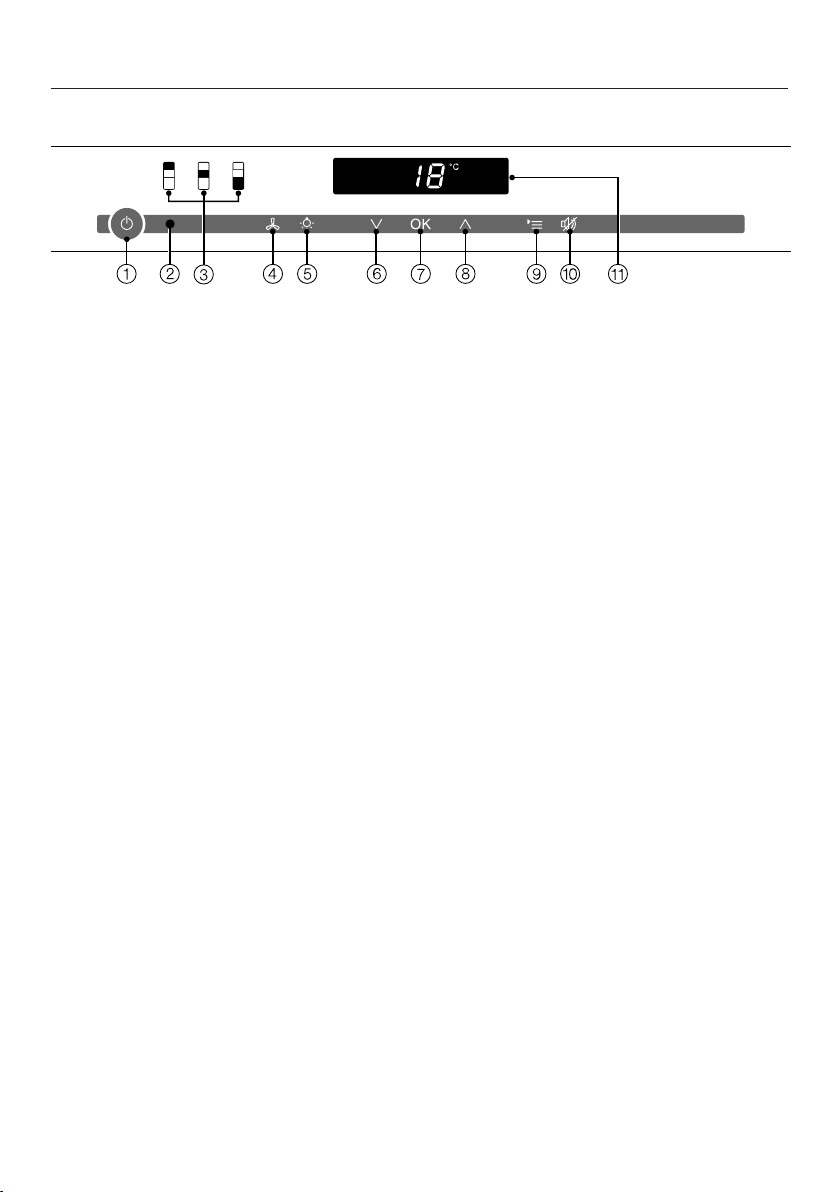
Guide to the appliance
15
Control panel
a
For switching the whole
wine conditioning unit on and off
b
Optical interface
(for Service technicians only)
c
For selecting the upper, middle or
lower wine conditioning zone
d
For switching the DynaCool function
(constant humidity) on and off
e
For switching the feature lighting on
and off
f
For setting the temperature
( for colder)
g
OK sensor for confirming a selection
h
For setting the temperature
( for warmer)
i
Sensor for accessing or leaving
settings mode
j
For switching off
the temperature or door alarm
k
Display with temperature and sym-
bols (symbols only visible in settings
mode; see chart for an explanation of
the symbols)
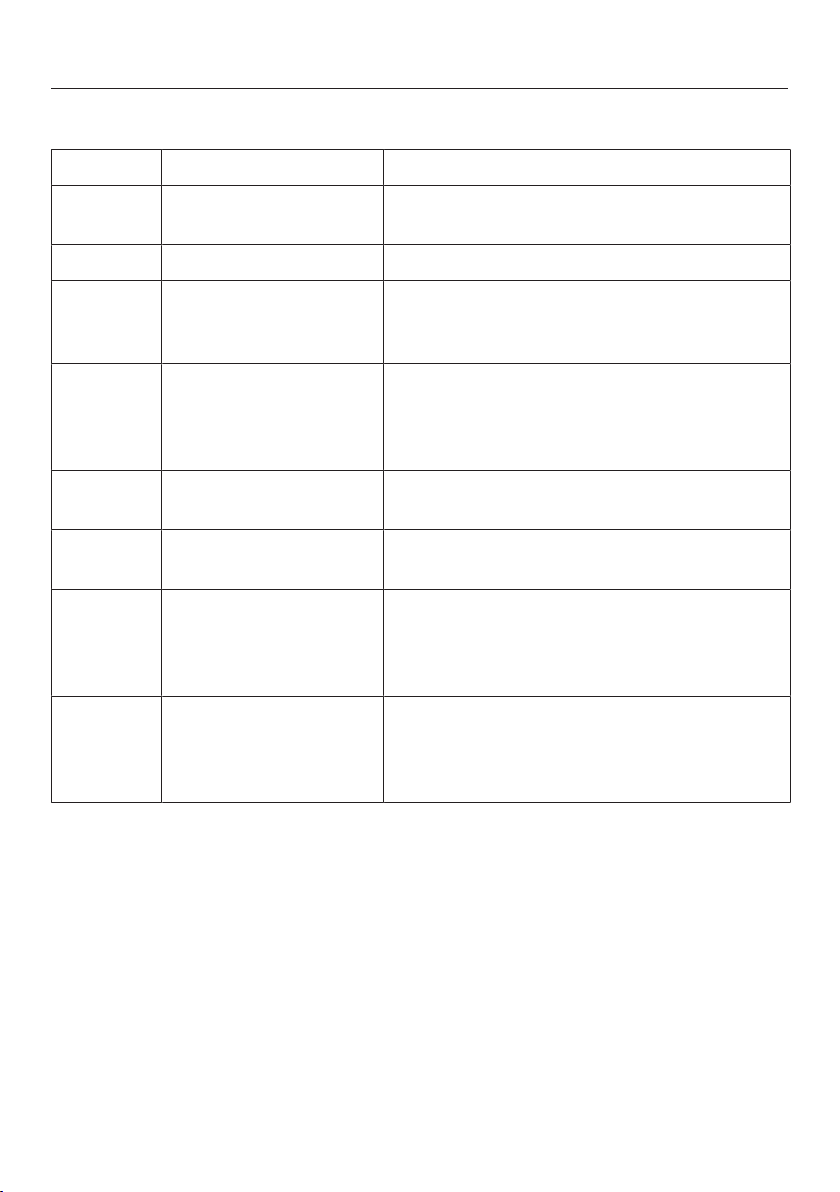
Guide to the appliance
16
Symbols
Symbol Meaning Function
Lock function To prevent inadvertent switching off and al-
tering of settings
Audible tones Choice of keypad tone and door alarm tone
Miele@home Only visible when a communication module
or communication stick is fitted and signed
on
Demo mode
(only visible when
Demo mode is
switched on)
For switching off Demo mode
Display brightness set-
tings
For adjusting the brightness of the display
Active AirClean filters Lights up when the active charcoal filter
needs changing
Mains connection
(only visible when the
wine conditioning unit
is switched off)
Confirms that the wine conditioning unit is
connected to the electricity supply; flashes
in the event of a power cut
Alarm
(only visible when the
door or temperature
alarm sounds)
Lights up when there is a door alarm;
flashes when there is a temperature alarm,
power cut or other fault
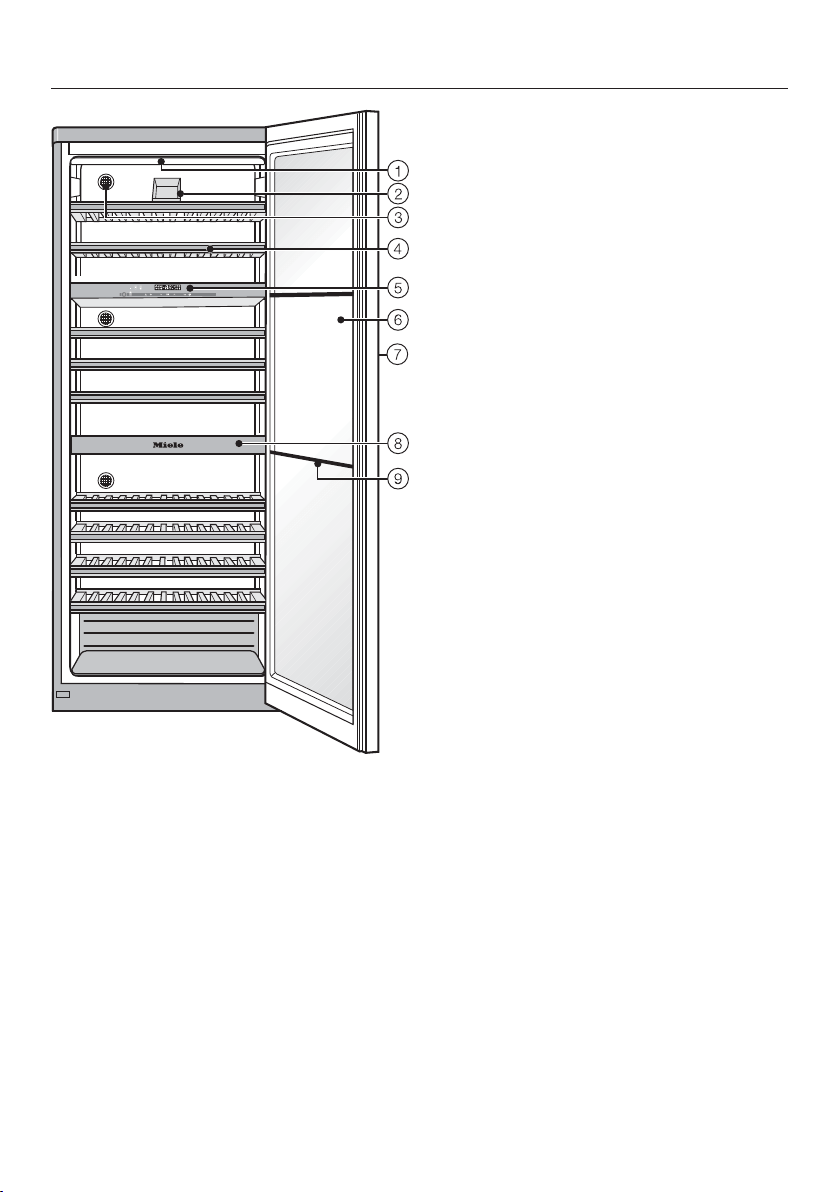
Guide to the appliance
17
a
Lighting strip
(in all three wine conditioning zones)
b
Bottle presenter (Selector)
c
Active AirClean filter
(in all three wine conditioning zones)
d
Wooden shelves with labels
(FlexiFrames with Noteboard)
e
Isolator plate for thermal separation
of the zones with controls for the up-
per, middle and lower wine condi-
tioning zones
f
Safety glass door with UV filter
g
Integrated door handle
h
Isolator plate for thermal separation
of the different conditioning zones
i
Isolator strips for thermal separation
of the different conditioning zones
Accessories
18
Accessories supplied
Active AirClean filter
The active charcoal filters in the back
wall achieve optimum air quality by fil-
tering the incoming air.
Chalk
Use the chalk to annotate the magnetic
strips on the wooden shelves to identify
your wines quickly and easily.
Optional accessories
A range of useful Miele accessories and
care products are available for your
wine conditioning unit.
Active AirClean filters
See “Accessories supplied”.
Multi-purpose microfibre cloth
The microfibre cloth is suitable for re-
moving fingerprints and light soiling
from surfaces such as stainless steel,
glass, plastic and chrome without the
use of chemicals.
Stainless steel care
Each application of the stainless steel
conditioner (supplied in a bottle) forms
a water and dirt repellent protective
coating. It gently removes water marks,
fingerprints and other dirt for a uni-
formly shiny surface.
Accessories are available to order via
the Miele Webshop, from Miele dir-
ectly (see back cover for contact de-
tails) or from your Miele dealer.
Switching on and off
19
Before using for the first time
Packaging material
Remove all packaging material from
the inside of the appliance.
Protective foil
Stainless steel surfaces have a layer of
protective foil to prevent scratching dur-
ing transportation.
Do not remove the foil until the wine
conditioning unit has been positioned
in its final location. Start at one of the
top corners.
Cleaning the appliance
Please refer to the relevant instruc-
tions in “Cleaning and care”.
Clean the inside of the appliance and
the accessories.
Operating the wine condition-
ing unit
A light touch of the finger on the
sensors is all that is required to operate
this wine conditioning unit.
Every touch of a sensor is confirmed
with an audible tone. This tone can be
switched off (see “Selecting further set-
tings” – “Audible tones ”).
Switching on
When the wine conditioning unit is con-
nected to the electrical supply, the
mains connection symbol will ap-
pear in the display after a short while.
Touch the On/Off sensor.
The mains connection symbol will
go out and the wine conditioning unit
will start to cool.
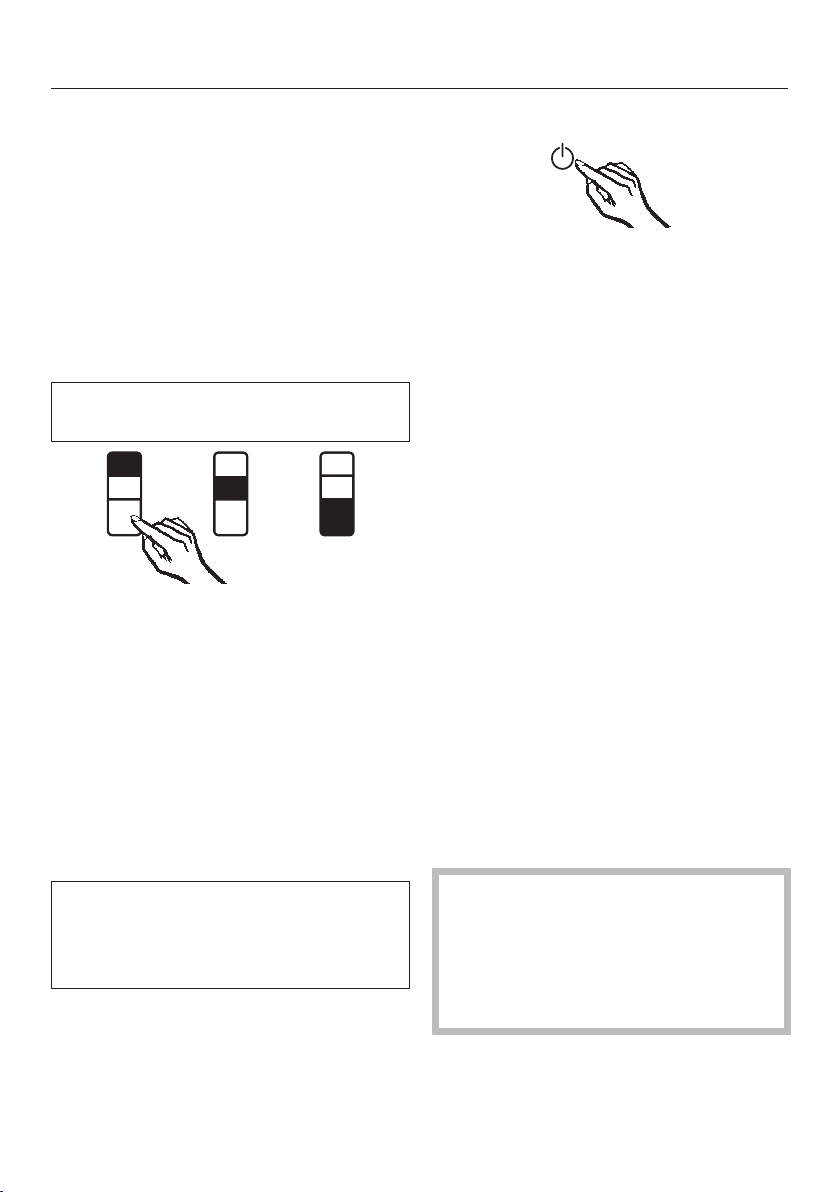
The sensors for the upper, middle and
the lower wine conditioning zones will
then appear in the control panel. The
selected zone will be highlighted yellow
and the temperature of the selected
zone will show in the display. The first
time the appliance is switched on the
sensors for the wine conditioning zones
and the Alarm symbol will flash until
the selected temperature has been
reached in the zones.
Switching on and off
20
As soon as the set temperature has
been reached, the sensor for the re-
spective wine conditioning zone will
light up constantly. The alarm symbol
will go out as soon as the set tem-
peratures have been reached in each
zone.
The interior lighting will come on when
the door is opened.
Settings
A different setting can be set for each
zone.
Touch the sensor for the wine condi-
tioning zone you want to adjust the
settings for.
The sensor that has been selected is
highlighted in yellow.
- You can now set the temperature,
and
- switch on the DynaCool function.
Tip: Please refer to the relevant section
for more information.
If you then select a different wine con-
ditioning zone, the settings for the pre-
viously selected zone will remain un-
changed.
Switching off
Touch the On/Off sensor.
If this does not work, the safety lock
is still activated.
The sensors for the two wine condition-
ing zones will then go out.
The temperature display will go out and
the mains connection symbol will
appear.
The interior lighting will go out and the
cooling process will be switched off.
Switching off for longer peri-
ods of time
If the wine unit is not going to be used
for a longer period of time:
Switch the wine unit off.
Switch off at the wall and withdraw
the plug from the socket, or discon-
nect the fuse.
Clean the wine unit.
Leave the door ajar to air the wine
unit and avoid odours building up in-
side it.
If the wine unit is switched off, but
not cleaned, during a long absence
and the door is left shut, there is a
risk of mould building up inside the
appliance.
The wine unit must be cleaned.
Selecting further settings
21
Certain settings on the wine condition-
ing unit can only be selected in settings
mode.
The door alarm is automatically dis-
abled when the appliance is in set-
tings mode.
Safety lock
The safety lock can be activated to pre-
vent:
- the appliance being switched off by
mistake,
- the temperature being changed by
mistake,
- DynaCool being switched on by mis-
take,
- the feature lighting being switched on
by mistake.
Activating or deactivating the safety
lock
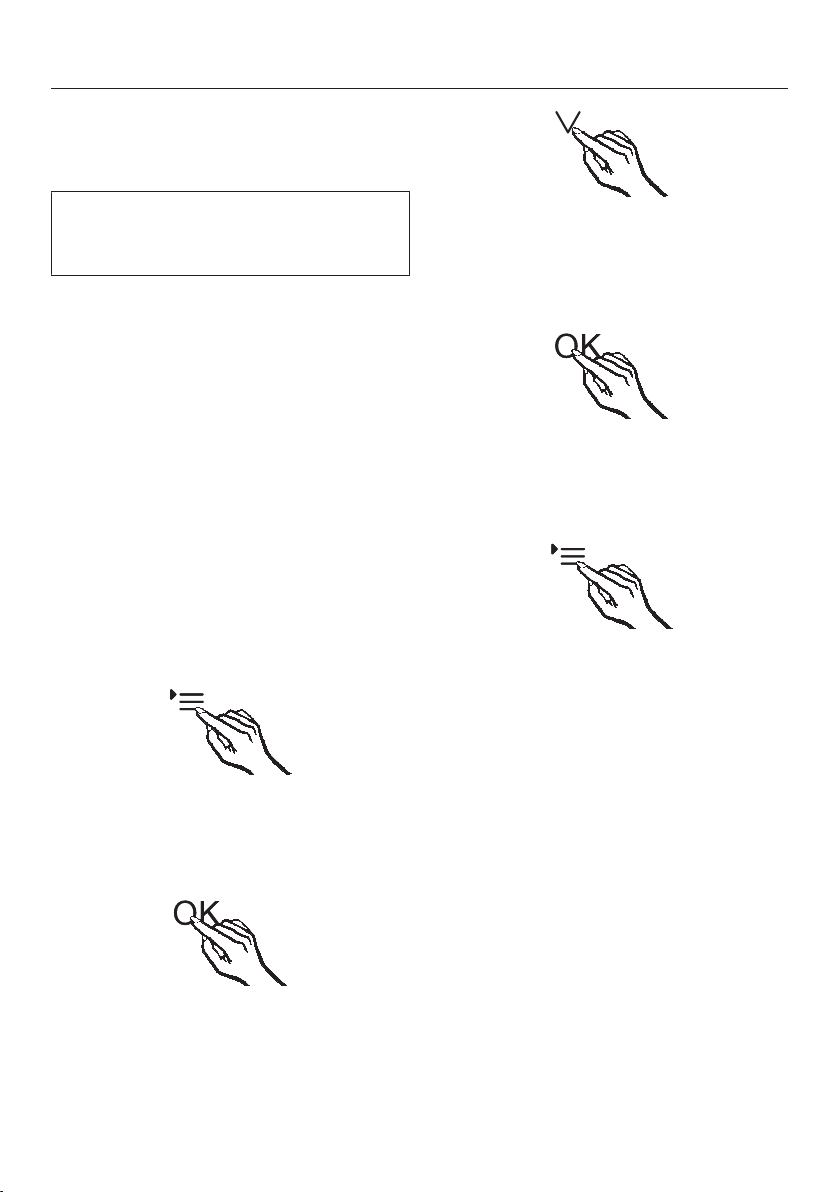
Touch the settings sensor.
All symbols available for selection will
appear in the display and the symbol
flashes.
Touch the OK sensor to confirm your
selection.
The last selected setting flashes and
the symbol lights up in the display.
By touching the or sensor, you
can now select whether the safety
lock is activated or deactivated:
0: the safety lock is deactivated
1: the safety lock is activated
Touch the OK sensor to confirm your
selection.
The selected setting is applied, the
symbol flashes.
Touch the settings sensor to leave
settings mode.
Otherwise the appliance exits set-
tings mode automatically after ap-
proximately one minute.
The symbol will appear in the display
when the lock is activated.
Selecting further settings
22
Audible tones
The wine conditioning unit has audible
tones such as the keypad tone and the
door and temperature alarms.
You can switch the keypad tone or the
door alarm tone on or off but you can-
not deactivate the temperature alarm.
There are four settings to choose from.
Option 3 is set the factory, i.e. the
keypad tone and the door alarm are
switched on.
Switching audible signals on/off
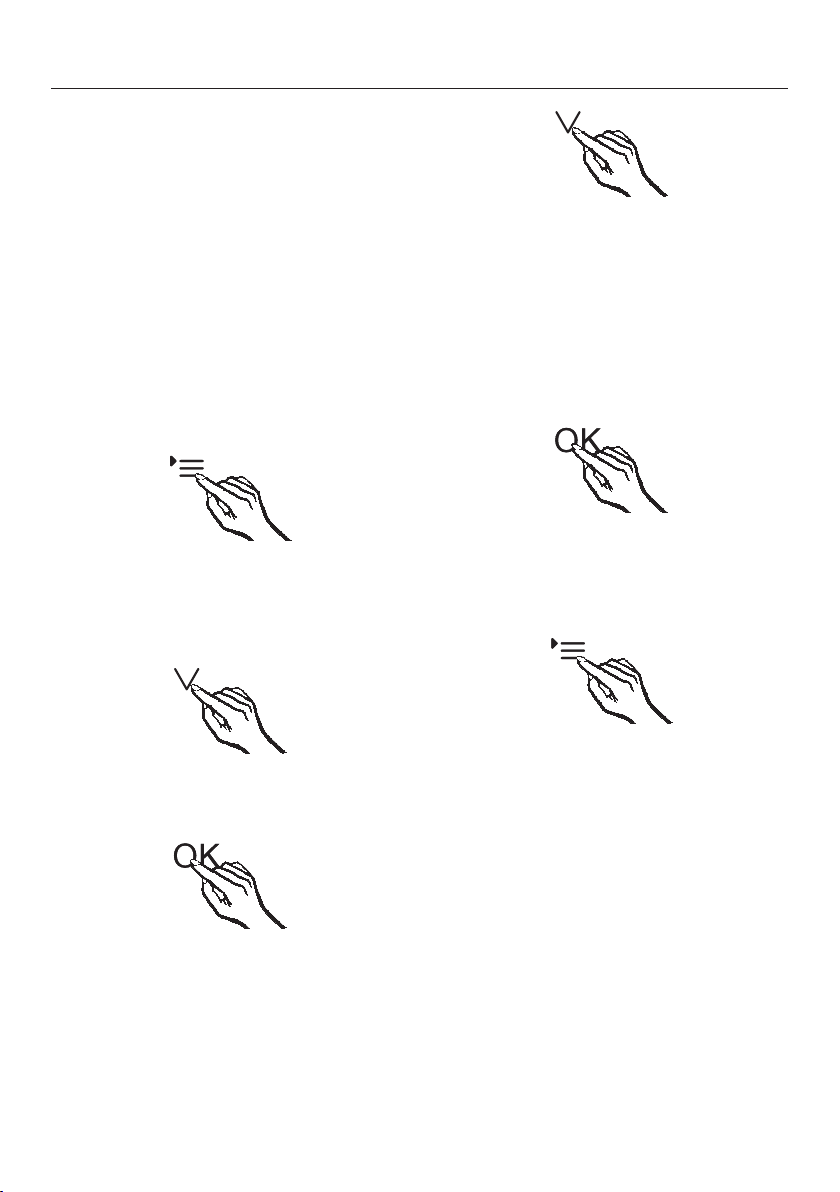
Touch the settings sensor.
All symbols available for selection ap-
pear in the display and the symbol
flashes.
Touch the sensors for setting the
temperature ( or ) repeatedly until
the symbol flashes.
Touch the OK sensor to confirm the
selection.
The most recently selected setting
flashes and the symbol lights up in
the display.
Touch the or sensor now to se-
lect:
0: keypad tone off; door alarm off
1: keypad tone off; door alarm on
(after 4minutes)
2: keypad tone off; door alarm on
(after 2minutes)
3: keypad tone on; door alarm on
(after 2minutes).
Touch the OK sensor to confirm the
selection.
The selected setting is applied, the
symbol flashes.
Touch the settings sensor to exit set-
tings mode.
Otherwise, the appliance electronics
will exit the settings mode automatic-
ally after approximately one minute.
Selecting further settings
23
Display brightness
The display brightness can be adjusted
to suit lighting conditions in the room.
The display brightness can be adjusted
in steps from 1to3. The factory default
setting is 3 (maximum brightness).
Altering the display brightness
Touch the settings sensor.
All symbols available for selection will
appear in the display and the sym-
bol flashes.
Touch the sensors for setting the
temperature ( or ) repeatedly until
the symbol flashes.
Touch the OK sensor to confirm your
selection.
The last selected setting flashes and
the symbol lights up in the display.
By touching the or sensor you
can now alter the brightness of the
display:
1: dimmest setting
2: medium setting
3: brightest setting.
Touch the OK sensor to confirm your
selection.
The selected setting is applied, the
symbol flashes.
Touch the settings sensor to leave
settings mode.
Otherwise the appliance exits set-
tings mode automatically after ap-
proximately one minute.
The optimum temperature and air quality
24
Wine keeps on maturing depending on
the surrounding conditions. The length
of time for which wine can be kept in
good condition will therefore depend
not only on the temperature but also on
the air quality.
The wine conditioning unit with its con-
stant ideal temperature, increased air
humidity and odour free atmosphere of-
fers the perfect conditions for storing
your wine.
It also guarantees a vibration-free envir-
onment (in contrast to a refrigerator) so
that the maturing process is not dis-
turbed.
The optimum temperature
Wine can be stored at a temperature
between 6 and 18°C. If you are storing
white and red wines together, select a
temperature between 12 and 14°C.
This is suitable for both white and red
wines. Red wine should be taken out of
the wine conditioning unit and opened
at least two hours before drinking to al-
low it to breathe and develop its aroma.
At too high a temperature (over 22°C)
wine matures too quickly, which pre-
vents the aromas from developing fur-
ther. Wine cannot mature fully at too
low a temperature (below 5°C).
Fluctuations in temperature put wine
under stress and interrupt the maturing
process. It is therefore very important to
maintain a constant temperature.
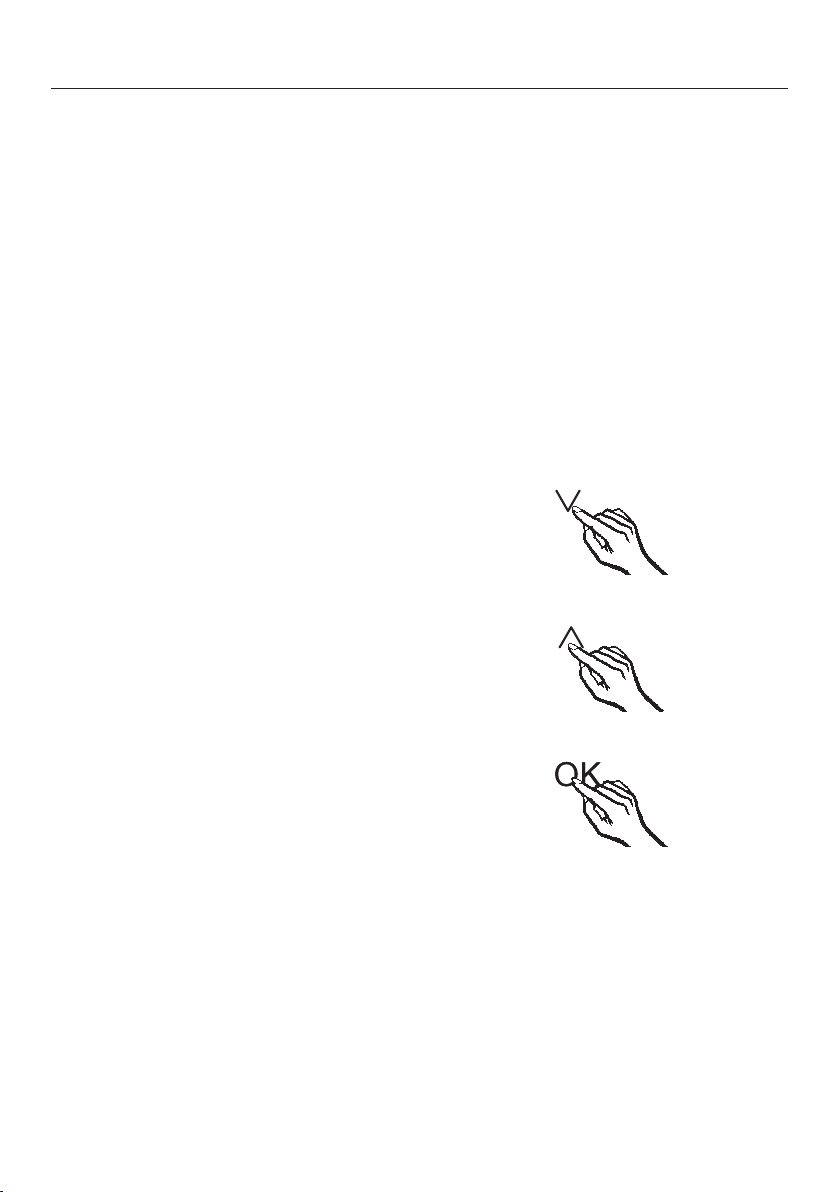
Type of wine Recommended
drinking
temperature*
Light, fruity reds: +14°C to +16°C
Full-bodied reds: +18°C
Rosé wines: +8°C to +10°C
Delicate, aromatic
whites:
+8°C to +12°C
Full-bodied or
sweet whites:
+12°C to +14°C
Champagne,
sparkling white
wines, Prosecco:
+6°C to +10°C
* Store the wine 1 or 2°C cooler than
the recommended drinking temperature
as it warms up a little when poured into
the glass.
Tip: Full-bodied reds should be opened
for 2-3 hours before drinking to allow
the wine to breathe and develop its
aroma.
The optimum temperature and air quality
25
Safety device in case of low ambient
temperatures
The appliance is equipped with a safety
thermostat to protect your wine against
a sharp drop in temperature. If the ex-
ternal temperature should fall, a heater
element switches on automatically to
keep the temperature inside as constant
as possible. If the ambient temperature
continues to fall, the appliance switches
itself off automatically.
Isolator plates for thermal separation
The appliance has two fixed isolator
plates which divide the cabinet into
three different zones. This enables you
to store up to three different types of
wine at the same time, e.g. red wine,
white wine and Champagne.
The isolator strips on the inside of the
glass door prevent an exchange of heat
between the individual zones.
Setting the temperature
The temperatures in the wine condition-
ing zones can be set independently of
one another.
Touch the sensor for the zone for
which you wish to change the tem-
perature, so that it is highlighted in
yellow.
The current temperature for the selec-
ted zone appears in the display.
Use the two sensors underneath the
display to set the temperature.
By touching the sensor
- The temperature decreases
- The temperature increases
Touch the OK sensor to confirm your
selection
or
Wait approximately 5 seconds after
the last touch of a sensor
The temperature being set will flash in
the display.
The following information shows in the
display while the sensors are being
touched:
The optimum temperature and air quality
26
- Touching a sensor once:
The last temperature selected
flashes.
- Each subsequent touch of the
sensor:
Adjusts the temperature shown in
1°C increments.
- Leaving a finger on the sensor:
Changes the temperature continu-
ously.
A negative tone will sound (if the
keypad tone is switched on) when
the lowest or highest possible tem-
perature is reached.
Approximately 5seconds after the last
time a sensor has been touched, the
actual temperature inside the wine con-
ditioning zone is automatically shown.
When the temperature is altered, there
is a short delay until the temperature
selected is set.
The temperature display on the control
panel always shows the actual tem-
perature.
Temperature range
In all three zones it is possible to set
temperatures between 5 and 20°C.
Temperature display
In normal operation the temperature
display shows the actual temperature in
the zone.
If the temperature in one of the zones is
not within the range that the appliance
is able to display, dashes will light up in
the temperature display.
Depending on the ambient temperature
and the temperature setting, it can take
the appliance a few hours to reach the
temperature required and for this tem-
perature to then be shown as a con-
stant temperature in the display.
The optimum temperature and air quality
27
Air quality and humidity
In most refrigerators the humidity is too
low for wine and therefore a refrigerator
is not suitable for wine storage. High
humidity levels are necessary when
storing wine to moisten corks from the
outside. When the humidity is too low
the corks dry out and the bottle is no
longer tightly sealed. For this reason
wine bottles should always be stored
horizontally to ensure that corks are
also kept moist from the inside. If air
gets into the bottle, this will have a neg-
ative impact on the wine!
Danger of damage from excess
amounts of moisture
An increase in humidity will lead to
condensation on the interior walls.
Condensate can cause damage such
as corrosion to the wine unit.
Do not introduce additional moisture
to air in the cabinet, e.g. by placing a
dish of water in the wine unit.
Using
DynaCool (constant humid-
ity)
DynaCool raises the relative humidity
inside the whole of the wine condition-
ing unit. It also distributes the humidity
and the temperature evenly around the
interior so that you can store all your
wine under the same excellent condi-
tions.
This will create a stable climate in the
unit which imitates that of a wine cel-
lar.
Switching on DynaCool
If you would like to use the wine condi-
tioning unit to store wine over the long
term, we recommend that you keep the
DynaCool function switched on.
Touch the sensor to switch the
DynaCool function on/off. The sensor
will be highlighted in yellow.
Even if DynaCool has not been
switched on, the fans in the wine con-
ditioning unit will come on automatic-
ally as soon as the cooling system
switches on. This ensures the op-
timum climate for your wine is main-
tained.
The fans automatically switch off
when the door is open.
The optimum temperature and air quality
28
Switching off DynaCool
The wine conditioning unit uses
slightly more energy and is a little
noisier when the DynaCool function is
switched on. You can switch it off now
and then if you wish.
Touch the sensor for switching the
DynaCool function on and off so that
it is no longer highlighted in yellow.
Air filtering with the Active
AirClean filters
The Active AirClean filters achieve op-
timum air quality by filtering the incom-
ing air.
Fresh air from the room enters the ap-
pliance via the Active AirClean filters.
The fans (DynaCool function) then dis-
tribute the air evenly throughout the
cabinet.
Filtering the incoming air through the
Active AirClean filters ensures that all
the air entering the appliance is fresh
and free from dust and odours.
This also ensures your wine does not
absorb any unwanted odours through
the corks.
Replace the Active AirClean filters regu-
larly. The symbol will appear in the
display to remind you (see “Active
AirClean filters”).

Temperature and door alarm
29
This wine conditioning unit is equipped
with an alarm system so that the tem-
perature cannot rise or fall unnoticed,
thus possibly damaging the wine.
Temperature alarm
If the temperature in one of the wine
conditioning zones rises or falls by a
certain amount, the sensor for that zone
will flash in the control panel and at the
same time the alarm symbol will
flash in the display. An audible alarm
will also sound.
Audible and visual signals will be activ-
ated, for example,
- when the wine unit is switched on
and the temperature in one of the
temperature zones differs greatly
from the set temperature,
- when too much warm ambient air
enters the cabinet when bottles are
being rearranged or taken out,
- when a large number of bottles are
stored for the first time,
- in the event of a power cut,
- if there is a fault with the wine unit.
The alarm will stop and the alarm sym-
bolgoes out as soon as the reason
for the alarm has been resolved. The
sensor for the relevant zone will light up
constantly again.
Switching the temperature alarm off
early
If the noise disturbs you, you can
switch the alarm off if you wish.
Touch the sensor for switching off the
temperature alarm.
The alarm will stop.
The relevant wine conditioning zone will
continue to flash in the control panel
and the alarm symbol will continue
to flash in the display until the cause of
the alarm has been rectified.
Temperature and door alarm
30
Door alarm
An alarm will sound if the appliance
door has been left open for longer than
approx. 2minutes. The sensors for the
wine conditioning zones will flash in the
control panel. The alarm symbol
lights up in the display.
As soon as the door is closed, the
alarm will stop. The sensors for the
wine conditioning zones and the alarm
symbol will go out in the control
panel.
If the audible signal does not sound in
the event of a door alarm, then the
audible signal has been switched off
in settings mode (see “Selecting fur-
ther settings – Audible signals”).
Switching the door alarm off early
If the noise disturbs you, you can
switch the alarm off if you wish.
Touch the sensor for switching off the
door alarm.
The alarm will stop.
The sensors for the wine conditioning
zones will continue to flash and the
alarm symbol will remain lit up until
you close the door.
Feature lighting
31
The interior lighting can be set to re-
main on when the door is closed so
your wines can be on display at all
times.
Each wine conditioning zone has its
own lighting strip so that all zones are
illuminated.
Thanks to the use of LED lighting, the
wine will not be adversely affected by
heat or UV light.
Switching the feature lighting
on and off
Touch the On/Off sensor for the fea-
ture lighting so that it is highlighted in
yellow.
The interior lighting is now switched on,
even when the appliance door is
closed.
To switch the feature lighting off
again:
Touch the On/Off sensor for the fea-
ture lighting so that it is no longer
highlighted in yellow.
The interior lighting is now switched off
when the appliance door is closed.
Setting the brightness of the feature
lighting
The brightness of the feature lighting
can be adjusted.
Touch the On/Off sensor for the fea-
ture lighting so that it is highlighted in
yellow.
Touch the sensor for the feature light-
ing again for approximately four
seconds until flashes in the display
(after two seconds will flash).
Use the sensors for altering the tem-
perature to set the feature lighting
brightness(and). To do this,
touch and hold the sensors. The
brightness is adjusted directly and is
infinitely variable. The results are not
visible in the display.
By touching the sensor
- the lighting becomes dimmer
- the lighting becomes brighter.
Feature lighting
32
Touch the OK sensor to confirm your
choice.
The set brightness is saved to memory.
The temperature display then appears
again.
As soon as the appliance door is
closed, the set brightness for the fea-
ture lighting takes effect. When the ap-
pliance door is opened, the interior
lighting returns to its normal level.
Lighting duration of the feature light-
ing
The lighting duration for the feature
lighting is set to 30minutes as stand-
ard.
The lighting duration can be set to 30,
60, 90minutes up to 00 (unlimited). The
feature lighting will have the brightness
setting you have selected previously.
Open the appliance door.
Touch the On/Off sensor for the fea-
ture lighting so that it is highlighted in
yellow.
Touch the sensor for the feature light-
ing again for approx. two seconds
until flashes in the display.
Use the and sensors for altering
the temperature to set the feature
lighting duration.
The duration (in minutes) will flash in
the display.
By touching the sensor
- lighting duration is reduced by
30minutes
- lighting duration is increased by
30minutes.
Touch the OK sensor to confirm your
choice.
The selected lighting duration is saved
and the temperature reappears in the
display.
The lighting duration set starts anew
whenever the appliance door is opened
and closed.
Danger of injury from LED light-
ing.
This lighting corresponds to risk
group RG2. If the cover is defective,
there is a danger of eye injury.
If the lighting cover is defective, do
not look from a close range directly
into the lighting with optical instru-
ments (e.g. magnifying glass or sim-
ilar).
Storing wine bottles
33
Vibration and movement have a negat-
ive effect on the maturing process,
which can in turn affect the taste of the
wine.
To avoid disturbing other bottles when
removing a bottle of wine, store bottles
of the same type beside each other on
the same shelf. Avoid stacking bottles
on top of one another on the wooden
shelves.
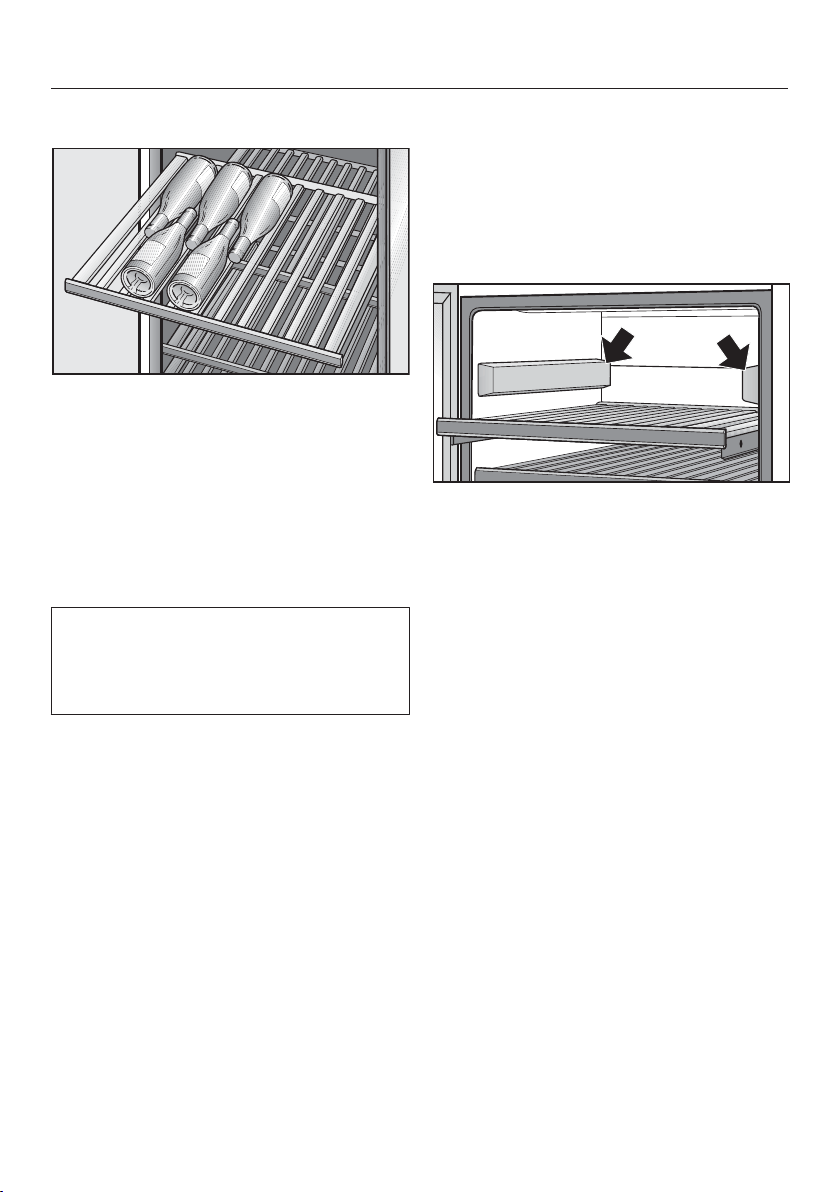
Always place the bottles in a horizontal
position so that the natural corks can
be kept moist on the inside and air is
prevented from getting into the bottles.
Risk of injury from falling wine
bottles.
Wine bottles may become wedged in
the wooden shelves above and fall
out of the wine conditioning unit
when the shelves are pulled out.
Always pull out the wooden shelves
slowly and carefully.
Risk of damage and injury from
broken glass.
If wooden shelves and bottles pro-
trude too far forwards, they may
damage the glass door when it is
closed.
Please ensure that the wooden
shelves and wine bottles do not pro-
trude.
Do not cover the vents in the rear
wall, as they are essential for keeping
the appliance cool.
Storing wine bottles
34
Wooden shelves
The wooden shelves are on telescopic
runners which can be pulled out to
make it easier to store and remove
bottles. There are two wooden shelves
on runners in the middle and lower
zones (the second and third shelf from
the top in each zone) which can be
pulled right out. The remaining wooden
shelves can be partially pulled out.
Please note that the uppermost run-
ners in each of the three zones are
only suitable for shallow wooden
shelves.
Moving the wooden shelves
The wooden shelves can be removed
and replaced again if required.
Pull the wooden shelf out until it
stops, then lift it up and off the run-
ners. Hold onto the frame to do this.
If you require more room (e.g. to set
up the bottle presenter), cover the top
runners which are not now needed on
both sides with the covers supplied.
The thicker side of the cover should
point forwards. The covers are held in
position with magnets.
To replace the shelf, click it into place
on the extended runners. The mag-
netic strip should be pointing for-
wards.
Storing wine bottles
35
Adjusting the wooden shelves
The slats in the wooden shelves can be
individually adjusted to suit, so that
every bottle is stored in perfect safety
regardless of shape or size.
Simply lift individual slats to move or
remove them from the wooden
shelves.
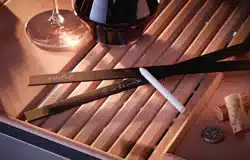
Annotating wooden shelves
For quick and easy identification of the
wines stored, you can write on the
blackboard-painted surface on the
magnetic strips on the wooden shelves.
Use the chalk supplied. You can write
directly on the magnetic strip or remove
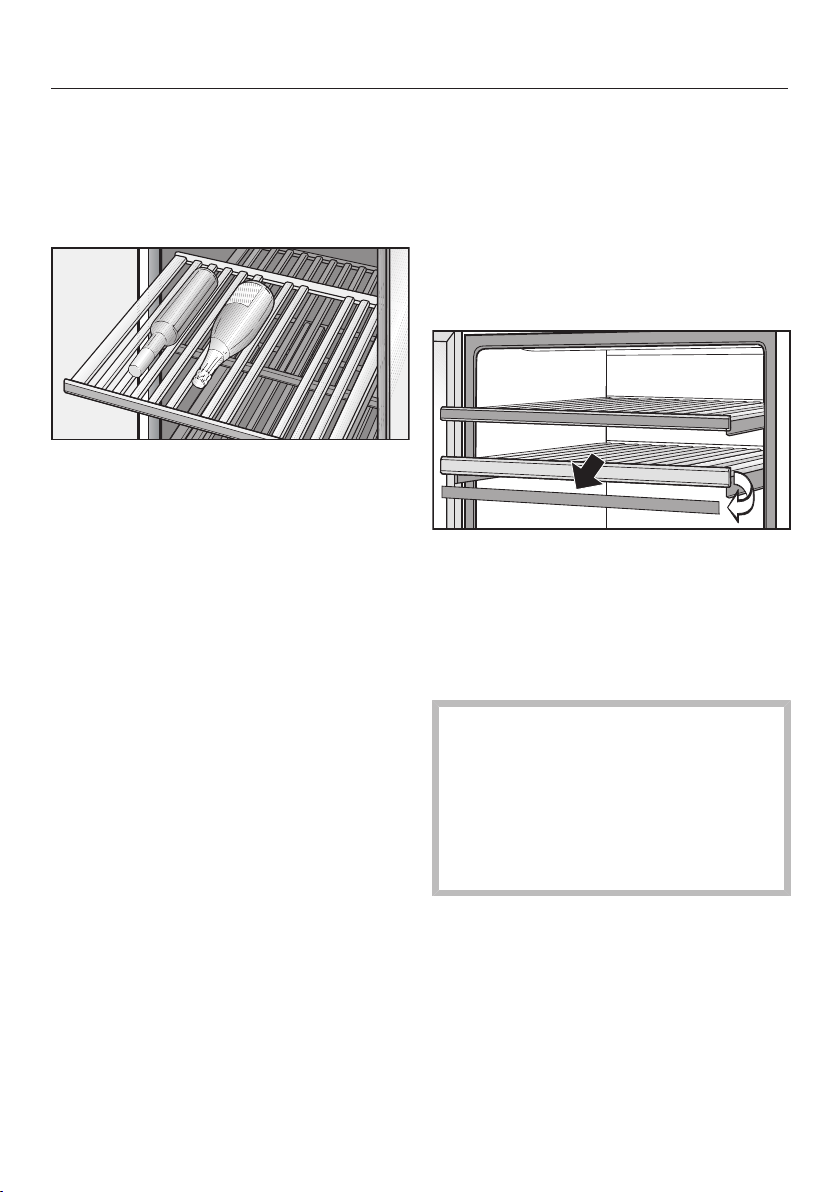
it from the wooden shelf. To do so:
Hold the magnetic strip by the sides
and pull it forwards. The magnetic
strip is held on the wooden shelf by
magnets.
The magnetic strip can be wiped
clean with a damp cloth.
Risk of damage from unsuitable
cleaning methods.
Cleaning the magnetic strips with a
cleaning agent may damage the
blackboard surface on them.
Use clean water only to wipe the
magnetic strips.
Annotate the magnetic strip with the
chalk supplied and replace it on the
front of the wooden shelf.
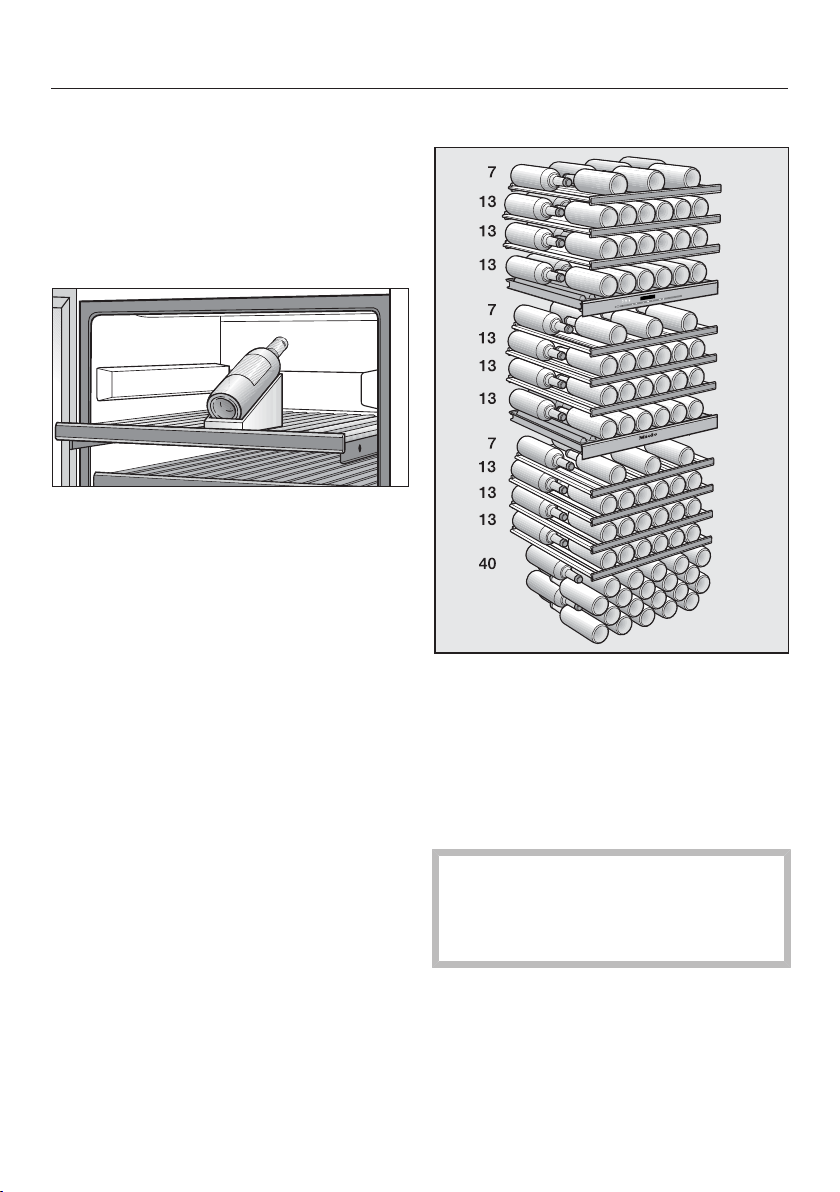
Storing wine bottles
36
Bottle presenter
The bottle presenter can be used to
raise particular bottles so that they can
be viewed when the door is shut.
To set up the bottle presenter, the
wooden shelf above must be removed:
Remove the wooden shelf and fit the
side covers over the runners.
Position the bottle presenter at the
very front of the wooden shelf re-
quired and place the wine bottle on
the bottle presenter.
If desired, switch on the feature light-
ing (see “Feature lighting”) to illumin-
ate the selected bottle.
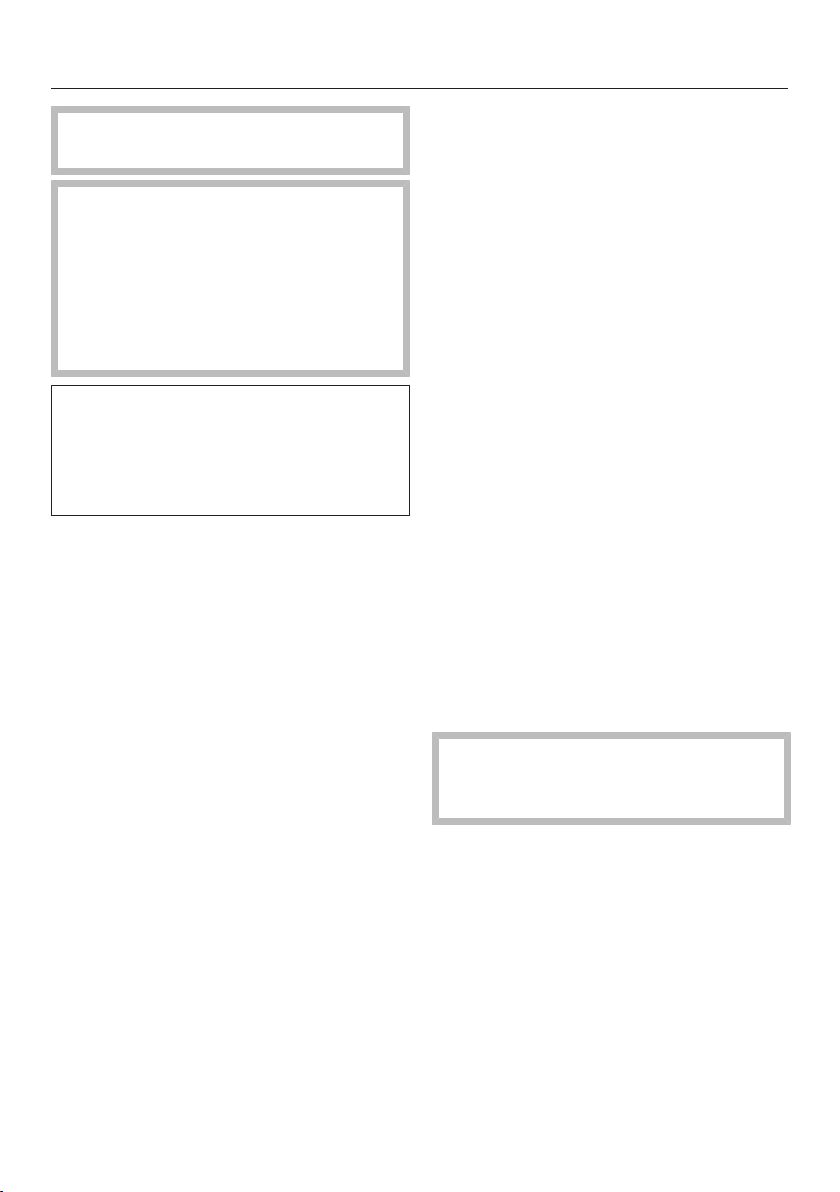
Maximum capacity
Up to 178 Bordeaux bottles (0.75l ) can
be stored in the appliance, 46 in the up-
per zone, 46 the middle zone and 86 in
the lower zone.
The total of 178 bottles can only be
achieved by using all the wooden
shelves.
The load-bearing capacity of each of
the wooden shelves is only 35kg.
Do not stack bottles on the wooden
shelves.

Automatic defrosting
37
The wine conditioning unit defrosts
automatically.
Cleaning and care
38
Do not let water get into the elec-
tronic unit or the lighting.
Risk of damage due to moisture
ingress.
The steam from a steam cleaner can
damage plastic and and electrical
components.
Do not use a steam cleaner to clean
the wine conditioning unit.
The data plate located inside the wine
conditioning unit must not be re-
moved. It contains information which
is required in the event of a service
call.
Cleaning agents
To avoid damaging the surfaces of your
appliance, do not use
- Cleaning agents containing soda,
ammonia, acids or chlorides
- Cleaning agents containing descaling
agents
- Abrasive cleaning agents (e.g. scour-
ing powder, scouring liquid or pumice
stones)
- Cleaning agents containing solvents
- Stainless steel cleaning agents
- Dishwasher cleaner
- Oven sprays
- Glass cleaner (except on the glass in
the appliance door)
- Hard, abrasive sponges and brushes
(e.g. pot scourers)
- Eraser stain remover blocks
- Sharp metal scrapers
Cleaning and conditioning agents
used inside the wine conditioning
unit must be food safe.
We recommend using lukewarm water
with a little washing-up liquid for clean-
ing.
Cleaning and care
39
Before cleaning the wine unit
Switch the wine unit off.
Take any wine bottles out of the wine
unit and store them in a cool place.
Take out all other removable parts for
cleaning.
Remove the magnetic strips from the
wooden shelves before cleaning
them.
Cleaning the outer casing, the
door, the interior and ac-
cessories
Clean the wine conditioning unit at
least once a month.
Remove soiling immediately to pre-
vent it from drying on.
Clean the interior with a solution of
lukewarm water and a little washing-
up liquid.
The wooden shelves should only be
wiped with a well wrung-out damp
cloth. They must not be allowed to
get wet.
Use clean water only to wipe the
magnetic strips at the front of the
wooden shelves. Do not use a
cleaning agent as this would dam-
age the blackboard surface on the
magnetic strips.
After cleaning, wipe the interior and
accessories with a damp cloth, and
dry with a soft cloth. Leave the door
open to air the appliance for a short
while.
Use Miele stainless steel conditioning
agent (available from Miele) to clean
and care for the stainless steel sur-
faces on the inside and outside of the
appliance. Unlike stainless steel
cleaning agents, the conditioning
agent does not contain any abrasive
substances and will gently remove
soiling. Each time it is used, it forms a
water and dirt repellent protective
coating.
Make sure you treat the stainless
steel surfaces with Miele stainless
steel conditioning agent each time
you clean them. This will give them a
water and dirt repellent protective
coating and help prevent re-soiling.
Clean the appliance door with a pro-
prietary glass cleaner.
Cleaning and care
40
Cleaning the ventilation gaps
A build-up of dust will increase the en-
ergy consumption of the appliance.
The ventilation gaps should be
cleaned on a regular basis with a
brush or vacuum cleaner (you could
use a Miele vacuum cleaner dusting
brush, for example).
Cleaning the door seal
Risk of damage as a result of in-
correct cleaning.
If you treat the door seal with oils or
grease, it can become porous.
Do not use any oils or grease on the
door seal.
The door seal should be cleaned reg-
ularly with clean water, and then
wiped dry with a soft cloth.
Cleaning the compressor and
metal grille at the back of the
wine appliance
A build-up of dust will increase the en-
ergy consumption of the appliance.
Risk of damage as a result of in-
correct cleaning.
Cables and other components can
get broken off, bent or damaged.
Carefully clean the compressor and
metal grille.
The compressor and metal grille at the
back of the wine appliance (heat ex-
changer) should be dusted at least
once a year.
After cleaning
Replace all shelves and accessories
in the wine conditioning unit.
Reconnect to the mains and switch
the wine conditioning unit back on.
Place the wine bottles back in the
wine conditioning unit and close the
appliance door.
Active AirClean filters
41
Fresh air from the room enters the wine
conditioning unit through the Active
AirClean filters. Filtering the incoming
air through the Active AirClean filters
ensures that all the air entering the ap-
pliance is fresh and free from dust and
odours.
The reminder to change the Active
AirClean filters will appear every 12
months at the latest.
When the Change Active AirClean filter
symbol lights up in the display, the
Active AirClean filters in all three wine
conditioning zones need to be
changed.
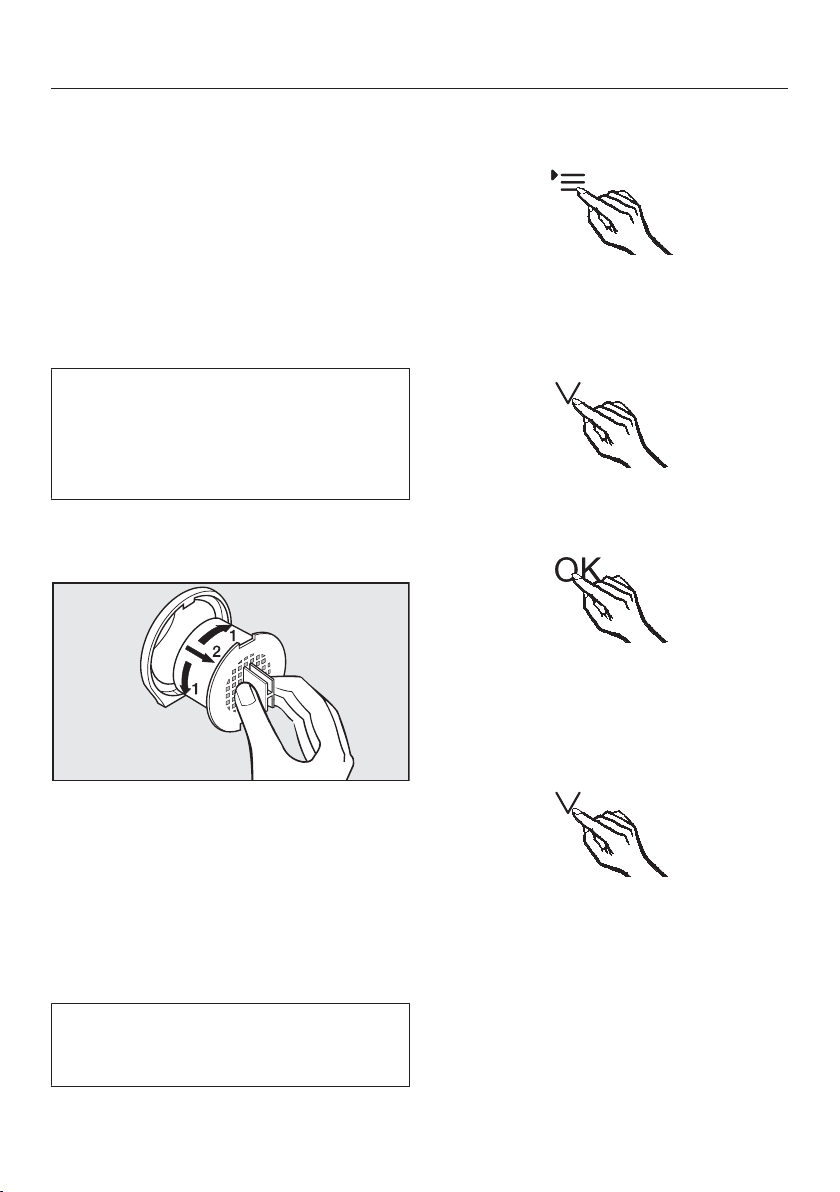
Replacing the Active AirClean
filters
Turn the filter 90° clockwise or anti-
clockwise.
Pull the filter out.
Insert a new filter with the handle in
the vertical position.
Turn the filter 90 °C clockwise or anti-
clockwise until it clicks into place.
Active AirClean filters can be obtained
from your Miele dealer, Miele or via the
internet.
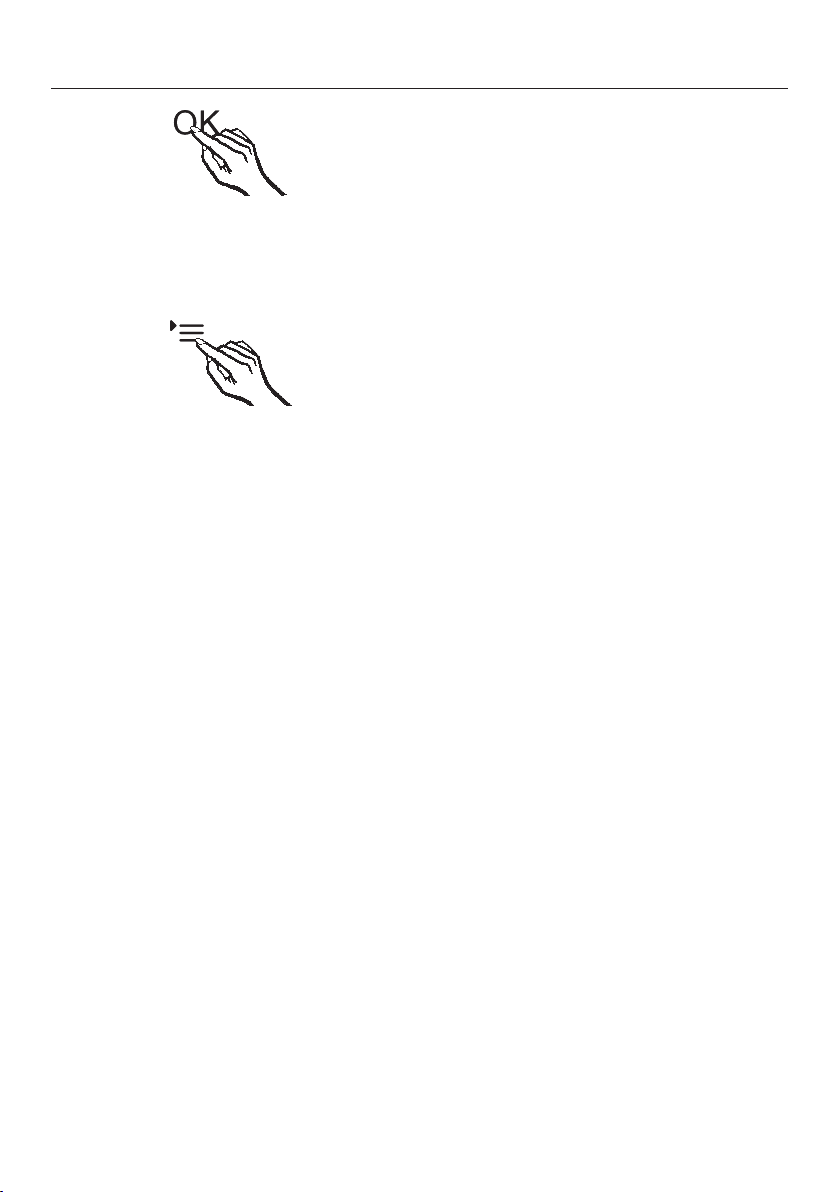
To confirm the filters have been
changed
Touch the settings sensor.
All symbols available for selection will
appear in the display and the symbol
flashes.
Touch the sensors for setting the
temperature ( or ) repeatedly until
the symbol flashes.
Touch the OK sensor to confirm your
selection.
The will flash in the display (means:
Active AirClean filter is fitted in the ap-
pliance), the symbol lights up.
Touch the symbols for setting the
temperature ( or ) repeatedly, until
the symbol is displayed (means: the
counter has been reset).
Active AirClean filters
42
Touch the OK sensor to confirm your
selection.
The selected setting is applied, the
symbol flashes.
Touch the settings sensor to leave
settings mode.
Otherwise the appliance exits set-
tings mode automatically after ap-
proximately one minute.
The in the display goes out.
Problem solving guide
43
Some minor problems can be corrected without contacting Miele.
If, having followed the suggestions below, you still cannot resolve the problem,
please contact Miele.
To prevent unnecessary loss of temperature it is advisable not to open the door
while waiting for the wine conditioning unit to be serviced.
Unauthorised installation, maintenance and repairs can cause considerable
danger for the user.
Installation, maintenance and repairs must only be carried out by a Miele au-
thorised technician.
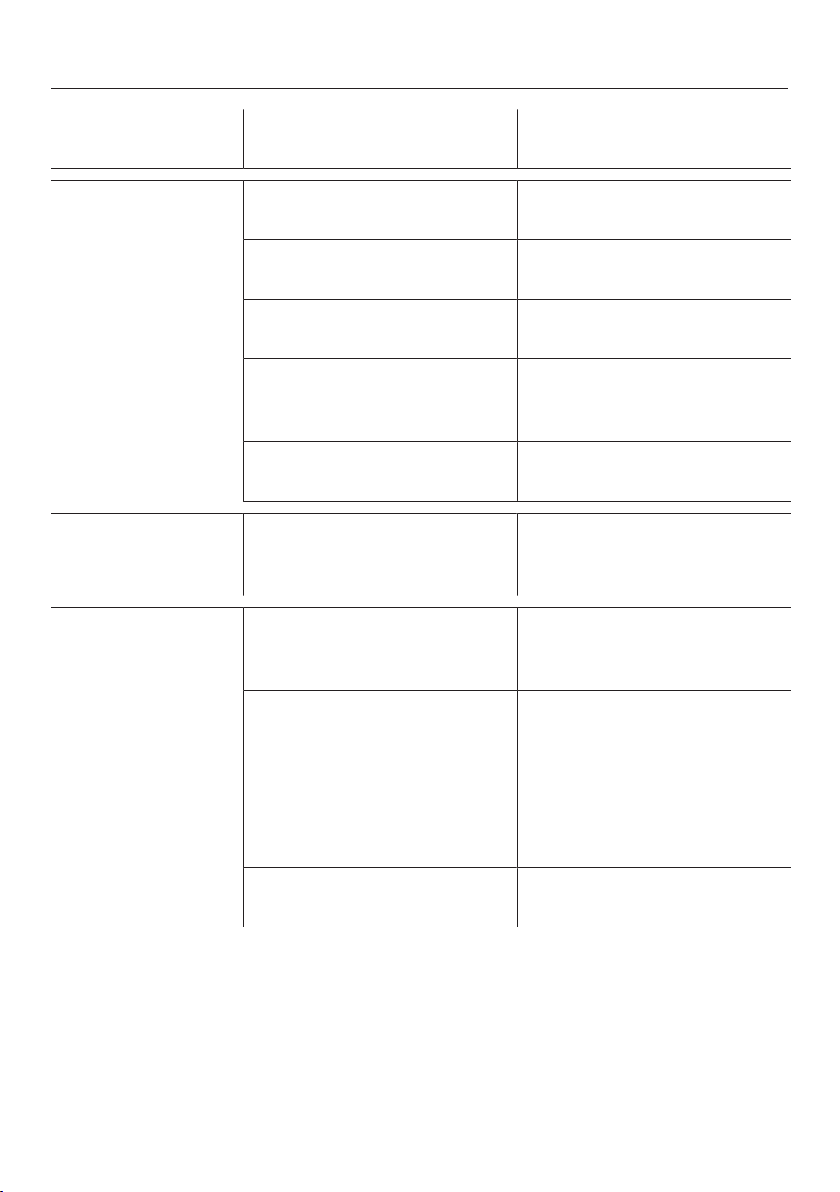
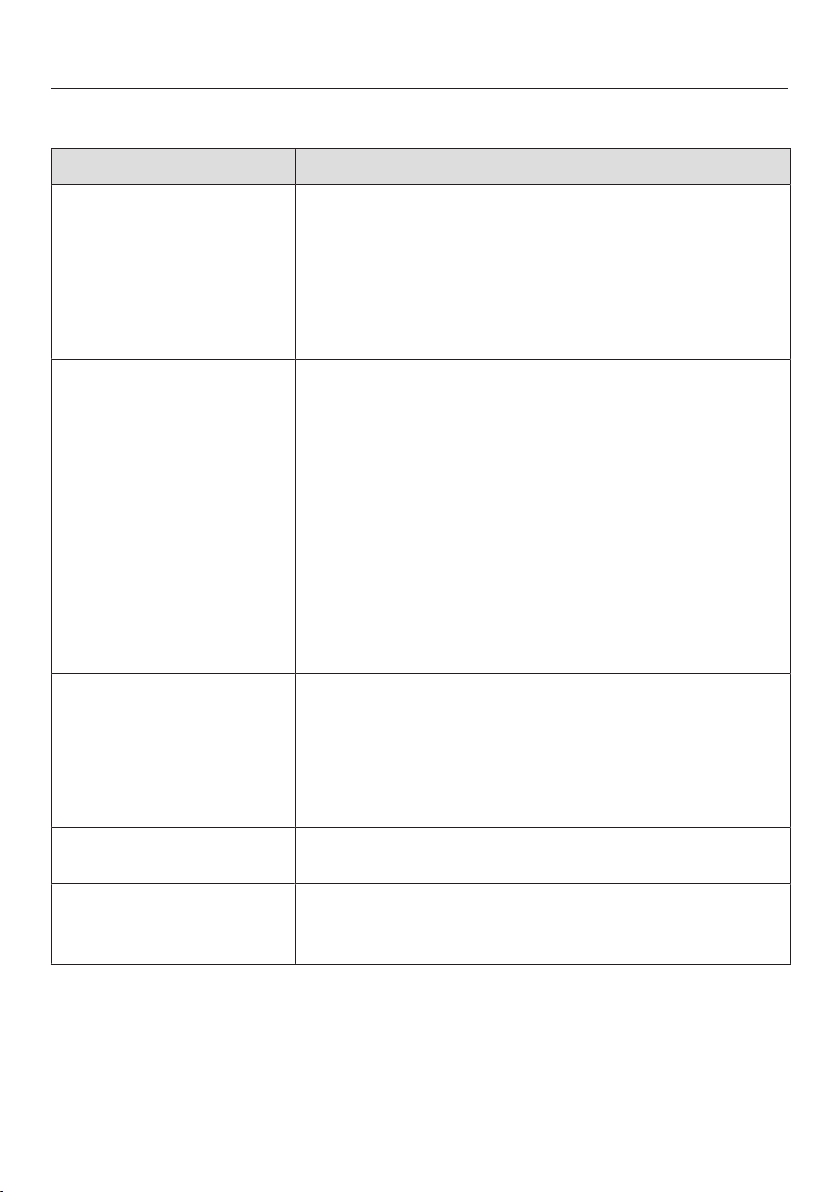
Problem Cause and remedy
The wine conditioning
unit is not getting cold,
the interior lighting
does not come on when
the door is opened, and
the display is not lit up.
The wine conditioning unit is not switched on and the
mains connection symbol is lit up in the display.
Switch on the wine conditioning unit.
The plug is not inserted in the socket correctly.
Insert the plug correctly into the socket. The mains
connection symbol appears in the display
when the wine conditioning unit is switched off.
Check whether the mains fuse has tripped. If it has
there could be a fault with the appliance, the house-
hold electrical wiring or another electrical appliance.
Contact a qualified electrician or Miele.
The symbol is dis-
played, the wine condi-
tioning unit is not get-
ting cold. However, the
appliance and the in-
terior lighting are work-
ing fine.
Demo mode is turned on and the symbol is illumin-
ated in the display.
Switch off Demo mode (see “Information for deal-
ers - Demo mode”).
Problem solving guide
44
Problem Cause and remedy
The compressor is
switching on more fre-
quently and for longer
periods of time, the
temperature in the wine
conditioning unit is fall-
ing.
The temperature in the wine conditioning unit is set
too low.
Adjust the temperature.
The door is not properly closed.
Check that the appliance door closes properly.
The door is being opened frequently.
Only open the door when necessary and for as
short a time as possible.
The ventilation gaps have been covered over or be-
come dusty.
Do not cover the ventilation gaps and dust them
regularly.
The metal grille (heat exchanger) at the back of the
appliance has become dusty.
Dust the metal grille.
The ambient temperature is too warm.
Decrease the ambient temperature.
Problem solving guide
45
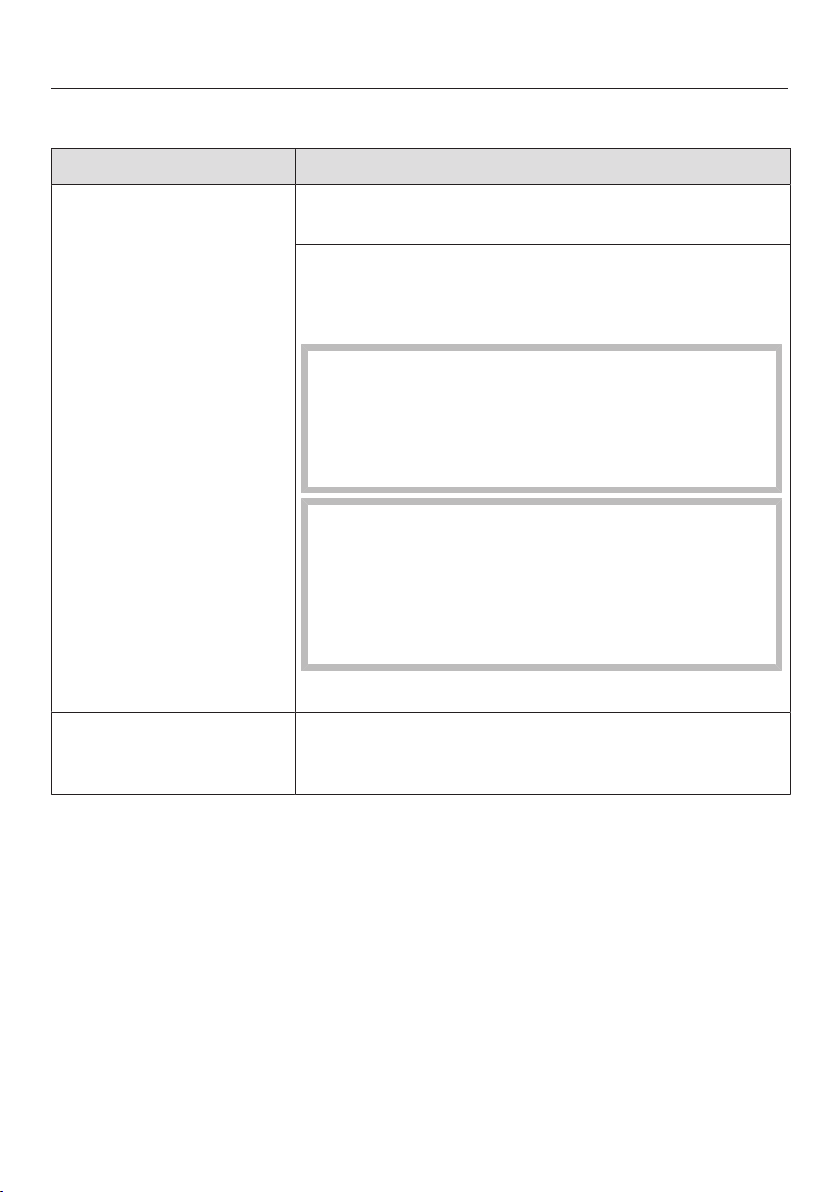
Display warnings
Message Cause and remedy
The alarm symbol is
lit up in the display. The
three sensors for the
wine conditioning zones
are flashing in the con-
trol panel. An audible
alarm is also sounding.
The door alarm has been activated.
Close the door. The three sensors for the wine
conditioning zones and the alarm symbol will
go out and the audible alarm stops.
The alarm symbol is
flashing in the display,
and the sensor for one
of the wine conditioning
zones is also flashing.
An alarm tone is also
sounding.
The temperature in the zone concerned has risen
higher or fallen lower than the temperature set.
Possible reasons for this include:
– The appliance door has been opened too fre-
quently.
– The ventilation gaps have been blocked.
– A prolonged power cut (power outage) has oc-
curred.
Rectify the cause of the alarm. The alarm sym-
bol goes out and the sensor for the affected
wine conditioning zone lights up again constantly.
The alarm will stop.
The Change Active
AirClean filter symbol
is lit up.
This is the reminder to change the Active AirClean fil-
ters.
Replace the Active AirClean filters in all three wine
conditioning zones and then confirm the filter
change in settings mode (see “Active AirClean Fil-
ters”).
A dash is lit up up/flash-
ing in the display.
Only temperatures within the range the wine condi-
tioning unit can display will be shown.
“F0”to“F3” or
“S1”to“S3” appear in
the display.
There is a fault.
Call Service.
Problem solving guide
46
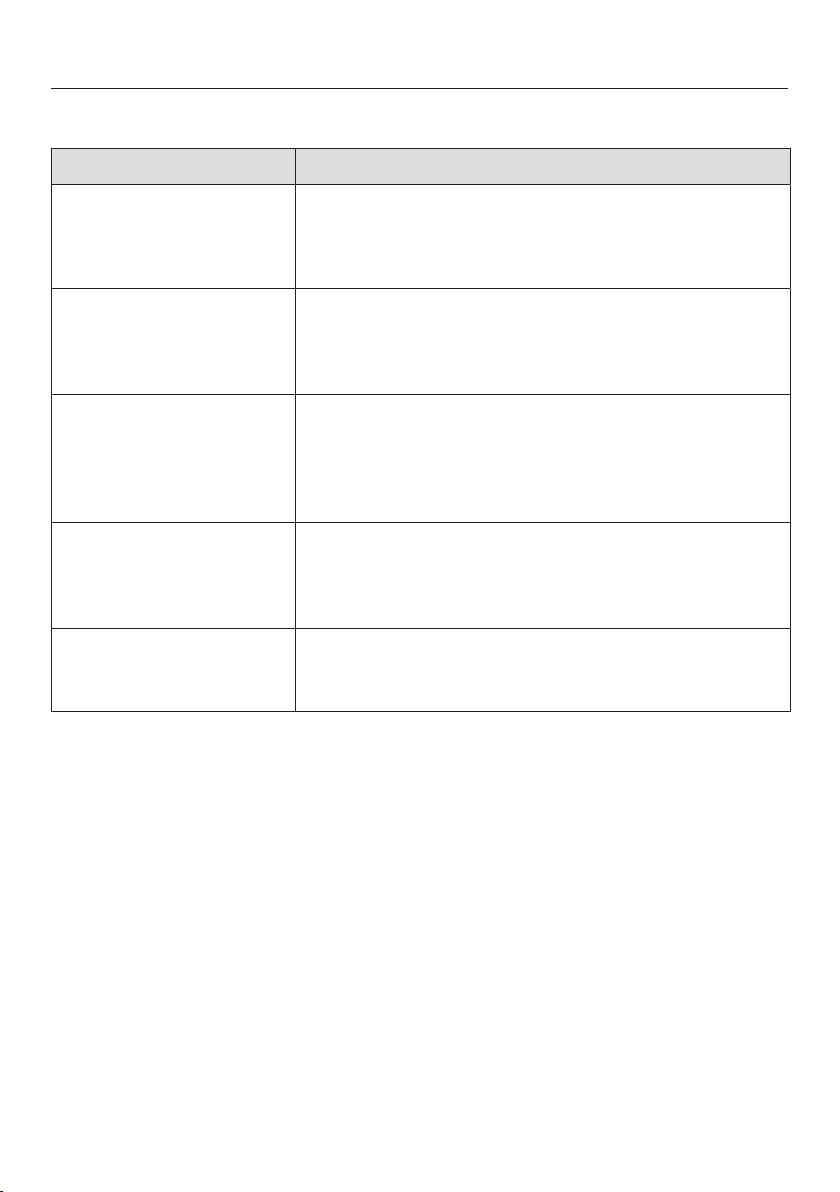
The interior lighting is not working.
Problem Cause and remedy
The LED interior lighting
is not working.
The wine conditioning unit is not switched on.
Switch the wine conditioning unit on.
To avoid overheating, the LED lighting switches itself
off automatically after approx. 15minutes if the door
is left open.
If this is not the cause, then there is a fault.
Danger of electric shock.
There are live electrical components under the
lighting cover.
The LED lighting may only be repaired or replaced
by the Customer Service Department.
Risk of injury from LED lighting.
This lighting corresponds to risk group RG2. If the
cover is defective, there is a danger of eye injury.
If the lighting cover is defective, do not look from a
close range directly into the lighting with optical in-
struments (e.g. magnifying glass or similar).
Call the Customer Service Department.
The LED interior lighting
is on even when the
door is closed.
The feature lighting is switched on.
Switch the feature lighting off (see “Feature light-
ing”).
Problem solving guide
47
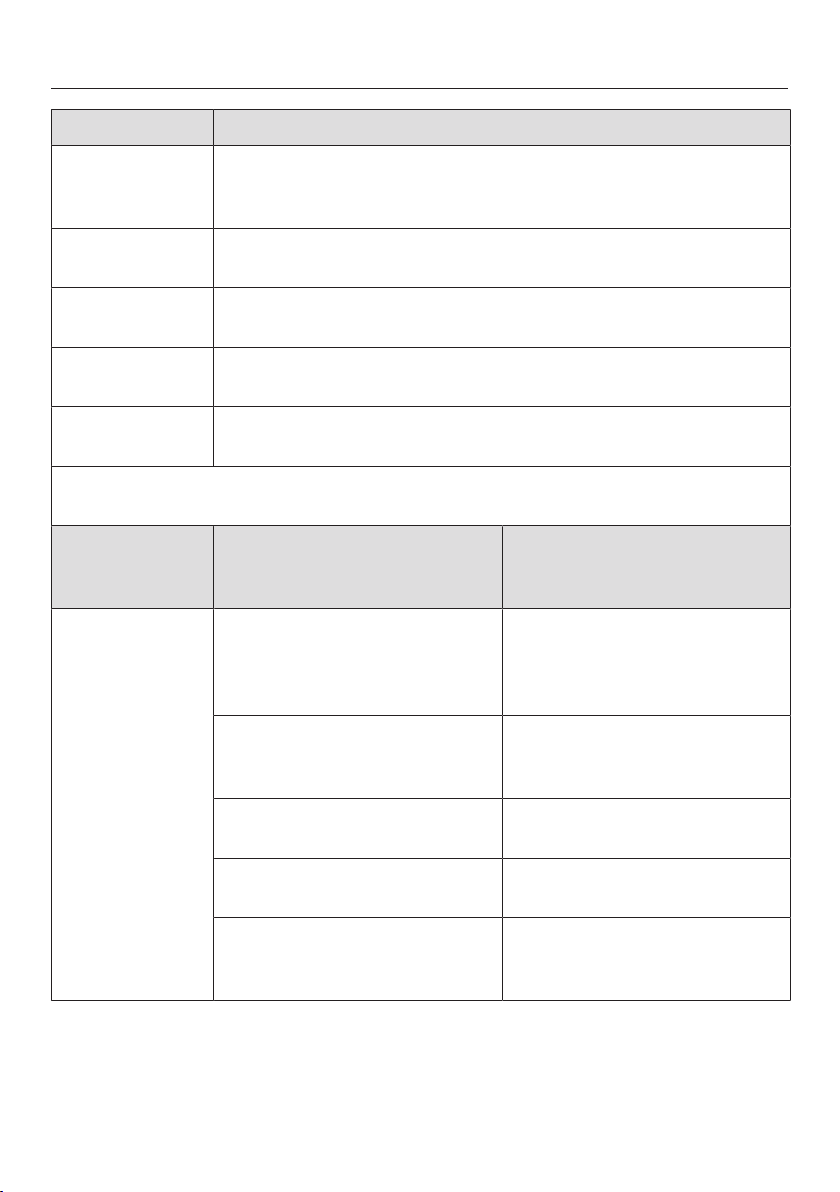
General problems with the wine conditioning unit
Problem Cause and remedy
There is no audible
alarm although the door
has been open for a
long time.
This is not a fault. The alarm tone has been
switched off in settings mode (see “Selecting fur-
ther settings – Audible signals”).
The wine conditioning
unit cannot be switched
off.
The safety lock has been activated.
Completely deactivate the safety lock (see “Select-
ing further settings – Activating and deactivating
the safety lock”).
The slats on the
wooden shelves are
warping.
Volume change due to moisture absorption or drying
out is a typical characteristic of wood. An increase in
humidity will cause wooden components to warp,
which can lead to cracking. Knots and grain patina
are part of the natural character of wood.
Mildew has begun to
form on the wine bottle
labels.
Mildew can begin to form on the labels, depending
on the type of label adhesive used.
Clean the wine bottles and remove any adhesive
residue.
A white deposit has
formed on the wine
bottle corks.
The corks have oxidised due to contact with the air.
Use a dry cloth to wipe off the deposit. The de-
posit will not affect the quality of the wine.
Noises
48
Normal noises What causes them
Brrrrr ... A humming noise is made by the motor (compressor). This
noise can get louder for brief periods when the motor switches
on.
Blubb, blubb ... A gurgling noise can be heard when coolant is circulating
through the pipes.
Click ... Clicking sounds are made when the thermostat switches the
motor on and off.
Sssrrrrr ... On multi-zone or frost-free appliances you can sometimes just
hear the sound of the fan inside the appliance.
Crack ... A cracking sound can be heard when materials expand inside
the appliance.
Remember that the noise of the compressor and the coolant circulating in the
system is unavoidable.
Noises that
you can easily
rectify
Possible cause Remedy
Rattling, vibrat-
ing
The appliance is uneven. Realign the appliance using a
spirit level, by raising or lower-
ing the screw feet underneath
the appliance.
The appliance is touching an-
other appliance or piece of
furniture.
Move it away.
Drawers, baskets or shelves
are unstable or sticking.
Check all removable items
and refit them correctly.
Bottles or containers are
touching each other.
Separate them.
The transport cable clips are
hanging loose at the back of
the appliance.
Remove the cable clips.
After sales service and warranty
49
Contact in the event of a fault
In the event of any faults which you
cannot remedy yourself, please contact
your Miele dealer or the Miele Customer
Service Department.
You can book a Miele Customer Ser-
vice Department call-out online at
www.miele.com/service.
Contact information for the Miele Cus-
tomer Service Department can be
found at the end of this document.
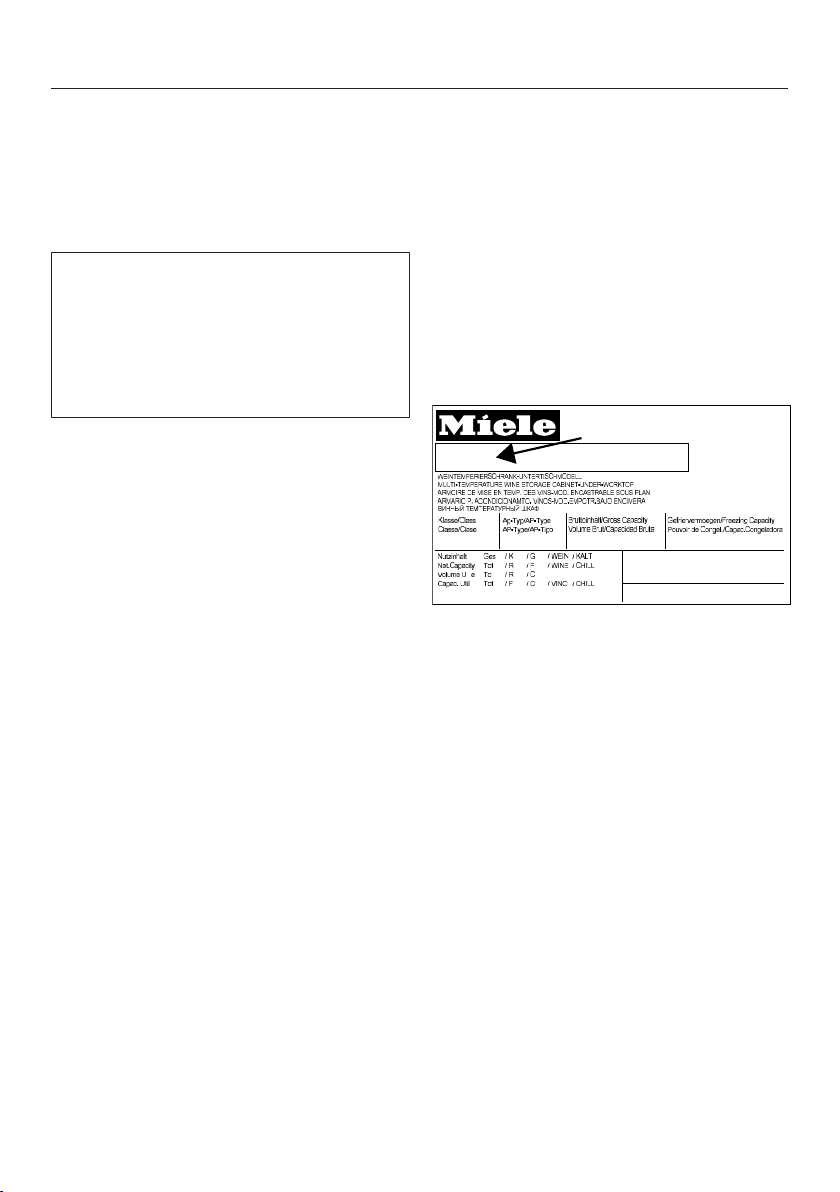
Please quote the model identifier and
serial number of your appliance (Fabr./
SN/Nr.) when contacting the Miele Cus-
tomer Service Department. This inform-
ation can be found on the data plate.
Please note that telephone calls may be
monitored and recorded for training
purposes and that a call-out charge will
be applied to service visits where the
problem could have been resolved as
described in this booklet.
The data plate is located inside the wine
unit.
EPREL database
From 1 March 2021, information on en-
ergy labelling and ecodesign require-
ments will be available in the European
Product Database (EPREL). You can
find the product database at the follow-
ing link https://eprel.ec.europa.eu/. You
will be asked to enter the model identi-
fier.
The model identifier can be found on
the data plate.
SN-ST
R600a:
XXXXXX
Nr. XX/ XXXXXXXXX.
XXX l
XXg
Warranty
The appliance warranty is valid for 2
years from date of purchase. In the UK,
you must activate your cover by calling
0330 160 6640 or registering online at
www.miele.co.uk.
For more information on country-spe-
cific warranty terms and conditions,
please contact Miele Customer Service.
Information for dealers
50
Demo mode
The wine conditioning unit can be
demonstrated in the showroom or at
exhibitions in “Demo mode”. In this
mode the control panel and interior
lighting are active but the compressor
remains switched off, so that the appli-
ance does not cool down.
Switching on demo mode
Switch the wine conditioning unit off
by touching the On/Off sensor.
The temperature display will go out and
the mains connection symbol will
appear.
Place your finger on the sensor,
and leave it there.
At the same time, briefly touch the
On/Off sensor (without letting go of
the sensor).
Leave your finger on the sensor
until the symbol appears in the dis-
play.
Then release the sensor.
Demo mode is activated and the sym-
bol appears in the display.
Switching off Demo mode
The symbol is lit up in the display.
Touch the settings sensor.
All symbols available for selection will
appear in the display and the symbol
flashes.
Touch the sensors for setting the
temperature ( or ) repeatedly until
the symbol flashes.
Touch the OK sensor to confirm your
selection.
1 flashes in the display (means: Demo
mode is switched on) and the symbol
lights up.
Information for dealers
51
Touch the or sensor until 0 ap-
pears (means: Demo mode is
switched off).
Touch the OK sensor to confirm your
selection.
The selected setting is applied, the
symbol flashes.
Touch the settings sensor to leave
settings mode.
Otherwise the appliance exits set-
tings mode automatically after ap-
proximately one minute.
Demo mode is switched off, the sym-
bol goes out.
Electrical connection
*INSTALLATION*
52
The wine conditioning unit is supplied
with a mains cable with moulded plug
ready for connection to an earthed
socket.
The socket must be easily accessible
after the wine conditioning unit has
been installed. If the socket is not easily
accessible, ensure that a suitable
means of disconnection is provided on
the installation side for each pole.
Risk of fire from overheating.
Connecting the refrigeration appli-
ance to a multi-socket plug adapter
or to an extension lead can overload
the cable.
For safety reasons, do not use an ex-
tension lead or multi-socket adapter.
The electrical system must comply with
local and national safety regulations
(BS7671 in the UK).
For safety reasons, we recommend us-
ing a type residual current device
(RCD) in the assigned electrical installa-
tion for connecting the wine condition-
ing unit.
If the mains connection cable is dam-
aged, it must only be replaced with a
specific mains connection cable of the
same type (available from the Miele
Customer Service Department). For
safety reasons, such replacement may
only be carried out by a qualified spe-
cialist or the Miele Customer Service
Department.
These operating instructions and the
data plate indicate the nominal power
consumption and the appropriate fuse
rating. Compare this information with
the data of the on-site electrical con-
nection.
If in any doubt, consult a qualified elec-
trician.
Do not connect the wine conditioning
unit to a stand-alone inverter such as
those used with an autonomous power
supply, e.g. solar power. When the wine
conditioning unit is switched on, power
surges could result in an auto switch-
off. This could damage the electronic
module.
Installation
53
Fire risk and danger of damage!
Appliances which give off heat, such
as toasters, mini-ovens or double
burner hobs, can catch fire.
Do not place them on top of this re-
frigeration appliance.
This appliance must not be installed
directly next to another refrigeration
appliance. It does not have side-wall
heating, so installation next to another
refrigerator or freezer could cause a
build-up of condensation between
them. Further information is available
from your dealer.
Location
This appliance should not be installed
where it is exposed to direct sunlight or
directly adjacent to a heat-producing
appliance such as an oven or a radiator.
The higher the ambient temperature of
the room, the longer the compressor
will run for and the higher the energy
consumption. The appliance should be
installed in a dry, well ventilated room.
When installing the wine conditioning
unit, please be aware:
- The socket must be easily accessible
in an emergency, not concealed be-
hind the appliance.
- The plug and cable must not touch
the rear of the wine conditioning unit
as they could be damaged by vibra-
tions from the wine conditioning unit.
- Do not plug in other appliances be-
hind this wine conditioning unit.
Climate range
The wine conditioning unit is designed
for use within a certain climate range
(ambient temperatures) and should not
be used outside this range. The climate
range of the wine conditioning unit is
stated on the data plate inside it.
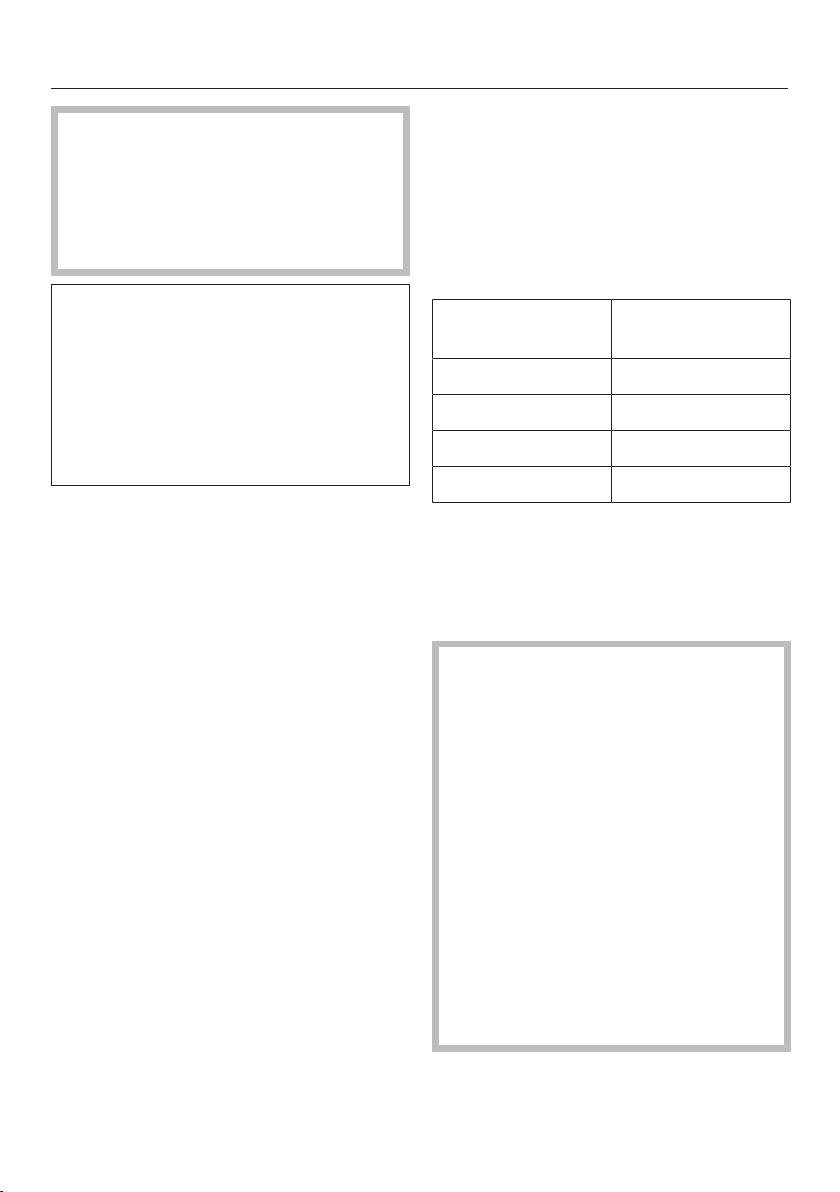
Climate range Ambient room
temperature
SN +10°C to +32°C
N +16°C to +32°C
ST +16°C to +38°C
T +16°C to +43°C
Operating in a room which is too cold
will cause the compressor to switch off
for too long, causing the internal tem-
perature in the wine conditioning unit to
rise which could lead to damage.
Risk of damage due to high hu-
midity.
In environments with high humidity,
condensation can build up on the ex-
ternal wine conditioning unit panels,
which can cause corrosion.
Install the wine conditioning unit with
sufficient ventilation in a dry and/or
air-conditioned room.
After installation, make sure that the
appliance door closes properly, the
ventilation gaps are not covered and
that the wine conditioning unit has
been installed in accordance with
these operating and installation in-
structions.
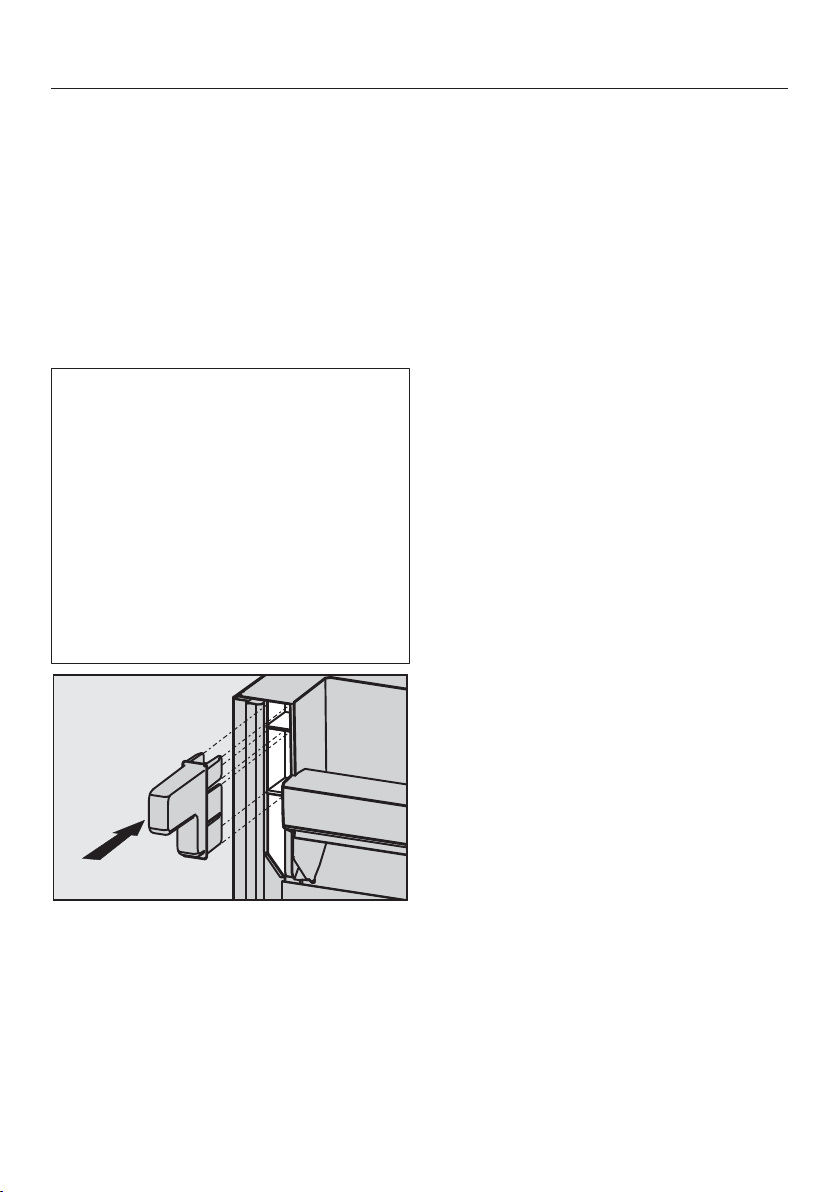
Installation
54
Ventilation
The wine conditioning unit can be
placed directly against a wall. Please
note that to ensure sufficient ventilation,
the ventilation gaps must not be
covered or blocked in any way.
They should be dusted on a regular
basis.
Fitting wall spacers supplied
The wall spacers supplied must be
used in order to achieve declared en-
ergy consumption values and to pre-
vent the build-up of condensation at
high ambient temperatures. Appliance
depth is increased by approx. 35mm
with the wall spacers fitted. If the wall
spacers are not used the functionality
of the appliance is not affected. En-
ergy consumption is only slightly in-
creased with less distance between
the appliance and the wall.
Fit the wall spacers onto the back of
the appliance on the top left and
right.
Installation
Remove the cable clip from the back
of the appliance.
Check that all parts at the back of the
appliance are unhindered. Carefully
remove any hindrance.
Carefully push the wine conditioning
unit into position.
Niche floor
To ensure the safe installation of the
wine conditioning unit and to guarantee
its correct functioning, the floor of the
niche where the appliance is to be in-
stalled must be smooth and even.
It must be made of strong, rigid mater-
ial. The wine conditioning unit is ex-
tremely heavy when loaded and for this
reason it is imperative that the floor is
able to bear its weight. If necessary, the
advice of an architect or structural en-
gineer should be sought.
The weight of the appliance when
empty is approx. 145kg.
When fully loaded, the weight of the ap-
pliance is approx. 375kg.
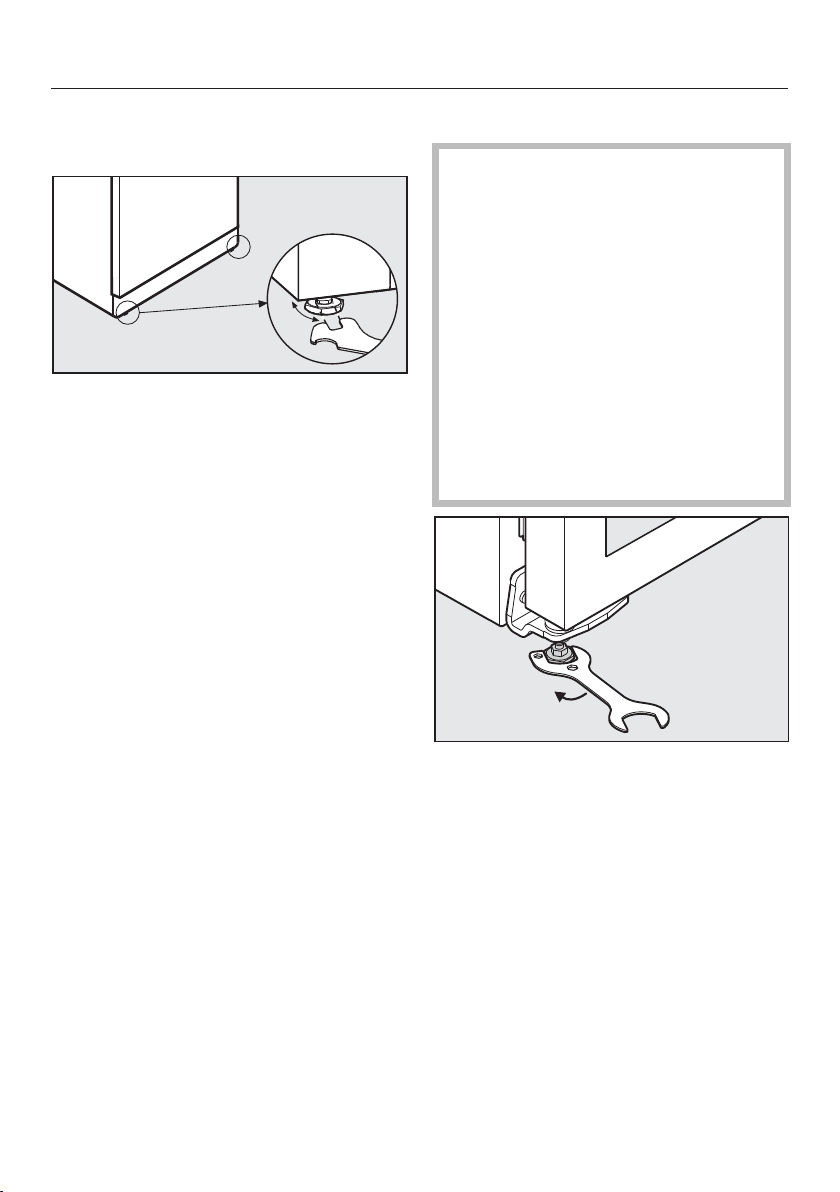
Installation
55
Aligning the wine conditioning
unit
To align the wine conditioning unit,
adjust the front feet using the span-
ner supplied.
Levelling the appliance door
Risk of damage and injury
caused by the appliance door falling
out or the wine unit tipping over.
If the additional adjustable foot on
the hinge bracket at the bottom is
not resting firmly on the floor, the ap-
pliance door can fall out or the wine
unit can tip over.
Use the open spanner supplied with
the appliance to unscrew the ad-
justable foot until it is resting on the
floor.
Then unscrew the adjustable foot by
a further quarter turn.
Make sure that you unscrew the ad-
justable foot under the lower hinge
bracket until it sits on the floor. Then
unscrew the foot by a further 90°.
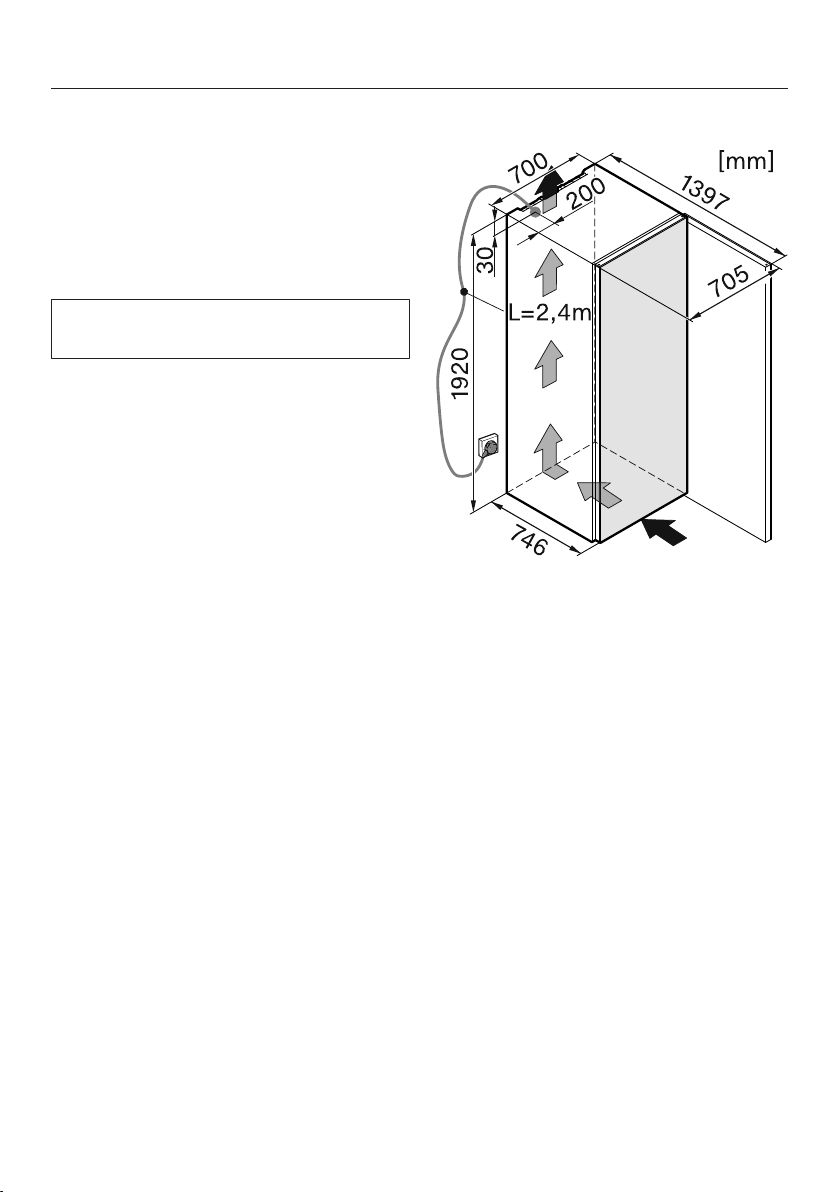
Installation
56
Door opening angle limiter
The opening angle of the appliance
doors can be limited to approx.90° or
110° using the door opening angle lim-
iter. This will prevent an appliance door
from hitting an adjacent wall and being
damaged when opened, for example.
The door opening angle limiter is avail-
able from Miele or your Miele dealer.
Appliance dimensions
* Dimensions without wall spacers. Appli-
ance depth is increased by 35mm with the
wall spacers supplied fitted.
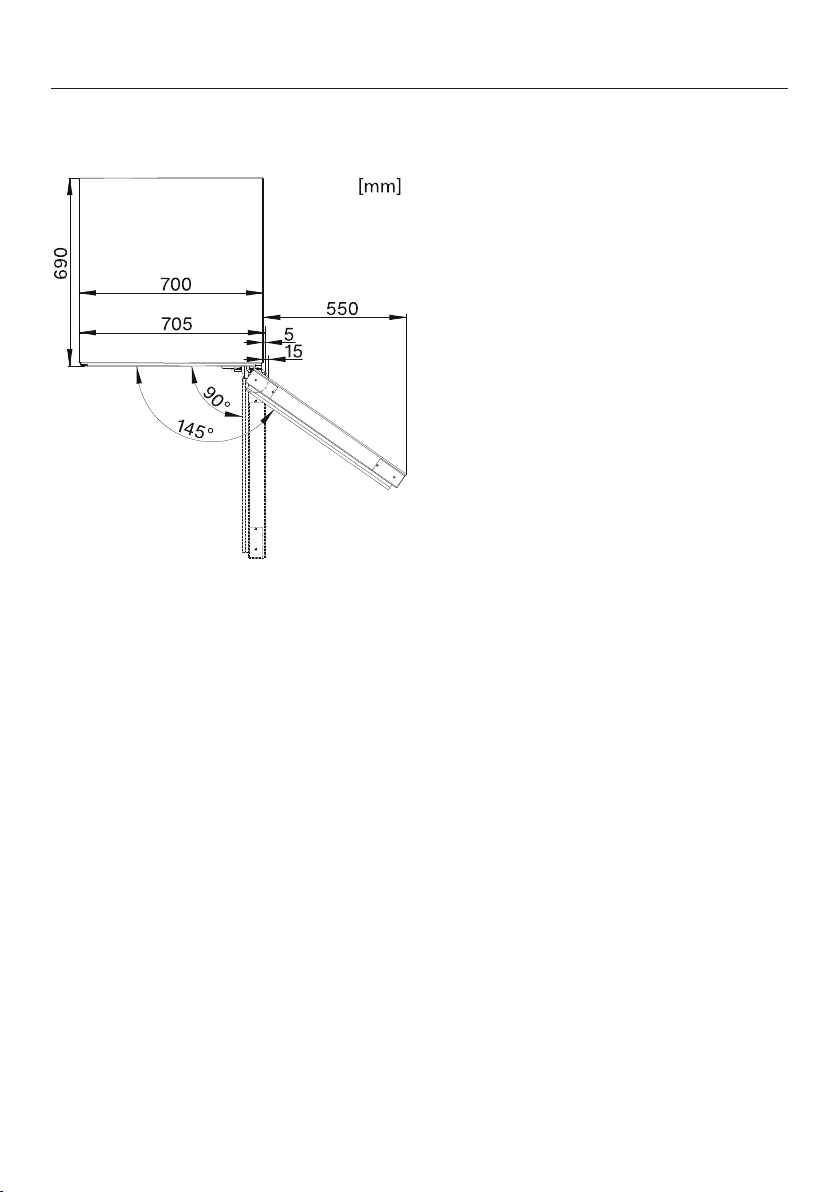
Installation
57
Dimensions when the door is
opened
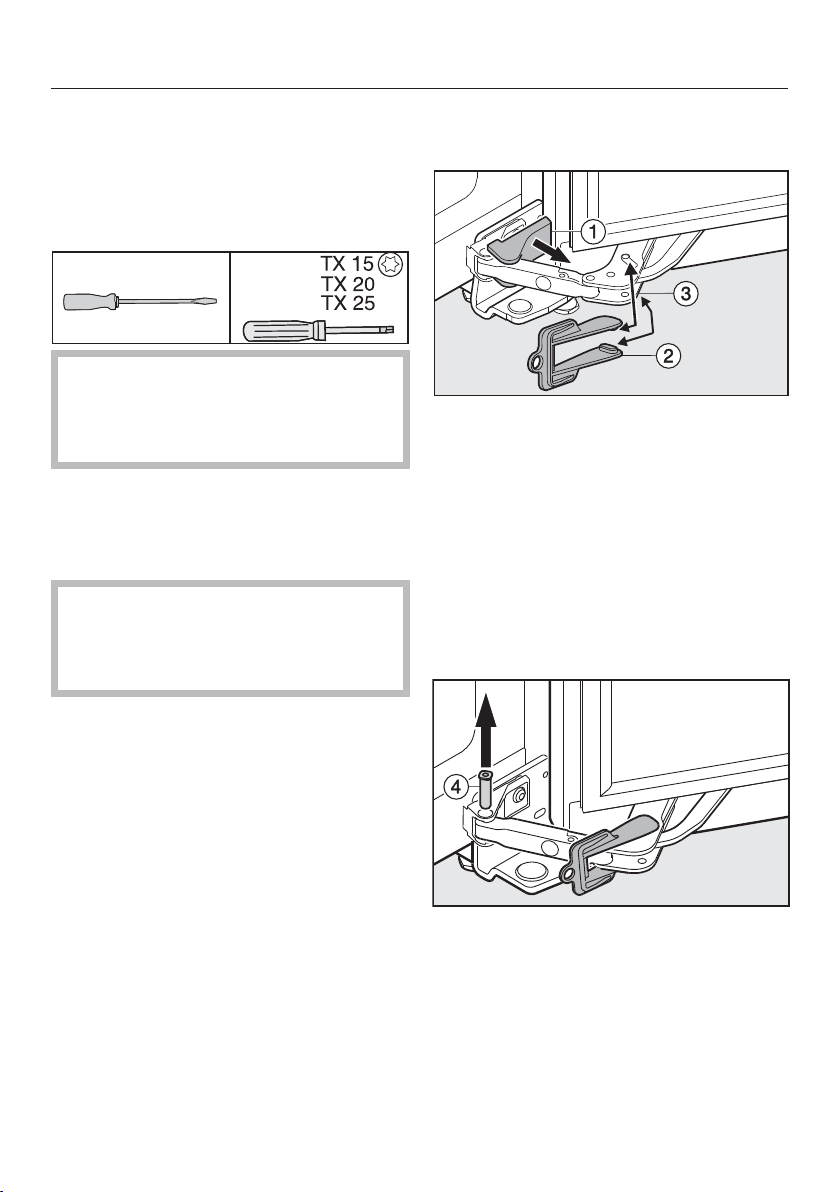
Changing the door hinging
58
The wine conditioning unit is supplied
right-hand hinged. If left-hand hinging is
required, the hinges must be changed.
To change the door hinging, you will
need the following tools:
The glass door is very heavy (approx.
30kg) and could break.
Two people are needed for changing
the door hinging.
Place a suitable cover on the floor in
front of the appliance to protect the
appliance door and your floor from
damage.
Be careful not to damage the door
seal. If the door seal is damaged, the
appliance door may not close prop-
erly and cooling will be insufficient.
Open the appliance door as far as it
will go.
Use a flat-blade screwdriver to care-
fully remove cover at the bottom of
the appliance.
Place red safety device (supplied
with the appliance) onto soft-close
mechanism and click it into posi-
tion.
The safety device prevents the hinge
from snapping shut. Do not remove the
safety device until instructed to do so.
Push pin up and out from under-
neath.
The soft-close mechanism is no longer
fixed to the appliance.
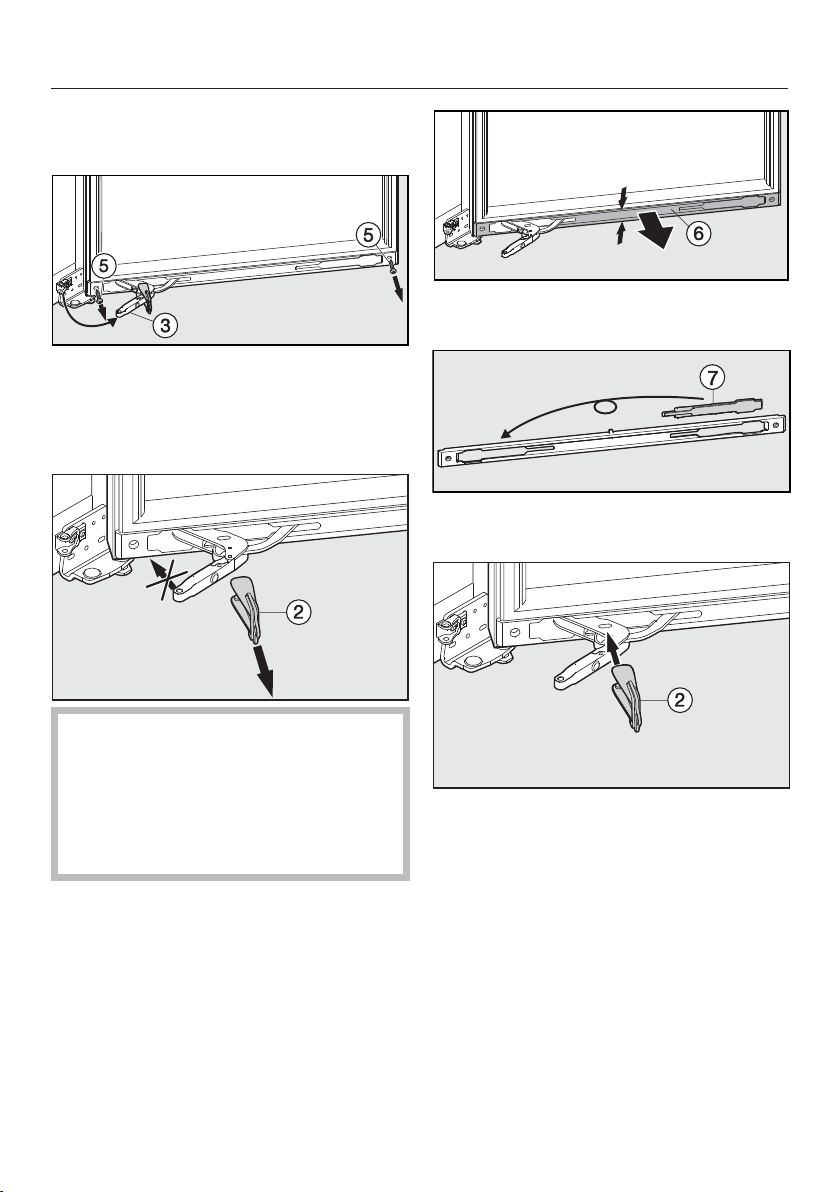
Changing the door hinging
59
Changing over the soft-close
mechanism
Push out soft-close mechanism .
Remove screws from the soft-
close mechanism on the right and left
at the bottom of the appliance door.
Caution.
Danger of injury.
Do not move the front part of the
soft-close mechanism in the direc-
tion shown once safety device has
been removed.
Remove red safety device from the
soft-close mechanism.
Pinch cover in the middle and re-
move.
Refit panel into the cover on the
opposite side.
Put red safety device back onto
the soft-close mechanism.
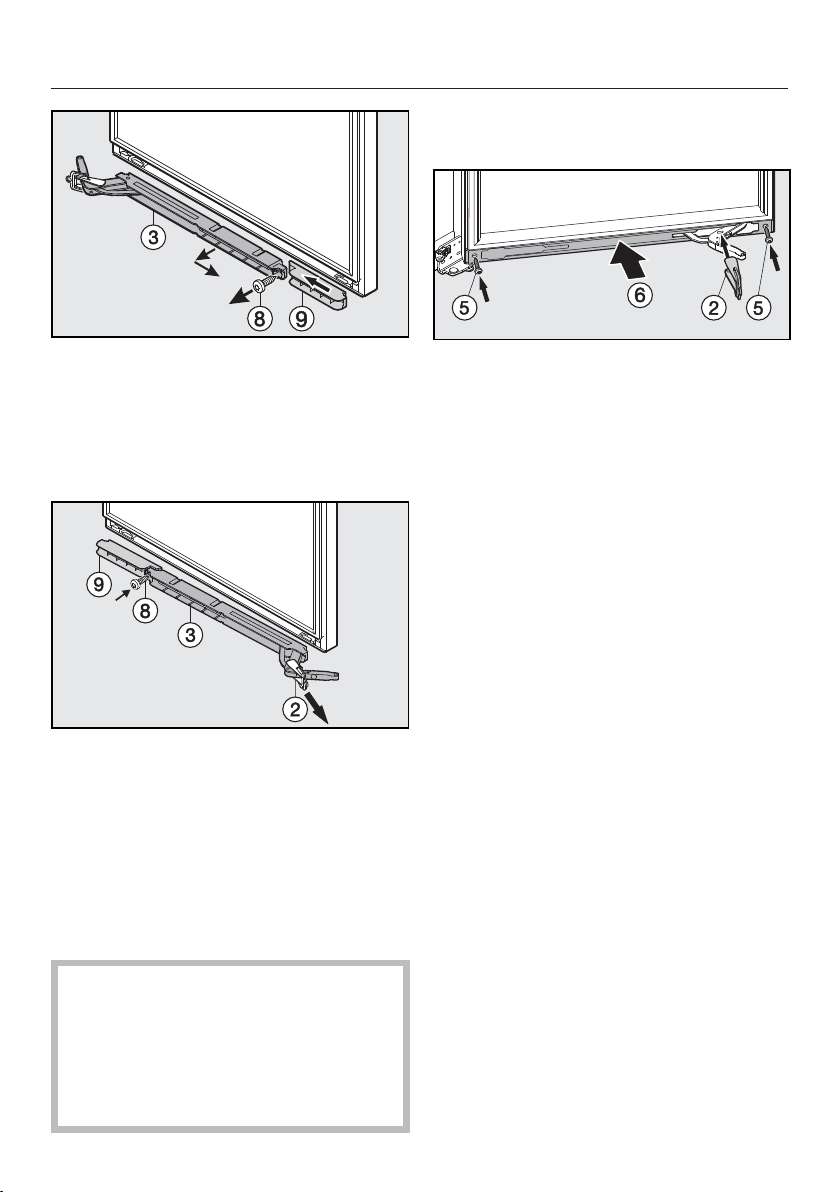
Changing the door hinging
60
Remove screw .
Pull out soft-close mechanism and
remove.
Push spacer to the side of the ap-
pliance and remove.
Rotate spacer through 180° and
refit it on the opposite side. Push the
spacer along as far as it will go.
Rotate soft-close mechanism
through 180°. Attach the soft-close
mechanism onto the outside first.
Secure spacer to soft-close mech-
anism with screw .
Caution.
Danger of injury.
Do not move the front part of the
soft-close mechanism in the direc-
tion shown once safety device has
been removed.
Remove red safety device from the
soft-close mechanism.
Refit cover onto the soft-close
mechanism.
Put red safety device back onto
the soft-close mechanism.
Secure cover with screws .
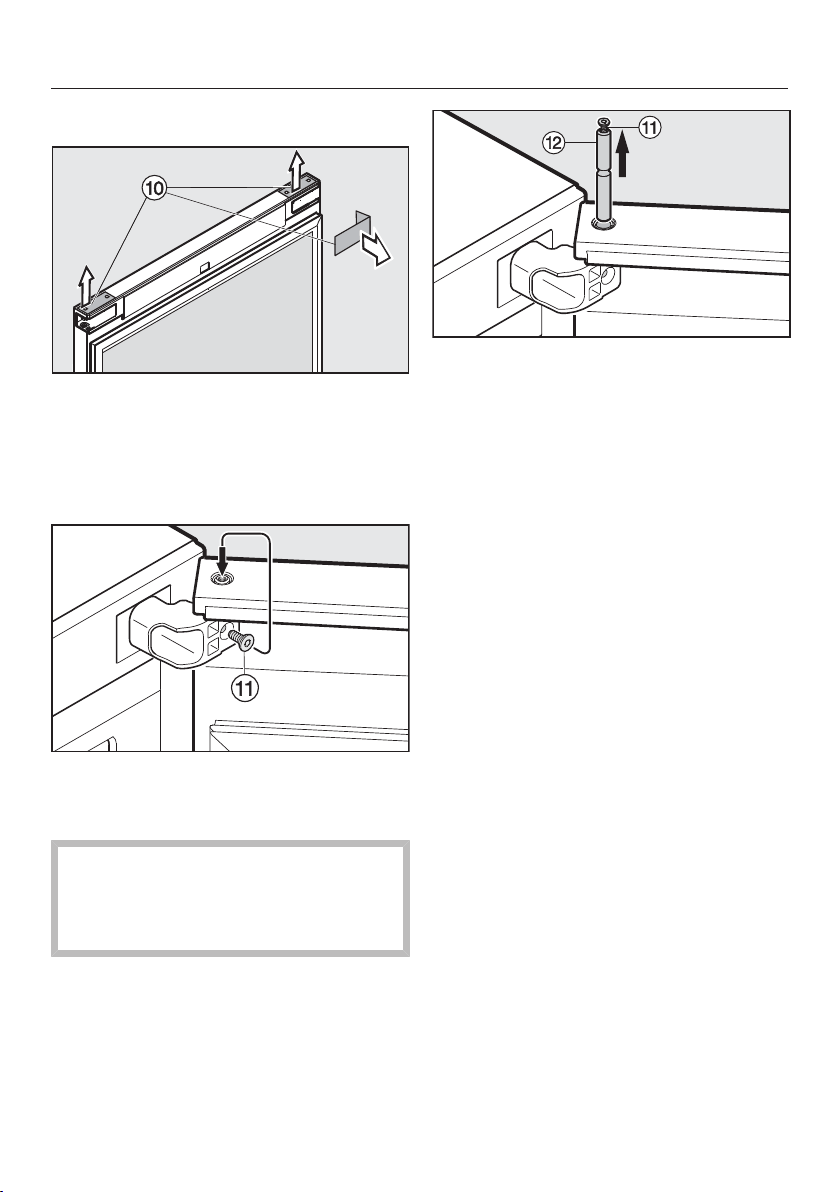
Changing the door hinging
61
Removing the door
Use a small flat-blade screwdriver to
remove covers from the top of the
appliance door.
Open the appliance door as far as it
will go.
Remove screw from the hinge
bracket and screw it loosely with 3 or
4 turns into the top of the hinge pin.
Caution. In the next step the door will
be removed from the appliance. The
door is heavy and needs to be
handled by two people.
Pull hinge pin upwards and out.
Tip: Leave screw in the hinge pin un-
til the hinge pin is inserted on the op-
posite side.
Carefully lift the door upwards and off
and place it carefully to one side.
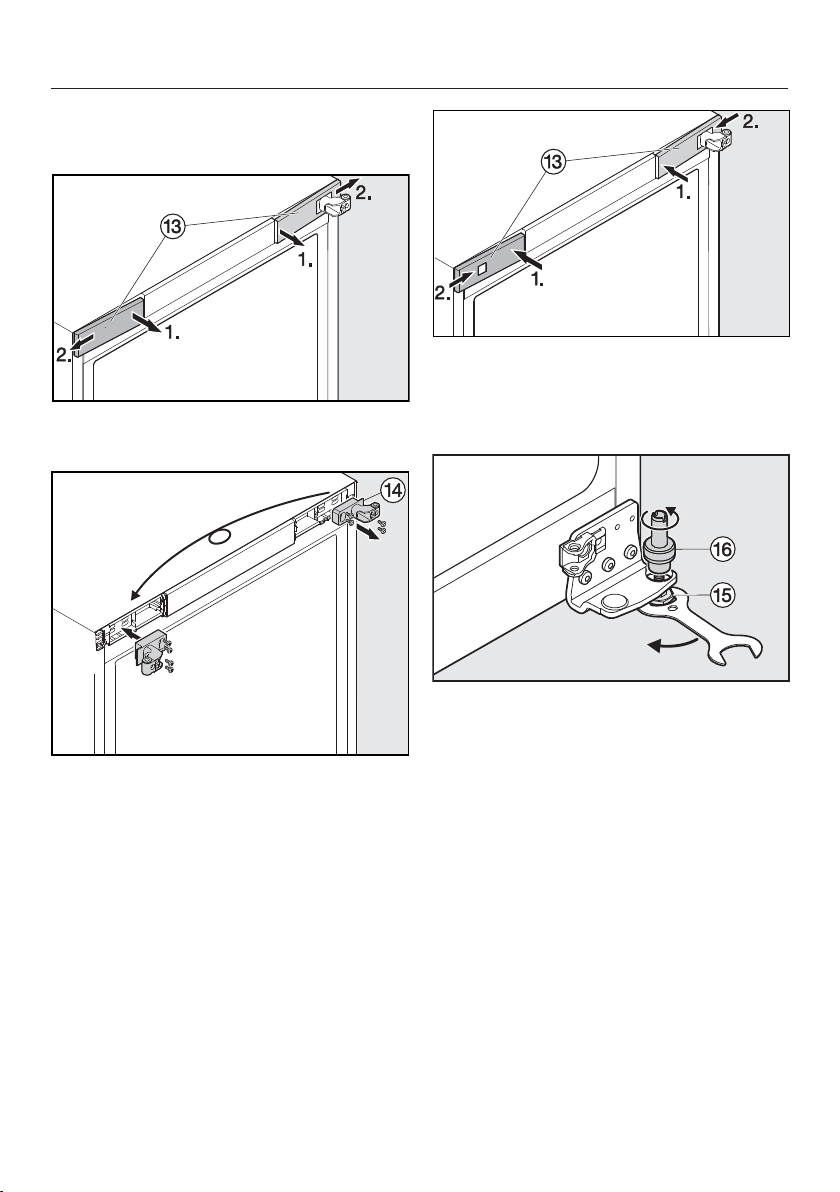
Changing the door hinging
62
Changing over the hinge
bracket
Remove both covers at the top of
the appliance front.
Unscrew hinge bracket from the
top of the appliance, rotate it through
180°, and secure it on the other side.
Click covers into place on both
sides from the front. When doing this,
guide the cover with the cut-out over
the hinge bracket.
Use the spanner supplied to loosen
adjustable foot underneath the ap-
pliance.
Pull bolt upwards and unscrew it
from adjustable foot . Hold the ad-
justable foot tightly when doing this.
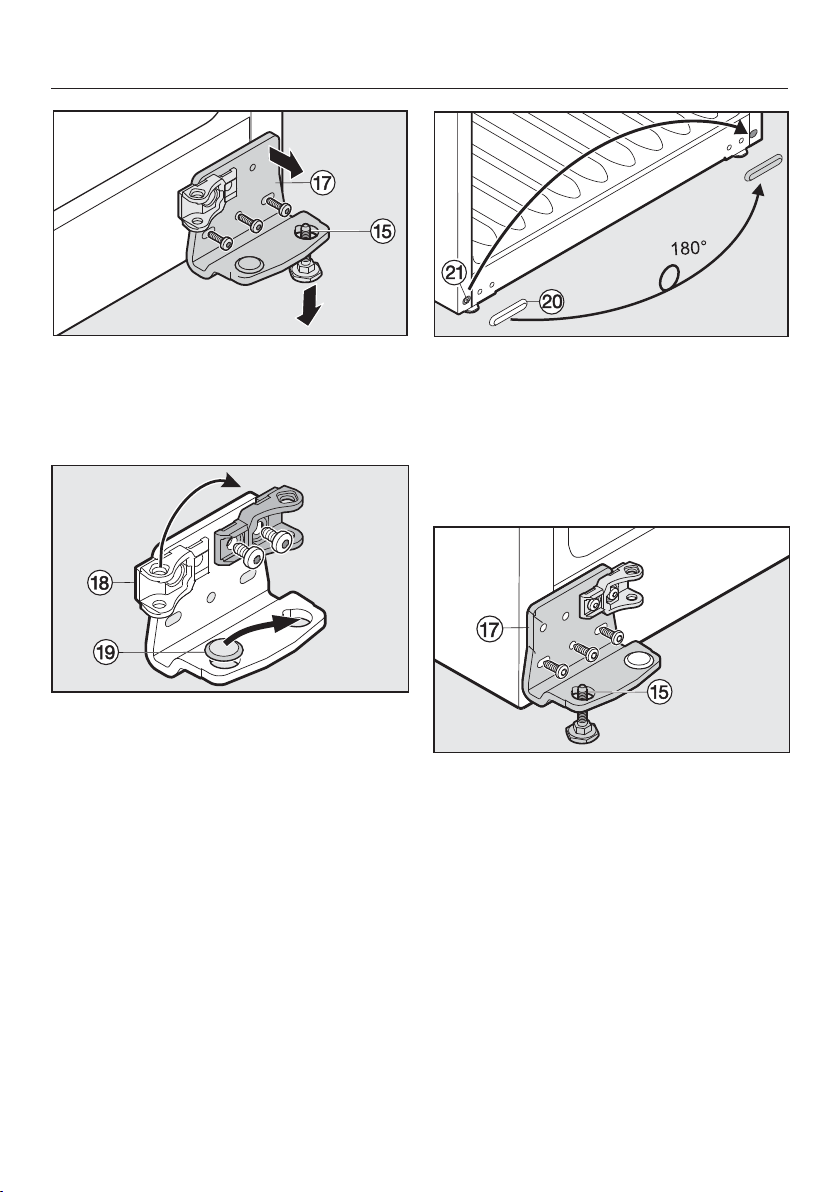
Changing the door hinging
63
Unscrew hinge bracket from un-
derneath the appliance.
Then pull adjustable foot down-
wards and out.
Fit holder for the soft-close mech-
anism on the hinge bracket on the
opposite side.
Also fit round cover on the oppos-
ite side.
Remove cover from the bottom of
the appliance.
Remove screw on the bottom of
the appliance and replace it on the
opposite side.
Refit cover on the opposite side.
Push adjustable foot upwards into
hinge bracket .
Secure hinge bracket with the
middle screw first then with the two
other screws.
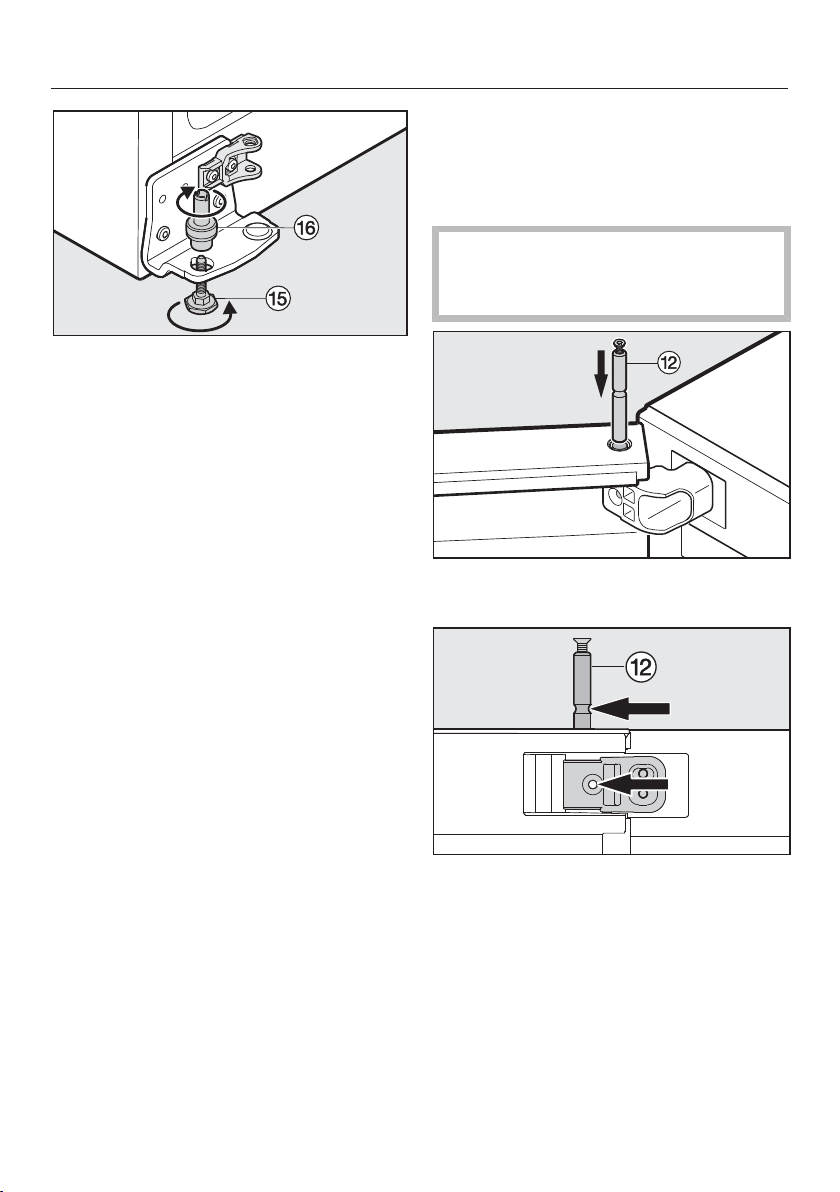
Changing the door hinging
64
Screw bolt from above onto ad-
justable foot , paying attention to
the groove.
Tighten adjustable foot .
Refitting the door
Position the appliance door onto
lower bolt and guide the top to-
wards the hinge bracket.
Caution. The appliance door is
heavy and needs to be handled by
two people.
Fit hinge pin into the hinge bracket
from above.
Push hinge pin in until the groove
of the pin is in line with the drill hole
in the hinge bracket.
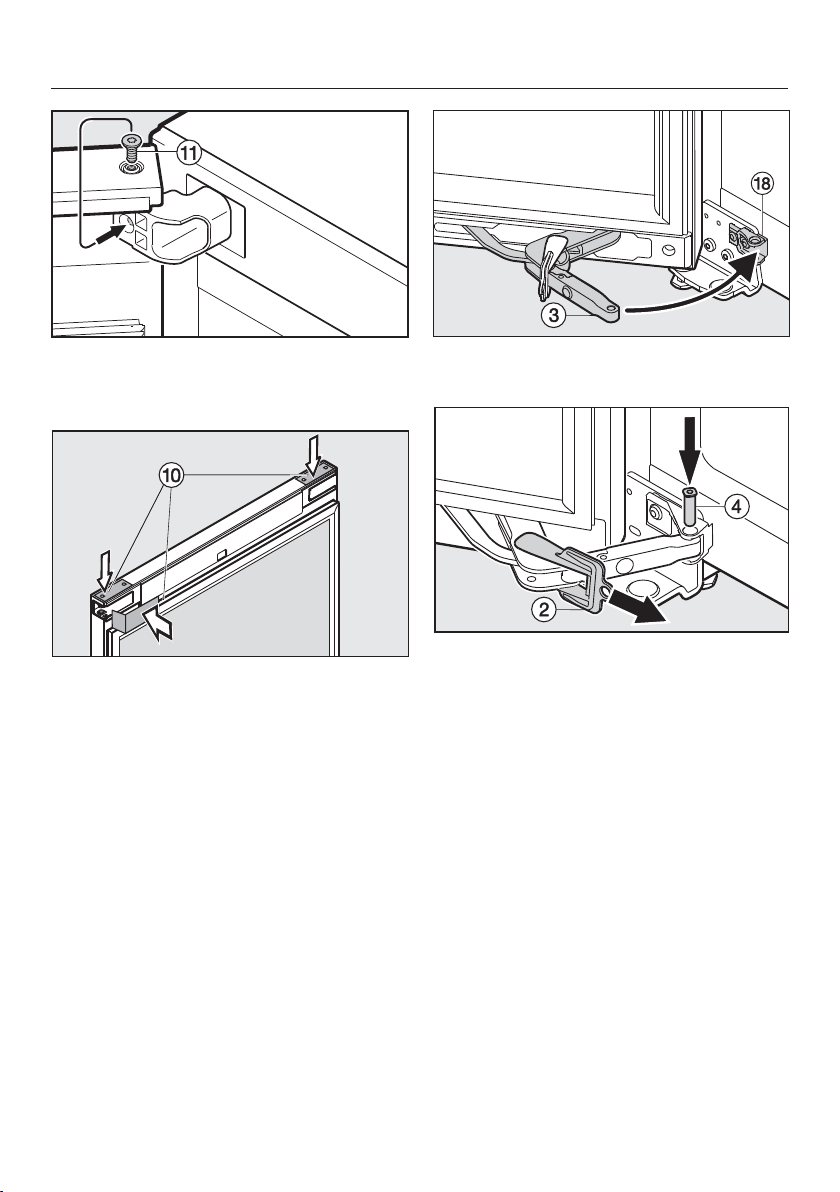
Changing the door hinging
65
Remove screw from the hinge pin
and screw it into the drill hole in the
hinge bracket.
Refit covers onto the appliance
door.
Pull the hinge joint of soft-close
mechanism outwards to holder .
Fit hinge pin into the soft-close
mechanism from above
Remove red safety device.
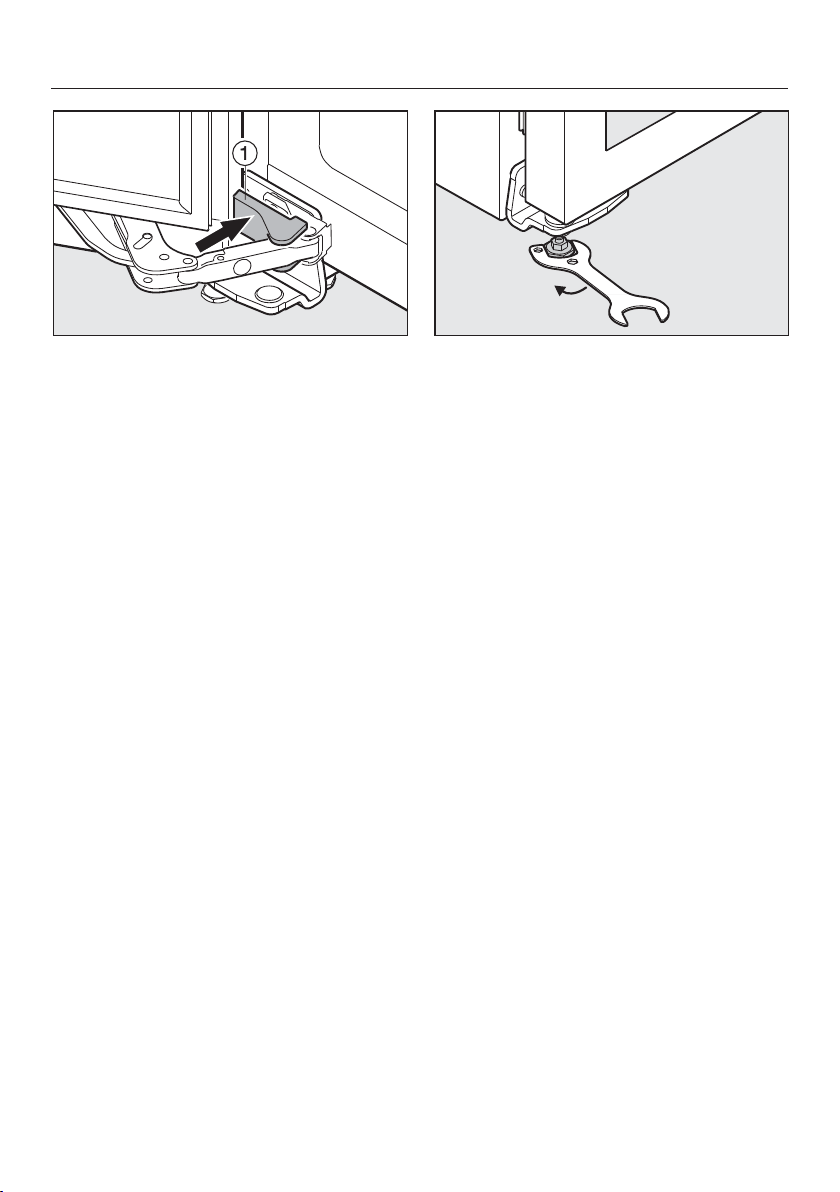
Changing the door hinging
66
Snap on cover .
Position the appliance in its final loca-
tion.
Make sure that you unscrew the ad-
justable foot under the lower hinge
bracket until it sits on the floor. Then
unscrew the foot by a further 90°.
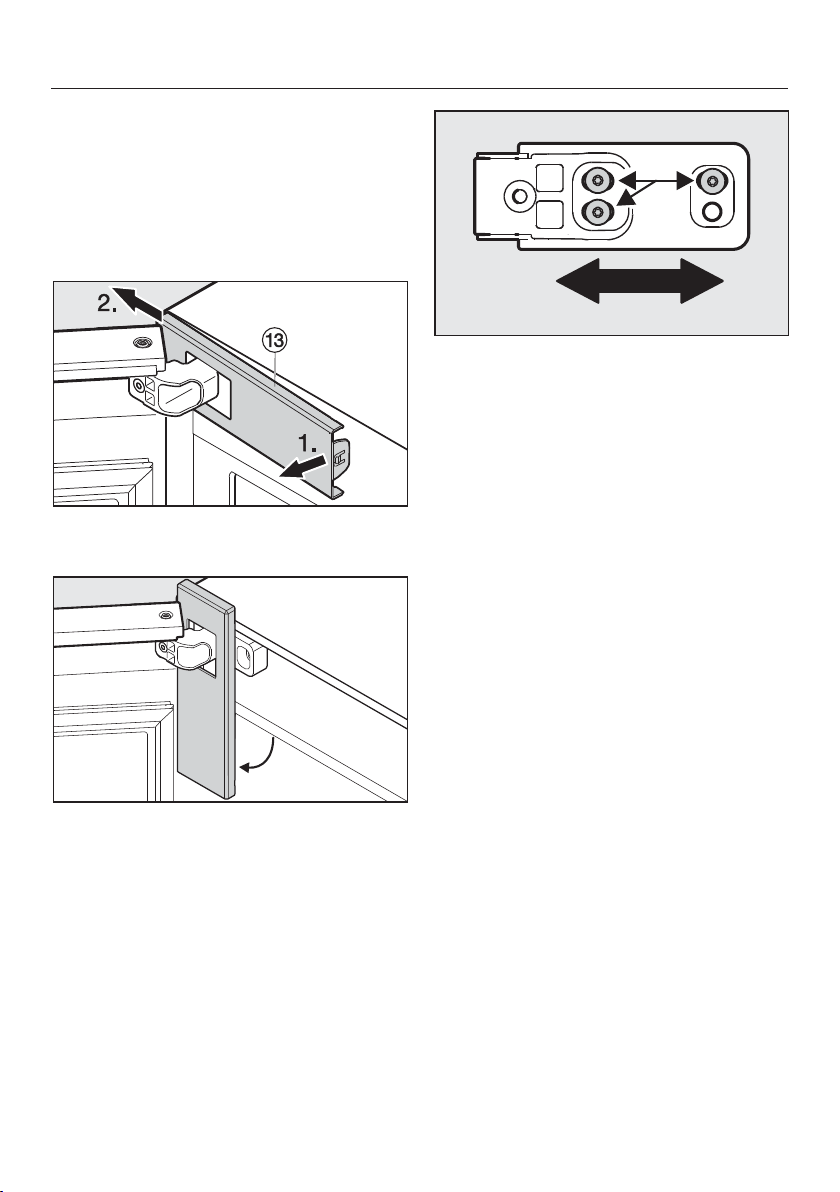
Changing the door hinging
67
Aligning the side of the appli-
ance door
If the appliance door is not in line with
the side walls of the appliance, the ap-
pliance door can be aligned by adjust-
ing the upper hinge bracket.
Remove cover from the inside of
the hinge bracket and push it out.
Swing the cover downwards.
Loosen the three screws on the hinge
bracket and adjust the hinge bracket
to the left or right.
Tighten the screws again.
Refit the cover.
Close the appliance door and check
that it is aligned with the side walls.




United Kingdom
Miele Co. Ltd., Fairacres, Marcham Road, Abingdon, Oxon, OX14 1TW
Tel: 0330 160 6600, Internet: www.miele.co.uk/service, E-mail: [email protected]
Australia
Miele Australia Pty. Ltd.
ACN 005 635 398
ABN 96 005 635 398
1 Gilbert Park Drive
Knoxfield, VIC 3180
Tel: 1300 464 353
Internet: www.miele.com.au
Miele Electrical Appliances Co., Ltd.
1-3 Floor, No. 82 Shi Men Yi Road
Jing' an District
200040 Shanghai, PRC
Tel: +86 21 6157 3500
Fax: +86 21 6157 3511
E-mail: [email protected],
Internet: www.miele.cn
China Mainland
Miele (Hong Kong) Ltd.
41/F - 4101, Manhattan Place
23 Wang Tai Road
Kowloon Bay, Hong Kong
Tel: (852) 2610 1025
Fax: (852) 3579 1404
Email:
Website: www.miele.hk
Hong Kong, China
Miele India Pvt. Ltd.
1st Floor, Copia Corporate Suites,
Commercial Plot 9,
Mathura Road, Jasola,
New Delhi - 110025
E-mail: customercare@miele.in
Website: www.miele.in
India
Miele Ireland Ltd.
2024 Bianconi Avenue
Citywest Business Campus
Dublin 24
Tel: (01) 461 07 10
Fax: (01) 461 07 97
E-Mail: [email protected]
Internet: www.miele.ie
Ireland
Malaysia
Miele Sdn Bhd
Suite 12-2, Level 12
Menara Sapura Kencana
Petroleum
Solaris Dutamas No. 1
Jalan Dutamas 1
50480 Kuala Lumpur, Malaysia
Phone: +603-6209-0288
Fax: +603-6205-3768
Miele New Zealand Limited
IRD 98 463 631
8 College Hill
Freemans Bay, Auckland 1011
New Zealand
Tel: 0800 464 353
Internet: www.miele.co.nz
New Zealand
Miele Pte. Ltd.
29 Media Circle
#11-04 ALICE@Mediapolis
Singapore 138565
sTel: +65 6735 1191
Fax: +65 6735 1161
E-Mail: [email protected]
Internet: www.miele.sg
Singapore
Miele (Pty) Ltd.
63 Peter Place
Bryanston 2194
P.O. Box 69434
Bryanston 2021
Tel: (011) 875 9000
Fax: (011) 875 9035
E-mail: [email protected]
Internet: www.miele.co.za
South Africa
Miele Appliances Ltd.
Showroom 1
Eiffel 1 Building
P.O. Box 114782 - Dubai
Tel. +971 4 3044 999
Fax. +971 4 3418 852
800-MIELE (64353)
E-Mail: [email protected]
Website: www.miele.ae
United Arab Emirates
Manufacturer:
Miele & Cie. KG, Carl-Miele-Straße 29, 33332 Gütersloh, Germany
Thailand
Miele Appliances Ltd.
BHIRAJ TOWER at EmQuartier
43rd Floor Unit 4301-4303
689 Sukhumvit Road
North Klongton Sub-District
Vadhana District
Bangkok 10110, Thailand
Sheikh Zayed Road, Umm Al Sheif

M.-Nr. 10 439 390 / 06en-GB
KWT 6833 SG