Operating instructions
Steam oven
To avoid the risk of accidents or damage to the appliance it is essen-
tial to read these instructions before it is installed and used for the
first time.
en-GB M.-Nr. 10 674 800

Contents
2
Warning and Safety instructions.......................................................................... 5
Caring for the environment ................................................................................ 14
Guide to the appliance........................................................................................ 15
Steam oven front view........................................................................................... 15
Accessories supplied ............................................................................................ 16
Controls................................................................................................................ 17
Sensor controls ..................................................................................................... 18
Display................................................................................................................... 18
Description of functions ..................................................................................... 19
Water container ..................................................................................................... 19
Condensate tray .................................................................................................... 19
Temperature .......................................................................................................... 19
Cooking duration................................................................................................... 19
Noises.................................................................................................................... 19
Heating-up phase.................................................................................................. 20
Cooking phase ...................................................................................................... 20
Before using for the first time ............................................................................ 21
Cleaning for the first time ...................................................................................... 21
Setting the water hardness level ........................................................................... 22
Set the correct boiling point for water................................................................... 22
Operation.............................................................................................................. 23
Operating the steam oven ..................................................................................... 23
Interrupting operation............................................................................................ 25
Pre-heat................................................................................................................. 26
General notes....................................................................................................... 27
The advantages of cooking with steam ................................................................ 27
Suitable containers................................................................................................ 27
Condensate tray .................................................................................................... 27
Shelf level .............................................................................................................. 28
Frozen food............................................................................................................ 28
Temperature .......................................................................................................... 28
Duration................................................................................................................. 28
Cooking with liquid................................................................................................ 28
Your own recipes................................................................................................... 28
Steam cooking..................................................................................................... 29
Vegetables............................................................................................................. 29
Meat ...................................................................................................................... 32

Contents
3
Sausages............................................................................................................... 34
Fish........................................................................................................................ 34
Shellfish ................................................................................................................. 37
Mussels ................................................................................................................. 38
Rice ....................................................................................................................... 39
Pasta ..................................................................................................................... 40
Dumplings ............................................................................................................. 41
Grain...................................................................................................................... 42
Dried pulses .......................................................................................................... 43
Hen's eggs ........................................................................................................... 45
Fruit ....................................................................................................................... 46
Menu cooking (cooking whole meals)................................................................... 47
Special applications ............................................................................................ 49
Reheat ................................................................................................................... 49
Defrost................................................................................................................... 52
Bottling .................................................................................................................. 55
Extracting juice with steam ................................................................................... 57
Make yoghurt ........................................................................................................ 58
Prove dough .......................................................................................................... 59
Dissolve gelatine ................................................................................................... 59
Melt chocolate....................................................................................................... 60
Skinning vegetables and fruit................................................................................ 60
Apple storage ....................................................................................................... 61
Blanching............................................................................................................... 61
Sweat onions......................................................................................................... 62
Cook bacon........................................................................................................... 62
Disinfect items ...................................................................................................... 63
Heating damp flannels .......................................................................................... 63
Decrystallise honey ............................................................................................... 63
Making eierstich .................................................................................................... 64
Settings ................................................................................................................ 65
Note for test institutes ........................................................................................ 67
Cleaning and care ............................................................................................... 68
Cleaning the steam oven front and casing............................................................ 69
Cleaning the oven compartment........................................................................... 70
Accessories .......................................................................................................... 70
Cleaning the side runners...................................................................................... 71
Emptying and drying the water container ............................................................. 72
Descaling the water container............................................................................... 74

Contents
4
Problem solving guide ........................................................................................ 76
Optional accessories .......................................................................................... 79
Cooking containers ............................................................................................... 79
Cleaning and care products .................................................................................. 81
Miscellaneous........................................................................................................ 81
Technical data...................................................................................................... 82
After sales service............................................................................................... 83
Contact in case of malfunction ............................................................................. 83
Data plate .............................................................................................................. 83
Warranty ................................................................................................................ 83

Warning and Safety instructions
5
This steam oven conforms to current safety requirements. Inap-
propriate use can, however, lead to personal injury and damage to
property.
To avoid the risk of personal injury and damage to the steam oven,
please read these instructions carefully before using it for the first
time. They contain important notes on installation, safety, use and
maintenance.
Miele cannot be held liable for damage caused by non-compliance
with these instructions.
Keep these instructions in a safe place and ensure that new users
are familiar with the contents. Pass them on to any future owner.

Warning and Safety instructions
6
Correct application
This steam oven is intended for use in domestic households and
similar working and residential environments.
This steam oven is not intended for outdoor use.
This steam oven is intended for domestic use only as described in
these operating instructions.
Any other usage is not supported by the manufacturer and could be
dangerous.
The steam oven can only be used by people with reduced phys-
ical, sensory or mental capabilities, or lack of experience and know-
ledge, if they are supervised whilst using it, or have been shown how
to use it in a safe way and recognise and understand the con-
sequences of incorrect operation.

Warning and Safety instructions
7
Safety with children
Children under 8 years of age must be kept away from the steam
oven unless they are constantly supervised.
Children aged 8 and older may only use the steam oven without
supervision if they have been shown how to use it in a safe manner.
Children must be able to understand and recognise the possible
dangers caused by incorrect operation.
Children must not be allowed to clean the steam oven unsuper-
vised.
Please supervise children in the vicinity of the steam oven and do
not let them play with it.
Danger of suffocation! Whilst playing, children may become en-
tangled in packaging material (such as plastic wrapping) or pull it
over their head with the risk of suffocation. Keep packaging material
away from children.
Danger of burning from steam. Children’s skin is far more sensitive
to high temperatures than that of adults. Children must not be al-
lowed to open the steam oven door if it is in use. Keep children well
away from the steam oven until it has cooled down and there is no
danger of burning.
Danger of injury. The oven door can support a maximum weight of
8kg. Children could injure themselves on an open door. Do not let
children swing on the door when it is open.

Warning and Safety instructions
8
Technical safety
Unauthorised installation, maintenance and repairs can cause
considerable danger for the user. Installation, maintenance and re-
pairs must only be carried out by a Miele authorised technician.
Never use a damaged steam oven. It could be dangerous. Check
it for visible signs of damage before using it.
Reliable and safe operation of this steam oven can only be as-
sured if it has been connected to the mains electricity supply.
The electrical safety of this appliance can only be guaranteed
when correctly earthed. It is essential that this standard safety re-
quirement is met. If in any doubt please have the electrical installa-
tion tested by a qualified electrician.
Before connecting the appliance to the mains supply, ensure that
the connection data on the data plate (voltage and frequency) match
the mains electricity supply.
This data must correspond in order to avoid the risk of damage to
the appliance. Consult a qualified electrician if in any doubt.
Do not connect the steam oven to the mains electricity supply by
a multi-socket adapter or an extension lead. These do not guarantee
the required safety of the appliance (fire hazard).
This steam oven must not be used in a non-stationary location
(e.g. on a ship).
Never open the casing of the appliance. Tampering with electrical
connections or components and mechanical parts is highly danger-
ous to the user and can cause operational faults.
While the appliance is under guarantee, repairs should only be un-
dertaken by a Miele authorised service technician. Otherwise the
guarantee is invalidated.

Warning and Safety instructions
9
Miele can only guarantee the safety of the appliance when genu-
ine original Miele replacement parts are used. Faulty components
must only be replaced by Miele spare parts.
If the plug is removed from the connection cable or if the cable is
supplied without a plug, the appliance must be connected to the
electrical supply by a suitably qualified electrician.
If the connection cable is damaged, it must be replaced with a
special connection cable typeH05VV-F (PVC insulated), available
from Miele.
During installation, maintenance and repair work, the appliance
must be disconnected from the mains electricity supply.
If the steam oven is installed behind a furniture panel (e.g. a door),
ensure that the door is never closed whilst the steam oven is in use.
Heat and moisture can build up behind a closed furniture panel and
cause subsequent damage to the steam oven, the housing unit and
the floor. Do not close the door until the steam oven has cooled
down completely.
In areas which may be subject to infestation by cockroaches or
other vermin, pay particular attention to keeping the appliance and
its surroundings clean at all times. Any damage caused by cock-
roaches or other vermin will not be covered by the warranty.

Warning and Safety instructions
10
Correct use
Danger of burning. The steam oven gets hot during operation. You
could burn yourself on the oven compartment, accessories, food or
steam.
Use oven gloves when placing food in the oven or removing it and
when working in a hot oven.
When putting cooking containers into the oven or taking them out,
take care not to spill the contents.
Do not use the steam oven to heat up or bottle food in sealed jars
and tins.
Pressure will build up inside them and they can explode causing
damage to the appliance, as well as the risk of injury and scalding.
Plastic dishes which are not heat- and steam resistant melt at high
temperatures and can damage the appliance.
Use temperature- (to 100°C) and steam-resistant plastic dishes. Fol-
low the manufacturer's instructions.
Food which is stored in the oven compartment can dry out and
the moisture released can lead to corrosion damage in the steam
oven. Do not leave food in the oven compartment and do not use
any cooking containers which are susceptible to corrosion.
You could injure yourself on the open oven door.
Avoid leaving the door open unnecessarily.
When using a small electrical appliance, e.g. a hand-held blender,
near the steam oven, care should be taken that the cable of the ap-
pliance cannot get trapped by the steam oven door. The insulation
on the cable could become damaged, giving rise to an electric shock
hazard.
The steam oven is designed in such a way that there will always
be a little residual water left in the water container after use. If there
is no residual water, there is something wrong. Call the Service De-
partment.

Warning and Safety instructions
11
Do not immerse the water container in water, or clean it in a dish-
washer. Connecting the water container into the appliance when wet
could cause an electric shock.
For reasons of hygiene and to prevent the build-up of moisture in
the appliance, the water container should be emptied after each use.
Danger of burning. There may be some residual hot water in the
water container at the end of a cooking process. Take care not to
spill the contents when taking the water container out of the appli-
ance.
To avoid the risk of scratches, do not place items on top of the
appliance.

Warning and Safety instructions
12
Cleaning and care
Do not use a steam cleaning appliance to clean this appliance.
The steam could reach electrical components and cause a short cir-
cuit.
Scratches on the door glass can result in the glass breaking. Do
not use abrasive cleaners, hard sponges, brushes or sharp metal
tools to clean the door glass.
The side runners can be removed (see “Cleaning and care” –
“Cleaning the side runners”).
Refit the side runners correctly.
Try to avoid the interior walls being splashed with food or liquids
containing salt. If it does happen, wipe these away thoroughly to
avoid corrosion to stainless steel surfaces inside the cabinet.
Accessories
Only use genuine original Miele accessories and spare parts with
this appliance. Using accessories or spare parts from other manu-
facturers will invalidate the warranty and Miele cannot accept liabil-
ity.
Warning and Safety instructions
13
Location advice
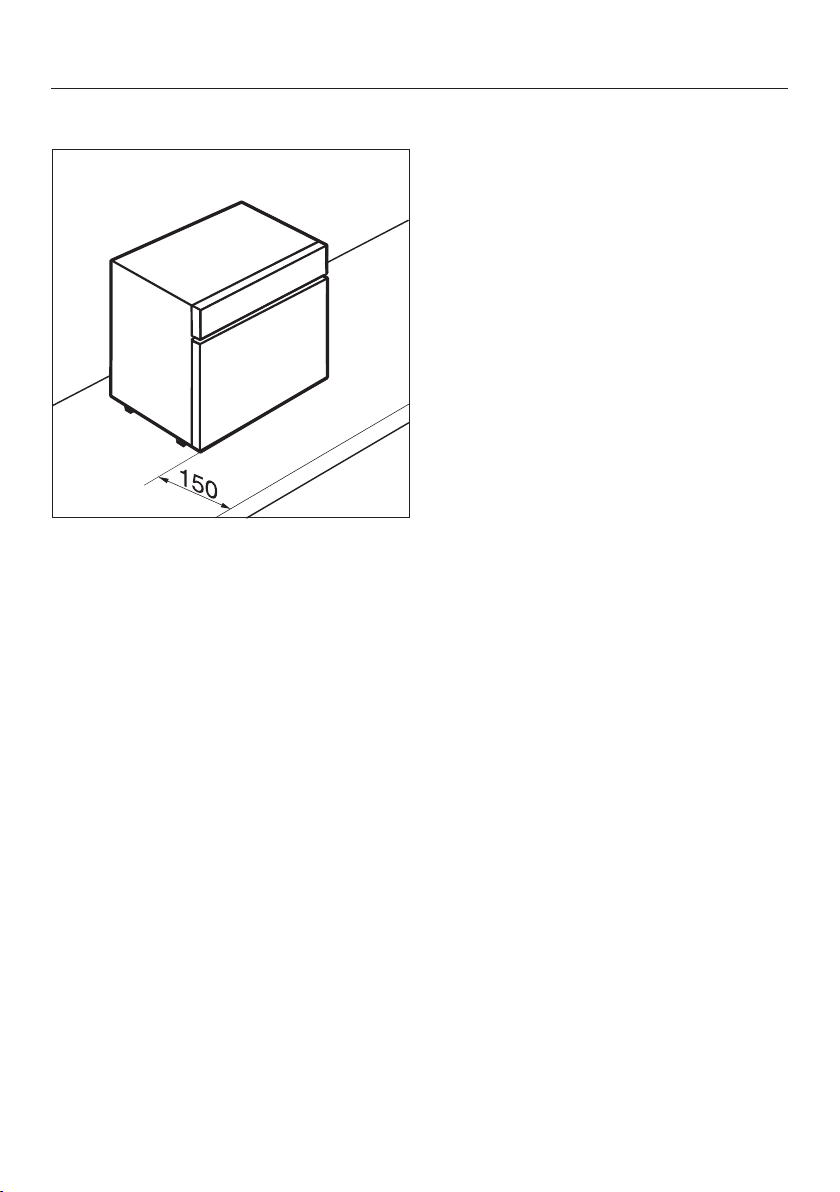
The safety distance of 150mm between the appliance door when
closed and the front edge of the worktop/table top must be at least
150mm.
Caring for the environment
14
Disposal of the packing mater-
ial
The packaging is designed to protect
the appliance from damage during
transportation. The packaging materials
used are selected from materials which
are environmentally friendly for disposal
and should be recycled.
Recycling the packaging reduces the
use of raw materials in the manufactur-
ing process and also reduces the
amount of waste in landfill sites.
Disposing of your old appli-
ance
Electrical and electronic appliances of-
ten contain valuable materials. They
also contain specific materials, com-
pounds and components, which were
essential for their correct function and
safety. These could be hazardous to hu-
man health and to the environment if
disposed of with your domestic waste
or if handled incorrectly. Please do not,
therefore, dispose of your old appliance
with your household waste.
Please dispose of it at your local com-
munity waste collection / recycling
centre for electrical and electronic ap-
pliances, or contact your dealer or
Miele for advice. You are also respons-
ible (by law, depending on country) for
deleting any personal data that may be
stored on the appliance being disposed
of. Please ensure that your old appli-
ance poses no risk to children while be-
ing stored prior to disposal.
Guide to the appliance
15
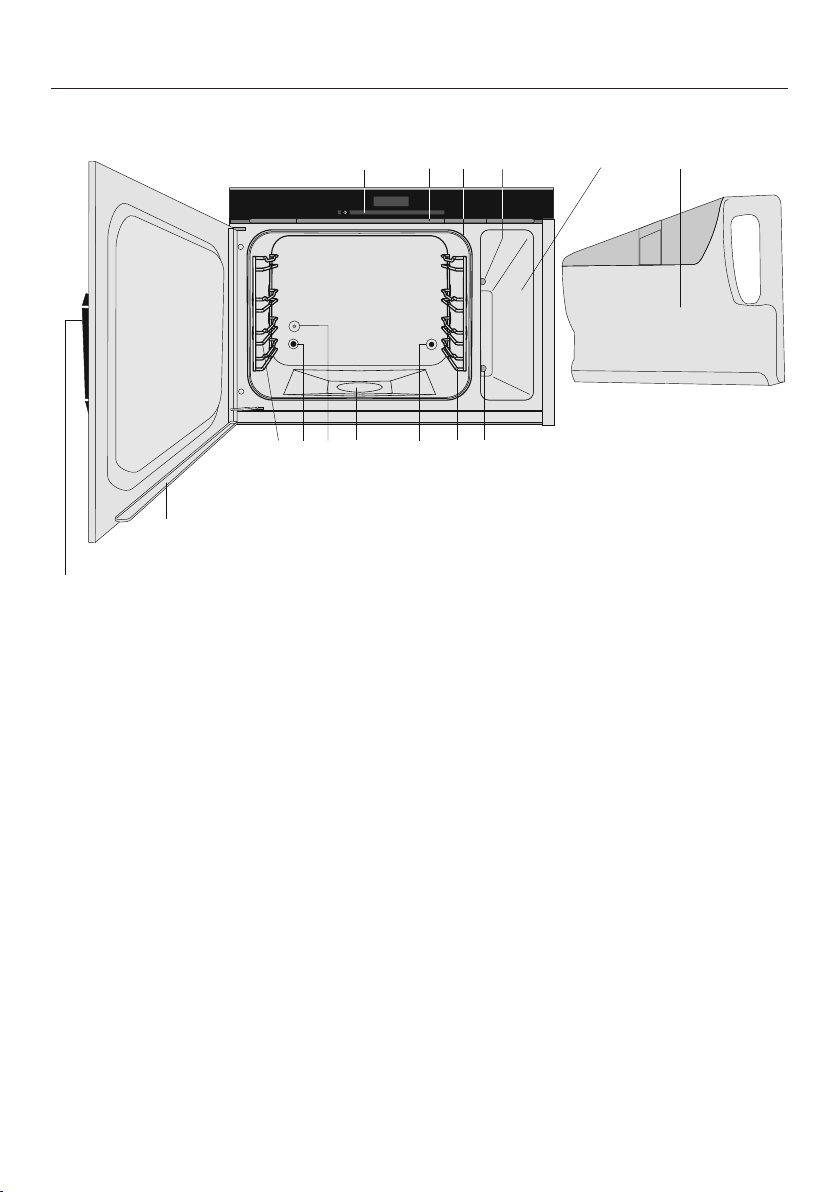
Steam oven front view
OK
b c fe
h
g
h
m
n
i
j
lk
d
a
a
Control elements
b
Ventilation outlet
c
Door seal
d
Steam channel
e
Compartment for water container
f
Water container with insert
g
Water container connection point
h
Side runners with 4 shelf levels
i
Steam inlet
j
Floor heater element
k
Temperature sensor
l
Steam outlet
m
Drip channel in the door
n
Door release
Guide to the appliance
16
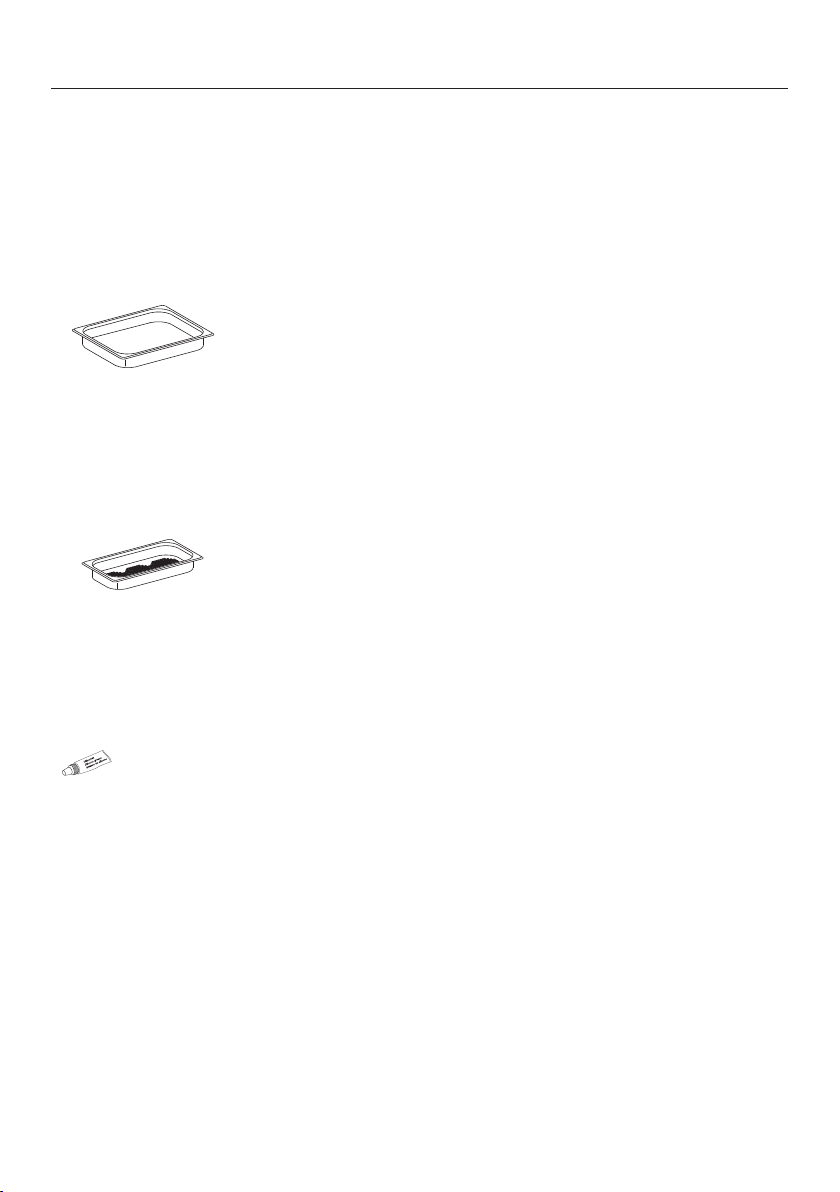
Accessories supplied
The accessories supplied with your ap-
pliance as well as a range of optional
ones are available to order from Miele
(see “Optional accessories”).
DGG 15
1 condensate tray for collecting excess
moisture, can also be used as a cook-
ing container.
325 x 265 x 40 mm (W x D x H)
DGGL1
2 perforated cooking containers
Gross capacity 1.5l
Usable capacity0.9l
325x175x40mm (WxDxH)
Silicone grease
1 tube for lubricating the coupling seal
on the water container
Descaling tablets
For descaling the appliance
Controls
17
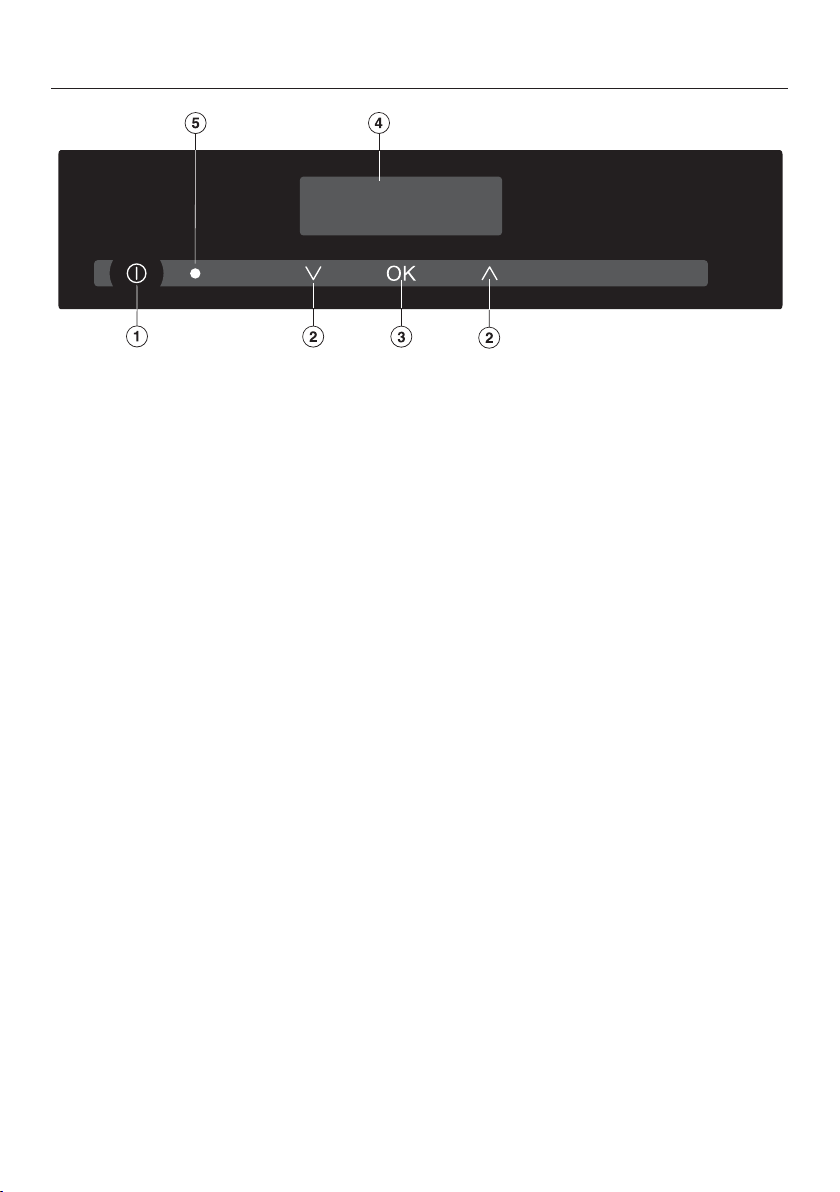
a
Recessed On/Off button
For switching the appliance on and off and accessing the descaling process
b
sensors
For setting the temperature and cooking duration and for “scrolling” through
options.
Settings are accessed using: + (see “Settings”)
c
OK sensor
For confirming input
d
Display
e
Optical interface
(for Miele service technician use only)
Controls
18
Sensor controls
The sensors react to touch. Each touch is confirmed with a keypad tone. This
keypad tone can be switched off (see “Settings”).
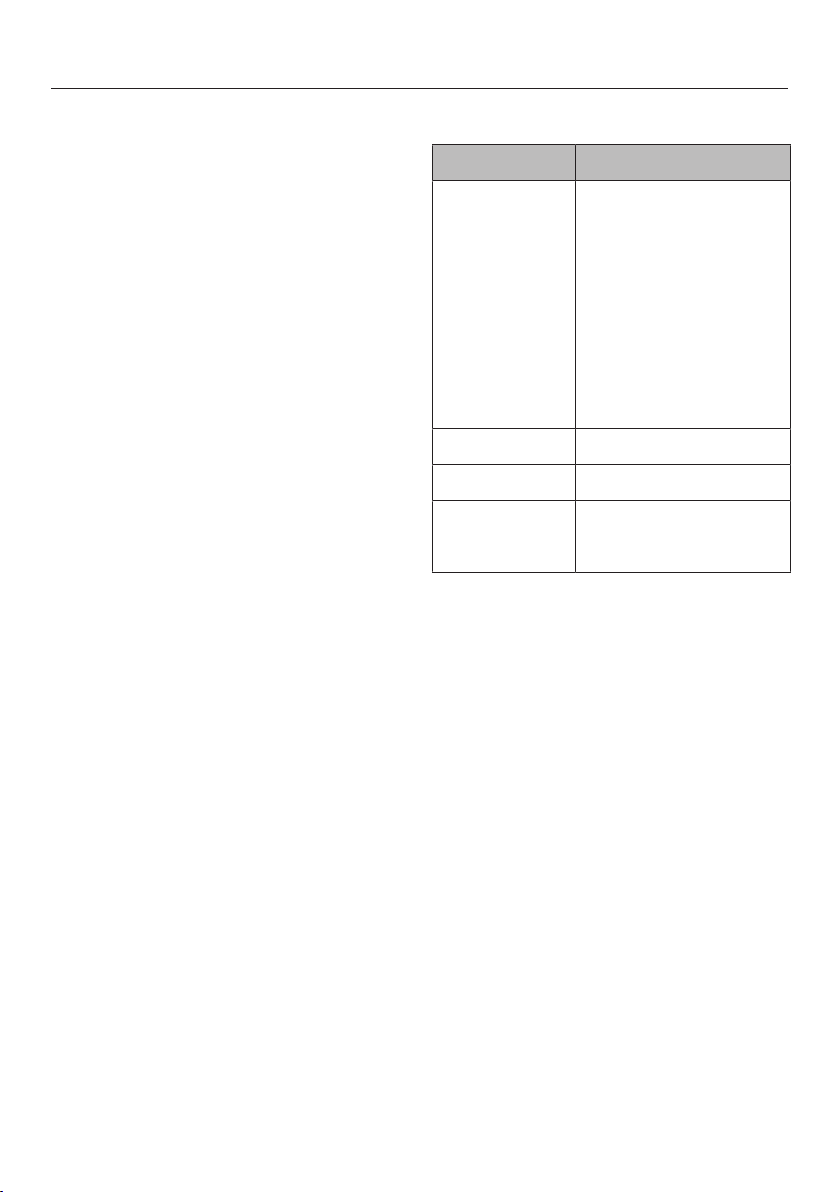
Display
Display Meaning
(flashing) Insufficient water or water container not present
Numbers + °C Temperature
Numbers + h Duration
+ number(s) The appliance needs to be descaled.
Description of functions
19
Water container
The maximum filling volume is 1.2l and
the minimum is 0.75l. There are mark-
ings on the inside and outside of the
water container. The upper marking
must never be exceeded.
The water consumption depends on the
type of food and the duration of cook-
ing. The water may need to be topped
up during cooking. The water consump-
tion is increased if the door is opened
during cooking.
If the symbol is flashing, either the
water container is not pushed in cor-
rectly or there is not enough water in it.
Condensate tray
When using perforated containers,
place the condensate tray on the lowest
shelf level to collect any drops of liquid
and allow them to be removed easily.
You can also use the condensate tray
as a cooking container if necessary.
Temperature
The steam oven has a temperature
range of 40°C to 100°C. The appliance
is set at 100°C when the oven is
switched on. You can alter the temper-
ature in 5°C steps.
Recommended temperature
Temperature When to use
100°C – Cooking all types of
food
– Reheating
– Menu cooking
(cooking whole
meals)
– Bottling
– Extracting juice
85°C – Cooking fish gently
60°C – Defrosting
40°C – Proving dough
– Making yoghurt
Cooking duration
You can set a cooking duration of
between 1minute (:) and
9hours59minutes (:). If the dura-
tion exceeds 59minutes you have to
enter it in hours and minutes.
Example: Duration 80minutes = 1:20.
Noises
You can hear the noise of the fan when
the appliance is operating. Noises sim-
ilar to those of a kettle can be heard
when steam is being generated.

Description of functions
20
Heating-up phase
During the heating-up phase the oven
compartment is heated to the set tem-
perature. The display will show the tem-
perature in the cooking compartment as
it rises.
The duration of the heating-up phase
will depend on the quantity and the
temperature of the food. In general the
heating-up phase will last for approx.
7minutes. The duration will be longer if
you are cooking refrigerated or frozen
food.
Filling the water container with hot wa-
ter will shorten the heating-up time.
Cooking phase
The cooking phase begins when the set
temperature is reached. During the
cooking phase, the duration remaining
will be shown in the display.
Before using for the first time
21
Please stick the extra data plate for
the appliance supplied with this doc-
umentation in the space provided in
the “After sales service” section of
this booklet.
Remove any protective wrapping and
stickers.
The appliance has undergone a func-
tion test in the factory. Residual water
from this testing may have trickled
back into the cabinet during transport-
ation.
Cleaning for the first time
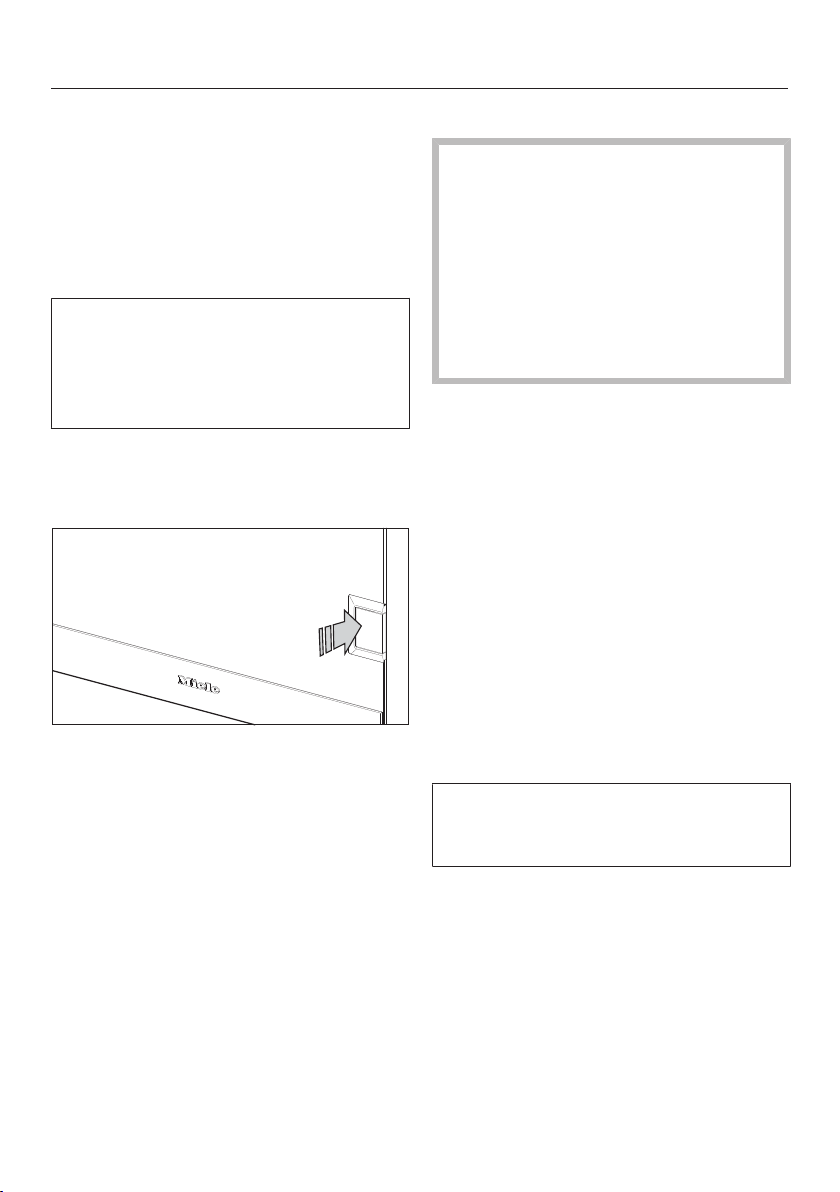
Opening the door
Open the door by pressing on the left
hand side of the door release.
The door will open slightly.
Cleaning the water container
Risk of damage due to ingress of
water.
The water container’s heating ele-
ment can become damaged if it is
exposed to water.
Do not clean the water container or
the insert in the dishwasher
and do not immerse the water con-
tainer in water.
Take the water container out of the
steam oven and remove the insert
(see “Cleaning and care” – “Water
container”).
Rinse the water container and the in-
sert thoroughly by hand using hot
water. Do not use any washing-up li-
quid or detergent.
Cleaning accessories/oven compart-
ment
Take all accessories out of the oven.
Wash the accessories in a mild solu-
tion of washing-up liquid and hot wa-
ter or in the dishwasher.
The interior of the steam oven has
been treated at the factory with a con-
ditioning agent.
To remove this, clean the oven com-
partment with a clean sponge and a
mild solution of washing-up liquid
and hot water.

Before using for the first time
22
Setting the water hardness
level
The steam oven is set to a hard water
hardness level at the factory. It must be
adjusted to the local water hardness
level to ensure that it works correctly
and to ensure that descaling is carried
out at the correct interval. The harder
the water is, the more frequently the
steam oven needs to be descaled.
Check the hardness of your local wa-
ter supply and adjust the setting if ne-
cessary (see “Settings”).
Set the correct boiling point for
water
Before cooking food for the first time,
you must adjust the boiling temperature
of the water, which varies depending on
the altitude of where the steam oven is
located. This procedure also flushes out
the waterways.
This procedure must be carried out
to ensure efficient functioning of your
appliance.
Run the steam oven for 15minutes at
100°C. Proceed as described in “Op-
eration”.
Setting the correct boiling point for
water following a house move
If you move house, the appliance will
need to be re-set for the new altitude if
this differs from the old one by 300m or
more. To do this, descale the appliance
(see “Cleaning and care” – “Descaling”).
Operation
23
Operating the steam oven
Only use drinking water. Never use
distilled or mineral water or other li-
quids.
Fill the water container and push it
into the appliance until it connects.
If the water container is not inserted
correctly, the steam oven will not heat
up and after a short time will ap-
pear in the display (see “Problem solv-
ing guide”).
Place the condensate tray on the low-
est shelf level when using perforated
containers.
Place the food in the oven.
Close the door.
Switch the steam oven on using the
On/Off button.
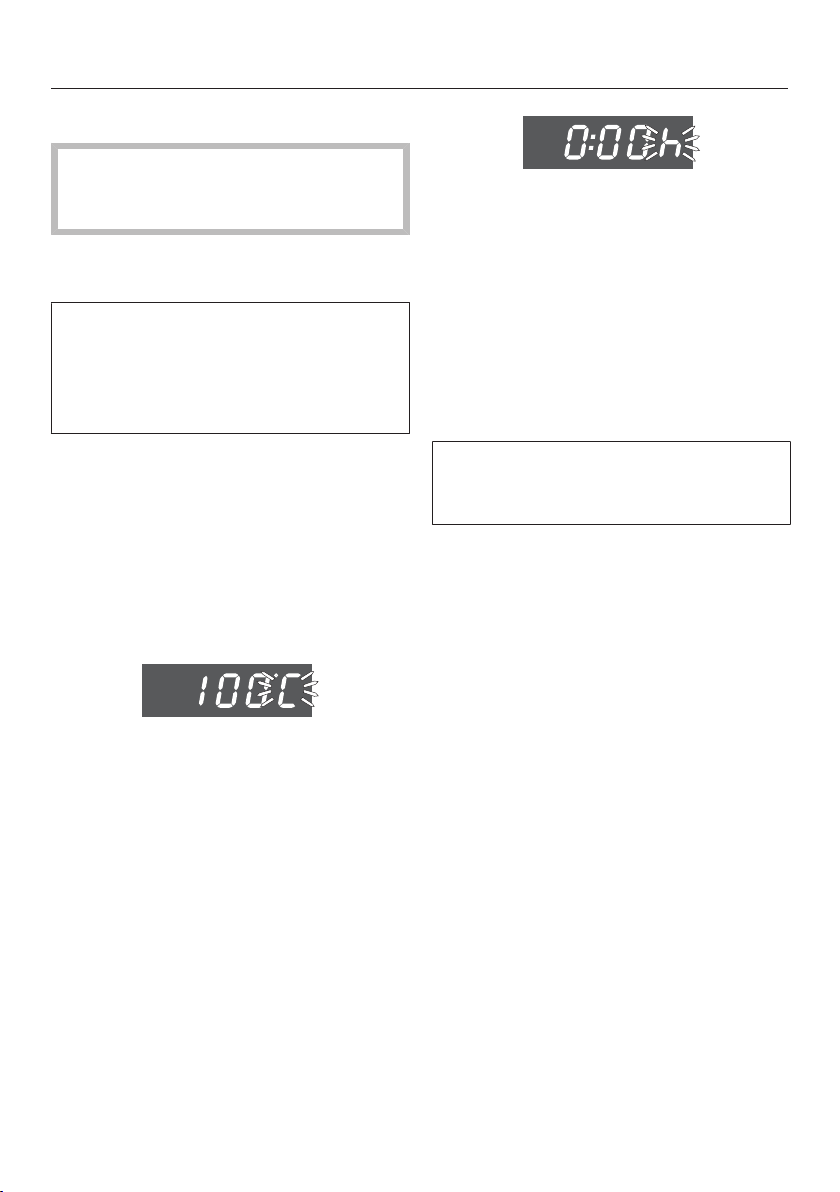
will appear in the display and ° will
start flashing.
If you want to cook with 100°C, con-
firm the setting with OK.
If you wish you can set a lower tem-
perature by touching the sensor
control. Confirm with OK.
will appear in the display and will
start flashing.
Set the cooking duration you want by
touching the sensor control (from
upwards) or (from down-
wards).
Confirm with OK.
The cooking process begins. The steam
generator and fan switch on.
If you do not complete these steps
within 15minutes, the appliance will
switch itself off.

Operation
24
Taking food out of the oven
At the end of the cooking duration, a
signal sounds and appears in the
display.
Risk of injury caused by hot sur-
faces and steam.
Steam will escape when the door is
opened. The oven compartment
walls, food and accessories get very
hot during cooking.
Open the door carefully, then step
back and wait until the steam has
dissipated.
Use oven gloves when taking food
out of the oven and when working in
the hot oven compartment.
Open the door and remove the food.
Switch the steam oven off using the
On/Off button.
If you want to reduce the fan run-on
time, you can do so by removing the
water container as soon as you have
switched the appliance off.
Cleaning the steam oven
Remove the condensate tray and
empty it.
Remove and empty the water con-
tainer. Remove the water container
by pushing it upwards slightly.
The appliance is designed in such a
way that there will always be a little
residual water left in the water con-
tainer after use. If there is no residual
water, there is something wrong. Call
Miele Service.
After each use, clean and dry the
whole appliance as described in
“Cleaning and care”.
Leave the appliance door open until
the oven compartment is completely
dry.
Refilling the water
Insufficient water is indicated by the
flashing symbol and an audible tone.
Remove the water container and fill it
with fresh tap water.
Push the water container into the ap-
pliance until it connects.
Close the door.
Operation will continue.

Operation
25
Changing settings during a pro-
gramme
You can alter the temperature and
cooking duration at any time during op-
eration.
Changing the temperature
Touch OK briefly once.
The display will change to the temperat-
ure setting and ° will flash.
Set the temperature as described
earlier.
Changing the cooking duration
Touch OK briefly twice.
The display will change to the cooking
duration setting and will flash.
Set the cooking duration as de-
scribed earlier.
Interrupting operation
Operation is interrupted as soon as the
door is opened. The heating will be
switched off and the cooking duration
will remain stored in the memory.
Risk of injury caused by hot sur-
faces and steam.
Steam will escape when the door is
opened. The oven compartment
walls, food and accessories get very
hot during cooking.
Open the door carefully, then step
back and wait until the steam has
dissipated.
Use oven gloves when taking food
out of the oven and when working in
the hot oven compartment.
Operation will resume when the door is
closed.
When the door is closed, the pressure
has to equalise, which can cause a
whistling sound.
The steam oven will heat up again and
the display will show the temperature in
the oven compartment as it rises.
Once the set temperature has been
reached, the display will change to
show the cooking duration remaining as
it counts down.
The cooking programme will finish
early if the door is opened in the last
minute of cooking.

Operation
26
Pre-heat
Your appliance has a pre-heating func-
tion. This heats the oven interior to ap-
prox. 40 °C. The heating-up time is then
shorter as the oven interior is pre-
heated and therefore the cooking pro-
cess takes less time.
The appliance is delivered with this
function deactivated. If you wish to use
it you will need to alter the setting (see
“Settings”).
When the pre-heating function has
been activated you can still choose
whether you want to use it for each pro-
gramme.
The water container must be filled with
water for pre-heating and present in
the appliance.
The pre-heating process will be can-
celled if the door is opened. You can
start the process again by switching
the appliance off and then back on
again.
Using pre-heat
Switch the steam oven on.
will appear in the display and ° will
start flashing. Do not confirm.
After a few seconds the pre-heating
process will begin and the display will
show the temperature as it rises.
When pre-heating is finished, will
appear in the display and ° will flash.
Place the food in the oven.
Set the temperature and duration as
normal.
Not using pre-heat
Place the food in the oven.
Switch the steam oven on.
will appear in the display and ° will
start flashing.
Confirm this with OK or set the re-
quired temperature as normal.
Set the cooking duration as de-
scribed earlier.

General notes
27
This section contains general informa-
tion. You will find more detailed inform-
ation about particular foods and how to
cook them in the other sections.
The advantages of cooking
with steam
Almost all vitamins and minerals are re-
tained as the food is not immersed in
water.
Cooking with steam also retains the
true taste of the food better than con-
ventional cooking. We therefore recom-
mend seasoning the food after it has
been cooked. Food also retains its
fresh, original colour.
Suitable containers
Cooking containers
This steam oven is supplied with stain-
less steel cooking containers. Other
containers, in a variety of sizes, both
perforated and solid, are available as
optional extras (see “Optional accessor-
ies”). This enables you to choose the
most suitable container for the food you
are cooking.
It is best to use perforated containers
for steam cooking. The steam can
reach the food from all sides and the
food is cooked evenly.
Your own containers
You can also use your own containers.
However, please note the following:
– Containers must be heat-resistant to
100°C and able to withstand hot
steam. With plastic containers please
check with the manufacturer that
they are suitable for use in a steam
oven.
– Thick-sided containers made from
porcelain, china or stoneware, for ex-
ample, are not so suitable for steam
cooking. They do not conduct heat
well and as a result cooking durations
will be considerably longer than
those given in the charts.
– Place the cooking container in a suf-
ficiently large perforated container,
not on the oven floor.
– Ensure that there is a gap between
the upper rim of the container and
the top of the cooking compartment
to allow sufficient steam into the con-
tainer.
Condensate tray
When using perforated containers,
place the condensate tray on the lowest
shelf level to collect any drops of liquid
and allow them to be removed easily.
You can also use the condensate tray
as a cooking container if necessary.

General notes
28
Shelf level
You can select any shelf level. You can
also cook on several levels at the same
time. This will not alter the cooking dur-
ation.
Always insert cooking containers and
the rack between the rails of the side
runners so that they cannot tip.
Frozen food
The heating up phase for frozen food is
longer than for fresh food. The greater
the quantity of frozen food, the longer
the heating up phase.
Temperature
A maximum temperature of 100°C is
reached when steam cooking is taking
place. Most types of food will cook at
this temperature. Some more delicate
types of food, such as soft fruit, must
be cooked at lower temperatures as
otherwise they will burst. More informa-
tion is given in the relevant section.
Combination with a food warming
drawer
When the warming drawer is in use the
oven cavity in the steam oven can get
up to 40°C. If, in this case, you set a
temperature of 40°C, no steam will be
produced because the oven cavity is
too warm.
Duration
In general, the cooking durations for
cooking with steam are the same as for
cooking food in a saucepan. More in-
formation about any factors which may
affect the cooking duration is given in
the relevant sections.
The quantity of food does not affect the
cooking duration. 1 kg of potatoes will
take the same time to cook as 500 g.
The durations given in the charts are
guidelines only. We recommend select-
ing the shorter cooking duration quoted
to start with. If food is not cooked suffi-
ciently after the shorter time it can be
put back in the oven and cooked for
longer.
Cooking with liquid
When cooking with liquid only fill the
cooking container ²/₃full to prevent the
liquid spilling when the cooking con-
tainer is removed from the oven.
Your own recipes
Food which is cooked in a pot or a pan
can also be cooked in the steam oven.
The cooking durations in the steam
oven will be the same. Please note that
food will not be brown or crisp when
cooking with steam.

Steam cooking
29
Vegetables
Fresh
Prepare fresh vegetables in the usual
way, i.e. wash, clean and cut them up.
Frozen food
Frozen vegetables do not need to be
defrosted beforehand, unless they have
been frozen together in a block.
Frozen and fresh vegetables which take
the same length of time to cook can be
cooked together.
If vegetables have frozen together in
clumps, break these up before cooking
with steam. Follow the manufacturer’s
instructions on the packaging regarding
cooking duration.
Cooking containers
Food such as peas or asparagus
spears, which have little or no space
between them, will take longer to cook
because the steam has less space to
work in. For an even result, it is best to
use a shallow container for these types
of food, and only fill it about 3-5cm
deep. When cooking large quantities di-
vide the food between 2 or 3 shallow
containers rather than using one deep
one.
Different types of vegetables which take
the same length of time to cook can be
cooked together.
Use solid containers for vegetables
which are cooked in liquid.
Shelf level
To avoid any colour transfer when cook-
ing vegetables with a distinctive colour
(e.g. beetroot) in a perforated container,
do not place other food underneath the
perforated container.
Duration
As with conventional methods, the
cooking duration when cooking veget-
ables with steam will depend on the
size and how well done you want them.
Example:
firm potatoes, cut into quarters
= approx. 17minutes
firm potatoes, cut in half
= approx. 21minutes
Settings
Temperature: 100°C
Duration: see chart
Steam cooking
30
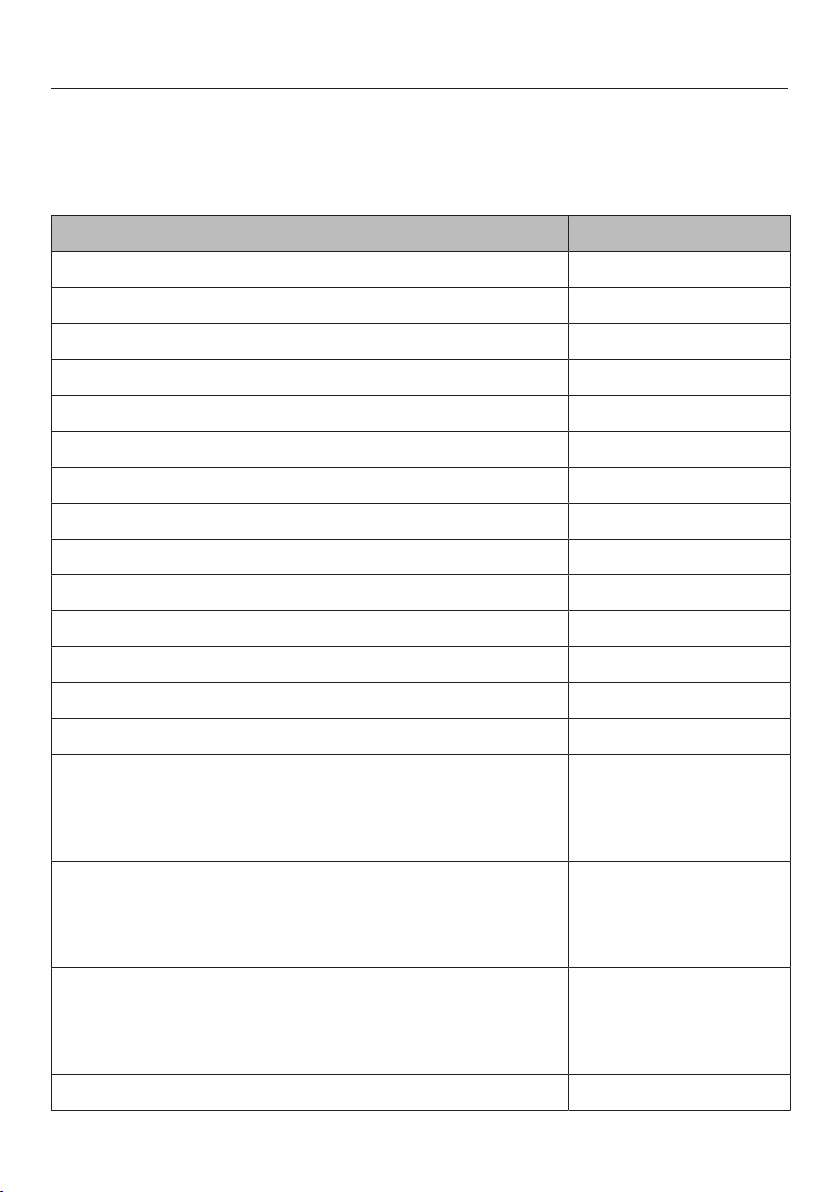
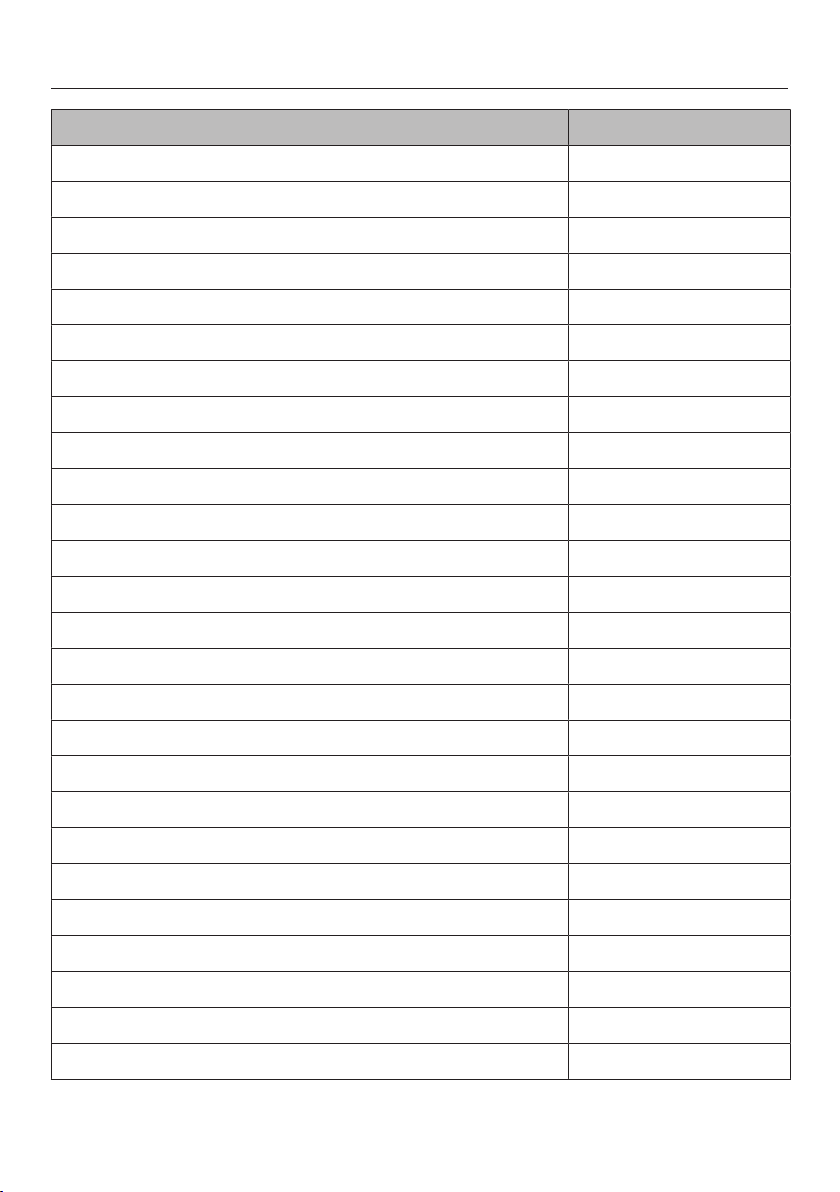
The durations given in the chart are guidelines for fresh vegetables. We recom-
mend selecting the shorter cooking duration quoted. If food is not cooked suffi-
ciently after the shorter duration it can be put back in the oven and cooked for
longer.
Vegetables [min]
Artichokes 32–38
Cauliflower, whole 27–28
Cauliflower, florets 8
Beans, green 10–12
Broccoli, florets 3–4
Chantenay carrots, whole 7–8
Chantenay carrots, halved 6–7
Chantenay carrots, chopped 4
Chicory, halved 4–5
Chinese cabbage, chopped 3
Peas 3
Fennel, halved 10–12
Fennel, cut into strips 4–5
Curly kale, chopped 23–26
Firm potatoes, peeled
whole
halved
quartered
27–29
21–22
16–18
Fairly firm potatoes, peeled
whole
halved
quartered
25–27
19–21
17–18
Floury potatoes, peeled
whole
halved
quartered
26–28
19–20
15–16
Kohlrabi, cut into batons 6–7
Steam cooking
31
Vegetables [min]
Pumpkin, diced 2–4
Corn on the cob 30–35
Chard, chopped 2–3
Peppers, diced / cut into strips 2
New potatoes, firm 30–32
Mushrooms 2
Leeks, sliced 4–5
Leeks, halved lengthwise 6
Romanesco, whole 22–25
Romanesco, florets 5–7
Brussels sprouts 10–12
Beetroot, whole 53–57
Red cabbage, chopped 23–26
Black salsify, whole 9–10
Celeriac, cut into batons 6–7
Green asparagus 7
White asparagus 9–10
Main crop carrots, chopped 6
Spinach 1–2
Spring cabbage, chopped 10–11
Celery, chopped 4–5
Swede, chopped 6–7
White cabbage, chopped 12
Savoy cabbage, chopped 10–11
Courgettes, sliced 2–3
Sugar snap peas 5–7
Duration

Steam cooking
32
Meat
Fresh
Prepare the meat in the usual way.
Frozen food
Meat should be thoroughly defrosted
before cooking in the steam oven (see
“Special applications” – “Defrost”).
Preparation
For meat which needs to be seared be-
fore being cooked, e.g. for a stew, sear
the meat in a pan on the hob first.
Duration
The cooking duration depends on the
thickness and the texture of the meat,
and not on the weight. The thicker the
piece of meat, the longer the cooking
duration. A piece of meat weighing
500g which is 10 cm thick will take
longer to cook than a piece of meat
weighing 500g which is 5 cm thick.
Tips
– Use a perforated container to retain
the juices when cooking meat. Place
a solid container underneath to catch
the juices. You can use these to make
a gravy or freeze them for later use.
– Boiling fowl, back or top rib and meat
bones can be used to make stock.
Place the meat together with some
mixed vegetables in a solid cooking
container and add cold water and
cook. The longer the cooking dura-
tion, the stronger the stock.
Settings
Temperature: 100°C
Duration: see chart
Steam cooking
33
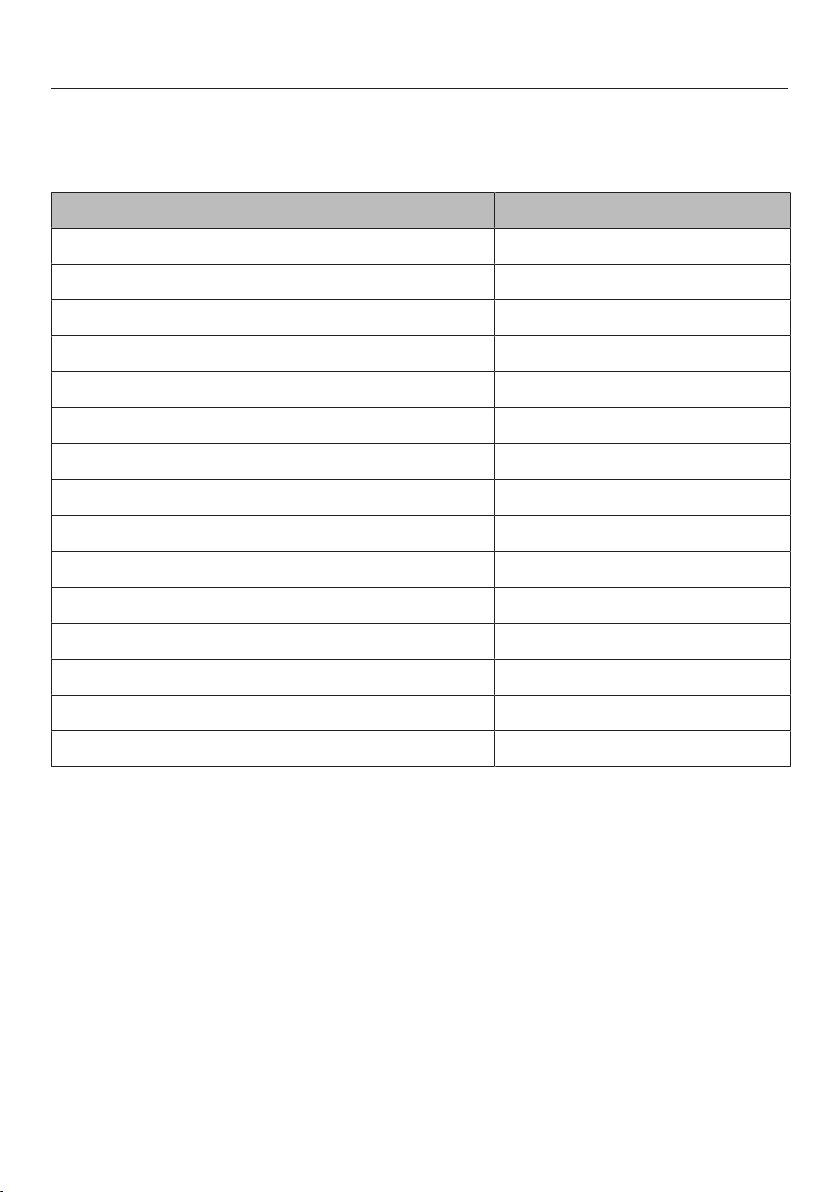
The durations given in the charts are guidelines only. We recommend selecting the
shorter cooking duration quoted to start with. If food is not cooked sufficiently
after the shorter time it can be put back in the oven and cooked for longer.
Meat [min]
Leg steak, covered with water 110–120
Knuckle 135–140
Chicken breast 8–10
Shank 105–115
Top rib, covered with water 110–120
Veal cutlets 3–4
Gammon slices 6–8
Lamb stew 12–16
Poularde 60–70
Turkey roulade 12–15
Turkey escalope 4–6
Brisket, covered with water 130–140
Beef stew 105–115
Boiling fowl, covered with water 80–90
Boiled topside 110–120
Duration

Steam cooking
34
Sausages
Settings
Temperature: 90°C
Duration: see chart
Sausages [min]
Frankfurters 6–8
Bologna sausages 6–8
Veal sausages 6–8
Duration
Fish
Fresh
Prepare fresh fish in the usual way, i.e.
clean, gut and fillet.
Frozen food
Fish does not need to be fully defrosted
before cooking. Defrost so that the sur-
face is sufficiently thawed to take herbs
and seasoning. Depending on the thick-
ness of the fish, 2 - 5 minutes should be
enough.
Preparation
Add some lemon or lime juice to fish
before cooking. The citric acid helps the
flesh stay firm.
It is not necessary to season fish with
salt when cooking with steam as this
method retains the minerals which give
the fish its unique flavour.
Cooking containers
If using a perforated container, grease it
first.
Shelf level
When cooking fish in a perforated con-
tainer at the same time as cooking
other types of food in other containers,
place the container with the fish directly
above the condensate tray/universal
tray (depending on model) to catch any
liquid and so avoid any transfer of
tastes to other food.

Steam cooking
35
Temperature
85°C – 90°C
For gently cooking delicate types of
fish, such as sole.
100°C
For cooking firmer types of fish, e.g.
cod and salmon.
Also for cooking fish in sauce or stock.
Duration
The cooking duration depends on the
thickness and the texture of the fish,
and not on the weight. The thicker the
fish, the longer the cooking duration. A
3 cm thick piece of fish weighing 500 g
will take longer to cook than a 2 cm
thick piece of fish weighing 500 g.
The longer fish cooks, the firmer its
flesh will become. Use the cooking dur-
ations given in the chart. If you find that
the fish is not cooked sufficiently only
cook it for a few minutes more.
When cooking fish in sauce or stock,
we recommend that you increase the
cooking duration quoted by a few
minutes.
Tips
– Adding herbs and spices, such as
dill, will help bring out the full flavour
of the fish.
– Cook large fish in the swimming posi-
tion. To help maintain the shape of
the fish, place a small cup or similar
upside down in the cooking con-
tainer, and arrange the fish bellyside
down over the cup.
– You can use any fish scraps, e.g. fish
heads, bones, tails etc to make a fish
stock. Place the fish scraps together
with some mixed vegetables in a
solid cooking container and add cold
water. Cook at 100°C for 60 to
90minutes. The longer the cooking
duration, the stronger the stock.
– Blue fish is fish which is cooked in
water and vinegar. It is important not
to damage the skin of the fish. This
method is suitable for cooking carp,
trout, tench, eel and salmon. (Follow
recipe instructions for the ratio of wa-
ter to vinegar).
Settings
Temperature: see chart
Duration: see chart
Steam cooking
36
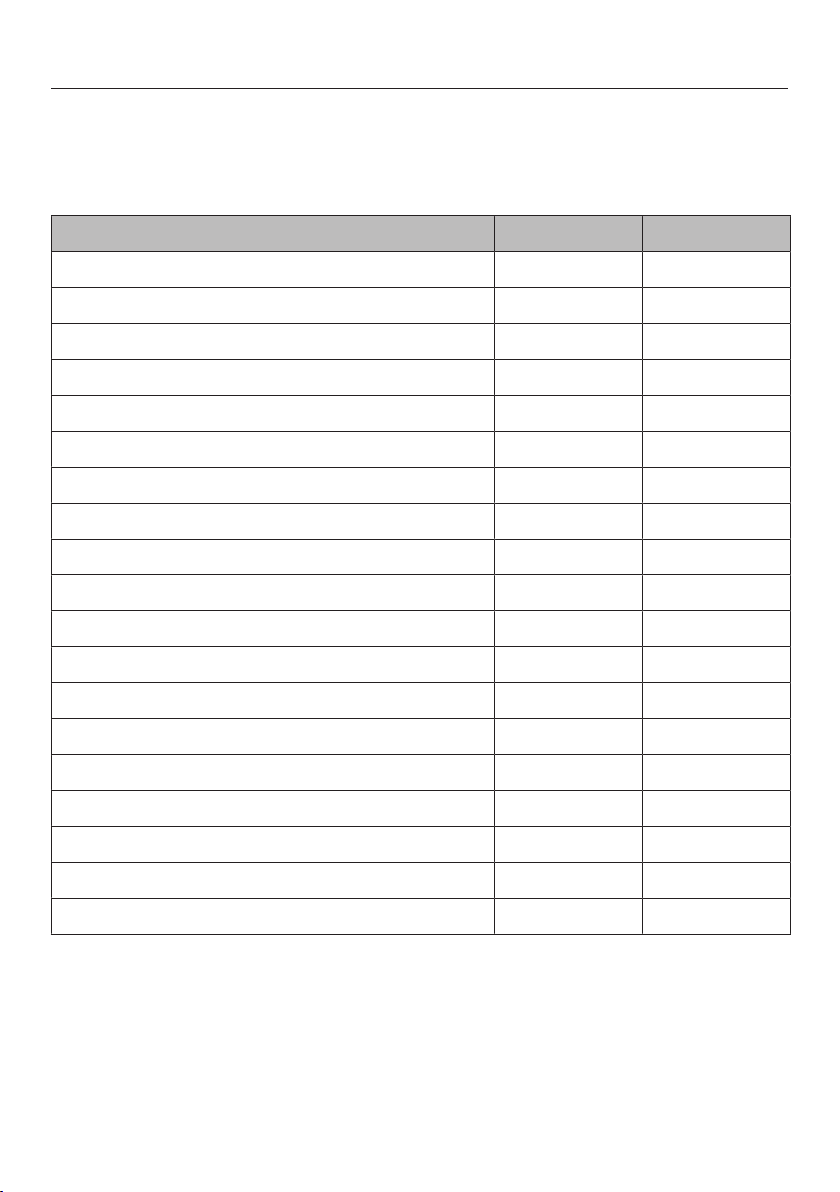
The cooking durations given in the chart are guidelines for fresh fish. We recom-
mend selecting the shorter cooking duration quoted. If food is not cooked suffi-
ciently after the shorter duration it can be put back in the oven and cooked for
longer.
Fish [°C] [min]
Eel 100 5–7
Perch fillet 100 8–10
Seabream fillet 85 3
Trout, 250g 90 10–13
Halibut fillet 85 4–6
Cod fillet 100 6
Carp, 1.5kg 100 18–25
Salmon fillet 100 6–8
Salmon steak 100 8–10
Salmon trout 90 14–17
Basa fillet 85 3
Rosefish fillet 100 6–8
Haddock fillet 100 4–6
Plaice fillet 85 4–5
Monkfish fillet 85 8–10
Sole fillet 85 3
Turbot fillet 85 5–8
Tuna fillet 85 5–10
Pike perch fillet 85 4
Temperature Duration
Steam cooking
37
Shellfish
Preparation
Defrost frozen shellfish before cooking with steam.
Peel, remove and discard the intestines, and then wash the shellfish.
Cooking containers
If using a perforated container, grease it first.
Duration
The longer shellfish are cooked, the tougher they become. Use the cooking dura-
tions given in the chart.
When cooking shellfish in sauce or stock, we recommend that you increase the
cooking duration quoted by a few minutes.
Settings
Temperature: see chart
Duration: see chart
[°C] [min]
Crevettes 90 3
Prawns 90 3
King prawns 90 4
Small shrimps 90 3
Lobster 95 10–15
Large shrimps 90 3
Temperature Duration
Steam cooking
38
Mussels
Fresh food
Danger of food poisoning from spoiled mussels.
Spoiled mussels can cause food poisoning.
Only cook mussels which are closed.
Do not eat mussels which have not opened after being cooked.
Steep fresh mussels in water for a few hours before cooking to rinse out any sand.
Then scrub the mussels thoroughly to clean them.
Frozen food
Defrost frozen mussels before cooking.
Duration
The longer mussels are cooked, the tougher they become. Use the cooking dura-
tions given in the chart.
Settings
Temperature: see chart
Duration: see chart
[°C] [min]
Barnacles 100 2
Cockles 100 2
Mussels 90 12
Scallops 90 5
Razor clams 100 2–4
Venus clams 90 4
Temperature Duration
Steam cooking
39
Rice
Rice swells when cooked and needs to be cooked in liquid. The proportion of rice
to liquid will vary depending on the type of rice.
The rice absorbs all the liquid during the cooking process and so none of the nutri-
ents are lost.
Settings
Temperature: 100°C
Duration: see chart
Ratio
Rice : Liquid
[min]
Basmati rice 1:1.5 15
Parboiled rice 1:1.5 23–25
Round grain rice
Pudding rice
Risotto rice
1:2.5
1:2.5
30
18–19
Brown rice 1:1.5 26–29
Wild rice 1:1.5 26–29
Duration
Steam cooking
40
Pasta
Dry pasta
Dry pasta swells when it is cooked and needs to be cooked in liquid. The liquid
must cover the pasta. Using hot liquid gives better results.
Increase the cooking time stated by the manufacturer by approx.¹/₃.
Fresh food
Fresh pasta, such as the kind you can buy from the supermarket chilled counter,
does not need to absorb water. Cook fresh pasta in a greased perforated con-
tainer.
Separate any pieces of pasta which have stuck together and spread them out in
the cooking container.
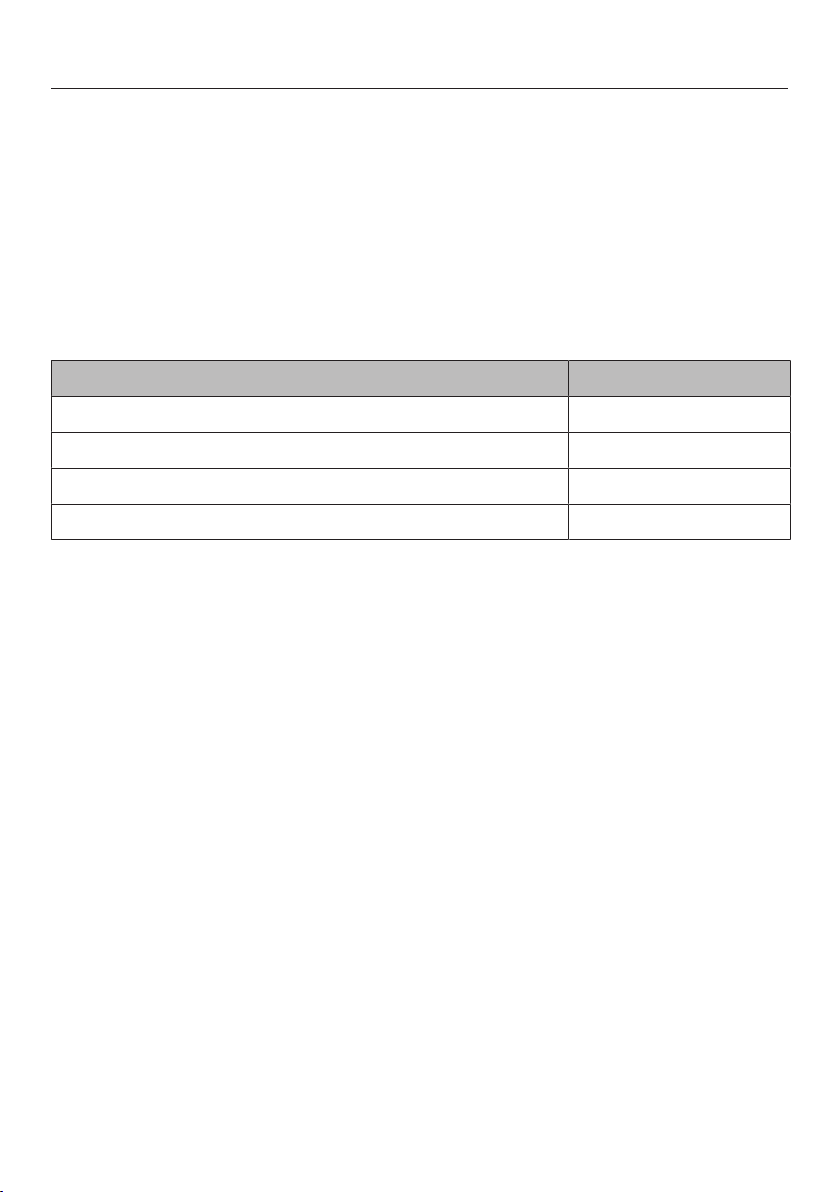
Settings
Temperature: 100°C
Duration: see chart
Fresh [min]
Gnocchi 2
Knöpfli 1
Ravioli 2
Spätzle 1
Tortellini 2
Dry pasta,
covered with water
Tagliatelli 14
Vermicelli 8
Duration
Steam cooking
41
Dumplings
Ready made boil-in-the-bag dumplings need to be well covered with water as oth-
erwise they can fall apart. This is because even though they have been soaked in
water beforehand they will not absorb enough moisture.
Cook fresh dumplings in a greased, perforated container.
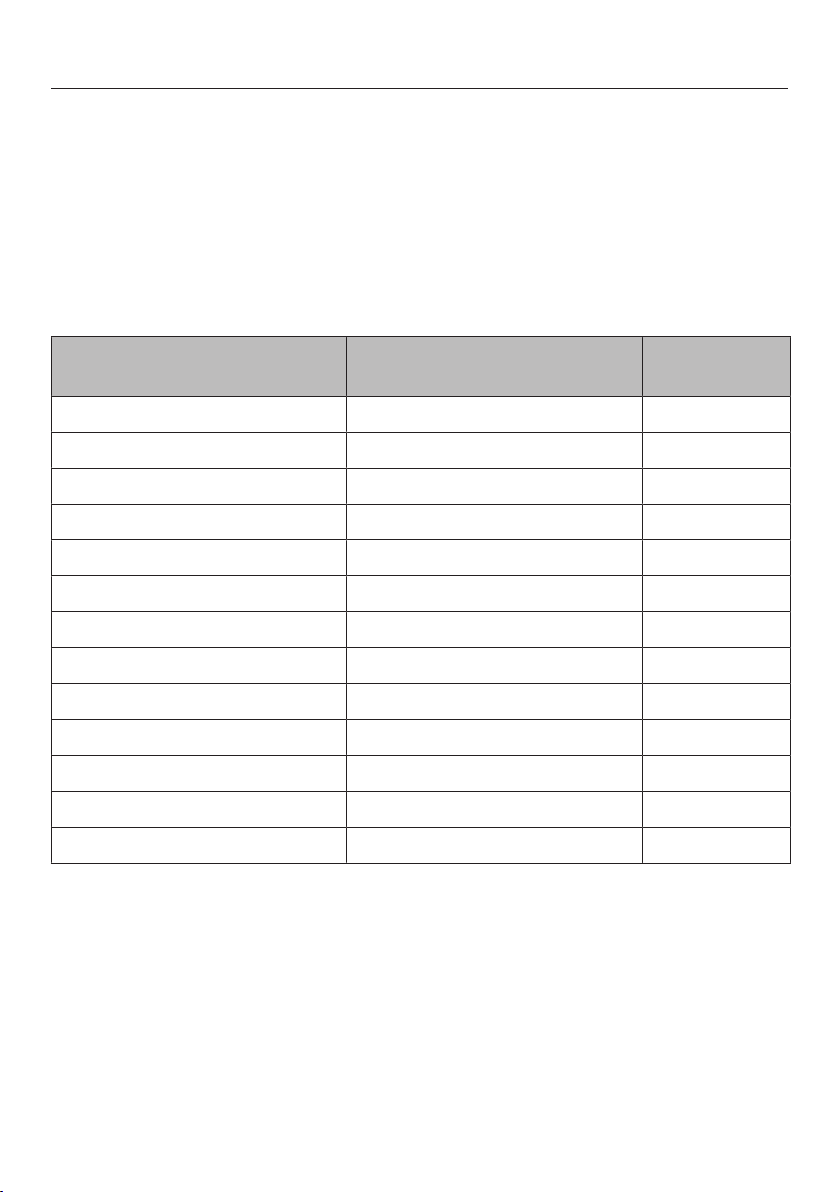
Settings
Temperature: 100°C
Duration: see chart
[min]
Sweet dumplings 30
Yeast dumplings 20
Boil-in-the-bag potato dumplings 20
Boil-in-the-bag bread dumplings 18–20
Duration
Steam cooking
42
Grain
Grain swells during cooking and needs to be cooked in liquid. The proportion of
grain to liquid depends on the type of grain.
Grain can be cooked whole or cracked.
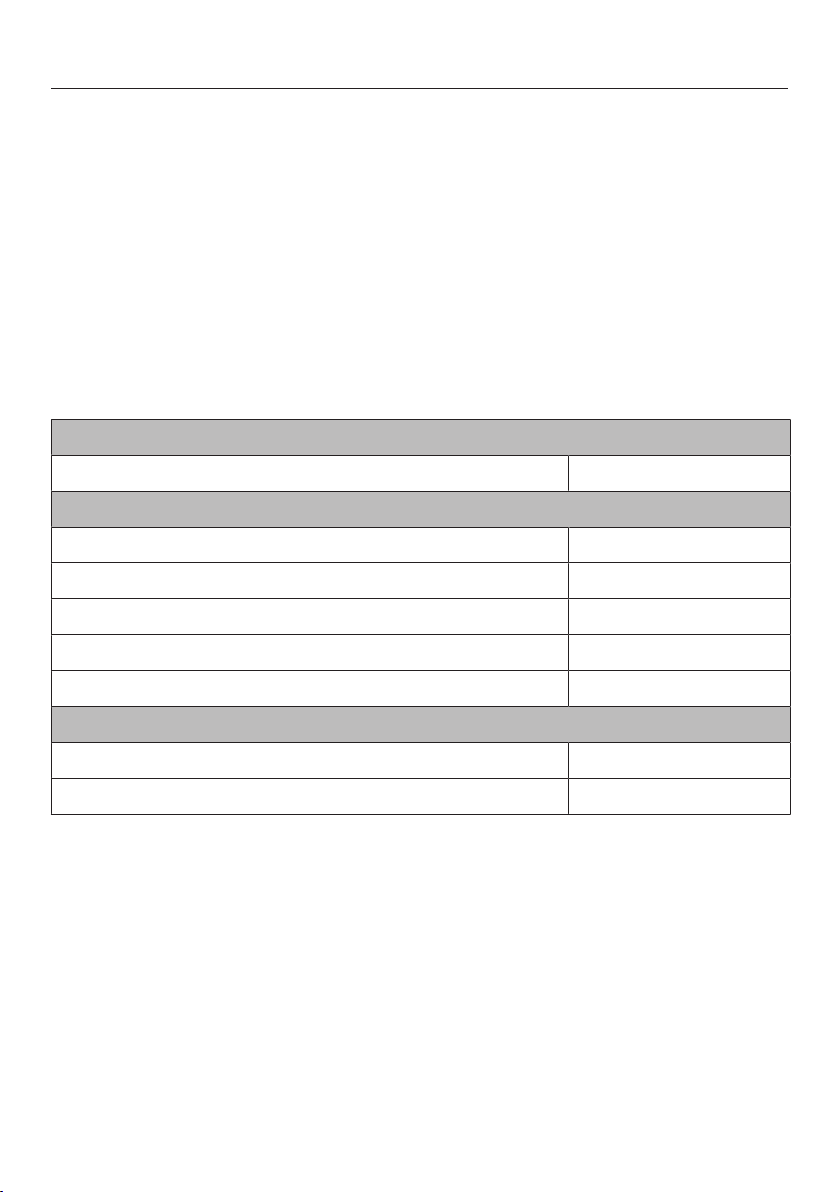
Settings
Temperature: 100°C
Duration: see chart
Ratio
Grain : Liquid
[min]
Amaranth 1:1.5 15–17
Bulgur 1:1.5 9
Green spelt, whole 1:1 18–20
Green spelt, cracked 1:1 7
Oats, whole 1:1 18
Oats, cracked 1:1 7
Millet 1:1.5 10
Polenta 1:3 10
Quinoa 1:1.5 15
Rye, whole 1:1 35
Rye, cracked 1:1 10
Wheat, whole 1:1 30
Wheat, cracked 1:1 8
Duration
Steam cooking
43
Dried pulses
Soak pulses for at least 10 hours in cold water before cooking. Soaking makes the
pulses more digestible and shortens the cooking duration required. Soaked pulses
must be covered with liquid during cooking.
Lentils do not need to be soaked before cooking.
With unsoaked pulses a certain ratio of pulses to liquid is required depending on
variety.
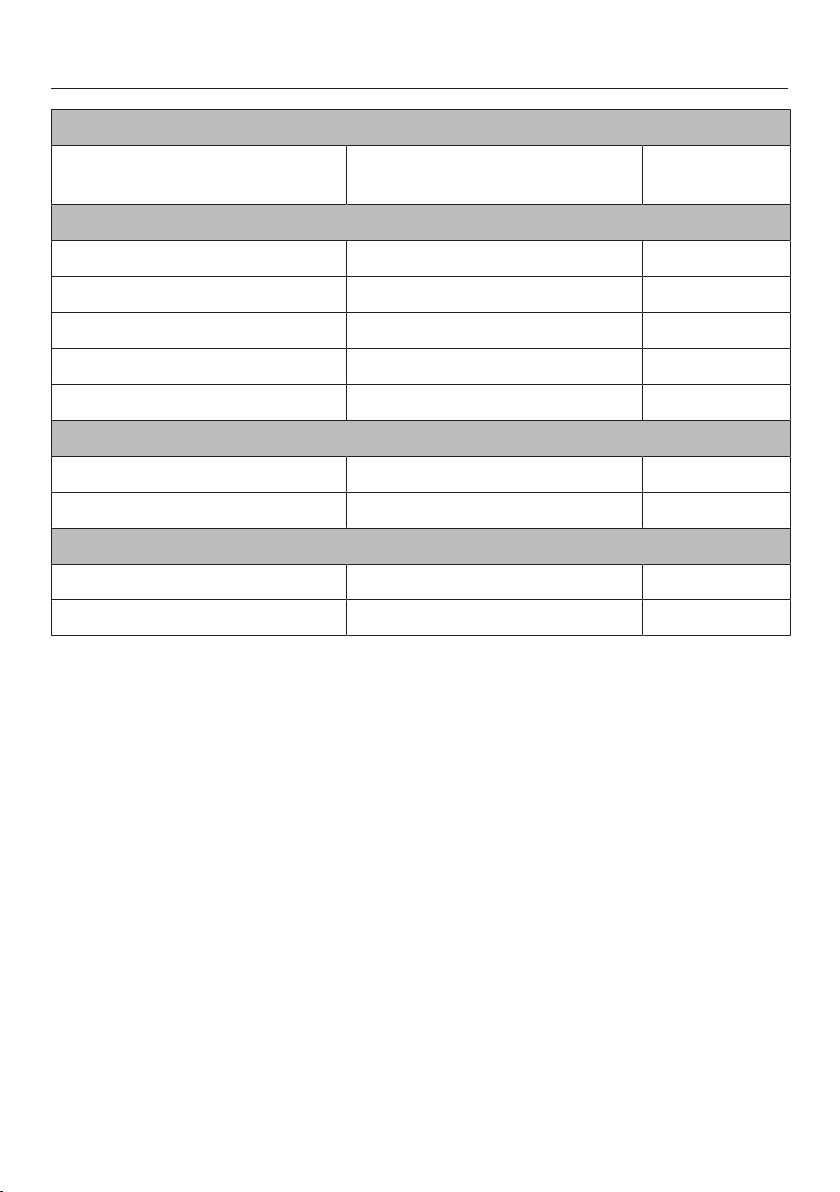
Settings
Temperature: 100°C
Duration: see chart
Soaked
[min]
Beans
Kidney beans 55–65
Adzuki beans 20–25
Black beans 55–60
Pinto beans 55–65
Haricot beans 34–36
Peas
Yellow split peas 40–50
Green split peas 27
Duration
Steam cooking
44
Unsoaked
Ratio
Pulses : Liquid
[min]
Beans
Kidney beans 1:3 130–140
Adzuki beans 1:3 95–105
Black beans 1:3 100–120
Pinto beans 1:3 115–135
Haricot beans 1:3 80–90
Lentils
Brown lentils 1:2 13–14
Red lentils 1:2 7
Peas
Yellow split peas 1:3 110–130
Green split peas 1:3 60–70
Duration

Steam cooking
45
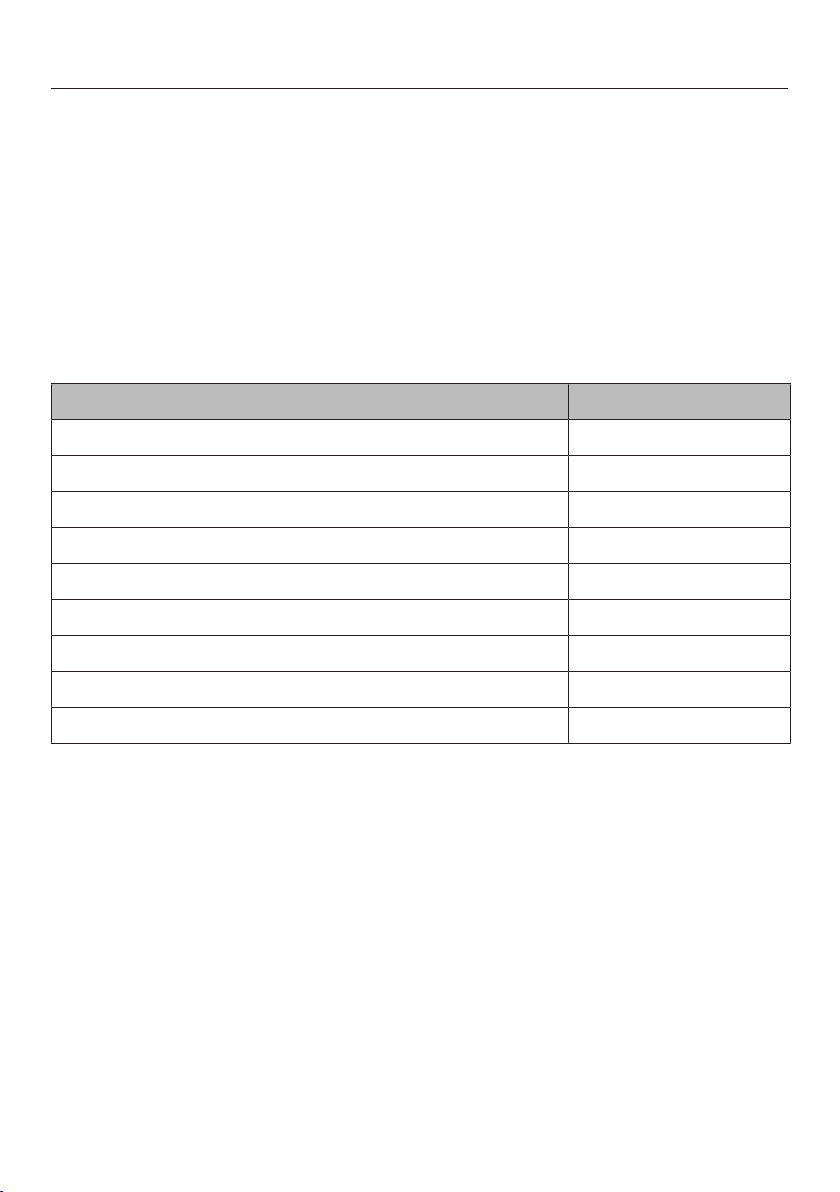
Hen's eggs
Use a perforated container to boil eggs in the steam oven.
The eggs do not need to be pierced before cooking as they are gradually warmed
during the heating up phase and so do not burst when they are cooked with
steam.
When using a solid container for making egg dishes such as scrambled eggs, re-
member to grease it first.
Settings
Temperature: 100°C
Duration: see chart
[min]
Small
soft
medium
hard
3
5
9
Medium
soft
medium
hard
4
6
10
Large
soft
medium
hard
5
6–7
12
Extra large
soft
medium
hard
6
8
13
Duration
Steam cooking
46
Fruit
Cook fruit in a solid container so that none of the juice is lost. If you wish to cook
fruit in a perforated container, place a solid container directly underneath it to col-
lect the juice.
Tip: You can use the juice which has collected in the solid container to make a
glaze for a fruit flan.
Settings
Temperature: 100°C
Duration: see chart
[min]
Apple pieces 1–3
Pear chunks 1–3
Cherries 2–4
Mirabelle plums 1–2
Nectarine / Peach pieces 1–2
Plums 1–3
Quince, diced 6–8
Rhubarb pieces 1–2
Gooseberries 2–3
Duration
Steam cooking
47
Menu cooking (cooking whole
meals)
You can use the steam oven to cook a
whole meal containing types of food
which have different cooking durations,
e.g. fish fillet with rice and broccoli.
Each dish is placed in the oven at dif-
ferent times so that they are all ready at
the same time.
Shelf level
When cooking fish or food with a dis-
tinctive colour (e.g. beetroot) in a per-
forated container, place the perforated
container directly above the condensate
tray / universal tray (depending on
model) to avoid any transfer of flavour
or colour to other food and to prevent li-
quid dripping onto food below it.
Temperature
Whole meals should be cooked at a
temperature of 100°C as this is the
temperature required to cook the major-
ity of foods.
Do not cook a whole meal at the lowest
temperature when different temperat-
ures are required for different types of
food, e.g. 85°C for seabream and
100°C for potatoes.
If the recommended cooking temperat-
ure for the food is 85°C for example, try
cooking it at 100°C and testing the res-
ult. Some delicate types of fish with a
soft structure, e.g. sole and plaice will
become very firm when cooked at
100°C.
Duration
If you are increasing the recommended
temperature, shorten the cooking dura-
tion by approx. ¹/₃.
Example
Rice 20minutes
Rose fish fillet 6minutes
Broccoli 4 minutes
20minutes minus 6minutes =
14minutes (1st duration: rice)
6minutes minus 4minutes=2minutes
(2nd duration: rose fish fillet)
Remaining time=4minutes (3rddura-
tion: broccoli)
Durations 20 min. - rice
6 min. - fish fillet
4 min. -
broccoli
Setting 14min
.
2min. 4 min.

Steam cooking
48
Cooking a whole meal
Place the rice in the oven first.
Set the first cooking duration:
14minutes.
After 14minutes, place the fish in the
steam oven.
Set the second cooking duration:
2minutes.
After 2minutes, place the broccoli in
the steam oven.
Set the third cooking duration:
4minutes.

Special applications
49
Reheat
The steam oven is very effective at re-
heating food gently, without drying it
out or cooking it further. The food will
reheat evenly and does not need to be
stirred during the reheating process.
You can reheat individual dishes or
plated meals which have been prepared
previously (e.g. meat, vegetables and
potatoes).
Suitable containers
Small quantities can be reheated on a
plate, larger quantities should be placed
in a cooking container.
Time
The number of plates or containers has
no bearing on the time.
The times listed in the chart relate to an
average portion per plate. Increase the
duration for larger quantities.
Tips
– Do not reheat large items, such as a
joint of roast meat, whole. Divide it
into portions and reheat these as
plated meals.
– Compact items, such as stuffed pep-
pers, roulades or dumplings, should
be cut in half.
– Reheat sauces separately, except for
dishes such as stew and casseroles
where the sauce is part of the dish.
– Cover food when reheating it to avoid
steam condensing on the crockery.
– Please note that breaded items, such
as schnitzel, will not retain their crisp-
ness when they are reheated.
Reheating food
Cover the food with a plate, a lid, or
with foil that is resistant to temperat-
ures up to 100°C and to steam.
Place the plate or dish in a sufficiently
large perforated container.
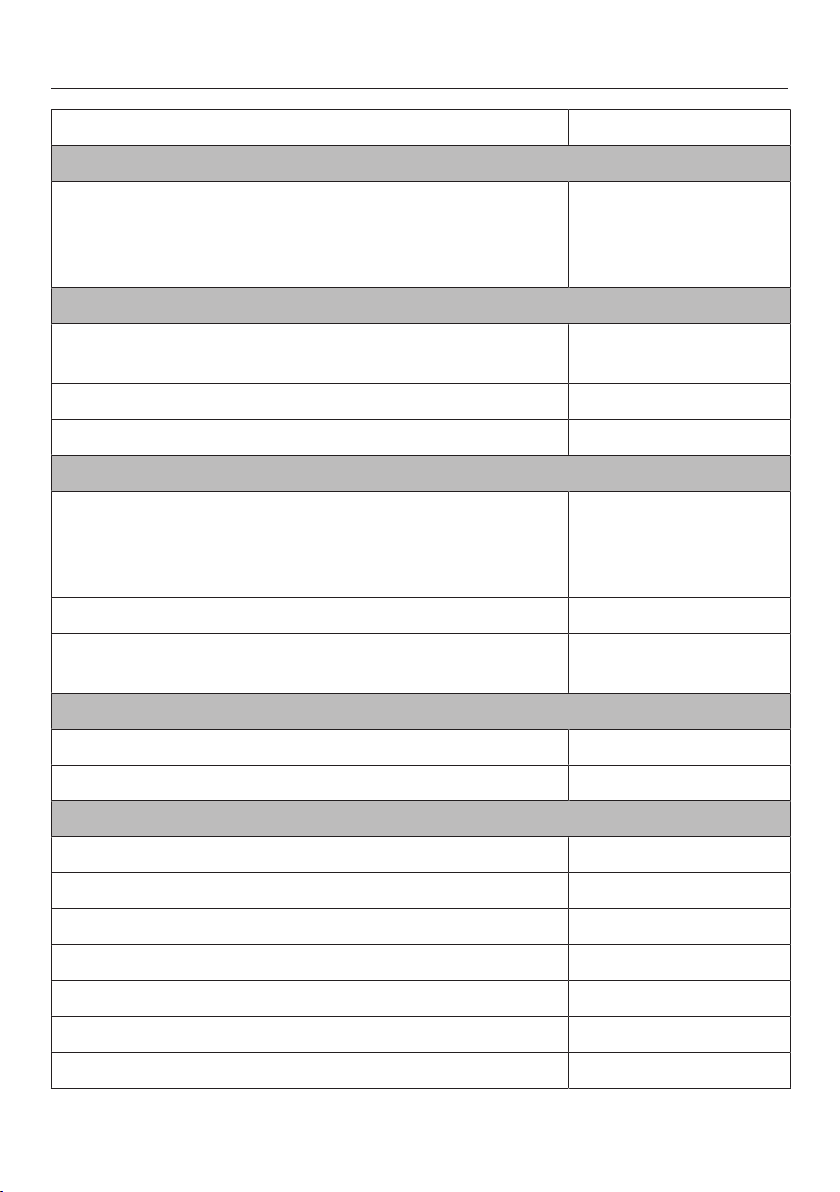
Settings
Temperature: 100°C
Duration: see chart
Special applications
50
Food * [min]
Vegetables
Carrots
Cauliflower
Kohlrabi
Beans
6–7
Side dishes
Pasta
Rice
3–4
Potatoes, halved lengthways 12–14
Dumplings 15–17
Meat and poultry
Sliced meat, 1.5cm thick
Roulades, sliced
Goulash
Lamb stew
5–6
Meatballs 13–15
Chicken escalopes
Turkey escalopes
7–8
Fish
Fish fillets, 2cm thick 6–7
Fish fillets, 3cm thick 7–8
Plated meals
Spaghetti with tomato sauce 13–15
Roast pork, potatoes, vegetables 12–14
Stuffed pepper (halved), rice 13–15
Chicken fricassee, rice 7–8
Vegetable soup 2–3
Creamy soup 3–4
Consommé 2–3

Special applications
51
Food * [min]
Stew 4–5
Duration
* These times apply to food heated on a plate and covered with a plate.

Special applications
52
Defrost
It is much quicker to defrost food in the
steam oven than at room temperature.
Risk of infection from bacteria.
Bacteria such as salmonella can
cause life-threatening food poison-
ing.
It is particularly important to observe
food hygiene rules when defrosting
fish and meat, and in particular when
defrosting poultry.
Do not use the liquid produced dur-
ing defrosting.
Process the food as required as soon
as it has been defrosted.
Temperature
60 °C is the best temperature for de-
frosting.
Exception: 50 °C for minced meat and
game
Before and after defrosting
Remove all packaging before defrost-
ing.
Exceptions: Leave bread, biscuits and
cakes in their packaging as otherwise
they will absorb moisture and become
soft.
Allow defrosted food to stand at room
temperature after removing it from the
oven. The standing time is necessary to
allow the even distribution of heat.
Cooking containers
Use a perforated container with a solid
container or universal tray underneath it
when defrosting food which will drip,
such as poultry. This way food will not
be lying in defrosted liquid.
Food which does not drip can be de-
frosted in a solid container.
Tips
– Fish does not need to be fully defros-
ted before cooking. Defrost so that
the surface is sufficiently thawed to
take herbs and seasoning. Depending
on the thickness of the fish, 2 -
5minutes should be enough.
– When defrosting food which has
frozen together, e.g. berries, chops,
fish fillets etc. separate it about half-
way through the defrosting time.
– Do not refreeze food once it has
thawed.
– Defrost frozen pre-cooked meals ac-
cording to the manufacturer's instruc-
tions.
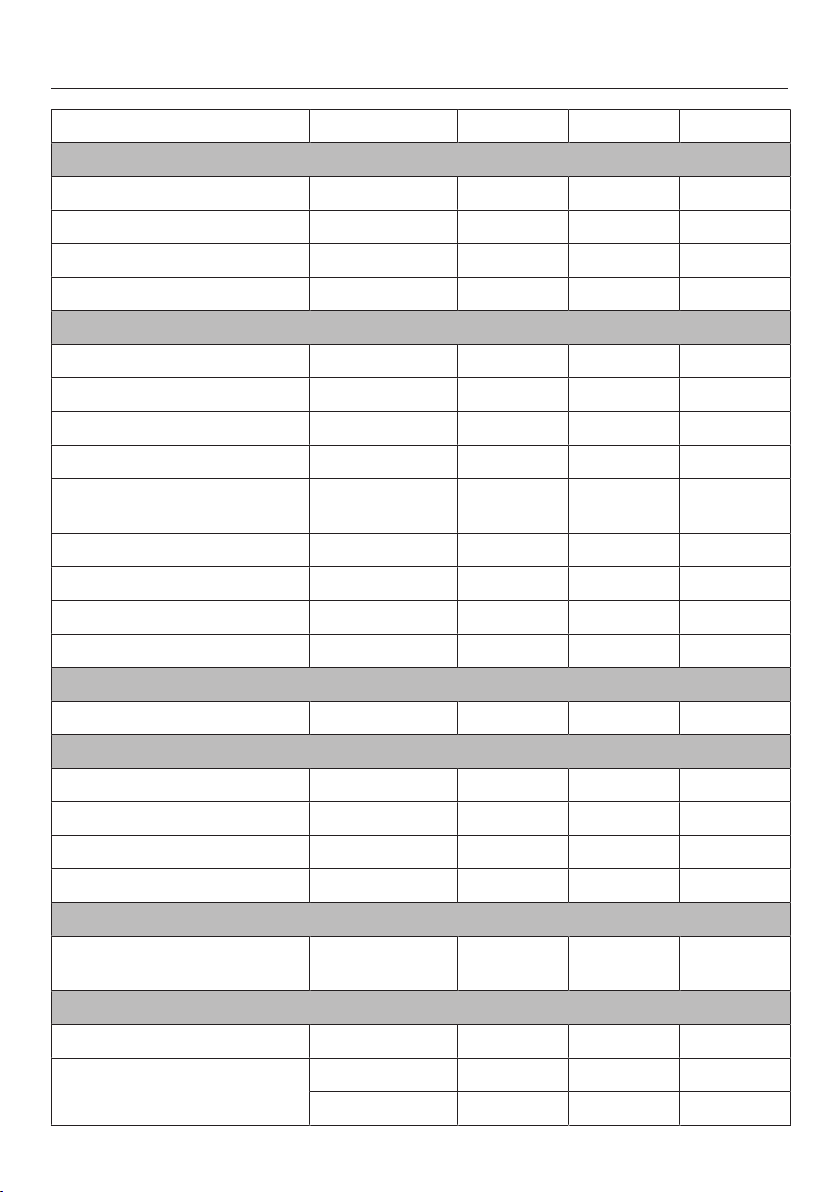
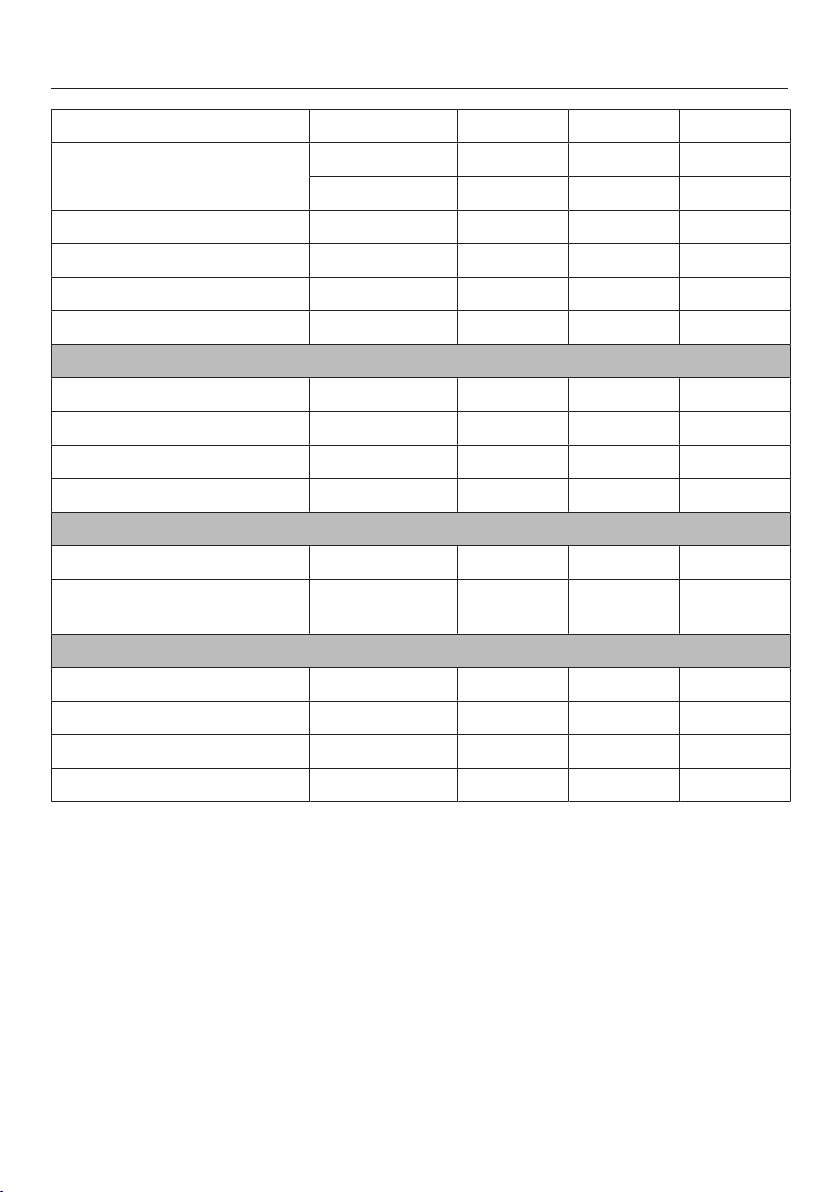
Settings
Temperature: see chart
Defrosting duration: see chart
Special applications
53
Food to be defrosted Quantity [°C] [min] [min]
Dairy products
Sliced cheese 125g 60 15 10
Quark 250g 60 20–25 10–15
Cream 250g 60 20–25 10–15
Soft cheese 100g 60 15 10–15
Fruit
Apple sauce 250g 60 20–25 10–15
Apple chunks 250g 60 20–25 10–15
Apricots 500g 60 25–28 15–20
Strawberries 300g 60 8–10 10–12
Raspberries/redcurrants/
blackcurrants
300g 60 8 10–12
Cherries 150g 60 15 10–15
Peaches 500g 60 25–28 15–20
Plums 250g 60 20–25 10–15
Gooseberries 250g 60 20–22 10–15
Vegetables
Frozen in a block 300g 60 20–25 10–15
Fish
Fish fillets 400g 60 15 10–15
Trout 500g 60 15–18 10–15
Lobster 300g 60 25–30 10–15
Small shrimps 300g 60 4–6 5
Ready meals
Meat, vegetables, side dishes/
stew/soup
480g 60 20–25 10–15
Meat
Roast meat, sliced 125–150g each 60 8–10 15–20
Minced meat
250g 50 15–20 10–15
500g 50 20–30 10–15
Special applications
54
Food to be defrosted Quantity [°C] [min] [min]
Goulash
500g 60 30–40 10–15
1000g 60 50–60 10–15
Liver 250g 60 20–25 10–15
Saddle of hare 500g 50 30–40 10–15
Saddle of venison 1000g 50 40–50 10–15
Cutlets/chops/sausages 800g 60 25–35 15–20
Poultry
Chicken 1000g 60 40 15–20
Chicken thighs 150g 60 20–25 10–15
Chicken escalopes 500g 60 25–30 10–15
Turkey legs 500g 60 40–45 10–15
Baked goods
Puff pastries/yeast buns – 60 10–12 10–15
Creamed mixture cakes/bis-
cuits
400g 60 15 10–15
Bread/rolls
Bread rolls – 60 30 2
Rye bread, sliced 250g 60 40 15
Wholegrain bread, sliced 250g 60 65 15
White bread, sliced 150g 60 30 20
Temperature Defrosting time Standing time

Special applications
55
Bottling
Only use unblemished, fresh produce
which is in good condition for bottling.
Glass jars
Use clean glass jars and accessories
and check them for any defects. Glass
jars with twist off lids or glass lids with a
rubber seal are suitable.
Make sure that all the jars are the same
size so that bottling is carried out
evenly.
After you have filled the jars with the
bottled produce, clean the glass rims
with a clean cloth and hot water and
then seal the jars.
Fruit
Sort fruit carefully, rinse it briefly but
thoroughly and allow it to drain. Take
great care when cleaning soft fruit as it
is very delicate and squashes easily.
Remove any peel, stalks, cores or
stones. Cut up large fruit. For example,
cut apples into slices.
If you are bottling fruit with stones (e.g.
plums, apricots) without removing the
stones, pierce the fruit several times
with a fork or wooden skewer as other-
wise it will burst.
Vegetables
Rinse, clean and cut up vegetables.
Vegetables should be blanched before
bottling to help them retain their colour
(see “Special applications” – “Blanch-
ing”).
Fill volume
Fill the glass jars with produce up to a
maximum of 3cm below the rim. Do
not pack it down as this will damage
the cell walls of the produce. Tap the jar
gently onto a cloth to help distribute the
contents evenly. Fill the jars with liquid.
The produce must be completely
covered.
Use a sugar solution for fruit and a salt
or vinegar solution for vegetables.
Tips
– Make use of residual heat by leaving
the jars in the oven for 30 minutes
after it has switched off.
– Then cover the jars with a cloth and
allow to cool for approx. 24 hours.
Special applications
56
Bottling food
Push the condensate tray in on the lowest shelf level with a perforated container
above it.
Place the jars in a perforated container. The jars must not touch each other.
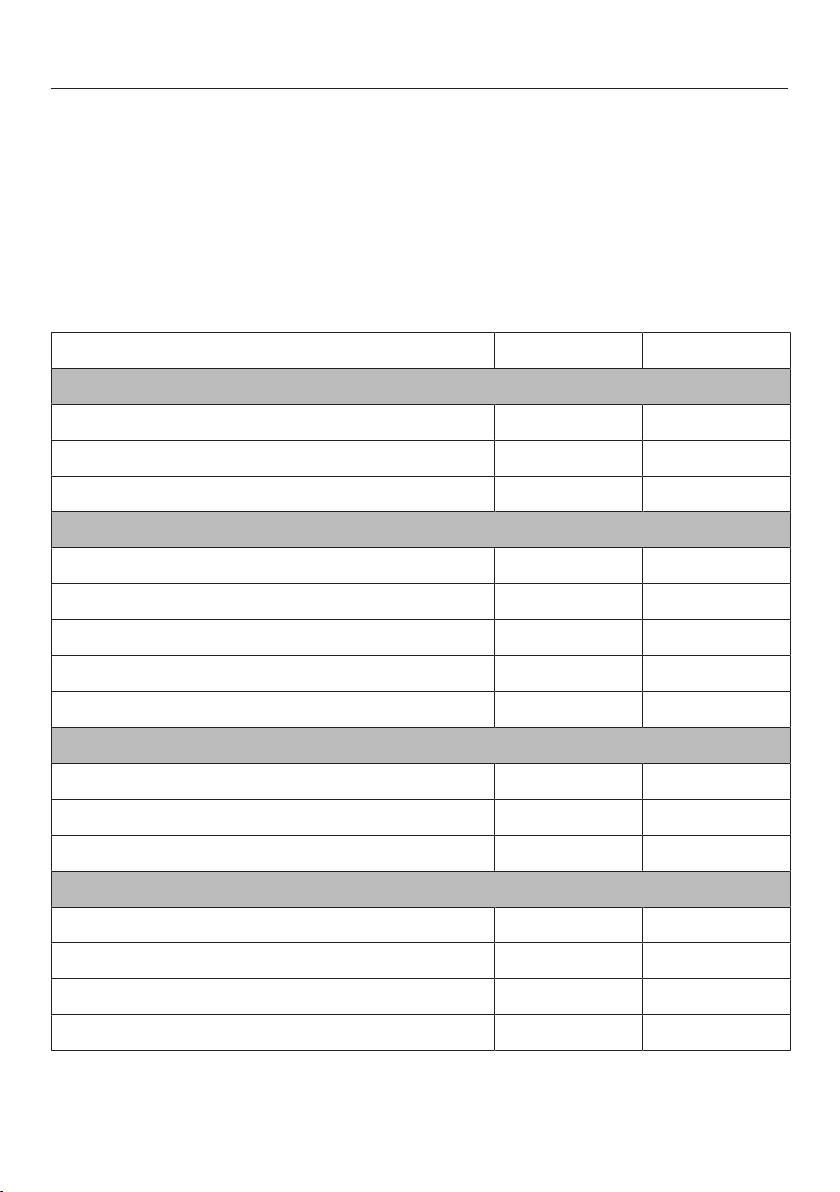
Settings
Temperature: see chart
Bottling duration: see chart
Food to be bottled [°C] * [min]
Berries
Redcurrants/blackcurrants 80 50
Gooseberries 80 55
Cranberries 80 55
Fruit with stones
Cherries 85 55
Mirabelle plums 85 55
Plums 85 55
Peaches 85 55
Greengages 85 55
Fruit with pips
Apples 90 50
Apple sauce 90 65
Quinces 90 65
Vegetables
Beans 100 120
Broad beans 100 120
Gherkins 90 55
Beetroot 100 60
* Bottling times apply to 1l jars. If using 0.5l jars, reduce the duration by 15minutes. If us-
ing 0.25l jars, reduce the duration by 20 minutes.

Special applications
57
Extracting juice with steam
This appliance is ideal for extracting
juice from soft, firm and hard fruit.
It is best to use overripe fruit, as the
riper the fruit, the greater the quantity of
juice produced. Very ripe fruit will also
produce a more intense flavour.
Preparation
Sort and clean the fruit. Cut out any
blemishes.
Remove the stalks from grapes and
morello cherries as these are bitter. Ber-
ries do not need to have their stalks re-
moved.
Cut larger fruit such as apples into
chunks of approximately 2cm in size.
The harder the fruit, the smaller the
pieces should be.
Tips
– Try experimenting with mild and tart
fruit.
– Adding sugar will increase the quant-
ity of juice produced and improve the
flavour. Sprinkle the fruit with sugar
and leave to absorb for a few hours
before juicing. For 1kg of sweet fruit
add 50–100g of sugar, and for 1kg
of tart fruit add 100–150g of sugar.
– If you wish to bottle the juice rather
than consume it straight away, pour it
whilst hot into hot, sterilised bottles,
and then seal immediately with steril-
ised tops.
Extracting juice from fruit
Put the prepared fruit into a perfor-
ated cooking container.
Place a solid container or the con-
densate tray underneath to catch the
juice.
Settings
Temperature: 100°C
Duration: 40 - 70minutes

Special applications
58
Make yoghurt
To make yoghurt, you will need either
fresh live yoghurt or yoghurt culture,
obtainable from health food shops.
Use natural yoghurt with live culture and
without additives. Heat-treated yoghurt
is not suitable.
The yoghurt must be fresh (short stor-
age time).
You can use either unchilled long-life
milk or fresh milk.
Long-life milk can be used as it is – no
further preparation is required. Fresh
milk must first be heated to 90°C (do
not boil it) and then cooled down to
35°C. Fresh milk will give a better set
than long-life milk.
The yoghurt and milk should have the
same percentage fat.
Do not move or shake the jars whilst
the yoghurt is thickening.
Immediately after preparation, leave the
yoghurt to cool in the fridge.
How well home-prepared yoghurt sets
will depend on the consistency, fat con-
tent and the cultures used in the starter
yogurt. Not all yoghurts are suitable for
use as starter yoghurt.
Mix 100g yoghurt with 1l milk or
make up the mixture with yoghurt en-
zyme, following the instructions on
the packaging.
Pour the mixture into jars and seal the
jars.
Place the sealed jars in a perforated
container, making sure they do not
touch one another.
Immediately after the yoghurt has
been made, place the jars in the refri-
gerator, taking care not to shake
them unnecessarily.
Tip: When using yoghurt enzyme,
yoghurt can be made from a milk /
cream mixture. Mix³/₄litre milk
with¹/₄litre cream.
Settings
Temperature: 40°C
Duration: 5:00 hours
Possible reasons for unsatisfactory
results
Yoghurt has not set:
Incorrect storage of starter yoghurt, too
much time out of the refrigerator, e.g. in
transportation, damaged packaging,
milk not sufficiently heated.
Liquid has separated:
The jars were moved, yoghurt was not
cooled down quickly enough.
Yoghurt is gritty:
Milk was overheated or in poor condi-
tion, milk and starter yoghurt not evenly
stirred.

Special applications
59
Prove dough
Prepare the dough according to the
recipe.
Cover the bowl and place in a perfor-
ated container.
Settings
Temperature: 40°C
Duration: as per recipe instructions
Dissolve gelatine
Soften gelatine leaves by leaving
them in a bowl of cold water for
5minutes. The gelatine leaves have
to be fully covered with water. Re-
move the gelatine leaves from the
bowl and squeeze them out. Empty
the bowl. Place the squeezed gelatine
leaves back in the bowl.
Place gelatine powder in a bowl and
add water according to the instruc-
tions on the packaging.
Cover the bowl and place in a perfor-
ated container.
Settings
Temperature: 90°C
Duration: 1minute

Special applications
60
Melt chocolate
You can use the steam oven for melting
any type of chocolate.
Break the chocolate into small
pieces. Place chocolate cake cover-
ing in a perforated cooking container,
leaving it in its packaging.
Place large quantities in a solid cook-
ing container and small quantities in a
cup or a bowl.
Cover the container or the dish with a
lid or with foil that is resistant to tem-
peratures up to 100°C and to hot
steam.
Stir large quantities once halfway
through cooking.
Settings
Temperature: 65°C
Duration: 20minutes
Skinning vegetables and fruit
Cut a cross in the top of tomatoes,
nectarines, etc. This will allow the
skin to be removed more easily.
Place the fruit/vegetables in a perfor-
ated cooking container.
To blanch almonds, it is important to
plunge them into cold water as soon
as they are taken out of the oven,
otherwise the skin cannot be re-
moved.
Settings
Temperature: 100°C
Duration: see chart
Food [min]
Apricots 1
Almonds 1
Nectarines 1
Peppers 4
Peaches 1
Tomatoes 1
Duration

Special applications
61
Apple storage
You can treat homegrown apples in the
steam oven to increase the length of
time for which you can store them.
Once treated, the apples will keep for 5
to 6months when stored in a dry, cool
and well-ventilated place. This method
is only suitable for apples and not for
other types of fruit.
Settings
Temperature: 50°C
Duration: 5minutes
Blanching
Blanch vegetables before freezing
them. Blanching helps maintain the
quality of the produce when it is frozen.
Blanching vegetables also helps them
retain their original colour.
Put the prepared vegetables into a
perforated cooking container.
Once blanched, plunge the veget-
ables into ice cold water to cool them
down quickly. Drain them well.
Settings
Temperature: 100°C
Duration: 1minute

Special applications
62
Sweat onions
Sweating means cooking the onions in
their own juices, with the addition of a
little fat if necessary.
Cut the onions up into small pieces
and place them in a solid cooking
container with a little butter.
Cover the container with a lid or with
foil that is temperature resistant up to
100°C and to steam.
Settings
Temperature: 100°C
Duration: 4minutes
Cook bacon
The bacon does not brown.
Place the bacon (diced or rashers) in
a solid cooking container.
Cover the container with a lid or with
foil that is temperature resistant up to
100°C and to steam.
Settings
Temperature: 100°C
Duration: 4 minutes

Special applications
63
Disinfect items
The steam oven can be used to disin-
fect baby bottles and other containers
so that at the end of the programme
they are as germ free as they would
have been had they been boiled. Check
beforehand that all parts, teats etc. are
declared by the manufacturer to be heat
resistant to 100°C and also that they
can withstand hot steam.
Dismantle, clean and thoroughly rinse
baby bottles. All parts of the bottles
must be completely dry before they are
reassembled to keep them germ free.
Place the individual parts in a perfor-
ated container (on their sides or with
the opening facing downwards), en-
suring that they do not touch one an-
other. This will allow hot steam to
reach them from all sides.
Settings
Temperature: 100°C
Duration: 15minutes
Heating damp flannels
Moisten the flannels and then roll
them up.
Place them beside one another in a
perforated cooking container.
Settings
Temperature: 70°C
Duration: 2minutes
Decrystallise honey
Loosen the lid and place the jar of
honey in a perforated container.
Stir the honey once during the cook-
ing duration.
Settings
Temperature: 60°C
Duration: 90 minutes (irrespective of the
size of jar or the amount of honey in the
jar)

Special applications
64
Making eierstich
Mix 6eggs with 375ml milk (do not
beat into a foam).
Season the egg and milk mixture and
pour into a solid cooking container
greased with a little butter.
Settings
Temperature: 100°C
Duration: 4minutes

Settings
65
Your steam oven is supplied with a
number of standard default settings.
The standard settings listed in the chart
can be altered.
To change and save settings
With the appliance switched off:
Press and hold the On/Off button.
Whilst pressing the On/Off button,
touch the sensor once briefly when
the display lights up.
P1 will appear in the display.
Touch the or sensor repeatedly
until the programme you want ap-
pears highlighted in the display.
Confirm with OK.
Touch the or sensor repeatedly
until the status you want appears
highlighted in the display.
Confirm with OK.
The selected status will be saved.
After you have altered the setting(s)
required, switch the appliance off.

Settings
66
The factory setting is shown in bold.
Programme Status Available settings
P1 S0
S1 Factory default settings reinstated
P2 Demo mode S0
S1
Off, the steam oven heats up
On, the steam oven does not heat up
P3 Buzzer volume S1
S2
S3
S4
Very quiet
Quiet
Medium
Loud
P4 Water hardness S1
S2
S3
S4
Soft (< 1.5mmol/l, < 8.4 °dH)
Medium (1.5 - 2.5mmol/l, 8.4–14 °dH)
–
Hard (> 2.5mmol/l, > 14 °dH)
P5 Temperature S1
S2
°C
°F
P6 Pre-heat S0
S1
Pre-heating not activated
Pre-heating activated
P7 Keypad tone S0
S1
Off
On
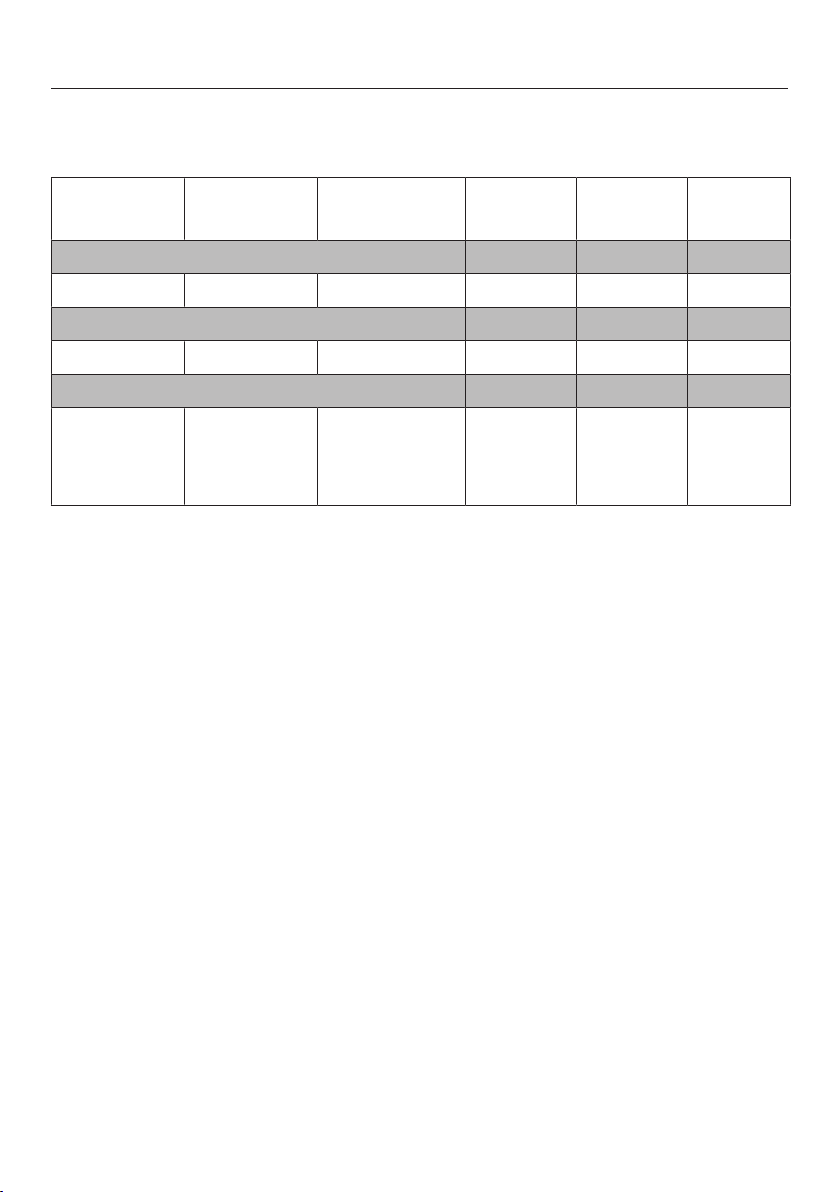
Note for test institutes
67
Test food in accordance with EN 60350-1 (Steam cooking func-
tion)
Test food Cooking con-
tainer
Quantity [g]
1
2
[°C]
[min]
Steam replenishment
Broccoli (8.1) 1x DGGL1 max. Any 100 3
Steam distribution
Broccoli (8.2) 1x DGGL1 300 Any 100 3
Performance at maximum capacity
Peas (8.3) 3x DGGL1 2.5kg frozen
peas spread
evenly across
the container
2, 3, 4
3
100
4
Shelf level(s) / Temperature / Duration
1)
Always insert the condensate tray on the lowest shelf level.
2)
Place the test food in a cold oven (before the heating up phase begins).
3)
Place cooking container at the back of shelf levels 2 and 4 and at the front of shelf level 3.
4
The test is finished when the temperature measures 85°C in the coolest place.

Cleaning and care
68
Risk of injury caused by hot sur-
faces.
The steam oven gets hot during op-
eration. You could burn yourself on
the oven compartment, side runners
or accessories.
Allow the oven compartment, side
runners and accessories to cool be-
fore cleaning.
Risk of injury due to electric
shock.
The steam from a steam cleaning ap-
pliance could reach live electrical
components and cause a short cir-
cuit.
Do not use a steam cleaner to clean
the steam oven.
All surfaces could be discoloured or
damaged if unsuitable cleaning
agents are used.
All surfaces are susceptible to
scratching. Scratches on glass can in
some circumstances lead to break-
age.
Use only domestic washing-up liquid
to clean the appliance.
Remove all cleaning agent residues
immediately.
Do not use cleaning agents or wash-
ing-up liquids containing aliphatic
hydrocarbons as these could cause
the seals to swell.
If soiling is left on for any length of
time, it may become impossible to
remove.
Surfaces may suffer discolouration or
damage.
It is therefore best to remove any
soiling immediately.
The appliance and accessories
should be cleaned and dried thor-
oughly after each use.
Leave the appliance door open until
the oven compartment is completely
dry.
Tip: If the appliance is not going to be
used for a longer period of time – during
a holiday, for example – it should be
thoroughly cleaned and dried before-
hand to prevent the build-up of odours
and so on. Leave the door open after-
wards.

Cleaning and care
69
Unsuitable cleaning agents
To avoid damaging the surfaces of your
appliance, do not use:
– Cleaning agents containing soda,
ammonia, acids or chlorides
– Cleaning agents containing descaling
agents
– Abrasive cleaning agents, e.g.
powder cleaners and cream cleaners
– Solvent-based cleaning agents
– Stainless steel cleaning agents
– Dishwasher cleaner
– Glass cleaning agents
– Cleaning agents for ceramic glass
hobs
– Hard, abrasive brushes or sponges
(e.g. pot scourers, brushes or
sponges which have been previously
used with abrasive cleaning agents)
– Melamine eraser blocks
– Sharp metal scrapers
– Wire wool
– Stainless steel spiral pads
– Spot cleaning with mechanical clean-
ing agents
– Oven cleaners or sprays
Cleaning the steam oven front
and casing
Clean the front and casing with a
clean sponge and a solution of warm
water and washing-up liquid.
After cleaning, wipe the front and
casing dry using a soft cloth.
Tip: A clean, damp microfibre cloth
without cleaning agent can also be
used.

Cleaning and care
70
Cleaning the oven compart-
ment
If something gets caught behind the
seals around the steam inlet and out-
let, the seals could get pushed be-
hind the back panel by mistake.
Make sure that nothing gets caught
behind the seals when cleaning the
back of the oven compartment.
The oven compartment, the door seal,
the inside of the door and the drip
channel should be cleaned and dried
after each use.
Remove:
– Condensate using a sponge or ab-
sorbent cloth
– Light, greasy soiling with a clean
sponge and a solution of washing-up
liquid and hot water
After cleaning, wipe the surface with
clean water to remove any cleaning
agent residues.
Then wipe the surfaces dry using a
cloth.
After prolonged use, the floor heater
can become discoloured by drops of
liquid, but this will not impair the func-
tion.
Replace the seal with a new one if it
becomes porous or brittle. Door
seals can be ordered from the Miele
Customer Service Department (see
the end of this booklet for contact
details).
Accessories
All accessories are dishwasher safe.
Cleaning the condensate tray and
cooking containers
Wash and dry the condensate tray
and cooking containers after each
use.
Any bluish discolouration on the
cooking containers can be removed
with vinegar. Then rinse with clean
water.
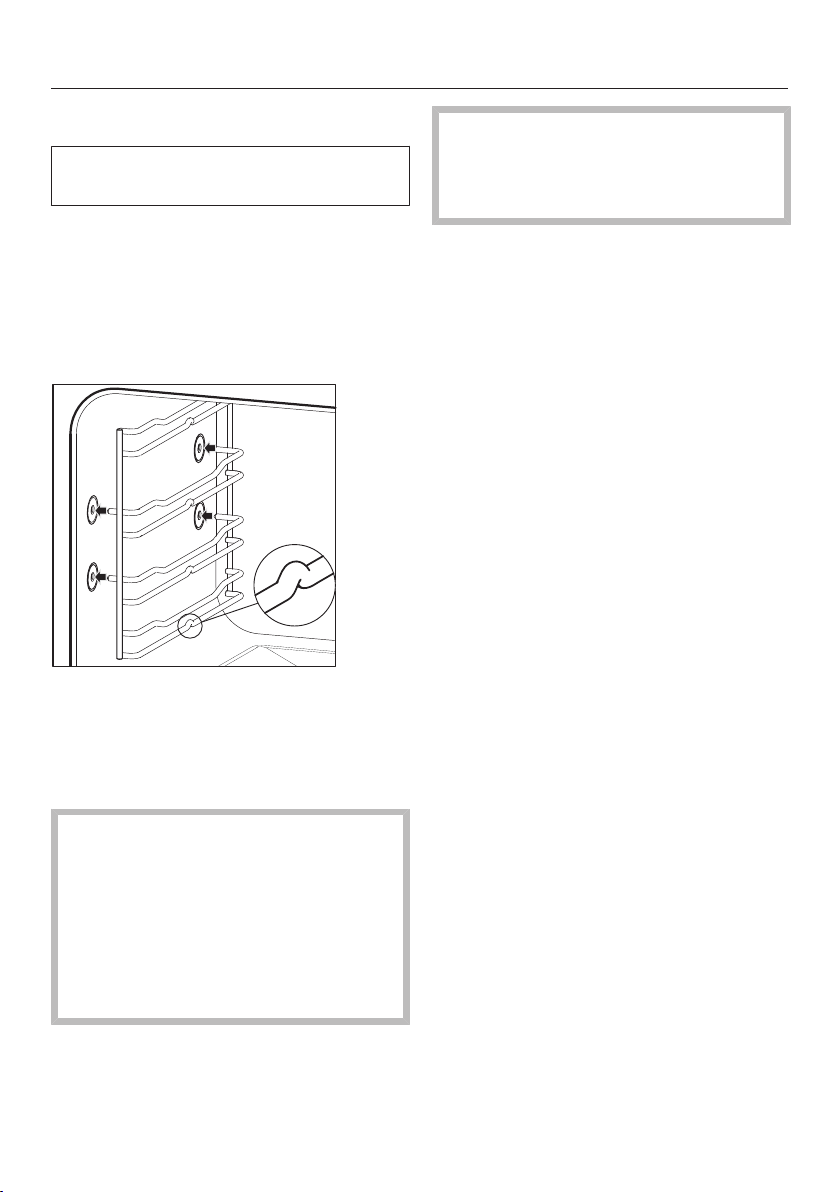
Cleaning and care
71
Cleaning the side runners
The side runners are suitable for
cleaning in a dishwasher.
Pull the runners off as shown.
The side runners can be cleaned in
the dishwasher or by hand with a
solution of warm water and a little
washing-up liquid applied with a
clean sponge.
Push the side runners firmly back in
after cleaning.
When putting them back in, make
sure they are correctly inserted (see
illustration).
Risk of damage to side runners when
not inserted correctly.
If the side runners are not correctly
inserted, the temperature sensor
could be damaged when cooking
containers are placed in the steam
oven.
Insert the side runners correctly.
If the side runners are not correctly
inserted, there is no anti-tip protec-
tion.
Insert the side runners correctly.
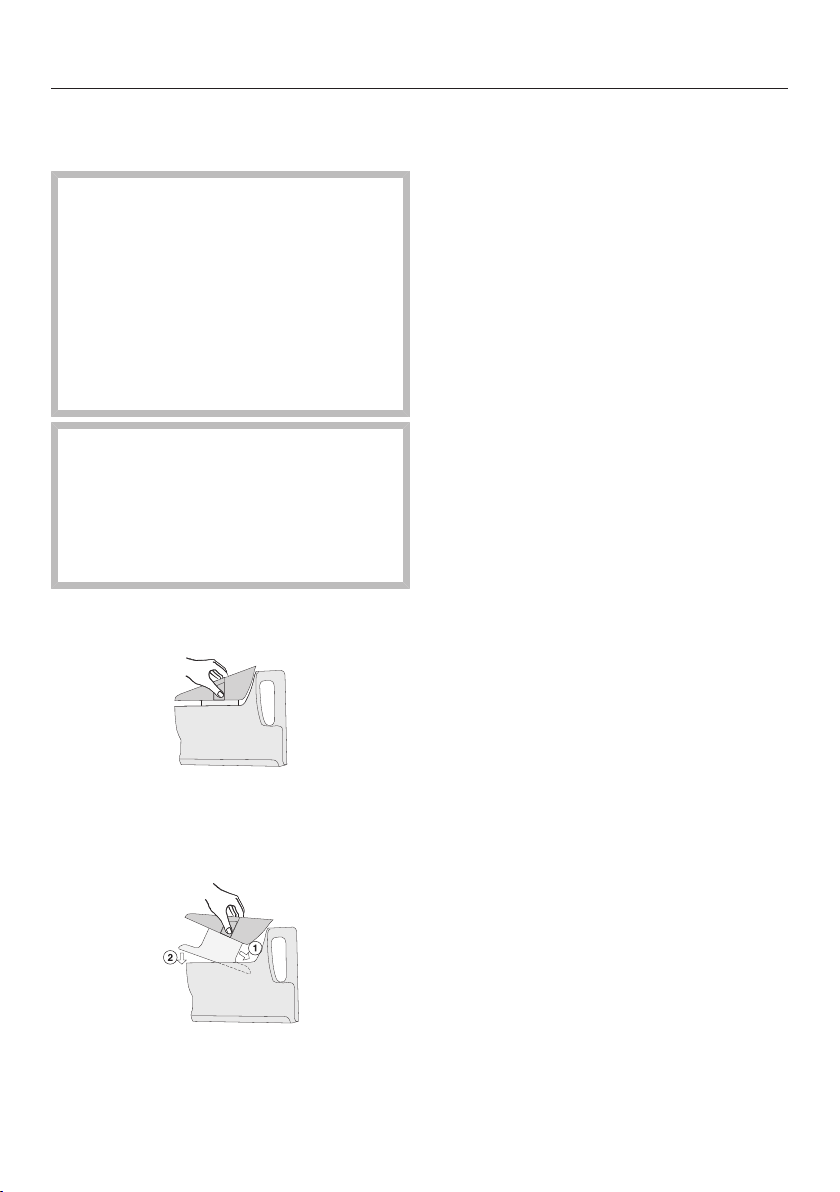
Cleaning and care
72
Emptying and drying the water
container
Risk of damage due to ingress of
water.
The water container’s heating ele-
ment can become damaged if it is
exposed to water.
Do not clean the water container or
the insert in the dishwasher
and do not immerse the water con-
tainer in water.
For reasons of hygiene and to pre-
vent the build-up of moisture in the
appliance, the water container
should be emptied after each use.
Do not use scouring pads or hard
brushes.
Remove, empty and dry the water
container after each use.
Release the insert by pushing the
catches on the sides in towards each
other and then pull it out of the con-
tainer.
After cleaning, dry both parts of the
insert thoroughly before replacing it in
the water container. When replacing
the insert, guide it in at an angle
and then push it downwards as il-
lustrated.
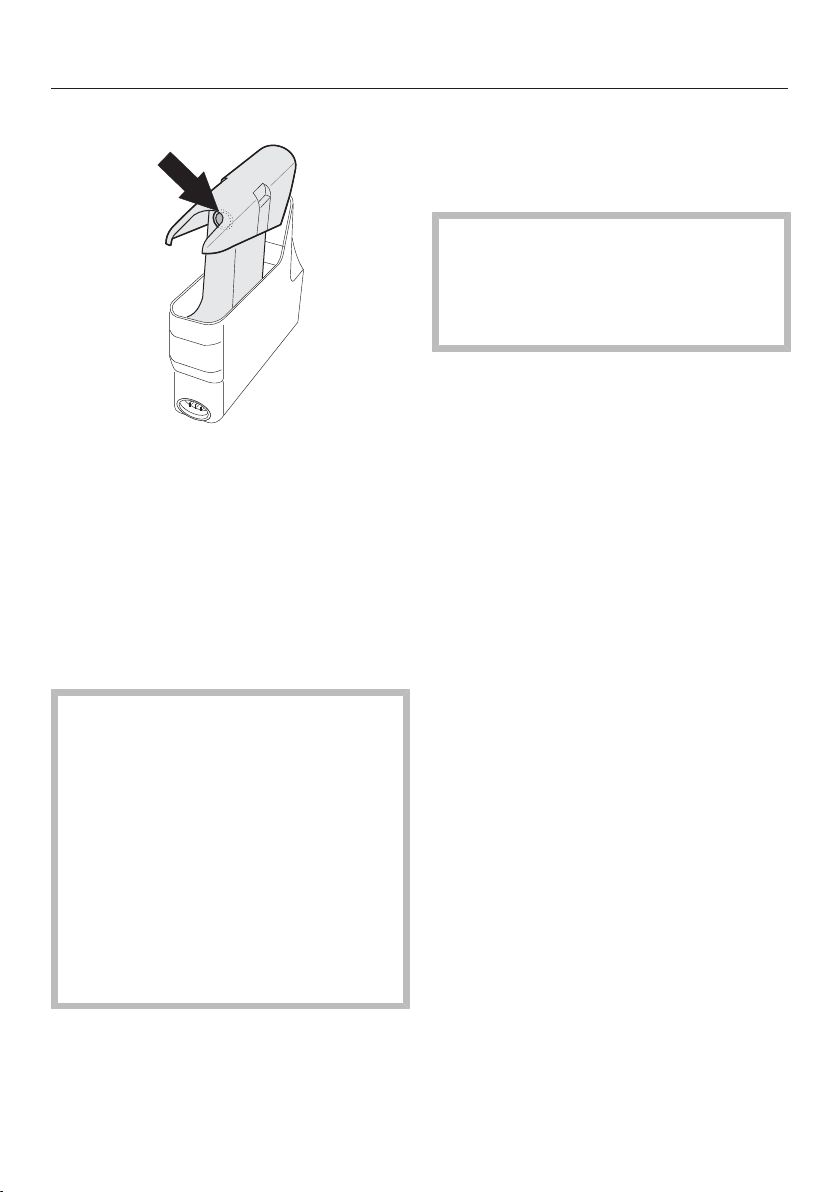
Cleaning and care
73
Lubricating the coupling seal
If, after prolonged use, the water con-
tainer becomes difficult to remove
and replace or the fault message
appears, rub a small amount of the
silicone grease supplied (see “Guide
to the appliance” – ”Accessories sup-
plied”) into the inside of the coupling
seal.
Do not take the sealing ring out to lub-
ricate it.
Danger of injury caused by silic-
one grease.
Silicone grease can irritate mucous
membranes.
Remove any silicone grease from
your skin either by wiping it off or by
washing it off.
If the grease gets into the eyes, it
must be rinsed out with plenty of
clean water.
Seek medical attention if silicone
grease has been swallowed.
The coupling seal should be replaced
with a new one if it becomes brittle or
porous or if an unusually large
amount of water collects on the floor
of the water container compartment.
Coupling seals can be ordered from the
Miele Customer Service Department
(see the end of this booklet for contact
details).
Only use the silicone grease sup-
plied. On no account must margar-
ine, oil or any other domestic grease
or fat be used, as these can cause
the seal to swell.
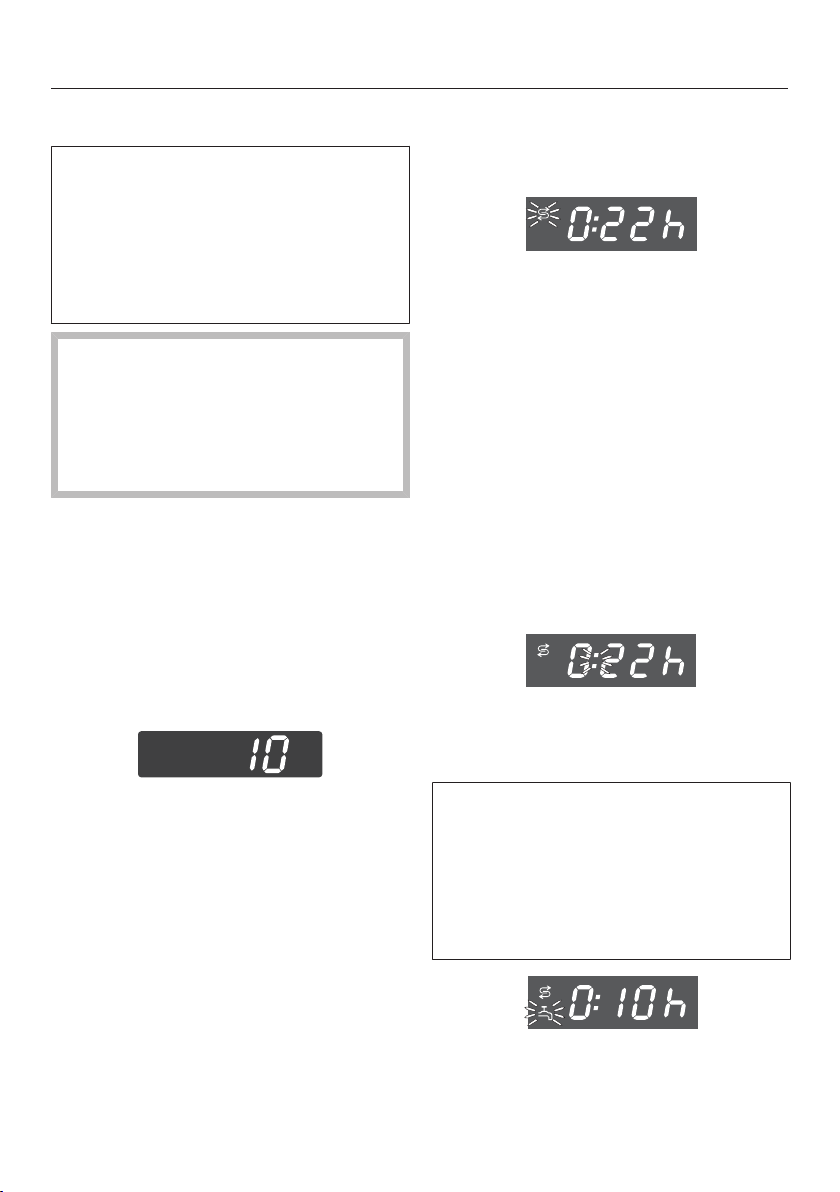
Cleaning and care
74
Descaling the water container
We recommend using Miele descaling
tablets (see “optional accessories”).
These have been specially developed
for use with Miele appliances to op-
timise the descaling process. Alternat-
ively you can use a proprietary citric
acid based descaling agent.
Do not spill descaling agent onto
metal surfaces. This can cause
marks to appear.
However, should any descaling
agent get onto these surfaces, wipe
it away immediately.
The steam oven needs to be descaled
after a certain number of operating
hours. When it needs descaling, the
symbol and a number will appear in
the display when the appliance is
switched on. The number indicates the
number of times that the steam oven
can be used before it has to be de-
scaled.
k
The appliance will lock after the last re-
maining cooking process.
We recommend that you descale the
appliance before it locks out.
During the descaling process, the water
container must be rinsed out and re-
filled with fresh water.
Touch the On/Off button until a
tone sounds and the flashing sym-
bol and the duration appear in
the display.
Pour 1l lukewarm water into the wa-
ter container and add 1Miele descal-
ing tablet or the recommended
amount of citric acid descaling agent.
Wait until the descaling agent has
dissolved.
Push the water container into the ap-
pliance until it connects.
Confirm with OK.
The colon will flash and the symbol
will now light up constantly in the dis-
play. Descaling will now begin.
It is only possible to cancel the de-
scaling process during the first minute.
Do not switch the appliance off during
the descaling process. If it is switched
off before the end of the process, the
whole process will have to be started
from the beginning again.
An audible tone will sound and the
symbol will flash in the display ap-
proximately 10minutes before the end
of the descaling process.

Cleaning and care
75
Remove the water container and take
the insert out.
Empty the water container.
Rinse the water container and the in-
sert thoroughly.
Fill the water container with 1l of
fresh tap water and refit the insert.
Push the water container into the ap-
pliance until it connects.
The flashing symbol will go out and
the symbol will start flashing.
Confirm with OK.
The colon will flash and the symbol
will now light up constantly in the dis-
play. Descaling will continue.
An audible tone will sound when the de-
scaling process has been completed.
Switch the steam oven off.
Remove, empty and dry the water
container.
Allow the oven compartment to cool
down.
Then dry the oven compartment.
Leave the appliance door open until
the oven compartment is completely
dry.

Problem solving guide
76
Many malfunctions and faults that can occur in daily operation can be easily
remedied. Time and money will be saved because a service call will not be
needed.
The following guide may help you to find the reason for a malfunction or a fault,
and to correct it.
Problem Cause and remedy
You cannot switch the
appliance on.
The fuse has tripped.
Reset the trip switch in the fuse box or replace the
fuse in the plug (see data plate for minimum fuse
rating).
There may be a technical fault.
Disconnect the appliance from the mains connec-
tion for approximately 1minute by:
– Tripping the relevant mains fuse or unscrewing
the fuse completely, or
– Switching off the residual current protection
device
If, after resetting the trip switch in the mains fuse
box or the residual current protection device, the
steam oven will still not turn on, contact a qualified
electrician or Miele Service.
The oven does not heat
up.
Demo mode has been activated. appears in the
display.
The steam oven can be operated but does not heat
up.
Deactivate demo mode (see “Settings”).
The oven cavity has been warmed up by a warming
drawer in operation underneath it.
Open the door and let the oven cool down.
The symbol and a
number between and
appear in the display.
and are flash-
ing.
The appliance needs to be descaled.
Proceed as described in “Cleaning and care” –
“Descaling”.
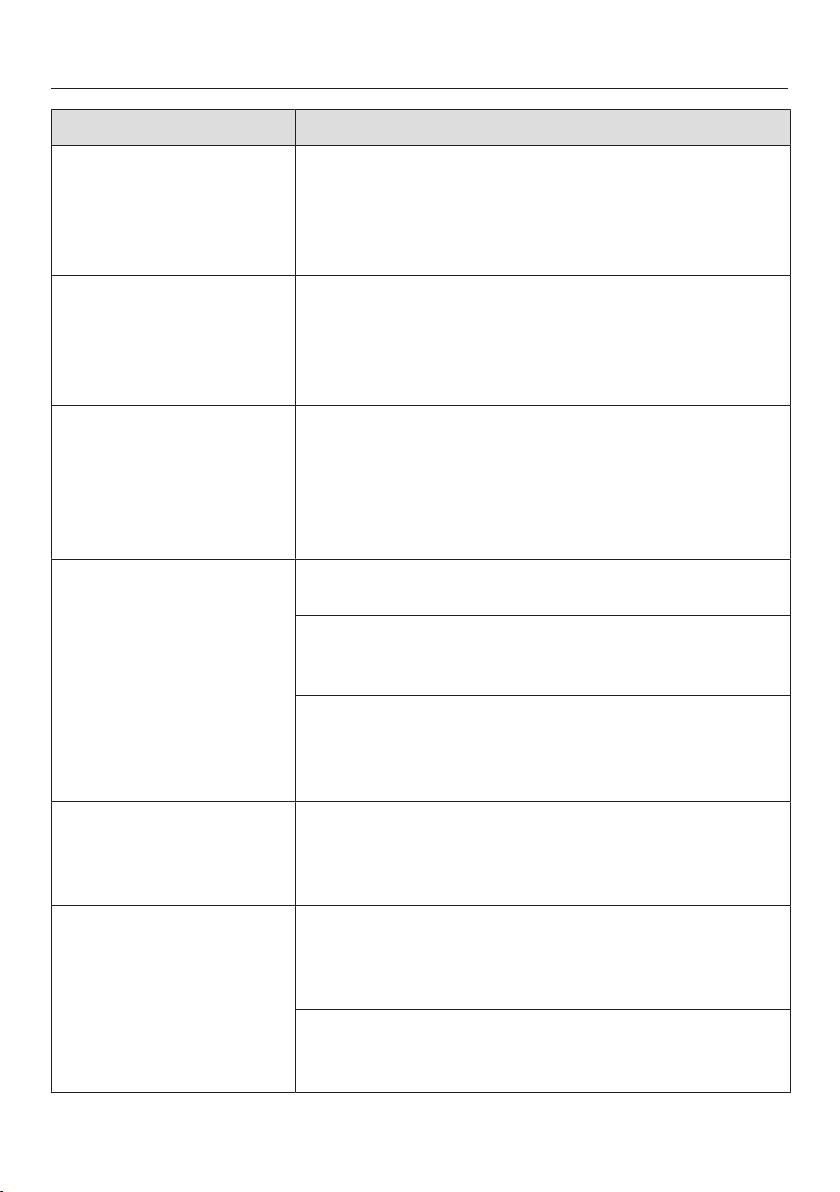
Problem solving guide
77
Problem Cause and remedy
The fan can still be
heard after the appli-
ance has been switched
off.
The fan is still running.
The appliance is fitted with a fan which removes
steam from the oven. The fan will continue to run for
a while after the appliance has been switched off. It
will switch itself off automatically after a while.
The water container has
become harder to put
into the appliance and
take out again.
The coupling seal in the water container has become
stiff.
Lightly lubricate the coupling seal on the water
container with silicone grease, as described in
“Cleaning and care” – “Water container”.
After moving house the
appliance no longer
switches from the heat-
ing-up phase to the
cooking phase.
The boiling temperature of the water has changed as
the altitude of the new location for the appliance dif-
fers from the old one by at least 300m.
To adjust the boiling temperature, you need to de-
scale the appliance (see “Cleaning and care” –
”Descaling”).
During operation an un-
usually large amount of
steam escapes, or
steam escapes from
parts of the oven where
it does not usually.
The door is not properly closed.
Close the door.
The door seal is not correctly fitted.
Press it in all the way round the door to make sure
it is fitted evenly.
The door seal is damaged, e.g. cracks can be seen.
Replace the door seal.
This can be ordered from Miele (see the end of this
booklet for contact details).
After a period of time,
the door makes a noise
when it is opened and
closed.
The door has become stiff.
Lubricate the hinges with the silicone grease sup-
plied.
The symbol appears
in the display and an
audible tone may
sound.
The water container has not been pushed into the ap-
pliance properly.
Remove the water container and push it back in so
that it connects.
There is not enough water in the water container. The
water level must be between the two marks.
Fill the water container

Problem solving guide
78
Problem Cause and remedy
The heating-up phase
lasts an unusually long
time.
The water container has a lot of limescale build-up in
it because the appliance was not set correctly for the
hardness of the local water supply.
Set the correct water hardness level for your water
supply (see “Settings”).
Descale the appliance (see “Cleaning and care” –
”Descaling”).
If the water hardness level was in fact set correctly
or the problem occurs again, contact Miele Ser-
vice.
Technical fault.
Switch the appliance off and contact Miele.
The water container has not been pushed into the ap-
pliance properly.
Remove the water container and push it back in so
that it connects.
Switch the steam oven off and then back on again.
The coupling seal in the water container has become
stiff.
Lightly lubricate the coupling seal on the water
container with silicone grease, as described in
“Cleaning and care” – “Water container”.
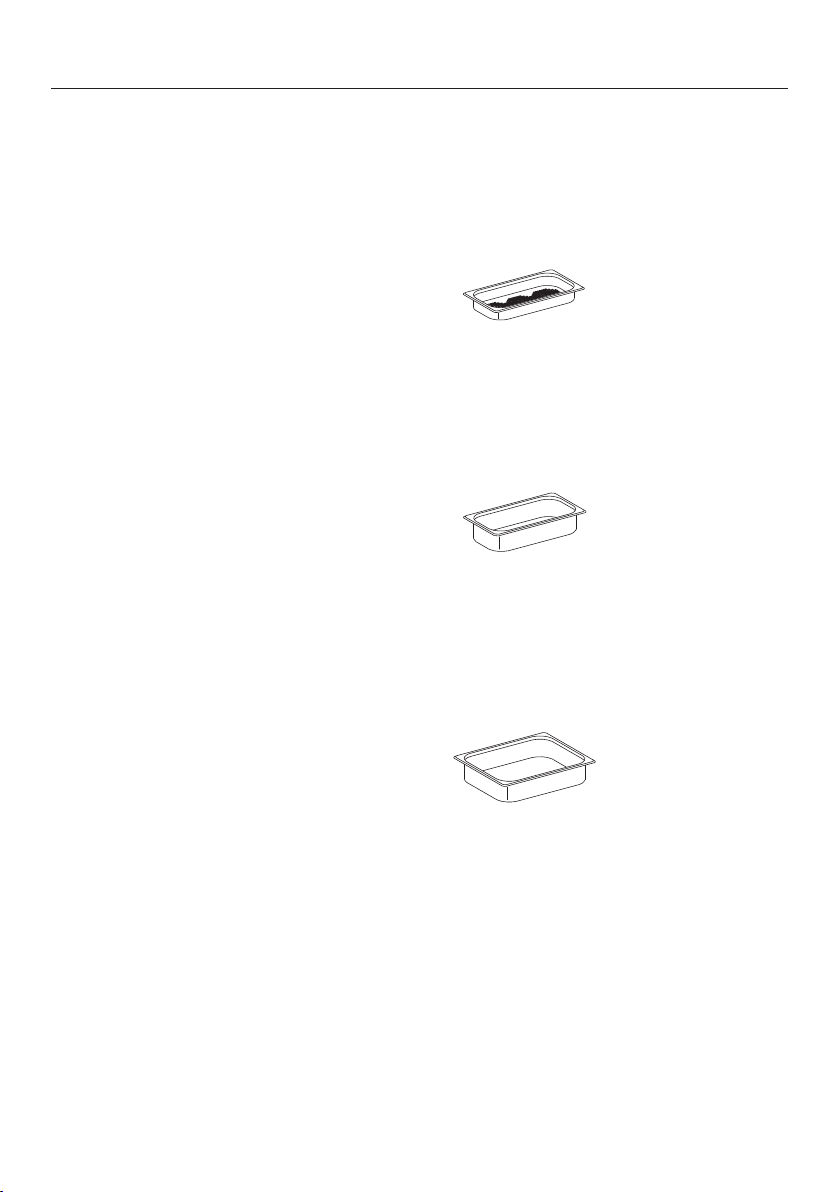
Optional accessories
79
Miele offer a comprehensive range of
useful accessories as well as cleaning
and conditioning products for your
Miele appliances.
These products can be ordered through
the Miele Webshop.
They can also be ordered from Miele
(see end of this booklet for contact de-
tails) or from your Miele dealer.
Cooking containers
There is a wide range of perforated and
solid cooking containers available in dif-
ferent sizes:
DGGL1
Perforated cooking container
Gross capacity 1.5l
Usable capacity0.9l
325x175x40mm (WxDxH)
DGG2
Solid cooking container
Gross capacity2.5l
Usable capacity2.0l
325x175x65mm (WxDxH)
DGG3
Solid cooking container
Gross capacity4.0l
Usable capacity3.1l
325x265x65mm (WxDxH)
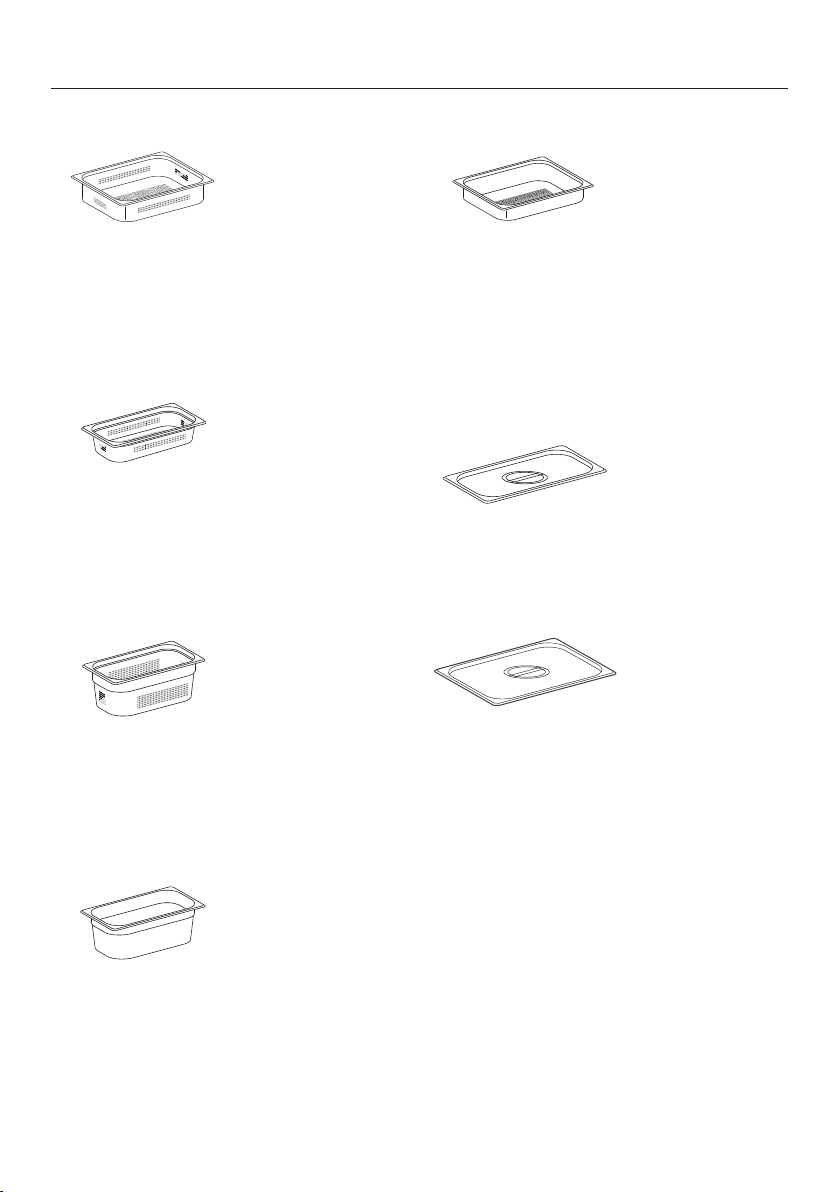
Optional accessories
80
DGGL4
Perforated cooking container
Gross capacity 4.0l
Usable capacity3.1l
325x265x65mm (WxDxH)
DGGL5
Perforated cooking container
Gross capacity 2.5l
Usable capacity2.0l
325x175x65mm (WxDxH)
DGGL6
Perforated cooking container
Gross capacity 4.0l
Usable capacity2.8l
325x175x100mm (WxDxH)
DGG7
Solid cooking container
Gross capacity 4.0l
Usable capacity2.8l
325x175x100mm (WxDxH)
DGGL8
Perforated cooking container
Gross capacity 2.0l
Usable capacity1.7l
325x265x40mm (WxDxH)
Lid for cooking containers
DGD 1/3
Lid for 325 x 175 mm cooking contain-
ers
DGD 1/2
Lid for 325 x 265 mm cooking contain-
ers
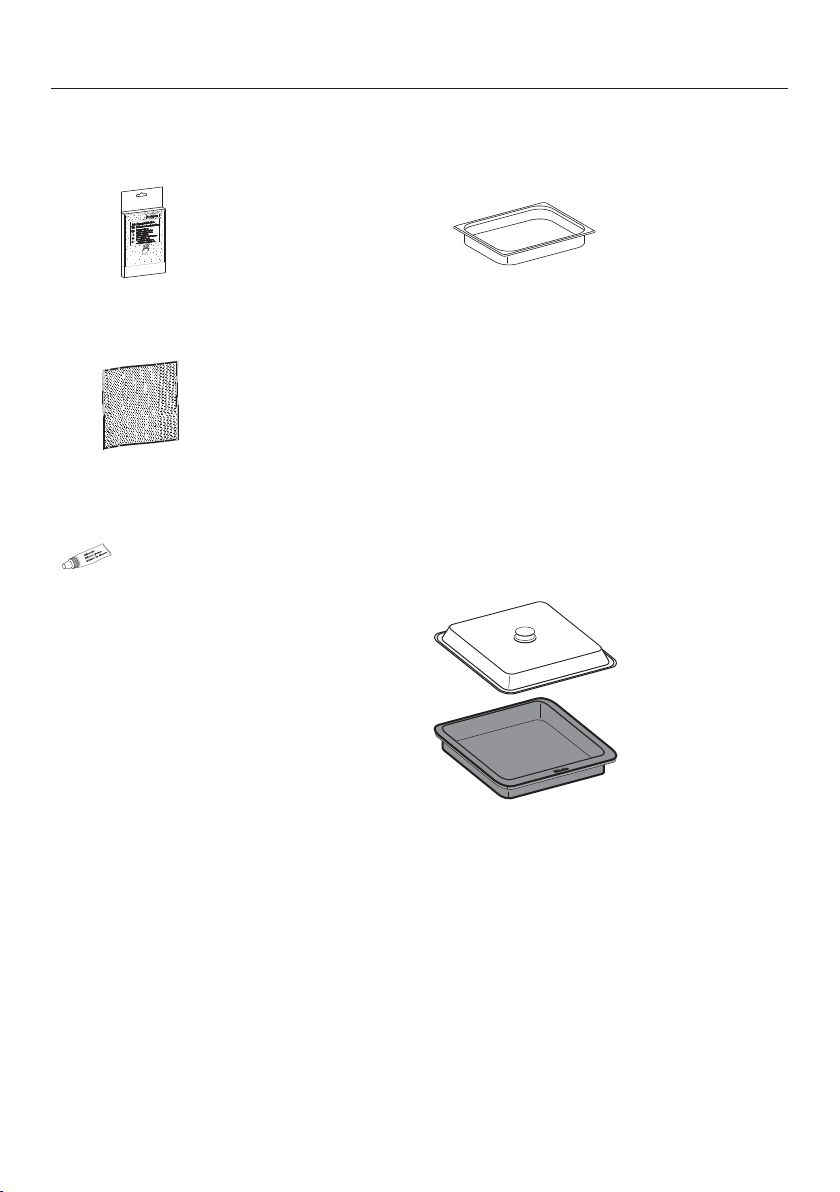
Optional accessories
81
Cleaning and care products
Descaling tablets (Qty 6)
For descaling the appliance
Microfibre cloth
Removes finger marks and light soiling
Silicone grease
For lubricating the coupling seal on the
water container
Miscellaneous
DGG 15
Condensate tray for catching excess
moisture, can also be used as a cook-
ing container.
325x265x40mm (W x D x H)
Multi-purpose casserole dish
Die-cast aluminium casserole dish with
non-stick surface and stainless steel lid.
Also suitable for use on an extended
zone of induction hobs and in all Miele
cookers and ovens.
KMB5000-S*
Maximum capacity approx. 2.5kg
325x260x60mm (WxDxH)
* Not suitable for use on gas hobs.
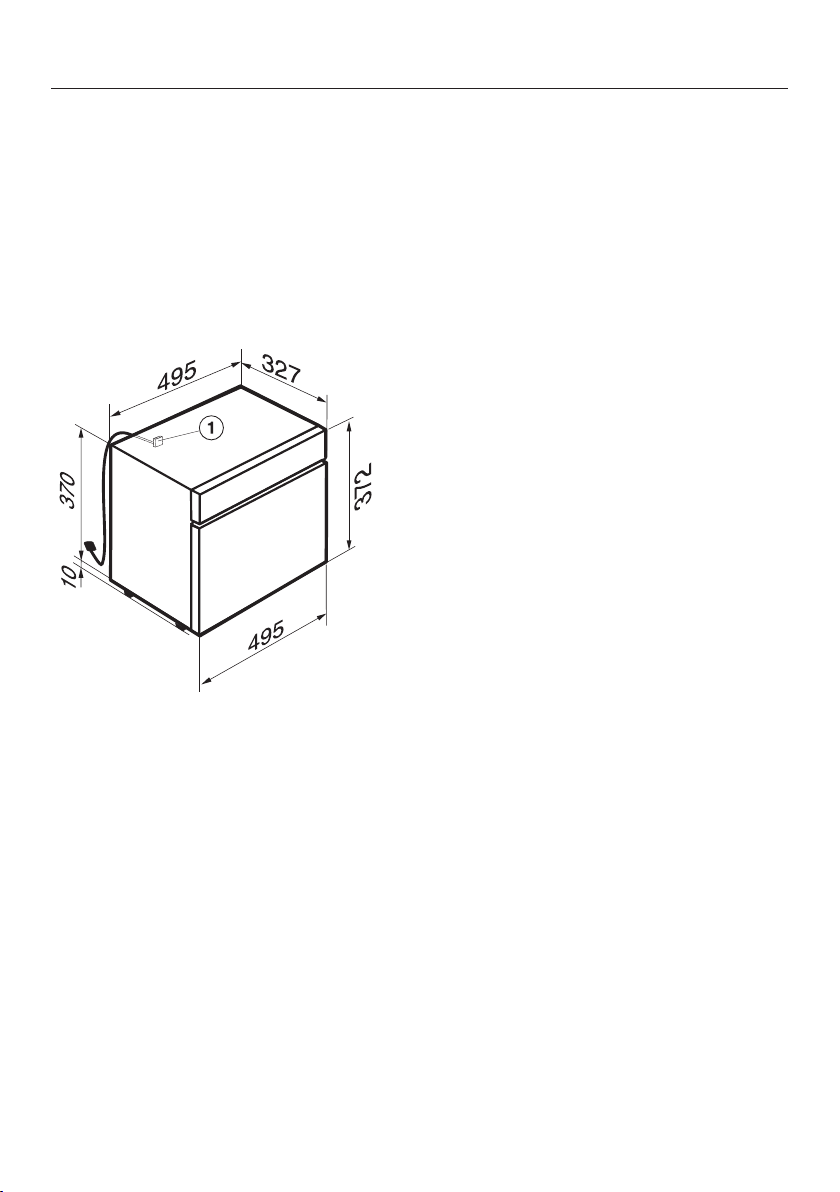
Technical data
82
This appliance is supplied with a mains
cable and moulded plug ready for con-
nection to a single phase supply.
Voltage and frequency: 230V, 50Hz
Connected load: 2.2 kW
Weight: 19.3kg
VDE test certificate: yes
a
Inlet for mains connection cable to
the appliance
Dimensions (H x W x D):
– Appliance see illustration
– Cooking compartment 240 x 335 x
275mm

After sales service
83
Contact in case of malfunction
In the event of any faults which you cannot remedy yourself, please contact your
Miele Dealer or Miele Service.
Contact information for Miele Service can be found at the end of this document.
Please note that telephone calls may be monitored and recorded for training pur-
poses and that a call-out charge will be applied to service visits where the problem
could have been resolved as described in this booklet.
Please quote the model and serial number of your appliance when contacting
Miele. This information can be found on the data plate.
Data plate
Stick the extra data plate supplied with the appliance here. Make sure that the
model number matches the one specified on the back cover of this document.
Warranty
For information on the appliance warranty specific to your country please contact
Miele. See back cover for address.
In the UK, your appliance warranty is valid for 2 years from the date of purchase.
However, you must activate your cover by calling 0330 160 6640 or registering on-
line at www.miele.co.uk.




United Kingdom
Miele Co. Ltd., Fairacres, Marcham Road, Abingdon, Oxon, OX14 1TW
Tel: 0330 160 6600, Internet: www.miele.co.uk/service, E-mail: [email protected]
Australia
Miele Australia Pty. Ltd.
ACN 005 635 398
ABN 96 005 635 398
1 Gilbert Park Drive
Knoxfield, VIC 3180
Tel: 1300 464 353
Internet: www.miele.com.au
Miele Electrical Appliances Co., Ltd.
1-3 Floor, No. 82 Shi Men Yi Road
Jing' an District
200040 Shanghai, PRC
Tel: +86 21 6157 3500
Fax: +86 21 6157 3511
E-mail: [email protected],
Internet: www.miele.cn
China Mainland
Miele (Hong Kong) Ltd.
41/F - 4101, Manhattan Place
23 Wang Tai Road
Kowloon Bay, Hong Kong
Tel: (852) 2610 1025
Fax: (852) 3579 1404
Email:
Website: www.miele.hk
Hong Kong, China
Miele India Pvt. Ltd.
1st Floor, Copia Corporate Suites,
Commercial Plot 9,
Mathura Road, Jasola,
New Delhi - 110025
E-mail: customercare@miele.in
Website: www.miele.in
India
Miele Ireland Ltd.
2024 Bianconi Avenue
Citywest Business Campus
Dublin 24
Tel: (01) 461 07 10
Fax: (01) 461 07 97
E-Mail: [email protected]
Internet: www.miele.ie
Ireland
Malaysia
Miele Sdn Bhd
Suite 12-2, Level 12
Menara Sapura Kencana
Petroleum
Solaris Dutamas No. 1
Jalan Dutamas 1
50480 Kuala Lumpur, Malaysia
Phone: +603-6209-0288
Fax: +603-6205-3768
Miele New Zealand Limited
IRD 98 463 631
8 College Hill
Freemans Bay, Auckland 1011
New Zealand
Tel: 0800 464 353
Internet: www.miele.co.nz
New Zealand
Miele Pte. Ltd.
29 Media Circle
#11-04 ALICE@Mediapolis
Singapore 138565
sTel: +65 6735 1191
Fax: +65 6735 1161
E-Mail: [email protected]
Internet: www.miele.sg
Singapore
Miele (Pty) Ltd.
63 Peter Place
Bryanston 2194
P.O. Box 69434
Bryanston 2021
Tel: (011) 875 9000
Fax: (011) 875 9035
E-mail: [email protected]
Internet: www.miele.co.za
South Africa
Miele Appliances Ltd.
Showroom 1
Eiffel 1 Building
P.O. Box 114782 - Dubai
Tel. +971 4 3044 999
Fax. +971 4 3418 852
800-MIELE (64353)
E-Mail: [email protected]
Website: www.miele.ae
United Arab Emirates
Manufacturer:
Miele & Cie. KG, Carl-Miele-Straße 29, 33332 Gütersloh, Germany
Thailand
Miele Appliances Ltd.
BHIRAJ TOWER at EmQuartier
43rd Floor Unit 4301-4303
689 Sukhumvit Road
North Klongton Sub-District
Vadhana District
Bangkok 10110, Thailand
Sheikh Zayed Road, Umm Al Sheif

M.-Nr. 10 674 800 / 03
en-GB
DG 6001