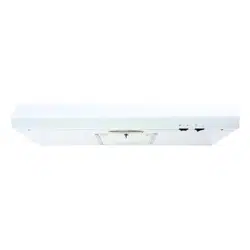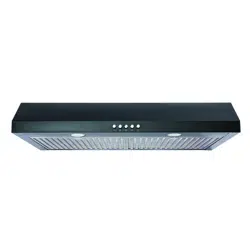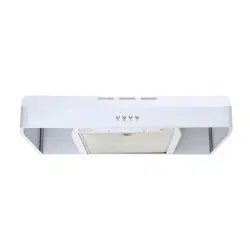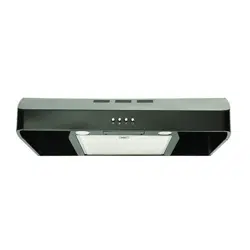
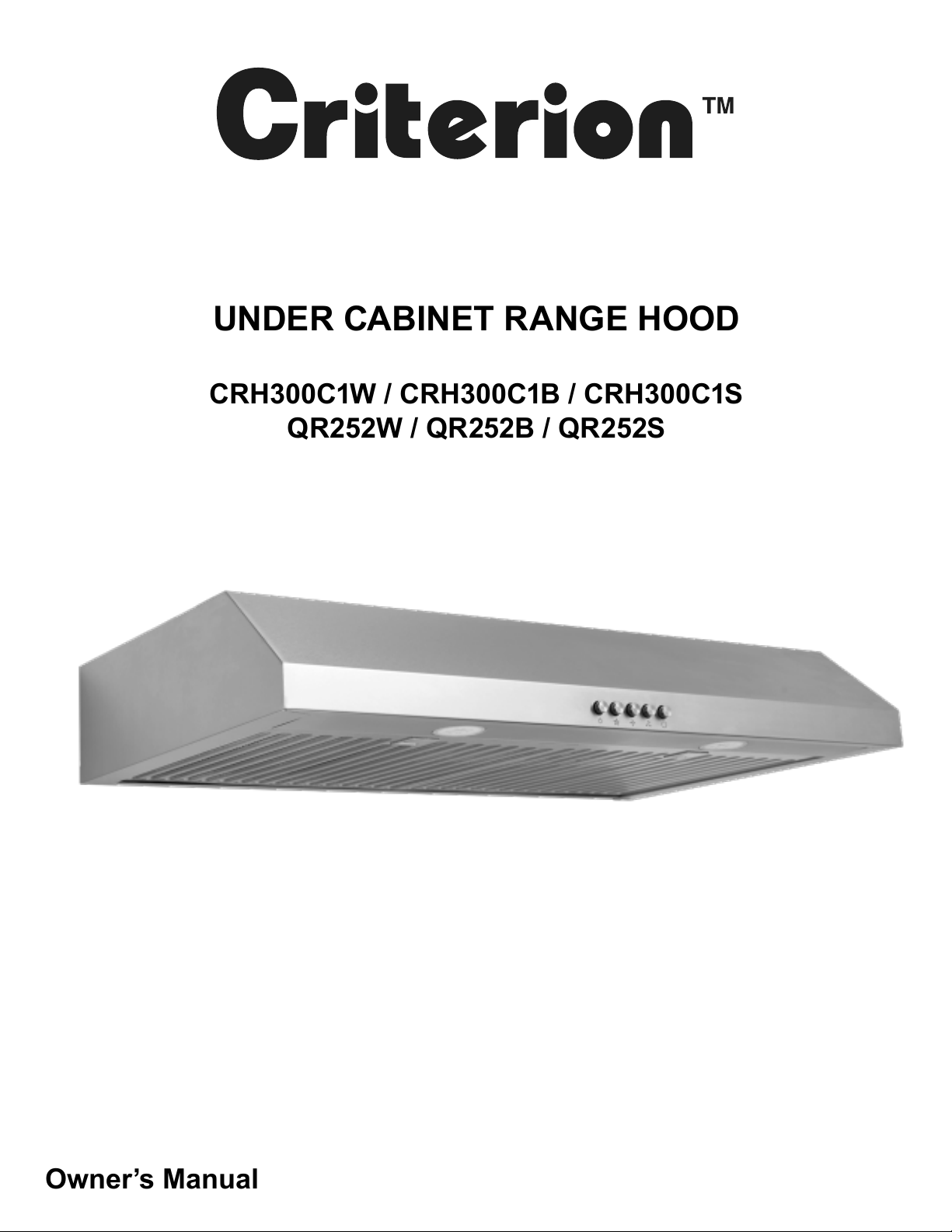
UNDER CABINET RANGE HOOD
CRH300C1W / CRH300C1B / CRH300C1S
QR252W / QR252B / QR252S
Owner’s Manual

2
Table of Contents
Safety Information ...........................2
Warranty
One Year Limited Warranty ...................4
Warranty Claim Procedure ....................4
Pre-Installation
Tools/Materials Required .....................5
Package Contents ..........................6
Hardware Included ..........................6
Planning Installation .........................7
Installation ................................10
Operation .................................13
Maintenance
Replacing Filters ..........................14
Replacing Lights ...........................14
Care and Cleaning
Range Hood ..............................15
Filters ...................................15
Troubleshooting ...........................16
Specications
Wiring Diagram ...........................17
External Range Hood Diagram ...............18
Service Parts ..............................19
Safety Information
READ AND SAVE THESE INSTRUCTIONS
Warning - To reduce the risk of re, electric shock, or
injury to persons, observe the following:
1. Use this unit only in the manner intended by the manufacturer.
If you have any questions, contact the manufacturer.
2. Before servicing or cleaning unit, switch power off at service
panel and lock service disconnecting means to prevent
power from being switched on accidentally. When the service
disconnecting means cannot be locked, securely fasten a
prominent warning device, such as a tag, to the service panel.
3. Installation work and electrical wiring must be done by
qualied person(s) in accordance with all applicable codes
and standards, including re-rated construction.
4. Sufcient air is needed for proper combustion and exhausting
of gases through the ue (chimney) of fuel burning equipment
to prevent back drafting. Follow the heating equipment
manufacturer’s guideline and safety standards such as those
published by the National Fire Protection Association (NFPA),
and the American Society for Heating, Refrigeration and
Air Conditioning Engineers (ASHRAE), and the local code
authorities.
5. When cutting or drilling into a wall or ceiling, do not damage
electrical wiring and other hidden utilities.
6. Ducted fans must always be vented to the outdoors.
WARNING: FUEL (GAS) BURNING RANGES MUST BE
VENTED OUTDOORS USING, AT MINIMUM, METAL
DUCTWORK AND RANGE HOODS OF SUFFICIENT CAPACITY.
Follow your fuel burning equipment manufacturer’s guidelines, as
well as, all applicable safety standards published by the National
Fire Protection Association (NFPA), and the American Society for
Heating, Refrigeration and Air Conditioning Engineers (ASHRAE),
and your local code authorities.
DANGER: Turn off the power circuit breaker or the
power switch on the junction box before installing
or servicing this unit. Touching circuitry inside the
range hood while it is energized will result in death
or serious injury.
DANGER: All electrical wiring must be properly
installed, insulated, and grounded. Improper
insulation and grounding will result in deadly
electrical shock.
DANGER: If installing this unit over a gas range,
turn off the gas at the source before installing or
servicing this unit.
WARNING: Attempting to install or service this unit
when you do not have the necessary technical or
electrical background could result in personal injury.
WARNING: The unit has sharp edges. Always
wear safety gloves during installation, cleaning, or
servicing.
WARNING: Always leave safety grills and lters in
place. Without these components, operating fans
could catch on to hair, ngers, or loose clothing.
WARNING: Stay clear of the rotating fan when the
motor is running.
WARNING: Keep this appliance clean and free of
grease and residue build-up at all times to prevent
res.
CAUTION: This device is for general ventilating use
only. Do not use to exhaust hazardous or explosive
materials and vapors.
3
Safety Information (continued)
COOKING SAFETY INFORMATION
1. Never leave the range hood unattended when in use.
2. Never cook over open ames under the range hood.
3. Always turn the range hood on when cooking at high
heat or when cooking aming foods.
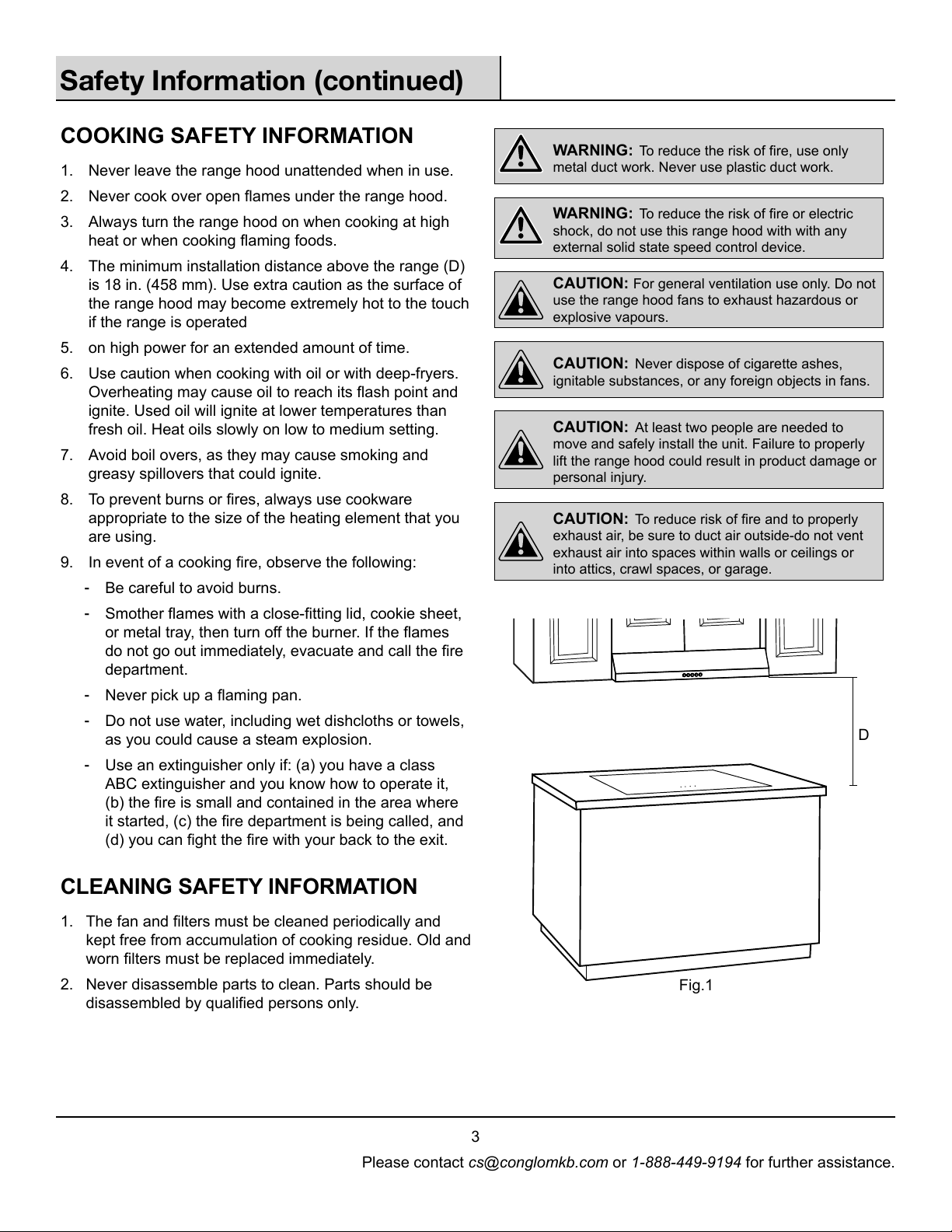
4. The minimum installation distance above the range (D)
is 18 in. (458 mm). Use extra caution as the surface of
the range hood may become extremely hot to the touch
if the range is operated
5. on high power for an extended amount of time.
6. Use caution when cooking with oil or with deep-fryers.
Overheating may cause oil to reach its ash point and
ignite. Used oil will ignite at lower temperatures than
fresh oil. Heat oils slowly on low to medium setting.
7. Avoid boil overs, as they may cause smoking and
greasy spillovers that could ignite.
8. To prevent burns or res, always use cookware
appropriate to the size of the heating element that you
are using.
9. In event of a cooking re, observe the following:
- Be careful to avoid burns.
- Smother ames with a close-tting lid, cookie sheet,
or metal tray, then turn off the burner. If the ames
do not go out immediately, evacuate and call the re
department.
- Never pick up a aming pan.
- Do not use water, including wet dishcloths or towels,
as you could cause a steam explosion.
- Use an extinguisher only if: (a) you have a class
ABC extinguisher and you know how to operate it,
(b) the re is small and contained in the area where
it started, (c) the re department is being called, and
(d) you can ght the re with your back to the exit.
CLEANING SAFETY INFORMATION
1. The fan and lters must be cleaned periodically and
kept free from accumulation of cooking residue. Old and
worn lters must be replaced immediately.
2. Never disassemble parts to clean. Parts should be
disassembled by qualied persons only.
WARNING: To reduce the risk of re, use only
metal duct work. Never use plastic duct work.
WARNING: To reduce the risk of re or electric
shock, do not use this range hood with with any
external solid state speed control device.
CAUTION: For general ventilation use only. Do not
use the range hood fans to exhaust hazardous or
explosive vapours.
CAUTION: Never dispose of cigarette ashes,
ignitable substances, or any foreign objects in fans.
CAUTION: At least two people are needed to
move and safely install the unit. Failure to properly
lift the range hood could result in product damage or
personal injury.
CAUTION: To reduce risk of re and to properly
exhaust air, be sure to duct air outside-do not vent
exhaust air into spaces within walls or ceilings or
into attics, crawl spaces, or garage.
D
Fig.1

4
Warranty
ONE YEAR LIMITED WARRANTY
A thorough inspection must be made before installation and any damage must be promptly reported. We will not be liable
for failures or damage that could have been discovered or avoided by proper inspection and testing prior to installation.
This product is warranted to be free from defects in materials or workmanship for one (1) year from the date of purchase. Proof
of purchase (original sales receipt) from the original consumer purchaser must be made available for all warranty claims.
This warranty is non-transferable and shall be voided if the unit is removed from its initial installation or if it is not installed
following the manufacturer’s instructions. It does not apply in the event of product damage due to the use of other than
genuine replacement parts, (Replacement parts may be obtained by e-mail at [email protected] or by calling 1-888-
449-9194 between 8:30 am - 5:00 pm EST) installation error, abuse, misuse or improper care and maintenance (whether
performed by a plumber, contractor, service provider or member of the purchaser’s household). The warranty excludes
damage due to aggressive air or water conditions, harsh or abrasive cleaners and/or materials.
Under no circumstance shall we be held liable for personal injury or property damage resulting from improper installation
or use of this product. We will not be held liable for inconvenience caused by loss of use of this product, costs incurred
for labour or materials, removal and installation of replacement units, or any other incidental or consequential damages.
Costs relating to obtaining access for repair or replacement are the responsibility of the user.
Our obligation shall be limited to the repair or replacement of a unit (at our discretion) that may prove, by our sole
examination, to be defective under normal use and service during the warranty period.
Any failure of this product that is not traceable to a defect in material or workmanship is not covered by this warranty.
These non-warrantable items include, but are not limited to:
- Improper installation not in accordance with manufacturer’s instructions.
- Dents and/or scratches incurred during shipping, handling, or installation.
- Change in colour or nish due to chemical usage.
- Damage caused by failure to follow care and cleaning guidelines, including damage caused by the use of abrasive
cleaners.
- Alterations made to the unit by the purchaser or installer.
- Damage caused by accidental impact, re, ood, freezing, and normal wear.
- Bends and warping caused by forced connections, over-tightened ttings, and inadequate support during
installation.
- Any defects or damage to light bulbs.
This warranty does not extend to commercial and institutional installation or use.
WARRANTY CLAIM PROCEDURE
If a claimable defect occurs or replacement parts are needed, please contact our customer service team at [email protected] or
1-888-449-9194 (Service available in English and French, Monday - Friday from 8:30 am - 5 pm, EST).
Before you make your call, please ensure that you have:
- Model number or description.
- Proof of sale.
- Details regarding the defect and/or part number.
- Name(s) and address(es) of the owner and/or installer.

5
Pre-Installation
TOOLS/MATERIALS REQUIRED (NOT SUPPLIED)
Measuring tape Level Utility knife
Pencil
Certied
Duct Tape
Adjustable
wrench
Phillips screwdriver
Flathead
screwdriver
Needle nose
pliers
Hammer Electric drill
Safety
goggles
Safety gloves
6
Pre-Installation (continued)
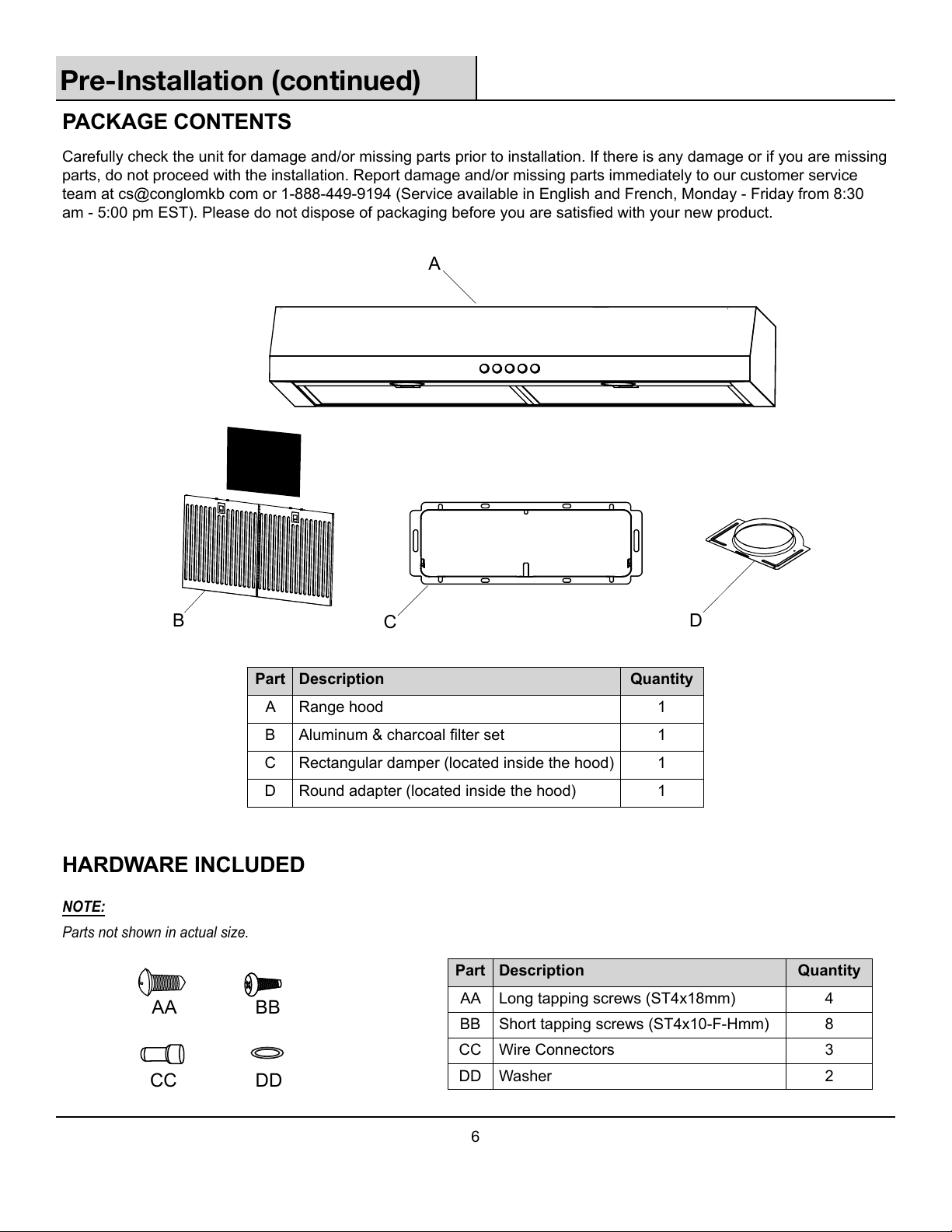
PACKAGE CONTENTS
Carefully check the unit for damage and/or missing parts prior to installation. If there is any damage or if you are missing
parts, do not proceed with the installation. Report damage and/or missing parts immediately to our customer service
team at cs@conglomkb com or 1-888-449-9194 (Service available in English and French, Monday - Friday from 8:30
am - 5:00 pm EST). Please do not dispose of packaging before you are satised with your new product.
A
B
C
D
Part Description Quantity
A Range hood 1
B Aluminum & charcoal lter set 1
C Rectangular damper (located inside the hood) 1
D Round adapter (located inside the hood) 1
HARDWARE INCLUDED
NOTE:
Parts not shown in actual size.
AA BB
CC DD
Part Description Quantity
AA Long tapping screws (ST4x18mm) 4
BB Short tapping screws (ST4x10-F-Hmm) 8
CC Wire Connectors 3
DD Washer 2

7
Pre-Installation (continued)
PLANNING INSTALLATION
Number of people required: 2 or more
1. Before installation, measure all distances to ensure the
proper position of the range hood (A).
- The minimum distance (1) from the cooking surface
to the range hood is 18 in. (458 mm). If your range
species a different distance, use the greater distance
of the two. For best performance, this distance (1)
should not exceed 25 in. (635 mm).
- Dimension (2) should be at least 30 in (762 mm). The
range hood should be approximately the same size as
the cook top.
2. If the bottom of the cabinet (3) above the location where the
range hood is to be installed is recessed, attach appropriately
sized wood ller strips (4) on each side using wood screws.
3. Screws are provided to secure the range hood to most types
of cabinets, but consult a qualied installer to verify that the
supplied screws are suitable for your cabinets.
4. Put a thick, protective covering over your counter, cooktop,
or range to protect it from damage and dirt during installation.
Remove any hazardous objects around the area.
WARNING: Always wear safety goggles and
gloves during installation.
3 4
4
4
2
A
2
1
Fig.2
VENTING OPTIONS:
a. Determine if your existing venting system is top venting or back venting, and ensure that the openings in the cabinet
or wall for the damper and for power access are in appropriate locations and are of appropriate sizes, as per Fig. 3
if it is top venting or Fig. 4 if it is back venting. For top venting option (Fig. 3), if you are using the round adapter, the
opening should be A and B only. If you are using the rectangular damper, opening should be B and C only.
b. If this is a new installation, choose the venting method that suits your needs. Cut out openings for the damper
and for power access in the cabinet bottom or exterior wall, depending on the direction of venting chosen.
13.38 (340mm
2.04
11.26
286
11.26
286
52
)
Fig.3 Fig.4

8
Pre-Installation (continued)
FOLLOW THESE GUIDELINES WHEN INSTALLING DUCT WORK:
- Your venting system must vent to the outdoors either horizontally through the back wall (13) or vertically through
the roof (14) (refer to Fig. 5/Fig. 6/Fig. 7).
- Use round metal duct work with a uniform diameter of 177 mm (7 in). The total duct run in the venting system
should not be more than 10.7 m (35 ft).
- Calculate the total effective length of the duct work by adding the equivalent lengths in the table shown (Fig. 9).
For each tting used add the length of the equivalent straight duct used in the system.
- Fasten all connections between pieces of duct with sheet metal screws and tape all joints with certied duct tape.
- If you must turn the path of the duct work using elbows, keep the number of elbows to a minimum for effective
performance and use no more than three 90° elbows. Ensure that there is a minimum of 458 mm (18 in) of
straight vent between each elbow. Elbow as far away from the range hood’s exhaust opening as possible.
- Cap the exterior of the duct with a wall cap (15) or roof cap (16). Never use 102 mm (4 in) laundry-type wall caps.
Use caulking to seal exterior wall or roof opening around the cap.
- The venting system must have a damper. If the roof or wall cap has a damper, do not use the damper supplied
with the range hood.
13
15
Horizontal Wall Venting
Fig.5
Vertical Roof Venting
14
16
Fig.7
13
Horizontal Wall Venting
Fig.6
15
For inside venting system (air does not exhaust to outdoors) (Fig. 8):
Please refer to the Installation section. The cover on the top plate will be removed and air will be exhausted through the
charcoal lter and out from 17.
17
Fig. 8
Equivalent Length Chart
Type of duct Length added
45
° Elbow 0.91 m (3 ft)
90° Elbow 1.52 m (5 ft)
90° Flat elbow 3.66 m (12 ft)
2.74 m (9 ft) Straight duct 2.74 m (9 ft)
Wall cap 0 m (0 ft)
Fig. 9

9
Pre-Installation (continued)
WIRING CONNECTION REQUIREMENTS
Installation work and electrical wiring must be done by a
qualied person(s) in accordance with all applicable codes
and standards, including re-rated construction.
OBSERVE ALL GOVERNING CODES AND ORDINANCES
WARNINGS
- Electrical grounding is required for this range hood. Check
with a qualied electrician if you are not sure whether the
range hood is properly grounded.
- Failure to follow electrical requirements may result in a re.
- A fuse in the neutral or grounding circuit could result in
electrical shock.
- If the hot/cold water pipe is interrupted by plastic nonmetallic
gaskets or other materials, DO NOT use for grounding.
- DO NOT GROUND TO A GAS PIPE.
IMPORTANT: It is the customer’s responsibility to contact
a qualied electrical installer and assure that the electrical
installation is adequate and complies with the National
Electrical Code, or CSA standards, as well as all local codes
and ordinances.
1. Save installation instructions for electrical inspector’s
use.
2. If codes permit and a separate ground wire is used, it is
recommended that a qualied electrician determine if the
ground path is adequate.
3. DO NOT use an extension cord or adapter plug with this
appliance.
4. The range hood must be connected with copper wire
only.
5. The range hood should be connected directly to
the junction (or circuit breaker) box through exible,
armoured or nonmetallic sheathed copper cable. Allow
some slack in the cable so the
appliance can be moved if servicing is ever necessary.
6. A UL listed or CSA approved conduit connector must be
provided at each end of the power supply cable (at the
range hood and at
the junction box).
7. When making the electrical connection, cut a 3.2 cm (1-
1/4 in hole in the wall. A hole cut through wood must be
sanded until
smooth. A hole through metal must have a grommet.
8. When cutting or drilling into the wall or ceilling, do not
damage
electrical wiring and other hidden utilities.
9. Wire size must conform to all local codes and ordinances.
The latest edition requirements of the National Electrical
Code ANSI/NFPA 70, or the latest edition CSA Standards
C22.1-94, Canadian Electrical Code Part 1 and C22.2
No. 0-M91.
DANGER: Risk of electrical shock. This range
hood must be properly grounded.
DANGER: Turn off the power circuit breaker or the
power switch on the junction box before installing this
unit. Touching circuitry inside the range hood while it
is energized will result in death or serious injury.
DANGER: All electrical wiring must be properly
installed, insulated, and grounded. Improper
insulation and grounding will result in deadly
electrical shock.
NOTE:
Temporarily wire the range hood to test it for proper operation.
If the range hood does not operate correctly, do not proceed
with the installation.
- Remove the bottom panel of the range hood (see Fig.
13) to access the electrical wire leads.
- Use the power supply cable to connect the range hood
(A) directly to the junction box or circuit breaker box.
Use a exible, armoured, or nonmetallic sheathed
copper cable only. Never use an extension cord or
adapter plug.
- Connect a UL-listed or CSA-approved conduit
connector to each end of the power supply cable (at
the range hood and at the junction box). Connect
the 2 colored wires from the range hood (A) to the
corresponding wires from the electrical source: black
to black (live), white to white (neutral), and the house
grounding wire to the green ground screw. Use either
the top hole (1) or the back hole (2) of the range hood
depending on your installation type as shown in Fig. 10.
- Turn the power on, and ensure that the lights and the
fan are operating correctly.
- Once you have tested the electrical connection,
disconnect the power supply cable and wires from the
electrical source before proceeding with the rest of the
installation.
CC
CC
BLACK
WIRES
WHITE WIRES
GREEN
GROUND SCREW
1
2

10
Installation
WARNING: FUEL (GAS) BURNING RANGES MUST BE VENTED OUTDOORS USING, AT MINIMUM, METAL DUCTWORK
AND RANGE HOODS OF SUFFICIENT CAPACITY. Follow your fuel burning equipment manufacturer’s guidelines, as well as, all
applicable safety standards published by the National Fire Protection Association (NFPA), and the American Society for Heating,
Refrigeration and Air Conditioning Engineers (ASHRAE), and your local code authorities.
REMOVING THE ELECTRICAL KNOCK-
OUT HOLE
WARNING: Always wear safety goggles and
gloves during installation.
- Choose the appropriate electrical knock-out hole to remove
for your installation type. Use the top hole (1) if your
electrical supply is in the cabinet and the back hole (2) if
your electrical supply is on the wall below the cabinet (refer
to Fig. 10).
- Use a hammer and a athead screwdriver to gently punch
out the electrical knock-out hole.
REMOVING THE VENTING HOLE
(FOR EXTERIOR VENTING)
- Choose the venting hole to remove for your installation
type. Use the top holes (3 & 4) for a top venting installation
and the back hole (5) for a back venting installation.
- Carefully remove the cover (3, 4 or 5) of the appropriate
venting hole using a at head screwdriver or needle nose
pliers (refer Fig. 11). Be careful not to leave any debris
inside the range hood (A).
(FOR INTERIOR VENTING)
- If you are venting indoors, unscrew the 2 screws holding
cover (6) in place and remove the cover as per Fig.12. DO
NOT REMOVE ANY OTHER VENTING HOLE COVER.
1
2
A
Fig.10
1
A
Fig.11
3
4
6
A
Fig.12
INSTALLING THE DAMPER
(SKIP THIS STEP IF YOU ARE USING
INTERIOR VENTING)
Fig.13
E
7 7
C
BB
A
8
3
5
4
C
BB
A
3
8
BB
5
D
4
D
Fig.14
NOTE:
Only install the damper if you are using a venting system that does not
already have a damper. If this hood replaces an existing unit, the location
of the air exhaust can vary from one manufacturer to another. Ensure that
the damper ts in the existing opening before installing.
- The damper and the adapter are located inside the range
hood. To access these parts, remove the bottom panel (E)
if you have not previously done so (see Fig. 13).
- Choose to install the damper (C) either in the top
position (3) for top venting or in the back position (5)
for back venting. Adapter (D) installs to position 3 & 4 for
top venting only.
- Attach damper (C) or adapter (D) over chosen knockout
opening. Make sure the damper pivot is oriented on top
such that the damper stays closed when not in use.
- Secure the damper (C) or adapter (D) to the range hood
(A) with the short tapping screws (BB).
- Seal the damper (C) or adapter (D) to the range hood (A)
on all four sides with duct tape.

11
Installation (continued)
INSTALLING THE RANGE HOOD
DANGER: Turn off the power circuit breaker or the
power switch on the junction box before installing
this unit. Touching circuitry inside the range hood
while it is energized will result in death or serious
injury.
DANGER: If installing this unit over a gas range,
turn off the gas at the source before installing or
servicing this unit.
- Lift the range hood (A) up under the cabinet to
determine its nal position. Mark the location of the
four keyhole mounting slots (1) on the underside of
the cabinet.
- Set the range hood (A) aside on a protective
surface.
- Drill four pilot holes in the locations that you
marked.
- Screw the four long tapping screws (AA) into the
pilot holes. Do not tighten the screws all the way –
leave the screw heads about 7 mm (0.28 in) from
the cabinet surface.
- Lift the range hood (A) into position, feeding the
power cable and the electrical wires through the
power access opening. Allow some slack in the
cable and wires so that the appliance can be
moved if servicing is ever necessary.
- Position the range hood (A) so the large end (2) of
the keyhole mounting slots (1) are over the screws
(AA). Then push the range hood (A) toward the
wall so the screws (AA) are in the neck (3) of the
keyhole slots. Tighten the screws (AA). Ensure
that the range hood (A) is securely fastened to the
cabinet before releasing it.
- If applicable, test the damper to ensure it rotates up
and down freely.
- If applicable, connect the duct work to the range
hood (A). Seal the joints with duct tape to ensure
an airtight t.
- Reinstall the bottom panel, reinstall lters.
FINAL STEP
- Reconnect the power supply cable and wires to the
electrical supply. Turn the power on and ensure that
the lights and fan are operating correctly.
AA AA
AA
A
1
2
3
Fig.15

12
Installation (continued)
INSTALLING THE CHARCOAL FILTER
(SKIP THIS STEP IF YOU ARE USING EXTERIOR VENTING)
NOTE:
The charcoal lter should only be installed if you are not using an external venting system.
- Turn the lter clip to either side and lift the aluminum lter.
- Place the charcoal lter (B) in place, ensure that it covers the air outlet entirely.
- Turn the lter clip so that the end of the clip holds the lter rmly in place.
1 2
3
4
A
A
A
B
A

13
Operation
NOTE:
The fan and lights operate independently of each other.
TURNING ON/OFF THE UNIT
- To turn on the fan, press the appropriate speed
control switch [Low Speed (4), Medium Speed (3),
High Speed (2)] to select the desired level of power.
Once a button is pressed, the previous speed
mode will be cancelled.
- Press the power switch (5) to turn off the fan.
TURNING ON/OFF THE LIGHTS
- Press the light switch (1) to turn on the lights.
1
2 3 4 5

14
Maintenance
REPLACING FILTERS
When lters need replacing, exchange with similar. Also
replace lters that are damaged with punctures, bends,
or broken frames.
- Turn off the range hood and disconnect the
power.
- Replace with an equivalent lter, then reconnect
the power.
REPLACING LIGHT BULBS
When light bulbs burn out, replace them with a 5W
GU10 base light bulb.
- Turn off the range hood, disconnect it from its
power source, and ensure that the lights are cool.
- Turn the bulb (1) in the direction indicated and
pull it out to remove it.
- Push in the new bulb (2) in the direction indicated
until it locks into the socket. Do not release
the bulb until you are sure the bulb has been
securely installed. Then reconnect the power.
- If new bulbs do not operate, ensure that they are
inserted correctly.
DANGER: Turn off the power circuit breaker or the
power switch on the junction box before performing
maintenance. Touching circuitry inside the range
hood while it is energized will result in death or
serious injury.
WARNING: Failure to replace worn out or
damaged lters will increase the risk of re.
WARNING: Light bulbs can become hot when
turned on. Do not touch bulbs until they are switched
off and cooled. Touching hot bulbs could cause
serious burns.
1
2

15
Care and Cleaning
RANGE HOOD
WARNING: Failure to maintain basic standards of care and cleaning of the range hood will increase
the risk of re.
The range hood should be cleaned (regularly internally and externally) to preserve its appearance and performance.
Do: Do Not:
- Always clean in the direction of the grain
(original
polish lines).
- Clean the range hood periodically with hot,
soapy water and a clean cotton cloth.
- Always rinse well with clean water two or
three times after cleaning. Wipe completely
dry with a soft non-abrasive cloth.
- After cleaning, you may polish with a non-
abrasive stainless steel polish or cleaner.
Always rub lightly and with the grain
- Ensure that the venting system is free of
debris, if you have one.
- Do not use corrosive or abrasive detergents,
steel wool, or scouring pads. These will scratch
and damage the stainless steel surface.
- Do not use any products containing chloride,
uoride, iodide, or bromide on this product, as
they will deteriorate the surface rapidly.
- Do not allow cleaning compounds, salt
solutions, disinfectants, or bleaches to remain
in contact with the product for extended
periods of time.
- Do not allow any deposits to remain for long
periods of time on the range hood. Rinse with
water immediately and wipe dry with a clean
cloth.
- Do not let plaster dust or any other
construction residue enter the hood. During
construction or renovation, cover the hood.
- Combustible products used for cleaning such
as acetone, alcohol, ether, or benzol are highly
explosive and should never be used close to a
range or stove.
FILTER
The lter tted by the factory is intended to lter out residue and grease from cooking. You do not need to replace them
on a regular basis, but you should keep them clean.
Do: Do Not:
- Clean the lter once a month using non-
abrasive detergents, either by hand or in the
dishwasher. When using a dishwasher, set
the dishwasher to a low temperature and a
short cycle setting. The lter may become
discoloured in a dishwasher, but this does
not affect its performance.
- Allow lters to completely dry before re-
installing them in the range hood.
- Do not allow oil to accumulate over
more than 80% of the lter surface. Oil
accumulations may drip oil onto the range.
- Do not wash charcoal lter. The charcoal
lter should be replaced when it is covered
in grease and has reached its maximum
absorbancy.

16
Troubleshooting
DANGER: Turn off the power circuit breaker or the power switch on the junction box before performing
maintenance. Touching circuitry inside the range hood while it is energized may result in serious injury or
death.
Problem Solution
The range hood does not operate.
- Check that the power supply cable and all electrical wiring are properly
connected.
- Check that the power is turned on at the junction box or circuit breaker.
- Check that the wiring between the switch control and the control board
are connected properly.
The range hood vibrates when the fan is
operating.
- Check that the range hood has been secured properly. Tighten into
position, if necessary.
- Check that the motor is secured in place. If not, then tighten the motor in
place.
- Check that the fan is not damaged. If so, replace the fan.
The fans seem weak.
- Check that the duct size used is at least 177 mm (7 in) round. The range
hood will not function efciently with insufcient duct size.
- Check that the duct is not clogged with debris and the tight mesh on the
wall cap, if applicable, isn’t restricting air ow.
- Check that the damper unit is opening properly.
- Check that no birds or animals have nested in the duct.
The lights work, but the fan is not spinning, is
stuck, or is rattling.
- The thermal protection system detects if the motor is too hot to operate
and shuts the motor down. In this case, the motor will function properly
after the thermal protection system cools down (after approximately
10 min).
- Check that the fan isn’t jammed or scraping the bottom.
- If nothing else works, the motor may be defective or seized. If so,
replace the motor.
The range hood is not venting properly.
- Check that no birds or animals have nested in the duct.
- Check that the distance between the cooktop and the bottom of the
range hood is between 458 mm (18 in) and 710 mm (28 in).
- Check that duct work follows all requirements.
Use round metal duct
work with a uniform diameter of 177 mm (7 in). The length of duct work
must not exceed
35 ft (10.7 m). Reduce the length of duct work and
the number of elbows if necessary. Ensure that all joints are properly
connected, sealed, and taped.
- Check that the duct does not open against the wind.
- Ensure that the power is on high speed for heavy cooking.
- Close all windows nearest to the range hood to eliminate sudden air gusts.
- To enhance the performance of the range hood, open slightly a window
on the opposite side of the house where the range hood vents outdoors.
A light does not work.
- Check to see if light bulb is burnt. If so, replace.
- Check the light bulb to see if it is loose. If so, tighten.
- Remove the problem bulb and insert one you know is working. If the
properly functioning light does not come on, the problem may be the light
assembly. Have the light assembly serviced or replaced.

17
Specications
Model Dimensions Rating
Control
Type
Max. Fan
CFM
Speeds Light Bulb Wattage Venting Options
QR252
29.8 in (758 mm) W
120V~60Hz
1.0A
Push
Button
300 ±
10%
High
2 x 5W LED GU10
base light bulb
Top venting
Back venting
Recirculating/
Inside venting
13.9 in (354 mm) D
Medium
5 in (127 mm) H
Low
WIRING DIAGRAM
120V/60Hz
BLACK
BLACK
BLACK
8uF/250V
MOTOR
GRAY
ORANGE
BLUE
YELLOW
YELLOW
RED
RED
BLUE
WHITE
BROWN
L2 L1
WHITE
WHITE
YELLOW/GREEN
2x5W(GU10)
L
N

18
Specications (continued)
EXTERNAL DIAGRAM OF RANGE HOOD
220 mm (8.66 in)
158 mm (6.22 in)
19 mm (0.75 in)
280 mm (11 in)
354 mm (13.94 in)
457 mm (18 in)
758 mm (29.8 in)
758 mm (29.8 in)
220 mm (8.66 in)
350 mm (13.78 in)
93 mm (3.66 in)
41 mm (1.6 in)
80 mm (3.15 in)
102 mm (4 in)
28 mm (1.1 in)
52 mm (2.04 in)
655 mm (25.79 in)
340 mm (13.38 in)
378 mm (14.88 in)
705 mm (27.75 in)
32 mm (1.26 in)
378 mm (14.88 in)
21 mm (0.82 in)
12 mm (0.47 in)
80 mm (3.15 in)
254 mm (10 in)
457 mm (18 in)
93 mm (3.66 in)
TOP
BOTTOM
175 mm (6.89 in)
127 mm (5 in)

19
Service Parts
If you are missing parts or if you require replacement parts, please contact our customer service team at [email protected] or
1-888-449-9194 (8:30 am – 5 pm, EST, Monday–Friday). Identify the required part(s) and have the part number(s) ready.
A
G H I
J
B C D E
F
K M N OL
Part Description Code Quantity
A Rectangular Damper QHR186 1
B Switch QHR187 1
C Bulb Holder QHR223 2
D LED Bulb QHR181 2
E Capacitor QHR188 1
F Round Adapter QHR170 1
G Motor QHR189 1
H Motor Bracket QHR196 1
I Blade QHR226 1
J Blade Guard QHR175 1
K Wire Spring QHR197 1
L Charcoal Filter QHR216 1
M Hybrid Filter QHR211 2
N Long Tapping Screws (ST4x18mm) QHR178 4
O Tapping Screws (ST4x10-F-Hmm) QHR179 8

Imported by:
St-Laurent, Québec, H4S 2C3
1-888-449-9194 | cs@conglomkb.com
(service available in English and French, Monday - Friday from 8:30 am - 5 pm EST)
www.conglomkb.com
Made in China