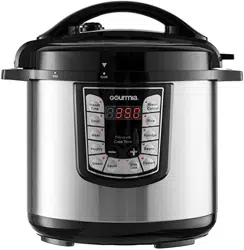
MULTI-MODE SMARTPOT
PRESSURE COOKER
MODEL# GPC800
© 2016 Gourmia
www.Gourmia.com
The Steelstone Group
Brooklyn, NY
All rights reserved. No portion of this manual may be reproduced by any means whatsoever
without written permission from The Steelstone Group, except for the inclusion of quotations in a
media review.
Although every precaution has been taken in the preparation of this manual, The Steelstone
Group assumes no responsibility for errors or omissions. Nor is any liability assumed for damages
resulting from the use of the information contained herein. Although every eort has been made
to ensure that the information contained in this manual is complete and accurate, The Steelstone
Group is not engaged in rendering professional advice or services to the individual consumer;
further, The Steelstone Group shall not be held responsible for any loss or damage allegedly
arising from any information or suggestion in this manual.
10 9 8 7 6 5 4 3 2
Printed in China
Welcome to Amazingly Easy & Delicious
Meals from Gourmia!
With the purchase of the Multi-Mode SmartPot Pressure Cooker, you’ve opened
the door to a wonderfully tender, moist and delicious world of cooking. Cooking with
pressure has been a popular method of cooking for many years, dating all the way
back to the old manual cookers with pressure rockers that sat on your grandmother’s
stove top. Toss out those old memories and the many warnings that went with them,
and enjoy the newest, fully-rened and automated pressure cooking technology from
Gourmia!
The possibilities for fast, delicious pressure-cooked meals are endless. Think
about tender roasts, mouth-watering soups and stews, savory puddings and warm
fruit desserts, zesty barbecue beans and delicate steamed llet of sh. Almost every
food cooks quickly and eortlessly to perfection inside the SmartPot Pressure Cooker!
With Auto Modes for quick and easy selections and manual settings you can choose
for your favorite recipes, the Multi-Mode SmartPot Pressure Cooker will quickly
become your new best friend in the kitchen!
The following pages of this manual oer full and complete instructions for all the
functions and features of your Multi-Mode SmartPot Pressure Cooker. Inside, you’ll nd
helpful cooking guides, information on cooking methods and modes, and complete
step-by-step instructions for assembling, operating, cleaning and maintaining your
Pressure Cooker. Please read all safety instructions and complete directions carefully
for safe usage at all times.
Thank you for your purchase! We hope you will enjoy all the innovative products
brought to you by our family at Gourmia.
© 2016 Gourmia
www.Gourmia.com
The Steelstone Group
Brooklyn, NY
All rights reserved. No portion of this manual may be reproduced by any means whatsoever
without written permission from The Steelstone Group, except for the inclusion of quotations in a
media review.
Although every precaution has been taken in the preparation of this manual, The Steelstone
Group assumes no responsibility for errors or omissions. Nor is any liability assumed for damages
resulting from the use of the information contained herein. Although every eort has been made
to ensure that the information contained in this manual is complete and accurate, The Steelstone
Group is not engaged in rendering professional advice or services to the individual consumer;
further, The Steelstone Group shall not be held responsible for any loss or damage allegedly
arising from any information or suggestion in this manual.
10 9 8 7 6 5 4 3 2
Printed in China
Welcome to Amazingly Easy & Delicious
Meals from Gourmia!
With the purchase of the Multi-Mode SmartPot Pressure Cooker, you’ve opened
the door to a wonderfully tender, moist and delicious world of cooking. Cooking with
pressure has been a popular method of cooking for many years, dating all the way
back to the old manual cookers with pressure rockers that sat on your grandmother’s
stove top. Toss out those old memories and the many warnings that went with them,
and enjoy the newest, fully-rened and automated pressure cooking technology from
Gourmia!
The possibilities for fast, delicious pressure-cooked meals are endless. Think
about tender roasts, mouth-watering soups and stews, savory puddings and warm
fruit desserts, zesty barbecue beans and delicate steamed llet of sh. Almost every
food cooks quickly and eortlessly to perfection inside the SmartPot Pressure Cooker!
With Auto Modes for quick and easy selections and manual settings you can choose
for your favorite recipes, the Multi-Mode SmartPot Pressure Cooker will quickly
become your new best friend in the kitchen!
The following pages of this manual oer full and complete instructions for all the
functions and features of your Multi-Mode SmartPot Pressure Cooker. Inside, you’ll nd
helpful cooking guides, information on cooking methods and modes, and complete
step-by-step instructions for assembling, operating, cleaning and maintaining your
Pressure Cooker. Please read all safety instructions and complete directions carefully
for safe usage at all times.
Thank you for your purchase! We hope you will enjoy all the innovative products
brought to you by our family at Gourmia.
5
TABLE OF CONTENTS
I. SAFETY FIRST p. 6
II. FEATURES & FUNCTIONS p. 11
III. PRE-PROGRAMMED CONTROL PANEL p. 15
IV. ASSEMBLY BEFORE USE p. 17
V. COOKING MODES, METHODS & FEATURES p. 19
Auto Modes p. 22
Auto Modes + or — Minutes p. 22
Custom Time Mode p. 23
Auto Methods p. 23
Steam p. 23
Sauté p. 24
Slow Cook p. 24
Delay Timer & Keep Warm Features p. 25
VI. STEP-BY-STEP COOKING p. 27
Soup p. 27
Meat p. 29
Poultry p. 31
Dessert p. 33
Beans p. 36
Porridge p. 38
Rice p. 40
VII. COOKING CHARTS & CANNING HINTS & TIPS p. 43
VIII. CLEANING & MAINTENANCE p. 53
IX. FAQ’S, WARRANTY & SERVICE p. 55
FAQ’s p. 55
Warranty & Service p. 59
5
TABLE OF CONTENTS
I. SAFETY FIRST p. 6
II. FEATURES & FUNCTIONS p. 11
III. PRE-PROGRAMMED CONTROL PANEL p. 15
IV. ASSEMBLY BEFORE USE p. 17
V. COOKING MODES, METHODS & FEATURES p. 19
Auto Modes p. 22
Auto Modes + or — Minutes p. 22
Custom Time Mode p. 23
Auto Methods p. 23
Steam p. 23
Sauté p. 24
Slow Cook p. 24
Delay Timer & Keep Warm Features p. 25
VI. STEP-BY-STEP COOKING p. 27
Soup p. 27
Meat p. 29
Poultry p. 31
Dessert p. 33
Beans p. 36
Porridge p. 38
Rice p. 40
VII. COOKING CHARTS & CANNING HINTS & TIPS p. 43
VIII. CLEANING & MAINTENANCE p. 53
IX. FAQ’S, WARRANTY & SERVICE p. 55
FAQ’s p. 55
Warranty & Service p. 59
SAFETY FIRST
SAFETY FIRST
76
IMPORTANT SAFEGUARDS
When operating this electric appliance, basic safety instructions should
always be followed. Refer to the following for these instructions
1. READ ALL SAFETY & USAGE INSTRUCTIONS BEFORE USING PRESSURE
COOKER.
2. EXERCISE EXTREME CAUTION: AVOID ELECTRICAL SHOCK. DO NOT
immerse cord, plugs or the PRESSURE COOKER BASE in water or other liquid.
3. THIS PRESSURE COOKER IS A SELF-CONTAINED PRESSURIZED APPLIANCE.
DO NOT USE ON A STOVETOP OR WITH ANY OTHER HEATING ELEMENT.
4. Do not touch the Pressure Cooker Base or Inner Pot while the Cooker is
working. The exterior of the Base and Lid will be HOT.
5. USE EXTREME CAUTION when removing the Inner Pot from the Base to ensure
hot ingredients are not spilled. Wear potholders whenever moving the Pot with
hot ingredients and avoid the hot steam or water that may spill upon opening
the Lid.
6. When opening the LID after cooking, open it AWAY from your face. Hot steam
and water may escape while opening the Lid.
7. Do not use the Pressure Cooker for any use other than intended. Do not use
the pressure cooker Inner Pot or Base in a standard oven. Do not use the
Pressure Cooker or Inner Pot on a stovetop, gas or electric burner or any other
heat-producing element. Do not use outdoors. DO NOT attempt to deep-fry in
this Pressure Cooker.
8. Do not attempt to open the Pressure Cooker Lid at any time during cooking.
Do not attempt to open the Lid until the Pressure Release Valve has dropped
and the pressure has been completely released, either naturally or via the
Airtight/Exhaust Valve. Use pot holders to open the Lid and remove the Inner
Pot and keep face and hands away from steam or hot water that escapes.
9. Do not tamper with the Seal or Seal Wire Support in the Lid with any tools or
other force.
10. Do not allow the Valves to become clogged. Clean the Filter regularly.
11. Do not allow liquids or food to fall between the Inner Pot and the Base. If
needed, unplug the Pressure Cooker and, when cool, clean the Base interior
with a soft, slightly damp cloth. Do not use cleaners, harsh chemicals in the
interior of the Base and DO NOT immerse the Base in water.
12. Do not place any items, other than heat-proof containers that are
manufactured as accessories for the Pressure Cooker, inside the Inner Pot or
Base. Do not attempt to heat any non-food items in the Pressure Cooker, as it
may cause re and serious physical damage.
13. Do not ll the Inner Pot more than two-thirds (2/3) full with ingredients
and/or liquid. When cooking foods that expand while cooking, such as rice,
beans or dried foods, do not ll the Inner Pot more than one-half (1/2) full.
Over-lling may clog the vents and develop excess pressure, leading to
injury and/or damage.
14. DO NOT add additional weight on the Valves or alter the Valves in any way.
15. The Inner Pot has a non-stick surface. Use wooden or heat-proof plastic
utensils only inside the Pot.
16. Certain foods, such as applesauce, cranberries, pearl barley, oatmeal and
other cereals, split peas, pasta, rhubarb, etc. may foam, froth and sputter,
causing clogging of the Pressure Release Valve or Airtight/Exhaust Valve.
Use extreme caution if cooking these foods in the Pressure Cooker and allow
pressure to escape naturally at the end of the cooking cycle.
17. When cooking is complete, always allow the steam to escape naturally or via
the Airtight/Exhaust Valve. If the Lid resists opening, wait for 5-10 minutes
to continue to allow steam to escape before attempting to open. When all
steam has escaped, the Lid will unlock and open easily.
18. UNPLUG the Pressure Cooker from outlet when not in use or before
cleaning. Allow the Inner Pot and Base to cool before cleaning. Do not let
cord hang over edge of table or counter or touch hot surfaces.
19. Children should never use the Pressure Cooker; close supervision is required
when appliance is used near children. Do not leave the Pressure Cooker
unattended while in operation.
20. Never operate the Pressure Cooker with a damaged cord or plug or one
that has malfunctioned or been damaged in any way. Immediately contact
Customer Service for analysis.
21. DO NOT add unauthorized accessory attachments. Such use may result in
electric shock, injury or re.
22. This appliance cooks under pressure. Improper use may result in scalding
injury.
SAFETY FIRST
SAFETY FIRST
76
IMPORTANT SAFEGUARDS
When operating this electric appliance, basic safety instructions should
always be followed. Refer to the following for these instructions
1. READ ALL SAFETY & USAGE INSTRUCTIONS BEFORE USING PRESSURE
COOKER.
2. EXERCISE EXTREME CAUTION: AVOID ELECTRICAL SHOCK. DO NOT
immerse cord, plugs or the PRESSURE COOKER BASE in water or other liquid.
3. THIS PRESSURE COOKER IS A SELF-CONTAINED PRESSURIZED APPLIANCE.
DO NOT USE ON A STOVETOP OR WITH ANY OTHER HEATING ELEMENT.
4. Do not touch the Pressure Cooker Base or Inner Pot while the Cooker is
working. The exterior of the Base and Lid will be HOT.
5. USE EXTREME CAUTION when removing the Inner Pot from the Base to ensure
hot ingredients are not spilled. Wear potholders whenever moving the Pot with
hot ingredients and avoid the hot steam or water that may spill upon opening
the Lid.
6. When opening the LID after cooking, open it AWAY from your face. Hot steam
and water may escape while opening the Lid.
7. Do not use the Pressure Cooker for any use other than intended. Do not use
the pressure cooker Inner Pot or Base in a standard oven. Do not use the
Pressure Cooker or Inner Pot on a stovetop, gas or electric burner or any other
heat-producing element. Do not use outdoors. DO NOT attempt to deep-fry in
this Pressure Cooker.
8. Do not attempt to open the Pressure Cooker Lid at any time during cooking.
Do not attempt to open the Lid until the Pressure Release Valve has dropped
and the pressure has been completely released, either naturally or via the
Airtight/Exhaust Valve. Use pot holders to open the Lid and remove the Inner
Pot and keep face and hands away from steam or hot water that escapes.
9. Do not tamper with the Seal or Seal Wire Support in the Lid with any tools or
other force.
10. Do not allow the Valves to become clogged. Clean the Filter regularly.
11. Do not allow liquids or food to fall between the Inner Pot and the Base. If
needed, unplug the Pressure Cooker and, when cool, clean the Base interior
with a soft, slightly damp cloth. Do not use cleaners, harsh chemicals in the
interior of the Base and DO NOT immerse the Base in water.
12. Do not place any items, other than heat-proof containers that are
manufactured as accessories for the Pressure Cooker, inside the Inner Pot or
Base. Do not attempt to heat any non-food items in the Pressure Cooker, as it
may cause re and serious physical damage.
13. Do not ll the Inner Pot more than two-thirds (2/3) full with ingredients
and/or liquid. When cooking foods that expand while cooking, such as rice,
beans or dried foods, do not ll the Inner Pot more than one-half (1/2) full.
Over-lling may clog the vents and develop excess pressure, leading to
injury and/or damage.
14. DO NOT add additional weight on the Valves or alter the Valves in any way.
15. The Inner Pot has a non-stick surface. Use wooden or heat-proof plastic
utensils only inside the Pot.
16. Certain foods, such as applesauce, cranberries, pearl barley, oatmeal and
other cereals, split peas, pasta, rhubarb, etc. may foam, froth and sputter,
causing clogging of the Pressure Release Valve or Airtight/Exhaust Valve.
Use extreme caution if cooking these foods in the Pressure Cooker and allow
pressure to escape naturally at the end of the cooking cycle.
17. When cooking is complete, always allow the steam to escape naturally or via
the Airtight/Exhaust Valve. If the Lid resists opening, wait for 5-10 minutes
to continue to allow steam to escape before attempting to open. When all
steam has escaped, the Lid will unlock and open easily.
18. UNPLUG the Pressure Cooker from outlet when not in use or before
cleaning. Allow the Inner Pot and Base to cool before cleaning. Do not let
cord hang over edge of table or counter or touch hot surfaces.
19. Children should never use the Pressure Cooker; close supervision is required
when appliance is used near children. Do not leave the Pressure Cooker
unattended while in operation.
20. Never operate the Pressure Cooker with a damaged cord or plug or one
that has malfunctioned or been damaged in any way. Immediately contact
Customer Service for analysis.
21. DO NOT add unauthorized accessory attachments. Such use may result in
electric shock, injury or re.
22. This appliance cooks under pressure. Improper use may result in scalding
injury.
SAFETY FIRST
SAFETY FIRST
98
FOR HOUSEHOLD USE ONLY
Electrical 3-conductor Cord Set: This
Pressure Cooker is equipped with a
3-conductor cord set that has a 3 prong
grounding-type plug. It should be
properly connected to a grounding-type
outlet. The plug is designed to t ONLY
a 3-grounding outlet unit, and as such,
the grounding prong should never be
removed. If needed, purchase a 2-prong
adaptor and ground it to the outlet.
Consult a qualied electrician if in doubt.
Do not use an adaptor unless you are
condent it is grounded. Do not modify
this plug. If the plug does not t the
outlet securely, call a qualied electrician
for assistance.
23. Use only factory cord supplied; NEVER add extension cords. When done
using, rst press Cancel Button, then pull plug from outlet.
24. Prevent possible damage to countertops by placing the Pressure Cooker on
a trivet or sturdy hot pad BEFORE heating.
25. All parts and accessories for this appliance must be used properly according
to the instructions. There is a potential risk of re, electric shock or injury to
persons if the product is not used as instructed.
26. Do not cover or block the Pressure Release Valve or the Airtight/Exhaust
Valve while using the Pressure Cooker.
27. If any servicing of the Pressure Cooker, Inner Pot or accessories is required,
contact the Gourmia customer service center for instructions.
SAVE THESE INSTRUCTIONS
Note: This Pressure Cooker functions with a median pressure between 12-15psi.
SAFETY FIRST
SAFETY FIRST
98
FOR HOUSEHOLD USE ONLY
Electrical 3-conductor Cord Set: This
Pressure Cooker is equipped with a
3-conductor cord set that has a 3 prong
grounding-type plug. It should be
properly connected to a grounding-type
outlet. The plug is designed to t ONLY
a 3-grounding outlet unit, and as such,
the grounding prong should never be
removed. If needed, purchase a 2-prong
adaptor and ground it to the outlet.
Consult a qualied electrician if in doubt.
Do not use an adaptor unless you are
condent it is grounded. Do not modify
this plug. If the plug does not t the
outlet securely, call a qualied electrician
for assistance.
23. Use only factory cord supplied; NEVER add extension cords. When done
using, rst press Cancel Button, then pull plug from outlet.
24. Prevent possible damage to countertops by placing the Pressure Cooker on
a trivet or sturdy hot pad BEFORE heating.
25. All parts and accessories for this appliance must be used properly according
to the instructions. There is a potential risk of re, electric shock or injury to
persons if the product is not used as instructed.
26. Do not cover or block the Pressure Release Valve or the Airtight/Exhaust
Valve while using the Pressure Cooker.
27. If any servicing of the Pressure Cooker, Inner Pot or accessories is required,
contact the Gourmia customer service center for instructions.
SAVE THESE INSTRUCTIONS
Note: This Pressure Cooker functions with a median pressure between 12-15psi.
1110
FEATURES & FUNCTIONS
A. EasyGrip Lid with Handle: The EasyGrip Lid has several key features built into it,
all designed to be easy-to-use and helpful in the pressure cooking process. Note
the special features of the Lid, including the small arrow on the side lip and the
locking assembly that securely keeps the Lid in place while cooking. Because the Lid
contains the Airtight/Exhaust Valve and a unique Flexible Seal Ring, it should never
be put in the dishwasher or immersed for cleaning. Check the maintenance tips in
this Guide for further instructions.
1. Airtight/Exhaust Valve. This Valve can be turned to either “Airtight,” the
closed/locked position, or the quick release valve, titled “Exhaust” on the
Lid.
2. Flexible Seal Ring. A sturdy ring of rubberized plastic creates the perfect
Seal to hold the pressure intact while cooking.
3. Seal Wire Support. An intersected wire ring of support helps hold the
Flexible Seal Ring in place. Check the assembly instructions to correctly
insert the Flexible Seal Ring into the Seal Wire Support and then into the
Lid.
4. Filter. Positioned inside the Lid, the Filter is especially designed to allow
the steam to escape eciently. If the Filter becomes clogged, clean per
maintenance directions in this Guide.
B. Nonstick Inner Pot: Containing an easy-to-clean nonstick coating, the Inner Pot
holds the foods and liquids to be pressure cooked. Check the Fill Lines inside the
Inner Pot (see B-1) carefully to determine the proper quantities for cooking. Carefully
avoid overlling.
FEATURES & FUNCTIONS
A
A-3
A-4
A-1
A-2
B
B-1
1110
FEATURES & FUNCTIONS
A. EasyGrip Lid with Handle: The EasyGrip Lid has several key features built into it,
all designed to be easy-to-use and helpful in the pressure cooking process. Note
the special features of the Lid, including the small arrow on the side lip and the
locking assembly that securely keeps the Lid in place while cooking. Because the Lid
contains the Airtight/Exhaust Valve and a unique Flexible Seal Ring, it should never
be put in the dishwasher or immersed for cleaning. Check the maintenance tips in
this Guide for further instructions.
1. Airtight/Exhaust Valve. This Valve can be turned to either “Airtight,” the
closed/locked position, or the quick release valve, titled “Exhaust” on the
Lid.
2. Flexible Seal Ring. A sturdy ring of rubberized plastic creates the perfect
Seal to hold the pressure intact while cooking.
3. Seal Wire Support. An intersected wire ring of support helps hold the
Flexible Seal Ring in place. Check the assembly instructions to correctly
insert the Flexible Seal Ring into the Seal Wire Support and then into the
Lid.
4. Filter. Positioned inside the Lid, the Filter is especially designed to allow
the steam to escape eciently. If the Filter becomes clogged, clean per
maintenance directions in this Guide.
B. Nonstick Inner Pot: Containing an easy-to-clean nonstick coating, the Inner Pot
holds the foods and liquids to be pressure cooked. Check the Fill Lines inside the
Inner Pot (see B-1) carefully to determine the proper quantities for cooking. Carefully
avoid overlling.
FEATURES & FUNCTIONS
A
A-3
A-4
A-1
A-2
B
B-1
FEATURES & FUNCTIONS
FEATURES & FUNCTIONS
1312
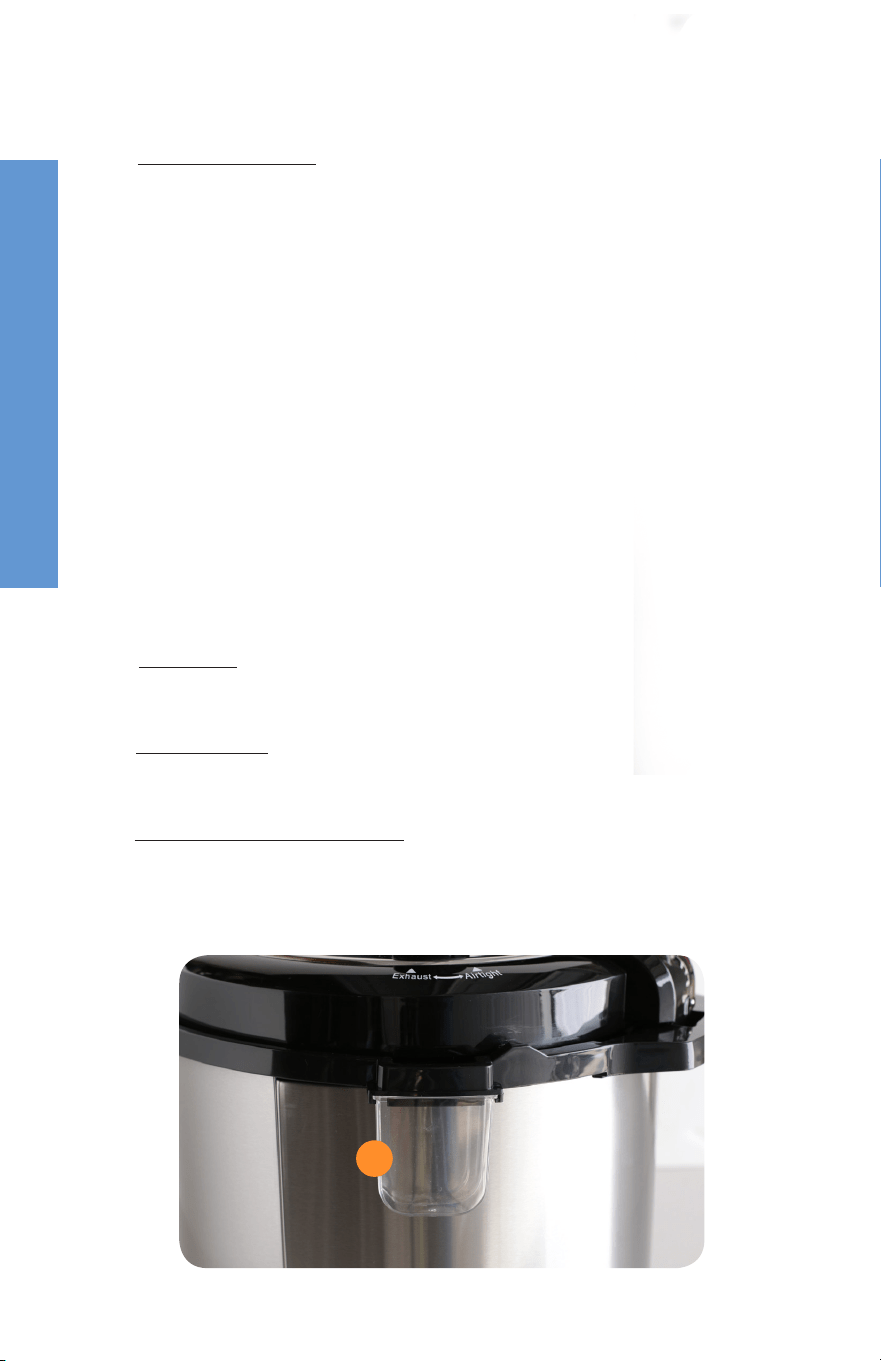
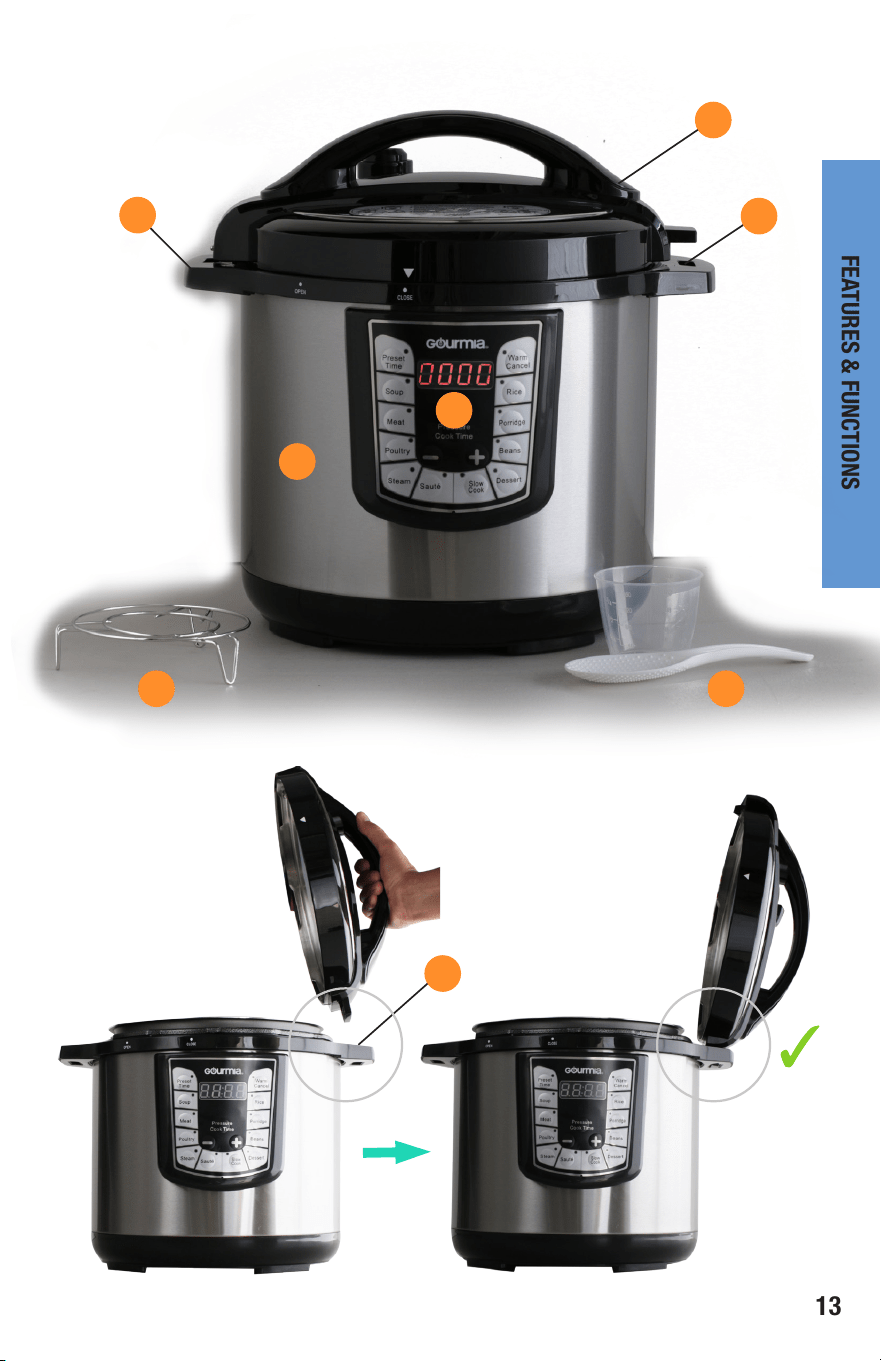
C. Pressure Cooker Base: The stainless steel Base holds the Inner Pot, houses the
pre-programmed Control Panel, and is locked with the EasyGrip Lid during pressure
cooking. The Mini Cup is attached to the side of the Base.
1. Pressure Cooker EasyGrip Handles. Use the handles when transferring the
Base or when positioning the Lid into place for pressure cooking. Whenever the
Pressure Cooker is in use, protect hands from hot surfaces by using potholders
or oven mitts.
2. Pre-programmed Control Panel. Holding the “brains” of the Pressure Cooker,
the Control Panel contains the LED Display and all Auto Modes, Methods and
Preset functions. Refer to the section of this Guide titled, “Pre-programmed
Control Panel” for specic information.
3. Mini Cup. The small clear cup collects any condensation water that
accumulates during the cooking process. It is included in your package and
attaches easily to the upper lip of the Base.
D. Accessories: To make pressure cooking even easier, you’ll nd a Stainless Steel
Steaming Rack, Measuring Cup and Plastic Spoon included in this package.
E. Lid Rest Handle: Your 8 Quart Gourmia pressure cooker features a lid rest handle that
can easily hold the lid without making a mess on the countertop.
F. Pressure Safety Fail-Safe System: This system includes the Pressure Release Valve.
It prevents the lid from opening when unsafe pressure levels are present. The Pressure
Release Valve in this system will drop and the Lid will turn to unlock when safe to do so.
DD
C-3
C
F
C-1
E
C-2
E
FEATURES & FUNCTIONS
FEATURES & FUNCTIONS
1312
C. Pressure Cooker Base: The stainless steel Base holds the Inner Pot, houses the
pre-programmed Control Panel, and is locked with the EasyGrip Lid during pressure
cooking. The Mini Cup is attached to the side of the Base.
1. Pressure Cooker EasyGrip Handles. Use the handles when transferring the
Base or when positioning the Lid into place for pressure cooking. Whenever the
Pressure Cooker is in use, protect hands from hot surfaces by using potholders
or oven mitts.
2. Pre-programmed Control Panel. Holding the “brains” of the Pressure Cooker,
the Control Panel contains the LED Display and all Auto Modes, Methods and
Preset functions. Refer to the section of this Guide titled, “Pre-programmed
Control Panel” for specic information.
3. Mini Cup. The small clear cup collects any condensation water that
accumulates during the cooking process. It is included in your package and
attaches easily to the upper lip of the Base.
D. Accessories: To make pressure cooking even easier, you’ll nd a Stainless Steel
Steaming Rack, Measuring Cup and Plastic Spoon included in this package.
E. Lid Rest Handle: Your 8 Quart Gourmia pressure cooker features a lid rest handle that
can easily hold the lid without making a mess on the countertop.
F. Pressure Safety Fail-Safe System: This system includes the Pressure Release Valve.
It prevents the lid from opening when unsafe pressure levels are present. The Pressure
Release Valve in this system will drop and the Lid will turn to unlock when safe to do so.
DD
C-3
C
F
C-1
E
C-2
E
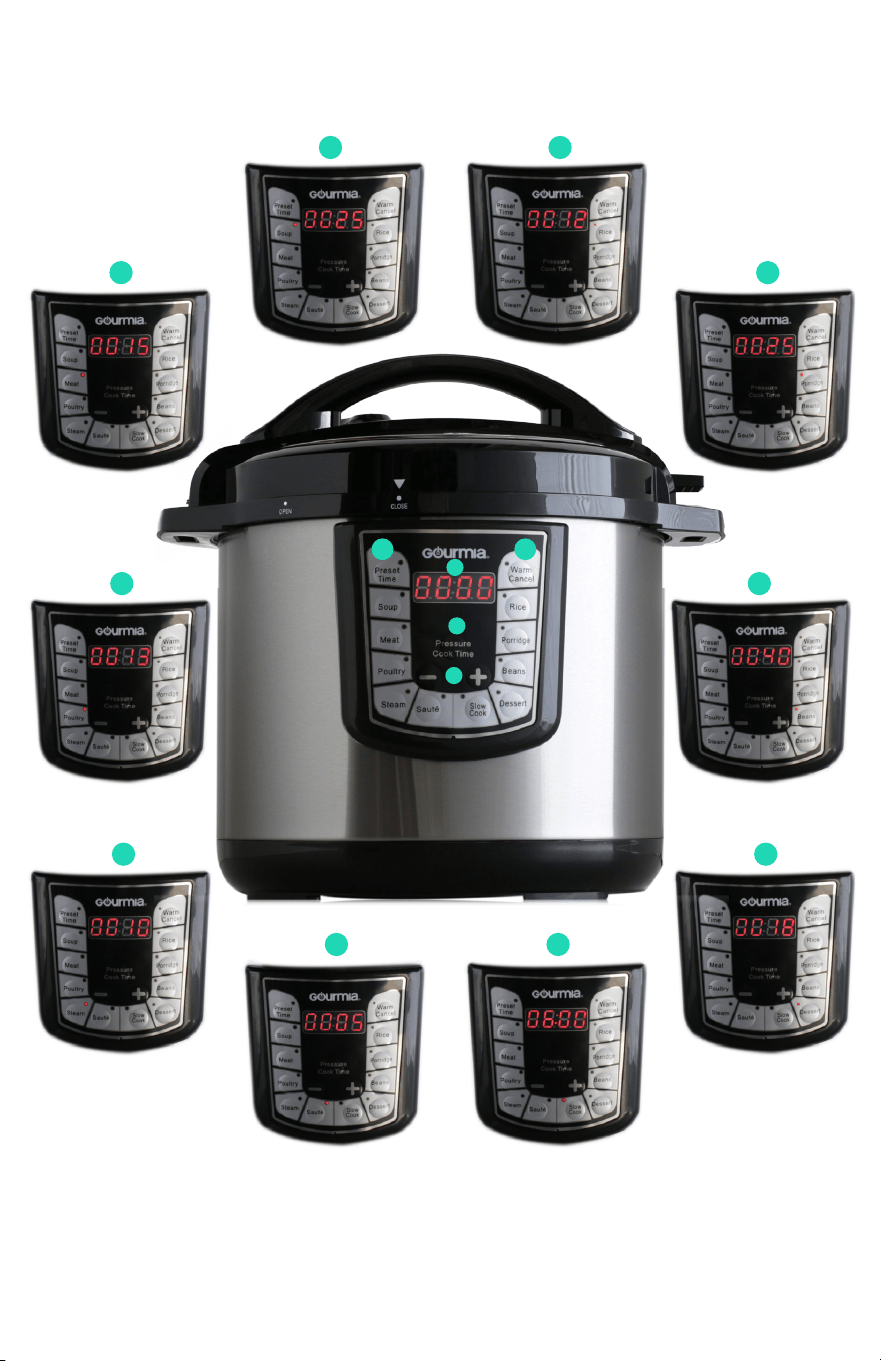
1514 15
PRE-PROGRAMMED CONTROL PANEL
PRE-PROGRAMMED CONTROL PANEL
1
Preset/Time Button: Press to set the Delay Timer
2
Soup Button: Press to set Soup Auto Mode
3
Meat Button: Press to set Meat Auto Mode
4
Poultry Button: Press to set Poultry Auto Mode
5
Steam Button: Press to set the Steam Auto Method
6
Sauté Button: Press to set the Sauté Auto Method
7
Slow Cook Button: Press to set the Slow Cook Auto Method
8
Dessert Button: Press to set the Dessert Auto Mode
9
Beans Button: Press to set the Bean Auto Mode
10
Porridge Button: Press to set the Porridge Auto Mode
11
Rice Button: Press to set the Rice Auto Mode
12
Warm/Cancel Button: Press to set the Keep Warm Mode,
Press to cancel any operation
13
LED Display
14
— and + Buttons: Press to alter preset Mode times
15
Pressure Cook Time Button: Press to set Custom Time Mode
2 11
3 10
4 9
5 8
6
1 12
15
14
13
7

1514 15
PRE-PROGRAMMED CONTROL PANEL
PRE-PROGRAMMED CONTROL PANEL
1
Preset/Time Button: Press to set the Delay Timer
2
Soup Button: Press to set Soup Auto Mode
3
Meat Button: Press to set Meat Auto Mode
4
Poultry Button: Press to set Poultry Auto Mode
5
Steam Button: Press to set the Steam Auto Method
6
Sauté Button: Press to set the Sauté Auto Method
7
Slow Cook Button: Press to set the Slow Cook Auto Method
8
Dessert Button: Press to set the Dessert Auto Mode
9
Beans Button: Press to set the Bean Auto Mode
10
Porridge Button: Press to set the Porridge Auto Mode
11
Rice Button: Press to set the Rice Auto Mode
12
Warm/Cancel Button: Press to set the Keep Warm Mode,
Press to cancel any operation
13
LED Display
14
— and + Buttons: Press to alter preset Mode times
15
Pressure Cook Time Button: Press to set Custom Time Mode
2 11
3 10
4 9
5 8
6
1 12
15
14
13
7
17
ASSEMBLY BEFORE USE
ASSEMBLY BEFORE USE
1. Place the Pressure Cooker Base on a at, stable surface. If the countertop
may possibly be damaged by heat, use a trivet positioned under the Base
for safety (See Fig.1).
2. To open the Lid, rmly grasp the Lid handle and rotate clockwise until the
arrow on the Lid is positioned over the “Open” indicator on the Base (See
Fig. 2). Lift the Lid straight up and remove from the Base.
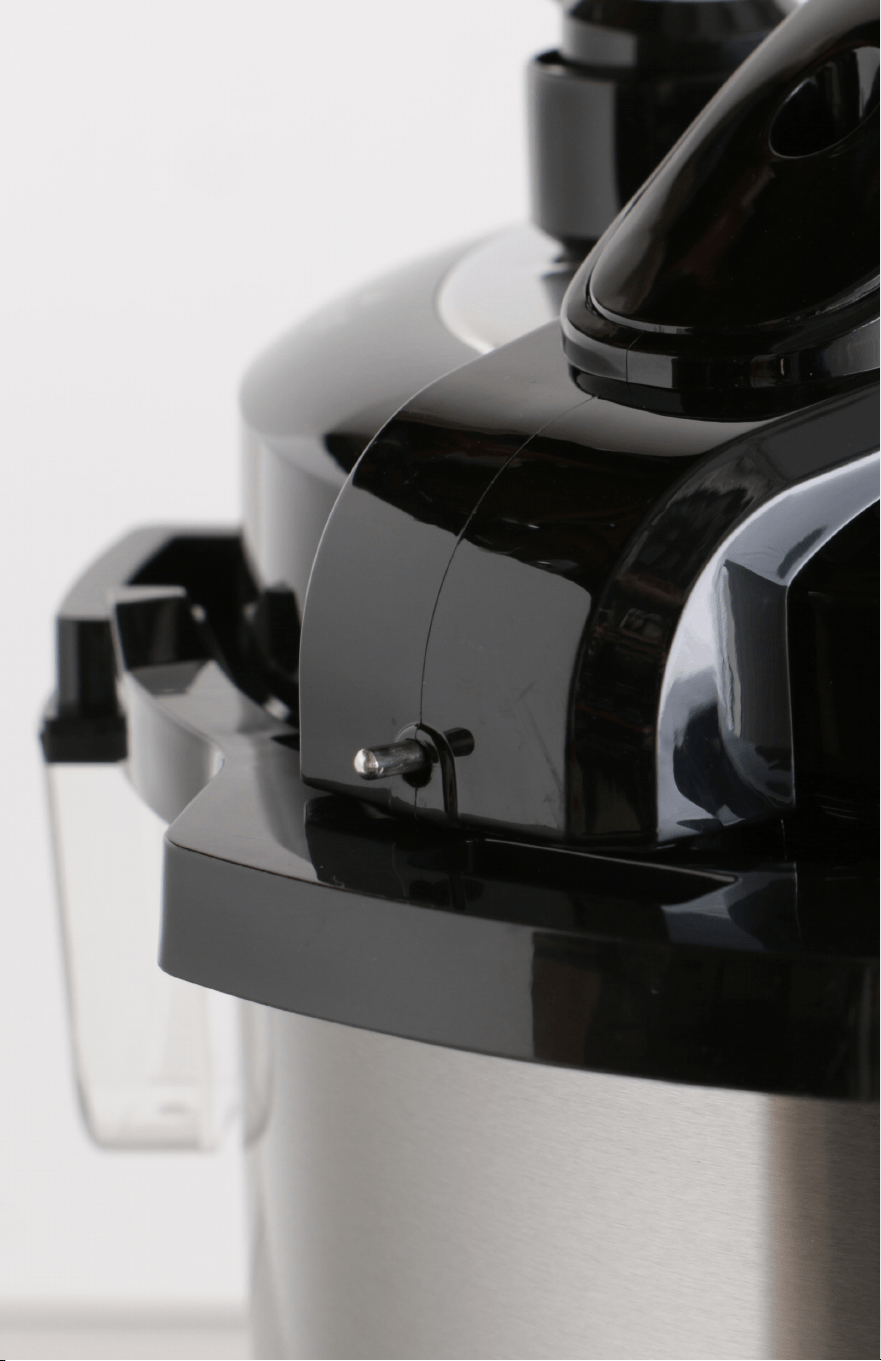
Note: When the Lid is NOT fully opened or closed, the indicator Pin will
be extended (see image at left). When the Lid is in an opened or closed
position, the indicator Pin will be ush with the Lid handle.
3. Remove the Inner Pot from the Base. Grasp the Lip of the Inner Pot and lift
straight up until it clears the Base.
4. Clean the Inner Pot and Lid with a warm, soapy cloth and dry well.

17
ASSEMBLY BEFORE USE
ASSEMBLY BEFORE USE
1. Place the Pressure Cooker Base on a at, stable surface. If the countertop
may possibly be damaged by heat, use a trivet positioned under the Base
for safety (See Fig.1).
2. To open the Lid, rmly grasp the Lid handle and rotate clockwise until the
arrow on the Lid is positioned over the “Open” indicator on the Base (See
Fig. 2). Lift the Lid straight up and remove from the Base.
Note: When the Lid is NOT fully opened or closed, the indicator Pin will
be extended (see image at left). When the Lid is in an opened or closed
position, the indicator Pin will be ush with the Lid handle.
3. Remove the Inner Pot from the Base. Grasp the Lip of the Inner Pot and lift
straight up until it clears the Base.
4. Clean the Inner Pot and Lid with a warm, soapy cloth and dry well.
1919
COOKING MODES, METHODS & FEATURES
NATURAL RELEASE & QUICK RELEASE
This Pressure Cooker is equipped with two (2) forms of pressure release:
1.) Natural – allow the Cooker to rest after cooking until the pressure naturally
subsides. When the Pressure Release Valve drops, the Lid can be opened.
When foods have high liquid contents, such as soups, stews and beans,
they will respond best using the natural release method. This avoids
splattering and foaming when the Lid is opened. Foods that can rest and
continue cooking while the pressure drops, such as roasts and whole
chickens, can be used with the natural release method, as well.
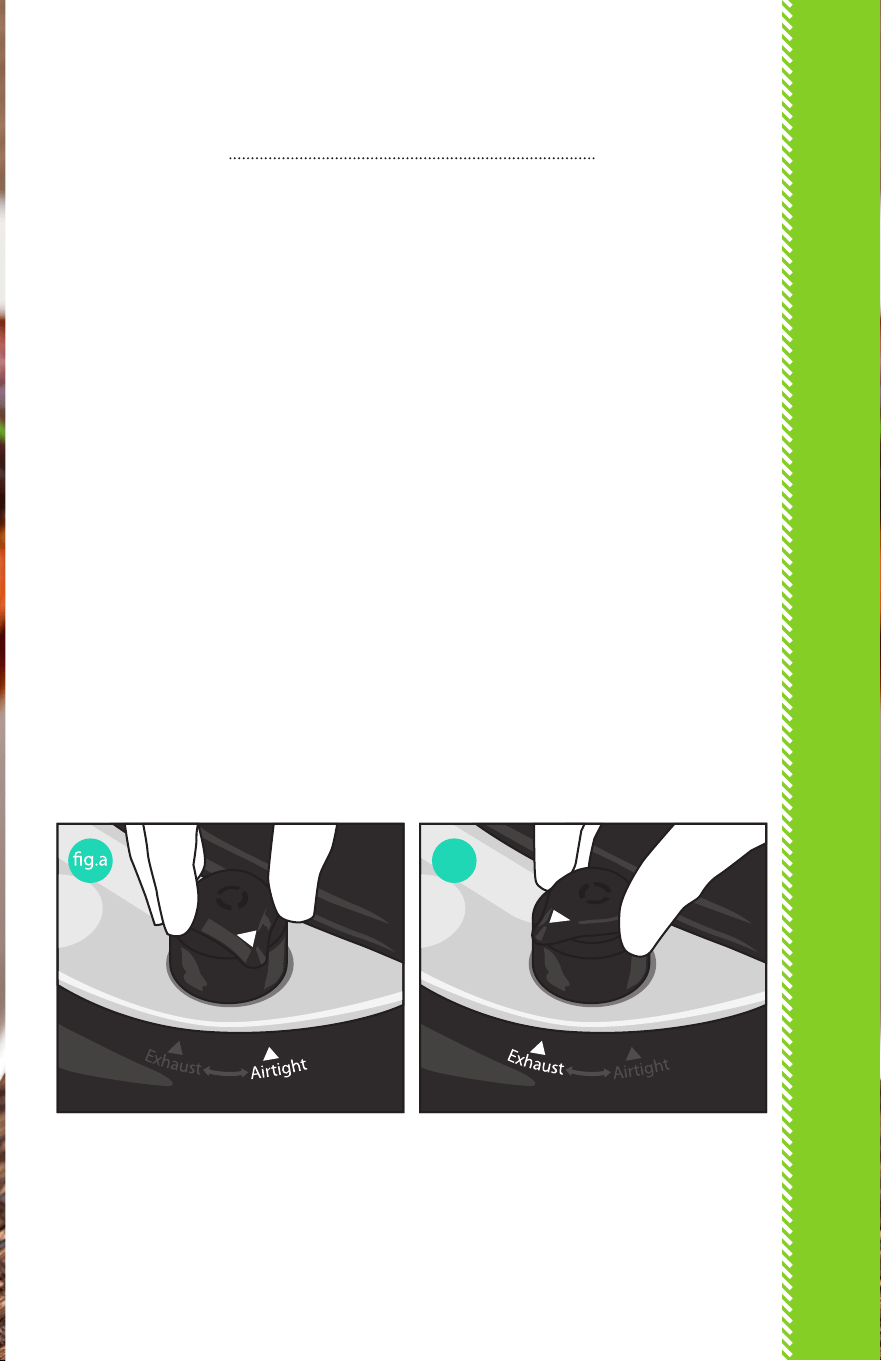
2.) Quick Release (“Exhaust”) – After foods are cooked, turn the Airtight/
Exhaust Valve from Airtight (Fig. A) to “Exhaust” (Fig. B) to quickly release
the pressure. This allows the Pressure Release Valve to quickly drop and
the Lid can be opened. If foods such as vegetables or seafood require
a precise cooking time, turn the Airtight/Exhaust Valve to “Exhaust” to
quickly release the pressure and open the Lid. Do not use this feature
when pressure cooking grains, beans, rice, oatmeal and other foods that
can splatter or foam when the Lid is opened.
Cooking Modes, Methods & Features Before setting the
Control Panel for Modes or Methods, assemble the Pressure Cooker
and ingredients as directed in the Step-by-Step Cooking section of this
Guide. Choose which Mode or Method to use and add the Timer Delay
or Keep Warm features, if desired.
Refer to the following information for releasing the
pressure when food is cooked.
g.b
1919
COOKING MODES, METHODS & FEATURES
NATURAL RELEASE & QUICK RELEASE
This Pressure Cooker is equipped with two (2) forms of pressure release:
1.) Natural – allow the Cooker to rest after cooking until the pressure naturally
subsides. When the Pressure Release Valve drops, the Lid can be opened.
When foods have high liquid contents, such as soups, stews and beans,
they will respond best using the natural release method. This avoids
splattering and foaming when the Lid is opened. Foods that can rest and
continue cooking while the pressure drops, such as roasts and whole
chickens, can be used with the natural release method, as well.
2.) Quick Release (“Exhaust”) – After foods are cooked, turn the Airtight/
Exhaust Valve from Airtight (Fig. A) to “Exhaust” (Fig. B) to quickly release
the pressure. This allows the Pressure Release Valve to quickly drop and
the Lid can be opened. If foods such as vegetables or seafood require
a precise cooking time, turn the Airtight/Exhaust Valve to “Exhaust” to
quickly release the pressure and open the Lid. Do not use this feature
when pressure cooking grains, beans, rice, oatmeal and other foods that
can splatter or foam when the Lid is opened.
Cooking Modes, Methods & Features Before setting the
Control Panel for Modes or Methods, assemble the Pressure Cooker
and ingredients as directed in the Step-by-Step Cooking section of this
Guide. Choose which Mode or Method to use and add the Timer Delay
or Keep Warm features, if desired.
Refer to the following information for releasing the
pressure when food is cooked.
g.b
COOKING MODES, METHODS & FEATURES
COOKING MODES, METHODS & FEATURES
2120
:: IMPORTANT COOKING NOTE ::
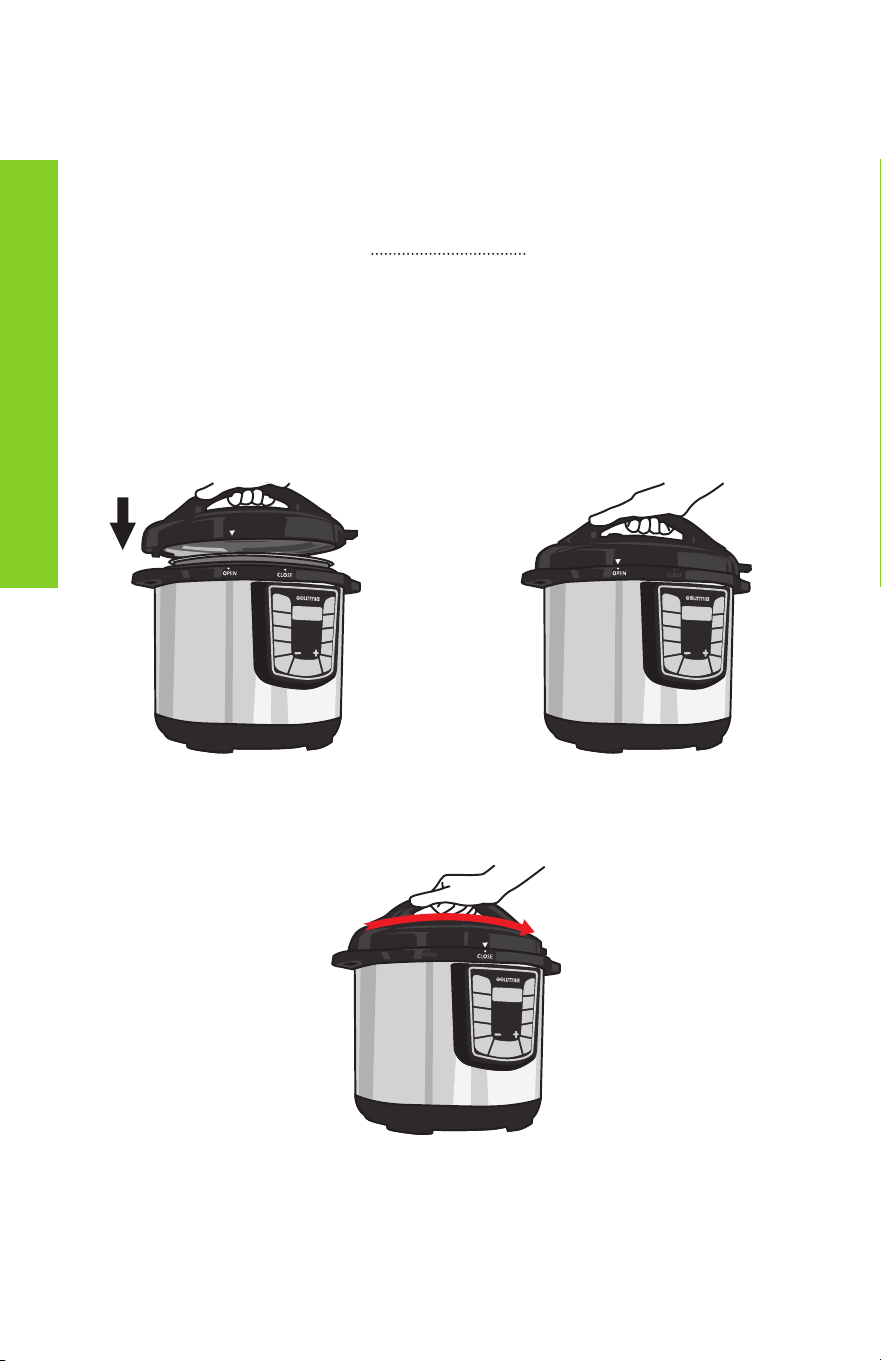
LID OPERATION
Because the lid forms a tight seal with the base of the unit, it is important to
lower the lid completely into the base before turning the handle to lock the
lid. As a safety precaution, the lid will not turn to the closed position unless it is
completely nested in the base.
Once the lid is completely secure, turn
counter-clockwise to the “closed” position
indicator on the base.
Firmly press down until lid is
completely secured onto base.
Align lid with “open” position
indicator on the base..
COOKING MODES, METHODS & FEATURES
COOKING MODES, METHODS & FEATURES
2120
:: IMPORTANT COOKING NOTE ::
LID OPERATION
Because the lid forms a tight seal with the base of the unit, it is important to
lower the lid completely into the base before turning the handle to lock the
lid. As a safety precaution, the lid will not turn to the closed position unless it is
completely nested in the base.
Once the lid is completely secure, turn
counter-clockwise to the “closed” position
indicator on the base.
Firmly press down until lid is
completely secured onto base.
Align lid with “open” position
indicator on the base..

COOKING MODES, METHODS & FEATURES
COOKING MODES, METHODS & FEATURES
2322
1. Follow assembly instructions
for the pressure cooker. Plug
into the outlet.
2. Steaming may or may not
include cooking with pressure;
cook as preferred.
3. Press the “Steam” Button. The
LED Display will indicate “P10”
(10 minutes) as the default
time.
4. If using the default time, no
further action is needed.
5. To change the default time,
quickly press the Plus (+) or
Minus (—) Button on the LED
Display to increase or decrease
the time by one (1) minute
increments within the preset
range. Steam times range
between 3-25 minutes.
6. When done, the Control Panel
will beep three (3) times and
switch to “Keep Warm” Mode.
The LED Display will indicate
“bb” during the “Keep Warm”
Mode.
7. Press the “Warm/Cancel”
Button to stop the process.
If using pressure, allow the
pressure to release naturally
or use the “Airtight/Exhaust”
Button as a quick release valve.
1. Follow assembly instructions
for the pressure cooker. Plug
into the outlet.
2. Press the desired Auto Mode
Button.
3. The LED Display will blink,
“P:XX” indicating number of
preset minutes.
4. For example, “P05” indicates
preset for ve (5) cooking
minutes.
5. Quickly press the Plus (+) or
Minus (—) Button on the LED
Display to increase or decrease
the time by one (1) minute
increments within the preset
range. For example, if the
preset range is 9-15 minutes,
the cooking time can be
adjusted between 9 and 15
minutes.
6. The LED Display will begin to
countdown until the cooking
time is complete.
1. Follow assembly instructions
for the pressure cooker. Plug
into the outlet.
2. To start, press a Mode or
Method for your cooking
process.
3. The LED Display will blink
“P:XX” ve (5) times.
4. Quickly press the “Pressure
Cook Time” Button.
5. The LED Display will indicate
“P:01” (1 minute).
6. Press the + or — Button to set
the custom cook time from
1-99 minutes.
7. The LED Display will begin to
countdown until the cooking
time is complete.
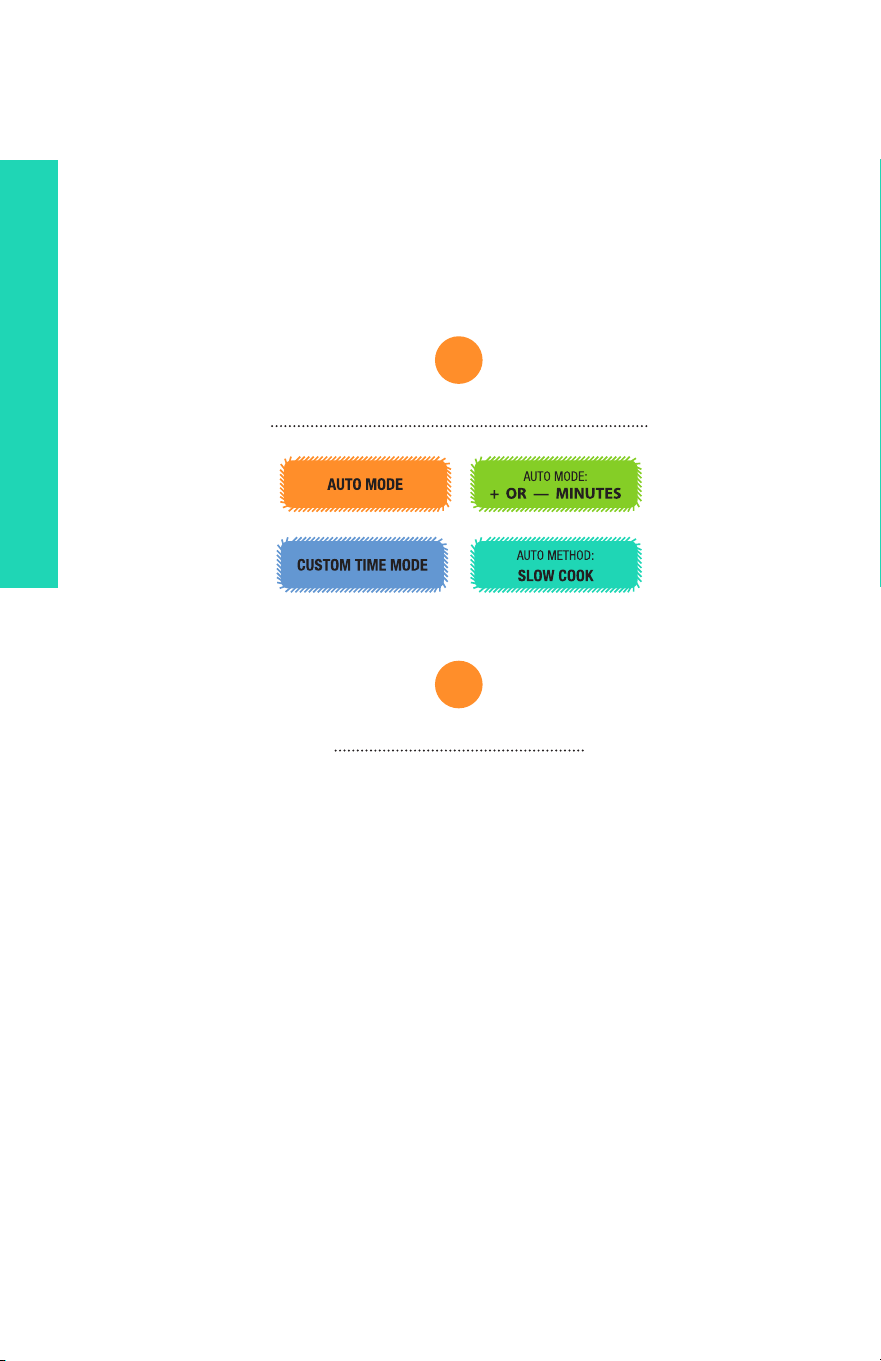
CUSTOM TIME MODE
AUTO METHOD:
STEAM
AUTO MODE:
+ OR — MINUTES
Preset for Soup, Meat,
Poultry, Dessert, Beans,
Porridge & Rice Buttons
1. Follow assembly instructions
for the pressure cooker. Plug
into the outlet.
2. Press the desired Auto Mode
Button.
3. The LED Display will blink,
“P:XX” This indicates the
number of preset minutes. For
example, “P05” indicates preset
for ve (5) cooking minutes.
4. The cooker will beep ve (5)
times and start building heat
and pressure.
5. When the pressure reaches the
optimum level, the cooking
cycle will begin.
6. The LED Display timer will
begin to countdown until the
cooking time is complete.
AUTO MODE

COOKING MODES, METHODS & FEATURES
COOKING MODES, METHODS & FEATURES
2322
1. Follow assembly instructions
for the pressure cooker. Plug
into the outlet.
2. Steaming may or may not
include cooking with pressure;
cook as preferred.
3. Press the “Steam” Button. The
LED Display will indicate “P10”
(10 minutes) as the default
time.
4. If using the default time, no
further action is needed.
5. To change the default time,
quickly press the Plus (+) or
Minus (—) Button on the LED
Display to increase or decrease
the time by one (1) minute
increments within the preset
range. Steam times range
between 3-25 minutes.
6. When done, the Control Panel
will beep three (3) times and
switch to “Keep Warm” Mode.
The LED Display will indicate
“bb” during the “Keep Warm”
Mode.
7. Press the “Warm/Cancel”
Button to stop the process.
If using pressure, allow the
pressure to release naturally
or use the “Airtight/Exhaust”
Button as a quick release valve.
1. Follow assembly instructions
for the pressure cooker. Plug
into the outlet.
2. Press the desired Auto Mode
Button.
3. The LED Display will blink,
“P:XX” indicating number of
preset minutes.
4. For example, “P05” indicates
preset for ve (5) cooking
minutes.
5. Quickly press the Plus (+) or
Minus (—) Button on the LED
Display to increase or decrease
the time by one (1) minute
increments within the preset
range. For example, if the
preset range is 9-15 minutes,
the cooking time can be
adjusted between 9 and 15
minutes.
6. The LED Display will begin to
countdown until the cooking
time is complete.
1. Follow assembly instructions
for the pressure cooker. Plug
into the outlet.
2. To start, press a Mode or
Method for your cooking
process.
3. The LED Display will blink
“P:XX” ve (5) times.
4. Quickly press the “Pressure
Cook Time” Button.
5. The LED Display will indicate
“P:01” (1 minute).
6. Press the + or — Button to set
the custom cook time from
1-99 minutes.
7. The LED Display will begin to
countdown until the cooking
time is complete.
CUSTOM TIME MODE
AUTO METHOD:
STEAM
AUTO MODE:
+ OR — MINUTES
Preset for Soup, Meat,
Poultry, Dessert, Beans,
Porridge & Rice Buttons
1. Follow assembly instructions
for the pressure cooker. Plug
into the outlet.
2. Press the desired Auto Mode
Button.
3. The LED Display will blink,
“P:XX” This indicates the
number of preset minutes. For
example, “P05” indicates preset
for ve (5) cooking minutes.
4. The cooker will beep ve (5)
times and start building heat
and pressure.
5. When the pressure reaches the
optimum level, the cooking
cycle will begin.
6. The LED Display timer will
begin to countdown until the
cooking time is complete.
AUTO MODE

COOKING MODES, METHODS & FEATURES
COOKING MODES, METHODS & FEATURES
2524
1. Follow assembly instructions
for the pressure cooker. Plug
into the outlet.
2. Press the “Sauté” Button. The
LED Display will indicate “P05”
(5 minutes) as the default time.
3. If using the default time, no
further action is needed.
4. To change the default time,
quickly press the Plus (+) or
Minus (—) Button on the LED
Display to increase or decrease
the time by one (1) minute
increments within the preset
range. Sauté times range
between 3-8 minutes.
5. When done, press the “Warm/
Cancel” button. Allow the
Pressure Cooker to rest 2-3
minutes after cancelling
the sauté function before
continuing with a Mode or
Method.
1. Follow assembly instructions
for the pressure cooker. Plug
into the outlet.
2. Press the “Slow Cook” Button.
The LED Display will indicate
“06:00” as the default time of
6 hours.
3. If using the default time, no
further action is needed.
4. To adjust the cooking time in
thirty (30) minute increments,
immediately continue pressing
the “Slow Cook” Button until
the desired time is indicated,
up to a 9½ hour maximum.
5. The LED Display will blink
ve (5) times and begin the
countdown after the cook
temperature has been reached
(between 5-30 minutes).
6. When done, the Control Panel
will beep three (3) times and
switch to “Keep Warm” Mode.
The LED Display will indicate
“bb” during the “Keep Warm”
Mode.
7. Press the “Warm/Cancel”
Button to stop the process and
remove cooked food.
1. To delay the start of the
cooking process, press the
“Preset Time” Button.
2. The LED Display will blink
“00:30” (30 minute delay).
3. Quickly press the “Preset Time”
Button to set the delay time in
thirty (30) minute increments,
from 30 minutes to a 24 hour
delay time.
4. When the “Preset Time” is set,
select the desired cooking
Mode or Method.
5. When the cooking Mode or
Method is set, the LED Display
will indicate the Delay Timer
countdown.
6. When the delay time is done,
the cooking process will start.
1. After cooking in the Pressure
Cooker, use the “Keep Warm”
preset to hold food at a warm
temperature for up to four (4)
hours until serving. Do not
hold food longer than four (4)
hours, as contamination may
occur after that time frame.
2. Press the “Keep Warm/Cancel
Button” once. The LED Display
will indicate solid lights “bb”.
The “Keep Warm” feature will
stay activated for up to four (4)
hours.
3. To cancel, press the “Keep
Warm/Cancel” Button until the
Display indicator turns o.
AUTO METHOD:
SAUTÉ
AUTO METHOD:
SLOW COOK
DELAY TIMER KEEP WARM FUNCTION

COOKING MODES, METHODS & FEATURES
COOKING MODES, METHODS & FEATURES
2524
1. Follow assembly instructions
for the pressure cooker. Plug
into the outlet.
2. Press the “Sauté” Button. The
LED Display will indicate “P05”
(5 minutes) as the default time.
3. If using the default time, no
further action is needed.
4. To change the default time,
quickly press the Plus (+) or
Minus (—) Button on the LED
Display to increase or decrease
the time by one (1) minute
increments within the preset
range. Sauté times range
between 3-8 minutes.
5. When done, press the “Warm/
Cancel” button. Allow the
Pressure Cooker to rest 2-3
minutes after cancelling
the sauté function before
continuing with a Mode or
Method.
1. Follow assembly instructions
for the pressure cooker. Plug
into the outlet.
2. Press the “Slow Cook” Button.
The LED Display will indicate
“06:00” as the default time of
6 hours.
3. If using the default time, no
further action is needed.
4. To adjust the cooking time in
thirty (30) minute increments,
immediately continue pressing
the “Slow Cook” Button until
the desired time is indicated,
up to a 9½ hour maximum.
5. The LED Display will blink
ve (5) times and begin the
countdown after the cook
temperature has been reached
(between 5-30 minutes).
6. When done, the Control Panel
will beep three (3) times and
switch to “Keep Warm” Mode.
The LED Display will indicate
“bb” during the “Keep Warm”
Mode.
7. Press the “Warm/Cancel”
Button to stop the process and
remove cooked food.
1. To delay the start of the
cooking process, press the
“Preset Time” Button.
2. The LED Display will blink
“00:30” (30 minute delay).
3. Quickly press the “Preset Time”
Button to set the delay time in
thirty (30) minute increments,
from 30 minutes to a 24 hour
delay time.
4. When the “Preset Time” is set,
select the desired cooking
Mode or Method.
5. When the cooking Mode or
Method is set, the LED Display
will indicate the Delay Timer
countdown.
6. When the delay time is done,
the cooking process will start.
1. After cooking in the Pressure
Cooker, use the “Keep Warm”
preset to hold food at a warm
temperature for up to four (4)
hours until serving. Do not
hold food longer than four (4)
hours, as contamination may
occur after that time frame.
2. Press the “Keep Warm/Cancel
Button” once. The LED Display
will indicate solid lights “bb”.
The “Keep Warm” feature will
stay activated for up to four (4)
hours.
3. To cancel, press the “Keep
Warm/Cancel” Button until the
Display indicator turns o.
AUTO METHOD:
SAUTÉ
AUTO METHOD:
SLOW COOK
DELAY TIMER KEEP WARM FUNCTION
2726
SOUP
Prepare steaming hot, avorful soup for any occasion!
STEP-BY-STEP COOKING
Auto Preset Times:
Mode Preset Time Time Range
Soup 25 minutes 15-35 minutes
Slow Cook 6 hours 30 min – 9 ½ hours
TIPS for Soup Perfection:
» Cut foods into uniform-sized pieces for best results.
» Change up your soup! Add juice, beer, or wine to your broth or water.
» When making hearty soups with potatoes or meat, use at least ve (5) to
six (6) cups liquid to ensure that the ingredients have enough liquid for
best cooking results.
» Use fresh herbs when pressure cooking, as pressure cooking develops
intense avors.
» In general, soup recipe cooking times will be cut by one-third (1/3) of
conventional cook times.
» To add Sauté, Delay Timer or Keep Warm, see pages 24-25 for specic
instructions.
1
ASSEMBLY:
» Place recipe ingredients in the Inner Pot. Make sure ingredients and
liquid are above the Minimum Fill line (1/5) and below the Maximum Fill
line (4/5) in the Inner Pot.
» If cooking ingredients that may expand, such as grains or rice, do not ll
the Inner Pot more than the 3/5 line indicates. (this reduces splattering
upon opening when cooking is done.)
» Carefully place the Inner Pot into the Base; do not spill contents into
interior of Base.

2726
SOUP
Prepare steaming hot, avorful soup for any occasion!
STEP-BY-STEP COOKING
Auto Preset Times:
Mode Preset Time Time Range
Soup 25 minutes 15-35 minutes
Slow Cook 6 hours 30 min – 9 ½ hours
TIPS for Soup Perfection:
» Cut foods into uniform-sized pieces for best results.
» Change up your soup! Add juice, beer, or wine to your broth or water.
» When making hearty soups with potatoes or meat, use at least ve (5) to
six (6) cups liquid to ensure that the ingredients have enough liquid for
best cooking results.
» Use fresh herbs when pressure cooking, as pressure cooking develops
intense avors.
» In general, soup recipe cooking times will be cut by one-third (1/3) of
conventional cook times.
» To add Sauté, Delay Timer or Keep Warm, see pages 24-25 for specic
instructions.
1
ASSEMBLY:
» Place recipe ingredients in the Inner Pot. Make sure ingredients and
liquid are above the Minimum Fill line (1/5) and below the Maximum Fill
line (4/5) in the Inner Pot.
» If cooking ingredients that may expand, such as grains or rice, do not ll
the Inner Pot more than the 3/5 line indicates. (this reduces splattering
upon opening when cooking is done.)
» Carefully place the Inner Pot into the Base; do not spill contents into
interior of Base.
STEP-BY-STEP COOKING
STEP-BY-STEP COOKING
2928
» Lock the Lid on the Base: Position the Lid so the arrow on the Lid aligns
over the Open indicator on the Base lip. Rotate the Lid counterclockwise
until the Lid stops and the arrow on the Lid aligns with the Close indicator
on the Base Lip.
» If cooking with pressure, turn the Airtight/Exhaust Valve to the Airtight
position. If slow cooking, turn to the Exhaust position.
2
CHOOSE your Soup Cooking Mode Option:
3
When Cooking is COMPLETE
» The Display will beep three (3) times and switch to “Keep Warm.”
» “Keep Warm” Mode will hold up to four (4) hours. The Display will indicate
“bb” with no countdown.
» Release pressure naturally or use a potholder to turn the “Airtight/Exhaust”
valve to “Exhaust” for quick pressure release.
» The Pressure Release Valve will drop. Press the “Warm/Cancel” Button to
stop cooking.
» Rotate the EasyLift Handle clockwise until the arrow on the Lid aligns with
the “Open” indicator on the Base Lip. Using a potholder, lift the Lid up and
away from face and hands. Remove cooked food with a heat-proof plastic
utensil.
MEAT
Even the most lean, tough meat cuts cook to
tender perfection in the Smartpot Pressure Cooker!
Auto Preset Times:
Mode Preset Time Time Range
Meat 15 minutes 10-30 minutes
Slow Cook 6 hours 30 min – 9 ½ hours
TIPS for Cooking Meat:
» Cut foods into uniform-sized pieces for best results. Stew meat should be
cut in 1-2 inch cubes.
» Remove excess fat while cutting meat.
» Add at least 2 cups water, broth or wine to meat for the rst 15 minutes
of pressure cooking. If cooking longer, add one-third (1/3) cup liquid for
every additional 15 minutes of cooking.
» Use fresh herbs when pressure cooking, as pressure cooking develops
intense avors.
» To add Sauté, Delay Timer or Keep Warm features, see pages 24-25 for
specic instructions.
1
ASSEMBLY:
» Place meat, herbs and spices with liquid in the Inner Pot.
» Make sure ingredients and liquid are above the Minimum Fill line (1/5) and
below the Maximum Fill line (4/5) in the Inner Pot.
» Carefully place the Inner Pot into the Base; do not spill contents into
interior of Base.

STEP-BY-STEP COOKING
STEP-BY-STEP COOKING
2928
» Lock the Lid on the Base: Position the Lid so the arrow on the Lid aligns
over the Open indicator on the Base lip. Rotate the Lid counterclockwise
until the Lid stops and the arrow on the Lid aligns with the Close indicator
on the Base Lip.
» If cooking with pressure, turn the Airtight/Exhaust Valve to the Airtight
position. If slow cooking, turn to the Exhaust position.
2
CHOOSE your Soup Cooking Mode Option:
3
When Cooking is COMPLETE
» The Display will beep three (3) times and switch to “Keep Warm.”
» “Keep Warm” Mode will hold up to four (4) hours. The Display will indicate
“bb” with no countdown.
» Release pressure naturally or use a potholder to turn the “Airtight/Exhaust”
valve to “Exhaust” for quick pressure release.
» The Pressure Release Valve will drop. Press the “Warm/Cancel” Button to
stop cooking.
» Rotate the EasyLift Handle clockwise until the arrow on the Lid aligns with
the “Open” indicator on the Base Lip. Using a potholder, lift the Lid up and
away from face and hands. Remove cooked food with a heat-proof plastic
utensil.
MEAT
Even the most lean, tough meat cuts cook to
tender perfection in the Smartpot Pressure Cooker!
Auto Preset Times:
Mode Preset Time Time Range
Meat 15 minutes 10-30 minutes
Slow Cook 6 hours 30 min – 9 ½ hours
TIPS for Cooking Meat:
» Cut foods into uniform-sized pieces for best results. Stew meat should be
cut in 1-2 inch cubes.
» Remove excess fat while cutting meat.
» Add at least 2 cups water, broth or wine to meat for the rst 15 minutes
of pressure cooking. If cooking longer, add one-third (1/3) cup liquid for
every additional 15 minutes of cooking.
» Use fresh herbs when pressure cooking, as pressure cooking develops
intense avors.
» To add Sauté, Delay Timer or Keep Warm features, see pages 24-25 for
specic instructions.
1
ASSEMBLY:
» Place meat, herbs and spices with liquid in the Inner Pot.
» Make sure ingredients and liquid are above the Minimum Fill line (1/5) and
below the Maximum Fill line (4/5) in the Inner Pot.
» Carefully place the Inner Pot into the Base; do not spill contents into
interior of Base.
STEP-BY-STEP COOKING
STEP-BY-STEP COOKING
3130
» Lock the Lid on the Pressure Cooker Base: Position the Lid so the arrow
on the Lid aligns over the “Open” indicator on the Base lip. Rotate the Lid
counterclockwise until the Lid stops and the arrow on the Lid aligns with
the “Close” indicator on the Base Lip.
» If cooking with pressure, turn the Airtight/Exhaust Valve to the Airtight
position. If slow cooking, turn to the Exhaust position.
» Meat may be pressure-released naturally or quickly. Check the Meat
Cooking Chart (p. 43) for specic information.
2
CHOOSE your Meat Mode Option:
3
When Cooking is COMPLETE
» The Display will beep three (3) times and switch to “Keep Warm.”
» “Keep Warm” Mode will hold up to four (4) hours. The Display will indicate
“bb” with no countdown.
» Release pressure naturally or use a potholder to turn the “Airtight/Exhaust”
valve to “Exhaust” for quick pressure release.
» The Pressure Release Valve will drop. Press the “Warm/Cancel” Button to
stop cooking.
» Rotate the EasyLift Handle clockwise until the arrow on the Lid aligns with
the “Open” indicator on the Base Lip. Using a potholder, lift the Lid up and
away from face and hands. Remove cooked food with a heat-proof plastic
utensil.
POULTRY
Pressure cooking poultry results in the most moist and juice avors. Choose a
variety of Modes or Methods to create your next perfect meal!
Auto Preset Times:
Mode Preset Time Time Range
Poultry 13 minutes 8-20 minutes
Steam 10 minutes 3-25 minutes
Sauté 5 minutes 8-20 minutes
TIPS for Cooking Poultry:
» Place up to three (3) pounds chicken pieces or whole prepared chicken in
Inner Pot.
» For boneless, skinless chicken breasts, choose Sauté Method for 5 minutes,
then pressure cook in Poultry Mode for 8 minutes.
» Add at least 2 cups water, broth or wine to poultry for the rst 15 minutes
of pressure cooking. If cooking longer, add one-third (1/3) cup liquid for
every additional 15 minutes of cooking.
» Use fresh herbs when pressure cooking, as pressure cooking develops
intense avors.
» Strain and use the cooled chicken broth as a base for delicious soups.
» To add Delay Timer or Keep Warm features, see page 25 for specic
instructions.
1
ASSEMBLY:
» Place poultry, herbs and spices with liquid in the Inner Pot.
» Make sure ingredients and liquid are above the Minimum Fill line (1/5) and
below the Maximum Fill line (4/5) in the Inner Pot.

STEP-BY-STEP COOKING
STEP-BY-STEP COOKING
3130
» Lock the Lid on the Pressure Cooker Base: Position the Lid so the arrow
on the Lid aligns over the “Open” indicator on the Base lip. Rotate the Lid
counterclockwise until the Lid stops and the arrow on the Lid aligns with
the “Close” indicator on the Base Lip.
» If cooking with pressure, turn the Airtight/Exhaust Valve to the Airtight
position. If slow cooking, turn to the Exhaust position.
» Meat may be pressure-released naturally or quickly. Check the Meat
Cooking Chart (p. 43) for specic information.
2
CHOOSE your Meat Mode Option:
3
When Cooking is COMPLETE
» The Display will beep three (3) times and switch to “Keep Warm.”
» “Keep Warm” Mode will hold up to four (4) hours. The Display will indicate
“bb” with no countdown.
» Release pressure naturally or use a potholder to turn the “Airtight/Exhaust”
valve to “Exhaust” for quick pressure release.
» The Pressure Release Valve will drop. Press the “Warm/Cancel” Button to
stop cooking.
» Rotate the EasyLift Handle clockwise until the arrow on the Lid aligns with
the “Open” indicator on the Base Lip. Using a potholder, lift the Lid up and
away from face and hands. Remove cooked food with a heat-proof plastic
utensil.
POULTRY
Pressure cooking poultry results in the most moist and juice avors. Choose a
variety of Modes or Methods to create your next perfect meal!
Auto Preset Times:
Mode Preset Time Time Range
Poultry 13 minutes 8-20 minutes
Steam 10 minutes 3-25 minutes
Sauté 5 minutes 8-20 minutes
TIPS for Cooking Poultry:
» Place up to three (3) pounds chicken pieces or whole prepared chicken in
Inner Pot.
» For boneless, skinless chicken breasts, choose Sauté Method for 5 minutes,
then pressure cook in Poultry Mode for 8 minutes.
» Add at least 2 cups water, broth or wine to poultry for the rst 15 minutes
of pressure cooking. If cooking longer, add one-third (1/3) cup liquid for
every additional 15 minutes of cooking.
» Use fresh herbs when pressure cooking, as pressure cooking develops
intense avors.
» Strain and use the cooled chicken broth as a base for delicious soups.
» To add Delay Timer or Keep Warm features, see page 25 for specic
instructions.
1
ASSEMBLY:
» Place poultry, herbs and spices with liquid in the Inner Pot.
» Make sure ingredients and liquid are above the Minimum Fill line (1/5) and
below the Maximum Fill line (4/5) in the Inner Pot.
STEP-BY-STEP COOKING
STEP-BY-STEP COOKING
3332
» Carefully place the Inner Pot into the Base; do not spill contents into
interior of Base.
» Lock the Lid on the Pressure Cooker Base: Position the Lid so the arrow
on the Lid aligns over the “Open” indicator on the Base lip. Rotate the Lid
counterclockwise until the Lid stops and the arrow on the Lid aligns with
the “Close” indicator on the Base Lip.
» If cooking with pressure, turn the Airtight/Exhaust Valve to the Airtight
position. If slow cooking, turn to the Exhaust position.
» Poultry may be pressure-released naturally or quickly. Check the Meat
Cooking Chart (p. 43) for specic information.
2
CHOOSE your Meat Mode Option:
3
When Cooking is COMPLETE
» The Display will beep three (3) times and switch to “Keep Warm.”
» “Keep Warm” Mode will hold up to four (4) hours. The Display will indicate
“bb” with no countdown.
» Release pressure naturally or use a potholder to turn the “Airtight/Exhaust”
valve to “Exhaust” for quick pressure release.
» The Pressure Release Valve will drop. Press the “Warm/Cancel” Button to
stop cooking.
» Rotate the EasyLift Handle clockwise until the arrow on the Lid aligns with
the “Open” indicator on the Base Lip. Using a potholder, lift the Lid up and
away from face and hands. Remove cooked food with a heat-proof plastic
utensil.
DESSERT
Create incredibly delectable steamed puddings, warm fruit desserts, or tender
custards and an... all in a few easy steps with Auto Modes or Methods!
Auto Preset Times:
Mode Preset Time Time Range
Dessert 18 minutes 5-33 minutes
Steam 10 minutes 3-25 minutes
Slow Cook 6 hours 30 min – 9 ½ hours
TIPS for Desserts:
» Unless your recipe calls for quick release, use the natural release method.
» When cooking desserts in silicone molds or other heat-proof containers,
always use the Steaming Rack. Add enough water in the Inner Pot to
reach or exceed the Minimum Fill line.
» If slow cooking, use lower amounts of liquid as the recipe directs.
1
ASSEMBLY:
Using the Steaming Rack:
» Add enough water to reach or exceed the Minimum Fill line in the Inner Pot.
» Arrange the Steaming Rack in the Inner Pot. Place heat-proof container
lled with ingredients on the Rack.
» Cooking without the Steaming Rack:
» Make sure ingredients and liquid are above the Minimum Fill line (1/5) and
below the Maximum Fill line (4/5) in the Inner Pot.
» Carefully place the Inner Pot into the Base; do not spill contents into
interior of Base.

STEP-BY-STEP COOKING
STEP-BY-STEP COOKING
3332
» Carefully place the Inner Pot into the Base; do not spill contents into
interior of Base.
» Lock the Lid on the Pressure Cooker Base: Position the Lid so the arrow
on the Lid aligns over the “Open” indicator on the Base lip. Rotate the Lid
counterclockwise until the Lid stops and the arrow on the Lid aligns with
the “Close” indicator on the Base Lip.
» If cooking with pressure, turn the Airtight/Exhaust Valve to the Airtight
position. If slow cooking, turn to the Exhaust position.
» Poultry may be pressure-released naturally or quickly. Check the Meat
Cooking Chart (p. 43) for specic information.
2
CHOOSE your Meat Mode Option:
3
When Cooking is COMPLETE
» The Display will beep three (3) times and switch to “Keep Warm.”
» “Keep Warm” Mode will hold up to four (4) hours. The Display will indicate
“bb” with no countdown.
» Release pressure naturally or use a potholder to turn the “Airtight/Exhaust”
valve to “Exhaust” for quick pressure release.
» The Pressure Release Valve will drop. Press the “Warm/Cancel” Button to
stop cooking.
» Rotate the EasyLift Handle clockwise until the arrow on the Lid aligns with
the “Open” indicator on the Base Lip. Using a potholder, lift the Lid up and
away from face and hands. Remove cooked food with a heat-proof plastic
utensil.
DESSERT
Create incredibly delectable steamed puddings, warm fruit desserts, or tender
custards and an... all in a few easy steps with Auto Modes or Methods!
Auto Preset Times:
Mode Preset Time Time Range
Dessert 18 minutes 5-33 minutes
Steam 10 minutes 3-25 minutes
Slow Cook 6 hours 30 min – 9 ½ hours
TIPS for Desserts:
» Unless your recipe calls for quick release, use the natural release method.
» When cooking desserts in silicone molds or other heat-proof containers,
always use the Steaming Rack. Add enough water in the Inner Pot to
reach or exceed the Minimum Fill line.
» If slow cooking, use lower amounts of liquid as the recipe directs.
1
ASSEMBLY:
Using the Steaming Rack:
» Add enough water to reach or exceed the Minimum Fill line in the Inner Pot.
» Arrange the Steaming Rack in the Inner Pot. Place heat-proof container
lled with ingredients on the Rack.
» Cooking without the Steaming Rack:
» Make sure ingredients and liquid are above the Minimum Fill line (1/5) and
below the Maximum Fill line (4/5) in the Inner Pot.
» Carefully place the Inner Pot into the Base; do not spill contents into
interior of Base.
35
STEP-BY-STEP COOKING
34
35
» Lock the Lid on the Pressure Cooker Base: Position the Lid so the arrow
on the Lid aligns over the “Open” indicator on the Base lip. Rotate the Lid
counterclockwise until the Lid stops and the arrow on the Lid aligns with
the “Close” indicator on the Base Lip.
» If cooking with pressure, turn the Airtight/Exhaust Valve to the Airtight
position. If steaming or slow cooking, turn to the Exhaust position.
2
CHOOSE Your Dessert Mode/Method:
3
When Cooking is COMPLETE
» The Display will beep three (3) times and switch to “Keep Warm.”
» “Keep Warm” Mode will hold up to four (4) hours. The Display will indicate
“bb” with no countdown.
» Release pressure naturally or use a potholder to turn the “Airtight/Exhaust”
valve to “Exhaust” for quick pressure release.
» The Pressure Release Valve will drop. Press the “Warm/Cancel” Button to
stop cooking.
» Rotate the EasyLift Handle clockwise until the arrow on the Lid aligns with
the “Open” indicator on the Base Lip. Using a potholder, lift the Lid up and
away from face and hands. Remove cooked food with a heat-proof plastic
utensil.
35
STEP-BY-STEP COOKING
34
35
» Lock the Lid on the Pressure Cooker Base: Position the Lid so the arrow
on the Lid aligns over the “Open” indicator on the Base lip. Rotate the Lid
counterclockwise until the Lid stops and the arrow on the Lid aligns with
the “Close” indicator on the Base Lip.
» If cooking with pressure, turn the Airtight/Exhaust Valve to the Airtight
position. If steaming or slow cooking, turn to the Exhaust position.
2
CHOOSE Your Dessert Mode/Method:
3
When Cooking is COMPLETE
» The Display will beep three (3) times and switch to “Keep Warm.”
» “Keep Warm” Mode will hold up to four (4) hours. The Display will indicate
“bb” with no countdown.
» Release pressure naturally or use a potholder to turn the “Airtight/Exhaust”
valve to “Exhaust” for quick pressure release.
» The Pressure Release Valve will drop. Press the “Warm/Cancel” Button to
stop cooking.
» Rotate the EasyLift Handle clockwise until the arrow on the Lid aligns with
the “Open” indicator on the Base Lip. Using a potholder, lift the Lid up and
away from face and hands. Remove cooked food with a heat-proof plastic
utensil.

STEP-BY-STEP COOKING
STEP-BY-STEP COOKING
3736
BEANS
Welcome to the quick & easy world of pressure-cooked beans! Choose from a
variety of options to create creamy, tender & nutritious beans every time.
Auto Preset Times:
Mode Preset Time Time Range
Bean 40 minutes 20-60 minutes
Slow Cook 6 hours 30 min – 9 ½ hours
TIPS for Cooking Beans:
» Pick through dry beans and discard any that are unsuitable.
» Rinse beans thoroughly and drain in a colander.
» Although not required, for soft, tender beans, pre-soak in salted water for
at least 8 hours. Stir 2 tablespoons salt into 6 cups water and add beans.
When done soaking, drain well.
» Place beans in Inner Pot and add 1 tablespoon oil. This helps reduce
foaming.
» Add 4 cups water if cooking ½ pound dry beans. Add 8 cups water if
cooking 1 pound dry beans.
» Add aromatics such as onion, salt, garlic, bay leaves, ground cumin, etc.
» In general, beans can be pressure cooked (without pre-soaking) in 50-55
minutes. Pre-soaked beans can be cooked in 40-45 minutes. Check the
Bean Cooking Chart (p. 48) for specics.
» To add Delay Timer or Keep Warm features, see page 25 for specic
instructions.
1
ASSEMBLY:
» Place beans, aromatics and spices
with liquid in the Inner Pot.
» Make sure ingredients and liquid
are above the Minimum Fill line
(1/5) and below the Maximum Fill
line (4/5) in the Inner Pot.
» Carefully place the Inner Pot into
the Base; do not spill contents into
interior of Base.
» Lock the Lid on the Pressure
Cooker Base: Position the Lid so
the arrow on the Lid aligns over
the Open indicator on the Base lip.
Rotate the Lid counterclockwise
until the Lid stops and the arrow
on the Lid aligns with the Close
indicator on the Base Lip.
» If cooking with pressure, turn
the Airtight/Exhaust Valve to the
Airtight position.
» If slow cooking beans, follow
recipe instructions. Use the Exhaust
setting on the Airtight/Exhaust
Valve.
» Use the natural release method to
stop the pressure cooking process.
Check the Bean Cooking Chart
(p.48) for information.
2
CHOOSE
your Bean Mode/Method:
3
When Cooking is COMPLETE
» The Display will beep three (3)
times and switch to “Keep Warm.”
» “Keep Warm” Mode will hold up
to four (4) hours. The Display will
indicate “bb” with no countdown.
» Release pressure naturally or use
a potholder to turn the “Airtight/
Exhaust” valve to “Exhaust” for
quick pressure release.
» The Pressure Release Valve will
drop. Press the “Warm/Cancel”
Button to stop cooking.
» Rotate the EasyLift Handle
clockwise until the arrow on
the Lid aligns with the “Open”
indicator on the Base Lip. Using a
potholder, lift the Lid up and away
from face and hands. Remove
cooked food with a heat-proof
plastic utensil.
STEP-BY-STEP COOKING
STEP-BY-STEP COOKING
3736
BEANS
Welcome to the quick & easy world of pressure-cooked beans! Choose from a
variety of options to create creamy, tender & nutritious beans every time.
Auto Preset Times:
Mode Preset Time Time Range
Bean 40 minutes 20-60 minutes
Slow Cook 6 hours 30 min – 9 ½ hours
TIPS for Cooking Beans:
» Pick through dry beans and discard any that are unsuitable.
» Rinse beans thoroughly and drain in a colander.
» Although not required, for soft, tender beans, pre-soak in salted water for
at least 8 hours. Stir 2 tablespoons salt into 6 cups water and add beans.
When done soaking, drain well.
» Place beans in Inner Pot and add 1 tablespoon oil. This helps reduce
foaming.
» Add 4 cups water if cooking ½ pound dry beans. Add 8 cups water if
cooking 1 pound dry beans.
» Add aromatics such as onion, salt, garlic, bay leaves, ground cumin, etc.
» In general, beans can be pressure cooked (without pre-soaking) in 50-55
minutes. Pre-soaked beans can be cooked in 40-45 minutes. Check the
Bean Cooking Chart (p. 48) for specics.
» To add Delay Timer or Keep Warm features, see page 25 for specic
instructions.
1
ASSEMBLY:
» Place beans, aromatics and spices
with liquid in the Inner Pot.
» Make sure ingredients and liquid
are above the Minimum Fill line
(1/5) and below the Maximum Fill
line (4/5) in the Inner Pot.
» Carefully place the Inner Pot into
the Base; do not spill contents into
interior of Base.
» Lock the Lid on the Pressure
Cooker Base: Position the Lid so
the arrow on the Lid aligns over
the Open indicator on the Base lip.
Rotate the Lid counterclockwise
until the Lid stops and the arrow
on the Lid aligns with the Close
indicator on the Base Lip.
» If cooking with pressure, turn
the Airtight/Exhaust Valve to the
Airtight position.
» If slow cooking beans, follow
recipe instructions. Use the Exhaust
setting on the Airtight/Exhaust
Valve.
» Use the natural release method to
stop the pressure cooking process.
Check the Bean Cooking Chart
(p.48) for information.
2
CHOOSE
your Bean Mode/Method:
3
When Cooking is COMPLETE
» The Display will beep three (3)
times and switch to “Keep Warm.”
» “Keep Warm” Mode will hold up
to four (4) hours. The Display will
indicate “bb” with no countdown.
» Release pressure naturally or use
a potholder to turn the “Airtight/
Exhaust” valve to “Exhaust” for
quick pressure release.
» The Pressure Release Valve will
drop. Press the “Warm/Cancel”
Button to stop cooking.
» Rotate the EasyLift Handle
clockwise until the arrow on
the Lid aligns with the “Open”
indicator on the Base Lip. Using a
potholder, lift the Lid up and away
from face and hands. Remove
cooked food with a heat-proof
plastic utensil.

STEP-BY-STEP COOKING
STEP-BY-STEP COOKING
3938
PORRIDGE
A warm breakfast of creamy porridge starts every day right!
Choose Delay Timer to prep your recipe before bed and arise in the morning
to nd breakfast waiting.
Auto Preset Times:
Mode Preset Time Time Range
Porridge 25 minutes 10-40 minutes
Slow Cook 6 hours 30 min – 9 ½ hours
TIPS for Cooking Porridge:
» Soak certain grains, such as wheat berries and pearl barley, in water for at
least 4 hours before cooking. Do not add salt to the water. Drain and rinse
before cooking.
» Use a heat-proof container hold prepared oatmeal or other grains.
» Do not prepare oatmeal or other grains directly in the Inner Pot, as these
cereals may splatter severely upon opening and/or clog the Filter.
» Add a pinch of salt to oatmeal or other grains before cooking; add
sweeteners after cooking.
» Add a bit of oil to the oatmeal or grains to reduce foaming and splattering.
» Check the Grain/Rice Cooking Chart on p. 49 for specic cooking times.
» To add Delay Timer or Keep Warm features, see page 25 for specic
instructions.
1
ASSEMBLY:
» Place ingredients and liquid into the
Inner Pot.
» Make sure ingredients and liquid are
above the Minimum Fill line (1/5)
and below the Maximum Fill line
(4/5) in the Inner Pot.
» Carefully place the Inner Pot into
the Base; do not spill contents into
interior of Base.
» Lock the Lid on the Pressure Cooker
Base: Position the Lid so the arrow
on the Lid aligns over the Open
indicator on the Base lip. Rotate
the Lid counterclockwise until the
Lid stops and the arrow on the Lid
aligns with the Close indicator on
the Base Lip.
» If cooking with pressure, turn
the Airtight/Exhaust Valve to the
Airtight position. If slow cooking,
use the Exhaust position.
» Use the natural release method
only to stop the pressure cooking
process.
2
CHOOSE
your Porridge Mode/Method:
3
When Cooking is COMPLETE
» The Display will beep three (3)
times and switch to “Keep Warm.”
» “Keep Warm” Mode will hold up
to four (4) hours. The Display will
indicate “bb” with no countdown.
» Release pressure naturally or use
a potholder to turn the “Airtight/
Exhaust” valve to “Exhaust” for
quick pressure release.
» The Pressure Release Valve will
drop. Press the “Warm/Cancel”
Button to stop cooking.
» Rotate the EasyLift Handle
clockwise until the arrow on the Lid
aligns with the “Open” indicator on
the Base Lip. Using a potholder, lift
the Lid up and away from face and
hands. Remove cooked food with a
heat-proof plastic utensil.
STEP-BY-STEP COOKING
STEP-BY-STEP COOKING
3938
PORRIDGE
A warm breakfast of creamy porridge starts every day right!
Choose Delay Timer to prep your recipe before bed and arise in the morning
to nd breakfast waiting.
Auto Preset Times:
Mode Preset Time Time Range
Porridge 25 minutes 10-40 minutes
Slow Cook 6 hours 30 min – 9 ½ hours
TIPS for Cooking Porridge:
» Soak certain grains, such as wheat berries and pearl barley, in water for at
least 4 hours before cooking. Do not add salt to the water. Drain and rinse
before cooking.
» Use a heat-proof container hold prepared oatmeal or other grains.
» Do not prepare oatmeal or other grains directly in the Inner Pot, as these
cereals may splatter severely upon opening and/or clog the Filter.
» Add a pinch of salt to oatmeal or other grains before cooking; add
sweeteners after cooking.
» Add a bit of oil to the oatmeal or grains to reduce foaming and splattering.
» Check the Grain/Rice Cooking Chart on p. 49 for specic cooking times.
» To add Delay Timer or Keep Warm features, see page 25 for specic
instructions.
1
ASSEMBLY:
» Place ingredients and liquid into the
Inner Pot.
» Make sure ingredients and liquid are
above the Minimum Fill line (1/5)
and below the Maximum Fill line
(4/5) in the Inner Pot.
» Carefully place the Inner Pot into
the Base; do not spill contents into
interior of Base.
» Lock the Lid on the Pressure Cooker
Base: Position the Lid so the arrow
on the Lid aligns over the Open
indicator on the Base lip. Rotate
the Lid counterclockwise until the
Lid stops and the arrow on the Lid
aligns with the Close indicator on
the Base Lip.
» If cooking with pressure, turn
the Airtight/Exhaust Valve to the
Airtight position. If slow cooking,
use the Exhaust position.
» Use the natural release method
only to stop the pressure cooking
process.
2
CHOOSE
your Porridge Mode/Method:
3
When Cooking is COMPLETE
» The Display will beep three (3)
times and switch to “Keep Warm.”
» “Keep Warm” Mode will hold up
to four (4) hours. The Display will
indicate “bb” with no countdown.
» Release pressure naturally or use
a potholder to turn the “Airtight/
Exhaust” valve to “Exhaust” for
quick pressure release.
» The Pressure Release Valve will
drop. Press the “Warm/Cancel”
Button to stop cooking.
» Rotate the EasyLift Handle
clockwise until the arrow on the Lid
aligns with the “Open” indicator on
the Base Lip. Using a potholder, lift
the Lid up and away from face and
hands. Remove cooked food with a
heat-proof plastic utensil.

STEP-BY-STEP COOKING
STEP-BY-STEP COOKING
4140
RICE
The easiest and best rice EVER – directly from your pressure cooker!
Auto Preset Times:
Mode Preset Time Time Range
Rice 12 minutes 9-15 minutes
TIPS for Cooking Rice:
» Various types of rice require diering ratios of water to rice. Check out the
Grain/Rice Cooking Chart on p. 49 for information.
» Do not pre-soak rice, but rinse it in water, if desired. Add salt, if desired.
» Add 1 teaspoon oil or butter to the rice before cooking to help avoid
splattering.
» To add Delay Timer or Keep Warm features, see page 25 for specic
instructions.
1
ASSEMBLY:
» Pour enough water and rice into the Inner Pot to reach or exceed the
Minimum Fill line.
» Lock the Lid on the Pressure Cooker Base: Position the Lid so the arrow
on the Lid aligns over the Open indicator on the Base lip. Rotate the Lid
counterclockwise until the Lid stops and the arrow on the Lid aligns with the
Close indicator on the Base Lip.
» Turn the Airtight/Exhaust Valve to the Airtight position.
» Use the natural release method only to stop the pressure cooking process.
2
CHOOSE your Rice Mode:
3
When Cooking is COMPLETE
» The Display will beep three (3) times and switch to “Keep Warm.”
» “Keep Warm” Mode will hold up to four (4) hours. The Display will indicate
“bb” with no countdown.
» Release pressure naturally or use a potholder to turn the “Airtight/Exhaust”
valve to “Exhaust” for quick pressure release.
» The Pressure Release Valve will drop. Press the “Warm/Cancel” Button to
stop cooking.
» Rotate the EasyLift Handle clockwise until the arrow on the Lid aligns with
the “Open” indicator on the Base Lip. Using a potholder, lift the Lid up and
away from face and hands. Remove cooked food with a heat-proof plastic
utensil.
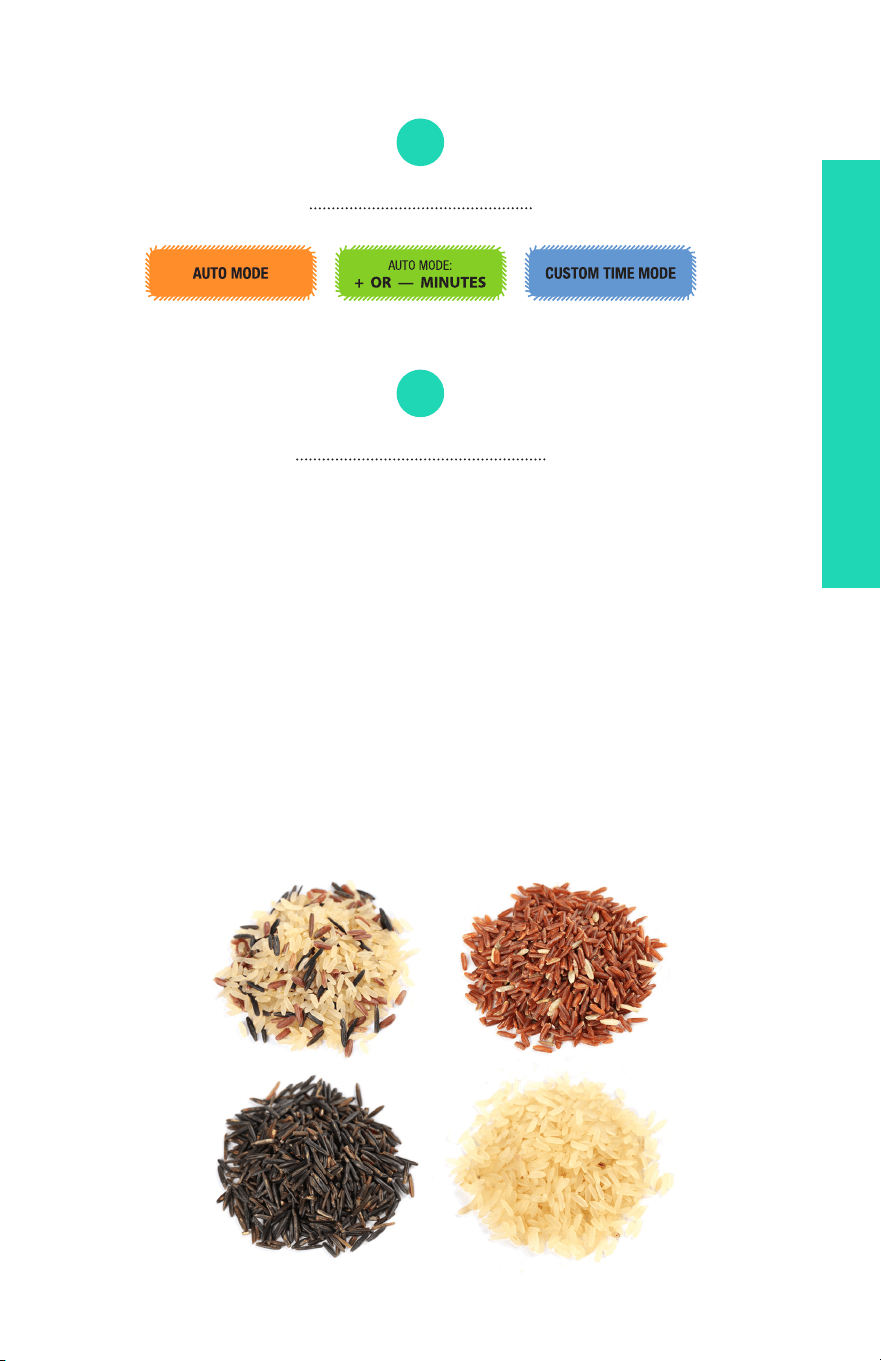
STEP-BY-STEP COOKING
STEP-BY-STEP COOKING
4140
RICE
The easiest and best rice EVER – directly from your pressure cooker!
Auto Preset Times:
Mode Preset Time Time Range
Rice 12 minutes 9-15 minutes
TIPS for Cooking Rice:
» Various types of rice require diering ratios of water to rice. Check out the
Grain/Rice Cooking Chart on p. 49 for information.
» Do not pre-soak rice, but rinse it in water, if desired. Add salt, if desired.
» Add 1 teaspoon oil or butter to the rice before cooking to help avoid
splattering.
» To add Delay Timer or Keep Warm features, see page 25 for specic
instructions.
1
ASSEMBLY:
» Pour enough water and rice into the Inner Pot to reach or exceed the
Minimum Fill line.
» Lock the Lid on the Pressure Cooker Base: Position the Lid so the arrow
on the Lid aligns over the Open indicator on the Base lip. Rotate the Lid
counterclockwise until the Lid stops and the arrow on the Lid aligns with the
Close indicator on the Base Lip.
» Turn the Airtight/Exhaust Valve to the Airtight position.
» Use the natural release method only to stop the pressure cooking process.
2
CHOOSE your Rice Mode:
3
When Cooking is COMPLETE
» The Display will beep three (3) times and switch to “Keep Warm.”
» “Keep Warm” Mode will hold up to four (4) hours. The Display will indicate
“bb” with no countdown.
» Release pressure naturally or use a potholder to turn the “Airtight/Exhaust”
valve to “Exhaust” for quick pressure release.
» The Pressure Release Valve will drop. Press the “Warm/Cancel” Button to
stop cooking.
» Rotate the EasyLift Handle clockwise until the arrow on the Lid aligns with
the “Open” indicator on the Base Lip. Using a potholder, lift the Lid up and
away from face and hands. Remove cooked food with a heat-proof plastic
utensil.
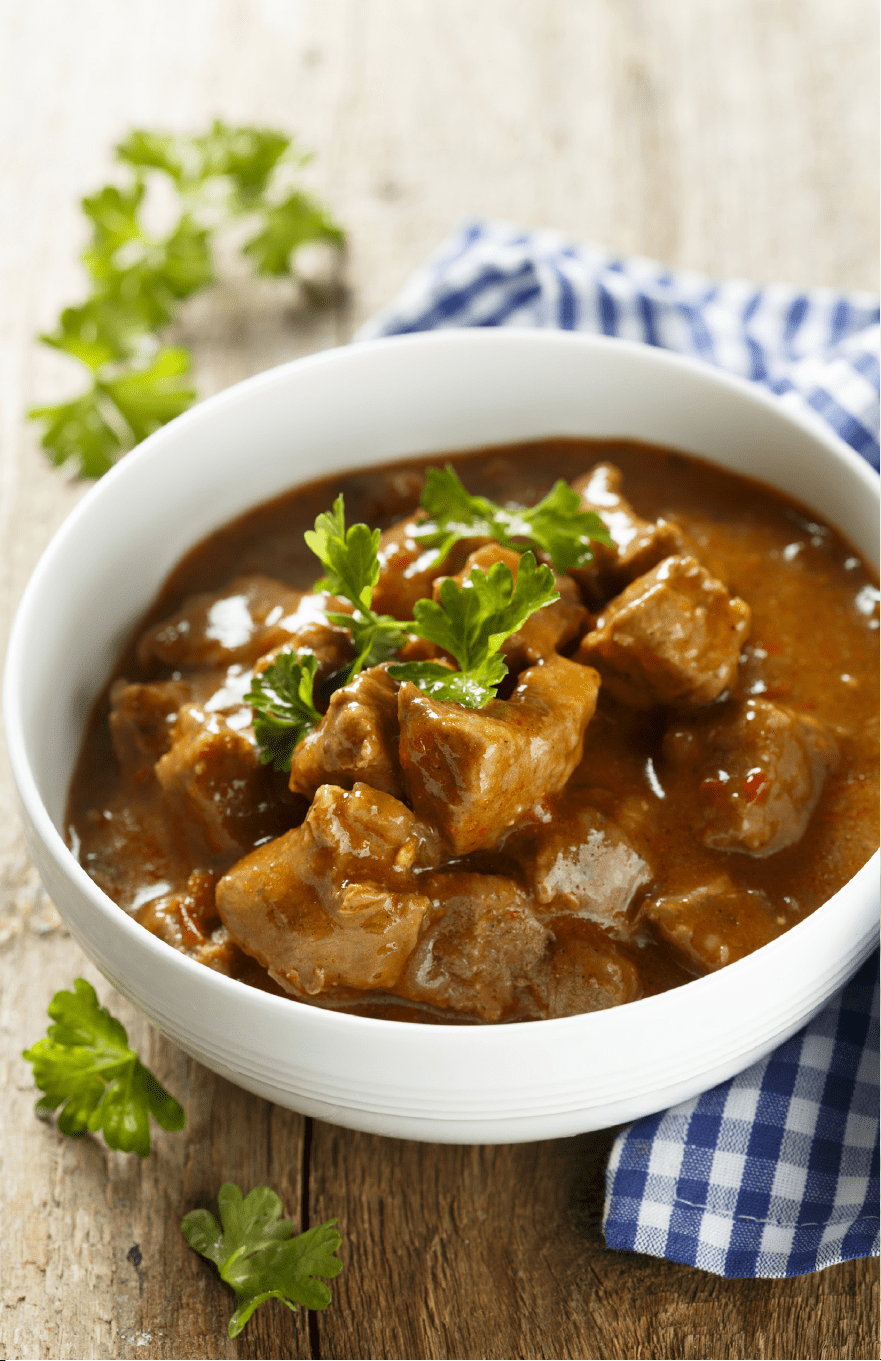
43
STEP-BY-STEP COOKING
42
COOKING CHARTS & CANNING HINTS & TIPS
MEAT COOKING CHART
(2-3 POUNDS OF MEAT)
NOTE: Always include at least 2 cups liquid per 1 pound meat. If the cooking time
is more than 15 minutes, increase the liquid by at least ½ cup. If cooking times are
extensive (over 40 minutes), use an additional 1 cup liquid for each 30 minutes.
Type Minutes Release Notes
Beef, brisket 40 natural
Beef, ank steak 18-20 natural
Beef, ground 10 natural
Beef, ribs 18-20 quick
Beef, roast 35-45 natural increase time with weight
Beef, round 25-30 natural
Beef, stew 15-18 natural cut in 1-inch cubes
Chicken, breast 8 quick boneless, skinless
Chicken, ground 10 quick
Chicken, pieces 12-15 quick bone-in
Chicken, strips 8 quick
Chicken, whole 18-20 quick 2-3 pounds, cleaned
Cornish hen, whole 20 quick 2-3
Ham, pork 28-35 natural bone-in
Lamb, chops 8 natural bone-in
Lamb, ground 10 natural
Lamb, leg 45 natural bone-in
Lamb, roast 25 natural 2-3 pounds
Lamb, shoulder 25 natural
Lamb, stew 15-18 natural cut in 1-inch cubes
Pork, belly 40 natural
Pork, chops 12 natural
Pork, ground 10 natural
Pork, leg/shank 35 natural bone-in
Pork, loin 12 natural
Pork ribs 18-20 quick
Pork, roast 35-40 natural boneless
Pork, sausage 10 natural
Pork, tenderloin 8-15 natural
Turkey, breast 20 natural rolled/stued
Turkey, breast 12-15 natural boneless, skinless
Turkey, leg 15 natural bone-in
Turkey, wings 15 natural bone-in
Veal, chop 10-12 natural bone-in
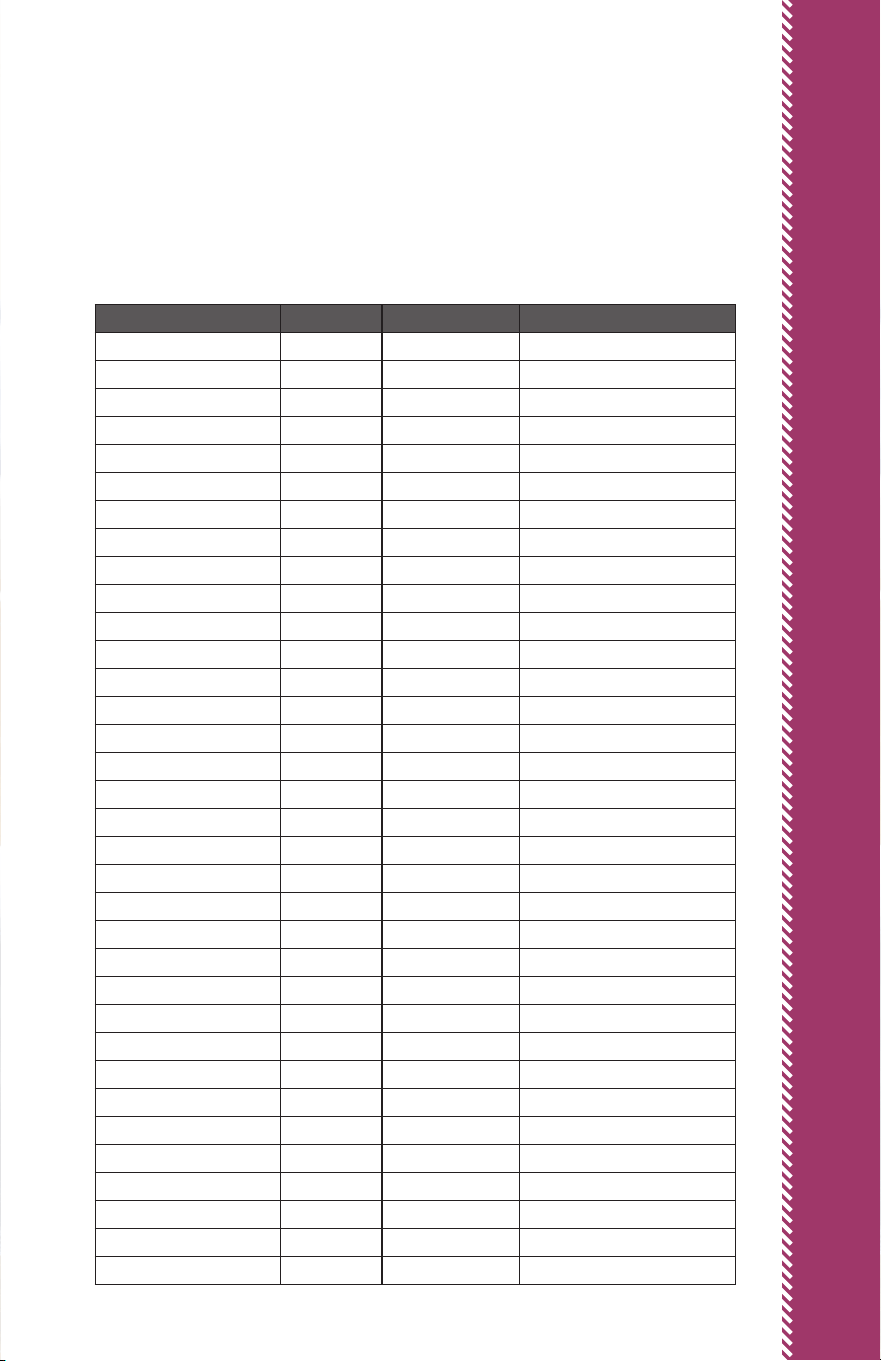
43
STEP-BY-STEP COOKING
42
COOKING CHARTS & CANNING HINTS & TIPS
MEAT COOKING CHART
(2-3 POUNDS OF MEAT)
NOTE: Always include at least 2 cups liquid per 1 pound meat. If the cooking time
is more than 15 minutes, increase the liquid by at least ½ cup. If cooking times are
extensive (over 40 minutes), use an additional 1 cup liquid for each 30 minutes.
Type Minutes Release Notes
Beef, brisket 40 natural
Beef, ank steak 18-20 natural
Beef, ground 10 natural
Beef, ribs 18-20 quick
Beef, roast 35-45 natural increase time with weight
Beef, round 25-30 natural
Beef, stew 15-18 natural cut in 1-inch cubes
Chicken, breast 8 quick boneless, skinless
Chicken, ground 10 quick
Chicken, pieces 12-15 quick bone-in
Chicken, strips 8 quick
Chicken, whole 18-20 quick 2-3 pounds, cleaned
Cornish hen, whole 20 quick 2-3
Ham, pork 28-35 natural bone-in
Lamb, chops 8 natural bone-in
Lamb, ground 10 natural
Lamb, leg 45 natural bone-in
Lamb, roast 25 natural 2-3 pounds
Lamb, shoulder 25 natural
Lamb, stew 15-18 natural cut in 1-inch cubes
Pork, belly 40 natural
Pork, chops 12 natural
Pork, ground 10 natural
Pork, leg/shank 35 natural bone-in
Pork, loin 12 natural
Pork ribs 18-20 quick
Pork, roast 35-40 natural boneless
Pork, sausage 10 natural
Pork, tenderloin 8-15 natural
Turkey, breast 20 natural rolled/stued
Turkey, breast 12-15 natural boneless, skinless
Turkey, leg 15 natural bone-in
Turkey, wings 15 natural bone-in
Veal, chop 10-12 natural bone-in
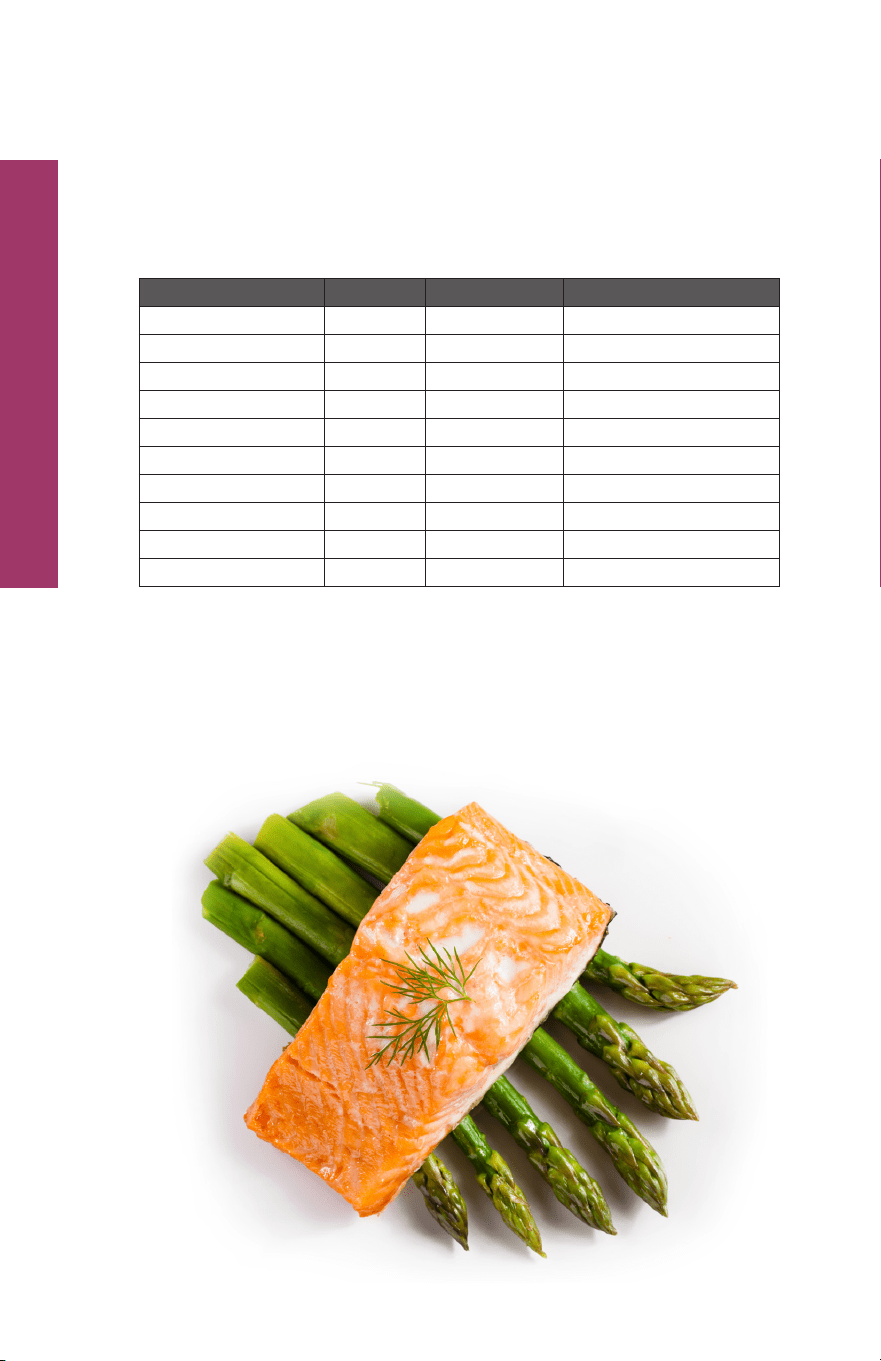
COOKING CHARTS & CANNING HINTS & TIPS
COOKING CHARTS & CANNING HINTS & TIPS
4544
SEAFOOD COOKING CHART
(1-3 POUNDS OF SEAFOOD)
NOTE: Use the Steaming Rack to cook seafood. Place a heat-proof container on top of the
Rack. Add at least 2-3 cups water to the Inner Pot to reach the Minimum Fill line.
Type Minutes Release Notes
Clams 3-5 quick
Fish, llet 3-4 quick
Fish, steak 3-5 quick
Fish, whole 7-8 quick cleaned
Lobster 3-5 natural cleaned
Mussels 3-5 quick
Oysters 3-5 quick
Salmon, steak 4-6 quick
Scallops 1-2 quick
Shrimp 2-3 quick
VEGETABLE COOKING CHART
(1/2 to 2 POUNDS)
NOTE: Use the Steaming Rack to cook vegetables for maximum nutrition retention.
Place a heat-proof container on top of the Rack. Add at least 2-3 cups water to the
Inner Pot to reach the Minimum Fill line.
Type Minutes Release Notes
Artichoke, hearts 3-5 normal cut in half
Artichoke, whole 5-11 normal add time with size
Asparagus 1-2 quick
Beet, whole 10-20 quick add time with size
Beet, cubed 3-5 quick
Bok choy, baby 1-2 quick
Broccoli 3-5 quick
Brussels Sprouts 4-6 quick
Cabbage 3-5 quick all colors, cut in quarters
Carrots, whole 3-5 quick
Carrots, sliced 3 quick
Cauliower 3 quick cut in orets
Cauliower 7-9 quick whole or halves
Chard, Swiss 2-3 quick
Collard greens 3-5 quick
Corn, kernel 2-3 quick
Corn, on cob 8-10 quick
Eggplant 3-5 quick cut in quarters
Green beans 2-3 quick fresh or frozen
Greens, chopped 2-3 quick
Kale 1-2 quick
Leeks 3-4 quick
Mushrooms, fresh 3-5 quick
Okra 3 quick
Onion 2-3 quick whole or halved
Parsnips 2-3 quick
Peas 2-3 quick fresh or frozen
Peppers 2-4 quick increase time with size
Potatoes, ngerling 6 quick whole
Potatoes, chunks 5 quick red, Yukon, creamer
Potatoes, whole 10-15 quick increase time with size
Pumpkin 8 quick cut in chunks
Squash, acorn 8 quick

COOKING CHARTS & CANNING HINTS & TIPS
COOKING CHARTS & CANNING HINTS & TIPS
4544
SEAFOOD COOKING CHART
(1-3 POUNDS OF SEAFOOD)
NOTE: Use the Steaming Rack to cook seafood. Place a heat-proof container on top of the
Rack. Add at least 2-3 cups water to the Inner Pot to reach the Minimum Fill line.
Type Minutes Release Notes
Clams 3-5 quick
Fish, llet 3-4 quick
Fish, steak 3-5 quick
Fish, whole 7-8 quick cleaned
Lobster 3-5 natural cleaned
Mussels 3-5 quick
Oysters 3-5 quick
Salmon, steak 4-6 quick
Scallops 1-2 quick
Shrimp 2-3 quick
VEGETABLE COOKING CHART
(1/2 to 2 POUNDS)
NOTE: Use the Steaming Rack to cook vegetables for maximum nutrition retention.
Place a heat-proof container on top of the Rack. Add at least 2-3 cups water to the
Inner Pot to reach the Minimum Fill line.
Type Minutes Release Notes
Artichoke, hearts 3-5 normal cut in half
Artichoke, whole 5-11 normal add time with size
Asparagus 1-2 quick
Beet, whole 10-20 quick add time with size
Beet, cubed 3-5 quick
Bok choy, baby 1-2 quick
Broccoli 3-5 quick
Brussels Sprouts 4-6 quick
Cabbage 3-5 quick all colors, cut in quarters
Carrots, whole 3-5 quick
Carrots, sliced 3 quick
Cauliower 3 quick cut in orets
Cauliower 7-9 quick whole or halves
Chard, Swiss 2-3 quick
Collard greens 3-5 quick
Corn, kernel 2-3 quick
Corn, on cob 8-10 quick
Eggplant 3-5 quick cut in quarters
Green beans 2-3 quick fresh or frozen
Greens, chopped 2-3 quick
Kale 1-2 quick
Leeks 3-4 quick
Mushrooms, fresh 3-5 quick
Okra 3 quick
Onion 2-3 quick whole or halved
Parsnips 2-3 quick
Peas 2-3 quick fresh or frozen
Peppers 2-4 quick increase time with size
Potatoes, ngerling 6 quick whole
Potatoes, chunks 5 quick red, Yukon, creamer
Potatoes, whole 10-15 quick increase time with size
Pumpkin 8 quick cut in chunks
Squash, acorn 8 quick
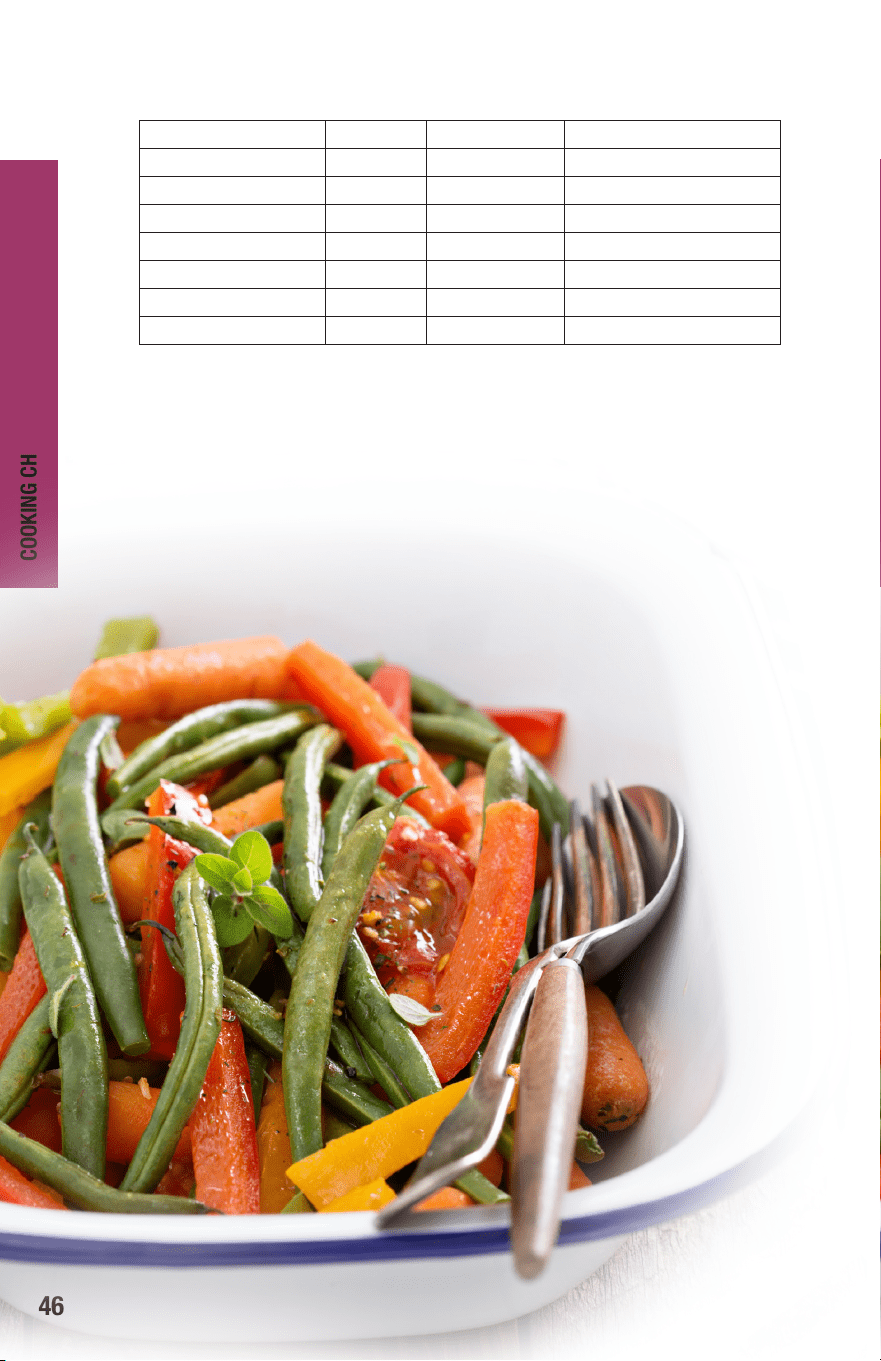
COOKING CHARTS & CANNING HINTS & TIPS
COOKING CHARTS & CANNING HINTS & TIPS
4746
Squash, banana 5 quick 1-inch cubes
Squash, butternut 6 quick halves
Squash, spaghetti 4-6 quick halves
Tomato, slices 2-3 quick
Tomatoes 3 quick whole or halves
Turnips 5 quick halves
Yams, halved 10-15 quick increase weight with size
Zucchini 6 quick cut in ¼ to ½ inch pieces
FRUIT COOKING CHART
(1/2 to 2 pounds)
NOTE: Use the Steaming Rack to cook fruit for maximum nutrition retention. Place a heat-
proof container on top of the Rack. Add at least 2-3 cups water to the Inner Pot to reach the
Minimum Fill line.
Type Minutes Release Notes
Apples, whole 3-5 quick increase time with size
Apples, pieces 3 quick
Apricots, pitted 4 quick
Berries, soft 1-3 quick raspberries, strawberries
Berries, rm 3-5 quick blueberries, cranberries
Cherries, pitted 2-3 quick
Figs, fresh 3 quick halved
Kumquat, sliced 12-13 quick
Mango 5-7 quick cut in pieces
Orange, wedges 15 quick peeled
Peaches, pitted 4-6 quick increase time with size
Pears 4-5 quick whole or sliced
Plums, pitted 5 quick
Prunes 10 quick
ISOLATED FRUIT
PHOTO HERE
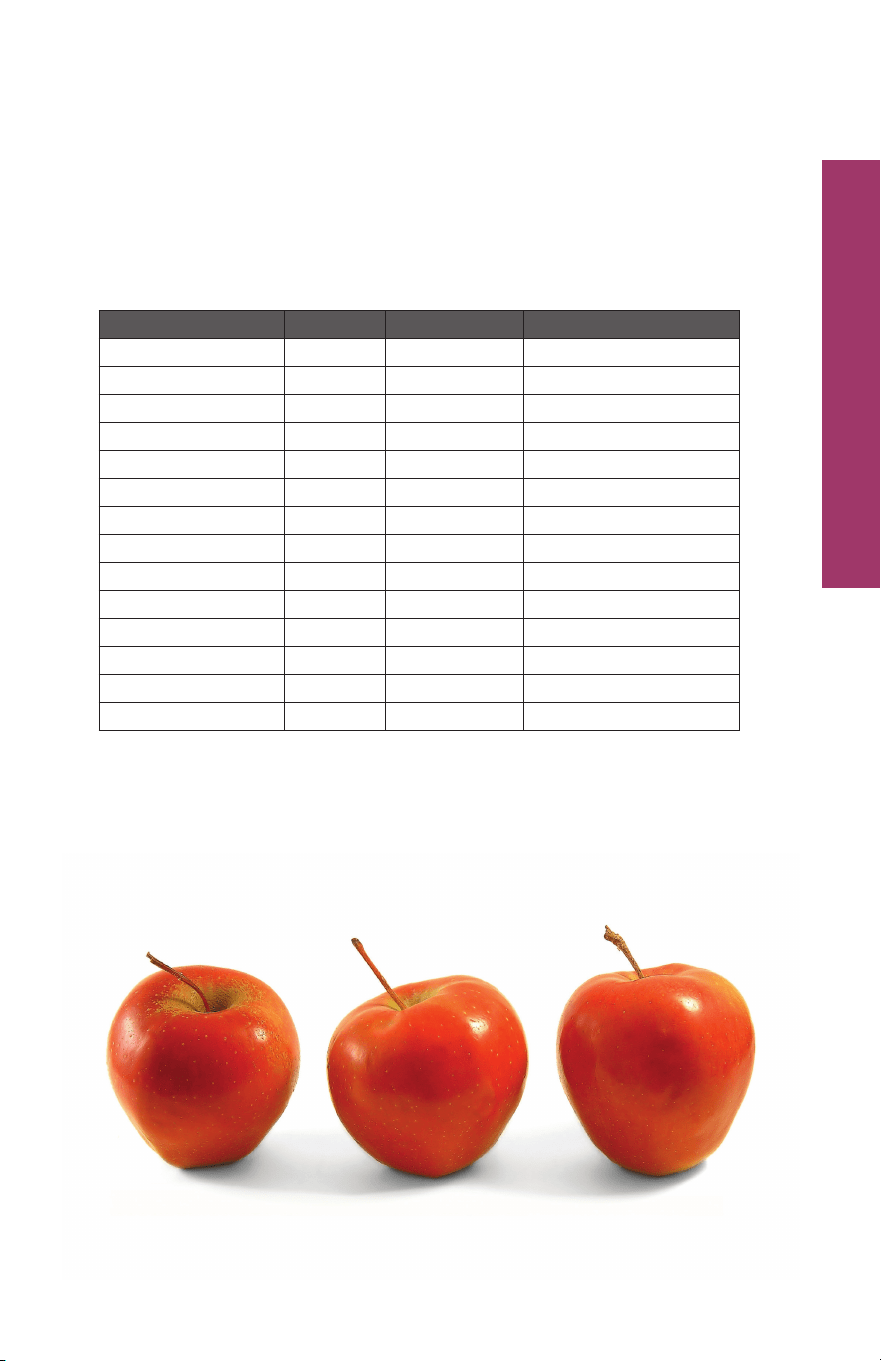
COOKING CHARTS & CANNING HINTS & TIPS
COOKING CHARTS & CANNING HINTS & TIPS
4746
Squash, banana 5 quick 1-inch cubes
Squash, butternut 6 quick halves
Squash, spaghetti 4-6 quick halves
Tomato, slices 2-3 quick
Tomatoes 3 quick whole or halves
Turnips 5 quick halves
Yams, halved 10-15 quick increase weight with size
Zucchini 6 quick cut in ¼ to ½ inch pieces
FRUIT COOKING CHART
(1/2 to 2 pounds)
NOTE: Use the Steaming Rack to cook fruit for maximum nutrition retention. Place a heat-
proof container on top of the Rack. Add at least 2-3 cups water to the Inner Pot to reach the
Minimum Fill line.
Type Minutes Release Notes
Apples, whole 3-5 quick increase time with size
Apples, pieces 3 quick
Apricots, pitted 4 quick
Berries, soft 1-3 quick raspberries, strawberries
Berries, rm 3-5 quick blueberries, cranberries
Cherries, pitted 2-3 quick
Figs, fresh 3 quick halved
Kumquat, sliced 12-13 quick
Mango 5-7 quick cut in pieces
Orange, wedges 15 quick peeled
Peaches, pitted 4-6 quick increase time with size
Pears 4-5 quick whole or sliced
Plums, pitted 5 quick
Prunes 10 quick
ISOLATED FRUIT
PHOTO HERE
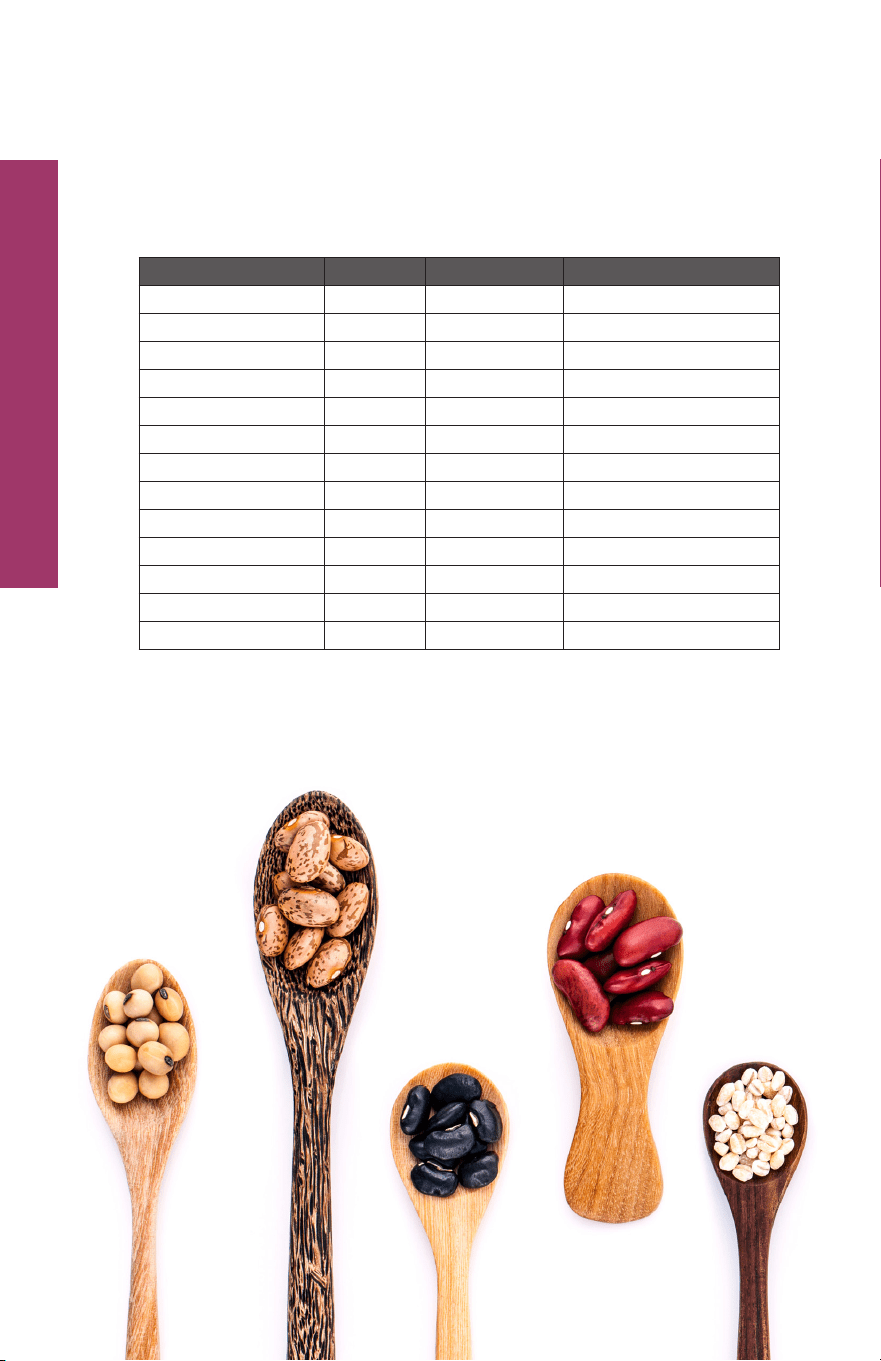
COOKING CHARTS & CANNING HINTS & TIPS
COOKING CHARTS & CANNING HINTS & TIPS
4948
Type Minutes Release Notes
Azuki 7-8 natural
Black 10-12 natural
Black-eyed peas 12-15 natural
Chickpeas 13-15 natural
Fava, dried 15-20 natural
Great Northern 10-15 natural
Kidney beans 12-15 natural
Lentils, green 10-12 natural
Lentils, red 10-15 natural
Lentils, brown 10-12 natural
Lima 8-10 natural
Navy 10-12 natural
Peas, split green 5-8 natural
BEAN COOKING CHART
NOTE: See section titled, “Beans” (p. 36) for tips and hints on preparation.
Add 4 cups water for ½ pound beans, 8 cups water for 1 pound beans.
GRAIN/RICE COOKING CHART
NOTE: See Rice and Porridge sections for tips and hints on preparation. Always add enough
food and liquid to at least reach or exceed the Minimum Fill line in the Inner Pot.
Type Minutes Release Notes
GRAINS
Amaranth 9 natural 1 cup grain to 3 cups water
Barley, pearl 16-18 natural 1 cup grain to 4½ cups water
Buckwheat 10-12 natural 1 cup grain to 2 cups water
Hominy, grits 10-12 natural 1 cup grain to 4 cups water
Masa harina 10-12 natural 1 cup grain to 4 cups water
Matzoh meal 10-12 natural 1 cup grain to 2 cups water
Kamut, whole 10-12 natural 1 cup grain to 3 cups water
Millet 9-11 natural 1 cup grain to 3 cups water
Oats, rolled 10-20 natural 1 cup grain to 4 cups water
Oats, steel-cut 12-22 natural
1 cup grain to 4 cups water
increase time with quantity
Quinoa 6-8 natural 1 cup grain to 2 cups water
Rye berries 15-18 natural 1 cup grain to 2 cups water
Wheat berries 8-10 natural 1 cup grain to 3 cups water
RICE
Arborio 8-10 natural 1 cup rice to 1½ cups water
Basmati 8-10 natural 1 cup rice to 1½ cups water
Brown 17-22 natural 1 cup rice to 1½ cups water
Black 18-20 natural 1 cup rice to 1½ cups water
Converted 7-8 natural 1 cup rice to 1½ cups water
Jasmine 5-6 natural 1 cup rice to 1 cup water
Red 17-22 natural 1 cup rice to 1½ cups water
White, long grain 7-8 natural 1 cup rice to 1½ cups water
Wild 25-38 natural 1 cup rice to 3 cups water
COOKING CHARTS & CANNING HINTS & TIPS
COOKING CHARTS & CANNING HINTS & TIPS
4948
Type Minutes Release Notes
Azuki 7-8 natural
Black 10-12 natural
Black-eyed peas 12-15 natural
Chickpeas 13-15 natural
Fava, dried 15-20 natural
Great Northern 10-15 natural
Kidney beans 12-15 natural
Lentils, green 10-12 natural
Lentils, red 10-15 natural
Lentils, brown 10-12 natural
Lima 8-10 natural
Navy 10-12 natural
Peas, split green 5-8 natural
BEAN COOKING CHART
NOTE: See section titled, “Beans” (p. 36) for tips and hints on preparation.
Add 4 cups water for ½ pound beans, 8 cups water for 1 pound beans.
GRAIN/RICE COOKING CHART
NOTE: See Rice and Porridge sections for tips and hints on preparation. Always add enough
food and liquid to at least reach or exceed the Minimum Fill line in the Inner Pot.
Type Minutes Release Notes
GRAINS
Amaranth 9 natural 1 cup grain to 3 cups water
Barley, pearl 16-18 natural 1 cup grain to 4½ cups water
Buckwheat 10-12 natural 1 cup grain to 2 cups water
Hominy, grits 10-12 natural 1 cup grain to 4 cups water
Masa harina 10-12 natural 1 cup grain to 4 cups water
Matzoh meal 10-12 natural 1 cup grain to 2 cups water
Kamut, whole 10-12 natural 1 cup grain to 3 cups water
Millet 9-11 natural 1 cup grain to 3 cups water
Oats, rolled 10-20 natural 1 cup grain to 4 cups water
Oats, steel-cut 12-22 natural
1 cup grain to 4 cups water
increase time with quantity
Quinoa 6-8 natural 1 cup grain to 2 cups water
Rye berries 15-18 natural 1 cup grain to 2 cups water
Wheat berries 8-10 natural 1 cup grain to 3 cups water
RICE
Arborio 8-10 natural 1 cup rice to 1½ cups water
Basmati 8-10 natural 1 cup rice to 1½ cups water
Brown 17-22 natural 1 cup rice to 1½ cups water
Black 18-20 natural 1 cup rice to 1½ cups water
Converted 7-8 natural 1 cup rice to 1½ cups water
Jasmine 5-6 natural 1 cup rice to 1 cup water
Red 17-22 natural 1 cup rice to 1½ cups water
White, long grain 7-8 natural 1 cup rice to 1½ cups water
Wild 25-38 natural 1 cup rice to 3 cups water

COOKING CHARTS & CANNING HINTS & TIPS
COOKING CHARTS & CANNING HINTS & TIPS
5150
CANNING HINTS & TIPS
Using your Pressure Cooker to can your favorite foods is like having an ecient
personal assistant in the kitchen with you! The process of cooking foods under
pressure in sealed containers is a time-honored and valued tradition and it is
an economical and highly nutritious endeavor. There is nothing like fruit and
vegetables, picked at the peak of ripeness, canned and ready for a cold winter’s
day! The hints and tips that follow are to help get you started; refer to canning
cookbooks and other resources for specic information and greater detail. Enjoy!
1. Use the water-bath method when canning in the Pressure Cooker.
Low-acid fruits and vegetables or high-acid fruits and vegetables are
recommended for canning in this Pressure Cooker.
2. Do not use this Pressure Cooker to can meat or seafood.
3. Do not use this Pressure Cooker to can at altitudes above 4,000 feet.
4. Use canning supplies that have been thoroughly cleaned and dried. Use
32-ounce jars or smaller sizes for canning in this Pressure Cooker. Do not
attempt to stack jars on top of each other or jam them together while in
the Pressure Cooker.
5. Prepare food and ll jars according to manufacturer’s instructions.
6. Dislodge any air bubbles in the jars by using a thin-bladed knife to release
trapped air between the jars and the food.
7. Place seals on jars, then close jar lids tightly on jars. Unscrew jars one-
quarter turn.
8. Place jars in the Inner Pot. If desired, place a clean cloth around the jars to
prevent touching.
9. Fill the Inner Pot with at least 6 cups of water. Check your canning resource
to ensure the water level is correct for the food being canned and the
water-bath process being utilized.
10. Secure the Lid and turn counterclockwise to lock it in place. Set the
Airtight/Exhaust Valve to Airtight.
11. Plug the Base into the outlet. Follow your food canning instructions to set
the Custom Time Mode needed for proper canning times.
12. When the Pressure Cooker has reached optimal pressure levels, the jars
will pressure seal.
13. When the cooking cycle is done, the Cooker will beep three (3) times and
automatically switch to Keep Warm. Press the Warm/Cancel Button to stop
the cycle. Allow the Pressure Cooker to naturally release pressure.
14. When the Pressure Release Valve drops, open the Lid and use canning
tongs to remove the hot jars. Cool and continue with recipe instructions as
directed by your recipe
15. If for any reason, the jars did not seal during pressure cooking, you will
note that within 1-2 hours, the lid jiggles or moves when tapped lightly
with a knife edge. If this happens, the jars did not seal. Remove lids and
refrigerate food immediately. Consume food within 2-3 days or freeze for
later use. Do not attempt to repeat the process with the food and jars.

COOKING CHARTS & CANNING HINTS & TIPS
COOKING CHARTS & CANNING HINTS & TIPS
5150
CANNING HINTS & TIPS
Using your Pressure Cooker to can your favorite foods is like having an ecient
personal assistant in the kitchen with you! The process of cooking foods under
pressure in sealed containers is a time-honored and valued tradition and it is
an economical and highly nutritious endeavor. There is nothing like fruit and
vegetables, picked at the peak of ripeness, canned and ready for a cold winter’s
day! The hints and tips that follow are to help get you started; refer to canning
cookbooks and other resources for specic information and greater detail. Enjoy!
1. Use the water-bath method when canning in the Pressure Cooker.
Low-acid fruits and vegetables or high-acid fruits and vegetables are
recommended for canning in this Pressure Cooker.
2. Do not use this Pressure Cooker to can meat or seafood.
3. Do not use this Pressure Cooker to can at altitudes above 4,000 feet.
4. Use canning supplies that have been thoroughly cleaned and dried. Use
32-ounce jars or smaller sizes for canning in this Pressure Cooker. Do not
attempt to stack jars on top of each other or jam them together while in
the Pressure Cooker.
5. Prepare food and ll jars according to manufacturer’s instructions.
6. Dislodge any air bubbles in the jars by using a thin-bladed knife to release
trapped air between the jars and the food.
7. Place seals on jars, then close jar lids tightly on jars. Unscrew jars one-
quarter turn.
8. Place jars in the Inner Pot. If desired, place a clean cloth around the jars to
prevent touching.
9. Fill the Inner Pot with at least 6 cups of water. Check your canning resource
to ensure the water level is correct for the food being canned and the
water-bath process being utilized.
10. Secure the Lid and turn counterclockwise to lock it in place. Set the
Airtight/Exhaust Valve to Airtight.
11. Plug the Base into the outlet. Follow your food canning instructions to set
the Custom Time Mode needed for proper canning times.
12. When the Pressure Cooker has reached optimal pressure levels, the jars
will pressure seal.
13. When the cooking cycle is done, the Cooker will beep three (3) times and
automatically switch to Keep Warm. Press the Warm/Cancel Button to stop
the cycle. Allow the Pressure Cooker to naturally release pressure.
14. When the Pressure Release Valve drops, open the Lid and use canning
tongs to remove the hot jars. Cool and continue with recipe instructions as
directed by your recipe
15. If for any reason, the jars did not seal during pressure cooking, you will
note that within 1-2 hours, the lid jiggles or moves when tapped lightly
with a knife edge. If this happens, the jars did not seal. Remove lids and
refrigerate food immediately. Consume food within 2-3 days or freeze for
later use. Do not attempt to repeat the process with the food and jars.
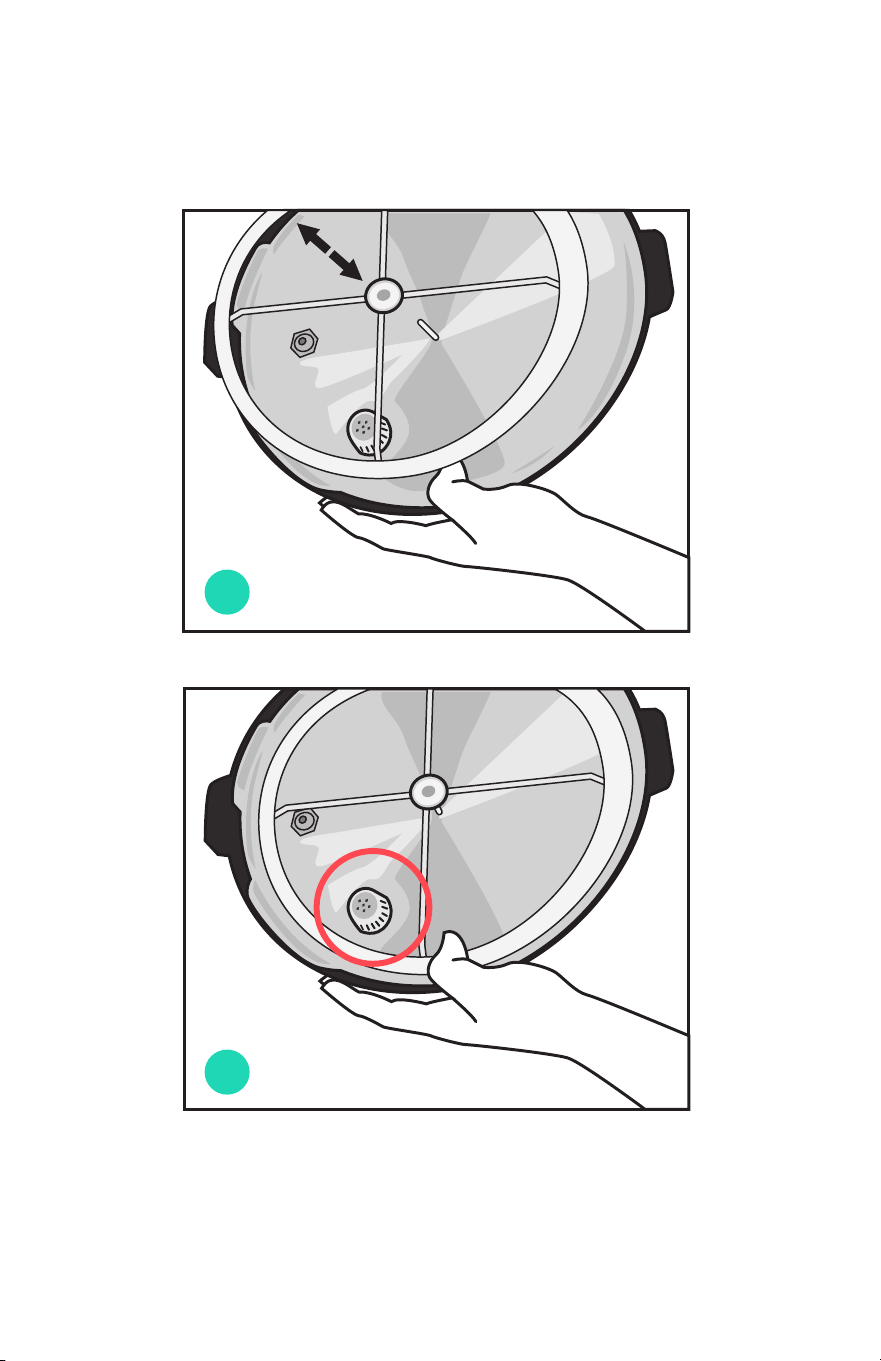
5352
CLEANING & MAINTENANCE
CLEANING & MAINTENANCE
Follow these steps to care properly for your Pressure Cooker.
1. Unplug the base from the outlet. Always wait until the Base and Inner Pot
are completely cool before cleaning.
2. Use a soft soap with a damp cloth to clean the exterior and interior of the
Base and the Lid. Dry well.
3. Clean the Inner Pot with hot, soapy water and dry well. Do not use a
scouring pad.
4. Do not place any parts, including the Lid or the Base in the dishwasher.
5. Remove the mini cup and rinse. Dry well.
6. Remove the Seal Wire Support. Holding the center of the Seal Wire
Support, where the wires intersect, gently pull straight up until it releases
from the Peg in the center of the Lid (See Fig. 5).
7. Remove the Flexible Seal Ring from the Seal Wire Support and clean with
a damp cloth. (Check the Flexible Seal Ring to ensure there are no tears or
cracks.)
8. Re-install the Flexible Seal Ring around the Seal Wire Support. When in
position, the inner groove of the Flexible Seal Ring will t securely around
the outer diameter of the Seal Wire Support.
9. Re-install the Flexible Seal Ring and Seal Wire Support into the Lid. Place
the center of the Seal Wire Support over the Peg in the center of the Lid
and gently push until it slips onto the Peg. Continue pushing the Seal Wire
Support down until the outer Flexible Seal Ring ts snugly onto the inside
of the Lid.
10. If needed, pop the interior cover for the Filter open and clean any food
particles from it (See Fig. 6). Use a small brush, if desired. Dry well and
replace.
11. Clean the small seal for the Pressure Release Valve by carefully wiping with
a damp cloth. Dry well.
12. Store the Inner Pot in the Base. Store in a cool, dry location
Fig.5
Fig.6

5352
CLEANING & MAINTENANCE
CLEANING & MAINTENANCE
Follow these steps to care properly for your Pressure Cooker.
1. Unplug the base from the outlet. Always wait until the Base and Inner Pot
are completely cool before cleaning.
2. Use a soft soap with a damp cloth to clean the exterior and interior of the
Base and the Lid. Dry well.
3. Clean the Inner Pot with hot, soapy water and dry well. Do not use a
scouring pad.
4. Do not place any parts, including the Lid or the Base in the dishwasher.
5. Remove the mini cup and rinse. Dry well.
6. Remove the Seal Wire Support. Holding the center of the Seal Wire
Support, where the wires intersect, gently pull straight up until it releases
from the Peg in the center of the Lid (See Fig. 5).
7. Remove the Flexible Seal Ring from the Seal Wire Support and clean with
a damp cloth. (Check the Flexible Seal Ring to ensure there are no tears or
cracks.)
8. Re-install the Flexible Seal Ring around the Seal Wire Support. When in
position, the inner groove of the Flexible Seal Ring will t securely around
the outer diameter of the Seal Wire Support.
9. Re-install the Flexible Seal Ring and Seal Wire Support into the Lid. Place
the center of the Seal Wire Support over the Peg in the center of the Lid
and gently push until it slips onto the Peg. Continue pushing the Seal Wire
Support down until the outer Flexible Seal Ring ts snugly onto the inside
of the Lid.
10. If needed, pop the interior cover for the Filter open and clean any food
particles from it (See Fig. 6). Use a small brush, if desired. Dry well and
replace.
11. Clean the small seal for the Pressure Release Valve by carefully wiping with
a damp cloth. Dry well.
12. Store the Inner Pot in the Base. Store in a cool, dry location
Fig.5
Fig.6
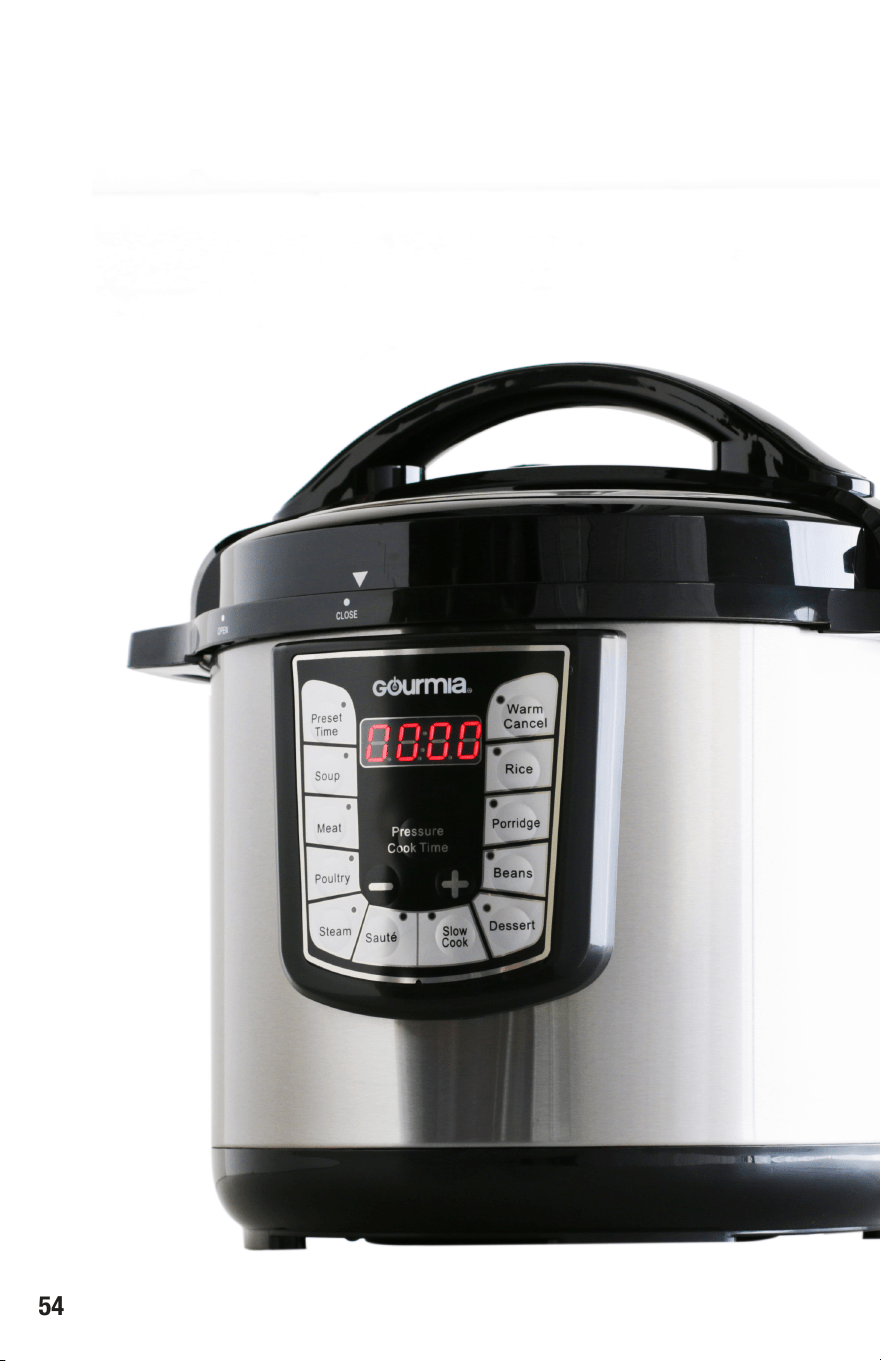
5554
FAQ’S & TROUBLESHOOTING
FAQS & TROUBLESHOOTING
Is the “Airtight/Exhaust Valve” on the Lid supposed to be loose?
Answer: Yes, it should be loose and turn freely.
When the pressure builds up and the valve is set to Airtight, the valve will
bobble during the process. If steam escapes from the valve while cooking, the
valve is not in correct position. In this event, use a potholder or utensil to gently
adjust the valve until steam no longer escapes.
How do I set the Modes and Methods?
Answer: Check the section titled, “Cooking Modes, Methods & Features”
(p. 19) for specic instructions on setting all Modes and Methods.
How do I set the Timer Delay?
Answer: Check the section titled, “Cooking Modes, Methods & Features” (p. 19)
for instructions on setting the Timer Delay.
Note that we do not recommend delaying cooking for more than 2-3 hours.
Food contamination can become an issue if foods sit uncooked for a long time.
If foods contain meat, seafood, dairy products and other bacteria-prone foods,
we do not recommend using the Timer Delay or the Keep Warm feature.
How do I set the Preset Times?
Answer: Check the section titled, “Cooking Modes, Methods & Features” (see
p. 19). In this section, you will nd specic information on using the Auto
Modes to quickly make your pressure cooking selection. See also “Step by Step
Cooking” to nd the preset times for specic foods.
How does the Keep Warm feature work?
Answer: Keep Warm will automatically start when the Cooking Mode is done.
This feature will hold cooked foods up to four (4) hours after cooking. It is
important that food be removed by that time, as bacteria can contaminate
foods after that. If the Keep Warm feature is manually set, the times range from
30 minutes to 24 hours. We do not recommend that foods be kept warm for
over four (4) hours.

5554
FAQ’S & TROUBLESHOOTING
FAQS & TROUBLESHOOTING
Is the “Airtight/Exhaust Valve” on the Lid supposed to be loose?
Answer: Yes, it should be loose and turn freely.
When the pressure builds up and the valve is set to Airtight, the valve will
bobble during the process. If steam escapes from the valve while cooking, the
valve is not in correct position. In this event, use a potholder or utensil to gently
adjust the valve until steam no longer escapes.
How do I set the Modes and Methods?
Answer: Check the section titled, “Cooking Modes, Methods & Features”
(p. 19) for specic instructions on setting all Modes and Methods.
How do I set the Timer Delay?
Answer: Check the section titled, “Cooking Modes, Methods & Features” (p. 19)
for instructions on setting the Timer Delay.
Note that we do not recommend delaying cooking for more than 2-3 hours.
Food contamination can become an issue if foods sit uncooked for a long time.
If foods contain meat, seafood, dairy products and other bacteria-prone foods,
we do not recommend using the Timer Delay or the Keep Warm feature.
How do I set the Preset Times?
Answer: Check the section titled, “Cooking Modes, Methods & Features” (see
p. 19). In this section, you will nd specic information on using the Auto
Modes to quickly make your pressure cooking selection. See also “Step by Step
Cooking” to nd the preset times for specic foods.
How does the Keep Warm feature work?
Answer: Keep Warm will automatically start when the Cooking Mode is done.
This feature will hold cooked foods up to four (4) hours after cooking. It is
important that food be removed by that time, as bacteria can contaminate
foods after that. If the Keep Warm feature is manually set, the times range from
30 minutes to 24 hours. We do not recommend that foods be kept warm for
over four (4) hours.

WARRANTY & SERVICES
WARRANTY & SERVICES
5756
What happens after my food is done cooking? Does it automatically go to
Keep Warm?
Answer: Yes, the Keep Warm feature starts as soon as the cooking process is
nished. The Keep Warm feature will hold food at a warm temperature for up to
four (4) hours. Do not allow food to stand after four hours, as bacteria growth can
occur.
When I select a menu button, nothing happens. What is wrong?
Answer: Check to ensure the Lid is locked and the Airtight/Exhaust Valve is set to
Airtight.
The Display will show in the icon a ashing/cycling circle, indicating that pressure
is building and the heat is rising. This may take from 5 to 30 minutes, but be
assured the Pressure Cooker is in working mode.
Why does steam release around the rim of the Lid when the pressure starts
to build?
Answer: The Flexible Seal Ring is not sealed.
Select the Warm/Cancel Button to stop the process. Unplug the Base from the
outlet. When the Base and Lid are cool and the pressure is gone, open and check
the Seal Wire Support and Flexible Seal Ring. Clean if needed or re-position. Close
the Lid and plug the Base into the outlet. Re-start the Mode selected.
My pressure cooking cycle is complete and the pressure has been released, but I
cannot open the Lid. What is wrong?
Answer: Although the pressure may have been released somewhat, the safety
feature of the Lid will not open until enough pressure has been released. Wait
until the Pressure Release Valve drops. If it appears to be stuck, gently wiggle it.
If the Lid does not open after a normal time frame, unplug the Base at the outlet;
wait 30 seconds, then plug it in again.
My Pressure Cooker appears to have no power.
Answer: The fuse in the Pressure Cooker is inoperable.
To repair, call customer service for a replacement fuse and instructions.
Why is food burned at the bottom of the Inner Pot when I selected the correct
Mode or Method?
Answer: If the liquid added does not at least reach the Minimum Fill line, or if the
pressure cooking time was longer than 30 minutes and the liquid evaporated, the
food will burn.
When adding liquid, always estimate at least 2-3 cups liquid to reach or exceed
the Minimum Fill Line. If you will be cooking for longer than 30 minutes, increase
the liquid by 1/3 cup increments for each additional 30 minute segment. It is
better to have too much liquid in the Inner Pot than not enough.

WARRANTY & SERVICES
WARRANTY & SERVICES
5756
What happens after my food is done cooking? Does it automatically go to
Keep Warm?
Answer: Yes, the Keep Warm feature starts as soon as the cooking process is
nished. The Keep Warm feature will hold food at a warm temperature for up to
four (4) hours. Do not allow food to stand after four hours, as bacteria growth can
occur.
When I select a menu button, nothing happens. What is wrong?
Answer: Check to ensure the Lid is locked and the Airtight/Exhaust Valve is set to
Airtight.
The Display will show in the icon a ashing/cycling circle, indicating that pressure
is building and the heat is rising. This may take from 5 to 30 minutes, but be
assured the Pressure Cooker is in working mode.
Why does steam release around the rim of the Lid when the pressure starts
to build?
Answer: The Flexible Seal Ring is not sealed.
Select the Warm/Cancel Button to stop the process. Unplug the Base from the
outlet. When the Base and Lid are cool and the pressure is gone, open and check
the Seal Wire Support and Flexible Seal Ring. Clean if needed or re-position. Close
the Lid and plug the Base into the outlet. Re-start the Mode selected.
My pressure cooking cycle is complete and the pressure has been released, but I
cannot open the Lid. What is wrong?
Answer: Although the pressure may have been released somewhat, the safety
feature of the Lid will not open until enough pressure has been released. Wait
until the Pressure Release Valve drops. If it appears to be stuck, gently wiggle it.
If the Lid does not open after a normal time frame, unplug the Base at the outlet;
wait 30 seconds, then plug it in again.
My Pressure Cooker appears to have no power.
Answer: The fuse in the Pressure Cooker is inoperable.
To repair, call customer service for a replacement fuse and instructions.
Why is food burned at the bottom of the Inner Pot when I selected the correct
Mode or Method?
Answer: If the liquid added does not at least reach the Minimum Fill line, or if the
pressure cooking time was longer than 30 minutes and the liquid evaporated, the
food will burn.
When adding liquid, always estimate at least 2-3 cups liquid to reach or exceed
the Minimum Fill Line. If you will be cooking for longer than 30 minutes, increase
the liquid by 1/3 cup increments for each additional 30 minute segment. It is
better to have too much liquid in the Inner Pot than not enough.

WARRANTY & SERVICES
WARRANTY & SERVICES
5958
WARRANTY & SERVICE
This Limited Warranty is for one full year from the date of purchase. It is
applicable to the original purchaser only and is not transferable to a third party
user. Repair or replacement of defective parts is solely at the seller’s discretion.
In the event that repair isn’t possible, the seller will replace the product/part. If
product repair/replacement won’t suce, the seller has the option of refunding
the cash value of the product or component returned.
Product defects not covered under the Warranty provisions include normal wear
and damage incurred from use or accidental negligence, misuse of instruction
specications or repair by unauthorized parties. The manufacturing company
is not liable for any incidental or consequential damages incurred by such
circumstances.
For Customer Service or Questions, Please call: 888-552-0033
www.gourmia.com
LED ERROR INDICATOR CHART
If any of the error codes below appear on the Display, unplug the Base from
the outlet and wait 15 minutes before plugging the cord back in. Re-start
the cooking process. If the error code remains, contact the service center for
assistance.
Indicator Code Cause
E1 Open circuit of the sensor
E2 Short circuit of the sensor
E3 Overheating
E4 Signal switch malfunction

WARRANTY & SERVICES
WARRANTY & SERVICES
5958
WARRANTY & SERVICE
This Limited Warranty is for one full year from the date of purchase. It is
applicable to the original purchaser only and is not transferable to a third party
user. Repair or replacement of defective parts is solely at the seller’s discretion.
In the event that repair isn’t possible, the seller will replace the product/part. If
product repair/replacement won’t suce, the seller has the option of refunding
the cash value of the product or component returned.
Product defects not covered under the Warranty provisions include normal wear
and damage incurred from use or accidental negligence, misuse of instruction
specications or repair by unauthorized parties. The manufacturing company
is not liable for any incidental or consequential damages incurred by such
circumstances.
For Customer Service or Questions, Please call: 888-552-0033
www.gourmia.com
LED ERROR INDICATOR CHART
If any of the error codes below appear on the Display, unplug the Base from
the outlet and wait 15 minutes before plugging the cord back in. Re-start
the cooking process. If the error code remains, contact the service center for
assistance.
Indicator Code Cause
E1 Open circuit of the sensor
E2 Short circuit of the sensor
E3 Overheating
E4 Signal switch malfunction
www.gourmia.com