• BEFORE USING
THE PRODUCT
•
MANAGING THE MACHINE
• PERIPHERAL DEVICES
• BEFORE MAKING
COPIES
• BASIC PROCEDURE
FOR MAKING COPIES
• CONVENIENT COPY
FUNCTIONS
•
MACHINE MAINTENANCE
(FOR COPYING)
• SPECIFICATIONS
1-1
2-1
3-1
4-1
5-1
6-1
7-1
8-1
Page
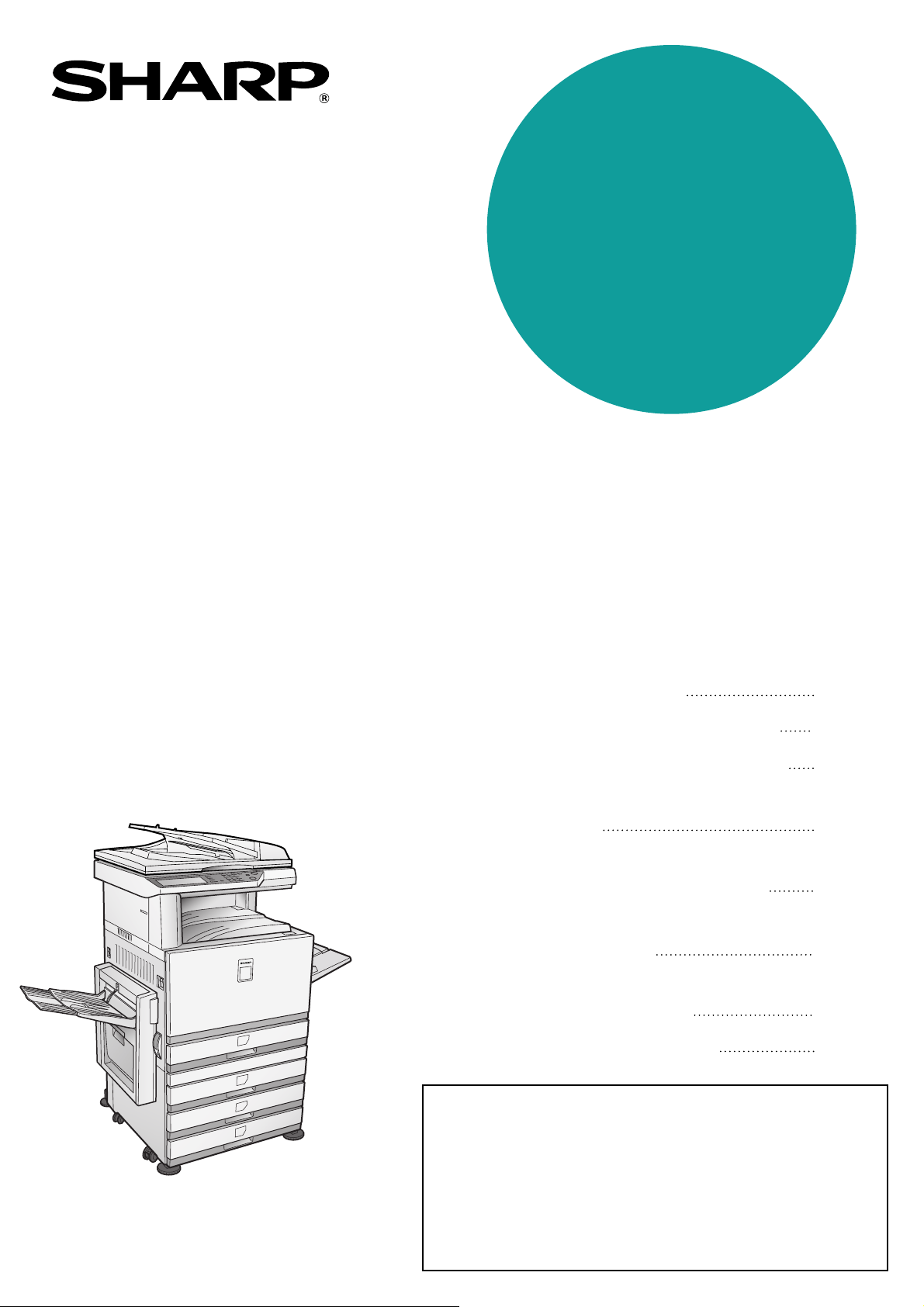
DIGITAL FULL COLOR MULTIFUNCTIONAL
SYSTEM
OPERATION MANUAL
(for general information and copier operation)
MODEL
AR-BC260
(Option) Duplex bypass / inverter unit and
Stand / 3 x 500 sheet paper drawer
Be sure to become thoroughly familiar with this manual to
gain the maximum benefit from the product.
Before installing this product, be sure to read the
installation requirements and cautions sections.
Be sure to keep all operation manuals handy for reference
including this manual, the "Operation manual (for general
information and copier operation)" and operation manuals
for any optional equipment which has been installed.
NA
KS1
CZZ
ApollonII_general-copy_SEC.book 1 ページ 2004年9月6日 月曜日 午後4時57分
Warranty
While every effort has been made to make this document as accurate and helpful as possible, SHARP Corporation
makes no warranty of any kind with regard to its content. All information included herein is subject to change without
notice. SHARP is not responsible for any loss or damages, direct or indirect, arising from or related to the use of this
operation manual.
©
Copyright SHARP Corporation 2004. All rights reserved. Reproduction, adaptation or translation without prior
written permission is prohibited, except as allowed under copyright laws.
The power switch positions are marked " I " to indicate power "ON" and " " to indicate stand-by.
In the stand-by position, power is being supplied to a drying heater within the optical system of the copier.
Caution:
For complete electrical disconnection, pull out the main plug.
The socket-outlet shall be installed near the equipment and shall be easily accessible.
FOR YOUR RECORDS ...
To protect against loss or theft, record and retain for reference the machine’s serial number located on the back
of the unit.
Model Number AR-BC260
Serial Number
Date of Purchase
Place of Purchase
Authorized Sharp Copier/Printer
Service Department Number
This operation manual is also used for the AR-BC260 J.
ApollonII_general-copy_SEC.book 1 ページ 2004年9月6日 月曜日 午後4時57分

Part 1: General Information
ApollonII_general-copy_SEC.book 1 ページ 2004年9月6日 月曜日 午後4時57分

ApollonII_general-copy_SEC.book 2 ページ 2004年9月6日 月曜日 午後4時57分

0-1
OPERATION MANUALS
The following operation manuals are provided for the machine. Please read the appropriate manuals as needed for
the features you wish to learn about.
●
●●
●
Operation manual (for general information and copier operation) (this manual):
The first half of this manual provides general information about the machine, including safety information, loading
paper, removing misfeeds, and regular maintenance.
The second half of the manual explains how to use the copy functions.
●
●●
●
Key operator's guide:
This primarily explains key operator programs for machine management and copier related functions. Key
operator programs for the printer, the facsimile and network scanner functions are explained in separate
manuals.
Key operator programs are used by key operators to configure function settings to meet the needs of the
customer.
●
●●
●
Operation manual (for facsimile):
This manual explains the procedures for using the machine as a facsimile. To use the fax function, the facsimile
expansion kit must be installed.
●
●●
●
Installation guide (for printer):
This explains how to connect the machine to your computer, install the printer driver for Windows, and configure
the printer driver settings.
●
●●
●
Operation manual (for printer)*:
This manual explains the procedures for using the machine as a printer.
●
●●
●
Operation manual (for network scanner)*:
This manual explains the procedures for using the machine as a network scanner when connected to a computer.
To use the network scanner function, a 256MB optional memory must be installed.
* The Operation manual (for printer) and the Operation manual (for network scanner) are provided as PDF files
on the supplied CD-ROM.
These manuals are not provided as printed manuals.
NOTES
● Considerable care has been taken in preparing this manual. If you have any comments or concerns about the
manual, please contact your nearest SHARP Service Department.
● This product has undergone strict quality control and inspection procedures. In the unlikely event that a defect
or other problem is discovered, please contact your dealer or nearest SHARP Service Department.
● Aside from instances provided for by law, SHARP is not responsible for failures occurring during use of the
product or its options, or failures due to incorrect operation of the product and its options, or other failures, or for
any damage that occurs due to use of the product.
The display screens, messages, and key names shown in the manual may differ from those on the actual machine
due to product improvements and modifications.
Some options may not be available in some countries and regions. This manual assumes that the optional
facsimile expansion kit has been installed, however, the basic operations of the machine are the same regardless
of the peripheral devices that are installed. For the peripheral devices that can be installed, see "Part names and
functions of peripheral devices" (1-6).
sec_apollon_00.fm 1 ページ 2004年11月16日 火曜日 午後1時15分
0-2
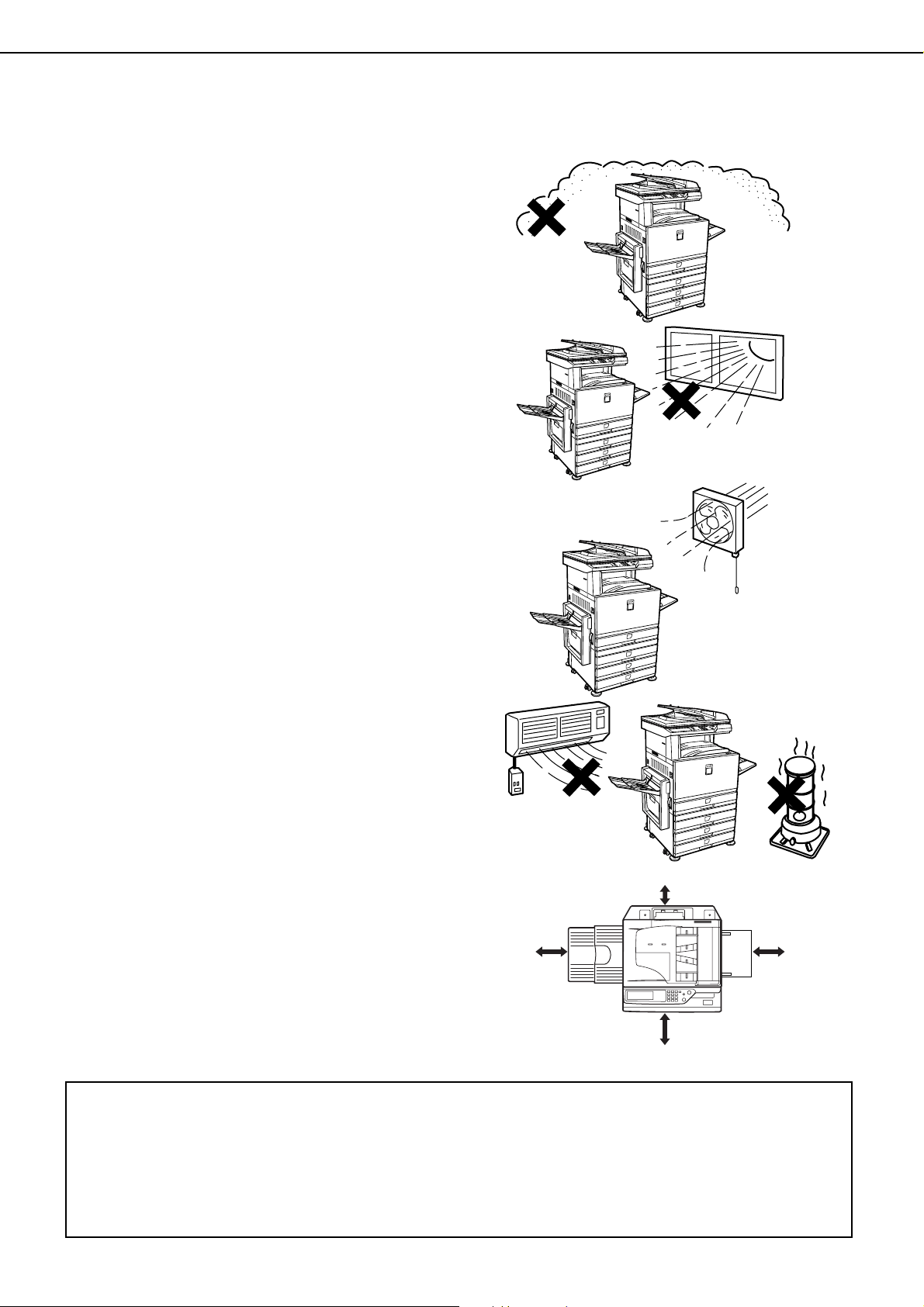
Improper installation may damage this product. Please note the following during initial installation and whenever the
machine is moved.
1. The machine should be installed near an accessible
power outlet for easy connection.
2. Be sure to connect the power cord only to a power
outlet that meets the specified voltage and current
requirements. Also make certain the outlet is
properly grounded.
● For the power supply requirements, see the
name plate on the main unit.
3. Do not install your machine in areas that are:
● damp, humid, or very dusty
● exposed to direct sunlight
● poorly ventilated
● subject to extreme temperature or humidity
changes, e.g., near an air conditioner or heater.
4. Be sure to allow the required space around the
machine for servicing and proper ventilation.
A small amount of ozone is produced within the copier during operation. The emission level is insufficient to cause
any health hazard.
NOTE:
The present recommended long term exposure limit for ozone is 0.1 ppm (0.2 mg/m
3
) calculated as an 8 hr. time-
weighted average concentration.
However, since the small amount that is emitted may have an objectionable odor, it is advisable to place the copier
in a ventilated area.
31-1/2"
(80cm)
23-5/8"
(60cm)
23-5/8"
(60cm)
11-13/16"
(30cm)
INSTALLATION REQUIREMENTS
ApollonII_general-copy_SEC.book 2 ページ 2004年9月6日 月曜日 午後4時57分
INSTALLATION REQUIREMENTS
0-3
Moving this machine
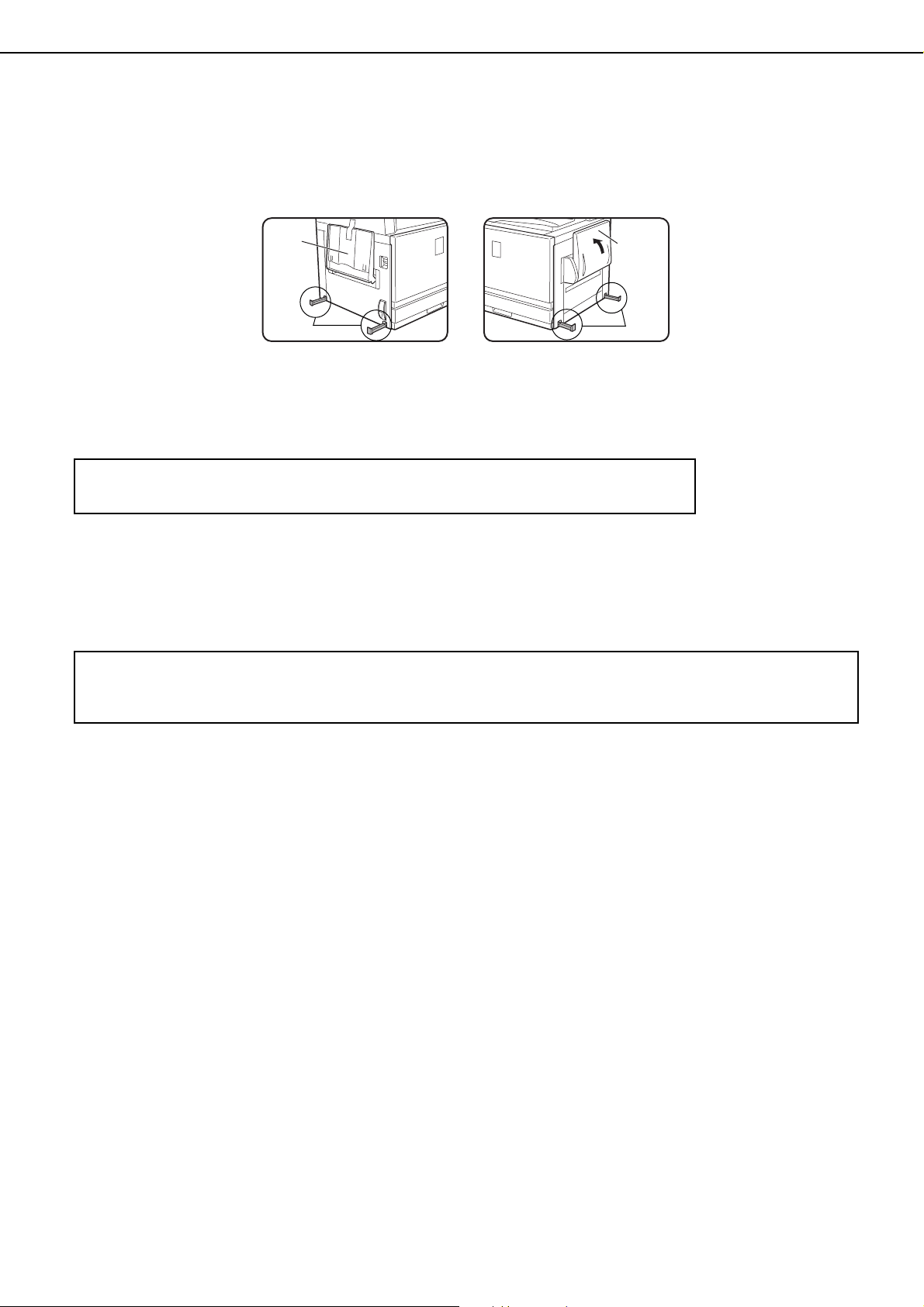
Pull out the four handles as shown below, grasp them firmly, and keep the machine horizontal while moving it.
If the machine has been placed on a stand/paper drawer:
The stand/paper drawer is on casters for moving. Unlock the casters and the adjusters of the stand/paper drawer and
gently move the machine taking care to steady it to prevent it from toppling.
For locking and unlocking the casters and the adjusters, see page 0-4.
Left side Right side
Bypass
tray
Exit
tray
Handles
Handles
Caution
Two people are required to lift and carry this machine.
If the machine is to be left unused for a long time
If the machine is to be left unused for a month or longer, follow the procedure on pages 2-6 and 2-7 to release
the pressure on the fusing roller.
Before lifting the machine,
fold up the exit tray and
tape it securely to the
machine.
Before lifting the machine,
fold up the bypass tray
and tape it securely to the
machine.
ApollonII_general-copy_SEC.book 3 ページ 2004年9月6日 月曜日 午後4時57分
0-4
CAUTIONS
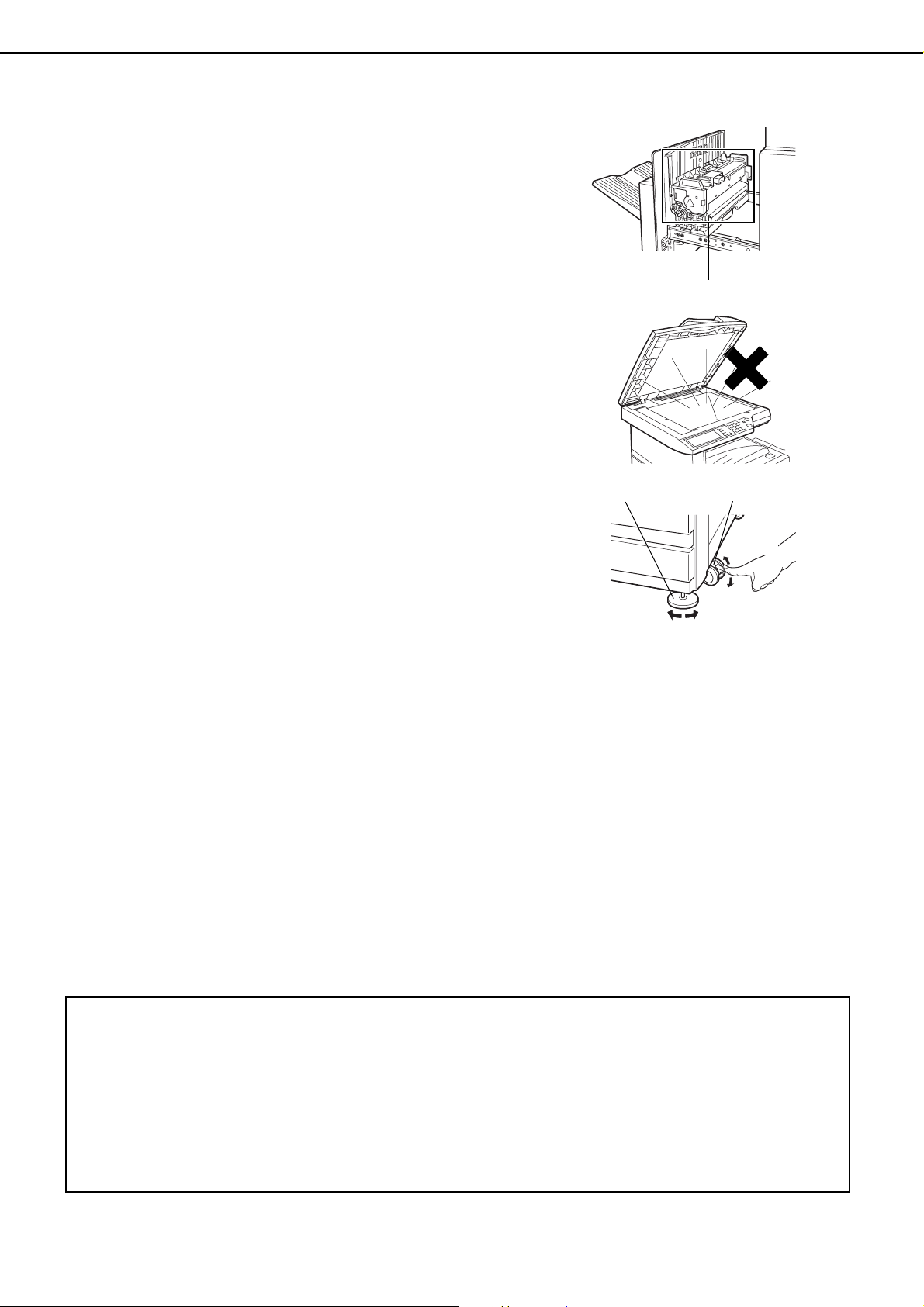
1. Do not touch the photoconductive drum. Scratches
or smudges on the drum will cause dirty prints.
2. The fusing unit is extremely hot. Exercise care in
this area.
3. Do not look directly at the light source. Doing so may
damage your eyes.
4. Four adjusters are provided on all optional stand/
paper drawer units. These adjusters should be
lowered until they contact the floor.
When moving the machine with the optional stand/
paper drawer, be sure to raise the adjusters. Also,
unlock the two casters at the front of the optional
stand/paper drawer. After moving the machine,
lower the four adjusters until they reach the floor and
lock the two casters.
5. Do not make any modifications to this machine.
Doing so may result in personal injury or damage to
the machine.
6. Since this machine is heavy, it is recommended that
it be moved by more than one person to prevent
injury.
7. When connecting this machine to a computer, be
sure to first turn both the computer and the machine
off.
8. Do not make copies of anything which is prohibited
from copying by law. The following items are
normally prohibited from printing by national law.
Other items may be prohibited by local law.
●
Money
●
Stamps
●
Bonds
●
Stocks
●
Bank drafts
●
Checks
●
Passports
●
Driver's licenses
"BATTERY DISPOSAL"
THIS PRODUCT CONTAINS A LITHIUM PRIMARY MEMORY BACK-UP BATTERY THAT MUST BE
DISPOSED OF PROPERLY. PLEASE CONTACT YOUR LOCAL SHARP DEALER OR AUTHORIZED SERVICE
REPRESENTATIVE FOR ASSISTANCE IN DISPOSING OF THIS BATTERY.
This product utilizes tin-lead solder, and a fluorescent lamp containing a small amount of mercury.
Disposal of these materials may be regulated due to environmental considerations.
For disposal or recycling information, please contact your local authorities or the Electronics Industries Alliance:
www.eia.org
Fusing unit
Adjuster
Lock
Lock
Release
Caster
Release
ApollonII_general-copy_SEC.book 4 ページ 2004年9月6日 月曜日 午後4時57分

0-5
CONTENTS
OPERATION MANUALS.................................................0-1
INSTALLATION REQUIREMENTS.................................0-2
● Moving this machine..................................................0-3
CAUTIONS......................................................................0-4
CHAPTER 1
BEFORE USING THE PRODUCT
INTRODUCTION.............................................................1-2
MAIN FEATURES ...........................................................1-2
PART NAMES AND FUNCTIONS ..................................1-4
● Exterior ......................................................................1-4
● Interior .......................................................................1-5
● Part names and functions of peripheral devices........1-6
● Operation panel.........................................................1-8
● Touch panel...............................................................1-9
AUDITING MODE .........................................................1-11
● Using the machine when the auditing mode is
enabled ...................................................................1-11
CHAPTER 2
MANAGING THE MACHINE
LOADING PAPER...........................................................2-2
● Loading paper in paper tray 1....................................2-2
● Changing the paper size in paper tray 1....................2-2
● Loading paper in the bypass tray ..............................2-4
●
Loading paper in the stand/1 x 500 sheet paper drawer/
stand/3 x 500 sheet paper drawer
................................2-7
● Specifications (stand/1 x 500 sheet paper drawer/
stand/3 x 500 sheet paper drawer)............................2-7
● Loading paper in the duplex module/2 x 500 sheet
paper drawer .............................................................2-8
● Specifications (duplex module/2 x 500 sheet paper
drawer) ......................................................................2-8
● Specifications of paper trays .....................................2-9
● Setting the paper type (except the bypass tray) ......2-11
● Setting the paper size when an extra size is loaded
.................................................................................2-11
● Setting the paper type and paper size in the bypass
tray...........................................................................2-12
CUSTOM SETTINGS....................................................2-13
● Operation procedure common to all custom settings
.................................................................................2-13
● About the settings....................................................2-14
REPLACING THE TONER CARTRIDGES ...................2-15
STORAGE OF SUPPLIES ............................................2-17
MISFEED REMOVAL....................................................2-18
● Misfeed removal guidance.......................................2-18
● Misfeed in the paper feed area................................2-19
● Misfeed in the transport area, fusing area, and exit
area .........................................................................2-20
● Misfeed in the stand/1 x 500 sheet paper drawer....2-21
● Misfeed in the stand/3 x 500 sheet paper drawer....2-21
● Misfeed in the duplex bypass/inverter unit and duplex
module/2 x 500 sheet paper drawer........................2-22
TROUBLESHOOTING..................................................2-24
CHAPTER 3
PERIPHERAL DEVICES
SADDLE STITCH FINISHER ......................................... 3-2
● Part names and functions ......................................... 3-2
● Specifications............................................................ 3-2
● Saddle stitch finisher functions ................................. 3-4
● Using the saddle stitch finisher ................................. 3-6
● Staple cartridge replacement and staple jam removal
.................................................................................. 3-7
● Misfeed in the saddle stitch finisher........................ 3-10
● Troubleshooting saddle stitch finisher problems..... 3-12
● Stapling position quick reference guide for duplex
output...................................................................... 3-13
● Relation between print image and saddle stitch ..... 3-14
LARGE CAPACITY TRAY............................................ 3-15
● Part name ............................................................... 3-15
● Specifications.......................................................... 3-15
● Loading paper in the large capacity tray................. 3-16
● Misfeed in the large capacity tray ........................... 3-17
ApollonII_general-copy_SEC.book 5 ページ 2004年9月6日 月曜日 午後4時57分

CONTENTS
0-6
CHAPTER 4
BEFORE MAKING COPIES
PART NAMES AND FUNCTIONS (The Reversing Single
Pass Feeder).................................................................. 4-2
● Exterior ..................................................................... 4-2
● Operation Panel........................................................ 4-3
● Touch Panel (main screen of copy mode) ................ 4-4
REVERSING SINGLE PASS FEEDER.......................... 4-5
● Acceptable originals.................................................. 4-5
SETTING ORIGINALS ................................................... 4-6
SELECTING THE ORIGINAL SIZE................................ 4-8
STORING, DELETING, AND USING ORIGINAL SIZES
.... 4-9
CHAPTER 5
BASIC PROCEDURE FOR MAKING
COPIES
NORMAL COPYING....................................................... 5-2
● Copying from the reversing single pass feeder ........ 5-2
● Automatic two-sided copying from the reversing single
pass feeder ............................................................... 5-6
● Copying from the document glass ............................ 5-7
● Automatic two-sided copying from the document glass
.................................................................................. 5-9
EXPOSURE ADJUSTMENTS...................................... 5-10
REDUCTION/ENLARGEMENT/ZOOM ........................ 5-12
● Automatic selection (auto image) ........................... 5-12
● Manual selection..................................................... 5-13
● XY ZOOM ............................................................... 5-15
SPECIAL PAPERS....................................................... 5-17
CHAPTER 6
CONVENIENT COPY FUNCTIONS
SPECIAL MODES .......................................................... 6-2
● Common operation procedure for using the special
functions ................................................................... 6-3
● Margin shift ............................................................... 6-4
● Erase ........................................................................ 6-5
● Dual page copy......................................................... 6-6
● Centering .................................................................. 6-7
● Transparency film with insert sheets ........................ 6-8
● Covers ...................................................................... 6-9
● B/W reverse............................................................ 6-10
COLOR ADJUSTMENTS MENU.................................. 6-11
● RGB adjust ............................................................. 6-12
● Sharpness............................................................... 6-13
● Suppress background............................................. 6-13
● Color balance.......................................................... 6-14
● Brightness............................................................... 6-15
● Intensity .................................................................. 6-15
IMAGE EDIT MENU ..................................................... 6-16
● Single color ............................................................. 6-17
● Mirror image ............................................................ 6-17
● Photo Repeat .......................................................... 6-18
● Multi shot................................................................. 6-19
● 11" x 17" (A3) Full-bleed ......................................... 6-21
● Multi-page enlargement .......................................... 6-22
● Pamphlet copy ........................................................ 6-24
JOB PROGRAM MEMORY .......................................... 6-25
● Storing a job program.............................................. 6-25
● Recalling a job program .......................................... 6-26
● Deleting a stored job program................................. 6-26
INTERRUPTING A COPY RUN ................................... 6-27
CHAPTER 7
MACHINE MAINTENANCE (FOR
COPYING)
REMOVING AN ORIGINAL MISFEED ........................... 7-2
● Removing a misfed original from the reversing single
pass feeder ............................................................... 7-2
USER MAINTENANCE (For copying) ............................ 7-3
CLEANING THE ORIGINAL SCANNING AREA ............ 7-3
TROUBLESHOOTING.................................................... 7-4
CHAPTER 8
SPECIFICATIONS
SPECIFICATIONS.......................................................... 8-2
● Copier and Main unit ................................................. 8-2
● Reversing single pass feeder.................................... 8-4
● Duplex bypass/inverter unit (optional)....................... 8-4
INDEX............................................................................. 8-5
ApollonII_general-copy_SEC.book 6 ページ 2004年9月6日 月曜日 午後4時57分

1-1
CHAPTER 1
BEFORE USING THE
PRODUCT
This chapter contains basic information that should be read before using
the product.
Page
INTRODUCTION ...........................................................................................1-2
MAIN FEATURES..........................................................................................1-2
PART NAMES AND FUNCTIONS .................................................................1-4
●
Exterior...................................................................................................1-4
●
Interior....................................................................................................1-5
●
Part names and functions of peripheral devices ....................................1-6
●
Operation panel......................................................................................1-8
●
Touch panel ...........................................................................................1-9
AUDITING MODE ........................................................................................1-11
●
Using the machine when the auditing mode is enabled.......................1-11
ApollonII_general-copy_SEC.book 1 ページ 2004年9月6日 月曜日 午後4時57分
1-2
INTRODUCTION
To gain the maximum benefits in using this product, it is recommended that the user read this manual to become
familiar with all the features and functions of the basic product and the precautionary information contained in the
manual.
This product is a high speed Digital full color copier/printer that can be expanded to become multifunctional through
the installation of optional peripheral devices. The product can be extended to include printer, network scanning or
network printing capabilities. This manual describes the basic use of the product as a copier and does not contain
information on using any of the optional peripheral devices. Separate operation manuals are included with each of
the optional peripheral devices. Refer to these manuals for their operation.
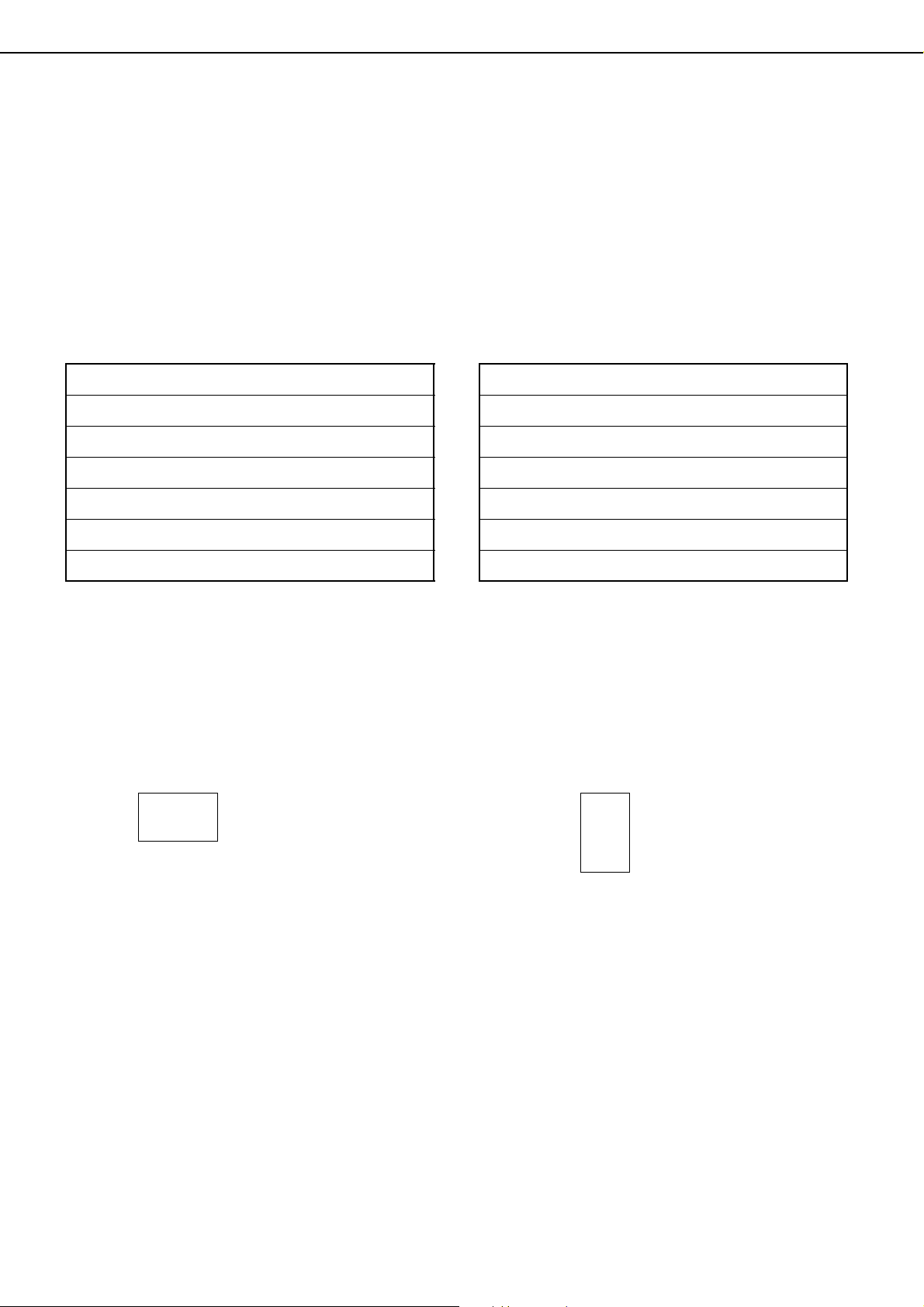
Original and paper sizes
This machine allows use of standard sizes in both the inch and AB systems.
These are shown in the tables below.
The meaning of "R" in original and paper size indications
Some original and paper sizes can be placed in either the portrait or landscape orientations. To differentiate between
landscape and portrait, the landscape orientation size indication will contain an "R". These are indicated as 8-1/2" x
11"R, 5-1/2" x 8-1/2"R, A4R, B5R, etc. Sizes that can be placed only in the landscape orientation (11" x 17", 8-1/2"
x 14", 8-1/2" x 13", A3, B4) do not contain the "R" in their size indication.
Size indication with "R"
Landscape orientation
Size indication without "R"
Portrait orientation
MAIN FEATURES
1
Full-color copies with vivid colors based on digital technology
Photos, color text, and other originals are scanned by full-color CCD sensors, and the acquired image
information is output in vivid full color at a resolution of 600 dpi using digital image processing technology.
The machine can also be used as a full color network printer and network scanner.
2
A range of optional units to enhance productivity
A range of optional equipment is available to enhance productivity, such as duplex units for producing two-sided
output, additional paper feed units to increase the number of available paper sizes and paper capacity, and
paper output units that are capable of stapling and saddle stitch binding.
Sizes in the inch system
11" x 17" (LEDGER)
8-1/2" x 14" (LEGAL)
8-1/2" x 13" (FOOLSCAP)
8-1/2" x 11" (LETTER)
7-1/4" x 10-1/2" (EXECUTIVE)
5-1/2" x 8-1/2" (INVOICE)
Sizes in the AB system
A3
B4
A4
B5
A5
ApollonII_general-copy_SEC.book 2 ページ 2004年9月6日 月曜日 午後4時57分
MAIN FEATURES
1-3
1
3
Advanced image processing features based on digital technology
The scanned image data is converted to digital data, enabling the following advanced image processing features:
●
●●
● Photo Repeat :
Up to 24 full-size copies of a photo image can be made on a single sheet of paper (page 6-18).
●
●●
● Multi shot :
Up to four original pages can be copied onto a single sheet (page 6-19).
●
●●
● Pamphlet copy* :
Copies of original pages are arranged in proper order for copying so that the copies can be center-stapled and
folded into a pamphlet (page 6-24).
* Pamphlet copy requires the Duplex module/2 x 500 sheet paper drawer and Duplex bypass/inverter unit
options. If a saddle stitch finisher is installed, copies can be stapled in two positions along the center of copies
and folded at the center.
4
Image processing manual exposure adjustment for optimal copying
Image processing is optimized for the type of original being copied (text, photo, mixed text and photo or map). This
along with the ability to manually adjust exposure makes it possible to obtain copies that are faithful to the original.
5
Standard offset function makes it easy to distinguish between sets of copies
As sets of copies are delivered to the center tray, each set is offset from the previous set for easy separation.
6
PostScript compatible
Installation of an optional PS expansion kit (AR-PK4) gives PostScript compatibility (PostScript 3).
Energy saving features
This product has the following two power reducing modes to help conserve natural resources and reduce
environmental pollution.
Preheat mode
Preheat mode automatically reduces the temperature of the fusing unit after the time set in the key operator
programs elapses when the machine is on standby. This allows the machine to use less power while on
standby. The machine automatically returns to normal operation when a key is pressed on the operation
panel, or when an original is placed to make a copy or send a fax.
Auto power shut-off mode
Auto power shut-off mode automatically shuts off power to the fusing unit after the time set in the key
operator programs elapses when the machine is on standby. This minimizes the power used by the
machine while on standby. When this mode activates, the touch panel screen turns off.
To return the machine to normal operation, press the mode select key (the indicator of this key will be lit).
Auto power shut-off mode can be configured in the key operator programs. The mode is initially set (factory
default setting) to activate after 60 seconds elapses. (See page 9 of the key operator's guide.)
If a print job or fax is received while auto power shut-off mode or preheat mode is activated, the machine
automatically returns to normal operation.
As an ENERGY STAR
®
Partner, SHARP has determined that this product meets the
ENERGY STAR
®
guidelines for energy efficiency.
The Environmental Choice Program guidelines are applied to the products only in Canada. The
products that meet the Environmental Choice Program guidelines carry the logo shown above.
The products without the logo may not meet the Environmental Choice Program guidelines.
sec_apollon_01_1.fm 3 ページ 2004年9月16日 木曜日 午後6時52分
1-4
PART NAMES AND FUNCTIONS
Exterior
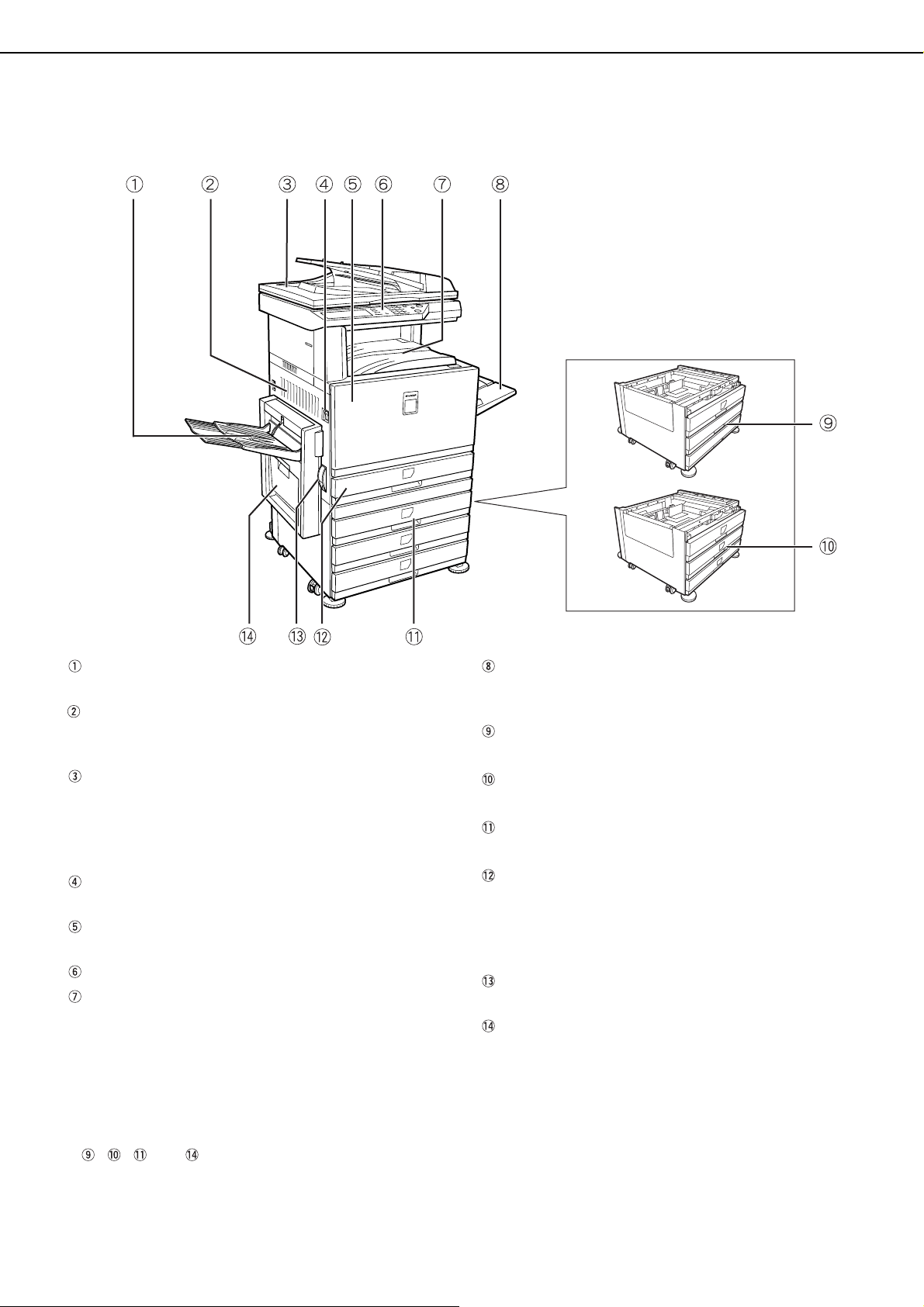
Left tray (See page 5-5)
Finished sheets are deposited here.
Left side cover
Open this cover when a paper misfeed occurs in
the fusing unit or the transfer unit.
Reversing single pass feeder
This automatically feeds originals to be scanned.
The feeder can turn the original over and scan the
back side as well as the front side for support of
two-sided originals.
Power switch
Press to turn power on and off.
Front cover
Open to replace toner cartridge.
Operation panel
Center tray (See page 5-5)
Finished sheets are deposited here.
Bypass tray
Special papers (including transparency film) and
copy paper can be fed from the bypass tray.
Stand/1 x 500 sheet paper drawer *
(See page 2-7)
Stand/3 x 500 sheet paper drawer *
(See page 2-7)
Duplex module/2 x 500 sheet paper drawer*
(See page 2-8)
Paper tray
Each tray can hold approximately 500 sheets of the
recommended paper for color (21 lbs. or 80 g/m
2
),
or approximately 500 sheets of SHARP standard
paper (21 lbs. or 80 g/m
2
).
Left side cover release
Push this release up to open the left side cover.
Duplex bypass/inverter unit and exit tray* (See
page 1-6)
* , , and are peripheral devices. For a description of these devices, see page 1-6.
ApollonII_general-copy_SEC.book 4 ページ 2004年9月6日 月曜日 午後4時57分
PART NAMES AND FUNCTIONS
1-5
1
Interior
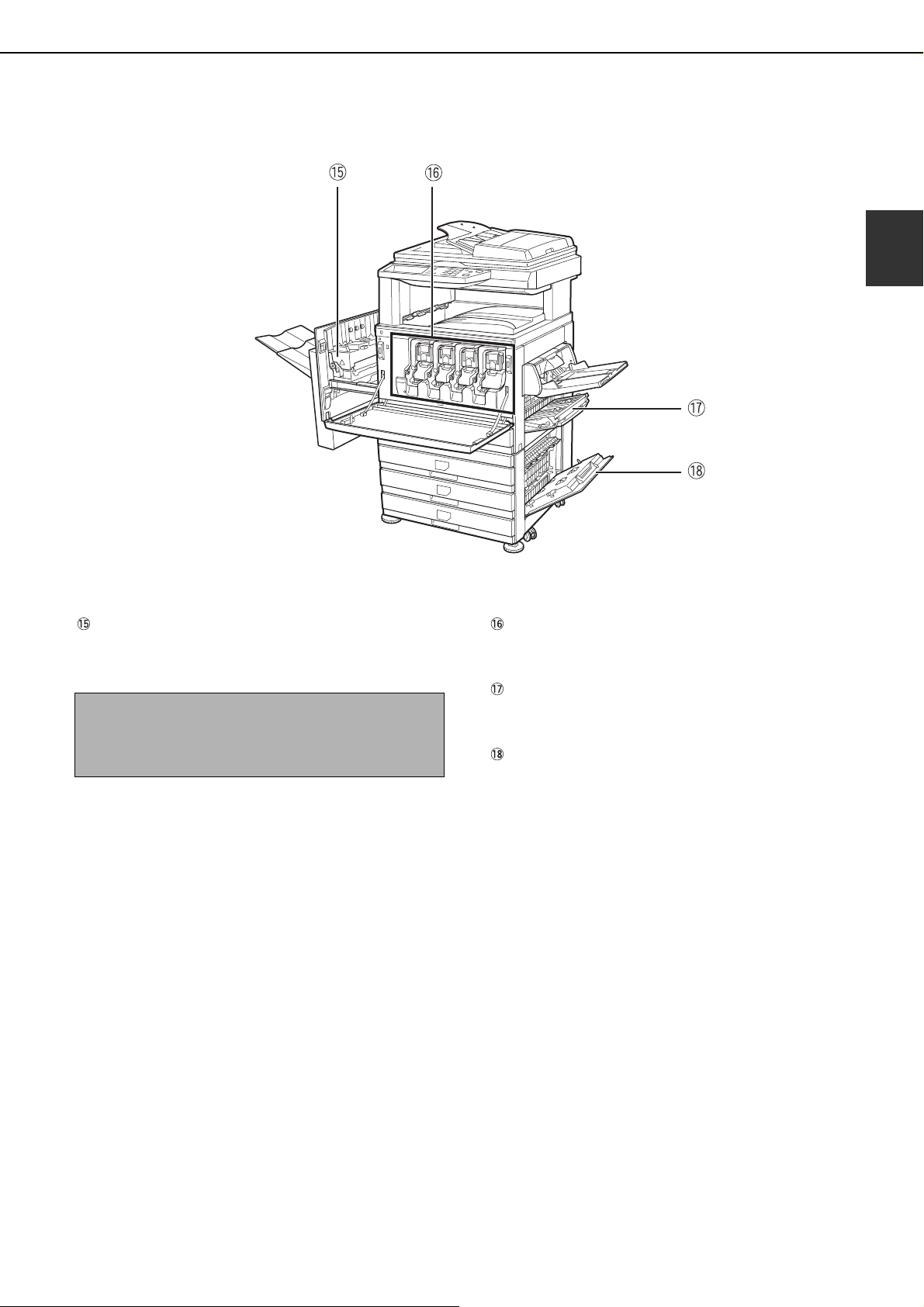
Fusing unit
Toner images are fused here.
Toner cartridge
The toner cartridge must be replaced when
indicated on the operation panel. (See page 2-15)
Right side cover
Open when a misfeed has occurred in the paper
feed area.
Right cover of paper drawer
Open this cover to remove paper misfed in the
paper drawer.
CAUTION
The fusing unit is hot. Take care in removing misfed
paper.
ApollonII_general-copy_SEC.book 5 ページ 2004年9月6日 月曜日 午後4時57分
PART NAMES AND FUNCTIONS
1-6
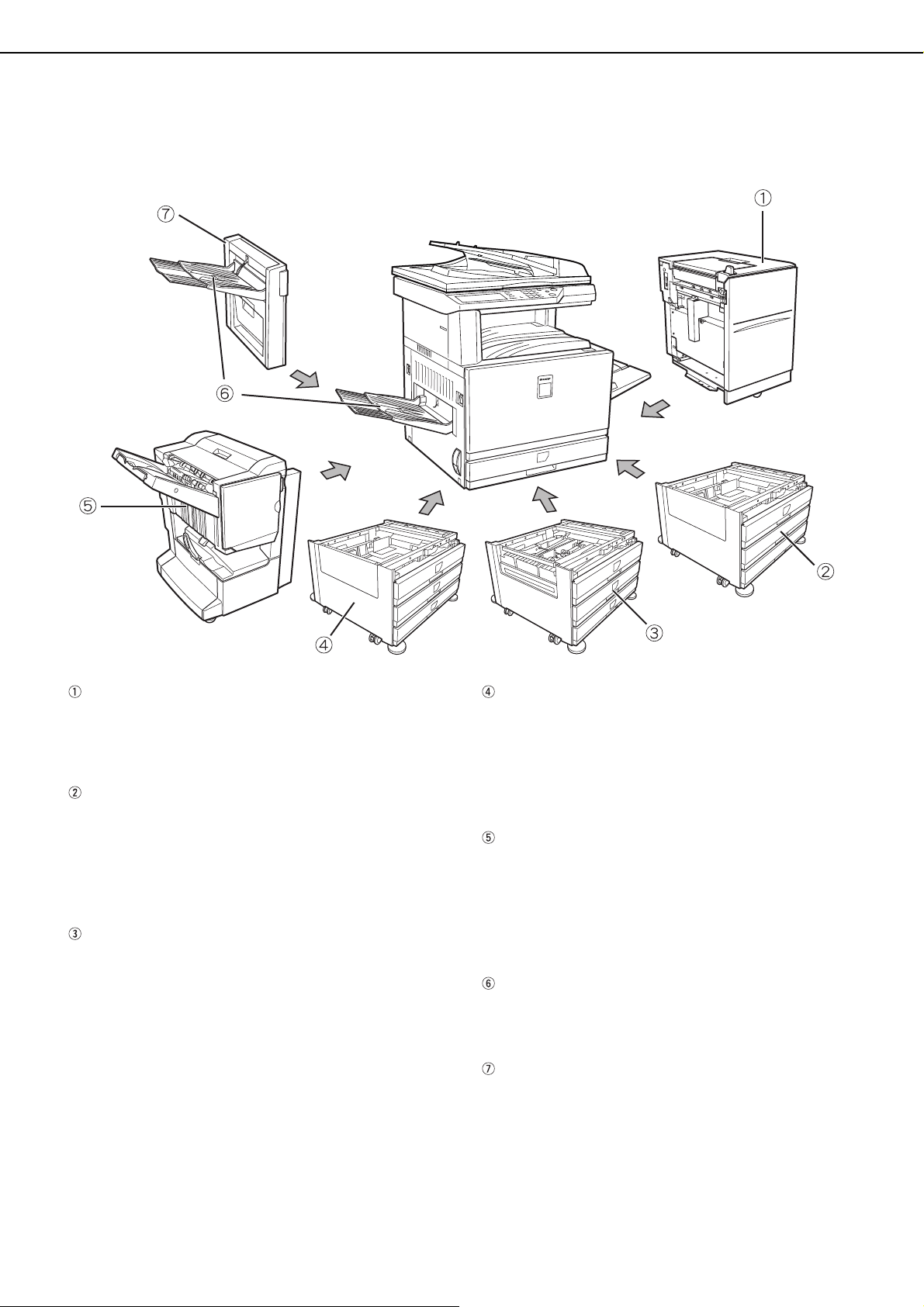
Part names and functions of peripheral devices
Large Capacity tray (AR-LC8)
The large capacity tray provides the added
convenience of having 3,500 sheets of 8-1/2" x 11"
or A4 paper (21 lbs. or 80 g/m
2
) available.
Stand/1 x 500 sheet paper drawer (AR-D17N)
This stand has one paper tray. It can hold
approximately 500 sheets of the recommended
paper for color (21 lbs. or 80 g/m
2
), or
approximately 500 sheets of SHARP standard
paper (21 lbs. or 80 g/m
2
).
Duplex module/2 x 500 sheet paper drawer (AR-D19N)
This stand includes a module for automatic
two-sided printing and two paper trays. The two
trays can hold approximately 500 sheets of the
recommended paper for color (21 lbs. or 80 g/m
2
),
or approximately 500 sheets of SHARP standard
paper (21 lbs. or 80 g/m
2
). To perform two-sided
printing, a duplex bypass/inverter unit (AR-RB1) is
required.
Stand/3 x 500 sheet paper drawer (AR-D18N)
This stand has three paper trays. Each tray can
hold approximately 500 sheets of the
recommended paper for color (21 lbs. or 80 g/m
2
),
or approximately 500 sheets of SHARP standard
paper (21 lbs. or 80 g/m
2
).
Saddle stitch finisher (AR-F13)
The finisher can deliver sets saddle stitched and
folded at the paper centerline to form a pamphlet,
edge stapled in three different modes or unstapled.
For two-hole or three-hole output, a hole punch
module must be installed.
Exit tray (AR-TE3)
The exit tray is installed on the output outlet of the
machine or the duplex tray / inverter unit.
Duplex bypass/inverter unit (AR-RB1)
This module is required to automatically turn paper
over within the machine for automatic two-sided
printing.
ApollonII_general-copy_SEC.book 6 ページ 2004年9月6日 月曜日 午後4時57分

PART NAMES AND FUNCTIONS
1-7
1
■
■■
■ Other optional equipment
●
●●
●PS3 expansion kit (AR-PK4)
This kit provides compatibility of PostScript level 3
to the printer.
●
●●
●Facsimile expansion kit (AR-FX10)
This kit must be installed to use the fax function.
●
●●
●Fax memory (8 MB) (AR-MM9)
This adds memory for use by the fax function.
●
●●
●256 MB optional memory (AR-SM5)
This adds memory that is used for the copy
function, printer function, and scanner function.
■
■■
■ Face-up and face-down output
After printing, the paper is delivered to the exit tray. This product has two exit trays (center tray and left tray). The
paper specifications (page 8-3) and output conditions differ for each tray; however, if the paper and output
conditions are such that the paper can be delivered to either tray, you can select the tray to which the paper will
go.
● Paper exits to the center tray face-down only.
● Paper exits to the left tray face-up only. However, if a duplex bypass/inverter unit has been installed,
face-down output is also possible. In this case, face-up or face-down output is automatically selected
according to the paper and output conditions (it is not possible to manually select face-up or face-down.)
ApollonII_general-copy_SEC.book 7 ページ 2004年9月6日 月曜日 午後4時57分
PART NAMES AND FUNCTIONS
1-8
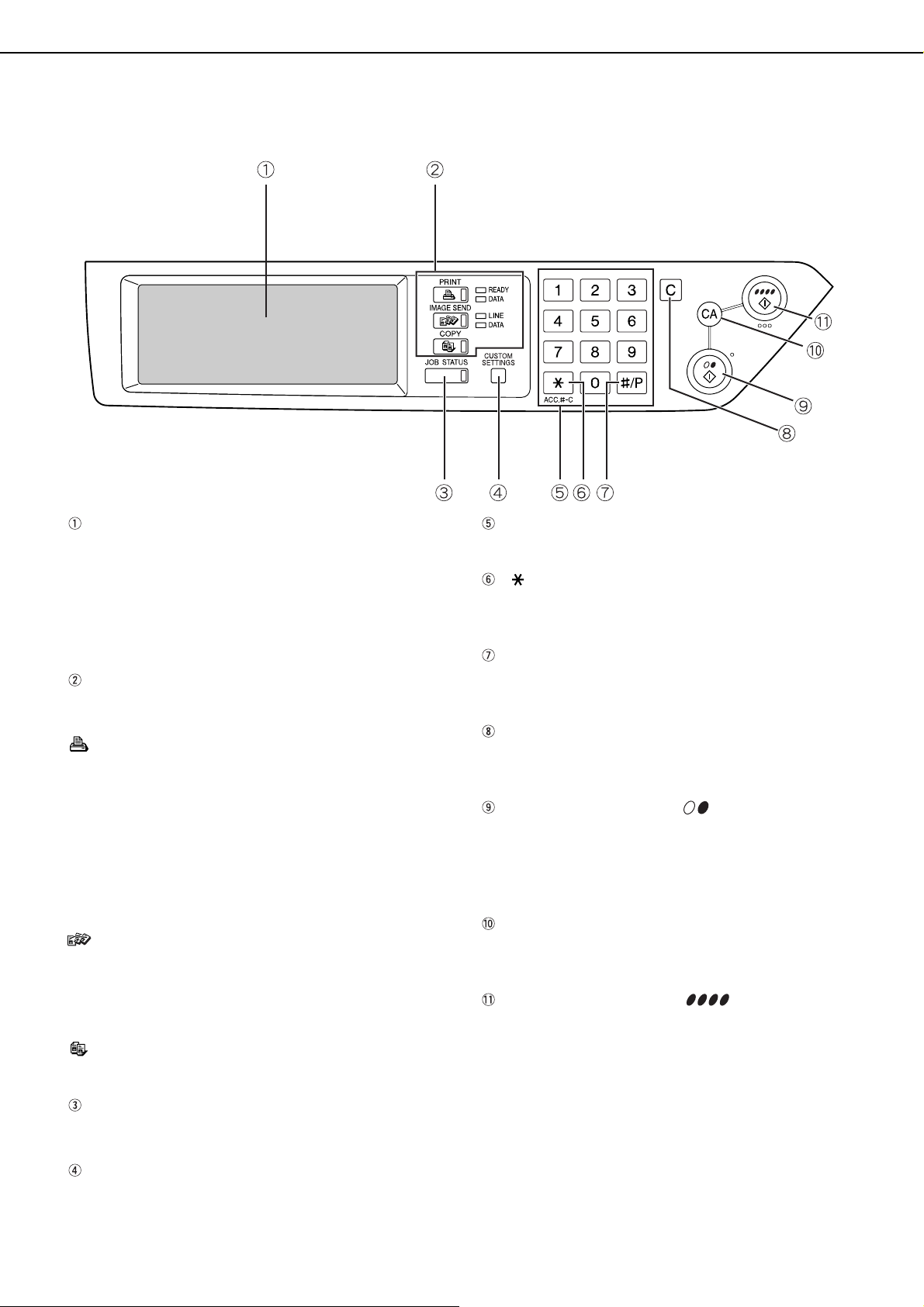
Operation panel
Touch panel
The machine status, messages and touch keys are
displayed on the panel. When using the touch
panel, first change the display to the mode that you
wish to use: printer mode, copy mode, network
scanner mode, or fax mode*. For details see the
next page.
Mode select keys and indicators
Use to change modes and the corresponding
display on the touch panel.
[PRINT] key/READY indicator/DATA indicator
Press to enter the printer mode.
READY indicator
Print data can be received when this indicator is
lit.
DATA indicator
Lights up or blinks when print data is being
received. Also lights up or blinks when printing is
being performed.
[IMAGE SEND] key/LINE indicator/DATA
indicator
Press this key to switch the display between
network scanner mode and fax mode*. (See the
operation manuals for network scanner and fax.)
[COPY] key
Press to select the copy mode.
[JOB STATUS] key
Press to display the current job status. (See page
1-10.)
[CUSTOM SETTINGS] key
Use to adjust the contrast of the touch panel or to
set key operator programs. (See page 2-13.)
Numeric keys
Use to enter number values for various settings.
[ ] key ([ACC.#-C] key)
This is used when the copy, network scan, and fax*
functions are used.
[#/P] key
This is used as a program key when using the copy
function, and to dial when using the fax function*.
[C] key
This key is
used in copy mode, network scanner
mode, and fax mode*.
[BLACK COPY START ( )] key
This is used to make black and white copies and to
scan a black and white original when the network
scan function is used. This is also used to scan an
original to be faxed using the fax function*.
[CA] key
This key is
used in copy mode, network scanner
mode, and fax mode*.
[COLOR COPY START ( )] key
This is used to make full-color or single-color
copies and to scan a color original when the
network scanner function is used.
* When the fax option is installed.
ApollonII_general-copy_SEC.book 8 ページ 2004年9月6日 月曜日 午後4時57分
PART NAMES AND FUNCTIONS
1-9
1
Touch panel
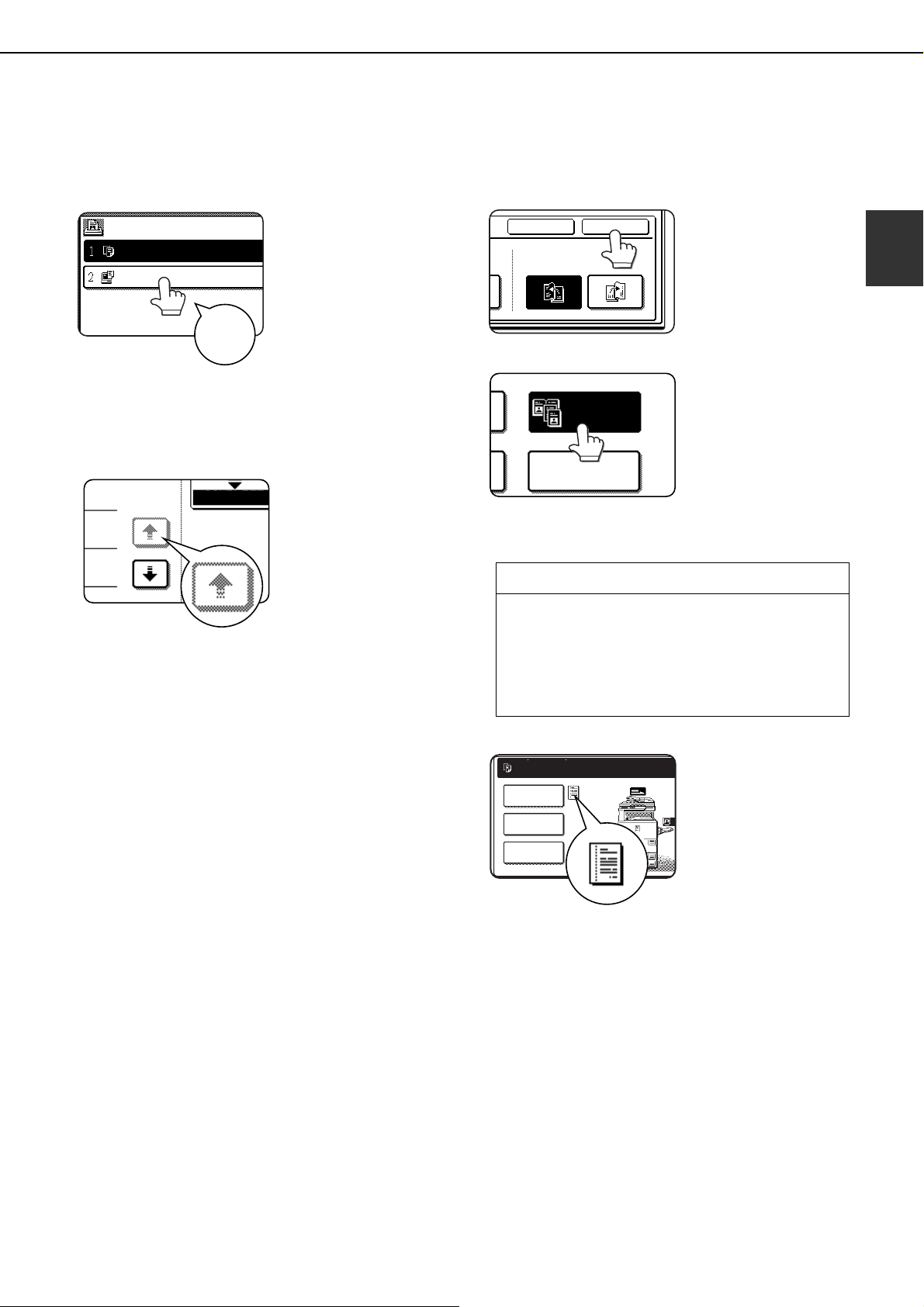
Using the touch panel
[Example 1]
Items on the touch panel
are easily selectable by
touching the key
associated with the item
with a finger. Selection
of an item will be
accompanied with a
beep tone to confirm the
item was selected. Also,
the key area for the item
will be highlighted for
visual confirmation.
[Example 2]
Keys which are grayed
out on any screen are
not selectable. If a
grayed out key is
touched, a double beep
will be sounded.
The confirmation beeps can be disabled by a key
operator program. (See page 10 of the key
operator's guide.)
The touch panel screens shown in this manual are
printed images, and may appear different from the
actual screens.
Selection of function
[Example 1]
Items which are
highlighted at the time a
screen appears are
already selected and will
be registered to function if
the [OK] key is touched.
[Example 2]
When the machine is
used in the copy mode,
the functions shown in
the table below can only
be set or canceled on
the special feature
screen by alternate
touches of the function
keys on the panel.
[Example 3]
When the machine is
used in the copy mode
and a special feature is
selected, a
corresponding icon
representing the feature
will appear on the touch
key and on the main
screen of the mode
selected. If this icon is
touched, the setting
screen of the function (or
a menu screen) will
appear, allowing the
settings to be checked
or adjusted and the
function to be canceled
easily.
JOB QUEUE
COPY
Suzuki
0666211221
003 / 00
003 / 00
010 / 00
SETS / PRO
Beep
tone
1/13
COMPLETE
Copier feature
● Dual page copy
● Centering
● Transparency inserts
● Mirror image
● 11"x17" (A3) Full-bleed
● B/W Reverse
CANCEL OK
RIGHT
BINDING
LEFT
BINDING
TRANSPARENCY
INSERTS
DUAL PAGE
COPY
SPECIAL MODES
2-SIDED COPY
OUTPUT
READY TO COPY.
B4
P
OR
A3
A4
DUPLEX
ApollonII_general-copy_SEC.book 9 ページ 2004年9月6日 月曜日 午後4時57分
PART NAMES AND FUNCTIONS
1-10
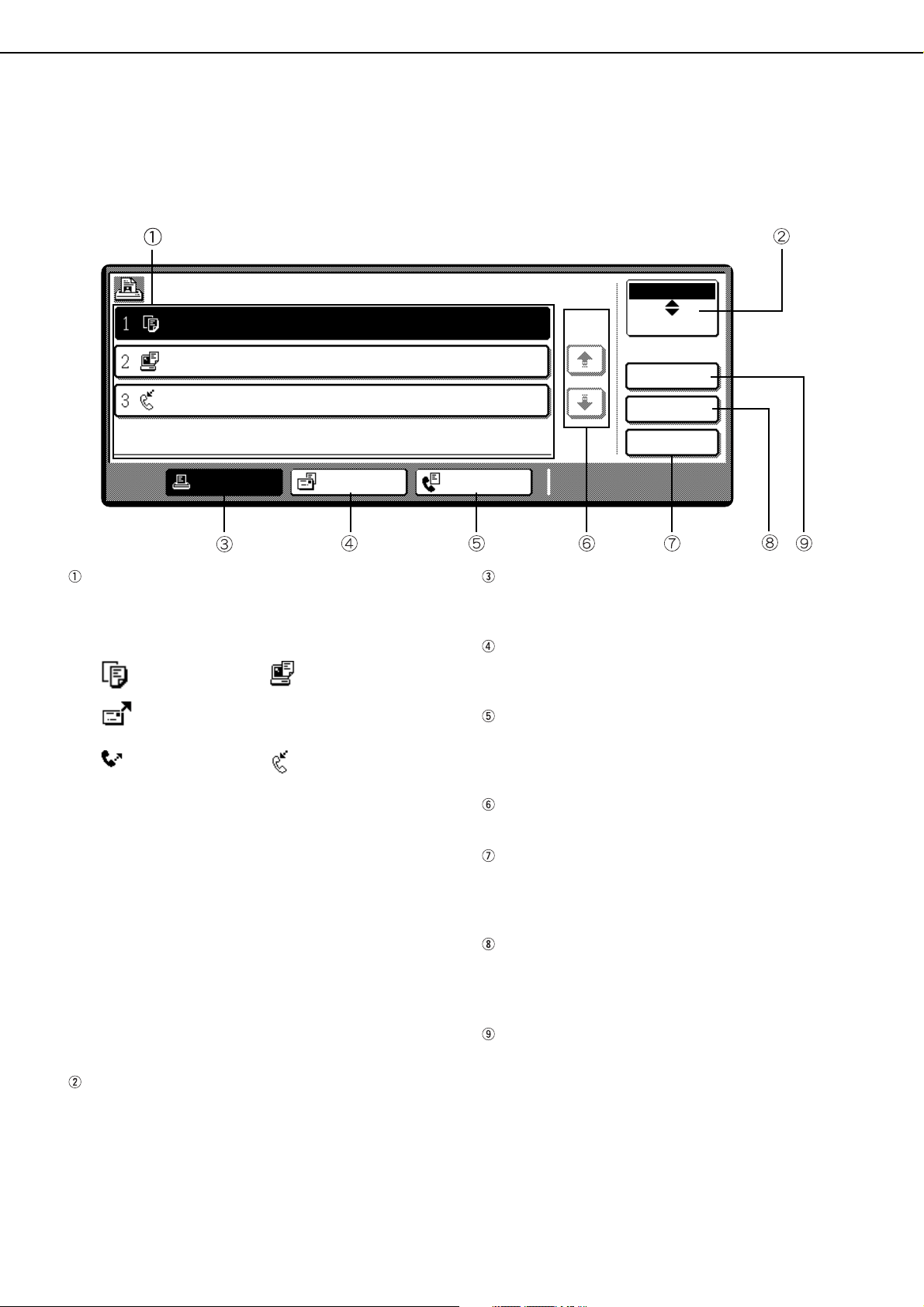
Job status screen (common to print, copy, network scan and fax)
This screen is displayed when the [JOB STATUS] key on the operation panel is pressed.
A job list showing the current job at the top of the job queue or a list showing completed jobs can be displayed.
The contents of jobs can be viewed or jobs can be deleted from the queue. (The screen below is an example and
differs from actual screens.)
Job list
This shows the current job and the jobs waiting to
be run. The icons to the left of the jobs in the queue
show the job mode.
The displayed jobs in the job list are themselves
operation keys. To cancel printing or to give a job
the highest print priority, touch the relevant job key
to select the job and execute the desired operation
using the keys described in 5 and 6.
* "PAPER EMPTY" in the job status display
When a job status display indicates "PAPER
EMPTY", the specified paper size for the job is not
loaded in any of the trays.
When the [DETAIL] key appears, the key of a job in
the job queue can be touched followed by the
[DETAIL] key to change the paper size selection to
a different paper size (only in printer mode).
Mode select key
This only appears in the job status screen of fax
mode. The key is used to switch the job list display
between "JOB QUEUE" and "COMPLETE".
"JOB QUEUE": Shows stored jobs and the job in
progress.
"COMPLETE" : Shows finished jobs.
[PRINT JOB] key
Use to display the print job list for printer, copy and
fax mode.
[SCANNER JOB] key
This displays a list of jobs that only used the
network scanner function.
[FAX JOB] key
This displays the transmission/reception status
and finished jobs of fax mode when the fax option
is installed.
Display switching keys
Use to switch the page of the displayed job list.
[STOP/DELETE] key
Use to cancel or delete the current job or delete the
selected reserved job. Note that a fax print job
cannot be canceled or deleted.
[PRIORITY] key
This only appears in the job status screen of fax
mode. Touch this key to give priority to a job that
has been selected in the job queue.
[DETAIL] key
The key is only effective for computer print jobs and
only appears in the job status screen of the printer
mode. It is used to display detailed information of a
selected print job and to change the paper size for
the print job.
JOB QUEUE
COPY
Suzuki
066211221
STATUS
PAPER EMPTY
*
003 / 000
PRINT JOB SCANNER JOB
FAX JOB
JOB QUEUE
COMPLETE
DETAIL
PRIORITY
STOP/DELETE
WAITING
WAITING
003 / 000
001 / 000
1/1
SETS / PROGRESS
Copy mode Printer mode
Network scanner mode
Fax send job Fax reception job
ApollonII_general-copy_SEC.book 10 ページ 2004年9月6日 月曜日 午後4時57分
1-11
1
AUDITING MODE
When the account counter function is turned on, a count is kept of the number of copy sheets used by each account
(maximum of 200 accounts). The counts can be displayed and totaled as needed.
The key operator programs can be used to enable auditing mode separately for copy mode, fax mode, network
scanner mode, and printer mode. (Page 6 of key operator's guide)
Using the machine when the auditing mode is enabled
The procedure for using the machine for copying functions when the Auditing Mode has been enabled for the copier
functions is explained below.
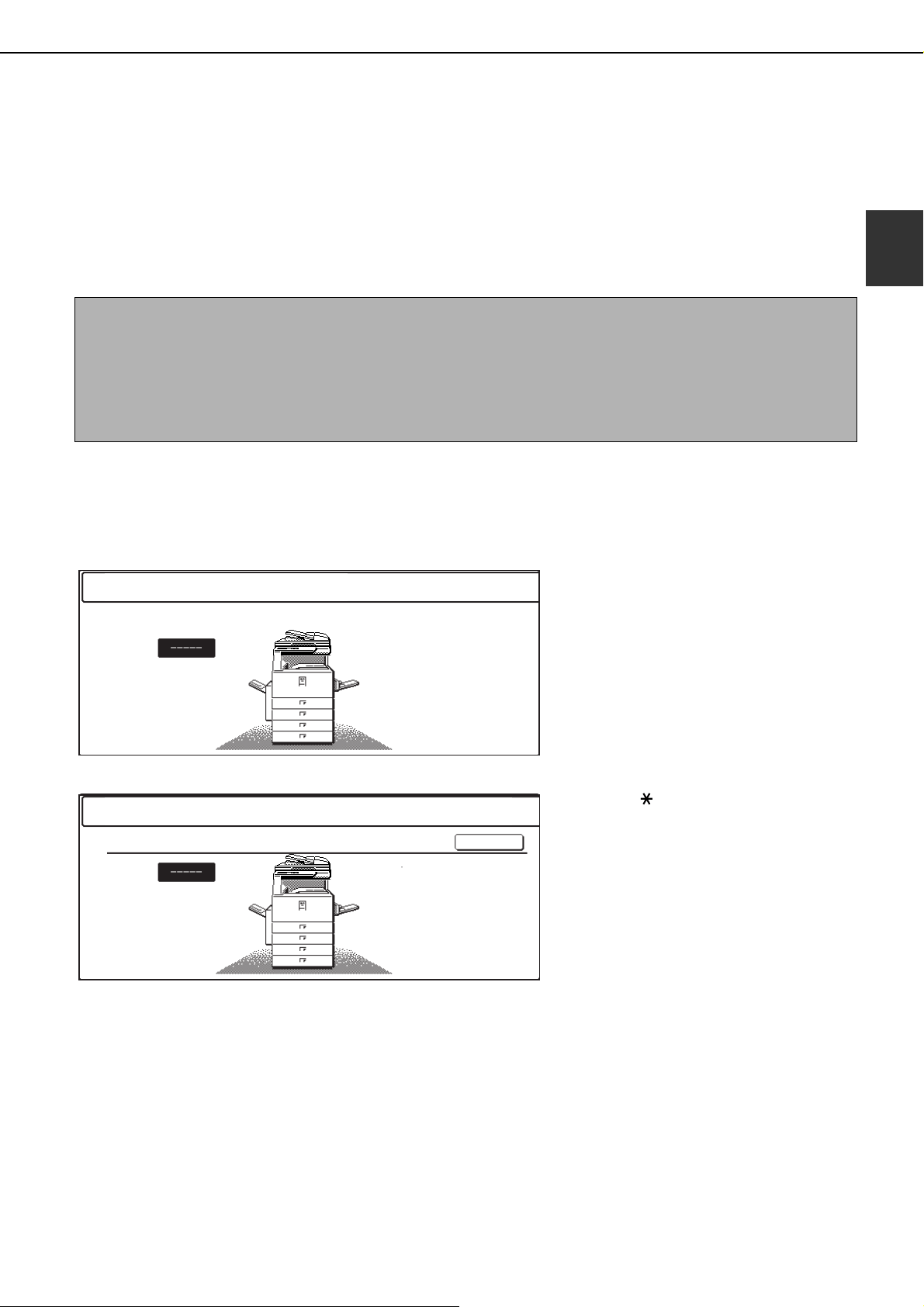
When the account counter is turned on, the following messages appear on the touch panel. There are two types of
prompts, depending on whether the account counter was turned on for both the color copy and the black and white
copy modes, or only for color copy mode.
●Account counter enabled for both the color copy and the black and white copy modes
●The account counter is enabled only for the color copy mode
When the [ ] key ([ACC.#-C] key) or the
[COLOR COPY START] key is pressed, the
message at left appears.
In this case, enter your 5-digit account number as explained on the next page to gain access to the copier functions.
NOTES
● When the account counter is turned on for fax or network scanner functions, a message will appear prompting
you to enter your account number each time the touch panel is changed to the main screen of the function. Enter
your account number as explained below and then proceed with the job.
● When the account counter is turned on for the printer function, you must enter your account number in the setting
screen of the printer driver on your computer in order to print.
ENTER YOUR ACCOUNT NUMBER.
ENTER YOUR ACCOUNT NUMBER FOR THE COLOR MODE.
PRESS [CANCEL] TO CHANGE TO B/W MODE.
CANCEL
AUDITING MODE FOR COLOR
sec_apollon_01_1.fm 11 ページ 2004年11月15日 月曜日 午前11時44分
AUDITING MODE
1-12
1
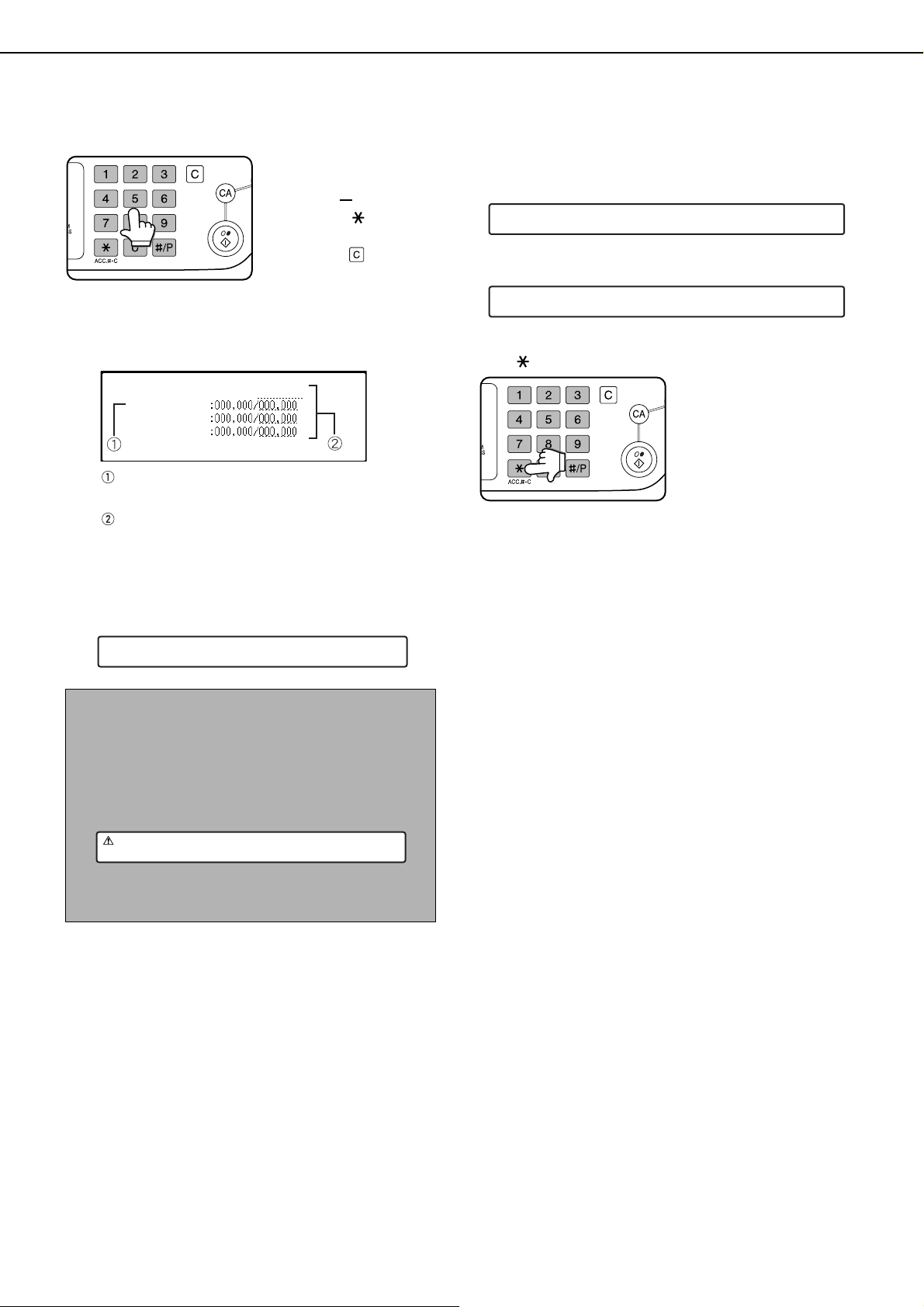
Enter your account number (5 digits) with
the numeric keys.
As you enter your
account number, the
hyphens ( ) change to
asterisks ( ). If you
enter an incorrect digit,
press the key and
re-enter the correct digit.
When a correct account
number is entered, the
following message will
appear.
This does not appear if the account counter
has only been set for color copy mode.
If a limit has been set by key operator program
for the number of copies that can be made by
the account, the remaining number that can be
made is displayed.
This message appears for several seconds and
then changes to the following message.
2
Follow the appropriate steps to perform
the copy job.
When copying is begun, the following message
will appear.
In the case of interrupt copying (page 6-27), the
following message will appear.
3
When the copy job is finished, press the
[ ] key ([ACC.#-C] key)
NOTE
If "Account number security" is turned on in the key
operator programs, the following message will
appear in the event that an incorrect account number
is entered three times in a row. (Page 8 of the key
operator's guide)
While this message appears (for about one minute),
no other operations can be performed.
ACCOUNT STATUS:COPIES MADE/REMAINING
B/W
S.COLOR
F.COLOR
READY TO COPY.
PLEASE SEE YOUR KEY OPERATOR FOR
ASSISTANCE.
READY TO COPY.
PRESS [ACC.#] WHEN FINISHED.
READY TO COPY. WHEN INTERRUPT COPYING
IS FINISHED PRESS [CANCEL].
ApollonII_general-copy_SEC.book 12 ページ 2004年9月6日 月曜日 午後4時57分

2-1
CHAPTER 2
MANAGING THE MACHINE
This chapter explains how to load paper, replace the toner cartridge,
and remove paper misfeeds. It also contains information about supplies.
Page
LOADING PAPER..........................................................................................2-2
●
Loading paper in paper tray 1 ................................................................2-2
●
Changing the paper size in paper tray 1 ................................................2-2
●
Loading paper in the bypass tray ...........................................................2-4
●
Loading paper in the stand/1 x 500 sheet paper drawer/stand/3 x 500
sheet paper drawer.....................................................................................2-7
●
Specifications (stand/1 x 500 sheet paper drawer/stand/3 x 500
sheet paper drawer)...............................................................................2-7
●
Loading paper in the duplex module/2 x 500 sheet paper drawer .........2-8
●
Specifications (duplex module/2 x 500 sheet paper drawer) .................2-8
●
Specifications of paper trays..................................................................2-9
●
Setting the paper type (except the bypass tray)...................................2-11
●
Setting the paper size when an extra size is loaded ............................2-11
●
Setting the paper type and paper size in the bypass tray ....................2-12
CUSTOM SETTINGS ..................................................................................2-13
●
Operation procedure common to all custom settings...........................2-13
●
About the settings ................................................................................2-14
REPLACING THE TONER CARTRIDGES ..................................................2-15
STORAGE OF SUPPLIES...........................................................................2-17
MISFEED REMOVAL ..................................................................................2-18
●
Misfeed removal guidance ...................................................................2-18
●
Misfeed in the paper feed area ............................................................2-19
●
Misfeed in the transport area, fusing area, and exit area.....................2-20
●
Misfeed in the stand/1 x 500 sheet paper drawer ................................2-21
●
Misfeed in the stand/3 x 500 sheet paper drawer ................................2-21
●
Misfeed in the duplex bypass/inverter unit and duplex module/2 x 500
sheet paper drawer ..............................................................................2-22
TROUBLESHOOTING.................................................................................2-24
ApollonII_general-copy_SEC.book 1 ページ 2004年9月6日 月曜日 午後4時57分
2-2
LOADING PAPER
The message "ADD PAPER" or "OPEN TRAY AND ADD PAPER" will appear when paper runs out during operation.
Follow the procedure below to load paper.
Loading paper in paper tray 1
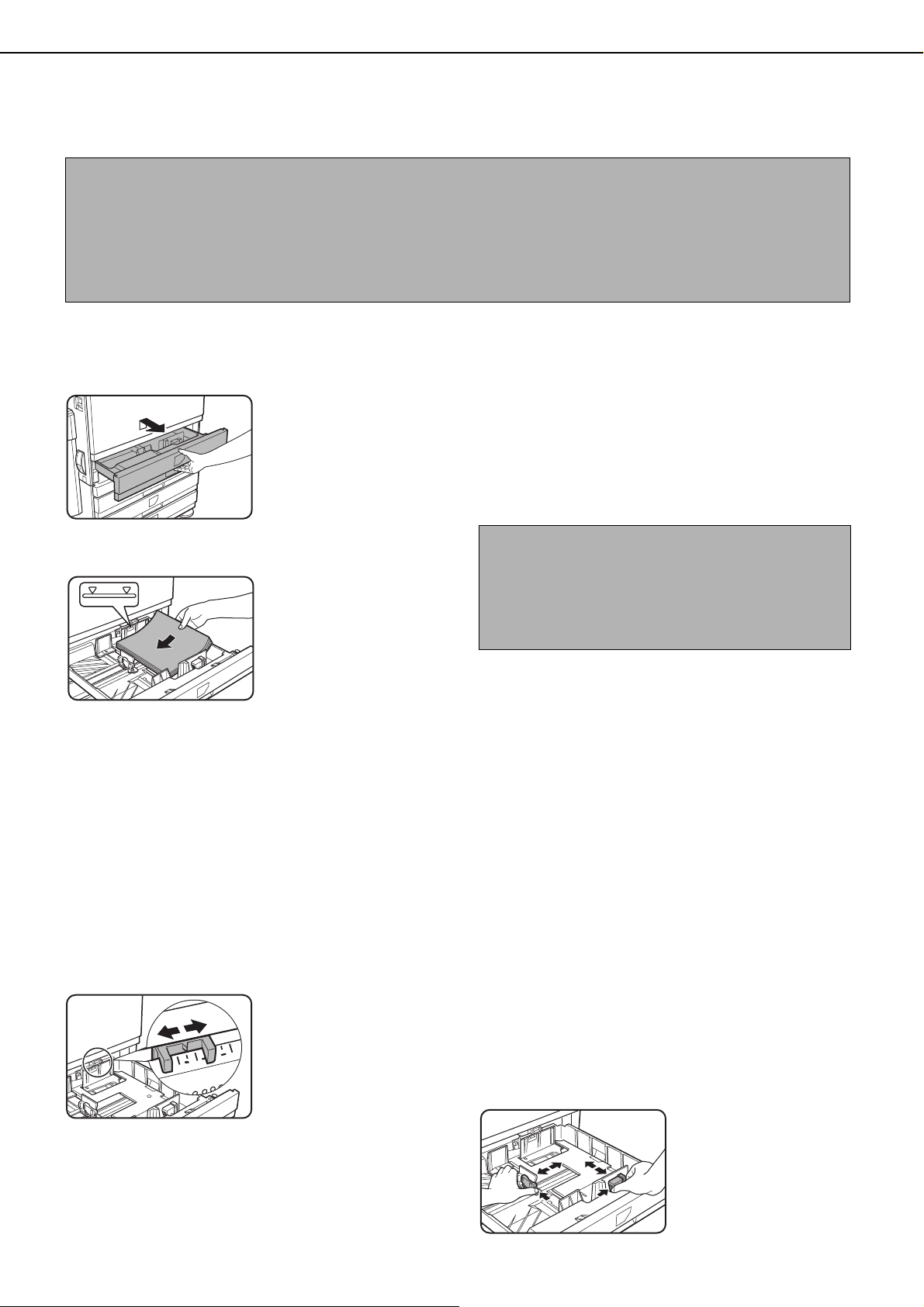
1
Pull out paper tray 1.
Gently pull the tray out
until it stops.
2
Load paper into the tray.
Load a stack of paper no
higher than the indicator
line (about 500 sheets of
the recommended paper for
color (21 lbs. or 80
g/
m
2
), or
approximately 500 sheets
of SHARP standard paper
(21 lbs. or 80
g/
m
2
)).
3
Gently push tray 1 into the machine.
Push the tray firmly all the way into the machine.
4
Set the paper type.
If you change the paper type, be sure to set the
paper type refer to "Setting the paper type" (page
2-11).
5
Loading paper in paper tray 1 is now
complete.
Changing the paper size in paper tray 1
The following paper size settings are available for paper tray 1: 11" x 17" to 8-1/2" x 5-1/2" (A3 to A5), and "EXTRA"*
1
.
Use the following procedure to change the size as needed.
*
1
This is limited to square or rectangular paper, 11" x 17" to 8-1/2" x 5-1/2" (A3 to A5) size.
1
Pull out paper tray 1.
If paper remains in the tray, remove it.
2
Adjust the paper size slide to the paper
size.
Move the paper size
slide right or left to
indicate the paper size
being loaded.
If a special size paper is
loaded in the paper tray,
set the size slide to
"EXTRA" to inform the machine that a special size
paper has been loaded. (When AB-based size
paper is loaded, move the size slide to "EXTRA".)
Note that setting the size slide to "EXTRA" only
informs the machine that a special size of paper
has been loaded; it does not inform the machine of
the specific size. If you wish to inform the machine
of the specific size, follow the steps in "Setting the
paper size when an extra size is loaded" (page 2-
11). (If you do not set a size, part or all of the image
may not print.)
3
Adjust the guide plates A and B by
squeezing their lock levers and sliding
them to the paper size to be loaded.
The guide plates A and
B are slidable. Adjust
them to the paper size to
be loaded while
squeezing their lock
levers.
NOTES
● Do not use curled or folded paper. Doing so may cause a misfeed.
● For best results use paper supplied by SHARP. (See pages 2-9, 2-17.)
● When you change the paper type and size in paper tray 1, you must change the paper type and size settings as
explained in "Setting the paper type" (page 2-11).
● Do not place heavy objects or press hard on any tray which is pulled out.
NOTE
If you load a different size of the same type of paper,
you only need to change the position of the size slide
(see step 2 below); you do not need to change the
paper type.
ApollonII_general-copy_SEC.book 2 ページ 2004年9月6日 月曜日 午後4時57分
LOADING PAPER
2-3
2
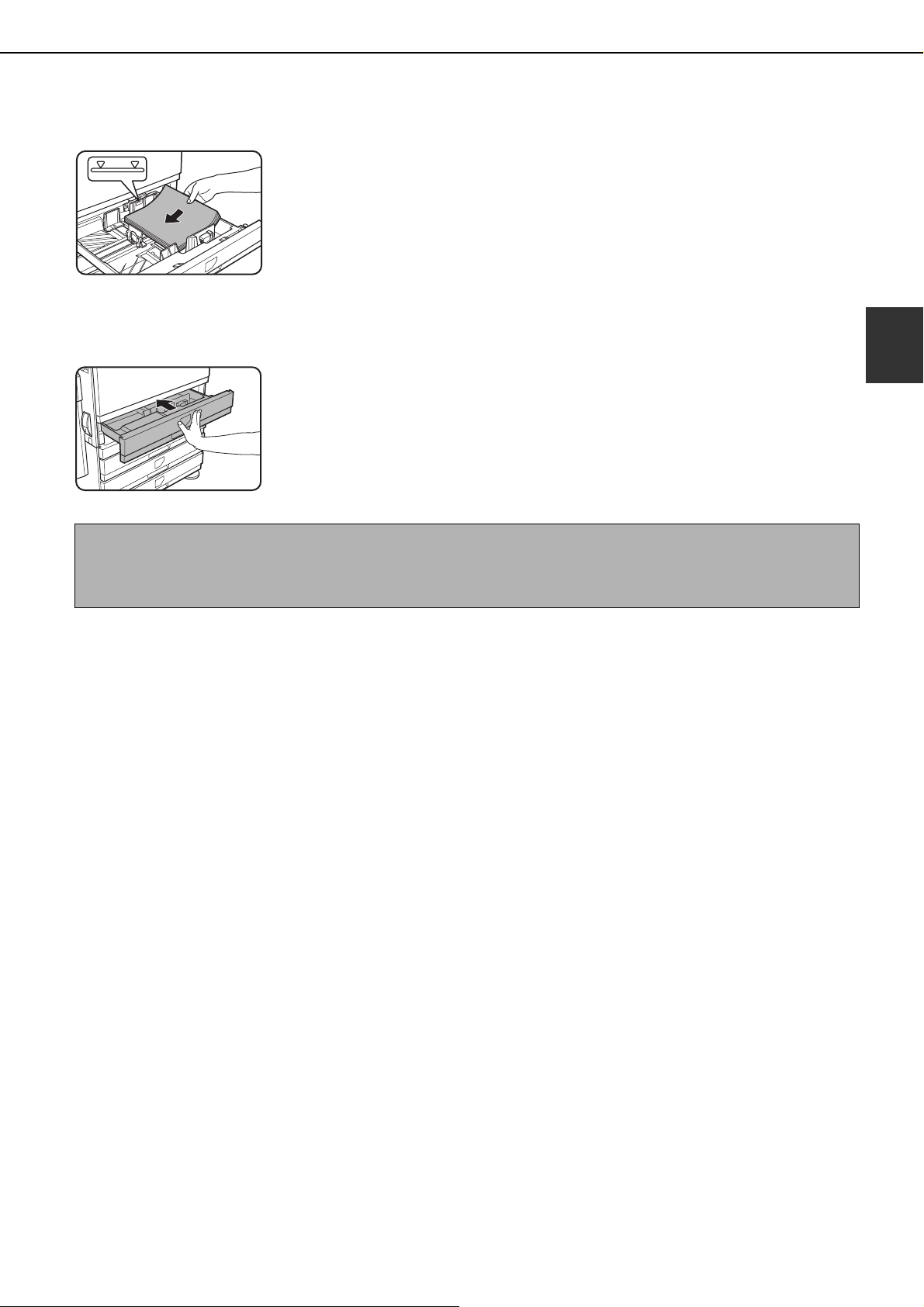
4
Load paper into the tray.
5
Gently push tray 1 into the machine.
Push the tray firmly all
the way into the
machine.
6
Set the paper type of the paper that was
loaded in the 1st tray.
If you loaded a different type of paper from the
previous paper, be sure to set the new paper type
as explained in "Setting the paper type" (page 2-
11).
7
Changing paper size in paper tray 1 is now
complete.
NOTE
If the size slide position (step 2 of page 2-2) is not set correctly after changing the paper size, or if the paper type
(page 2-11) is not set correctly, incorrect paper selection or paper misfeeding may occur.
ApollonII_general-copy_SEC.book 3 ページ 2004年9月6日 月曜日 午後4時57分
LOADING PAPER
2-4
Loading paper in the bypass tray
The bypass tray can be used to feed the same paper specified for paper tray 1 or for special papers. For paper types
that can be used in the bypass tray, see the specifications for the bypass tray in the paper tray specifications (page
2-9).
Up to 250 sheets of SHARP standard paper or up to 100 postcards can be set in the bypass tray.
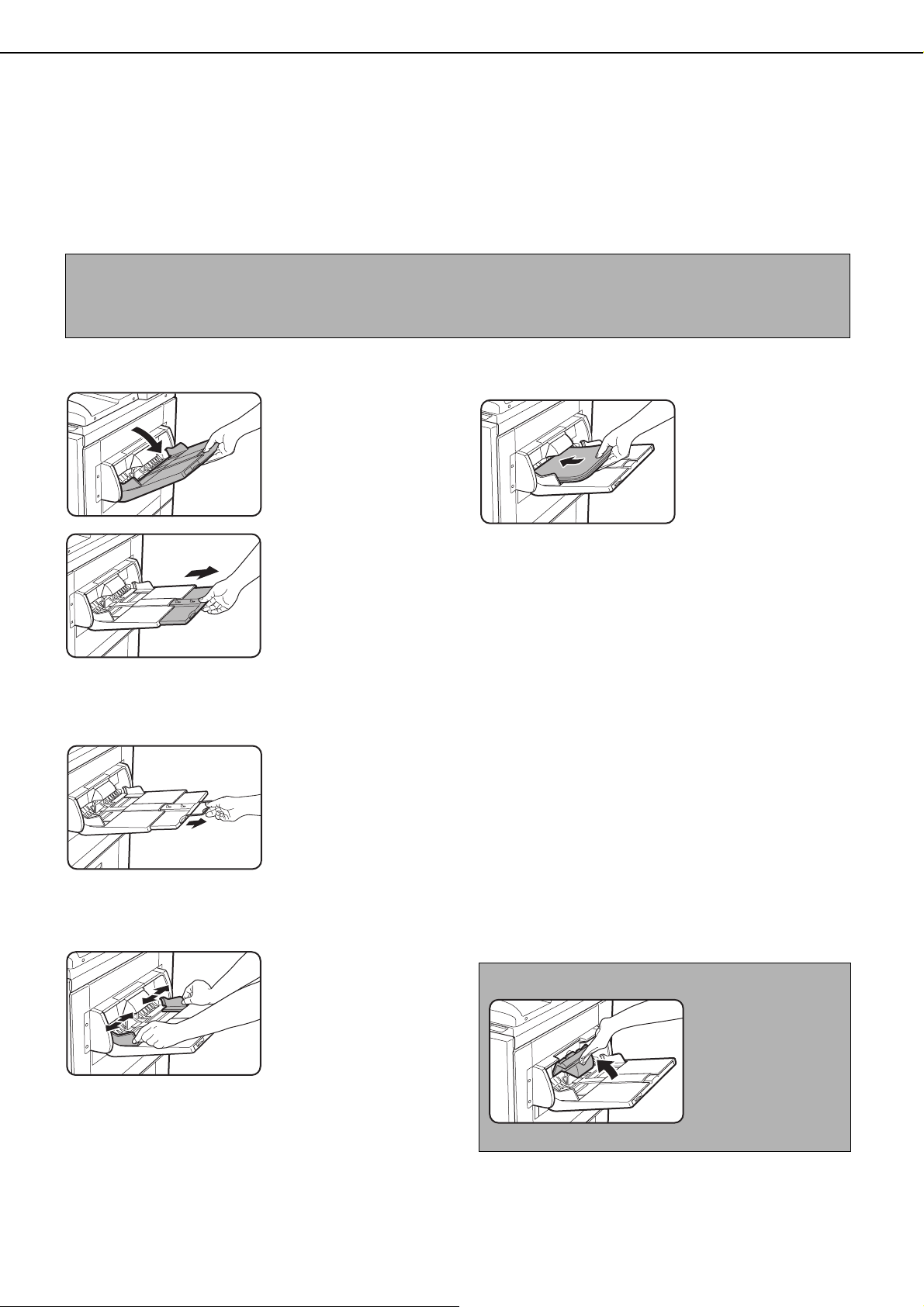
1
Open the bypass tray.
When loading paper that
will extend past the end
of the tray, pull out the
tray extension to support
the paper and to allow the
paper sensors to properly
sense the paper size.
Be sure to pull the tray extension all the way out. If
the tray extension is not pulled all the way out, the
size of the paper loaded in the bypass tray may not
display correctly.
To support papers that
extend past the tray
extension, pull out the
wire extension.
2
Set the bypass tray guides to the width of
the copy paper.
3
Insert the copy paper all the way into the
bypass tray. (Do not force the paper in.)
Place the copy paper
face up. If the bypass
tray guides are set
wider than the copy
paper, the inside of the
machine may become
soiled, resulting in
smudges on succeeding copies. Special purpose
papers other than SHARP recommended
transparency film must be fed individually. Multiple
sheets of SHARP recommended transparency
film can be loaded in the bypass tray.
4
Set the type and size of the paper loaded in
the bypass tray.
If you loaded a different type of paper from the
previous paper, be sure to set the new paper type
as explained in "Setting the paper type and paper
size in the bypass tray" (page 2-12). If you loaded
a special size of paper in the bypass tray, set the
paper size as explained in "Setting the paper type
and paper size in the bypass tray" (page 2-12).
(If you do not set a size, part or all of the image
may not print.)
5
This completes the procedure for loading
paper in the bypass tray.
NOTES
● After loading the paper in the bypass tray, be sure to set the paper type and size (step 4) if these were changed.
● Do not use inkjet paper. This may cause misfeeds in the fusing unit.
NOTE
When loading paper in
the bypass tray or
closing the tray, close
the paper cover as
shown.
sec_apollon_02-1.fm 4 ページ 2004年9月14日 火曜日 午前10時44分
LOADING PAPER
2-5
2
NOTES
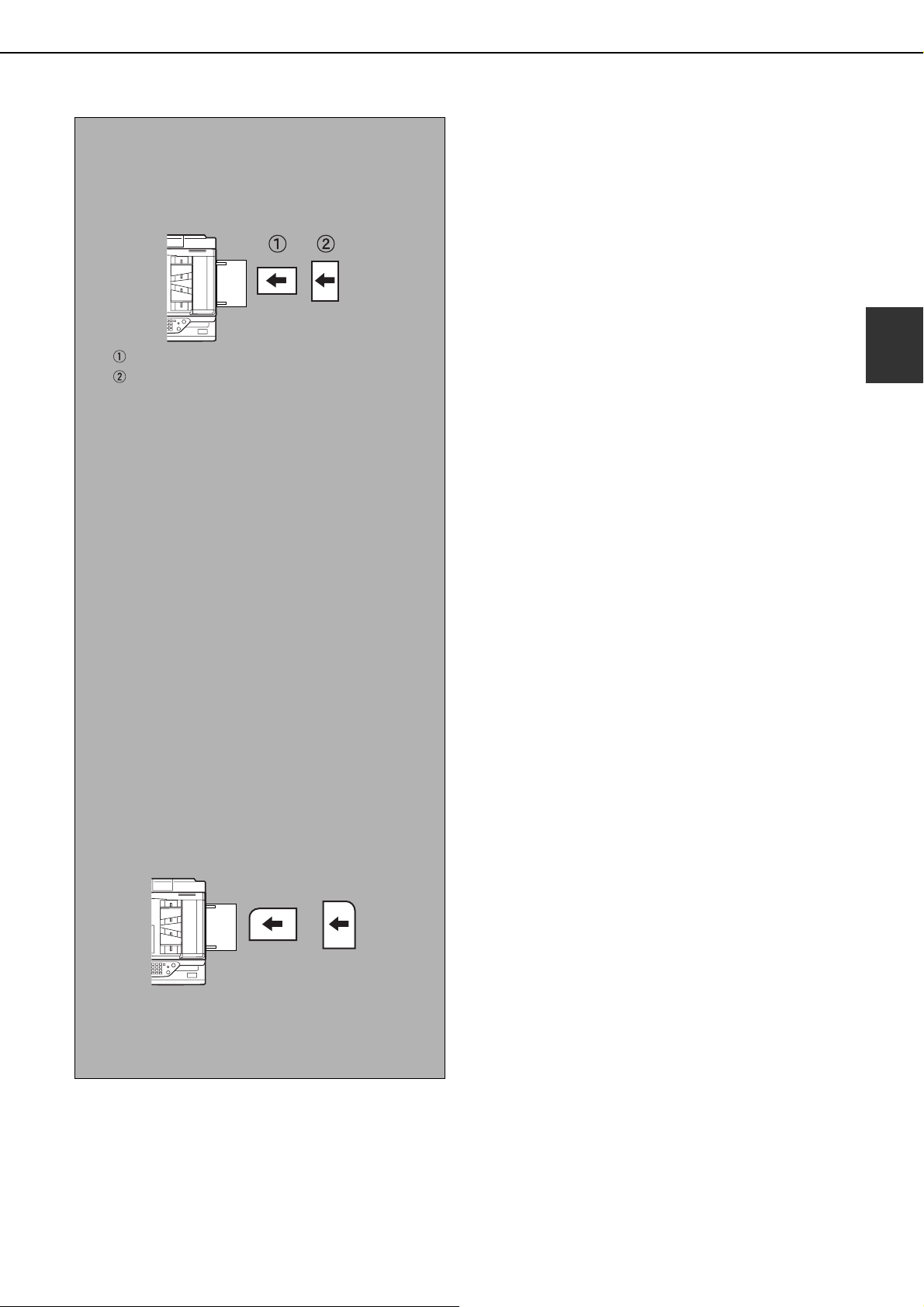
● Be sure to load 5-1/2" x 8-1/2" paper, A6 paper, A5
paper, and postcards as shown in the diagram
below.
A6 paper, post cards.
5-1/2" x 8-1/2" paper, A5 paper.
● When loading plain paper other than paper
recommended for color, SHARP standard paper,
special media other than postcards, SHARP-
recommended transparency film, or paper to be
printed on the back, the paper must be loaded one
sheet at a time. Loading more than one sheet at a
time will cause misfeeds.
● Before loading heavy paper, straighten any curling
in the paper.
● When adding paper, remove any paper remaining
in the tray, combine it with the paper to be added,
and reload as a single stack.
● Do not use paper that has already been printed on
by a plain paper fax machine or a laser printer.
This may cause printed images to become dirty.
● When printing on transparency film, be sure to
remove each sheet as it exits the machine.
Allowing sheets to stack in the output tray may
cause curling.
● Use only SHARP-recommended transparency
film. Insert the film so that the rounded corner is on
the left for horizontal loading, or on the right for
vertical loading.
● When loading multiple sheets of transparency film
in the bypass tray, fan the sheets several times
before loading.
Horizontal
loading
Vertical
loading
ApollonII_general-copy_SEC.book 5 ページ 2004年9月6日 月曜日 午後4時57分
LOADING PAPER
2-6
■
■■
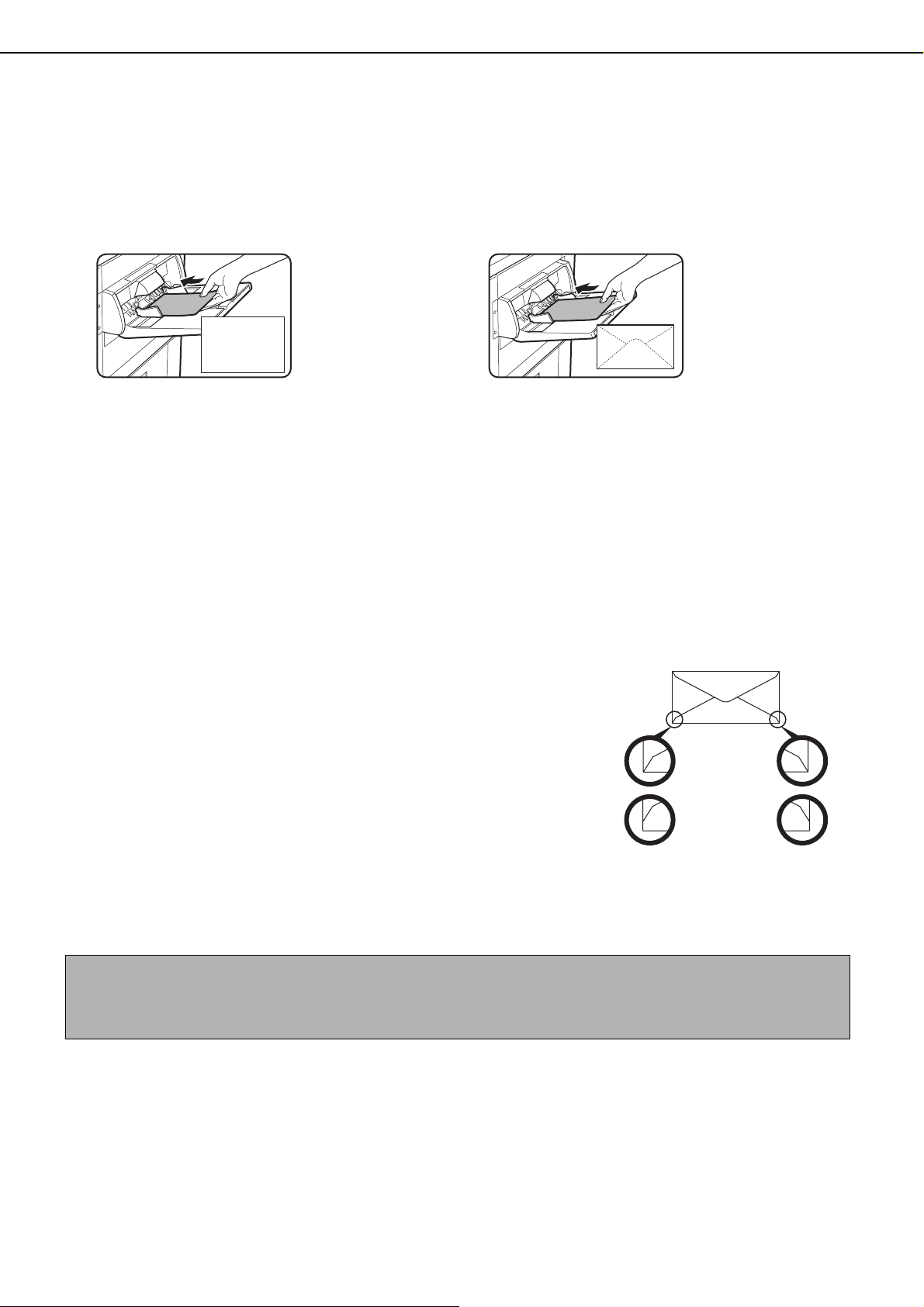
■ Setting envelopes or postcards
When setting envelopes or postcards in the bypass tray, set them in the orientation shown below.
Printing onto envelopes or postcards
●Attempting to print onto both sides of envelopes or postcards may result in misfeeds or poor prints.
●Do not use pre-printed envelopes.
●Before inserting a postcard or envelope, straighten any curled edges. Curled edges may cause creases, color
deviations, misfeeds, and poor quality images.
Printing onto envelopes
●Attempting to print on envelopes that have metal clasps, plastic snaps, string closures, windows, linings, self-
adhesive patches or synthetic materials may cause misfeeds, inadequate toner adherence or other trouble.
●Envelopes with embossed surfaces may cause the prints to become smudged.
●Use only envelopes which are flat and crisply folded. Curled or poorly formed envelopes may be poorly printed
or may cause misfeeds.
●Print quality is not guaranteed in the area 13/32" or 10 mm from the
edges of the envelope.
●Print quality is not guaranteed on parts of envelopes where there is a
large step-like change of thickness, such as on three-layer or four-layer
envelopes.
●Print quality is not guaranteed on envelopes having peel off flaps for
sealing the envelopes.
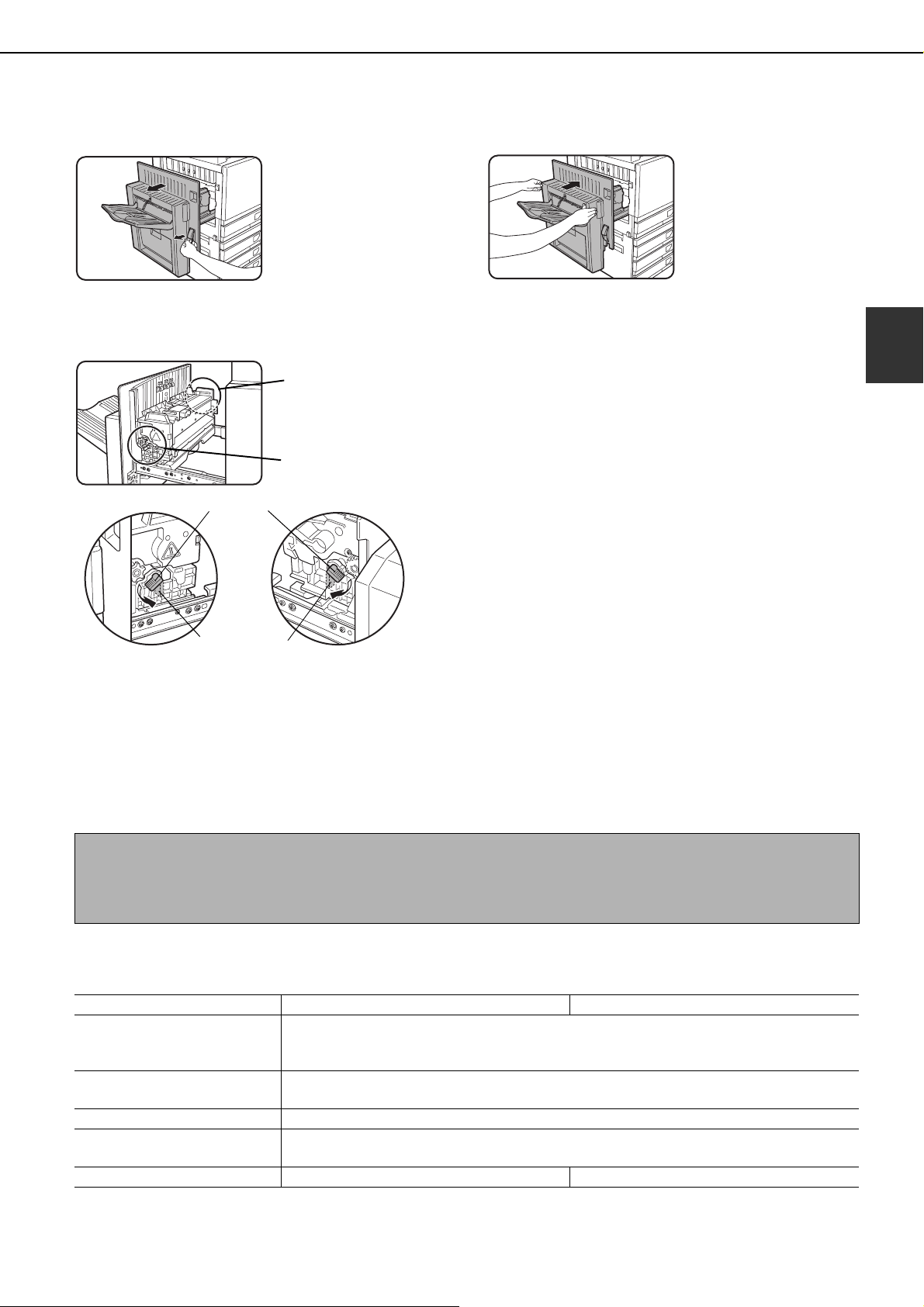
Fusing unit pressure adjusting levers
In some cases damage to the envelopes, color deviations, or smudging may occur even if envelopes within the
specifications are used. This problem may be reduced by shifting the fusing unit pressure adjusting levers from
their normal pressure position to the lower pressure position. Follow the procedure on the next page. (2-7)
Loading postcards
Insert the postcard with the side to be printed on
facing up. The postcard should be oriented as
shown in the diagram.
Loading envelopes
Only the front side of envelopes can be printed.
Insert the envelope with the front side facing up.
NOTE
Be sure to return the lever to the normal position when you have finished feeding envelopes. If not, inadequate
toner adherence, paper misfeeds or other trouble may occur.
Can be used
Cannot be used
sec_apollon_02-1.fm 6 ページ 2004年9月14日 火曜日 午前10時45分
LOADING PAPER
2-7
2
1
Unlatch the duplex bypass/inverter unit
and slide it to the left.
Unlatch the unit and
gently move it away from
the machine. If the
machine is not equipped
with a duplex bypass/
inverter unit, open the
side cover similarly.
2
Lower the two fusing unit pressure
adjusting levers marked A and B in the
illustration.
3
Gently close the duplex bypass/inverter
unit.
If the machine is not
equipped with a duplex
bypass/inverter unit,
close the side cover.
Loading paper in the stand/1 x 500 sheet paper drawer/
stand/3 x 500 sheet paper drawer
Upper tray / middle tray / lower tray*
Up to 500 sheets of paper recommended for color or SHARP recommended plain paper can be loaded in these trays.
The method of loading paper is the same as for paper tray 1 in the main unit (see the explanation on page 2-2).
* The stand/1 x 500 sheet paper drawer only has the upper tray.
Specifications (stand/1 x 500 sheet paper drawer/stand/3 x
500 sheet paper drawer)
Specifications are subject to change for improvement without notice.
A
B
B:Front side of
fusing unit
Normal
position
Lower pressure
position
A:Rear side of
fusing unit
NOTE
If the size of paper being loaded is different from the previous size, or is an extra size, or if the paper type is different
from the previous type, you must change the paper tray settings in the custom settings. Change the settings as
explained in "Setting the paper type" and "Setting the paper size when an extra size is loaded" on page 2-11.
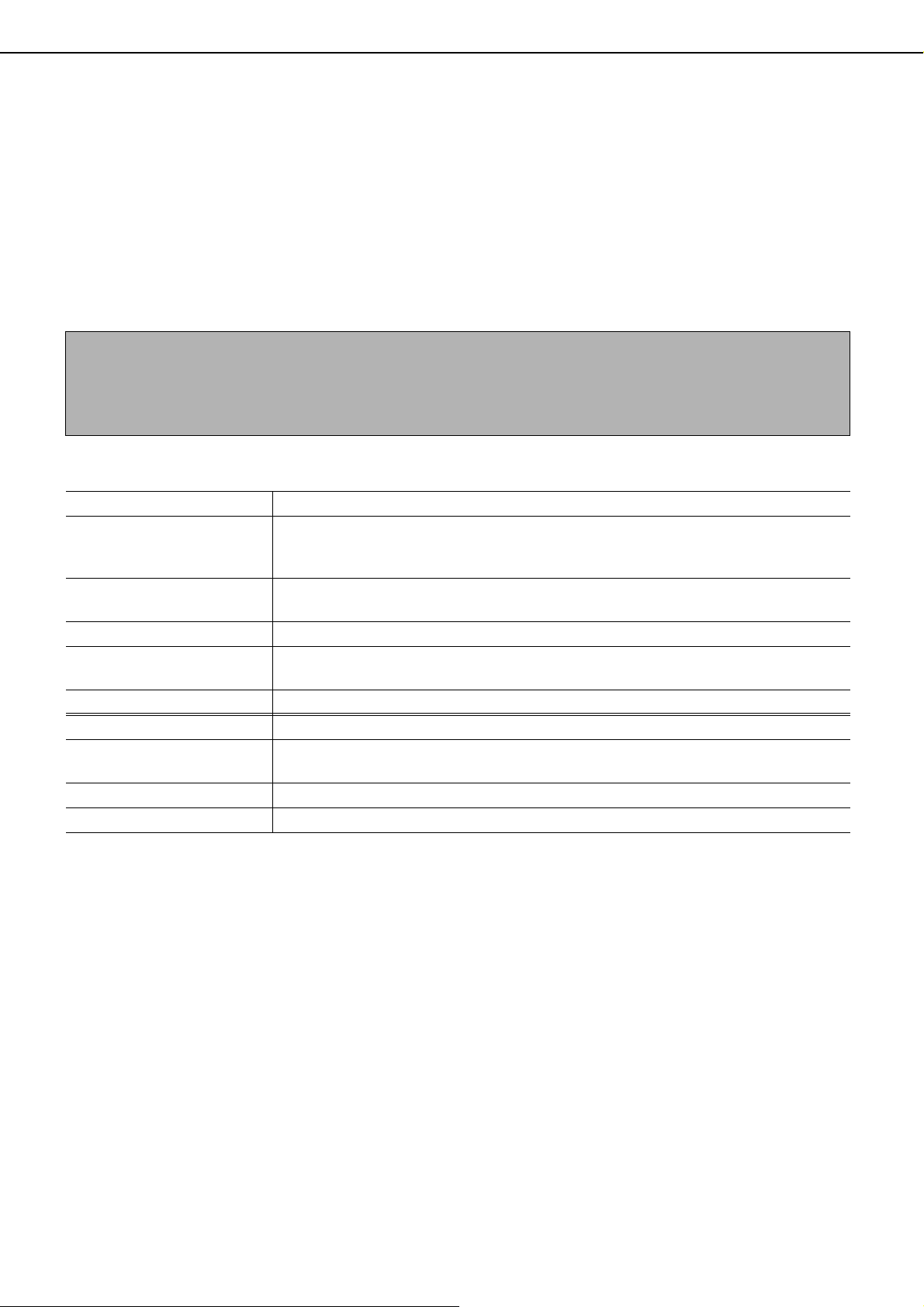
Name
Stand/1 x 500 sheet paper drawer (AR-D17N) Stand/3 x 500 sheet paper drawer (AR-D18N)
Paper size/weight
11" x 17", 8-1/2" x 14", 8-1/2" x 13", 8-1/2" x 11", 8-1/2" x 11"R,
7-1/4" x 10-1/2"R, 5-1/2" x 8-1/2", Extra. (A3, B4, A4, A4R, B5, B5R, A5)
/ 17 to 28 lbs. or 64 to 105 g/m
2
Paper capacity
Paper recommended for color (21 lbs. or 80 g/m
2
): 500 sheets;
SHARP standard paper (21 lbs. or 80 g/m
2
): 500 sheets
Power supply Supplied from the main unit
Dimensions
23-5/8" (W) x 25-9/32" (D) x 15-7/8" (H) (600 mm (W) x 642 mm (D) x 403 mm (H))
(not including the adjuster)
Weight Approximately 49.6 lbs. or 22.5 kg Approximately 65.0 lbs. or 29.5 kg
ApollonII_general-copy_SEC.book 7 ページ 2004年9月6日 月曜日 午後4時57分
LOADING PAPER
2-8
Loading paper in the duplex module/2 x 500 sheet paper
drawer
Upper tray:
The upper tray contains a duplex module that automatically turns print paper over for automatic two-sided printing.
Middle and lower paper trays:
The middle and lower trays are paper trays.
Up to 500 sheets of paper recommended for color or SHARP recommended plain paper can be loaded in these trays.
The method of loading paper is the same as for paper tray 1 in the main unit. See the explanation on page 2-2.
Specifications (duplex module/2 x 500 sheet paper drawer)
Specifications are subject to change for improvement without notice.
NOTE
If the size of paper being loaded is different from the previous size, or is an extra size, or if the paper type is different
from the previous type, you must change the paper tray settings in the custom settings. Change the settings as
explained in "Setting the paper type" and "Setting the paper size when an extra size is loaded" on page 2-11.
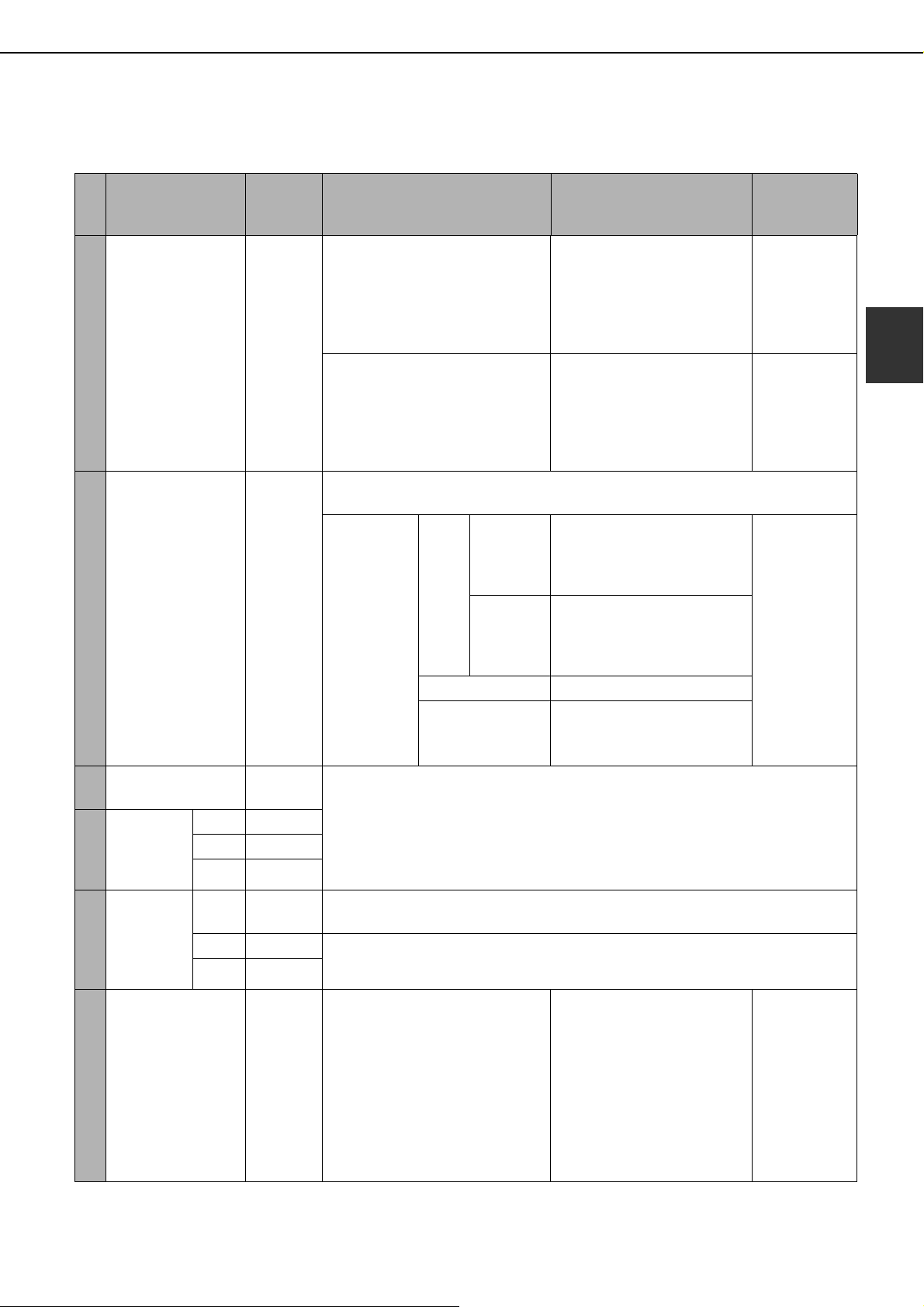
Name Duplex module/2 x 500 sheet paper drawer (AR-D19N)
Paper size/weight
11" x 17", 8-1/2" x 14", 8-1/2" x 13", 8-1/2" x 11", 8-1/2" x 11"R, 7-1/4" x 10-1/2"R,
5-1/2" x 8-1/2", Extra. (A3, B4, A4, A4R, B5, B5R, A5)
/ 17 to 28 lbs. or 64 to 105 g/m
2
Paper capacity
Paper recommended for color (21 lbs. or 80 g/m
2
): 500 sheets;
SHARP standard paper (21 lbs. or 80 g/m
2
): 500 sheets
Power supply Supplied from the main unit
Dimensions
23-5/8" (W) x 25-9/32" (D) x 15-7/8" (H) (600 mm (W) x 642 mm (D) x 403 mm (H))
(not including the adjuster)
Weight Approximately 68.3 lbs. or 31 kg
Duplex module
Size of plain paper
11" x 17", 8-1/2" x 14", 8-1/2" x 13", 8-1/2" x 11", 8-1/2" x 11"R, 7-1/4" x 10-1/2R",
5-1/2" x 8-1/2", A3, B4, A4, A4R, B5, B5R, A5
Weight of plain paper 17 to 54 lbs. or 64 to 200 g/m
2
Number of sheets One sheet (single pass type)
ApollonII_general-copy_SEC.book 8 ページ 2004年9月6日 月曜日 午後4時57分
LOADING PAPER
2-9
2
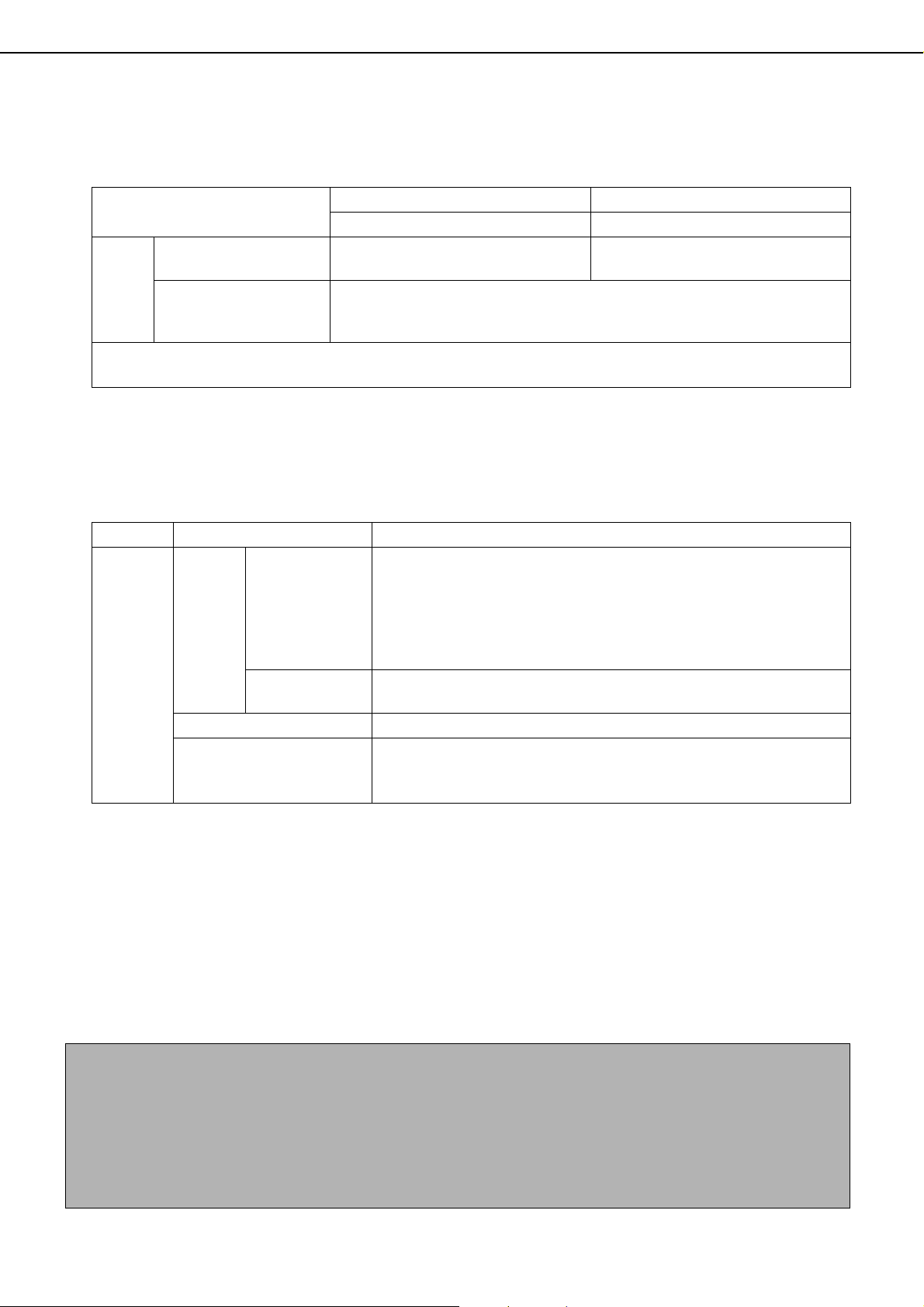
Specifications of paper trays
The specifications for the types and sizes of paper that can be loaded in the paper trays are shown below.
*1 When the Duplex module/2 x 500 sheet paper drawer is installed.
*2 When the Stand/3 x 500 sheet paper drawer is installed.
Paper tray type
Tray No.
(tray
name)
Applicable paper types Applicable paper sizes Remarks
A Paper tray 1 Tray 1
Paper recommended for color
11"x17", 8-1/2"x14",
8-1/2"x13", 8-1/2"x11",
8-1/2"x11"R, 5-1/2"x8-1/2",
7-1/4"x10-1/2"R, Extra.
(A3, B4, A4, A4R, B5, B5R,
A5)
See
"STORAGE
OF
SUPPLIES"
on page 2-17
Plain paper
11"x17", 8-1/2"x14",
8-1/2"x13", 8-1/2"x11",
8-1/2"x11"R, 5-1/2"x8-1/2",
7-1/4"x10-1/2"R, Extra.
(A3, B4, A4, A4R, B5, B5R,
A5)
See "More
information on
plain paper"
on the next
page
B Bypass tray
Bypass
tray
Same as paper types and sizes in row A
* Paper size 12" x 18" (A3W) and A6R can also be used in the bypass tray
Special
paper (Refer
to the next
page for
applicable
special
papers.)
Heavy
paper
Heavy
paper 1
5-1/2"x8-1/2" - 12"x18" (A6R
- A3W), Special (paper
weight: 28 to 54 lbs. (106 to
200 g/m
2
)), Postcard
See "More
information on
special media
that can be
used" on the
next page
Heavy
paper 2
5-1/2"x8-1/2" - 12"x18" (A6R
- A3W), Special (paper
weight: 54 to 80 lbs. (201 to
300 g/m
2
))
Transparency film Transparency film
Envelopes
●Standard-size envelopes
that can be used
:COM10,Monarch,DL,C5
C
Stand/1 x 500
sheet paper drawer
Tray 2
Same as paper types and sizes in row A
D
Stand/3 x
500 sheet
paper
drawer
Upper Tray 2
Middle Tray 3
Lower Tray 4
E
Duplex
module/2 x
500 sheet
paper
drawer
Upper Duplex
Duplex module
(See page 2-8 for paper sizes and weights that can be used.)
Middle Tray 2
Same as paper types and sizes in row A
Lower Tray 3
F
Large Capacity tray
Tray 4*
1
or
Tray 5*
2
Same as paper types in row A 8-1/2"x11" (A4)
See the
specifications
in "LARGE
CAPACITY
TRAY" on
page 3-15, and
"More
information on
plain paper" on
the next page.
ApollonII_general-copy_SEC.book 9 ページ 2004年9月6日 月曜日 午後4時57分
LOADING PAPER
2-10
■
■■
■ More information on plain paper
The following restrictions apply to plain paper. Be sure to load the paper correctly. Incorrect loading may result
in skewed feeding or misfeeds.
* In the large capacity tray, only 8-1/2" x 11" size paper can be used when using inch sizes, and only A4 can be
used when using AB sizes.
■
■■
■ More information on special media that can be used
The following restrictions apply to special media. The use of incorrect media may result in fusing problems (weak
adhesion of toner to paper or toner smudging when rubbed), skewed feeding, misfeeds, or other failures.
● Special paper such as heavy paper 2, transparency film, and envelopes cannot be output to the center tray.
● Paper that cannot be output to the center tray is output face-up to the left tray.
■
■■
■ Paper that can be used for automatic two-sided printing
Paper used for automatic two-sided printing (paper that can be fed through the duplex module) must meet the
following conditions:
Paper type : Plain paper as specified on page above.
Paper size : Must be one of the following standard sizes: 11" x 17", 8-1/2" x 14", 8-1/2" x 13", 8-1/2" x 11",
8-1/2" x 11"R, 7-1/4" x 10-1/2" or 5-1/2" x 8-1/2" (A3, B4, A4, A4R, B5, B5R or A5)
Paper weight : 17 to 54 lbs. or 64 to 200 g/m
2
Paper in inch system Paper in AB system
5-1/2" x 8-1/2" - 12" x 18"* A6R - A3W*
Plain
paper
SHARP standard
paper
21 lbs. 80g/m
2
Restrictions on paper
other than SHARP
standard paper
17 to 28 lbs. or 64 to 105g/m
2
Recycled, colored, pre-punched, pre-printed and letterhead papers must conform to the same conditions as
above.
Type Remarks
Special
paper
Heavy
paper
heavy paper 1
For paper sizes from 5-1/2" x 8-1/2" to 12" x 18" (A6R to A3W),
paper weights from 28 to 54 lbs. (106 to 200 g/m
2
) can be used.
● Postcards can be used.
Do not use folded postcards, picture postcards, or postcards with
a coated front. These may cause misfeeds or a dirty printed
image.
heavy paper 2
For paper sizes from 5-1/2" x 8-1/2" to 12" x 18" (A6R to A3W),
paper weights from 54 to 80 lbs. (201 to 300 g/m
2
) can be used.
Transparency film Use SHARP recommended transparencies.
Envelopes
Applicable standard envelopes: COM-10, Monarch, DL, C5
Envelopes can only be fed from the Bypass tray. Applicable paper
stock weight for envelopes is 20 to 23 lbs. or 75 to 90 g/m
2
NOTES
●
Special papers as described above cannot be used for automatic two-sided printing. Heavy paper up to 54 lbs.
(200 g/m
2
) can be used.
● The image quality and toner fusibility of special papers may change due to ambient conditions, operating
conditions, and paper characteristics, resulting in image quality inferior to that of SHARP standard paper.
● Various types of plain paper and special paper are sold. Some of these cannot be used in the machine. Please
consult your retailer or your dealer when buying paper.
ApollonII_general-copy_SEC.book 10 ページ 2004年9月6日 月曜日 午後4時57分
LOADING PAPER
2-11
2
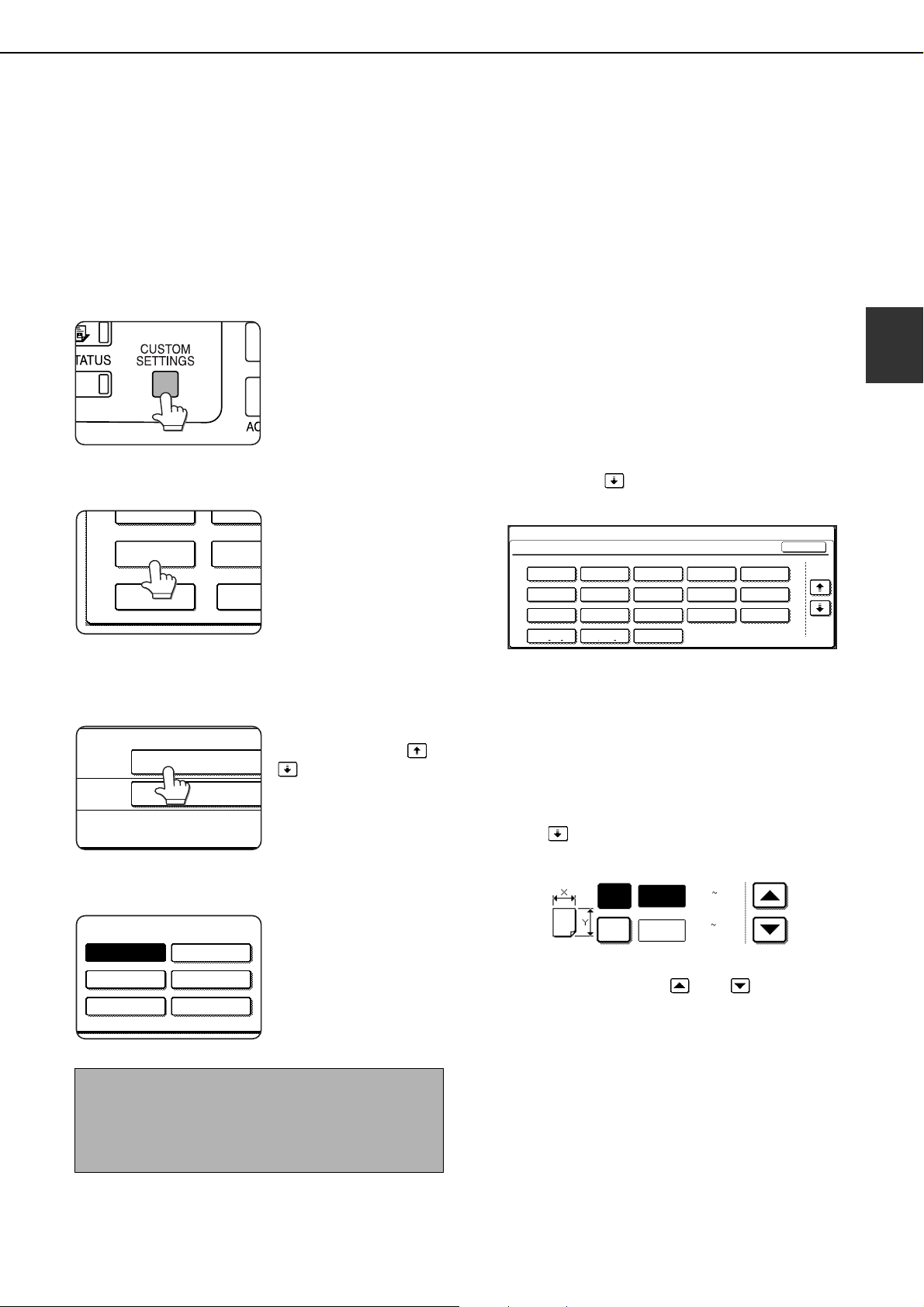
Setting the paper type
(except the bypass tray)
Follow these steps to change the paper type setting
when the paper type has been changed in a paper tray.
For the paper types that can be used in each tray, see
page 2-9. To change the paper type setting for the
bypass tray, see page 2-12.
1
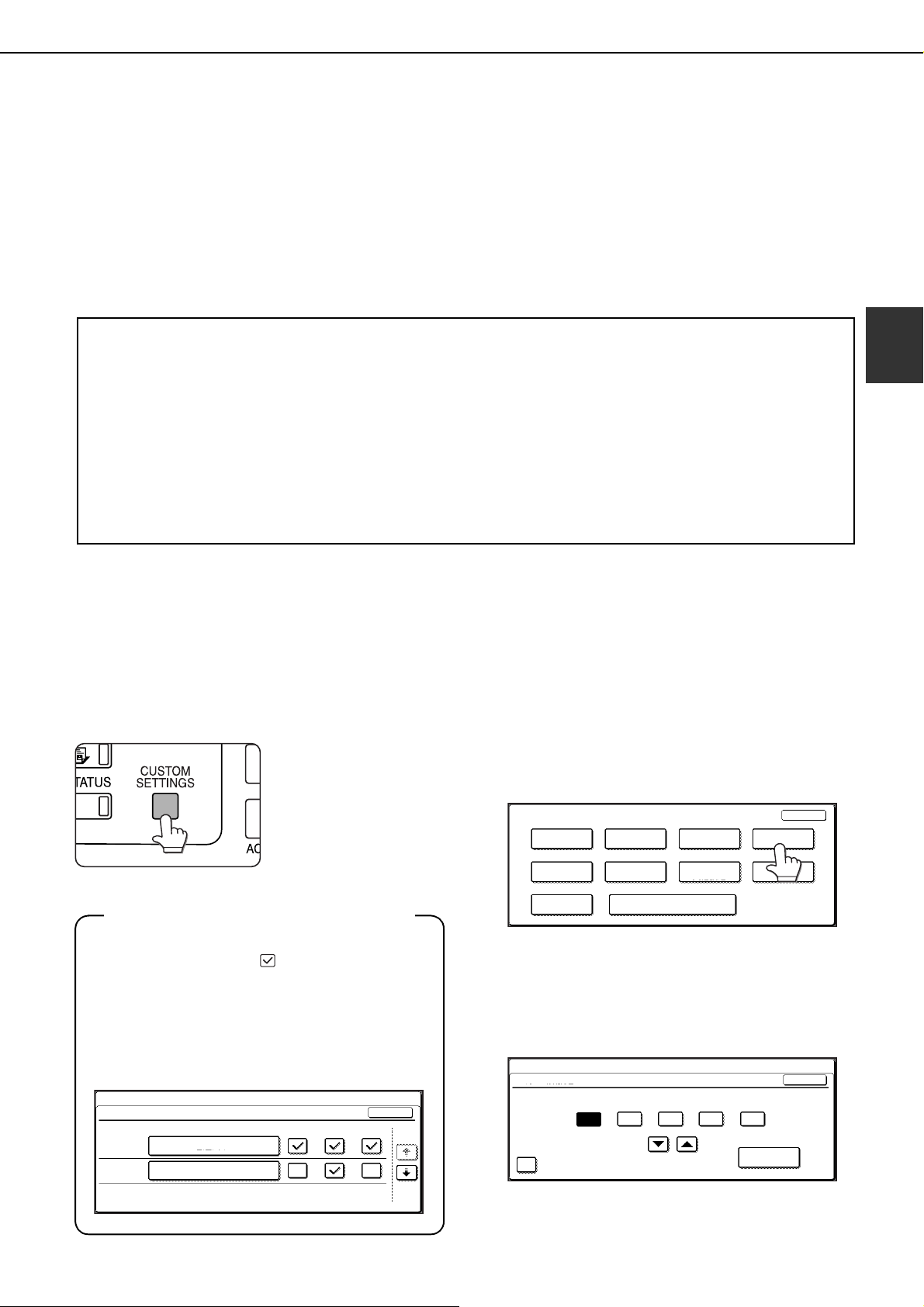
Press the [CUSTOM SETTINGS] key.
The custom setting
menu screen will
appear.
2
Touch the [TRAY SETTINGS] key.
The paper tray selection
screen will appear.
3
Select the paper tray for which the setting
is to be made. (For the tray numbers, see
the tray specifications on page 2-9.)
If the desired tray is not
on the display, use or
key to scroll the
display until it appears.
4
Select the type of paper that was loaded in
the tray.
The currently selected
paper type will be
highlighted. To change
the setting, touch the
desired type.
5
Touch the [OK] key to complete the
setting.
Setting the paper size when
an extra size is loaded
When a paper tray is set to "extra", this informs the
machine that an extra size is being used. It does not
inform the specific size. To enter the specific size of the
paper loaded, follow the steps below.
For example, if A4 size paper is loaded in the tray (with
the size slide set to "extra"), you can use this procedure
to set the paper size recognized by the machine to A4
size. If you loaded an irregular size of paper, you can
enter the dimensions of the paper.
To set the paper size when an extra size of paper is
loaded in the bypass tray, see page 2-12.
1
Perform steps 1 through 4 of "Setting the
paper type" at left.
2
Touch the key to display the paper size
setting screen.
3
When the loaded paper size appears in the
display (if you loaded an AB-based size
such as A4), touch the size key to highlight
it, and then touch the [OK] key to complete
the procedure.
4
If an irregular size of paper was loaded
after the [EXTRA] key was touched, touch
the key in the screen of step 2 to display
the following screen.
When the screen opens the X key will be
highlighted. Use the
and
touch keys to
enter the X dimension. Next touch the Y key to
highlight it and enter the dimensions for Y.
The permitted range for the X dimension is 5-1/2 to
17 inches (139 to 432 mm), and the permitted
range for the Y dimension is 7-1/4 to 11-3/4 inches
(182 to 297 mm).
When both have been entered, touch the [OK] to
complete the operation.
NOTE
Special paper such as transparency film,
envelopes, and postcards can only be used in the
bypass tray.
TOT L COUNT
TRAY SETTINGS
ADDRES
CONTRO
KEYBOARD
SELECT
KEY
CONTRA
TRAY 1
TRAY 2 PLAIN /
TYPE / SIZE
PLAIN /
PLAIN
PRE-PRINTED
RECYCLED
LETTER HEAD
PRE-PUNCHED
COLOR
CUSTOM SETTINGS
EXTRA SIZE
TRAY 3 TYPE/SIZE SETTING
A3 B4
A4
A4R
A5
EXTRA
B5
8K
16K
16KR
B5R
11X17
OK
2/3
8 X11R
1
/
2
7 X10 R
1
/
4
1
/
2
8 X14
1
/
2
8 X13
1
/
2
8 X11
1
/
2
5 X8
1
/
2
1
/
2
X
Y
5
7
(5 1/2 17)
inch
1
/
2
1
/
4
(7 1/4 11 3/4)
inch
ApollonII_general-copy_SEC.book 11 ページ 2004年9月6日 月曜日 午後4時57分
LOADING PAPER
2-12
Setting the paper type and paper size in the bypass tray
Follow the steps below to set the type and size of the paper loaded in the bypass tray.
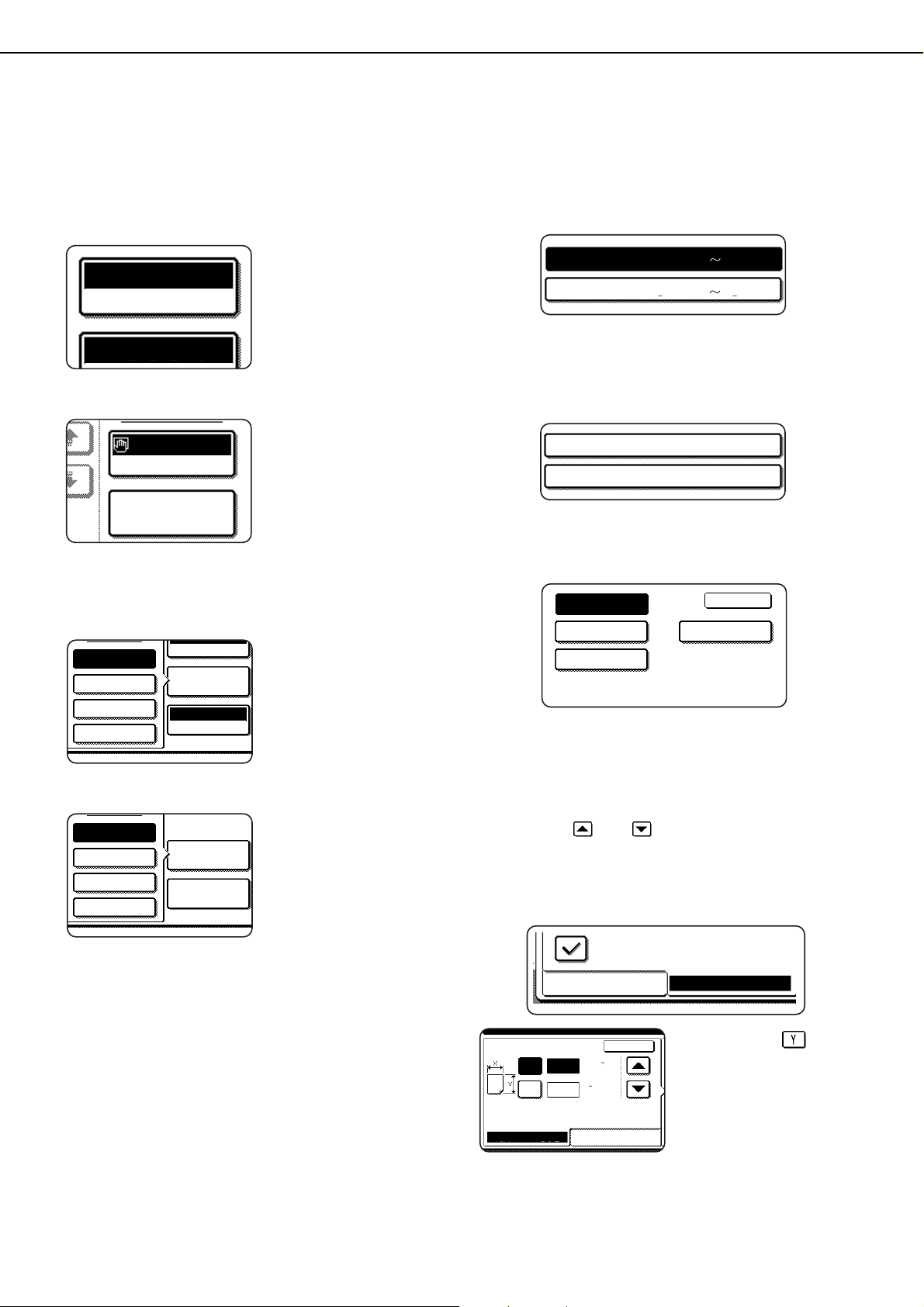
1
Touch the [PAPER SELECT] key.
(When copy mode is selected)
Touch the [PAPER
SELECT] key in the
main screen of the copy
mode.
(When printer mode is selected)
Touch the [PAPER
SELECT] key in the
main screen of printer
mode.
2
Touch the key for the desired paper type.
(When copy mode is selected)
The key for the selected
paper type will be
highlighted.
(When printer mode is selected)
The steps that follow differ depending on the
paper type selected. Follow the steps for the
selected type.
● If you touched [PLAIN], go to step 6.
● If you touched [HEAVY PAPER], go to step 3
● If you touched [TRANSPARENCY], go to step 4.
● If you touched [ENVELOPE], go to step 5.
3
Touch [HEAVY PAPER 1] or [HEAVY
PAPER 2], and go to step 6.
For the types of heavy paper that can be used, see
page 2-10.
4
Touch [SPEED MODE] or [QUALITY MODE]
for the transparency film, and go to step 7.
● SPEED MODE is for fast printing.
● QUALITY MODE is for a high quality image.
5
Touch the type of envelope, and go to step 7.
6
If you inserted a non-standard size of paper
in the bypass tray, remove the checkmark
from "ENABLE AUTO SIZE DETECTION" and
then touch the [EXTRA SIZE] tab.
When the
screen opens, the X key will be highlighted.
Use the and
touch keys to enter the X
dimension. If you inserted a standard size of
paper in the bypass tray, make sure that a
checkmark appears in the [ENABLE AUTO
SIZE DETECTION] checkbox.
Next touch the key to
highlight it and enter the
dimensions for Y.
The permitted range for
the X dimension is 5-1/2
to 17 inches (139 to 432
mm), and the permitted
range for the Y dimension is 4 to 11-3/4 inches
(100 to 297 mm).
7
Touch the [OK] key to complete the setting.
PAPER SELECT
AUTO 8½x11
100%
PAPER SELECT
8½x11
CONDITION
SETTINGS
PAPER SELECT
100%
COPY RATIO
PLAIN
HEAVY PAPER
TRANSPARENCY
ENVELOPE
UTO
EXPOSURE
PAPER SELECT
PLAIN
HEAVY PAPER
TRANSPARENCY
ENVELOPE
CONDITION
SETTINGS
HEAVY PAPER1 28+lbs. 54 lbs.
HEAVY PAPER2 54+lbs. 80 lbs.
SPEED MODE
QUALITY MODE
COM-10
MONARCH
OK
DL
C5
ENABLE AUTO SIZE DETECTION
EXTRA SIZE
BASIC SETTING
X
Y
5 ½
4
(4 11
3/4)
inch
(5
1/2 17)
inch
BASIC SETTING
EXTRA SIZE
OK
ApollonII_general-copy_SEC.book 12 ページ 2004年9月6日 月曜日 午後4時57分
2-13
2
CUSTOM SETTINGS
The items that can be set with the custom settings are shown below.
● Total count ................................... The number of pages processed by the machine and optional equipment
can be displayed. (See page 2-14.)
● Display contrast ........................... Used to adjust the contrast of the operation panel display. (See page 2-14.)
● List print ....................................... Used to print a list of machine settings. (See page 2-14.)
● Clock adjust
.................................... Used to set the date and time of the built-in clock of the machine. (See this page.)
● Tray settings ................................ The paper type, paper size and automatic tray switching can be set for each
tray. Automatic tray switching allows feeding to switch between trays
loaded with the same type and size of paper. If one tray runs out of paper
during printing, printing will continue from the other tray. (
See
page 2-14)
For the detailed descriptions and use of the settings listed below, see the Operation manuals
for fax* and network scanner.
● Address control............................ Use this to store fax destinations (fax numbers). This is also used to store
groups, memory boxes, and user indexes.
E-mail addresses, user indexes, and scanner senders can be stored for the
network scanner function.
● Receive mode.............................. Use this to configure fax reception settings (auto/manual).
● Fax data forward.......................... Faxes received to memory can be forwarded to another destination.
● Keyboard select........................... When using the fax function or network scanner function, you can switch
the arrangement of the letter keys in the display keyboard used for storing
and editing destinations in the English character entry screen.
● Key operator program.................. These are programs that are used by the key operator (administrator of the
machine) to configure machine settings. A key appears for these settings in
the custom settings menu screen. For information on these settings, see
the key operator's guide.
* These fax settings can be configured only if the fax function has been enabled.
Operation procedure common to all custom settings
1
Press the [CUSTOM SETTINGS] key.
The custom setting
menu screen will
appear.
More information on setting procedures
In the following type of screen, a setting is turned
on when a checkmark ( ) appears next to the
key. A checkmark will appear or disappear by
alternate touches of the checkmark box. In the
following screen, tray 1 can be used in print, copy,
and fax modes. Tray 2 can only be used in the
copy mode.
2
Touch the key of the desired item to
display its setting screen.
The settings accessed by touching the [CLOCK]
key are explained here.
Detailed descriptions for program settings start on
the next page.
The procedure for setting the clock is shown below
as an example.
CUSTOM SETTINGS
TRAY SETTINGS
TRAY 1
TRAY 2 PLAIN /
TYPE / SIZE
COPY
OK
1/2
PLAIN /
PRINT
FAX
CUSTOM SETTINGS
TOTAL COUNT
TRAY SETTINGS
ADDRESS
CONTROL
KEYBOARD
SELECT
KEY OPERATOR PROGRAMS
CLOCK
DISPLAY
CONTRAST
LIST PRINT
FAX DATA
FORWARD
EXIT
RECEIVE MODE
DAYLIGHT SAVING TIME SETTING
CUSTOM SETTINGS
CLOCK ADJUST
MINUTE
OK
00
00
01
11
2004
DATE FORMAT
YEAR
MONTH
DAY
HOUR
sec_apollon_02-1.fm 13 ページ 2004年9月14日 火曜日 午前10時47分
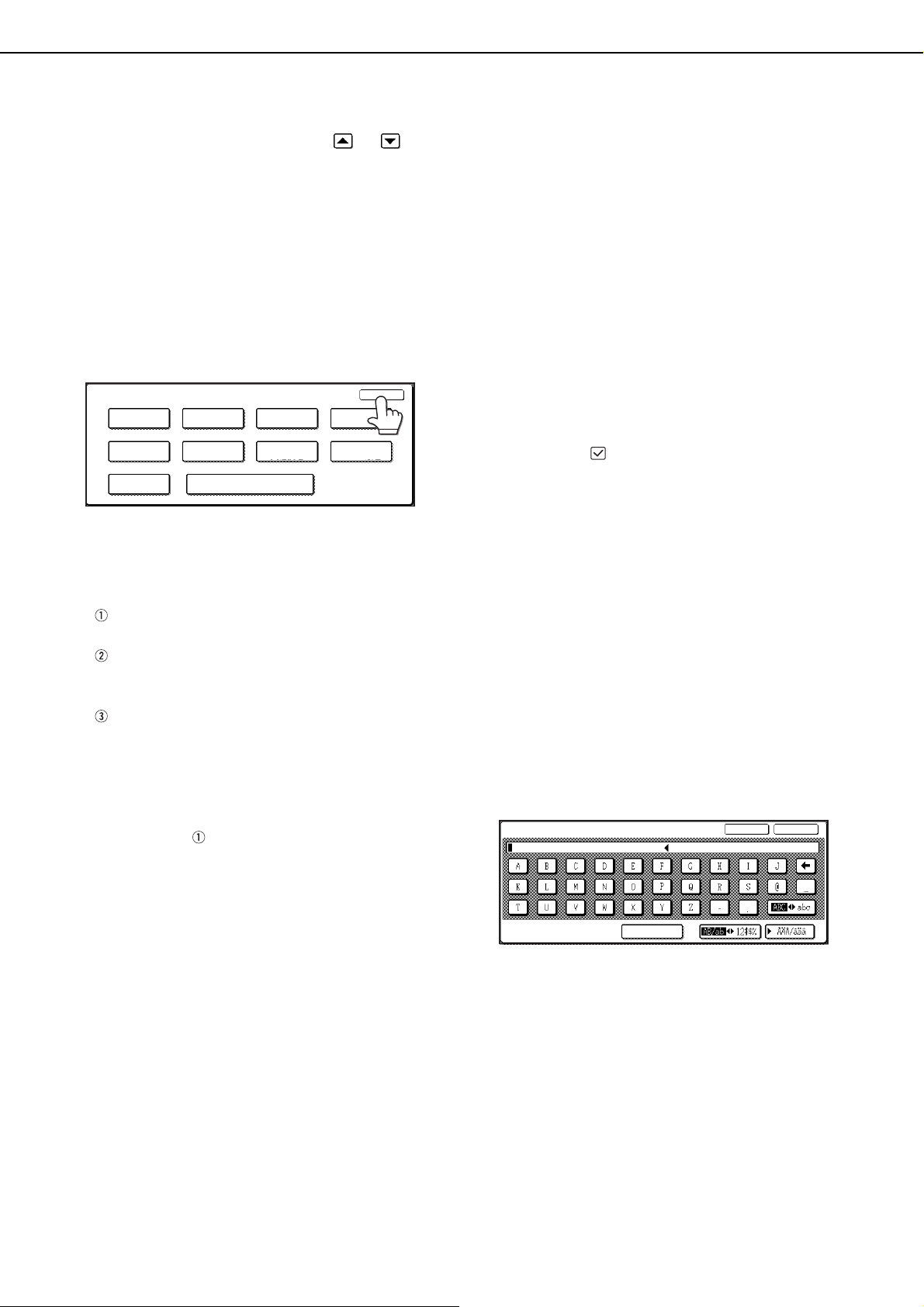
CUSTOM SETTINGS
2-14
3
Touch the year, month, day, hour or
minute key, and then use the or key
to adjust the setting.
● If you select a non-existent date (for example, Feb.
30), the [OK] key will gray out to prevent entry of the
date.
● Select [DAYLIGHT SAVING TIME SETTING]
checkbox to have the time automatically change at
the beginning and end of daylight saving time.
4
Touch the [OK] key.
5
To finish the setting operation, touch the
[EXIT] key.
About the settings
■
■■
■ Total count
This displays the following sheet counts:
The number of sheets printed in copy, print, and
fax modes.
The number of sheets transmitted using the fax
function and scanned using the network scanner
function.
The number of sheets used by optional
equipment such as the reversing single pass
feeder and the duplex module of the duplex
module/2 x 500 sheet paper drawer, and the
number of sheets stapled by the saddle stitch
finisher.
In the case of only,
● Each sheet of paper that is 11" x 17" (A3) size or
larger is counted as two sheets.
● Each sheet of paper used for automatic two-sided
copying is counted as two sheets (11" x 17" (A3)
paper is counted as four sheets). (When an optional
duplex module/2 x 500 sheet paper drawer and a
duplex bypass/inverter unit are installed.)
■
■■
■ Display contrast
Screen contrast adjustment is used to make the
LCD touch panel easier to view under various
lighting conditions. Touch the [LIGHTER] key to
make the screen lighter, or the [DARKER] key to
make the screen darker.
■
■■
■ List print
Used to print a list of the settings configured in the
fax, printer and network scanner function.
■
■■
■ Clock adjust
Use this to set the date and time in the machine's
built-in clock. This clock is used by functions that
require date and time information. The format of
the printed date can also be changed.
■
■■
■ Tray settings
The paper type, paper size, enabled modes and
automatic tray switching can set for each tray. See
page 2-11 for details on setting the paper type and
paper size. Automatic tray switching to another
paper tray is used to automatically switch to
another tray with the same size and type of paper
in the event that the paper runs out during
continuous printing. This requires that the trays be
loaded with the same size of paper. To enable any
function, touch the check box key so that a
checkmark ( ) appears.
■
■■
■ Keyboard select
When using the fax function or network scanner
function, you can switch the arrangement of the
letter keys in the display keyboard that appear in
the character entry screen when storing or editing
destinations. Select the arrangement of the letter
keys that you find easiest to use.
The following three alphabet keyboard
configurations are available:
● Keyboard 1 (QWERT... configuration)*
● Keyboard 2 (AZERTY...configuration)
● Keyboard 3 (ABCDEF...configuration)
* The default setting is "Keyboard 1".
(Example: Character entry screen when Keyboard
3 is selected)
CUSTOM SETTINGS
TOTAL COUNT
TRAY SETTINGS
KEYBOARD
SELECT
KEY OPERATOR PROGRAMS
CLOCK
DISPLAY
CONTRAST
ADDRESS
CONTROL
LIST PRINT
EXIT
RECEIVE MODE
FAX DATA
FORWARD
DESTINATION NAME
SPACE
OK
CANCEL
ApollonII_general-copy_SEC.book 14 ページ 2004年9月6日 月曜日 午後4時57分
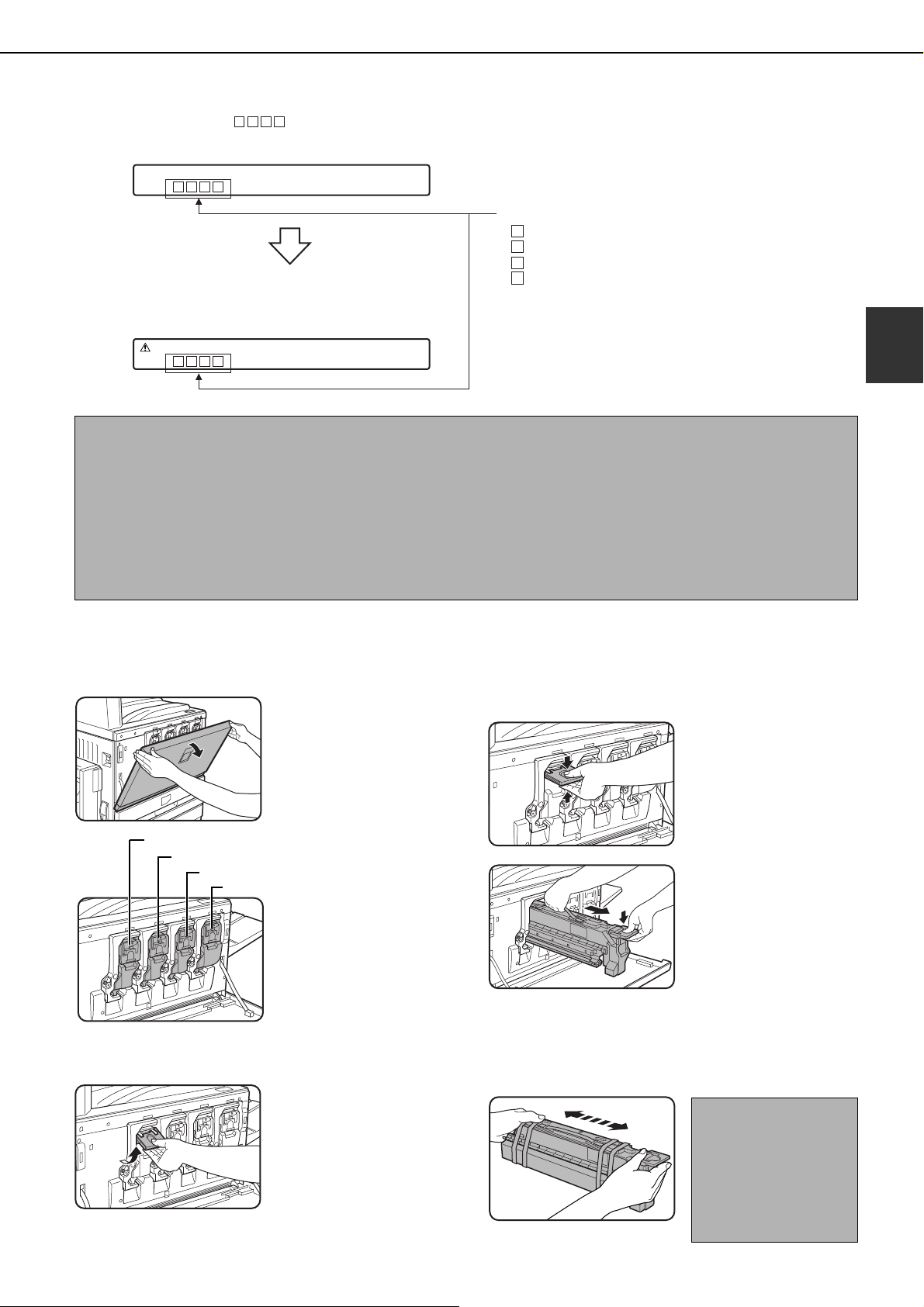
2-15
2
REPLACING THE TONER CARTRIDGES
When toner runs low, "[ ] TONER SUPPLY IS LOW" appears in the display. It is recommended that you keep
a set of new toner cartridges so that you can replace them quickly when toner runs out.
Follow these steps to replace the toner cartridge that is out of toner.
1
Open the front cover.
2
Lift the cartridge lock lever toward you.
Example: Replacing the
yellow toner cartridge
3
While holding the lock lever on the toner
cartridge, pull the toner cartridge toward
you.
Hold the toner cartridge
with both hands as
shown in the illustration,
and pull it out of the
machine.
4
Remove a new toner cartridge from the
package and shake it horizontally five or
six times.
READY TO COPY.
([ ]TONER SUPPLY IS LOW.)
CHANGE THE TONER CARTRIDGE.
([ ])
If you continue to use the toner cartridge, the
toner will eventually run out, the machine will
stop and the following message will appear.
This indicates the color of toner that is low.
= Yellow toner
= Magenta toner
= Cyan toner
= Black toner
Y
M
C
Bk
NOTES
● There may be cases that copy images become light or uneven before the message is displayed, depending on
the way the machine is used. If this occurs, take out the toner cartridge by following the same steps as
replacement, shake it horizontally to even out the toner in the cartridge, and re-insert the toner cartridge.
If copy images do not improve even after following this procedure, replace the toner cartridge with a new
cartridge.
● If one of the toners is out, including black toner, color copying will not be possible. If Y, M, or C runs out but BK
toner remains, black and white copying will still be possible.
Arrangement of color
toner cartridges
Cyan
Magenta
Yellow
Black
NOTE
Shake the toner
cartridge well to ensure
that the toner flows well
and will not stick to the
inside of the cartridge.
ApollonII_general-copy_SEC.book 15 ページ 2004年9月6日 月曜日 午後4時57分
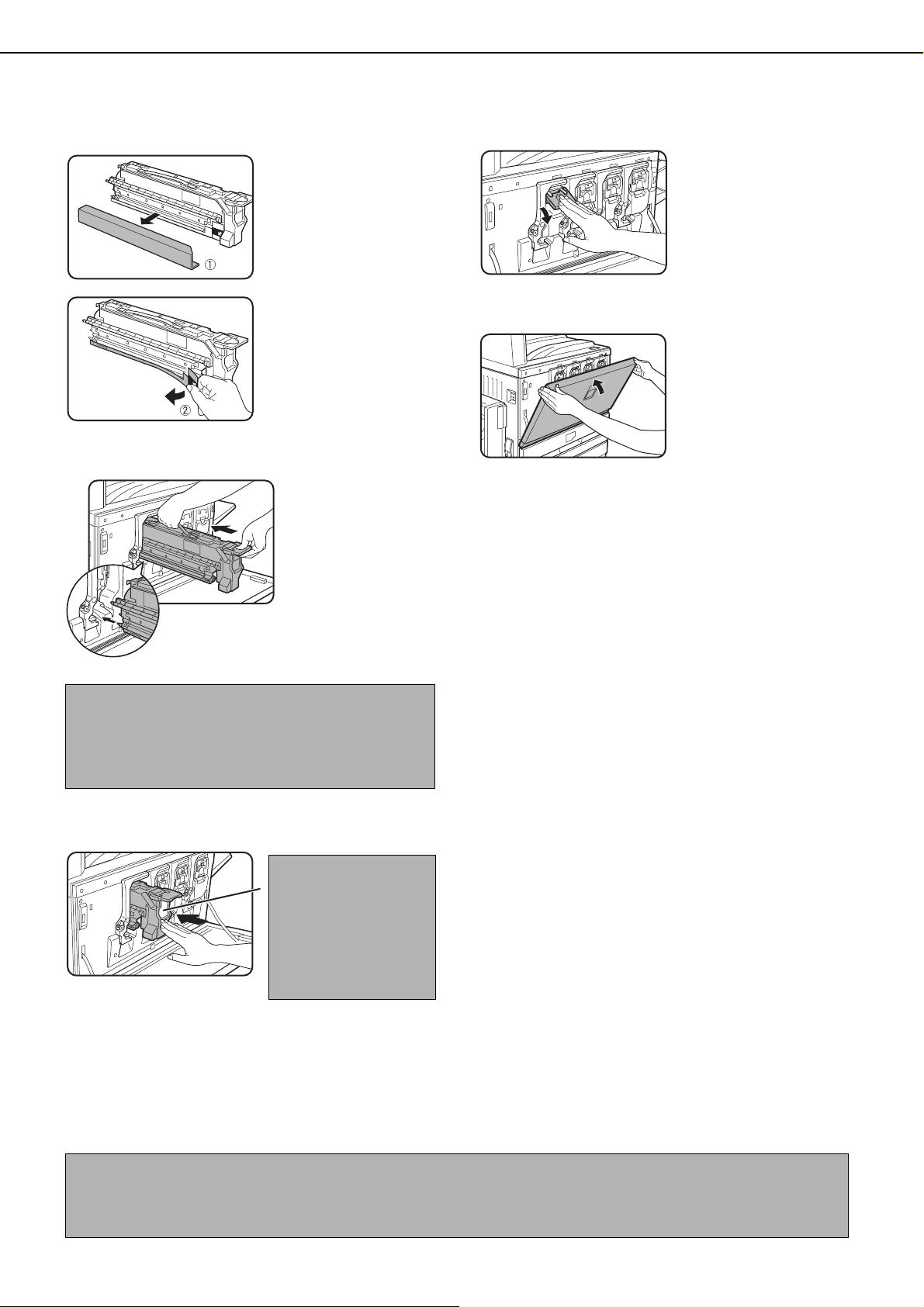
REPLACING THE TONER CARTRIDGES
2-16
5
Remove the protective material from the
new toner cartridge.
6
Insert the new toner cartridge.
Align the insert holes
as shown and then
push the cartridge in.
7
Push the cartridge in until it locks securely
in place.
8
Return the cartridge lock lever.
9
Close the front cover.
After the toner cartridge
is replaced, the machine
automatically enters
resolution adjustment
mode. (In some cases,
this may take about 5
minutes.)
NOTE
A toner cartridge of a different color cannot be
installed. For instance, a yellow cartridge cannot be
installed in the cyan position.
NOTE
Do not push the white
area shown in the
illustration.
The lock lever may
come down.
CAUTION
● Do not throw the toner cartridge into a fire. Toner may fly and cause burns.
● Store toner cartridges out of the reach of small children.
ApollonII_general-copy_SEC.book 16 ページ 2004年9月6日 月曜日 午後4時57分
2-17
2
STORAGE OF SUPPLIES
Standard supplies for this product that can replaced by the user include paper, toner cartridges, and staple cartridges
for the finisher.
■
■■
■ Proper storage
1. Store the supplies in a location that is:
● clean and dry,
● at a stable temperature,
● not exposed to direct sunlight.
2. Store paper in the wrapper and lying flat.
3. Paper stored in packages standing up or out of
the wrapper may curl or become damp, resulting
in paper misfeeds.
4. Store a new toner cartridge box horizontally. Do
not store it standing on end. If stored standing on
end, the toner may not distribute well even after
shaking the cartridge vigorously, and will remain
inside the cartridge without flowing out.
For best copying results, be sure to use only Sharp Genuine Supplies which are designed,
engineered, and tested to maximize the life and performance of Sharp products. Look for
the Genuine Supplies label on the toner package.
GENUINE SUPPLIES
Supply and Consumables
The supply of spare parts for a repair of the appliance is guaranteed for at least 7 years following the termination
of production. Spare parts are those parts of the apparatus which may break down within the scope of the ordinary
use of the product - whereas those parts which normally exceed the life of the product are not to be considered
as spare parts. Consumables too, are available for 7 years following the termination of production.
ApollonII_general-copy_SEC.book 17 ページ 2004年9月6日 月曜日 午後4時57分

2-18
MISFEED REMOVAL
When a misfeed has occurred during printing, the message "MISFEED HAS OCCURRED." will appear in the touch
panel display of the operation panel and printing output will stop. The approximate locations of possible misfeeds are
indicated by " " in the illustration below. The page numbers for detailed information for misfeed removal for each
are also shown.
Misfeed removal guidance
Misfeed removal guidance can be displayed by touching the [INFORMATION] key on the touch panel after a misfeed
has occurred.
NOTE
Received faxes are all temporarily stored in memory. If a paper misfeed occurs, received faxes cannot be printed.
When the misfeed is removed, the received faxes will print out automatically.
NOTES
● Be careful not to tear
the misfed paper
during removal.
● If paper is accidentally
torn during removal,
be sure to remove all
pieces.
● Take care not to
damage or leave
fingerprints on the
transfer belt when
removing the misfed
paper.
Misfeed in the fusing area,
and exit area (page 2-20)
Misfeed in the duplex
bypass/inverter unit
(page 2-22)
Misfeed in the reversing
single pass feeder
(see page 7-2 in the
"Copy Functions"
Misfeed in the transport
area (page 2-20)
Misfeed in the bypass tray
(page 2-19)
Misfeed in the 500 sheet
paper drawer
(page 2-19)
Misfeed in the stand/1 x
500 sheet paper drawer or
the stand/3 x 500 sheet
paper drawer
(page 2-21)
Misfeed in the large capacity
tray
(page 3-17)
Misfeed in the duplex
module/2 x 500 sheet paper
drawer (page 2-22)
Misfeed in the saddle
stitch finisher (page 3-10)
CAUTION
The fusing unit is hot. Take care in removing paper.
Upper fusing unit
Fusing unit paper guide
Transfer belt
INFORMATION
ApollonII_general-copy_SEC.book 18 ページ 2004年9月6日 月曜日 午後4時57分
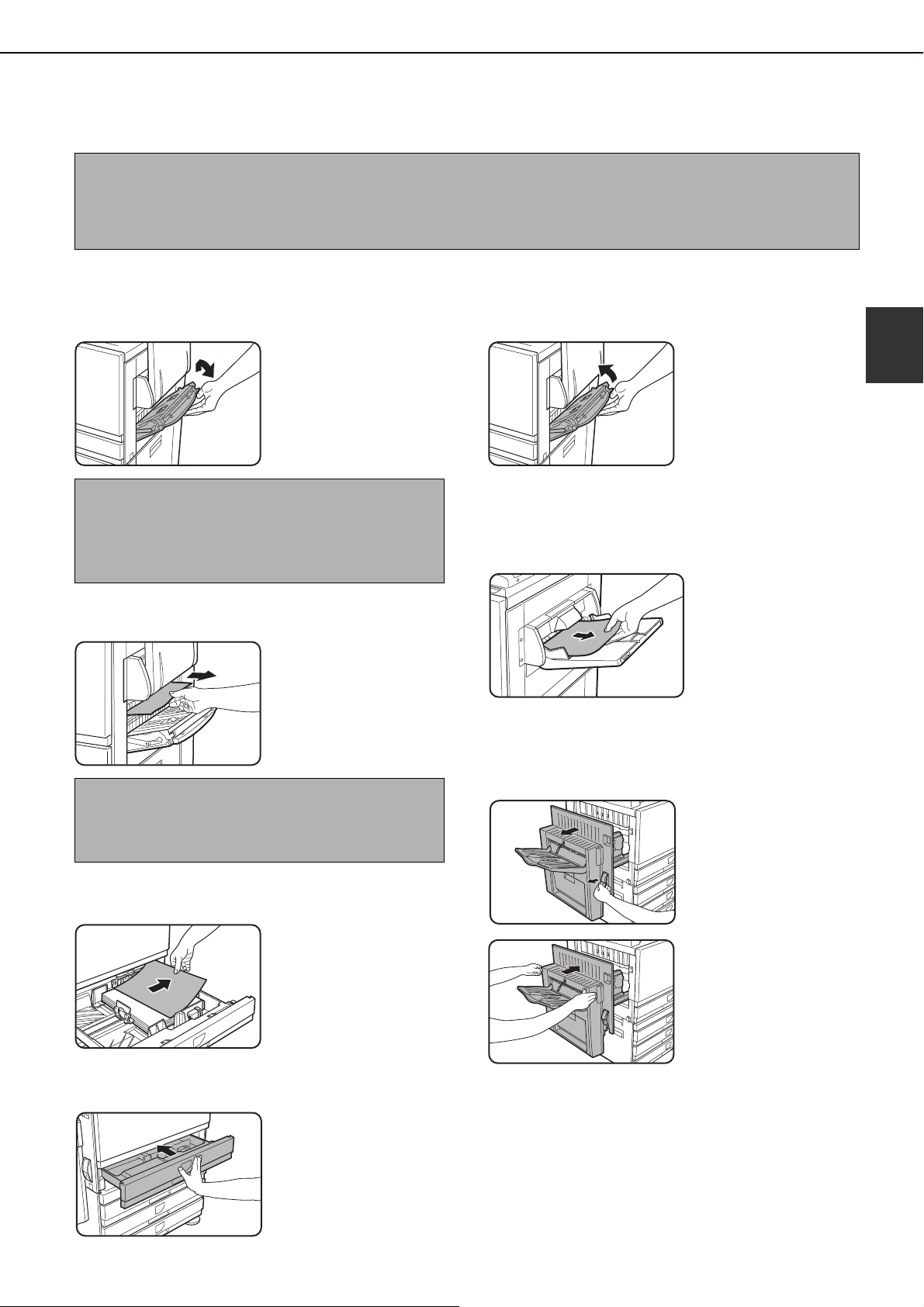
MISFEED REMOVAL
2-19
2
Misfeed in the paper feed area
Misfeed in the 500 sheet paper drawer
1
Open the upper side cover.
Push the lever upward
and gently open the
cover.
2
Remove the misfed paper.
Be careful not to tear the
misfed paper during
removal.
3
If misfed paper is not found in step 2, pull out
paper tray 1 and remove the misfed paper.
Be careful not to tear the
misfed paper during
removal.
4
Gently close the paper tray.
Push the tray firmly all
the way into the
machine.
5
Gently close the upper side cover.
After closing, confirm
that the misfeed
message has been
cleared and the normal
display appears.
Misfeed in the bypass tray
1
Remove the misfed paper from the bypass
tray.
Be careful not to tear the
misfed paper during
removal.
2
After removing the misfed paper, open
and close the duplex bypass/inverter unit
to reset.
Grasp the finger hold
and gently open the unit.
After closing, confirm that
the misfeed message
has been cleared and the
normal display appears.
If the duplex bypass/
inverter unit is not
installed, close the side
cover in the same way.
NOTE
Paper misfed from a paper tray may be extending out of the tray into the right side cover area. In this case if the
tray is drawn out of the machine, the paper may become torn and difficult to remove. To prevent this from
happening, always open the right side cover first and remove the misfed paper if it is extending into that area.
NOTE
If paper is loaded in the bypass tray, temporarily
remove the paper and close the bypass tray before
opening the side cover.
NOTE
The misfeed may have occurred inside the machine.
Check carefully and remove it.
ApollonII_general-copy_SEC.book 19 ページ 2004年9月6日 月曜日 午後4時57分
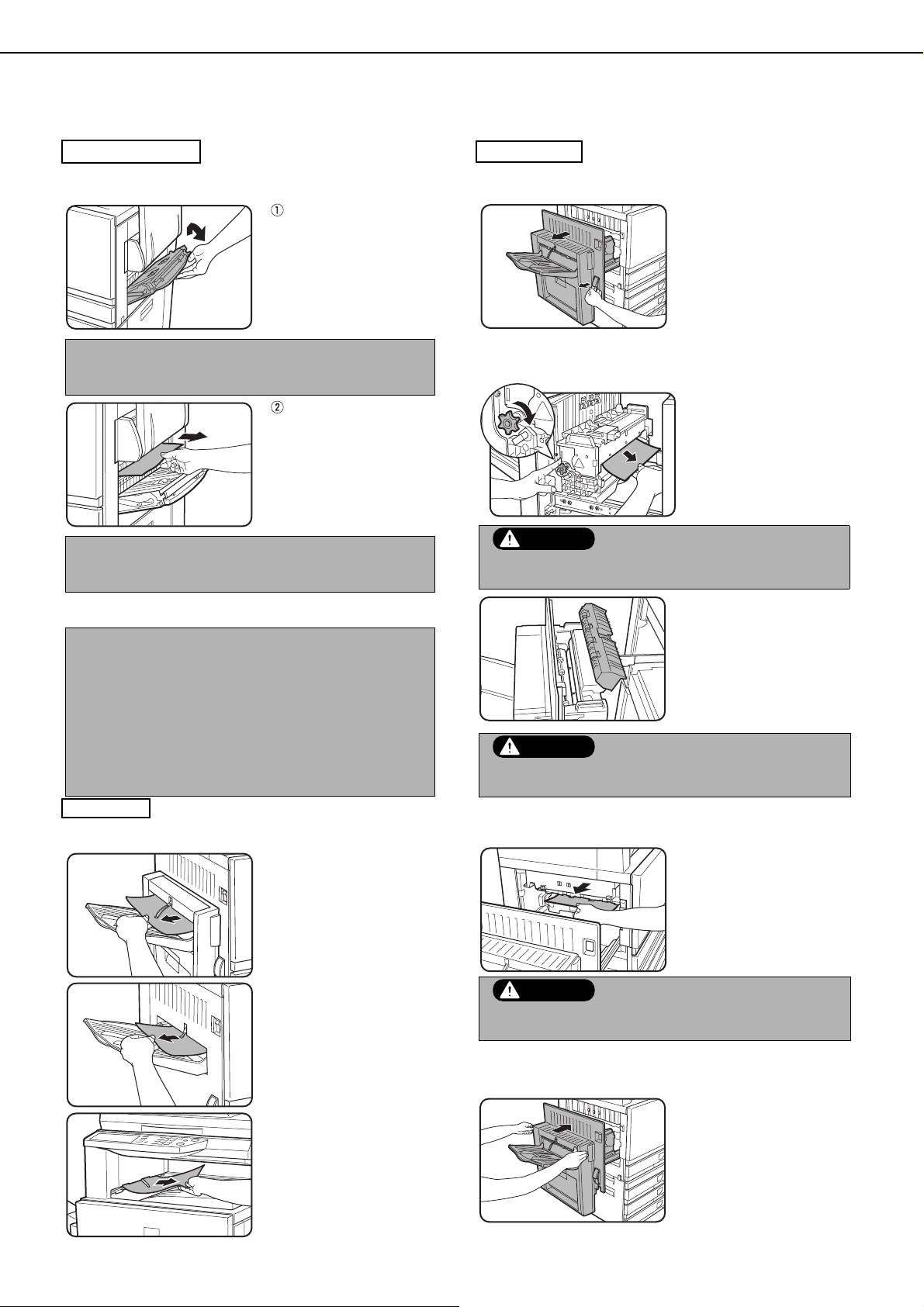
MISFEED REMOVAL
2-20
Misfeed in the transport area, fusing area, and exit area
Transport area
1
Open the upper side cover and check for a
misfeed.
Push the lever upward
and gently open the
cover.
Be careful not to tear the
misfed paper during
removal.
2
Gently close the upper side cover.
Exit area
1
Misfeed in the exit area
Models with an exit tray
attached to the duplex
bypass/inverter unit:
Gently remove the misfed
paper as shown in the
illustration, taking care
not to tear the paper.
Models without the
duplex bypass/
inverter unit:
Gently remove the misfed
paper as shown in the
illustration, taking care
not to tear the paper.
Upper exit tray:
Gently remove the
misfed paper as shown
in the illustration, taking
care not to tear the
paper.
Fusing area
1
Open the duplex bypass/inverter unit.
Grasp the finger hold
and gently open the unit.
2
Remove the misfed paper as shown in the
illustrations below.
If paper is misfed in the
transport area, turn roller
rotating knob A in the
direction of the arrow to
remove the misfed paper.
If you do not find a
misfeed, open the cover
of the fusing unit and
check for a misfeed
inside the fusing unit.
3
Misfeed in the transfer unit
If paper is misfed on the
transfer belt, remove it
gently without touching
the transfer belt. Do not
pull out the transfer unit.
4
Gently close the duplex bypass/inverter unit.
After closing, confirm that
the misfeed message
has been cleared and the
normal display appears.
If the duplex bypass/
inverter unit is not
installed, close the side
cover in the same way.
NOTE
If paper is loaded in the bypass tray, temporarily remove the
paper and close the bypass tray before opening the side cover.
NOTE
The misfeed may have occurred inside the machine.
Check carefully and remove it.
NOTE
Even after clearing a misfeed, paper may remain inside
the machine on the transfer belt where it is not visible. In
this case, after visible misfeeds are removed, the paper
on the transfer belt will be automatically moved to a
position where it is visible and a misfeed will be indicated
once again on the display. Clear the misfeed as explained
in "Misfeed in the transfer unit" (step 3 on the right side of
this page). For this reason, it may be necessary to
perform the "Misfeed in the transfer unit" procedure twice.
The fusing unit is hot. Take care in removing paper. (Do
not touch any metal parts.)
The fusing unit is hot. Take care in removing paper. (Do not
touch any metal parts.)
The transfer unit is hot. Take care in removing paper. (Do
not touch any metal parts.)
CAUTION
CAUTION
CAUTION
ApollonII_general-copy_SEC.book 20 ページ 2004年9月6日 月曜日 午後4時57分
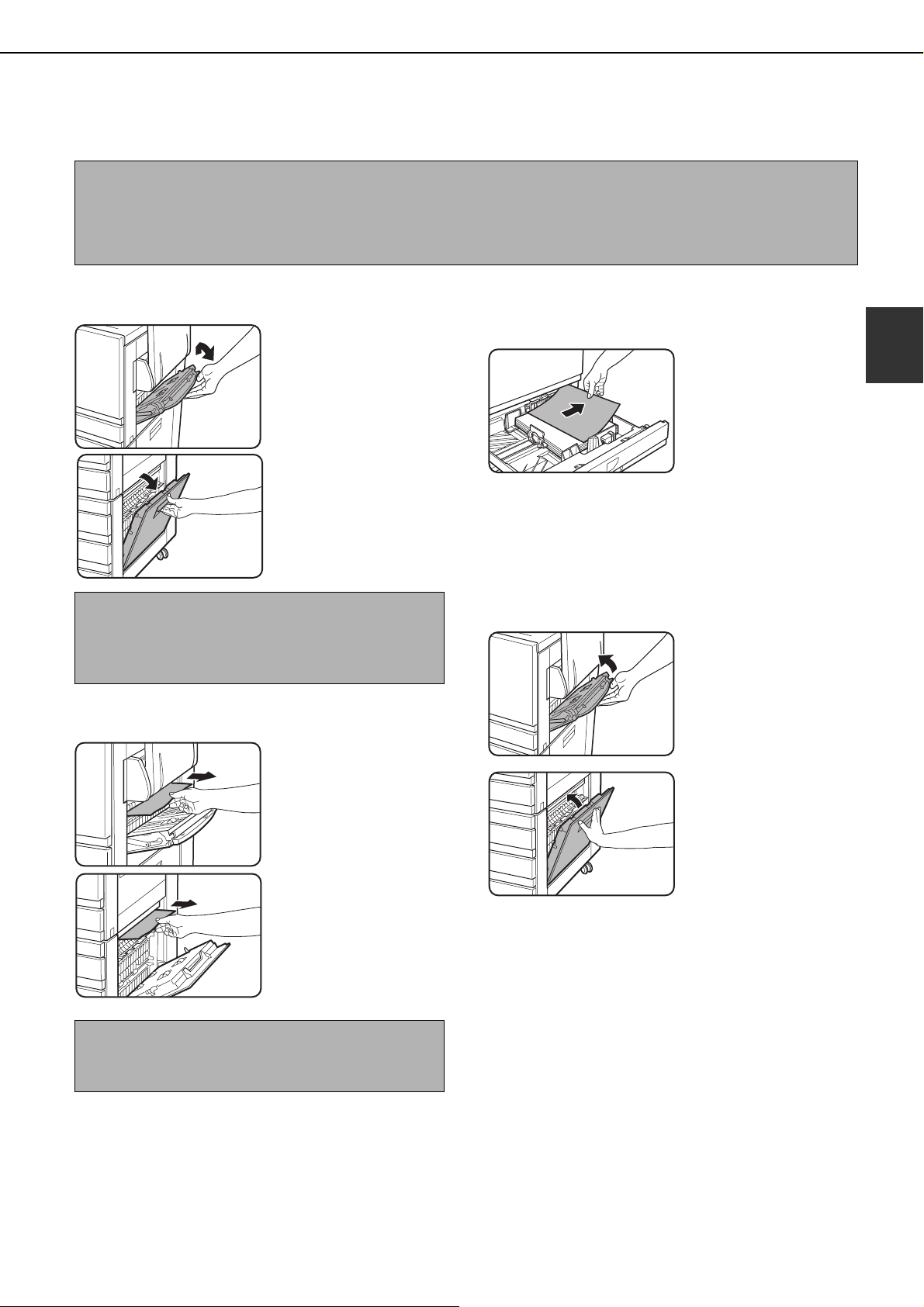
MISFEED REMOVAL
2-21
2
Misfeed in the stand/1 x 500 sheet paper drawer
1
Open the upper and lower side covers.
Push the lever upward
and gently open the
cover.
2
Remove the misfed paper.
Be careful not to tear the
misfed paper during
removal.
3
If misfed paper is not found in step 2, pull
out paper tray 1 and remove the misfed
paper.
Be careful not to tear the
misfed paper during
removal.
4
Gently push the paper tray into the
machine.
Push the tray firmly all the way into the machine.
5
Gently close the upper and lower side
covers.
After closing, confirm
that the misfeed
message has been
cleared and the normal
display appears.
Misfeed in the stand/3 x 500 sheet paper drawer
To remove a misfeed in the upper, middle, or lower tray, follow steps 1 through 5 above of "Misfeed in the stand/1
x 500 sheet paper drawer".
NOTE
Paper misfed from a paper tray may be extending out of the tray into the right side cover area. In this case if the
tray is drawn out of the machine, the paper may become torn and difficult to remove. To prevent this from
happening, always open the right side cover first and remove the misfed paper if it is extending into that area.
NOTE
If paper is loaded in the bypass tray, temporarily
remove the paper and close the bypass tray before
opening the side cover.
NOTE
The misfeed may have occurred inside the machine.
Check carefully and remove it.
ApollonII_general-copy_SEC.book 21 ページ 2004年9月6日 月曜日 午後4時57分
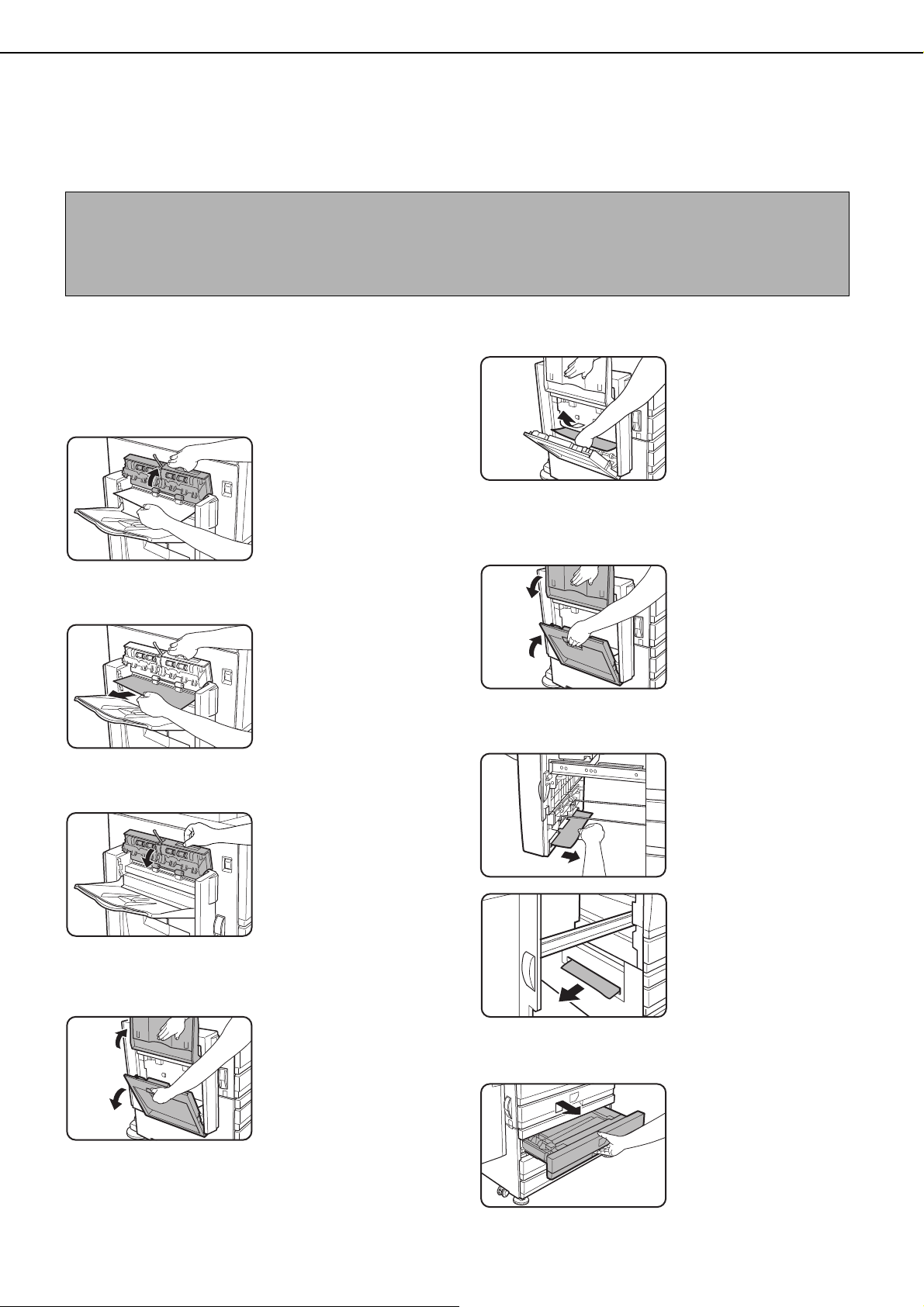
MISFEED REMOVAL
2-22
Misfeed in the duplex bypass/inverter unit and duplex
module/2 x 500 sheet paper drawer
1
Perform steps 1 and 2 of "Misfeed in the
stand/1 x 500 sheet paper drawer" on the
previous page.
2
Open the upper cover of the duplex
bypass/inverter unit.
3
Remove the misfeed from the upper part of
the duplex bypass/inverter unit.
Hold the upper cover of
the unit open while
removing the misfed
paper.
4
Close the upper cover of the duplex
bypass/inverter unit.
5
Lift the exit tray if one is installed and open
the cover of the duplex bypass/inverter
unit.
6
Remove the misfed paper.
While holding the exit
tray up, remove the
misfed paper as shown
in the illustration. Be
careful not to tear the
misfed paper during
removal.
7
Close the cover of the duplex bypass/
inverter unit and return the exit tray to its
original position.
8
Remove a misfeed from the bottom of the
duplex bypass/inverter unit.
Gently remove the
misfed paper from the
bottom of the duplex
bypass/inverter unit as
shown in the illustration,
taking care not to tear
the paper.
Make sure that there is
no misfed paper in the
machine.
9
Pull out the duplex module of the duplex
module/2 x 500 sheet paper drawer.
NOTE
Paper misfed from a paper tray may be extending out of the tray into the right side cover area. In this case if the
tray is drawn out of the machine, the paper may become torn and difficult to remove. To prevent this from
happening, always open the right side cover first and remove the misfed paper if it is extending into that area.
ApollonII_general-copy_SEC.book 22 ページ 2004年9月6日 月曜日 午後4時57分
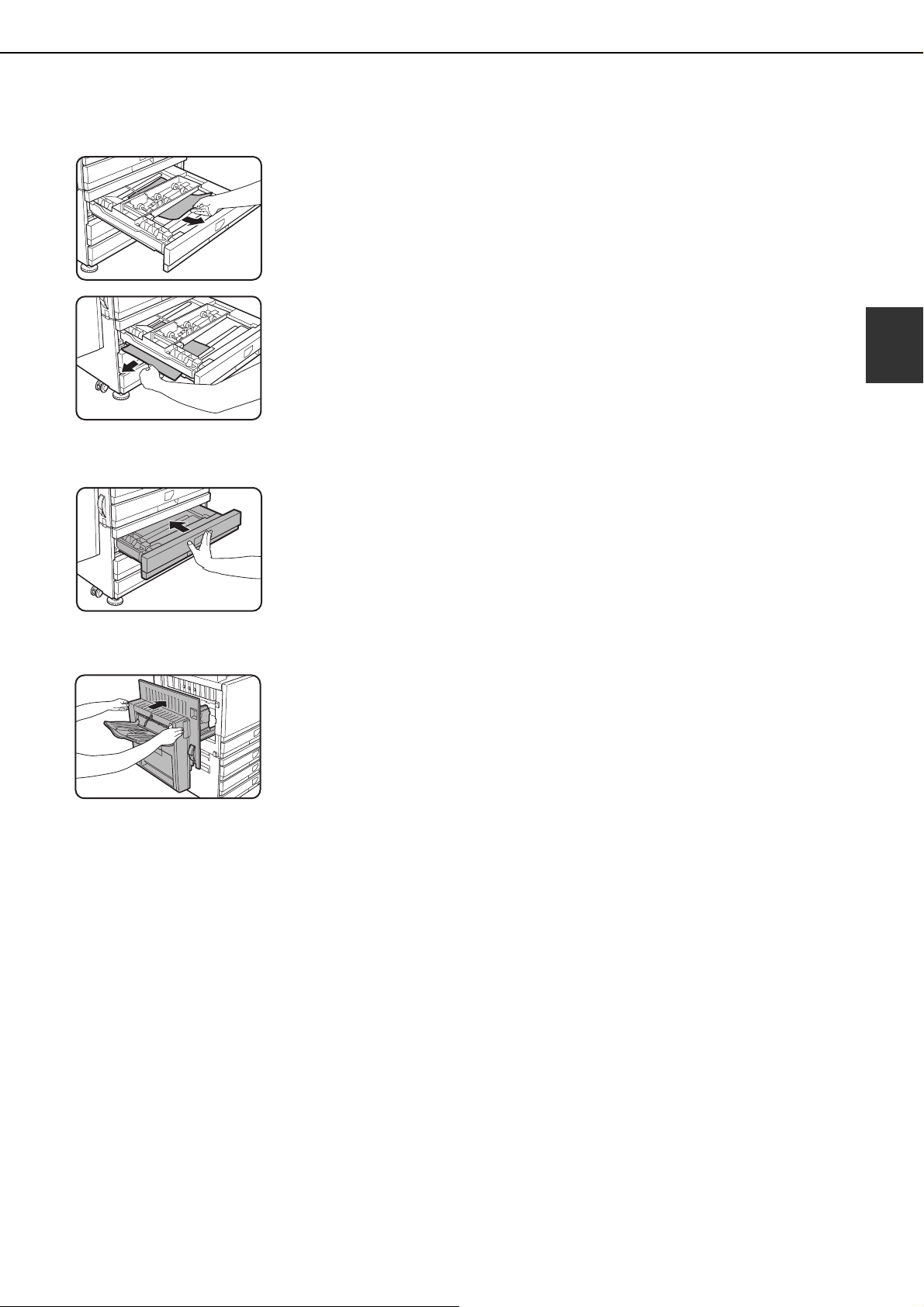
MISFEED REMOVAL
2-23
2
10
Remove the misfed paper from the duplex
module.
Be careful not to tear the
misfed paper during
removal.
11
Gently close the duplex module.
Push the tray firmly all
the way into the
machine.
12
Gently close the duplex bypass /inverter
unit.
■
■■
■ Misfeed in the upper or lower tray
To remove misfed paper from the upper tray or
lower tray, follow steps 1 through 5 of "Misfeed in
the stand/1 x 500 sheet paper drawer" on page 2-
21.
ApollonII_general-copy_SEC.book 23 ページ 2004年9月6日 月曜日 午後4時57分
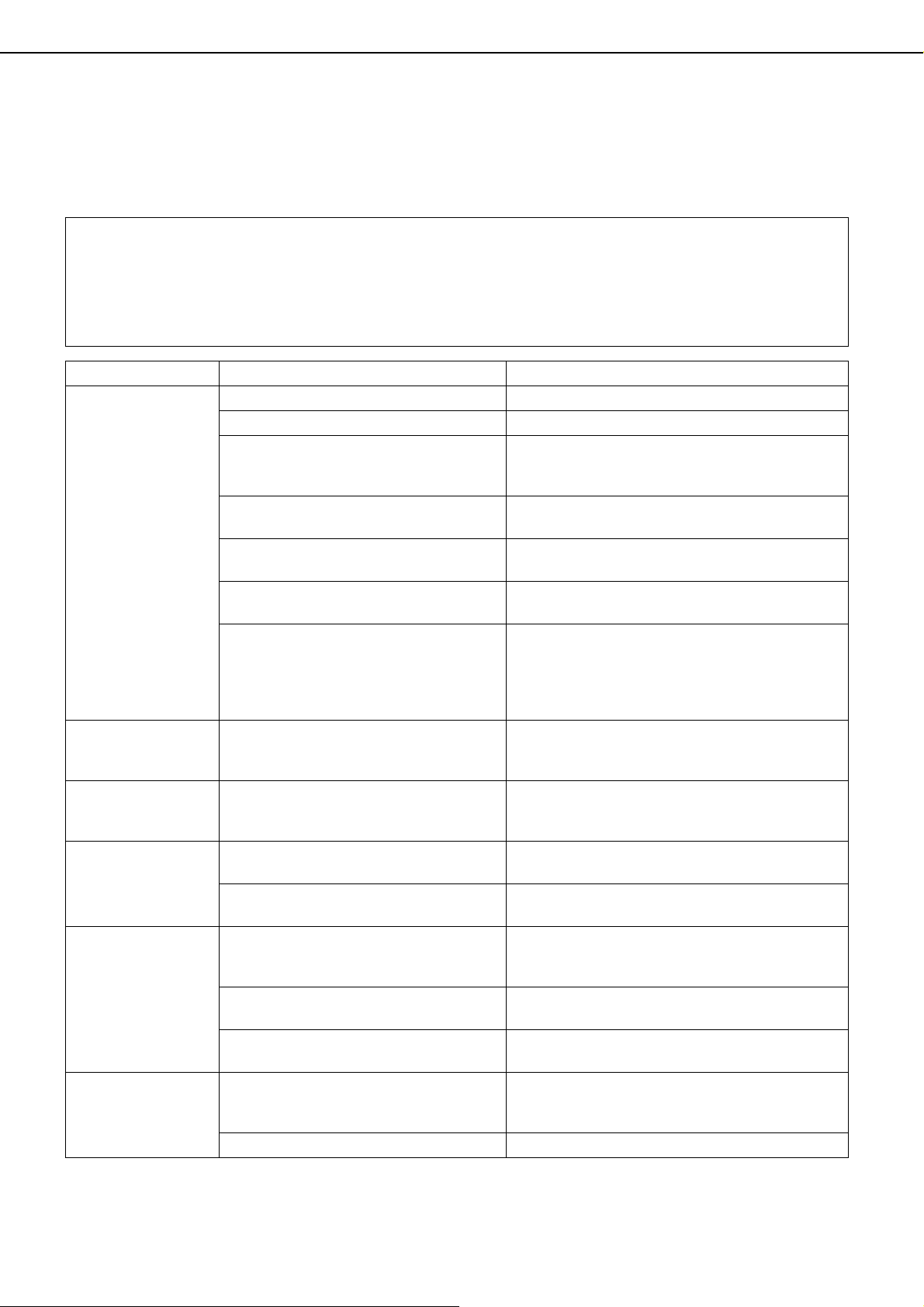
2-24
TROUBLESHOOTING
Check the following troubleshooting list before requesting service as many problems can be fixed by the user. If you
are unable to solve the problem by checking the list, turn off the power switch, unplug the power cord.
Problems related to general use of the machine are described below. For problems related to the copy function, see
page 7-4. For fax, printer, and network scanner problems, see the manuals for those functions. For peripheral device
problems, see the explanation of the device.
If the message "CALL FOR SERVICE. CODE:**-**" appears in the touch panel, turn off the power switch, wait
about 10 seconds, and then turn the power switch back on. If the message still appears after turning the switch
off and on several times, it is likely that a failure has occurred and maintenance would be required. In this event,
stop using the machine, unplug the power cord, and contact your Sharp dealer.
Note : Letters and numbers appear in "**-**" above. When you contact your Sharp dealer, please tell your dealer
what letters and numbers appear.
Problem Check Solution or cause
The machine does
not operate.
Printer plugged in? Plug the printer into a grounded outlet.
Power switch on? Turn on the power switch.
READY indicator off?
The printer is warming up. (Warm-up time is
approximately 99 seconds.) Wait until the
READY indicator lights up.
Message indicating need to load paper
displayed?
Load paper. (page 2-2)
Message indicating need to replace the
toner cartridge displayed?
Replace the toner cartridge.(page 2-15)
Message indicating a paper misfeed
displayed?
Remove misfed paper. (page 2-18)
A message appears saying that the
power must be turned off and then
turned on.
Turn off the power switch, wait about 10 seconds,
and then turn on the switch again. If the same
message appears after turning the power switch off
and on several times, it is possible that the machine
needs service. In this event, contact your dealer.
Copying/printing is
not possible.
A message appears saying that this type
of paper cannot be used for two-sided
copying.
Two-sided printing is not possible on special
paper. Use paper that can be used for automatic
two-sided printing. (page 2-10)
Incorrect bypass
tray paper size.
Incorrect display of paper sizes 12" x 18",
11" x 17", 8-1/2" x 14", 8-1/2" x 13",
8-1/2" x 11"R, A3W, A3, B4 or A4R only.
When loading sizes 12" x 18", 11" x 17", 8-1/2" x
14", 8-1/2" x 13", 8-1/2" x 11"R, A3W, A3, B4 or
A4R, be sure to open the tray extension.
Copying/printing on
paper from the
bypass tray is
skewed.
The number of sheets placed on the bypass
tray exceeds the maximum number.
Do not place more than the maximum number of
sheets.
The bypass guide is not adjusted to the
size of the loaded paper.
Adjust the bypass guide to the size of the loaded
paper.
Paper from the
bypass tray
misfeeds.
The paper size and paper type have not
been set.
Be sure to set the paper size and paper type
when using special size or special type papers.
(page 2-12)
The number of sheets placed on the bypass
tray exceeds the maximum number.
Do not place more than the maximum number of
sheets.
The bypass guide is not adjusted to the
size of the loaded paper.
Adjust the bypass guide to the size of the loaded
paper.
Printing stops
before the job is
finished.
If too many pages collect on the output
tray, the tray full sensor activates and
stops printing.
Remove the paper from the output tray.
You have run out of paper. Load paper. (page 2-2)
ApollonII_general-copy_SEC.book 24 ページ 2004年9月6日 月曜日 午後4時57分
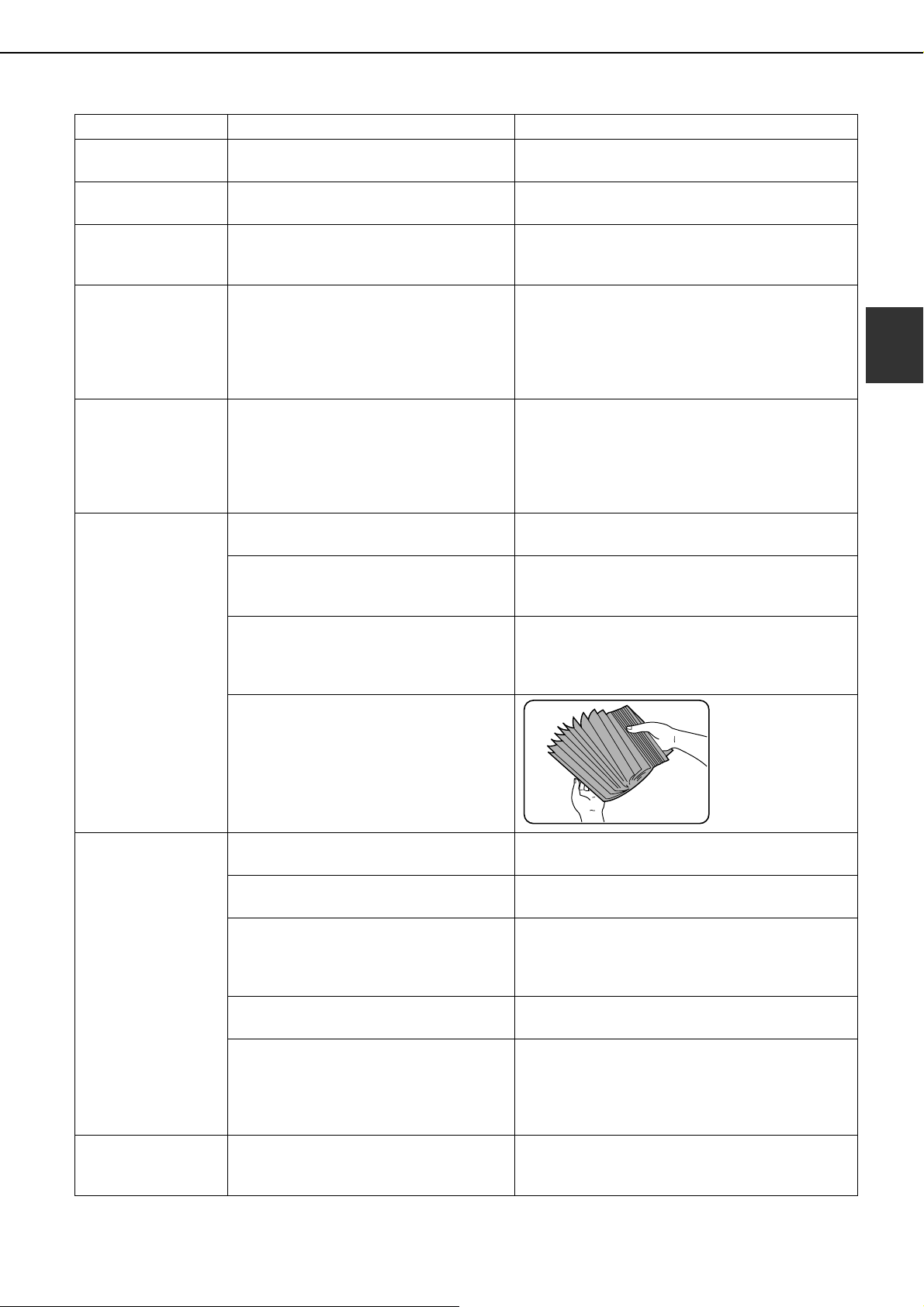
TROUBLESHOOTING
2-25
2
Smudges on printed
sheets.
Does a message appear indicating the
need for maintenance?
Please contact the your dealer as soon as
possible.
Color deviations
occur.
When printing in color, character and color
deviations appear.
Perform color registration as explained on pages
12 and 13 of the key operator's guide.
The displayed paper
size differs from the
loaded paper size.
The display of the tray's paper size slide
differs from the paper size in the tray.
When you change the paper size in the tray, be
sure to adjust the paper size slide on the tray to
the new paper size. (page 2-2)
When printing on a
special size of
paper, part of the
printed image is
missing.
The paper size setting is not set
correctly in the paper tray settings of the
custom settings.
When using a special size of paper, set the
correct paper size in millimeters in the paper tray
settings of the custom settings (see page 2-11). If
the paper size setting is not correct, part or all of
the image may not print (this depends on the
options installed).
When printing on a
special size of paper
using the bypass
tray, part of the
printed image is
missing.
The paper size is not set correctly in the
special size settings for the bypass tray.
When using a special size of paper, set the
correct paper size in millimeters as explained in
step 6 on page 2-12. If the paper size setting is
not correct, part or all of the image may not print
(this depends on the options installed).
Paper misfeeds
frequently.
Is paper other than SHARP-
recommended paper being used?
Use SHARP-recommended paper.
Paper curled or damp?
Do not use curled or crimped paper. If you do not
use paper for a long time, store paper in the
wrapper in a dry location.
Is the paper curled and does it
frequently misfeed in the duplex
module/2 x 500 sheet paper drawer or
saddle stitch finisher?
Paper may be curled when output depending on
the paper type and quality.
In some cases turning the paper over in the tray
will reduce misfeeding due to curling.
Multiple sheets of paper fed
simultaneously?
Remove the paper
from the paper tray
or the bypass tray,
fan the paper as
shown in the
illustration, and
then load it again.
Printed paper is
wrinkled or the
image rubs off
easily.
Is paper other than SHARP-
recommended paper being used?
Use SHARP-recommended paper.
Is paper size or weight out of the
allowable range?
Use paper in the allowable range.
Do wrinkles appear when printing
envelopes?
Moving the pressure adjusting levers of the
fusing unit from the normal position to a weaker
pressure position may help alleviate this
problem. (page 2-6)
Is the pressure adjustment lever of the
fusing unit out of position?
Return the pressure adjusting levers of the
fusing unit to the normal position. (page 2-7)
Paper damp?
Be sure to store paper in the wrapper in a dry
location and do not store paper in a location that is
●humid
●at a high temperature or an extremely low
temperature.
The contrast on the
touch panel is too
high or too low.
Is LCD contrast properly adjusted?
Adjust the contrast using "DISPLAY
CONTRAST" of custom settings. (page 2-13)
Problem Check Solution or cause
ApollonII_general-copy_SEC.book 25 ページ 2004年9月6日 月曜日 午後4時57分

ApollonII_general-copy_SEC.book 26 ページ 2004年9月6日 月曜日 午後4時57分

3-1
CHAPTER 3
PERIPHERAL DEVICES
This chapter explains procedures for using the peripheral devices such
as the Saddle Stitch Finisher (AR-F13).
Page
SADDLE STITCH FINISHER .........................................................................3-2
●
Part names and functions ......................................................................3-2
●
Specifications.........................................................................................3-2
●
Saddle stitch finisher functions...............................................................3-4
●
Using the saddle stitch finisher ..............................................................3-6
●
Staple cartridge replacement and staple jam removal ...........................3-7
●
Misfeed in the saddle stitch finisher .....................................................3-10
●
Troubleshooting saddle stitch finisher problems ..................................3-12
●
Stapling position quick reference guide for duplex output....................3-13
●
Relation between print image and saddle stitch...................................3-14
LARGE CAPACITY TRAY ...........................................................................3-15
●
Part name.............................................................................................3-15
●
Specifications.......................................................................................3-15
●
Loading paper in the large capacity tray ..............................................3-16
●
Misfeed in the large capacity tray.........................................................3-17
ApollonII_general-copy_SEC.book 1 ページ 2004年9月6日 月曜日 午後4時57分
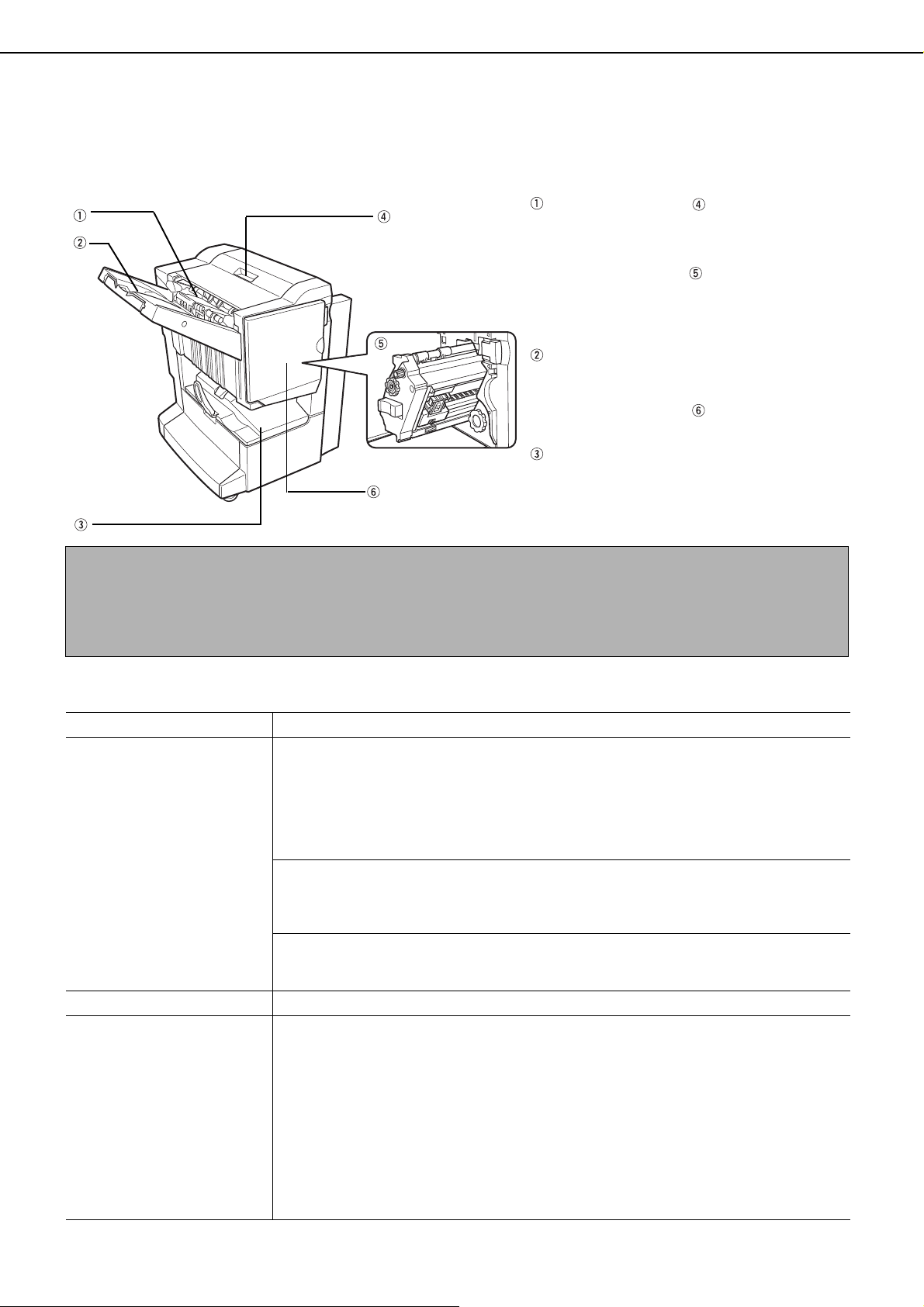
3-2
SADDLE STITCH FINISHER
The saddle stitch finisher can automatically place two staples for centerline binding of prints or copies and fold them
along the centerline. An optional hole punching unit is available for installation into the finisher.
Part names and functions
Specifications
NOTES
● Do not press on the saddle stitch finisher (particularly the offset tray).
● Use caution when near the offset tray during printing as the tray moves up and down.
● To install the saddle stitch finisher, a duplex bypass/inverter unit and either a stand/1 x 500 sheet paper drawer,
a stand/3 x 500 sheet paper drawer, or a duplex module/2 x 500 sheet paper drawer must also be installed.
Name SADDLE STITCH FINISHER (AR-F13)
Paper size/Useable paper
Paper size
Upper paper tray:
Face up output: Same as paper specifications of machine
Face down output: 12" x 18", 11" x 17", 8-1/2" x 14", 8-1/2" x 13", 8-1/2" x 11", 8-
1/2" x 11"R, 7-1/4" x 10-1/2"R, 5-1/2" x 8-1/2", A3W, A3, B4,
A4, A4R, B5, B5R, A5
Lower tray: 11" x 17", 8-1/2" x 11"R, A3, B4, A4R
Paper weight
Upper tray: 17 to 80 lbs. or 64 to 300 g/m
2
for face up output
17 to 54 lbs. or 64 to 200 g/m
2
for face down output
Lower tray: 17 to 28 lbs. or 64 to 105 g/m
2
Paper types
Upper tray: Same as paper specifications of the machine
Lower tray: Plain paper only
Number of trays 2 (offset tray + saddle stitch tray)
Tray capacity
Upper paper tray:
Non-stapling: 1000 sheets of paper: 8-1/2" x 11", 8-1/2" x 11"R, A4, A4R, B5, B5R
(21 lbs. or 80 g/m
2
)
500 sheets of paper: Sizes other than 8-1/2" x 11", 8-1/2" x 11"R,
A4, A4R, B5 or B5R (up to 10 envelopes or postcards inside the
staple compiler; alignment is not guaranteed)
Stapling: Maximum of 30 sets or 1000 sheets of 8-1/2" x 11", A4 or B5
paper (50 sets maximum for vertically fed paper stapled at one
location in the upper left corner). Maximum of 30 sets or 500 sheets
of other paper sizes.
Lower tray: Stapled print capacity is (6 - 10) sheets x 10 sets or (1 - 5)
sheets x 20 sets.
Stapler compiler
Paper to be
stapled is stacked
temporarily.
When printing on
post cards or
envelopes, remove
the output from here.
Offset tray
Output which is
stapled or offset
will be delivered to
this tray.
Saddle stitch tray
Saddle stitched
output is delivered
here.
Top cover
Open for misfeed
removal.
Stapler section
Open the front cover
and pull out this
section to replace
the staple cartridge
or to remove
jammed staples.
Front cover
Open to replace the
staple cartridge, to
remove the misfed
paper, or to remove
jammed staples.
(Continued on next page)
ApollonII_general-copy_SEC.book 2 ページ 2004年9月6日 月曜日 午後4時57分
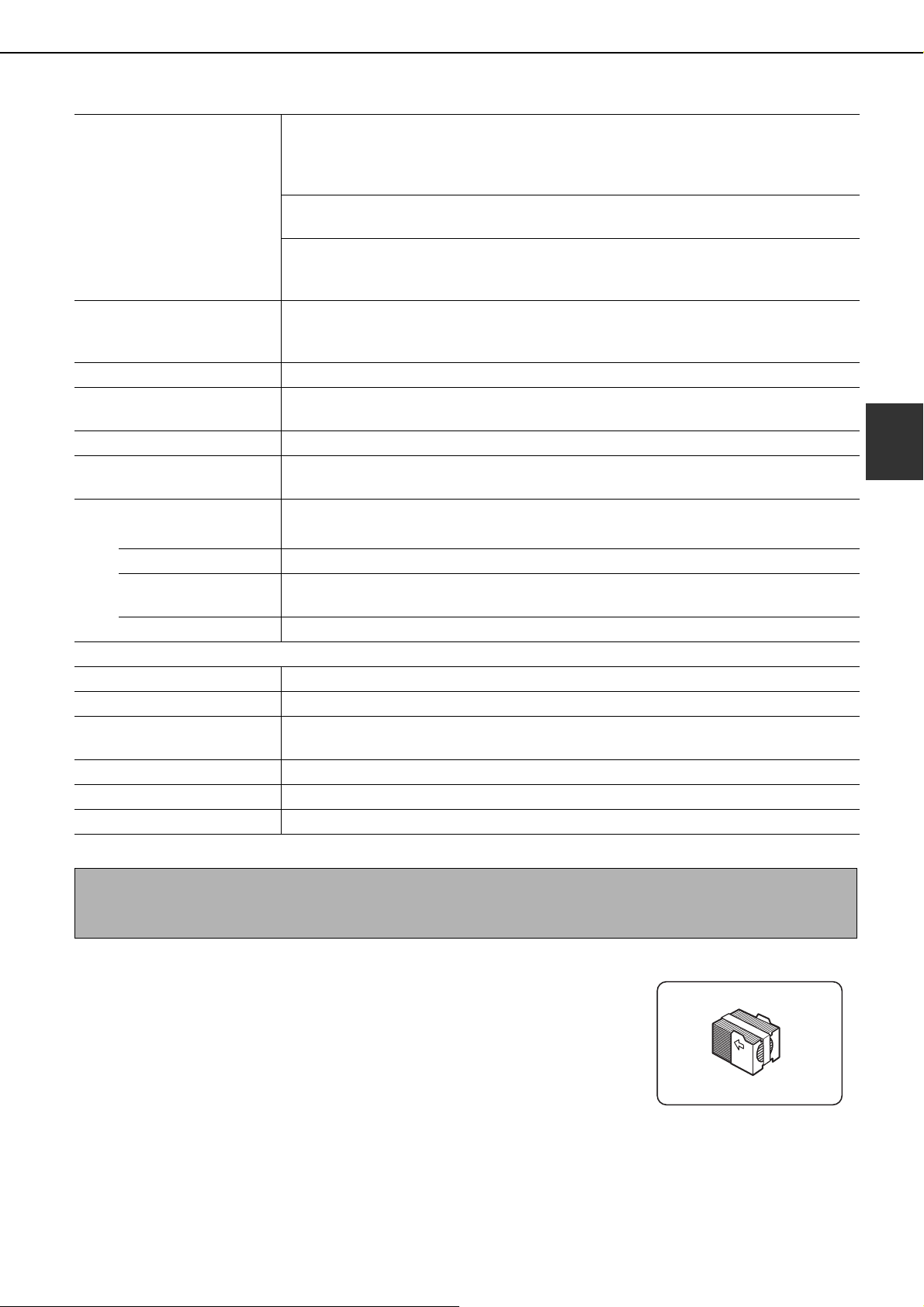
SADDLE STITCH FINISHER
3-3
3
Specifications are subject to change for improvement without notice.
Supplies
AR-SC2 staple cartridges must be used for this finisher.
The cartridge package contains three cartridges of approximately 5000 staples
each.
Staple
Allowed paper sizes for stapling
Upper tray: 11" x 17", 8-1/2" x 14", 8-1/2" x 13", 8-1/2" x 11", 8-1/2" x 11"R,
A3, B4, A4, A4R, B5
Lower tray: 11" x 17", 8-1/2" x 11"R, A3, B4, A4R
Maximum number of sheets for stapling
See "Staple sort mode" on the next page
Stapling positions
Upper tray: 3 locations (1 position back, 1 position front, 2 positions center)
Lower tray: 4-47/64" (120 mm) pitch from center of paper
Saddle stitch
Maximum of 10 sheets can be stapled (21 lbs. or 80 g/m
2
)
Paper size: 11" x 17", 8-1/2" x 11"R, A3, B4, A4R
Paper weight: 17 to 28 lbs. or 64 to 105 g/m
2
Power supply Supplied from machine (Stand / paper drawer)
Dimensions
24-59/64" (W) x 23-3/4" (D) x 30-23/64" (H)
(633 mm (W) x 603 mm (D) x 771 mm (H))
Weight Approximately 79.4 lbs. (36 kg)
Overall dimensions when
attached to machine
1432 mm (W) x 676 mm (D)
(56-25/64" (W) x 26-5/8" (D))
(when tray is extended)
Remarks
Paper output
Upper tray: Supports both face-up and face-down output Lower tray: Face-down output only
Paper full detection Both upper and lower tray
Offset function
Upper tray only (offset function not possible for 12" x 18", 5-1/2" x 8-1/2"R, A3W
and A5R size paper)
Paper conveying Center reference
Name Punch module
Hole punching 3 or 2 holes
Allowed paper sizes for
punching
3 holes: 11" x 17", 8-1/2" x 11", A3, A4
2 holes: 8-1/2" x 14", 8-1/2" x 11"R
Power supply Supplied from machine saddle stitch finisher
Dimensions 3-3/4" (W) x 22-1/16" (D) x 6-45/64" (H) (95 mm (W) x 560 mm (D) x 170 mm (H))
Weight Approximately 5.6 lbs. (2.5 kg)
NOTES
● Transparency film, envelopes, postcards, and other special papers cannot be stapled.
● If mixed paper sizes are selected for stapling jobs, stapling will be automatically canceled.
ApollonII_general-copy_SEC.book 3 ページ 2004年9月6日 月曜日 午後4時57分
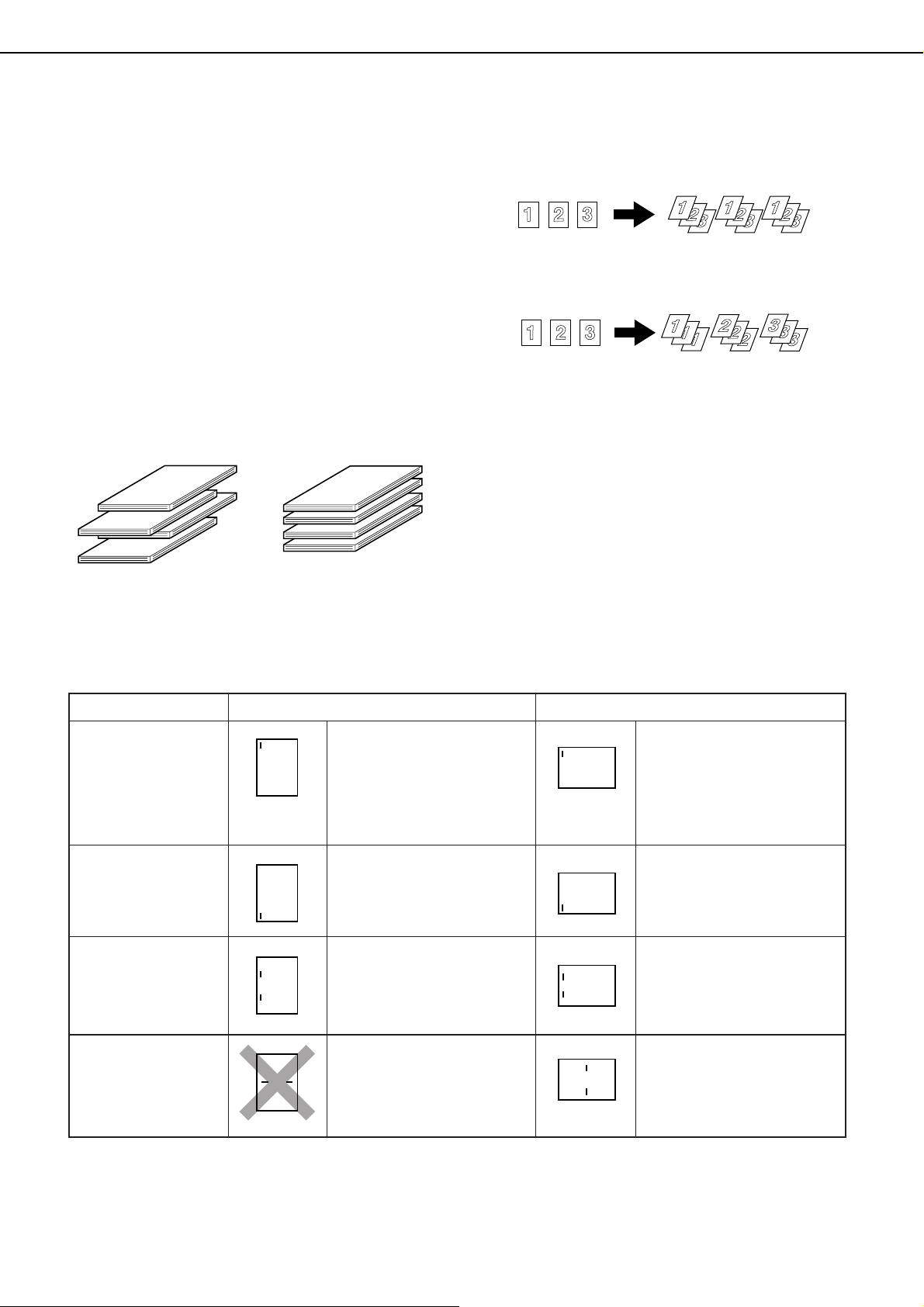
SADDLE STITCH FINISHER
3-4
Saddle stitch finisher functions
■
■■
■ Sort mode
Sorted sets will be delivered.
■
■■
■ Group mode
Groups of copies of the same page will be
delivered.
■
■■
■ Offset mode
Sets will move from side to side so that each set or
group will be offset from the previous set or group
for easy separation.
(The offset function only operates in the offset
tray.)
Stapled sets will not be offset.
■
■■
■ Staple sort mode
Collated sets of prints or copies will be stapled and delivered to the offset tray. When saddle stitching is selected,
the prints or copies will be stapled at the center and delivered to the saddle stitch tray. The stapling positions,
orientation, paper size for stapling, and stapling capacity are shown below.
PrintoutsOriginal
PrintoutsOriginal
Offset mode Non-offset mode
Stapling positions
Top left corner of
printouts
Lower left corner
of printouts
Portrait orientation
Landscape orientation
Available paper sizes:
8-1/2" x 11", A4 and B5
Stapling capacity:
For each size, up to 30 sheets
can be stapled
Same as above
Available paper sizes: 11" x 17",
8-1/2" x 14", 8-1/2" x 13", 8-1/2"
x 11"R, A3, B4 and A4R
Stapling capacity: Up to 30
sheets of 8-1/2" x 11"R or A4R
paper can be stapled, up to 25
sheets of other paper sizes
Saddle stitch on
centerfold line.
Paper in the portrait
direction cannot be saddle
stitched.
Available paper sizes: 11" x17",
8-1/2" x 11"R, A3, B4 and A4R
Stapling capacity: For each
size, up to 10 sheets can be
stapled
Center left two
positions of
printouts
Same as above
Same as above
Same as above
ApollonII_general-copy_SEC.book 4 ページ 2004年9月6日 月曜日 午後4時57分
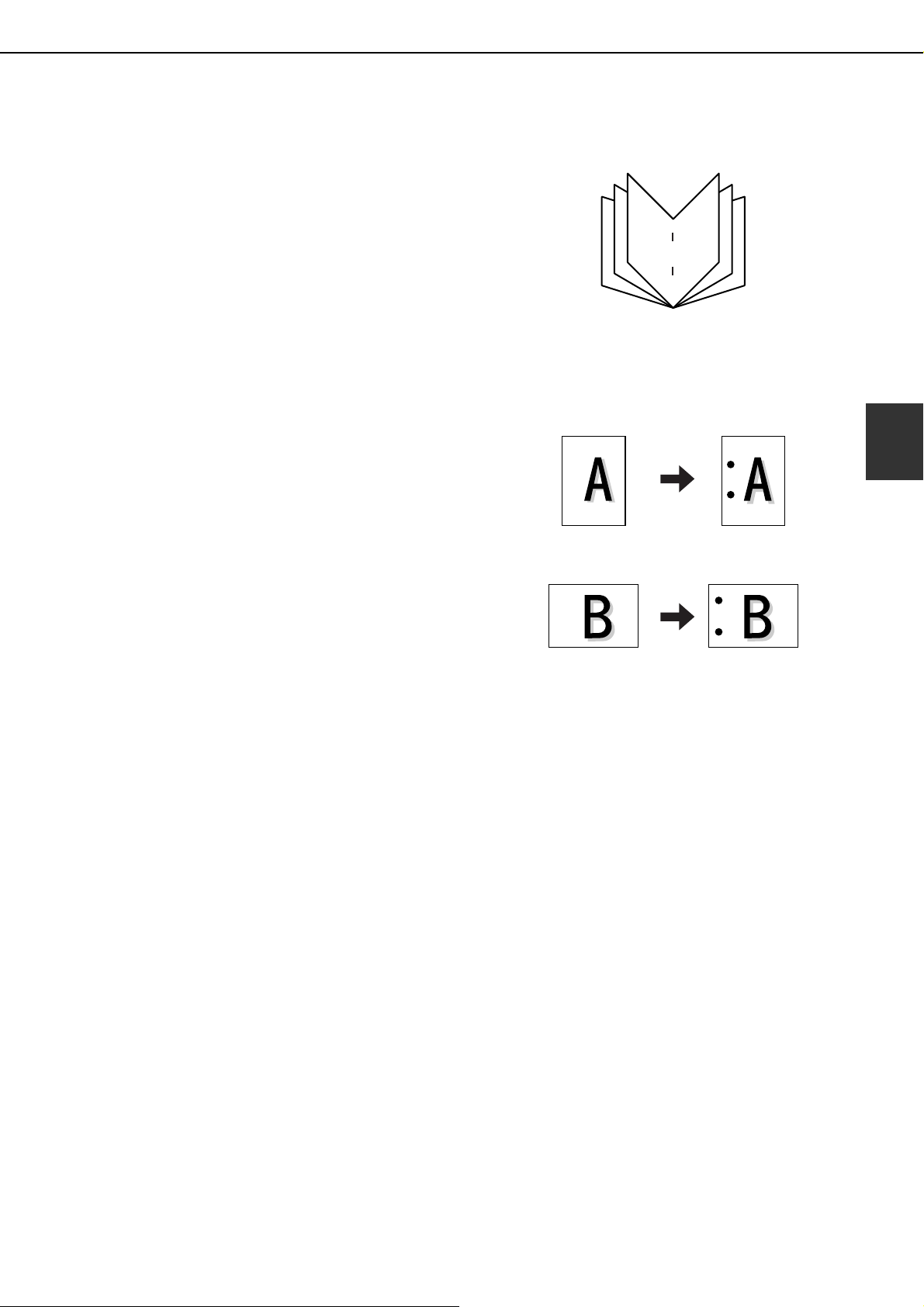
SADDLE STITCH FINISHER
3-5
3
■
■■
■ Saddle stitch function
The saddle stitch finisher can automatically place
two staples for centerline binding of prints or copies
and fold them along the centerline.
■
■■
■ Hole punching (only if a punch module is installed)
If the saddle stitch finisher is equipped with a hole
punch module, printed paper can be hole punched
and delivered to the offset tray. Saddle stitching
and hole punching cannot be selected at the same
time. The automatic image rotation will not function
when the hole punching function is used.
For the allowed paper sizes for punching, see the
specifications on page 3-3.
When using the punch function in copy mode,
place the original with the top toward the inside of
the machine. If the original is not placed in this
orientation, punching will not take place at the
correct positions. (See "Standard original setting
orientation" on page 4-7 of the copy section.)
9
11
7
2
4
6
<Example>
{Original 1} {Punch positions}
{Original 2} {Punch positions}
<Example>
ApollonII_general-copy_SEC.book 5 ページ 2004年9月6日 月曜日 午後4時57分
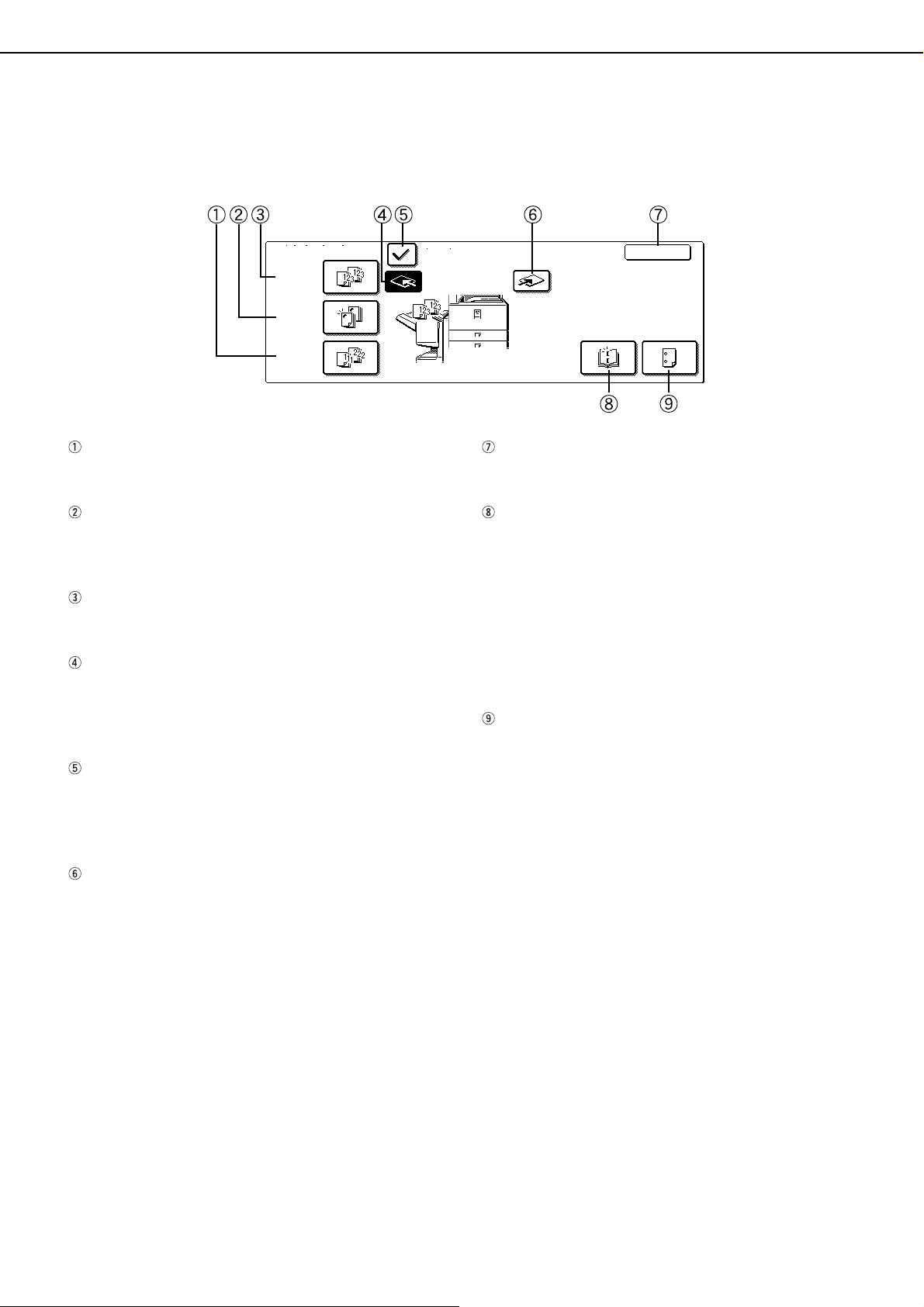
SADDLE STITCH FINISHER
3-6
Using the saddle stitch finisher
Touch the [Output] key on the main screen of copy mode to display the screen that allows selection of sort, staple
sort, centerline stapling, group function, and the output tray.
[GROUP] key (See page 3-4.)
When Group is selected, all copies of the same
original will be grouped.
[STAPLE SORT] key (See page 3-4.)
When Staple Sort is selected, sorted sets will be
stapled and delivered to the offset tray. (They will
not be offset stacked.)
[SORT] key (See page 3-4.)
When Sort is selected, sets of copies will be
sequentially delivered.
[FINISHER TRAY] key (See page 3-2.)
When the offset function is selected, output goes to
the offset tray. (The offset tray is automatically
selected when the staple sort function is turned
on.)
[OFFSET] key (See page 3-4.)
The offset function operates when "Yes" is
selected, and doesn't operate when "No" is
selected. (The offset checkmark is automatically
cleared when the staple sort function is turned on.)
[CENTER TRAY] key
If the center tray is selected, output paper will be
delivered to the exit tray located above the main
unit.
[OK] key
Touch to close the [OUTPUT] screen and to return
to the main screen.
[SADDLE STITCH] key (See page 3-5.)
When saddle stitching is selected, the copies will
be stapled at the center and delivered to the saddle
stitch tray.
Touch this key to display the pamphlet copy setting
screen (page 6-24). (This is only possible when a
checkmark appears in the checkbox of the
[AUTOMATIC SADDLE STITCH] key operator
program (see page 12 of the Key operator's
guide.))
[PUNCH] key (See page 3-5.)
If the saddle stitch finisher is equipped with a hole
punch module, printed paper can be hole punched
and delivered to the offset tray.
* When one of the functions is selected, it is
highlighted.
OUTPUT
OK
SADDLE
STITCH
PUNCH
FINISHER
TRAY
CENTER
TRAY
STAPLE
SORT
SORT
GROUP
OFFSET
ApollonII_general-copy_SEC.book 6 ページ 2004年9月6日 月曜日 午後4時57分
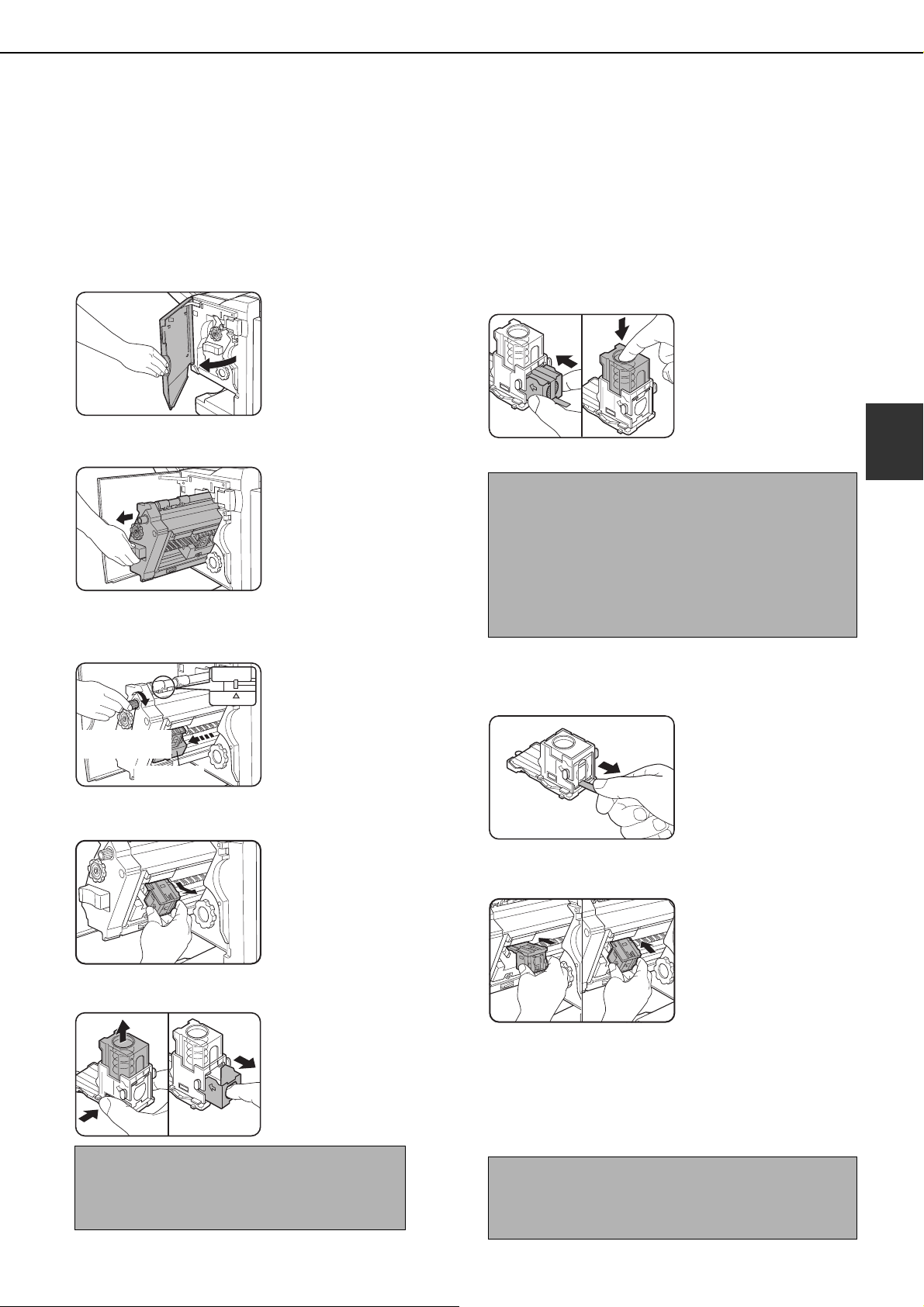
SADDLE STITCH FINISHER
3-7
3
Staple cartridge replacement and staple jam removal
When the staple cartridge becomes empty or staples become jammed, a message will appear in the message
display of the operation panel.
Follow the procedure below to replace the staple cartridge or remove jammed staples.
■
■■
■ Staple cartridge replacement
1
Open the front cover.
2
Pull out the stapler section.
3
Turn roller rotating knob A in the direction of
the arrow to move the staple unit to the front.
Turn the roller rotating
knob until the triangle
mark is aligned with the
index.
4
Remove the empty staple box.
5
Remove the empty staple cartridge.
Press the lock button to
unlock the staple box
cover and remove the
staple cartridge.
6
Insert a new staple cartridge into the
staple box.
After inserting the staple
cartridge, press down on
the staple box cover to
lock the cartridge in
place.
7
Remove the tape from the staple cartridge
by pulling it straight.
8
Insert the staple box.
Push the staple box in
until it clicks into place.
9
Push the stapler section back into the
finisher.
10
Close the front cover.
NOTE
If staples remain, the staple cartridge cannot
be removed.
Roller rotating
knob A
Staple unit
NOTES
● Do not remove the tape from the cartridge before
inserting the staple cartridge into the box.
● Make sure that the new staple cartridge is locked
securely in the staple box. Press down on the
staple box cover until you hear a "click" indicating
that the staple cartridge is locked.
NOTE
Make a test print or copy in the staple sort mode to
ensure that stapling is performed properly.
ApollonII_general-copy_SEC.book 7 ページ 2004年9月6日 月曜日 午後4時57分
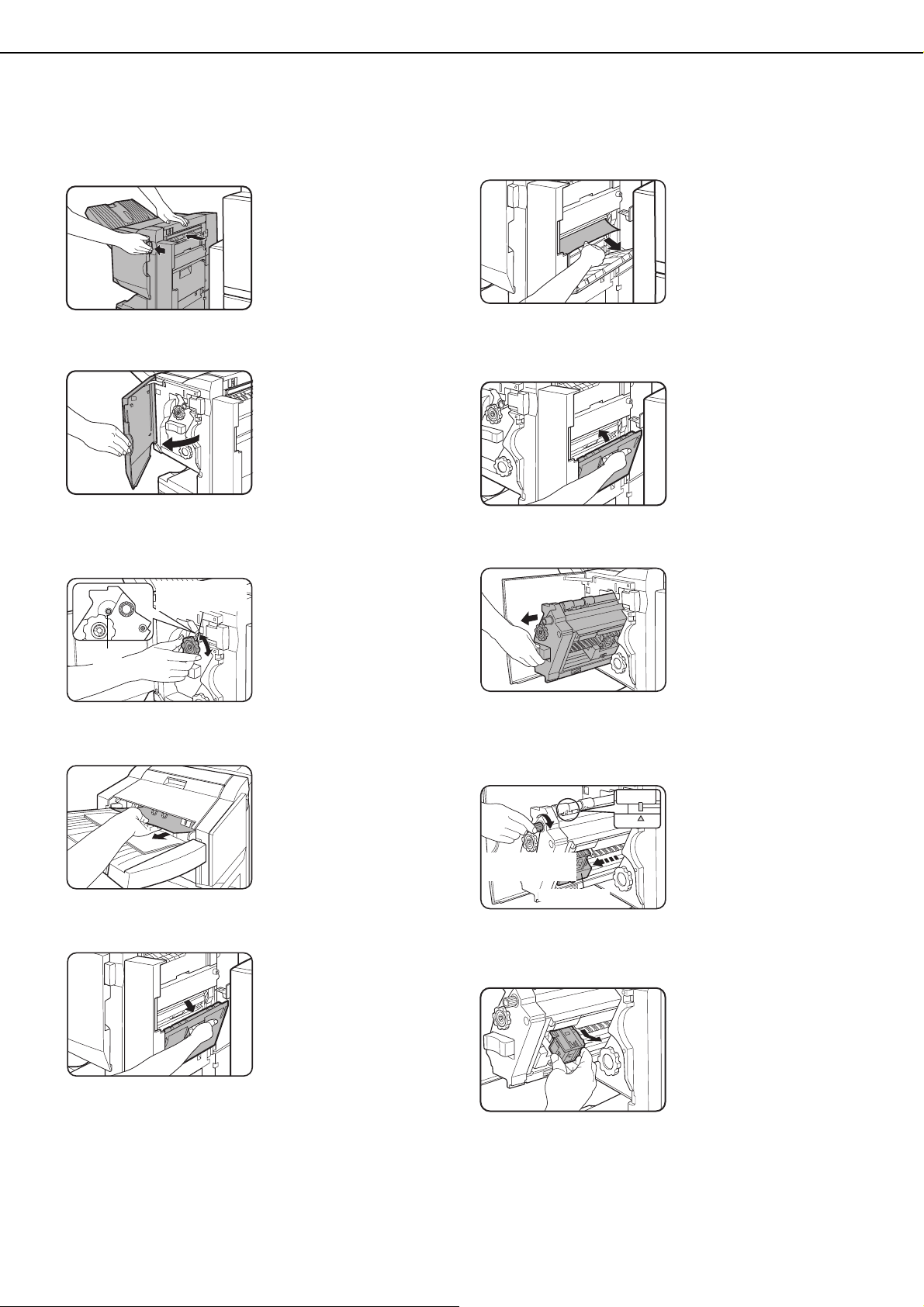
SADDLE STITCH FINISHER
3-8
■
■■
■ Staple jam removal
1
Unlatch the saddle stitch finisher and slide
it away from the main unit.
2
Open the front cover.
3
Turn roller rotating knob C as shown in the
illustration until the blue indication is
seen.
4
Remove the paper from the stapler
compiler.
5
If saddle stitching was selected, open the
saddle stitch section cover.
6
Remove the misfed paper.
Be careful not to tear the
misfed paper during
removal.
7
Close the saddle stitch section cover.
8
Pull out the stapler section.
9
Turn roller rotating knob A in the direction
of the arrow to move the staple unit to the
front.
Turn the roller rotating
knob until the triangle
mark is aligned with the
index.
10
Remove the staple box.
Blue
Roller rotating
knob C
Roller rotating
knob A
Staple unit
ApollonII_general-copy_SEC.book 8 ページ 2004年9月6日 月曜日 午後4時57分
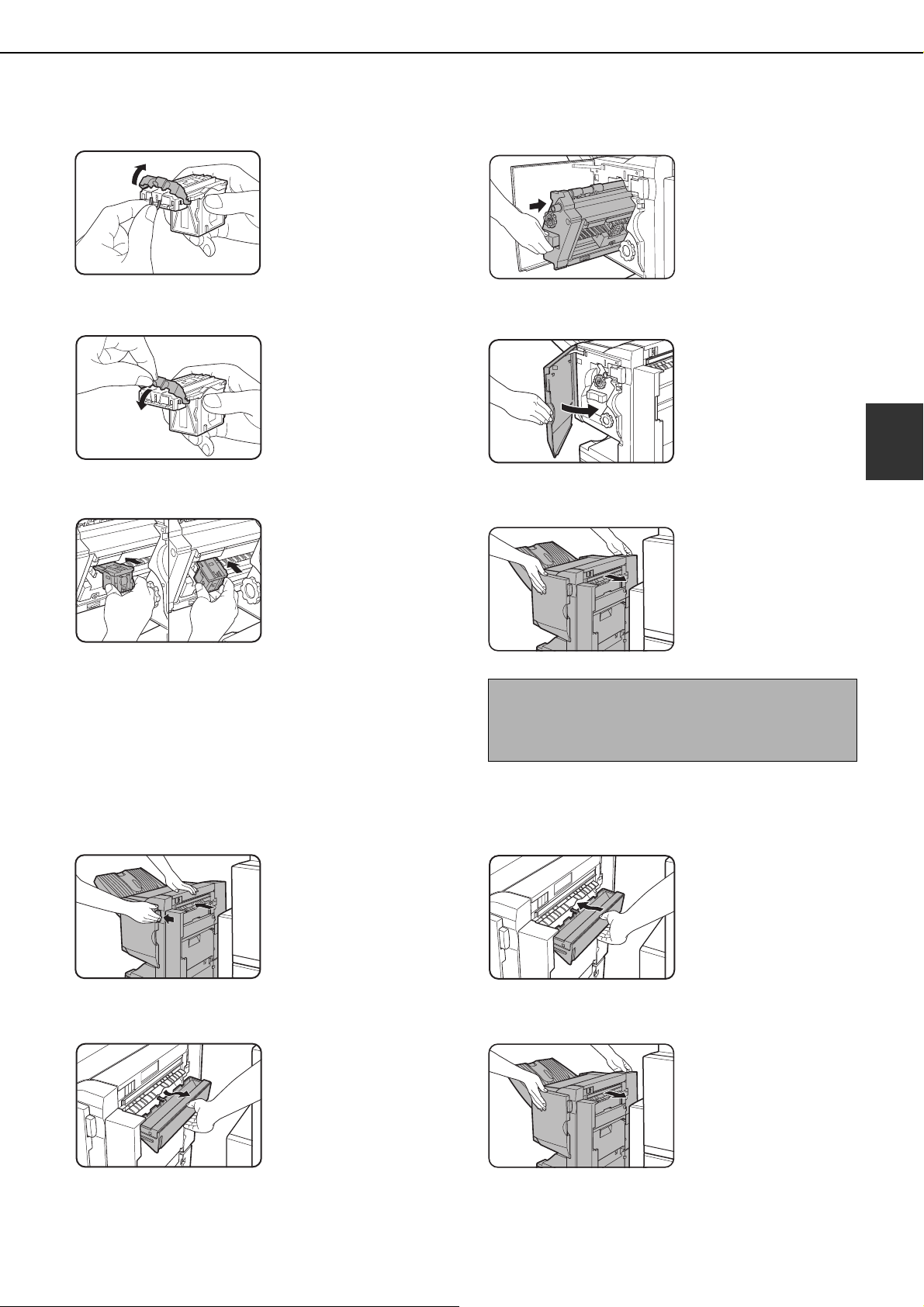
SADDLE STITCH FINISHER
3-9
3
11
Raise the lever at the end of the staple box.
Remove the top staple if
it is bent. If bent staples
remain, a staple jam will
occur again.
12
Return the lever to its original position.
13
Reinstall the staple box.
Push the staple box in
until it clicks into place.
14
Push the stapler section back into the
finisher.
15
Close the front cover.
16
Push the saddle stitch finisher back
against the main unit.
■
■■
■ Disposal of hole punch scrap (when the punch unit is installed)
1
Unlatch the saddle stitch finisher and slide
it away from the main unit.
2
Pull out the punch scrap collecting
container and empty it.
Discard the punch
scraps in a plastic bag or
other container, taking
care not to let the scraps
scatter.
3
Return the punch scrap collecting
container to its original position.
4
Push the saddle stitch finisher back
against the main unit.
NOTE
Make a test print or copy in the staple sort mode to
ensure that stapling is performed properly.
sec_apollon_03-1.fm 9 ページ 2004年11月15日 月曜日 午前11時45分
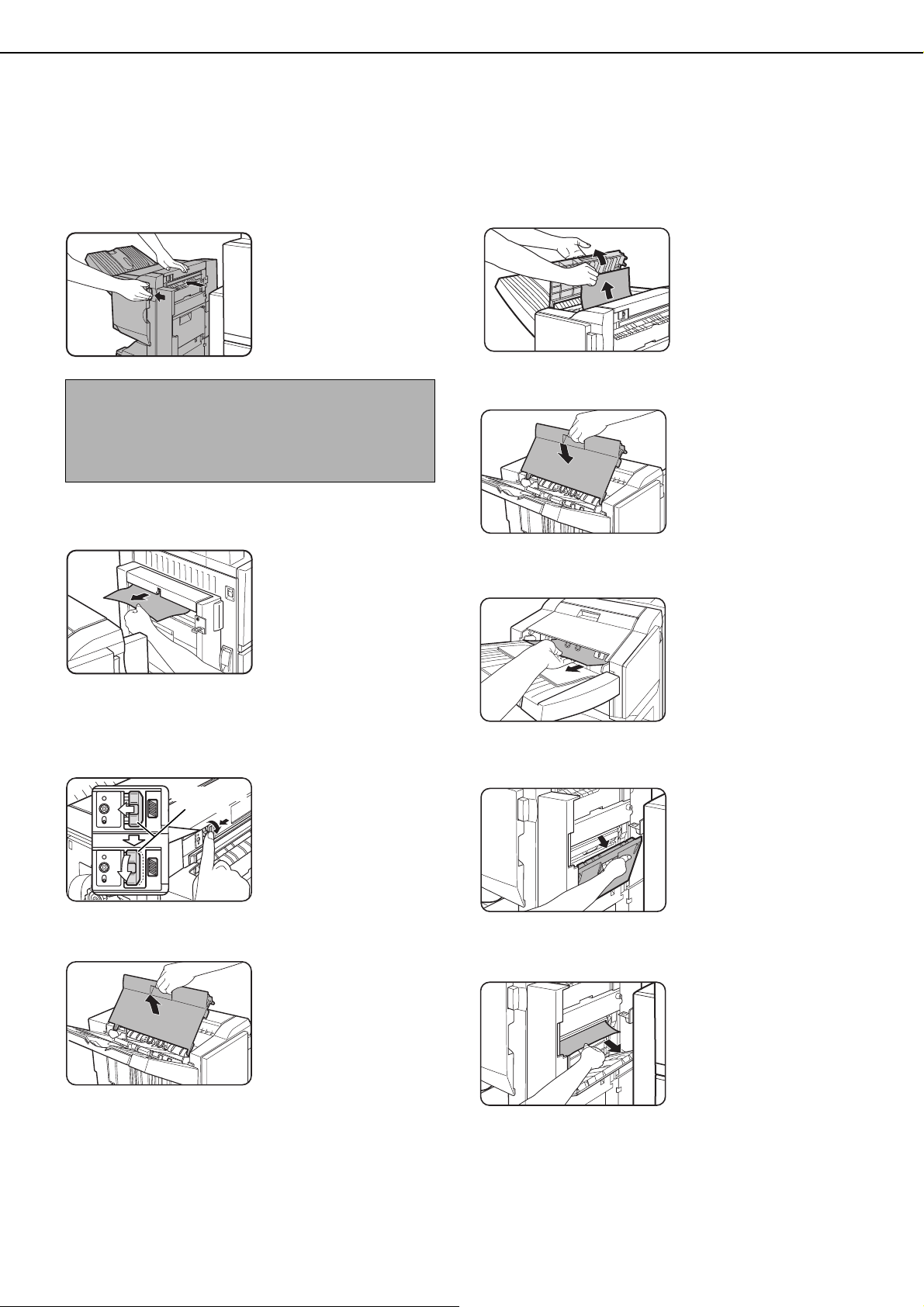
SADDLE STITCH FINISHER
3-10
Misfeed in the saddle stitch finisher
When a misfeed occurs in the saddle stitch finisher, remove the misfed paper following the procedure below.
1
Unlatch the saddle stitch finisher and slide
it away from the main unit.
2
Remove the misfed paper from the main
unit.
After removing the
misfed paper, open and
close the duplex bypass/
inverter to reset the jam
indicator. ("Misfeed in
the Fusing area" step 1
or 4 on page 2-20)
3
If there was no misfed paper in step 2, pull
roller rotating knob B on the punch unit
towards you and rotate it. (Only when an
optional punch unit is installed.)
Rotating roller rotating
knob B releases the
caught paper.
4
Open the top cover.
5
Remove the misfed paper.
Remove the paper
gently, taking care not to
tear it.
6
Close the top cover.
7
Remove the misfed paper from the stapler
compiler.
Be careful not to tear the
misfed paper during
removal.
8
Open the saddle stitch section cover.
9
Remove the misfed paper.
Be careful not to tear the
misfed paper during
removal.
NOTE
The saddle stitch finisher and the machine are
connected at the rear. Exercise caution when pulling
them apart.
Roller rotating
knob B
ApollonII_general-copy_SEC.book 10 ページ 2004年9月6日 月曜日 午後4時57分
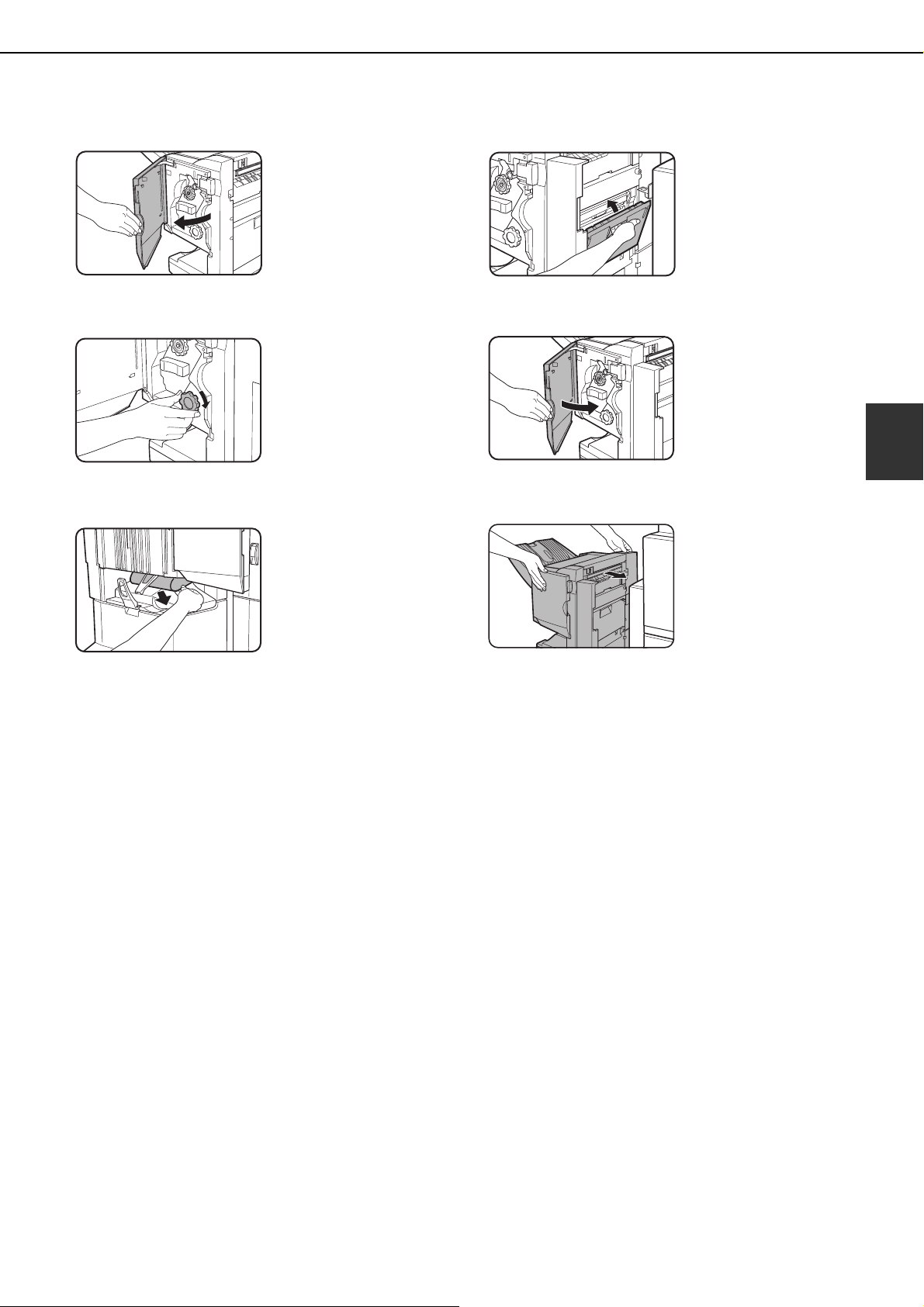
SADDLE STITCH FINISHER
3-11
3
10
Open the front cover.
11
Turn roller rotating knob in the direction of
the arrow.
12
Remove any misfed paper from the saddle
stitch tray.
Be careful not to tear the
misfed paper during
removal.
13
Close the saddle stitch section cover.
14
Close the front cover.
15
Push the saddle stitch finisher back
against the main unit.
ApollonII_general-copy_SEC.book 11 ページ 2004年9月6日 月曜日 午後4時57分
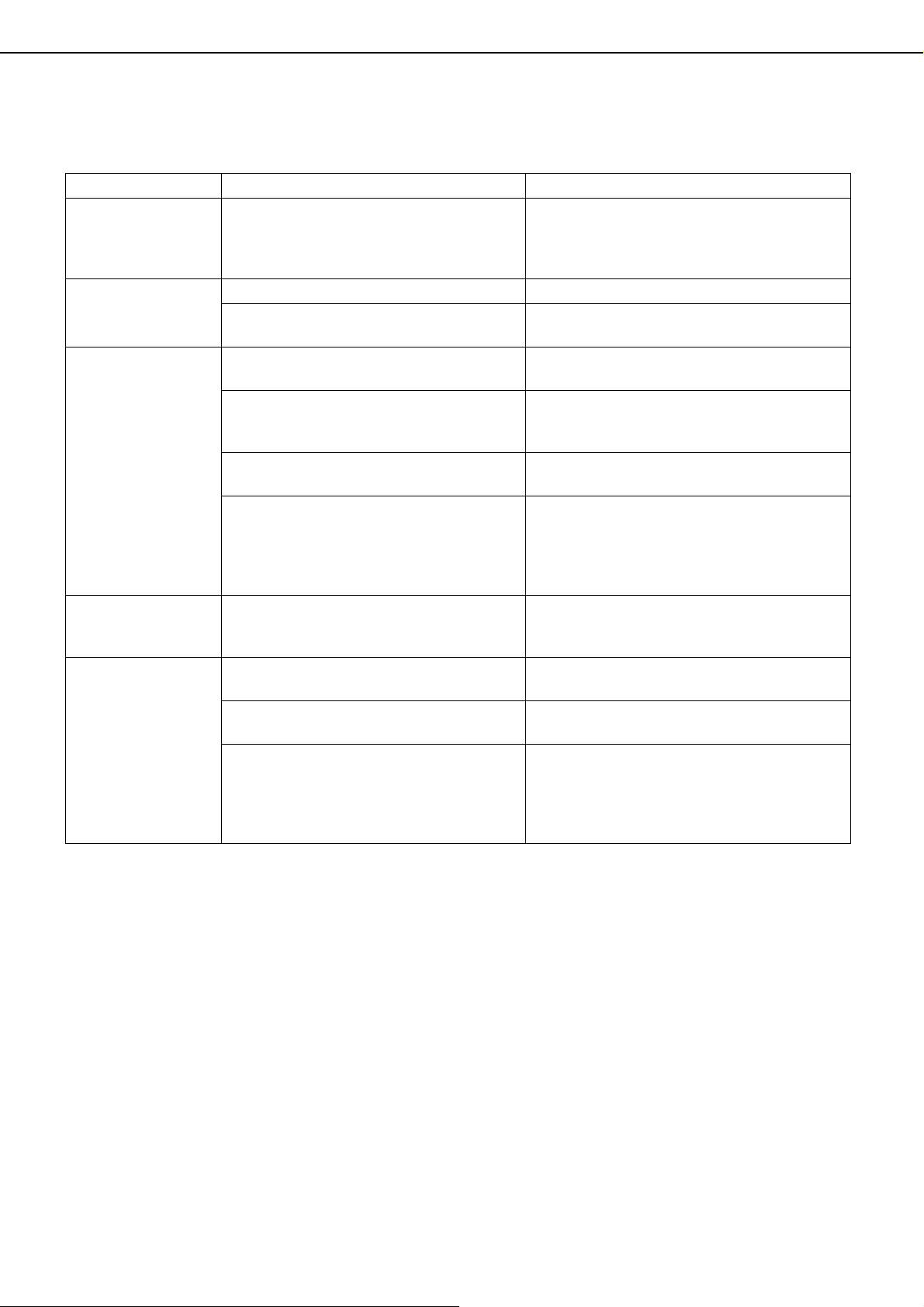
SADDLE STITCH FINISHER
3-12
Troubleshooting saddle stitch finisher problems
Check the list below before calling for service.
* When a hole punch module is installed
Problem Check Solution or cause
Stapling position is
not correct
(including saddle
stitch).
Stapling position not set properly?
Check the stapling position setting. (See
pages 3-4, 3-13 and 3-14.)
The saddle stitch
finisher does not
operate.
Are any saddle stitch finisher covers open? Close all covers. (See page 3-10 and 3-11.)
Message indicating need to remove paper
from the stapler compiler displayed?
Remove all remaining paper from the stapler
compiler referring to step 4 on page 3-8.
Stapling cannot be
performed (including
saddle stitch).
Message to check the staple unit
displayed?
Remove jammed staples. (See page 3-8.)
Message to add staples displayed?
Replace the staple cartridge. (See page 3-7.)
Check that a staple cartridge has been
installed. (See page 3-7.)
Different size paper included?
Stapling cannot be performed onto different
size paper.
Is the paper badly curled, preventing
stapling?
Differences in paper quality and type may
result in bad curling of output paper. Take the
paper out of the tray or bypass tray, turn it
around, and reload it so that the top and
bottom edges are reversed.
The punch hole
positions are not
correct*
1
The punch function is not set to the correct
punch positions.
Check the allowed hole punch positions. (See
page 3-5.)
Cannot be punched.*
Message to check the punch module
displayed?
Dispose of punch scraps. (See page 3-9.)
Mixed paper sizes?
Punching is not possible when different paper
sizes are mixed together.
Paper is badly curled and the output paper
is not punched.
Differences in paper quality and type may
result in bad curling of output paper. Take the
paper out of the tray or bypass tray, turn it
around, and reload it so that the top and
bottom edges are reversed.
ApollonII_general-copy_SEC.book 12 ページ 2004年9月6日 月曜日 午後4時57分
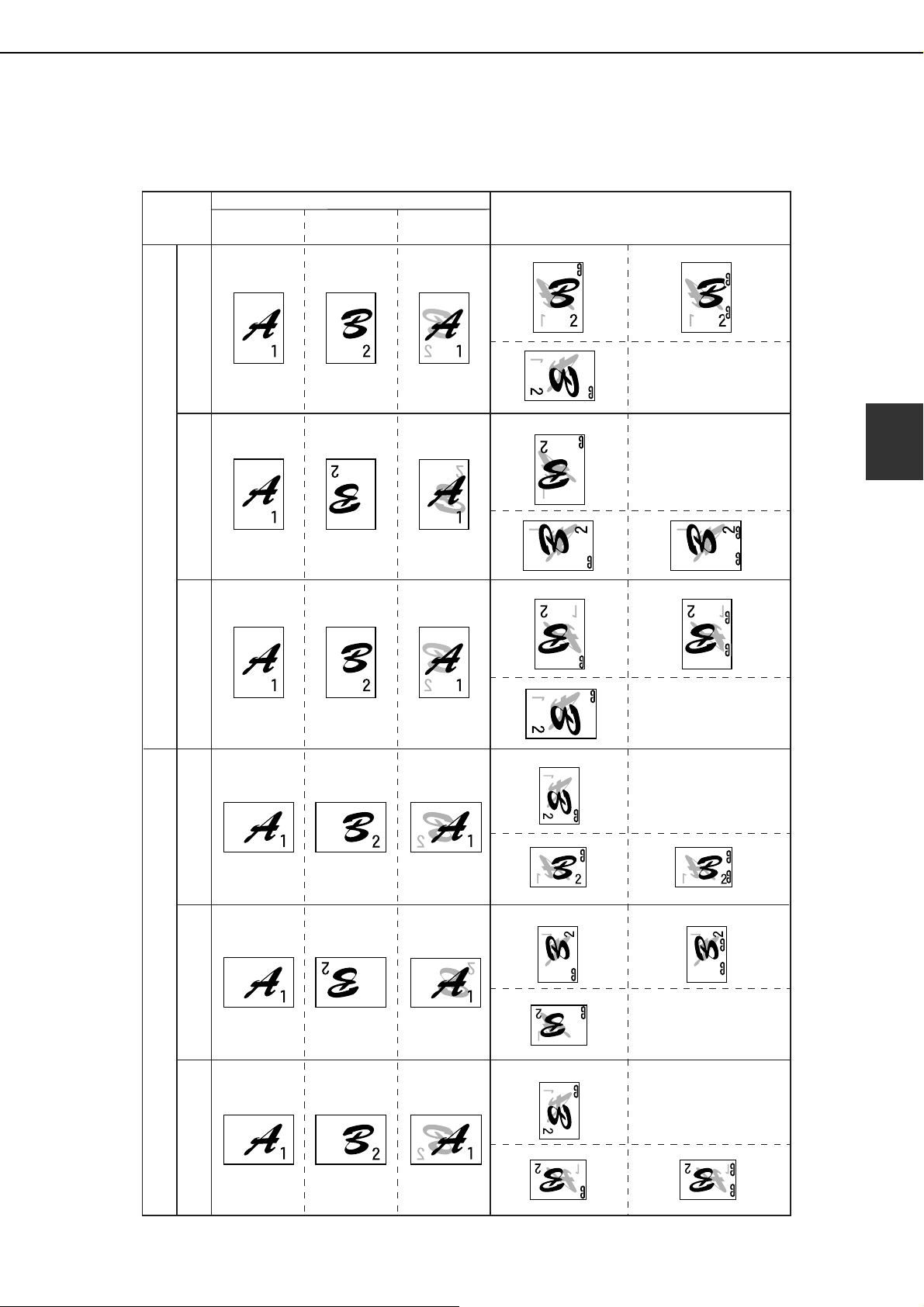
SADDLE STITCH FINISHER
3-13
3
Stapling position quick reference guide for duplex output
The orientation of the copy paper, original, scanned original data, and binding position selection are all interrelated.
The table below shows these relationships.
Orientation of original or original data
Output result
Page 1 Page 2
Page 1 & Page 2
Duplexed
One-position stapling Two-position stapling
One-position stapling Two-position stapling
One-position stapling Two-position stapling
Two-position staplingOne-position stapling
One-position stapling
One-position stapling
Left binding with two-position
stapling is not possible.
Right binding with two-
position stapling is not
possible.
Top binding with two-position
stapling is not possible.
Two-position stapling along
the shorter edge is not
possible.
Two-position stapling along
the shorter edge is not
possible.
Two-position stapling along
the shorter edge is not
possible.
Right binding
Right binding
Top binding
Top binding
Left binding
Left binding
Portrait orientation printing
Landscape orientation printing
ApollonII_general-copy_SEC.book 13 ページ 2004年9月6日 月曜日 午後4時57分
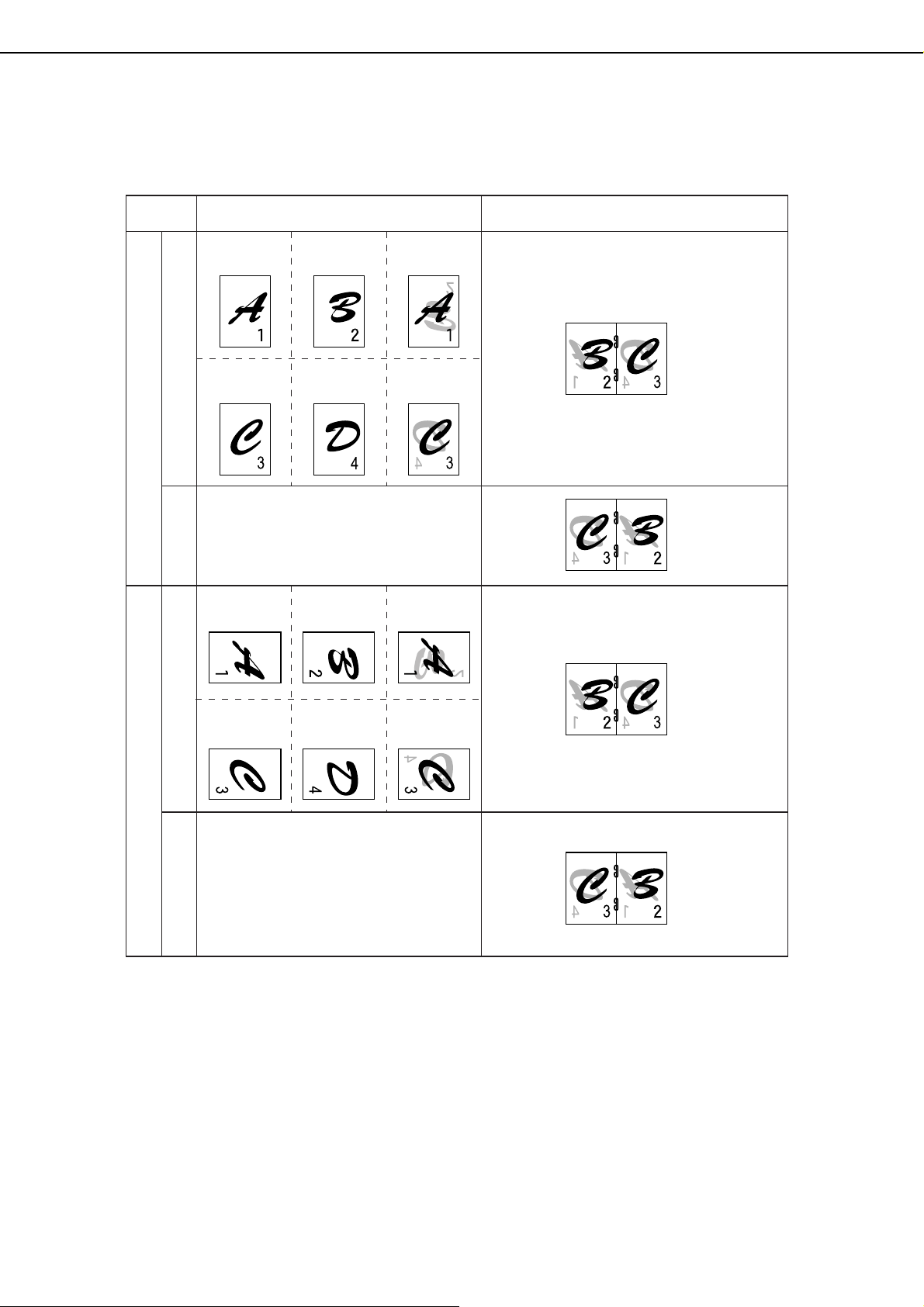
SADDLE STITCH FINISHER
3-14
Relation between print image and saddle stitch
The orientation of the copy paper, original, scanned original data, and binding position selection are all interrelated.
The table below shows these relationships.
Same as above
Orientation of original or original data
Output result
Page 1
Page 3
Page 2
Page 4
Page 1 & Page 2
Duplexed
Page 3 & Page 4
Duplexed
Right bindingLeft binding Left binding Right binding
Portrait orientation printing
Landscape orientation printing
Page 1
Page 3
Page 2
Page 4
Same as above
Page 1 & Page 2
Duplexed
Page 3 & Page 4
Duplexed
ApollonII_general-copy_SEC.book 14 ページ 2004年9月6日 月曜日 午後4時57分
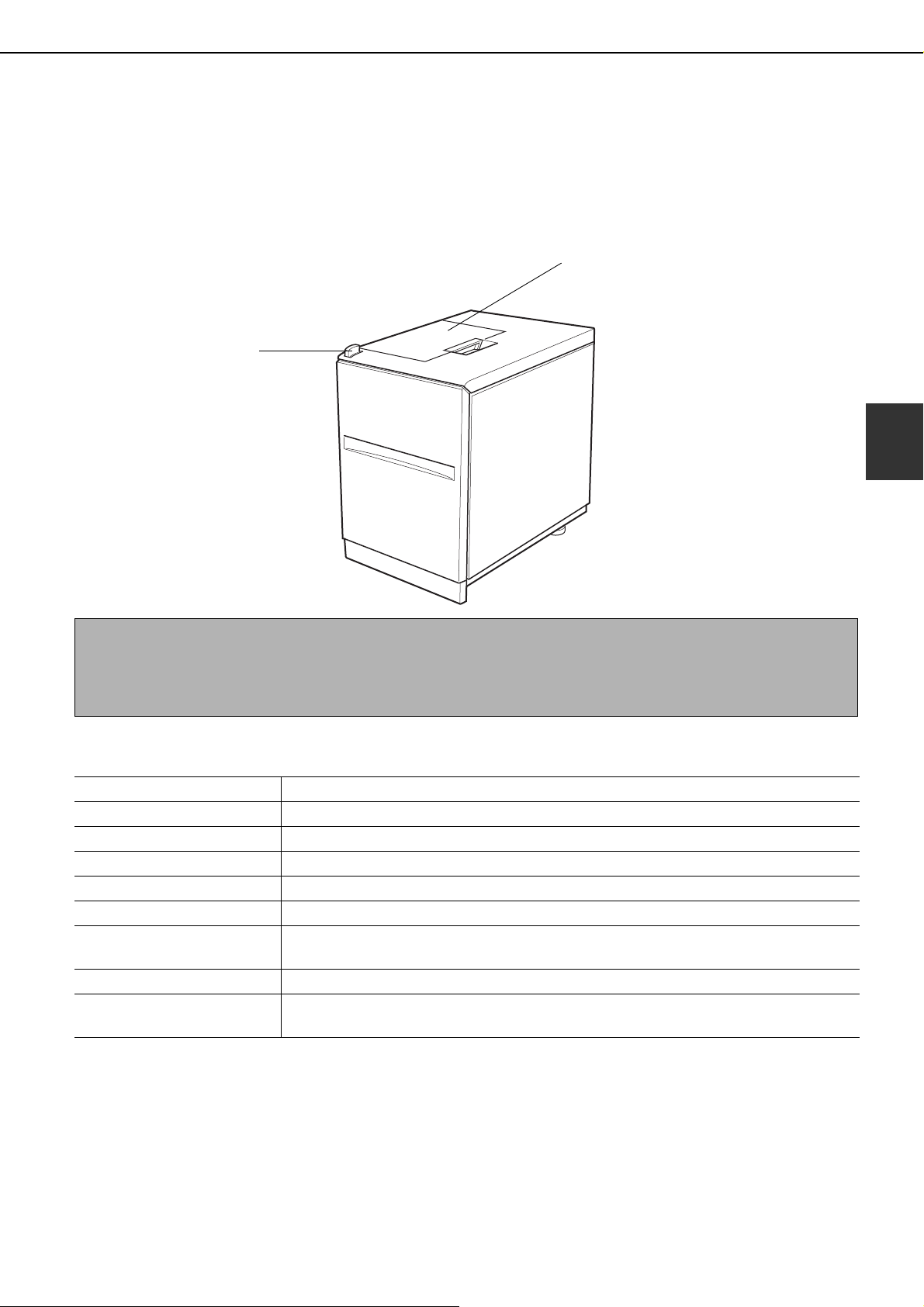
3-15
3
LARGE CAPACITY TRAY
The large capacity tray can hold approximately 3,500 sheets (21 lbs. (80 g/m
2
)) of 8-1/2" x 11" (A4) size paper.
(For the types of paper that can be loaded in the large capacity tray, see "Large Capacity tray" in the tray
specifications (page 2-9).)
Part name
Specifications
Specifications are subject to change for improvement without notice.
NOTES
● Do not place heavy objects on the large capacity tray or press down hard on the tray.
● To install the large capacity tray, the optional duplex module/2 x 500 sheet paper drawer or the stand/3 x 500
sheet paper drawer must also be installed.
Name LARGE CAPACITY TRAY (AR-LC8)
Paper size 8-1/2" x 11" (A4)
Paper weight 17 to 28 lbs. (64 to 105 g/m
2
)
Number of trays 1 tray
Paper capacity 3,500 sheets (21 lbs. or 80 g/m
2
)
Power supply Supplied from machine
Dimensions
14-13/16" (W) x 21-15/32" (D) x 23-7/16" (H)
(376 mm (W) x 545 mm (D) x 595 mm (H))
Weight* Approximately 66.2 lbs. (30kg) *without mounting kit
Overall dimensions when
attached to machine
38-7/16" (W) x 26-5/8" (D) (976 mm (W) x 676 mm (D))
Top cover
Open for misfeed removal.
Release lever
ApollonII_general-copy_SEC.book 15 ページ 2004年9月6日 月曜日 午後4時57分
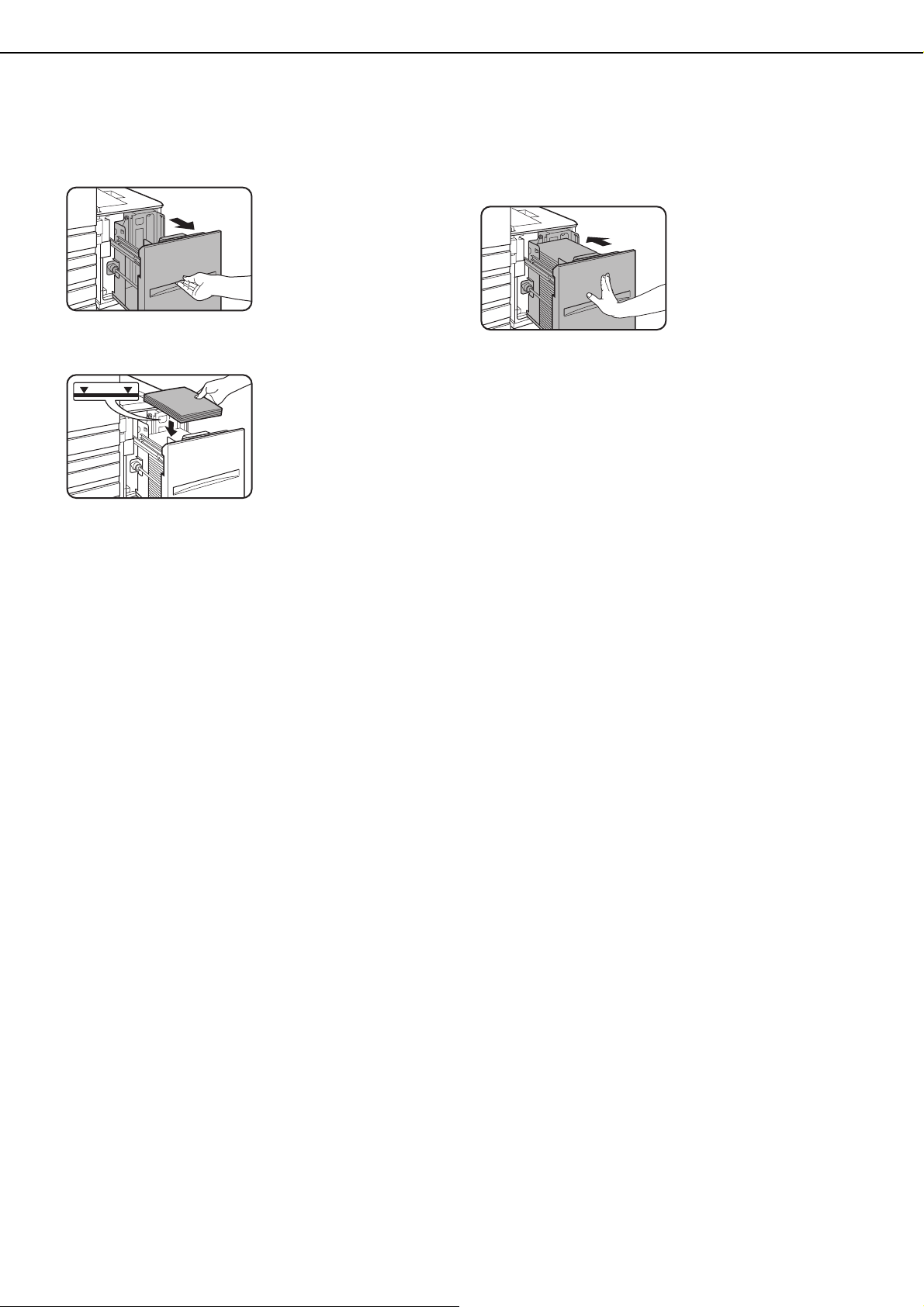
LARGE CAPACITY TRAY
3-16
Loading paper in the large capacity tray
1
Pull the tray out until it stops.
When the tray is in
operation, do not use
excessive force to pull
the tray out. This may
damage the tray.
2
Place the paper in the center of the paper
table.
The paper stack must
not be higher than the
indicator line (up to
3,500 sheets of SHARP
standard paper (21 lbs.
(80 g/m
2
))
If the paper type was
changed, be sure to change the appropriate
settings as explained in "Setting the paper type
(except the bypass tray)" (See page 2-11).
3
Push the tray firmly all the way into the
machine.
The paper table will
automatically rise to the
paper feed position.
ApollonII_general-copy_SEC.book 16 ページ 2004年9月6日 月曜日 午後4時57分
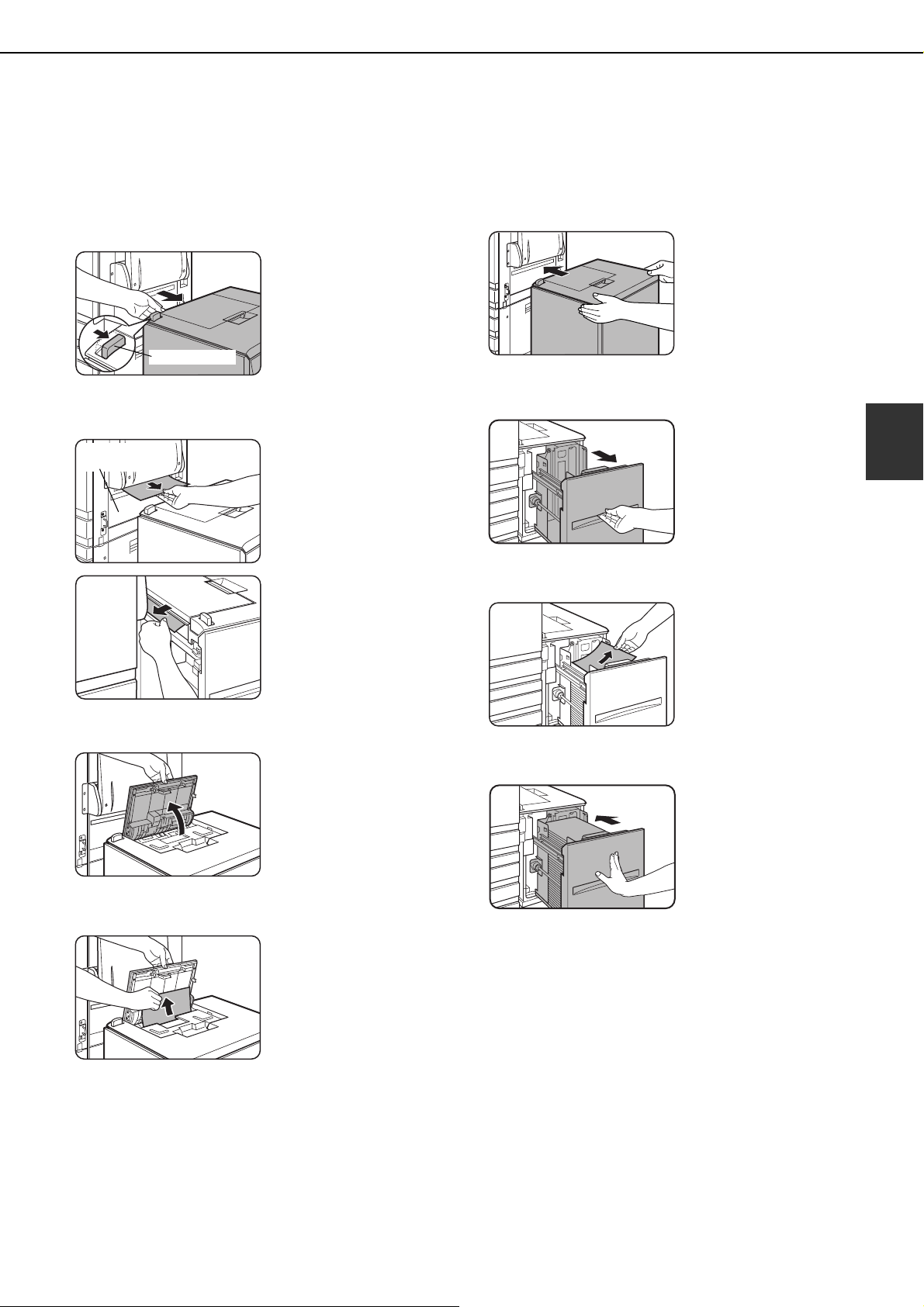
LARGE CAPACITY TRAY
3-17
3
Misfeed in the large capacity tray
When a misfeed occurs in the large capacity tray, remove the misfed paper, following the procedure below.
1
While holding the tray release lever,
carefully slide the large capacity tray away
from the main unit until it stops.
2
Remove any misfed paper from the main
unit and the large capacity tray.
If the misfed paper is
stuck inside the machine
and cannot be removed,
open the side cover and
then remove the misfed
paper. (See "Misfeed in
the transport area,
fusing area, and exit
area" on page 2-20.)
3
Open the top cover.
4
Remove the misfed paper.
Be sure not to tear the
misfed paper during
removal.
After removing the
misfed paper, close the
top cover.
5
Push the large capacity tray towards the
main unit and latch it into place.
Gently push the large
capacity tray back in
until it stops.
6
If misfed paper is not found in step 2, pull
the tray out.
7
Remove the misfed paper.
8
Gently push the tray back into place.
The paper feed table
automatically rises to the
paper feed position.
Make sure that the
paper misfeed screen is
cleared and the normal
message screen
appears.
Release lever
Upper right
side cover
ApollonII_general-copy_SEC.book 17 ページ 2004年9月6日 月曜日 午後4時57分

ApollonII_general-copy_SEC.book 18 ページ 2004年9月6日 月曜日 午後4時57分

Part 2: Copier Operation
ApollonII_general-copy_SEC.book 1 ページ 2004年9月6日 月曜日 午後4時57分

ApollonII_general-copy_SEC.book 2 ページ 2004年9月6日 月曜日 午後4時57分

4-1
CHAPTER 4
BEFORE MAKING COPIES
This chapter provides basic information necessary for using the copier
functions of the machine. Please read this chapter before making
copies.
Page
PART NAMES AND FUNCTIONS (The Reversing Single Pass Feeder)......4-2
●
Exterior...................................................................................................4-2
●
Operation Panel .....................................................................................4-3
●
Touch Panel (main screen of copy mode) .............................................4-4
REVERSING SINGLE PASS FEEDER .........................................................4-5
●
Acceptable originals...............................................................................4-5
SETTING ORIGINALS...................................................................................4-6
SELECTING THE ORIGINAL SIZE ...............................................................4-8
STORING, DELETING, AND USING ORIGINAL SIZES ...............................4-9
ApollonII_general-copy_SEC.book 1 ページ 2004年9月6日 月曜日 午後4時57分
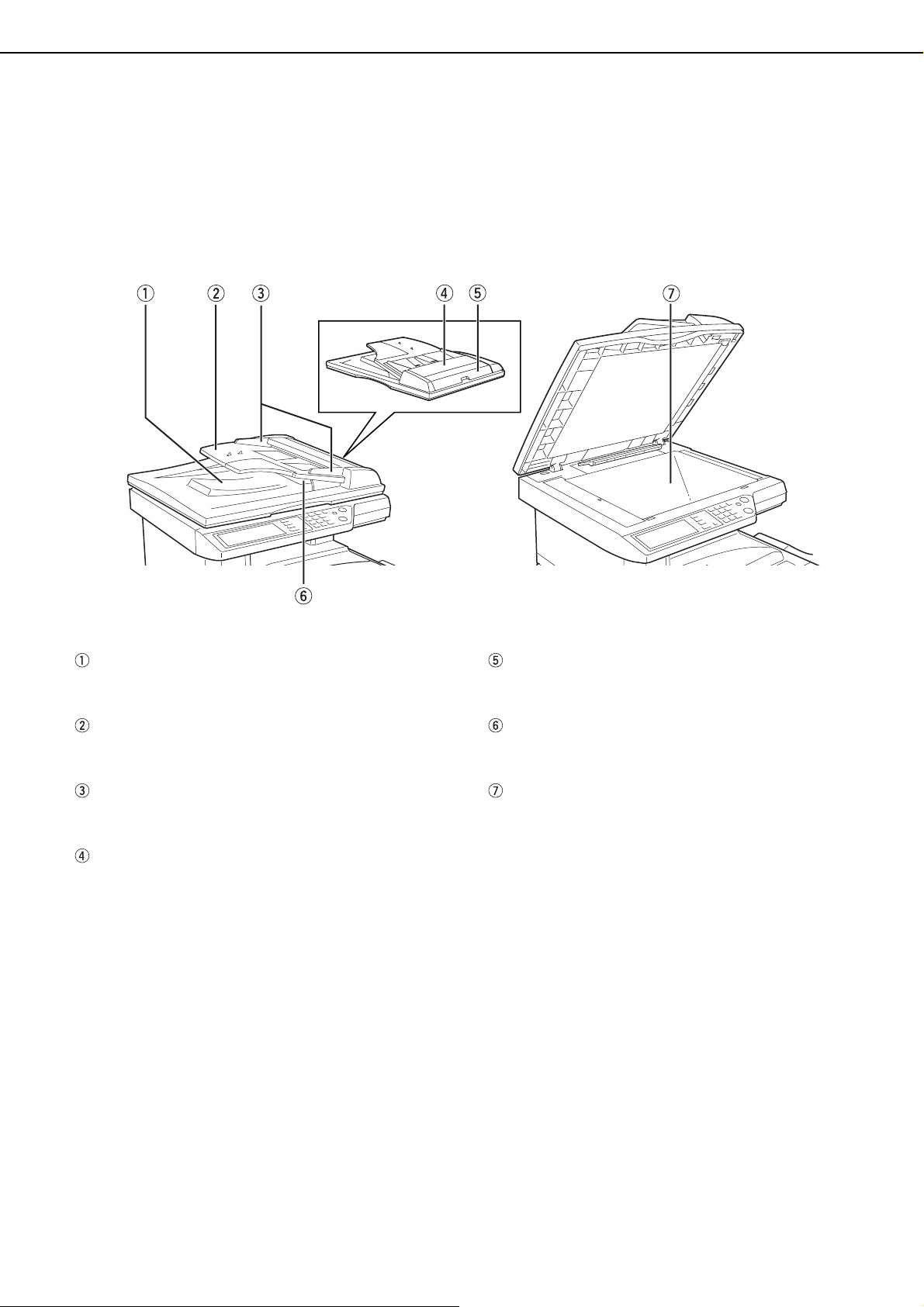
4-2
PART NAMES AND FUNCTIONS
(The Reversing Single Pass Feeder)
Exterior
*RSPF exit area
Finished originals are output here.
Document feeder tray (page 4-6)
Set the originals here for automatic feeding.
Original guides (page 4-6)
Adjust to the size of the originals.
Document feeding area cover (page 7-2)
Open to remove misfed originals in this area.
*RSPF right side cover (page 7-2)
Open to remove misfed originals.
Reversing tray
Pull out to remove misfed originals.
Document glass
All originals which cannot be copied from the
document feeder tray must be copied here.
* "RSPF" is an acronym for "Reversing Single Pass Feeder".
ApollonII_general-copy_SEC.book 2 ページ 2004年9月6日 月曜日 午後4時57分
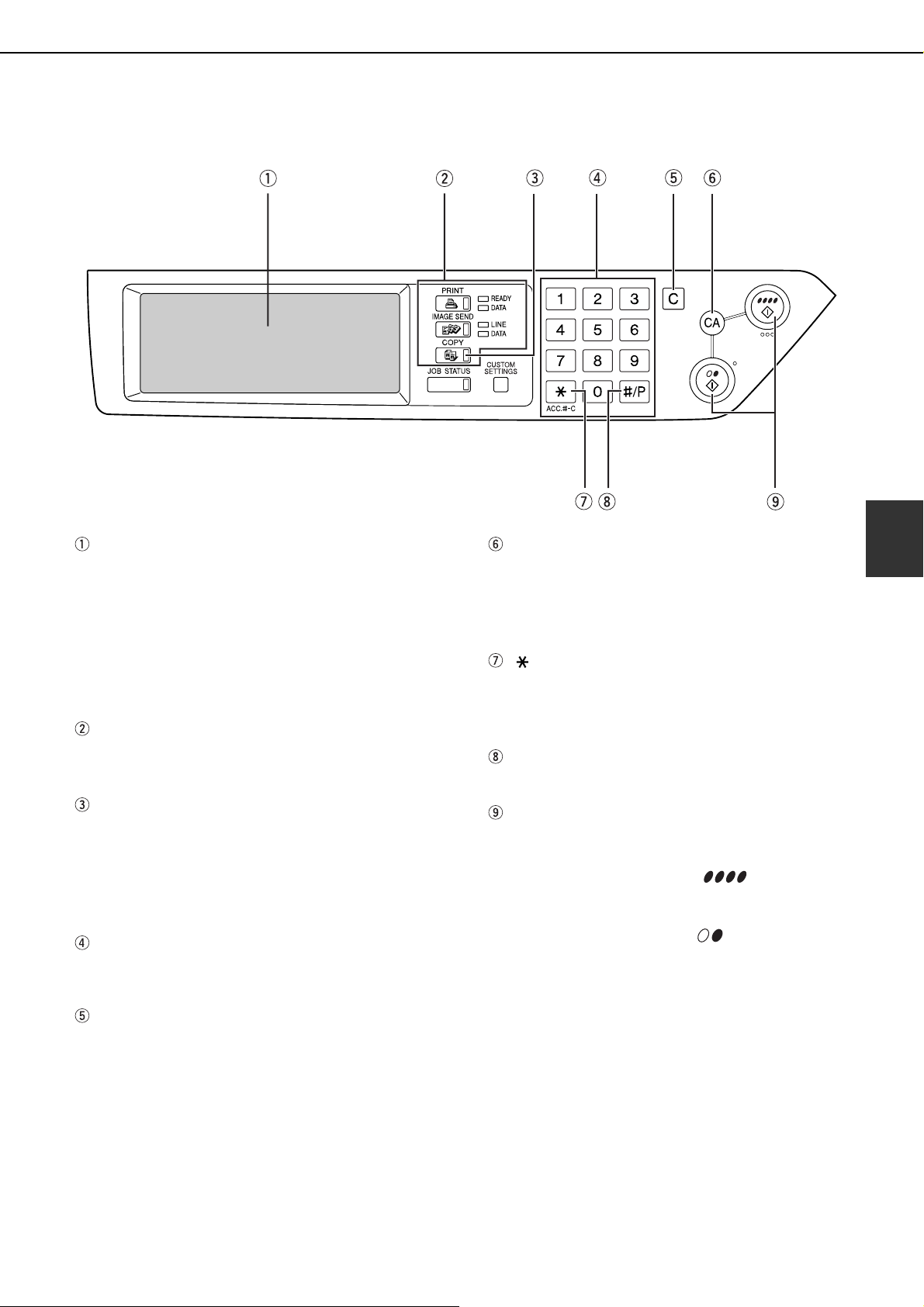
PART NAMES AND FUNCTIONS (The Reversing Single Pass Feeder)
4-3
4
Operation Panel
Touch panel (Details are on the next page 4-4)
Messages and touch keys are displayed here.
Selections are made by touching the displayed
keys. Selections made with the keys are confirmed
by a "beep"* that is sounded when a key is touched,
and highlighting of the selection key.
* If a key that cannot be selected is touched, double-
beep will sound.
Keys that are grayed out cannot be selected.
Mode select keys
Use to change modes and the corresponding
display on the touch panel.
[COPY] key
Press to select the copy mode and display the main
screen of the copy mode. (next page 4-4)
If this key is pressed and held while the main
screen of the copy mode is displayed, the total
output count will be displayed.
Numeric keys
Use to select the number of copies and to make
numerical entries for setting operations.
[C] key (clear key)
Press to clear a copy quantity entry. If this key is
pressed while the reversing single pass feeder is
being used, any originals in progress will be
automatically output.
[CA] key (clear all key)
This returns all copy mode settings to the default
settings. However, the touch panel display mode
will not be changed.
When beginning a copy job, press this key.
[ ] key ([ACC.#-C] key)
If the auditing mode has been set, press this key to
close an open account after finishing a copy job.
For setting of the auditing mode, see page 1-11.
[#/P] key (page 6-25)
Press to select the job memory mode.
[START] key
When the indicator is lit, a copying job can be
started. Press to start copying.
● [COLOR COPY START ( )] key
Press this key to start a single or multiple color
copy job.
● [BLACK COPY START ( )] key
Press this key to start a black and white copy
job.
ApollonII_general-copy_SEC.book 3 ページ 2004年9月6日 月曜日 午後4時57分
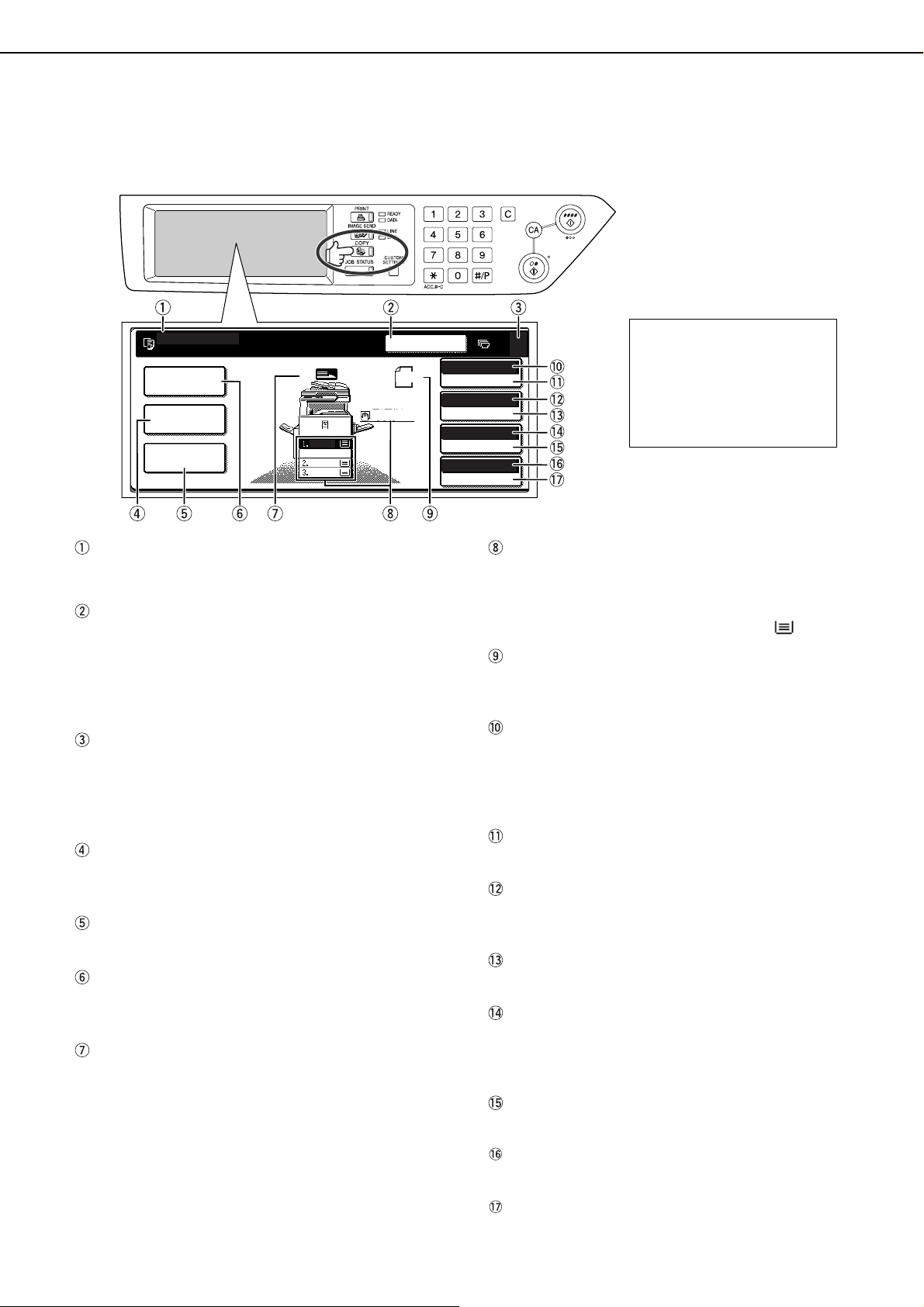
PART NAMES AND FUNCTIONS (The Reversing Single Pass Feeder)
4-4
Touch Panel (main screen of copy mode)
The main screen of copy mode shows messages and keys necessary for copying and settings that can be selected.
Touch a key to make a selection. The main screen of the copy mode will be displayed when the [COPY] key is pressed.*
Message display
Basic status messages are displayed here.
[INTERRUPT] key display area
When interrupt copy is available, the
[INTERRUPT] key will be displayed here. When an
interrupt copy job is being run, a [CANCEL] key will
be displayed here to be used for canceling the
interrupt copy job.
Copy quantity display
Displays the selected number of copies before the
[START] key is pressed or the number of remaining
copies after the [START] key is pressed. A single
copy can be made when "0" displayed.
[2-SIDED COPY] key (page 5-6, 5-9)
Touch to display the duplex copy mode setting
screen.
[OUTPUT] key (page 5-3, 5-8)
Touch to select sort, group, and staple sort.
[SPECIAL MODES] key (page 6-2)
Touch to display the special modes selection
screen.
Original feed display
This lights steadily when an original is placed on
the original table of the reversing single pass
feeder. When "Stream feeding mode" in the key
operator programs is turned on, the display blinks
during the waiting period (about 5 seconds) for
placement of the next original. (See page 12 of the
key operator's guide.)
Paper size display
The display shows the location of the paper trays, the
size of the paper in the trays and the approximate
amount of paper loaded in each tray. The approximate
amount of paper in a tray is indicated by .
Original size display
Displays the original size only when an original is
placed for copying.
Original display
"AUTO" appears when the automatic original size
detection function is operating, and the original
size appears when the original size has been
entered manually.
[ORIGINAL] key
Use this key to manually enter the original size.
Exposure display
Displays the icon of the selected resolution and the
exposure scale.
[EXPOSURE] key (page 5-10)
Use this key to adjust the copy exposure.
Paper select display
Displays the selected paper size. When the auto
paper select mode has been selected, "AUTO" will
be displayed.
[PAPER SELECT] key (page 5-2, 5-7)
Use this key to select the paper size.
Copy ratio display
Displays the selected copy ratio.
[COPY RATIO] key (page 5-13)
Use this key to select the copy ratio.
SPECIAL MODES
2-SIDED COPY
OUTPUT
READY TO COPY.
11x17
AUTO
ORIGINAL
AUTO
EXPOSURE
AUTO 8½x11
PAPER SELECT
100
%
COPY RATIO
PLAIN
INTERRUPT
5½x8½
0
8½x11
8½x11
DUPLEX
ORIGINAL
8½x11
* Except when the custom
settings screen is displayed.
The screen at left shows the
machine with the duplex
module/2 x 500 sheet paper
drawer and the duplex bypass/
inverter unit installed.
The image will vary depending
on the equipment installed.
ApollonII_general-copy_SEC.book 4 ページ 2004年9月6日 月曜日 午後4時57分

4-5
4
REVERSING SINGLE PASS FEEDER
The reversing single pass feeder can be used to automatically feed originals for continuous copying. Both sides of
two-sided sheet originals can be scanned without having to manually turn the originals over. This feature is
convenient for making copies of a large number of originals.
Acceptable originals
When the reversing single pass feeder is used, up to 40 originals of the same size can be set in the feeder (maximum
stack thickness of 11/64" (4 mm), or 30 originals of weight 24 lbs. (90 g/m
2
)).
■
■■
■
Size and weight of acceptable originals
Notes on use of the reversing single pass feeder
●Use originals within the specified size and weight ranges. Use of originals out of the specified range may cause
an original misfeed.
●Before loading originals into the document feeder tray, be sure to remove any staples or paper clips.
●If originals have damp spots from correction fluid, ink or glue from pasteups, be sure they are dried before they
are fed. If not, the interior of the document feeder or the document glass may be soiled.
●To prevent incorrect original size detection, original misfeeds or smudges on copies, use the following as a
guide for feeding originals.
Transparency film, tracing paper, carbon paper, thermal paper or originals printed with thermal transfer ink
ribbon should not be fed through the document feeder. Originals to be fed through the feeder should not be
damaged, crumpled or folded or have loosely pasted paper on them or cutouts in them.
15 lbs.
or
56g/m
2
24 lbs.
or
90g/m
2
2
2
Original size:
(148 x 210 mm)
5-1/2" x 8-1/2"
or A5
11" x 17"
or A3
(297 x 420 mm)
Weight (thickness):
g/m
... Weight of a sheet of paper of 1 m
ApollonII_general-copy_SEC.book 5 ページ 2004年9月6日 月曜日 午後4時57分
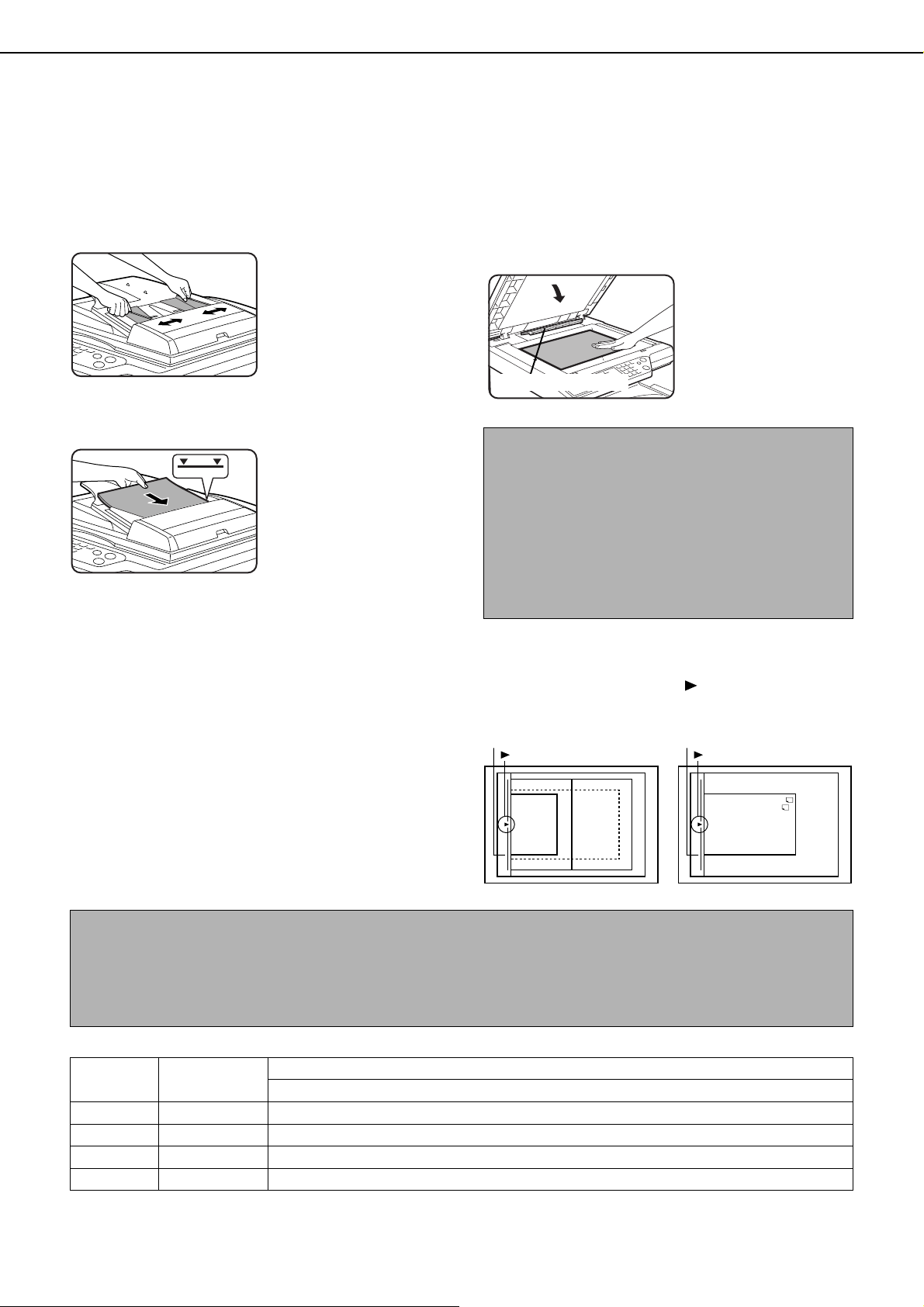
4-6
SETTING ORIGINALS
■
■■
■ When using the reversing single
pass feeder
1
Adjust the original guides to the size of the
originals.
2
Place the originals face up in the
document feeder tray.
Set the originals all the
way into the feed slot.
Do not exceed the
maximum height line
marked on the original
guide.
■
■■
■ When using the document glass
Open the document cover, place the
original face down on the document glass,
and then gently close the document cover.
[ How to place the original ]
Place the original in the appropriate position shown
below according to its size. ( Center the original on
the centering scale.)
* When the reversing single pass feeder is used, these sizes are only supported for one-sided originals.
NOTES
● Do not place any objects under the original size
detector, because they may damage it or the
original size may not be detected properly.
● If an original has been placed in the document
feeder tray of the reversing single pass feeder,
remove it. Otherwise the original in the document
feeder tray will be scanned instead of the original
on the document glass.
Original size detector
R
R
8½x14
or B4
11x17 or A3
8½x11 or A4
8½x11
or A4
5½x8½
or A5
Original scale
Centering scale
Original scale
Centering scale
NOTE
Original size detection function
One of the four groups of standard original sizes shown below can be selected for detection by the original size
detection function. The factory default setting is "INCH-1 (AB-1)". The setting can be changed using "ORIGINAL
SIZE DETECTOR SETTING" in the key operator programs. (Page 11 of the key operator's guide.)
Group
Detectable original sizes
Document feeder tray (for reversing single pass feeding) or document glass
1 INCH - 1 11" x 17", 8-1/2" x 14", 8-1/2" x 11", 8-1/2" x 11"R, 5-1/2" x 8-1/2"*
2 INCH - 2 11" x 17", 8-1/2" x 13", 8-1/2" x 11", 8-1/2" x 11"R, 5-1/2" x 8-1/2"*
3 AB - 1 A3, A4, A4R, A5, B4, B5, B5R
4 AB - 2 A3, A4, A4R, A5, B5, B5R, 8-1/2" x 13"
ApollonII_general-copy_SEC.book 6 ページ 2004年9月6日 月曜日 午後4時57分
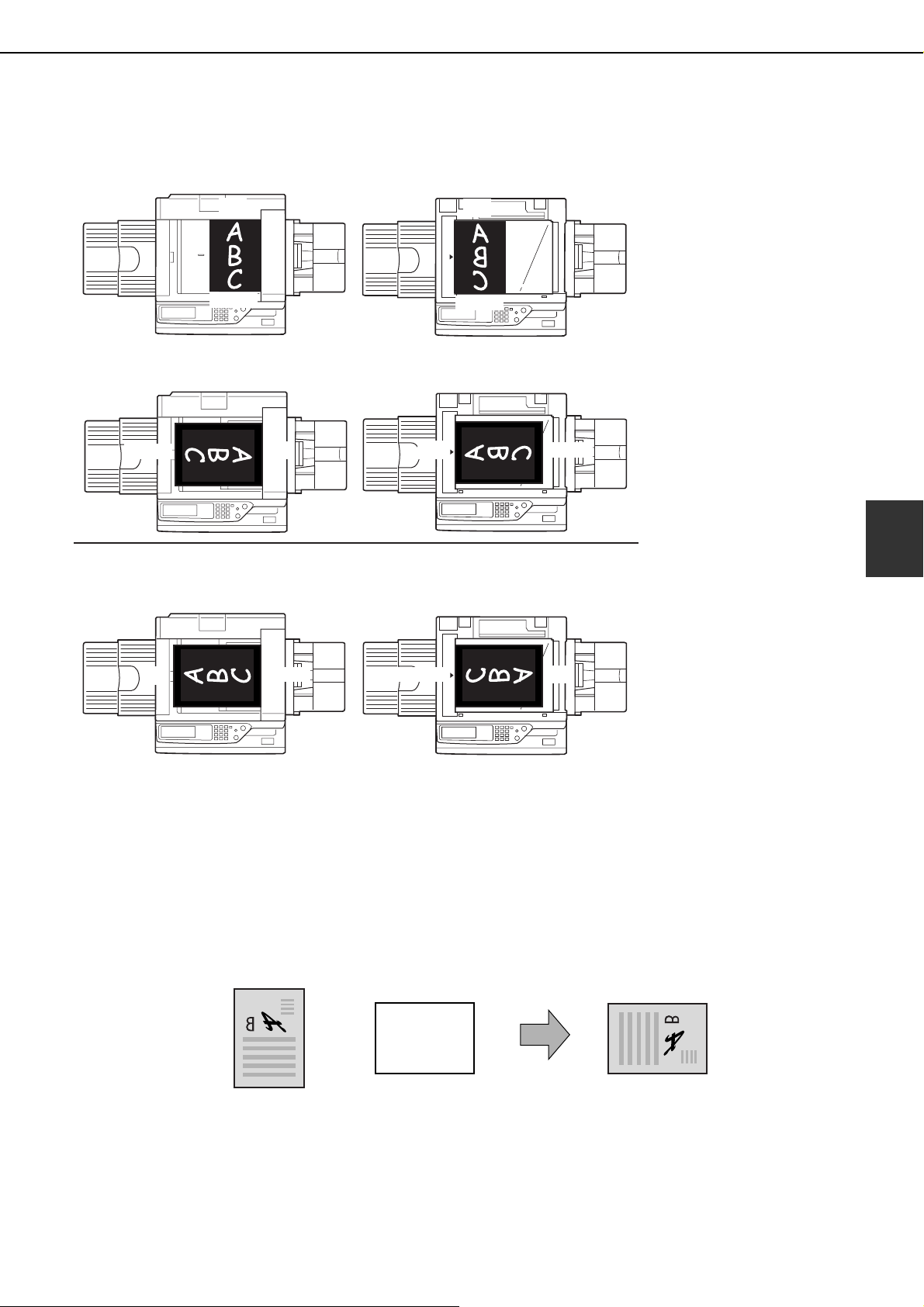
SETTING ORIGINALS
4-7
4
■
■■
■ Standard original setting orientation
Place originals in the
document feeder tray or on
the document glass so that
the top and bottom of the
original is positioned as
shown in the illustration. If not,
staples will be incorrectly
positioned and some special
features may not give the
expected result.
■
■■
■ Automatic copy image rotation - rotation copying
If the orientation of the originals and copy paper are different, the original image will be automatically rotated 90
°
and copied. (When an image is rotated, a message will be displayed.) If a function is selected that is not suitable
for rotation, such as enlarging the copy to greater than 8-1/2" x 11" (A4) size or staple sorting with the saddle
stitch finisher, rotation will not be possible.
[Example]
●This function operates in both the auto paper select or auto image mode. (Rotation copying can be disabled
with a key operator program. See page 15 of the key operator's guide.)
Document feeder tray
Document glass
Top
Bottom
Top
Top
Bottom
Bottom
Top
Bottom
[Example 1]
[Example 2]
Top
Bottom Bottom
Top
Document feeder tray
Document glass
Document feeder tray
Document glass
* When the original is placed as shown in example 2 and stapling is to be performed, orient
the top of the original as shown below.
Orientation of original Orientation of paper Copy after rotation
Face down Face down
ApollonII_general-copy_SEC.book 7 ページ 2004年9月6日 月曜日 午後4時57分
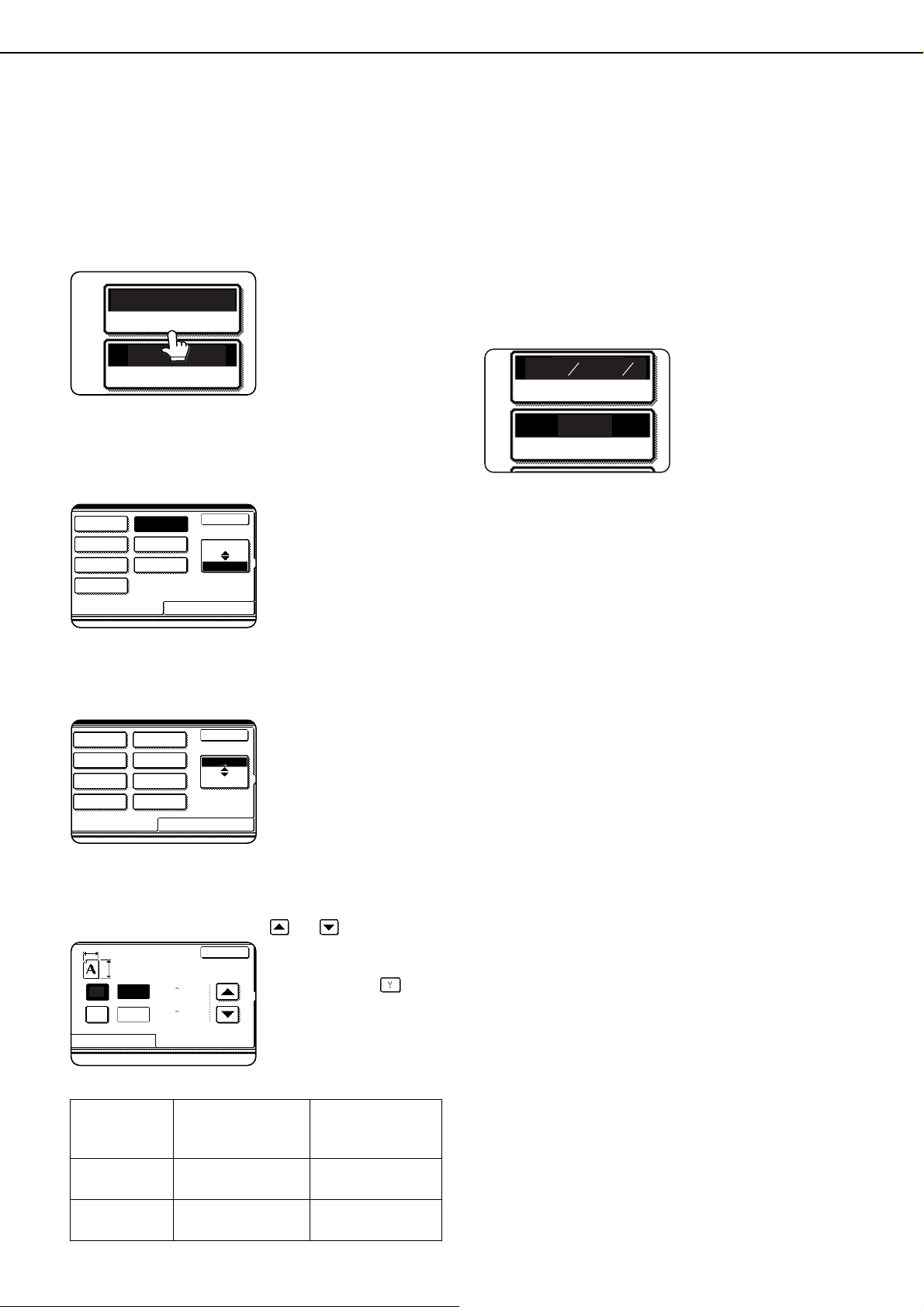
4-8
SELECTING THE ORIGINAL SIZE
When the correct original size is not detected or the original size is not displayed, you can manually specify the
original size.
By causing the machine to recognize the original size, you can have the automatic ratio selection function (page 5-
12) automatically set a suitable enlargement or reduction ratio for the selected paper size.
Place the original in the document feeder tray or on the document glass and then follow the steps below.
1
Touch the [ORIGINAL] key.
2
Enter the original size.
If the original size is a standard size, touch
the appropriate original size key.
[MANUAL] and the
original size key you
touched are highlighted.
If you wish to select an AB size, touch the
[AB/INCH] key and then touch the desired
original size key.
[AB] is highlighted and
AB size keys are
displayed. To return to
the INCH palette, touch
the [AB/INCH] key once
again.
If the original size is a non-standard size,
touch the [SIZE INPUT] tab and then enter
the X (width) and Y (length) dimensions of
the original with the or key.
The X dimension (width)
is initially selected.
Touch the Y ( ) key
and enter the Y
dimension (length).
The range of original
sizes that can be
entered is as follows.
3
Touch the [OK] key.
You will return to the initial screen.
4
The selected original size appears in the
top half of the [ORIGINAL] key.
Using the
reversing single
pass feeder
Using the
document glass
X (horizontal
direction)
5-3/4" to 17"
(143 to 432 mm)
2-1/2" to 17"
(64 to 432 mm)
Y (vertical
direction)
5-1/8" to 11-3/4"
(130 to 297 mm)
2-1/2" to 11-3/4"
(64 to 297 mm)
AUTO
AUTO
ORIGINAL
EXPOSURE
STANDARD SIZE
SIZE INPUT
INCH
AB
OK
5
X
8
5
X
8R
8
X
11
R
8
X
11
8
X
13
8
X
14
11
X
17
1
/
2
1
/
2
1
/
2
1
/
2
1
/
2
1
/
2
1
/
2
1
/
2
A5
B5
A5R
A4
B4
A3
STANDARD SIZE
SIZE INPUT
INCH
AB
OK
A4R
B5R
(2 1/2 11 3/4)
inch
(2 1/2 17)
inch
X
Y
X
Y
STANDARD SIZE SIZE INPUT
17
11
OK
AUTO
ORIGINAL
EXPOSURE
X 5 Y10
1
2
1
8
ApollonII_general-copy_SEC.book 8 ページ 2004年9月6日 月曜日 午後4時57分
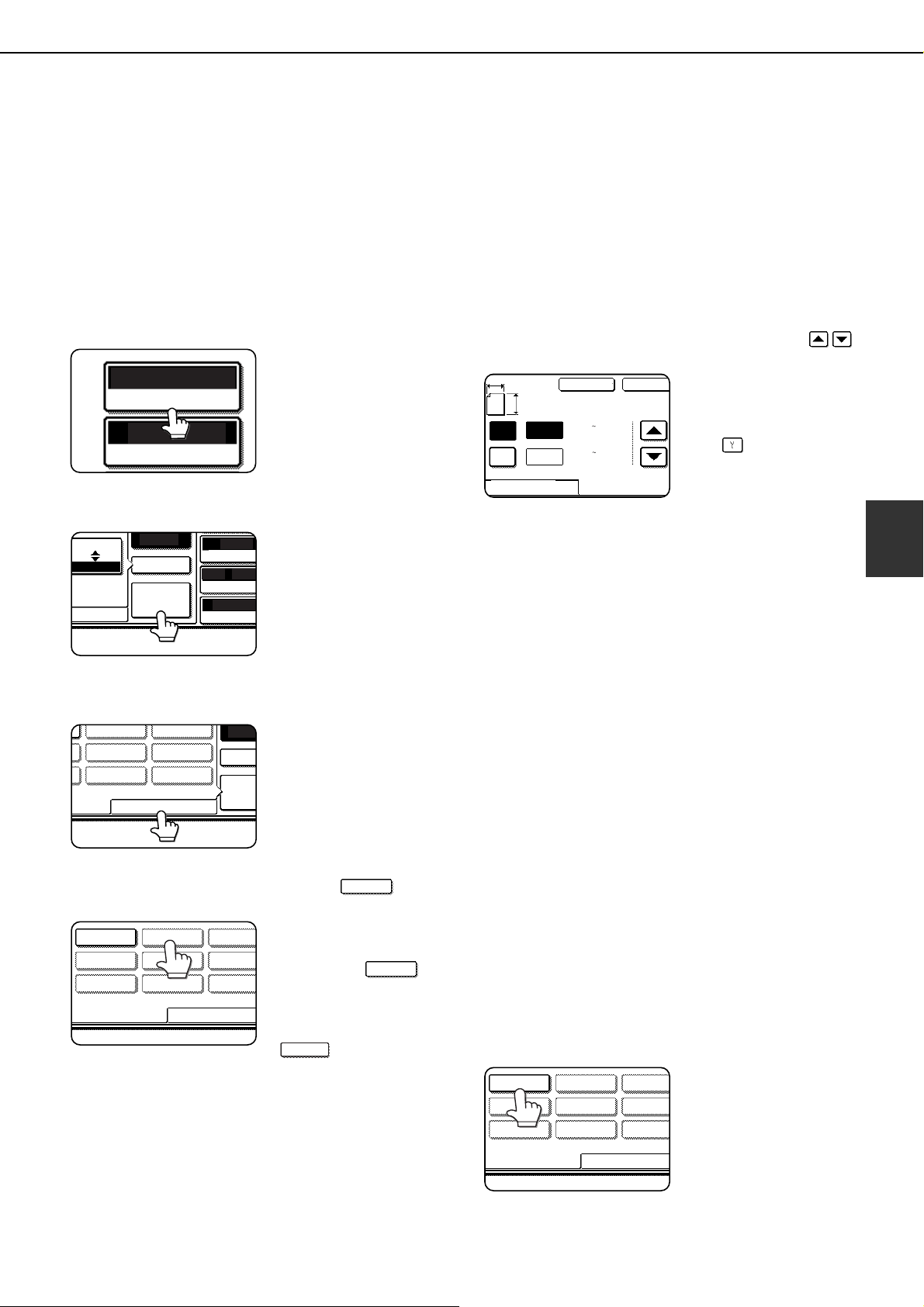
4-9
4
STORING, DELETING, AND USING
ORIGINAL SIZES
Up to 9 special original sizes can be stored. Stored sizes can be easily called up and are not erased if the power is
turned off. Storing a frequently used original size saves you the trouble of manually setting the size each time you
copy that size of document.
● To cancel an original size storing, using, or deleting operation, press the [CA] key or touch the [ORIGINAL] key
on the screen.
Storing or deleting an original size
1
Touch the [ORIGINAL] key.
2
Touch the [CUSTOM SIZE] key.
3
Touch the [STORE/DELETE] key.
4
Touch the original size key ( ) that
you wish to store or delete.
To store an original size,
touch a key that does not
show a size ( ).
Keys that already have
an original size stored
will show the stored size
().
To delete or change a stored size, touch the key
that shows the size that you wish to delete or
change.
●If you are storing an original size, go to step 5.
●To delete or change an original size, go to
step 7.
5
Enter the X (width) and Y (length)
dimensions of the original with the
keys.
X (width) is initially
selected.
Enter X and then touch
the ( ) key to enter Y.
A width of 2-1/2 to 17
inches can be entered in
X, and a length of 2-1/2
to 11-5/8 inches can be entered in Y.
6
Touch the [OK] key.
The original size entered in step 5 is stored in the
key selected in step 4.
To exit, touch the [ORIGINAL] key.
7
When you touch a key that shows an
original size in step 4, a message screen
appears that contains the keys [CANCEL],
[DELETE], and [STORE].
●To cancel the procedure, touch the [CANCEL]
key.
●To delete the selected original size, touch the
[DELETE] key.
●To change the original size stored in the key,
touch the [STORE] key. The screen of step 5
will appear to let you change the size.
8
To exit, touch the [ORIGINAL] key.
■
■■
■ USING A STORED ORIGINAL SIZE
1
Follow steps 1 to 2 of "STORING OR
DELETING AN ORIGINAL SIZE".
2
Touch the original size key that you wish
to use.
3
Touch the [OK] key.
The stored original size is called up.
AUTO
AUTO
ORIGINAL
EXPOSURE
E INPUT
CUSTOM
SIZE
EXPOSURE
PAPER SELE
COPY RATI
100%
AUTO
AUTO 8 x11
MANUAL
AUTO
INCH
AB
1
/
2
L
STORE/DELETE
CUSTO
SIZE
MANUA
AUTO
RECALL
STORE/DELETE
X5 Y10
1
/
2
1
/
8
X5 Y10
1
/
2
1
/
8
CANCEL OK
17
11 5/8
(2 1/2 17)
inch
RECALL
Y
X
A
X
Y
STORE/DELETE
(2 1/2 11 5/8)
inch
RECALL
STORE/DELETE
X5 Y10
1
/
2
1
/
8
ApollonII_general-copy_SEC.book 9 ページ 2004年9月6日 月曜日 午後4時57分

ApollonII_general-copy_SEC.book 10 ページ 2004年9月6日 月曜日 午後4時57分

5-1
CHAPTER 5
BASIC PROCEDURE
FOR MAKING COPIES
This chapter explains the procedures for using basic copy functions,
including making normal copies and enlarging/reducing copies.
Page
NORMAL COPYING ......................................................................................5-2
●
Copying from the reversing single pass feeder......................................5-2
●
Automatic two-sided copying from the reversing single pass feeder .....5-6
●
Copying from the document glass .........................................................5-7
●
Automatic two-sided copying from the document glass .........................5-9
EXPOSURE ADJUSTMENTS .....................................................................5-10
REDUCTION/ENLARGEMENT/ZOOM .......................................................5-12
●
Automatic selection (auto image).........................................................5-12
●
Manual selection ..................................................................................5-13
●
XY ZOOM ............................................................................................5-15
SPECIAL PAPERS ......................................................................................5-17
ApollonII_general-copy_SEC.book 1 ページ 2004年9月6日 月曜日 午後4時57分
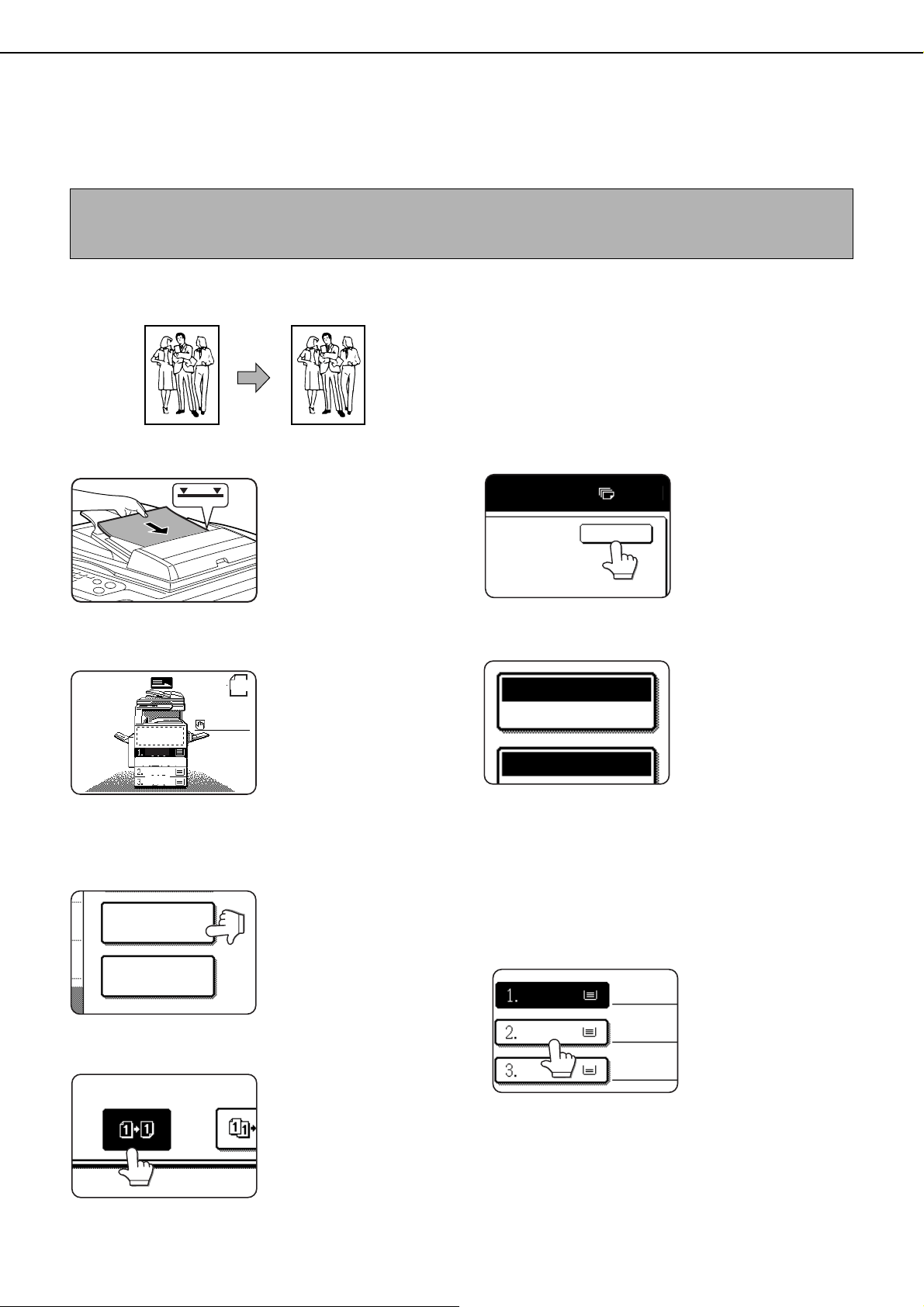
5-2
NORMAL COPYING
This section describes the normal copying procedure.
Copying from the reversing single pass feeder
■
■■
■ 1-sided copies of 1-sided originals
1
Place the originals in the document feeder
tray. (pages 4-6 to 4-9)
2
Ensure that the 1-sided to 1-sided copy
mode is selected.
The one-sided to one-
sided mode is selected
when no icon for a two-
sided mode appears in
the dashed area on the
display. If the 1-sided to
1-sided copy mode is
already selected, steps
3 to 5 are not needed.
3
Touch the [2-SIDED COPY] key.
4
Touch the [1-sided to 1-sided copy] key.
It may happen that a
mode other than [1-
sided to 1-sided copy] is
selected, thus [1-sided
to 1-sided copy] should
be selected again.
(Touch the [1-sided to 1-
sided copy] key so that it
is highlighted.)
5
Touch the [OK] key.
6
Ensure that paper of the same size as the
originals is automatically selected. (*Note)
The selected tray will be
highlighted or the
message "LOAD xxxxxx
PAPER." will appear. If
the message appears,
load paper in a paper
tray with paper of the
required size.
Even if the message above is displayed, copying
can be performed onto the currently selected
paper.
(*Note) The following requirements must be satisfied.
Originals of a standard size (11" x 17", 8-1/2" x
14", 8-1/2" x 11", 8-1/2" x 11"R or 5-1/2" x 8-1/2"
(A3, B4, A4, A4R, B5, B5R or A5)) are set and the
auto paper select function is enabled.
If originals of a size other
than the sizes above are
to be copied, manually
select the desired paper
size by touching the
[PAPER SELECT] key
and then touching the
desired paper size
selection key.
The selected key will be highlighted and the paper
selection screen will close. To close the paper
selection screen without making a selection, touch
the [PAPER SELECT] key.
NOTE
Certain restrictions exist depending on the amount of memory installed and the copy settings. (See "Copy mode
output restrictions" and "Guidelines for the number of scannable originals during sort copying" on page 5-4.)
Original Copy
11x17
PLAIN
5½x8½
8½x11
8½x11
DUPLEX
8½x11
ORIGINAL
2-SIDED COPY
OUTPUT
0
OK
PAPER SELECT
AUTO 8½x11
100
%
PLAIN
PLAIN
11x17
RECYCLED
8½x14
8½x11
ApollonII_general-copy_SEC.book 2 ページ 2004年9月6日 月曜日 午後4時57分
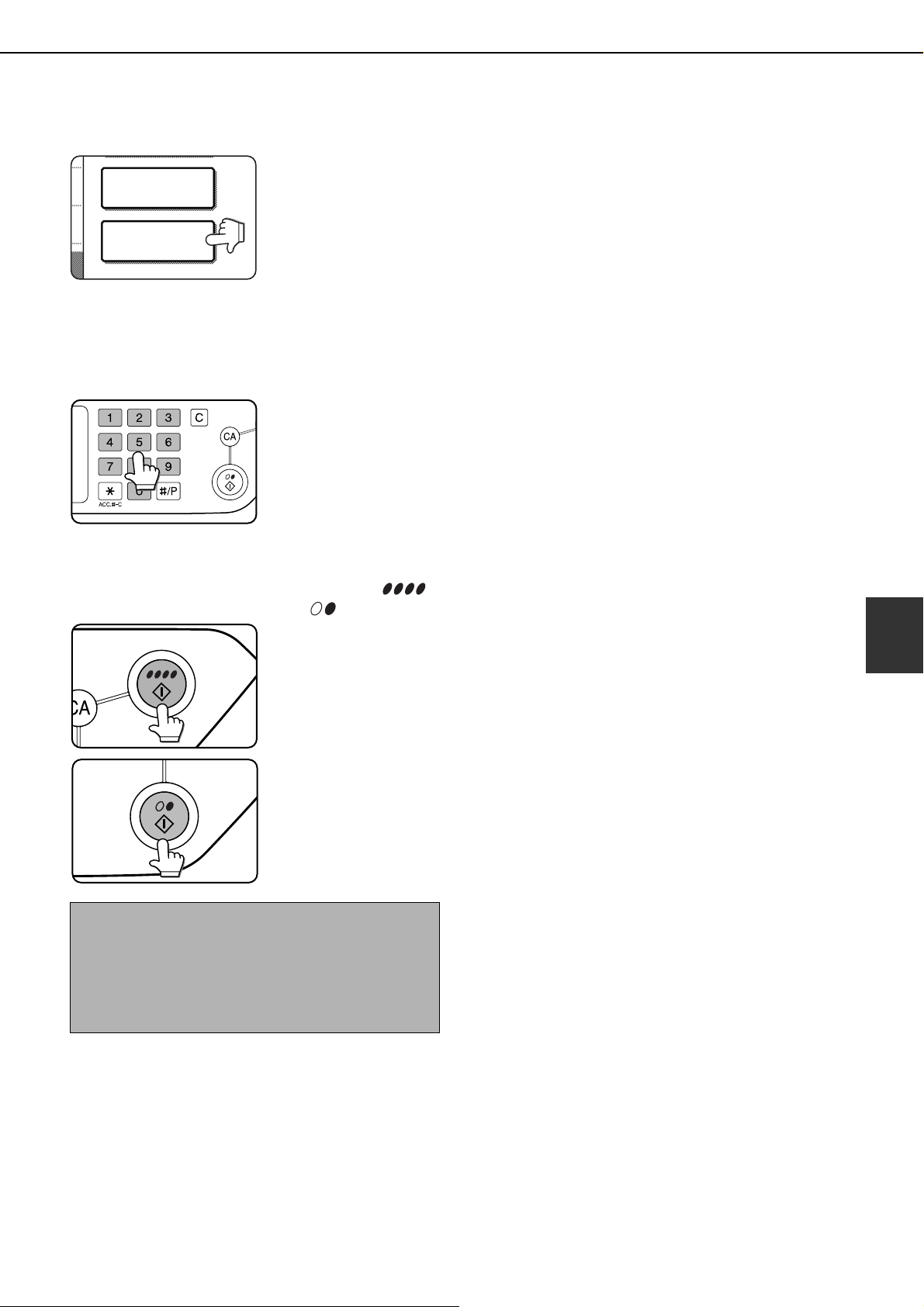
NORMAL COPYING
5-3
5
7
Select the desired output mode (see page
5-5).
The sort mode is the
default mode.
To select the group
mode, touch the
[OUTPUT] key, then
touch the [GROUP] key
on the output setting
screen, and then touch
the [OK] key on the
setting screen.
8
Use the numeric keys to set the desired
number of copies.
Up to 999 can be set.
If you are only making a
single copy, the copy
can be made with the
copy number display
showing "0". Use the [C]
(clear) key to cancel an
entry if a mistake has
been made.
9
Press the [COLOR COPY START ( )]
or [BLACK COPY START ( )] key.
If the [C] key is pressed
while originals are being
scanned, scanning will
stop. If copying had
already started, copying
and scanning will stop
after the original in
progress is output to the
original exit area. In
these cases the copy
quantity will be reset to
"0".
NOTE
The 1-sided to 1-sided copying mode is set as the
default in the initial settings. If the default setting has
not been changed using the "Initial status settings"
program (key operator program), steps 3 to 5 on
page 5-2 can be omitted.
2-SIDED COPY
OUTPUT
ApollonII_general-copy_SEC.book 3 ページ 2004年9月6日 月曜日 午後4時57分
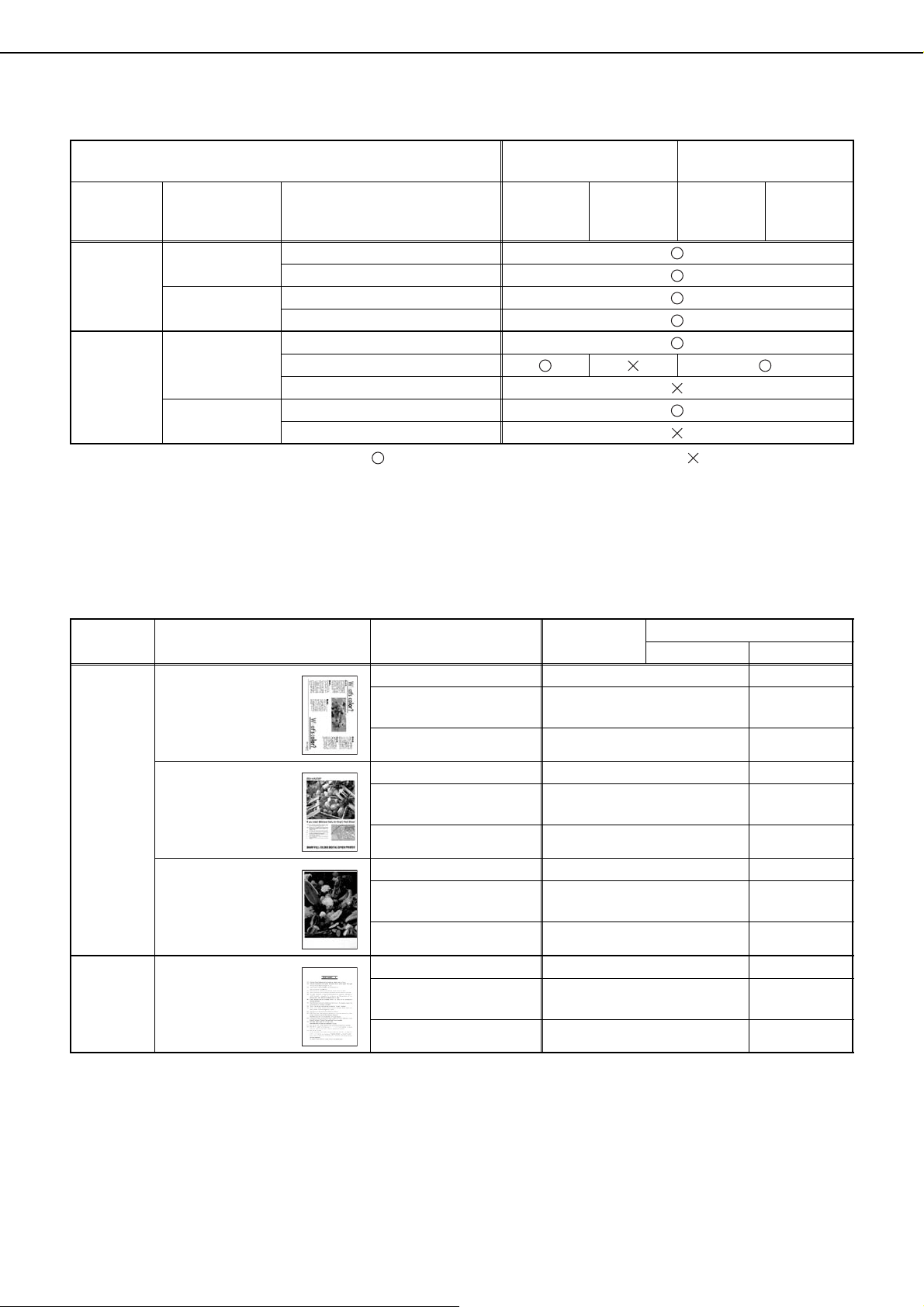
NORMAL COPYING
5-4
Copy mode output restrictions
: Copying possible using selected settings : Copying not possible
* The reversing single pass feeder cannot be used to copy 12" x 18" (A3W) size original.
Guidelines for the number of scannable originals during sort copying
When using sort copy mode, the number of pages shown in the table below will all be scanned into memory and
the set number of copies made.
(Note that the numbers shown below are general guidelines. The actual number of original pages that can be
scanned into memory will vary depending on the content of the originals.)
No added memory
Memory added
(128 MB or 256 MB)
Two-sided
copying
mode
Output mode original/paper size Sort Group Sort Group
One-sided
copying
Color copying
Up to 11" x 17" (A3)
12" x 18" (A3W)*
Black and white
copying
Up to 11" x 17" (A3)
12" x 18" (A3W)*
Automatic
two-sided
copying
Color copying
Up to 8-1/2" x 11" (A4)
8-1/2" x 14", 11" x 17" (
B4, A3
)
12" x 18" (A3W)*
Black and white
copying
Up to 11" x 17" (A3)
12" x 18" (A3W)*
Output
mode
Original type Original size
No added
memory
Added memory
128 MB 256 MB
Color
copying
Full color original
(mostly text)
Up to 8-1/2" x 11" (A4) 100 180
8-1/2" x 14", 11" x 17"
(B4, A3)
50 90
12" x 18" (A3W) 41 74
Full color original
(text and photos)
Up to 8-1/2" x 11" (A4) 37 64
8-1/2" x 14", 11" x 17"
(B4, A3)
18 32
12" x 18" (A3W) 15 26
Full color original
(photo)
Up to 8-1/2" x 11" (A4) 21 37
8-1/2" x 14", 11" x 17"
(B4, A3)
10 18
12" x 18" (A3W) 8 15
Black and
white
copying
Text original
Up to 8-1/2" x 11" (A4) 400 680
8-1/2" x 14", 11" x 17"
(B4, A3)
200 340
12" x 18" (A3W) 165 280
sec_apollon_05-1.fm 4 ページ 2004年9月16日 木曜日 午前10時24分
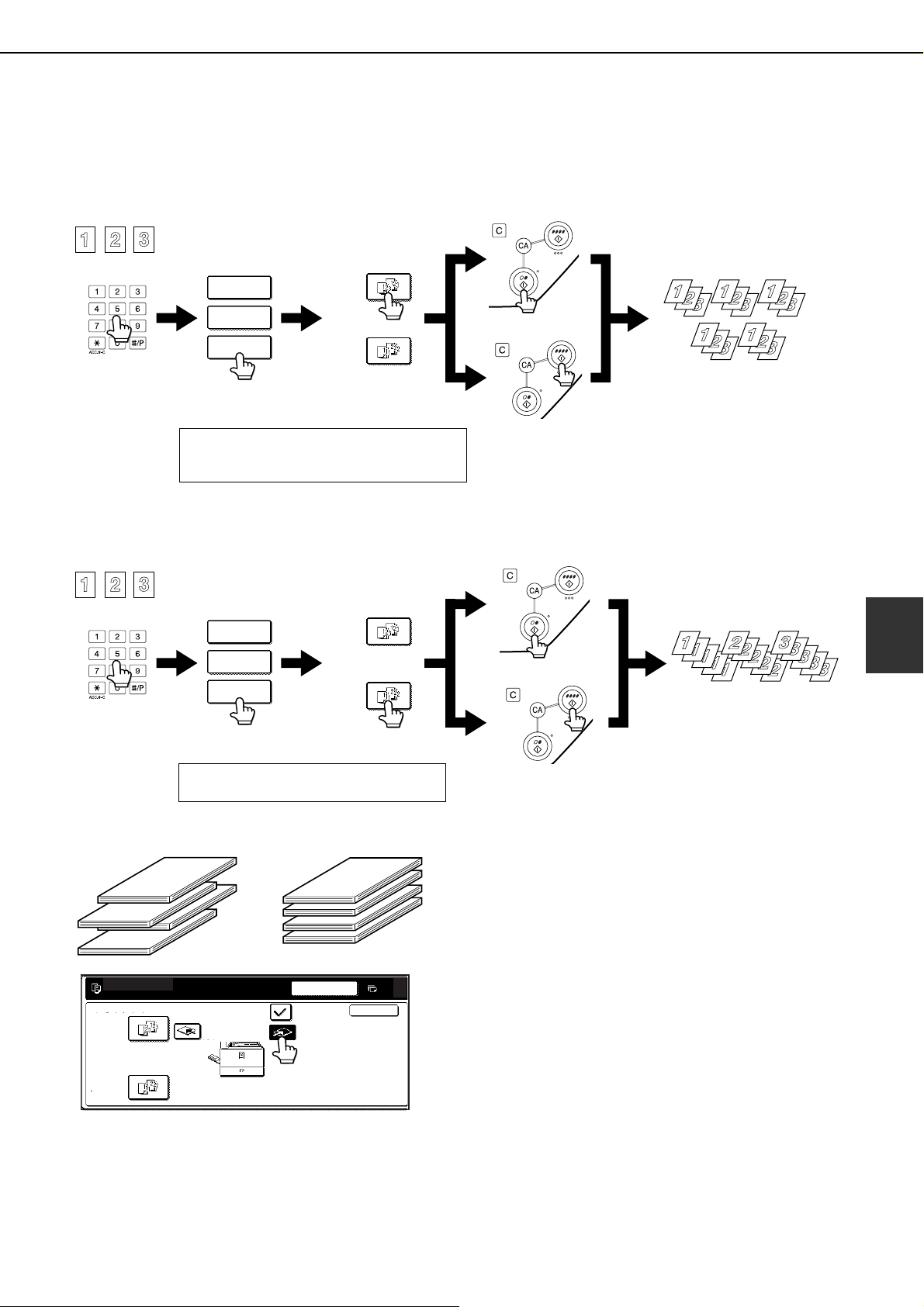
NORMAL COPYING
5-5
5
Copy output (sort and group)
Example: Making five sets or five copies each of three originals
● Sorting copies into sets
● Grouping copies by page
About the offset function
This function offsets each set of copies from the
previous set in the output tray, making it easy to
separate sets of copies.
(Offset can function for output to the center tray or in
the offset tray of the saddle stitch finisher.)
Turning on the offset function
The offset function operates when a checkmark
appears in the [OFFSET] checkbox, which is
displayed by touching the [CENTER TRAY] key. (If a
checkmark doesn't appear, touch the checkbox.)
Offset width: Approximately 1-3/10" (30 mm)
(12" x 18" (A3W) paper cannot be offset.)
SPECIAL MODES
2-SIDED COPY
OUTPUT
OUTPUT
SORT
GROUP
Original
Press the [BLACK
COPY START] key
Press the [COLOR
COPY START] key
Set the
number of
copies (5)
Touch the
[OUTPUT] key
Touch the
[SORT] key
Five sets of copies
"Sort" is automatically selected when the
original is placed on the document feeder tray
of the reversing single pass feeder.
SPECIAL MODES
2-SIDED COPY
OUTPUT
OUTPUT
SORT
GROUP
Original
Press the [BLACK
COPY START] key
Press the [COLOR
COPY START] key
Set the
number of
copies (5)
Touch the
[OUTPUT] key
Touch the
[GROUP] key
5 copies per page
"Group" is automatically selected when the
original is placed on the document glass.
Offset function "ON"
Offset function "OFF"
INTERRUPT
READY TO COPY.
0
OK
OUTPUT
SORT
GROUP
OFFSET
CENTER
TRAY
LEFT TRAY
Selecting the output tray
When the [LEFT TRAY] key in the above illustration
is highlighted, copies are output to the tray on the
left side of the machine (the left tray). When the
[CENTER TRAY] key is highlighted, copies are
output to the center tray. Touch the key of the tray
you wish to use for copy output.
sec_apollon_05-1.fm 5 ページ 2004年9月14日 火曜日 午前10時48分
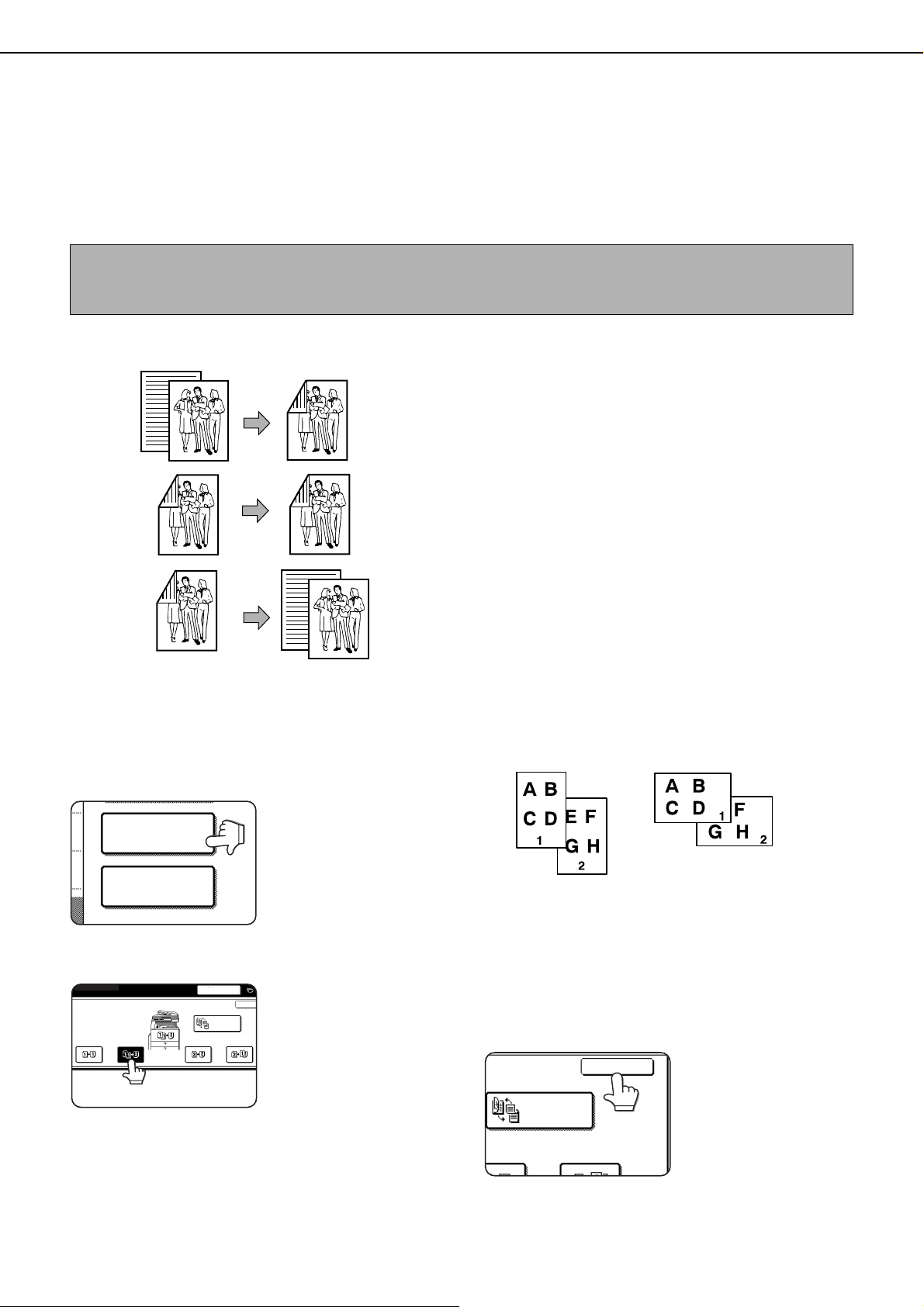
NORMAL COPYING
5-6
Automatic two-sided copying from the reversing single
pass feeder
When a duplex module/2 x 500 sheet paper drawer and a duplex bypass/inverter unit are installed, the following
automatic two-sided copy functions are possible. The copy paper is turned over automatically, allowing easy two-
sided copying.
The following two-sided modes can be selected
1. Automatic two-sided copying from one-sided
originals
2. Automatic two-sided copying from two-sided
originals
3. Automatic one-sided copying from two-sided
originals
● This function can be used even if a duplex module/2 x
500 sheet paper drawer and/or a duplex bypass/
inverter unit are not installed.
1
Place the originals in the document feeder
tray. (pages 4-6 to 4-9)
2
Touch the [2-SIDED COPY] key.
3
Select the desired duplex copy mode.
The left screen shows
the display when a
reversing single pass
feeder, a duplex module/
2 x 500 sheet paper
drawer, and a duplex
bypass/inverter unit are
installed. The display will vary depending on the
equipment installed.
If a copy key is touched for a mode that cannot be
selected, a double beep will be sounded.
The image to be copied onto the second side of 2-
sided copies can be inverted so that the resultant
2-sided copies are in the correct orientation for
binding at the top. For top binding, touch the
[BINDING CHANGE] key on the 2-sided copy
selection screen.
4
Touch the [OK] key.
Make selections and proceed as in steps 6 to 9 on
pages 5-2 and 5-3.
NOTE
Certain restrictions exist depending on the amount of memory installed and the copy settings. (See "Copy mode
output restrictions" and "Guidelines for the number of scannable originals during sort copying" on page 5-4.)
Original Copy
2-SIDED COPY
OUTPUT
SIDED COPY
BINDING
CHANGE
READY TO COPY.
INTERRUPT
OK
Example of a
portrait-oriented
original
Example of a
landscape-oriented
original
BINDING
CHANGE
OK
ApollonII_general-copy_SEC.book 6 ページ 2004年9月6日 月曜日 午後4時57分
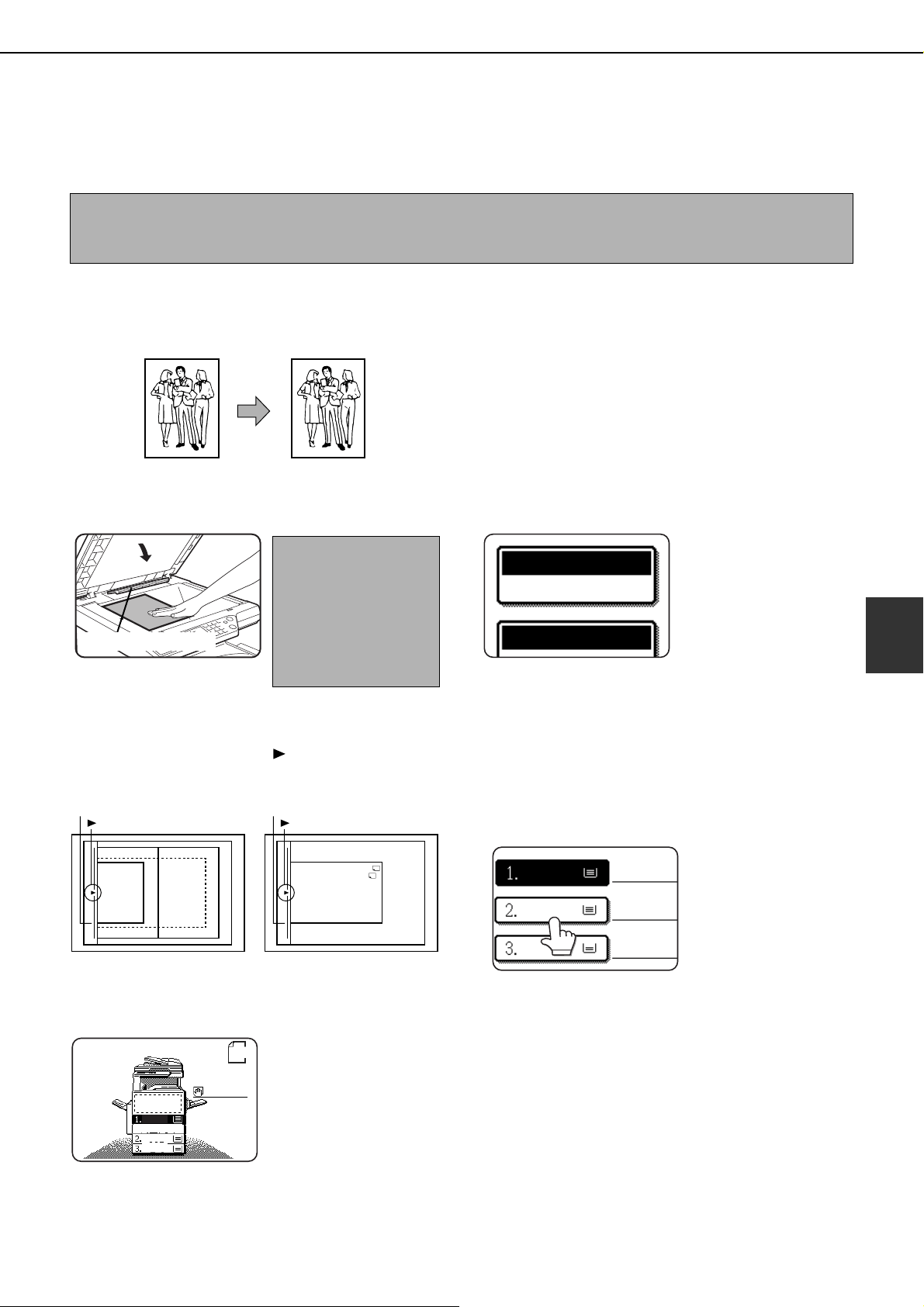
NORMAL COPYING
5-7
5
Copying from the document glass
When copying originals which cannot be fed from the reversing single pass feeder such as thick originals, open the
document cover and copy the originals from the document glass.
■
■■
■ 1-sided copies of 1-sided originals
1
Set an original on the document glass.
(pages 4-6 to 4-9)
[ How to place the original ]
Place the original in the appropriate position shown
below according to its size. ( Center the original on
the centering scale.)
2
Ensure that the 1-sided to 1-sided copy
mode is selected.
The one-sided to one-
sided mode is selected
when no icon for a two-
sided mode appears in
the dashed area on the
display.
3
Ensure that paper of the same size as the
original is automatically selected. (*Note)
The selected tray will be
highlighted or the
message "LOAD xxxxxx
PAPER." will appear. If
the message appears,
load paper in a paper
tray with paper of the
required size. Even if the
message above is displayed, copying can be
performed onto the currently selected paper.
(*Note) The following requirements must be
satisfied.
Originals of a standard size (11" x 17", 8-1/2" x
14", 8-1/2" x 11", 8-1/2" x 11"R or 5-1/2" x 8-1/2"
(A3, B4, A4, A4R, B5, B5R or A5)) are set and the
auto paper select function is enabled.
If originals of a size other
than the sizes above are
to be copied, manually
select the desired paper
size by touching the
[PAPER SELECT] key
and then touching the
desired paper size
selection key.
The selected key will be highlighted and the paper
selection screen will close. To close the paper
selection screen without making a selection, touch
the [PAPER SELECT] key.
NOTE
Certain restrictions exist depending on the amount of memory installed and the copy settings. (See "Copy mode
output restrictions" and "Guidelines for the number of scannable originals during sort copying" on page 5-4.)
Original Copy
NOTE
Do not place any objects
under the original size
detector, because they
may damage it or the
original size may not be
detected properly.
Original size detector
R
R
8½x14
or B4
11x17 or A3
8½x11 or A4
8½x11
or A4
5½x8½
or A5
Original scale
Centering scale
Original scale
Centering scale
11x17
PLAIN
5½x8½
8½x11
8½x11
DUPLEX
8½x11
ORIGINAL
PAPER SELECT
AUTO 8½x11
100
%
PLAIN
PLAIN
11x17
RECYCLED
8½x14
8½x11
ApollonII_general-copy_SEC.book 7 ページ 2004年9月6日 月曜日 午後4時57分
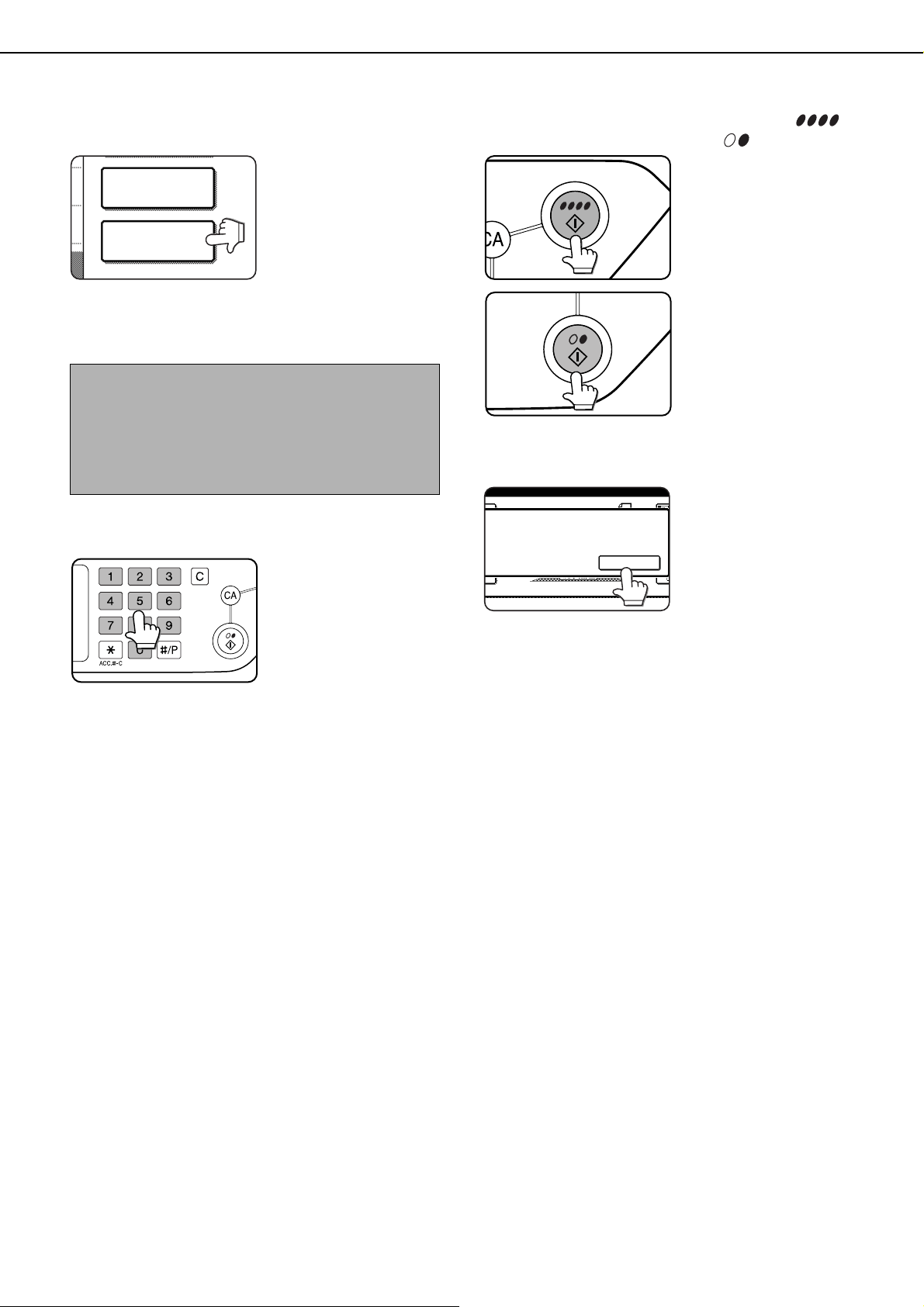
NORMAL COPYING
5-8
4
Select the desired output mode. (See page
5-5.)
When a document is
detected on the
document glass, the
group mode will be
automatically selected.
To select sort copy,
touch the [OUTPUT]
key, then touch the
[SORT] key on the displayed screen, and then
touch the [OK] key.
5
Use the numeric keys to set the desired
number of copies.
Up to 999 can be set.
If you are only making a
single copy, the copy
can be made with the
copy number display
showing "0".
Use the [C] (clear) key to
cancel an entry if a
mistake has been made.
6
Press the [COLOR COPY START ( )]
or [BLACK COPY START ( )] key.
Replace the original with
the next original and
press the [START] key.
Repeat this operation
until all originals have
been scanned.
7
Touch the [READ-END] key.
If you selected "Sort" for
the output in step 4, it is
necessary to touch the
[READ-END] key.
NOTE
If the [SORT] or [GROUP] key is touched, its
corresponding icon will appear on the touch panel.
To clear the icon display, press the [CA] (clear all)
key. Note that all selections made to that point will be
canceled.
2-SIDED COPY
OUTPUT
READ-END
PLACE NEXT ORIGINAL. PRESS [START].
WHEN FINISHED, PRESS [READ-END].
ApollonII_general-copy_SEC.book 8 ページ 2004年9月6日 月曜日 午後4時57分
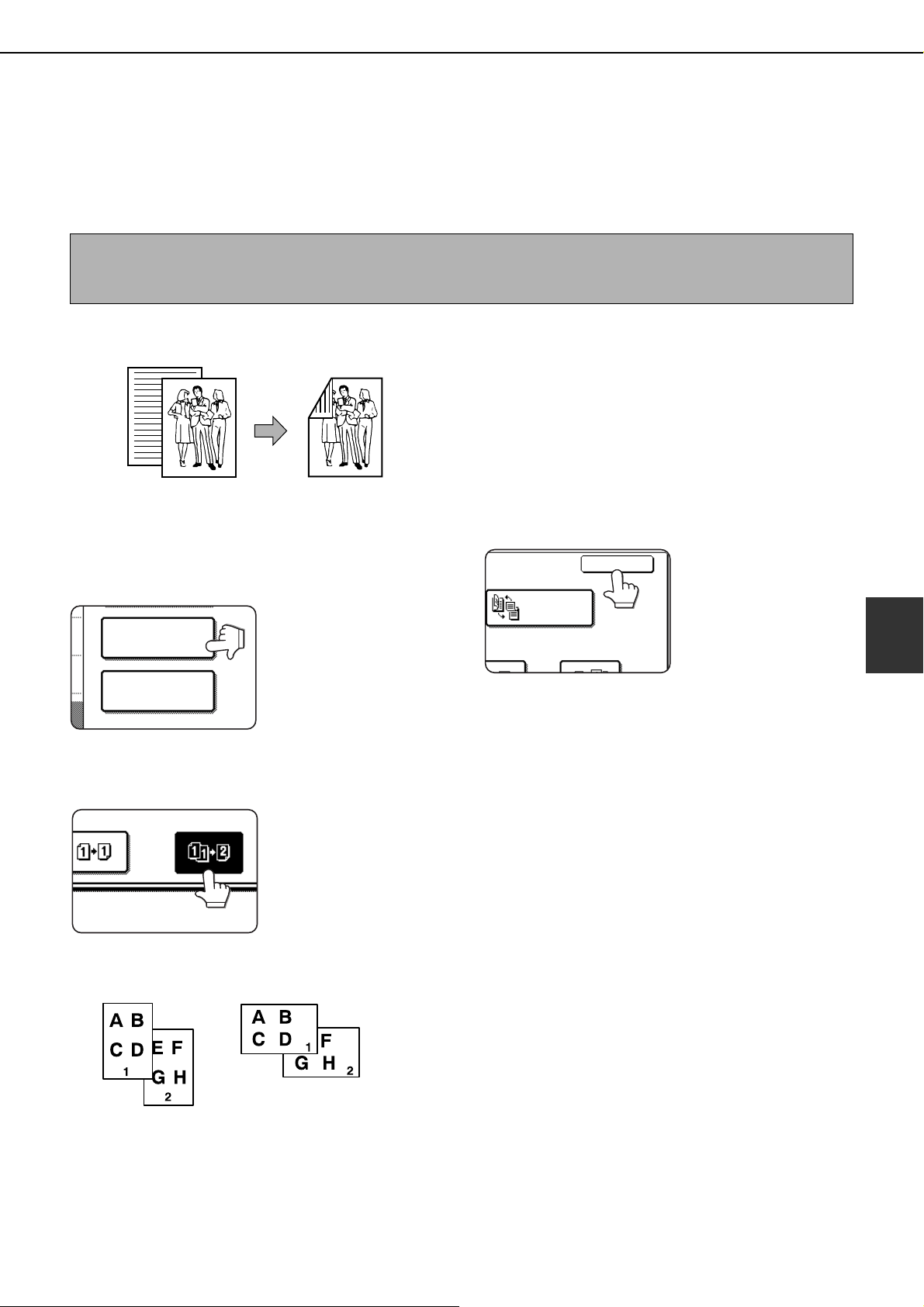
NORMAL COPYING
5-9
5
Automatic two-sided copying from the document glass
When a duplex module/2 x 500 sheet paper drawer and a duplex bypass/inverter unit are installed, the following
automatic two-sided copy function is possible. The copy paper is turned over automatically, allowing easy two-sided
copying.
1
Place an original on the document glass.
(pages 4-6 to 4-9)
2
Touch the [2-SIDED COPY] key.
3
Touch the [1-sided to 2-sided copy] key.
When making automatic two-sided copies of a
one-sided 11" x 17" (A3) or 8-1/2" x 14" (B4) size
portrait original, or when the front and back side of
a two-sided original are copied backwards, touch
the [BINDING CHANGE] key.
4
Touch the [OK] key.
Make selections and proceed as in steps 3 to 7 on
pages 5-7 and 5-8.
NOTE
Certain restrictions exist depending on the amount of memory installed and the copy settings. (See "Copy mode
output restrictions" and "Guidelines for the number of scannable originals during sort copying" on page 5-4.)
Original Copy
2-SIDED COPY
OUTPUT
Example of a
portrait-oriented
original
Example of a
landscape-oriented
original
BINDING
CHANGE
OK
ApollonII_general-copy_SEC.book 9 ページ 2004年9月6日 月曜日 午後4時57分
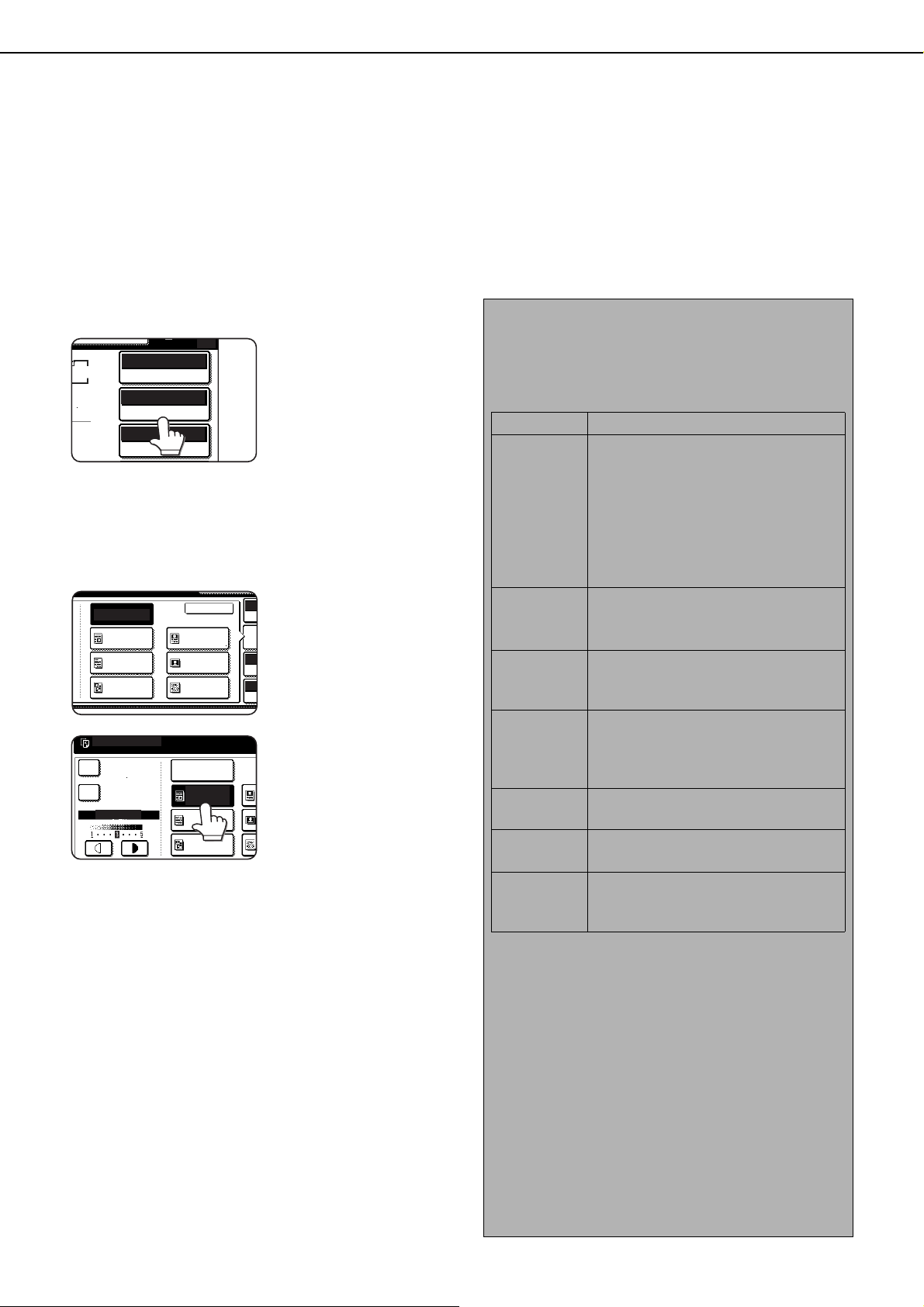
5-10
EXPOSURE ADJUSTMENTS
This copier has seven exposure modes to choose from: AUTO, TEXT/PRTD. PHOTO, TEXT/PHOTO, TEXT,
PHOTO, PRINTED PHOTO and MAP.
[AUTO]
This is the standard initial setting for this copier. When a black and white copy is made, the exposure is automatically
adjusted to obtain the best image quality. When a full-color copy is made, the image is adjusted in the same way as
when [TEXT/PRTD.PHOTO] (initial settings) is selected.
[TEXT/PRTD. PHOTO, TEXT/PHOTO, TEXT, PHOTO, PRINTED PHOTO and MAP.]
The exposure can be manually adjusted in 9 steps.
1
Touch the [EXPOSURE] key.
2
Select [AUTO], [TEXT/PRTD. PHOTO],
[TEXT/PHOTO], [TEXT], [PHOTO],
[PRINTED PHOTO], or [MAP] depending
upon the original type.
Example:
The [TEXT/PRTD.PHOTO]
key is selected
AUTO
ORIGINAL
AUTO
EXPOSURE
AUTO 8½x11
PAPER SELECT
N
½
0
8½x11
PA
CO
A
OK
TEXT/
PRTD.PHOTO
PRINTED
PHOTO
TEXT/PHOTO
TEXT
PHOTO
MAP
AUTO
READY TO COPY.
COPY
OF COPY
COLOR TONE
ENHANCEMENT
MANUAL
TEXT/
PRTD.PHOTO
TEXT
PRINTED
PHOTO
AUTO
NOTES
●
●●
●
Selecting the resolution
Six resolution settings are available for both color
copying and black and white copying, depending
on the contents of the original.
●
●●
●
Making a copy of a copy
When making a copy of a copy made on this machine,
touch the checkbox for COPY OF COPY to select the
mode. Three resolution settings are available when
this mode is selected: "TEXT/PRINTED PHOTO",
"TEXT", and "PRINTED PHOTO".
●
For brighter colors in color copies, touch the
COLOR TONE ENHANCEMENT checkbox. The
following restrictions apply when color tone
enhancement is selected:
Color tone enhancement cannot be selected at the
same time as COPY OF COPY mode (above).
Brightness adjustment (page 6-15) and single color
copying (page 6-17) are not possible.
The reversing single pass feeder cannot be used. (It
can be used when making black and white copies.)
Original type Contents of the original
AUTO
Normally this setting is selected. When
a black and white copy is made, the
exposure is automatically adjusted to
obtain the best image quality. When a
full-color copy is made, the image is
adjusted in the same way as when
[TEXT/PRTD.PHOTO] (initial settings)
below is selected.
TEXT/
PRTD.
PHOTO
This mode provides the best balance
for copying an original which contains
both text and printed photographs.
TEXT/
PHOTO
This mode provides the best balance
for copying an original which
contains both text and photographs.
TEXT
This mode is useful in enhancing
very low density areas of an original
or in suppressing unusually high-
density background areas.
PHOTO
This mode provides the best copies
of photographs with fine details.
PRINTED
PHOTO
This mode is useful for copying
printed photographs.
MAP
This mode is useful to provide the
best shading and fine details found
on most maps.
ApollonII_general-copy_SEC.book 10 ページ 2004年9月6日 月曜日 午後4時57分
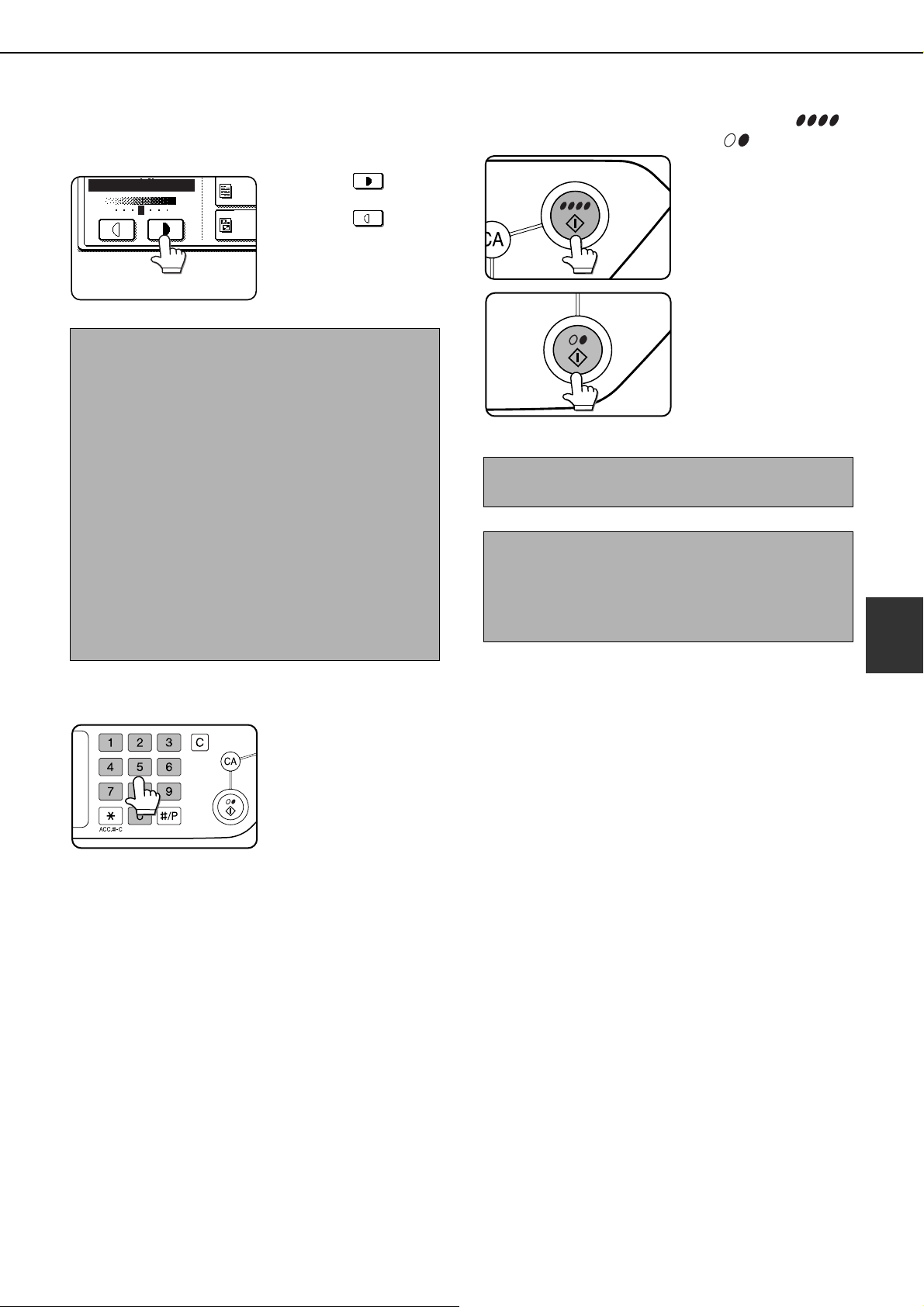
EXPOSURE ADJUSTMENTS
5-11
5
3
If a setting other than "AUTO" has been
selected in step 2, manually adjust the
copy exposure.
Touch the key to
make darker copies.
Touch the key to
make lighter copies.
4
Use the numeric keys to set the desired
number of copies.
5
Press the [COLOR COPY START ( )]
or [BLACK COPY START ( )] key.
NOTES
●
●●
●
Recommended exposure levels for the text mode
1 to 2: Dark originals such as newspaper
3: Normal density originals
4 to 5: Originals written with pencils or light color
characters
●
●●
● Color adjustment menu
As special functions for color copying, the
following color image adjustments can be made.
(Page 6-11)
● RGB ADJUST
● SHARPNESS
● SUPPRESS BACKGROUND
● COLOR BALANCE
● BRIGHTNESS
● INTENSITY
MANUAL
PRIN
PHOT
TEXT
1
3
5
To return to the automatic exposure mode, touch the
[EXPOSURE] key and select [AUTO].
NOTE
The exposure level for automatic exposure
adjustment can be changed using the key operator
program on page 15 of the key operator's guide.
(Exposure adjustment)
ApollonII_general-copy_SEC.book 11 ページ 2004年9月6日 月曜日 午後4時57分
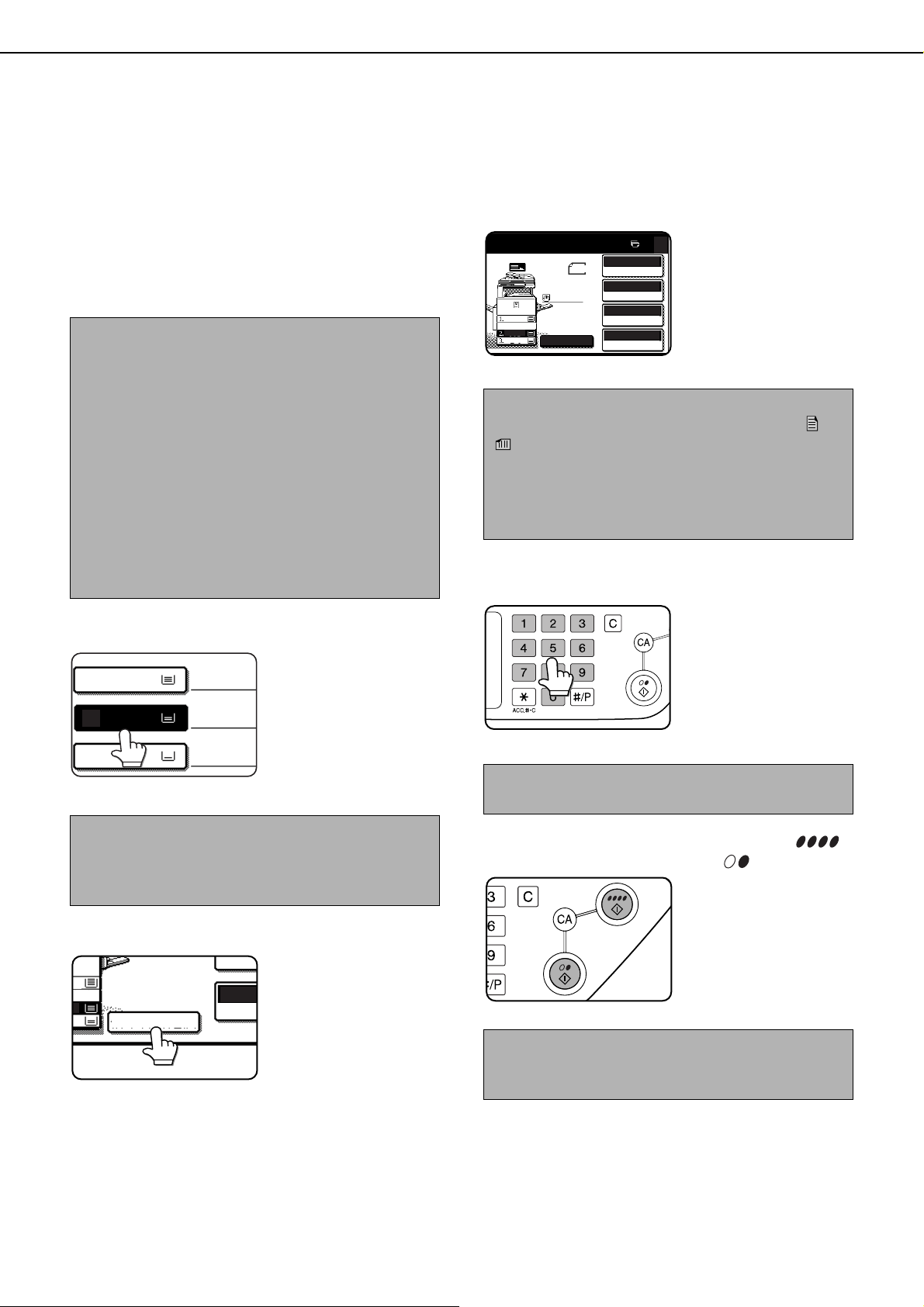
5-12
REDUCTION/ENLARGEMENT/ZOOM
Reduction and enlargement ratios can be selected either automatically or manually as described in this section.
Automatic selection (auto image)
The reduction or enlargement ratio will be selected automatically based on the original size and the selected paper size.
1
Place the original in the document feeder
tray or on the document glass. (pages 4-6
to 4-9)
The detected original size will be displayed.
2
Touch the [PAPER SELECT] key and then
select the desired paper size.
When touching the
desired paper size
selection key, the
selected key will be
highlighted and the
paper selection screen
will close.
3
Touch the [AUTO IMAGE] key.
The [AUTO IMAGE] key
will be highlighted and
the best reduction or
enlargement ratio for the
original size and the
selected paper size will
be selected and
displayed in the copy
ratio display.
4
Use the numeric keys to set the desired
number of copies.
Up to 999 can be set.
If you are only making a
single copy, the copy
can be made with the
copy number display
showing "0".
5
Press the [COLOR COPY START ( )]
or [BLACK COPY START ( )] key.
If you placed the original
on the document glass,
set the output to "Sort",
you must touch the
[READ-END] key after
all pages of the original
have been scanned.
(Step 7 on page 5-8)
NOTE
Automatic ratio adjustment can only be used for the
following original and paper sizes. It cannot be used
for other sizes. However, in the case of non-standard
original and paper sizes, the sizes can be entered to
make automatic ratio adjustment possible for those
sizes. (page 4-8)
Original sizes:
11" x 17", 8-1/2" x 14", 8-1/2" x 11", 8-1/2"
x 11"R, 5-1/2" x 8-1/2" (A3, B4, A4, A4R,
B5, B5R, A5)
Paper size:
11" x 17", 8-1/2" x 14", 8-1/2" x 13", 8-1/2"
x 11", 8-1/2" x 11"R, 5-1/2" x 8-1/2" (A3,
B4, A4, A4R, B5, A5)
NOTE
If paper of the desired size is not loaded in any tray,
load paper of the required size in a paper tray or the
bypass tray.
PLAIN
PLAIN
11x17
RECYCLED
3.
2.
1. 8½x11
8½x14
PAPER
1
COPY
AUTO IMAGE
EX
NOTE
If the message "ROTATE ORIGINAL FROM TO
" is displayed, change the orientation of the
original as indicated in the message. When the
message above is displayed, copying can be done
without changing the orientation, but the image will
not fit the paper correctly.
Use the [C] (clear) key to cancel an entry if a mistake
has been made.
To cancel the auto image mode, touch the [AUTO
IMAGE] key again to clear the highlighted display.
(Step 3)
8½x14
AUTO
EXPOSURE
AUTO
ORIGINAL
11x17
AUTO IMAGE
PAPER SELECT
129
%
COPY RATIO
PLAIN
8½x11
0
11x17
8½x11
DUPLEX
8½x11
ORIGINAL
ApollonII_general-copy_SEC.book 12 ページ 2004年9月6日 月曜日 午後4時57分
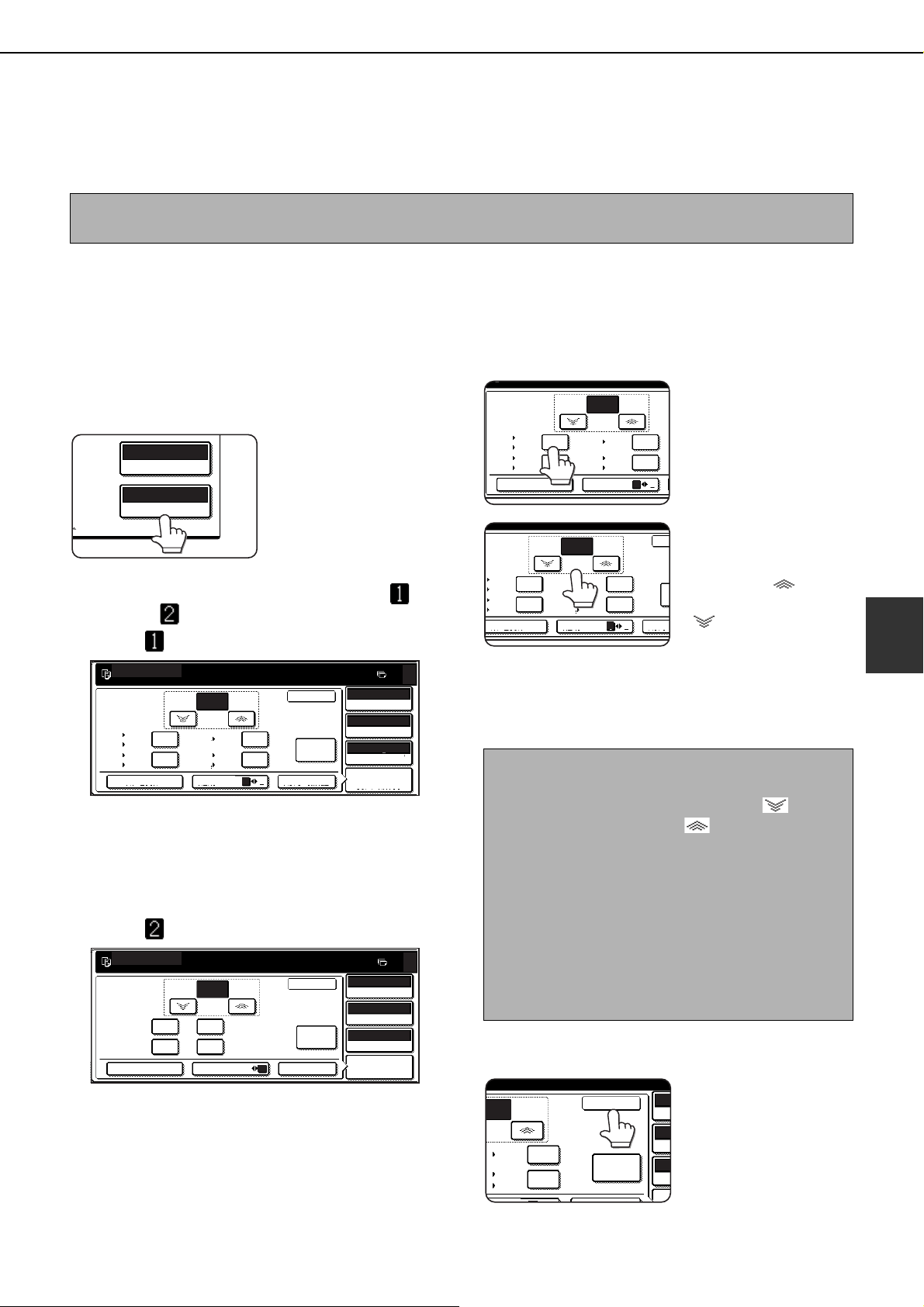
REDUCTION/ENLARGEMENT/ZOOM
5-13
5
Manual selection
The preset ratios (maximum 400%, minimum 25%) can be selected with the enlargement and reduction keys. In
addition, the zoom keys can be used to select any ratio from 50% to 200% in increments of 1%.
<The key operator program on page 15 of the key operator's guide can be used to set two additional enlargement
ratios and two additional reduction ratios.>
1
Place the original in the document feeder
tray or on the document glass. (pages 4-6
to 4-9)
2
Touch the [COPY RATIO] key.
3
Use the [MENU] key to select menu " " or
menu " " for copy ratio selection.
Menu
● A. Preset reduction copy ratios are:
77% and 64% (for the inch system).
70%, 81% and 86% (for the AB system).
● B. Preset enlargement copy ratios are:
121% and 129% (for the inch system).
115%, 122% and 141% (for the AB system).
Menu
● A. Preset reduction copy ratios are:
50% and 25%*.
● B. Preset enlargement copy ratios are:
200% and 400%*.
* When the reversing single pass feeder is used, the
ratio can only be set within the range 50% to 200%.
(The custom ratios set by the key operator appear
in ratio menu 2.)
4
Use the reduction, enlargement, and
[ZOOM] keys on the touch panel to set the
desired copy ratio.
Zoom ratios: Any ratio
from 50% to 200% can
be set in 1% increments.
Touch the [ ] key to
increase the ratio, or the
[ ] key to decrease
the ratio. If you continue
to touch either key for 3
seconds, the ratio
begins to change
quickly.
5
Touch the [OK] key.
NOTE
When the reversing single pass feeder is used, the ratio can only be set within the range 50% to 200%.
AUTO 8½x11
PAPER SELECT
100
%
COPY RATIO
N
READY TO COPY.
100
ZOOM
%
77
%
64
%
121
%
129
%
XY ZOOM MENU AUTO IMAGE
21
0
OK
100
%
ORIGINAL
PAPER SELECT
COPY RATIO
AUTO
EXPOSURE
AUTO
AUTO 8½x11
11x17
8½x14
11x17
8½x11
8½x14
8½x11
8½x11
5½x8½
8½x14 11x17
8½x11 11x17
5½x8½ 8½x11
READY TO COPY.
0
100
ZOOM
OK
%
50
%
200
%
25
%
400
%
100
%
XY ZOOM MENU AUTO IMAGE
21
EXPOSURE
PAPER SELECT
COPY RATIO
AUTO
ORIGINAL
AUTO
AUTO 8½x11
NOTES
● Touch a reduction or enlargement key to set the
approximate ratio, then touch the [ ] key to
decrease the ratio or the [ ] key to increase the
ratio.
● The message "IMAGE IS LARGER THAN COPY
PAPER." may appear, indicating that the selected
copy ratio is too large for the copy paper size.
However, if you press the [START] key, a copy will
be made.
● To set the horizontal and vertical copy ratios
separately, use the XY ZOOM feature. See page
5-15.
100
ZOOM
%
77
%
64
%
121
%
129
%
XY ZOOM MENU
21
11x17
8½x14
11x17
8½x11
8½x14
8½x11
8½x11
5½x8½
8½x14 11x17
8½x11 11x17
5½x8½ 8½x11
100
ZOOM
%
77
%
64
%
121
%
129
%
XY ZOOM MENU AUTO
21
8½x14
8½x11
8½x11
5½x8½
8½x14 11x17
8½x11 11x17
5½x8½ 8½x11
77
ZOOM
%
121
%
129
%
NU AUTO IMAGE
OK
100
%
PA
AU
4 11x17
1 11x17
½ 8½x11
ApollonII_general-copy_SEC.book 13 ページ 2004年9月6日 月曜日 午後4時57分
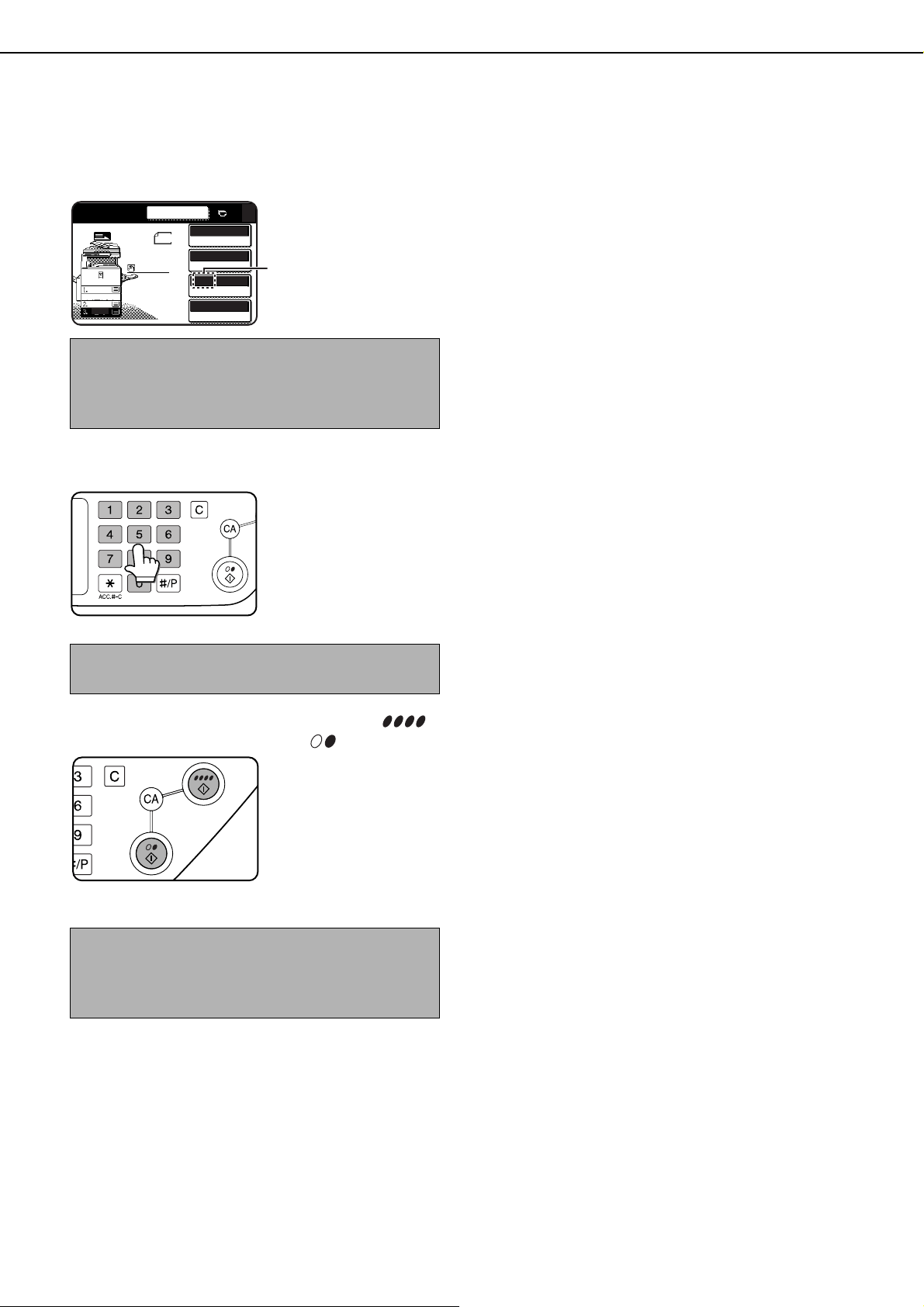
REDUCTION/ENLARGEMENT/ZOOM
5-14
6
Ensure that the desired paper size has
been automatically selected based on the
selected copy ratio or select another size
as needed.
7
Use the numeric keys to set the desired
number of copies.
Up to 999 can be set.
If you are only making a
single copy, the copy
can be made with the
copy number display
showing "0".
8
Press the [COLOR COPY START ( )]
or [BLACK COPY START ( )] key.
If you placed the original
on the document glass,
set the output to "Sort",
you must touch the
[READ-END] key after
all pages of the original
have been scanned.
(Step 7 on page 5-8)
NOTE
If the auto paper select display does not appear, no
appropriate paper size for the selected ratio is
available.
Use the [C] (clear) key to cancel an entry if a mistake
has been made.
To return the ratio to 100%
To return the ratio setting to 100%, touch the [COPY
RATIO] key to display the ratio menu and then touch
the [100%] key. (Steps 2 and 3 on page 5-13.)
8½x14
AUTO
EXPOSURE
AUTO
ORIGINAL
AUTO 8½x14
PAPER SELECT
77
%
COPY RATIO
PLAIN
INTERRUPT
ORIGINAL
8½x11
0
8½x11
8½x11
DUPLEX
11x17
Auto paper select display
ApollonII_general-copy_SEC.book 14 ページ 2004年9月6日 月曜日 午後4時57分
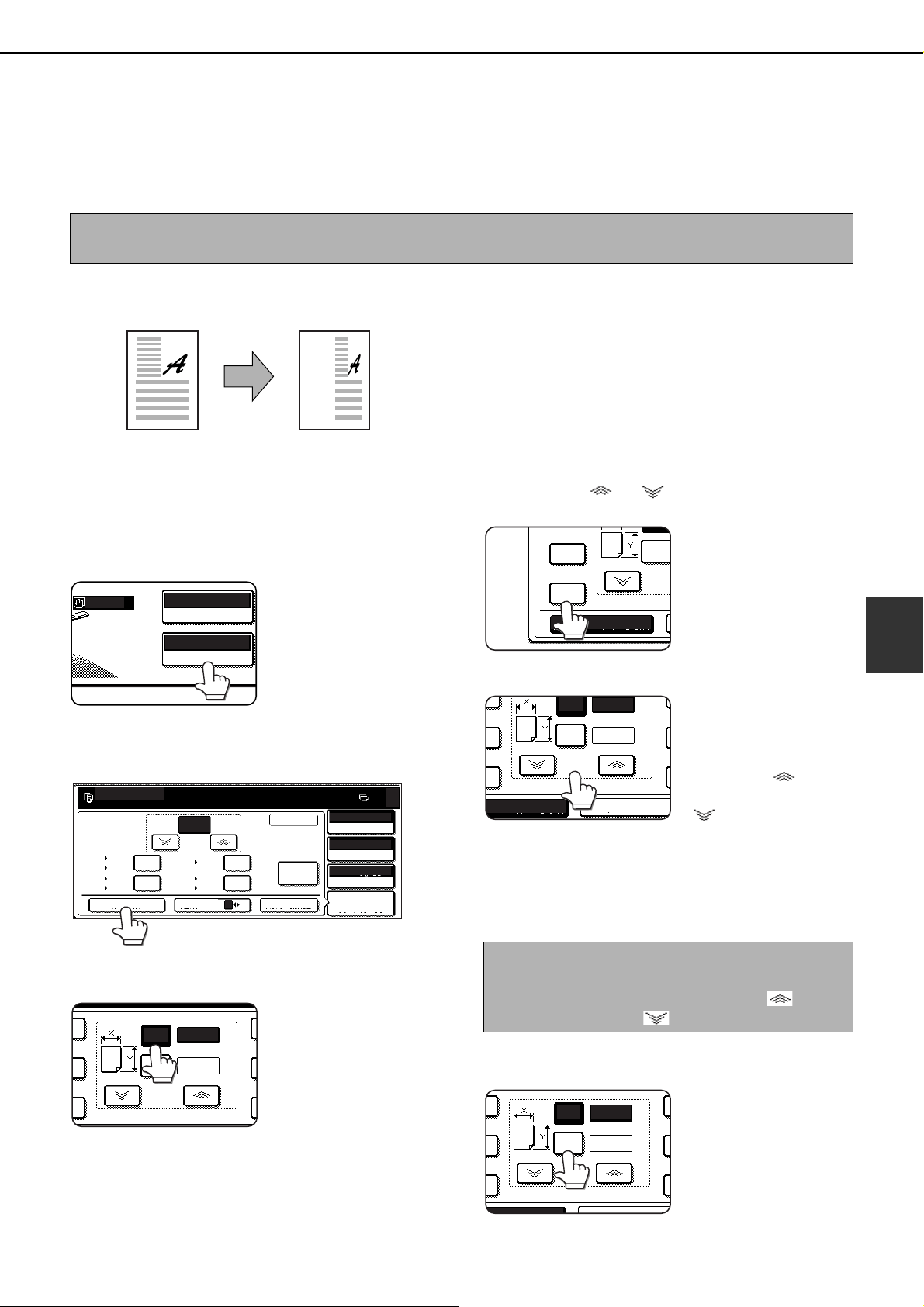
REDUCTION/ENLARGEMENT/ZOOM
5-15
5
XY ZOOM
The XY ZOOM feature allows the horizontal and vertical copy ratios to be changed independently.
The preset ratios (maximum 400%, minimum 25%) can be selected with the enlargement and reduction keys. In
addition, the zoom keys can be used to select any ratio from 50% to 200% in increments of 1%.
Example: Selecting 100% for the length and 50% for the width
1
Place the original in the document feeder
tray or on the document glass. (pages 4-6
to 4-9)
2
Touch the [COPY RATIO] key on the touch
panel.
3
Touch the [XY ZOOM] key.
4
Touch the [X] key.
5
Use the reduction, enlargement, and
ZOOM ([ ], [ ]) keys to change the
copy ratio in the horizontal (X) direction.
A fixed ratio key will not
become highlighted
when touched.
When the reversing
single pass feeder is
used, the ratio can only
be set within the range
50% to 200%.
The zoom keys can be
used to change the ratio
from 50% to 200% in
increments of 1%.
Touch the [ ] key to
increase the ratio, or the
[ ] key to decrease
the ratio. If you continue
to touch either key for 3
seconds, the ratio
begins to change
quickly.
6
Touch the [Y] key.
NOTE
When the reversing single pass feeder is used, the ratio can only be set within the range 50% to 200%.
Original
Copy
AUTO 8½x11
PAPER SELECT
100
%
COPY RATIO
PLAIN
5½x8½
READY TO COPY.
100
ZOOM
%
77
%
64
%
121
%
129
%
XY ZOOM MENU AUTO IMAGE
21
0
OK
100
%
ORIGINAL
PAPER SELECT
COPY RATIO
AUTO
EXPOSURE
AUTO
AUTO 8½x11
11x17
8½x14
11x17
8½x11
8½x14
8½x11
8½x11
5½x8½
8½x14 11x17
8½x11 11x17
5½x8½ 8½x11
100
100
ZOOM
%
%
%
Y
A
X
1
4
%
%
2
NOTE
Touch a reduction key or an enlargement key to set
the approximate ratio, then touch the [ ] key to
decrease the ratio or [ ] key to increase the ratio.
ZOOM
Y
A
64%
50%
XY ZOOM
100
50
ZOOM
%
%
%
Y
A
X
1
4
%
%
2
XY ZOOM
CANCEL
100
50
ZOOM
%
%
%
Y
A
X
1
4
%
%
2
XY ZOOM
AN EL
ApollonII_general-copy_SEC.book 15 ページ 2004年9月6日 月曜日 午後4時57分
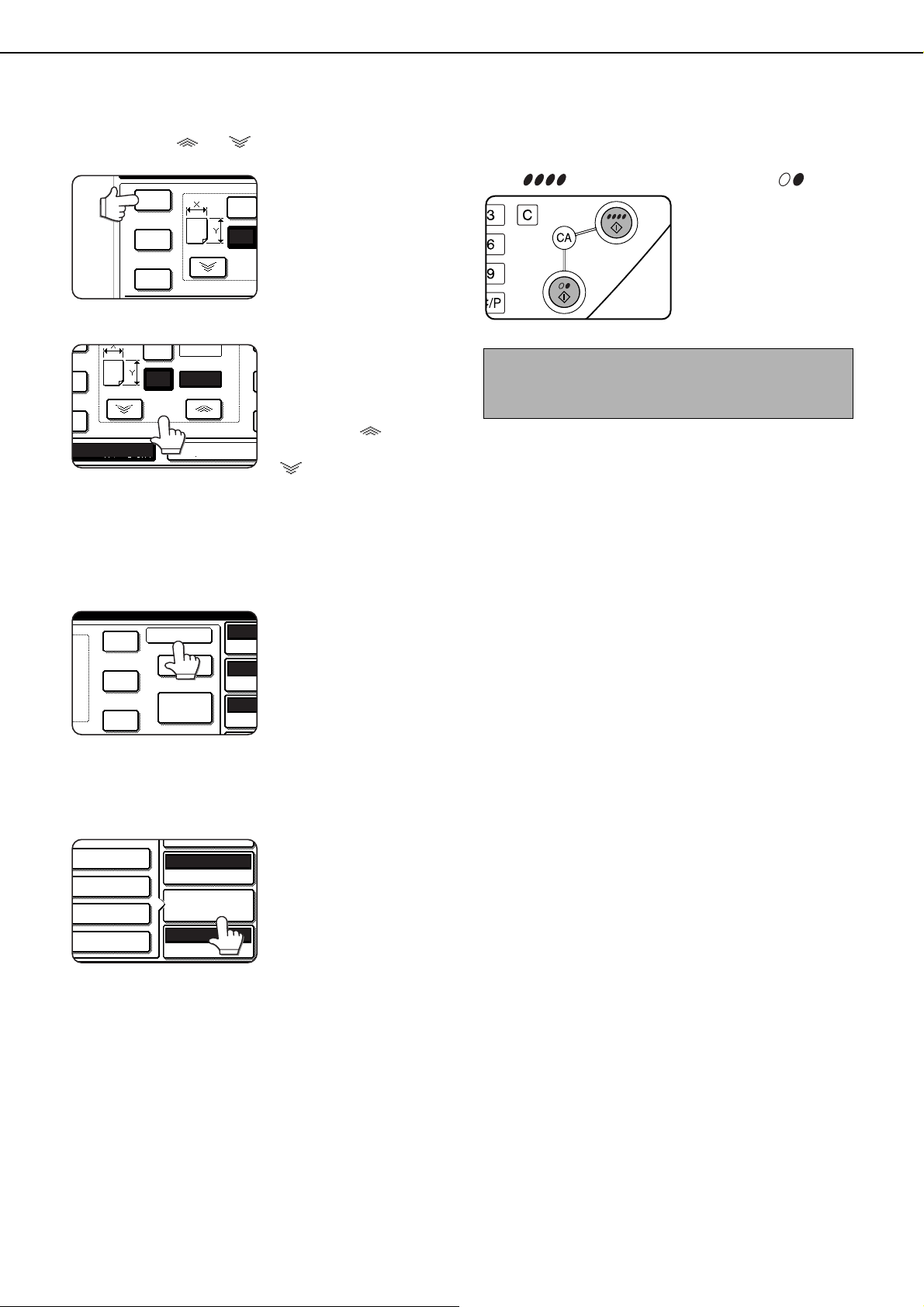
REDUCTION/ENLARGEMENT/ZOOM
5-16
7
Use the reduction, enlargement, and
ZOOM ([ ], [ ]) keys to change the
copy ratio in the vertical (Y) direction.
A fixed ratio key will not
become highlighted
when touched.
When the reversing
single pass feeder is
used, the ratio can only
be set within the range
50% to 200%.
The zoom keys can be
used to change the ratio
from 50% to 200% in
increments of 1%.
Touch the [ ] key to
increase the ratio, or the
[ ] key to decrease
the ratio. If you continue to touch either key for 3
seconds, the ratio begins to change quickly.
Either copy ratio can be changed for fine-tuning
until the next step is performed.
8
Touch the [OK] key.
9
Touch the [PAPER SELECT] key and
select the paper tray with the desired
paper size.
If the AUTO PAPER
SELECT mode is on, the
appropriate copy paper
size will have been
automatically selected
based on the original
size and selected copy
ratios.
10
Make all other desired settings such as
exposure, paper size and number of copies
and then press the [COLOR COPY START
( )] or [BLACK COPY START ( )] key.
ZOOM
77%
Y
A
X
64%
50%
77
50
ZOOM
%
%
%
Y
A
X
1
4
%
%
2
XY ZOOM
CANCEL
OK
%
%
25
%
129%
400%
200%
100
%
OR
PAPE
EX
AUTO
HEAVY PAPER
PLAIN PAPER
RANSPARENCY
ENVELOPE
PAPER SELECT
EXPOSURE
COPY RATIO
X-50% Y-100%
AUTO
ORIGIN L
To cancel this function, touch the [CANCEL] key or
the [XY ZOOM] key again as in step 3 or 5 on page
5-15.
ApollonII_general-copy_SEC.book 16 ページ 2004年9月6日 月曜日 午後4時57分
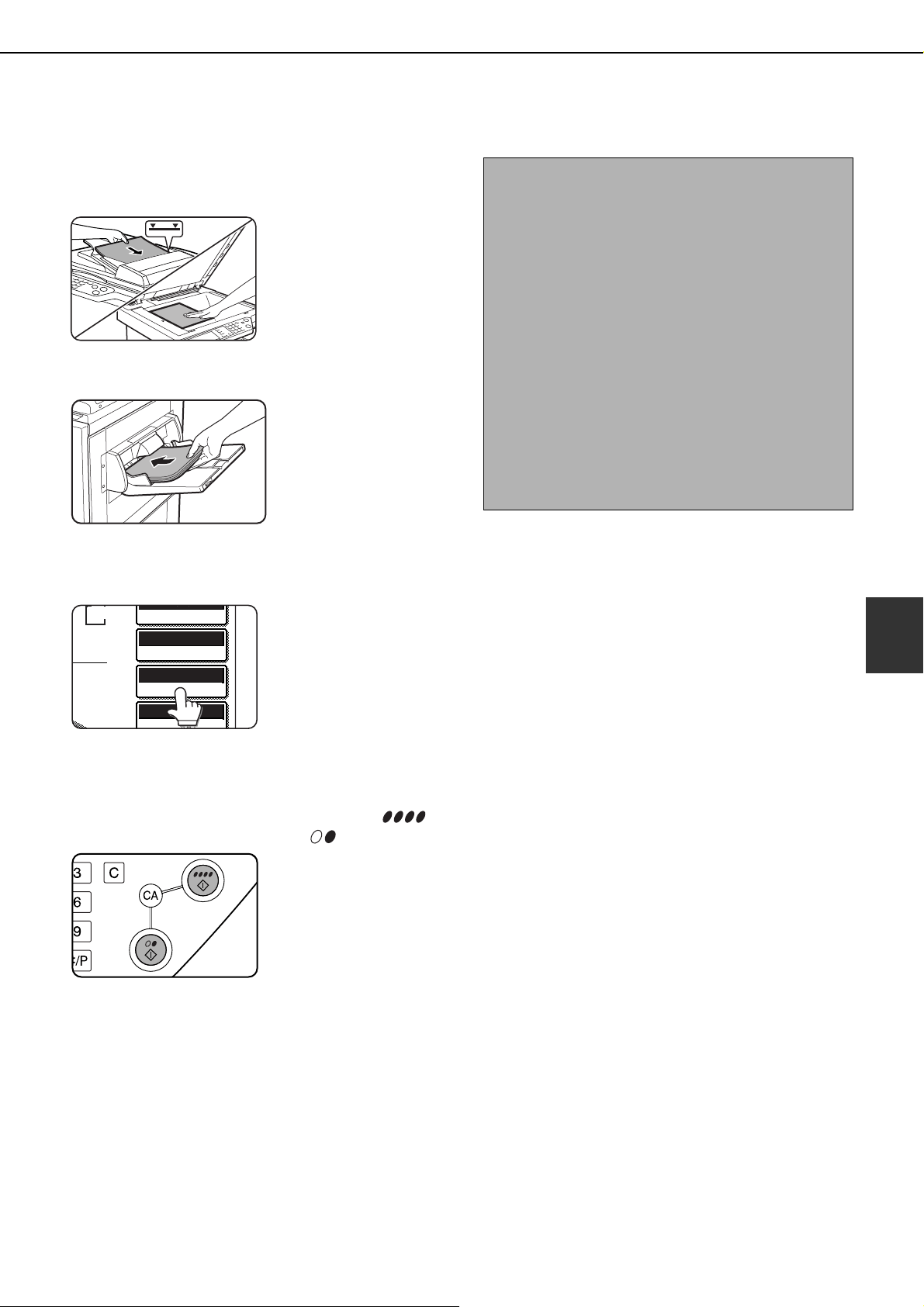
5-17
5
SPECIAL PAPERS
Special papers including transparency film, postcards and envelopes must be fed through the bypass tray.
1
Place the original in the document feeder
tray or on the document glass. (pages 4-6
to 4-9)
2
Load the special paper in the bypass tray.
See pages 2-6 and 2-9
for the specifications of
paper that can be used
in the bypass tray.
For the paper loading
instructions see
"Loading paper in the
bypass tray" (page 2-4).
3
Touch the [PAPER SELECT] key and then
select the bypass tray.
Select the type of paper
that you inserted in the
bypass tray.
4
Make all other desired settings such as
exposure or the number of copies, and
press the [COLOR COPY START ( )]
or [BLACK COPY START ( )] key.
If you placed the original
on the document glass,
set the output to "Sort",
you must touch the
[READ-END] key after
all pages of the original
have been scanned.
(Step 7 on page 5-8)
AUTO
EXPOSURE
UTO
ORIGINAL
AUTO 8½x11
PAPER SELECT
100
%
COPY RATIO
AIN
AL
½x8½
8½x11
NOTES
●
Output location for copies on heavy paper 2,
transparencies, and envelopes
Copies on these types of paper will be output face-
up to the tray on the left side of the machine.
They cannot be delivered to the center tray. Face-
down delivery is not possible for these papers.
●
●●
●
Color adjustment menu
As special functions of color copying, the following
color image adjustments are available. (Page 6-
11)
● RGB ADJUST
● SHARPNESS
● SUPPRESS BACKGROUND
● COLOR BALANCE
● BRIGHTNESS
● INTENSITY
ApollonII_general-copy_SEC.book 17 ページ 2004年9月6日 月曜日 午後4時57分

ApollonII_general-copy_SEC.book 18 ページ 2004年9月6日 月曜日 午後4時57分

6-1
CHAPTER 6
CONVENIENT COPY
FUNCTIONS
This chapter explains special-purpose functions, storing of copy
settings, and other convenient functions. Please select and read
sections of this chapter as needed.
Page
SPECIAL MODES..........................................................................................6-2
●
Common operation procedure for using the special functions...............6-3
●
Margin shift ............................................................................................6-4
●
Erase......................................................................................................6-5
●
Dual page copy ......................................................................................6-6
●
Centering ...............................................................................................6-7
●
Transparency film with insert sheets......................................................6-8
●
Covers....................................................................................................6-9
●
B/W reverse .........................................................................................6-10
COLOR ADJUSTMENTS MENU .................................................................6-11
●
RGB adjust...........................................................................................6-12
●
Sharpness............................................................................................6-13
●
Suppress background ..........................................................................6-13
●
Color balance.......................................................................................6-14
●
Brightness ............................................................................................6-15
●
Intensity................................................................................................6-15
IMAGE EDIT MENU.....................................................................................6-16
●
Single color ..........................................................................................6-17
●
Mirror image.........................................................................................6-17
●
Photo Repeat .......................................................................................6-18
●
Multi shot..............................................................................................6-19
●
11" x 17" (A3) Full-bleed ......................................................................6-21
●
Multi-page enlargement .......................................................................6-22
●
Pamphlet copy .....................................................................................6-24
JOB PROGRAM MEMORY .........................................................................6-25
●
Storing a job program ..........................................................................6-25
●
Recalling a job program .......................................................................6-26
●
Deleting a stored job program..............................................................6-26
INTERRUPTING A COPY RUN...................................................................6-27
ApollonII_general-copy_SEC.book 1 ページ 2004年9月6日 月曜日 午後4時57分
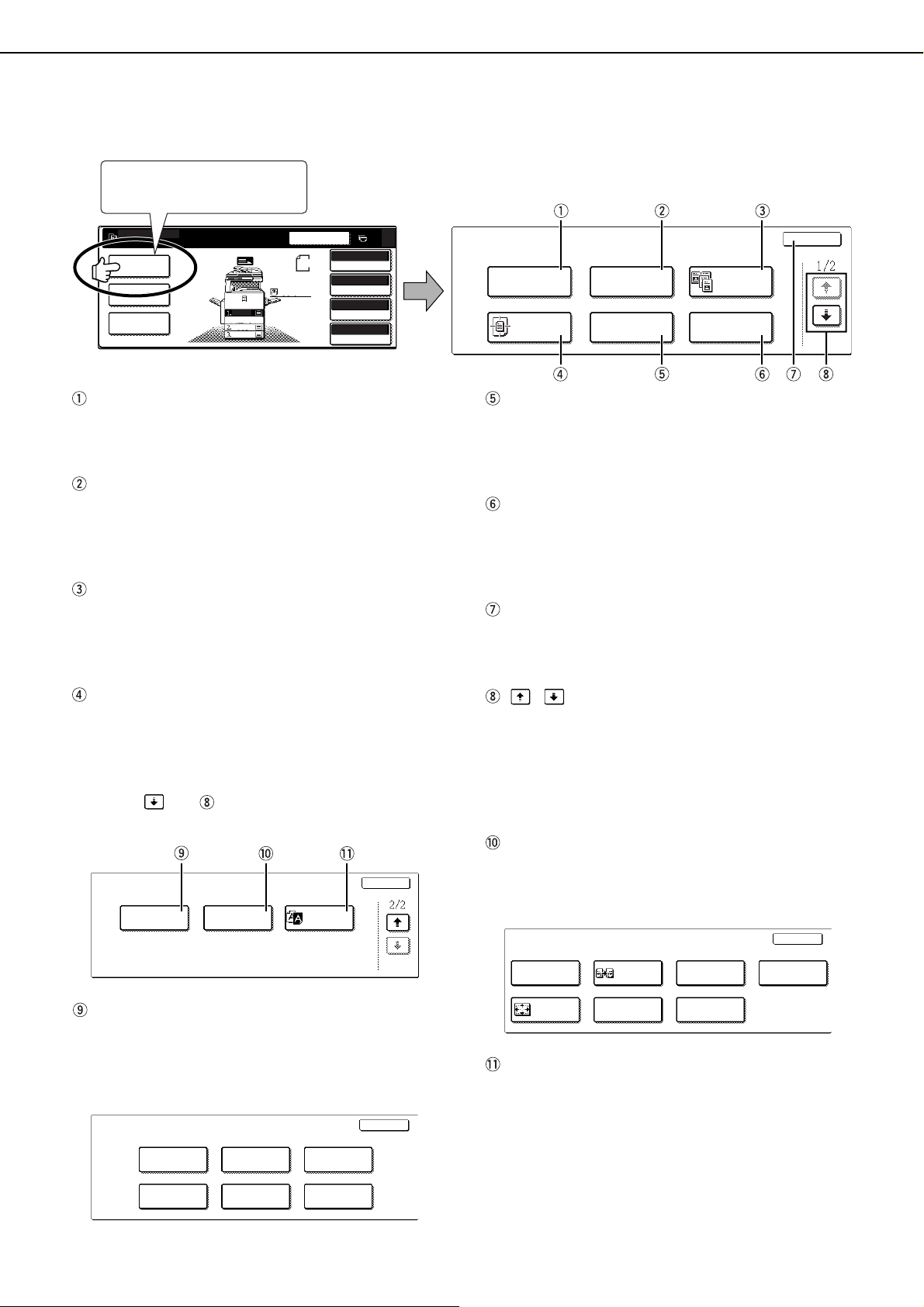
6-2
SPECIAL MODES
When the [SPECIAL MODES] key on the main screen of the copy mode is touched, the special modes screen
containing several special function touch keys will appear. These functions are shown below.
[MARGIN SHIFT] key (page 6-4)
Use this to shift the image on the copy to create
binding margins.
[ERASE] key (page 6-5)
Use this to erase peripheral shadows that occur
when making copies of books and other thick
originals.
[DUAL PAGE COPY] key (page 6-6)
This is useful to copy the left and right pages of
bound documents without shifting the document on
the document glass.
[CENTERING] key (page 6-7)
Use this to center the copied image on the paper.
[COVERS] key (page 6-9)
Use this to insert a different type of paper for use as
front and back covers. (The reversing single pass
feeder must be used.)
[TRANSPARENCY INSERTS] key (page 6-8)
When copying onto transparencies, use this to
automatically insert a sheet of copy paper between
transparency sheets.
[OK] key on the special modes screen
Touch the [OK] key to return to the main screen of
the copy mode.
/ key
Touch these keys to switch between the special
modes menu screens.
The special modes menu consists of two screens.
Touch the key to switch to the screen below.
● The special modes below can be selected in the second screen (2/2).
[COLOR ADJUSTMENTS] key (page 6-11)
Touch this key to display the color adjustments
menu screen. This allows you to select the special
functions shown below for color adjustment when
making color copies.
[IMAGE EDIT] key (page 6-16)
Touch this key to display the image edit menu
screen. This allows you to select the special
functions shown below for image editing.
[B/W REVERSE] key (page 6-10)
A copy can be made with black and white reversed.
(This function can only be used for black and white
copying.)
SPECIAL MODES
MARGIN SHIFT ERASE
COVERS
TRANSPARENCY
INSERTS
CENTERING
OK
DUAL PAGE
COPY
ORIGINAL
SPECIAL MODES
2-SIDED COPY
OUTPUT
READY TO COPY.
11x17
AUTO
EXPOSURE
AUTO
ORIGINAL
AUTO 8½x11
PAPER SELECT
100
%
COPY RATIO
PLAIN
INTERRUPT
5½x8½
0
8½x11
8½x11
DUPLEX
8½x11
SPECIAL MODES
Touch the [SPECIAL MODES]
key in the main screen
ORIGINAL
SPECIAL MODES
COLOR
ADJUSTMENTS
IMAGE EDIT
B/W
REVERSE
OK
COLOR ADJUSTMENTS
RGB ADJUST
SUPPRESS
BACKGROUND
SHARPNESS
COLOR
BALANCE
BRIGHTNESS
INTENSITY
OK
IMAGE EDIT
OK
SINGLE COLOR
MIRROR
IMAGE
PHOTO REPEAT MULTI SHOT
11x17
FULL-BLEED
MULTI-PAGE
ENLARGEMENT
PAMPHLET COPY
ApollonII_general-copy_SEC.book 2 ページ 2004年9月6日 月曜日 午後4時57分
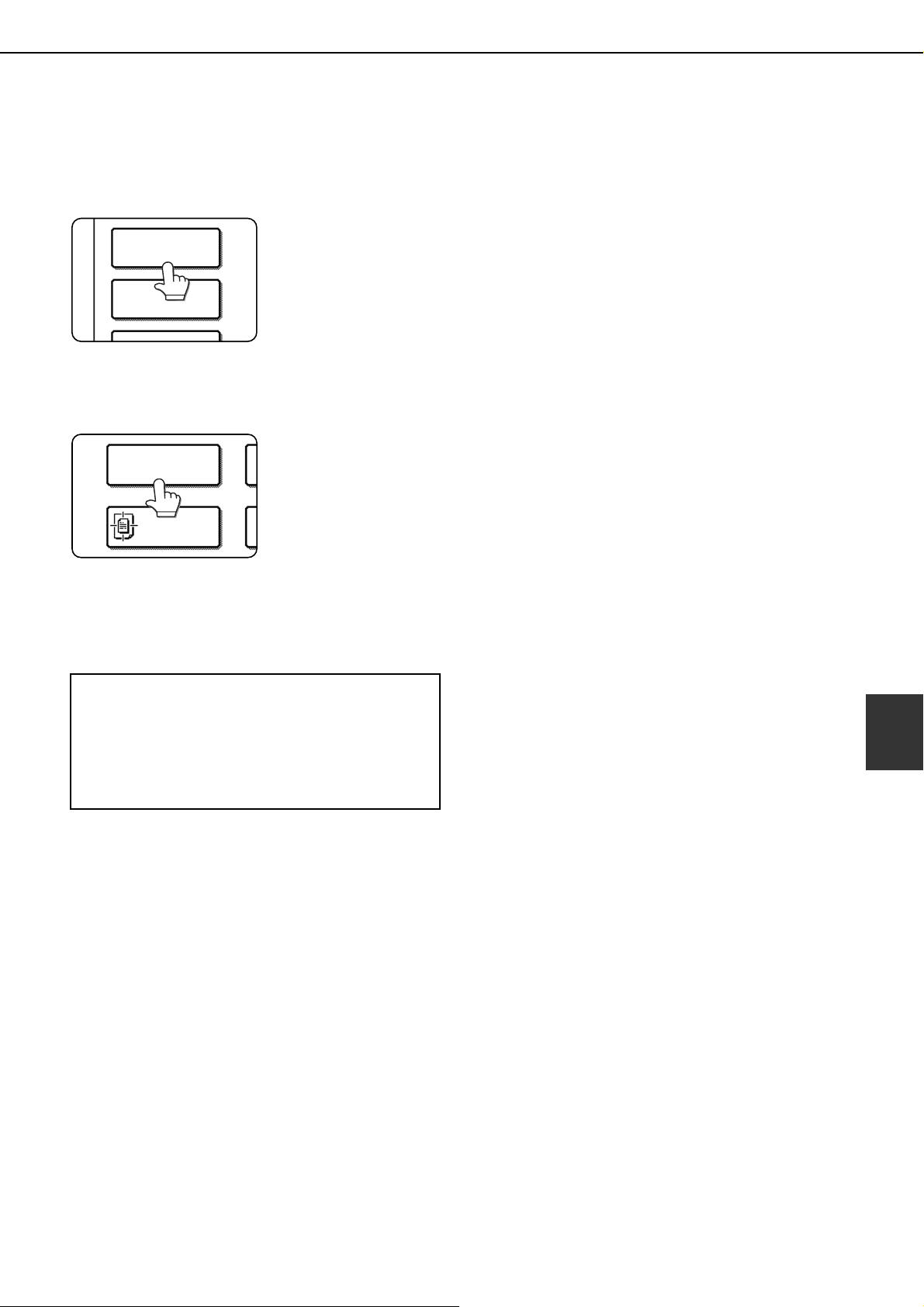
SPECIAL MODES
6-3
6
Common operation procedure for using the special
functions
1
Touch the [SPECIAL MODES] key.
2
Touch the key for the desired special
mode.
Example:
To set the margin shift
function
If you touch the menu keys for color adjustment or
image editing, you will go to the menu screen for
selection of the corresponding functions.
Setting procedures for modes requiring setting
screens start on the next page.
The dual page copy, centering, transparency
film with insert sheets, B/W reverse, mirror
image and 11" x 17" (A3) full-bleed functions
do not require setting screens.
SPECIAL MODES
2-SIDED COPY
MARGIN SHIFT
CENTERING
ApollonII_general-copy_SEC.book 3 ページ 2004年9月6日 月曜日 午後4時57分
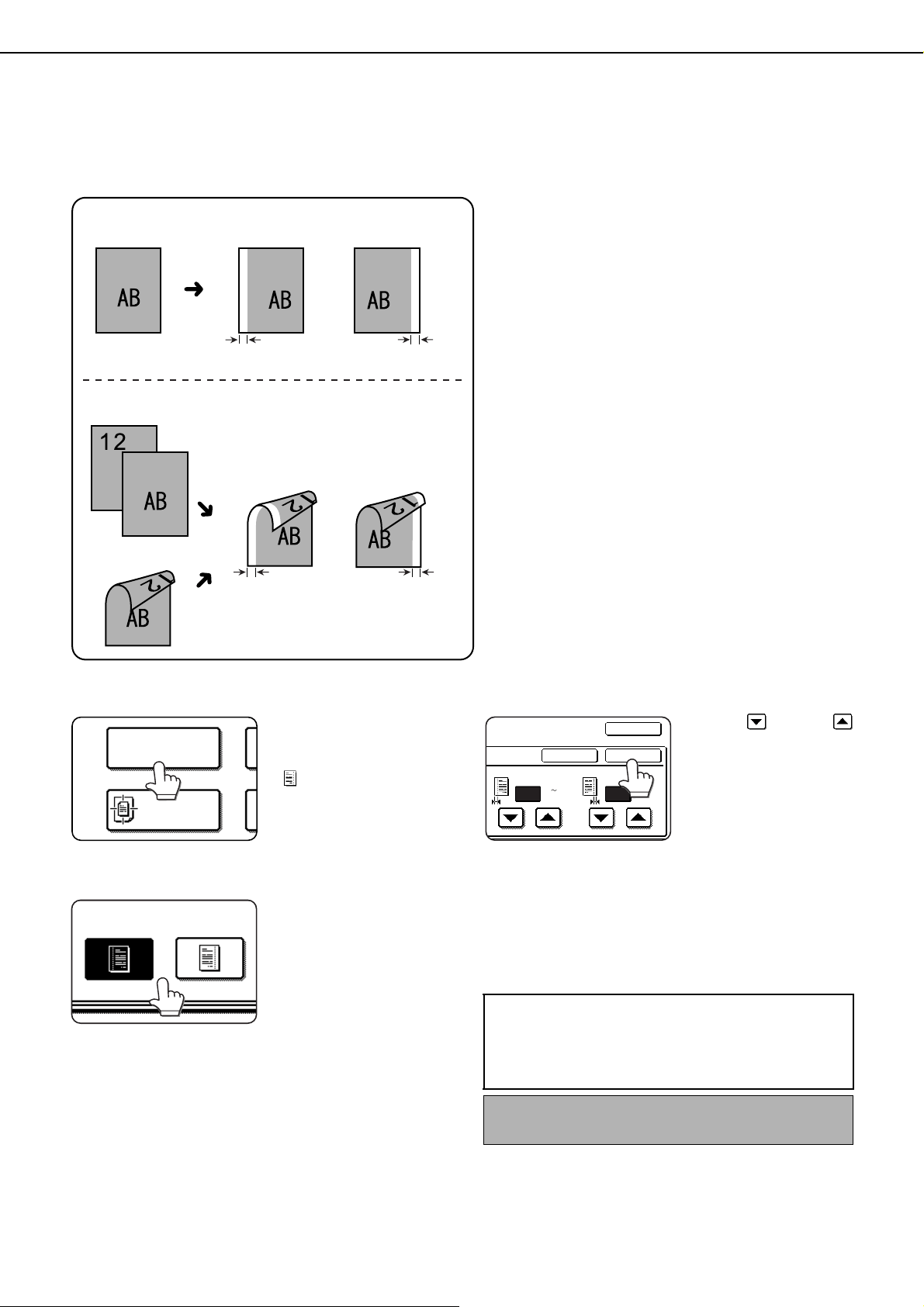
SPECIAL MODES
6-4
Margin shift
The margin shift function will automatically shift the text or image on the copy paper approximately 1/2" (10 mm) in
its initial setting.
1
Touch the [MARGIN SHIFT] key on the
SPECIAL MODES screen.
The margin shift setting
screen will appear.
The margin shift icon
( ) will also appear in
the upper left of the
screen to indicate that
the function is turned on.
2
Select the shift direction.
Touch a shift direction
key to select right or left.
The selected key will be
highlighted.
3
Set the shift amount as needed and touch
the [OK] key.
Use the and the
keys to set the shift
amount. The shift amount
can be set from 0" to 1" in
1/8" increments.
If a duplex module/2 x
500 sheet paper drawer
and duplex bypass/inverter unit are not installed,
the margin shift setting for back-side copies will
not be displayed.
4
Touch the [OK] key on the SPECIAL
MODES screen.
Return to the main screen of copy mode.
● The shift direction can be selected from right or left shift as
shown in the illustration.
One-sided copying
Original
Image shifted
to the right
Margin
Two-sided copying
Original
Or
Margin
Margin Margin
Image shifted
to the left
Image shifted
to the right
Image shifted
to the left
MARGIN SHIFT
CENTERING
RIGHT LEFT
About the steps that follow
If a reversing single pass feeder is being used,
see pages 5-2 through 5-6. If the document
glass is being used, see pages 5-7 through 5-9.
To cancel the margin shift function, touch the
[CANCEL] key on the margin shift setting screen.
SIDE 1
(0 1)
inch
(0 1)
inch
SIDE 2
OKCANCEL
OK
1/2 1/2
ApollonII_general-copy_SEC.book 4 ページ 2004年9月6日 月曜日 午後4時57分
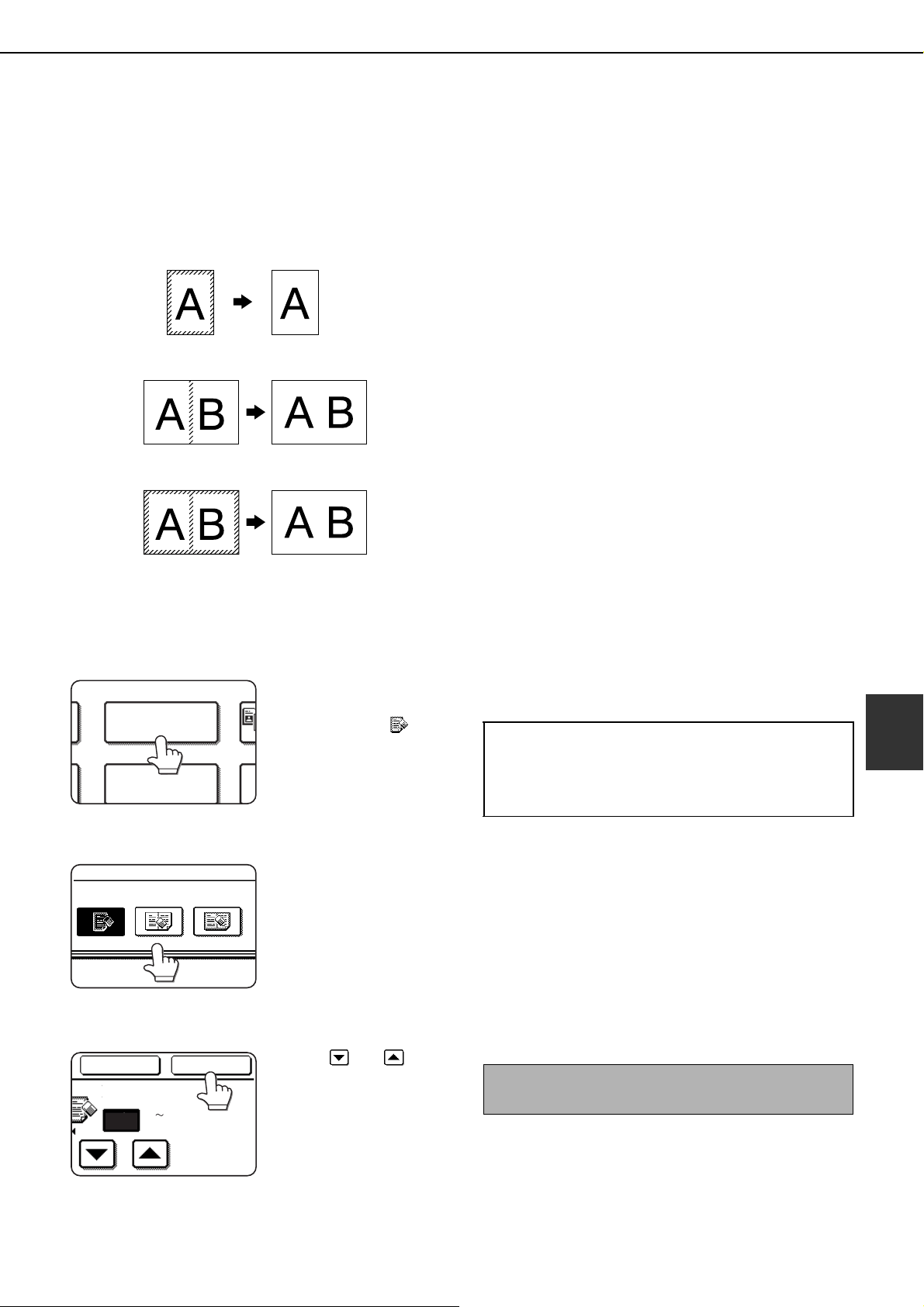
SPECIAL MODES
6-5
6
Erase
The erase function is used to erase the shadow lines on copies produced when copying thick originals or books. The
erase modes that can be selected are shown below. The erase width is approximately 1/2" (10 mm) in it's initial
setting.
EDGE ERASE
Eliminates shadow lines around the edges of
copies caused when heavy paper or a book is used
as an original.
CENTER ERASE
Eliminates shadow lines produced by the bindings
of bound documents.
EDGE + CENTER ERASE
Eliminates shadow lines around the edges of
copies and eliminates the shadow at the center of
copies.
1
Touch the [ERASE] key on the SPECIAL
MODES screen.
The erase setting screen
will appear.
The erase icon ( ) will
also appear in the upper
left of the screen to
indicate that the function
is turned on.
2
Select the desired erase mode.
Select one of the three
erase modes. The
selected key will be
highlighted.
3
Adjust the amount of erase and touch the
[OK] key.
Use the and keys
to adjust the erase width
and then touch the [OK]
key.
4
Touch the [OK] key on the SPECIAL
MODES screen.
Return to the main screen of copy mode.
Original Copy
ERASE
T
COVERS
EDGE
ERASE
ERASE
CENTER
ERASE
EDGE+CENTER
ERASE
EDGE
CANCEL OK
1/2
(0 1)
inch
About the steps that follow
If a reversing single pass feeder is being used,
see pages 5-2 through 5-6. If the document
glass is being used, see pages 5-7 through 5-9.
To cancel the erase function, touch the [CANCEL]
key on the erase setting screen.
ApollonII_general-copy_SEC.book 5 ページ 2004年9月6日 月曜日 午後4時57分
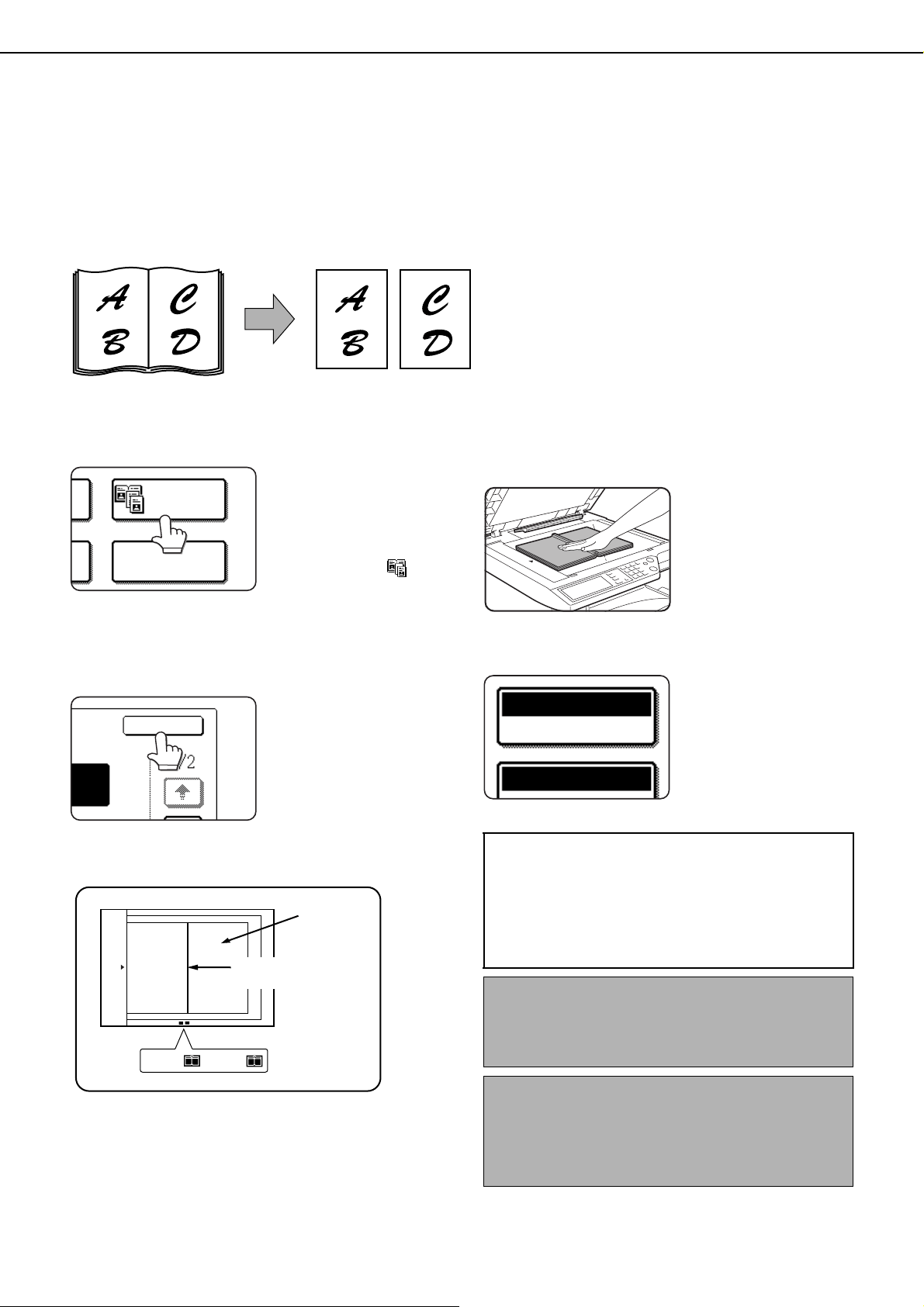
SPECIAL MODES
6-6
Dual page copy
The dual page copy function produces separate copies of two documents placed side by side on the document glass.
It is especially useful when copying books and other bound documents.
[Example] Copying right and left pages of a book
1
Touch the [DUAL PAGE COPY] key on the
SPECIAL MODES screen.
The [DUAL PAGE
COPY] key will be
highlighted to indicate
that the function is
turned on, and the dual
page copy icon ( ) will
appear in the upper left
of the screen.
2
Touch the [OK] key on the SPECIAL
MODES screen.
Return to the main screen of copy mode.
3
Place the originals on the document glass.
When copying book originals:
When copying a thick book, press down lightly on
the book to flatten it against the document glass.
4
Ensure that 8-1/2" x 11" (A4) size paper is
selected.
If 8-1/2" x 11" (A4) size
paper is not selected,
touch the [PAPER
SELECT] key to select
8-1/2" x 11" (A4) size
paper.
● The dual page copy function can be used with reduction
copying but cannot be used with enlargement copying.
● The dual page copy function can be done only from the
document glass. The reversing single pass feeder
cannot be used with this function.
● Only 8-1/2" x 11" (A4) paper can be used.
Book original Dual page copy
TRANSPARENCY
INSERTS
DUAL PAGE
COPY
OK
PAGE
8
½
x11
A4
Index
This page
is copied
first.
Center line of
original
About the steps that follow
For two-sided copying, follow steps 2 through 4
on page 5-9 and then follow steps 4 through 7
on page 5-8.
For one-sided copying, follow steps 4 through
7 on page 5-8.
To cancel the dual page copy function, touch the
[DUAL PAGE COPY] key on the special modes
screen (step 1). (The highlighted display will be
canceled.)
NOTE
To erase shadows caused by document binding, use
the edge erase function (page 6-5). (Center Erase
and Edge + Center Erase cannot be used in
combination.)
PAPER SELECT
AUTO 8½x11
100%
ApollonII_general-copy_SEC.book 6 ページ 2004年9月6日 月曜日 午後4時57分
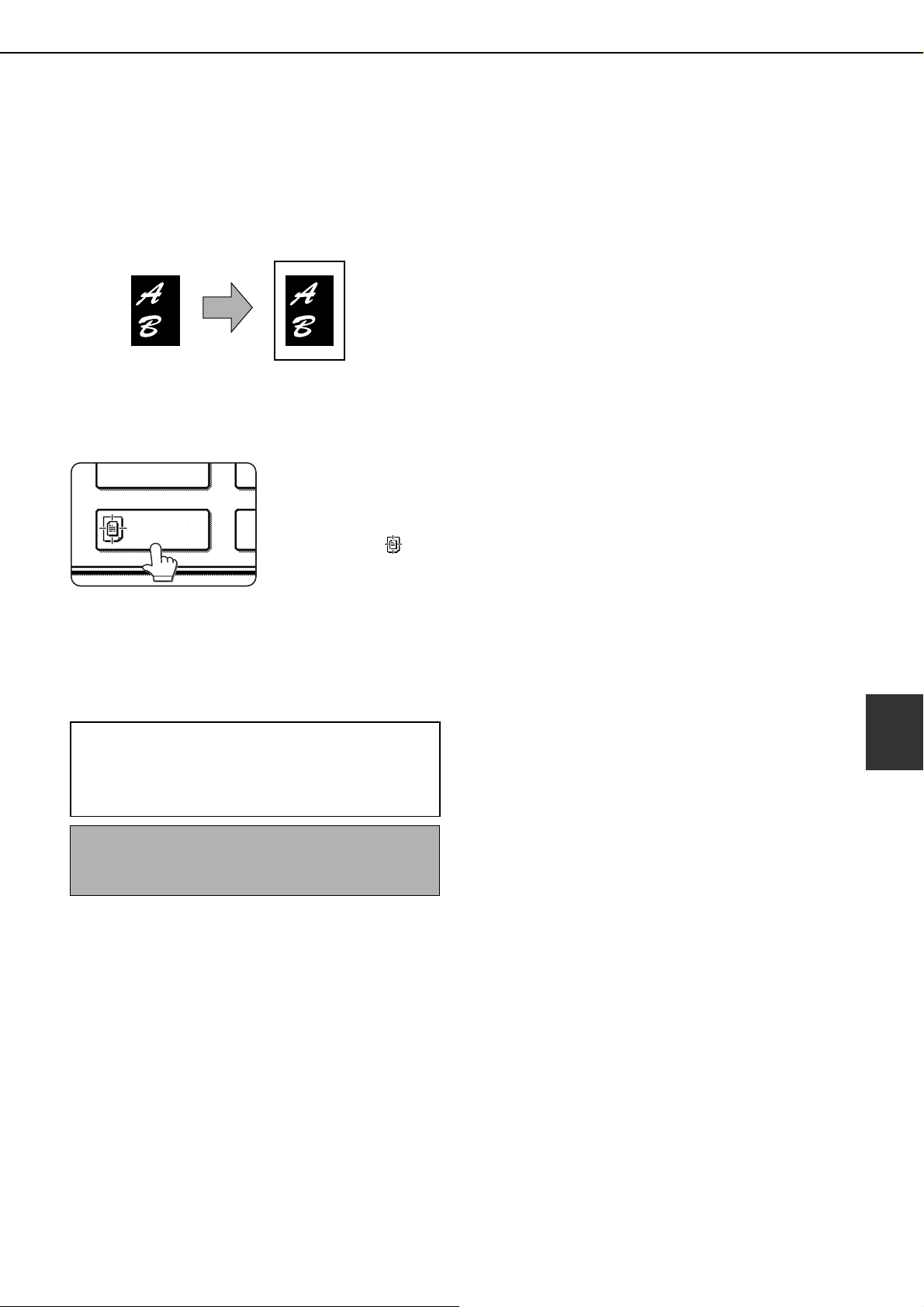
SPECIAL MODES
6-7
6
Centering
When the original and copy paper are of different sizes, CENTERING is used to shift the image to the center of the
copy paper but only in the left to right direction.
1
Touch the [CENTERING] key on the
SPECIAL MODES screen.
The [CENTERING] key
is highlighted to indicate
that the function is
turned on, and the
centering icon ( ) will
appear in the upper left
of the screen.
2
Touch the [OK] key on the SPECIAL
MODES screen.
Return to the main screen of copy mode.
[Example]
Original Copy
● This function can be used to reduce a larger sized
original image and center it on a copy of smaller paper
size, as well as center a smaller original onto a larger
sized copy.
● This function will not work when non-standard size
originals or copy paper are used. This function cannot
be selected when enlargement copying has been
selected.
About the steps that follow
If a reversing single pass feeder is being used,
see pages 5-2 through 5-6. If the document
glass is being used, see pages 5-7 through 5-9.
To cancel the CENTERING function, touch the
[CENTERING] key again on the SPECIAL MODES
screen (step1).
MARGIN SHIFT
CENTERING
ApollonII_general-copy_SEC.book 7 ページ 2004年9月6日 月曜日 午後4時57分
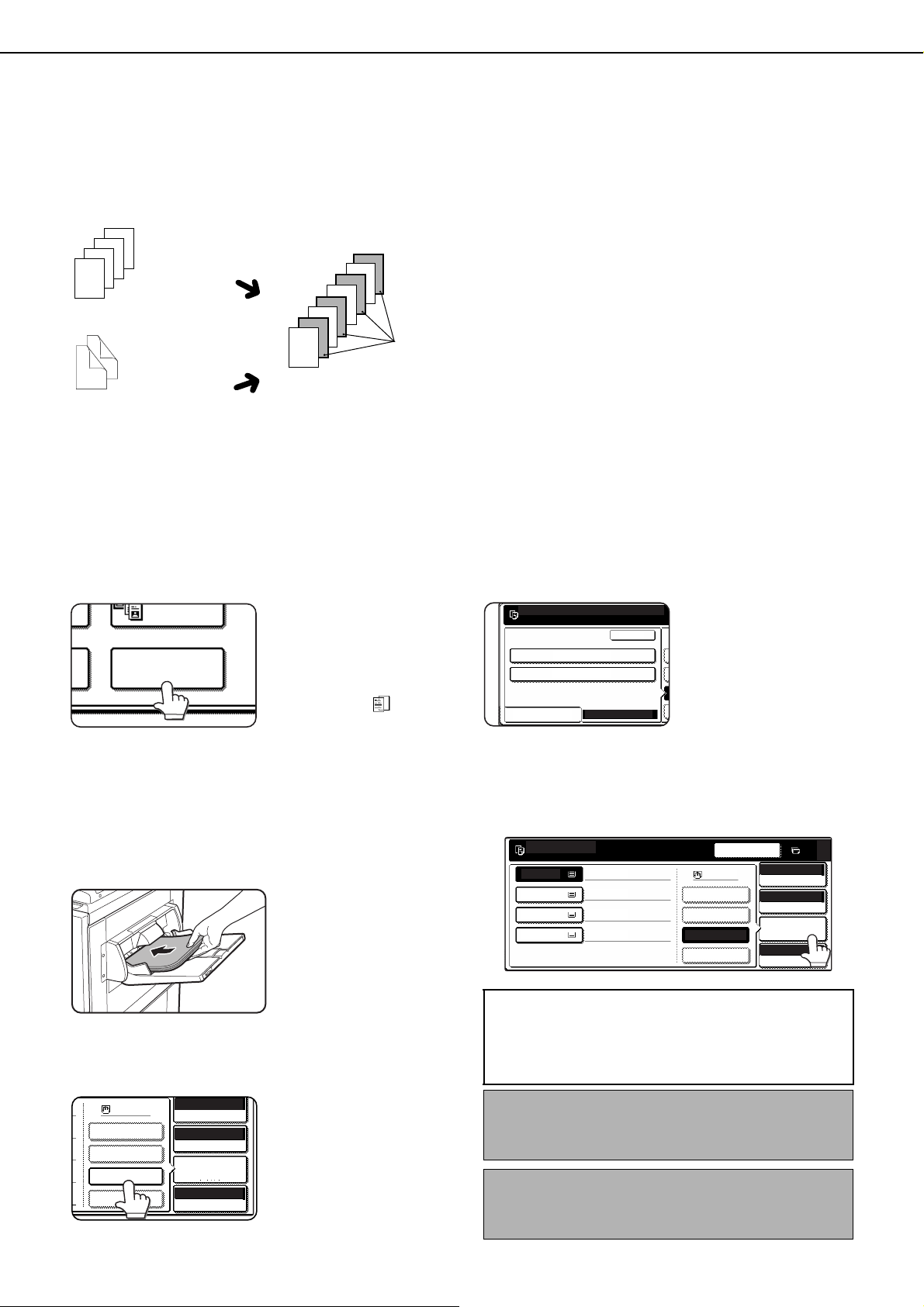
SPECIAL MODES
6-8
Transparency film with insert sheets
When copying onto transparency film, blank insert sheets can be placed between transparent sheets.
Example: Inserting insert sheets between transparencies
●Insert sheets cannot be copied on in any mode.
●This mode can be selected only in the 1-sided to 1-
sided and 2-sided to 1-sided modes.
●A multiple number of copies cannot be selected in
this mode.
●Transparency film must be fed from the bypass tray.
●Insert sheets must be the same size (8-1/2" x 11" or
8-1/2" x 11"R (A4 or A4R)) as the transparency film.
●For best results, use SHARP recommended
transparency film.
Before performing the following procedure, touch the [OUTPUT] key in the main screen of Copy mode to display the
OUTPUT settings screen (page 5-5), and then touch the [LEFT TRAY] key* to set the output tray to the left tray*.
* If the optional saddle stitch finisher is installed, touch the [FINISHER TRAY] key to set the output tray to the finisher tray.
1
Touch the [TRANSPARENCY INSERTS]
key on the SPECIAL MODES screen.
The [TRANSPARENCY
INSERTS] key is
highlighted to indicate
that the function is turned
on, and the transparency
inserts icon ( , etc.)
appears in the upper left
of the screen.
2
Touch the [OK] key on the SPECIAL
MODES screen.
Return to the main screen of copy mode.
3
Load transparency film into the bypass
tray.
Remove any paper
already in the bypass
tray before loading the
transparency film. (To
load paper in the bypass
tray, see pages 2-4 and
2-5.)
4
Touch the [PAPER SELECT] key and
select the transparency film loaded in the
bypass tray.
Touch the
[TRANSPARENCY] key.
5
Touch the [SPEED MODE] key or the [QUALITY
MODE] key for the transparency film.
SPEED MODE is for fast
printing.
QUALITY MODE is for a
high quality image.
After touching either key
followed by the [OK] key,
you will return to the main
screen of copy mode.
6
Touch the [PAPER SELECT] key again and
select the paper (8-1/2" x 11" (A4) or 8-1/2" x
11"R (A4R) size) to be used for the inserts.
2
3
4
4
3
2
1
4
1
2
3
1
For two-sided originals,
this is only possible when
using a reversing single
pass feeder.
Originals (1-sided)
Originals (2-sided)
Insert sheets
TRANSPARENCY
INSERTS
COPY
PLAIN PAPER
HEAVY PAPER
TRANSPARENCY
ENVELOPE
8½x11
AUTO
EXPOSURE
AUTO
ORIGINAL
PAPER SELECT
100
%
COPY RATIO
About the steps that follow
If a reversing single pass feeder is being used,
see pages 5-2 and 5-3. If the document glass is
being used, see pages 5-7 and 5-8.
To cancel the TRANSPARENCY INSERTS function,
touch the [TRANSPARENCY INSERTS] key again
on the SPECIAL MODES screen.
NOTE
When the copy job is finished, remove any
transparencies that remain in the bypass tray.
SPEED MODE
QUALITY MODE
BASIC SETTING
EXTRA SIZE
OK
PLEASE SELECT TRANSPARENCY MODE.
READY TO COPY.
0
INTERRUPT
1. 8½x11
2. 8½x14
PLAIN
PLAIN PAPER
HEAVY PAPER
TRANSPARENCY
ENVELOPE
RECYCLED
COLOR
PLAIN
8½x11
AUTO
ORIGINAL
AUTO
EXPOSURE
PAPER SELECT
100
%
COPY RATIO
3. 11x17
4. 8½x11R
ApollonII_general-copy_SEC.book 8 ページ 2004年9月6日 月曜日 午後4時57分
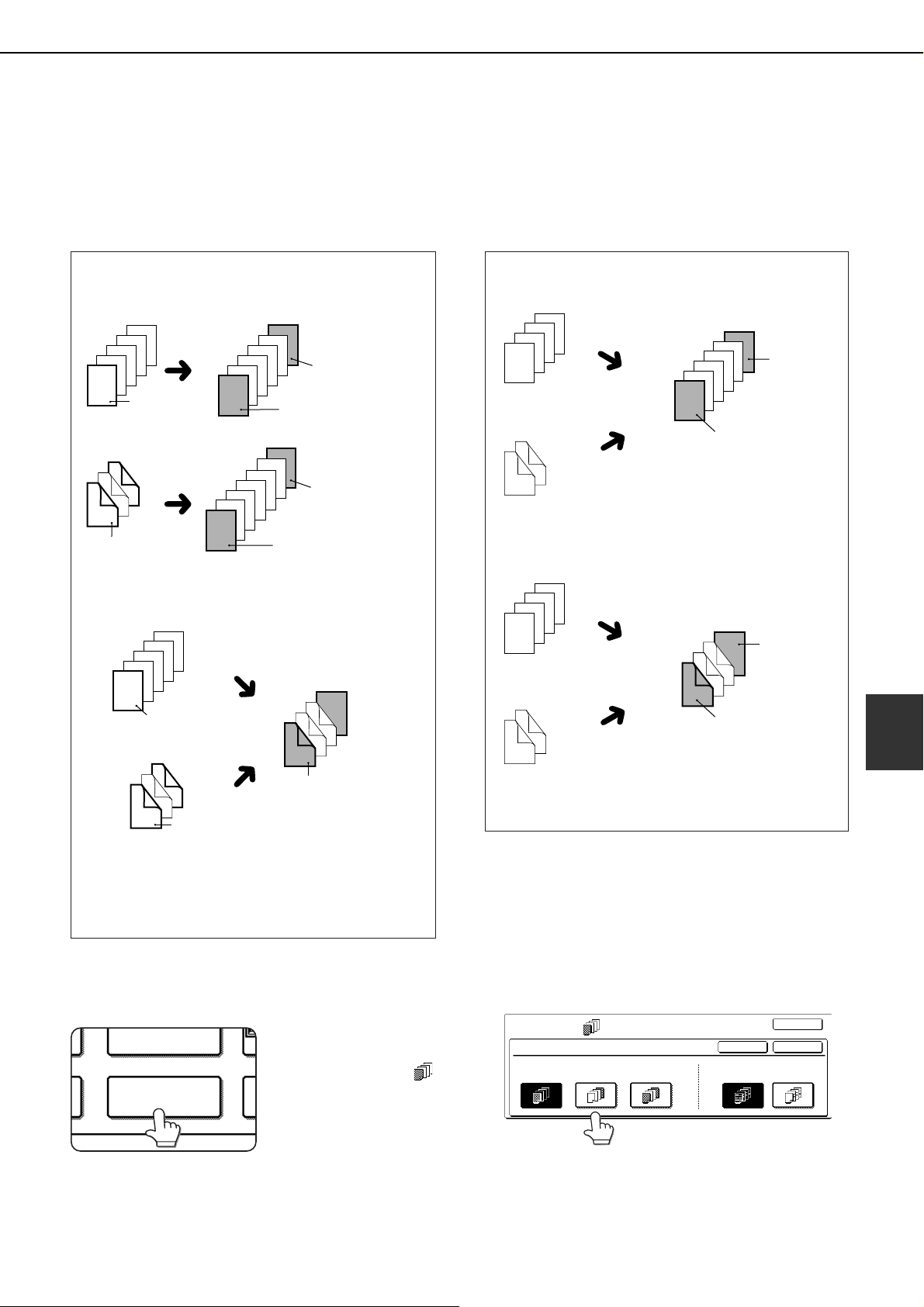
SPECIAL MODES
6-9
6
Covers
The COVERS mode is used to place covers on the front, back, or both the front and back of multipage documents.
This function can only be used when the originals are placed in the document feeder tray of the reversing single pass
feeder. (The document glass cannot be used.)
■
■■
■ Copying onto a cover ■
■■
■ Not copying onto a cover
1
Touch the [COVERS] key on the SPECIAL
MODES screen.
The COVERS setting
screen will appear.
The covers icon ( ,
etc.) will also appear in
the upper left of the
screen to indicate that
the function is turned on.
2
Select cover placement.
Select [FRONT], [BACK] or [FRONT+BACK] on
the touch panel.
One-sided originals
Back cover
(no copying)
Front cover
(can copy onto front side)
One-sided copies
(copying onto a cover)
Two-sided originals
SHARP
SHARP
Cover original
1
2
3
4
1
2
3
4
3
4
5
1
2
Cover original
SHARP
Back cover
(no copying)
Front cover
(can copy onto front side)
SHARP
1
2
3
4
5
One-sided originals Two-sided copies
(copying onto a cover)
Two-sided originals
2
3
4
1
Cover original
SHARP
Two-sided copies from one-sided or two-sided originals
One-sided copies from one-sided or two-sided originals
1
2
3
4
SHARP
Cover original
2
3
4
1
SHARP
Back cover
(no copying)
Front cover
(can copy onto front side)
(Back side of cover is blank)
Selections for front cover, back cover, or front and back
cover can be made.
Back cover sheets cannot be copied on, either on the
front side or on the back side.
2
3
4
1
Back cover
Front cover
(not copying onto a cover)
One-sided originals
Two-sided originals
1
2
3
4
1
2
3
4
4
1
2
3
Front cover
One-sided originals
Two-sided originals
1
2
3
4
4
1
2
3
One-sided copies from one-sided or two-sided originals
Two-sided copies from one-sided or two-sided originals
Back cover
One-sided copies
(not copying onto a cover)
One-sided copies
(not copying onto a cover)
Selections for front cover, back cover, or front and back
cover can be made.
ERASE
COVERS
OKCANCEL
OK
COVERS
SPECIAL MODES
FRONT BACK FRONT+BACK
PRINT ON FRONT COVER?
YES NO
ApollonII_general-copy_SEC.book 9 ページ 2004年9月6日 月曜日 午後4時57分
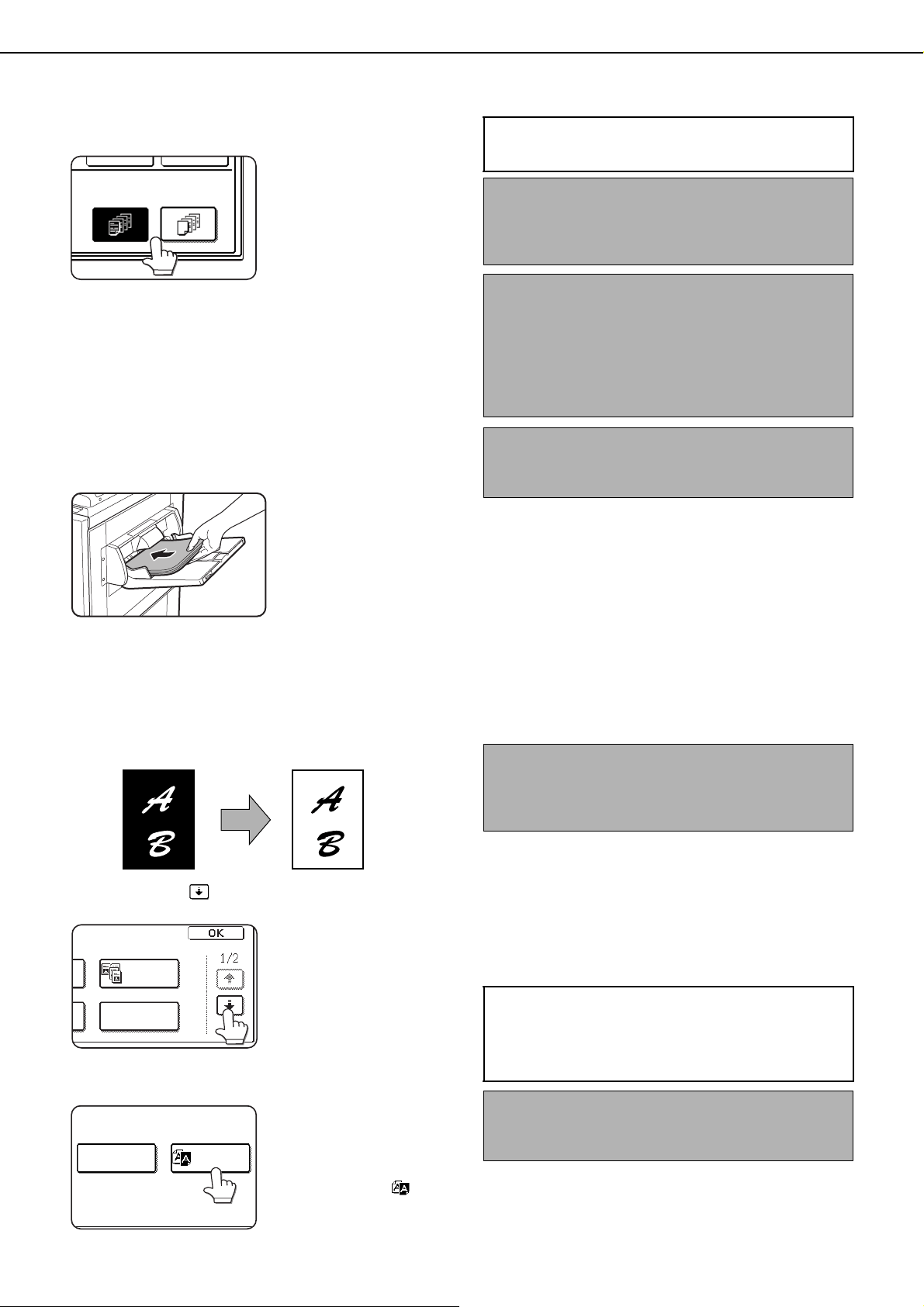
SPECIAL MODES
6-10
3
Indicate whether the front cover sheets
are copied on or not.
Select [YES] or [NO] on
the touch panel. If [YES]
is selected, the first page
of the document will be
copied onto the front
cover sheet.
4
Touch the [OK] key on the COVER setting
screen.
Return to the SPECIAL MODES screen.
5
Touch the [OK] key on the SPECIAL
MODES screen.
Return to the main screen of copy mode.
6
Load the cover paper to be used into the
bypass tray.
Load the same size of
paper as the paper to be
used for the copy job. If
the saddle stitch finisher
is to be used for stapling,
heavy stock cannot be
used for the covers.
(See page 2-10) Paper
within the range of the
stapler must be used.
B/W reverse
Black and white are reversed in the copy to create a negative image. (This function can only be used for black and
white copying.)
1
Touch the key to switch to the second
SPECIAL MODES screen.
2
Touch the [B/W REVERSE] key in the
second SPECIAL MODES screen.
The [B/W REVERSE] key
will be highlighted to
indicate that the function is
selected. In addition, the
B/W reverse icon ( ) will
appear in the upper left-
hand corner of the screen.
3
Touch the [OK] key on the SPECIAL
MODES screen.
Return to the main screen of copy mode.
OKCANCEL
PRINT ON FRONT COVER?
YES
NO
About the steps that follow
See pages 5-2 through 5-6.
NOTE
Be sure to place the originals in the document feeder
tray of the reversing single pass feeder.
The document glass cannot be used for this function.
NOTES
● During cover copying, the stream feeding mode
will not function even if it is turned on by the
program on page 12 of the key operator's guide.
● During cover copying, the pamphlet copy function
(page 6-24) and the saddle stitch (pamphlet
staple) function (page 3-5) will not operate.
To cancel the COVERS function, select the
COVERS function again and touch the [CANCEL]
key (step2).
Original B/W reverse copy
NOTE
Originals with large black areas (which use a large
amount of toner) can be printed with black/white
reverse to reduce toner consumption.
TRANSPARENCY
INSERTS
DUAL PAGE
COPY
IMAGE EDIT
B/W
REVERSE
About the steps that follow
If a reversing single pass feeder is being used,
see pages 5-2 through 5-6. If the document
glass is being used, see pages 5-7 through 5-9.
To cancel the B/W reverse function, touch the [B/W
REVERSE] key in the SPECIAL MODES screen (the
screen of step 2).
ApollonII_general-copy_SEC.book 10 ページ 2004年9月6日 月曜日 午後4時57分
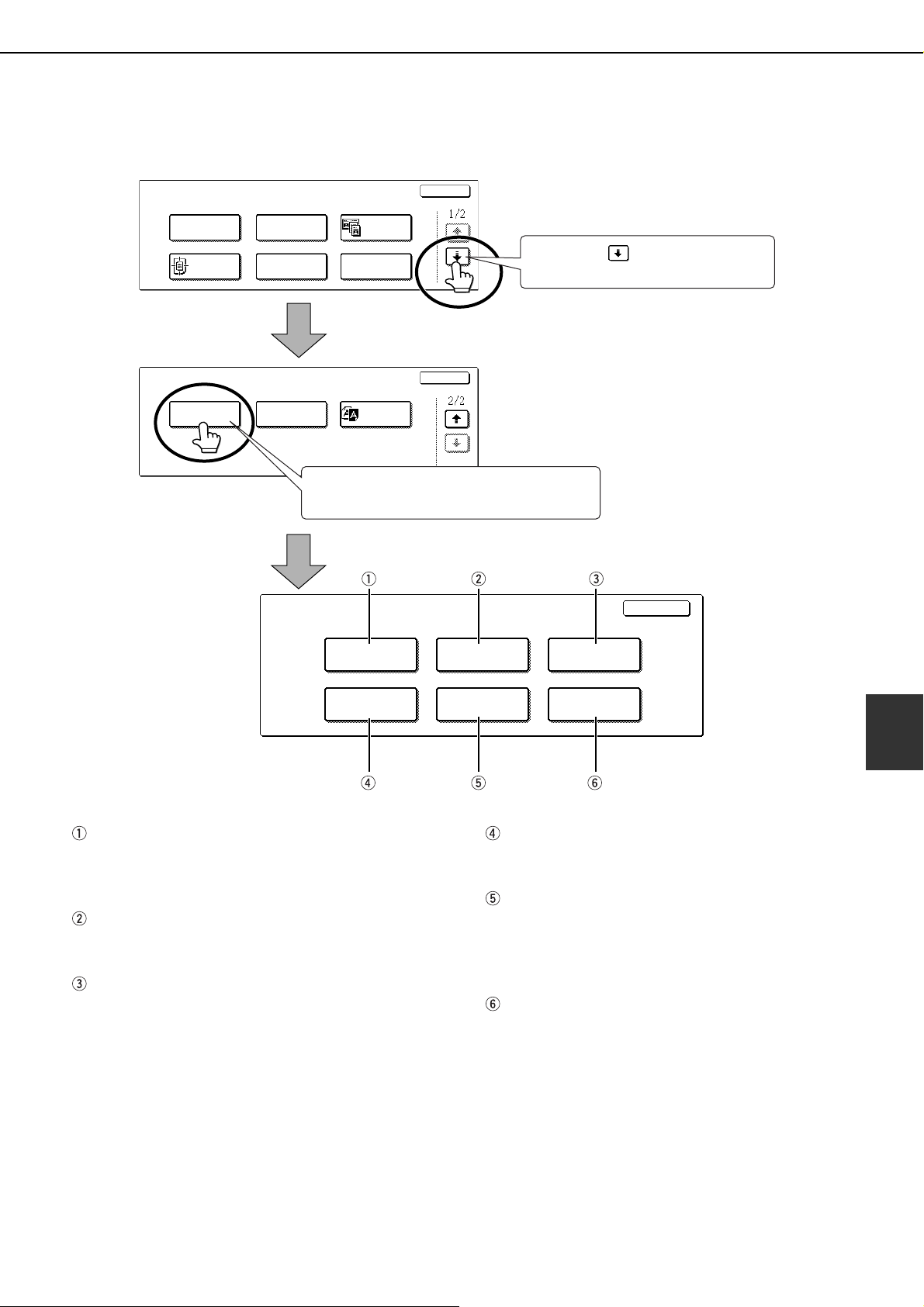
6-11
6
COLOR ADJUSTMENTS MENU
The [COLOR ADJUSTMENTS] menu in [SPECIAL MODES] enables the following parameters to be adjusted to
modify the characteristics of a color copy.
Settings adjusted with the color adjustments menu do not affect black and white copying.
RGB ADJUST (next page 6-12)
Strengthens or weakens one of three primary
colors, R (red), G (green), or B (blue).
SHARPNESS (page 6-13)
Sharpens or softens image outlines.
SUPPRESS BACKGROUND (page 6-13)
Suppresses copying of lighter background areas.
COLOR BALANCE (page 6-14)
Adjusts the color, tone, and density of color copies.
BRIGHTNESS (page 6-15)
This copier allows the level of brightness to be
adjusted. If brightness is selected, color tone can
be darkened or lightened.
INTENSITY (page 6-15)
This copier allows the level of intensity to be
adjusted. If intensity is selected, color saturation
can be made to be more vivid or more dull.
SPECIAL MODES
MARGIN SHIFT ERASE
COVERS
TRANSPARENCY
INSERTS
CENTERING
OK
DUAL PAGE
COPY
SPECIAL MODES
IMAGE EDIT
COLOR
ADJUSTMENTS
B/W
REVERSE
OK
2
Touch the [COLOR ADJUSTMENTS] key in
the second SPECIAL MODES screen.
COLOR
ADJUSTMENTS
RGB ADJUST
SHARPNESS
SUPPRESS
BACKGROUND
BRIGHTNESS
INTENSITY
OK
1
Touch the key to switch to the
second SPECIAL MODES screen.
COLOR
BALANCE
ApollonII_general-copy_SEC.book 11 ページ 2004年9月6日 月曜日 午後4時57分
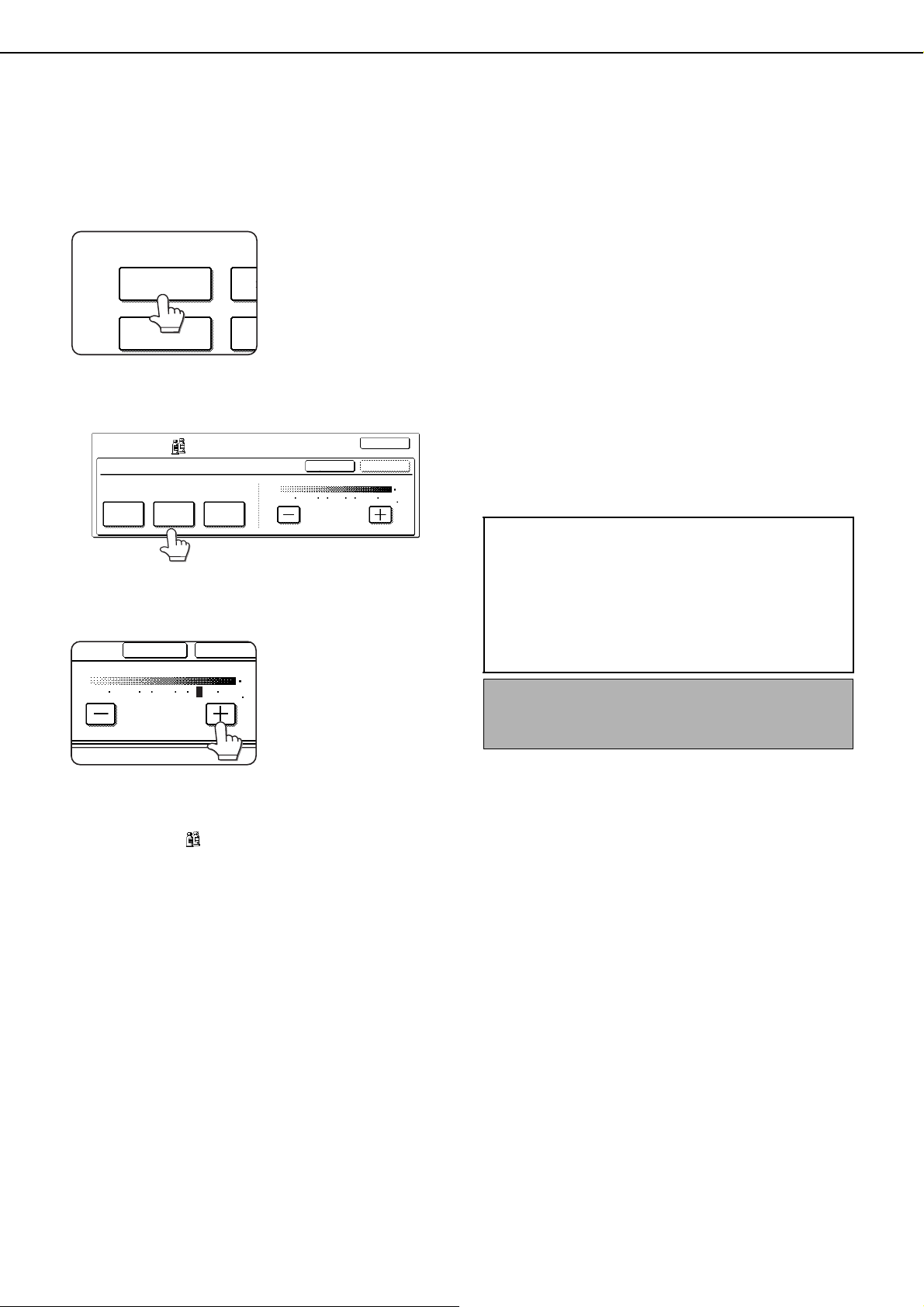
COLOR ADJUSTMENTS MENU
6-12
RGB adjust
Strengthens or weakens one of three primary colors, red (R), green (G), or blue (B).
1
Touch the [RGB ADJUST] key on the
COLOR ADJUSTMENTS menu screen.
2
Select a color from R (RED), G (GREEN),
and B (BLUE).
Only one primary color can be adjusted.
3
Adjust the selected color.
Touch the [+] to
strengthen the selected
color or touch the [-] key
to weaken the color.
When the key is touched, the color adjustments
menu icon ( ) will appear at the upper left of the
screen to indicate that the function is turned on.
4
Touch the [OK] key (inside [OK] key) on
the RGB ADJUST setting screen.
Return to the COLOR ADJUSTMENTS menu
screen.
5
Touch the [OK] key on the COLOR
ADJUSTMENTS menu screen.
Return to the SPECIAL MODES screen.
6
Touch the [OK] key on the SPECIAL
MODES screen.
Return to the main screen of copy mode.
OLOR ADJUSTMENTS
RGB ADJUST
SH
COLOR
BALANCE
BR
RGB ADJUST
OK
COLOR
ADJUSTMENTS
ONLY ONE COLOR CAN BE ADJUSTED.
R(RED)
G(GREEN)
B(BLUE)
OKCANCEL
-2 -1 0
1
2
OKCANCEL
-2 -1 0
1
2
About the steps that follow
If the reversing single pass feeder is being
used, see pages 5-2 through 5-6. If the
document glass is being used, see pages 5-7
through 5-9.
In either case, press the [COLOR COPY
START] key to begin copying.
To cancel the RGB ADJUST function, select the
RGB ADJUST function again and touch the
[CANCEL] key (step 2 or 3).
sec_apollon_06-1.fm 12 ページ 2004年11月15日 月曜日 午前11時45分
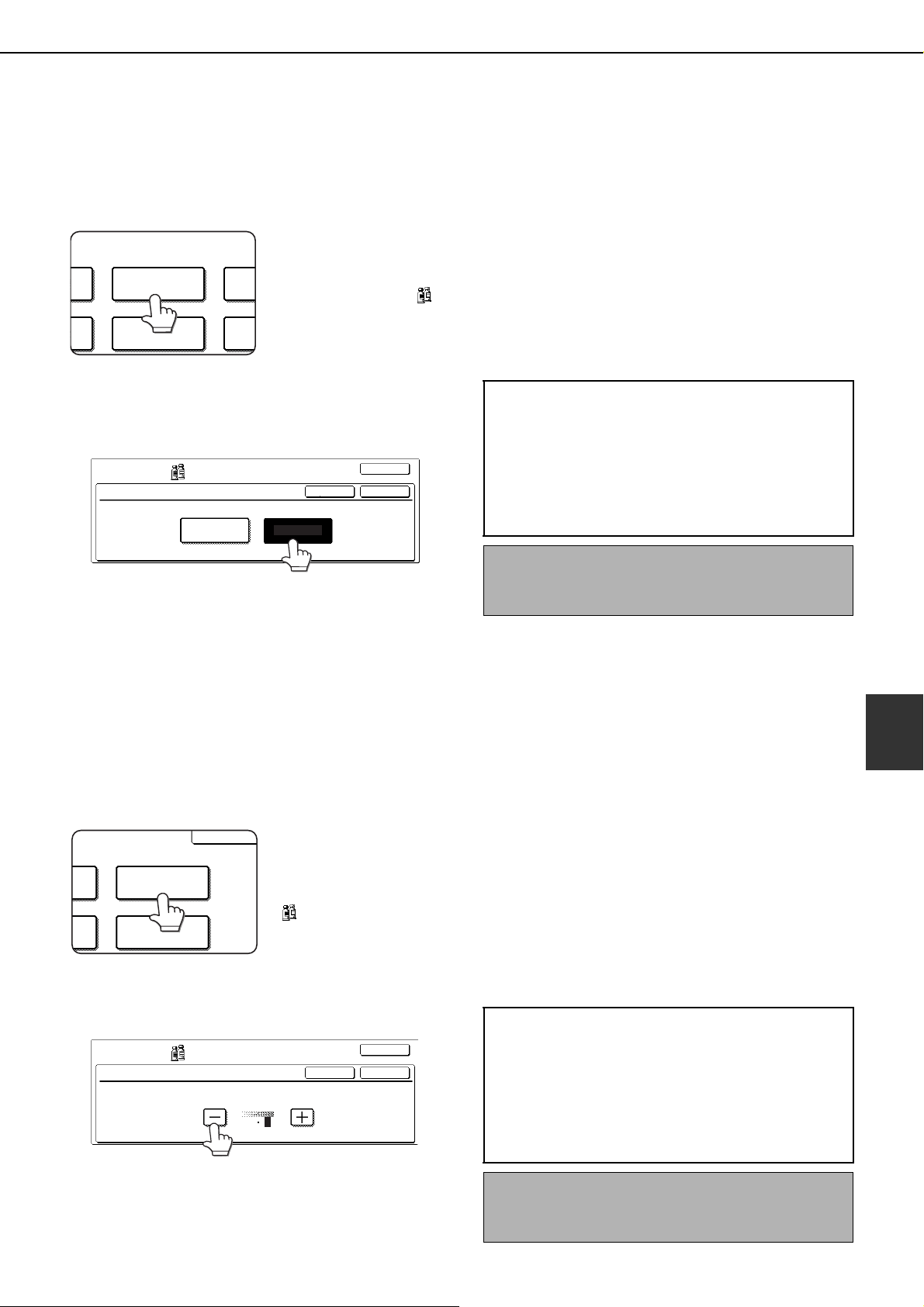
COLOR ADJUSTMENTS MENU
6-13
6
Sharpness
Sharpens or softens image outlines.
1
Touch the [SHARPNESS] key on the
COLOR ADJUSTMENTS menu screen.
The SHARPNESS
setting screen will
appear. The color
adjustments icon ( )
will also appear in the
upper left of the screen
to indicate that the
function is turned on.
2
Touch the [SOFT] key to soften image
outlines or touch the [SHARP] key to
sharpen them.
3
Touch the [OK] key (inside [OK] key) on
the SHARPNESS setting screen.
Return to the COLOR ADJUSTMENTS menu
screen.
4
Touch the [OK] key on the COLOR
ADJUSTMENTS menu screen.
Return to the SPECIAL MODES screen.
5
Touch the [OK] key on the SPECIAL
MODES screen.
Return to the main screen of copy mode.
Suppress background
This copier can suppress unwanted background areas on the original images when copying.
1
Touch the [SUPPRESS BACKGROUND]
key on the COLOR ADJUSTMENTS menu
screen.
The SUPPRESS
BACKGROUND setting
screen will appear. The
color adjustments icon
( ) will also appear in
the upper left of the
screen to indicate that
the function is turned on.
2
Use the [+] and [-] keys to select the
desired background suppression level.
If level 1 is selected, darker background areas will
be erased. The level can be adjusted in three
steps. The default setting is level 3.
3
Touch the [OK] key (inside [OK] key) on the
SUPPRESS BACKGROUND setting screen.
Return to the COLOR ADJUSTMENTS menu
screen.
4
Touch the [OK] key on the COLOR
ADJUSTMENTS menu screen.
Return to the SPECIAL MODES screen.
5
Touch the [OK] key on the SPECIAL
MODES screen.
Return to the main screen of copy mode.
T
SHARPNESS
BRIGHTNESS
SU
BAC
INT
OKCANCEL
OK
COLOR
ADJUSTMENTS
SHARPNESS
SOFT SHARP
About the steps that follow
If the reversing single pass feeder is being
used, see pages 5-2 through 5-6. If the
document glass is being used, see pages 5-7
through 5-9.
In either case, press the [COLOR COPY
START] key to begin copying.
To cancel the SHARPNESS function, select the
SHARPNESS function again and touch the
[CANCEL] key (step 2).
S
SS
SUPPRESS
BACKGROUND
INTENSITY
OK
OKCANCEL
OK
COLOR
ADJUSTMENTS
SUPPRESS BACKGROUND
LIGHT AREAS OF THE ORIGINAL MAY BE SUPPRESSED AS BACKGROUND.
1 3
About the steps that follow
If the reversing single pass feeder is being
used, see pages 5-2 through 5-6. If the
document glass is being used, see pages 5-7
through 5-9.
In either case, press the [COLOR COPY
START] key to begin copying.
To cancel the SUPPRESS BACKGROUND function,
select the SUPPRESS BACKGROUND function
again and touch the [CANCEL] key (step 2).
ApollonII_general-copy_SEC.book 13 ページ 2004年9月6日 月曜日 午後4時57分
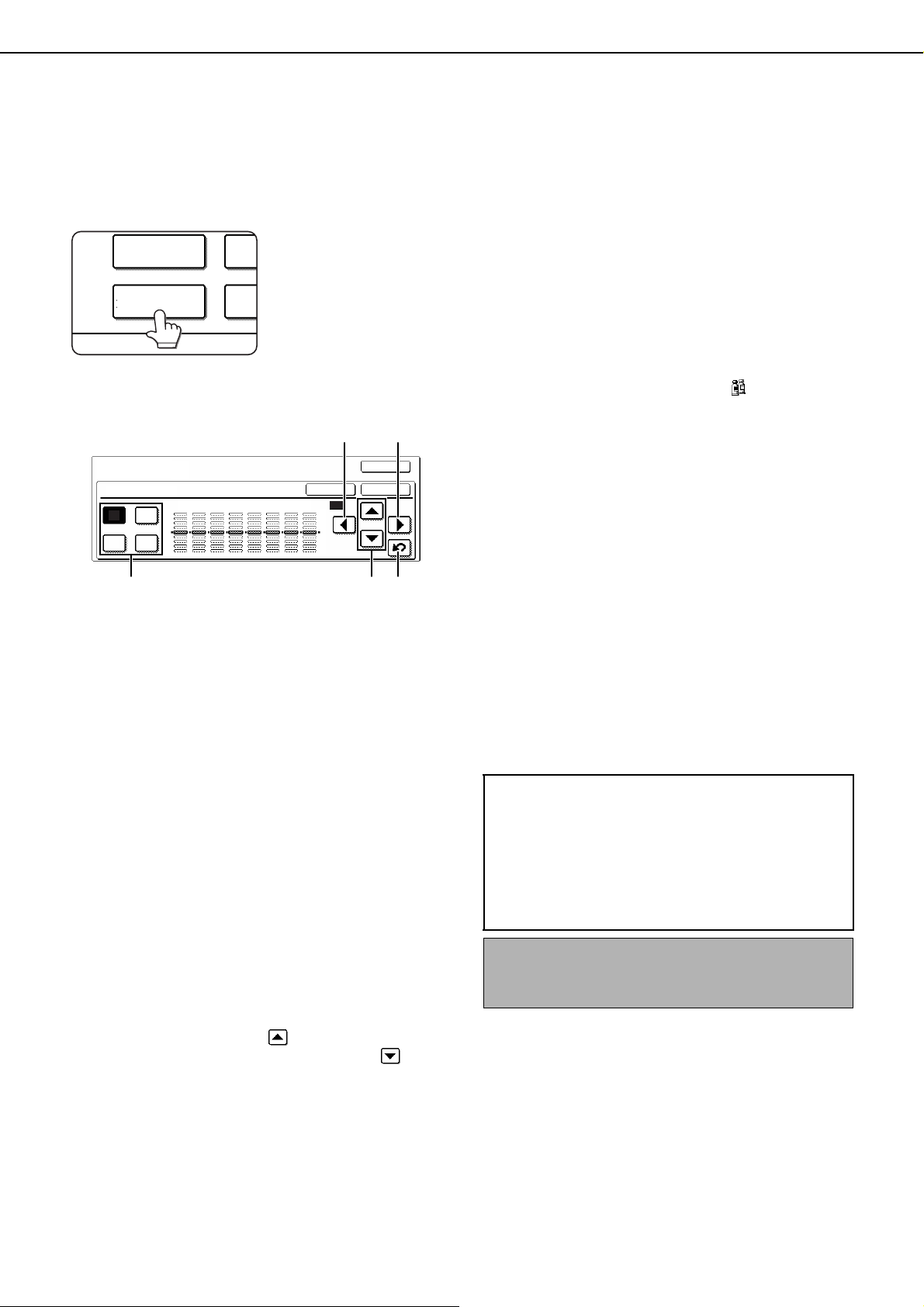
COLOR ADJUSTMENTS MENU
6-14
Color balance
This function is used to adjust the color, tone, and density of color copies.
1
Touch the [COLOR BALANCE] key on the
COLOR ADJUSTMENTS menu screen.
The COLOR BALANCE
setting screen will appear.
2
Use the keys indicated in the illustration
below to adjust the color balance settings.
The Color Balance setting allows you to adjust the
densities of four colors: cyan, magenta, yellow,
and black.
The density range is divided into eight levels for
each color, from 1 (lowest density areas) to 8
(highest density areas). The density can be
adjusted one level at a time or eight levels at once.
(A) Use these keys to select the color to be adjusted
(
[C]
= cyan,
[M]
= magenta, [Y] = yellow,
[Bk]
=
black).
If only the area around the letter inside a key is
highlighted, the settings have been changed from
the factory default settings.
(B) Use these keys to change the densities of all eight
levels at once.
When either key is touched, the indicator lines of
all eight levels will move up or down one step.
(C) Use these keys to adjust the densities of each of
the eight density levels.
When one of the keys is touched, the
corresponding indicator line will move up or down
one step. Touch the key to increase the
density of the corresponding level, or the key
to decrease the density.
(D) Use this key to return the densities of all eight
levels to the initial settings.
The initial color balance settings are the values set
with key operator program "Initial color balance
setting" (See page 15 of the key operator's guide).
For this reason, the initial settings may not
necessarily be 0 (the middle indicator position) for
all levels. The initial setting of each level is shown
by a gray indicator.
When the color balance setting is adjusted, the
color adjustments menu icon ( ) will appear at
the upper left of the screen to indicate that the
function is turned on.
3
Touch the [OK] key (inside [OK] key) on
the COLOR BALANCE setting screen.
Return to the COLOR ADJUSTMENTS menu
screen.
4
Touch the [OK] key on the COLOR
ADJUSTMENTS menu screen.
Return to the SPECIAL MODES screen.
5
Touch the [OK] key on the SPECIAL
MODES screen.
Return to the main screen of copy mode.
RGB ADJUST
SH
COLOR
BALANCE
BRI
OKCANCEL
OK
COLOR
ADJUSTMENTS
COLOR BALANCE
Y M
BkC
12345678
+
0
-
+
0
-
ALL
(B)
(B)
(A)
(C) (D)
About the steps that follow
If the reversing single pass feeder is being
used, see pages 5-2 through 5-6. If the
document glass is being used, see pages 5-7
through 5-9.
In either case, press the [COLOR COPY
START] key to begin copying.
To cancel the COLOR BALANCE function, select the
COLOR BALANCE function again and touch the
[CANCEL] key (step 2).
ApollonII_general-copy_SEC.book 14 ページ 2004年9月6日 月曜日 午後4時57分
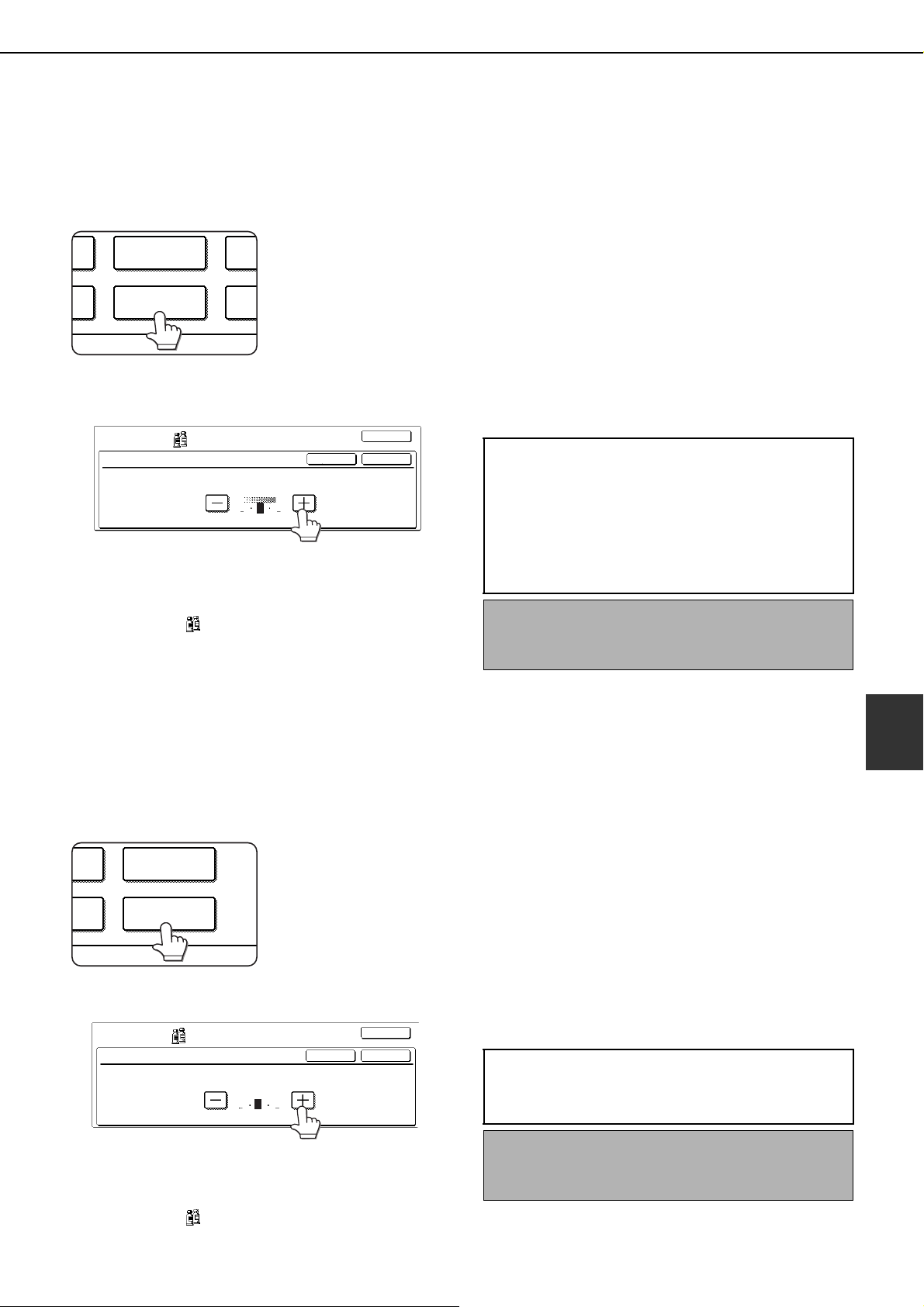
COLOR ADJUSTMENTS MENU
6-15
6
Brightness
This copier allows the level of brightness of images to be adjusted.
1
Touch the [BRIGHTNESS] key on the
COLOR ADJUSTMENTS menu screen.
The BRIGHTNESS
setting screen will
appear.
2
Adjust the brightness.
Use the [-] and [+] keys to adjust the level of the
BRIGHTNESS.
When the key is touched, the color adjustments
menu icon ( ) will appear at the upper left of the
screen to indicate that the function is turned on.
3
Touch the [OK] key (inside [OK] key) on
the BRIGHTNESS setting screen.
Return to the COLOR ADJUSTMENTS menu
screen.
4
Touch the [OK] key on the COLOR
ADJUSTMENTS menu screen.
Return to the SPECIAL MODES screen.
5
Touch the [OK] key on the SPECIAL
MODES screen.
Return to the main screen of copy mode.
Intensity
This copier allows the level of intensity of images to be adjusted.
This function can only be used when the original is placed on the document glass. (The reversing single pass feeder
cannot be used.)
1
Touch the [INTENSITY] key on the COLOR
ADJUSTMENTS menu screen.
The INTENSITY setting
screen will appear.
2
Adjust the intensity.
Use the [-] and [+] keys to adjust the level of the
INTENSITY.
When the key is touched, the color adjustments
menu icon ( ) will appear at the upper left of the
screen to indicate that the function is turned on.
3
Touch the [OK] key (inside [OK] key) on
the INTENSITY setting screen.
Return to the COLOR ADJUSTMENTS menu
screen.
4
Touch the [OK] key on the COLOR
ADJUSTMENTS menu screen.
Return to the SPECIAL MODES screen.
5
Touch the [OK] key on the SPECIAL
MODES screen.
Return to the main screen of copy mode.
T
SHARPNESS
BRIGHTNESS IN
SU
BAC
OKCANCEL
OK
COLOR
ADJUSTMENTS
BRIGHTNESS
-2 2
0
About the steps that follow
If the reversing single pass feeder is being
used, see pages 5-2 through 5-6. If the
document glass is being used, see pages 5-7
through 5-9.
In either case, press the [COLOR COPY
START] key to begin copying.
To cancel the BRIGHTNESS function, select the
BRIGHTNESS function again and touch the
[CANCEL] key (step2).
SS
ESS
SUPPRESS
BACKGROUND
INTENSITY
OKCANCEL
OK
COLOR
ADJUSTMENTS
INTENSITY
-2 2
0
About the steps that follow
See pages 5-7 through 5-9, press the [COLOR
COPY START] key to begin copying.
To cancel the INTENSITY function, select the
INTENSITY function again and touch the [CANCEL]
key (step 2).
ApollonII_general-copy_SEC.book 15 ページ 2004年9月6日 月曜日 午後4時57分
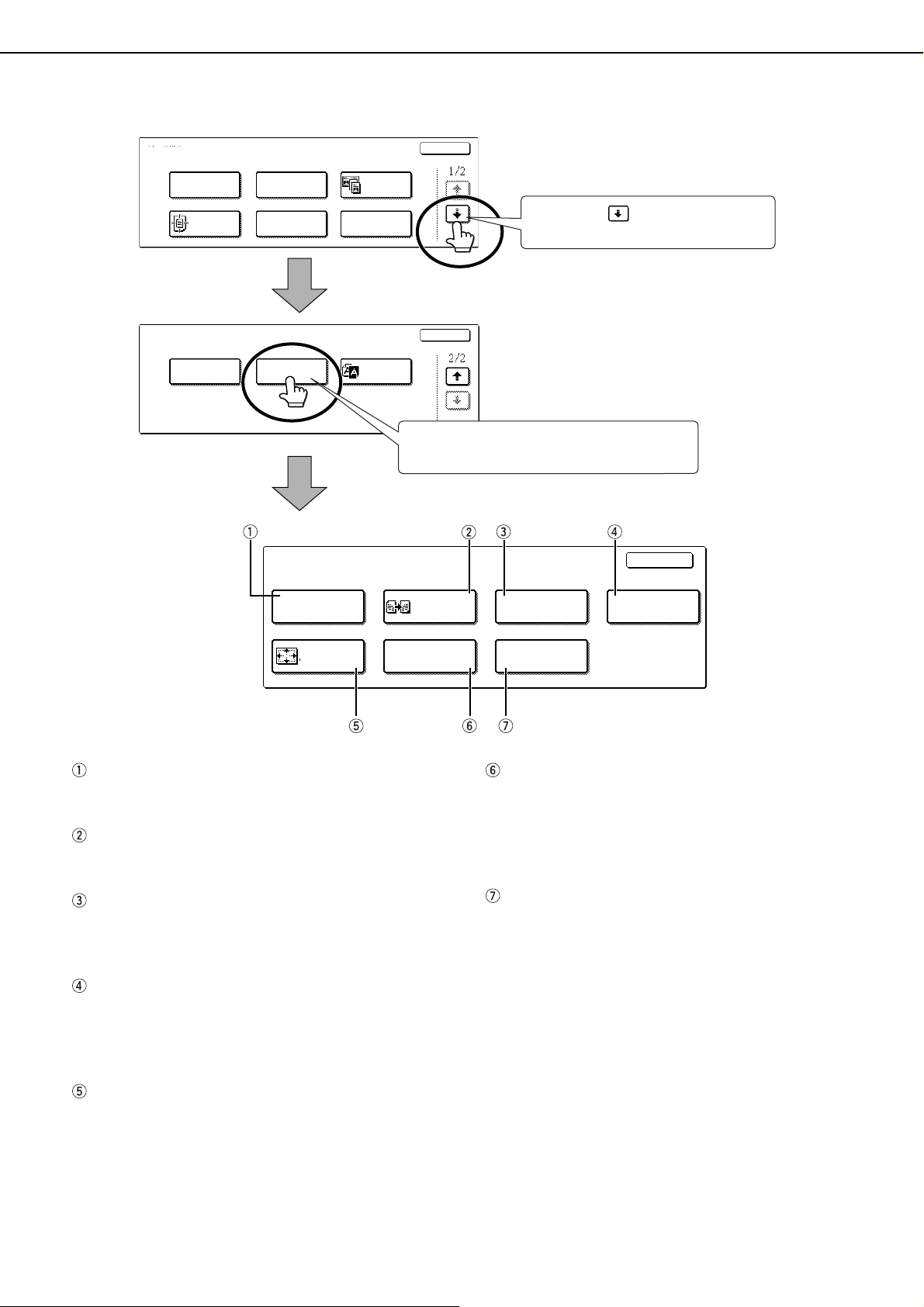
6-16
IMAGE EDIT MENU
To use the following convenient copy functions, touch the [IMAGE EDIT] key in [SPECIAL MODES].
SINGLE COLOR (page 6-17)
Produces copies with a selected single color.
MIRROR IMAGE (page 6-17)
A mirror image of the original is printed.
PHOTO REPEAT (page 6-18)
Produces repeated images of a photo on a single
sheet of copy paper.
MULTI SHOT (page 6-19)
The multi shot function is used to copy up to four
originals, collectively in a specified order, per sheet
of copy paper in any one of four layout patterns.
11x17 FULL-BLEED (page 6-21)
Produces 11" x 17" (A3) full image copies onto 12"
x 18" (A3W) copy paper.
MULTI-PAGE ENLARGEMENT (page 6-22)
Enlarges an original image to a size larger than 11"
x 17" (A3) and prints divided images onto multiple
sheets of copy paper for assembly into large
composite copy.
PAMPHLET COPY (page 6-24)
The pamphlet copy function is used to arrange
copies in proper order for eventual center-stapling
and folding into a booklet. Two original pages are
copied onto each side of copy paper. Four pages
are, therefore, copied onto one sheet.
(A duplex module/2 x 500 sheet paper drawer and
a duplex bypass/inverter unit are required for this
function.)
IMAGE EDIT
OK
SINGLE COLOR PHOTO REPEAT MULTI SHOT
11x17
FULL-BLEED
PAMPHLET COPY
MIRROR
IMAGE
MULTI-PAGE
ENLARGEMENT
SPECIAL MODES
MARGIN SHIFT ERASE
COVERS
TRANSPARENCY
INSERTS
CENTERING
OK
DUAL PAGE
COPY
SPECIAL MODES
COLOR
ADJUSTMENTS
IMAGE EDIT
B/W
REVERSE
OK
1 Touch the key to switch to the
second SPECIAL MODES screen.
2 Touch the [IMAGE EDIT] key in the second
SPECIAL MODES screen.
ApollonII_general-copy_SEC.book 16 ページ 2004年9月6日 月曜日 午後4時57分
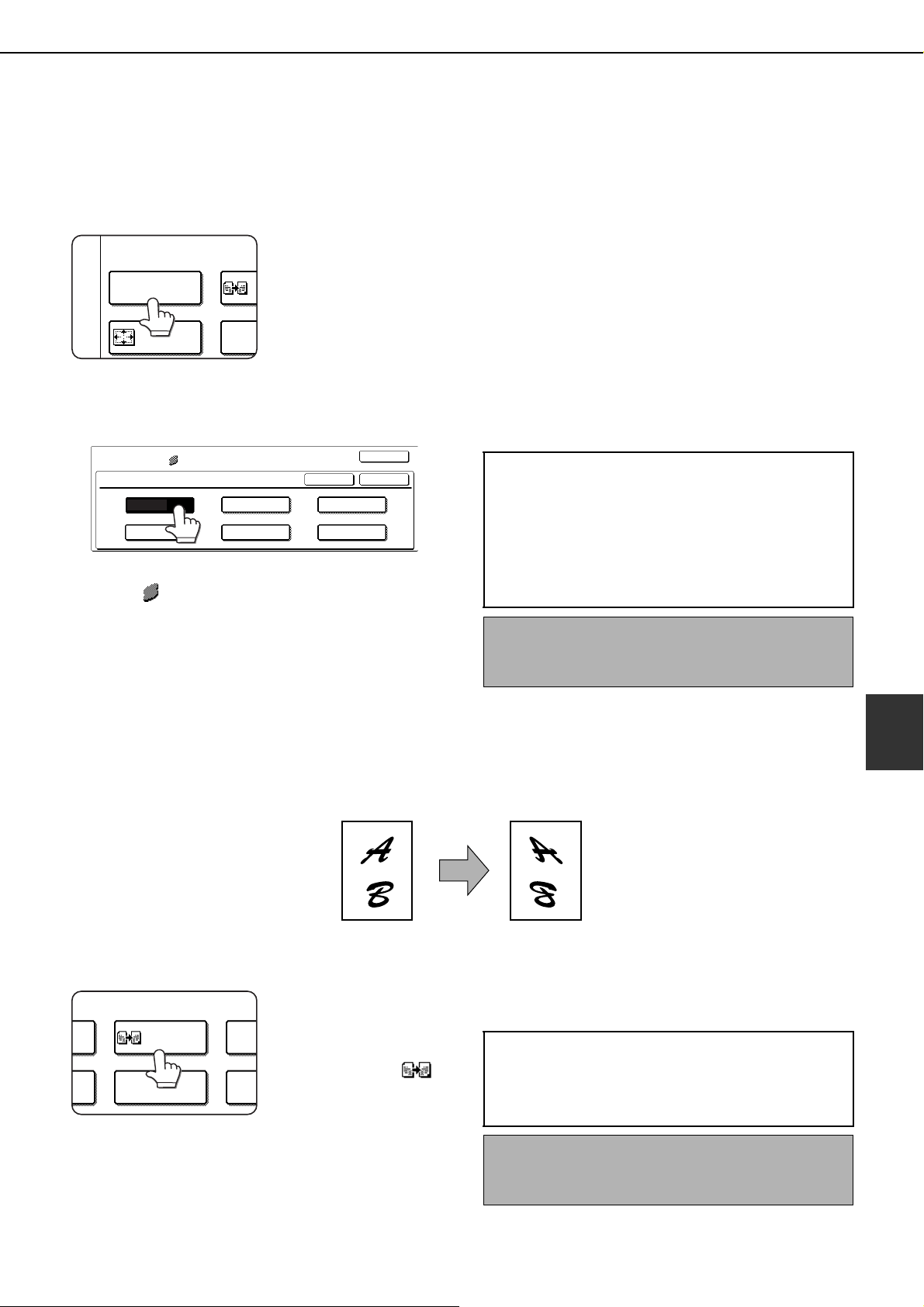
IMAGE EDIT MENU
6-17
6
Single color
Produces copies with a selected single color.
1
Touch the [SINGLE COLOR] key on the
IMAGE EDIT screen.
The SINGLE COLOR
setting screen will
appear.
2
Select the desired color.
When one of the keys is touched, the single color
icon ( ) will appear at the upper left of the
screen to indicate that the single color function is
turned on. (The number that appears with the icon
indicates the selected color, and is the number on
the key of the selected color.)
3
Touch the [OK] key (inside [OK] key) on
the SINGLE COLOR setting screen.
Return to the IMAGE EDIT menu screen.
4
Touch the [OK] key on the IMAGE EDIT
menu screen.
Return to the SPECIAL MODES screen.
5
Touch the [OK] key on the SPECIAL
MODES screen.
Return to the main screen of copy mode.
Mirror image
This function is used to print a mirror image of the original. The images will be inverted in the right to left direction on
the copies.
1
Touch the [MIRROR IMAGE] key on the
IMAGE EDIT menu screen.
The [MIRROR IMAGE]
key will be highlighted to
indicate that the function
is turned on, and the
mirror image icon ( )
will appear in the upper
left of the screen.
2
Touch the [OK] key on the IMAGE EDIT
menu screen.
Return to the SPECIAL MODES screen.
3
Touch the [OK] key on the SPECIAL
MODES screen.
Return to the main screen of copy mode.
IMAGE EDIT
SINGLE COLOR
FULL-BLEED
M
I
MULT
ENLA
11x17
FULL-BLEED
IMAGE EDIT
-1
SINGLE COLOR
4.YELLOW 5.MAGENTA
1.RED 2.GREEN
6.CYAN
3.BLUE
OKCANCEL
OK
-
1
About the steps that follow
If the reversing single pass feeder is being
used, see pages 5-2 through 5-6. If the
document glass is being used, see pages 5-7
through 5-9.
In either case, press the [COLOR COPY
START] key to begin copying.
To cancel the SINGLE COLOR function, select the
SINGLE COLOR function again and touch the
[CANCEL] key (step 2).
Original Copy
OUR PHOT
EED
MULTI-PAGE
ENLARGEMENT
MIRROR
IMAGE
PAMP
About the steps that follow
If a reversing single pass feeder is being used,
see pages 5-2 through 5-6. If the document
glass is being used, see pages 5-7 through 5-9.
To cancel the MIRROR IMAGE function, touch the
MIRROR IMAGE again on the IMAGE EDIT menu
screen (step 2).
ApollonII_general-copy_SEC.book 17 ページ 2004年9月6日 月曜日 午後4時57分
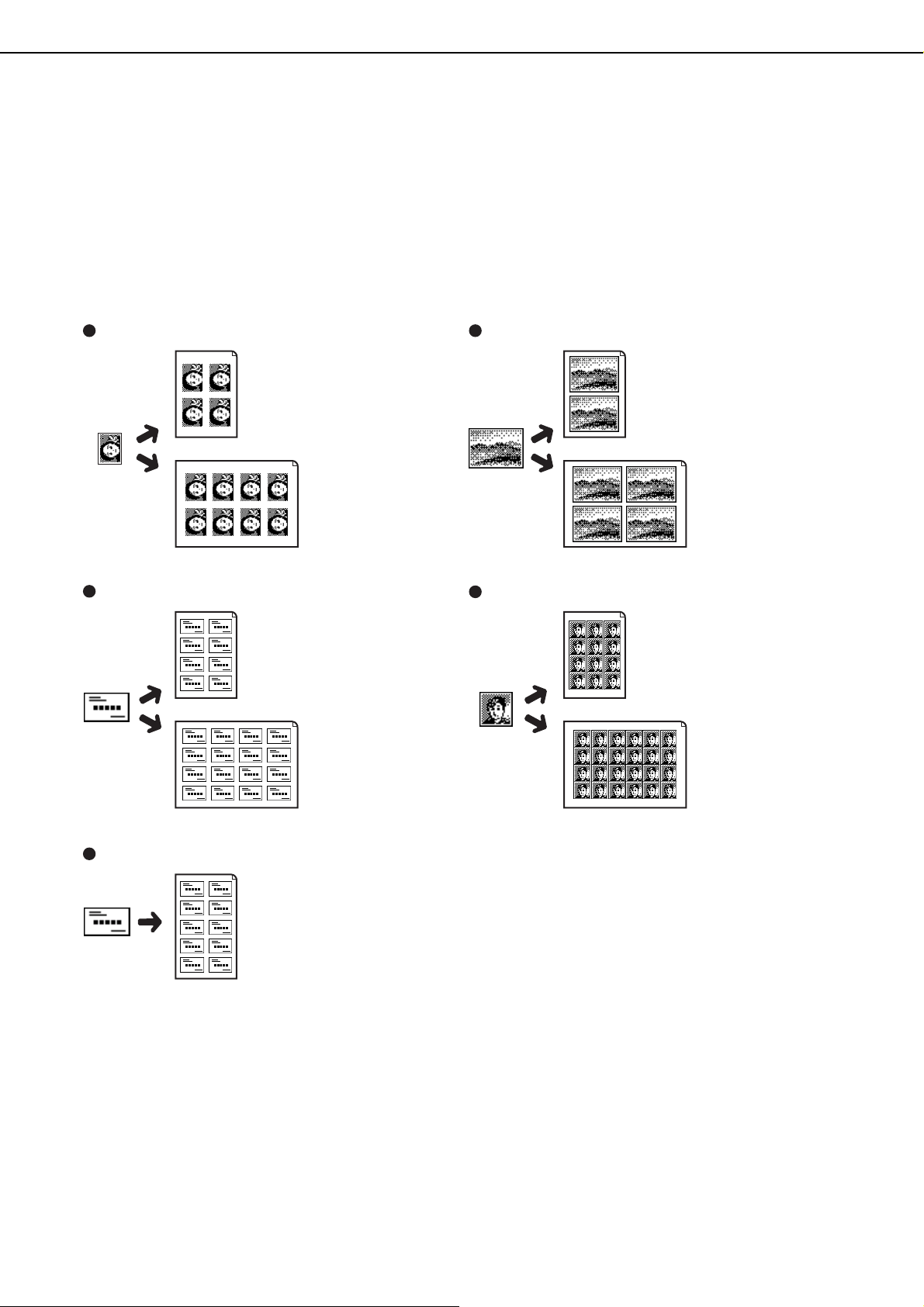
IMAGE EDIT MENU
6-18
Photo Repeat
PHOTO REPEAT is used to produce repeated images of a photo on a single sheet of copy paper.
● Up to 24 repeats can be made on a single copy sheet. The number of copies on a single sheet depends on the
original size and copy paper size.
● Reduction or enlargement cannot be selected with this function. If reduction or enlargement has been selected,
the copy ratio will be reset to 100% when this function is selected.
● This function will not work when non-standard size paper is used.
● This function can only be used with 8-1/2" x 11" (A4) or 11" x 17" (A3) paper.
Original size (to 3" x 5" (130 x 90 mm))
Four copies are made on a
sheet of 8-1/2" x 11" (A4)
size paper.
Eight copies are
made on a sheet
of 11" x 17" (A3)
size paper.
Two copies are made on a
sheet of 8-1/2" x 11" (A4)
size paper.
Four copies are
made on a sheet of
11" x 17" (A3) size
paper.
Eight copies are made on a
sheet of 8-1/2" x 11" (A4)
size paper.
16 copies are
made on a sheet
of 11" x 17" (A3)
size paper.
12 copies are made on a
sheet of 8-1/2" x 11" (A4)
size paper.
24 copies are
made on a sheet of
11" x 17" (A3) size
paper.
10 copies are made on a
sheet of 8-1/2" x 11"
(A4)
size paper (95% ratio).
Original size (to 2-1/2" x 4" (70 x 100 mm))
Original size (to 2-1/8" x 3-5/8" (57 x 100 mm))
Original size (to 5" x 7" (100 x 150 mm))
Original size (to 2-1/2" x 2-1/2" (65 x 70 mm))
ApollonII_general-copy_SEC.book 18 ページ 2004年9月6日 月曜日 午後4時57分
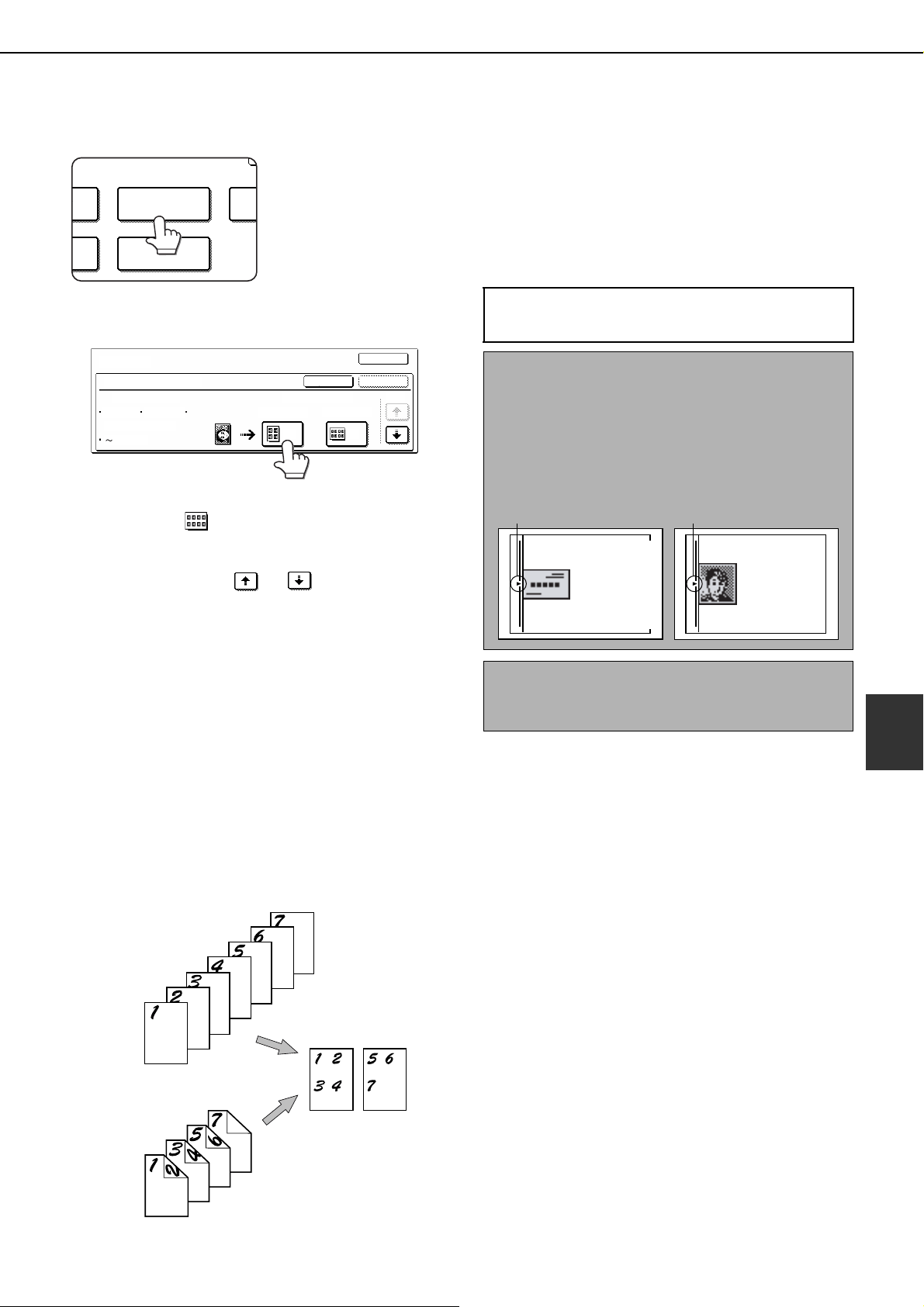
IMAGE EDIT MENU
6-19
6
1
Touch the [PHOTO REPEAT] key on the
IMAGE EDIT menu screen.
The PHOTO REPEAT
setting screen will
appear.
2
Touch the key for the desired combination
of original type and paper size.
When any one of the keys is touched, the photo
repeat icon ( , etc.) will appear at the upper left of
the screen to indicate that the function is turned on.
If the key for the desired combination doesn't
appear, touch the or key to scroll, and
then touch the desired repeat type key (8-1/2" x
11" (A4) or 11" x 17" (A3)).
When making repeat copies of an original size (to
2-1/8" x 3-5/8" (57 x 100 mm)), only 8-1/2" x 11"
(A4) can be selected for the paper size.
3
Touch the [OK] key (inside [OK] key) on
the PHOTO REPEAT setting screen.
Return to the IMAGE EDIT menu screen.
4
Touch the [OK] key on the IMAGE EDIT
menu screen.
Return to the SPECIAL MODES screen.
5
Touch the [OK] key on the SPECIAL
MODES screen.
Return to the main screen of copy mode.
Multi shot
The multi shot function is used to copy up to four originals, collectively in a specified order, per sheet of copy paper
in any one of four layout patterns.
[Example] Copying seven originals using the 4 in 1 MULTI SHOT selection in a layout pattern starting from the upper
left to lower right.
● When using the multi shot function, place the
originals, select the desired paper size, and
select the copying mode before selecting the
multi shot function on the special modes screen.
● When using the multi shot function, the
appropriate copy ratio will be automatically set
based on the original size, paper size, and the
number of originals to be copied onto one sheet.
The minimum possible reduction ratio is 25%.
Depending on the original size, paper size, and
the number of originals to be copied onto one
sheet, the copy ratio required to fit the original
images onto one sheet may be smaller than
25%. In this case, a ratio of 25% will be used,
and parts of the original images may be cut off.
R
PHOTO REPEAT MU
GE
NT
PAMPHLET COPY
OKCANCEL
OK
IMAGE EDIT
PHOTO REPEAT
ORIGINAL SIZE REPEAT TYPE
E/L SIZE
148x105mm
3 x 5"
POST CARD
A4/8½x11
A3/11x17
4 8
1/5
About the steps that follow
See pages 5-7 through 5-8.
NOTES
● Be sure to place the original on the document
glass, The reversing single pass feeder cannot be
used for this function.
● Place ~2-1/2" x 4
"
(70 x 100mm), ~2-1/2" x 2-1/2"
(65 x 70mm) and ~2-1/8" x 3-5/8
"
(57 x 100mm)
originals as shown below.
To cancel the PHOTO REPEAT function, select the
PHOTO REPEAT function again and touch the
[CANCEL] key (step 2).
Centering scale
Centering scale
Placing a
~2 ½" x 4"
(70 x 100mm)
or ~2 " x 3 "
(57 x 100mm)
original
Placing a
~2 ½" x 2 ½"
(65 x 70mm)
original
/
5
8
/
1
8
One-sided copies
from one-sided
originals
One-sided copies
from two-sided
originals
Copies
ApollonII_general-copy_SEC.book 19 ページ 2004年9月6日 月曜日 午後4時57分
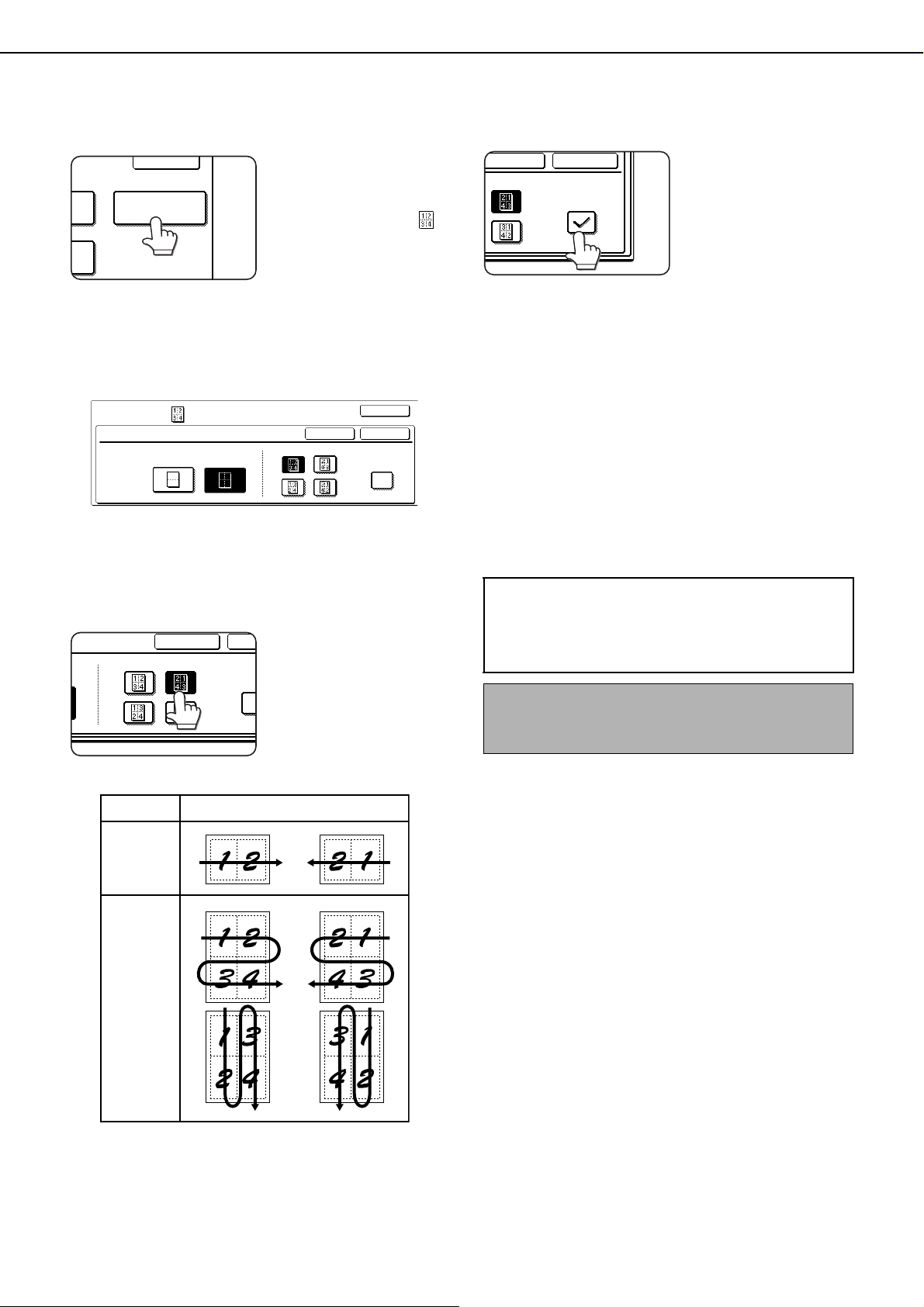
IMAGE EDIT MENU
6-20
1
Touch the [MULTI SHOT] key on the
IMAGE EDIT menu screen.
The MULTI SHOT
setting screen will
appear.
The multi shot icon ( ,
etc.) will also appear in
the upper left of the
screen to indicate that
the function is turned on.
2
Select the number of originals to be
copied onto one sheet of copy paper on
the multi shot selection screen.
The orientation of copy paper and the image of the
originals may be rotated as needed.
3
Select the layout.
Select the order in which
the originals will be
arranged on the copy.
The arrows in the above diagram indicate the
directions in which the images are arranged.
4
Select whether or not to add borderlines.
When the BORDER
LINE checkbox is
selected, borderlines
are added around the
borders of the images.
5
Touch the [OK] key (inside [OK] key) on
the MULTI SHOT setting screen.
Return to the IMAGE EDIT menu screen.
6
Touch the [OK] key on the IMAGE EDIT
menu screen.
Return to the SPECIAL MODES screen.
7
Touch the [OK] key on the SPECIAL
MODES screen.
Return to the main screen of copy mode.
OK
AT MULTI SHOT
OPY
OKCANCEL
OK
IMAGE EDIT
MULTI SHOT
2in1 4in1
LAYOUT
BORDER LINE
OCANCEL
LAYOUT
BORDER
2in1
4in1
Shot number
Layout
About the steps that follow
If a reversing single pass feeder is being used,
see pages 5-2 through 5-6. If the document
glass is being used, see pages 5-7 through 5-9.
To cancel the multi shot function, touch the
[CANCEL] key on the multi shot setting screen (step
2).
OKCANCEL
YOUT
BORDER LINE
ApollonII_general-copy_SEC.book 20 ページ 2004年9月6日 月曜日 午後4時57分
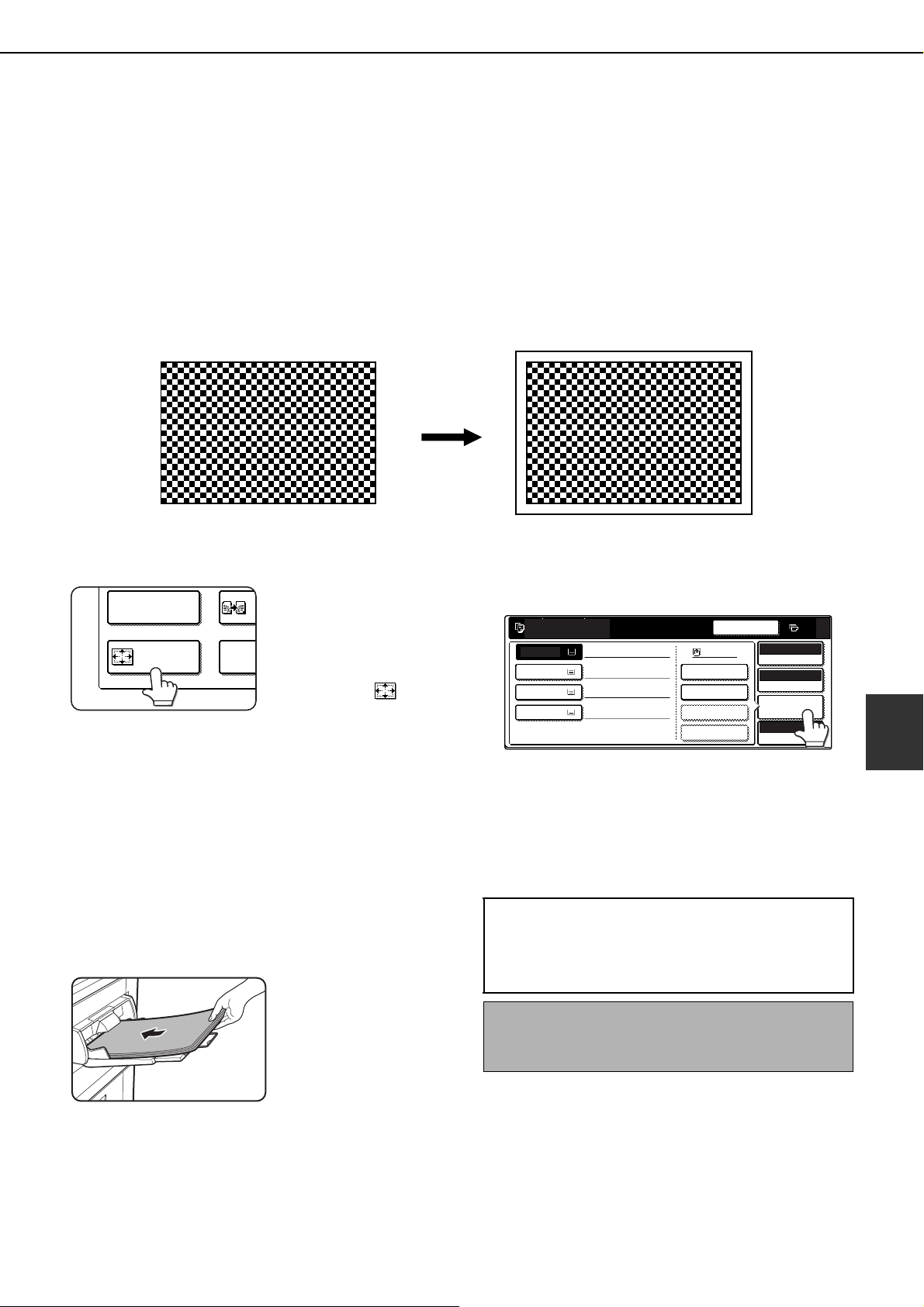
IMAGE EDIT MENU
6-21
6
11" x 17" (A3) Full-bleed
In other copy modes, image loss will occur along the copy edges. When the 11" x 17" (A3) FULL-BLEED function is
used, the full image of an 11" x 17" (A3) size original will be copied onto 12" x 18" (A3W) size copy paper.
The 11" x 17" (A3) FULL-BLEED function can only be used when the original is placed on the document glass. (The
reversing single pass feeder cannot be used.)
Reduction or enlargement cannot be selected with this function. If reduction or enlargement has been selected, the
copy ratio will be reset to 100% when this function is selected.
Automatic two-sided copying is not possible.
1
Touch the [11x17 FULL-BLEED] key on the
IMAGE EDIT menu screen.
The [11x17 FULL-
BLEED] key will be
highlighted to indicate
that the function is
turned on, and the full-
bleed icon ( ) will
appear in the upper left
of the screen.
2
Touch the [OK] key on the IMAGE EDIT
menu screen.
Return to the SPECIAL MODES screen.
3
Touch the [OK] key on the SPECIAL
MODES screen.
Return to the main screen of copy mode.
4
Load 12" x 18" (A3W) copy paper into the
bypass tray.
Adjust the bypass guide
to 12" x 18" width before
loading the paper.
Remove any paper
remaining in the tray.
Pull out the tray
extension and wire
extension. (See page 2-
4)
5
Touch the [PAPER SELECT] key on the
touch panel and then select the paper type
in the bypass tray.
Touch the [PLAIN] key or the [HEAVY PAPER]
key.
If you touched the [HEAVY PAPER] key, touch the
[HEAVY PAPER1] key or the [HEAVY PAPER2]
key as appropriate for the weight of the paper you
loaded. (See step 3 on page 2-12.)
Original (11" x 17" (A3)) size Copy (12" x 18" (A3W)) size
SINGLE COLOR
11x17
FULL-BLEED
MULT
ENLA
About the steps that follow
See pages 5-7 and 5-8.
Extend the copy receptacle and then begin
copying.
To cancel the 11 x 17 (A3) FULL-BLEED function,
touch the [11x17 FULL-BLEED] key again on the
IMAGE EDIT menu screen (step 1).
PLAIN
PLAIN
HEAVY PAPER
TRANSPARENCY
ENVELOPE
RECYCLED
COLOR
PLAIN
12x18
AUTO
EXPOSURE
AUTO
ORIGINAL
PAPER SELECT
100
%
COPY RATIO
READY TO COPY.
0
INTERRUPT
1. 8½x11
2. 8½x14
3. 11x17
4. 8½x11R
ApollonII_general-copy_SEC.book 21 ページ 2004年9月6日 月曜日 午後4時57分
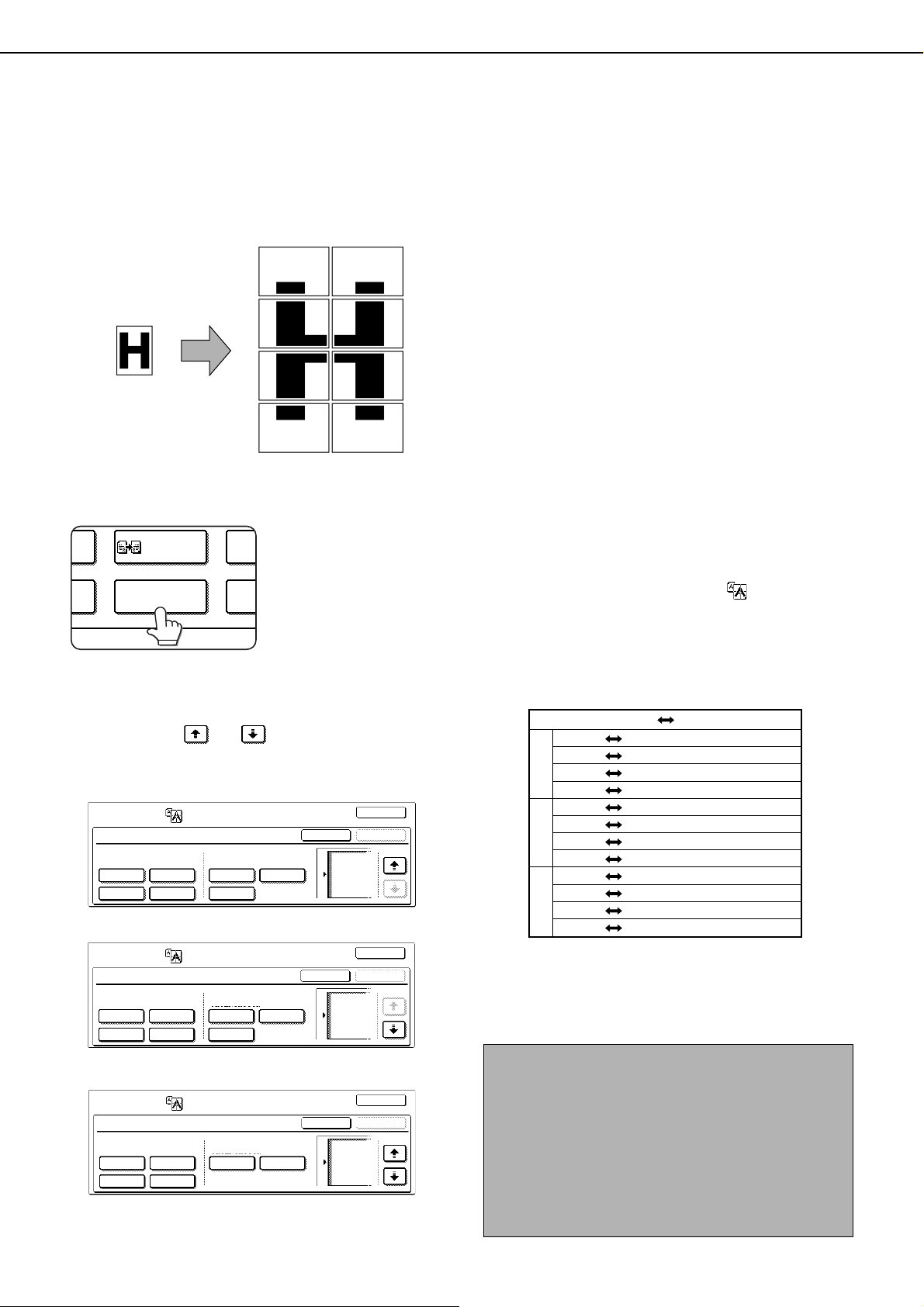
IMAGE EDIT MENU
6-22
Multi-page enlargement
This function is used to enlarge an original image to a size larger than 11" x 17" (A3) and print divided images onto
multiple sheets of copy paper.
Overlap of sections of image
● There will be a margin around the edges of each
copy.
● The original image will be divided and copied
onto multiple sheets of paper. Areas for
overlapping the copies will be made along the
leading and trailing edges of each copy.
1
Touch the [MULTI-PAGE ENLARGEMENT]
key on the IMAGE EDIT menu screen.
The MULTI-PAGE
ENLARGEMENT setting
screen will appear.
2
Select the size system for multi-page
enlargement
Touch the or key to display the size
settings of the desired size system.
Inch system
A system
B system
3
Set the enlargement size and the original
size.
The order of selection can begin from the
enlargement size or the original size. When the
enlargement size and original size are set, the
multi-page enlargement icon ( ) will appear in
the upper left of the screen to indicate that the
function is turned on.
The combinations of original size and
enlargement size for which multi-page
enlargement is possible are as follows.
Original
(8-1/2" x 11"
(A4) size)
Copy (enlarged image
on 8 sheets of 11" x 17"
(A3) paper)
[Example]
OR PHOT
MIRROR
IMAGE
MULTI-PAGE
ENLARGEMENT
EED
PAMP
IMAGE EDIT
OK
34
x
44 44
x
68
22
x
34 11
x
17 8½
x
14
CANCEL OK
MULTI-PAGE ENLARGEMENT
ENLARGEMENT SIZE
(INCH)
ORIGINAL SIZE &
ORIENTATION
22
x
17
3/3
8½
x
11
IMAGE EDIT
A0 A0x2
A1A2
A5
A3 A4
CANCEL OK
OK
MULTI-PAGE ENLARGEMENT
ENLARGEMENT SIZE
(A SIZE)
ORIGINAL SIZE &
ORIENTATION
1/3
IMAGE EDIT
OK
B1 B0
B2 B4
ORIGINAL SIZE &
ORIENTATION
B5
CANCEL OK
OK
MULTI-PAGE ENLARGEMENT
ENLARGEMENT SIZE
(B SIZE)
B3
2/3
IMAGE EDIT
NOTES
● If an original size is selected first, a message will
indicate the enlargement sizes that can be
selected. If an enlargement size is selected first, a
message will indicate the original sizes that can be
selected.
● If a combination is selected for which multi-page
enlargement is not possible, invalid selection
beeps will be sounded.
Enlargement size Original size
22 x 17 11 x 17/8-1/2 x 14/8-1/2 x 11
22 x 34 11 x 17/8-1/2 x 14/8-1/2 x 11
34 x 44 11 x 17/8-1/2 x 14/8-1/2 x 11
44 x 68 11 x 17/8-1/2 x 14/8-1/2 x 11
A2 A3/A4/A5
A1 A3/A4/A5
A0 A3/A4
A0 x 2* A3
B3 B4/B5
B2 B4/B5
B1 B4/B5
B0 B4
B system
Inch system
A system
Multi-page enlargement is not possible of an A-
system size original to a B-system enlargement size,
nor of a B-system size original to an A-system
enlargement size.
*Indicates the size that is twice A0 size.
ApollonII_general-copy_SEC.book 22 ページ 2004年9月6日 月曜日 午後4時57分
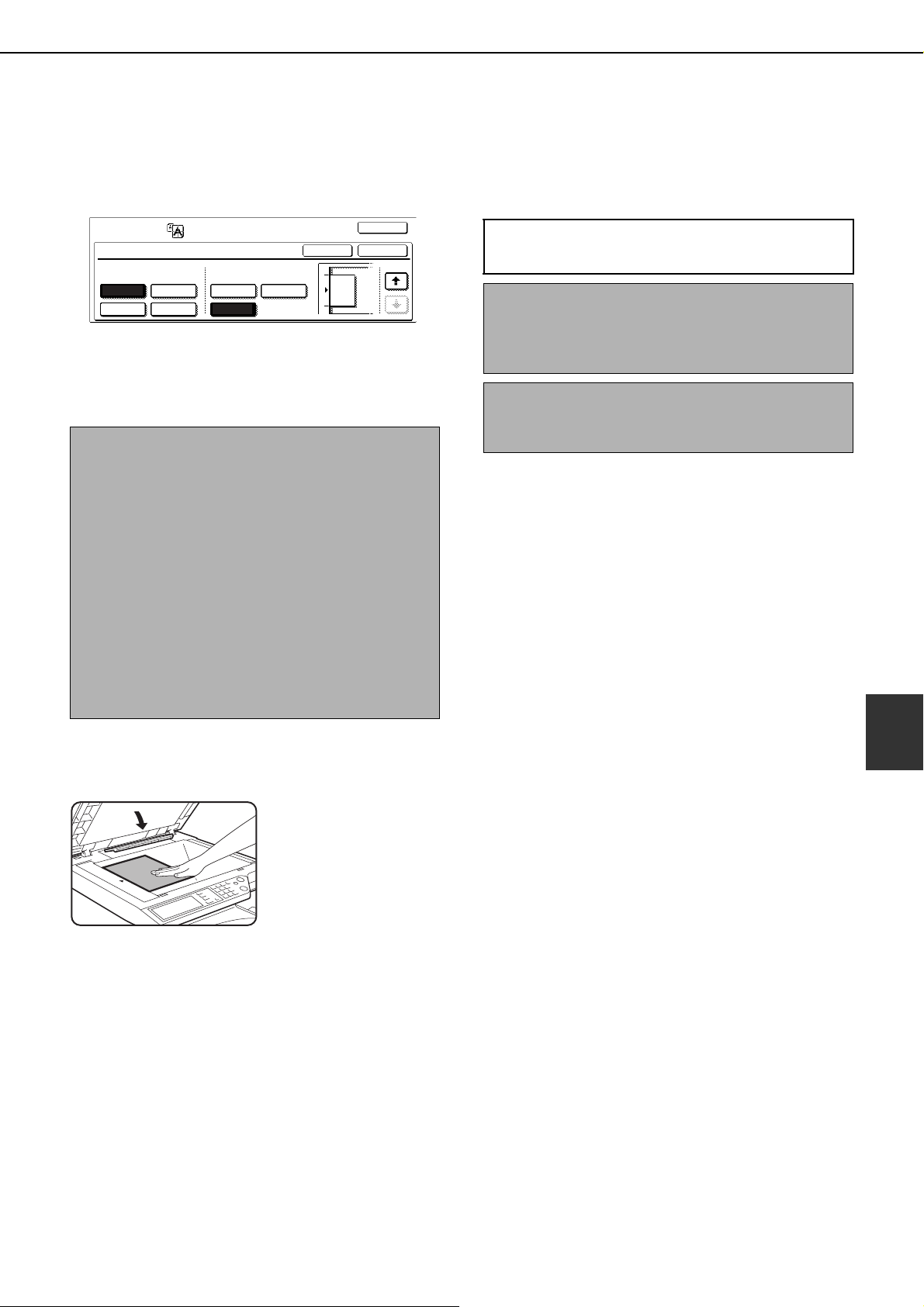
IMAGE EDIT MENU
6-23
6
4
Check the placement orientation and the
number of copies
Example: Enlargement size = 22" x 17" (A2),
original size = 8-1/2" x 11" (A4)
A suitable orientation for placement of the original
and the number of sheets of paper required for the
enlarged image are displayed based on the
selected original size and enlargement size.
5
Place the original on the document glass
in accordance with the indicated
orientation. (page 4-6)
Multi-page enlargement
is only possible using
the document glass.
The reversing single
pass feeder cannot be
used for this function.
6
Touch the [OK] key (inside [OK] key) on
the MULTI-PAGE ENLARGEMENT setting
screen.
Return to the IMAGE EDIT menu screen.
7
Touch the [OK] key on the IMAGE EDIT
menu screen.
Return to the SPECIAL MODES screen.
8
Touch the [OK] key on the SPECIAL
MODES screen.
Return to the main screen of copy mode.
NOTES
● The paper size, number of sheets required for the
enlarged image, and the ratio are automatically
selected based on the selected original size and
enlargement size. (The paper size and ratio
cannot be selected by the operator.)
● The relations between the original size and
enlargement size selected by the operator and the
automatically selected paper size, number of
sheets, and ratio are shown on the previous page.
● If no paper trays have the size of paper that was
automatically selected, "Load XXX paper" will
appear. Change the paper in one of the trays or
the bypass tray to the indicated size of paper.
IMAGE EDIT
OK
34
x
44 44
x
68
22
x
34 11
x
17 8½
x
14
CANCEL OK
MULTI-PAGE ENLARGEMENT
ENLARGEMENT SIZE
(INCH)
ORIGINAL SIZE &
ORIENTATION
22
x
17
3/3
8½
x
11
About the steps that follow
See pages 5-7 and 5-8.
NOTE
Be sure to place the original on the document glass.
The reversing single pass feeder cannot be used for
this function.
To cancel the MULTI-PAGE ENLARGEMENT
function, select the MULTI-PAGE ENLARGEMENT
function again and touch the [CANCEL] key (step 4).
sec_apollon_06-2.fm 23 ページ 2004年11月15日 月曜日 午前11時46分
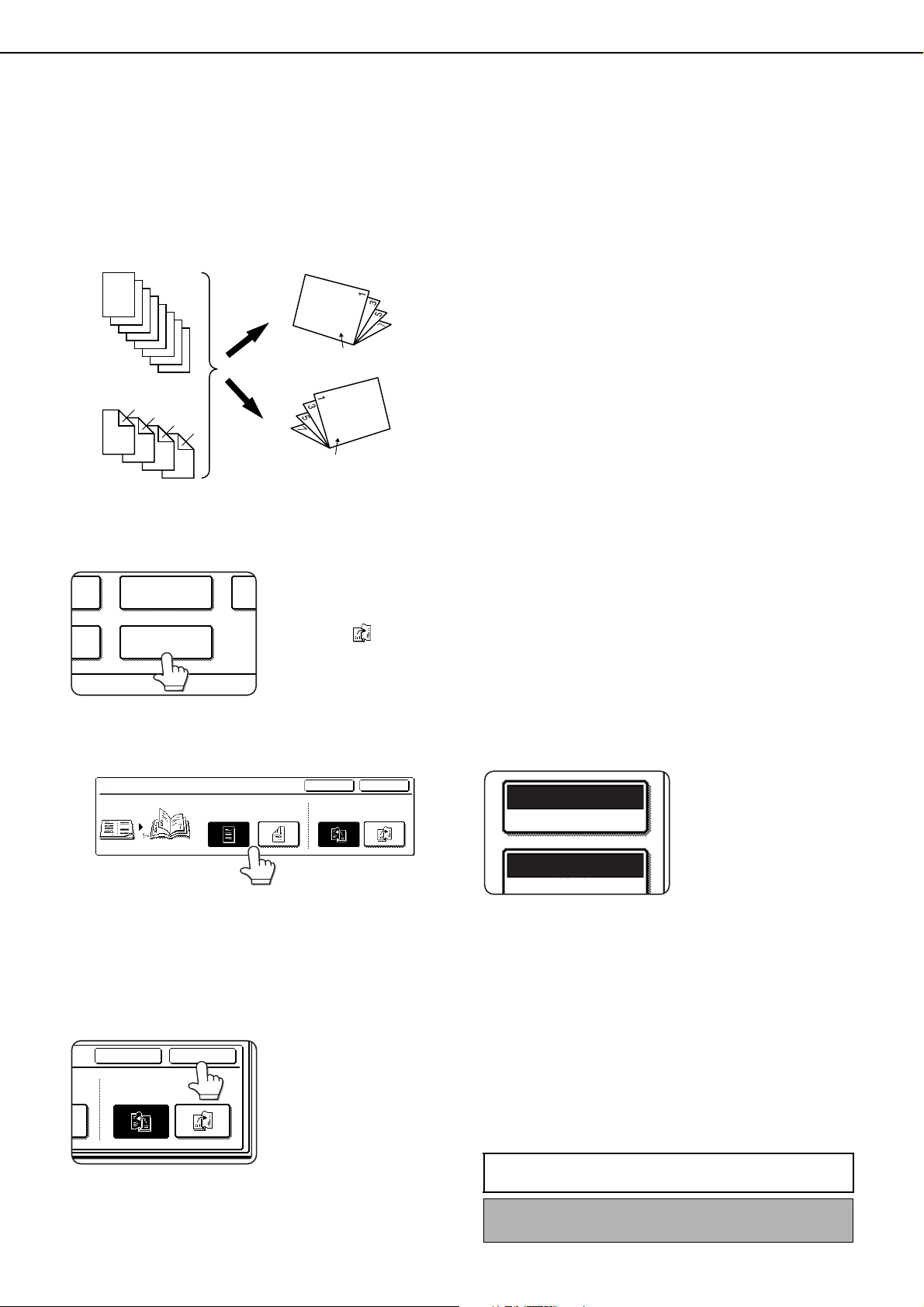
IMAGE EDIT MENU
6-24
Pamphlet copy
The pamphlet copy function is used to arrange copies in proper order for eventual center-stapling and folding into a
booklet. Two original pages are copied onto each side of copy paper. Four pages are, therefore, copied onto one sheet.
This function is convenient for arranging copies into an attractive booklet or pamphlet.
[Example] Copying eight originals in the pamphlet copy mode
● Scan the originals in order from the first page to
the last page. The order of copying will be
automatically adjusted by the machine.
●
Either left binding (opening from right to left) or right
binding (opening from left to right) can be selected.
● Four originals will be copied onto one sheet.
Blank pages may be automatically added at the
end, depending on the number of the originals.
● A duplex module/2 x 500 sheet paper drawer
and duplex bypass/inverter unit are required for
this function.
● If a saddle stitch finisher is installed, copies can
be stapled in two positions along the center of
copies and folded at the center.
1
Touch the [PAMPHLET COPY] key on the
IMAGE EDIT menu screen.
The PAMPHLET COPY
setting screen will
appear. The pamphlet
copy icon ( , etc.) will
also appear in the upper
left corner of the screen
to indicate that the
function is turned on.
2
Designate the type of originals to be
copied: 1-sided or 2-sided.
Select the [2-SIDED] key when you are using the
reversing single pass feeder to scan a two-sided
original.
3
Select the binding position (left binding or
right binding) and touch the [OK] key
(inside [OK] key) on the PAMPHLET COPY
setting screen.
Return to the IMAGE
EDIT menu screen.
4
Touch the [OK] key on the IMAGE EDIT
menu screen.
Return to the SPECIAL MODES screen.
5
Touch the [OK] key on the SPECIAL
MODES screen.
Return to the main screen of copy mode.
6
Place the original in the document feeder
tray or on the document glass. (pages 4-6
to 4-9)
7
Ensure that the desired paper size has been
automatically selected based on the original size.
To select another size
paper, select the desired
size and touch the [AUTO
IMAGE] key. The
appropriate copy ratio will be
selected automatically
based on the original size
and the paper size. (See
steps 2 and 3 on page 5-12.)
8
Make all other desired settings such as
exposure or the number of copies, and
press the [START] key.
9
[When using the reversing single pass feeder:]
Copying will start after all originals have been
scanned. (The next step is not needed.)
[When using the document glass:]
Replace the original with the next original and
press the [START] key. Repeat this operation until
all originals have been scanned. Then touch the
[READ-END] key.
1
2
3
4
5
6
7
8
7
8
5
6
3
4
1
2
Originals
(one-sided)
Originals
(two-sided)
Left binding
The finished copies
can be folded.
First page
First page
Right binding
PHOTO REPEAT
R
MU
PAMPHLET COPY
GE
ENT
CANCEL OK
PAMPHLET COPY
ORIGINAL
2-SIDED1-SIDED
RIGHT
BINDING
LEFT
BINDING
CANCEL OK
ED
RIGHT
BINDING
LEFT
BINDING
When the pamphlet copy function is set, the two-
sided copying mode will be automatically selected.
To cancel the pamphlet copy function, touch the [CANCEL]
key on the pamphlet copy setting screen (step 2).
AUTO 11x17
PAPER SELECT
100%
COPY RATIO
ApollonII_general-copy_SEC.book 24 ページ 2004年9月6日 月曜日 午後4時57分
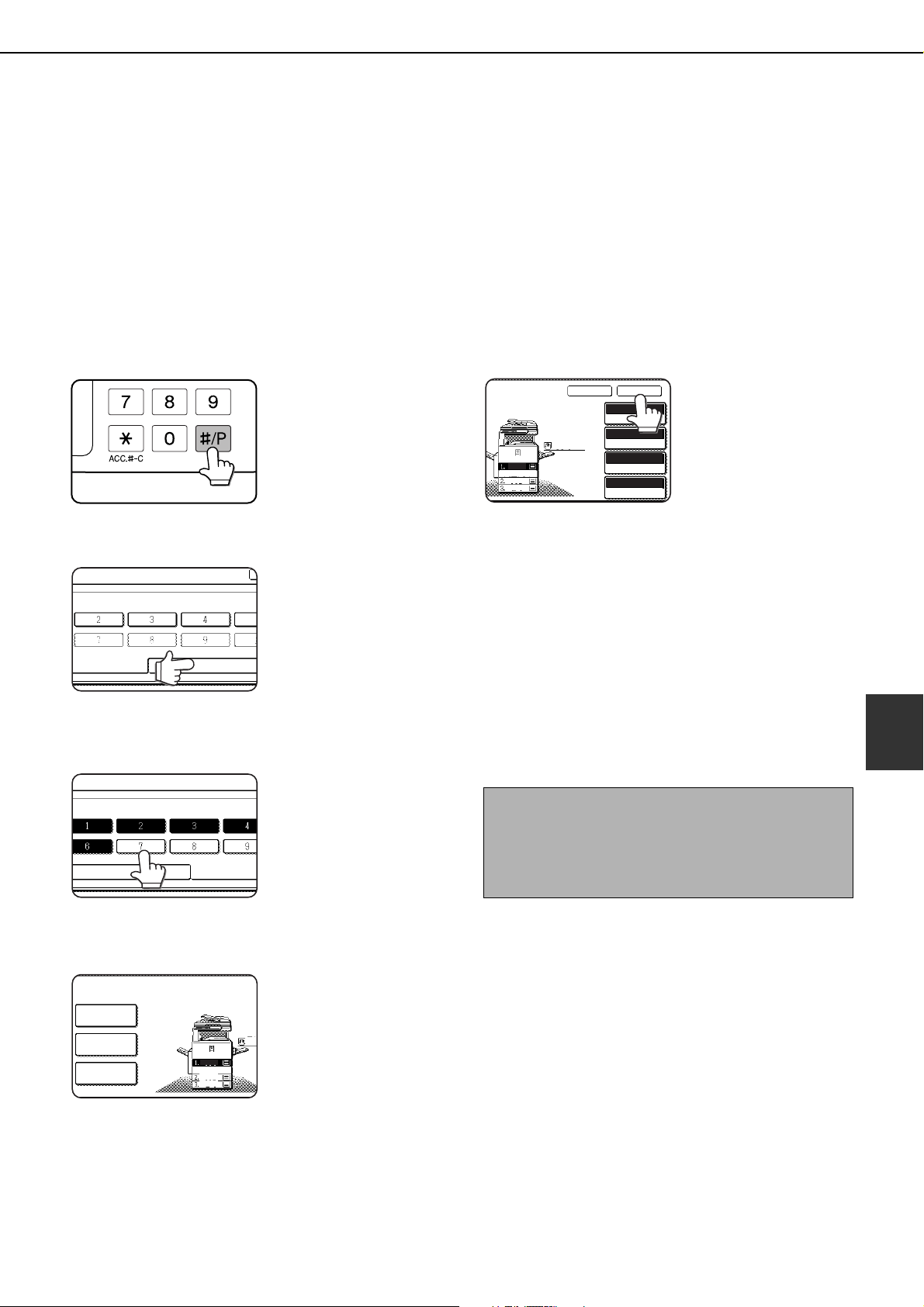
6-25
6
JOB PROGRAM MEMORY
Frequently used job programs can be stored in each of ten storage registers. This is convenient for quick job recall
without losing time manually reprogramming each aspect of a job. Job programs can be recalled with ease, and the
programs are retained even when the power is turned off. By programming frequently used copy settings, you can
eliminate the bother of selecting the settings each time you use them for a copy job.
●Selection for functions stored as part of a job program, will not be recalled as part of the program if the function has
been disabled or changed by a key operator program.
●To exit the job memory mode, press the [CA] (clear all) key on the operation panel or touch the [EXIT] key on the
touch panel.
Storing a job program
1
Press the [#/P] key.
2
Touch the [STORE/DELETE] key to obtain
the storage register screen.
3
Touch a number key from 1 to 10 on the
storage register screen.
Highlighted storage
register numbers are
registers which already
have programs stored.
4
Make all copier selections to be stored.
The number of copies
cannot be stored.
5
Touch the [OK] key.
The selected settings
will be stored under the
register number
selected in step 3.
If a number key is selected in step 3 that has
already been programmed.
A setting confirmation screen will appear. To
replace the existing program with the new
program, touch the [STORE] key and continue
from step 4. If you do not wish to replace the
existing program, touch the [CANCEL] key to
return to the screen of step 3 and select a different
number key.
M NUMBER.
RECALL STORE/DELETE
PROGRAMS
ESS PROGRAM NUMBER.
RECALL STORE/
SPECIAL MODES
2-SIDED COPY
OUTPUT
TO STORE, MAKE SELECTIONS AND PRESS
[OK], TO DELETE, PRESS [CANCEL].
11x17
PLA
5½x
8½x11
8½x11
DUPLEX
NOTE
If overwriting of programmed copy settings has been
prohibited in the key operator programs, you will not
be able to storing a job program. (See page 16 of the
key operator's guide.)
AND PRESS
NCEL].
11x17
AUTO
EXPOSURE
AUTO
ORIGINAL
AUTO 8½x11
PAPER SELECT
100
%
COPY RATIO
PLAIN
CANCEL OK
5½x8½
8½x11
8½x11
DUPLEX
ApollonII_general-copy_SEC.book 25 ページ 2004年9月6日 月曜日 午後4時57分
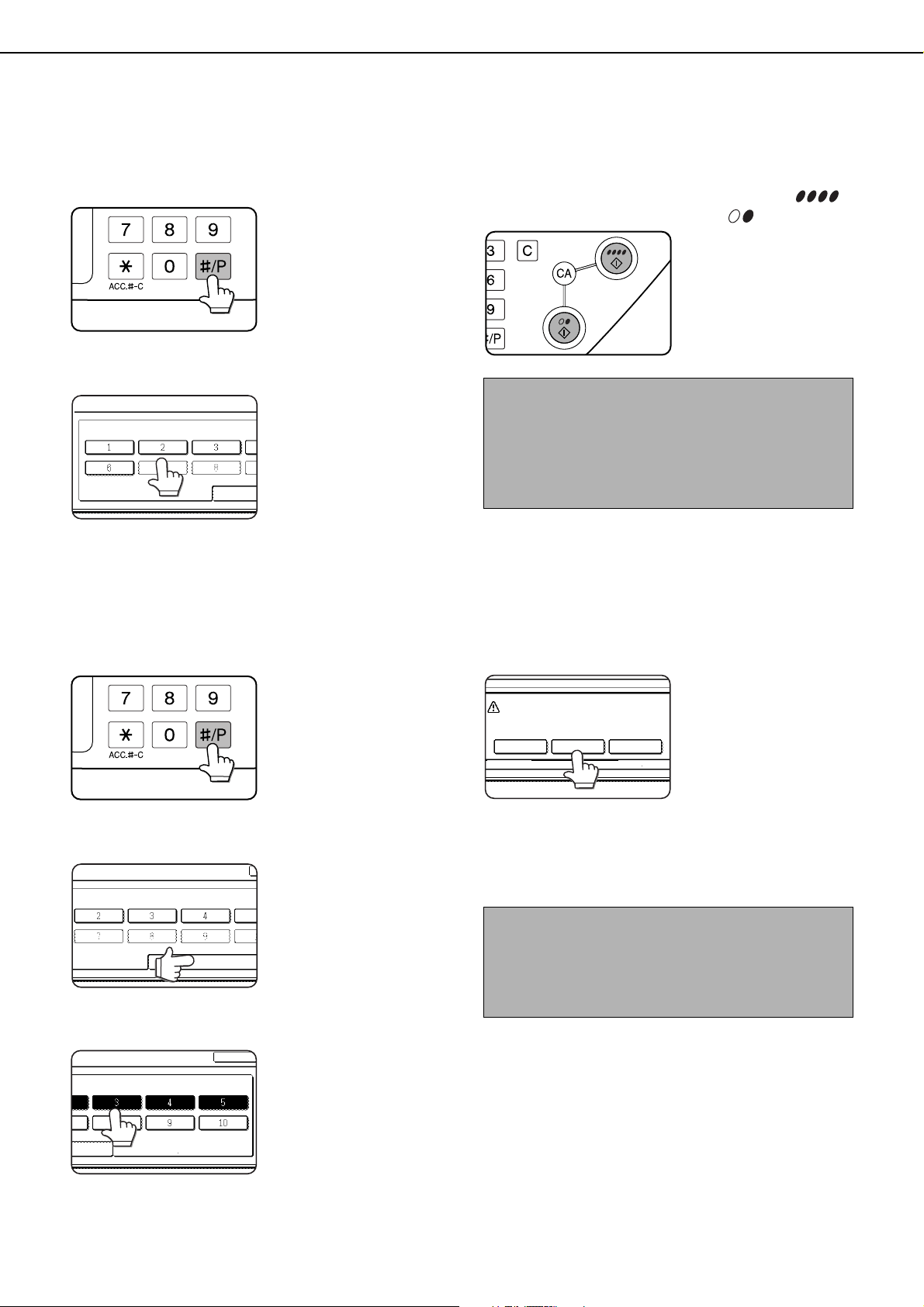
JOB PROGRAM MEMORY
6-26
Recalling a job program
1
Press the [#/P] key.
2
Touch the desired storage register
number key to recall the job from memory.
When a number key is
touched, the selection
screen will be closed
and the stored job
program will be recalled.
A number for which no
job program has been
stored cannot be
selected.
3
Set the number of copies as needed and
press the [COLOR COPY START ( )]
or [BLACK COPY START ( )] key.
Copying will start with
the settings of the
recalled job program.
Deleting a stored job program
1
Press the [#/P] key.
2
Touch the [STORE/DELETE] key to obtain
the storage register screen.
3
Select a storage register number of the
program to be deleted.
If a number key for which
no job program has
been stored is selected,
the screen will change to
the screen of step 4 on
the previous page (for
storing a job program).
4
Touch the [DELETE] key.
When the [DELETE] key
is touched, the screen in
step 3 will return and the
program will be deleted.
If the [CANCEL] key is
touched, the screen in
step 3 will return but the
program will not be
deleted. If no other programs are to be deleted,
touch the [EXIT] key on the screen displayed in
step 3 to exit the job program mode.
JOB PROGRAMS
PRESS PROGRAM NUMBER.
RECALL
NOTE
If any settings related to the contents of a job
program were changed in the key operator programs
after the job program was stored, the changed
settings will not be included when the job program is
recalled.
M NUMBER.
RECALL STORE/DELETE
EXIT
STORE/DELETE
NOTE
If overwriting of programmed copy settings has been
prohibited in the key operator programs, you will not
be able to clear a job program. (See page 16 of the
key operator's guide.)
REC LL STORE/DELETE
A JOB PROGRAM HAS BEEN ALREADY STORED.
STORE ANOTHER PROGRAM?
CANCEL DELETE STORE
ApollonII_general-copy_SEC.book 26 ページ 2004年9月6日 月曜日 午後4時57分
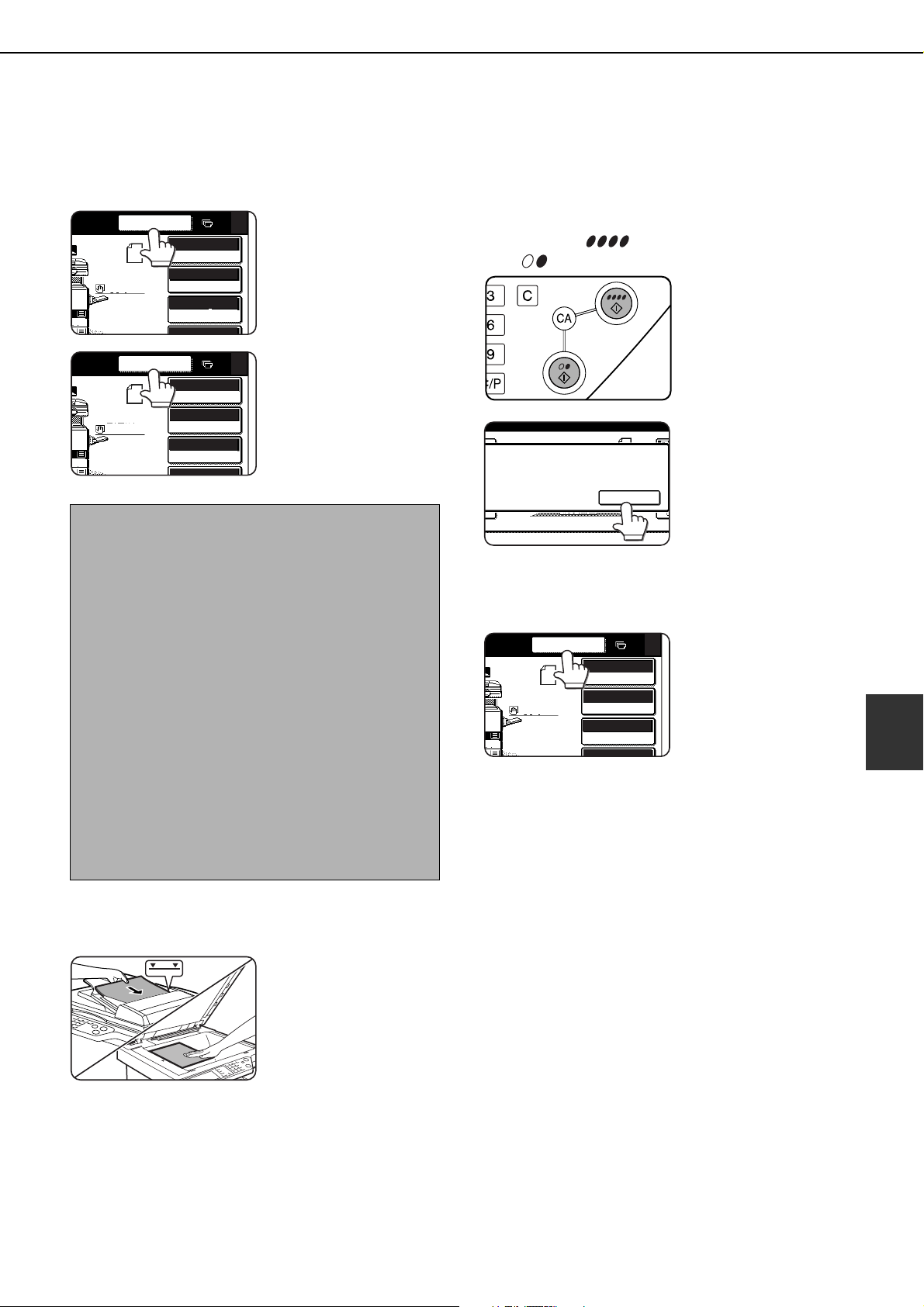
6-27
6
INTERRUPTING A COPY RUN
INTERRUPT can be used to temporarily stop a long copy run so that another copy job can be run.
It is not possible to interrupt an automatic two-sided copy job.
1
Touch the [INTERRUPT] key.
If the [INTERRUPT] key
does not appear,
interrupt copying is not
possible.
When the [INTERRUPT]
key is touched in step 1,
the [INTERRUPT] touch
key will be replaced by
the [CANCEL] key as
shown in the illustration.
2
Place the original for the interrupt copy job
in the document feeder or on the
document glass (pages 4-6 to 4-9).
If a black and white copy
job is being interrupted
to run another black and
white copy job, the
number of originals that
can be copied in the
interrupt job is 35.
(based on text original
(A) on page 5-4)
3
Make all other desired settings such as
exposure, paper size and number of
copies and then press the [COLOR COPY
START ( )] or [BLACK COPY START
( )]key.
When making black and
white copying using the
document glass in the
sort mode, replace the
original with the next
original and press the
[BLACK COPY START]
key. Repeat this
operation until all
originals have been
scanned. Then, touch
the [READ-END] key.
4
When the interrupt copy job is finished,
touch the [CANCEL] key to turn off the
interrupt copy state.
5
Resume the interrupted copy job.
If a color copy job was interrupted, replace the
originals that have not yet been copied and
resume copying.
If a black and white copy job was interrupted,
replace the originals that have not yet been copied
and press the [BLACK COPY START] key to
resume copying.
NOTES
● If you touch the [INTERRUPT] key when the
account counter function is turned on, the display
will prompt you to enter your account number.
Enter your account number with the numeric keys.
The copies you make will be added to the count of
the entered account number.
● If the [INTERRUPT] key is touched while an
original is being scanned, the interrupt state will
begin after scanning is completed. If the
[INTERRUPT] key is touched during copying, the
interrupt state will begin after the copy is
completed.
● Interrupt copying is not possible during automatic
two-sided copying using the optional duplex
module/2 x 500 sheet paper drawer. In addition,
automatic two-sided copying is not possible during
interrupt copying.
AUTO
EXPOSURE
AUTO
ORIGINAL
AUTO 8½x11
PAPER SELECT
100
%
PLAIN
INTERRUPT
ORIGINAL
5½x8½
0
X
8½x11
AUTO
ORIGINAL
AUTO
EXPOSURE
AUTO 8½x11
PAPER SELECT
100
%
PLAIN
CANCEL
ORIGINAL
5½x8½
0
X
8½x11
READ-END
PLACE NEXT ORIGINAL. PRESS [START].
WHEN FINISHED, PRESS [READ-END].
AUTO
ORIGINAL
AUTO
EXPOSURE
AUTO 8½x11
PAPER SELECT
100
%
PLAIN
CANCEL
ORIGINAL
5½x8½
0
X
8½x11
ApollonII_general-copy_SEC.book 27 ページ 2004年9月6日 月曜日 午後4時57分

ApollonII_general-copy_SEC.book 28 ページ 2004年9月6日 月曜日 午後4時57分

7-1
CHAPTER 7
MACHINE MAINTENANCE
(FOR COPYING)
This chapter explains procedures for removing misfeeds in a reversing
single pass feeder, cleaning the machine, and troubleshooting.
Page
REMOVING AN ORIGINAL MISFEED ..........................................................7-2
●
Removing a misfed original from the reversing single pass feeder .......7-2
USER MAINTENANCE (For copying)............................................................7-3
CLEANING THE ORIGINAL SCANNING AREA ...........................................7-3
TROUBLESHOOTING...................................................................................7-4
ApollonII_general-copy_SEC.book 1 ページ 2004年9月6日 月曜日 午後4時57分
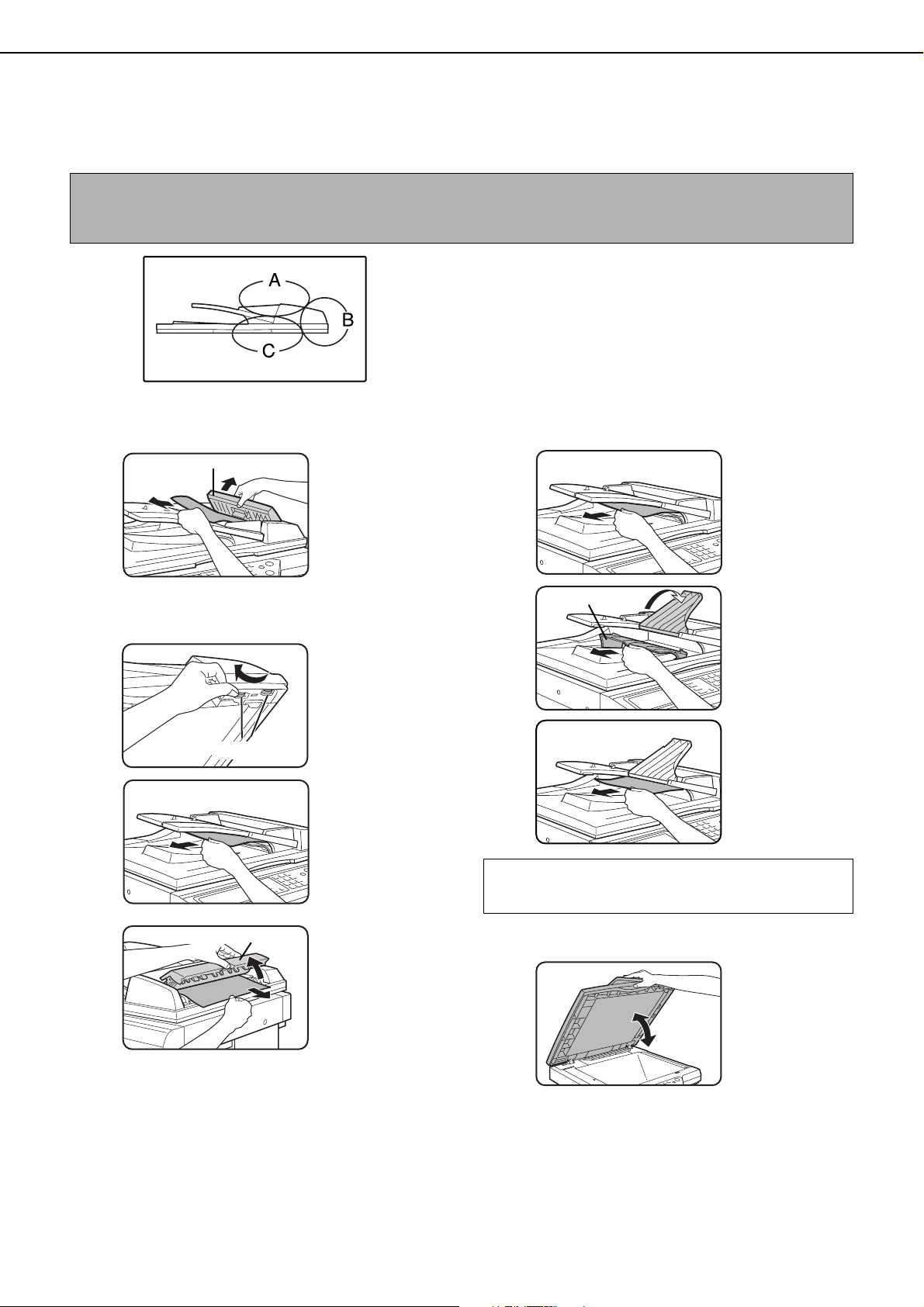
7-2
REMOVING AN ORIGINAL MISFEED
Removing a misfed original from the reversing single pass feeder
If an original misfeed occurs in the reversing single pass feeder, follow the steps below to remove the misfed original.
Check locations A, B, and C in the diagram at left to
remove the original.
1
Removing misfeeds from each location
● Check location A
Open the
document feeding
area cover and
gently remove the
misfed original
from the
document feeder
tray. Close the
document feeding
area cover.
● Check location B
Open the
reversing single
pass feeder and
rotate the two
release rollers in
the direction of
the arrow to make
the original feed
out. Close the
reversing single
pass feeder and
gently remove the
original.
If the misfed
original is small
(such as an A5
original), or if the
misfeed occurred
in the reversing
tray, open the
RSPF right side
cover and gently
remove the
original. Close the
RSPF right side
cover.
● Check location C
Remove the misfed
original from the
exit area.
If the misfed
original cannot be
easily removed
from the exit area,
open the
moveable part of
the document
feeder tray and
remove the
reversing tray and
then remove the
original.
2
Open and close the document feeder cover.
Opening and
closing the cover
clears the misfeed
display. Copying
cannot be
resumed until this
step is performed.
A message may appear indicating the number of
originals which must be returned to the document
feeder tray. Return the originals to the document
feeder tray and press the [START] key for color or
black and white copying as appropriate for the job
being resumed.
NOTES
● For misfeed removal in the main unit and other peripheral devices, see page 2-18.
● When a misfeed occurs, touch the [INFORMATION] key to display detailed information for misfeed removal.
Document feeding area cover
Release roller
RSPF right side cover
After removing a misfed original from the exit area, be
sure to attach the reversing tray securely to the exit area.
Reversing tray
ApollonII_general-copy_SEC.book 2 ページ 2004年9月6日 月曜日 午後4時57分
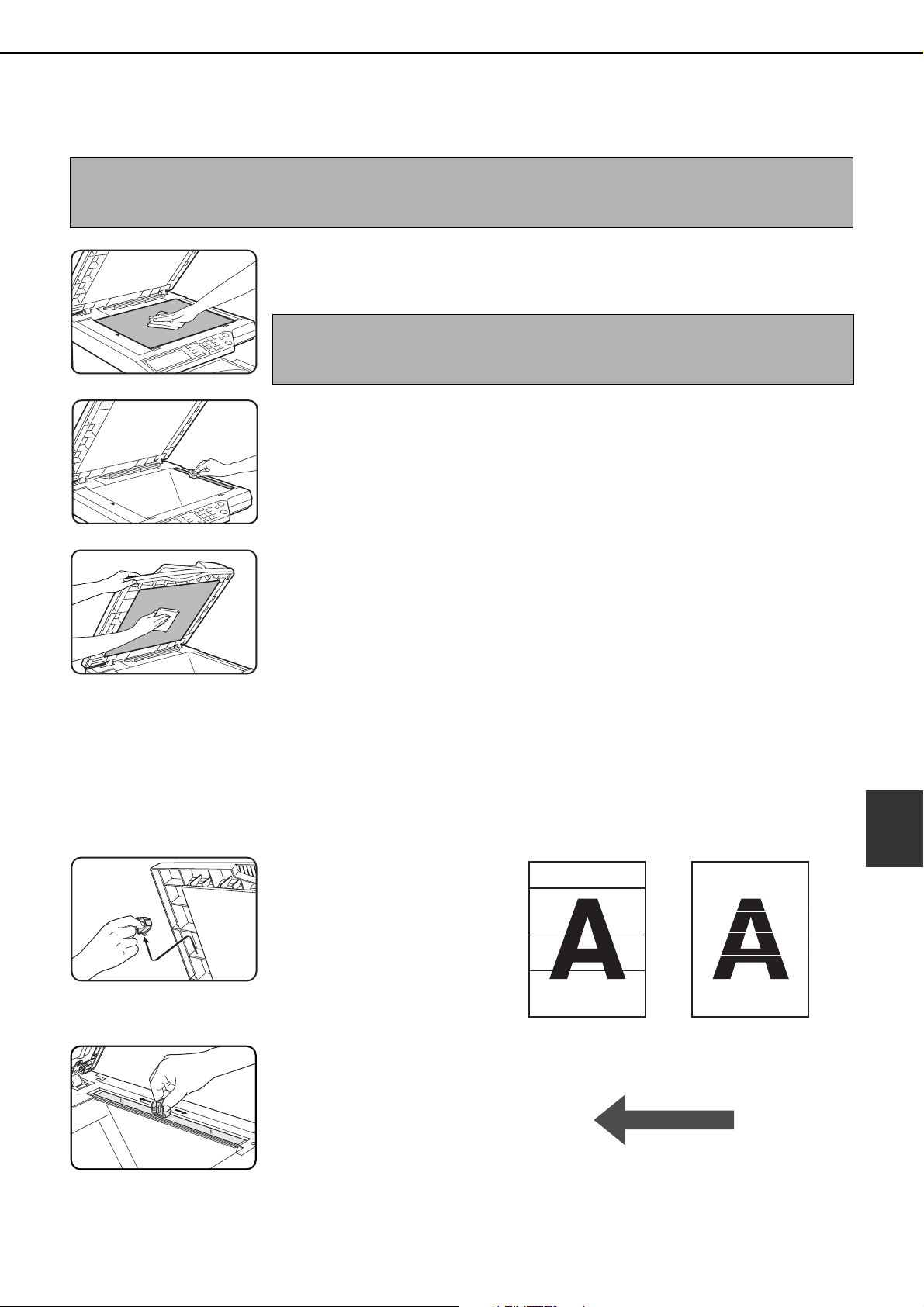
7-3
7
USER MAINTENANCE (For copying)
To ensure good service from this product over a long period of time, it is recommended that the following
maintenance procedures be performed on a regular basis.
Wipe with a clean, soft cloth.
If necessary, moisten the cloth with water or a small amount of neutral detergent.
When finished, wipe dry with a clean cloth.
If you find that a dirty image results when a copies are made using the reversing single
pass feeder, wipe the original scanning area (the area that contains the long narrow
glass shown at left).
CLEANING THE ORIGINAL SCANNING AREA
If you find that black (or white) lines appear when you make copies using the reversing single pass feeder, use the
accessory glass cleaning tool to clean the original scanning area.
1
Open the reversing single pass feeder and
remove the glass cleaning tool.
2
Clean the original scanning area with the
glass cleaning tool.
3
Replace the glass cleaning tool in its
storage position.
CAUTION
Do not use flammable spray to clean the machine. If gas from the spray comes in contact with hot electrical
components or the fusing unit inside the machine, fire or electrical shock may result.
NOTE
When cleaning, do not use thinner, benzene, or similar volatile cleaning agents. These may
degrade or discolor the housing.
Example of dirty print image
Black lines
Original feed direction
White lines
ApollonII_general-copy_SEC.book 3 ページ 2004年9月6日 月曜日 午後4時57分
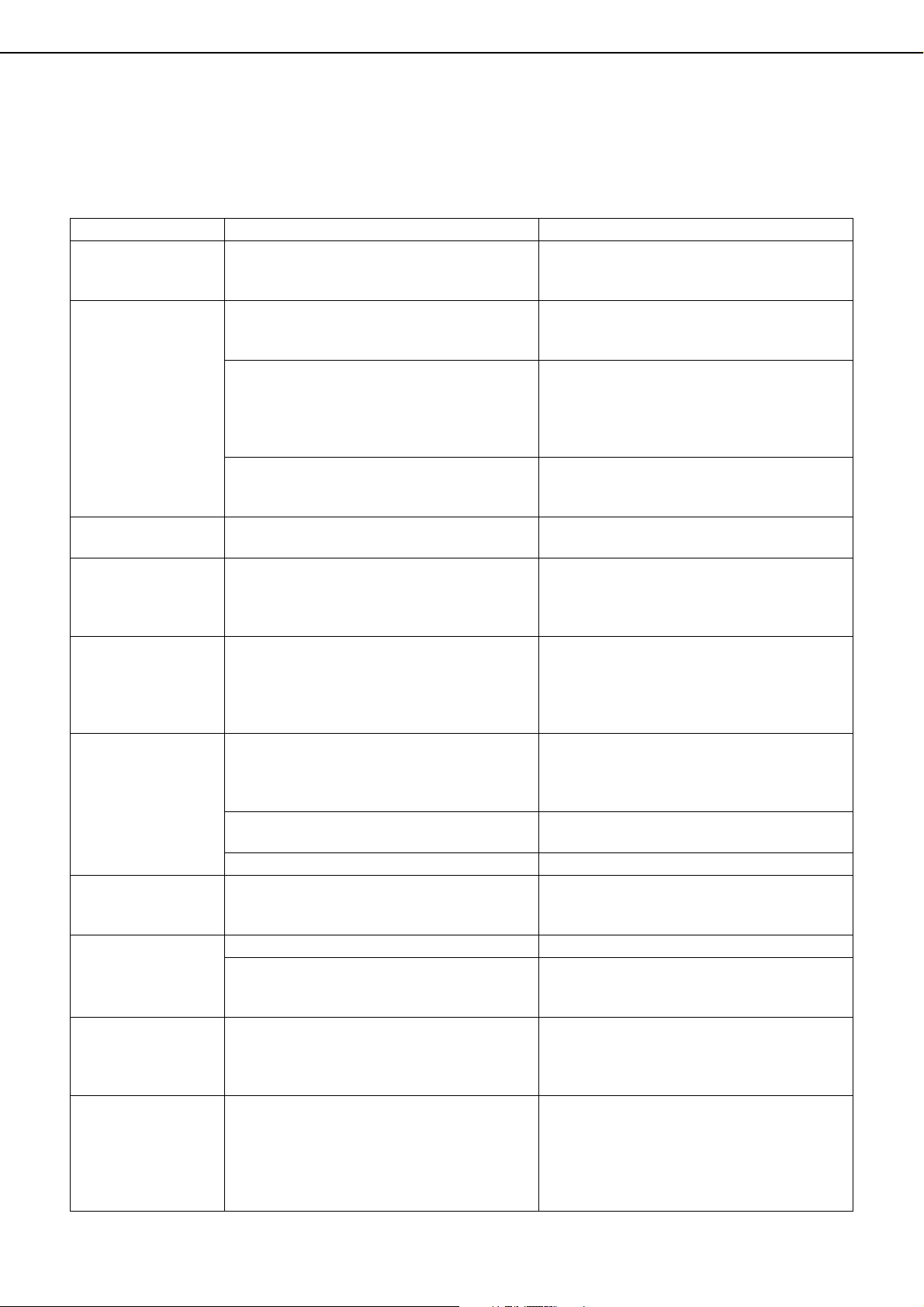
7-4
TROUBLESHOOTING
Whenever the machine stops or operation is not possible, check the operation panel display for messages. In most
cases, these messages will give sufficient information to return the machine to an operating condition. In cases where
this information is not enough, check the list below for more information. This section describes problems concerning
copier features. For troubleshooting specific problems related to the printer, network scanner, and fax features, see
the separate manuals provided for these features. For problems related to other peripheral devices, see page 2-24.
Problem Check Solution or cause
Machine does not
operate.
Are the [START] keys indicators off? If the indicators are not on, the machine may
be warming up. Warm-up should be
completed in 99 seconds or less.
Copies are too dark
or too light.
Is the original image too dark or too light? Select an appropriate resolution setting for
the original being copied and adjust the copy
exposure. (See page 5-10)
Is the exposure mode set to "AUTO"? The exposure level for "AUTO" can be
adjusted using the "Exposure adjustment"
key operator program. Contact your key
operator. (See page 15 of the key operator's
guide.)
An appropriate resolution setting for the
original has not been selected.
Change the resolution setting to "AUTO" or
manually select an appropriate resolution
setting. (See page 5-10)
Text is not clear on a
copy.
An appropriate resolution setting for the
original has not been selected.
Change the resolution setting to "TEXT".
Moiré appears on a
copy of a magazine,
catalogue, or other
printed material.
An appropriate resolution setting for the
original has not been selected.
Change the resolution setting to "PRINTED
PHOTO".
Text overlaying a
photo is not clear on
a copy of a map,
magazine or other
printed material.
An appropriate resolution setting for the
original has not been selected.
Change the resolution setting to "MAP".
Smudges appear on
copies.
Document glass or document cover dirty? Clean the surface of the document glass,
and the original scanning area and original
presser part of the reversing single pass
feeder. (See page 7-3.)
Black or white line appear on copies when
the single pass feeding function is used.
Clean the original scanning area. (See page
7-3.)
Original smudged or blotchy? Use a clean original.
Image cannot be
rotated.
Is the auto paper select or auto image
function set?
Rotation copy functions only if the machine
is either in the auto paper select mode or in
the auto image mode. (See page 4-7.)
Part of original
image is not copied.
Is the original positioned correctly? Set the original properly. (page 4-6)
Is the copy ratio proper for the original and
paper sizes?
Use the auto image function to select the
appropriate copy ratio based on the original
and copy sizes. (See page 5-12.)
Blank copies Is the original placed correctly? When using the document glass, place the
original face down.
When using the reversing single pass
feeder, place original face up.
Order of copies
incorrect
Is the order of originals correct? When using the document glass, set the
originals from the first page one sheet at a
time.
When using the reversing single pass
feeder, set the originals with the first page
up.
ApollonII_general-copy_SEC.book 4 ページ 2004年9月6日 月曜日 午後4時57分
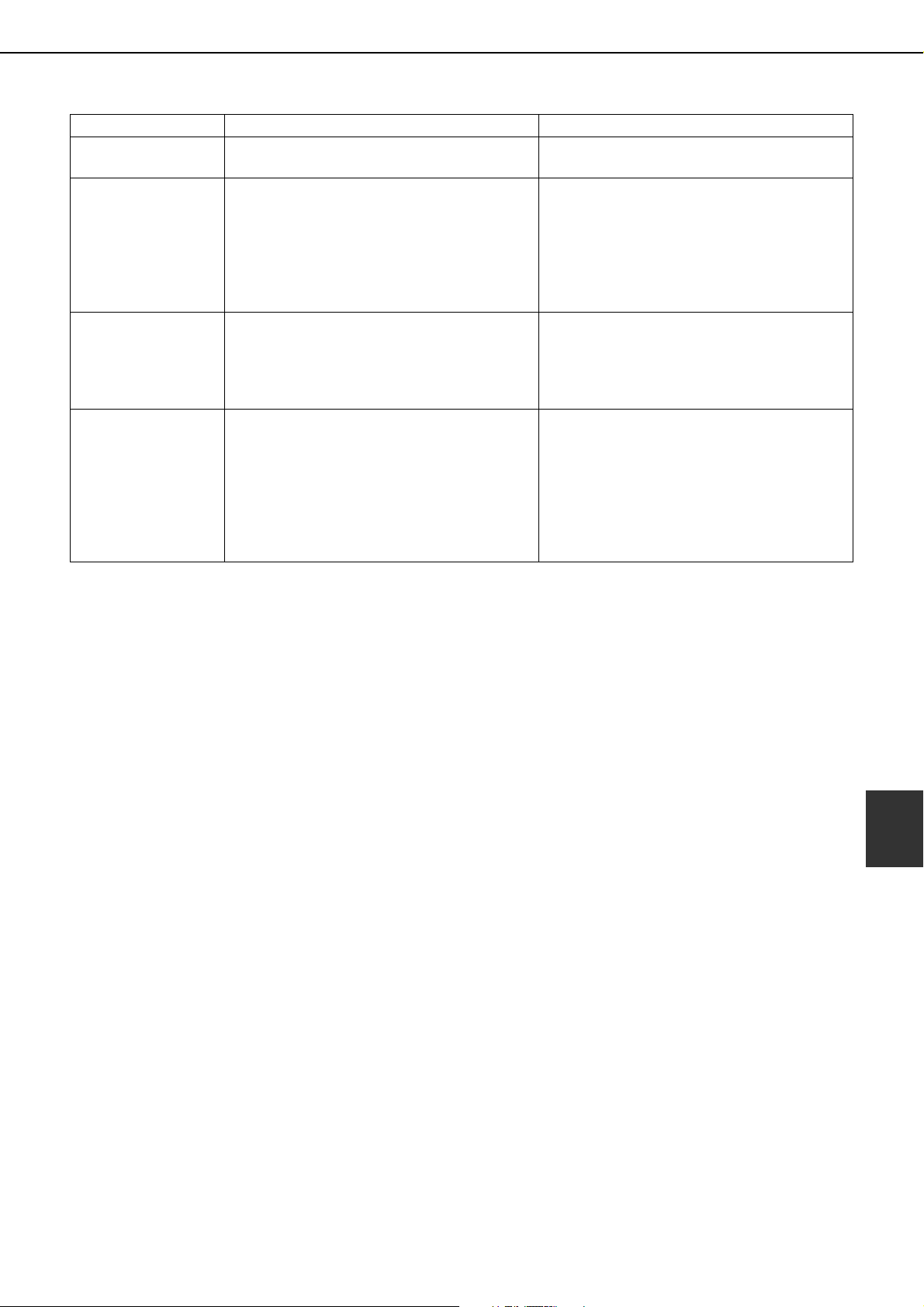
TROUBLESHOOTING
7-5
7
Job cancelation
needed
Is a message requesting cancelation of job
displayed?
Press the [CA] (clear all) key to cancel the
current job.
Scanning of
originals is
incomplete.
Is a message indicating memory is full
displayed?
If the data amount exceeds the limit when
using the pamphlet copy or multi shot copy
which requires scanning of all originals,
scanning will be canceled and copying will
not be performed.
If you install an additional memory, the
storage capacity will increase.
The selected
number of sets of
copies is not printed.
For an interrupt copy job, are you attempting
color copying in sort mode?
When color copying is performed in sort
mode for an interrupt copy job, only one set
of copies can be made. If more than one set
is needed, replace the original and repeat
the copy procedure for each set needed.
Not all pages are
copied
When making copies, the memory became
full during scanning of the originals and a
message appears asking you whether you
want to continue copying or cancel.
When the memory becomes full during
scanning of the originals, you can select
whether you want to continue the job and
print only those originals that were scanned,
or cancel the job. If you continue the job,
copies will only be made of the originals that
were scanned, and thus all originals cannot
be copied at once.
Problem Check Solution or cause
ApollonII_general-copy_SEC.book 5 ページ 2004年9月6日 月曜日 午後4時57分

ApollonII_general-copy_SEC.book 6 ページ 2004年9月6日 月曜日 午後4時57分

8-1
CHAPTER 8
SPECIFICATIONS
This chapter contains useful information about the machine.
Page
SPECIFICATIONS .........................................................................................8-2
●
Copier and Main unit..............................................................................8-2
●
Reversing single pass feeder.................................................................8-4
●
Duplex bypass/inverter unit (optional)....................................................8-4
INDEX ............................................................................................................8-5
ApollonII_general-copy_SEC.book 1 ページ 2004年9月6日 月曜日 午後4時57分

8-2
SPECIFICATIONS
Copier and Main unit
* The indicated first-copy time assumes the following conditions:
Upper tray at paper intake / horizontal feeding of
8-1/2" x 11"
(A4) size paper / left tray/ transfer belt: black copy position
The first-copy time is slower when making copies on transparency film, heavy paper, or other special paper in the
bypass tray.
Type Desktop (can be upgraded to console type if an optional stand is installed.)
Print system Electrophotographic system (LED head system)
Photoconductive type OPC drum
Developer system Contact non-magnetic single-component development
Fusing system Press roller fusing method
Resolution Scan: 600 x 600 dpi, output: 600 x 600 dpi (However, if the "B/W 600dpi scanning
mode for document feeder" checkbox is not selected in the key operator
programs, scan: 600 x 300 dpi)
Gradation Scan:
Color;
256 levels,
Black and white;
2 levels
Printing: Color: Equivalent of 256 levels / Black and white: 2 levels (in copy mode)
/ Equivalent of 256 levels (in printer mode)
Originals Sheets, bound documents
Maximum size: 11" x 17" or A3
Copy paper Plain paper and special papers
Copy sizes Max. 12" x 18" or A3wide, min. 5-1/2" x 8-1/2" or A6R
Image loss: 4 mm ± 2 mm at edges
Warm-up time 99 seconds or less
First-copy time* Full color/single color copying : 11.7 seconds or less
Black/white copying : 8.0 seconds or less
Copy ratio Variable: 50 to 200% in 1% increments, total 151 steps
Fixed presets: 25%, 50%, 64%, 77%, 100%, 121%, 129%, 200% and 400% for
inch system, 25%, 50%, 70%, 81%, 86%, 100%, 115%, 122%, 141%, 200% and
400% for AB system.
Paper feed A paper tray and bypass tray
Continuous copy 999 copies; subtractive counter
Expansion DIMM slot 1 slot (128 MB or 256 MB can be installed)
Required power supply USA: AC120V, 60Hz, 12A
Other countries: Local voltage ±10% (For power supply requirements, see the
name plate located on the right hand side at the rear of the main unit.)
Power consumption Max. 1.5 kW
Dimensions
26-25/64" (W) x 26-5/8" (D) x 30-63/64" (H) (670 mm (W) x 676 mm (D) x 787 mm (H))
Weight (Not including
toner cartridge)
Approx. 173.1 lbs. (78.5 kg)
Overall dimensions 53-1/8" (W) x 26-5/8"(D) (1349 mm (W) x 676 mm (D))
Operating conditions Temperature: 59°F to 86°F (15°C to 30°C), Humidity: 20% to 80%
sec_apollon_08.fm 2 ページ 2004年9月14日 火曜日 午前10時51分
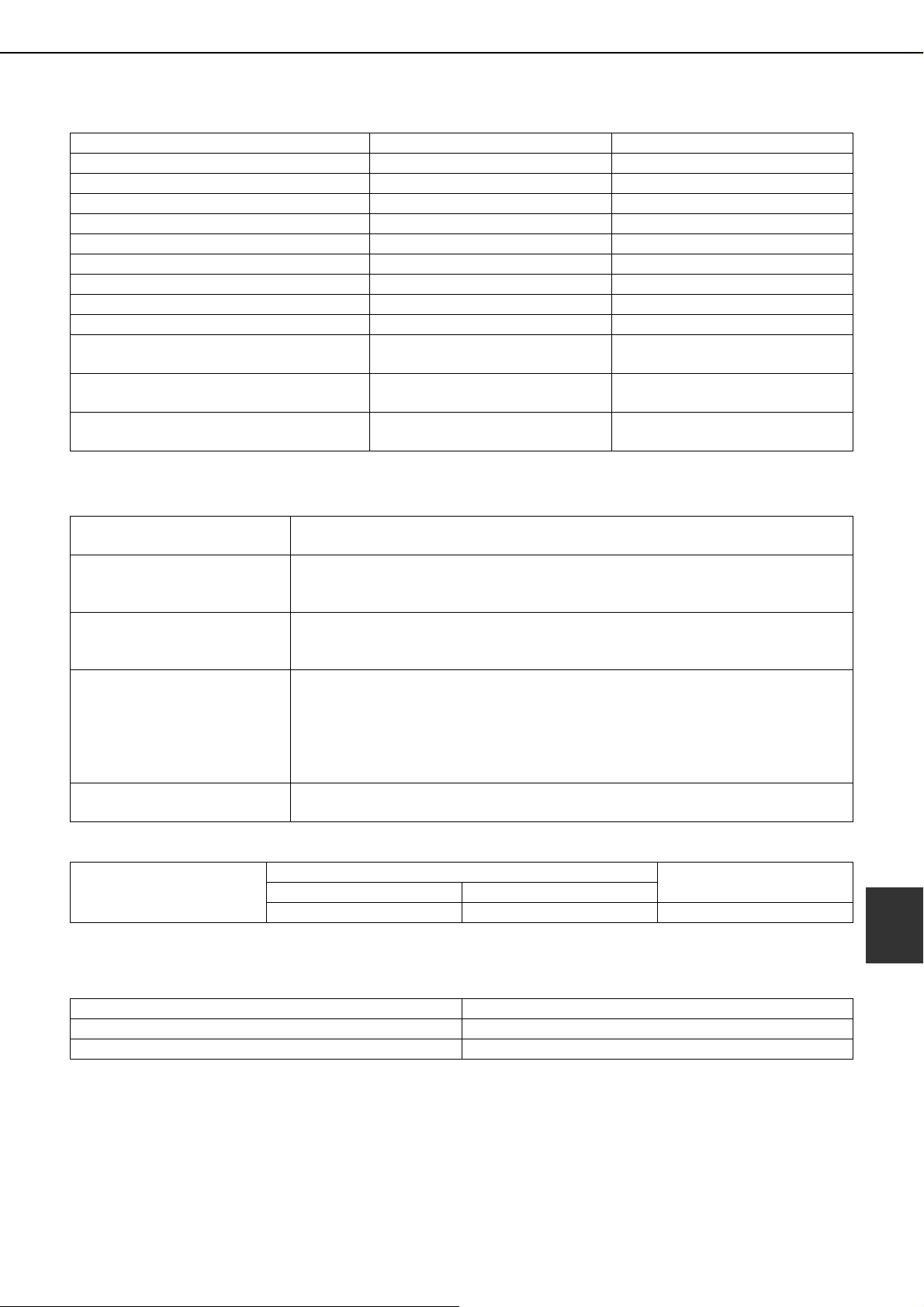
SPECIFICATIONS
8-3
8
Continuous copying speed (when the offset function is not used)
* The continuous copying speed when the fastest copying conditions are used.
Output tray specifications
Acoustic Noise Emission* (measurement according to ISO7779)
* Measurement conditions: The duplex module/2 x 500 sheet paper drawer option is installed and paper is fed from
paper tray 1.
Emission Concentration (measurement according to RAL-UZ62: Edition Jan. 2002)
Black and white copying Color copying
Copy paper size 100% / Reduced / Enlarged 100% / Reduced / Enlarged
11" x 17" (A3) 13 copies/min. 8 copies/min.
12" x 18" (A3 wide) 7 copies/min. 5 copies/min.
8-1/2" x 14" (B4), 8-1/2" x 13" 15 copies/min. 10 copies/min.
8-1/2" x 11" (A4) 26 copies/min. 17 copies/min.
8-1/2" x 11"R (A4R) 19 copies/min. 12 copies/min.
B5 26 copies/min. 17 copies/min.
7-1/4" x 10-1/2"R (B5R) 19 copies/min. 12 copies/min.
8-1/2" x 5-1/2" (A5) 26 copies/min. 17 copies/min.
Transparencies (fast speed setting*)
(8-1/2" x 11" (A4))
17 copies/min. 17 copies/min.
Transparencies (high resolution setting)
(8-1/2" x 11" (A4))
13 copies/min. 13 copies/min.
Heavy paper 1, 2 (8.5x11, 8.5x5.5 (B5,
A4, A5))
13 copies/min. 13 copies/min.
Output method
Center tray: Face-down output
Left tray: Face-up output
Maximum number of sheets
(8-1/2" x 11" (A4) size/
recommended paper for color)
Center tray: 500 sheets
Left tray: 250 sheets
Paper type
Center tray: Plain paper (including recommended paper for color) and heavy
paper 1 (28 to 54 lbs.) (106 to 200 g/m
2
)
Left tray: Plain paper and special paper
Paper size
Center tray: 12" x 18", 11" x 17", 8-1/2" x 14", 8-1/2" x 11", 8-1/2" x 11"R,
7-1/4" x 10-1/2"R, 8-1/2" x 5-1/2" (A3W, A3, B4, A4, A4R, B5, B5R,
A5, A6R)
Left tray: 12" x 18", 11" x 17", 8-1/2" x 14", 8-1/2" x 11", 8-1/2" x 11"R,
7-1/4" x 10-1/2"R, 8-1/2" x 5-1/2" (A3W, A3, B4, A4, A4R, B5, B5R,
A5, A6R)
Paper weight
Center tray: 17 to 54 lbs. (64 to 200 g/m
2
)
Left tray: 17 to 80 lbs. (64 to 300 g/m
2
)
Sound power level
LwA
Printing mode
Standby mode
Black/White Color
6.3 B or less 6.3 B or less 5.5 B or less
Ozone 0.02 mg/m
3
or less
Dust 0.075 mg/m
3
or less
Styrene 0.07 mg/m
3
or less
ApollonII_general-copy_SEC.book 3 ページ 2004年9月6日 月曜日 午後4時57分

SPECIFICATIONS
8-4
Reversing single pass feeder
Duplex bypass/inverter unit (optional)
Original sizes 5-1/2" x 8-1/2" to 11" x 17" (A5 to A3)
Original weight 15 to 24 lbs. (56 to 90 g/m
2
)
Capacity Up to 40 sheets (8-1/2" x 11", 21 lbs. (A4, 80 g/m
2
))
Up to 30 sheets (8-1/2" x 14" or larger, 21 lbs. (B4 or larger, 80 g/m
2
))
Power supply Supplied from machine
Dimensions 22-61/64" (W) x 17-9/64" (D) x 5-1/4" (H)
(583 mm (W) x 435 mm (D) x 133 mm (H))
Weight Approx. 11.9 lbs. (Approx. 5.4 kg)
Number of sheets 1 sheet (non-stack method)
Paper size Face-up output: Same as paper feed specifications of machine
Face-down output:
12"x18", 11"x17", 8-1/2"x14", 8-1/2"x13", 8-1/2"x11", 8-1/2"x11"R,
7-1/4"x10-1/2"R, 8-1/2"x5-1/2", A3W, A3, B4, A4, A4R, B5, B5R,
A5
Page weight Face-up output: 17 to 80 lbs. (64 to 300 g/m
2
)
Face-down output: 17 to 54 lbs. (64 to 200 g/m
2
)
Transport reference point Center reference point
Dimensions 6-5/32" (W) x 17-29/64" (D) x 17-1/64" (H)
(156 mm (W) x 443 mm (D) x 432 mm (H))
Weight Approx. 14.3 lbs. (Approx. 6.5 kg)
As a part of our policy of continuous improvement, SHARP reserves the right to make design and specification
changes for product improvement without prior notice. The performance specification figures indicated are
nominal values of production units. There may be some deviations from these values in individual units.
ApollonII_general-copy_SEC.book 4 ページ 2004年9月6日 月曜日 午後4時57分

8-5
8
INDEX
[#/P] key ................................................................. 4-3
[ ] key ................................................................... 4-3
1-sided copies ................................................. 5-2, 5-7
11" x 17" Full-bleed ..................................... 6-16, 6-21
256 MB optional memory ....................................... 1-7
■
■■
■ A
ACC.#-C................................................... 1-11 to 1-12
Acceptable originals ............................................... 4-5
Account number ................................................... 1-12
Address control .................................................... 2-13
Applicable paper sizes ............................... 2-9 to 2-10
Applicable paper types............................... 2-9 to 2-10
Auditing mode ...................................................... 1-11
Auto (resolution)................................................... 5-10
Auto image .................................................. 5-12, 6-24
Auto power shut-off mode ...................................... 1-3
Automatic copy image rotation............................... 4-7
Automatic exposure adjustment........................... 5-11
Automatic selection (reduction/enlargement)....... 5-12
Automatic two-sided copying
- Document glass ................................................ 5-9
- Reversing single pass feeder............................ 5-6
Automatic two-sided printing ......................... 2-8, 2-10
■
■■
■ B
Binding change ...................................................... 5-9
[BLACK COPY START] key............................ 1-8, 4-3
Black toner ........................................................... 2-15
Book original .......................................................... 6-6
Brightness ................................................... 6-11, 6-15
Bypass tray ................................................... 1-4, 2-24
B/W reverse ......................................................... 6-10
■
■■
■ C
[C] key .................................................................... 4-3
[CA] key.................................................................. 4-3
Call for service ..................................................... 2-24
Center erase .......................................................... 6-5
Center tray ............................................... 1-4, 3-6, 5-5
Centering......................................................... 6-2, 6-7
Changing the paper size ........................................ 2-2
Checkmark ........................................................... 2-14
Cleaning the original scanning area....................... 7-3
Clear all key ........................................................... 4-3
Clear key ................................................................ 4-3
Clock adjust.......................................................... 2-14
Color adjustments menu ............................... 6-2, 6-11
Color balance .............................................. 6-11, 6-14
[COLOR COPY START] key........................... 1-8, 4-3
Color deviations occur.......................................... 2-24
Common operation procedure for using the special functions
.. 6-3
Contents................................................................. 0-5
Continuous copying speed..................................... 8-3
[COPY] key ............................................................ 4-3
Copy mode............................................................. 4-4
Copy mode output restrictions ............................... 5-4
Copy output............................................................ 5-5
Copy ratio............................................................. 5-12
Copy ratio display................................................... 4-4
Copy ratio selection.............................................. 5-13
Copying from the bypass tray .............................. 5-17
Covers............................................................. 6-2, 6-9
Custom settings ............................................ 1-8, 2-13
Cyan toner............................................................ 2-15
■
■■
■ D
Deleting a stored job program.............................. 6-27
Detail .................................................................... 1-10
Display contrast.................................................... 2-14
Display switching.................................................. 1-10
Disposal of hole punch scrap ................................. 3-9
Document feeder tray...................................... 4-2, 4-6
Document feeding area cover ......................... 4-2, 7-2
Document glass ..................................................... 4-2
- 1-sided copies................................................... 5-7
- Automatic two-sided copying ............................ 5-9
- Setting originals ................................................ 4-6
- User maintenance............................................. 7-3
Does not operate.................................................. 2-24
Dual page copy ............................................... 6-2, 6-6
Duplex bypass/inverter unit....................1-6, 2-22, 8-4
Duplex module/2 x 500 sheet paper drawer
.....1-6, 2-8, 2-22
■
■■
■ E
Enable auto size detection ................................... 2-12
Energy saving features .......................................... 1-3
Energy Star guidelines ........................................... 1-3
Enlargement......................................................... 5-12
Envelopes ..................................2-6, 2-9 to 2-10, 5-17
Erase............................................................... 6-2, 6-5
Erase the shadow lines on copies.......................... 6-5
Exit tray ...........................................0-3, 1-4, 1-6, 2-20
Exposure ....................................................... 4-4, 5-10
Exposure adjustments.......................................... 5-10
■
■■
■ F
Face-up and face-down output .............................. 1-7
Facsimile expansion kit .......................................... 1-7
Fast printing ......................................................... 2-12
Fax data forward .................................................. 2-13
Fax memory ........................................................... 1-7
Fax receive settings ............................................. 2-13
Features ................................................................. 1-2
Finisher tray ........................................................... 3-6
Folded postcards.................................................. 2-10
Front cover ............................................................. 1-4
Fusing unit....................................................... 1-5, 2-7
Fusing unit pressure adjusting levers........... 2-6 to 2-7
■
■■
■ G
Grayed out key....................................................... 1-9
Group ..................................... 3-4, 3-6, 5-3 to 5-5, 5-8
ApollonII_general-copy_SEC.book 5 ページ 2004年9月6日 月曜日 午後4時57分

INDEX
8-6
■
■■
■ H
Heavy paper...................................... 2-9 to 2-10, 2-12
High quality image................................................ 2-12
Highlighted for visual confirmation ......................... 1-9
Hole punching (Punch unit).......................... 3-5 to 3-6
■
■■
■ I
Icon ........................................................................ 1-9
If the machine is to be left unused for a long time.. 0-3
Image edit menu ........................................... 6-2, 6-16
Image send ............................................................ 1-8
Information ........................................................... 2-18
Insert sheets........................................................... 6-8
Installation requirements ........................................ 0-2
Intensity....................................................... 6-11, 6-15
Interior .................................................................... 1-5
Interrupt......................................................... 4-4, 6-27
■
■■
■ J
Job program memory ............................... 6-25 to 6-26
Job status............................................................... 1-8
Job status screen ................................................. 1-10
■
■■
■ K
Key operator program .......................................... 2-13
Keyboard select ................................................... 2-14
■
■■
■ L
Landscape.............................................................. 1-2
Large capacity tray............................ 1-6, 3-15 to 3-17
Left side cover........................................................ 1-4
Left side cover release ........................................... 1-4
Left tray ........................................................... 1-4, 5-5
List print................................................................ 2-14
Loading paper in the bypass tray ........ 2-4 to 2-6, 2-12
Loading paper
- Bypass tray ....................................................... 2-4
- Duplex module/2 x 500 sheet paper drawer ..... 2-8
- Large capacity tray.......................................... 3-16
- Paper tray 1 ...................................................... 2-2
- Stand/1 x 500 sheet paper drawer.................... 2-7
- Stand/3 x 500 sheet paper drawer.................... 2-7
Loading postcards........................................ 2-4 to 2-6
■
■■
■ M
Magenta toner ...................................................... 2-15
Main features ......................................................... 1-2
Main screen............................................................ 4-4
Manual exposure adjustment ............................... 5-10
Manual selection (reduction/enlargement) ........... 5-13
Map ...................................................................... 5-10
Margin shift...................................................... 6-2, 6-4
Meaning of "R" ....................................................... 1-2
Message............................................................... 2-24
Mirror image ............................................. 6-16 to 6-17
Misfed original ........................................................ 7-2
Misfeed removal ................................................... 2-18
- Duplex bypass/inverter unit............................. 2-22
- Duplex module/2 x 500 sheet paper drawer ... 2-22
- Exit area .......................................................... 2-20
- Fusing area ..................................................... 2-20
- Large capacity tray.......................................... 3-17
- Paper feed area .............................................. 2-19
- Saddle stitch finisher....................................... 3-10
- Stand/1 x 500 sheet paper drawer .................. 2-21
- Stand/3 x 500 sheet paper drawer .................. 2-21
- Transport area ................................................ 2-20
Mode select...........................................1-8, 4-3 to 4-4
More information on plain paper .......................... 2-10
More information on special media ...................... 2-10
Moving this machine .............................................. 0-3
Multi shot..................................................... 6-16, 6-19
Multi-page enlargement .............................. 6-16, 6-22
■
■■
■ N
Non-standard size .............................2-9 to 2-11, 6-24
Number of copy sheets used by each account .... 1-11
Number of scannable originals............................... 5-4
Numeric keys ......................................................... 4-3
■
■■
■ O
Offset........................................................3-4, 3-6, 5-5
Offset tray............................................................... 3-2
Operation panel............................................... 1-8, 4-3
Original feed display............................................... 4-4
Original guides ................................................ 4-2, 4-6
[ORIGINAL] key .......................................4-4, 4-8, 4-9
Original reminder indicator .............................. 4-2, 4-6
Original size ......................................4-4, 4-5, 4-8, 4-9
Output ...............................................4-4, 5-3, 5-5, 5-8
Output tray ............................................................. 1-4
Output tray specifications ....................................... 8-3
■
■■
■ P
Pamphlet copy ............................................ 6-16, 6-24
Paper curled......................................................... 2-25
Paper recommended for color................................ 2-9
Paper select display ............................................... 4-4
[PAPER SELECT] key .............................4-4, 5-2, 5-7
Paper size slide...................................................... 2-2
Paper tray 1................................................... 2-2, 2-19
Paper tray............................................................... 1-4
Part names and functions
- Exterior.............................................................. 1-4
- Interior............................................................... 1-5
- Large capacity tray.......................................... 3-15
- Operation panel (Copier Operation).................. 4-3
- Operation panel (General Information) ............. 1-8
- Reversing single pass feeder............................ 4-2
- Saddle stitch finisher......................................... 3-2
Peripheral devices.................................................. 1-6
Photo.................................................................... 5-10
Photo Repeat .............................................. 6-16, 6-18
Plain paper ................................................. 2-9 to 2-10
Portrait.................................................................... 1-2
sec_apollon_08.fm 6 ページ 2004年9月14日 火曜日 午前10時52分

INDEX
8-7
8
Postcards ............................................ 2-4 to 2-6, 5-17
Postcards with a coated front............................... 2-10
Power switch .......................................................... 1-4
Preheat mode......................................................... 1-3
Preset reduction/enlargement ratios .................... 5-13
Pressure adjusting levers............................. 2-6 to 2-7
Print........................................................................ 1-8
Print job ................................................................ 1-10
Printed photo........................................................ 5-10
Priority .................................................................. 1-10
■
■■
■ Q
Quality mode ........................................................ 2-12
■
■■
■ R
Read-end ............................................................... 5-8
Recalling a job program ....................................... 6-27
Reduction/enlargement ........................................ 5-12
Registration adjustment ....................................... 2-24
Replacing the toner cartridges ............................. 2-15
Reversing single pass feeder.......................... 1-6, 4-2
- 1-sided copies................................................... 5-2
- Acceptable originals.......................................... 4-5
- Automatic two-sided copying ............................ 5-6
- Misfed original................................................... 7-2
- Setting originals ................................................ 4-6
- Specifications.................................................... 8-4
RGB adjust............................................... 6-11 to 6-12
Right cover of paper drawer................................... 1-5
Right side cover ..................................................... 1-5
Rotation copying .................................................... 4-7
■
■■
■ S
Saddle stitch.................................................. 3-5, 3-14
Saddle stitch finisher ...........................1-6, 3-2 to 3-14
Saddle stitch function ............................................. 3-5
Saddle stitch tray.................................................... 3-2
Scanner job .......................................................... 1-10
Selecting the output tray ........................................ 5-5
Selecting the resolution........................................ 5-10
Selection of function............................................... 1-9
Setting originals...................................................... 4-6
Setting the paper size
- Bypass tray ..................................................... 2-12
- Extra size ........................................................ 2-11
Setting the paper type .......................................... 2-11
Sharpness ................................................... 6-11, 6-13
Single color .............................................. 6-16 to 6-17
Size slide................................................................ 2-2
Sort..........................................3-4, 3-6, 5-3 to 5-5, 5-8
Special modes................................................. 4-4, 6-2
Special papers .................................. 2-9 to 2-10, 5-17
Specifications ......................................................... 8-2
- Duplex bypass/inverter unit............................... 8-4
- Duplex module/2 x 500 sheet paper drawer ..... 2-8
- Large capacity tray.......................................... 3-15
- Reversing single pass feeder............................ 8-4
- Saddle stitch finisher......................................... 3-2
- Stand/1 x 500 sheet paper drawer.................... 2-7
- Stand/3 x 500 sheet paper drawer.................... 2-7
Specifications of paper trays .................................. 2-9
Speed mode......................................................... 2-12
Stand/1 x 500 sheet paper drawer .........1-6, 2-7, 2-21
Stand/3 x 500 sheet paper drawer .........1-6, 2-7, 2-21
Stand/paper drawer................................................ 0-3
Standard sizes ....................................1-2, 2-9 to 2-10
Standard sizes in both the inch and AB systems ... 1-2
Standard supplies ................................................ 2-17
Staple cartridge ...................................................... 3-3
Staple cartridge replacement ................................. 3-7
Staple jam removal ................................................ 3-8
Staple sort ....................................................... 3-4, 3-6
Stapler compiler ..................................................... 3-2
Stapler section ....................................................... 3-2
Stapling position quick reference guide ............... 3-13
Stapling positions ................................................... 3-4
[START] key.................................................... 4-3, 5-3
Stop/delete ........................................................... 1-10
Storage of supplies .............................................. 2-17
Storing a job program........................................... 6-26
Suppress background ................................. 6-11, 6-13
■
■■
■ T
Text ...................................................................... 5-10
Text/photo ............................................................ 5-10
Text/prtd.photo ..................................................... 5-10
The machine does not operate ............................ 2-24
To make darker copies......................................... 5-11
To make lighter copies ......................................... 5-11
Toner cartridge.............................................. 1-5, 2-15
Total count ........................................................... 2-14
Total number of originals........................................ 4-5
Touch panel ................................1-8 to 1-9, 4-3 to 4-4
Transfer belt ......................................................... 2-20
Transparency film...................................2-9, 5-17, 6-8
Transparency inserts....................................... 6-2, 6-8
Tray extension........................................................ 2-4
Tray settings................................................ 2-11, 2-14
Troubleshooting
- Copier operation ............................................... 7-4
- General information ........................................ 2-24
- Saddle stitch finisher....................................... 3-12
■
■■
■ U
User maintenance .................................................. 7-3
■
■■
■ W
Warm-up time................................................ 2-24, 8-2
Weight of acceptable originals ............................... 4-5
Wire extension ....................................................... 2-4
■
■■
■ X
XY zoom............................................................... 5-15
■
■■
■ Y
Yellow toner ......................................................... 2-15
■
■■
■ Z
Zoom .................................................................... 5-13
ApollonII_general-copy_SEC.book 7 ページ 2004年9月6日 月曜日 午後4時57分

ApollonII_general-copy_SEC.book 8 ページ 2004年9月6日 月曜日 午後4時57分

FCC Regulations state that any unauthorized changes or modifications to
this equipment not expressly approved by the manufacturer could void the
user's authority to operate this equipment.
Note:
This equipment has been tested and found to comply with the limits for a Class
A digital device, pursuant to part 15 of the FCC Rules. These limits are designed
to provide reasonable protection against harmful interference when the
equipment is operated in a commercial environment. This equipment gener-
ates, uses, and can radiate radio frequency energy and, if not installed and
used in accordance with the operation manual, may cause harmful interfer-
ence to radio communications. Operation of this equipment in a residential area is
likely to cause harmful interference in which case the user will be required to
correct the interference at his own expense.
BE SURE TO ASK YOUR AUTHORIZED SHARP DEALER ABOUT THE WAR-
RANTY THAT YOUR SELLING DEALER EXTENDS TO YOU. In order to assure
you, the end-user, of warranty protection, Sharp extends a limited warranty to each
of its authorized dealers and, in turn, requires each of its authorized dealers to
extend its own warranty to you on terms that are no less favorable than those given
to the dealer by Sharp. You should be aware, however, that Sharp does not itself
extend any warranties, either express or implied, directly to you, the end-user, and
no one is authorized to make any representations or warranties on behalf of Sharp.
Specifically, SHARP DOES NOT EXTEND TO YOU, THE END-USER, ANY EX-
PRESS WARRANTY OR ANY IMPLIED WARRANTY OF MERCHANTABILITY,
FITNESS FOR USE OR FITNESS FOR ANY PARTICULAR PURPOSE IN CON-
NECTION WITH THE HARDWARE, SOFTWARE OR FIRMWARE EMBODIED
IN, OR USED IN CONJUNCTION WITH THIS PRODUCT. Sharp is not respon-
sible for any damages or loss, either direct, incidental or consequential, which you,
the end-user, may experience as a result of your purchase or use of the hardware,
software or firmware embodied in or used in conjunction with this Product. Your
sole remedy, in the event that you encounter any difficulties with this Product, is
against the authorized dealer from which you purchased the Product.
AR-BC260 Digital Full Color Multifunctional System
In the event that this authorized dealer does not honor its warranty commitments,
please contact the General Manager, Business Products Group, Sharp Electronics
Corporation, Sharp Plaza, Mahwah, NJ 07430-1163, so that Sharp can try to help
assure complete satisfaction of all the warranty rights to which you are entitled from
the authorized dealer.
NOTICE for users in the USA
This device complies with Part 15 of the FCC rules. Operation is
subject to the following two conditions: (1) This device may not cause
harmful interference, and (2) this device must accept any interference
received, including interference that may cause undesired operation.
WARNING:
For users in the USA
Shielded cables must be used with this equipment to maintain compliance
with standard.
ApollonII_general-copy_SEC.book 1 ページ 2004年9月6日 月曜日 午後4時57分

(O
AR-BC260 (for general information and copier operation)
PRINTED IN CHINA
2004J KS2
TINSE2929FCZZ
This manual has been printed using a vegetable-based soy oil ink
to help protect the environment.
Printed on 100% post-consumer recycled paper
SHARP ELECTRONICS CORPORATION
Sharp Plaza, Mahwah, New Jersey 07430-1163.
www.sharpusa.com
SHARP ELECTRONICS OF CANADA LTD.
335 Britannia Road East, Mississauga, Ontario, L4Z 1W9
sec_apollon_cover4.fm 1 ページ 2004年11月15日 月曜日 午前11時48分