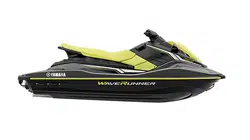
2017 WaveRunner
EX
EX Sport
EX Deluxe
OWNER’S/OPERATOR’S MANUAL
F3Y-F8199-10
LIT-18626-11-36
U.S.A. Edition
Read this manual carefully
before operating this watercraft.
DIC183

Read this manual carefully before operating this watercraft. This manual
should stay with the WaveRunner if it is sold.
UF3Y10E0.book Page 1 Tuesday, August 9, 2016 9:24 AM
Important manual information
EJU30183
To the owner/operator
Thank you for choosing a Yamaha watercraft.
This owner’s/operator’s manual contains in-
formation you will need for proper operation,
maintenance, and care. A thorough under-
standing of these simple instructions will help
you to obtain maximum enjoyment from your
new Yamaha. If you have any questions
about the operation or maintenance of your
watercraft, please consult a Yamaha dealer.
In this manual, information of particular im-
portance is distinguished in the following
ways:
This is the safety alert symbol. It is used
to alert you to potential personal injury haz-
ards. Obey all safety messages that follow
this symbol to avoid possible injury or death.
WARNING
EWJ00072
A WARNING indicates a hazardous situa-
tion which, if not avoided, could result in
death or serious injury.
NOTICE
ECJ00092
A NOTICE indicates special precautions
that must be taken to avoid damage to the
watercraft or other property.
TIP:
A TIP provides key information to make pro-
cedures easier or clearer.
EJU40401
Because Yamaha has a policy of continuing
product improvement, this product may not
be exactly as described in this owner’s/oper-
ator’s manual. Specifications are subject to
change without notice.
This manual should be considered a perma-
nent part of this watercraft and should remain
with it even if the watercraft is subsequently
sold.
EJU30223
WaveRunner EX / EX Sport / EX Deluxe
OWNER’S/OPERATOR’S MANUAL
©2016 by Yamaha Motor Corporation,
U.S.A.
1st Edition, August 2016
All rights reserved.
Any reprinting or unauthorized use
without the written permission of
Yam ah a Mo to r C or poration, U.S.A.
is expressly prohibited.
Printed in U.S.A.
P/N LIT-18626-11-36
UF3Y10E0.book Page 1 Tuesday, August 9, 2016 9:24 AM

Table of contents
General and important labels........... 1
Identification numbers .................... 1
Primary Identification (PRI-ID)
number............................................ 1
Hull Identification Number (HIN)......... 1
Engine serial number.......................... 1
Emission control information .......... 2
Approval label of emission control
certificate ........................................ 2
Manufactured date label .................... 2
Star labels .......................................... 3
Important labels .............................. 5
Warning labels.................................... 6
Other labels ........................................ 8
Safety information............................. 9
Limitations on who may operate
the watercraft ............................... 9
Cruising limitations........................ 10
Operation requirements ................ 12
Recommended equipment ........... 14
Hazard information........................ 15
Watercraft characteristics ............. 15
Wakeboarding and water-skiing ... 17
Rules of the Road ......................... 18
To get more boating safety
information ................................. 22
Enjoy your watercraft
responsibly................................. 23
Description....................................... 25
Watercraft glossary ....................... 25
Location of main components ...... 26
Control function operation ............. 30
Watercraft control functions ......... 30
Engine stop switch .......................... 30
Engine shut-off switch .................... 30
Start switch ..................................... 30
Throttle lever .................................... 31
RiDE lever (EX Deluxe) ..................... 31
Steering system ............................... 31
Cooling water pilot outlet ................. 32
Water separator................................ 32
Watercraft operation ...................... 34
Watercraft operation functions ..... 34
Reverse system (EX Sport)............... 34
Shift system (EX Deluxe) .................. 34
Instrument operation ...................... 38
Multifunction information center... 38
Information display........................... 38
Equipment operation ...................... 44
Equipment..................................... 44
Seat .................................................. 44
Handgrip........................................... 44
Reboarding grip................................ 45
Reboarding step (EX Sport /
EX Deluxe)..................................... 45
Bow eye............................................ 46
Stern eyes ........................................ 46
Cleat ................................................. 46
Storage compartments .................... 46
Fire extinguisher holder.................... 49
Operation and handling
requirements ................................... 50
Fuel requirements ......................... 50
Fuel................................................... 50
Engine oil requirements ................ 52
Engine oil.......................................... 52
Draining the bilge water ................ 53
Draining the bilge water on land....... 53
Draining the bilge water on water .... 54
Transporting on a trailer................ 55
First-time operation ........................ 56
Engine break-in............................. 56
Pre-operation checks ..................... 57
Pre-operation checklist .................... 57
Pre-operation check points .......... 59
Pre-launch checks ........................... 59
UF3Y10E0.book Page 1 Tuesday, August 9, 2016 9:24 AM

Table of contents
Post-launch checks ......................... 65
Operation ......................................... 68
Operating your watercraft ............. 68
Getting to know your watercraft ...... 68
Learning to operate your
watercraft...................................... 68
Riding position ................................. 69
Launching the watercraft ................. 69
Starting the engine on water............ 69
Stopping the engine......................... 70
Leaving the watercraft...................... 70
Operating the watercraft .................. 70
Turning the watercraft ...................... 72
Stopping the watercraft ................... 73
Operating the watercraft in reverse
or neutral (EX Sport /
EX Deluxe)..................................... 74
Boarding the watercraft ................... 75
Starting off........................................ 78
Capsized watercraft ......................... 79
Beaching and docking the
watercraft...................................... 80
Operating in weeded areas .............. 80
After removing the watercraft from
the water ....................................... 81
Care and storage............................. 82
Post-operation care ...................... 82
Flushing the cooling water
passages....................................... 82
Cleaning the watercraft .................... 83
Battery care...................................... 83
Long-term storage ........................ 86
Cleaning ........................................... 86
Lubrication ....................................... 86
Rustproofing..................................... 87
Maintenance .................................... 89
Maintenance.................................. 89
Tool kit.............................................. 89
Periodic maintenance chart ............. 90
Engine oil and oil filter ...................... 92
Specifications.................................. 93
Specifications ............................... 93
Trouble recovery ............................. 94
Troubleshooting............................ 94
Troubleshooting chart ...................... 94
Emergency procedures ................ 97
Cleaning the jet intake and
impeller ......................................... 97
Raising the reverse gate
(EX Deluxe).................................... 98
Jumping the battery ......................... 98
Towing the watercraft....................... 99
Submerged watercraft ..................... 99
Consumer information ................. 101
Limited warranty ......................... 101
YAMAHA EXTENDED SERVICE
(Y.E.S.) ..................................... 103
Index............................................... 104
UF3Y10E0.book Page 2 Tuesday, August 9, 2016 9:24 AM

General and important labels
1
EJU30263
Identification numbers
Record the Primary Identification (PRI-ID)
number, Hull Identification Number (HIN), and
engine serial number in the spaces provided
for assistance when ordering genuine parts
from a Yamaha dealer. Also record and keep
these ID numbers in a separate place in case
your watercraft is stolen.
EJU30284
Primary Identification (PRI-ID) number
The PRI-ID number is stamped on a plate at-
tached inside the engine compartment. (See
page 44 for seat removal and installation pro-
cedures and page 48 for information on the
seat storage compartment.)
MODEL:
EX1050C-S (EX)
EX1050B-S (EX Sport)
EX1050A-S (EX Deluxe)
EJU30301
Hull Identification Number (HIN)
The HIN is stamped on a plate attached to
the aft deck.
EJU44440
Engine serial number
The engine serial number is stamped on a
plate attached to the engine unit. (See page
44 for seat removal and installation proce-
dures and page 48 for information on the seat
storage compartment.)
1 Primary Identification (PRI-ID) number loca-
tion
1
MODEL
F3Y
F
PRI-I.D.
YAMAHA MOTOR CO., LTD.
ASSEMBLED IN U.S.A. FROM AMERICAN AND JAPANESE
COMPONENTS.
ASSEMBLÉ AUX ÉTATS-UNIS DE PIÈCES AMÉRICAINES ET
JAPONAISES.
3Y
1 Hull Identification Number (HIN) location
1 Engine serial number location
1
1
UF3Y10E0.book Page 1 Tuesday, August 9, 2016 9:24 AM
General and important labels
2
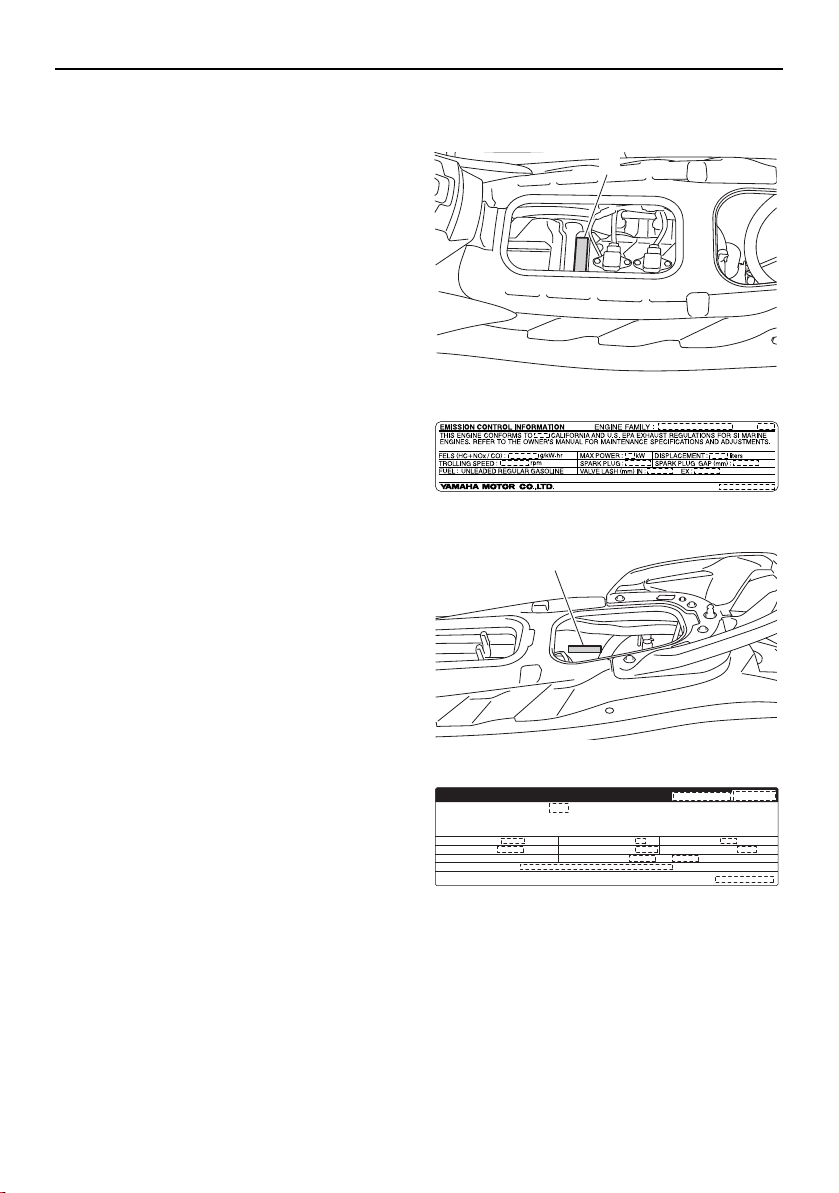
EJU30353
Emission control information
This engine conforms to U.S. Environmental
Protection Agency (EPA) and/or California Air
Resources Board (CARB) regulations for ma-
rine SI engines applicable at the time of man-
ufacture.
This engine is certified to operate on regular
unleaded gasoline.
EJU44470
Approval label of emission control
certificate
This label is attached to the top of the cylin-
der head and to the inside of the engine com-
partment. (See page 44 for seat removal and
installation procedures, page 48 for informa-
tion on the seat storage compartment, and
page 49 for information on the fire extinguish-
er holder.)
EJU44460
Manufactured date label
This label is attached to the port side of the
air filter case. (See page 44 for seat removal
1 Emission control information label location
1 Emission control information label location
1
1
EMISSION CONTROL INFORMATION
ENGINE FAMILY:
THIS ENGINE CONFORMS TO CALIFORNIA AND U.S. EPA EXHAUST REGULATIONS
FOR SI MARINE ENGINES. REFER TO THE OWNER’S MANUAL FOR MAINTENANCE
SPECIFICATIONS AND ADJUSTMENTS. THIS VESSEL MEETS U.S. EPA EVAP STANDARDS.
FELS (HC+NOx/CO) : g/kW-hr
TROLLING SPEED : rpm
FUEL : UNLEADED REGULAR GASOLINE
CERTIFIED COMPONENTS :
YAMAHA MOTOR CO., LTD.
MAX POWER : kW
SPARK PLUG :
VALVE LASH (mm) IN : EX :
DISPLACEMENT : liters
SPARK PLUG GAP (mm) :
UF3Y10E0.book Page 2 Tuesday, August 9, 2016 9:24 AM

General and important labels
3
and installation procedures and page 49 for
information on the fire extinguisher holder.)
EJU30441
Star labels
This watercraft is labeled with a California Air
Resources Board (CARB) star label. See be-
low for a description of your particular label.
One Star - Low Emission
The one-star label identifies engines that
meet the Air Resources Board’s Personal
Watercraft and Outboard marine engine 2001
exhaust emission standards. Engines meet-
ing these standards have 75% lower emis-
sions than conventional carbureted two-
stroke engines. These engines are equivalent
to the U.S. EPA’s 2006 standards for marine
engines.
Two Stars - Very Low Emission
The two-star label identifies engines that
meet the Air Resources Board’s Personal
Watercraft and Outboard marine engine 2004
exhaust emission standards. Engines meet-
ing these standards have 20% lower emis-
sions than One Star-Low Emission engines.
Three Stars - Ultra Low Emission
The three-star label identifies engines that
meet the Air Resources Board’s Personal
Watercraft and Outboard marine engine 2008
exhaust emission standards or the Sterndrive
and Inboard marine engine 2003-2008 ex-
haust emission standards. Engines meeting
1 Manufactured date label location
1 Star label location
1
1
UF3Y10E0.book Page 3 Tuesday, August 9, 2016 9:24 AM

General and important labels
4
these standards have 65% lower emissions
than One Star-Low Emission engines.
Four Stars - Super Ultra Low Emission
The four-star label identifies engines that
meet the Air Resources Board’s Sterndrive
and Inboard marine engine 2009 exhaust
emission standards. Personal Watercraft and
Outboard marine engines may also comply
with these standards. Engines meeting these
standards have 90% lower emissions than
One Star-Low Emission engines.
UF3Y10E0.book Page 4 Tuesday, August 9, 2016 9:24 AM
General and important labels
8
EJU44221
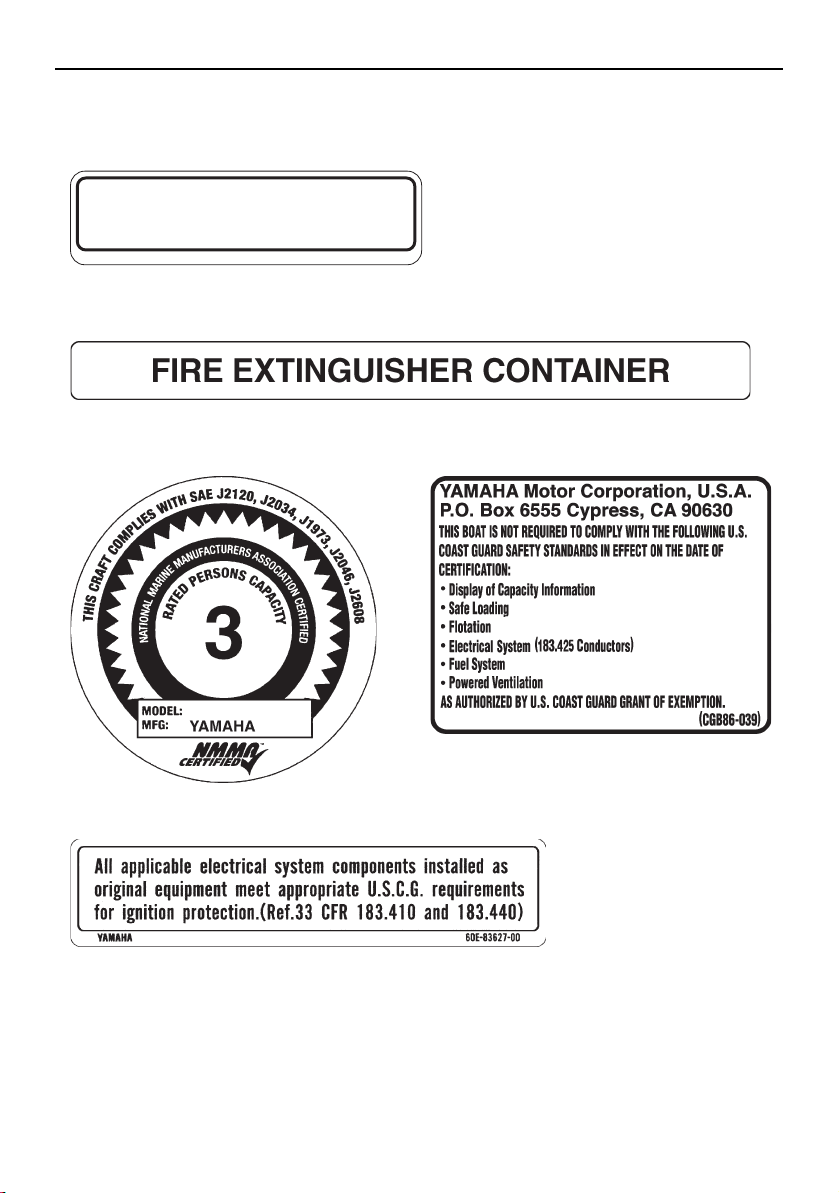
Other labels
F0V-U41F5-01
F1B-U41F5-01
(F3Y-U418E-00)
(F3Y-U418E-10)
EX
F3Y-U41G1-00
F3Y-U41G1-10
RATED PERSON CAPACITY:3
MAXIMUM LOAD:220 kg (485 lb)
YAMAHA
7
8
9
11
10
UF3Y10E0.book Page 8 Tuesday, August 9, 2016 9:24 AM

Safety information
9
EJU30672
The safe use and operation of this water-
craft is dependent upon the use of proper
riding techniques, as well as upon the
common sense, good judgment, and ex-
pertise of the operator. Every operator
should know the following requirements
before riding the watercraft.
Before operating the watercraft, read this
owner’s/operator’s manual, the Riding
Practice Guide, the Riding Instruction card,
and all labels on the watercraft. Also, watch
the Basic Orientation Video provided with
your watercraft. These materials should
give you an understanding of the watercraft
and its operation.
Never allow anyone to operate this water-
craft until they too have read this own-
er’s/operator’s manual, the Riding Practice
Guide, the Riding Instruction card, and all
labels, and, if possible, watched the Basic
Orientation Video.
Showing them the video may help reinforce
the information contained in these materi-
als.
EJU30732
Limitations on who may
operate the watercraft
Yamaha recommends a minimum operator
age of 16 years old.
Adults must supervise use by minors.
Know the operator age and training re-
quirements for your state. A boating safety
course is recommended and may be re-
quired in your state. You can find local rules
by contacting the United States Coast
Guard (USCG), the National Association of
State Boating Law Administrators, or your
local Power Squadron.
This watercraft is designed to carry the op-
erator and up to 2 passengers. Never ex-
ceed the maximum load limit or allow more
than 3 persons (or 2 persons if a wake-
boarder or water-skier is being pulled) to
ride the watercraft at any time.
Do not operate the watercraft with any pas-
sengers on board until you have consider-
able practice and experience riding alone.
Operating the watercraft with passengers
requires more skill. Take the time to be-
come accustomed to the handling charac-
Maximum load:
220 kg (485 lb)
Load is the total weight of cargo, op-
erator, and passengers.
UF3Y10E0.book Page 9 Tuesday, August 9, 2016 9:24 AM

Safety information
10
teristics of the watercraft before trying any
difficult maneuvers.
EJU44480
Cruising limitations
Scan constantly for people, objects, and
other watercraft. Be alert for conditions
that limit your visibility or block your vision
of others.
Operate defensively at safe speeds and
keep a safe distance away from people,
objects, and other watercraft.
Do not follow directly behind watercraft or
other boats.
Do not go near others to spray or splash
them with water.
EX / EX Sport: Take early action to avoid
collisions. Remember, watercraft and other
boats do not have brakes.
EX / EX Sport: Avoid sharp turns or other
maneuvers that make it hard for others to
avoid you or understand where you are go-
ing.
EX Deluxe: Take early action to avoid colli-
sions. Remember, watercraft and other
boats do not have brakes. In addition, the
Reverse with Intuitive Deceleration Elec-
tronics (RiDE) system is not a braking de-
vice for avoiding dangerous situations. The
RiDE system is an electronic system for
controlling the engine speed and reverse
gate, which is located near the jet thrust
nozzle. The RiDE lever located at the left
handlebar grip can be used to change the
direction of the jet thrust so that the water-
UF3Y10E0.book Page 10 Tuesday, August 9, 2016 9:24 AM
Safety information
11
craft moves in reverse or is in neutral. The
RiDE system assists the operator when
slowing down and during slow-speed ma-
neuvering, such as launching, beaching,
and docking.
EX Deluxe: Avoid sharp turns, slowing
down rapidly by squeezing the RiDE lever
forcefully, and other maneuvers that make
it hard for others to avoid you or under-
stand where you are going.
Avoid areas with submerged objects or
shallow water.
Do not release the throttle lever when trying
to steer away from objects—you need
throttle to steer. Always check throttle and
steering controls before starting the water-
craft.
Ride within your limits and avoid aggres-
sive maneuvers to reduce the risk of loss of
control, ejection, and collision.
This is a high performance boat—not a toy.
Sharp turns or jumping wakes or waves
can increase the risk of back/spinal injury
(paralysis), facial injuries, and broken legs,
ankles, and other bones. Do not jump
wakes or waves.
Do not operate the watercraft in rough wa-
ter, bad weather, or when visibility is poor;
this may lead to an accident causing injury
or death. Be alert to the possibility of ad-
verse weather. Take note of weather fore-
casts and the prevailing weather
conditions before setting out on your wa-
tercraft.
As with any water sport, you should not op-
erate your watercraft without someone else
nearby. If you operate further than swim-
ming distance from shore, you should be
accompanied by another boat or water-
craft, but make sure you stay a safe dis-
tance away. It’s good, common sense.
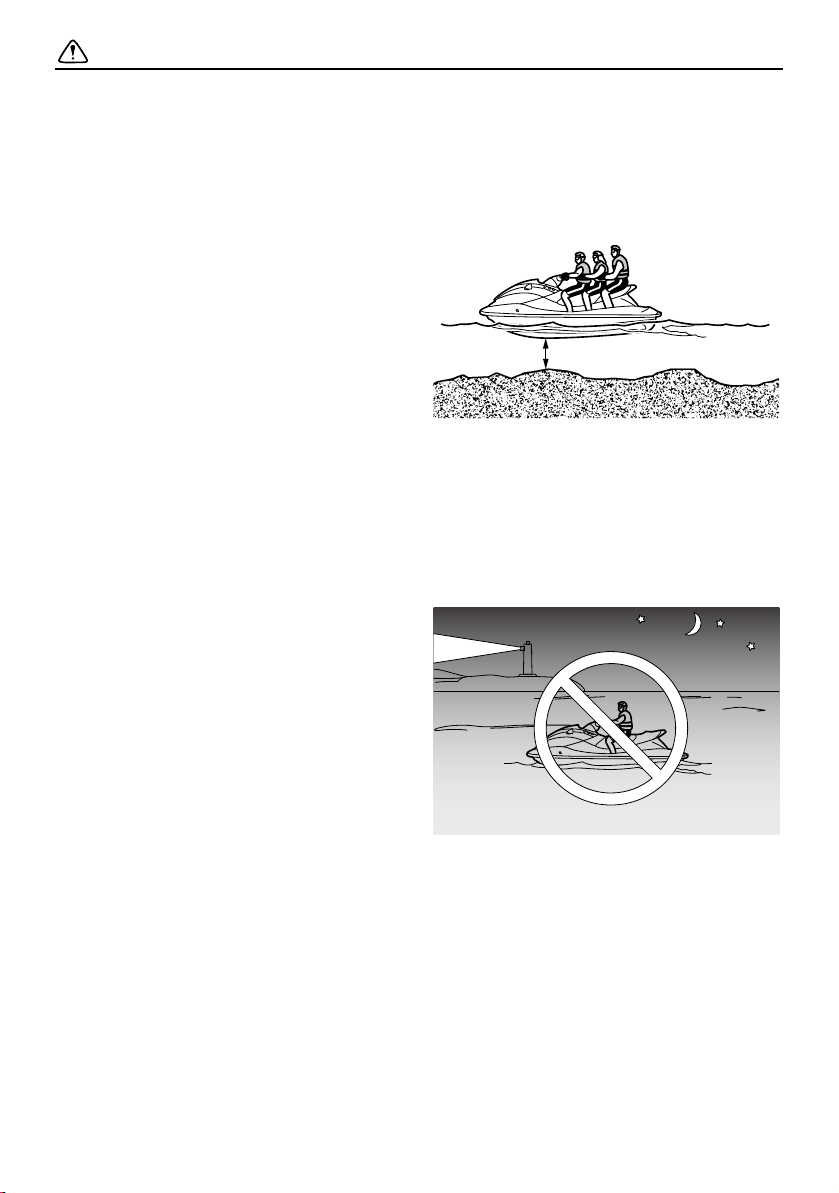
Never operate in water that is less than 60
cm (2 ft) deep from the bottom of the wa-
tercraft, otherwise you increase your chan-
ce of hitting a submerged object, which
could result in injury.
This watercraft is not equipped with light-
ing required for night operation. Do not op-
erate the watercraft after sunset or before
dawn, otherwise you increase the risk of
colliding with another boat, which could re-
sult in severe injury or death.
Follow navigation rules, and state/provin-
cial and local laws that apply to watercraft.
60 cm (2 ft)
UF3Y10E0.book Page 11 Tuesday, August 9, 2016 9:24 AM

Safety information
12
EJU43120
Operation requirements
All riders must wear a U.S. Coast Guard
(USCG) approved personal flotation device
(PFD) that is suitable for personal water-
craft use.
Wear protective clothing. Severe internal
injuries can occur if water is forced into
body cavities as a result of falling into the
water or being near the jet thrust nozzle.
Normal swimwear does not adequately
protect against forceful water entry into the
rectum or vagina. All riders must wear a
wetsuit bottom or clothing that provides
equivalent protection. Such clothing in-
cludes thick, tightly woven, sturdy and
snug-fitting apparel such as denim, but
does not include spandex or similar fab-
rics, like those used in bicycle shorts.
Eye protection is recommended to keep
wind, water, and glare from the sun out of
your eyes while you operate your water-
craft. Restraining straps for eyewear are
made which are designed to float should
your eyewear fall in the water.
Footwear and gloves are recommended.
Helmets meeting Snell or DOT standards
are required for IJSBA-sanctioned races.
You must decide whether to wear a helmet
while you ride for recreation. You should
know that a helmet could help protect you
in certain kinds of accidents and that it
could injure you in others.
A helmet is designed to provide some head
protection. Although helmets cannot pro-
tect against all foreseeable impacts, a hel-
met might reduce your injuries in a collision
with a boat or other obstacle.
A helmet may have potential safety haz-
ards, as well. Falling into the water could
risk the chance of the helmet catching wa-
ter, commonly known as “bucketing”, and
the resulting strain on your neck could cau-
se choking, severe and permanent neck in-
juries, or death. A helmet could also
increase the risk of an accident if it reduces
your vision or hearing, or if it distracts you
or increases your fatigue.
How should you decide if a helmet’s poten-
tial safety benefits outweigh its potential
risks for you? Consider your particular rid-
ing conditions. Consider factors such as
your riding environment and your riding
style and ability. Also consider the likeli-
hood of traffic congestion, and the water
surface conditions.
If you decide to wear a helmet based upon
your riding circumstances, choose one
carefully. Look for a helmet designed for
personal watercraft use, if possible. Con-
sider a helmet meeting Snell or DOT stan-
dards. If you will be engaging in closed-
course competition, follow the helmet re-
quirements of the sanctioning organization.
Never operate the watercraft after consum-
ing alcohol or taking other drugs.
For reasons of safety and proper care of
the watercraft, always perform the pre-op-
eration checks listed on page 57 before op-
erating the watercraft.
1 USCG approved PFD
2 Wetsuit bottom
UF3Y10E0.book Page 12 Tuesday, August 9, 2016 9:24 AM

Safety information
13
The operator should grip the handlebars
firmly with both hands and the passengers
should hold on firmly, either to the person
in front of them or to the handgrip provid-
ed.
The operator and passengers should al-
ways keep their feet on the floor of the foot-
well when the watercraft is in motion.
Lifting your feet increases the chances of
losing your balance, or hitting objects out-
side the watercraft with your feet. Do not
give a ride to children if their feet cannot
reach the floor of the footwell.
Never allow a passenger to ride in front of
the operator.
Always consult your doctor on whether it is
safe for you to ride this watercraft if you are
pregnant or in poor health.
Do not attempt to modify this watercraft.
Modifications to your watercraft may re-
duce safety and reliability, and render the
watercraft unsafe or illegal for use.
Attach the engine shut-off cord (lanyard) to
your left wrist and keep it free from the han-
dlebars so that the engine stops if you, the
operator, fall off. After riding, remove the
engine shut-off cord (lanyard) from the wa-
tercraft to avoid accidental starting or un-
authorized use by children or others.
Scan carefully for swimmers and stay away
from swimming areas. Swimmers are hard
to see and you could accidentally hit some-
one in the water.
Avoid being hit by another boat. You
should always take the responsibility to
watch for traffic; other boaters may not be
watching for you. If they do not see you, or
if you maneuver more quickly than other
boaters expect, you risk a collision.
Maintain a safe distance from other boats
and watercraft, and also watch for ski
ropes or fishing lines. Obey the “Rules of
the Road” and be sure to check behind you
before making a turn or slowing down. (See
“Rules of the Road” on page 18.)
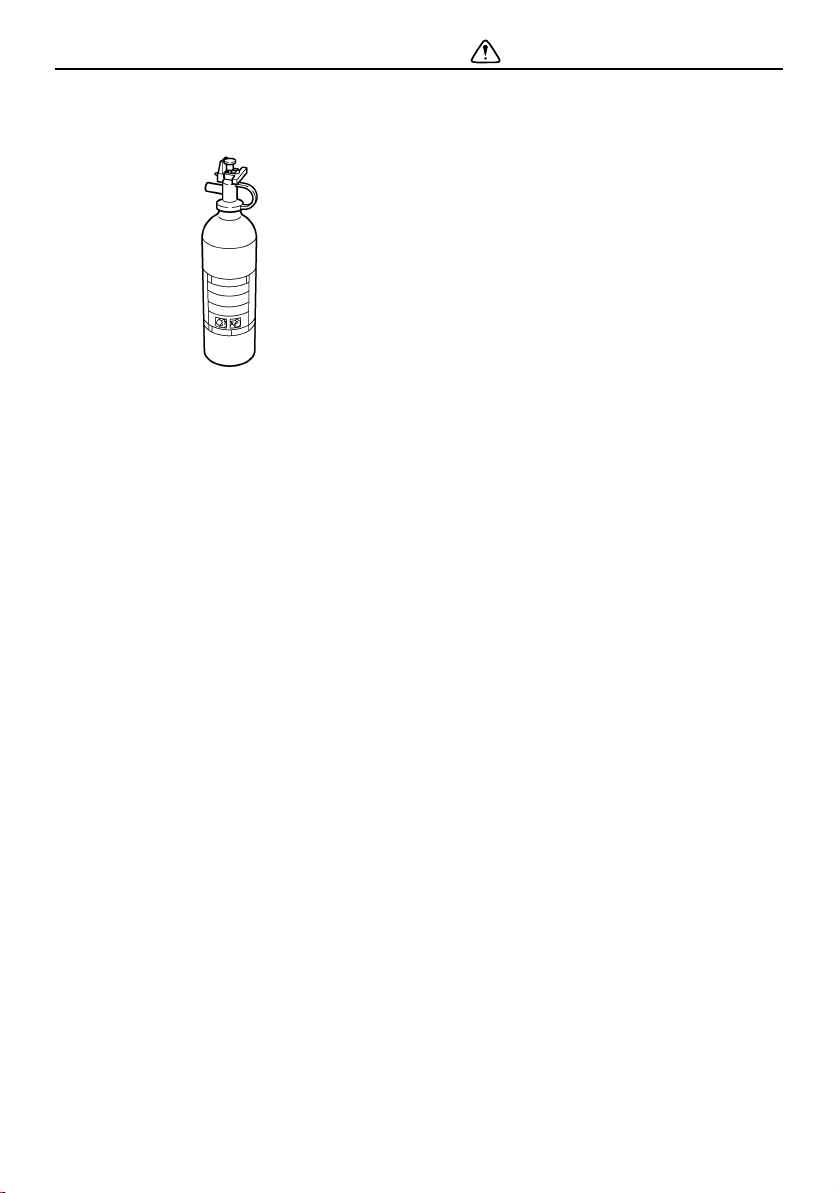
According to the USCG, boats under 6.1 m
(20 ft) in length like your watercraft must
carry a fire extinguisher of a B-1 classifica-
tion, with a capacity of two pounds or more
when navigating in waters under USCG ju-
risdiction. In addition, most state and local
UF3Y10E0.book Page 13 Tuesday, August 9, 2016 9:24 AM
Safety information
14
boating laws also require that the fire extin-
guisher be approved by the USCG.
EJU30831
Recommended equipment
The following items should be carried on
board your watercraft:
Sound-signaling device
You should carry a whistle or other sound-
signaling device that can be used to signal
other boats. See “Rules of the Road” for
more information.
Visual distress signals
It is recommended that a U.S. Coast Guard
approved pyrotechnic device be stored in a
waterproof container on your watercraft. A
mirror can also be used as an emergency
signal. Contact a Yamaha dealer or the
U.S. Coast Guard for more information.
Watch
A watch is helpful so you will know how
long you have been operating the water-
craft.
Towline
A towline can be used to tow a disabled
watercraft in an emergency.
UF3Y10E0.book Page 14 Tuesday, August 9, 2016 9:24 AM

Safety information
15
EJU44610
Hazard information
Never start the engine or let it run for any
length of time in an enclosed area. Exhaust
fumes contain carbon monoxide, a color-
less, odorless gas that may cause loss of
consciousness and death within a short
time. Always operate the watercraft in an
open area.
Do not touch the hot oil tank, muffler, or en-
gine during or immediately after engine op-
eration; they can cause serious burns.
Do not place magnets or objects with a
strong magnetic force near the throttle le-
ver or RiDE lever (EX Deluxe). The electron-
ic throttle mechanism of the levers can be
adversely affected, which could cause loss
of control. In addition, do not place objects
susceptible to magnetic forces (i.e., credit
cards, watches, etc.) close to the throttle
lever or RiDE lever.
EJU44340
Watercraft characteristics
Jet thrust turns the watercraft. Releasing
the throttle lever completely produces only
minimum thrust. If you are traveling at
speeds above trolling, you will have rapidly
decreasing ability to steer without throttle.
This model is equipped with the Yamaha
Engine Management System (YEMS) that
includes an off-throttle steering (OTS) sys-
tem. It will activate at planing speeds
should you attempt to steer the watercraft
after releasing the throttle lever. The OTS
system assists in turning by continuing to
supply some thrust while the watercraft is
decelerating, but you can turn more sharp-
ly if you apply throttle while turning the han-
dlebars.
The OTS system does not function below
planing speeds or when the engine is off.
Once the engine slows down, the water-
craft will no longer turn in response to han-
dlebar input until you apply throttle again or
you reach trolling speed.
Practice turning in an open area without
obstacles until you have a good feel for this
maneuver.
EX: This watercraft is water-jet propelled.
The jet pump is directly connected to the
engine. This means that jet thrust will pro-
duce some movement whenever the en-
gine is running. There is no “neutral”
position.
EX Sport: This watercraft is water-jet pro-
pelled. The jet pump is directly connected
to the engine. This means that jet thrust will
produce some movement whenever the
engine is running. There is no “neutral” po-
sition. You are in either “forward” or “re-
verse”, depending upon the shift lever
position.
UF3Y10E0.book Page 15 Tuesday, August 9, 2016 9:24 AM

Safety information
18
er’s or water-skier’s ability, as well as water
and weather conditions.
When preparing to pull a wakeboarder or
water-skier, operate the watercraft at the
slowest possible speed until the watercraft
is well away from the person being pulled
and slack in the ski rope is taken up. Make
sure that the rope is not looped around
anything.
After checking that the wakeboarder or wa-
ter-skier is ready and that there is no traffic
or other obstacles, apply enough throttle to
raise the person.
Make smooth, wide turns. The watercraft is
capable of very sharp turns, which could
exceed the abilities of the wakeboarder or
water-skier. Keep the person being towed
at least 50 m (164 ft), about twice the dis-
tance of a standard ski rope, away from
any potential hazard.
The operators of boats and other water-
craft may not be aware that you are pulling
a wakeboarder or water-skier. Together
with the spotter, pay attention to others
around you and cruise at safe speeds.
Be alert to the hazard of the ski rope handle
snapping back at the watercraft when the
wakeboarder or water-skier falls or is un-
able to get up.
Towing heavy or bulky objects other than
wakeboarders or water-skiers, such as an-
other boat or watercraft, can cause loss of
steering control and create a hazardous
condition. If you must tow another boat in
an emergency situation, operate slowly
and cautiously.
EJU30962
Rules of the Road
Your Yamaha watercraft is legally consid-
ered a powerboat. Operation of the water-
craft must be in accordance with the rules
and regulations governing the waterway
on which it is used.
Just as there are rules that apply when you
are driving on streets and highways, there are
waterway rules that apply when you are oper-
ating your watercraft. These rules are used
internationally, and are also enforced by the
United States Coast Guard and local agen-
cies. You should be aware of these rules, and
follow them whenever you encounter another
vessel on the water.
Several sets of rules prevail according to
geographic location, but are all basically the
same as the International Rules of the Road.
The rules presented here in this owner’s/op-
erator’s manual are condensed, and have
been provided for your convenience only.
Consult your local U.S. Coast Guard Auxiliary
or Department of Motor Vehicles for a com-
plete set of rules governing the waters in
which you will be operating your watercraft.
Steering and sailing rules
Whenever two vessels on the water meet one
another, one vessel has the right-of-way; it is
called the “stand-on” vessel. The vessel that
does not have the right-of-way is called the
“give-way” or “burdened” vessel. These rules
determine which vessel has the right-of-way,
and what each vessel should do.
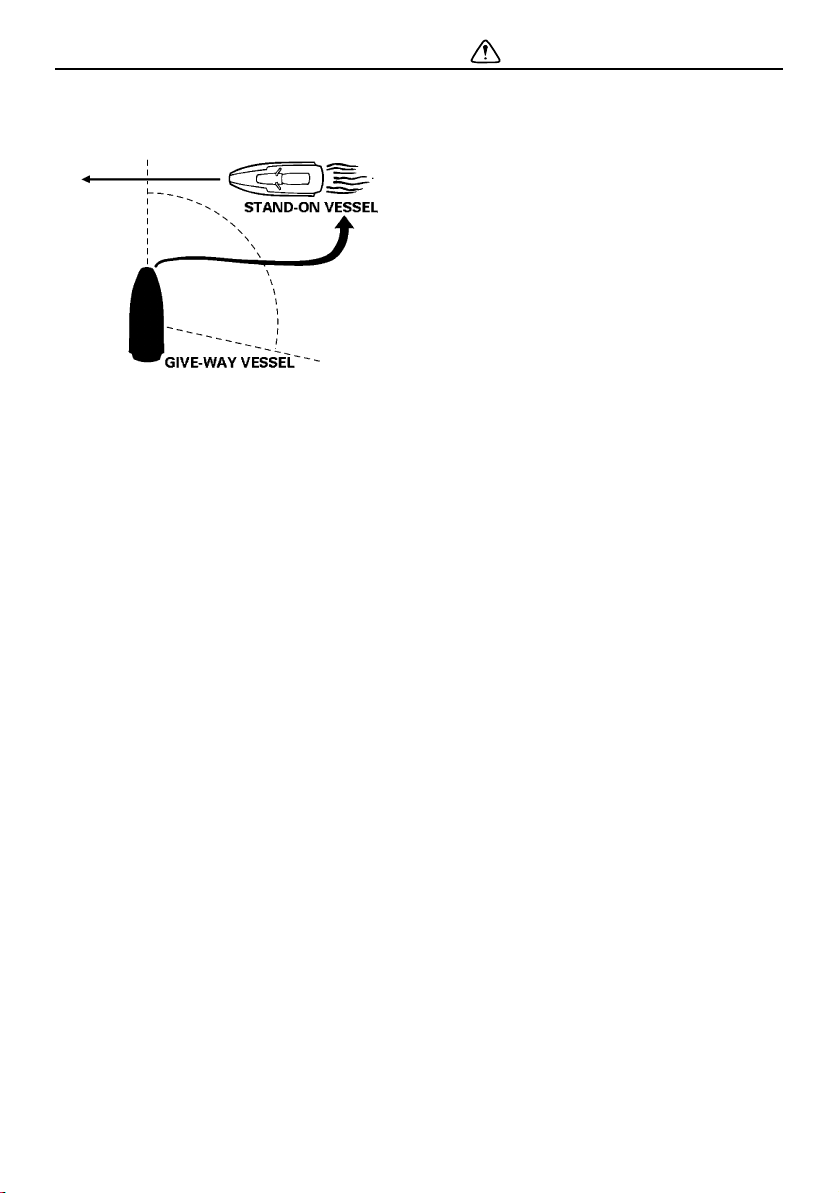
Stand-on vessel
The vessel with the right-of-way has the duty
to continue its course and speed, except to
avoid an immediate collision. When you
maintain your direction and speed, the other
vessel will be able to determine how best to
avoid you.
UF3Y10E0.book Page 18 Tuesday, August 9, 2016 9:24 AM
Safety information
19
Give-way vessel
The vessel which does not have the right-of-
way has the duty to take positive and timely
action to stay out of the way of the stand-on
vessel. Normally, you should not cross in
front of the vessel with the right-of-way. You
should slow down or change directions brief-
ly and pass behind the other vessel. You
should always move in such a way that the
operator of the other vessel can see what you
are doing.
The General Prudential Rule regarding the
right-of-way is that if a collision appears un-
avoidable, neither boat has the right-of-way.
Both boats must avoid the collision.
In other words, follow the standard rules ex-
cept when a collision will occur unless both
vessels try to avoid each other. If that is the
case, both vessels become give-way ves-
sels.
Rules when encountering vessels
There are three main situations that you may
encounter with other vessels which could
lead to a collision unless the Steering Rules
are followed:
Meeting: you are approaching another vessel
head-on
Crossing: you are traveling across another
vessel’s path
Overtaking: you are passing or being passed
by another vessel
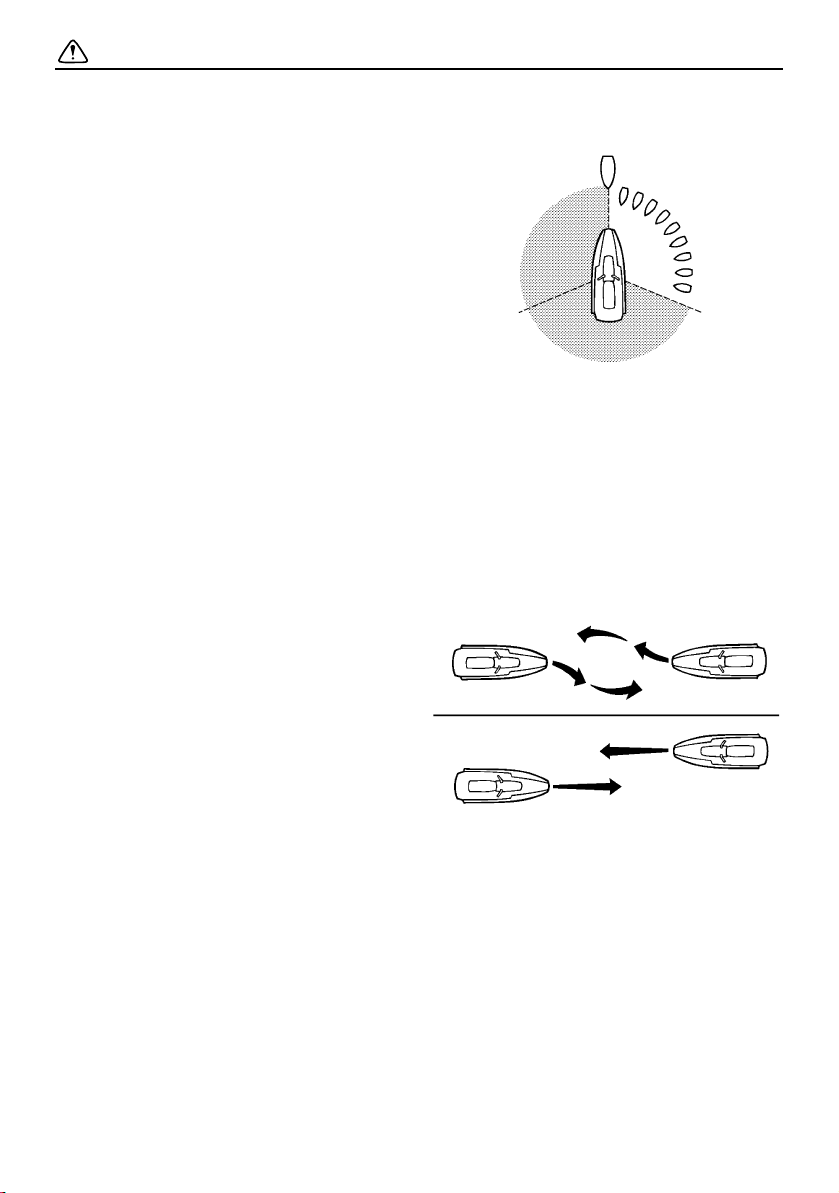
In the following illustration, your watercraft is
in the center. You should give the right-of-
way to any vessels shown in the white area
(you are the give-way vessel). Any vessels in
the shaded area must yield to you (they are
the give-way vessels). Both you and the
meeting vessel must alter course to avoid
each other.
Meeting
If you are meeting another power-driven ves-
sel head on, and are close enough to run the
risk of collision, neither of you has the right-
of-way. Both of you should alter course to
avoid an accident. You should keep the other
vessel on your port (left) side. This rule does
not apply if both of you will clear one another
if you continue on your set course and speed.
Crossing
When two power-driven vessels are crossing
each other’s path close enough to run the risk
of collision, the vessel which has the other on
the starboard (right) side must keep out of the
way of the other. If the other vessel is on your
starboard (right) side, you must keep out of
its way; you are the give-way vessel. If the
other vessel is on your port (left) side, remem-
ber that you should maintain course and di-
UF3Y10E0.book Page 19 Tuesday, August 9, 2016 9:24 AM
Safety information
20
rection, provided the other vessel gives you
the right-of-way as it should.
Overtaking
If you are passing another vessel, you are the
give-way vessel. This means that the other
vessel is expected to maintain its course and
speed. You must stay out of its way until you
are clear of it. Likewise, if another vessel is
passing you, you should maintain your speed
and direction so that the other vessel can
steer itself around you.
Other special situations
There are three other rules you should be
aware of when riding your watercraft around
other vessels.
Narrow channels and bends
When navigating in narrow channels, you
should keep to the right when it is safe and
practical to do so. If the operator of a power-
driven vessel is preparing to go around a
bend that may obstruct the view of other wa-
ter vessels, the operator should sound a pro-
longed blast of four to six seconds on the
whistle. If another vessel is around the bend,
it too should sound the whistle. Even if no re-
ply is heard, however, the vessel should still
proceed around the bend with caution. If you
navigate such waters with your watercraft,
you will need to carry a portable air horn,
available from local marine supply stores.
Fishing vessel right-of-way
All vessels fishing with nets, lines, or trawls
are considered to be “fishing vessels” under
the International Rules. Vessels with trolling
lines are not considered fishing vessels. Fish-
ing vessels have the right-of-way regardless
of position. Fishing vessels cannot, however,
impede the passage of other vessels in nar-
row channels.
Sailing vessel right-of-way
Sailing vessels should normally be given the
right-of-way. The exceptions to this are:
(1) When the sailing vessel is overtaking the
power-driven vessel, the power-driven
vessel has the right-of-way.
(2) Sailing vessels should keep clear of any
fishing vessel.
(3) In a narrow channel, a sailing vessel
should not hamper the safe passage of a
power-driven vessel that can navigate
only in such a channel.
Reading buoys and other markers
The waters of the United States are marked
for safe navigation by the lateral system of
buoyage. Simply put, buoys and markers
have an arrangement of shapes, colors, num-
bers, and lights to show which side of the
buoy a boater should pass on when navigat-
ing in a particular direction. The markings on
these buoys are oriented from the perspec-
tive of being entered from seaward (the boat-
er is going towards the harbor). Red buoys
are passed on your starboard (right) side
when proceeding from open water into the
harbor, and black buoys are to your port (left)
side. An easy way to remember the meaning
of the colors is the phrase “red right return-
ing”. When navigating out of the harbor, your
position with respect to the buoys should be
reversed; red buoys should be to port and
black buoys to starboard.
UF3Y10E0.book Page 20 Tuesday, August 9, 2016 9:24 AM

Safety information
23
EJU30992
Enjoy your watercraft
responsibly
You share the areas you enjoy when riding
your watercraft with others and with nature.
So your enjoyment includes a responsibility
to treat these other people, and the lands,
waters, and wildlife with respect and courte-
sy.
Whenever and wherever you ride, think of
yourself as the guest of those around you.
Remember, for example, that the sound of
your watercraft may be music to you, but it
could be just noise to others. And the exciting
splash of your wake can make waves others
won’t enjoy.
Avoid riding close to shoreline homes and
waterfowl nesting areas or other wildlife ar-
eas, and keep a respectful distance from fish-
ermen, other boats, swimmers, and
populated beaches. When travel in areas like
these is unavoidable, ride slowly and obey all
laws.
Proper maintenance is necessary to ensure
that the exhaust emission and sound levels of
your watercraft will continue to be within reg-
ulated limits. You have the responsibility to
make sure that the recommended mainte-
nance in this owner’s/operator’s manual is
carried out.
Remember, pollution can be harmful to the
environment. Do not refuel or add oil where a
spill could cause damage to nature. Remove
your watercraft from the water and move it
away from the shoreline before refueling. Dis-
pose of water and any fuel and oil residue in
the engine compartment according to local
regulations. And keep your surroundings
pleasant for the people and wildlife that share
the waterways: don’t litter.
The Online Boating Safety Course:
http://www.boatus.org/
UF3Y10E0.book Page 23 Tuesday, August 9, 2016 9:24 AM

Description
25
EJU43331
Watercraft glossary
Trolling speed
“Trolling” is the lowest maneuvering speed. You are applying little or no throttle. The water-
craft is down in the water, and there is no wake.
Sub-planing speed
“Sub-planing” is a medium speed. The bow of the watercraft is slightly up from the water sur-
face, but you are still traveling through the water. There is a wake.
Planing speed
“Planing” is a faster speed. The watercraft is more level and is skimming on top of the water.
There is a wake.
Bow
The front end of the watercraft.
Stern
The rear end of the watercraft.
Starboard
The right side of the watercraft when facing forward.
Port
The left side of the watercraft when facing forward.
Bilge water
Water that has collected in the engine compartment.
Yamaha Engine Management System (YEMS)
YEMS is an integrated, computerized management system that controls and adjusts ignition
timing, fuel injection, engine diagnostics, and the off-throttle steering (OTS) system.
Reverse with Intuitive Deceleration Electronics (RiDE)
RiDE is an electronic system that controls the reverse, neutral, and deceleration operations of
the watercraft.
UF3Y10E0.book Page 25 Tuesday, August 9, 2016 9:24 AM
Control function operation
30
EJU31026
Watercraft control functions
EJU31153
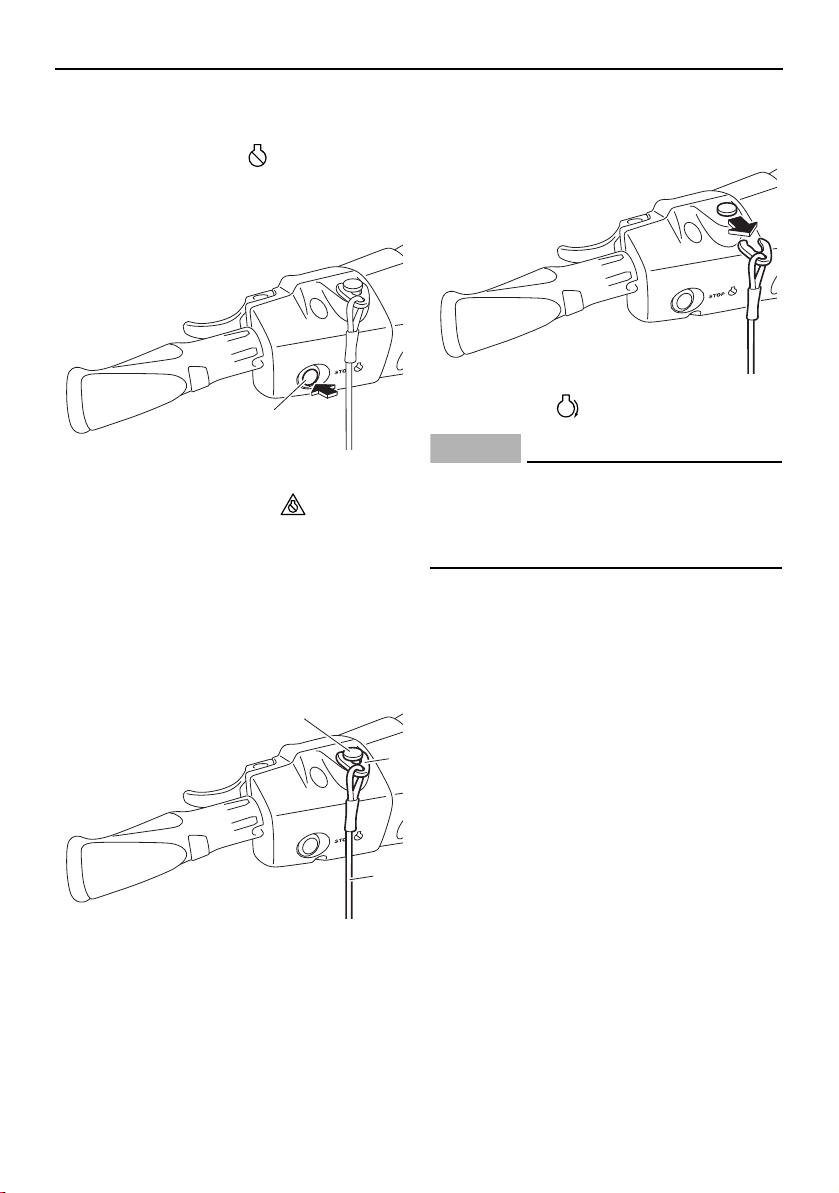
Engine stop switch “ ”
The engine stop switch (red button) stops the
engine when the switch is pushed.
EJU31164
Engine shut-off switch “ ”
The engine shut-off switch automatically
stops the engine when the clip, on the end of
the engine shut-off cord (lanyard), is removed
from the switch, such as if the operator falls
off the watercraft.
Insert the clip under the engine shut-off
switch before starting the engine.
When the engine is not running, remove the
clip from the engine shut-off switch to pre-
vent accidental starting or unauthorized op-
eration by children or others.
EJU44350
Start switch “ ”
NOTICE
ECJ01311
Do not run the engine over 4000 r/min on
land. Also, do not run the engine for more
than 15 seconds without supplying water,
otherwise the engine could overheat.
The start switch (green button) starts the en-
gine when the switch is pushed.
Release the start switch as soon as the en-
gine starts to run. If the engine does not start
in 5 seconds, release the start switch, wait 15
seconds, and then try again. NOTICE: Never
push the start switch while the engine is
running. Do not operate the start switch
for more than 5 seconds, otherwise the
battery will be discharged and the engine
1 Engine stop switch
1 Engine shut-off switch
2 Clip
3 Engine shut-off cord (lanyard)
1
1
2
3
UF3Y10E0.book Page 30 Tuesday, August 9, 2016 9:24 AM

Control function operation
31
will not start. Also, the starter motor could
be damaged.
[ECJ01041]
The engine will not start under any of the fol-
lowing conditions:
Clip is removed from the engine shut-off
switch.
Throttle lever is squeezed.
Throttle lever is malfunctioning.
EX Deluxe: RiDE lever is squeezed.
EX Deluxe: RiDE lever is malfunctioning.
EJU31212
Throttle lever
The throttle lever increases the engine speed
when the lever is squeezed.
The throttle lever returns automatically to its
fully closed (idle) position when released.
EJU43342
RiDE lever (EX Deluxe)
When the RiDE lever is squeezed, the reverse
gate lowers and the watercraft starts moving
in reverse. If the watercraft is moving forward,
the watercraft gradually slows down until it
stops, and then the watercraft starts moving
in reverse.
When the RiDE lever is released, it automati-
cally returns to its fully closed (idle) position
and the reverse gate moves to the neutral po-
sition.
EJU31262
Steering system
By turning the handlebars in the direction you
wish to travel, the angle of the jet thrust noz-
1 Start switch
1 Throttle lever
1
1
1 RiDE lever
1
UF3Y10E0.book Page 31 Tuesday, August 9, 2016 9:24 AM

Control function operation
32
zle is changed, and the direction of the water-
craft is changed accordingly.
Since the strength of the jet thrust determines
the speed and degree of a turn, throttle must
always be applied when attempting a turn,
except at trolling speed.
This model is equipped with the Yamaha En-
gine Management System (YEMS) that in-
cludes an off-throttle steering (OTS) system.
It will activate at planing speeds should you
attempt to steer the watercraft after releasing
the throttle lever. The OTS system assists in
turning by continuing to supply some thrust
while the watercraft is decelerating, but you
can turn more sharply if you apply throttle
while turning the handlebars. The OTS sys-
tem does not function below planing speeds
or when the engine is off. Once the engine
slows down, the watercraft will no longer turn
in response to handlebar input until you apply
throttle again or you reach trolling speed.
EJU35975
Cooling water pilot outlet
When the engine is running, some of the
cooling water that is circulated in the engine
is discharged from the cooling water pilot
outlet.
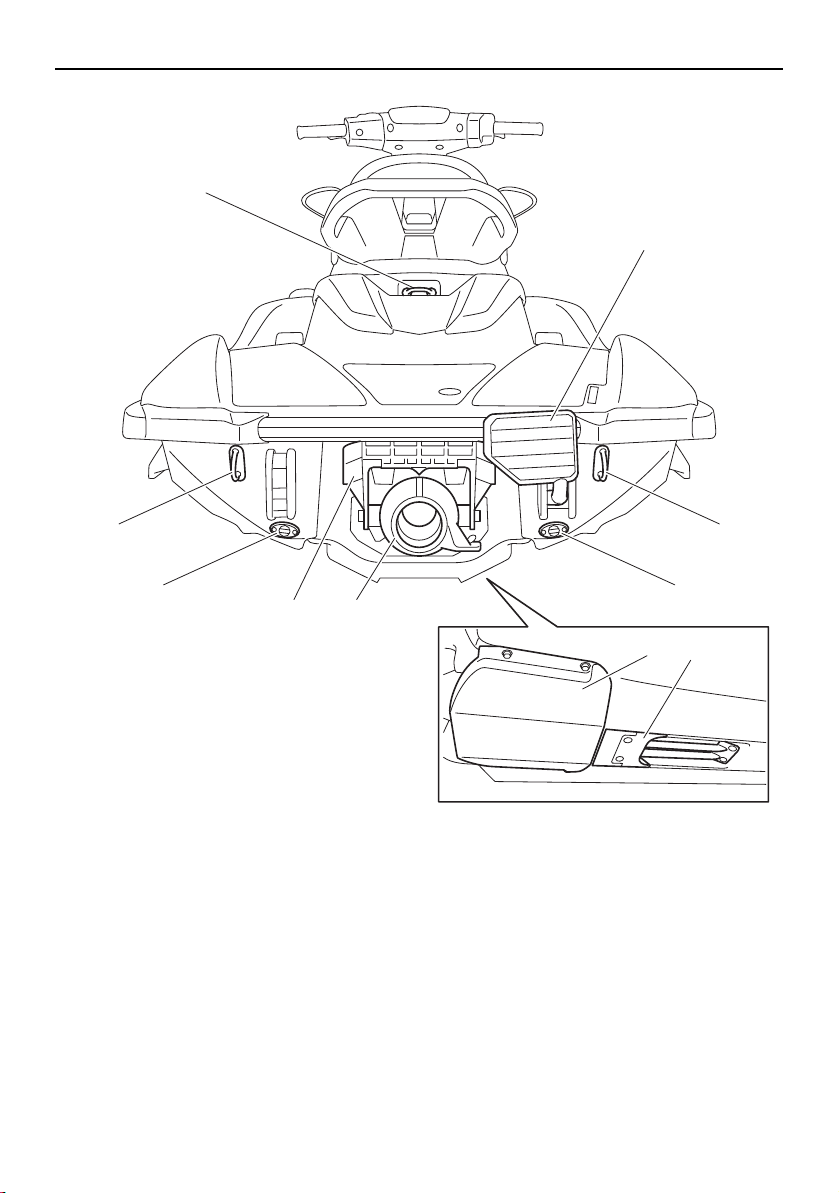
There is a cooling water pilot outlet on the
port (left) side of the watercraft. To check for
proper operation of the cooling system, make
sure that water is being discharged from the
cooling water pilot outlet. If water is not being
discharged from the outlet, stop the engine
and check the jet intake for clogging. (See
page 97 for information on the jet intake.)
TIP:
It will take about 60 seconds for the water
to reach the outlet after the engine is start-
ed.
Water discharge may not be constant
when the engine is running at idling speed.
If this occurs, apply a little throttle to make
sure that water discharges properly.
EJU40323
Water separator
The water separator prevents water from en-
tering the fuel tank by collecting any water
that has entered the fuel tank breather hose if
the watercraft was capsized.
1 Handlebar
2 Jet thrust nozzle
1
2
1 Cooling water pilot outlet
1
UF3Y10E0.book Page 32 Tuesday, August 9, 2016 9:24 AM
Watercraft operation
34
EJU40014
Watercraft operation functions
EJU40522
Reverse system (EX Sport)
WARNING
EWJ01231
Do not use the reverse function to slow
down or stop the watercraft as it could
cause you to lose control, be ejected, or
impact the handlebars.
Make sure that there are no obstacles or
people behind you before shifting into
reverse.
Do not touch the reverse gate while the
shift lever is being operated, otherwise
you could be pinched.
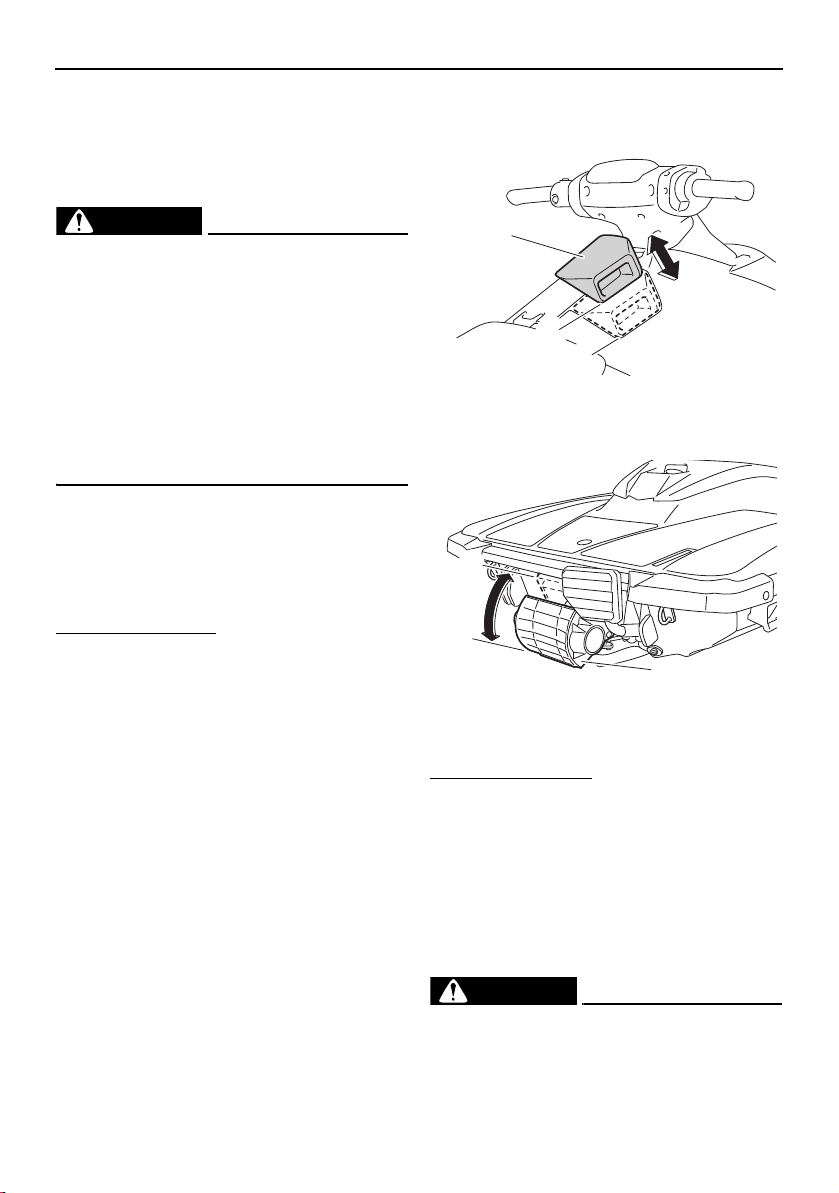
When the shift lever is moved to the reverse
position, the reverse gate lowers and deflects
the water jet being discharged from the jet
thrust nozzle. This allows the watercraft to
move in reverse.
To shift into reverse:
(1) Release the throttle lever and let the en-
gine speed return to idle.
(2) Pull the shift lever rearward until it stops
in the reverse position. The reverse gate
will lower and the watercraft will start
moving in reverse at trolling speed.
To shift into forward:
(1) Release the throttle lever and let the en-
gine speed return to idle.
(2) Push the shift lever forward until it stops
in the forward position. The reverse gate
will rise and the watercraft will start mov-
ing forward at trolling speed.
EJU43154
Shift system (EX Deluxe)
WARNING
EWJ01773
Make sure that there are no obstacles or
people behind you before shifting into
reverse.
1 Shift lever
2 Reverse position
3 Forward position
1 Reverse gate
2 Forward position
3 Reverse position
1
2
3
1
2
3
UF3Y10E0.book Page 34 Tuesday, August 9, 2016 9:24 AM

Watercraft operation
35
Do not touch the reverse gate while the
RiDE lever is being operated, otherwise
you could be pinched.
If the RiDE lever and throttle lever are
being operated at the same time, do not
release only the RiDE lever. Otherwise,
the watercraft could accelerate more
quickly than expected, which may lead
to an accident.
The RiDE lever and throttle lever can be oper-
ated to change the forward or rearward
movement of the watercraft only when the
engine is running. When the RiDE lever is
squeezed, the reverse gate lowers and de-
flects the water jet being discharged from the
jet thrust nozzle so that the watercraft moves
in reverse or is in neutral. When the throttle le-
ver is squeezed, the reverse gate rises and
the watercraft moves forward.
TIP:
This model is equipped with a function
which limits the engine speed in reverse.
When the engine is started, the reverse
gate automatically moves to the neutral po-
sition.
To shift into reverse:
(1) Release the throttle lever.
(2) Squeeze the RiDE lever. The reverse
gate will lower, the engine speed will in-
crease, the watercraft will start moving in
reverse, and the “R” (reverse) shift indi-
cator will be displayed.
To shift into neutral from reverse:
Release the RiDE lever. The reverse gate will
automatically return to the neutral position
1 RiDE lever
1 Reverse gate
2 Reverse position
1 “R” (Reverse position)
1
1
2
1
UF3Y10E0.book Page 35 Tuesday, August 9, 2016 9:24 AM

Watercraft operation
37
TIP:
If the RiDE lever is squeezed while the throttle
lever is squeezed, the watercraft will slow
down, and once stopped, move in reverse.
To shift into neutral from forward:
(1) Release the throttle lever.
(2) Lightly squeeze and release the RiDE le-
ver. The “N” (neutral) shift indicator will
be displayed.
TIP:
If the RiDE lever is squeezed continuously,
the reverse gate will move to the reverse po-
sition.
1 “N” (Neutral position)
1
UF3Y10E0.book Page 37 Tuesday, August 9, 2016 9:24 AM
Instrument operation
38
EJU44570
Multifunction information
center
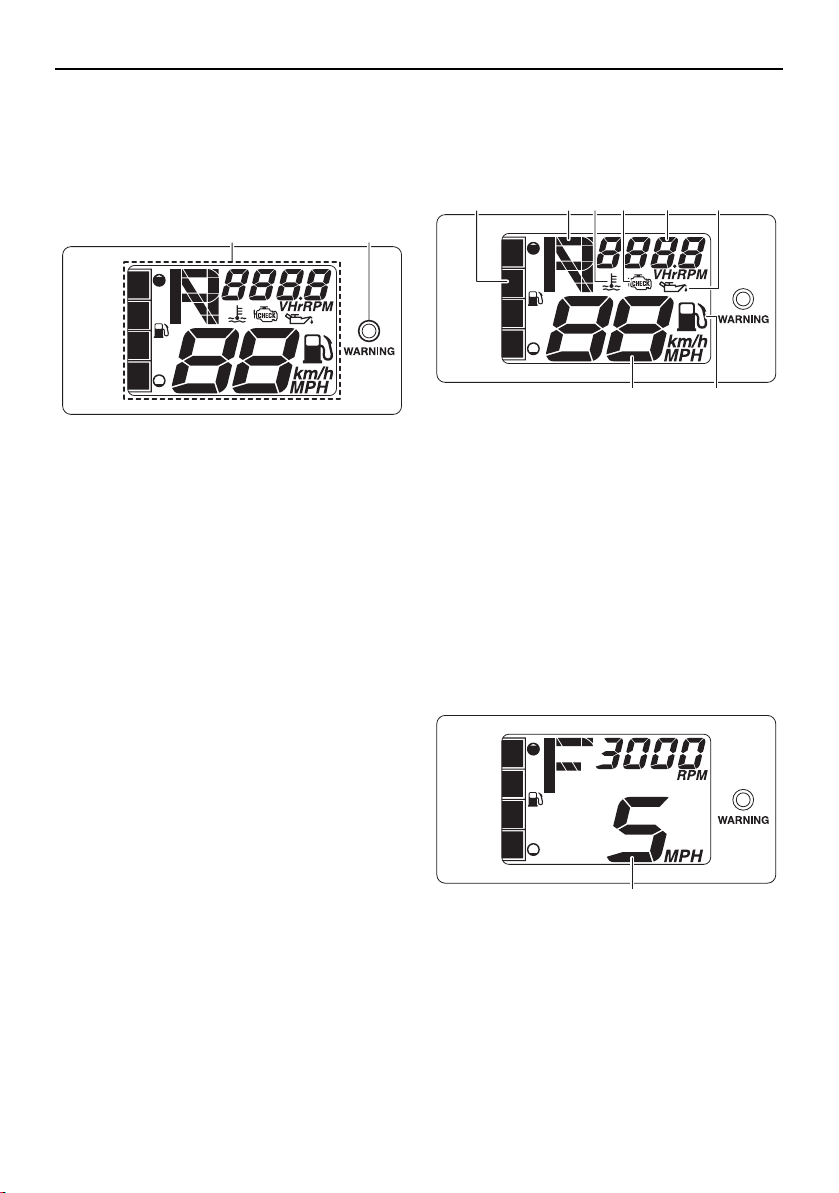
The multifunction information center displays
various watercraft information.
Multifunction information center initial op-
eration
When the multifunction information center is
activated, all of the display segments come
on. After 2 seconds, the warning indicators in
the information display go off, and then the
center starts to operate normally.
Multifunction information center standby
state
If the multifunction information center does
not receive any operation input within 30 sec-
onds after the engine stops, the center will
turn off and enter a standby state. When the
engine is started again, the displays return to
their state before the center turned off, and
then the center starts to operate normally.
EJU35027
Information display
The information display shows watercraft op-
erating conditions.
EJU43832
Speedometer
The speedometer shows the watercraft
speed against water.
By switching the display units, the speed can
be shown in kilometers per hour “km/h” or
miles per hour “MPH”.
TIP:
“MPH” is selected as the display unit at the
Yamaha factory.
1 Information display
2 “WARNING” indicator light
12
1 Fuel level meter
2 Shift indicator (EX Deluxe)
3 Engine overheat warning indicator
4 Check engine warning indicator
5 Tachometer / hour meter / voltmeter
6 Oil pressure warning indicator
7 Fuel level warning indicator
8 Speedometer
1 Speedometer
2 51 3 4 6
78
1
UF3Y10E0.book Page 38 Tuesday, August 9, 2016 9:24 AM
Instrument operation
40
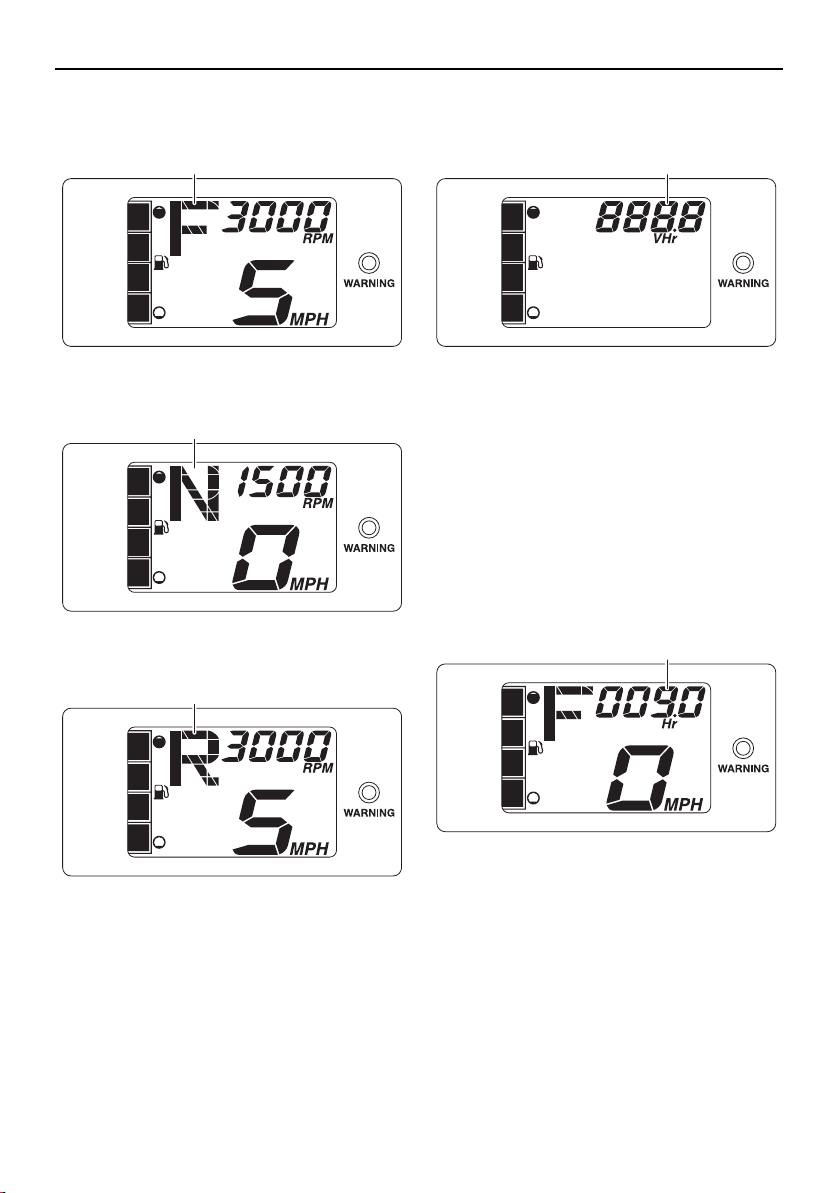
(reverse). (See page 34 for shifting proce-
dures.)
EJU44700
Hour meter and voltmeter
The hour meter and voltmeter are displayed
in the tachometer portion of the information
display while the engine is stopped.
The hour meter and voltmeter are displayed
alternately at 3-second intervals.
TIP:
If the engine is stopped after the check en-
gine warning is activated, the hour meter and
error code will be displayed alternately at 3-
second intervals.
Hour meter
The hour meter shows the total number of
hours that the engine has been running since
the watercraft was new.
TIP:
The elapsed time will be kept even if the bat-
tery terminals have been disconnected.
Voltmeter
The voltmeter shows the battery voltage.
When the battery voltage is normal, the volt-
meter displays approximately 12 volts.
1 “F” (Forward position)
1 “N” (Neutral position)
1 “R” (Reverse position)
1
1
1
1 Hour meter and voltmeter
1 Hour meter
1
1
UF3Y10E0.book Page 40 Tuesday, August 9, 2016 9:24 AM
Instrument operation
41
If the battery voltage has dropped significant-
ly, “Lo” is displayed on the voltmeter, and all
other display segments of the information
display turn off. If the battery voltage has ris-
en significantly, “HI” is displayed. If “Lo” or
“HI” is displayed, immediately return to shore
and have a Yamaha dealer service the water-
craft.
EJU37272
Fuel level meter
The fuel level meter shows the amount of fuel
remaining in the fuel tank. The amount of re-
maining fuel is shown using four display seg-
ments, which disappear one at a time as the
fuel level decreases.
TIP:
The accuracy of the fuel level meter varies
depending on the operating conditions. Use
this function as a reference only.
EJU44710
Fuel level warning
If the fuel remaining in the fuel tank drops to
about 8 L (2.1 US gal, 1.8 Imp.gal), the lowest
fuel level segment, the fuel level warning indi-
cator, and the “WARNING” indicator light
blink, and the buzzer sounds intermittently for
30 seconds.
If the fuel level warning is activated, refill the
fuel tank as soon as possible. (See page 50
for information on filling the fuel tank.)
After the fuel tank is refilled, the warning sig-
nals will be cleared when the engine is re-
started.
EJU43720
Oil pressure warning
If the oil pressure drops significantly, the oil
pressure warning indicator, the check engine
warning indicator, and the “WARNING” indi-
cator light blink, and the buzzer sounds inter-
mittently for 30 seconds. At the same time,
the maximum engine speed is limited.
1 Voltmeter
1 Fuel level meter
1
1
UF3Y10E0.book Page 41 Tuesday, August 9, 2016 9:24 AM

Instrument operation
42
If the oil pressure warning is activated, imme-
diately reduce the engine speed, return to
shore, and then check the engine oil level.
(See page 52 for information on checking the
engine oil level.) If the oil level is sufficient,
have a Yamaha dealer check the watercraft.
EJU43901
Engine overheat warning
If the engine temperature rises significantly,
the engine overheat warning indicator, the
check engine warning indicator, and the
“WARNING” indicator light blink, and the
buzzer sounds intermittently. After 5 sec-
onds, the engine overheat warning indicator
and the “WARNING” indicator light stop
blinking and remain on, and the buzzer
sounds continuously. After 30 seconds, the
buzzer stops. While the engine overheat
warning is activated, the maximum engine
speed is limited.
If the engine overheat warning is activated,
immediately reduce the engine speed, return
to shore, and then make sure that water is
being discharged from the cooling water pilot
outlet while the engine is running. If there is
no discharge of water, stop the engine, and
then check the jet intake for clogging. (See
page 97 for information on the jet intake.)
NOTICE: If you cannot locate and correct
the cause of the overheating, consult a
Yamaha dealer. Continuing to operate at
higher speeds could result in severe en-
gine damage.
[ECJ00042]
EJU44690
Check engine warning
If a sensor malfunction or a short circuit is de-
tected, the check engine warning indicator
and the “WARNING” indicator light blink, and
the buzzer sounds intermittently for 30 sec-
onds.
If the engine is stopped after the check en-
gine warning is activated, the tachometer
portion of the information display will show
UF3Y10E0.book Page 42 Tuesday, August 9, 2016 9:24 AM

Instrument operation
43
the hour meter and error code alternately at
3-second intervals.
If the check engine warning is activated, im-
mediately reduce the engine speed, return to
shore, and have a Yamaha dealer check the
engine.
1 Error code
1
UF3Y10E0.book Page 43 Tuesday, August 9, 2016 9:24 AM
Equipment operation
45
breaks, the watercraft could fall, which
could result in severe injury.
[EWJ00022]
EJU37382
Reboarding grip
The reboarding grip is used when boarding
the watercraft from the water.
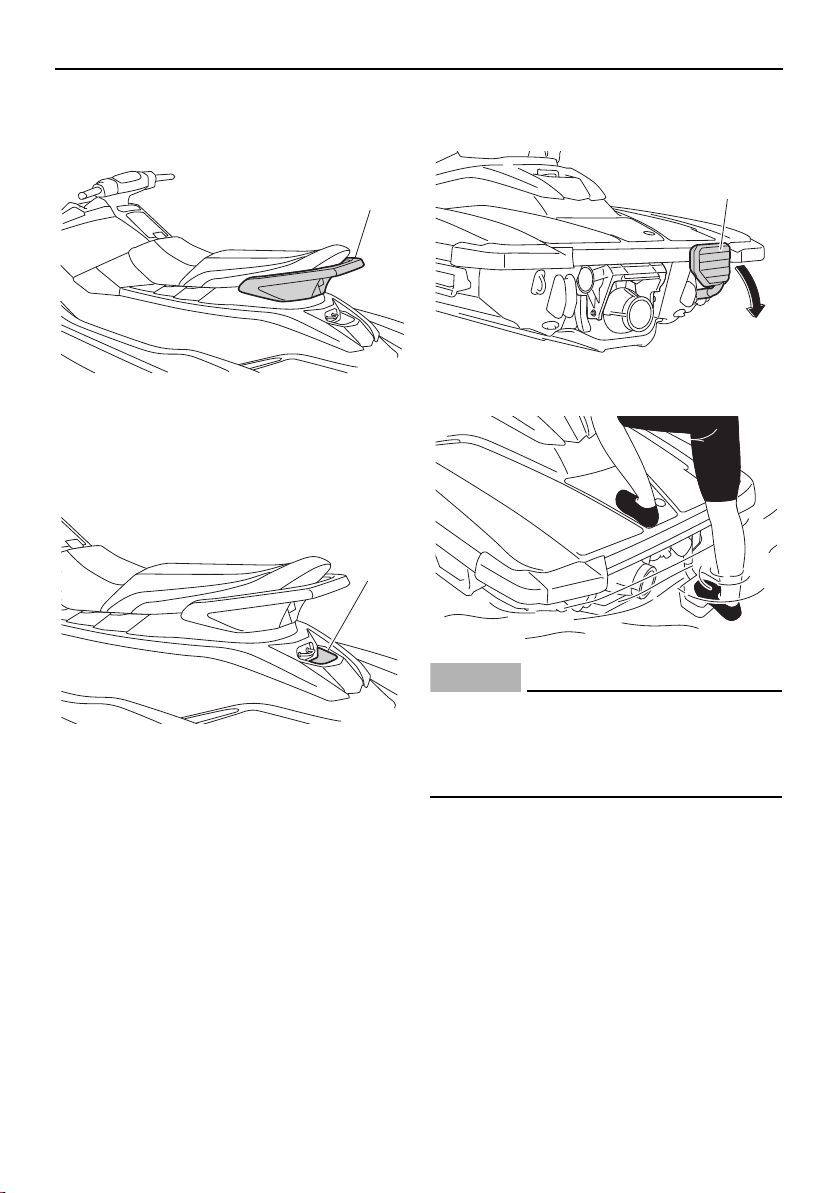
EJU34865
Reboarding step (EX Sport / EX
Deluxe)
The reboarding step is used to assist in re-
boarding the watercraft from the water.
When boarding the watercraft, push the re-
boarding step down until it stops. The step
returns automatically to its original position
when released. WARNING! Do not use the
reboarding step to lift the watercraft. The
reboarding step is not designed to support
the watercraft’s weight. If the reboarding
step breaks, the watercraft could fall,
which could result in severe injury.
[EWJ01212]
NOTICE
ECJ00743
Use the reboarding step only to board the
watercraft in the water. Do not use the re-
boarding step for any other purpose. The
watercraft can be damaged.
1 Handgrip
1 Reboarding grip
1
1
1 Reboarding step
1
UF3Y10E0.book Page 45 Tuesday, August 9, 2016 9:24 AM
Equipment operation
47
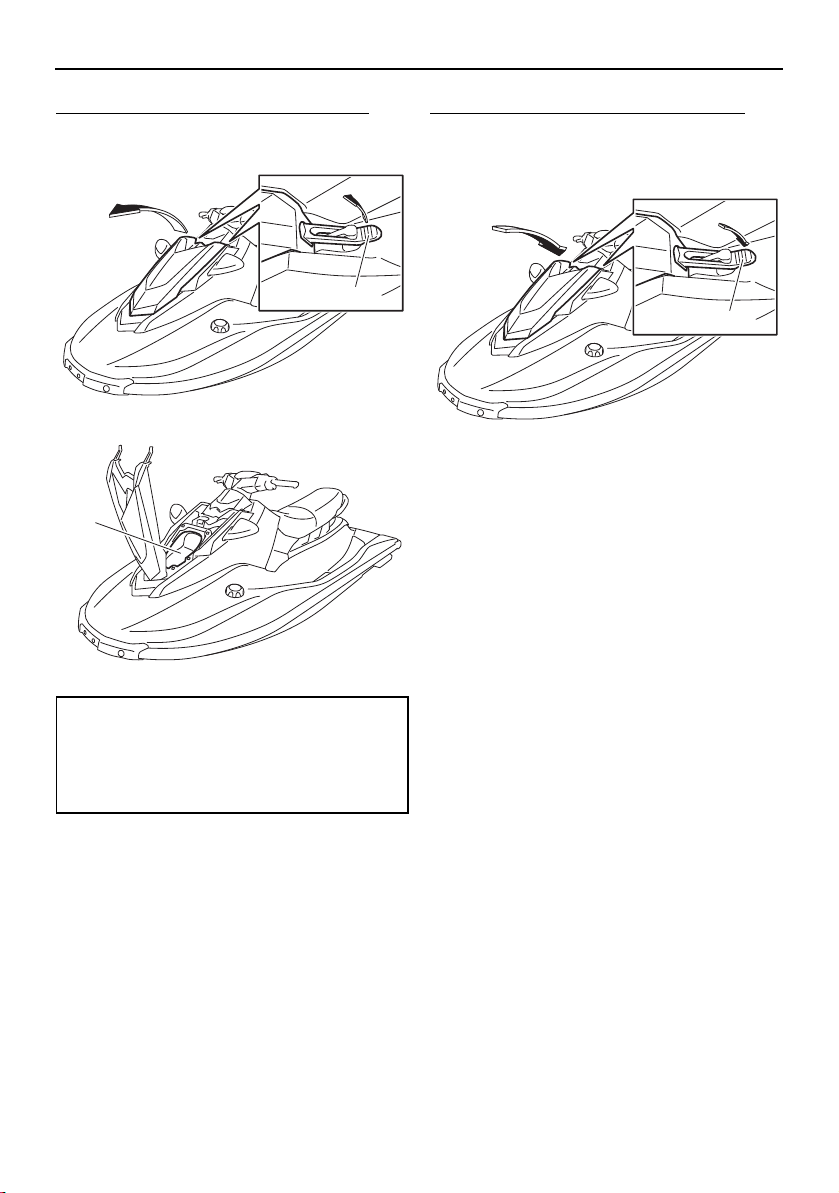
To open the bow storage compartment:
Unhook the hood latches, and then lift up the
rear of the hood.
To close the bow storage compartment:
Return the hood to its original position, and
then hook the hood latches to secure it in pla-
ce.
EJU43781
Glove compartment
The glove compartment is located in front of
the seat.
1 Hood latch
1 Bow storage compartment
Bow storage compartment:
Capacity:
7.0 L (1.8 US gal, 1.5 Imp.gal)
Load limit:
2.0 kg (4.4 lb)
1
1
1 Hood latch
1
UF3Y10E0.book Page 47 Tuesday, August 9, 2016 9:24 AM

Equipment operation
49
The storage compartment is removable.
EJU44501
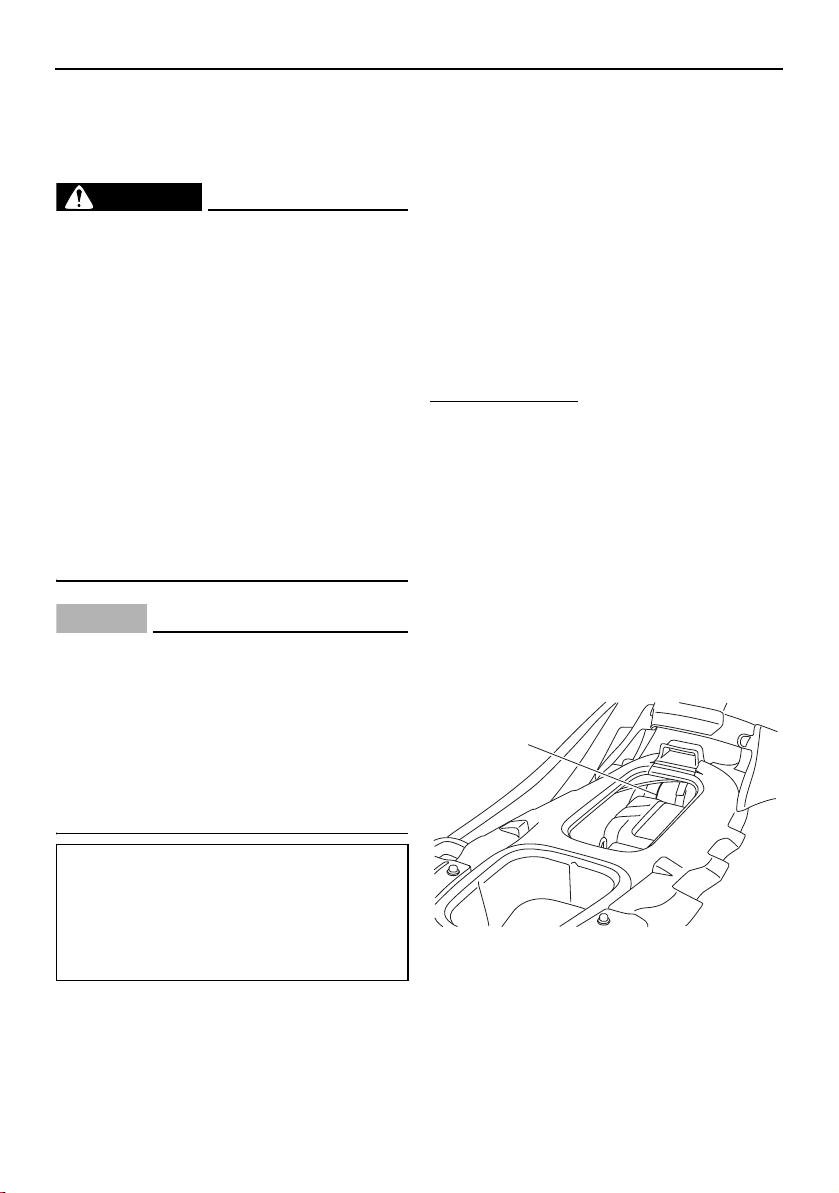
Fire extinguisher holder
The fire extinguisher holder is located under
the seat. (See page 44 for seat removal and
installation procedures.)
The fire extinguisher holder is removable.
1 Fire extinguisher holder
1
UF3Y10E0.book Page 49 Tuesday, August 9, 2016 9:24 AM
Operation and handling requirements
50
EJU31823
Fuel requirements
EJU44510
Fuel
WARNING
EWJ00283
Gasoline and gasoline vapors are ex-
tremely flammable. To avoid fires and
explosions and to reduce the risk of in-
jury when refueling, follow these in-
structions.
Gasoline is poisonous and can cause in-
jury or death. Handle gasoline with care.
Never siphon gasoline by mouth. If you
should swallow some gasoline, inhale a
lot of gasoline vapor, or get some gaso-
line in your eyes, see your doctor imme-
diately. If gasoline spills on your skin,
wash with soap and water. If gasoline
spills on your clothing, change your
clothes.
NOTICE
ECJ00322
Do not use leaded gasoline. Leaded
gasoline can seriously damage the en-
gine.
Avoid getting water and contaminants in
the fuel tank. Contaminated fuel can
cause poor performance and engine
damage. Use only fresh gasoline that
has been stored in clean containers.
Gasohol
There are two types of gasohol: gasohol con-
taining ethanol and that containing methanol.
Gasohol containing ethanol can be used if
ethanol content does not exceed 10% and
the fuel meets the minimum octane ratings.
E-85 is a fuel blend containing 85% ethanol
and therefore must not be used in this water-
craft. All ethanol blends containing more than
10% ethanol can cause fuel system damage
or engine performance problems.
Yamaha does not recommend gasohol con-
taining methanol because it can cause fuel
system damage and engine performance
problems.
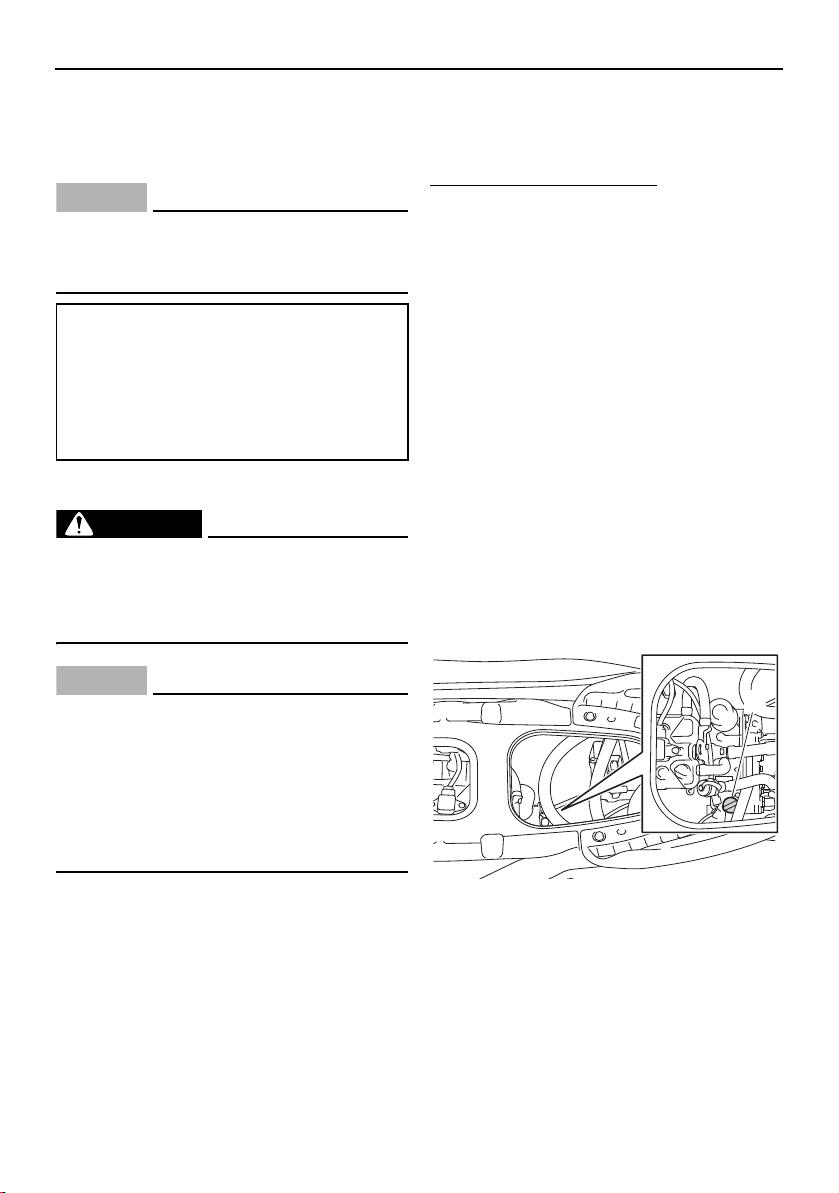
To fill the fuel tank:
(1) Before refueling, stop the engine. Do not
stand or sit on the watercraft. Never refu-
el while smoking, or while in the vicinity
of sparks, open flames, or other sources
of ignition.
(2) Place the watercraft in a well-ventilated
area and in a horizontal position.
(3) Remove the seat and fire extinguisher
holder, and then check the fuel level.
(See page 44 for seat removal and instal-
lation procedures and page 49 for infor-
mation on the fire extinguisher holder.)
Recommended fuel:
Regular unleaded gasoline with a mi-
nimum octane rating of
86
(Pump octane number) = (R + M)/2
90 (Research octane number)
1 Fuel tank
1
UF3Y10E0.book Page 50 Tuesday, August 9, 2016 9:24 AM
Operation and handling requirements
52
EJU40291
Engine oil requirements
EJU44520
Engine oil
NOTICE
ECJ00282
Use only 4-stroke engine oil. Usage of 2-
stroke engine oil could result in severe en-
gine damage.
Checking the engine oil level
WARNING
EWJ00341
Engine oil is extremely hot immediately af-
ter the engine is turned off. Coming in con-
tact with or getting any engine oil on your
clothes could result in burns.
NOTICE
ECJ00392
Do not run the engine with too much or
not enough oil in the oil tank, otherwise
the engine could be damaged.
Make sure that debris and water do not
enter the oil tank filler hole. Debris and
water in the engine oil can cause serious
engine damage.
TIP:
When checking the engine oil level on land,
the engine must be running while water is
being supplied to the cooling water pas-
sages. (See “Flushing the cooling water
passages” on page 82 for information on
supplying water.)
When checking the engine oil level on wa-
ter, moor the watercraft so that it will not
drift away.
To check the engine oil level:
(1) With the engine stopped, place the wa-
tercraft in a precisely level position on
land or launch the watercraft.
(2) Look in all directions, and then start the
engine. (See page 69 for information on
starting the engine.)
(3) Run the engine at idling speed for 6 mi-
nutes or more. Run the engine an addi-
tional 5 minutes if the ambient
temperature is 20 °C (68 °F) or less.
(4) Stop the engine.
(5) Remove the seat and seat storage com-
partment. (See page 44 for seat removal
and installation procedures and page 48
for information on the seat storage com-
partment.)
(6) Loosen the oil tank filler cap and remove
it, and then wipe the attached dipstick
clean.
(7) Screw the oil tank filler cap into the filler
hole until it stops. Remove the oil tank
filler cap again and make sure that the
Recommended engine oil:
YAMALUBE 4W
Recommended engine oil type:
SAE 10W-30, 10W-40, 20W-40,
20W-50
Recommended engine oil grade:
API SG, SH, SJ, SL
1 Oil tank filler cap/Dipstick
1
UF3Y10E0.book Page 52 Tuesday, August 9, 2016 9:24 AM
Operation and handling requirements
53
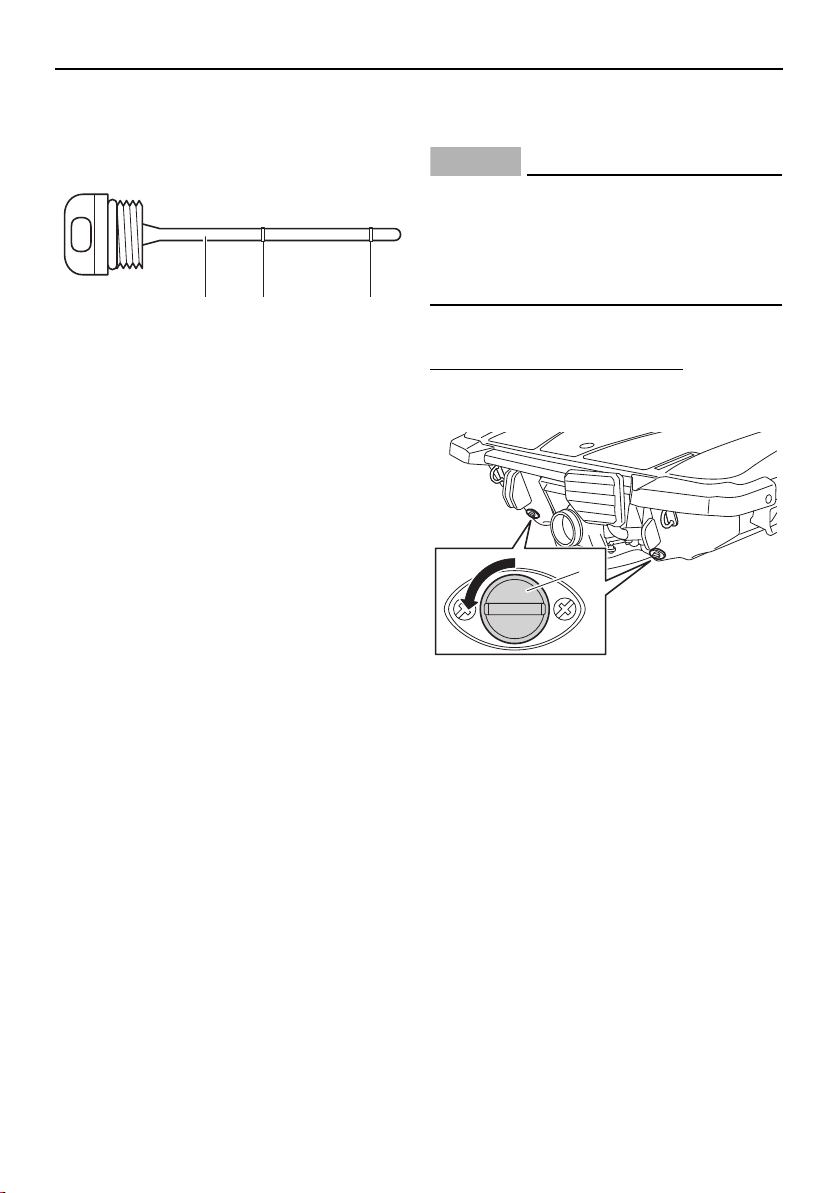
engine oil level is between the minimum
and maximum level marks.
(8) If the engine oil level is significantly
above the maximum level mark, consult
a Yamaha dealer. If the engine oil level is
below the minimum level mark, slowly
add engine oil.
(9) Repeat steps 6–8 until the engine oil is at
the proper level.
(10) Securely install the oil tank filler cap and
turn it until it stops.
(11) Securely install the seat storage com-
partment and seat in their original posi-
tions.
EJU40022
Draining the bilge water
NOTICE
ECJ01302
Do not run the engine at full throttle when
bilge water remains in the engine com-
partment. The bilge water can splash into
the engine, which can result in severe
damage.
EJU44260
Draining the bilge water on land
To drain the bilge water on land:
(1) Loosen the stern drain plugs and remove
them.
(2) Raise the bow of the watercraft, such as
by placing the watercraft on a slope, to
drain the bilge water from the engine
compartment.
(3) After the bilge water has drained from the
stern drain plug holes, wipe up any re-
maining moisture in the engine compart-
ment with a dry cloth.
(4) Check that the stern drain plugs and O-
rings on the plugs are not damaged and
that there is no foreign material on the
threads or O-rings on the plugs.
NOTICE: Before installing the stern
drain plugs, clean the drain plug
threads and the O-rings on the plugs
to remove any foreign materials, such
as dirt or sand. Otherwise, the stern
1 Dipstick
2 Maximum level mark
3 Minimum level mark
FL
21 3
1 Stern drain plug
1
UF3Y10E0.book Page 53 Tuesday, August 9, 2016 9:24 AM

Operation and handling requirements
54
drain plugs could be damaged, allow-
ing water to enter the engine compart-
ment. Check the O-rings on the stern
drain plugs and make sure that the
plugs are tightened securely before
launching the watercraft. Otherwise,
water may flood the engine compart-
ment and cause the watercraft to sub-
merge.
[ECJ00363]
(5) Securely install the stern drain plugs by
tightening them until they stop.
EJU40535
Draining the bilge water on water
A small quantity of bilge water will remain in
the engine compartment even after the bilge
water is drained on water. To completely
drain the bilge water, remove the watercraft
from the water and drain the bilge water on
land.
Jet vacuum bilge draining system
While the watercraft is operating, bilge water
in the engine compartment is drawn in by the
vacuum that is generated in the jet pump and
discharged from the watercraft through the
jet thrust nozzle.
To drain the bilge water on water:
Operate the watercraft as straight as possible
and above planing speed for at least 2 minu-
tes. NOTICE: Do not run the engine at full
throttle for at least 1 minute after the en-
gine has been restarted. Bilge water in the
engine compartment can splash into the
engine, which can result in severe dam-
age.
[ECJ00554]
1 O-ring
1
UF3Y10E0.book Page 54 Tuesday, August 9, 2016 9:24 AM

First-time operation
56
EJU32786
Engine break-in
NOTICE
ECJ00432
Failure to perform the engine break-in
could result in reduced engine life or even
severe engine damage.
The engine break-in is essential to allow the
various components of the engine to wear
and polish themselves to the correct operat-
ing clearances. This ensures proper perfor-
mance and promotes longer component life.
To perform the engine break-in:
(1) Check the engine oil level. (See page 52
for information on checking the engine
oil level.)
(2) Launch the watercraft and start the en-
gine. (See page 69 for information on
starting the engine.)
(3) For the first 5 minutes, operate with the
engine at idling speed.
(4) For the next 30 minutes, operate with the
engine speed below 5000 r/min.
(5) For the next 1 hour, operate with the en-
gine speed below 6500 r/min.
After the engine break-in is complete, the wa-
tercraft can be operated normally.
UF3Y10E0.book Page 56 Tuesday, August 9, 2016 9:24 AM

Pre-operation checks
58
TIP:
To ensure safety and reliability, pre-operation checks should be made each time the water-
craft is used.
Hood Check that the hood is securely closed. 65
Seat Check that the seat is securely installed. 44
POST-LAUNCH CHECKS
Cooling water pilot outlet
Check that water is discharged from the cooling
water pilot outlet while the engine is running.
65
Multifunction information
center
Check the multifunction information center for prop-
er operation.
65
Shift system (EX Deluxe) Check the shift system for proper operation. 66
Engine idling speed Check the engine idling speed. 66
ITEM ROUTINE PAGE
UF3Y10E0.book Page 58 Tuesday, August 9, 2016 9:24 AM
Pre-operation checks
59
EJU32282
Pre-operation check points
EJU44550
Pre-launch checks
Perform the pre-launch checks in the pre-op-
eration checklist while the watercraft is on
land.
To perform the pre-launch checks:
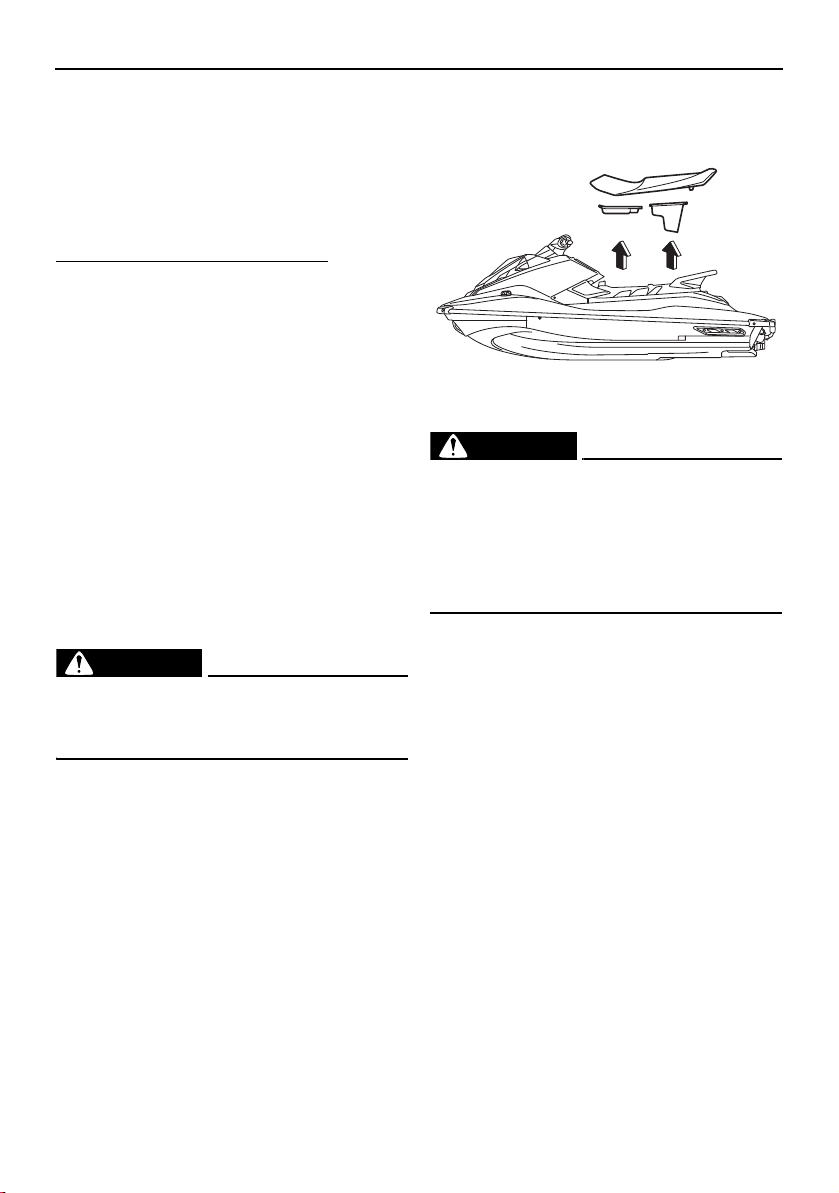
(1) Remove the seat, seat storage compart-
ment, and fire extinguisher holder. (See
page 44 for seat removal and installation
procedures, page 48 for information on
the seat storage compartment, and page
49 for information on the fire extinguisher
holder.)
(2) Perform the checks and make sure that
there are no malfunctioning items or oth-
er problems.
(3) After completing these checks, securely
install the seat storage compartment, fire
extinguisher holder, and seat in their
original positions.
EJU32334
Engine compartment check
WARNING
EWJ00462
Failure to ventilate the engine compart-
ment could result in a fire or explosion. Do
not start the engine if there is a fuel leak.
Ventilate the engine compartment. Leave the
engine compartment open for a few minutes
to allow any fuel vapors to escape.
Make sure that there is no damage inside the
engine compartment.
EJU34215
Fuel system checks
WARNING
EWJ00382
Leaking fuel can result in fire or explosion.
Check for fuel leakage regularly.
If any fuel leakage is found, the fuel sys-
tem must be repaired by a qualified me-
chanic. Improper repairs can make the
watercraft unsafe to operate.
Make sure that there is no damage, leakage,
or other problem in the fuel system.
Check:
Fuel filler cap and seal for damage
Fuel tank for damage and leakage
Fuel hoses and joints for damage and leak-
age
Fuel tank breather hose for damage and
leakage
EJU36875
Fuel level check
Check the fuel level in the fuel tank.
Add fuel if necessary. (See page 50 for infor-
mation on filling the fuel tank.)
UF3Y10E0.book Page 59 Tuesday, August 9, 2016 9:24 AM

Pre-operation checks
60
EJU32424
Water separator check
Make sure that no water has collected in the
water separator. If water has collected in the
water separator, drain it. (See page 32 for in-
formation on draining the water separator.)
EJU40182
Engine unit check
Check the exterior of the engine unit for dam-
age or other problem.
EJU41561
Engine oil level check
Make sure that the engine oil level is between
the minimum and maximum level marks on
the dipstick attached to the oil tank filler cap.
(See page 52 for information on checking the
engine oil level.)
EJU32456
Bilge water check
Make sure that no bilge water has collected in
the engine compartment. If bilge water has
collected in the engine compartment, drain it.
(See page 53 for information on draining the
bilge water.)
EJU32485
Battery checks
Make sure that the battery terminals and
breather hose are not damaged and that the
battery leads and breather hose are connect-
ed properly. WARNING! Fire or explosion
could result if the breather hose is dam-
1 Water separator
1
1 Oil tank filler cap/Dipstick
1 Dipstick
2 Maximum level mark
3 Minimum level mark
1
FL
21 3
UF3Y10E0.book Page 60 Tuesday, August 9, 2016 9:24 AM

Pre-operation checks
63
whole range. Also, make sure that the RiDE
lever returns automatically to its fully closed
position when released.
EJU42181
Throttle lever checks
Operate the throttle lever several times to
make sure that operation is smooth through-
out the whole range. Also, make sure that the
throttle lever returns automatically to its fully
closed (idle) position when released.
EJU32664
Engine shut-off cord (lanyard) check
Make sure that the engine shut-off cord (lan-
yard) is not damaged. If the cord is damaged,
replace it. WARNING! Never try to repair
the engine shut-off cord (lanyard) or tie it
together. The engine shut-off cord (lan-
yard) may not pull free when the operator
falls off, allowing the watercraft to conti-
nue to run and cause an accident.
[EWJ01221]
EJU40692
Switch checks
NOTICE
ECJ01311
Do not run the engine over 4000 r/min on
land. Also, do not run the engine for more
than 15 seconds without supplying water,
otherwise the engine could overheat.
Check the start switch, the engine stop
switch, and the engine shut-off switch for
proper operation. (See pages 30 to 30 for in-
formation on operating each switch.)
To check the operation of the switches:
(1) Push the start switch to make sure that
the engine starts.
1 Start switch
2 Engine stop switch
3 Engine shut-off switch
4 Clip
5 Engine shut-off cord (lanyard)
1
3
4
2
5
UF3Y10E0.book Page 63 Tuesday, August 9, 2016 9:24 AM
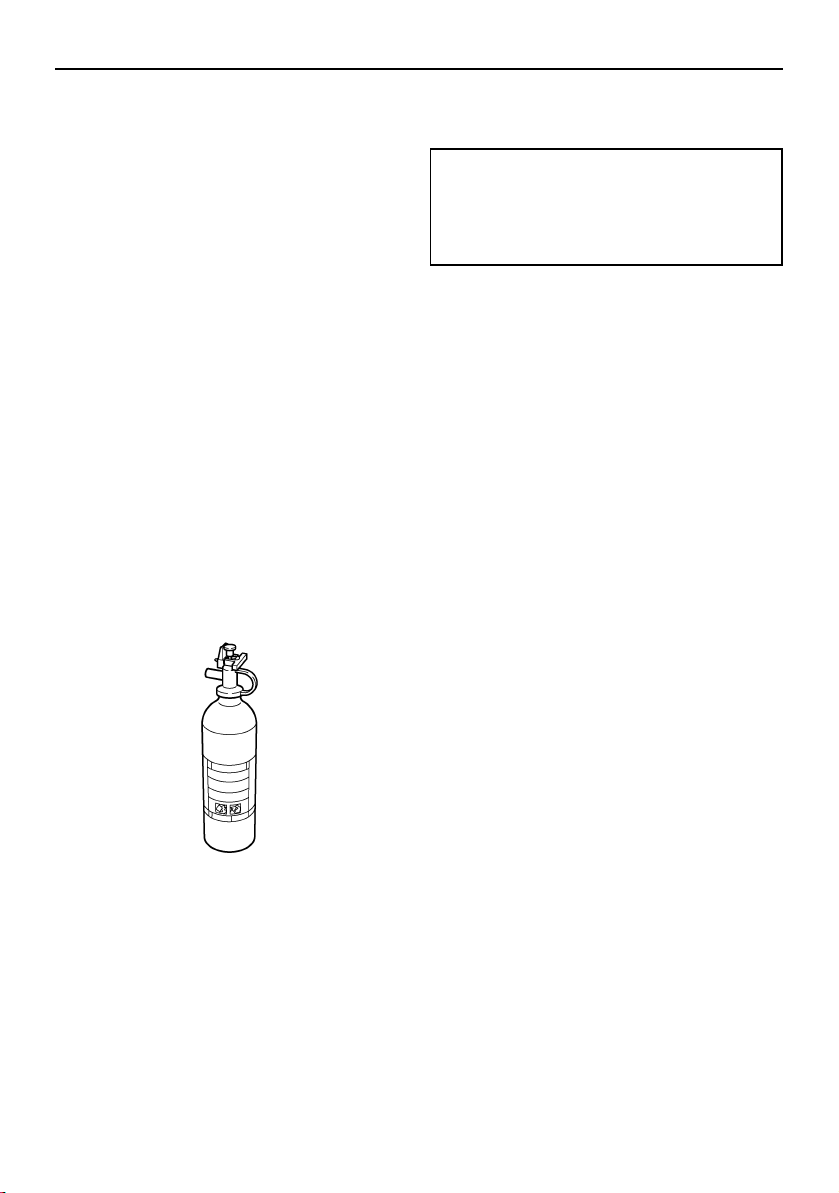
Pre-operation checks
64
(2) As soon as the engine starts running,
push the engine stop switch to make
sure that the engine stops immediately.
(3) Restart the engine, and then pull the en-
gine shut-off cord (lanyard) to remove
the clip from the engine shut-off switch
to make sure that the engine stops im-
mediately.
EJU40102
Storage compartment checks
Make sure that the storage compartments
are not damaged and that water has not col-
lected in the compartments. (See page 46 for
information on the storage compartments.)
EJU44670
Fire extinguisher holder checks
Make sure that the fire extinguisher holder is
installed in the correct direction and is not
damaged. (See page 49 for information on
the fire extinguisher holder.)
EJU44620
Fire extinguisher check
Check that there is a full fire extinguisher on
board.
To check the fire extinguisher, see the in-
structions supplied by the fire extinguisher
manufacturer. Always keep the fire extin-
guisher stored in the holder.
Always carry a fire extinguisher on board. A
fire extinguisher is not standard equipment
with this watercraft. If you do not have one,
contact a Yamaha dealer or a fire extinguish-
er dealer to obtain one meeting the proper
specifications.
EJU40122
Safety equipment check
Check that safety equipment meeting the ap-
plicable regulations is on board.
EJU32353
Hull and deck check
Check the hull and deck for damage or other
problem.
EJU32657
Jet intake checks
Make sure that the jet intake is not damaged
or clogged with weeds or debris. If the jet in-
take is clogged, clean it. (See page 97 for in-
formation on the jet intake.)
EJU43221
Jet thrust nozzle and reverse gate check
(EX Sport / EX Deluxe)
Check the jet thrust nozzle and reverse gate
for damage or other problem.
EJU44250
Stern drain plug checks
Loosen the stern drain plugs and remove
them, and then make sure that the plugs and
O-rings on the plugs are not damaged and
that there is no foreign material on the
threads or O-rings on the plugs. NOTICE:
Before installing the stern drain plugs,
clean the drain plug threads and the O-
rings on the plugs to remove any foreign
materials, such as dirt or sand. Otherwise,
the stern drain plugs could be damaged,
allowing water to enter the engine com-
partment. Check the O-rings on the stern
drain plugs and make sure that the plugs
are tightened securely before launching
the watercraft. Otherwise, water may
Fire extinguisher:
Classification:
B-1
Capacity:
2 lb or more
UF3Y10E0.book Page 64 Tuesday, August 9, 2016 9:24 AM

Pre-operation checks
67
Engine idling speed:
1500 ±100 r/min
UF3Y10E0.book Page 67 Tuesday, August 9, 2016 9:24 AM
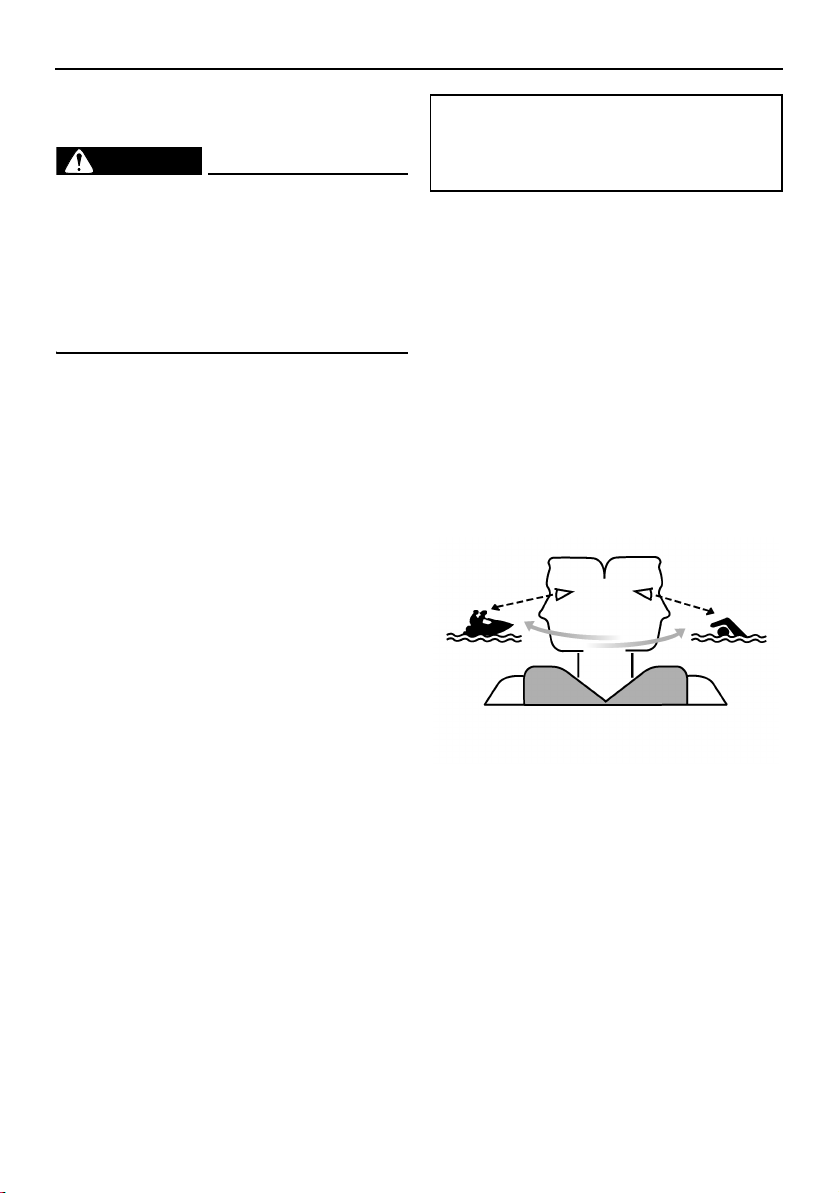
Operation
68
EJU32903
Operating your watercraft
WARNING
EWJ00511
Before operating your watercraft, become
familiar with all of the controls. Consult a
Yamaha dealer about any control or func-
tion that you do not fully understand. Fail-
ure to understand how the controls work
could cause an accident or prevent you
from avoiding an accident.
EJU32956
Getting to know your watercraft
Operating your watercraft requires skills ac-
quired through practice over a period of time.
Take the time to learn the basic techniques
well before attempting more difficult maneu-
vers.
Operating your new watercraft can be a very
enjoyable activity, providing you with hours of
pleasure. However, it is essential to familiar-
ize yourself with the operation of the water-
craft to achieve the skill level necessary to
enjoy riding safely.
Before operating this watercraft, read this
owner’s/operator’s manual, the Riding Prac-
tice Guide, the Riding Instruction card, and all
labels on the watercraft. Pay particular atten-
tion to the safety information beginning on
page 9. Also, watch the Basic Orientation
Video provided with your watercraft. These
materials should give you an understanding
of the watercraft and its operation.
Remember: This watercraft is designed to
carry the operator and up to 2 passengers.
Never exceed the maximum load limit or al-
low more than 3 persons (or 2 persons if a
wakeboarder or water-skier is being pulled)
to ride the watercraft at any time.
EJU32996
Learning to operate your watercraft
Before operating the watercraft, always per-
form the pre-operation checks listed on page
57. The short time spent checking the water-
craft will reward you with added safety and
reliability.
Check state and local laws before operating
your watercraft.
Operate defensively at safe speeds and keep
a safe distance away from people, objects,
and other watercraft. Select a wide area to
learn in, where there is good visibility and
light boat traffic.
Use the buddy system—operate with some-
one nearby. Scan constantly for people, ob-
jects, and other watercraft. Be alert for
conditions that limit your visibility or block
your vision of others.
You should grip the handlebars firmly and
keep both feet on the floor of the footwell. Do
not attempt to ride with passengers until your
operating skills are fully developed.
Maximum load:
220 kg (485 lb)
Load is the total weight of cargo, op-
erator, and passengers.
UF3Y10E0.book Page 68 Tuesday, August 9, 2016 9:24 AM
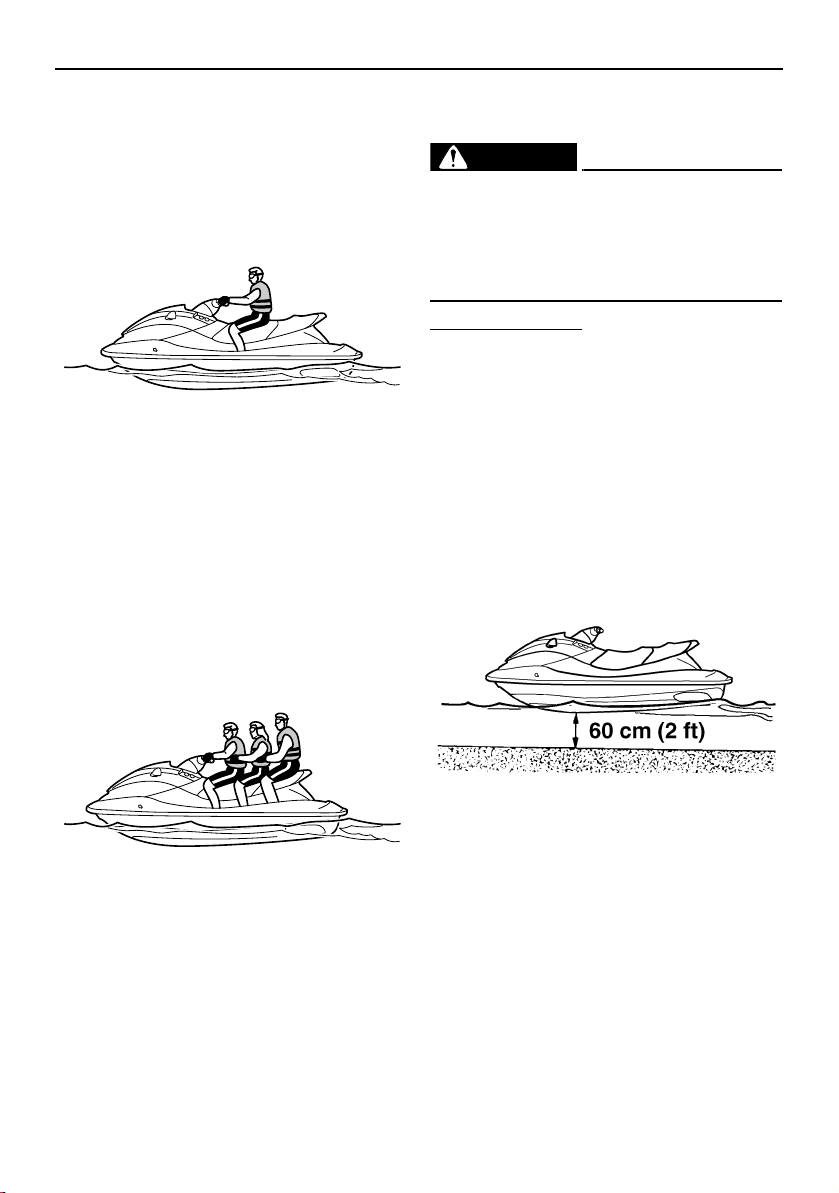
Operation
69
EJU40212
Riding position
Operator riding position
The operator should grip the handlebars firm-
ly with both hands and sit astride the seat
with both feet on the floor of the footwell.
Passenger riding position
The passenger(s) should hold on firmly, either
to the person in front of them or to the hand-
grip provided, and sit astride the seat with
their feet on the floor of the footwell. Never al-
low a passenger to ride in front of the opera-
tor. (See page 17 for information on the riding
position when pulling a wakeboarder or wa-
ter-skier.)
EJU32803
Launching the watercraft
When launching the watercraft, make sure
that there are no obstacles around you.
If the watercraft is launched from a trailer,
someone should make sure that waves do
not push the watercraft into the trailer.
EJU43580
Starting the engine on water
WARNING
EWJ01531
Do not apply throttle when anyone is at the
rear of the watercraft. Turn the engine off
or keep it at idle. Water and debris exiting
the jet thrust nozzle can cause severe in-
jury.
To start the engine:
(1) Move the watercraft to an area that is
free from weeds and debris, and has a
water depth of at least 60 cm (2 ft) from
the bottom of the watercraft. NOTIC E:
Never run the engine in water that is
less than 60 cm (2 ft) deep from the
bottom of the watercraft, otherwise
pebbles or sand could be sucked into
the jet intake, causing impeller dam-
age and engine overheating.
[ECJ00473]
(2) Attach the engine shut-off cord (lanyard)
to your left wrist, and then attach the clip
to the engine shut-off switch. (See page
30 for information on operating the en-
gine shut-off switch.) WARNING! Check
that the engine shut-off cord (lanyard)
is attached correctly. If the engine
shut-off cord (lanyard) is not attached
correctly, it may not pull free when the
operator falls off, allowing the water-
UF3Y10E0.book Page 69 Tuesday, August 9, 2016 9:24 AM

Operation
70
craft to continue to run and cause an
accident.
[EWJ00582]
(3) With the throttle lever released, push the
start switch (green button) to start the
engine. (See page 30 for information on
operating the start switch.)
EJU32863
Stopping the engine
Release the throttle lever, and then push the
engine stop switch (red button) to stop the
engine. WARNING! You need throttle to
steer. Shutting the engine off can cause
you to hit an obstacle you are attempting
to avoid. A collision could result in severe
injury or death.
[EWJ00602]
EJU32873
Leaving the watercraft
If leaving the watercraft, remove the clip from
the engine shut-off switch to prevent acci-
dental starting or unauthorized operation by
children or others.
EJU44360
Operating the watercraft
EX:
When the engine is running, the watercraft
will move forward at trolling speed even if the
1 Clip
2 Engine shut-off switch
3 Engine shut-off cord (lanyard)
1
2
3
UF3Y10E0.book Page 70 Tuesday, August 9, 2016 9:24 AM

Operation
72
page 34 for shift system operation proce-
dures.)
EJU43422
Turning the watercraft
WARNING
EWJ01782
Do not release the throttle lever when
trying to steer away from objects—you
need throttle to steer. A collision could
result in severe injury or death.
When operating at higher speeds, make
gradual turns or slow down before turn-
ing. Sharp high-speed turns may cause
the watercraft to slide sideways or spin,
throwing the operator and passenger(s)
overboard, which could cause an injury.
EX Deluxe: Take early action to avoid
collisions. The RiDE system is not a
braking device for avoiding dangerous
situations.
Steering control depends on the combination
of handlebar position and the amount of
throttle.
Water sucked in through the intake grate is
pressurized by the impeller in the jet pump.
As the pressurized water is expelled from the
pump through the jet thrust nozzle, it creates
thrust to move and steer the watercraft. The
higher the engine speed, the more thrust pro-
duced.
The amount of jet thrust, in addition to the po-
sition of the handlebars, determines how
sharply you turn.
A. More throttle produces higher thrust, so
the watercraft will turn more sharply.
B. Less throttle produces lower thrust, so
the watercraft will turn more gradually.
C. Releasing the throttle lever completely
produces only minimum thrust. If you are
traveling at speeds above trolling, you
will have rapidly decreasing ability to
1 “F” (Forward position)
1
UF3Y10E0.book Page 72 Tuesday, August 9, 2016 9:24 AM

Operation
74
proximately 90 m (300 ft) after the throttle le-
ver is released or the engine is stopped,
although this distance will vary depending on
many factors, including gross weight, water
surface conditions, and wind direction.
EX Deluxe: If the RiDE lever is squeezed to
slow down, the stopping distance is approxi-
mately 30% shorter than when the RiDE lever
is not used. However, this distance will vary
depending on many factors, including gross
weight, water surface conditions, and wind
direction.
WARNING
EWJ01970
Allow adequate stopping distance.
Take early action to avoid collisions. Re-
member, watercraft and other boats do
not have brakes.
Operate defensively at safe speeds and
keep a safe distance away from people,
objects, and other watercraft to give you
time to stop.
Do not shut the engine off when slowing
down in case you need engine power to
steer away from a boat or other obstacle
that comes into your path.
EX Sport: Do not use the reverse func-
tion to slow down or stop the watercraft
as it could cause you to lose control, be
ejected, or impact the handlebars.
EX Deluxe: To avoid rear-end collisions
while operating the watercraft, check
behind you before using the RiDE lever
to slow down or stop the watercraft.
EJU44681
Operating the watercraft in reverse or
neutral (EX Sport / EX Deluxe)
Operating in reverse (EX Sport)
Pull the shift lever rearward to the reverse po-
sition. The watercraft will move in reverse.
(See page 34 for information on the reverse
system.)
Make sure that there are no obstacles or peo-
ple behind you before shifting into reverse.
TIP:
This model is not equipped with a neutral
function.
90 m (300 ft)
1 Shift lever
2 Reverse position
1
2
UF3Y10E0.book Page 74 Tuesday, August 9, 2016 9:24 AM

Operation
75
Operating in reverse (EX Deluxe)
When the RiDE lever is squeezed, the “R” (re-
verse) shift indicator will be displayed in the
information display and the watercraft will
move in reverse. (See page 34 for shift sys-
tem operation procedures.)
Make sure that there are no obstacles or peo-
ple behind you before shifting into reverse.
TIP:
This model is equipped with a function which
limits the engine speed in reverse.
Operating in neutral (EX Deluxe)
When the RiDE lever is squeezed lightly and
released, the “N” (neutral) shift indicator will
be displayed in the information display and
the watercraft will stop in its current location.
(See page 34 for shift system operation pro-
cedures.)
EJU36087
Boarding the watercraft
WARNING
EWJ01112
Be sure the operator and any passengers
have practiced boarding from the water
while still close to shore before riding. A
person who has made many unsuccessful
attempts to get back on the watercraft
may become fatigued and suffer from ex-
posure, increasing the risk of injury and
drowning.
Board the watercraft in water free from
weeds and debris and at least 60 cm (2 ft)
deep from the bottom of the watercraft.
NOTICE: Never run the engine in water
that is less than 60 cm (2 ft) deep from the
bottom of the watercraft, otherwise peb-
1 “R” (Reverse position)
1
1 “N” (Neutral position)
1
UF3Y10E0.book Page 75 Tuesday, August 9, 2016 9:24 AM
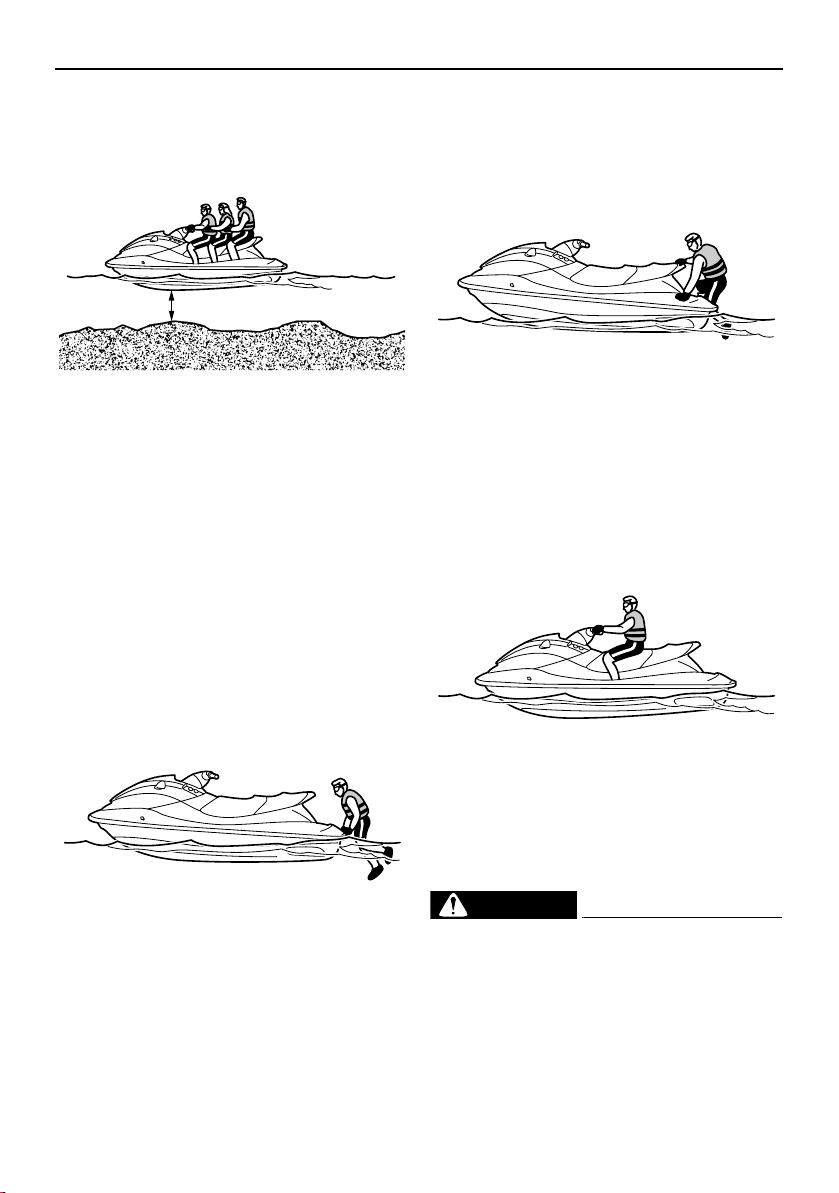
Operation
76
bles or sand could be sucked into the jet
intake, causing impeller damage and en-
gine overheating.
[ECJ00473]
TIP:
EX Sport / EX Deluxe: This watercraft is
equipped with a reboarding step, which can
be lowered and used to assist in reboarding.
(See page 45 for information on operating the
reboarding step.)
EJU36354
Boarding alone
(1) From the rear of the watercraft, place
both hands on the boarding platform,
pull yourself up, and then grasp the
handgrip with one hand.
(2) Pull yourself up to a kneeling position on
the boarding platform, and then move to
the seat and sit astride.
(3) Attach the engine shut-off cord (lanyard)
to your left wrist, and then attach the clip
to the engine shut-off switch.
(4) Grip the handlebars with both hands and
place both feet on the floor of the foot-
well.
(5) Look in all directions, start the engine,
and then start off slowly.
EJU43260
Boarding with passenger(s)
WARNING
EWJ01800
Severe internal injuries can occur if wa-
ter is forced into body cavities as a re-
sult of being near the jet thrust nozzle.
Do not start the engine until the passen-
gers are seated with their feet on the
floor of the footwell and are securely
60 cm (2 ft)
UF3Y10E0.book Page 76 Tuesday, August 9, 2016 9:24 AM

Operation
77
holding on to the person in front of them
or to the handgrip provided.
Before boarding the watercraft, make
sure that the engine is stopped. If the
engine is running, the reverse gate may
move down and a person boarding
could be pinched.
The heavier the total weight of the operator
and passenger(s), the more difficult it will be
to balance the watercraft. Do not operate the
watercraft when the total weight exceeds 220
kg (485 lb) including any cargo.
To board with passenger(s):
(1) Board as noted in the previous section
“Boarding alone”.
(2) Grip the handlebars with both hands and
place both feet on the floor of the foot-
well.
(3) Have the first passenger move to the rear
of the watercraft.
(4) Have the first passenger board using the
same procedure as the operator, place
their feet on the floor of the footwell, and
securely hold on to the operator.
(5) Have the second passenger follow the
same procedure. When the second pas-
senger is boarding, try to balance the
watercraft together with the first passen-
ger.
(6) Make sure that the passenger(s) have
their feet on the floor of the footwell and
UF3Y10E0.book Page 77 Tuesday, August 9, 2016 9:24 AM
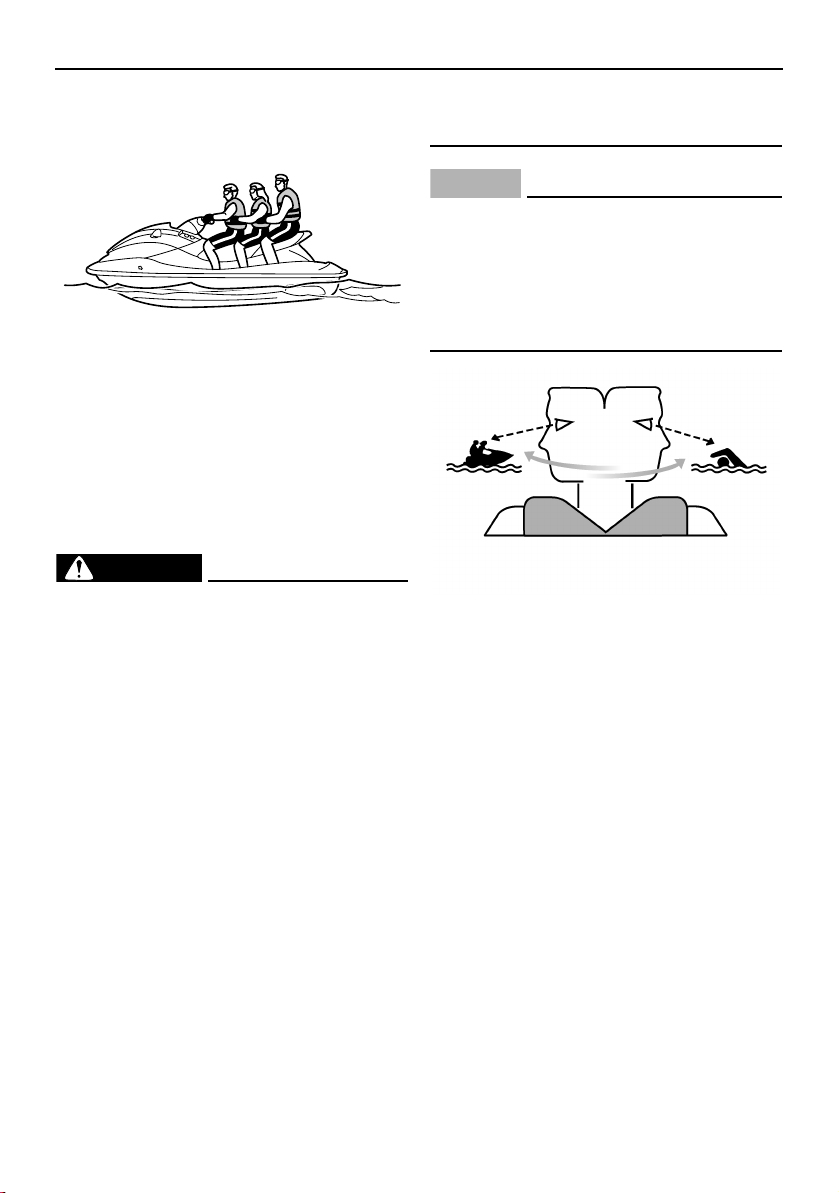
Operation
78
are securely holding on to the person in
front of them or to the handgrip provided.
(7) Attach the engine shut-off cord (lanyard)
to your left wrist, and then attach the clip
to the engine shut-off switch.
(8) Look in all directions, start the engine,
and then start off slowly.
EJU33083
Starting off
WARNING
EWJ00712
To avoid collisions:
Scan constantly for people, objects, and
other watercraft. Be alert for conditions
that limit your visibility or block your vi-
sion of others.
Operate defensively at safe speeds and
keep a safe distance away from people,
objects, and other watercraft.
Do not follow directly behind watercraft
or other boats. Do not go near others to
spray or splash them with water. Avoid
sharp turns or other maneuvers that
make it hard for others to avoid you or
understand where you are going. Avoid
areas with submerged objects or shal-
low water.
Take early action to avoid collisions. Re-
member, watercraft and other boats do
not have brakes. Do not release the
throttle lever when trying to steer away
from objects—you need throttle to
steer.
NOTICE
ECJ01341
Never run the engine in water that is less
than 60 cm (2 ft) deep from the bottom of
the watercraft, otherwise pebbles or sand
could be sucked into the jet intake, caus-
ing impeller damage and engine overheat-
ing.
EJU44381
Starting off from a trailer
EX:
(1) Launch the watercraft, and then turn it
around so that the bow faces the direc-
tion you wish to go.
(2) Attach the engine shut-off cord (lanyard)
to your left wrist, and then attach the clip
to the engine shut-off switch.
(3) Look in all directions, start the engine,
and then start off slowly.
EX Sport:
(1) Launch the watercraft, and then move
the shift lever to the reverse position.
(See page 34 for information on the re-
verse system.)
(2) Attach the engine shut-off cord (lanyard)
to your left wrist, and then attach the clip
to the engine shut-off switch.
(3) Look in all directions, start the engine,
and then start off slowly.
UF3Y10E0.book Page 78 Tuesday, August 9, 2016 9:24 AM
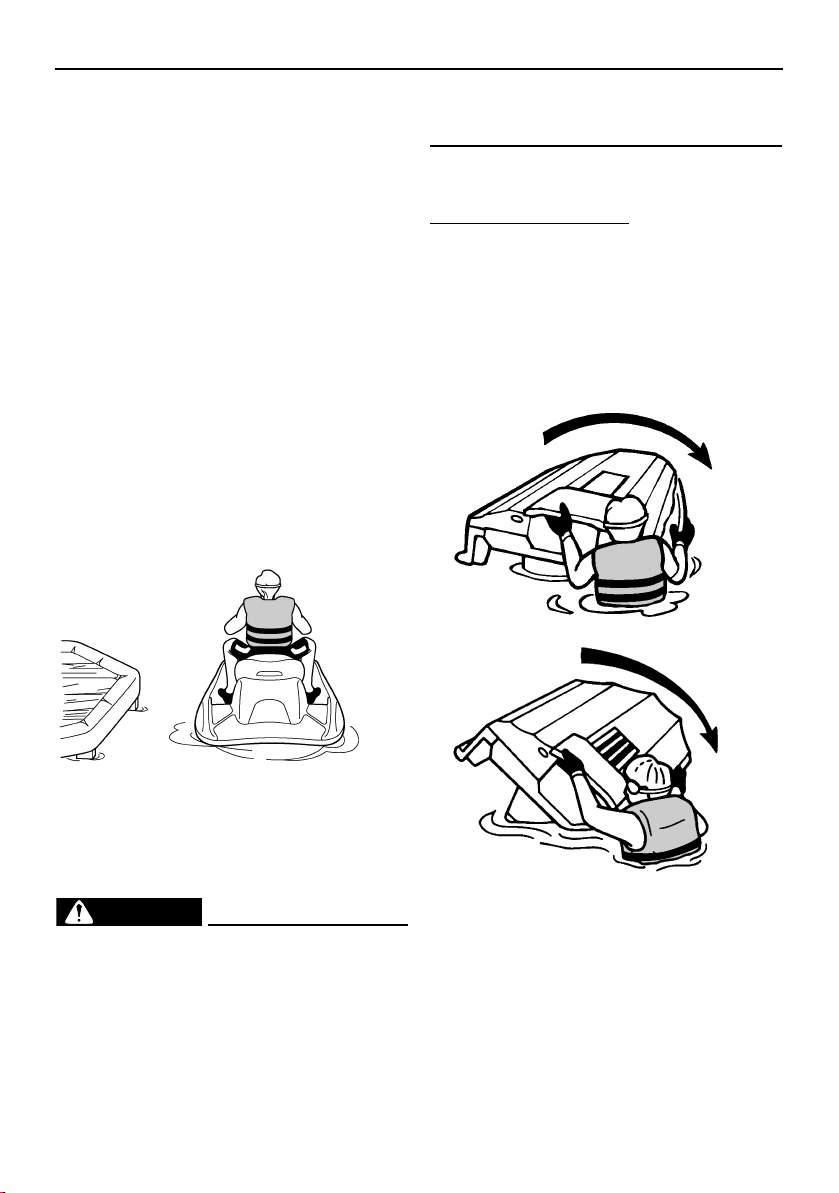
Operation
79
EX Deluxe:
(1) Launch the watercraft.
(2) Attach the engine shut-off cord (lanyard)
to your left wrist, and then attach the clip
to the engine shut-off switch.
(3) Look in all directions, and then start the
engine.
(4) Squeeze the RiDE lever and move the
watercraft back slowly. (See page 34 for
RiDE lever operation procedures.)
EJU33114
Boarding and starting off from a dock
(1) Board the watercraft from the side.
(2) Attach the engine shut-off cord (lanyard)
to your left wrist, and then attach the clip
to the engine shut-off switch.
(3) Push the watercraft away from the dock,
grip the handlebars with both hands, and
place both feet on the floor of the foot-
well.
(4) Look in all directions, start the engine,
and then start off slowly.
EJU44210
Capsized watercraft
WARNING
EWJ00672
Improper uprighting can cause injury.
Be sure to shut the engine off by pulling
on the engine shut-off cord (lanyard) to
remove the clip from the engine shut-off
switch.
Do not put your hands in the intake
grate.
If the watercraft capsizes, turn it over imme-
diately.
To upright the watercraft:
(1) Remove the clip from the engine shut-off
switch.
(2) Swim to the rear of the watercraft. Turn
the watercraft over by pulling on the ride
plate with one hand while pushing down
on the gunwale with your other hand or
your foot.
(3) Start the engine and operate the water-
craft at planing speed to drain the bilge
water from the engine compartment.
(See page 53 for information on draining
the bilge water. If the engine does not
start, see “Towing the watercraft” on
page 99 or “Submerged watercraft” on
page 99.) NOTICE: Do not run the en-
gine at full throttle for at least 1 minute
UF3Y10E0.book Page 79 Tuesday, August 9, 2016 9:24 AM

Operation
80
after the engine has been restarted.
Bilge water in the engine compart-
ment can splash into the engine,
which can result in severe damage.
[ECJ00554]
EJU44390
Beaching and docking the watercraft
To beach the watercraft (EX / EX Sport):
(1) Make sure that there are no boats, swim-
mers, or obstacles near the beach.
(2) Release the throttle lever to reduce
speed about 90 m (300 ft) before you
reach the intended beaching area.
(3) Slowly approach the beach and stop the
engine just before reaching land.
WARNING! You need throttle to steer.
Shutting the engine off can cause you
to hit an obstacle you are attempting
to avoid. A collision could result in se-
vere injury or death.
[EWJ00602] NOTIC E:
Never run the engine in water that is
less than 60 cm (2 ft) deep from the
bottom of the watercraft, otherwise
pebbles or sand could be sucked into
the jet intake, causing impeller dam-
age and engine overheating.
[ECJ00473]
(4) Get off the watercraft and pull it up on the
beach.
To beach the watercraft (EX Deluxe):
(1) Make sure that there are no boats, swim-
mers, or obstacles near the beach.
(2) Release the throttle lever to reduce
speed about 90 m (300 ft) before you
reach the intended beaching area.
(3) Slowly approach the beach using the
throttle lever and RiDE lever to control
the watercraft speed. NOTICE: Never
run the engine in water that is less
than 60 cm (2 ft) deep from the bottom
of the watercraft, otherwise pebbles
or sand could be sucked into the jet
intake, causing impeller damage and
engine overheating.
[ECJ00473]
(4) After reaching land, stop the engine, and
then get off the watercraft and pull it up
on the beach.
To dock the watercraft (EX / EX Sport):
(1) Make sure that there are no boats, swim-
mers, or obstacles near the dock.
(2) Release the throttle lever to reduce
speed about 90 m (300 ft) away from the
dock.
(3) Slowly approach the dock and stop the
engine just before coming alongside it.
WARNING! You need throttle to steer.
Shutting the engine off can cause you
to hit an obstacle you are attempting
to avoid. A collision could result in se-
vere injury or death.
[EWJ00602]
(4) Come alongside the dock and get off the
watercraft.
To dock the watercraft (EX Deluxe):
(1) Make sure that there are no boats, swim-
mers, or obstacles near the dock.
(2) Release the throttle lever to reduce
speed about 90 m (300 ft) away from the
dock.
(3) Slowly approach the dock using the
throttle lever and RiDE lever to control
the watercraft speed.
(4) After coming alongside the dock, stop
the engine, and then get off the water-
craft.
EJU37194
Operating in weeded areas
Always avoid using your watercraft in areas
where weed growth is thick. If operating in
weeded areas is unavoidable, alternately
squeeze the throttle lever and relax your grip
on the throttle lever to vary the engine speed.
Weeds tend to become clogged more when
operating at a steady speed and at trolling
speed. If weeds may have clogged the intake
UF3Y10E0.book Page 80 Tuesday, August 9, 2016 9:24 AM

Care and storage
83
ter flows out continually from the jet
thrust nozzle.
(7) Run the engine at idling speed for about
3 minutes watching the engine condition.
If the engine stops while flushing, turn
the water supply off immediately and
perform the procedure again from step 6.
NOTICE: Do not supply water to the
cooling water passages when the en-
gine is not running. The water could
flow back through the muffler into the
engine, causing severe engine dam-
age.
[ECJ00123]
(8) Turn the water supply off.
(9) Discharge the remaining water out of the
cooling water passages by alternately
squeezing and releasing the throttle lever
quickly for 10 to 15 seconds.
(10) Stop the engine.
(11) Remove the garden hose adapter, and
then securely install the flushing hose
connector cap by tightening it until it
stops.
(12) Securely install the seat storage com-
partment and seat in their original posi-
tions.
EJU44760
Cleaning the watercraft
(1) Remove the seat and fire extinguisher
holder. (See page 44 for seat removal
and installation procedures and page 49
for information on the fire extinguisher
holder.)
(2) If the watercraft will be stored for a week
or more, rustproof the internal engine
components to help prevent corrosion.
(See page 87 for information on rust-
proofing the internal engine compo-
nents.)
(3) Rinse the engine and engine compart-
ment with a small amount of water.
NOTICE: Do not use high-pressure
water when rinsing the engine or en-
gine compartment as severe engine
damage could result.
[ECJ00572]
(4) Drain the water from the engine com-
partment. (See page 53 for information
on draining the bilge water.)
(5) Wipe the engine and engine compart-
ment with a dry cloth.
(6) Wash down the hull, deck, and jet pump
with fresh water.
(7) Wipe the hull, deck, and jet pump with a
dry cloth.
(8) Wipe all vinyl and rubber components,
such as the seat and engine compart-
ment seals, with a vinyl protectant such
as Yamaha Protectant.
(9) To minimize corrosion, spray metallic
parts of the hull, deck, and engine with a
rust inhibitor such as Yamaha Silicone
Protectant and Lubricant.
(10) Allow the engine compartment to air dry
completely before installing the seat.
(11) Securely install the fire extinguisher hold-
er and seat in their original positions.
EJU41632
Battery care
If the watercraft will not be used for more than
a month, remove the battery from the water-
craft, check it, and then store it in a cool, dry
place.
UF3Y10E0.book Page 83 Tuesday, August 9, 2016 9:24 AM

Care and storage
84
WARNING
EWJ00792
Battery electrolyte is poisonous and dan-
gerous, causing severe burns, etc. Elec-
trolyte contains sulfuric acid. Avoid
contact with skin, eyes, or clothing.
Antidotes
External: Flush with water.
Internal: Drink large quantities of water or
milk. Follow with milk of magnesia, beaten
egg, or vegetable oil. Call a physician im-
mediately.
Eyes: Flush with water for 15 minutes and
get prompt medical attention.
Batteries produce explosive gases. Keep
sparks, flames, cigarettes, etc., well away.
If using or charging the battery in an en-
closed space, make sure that it is well
ventilated. Always shield your eyes when
working near batteries.
Keep out of the reach of children.
To remove the battery:
(1) Disconnect the negative (–) battery lead.
(2) Disconnect the positive (+) battery lead.
(3) Disconnect the breather hose.
(4) Unhook the battery bands, and then re-
move the battery from the watercraft.
Checking the battery
Make sure that the battery case is not dam-
aged.
Make sure that the battery terminals are
not corroded or damaged.
Make sure that the breather hose is not
clogged or damaged.
Checking the electrolyte level
Make sure that the electrolyte level is be-
tween the maximum and minimum level
marks.
If the electrolyte level is low, add distilled wa-
ter to raise it to the specified level. NOTICE:
Use only distilled water for replenishing
the battery, otherwise battery life could be
shortened.
[ECJ00242]
If distilled water was added, check the bat-
tery voltage.
It is recommended to have a Yamaha dealer
check the battery voltage and charge the bat-
tery. If you charge the battery yourself, be
sure to read and follow the instructions pro-
vided with the battery tester and charger you
use. NOTICE: Do not attempt to charge a
battery hastily. Battery life could be short-
ened.
[ECJ00252]
1 Negative (–) battery terminal: Black lead
2 Battery band
3 Positive (+) battery terminal: Red lead
4 Breather hose
1
2
4
3
1 Maximum level mark
2 Minimum level mark
UF3Y10E0.book Page 84 Tuesday, August 9, 2016 9:24 AM

Care and storage
85
Checking the battery bands
Make sure that the battery bands are not
damaged.
To store the battery:
(1) Clean the battery case using fresh water.
(2) If the battery terminals are dirty or cor-
roded, clean them using a wire brush.
(3) Apply water-resistant grease to the bat-
tery terminals.
(4) Store the battery in a cool, dry place.
NOTICE: Storing the battery in an un-
charged condition can cause perma-
nent battery damage. Check the
battery periodically.
[ECJ00103]
To install the battery:
(1) Place the battery in the battery compart-
ment and hook the battery bands onto
the holders.
(2) Connect the positive (+) battery lead (red)
to the positive (+) battery terminal.
NOTICE: Reversal of the battery leads
will damage the electrical parts.
[ECJ00262]
(3) Connect the negative (–) battery lead
(black) to the negative (–) battery termi-
nal.
(4) Connect the breather hose to the bat-
tery. WARNING! Fire or explosion
could result if the breather hose is
damaged, obstructed, or not connect-
ed properly.
[EWJ00452]
(5) Make sure that the battery is securely
held in place.
1 Battery band
1 Battery terminal
Recommended water-resistant grease:
YAMALUBE MARINE GREASE
UF3Y10E0.book Page 85 Tuesday, August 9, 2016 9:24 AM
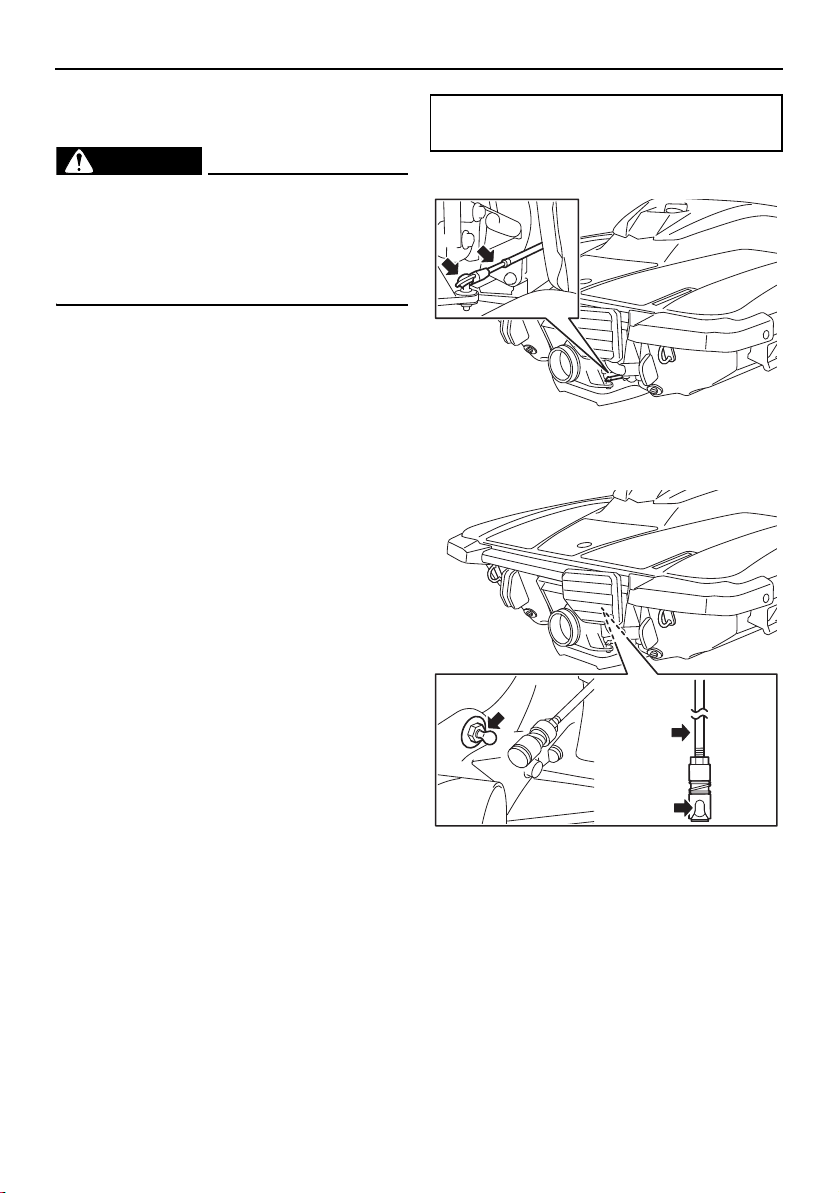
Care and storage
86
EJU33493
Long-term storage
WARNING
EWJ00331
Always place the watercraft upright in a
horizontal position when storing it, other-
wise fuel could leak out into the engine or
engine compartment, which could create
a fire hazard.
Storage for long periods of time, such as win-
ter storage, requires preventive maintenance
to ensure against deterioration. It is advisable
to have the watercraft serviced by a Yamaha
dealer prior to storage.
However, the following procedures can be
performed easily by the owner.
EJU40254
Cleaning
(1) Flush the cooling water passages. (See
page 82 for information on flushing the
cooling water passages.)
TIP:
If you will be storing the watercraft for a pro-
longed period, such as winter storage, top off
the fuel tank with fresh gasoline and add one
ounce of Yamaha Fuel Stabilizer and Condi-
tioner to each gallon of fuel in the fuel tank
before starting the engine.
(2) Clean the watercraft. (See page 83 for in-
formation on cleaning the watercraft.)
Wax the hull with a non-abrasive wax
such as YamaGlare Polish.
EJU44411
Lubrication
Use a Yamaha Power Cable Luber and spray
Yamaha Lube-Zall between the inner and
outer cables to lubricate the cables and
purge out any dirt and moisture.
To keep moving parts sliding or rotating
smoothly, lubricate them with water-resistant
grease.
Steering cable (jet thrust nozzle end)
EX Sport: Shift cable and ball joint (reverse
gate end)
Recommended water-resistant grease:
YAMALUBE MARINE GREASE
UF3Y10E0.book Page 86 Tuesday, August 9, 2016 9:24 AM

Maintenance
90
EJU43101
Periodic maintenance chart
The periodic maintenance chart gives general guidelines for periodic maintenance. Have a
Yamaha dealer perform the checks in the following chart. However, maintenance may need
to be performed more frequently depending on your operating conditions. If you have any
questions, consult a Yamaha dealer.
This “√” mark indicates items to be checked and serviced by a Yamaha dealer.
Item Operation
Initial Thereafter every
Page
10 hours
50 hours
or 12
months
*1
100
hours or
12
months
*1
200
hours or
24
months
*1
Fuel line
Check fuel hoses and
clamps
√ —
Fuel filler cap/Wa-
ter separator
Check O-rings for cracks
and deformation
√ —
Fuel tank
Check installation and
straps
√ —
Water inlet strainer
Check for clogs and dam-
age
√ —
Cooling water hos-
es
Check for damage and
leakage, and check
clamps
√ —
Engine oil Replace √√92
Oil filter Replace √ 92
Intermediate hous-
ing
Lubricate √ —
Spark plugs Check √√—
Battery
Check state of charge,
terminals, bands, and
breather hose
√ —
Battery leads Check terminals √ —
Steering master
Check operation and for
looseness
√√—
Steering cable
Check exterior and con-
nections, and lubricate
√ —
Shift lever (EX
Sport)
Check exterior and con-
nections, and lubricate
√ —
Shift cable and re-
verse gate (EX
Sport)
Check exterior and con-
nections, and lubricate
√ —
Shift rod and re-
verse gate (EX De-
luxe)
Check exterior and con-
nections, and lubricate
√ —
UF3Y10E0.book Page 90 Tuesday, August 9, 2016 9:24 AM

Maintenance
91
*1: Whichever comes first.
*2: Check every 200 hours.
Perform the pre-operation checks and post-operation checks before performing periodic
maintenance.
Air filter element
Check for damage and
dirt
√ —
Air intake hoses
Check for damage, and
check clamps
√ —
Throttle body Lubricate throttle valve √ —
Exhaust system
Check for exhaust leak-
age, and check hoses and
clamps
√ —
Breather hose
Check breather hose and
clamps
√ —
Impeller
Check for bends, dam-
age, and foreign material
√ —
Jet thrust nozzle
Check movement, and lu-
bricate
√ —
Jet vacuum bilge
Check hoses for clogs
and damage, check
clamps, and clean bilge
strainer
√ —
Stern drain plugs Check O-rings √ —
Anode
Check for corrosion, and
clean
√ *2 —
Valve clearance Check and adjust √ *2 —
Rubber coupling
Check for cracks, inden-
tations, looseness, and
noise
√ —
Engine mount
Check for damage and
peeling
√ —
Item Operation
Initial Thereafter every
Page
10 hours
50 hours
or 12
months
*1
100
hours or
12
months
*1
200
hours or
24
months
*1
UF3Y10E0.book Page 91 Tuesday, August 9, 2016 9:24 AM

Maintenance
92
EJU36943
Engine oil and oil filter
WARNING
EWJ00341
Engine oil is extremely hot immediately af-
ter the engine is turned off. Coming in con-
tact with or getting any engine oil on your
clothes could result in burns.
NOTICE
ECJ00992
Do not run the engine with too much or not
enough oil in the engine, otherwise the en-
gine could be damaged.
It is recommended to have a Yamaha dealer
change the engine oil and the engine oil filter.
However, if you choose to change the oil and
filter on your own, consult a Yamaha dealer.
UF3Y10E0.book Page 92 Tuesday, August 9, 2016 9:24 AM
Trouble recovery
94
EJU34562
Troubleshooting
If you have any trouble with your watercraft, use the troubleshooting chart to check for the
possible cause.
If you cannot find the cause, consult a Yamaha dealer.
EJU44430
Troubleshooting chart
Confirm the possible cause and remedy, and then refer to the applicable page.
TROUBLE POSSIBLE CAUSE REMEDY PAGE
Engine does not
start (Starter motor
does not turn over)
Engine shut-
off switch
Clip not in place Install clip
30
Fuse Burned out Have serviced by
Yamaha dealer
—
Battery Run down Recharge 83
Poor terminal con-
nections
Tighten as required
83
Terminal corroded Clean or replace 83
Starter motor Faulty Have serviced by
Yamaha dealer
—
Engine does not
start (Starter motor
turns over)
Throttle lever Squeezed Release 30
Faulty Have serviced by
Yamaha dealer
—
RiDE lever
(EX Deluxe)
Squeezed Release 30
Faulty Have serviced by
Yamaha dealer
—
Fuel Fuel tank empty Refill as soon as pos-
sible
50
Stale or contaminat-
ed
Have serviced by
Yamaha dealer
—
Fuel tank Water or dirt present Have serviced by
Yamaha dealer
—
Spark plug Fouled or defective Have serviced by
Yamaha dealer
—
Fuel injec-
tion system
Fuel pump faulty Have serviced by
Yamaha dealer
—
UF3Y10E0.book Page 94 Tuesday, August 9, 2016 9:24 AM
Trouble recovery
96
Watercraft slow or
loses power
Cavitation Jet intake clogged Clean 97
Impeller damaged or
worn
Have serviced by
Yamaha dealer
97
Engine over-
heat warning
Engine speed reduc-
tion control activated
Clean jet intake and
cool engine
42
Oil pressure
warning
Engine speed reduc-
tion control activated
Add oil
41
Spark plug Fouled or defective Have serviced by
Yamaha dealer
—
Incorrect heat range Have serviced by
Yamaha dealer
—
Gap incorrect Have serviced by
Yamaha dealer
—
Electrical wir-
ing
Loose connection Have serviced by
Yamaha dealer
—
Fuel Stale or contaminat-
ed
Have serviced by
Yamaha dealer
—
Air filter Clogged Have serviced by
Yamaha dealer
—
Oil buildup Have serviced by
Yamaha dealer
—
Throttle lever Faulty Have serviced by
Yamaha dealer
—
TROUBLE POSSIBLE CAUSE REMEDY PAGE
UF3Y10E0.book Page 96 Tuesday, August 9, 2016 9:24 AM
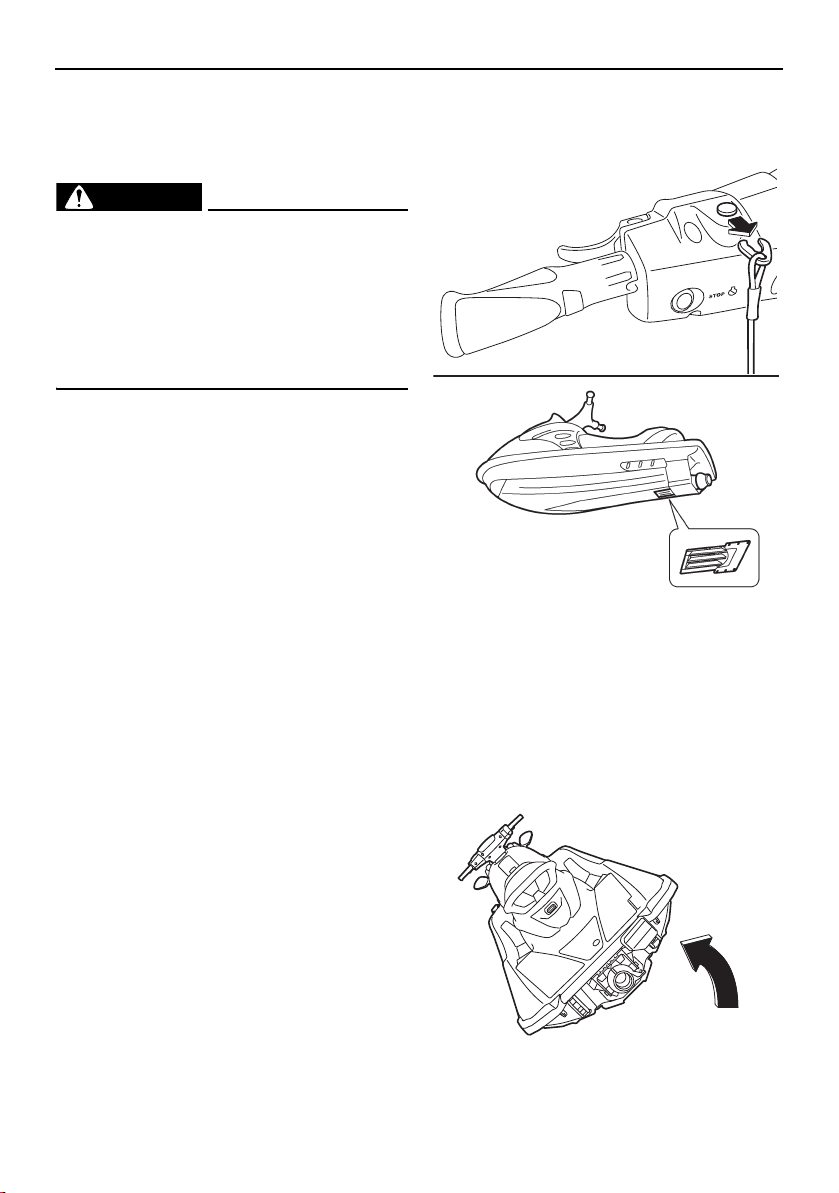
Trouble recovery
97
EJU34625
Emergency procedures
EJU44590
Cleaning the jet intake and impeller
WARNING
EWJ00783
Before attempting to remove weeds or de-
bris from the jet intake or impeller area,
shut the engine off and remove the clip
from the engine shut-off switch. Severe in-
jury or death could result from coming in
contact with the rotating parts of the jet
pump.
If weeds or debris gets caught in the jet intake
or impeller, cavitation can occur, causing jet
thrust to decrease even though engine speed
rises. If this condition is allowed to continue,
the engine will overheat and may seize.
NOTICE: If weeds or debris gets caught in
the jet intake, do not operate the water-
craft above trolling speed until they have
been removed.
[ECJ00654]
If there is any sign that the jet intake or impel-
ler is clogged with weeds or debris, return to
shore and check the intake and impeller. Al-
ways stop the engine before beaching the
watercraft.
(1) Place a suitable clean cloth or carpeting
underneath the watercraft to protect it
from abrasions and scratches. Turn the
watercraft on its side as shown.
NOTICE: When turning the watercraft
on its side, support the bow so that
the handlebars are not bent or dam-
aged.
[ECJ02690]
(2) Remove any weeds or debris from
around the jet intake, drive shaft, impel-
UF3Y10E0.book Page 97 Tuesday, August 9, 2016 9:24 AM
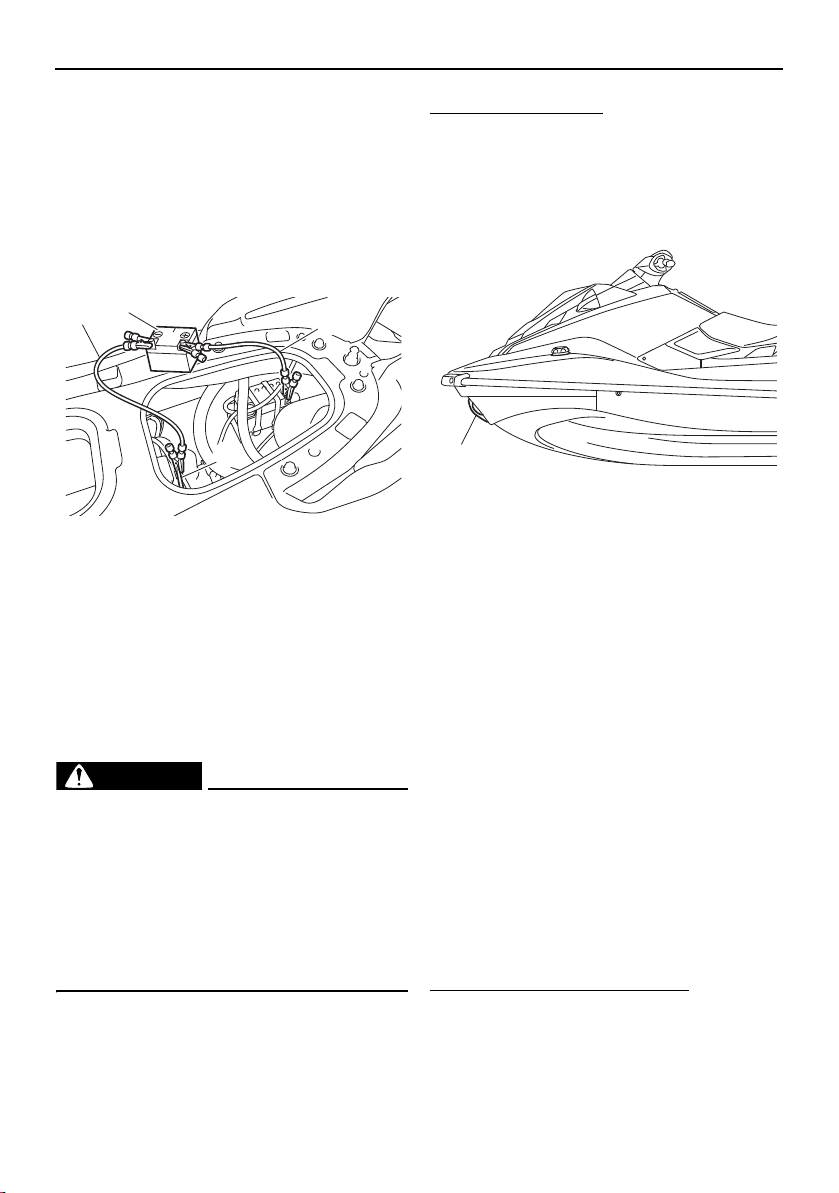
Trouble recovery
99
(1) Connect the positive (+) jumper cable to
the positive (+) battery terminals of both
batteries.
(2) Connect one end of the negative (–)
jumper cable to the negative (–) battery
terminal of the booster battery.
(3) Connect the other end of the negative (–)
jumper cable to an engine hanger.
(4) Start the engine, and then disconnect the
jumper cables by reversing the steps
above. (See page 30 for information on
starting the engine.)
EJU34716
Towing the watercraft
WARNING
EWJ00812
The operator of the towing boat must
keep speed to a minimum and avoid
traffic or obstacles which could be a
hazard to the operator on the water-
craft.
The towline should be long enough so
that the watercraft will not collide with
the towing boat when slowing down.
If the watercraft becomes inoperative in the
water, it can be towed to shore.
To tow the watercraft:
Use a towline that is three times the com-
bined length of the towing boat and the wa-
tercraft.
(1) Securely attach the towline to the bow
eye of the watercraft being towed.
(2) Sit astride the seat and hold on to the
handlebars in order to balance the water-
craft. NOTICE: The bow must be kept
up out of the water during towing, oth-
erwise water could flood the engine
compartment or water could flow
back into the engine, causing severe
engine damage.
[ECJ01331]
Tow the watercraft at 8 km/h (5 mph) or less.
NOTICE: Tow the watercraft at 8 km/h (5
mph) or less, otherwise water could flood
the engine compartment or water could
flow back into the engine, causing severe
engine damage.
[ECJ01322]
EJU42101
Submerged watercraft
If the watercraft is submerged or flooded with
water, drain the bilge water from the engine
compartment. Then, have a Yamaha dealer
service the watercraft as soon as possible.
If the watercraft was submerged:
(1) Remove the watercraft from the water
and drain the water from the storage
compartments.
1 Positive (+) jumper cable
2 Booster battery
3 Negative (–) jumper cable
4 Engine hanger
1
2
3
4
1 Bow eye
1
UF3Y10E0.book Page 99 Tuesday, August 9, 2016 9:24 AM

Trouble recovery
100
(2) Drain the bilge water from the engine
compartment. (See page 53 for informa-
tion on draining the bilge water.)
(3) Have the watercraft serviced by a
Yamaha dealer as soon as possible.
NOTICE: Be sure to have a Yamaha
dealer inspect the watercraft. Other-
wise, serious engine damage could
result.
[ECJ00792]
UF3Y10E0.book Page 100 Tuesday, August 9, 2016 9:24 AM

104
Index
A
After removing the watercraft from the
water..................................................... 81
Approval label of emission control
certificate ................................................ 2
B
Battery care.............................................. 83
Battery checks ......................................... 60
Battery, jumping....................................... 98
Beaching and docking the watercraft...... 80
Bilge water check..................................... 60
Bilge water, draining ................................ 53
Bilge water, draining on land ................... 53
Bilge water, draining on water ................. 54
Boarding alone......................................... 76
Boarding and starting off from a dock..... 79
Boarding the watercraft ........................... 75
Boarding with passenger(s) ..................... 76
Bow eye ................................................... 46
Bow storage compartment ...................... 46
C
Capsized watercraft................................. 79
Check engine warning ............................. 42
Cleaning ................................................... 86
Cleaning the watercraft............................ 83
Cleat......................................................... 46
Cooling water pilot outlet......................... 32
Cooling water pilot outlet check .............. 65
Cruising limitations................................... 10
E
Emergency procedures............................ 97
Emission control information ..................... 2
Engine break-in........................................ 56
Engine compartment check..................... 59
Engine idling speed check ....................... 66
Engine oil ................................................. 52
Engine oil and oil filter.............................. 92
Engine oil level check............................... 60
Engine oil requirements ........................... 52
Engine overheat warning ......................... 42
Engine serial number ................................. 1
Engine shut-off cord (lanyard) check ....... 63
Engine shut-off switch ............................. 30
Engine stop switch................................... 30
Engine unit check..................................... 60
Enjoy your watercraft responsibly............ 23
Equipment................................................ 44
F
Fire extinguisher check ............................ 64
Fire extinguisher holder............................ 49
Fire extinguisher holder checks ............... 64
Flushing the cooling water passages....... 82
Fuel .......................................................... 50
Fuel level check........................................ 59
Fuel level meter ........................................ 41
Fuel level warning..................................... 41
Fuel requirements .................................... 50
Fuel system checks ................................. 59
G
Getting to know your watercraft .............. 68
Glossary, watercraft ................................. 25
Glove compartment ................................. 47
H
Handgrip .................................................. 44
Hazard information................................... 15
Hood check.............................................. 65
Hour meter and voltmeter ........................ 40
Hull and deck check ................................ 64
Hull Identification Number (HIN)................. 1
I
Identification numbers ............................... 1
Information display................................... 38
J
Jet intake and impeller, cleaning.............. 97
Jet intake checks ..................................... 64
Jet thrust nozzle and reverse gate check
(EX Sport / EX Deluxe) .......................... 64
Jumper cables, connecting...................... 98
L
Labels, important ....................................... 5
Labels, other .............................................. 8
Labels, warning .......................................... 6
Launching the watercraft ......................... 69
Learning to operate your watercraft......... 68
Leaving the watercraft.............................. 70
Limitations on who may operate the
watercraft................................................ 9
Limited warranty .................................... 101
Long-term storage ................................... 86
Lubrication ............................................... 86
UF3Y10E0.book Page 104 Tuesday, August 9, 2016 9:24 AM

Index
105
M
Main components, location of ................. 26
Maintenance ............................................ 89
Manufactured date label ............................ 2
Multifunction information center .............. 38
Multifunction information center check ... 65
O
Oil pressure warning ................................ 41
Operating in weeded areas...................... 80
Operating the watercraft .......................... 70
Operating the watercraft in reverse or
neutral (EX Sport / EX Deluxe) .............. 74
Operating your watercraft ........................ 68
Operation requirements ........................... 12
P
Periodic maintenance chart ..................... 90
Post-launch checks ................................. 65
Post-operation care ................................. 82
Pre-launch checks ................................... 59
Pre-operation check points ..................... 59
Pre-operation checklist............................ 57
Primary Identification (PRI-ID) number ...... 1
R
Raising the reverse gate (EX Deluxe) ....... 98
Reboarding grip ....................................... 45
Reboarding step (EX Sport /
EX Deluxe) ............................................ 45
Recommended equipment ...................... 14
Reverse system checks (EX Sport) .......... 62
Reverse system (EX Sport) ...................... 34
RiDE lever checks (EX Deluxe)................. 62
RiDE lever (EX Deluxe) ............................. 31
Riding position ......................................... 69
Rules of the Road .................................... 18
Rustproofing ............................................ 87
S
Safety equipment check .......................... 64
Seat.......................................................... 44
Seat storage compartment ...................... 48
Shift indicator (EX Deluxe)........................ 39
Shift system check (EX Deluxe) ............... 66
Shift system (EX Deluxe).......................... 34
Speedometer ........................................... 38
Star labels .................................................. 3
Start switch .............................................. 30
Starting off ............................................... 78
Starting off from a trailer .......................... 78
Starting the engine on water.................... 69
Steering system ....................................... 31
Steering system checks........................... 61
Stern drain plug checks ........................... 64
Stern eyes ................................................ 46
Stopping the engine................................. 70
Stopping the watercraft ........................... 73
Storage compartment checks.................. 64
Storage compartments ............................ 46
Submerged watercraft ............................. 99
Switch checks.......................................... 63
T
Tachometer .............................................. 39
Throttle lever ............................................ 31
Throttle lever checks................................ 63
To get more boating safety information... 22
Tool kit ..................................................... 89
Towing the watercraft .............................. 99
Transporting on a trailer........................... 55
Troubleshooting ....................................... 94
Troubleshooting chart .............................. 94
Turning the watercraft.............................. 72
W
Wakeboarding and water-skiing .............. 17
Water separator ....................................... 32
Water separator check............................. 60
Watercraft characteristics ........................ 15
Watercraft control functions..................... 30
Watercraft operation functions ................ 34
Y
YAMAHA EXTENDED SERVICE
(Y.E.S.) ................................................ 103
UF3Y10E0.book Page 105 Tuesday, August 9, 2016 9:24 AM

EJU42011
For your best ownership experience, think Genuine Yamaha!
Genuine Yamaha Parts – Genuine Yamaha replacement parts are the exact same
parts as the ones originally equipped on your vehicle, providing you with the
performance and durability you have come to expect. Why settle for aftermarket parts
that may not provide full confidence and satisfaction?
Genuine Yamaha Accessories – Yamaha only offers accessories that meet our
high standards for quality and performance. Buy with confidence, knowing your
Genuine Yamaha Accessories will fit right and perform right – right out of the box.
Yamalube – Take care of your Yamaha with legendary Yamalube oils, lubricants,
and care products. They’re formulated and approved by the toughest judges we
know: the Yamaha engineering teams that know your Yamaha from the inside out.
Genuine Yamaha Service Manuals – Get the same factory manual for your vehicle
that the technicians at your authorized Yamaha dealer use. Service manuals are
available through your Yamaha dealer or you can order them directly through
yamahapubs.com.
Genuine Yamaha products are available only from your Yamaha dealer.
Find out more at yamaha-motor.com
UF3Y10E0.book Page 1 Tuesday, August 9, 2016 9:24 AM