1
1
2
3
4
5
6
7
8
9
Cover
Preliminary Notes and
Legal Information
Contents: Basic
Operations
Advanced Guide
Camera Basics
Auto Mode/Hybrid
Auto Mode
Other Shooting
Modes
Playback Mode
Wi-Fi Functions
Setting Menu
Accessories
Appendix
Index
Basic Guide
P Mode
• Make sure you read this guide, including the “Safety
Precautions” section, before using the camera.
• Reading this guide will help you learn to use the camera
properly.
• Store this guide safely so that you can use it in the
future.
Camera User Guide
ENGLISH
©CANON INC. 2013 CDD-E519-030
• Click the buttons in the lower right to access other pages.
: Next page
: Previous page
: Page before you clicked a link
• To jump to the beginning of a chapter, click the chapter
title at right.
From chapter title pages, you can access topics by
clicking their titles.
COPY
2
1
2
3
4
5
6
7
8
9
Contents: Basic
Operations
Advanced Guide
Camera Basics
Auto Mode/Hybrid
Auto Mode
Other Shooting
Modes
Playback Mode
Wi-Fi Functions
Setting Menu
Accessories
Appendix
Index
Basic Guide
P Mode
Cover
Preliminary Notes and
Legal Information
Package Contents
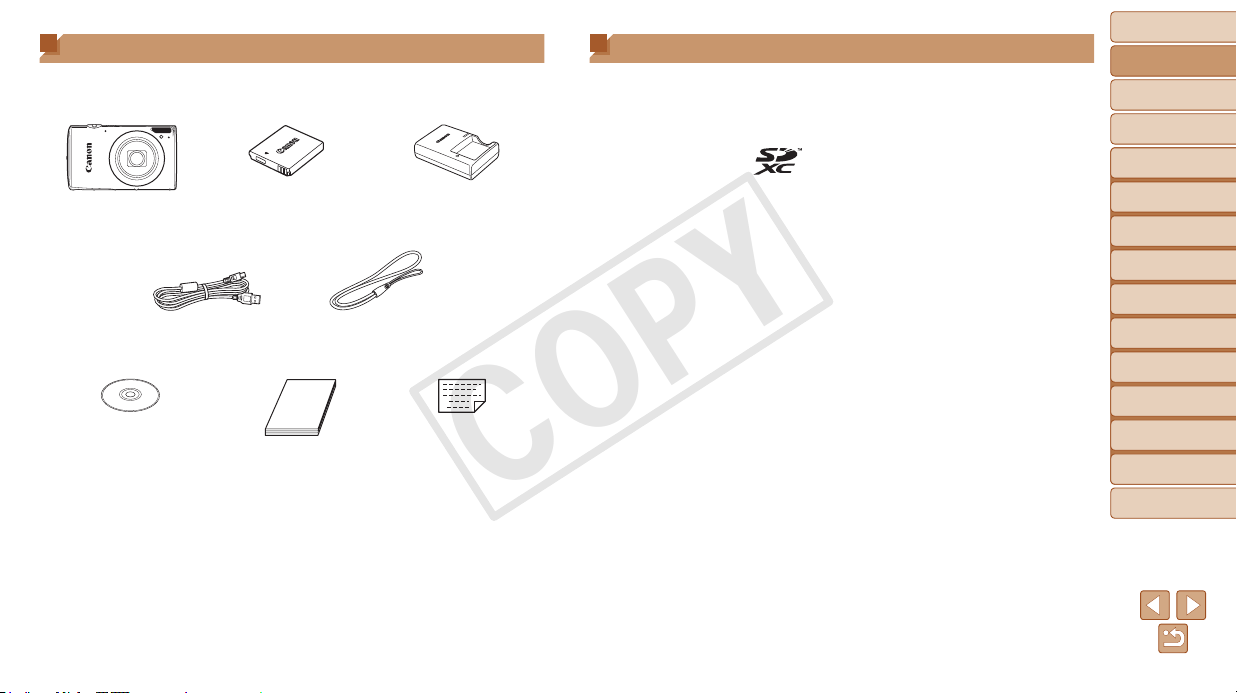
Before use, make sure the following items are included in the package.
If anything is missing, contact your camera retailer.
Camera
Battery Pack
NB-4L
Battery Charger
CB-2LV/CB-2LVE
Interface Cable
IFC-400PCU
Wrist Strap
WS-DC11
DIGITAL CAMERA Solution
Disk*
(CD-ROM)
Getting Started
Warranty Card
* Contains software and PDF manuals (=
19).
•A memory card is not included (=
2).
Compatible Memory Cards
The following memory cards (sold separately) can be used, regardless of
capacity.
• SD memory cards*
• SDHC memory cards*
• SDXC memory cards*
* CardsconformingtoSDstandards.However,notallmemorycardshavebeenveried
to work with the camera.
COPY

3
1
2
3
4
5
6
7
8
9
Contents: Basic
Operations
Advanced Guide
Camera Basics
Auto Mode/Hybrid
Auto Mode
Other Shooting
Modes
Playback Mode
Wi-Fi Functions
Setting Menu
Accessories
Appendix
Index
Basic Guide
P Mode
Cover
Preliminary Notes and
Legal Information
Preliminary Notes and Legal
Information
• Take and review some test shots initially to make sure the images were
recorded correctly. Please note that Canon Inc., its subsidiaries and
afliates,anditsdistributorsarenotliableforanyconsequentialdamages
arising from any malfunction of a camera or accessory, including memory
cards, that result in the failure of an image to be recorded or to be
recorded in a way that is machine readable.
• Images recorded by the camera are intended for personal use. Refrain
from unauthorized recording that infringes on copyright law, and note that
even for personal use, photography may contravene copyright or other
legal rights at some performances or exhibitions, or in some commercial
settings.
• The camera warranty is valid only in the area of purchase. In case of
camera problems while abroad, return to the area of purchase before
contacting a Canon Customer Support Help Desk.
• Although the LCD monitor is produced under extremely high-precision
manufacturing conditions and more than 99.99% of the pixels meet
designspecications,inrarecasessomepixelsmaybedefectiveormay
appear as red or black dots. This does not indicate camera damage or
affect recorded images.
• TheLCDmonitormaybecoveredwithathinplasticlmforprotection
againstscratchesduringshipment.Ifcovered,removethelmbefore
using the camera.
• When the camera is used over an extended period, it may become warm.
This does not indicate damage.
COPY
4
1
2
3
4
5
6
7
8
9
Contents: Basic
Operations
Advanced Guide
Camera Basics
Auto Mode/Hybrid
Auto Mode
Other Shooting
Modes
Playback Mode
Wi-Fi Functions
Setting Menu
Accessories
Appendix
Index
Basic Guide
P Mode
Cover
Preliminary Notes and
Legal Information
Part Names and Conventions in This Guide
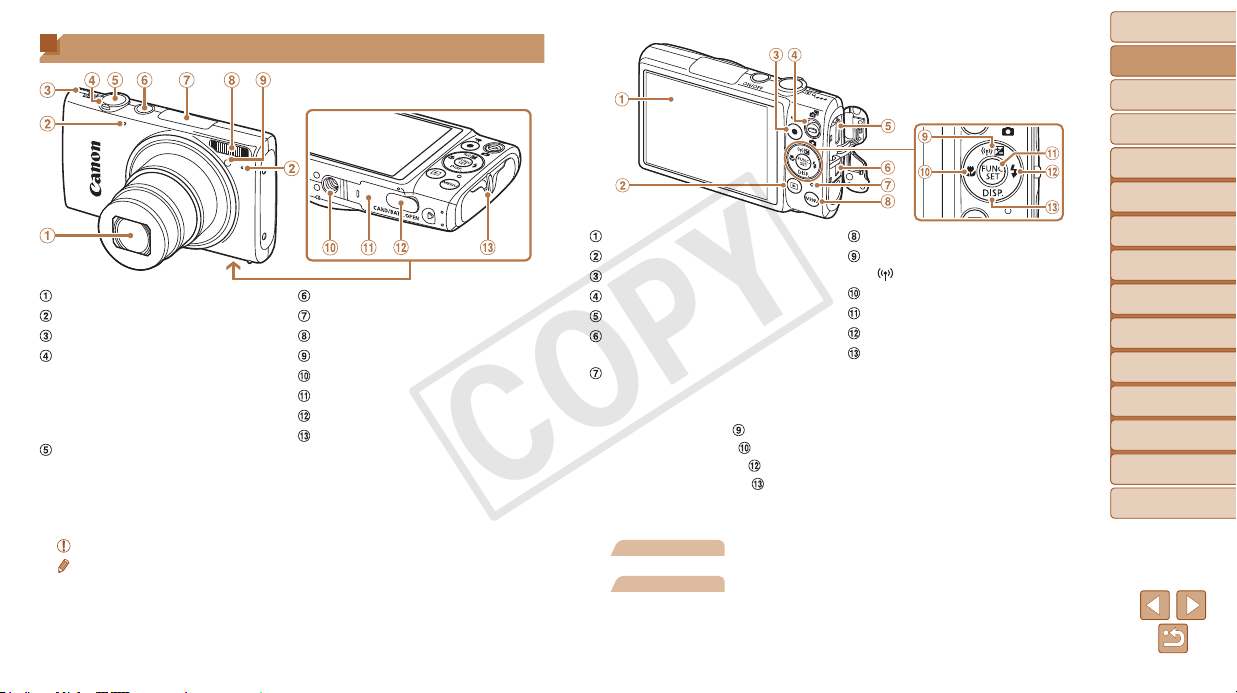
Lens
Microphone
Speaker
Zoom lever
Shooting: <i (telephoto)> /
<j (wide angle)>
Playback: <k (magnify)> /
<g (index)>
Shutter button
Power button
Wi-Fi antenna area
Flash
Lamp
Tripod socket
Memory card/battery cover
DC coupler terminal cover
Strap mount
• In this guide, icons are used to represent the corresponding camera
buttons and switches on which they appear or which they resemble.
• Shooting modes and on-screen icons and text are indicated in brackets.
•
: Important information you should know
•
: Notes and tips for expert camera use
• =xx: Pages with related information (in this example, “xx” represents a
page number)
• Instructions in this guide apply to the camera under default settings.
• For convenience, all supported memory cards are simply referred to as
the “memory card”.
Screen (LCD monitor)
<1 (Playback)> button
Movie button
Mode switch
HDMI
TM
terminal
AV OUT (Audio/video output) /
DIGITAL terminal
Indicator
<n> button
<b (Exposure compensation)> /
<
(Wi-Fi)> / Up button
<e (Macro)> / Left button
FUNC./SET button
<h (Flash)> / Right button
<l (Display)> / Down button
• The following camera buttons and controls are represented by icons.
<o> Up button
on back
<q> Left button on back
<r> Right button on back
<p> Down button on back
• The tabs shown above titles indicate whether the function is used for still
images, movies, or both.
Still Images
: Indicates that the function is used when shooting or
viewing still images.
Movies
: Indicates that the function is used when shooting or
viewing movies.
COPY

5
1
2
3
4
5
6
7
8
9
Contents: Basic
Operations
Advanced Guide
Camera Basics
Auto Mode/Hybrid
Auto Mode
Other Shooting
Modes
Playback Mode
Wi-Fi Functions
Setting Menu
Accessories
Appendix
Index
Basic Guide
P Mode
Cover
Preliminary Notes and
Legal Information
Package Contents .........................2
Compatible Memory Cards ............2
Preliminary Notes and Legal
Information .....................................3
Part Names and Conventions
in This Guide .................................. 4
Table of Contents ........................... 5
Contents: Basic Operations ...........6
Safety Precautions ......................... 7
Basic Guide .................... 10
Initial Preparations ....................... 11
Trying the Camera Out ................16
Included Software,
PDF Manuals ...............................19
System Map .................................23
Advanced Guide ............. 25
1 Camera Basics .....................25
On/Off ..........................................26
Shutter Button ..............................27
Shooting Display Options ............27
FUNC. Menu ................................28
MENU Menu ................................29
Indicator Display ..........................30
Clock ............................................30
2 Auto Mode/
Hybrid Auto Mode ................31
Shooting With Camera-Determined
Settings ........................................32
Common, Convenient Features ... 38
Using Face ID ..............................42
Image Customization Features ....47
Helpful Shooting Features ...........50
Customizing Camera Operation ..51
3 Other Shooting Modes ........54
Specic Scenes ...........................55
Applying Special Effects ..............57
Special Modes
for Other Purposes ......................62
Shooting Super Slow
Motion Movies .............................. 67
4 P Mode ..................................68
Shooting in Program AE
([P] Mode) ....................................69
Image Brightness (Exposure
Compensation) ............................69
Color and Continuous Shooting ... 72
Shooting Range and Focusing ....74
Flash ............................................80
Other Settings ..............................81
Table of Contents
5 Playback Mode ....................83
Viewing ........................................84
Browsing and Filtering Images ....87
Editing Face ID Information .........90
Image Viewing Options ................91
Protecting Images ........................93
Erasing Images ............................96
Rotating Images ........................... 98
Image Categories ........................99
Editing Still Images ....................100
Editing Movies............................104
6 Wi-Fi Functions .................106
What You Can Do With Wi-Fi ..... 107
Using Wi-Fi to Send Images
From the Camera ....................... 108
Wi-Fi (Wireless LAN)
Precautions ................................108
Security Precautions ..................109
Glossary ..................................... 110
Registering a Camera Nickname
(First time only) .......................... 111
Connecting to Web Services ......112
Connecting to a Smartphone ..... 115
Connecting to Another Camera . 117
Connecting to a Computer ......... 118
Connecting to a Printer ..............124
Sending Images .........................126
Sending Images to a Computer
via CANON iMAGE GATEWAY .. 128
Geotagging Images
on the Camera ...........................129
Editing or Erasing
Wi-Fi Settings.............................129
7 Setting Menu ......................132
Adjusting Basic Camera
Functions ...................................133
8 Accessories .......................140
Optional Accessories .................141
Using Optional Accessories .......142
Printing Images ..........................146
9 Appendix ............................155
Troubleshooting .........................156
On-Screen Messages ................159
On-Screen Information ..............162
Functions and Menu Tables .......164
Handling Precautions ................. 170
Specications ............................. 171
Index ..........................................174
COPY
6
1
2
3
4
5
6
7
8
9
Preliminary Notes and
Legal Information
Advanced Guide
Camera Basics
Auto Mode/Hybrid
Auto Mode
Other Shooting
Modes
Playback Mode
Wi-Fi Functions
Setting Menu
Accessories
Appendix
Index
Basic Guide
P Mode
Cover
Contents: Basic
Operations
Contents: Basic Operations
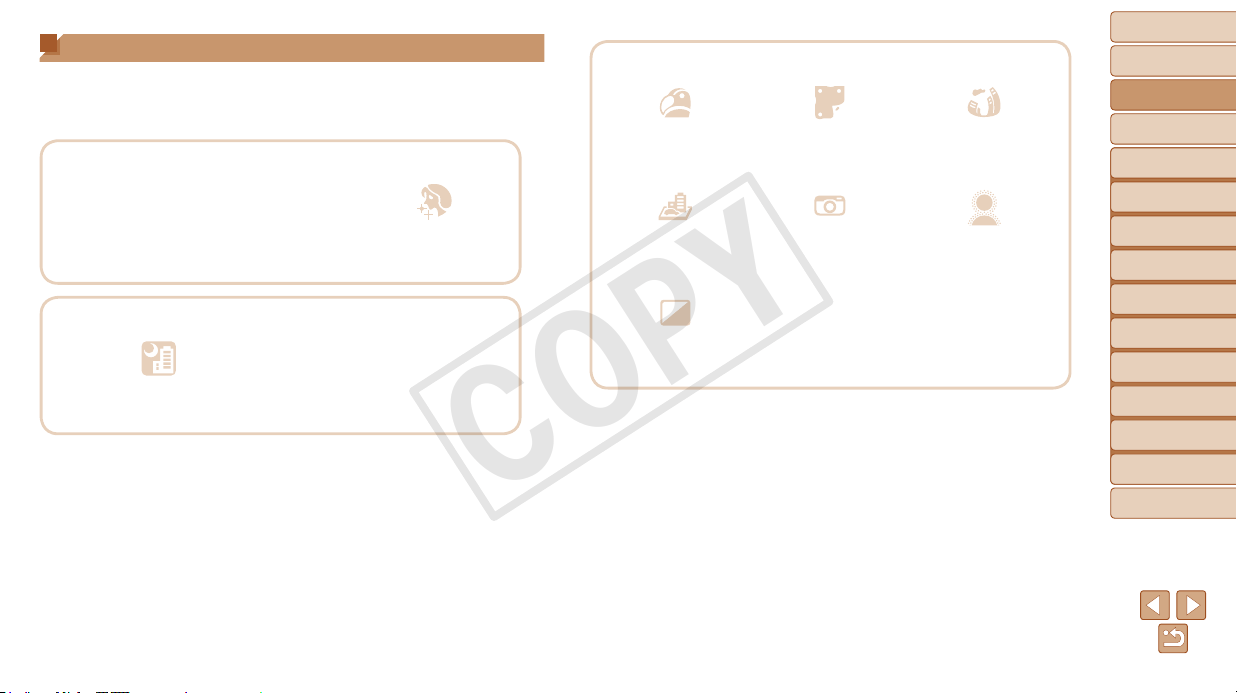
4 Shoot
Use camera-determined settings
(Auto Mode, Hybrid Auto Mode) ..................................................... 32, 34
Shooting people well
I
Portraits
(=
55)
P
Against Snow
(=
55)
Smooth Skin
(=
56)
Matching specic scenes
Night Scenes
(=
55)
t
Fireworks
(=
55)
Applying special effects
Vivid Colors
(=
57)
Poster Effect
(=
57)
Fish-Eye Effect
(=
57)
Miniature Effect
(=
58)
Toy Camera Effect
(=
59)
Soft Focus
(=
59)
Monochrome
(=
60)
Focus on faces ................................................................... 32, 55, 76, 77
Without using the ash (Flash Off) ....................................................... 40
Include yourself in the shot (Self-Timer) ........................................ 39, 64
Add a date stamp ................................................................................. 41
Use Face ID ................................................................................... 42, 87
COPY
7
1
2
3
4
5
6
7
8
9
Preliminary Notes and
Legal Information
Advanced Guide
Camera Basics
Auto Mode/Hybrid
Auto Mode
Other Shooting
Modes
Playback Mode
Wi-Fi Functions
Setting Menu
Accessories
Appendix
Index
Basic Guide
P Mode
Cover
Contents: Basic
Operations
1 View
View images (Playback Mode) ............................................................. 84
Automatic playback (Slideshow) .......................................................... 91
On a TV .............................................................................................. 142
On a computer ..................................................................................... 20
Browse through images quickly ........................................................... 87
Erase images ....................................................................................... 96
E Shoot/View Movies
Shoot movies ................................................................................. 32, 67
View movies (Playback Mode) ............................................................. 84
Fast-moving subjects, slow-motion playback ....................................... 67
c Print
Print pictures ...................................................................................... 146
Save
Save images to a computer via a cable ............................................... 20
Use Wi-Fi Functions
Send images to a smartphone ............................................................ 115
Share images online ........................................................................... 112
Send images to a computer ................................................................ 118
Safety Precautions
• Before using the product, please ensure that you read the safety precautions
described below. Always ensure that the product is used correctly.
• The safety precautions noted on the following pages are intended
to prevent injuries to yourself and other persons, or damage to the
equipment.
• Be sure to also check the guides included with any separately sold
accessories you use.
Warning
Denotes the possibility of serious injury or death.
• Donottriggertheashincloseproximitytopeople’seyes.
Exposure to the intense light produced by the ash could damage eyesight.
In particular, remain at least 1 meter (39 inches) away from infants when
using the ash.
• Storethisequipmentoutofthereachofchildrenandinfants.
Strap: Putting the strap around a child’s neck could result in asphyxiation.
• Useonlyrecommendedpowersources.
• Donotattempttodisassemble,alterorapplyheattotheproduct.
• Avoiddroppingorsubjectingtheproducttosevereimpacts.
• To avoid the risk of injury, do not touch the interior of the product if
ithasbeendroppedorotherwisedamaged.
• Stop using the product immediately if it emits smoke, a strange
smell,orotherwisebehavesabnormally.
• Do not use organic solvents such as alcohol, benzine, or thinner to
cleantheproduct.
• Donotlettheproductcomeintocontactwithwater(e.g.seawater)
orotherliquids.
• Donotallowliquidsorforeignobjectstoenterthecamera.
This could result in electrical shock or re.
If liquids or foreign objects come into contact with the camera interior,
immediately turn the camera off and remove the battery.
If the battery charger becomes wet, unplug it from the outlet and consult
your camera retailer or a Canon Customer Support Help Desk.
COPY
8
1
2
3
4
5
6
7
8
9
Preliminary Notes and
Legal Information
Advanced Guide
Camera Basics
Auto Mode/Hybrid
Auto Mode
Other Shooting
Modes
Playback Mode
Wi-Fi Functions
Setting Menu
Accessories
Appendix
Index
Basic Guide
P Mode
Cover
Contents: Basic
Operations
• Useonlytherecommendedbattery.
• Donotplacethebatterynearorindirectame.
• Unplug the power cord periodically, and using a dry cloth, wipe away
any dust and dirt that has collected on the plug, the exterior of the
poweroutlet,andthesurroundingarea.
• Donothandlethepowercordwithwethands.
• Do not use the equipment in a manner that exceeds the rated
capacityoftheelectricaloutletorwiringaccessories.Donotuseif
the power cord or plug are damaged, or not fully plugged into the
outlet.
• Donotallowdirtormetalobjects(suchaspinsorkeys)tocontact
theterminalsorplug.
The battery may explode or leak, resulting in electrical shock or re. This
could cause injury and damage the surroundings. In the event that a battery
leaks and the battery electrolyte contacts eyes, mouth, skin or clothing,
immediately ush with water.
• Turnthecameraoffinplaceswherecamerauseisprohibited.
The electromagnetic waves emitted by the camera may interfere with the
operation of electronic instruments and other devices. Exercise adequate
caution when using the camera in places where use of electronic devices is
restricted, such as inside airplanes and medical facilities.
• DonotplaythesuppliedCD-ROM(s)inanyCDplayerthatdoesnot
supportdataCD-ROMs.
It is possible to suffer hearing loss from listening with headphones to the
loud sounds of a CD-ROM played on an audio CD player (music player).
Additionally, this could damage the speakers.
Caution
Denotes the possibility of injury.
• When holding the camera by the strap, be careful not to bang it,
subject it to strong impacts or shocks, or let it get caught on other
objects.
• Becarefulnottobumporpushstronglyonthelens.
This could lead to injury or damage the camera.
• Becarefulnottosubjectthescreentostrongimpacts.
If the screen cracks, injury may result from the broken fragments.
• Whenusingtheash,becarefulnottocoveritwithyourngersor
clothing.
This could result in burns or damage to the ash.
• Avoid using, placing or storing the product in the following places:
- Places subject to direct sunlight
- Placessubjecttotemperaturesabove40°C(104°F)
- Humid or dusty areas
These could cause leakage, overheating or an explosion of the battery,
resulting in electrical shock, re, burns or other injuries.
High temperatures may cause deformation of the camera or battery charger
casing.
• The slideshow transition effects may cause discomfort when viewed
forprolongedperiods.
Caution
Denotes the possibility of damage to the equipment.
• Do not aim the camera at bright light sources (such as the sun on a
clearday).
Doing so may damage the image sensor.
• When using the camera on a beach or at a windy location, be careful
nottoallowdustorsandtoenterthecamera.
This may cause the product to malfunction.
• In regular use, small amounts of smoke may be emitted from the
ash.
This is due to the high intensity of the ash burning dust and foreign
materials stuck to the front of the unit. Please use a cotton swab to remove
dirt, dust or other foreign matter from the ash to prevent heat build-up and
damage to the unit.
COPY
9
1
2
3
4
5
6
7
8
9
Preliminary Notes and
Legal Information
Advanced Guide
Camera Basics
Auto Mode/Hybrid
Auto Mode
Other Shooting
Modes
Playback Mode
Wi-Fi Functions
Setting Menu
Accessories
Appendix
Index
Basic Guide
P Mode
Cover
Contents: Basic
Operations
• Removeandstorethebatterywhenyouarenotusingthecamera.
If the battery is left inside the camera, damage caused by leakage may
occur.
• Before you discard the battery, cover the terminals with tape or other
insulators.
Contacting other metal materials may lead to re or explosions.
• Unplug the battery charger from the power outlet after charging is
complete,orwhenyouarenotusingit.
• Do not place anything, such as cloth, on top of the battery charger
whileitischarging.
Leaving the unit plugged in for a long period of time may cause it to
overheat and distort, resulting in re.
• Donotplacethebatterynearpets.
Pets biting the battery could cause leakage, overheating or explosion,
resulting in re or damage.
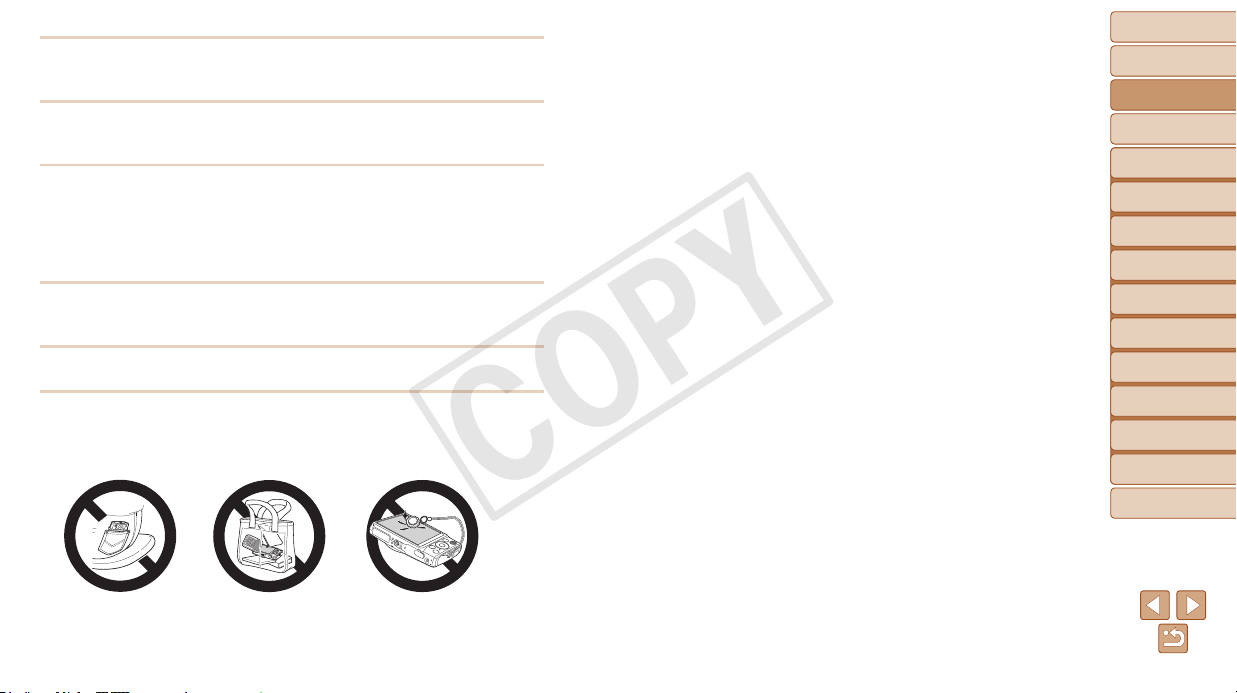
• Donotsitdownwiththecamerainyourpocket.
Doing so may cause malfunctions or damage the screen.
• When putting the camera in your bag, ensure that hard objects do
notcomeintocontactwiththescreen.
• Donotattachanyhardobjectstothecamera.
Doing so may cause malfunctions or damage the screen.
COPY

10
1
2
3
4
5
6
7
8
9
Preliminary Notes and
Legal Information
Contents: Basic
Operations
Advanced Guide
Camera Basics
Auto Mode/Hybrid
Auto Mode
Other Shooting
Modes
Playback Mode
Wi-Fi Functions
Setting Menu
Accessories
Appendix
Index
P Mode
Cover
Basic Guide
Basic Guide
Gives basic instructions, from initial preparations to
shooting, playback, and saving on a computer
Initial Preparations ................... 11
Trying the Camera Out .............16
Included Software, PDF
Manuals ...................................19
System Map ..............................23
4
COPY
11
1
2
3
4
5
6
7
8
9
Preliminary Notes and
Legal Information
Contents: Basic
Operations
Advanced Guide
Camera Basics
Auto Mode/Hybrid
Auto Mode
Other Shooting
Modes
Playback Mode
Wi-Fi Functions
Setting Menu
Accessories
Appendix
Index
P Mode
Cover
Basic Guide
Initial Preparations
Prepare for shooting as follows.
Attaching the Strap
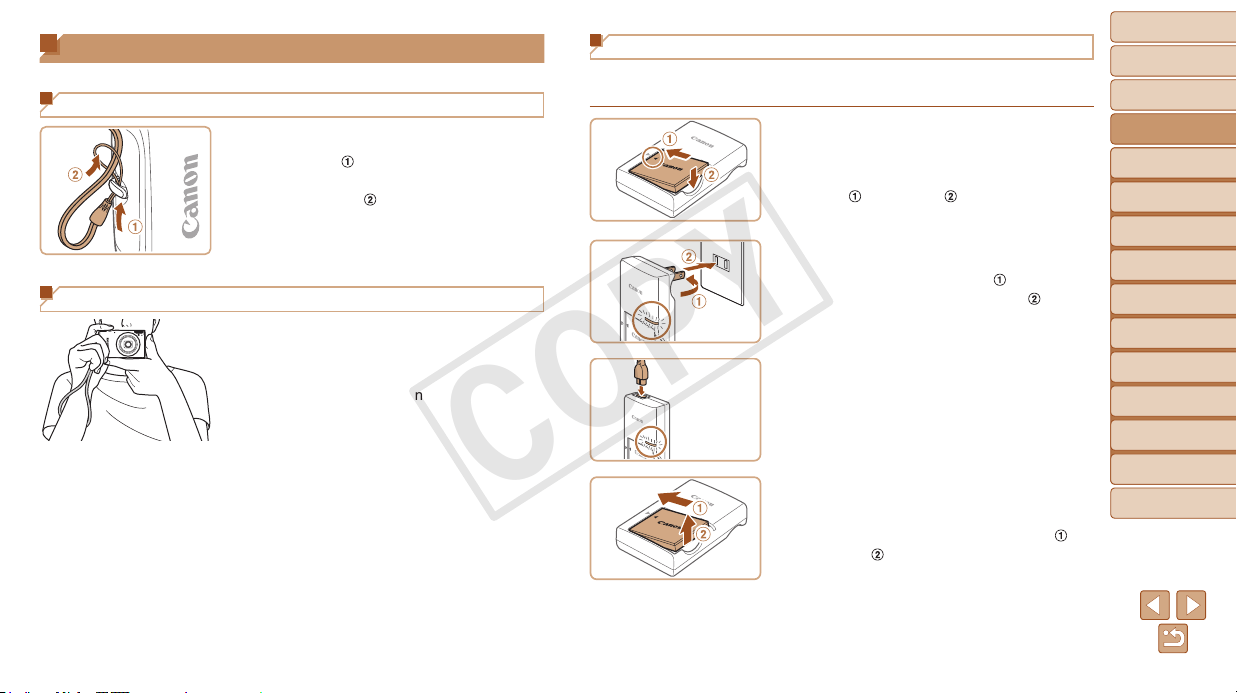
Thread the end of the strap through the
strap hole (
), and then pull the other
end of the strap through the loop on the
threaded end (
).
Holding the Camera
Place the strap around your wrist.
When shooting, keep your arms close to
your body and hold the camera securely
to prevent it from moving. Do not rest
your ngers on the ash.
Charging the Battery
Before use, charge the battery with the included charger. Be sure to charge
the battery initially, because the camera is not sold with the battery charged.
1 Insert the battery.
After aligning the o marks on the battery
and charger, insert the battery by pushing
it in (
) and down ( ).
2 Charge the battery.
CB-2LV: Flip out the plug ( ) and plug
the charger into a power outlet (
).
CB-2LVE: Plug the power cord into the
charger, then plug the other end into a
power outlet.
The charging lamp turns orange and
charging begins.
When charging is nished, the lamp turns
green.
3 Remove the battery.
After unplugging the battery charger,
remove the battery by pushing it in (
)
and up (
).
CB-2LV
CB-2LVE
COPY
12
1
2
3
4
5
6
7
8
9
Preliminary Notes and
Legal Information
Contents: Basic
Operations
Advanced Guide
Camera Basics
Auto Mode/Hybrid
Auto Mode
Other Shooting
Modes
Playback Mode
Wi-Fi Functions
Setting Menu
Accessories
Appendix
Index
P Mode
Cover
Basic Guide
• To protect the battery and keep it in optimal condition, do not charge
it continuously for more than 24 hours.
• For battery chargers that use a power cord, do not attach the
charger or cord to other objects. Doing so could result in malfunction
or damage to the product.
• For details on charging time and the number of shots and recording time
possible with a fully charged battery, see “Number of Shots/Recording Time,
Playback Time” (=
171).
• Charged batteries gradually lose their charge, even when they are not used.
Charge the battery on (or immediately before) the day of use.
• The charger can be used in areas with 100 – 240 V AC power (50/60 Hz). For
power outlets in a different format, use a commercially available adapter for
the plug. Never use an electrical transformer designed for traveling, which may
damage the battery.
Inserting the Battery and Memory Card
Insert the included battery and a memory card (sold separately).
Note that before using a new memory card (or a memory card formatted
in another device), you should format the memory card with this camera
(=
136).
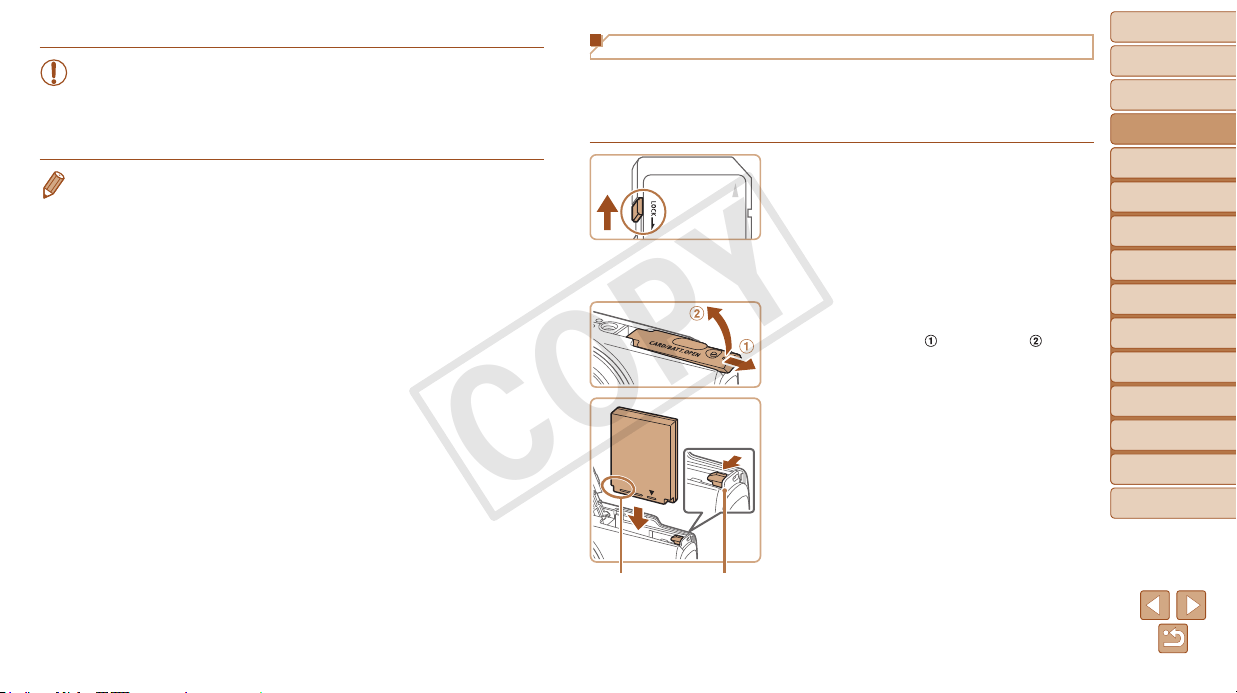
1 Check the card’s write-protect
tab.
Recording is not possible on memory
cards with a write-protect tab when the
tab is in the locked (downward) position.
Slide the tab up until it clicks into the
unlocked position.
2 Open the cover.
Slide the cover ( ) and open it ( ).
3 Insert the battery.
While pressing the battery lock in the
direction of the arrow, insert the battery
as shown and push it in until it clicks into
the locked position.
If you insert the battery facing the wrong
way, it cannot be locked into the correct
position. Always conrm that the battery
is facing the right way and locks when
inserted.
Terminals Battery
Lock
COPY
13
1
2
3
4
5
6
7
8
9
Preliminary Notes and
Legal Information
Contents: Basic
Operations
Advanced Guide
Camera Basics
Auto Mode/Hybrid
Auto Mode
Other Shooting
Modes
Playback Mode
Wi-Fi Functions
Setting Menu
Accessories
Appendix
Index
P Mode
Cover
Basic Guide
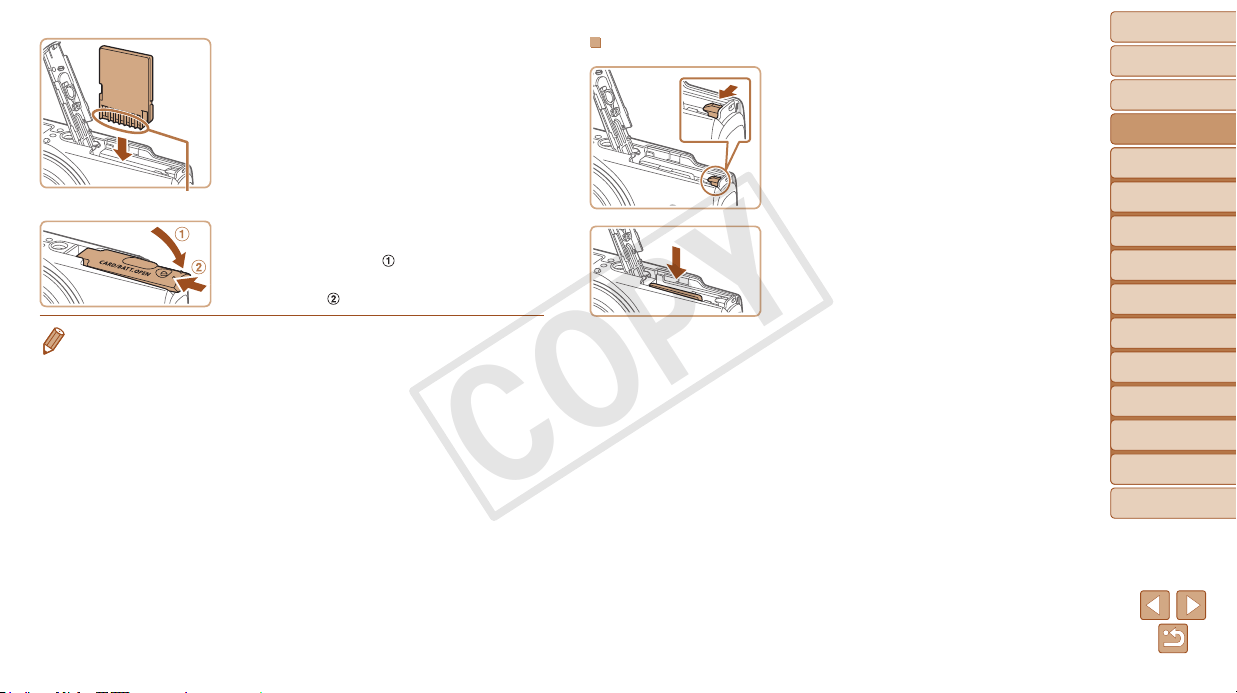
4 Insert the memory card.
Insert the memory card facing as shown
until it clicks into the locked position.
Make sure the memory card is facing the
right way when you insert it. Inserting
memory cards facing the wrong way may
damage the camera.
5 Close the cover.
Lower the cover ( ) and hold it down as
you slide it, until it clicks into the closed
position (
).
• For guidelines on how many shots or hours of recording can be saved on one
memory card, see “Number of 4:3 Shots per Memory Card” (=
172).
Terminals
Removing the Battery and Memory Card
Remove the battery.
Open the cover and press the battery
lock in the direction of the arrow.
The battery will pop up.
Remove the memory card.
Push the memory card in until it clicks,
and then slowly release it.
The memory card will pop up.
COPY
14
1
2
3
4
5
6
7
8
9
Preliminary Notes and
Legal Information
Contents: Basic
Operations
Advanced Guide
Camera Basics
Auto Mode/Hybrid
Auto Mode
Other Shooting
Modes
Playback Mode
Wi-Fi Functions
Setting Menu
Accessories
Appendix
Index
P Mode
Cover
Basic Guide
Setting the Date and Time
Set the current date and time correctly as follows if the [Date/Time] screen
is displayed when you turn the camera on. Information you specify this way
is recorded in image properties when you shoot, and it is used when you
manage images by shooting date or print images showing the date.
You can also add a date stamp to shots, if you wish (=
41).
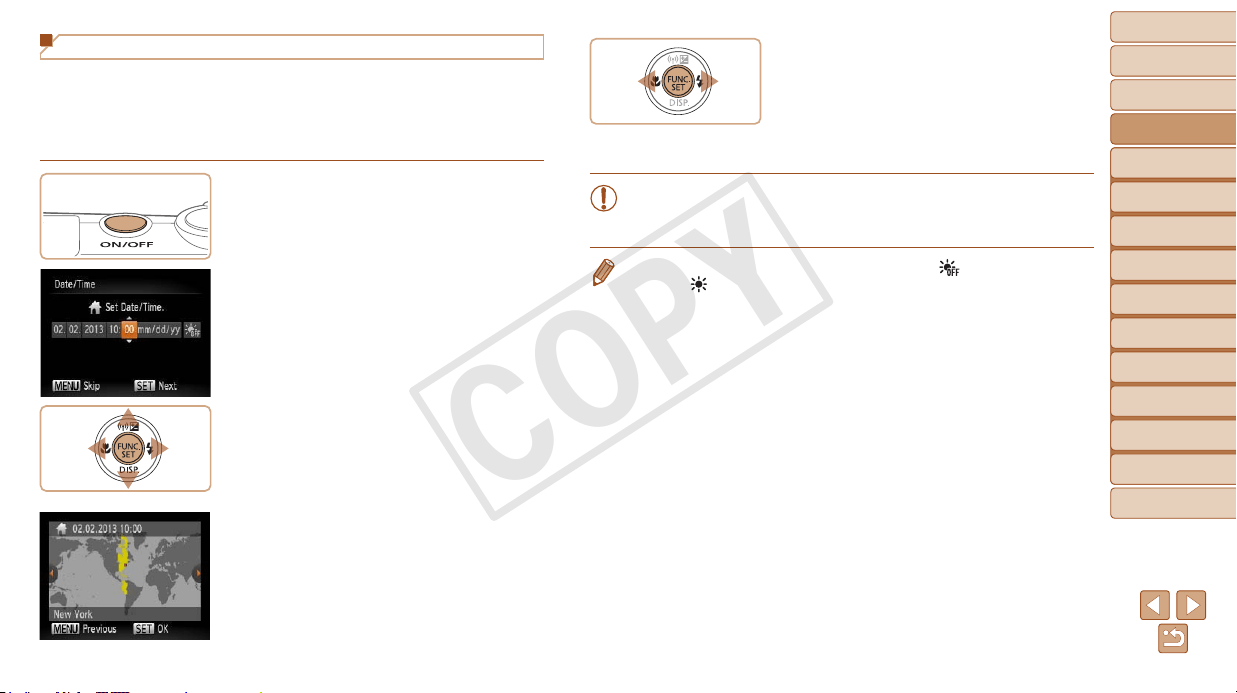
1 Turn the camera on.
Press the power button.
The [Date/Time] screen is displayed.
2 Set the date and time.
Press the <q><r> buttons to choose an
option.
Press the <o><p> buttons to specify
the date and time.
When nished, press the <m> button.
3 Set the home time zone.
Press the <q><r> buttons to choose
your home time zone.
4 Finish the setup process.
Press the <m> button when nished.
After a conrmation message, the setting
screen is no longer displayed.
To turn off the camera, press the power
button.
• Unless you set the date, time, and home time zone, the [Date/Time]
screen will be displayed each time you turn the camera on. Specify
the correct information.
• To set daylight saving time (1 hour ahead), choose [ ] in step 2 and then
choose [
] by pressing the <o><p> buttons.
COPY
15
1
2
3
4
5
6
7
8
9
Preliminary Notes and
Legal Information
Contents: Basic
Operations
Advanced Guide
Camera Basics
Auto Mode/Hybrid
Auto Mode
Other Shooting
Modes
Playback Mode
Wi-Fi Functions
Setting Menu
Accessories
Appendix
Index
P Mode
Cover
Basic Guide
Changing the Date and Time
Adjust the date and time as follows.
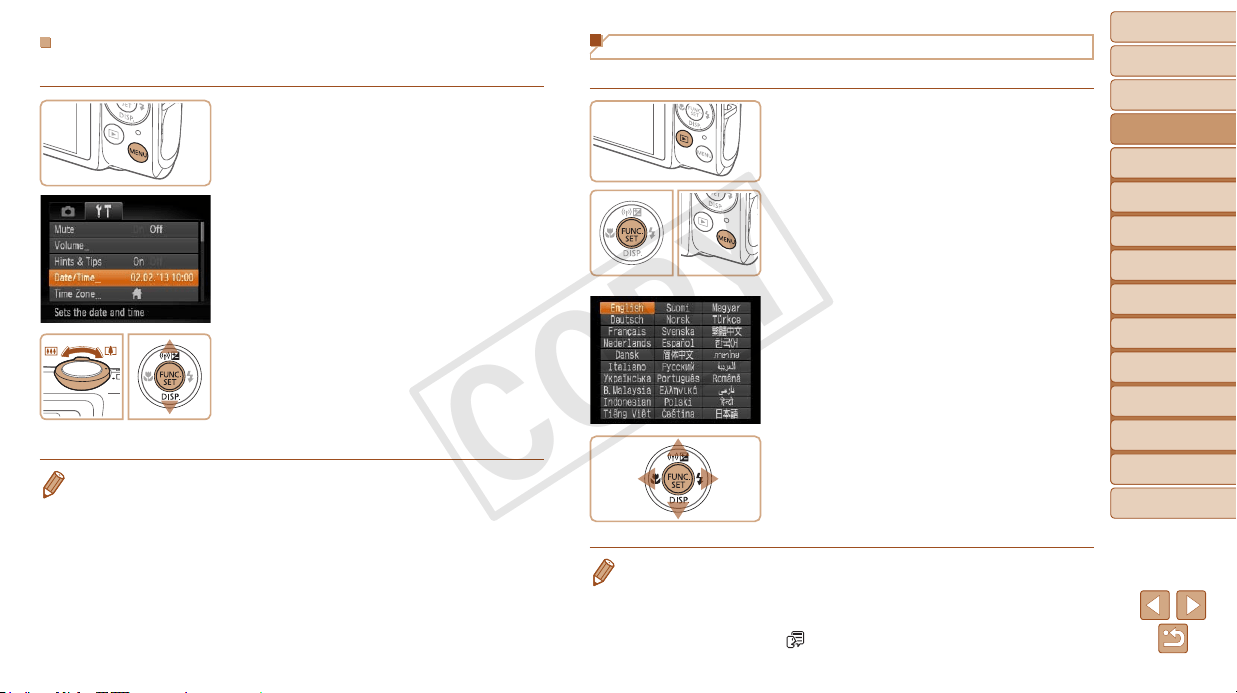
1 Access the camera menu.
Press the <n> button.
2 Choose [Date/Time].
Move the zoom lever to choose the [3]
tab.
Press the <o><p> buttons to choose
[Date/Time], and then press the <m>
button.
3 Change the date and time.
Follow step 2 on =
14 to adjust the
settings.
Press the <n> button to close the
menu.
• Date/time settings can be retained for about 3 weeks by the camera’s built-in
date/time battery (backup battery) after the battery pack is removed.
• The date/time battery will be charged in about 4 hours once you insert a
charged battery or connect the camera to an AC adapter kit (sold separately,
=
141), even if the camera is left off.
• Once the date/time battery is depleted, the [Date/Time] screen will be
displayed when you turn the camera on. Follow the steps on =
14 to set the
date and time.
Display Language
Change the display language as needed.
1 Enter Playback mode.
Press the <1> button.
2 Access the setting screen.
Press and hold the <m> button, and
then immediately press the <n>
button.
3 Set the display language.
Press the <o><p><q><r> buttons to
choose a language, and then press the
<m> button.
Once the display language has been set,
the setting screen is no longer displayed.
• The current time is displayed if you wait too long in step 2 after pressing the
<m> button before you press the <n> button. In this case, press the
<m> button to dismiss the time display and repeat step 2.
• You can also change the display language by pressing the <n> button
and choosing [Language
] on the [3] tab.
COPY
16
1
2
3
4
5
6
7
8
9
Preliminary Notes and
Legal Information
Contents: Basic
Operations
Advanced Guide
Camera Basics
Auto Mode/Hybrid
Auto Mode
Other Shooting
Modes
Playback Mode
Wi-Fi Functions
Setting Menu
Accessories
Appendix
Index
P Mode
Cover
Basic Guide
Still Images Movies
Trying the Camera Out
Follow these instructions to turn the camera on, shoot still images or
movies, and then view them.
Shooting (Smart Auto)
For fully automatic selection of the optimal settings for specic scenes,
simply let the camera determine the subject and shooting conditions.
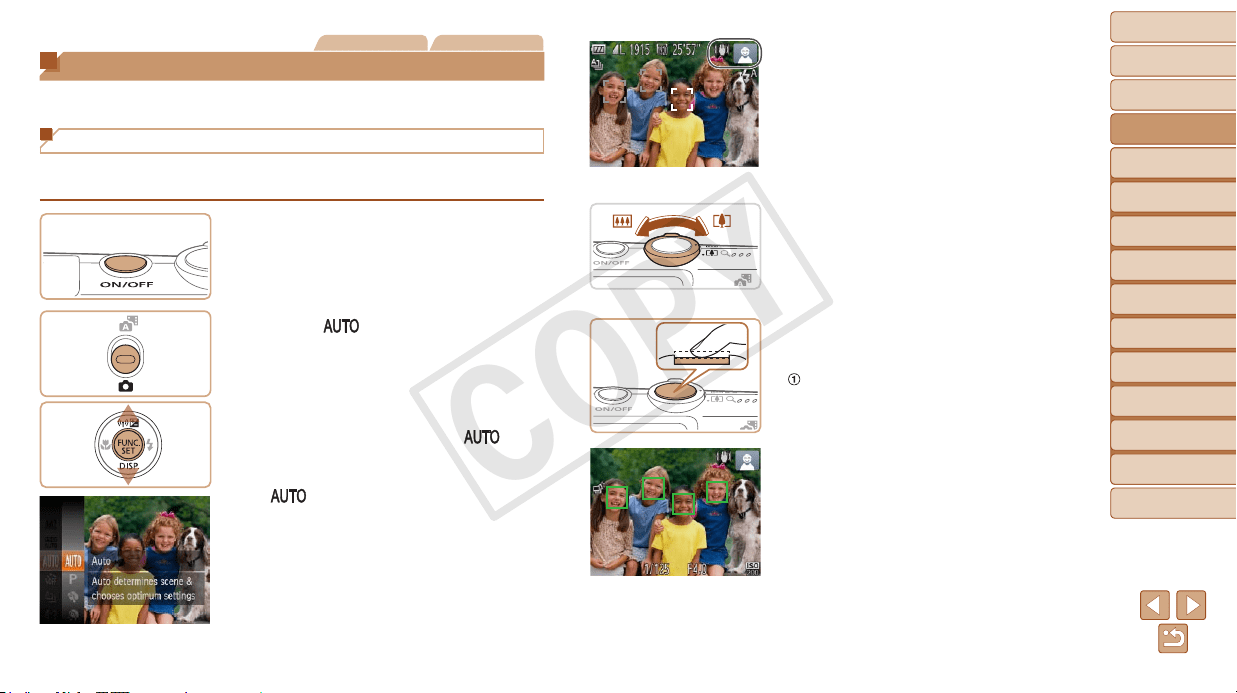
1 Turn the camera on.
Press the power button.
The startup screen is displayed.
2 Enter [ ] mode.
Set the mode switch to <4>.
Press the <m> button, press the
<o><p> buttons to choose [
], and
then press the <m> button again.
Press the <o><p> buttons to choose
[
], and then press the <m> button.
Aim the camera at the subject. The
camera will make a slight clicking noise
as it determines the scene.
Icons representing the scene and image
stabilization mode are displayed in the
upper right of the screen.
Frames displayed around any detected
subjects indicate that they are in focus.
3 Compose the shot.
To zoom in and enlarge the subject, move
the zoom lever toward <i> (telephoto),
and to zoom away from the subject, move
it toward <j> (wide angle).
4 Shoot.
Shooting Still Images
Focus.
Press the shutter button lightly, halfway
down. The camera beeps twice after
focusing, and AF frames are displayed to
indicate image areas in focus.
COPY

17
1
2
3
4
5
6
7
8
9
Preliminary Notes and
Legal Information
Contents: Basic
Operations
Advanced Guide
Camera Basics
Auto Mode/Hybrid
Auto Mode
Other Shooting
Modes
Playback Mode
Wi-Fi Functions
Setting Menu
Accessories
Appendix
Index
P Mode
Cover
Basic Guide
Shoot.
Press the shutter button all the way
down.
As the camera shoots, a shutter sound
is played, and in low-light conditions, the
ash res automatically.
Keep the camera still until the shutter
sound ends.
Your shot is only displayed until the
camera is ready to shoot again.
Shooting Movies
Start shooting.
Press the movie button. The camera
beeps once as recording begins, and
[
Rec] is displayed with the elapsed time.
Black bars displayed on the top and
bottom edges of the screen indicate
image areas not recorded.
Frames displayed around any detected
faces indicate that they are in focus.
Once recording begins, take your nger
off the movie button.
Finish shooting.
Press the movie button again to stop
shooting. The camera beeps twice as
recording stops.
Elapsed Time
• You can make a short movie of the day (digest movie) just by shooting still
images. When the mode switch is set to [
], the camera automatically
records a movie clip of the scene immediately before each shot (Hybrid Auto
Mode (=
34)).
Viewing
After shooting images or movies, you can view them on the screen as
follows.
1 Enter Playback mode.
Press the <1> button.
Your last shot is displayed.
2 Browse through your images.
To view the previous image, press the
<q> button. To view the next image,
press the <r> button.
COPY
18
1
2
3
4
5
6
7
8
9
Preliminary Notes and
Legal Information
Contents: Basic
Operations
Advanced Guide
Camera Basics
Auto Mode/Hybrid
Auto Mode
Other Shooting
Modes
Playback Mode
Wi-Fi Functions
Setting Menu
Accessories
Appendix
Index
P Mode
Cover
Basic Guide
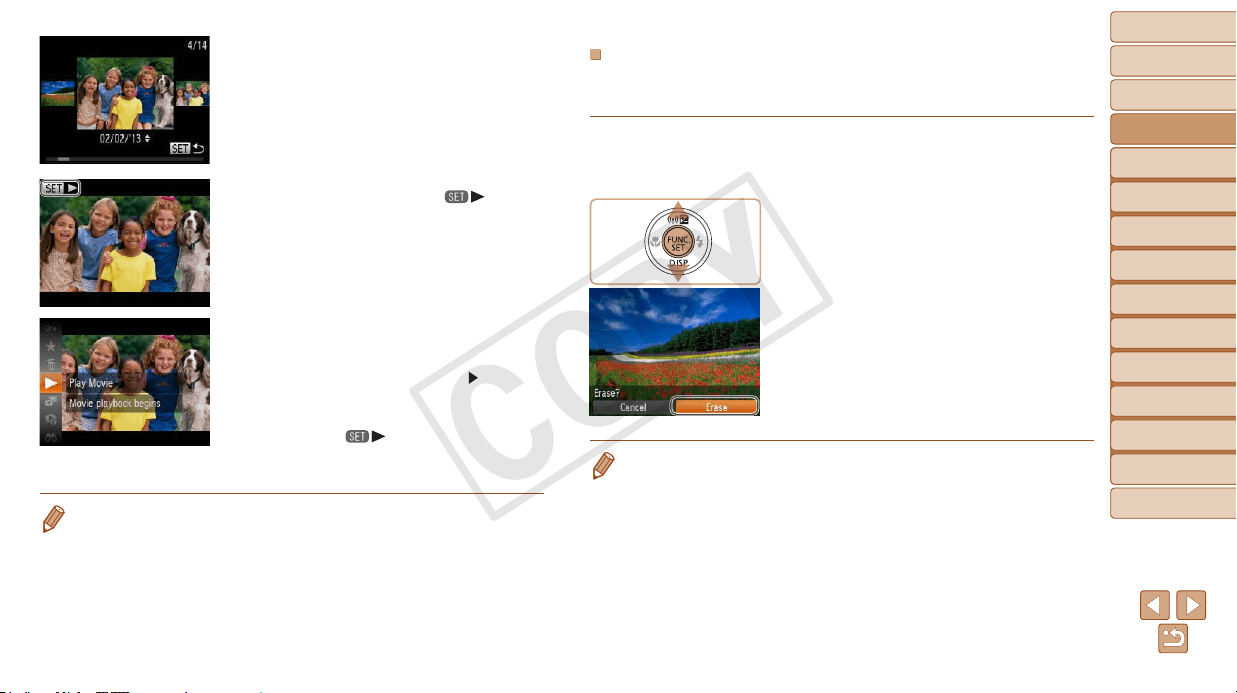
To access Scroll Display mode, press and
hold the <q><r> buttons for at least one
second. In this mode, press the <q><r>
buttons to browse through images.
To return to single-image display, press
the <m> button.
Movies are identied by a [ ] icon. To
play movies, go to step 3.
3 Play movies.
Press the <m> button, press the
<o><p> buttons to choose [
], and
then press the <m> button again.
Playback now begins, and after the movie
is nished, [
] is displayed.
To adjust the volume, press the <o><p>
buttons.
• To switch to Shooting mode from Playback mode, press the shutter button
halfway.
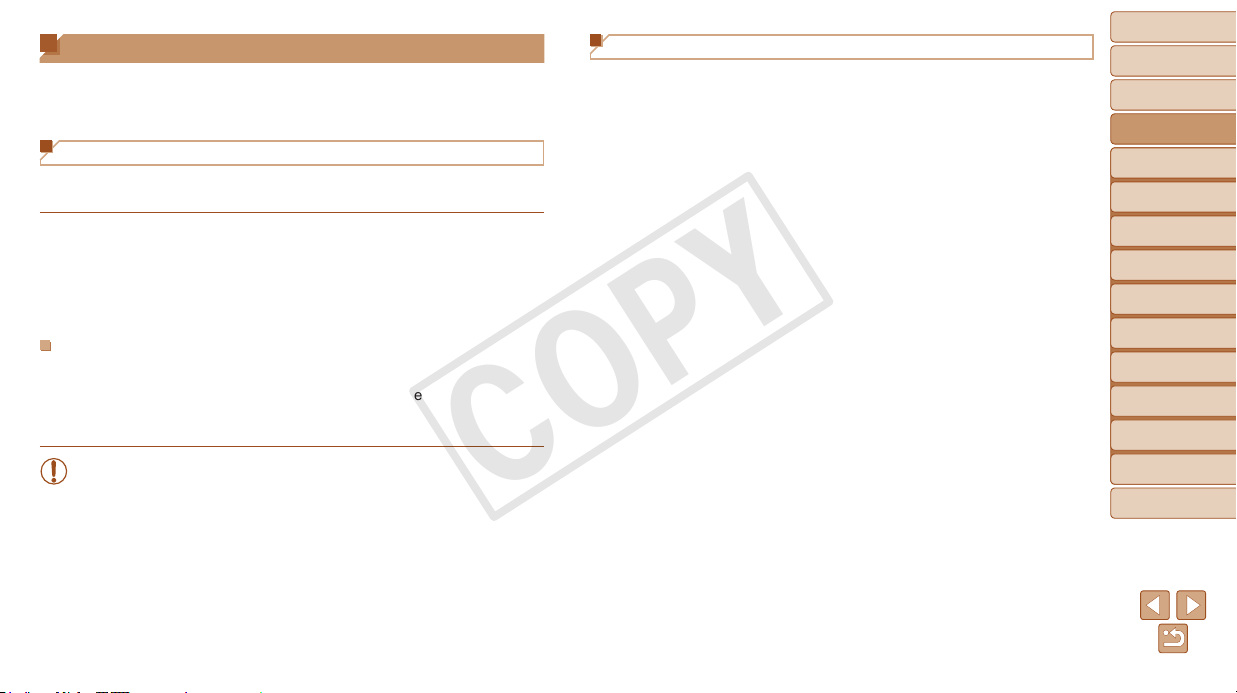
Erasing the Images
You can choose and erase unneeded images one by one. Be careful when
erasing images, because they cannot be recovered.
1 Choose an image to erase.
Press the <q><r> buttons to choose an
image.
2 Erase the image.
Press the <m> button, press the
<o><p> buttons to choose [a], and
then press the <m> button again.
After [Erase?] is displayed, press the
<q><r> buttons to choose [Erase], and
then press the <m> button.
The current image is now erased.
To cancel erasure, press the <q><r>
buttons to choose [Cancel], and then
press the <m> button.
• You can also erase all images at once (=
96).
COPY
19
1
2
3
4
5
6
7
8
9
Preliminary Notes and
Legal Information
Contents: Basic
Operations
Advanced Guide
Camera Basics
Auto Mode/Hybrid
Auto Mode
Other Shooting
Modes
Playback Mode
Wi-Fi Functions
Setting Menu
Accessories
Appendix
Index
P Mode
Cover
Basic Guide
Included Software, PDF Manuals
The software and PDF manuals on the included DIGITAL CAMERA Solution
Disk (CD-ROM) (=
2) are introduced below, with instructions for
installation, and saving images to a computer.
Software
After installing the software on the CD-ROM, you can do the following
things on your computer.
CameraWindow
Import images and change camera settings
ImageBrowser EX
Manage images: view, search, and organize
Print and edit images
Auto Update Function
Using the included software, you can update to the latest version, and
download new functions via the Internet (some software excluded). Be sure
to install the software on a computer with an Internet connection so you can
use this function.
• Internet access is required to use this function, and any ISP account
charges and access fees must be paid separately.
PDF Manuals
Camera User Guide
Refer to this guide for a more in-depth understanding of camera
operation.
Software Guide
Refer to this guide when using the included software. The guide can be
accessed from the help system of included software (some software
excluded).
COPY
20
1
2
3
4
5
6
7
8
9
Preliminary Notes and
Legal Information
Contents: Basic
Operations
Advanced Guide
Camera Basics
Auto Mode/Hybrid
Auto Mode
Other Shooting
Modes
Playback Mode
Wi-Fi Functions
Setting Menu
Accessories
Appendix
Index
P Mode
Cover
Basic Guide
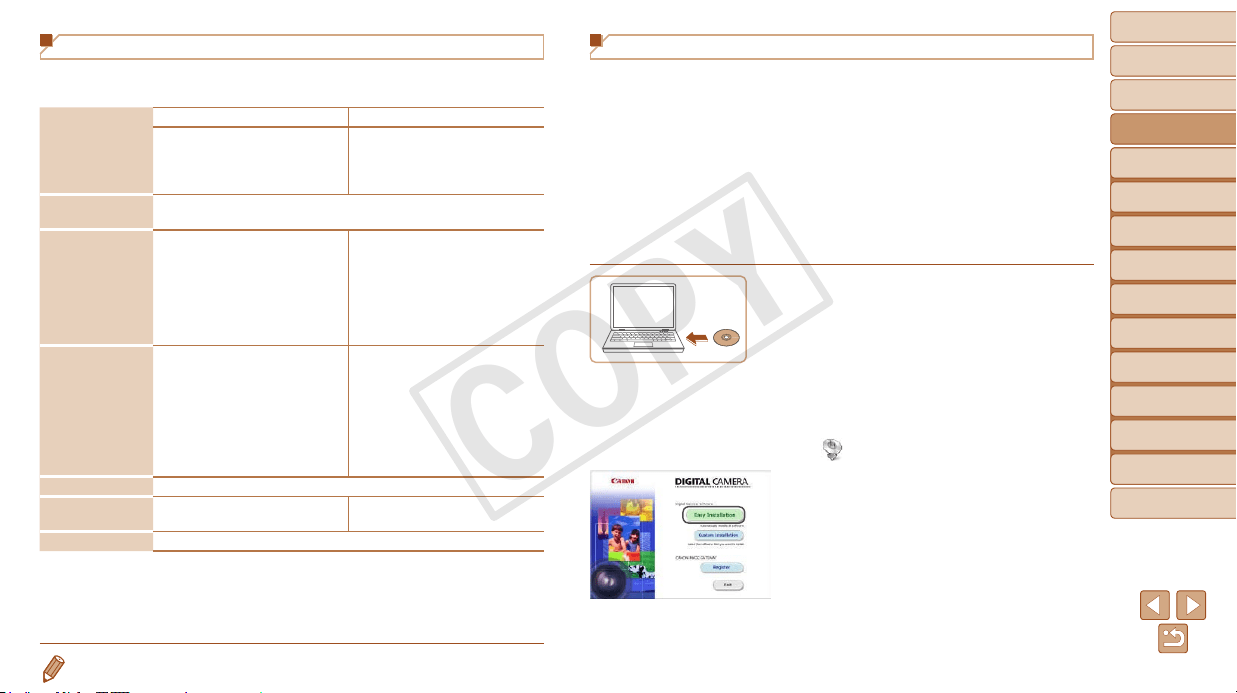
System Requirements
The included software can be used on the following computers. Adobe
Reader is required to view the PDF manuals.
Operating
System
*1
Windows Macintosh
Windows 8
Windows 7 SP1
Windows Vista SP2
Windows XP SP3
Mac OS X 10.6
Mac OS X 10.7
Mac OS X 10.8*
2
Computer
Computers running one of the above operating systems
(preinstalled), with an included USB port and Internet connection
Processor
Still images: 1.6 GHz or higher,
Movies: Core 2 Duo 2.6 GHz
or higher
Still images
Mac OS X 10.7 – 10.8: Core 2
Duo or higher,
Mac OS X 10.6: Core Duo
1.83 GHz or higher
Movies
Core 2 Duo 2.6 GHz or higher
RAM
Still images
Windows 8 (64 bit), Windows 7
(64 bit): 2 GB or more
Windows 8 (32 bit), Windows 7
(32 bit), Windows Vista: 1 GB or more
Windows XP: 512 MB or more
Movies
2 GB or more
Still images
Mac OS X 10.7 – 10.8: 2 GB
or more,
Mac OS X 10.6: 1 GB or more
Movies
2 GB or more
Interfaces USB and Wi-Fi
Free Hard Disk
Space
440 MB or more*
3
550 MB or more*
3
Display 1024 x 768 resolution or higher
*1 Wi-Fi image transfer to a computer requires Windows 8, Windows 7 SP1, Mac OS X
10.6.8, Mac OS X 10.7, or Mac OS X 10.8.2 or later.
*2
Information on computer models compatible with Mac OS X 10.8 is available on the Apple website.
*3
Includes Silverlight 5.1 (max. 100 MB). Additionally, in Windows XP, Microsoft .NET Framework 3.0 or later
(max. 500 MB) must be installed. Installation may take some time, depending on computer performance.
• Check the Canon website for the latest system requirements, including supported OS versions.
Installing the Software
Windows 7 and Mac OS X 10.6 are used here for the sake of illustration.
Using the software auto update function, you can update to the latest
version and download new functions via the Internet (some software
excluded), so be sure to install the software on a computer with an Internet
connection.
What you will need:
Computer
Interface cable (=
2)
Included CD-ROM (DIGITAL CAMERA Solution Disk) (=
2)
1 Insert the CD-ROM in the
computer’s CD-ROM drive.
Insert the included CD-ROM (DIGITAL
CAMERA Solution Disk) (=
2) in the
computer’s CD-ROM drive.
On a Macintosh computer, after inserting
the disc, double-click the desktop disc
icon to open it, and then double-click the
[
] icon displayed.
2 Begin the installation.
Click [Easy Installation] and follow the
on-screen instructions to complete the
installation process.
COPY

21
1
2
3
4
5
6
7
8
9
Preliminary Notes and
Legal Information
Contents: Basic
Operations
Advanced Guide
Camera Basics
Auto Mode/Hybrid
Auto Mode
Other Shooting
Modes
Playback Mode
Wi-Fi Functions
Setting Menu
Accessories
Appendix
Index
P Mode
Cover
Basic Guide
3 When a message is displayed
prompting you to connect
the camera, connect it to a
computer.
With the camera turned off, open the
cover (
). With the smaller plug of the
included interface cable (=
2) in the
orientation shown, insert the plug fully
into the camera terminal (
).
Insert the larger plug of the interface
cable in the computer’s USB port. For
details about USB connections on the
computer, refer to the computer user
manual.
4 Installtheles.
Turn the camera on, and follow the
on-screen instructions to complete the
installation process.
The software will connect to the Internet
to update to the latest version and
download new functions. Installation may
take some time, depending on computer
performance and the Internet connection.
Click [Finish] or [Restart] on the screen
after installation and remove the CD-
ROM when the desktop is displayed.
Turn the camera off and disconnect the
cable.
• When not connected to the Internet, there are the following limitations.
- The screen in step 3 will not be displayed.
- Some functions may not be installed.
• The rst time you connect the camera to the computer, drivers will be installed,
so it may take a few minutes until camera images are accessible.
• If you have several cameras that were bundled with ImageBrowser EX on the
included CD-ROMs, be sure to use each camera with their included CD-ROM
and follow the on-screen installation instructions for each. Doing so will ensure
that each camera will receive the correct updates and new functions via the
auto update function.
COPY
22
1
2
3
4
5
6
7
8
9
Preliminary Notes and
Legal Information
Contents: Basic
Operations
Advanced Guide
Camera Basics
Auto Mode/Hybrid
Auto Mode
Other Shooting
Modes
Playback Mode
Wi-Fi Functions
Setting Menu
Accessories
Appendix
Index
P Mode
Cover
Basic Guide
Saving Images to a Computer
Windows 7 and Mac OS X 10.6 are used here for the sake of illustration.
1 Connect the camera to the
computer.
Follow step 3 in “Installing the Software”
(=
21) to connect the camera to a
computer.
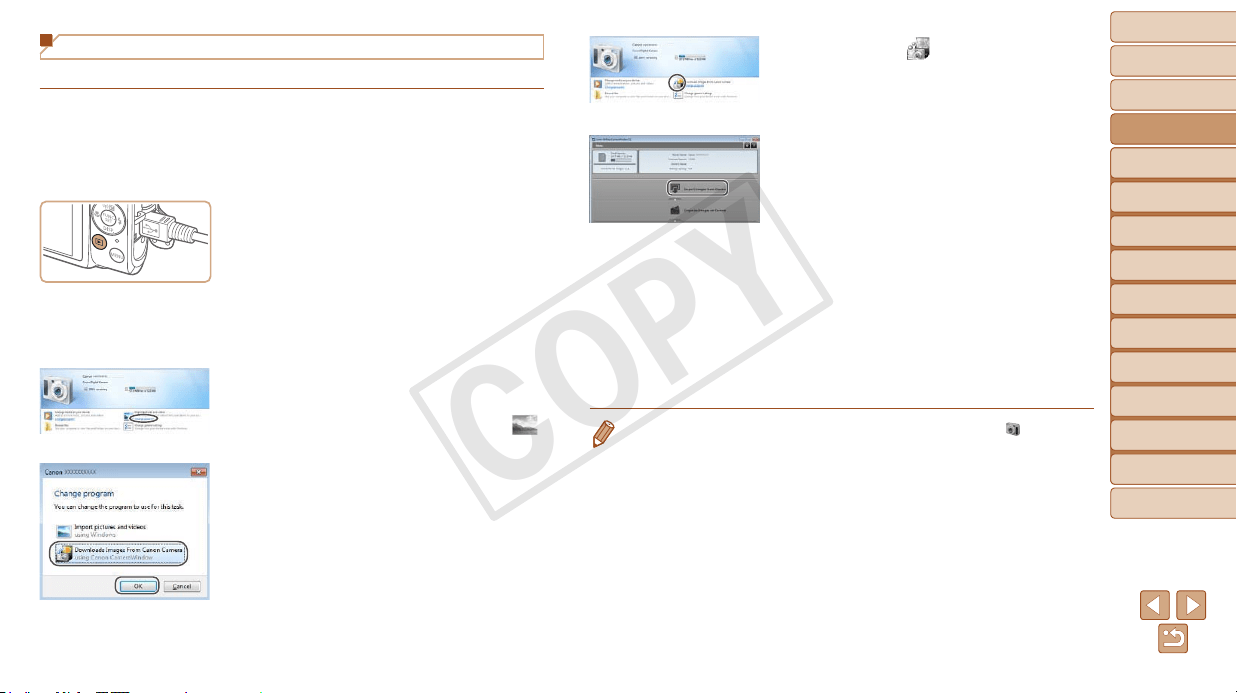
2 Turn the camera on to access
CameraWindow.
Press the <1> button to turn the camera
on.
On a Macintosh computer,
CameraWindow is displayed when a
connection is established between the
camera and computer.
For Windows, follow the steps introduced
below.
In the screen that displays, click the [ ]
link to modify the program.
Choose [Downloads Images From Canon
Camera using Canon CameraWindow]
and then click [OK].
Double click [ ].
3 Save the images to the
computer.
Click [Import Images from Camera], and
then click [Import Untransferred Images].
Images are now saved to the Pictures
folder on the computer, in separate
folders named by date.
After images are saved, close
CameraWindow, press the <1> button
to turn the camera off, and unplug the
cable.
For instructions on viewing images on
a computer, refer to the Software Guide
(=
19).
• In Windows 7, if the screen in step 2 is not displayed, click the [ ] icon in the
taskbar.
• To start CameraWindow in Windows Vista or XP, click [Downloads Images
From Canon Camera using Canon CameraWindow] on the screen displayed
when you turn the camera on in step 2. If CameraWindow is not displayed,
click the [Start] menu and choose [All Programs]
►
[Canon Utilities]
►
[CameraWindow]
►
[CameraWindow].
• On a Macintosh computer, if CameraWindow is not displayed after step 2, click
the [CameraWindow] icon in the Dock (the bar at the bottom of the desktop).
CameraWindow
COPY
23
1
2
3
4
5
6
7
8
9
Preliminary Notes and
Legal Information
Contents: Basic
Operations
Advanced Guide
Camera Basics
Auto Mode/Hybrid
Auto Mode
Other Shooting
Modes
Playback Mode
Wi-Fi Functions
Setting Menu
Accessories
Appendix
Index
P Mode
Cover
Basic Guide
• Although you can save images to a computer simply by connecting your
camera to the computer without using the software, the following limitations
apply.
- It may take a few minutes after you connect the camera to the computer until
camera images are accessible.
- Images shot in vertical orientation may be saved in horizontal orientation.
- Image protection settings may be cleared from images saved to a computer.
- Some problems may occur when saving images or image information,
depending on the operating system version, the software in use, or image
le sizes.
- Some functions provided by the software may not be available, such as
movie editing.
Using the PDF Manuals
Camera User Guide
Access this guide by double-clicking the desktop shortcut icon.
Software Guide
The guide can be accessed from the help system of included software
(some software excluded).
• It may not be possible to install the PDF manuals on computers that do not
meet the system requirements (=
20). However, you can view the manuals
on a computer that supports Adobe Reader by copying the PDF les in the
Readme folder on the CD-ROM directly to a convenient location on the
computer.
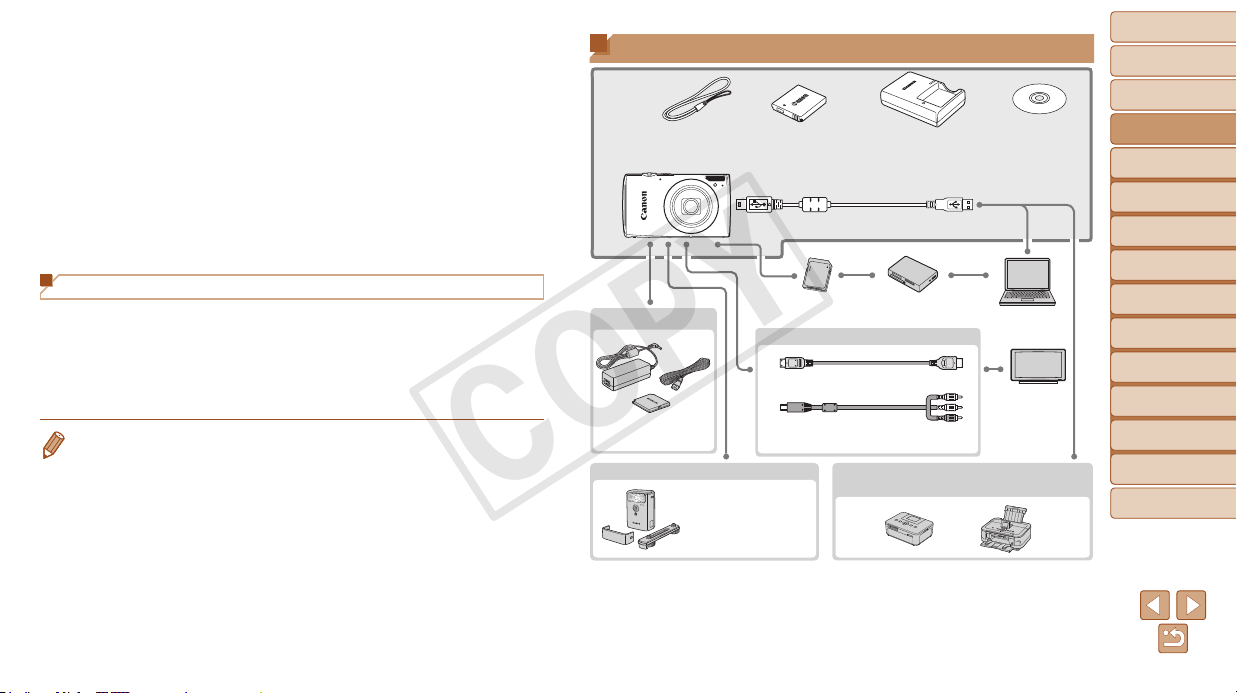
System Map
* Also available for purchase separately.
Wrist Strap
WS-DC11
Battery Pack
NB-4L*
Battery Charger
CB-2LV/CB-2LVE*
DIGITAL
CAMERA
Solution Disk
Interface Cable IFC-400PCU*
Memory Card
Card Reader
Windows/
Macintosh
Computer
TV/Video
System
AC Adapter Kit
ACK-DC60
Included
Accessories
Power
Cables
HDMI Cable HTC-100
Stereo AV Cable
AVC-DC400ST
Canon-brand PictBridge-Compatible
Printers
High-Power Flash
HF-DC2
Flash Unit
COPY

24
1
2
3
4
5
6
7
8
9
Preliminary Notes and
Legal Information
Contents: Basic
Operations
Advanced Guide
Camera Basics
Auto Mode/Hybrid
Auto Mode
Other Shooting
Modes
Playback Mode
Wi-Fi Functions
Setting Menu
Accessories
Appendix
Index
P Mode
Cover
Basic Guide
Use of genuine Canon accessories is recommended.
This product is designed to achieve excellent performance when used with genuine
Canon accessories.
Canon shall not be liable for any damage to this product and/or accidents such as re,
etc., caused by the malfunction of non-genuine Canon accessories (e.g., a leakage
and/or explosion of a battery pack). Please note that this warranty does not apply to
repairs arising out of the malfunction of non-genuine Canon accessories, although you
may request such repairs on a chargeable basis.
Note that availability varies by area, and some accessories may no longer be available.
COPY

25
2
3
4
5
6
7
8
9
Preliminary Notes and
Legal Information
Contents: Basic
Operations
Auto Mode/Hybrid
Auto Mode
Other Shooting
Modes
Playback Mode
Wi-Fi Functions
Setting Menu
Accessories
Appendix
Index
Basic Guide
P Mode
Cover
1
Camera Basics
Advanced Guide
4
Camera Basics
Practical guide that introduces other camera basics and
describes shooting and playback options
1
Advanced Guide
On/Off ........................................26
Shutter Button ..........................27
Shooting Display Options .......27
FUNC. Menu ..............................28
MENU Menu ..............................29
Indicator Display ......................30
Clock .........................................30
COPY
26
2
3
4
5
6
7
8
9
Preliminary Notes and
Legal Information
Contents: Basic
Operations
Auto Mode/Hybrid
Auto Mode
Other Shooting
Modes
Playback Mode
Wi-Fi Functions
Setting Menu
Accessories
Appendix
Index
Basic Guide
P Mode
Cover
1
Camera Basics
Advanced Guide
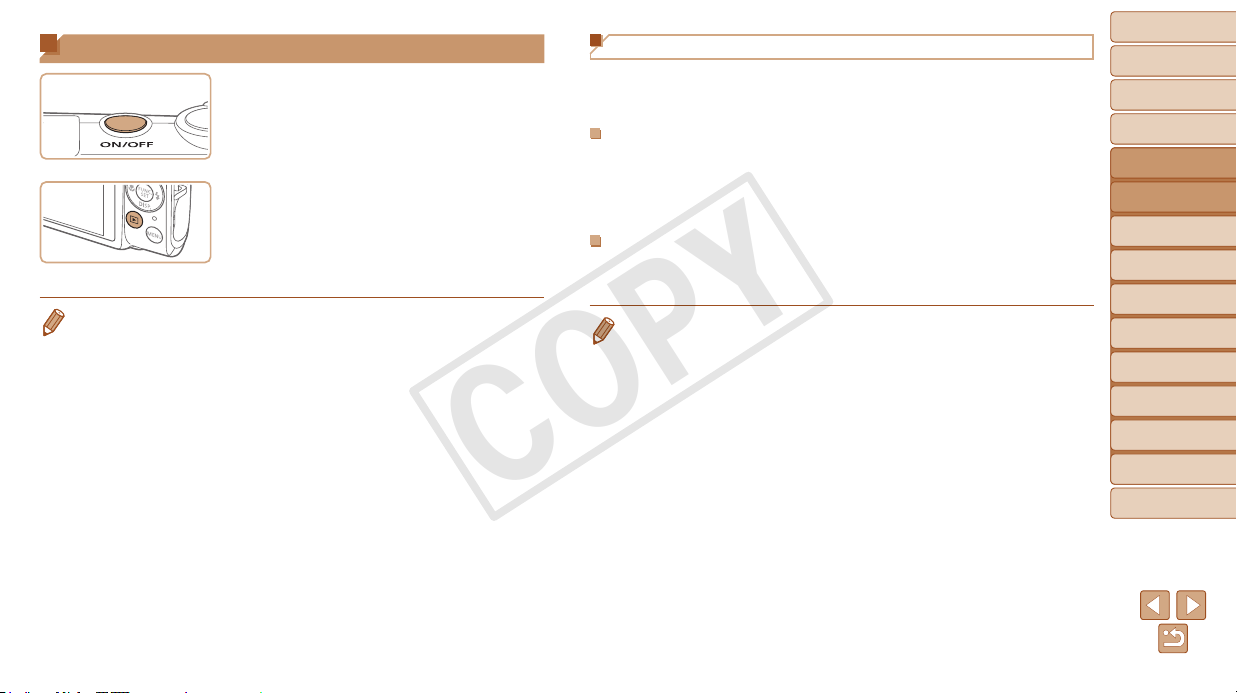
On/Off
Shooting Mode
Press the power button to turn the
camera on and prepare for shooting.
To turn the camera off, press the power
button again.
Playback Mode
Press the <1> button to turn the camera
on and view your shots.
To turn the camera off, press the <1>
button again.
• To switch to Playback mode from Shooting mode, press the <1> button.
• To switch to Shooting mode from Playback mode, press the shutter button
halfway (=
27).
• The lens will be retracted after about one minute once the camera is in
Playback mode. You can turn the camera off when the lens is retracted by
pressing the <1> button.
Power-Saving Features (Auto Power Down)
As a way to conserve battery power, the camera automatically deactivates
the screen (Display Off) and then turns itself off after a specic period of
inactivity.
Power Saving in Shooting Mode
The screen is automatically deactivated after about one minute of inactivity.
In about two more minutes, the lens is retracted and the camera turns itself
off. To activate the screen and prepare for shooting when the screen is off
but the lens is still out, press the shutter button halfway (=
27).
Power Saving in Playback Mode
The camera turns itself off automatically after about ve minutes of
inactivity.
• You can deactivate Auto Power Down and adjust the timing of Display Off, if
you prefer (=
135).
• Power saving is not active while the camera is connected to a computer via
the interface cable (=
22), or when connected to other devices via Wi-Fi
(=
106).
COPY
27
2
3
4
5
6
7
8
9
Preliminary Notes and
Legal Information
Contents: Basic
Operations
Auto Mode/Hybrid
Auto Mode
Other Shooting
Modes
Playback Mode
Wi-Fi Functions
Setting Menu
Accessories
Appendix
Index
Basic Guide
P Mode
Cover
1
Camera Basics
Advanced Guide
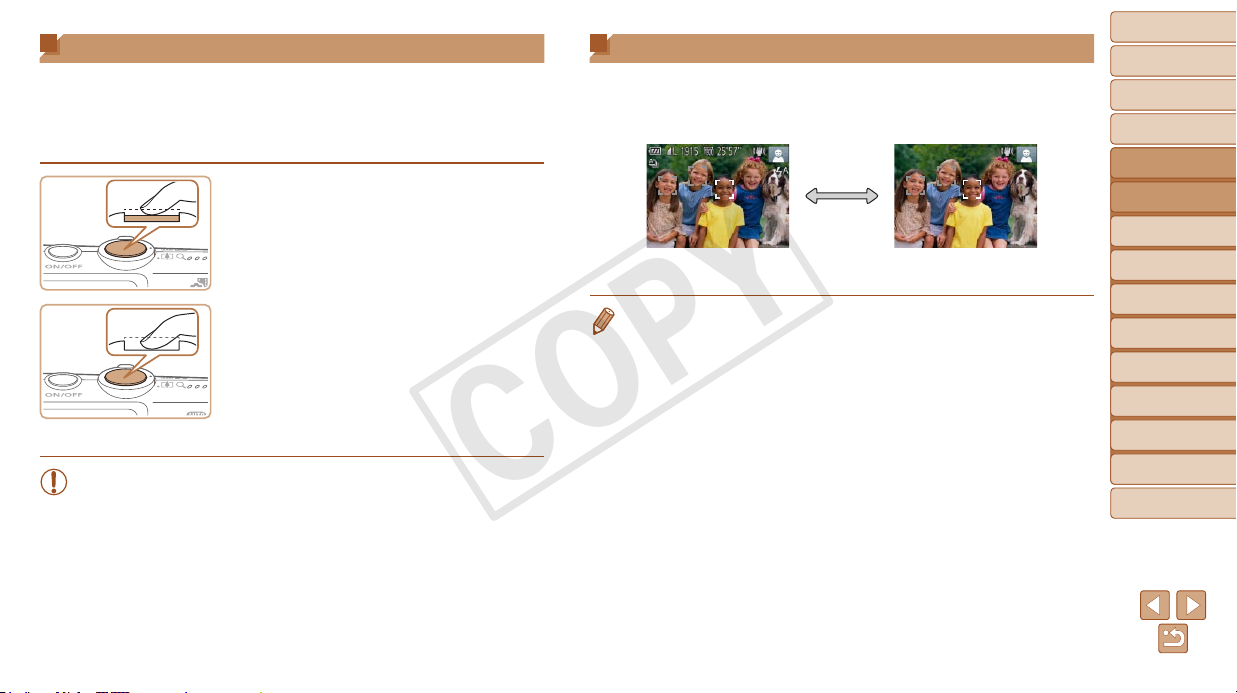
Shutter Button
To ensure your shots are in focus, always begin by holding the shutter
button halfway down, and once the subject is in focus, press the button all
the way down to shoot.
In this manual, shutter button operations are described as pressing the
button halfway or all the way down.
1 Press halfway. (Press lightly to
focus.)
Press the shutter button halfway. The
camera beeps twice, and AF frames are
displayed around image areas in focus.
2 Press all the way down. (From
the halfway position, press fully
to shoot.)
The camera shoots, as a shutter sound
is played.
Keep the camera still until the shutter
sound ends.
• Images may be out of focus if you shoot without initially pressing the
shutter button halfway.
• Length of shutter sound playback varies depending on the time
required for the shot. It may take longer in some shooting scenes,
and images will be blurry if you move the camera (or the subject
moves) before the shutter sound ends.
Shooting Display Options
Press the <p> button to view other information on the screen, or to hide
the information. For details on the information displayed, see “On-Screen
Information” (=
162).
Information is displayed No information is
displayed
• Screen brightness is automatically increased by the night display function
when you are shooting under low light, making it easier to check how shots
are composed. However, on-screen image brightness may not match the
brightness of your shots. Note that any on-screen image distortion or jerky
subject motion will not affect recorded images.
• For playback display options, see “Switching Display Modes” (=
85).
COPY
28
2
3
4
5
6
7
8
9
Preliminary Notes and
Legal Information
Contents: Basic
Operations
Auto Mode/Hybrid
Auto Mode
Other Shooting
Modes
Playback Mode
Wi-Fi Functions
Setting Menu
Accessories
Appendix
Index
Basic Guide
P Mode
Cover
1
Camera Basics
Advanced Guide
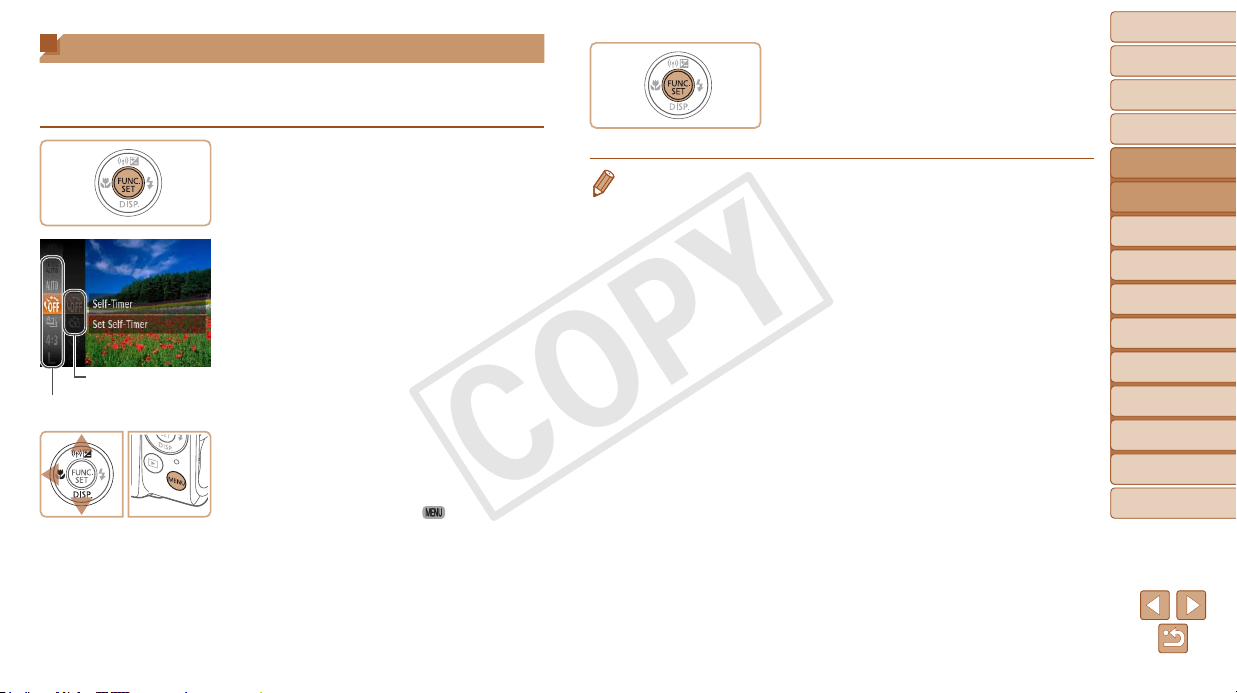
FUNC. Menu
Congure commonly used functions through the FUNC. menu as follows.
Note that menu items and options vary depending on the shooting mode
(=
165 – 168) or playback mode (=
170).
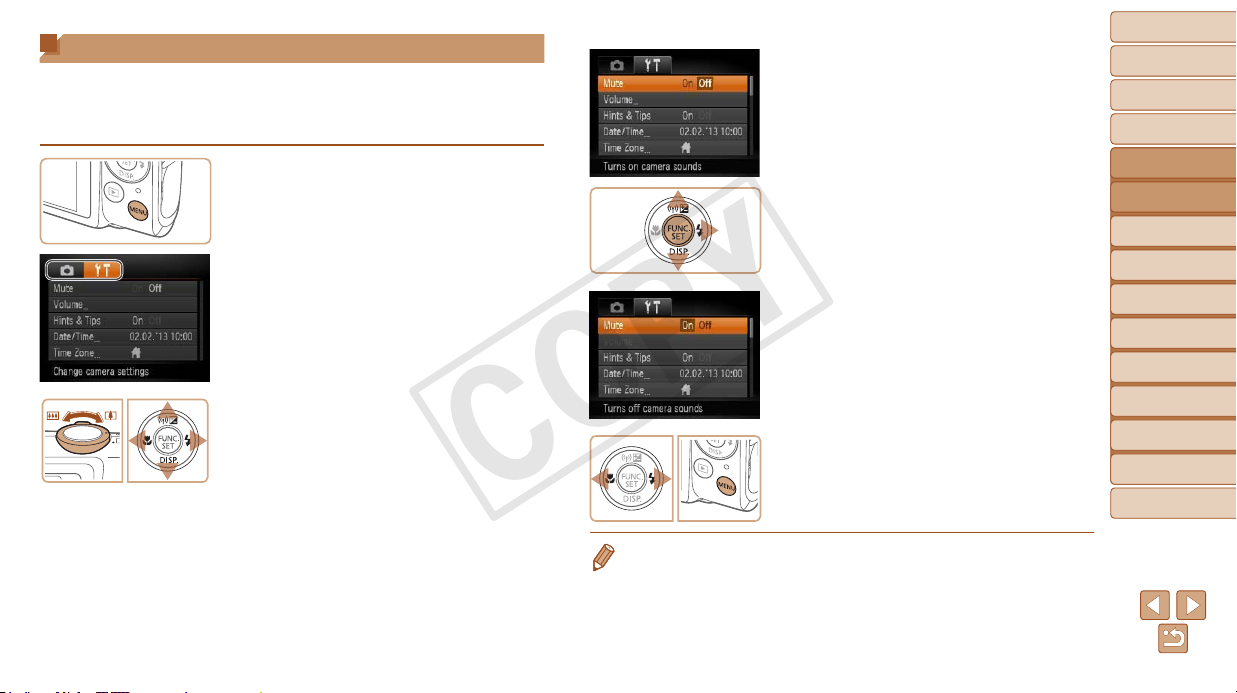
1 Access the FUNC. menu.
Press the <m> button.
2 Choose a menu item.
Press the <o><p> buttons to choose a
menu item, and then press the <m> or
<r> button.
In some menu items, functions can be
specied simply by pressing the <m>
or <r> button, or another screen is
displayed for conguring the function.
3 Choose an option.
Press the <o><p> buttons to choose
an option.
Options labeled with a [ ] icon can be
congured by pressing the <n>
button.
To return to the menu items, press the
<q> button.
Menu Items
Options
4 Finish the setup process.
Press the <m> button.
The screen before you pressed the
<m> button in step 1 is displayed again,
showing the option you congured.
• To undo any accidental setting changes, you can restore the camera’s default
settings (=
139).
COPY
29
2
3
4
5
6
7
8
9
Preliminary Notes and
Legal Information
Contents: Basic
Operations
Auto Mode/Hybrid
Auto Mode
Other Shooting
Modes
Playback Mode
Wi-Fi Functions
Setting Menu
Accessories
Appendix
Index
Basic Guide
P Mode
Cover
1
Camera Basics
Advanced Guide
MENU Menu
Congure a variety of camera functions through other menus as follows.
Menu items are grouped by purpose on tabs, such as shooting [4],
playback [1], and so on. Note that available settings vary depending on
the selected shooting or playback mode (=
167 – 170).
1 Access the menu.
Press the <n> button.
2 Choose a tab.
Move the zoom lever to choose a tab.
After you have pressed the <o><p>
buttons to choose a tab initially, you can
switch between tabs by pressing the
<q><r> buttons.
3 Choose a setting.
Press the <o><p> buttons to choose a
setting.
To choose settings with options not
shown, rst press the <m> or <r>
button to switch screens, and then press
the <o><p> buttons to select the
setting.
To return to the previous screen, press
the <n> button.
4 Choose an option.
Press the <q><r> buttons to choose an
option.
5 Finish the setup process.
Press the <n> button to return to the
screen displayed before you pressed the
<n> button in step 1.
• To undo any accidental setting changes, you can restore the camera’s default
settings (=
139).
COPY
30
2
3
4
5
6
7
8
9
Preliminary Notes and
Legal Information
Contents: Basic
Operations
Auto Mode/Hybrid
Auto Mode
Other Shooting
Modes
Playback Mode
Wi-Fi Functions
Setting Menu
Accessories
Appendix
Index
Basic Guide
P Mode
Cover
1
Camera Basics
Advanced Guide
Indicator Display
The indicator on the back of the camera (=
4) lights up or blinks
depending on the camera status.
Color
Indicator
Status
Camera Status
Green
On
Connected to a computer (=
22), or display off
(=
26, 135)
Blinking
Starting up, recording/reading/transmitting images,
shooting long exposures (=
65), or connected/
transmitting via Wi-Fi
• When the indicator blinks green, never turn the camera off, open the
memory card/battery cover, or shake or jolt the camera, which may
corrupt images or damage the camera or memory card.
Clock
You can check the current time.
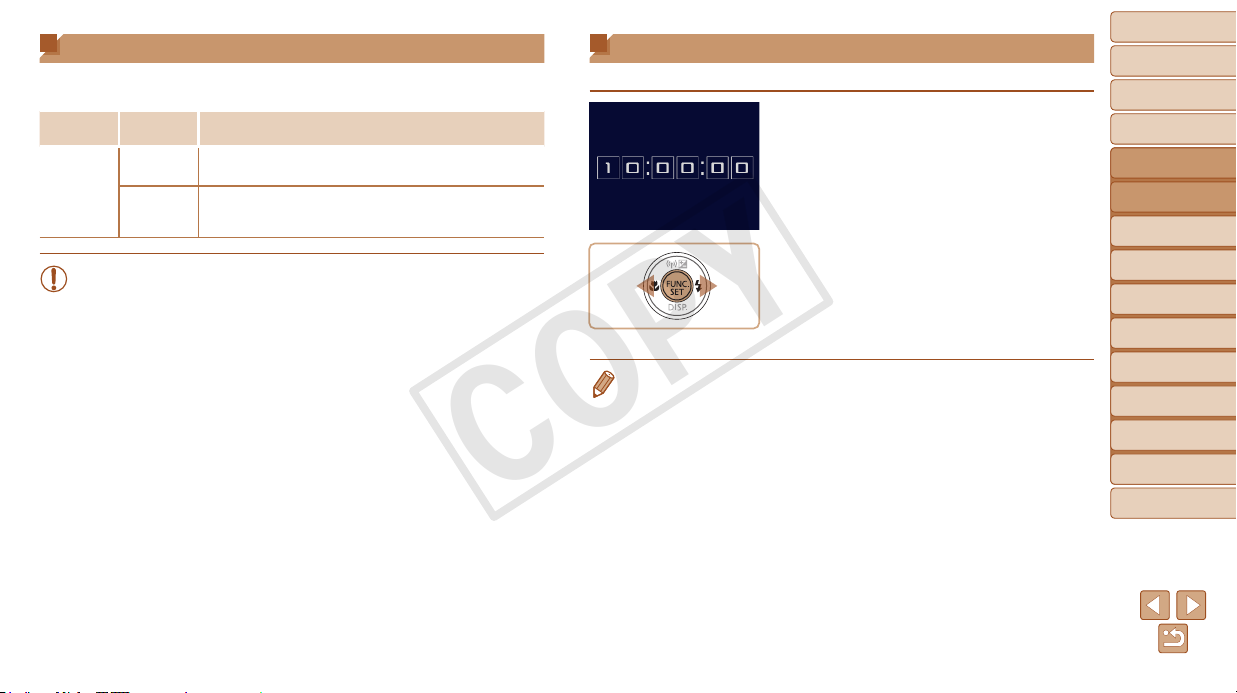
Press and hold the <m> button.
The current time appears.
If you hold the camera vertically while
using the clock function, it will switch
to vertical display. Press the <q><r>
buttons to change the display color.
Press the <m> button again to cancel
the clock display.
• When the camera is off, press and hold the <m> button, then press the power
button to display the clock.
COPY

31
1
3
4
5
6
7
8
9
Preliminary Notes and
Legal Information
Contents: Basic
Operations
Camera Basics
Other Shooting
Modes
Playback Mode
Wi-Fi Functions
Setting Menu
Accessories
Appendix
Index
Basic Guide
P Mode
Cover
Advanced Guide
2
Auto Mode/Hybrid
Auto Mode
Auto Mode/Hybrid Auto
Mode
Convenient mode for easy shots with greater control
over shooting
2
4
Shooting With Camera-
Determined Settings ...............32
Common, Convenient
Features ...................................38
Using Face ID ...........................42
Image Customization
Features ...................................47
Helpful Shooting Features ......50
Customizing Camera
Operation .................................51
COPY
32
1
3
4
5
6
7
8
9
Preliminary Notes and
Legal Information
Contents: Basic
Operations
Camera Basics
Other Shooting
Modes
Playback Mode
Wi-Fi Functions
Setting Menu
Accessories
Appendix
Index
Basic Guide
P Mode
Cover
Advanced Guide
2
Auto Mode/Hybrid
Auto Mode
Still Images Movies
Shooting With Camera-Determined
Settings
For fully automatic selection at optimal settings for specic scenes, simply
let the camera determine the subject and shooting conditions.
Still Images Movies
Shooting (Smart Auto)
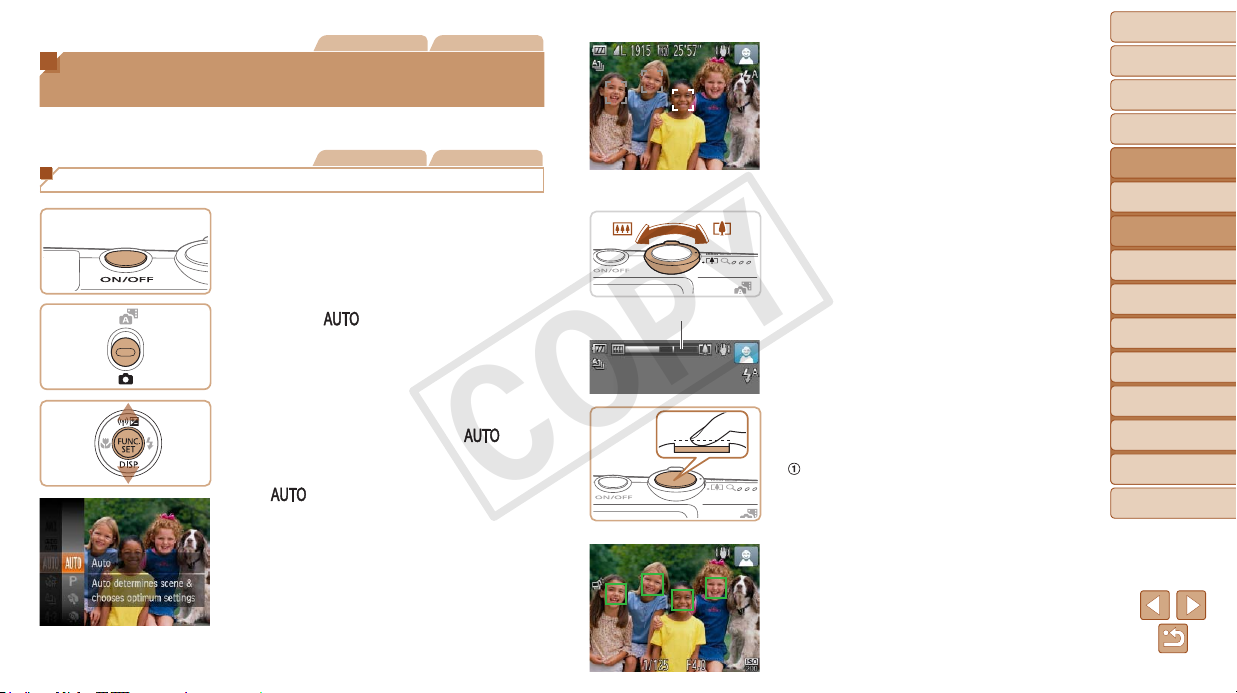
1 Turn the camera on.
Press the power button.
The startup screen is displayed.
2 Enter [ ] mode.
Set the mode switch to <4>.
Press the <m> button, press the
<o><p> buttons to choose [
], and
then press the <m> button again.
Press the <o><p> buttons to choose
[
], and then press the <m> button.
Aim the camera at the subject. The
camera will make a slight clicking noise
as it determines the scene.
Icons representing the scene and image
stabilization mode are displayed in the
upper right of the screen (=
36, 37).
Frames displayed around any detected
subjects indicate that they are in focus.
3 Compose the shot.
To zoom in and enlarge the subject, move
the zoom lever toward <i> (telephoto),
and to zoom away from the subject, move
it toward <j> (wide angle). (A zoom bar
showing the zoom position is displayed.)
4 Shoot.
Shooting Still Images
Focus.
Press the shutter button halfway. The
camera beeps twice after focusing, and
AF frames are displayed to indicate
image areas in focus.
Several AF frames are displayed when
multiple areas are in focus.
Zoom Bar
COPY
33
1
3
4
5
6
7
8
9
Preliminary Notes and
Legal Information
Contents: Basic
Operations
Camera Basics
Other Shooting
Modes
Playback Mode
Wi-Fi Functions
Setting Menu
Accessories
Appendix
Index
Basic Guide
P Mode
Cover
Advanced Guide
2
Auto Mode/Hybrid
Auto Mode
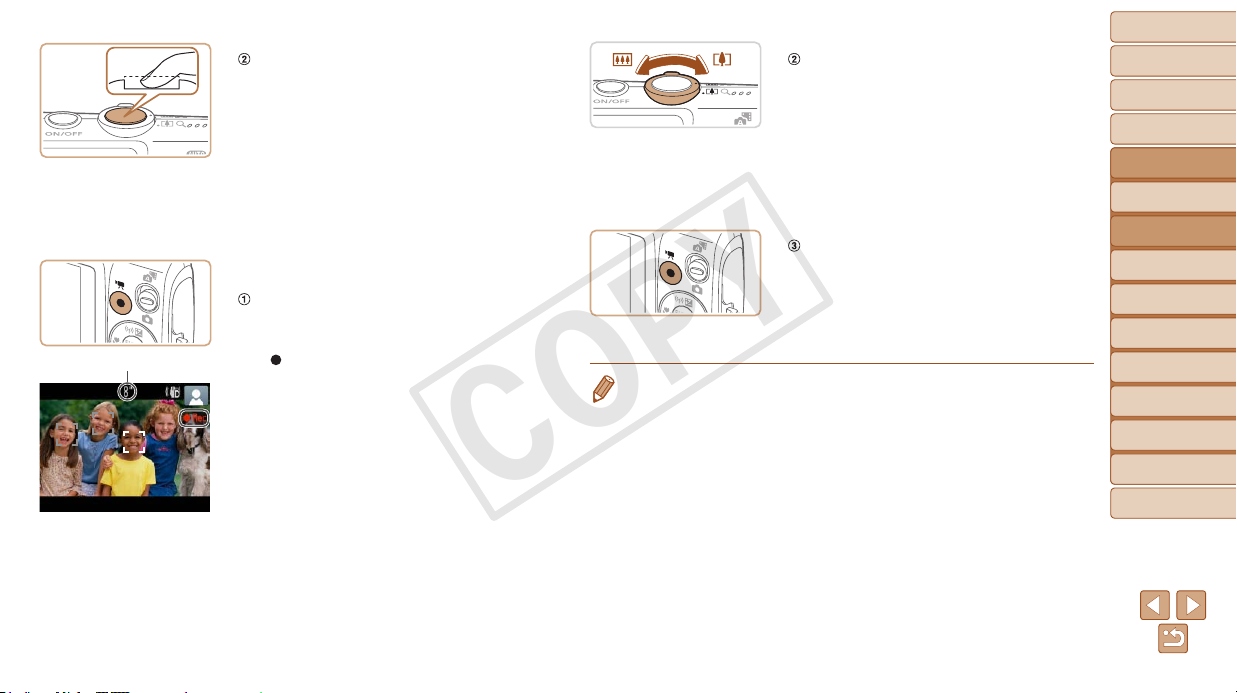
Shoot.
Press the shutter button all the way
down.
As the camera shoots, a shutter sound
is played, and in low-light conditions, the
ash res automatically.
Keep the camera still until the shutter
sound ends.
Your shot is only displayed until the
camera is ready to shoot again.
Shooting Movies
Start shooting.
Press the movie button. The camera
beeps once as recording begins, and
[
Rec] is displayed with the elapsed time.
Black bars displayed on the top and
bottom edges of the screen indicate
image areas not recorded.
Frames displayed around any detected
faces indicate that they are in focus.
Once recording begins, take your nger
off the movie button.
Elapsed Time
Resize the subject and
recompose the shot as needed.
To resize the subject, repeat the
operations in step 3 (=
32).
However, note that the sound of camera
operations will be recorded.
When you recompose shots, the
focus, brightness, and colors will be
automatically adjusted.
Finish shooting.
Press the movie button again to stop
shooting. The camera beeps twice as
recording stops.
Recording will stop automatically when
the memory card becomes full.
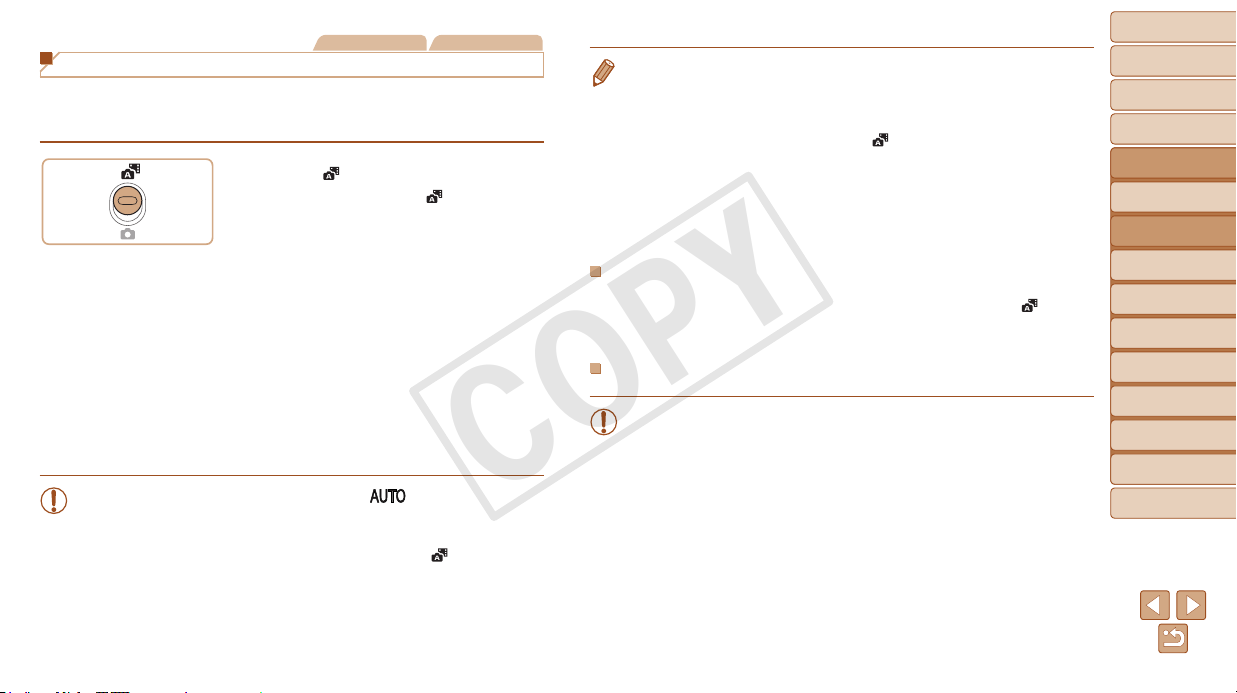
• The ash ring during shots indicates that the camera has automatically
attempted to ensure optimal colors in the main subject and background (Multi-
area White Balance).
COPY
34
1
3
4
5
6
7
8
9
Preliminary Notes and
Legal Information
Contents: Basic
Operations
Camera Basics
Other Shooting
Modes
Playback Mode
Wi-Fi Functions
Setting Menu
Accessories
Appendix
Index
Basic Guide
P Mode
Cover
Advanced Guide
2
Auto Mode/Hybrid
Auto Mode
Still Images Movies
Shooting in Hybrid Auto Mode
You can make a short movie of the day (digest movie). Just by shooting
still images, the camera will automatically record a movie clip of the scene
immediately before each shot.
1 Enter [ ] mode.
Set the mode switch to [ ].
2 Shoot.
Follow steps 3 – 4 in “Shooting (Smart
Auto)” (=
16) to shoot a still image.
To beautifully capture a digest movie,
which is created by automatically
recording about 2 – 4 seconds of the
scene before each shot, aim the camera
at the subject about four seconds before
shooting a still image.
Some camera sounds will be muted.
Sounds are not played when you press
the shutter button halfway, or trigger the
self-timer (=
39).
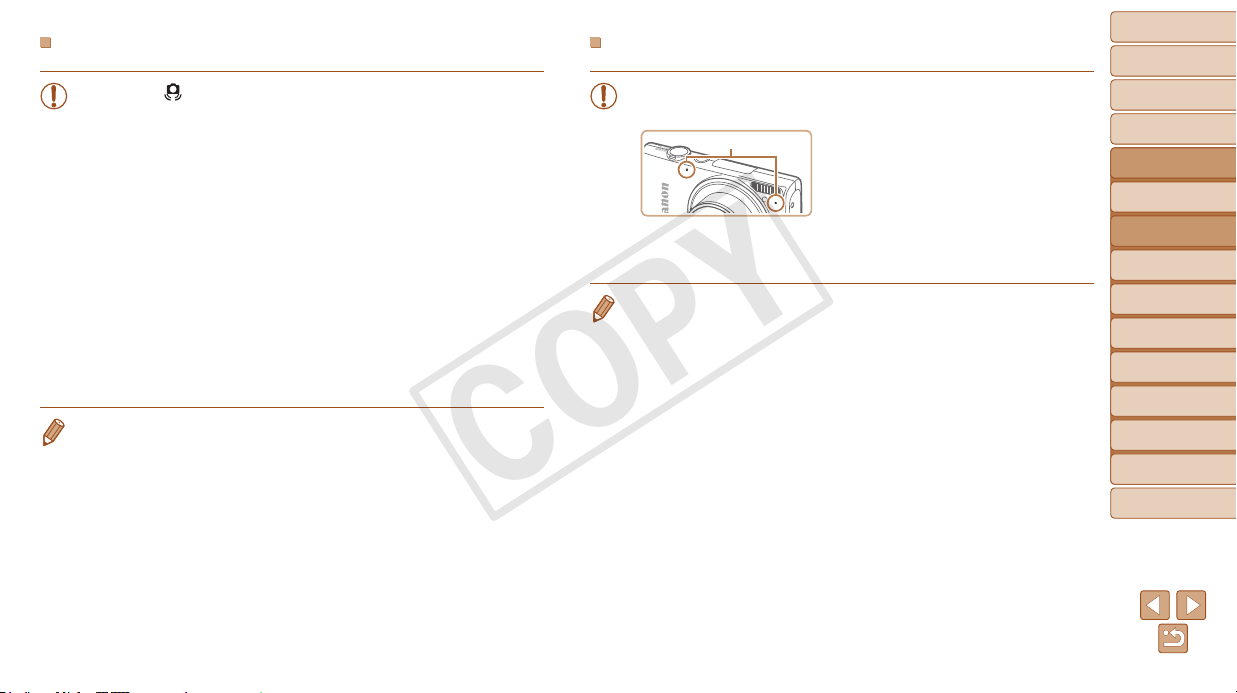
• Battery life is shorter in this mode than in [ ] mode, because
digest movies are recorded for each shot.
• A digest movie may not be recorded if you shoot a still image
immediately after turning the camera on, choosing [
] mode, or
operating the camera in other ways.
• Camera operating sounds will be recorded in digest movies.
• Although the digest movie recorded on a particular day constitutes a single
le, a single clip (chapter) is created with each shot, and the clip can be edited
(=
105).
• Digest movies are saved as separate movie les in the following cases even if
they were recorded on the same day in [
] mode.
- If the digest movie le size reaches approximately 4 GB or the total recording
time reaches approximately 29 minutes and 59 seconds
- If the digest movie is protected (=
93)
- If the daylight saving time (=
14) or time zone (=
134) settings have
been changed
- If a new folder is created (=
137)
Digest Movie Playback
You can play digest movies either by viewing still images shot in [ ] mode
on the same day as the movies or by specifying the date of movies to play
(=
86).
Still Images/Movies
• If the camera is turned on while the <p> button is held down, the
camera will no longer sound. To activate sounds again, press the
<n> button and choose [Mute] on the [3] tab, and then press
the <q><r> buttons to choose [Off].
COPY
35
1
3
4
5
6
7
8
9
Preliminary Notes and
Legal Information
Contents: Basic
Operations
Camera Basics
Other Shooting
Modes
Playback Mode
Wi-Fi Functions
Setting Menu
Accessories
Appendix
Index
Basic Guide
P Mode
Cover
Advanced Guide
2
Auto Mode/Hybrid
Auto Mode
Still Images
• A ashing [ ] icon warns that images are more likely to be blurred
by camera shake. In this case, mount the camera on a tripod or take
other measures to keep it still.
• If your shots are dark despite the ash ring, move closer to the
subject. For details on the ash range, see “Flash Range” (=
172).
• The subject may be too close if the camera only beeps once when
you press the shutter button halfway. For details on the focusing
range (shooting range), see “Shooting Range” (=
173).
• To reduce red-eye and to assist in focusing, the lamp may be
activated when shooting in low-light conditions.
• A blinking [h] icon displayed when you attempt to shoot indicates
that shooting is not possible until the ash has nished recharging.
Shooting can resume as soon as the ash is ready, so either press
the shutter button all the way down and wait, or release it and press
it again.
• The shutter sound will not be played when the Sleeping and Babies
(Sleeping) icons (=
36) are displayed.
• You can change how long images are displayed after shots (=
52).
Movies
• The camera may become warm when shooting movies repeatedly
over an extended period. This does not indicate damage.
• Keep your ngers away from the
microphone while shooting movies.
Blocking the microphone may prevent
audio from being recorded or may
cause the recording to sound mufed.
• Avoid touching camera controls other than the movie button when
shooting movies, because sounds made by the camera will be
recorded.
• Audio is recorded in stereo.
Microphone
COPY
36
1
3
4
5
6
7
8
9
Preliminary Notes and
Legal Information
Contents: Basic
Operations
Camera Basics
Other Shooting
Modes
Playback Mode
Wi-Fi Functions
Setting Menu
Accessories
Appendix
Index
Basic Guide
P Mode
Cover
Advanced Guide
2
Auto Mode/Hybrid
Auto Mode
Still Images Movies
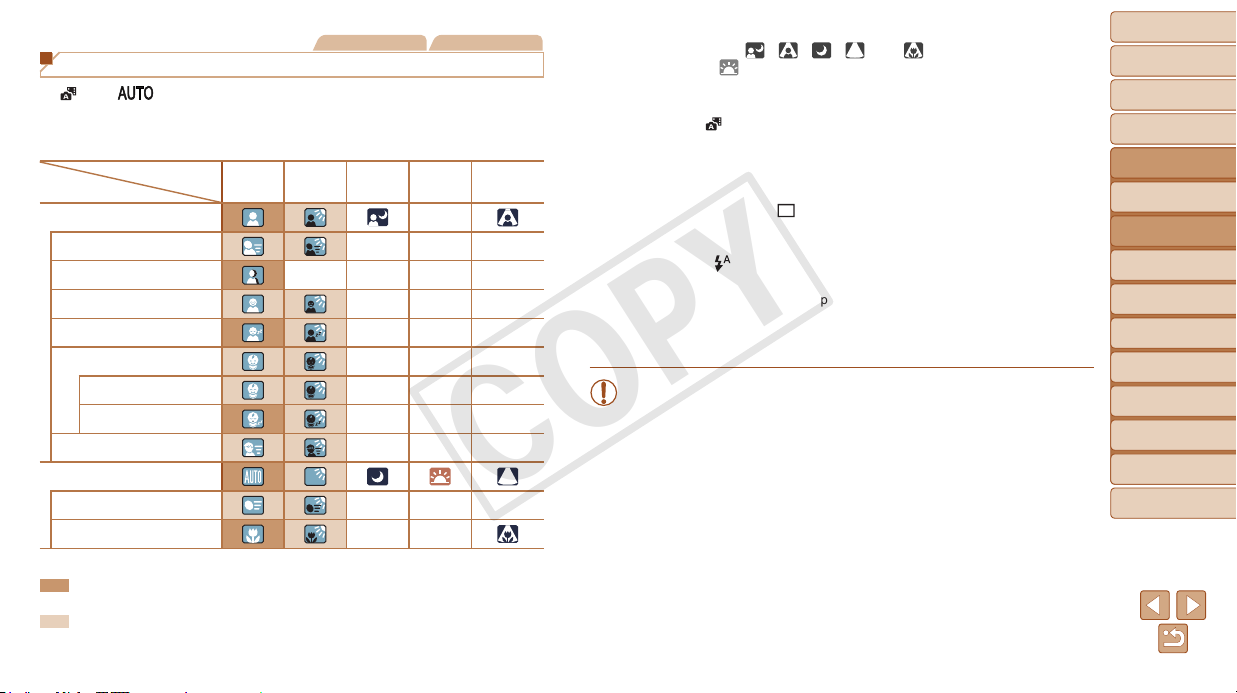
Scene Icons
In [ ] and [ ] modes, shooting scenes determined by the camera
are indicated by the icon displayed, and corresponding settings are
automatically selected for optimal focusing, subject brightness, and color.
Depending on the scene, continuous images may be shot (=
37).
Background
Subject
Normal Backlit Dark* Sunsets Spotlights
People
–
In Motion
– – –
Shadows on Face
– – – –
Smiling
– – –
Sleeping
– – –
Babies
– – –
Smiling
– – –
Sleeping
– – –
Children (In Motion)
– – –
Other Subjects
In Motion
– – –
At Close Range
– –
* Tripod Used
The background color of icons is light blue when the background is a blue sky,
dark blue when the background is dark, and gray for all other backgrounds.
The background color of icons is light blue when the background is a blue sky,
and gray for all other backgrounds.
• The background color of [ ], [ ], [ ], [ ], and [ ] is dark blue, and the
background color of [
] is orange.
• When shooting movies, only People, Other Subjects, and At Close Range icons will
be displayed.
• When shooting in [
] mode, only People, Shadows on Face, Other Subjects, and At
Close Range icons will be displayed.
• When shooting with the self-timer, People (In Motion), Smiling, Sleeping, Babies
(Smiling), Babies (Sleeping), Children, Other Subjects (In Motion) icons will not be
displayed.
• When the drive mode is set to [
] (=
74), and when [Hg Lamp Corr.] is set to
[On] and scenes are automatically corrected (=
48), Smiling, Sleeping, Babies
(Smiling), Babies (Sleeping), and Children icons will not be displayed.
• If the ash is set to [
], the Backlit icons for Smiling and Children will not be
displayed.
• Babies, Babies (Smiling), Babies (Sleeping), and Children icons will be displayed
when [Face ID] is set to [On], and the face of a registered baby (under two years old)
or child (from two to twelve years old) is detected (=
42). Conrm beforehand that
the date and time are correct (=
14).
• Try shooting in [G] mode (=
68) if the scene icon does not match
actual shooting conditions, or if it is not possible to shoot with your
expected effect, color, or brightness.
COPY
37
1
3
4
5
6
7
8
9
Preliminary Notes and
Legal Information
Contents: Basic
Operations
Camera Basics
Other Shooting
Modes
Playback Mode
Wi-Fi Functions
Setting Menu
Accessories
Appendix
Index
Basic Guide
P Mode
Cover
Advanced Guide
2
Auto Mode/Hybrid
Auto Mode
Continuous Shooting Scenes
If you shoot a still image when the following scene icons are displayed,
the camera will shoot continuously. If you press the shutter button halfway
when one of the icons in the table below is displayed, one of the following
icons will be displayed to inform you that the camera will shoot continuous
images: [ ], [ ], or [W].
Smiling (including Babies)
: Consecutive images are captured, and the camera
analyzes details such as facial expressions to save
the image determined to be the best.
Sleeping (including Babies)
: Beautiful shots of sleeping faces, created by
combining consecutive shots to reduce camera
shake and image noise.
The AF assist beam will not light up, the ash will
not re, and the shutter sound will not be played.
Children
W: So you don’t miss a photo opportunity of children
who move around, the camera will capture three
consecutive images for each shot.
• In some scenes, expected images may not be saved, and images
may not look as expected.
• Focus, image brightness, and color are determined by the rst shot.
• When you want to shoot single images only, press the <m> button, choose
[
] in the menu, and then select [ ].
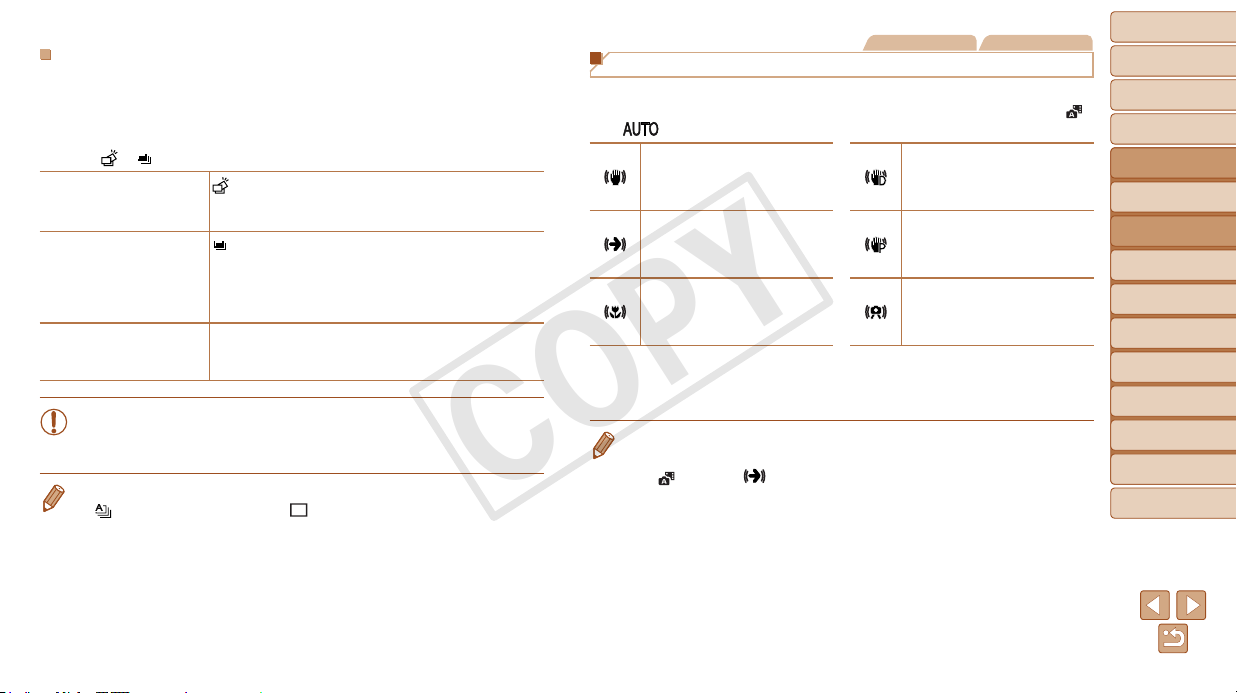
Still Images Movies
Image Stabilization Icons
Optimal image stabilization for the shooting conditions is automatically
applied (Intelligent IS). Additionally, the following icons are displayed in [ ]
and [ ] modes.
Image stabilization for still
images
Image stabilization for movies,
reducing strong camera shake,
as when shooting while walking
(Dynamic IS)
Image stabilization for still
images, when panning*
Image stabilization for slow
camera shake, such as when
shooting movies at telephoto
(Powered IS)
Image stabilization for macro
shots (Hybrid IS)
No image stabilization, because
the camera is mounted on
a tripod or held still by other
means
* Displayed when you pan, following moving subjects with the camera. When you follow
subjects moving horizontally, image stabilization only counteracts vertical camera
shake, and horizontal stabilization stops. Similarly, when you follow subjects moving
vertically, image stabilization only counteracts horizontal camera shake.
• To cancel image stabilization, set [IS Mode] to [Off] (=
82). In this case, an
IS icon is not displayed.
• In [
] mode, no [ ] icon is displayed.
COPY
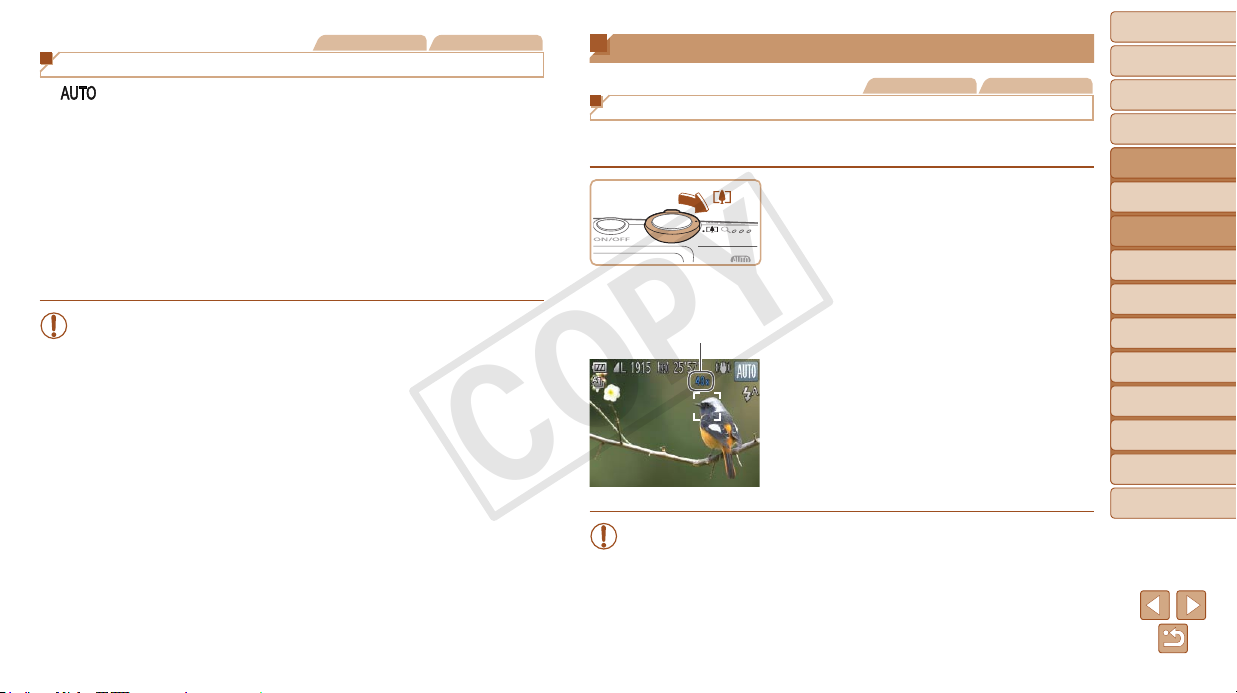
38
1
3
4
5
6
7
8
9
Preliminary Notes and
Legal Information
Contents: Basic
Operations
Camera Basics
Other Shooting
Modes
Playback Mode
Wi-Fi Functions
Setting Menu
Accessories
Appendix
Index
Basic Guide
P Mode
Cover
Advanced Guide
2
Auto Mode/Hybrid
Auto Mode
Still Images Movies
On-Screen Frames
In [ ] mode, a variety of frames are displayed once the camera detects
subjects you are aiming the camera at.
• A white frame is displayed around the subject (or person’s face)
determined by the camera to be the main subject, and gray frames are
displayed around other detected faces. Frames follow moving subjects
within a certain range to keep them in focus.
However, if the camera detects subject movement, only the white frame
will remain on the screen.
• When you are pressing the shutter button halfway and the camera
detects subject movement, a blue frame is displayed, and the focus and
image brightness are constantly adjusted (Servo AF).
• Try shooting in [G] mode (=
68) if no frames are displayed, if
frames are not displayed around desired subjects, or if frames are
displayed on the background or similar areas.
Common, Convenient Features
Still Images Movies
Zooming In Closer on Subjects (Digital Zoom)
When distant subjects are too far away to enlarge using the optical zoom,
use digital zoom for up to about 40x enlargement.
1 Move the zoom lever toward
<i>.
Hold the lever until zooming stops.
Zooming stops at the largest possible
zoom factor (before the image becomes
noticeably grainy), which is then indicated
on the screen.
2 Move the zoom lever toward
<i> again.
The camera zooms in even closer on the
subject.
• Moving the zoom lever will display the zoom bar (which indicates
the zoom position). The color of the zoom bar will change depending
on the zoom range.
- White range: optical zoom range where the image will not appear
grainy.
- Yellow range: digital zoom range where the image is not noticeably
grainy (ZoomPlus).
Zoom Factor
COPY
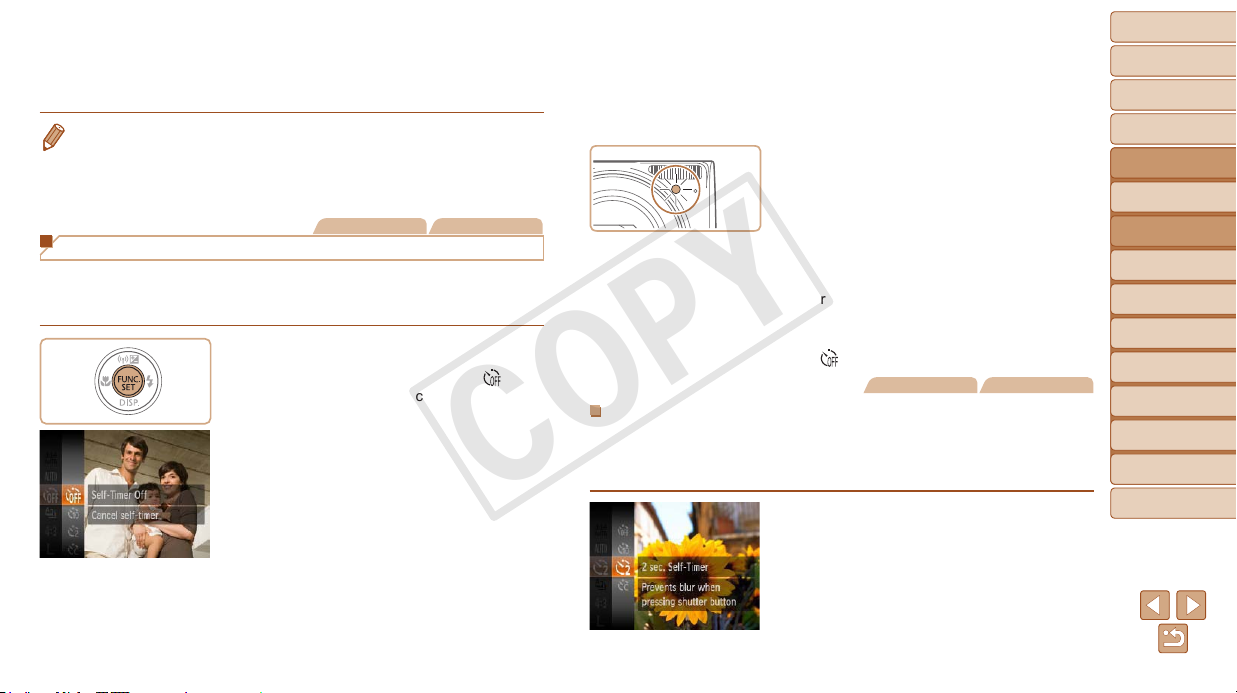
39
1
3
4
5
6
7
8
9
Preliminary Notes and
Legal Information
Contents: Basic
Operations
Camera Basics
Other Shooting
Modes
Playback Mode
Wi-Fi Functions
Setting Menu
Accessories
Appendix
Index
Basic Guide
P Mode
Cover
Advanced Guide
2
Auto Mode/Hybrid
Auto Mode
- Blue range: digital zoom range where the image will appear grainy.
Because the blue range will not be available at some resolution
settings (=
47), the maximum zoom factor can be achieved by
following step 1.
• Focal length when optical and digital zoom are combined is as follows (35mm
lm equivalent).
24 – 960 mm (24 – 240 mm with optical zoom alone)
• To deactivate digital zoom, press the <n> button, choose [Digital Zoom]
on the [4] tab, and then choose [Off].
Still Images Movies
Using the Self-Timer
With the self-timer, you can include yourself in group photos or other timed
shots. The camera will shoot about 10 seconds after you press the shutter
button.
1 Congurethesetting.
Press the <m> button, choose [ ]
in the menu, and then choose the []]
option (=
28).
Once the setting is complete, []] is
displayed.
2 Shoot.
For Still Images: Press the shutter button
halfway to focus on the subject, and then
press it all the way down.
For Movies: Press the movie button.
Once you start the self-timer, the lamp
will blink and the camera will play a self-
timer sound.
Two seconds before the shot, the blinking
and sound will speed up. (The lamp will
remain lit in case the ash res.)
To cancel shooting after you have
triggered the self-timer, press the
<n> button.
To restore the original setting, choose
[
] in step 1.
Still Images Movies
Using the Self-Timer to Avoid Camera Shake
This option delays shutter release until about two seconds after you have
pressed the shutter button. If the camera is unsteady while you are pressing
the shutter button, it will not affect your shot.
Congurethesetting.
Follow step 1 in “Using the Self-Timer”
(=
39) and choose [[].
Once the setting is complete, [[] is
displayed.
Follow step 2 in “Using the Self-Timer”
(=
39) to shoot.
COPY

40
1
3
4
5
6
7
8
9
Preliminary Notes and
Legal Information
Contents: Basic
Operations
Camera Basics
Other Shooting
Modes
Playback Mode
Wi-Fi Functions
Setting Menu
Accessories
Appendix
Index
Basic Guide
P Mode
Cover
Advanced Guide
2
Auto Mode/Hybrid
Auto Mode
Still Images Movies
Customizing the Self-Timer
You can specify the delay (0 – 30 seconds) and number of shots (1 – 10).
1 Choose [$].
Following step 1 in “Using the Self-Timer”
(=
39), choose [$] and press the
<n> button.
2 Congurethesetting.
Press the <o><p> buttons to choose
[Delay] or [Shots].
Press the <q><r> buttons to choose a
value, and then press the <m> button.
Once the setting is complete, [$] is
displayed.
Follow step 2 in “Using the Self-Timer”
(=
39) to shoot.
• For movies shot using the self-timer, [Delay] represents the delay
before recording begins, but the [Shots] setting has no effect.
• When you specify multiple shots, image brightness and white balance are
determined by the rst shot. More time is required between shots when the
ash res or when you have specied to take many shots. Shooting will stop
automatically when the memory card becomes full.
• When a delay longer than two seconds is specied, two seconds before the
shot, the lamp blinking and self-timer sound will speed up. (The lamp will
remain lit in case the ash res.)
Still Images
Deactivating the Flash
Prepare the camera for shooting without the ash as follows.
Congurethesetting.
Press the <r> button, press the <q><r>
buttons to choose [!], and then press
the <m> button.
Once the setting is complete, [!] is
displayed.
To restore the original setting, repeat this
process but choose [
].
• If a ashing [ ] icon is displayed when you press the shutter button
halfway in low-light conditions, mount the camera on a tripod or take
other measures to keep it still.
COPY
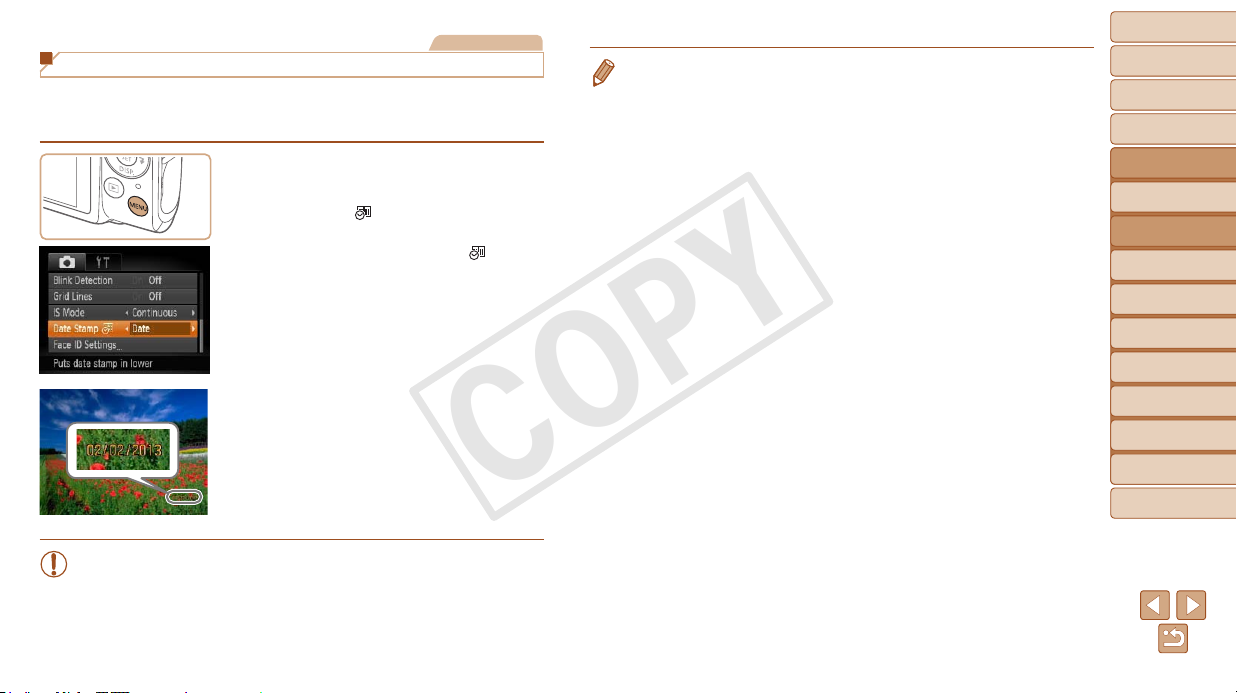
41
1
3
4
5
6
7
8
9
Preliminary Notes and
Legal Information
Contents: Basic
Operations
Camera Basics
Other Shooting
Modes
Playback Mode
Wi-Fi Functions
Setting Menu
Accessories
Appendix
Index
Basic Guide
P Mode
Cover
Advanced Guide
2
Auto Mode/Hybrid
Auto Mode
Still Images
Adding a Date Stamp
The camera can add the shooting date to images, in the lower-right corner.
However, note that date stamps cannot be edited or removed, so conrm
beforehand that the date and time are correct (=
14).
1 Congurethesetting.
Press the <n> button, choose
[Date Stamp
] on the [4] tab, and
then choose the desired option (=
29).
Once the setting is complete, [ ] is
displayed.
2 Shoot.
As you take shots, the camera adds the
shooting date or time to the lower-right
corner of images.
To restore the original setting, choose
[Off] in step 1.
• Date stamps cannot be edited or removed.
• Shots taken without adding a date stamp can be printed with one as follows.
However, adding a date stamp this way to images that already have one may
cause it to be printed twice.
- Use the included software to print
For details, refer to the Software Guide (=
19).
- Print using printer functions (=
146)
- Use camera DPOF print settings (=
150) to print
COPY

42
1
3
4
5
6
7
8
9
Preliminary Notes and
Legal Information
Contents: Basic
Operations
Camera Basics
Other Shooting
Modes
Playback Mode
Wi-Fi Functions
Setting Menu
Accessories
Appendix
Index
Basic Guide
P Mode
Cover
Advanced Guide
2
Auto Mode/Hybrid
Auto Mode
Using Face ID
If you register a person ahead of time, the camera will detect that person’s
face, and prioritize focus, brightness, and color for that person when
shooting. In [ ] mode, the camera can detect babies and children based
on registered birthdays and optimize settings for them when shooting.
This function is also useful when searching for a specic registered person
among a large number of images (=
88).
Personal Information
• Information such as images of a face (face info) registered with Face ID,
and personal information (name, birthday) will be saved on the camera.
Additionally, when registered people are detected, their names will be
recorded in still images. When using the Face ID function, be careful
when sharing the camera or images with others, and when posting
images online where many others can view them.
• When disposing of a camera or transferring it to another person after
using Face ID, be sure to erase all information (registered faces, names,
and birthdays) from the camera (=
46).
Registering Face ID Information
You can register information (face info, name, birthday) for up to 12 people
to use with Face ID.
1 Access the setting screen.
Press the <n> button, choose [Face
ID Settings] on the [4] tab, and then
press the <m> button (=
29).
Press the <o><p> buttons to choose
[Add to Registry], and then press the
<m> button.
Press the <o><p> buttons to choose
[Add a New Face], and then press the
<m> button.
2 Register face information.
Aim the camera so that the face of the
person you want to register is inside the
gray frame at the center of the screen.
A white frame on the person’s face
indicates that the face is recognized.
Make sure a white frame is displayed on
the face, and then shoot.
If the face is not recognized, you cannot
register face information.
After [Register?] is displayed, press the
<q><r> buttons to choose [OK], and
then press the <m> button.
The [Edit Prole] screen is displayed.
COPY
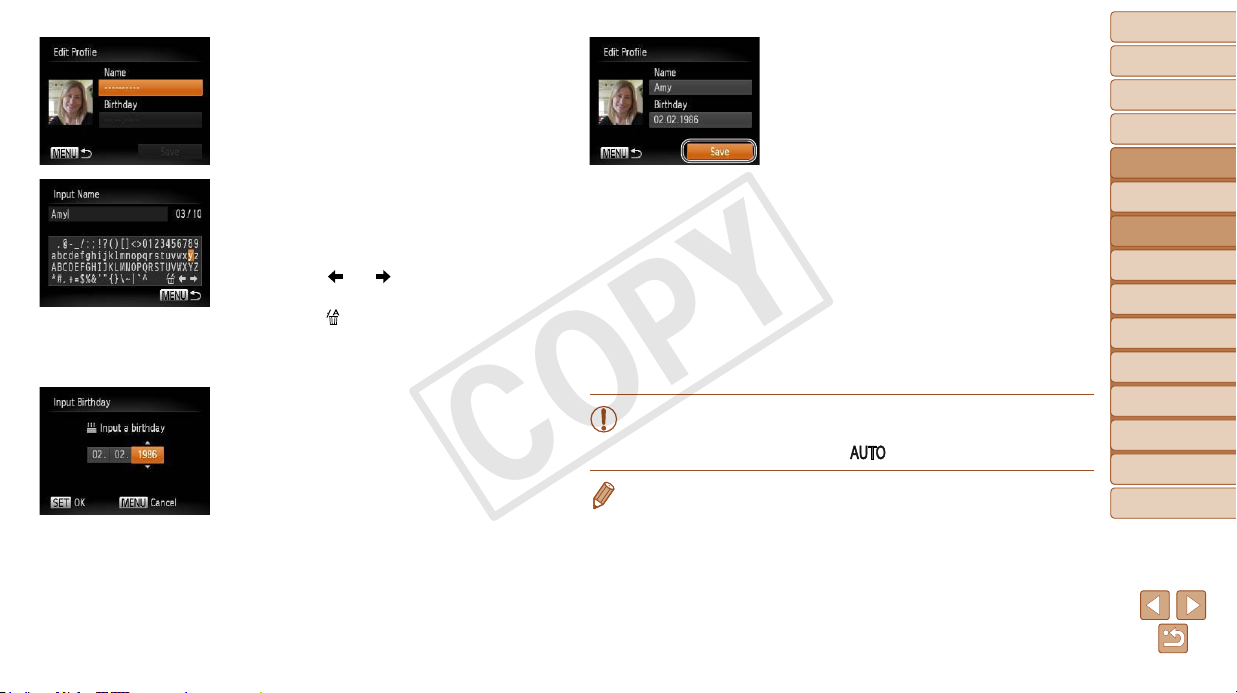
43
1
3
4
5
6
7
8
9
Preliminary Notes and
Legal Information
Contents: Basic
Operations
Camera Basics
Other Shooting
Modes
Playback Mode
Wi-Fi Functions
Setting Menu
Accessories
Appendix
Index
Basic Guide
P Mode
Cover
Advanced Guide
2
Auto Mode/Hybrid
Auto Mode
3 Register the person’s name and
birthday.
Press the <m> button.
Press the <o><p><q><r> buttons to
choose a character, and then press the
<m> button to enter it.
Up to 10 characters can be used.
Choose [ ] or [ ] and press the <m>
button to move the cursor.
Choose [ ] and press the <m> button.
The previous character will be deleted.
Press the <n> button to return to the
[Edit Prole] screen.
To register a birthday, on the [Edit Prole]
screen, press the <o><p> buttons to
choose [Birthday], and then press the
<m> button.
Press the <q><r> buttons to choose a
setting.
Press the <o><p> buttons to specify
the date.
When nished, press the <m> button.
4 Save the settings.
Press the <o><p> buttons to choose
[Save], and then press the <m> button.
After a message is displayed, press the
<q><r> buttons to choose [Yes], and
then press the <m> button.
5 Continue registering face
information.
To register up to 4 more points of face
information (expressions or angles),
repeat step 2.
Registered faces are more easily
recognized if you add a variety of face
information. In addition to a head-on
angle, add a slight side angle, a shot
when smiling, and shots inside and
outside.
• The ash will not re when following step 2.
• If you do not register a birthday in step 3, Babies or Children icons
(=
36) will not be displayed in [ ] mode.
• You can overwrite registered face info, and add face info later if you have not
lled all 5 face info slots (=
45).
COPY
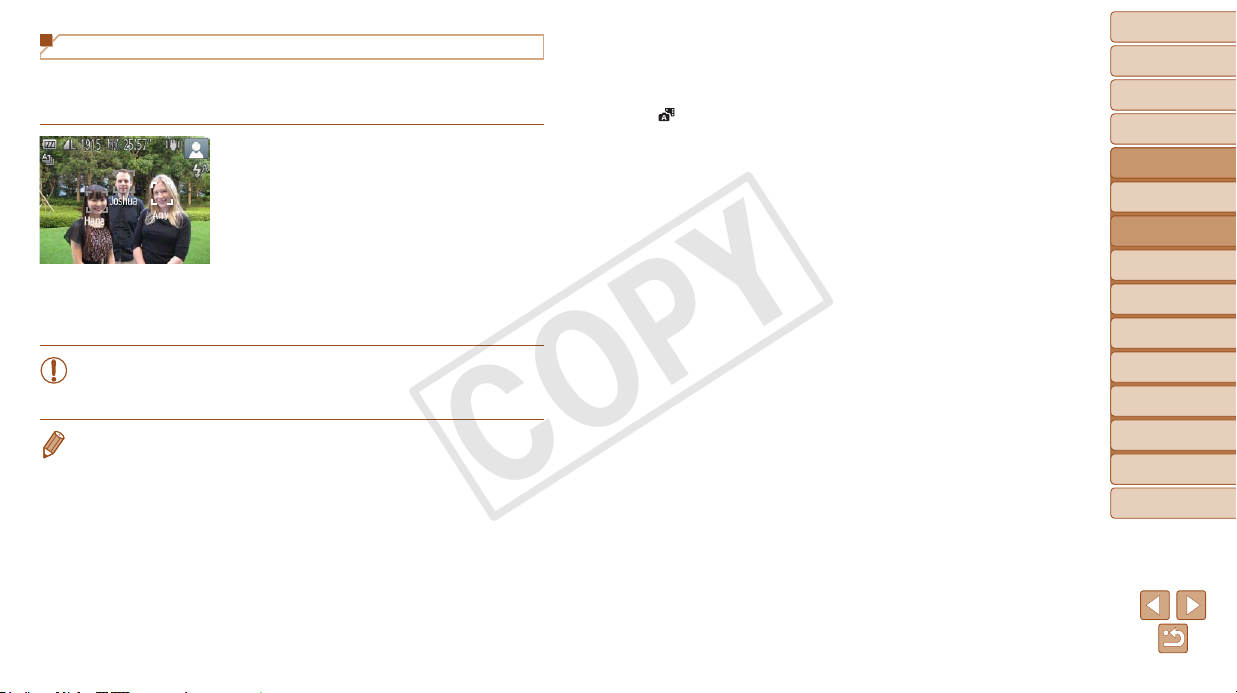
44
1
3
4
5
6
7
8
9
Preliminary Notes and
Legal Information
Contents: Basic
Operations
Camera Basics
Other Shooting
Modes
Playback Mode
Wi-Fi Functions
Setting Menu
Accessories
Appendix
Index
Basic Guide
P Mode
Cover
Advanced Guide
2
Auto Mode/Hybrid
Auto Mode
Shooting
If you register a person ahead of time, the camera will prioritize that person
as the main subject, and optimize focus, brightness, and color for that
person when shooting.
When you point the camera toward a
subject, the names of up to 3 registered
people will be displayed when they are
detected.
Shoot.
Displayed names will be recorded in still
images. Even if people are detected, but
their names are not displayed, the names
(up to 5 people) will be recorded in the
image.
• People other than those registered may be mistakenly detected as
the registered person if they share similar facial features.
• Registered people may not be correctly detected if the captured image or
scene differs drastically from the registered face information.
• If a registered face is not detected, or not easily detected, overwrite registered
information with new face info. Registering face info right before shooting will
allow for easier detection of registered faces.
• If a person is mistakenly detected as another person and you continue
shooting, you can edit or erase the name recorded in the image during
playback (=
90).
• Because faces of babies and children change quickly as they grow, you should
update their face info regularly (=
45).
• When information display is set to off (=
27), names will not display, but will
be recorded in the image.
• If you don’t want names to be recorded in still images, choose [Face ID
Settings] on the [4] tab, choose [Face ID], and then choose [Off].
• You can check names recorded in images in the playback screen (simple
information display) (=
84).
• In [
] mode, names are not displayed on the shooting screen, but they will be
recorded in still images.
COPY
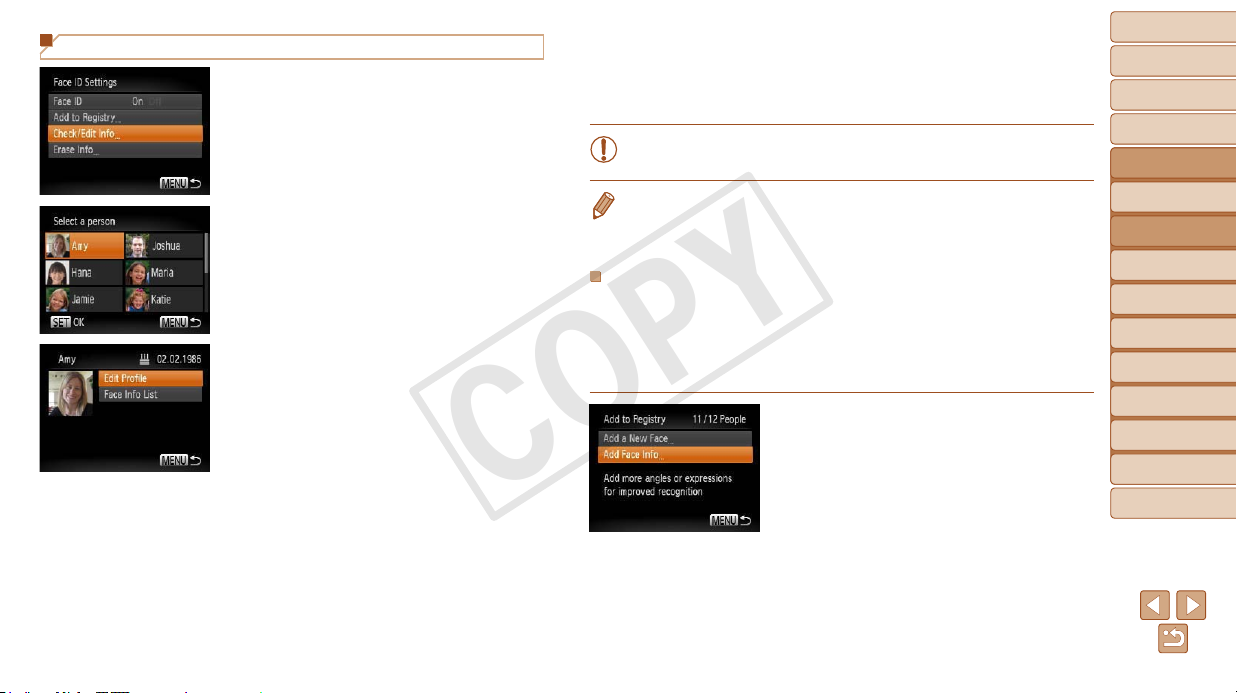
45
1
3
4
5
6
7
8
9
Preliminary Notes and
Legal Information
Contents: Basic
Operations
Camera Basics
Other Shooting
Modes
Playback Mode
Wi-Fi Functions
Setting Menu
Accessories
Appendix
Index
Basic Guide
P Mode
Cover
Advanced Guide
2
Auto Mode/Hybrid
Auto Mode
Checking and Editing Registered Information
1 Access the [Check/Edit Info]
screen.
Following step 1 in “Registering Face ID
Information” (=
42), choose [Check/
Edit Info] and press the <m> button.
2 Choose a person to check or
edit.
Press the <o><p><q><r> buttons to
choose the person to check or edit, and
then press the <m> button.
3 Check or edit the information as
needed.
To check a name or birthday, access
the [Edit Prole] screen by pressing the
<o><p> buttons and then pressing the
<m> button. On the screen displayed,
you can edit names or birthdays as
described in step 3 of “Registering Face
ID Information” (=
43).
To check face information, press the
<o><p> buttons to choose [Face Info
List], and then press the <m> button. To
erase face information, press the <m>
button on the screen displayed, press
the <o><p><q><r> buttons to choose
the face information to erase, and then
press the <m> button. After [Erase?] is
displayed, press the <q><r> buttons to
choose [OK], and then press the <m>
button.
• Even if you change names in [Edit Prole], the names recorded in
previously shot images will remain the same.
• You can use the included software to edit registered names. Some characters
entered with the included software may not display on the camera, but will be
correctly recorded in images.
Overwriting and Adding Face Information
You can overwrite existing face information with new face info. You should
update face information regularly, especially with babies and children, as
their faces change quickly as they grow.
You can also add face information when all 5 face info slots have not been
lled.
1 Access the [Add Face Info]
screen.
Following step 1 in “Registering Face ID
Information” (=
42), choose [Add Face
Info] and press the <m> button.
COPY
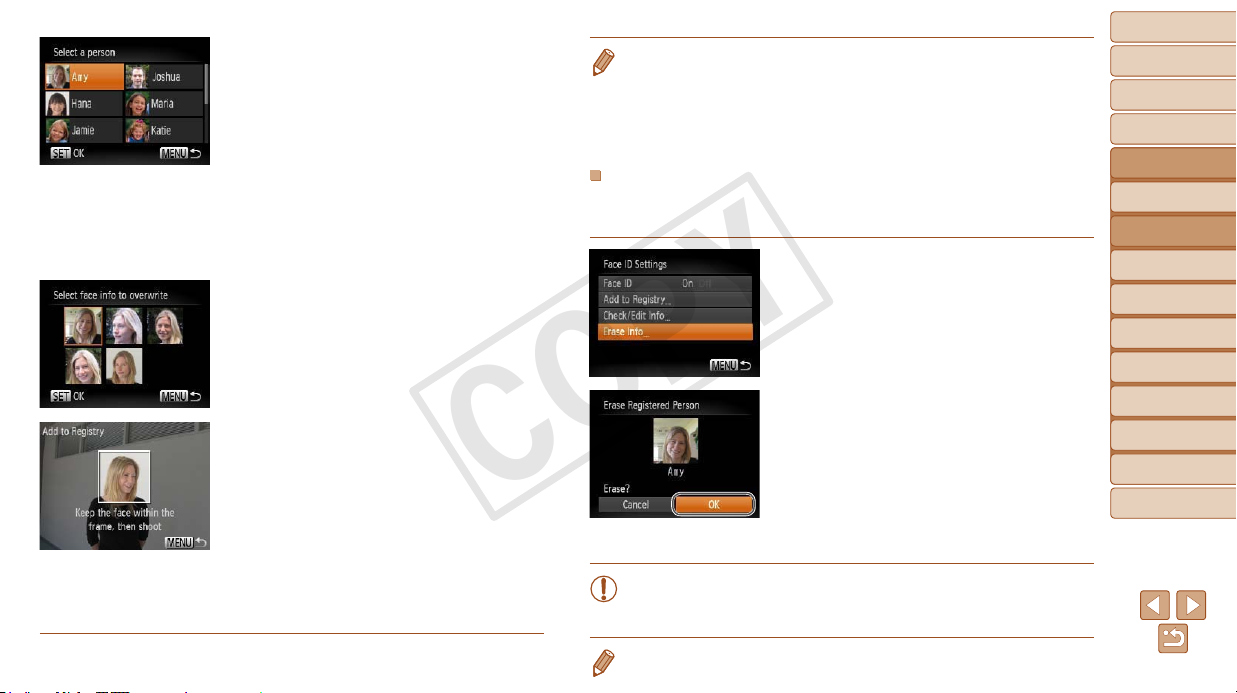
46
1
3
4
5
6
7
8
9
Preliminary Notes and
Legal Information
Contents: Basic
Operations
Camera Basics
Other Shooting
Modes
Playback Mode
Wi-Fi Functions
Setting Menu
Accessories
Appendix
Index
Basic Guide
P Mode
Cover
Advanced Guide
2
Auto Mode/Hybrid
Auto Mode
2 Choose the name of the person
to overwrite.
Press the <o><p><q><r> buttons
to choose the name of a person to
overwrite, and then press the <m>
button.
A message is displayed if you have
already registered ve faces. In this case,
press the <q><r> buttons to choose
[OK], and then press the <m> button.
If less than ve faces are registered, go
to step 4 to add face information.
3 Choose the face info to
overwrite.
Press the <o><p><q><r> buttons to
choose the face info to overwrite, and
then press the <m> button.
4 Register face information.
Follow step 2 in “Registering Face ID
Information” (=
42) to shoot, and then
register the new face information.
Registered faces are more easily
recognized if you add a variety of face
information. In addition to a head-on
angle, add a slight side angle, a shot
when smiling, and shots inside and
outside.
• You cannot add face information if all 5 information slots are lled. Follow the
steps above to overwrite face information.
• You can follow the above steps to register new face info when there is at least
one slot open; however, you cannot overwrite any face information. Instead
of overwriting face info, rst erase unwanted existing info (=
46), and then
register new face information (=
42) as needed.
Erasing Registered Information
You can erase information (face info, name, birthday) registered to Face ID.
However, names recorded in previously shot images will not be erased.
1 Access the [Erase Info] screen.
Follow step 1 in “Registering Face ID
Information” (=
42) and choose [Erase
Info].
2 Choose the name of the person
whose info you want to erase.
Press the <o><p><q><r> buttons to
choose the name of a person to erase,
and then press the <m> button.
After [Erase?] is displayed, press the
<q><r> buttons to choose [OK], and
then press the <m> button.
• If you erase a registered person’s info, you will not be able to
display their name (=
27), overwrite their info (=
90), or
search images for them (=
88).
• You can also erase names in image information (=
90).
COPY
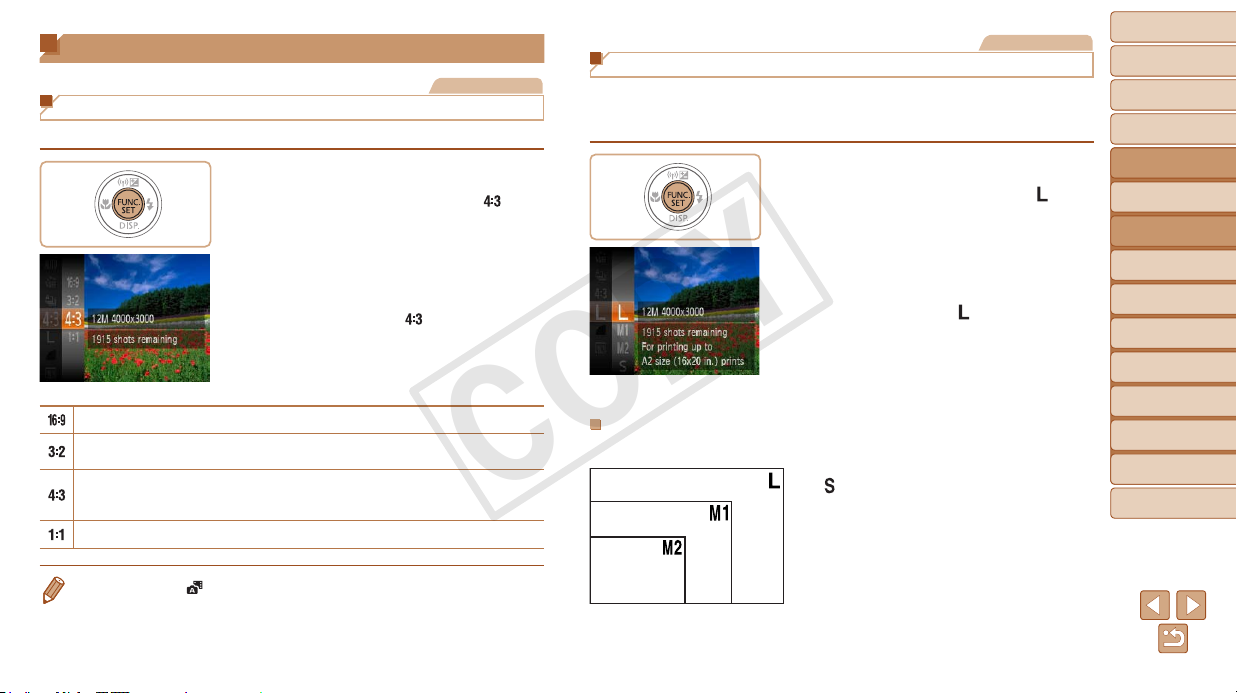
47
1
3
4
5
6
7
8
9
Preliminary Notes and
Legal Information
Contents: Basic
Operations
Camera Basics
Other Shooting
Modes
Playback Mode
Wi-Fi Functions
Setting Menu
Accessories
Appendix
Index
Basic Guide
P Mode
Cover
Advanced Guide
2
Auto Mode/Hybrid
Auto Mode
Image Customization Features
Still Images
Changing the Aspect Ratio
Change the image aspect ratio (ratio of width to height) as follows.
Congurethesetting.
Press the <m> button, choose [ ] in
the menu, and choose the desired option
(=
28).
Once the setting is complete, the screen
aspect ratio will be updated.
To restore the original setting, repeat this
process but choose [
].
Used for display on widescreen HDTVs or similar display devices.
Same aspect ratio as 35mm lm, used for printing images at 5 x 7-inch or
postcard sizes.
Native aspect ratio of the camera screen, also used for display on standard-
denition televisions or similar display devices, or for printing images at 3.5 x
5-inch or A-series sizes.
Square aspect ratio.
• Not available in [ ] mode.
Still Images
Changing Image Resolution (Size)
Choose from 4 levels of image resolution, as follows. For guidelines on
how many shots at each resolution setting can t on a memory card, see
“Number of 4:3 Shots per Memory Card” (=
172).
Congurethesetting.
Press the <m> button, choose [ ] in
the menu, and choose the desired option
(=
28).
The option you congured is now
displayed.
To restore the original setting, repeat this
process but choose [
].
Guidelines for Choosing Resolution Based on Paper
Size (for 4:3 Images)
[ ]: For e-mailing images.
A2 (16.5 x 23.4 in.)
A3 – A5 (11.7 x
16.5 – 5.8 x 8.3 in.)
5 x 7 in.
Postcard
3.5 x 5 in.
COPY
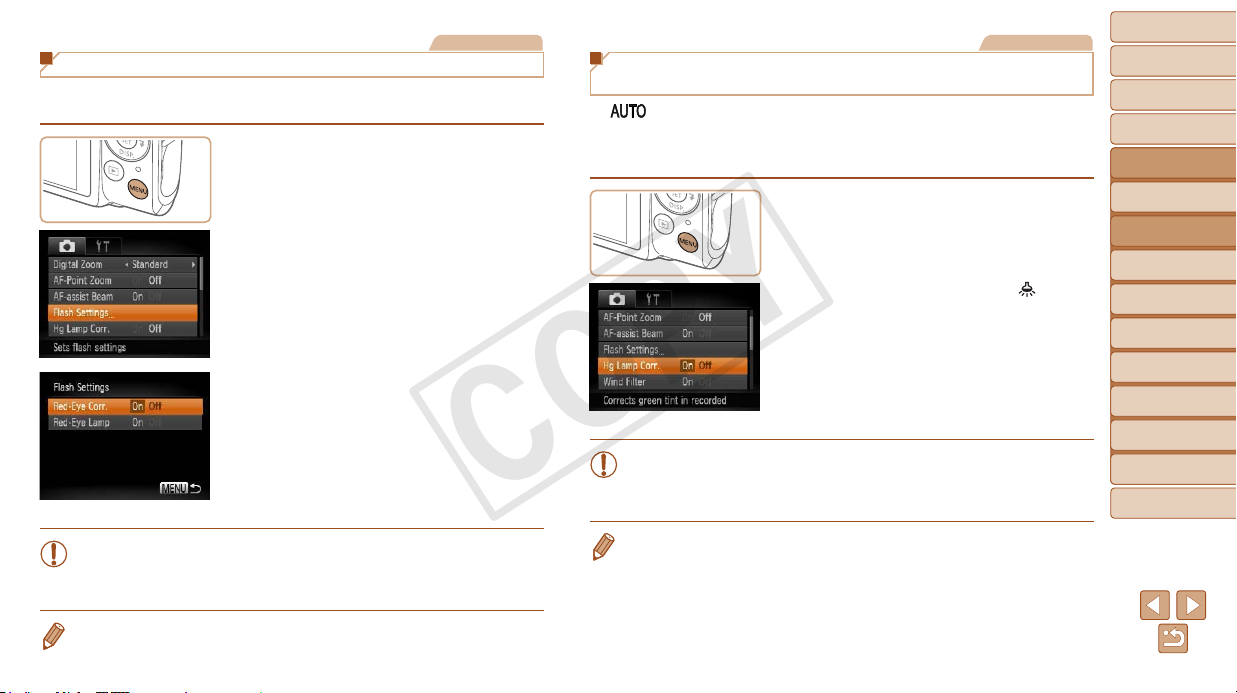
48
1
3
4
5
6
7
8
9
Preliminary Notes and
Legal Information
Contents: Basic
Operations
Camera Basics
Other Shooting
Modes
Playback Mode
Wi-Fi Functions
Setting Menu
Accessories
Appendix
Index
Basic Guide
P Mode
Cover
Advanced Guide
2
Auto Mode/Hybrid
Auto Mode
Still Images
Red-Eye Correction
Red-eye that occurs in the ash photography can be automatically
corrected as follows.
1 Access the [Flash Settings]
screen.
Press the <n> button, choose [Flash
Settings] on the [4] tab, and then press
the <m> button (=
29).
2 Congurethesetting.
Choose [Red-Eye Corr.], and then
choose [On] (=
29).
Once the setting is complete, [R] is
displayed.
To restore the original setting, repeat this
process but choose [Off].
• Red-eye correction may be applied to image areas other than eyes
(if the camera misinterprets red eye makeup as red pupils, for
example).
• You can also correct existing images (=
103).
• You can also access the screen in step 2 by pressing the <r> button and then
the <n> button.
Still Images
Correcting Greenish Image Areas from
Mercury Lamps
In [ ] mode, subjects or background in shots of evening scenes
illuminated by mercury lamps may appear to have a greenish tinge. This
greenish tinge can be corrected automatically when shooting, using Multi-
area White Balance.
Congurethesetting.
Press the <n> button, choose [Hg
Lamp Corr.] on the [4] tab, and then
choose [On] (=
29).
Once the setting is complete, [ ] is
displayed.
To restore the original setting, repeat this
process but choose [Off].
• After you are nished shooting under mercury lamps, you should set
[Hg Lamp Corr.] back to [Off]. Otherwise, green hues not caused by
mercury lamps may be corrected by mistake.
• Try taking some test shots rst to make sure you obtain the desired results.
COPY
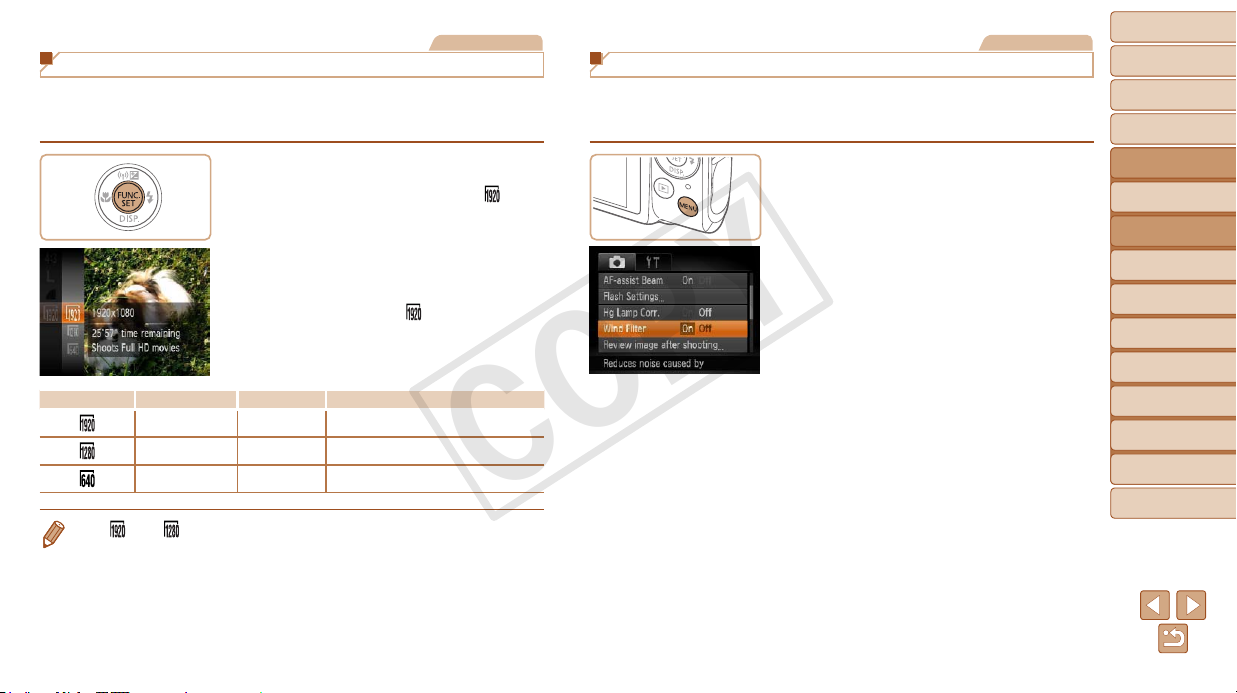
49
1
3
4
5
6
7
8
9
Preliminary Notes and
Legal Information
Contents: Basic
Operations
Camera Basics
Other Shooting
Modes
Playback Mode
Wi-Fi Functions
Setting Menu
Accessories
Appendix
Index
Basic Guide
P Mode
Cover
Advanced Guide
2
Auto Mode/Hybrid
Auto Mode
Movies
Changing Movie Image Quality
3 image quality settings are available. For guidelines on the maximum
movie length at each level of image quality that will t on a memory card,
see “Recording Time per Memory Card” (=
172).
Congurethesetting.
Press the <m> button, choose [ ] in
the menu, and choose the desired option
(=
28).
The option you congured is now
displayed.
To restore the original setting, repeat this
process but choose [
].
Image Quality Resolution Frame Rate Details
1920 x 1080 24 fps For shooting in Full HD
1280 x 720 30 fps For shooting in HD
640 x 480 30 fps For shooting in standard denition
• In [ ] and [ ] modes, black bars displayed on the top and bottom edges of
the screen indicate image areas not recorded.
Movies
Using the Wind Filter
Distorted audio caused by recording when the wind is strong can be
reduced. However, the recording may sound unnatural when this option is
used when there is no wind.
Congurethesetting.
Press the <n> button, choose [Wind
Filter] on the [4] tab, and then choose
[On] (=
29).
To restore the original setting, repeat this
process but choose [Off].
COPY
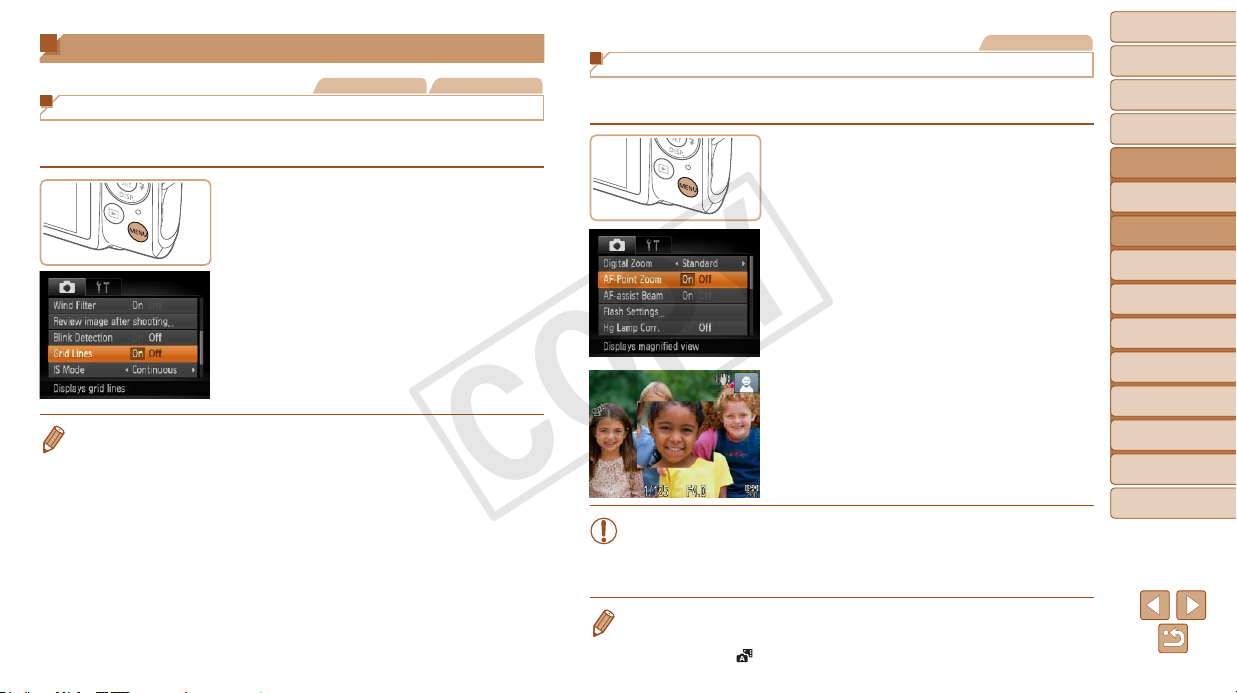
50
1
3
4
5
6
7
8
9
Preliminary Notes and
Legal Information
Contents: Basic
Operations
Camera Basics
Other Shooting
Modes
Playback Mode
Wi-Fi Functions
Setting Menu
Accessories
Appendix
Index
Basic Guide
P Mode
Cover
Advanced Guide
2
Auto Mode/Hybrid
Auto Mode
Helpful Shooting Features
Still Images Movies
Displaying Grid Lines
Grid lines can be displayed on the screen for vertical and horizontal
reference while shooting.
Congurethesetting.
Press the <n> button, choose [Grid
Lines] on the [4] tab, and then choose
[On] (=
29).
Once the setting is complete, grid lines
are displayed on the screen.
To restore the original setting, repeat this
process but choose [Off].
• Grid lines are not recorded in your shots.
Still Images
Magnifying the Area in Focus
You can check the focus by pressing the shutter button halfway, which will
enlarge the portion of the image in focus in the AF frame.
1 Congurethesetting.
Press the <n> button, choose [AF-
Point Zoom] on the [4] tab, and then
choose [On] (=
29).
2 Check the focus.
Press the shutter button halfway. The
face detected as the main subject is now
magnied.
To restore the original setting, choose
[Off] in step 1.
• The area in focus will not be magnied when you press the shutter
button halfway if a face was not detected, if the person is too close
to the camera and their face is too large for the screen, or if the
camera detects subject movement.
• The display will not magnify when using the digital zoom (=
38), Tracking
AF (=
77), or when using a TV as a display (=
142).
• Not available in [
] mode.
COPY
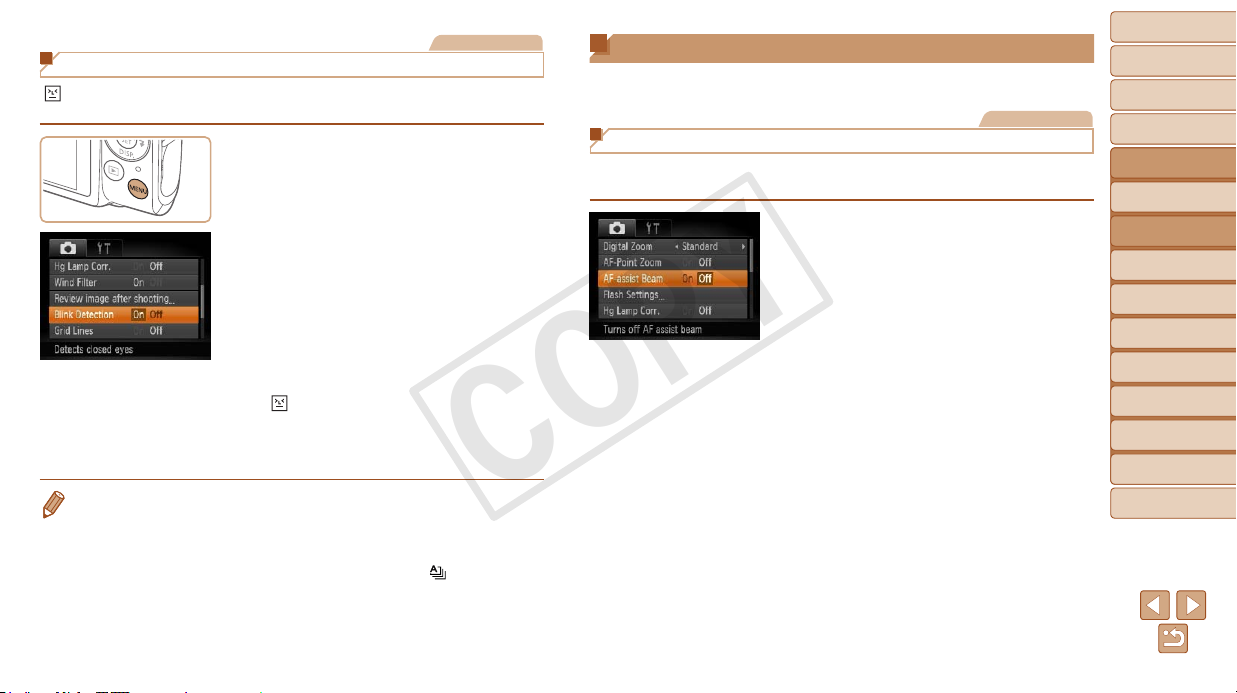
51
1
3
4
5
6
7
8
9
Preliminary Notes and
Legal Information
Contents: Basic
Operations
Camera Basics
Other Shooting
Modes
Playback Mode
Wi-Fi Functions
Setting Menu
Accessories
Appendix
Index
Basic Guide
P Mode
Cover
Advanced Guide
2
Auto Mode/Hybrid
Auto Mode
Still Images
Checking for Closed Eyes
[ ] is displayed when the camera detects that people may have closed
their eyes.
1 Congurethesetting.
Press the <n> button, choose [Blink
Detection] on the [4] tab, and then
choose [On] (=
29).
2 Shoot.
[ ] ashes when the camera detects a
person whose eyes are closed.
To restore the original setting, choose
[Off] in step 1.
• When you have specied multiple shots in [$] mode, this function is only
available for the nal shot.
• A frame is displayed around people whose eyes are closed when you have
selected [2 sec.], [4 sec.], [8 sec.], or [Hold] in [Display Time] (=
52).
• This feature is not available during continuous shooting in [
] mode
(=
37).
Customizing Camera Operation
Customize shooting functions on the [4] tab of the menu as follows.
For instructions on menu functions, see “MENU Menu” (=
29).
Still Images
Deactivating the AF Assist Beam
You can deactivate the lamp that normally lights up to help you focus when
you press the shutter button halfway in low-light conditions.
Congurethesetting.
Press the <n> button, choose [AF-
assist Beam] on the [4] tab, and then
choose [Off] (=
29).
To restore the original setting, repeat this
process but choose [On].
COPY
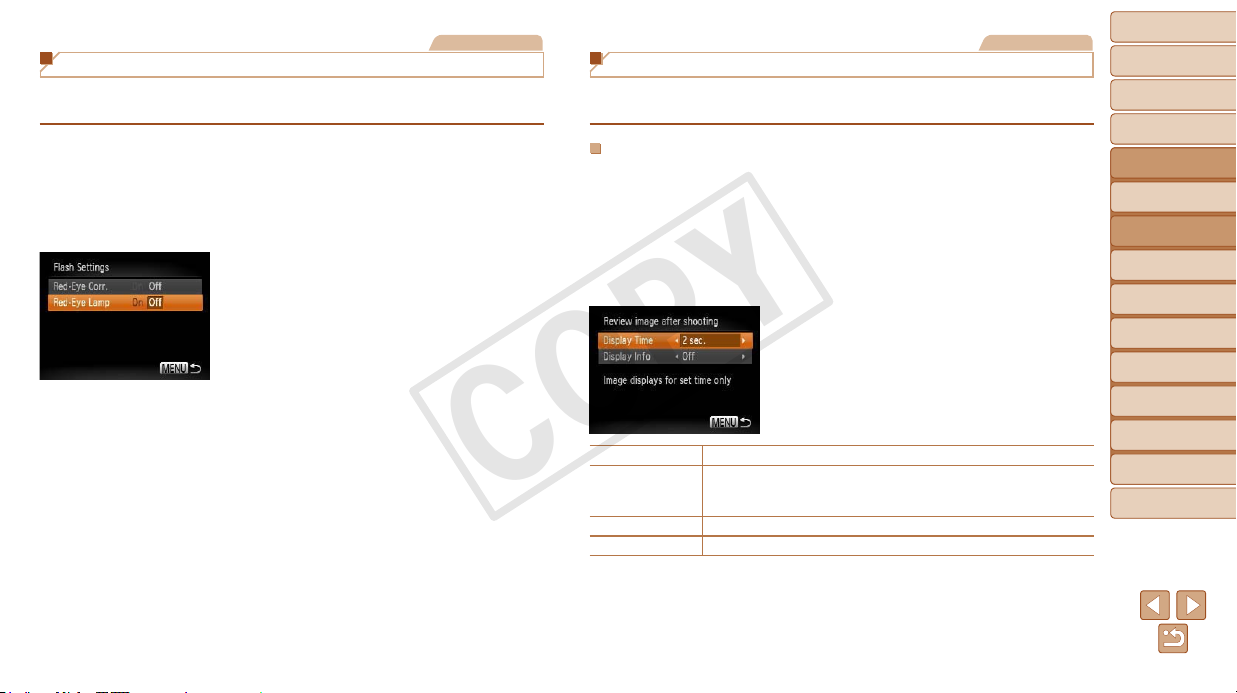
52
1
3
4
5
6
7
8
9
Preliminary Notes and
Legal Information
Contents: Basic
Operations
Camera Basics
Other Shooting
Modes
Playback Mode
Wi-Fi Functions
Setting Menu
Accessories
Appendix
Index
Basic Guide
P Mode
Cover
Advanced Guide
2
Auto Mode/Hybrid
Auto Mode
Still Images
Deactivating the Red-Eye Reduction Lamp
You can deactivate the red-eye reduction lamp that lights up to reduce red-
eye when the ash is used in low-light shots.
1 Access the [Flash Settings]
screen.
Press the <n> button, choose [Flash
Settings] on the [4] tab, and then press
the <m> button (=
29).
2 Congurethesetting.
Choose [Red-Eye Lamp], and then
choose [Off] (=
29).
To restore the original setting, repeat this
process but choose [On].
Still Images
Changing the Image Display Style After Shots
You can change how long images are displayed and what information is
displayed immediately after shooting.
Changing the Image Display Period After Shots
1 Access the [Review image after
shooting] screen.
Press the <n> button, choose
[Review image after shooting] on the
[4] tab, and then press the <m> button
(=
29).
2 Congurethesetting.
Press the <o><p> buttons to choose
[Display Time]. Press the <q><r>
buttons to choose the desired option.
To restore the original setting, repeat this
process but choose [Quick].
Quick Displays images only until you can shoot again.
2 sec., 4 sec.,
8 sec.
Displays images for the specied time. Even while the shot is
displayed, you can take another shot by pressing the shutter button
halfway again.
Hold Displays images until you press the shutter button halfway.
Off No image display after shots.
COPY
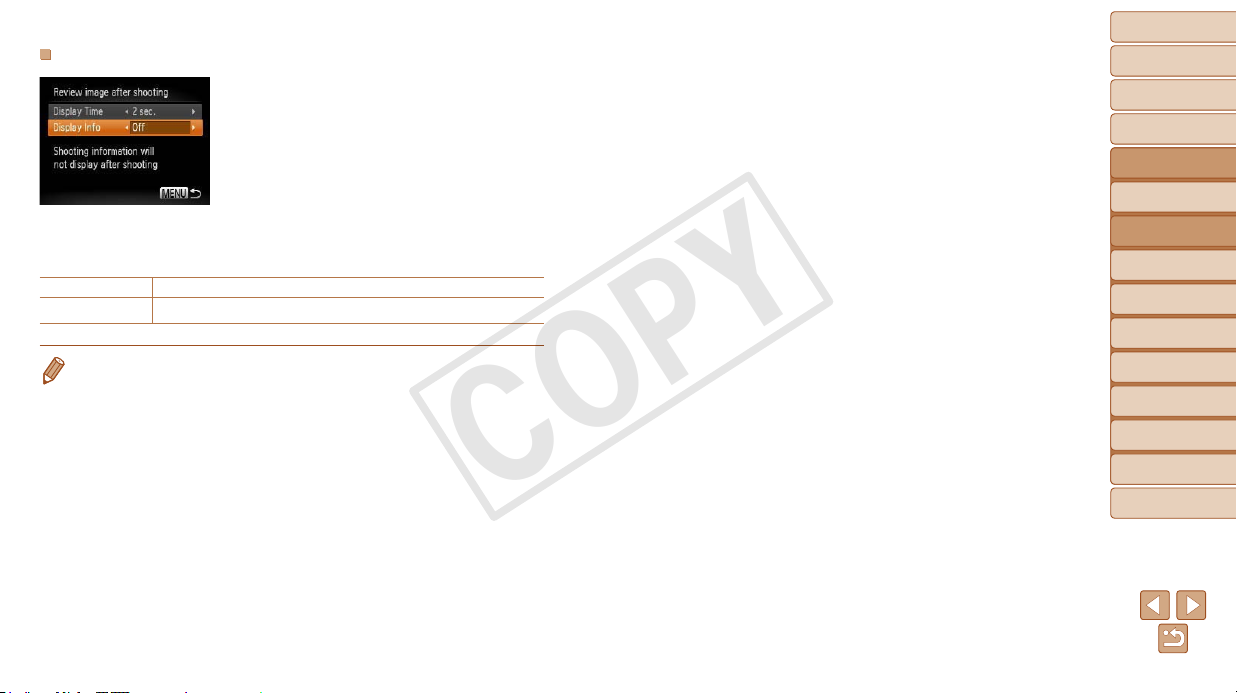
53
1
3
4
5
6
7
8
9
Preliminary Notes and
Legal Information
Contents: Basic
Operations
Camera Basics
Other Shooting
Modes
Playback Mode
Wi-Fi Functions
Setting Menu
Accessories
Appendix
Index
Basic Guide
P Mode
Cover
Advanced Guide
2
Auto Mode/Hybrid
Auto Mode
Changing the Screen Displayed After Shots
1 Set [Display Time] to [2 sec.],
[4 sec.], [8 sec.], or [Hold]
(=
52).
2 Congurethesetting.
Press the <o><p> buttons to choose
[Display Info]. Press the <q><r> buttons
to choose the desired option.
To restore the original setting, repeat this
process but choose [Off].
Off Displays only the image.
Detailed
Displays shooting details (=
163).
• When [Display Time] (=
52) is set to [Off] or [Quick], [Display Info] is set to
[Off] and cannot be changed.
• By pressing the <p> button while an image is displayed after shooting, you
can switch the display information. Note that the settings of [Display Info] on
the [4] tab cannot be changed. By pressing the <m> button, you can do the
following operations.
- Protection (=
93)
- Favorites (=
99)
- Erase (=
96)
COPY
54
1
2
4
5
6
7
8
9
Preliminary Notes and
Legal Information
Contents: Basic
Operations
Camera Basics
Auto Mode/Hybrid
Auto Mode
Playback Mode
Wi-Fi Functions
Setting Menu
Accessories
Appendix
Index
Basic Guide
P Mode
Cover
3
Advanced Guide
Other Shooting
Modes
Other Shooting Modes
Shoot more effectively in various scenes, and take shots
enhanced with unique image effects or captured using
special functions
3
4
Specic Scenes ........................55
Applying Special Effects .........57
Special Modes for Other
Purposes .................................62
Shooting Super Slow Motion
Movies ......................................67
COPY
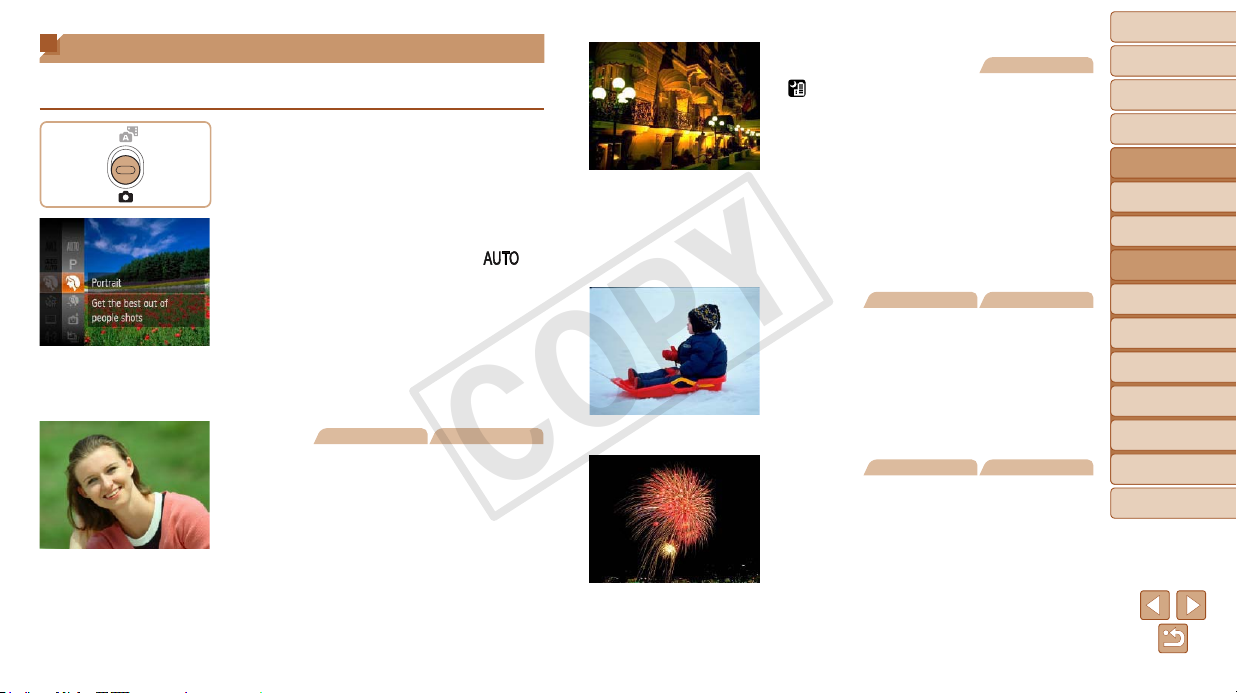
55
1
2
4
5
6
7
8
9
Preliminary Notes and
Legal Information
Contents: Basic
Operations
Camera Basics
Auto Mode/Hybrid
Auto Mode
Playback Mode
Wi-Fi Functions
Setting Menu
Accessories
Appendix
Index
Basic Guide
P Mode
Cover
3
Advanced Guide
Other Shooting
Modes
Specic Scenes
Choose a mode matching the shooting scene, and the camera will
automatically congure the settings for optimal shots.
1 Enter <4> mode.
Set the mode switch to <4>.
2 Choose a shooting mode.
Press the <m> button, choose [ ]
in the menu, and then choose a shooting
mode (=
28).
3 Shoot.
Still Images Movies
I Shoot portraits (Portrait)
Take shots of people with a softening
effect.
Still Images
Shoot evening scenes without
using a tripod (Handheld
NightScene)
Beautiful shots of evening scenes or
portraits with evening scenery in the
background, without the need to hold the
camera very still (as with a tripod).
A single image is created by combining
consecutive shots, reducing camera
shake and image noise.
Still Images Movies
P Shoot with snowy backgrounds
(Snow)
Bright, natural-colored shots of people
against snowy backgrounds.
Still Images Movies
t Shoot reworks (Fireworks)
Vivid shots of reworks.
COPY
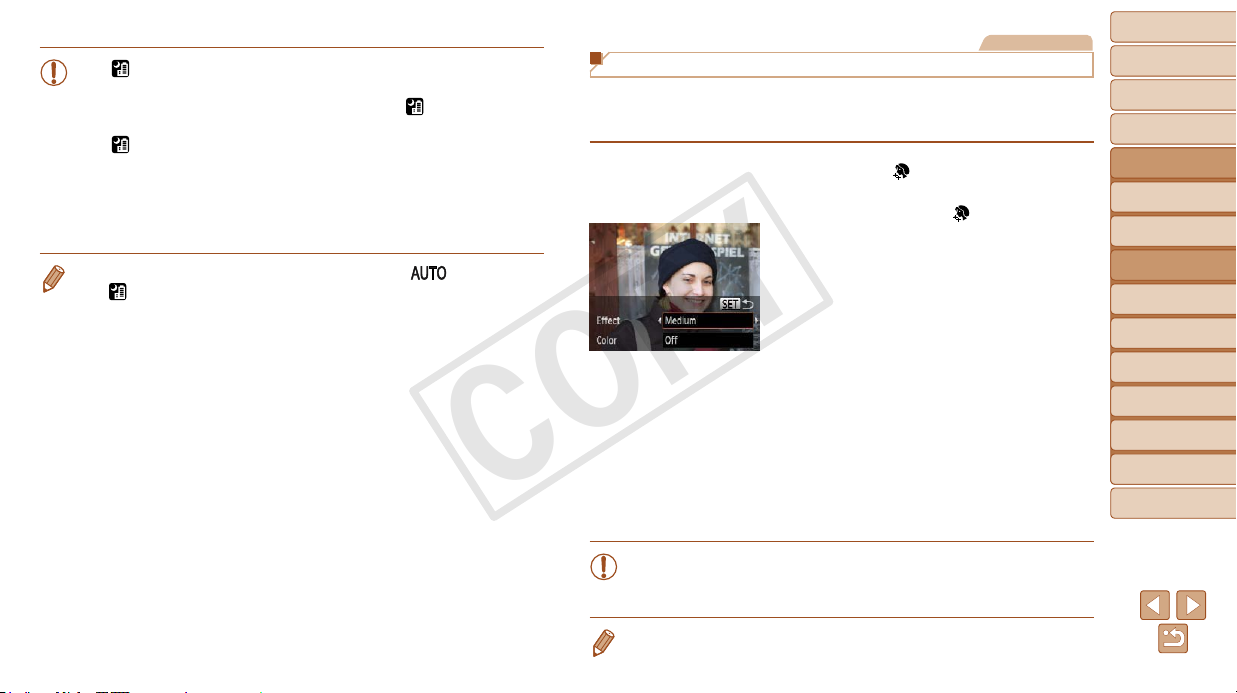
56
1
2
4
5
6
7
8
9
Preliminary Notes and
Legal Information
Contents: Basic
Operations
Camera Basics
Auto Mode/Hybrid
Auto Mode
Playback Mode
Wi-Fi Functions
Setting Menu
Accessories
Appendix
Index
Basic Guide
P Mode
Cover
3
Advanced Guide
Other Shooting
Modes
• In [ ] mode, shots may look grainy because the ISO speed
(=
71) is increased to suit the shooting conditions.
• Because the camera will shoot continuously in [
] mode, hold it
steady while shooting.
• In [
] mode, excessive camera shake or certain shooting
conditions may prevent you from obtaining the desired results.
• In [t] mode, mount the camera on a tripod or take other measures
to keep it still and prevent camera shake. Additionally, you should
set [IS Mode] to [Off] when using a tripod or other means to hold the
camera still (=
82).
• When you use a tripod for evening scenes, shooting in [ ] mode instead
of [
] mode will give better results (=
32).
Still Images
Making Skin Look Smoother (Smooth Skin)
You can apply a smoothening effect when shooting images of people.
The effect level and color ([Lighter Skin Tone], [Darker Skin Tone]) can be
chosen as follows.
1 Choose [ ].
Follow steps 1 – 2 in “Specic Scenes”
(=
55) and choose [ ].
2 Access the setting screen.
Press the <p> button.
3 Congure the setting.
Press the <o><p> buttons to choose
an option. Choose the effect level by
pressing the <q><r> buttons, and then
press the <m> button.
A preview is shown of how your shot will
look with the effect applied.
4 Shoot.
• Areas other than people’s skin may be modied.
• Try taking some test shots rst to make sure you obtain the desired
results.
• The effect will be stronger for the face of the person detected as the main
subject.
COPY
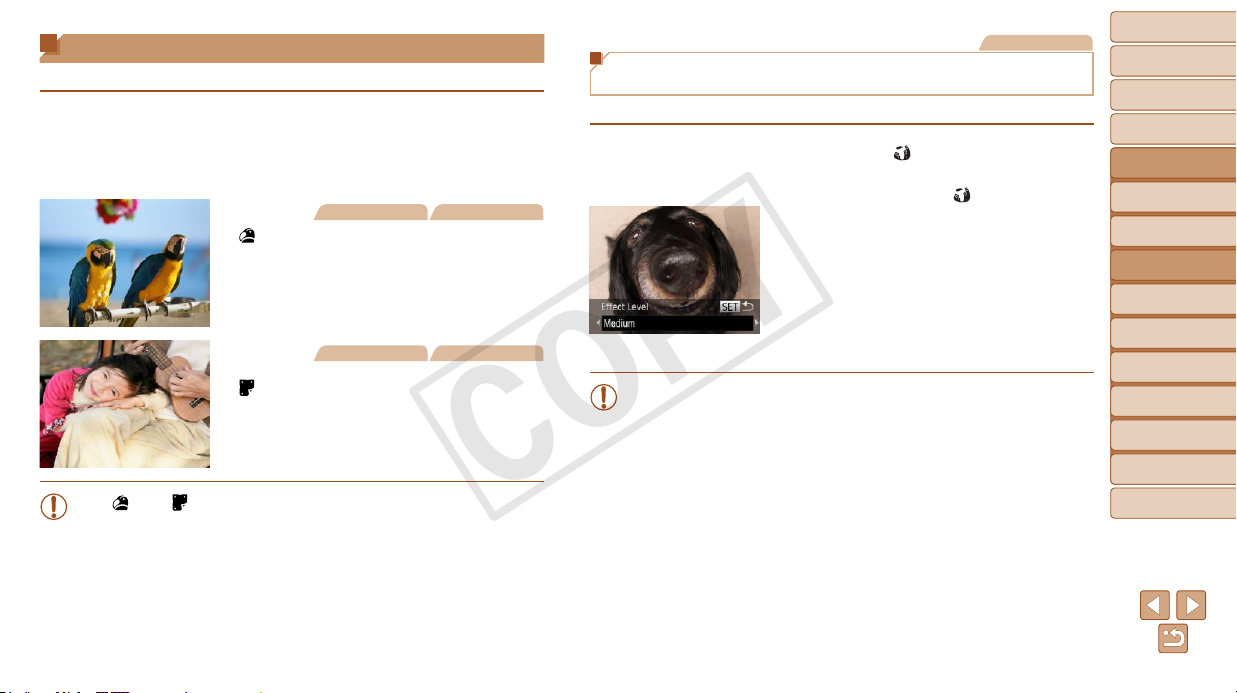
57
1
2
4
5
6
7
8
9
Preliminary Notes and
Legal Information
Contents: Basic
Operations
Camera Basics
Auto Mode/Hybrid
Auto Mode
Playback Mode
Wi-Fi Functions
Setting Menu
Accessories
Appendix
Index
Basic Guide
P Mode
Cover
3
Advanced Guide
Other Shooting
Modes
Applying Special Effects
Add a variety of effects to images when shooting.
1 Choose a shooting mode.
Follow steps 1 – 2 in “Specic Scenes”
(=
55) to choose a shooting mode.
2 Shoot.
Still Images Movies
Shoot in vivid colors (Super
Vivid)
Shots in rich, vivid colors.
Still Images Movies
Posterized shots (Poster Effect)
Shots that resemble an old poster or
illustration.
• In [ ] and [ ] modes, try taking some test shots rst, to make sure
you obtain the desired results.
Still Images
Shooting with a Fish-Eye Lens Effect (Fish-
eye Effect)
Shoot with the distorting effect of a sh-eye lens.
1 Choose [ ].
Follow steps 1 – 2 in “Specic Scenes”
(=
55) and choose [ ].
2 Choose an effect level.
Press the <p> button, press the
<q><r> buttons to choose an effect
level, and then press the <m> button.
A preview is shown of how your shot will
look with the effect applied.
3 Shoot.
• Try taking some test shots rst, to make sure you obtain the desired
results.
COPY
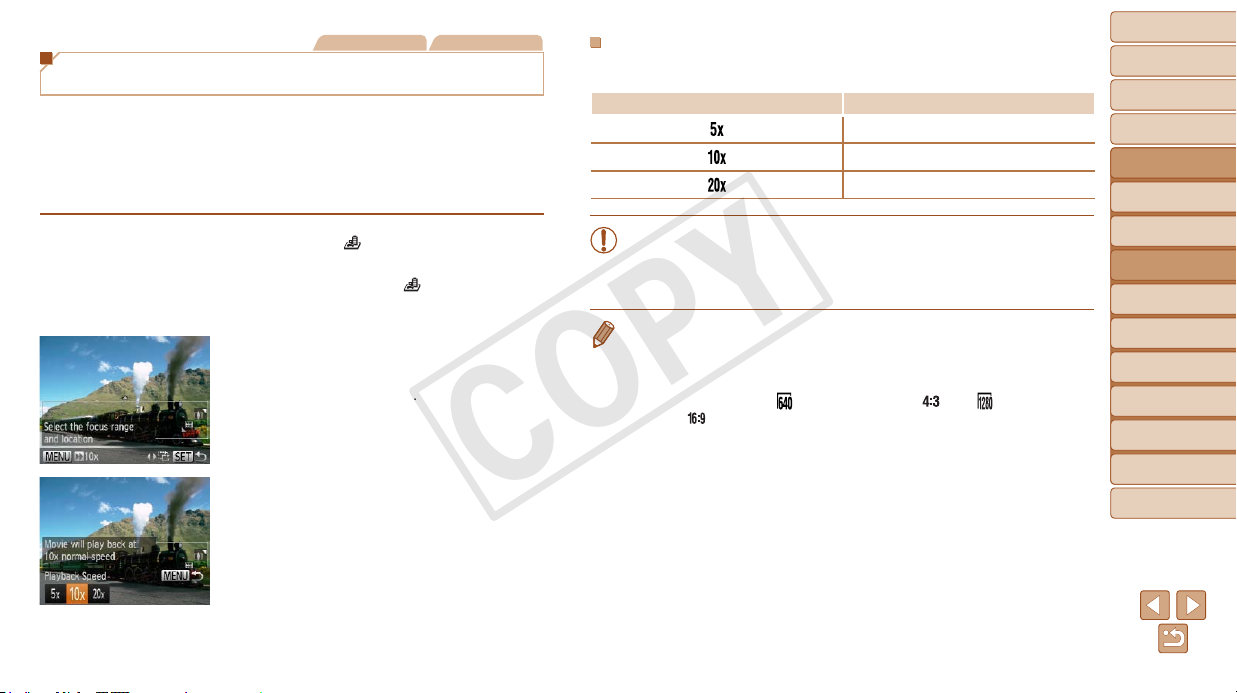
58
1
2
4
5
6
7
8
9
Preliminary Notes and
Legal Information
Contents: Basic
Operations
Camera Basics
Auto Mode/Hybrid
Auto Mode
Playback Mode
Wi-Fi Functions
Setting Menu
Accessories
Appendix
Index
Basic Guide
P Mode
Cover
3
Advanced Guide
Other Shooting
Modes
Still Images Movies
Shots Resembling Miniature Models
(Miniature Effect)
Creates the effect of a miniature model, by blurring image areas above and
below your selected area.
You can also make movies that look like scenes in miniature models by
choosing the playback speed before the movie is recorded. People and
objects in the scene will move quickly during playback. Note that sound is
not recorded.
1 Choose [ ].
Follow steps 1 – 2 in “Specic Scenes”
(=
55) and choose [ ].
A white frame is displayed, indicating the
image area that will not be blurred.
2 Choose the area to keep in
focus.
Press the <p> button.
Move the zoom lever to resize the frame,
and press the <o><p> buttons to move
it.
3 For movies, choose the movie
playback speed.
Press the <n> button, and then
press the <q><r> buttons to choose the
speed.
4 Return to the shooting screen
and shoot.
Press the <n> button to return to the
shooting screen, and then shoot.
Playback Speed and Estimated Playback Time (for One-
Minute Clips)
Speed Playback Time
Approx. 12 sec.
Approx. 6 sec.
Approx. 3 sec.
• The zoom is not available when shooting movies. Be sure to set the
zoom before shooting.
• Try taking some test shots rst, to make sure you obtain the desired
results.
• To switch the orientation of the frame to vertical, press the <q><r> buttons
in step 2. To move the frame, press the <q><r> buttons again. To return the
frame to horizontal orientation, press the <o><p> buttons.
• Holding the camera vertically will change the orientation of the frame.
• Movie image quality is [
] at an aspect ratio of [ ] and [ ] at an aspect
ratio of [
] (=
47). These quality settings cannot be changed.
COPY
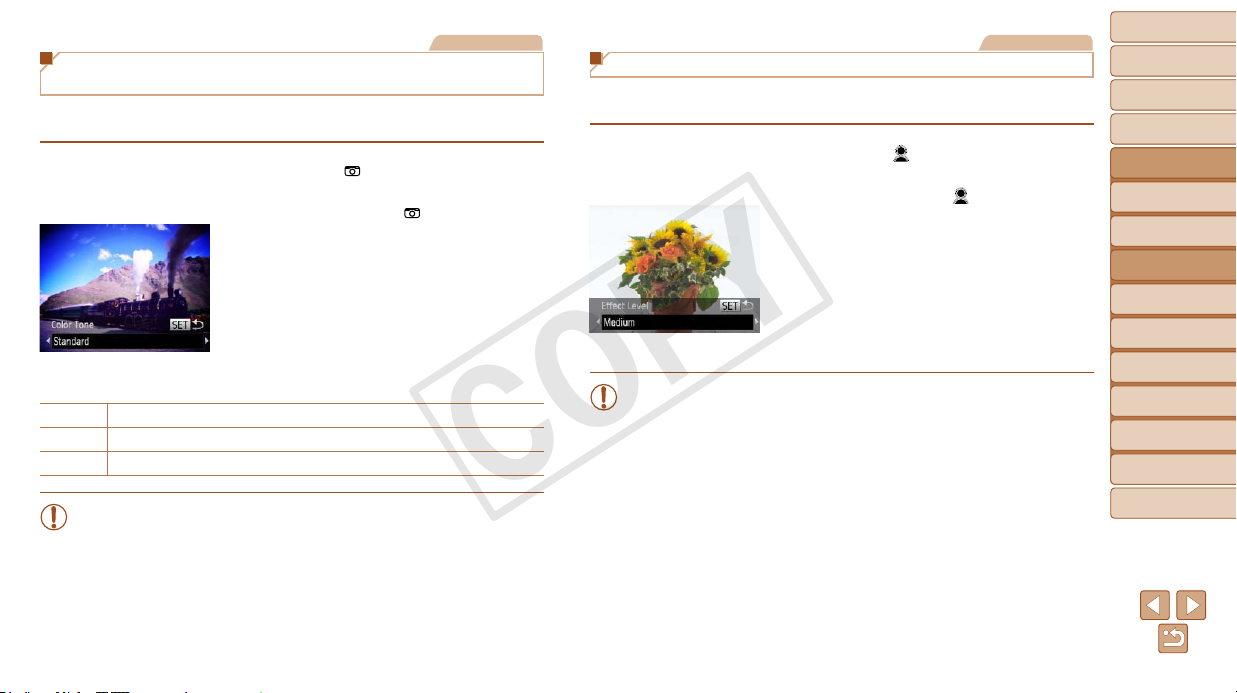
59
1
2
4
5
6
7
8
9
Preliminary Notes and
Legal Information
Contents: Basic
Operations
Camera Basics
Auto Mode/Hybrid
Auto Mode
Playback Mode
Wi-Fi Functions
Setting Menu
Accessories
Appendix
Index
Basic Guide
P Mode
Cover
3
Advanced Guide
Other Shooting
Modes
Still Images
Shooting with a Toy Camera Effect (Toy
Camera Effect)
This effect makes images resemble shots from a toy camera by vignetting
(darker, blurred image corners) and changing the overall color.
1 Choose [ ].
Follow steps 1 – 2 in “Specic Scenes”
(=
55) and choose [ ].
2 Choose a color tone.
Press the <p> button, press the
<q><r> buttons to choose a color tone,
and then press the <m> button.
A preview is shown of how your shot will
look with the effect applied.
3 Shoot.
Standard Shots resemble toy camera images.
Warm Images have a warmer tone than with [Standard].
Cool Images have a cooler tone than with [Standard].
• Try taking some test shots rst, to make sure you obtain the desired
results.
Still Images
Shooting With a Soft Focus Effect
This function allows you to shoot images as if a soft focus lter is attached
to the camera. You can adjust the effect level as desired.
1 Choose [ ].
Follow steps 1 – 2 in “Specic Scenes”
(=
55) and choose [ ].
2 Choose an effect level.
Press the <p> button, press the
<q><r> buttons to choose an effect
level, and then press the <m> button.
A preview is shown of how your shot will
look with the effect applied.
3 Shoot.
• Try taking some test shots rst, to make sure you obtain the desired
results.
COPY
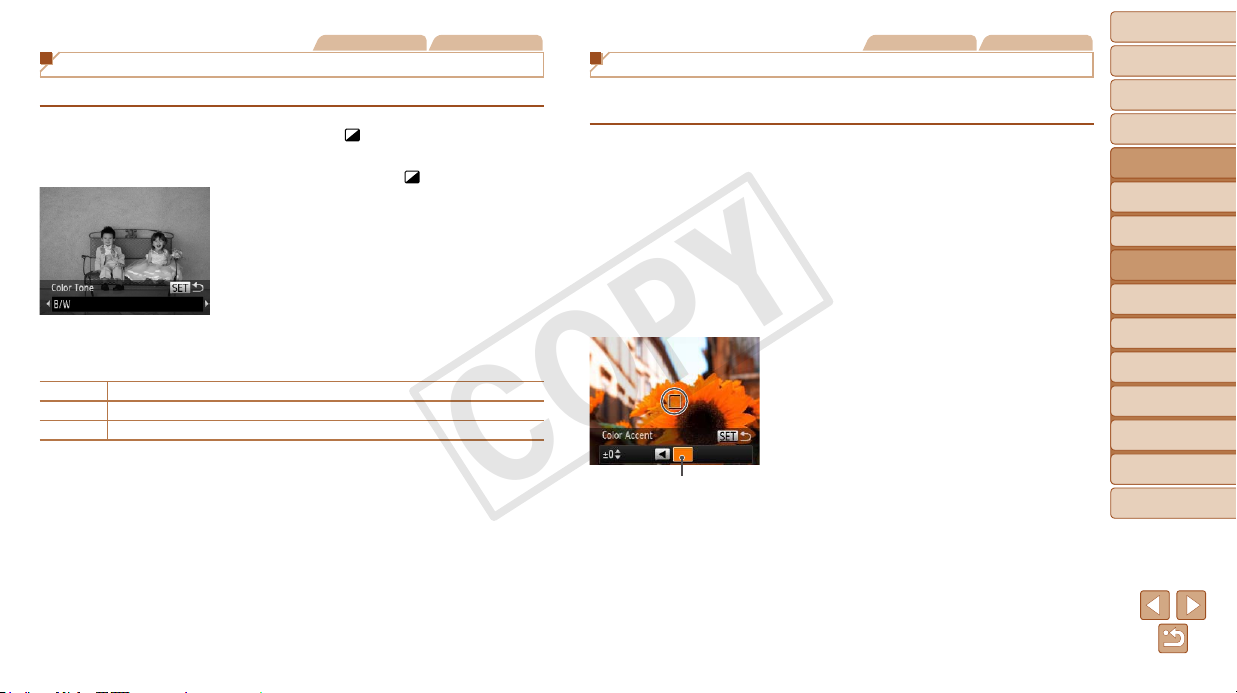
60
1
2
4
5
6
7
8
9
Preliminary Notes and
Legal Information
Contents: Basic
Operations
Camera Basics
Auto Mode/Hybrid
Auto Mode
Playback Mode
Wi-Fi Functions
Setting Menu
Accessories
Appendix
Index
Basic Guide
P Mode
Cover
3
Advanced Guide
Other Shooting
Modes
Still Images Movies
Shooting in Monochrome
Shoot images in black and white, sepia, or blue and white.
1 Choose [ ].
Follow steps 1 – 2 in “Specic Scenes”
(=
55) and choose [ ].
2 Choose a color tone.
Press the <p> button, press the
<q><r> buttons to choose a color tone,
and then press the <m> button.
A preview is shown of how your shot will
look with the effect applied.
3 Shoot.
B/W Black and white shots.
Sepia Sepia tone shots.
Blue Blue and white shots.
Still Images Movies
Shooting with Color Accent
Choose a single image color to keep and change other colors to black and
white.
1 Choose [T].
Follow steps 1 – 2 in “Specic Scenes”
(=
55) and choose [T].
2 Access the setting screen.
Press the <p> button.
The original image and the Color Accent
image are displayed one after another.
By default, green is the color that will be
kept.
3 Specify the color.
Position the center frame over the color
to keep, and then press the <q> button.
The specied color is recorded.
4 Specify the range of colors to
keep.
Press the <o><p> buttons to adjust the
range.
To keep only your specied color, choose
a large negative value. To keep colors
similar to your specied color as well,
choose a large positive value.
Press the <m> button to return to the
shooting screen.
Recorded Color
COPY
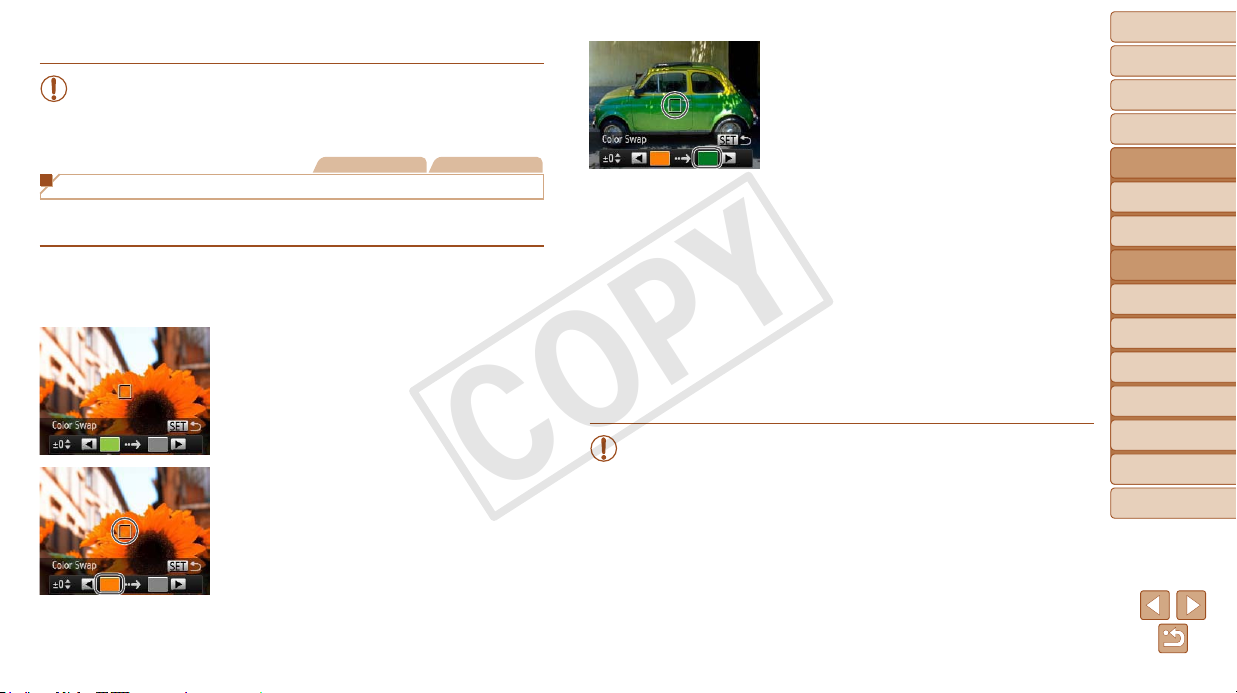
61
1
2
4
5
6
7
8
9
Preliminary Notes and
Legal Information
Contents: Basic
Operations
Camera Basics
Auto Mode/Hybrid
Auto Mode
Playback Mode
Wi-Fi Functions
Setting Menu
Accessories
Appendix
Index
Basic Guide
P Mode
Cover
3
Advanced Guide
Other Shooting
Modes
5 Shoot.
• Using the ash in this mode may cause unexpected results.
• In some shooting scenes, images may look grainy and colors may
not look as expected.
Still Images Movies
Shooting with Color Swap
You can replace one image color with another before shooting. Note that
only one color can be replaced.
1 Choose [Y].
Follow steps 1 – 2 in “Specic Scenes”
(=
55) and choose [Y].
2 Access the setting screen.
Press the <p> button.
The original image and the Color Swap
image are displayed one after another.
By default, green will be replaced with
gray.
3 Specify the color to replace.
Position the center frame over the color
to replace, and then press the <q>
button.
The specied color is recorded.
4 Specify the new color.
Position the center frame over the new
color, and then press the <r> button.
The specied color is recorded.
5 Specify the range of colors to
replace.
Press the <o><p> buttons to adjust the
range.
To replace only your specied color,
choose a large negative value. To replace
colors similar to your specied color as
well, choose a large positive value.
Press the <m> button to return to the
shooting screen.
6 Shoot.
• Using the ash in this mode may cause unexpected results.
• In some shooting scenes, images may look grainy and colors may
not look as expected.
COPY
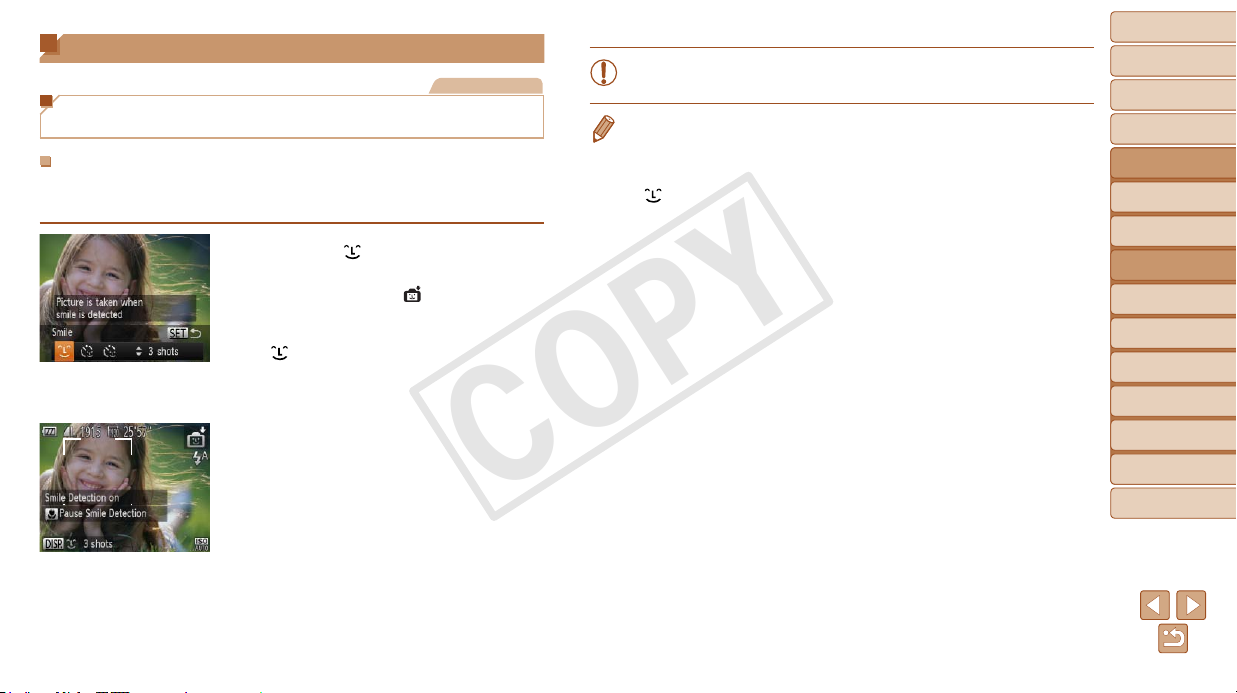
62
1
2
4
5
6
7
8
9
Preliminary Notes and
Legal Information
Contents: Basic
Operations
Camera Basics
Auto Mode/Hybrid
Auto Mode
Playback Mode
Wi-Fi Functions
Setting Menu
Accessories
Appendix
Index
Basic Guide
P Mode
Cover
3
Advanced Guide
Other Shooting
Modes
Special Modes for Other Purposes
Still Images
Auto Shooting After Face Detection (Smart
Shutter)
Auto Shooting After Smile Detection
The camera shoots automatically after detecting a smile, even without you
pressing the shutter button.
1 Choose [ ].
Follow steps 1 – 2 in “Specic Scenes”
(=
55) and choose [ ], and then
press the <p> button.
Press the <q><r> buttons to choose
[
], and then press the <m> button.
The camera now enters shooting standby
mode, and [Smile Detection on] is
displayed.
2 Aim the camera at a person.
Each time the camera detects a smile, it
will shoot after the lamp lights up.
To pause smile detection, press the <q>
button. Press the <q> button again to
resume detection.
• Switch to another mode when you nish shooting, or the camera will
continue shooting each time a smile is detected.
• You can also shoot as usual by pressing the shutter button.
• The camera can detect smiles more easily when subjects face the camera and
open their mouth wide enough so that teeth are visible.
• To change the number of shots, press the <o><p> buttons after choosing
[
] in step 1. [Blink Detection] (=
51) is only available for the nal shot.
COPY
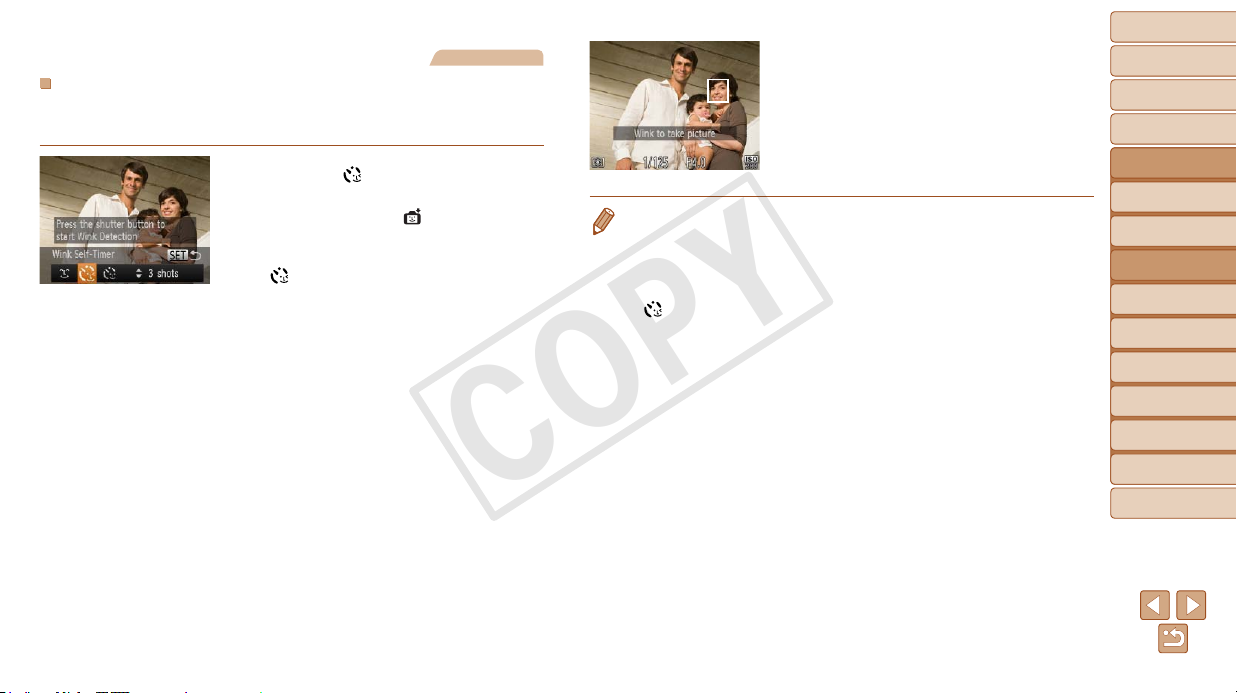
63
1
2
4
5
6
7
8
9
Preliminary Notes and
Legal Information
Contents: Basic
Operations
Camera Basics
Auto Mode/Hybrid
Auto Mode
Playback Mode
Wi-Fi Functions
Setting Menu
Accessories
Appendix
Index
Basic Guide
P Mode
Cover
3
Advanced Guide
Other Shooting
Modes
Still Images
Using the Wink Self-Timer
Aim the camera at a person and press the shutter button all the way down.
The camera will shoot about two seconds after a wink is detected.
1 Choose [ ].
Follow steps 1 – 2 in “Specic Scenes”
(=
55) and choose [ ], and then
press the <p> button.
Press the <q><r> buttons to choose
[
], and then press the <m> button.
2 Compose the shot and press
the shutter button halfway.
Make sure a green frame is displayed
around the face of the person who will
wink.
3 Press the shutter button all the
way down.
The camera now enters shooting standby
mode, and [Wink to take picture] is
displayed.
The lamp blinks and the self-timer sound
is played.
4 Face the camera and wink.
The camera will shoot about two seconds
after detecting a wink by the person
whose face is inside the frame.
To cancel shooting after you have
triggered the self-timer, press the
<n> button.
• If the wink is not detected, wink again slowly and deliberately.
• Winking may not be detected if eyes are obscured by hair, a hat, or glasses.
• Closing and opening both eyes at once will also be detected as a wink.
• If winking is not detected, the camera will shoot about 15 seconds later.
• To change the number of shots, press the <o><p> buttons after choosing
[
] in step 1. [Blink Detection] (=
51) is only available for the nal shot.
• If no one is in the shooting area when the shutter button is pressed all the way
down, the camera will shoot after a person enters the shooting area and winks.
COPY
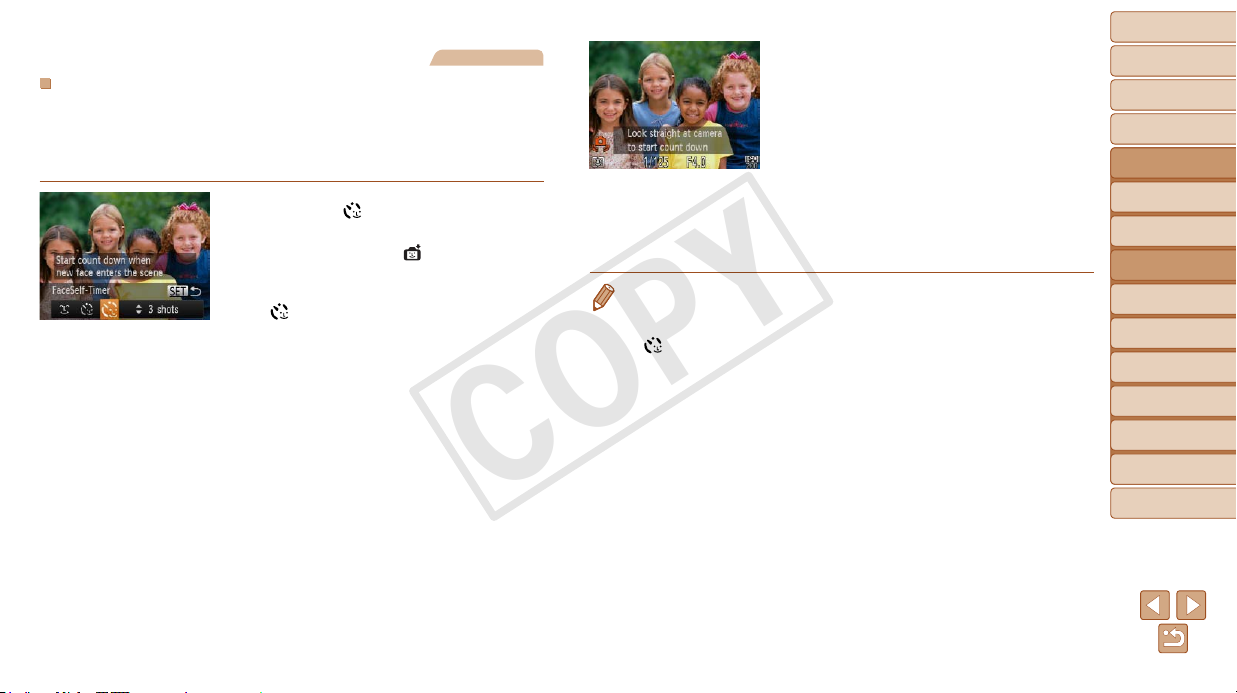
64
1
2
4
5
6
7
8
9
Preliminary Notes and
Legal Information
Contents: Basic
Operations
Camera Basics
Auto Mode/Hybrid
Auto Mode
Playback Mode
Wi-Fi Functions
Setting Menu
Accessories
Appendix
Index
Basic Guide
P Mode
Cover
3
Advanced Guide
Other Shooting
Modes
Still Images
Using the Face Self-Timer
The camera will shoot about two seconds after detecting that the face of
another person (such as the photographer) has entered the shooting area
(=
76). This is useful when including yourself in group photos or similar
shots.
1 Choose [ ].
Follow steps 1 – 2 in “Specic Scenes”
(=
55) and choose [ ], and then
press the <p> button.
Press the <q><r> buttons to choose
[
], and then press the <m> button.
2 Compose the shot and press
the shutter button halfway.
Make sure a green frame is displayed
around the face you focus on and white
frames around other faces.
3 Press the shutter button all the
way down.
The camera now enters shooting standby
mode, and [Look straight at camera to
start count down] is displayed.
The lamp blinks and the self-timer sound
is played.
4 Join the subjects in the
shooting area and look at the
camera.
After the camera detects a new face, the
lamp blinking and self-timer sound will
speed up. (When the ash res, the lamp
will remain lit.) About two seconds later,
the camera will shoot.
To cancel shooting after you have
triggered the self-timer, press the
<n> button.
• Even if your face is not detected after you join the others in the shooting area,
the camera will shoot about 15 seconds later.
• To change the number of shots, press the <o><p> buttons after choosing
[
] in step 1. [Blink Detection] (=
51) is only available for the nal shot.
COPY
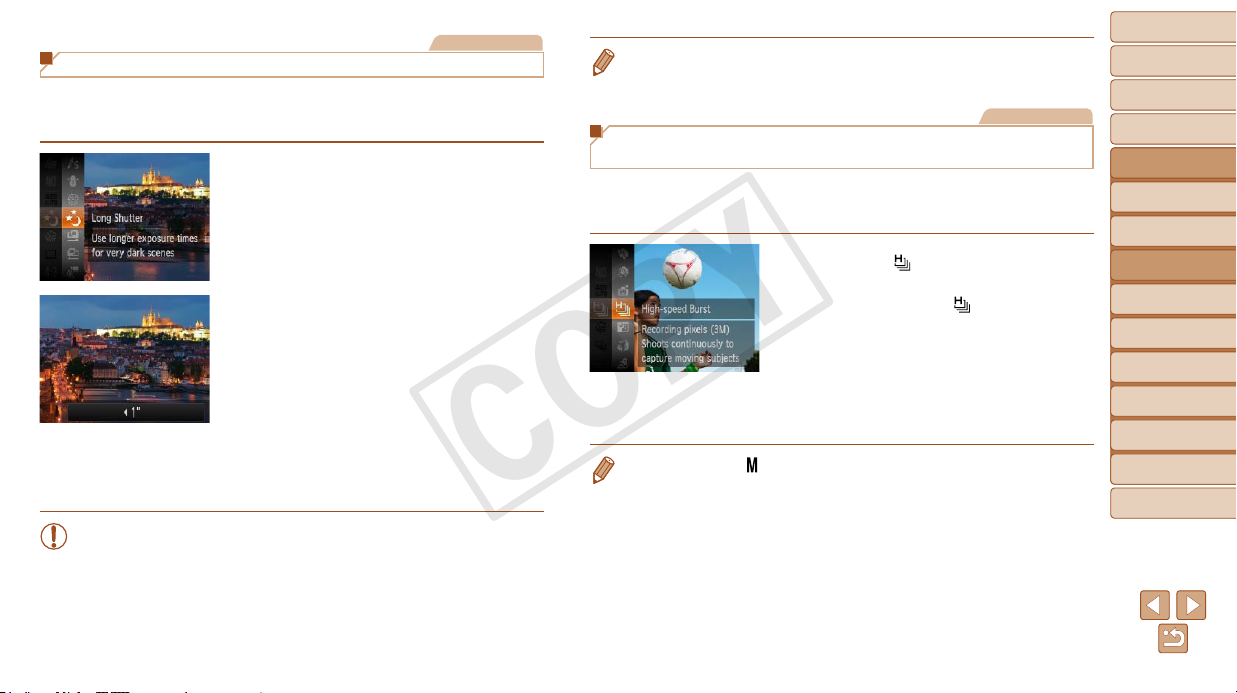
65
1
2
4
5
6
7
8
9
Preliminary Notes and
Legal Information
Contents: Basic
Operations
Camera Basics
Auto Mode/Hybrid
Auto Mode
Playback Mode
Wi-Fi Functions
Setting Menu
Accessories
Appendix
Index
Basic Guide
P Mode
Cover
3
Advanced Guide
Other Shooting
Modes
Still Images
Shooting Long Exposures (Long Shutter)
Specify a shutter speed of 1 – 15 seconds to shoot long exposures. In this
case, mount the camera on a tripod or take other measures to prevent
camera shake.
1 Choose [N].
Follow steps 1 – 2 in “Specic Scenes”
(=
55) and choose [N].
2 Choose the shutter speed.
Press the <o> button, press the
<q><r> buttons to choose the shutter
speed, and then press the <m> button.
3 Check the exposure.
Press the shutter button halfway to view
the exposure for your selected shutter
speed.
4 Shoot.
• On-screen image brightness in step 3, when you pressed the
shutter button halfway, may not match the brightness of your shots.
• With shutter speeds of 1.3 seconds or slower, there will be a delay
before you can shoot again, as the camera processes images to
reduce noise.
• Set [IS Mode] to [Off] when using a tripod or other means to hold the
camera still (=
82).
• If the ash res, your shot may be overexposed. In this case, set the ash to
[!] and shoot again (=
40).
Still Images
High-Speed Continuous Shooting (High-speed
Burst)
You can shoot a series of shots in rapid succession by holding the shutter
button all the way down. For details on the continuous shooting speed, see
“Continuous Shooting Speed” (=
173).
1 Choose [ ].
Follow steps 1 – 2 in “Specic Scenes”
(=
55) and choose [ ].
2 Shoot.
Hold the shutter button all the way down
to shoot continuously.
• The resolution is [ ] (1984 x 1488) and cannot be changed.
• Focus, image brightness, and color are determined by the rst shot.
• Shooting may stop momentarily or continuous shooting may slow down
depending on shooting conditions, camera settings, and the zoom position.
• As more shots are taken, shooting may slow down.
COPY
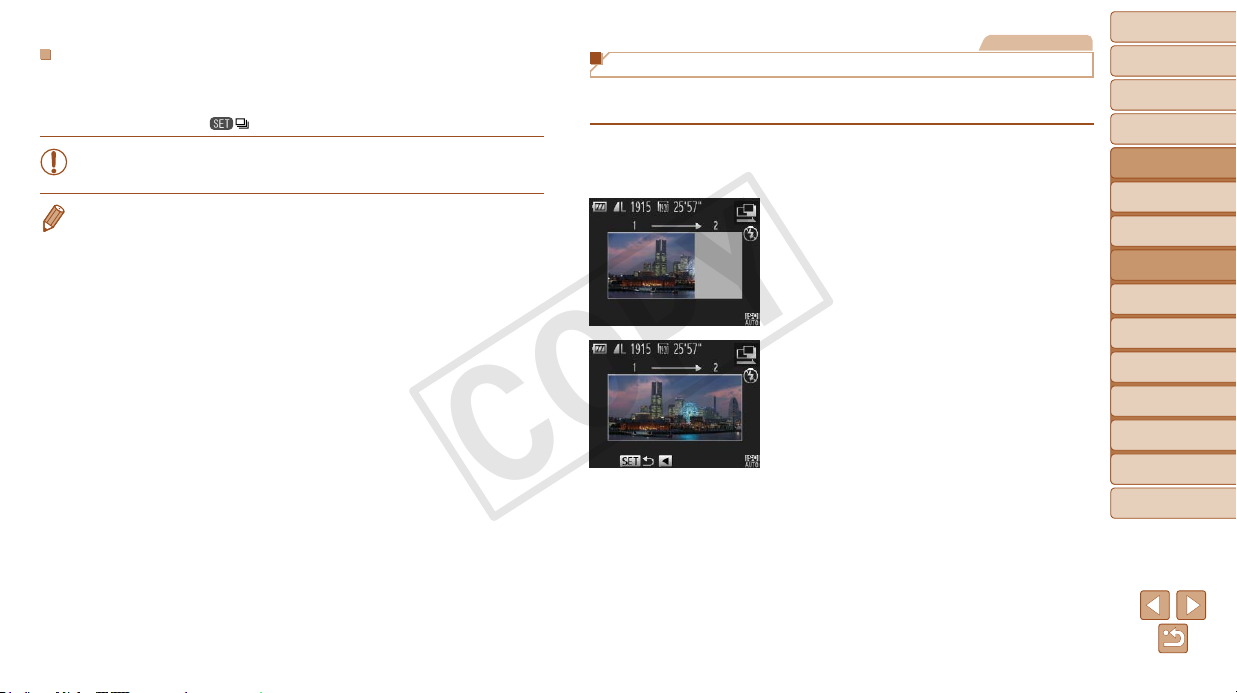
66
1
2
4
5
6
7
8
9
Preliminary Notes and
Legal Information
Contents: Basic
Operations
Camera Basics
Auto Mode/Hybrid
Auto Mode
Playback Mode
Wi-Fi Functions
Setting Menu
Accessories
Appendix
Index
Basic Guide
P Mode
Cover
3
Advanced Guide
Other Shooting
Modes
Images Displayed During Playback
Each set of images shot continuously is managed as a single group, and
only the rst image in that group will be displayed. To indicate that the
image is part of a group, [ ] is displayed in the upper left of the screen.
• If you erase a grouped image (=
96), all images in the group are
also erased. Be careful when erasing images.
• Grouped images can be played back individually (=
89) and ungrouped
(=
89).
• Protecting (=
93) a grouped image will protect all images in the group.
• Grouped images can be viewed individually when played back using Image
Search (=
88) or Smart Shufe (=
92). In this case, images are
temporarily ungrouped.
• Grouped images cannot be tagged as favorites (=
99), edited (=
98
– 103), printed (=
146), set for printing individually (=
151), added to a
Photobook (=
153), and Face ID information cannot be edited (=
90). To
do these things, either view grouped images individually (=
89) or cancel
grouping (=
89) rst.
Still Images
Shooting Stitch Assist Images
Shoot a large subject by taking multiple shots at various positions, and then
use the software (=
19) to combine them into a panorama.
1 Choose [x] or [v].
Follow steps 1 – 2 in “Specic Scenes”
(=
55) and choose [x] or [v].
2 Take the rst shot.
The rst shot will determine the exposure
and white balance.
3 Take additional shots.
Compose the second shot so that it
partially overlaps the image area of the
rst shot.
Minor misalignment of overlapping
portions will be corrected automatically
when the images are combined.
You can take up to 26 shots, the same
way you took the second shot.
4 Finish shooting.
Press the <m> button.
5 Use the software to combine the
images.
For instructions on merging images, refer
to the Software Guide (=
19).
COPY
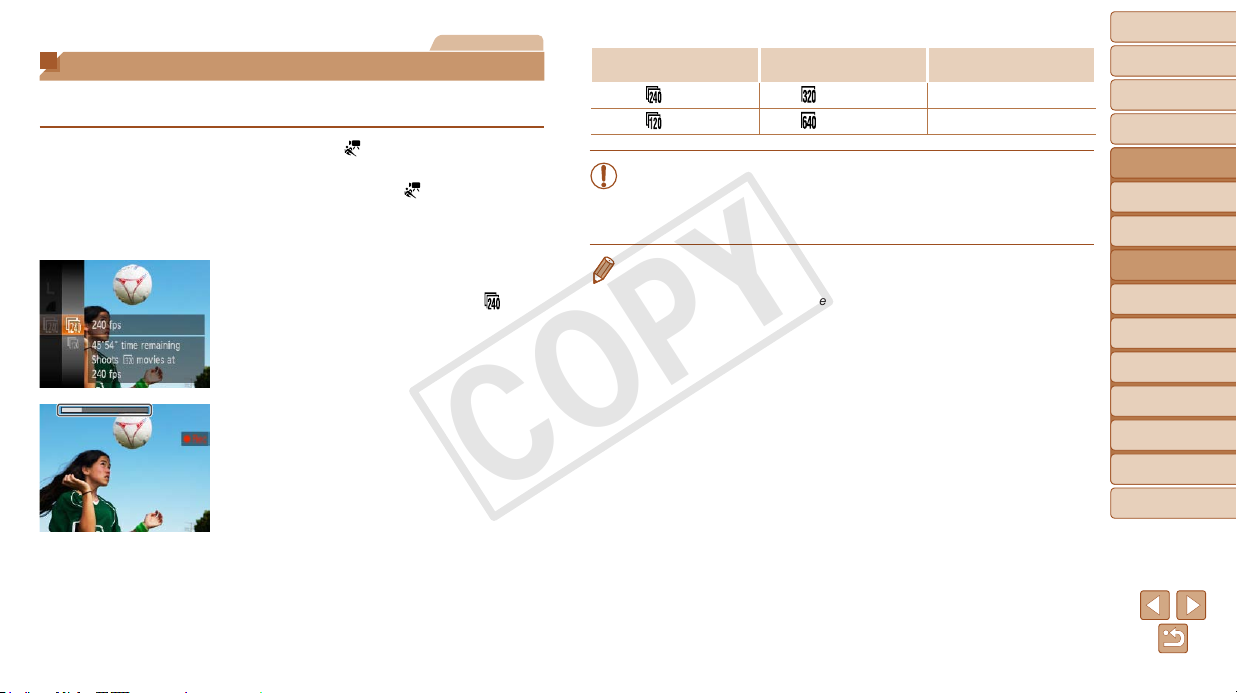
67
1
2
4
5
6
7
8
9
Preliminary Notes and
Legal Information
Contents: Basic
Operations
Camera Basics
Auto Mode/Hybrid
Auto Mode
Playback Mode
Wi-Fi Functions
Setting Menu
Accessories
Appendix
Index
Basic Guide
P Mode
Cover
3
Advanced Guide
Other Shooting
Modes
Movies
Shooting Super Slow Motion Movies
You can shoot fast-moving subjects for playback later in slow motion.
Note that sound is not recorded.
1 Choose [ ].
Follow steps 1 – 2 in “Specic Scenes”
(=
55) and choose [ ].
Black bars displayed on the left and right
edges of the screen indicate image areas
not recorded.
2 Choose a frame rate.
Press the <m> button, choose [ ] in
the menu, and choose the desired frame
rate (=
28).
The option you congured is now
displayed.
3 Shoot.
Press the movie button.
A bar showing the elapsed time is
displayed. Maximum clip length is approx.
30 sec.
To stop movie recording, press the movie
button again.
Frame Rate Image Quality
Playback Time
(For a 30-sec. Clip)
240 fps (320 x 240)
Approx. 4 min.
120 fps (640 x 480)
Approx. 2 min.
• Zooming is not available during recording, even if you move the
zoom lever.
• Focus, exposure, and color are determined when you press the
movie button.
• When you play the movie (=
84), it will be played back in slow motion.
• You can change the playback speed of movies by using the included software.
For details, refer to the Software Guide (=
19).
COPY
68
1
2
3
5
6
7
8
9
Preliminary Notes and
Legal Information
Contents: Basic
Operations
Camera Basics
Auto Mode/Hybrid
Auto Mode
Other Shooting
Modes
Playback Mode
Wi-Fi Functions
Setting Menu
Accessories
Appendix
Index
Basic Guide
Cover
Advanced Guide
4
P Mode
P Mode
More discerning shots, in your preferred shooting style
• Instructions in this chapter apply to the camera in [G] mode, with the
mode switch set to <4>.
• [G]: Program AE; AE: Auto Exposure
• Before using a function introduced in this chapter in modes other than
[G], make sure the function is available in that mode (=
164 – 168).
4
4
Shooting in Program AE
([P] Mode) ................................69
Image Brightness (Exposure
Compensation) ........................69
Color and Continuous
Shooting ..................................72
Shooting Range and
Focusing ..................................74
Flash ..........................................80
Other Settings ..........................81
COPY
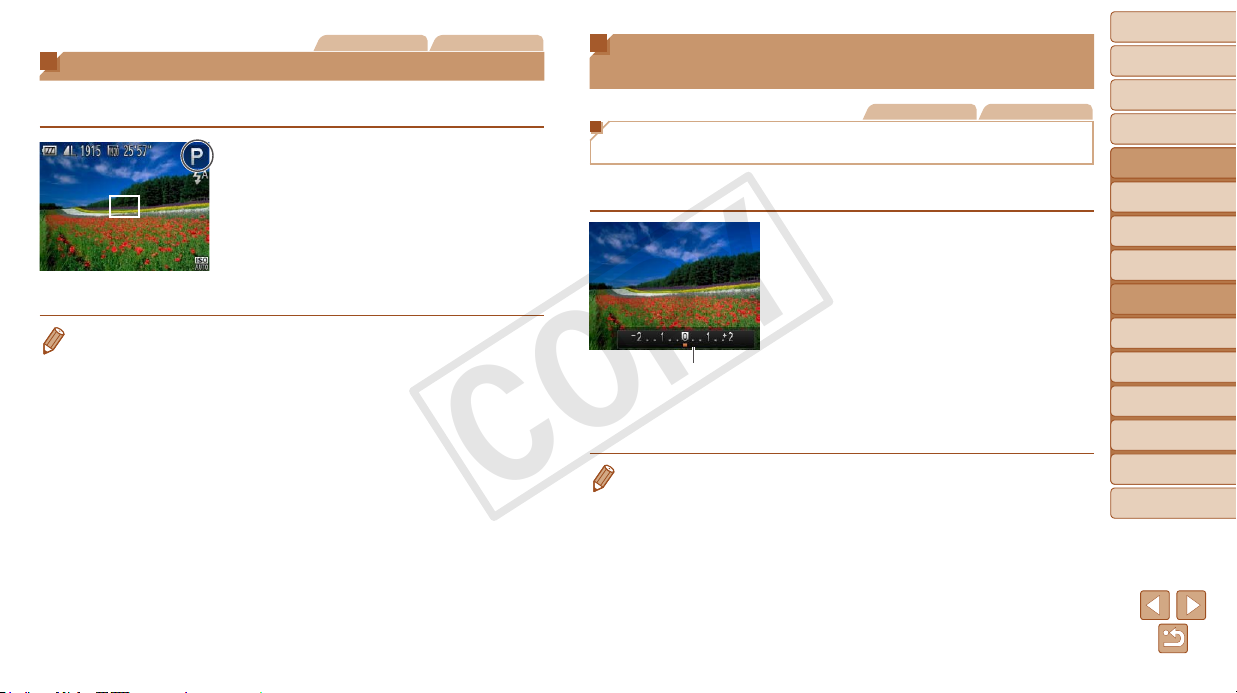
69
1
2
3
5
6
7
8
9
Preliminary Notes and
Legal Information
Contents: Basic
Operations
Camera Basics
Auto Mode/Hybrid
Auto Mode
Other Shooting
Modes
Playback Mode
Wi-Fi Functions
Setting Menu
Accessories
Appendix
Index
Basic Guide
Cover
Advanced Guide
4
P Mode
Still Images Movies
Shooting in Program AE ([P] Mode)
You can customize many function settings to suit your preferred shooting
style.
1 Enter [G] mode.
Followsteps1–2in“SpecicScenes”
(=
55) and choose [G].
2 Customize the settings as
desired (=
69 – 82), and
then shoot.
• If adequate exposure cannot be obtained when you press the shutter button
halfway, shutter speeds and aperture values are displayed in orange. In this
case, try adjusting the ISO speed (=
71)oractivatingtheash(ifsubjects
are dark, =
80), which may enable adequate exposure.
• Movies can be recorded in [G] mode as well, by pressing the movie button.
However, some <H> and <n> settings may be automatically
adjusted for movie recording.
• For details on the shooting range in [G]mode,see“ShootingRange”
(=
173).
Image Brightness (Exposure
Compensation)
Still Images Movies
Adjusting Image Brightness (Exposure
Compensation)
The standard exposure set by the camera can be adjusted in 1/3-stop
increments, in a range of –2 to +2.
Press the <o> button. As you watch
the screen, press the <q><r> buttons
to adjust brightness, and then press the
<m> button.
Thecorrectionlevelyouspeciedisnow
displayed.
When shooting movies, shoot with the
exposure compensation bar displayed.
When shooting still images, press the
<m> button to display the set exposure
compensation amount, and then shoot.
• You can also shoot still images with exposure compensation bar displayed.
• While recording a movie, [&] is displayed, and the exposure is locked.
Exposure Compensation Bar
COPY
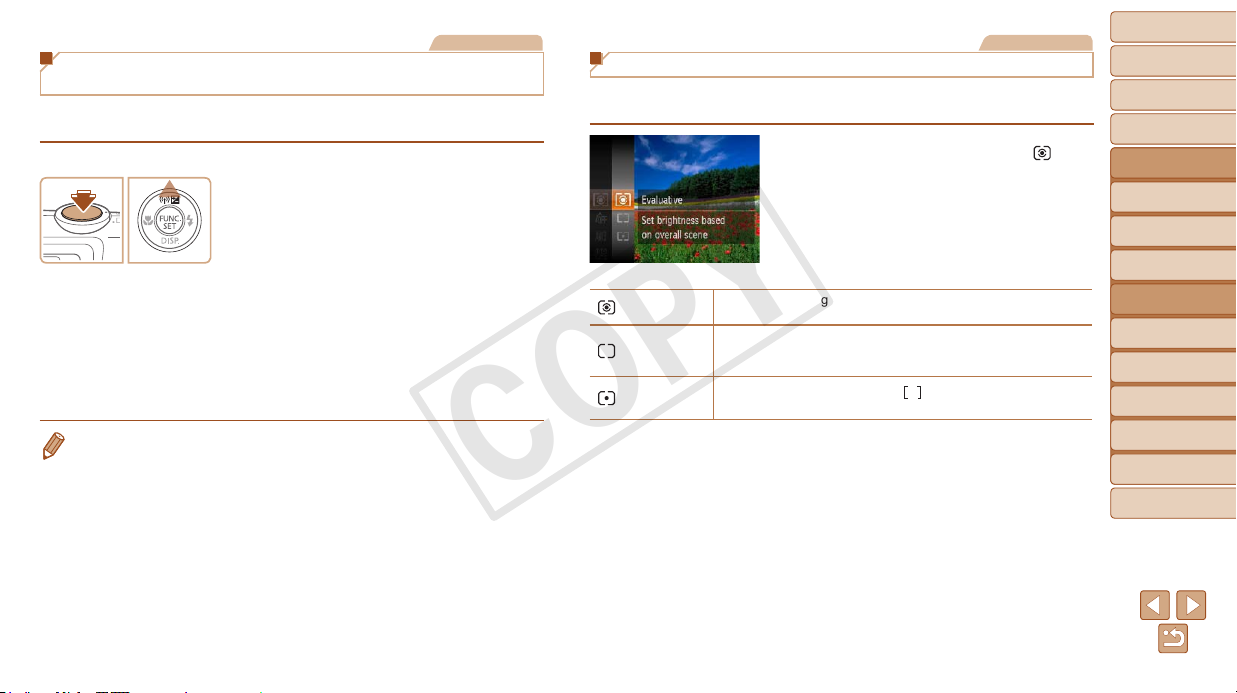
70
1
2
3
5
6
7
8
9
Preliminary Notes and
Legal Information
Contents: Basic
Operations
Camera Basics
Auto Mode/Hybrid
Auto Mode
Other Shooting
Modes
Playback Mode
Wi-Fi Functions
Setting Menu
Accessories
Appendix
Index
Basic Guide
Cover
Advanced Guide
4
P Mode
Still Images
Locking Image Brightness/Exposure (AE
Lock)
Before shooting, you can lock the exposure, or you can specify focus and
exposure separately.
1 Deactivatetheash(=
40).
2 Lock the exposure.
Aim the camera at the subject to shoot
with the exposure locked. With the
shutter button pressed halfway, press the
<o> button.
[&] is displayed, and the exposure is
locked.
To unlock AE, release the shutter button
and press the <o> button again. In this
case, [&] is no longer displayed.
3 Compose the shot and shoot.
• AE: Auto Exposure
Still Images
Changing the Metering Method
Adjust the metering method (how brightness is measured) to suit shooting
conditions as follows.
Press the <m> button, choose [ ] in
the menu, and choose the desired option
(=
28).
Theoptionyouconguredisnow
displayed.
Evaluative
For typical shooting conditions, including backlit shots.
Automatically adjusts exposure to match the shooting conditions.
Center
Weighted Avg.
Determines the average brightness of light across the entire
image area, calculated by treating brightness in the central area
as more important.
Spot
Metering restricted to within the [
] (Spot AE Point frame),
displayed in the center of the screen.
COPY
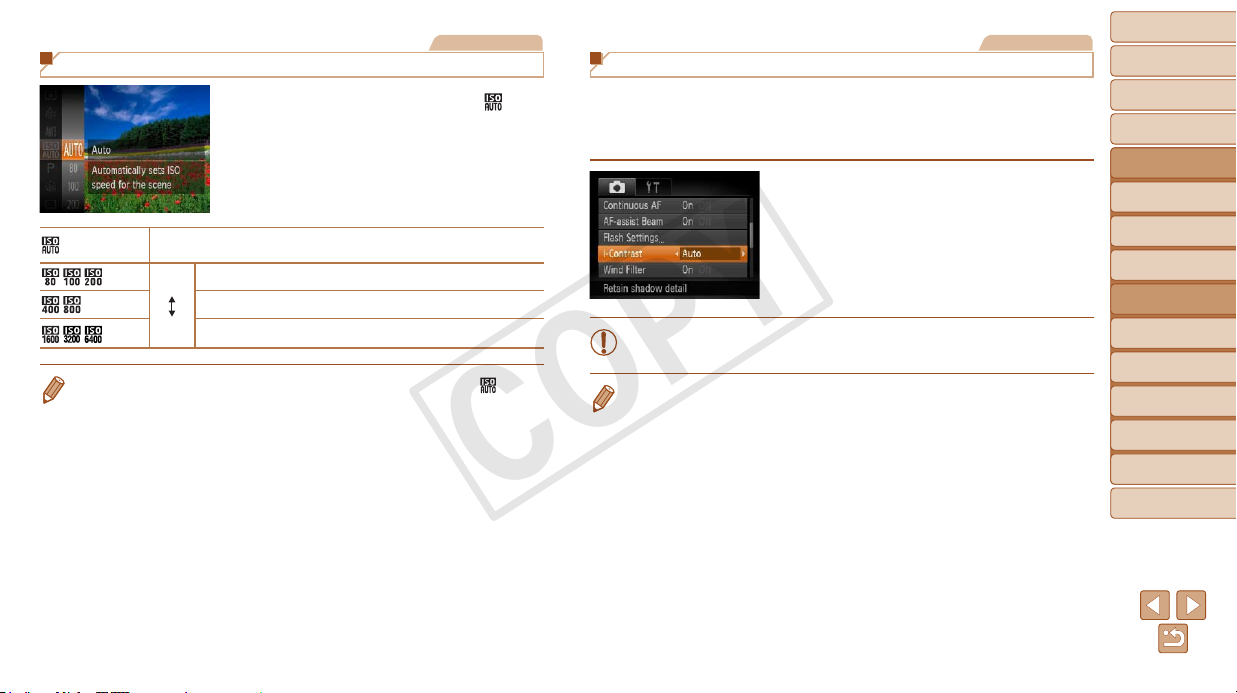
71
1
2
3
5
6
7
8
9
Preliminary Notes and
Legal Information
Contents: Basic
Operations
Camera Basics
Auto Mode/Hybrid
Auto Mode
Other Shooting
Modes
Playback Mode
Wi-Fi Functions
Setting Menu
Accessories
Appendix
Index
Basic Guide
Cover
Advanced Guide
4
P Mode
Still Images
Changing the ISO Speed
Press the <m> button, choose [ ] in
the menu, and choose the desired option
(=
28).
Theoptionyouconguredisnow
displayed.
Automatically adjusts the ISO speed to suit the shooting mode and
conditions.
Low
High
For shooting outdoors in fair weather.
For shooting in cloudy conditions, or at twilight.
For shooting night scenes, or in dark rooms.
• To view the automatically set ISO speed when the camera is set to [ ], press
the shutter button halfway.
• Although choosing a lower ISO speed may reduce image graininess, there
may be a greater risk of subject blurriness in some shooting conditions.
• Choosing a higher ISO speed will increase shutter speed, which may reduce
subjectblurrinessandincreasetheashrange.However,shotsmaylook
grainy.
Still Images
Correcting Image Brightness (i-Contrast)
Before shooting, excessively bright or dark image areas (such as faces or
backgrounds) can be detected and automatically adjusted to the optimal
brightness.Insufcientoverallimagecontrastcanalsobeautomatically
corrected before shooting to make subjects stand out better.
Press the <n> button, choose
[i-Contrast] on the [4] tab, and then
choose [Auto] (=
29).
Once the setting is complete, [@] is
displayed.
• Under some shooting conditions, correction may be inaccurate or
may cause images to appear grainy.
• You can also correct existing images (=
103).
COPY
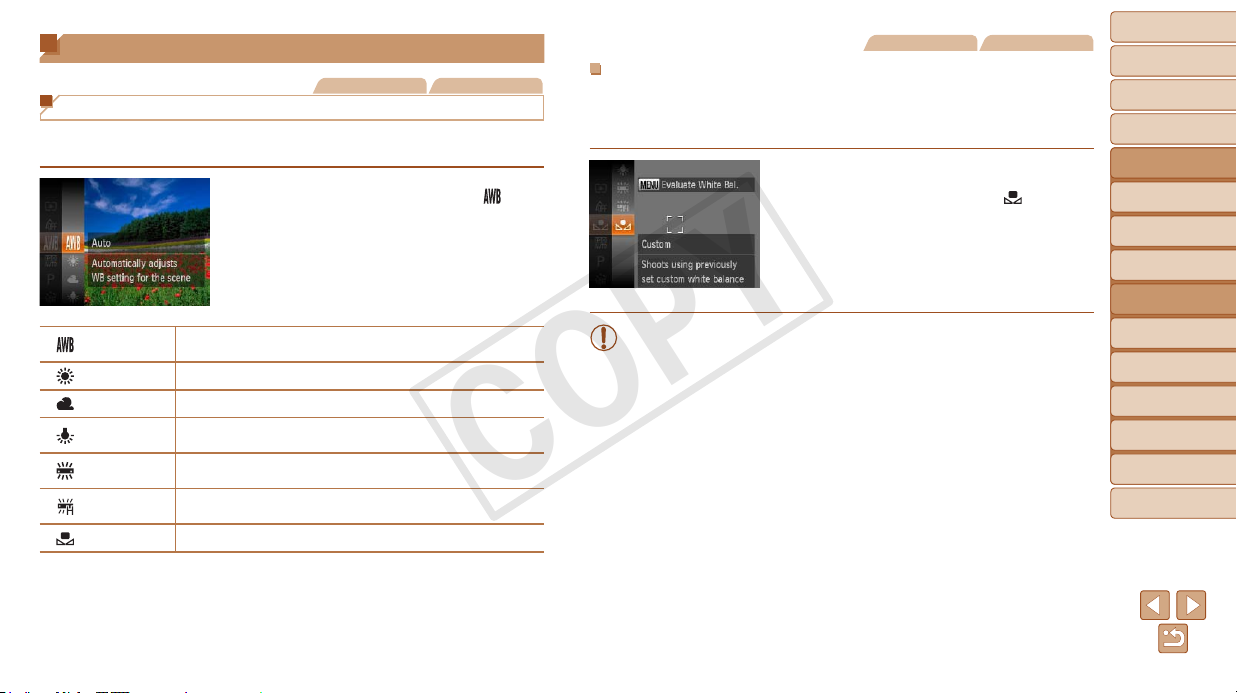
72
1
2
3
5
6
7
8
9
Preliminary Notes and
Legal Information
Contents: Basic
Operations
Camera Basics
Auto Mode/Hybrid
Auto Mode
Other Shooting
Modes
Playback Mode
Wi-Fi Functions
Setting Menu
Accessories
Appendix
Index
Basic Guide
Cover
Advanced Guide
4
P Mode
Color and Continuous Shooting
Still Images Movies
Adjusting White Balance
By adjusting white balance (WB), you can make image colors look more
natural for the scene you are shooting.
Press the <m> button, choose [ ] in
the menu, and choose the desired option
(=
28).
Theoptionyouconguredisnow
displayed.
Auto
Automatically sets the optimal white balance for the shooting
conditions.
Day Light For shooting outdoors in fair weather.
Cloudy For shooting in cloudy conditions, in the shade, or at twilight.
Tungsten
For shooting under ordinary incandescent (tungsten) lighting
andsimilarlycoloreduorescentlighting.
Fluorescent
For shooting under warm-white (or similarly colored) or cool-
whiteuorescentlighting.
Fluorescent H
Forshootingunderdaylightuorescentandsimilarlycolored
uorescentlighting.
Custom
For manually setting a custom white balance (=
72).
Still Images Movies
Custom White Balance
For image colors that look natural under the light in your shot, adjust white
balance to suit the light source where you are shooting. Set the white
balance under the same light source that will illuminate your shot.
Follow the steps in “Adjusting White
Balance”(=
72) to choose [ ].
Aim the camera at a plain white subject,
so that the entire screen is white. Press
the <n> button.
The tint of the screen changes once the
white balance data has been recorded.
• Colors may look unnatural if you change camera settings after
recording white balance data.
COPY
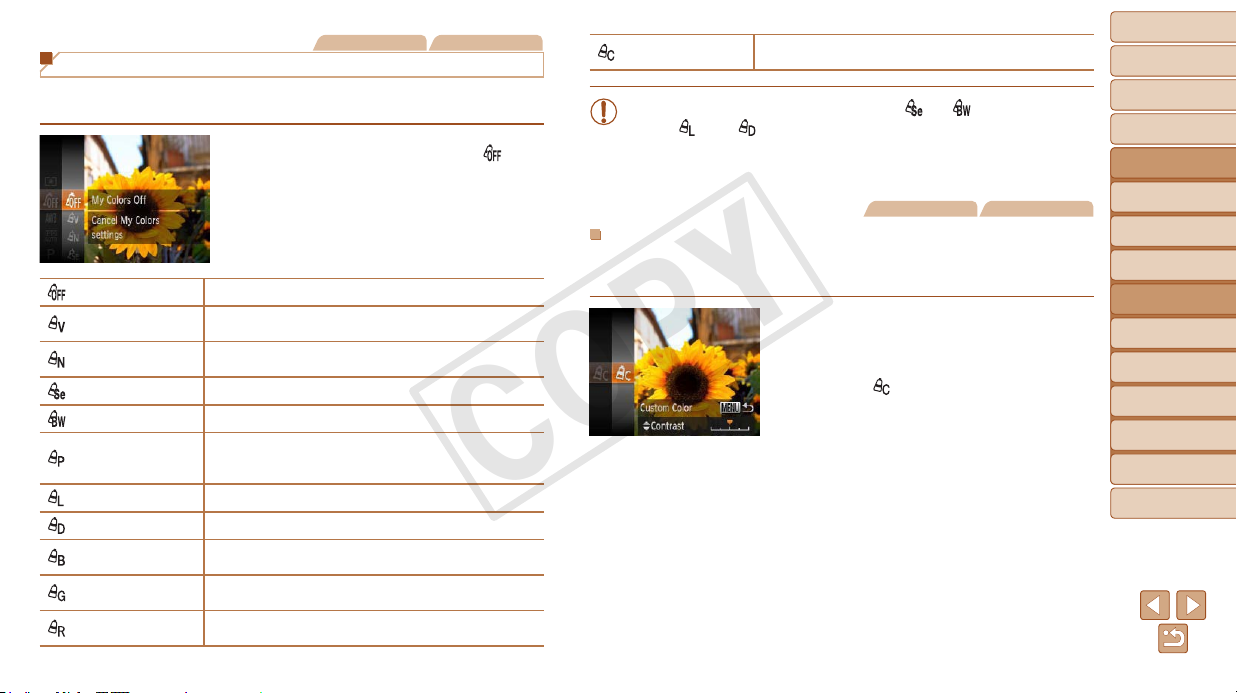
73
1
2
3
5
6
7
8
9
Preliminary Notes and
Legal Information
Contents: Basic
Operations
Camera Basics
Auto Mode/Hybrid
Auto Mode
Other Shooting
Modes
Playback Mode
Wi-Fi Functions
Setting Menu
Accessories
Appendix
Index
Basic Guide
Cover
Advanced Guide
4
P Mode
Still Images Movies
Changing Image Color Tones (My Colors)
Change image color tones as desired, such as converting images to sepia
or black and white.
Press the <m> button, choose [ ] in
the menu, and choose the desired option
(=
28).
Theoptionyouconguredisnow
displayed.
My Colors Off ―
Vivid
Emphasizes contrast and color saturation, making images
sharper.
Neutral
Tones down contrast and color saturation for subdued
images.
Sepia Creates sepia tone images.
B/W Creates black and white images.
Positive Film
Combines the effects of Vivid Blue, Vivid Green, and
Vivid Red to produce intense yet natural-looking colors
resemblingimagesonpositivelm.
Lighter Skin Tone Lightens skin tones.
Darker Skin Tone Darkens skin tones.
Vivid Blue
Emphasizes blues in images. Makes the sky, ocean, and
other blue subjects more vivid.
Vivid Green
Emphasizes greens in images. Makes mountains, foliage,
and other green subjects more vivid.
Vivid Red
Emphasizes reds in images. Makes red subjects more
vivid.
Custom Color
Adjust contrast, sharpness, color saturation, and other
qualities as desired (=
73).
• White balance (=
72) cannot be set in [ ] or [ ] modes.
• With [
] and [ ] modes, colors other than people’s skin tone may
bemodied.Thesesettingsmaynotproducetheexpectedresults
with some skin tones.
Still Images Movies
Custom Color
Choose the desired level of image contrast, sharpness, color saturation,
red, green, blue, and skin tones in a range of 1 – 5.
1 Access the setting screen.
Follow the steps in “Changing Image
ColorTones(MyColors)”(=
73) to
choose [
], and then press the <n>
button.
2 Congurethesetting.
Press the <o><p> buttons to choose
an option, and then specify the value by
pressing the <q><r> buttons.
For stronger/more intense effects (or
darker skin tones), adjust the value to
the right, and for weaker/lighter effects
(or lighter skin tones), adjust the value to
the left.
Press the <n> button to complete
the setting.
COPY
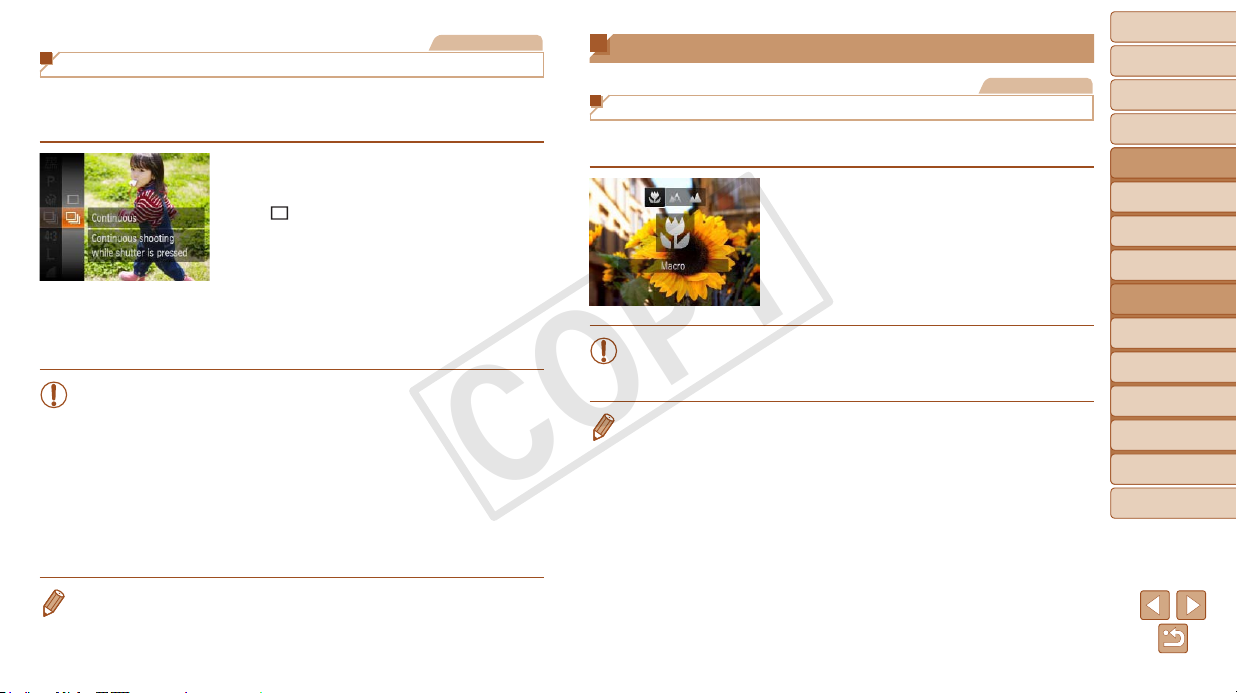
74
1
2
3
5
6
7
8
9
Preliminary Notes and
Legal Information
Contents: Basic
Operations
Camera Basics
Auto Mode/Hybrid
Auto Mode
Other Shooting
Modes
Playback Mode
Wi-Fi Functions
Setting Menu
Accessories
Appendix
Index
Basic Guide
Cover
Advanced Guide
4
P Mode
Still Images
Continuous Shooting
Hold the shutter button all the way down to shoot continuously.
For details on the continuous shooting speed, see “Continuous Shooting
Speed”(=
173).
1 Congurethesetting.
Press the <m> button, choose
[
] in the menu, and then choose [W]
(=
28).
Once the setting is complete, [W] is
displayed.
2 Shoot.
Hold the shutter button all the way down
to shoot continuously.
• Cannot be used with the self-timer (=
39) or [Blink Detection]
(=
51).
• During continuous shooting, focus and exposure are locked at the
position/level determined when you pressed the shutter button
halfway.
• Shooting may stop momentarily or continuous shooting may slow
down depending on shooting conditions, camera settings, and the
zoom position.
• As more shots are taken, shooting may slow down.
• Shootingmayslowdowniftheashres.
• If you use Face ID (=
42) in [W], the name recorded in the image will be
xedtothelocationwhereitisdisplayedintherstshot.Evenifthesubject
moves,thenamewillstayxedinthesamepositionforanysubsequentshots.
Shooting Range and Focusing
Still Images
Shooting Close-ups (Macro)
To restrict the focus to subjects at close range, set the camera to [e]. For
detailsonthefocusingrange,see“ShootingRange”(=
173).
Press the <q> button, press the <q><r>
buttons to choose [e], and then press
the <m> button.
Once the setting is complete, [e] is
displayed.
• Iftheashres,vignettingmayoccur.
• In the yellow bar display area below the zoom bar, [e] will turn gray
and the camera will not focus.
• To prevent camera shake, try mounting the camera on a tripod and shooting
with the camera set to [[] (=
39).
COPY
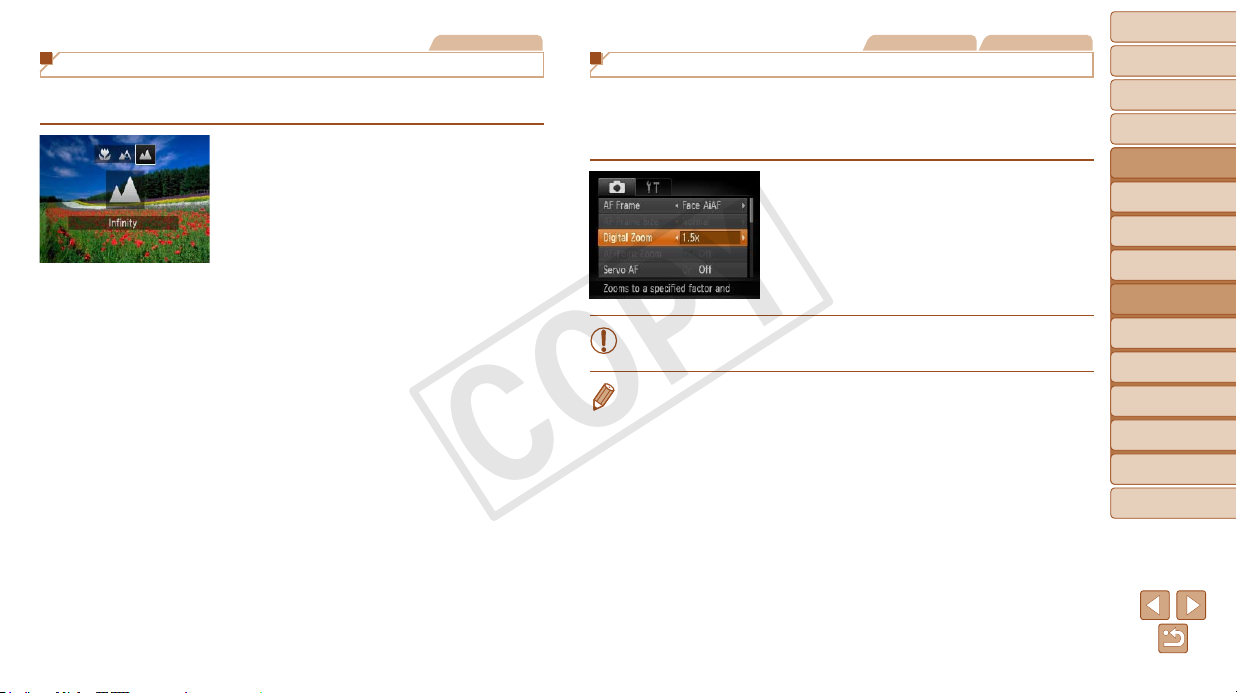
75
1
2
3
5
6
7
8
9
Preliminary Notes and
Legal Information
Contents: Basic
Operations
Camera Basics
Auto Mode/Hybrid
Auto Mode
Other Shooting
Modes
Playback Mode
Wi-Fi Functions
Setting Menu
Accessories
Appendix
Index
Basic Guide
Cover
Advanced Guide
4
P Mode
Still Images
Shooting Distant Subjects (Innity)
To restrict the focus to distant subjects, set the camera to [u]. For details
onthefocusingrange,see“ShootingRange”(=
173).
Press the <q> button, press the <q><r>
buttons to choose [u], and then press
the <m> button.
Once the setting is complete, [u] is
displayed.
Still Images Movies
Digital Tele-Converter
The focal length of the lens can be increased by approximately 1.5x or 2.0x.
This can reduce camera shake because the shutter speed is faster than it
would be if you zoomed (including using digital zoom) in to the same zoom
factor.
Press the <n> button, choose
[Digital Zoom] on the [4] tab, and then
choose the desired option (=
29).
The view is enlarged and the zoom factor
is displayed on the screen.
• The digital tele-converter cannot be used with digital zoom
(=
38) and AF-point zoom (=
50).
• The respective focal lengths when using [1.5x] and [2.0x] are 36.0 – 360.0 mm
and48.0–480.0mm(35mmlmequivalent).
• The shutter speed may be equivalent when you move the zoom lever all the
way toward <i> for maximum telephoto, and when you zoom in to enlarge
the subject to the same size following step 2 in “Zooming In Closer on Subjects
(DigitalZoom)”(=
38).
COPY
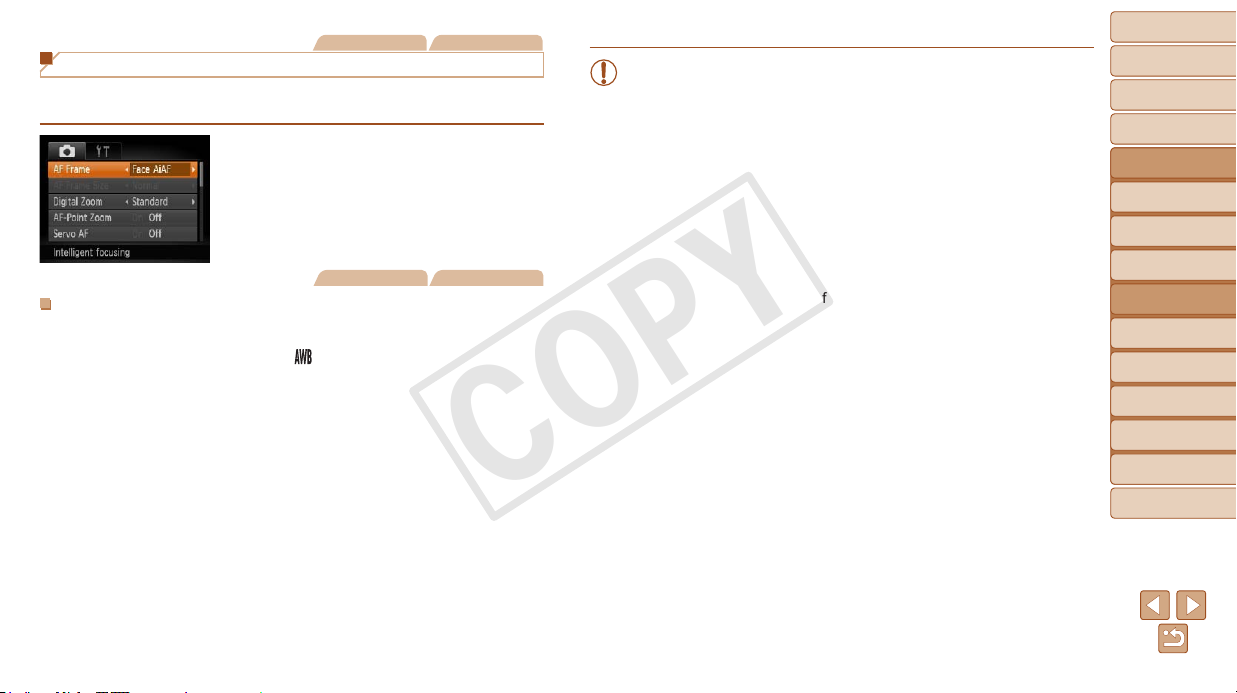
76
1
2
3
5
6
7
8
9
Preliminary Notes and
Legal Information
Contents: Basic
Operations
Camera Basics
Auto Mode/Hybrid
Auto Mode
Other Shooting
Modes
Playback Mode
Wi-Fi Functions
Setting Menu
Accessories
Appendix
Index
Basic Guide
Cover
Advanced Guide
4
P Mode
Still Images Movies
Changing the AF Frame Mode
Change the AF (auto focus) frame mode to suit the shooting conditions as
follows.
Press the <n> button, choose [AF
Frame] on the [4] tab, and then choose
the desired option (=
29).
Still Images Movies
Face AiAF
• Detects people’s faces, and then sets the focus, exposure (evaluative
metering only), and white balance ([ ] only).
• After you aim the camera at the subject, a white frame is displayed
around the person’s face determined by the camera to be the main
subject, and up to two gray frames are displayed around other detected
faces.
• When the camera detects movement, frames will follow moving subjects,
within a certain range.
• After you press the shutter button halfway, up to nine green frames are
displayed around faces in focus.
• If faces are not detected, or when only gray frames are displayed
(without a white frame), up to nine green frames are displayed in the
areas in focus when you press the shutter button halfway.
• If faces are not detected when Servo AF (=
78) is set to [On], the
AF frame is displayed in the center of the screen when you press
the shutter button halfway.
• Examples of faces that cannot be detected:
- Subjects that are distant or extremely close
- Subjects that are dark or light
- Facesinprole,atanangle,orpartlyhidden
• The camera may misinterpret non-human subjects as faces.
• No AF frames are displayed if the camera cannot focus when you
press the shutter button halfway.
COPY
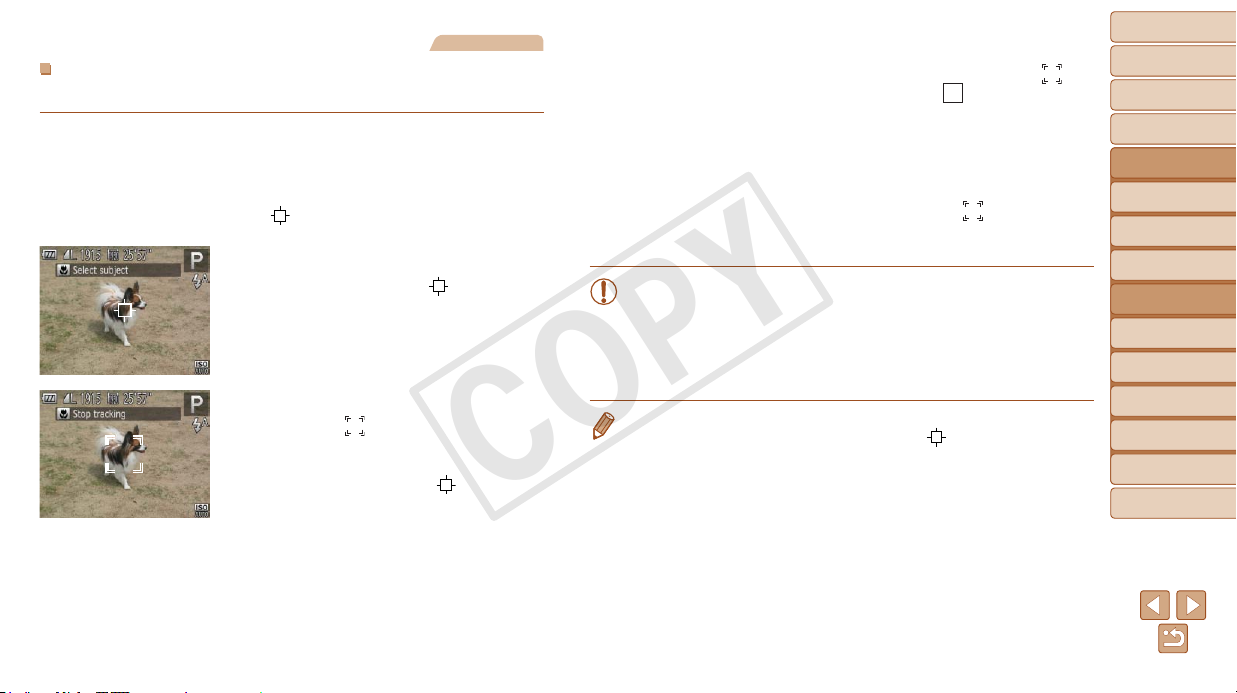
77
1
2
3
5
6
7
8
9
Preliminary Notes and
Legal Information
Contents: Basic
Operations
Camera Basics
Auto Mode/Hybrid
Auto Mode
Other Shooting
Modes
Playback Mode
Wi-Fi Functions
Setting Menu
Accessories
Appendix
Index
Basic Guide
Cover
Advanced Guide
4
P Mode
Still Images
Choosing Subjects to Focus On (Tracking AF)
Shoot after choosing a subject to focus on as follows.
1 Choose [Tracking AF].
Follow the steps in “Changing the AF
FrameMode”(=
76) to choose
[Tracking AF].
[ ] is displayed in the center of the
screen.
2 Choose a subject to focus on.
Aim the camera so that [ ] is on the
desired subject, and then press the <q>
button.
When the subject is detected, the camera
beeps and [
] is displayed. Even if the
subject moves, the camera will continue
to track the subject within a certain range.
If no subject is detected, [ ] is
displayed.
To cancel tracking, press the <q> button
again.
3 Shoot.
Press the shutter button halfway. [ ]
changes to a blue [
], which follows
the subject as the camera continues to
adjust the focus and exposure (Servo AF)
(=
78).
Press the shutter button all the way down
to shoot.
Even after your shot, [ ] is still
displayed and the camera continues to
track the subject.
• [Servo AF] (=
78) is set to [On] and cannot be changed.
• Tracking may not be possible when subjects are too small or move
too rapidly, or when subject color or brightness matches that of the
background too closely.
• [AF-Point Zoom] on the [4] tab is not available.
• [e] and [u] are not available.
• The camera can detect subjects even if you press the shutter button halfway
without pressing the <q> button. After your shot, [
] is displayed in the
center of the screen.
• If [Face ID] is set to [On], names will not display when registered people
are detected, but the names will be recorded in the still images (=
42).
However, a name will display if the subject chosen to focus on is the same as
a person detected with Face ID.
COPY
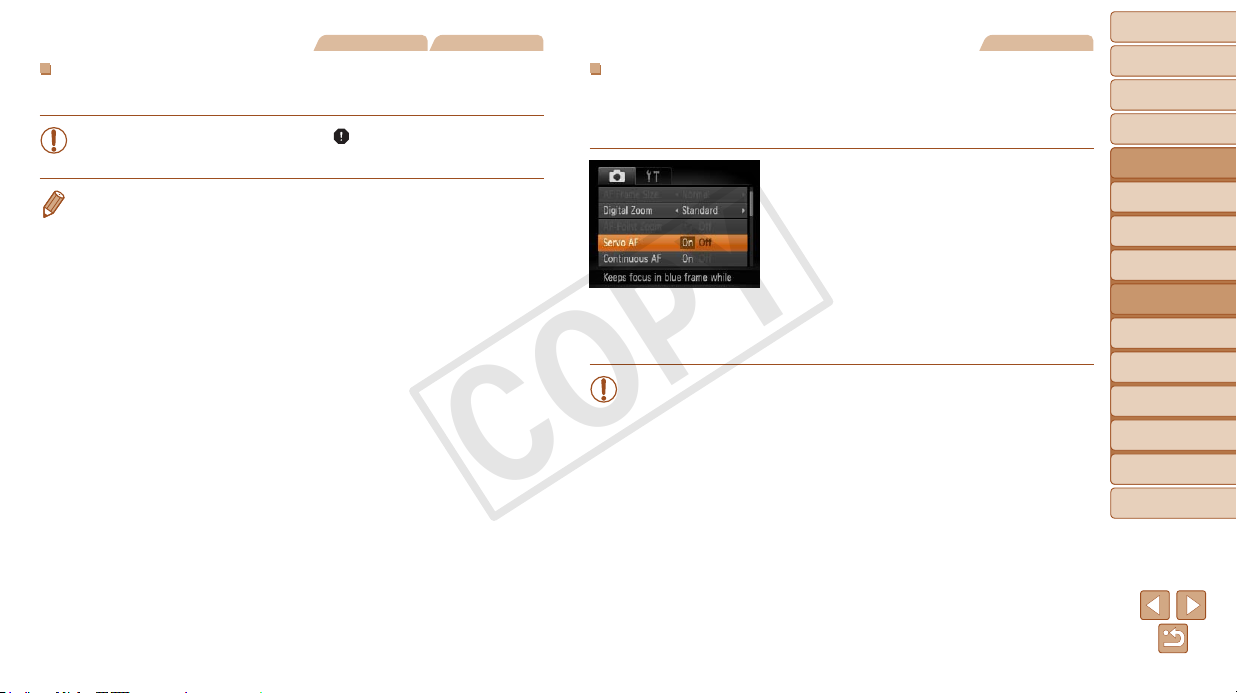
78
1
2
3
5
6
7
8
9
Preliminary Notes and
Legal Information
Contents: Basic
Operations
Camera Basics
Auto Mode/Hybrid
Auto Mode
Other Shooting
Modes
Playback Mode
Wi-Fi Functions
Setting Menu
Accessories
Appendix
Index
Basic Guide
Cover
Advanced Guide
4
P Mode
Still Images Movies
Center
One AF frame is displayed in the center. Effective for reliable focusing.
• A yellow AF frame is displayed with [ ] if the camera cannot focus
when you press the shutter button halfway.
• To reduce the AF frame size, press the <n> button and set [AF Frame
Size] on the [4] tab to [Small] (=
29).
• The AF frame size is set to [Normal] when you use the digital zoom (=
38)
or digital tele-converter (=
75).
• To compose shots so that subjects are positioned at the edge or in a corner,
rstaimthecameratocapturethesubjectinanAFframe,andthenhold
the shutter button halfway down. As you continue to hold the shutter button
halfway, recompose the shot as desired, and then press the shutter button all
the way down (Focus Lock).
• The AF frame position is enlarged when you press the shutter button halfway
and [AF-Point Zoom] (=
50) is set to [On].
Still Images
Shooting with Servo AF
This mode helps avoid missing shots of subjects in motion, because the
camera continues to focus on the subject and adjust the exposure as long
as you press the shutter button halfway.
1 Congurethesetting.
Press the <n> button, choose
[Servo AF] on the [4] tab, and then
choose [On] (=
29).
2 Focus.
The focus and exposure are maintained
where the blue AF frame is displayed
while you are pressing the shutter button
halfway.
• Focusing may not be possible in some shooting conditions.
• In low-light conditions, Servo AF may not be activated (AF frames
may not turn blue) when you press the shutter button halfway. In this
case,thefocusandexposurearesetaccordingtothespeciedAF
frame mode.
• If adequate exposure cannot be obtained, shutter speeds and
aperture values are displayed in orange. Release the shutter button,
and then press it halfway again.
• AF lock shooting is not available.
• [AF-Point Zoom] on the [4] tab is not available.
• Not available when using the self-timer (=
39).
COPY
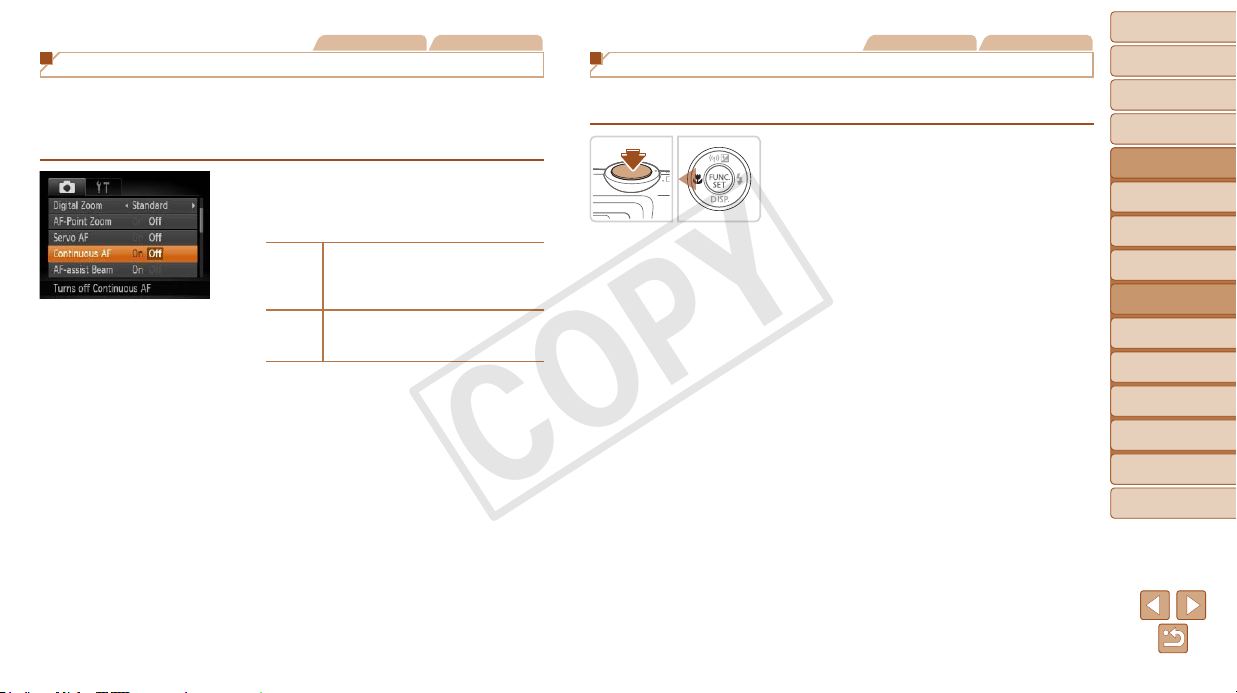
79
1
2
3
5
6
7
8
9
Preliminary Notes and
Legal Information
Contents: Basic
Operations
Camera Basics
Auto Mode/Hybrid
Auto Mode
Other Shooting
Modes
Playback Mode
Wi-Fi Functions
Setting Menu
Accessories
Appendix
Index
Basic Guide
Cover
Advanced Guide
4
P Mode
Still Images Movies
Changing the Focus Setting
You can change default camera operation of constantly focusing on
subjects it is aimed at, even when the shutter button is not pressed. Instead,
you can limit camera focusing to the moment you press the shutter button
halfway.
Press the <n> button, choose
[Continuous AF] on the [4] tab, and then
choose [Off] (=
29).
On
Helps avoid missing sudden photo
opportunities, because the camera
constantly focuses on subjects until
you press the shutter button halfway.
Off
Conserves battery power, because
the camera does not focus
constantly.
Still Images Movies
Shooting with the AF Lock
The focus can be locked. After you lock the focus, the focal position will not
changeevenwhenyoureleaseyourngerfromtheshutterbutton.
1 Lock the focus.
With the shutter button pressed halfway,
press the <q> button.
The focus is now locked, and [%] is
displayed.
To unlock the focus, release the shutter
button and press the <q> button again. In
this case, [%] is no longer displayed.
2 Compose the shot and shoot.
COPY
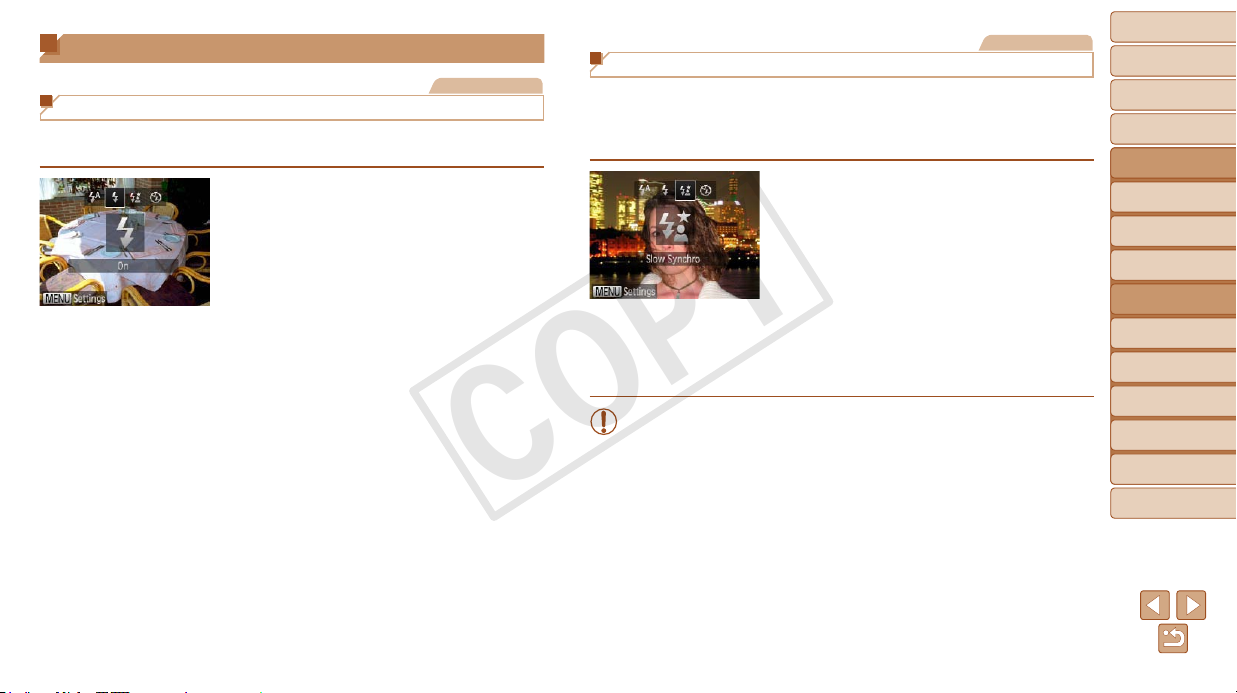
80
1
2
3
5
6
7
8
9
Preliminary Notes and
Legal Information
Contents: Basic
Operations
Camera Basics
Auto Mode/Hybrid
Auto Mode
Other Shooting
Modes
Playback Mode
Wi-Fi Functions
Setting Menu
Accessories
Appendix
Index
Basic Guide
Cover
Advanced Guide
4
P Mode
Flash
Still Images
Activating Flash
Youcanhavetheashreforeachshot.Fordetailsontheashrange,see
“FlashRange”(=
172).
Congurethesetting.
Press the <r> button, press the <q><r>
buttons to choose [h], and then press the
<m> button.
Once the setting is complete, [h] is
displayed.
Still Images
Shooting with Slow Synchro
Withthisoption,theashrestoincreasethebrightnessofthemain
subject (such as people) while the camera shoots at a slow shutter speed to
increasethebrightnessofthebackgroundthatisoutoftheashrange.
Fordetailsontheashrange,see“FlashRange”(=
172).
1 Congurethesetting.
Press the <r> button, press the <q><r>
buttons to choose [Z], and then press
the <m> button.
Once the setting is complete, [Z] is
displayed.
2 Shoot.
Evenaftertheashres,ensurethat
the main subject does not move until the
shuttersoundisnishedplaying.
• Mount the camera on a tripod or take other measures to keep it still
and prevent camera shake. Additionally, you should set [IS Mode]
to [Off] when using a tripod or other means to hold the camera still
(=
82).
COPY
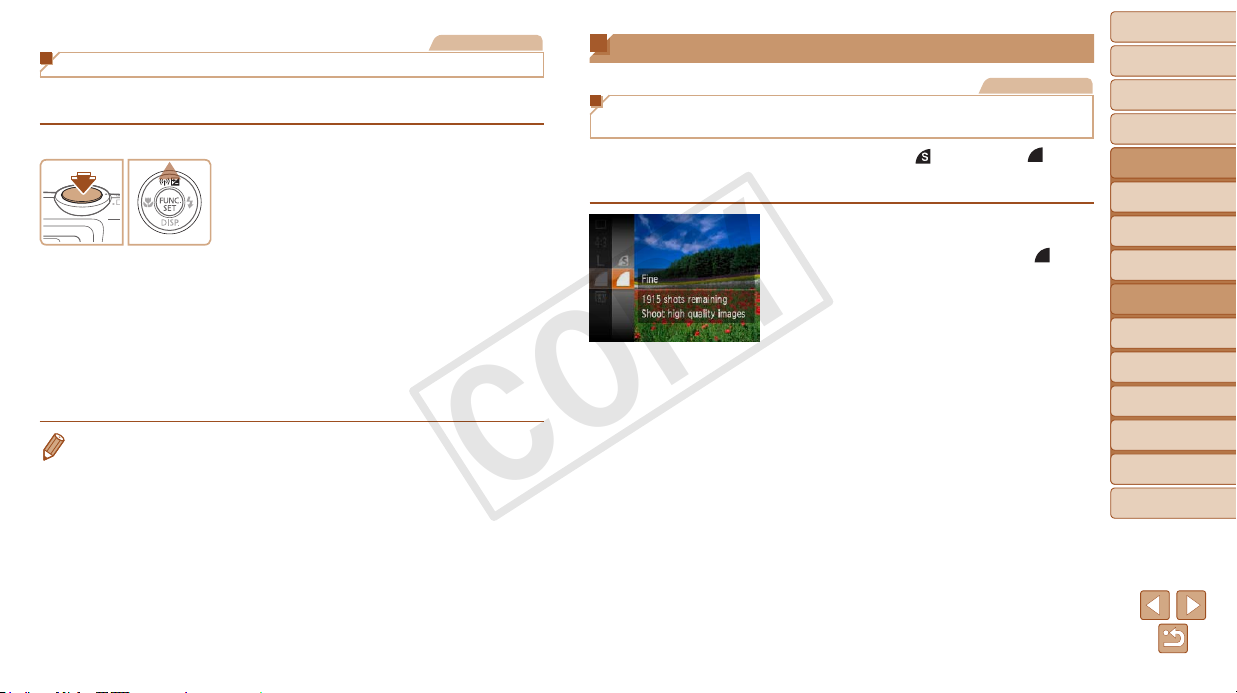
81
1
2
3
5
6
7
8
9
Preliminary Notes and
Legal Information
Contents: Basic
Operations
Camera Basics
Auto Mode/Hybrid
Auto Mode
Other Shooting
Modes
Playback Mode
Wi-Fi Functions
Setting Menu
Accessories
Appendix
Index
Basic Guide
Cover
Advanced Guide
4
P Mode
Still Images
Shooting with the FE Lock
Just as with the AE lock (=
70),youcanlocktheexposurefortheash
shots.
1 Settheashto[h] (=
80).
2 Locktheashexposure.
Aim the camera at the subject to shoot
with the exposure locked. With the
shutter button pressed halfway, press the
<o> button.
Theashres,andwhen[(] is
displayed,theashoutputlevelis
retained.
To unlock FE, release the shutter button
and press the <o> button again. In this
case, [(] is no longer displayed.
3 Compose the shot and shoot.
• FE: Flash Exposure
Other Settings
Still Images
Changing the Compression Ratio (Image
Quality)
Choose from two compression ratios, as follows: (Super Fine), (Fine).
Forguidelinesonhowmanyshotsateachcompressionratiocantona
memorycard,see“Numberof4:3ShotsperMemoryCard”(=
172).
Congurethesetting.
Press the <m> button, choose [ ] in
the menu, and choose the desired option
(=
28).
COPY
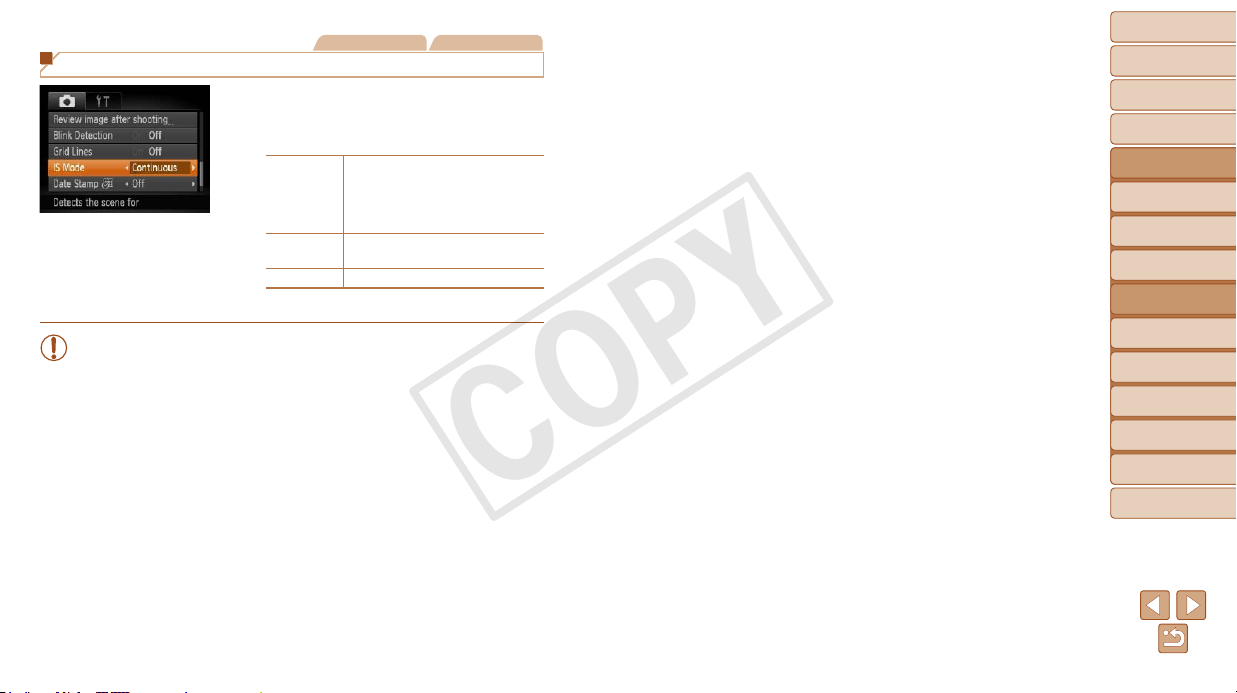
82
1
2
3
5
6
7
8
9
Preliminary Notes and
Legal Information
Contents: Basic
Operations
Camera Basics
Auto Mode/Hybrid
Auto Mode
Other Shooting
Modes
Playback Mode
Wi-Fi Functions
Setting Menu
Accessories
Appendix
Index
Basic Guide
Cover
Advanced Guide
4
P Mode
Still Images Movies
Changing the IS Mode Settings
Press the <n> button, choose [IS
Mode] on the [4] tab, and then choose
the desired option (=
29).
Continuous
Optimal image stabilization
for the shooting conditions is
automatically applied (Intelligent
IS) (=
37).
Shoot Only*
Image stabilization is active only
at the moment of shooting.
Off Deactivates image stabilization.
* The setting is changed to [Continuous] for movie recording.
• If image stabilization cannot prevent camera shake, mount the
camera on a tripod or take other measures to hold it still. In this
case, set [IS Mode] to [Off].
COPY

83
1
2
3
4
6
7
8
9
Preliminary Notes and
Legal Information
Contents: Basic
Operations
Camera Basics
Auto Mode/Hybrid
Auto Mode
Other Shooting
Modes
Wi-Fi Functions
Setting Menu
Accessories
Appendix
Index
Basic Guide
P Mode
Cover
5
Advanced Guide
Playback Mode
Playback Mode
Have fun reviewing your shots, and browse or edit them
in many ways
• To prepare the camera for these operations, press the <1> button to
enter Playback mode.
• It may not be possible to play back or edit images that were
renamed or already edited on a computer, or images from other
cameras.
5
4
Viewing ......................................84
Browsing and Filtering
Images .....................................87
Editing Face ID Information ....90
Image Viewing Options ............91
Protecting Images ....................93
Erasing Images .........................96
Rotating Images .......................98
Image Categories .....................99
Editing Still Images ................100
Editing Movies ........................104
COPY
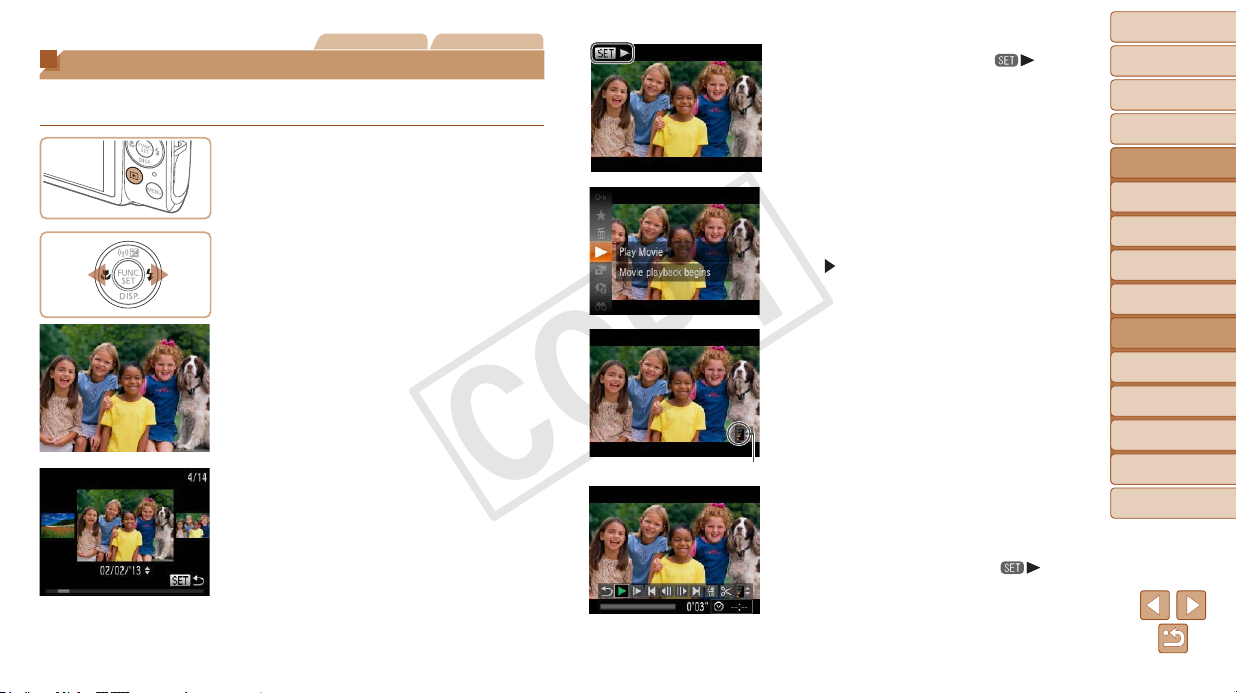
84
1
2
3
4
6
7
8
9
Preliminary Notes and
Legal Information
Contents: Basic
Operations
Camera Basics
Auto Mode/Hybrid
Auto Mode
Other Shooting
Modes
Wi-Fi Functions
Setting Menu
Accessories
Appendix
Index
Basic Guide
P Mode
Cover
5
Advanced Guide
Playback Mode
Still Images Movies
Viewing
After shooting images or movies, you can view them on the screen as
follows.
1 Enter Playback mode.
Press the <1> button.
Your last shot is displayed.
2 Browse through your images.
To view the previous image, press the
<q> button. To view the next image,
press the <r> button.
To access Scroll Display mode, press and
hold the <q><r> buttons for at least one
second. In this mode, press the <q><r>
buttons to browse through images.
To return to single-image display, press
the <m> button.
To browse images grouped by shooting
date, press the <o><p> buttons in
Scroll Display mode.
Moviesareidentiedbya[ ] icon. To
play movies, go to step 3.
3 Play movies.
To start playback, press the <m> button,
press the <o><p> buttons to choose
[
], and then press the <m> button
again.
4 Adjust the volume.
Press the <o><p> buttons to adjust the
volume.
Even after the volume indicator
disappears, you can adjust the volume by
pressing the <o><p> buttons.
5 Pause playback.
To pause or resume playback, press the
<m> button.
Afterthemovieisnished,[ ] is
displayed.
Volume Indicator
COPY
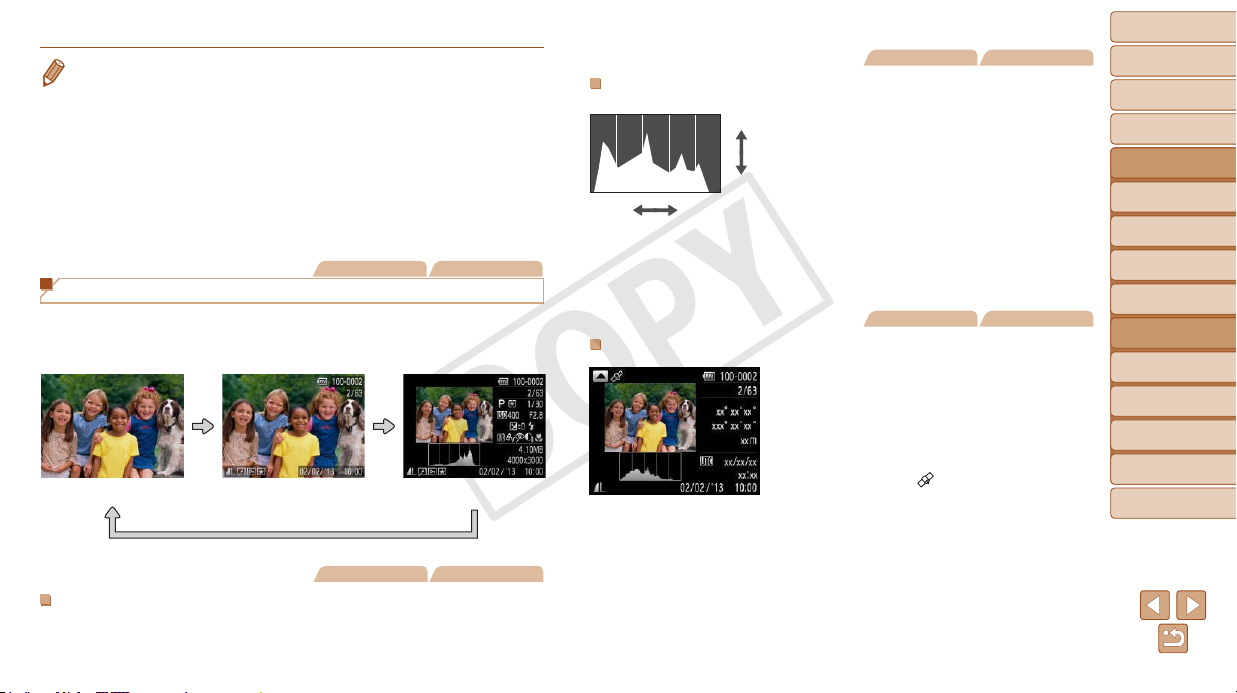
85
1
2
3
4
6
7
8
9
Preliminary Notes and
Legal Information
Contents: Basic
Operations
Camera Basics
Auto Mode/Hybrid
Auto Mode
Other Shooting
Modes
Wi-Fi Functions
Setting Menu
Accessories
Appendix
Index
Basic Guide
P Mode
Cover
5
Advanced Guide
Playback Mode
• To switch to Shooting mode from Playback mode, press the shutter button
halfway.
• To deactivate Scroll Display, press the <n>button,choose[Scroll
Display]onthe[1]tab,andthenchoose[Off].
• If you prefer to have the most recent shot displayed when you enter Playback
mode, press the <n>button,andonthe[1]tab,choose[Resume]and
then[Lastshot].
• To change the transition shown between images, press the <n> button,
choose[Transition]onthe[1] tab, and then press the <q><r> buttons to
choose the effect.
Still Images Movies
Switching Display Modes
Press the <p> button to view other information on the screen, or to hide
the information. For details on the information displayed, see “Playback
(Detailed Information Display)” (=
163).
No Information Display Simple Information
Display
Detailed Information
Display
Still Images Movies
Overexposure Warning (for Image Highlights)
Washed-outhighlightsintheimageashonthescreenindetailed
information display (=
85).
Still Images Movies
Histogram
The graph in detailed information display
(=
85) is a histogram showing the
distribution of brightness in the image.
The horizontal axis represents the degree
of brightness, and the vertical axis, how
much of the image is at each level of
brightness. Viewing the histogram is a
way to check exposure.
Still Images Movies
GPS Information Display
Using a smartphone connected to the
camera via Wi-Fi (=
115), you can
geotag images on the camera, adding
information such as latitude, longitude,
and elevation. Geotagged images are
labeledwitha[
] icon in detailed
information display. Press the <o>
button to view the information recorded.
Latitude,longitude,elevation,andUTC
(shooting date and time) are listed from
top to bottom.
High
Dark
Low
Bright
COPY
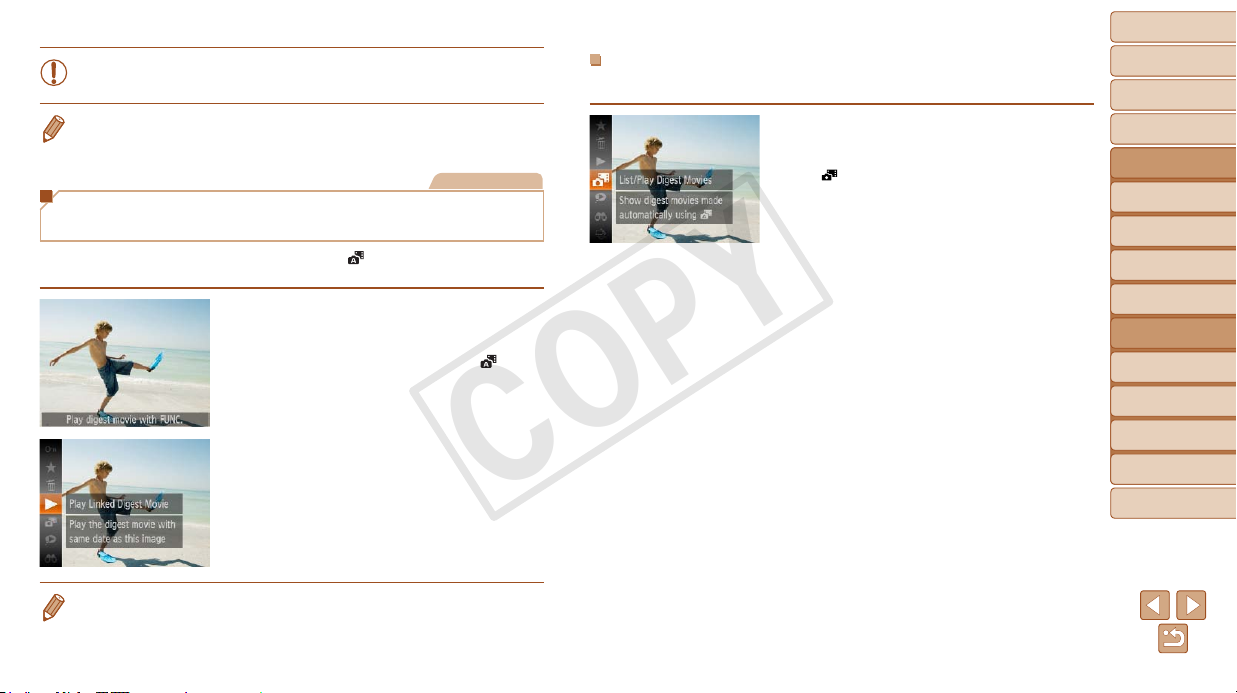
86
1
2
3
4
6
7
8
9
Preliminary Notes and
Legal Information
Contents: Basic
Operations
Camera Basics
Auto Mode/Hybrid
Auto Mode
Other Shooting
Modes
Wi-Fi Functions
Setting Menu
Accessories
Appendix
Index
Basic Guide
P Mode
Cover
5
Advanced Guide
Playback Mode
• [---]isshowninsteadofnumericalvaluesforitemsnotavailableon
your smartphone or items not recorded correctly.
• UTC:CoordinatedUniversalTime,essentiallythesameasGreenwichMean
Time
Movies
Viewing Short Movies Created When Shooting
Still Images (Digest Movies)
Viewdigestmoviesrecordedautomaticallyin[ ] mode (=
34) on a day
of still image shooting as follows.
1 Browse through your images.
[PlaydigestmoviewithH] is
displayedinstillimagesshotin[
]
mode.
2 Play the digest movie.
Press the <m> button, and then choose
[r] in the menu (=
28).
The digest movie recorded automatically
on the day of still image shooting is
played back from the beginning.
• Inamoment,[PlaydigestmoviewithH] will no longer be displayed.
Viewing by Date
Digest movies can be viewed by date.
1 Choose a movie.
Press the <m> button, choose
[
] in the menu, and choose the date
(=
28).
2 Play the movie.
Press the <m> button to start playback.
COPY
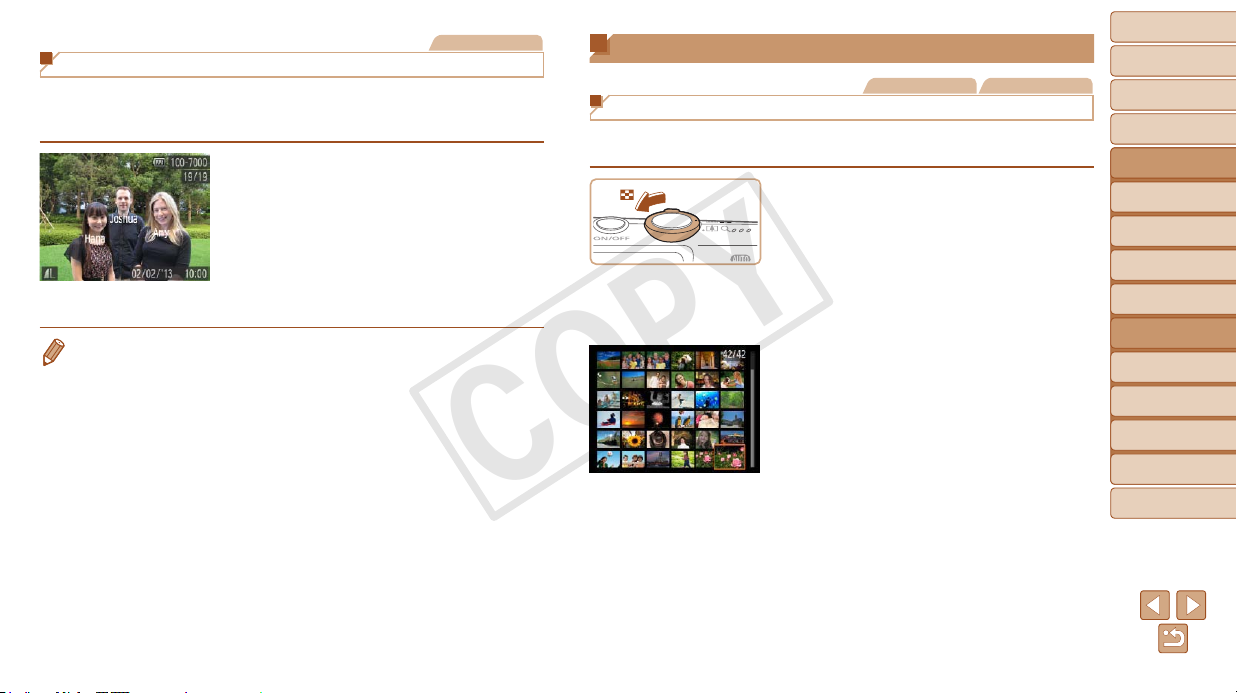
87
1
2
3
4
6
7
8
9
Preliminary Notes and
Legal Information
Contents: Basic
Operations
Camera Basics
Auto Mode/Hybrid
Auto Mode
Other Shooting
Modes
Wi-Fi Functions
Setting Menu
Accessories
Appendix
Index
Basic Guide
P Mode
Cover
5
Advanced Guide
Playback Mode
Still Images
Checking People Detected in Face ID
If you switch the camera to simple information display mode (=
85), the
namesofuptovedetectedpeopleregisteredinFaceID(=
42) will be
displayed.
Switch to simple information
display mode and check.
Press the <p> button repeatedly until
simple information display is activated,
and then press the <q><r> buttons to
choose an image.
Names will be displayed on detected
people.
• If you do not want names to display on images shot using Face ID, press the
<n>button,choose[FaceIDInfo]onthe[1]tab,andthenset[Name
Display]to[Off].
Browsing and Filtering Images
Still Images Movies
Navigating Through Images in an Index
Bydisplayingmultipleimagesinanindex,youcanquicklyndtheimages
you are looking for.
1 Display images in an index.
Move the zoom lever toward <g> to
display images in an index. Moving the
lever again will increase the number of
images shown.
To display fewer images, move the zoom
lever toward <k>. Fewer images are
shown each time you move the lever.
2 Choose an image.
Press the <o><p><q><r> buttons to
choose an image.
An orange frame is displayed around the
selected image.
Press the <m> button to view the
selected image in single-image display.
COPY
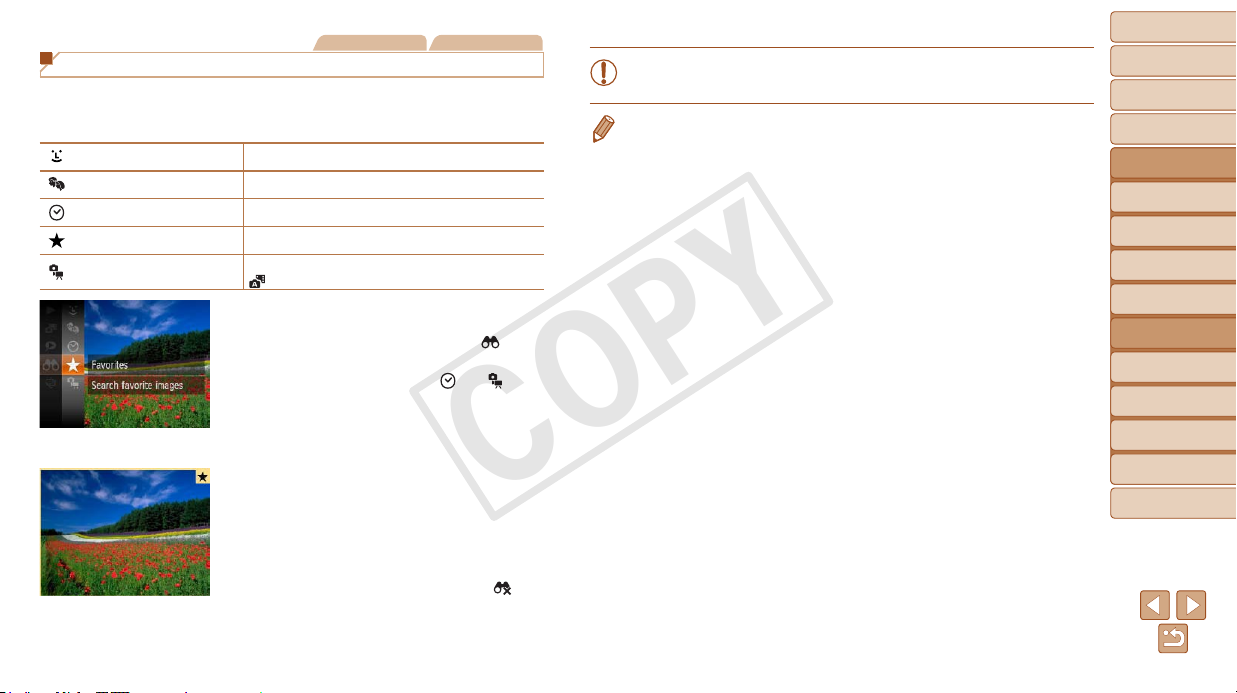
88
1
2
3
4
6
7
8
9
Preliminary Notes and
Legal Information
Contents: Basic
Operations
Camera Basics
Auto Mode/Hybrid
Auto Mode
Other Shooting
Modes
Wi-Fi Functions
Setting Menu
Accessories
Appendix
Index
Basic Guide
P Mode
Cover
5
Advanced Guide
Playback Mode
Still Images Movies
Finding Images Matching Specied Conditions
Finddesiredimagesquicklyonamemorycardfullofimagesbyltering
imagedisplayaccordingtoyourspeciedconditions.Youcanalsoprotect
(=
93) or delete (=
96) these images all at once.
Name
Displays images of a registered person (=
42).
People Displays images with detected faces.
Shot Date Displaystheimagesshotonaspecicdate.
Favorites
Displays images tagged as favorites (=
99).
Still image/Movie
Displays still images, movies, or movies shot in
[
] mode (=
34).
1 Choose a search condition.
Press the
<m>
button, choose
[ ] in the
menu, and choose a condition (=
28).
Whenyouhaveselected[ ]or[ ],
choose the condition by pressing the
<o><p><q><r> buttons on the screen
displayed, and then press the <m>
button.
2 Viewthelteredimages.
Images matching your conditions are
displayed in yellow frames. To view
only these images, press the <q><r>
buttons.
Tocancelltereddisplay,choose[ ] in
step 1.
• When the camera has found no corresponding images for some
conditions, those conditions will not be available.
• Optionsforviewingtheimagesfound(instep2)include“NavigatingThrough
Images in an Index” (=
87), “Viewing Slideshows” (=
91), and
“Magnifying Images” (=
91). You can protect, erase, or print all images
foundoraddthemtoaphotobookbychoosing[SelectAllImagesinSearch]
in “Protecting Images” (=
93), “Erasing All Images” (=
96), “Adding
ImagestothePrintList(DPOF)”(=
150), or “Adding Images to a Photobook”
(=
153).
• If you edit images and save them as new images (=
101 – 103), a message
is displayed, and the images that were found are no longer shown.
COPY
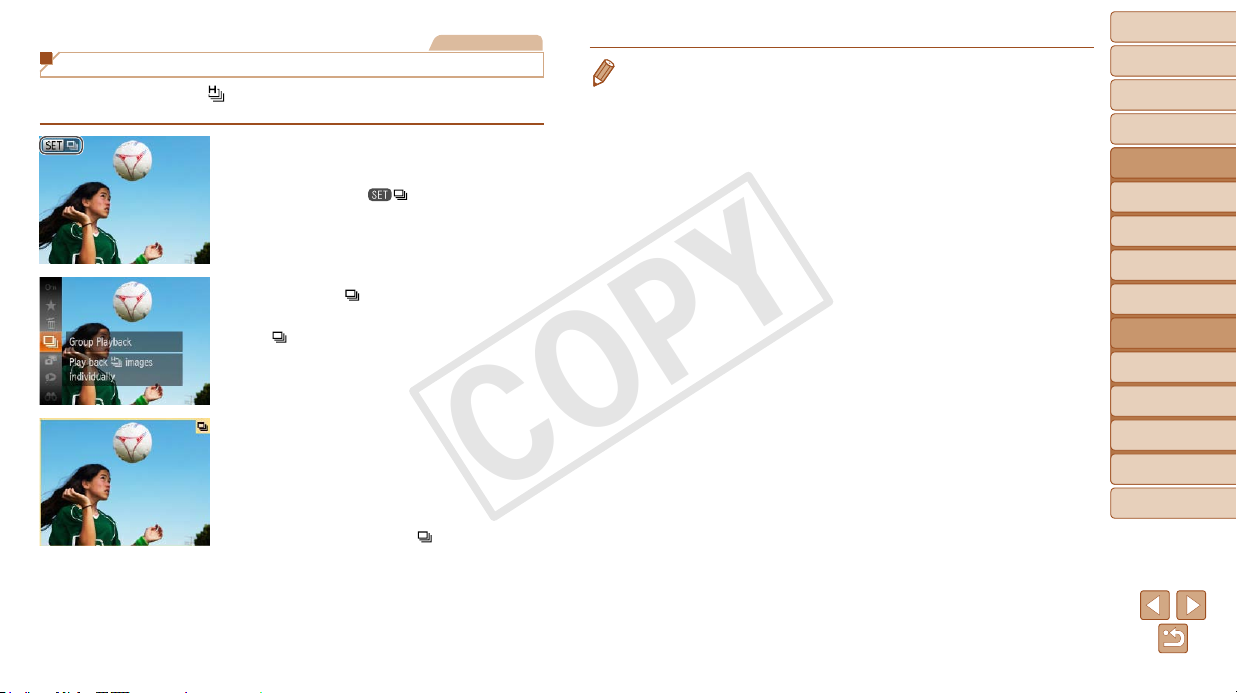
89
1
2
3
4
6
7
8
9
Preliminary Notes and
Legal Information
Contents: Basic
Operations
Camera Basics
Auto Mode/Hybrid
Auto Mode
Other Shooting
Modes
Wi-Fi Functions
Setting Menu
Accessories
Appendix
Index
Basic Guide
P Mode
Cover
5
Advanced Guide
Playback Mode
Still Images
Viewing Individual Images in a Group
Groupedimagesshotin[ ] mode (=
65) are generally displayed
together, but they can also be viewed individually.
1 Choose an image group.
Press the <q><r> buttons to choose an
imagelabeled[
].
2 Choose [ ].
Press the <m> button, and then choose
[
] in the menu (=
28).
3 View individual images in the
group.
Pressing the <q><r> buttons will display
only images in the group.
To cancel group playback, press the
<m>button,choose[
] in the menu,
and press the <m> button again
(=
28).
• During group playback (step 3), you can use the menu functions accessed
by pressing the <m> button. You can also browse through images quickly
“Navigating Through Images in an Index” (=
87) and magnify them
“Magnifying Images” (=
91). You can protect, erase, or print all images in a
groupatonceoraddthemtoaphotobookbychoosing[AllImagesinGroup]
in “Protecting Images” (=
93), “Erasing All Images” (=
96), “Adding
ImagestothePrintList(DPOF)”(=
150), or “Adding Images to a Photobook”
(=
153).
• To ungroup images so that you can view them individually, press the <n>
button,choose[GroupImages]onthe[1]tab,andthenchoose[Off]
(=
29). However, grouped images cannot be ungrouped during individual
playback.
COPY
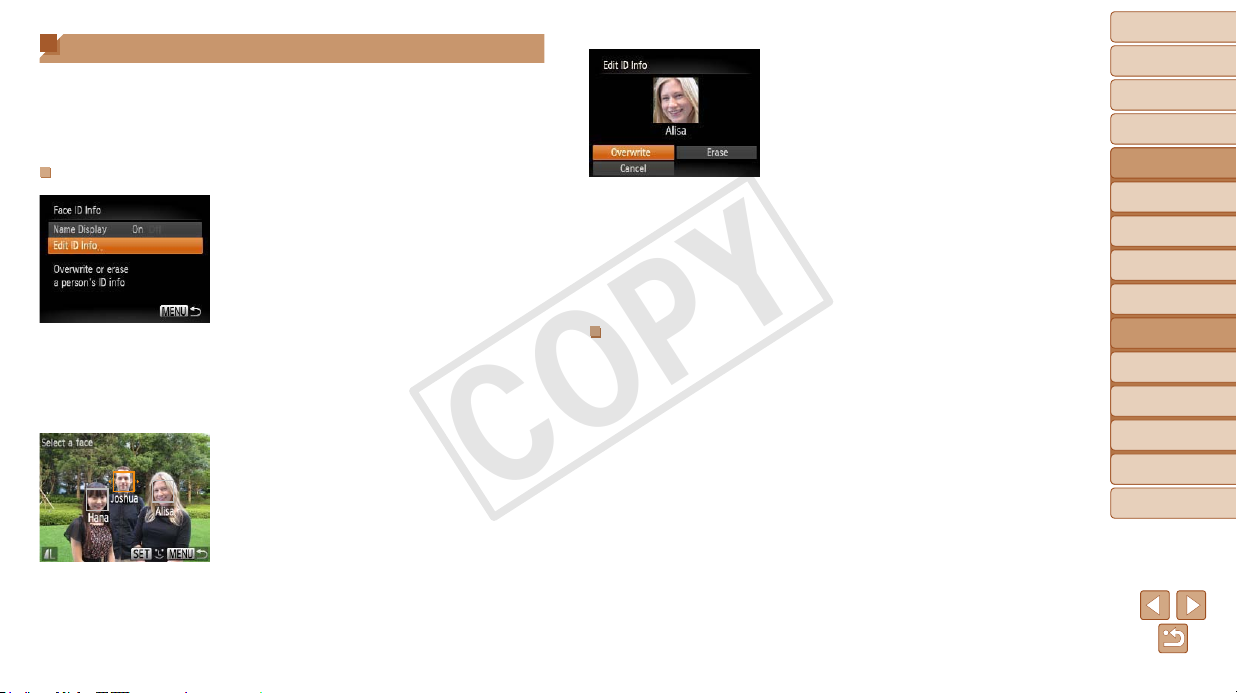
90
1
2
3
4
6
7
8
9
Preliminary Notes and
Legal Information
Contents: Basic
Operations
Camera Basics
Auto Mode/Hybrid
Auto Mode
Other Shooting
Modes
Wi-Fi Functions
Setting Menu
Accessories
Appendix
Index
Basic Guide
P Mode
Cover
5
Advanced Guide
Playback Mode
Editing Face ID Information
If you notice that a name is incorrect during playback, you can change it or
erase it.
However, you cannot add names for people who are not detected by Face
ID (names are not displayed), and for people whose names have been
erased.
Changing Names
1 Access the setting screen.
Press the <n> button and choose
[FaceIDInfo]onthe[1] tab (=
29).
Press the <o><p> buttons to choose
[EditIDInfo],andthenpressthe<m>
button.
2 Choose an image.
Followingtheprocedurein“Checking
People Detected in Face ID” (=
87),
choose an image and press the <m>
button.
An orange frame is displayed around the
selected face. When multiple names are
displayed in an image, press the <q><r>
buttons to choose the name to change,
and press the <m> button.
3 Choose the item to edit.
Press the <o><p><q><r> buttons to
choose[Overwrite],andthenpressthe
<m> button.
4 Choose the name of the person
to overwrite.
Followstep2in“OverwritingandAdding
Face Information” (=
46) to choose
the name of the person you want to
overwrite.
Erasing Names
Followingstep3in“ChangingNames”
(=
90),choose[Erase]andpressthe
<m> button.
After[Erase?]isdisplayed,pressthe
<q><r>buttonstochoose[OK],and
then press the <m> button.
COPY
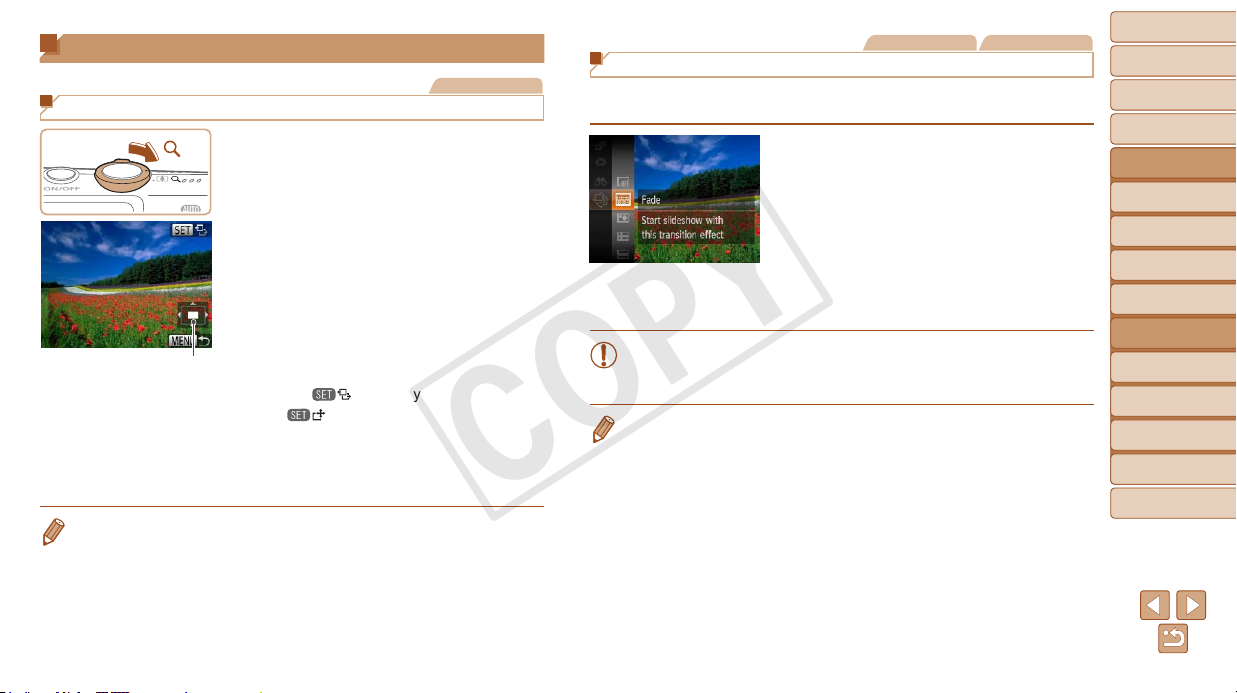
91
1
2
3
4
6
7
8
9
Preliminary Notes and
Legal Information
Contents: Basic
Operations
Camera Basics
Auto Mode/Hybrid
Auto Mode
Other Shooting
Modes
Wi-Fi Functions
Setting Menu
Accessories
Appendix
Index
Basic Guide
P Mode
Cover
5
Advanced Guide
Playback Mode
Image Viewing Options
Still Images
Magnifying Images
1 Magnify an image.
Moving the zoom lever toward <k> will
zoom in and magnify the image. You
can magnify images up to about 10x by
continuing to hold the zoom lever.
To zoom out, move the zoom lever
toward <g>. You can return to single-
image display by continuing to hold it.
2 Move the display position and
switch images as needed.
To move the display position, press the
<o><p><q><r> buttons.
While[ ] is displayed, you can switch
to[
] by pressing the <m> button.
To switch to other images while zoomed,
press the <q><r> buttons. Press the
<m> button again to restore the original
setting.
• Youcanreturntosingle-imagedisplayfrommagnieddisplaybypressingthe
<n> button.
Approximate Position
of Displayed Area
Still Images Movies
Viewing Slideshows
Automatically play back images from a memory card as follows. Each
image is displayed for about three seconds.
Choose a slideshow transition and
start playback.
Press the <m>button,choose[.] in
the menu, and choose the desired option
(=
28).
The slideshow will start a few seconds
after[Loadingimage]isdisplayed.
Press the <n> button to stop the
slideshow.
• The camera’s power-saving functions (=
26) are deactivated
during slideshows.
• To pause or resume slideshows, press the <m> button.
• You can switch to other images during playback by pressing the <q><r>
buttons. For fast-forward or fast-rewind, hold the <q><r> buttons down.
• In image search mode (=
88), only images matching search conditions are
played.
COPY
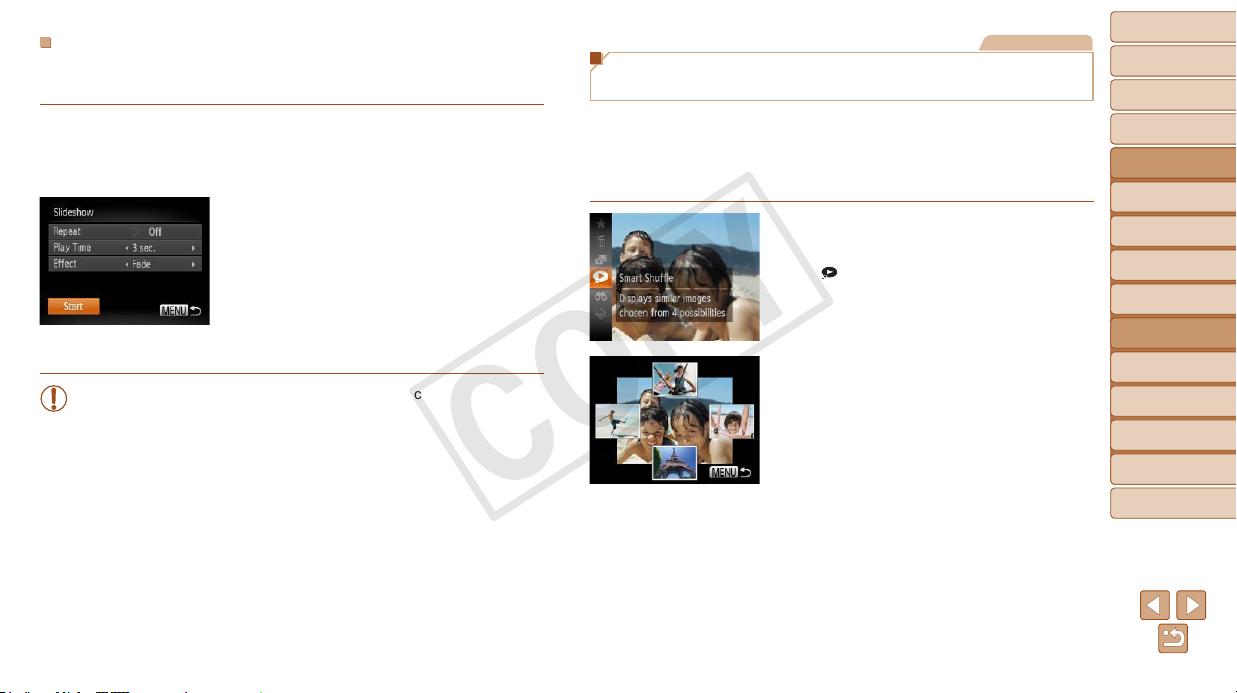
92
1
2
3
4
6
7
8
9
Preliminary Notes and
Legal Information
Contents: Basic
Operations
Camera Basics
Auto Mode/Hybrid
Auto Mode
Other Shooting
Modes
Wi-Fi Functions
Setting Menu
Accessories
Appendix
Index
Basic Guide
P Mode
Cover
5
Advanced Guide
Playback Mode
Changing Slideshow Settings
You can set up slideshows to repeat, and you can change the transitions
between images and the display duration of each image.
1 Access the setting screen.
Press the <n> button, and then
choose[Slideshow]onthe[1] tab
(=
91).
2 Congurethesettings.
Chooseamenuitemtocongure,and
then choose the desired option (=
29).
To start the slideshow with your settings,
choose[Start]andpressthe<m>
button.
To return to the menu screen, press the
<n> button.
• [PlayTime]cannotbemodiedwhen[Bubble]ischosenin[Effect].
Still Images
Auto Playback of Similar Images (Smart
Shufe)
Based on the current image, the camera offers four images similar to it
that you may wish to view. After you choose to view one of those images,
the camera offers four more images. This is an enjoyable way to play back
images in an unexpected order. Try this feature after you have taken many
shots, in many kinds of scenes.
1 ChooseSmartShufe.
Press the <m> button, and then choose
[
] in the menu (=
28).
Four candidate images are displayed.
2 Choose an image.
Press the <o><p><q><r> buttons to
choose the image you want to view next.
Your chosen image is displayed in the
center, surrounded by the next four
candidate images.
For full-screen display of the center
image, press the <m> button. To restore
the original display, press the <m>
button again.
Press the <n> button to restore
single-image display.
COPY
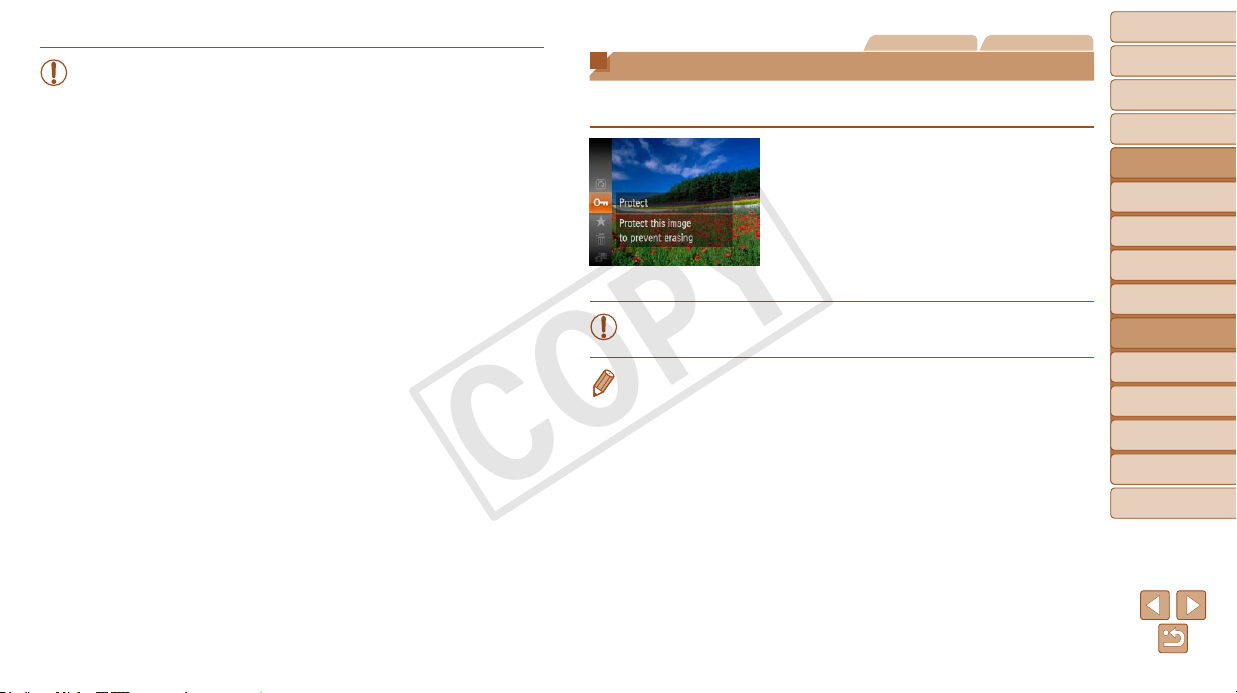
93
1
2
3
4
6
7
8
9
Preliminary Notes and
Legal Information
Contents: Basic
Operations
Camera Basics
Auto Mode/Hybrid
Auto Mode
Other Shooting
Modes
Wi-Fi Functions
Setting Menu
Accessories
Appendix
Index
Basic Guide
P Mode
Cover
5
Advanced Guide
Playback Mode
• OnlystillimagesshotwiththiscameraareplayedbackusingSmart
Shufe.
• SmartShufeisnotavailableinthefollowingcases:
- There are less than 50 shots taken with this camera
- An unsupported image is currently displayed
- Imagesareshowninltereddisplay(=
88)
- During group playback (=
89)
Still Images Movies
Protecting Images
Protect important images to prevent accidental erasure by the camera
(=
96).
Press the <m> button, and then choose
[:] in the menu (=
28).[Protected]
is displayed.
To cancel protection, repeat this process
andchoose[:] again, and then press
the <m> button.
• Protected images on a memory card will be erased if you format the
card (=
136, 137).
• Protected images cannot be erased using the camera’s erasure function. To
erasethemthisway,rstcancelprotection.
COPY
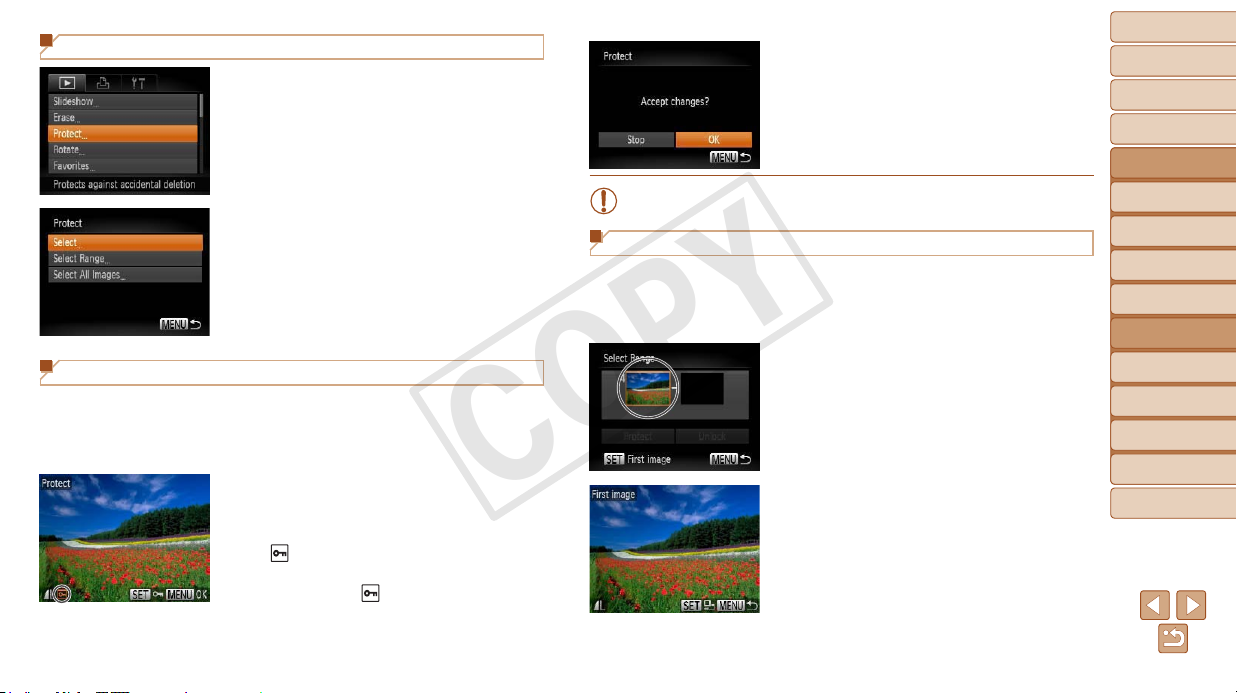
94
1
2
3
4
6
7
8
9
Preliminary Notes and
Legal Information
Contents: Basic
Operations
Camera Basics
Auto Mode/Hybrid
Auto Mode
Other Shooting
Modes
Wi-Fi Functions
Setting Menu
Accessories
Appendix
Index
Basic Guide
P Mode
Cover
5
Advanced Guide
Playback Mode
Using the Menu
1 Access the setting screen.
Press the <n> button and choose
[Protect]onthe[1] tab (=
29).
2 Choose a selection method.
Chooseamenuitemandasettingas
desired (=
29).
To return to the menu screen, press the
<n> button.
Choosing Images Individually
1 Choose [Select].
Following step 2 in “Using the Menu”
(=
94),choose[Select]andpressthe
<m> button.
2 Choose an image.
Press the <q><r> buttons to choose an
image, and then press the <m> button.
[
] is displayed.
To cancel selection, press the <m>
buttonagain.[
] is no longer displayed.
Repeatthisprocesstospecifyother
images.
3 Protect the image.
Press the <n> button. A
conrmationmessageisdisplayed.
Press the <q><r> buttons to choose
[OK],andthenpressthe<m> button.
• Images will not be protected if you switch to Shooting mode or turn
thecameraoffbeforenishingthesetupprocessinstep3.
Selecting a Range
1 Choose [Select Range].
Following step 2 in “Using the Menu”
(=
94),choose[SelectRange]and
press the <m> button.
2 Choose a starting image.
Press the <m> button.
Press the <q><r> buttons to choose an
image, and then press the <m> button.
COPY
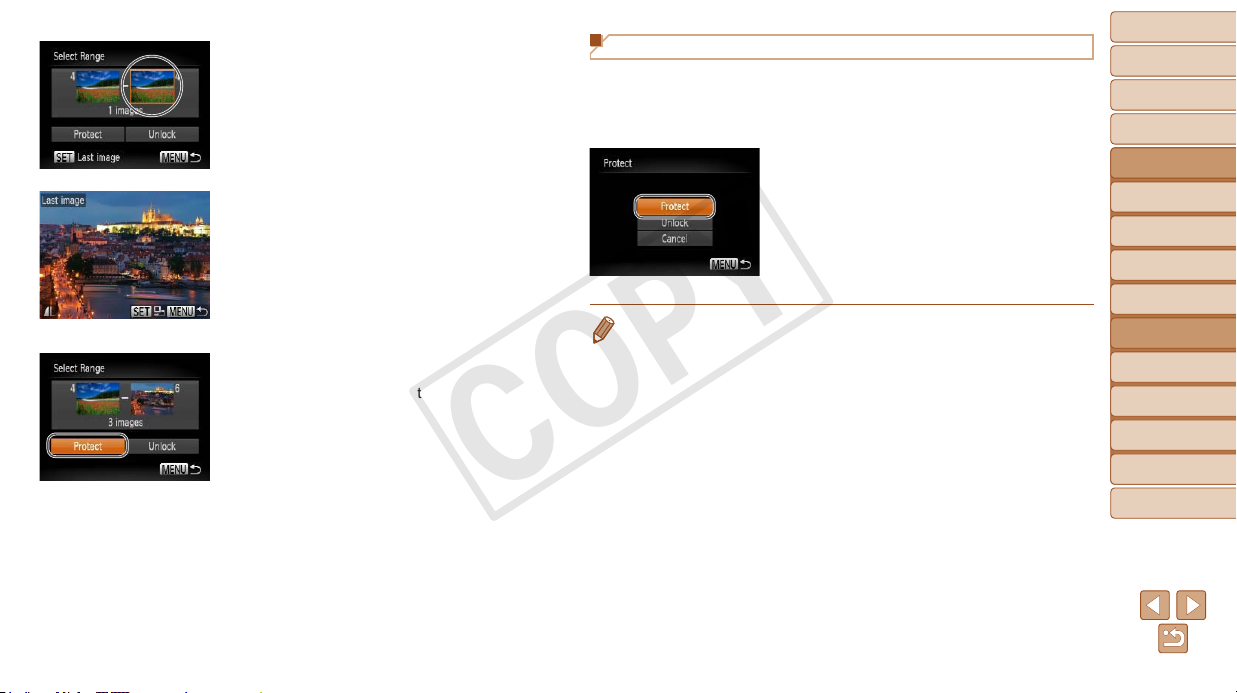
95
1
2
3
4
6
7
8
9
Preliminary Notes and
Legal Information
Contents: Basic
Operations
Camera Basics
Auto Mode/Hybrid
Auto Mode
Other Shooting
Modes
Wi-Fi Functions
Setting Menu
Accessories
Appendix
Index
Basic Guide
P Mode
Cover
5
Advanced Guide
Playback Mode
3 Choose an ending image.
Press the <r>buttontochoose[Last
image], and then press the <m> button.
Press the <q><r> buttons to choose an
image, and then press the <m> button.
Imagesbeforetherstimagecannotbe
selected as the last image.
4 Protect the images.
Press the <p> button to choose
[Protect],andthenpressthe<m>
button.
Specifying All Images at Once
1 Choose [Select All Images].
Following step 2 in “Using the Menu”
(=
94),choose[SelectAllImages]and
press the <m> button.
2 Protect the images.
Press the <o><p> buttons to choose
[Protect],andthenpressthe<m>
button.
• Tocancelprotectionforgroupsofimages,choose[Unlock]instep4of
“SelectingaRange”orinstep2of“SpecifyingAllImagesatOnce”.
COPY
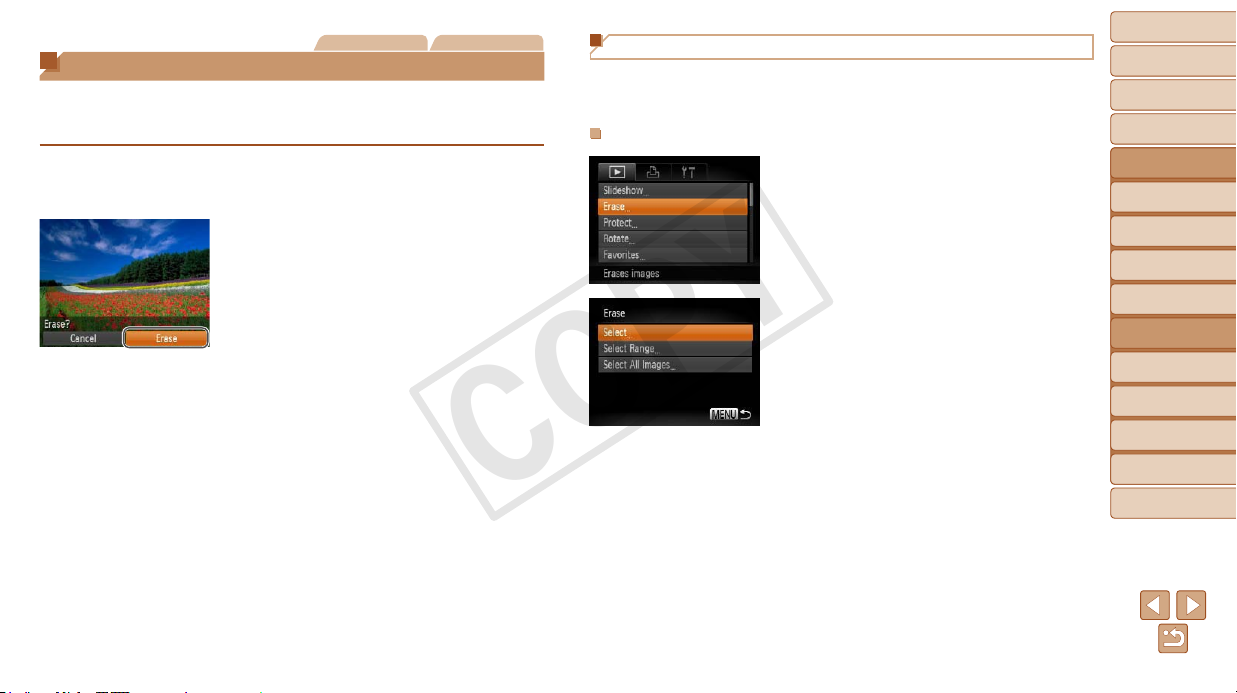
96
1
2
3
4
6
7
8
9
Preliminary Notes and
Legal Information
Contents: Basic
Operations
Camera Basics
Auto Mode/Hybrid
Auto Mode
Other Shooting
Modes
Wi-Fi Functions
Setting Menu
Accessories
Appendix
Index
Basic Guide
P Mode
Cover
5
Advanced Guide
Playback Mode
Still Images Movies
Erasing Images
You can choose and erase unneeded images one by one. Be careful when
erasing images, because they cannot be recovered. However, protected
images (=
93) cannot be erased.
1 Choose an image to erase.
Press the <q><r> buttons to choose an
image.
2 Erase the image.
Press the <m> button, and then choose
[a] in the menu (=
28).
After[Erase?]isdisplayed,pressthe
<q><r>buttonstochoose[Erase],and
then press the <m> button.
The current image is now erased.
To cancel erasure, press the <q><r>
buttonstochoose[Cancel],andthen
press the <m> button.
Erasing All Images
You can erase all images at once. Be careful when erasing images,
because they cannot be recovered. However, protected images (=
93)
cannot be erased.
Choosing a Selection Method
1 Access the setting screen.
Press the <n> button, and then
choose[Erase]onthe[1] tab (=
29).
2 Choose a selection method.
Chooseamenuitemandasettingas
desired (=
29).
Press the <o><p> buttons to choose
a selection method, and then press the
<m> button.
To return to the menu screen, press the
<n> button.
COPY
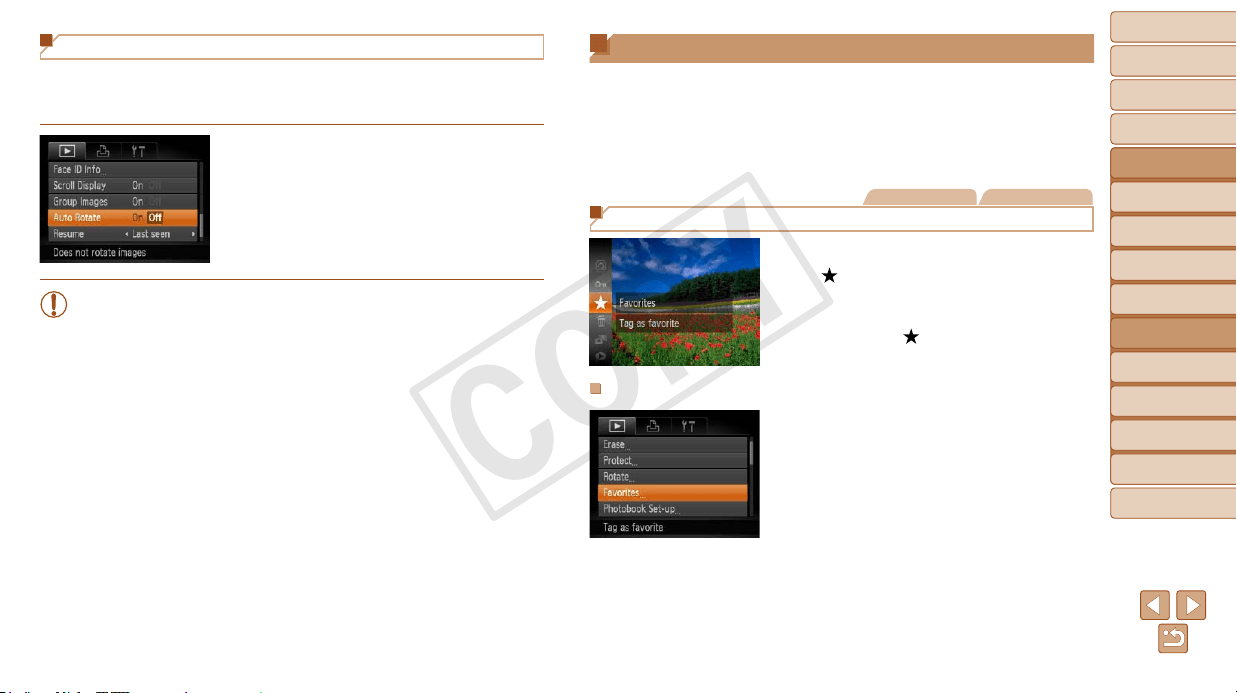
99
1
2
3
4
6
7
8
9
Preliminary Notes and
Legal Information
Contents: Basic
Operations
Camera Basics
Auto Mode/Hybrid
Auto Mode
Other Shooting
Modes
Wi-Fi Functions
Setting Menu
Accessories
Appendix
Index
Basic Guide
P Mode
Cover
5
Advanced Guide
Playback Mode
Deactivating Auto Rotation
Follow these steps to deactivate automatic rotation by the camera, which
rotates images shot in vertical orientation so they are displayed vertically on
the camera.
Press the <n>button,choose[Auto
Rotate]onthe[1] tab, and then choose
[Off](=
29).
• Images cannot be rotated (=
98)whenyouset[AutoRotate]to
[Off].Additionally,imagesalreadyrotatedwillbedisplayedinthe
original orientation.
• InSmartShufe(=
92)mode,evenif[AutoRotate]issetto
[Off],imagesshotverticallywillbedisplayedvertically,androtated
images will be displayed in the rotated orientation.
Image Categories
You can organize images by tagging them as favorites. By choosing a
categoryinlteredplayback,youcanrestrictthefollowingoperationstoall
of those images.
• Viewing (=
84), Viewing Slideshows (=
91), Protecting Images
(=
93), Erasing Images (=
96),AddingImagestothePrintList
(DPOF)(=
150), Adding Images to a Photobook (=
153)
Still Images Movies
Tagging Images as Favorites
Press the <m> button, and then choose
[
] in the menu (=
28).
[TaggedasFavorite]isdisplayed.
To untag the image, repeat this process
andchoose[
] again, and then press
the <m> button.
Using the Menu
1 Choose [Favorites].
Press the <n> button and choose
[Favorites]onthe[1] tab (=
29).
COPY
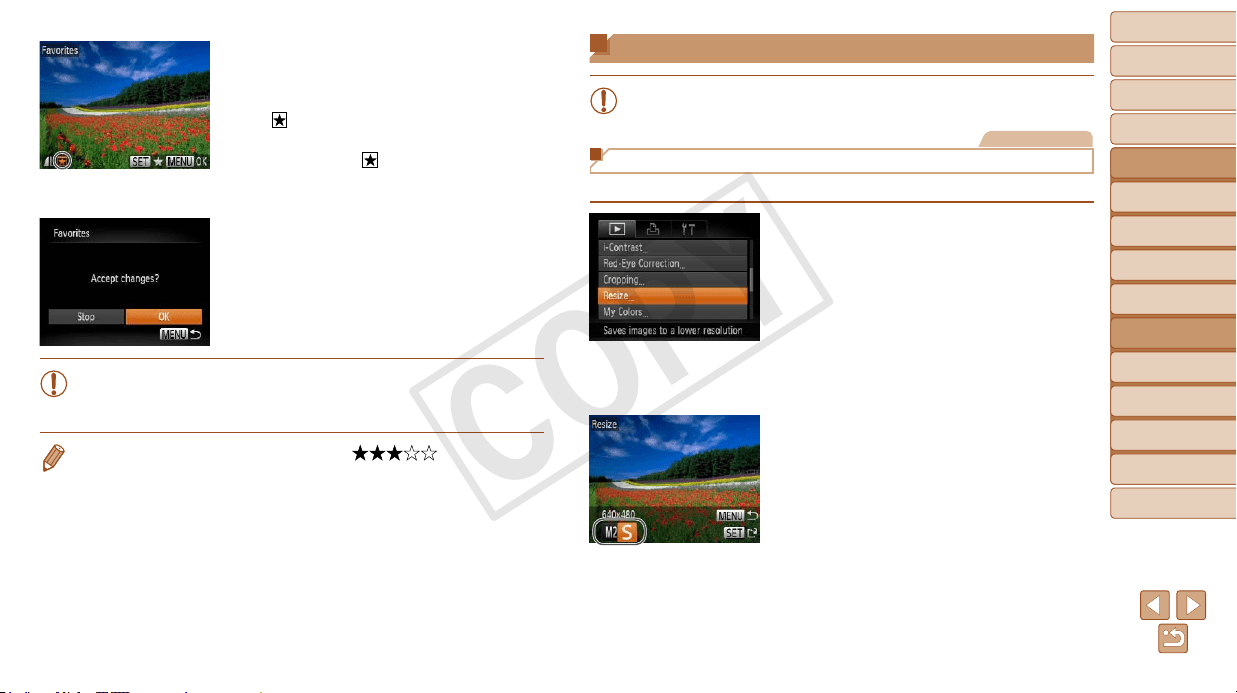
100
1
2
3
4
6
7
8
9
Preliminary Notes and
Legal Information
Contents: Basic
Operations
Camera Basics
Auto Mode/Hybrid
Auto Mode
Other Shooting
Modes
Wi-Fi Functions
Setting Menu
Accessories
Appendix
Index
Basic Guide
P Mode
Cover
5
Advanced Guide
Playback Mode
2 Choose an image.
Press the <q><r> buttons to choose an
image, and then press the <m> button.
[
] is displayed.
To untag the image, press the <m>
buttonagain.[
] is no longer displayed.
Repeatthisprocesstochooseadditional
images.
3 Finish the setup process.
Press the <n> button. A
conrmationmessageisdisplayed.
Press the <q><r> buttons to choose
[OK],andthenpressthe<m> button.
• Images will not be tagged as favorites if you switch to Shooting
modeorturnthecameraoffbeforenishingthesetupprocessin
step 3.
• Favorite images will have a three-star rating ( ) when transferred
to computers running Windows 8, Windows 7 or Windows Vista. (Does not
apply to movies.)
Editing Still Images
• Image editing (=
100 – 103) is only available when the memory
cardhassufcientfreespace.
Still Images
Resizing Images
Save a copy of images at a lower resolution.
1 Choose [Resize].
Press the <n> button and choose
[Resize]onthe[1] tab (=
29).
2 Choose an image.
Press the <q><r> buttons to choose an
image, and then press the <m> button.
3 Choose an image size.
Press the <q><r> buttons to choose the
size, and then press the <m> button.
[Savenewimage?]isdisplayed.
COPY
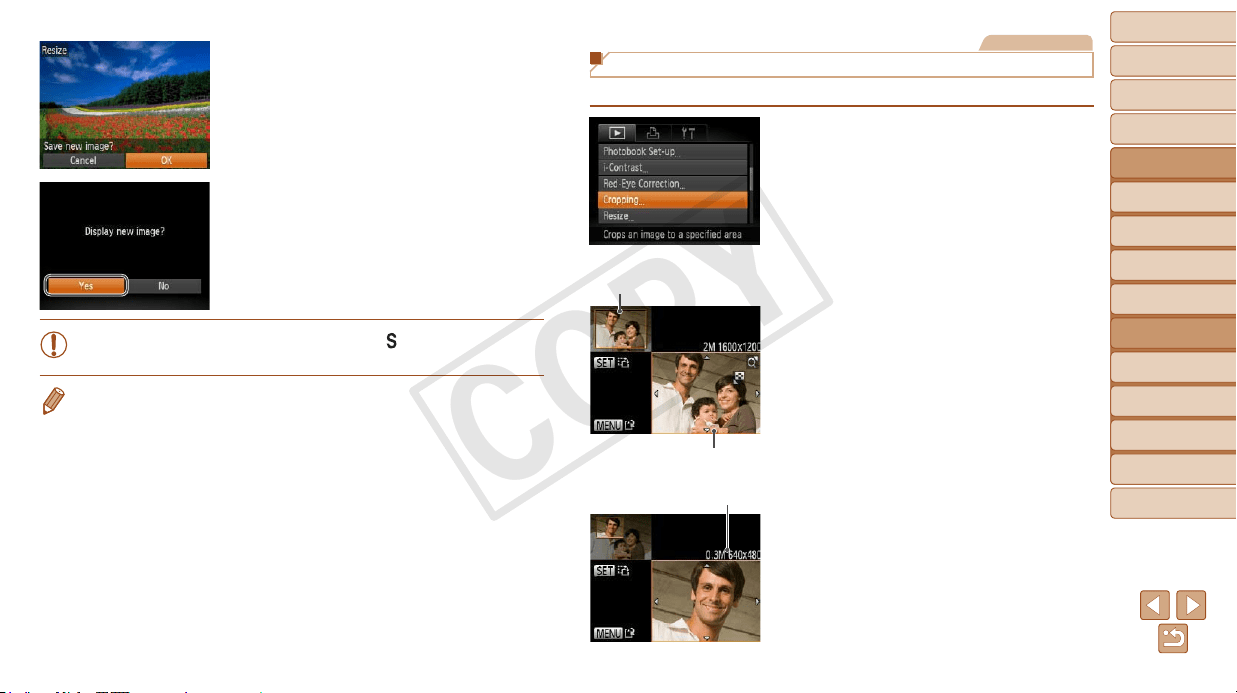
101
1
2
3
4
6
7
8
9
Preliminary Notes and
Legal Information
Contents: Basic
Operations
Camera Basics
Auto Mode/Hybrid
Auto Mode
Other Shooting
Modes
Wi-Fi Functions
Setting Menu
Accessories
Appendix
Index
Basic Guide
P Mode
Cover
5
Advanced Guide
Playback Mode
4 Save the new image.
Press the <q><r> buttons to choose
[OK],andthenpressthe<m> button.
Theimageisnowsavedasanewle.
5 Review the new image.
Press the <n>button.[Displaynew
image?]isdisplayed.
Press the <q><r> buttons to choose
[Yes],andthenpressthe<m> button.
The saved image is now displayed.
• Editingisnotpossibleforimagessavedas[ ] in step 3.
• Images cannot be resized to a higher resolution.
Still Images
Cropping
Youcanspecifyaportionofanimagetosaveasaseparateimagele.
1 Choose [Cropping].
Press the <n> button, and then
choose[Cropping]onthe[1] tab
(=
29).
2 Choose an image.
Press the <q><r> buttons to choose an
image, and then press the <m> button.
3 Adjust the cropping area.
A frame is displayed around the portion of
the image to be cropped.
The original image is shown in the upper
left, and a preview of the image as
cropped is shown in the lower right.
To resize the frame, move the zoom
lever.
To move the frame, press the
<o><p><q><r> buttons.
To change the frame orientation, press
the <m> button.
Press the <n> button.
CroppingArea
Preview of Image After
Cropping
ResolutionAfterCropping
COPY
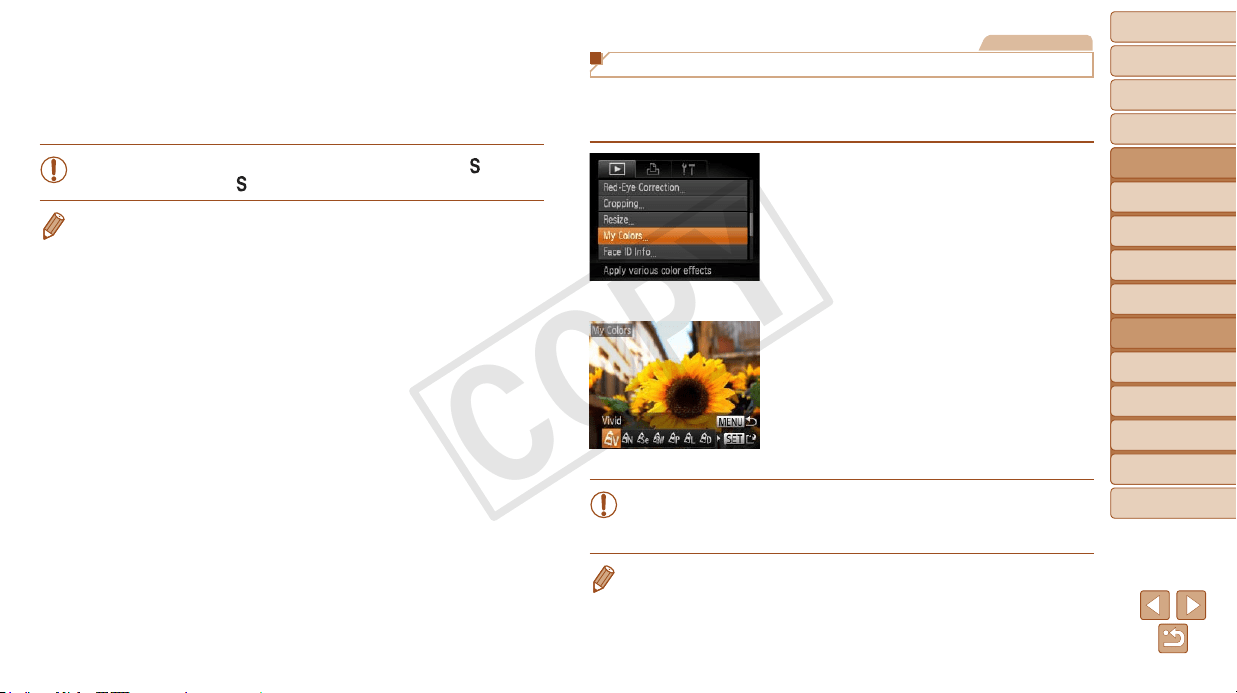
102
1
2
3
4
6
7
8
9
Preliminary Notes and
Legal Information
Contents: Basic
Operations
Camera Basics
Auto Mode/Hybrid
Auto Mode
Other Shooting
Modes
Wi-Fi Functions
Setting Menu
Accessories
Appendix
Index
Basic Guide
P Mode
Cover
5
Advanced Guide
Playback Mode
4 Save as a new image and
review.
Followsteps4–5in“ResizingImages”
(=
101).
• Editingisnotpossibleforimagesshotataresolutionof[ ]
(=
47)orresizedto[ ] (=
100).
• Images supported for cropping will have the same aspect ratio after cropping.
• Croppedimageswillhaveasmallerresolutionthanuncroppedimages.
• If you crop still images shot using Face ID (=
42), only the names of the
people left in the cropped image will remain.
Still Images
Changing Image Color Tones (My Colors)
You can adjust image colors and then save the edited image as a separate
le.Fordetailsoneachoption,see“ChangingImageColorTones(My
Colors)”(=
73).
1 Choose [My Colors].
Press the <n> button, and then
choose[MyColors]onthe[1] tab
(=
29).
2 Choose an image.
Press the <q><r> buttons to choose an
image, and then press the <m> button.
3 Choose an option.
Press the <q><r> buttons to choose an
option, and then press the <m> button.
4 Save as a new image and
review.
Followsteps4–5in“ResizingImages”
(=
101).
• Image quality of pictures you repeatedly edit this way will be a little
lower each time, and you may not be able to obtain the desired
color.
• The color of images edited using this function may vary slightly from the color
ofimagesshotusingMyColors(=
73).
COPY
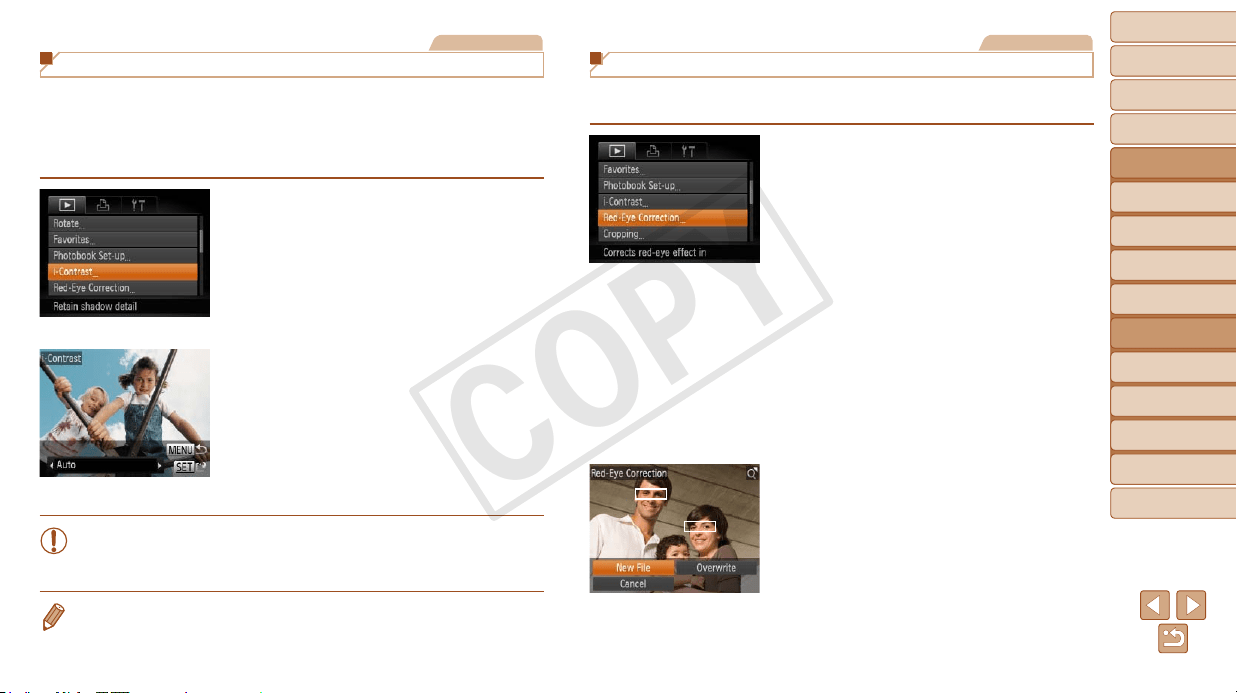
103
1
2
3
4
6
7
8
9
Preliminary Notes and
Legal Information
Contents: Basic
Operations
Camera Basics
Auto Mode/Hybrid
Auto Mode
Other Shooting
Modes
Wi-Fi Functions
Setting Menu
Accessories
Appendix
Index
Basic Guide
P Mode
Cover
5
Advanced Guide
Playback Mode
Still Images
Correcting Image Brightness (i-Contrast)
Excessively dark image areas (such as faces or backgrounds) can be
detectedandautomaticallyadjustedtotheoptimalbrightness.Insufcient
overall image contrast is also automatically corrected, to make subjects
standoutbetter.Choosefromfourcorrectionlevels,andthensavethe
imageasaseparatele.
1 Choose [i-Contrast].
Press the <n> button, and then
choose[i-Contrast]onthe[1] tab
(=
29).
2 Choose an image.
Press the <q><r> buttons to choose an
image, and then press the <m> button.
3 Choose an option.
Press the <q><r> buttons to choose an
option, and then press the <m> button.
4 Save as a new image and
review.
Followsteps4–5in“ResizingImages”
(=
101).
• For some images, correction may be inaccurate or may cause
images to appear grainy.
• Images may look grainy after repeated editing using this function.
• If[Auto]doesnotproducetheexpectedresults,trycorrectingimagesusing
[Low],[Medium],or[High].
Still Images
Correcting Red-Eye
Automatically corrects images affected by red-eye. You can save the
correctedimageasaseparatele.
1 Choose [Red-Eye Correction].
Press the <n> button, and then
choose[Red-EyeCorrection]onthe[1]
tab (=
29).
2 Choose an image.
Press the <q><r> buttons to choose an
image.
3 Correct the image.
Press the <m> button.
Red-eyedetectedbythecameraisnow
corrected, and frames are displayed
around corrected image areas.
Enlarge or reduce images as needed.
Follow the steps in “Magnifying Images”
(=
91).
4 Save as a new image and
review.
Press the <o><p><q><r> buttons to
choose[NewFile],andthenpressthe
<m> button.
Theimageisnowsavedasanewle.
Followstep5in“ResizingImages”
(=
101).
COPY
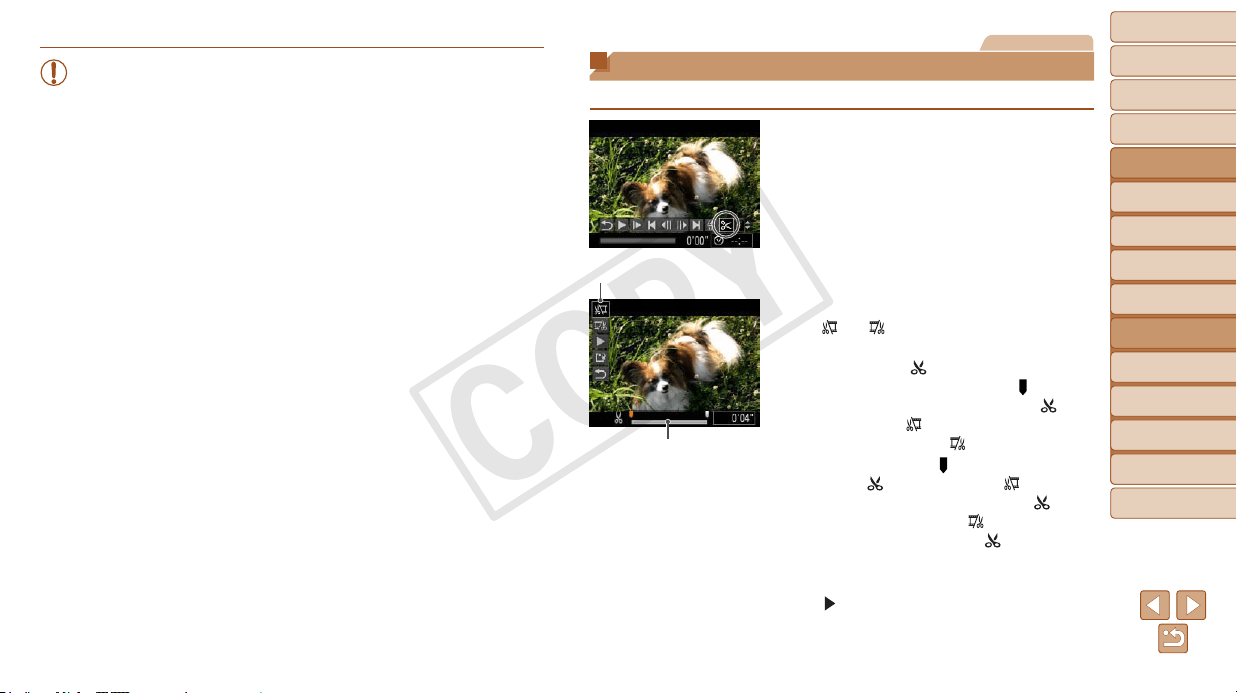
104
1
2
3
4
6
7
8
9
Preliminary Notes and
Legal Information
Contents: Basic
Operations
Camera Basics
Auto Mode/Hybrid
Auto Mode
Other Shooting
Modes
Wi-Fi Functions
Setting Menu
Accessories
Appendix
Index
Basic Guide
P Mode
Cover
5
Advanced Guide
Playback Mode
• Some images may not be corrected accurately.
• To overwrite the original image with the corrected image, choose
[Overwrite]instep4.Inthiscase,theoriginalimagewillbeerased.
• Protected images cannot be overwritten.
Movies
Editing Movies
You can cut movies to remove unneeded portions at the beginning or end.
1 Choose [*].
Following steps 1 – 5 in “Viewing”
(=
84),choose[*] and press the
<m> button.
The movie editing panel and editing bar
are now displayed.
2 Specify portions to cut.
Press the <o><p> buttons to choose
[
]or[ ].
To view the portions you can cut
(identiedby[
] on the screen), press
the <q><r>buttonstomove[
].Cut
thebeginningofthemovie(from[
])
bychoosing[
], and cut the end of the
moviebychoosing[
].
Evenifyoumove[ ] to a position other
thana[
]mark,choosing[ ] will only
cuttheportionfromthenearest[
] to
theleft,andchoosing[
] will cut the
portionfromthenearest[
] to the right.
3 Review the edited movie.
Press the <o><p> buttons to choose
[
], and then press the <m> button.
The edited movie is now played.
To edit the movie again, repeat step 2.
Movie Editing Panel
Movie Editing Bar
COPY
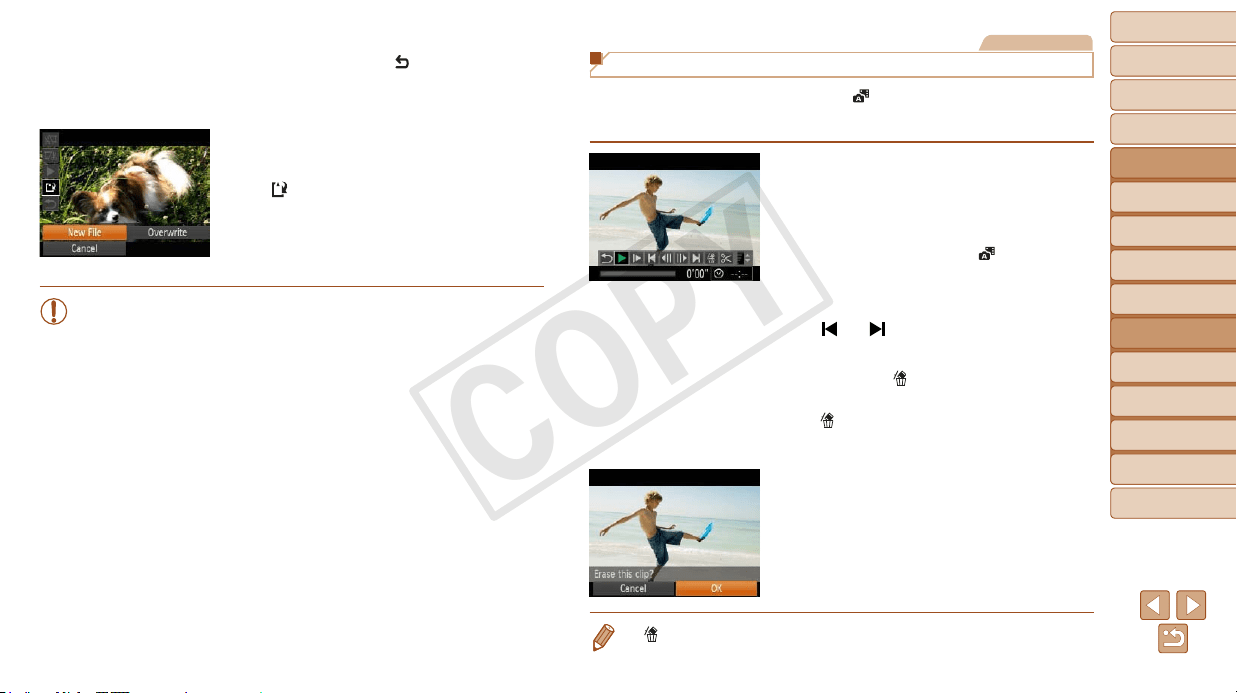
105
1
2
3
4
6
7
8
9
Preliminary Notes and
Legal Information
Contents: Basic
Operations
Camera Basics
Auto Mode/Hybrid
Auto Mode
Other Shooting
Modes
Wi-Fi Functions
Setting Menu
Accessories
Appendix
Index
Basic Guide
P Mode
Cover
5
Advanced Guide
Playback Mode
To cancel editing, press the <o><p>
buttonstochoose[
]. Press the <m>
button, press the <q><r> buttons to
choose[OK],andthenpressthe<m>
button again.
4 Save the edited movie.
Press the <o><p> buttons to choose
[
], and then press the <m> button.
Press the <o><p><q><r> buttons to
choose[NewFile],andthenpressthe
<m> button.
Themovieisnowsavedasanewle.
• Tooverwritetheoriginalmoviewiththecutone,choose[Overwrite]
in step 4. In this case, the original movie will be erased.
• [Overwrite]isonlyavailablewhenmemorycardslacksufcientfree
space.
• Movies may not be saved if the battery runs out while saving is in
progress.
• When editing movies, you should use a fully charged battery or an
ACadapterkit(=
141, sold separately).
Movies
Editing Digest Movies
Individual chapters (=
34)recordedin[ ] mode can be erased, as
needed. Be careful when erasing chapters, because they cannot be
recovered.
1 Select the chapter to erase.
Follow steps 1 – 2 in “Viewing Short
MoviesCreatedWhenShootingStill
Images (Digest Movies)” (=
86) to
playamoviecreatedin[
] mode, and
then press the <m> button to access the
movie control panel.
Press the <q><r> buttons to choose
[
]or[ ], and then press the <m>
button.
2 Choose [ ].
Press the <q><r> buttons to choose
[
], and then press the <m> button.
The selected chapter is played back
repeatedly.
3 Conrmerasure.
Press the <q><r> buttons to choose
[OK],andthenpressthe<m> button.
The chapter is erased, and the clip is
overwritten.
• [ ] is not displayed if you select a chapter when the camera is connected to
a printer.
COPY

106
1
2
3
4
5
7
8
9
Preliminary Notes and
Legal Information
Contents: Basic
Operations
Camera Basics
Auto Mode/Hybrid
Auto Mode
Other Shooting
Modes
Playback Mode
Setting Menu
Accessories
Appendix
Index
Basic Guide
P Mode
Cover
Advanced Guide
6
Wi-Fi Functions
Wi-Fi Functions
Use Wi-Fi functions to send images from the camera to
a variety of compatible devices, and use the camera with
Web services
6
4
What You Can Do
With Wi-Fi ..............................107
Using Wi-Fi to Send
Images From the Camera .....108
Wi-Fi (Wireless LAN)
Precautions ...........................108
Security Precautions .............109
Glossary .................................. 110
Registering a Camera
Nickname (First time only) ... 111
Connecting to Web
Services .................................112
Connecting to
a Smartphone ........................ 115
Connecting to
Another Camera .................... 117
Connecting to a Computer ....118
Connecting to a Printer .........124
Sending Images ......................126
Sending Images to
a Computer via CANON
iMAGE GATEWAY .................128
Geotagging Images on the
Camera ...................................129
Editing or Erasing
Wi-Fi Settings ........................129
COPY
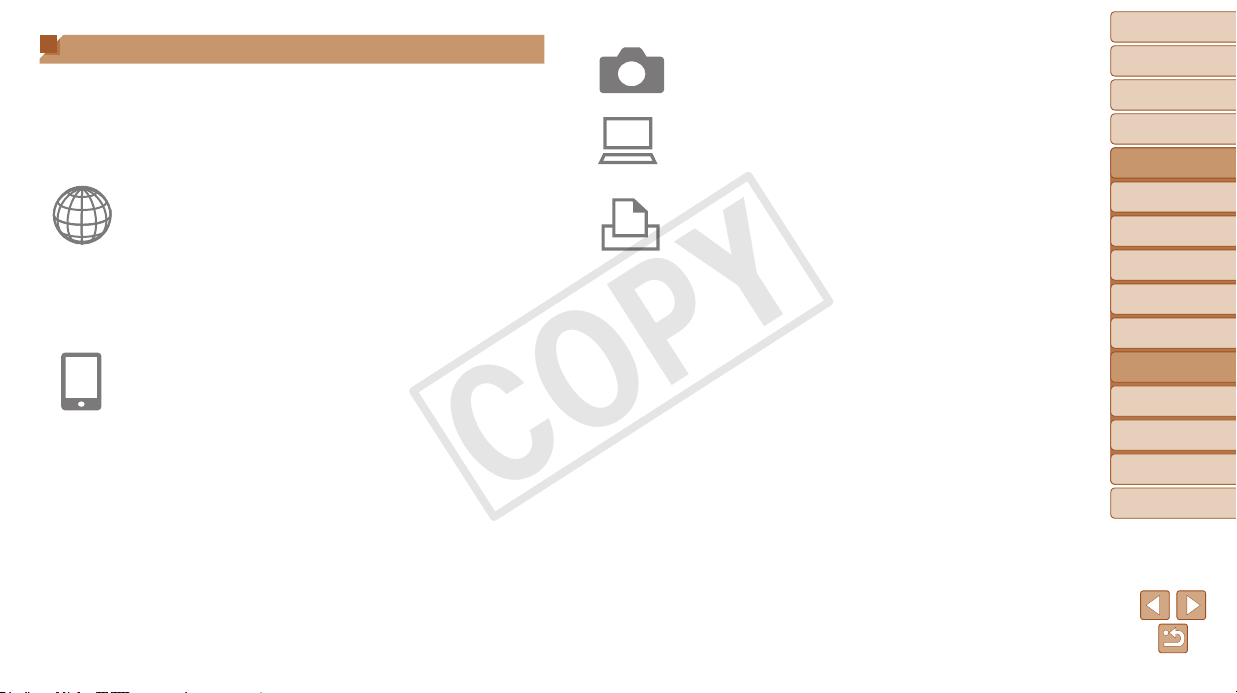
107
1
2
3
4
5
7
8
9
Preliminary Notes and
Legal Information
Contents: Basic
Operations
Camera Basics
Auto Mode/Hybrid
Auto Mode
Other Shooting
Modes
Playback Mode
Setting Menu
Accessories
Appendix
Index
Basic Guide
P Mode
Cover
Advanced Guide
6
Wi-Fi Functions
What You Can Do With Wi-Fi
This camera is an approved Wi-Fi
®
* product. You can wirelessly connect to
and send images to the following devices.
Note that, in this chapter, wireless LAN functions other than Wi-Fi may be
referred to as Wi-Fi.
* Wi-Fi is a brand name that indicates interoperability certication of Wi-Fi
devices.
Connecting to Web Services
CANON iMAGE GATEWAY is an online photo service available
to those who have purchased this product. If you register for
free as a member, you can use CANON iMAGE GATEWAY
to access various Web services, such as social networking
services set on a computer. Images on the camera can also
be sent automatically to a computer via CANON iMAGE
GATEWAY.
Connecting to a Smartphone
Send images to smartphones and tablet computers that
have Wi-Fi functions. You can also geotag your shots from a
connected smartphone or tablet. Installation of a dedicated
application on the smartphone or tablet is required. See the
Canon website for details.
For convenience in this manual, smartphones and tablets are
collectively referred to as smartphones.
Connecting to Another Camera
Use the Wi-Fi function to send images between Canon-brand,
compact digital cameras.
Connecting to a Computer
Use the included software to wirelessly send images from the
camera to a computer. Refer to the Software Guide for details.
Connecting to a Printer
Send images wirelessly to a PictBridge-compatible printer
(supporting DPS over IP) to print them.
COPY
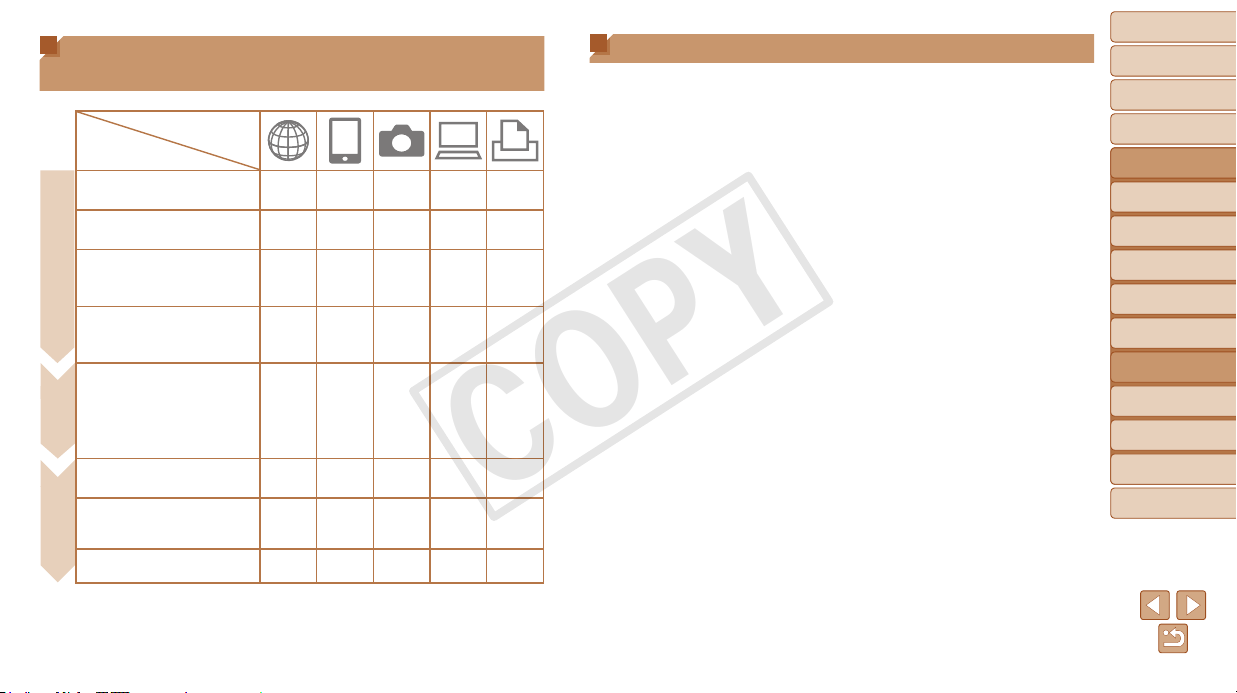
108
1
2
3
4
5
7
8
9
Preliminary Notes and
Legal Information
Contents: Basic
Operations
Camera Basics
Auto Mode/Hybrid
Auto Mode
Other Shooting
Modes
Playback Mode
Setting Menu
Accessories
Appendix
Index
Basic Guide
P Mode
Cover
Advanced Guide
6
Wi-Fi Functions
Using Wi-Fi to Send Images From the
Camera
Device
Operation
Preparations
Registering a camera
nickname (=
111)
O O O O O
Installing the included software
(=
19)*
1
O
– –
O
–
Adjusting settings for using Web
services from CANON iMAGE
GATEWAY (=
112)
O
– – – –
Installing the dedicated
application on the smartphone
(=
115)
–
O
– – –
Connection
Establishing a connection with
the camera
O
(=
112)
O
(=
115)
O
(=
117)
O
(=
118)
O
(=
124)
Send/Print/
Import
Sending images (=
126)
O*
2
O O
– –
Transferring images to a
computer (
=
123)
– – –
O
–
Printing images (
=
124)*
3
– – – –
O
*1 Instructions in this guide apply when the software has been installed correctly from
the included CD-ROM (=
19).
*2 Images are sent automatically when transferred via a server (=
128).
*3 For detailed printing instructions, see “Printing Images” (=
146).
Wi-Fi (Wireless LAN) Precautions
• The model number is PC1897 (including WLAN module model WM219).
• Countries and Regions Permitting WLAN Use
- Use of WLAN is restricted in some countries and regions, and illegal
use may be punishable under national or local regulations. To avoid
violating WLAN regulations, visit the Canon website to check where use
is allowed.
Note that Canon cannot be held liable for any problems arising from
WLAN use in other countries and regions.
• Doing any of the following may incur legal penalties:
- Altering or modifying the product
- Removing the certication labels from the product
• According to foreign exchange and foreign trade law regulations, export
permission (or service transaction permission) from the Japanese
government is necessary to export strategic resources or services
(including this product) outside Japan.
• Because this product includes American encryption software, it falls
under U.S. Export Administration Regulations, and cannot be exported to
or brought into a country under U.S. trade embargo.
• Be sure to make notes of the wireless LAN settings you use.
The wireless LAN settings saved to this product may be erased due to
incorrect operation of the product, the effects of radio waves or static
electricity, accident or malfunction. Be sure to make notes of wireless
LAN settings as a precaution. Please note that Canon accepts no
responsibility for degradation of content, direct or indirect damages or
loss of revenue arising from use of the product.
• When transferring this product to another person, disposing of it, or
sending it for repair, be sure to note the wireless LAN settings and reset
the product to its default settings (erase settings) if necessary.
COPY
109
1
2
3
4
5
7
8
9
Preliminary Notes and
Legal Information
Contents: Basic
Operations
Camera Basics
Auto Mode/Hybrid
Auto Mode
Other Shooting
Modes
Playback Mode
Setting Menu
Accessories
Appendix
Index
Basic Guide
P Mode
Cover
Advanced Guide
6
Wi-Fi Functions
• Canon will not make compensation for loss or theft of the product.
Canon accepts no responsibility for damages incurred due to
unauthorized access to registered data (image transfer destinations, etc.)
if the product is lost or stolen.
• Be sure to use the product as directed in this guide.
Be sure to use the wireless LAN function of this product within the
guidelines noted in this guide. Canon accepts no responsibility for
damages or loss if the function and product are used in ways other than
as described in this guide.
• Do not use the wireless LAN function of this product near medical
equipment or other electronic equipment.
Use of the wireless LAN function near medical equipment or other
electronic equipment may affect operation of those devices.
Radio Wave Interference Precautions
• This product may receive interference from other devices that emit radio
waves. To avoid interference, be sure to use this product as far away as
possible from such devices, or avoid using the devices at the same time
as this product.
Security Precautions
Because Wi-Fi uses radio waves to transmit signals, security precautions
more stringent than when using a LAN cable are required.
Keep the following points in mind when using Wi-Fi.
• Only use networks you are authorized to use.
This product searches for Wi-Fi networks in the vicinity and displays the
results on the screen. Networks you are not authorized to use (unknown
networks) may also be displayed. However, attempting to connect to or
using such networks could be regarded as unauthorized access. Be sure
to use only networks you are authorized to use, and do not attempt to
connect to other unknown networks.
If security settings have not been properly set, the following problems may
occur.
• Transmission monitoring
Third parties with malicious intent may monitor Wi-Fi transmissions and
attempt to acquire the data you are sending.
• Unauthorized network access
Third parties with malicious intent may gain unauthorized access to
the network you are using to steal, modify, or destroy information.
Additionally, you could fall victim to other types of unauthorized access
such as impersonation (where someone assumes an identity to gain
access to unauthorized information) or springboard attacks (where
someone gains unauthorized access to your network as a springboard to
cover their tracks when inltrating other systems).
To prevent these types of problems from occurring, be sure to thoroughly
secure your Wi-Fi network.
Only use this camera’s Wi-Fi function with a proper understanding of
Wi-Fi security, and balance risk and convenience when adjusting security
settings.
COPY

110
1
2
3
4
5
7
8
9
Preliminary Notes and
Legal Information
Contents: Basic
Operations
Camera Basics
Auto Mode/Hybrid
Auto Mode
Other Shooting
Modes
Playback Mode
Setting Menu
Accessories
Appendix
Index
Basic Guide
P Mode
Cover
Advanced Guide
6
Wi-Fi Functions
Glossary
Wi-Fi related terms are explained here. Also refer to the explanations of
terms given in the respective sections of this guide.
• Access point
A device that relays radio wave signals to create a Wi-Fi network. This
term also refers to a network that you can use to connect to the Internet
via Wi-Fi.
• Firewall
This is a system that protects networks from computer viruses, external
unauthorized access, and security threats. This is set on the Wi-Fi router
or computer.
• SSID/ESSID
Precongured numbers and letters used to identify a specic access
point. Also called the “access point name” or “network name”.
• Encryption key
This is a key used to encrypt data for transmission to and from an access
point.
• IP address
This is an address used to identify a device within a network.
• MAC address
This is a unique address pre-assigned to a network device. It is also
referred to as a “physical address”.
The camera can print to PictBridge-compatible printers
via Wi-Fi. PictBridge technical standards make it easy
to connect digital cameras, printers, and other devices
directly. Additionally, a new standard called DPS over IP
enables PictBridge connections in network environments,
and the camera is also compatible with this standard.
COPY

111
1
2
3
4
5
7
8
9
Preliminary Notes and
Legal Information
Contents: Basic
Operations
Camera Basics
Auto Mode/Hybrid
Auto Mode
Other Shooting
Modes
Playback Mode
Setting Menu
Accessories
Appendix
Index
Basic Guide
P Mode
Cover
Advanced Guide
6
Wi-Fi Functions
Registering a Camera Nickname (First
time only)
To start with, register a camera nickname.
This nickname will be displayed on the screen of target devices when
connecting to other devices via Wi-Fi.
1 Access the Wi-Fi menu.
Press the <1> button to turn the camera
on.
Press the <o> button.
2 Access the keyboard.
Press the <m> button.
3 Enter a nickname.
Press the <o><p><q><r> buttons to
choose a character, and then press the
<m> button to enter it.
Up to 16 characters can be used.
Choose [ ] or [ ] and press the <m>
button to move the cursor.
Choose [ ] and press the <m> button.
The previous character will be deleted.
4 Save the settings.
Press the <n> button, press the
<o><p> buttons to choose [OK], and
then press the <m> button.
• When connecting wirelessly to any device other than a computer, a memory
card must be inserted in the camera. Additionally, the memory card must
contain images in order for you to access Web services or connect to a
smartphone or printer wirelessly.
• To change the camera’s nickname, choose [Wi-Fi Settings] on the [3] tab, and
then choose [Change Device Nickname].
• If the Wi-Fi menu is not displayed but only the information changes when
you press the <o> button, rst press the <p> button to switch from detailed
information display (=
85).
COPY

112
1
2
3
4
5
7
8
9
Preliminary Notes and
Legal Information
Contents: Basic
Operations
Camera Basics
Auto Mode/Hybrid
Auto Mode
Other Shooting
Modes
Playback Mode
Setting Menu
Accessories
Appendix
Index
Basic Guide
P Mode
Cover
Advanced Guide
6
Wi-Fi Functions
Connecting to Web Services
Set up the camera to use a variety of Web services as follows.
Adjusting Settings for Using Web Services
From CANON iMAGE GATEWAY
Adjust account settings for the Web services you want to use.
• A computer is required for Web service settings, starting with CANON
iMAGE GATEWAY.
• Because CameraWindow is used to adjust settings, be sure to install
it from the included CD-ROM beforehand (=
20). See “System
Requirements” (=
20) for server transfer system requirements.
• For information on countries and regions where CANON iMAGE
GATEWAY is available, visit the Canon website (http://canon.com/cig).
1 Register as a CANON iMAGE
GATEWAY member.
From a computer or other device
connected to the Internet, access http://
canon.com/cig and visit the CANON
iMAGE GATEWAY site for your region.
Follow the instructions displayed to
complete member registration (free of
charge).
You must have an account with Web
services other than CANON iMAGE
GATEWAY if you desire to use them. For
further details, check the websites for
each Web service you want to register.
2 Connect the camera to a
computer with the interface
cable (=
21).
On a computer running Windows, there
is no need to connect the interface cable
if you complete settings in advance
(=
120). In this case, you can connect
via Wi-Fi.
3 Display CameraWindow
(=
22).
4 Access the CANON iMAGE
GATEWAY login screen.
Click [Camera Settings], and then click
[Set Up Web Services].
5 Login to CANON iMAGE
GATEWAY.
Enter your CANON iMAGE GATEWAY
login name and password, and then click
[Login].
COPY
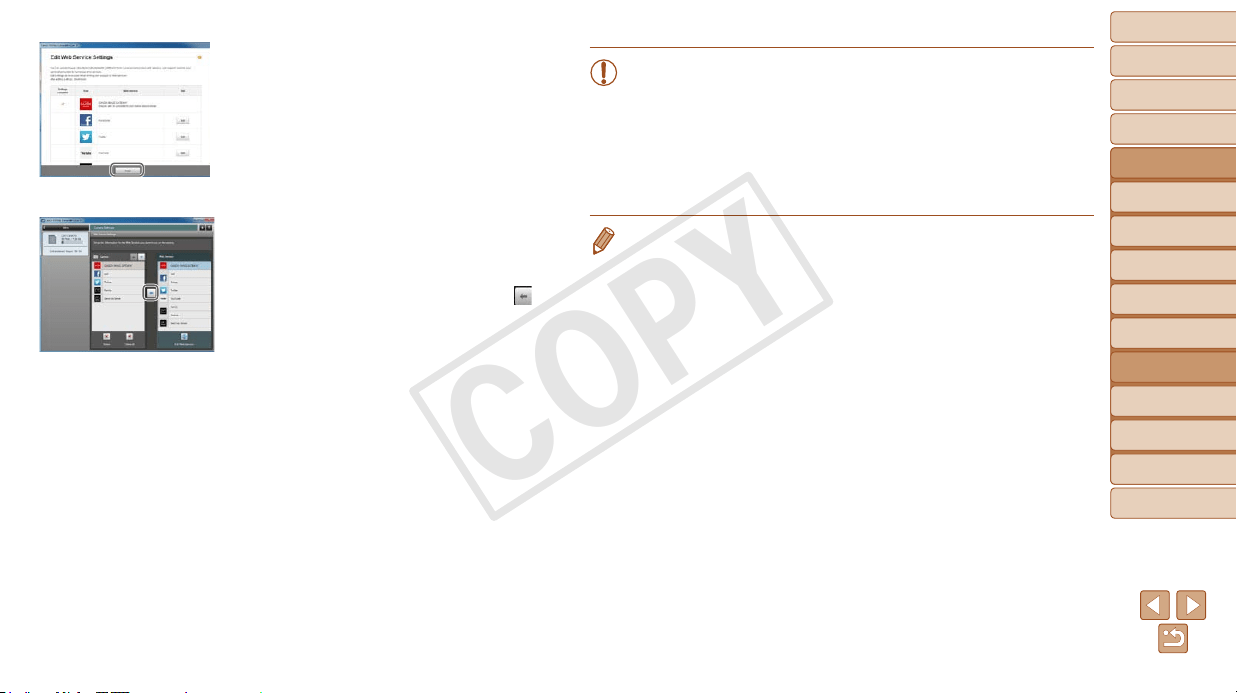
113
1
2
3
4
5
7
8
9
Preliminary Notes and
Legal Information
Contents: Basic
Operations
Camera Basics
Auto Mode/Hybrid
Auto Mode
Other Shooting
Modes
Playback Mode
Setting Menu
Accessories
Appendix
Index
Basic Guide
P Mode
Cover
Advanced Guide
6
Wi-Fi Functions
6 Set a Web service you want to
use.
Follow the on-screen instructions to
complete settings for Web services you
want to use.
Once the Web service settings are
complete, click [Finish] at the bottom of
the window to close it.
7 Apply Web service settings to
the camera.
Choose the name of the Web service you
want to set on the camera, and click [
]
in the middle of the lists.
The name of the Web service that will be
saved to the camera will be displayed in
the [Camera] list.
Click [o] or [p] to change the order of
the Web services that will be displayed in
the camera’s Wi-Fi menu.
After you nish adjusting settings in the
[Camera] list to your liking, close the
window.
The settings of Web services and for
transferring images via the server are
applied to the camera.
• An Internet connection is required to access CANON iMAGE
GATEWAY (an Internet browser must be installed on the computer,
you must have an account with an Internet service provider, and an
Internet connection must be established).
• When connecting to CANON iMAGE GATEWAY, check the CANON
iMAGE GATEWAY website for browser (Microsoft Internet Explorer,
etc.) settings, conditions, and version information.
• Separate ISP connection and access point fees may be applicable.
• After logging in to CANON iMAGE GATEWAY the second time in step 5, the
screen in step 7 will be displayed. To change settings for Web services you
use, click [Edit Web Services].
• To add or change Web services, repeat the above procedures starting from
step 2.
COPY
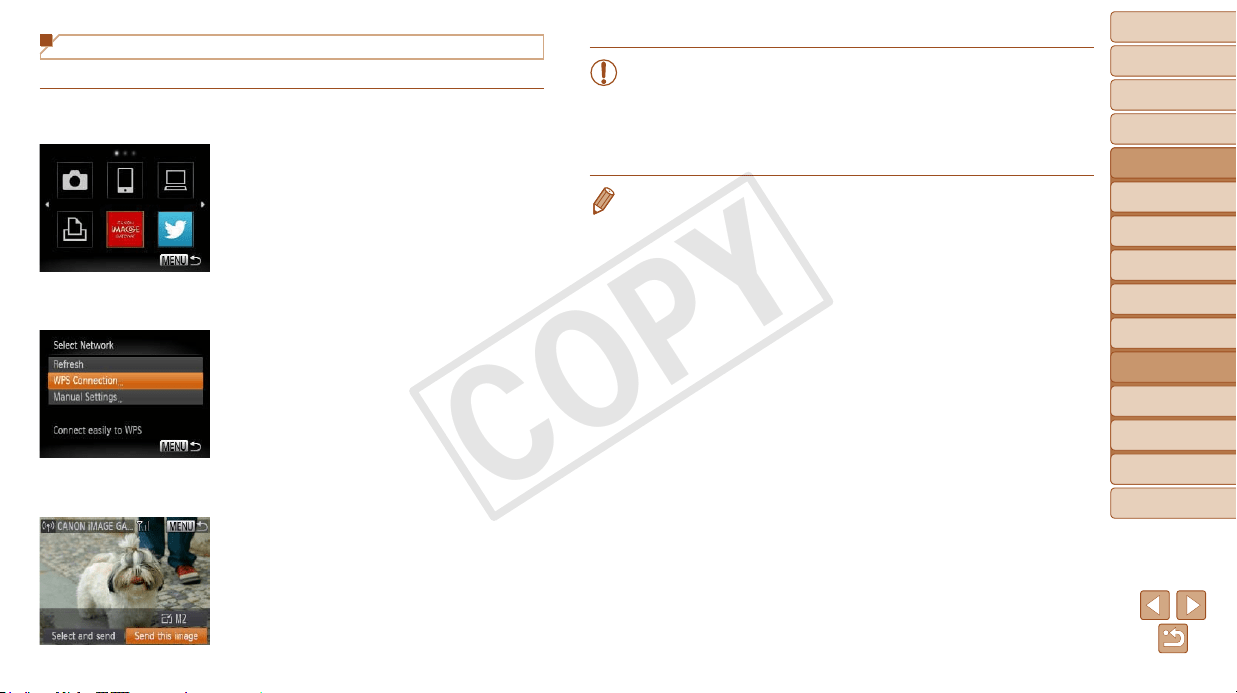
114
1
2
3
4
5
7
8
9
Preliminary Notes and
Legal Information
Contents: Basic
Operations
Camera Basics
Auto Mode/Hybrid
Auto Mode
Other Shooting
Modes
Playback Mode
Setting Menu
Accessories
Appendix
Index
Basic Guide
P Mode
Cover
Advanced Guide
6
Wi-Fi Functions
Establishing Web Service Connections
Connect to Web services registered to the camera.
1 Access the Wi-Fi menu.
Press the <o> button.
2 Choose a Web service.
Press the <o><p><q><r> buttons to
choose the icon of the Web service that
you want to connect to, and then press
the <m> button.
If the Web service has multiple recipients,
select the desired recipient on the [Select
Recipient] screen, and press the <m>
button.
3 Connect to an access point.
With a WPS-compatible access point,
connect to the access point by following
steps 4 – 6 in “Adding a Computer”
(=
121).
With an access point that is not WPS-
compatible, connect to the access point
by following steps 2 – 3 in “Connecting to
Access Points in the List” (=
122).
When you have connected to the Web
service, the image transfer screen will be
displayed. Proceed to “Sending Images”
(=
126).
However, when [Send via Server] is
selected, images will be sent as soon as
a connection is established (=
128).
• When you are in the vicinity of an access point that you have
previously connected to, the camera will automatically connect
to it in step 2. To change access points, select [Switch Network]
from the screen that will be displayed when the connection is
being established, and follow steps 4 – 5 in “Adding a Computer”
(=
121).
• After you have accessed the Wi-Fi menu once, you can access it again by
pressing the <o> button. The recent target device is listed rst, so you can
easily connect again by pressing the <o><p> buttons to choose it. To add
a new device, display the device selection screen by pressing the <q><r>
buttons, and then congure the setting.
If you prefer not to display recent target devices, press the <n> button,
and on the [3] tab, choose [Wi-Fi Settings] > [Target History] > [Off].
COPY
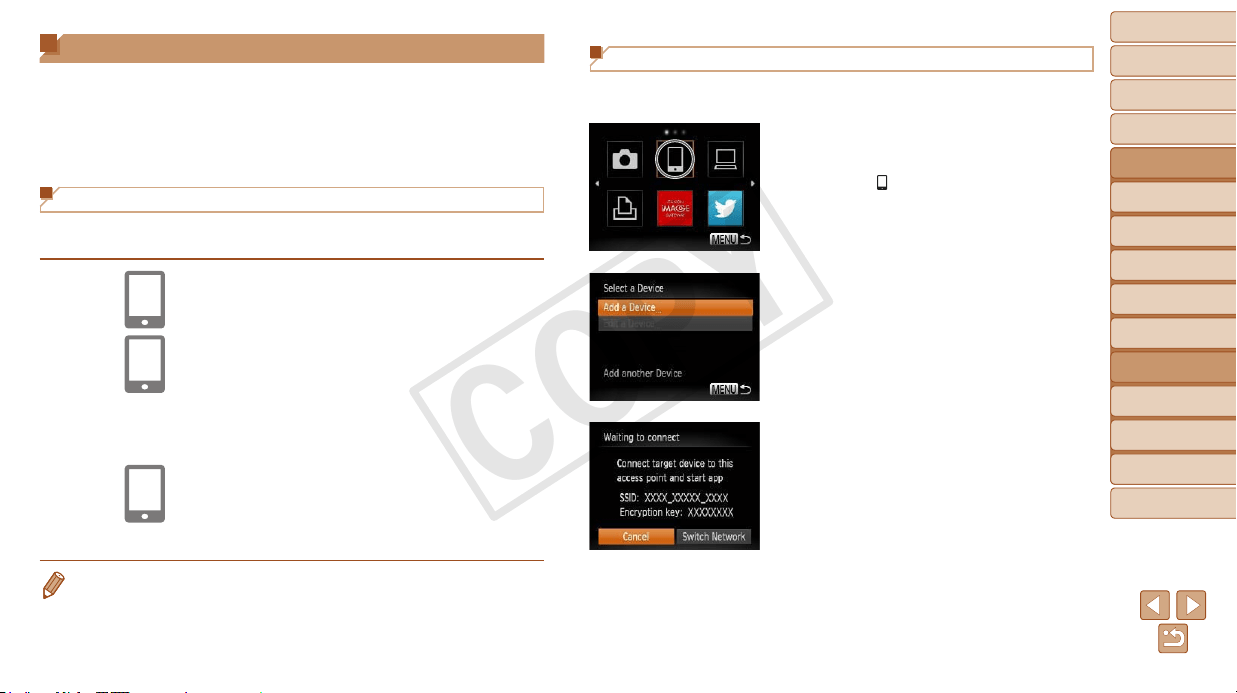
115
1
2
3
4
5
7
8
9
Preliminary Notes and
Legal Information
Contents: Basic
Operations
Camera Basics
Auto Mode/Hybrid
Auto Mode
Other Shooting
Modes
Playback Mode
Setting Menu
Accessories
Appendix
Index
Basic Guide
P Mode
Cover
Advanced Guide
6
Wi-Fi Functions
Connecting to a Smartphone
When establishing a Wi-Fi connection with a smartphone, you can either
use the camera as an access point (Camera Access Point mode) or use
another access point.
Follow these instructions when using the camera as an access point. When
using another access point, see “Connecting to Access Points in the List”
(=
122).
Installing CameraWindow on a Smartphone
Before connecting your camera to a smartphone, rst install the free
dedicated application, CameraWindow, on your smartphone.
1 Connect the smartphone to a
network.
2 Install CameraWindow.
For an iPhone, iPad, or iPod touch,
download and install CameraWindow
from the Mac App Store.
For an Android device, download and
install CameraWindow from Google Play.
3 Register the smartphone name.
On the smartphone, start CameraWindow
and enter a name for the smartphone that
will be displayed on the camera.
• For details on this application (supported smartphones and included functions),
refer to the Canon website.
Establishing the Smartphone Connection
1 Access the Wi-Fi menu.
Press the <o> button.
2 Choose a smartphone.
Press the <o><p><q><r> buttons to
choose [
], and then press the <m>
button.
3 Choose [Add a Device].
Press the <o><p> buttons to choose
[Add a Device], and then press the <m>
button.
The camera’s SSID and encryption key
are displayed on the screen.
COPY
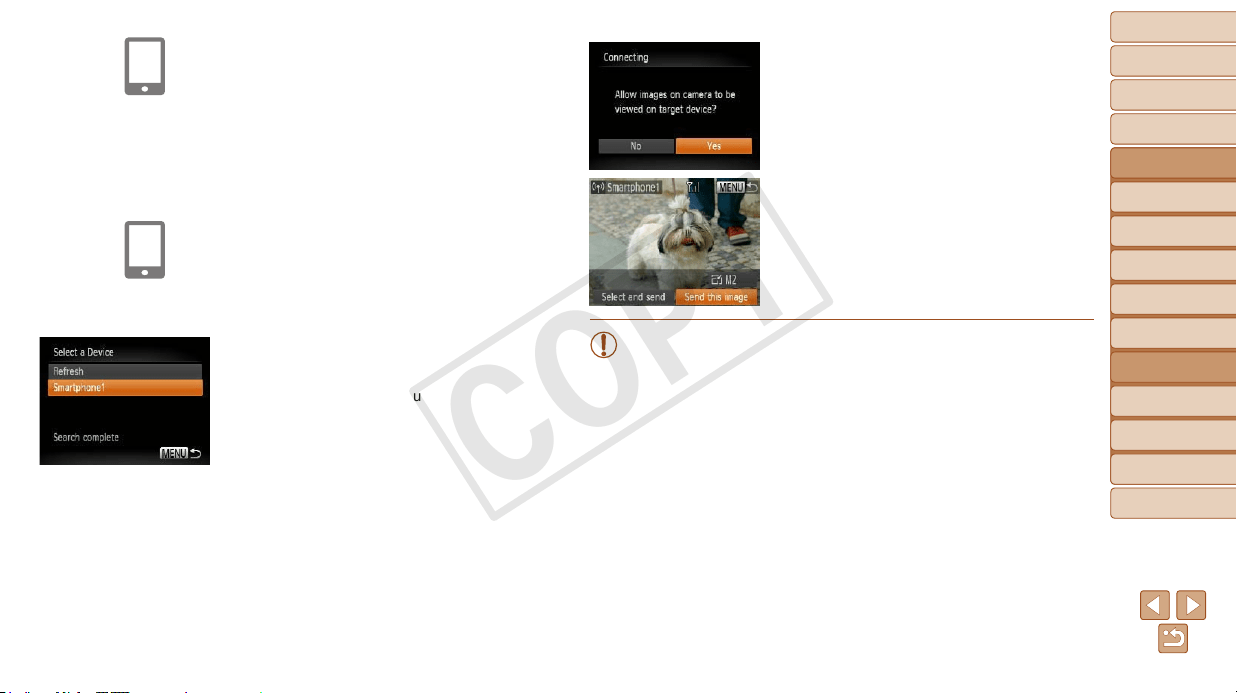
116
1
2
3
4
5
7
8
9
Preliminary Notes and
Legal Information
Contents: Basic
Operations
Camera Basics
Auto Mode/Hybrid
Auto Mode
Other Shooting
Modes
Playback Mode
Setting Menu
Accessories
Appendix
Index
Basic Guide
P Mode
Cover
Advanced Guide
6
Wi-Fi Functions
4 Use the smartphone to connect
to the network displayed on the
camera screen.
Choose the displayed SSID (network
name) from the smartphone’s Wi-Fi
setting menu.
Enter the encryption key displayed on the
camera screen into the password eld on
the smartphone.
5 Start CameraWindow on the
smartphone.
Once the smartphone is recognized on
the camera, the device connection screen
will be displayed on the camera.
6 Choose a smartphone to
connect to.
Press the <o><p> buttons to choose
the smartphone for the connection, and
then press the <m> button (=
115).
7 Adjust the privacy settings.
Press the <q><r> buttons to choose
[Yes], and then press the <m> button.
You can now use the smartphone to
receive images sent from the camera,
or to geotag images on the camera
(=
129).
When the smartphone has been added
successfully, the image transfer screen
will be displayed. Proceed to “Sending
Images” (=
126).
• When you are in the vicinity of an access point that you have
previously connected to, the camera will automatically connect
to it in step 3. To change access points, select [Switch Network]
from the screen that will be displayed when the connection is
being established, and follow steps 4 – 5 in “Adding a Computer”
(=
121).
• All camera images can be viewed from the connected smartphone
when you choose [Yes] in step 7. To keep camera images private,
so that they cannot be viewed from the smartphone, choose [No] in
step 7.
COPY
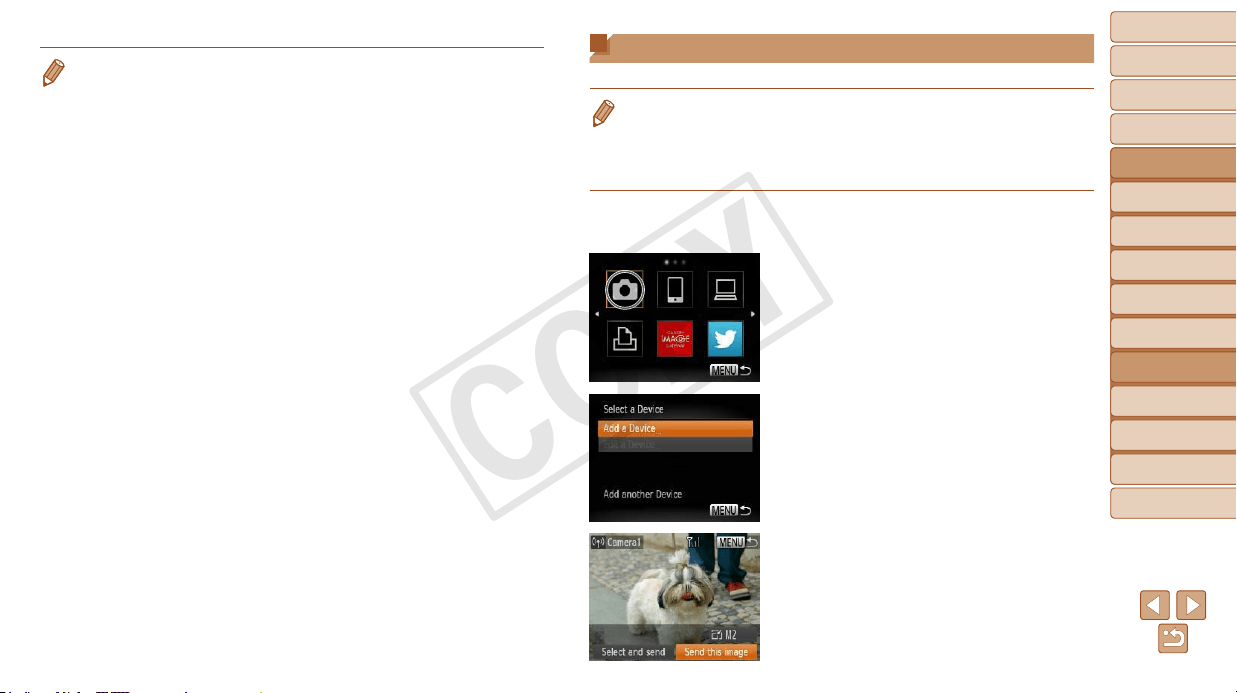
117
1
2
3
4
5
7
8
9
Preliminary Notes and
Legal Information
Contents: Basic
Operations
Camera Basics
Auto Mode/Hybrid
Auto Mode
Other Shooting
Modes
Playback Mode
Setting Menu
Accessories
Appendix
Index
Basic Guide
P Mode
Cover
Advanced Guide
6
Wi-Fi Functions
• You can connect to smartphones that you have already connected to by
choosing them on the [Select a Device] screen in step 3.
• After you have accessed the Wi-Fi menu once, you can access it again by
pressing the <o> button. The recent target device is listed rst, so you can
easily connect again by pressing the <o><p> buttons to choose it. To add
a new device, display the device selection screen by pressing the <q><r>
buttons, and then congure the setting.
If you prefer not to display recent target devices, press the <n> button,
and on the [3] tab, choose [Wi-Fi Settings] > [Target History] > [Off].
• The image quality level for movies that can be sent may differ depending
on the smartphone. Refer to the instruction manual provided with your
smartphone for details.
• To add multiple smartphones, repeat the above procedures starting from step
1.
• To change privacy settings for smartphones added to the list, choose the
smartphone whose settings you want to change from [Edit a Device] in step 3,
and then choose [View Settings].
Connecting to Another Camera
Connect two cameras via Wi-Fi and send images between them as follows.
• Only Canon-brand cameras equipped with a Wi-Fi function can be connected
to wirelessly. Even Canon-brand cameras that support Eye-Fi cards cannot
be connected to if they do not have a Wi-Fi function. You cannot connect to
PowerShot SD430 DIGITAL ELPH WIRELESS/DIGITAL IXUS WIRELESS
cameras with this camera.
1 Access the Wi-Fi menu.
Press the <o> button.
2 Choose a camera.
Press the <o><p><q><r> buttons to
choose [4], and then press the <m>
button.
3 Choose [Add a Device].
Press the <o><p> buttons to choose
[Add a Device], and then press the <m>
button.
Follow steps 1 – 3 on the target camera.
Camera connection information will be
added when [Start connection on target
camera] is displayed on both camera
screens.
When the target camera has been added
successfully, the image transfer screen
will be displayed. Proceed to “Sending
Images” (=
126).
COPY
118
1
2
3
4
5
7
8
9
Preliminary Notes and
Legal Information
Contents: Basic
Operations
Camera Basics
Auto Mode/Hybrid
Auto Mode
Other Shooting
Modes
Playback Mode
Setting Menu
Accessories
Appendix
Index
Basic Guide
P Mode
Cover
Advanced Guide
6
Wi-Fi Functions
• After you have accessed the Wi-Fi menu once, you can access it again by
pressing the <o> button. The recent target device is listed rst, so you can
easily connect again by pressing the <o><p> buttons to choose it. To add
a new device, display the device selection screen by pressing the <q><r>
buttons, and then congure the setting.
If you prefer not to display recent target devices, press the <n> button,
and on the [3] tab, choose [Wi-Fi Settings] > [Target History] > [Off].
• To add multiple cameras, repeat the above procedures starting from step 1.
• Once a camera is added, the camera nickname will be displayed on the screen
in step 3. To connect to a camera again, simply choose the camera nickname
from the list.
Connecting to a Computer
Congure computer settings for the connection, add the computer as a
connection destination, and transfer images to the computer wirelessly
using the included software CameraWindow as follows.
• When connected to a computer, the camera is used to establish the
connection and then the computer (included software CameraWindow) is used
to transfer images.
Preparing to Register a Computer
Prepare to register a computer.
Checking Your Computer Environment
For computer environments that allow Wi-Fi connection with a camera, refer
to “System Requirements” (=
20).
Additionally, the included software CameraWindow must be installed
(=
20).
• Windows 7 Starter and Home Basic editions are not supported.
• Windows 7 N (European version) and KN (South Korean version)
require a separate download and installation of Windows Media
Feature Pack.
For further details, see the following website.
http://go.microsoft.com/fwlink/?LinkId=159730
COPY
119
1
2
3
4
5
7
8
9
Preliminary Notes and
Legal Information
Contents: Basic
Operations
Camera Basics
Auto Mode/Hybrid
Auto Mode
Other Shooting
Modes
Playback Mode
Setting Menu
Accessories
Appendix
Index
Basic Guide
P Mode
Cover
Advanced Guide
6
Wi-Fi Functions
Checking Your Wi-Fi Environment
To use Wi-Fi, a Wi-Fi base unit (Wi-Fi router, etc.) that acts as your access
point must be connected to a computer. Be sure to use a Wi-Fi base unit
that conforms to the Wi-Fi standard listed in “Specications” (=
171).
If you are already using Wi-Fi, conrm the following items and mark each
one on the Check sheet. For instructions on checking network settings,
refer to the access point user guide.
• If system administrator status is needed to adjust network settings,
contact the system administrator for details.
• These settings are very important for network security. Exercise
adequate caution when changing these settings.
Check sheet
Network name (SSID/ESSID)
The SSID or ESSID for the access point you use.
Networkcerticate/dataencryption(encryptionmethod/
encryption mode)
The method for encrypting data during transmission via
Wi-Fi.
O
None
O
WEP (open system
authentication)
O
WPA-PSK (TKIP)
O
WPA-PSK (AES)
O
WPA2-PSK (TKIP)
O
WPA2-PSK (AES)
Encryption key (network key)
The data encryption key used for transmission via Wi-Fi.
Key index (sent key)
The key specied when using WEP for Network certicate/
data encryption.
O 1
• A router is a device that creates a network (LAN) structure for connecting
multiple computers. A router that contains an internal Wi-Fi function is called a
“Wi-Fi router”.
• This guide refers to all Wi-Fi routers and base stations as “access points”.
• If you use MAC address ltering on your Wi-Fi network, be sure to add the
camera’s MAC address to your access point. You can check your camera’s
MAC address by choosing the [3] tab, [Wi-Fi Settings], and then [Check MAC
Address].
COPY
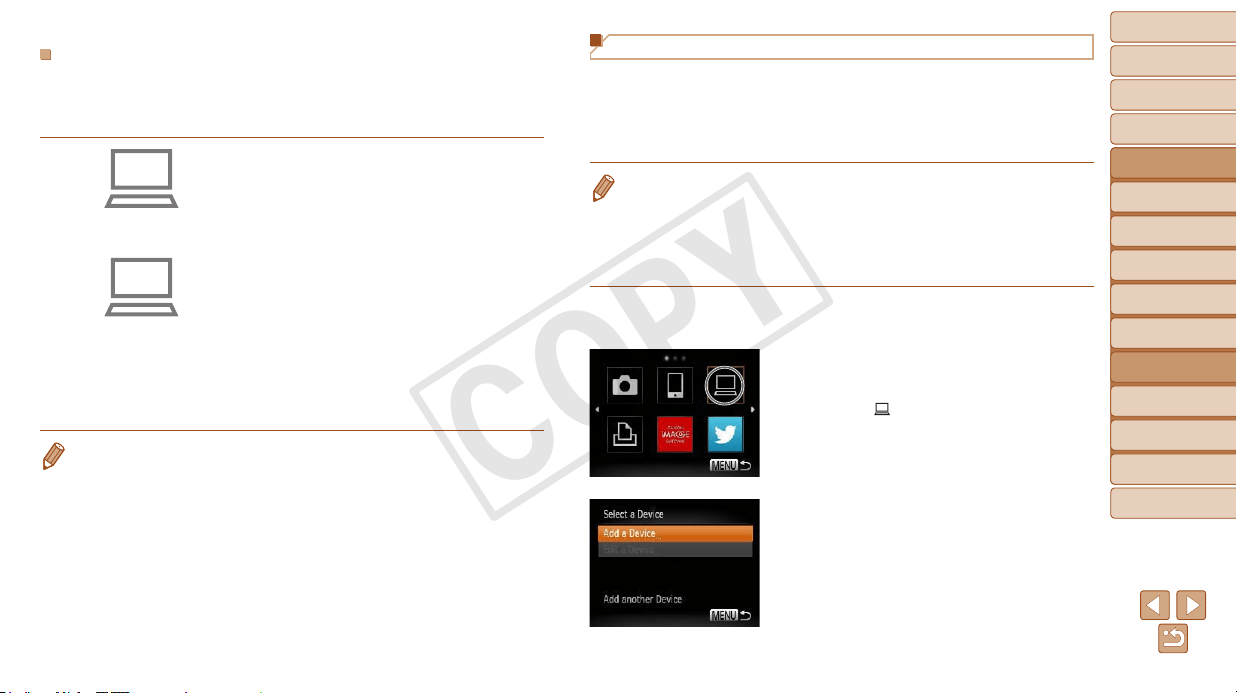
120
1
2
3
4
5
7
8
9
Preliminary Notes and
Legal Information
Contents: Basic
Operations
Camera Basics
Auto Mode/Hybrid
Auto Mode
Other Shooting
Modes
Playback Mode
Setting Menu
Accessories
Appendix
Index
Basic Guide
P Mode
Cover
Advanced Guide
6
Wi-Fi Functions
Computer Settings for Connecting via Wi-Fi (Windows
only)
On a computer running Windows, you must congure the following settings
before you can connect the camera to the computer wirelessly.
1 Conrmthecomputeris
connected to Wi-Fi.
For instructions on checking your network
connection, refer to the computer user
manual.
2 Congurethesetting.
Click in the following order: [Start] menu
► [All Programs] ► [Canon Utilities] ►
[CameraWindow] ► [Wi-Fi connection
setup].
In the application that opens, follow the
on-screen instructions and congure the
setting.
• The following Windows settings are congured when you run the utility in step
2.
- Turn on media streaming.
This will enable the camera to nd the computer to access via Wi-Fi.
- Turn on network discovery.
This will enable the computer to nd the camera.
- Turn on ICMP (Internet Control Message Protocol).
This allows you to check the network connection status.
- Enable Universal Plug & Play (UPnP).
This will enable network devices to detect each other automatically.
• Some security software may prevent you from completing the settings as
described here. Check the settings of your security software.
Adding a Computer
Add a computer to your list of devices to connect to via Wi-Fi.
Follow these instructions when using a Wi-Fi Protected Setup (WPS)
compatible access point to establish a push-button connection.
If your access point is not WPS-compatible, establish a connection as
described in “Connecting to Access Points in the List” (=
122).
• WPS makes it easy to complete settings when connecting devices over Wi-Fi.
You can use either Push Button Conguration Method or PIN Method for
settings on a WPS supported device.
• Refer to the user guide provided with your access point to check if it supports
WPS.
• Be sure to also read the user guide included with your access point.
1 Access the Wi-Fi menu.
Press the <o> button.
2 Choose a computer.
Press the <o><p><q><r> buttons to
choose [
], and then press the <m>
button.
3 Choose [Add a Device].
Press the <o><p> buttons to choose
[Add a Device], and then press the <m>
button.
A list of detected access points will be
displayed in the [Select Network] screen.
COPY
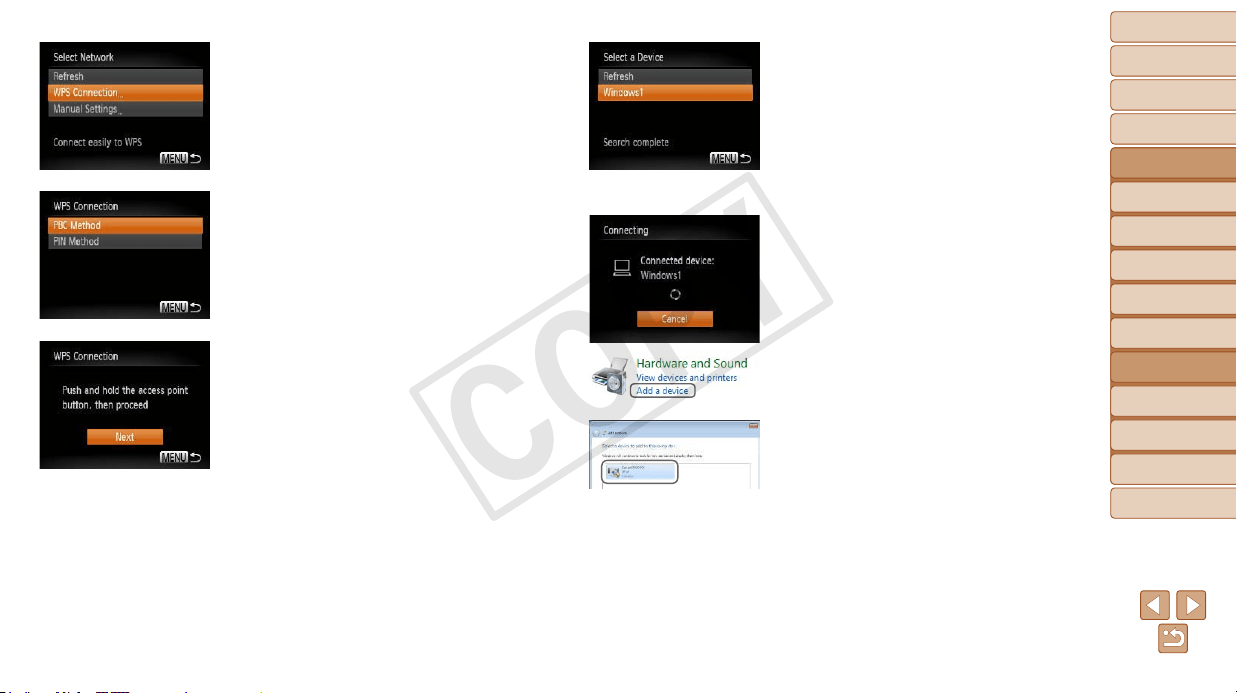
121
1
2
3
4
5
7
8
9
Preliminary Notes and
Legal Information
Contents: Basic
Operations
Camera Basics
Auto Mode/Hybrid
Auto Mode
Other Shooting
Modes
Playback Mode
Setting Menu
Accessories
Appendix
Index
Basic Guide
P Mode
Cover
Advanced Guide
6
Wi-Fi Functions
4 Choose [WPS Connection].
Press the <o><p> buttons to choose
[WPS Connection], and then press the
<m> button.
5 Choose [PBC Method].
Press the <o><p> buttons to choose
[PBC Method], and then press the <m>
button.
6 Establish the connection.
On the access point, hold down the WPS
connection button for a few seconds.
On the camera, press the <m> button.
The camera will connect to the access
point.
A list of computers connected to the
access point will appear in the [Select a
Device] screen.
7 Choose a computer to connect
to.
Press the <o><p> buttons to choose
the computer name, and then press the
<m> button.
When using a Macintosh computer,
see “Using CameraWindow to Transfer
Images to a Computer” (=
123).
8 Installadriver(rstWindows
connection only).
When the screen at left is displayed, click
the Start menu on the computer, click
[Control Panel], and then click [Add a
device].
Double click the connected camera icon.
Driver installation will begin.
After driver installation is complete, and
the camera and computer connection
is enabled, the AutoPlay screen will be
displayed. Nothing will be displayed on
the camera screen.
Proceed to “Using CameraWindow
to Transfer Images to a Computer”
(=
123).
COPY

122
1
2
3
4
5
7
8
9
Preliminary Notes and
Legal Information
Contents: Basic
Operations
Camera Basics
Auto Mode/Hybrid
Auto Mode
Other Shooting
Modes
Playback Mode
Setting Menu
Accessories
Appendix
Index
Basic Guide
P Mode
Cover
Advanced Guide
6
Wi-Fi Functions
• When you are in the vicinity of an access point that you have
previously connected to, the camera will automatically connect
to it in step 3. To change access points, select [Switch Network]
from the screen that will be displayed when the connection is
being established, and follow steps 4 – 5 in “Adding a Computer”
(=
121).
• You can connect to computers that you have already connected to by choosing
them on the [Select a Device] screen in step 3.
• If you chose [PIN Method] in step 5, a PIN code will be displayed on the
screen. Be sure to set this code in the access point. Choose a device in the
[Select a Device] screen. For further details, refer to the user guide included
with your access point.
• To add multiple computers, repeat the above procedures starting from step 1.
• To disconnect from the camera, turn off the camera.
• After you have accessed the Wi-Fi menu once, you can access it again by
pressing the <o> button. The recent target device is listed rst, so you can
easily connect again by pressing the <o><p> buttons to choose it. To add
a new device, display the device selection screen by pressing the <q><r>
buttons, and then congure the setting.
If you prefer not to display recent target devices, press the <n> button,
and on the [3] tab, choose [Wi-Fi Settings] > [Target History] > [Off].
Connecting to Access Points in the List
1 View the listed access points.
View the listed networks (access points)
as described in steps 1 – 3 of “Adding a
Computer” (=
120).
2 Choose an access point.
Press the <o><p> buttons to choose a
network (access point), and then press
the <m> button.
3 Enter the access point’s
encryption key.
Press the <m> button to access the
keyboard, and then enter the encryption
key (=
111).
Press the <o><p> buttons to choose
[Next], and then press the <m> button.
4 Choose [Auto].
Press the <o><p> buttons to choose
[Auto], and then press the <m> button.
A list of other devices connected to the
access point will appear in the [Select a
Device] screen.
COPY
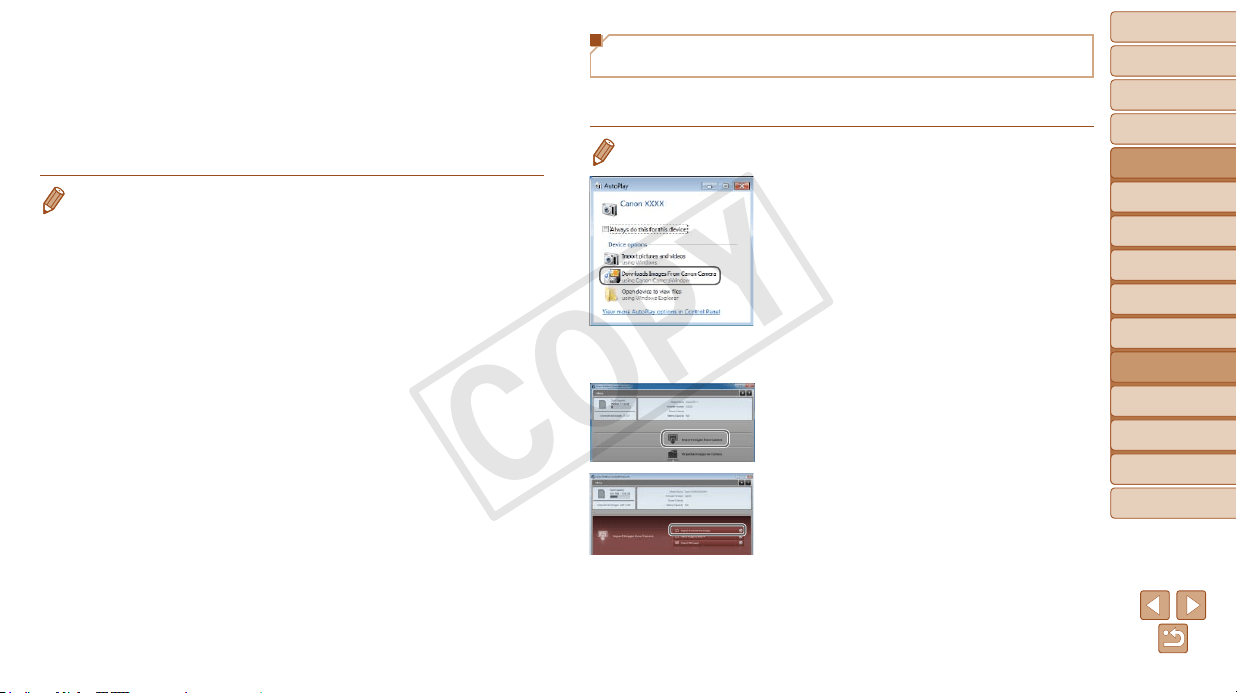
123
1
2
3
4
5
7
8
9
Preliminary Notes and
Legal Information
Contents: Basic
Operations
Camera Basics
Auto Mode/Hybrid
Auto Mode
Other Shooting
Modes
Playback Mode
Setting Menu
Accessories
Appendix
Index
Basic Guide
P Mode
Cover
Advanced Guide
6
Wi-Fi Functions
5 Choose a computer to connect
to.
Choose the computer to connect to,
following steps 7 – 8 in “Adding a
Computer” (=
121). The computer is
now added to the list.
• For information on the access point’s encryption key, refer to the body of the
access point or its user manual.
• Up to 16 access points will be displayed. If no access points are detected,
choose [Manual Settings] in step 2 to manually set an access point. Follow
on-screen instructions and enter an SSID, security settings, and an encryption
key.
• When you use an access point that you have already connected to for
connecting to another device, [*] is displayed for the encryption key in step 3.
To use the same encryption key, press the <o><p> buttons to choose [Next],
and then press the <m> button.
• To add multiple computers, repeat the above procedures starting from step 1.
Using CameraWindow to Transfer Images to a
Computer
Use the computer (included software CameraWindow) to transfer images
from the camera to the computer.
• For details on how to use CameraWindow, see the Software Guide (=
19).
1 Display CameraWindow.
In Windows, click [Downloads Images
From Canon Camera using Canon
CameraWindow].
CameraWindow will be displayed.
On a Macintosh computer,
CameraWindow is automatically
displayed when a Wi-Fi connection is
established between the camera and
computer.
2 Import images.
Click [Import Images from Camera], and
then click [Import Untransferred Images].
Images are now saved to the Pictures
folder on the computer, in separate
folders named by date.
Click [OK] in the screen that is displayed
after image import is complete.
COPY
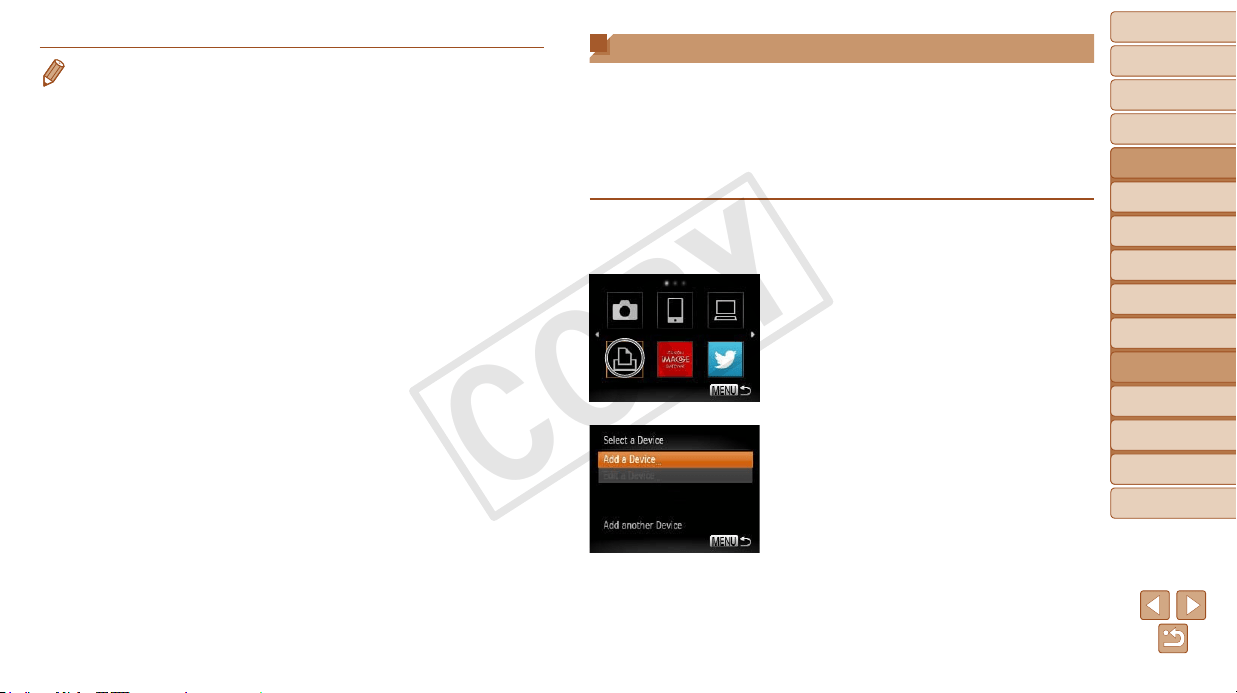
124
1
2
3
4
5
7
8
9
Preliminary Notes and
Legal Information
Contents: Basic
Operations
Camera Basics
Auto Mode/Hybrid
Auto Mode
Other Shooting
Modes
Playback Mode
Setting Menu
Accessories
Appendix
Index
Basic Guide
P Mode
Cover
Advanced Guide
6
Wi-Fi Functions
• If CameraWindow is not displayed when using a Macintosh computer, click the
[CameraWindow] icon in the Dock.
• Movies will take longer to import since the le size is larger than still images.
• To disconnect from the camera, turn off the camera.
• You can also specify to save all images or only selected images to the
computer, and you can change the destination folder. Refer to the Software
Guide (=
19) for details.
Connecting to a Printer
Connect the camera to a printer via Wi-Fi to print as follows.
When establishing a Wi-Fi connection with a printer, you can either use the
camera as an access point (Camera Access Point mode) or use another
access point.
Follow these instructions when using the camera as an access point. When
using another access point, see “Connecting to Access Points in the List”
(=
122) in “Adding a Computer”.
1 Access the Wi-Fi menu.
Press the <o> button.
2 Choose a printer.
Press the <o><p><q><r> buttons to
choose [2], and then press the <m>
button.
3 Choose [Add a Device].
Press the <o><p> buttons to choose
[Add a Device], and then press the <m>
button.
COPY
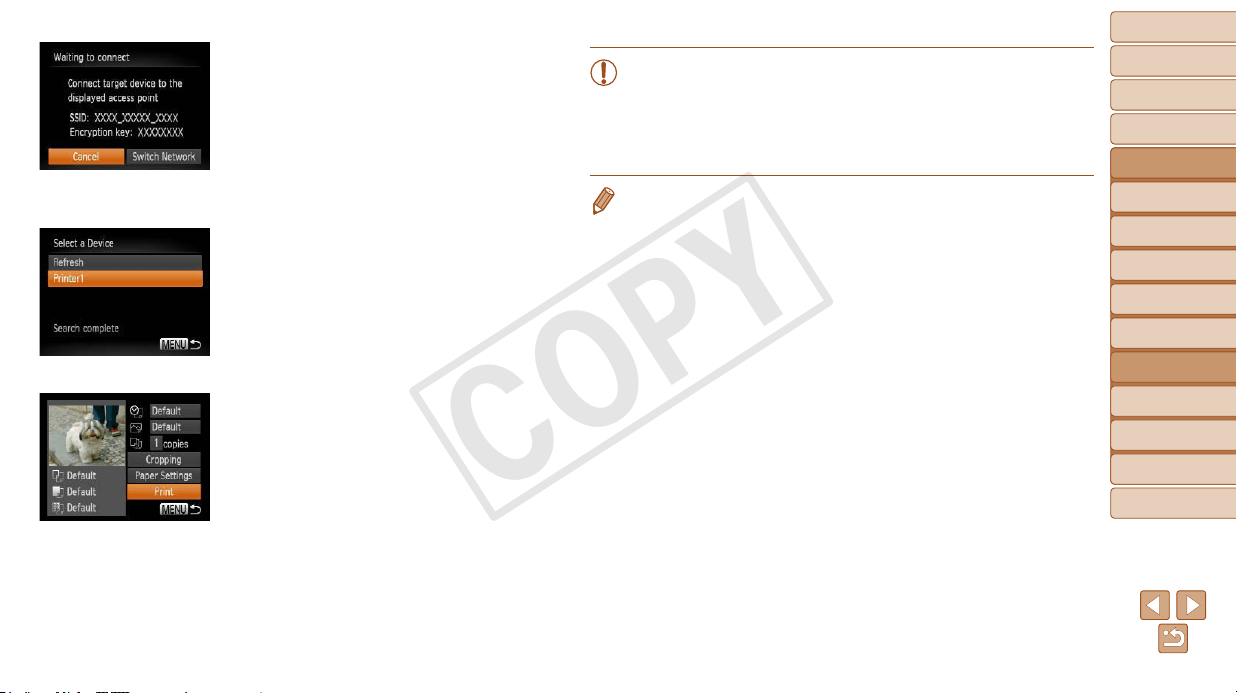
125
1
2
3
4
5
7
8
9
Preliminary Notes and
Legal Information
Contents: Basic
Operations
Camera Basics
Auto Mode/Hybrid
Auto Mode
Other Shooting
Modes
Playback Mode
Setting Menu
Accessories
Appendix
Index
Basic Guide
P Mode
Cover
Advanced Guide
6
Wi-Fi Functions
4 Use the printer to connect to
the network displayed on the
camera screen.
Choose the displayed SSID (network
name) from the printer’s Wi-Fi setting
menu.
Enter the encryption key displayed on the
camera screen into the password eld on
the printer.
5 Choose the printer.
Once the printer is ready for the
connection, press the <m> button when
the printer name is displayed on the
camera.
When the printer has been added
successfully, the printing screen will be
displayed.
6 Choose an image to print.
Press the <q><r> buttons to choose an
image.
Press the <m> button, choose [c], and
press the <m> button again to access
the printing screen.
Press the <o><p> buttons to choose
[Print], and then press the <m> button.
Printing now begins.
For detailed printing instructions, see
“Printing Images” (=
146).
• When you are in the vicinity of an access point that you have
previously connected to, the camera will automatically connect
to it in step 3. To change access points, select [Switch Network]
from the screen that will be displayed when the connection is
being established, and follow steps 4 – 5 in “Adding a Computer”
(=
121).
• You can connect to printers that you have already connected to by choosing
them on the [Select a Device] screen in step 3.
• After you have accessed the Wi-Fi menu once, you can access it again by
pressing the <o> button. The recent target device is listed rst, so you can
easily connect again by pressing the <o><p> buttons to choose it. To add
a new device, display the device selection screen by pressing the <q><r>
buttons, and then congure the setting.
If you prefer not to display recent target devices, press the <n> button,
and on the [3] tab, choose [Wi-Fi Settings] > [Target History] > [Off].
COPY
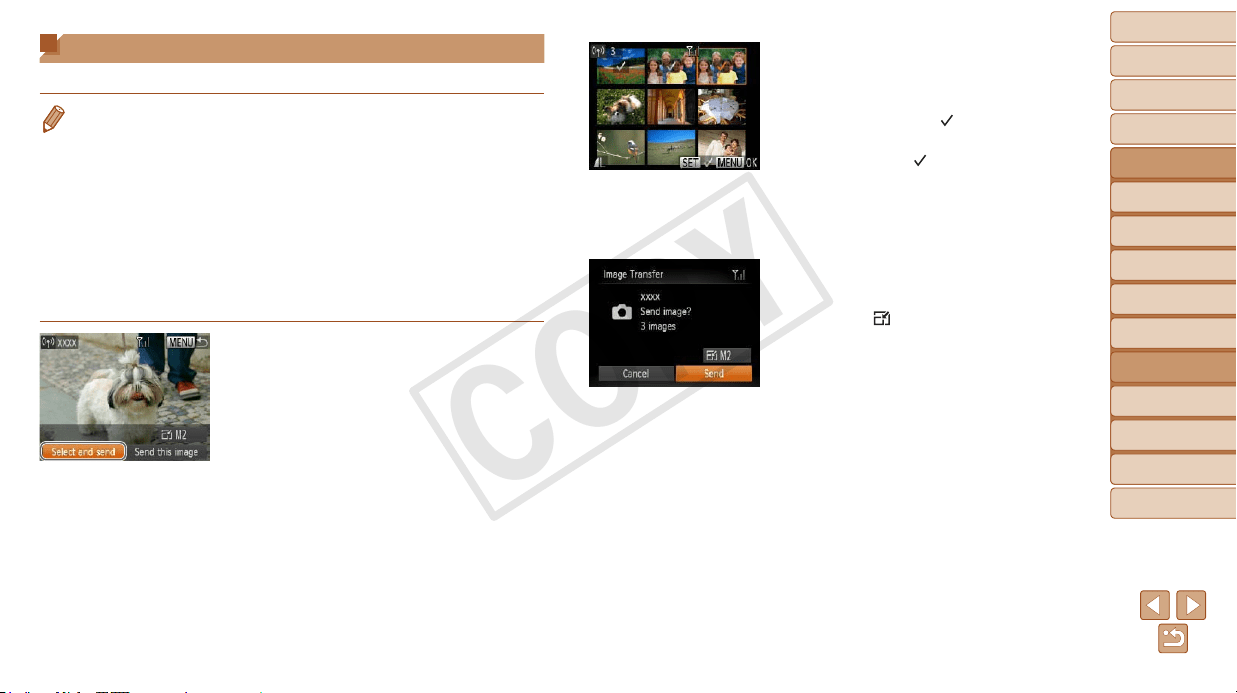
126
1
2
3
4
5
7
8
9
Preliminary Notes and
Legal Information
Contents: Basic
Operations
Camera Basics
Auto Mode/Hybrid
Auto Mode
Other Shooting
Modes
Playback Mode
Setting Menu
Accessories
Appendix
Index
Basic Guide
P Mode
Cover
Advanced Guide
6
Wi-Fi Functions
Sending Images
Send images wirelessly to destinations registered on the camera as follows.
• Images can be uploaded to social networking services or sent to email
addresses, via CANON iMAGE GATEWAY. For details, refer to the CANON
iMAGE GATEWAY website.
• Up to 50 images can be sent together at once. You can send movies together
as long as the total playback time is within two minutes. However, if the
destination is a Web service, the number of movies and images that can be
sent may be less depending on the Web service. See the desired Web service
for details.
• Depending on the condition of the network you are using, it may take a long
time to send movies. Be sure to keep an eye on the camera battery level.
• When connected to a computer, images are transferred using the computer
(included software CameraWindow) instead of the camera (=
123).
1 Choose [Select and send].
Press the <o><p><q><r> buttons to
choose [Select and send], and then press
the <m> button.
2 Choose images.
Press the <o><p><q><r> buttons to
choose an image to send, and then press
the <m> button. [
] is displayed.
To cancel selection, press the <m>
button again. [
] is no longer displayed.
Repeat this process to choose additional
images.
After you nish choosing images, press
the <n> button.
3 Send the images.
Press the <o><p><q><r> buttons to
choose [
], and then press the <m>
button. Press the <o><p> buttons to
choose the resolution (size) of images
to send, and then press the <n>
button.
Press the <o><p><q><r> buttons to
choose [Send], and then press the <m>
button.
When uploading to YouTube, read the
terms of service, choose [I Agree], and
press the <m> button.
Image transfer will begin. The screen
darkens during image transfer.
After images are uploaded to a Web
service, [OK] is displayed. Press the
<m> button to return to the playback
screen.
COPY
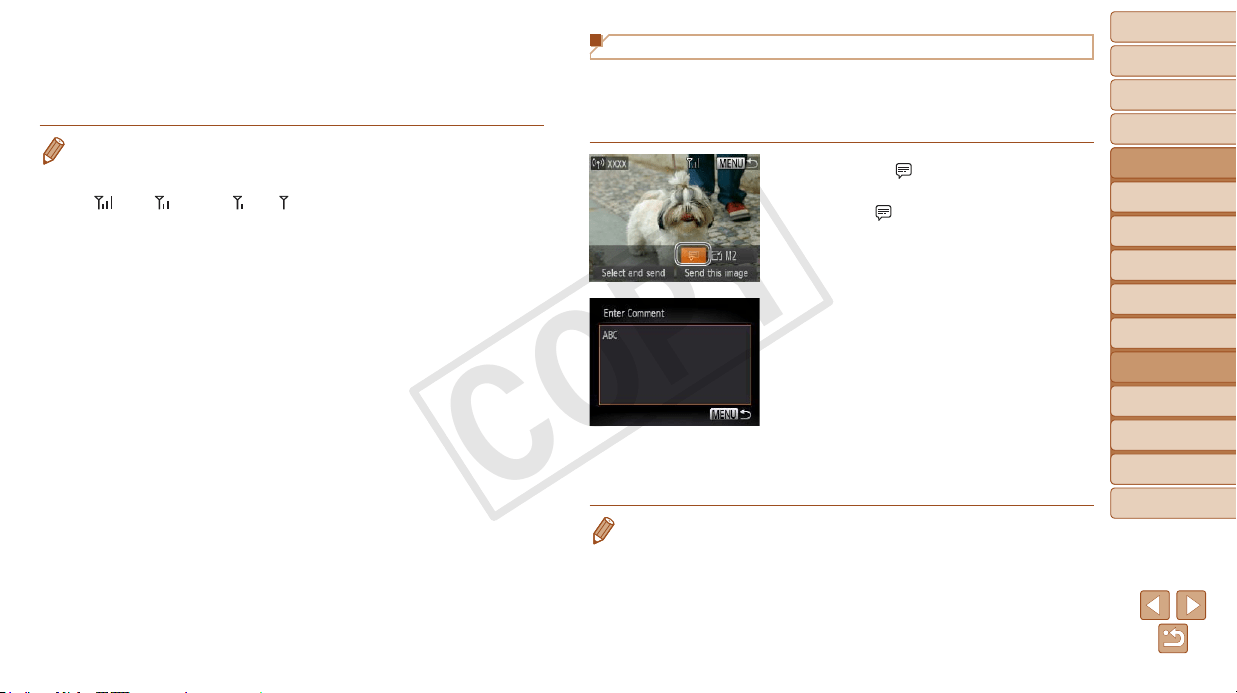
127
1
2
3
4
5
7
8
9
Preliminary Notes and
Legal Information
Contents: Basic
Operations
Camera Basics
Auto Mode/Hybrid
Auto Mode
Other Shooting
Modes
Playback Mode
Setting Menu
Accessories
Appendix
Index
Basic Guide
P Mode
Cover
Advanced Guide
6
Wi-Fi Functions
After sending images to a camera or
smartphone, [Transfer completed] will be
displayed, and the display will return to
the image transfer screen.
• Keep your ngers or other objects off the Wi-Fi transmitter-receiver (=
4).
Covering this may decrease the speed of your image transfers.
• On the screen, wireless signal strength is indicated by the following icons.
[
] high, [ ] medium, [ ] low, [ ] weak
• To disconnect from the camera, press the <n> button. After the
conrmation message, press the <q><r> buttons to choose [OK], and
then press the <m> button. You can also use the smartphone to end the
connection.
• Only images larger than the resolution you selected in step 3 will be resized.
• Movies cannot be resized.
• To send only one of the displayed images, choose [Resize] on the screen in
step 1, change the size, and choose [Send this image].
Adding Comments
Using the camera, you can add comments (alphanumeric characters and
symbols) to images that you send to email addresses, social networking
services, etc. The number of characters and symbols that can be entered
may differ depending on the Web service.
1 Choose [ ].
Press the <o><p><q><r> buttons to
choose [
], and then press the <m>
button.
2 Add a comment.
Follow step 3 in “Registering a Camera
Nickname (First time only)” (=
111) to
add a comment.
3 Send the images.
Follow the steps in “Sending Images”
(=
126) to send the image.
• When a comment is not entered, the comment set in CANON iMAGE
GATEWAY is automatically sent.
COPY

128
1
2
3
4
5
7
8
9
Preliminary Notes and
Legal Information
Contents: Basic
Operations
Camera Basics
Auto Mode/Hybrid
Auto Mode
Other Shooting
Modes
Playback Mode
Setting Menu
Accessories
Appendix
Index
Basic Guide
P Mode
Cover
Advanced Guide
6
Wi-Fi Functions
Sending Images to a Computer via
CANON iMAGE GATEWAY
Images on the memory card that have not been transferred already can be
sent to a computer via CANON iMAGE GATEWAY.
If the computer that you intend to send images to is turned off, the images
will be stored temporarily on the CANON iMAGE GATEWAY server.
However, the images will be deleted after a while. Start up the computer so
that they can be saved.
1 Choose the type of images
to send (only when sending
movies with images).
Press the <n> button, and then
choose [Wi-Fi Settings] on the [3] tab
(=
29).
Press the <o><p> buttons to choose
[Send via Server], press the <q><r>
buttons to choose [Stills/Movies], and
then press the <n> button.
When sending only still images, go to
step 2.
2 Send the images.
Follow the steps in “Establishing Web
Service Connections” (=
114) to
choose [
].
Once the connection is established, the
images are sent. (The screen will close in
about one minute.)
After the images are sent, [OK] is
displayed. Press the <m> button to
return to the playback screen.
When the images have been sent
successfully to the CANON iMAGE
GATEWAY server, [
] is displayed on
the screen.
3 Turn on the computer.
Images are automatically saved to the
computer when you turn it on.
• When sending images, you should use a fully charged battery or an AC
adapter kit (sold separately, =
141).
• Even if images were imported to the computer through a different method, any
images not sent to the computer via CANON iMAGE GATEWAY will be sent to
the computer.
COPY
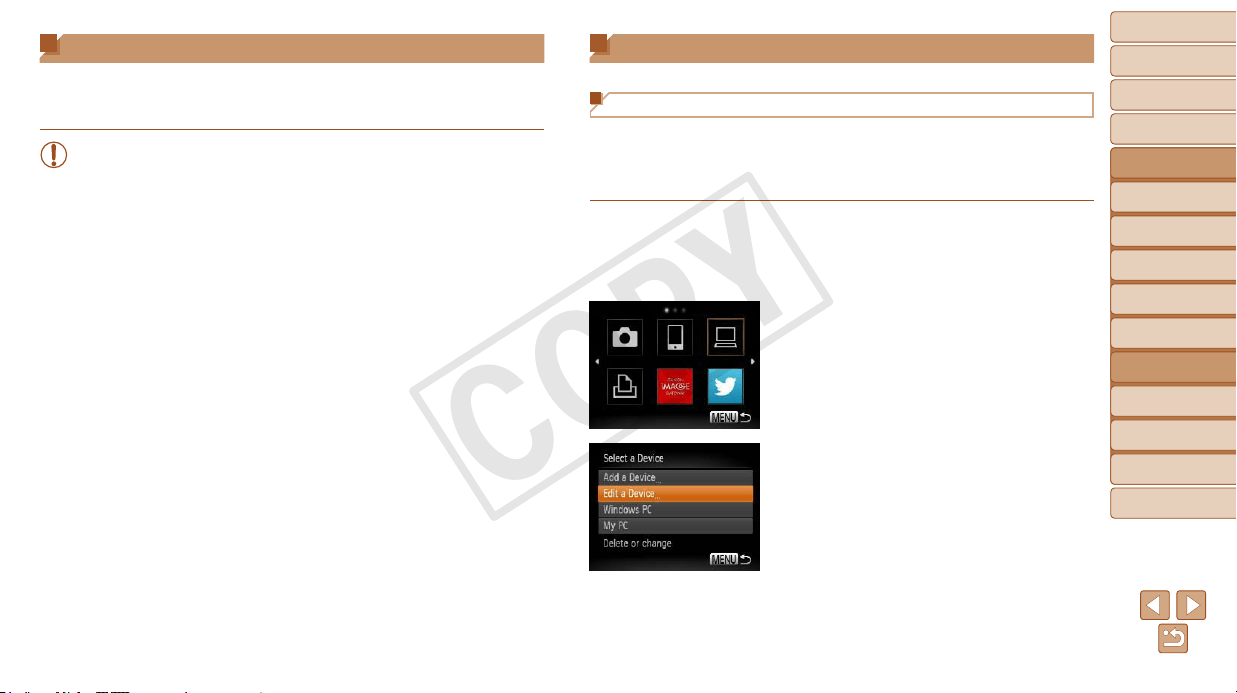
129
1
2
3
4
5
7
8
9
Preliminary Notes and
Legal Information
Contents: Basic
Operations
Camera Basics
Auto Mode/Hybrid
Auto Mode
Other Shooting
Modes
Playback Mode
Setting Menu
Accessories
Appendix
Index
Basic Guide
P Mode
Cover
Advanced Guide
6
Wi-Fi Functions
Geotagging Images on the Camera
GPS data recorded on a smartphone using the dedicated CameraWindow
application (=
115) can be added to images on the camera. Images are
tagged with information including the latitude, longitude, and elevation.
• Before shooting, make sure the date and time and your home time
zone are set correctly. (See “Setting the Date and Time” (=
14).)
Additionally, in [Time Zone] (=
134), specify any shooting
destinations that are in other time zones.
• The smartphone you will use for geotagging must be authorized to
view the images on the camera (=
116).
• Others may be able to locate or identify you by using location data
in your geotagged still images or movies. Be careful when sharing
these images with others, as when posting images online where
many others can view them.
Editing or Erasing Wi-Fi Settings
Edit or erase Wi-Fi settings as follows.
Editing Connection Information
Edit connection information saved to the camera. You can change device
nicknames (display names) that are displayed on the camera, and erase
connection information.
The following explains the procedure when the target device is a computer.
1 Access the Wi-Fi menu.
Pressing the <o> button will show recent
target devices. To access the Wi-Fi menu,
press the <q><r> buttons.
2 Choose a device to edit.
Press the <o><p><q><r> buttons to
choose the icon of the device to edit, and
then press the <m> button.
3 Choose [Edit a Device].
Press the <o><p> buttons to choose
[Edit a Device], and then press the <m>
button.
COPY
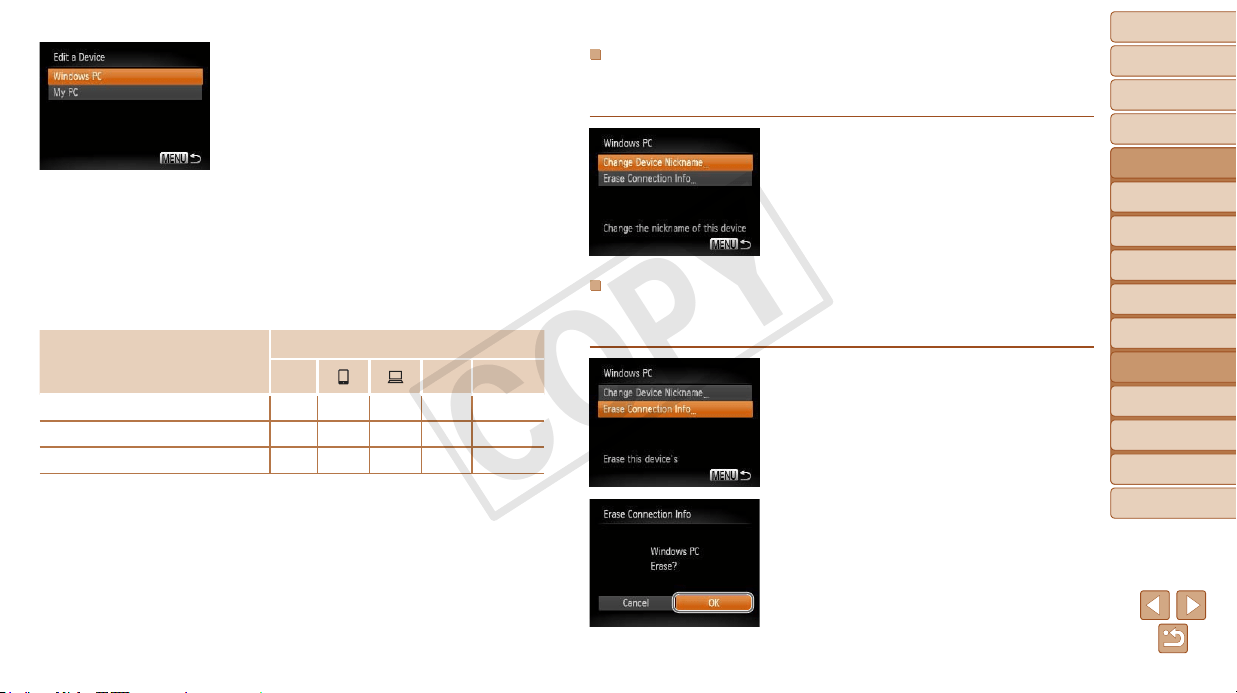
130
1
2
3
4
5
7
8
9
Preliminary Notes and
Legal Information
Contents: Basic
Operations
Camera Basics
Auto Mode/Hybrid
Auto Mode
Other Shooting
Modes
Playback Mode
Setting Menu
Accessories
Appendix
Index
Basic Guide
P Mode
Cover
Advanced Guide
6
Wi-Fi Functions
4 Choose a device to edit.
Press the <o><p> buttons to choose
the device to edit, and then press the
<m> button.
5 Choose an option to edit.
Press the <o><p> buttons to choose an
option to edit, and then press the <m>
button.
The settings you can change depend on
what device or service the camera will
access.
CongurableSettings
Connection
4
c
Web
Services
[Change Device Nickname] (=
130)
O O O O
–
[View Settings] (=
116)
–
O
– – –
[Erase Connection Info] (=
130)
O O O O
–
O
: Congurable
–
: Not congurable
Changing a Device Nickname
You can change the device nickname (display name) that is displayed on
the camera.
Following step 5 in “Editing Connection
Information” (=
130), choose [Change
Device Nickname] and press the <m>
button.
Select the input eld and press the <m>
button. Use the keyboard displayed to
enter a new nickname (=
111).
Erasing Connection Information
Erase connection information (information about devices that you have
connected to) as follows.
Following step 5 in “Editing Connection
Information” (=
130), choose [Erase
Connection Info] and press the <m>
button.
After [Erase?] is displayed, press the
<q><r> buttons to choose [OK], and
then press the <m> button.
The connection information will be
erased.
COPY
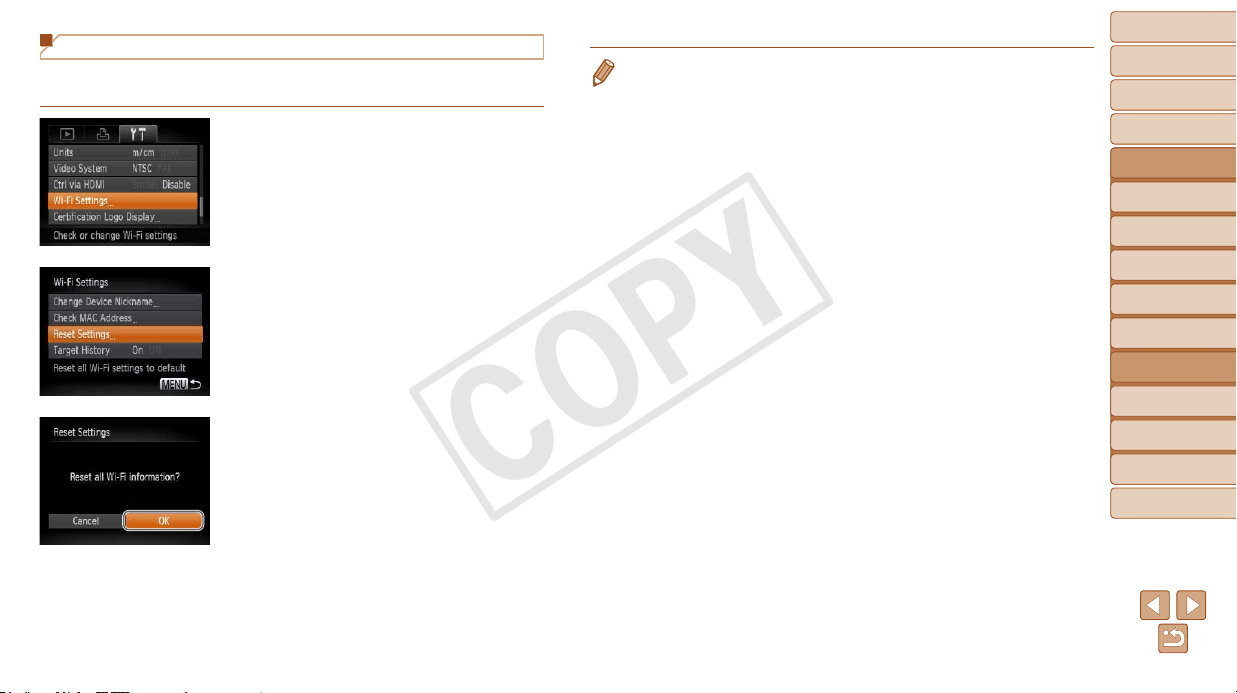
131
1
2
3
4
5
7
8
9
Preliminary Notes and
Legal Information
Contents: Basic
Operations
Camera Basics
Auto Mode/Hybrid
Auto Mode
Other Shooting
Modes
Playback Mode
Setting Menu
Accessories
Appendix
Index
Basic Guide
P Mode
Cover
Advanced Guide
6
Wi-Fi Functions
Returning the Wi-Fi Settings to Default
Return the Wi-Fi settings to default if you transfer ownership of the camera
to another person, or dispose of it.
1 Choose [Wi-Fi Settings].
Press the <n> button, and then
choose [Wi-Fi Settings] on the [3] tab
(=
29).
2 Choose [Reset Settings].
Press the <o><p> buttons to choose
[Reset Settings], and then press the
<m> button.
3 Restore the default settings.
Press the <q><r> buttons to choose
[OK], and then press the <m> button.
The Wi-Fi settings are now reset.
• When returning the Wi-Fi settings to defaults, all Web services set using a
computer will also be erased from the camera. Be sure that you want to reset
all Wi-Fi settings before using this option.
To clear the settings completed in “Sending Images to a Computer via CANON
iMAGE GATEWAY” (=
128), connect your camera to the computer and use
CameraWindow to erase the connection information.
• To reset other settings (aside from Wi-Fi) to defaults, choose [Reset All] in the
[3] tab.
COPY

132
1
2
3
4
5
6
8
9
Preliminary Notes and
Legal Information
Contents: Basic
Operations
Camera Basics
Auto Mode/Hybrid
Auto Mode
Other Shooting
Modes
Playback Mode
Wi-Fi Functions
Accessories
Appendix
Index
Basic Guide
P Mode
Cover
Advanced Guide
7
Setting Menu
Setting Menu
Customize or adjust basic camera functions for greater
convenience
7
4
Adjusting Basic Camera
Functions ...............................133
COPY
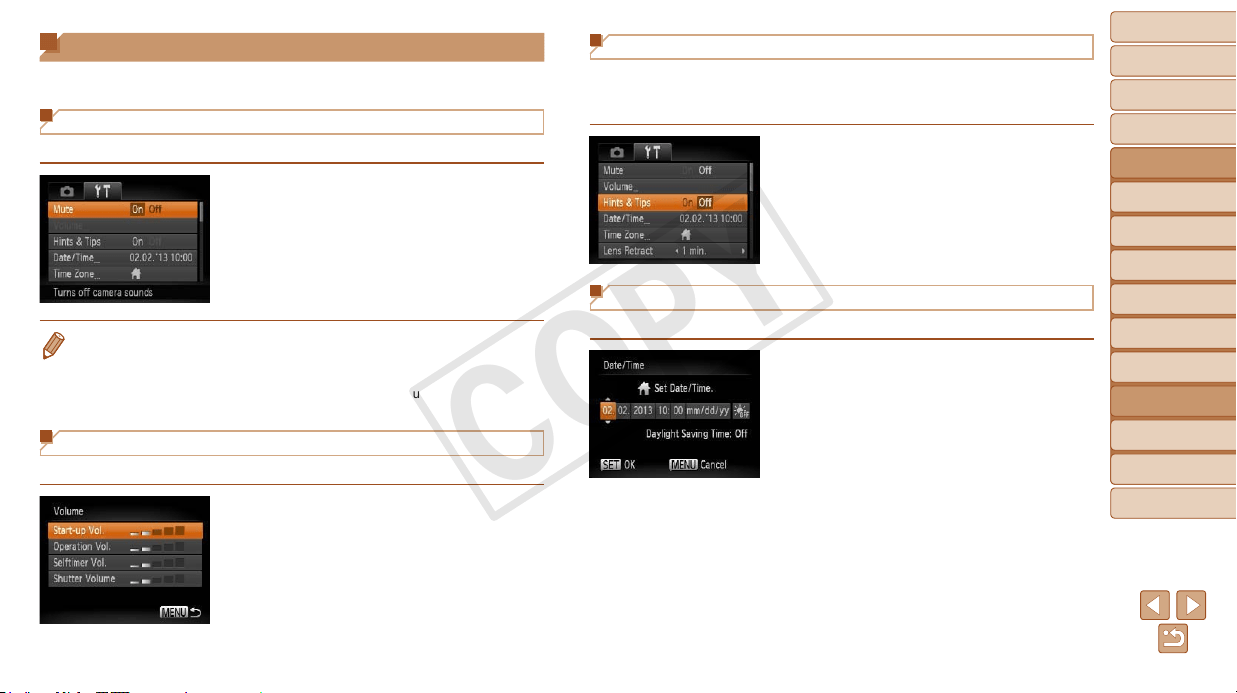
133
1
2
3
4
5
6
8
9
Preliminary Notes and
Legal Information
Contents: Basic
Operations
Camera Basics
Auto Mode/Hybrid
Auto Mode
Other Shooting
Modes
Playback Mode
Wi-Fi Functions
Accessories
Appendix
Index
Basic Guide
P Mode
Cover
Advanced Guide
7
Setting Menu
Adjusting Basic Camera Functions
Functions can be congured on the [3] tab. Customize commonly used
functions as desired, for greater convenience (=
29).
Silencing Camera Operations
Silence camera sounds and movies as follows.
Choose [Mute], and then choose [On].
• Operation can also be silenced by holding down the <p> button as you turn
the camera on.
• Sound is not played during movies if you mute camera sounds (=
84). To
restore sound during movies, press the <o> button. Adjust volume with the
<o><p> buttons, as needed.
Adjusting the Volume
Adjust the volume of individual camera sounds as follows.
Choose [Volume], and then press the
<m> button.
Choose an item, and then press the
<q><r> buttons to adjust the volume.
Hiding Hints and Tips
Hints and tips are normally shown when you choose FUNC. menu
(=
28) or Menu (=
29) items. If you prefer, you can deactivate this
information.
Choose [Hints & Tips], and then choose
[Off].
Date and Time
Adjust the date and time as follows.
Choose [Date/Time], and then press the
<m> button.
Press the <q><r> buttons to choose
an item, and then press the <o><p>
buttons to adjust the setting.
COPY

134
1
2
3
4
5
6
8
9
Preliminary Notes and
Legal Information
Contents: Basic
Operations
Camera Basics
Auto Mode/Hybrid
Auto Mode
Other Shooting
Modes
Playback Mode
Wi-Fi Functions
Accessories
Appendix
Index
Basic Guide
P Mode
Cover
Advanced Guide
7
Setting Menu
World Clock
To ensure that your shots will have the correct local date and time when you
travel abroad, simply register the destination in advance and switch to that
time zone. This convenient feature eliminates the need to change the Date/
Time setting manually.
Before using the world clock, be sure to set the date and time and your
home time zone, as described in “Setting the Date and Time” (=
14).
1 Specify your destination.
Choose [Time Zone], and then press the
<m> button.
Press the <o><p> buttons to choose
[
World], and then press the <m>
button.
Press the <q><r> buttons to choose the
destination.
To set daylight saving time (1 hour
ahead), press the <o><p> buttons to
choose [
].
Press the <m> button.
2 Switch to the destination time
zone.
Press the <o><p> buttons to choose
[
World], and then press the <n>
button.
[ ] is now shown on the shooting screen
(=
162).
• Adjusting the date or time while in [ ] mode (=
14) will automatically
update your [
Home] time and date.
Lens Retraction Timing
The lens is normally retracted for safety about one minute after you press
the <1> button in Shooting mode (=
26). To have the lens retracted
immediately after you press the <1> button, set the retraction timing to [0
sec.].
Choose [Lens Retract], and then choose
[0 sec.].
COPY
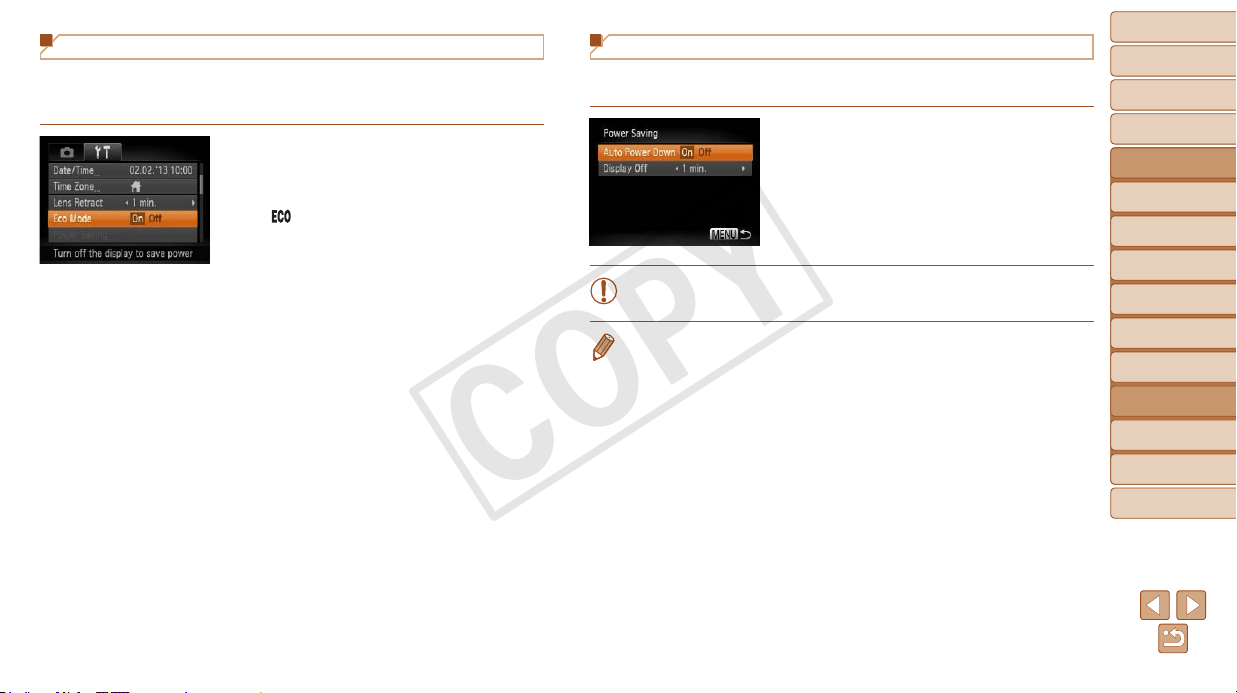
135
1
2
3
4
5
6
8
9
Preliminary Notes and
Legal Information
Contents: Basic
Operations
Camera Basics
Auto Mode/Hybrid
Auto Mode
Other Shooting
Modes
Playback Mode
Wi-Fi Functions
Accessories
Appendix
Index
Basic Guide
P Mode
Cover
Advanced Guide
7
Setting Menu
Using Eco Mode
This function allows you to conserve battery power in Shooting mode. When
the camera is not in use, the screen quickly darkens to reduce battery
consumption.
1 Congurethesetting.
Choose [Eco Mode], and then choose
[On].
[ ] is now shown on the shooting
screen (=
162).
The screen darkens when the camera
is not used for approximately two
seconds; approximately ten seconds
after darkening, the screen turns off.
The camera turns off after approximately
three minutes of inactivity.
2 Shoot.
To activate the screen and prepare for
shooting when the screen is off but the
lens is still out, press the shutter button
halfway.
Power-Saving Adjustment
Adjust the timing of automatic camera and screen deactivation (Auto Power
Down and Display Off, respectively) as needed (=
26).
Choose [Power Saving], and then press
the <m> button.
After choosing an item, press the
<q><r> buttons to adjust it as needed.
• To conserve battery power, you should normally choose [On] for
[Auto Power Down] and [1 min.] or less for [Display Off].
• The [Display Off] setting is applied even if you set [Auto Power Down] to [Off].
• These power-saving functions are not available when you have set Eco mode
(=
135) to [On].
COPY
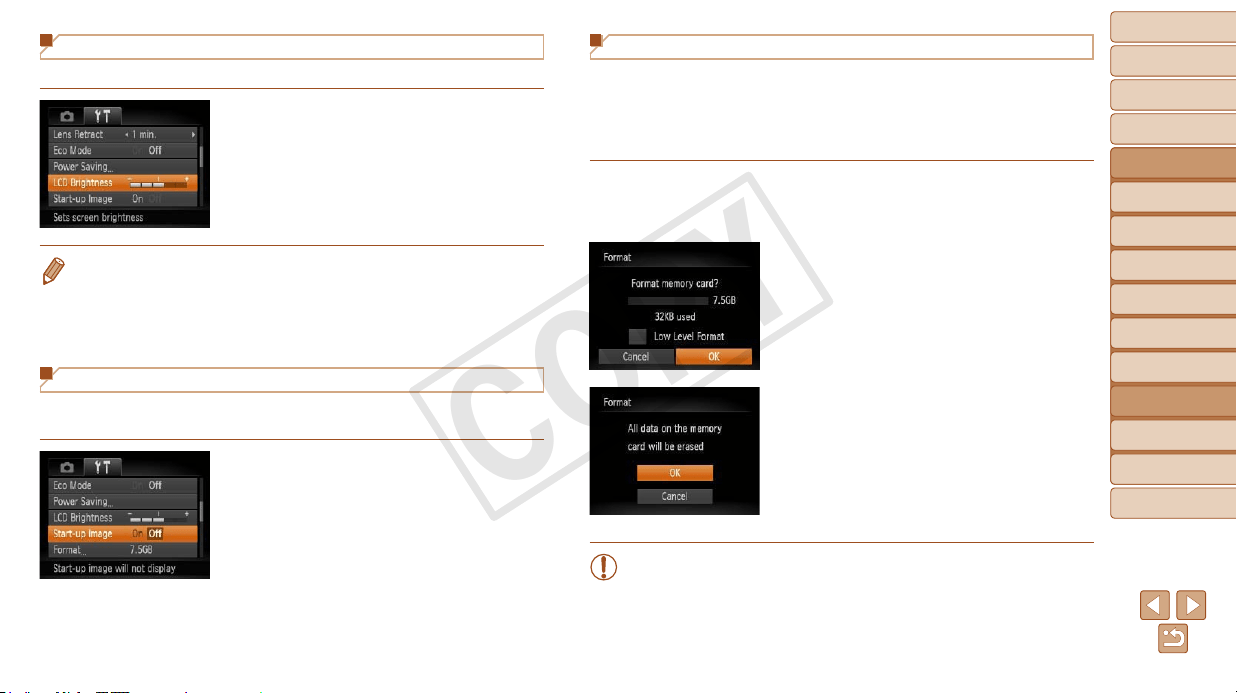
136
1
2
3
4
5
6
8
9
Preliminary Notes and
Legal Information
Contents: Basic
Operations
Camera Basics
Auto Mode/Hybrid
Auto Mode
Other Shooting
Modes
Playback Mode
Wi-Fi Functions
Accessories
Appendix
Index
Basic Guide
P Mode
Cover
Advanced Guide
7
Setting Menu
Screen Brightness
Adjust screen brightness as follows.
Choose [LCD Brightness], and then
press the <q><r> buttons to adjust the
brightness.
• For maximum brightness, press and hold the <p> button for at least one
second when the shooting screen is displayed or when in single-image display.
(This will override the [LCD Brightness] setting on the [3] tab.) To restore
the original brightness, press and hold the <p> button again for at least one
second or restart the camera.
Hiding the Start-up Screen
If you prefer, you can deactivate display of the start-up screen normally
shown when you turn the camera on.
Choose [Start-up Image], and then
choose [Off].
Formatting Memory Cards
Before using a new memory card or a card formatted in another device, you
should format the card with this camera.
Formatting erases all data on a memory card. Before formatting, copy
images on the memory card to a computer, or take other steps to back them
up.
1 Access the [Format] screen.
Choose [Format], and then press the
<m> button.
2 Choose [OK].
Press the <o><p> buttons to choose
[Cancel], press the <q><r> buttons to
choose [OK], and then press the <m>
button.
3 Format the memory card.
To begin the formatting process, press
the <o><p> buttons to choose [OK],
and then press the <m> button.
When formatting is nished, [Memory
card formatting complete] is displayed.
Press the <m> button.
• Formatting or erasing data on a memory card only changes le
management information on the card and does not erase the data
completely. When transferring or disposing of memory cards, take
steps to protect personal information if necessary, as by physically
destroying cards.
COPY
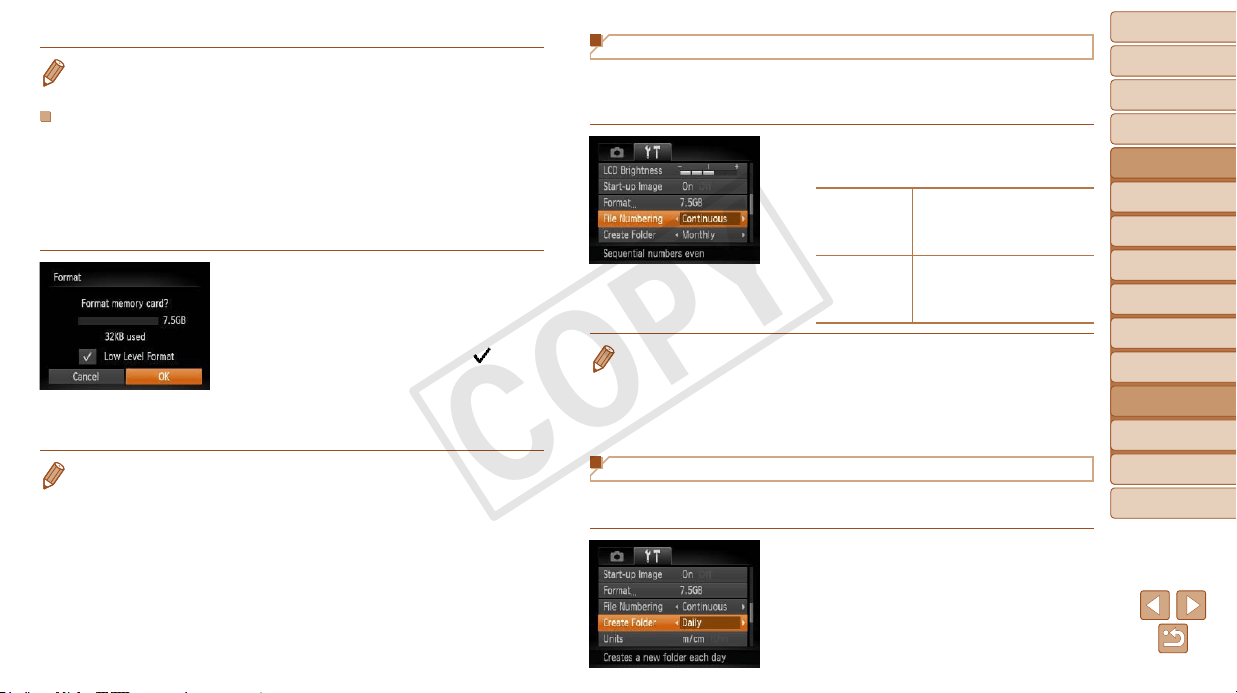
137
1
2
3
4
5
6
8
9
Preliminary Notes and
Legal Information
Contents: Basic
Operations
Camera Basics
Auto Mode/Hybrid
Auto Mode
Other Shooting
Modes
Playback Mode
Wi-Fi Functions
Accessories
Appendix
Index
Basic Guide
P Mode
Cover
Advanced Guide
7
Setting Menu
• The total card capacity indicated on the formatting screen may be less than
the advertised capacity.
Low-Level Formatting
Perform low-level formatting in these cases: [Memory card error] is
displayed, the camera is not working correctly, card image reading/writing is
slower, continuous shooting is slower, or movie recording suddenly stops.
Low-level formatting erases all data on a memory card. Before low-level
formatting, copy images on the memory card to a computer, or take other
steps to back them up.
On the screen in step 2 of “Formatting
Memory Cards” (=
136), press the
<o><p> buttons to choose [Low Level
Format], and then press the <q><r>
buttons to select this option. A [
] icon is
displayed.
Follow steps 2 – 3 in “Formatting Memory
Cards” (=
136) to continue with the
formatting process.
• Low-level formatting takes longer than “Formatting Memory Cards” (=
136),
because data is erased from all storage regions of the memory card.
• You can cancel low-level formatting in progress by choosing [Stop]. In this
case, all data will be erased, but the memory card can be used normally.
File Numbering
Your shots are automatically numbered in sequential order (0001 – 9999)
and saved in folders that store up to 2,000 images each. You can change
how the camera assigns le numbers.
Choose [File Numbering], and then
choose an option.
Continuous
Images are numbered
consecutively (until the 9999th
shot is taken/saved) even if
you switch memory cards.
Auto Reset
Image numbering is reset to
0001 if you switch memory
cards, or when a new folder is
created.
• Regardless of the option selected in this setting, shots may be numbered
consecutively after the last number of existing images on newly inserted
memory cards. To start saving shots from 0001, use an empty (or formatted
(=
136)) memory card.
• Refer to the Software Guide (=
19) for information on the card folder
structure and image formats.
Date-Based Image Storage
Instead of saving images in folders created each month, you can have the
camera create folders each day you shoot to store shots taken that day.
Choose [Create Folder], and then choose
[Daily].
Images will now be saved in folders
created on the shooting date.
COPY
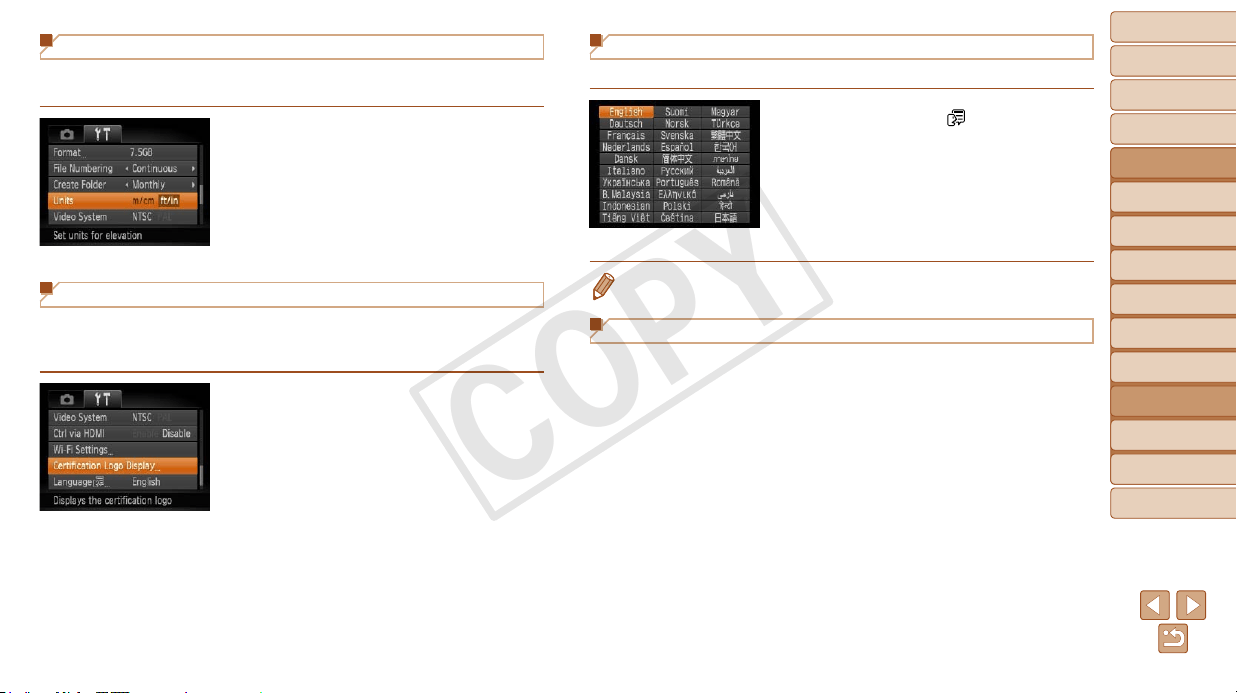
138
1
2
3
4
5
6
8
9
Preliminary Notes and
Legal Information
Contents: Basic
Operations
Camera Basics
Auto Mode/Hybrid
Auto Mode
Other Shooting
Modes
Playback Mode
Wi-Fi Functions
Accessories
Appendix
Index
Basic Guide
P Mode
Cover
Advanced Guide
7
Setting Menu
Metric/Non-Metric Display
Change the unit of measurement shown in GPS information for elevation
(=
85) and elsewhere from m/cm to ft/in as needed.
Choose [Units], and then choose [ft/in].
Checking Certication Logos
Some logos for certication requirements met by the camera can be viewed
on the screen. Other certication logos are printed in this guide, on the
camera packaging, or on the camera body.
Choose [Certication Logo Display], and
then press the <m> button.
Display Language
Change the display language as needed.
Choose [Language ], and then press
the <m> button.
Press the <o><p><q><r> buttons to
choose a language, and then press the
<m> button.
• You can also access the [Language] screen in Playback mode by pressing and
holding the <m> button and immediately pressing the <n> button.
Adjusting Other Settings
The following settings can also be adjusted on the [3] tab.
• [Video System] (=
144)
• [Ctrl via HDMI] (=
143)
• [Wi-Fi Settings] (=
106)
COPY
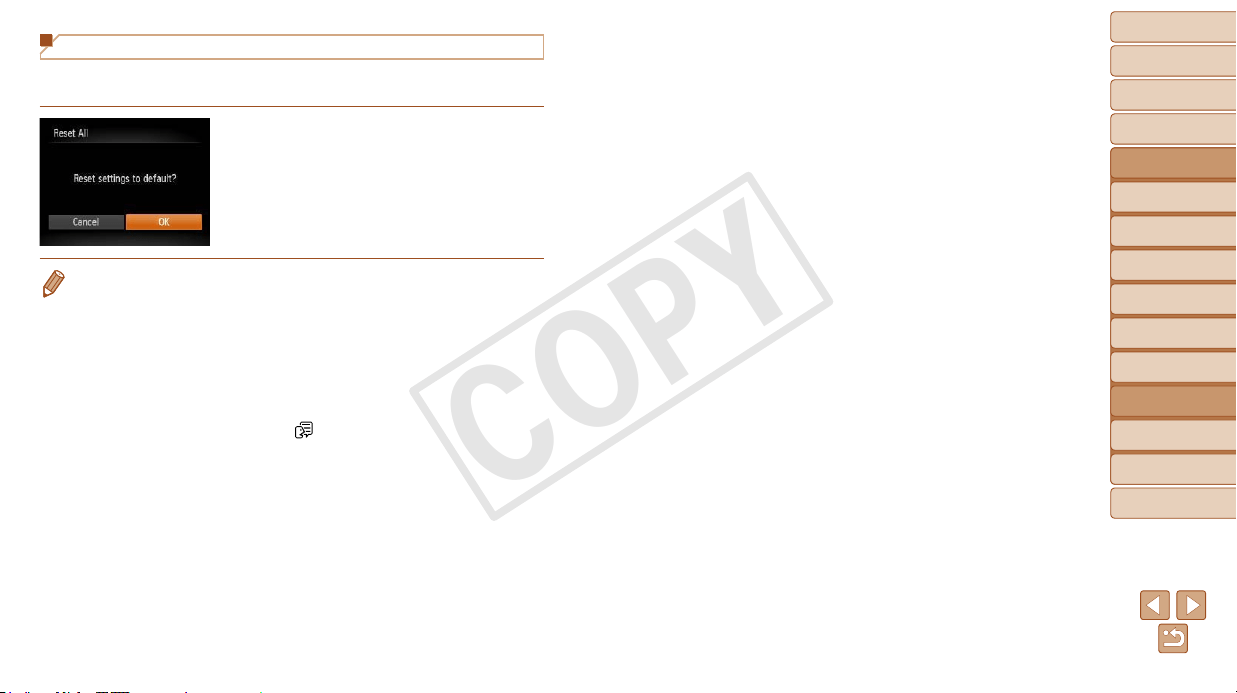
139
1
2
3
4
5
6
8
9
Preliminary Notes and
Legal Information
Contents: Basic
Operations
Camera Basics
Auto Mode/Hybrid
Auto Mode
Other Shooting
Modes
Playback Mode
Wi-Fi Functions
Accessories
Appendix
Index
Basic Guide
P Mode
Cover
Advanced Guide
7
Setting Menu
Restoring Defaults
If you accidentally change a setting, you can restore default camera
settings.
Choose [Reset All], and then press the
<m> button.
Press the <q><r> buttons to choose
[OK], and then press the <m> button.
Default settings are now restored.
• The following functions are not restored to default settings.
- Information registered using Face ID (=
42)
- Shooting mode (=
55)
- Colors chosen in Color Accent (=
60) or Color Swap (=
61)
- Movie mode (=
67)
- Custom white balance data you have recorded (=
72)
- Wi-Fi settings (=
106)
- [3] tab settings [Date/Time] (=
133), [Time Zone] (=
134), [Video
System] (=
144), and [Language ] (=
138)
COPY

140
1
2
3
4
5
6
7
9
Preliminary Notes and
Legal Information
Contents: Basic
Operations
Camera Basics
Auto Mode/Hybrid
Auto Mode
Other Shooting
Modes
Playback Mode
Wi-Fi Functions
Setting Menu
Appendix
Index
Basic Guide
P Mode
Cover
Advanced Guide
8
Accessories
Accessories
Enjoy the camera in more ways with optional Canon
accessories and other compatible accessories sold
separately
8
4
Optional Accessories.............141
Using Optional Accessories..142
Printing Images ......................146
COPY
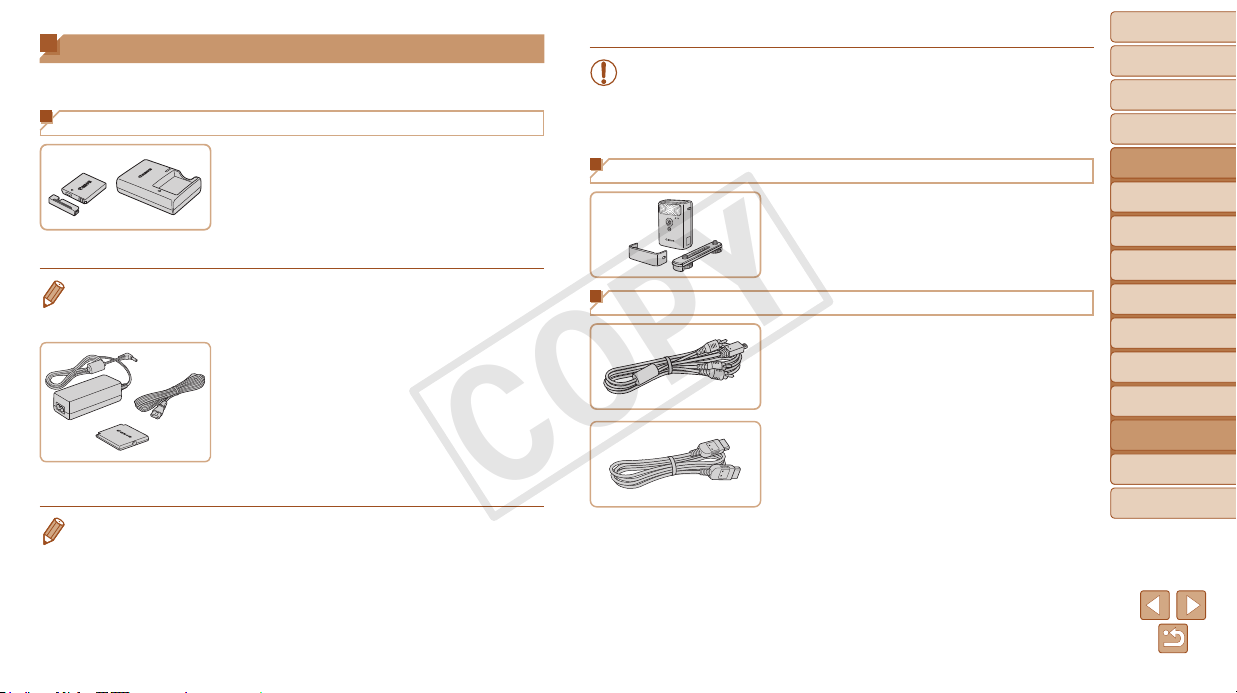
141
1
2
3
4
5
6
7
9
Preliminary Notes and
Legal Information
Contents: Basic
Operations
Camera Basics
Auto Mode/Hybrid
Auto Mode
Other Shooting
Modes
Playback Mode
Wi-Fi Functions
Setting Menu
Appendix
Index
Basic Guide
P Mode
Cover
Advanced Guide
8
Accessories
Optional Accessories
The following camera accessories are sold separately. Note that availability
varies by area, and some accessories may no longer be available.
Power Supplies
Battery Pack NB-4L
Rechargeable lithium-ion battery
Battery Charger CB-2LV/CB-2LVE
Charger for Battery Pack NB-4L
• The battery includes a convenient cover which you can attach to know the
charging status at a glance. Attach the cover so that o is visible on a charged
battery, and attach it so that o is not visible on an uncharged battery.
AC Adapter Kit ACK-DC60
For powering the camera using
household power. Recommended when
using the camera over extended periods,
or when connecting the camera to a
printer or computer. Cannot be used to
charge the camera battery.
• AC Adapter Kit ACK-DC10 can also be used.
• The battery charger and AC adapter kit can be used in areas with
100 – 240 V AC power (50/60 Hz).
• For power outlets in a different format, use a commercially available
adapter for the plug. Never use an electrical transformer designed
for traveling, which may damage the battery.
Flash Unit
High-Power Flash HF-DC2
External ash for illuminating subjects
that are out of range of the built-in ash.
Other Accessories
Stereo AV Cable AVC-DC400ST
Connect the camera to a TV to enjoy
playback on the larger TV screen.
HDMI Cable HTC-100
For connecting the camera to an HDMI
input of a high-denition TV.
COPY
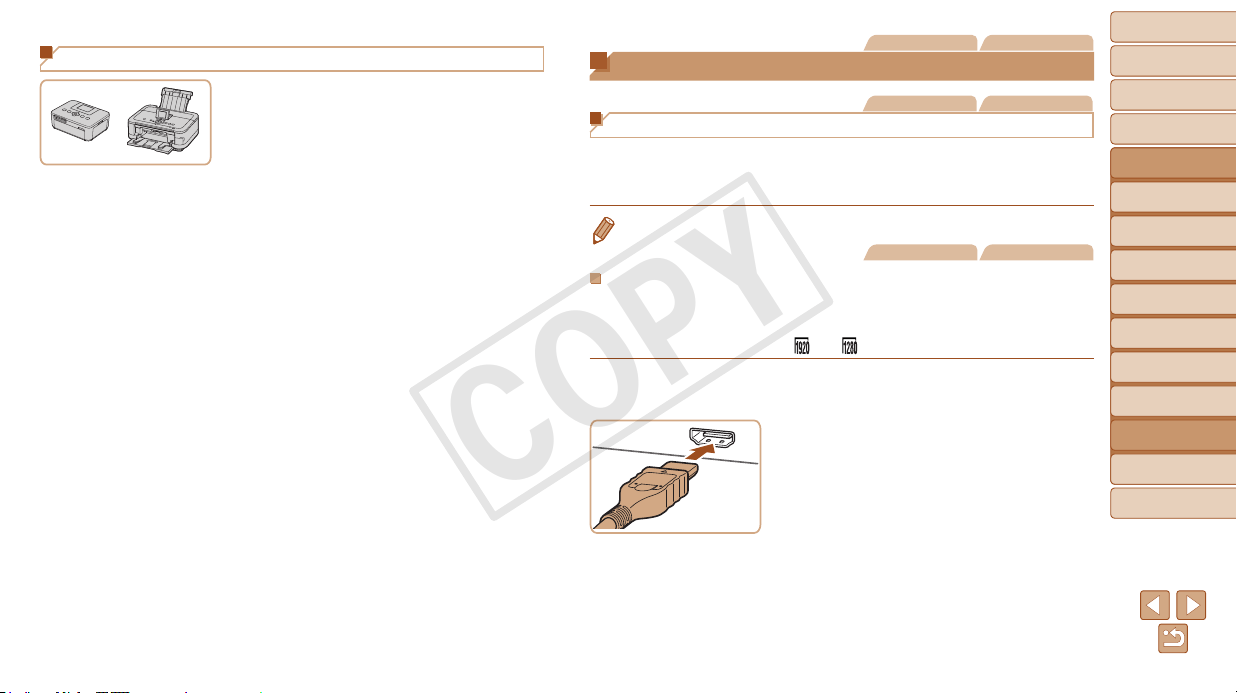
142
1
2
3
4
5
6
7
9
Preliminary Notes and
Legal Information
Contents: Basic
Operations
Camera Basics
Auto Mode/Hybrid
Auto Mode
Other Shooting
Modes
Playback Mode
Wi-Fi Functions
Setting Menu
Appendix
Index
Basic Guide
P Mode
Cover
Advanced Guide
8
Accessories
Printers
Canon-brand PictBridge-
Compatible Printers
Printing images without a computer is
possible by connecting the camera to
a Canon-brand PictBridge-compatible
printer.
For details, visit your nearest Canon
dealer.
Still Images Movies
Using Optional Accessories
Still Images Movies
Playback on a TV
By connecting the camera to a TV, you can view your shots on the larger
screen of the TV.
For details on connection or how to switch inputs, refer to the TV manual.
• Some information may not be displayed on the TV (=
163).
Still Images Movies
PlaybackonaHigh-DenitionTV
Connecting the camera to an HDTV with the HDMI Cable HTC-100 (sold
separately) enables you to view your shots on the larger screen of the TV.
Movies shot at a resolution of [ ] or [ ] can be viewed in high denition.
1 Make sure the camera and TV
are off.
2 Connect the camera to the TV.
On the TV, insert the cable plug fully into
the HDMI input as shown.
COPY
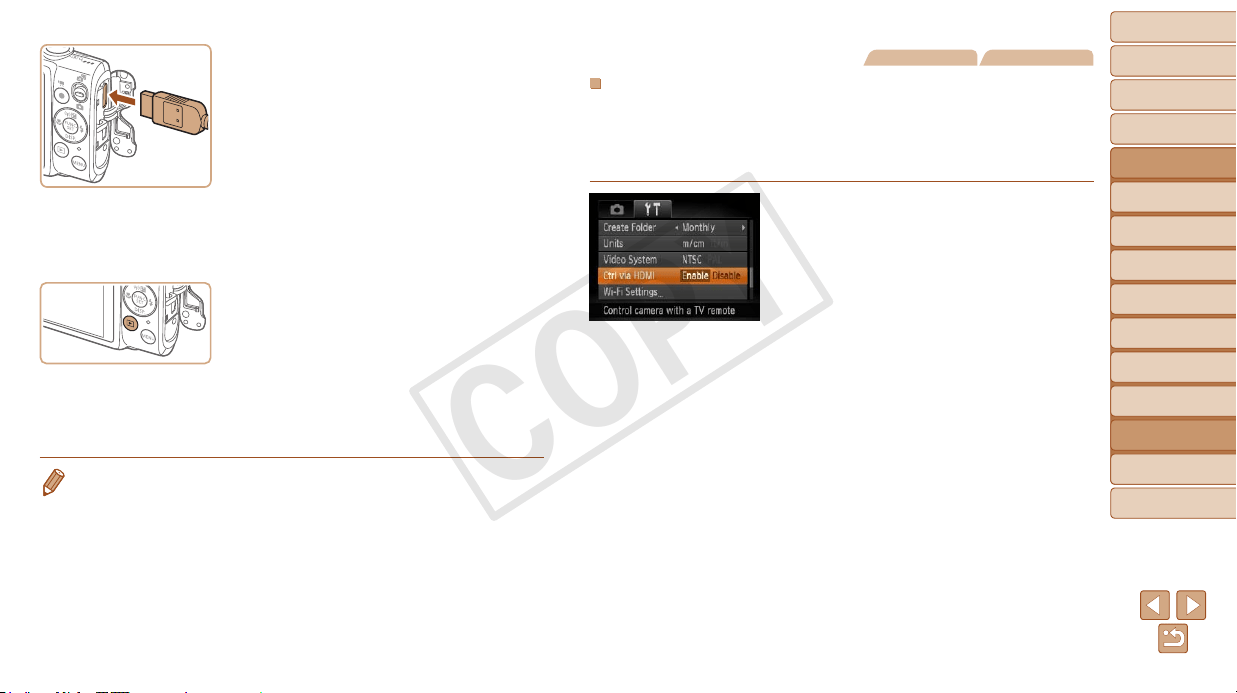
143
1
2
3
4
5
6
7
9
Preliminary Notes and
Legal Information
Contents: Basic
Operations
Camera Basics
Auto Mode/Hybrid
Auto Mode
Other Shooting
Modes
Playback Mode
Wi-Fi Functions
Setting Menu
Appendix
Index
Basic Guide
P Mode
Cover
Advanced Guide
8
Accessories
On the camera, open the terminal cover
and insert the cable plug fully into the
camera terminal.
3 Turn the TV on and switch to
video input.
Switch the TV input to the video input you
connected the cable to in step 2.
4 Turn the camera on.
Press the <1> button to turn the camera
on.
Images from the camera are now
displayed on the TV. (Nothing is
displayed on the camera screen.)
When nished, turn off the camera and
TV before disconnecting the cable.
• Camera operating sounds are not played while the camera is connected to an
HDTV.
Still Images Movies
Controlling the Camera with a TV Remote
Connecting the camera to an HDMI CEC-compatible TV enables playback
(including slideshow playback) using the TV remote control.
In this case, you will need to adjust some TV settings. For details, refer to
the TV manual.
1 Congurethesetting.
Press the <n> button, choose
[Ctrl via HDMI] on the [3] tab, and then
choose [Enable] (=
29).
2 Connect the camera to the TV.
Follow steps 1 – 2 in “Playback on a
High-Denition TV” (=
142) to connect
the camera to the TV.
3 Display images.
Turn on the TV. On the camera, press the
<1> button.
Images from the camera are now
displayed on the TV. (Nothing is
displayed on the camera screen.)
COPY
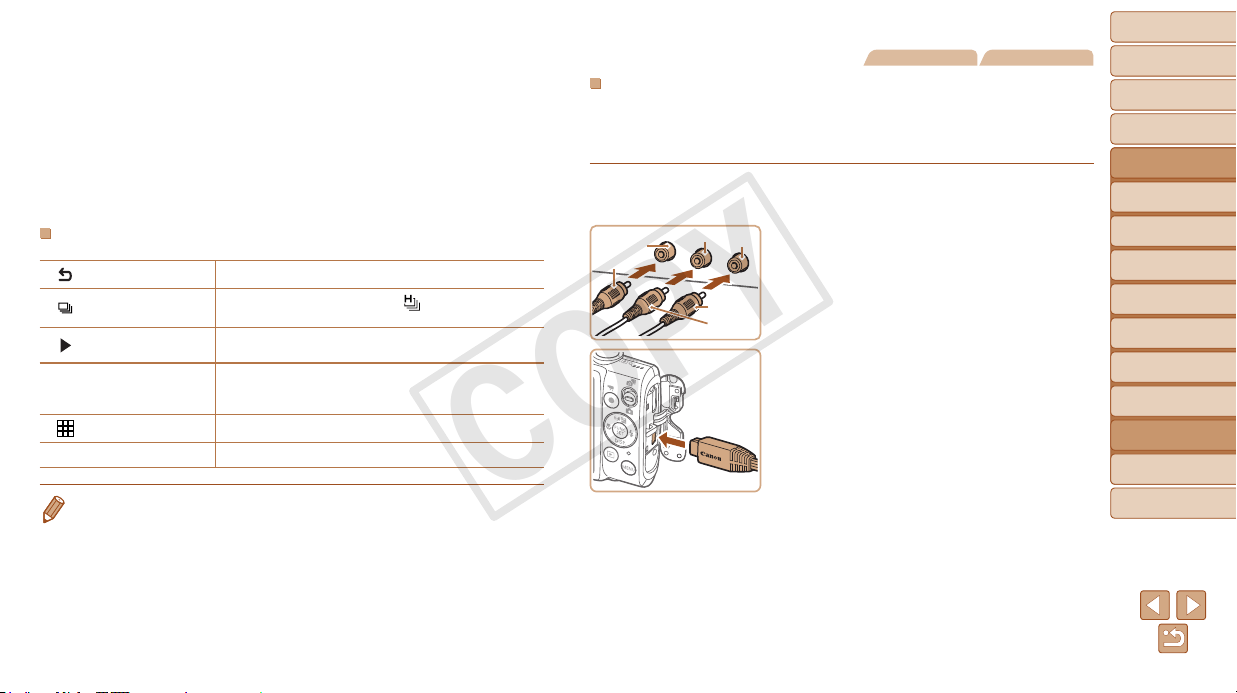
144
1
2
3
4
5
6
7
9
Preliminary Notes and
Legal Information
Contents: Basic
Operations
Camera Basics
Auto Mode/Hybrid
Auto Mode
Other Shooting
Modes
Playback Mode
Wi-Fi Functions
Setting Menu
Appendix
Index
Basic Guide
P Mode
Cover
Advanced Guide
8
Accessories
4 Control the camera with the TV
remote.
Press the <q><r> buttons on the remote
to browse images.
To display the camera control panel,
press the OK/Select button. Select
control panel items by pressing the
<q><r> buttons to choose an item, and
then pressing the OK/Select button again.
Camera Control Panel Options Shown on the TV
Return Closes the menu.
Group Playback
Displays sets of images shot in [
] mode (=
65).
(Only displayed when a grouped image is selected.)
Play Movie
Starts movie playback. (Only displayed when a movie
is selected.)
.
Slideshow
Starts slideshow playback. To switch images during
playback, press the <q><r> buttons on the remote
control.
Index Playback Displays multiple images in an index.
l
Change Display
Switches display modes (=
27).
• Pressing the <n> button on the camera will switch control to the camera
itself, which will prevent remote control until you return to single-image display.
• Moving the zoom lever on the camera will switch control to the camera itself,
which will prevent remote control until you return to single-image display.
• The camera may not always respond correctly even if the remote is for an
HDMI CEC-compatible TV.
Still Images Movies
PlaybackonaStandard-DenitionTV
Connecting the camera to a TV with the Stereo AV Cable AVC-DC400ST
(sold separately) enables you to view your shots on the larger screen of the
TV as you control the camera.
1 Make sure the camera and TV
are off.
2 Connect the camera to the TV.
On the TV, insert the cable plugs fully into
the video inputs as shown.
On the camera, open the terminal cover
and insert the cable plug fully into the
camera terminal.
3 Display images.
Follow steps 3 – 4 in “Playback on a
High-Denition TV” (=
143) to display
images.
Red
Red
White
Yellow
Yellow
White
COPY
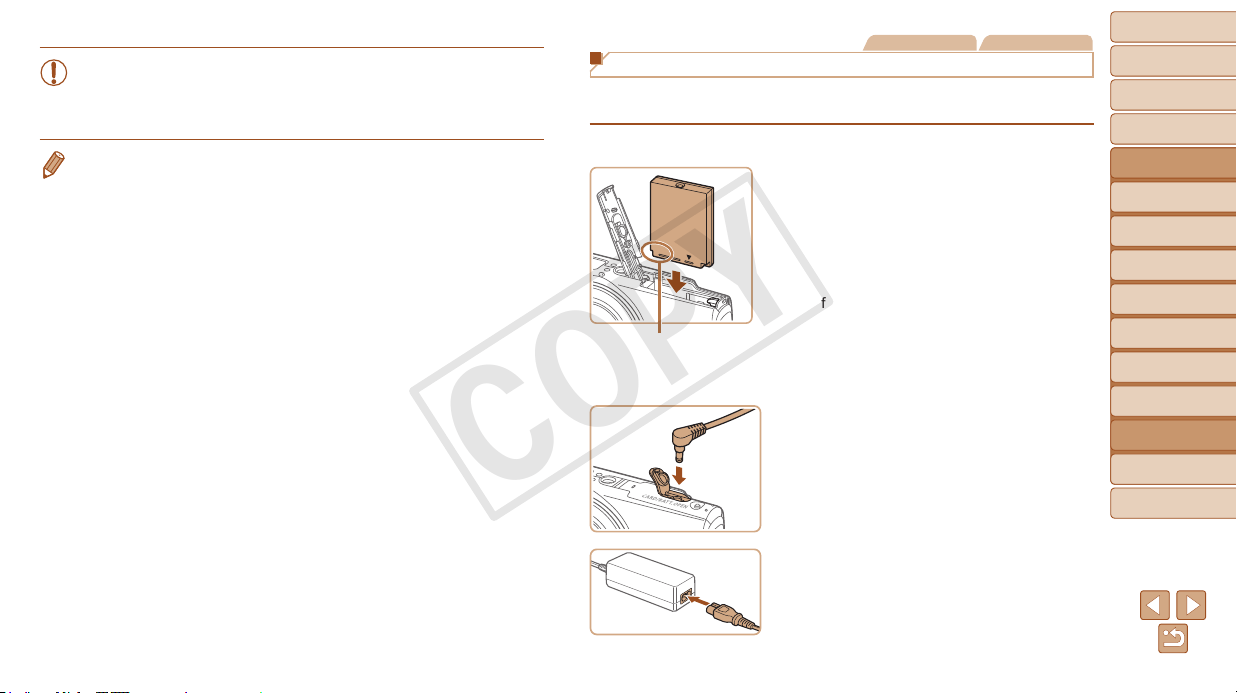
145
1
2
3
4
5
6
7
9
Preliminary Notes and
Legal Information
Contents: Basic
Operations
Camera Basics
Auto Mode/Hybrid
Auto Mode
Other Shooting
Modes
Playback Mode
Wi-Fi Functions
Setting Menu
Appendix
Index
Basic Guide
P Mode
Cover
Advanced Guide
8
Accessories
• Correct display is not possible unless the camera video output
format (NTSC or PAL) matches the TV format. To change the
video output format, press the <n> button and choose [Video
System] on the [3] tab.
• When the camera and TV are connected, you can also shoot while previewing
shots on the larger screen of the TV. To shoot, follow the same steps as when
using the camera screen.
• However, AF-Point Zoom (=
50) and Stitch Assist (=
66) are not
available.
Still Images Movies
Powering the Camera with Household Power
Powering the camera with AC Adapter Kit ACK-DC60 (sold separately)
eliminates the need to monitor the remaining battery level.
1 Make sure the camera is off.
2 Insert the coupler.
Follow step 2 in “Inserting the Battery
and Memory Card” (=
12) to open the
cover.
Insert the coupler facing the direction
shown, just as you would a battery
(following step 3 in “Inserting the Battery
and Memory Card” (=
12)).
Follow step 5 in “Inserting the Battery
and Memory Card” (=
13) to close the
cover.
3 Connect the adapter to the
coupler.
Open the cover and insert the adapter
plug fully into the coupler.
4 Connect the power cord.
Insert one end of the power cord into the
compact power adapter, and then plug
the other end into a power outlet.
Turn the camera on and use it as desired.
Terminals
COPY
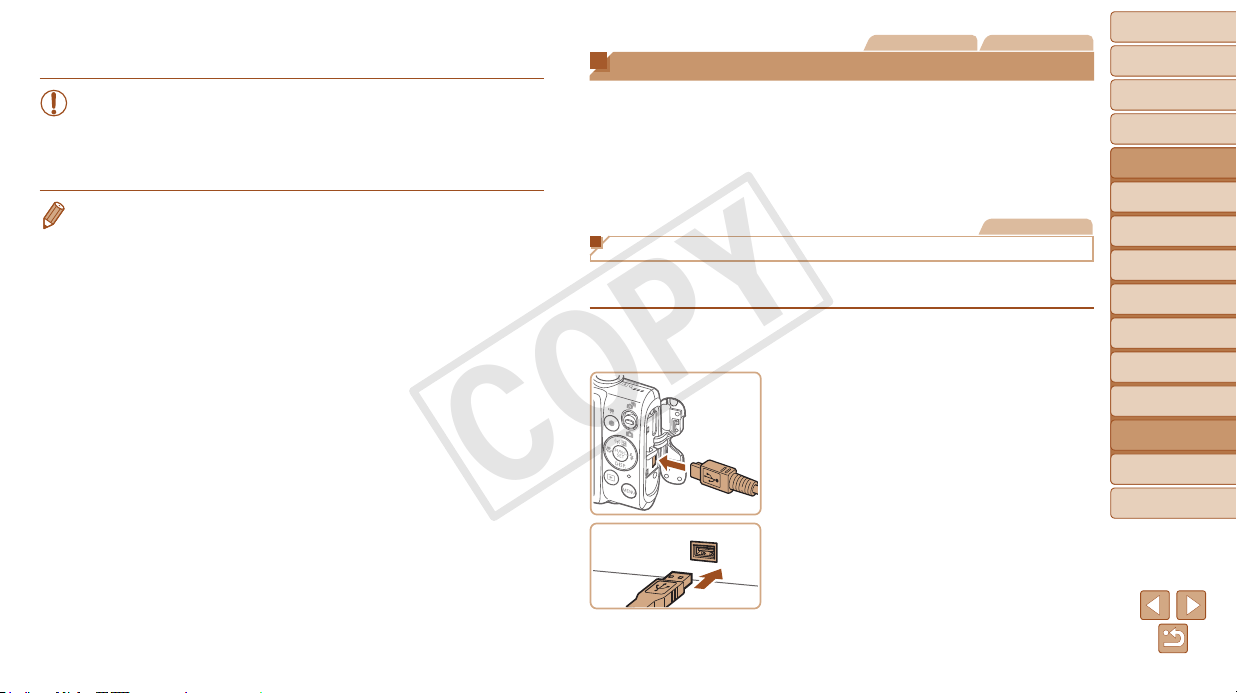
146
1
2
3
4
5
6
7
9
Preliminary Notes and
Legal Information
Contents: Basic
Operations
Camera Basics
Auto Mode/Hybrid
Auto Mode
Other Shooting
Modes
Playback Mode
Wi-Fi Functions
Setting Menu
Appendix
Index
Basic Guide
P Mode
Cover
Advanced Guide
8
Accessories
When nished, turn the camera off and
unplug the power cord from the outlet.
• Do not disconnect the adapter or unplug the power cord while
the camera is still on. This may erase your shots or damage the
camera.
• Do not attach the adapter or adapter cord to other objects. Doing so
could result in malfunction or damage to the product.
• AC Adapter Kit ACK-DC10 (sold separately) can also be used.
Still Images Movies
Printing Images
Your shots can easily be printed by connecting the camera to a printer. On
the camera, you can specify images to set up batch printing, prepare orders
for photo development services, and prepare orders or print images for
photobooks.
A Canon SELPHY CP series compact photo printer is used here for the
sake of illustration. Screens displayed and available functions vary by
printer. Also refer to the printer manual for additional information.
Still Images
Easy Print
Easily print your shots by connecting the camera to a PictBridge-compatible
printer (sold separately) with the included interface cable (=
2).
1 Make sure the camera and
printer are off.
2 Connect the camera to the
printer.
Open the cover. Holding the smaller
cable plug in the orientation shown, insert
the plug fully into the camera terminal.
Connect the larger cable plug to the
printer. For other connection details, refer
to the printer manual.
COPY
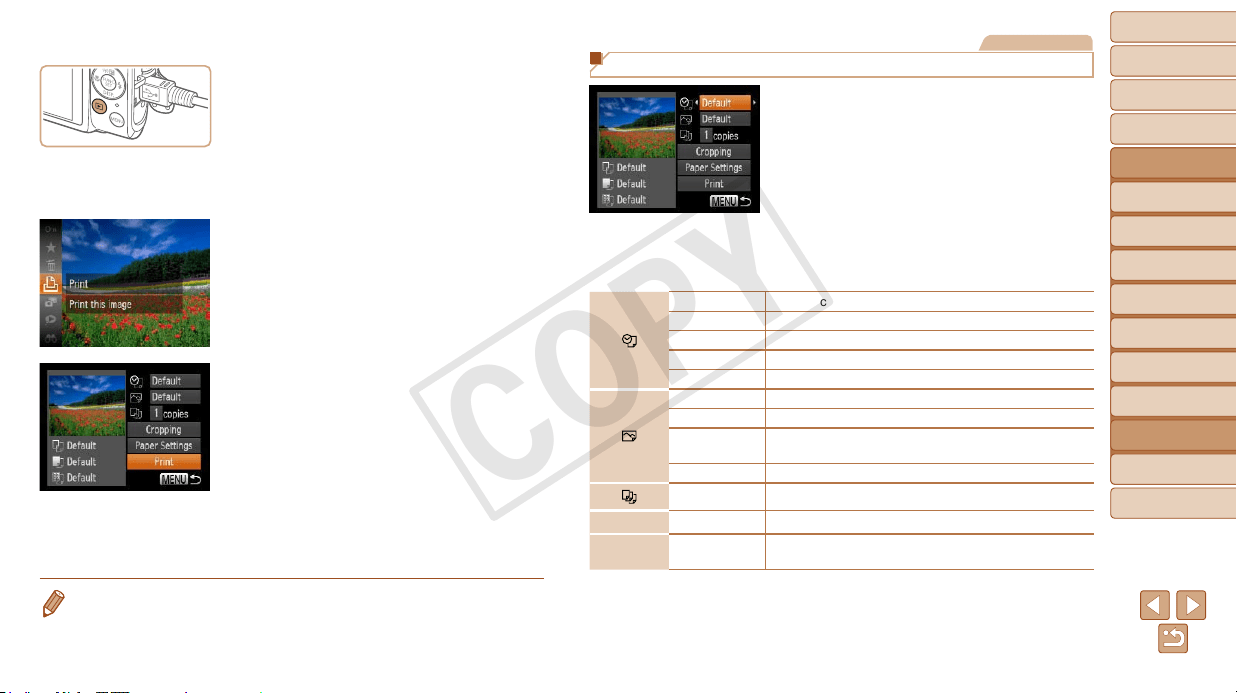
147
1
2
3
4
5
6
7
9
Preliminary Notes and
Legal Information
Contents: Basic
Operations
Camera Basics
Auto Mode/Hybrid
Auto Mode
Other Shooting
Modes
Playback Mode
Wi-Fi Functions
Setting Menu
Appendix
Index
Basic Guide
P Mode
Cover
Advanced Guide
8
Accessories
3 Turn the printer on.
4 Turn the camera on.
Press the <1> button to turn the camera
on.
5 Choose an image.
Press the <q><r> buttons to choose an
image.
6 Access the printing screen.
Press the <m> button, choose [c], and
press the <m> button again.
7 Print the image.
Press the <o><p> buttons to choose
[Print], and then press the <m> button.
Printing now begins.
To print other images, repeat the above
procedures starting from step 5 after
printing is nished.
When you are nished printing, turn the
camera and printer off and disconnect
the cable.
• For Canon-brand PictBridge-compatible printers (sold separately), see
“Printers” (=
142).
Still Images
Conguring Print Settings
1 Access the printing screen.
Follow steps 1 – 6 in “Easy Print”
(=
146 – 147) to access the screen
at left.
2 Congurethesettings.
Press the <o><p> buttons to choose an
item, and then press the <q><r> buttons
to choose an option.
Default Matches current printer settings.
Date Prints images with the date added.
File No. Prints images with the le number added.
Both Prints images with both the date and le number added.
Off
–
Default Matches current printer settings.
Off
–
On
Uses information from the time of shooting to print under
optimal settings.
Red-Eye 1 Corrects red-eye.
No. of Copies Choose the number of copies to print.
Cropping
–
Specify a desired image area to print (=
148).
Paper
Settings
–
Specify the paper size, layout, and other details
(=
148).
COPY
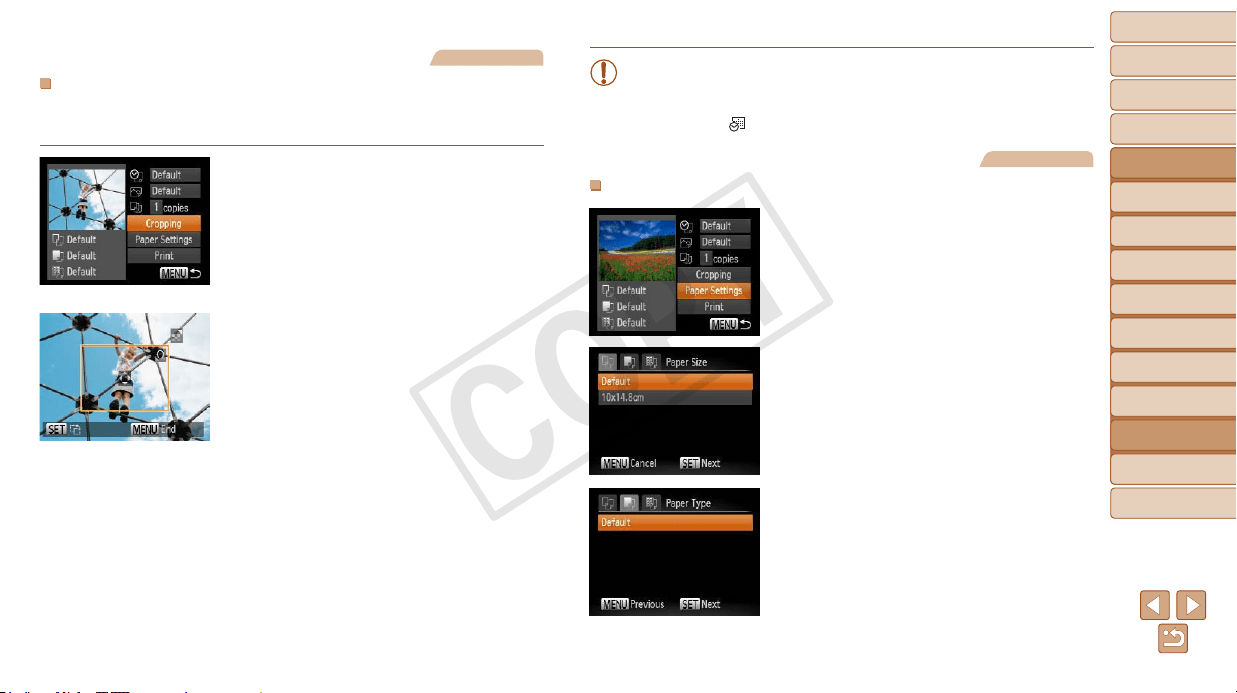
148
1
2
3
4
5
6
7
9
Preliminary Notes and
Legal Information
Contents: Basic
Operations
Camera Basics
Auto Mode/Hybrid
Auto Mode
Other Shooting
Modes
Playback Mode
Wi-Fi Functions
Setting Menu
Appendix
Index
Basic Guide
P Mode
Cover
Advanced Guide
8
Accessories
Still Images
Cropping Images Before Printing (Cropping)
By cropping images before printing, you can print a desired image area
instead of the entire image.
1 Choose [Cropping].
After following step 1 in “Conguring Print
Settings” (=
147) to access the printing
screen, choose [Cropping] and press the
<m> button.
A cropping frame is now displayed,
indicating the image area to print.
2 Adjust the cropping frame as
needed.
To resize the frame, move the zoom
lever.
To move the frame, press the
<o><p><q><r> buttons.
To rotate the frame, press the <m>
button.
Press the <n> button, press the
<o><p> buttons to choose [OK], and
then press the <m> button.
3 Print the image.
Follow step 7 in “Easy Print” (=
147)
to print.
• Cropping may not be possible at small image sizes, or at some
aspect ratios.
• Dates may not be printed correctly if you crop images shot with
[Date Stamp
] selected.
Still Images
Choosing Paper Size and Layout Before Printing
1 Choose [Paper Settings].
After following step 1 in “Conguring Print
Settings” (=
147) to access the printing
screen, choose [Paper Settings] and
press the <m> button.
2 Choose a paper size.
Press the <o><p> buttons to choose an
option, and then press the <m> button.
3 Choose a type of paper.
Press the <o><p> buttons to choose an
option, and then press the <m> button.
COPY
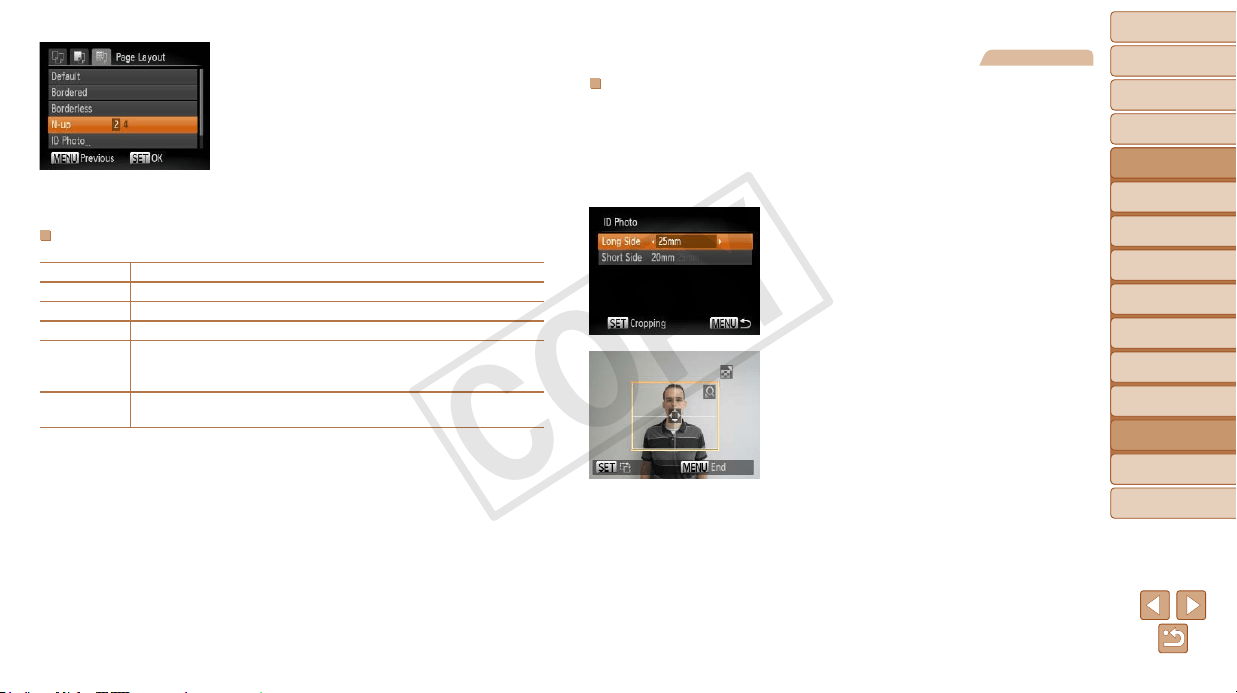
149
1
2
3
4
5
6
7
9
Preliminary Notes and
Legal Information
Contents: Basic
Operations
Camera Basics
Auto Mode/Hybrid
Auto Mode
Other Shooting
Modes
Playback Mode
Wi-Fi Functions
Setting Menu
Appendix
Index
Basic Guide
P Mode
Cover
Advanced Guide
8
Accessories
4 Choose a layout.
Press the <o><p> buttons to choose
an option.
When choosing [N-up], press the
<q><r> buttons to specify the number of
images per sheet.
Press the <m> button.
5 Print the image.
Available Layout Options
Default Matches current printer settings.
Bordered Prints with blank space around the image.
Borderless Borderless, edge-to-edge printing.
N-up Choose how many images to print per sheet.
ID Photo
Prints images for identication purposes.
Only available for images with a resolution of L and an aspect ratio of
4:3.
Fixed Size
Choose the print size.
Choose from 3.5 x 5 in., postcard, or wide-format prints.
Still Images
Printing ID Photos
1 Choose [ID Photo].
Following steps 1 – 4 in “Choosing
Paper Size and Layout Before Printing”
(=
148 – 149), choose [ID Photo] and
press the <m> button.
2 Choose the long and short side
length.
Press the <o><p> buttons to choose
an item. Choose the length by pressing
the <q><r> buttons, and then press the
<m> button.
3 Choose the printing area.
Follow step 2 in “Cropping Images Before
Printing (Cropping)” (=
148) to choose
the printing area.
4 Print the image.
COPY
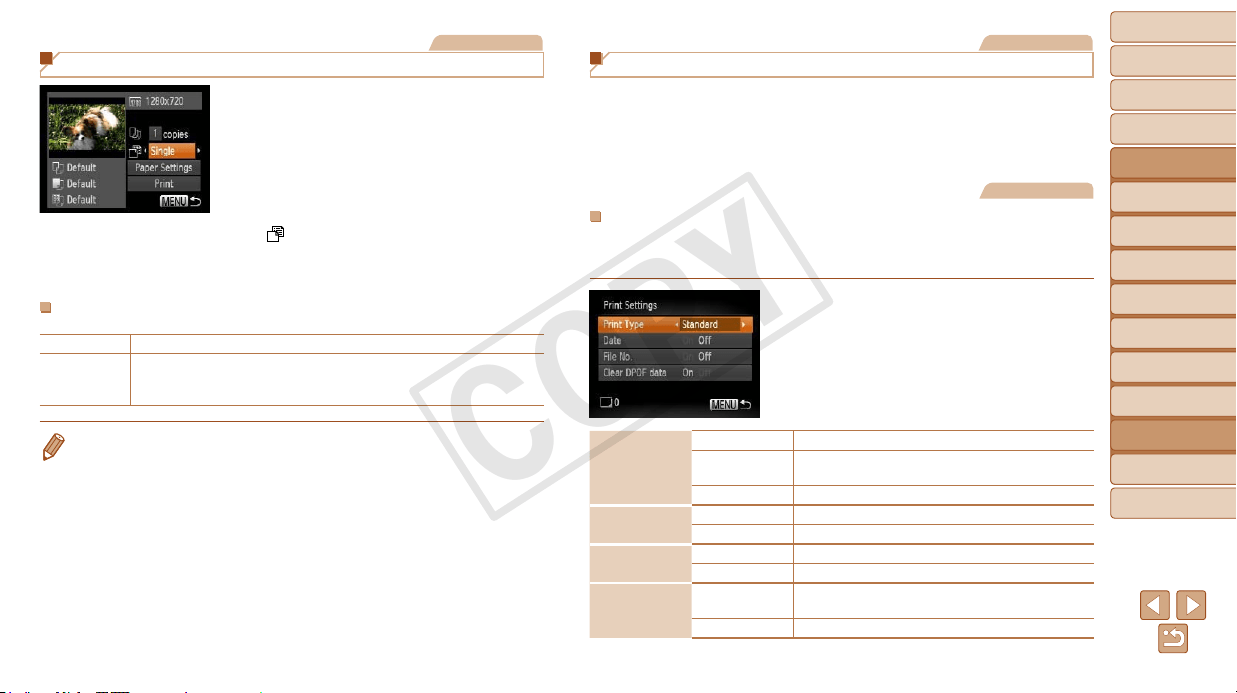
150
1
2
3
4
5
6
7
9
Preliminary Notes and
Legal Information
Contents: Basic
Operations
Camera Basics
Auto Mode/Hybrid
Auto Mode
Other Shooting
Modes
Playback Mode
Wi-Fi Functions
Setting Menu
Appendix
Index
Basic Guide
P Mode
Cover
Advanced Guide
8
Accessories
Movies
Printing Movie Scenes
1 Access the printing screen.
Follow steps 1 – 6 in “Easy Print”
(=
146 – 147) to choose a movie. The
screen at left is displayed.
2 Choose a printing method.
Press the <o><p> buttons to choose [
], and then press the <q><r> buttons
to choose the printing method.
3 Print the image.
Movie Printing Options
Single Prints the current scene as a still image.
Sequence
Prints a series of scenes, a certain interval apart, on a single sheet of
paper. You can also print the folder number, le number, and elapsed
time for the frame by setting [Caption] to [On].
• To cancel printing in progress, press the <m> button.
• [ID Photo] and [Sequence] cannot be chosen on Canon-brand PictBridge-
compatible printers from CP720/CP730 and earlier models.
Still Images
Adding Images to the Print List (DPOF)
Batch printing (=
152) and ordering prints from a photo development
service can be set up on the camera. Choose up to 998 images on a
memory card and congure relevant settings, such as the number of copies,
as follows. The printing information you prepare this way will conform to
DPOF (Digital Print Order Format) standards.
Still Images
ConguringPrintSettings
Specify the printing format, whether to add the date or le number, and
other settings as follows. These settings apply to all images in the print list.
Press the <n> button, and then
choose [Print Settings] on the [2] tab.
Choose and congure settings as desired
(=
29).
Print Type
Standard One image is printed per sheet.
Index
Smaller versions of multiple images are printed
per sheet.
Both Both standard and index formats are printed.
Date
On Images are printed with the shooting date.
Off
–
File No.
On Images are printed with the le number.
Off
–
Clear DPOF
data
On
All image print list settings are cleared after
printing.
Off
–
COPY
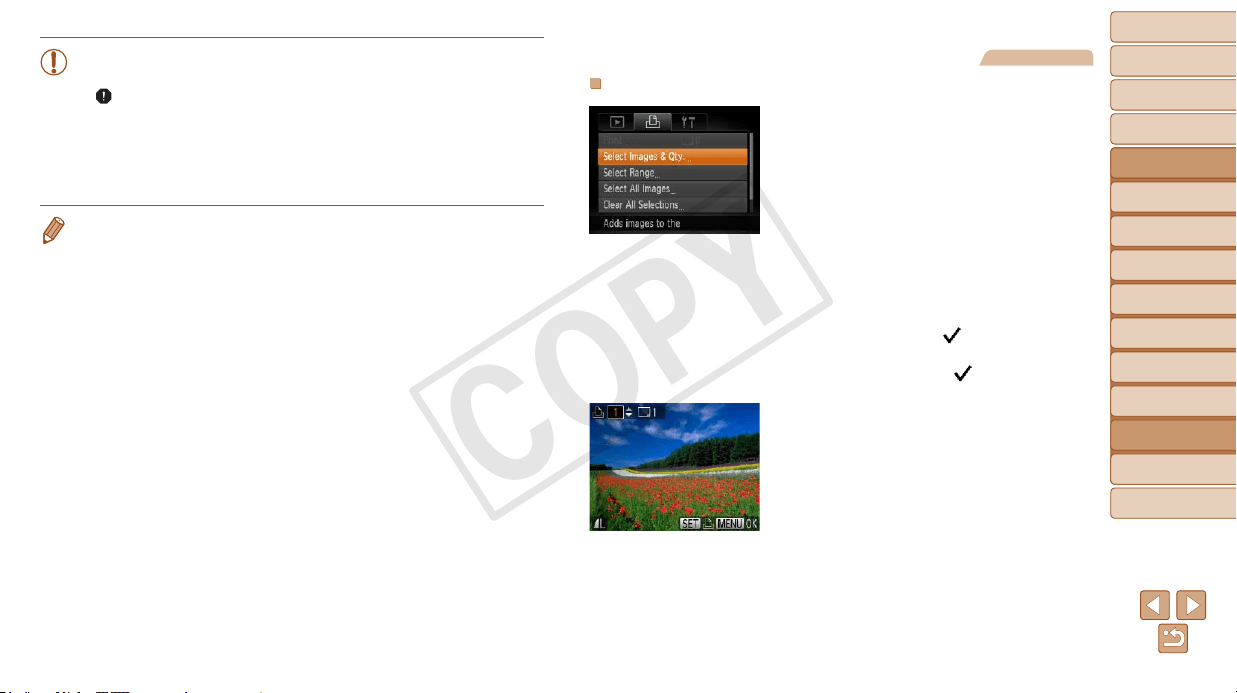
151
1
2
3
4
5
6
7
9
Preliminary Notes and
Legal Information
Contents: Basic
Operations
Camera Basics
Auto Mode/Hybrid
Auto Mode
Other Shooting
Modes
Playback Mode
Wi-Fi Functions
Setting Menu
Appendix
Index
Basic Guide
P Mode
Cover
Advanced Guide
8
Accessories
• Not all of your DPOF settings may be applied in printing by the
printer or photo development service, in some cases.
• [
] may be displayed on the camera to warn you that the memory
card has print settings that were congured on another camera.
Changing the print settings using this camera may overwrite all
previous settings.
• Setting [Date] to [On] may cause some printers to print the date
twice.
• Specifying [Index] will prevent you from choosing [On] for both [Date] and [File
No.] at the same time.
• The date is printed in a format matching setting details in [Date/Time] on the
[3] tab, accessible by pressing the <n> button (=
14).
• Index printing is not available on some Canon-brand PictBridge-compatible
printers (sold separately).
Still Images
Setting Up Printing for Individual Images
1 Choose [Select Images & Qty.].
Press the <n> button, choose
[Select Images & Qty.] on the [2] tab,
and then press the <m> button.
2 Choose an image.
Press the <q><r> buttons to choose an
image, and then press the <m> button.
You can now specify the number of
copies.
If you specify index printing for the image,
it is labeled with a [
] icon. To cancel
index printing for the image, press the
<m> button again. [
] is no longer
displayed.
3 Specify the number of prints.
Press the <o><p> buttons to specify
the number of prints (up to 99).
To set up printing for other images and
specify the number of prints, repeat steps
2 – 3.
Printing quantity cannot be specied for
index prints. You can only choose which
images to print, by following step 2.
When nished, press the <n> button
to return to the menu screen.
COPY

152
1
2
3
4
5
6
7
9
Preliminary Notes and
Legal Information
Contents: Basic
Operations
Camera Basics
Auto Mode/Hybrid
Auto Mode
Other Shooting
Modes
Playback Mode
Wi-Fi Functions
Setting Menu
Appendix
Index
Basic Guide
P Mode
Cover
Advanced Guide
8
Accessories
Still Images
Setting Up Printing for a Range of Images
Following step 1 in “Setting Up Printing
for Individual Images” (=
151), choose
[Select Range] and press the <m>
button.
Follow steps 2 – 3 in “Selecting a Range”
(=
94) to specify images.
Press the <o><p> buttons to choose
[Order], and then press the <m> button.
Still Images
Setting Up Printing for All Images
Following step 1 in “Setting Up Printing
for Individual Images” (=
151), choose
[Select All Images] and press the <m>
button.
Press the <q><r> buttons to choose
[OK], and then press the <m> button.
Still Images
Clearing All Images from the Print List
Following step 1 in “Setting Up Printing
for Individual Images” (=
151), choose
[Clear All Selections] and press the <m>
button.
Press the <q><r> buttons to choose
[OK], and then press the <m> button.
Still Images
Printing Images Added to the Print List (DPOF)
When images have been added to the
print list (=
150 – 152), the screen
at left is displayed after you connect
the camera to a PictBridge-compatible
printer. Press the <o><p> buttons to
choose [Print now], and then simply press
the <m> button to print the images in the
print list.
Any DPOF print job that you temporarily
stop will be resumed from the next image.
COPY

153
1
2
3
4
5
6
7
9
Preliminary Notes and
Legal Information
Contents: Basic
Operations
Camera Basics
Auto Mode/Hybrid
Auto Mode
Other Shooting
Modes
Playback Mode
Wi-Fi Functions
Setting Menu
Appendix
Index
Basic Guide
P Mode
Cover
Advanced Guide
8
Accessories
Still Images
Adding Images to a Photobook
Photobooks can be set up on the camera by choosing up to 998 images
on a memory card and importing them into the included software on your
computer, where they are stored in their own folder. This is convenient
when ordering printed photobooks online or printing photobooks with your
own printer.
Choosing a Selection Method
Press the <n> button, choose
[Photobook Set-up] on the [1] tab, and
then choose how you will select images.
• [ ] may be displayed on the camera to warn you that the memory
card has print settings that were congured on another camera.
Changing the print settings using this camera may overwrite all
previous settings.
• After importing images to your computer, also refer to the Software Guide
(=
19) and the printer manual for further information.
Still Images
Adding Images Individually
1 Choose [Select].
Following the procedure in “Choosing
a Selection Method” (=
153), choose
[Select] and press the <m> button.
2 Choose an image.
Press the <q><r> buttons to choose an
image, and then press the <m> button.
[ ] is displayed.
To remove the image from the photobook,
press the <m> button again. [
] is no
longer displayed.
Repeat this process to specify other
images.
When nished, press the <n> button
to return to the menu screen.
COPY
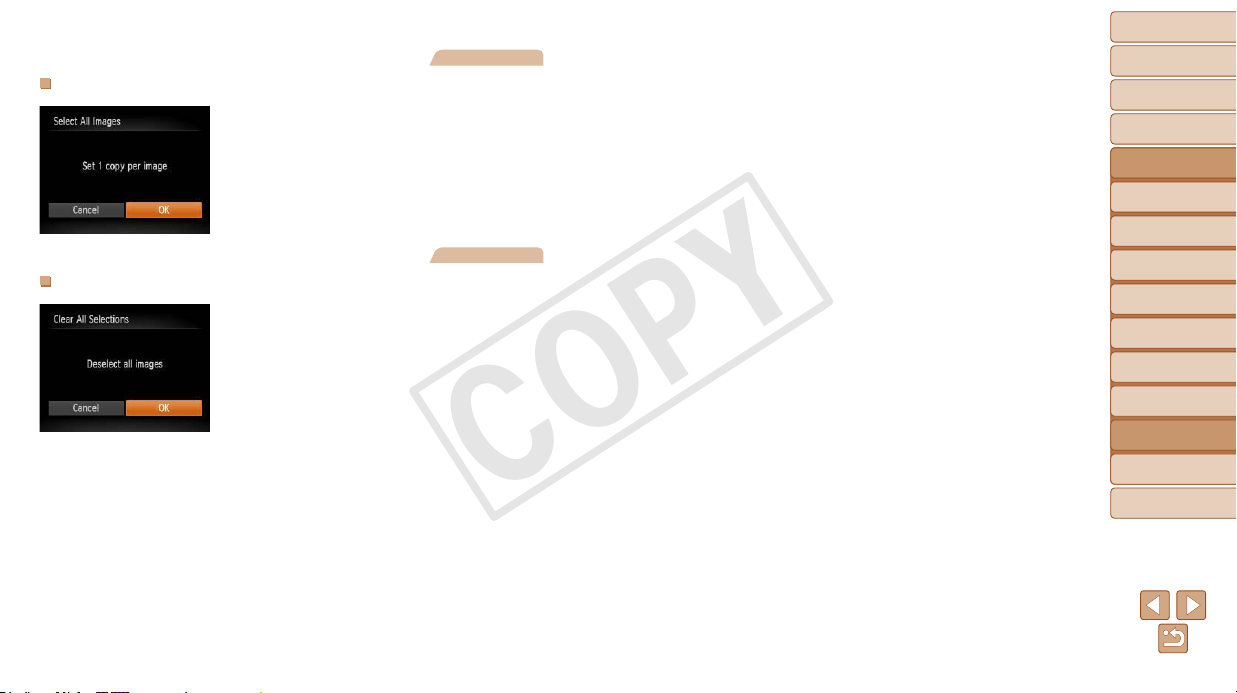
154
1
2
3
4
5
6
7
9
Preliminary Notes and
Legal Information
Contents: Basic
Operations
Camera Basics
Auto Mode/Hybrid
Auto Mode
Other Shooting
Modes
Playback Mode
Wi-Fi Functions
Setting Menu
Appendix
Index
Basic Guide
P Mode
Cover
Advanced Guide
8
Accessories
Still Images
Adding All Images to a Photobook
Following the procedure in “Choosing
a Selection Method” (=
153), choose
[Select All Images] and press the <m>
button.
Press the <q><r> buttons to choose
[OK], and then press the <m> button.
Still Images
Removing All Images from a Photobook
Following the procedure in “Choosing
a Selection Method” (=
153), choose
[Clear All Selections] and press the <m>
button.
Press the <q><r> buttons to choose
[OK], and then press the <m> button.
COPY

155
1
2
3
4
5
6
7
8
Preliminary Notes and
Legal Information
Contents: Basic
Operations
Camera Basics
Auto Mode/Hybrid
Auto Mode
Other Shooting
Modes
Playback Mode
Wi-Fi Functions
Setting Menu
Accessories
Index
Basic Guide
P Mode
Cover
Advanced Guide
9
Appendix
Appendix
Helpful information when using the camera
9
4
Troubleshooting .....................156
On-Screen Messages ............. 159
On-Screen Information ..........162
Functions and Menu Tables ..164
Handling Precautions ............170
Specications .........................171
COPY
156
1
2
3
4
5
6
7
8
Preliminary Notes and
Legal Information
Contents: Basic
Operations
Camera Basics
Auto Mode/Hybrid
Auto Mode
Other Shooting
Modes
Playback Mode
Wi-Fi Functions
Setting Menu
Accessories
Index
Basic Guide
P Mode
Cover
Advanced Guide
9
Appendix
Troubleshooting
If you think there is a problem with the camera, rst check the following.
If the items below do not solve your problem, contact a Canon Customer
Support Help Desk.
Power
Nothing happens when the power button is pressed.
• Conrm that the battery is charged (=
11).
• Conrm that the battery is inserted facing the correct way (=
12).
• Conrm that the memory card/battery cover is fully closed (=
13).
• Dirty battery terminals reduce battery performance. Try cleaning the terminals with a
cotton swab and reinserting the battery a few times.
The battery is depleted quickly.
• Battery performance decreases at low temperatures. Try warming the battery a little
by putting it in your pocket, for example, ensuring that the terminals do not touch any
metal objects.
• If these measures do not help and the battery is still depleted soon after charging, it
has reached the end of its life. Purchase a new battery.
The lens is not retracted.
• Do not open the memory card/battery cover while the camera is on. Close the cover,
turn the camera on, and then turn it off again (=
13).
The battery is swollen.
• Battery swelling is normal and does not pose any safety concerns. However, if battery
swelling prevents the battery from tting in the camera, contact a Canon Customer
Support Help Desk.
Display on a TV
Camera images look distorted or not displayed on a TV (=
145).
Shooting
Cannot shoot.
• In Playback mode (=
15), press the shutter button halfway (=
27).
Strange display on the screen under low light (=
27).
Strange display on the screen when shooting.
Note that the following display problems are not recorded in still images but are
recorded in movies.
• The screen may icker and horizontal banding may appear under uorescent or LED
lighting.
No date stamp is added to images.
• Congure the [Date Stamp ] setting (=
133). Note that date stamps are not
added to images automatically, merely because you have congured the [Date/Time]
setting (=
41).
• Date stamps are not added in shooting modes (=
168) in which this setting cannot
be congured (=
41).
[h]ashesonthescreenwhentheshutterbuttonispressed,and
shooting is not possible (=
35).
[ ] is displayed when the shutter button is pressed halfway (=
40).
• Set [IS Mode] to [Continuous] (=
82).
• Set the ash mode to [h] (=
80).
• Increase the ISO speed (=
71).
• Mount the camera on a tripod or take other measures to keep it still. In this case, you
should set [IS Mode] to [Off] (=
82).
Shots are out of focus.
• Press the shutter button halfway to focus on subjects before pressing it all the way
down to shoot (=
27).
• Make sure subjects are within focusing range (=
173).
• Set [AF-assist Beam] to [On] (=
51).
• Conrm that unneeded functions such as macro are deactivated.
• Try shooting with focus lock or AF lock (=
78, 79).
No AF frames are displayed and the camera does not focus when the
shutter button is pressed halfway.
• To have AF frames displayed and the camera focus correctly, try composing the
shot with higher-contrast subject areas centered before you press the shutter button
halfway. Otherwise, try pressing the shutter button halfway repeatedly.
COPY
157
1
2
3
4
5
6
7
8
Preliminary Notes and
Legal Information
Contents: Basic
Operations
Camera Basics
Auto Mode/Hybrid
Auto Mode
Other Shooting
Modes
Playback Mode
Wi-Fi Functions
Setting Menu
Accessories
Index
Basic Guide
P Mode
Cover
Advanced Guide
9
Appendix
Subjects in shots look too dark.
• Set the ash mode to [h] (=
80).
• Adjust brightness by using exposure compensation (=
69).
• Adjust contrast by using i-Contrast (=
71, 103).
• Use AE lock or spot metering (=
70).
Subjectslooktoobright,highlightsarewashed-out.
• Set the ash mode to [!] (=
40).
• Adjust brightness by using exposure compensation (=
69).
• Use AE lock or spot metering (=
70).
• Reduce the lighting on subjects.
Shotslooktoodarkdespitetheashring(=
35).
• Shoot within ash range (=
172).
• Increase the ISO speed (=
71).
Subjectsinashshotslooktoobright,highlightsarewashed-out.
• Shoot within ash range (=
172).
• Set the ash mode to [!] (=
40).
Whitedotsorsimilarimageartifactsappearinashshots.
• This is caused by light from the ash reecting off dust or airborne particles.
Shots look grainy.
• Lower the ISO speed (=
71).
• High ISO speeds in some shooting modes may cause grainy images (=
56).
Subjects are affected by red-eye (=
48).
• Set [Red-Eye Lamp] to [On] (=
52) to activate the red-eye reduction lamp
(=
4) in ash shots. Note that while the red-eye reduction lamp is on (for about
one second), it is not possible to shoot, because the lamp is counteracting red-eye.
For best results, have subjects look at the red-eye reduction lamp. Also try increasing
the lighting in indoor scenes and shooting at closer range.
• Edit images using red-eye correction (=
103).
Recordingtothememorycardtakestoolong,orcontinuousshooting
is slower.
• Use the camera to perform low-level formatting of the memory card (=
137).
Shooting settings or FUNC. menu settings are not available.
• Available setting items vary by shooting mode. Refer to “Functions Available in Each
Shooting Mode”, “FUNC. Menu”, and “Shooting Menu” (=
164 – 167).
The Babies or Children icon does not display.
• The Babies and Children icons will not display if the birthday is not set in face
information (=
42). If the icons still do not display even when you set the birthday,
re-register face information (=
42), or make sure that the date/time are set
correctly (=
133).
Shooting Movies
Theelapsedtimeshownisincorrect,orrecordingisinterrupted.
• Use the camera to format the memory card, or switch to a card that supports high-
speed recording. Note that even if the elapsed time display is incorrect, the length
of movies on the memory card corresponds to the actual recording time (=
136,
172).
[ ] is displayed and shooting stops automatically.
The camera’s internal memory buffer lled up as the camera could not record to the
memory card quickly enough. Try one of the following measures.
• Use the camera to perform low-level formatting of the memory card (=
137).
• Lower the image quality (=
49).
• Switch to a memory card that supports high-speed recording (=
172).
Zooming is not possible.
• Zooming is not possible when shooting movies in [ ] (=
58) and [ ] (=
67)
modes.
Subjects look distorted.
• Subjects that pass in front of the camera quickly may look distorted. This is not a
malfunction.
COPY

158
1
2
3
4
5
6
7
8
Preliminary Notes and
Legal Information
Contents: Basic
Operations
Camera Basics
Auto Mode/Hybrid
Auto Mode
Other Shooting
Modes
Playback Mode
Wi-Fi Functions
Setting Menu
Accessories
Index
Basic Guide
P Mode
Cover
Advanced Guide
9
Appendix
Playback
Playback is not possible.
• Image or movie playback may not be possible if a computer is used to rename les or
alter the folder structure. Refer to the Software Guide (=
19) for details on folder
structure and le names.
Playbackstops,oraudioskips.
• Switch to a memory card that you have performed low-level formatting on with the
camera (=
137).
• There may be brief interruptions when playing movies copied to memory cards that
have slow read speeds.
• When movies are played on a computer, frames may be dropped and audio may skip
if computer performance is inadequate.
Sound is not played during movies.
• Adjust the volume (=
84) if you have activated [Mute] (=
133) or the sound in
the movie is faint.
• No sound is played for movies shot in [
] (=
58) or [ ] (=
67) mode
because audio is not recorded in these modes.
Memory Card
The memory card is not recognized.
• Restart the camera, with the memory card in it (=
12).
Computer
Cannot transfer images to a computer.
When attempting to transfer images to the computer via a cable, try reducing the
transfer speed as follows.
• Press the <1> button to enter Playback mode. Hold the <n> button down as
you press the <o> and <
m
> buttons at the same time. On the next screen, press
the <q><r> buttons to choose [B], and then press the <m> button.
Wi-Fi
Cannot access the Wi-Fi menu by pressing the <o> button.
• The Wi-Fi menu is not available in Shooting mode. Switch to Playback mode and try
again.
• In Playback mode, the Wi-Fi menu cannot be accessed during detailed information
display, magnied display, or index display. Switch to single-image display and a
viewing mode other than detailed information display. Similarly, the Wi-Fi menu
cannot be accessed during ltered image display according to specied conditions.
Cancel the playback state of the image in image search mode.
• The Wi-Fi menu cannot be accessed while the camera is connected to a printer,
computer, or TV via a cable. Disconnect the cable.
Cannot add a device/destination.
• A total of 20 items of connection information can be added to the camera. Erase
unneeded connection information from the camera rst, and then add new devices/
destinations (=
129).
• To add Web services to send images to, install CameraWindow and complete the
settings in CameraWindow (=
112).
• To add a smartphone as a device, rst install the dedicated application
CameraWindow on your smartphone.
• To add a computer as a device, rst install the included software CameraWindow
on the computer. Also check your computer and Wi-Fi environment and settings
(=
118, 120).
• Do not use the camera near sources of Wi-Fi signal interference, such as microwave
ovens, Bluetooth devices, or other equipment operating on the 2.4 GHz band.
• Bring the camera closer to the other device you are trying to connect to (such as the
access point), and make sure there are no objects between the devices.
Cannot send images.
• The destination device has insufcient storage space. Increase the storage space on
the destination device and resend the images.
• The write-protect tab of the memory card in the destination camera is set to the
locked position. Slide the write-protect tab to the unlocked position.
COPY
159
1
2
3
4
5
6
7
8
Preliminary Notes and
Legal Information
Contents: Basic
Operations
Camera Basics
Auto Mode/Hybrid
Auto Mode
Other Shooting
Modes
Playback Mode
Wi-Fi Functions
Setting Menu
Accessories
Index
Basic Guide
P Mode
Cover
Advanced Guide
9
Appendix
Cannot resize images for sending.
• Images cannot be resized to be bigger than the resolution setting of their original size.
• Movies cannot be resized.
Images take a long time to send./The Wi-Fi connection is disrupted.
• Multiple images may take a long time to send. Try resizing the image to [ ] or [ ]
to reduce sending time (=
126).
• Movies may take a long time to send.
• Do not use the camera near sources of Wi-Fi signal interference, such as microwave
ovens, Bluetooth devices, or other equipment operating on the 2.4 GHz band. Note
that images may take a long time to send even when [
] is displayed.
• Bring the camera closer to the other device you are trying to connect to (such as the
access point), and make sure there are no objects between the devices.
• When sending images to a computer from a memory card with a large amount
of images (approximately 1,000), the connection may be disrupted. Import any
necessary images to a computer, and then reduce the number of images on the
memory card by erasing unnecessary images.
Want to erase Wi-Fi connection information before disposing of the
camera or giving it to someone else.
• Reset the Wi-Fi settings (=
131).
On-Screen Messages
If an error message is displayed, respond as follows.
No memory card
• The memory card may be inserted facing the wrong way. Reinsert the memory card
facing the correct way (=
13).
Memory card locked
• The write-protect tab of the memory card is set to the locked position. Switch the
write-protect tab to the unlocked position (=
12).
Cannot record!
• Shooting was attempted without a memory card in the camera. To shoot, insert a
memory card facing the correct way (=
13).
Memory card error (=
137)
• If the same error message is displayed even after you have formatted a supported
memory card (=
2) and have inserted it facing the correct way, contact a Canon
Customer Support Help Desk (=
13).
Insufcientspaceoncard
• There is not enough free space on the memory card to shoot (=
31, 54, 68)
or edit images (=
100 – 103). Either erase unneeded images (=
96) or insert a
memory card with enough free space (=
12).
Charge the battery (=
11)
No Image.
• The memory card does not contain any images that can be displayed.
Protected! (=
93)
UnidentiedImage/IncompatibleJPEG/Imagetoolarge./Cannotplay
back MOV/Cannot play back MP4
• Unsupported or corrupt images cannot be displayed.
• It may not be possible to display images that were edited or renamed on a computer,
or images shot with another camera.
COPY

160
1
2
3
4
5
6
7
8
Preliminary Notes and
Legal Information
Contents: Basic
Operations
Camera Basics
Auto Mode/Hybrid
Auto Mode
Other Shooting
Modes
Playback Mode
Wi-Fi Functions
Setting Menu
Accessories
Index
Basic Guide
P Mode
Cover
Advanced Guide
9
Appendix
Cannotmagnify!/CannotplaybackthiscontentinSmartShufe/
Cannot rotate/Cannot modify image/Cannot modify/Cannot assign to
category/Unselectableimage./Noidenticationinformation
• The following functions may be unavailable for images that were renamed or already
edited on a computer, or images shot with another camera. Note that starred (*)
functions are not available for movies.
Magnify* (=
91), Smart Shufe* (=
92), Rotate (=
98), Edit* (=
100 –
103), Print List* (=
150), Photobook Set-up* (=
153), and Edit ID Info* (=
90).
• Grouped images cannot be processed (=
66).
Invalid selection range
• When specifying a range for image selection (=
94, 97), you attempted to
choose an initial image that was after the nal image, or vice-versa.
Exceededselectionlimit
• More than 998 images were selected for Print List (=
150) or Photobook Set-up
(=
153). Choose 998 images or less.
• Print List (=
150) or Photobook Set-up (=
153) settings could not be saved
correctly. Reduce the number of selected images and try again.
• You attempted to choose more than 500 images in Protect (=
93), Erase
(=
96), Favorites (=
99), Print List (=
150), or Photobook Set-up (=
153).
Communication error
• An excessive amount of images (approx. 1,000) on the memory card prevented
printing or image transfer to a computer. To transfer the images, use a commercially
available USB card reader. To print, insert the memory card directly into the printer
card slot.
Naming error!
• The folder could not be created or images could not be recorded, because the highest
supported folder number (999) for storing images on the card has been reached and
the highest supported image number (9999) for images in folders has been reached.
In the [3] menu, change [File Numbering] to [Auto Reset] (=
137), or format the
memory card (=
136).
LensError
• This error may occur if the lens is held while it is moving, or when the camera is used
in dusty or sandy locations.
• Frequent display of this error message may indicate camera damage. In this case,
contact a Canon Customer Support Help Desk.
A camera error was detected (error number)
• If this error message is displayed immediately after a shot, the image may not have
been saved. Switch to Playback mode to check for the image.
• Frequent display of this error message may indicate camera damage. In this case,
write down the error number (Exx) and contact a Canon Customer Support Help
Desk.
FileError
• Correct printing (=
146) may not be possible for photos from other cameras or
images that have been altered using computer software, even if the camera is
connected to the printer.
Print error
• Check the paper size setting (=
148). If this error message is displayed when the
setting is correct, restart the printer and complete the setting on the camera again.
Ink absorber full
• Contact a Canon Customer Support Help Desk to request assistance with ink
absorber replacement.
COPY

161
1
2
3
4
5
6
7
8
Preliminary Notes and
Legal Information
Contents: Basic
Operations
Camera Basics
Auto Mode/Hybrid
Auto Mode
Other Shooting
Modes
Playback Mode
Wi-Fi Functions
Setting Menu
Accessories
Index
Basic Guide
P Mode
Cover
Advanced Guide
9
Appendix
Wi-Fi
Connection failed
• No access points were recognized. Check the access point settings (=
120).
• A device could not be found. Turn the camera off and on again, and retry the
connection.
• Check the device you want to connect to and make sure it is ready for connection.
Cannot determine access point
• The WPS buttons on numerous access points were pressed simultaneously. Try
reconnecting again.
No access points found
• Check to make sure that the access point is turned on.
• When connecting to an access point manually, make sure that you entered the
correct SSID.
Incorrect Wi-Fi encryption key/Incorrect Wi-Fi security settings
• Check the access point security settings (=
119).
IPaddressconict
• Reset the IP address so that it does not conict with another.
Disconnected/Receiving failed/Sending failed
• You may be in an environment where Wi-Fi signals are obstructed.
• Avoid using the camera’s Wi-Fi function around microwave ovens, Bluetooth devices,
and other devices that operate on the 2.4 GHz band.
• Bring the camera closer to the other device you are trying to connect to (such as the
access point), and make sure there are no objects between the devices.
• Check the connected device to make sure it is not experiencing errors.
Sending failed
Memory card error
• If the same error message is displayed even when you have inserted a formatted
memory card facing the correct way, contact a Canon Customer Support Help Desk.
Receiving failed
Insufcientspaceoncard
• There is not enough free space on the memory card to receive images. Erase images
to create space on the memory card, or insert a memory card with sufcient space.
Receiving failed
Memory card locked
• The write-protect tab of the memory card in the camera to receive the images is set to
the locked position. Slide the write-protect tab to the unlocked position.
Receiving failed
Naming error!
• When the highest folder number (999), and the highest image number (9999) have
been reached on the receiving camera, images cannot be received.
Insufcientspaceonserver
• Delete unnecessary images uploaded to CANON iMAGE GATEWAY to create space.
• Save the images sent via a server (=
128) on your computer.
SSLcerticatenotvalid
Connecttoacomputer,usethesuppliedsoftwaretoreset
• Check to make sure the date/time settings on the camera are correct. After conrming
that the settings are correct, follow the on-screen instructions and reset the settings.
Check network settings
• Check to make sure your computer can connect to the Internet with the current
network settings.
COPY
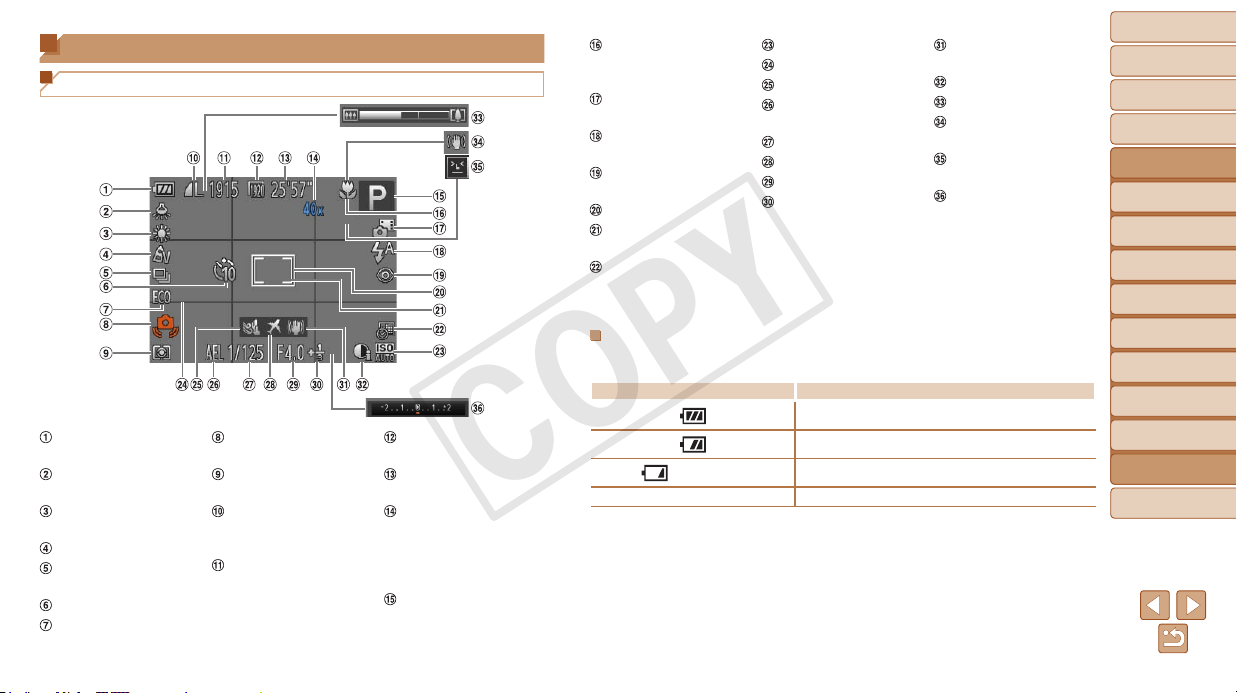
162
1
2
3
4
5
6
7
8
Preliminary Notes and
Legal Information
Contents: Basic
Operations
Camera Basics
Auto Mode/Hybrid
Auto Mode
Other Shooting
Modes
Playback Mode
Wi-Fi Functions
Setting Menu
Accessories
Index
Basic Guide
P Mode
Cover
Advanced Guide
9
Appendix
On-Screen Information
Shooting (Information Display)
Battery level
(=
162)
Mercury lamp
correction (=
48)
White balance
(=
72)
My Colors (=
73)
Drive mode
(=
74)
Self-timer (=
39)
Eco mode (=
135)
Camera shake
warning (=
35)
Metering method
(=
70)
Compression (image
quality) (=
81) /
Resolution (=
47)
Recordable shots
(=
172)
Movie resolution
(=
49)
Remaining time
(=
172)
Digital zoom
magnication
(=
38), Digital
tele-converter
(=
75)
Shooting mode
(=
164), Scene
icon (=
36)
Focusing range
(=
74), AF lock
(=
79)
Hybrid Auto
(=
34)
Flash mode
(=
40, 80)
Red-eye correction
(=
48)
AF frame (=
76)
Spot AE point frame
(=
70)
Date stamp
(=
41)
ISO speed (=
71)
Grid lines (=
50)
Wind lter (=
49)
AE lock (=
70),
FE lock (=
81)
Shutter speed
Time zone (=
134)
Aperture value
Exposure
compensation level
(=
69)
Image stabilization
(=
82)
i-Contrast (=
71)
Zoom bar (=
32)
IS mode icon
(=
37)
Blink detection
(=
51)
Exposure
compensation bar
(=
69)
Battery Level
An on-screen icon or message indicates the battery charge level.
Display Details
Sufcient charge
Slightly depleted, but sufcient
(Blinking red)
Nearly depleted—charge the battery soon
[Charge the battery] Depleted—charge the battery immediately
COPY
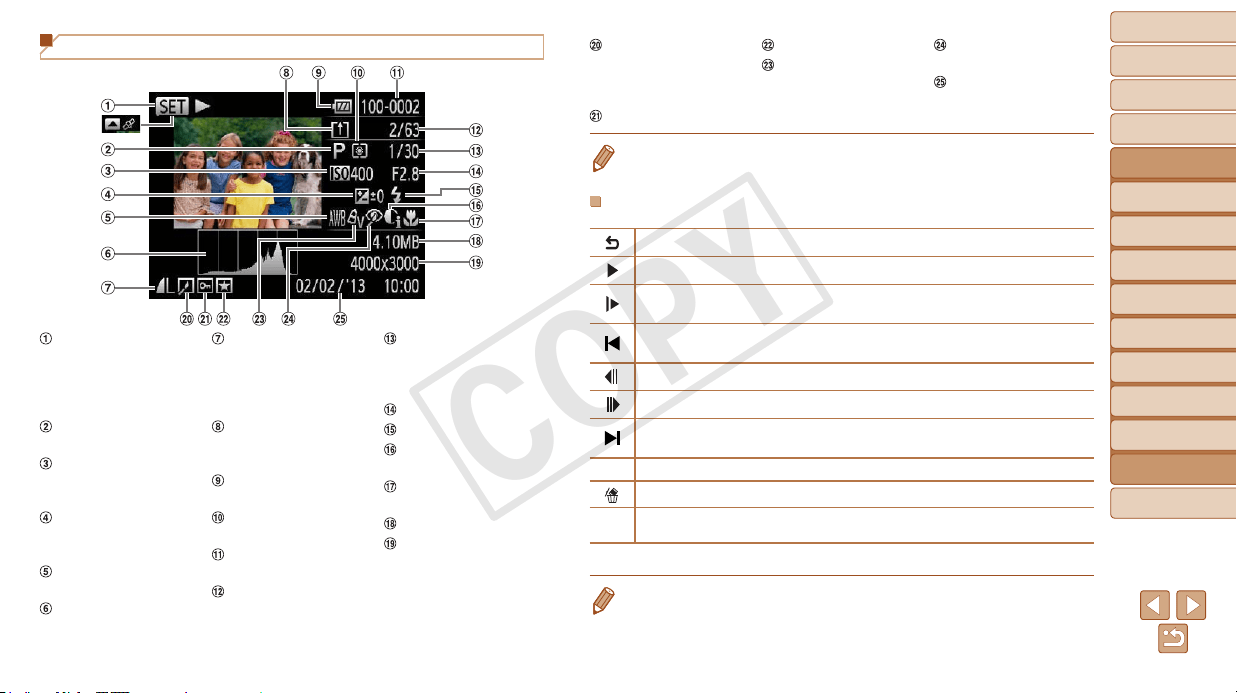
163
1
2
3
4
5
6
7
8
Preliminary Notes and
Legal Information
Contents: Basic
Operations
Camera Basics
Auto Mode/Hybrid
Auto Mode
Other Shooting
Modes
Playback Mode
Wi-Fi Functions
Setting Menu
Accessories
Index
Basic Guide
P Mode
Cover
Advanced Guide
9
Appendix
Playback (Detailed Information Display)
Movies (=
32,
84), High-speed
burst (=
65),
GPS information
display (=
85)
Shooting mode
(=
164)
ISO speed
(=
71), Playback
speed (=
58)
Exposure
compensation level
(=
69)
White balance
(=
72)
Histogram (=
85)
Compression (image
quality) (=
81) /
Resolution (=
47,
49), MOV
(movies)
Images have been
saved on a computer
(=
128)
Battery level
(=
162)
Metering method
(=
70)
Folder number - File
number (=
137)
Current image no. /
Total no. of images
Shutter speed (still
images), Image
quality / Frame rate
(movies) (=
49)
Aperture value
Flash (=
80)
i-Contrast (=
71,
103)
Focusing range
(=
74)
File size
Still images:
Resolution (=
172)
Movies: Playback
time (=
172)
Group playback
(=
89), Image
editing (=
100 –
103)
Protection (=
93)
Favorites (=
99)
My Colors (=
73,
102), Mercury lamp
correction (=
48)
Red-eye correction
(=
48, 103)
Shooting date/time
(=
14)
• Some information may not be displayed when viewing images on a TV
(=
142).
Summary of Movie Control Panel in “Viewing” (=
84)
Exit
Play
Slow Motion (Press the <q><r> buttons to adjust the playback speed. No
sound is played.)
Skip Backward* or Previous Clip (=
34) (To continue skipping backward,
keep holding down the <m> button.)
Previous Frame (For fast-rewind, keep holding down the <m> button.)
Next Frame (For fast-forward, keep holding down the <m> button.)
Skip Forward* or Next Clip (=
34) (To continue skipping forward, keep
holding down the <m> button.)
* Edit (=
104)
Erase Clip (displayed when a digest movie is selected (=
105))
c
Shown when the camera is connected to a PictBridge-compatible printer
(=
146).
* Displays the frame approx. 4 sec. before or after the current frame.
• During movie playback, you can skip back or forward (or to the previous or
next chapter) by pressing the <q><r> buttons.
COPY
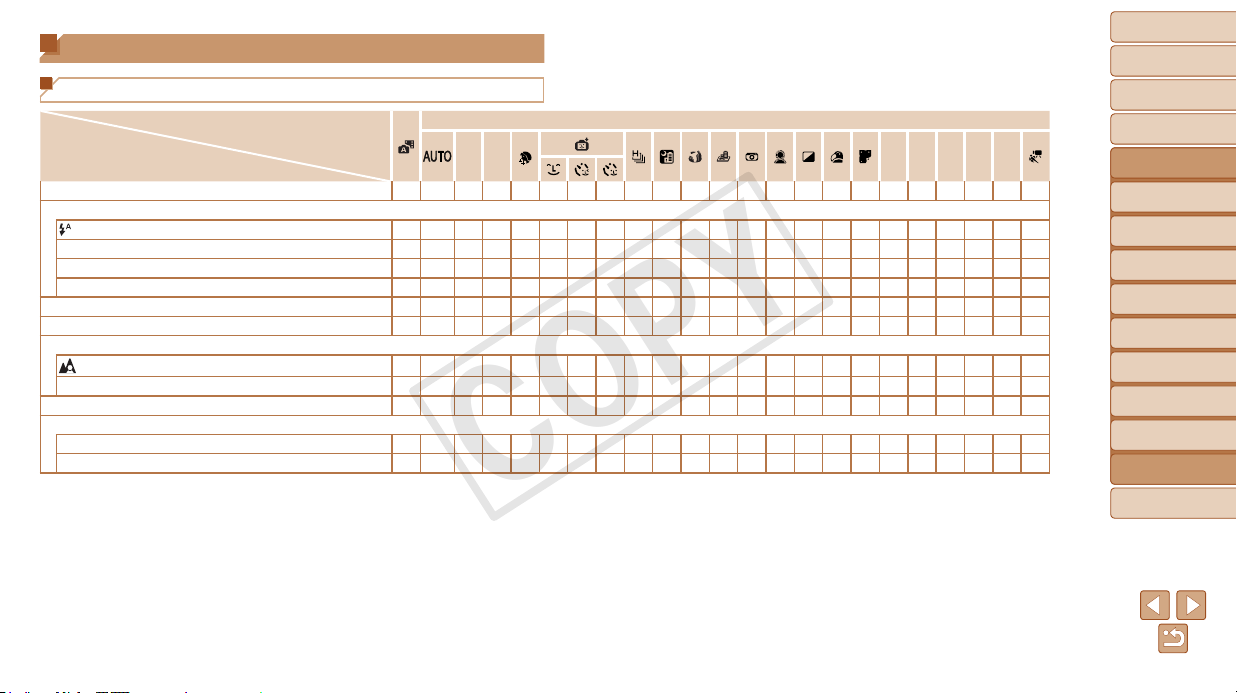
164
1
2
3
4
5
6
7
8
Preliminary Notes and
Legal Information
Contents: Basic
Operations
Camera Basics
Auto Mode/Hybrid
Auto Mode
Other Shooting
Modes
Playback Mode
Wi-Fi Functions
Setting Menu
Accessories
Index
Basic Guide
P Mode
Cover
Advanced Guide
9
Appendix
Functions and Menu Tables
Functions Available in Each Shooting Mode
Shooting Mode
Function
4
G I
T
Y
P t N
x
v
Exposure Compensation (=
69)
– –
O O O O O O O O O O O O O O
– –
O O
–
O
–
Flash (=
40, 80)
O O O O O O O O
–
O O O O O O O O O O
– – – –
h
– –
O O O O O O
–
O O O O O O O O O O
–
O O
–
Z
*1 *1
O
– – – – – –
*1
– – – – – – – – – – –
O
–
!
O O O O O O O O O O O O O O O O O O O O O O O
AE Lock/FE Lock (=
70, 81)*
2
– –
O
– – – – – – – – – – – – – – – – – – – –
AF Lock (=
79)
– –
O
– – – – – – – – – – – – – – – – –
O
– –
Focusing Range (=
74)
O O O O O O O O O O O O O O O O O O O O O O O
e u
– –
O O O
– – –
O O O O O O O O O O O
–
O O O
Tracking AF (=
77)
– –
O O
– – – –
O
– – – – –
O O O O O
–
O
– –
Screen Display (=
27)
No Information Display
O O O O
– – – –
O O
– – – – –
O O
–
O O O
–
O
Information Display
O O O O O O O O O O O O O O O O O O O O O O O
*1 Not available, but switches to [Z] in some cases.
*2 FE lock not available in [!] ash mode.
O
Available or set automatically.
–
Not available.
COPY
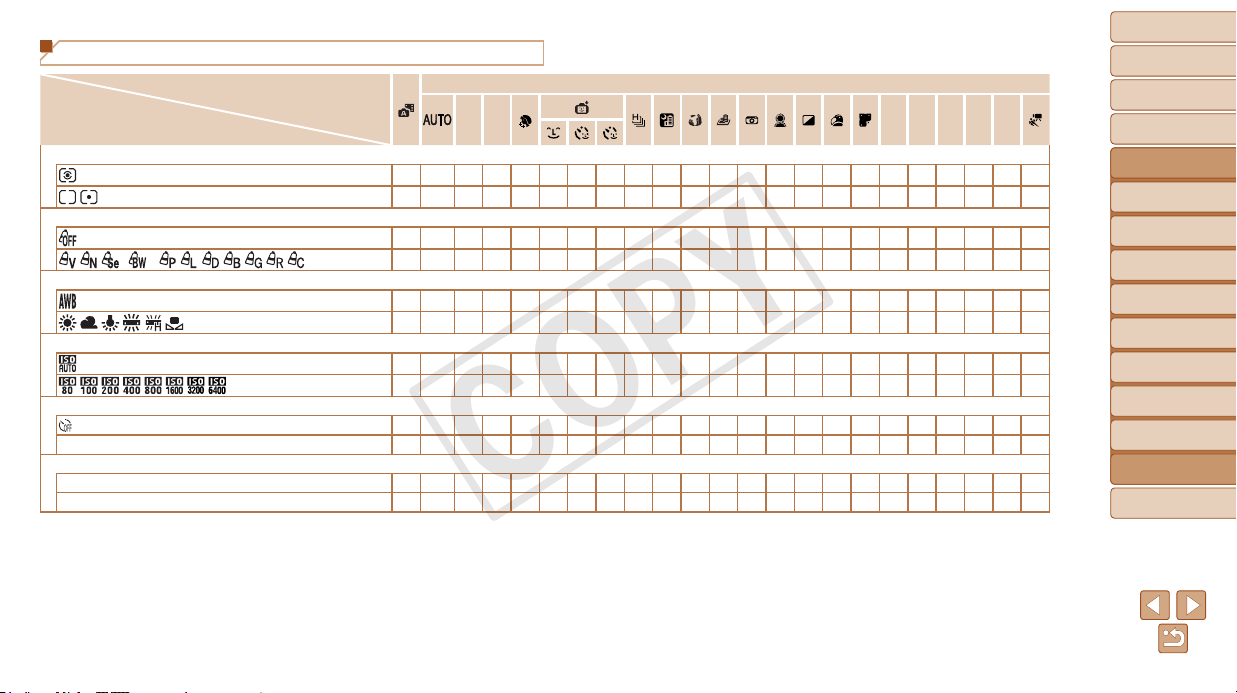
165
1
2
3
4
5
6
7
8
Preliminary Notes and
Legal Information
Contents: Basic
Operations
Camera Basics
Auto Mode/Hybrid
Auto Mode
Other Shooting
Modes
Playback Mode
Wi-Fi Functions
Setting Menu
Accessories
Index
Basic Guide
P Mode
Cover
Advanced Guide
9
Appendix
FUNC. Menu
Shooting Mode
Function
4
G I
T
Y
P t N
x
v
Metering Method (=
70)
O O O O O O O O O O O O O O O O O O O O O O O
– –
O
– – – – – – – – – – – – – – – – – – – –
My Colors (=
73)
O O O O O O O O O O O O O O O O O O O O O O O
*
1
*
1
*
2
– –
O
– –
O O O
– – – – – – – – – – – –
O O
–
White Balance (=
72)
O O O O O O O O O O O O O O O O O O O O O O O
*
3
– –
O
– –
O O O O
– – – – – – – – – – –
O O
–
ISO Speed (=
71)
O O O O O O O O O O O O O O O O O O O O O O O
– –
O
– – – – – – – – – – – – – – – – – – – –
Self-Timer (=
39)
O O O O O O O O O O O O O O O O O O O O O O O
] [ $
O O O O O
– – – –
O O O O O O O O O O O O O O
Self-Timer Settings (=
40)
Delay*
4
O O O O O
– – – –
O O O O O O O O O O O O O O
Shots*
5
–
O O O O
– – – –
O O O O O O O O O O O O
– –
*1 White balance is not available.
*2 Set in a range of 1 – 5: contrast, sharpness, color saturation, red, green, blue, and skin
tone.
*3 Not available in [x] or [v].
*4 Cannot be set to 0 seconds in modes without selection of the number of shots.
*5 One shot (cannot be modied) in modes without selection of the number of shots.
O
Available or set automatically.
–
Not available.
COPY

166
1
2
3
4
5
6
7
8
Preliminary Notes and
Legal Information
Contents: Basic
Operations
Camera Basics
Auto Mode/Hybrid
Auto Mode
Other Shooting
Modes
Playback Mode
Wi-Fi Functions
Setting Menu
Accessories
Index
Basic Guide
P Mode
Cover
Advanced Guide
9
Appendix
Shooting Mode
Function
4
G I
T
Y
P t N
x
v
Drive Mode (=
74)
O O O O O O O O
–
O O O O O O O O O O O O O O
–
O
– – – – – – – – – – – – – – – – – – – – –
– –
O O O
– – –
O
–
O O O O O O O O O O
– – –
Still Image Aspect Ratio (=
47)
–
O O O
–
O O O
– – –
*6
– –
O O O O O O O
– –
Resolution (=
47)
O O O O O O O O
–
O O O O O O O O O O O O O O
O O O O
–
O O O
– – – – – – – – – –
O O O O O
– – – – – – – –
O
– – – – – – – – – – – – – –
O O O O
–
O O O
– – – – – – – – – –
O O O O O
Compression (=
81)
– –
O
– – – – – – – – – – – – – – – – – – – –
O O O O O O O O O O O O O O O O O O O O O O O
Movie Quality (=
49)
O O O O O O O O O O O
–
O O O O O O O O O O
–
O O O O O O O O O O O
*7
O O O O O O O O O O
–
– – – – – – – – – – – – – – – – – – – – – –
O
*6 Only [ ] and [ ] are available.
*7 Synchronizes with the aspect ratio setting and is automatically set (=
58).
O
Available or set automatically.
–
Not available.
COPY

167
1
2
3
4
5
6
7
8
Preliminary Notes and
Legal Information
Contents: Basic
Operations
Camera Basics
Auto Mode/Hybrid
Auto Mode
Other Shooting
Modes
Playback Mode
Wi-Fi Functions
Setting Menu
Accessories
Index
Basic Guide
P Mode
Cover
Advanced Guide
9
Appendix
4 Shooting Menu
Shooting Mode
Function
4
G I
T
Y
P t N
x
v
AF Frame (=
76)
Face AiAF*
1
O O O O O O O O O O
– –
O O O O O O O
–
O
–
O
Tracking AF
– –
O O
– – – –
O
– – – – –
O O O O O
–
O
– –
Center
– –
O O
– – – –
O
–
O
–
O O O O O O O O O O O
AF Frame Size (=
78)*
2
Normal
– –
O O
– – – –
O
–
O
–
O O O O O O O O O O O
Small
– –
O O
– – – –
O
– – –
O O O O O O O
–
O
–
O
Digital Zoom (=
38)
Standard
O O O O
–
O O O
– – – – – – – – – –
O O O
– –
Off
O O O O O O O O O O O O O O O O O O O O O O O
1.5x/2.0x
– –
O
– – – – – – – – – – – – – – – – – – – –
AF-Point Zoom (=
50)
On
–
O O O
–
O O O O
– – – – –
O O O O O
–
O
– –
Off
O O O O O O O O O O O O O O O O O O O O O O O
Servo AF (=
78)
On
– –
O O
– – – – – – – – – –
O O O O O
– – – –
Off*
3
O O O O O O O O O O O O O O O O O O O O O O O
Continuous AF (=
79)
On
O O O O O O O O O O O O O O O O O O O
–
O O O
Off
– –
O O O
– – – –
O O O O O O O O O O O O O
–
AF-assist Beam (=
51)
On
O O O O O O O O O O O O O O O O O O O
–
O O O
Off
O O O O O
–
O O O O O O O O O O O O O O O O O
Flash Settings (=
48, 52)
Red-Eye Corr.
On
O O O O
–
O O O
–
O
– – – – – – – –
O
–
O
– –
Off
O O O O O O O O
–
O O O O O O O O O O
–
O O
–
Red-Eye Lamp On/Off
O O O O O O O O
–
O O O O O O O O O O
–
O O
–
*1 Operation when no faces are detected varies by shooting mode.
*2 Available when the AF frame is set to [Center].
*3 [On] when subject movement is detected in [
] mode.
O
Available or set automatically.
–
Not available.
COPY
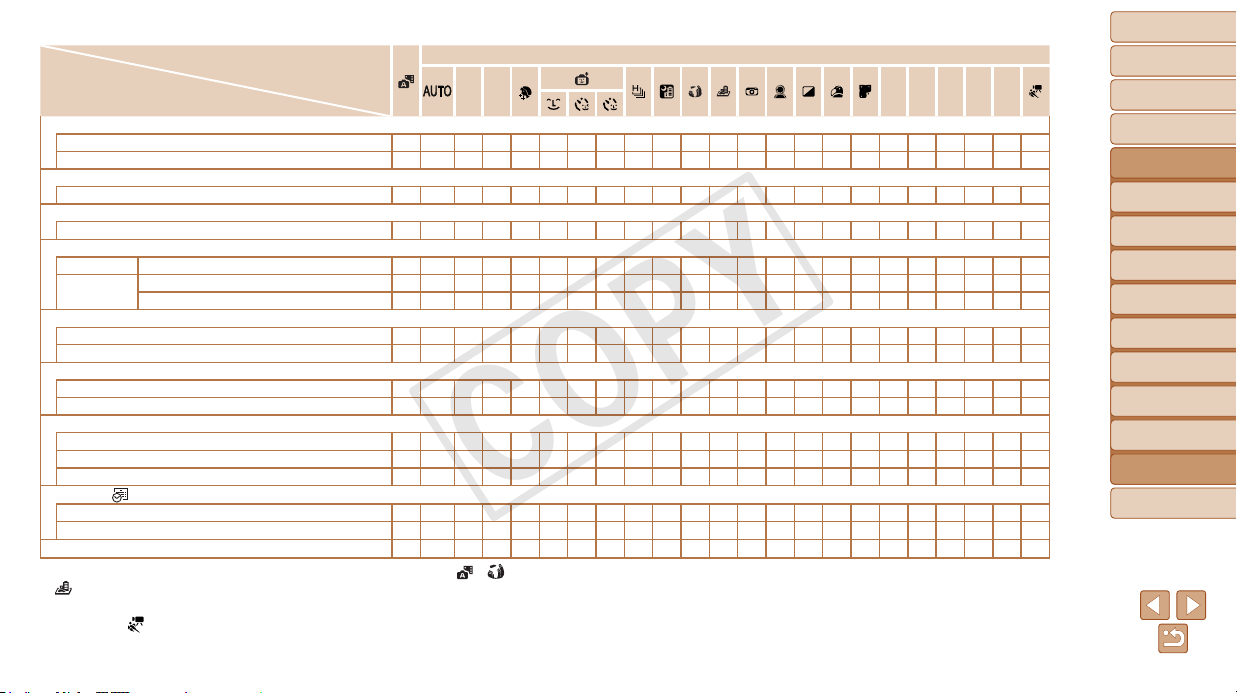
168
1
2
3
4
5
6
7
8
Preliminary Notes and
Legal Information
Contents: Basic
Operations
Camera Basics
Auto Mode/Hybrid
Auto Mode
Other Shooting
Modes
Playback Mode
Wi-Fi Functions
Setting Menu
Accessories
Index
Basic Guide
P Mode
Cover
Advanced Guide
9
Appendix
Shooting Mode
Function
4
G I
T
Y
P t N
x
v
i-Contrast (=
71)
Auto
O O O
– – – – –
O
– – – – – – – – – – – – – –
Off
– –
O O O O O O
–
O O O O O O O O O O O O O O
Hg Lamp Corr. (=
48)
On/Off
–
O
– – – – – – – – – – – – – – – – – – – – –
Wind Filter (=
49)
On/Off
O O O O O O O O O O O
–
O O O O O O O O O O
–
Review image after shooting (=
52)
Display Time Off/Quick/2 sec./4 sec./8 sec./Hold
O O O O O O O O O O O O O O O O O O O O O O
–
Display Info
Off
O O O O O O O O O O O O O O O O O O O O O O
–
Detailed
O O O O O O O O O O O O O O O O O O O O O
– –
Blink Detection (=
51)
On
O O O O O O O O
– – – – – – –
O O O O
– – – –
Off
O O O O O O O O O O O O O O O O O O O O O O O
Grid Lines (=
50)
On
O O O O O O O O O O O O O O O O O O O O O
–
O
Off
O O O O O O O O O O O O O O O O O O O O O O O
IS Mode (=
82)
Off
O O O O O O O O O
–
O O O O O O O O O O O O O
Continuous
O O O O O O O O O O O O O O O O O O O O O O O
Shoot Only
– –
O O O O O O O
–
O O O O O O O O O O O O
–
Date Stamp
(=
41)
Off
O O O O O O O O O O O O O O O O O O O O O O O
Date / Date & Time
O O O O
–
O O O
– – – – – – – – – –
O O O
– –
Face ID Settings (=
42)
O O O O O O O O O O O O O O O O O O O O O O O
• When using [Face ID] (=
42) to shoot, names will not be displayed in [ ], [ ],
[
], [x], or [v], but they will be recorded in still images.
• Setting available, but when using [Face ID] (=
42) to shoot, names will not be
displayed in [
], and they will not be recorded in movies.
O
Available or set automatically.
–
Not available.
COPY
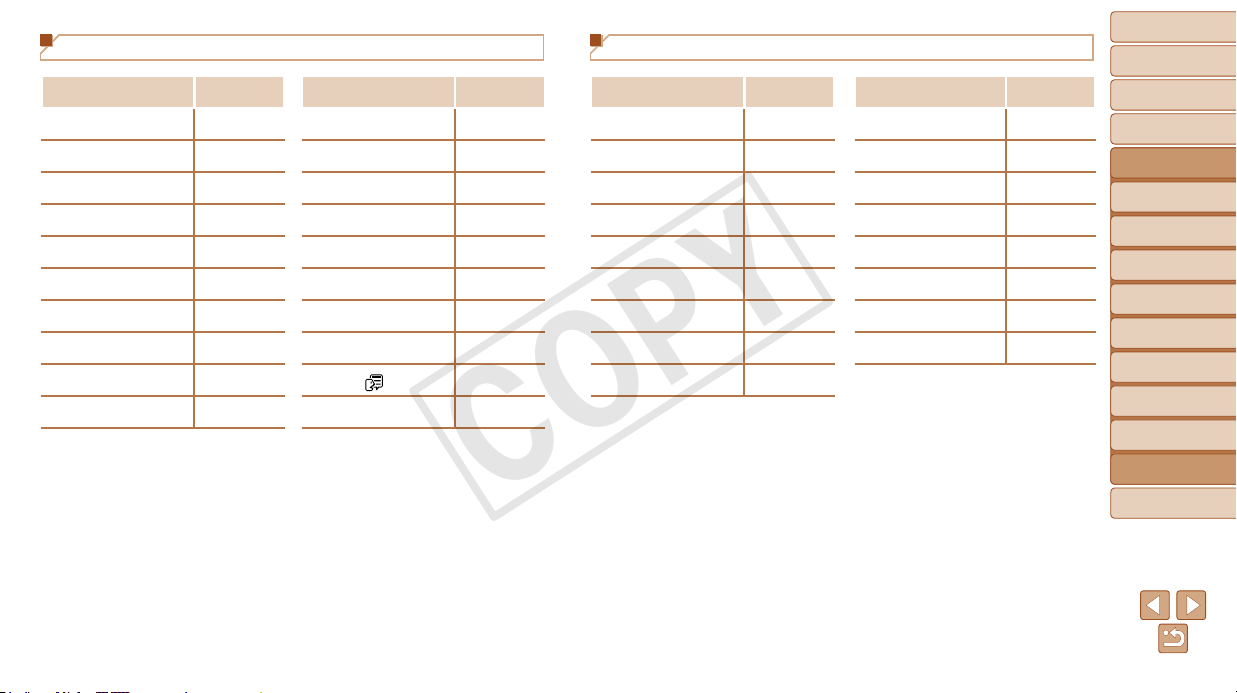
169
1
2
3
4
5
6
7
8
Preliminary Notes and
Legal Information
Contents: Basic
Operations
Camera Basics
Auto Mode/Hybrid
Auto Mode
Other Shooting
Modes
Playback Mode
Wi-Fi Functions
Setting Menu
Accessories
Index
Basic Guide
P Mode
Cover
Advanced Guide
9
Appendix
3 Set up Menu
Item Ref. Page Item Ref. Page
Mute
=
133
Format
=
136, 137
Volume
=
133
File Numbering
=
137
Hints & Tips
=
133
Create Folder
=
137
Date/Time
=
14
Units
=
138
Time Zone
=
134
Video System
=
145
Lens Retract
=
134
Ctrl via HDMI
=
143
Eco Mode
=
135
Wi-Fi Settings
=
106
Power Saving
=
26, 135
Certication Logo Display
=
138
LCD Brightness
=
136
Language
=
15
Start-up Image
= 136
Reset All
=
139
1 Playback Menu
Item Ref. Page Item Ref. Page
Slideshow
=
91
Resize
=
100
Erase
=
96
My Colors
=
102
Protect
=
93
Face ID Info
=
87
Rotate
=
98
Scroll Display
=
85
Favorites
=
99
Group Images
=
89
Photobook Set-up
=
153
Auto Rotate
=
99
i-Contrast
=
103
Resume
=
85
Red-Eye Correction
=
103
Transition
=
85
Cropping
=
101
COPY
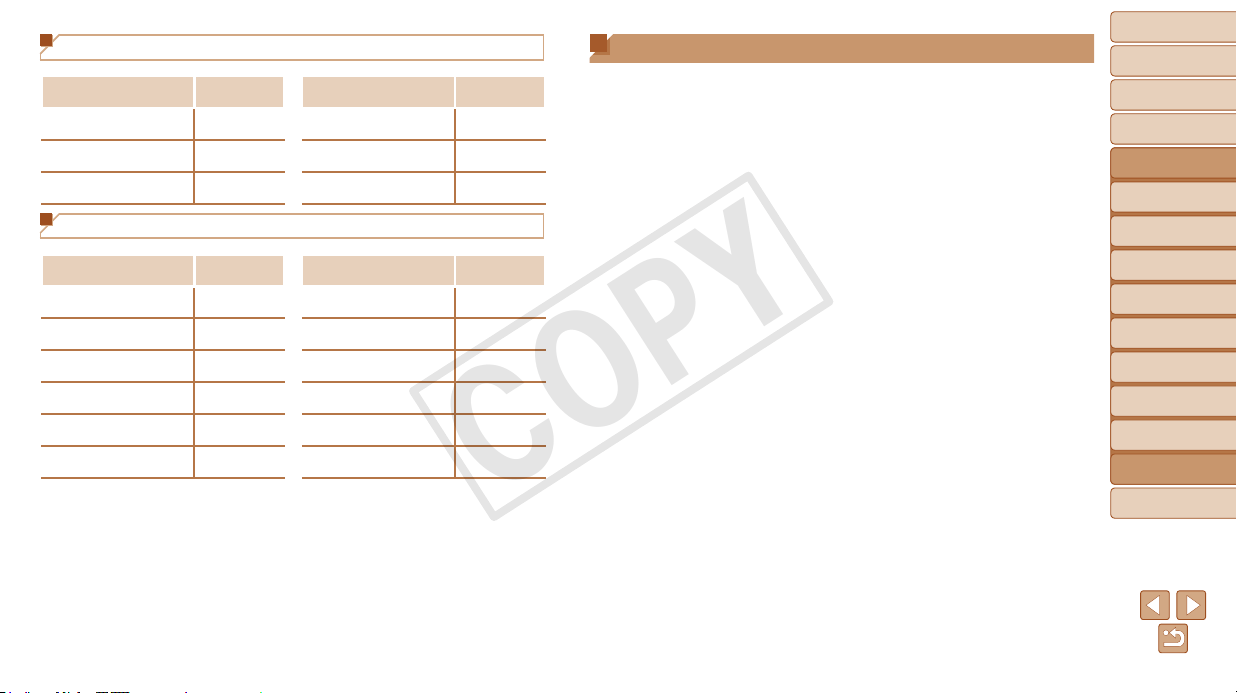
170
1
2
3
4
5
6
7
8
Preliminary Notes and
Legal Information
Contents: Basic
Operations
Camera Basics
Auto Mode/Hybrid
Auto Mode
Other Shooting
Modes
Playback Mode
Wi-Fi Functions
Setting Menu
Accessories
Index
Basic Guide
P Mode
Cover
Advanced Guide
9
Appendix
2 Print Menu
Item Ref. Page Item Ref. Page
Print
–
Select All Images
=
152
Select Images & Qty.
=
151
Clear All Selections
=
152
Select Range
=
152
Print Settings
=
150
Playback Mode FUNC. Menu
Item Ref. Page Item Ref. Page
Rotate
=
98
Group Playback
=
89
Protect
=
93
Play Linked Digest Movie
=
86
Favorites
=
99
List/Play Digest Movies
=
86
Erase
=
96
Smart Shufe
=
92
Print
=
146
Image Search
=
88
Play Movie
=
84
Slideshow
=
91
Handling Precautions
• The camera is a high-precision electronic device. Avoid dropping it or
subjecting it to strong impact.
• Never bring the camera near magnets, motors, or other devices that
generate strong electromagnetic elds, which may cause malfunction or
erase image data.
• If water droplets or dirt adheres to the camera or screen, wipe with a dry
soft cloth, such as an eyeglass cloth. Do not rub hard or apply force.
• Never use cleaners containing organic solvents to clean the camera or
screen.
• Use a blower brush to remove dust from the lens. If cleaning is difcult,
contact a Canon Customer Support Help Desk.
• To prevent condensation from forming on the camera after sudden
temperature changes (when the camera is transferred from cold to warm
environments), put the camera in an airtight, resealable plastic bag and
let it gradually adjust to the temperature before removing it from the bag.
• If condensation does form on the camera, stop using it immediately.
Continuing to use the camera in this state may damage it. Remove the
battery and memory card, and wait until the moisture has evaporated
before resuming use.
• Before long-term battery storage, use up the battery’s remaining charge,
remove it from the camera, and store it in a plastic bag or similar
container. Storing a partially charged battery over extended periods
(about a year) may shorten its life or affect performance.
COPY
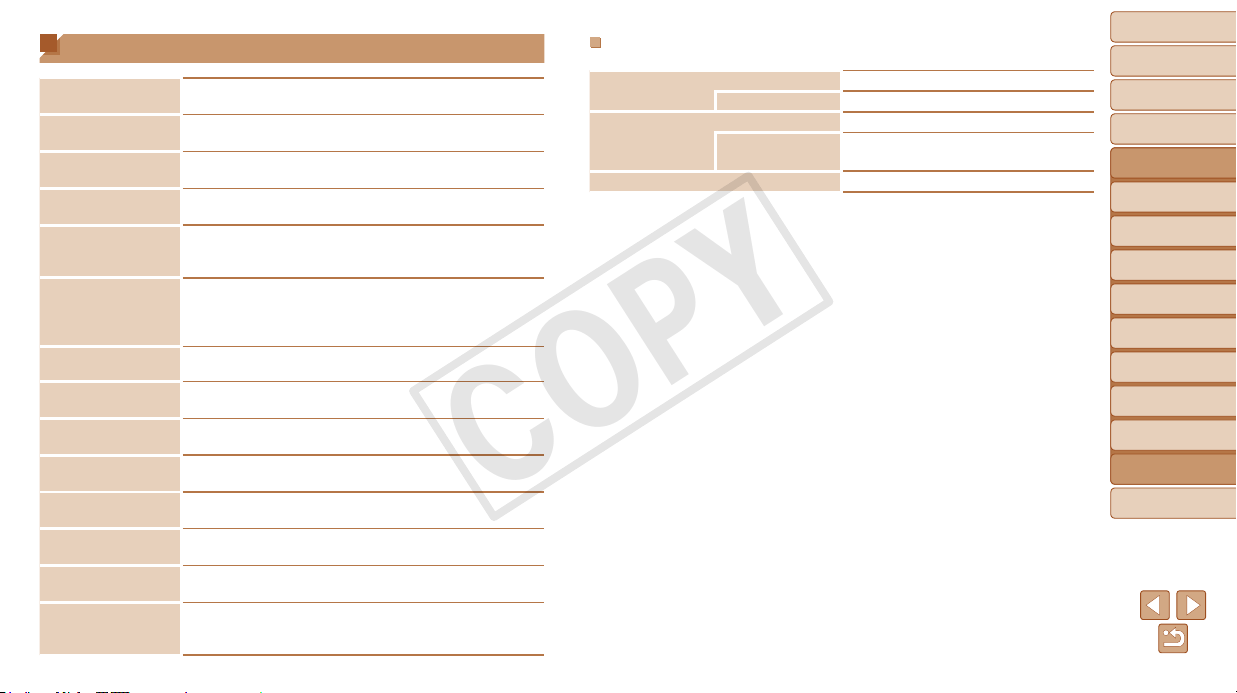
171
1
2
3
4
5
6
7
8
Preliminary Notes and
Legal Information
Contents: Basic
Operations
Camera Basics
Auto Mode/Hybrid
Auto Mode
Other Shooting
Modes
Playback Mode
Wi-Fi Functions
Setting Menu
Accessories
Index
Basic Guide
P Mode
Cover
Advanced Guide
9
Appendix
Specications
CameraEffective
Pixels (Max.)
Approx. 12.1 million pixels
Lens Focal Length
10x zoom: 4.3 (W) – 43.0 (T) mm
(35mm lm equivalent: 24 (W) – 240 (T) mm)
LCD Monitor
3.0 type color TFT LCD
Effective Pixels: Approx. 461,000 dots
File Format
Design rule for Camera File system, DPOF (version 1.1)
compliant
Data Type
Still Images: Exif 2.3 (JPEG)
Movies: MOV (Image data: H.264; Audio data: Linear PCM
(stereo))
Interface
Hi-speed USB
HDMI output
Analog audio output (stereo)
Analog video output (NTSC/PAL)
Wi-Fi Standards
IEEE802.11b/g/n*
* 2.4 GHz band only
Wi-Fi Transmission
Methods
OFDM modulation (IEEE 802.11g/n)
DSSS modulation (IEEE 802.11b)
Wi-Fi Communication
Modes
Infrastructure mode*, Ad hoc mode
* Supports Wi-Fi Protected Setup
Supported Wi-Fi
Channels
Power Shot ELPH 330 HS: 1 – 11
IXUS 255 HS: 1 – 13
Wi-Fi Security
WEP, WPA-PSK (AES/TKIP),
WPA2-PSK (AES/TKIP)
Power Source
Battery Pack NB-4L
AC Adapter Kit ACK-DC60
Dimensions (Based
on CIPA Guidelines)
97.2 x 56.4 x 22.5 mm (3.83 x 2.22 x 0.89 in.)
Weight (Based on
CIPA Guidelines)
Approx. 144 g (approx. 5.08 oz.; including the battery and
memory card)
Approx. 125 g (approx. 4.41 oz.; camera body only)
NumberofShots/RecordingTime,PlaybackTime
Number of Shots Approx. 220
inEcomode
Approx. 300
Movie Recording Time*
1
Approx.
45 minutes
Continuous
Shooting*
2
Approx. 1 hour, 20 minutes
Playback Time Approx. 4 hours
*1 Time under default camera settings, when normal operations are performed, such as
shooting, pausing, turning the camera on and off, and zooming.
*2 Time available when shooting the maximum movie length (until recording stops
automatically) repeatedly.
• The number of shots that can be taken is based on measurement guidelines of the
Camera & Imaging Products Association (CIPA).
• Under some shooting conditions, the number of shots and recording time may be less
than mentioned above.
• Number of shots/time with a fully charged battery.
COPY
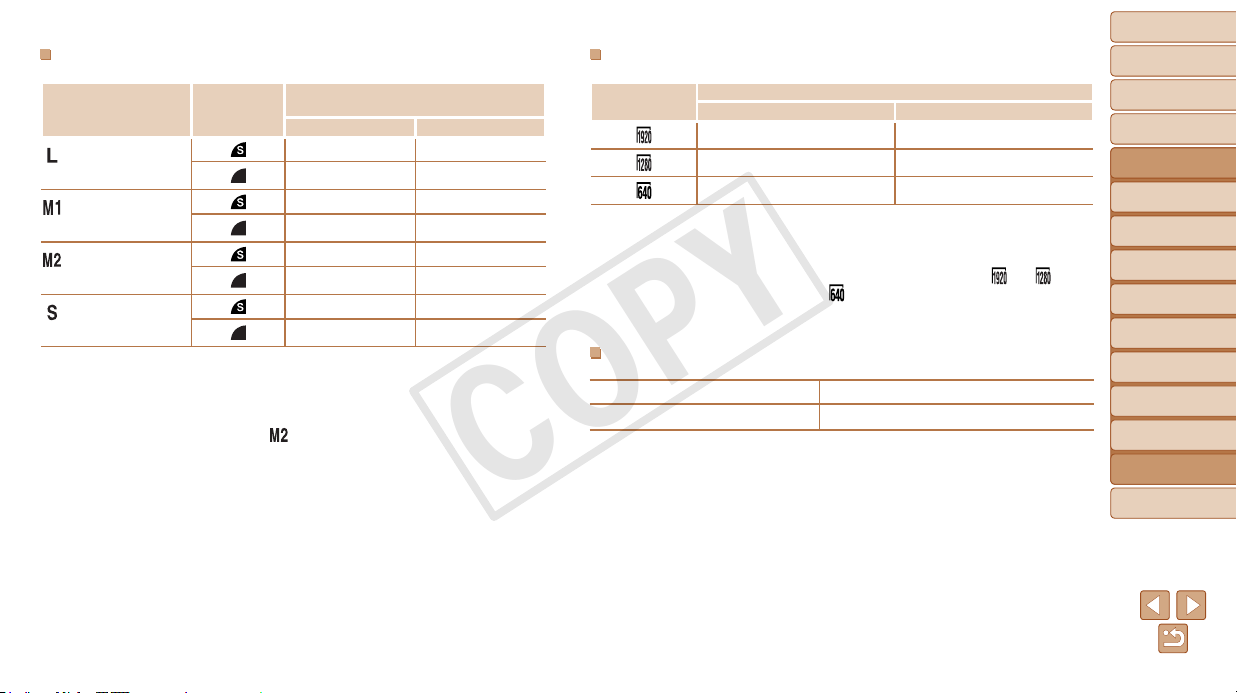
172
1
2
3
4
5
6
7
8
Preliminary Notes and
Legal Information
Contents: Basic
Operations
Camera Basics
Auto Mode/Hybrid
Auto Mode
Other Shooting
Modes
Playback Mode
Wi-Fi Functions
Setting Menu
Accessories
Index
Basic Guide
P Mode
Cover
Advanced Guide
9
Appendix
Number of 4:3 Shots per Memory Card
Recording Pixels
Compression
Ratio
Number of Shots per Memory Card
(Approx. shots)
8 GB 32 GB
(Large)
12M/4000x3000
1379 5568
2192 8850
(Medium 1)
6M/2816x2112
2431 9814
3721 15020
(Medium 2)
2M/1600x1200
7442 30040
12927 52176
(Small)
0.3M/640x480
27291 110150
40937 165225
• The values in the table are measured according to Canon standards and may change
depending on the subject, memory card and camera settings.
• The values in the table are based on 4:3 aspect ratio. If the aspect ratio is changed
(=
47), more images can be shot because the data size per image will be smaller
than with 4:3 images. However, since [
] 16:9 images have a setting of 1920 x 1080
pixels, their data size will be larger than 4:3 images.
Recording Time per Memory Card
Image Quality
Recording Time per Memory Card
8 GB 32 GB
29 min. 37 sec. 1 hr. 59 min. 41 sec.
42 min. 09 sec. 2 hr. 50 min. 17 sec.
1 hr. 28 min. 53 sec. 5 hr. 59 min. 05 sec.
• The values in the table are measured according to Canon standards and may change
depending on the subject, memory card and camera settings.
• Recording will automatically stop when the clip le size reaches 4 GB, or when the
recording time reaches approximately 10 minutes when shooting in [
] or [ ], and
approximately 1 hour when shooting in [
].
• Recording may stop even if the maximum clip length has not been reached on some
memory cards. SD Speed Class 6 or higher memory cards are recommended.
Flash Range
Maximum wide angle (j)
50 cm – 4.0 m (1.6 – 13 ft.)
Maximum telephoto (i)
1.0 - 2.0 m (3.3 – 6.6 ft.)
COPY
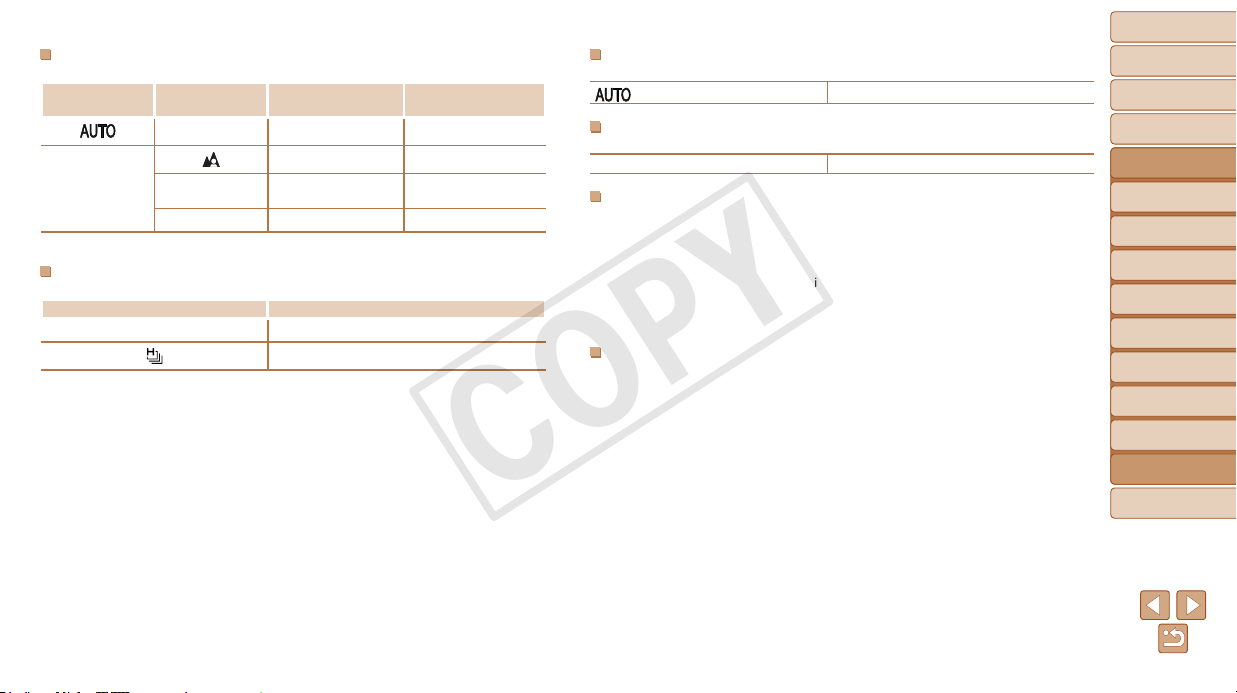
173
1
2
3
4
5
6
7
8
Preliminary Notes and
Legal Information
Contents: Basic
Operations
Camera Basics
Auto Mode/Hybrid
Auto Mode
Other Shooting
Modes
Playback Mode
Wi-Fi Functions
Setting Menu
Accessories
Index
Basic Guide
P Mode
Cover
Advanced Guide
9
Appendix
Shooting Range
Shooting Mode Focusing Range
Maximum Wide
Angle (j)
Maximum Telephoto
(i)
–
1 cm (0.4 in.) – innity 1 m (3.3 ft.) – innity
Other modes
5 cm (2.0 in.) – innity 1 m (3.3 ft.) – innity
e
*
1 cm – 50 cm
(0.4 in. – 1.6 ft.)
–
u
*
3 m (9.8 ft.) – innity
3 m (9.8 ft.) – innity
* Not available in some shooting modes.
Continuous Shooting Speed
Shooting Mode Speed
G
Approx. 2.4 shots/sec.
Approx. 6.2 shots/sec.
Shutter Speed
[ ] mode, automatically set range
1 – 1/2000 sec.
Aperture
f/number f/3.0 / f/9.0 (W), f/6.9 / f/20 (T)
Battery Pack NB-4L
Type: Rechargeable lithium-ion battery
Nominal Voltage: 3.7 V DC
Nominal Capacity: 760 mAh
Charging Cycles: Approx. 300 times
Operating Temperatures: 0 – 40 °C (32 – 104 °F)
Dimensions: 35.4 x 40.3 x 5.9 mm (1.39 x 1.59 x 0.23 in.)
Weight: Approx. 17 g (approx. 0.60 oz.)
BatteryChargerCB-2LV/CB-2LVE
Rated Input: 100 – 240 V AC (50/60 Hz), 0.1 A (100 V) – 0.06 A (240 V)
Rated Output: 4.2 V DC, 0.65 A
Charging Time: Approx. 1 hr. 30 min. (when using NB-4L)
Charge Indicator: Charging: orange / Fully charged: green
Operating Temperatures: 0 – 40 °C (32 – 104 °F)
• All data is based on tests by Canon.
• Camera specications or appearance are subject to change without
notice.
COPY

174
1
2
3
4
5
6
7
8
9
Preliminary Notes and
Legal Information
Contents: Basic
Operations
Advanced Guide
Camera Basics
Auto Mode/Hybrid
Auto Mode
Other Shooting
Modes
Playback Mode
Wi-Fi Functions
Setting Menu
Accessories
Appendix
Basic Guide
P Mode
Cover
Index
A
AC adapter kit ............................ 141, 145
Accessories ....................................... 141
Access point
Manual settings ........................... 123
Number of display items .............. 123
Adding target devices
Camera ........................................117
Computer .................................... 120
Printer .......................................... 124
Smartphone .................................. 115
Web services ................................112
AE lock ................................................ 70
AF frames ............................................ 76
AF lock................................................. 79
Aspect ratio.......................................... 47
AUTO mode (shooting mode) ........ 16, 32
B
Batteries " Date/time (date/time battery)
Battery
Charging ......................................... 11
Eco mode .................................... 135
Level ............................................ 162
Power saving ................................. 26
Battery charger .............................. 2, 141
Black and white images ....................... 73
Blink detection ............................... 51, 52
D
Date/time
Adding date stamps ...................... 41
Changing ....................................... 15
Date/time battery ........................... 15
Settings ......................................... 14
World clock .................................. 134
DC coupler......................................... 145
Defaults " Reset all
DIGITAL CAMERA Solution Disk ........... 2
Digital tele-converter............................ 75
Digital zoom ......................................... 38
Display language ................................. 15
DPOF ................................................. 150
Drive mode .......................................... 74
E
Eco mode .......................................... 135
Editing
Cropping ...................................... 101
i-Contrast ..................................... 103
My Colors .................................... 102
Red-eye correction ...................... 103
Resizing images .......................... 100
Erasing ................................................ 96
Error messages ................................. 159
Exposure
AE lock .......................................... 70
Compensation ............................... 69
FE lock .......................................... 81
F
Face AiAF (AF frame mode) ................ 76
Face ID ................................................ 42
C
Camera
Adding target devices ................... 117
Nickname ..................................... 111
Reset all ...................................... 139
Camera Access Point mode .......115, 124
Camera shake ..................................... 82
CameraWindow
Display ........................................ 123
CANON iMAGE GATEWAY
Settings ........................................112
Center (AF frame mode)...................... 78
Clock.................................................... 30
Color Accent (shooting mode) ............. 60
Color Swap (shooting mode) ............... 61
Color (white balance)........................... 72
Compression ratio (image quality) ....... 81
Computer
Adding target devices .................. 120
Environment .................................. 20
Preparation ................................... 118
Connection
Web services ................................114
Connection information
Changing nickname .................... 130
Editing ......................................... 129
Erasing ........................................ 130
Continuous shooting ............................ 74
High-speed burst
(shooting mode) ............................ 65
Cropping ............................................ 101
Custom white balance ......................... 72
Face self-timer (shooting mode) .......... 64
Favorites .............................................. 99
FE lock................................................. 81
File numbering ................................... 137
Fireworks (shooting mode) .................. 55
Fish-eye effect (shooting mode) .......... 57
Flash
Deactivating ash .......................... 40
On ................................................. 80
Slow synchro ................................. 80
Focusing
AF frames ...................................... 76
AF lock .......................................... 79
AF-point zoom ............................... 50
Servo AF ....................................... 78
Focusing range
Innity ............................................ 75
Macro ............................................ 74
Focus lock ........................................... 78
FUNC. menu
Basic operations ............................ 28
Table .................................... 165, 170
G
GPS ..................................................... 85
Grid lines ............................................. 50
H
Handheld nightscene
(shooting mode)................................... 55
HDMI cable ........................................ 142
High-speed burst (shooting mode) ...... 65
Household power............................... 145
Hybrid Auto Mode (shooting mode) ..... 34
Index
COPY

175
1
2
3
4
5
6
7
8
9
Preliminary Notes and
Legal Information
Contents: Basic
Operations
Advanced Guide
Camera Basics
Auto Mode/Hybrid
Auto Mode
Other Shooting
Modes
Playback Mode
Wi-Fi Functions
Setting Menu
Accessories
Appendix
Basic Guide
P Mode
Cover
Index
I
i-Contrast ..................................... 71, 103
Image quality " Compression ratio
(image quality)
Images
Erasing .......................................... 96
Playback " Viewing
Protecting ...................................... 93
Indicator ............................................... 30
Innity (focus mode) ............................ 75
Interface cable ................................. 2, 21
ISO speed............................................ 71
L
Lamp.............................................. 51, 52
Long shutter (shooting mode).............. 65
M
MAC address ...................................... 119
Macro (focus mode)............................. 74
Magnied display ................................. 91
Memory cards ................................. 2, 111
Recording time ............................ 172
Menu
Basic operations ............................ 29
Table ............................................ 164
Mercury lamp correction ...................... 48
Metering method.................................. 70
Miniature effect (shooting mode) ......... 58
Monochrome (shooting mode)............. 60
Movies
Editing ......................................... 104
S
Saving images to a computer ............ 123
Screen
Display language ........................... 15
Icons .................................... 162, 163
Menu " FUNC. menu, Menu
SD/SDHC/SDXC memory cards
" Memory cards
Searching ............................................ 88
Self-timer ............................................. 39
2-second self-timer ........................ 39
Customizing the self-timer ............. 40
Face self-timer (shooting mode) ... 64
Wink self-timer (shooting mode) ... 63
Sending images ................................. 126
Maximum number of images
that can be sent together ............ 126
Sepia tone images ............................... 73
Servo AF .............................................. 78
Shooting
Shooting date/time " Date/time
Shooting information ................... 162
Slideshow ............................................ 91
Smartphone ........................................115
Adding target devices ................... 115
Changing privacy settings ............117
Privacy settings ............................116
Smart Shufe ....................................... 92
Smart Shutter (shooting mode) ........... 62
Smile (shooting mode)......................... 62
Snow (shooting mode)......................... 55
Soft focus (shooting mode).................. 59
Software
DIGITAL CAMERA Solution Disk .... 2
Image quality
(resolution/frame rate) ................... 49
Recording time ............................ 172
Multi-area White Balance .................... 48
My Colors .................................... 73, 102
N
Nickname
Camera ........................................ 111
Connection .................................. 130
P
Package contents .................................. 2
Photobook set-up .............................. 153
PictBridge .................................. 142, 146
Playback " Viewing
Portrait (shooting mode) ...................... 55
Poster effect (shooting mode) ............. 57
Power " AC adapter kit
" Battery
Power saving ....................................... 26
Printing .............................................. 146
Program AE ......................................... 69
Protecting ............................................ 93
P (shooting mode) ............................... 69
R
Red-eye correction ...................... 48, 103
Reset all............................................. 139
Resetting Wi-Fi settings..................... 131
Resizing images ................................ 100
Resolution (image size) ....................... 47
Rotating ............................................... 98
Installation ..................................... 20
Saving images to a computer ........ 20
Sounds .............................................. 133
Stereo AV cable ................................. 144
Stitch Assist (shooting mode) .............. 66
Strap .................................................2, 11
Super slow motion movie
(movie mode)....................................... 67
Super vivid (shooting mode) ................ 57
T
Terminal ..................... 143, 144, 145, 146
Toy camera effect (shooting mode) ..... 59
Tracking AF ......................................... 77
Traveling with the camera ................. 134
Troubleshooting ................................. 156
TV display .......................................... 142
V
Viewing ................................................ 17
Image search ................................ 88
Index display ................................. 87
Magnied display .......................... 91
Single-image display ..................... 17
Slideshow ...................................... 91
Smart Shufe ................................ 92
TV display ................................... 142
W
Web services
Adding target devices ................... 112
Connection ...................................114
Display order ................................113
White balance (color)........................... 72
COPY

176
1
2
3
4
5
6
7
8
9
Preliminary Notes and
Legal Information
Contents: Basic
Operations
Advanced Guide
Camera Basics
Auto Mode/Hybrid
Auto Mode
Other Shooting
Modes
Playback Mode
Wi-Fi Functions
Setting Menu
Accessories
Appendix
Basic Guide
P Mode
Cover
Index
Wi-Fi ...........................................107, 119
Access point .................................119
Settings ........................................118
Windows
CameraWindow display .............. 123
Settings ....................................... 120
Wink self-timer (shooting mode) .......... 63
World clock ........................................ 134
WPS
PBC Method ................................ 121
PIN Method ................................. 122
Wrist strap " Strap
Z
Zoom ....................................... 16, 32, 38
COPY
177
1
2
3
4
5
6
7
8
9
Cover
Preliminary Notes and
Legal Information
Contents: Basic
Operations
Advanced Guide
Camera Basics
Auto Mode/Hybrid
Auto Mode
Other Shooting
Modes
Playback Mode
Wi-Fi Functions
Setting Menu
Accessories
Appendix
Index
Basic Guide
P Mode
177
1
2
3
4
5
6
7
8
9
Cover
Contents: Basic
Operations
Advanced Guide
Camera Basics
Other Shooting
Modes
Playback Mode
Setting Menu
Accessories
Appendix
Index
P Mode
Preliminary Notes and
Legal Information
Auto Mode/Hybrid
Auto Mode
Wi-Fi Functions
CAUTION
RISK OF EXPLOSION IF BATTERY IS REPLACED BY AN INCORRECT TYPE.
DISPOSE OF USED BATTERIES ACCORDING TO LOCAL REGULATION.
FCC/IC Notice
Model: PC1897 (including WLAN Module Model WM219, FCC ID: AZD219)
The available scientic evidence does not show that any health problems are
associated with using low power wireless devices. There is no proof, however, that
these low power wireless devices are absolutely safe. Low power Wireless devices
emit low levels of radio frequency energy (RF) in the microwave range while being
used. Whereas high levels of RF can produce health effects (by heating tissue),
exposure to low-level RF that does not produce heating effects causes no known
adverse health effects. Many studies of low-level RF exposures have not found any
biological effects. Some studies have suggested that some biological effects might
occur, but such ndings have not been conrmed by additional research. This model
has been tested and found to comply with FCC/IC radiation exposure limits set forth
for an uncontrolled equipment and meets the FCC radio frequency (RF) Exposure
Guidelines in Supplement C to OET65 and RSS-102 of the IC radio frequency (RF)
Exposure rules.
This device complies with Part 15 of FCC Rules and Industry Canada licence-exempt
RSS standard(s). Operation is subject to the following two conditions: (1) this device
may not cause interference, and (2) this device must accept any interference,
including interference that may cause undesired operation of this device.
This transmitter must not be co-located or operated in conjunction with any other
antenna or transmitter.
This product is installed with the WLAN Module which is certied to
standards set by IDA Singapore
USA and Canada only:
The Lithium ion/polymer battery that powers the product is recyclable.
Please call 1-800-8-BATTERY for information on how to recycle this
battery.
For CA, USA only
Included lithium battery contains Perchlorate Material - special handling may apply.
See www.dtsc.ca.gov/hazardouswaste/perchlorate/ for details.
Trademark Acknowledgments
• The SDXC logo is a trademark of SD-3C, LLC.
• This device incorporates exFAT technology licensed from Microsoft.
• HDMI, the HDMI logo and High-Denition Multimedia Interface are
trademarks or registered trademarks of HDMI Licensing LLC.
• Wi-Fi®, Wi-Fi Alliance®, WPA™, WPA2™ and Wi-Fi Protected Setup™
are trademarks or registered trademarks of the Wi-Fi Alliance.
About MPEG-4 Licensing
This product is licensed under AT&T patents for the MPEG-4 standard
and may be used for encoding MPEG-4 compliant video and/or decoding
MPEG-4 compliant video that was encoded only (1) for a personal and
non-commercial purpose or (2) by a video provider licensed under the AT&T
patents to provide MPEG-4 compliant video.
No license is granted or implied for any other use for MPEG-4 standard.
COPY

178
1
2
3
4
5
6
7
8
9
Cover
Preliminary Notes and
Legal Information
Contents: Basic
Operations
Advanced Guide
Camera Basics
Auto Mode/Hybrid
Auto Mode
Other Shooting
Modes
Playback Mode
Wi-Fi Functions
Setting Menu
Accessories
Appendix
Index
Basic Guide
P Mode
178
1
2
3
4
5
6
7
8
9
Cover
Contents: Basic
Operations
Advanced Guide
Camera Basics
Other Shooting
Modes
Playback Mode
Setting Menu
Accessories
Appendix
Index
P Mode
Preliminary Notes and
Legal Information
Auto Mode/Hybrid
Auto Mode
Wi-Fi Functions
FCC Notice
(Digital Camera, Model PC1897 systems)
This device complies with Part 15 of the FCC Rules. Operation is subject to the
following two conditions;
(1) this device may not cause harmful interference, and
(2) this device must accept any interference received, including interference that may
cause undesired operation.
Note: This equipment has been tested and found to comply with the limits for Class
B digital devices, pursuant to Part 15 of the FCC rules. These limits are designed to
provide reasonable protection against harmful interference in a residential installation.
This equipment generates, uses and can radiate radio frequency energy and, if
not installed and used in accordance with the instructions, may cause harmful
interference to radio communications. However, there is no guarantee that
interference will not occur in a particular installation. If this equipment does cause
harmful interference to radio or television reception, which can be determined
by turning the equipment off and on, the user is encouraged to try to correct the
interference by one or more of the following measures:
• Reorient or relocate the receiving antenna.
• Increase the separation between the equipment and receiver.
• Connect the equipment into an outlet on a circuit different from that to which the
receiver is connected.
• Consult the dealer or an experienced radio/TV technician for help.
The cable with the ferrite core provided with the digital camera must be used with this
equipment in order to comply with Class B limits in Subpart B of Part 15 of the FCC
rules.
Do not make any changes or modications to the equipment unless otherwise
specied in the manual. If such changes or modications should be made, you could
be required to stop operation of the equipment.
Canon U.S.A., Inc.
One Canon Park, Melville, New York 11747, U.S.A.
Tel No. 1-800-OK-CANON (1-800-652-2666)
Canadian Radio Interference Regulations
CAN ICES-3 (B)/NMB-3 (B)
Battery Charger CB-2LV
IMPORTANT SAFETY INSTRUCTIONS-
SAVE THESE INSTRUCTIONS.
DANGER-TO REDUCE THE RISK OF
FIRE OR ELECTRIC SHOCK, CAREFULLY
FOLLOW THESE INSTRUCTIONS.
For connection to a supply not in the U.S.A., use an attachment plug adapter of the
proper conguration for the power outlet, if needed.
Disclaimer
• Reprinting, transmitting, or storing in a retrieval system any part of this
guide without the permission of Canon is prohibited.
• Canon reserves the right to change the contents of this guide at any time
without prior notice.
• Illustrations and screenshots in this guide may differ slightly from the
actual equipment.
• The above items notwithstanding, Canon accepts no liability for damages
due to mistaken operation of the products.
COPY