
• Some of the contents in this manual may differ from your device depending on the
software version of the device, OS version or your service provider, and are subject
to change without prior notice.
• Always use genuine LG accessories. The supplied items are designed only for this
device and may not be compatible with other devices.
• This device is not suitable for people who have a visual impairment due to the
touchscreen keyboard.
• All screen shots in this guide are simulated.
• Actual displays and the color of the device may vary.

ARBITRATION NOTICE: THIS LIMITED WARRANTY CONTAINS AN ARBITRATION PROVISION
THAT REQUIRES YOU AND LG TO RESOLVE DISPUTES BY BINDING ARBITRATION INSTEAD
OF IN COURT, UNLESS YOU CHOOSE TO OPT OUT. IN ARBITRATION, CLASS ACTIONS AND
JURY TRIALS ARE NOT PERMITTED. PLEASE SEE THE SECTION TITLED “PROCEDURE FOR
RESOLVING DISPUTES” BELOW.
Warranty Laws
The following laws govern warranties that arise in retail sales of consumer goods:
The California Song-Beverly Consumer Warranty Act [CC §§1790 et seq],
The California Uniform Commercial Code, Division Two [Com C §§2101 et seq], and
The federal Magnuson-Moss Warranty Federal Trade Commission Improvement
Act [15 USC §§2301 et seq; 16 CFR Parts 701– 703]. A typical Magnuson-Moss Act
warranty is a written promise that the product is free of defects or a written promise
to refund, repair
, or replace defective goods. [See 15 USC §2301(6).] Remedies include
damages for failing to honor a written warranty or service contract or for violating
disclosure provisions. [See 15 USC §2310(d).] Except for some labeling and disclosure
requirements, the federal Act does not preempt state law. [See 15 USC §2311.]
1. WHAT THIS WARRANTY COVERS:
LG offers you a limited warranty that the enclosed subscriber unit and its enclosed accessories
will be free from defects in material and workmanship, according to the following terms and
conditions:
(1) The limited warranty for the product extends for TWELVE (12) MONTHS beginning on
the date of purchase of the product with valid proof of purchase, or absent valid proof of
purchase, FIFTEEN (15) MONTHS from date of manufacture as determined by the unit's
manufacture date code.
(2) The limited warranty extends only to the original purchaser of the product and is not
assignable or transferable to any subsequent purchaser/end user.
LIMITED WARRANTY STATEMENT

(3) This warranty is good only to the original purchaser of the product during the warranty
period as long as it is in the U.S., including Alaska, Hawaii, U.S. Territories and Canada.
(4) The external housing and cosmetic parts shall be free of defects at the time of shipment
and, therefore, shall not be covered under these limited warranty terms.
(5) Upon request from LG, the consumer must provide information to reasonably prove the date
of purchase.
(6) The customer shall bear the cost of shipping the product to the Customer Service
Department of LG. LG shall bear the cost of shipping the product back to the consumer after
the completion of service under this limited warranty.
2. WHAT THIS WARRANTY DOES NOT COVER:
(1) Defects or damages resulting from use of the product in other than its normal and customary
manner.
(2) Defects or damages from abnormal use, abnormal conditions, improper storage, exposure to
moisture or dampness, unauthorized modifications, unauthorized connections, unauthorized
repair, misuse, neglect, abuse, accident, alteration, improper installation, or other acts which
are not the fault of LG, including damage caused by shipping, blown fuses, spills of food or
liquid.
(3) Breakage or damage to antennas unless caused directly by defects in material or
workmanship.
(4) That the Customer Service Department at LG was not notified by consumer of the alleged
defect or malfunction of the product during the applicable limited warranty period.
(5) Products which have had the serial number removed or made illegible.
(6) This limited warranty is in lieu of all other warranties, express or implied either in fact or by
operations of law, statutory or otherwise, including, but not limited to any implied warranty
of marketability or fitness for a particular use.
LIMITED WARRANTY STATEMENT

(7) Damage resulting from use of non LG approved accessories.
(8) All plastic surfaces and all other externally exposed parts that are scratched or damaged
due to normal customer use.
(9) Products operated outside published maximum ratings.
(10) Products used or obtained in a rental program.
(11) Consumables (such as fuses).
3. WHAT LG WILL DO:
LG will, at its sole option, either repair, replace or refund the purchase price of any unit that is
covered under this limited warranty. LG may choose at its option to use functionally equivalent
re-conditioned, refurbished or new units or parts or any units. In addition, LG will not re-install
or back-up any data, applications or software that you have added to your phone. It is therefore
recommended that you back-up any such data or information prior to sending the unit to LG to
avoid the permanent loss of such information.
4. STATE LAW RIGHTS:
No other express warranty is applicable to this product. THE DURATION OF ANY
IMPLIED WARRANTIES, INCLUDING THE IMPLIED WARRANTY OF MARKETABILITY OR
MERCHANTABILITY OR FITNESS FOR A PARTICULAR PURPOSE, IS LIMITED TO THE DURATION
OF THE EXPRESS WARRANTY HEREIN. LG SHALL NOT BE LIABLE FOR THE LOSS OF THE
USE OF THE PRODUCT, INCONVENIENCE, LOSS OR ANY OTHER DAMAGES, DIRECT OR
CONSEQUENTIAL, ARISING OUT OF THE USE OF, OR INABILITY TO USE, THIS PRODUCT OR
FOR ANY BREACH OF ANY EXPRESS OR IMPLIED WARRANTY, INCLUDING THE IMPLIED
WARRANTY OF MARKETABILITY OR MERCHANTABILITY OR FITNESS FOR A PARTICULAR
PURPOSE APPLICABLE TO THIS PRODUCT.
Some states do not allow the exclusive limitation of incidental or consequential damages or
limitations on how long an implied warranty lasts; so these limitations or exclusions may not
apply to you. This warranty gives you specific legal rights and you may also have other rights
which vary from state to state.

5. HOW TO GET WARRANTY SERVICE:
To obtain warranty service, please call or fax to the following telephone numbers from
anywhere in the continental United States:
Tel. 1-800-793-8896 or Fax. 1-800-448-4026
Or visit http://us.lgservice.com. Correspondence may also be mailed to:
LG Electronics Service- Mobile Handsets, P.O. Box 240007, Huntsville, AL 35824
DO NOT RETURN YOUR PRODUCT TO THE ABOVE ADDRESS. Please call or write
for the location of the LG authorized service center nearest you and for the procedures for
obtaining warranty claims.
7.11 Warranty Laws
The following laws govern warranties that arise in retail sales of consumer goods:
The California Song-Beverly Consumer Warranty Act [CC §§1790 et seq],
The California Uniform Commercial Code, Division Two [Com C §§2101 et seq], and
The federal Magnuson-Moss Warranty Federal Trade Commission Improvement Act [15
USC §§2301 et seq; 16 CFR Parts 701– 703]. A typical Magnuson-Moss Act warranty is a
written promise that the product is free of defects or a written promise to refund, repair
, or
replace defective goods. [See 15 USC §2301(6).] Remedies include damages for failing to
honor a written warranty or service contract or for violating disclosure provisions. [See 15
USC §2310(d).] Except for some labeling and disclosure requirements, the federal Act does
not preempt state law. [See 15 USC §2311.]
The Consumer Warranty Act does not affect the rights and obligations of parties under the
state Uniform Commercial Code, except the provisions of the Act prevail over provisions of the
Commercial Code when they confl ict. [CC §1790.3.]
For purposes of small claims actions, this course will focus on rights and duties under the state
laws.
LIMITED WARRANTY STATEMENT

PROCEDURE FOR RESOLVING DISPUTES:
ALL DISPUTES BETWEEN YOU AND LG ARISING OUT OF OR RELATING IN ANY WAY TO
THIS LIMITED WARRANTY OR THE PRODUCT SHALL BE RESOLVED EXCLUSIVELY THROUGH
BINDING ARBITRATION, AND NOT IN A COURT OF GENERAL JURISDICTION. BINDING
ARBITRATION MEANS THAT YOU AND LG ARE EACH WAIVING THE RIGHT TO A JURY TRIAL
AND TO BRING OR PARTICIPATE IN A CLASS ACTION.
Definitions. For the purposes of this section, references to “LG” mean LG Electronics
MobileComm U.S.A., Inc., its parents, subsidiaries and affiliates, and each of their officers,
directors, employees, agents, beneficiaries, predecessors in interest, successors, assigns and
suppliers; references to “dispute” or “claim” shall include any dispute, claim or controversy
of any kind whatsoever (whether based in contract, tort, statute, regulation, ordinance, fraud,
misrepresentation or any other legal or equitable theory) arising out of or relating in any way to
the sale, condition or performance of the product or this Limited Warranty.
Agreement to Binding Arbitration and Class Action Waiver. You and LG agree to resolve any
claims between us only by binding arbitration on an individual basis, unless you opt out as
provided below. Any dispute between you and LG shall not be combined or consolidated with
a dispute involving any other person’s or entity’s product or claim. More specifically, without
limitation of the foregoing, any dispute between you and LG shall not under any circumstances
proceed as part of a class or representative action. Instead of arbitration, either party may bring
an individual action in small claims court, but that small claims court action may not be brought
on a class or representative basis.
Arbitration Rules and Procedures. To begin arbitration of a claim, either you or LG must make a
written demand for arbitration. The arbitration will be administered by the American Arbitration
Association (AAA) and will be conducted before a single arbitrator under the AAA’s Consumer
Arbitration Rules that are in effect at the time the arbitration is initiated (referred to as the “AAA
Rules”) and under the procedures set forth in this section. The AAA Rules are available online
at www.adr.org/consumer. Send a copy of your written demand for arbitration, as well as a
copy of this provision, to the AAA in the manner described in the AAA Rules. You must also
send a copy of your written demand to LG at LG Electronics, USA, Inc.Attn: Legal Department-

Arbitration1000 Sylvan AvenueEnglewood Cliffs, NJ 07632. If there is a conflict between the
AAA Rules and the rules set forth in this section, the rules set forth in this section will govern.
This arbitration provision is governed by the Federal Arbitration Act. Judgment may be entered
on the arbitrator’s award in any court of competent jurisdiction. All issues are for the arbitrator
to decide, except that issues relating to the scope and enforceability of the arbitration provision
and to the arbitrability of the dispute are for the court to decide. The arbitrator is bound by the
terms of this provision.
Governing Law: The law of the state of your residence shall govern this Limited Warranty and
any disputes between us except to the extent that such law is preempted by or inconsistent
with applicable federal law.
Fees/Costs. You do not need to pay any fee to begin an arbitration. Upon receipt of your
written demand for arbitration, LG will promptly pay all arbitration filing fees to the AAA unless
you seek more than $25,000 in damages, in which case the payment of these fees will be
governed by the AAA Rules. Except as otherwise provided for herein, LG will pay all AAA filing,
administration and arbitrator fees for any arbitration initiated in accordance with the AAA
Rules and this arbitration provision. If you prevail in the arbitration, LG will pay your reasonable
attorneys’ fees and expenses to the extent required by applicable law. If the arbitrator finds
either the substance of your claim or the relief sought in the demand is frivolous or brought
for an improper purpose (as measured by the standards set forth in Federal Rule of Civil
Procedure 11(b)), then the payment of all arbitration fees will be governed by the AAA Rules.
In such a situation, you agree to reimburse LG for all monies previously disbursed by it that are
otherwise your obligation to pay under the AAA Rules. Except as otherwise provided for, LG
waives any rights it may have to seek attorneys’ fees and expenses from you if LG prevails in
the arbitration.
Hearings and Location. If your claim is for $25,000 or less, you may choose to have the
arbitration conducted solely on the basis of (1) documents submitted to the arbitrator, (2)
through a telephonic hearing, or (3) by an in-person hearing as established by the AAA Rules.
LIMITED WARRANTY STATEMENT

If your claim exceeds $25,000, the right to a hearing will be determined by the AAA Rules.
Any in-person arbitration hearings will be held at a location within the federal judicial district
in which you reside unless we both agree to another location or we agree to a telephonic
arbitration.
Opt Out. You may opt out of this dispute resolution procedure. If you opt out, neither you nor
LG can require the other to participate in an arbitration proceeding. To opt out, you must send
notice to LG no later than 30 calendar days from the date of the first consumer purchaser’s
purchase of the product by either: (i) sending an e-mail to [email protected], with the subject
line: “Arbitration Opt Out” or (ii) calling 1-800-980-2973.You must include in the opt out e-mail
or provide by telephone: (a) your name and address; (b) the date on which the product was
purchased; (c) the product model name or model number; and (d) the IMEI or MEID or Serial
Number, as applicable (the IMEI or MEID or Serial Number can be found (i) on the product box;
(ii) on a label on the back of the product beneath the battery, if the batter is removable;or (iii)
from the settings menu via the following path: Settings
General About phone Status).
You may only opt out of the dispute resolution procedure in the manner described above
(that is, by e-mail or telephone); no other form of notice will be effective to opt out of this
dispute resolution procedure. Opting out of this dispute resolution procedure will not affect the
coverage of the Limited Warranty in any way, and you will continue to enjoy the full benefits of
the Limited Warranty. If you keep this product and do not opt out, then you accept all terms and
conditions of the arbitration provision described above.

Table of Contents
About this user guide ........................12
About this user guide ..............................12
Trademarks ..............................................13
DivX HD ....................................................13
Important notice.................................14
Getting to know your device ...........17
Tablet Overview .......................................17
Charging your tablet ................................19
Optimizing Battery Life ............................20
Installing the SIM card ............................22
Inserting a microSD card .........................23
Removing the microSD card ....................24
Formatting the microSD card ..................24
Locking and unlocking the screen ...........25
Your Home screen .............................27
Touch screen tips .....................................27
Home screen ............................................29
Returning to recently-used applications .31
Using Dual Window ................................31
Customizing app icons on the Home
screen .......................................................32
Quick access to Google ...........................34
Notifi cations ............................................34
Multiple Users .........................................37
QSlide .......................................................39
Capturing a Screenshot ...........................41
Text Input Methods .................................41
Google account setup .......................45
To set up your Google account ................45
Connecting to Networks and
Devices ................................................ 46
Wi-Fi .........................................................46
Bluetooth .................................................47
SmartShare .............................................. 49
QPair .........................................................50
PC connections with a USB cable ...........52
Contacts...............................................54
Searching for a contact ...........................54
Adding a new contact .............................54
Favorite Contacts .....................................54
Creating a group ......................................55
Email ....................................................56
Managing an email account ...................56
Working with account folders .................57
Composing and sending email ................57
Receiving emails......................................57
Entertainment .....................................58
Camera ..................................................... 58

Gallery ...................................................... 63
Slideshow ................................................65
Videos ......................................................65
Music .......................................................67
Tools ..................................................... 70
QuickMemo+............................................70
QuickRemote............................................72
Clock .........................................................73
Calculator ................................................. 74
Calendar ................................................... 74
Tasks ........................................................75
File Manager ............................................76
POLARIS Offi ce 5 .....................................77
Google+ .................................................... 78
LG SmartWorld ........................................78
Launch Google Maps...............................80
Play Store .................................................81
Gmail ........................................................ 82
Hangouts ..................................................83
The Web ..............................................85
Browser .................................................... 85
Chrome ..................................................... 87
Settings................................................89
Access the Settings menu ......................89
WIRELESS NETWORKS...........................89
DEVICE .....................................................91
PERSONAL ...............................................95
SYSTEM ................................................... 98
Tablet software update ...................102
Tablet software update .........................102
LG tablet software update via Over-the-Air
(OTA) .......................................................102
Accessories ...................................... 104
Troubleshooting ...............................105
For Your Safety .................................107
Table of Contents

12
About this user guide
• Before using your device, please carefully read this manual. This will ensure that you
use your device safely and correctly.
• Some of the images and screenshots provided in this guide may appear differently on
your tablet.
• Your content may differ from the final product, or from software supplied by service
providers or carriers, This content may be subject to change without prior notice. For
the latest version of this manual, please visit the LG website at www.lg.com.
• Your device's applications and their functions may vary by country, region, or hardware
specifications. LG cannot be held liable for any performance issues resulting from the
use of applications developed by providers other than LG.
• LG cannot be held liable for performance or incompatibility issues resulting from
edited registry settings being edited or operating system software being modified.
Any attempt to customize your operating system may cause the device or its
applications to not work as they should.
• Software, audio, wallpaper, images, and other media supplied with your device are
licensed for limited use. If you extract and use these materials for commercial or other
purposes is, you may be infringing copyright laws. As a user, you are fully are entirely
responsible for the illegal use of media.
• Additional charges may be applied for data services, such as messaging, uploading
and downloading, auto-syncing, or using location services. T
o avoid additional
charges, select a data plan to is suitable for your needs. Contact your service provider
to obtain additional details.
About this user guide
13
About this user guide
Trademarks
• LG and the LG logo are registered trademarks of LG Electronics.
• All other trademarks and copyrights are the property of their respective owners.
DivX HD
ABOUT DIVX VIDEO: DivX
®
is a digital video format created by DivX, LLC, a subsidiary
of Rovi Corporation. This is an official DivX Certified
®
device that has passed rigorous
testing to verify that it plays DivX video. Visit divx.com for more information and
software tools to convert your files into DivX videos.
ABOUT DIVX VIDEO-ON-DEMAND: This DivX Certified
®
device must be registered
in order to play purchased DivX Video-on-Demand (VOD) movies. To obtain your
registration code, locate the DivX VOD section in your device setup menu. Go to vod.
divx.com for more information on how to complete your registration.
DivX Certified
®
to play DivX
®
video up to HD 720p, including premium content.
DivX
®
, DivX Certified
®
and associated logos are trademarks of Rovi
Corporation or its subsidiaries and are used under license.
Open Source Software Notice Information
To obtain the source code under GPL, LGPL, MPL, and other open source licenses,
that is contained in this product, please visit http://opensource.lge.com.
In addition to the source code, all referred license terms, warranty disclaimers and
copyright notices are available for download.
LG Electronics will also provide open source code to you on CD-ROM for a charge
covering the cost of performing such distribution (such as the cost of media,
shipping, and handling) upon email request to [email protected]. This offer is
valid for three (3) years from the date on which you purchased the product.
14
Please read this before you start using your tablet!
Please check to see whether any problems you encountered with your tablet are
described in this section before taking the tablet in for service or calling a service
representative.
1. Tablet Memory
You need to check your tablet memory and delete some data, such as applications, to
make more memory available.
To uninstall applications:
1 Tap > > Apps tab > Settings > Apps.
2 Once all of the applications appear, select the application you want to uninstall.
3 Tap Uninstall and OK to confirm.
2. Before installing an open source application and
operating system (OS)
WARNING
If you install and use an OS other than the one provided by the manufacturer it may
cause your tablet to malfunction. In addition, your tablet will no longer be covered
by the warranty.
To protect your tablet and personal data, only download applications from trusted
sources, such as Play Store. If there are improperly installed applications on your
tablet, the tablet may not work normally or a serious error may occur. You must
uninstall those applications and all associated data and settings from the tablet.
Important notice
15
Important notice
3. Using a Screen Lock
Set an screen lock to secure your tablet. Tap > > Apps tab > Settings
> Lock screen > Select screen lock and select a desired screen lock from None,
Swipe, Knock Code, Pattern, PIN and Password. You can create a Backup PIN as a
safety measure in case you forget your screen lock.
Caution: Create or sign into a Google account before setting a screen lock and
remember the Backup PIN you created when creating your screen lock.
WARNING
Precautions to take when using a screen lock.
It is very important to remember the screen lock you set. Y
ou will not be able
to access your tablet if you use an incorrect screen lock 5 times. You have 5
opportunities to enter your unlock pattern, PIN or password. If you have used all 5
opportunities, you can try again after 30 seconds.
When you can’t recall your Pattern, PIN or Password:
< If you have forgotten your pattern >
If you logged in to your Google account on the tablet but failed to enter the correct
pattern 5 times, tap the Forgot pattern? button at the bottom of the screen. You are
then required to log in with your Google Account or you have to enter the Backup PIN
which you entered when creating your Pattern Lock.
If you have not created a Google account on the tablet or you forgot the Backup PIN, you
have to perform a hard reset.
< If you have forgotten your PIN or Password >
If you forget your PIN or Password, you will need to perform a hard reset.
Caution: If you perform a hard reset, all user applications and user data will be deleted.

16
Important notice
NOTE
If you have not logged into your Google Account and have forgotten your Pattern,
you will need to enter your Backup PIN.
4. When the screen freezes
If the screen freezes or the tablet does not respond when you try to operate it:
Press and hold the Power/Lock Key for over 8 seconds until the LG logo is displayed
to restart your tablet. If it still does not work, please contact the service center.
17
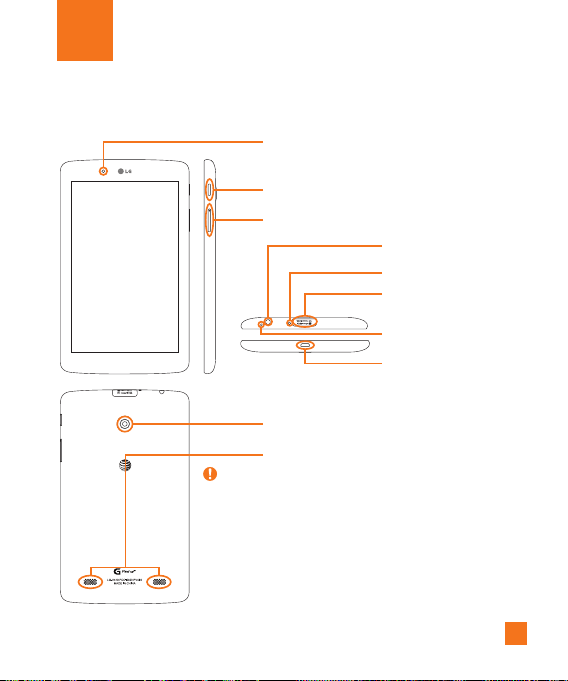
Tablet Overview
Volume keys
Rear-facing camera
Speakers
Front-facing camera
Power/Lock key
Earphone jack
SIM card/MicroSD
card slot
Infrared (IR) LED
Charger/USB port
Microphone
NOTE
Your tablet is designed to have two speaker openings on
the back side for aesthetic reasons. However
, the actual
sound comes from only one speaker. Please note that it’s
not a product defect.
Make sure that the microphone is not blocked when
recording a video or audio clip.
Getting to know your device
18
Getting to know your device
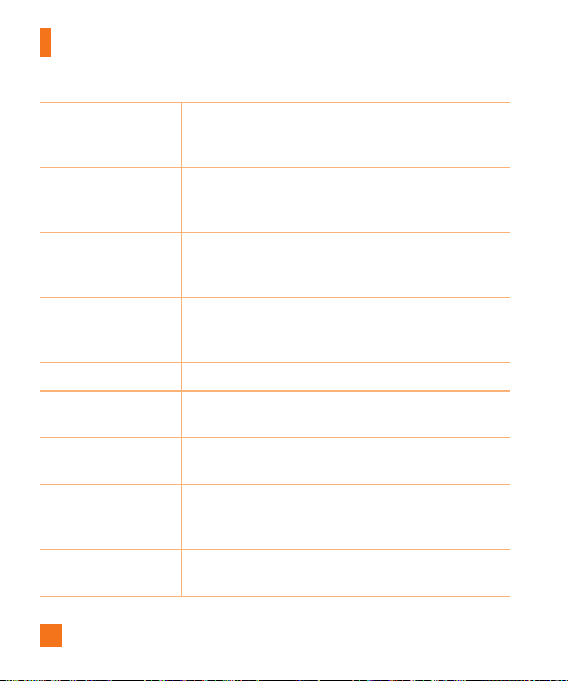
Front-facing camera
Use to take pictures and record videos of yourself. You can
also use this for video chatting. Keep it clean for optimal
performance.
Power/Lock key
Press to lock/unlock the screen. Press and hold to turn the
tablet on/off, restart it, activate/deactivate airplane mode,
and change the sound settings.
Volume keys
Allow you to adjust the media volumes. Press and hold
both keys at the same time to access the QuickMemo+
feature.
Earphone jack
Allows you to plug in an optional headset for convenient,
hands-free conversations. You can also plug in
headphones to listen to music.
Infrared (IR) LED
Used as a sensor for the QuickRemote app.
SIM card/MicroSD
card slot
Allows you to insert your SIM card and a microSD card.
Microphone
Records your voice and allows use for voice-activated
functions.
Charger/USB port
Allows you to connect the tablet and the USB cable for
use with the charger adapter, your PC, or other compatible
accessories.
Rear-facing camera
Use to take photos and record videos. Keep it clean for
optimal performance.
19
Getting to know your device
Speakers
Use to listen to the audio from the selected function (e.g.,
music, videos, sound clips, etc.).
WARNING
Placing a heavy object on the tablet or sitting on it can damage the LCD and touch
screen functions.
TIP!
Tap the Menu icon
whenever you open an application to check what options are
available.
If the device is locked and does not work, press and hold the Power/Lock Key
for over 8 seconds until LG logo is displayed to restart your tablet.
Charging your tablet
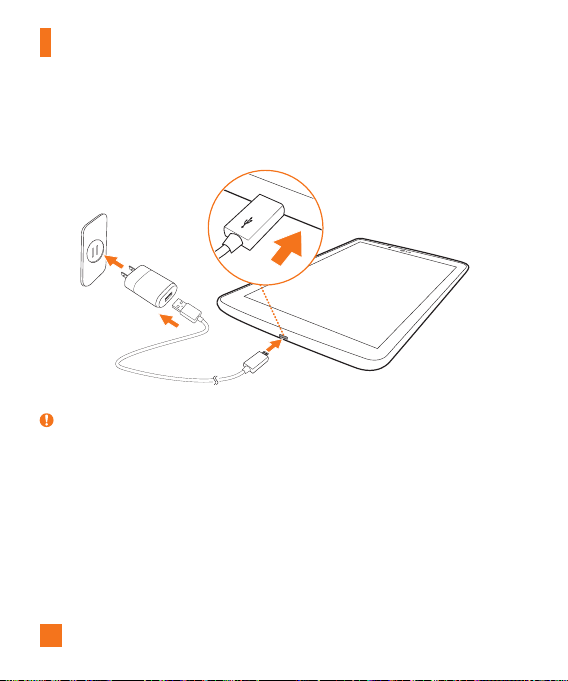
A USB adapter, which is included with your tablet, is used to charge the battery. Before
using your tablet for the first time, make sure the battery is fully charged.
NOTE
Your device has an internal rechargeable battery. For your safety, do not remove the
battery incorporated in the product.
Warning!
If the touch screen does not function while the tablet’s in the process of charging,
this may be due to an unstable power supply
. If this occurs, disconnect the USB
cable from the device or unplug the USB adapter from the power outlet.
20
Getting to know your device
1 Connect the USB adapter and USB cable.
2 Plug the USB cable (as shown below) into the tablet’s Charger/USB port.
3 Plug the charger into an electrical socket.
NOTE
The battery must be fully charged initially to improve battery lifetime.
Optimizing Battery Life
You can extend your battery’s life between charges by turning off features that you don’t
need to run constantly in the background. You can also monitor how applications and
system resources consume battery power.
21
Getting to know your device
To extend the life of your battery
• Turn off radio communications that you aren’t using, such as Wi-Fi, Bluetooth, or GPS.
• Lower screen brightness and set a shorter screen timeout.
• Turn off automatic syncing for Gmail™, Calendar, Contacts, and other applications.
• Some applications you have downloaded may cause your battery power to be
reduced.
• While using downloaded applications, check the battery charged level.
To view the battery charge level
1 From the Home screen, tap Apps > Settings > About tablet > Battery.
2 The battery status (charging or discharging) and level are displayed on the top menu
of the screen.
To monitor and control what uses the battery
1 From the Home screen, tap Apps > Settings > About tablet > Battery >
Battery usage.
2 The screen displays battery usage time and also lists applications or services using
battery power from greatest amount to least.
22
Getting to know your device
Installing the SIM card
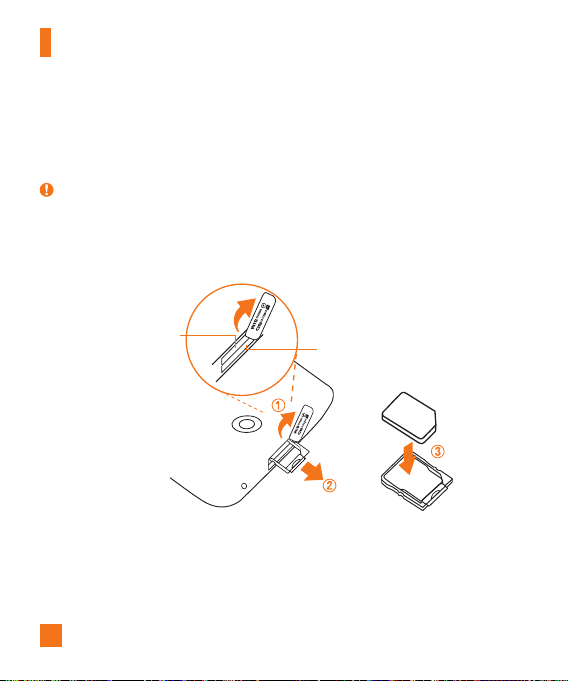
1 To install the SIM card, locate and open the cover to the slot.
2 Place your fingernail in the cutout and gently pull out the SIM card tray.
NOTE
There are two slots underneath the cover (the other slot is for a microSD card).
3 Insert the SIM card into the tray with the golden contact facing down. Push the tray
back into the slot until it “clicks” into place and close the cover
.
SIM card slot
microSD card slot
23
Getting to know your device
Inserting a microSD card
Your device supports the use of microSD memory cards of up to 32 GB capacity.
Multimedia contents can be saved in the microSD card.
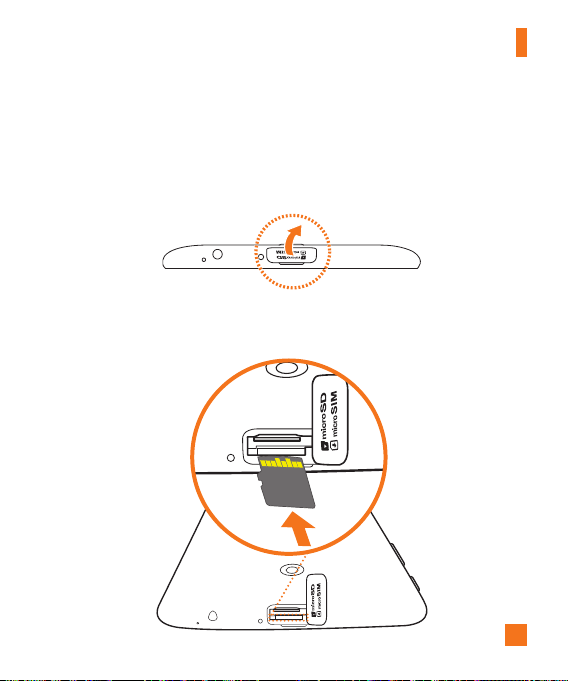
1 Place your fingernail in the cutout and gently pull the memory card slot cover to
remove it.
2 Position the microSD card with the gold strips facing towards the back of the tablet.
Slide the microSD card into the slot until it “clicks” into place and replace the cover.
24
Getting to know your device
Removing the microSD card
To safely remove the microSD card from your tablet, first you need to unmount it.
1 From the Home screen, tap Apps
> Settings > Storage > Unmount SD
card.
2 Open the microSD card slot and push the card in to release it.
3 Gently pull the microSD card from the slot.
Warning!
Do not remove the microSD card without unmounting it first. Otherwise, it may
damage the microSD card as well as your tablet, and the data stored on the
microSD card may be corrupted.
Formatting the microSD card
Warning!
All files stored on your microSD card are deleted when you format the card.
1 From the Home screen, tap Apps
> Settings > Storage.
2 Tap Erase SD card (twice).
3 If you set an unlock pattern, enter it and tap Erase everything. The card will then
be formatted and ready to use.
NOTE
If there is content on your microSD card, the folder structure may be different after
formatting since all the files will have been deleted.
25
Getting to know your device
Locking and unlocking the screen
If you do not use the tablet for a while, the screen will be automatically turned off and
locked. This helps to prevent accidental touches and saves battery power. When you are
not using the your tablet, press the Power/Lock Key to lock your tablet.
If there are any programs running when you lock your screen, they may be still running
in Lock mode. It is recommended that you exit all programs before entering Lock mode
to avoid unnecessary charges (e.g. web access, data communications).
To wake up your tablet, press the Power/Lock Key
. The Lock screen will appear.
Touch and slide the Lock screen in any direction to unlock your Home screen. The last
screen you viewed will open.
Turning the screen on using the KnockON feature
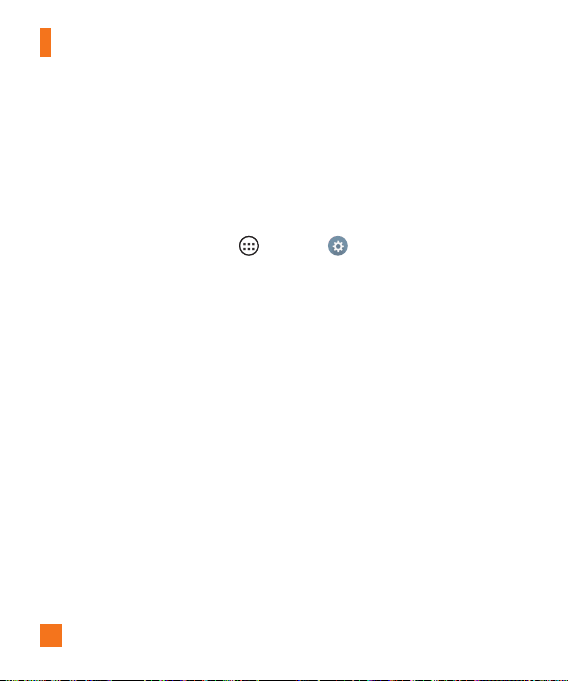
The KnockON feature allows you to double-tap the screen to easily turn the screen on
or off.
• Quickly double-tap the center of the screen to turn
the screen on.
• Quickly double-tap the Status Bar, an empty area
on the Home screen, or the Lock screen to turn the
screen off.
26
Getting to know your device
Unlocking your screen using the Knock Code feature
The Knock Code feature allows you to create your own unlock code using a combination
of knocks (or taps) on the screen.
• While the screen is off, tap the same sequence you established anywhere on the
screen. The Home screen will be accessed directly
.
To activate the Knock Code feature
1 From the Home screen, tap Apps > Settings > Lock screen > Select
screen lock > Knock Code.
2 This opens a screen that will guide you through how to select the unlock sequence.
Y
ou have to create a backup PIN as a safety measure in case you forget your unlock
sequence.
27
Your Home screen
Touch screen tips
Here are some tips on how to navigate on your tablet.
NOTE
To select an item, touch the center of the icon.
Do not press too hard; the touch screen is sensitive enough to pick up a light, yet
firm touch.
Use the tip of your finger to touch the option you want. Be careful not to touch any
other keys.
Tap or touch
A single finger tap selects items, links, shortcuts and letters on the on-screen keyboard.
Touch and hold
Touch and hold an item on the screen by touching it and not lifting your finger until an
action occurs. For example, to open a contact's available options, touch and hold the
contact in the Contacts list until the context menu opens.
Drag
Touch and hold an item for a moment and then, without lifting your finger, move your
finger on the screen until you reach the target position. You can drag items on the Home
screen to reposition them.
Swipe or slide
To swipe or slide, quickly move your finger across the surface of the screen, without
pausing when you first touch it (so you don’t drag an item instead). For example, you
can slide the screen up or down to scroll through a list, or browse through the different

28
Your Home screen
Home screen canvases by swiping from left to right (and vice versa).
Double-tap
Double-tap to zoom on a webpage or a map. For example, quickly double-tap a section
of a webpage to adjust that section to fit the width of the screen. You can also double-
tap to zoom in and out when viewing a picture and when using Maps. Double-tap
a word to highlight it. Double-tap can also activate the KnockON feature to turn the
touchscreen on or off.
Pinch-to-Zoom
Use your index finger and thumb in a pinching or spreading motion to zoom in or out
when using the browser, Maps, or when browsing pictures.
Rotate the screen
From many applications and menus, the orientation of the screen adjusts to the device's
physical orientation.
29
Your Home screen
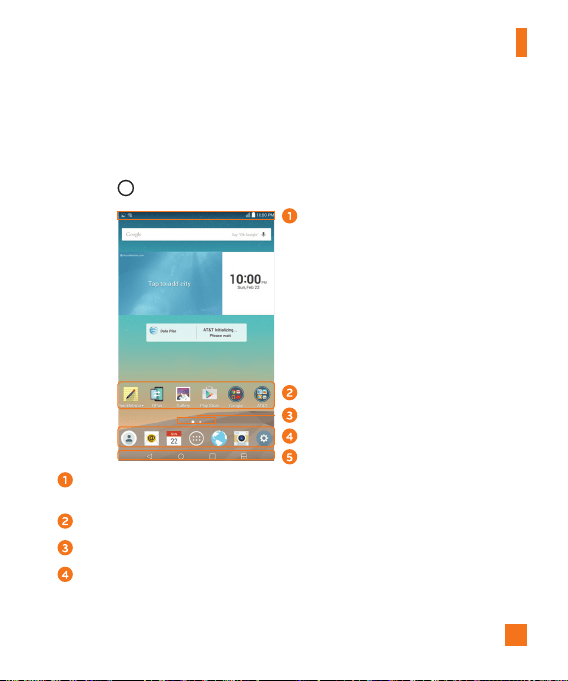
Home screen
The Home screen is the starting point for many applications and functions. It allows
you to add items like app shortcuts and Google widgets to give you instant access to
information and applications. This is the default canvas and accessible from any menu
by tapping .
Status Bar
Application Icons
Location Indicator
Quick Button Area
Home Touch Buttons
Shows the device's status information, including the time, signal strength, battery
status and notification icons.
Tap an icon (application, folder, etc.) to open and use it.
Indicates which Home screen canvas you are currently viewing.
Provides one-touch access to the function from any Home screen canvas.
30
Your Home screen
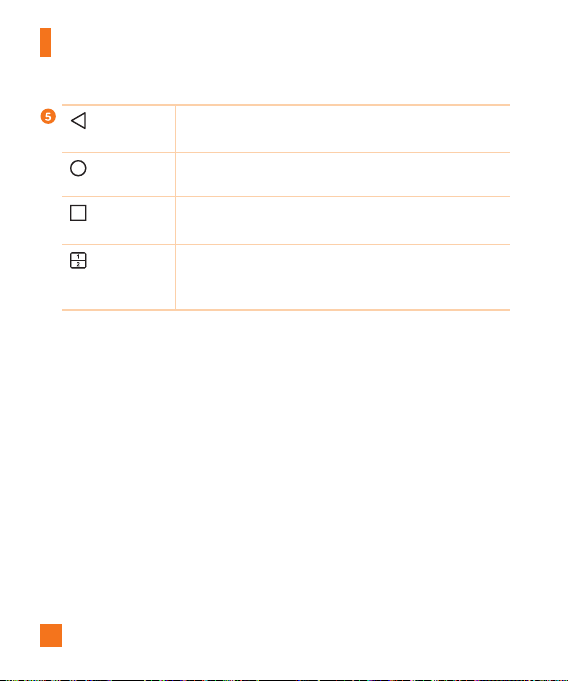
Back Button
Returns to the previous screen. Also closes pop-up items,
such as menus, dialog boxes and the on-screen keyboard.
Home Button
Return to the Home screen from any screen. Touch and hold
to access the Google Now shortcut.
Recent Apps
Button
Displays recently used applications. If you touch and hold
this button, it opens a menu of available options.
Dual
Window
button
Tap to change to dual window mode. It allows you to
manage two different apps at the same time by splitting the
screen in two.
Customizing the Home screen
You can customize your Home screen by adding apps, downloads, widgets or
wallpapers. For more convenience using your tablet, add your favorite apps and widgets
to the Home screen.
To add items on your Home screen:
1 Touch and hold the empty part of the Home screen.
2 Tap the Apps or Widgets tab.
3 Drag the desired item to the desired location and lift your finger.
31
Your Home screen
To remove an item from the Home screen:
Touch and hold the icon you want to remove, drag it to , and lift your finger.
TIP!
To add an application icon to the Home screen from the Apps screen, touch and
hold the application you want to add and drag it to the desired location.
You can add several app icons in a folder. Drop one app icon over another one on a
Home screen, and a folder will be created.
Returning to recently-used applications
1
Tap . App previews of recently used applications will be displayed.
2 Tap an app preview to open the application. Or tap
to return to your previous
screen.
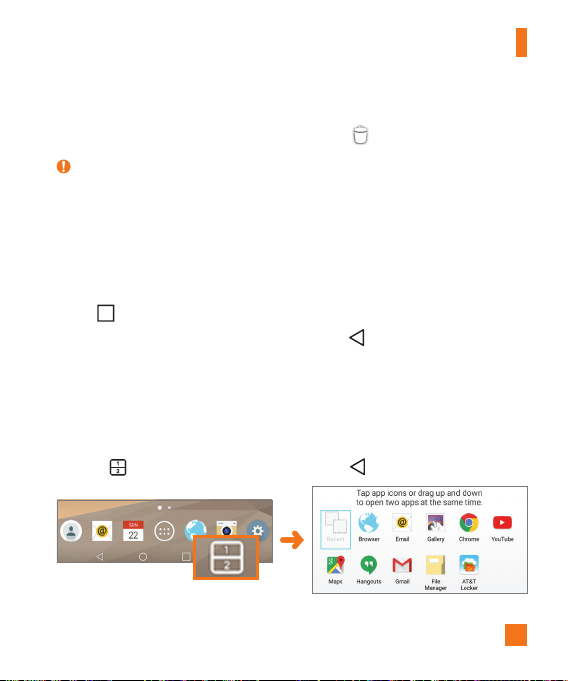
Using Dual Window
The Dual Window feature splits the screen to enable multi-tasking, drag and drop
interaction, auto-linking and recently used apps.
1 Touch
to split the screen or touch and hold the until the app list is displayed.
32
Your Home screen
2 Touch or drag an app icon to the desired space.
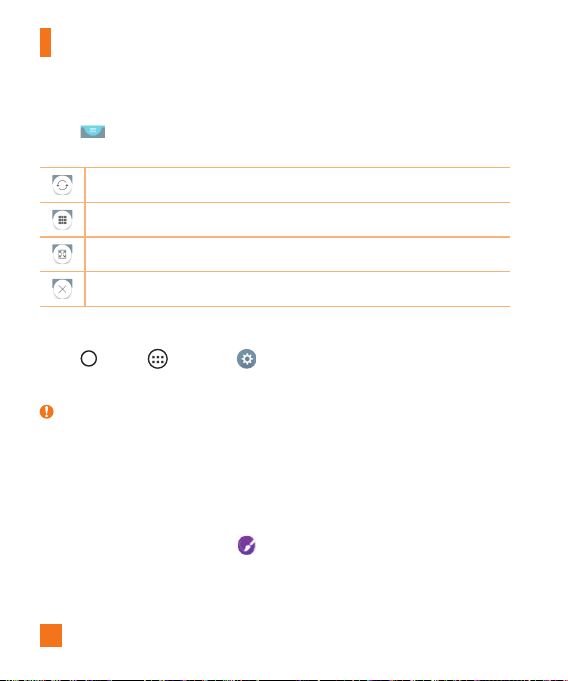
3 Tap
to display the following options. You can also drag the tabs to change the
size of the windows.
Switch the two screens.
View the apps list.
Full screen view.
Close the apps.
To disable the Dual Window feature
1 Tap > Apps > Settings > Dual window.
2 Tap the Dual Window switch to toggle it to OFF.
TIP!
You can launch two apps at the same time.
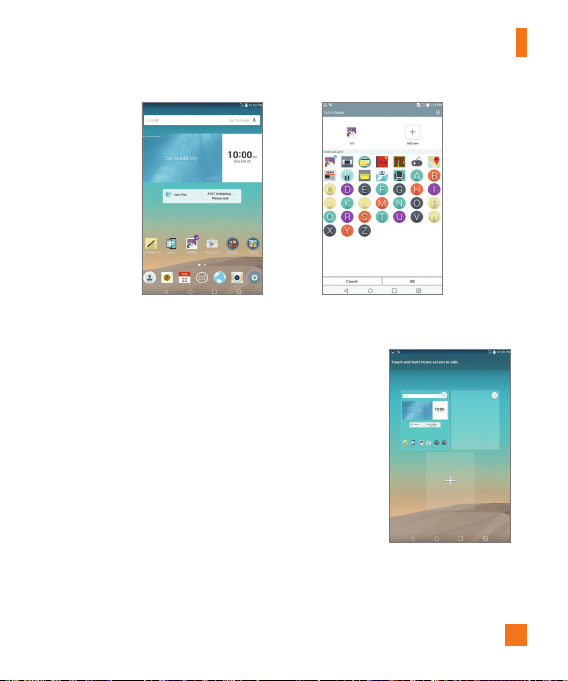
Customizing app icons on the Home screen
You can customize each application icon with images from your Gallery.
1 Touch and hold an application icon until it’s unlocked from its current position. Then
drop it on the screen. The editing
icon will appear in the upper right corner of
the application.
2 Select the desired icon design and tap OK. Or tap Add new, adjust the icon size and
select an image from your Gallery.
33
Your Home screen
To view other Home screen panels
• Swipe (or flick) your finger left or right across the Home
screen.
• Pinch in on the Home screen to display the mini panel
view
, then tap the Home screen panel you want to view.
34
Your Home screen
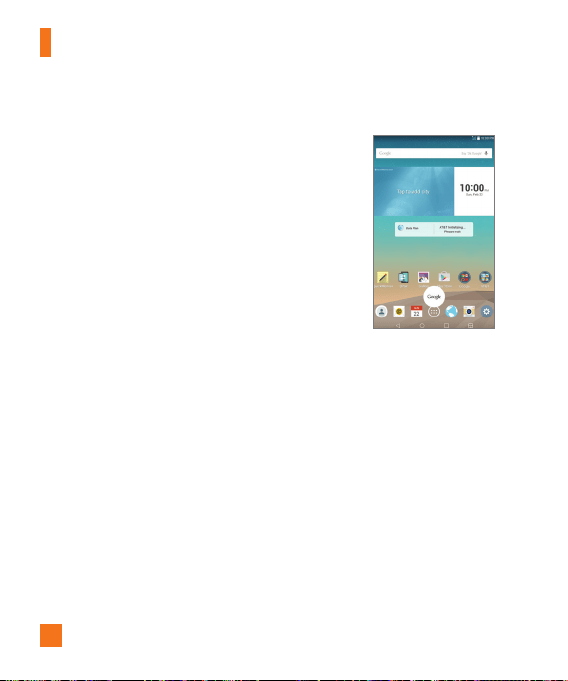
Quick access to Google
For quick access to Google, touch anywhere in the front key
area and drag up.
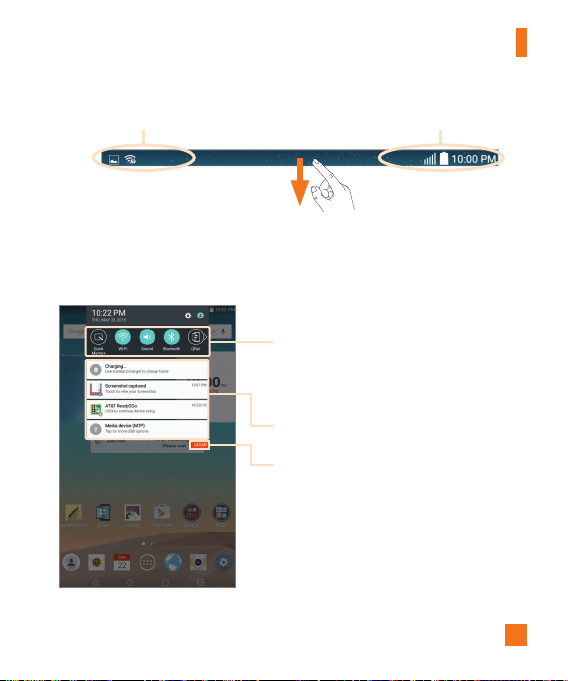
Notifications
Notifications alert you to the arrival of new messages, calendar events, and alarms, as
well as to ongoing events, such as downloads.
From the Notifications Panel, you can view your tablet’s current status and pending
notifications. When a notification arrives, its icon appears at the top of the screen. Icons
for pending notifications appear on the left, and system icons showing things like Wi-Fi
or battery strength on the right.
35
Your Home screen
Pending notifications System notifications
Accessing notifications
Swipe the Status Bar down to open the Notifications Panel and access notifications. To
close the Notifications Panel, swipe the bar that is at the bottom of the screen upwards.
Quick Settings Bar – Swipe to the right or
left to scroll through the list. Tap an icon to
activate/deactivate the feature.
Tap a notification to open it.
Clear Button – Tap here to clear your list of
event-based notifications.
36
Your Home screen
Quick Settings on the Notifications Panel
Use the Quick Settings to easily toggle function settings like Wi-Fi. The Quick Settings
are located at the top of the Notifications Panel.
NOTE
Touch and hold an icon in the Quick Settings Bar to view the function's settings
menu.
To rearrange Quick Setting options on the Notification Panel
Open the Notifications Panel, swipe the Quick Settings to the left, and tap Edit .
To rearrange items, drag to the desired location. To add more icons, checkmark the
desired functions.
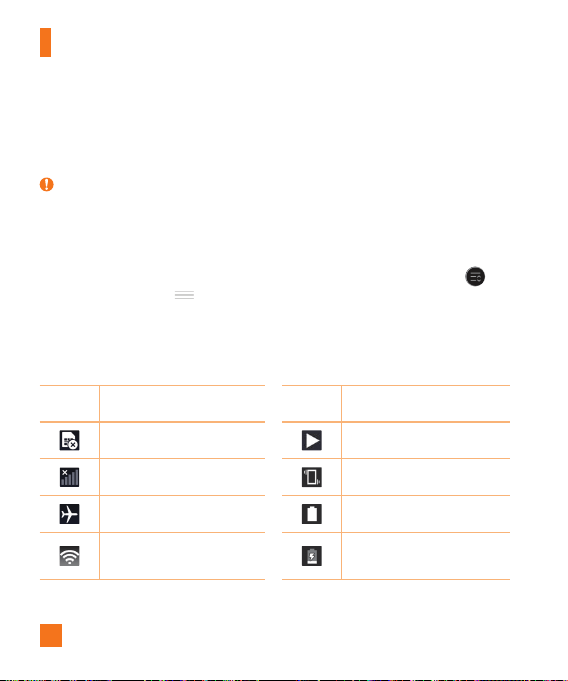
Notification icons on the Status Bar
The icons listed in the table below are some of the most common ones.
Icon Description Icon Description
No SIM card inserted A song is currently playing
No network signal available Vibrate mode is on
Airplane mode is on Battery fully charged
Connected to a Wi-Fi
network
Battery is charging
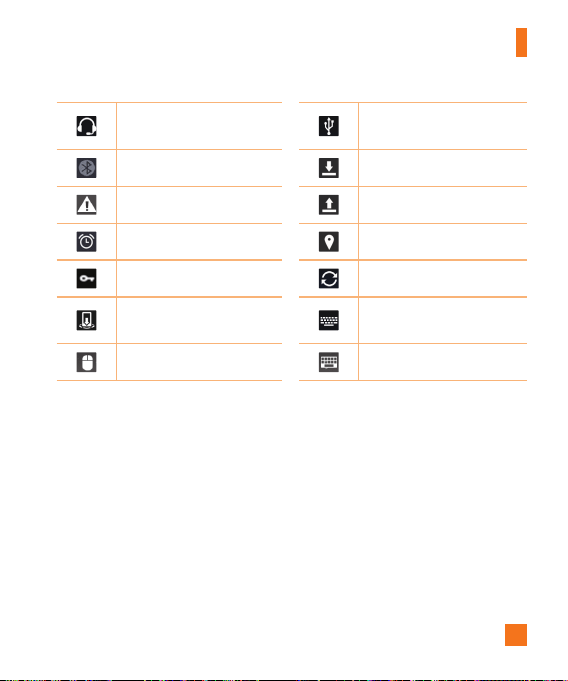
37
Your Home screen
Wired headset connected
The device is connected to a
PC via a USB cable
Bluetooth is on Downloading data
System warning Uploading data
An alarm is set GPS is on
VPN is active Data is synchronizing
Media server content
sharing is on
Choose input method
The mouse is connected The keyboard is connected
Multiple Users
Only one tablet owner ID can be created, but multiple user IDs can be added so that
others can log in and use the tablet independently. Each user can configure their own
tablet settings, use their own storage space, and have their own app update privileges.
Tablet owner privileges
• Only the tablet owner ID can add a new user log in ID and remove user IDs.
38
Your Home screen
Multiple tablet user limitations
• All users share the same battery, internal memory, and data usage with all of the
other users.
• The language settings set by one user apply to all of the other users.
• Each user can configure and use only their own content and data (e.g., Home screen
settings, Sound settings, etc.).
• Any user can accept updated app permissions on the behalf of all of the other users.
• Messages and scheduled calendar events will be sent to notify the specified user ID
only
.
• Once a user starts printing a document using Mobile Print, the print job will continue
even if the user ID is changed.
• Data transfer, download, multimedia play, and communication services will stop if the
user ID is changed. However
, the data transfer through Play Store can be continued
even if the user ID is changed.
To add a new user on your tablet
1 From the Home screen, tap Apps > Settings > Users > Add user.
2 Select the type of user you want to add.
User: Users have their own apps and content.
Restricted user: Y
ou can restrict access to apps and content from your account.
3 The setup wizard opens to help you add a new user. Touch Set up now.
After creating a new user, that person needs to go through the setup process upon
their first login.
To switch users
1 Press the Power/Lock Key to lock the tablet's screen.
39
Your Home screen
2 Press the Power/Lock Key once more to wake the tablet's screen.
3 Slide the Status Bar down and touch
.
4 Choose from the owner ID or any other user IDs you created.
QSlide
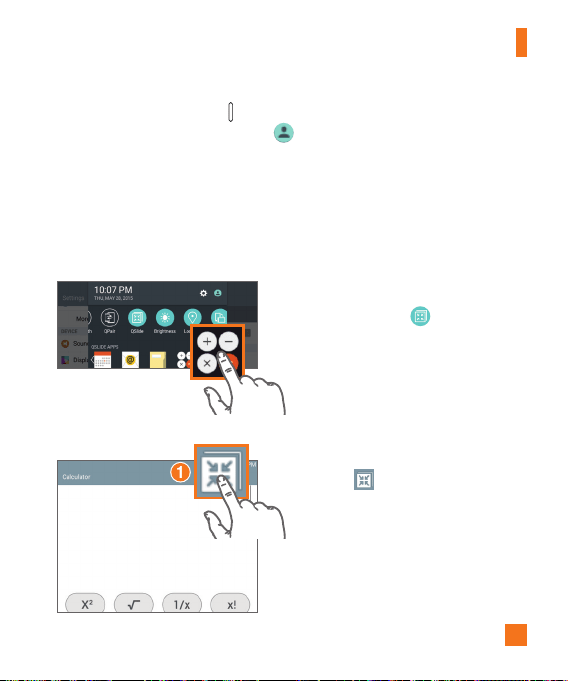
The QSlide function enables an overlay window on your tablet’s display for easy multi-
tasking. QSlide windows can be opened from the QSlide apps bar on the Notifications
panel, or directly from the applications that support the QSlide function.
Open the Notifications Panel and tap the
QSlide Quick Settings to enable the
QSlide Apps bar. Then tap the desired app
from the QSlide apps section.
OR
While using an application that supports
QSlide, tap . The function will be
displayed continuously as a small window
on your screen.
40
Your Home screen
Using QSlide
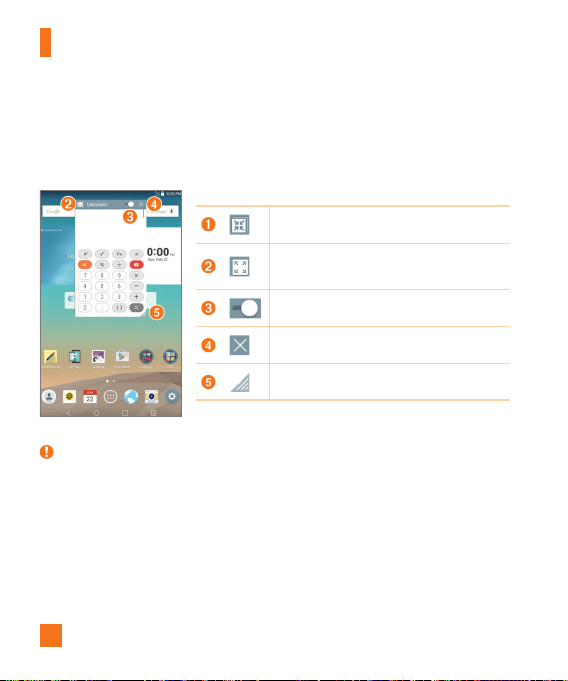
The QSlide function opens the associated app in a window in the foreground, allowing
you to access other apps in the background. It’s displayed continuously on the screen
until you close it.
Tap to access QSlide.
Tap to exit QSlide and return to full
window.
Tap to adjust the transparency.
Tap to close QSlide.
Tap to adjust the window size.
NOTE
The QSlide function can support up to two windows at the same time. QSlide only
supports the following applications: V
ideo, Browser, Calendar, Email, File Manager,
and Calculator.
41
Your Home screen
Capturing a Screenshot
Press and hold the Volume Down Key and Power/Lock Key at the same time for
2 seconds to capture a screenshot of the current screen.
To view the captured image, go to Apps
> Gallery > Screenshots folder.
Using QuickMemo+ to capture a screenshot
On the screen you want to capture, drag the Status Bar downward and select
QuickMemo+ .
OR
Press and hold both Volume Keys
at the same time.
Using Capture plus to capture a screenshot of the browser
This feature allows you to capture a portion of the screen in the default Internet
browser.
1 Open the Browser
and navigate to the page you want to capture a screen shot
of.
2 Tap the Menu icon
> Capture plus.
3 Adjust the blue box to the desired size, and then tap Save. The selected area is
saved to the Capture plus folder in the Gallery.
Text Input Methods
The on-screen keyboard displays automatically on the screen when you need to enter
text. To manually display the on-screen keyboard, simply tap a text field where you want
to enter text.
42
Your Home screen
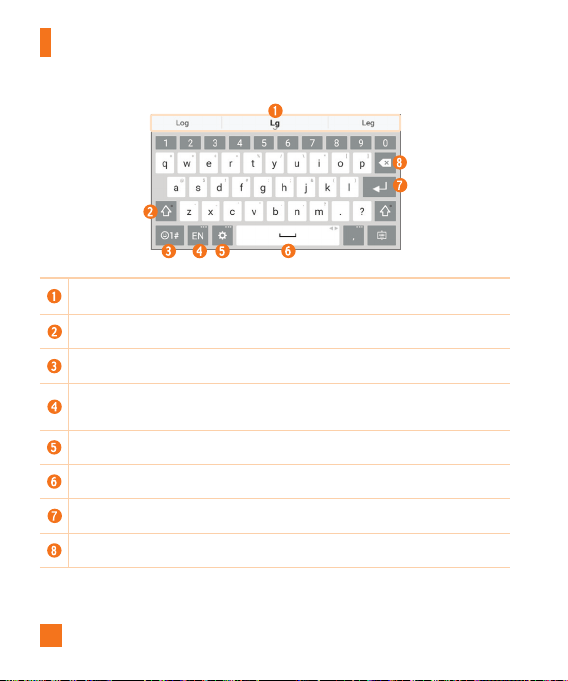
Word suggestions
Tap once to capitalize the next letter you type. Double-tap for all caps.
Tap to switch to the numbers and symbols keyboard.
Tap to select the keyboard language. Only available when multiple languages
are enabled.
Tap to access the LG keyboard settings. Touch and hold to access the Clip Tray.
Tap to enter a space.
Tap to create a new line in the message field.
Tap to delete the previous character.
43
Your Home screen
Enter suggested word
Enter text on the keyboard and the related word suggestions appear. Tap the left-side or
right-side suggestion to insert it.
Split keyboard using gesture
The split keyboard feature allows you to use both hands to type. Each half of the
keyboard withdraws to the left and right of the screen. To activate the split keyboard,
place both thumbs on the keyboard and slide them apart.
To change the keyboard height
Adjust height of keyboard to show more of the screen and to control keyboard more
easily.
• From the Home screen, tap Apps
> Apps tab > Settings > Language
& input > (next to the LG Keyboard option) > Keyboard height and layout >
Keyboard height in portrait or Keyboard height in landscape. > Tap and drag
the icon to adjust the keyboard height.
To change the bottom row keys
• From the Home screen, tap Apps
> Apps tab > Settings > Language
& input > (next to the LG Keyboard option) > Keyboard height and layout >
Qwerty keyboard layout > Tap and drag to add or delete keys or change the order.
Entering special characters
The on-screen keyboard allows you to enter special characters (e.g. "á").
For example, touch and hold the desired key (for example, the "a" key). After the desired
character appears, slide your finger over it and lift it off to enter it.
44
Your Home screen
NOTE
A symbol at the top right corner of a key indicates that additional characters are
available.
Using Clip Tray
Easily access the contents you stored in the Clip Tray whenever and wherever you want.
You can copy images or texts and keep them in the Clip Tray. Then, you can paste them
whenever and wherever you want.
• Touch and hold text and images while viewing or editing them and tap Clip T
ray.
• Touch and hold the text input field and select Clip T
ray. You can also access the Clip
Tray by touching and holding > .
NOTE
You can save up to 10 items in the Clip Tray.
Access Clip Tray and tap
, select the items you want to delete, then tap Done.
This function may not be supported in downloaded apps.
45
When you first turn on your tablet, you have the opportunity to activate the network, to
sign into your Google Account and select how you want to use certain Google services.
To set up your Google account
• Sign into a Google Account from the prompted setup screen.
OR
• From the Home screen, tap Apps
> Apps tab > Settings > Accounts &
sync > Add account > Google.
If you have a Google account, enter your email address and password, then touch
NEXT. Otherwise, tap Or create a new account and enter the necessary information
to create a new Google Account.
Once you have set up your Google account on your tablet, your tablet automatically
synchronizes with your Google account on the Web.
Your contacts, Gmail messages, Calendar events and other information from these
applications and services on the Web are synchronized with your tablet. (This will
depend on your synchronization settings.)
After signing in, you can use Gmail™ and take advantage of Google services on your
tablet.
Google account setup
46
Wi-Fi
With Wi-Fi, you can use high-speed Internet access within the coverage of the wireless
access point (AP). Enjoy wireless Internet using Wi-Fi, without extra charges.
Connecting to Wi-Fi networks
To use Wi-Fi on your tablet, you need to access a wireless access point or ‘hotspot’.
Some access points are open and you can simply connect to them. Others are hidden or
use security features; you must configure your tablet to be able to connect to them. Turn
off Wi-Fi when you're not using it to extend the life of your battery.
Turning Wi-Fi on and connecting to a Wi-Fi network
1 From the Home screen, tap Apps > Apps tab > Settings > Wi-Fi.
2 Tap
to turn Wi-Fi on and start scanning for available Wi-Fi networks.
3 Tap Search to see a list of active and in-range Wi-Fi networks.
• Secured networks are indicated by a lock icon.
4 Touch a network to connect to it.
• If the network is secured, you are prompted to enter a password or other
credentials. (Ask your network administrator for details)
5 The Status Bar displays icons that indicate your Wi-Fi status.
Connecting to Networks and Devices
47
Connecting to Networks and Devices
Bluetooth
You can use Bluetooth to send data by running a corresponding application, but not from
the Bluetooth menu as on most other mobile phones and tablets.
NOTE
LG is not responsible for the loss, interception or misuse of data sent or received via
the Bluetooth wireless feature.
Always ensure that you share and receive data with devices that are trusted and
properly secured. If there are obstacles between the devices, the operating distance
may be reduced.
Some devices, especially those that are not tested or approved by Bluetooth SIG,
may be incompatible with your device.
Turning on Bluetooth and pairing up your tablet with a Bluetooth device
You must pair your device with another device before you connect to it.
1 From the Home screen, tap Apps
> Apps tab > Settings > Bluetooth.
2 Tap the Bluetooth switch
to turn it on.
3 Tap the check box next to your tablet's name to make your tablet visible to other
Bluetooth devices.
NOTE
To select the length of time that your device will be visible, tap the Menu icon
>
Visibility timeout.
4 A list of available devices will be displayed. Tap the device you want to pair with
from the list.
48
Connecting to Networks and Devices
NOTE
Depending on the type of device, you may have to enter matching codes, confirm
matching codes, or the devices may automatically pair
.
5 Once pairing is successful, your tablet will connect to the other device.
NOTE
Your tablet doesn't support Handsfree Profile. Therefore, the use of call features
with some of accessories, such as Bluetooth headsets or Bluetooth-enabled
devices, may not be available for this device.
Send data using the Bluetooth feature
1 Open the item and tap .
OR
Touch and hold the item and select Share.
OR
Open the item and tap the Menu icon
> Share.
2 Tap Bluetooth to share via Bluetooth.
NOTE
The method for selecting an option may vary by data type.
3 Search for and pair with a Bluetooth-enabled device.
Receive data using the Bluetooth feature
1 Refer to the Bluetooth device's user guide to send a file to your tablet. Both devices
must be paired and Bluetooth must be on.
2 Pair the devices and tap Accept when you receive a Bluetooth Authorization
Request to accept the file(s).
49
Connecting to Networks and Devices
SmartShare
SmartShare allows you to receive multimedia content via LG device and tablets.
1 While viewing the content you want to share, tap
or > SmartShare.
2 Tap Play or Beam in the pop-up that is displayed.
• Play: Y
ou can stream your content via a TV, Bluetooth speaker, etc.
• Beam: Y
ou can send your content to Bluetooth devices or via SmartShare Beam*
to supported LG devices or tablets.
*SmartShare Beam quickly transfers multimedia contents through Wi-Fi Direct.
3 Tap the device you want to share from the list.
• If the device is not displayed on the list, make sure that Wi-Fi, Wi-Fi Direct, or
Bluetooth is turned on. Then tap Rescan.
4 Files will be automatically shared.
Enjoying content from nearby devices
1 To connect nearby devices to your device, tap the Nearby devices option on the
Gallery and Music apps.
• Make sure that your device and nearby devices are connected to the same Wi-Fi
network and that the DLNA service on the nearby device is turned on.
2 Tap the device you wish to connect to.
If the device is not listed, tap Search nearby devices.
3 After a connection is established, you can enjoy the content on your device.
50
Connecting to Networks and Devices
QPair
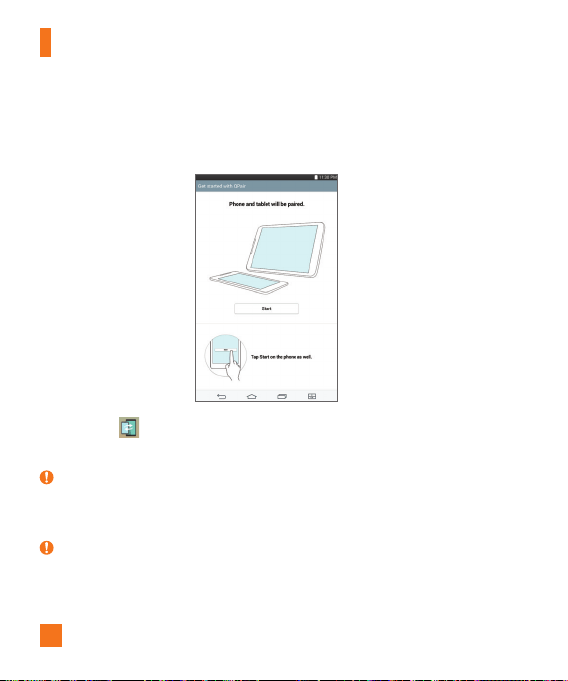
By connecting your tablet and mobile phone via QPair, you can sync incoming calls,
messages, and social networking notifications between your tablet and mobile phone.
1 Run QPair and tap Get started > Start on your tablet first and then run the
same steps on your phone.
TIP!
QPair may not be pre-installed on the phone. Go to the Google Play Store and
search for QPair and install it.
NOTE
QPair works with phones running Android 4.1 or later. Some features may be limited
depending on your phone model.

51
Connecting to Networks and Devices
Since QPair uses the Bluetooth function, it may not work normally if you change the
Bluetooth settings while QPair is in use.
2 Bluetooth connection will be turned on and you will be able to pair the devices.
QPair features
Call notifications – Sends the tablet a notification when the phone receives a call.
The notification displays the caller's number and allows you to answer and decline the
call. You can also change call settings, such as a ringtone, ringtone volume, ringtone
with vibration, or send a decline message when you get a call.
NOTE
You can only receive a call supported by Bluetooth technology. Dialing a call from
the tablet using the QPair feature is not possible.
Message notifications – Sends the tablet a notification when the phone receives a
message. You can also change message settings, such as message pop-up, message
preview, notification sound, and notification vibration.
Social network notifications – Displays a social networking notification on your
tablet's Status Bar when it arrives on your phone.
NOTE
To enable this feature, turn the QPair social network notifications option on
your phone (Settings > Accessibility > QPair social network notifications).
This option allows you to be notified of social networking notifications on your
tablet.
QuickMemo+ transfer – Saves your current QuickMemo+ in the tablet's Gallery, and
then syncs the tablet's Gallery with the Gallery on your phone.

52
Connecting to Networks and Devices
PC connections with a USB cable
You can connect your tablet to your PC to charge it, transfer items to the PC from the
tablet and vice versa.
Transferring music, photos and videos using the Media device (MTP) mode
1 Connect your tablet to a PC using a USB cable.
2 To change the settings, slide the Status Bar down and tap the current USB
connection mode > Media sync (MTP).
3 You can now view the Media device content on your PC and transfer the files.
NOTE
If you want to change the PC connection settings, slide the Status Bar down and
select the USB connection mode option. This setting is visible on the Status Bar
only when you connect a USB cable to your tablet.
Synchronize with Windows Media Player
Ensure that Windows Media Player is installed on your PC.
1 Use the USB cable to connect the tablet to a PC on which Windows Media Player
has been installed.
2 Select the Media sync (MTP) option.
3 When connected, a pop-up window will appear on the PC. Select the Windows
Media Player option to synchronize music files.
4 Edit or enter your device’s name in the pop-up window (if necessary).
5 Select and drag music files to the sync list.
6 Start synchronization.
53
Connecting to Networks and Devices
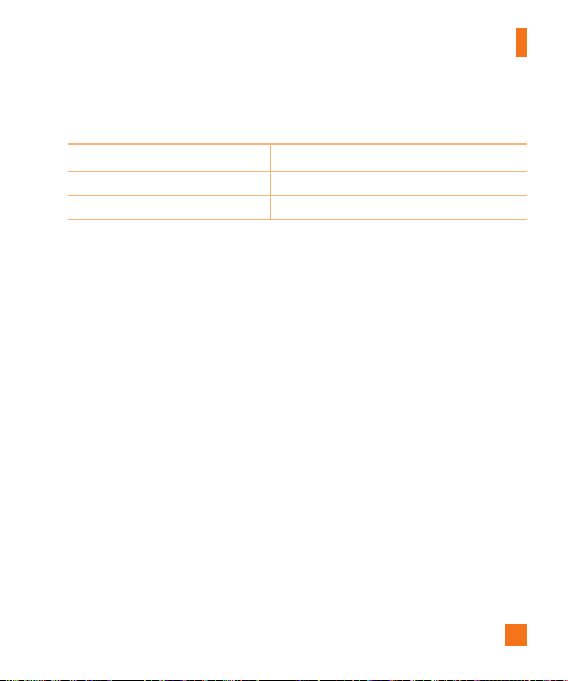
• The following requirements must be satisfied to synchronize with Windows Media
Player.
Items Requirement
OS Microsoft Windows XP SP2, Vista or higher
Window Media Player version Windows Media Player 10 or higher
• If the Windows Media Player version is older than 10, install version 10 or newer.
PC connections with a USB cable for Mac OS X users
You can transfer media contents to your Mac OS X PC from the tablet and vice versa by
setting up the Android File Transfer program.
1 Download and install the Android File Transfer program from android.com website
for Mac Users (http://www
.android.com/filetransfer/).
2 Connect your tablet to your computer, and double click the AFT (Android File Transfer
program) application to start it up.
3 You can view the media contents, drag and drop the media file to and from the tablet
(or PC).
54
You can add contacts on your tablet and synchronize them with the contacts in your
Google Account or other accounts that support syncing contacts.
Searching for a contact
1 From the Home screen, tap Contacts to open your contact list.
2 Tap the Search contacts box and enter the contact's name. Y
ou can also tap a
letter along the left side of the screen to access names starting with the chosen
letter.
Adding a new contact
1 From the Home screen, tap Contacts .
2 Tap New contact
. Select the desired account (if applicable).
3 If you want to add a picture to the new contact, tap
. Choose from Take photo
to take a picture using the camera or Select from Gallery. Then browse for an
image and select it.
4 Tap
to enter more specific name information.
5 Enter the details about your contact.
6 Tap Save.
Favorite Contacts
You can classify frequently called contacts as favorites.
To add a contact to your favorites
1 From the Home screen, tap Contacts to open your contacts.
Contacts
55
Contacts
2 Tap a contact to view its details.
3 Tap the star
to the right of the contact’s name. The star turns gold and the
contact is added to your favorites.
To remove a contact from your favorites list
1 From the Home screen, tap Contacts to open your contacts.
2 Tap the Favorites tab to view your favorite contacts.
3 Tap a contact to view its details.
4 Tap the gold star to the right of the contact’s name. The star turns grey and the
contact is removed from your favorites.
Creating a group
1 From the Home screen, tap Contacts to open your contacts.
2 Touch the Groups tab, then touch
.
3 Enter a name for the new group.
• Tap Add members to add contact entries to your new group.
• Tap the ACCOUNT field to change the account(s) you want to save the new group
to.
4 Touch Save to save the group.
NOTE
If you delete a group, the contacts assigned to that group will not be lost. They will
remain in your contacts.
56
You can use the Email application to read emails from services like Yahoo!, MSN,
and AOL. The Email application supports the following account types: POP3, IMAP
and Exchange. Your service provider or system administrator can provide you with the
account settings you need.
Managing an email account
Tap the Email on the Home screen. The first time you open the Email application, a
set-up wizard opens to help you to set up an email account.
After the initial setup, the contents of your inbox are displayed. If you have added more
than one account, you can switch among accounts.
To add another email account:
• Open the Email application and tap the Menu icon > Settings > Add account.
To switch between accounts:
If you've added more than one account, you can easily switch between them. From any
email folder, tap the current account (at the top of the screen), then tap the account you
want to access.
To change an email account’s settings:
Open the Email application and tap the Menu icon > Settings > General settings
to configure settings that apply to all of your accounts. Tap an individual account to
configure settings only for that particular account.
To delete an email account:
• Open the Email application and tap the Menu icon > Settings > Menu icon >
Remove account > touch an account you want to delete > Remove > Yes.
Email
57
Email
Working with account folders
Open the Email application and tap the Menu icon and select Folders.
Each account has an Inbox, Outbox, Sent and Drafts folder. Depending on the features
supported by your account’s service provider, you may have additional folders.
Composing and sending email
1 While in the Email application, tap Compose .
2 Enter an address for the message’s intended recipient. As you enter text, matching
addresses will be proposed from your Contacts. Separate multiple addresses using
semicolons.
3 Tap Attach to attach files, if required.
4 Enter the subject and your message.
5 Tap Send to send the message.
If you aren’
t connected to a network, for example, if you’re working in airplane mode,
the messages that you send will be stored in your Outbox folder until you connect to
a network again. If it contains any pending messages, the Outbox will be displayed
on the Accounts screen.
Receiving emails
When a new email arrives in your Inbox, you'll be notified by a sound or vibration
(depending on your sound and vibration settings) and its notification icon appears on the
Status Bar.
58
Entertainment
Camera
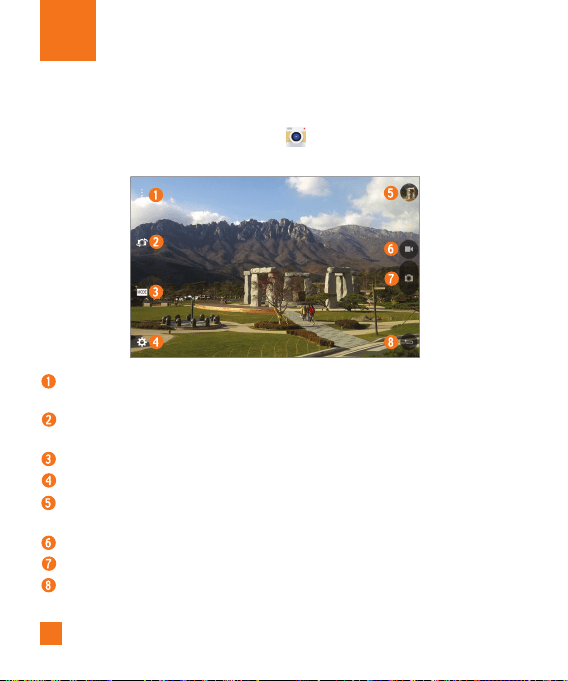
To open the Camera application, tap Camera on the Home screen.
Getting to know the viewfinder
Display/Hide options – Touch to show or hide the camera menus on the view
finder.
Swap camera – Switch between the back-facing camera lens and the front–facing
camera lens. You can also switch the camera by swiping the screen.
Mode
– Allows you select the shot mode from Auto and Panorama.
Settings – Touch this icon to open the settings menu.
Gallery – Touch to view the last photo you captured. This enables you to access
your Gallery and view saved photos while in camera mode.
Record – Tap to start recording a video.
Capture – Takes a picture.
Exit – Touch to exit the camera.
59
Entertainment
NOTE
Please ensure the camera lens is clean before taking pictures.
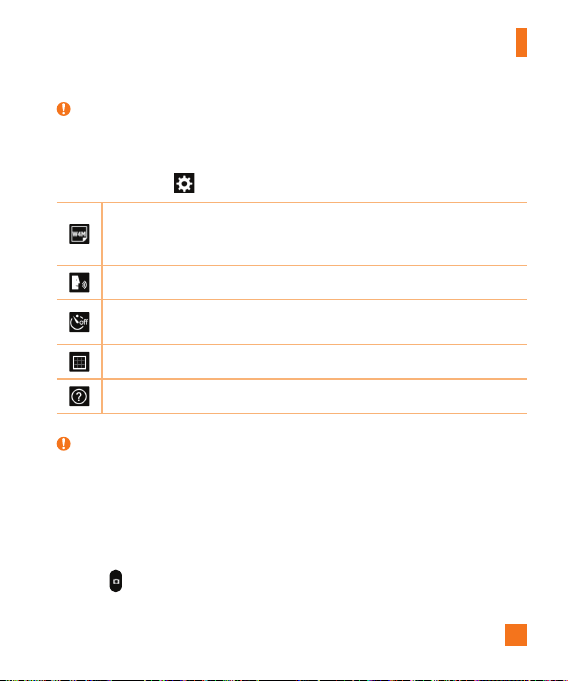
Using the advanced settings
In the viewfinder, tap to open the advanced options.
Selects the photo and video resolution. If you choose a high resolution, the
file size will increase, which means you will be able to store fewer photos
and videos in the memory.
Take photos by voice command.
Sets a delay after the capture button is pressed. This is ideal if you want to
be in the photo.
Displays grid lines on the screen to help you align your photos.
Opens the help guide to know how a function operates.
TIP!
When you exit the camera, some settings return to their defaults, such as timer.
Check these before you take your next photo.
Taking a photo
1 Open the Camera application.
2 Point the lens towards the subject you want to photograph.
3 Touch
(if displayed) or anywhere on the screen to capture the photo.
60
Entertainment
To zoom in or out
When taking a picture or recording a video, place two fingers anywhere on the screen
and spread them apart to zoom in. To zoom back out, pinch them together.
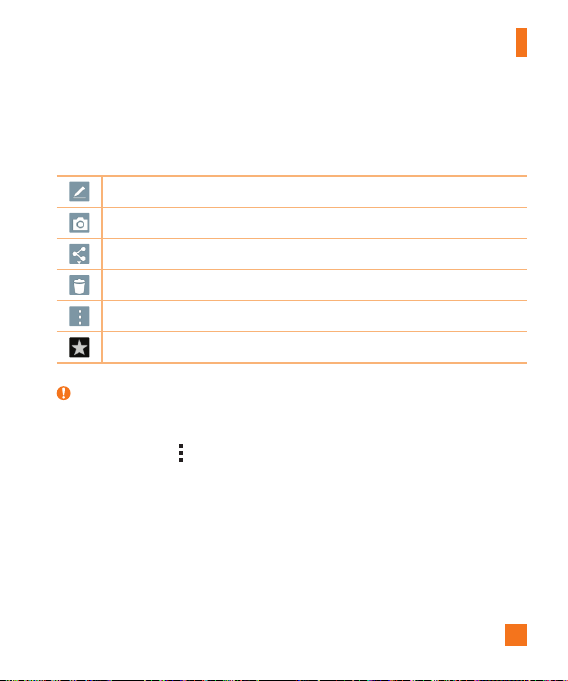
Gesture shot
The Gesture shot feature allows you to take a picture with a hand gesture using the
front camera.
To take photo using the Gesture shot
There are two methods for using the Gesture shot feature.
• Raise your hand, with an open palm, until the front camera detects it and a box
appears on the screen. Then close your hand into a fist to start the timer
, allowing
you time to get ready.
OR
• Raise your hand, in a clenched fist, until the front camera detects it and a box
appears on the screen. Then unclench your fist to start the timer
, allowing you time
to get ready.
or
61
Entertainment
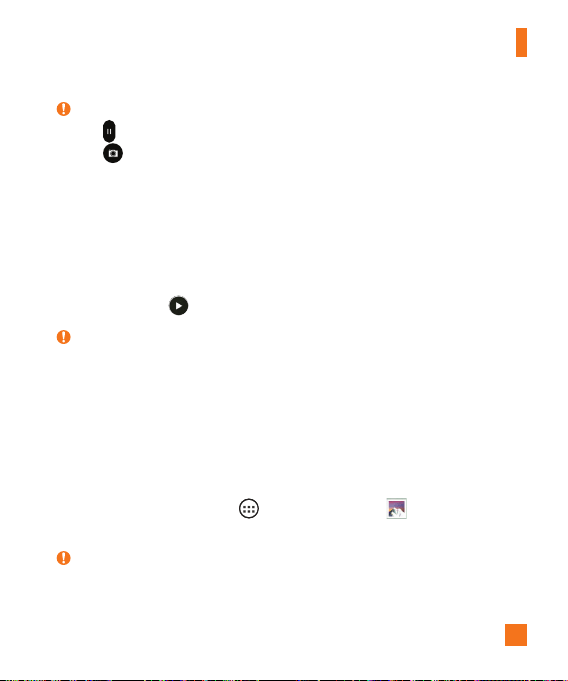
Once you've taken a photo
1 Tap the image preview by the capture button to view the last photo you captured.
2 Tap Gallery or Photos, then tap OK.
Touch to edit the photo.
Touch to access the camera.
Touch to send your memo to others or share it via social networking services.
Touch to delete the photo.
Touch to access more options.
Touch to add the picture to your favorites.
TIP!
If you have a social networking account and set it up on your tablet, you can share
your photo with your social networking community
.
Touch the Menu icon
to open the following options.
SmartShare – Touch to share your photo using the SmartShare function.
Set image as – Touch to use the photo as a Contact photo, Home screen
wallpaper, Lock screen wallpaper or Wallpaper.
Move – Touch to move the photo to another album.
Copy – Touch to copy the selected photo and save it to another album.
Copy to Clip Tray – Touch to copy the photo and store in the Clip Tray.
Slideshow – Automatically shows you the images in the current folder one after the

62
Entertainment
other.
Rotate – Touch to rotate the picture to the left or right.
Crop – Crop your photo. Move your finger across the screen to select the area to be
cropped.
Add location – To add the location information.
Rename – Touch to edit the name of the selected photo.
Print – Allows you to print the picture.
Details – Displays more information about the picture.
Viewing your saved photos
You can access your saved photos when in camera mode. Just tap the image preview
by the capture button and your Gallery will be displayed.
1 Choose the app to use to view and/or edit your photos. Tap Gallery
or Photos
.
2 Tap OK.
• To view more photos, scroll left or right.
• To zoom in or out, double-tap the screen or place two fingers and spread them apart
(move your fingers closer together to zoom out).
Recording a video
1 Open the Camera application.
2 Point the lens towards the subject you wish to capture in your video.
3 Touch the Video mode icon
to start recording.
4 A timer showing the length of the video will appear.
5 Touch
on the screen to stop recording.
63
Entertainment
TIP!
Tap
to pause the recording.
Tap
to take a screen shot while recording a video.
Watching your saved videos
Access your saved videos from video camera mode by tapping the image preview by the
capture button.
1 In the viewfinder, tap the image preview by the capture button.
2 Your Gallery will appear on the screen with your most recent recorded video
displayed. Swipe to the left to scroll to your other videos.
3 Tap the Play icon
on a video to play it automatically.
NOTE
You can view your videos in the Gallery and Photos apps.
Do not to press too hard; the touch screen is sensitive enough to pick up a light, but
firm touch.
Gallery
You can store multimedia files in internal memory for easy access to all your multimedia
files. Use this application to view multimedia files like pictures and videos.
From the Home screen, tap Apps
> Apps tab > Gallery .
You can manage and share all your image and video files with the Gallery.
NOTE
Some file formats are not supported, depending on the software installed on the
device.
64
Entertainment
Some files may not play properly, depending on how they are encoded.
If the file size exceeds the available memory, an error can occur when you open
files.
Viewing pictures
Launching the Gallery app displays your available folders. When another
applications save a picture, a folder is automatically created to contain the picture. Tap
a folder to open it.
Pictures are displayed in order by creation date. Select a picture to view it full screen.
Scroll left or right to view the next or previous image.
Playing videos
Open the Gallery app and select an album. The Play icon is displayed on
video files. Tap an image to select it. Select the app to play it (tap the Photos app
or the Video app ), then tap OK and the video begins playback.
NOTE
When using the Videos app to play a video, slide the left side of the screen up and
down to adjust the screen brightness. Slide the right side of the screen up and
down to adjust the volume.
When using the Videos app to play a video, slide the screen left or right to rewind
or fast-forward.
Deleting images and videos
Use one of the following methods:
• In a folder, tap
and select the photos and videos you want to delete, then tap
Delete, the Yes to confirm.
65
Entertainment
• When viewing a photo or video, tap , then tap Yes to confirm.
Setting as wallpaper
When viewing a photo, touch the Menu icon > Set image as and select Home
screen wallpaper, Lock screen wallpaper or Wallpaper.
Slideshow
You can view your photos in a slideshow by album or by selecting all of your photos.
From the Home screen, tap Gallery .
• Tap the album with the photos you want to view, then tap the Menu icon
>
Slideshow > choose the images you want to view > Next > verify the slideshow
settings > Start.
Tap the Back Button
to stop playing the slideshow.
Videos
Your Gallery has an integrated video player that lets you play all of your favorite videos.
Playing a video
1 From the Home screen, tap Apps > Apps tab > Gallery > Albums (at the
top left corner) > Video.
2 Select the video you want to play.
66
Entertainment
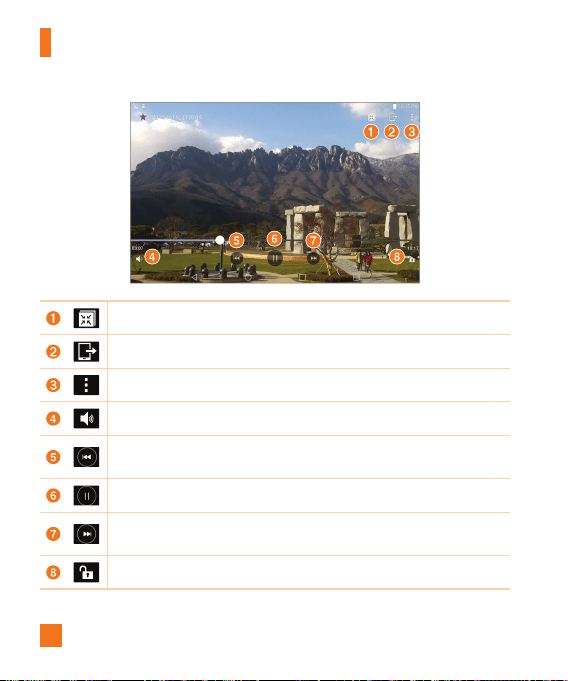
Touch access QSlide and display the video in small window.
Touch to share your video via the SmartShare function.
Touch to access more options.
Touch to manage the video volume.
Touch and hold to rewind in 3 second increments. Tap to go to previous
video.
Touch to pause video playback.
Touch and hold to fast-forward in 3 second increments. Tap to go to next
video.
Touch to lock/unlock a video screen.
67
Entertainment
To change the volume while watching a video, press the Volume Keys on the right side
of the tablet.
Touch and hold a video in the list to access the following options: Share, Delete,
Rename and Details.
TIP!
While watching a video, slide up and down along the left side of the screen to
adjust the screen brightness. Slide up and down along the right side of the screen
to adjust the volume.
Music
Your tablet has a music player that lets you play all your favorite tracks. To access the
music player, from the Home screen, tap Apps > Apps tab > Music .
Transfer music using Media device (MTP) mode
1 Connect the tablet to your PC using the USB cable.
2 Scroll the Status Bar down, tap the current USB connection and select the
Media device (MTP) option. Your tablet will appear as another hard drive on your
computer. Click on the drive to view it. Copy the files from your PC to the drive folder.
Playing a song
1 From the Home screen, tap Apps > Apps tab > Music .
2 Touch the Songs tab.
3 Select the song you want to play.
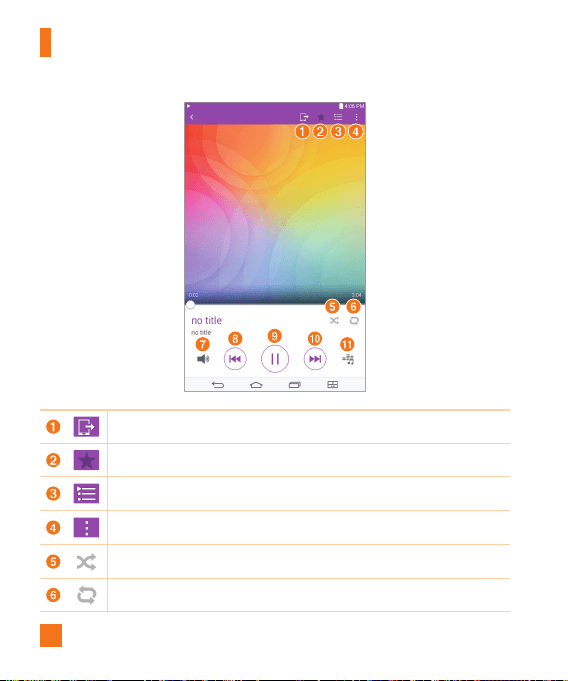
68
Entertainment
Touch to share your music via the SmartShare function.
Touch to set the current song as a favorite.
Touch to see the Now playing playlist.
Touch to access more options.
Touch to set shuffle mode.
Touch to set repeat mode.
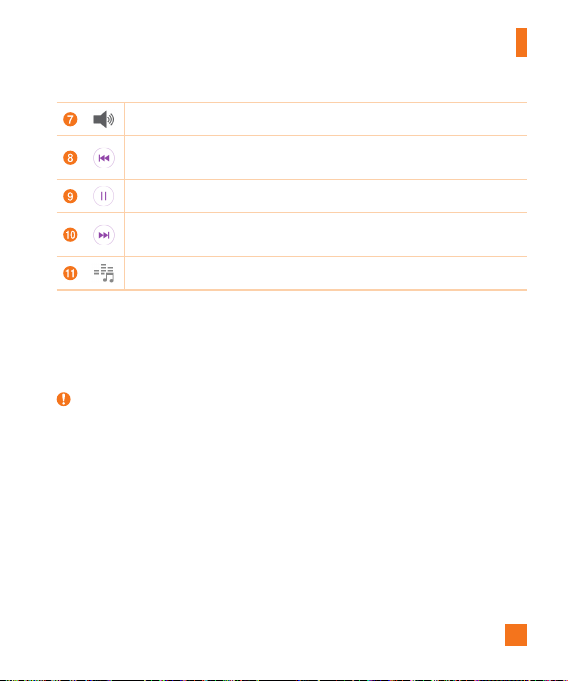
69
Entertainment
Touch to manage the music volume.
Touch to go back to the beginning of the song. Touch twice to return to
the previous song. Touch and hold to rewind 3 seconds.
Touch to pause playback.
Touch to skip to the next track on the album or in the playlist. Touch and
hold to fast-forward 3 seconds.
Touch to set the audio effect.
To change the volume while listening to music, press the Volume Keys on the right side
of the tablet.
Touch and hold any song in the list to access the following options:
Play, Add to playlist, Delete, Share, Details and Search.
NOTE
Some file formats are not supported, depending on the device software.
If the file size exceeds the available memory, an error can occur when you open
files.
Music file copyrights may be protected by international treaties and national
copyright laws. Therefore, it may be necessary to obtain permission or a licence to
reproduce or copy music. In some countries, national laws prohibit private copying
of copyrighted material. Before downloading or copying the file, check the national
laws of the relevant country concerning the use of such material.
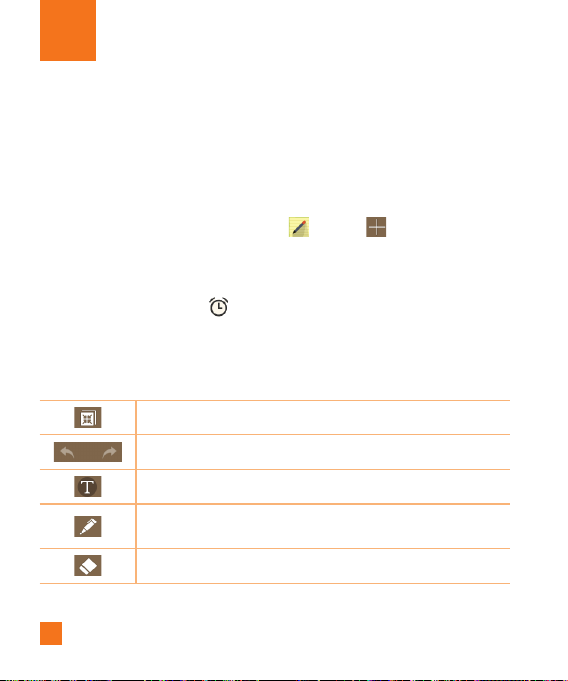
70
QuickMemo+
The QuickMemo+ feature allows you to create memos and capture screen shots.
Capture screens, draw on them, and share them with family and friends with
QuickMemo+.
Creating a memo
1 From the Home screen, tap QuickMemo+ , then tap to create a new
memo.
2 You can edit text by typing words directly or select the pen type and color you want
to use and enter text by handwriting.
3 Add a reminder by touching
to set the reminder notification for the event.
4 Add weather and location information to your memo if a data network is available.
Using the QuickMemo+ options
The following options are available in the QuickMemo+ toolbar at the top of the screen.
Touch to open the memo in QSlide.
Allows you to undo and redo previous actions.
Allows you to edit the text, its color and its alignment.
Allows you to enter text by handwriting. You can select the type of
pen to use and its thickness, transparency, and color.
Erases pen marks you've made on the memo.
Tools
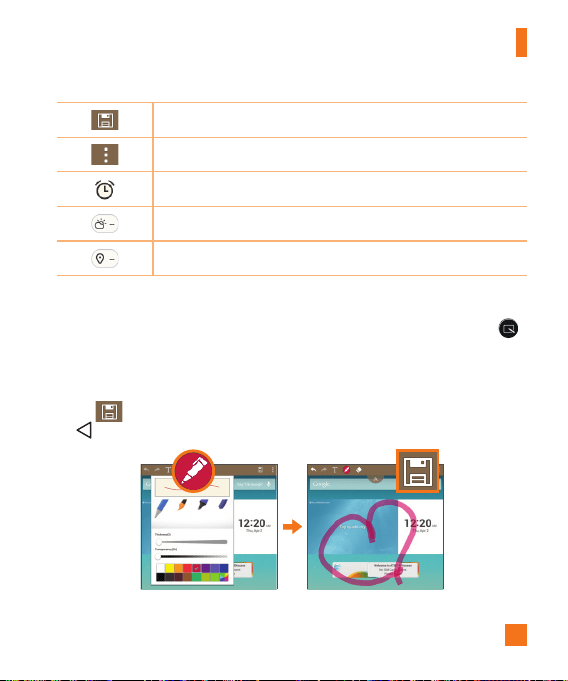
71
Tools
Saves the memo in QuickMemo+.
Touch to access more options.
Allows you to set a reminder notification for an event.
Allows you to insert weather information into the memo.
Allows you to add location information using GPS.
Capturing a screen shot for your QuickMemo
1 To access the QuickMemo+ feature, slide the Status Bar downwards and touch .
OR
Press both of the Volume Keys at the same time for one second.
2 Select the desired menu option from the toolbar and create a memo.
3 Tap
to save the memo. To exit QuickMemo+ at any time, tap the Back Button
.
72
Tools
NOTE
Please use a fingertip while using the QuickMemo+. Do not use your fingernail.
QuickRemote
QuickRemote turns your tablet into a Universal Remote for your home TV or cable box.
NOTE
QuickRemote may not be available for some devices and areas.
To open and configure QuickRemote
1 From the Home screen, tap the Apps > Apps tab > QuickRemote .
2 Touch
to select a room type and touch to add the device.
3 Select the type and brand of device, then follow the on-screen instructions to
configure the device(s).
NOTE
The QuickRemote operates the same way as an ordinary infrared (IR) remote control
in your region or country
. Be careful not to cover the infrared sensor at the top
of the tablet when you use the QuickRemote function. This function may not be
supported depending on the model, the manufacturer or service company.
Using QuickRemote
1 Open QuickRemote and choose the room where you configured the remote.
2 Select the remote you want by tapping its type/name on the QuickRemote
bar along the left side of the screen.
3 Tap the buttons on the displayed remote.
73
Tools
NOTE
When adding the TV remote control, QuickRemote can use the INPUT button to
configure appropriate remote control. When configuring the INPUT button, the TV
input source can be changed. To reset the TV input source, tap the INPUT button
on QuickRemote several times (depending on the number of devices connected to
the TV).
QuickRemote options
To access the QuickRemote options menu, tap the Menu icon to select the desired
option.
NOTE
While playing music in the background, pressing any QuickRemote button will mute
the sound for a second.
Clock
Setting your alarm
1 From the Home screen, tap Apps > Apps tab > Clock > .
2 Set the desired alarm time.
3 Set Repeat, Snooze duration, V
ibration, Alarm sound, Alarm volume, Auto
app starter, Puzzle lock and Memo.
4 Touch Save.
NOTE
To change alarm settings in the alarm list screen, touch the Menu icon
and
select Settings.
74
Tools
Calculator
Using your calculator
1 From the Home screen, tap Apps > Apps tab > Calculator .
2 Tap the number keys to enter numbers.
3 For simple calculations, tap the function you want to perform
(
, , or ) followed by .
NOTE
For more complex calculations, touch the Menu icon
, select Scientific
calculator, then choose the desired function.
To view the calculation history, tap Menu icon
> Calculation history.
Calendar
Events from each account you’ve added to your tablet and configured to synchronize
calendars is displayed in your Calendar.
Adding an event to your calendar
1 From the Home screen, tap Apps > Apps tab > Calendar .
2 Tap the menu at the top left corner to change the calendar view (Day, Week, Month,
Y
ear, Agenda).
3 Tap the date you wish to add an event to and tap
.
4 Touch the Event name field and enter the event name.
5 Touch the Location field and enter the location. Check the date and enter the time
you wish your event to start and finish.
75
Tools
6 If you wish to add a note to your event, touch the Description field and enter the
details.
7 Enter any other desired information.
8 Touch Save to save the event in the calendar
.
NOTE
Touch and hold a spot on the calendar to quickly save a calendar event on that date.
Simply enter the event name and time, then tap Save. Y
ou can tap Details and
enter more information, or update the event with additional details later.
To change your calendar view
No matter where you’re in the Calendar app, you can easily switch calendar views.
Simply tap in the upper left corner of the title bar, or on the left side of the screen
swipe your finger from left to right to display a menu of calendar views. Tap Day,
Week, Month, Year, or Agenda.
Tasks
The Tasks app can be synchronized with your MS Exchange account. You can create
and manage your tasks using your tablet or from MS Outlook or MS Office Outlook Web
Access.
1 From the Home screen, tap Apps
> Tasks .
2 Tap the Add task icon
(in the upper-right corner of the screen).
3 Enter the Subject, ST
ART DATE, DUE DATE, DESCRIPTION, REPEAT and
REMINDER as necessary.
4 Tap Save.
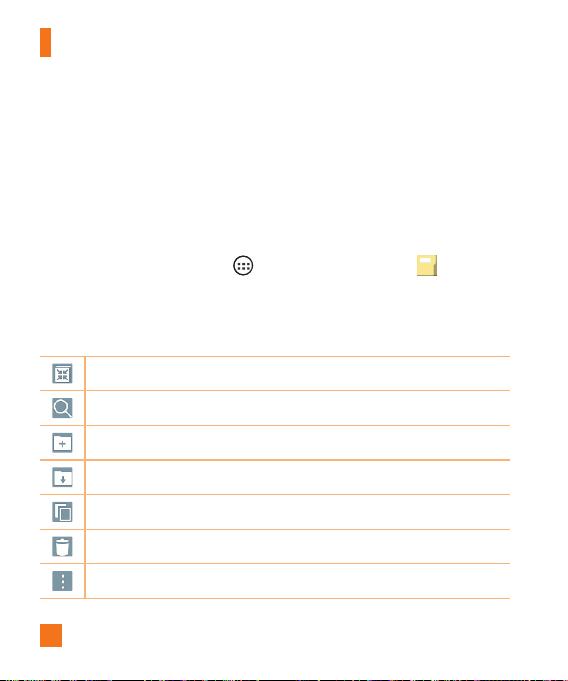
76
Tools
File Manager
The File Manager application allows you to manage files in your internal/external
storage.
File Manager makes it easy to view and manage your files. Simply tap a file type (All
files, Music files, Image files, Video files, Document files), then tap on the necessary
folders to find your files.
To open the File Manager application
• From the Home screen, tap Apps > Apps tab > File Manager .
File Manager Options
Open the File Manager app > All files > Internal storage to access to the following
options (at the top of the screen):
Allows you to open File Manager in a QSlide window.
Allows you to search for your files or information.
Allows you to create a new folder.
Allows you to move files and folders to another location.
Allows you to copy files and folders to another location.
Allows you to delete files and folders.
Allows you to access more options.
77
Tools
POLARIS Office 5
POLARIS Office 5 is a professional mobile office solution that lets users conveniently
view various types of office documents, including Word, Excel and PowerPoint files,
anywhere or anytime, using their mobile devices.
To create a new document
1 From the Home screen, tap Apps > Apps tab > POLARIS Office 5 .
2 Register your email address on the Registration page.
NOTE
You can tap Skip to ignore the registration information.
3 Tap
to start a new document.
4 Tap a document type from the drop-down list, then choose a template.
5 Enter contents in the document using the tools at the top of the screen and the
on-screen keyboard.
6 When you're done working on the document, tap
(in the top left corner of the
screen), then tap Save (or Save as to enter a new document name) to save.
7 Enter the document name and touch Save.
To view and edit a document on your device
You can now easily view and edit a wide variety of file types, including Microsoft Office
documents and Adobe PDF, right on their mobile devices.
1 Open POLARIS Office 5 and search for a document.
2 Touch the document that you want to view or edit.
When viewing documents using POLARIS Office 5, the objects and layout remain the
same as in the original documents.
78
Tools
3 To edit the document, tap .
Google+
Use the Google+ app to stay connected with people via Google’s social network service.
From the Home screen, tap Apps
> Apps tab > Google > Google+ .
NOTE
This application may not be available depending on the region or service provider.
LG SmartWorld
LG SmartWorld offers an assortment of exciting content – fonts, themes, games,
applications.
How to Get to LG SmartWorld from Your Device
1
Tap
> > .
2
Tap Sign in and enter your user name and password. If you have not signed up yet,
tap Register to create an account.
3
Browse and download the content you want.
NOTE:
You may incur data fee charges when using your mobile network to access LG
SmartW
orld.
LG SmartWorld may not be available for all carriers or in all countries.
What if there is no LG SmartWorld
icon?
1 Using a mobile Web browser on your device, access LG SmartWorld (www.lgworld.
com) and select your country.

79
Tools
2 Download the LG SmartWorld App.
3 Run and install the downloaded fi le.
4 Access LG SmartWorld by tapping the
icon.
Special benefits available for LG SmartWorld
•
Personalize your device with home themes, keyboard themes, and fonts.
•
Enjoy special promotions only offered on LG SmartWorld.
• Note that LG SmartWorld is only available for certain devices. Please check
the www.lgworld.com for more information.
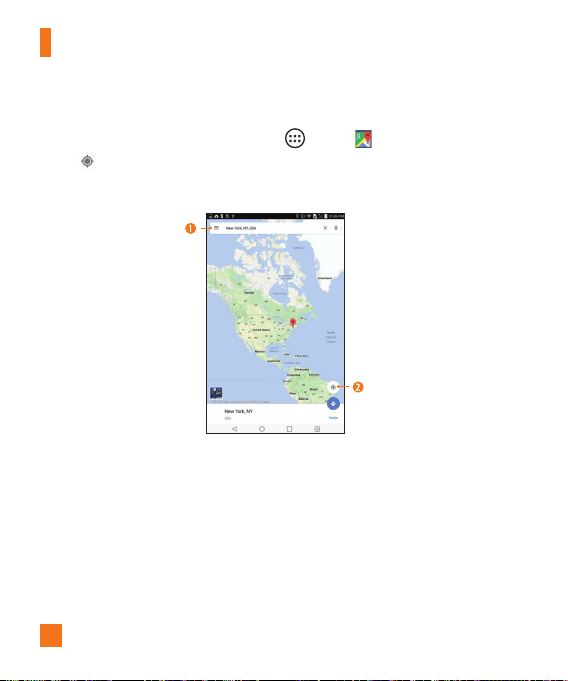
80
Tools
Launch Google Maps
1 From the Home screen, tap the Apps Key >
Maps
.
2 Tap
. The map centers on a blue circle that indicates your location. An arrow
indicates the direction the device is facing. A transparent blue circle around the dot
indicates that your actual location is within the circle.
81
Tools
Tap to access various features on Google Maps.
Tap to view your current location.
To get an address and additional information for a location:
1 Touch and hold a location on the map. A bar with the address and a thumbnail from
Street View (if available) opens at the bottom of the screen.
2 Drag the bar upwards to access additional options.
To utilize Google Maps:
1 From the Home screen, tap the Apps Key >
Maps
.
2 Pinch out or in to zoom in or out of the current map view.
OR
T
ap each icon at the top of the screen.
•
(Search) to search for a location.
•
(Directions) to get directions.
•
(Menu) to view locations and additional information overlaid on the map.
Play Store
Play Store lets you browse through and download thousands of fun and useful
applications and games. You can check other users' comment regarding an application
or you can post your own comments. If you install applications and games from Play
Store, they appear in the tablet's menu below the preloaded applications, and you can
find them by scrolling down with your finger. You can open downloaded applications
from the Play Store by tapping
>
My apps
.
82
Tools
To open the Play Store application
From the Home screen, tap the Apps Key > Google > Play Store.
NOTE
To purchase a paid app, you’ll need to set up a payment method with Google
Checkout™. Y
ou have the option to use a credit card or charge to your carrier bill.
When you want to exit a game or application, use the Home Button
or Back
Button , which will return you to the Home screen. Or select Menu (or Options)
within the game or application and select Exit. (Exit option may vary by game/
application). Ending applications that continue to run in the background (after going
back to the Home screen) will help conserve battery life and reduce unwanted data
usage.
Gmail
Gmail can be configured when you first set up your tablet. Depending on your
synchronization settings, Gmail on your tablet is automatically synchronized with your
Gmail account on the web.The inbox conversations list is your default view.
To open the Gmail application
From the Home screen, tap the Apps Key > Google > Gmail.
Gmail Inbox icons
Use the following icons while using Gmail.
Accounts and labels: Tap to change to another account or label.
Compose: Tap to begin a new Gmail message.
Search: Tap to search within your Gmail messages.
83
Tools
NOTE
Drag the screen downwards to refresh and check for new email.
Adding another Google Account
Tap the Home Button > touch and hold the Recent Apps Button >
All settings > Accounts & sync > Add account > Google. Enter your Google
Account information, as necessary.
Hangouts
The Hangouts application lets you have real-time text conversations with your friends.
To open the Hangouts application
From the Home screen, tap the Apps Key > Google > Hangouts .
To sign out of Hangouts
From the Hangouts home screen, tap the Menu icon > Settings > tap the desired
account > Sign out.
Chatting with Friends
1 From the Home screen, tap the Apps Key > Google > Hangouts .
2 Tap
to view your contacts list. It includes all of the Google Accounts you've
added.
• Tap the name of the person in your contacts list. If your friend is not yet on Hangouts,
you can invite your friend via SMS.
OR
• Tap the text field to enter a name, email, or number.
84
Tools
3 Tap Message and then enter your message.
4 Tap the Send
.
Hangouts chatting list
Touch and hold the friend in the chat screen. You can set below options.
Tap to turn the notifications off.
Tap to archive the conversation.
Tap to delete the conversation.
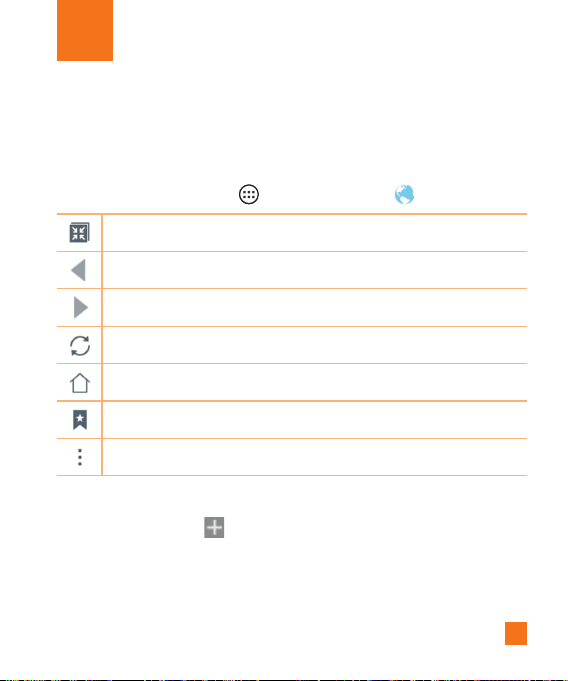
85
Browser
Use this application to browse the Internet. Browser gives you a fast, full-color world
of games, music, news, sports, entertainment and much more, right on your tablet
wherever you are and whatever you enjoy.
From the Home screen, tap Apps
> Apps tab > Browser .
Tap to run QSlide.
Tap to go back to the previous page.
Tap to go forward to the next page.
Tap to refresh or stop the current page.
Tap to go to the Home page.
Tap to access your bookmarks.
Touch to access more options.
Opening a page
• To open a new page, tap at the top of the browser.
• To go to another web page, tap a tab at the top of the screen to view the page.
The Web
86
The Web
Bookmarks
To open a bookmarked web page, tap on the browser toolbar and select one.
History
Tap on the browser toolbar and select the History tab to open a web page from the
list of recently-visited web pages. To clear the history, tap to clear all history.
Using Read mode
Your tablet can display simplified web pages for easier reading.
View news or blog posts and other article pages easily with no distractions – with Read
mode, you can read a clutter-free page.
Tap
on the URL web address bar to activate Read mode.
Using QSlide
Use this feature to access the Internet without closing the current application.
While viewing content on the browser, tap
. You can then browse other information
on your tablet. To view the browser in full screen, tap .
Download files
Use the Downloads app to see what files have been downloaded.
From the Home screen, tap Apps
> Apps tab > Downloads .
87
The Web
Chrome
Use Chrome to search for information and browse web pages.
From the Home screen, tap Apps
> Apps tab > Chrome .
NOTE
This application may not be available, depending on your region and service
provider
.
Viewing web pages
Tap the address field (at the top of the screen), enter a web address or search criteria,
and tap on the keyboard.
Opening a page
• To go to a new page, tap at the top of the browser.
• To go to another web page, tap the a tab at the top of the screen to select the page.
Searching the web by voice
Tap the address field, tap , speak a keyword and select one of the suggested
keywords that appear.
NOTE
This feature may not be available depending on the region or service provider.
88
The Web
Syncing with other devices
Sync open tabs and bookmarks to use with Chrome on another device when you are
logged in with the same Google account.
To view open tabs on other devices, tap the Menu icon
> Recent tabs. You must be
signed in to the same Google account on all devices. Select a web page to open.
Adding and viewing bookmarks
To add bookmarks, tap in the URL bar.
To open a bookmarked web page, tap the Menu icon
> Bookmarks and select the
desired page.
89
Access the Settings menu
1 From the Home screen, tap Apps > Apps tab > Settings .
OR
From the Home screen, touch and hold the Recent Apps Button
> All
settings.
2 Select a setting category and set the desired option.
WIRELESS NETWORKS
Airplane mode
Allows you to set Airplane mode. Activating Airplane mode disables all wireless
connections.
Wi-Fi
Wi-Fi – Turns on Wi-Fi to connect to available Wi-Fi networks.
A list of all available Wi-Fi networks will be displayed. Tap one to connect to it.
NOTE
Tap Search to scan for available Wi-Fi networks.
T
ap the Menu icon
in the Wi-Fi menu to access the following options.
Add Wi-Fi – Allows you to manually enter a new Wi-Fi network.
Saved Wi-Fi – Displays your saved Wi-Fi networks allowing you to manage them.
Advanced Wi-Fi – Provides additional specific Wi-Fi connection settings.
Interactive tutorial – Displays some useful tutorials for the Wi-Fi function.
Settings
90
Settings
TIP! How to obtain the MAC address
To set up a connection in some wireless networks with MAC filters, you may
need to enter the MAC address of your tablet in the router
. You can find the MAC
address in the following user interface: From the Home screen, tap Apps >
Settings > Wi-Fi > Menu icon > Advanced Wi-Fi > MAC address.
Bluetooth
Turn the Bluetooth wireless feature on or off to use Bluetooth. Turning Bluetooth on
allows you to pair and connect to other Bluetooth devices.
Tap the Menu icon
in the Bluetooth menu to access the following options.
Edit tablet name – Changes your tablet name for easy identification when pairing and
connecting. Enter your new tablet name, then tap Save.
Visibility timeout – Sets the amount of time other Bluetooth devices can see your
tablet for pairing and connection. Choose from 2 min, 5 min, 1 h, and Never time out.
Received files – Displays a list of your Bluetooth received files.
Interactive tutorial – Displays some useful tutorials about Bluetooth features.
Help – Displays help information about the Bluetooth feature.
Data Manager
Displays the data usage during the chosen periods of time. Tap an app from the list to
view the app's data usage.
Share & connect
Allows you to configure various options for sharing data and connecting with other
devices.
SmartShare Beam - Allows you to receive multimedia content from LG phones or
tablets.

91
Settings
NOTE
You must enable Wi-Fi to activate SmartShare Beam.
Media Server - Share media content with nearby devices via DLNA.
Miracast - Y
ou can mirror your tablet screen and sound onto LG Miracast dongle or TV
wirelessly.
NOTE
To start the Miracast feature quickly, tap the Miracast icon in the Notification Panel.
While mirroring, Mobile Hotspot cannot be used simultaneously
.
LG PC Suite - Allows you to use LG PC Suite to transfer music and images between a
computer and your tablet.
More...
Allows you to set additional wireless and networks settings.
Mobile networks – Allows you to set whether to enable or disable data access on
your tablet.
VPN – Displays the list of Virtual Private Networks (VPNs) that you've previously
configured. Allows you to add different types of VPNs.
NOTE
You must enter the password before you can use credential storage.
DEVICE
Sound
Sound profile – Allows you to set the sound profile to Sound, Vibrate only or Do
not disturb.

92
Settings
Volumes – Manage the volume for Notifications sound, Touch feedback &
system, and Music, video, games & other media.
Default notification sound – Allows you to set your default notification ringtone.
Do not disturb –Tap to set notifications. You can have no interruptions from
notifications.
Lock screen – Allows you to show or display notifications on the Lock screen.
Apps – Allows you to set notifications for apps.
Touch sounds – Allows you to set your tablet to play a sound when you touch buttons,
icons and other onscreen items that react to your touch.
Screen lock sound – Allows you to set your tablet to play a sound when locking and
unlocking the screen.
Vibrate on tap – Allows you to set the vibration feedback when the tablet screen is
touched.
Display
Brightness – Adjust the screen brightness. Touch Night brightness to set the
brightness to 0% automatically between the hours of 12:00 am - 6:00 am.
Screen timeout – Set the time delay before the screen automatically turns off.
Screen-off effect – Sets the screen-off effect used when the screen turns off.
Auto-rotate screen – Set to switch orientation automatically when you rotate the
tablet.
Daydream – Tap the Daydream switch
to toggle it On or Off. On allows the set
screen saver to be displayed when the tablet is sleeping while docked and/or charging.
Choose from Clock and Google Photos.

93
Settings
NOTE
Charging might be slow while the screen saver is on.
Font type – Change the type of display font.
Font size – Change the size of the display font.
Smart screen – Keeps the screen on when the device detects your eyes looking at the
screen.
Home touch buttons – Allows you to set which Home touch buttons are displayed and
their position on the bar. You can also select the color and the background.
Motion sensor calibration – Allows you to improve the accuracy of the tilt and speed
of the sensor.
Home screen
Theme – Sets the screen theme for your device.
Wallpaper – Sets the wallpaper to use on your Home screen.
Screen swipe effect – Sets the effect when you swipe to change screens.
Allow Home screen looping – Checkmark to set the Home screens to scroll
continuously, eliminating the need to scroll back in the opposite direction when you
reach one end.
Home backup & restore – Allows you to backup and restore app and widget
configurations and themes.
Lock screen
Select screen lock – Set a screen lock type to secure your tablet.
Screen swipe effect – Sets the screen swipe effect options.
Wallpaper – Sets your Lock screen wallpaper. Select it from Gallery or Wallpaper
gallery.

94
Settings
Shortcuts – Allows you to change the shortcuts on the Swipe Lock screen.
Owner info – Allows you to enter contact info to be displayed on the Lock screen in
case the tablet is lost.
Lock timer – Sets the amount of time before the screen automatically locks after the
screen has timed-out.
Power button instantly locks – Checkmark to instantly lock the screen when the
Power/Lock Key is pressed. This setting overrides the Security lock timer setting.
Storage
INTERNAL STORAGE – Displays the total amount of space in the device’s memory
and lists what type of data is using up space.
SD CARD – Displays the total amount of memory space on the microSD card.
Mount/Unmount SD card – Mounts and unmounts the microSD card from your
tablet so that you can access the data stored in it, format the card, or safely remove
it. This setting is dimmed if there’s no microSD card installed, if you’ve already
unmounted it, or if you’ve mounted the microSD card on your computer.
Erase SD card – Permanently erases everything on the microSD card and prepares
it for use with your tablet.
Battery
BATTERY INFORMATION – See how much battery power is used for device activities.
The battery level displays in a percentage. The remaining time of use is also displayed.
Battery usage – Displays the battery usage level and battery use details. Tap an app
or component to view detailed information relating to battery use.
Battery percentage on status bar – Displays the battery percentage on the Status
Bar.
Battery saver – Manage the battery for the power saving items. Tap the switch

95
Settings
to turn this feature on. Tap Battery saver for the following options.
• Turn Battery saver on: Set the battery level at which you want Battery saver to turn
on.
• Restrict apps in background: Checkmark to restrict apps in background.
Notifications, downloading, and streaming for apps may also be restricted.
Smart cleaning
You can manage the unused apps, saved files or temporary internet files.
Apps
Display the list of applications such as currently running or downloaded.
Swipe left and right to view one of the three tabs across the top of the screen to
view detailed information for DOWNLOADED, ON SD CARD, RUNNING, and ALL
applications.
Tap an entry to view more information, tap Force stop (or Stop), then Yes to stop it
from running.
Dual window
Split view – Allows the device to automatically open Dual window when you tap a link
on the full screen or tap an e-mail attachment (images only).
Help – Displays help information about using the Dual window feature.
PERSONAL
Users
This menu displays the current users you've created.

96
Settings
Add user – Allows you to add new account for the tablet and use the Multi-user
feature.
Location
Mode
• High accuracy (GPS and networks) – Use GPS and Wi-Fi networks to estimate
location.
• Battery saving (Networks only) – Use Wi-Fi networks to estimate location.
• Device sensors only (GPS only) – Use GPS to pinpoint your location.
RECENT LOCA
TION REQUEST – Displays apps that have recently requested your
location information.
Camera – Allows the device to tag photos and videos with their locations.
Google Location Reporting – Allows you to view your Google location settings.
Security
Lock screen – Allows you to set your lock screen settings.
Encrypt tablet – Allows you to encrypt data on the tablet for security. You will be
required to enter a PIN or password to decrypt your tablet each time you power it on.
Encrypt SD card storage – Allows you to encrypt data on the MicroSD for security.
Set up SIM card lock – Allows you to set if you want to require a PIN to use or, if set,
allows you to change the PIN.
Password typing visible – Shows the last character of the hidden password as you
type.
Tablet administrators – View or deactivate tablet administrators.
Unknown sources – Allows installation of apps from non-Play Store applications.
Verify apps – Disallow or warn before installation of apps that may cause harm.

97
Settings
Storage type – Displays the storage type for certificates.
Trusted credentials – Displays trusted CA certificates.
Install from storage – Choose to install encrypted certificates.
Clear credentials – Remove all certificates.
Trust agents – Allows you to view and selectively deactivate Trust agents.
Screen pin – Tap its switch at the top of its screen to toggle it on or off. On allows
only the current app to be used. This is helpful when allowing children to use your
tablet.
App usage access – Allows you to enable or disable the apps that can view your
tablet’s app usage.
Accounts & sync
Permits applications to synchronize data in the background, whether or not you are
actively working in them. Deactivating Auto-sync data can save battery power and
lower (but not eliminate) data usage.
Language & input
Use the Language & input settings to select the language for the text on your tablet and
to configure the on-screen keyboard, including words you've added to its dictionary.
Backup & reset
Back up my data – Set to backup your settings and application data to the Google
server.
Backup account – Set the account to which you want to backup data to.
Automatic restore – Set to restore your settings and application data when the
applications are reinstalled on your device.
98
Settings
LG Backup service – Backs up all information on the device and restores it in the
event of data loss or replacement. Refer to page 101 for more information.
Factory data reset – Reset your settings to the factory default values and delete
all your data. If you reset the tablet this way, you are prompted to re-enter the same
information as when you first started Android.
SYSTEM
Shortcut Key
Allows you to turn the Shortcut keys on and off. Press and hold the Volume Up and
Down keys together when the screen is unlocked to access QuickMemo+. Press and
hold the Volume Up or Down key when the screen is off or locked to access the camera.
Date & time
Use Date & time settings to set how dates will be displayed. You can also use these
settings to set your own time and time zone rather than obtaining the current time from
the mobile network.
Accessibility
Use the Accessibility settings to configure accessibility plug-ins you have installed on
your tablet.
NOTE
Requires additional plug-ins to become selectable.
T
alkBack – Allows you to set up the TalkBack function which assists people with
impaired vision by providing verbal feedback. Tap the TalkBack switch
at the
top right corner of the screen to turn it on. Tap Settings at the bottom of the screen to
adjust the TalkBack settings.
99
Settings
Font size – Allows you to change the size of the text.
Invert colors – Checkmark to invert the colors of the screen and content.
Color adjustment – Sets to view the screen with greater color contrast. Tap the switch
to turn it on. Then tap the screen and drag across the screen in any direction
until you see the color contrast you want to use.
Touch zoom – Allows you to zoom in and out by triple-tapping the screen.
Screen shades – Dims the screen's backlight.
Accessibility shortcut – Activate this feature to allow you to quickly enable
accessibility features in two steps.
Text-to-speech output – Sets the text-to-speech preferred engine and speech rate
setting. Also plays a short demonstration of speech synthesis. The default language
status is also displayed.
Audio type – Sets the audio type. Choose Mono or Stereo.
Sound balance – Sets the audio route. Move the slider on the slide bar to set it.
Turn off all sounds – Turns off all sounds.
Captions – Allows to customize caption settings for those with hearing impairments.
Tap the switch
to turn this feature on. Set the language, text size, and caption
style options as desired.
Touch feedback time – Sets the touch and feedback time. Choose from Short,
Medium, and Long.
Touch assistant – Touch the switch
to toggle between on and off. On allows
you to replace the hardware keys with a Universal touch board .
Tap the Universal touch icon
y
y
to access the Power, Home, Volume down,
Volume up, Screen capture, Accessibility, and Pinch buttons.
Screen timeout – Sets the amount of time before the screen turns off.
100
Settings
Touch control areas – Tap the switch to turn this feature on. Allows you to
limit the touch control to selected areas of the screen. Press the Volume Down Key
and Home Button at the same time to activate and deactivate the feature.
Auto-rotate screen – Checkmark to allow the device to rotate the screen depending
on the device orientation (portrait or landscape).
Password voice confirmation – Checkmark to have verbal confirmation when
inputting passwords.
Accessibility settings shortcut – Sets quick and easy access to selected features
when you triple-tap the Home Button.
One-touch input – Each finger touch enters a letter/character on the LG keyboard.
Switch Access – Allows you to control your device using configurable key
combinations.
Keeper FastFill – Allows you to securely and quickly fill your login credentials on
websites and mobile apps.
Quick Cover
Activate this menu to turn the screen on or off automatically when using the Quick
Cover.
Printing
Allows you to print the content of certain screens (such as web pages displayed in
Chrome) to a printer connected to the same Wi-Fi network as your Android device.
About tablet
This menu allows you to manage your software updates and view various information
relating to your tablet.
Tablet name – Allows you to set your tablet name.

101
Settings
Update Center – Allows you to check for software updates.
Network – Allows you to see the network, signal strength, mobile network type and
state, service state, roaming state, and IP address.
Status – Allows you to view the phone number, IMEI, and IMEI SV.
Battery – Allows you to view battery status, battery level, and battery use information.
Hardware infor – Allows you to view the model number, up time, Wi-Fi MAC address
and Bluetooth address.
Software info – Allows you to view Android version, baseband version, kernel version,
build number, and software version.
Legal info – Allows you to view legal documents for LG software, open source licenses
and Google legal information.
Patent information – Displays LG patent information.
102
Tablet software update
This feature allows you to update the firmware of your tablet to the latest version
conveniently from the internet without the need to visit a service center. For more
information on how to use this function, please visit: http://www.lg.com
As the tablet firmware update requires the user’s full attention for the duration of the
update process, please make sure to check all instructions and notes that appear at
each step before proceeding. Please note that removing the USB cable or battery during
the upgrade may seriously damage your tablet.
LG tablet software update via Over-the-Air (OTA)
This feature allows you to update the firmware of your tablet to the newer version
conveniently via OTA without connecting the USB data cable. This feature is only
available if and when LG makes the newer version of the firmware available for your
device. First, you can check the software version on your tablet:
From the Home screen, tap Apps > Settings > About tablet > Software
infor.
To perform the tablet software update, from the Home screen, tap Apps
>
Settings > About tablet > Update Center > Software Update > Update now.
NOTE
LG reserves the right to make firmware updates available only for selected models
at its own discretion and does not guarantee the availability of the newer version of
the firmware for all tablet models.
Tablet software update

103
Tablet software update
Your personal data—including information about your Google account and any
other accounts, your system/application data and settings, any downloaded
applications and your DRM licence —might be lost in the process of updating your
device's software. Therefore, LG recommends that you back up your personal data
before updating your tablet's software. LG does not take responsibility for any loss
of personal data.
104
There are a variety of accessories available for your tablet, some of which may be sold
separately. You can select these options according to your personal communication
requirements. Visit your local AT&T store or www.att.com/wirelessaccessories for
specific offerings.
NOTE
Always use genuine LG accessories. Failure to do this may invalidate your warranty.
Accessories may be different in different regions; please check with our regional
service company or agent for further enquiries.
Accessories
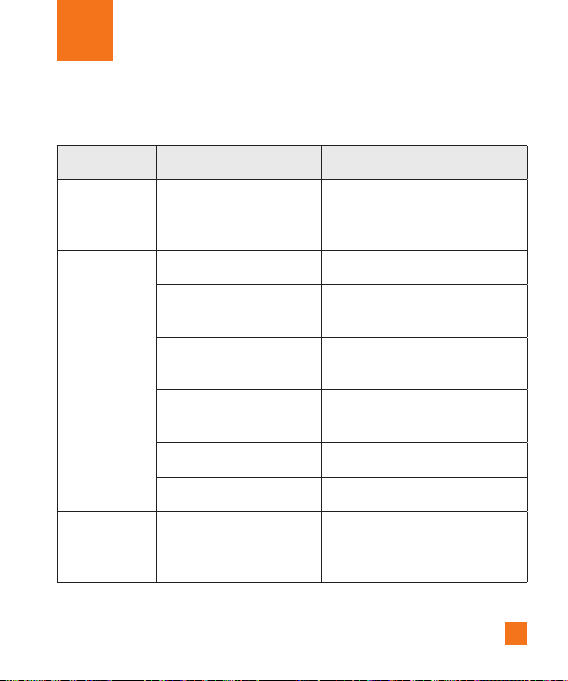
105
This chapter lists some problems you might encounter when using your tablet. Some
problems require you to call your service provider, but most are easy to fix yourself.
Message Possible causes Possible corrective measures
No
applications
can be set
Not supported by service
provider or registration
required.
Contact your service provider.
Charging error
Battery is not charged. Charge battery.
Outside temperature is too
hot or cold.
Make sure tablet is charging at a
normal temperature.
Contact problem
Check the charger and its
connection to the tablet.
No voltage
Plug the charger into a different
socket.
Charger defective Replace the charger.
Wrong charger Use only original LG accessories.
Impossible to
receive / send
photos
Memory full
Delete some images from your
tablet.
Troubleshooting
106
Troubleshooting
Message Possible causes Possible corrective measures
Files do not
open
Unsupported file format Check the supported file formats.
No sound Vibration mode
Check the settings status in the
sound menu to make sure you are
not in vibration or silent mode.
107
Violation of the instructions may cause serious injury or death.
WARNING: This product contains chemicals known to the State of California to cause
cancer and birth defects or reproductive harm.
Wash hands after handling.
ELECTRICAL SAFETY
This product is intended for use when supplied with power from the designated battery
or power supply unit. Other usage may be dangerous and will invalidate any approval
given to this product.
SAFETY PRECAUTIONS FOR PROPER GROUNDING INSTALLATION
CAUTION: Connecting to improperly grounded equipment can result in an electric
shock to your device. This product is equipped with a USB cable for connecting to a
desktop or notebook computer. Be sure your computer is properly grounded (earthed)
before connecting this product to the computer. The power supply cord of a desktop
or notebook computer has an equipment-grounding conductor and a grounding plug.
The plug must be plugged into an appropriate outlet which is properly installed and
grounded in accordance with all local codes and ordinances.
SAFETY PRECAUTIONS FOR POWER SUPPLY UNIT
Use the correct external power source
A product should be operated only from the type of power source indicated on the
electrical ratings label. If you are not sure of the type of power source required, consult
your authorized service provider or local power company. For a product that operates
from battery power or other sources, refer to the operating instructions that are included
with the product.
For Your Safety
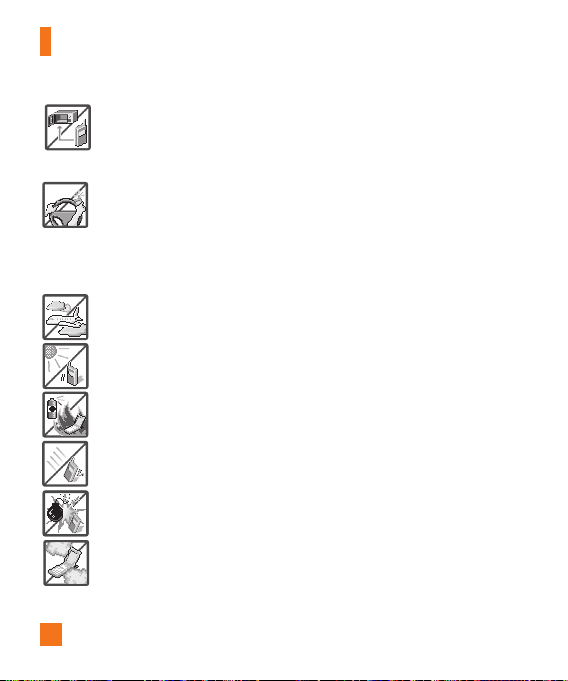
108
For Your Safety
• Never place your tablet in a microwave oven as it will cause the battery
to explode.
• Never store your tablet in temperatures less than -4°F or greater than
122°F
.
• When riding in a car, do not leave your tablet or set up the hands-free
kit near the air bag. If wireless equipment is improperly installed and the
air bag is deployed, you may be seriously injured.
• Your tablet contains an internal battery. Do not dispose of your tablet
near fire or with hazardous or flammable waste. Y
ou should dispose of
your tablet in accordance with all applicable laws.
• Do not use the tablet in areas where its use is prohibited. (For example:
aircraft)
• Do not expose the battery charger or adapter to direct sunlight or use it
in places with high humidity, such as a bathroom.
• Do not use harsh chemicals (such as alcohol, benzene, thinners, etc.) or
detergents to clean your tablet. This could cause a fire.
• Do not drop, strike, or shake your tablet severely. It may harm the
internal circuit boards of the tablet.
• Do not use your tablet in high explosive areas as the tablet may
generate sparks.
• Do not damage the power cord by bending, twisting, pulling, or heating.
Do not use the plug if it is loose as it may cause electric shock or fire.
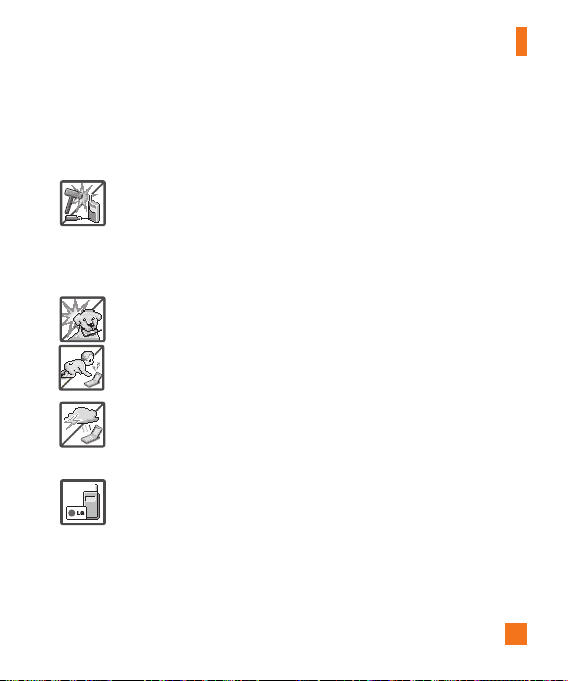
109
For Your Safety
• Do not place any heavy items on the power cord. Do not allow the
power cord to be crimped as it may cause electric shock or fire.
• Do not handle the tablet with wet hands while it is being charged. It
may cause an electric shock or seriously damage your tablet.
• Do not disassemble the tablet.
• Do not attempt to repair or modify the device yourself. Your device
is equipped with an internal rechargeable battery which should be
replaced only by LG or an authorized LG repair center.
• You should never attempt to open or disassemble this device yourself
and doing so may cause damage that voids your warranty
.
• Make sure that no sharp-edged items, such as animal’s teeth or nails,
come into contact with the battery. This could cause a fire.
• Be careful that children do not swallow any parts (such as earphone,
connection parts of the tablet, etc.) This could cause asphyxiation or
suffocation resulting in serious injury or death.
• Unplug the power cord and charger during lightning storms to avoid
electric shock or fire.
• Only use chargers provided by LG. The warranty will not be applied to
products provided by other suppliers.
• Only authorized personnel should service the tablet and its accessories.
Faulty installation or service may result in accidents and consequently
invalidate the warranty.

110
For Your Safety
• Your tablet is an electronic device that generates heat during normal
operation. Extremely prolonged, direct skin contact in the absence of
adequate ventilation may result in discomfort or minor burns. Therefore,
use care when handling your tablet during or immediately after
operation.
Safety Information
Please read and observe the following information for safe and proper use of your tablet
and to prevent damage.
• Do not disassemble or open crush, bend or deform, puncture or shred.
• Repairs under warranty, at LG’s option, may include replacement parts or boards that
are either new or reconditioned, provided that they have functionality equal to that of
the parts being replaced.
• Do not modify or remanufacture, attempt to insert foreign objects into the battery,
immerse or expose to water or other liquids, expose to fire, explosion or other hazard.
• Only use the battery for the system for which it is specified.
• Only use the battery with a charging system that has been qualified with the system
per CTIA Certification Requirements for Battery System Compliance to IEEE1725. Use
of an unqualified battery or charger may present a risk of fire, explosion, leakage, or
other hazard.
• Do not short circuit a battery or allow metallic conductive objects to contact battery
terminals.
• Replace the battery only with another battery that has been qualified with the system
per this standard, IEEE-Std-1725. Use of an unqualified battery may present a risk of
fire, explosion, leakage or other hazard. Only authorized service providers shall replace
battery (If the battery is non-user replaceable)

111
For Your Safety
• Promptly dispose of used batteries in accordance with local regulations.
• Avoid dropping the tablet. If the tablet is dropped, especially on a hard surface, and
the user suspects damage, take it to a service center for inspection.
• Improper battery use may result in a fire, explosion or other hazard.
• For those host devices that utilize a USB port as a charging source, the host device’s
user manual shall include a statement that the device shall only be connected to
products that bear the USB-IF logo or have completed the USB-IF compliance program.
WARNING! Notice for Battery replacement
• For your safety, do not remove the battery incorporated in the product. If you need to
replace the battery
, take it to the nearest authorized LG Electronics service point or
dealer for assistance.
• Li-Ion Battery is a hazardous component which can cause injury.
• Battery replacement by non-qualified professional can cause damage to your device.
Charger and Adapter Safety
• The charger and adapter are intended for indoor use only.
• Insert the battery pack charger vertically into the wall power socket.
• Unplug the power cord and charger during lightning storms to avoid electric shock or
fire.
• Use the correct adapter for your tablet when using the battery pack charger abroad.
Battery Information and Care
• Please read the manual of proper installation and removal of the battery.
• Please read the manual of specified charger about charging method.
• Do not damage the power cord by bending, twisting, or heating. Do not use the plug if

112
For Your Safety
it is loose as it may cause electric shock or fire.
Do not place any heavy items on the power cord. Do not allow the power cord to be
crimped as it may cause electric shock or fire.
• Unplug the power cord prior to cleaning your tablet, and clean the power plug pin
when it’
s dirty. When using the power plug, ensure that it’s firmly connected. If not,
it may cause excessive heat or fire. If you put your tablet in a pocket or bag without
covering the receptacle of the tablet (power plug pin), metallic articles (such as a
coin, paperclip or pen) may short-circuit the tablet. Short-circuit of the terminal may
damage the battery and cause an explosion. Always cover the receptacle when not
in use.
• Recharge the battery after long periods of non-use to maximize battery life. Battery
life will vary due to usage pattern and environmental conditions.
• Never store your tablet in temperature less than -4 °F or greater than 122 °F.
• Charging temperature range is between 0°C/32°F and 45°C/113°F. Do not charge the
battery out of recommended temperature range. Charging out of recommended range
might cause the generating heat or serious damage of battery. And also, it might
cause the deterioration of battery’s characteristics and cycle life.
• Do not use or leave the device under the blazing sun or in heated car by sunshine. The
device may generate heat, smoke or flame. And also, it might cause the deterioration
of battery’s characteristics or cycle life.
• The battery back in the device has protection circuit to avoid the danger. Do not use
near places that can generate static electricity more than 100 V which could damage
the protection circuit. Damaged protection circuits may generate smoke, rupture or
ignite.
• When using the device for the first time, if it emits a bad smell, you see rust on it, or
anything else abnormal, do not use the equipment and bring the battery to the shop
which it was bought.

113
For Your Safety
• Keep device away from babies and small children. If children use the battery, their
parents or legal guardians are responsible for supervising and teaching them about
the safe handling of device and how to use batteries according to the manual with
care.
• If liquid from the battery in the device rubs against skin or clothing, wash with fresh
water
. It may cause the skin inflammation. Do not user the battery and take it to the
nearest authorized LG Electronics service point or dealer for assistance. Be careful
that children do not swallow any parts (such as earphone, connection parts of the
device, etc.). This could cause asphyxiation or suffocation resulting in serious injury
or death.
• Do not handle the tablet with wet hands while it is being charged. It may cause an
electric shock or seriously damage your tablet.
• Do not use harsh chemicals (such as alcohol, benzene, thinners, etc.) or detergents to
clean your tablet. This could cause a fire.
• Always unplug the charger from the wall socket after the tablet is fully charged to
save unnecessary power consumption of the charger
.
Care and Maintenance
Your mobile device is a product of superior design and craftsmanship and should be
treated with care. The suggestions below will help you fulfill any warranty obligations
and allow you to enjoy this product for many years:
Keep your Mobile Device away from: Liquids of any kind
Keep the mobile device dry. Precipitation, humidity, and liquids contain minerals that
will corrode electronic circuits. If the mobile device does get wet, do not accelerate
drying with the use of an oven, microwave, or dryer, because this may damage the

114
For Your Safety
mobile device and could cause a fire or explosion.
Do not use the mobile device with a wet hand.
Doing so may cause an electric shock to you or damage to the mobile device.
Extreme heat or cold
• Avoid temperatures below 0 °C / 32 °F or above 45 °C / 113 °F.
• Use your tablet in temperatures between 0 ºC /32 °F and 40 ºC/104 °F, if possible.
Exposing your tablet to extremely low or high temperatures may result in damage,
malfunction, or even explosion.
Microwaves
Do not try to dry your mobile device in a microwave oven. Doing so may cause a fire or
explosion.
Dust and dirt
Do not expose your mobile device to dust, dirt, or sand.
Sunscreen lotion
Do not expose or wear your device to any liquid like sunscreen lotion.
Doing so may cause your device to or damage to the mobile device.
Cleaning solutions
Do not use harsh chemicals, cleaning solvents, or strong detergents to clean the mobile
device.
Wipe it with a soft cloths lightly dampened in a mild soap-and-water solution.

115
For Your Safety
Shock or vibration
Do not drop, knock, or shake the mobile device.
Rough handling can break internal circuit boards.
Paint
Do not paint the mobile device. Paint can clog the device’s moving parts or ventilation
openings and prevent proper operation.
General Notice
• Do not place items containing magnetic components such as a credit card, phone
card, bank book, or subway ticket near your device. The magnetism of the device may
damage the data stored in the magnetic strip.
• When the tablet is not used for a long period time, store it in a safe place with the
power cord unplugged.
• Do not use the device if the antenna is damaged. If a damaged antenna contacts skin,
it may cause a slight burn. Please contact an LG Authorized Service Center to replace
the damaged antenna.
• The data saved in your tablet might be deleted due to careless use, repair of the
tablet, or upgrade of the software. Please backup your important contacts. (pictures,
and videos could also be deleted.) The manufacturer is not liable for damage due to
the loss of data.
• When you use the tablet in public places, set the volume to vibration so you don’t
disturb others.
• Do not turn your tablet on or off when putting it to your ear.
• Your device is an electronic device that generates heat during normal operation.
Extremely prolonged, direct skin contact in the absence of adequate ventilation may

116
For Your Safety
result in discomfort or minor burns. Therefore, use care when handling your device
during or immediately after operation.
• Use accessories, such as earphones and headsets, with caution. Ensure that cables
are tucked away safely and do not touch the antenna unnecessarily
.
Part 15.19 statement
This device complies with part 15 of FCC rules.
Operation is subject to the following two conditions:
(1) This device may not cause harmful interference, and (2) this device must accept any
interference received, including interference that causes undesired operation.
Part 15.21 statement
Any changes or modifications not expressly approved by the manufacturer could void
the user’s authority to operate the equipment.
Part 15.105 statement
This equipment has been tested and found to comply with the limits for a class B digital
device, pursuant to Part 15 of the FCC Rules. These limits are designed to provide
reasonable protection against harmful interference in a residential installation. This
equipment generates uses and can radiate radio frequency energy and, if not installed
and used in accordance with the instructions, may cause harmful interference to radio
communications. However, there is no guarantee that interference will not occur in a
particular installation. If this equipment does cause harmful interference or television
reception, which can be determined by turning the equipment off and on, the user is
encouraged to try to correct the interference by one or more of the following measures:
• Reorient or relocate the receiving antenna.
• Increase the separation between the equipment and receiver.

117
For Your Safety
• Connect the equipment into an outlet on a circuit different from that to which the
receiver is connected.
• Consult the dealer or an experienced radio/TV technician for help.
FCC RF Exposure Information
WARNING! Read this information before operating the device.
In August 1996, the Federal Communications Commission (FCC) of the United States,
with its action in Report and Order FCC 96-326, adopted an updated safety standard
for human exposure to Radio Frequency (RF) electromagnetic energy emitted by FCC
regulated transmitters. Those guidelines are consistent with the safety standard
previously set by both U.S. and international standards bodies. The design of this device
complies with the FCC guidelines and these international standards.
Bodily Contact During Operation
This device was tested for typical use with the back of the device kept 0 inch (0 cm)
from the body.
Caution
Use only the supplied antenna. Use of unauthorized antennas (or modifications to the
antenna) could impair call quality, damage the device, void your warranty and/or violate
FCC regulations.
Don’t use the device with a damaged antenna. A damaged antenna could cause a minor
skin burn. Contact your local dealer for a replacement antenna.

118
For Your Safety
Consumer Information About Radio Frequency Emissions
Your wireless device, which contains a radio transmitter and receiver, emits radio
frequency energy during use. The following consumer information addresses commonly
asked questions about the health effects of wireless devices.
Are wireless devices safe?
Scientific research on the subject of wireless devices and radio frequency (“RF”) energy
has been conducted worldwide for many years, and continues. In the United States, the
Food and Drug Administration (“FDA”) and the Federal Communications Commission
(“FCC”) set policies and procedures for wireless devices. The FDA issued a website
publication on health issues related to device usage where it states, The scientific
community at large … believes that the weight of scientific evidence does not show
an association between exposure to radiofrequency (RF) from the devices and adverse
health outcomes. Still the scientific community does recommend conducting additional
research to address gaps in knowledge. That research is being conducted around the
world and FDA continues to monitor developments in this field. You can access the joint
FDA/FCC website at http://www.fda.gov (under “C” in the subject index, select Cell
Phones > Research). You can also contact the FDA toll-free at (888) 463-6332 or (888)
INFO-FDA. In June 2000, the FDA entered into a cooperative research and development
agreement through which additional scientific research is being conducted. The FCC
issued its own website publication stating that “there is no scientific evidence that
proves that wireless device usage can lead to cancer or a variety of other problems,
including headaches, dizziness or memory loss”.
This publication is available at http://www.fcc.gov/oet/rfsafety or through the FCC at
(888) 225-5322 or (888) CALL-FCC.

119
For Your Safety
What does “SAR” mean?
In 1996, the FCC, working with the FDA, the U.S. Environmental Protection Agency, and
other agencies, established RF exposure safety guidelines for wireless devices in the
United States. Before a wireless device model is available for sale to the public, it must
be tested by the manufacturer and certified to the FCC that it does not exceed limits
established by the FCC. One of these limits is expressed as a Specific Absorption Rate,
or “SAR”. SAR is a measure of the rate of absorption of RF energy in the body. Tests for
SAR are conducted with the device transmitting at its highest power level in all tested
frequency bands. Since 1996, the FCC has required that the SAR of handheld wireless
device not exceed 1.6 watts per kilogram, averaged over one gram of tissue.
Although the SAR is determined at the highest power level, the actual SAR value
of a wireless device while operating can be less than the reported SAR value. This
is because the SAR value may vary from call to call, depending on factors such as
proximity to a cell site, the proximity of the device to the body while in use, and the
use of hands-free devices. Before a device model is available for sale to the public, it
must be tested and certified to the FCC that it does not exceed the limit established
by the government-adopted requirement for safe exposure. The tests are performed in
positions and locations (e.g., at the ear and worn on the body) as required by the FCC
for each model.
The FCC has granted an Equipment Authorization for this model device with all reported
SAR levels evaluated as in compliance with the FCC RF emission guidelines. SAR
information on this model device is on file with the FCC and can be found under the
Display Grant section of http://www.fcc.gov/oet/ea/fccid/ after searching on FCC ID
ZNFV410.
For more information about SARs, see the FCC’s OET Bulletins 56 and 65 at http://
www.fcc.gov/Bureaus/Engineering_Technology/Documents/bulletins or visit the
Cellular Telecommunications Industry Association website at http://www.ctia.org/

120
For Your Safety
consumer_info/index.cfm/AID/10371. You may also wish to contact the manufacturer
of your device.
Can I minimize my RF exposure?
If you are concerned about RF, there are several simple steps you can take to minimize
your RF exposure. You can, of course, reduce your talk time. You can place more
distance between your body and the source of the RF, as the exposure level drops off
dramatically with distance. The FDA/FCC website states that “hands-free kits can be
used with wireless devices for convenience and comfort. These systems reduce the
absorption of RF energy in the head because the device, which is the source of the
RF emissions, will not be placed against the head. On the other hand, if the device is
mounted against the waist or other part of the body during use, then that part of the
body will absorb more RF energy. Wireless devices marketed in the U.S. are required
to meet safety requirements regardless of whether they are used against the head
or against the body. Either configuration should result in compliance with the safety
limit”. Also, if you use your wireless device while in a car, you can use a device with an
antenna on the outside of the vehicle. You should also read and follow your wireless
device manufacturer’s instructions for the safe operation of your device.
Do wireless devices pose any special risks to children?
The FDA/FCC website states that “the scientific evidence does not show a danger to
users of wireless communication devices, including children”. The FDA/FCC website
further states that “some groups sponsored by other national governments have
advised that children be discouraged from using wireless device at all”. For example,
the Stewart Report from the United Kingdom [“UK”] made such a recommendation
in December 2000. In this report a group of independent experts noted that no
evidence exists that using a device causes brain tumors or other ill effects. [The UK’s]
recommendation to limit device use by children was strictly precautionary; it was not

121
For Your Safety
based on scientific evidence that any health hazard exists. A copy of the UK’s leaflet is
available at http://www.dh.gov.uk (search “mobile”), or you can write to: NRPB, Chilton,
Didcot, Oxon OX11 ORQ, United Kingdom. Copies of the UK’s annual reports on mobile
device and RF are available online at www.iegmp.org.uk and http://www.hpa.org.uk/
radiation/ (search “mobile”). Parents who wish to reduce their children’s RF exposure
may choose to restrict their children’s wireless device use.
Where can I get further information about RF emissions?
For further information, see the following additional resources (websites current as of
April 2005):
U.S. Food and Drug Administration
FDA Consumer magazine
November-December 2000
Telephone: (888) INFO-FDA
http://www.fda.gov
(Under “C” in the subject index, select Cell Phones > Research.)
U.S. Federal Communications Commission
445 12th Street, S.W.
Washington, D.C. 20554
Telephone: (888) 225-5322
http://www.fcc.gov/oet/rfsafety
Independent Expert Group on Mobile Devices
http://www.iegmp.org.uk

122
For Your Safety
Royal Society of Canada Expert Panels on Potential Health Risks of Radio
Frequency Fields from Wireless T
elecommunication Devices
283 Sparks Street
Ottawa, Ontario K1R 7X9
Canada
Telephone: (613) 991-6990
World Health Organization
Avenue Appia 20
1211 Geneva 27
Switzerland
Telephone: 011 41 22 791 21 11
http://www.who.int/mediacentre/factsheets/fs193/en/
International Commission on Non-Ionizing Radiation Protection
c/o Bundesamt fur Strahlenschutz
Ingolstaedter Landstr. 1
85764 Oberschleissheim
Germany
Telephone: 011 49 1888 333 2156
http://www.icnirp.de
Wi-Fi Caution
This device is capable of operating in 802.11a/n mode. For 802.11a/n devices operating
in the frequency range of 5.15 - 5.25 GHz, they are restricted for indoor operations to

123
For Your Safety
reduce any potential harmful interference for Mobile Satellite Services (MSS) in the US.
Wi-Fi Access Points that are capable of allowing your device to operate in 802.11a/n
mode (5.15 - 5.25 GHz band) are optimized for indoor use only.
If your Wi-Fi network is capable of operating in this mode, please restrict your Wi-Fi use
indoors to not violate federal regulations to protect Mobile Satellite Services.
Engineering in Medicine and Biology Society, Committee on Man and
Radiation (COMAR) of the Institute of Electrical and Electronics Engineers
http://ewh.ieee.org/soc/embs/comar/
Consumer Information on SAR
(Specific Absorption Rate)
This model device meets the government's requirements for exposure to radio waves.
Your wireless device is a radio transmitter and receiver. It is designed and manufactured
not to exceed the emission limits for exposure to Radio Frequency (RF) energy set by the
Federal Communications Commission of the U.S. Government. These limits are part of
comprehensive guidelines and establish permitted levels of RF energy for the general
population. The guidelines are based on standards that were developed by independent
scientific organizations through periodic and thorough evaluation of scientific studies.
The standards include a substantial safety margin designed to assure the safety of all
persons, regardless of age and health.
The exposure standard for wireless mobile devices employs a unit of measurement
known as the Specific Absorption Rate, or SAR. The SAR limit set by the FCC is 1.6 W/
kg.
Tests for SAR are conducted using standard operating positions specified by the FCC
with the device transmitting at its highest certified power level in all tested frequency

124
For Your Safety
bands. Although SAR is determined at the highest certified power level, the actual SAR
level of the device while operating can be well below the maximum value. Because the
device is designed to operate at multiple power levels to use only the power required to
reach the network, in general, the closer you are to a wireless base station antenna, the
lower the power output.
Before a device model is available for sale to the public, it must be tested and certified
to the FCC that it does not exceed the limit established by the government-adopted
requirement for safe exposure. The tests are performed in positions and locations (e.g.,
at the ear and worn on the body) as required by the FCC for each model.
The highest SAR value for this device when worn on the body, as described in this user
guide, is 1.11 W/kg. (body-worn measurements differ among device models, depending
upon available accessories and FCC requirements). While there may be differences
between SAR levels of various devices and at various positions, they all meet the
government requirement for safe exposure.
The FCC has granted an Equipment Authorization for this model device with all
reported SAR levels evaluated as in compliance with the FCC RF emission guidelines.
SAR information on this model device is on file with the FCC and can be found under
the Display Grant section of http://www.fcc.gov/oet/fccid after searching on FCC ID
ZNFV410. Additional information on Specific Absorption Rates (SAR) can be found on
the Cellular Telecommunications Industry Association (CTIA) website at http://www.
ctia.org/.
* In the United States and Canada, the SAR limit for mobile device used by the public
is 1.6 watts/kg (W/kg) averaged over one gram of tissue. The standard incorporates a
substantial margin of safety to give additional protection for the public and to account
for any variations in measurements.

125
For Your Safety
Caution: Avoid potential hearing loss.
Prolonged exposure to loud sounds (including music) is the most common cause of
preventable hearing loss. Some scientific research suggests that using portable audio
devices, such as portable music players and cellular telephones, at high volume settings
for long durations may lead to permanent noise-induced hearing loss. This includes
the use of headphones (including headsets, earbuds and Bluetooth® or other wireless
devices). Exposure to very loud sound has also been associated in some studies with
tinnitus (a ringing in the ear), hypersensitivity to sound and distorted hearing. Individual
susceptibility to noise-induced hearing loss and other potential hearing problems varies.
The amount of sound produced by a portable audio device varies depending on the
nature of the sound, the device, the device settings and the headphones. You should
follow some commonsense recommendations when using any portable audio device:
• Set the volume in a quiet environment and select the lowest volume at which you can
hear adequately
.
• When using headphones, turn the volume down if you cannot hear the people
speaking near you or if the person sitting next to you can hear what you are listening
to.
• Do not turn the volume up to block out noisy surroundings. If you choose to listen to
your portable device in a noisy environment, use noise-cancelling headphones to block
out background environmental noise.
• Limit the amount of time you listen. As the volume increases, less time is required
before your hearing could be affected.
• Avoid using headphones after exposure to extremely loud noises, such as rock
concerts, that might cause temporary hearing loss. T
emporary hearing loss might
cause unsafe volumes to sound normal.
• Do not listen at any volume that causes you discomfort. If you experience ringing in

126
For Your Safety
your ears, hear muffled speech or experience any temporary hearing difficulty after
listening to your portable audio device, discontinue use and consult your doctor.
You can obtain additional information on this subject from the following sources:
Safety 205
American Academy of Audiology 11730
Plaza American Drive, Suite 300
Reston, VA 20190
Voice: (800) 222-2336
Email: info@audiology.org
Internet: www.audiology.org
National Institute on Deafness and Other Communication
Disorders
National Institutes of Health
31 Center Drive, MSC 2320
Bethesda, MD USA 20892-2320
Voice: (301) 496-7243
Email: [email protected]
Internet: http://www.nidcd.nih.gov/health/hearing
National Institute for Occupational Safety and Health Hubert H. Humphrey Bldg.
200 Independence Ave., SW Washington, DC 20201 Voice:
1-800-35-NIOSH (1-800-356-4674)
Internet: http://www.cdc.gov/niosh/topics/noise/default.html

127
For Your Safety
TIA Safety Information
The following is the complete TIA Safety Information for wireless handheld devices.
Exposure to Radio Frequency Signal
Your wireless handheld portable device is a low power radio transmitter and receiver.
When ON, it receives and sends out Radio Frequency (RF) signals.
In August, 1996, the Federal Communications Commissions (FCC) adopted RF exposure
guidelines with safety levels for handheld wireless devices. Those guidelines are
consistent with the safety standards previously set by both U.S. and international
standards bodies:
ANSI C95.1 (1992) *
NCRP Report 86 (1986)
ICNIRP (1996)
* American National Standards Institute; National Council on Radiation Protection and
Measurements; International Commission on Non-Ionizing Radiation Protection
Those standards were based on comprehensive and periodic evaluations of the relevant
scientific literature. For example, over 120 scientists, engineers, and physicians from
universities, government health agencies, and industry reviewed the available body of
research to develop the ANSI Standard (C95.1).
The design of your device complies with the FCC guidelines (and those standards).
Antenna Care
Use only the supplied or an approved replacement antenna. Unauthorized antennas,
modifications, or attachments could damage the device and may violate FCC
regulations.

128
For Your Safety
Tips on Efficient Operation
For your device to operate most efficiently:
Don’t touch the antenna unnecessarily when the tablet is in use. Contact with the
antenna affects call quality and may cause the tablet to operate at a higher power level
than otherwise needed.
Electronic Devices
Most modern electronic equipment is shielded from RF signals. However, certain
electronic equipment may not be shielded against the RF signals from your wireless
device.
Pacemakers
The Health Industry Manufacturers Association recommends that a minimum separation
of six (6) inches be maintained between a handheld wireless device and a pacemaker to
avoid potential interference with the pacemaker. These recommendations are consistent
with the independent research by and recommendations of Wireless Technology
Research.
Persons with pacemakers:
• Should ALWAYS keep the device more than six (6) inches from their pacemaker when
the device is turned ON;
• Should not carry the device in a breast pocket;
• Should use the ear opposite the pacemaker to minimize the potential for interference;
• Should turn the tablet OFF immediately if there is any reason to suspect that
interference is taking place.

129
For Your Safety
Hearing Aids
Some digital wireless device may interfere with some hearing aids. In the event of such
interference, you may want to consult your service provider (or call the customer service
line to discuss alternatives).
Other Medical Devices
If you use any other personal medical device, consult the manufacturer of your device
to determine if it is adequately shielded from external RF energy. Your physician may be
able to assist you in obtaining this information.
Health Care Facilities
Turn your device OFF in health care facilities when any regulations posted in these areas
instruct you to do so. Hospitals or health care facilities may use equipment that could be
sensitive to external RF energy.
Vehicles
RF signals may affect improperly installed or inadequately shielded electronic systems
in motor vehicles. Check with the manufacturer or its representative regarding your
vehicle. You should also consult the manufacturer of any equipment that has been
added to your vehicle.
Posted Facilities
Turn your device OFF in any facility where posted notices so require.
Aircraft
FCC regulations prohibit using your device while in the air. Switch OFF your tablet before
boarding an aircraft.

130
For Your Safety
Blasting Areas
To avoid interfering with blasting operations, turn your device OFF when in a “blasting
area” or in areas posted: “Turn off two-way radio”. Obey all signs and instructions.
Potentially Explosive Atmosphere
Turn your device OFF when in any area with a potentially explosive atmosphere and
obey all signs and instructions. Sparks in such areas could cause an explosion or fire
resulting in bodily injury or even death.
Areas with a potentially explosive atmosphere are often, but not always marked clearly.
Potential areas may include: fueling areas (such as gasoline stations); below deck on
boats; fuel or chemical transfer or storage facilities; vehicles using liquefied petroleum
gas (such as propane or butane); areas where the air contains chemicals or particles
(such as grain, dust, or metal powders); and any other area where you would normally
be advised to turn off your vehicle engine.
For Vehicles Equipped with an Air Bag
An air bag inflates with great force. DO NOT place objects, including either installed or
portable wireless equipment, in the area over the air bag or in the air bag deployment
area. If in-vehicle wireless equipment is improperly installed and the air bag inflates,
serious injury could result.
FDA Consumer Update
The U.S. Food and Drug Administration’s Center for Devices and
Radiological Health Consumer Update on Mobile Tablets:

131
For Your Safety
1. Do tablets pose a health hazard?
The available scientific evidence does not show that any health problems are associated
with using tablets.
There is no proof, however, that tablets are absolutely safe. Tablets emit low levels
of Radio Frequency (RF) energy in the microwave range while being used. They also
emit very low levels of RF when in idle mode. Whereas high levels of RF can produce
health effects (by heating tissue), exposure to low level RF that does not produce
heating effects causes no known adverse health effects. Many studies of low level
RF exposures have not found any biological effects. Some studies have suggested
that some biological effects may occur, but such findings have not been confirmed by
additional research. In some cases, other researchers have had difficulty in reproducing
those studies, or in determining the reasons for inconsistent results.
2. What is the FDA’s role concerning the safety of tablets?
Under the law, the FDA does not review the safety of radiation-emitting consumer
products such as tablets before they can be sold, as it does with new drugs or medical
devices. However, the agency has authority to take action if tablets are shown to emit
Radio Frequency (RF) energy at a level that is hazardous to the user. In such a case, the
FDA could require the manufacturers of tablets to notify users of the health hazard and
to repair, replace, or recall the tablets so that the hazard no longer exists.
Although the existing scientific data does not justify FDA regulatory actions, the FDA
has urged the tablet industry to take a number of steps, including the following:
• Support needed research into possible biological effects of RF of the type emitted by
tablets;
• Design tablets in a way that minimizes any RF exposure to the user that is not
necessary for device function; and
• Cooperate in providing users of tablets with the best possible information on possible

132
For Your Safety
effects of tablet use on human health.
The FDA belongs to an interagency working group of the federal agencies that have
responsibility for different aspects of RF safety to ensure coordinated efforts at the
federal level. The following agencies belong to this working group:
• National Institute for Occupational Safety and Health
• Environmental Protection Agency
• Occupational Safety and Health Administration
• National Telecommunications and Information Administration
The National Institutes of Health participates in some interagency working group
activities, as well.
The FDA shares regulatory responsibilities for tablets with the Federal Communications
Commission (FCC). All tablets that are sold in the United States must comply with FCC
safety guidelines that limit RF exposure. The FCC relies on the FDA and other health
agencies for safety questions about tablets.
The FCC also regulates the base stations that the tablet networks rely upon. While
these base stations operate at higher power than do the tablets themselves, the RF
exposures that people get from these base stations are typically thousands of times
lower than those they can get from tablets. Base stations are thus not the subject of the
safety questions discussed in this document.
3. What kinds of devices are the subject of this update?
The term “wireless device” refers here to handheld wireless devices with built-in
antennas, often called “cell”, “mobile”, or “PCS” devices. These types of wireless
devices can expose the user to measurable Radio Frequency (RF) energy because of the
short distance between the device and the user’s head.
These RF exposures are limited by FCC safety guidelines that were developed with
the advice of the FDA and other federal health and safety agencies. When the device

133
For Your Safety
is located at greater distances from the user, the exposure to RF is drastically lower
because a person’s RF exposure decreases rapidly with increasing distance from the
source.
4. What are the results of the research done already?
The research done thus far has produced conflicting results, and many studies have
suffered from flaws in their research methods. Animal experiments investigating the
effects of Radio Frequency (RF) energy exposures characteristic of wireless devices
have yielded conflicting results that often cannot be repeated in other laboratories. A
few animal studies, however, have suggested that low levels of RF could accelerate the
development of cancer in laboratory animals. However, many of the studies that showed
increased tumor development used animals that had been genetically engineered or
treated with cancer-causing chemicals so as to be pre-disposed to develop cancer in the
absence of RF exposure. Other studies exposed the animals to RF for up to 22 hours per
day. These conditions are not similar to the conditions under which people use wireless
devices, so we do not know with certainty what the results of such studies mean for
human health. Three large epidemiology studies have been published since December
2000. Between them, the studies investigated any possible association between the
use of wireless devices and primary brain cancer, glioma, meningioma, or acoustic
neuroma, tumors of the brain or salivary gland, leukemia, or other cancers. None of the
studies demonstrated the existence of any harmful health effects from wireless device
RF exposures. However, none of the studies can answer questions about long-term
exposures, since the average period of device use in these studies was around three
years.
5. What research is needed to decide whether RF exposure from tablets
poses a health risk?
A combination of laboratory studies and epidemiological studies of people actually

134
For Your Safety
using tablets would provide some of the data that are needed. Lifetime animal
exposure studies could be completed in a few years. However, very large numbers of
animals would be needed to provide reliable proof of a cancer promoting effect if one
exists. Epidemiological studies can provide data that is directly applicable to human
populations, but ten or more years follow-up may be needed to provide answers about
some health effects, such as cancer. This is because the interval between the time of
exposure to a cancer-causing agent and the time tumors develop — if they do — may
be many, many years. The interpretation of epidemiological studies is hampered by
difficulties in measuring actual RF exposure during day-to-day use of tablets. Many
factors affect this measurement, such as the angle at which the tablet is held, or which
model of tablet is used.
6. What is the FDA doing to find out more about the possible health effects
of tablet RF?
The FDA is working with the U.S. National Toxicology Program and with groups of
investigators around the world to ensure that high priority animal studies are conducted
to address important questions about the effects of exposure to Radio Frequency (RF)
energy.
The FDA has been a leading participant in the World Health Organization International
Electro Magnetic Fields (EMF) Project since its inception in 1996. An influential result
of this work has been the development of a detailed agenda of research needs that has
driven the establishment of new research programs around the world. The project has
also helped develop a series of public information documents on EMF issues.
The FDA and the Cellular Telecommunications & Internet Association (CTIA) have a
formal Cooperative Research And Development Agreement (CRADA) to do research on
wireless device safety. The FDA provides the scientific oversight, obtaining input from
experts in government, industry, and academic organizations. CTIA-funded research is
conducted through contracts with independent investigators. The initial research will

135
For Your Safety
include both laboratory studies and studies of wireless device users. The CRADA will
also include a broad assessment of additional research needs in the context of the
latest research developments around the world.
7. How can I find out how much Radio Frequency energy exposure I can get
by using my tablet?
All tablets sold in the United States must comply with Federal Communications
Commission (FCC) guidelines that limit Radio Frequency (RF) energy exposures. The
FCC established these guidelines in consultation with the FDA and the other federal
health and safety agencies. The FCC limit for RF exposure from wireless devices is
set at a Specific Absorption Rate (SAR) of 1.6 watts per kilogram (1.6 W/kg). The FCC
limit is consistent with the safety standards developed by the Institute of Electrical
and Electronic Engineering (IEEE) and the National Council on Radiation Protection and
Measurement. The exposure limit takes into consideration the body’s ability to remove
heat from the tissues that absorb energy from the tablet and is set well below levels
known to have effects. Manufacturers of tablets must report the RF exposure level for
each model of tablet to the FCC. The FCC website (http://www.fcc.gov/oet/rfsafety)
gives directions for locating the FCC identification number on your tablet so you can find
your tablet’s RF exposure level in the online listing.
8. What has the FDA done to measure the Radio Frequency energy coming
from tablets?
The Institute of Electrical and Electronic Engineers (IEEE) is developing a technical
standard for measuring the Radio Frequency (RF) energy exposure from tablets and other
wireless handsets with the participation and leadership of FDA scientists and engineers.
The standard, “Recommended Practice for Determining the Spatial-Peak Specific
Absorption Rate (SAR) in the Human Body Due to Wireless Communications Devices:
Experimental Techniques”, sets forth the first consistent test methodology for measuring

136
For Your Safety
the rate at which RF is deposited in the heads and bodies of tablet users. The test
method uses a tissue-simulating model of the human head and body. Standardized
SAR test methodology is expected to greatly improve the consistency of measurements
made at different laboratories on the same tablet. SAR is the measurement of the
amount of energy absorbed in tissue, either by the whole body or a small part of the
body. It is measured in watts/kg (or milliwatts/g) of matter. This measurement is used to
determine whether a tablet complies with safety guidelines.
9. What steps can I take to reduce my exposure to Radio Frequency energy
from my tablet?
If there is a risk from these products — and at this point we do not know that there
is — it is probably very small. But if you are concerned about avoiding even potential
risks, you can take a few simple steps to minimize your exposure to Radio Frequency
(RF) energy. Since time is a key factor in how much exposure a person receives,
reducing the amount of time spent using a tablet will reduce RF exposure. If you must
conduct extended conversations using a wireless device every day, you could place
more distance between your body and the source of the RF, since the exposure level
drops off dramatically with distance. For example, you could use a headset and carry the
tablet away from your body or use a wireless device connected to a remote antenna.
Again, the scientific data does not demonstrate that tablets are harmful. But if you are
concerned about the RF exposure from these products, you can use measures like those
described above to reduce your RF exposure from tablet use.
10. What about children using tablets?
The scientific evidence does not show a danger to users of tablets, including children
and teenagers. If you want to take steps to lower exposure to Radio Frequency (RF)
energy, the measures described above would apply to children and teenagers using
tablets. Reducing the time of tablet use and increasing the distance between the user

137
For Your Safety
and the RF source will reduce RF exposure.
Some groups sponsored by other national governments have advised that children be
discouraged from using wireless devices at all. For example, the government in the
United Kingdom distributed leaflets containing such a recommendation in December
2000. They noted that no evidence exists that using a wireless device causes brain
tumors or other ill effects. Their recommendation to limit wireless device use by children
was strictly precautionary; it was not based on scientific evidence that any health
hazard exists.
11. What about wireless communications device interference with medical
equipment?
Radio Frequency (RF) energy from wireless communications devices can interact with
some electronic devices. For this reason, the FDA helped develop a detailed test method
to measure Electro Magnetic Interference (EMI) of implanted cardiac pacemakers
and defibrillators from wireless devices. This test method is now part of a standard
sponsored by the Association for the Advancement of Medical Instrumentation (AAMI).
The final draft, a joint effort by the FDA, medical device manufacturers, and many other
groups, was completed in late 2000. This standard will allow manufacturers to ensure
that cardiac pacemakers and defibrillators are safe from wireless communications
device EMI.
The FDA has tested hearing aids for interference from handheld wireless devices
and helped develop a voluntary standard sponsored by the Institute of Electrical and
Electronic Engineers (IEEE). This standard specifies test methods and performance
requirements for hearing aids and wireless communications devices so that no
interference occurs when a person uses a “compatible” device and a “compatible”
hearing aid at the same time. This standard was approved by the IEEE in 2000.
The FDA continues to monitor the use of wireless communications devices for possible
interactions with other medical devices. Should harmful interference be found to occur,

138
For Your Safety
the FDA will conduct testing to assess the interference and work to resolve the problem.
The FDA continues to monitor the use of wireless devices for possible interactions with
other medical devices. Should harmful interference be found to occur, the FDA will
conduct testing to assess the interference and work to resolve the problem.
12. Where can I find additional information?
For additional information, please refer to the following resources:
Federal Communications Commission (FCC) RF Safety Program
(http://www.fcc.gov/oet/rfsafety)
International Commission on Non-lonizing Radiation Protection
(http://www.icnirp.de)
World Health Organization (WHO) International EMF Project
(http://www.who.int/emf)
National Radiological Protection Board (UK)
(http://www.hpa.org.uk/radiation/)
Driving
Check the laws and regulations on the use of wireless devices in the areas where you
drive and always obey them. Also, if using your device while driving, please observe the
following:
• Give full attention to driving -- driving safely is your first responsibility;
• Use hands-free operation, if available;
• Pull off the road and park before using it.