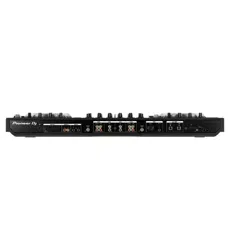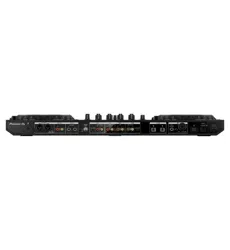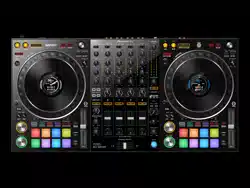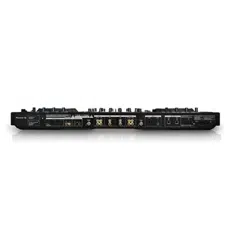
En
2
Contents
How to read this manual
! Thank you for buying this Pioneer DJ product.
Be sure to read this manual and the “Operating Instructions (Quick
Start Guide)” included with the unit. Both documents include
important information that you should understand before using this
product.
! In this manual, names of screens and menus displayed on the prod-
uct and on the computer screen, as well as names of buttons and
terminals, etc., are indicated within brackets. (e.g.: [CUE] button,
[Files] panel, [MIC1] terminal)
! Please note that the screens and specifications of the software
described in this manual as well as the external appearance and
specifications of the hardware are currently under development and
may differ from the final specifications.
! Please note that depending on the operating system version, web
browser settings, etc., operation may differ from the procedures
described in this manual.
This manual consists mainly of explanations of functions of this unit
as hardware. For detailed instructions on operating the Serato DJ
software, see the Serato DJ software manual.
! The Serato DJ software manual can be downloaded from “Serato.
com”. For details, see Downloading the Serato DJ software manual
(p. 34 ).
! The latest version of Operating Instructions (this document) can
be downloaded from the Pioneer DJ support site. For details, see
Acquiring the manual (p. 34 ).
Before start
Features ....................................................................................................... 3
What’s in the box ........................................................................................ 4
Installing the software ................................................................................ 4
Connections and part names
Connections ................................................................................................ 7
Part names and functions ....................................................................... 10
Basic Operation
Connections .............................................................................................. 15
Starting the system ................................................................................... 16
Quitting the system .................................................................................. 18
Advanced Operation
Using the performance pads ................................................................... 19
Pitch play mode
........................................................................................ 21
Using the slip mode .................................................................................. 21
Using the fader start function.................................................................. 22
Using the sampler velocity mode ............................................................ 22
Adjusting the crossfader’s operating load
............................................. 22
Analyzing tracks ........................................................................................ 23
Using effects ............................................................................................. 23
Using the SOUND COLOR FX function .................................................. 24
Using the oscillator function ................................................................... 24
Types of effects
.......................................................................................... 25
Using external inputs ............................................................................... 25
Changing the settings
Launching utilities mode ......................................................................... 27
Utilities modes
.......................................................................................... 27
About the setting utility software ............................................................ 29
Additional information
Troubleshooting ........................................................................................ 31
Signal flow ................................................................................................. 33
Acquiring the manual .............................................................................. 34
Using as a controller for other DJ software
............................................ 34
About trademarks and registered trademarks ...................................... 35
Cautions on copyrights ............................................................................ 35
En
3
Before start
Before start
Features
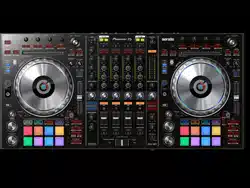
This unit features carefully arranged interfaces for various operations
including “BIG JOG”, which gives you total control over scratch play,
“PERFORMANCE PADS”, which can be used to add arrangements to
music with beats, rolling and other dynamic actions produced using
HOT CUE, SAMPLER and other functions, and “4-CHANNEL MIXER”,
which supports multi-track mixing with the 4-deck function, providing
unique DJ performance tools when using “Serato DJ”.
Also, the unit provides “SOUND COLOR FX” and “OSCILLATOR” func-
tions so that original arrangements can be added to the music being
played back.
Furthermore, numerous input and output terminals support a variety
of DJ styles. Featuring aluminum material for the top panel, the design
makes the unit look high quality, which is appropriate in a variety of
scenes such as nightclubs, home parties, etc.
BIG JOG
We have achieved the shortest time required from when jog is operated
until when the control signal is transferred to the software. Additionally,
“BIG JOG”, a large sized jog, allows the DJ to play scratches as they wish
with smooth operability.
At the center of the jog, the “ON JOG DISPLAY” displays the playback
status of music and the current playback position so that the DJ can per-
form scratching more accurately. Also, the unit is equipped with “JOG
FEELING ADJUST”, which is popular in the CDJ Series. It is possible to
adjust the operation load and back spin continuous time during scratch
play to match particular tastes.
MULTI-COLOR PERFORMANCE PADS
“PERFORMANCE PADS”, a large rubber pad used to assign and operate
functions such as HOT CUE and SAMPLER, is positioned at the front of
the unit.
Music can be arranged by dynamic actions such as beating and rolling
and the volume can be stronger or weaker depending on the strength of
the beat.
Also, each pad has built-in multi-color illumination that can be used to
instantaneously understand the selected pad mode and playing status of
each pad through illumination colors and lit condition.
4-CHANNEL MIXER
The unit includes “4-CHANNEL MIXER”, which allows the DJ to indepen-
dently operate songs being played back with four decks. Four songs can
be mixed to create a highly individualistic DJ mix.
Level meters are located near the master unit and the operation inter-
face of each channel, so that input and output levels can be understood
instantly.
Furthermore, this unit retains the control panel layout of the Pioneer DJ
DJM series, the world standard in DJ mixers.
The simple, easy-to-understand control panel layout not only facilitates
DJ performances but also makes it easy for DJs using the unit for the
first time to operate it without hesitation, so it can be used without worry
as a permanently installed mixer in the club.
PLUG AND PLAY DUAL USB PORT
Two USB sound cards are provided to connect the unit to up to two
computers at the same time.
The sound cards of the unit and all buttons and controls are set to be
linked with “Serato DJ” beforehand so that the DJ can begin playing
using “Serato DJ” without going through the need to make troublesome
settings.
The USB selector located at the top side can be used to switch between
the two sound cards with a single action. When one DJ takes over from
another, this function provides a smooth transition between the two
computers without sound being interrupted.
FLEXIBLE CONNECTIVITY
Four external input systems and two MIC input systems are provided to
connect to a CD player or analog turntable.
Mixing is possible without going through a computer, so the unit can be
used as a single DJ mixer as well.
In addition, two MASTER OUT systems and one BOOTH OUT system are
provided to handle professional PA device output.
All kinds of party scenes and DJ playing styles are supported.
DURABLE FADER
A slide structure is used for the crossfader and channel fader, in which
the fader knob is supported by two metal shafts.
This achieves smooth operability without wobble and also high
durability.
Also, effects on inside the faders caused by liquid and dust are
minimized.
An independently developed “MAGVEL CROSS FADER” magnetic sys-
tem is incorporated for the crossfader to support scratch play, which
provides high durability of more than 10,000,000 operations, and fine
operability.
HIGH SOUND QUALITY
Leveraging the audio circuit of Pioneer audio devices for clubs, the unit
provides powerful sound quality faithful to the original. It also reduces
contact resistance through use of an AC inlet having a wide contact area
with the power cable, and achieves stable and powerful sound even in
the DJ booth in a loud environment.
By adopting a high performance D/A converter and low jitter crystal
oscillator made by Wolfson Microelectronics, the unit reproduces clear
and powerful club sound faithful to the original.
PROFESSIONAL QUALITY DESIGN
Aluminum material on the top panel and jog plate provides a sense of
high quality design.
This unit is an essential part of DJ performance in clubs and home party
scenes.
SERATO FLIP
This unit is equipped with a dedicated operation interface for the
“SERATO FLIP” function that enables recording HOT CUE operation
patterns and playing back recorded HOT CUE operation patterns so the
DJ can intuitively operate the “SERATO FLIP” function. It allows the DJ
to perform differently from normal playback by, for example, repeating or
skipping specific sections.
KEY SHIFT AND KEY SYNC
Dedicated interfaces are provided for the “KEY SHIFT” function which
allows you to control the key of tracks and the “KEY SYNC” function
which automatically corrects the key to match the tracks you wish to
mix. This facilitates the arrangement of tracks by changing the key, and
smooth mixing that matches the key of the tracks.
En
4
SOUND COLOR FX
The unit is equipped with four “SOUND COLOR FX” functions
(ECHO, JET, PITCH, and FILTER), achieving a wide range of musical
arrangements.
By simply turning the control, it is possible to create the effect you want,
and a variety of remix can be achieved such as adding original arrange-
ments to the music.
Also, BPM information can be obtained from “Serato DJ”, making it
possible to add the ECHO effect linked with the BPM of the song being
played back.
OSCILLATOR
The unit is equipped with the “OSCILLATOR” function for generating
four types of sound (NOISE, DROP, LASER, and SIREN). Operation is
simple. Just press the button of the sound type you wish to output. You
can take music to an entirely new level by superimposing oscillator
sound over the track you are playing back or further emphasizing the
climax of the music. Also, you can change the tone by simply turning
the [OSCILLATOR PARAMETER] control, making it possible to generate
oscillator sound that is matched to the track.
SLIP MODE
This unit is equipped with a Slip Mode function by which the sound
continues in the background while such operations as looping, scratch-
ing and hot cueing are being performed. This allows DJ performances
without changing the original track’s development after such playback
operations as looping, scratching and hot cueing are completed.
NEEDLE SEARCH
Points can be searched for simply by touching the touch pad with a
finger. This makes for intuitive, speedy searching with the sense of
touching the music directly.
What’s in the box
! Power cord x1
! USB cable
1
x1
! Warranty (for some regions)
2
x1
! Operating Instructions (Quick Start Guide) x1
1 Only one USB cable is included with this unit.
To connect two units, use a cable conforming to USB 2.0 standards.
2 Products for Europe only. (The corresponding information is provided
on the back cover of “Operating Instructions (Quick Start Guide)” for
Japan, and on the last page of both the English and French versions
of the “Operating Instructions (Quick Start Guide)” for the North
American region.)
Installing the software
Before installing the software
For the latest version of the Serato DJ software, access Serato.com
and download the software from there.
! For details, refer to Installation Procedure (Windows) or Installation
procedure (Mac OS X).
! The user is responsible for preparing the computer, network
devices and other elements of the Internet usage environment
required for a connection to the Internet.
About the driver software
This driver software is an exclusive driver for outputting audio signals
from a computer.
! First read the Software end user license agreement on page 34
carefully.
Checking the latest information on the driver software
For detailed information on this unit’s designated driver software, see
the Pioneer DJ support site below.
http://pioneerdj.com/support/
Obtaining the driver software
1 Access the Pioneer DJ site.
http://pioneerdj.com/
2 Click the [Support] icon.
3 Click the [Software & Firmware Updates] icon.
4 Click the [DDJ-SZ2] icon in the [CONTROLLER]
category.
5 Click the [Drivers] icon.
6 Click the [Downloadlink] icon and save the file.
En
5
Before start
About the Serato DJ software
Serato DJ is a DJ software application by Serato. DJ performances are
possible by connecting the computer on which this software is installed
to this unit.
Minimum operating environment
Supported operating systems CPU and required memory
Mac OS X: 10.11, 10.10
and 10.9
32-bit
version
Intel
®
processor, Core™ i3, i5 and i7
1.07 GHz or better
4 GB or more of RAM
64-bit
version
Intel
®
processor, Core™ i3, i5 and i7
1.07 GHz or better
4 GB or more of RAM
Windows: Windows
®
10,
Windows
®
8.1, Windows
®
7
32-bit
version
Intel
®
processor, Core™ i3, i5 and i7
1.07 GHz or better
4 GB or more of RAM
64-bit
version
Intel
®
processor, Core™ i3, i5 and i7
1.07 GHz or better
4 GB or more of RAM
Others
USB port
A USB 2.0 port is required to connect the computer
with this unit.
Display resolution Resolution of 1280 x 720 or greater
Internet connection
An Internet connection is required for registering
the “Serato.com” user account and downloading the
software.
!
For the latest system requirements and compatibility as well as to acquire the
latest operating system, see [Software Info] of [DDJ-SZ2] on the [FAQ] page of
the Pioneer DJ support site below.
http://pioneerdj.com/support/
! Operating System support assumes you are using the latest point release for
that version.
! Operation is not guaranteed on all computers, even if all the required operating
environment conditions indicated here are fulfilled.
! Depending on the computer’s power-saving settings, etc., the CPU and hard
disk may not provide sufficient processing capabilities. For notebook comput-
ers in particular, make sure the computer is in the proper conditions to provide
constant high performance (for example by keeping the AC power connected)
when using Serato DJ.
! Use of the Internet requires a separate contract with a provider offering Internet
services and payment of provider fees.
Obtaining the Serato DJ software
1 Access the Serato site.
http://serato.com/
2 Click the [Serato DJ] icon of [DJ PRODUCTS].
The Serato DJ download page appears.
! The download page is subject to change without notice.
3 Click the [DOWNLOAD SERATO DJ] icon.
4 Create an account on “Serato.com.”
! If you have already registered a user account on “Serato.com”,
proceed to step 6.
! If you have not completed registering your user account, do so
following the procedure below.
— Following the instructions on the screen, input your e-mail
address and the password you want to set, then select the
region in which you live.
— If you check [E-mail me Serato newsletters], newsletters
providing the latest information on Serato products will be
sent from Serato.
—
Once user account registration is completed, you will receive
an e-mail at the e-mail address you have input. Check the
contents of the e-mail sent from “Serato.com”.
! Be careful not to forget the e-mail address and password speci-
fied when you performed user registration. They will be required
for updating the software.
!
The personal information input when registering a new user
account may be collected, processed and used based on the
privacy policy on the Serato website.
5 Click the link in the e-mail message sent from “Serato.
com”.
This takes you to the Serato DJ download page. Proceed to step 7.
6 Log in.
Input the e-mail address and password you have registered to log in to
“Serato.com”.
7 Download the Serato DJ software from the download
page.
Installation Procedure (Windows)
Do not connect this unit and the computer until installation is
completed.
!
First read the Software end user license agreement on page 34
carefully.
! Log on as the user which was set as the computer’s administrator
before installing.
! If any other programs are running on the computer, quit them.
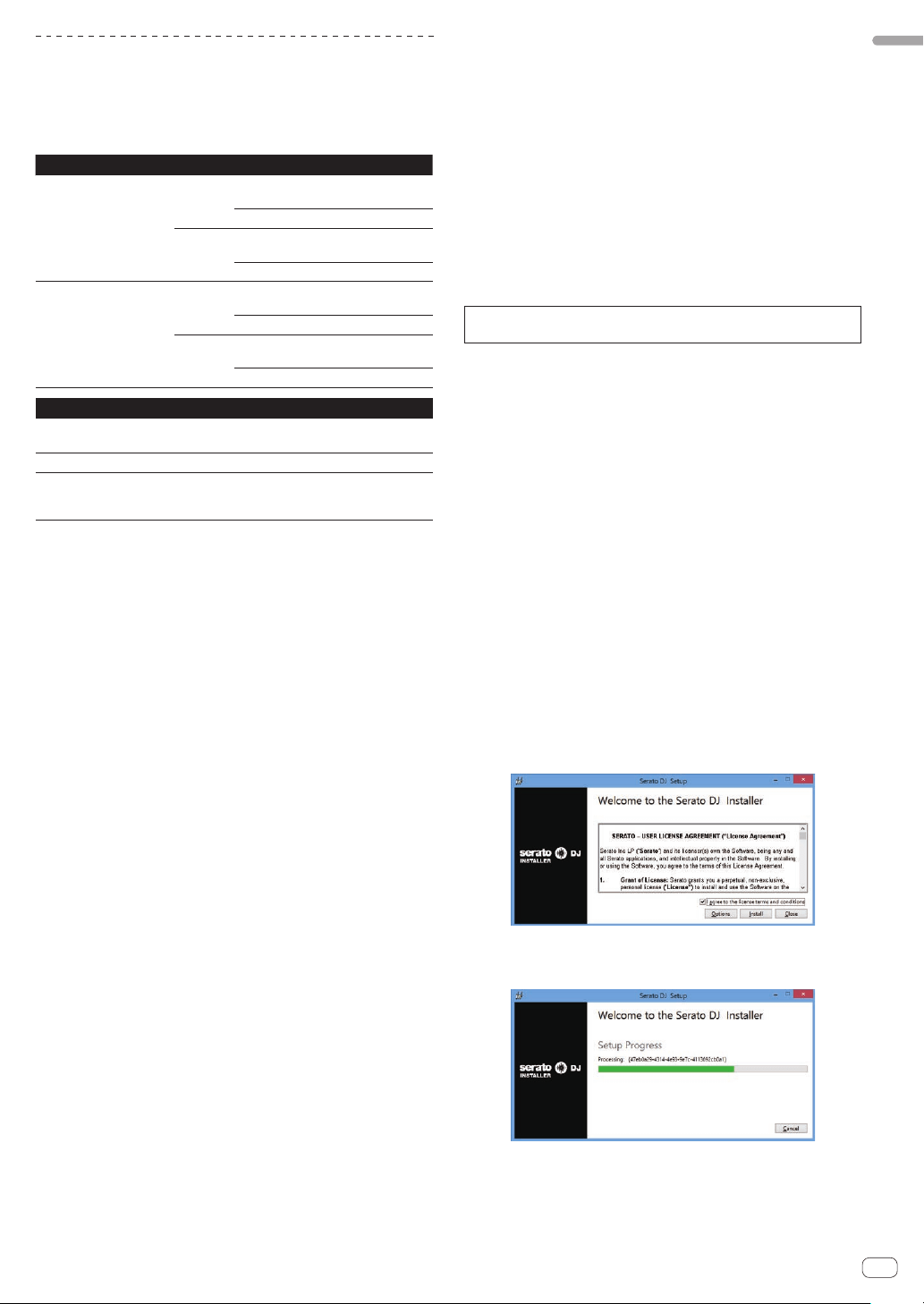
1 Double-click the downloaded driver software (DDJ-
SZ2_X.XXX.exe).
2 Proceed with installation according to the instructions
on the screen.
If [Windows Security] appears on the screen while the installation is
in progress, click [Install this driver software anyway] and continue
with the installation.
When the installation program is completed, a completion message
appears.
After installing the driver software, install the Serato DJ software.
3 Unzip the downloaded Serato DJ software file.
4 Double-click the unzipped software file to launch the
installer.
5 Read the terms of the license agreement carefully,
and if you agree, select [I agree to the license terms and
conditions], then click [Install].
! If you do not agree to the contents of the license agreement, click
[Close] to cancel installation.
Installation begins.
The message of successful installation appears once installation is
completed.
En
6
6 Click [Close] to quit the Serato DJ installer.
Installation procedure (Mac OS X)
Do not connect this unit and the computer until installation is
completed.
!
If any other programs are running on the computer, quit them.
1 Double-click the downloaded driver software
(DDJ-SZ2_M_X.X.X.dmg).
2 Double-click [DDJ-SZ2_AudioDriver.pkg].
3 Proceed with installation according to the instructions
on the screen.
4 Unzip the downloaded Serato DJ software file.
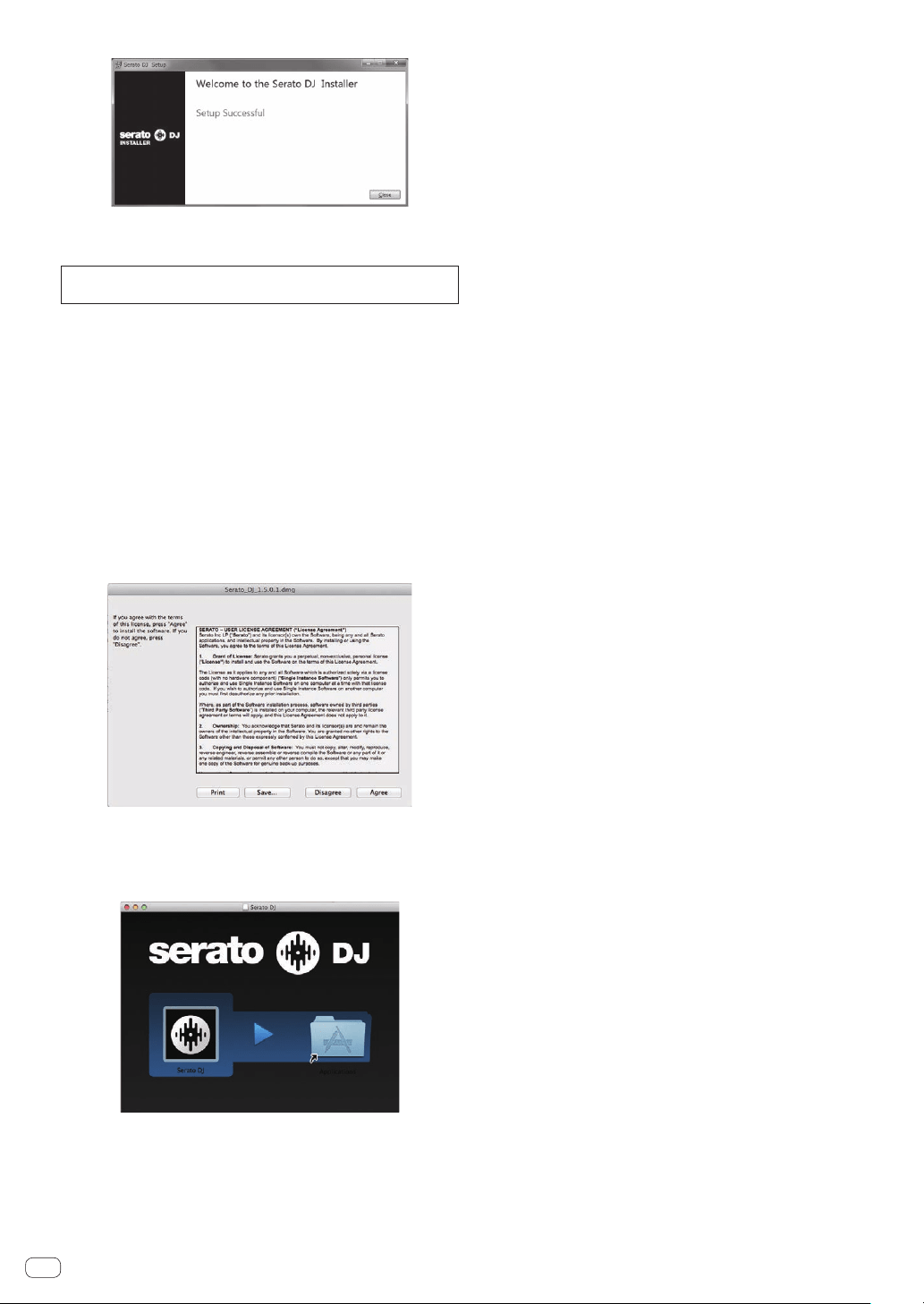
5 Double-click the unzipped software file to launch the
installer.
6 Read the terms of the license agreement carefully,
and if you agree, click [Agree].
! If you do not agree to the contents of the usage agreement, click
[Disagree] to cancel installation.
7 If the following screen appears, drag and drop the
[Serato DJ] icon on the [Applications] folder icon.
En
7
Connections and part names
Connections and part names
Connections
! Connect the power cord after all the connections between devices have been completed.
Be sure to turn off the power and unplug the power cord from the power outlet whenever making or changing connections.
Refer to the operating instructions for the component to be connected.
! Be sure to use the included power cord.
! Be sure to use the USB cable included with this product or the one that conforms to USB 2.0.
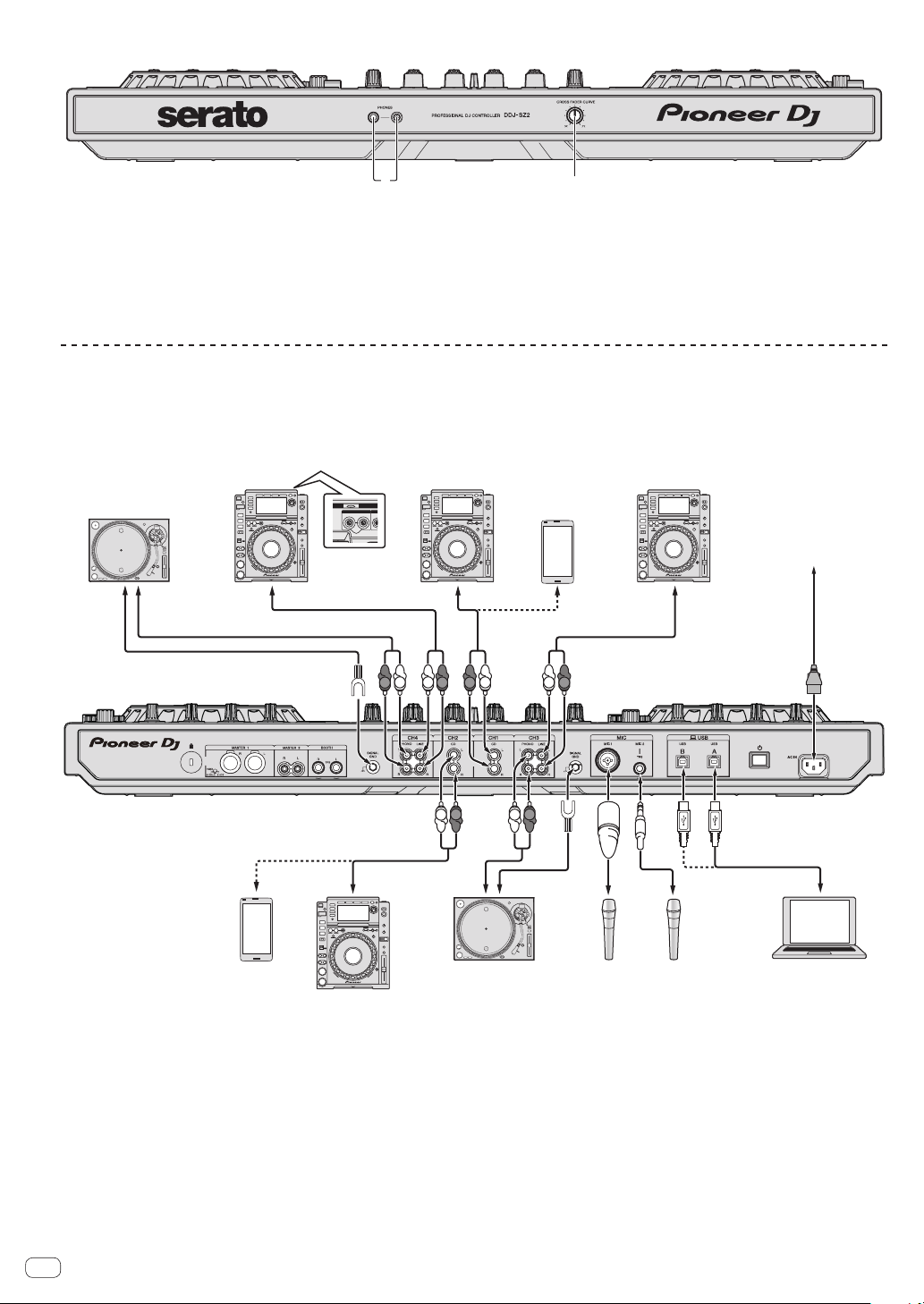
Names of Parts
Rear panel
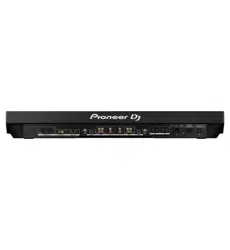
5 5
3 9 db c e6 7 6 7 a2 4881
1 Kensington security slot
2 MASTER 1 terminals
Connect powered speakers, etc., here.
! Compatible with XLR connector type balanced outputs.
3 MASTER 2 terminals
Connect to a power amplifier, etc.
! Compatible with RCA pin-jack type unbalanced outputs.
4 BOOTH terminals
These are the output terminals for a booth monitor. Compatible with
balanced or unbalanced output for 1/4” TRS connectors.
The master channel sound can be output from the [BOOTH] output
terminals regardless of the audio level set for the master channel.
The volume level can be adjusted with the [BOOTH MONITOR]
control.
! The sound will be distorted if the level is raised too high when
using unbalanced outputs.
5 SIGNAL GND terminal
Connects an analog player’s ground wire here. This helps reduce
noise when the analog player is connected.
6 PHONO terminals
Connect to a phono level (MM cartridge) output device. Do not input
line level signals.
!
You need to set the [LINE, PHONO, USB] selector switch on top
of the unit to [PHONO] beforehand.
7 LINE terminals
Connect to a DJ player or other line level device.
! You need to set the [LINE, PHONO, USB] selector switch on top
of the unit to [LINE] beforehand.
8 CD terminals
Connect to a DJ player or other line level device.
! You need to set the [CD, USB] selector switch on top of the unit to
[CD] beforehand.
9 MIC1 terminal
Connects a microphone here.
!
Either an XLR connector or a phones plug (Ø 6.3 mm) can be
used.
a MIC2 terminal
Connects a microphone here.
Compatible with a 1/4” TS jack.
b USB-B terminal
Connect to a computer.
! Connect this unit to your computer directly via a USB cable
included with this product or the one that conforms to USB 2.0.
! A USB hub cannot be used.
c USB-A terminal
Connect to a computer.
! Connect this unit to your computer directly via a USB cable
included with this product or the one that conforms to USB 2.0.
! A USB hub cannot be used.
d u switch
This switches this unit’s power between on and standby.
e AC IN terminal
Connect the power cord after all the connections between devices
have been completed.
Be sure to use the included power cord.
En
8
Front panel
12
1 PHONES jacks
Connect headphones here.
Compatible with a 1/4” TRS jack and 3.5 mm stereo mini jack.
!
There are two input jacks, a 1/4” TRS jack and a 3.5 mm stereo
mini jack, but do not use both of them simultaneously. If both are
used simultaneously, when one is disconnected or connected,
the volume of the other may increase or decrease suddenly.
2 CROSS FADER CURVE selector switch
This switches the crossfader curve characteristics.
!
The further the control is turned clockwise, the sharper the curve
rises.
! The further the control is turned counterclockwise, the more
gradually the curve rises.
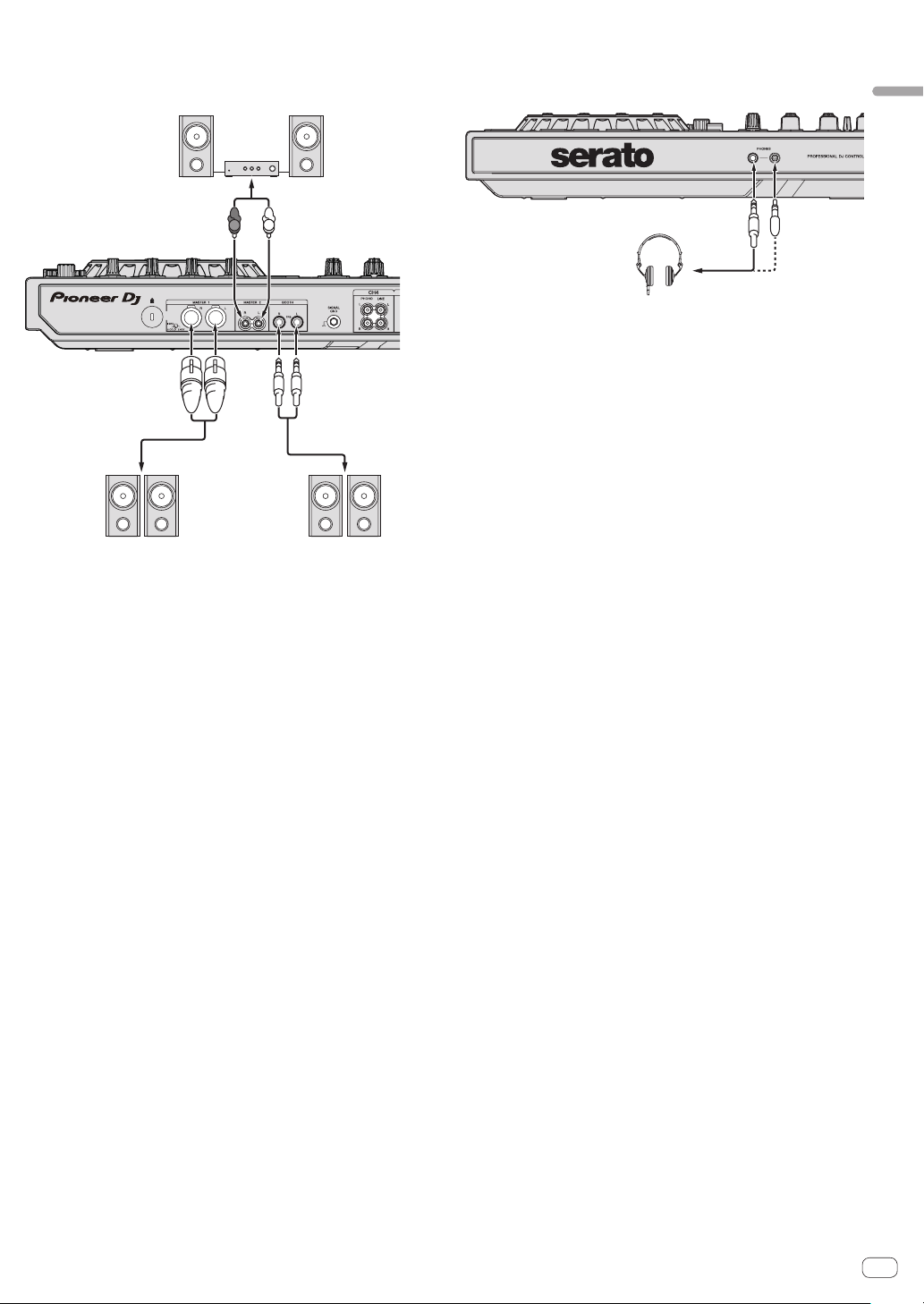
Connecting the input/output terminals
Connecting input terminals
Rear panel
To power outlet
AUDIO OUT
RL
CON
T
R
L
R
L
R
L
R
L
R
L
R
L
Analog player
Analog player
Microphone Microphone
Computer
DJ player DJ player
DJ player
DJ player
Power cord
(included)
Mobile device
Mobile device
En
9
Connections and part names
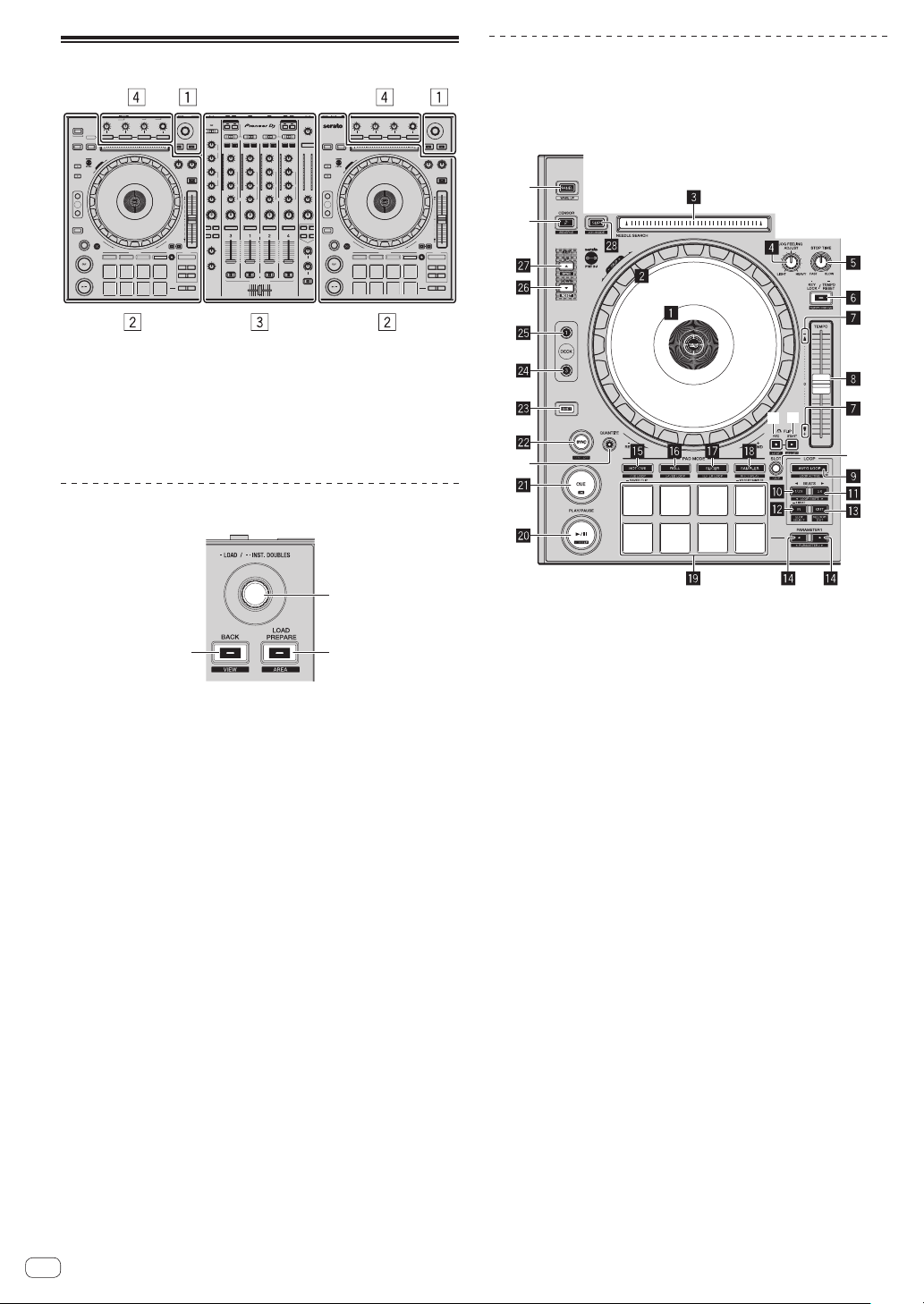
Connecting output terminals
Rear panel
R
L
Component, amplifier, powered speaker, etc.
Power amplifier,
powered speakers, etc.
Power amplifier (for booth monitor),
powered speakers, etc.
Front panel
Headphones
En
10
Part names and functions
1 Browser section
2 Deck section
3 Mixer section
4 Effect section
Browser section
1
32
1 Rotary selector
Turn:
The cursor in the library or on the [CRATES] panel moves up and
down.
Press:
The selected tracks are loaded to the respective decks.
! When the rotary selector is pressed twice, the tracks loaded in
the selected deck on the opposite side are loaded into the deck
whose rotary selector was pressed. When this is done while
a track is playing, the track is played from the same position.
(Instant Double)
2 BACK (VIEW) button
Press:
The cursor moves between the [CRATES] panel and library each time
the button is pressed.
[SHIFT] + press:
Switches the Serato DJ layout.
3 LOAD PREPARE (AREA) button
Press:
Loads tracks to the [Prepare] panel.
[SHIFT] + press:
Selects and opens the [Files] panel, [Browse] panel, [Prepare] panel
or [History] panel.
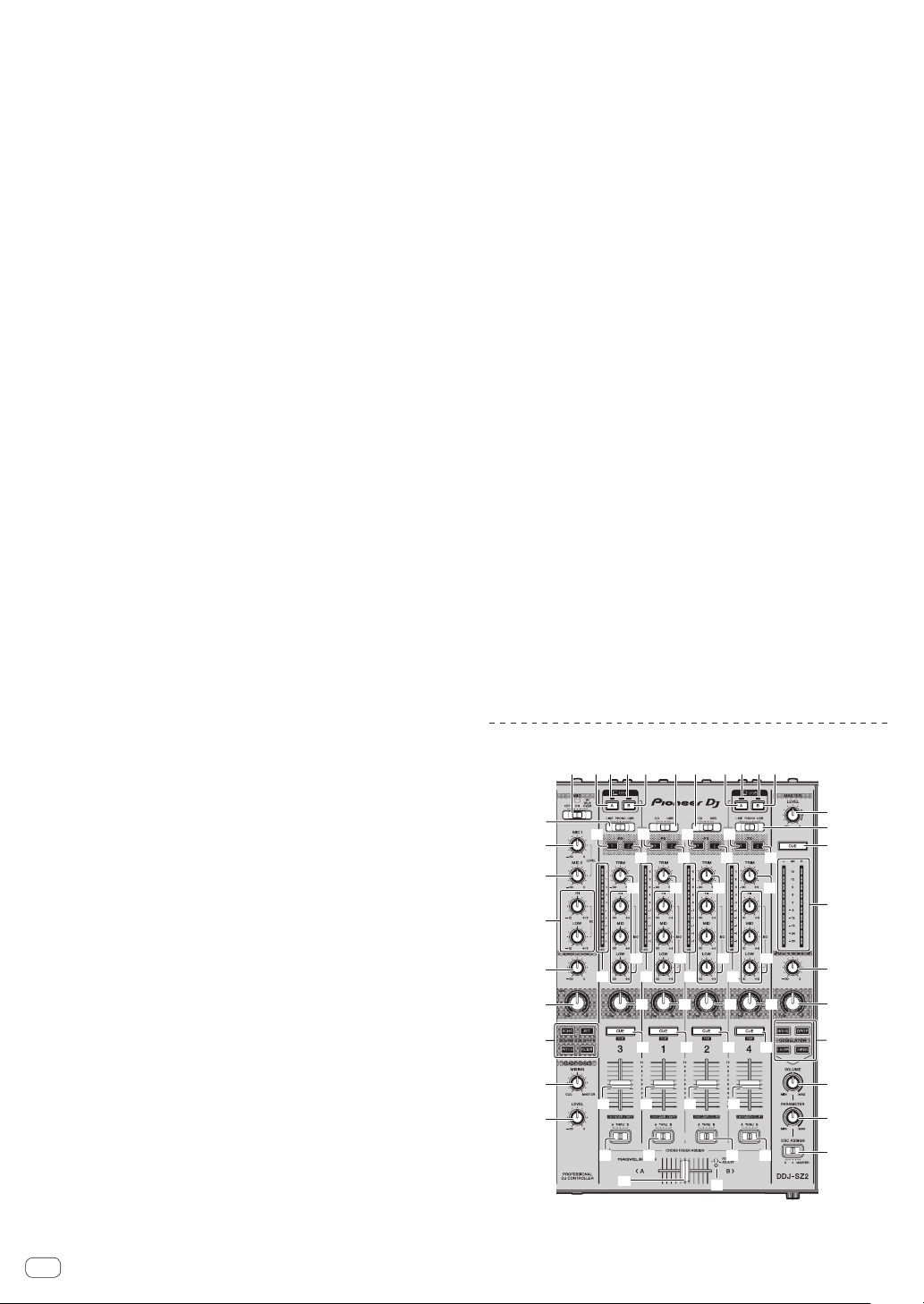
Deck section
This section is used to control the four decks. The buttons and controls
for operating decks 1 and 3 are located on the left side of the controller,
those for operating decks 2 and 4 are located on the right side of the
controller.
t
v
u
w
x
y
1 Jog dial display section
= Jog dial display section (p. 14 )
2 Jog dial
Turn top:
When the vinyl mode is on, the scratch operation is possible.
When the vinyl mode is off, the pitch bend operation (adjustment of
the playing speed) is possible.
Turn outer section:
The pitch bend operation (adjustment of the playing speed) is
possible.
[SHIFT] + Turn top:
The playback position skips in sync with the beat. (Skip mode)
! The skip mode cannot be used with tracks for which no beatgrid
is set. For details on setting beatgrids, see the Serato DJ software
manual.
! To use the skip mode, [SYNC PREFERENCES] in the Serato DJ
[SETUP] menu must be switched to [Smart Sync].
3 NEEDLE SEARCH pad
By touching the pad, you can jump to the desired position in the
track loaded in the deck.
4 JOG FEELING ADJUST control
This adjusts the load applied when the jog dial is spun.
The load gets heavier when turned clockwise, lighter when turned
counterclockwise.
5 STOP TIME control
When the [PLAY/PAUSEf] button is pressed, the speed of play-
back stop can be changed.
6 KEY LOCK button
Press:
Turns the key lock function on and off.
When the key lock function is on, the key does not change even when
the playing speed is changed with the [TEMPO] slider.
The sound is digitally processed, so the sound quality decreases.
En
11
Connections and part names
[SHIFT] + press:
The [TEMPO] slider’s range of variation switches each time the but-
ton is pressed.
[
±8 %
][
±16 %
][
±50 %
]
Press for over 1 second:
Sets the tempo (BPM) of the currently playing track back to its origi-
nal tempo.
7 Takeover indicator
When decks are switched while the sync function is off, the posi-
tion of the controller’s [TEMPO] slider may not match the soft-
ware’s tempo (pitch). To regain control of the tempo from the control-
ler, adjust using the [TAKEOVER] indicator as reference. Slowly move
the [TEMPO] slider in the direction in which the [TAKEOVER] indica-
tor lights. When moved to the position at which the [TAKEOVER]
indicator turns off, the [TEMPO] slider’s position matches the
software’s tempo (pitch) and the tempo can once again be controlled
with the [TEMPO] slider.
8 TEMPO slider
Use this to adjust the track playing speed.
When the deck is switched, if the value controlled by Serato DJ and
the [TEMPO] slider position of the unit are different, you cannot oper-
ate the [TEMPO] slider unless it is moved to the position controlled
by Serato DJ.
! The default setting of the [TEMPO] slider of deck 3 and 4 of
Serato DJ is ±0.0 %.
9 AUTO LOOP button
Press:
Turns the auto loop function on and off.
!
During loop playback, this operation cancels looping.
[SHIFT] + press:
Switches looping between active and non-active. (Loop Active)
!
Even if looping is active, if there is no playback position in that
loop, loop playback is not performed.
!
When the playback position enters the active loop, loop playback
starts.
! During loop playback, this operation cancels looping.
a LOOP 1/2X button
Press:
Select the auto loop beat.
During loop playback, the length of loop playback is split in half each
time this button is pressed.
[SHIFT] + press:
During loop playback, moves the loop to the left by the amount equal
to its length. (Loop Shift)
b LOOP 2X button
Press:
Select the auto loop beat.
During loop playback, the length of loop playback is doubled each
time this button is pressed.
[SHIFT] + press:
During loop playback, moves the loop to the right by the amount
equal to its length. (Loop Shift)
c LOOP IN button
Press:
Loop In Point is set.
When this button is pressed during loop playback, the loop in point
can be fine-adjusted using the jog dial.
[SHIFT] + press:
The loop slot switches.
When loops are stored in loop slots ahead of time, they can be called
out later.
! Up to eight loops can be set in the loop slots.
! When you select the number of the loop slot at which you want to
store the loop then set a loop, the loop is automatically stored.
!
When a new loop is set after a loop has been stored, the loop is
overwritten and the slot is updated.
! When the number of the loop slot whose loop you want to call out
is selected and the [LOOP OUT] button is pressed while pressing
the [SHIFT] button (reloop), playback of the stored loop starts.
d LOOP OUT button
Press:
The loop out point is set, and loop playback begins.
When this button is pressed during loop playback, the loop out point
can be fine-adjusted using the jog dial.
[SHIFT] + press:
Cancels loop playback. (Loop Exit)
After loop playback is canceled, playback returns to the previously
set loop in point and loop playback resumes. (Reloop)
e PARAMETERc button, PARAMETERd button
These set the various parameters for when using the performance
pads.
= Using the performance pads (p. 19 )
f HOT CUE mode button
Press:
Sets the hot cue mode.
= Using hot cues (p. 19 )
[SHIFT] + press:
Sets the hot loop mode.
= Using the cue loop (p. 20 )
Press for over 1 second:
Sets the saved flip mode.
For details, see “Serato Flip Manual” from [Software Info] on the
Pioneer DJ support site below.
http://pioneerdj.com/support/
g ROLL mode button
Press:
Sets the roll mode.
= Using the Roll function (p. 19 )
[SHIFT] + press:
Sets the saved loop mode.
= Using the saved loop (p. 20 )
h SLICER mode button
Press:
Sets the slicer mode.
! To cancel the slicer mode, press one of the [ROLL] mode,
[SAMPLER] mode or [HOT CUE] mode buttons.
[SHIFT] + press:
Sets the slicer loop mode.
i SAMPLER mode button
Press:
Sets the sampler mode.
[SHIFT] + press:
Sets the pitch play mode.
! For details, see Pitch play mode on page 21 .
Press for over 1 second:
Turns the sampler velocity mode on and off.
For details on the sampler velocity mode, see Using the sampler
velocity mode on page 22 .
j Performance pads
Various performances can be achieved using the pads.
=
Using the performance pads (p. 19 )
k PLAY/PAUSE f button
Press:
Use this to play/pause tracks.
!
When the [PLAY/PAUSE f] button is pressed during Cue
Sampler, playback continues from that point.
En
12
[SHIFT] + press:
The track returns to the temporary cue point and playback continues
from there. (Stutter)
l CUE button
Press:
This is used to set, play and call out temporary cue points.
! When the [CUE] button is pressed while pausing, the temporary
cue point is set.
! When the [CUE] button is pressed during playback, the track
returns to the temporary cue point and pauses. (Back Cue)
!
When the [CUE] button is pressed and held after the track
returns to the temporary cue point, playback continues as long
as the button is pressed in. (Cue Sampler)
!
When the [PLAY/PAUSE f] button is pressed during Cue
Sampler, playback continues from that point.
[SHIFT] + press:
Loads the previous track in the track list. (Previous Track)
! If the current playback position is not the beginning of a track,
the track returns to the beginning.
m SYNC button
Press:
The tempos (pitches) and beat grids of tracks on multiple decks can
be synchronized automatically.
[SHIFT] + press:
Cancels the sync mode.
n SHIFT button
When another button is pressed while pressing the [SHIFT] button, a
different function is called out.
o DECK 3 button
The deck on the right side has a [DECK 4] button.
Switches the deck to be operated.
p DECK 1 button
The deck on the right side has a [DECK 2] button.
Switches the deck to be operated.
q KEY DOWN/RESET button
Press:
When the [KEY DOWN/RESET] button is pressed, the key decreases.
[SHIFT] + press:
Press during KEY SYNC to return to the original key.
r KEY UP/SYNC button
Press:
When the [KEY UP/SYNC] button is pressed, the key increases.
[SHIFT] + press:
Matches the key to that of the other deck.
The q to r buttons support the Pitch’n Time function. This function
needs to be activated before it can be used. For details, see “Serato
Pitch’n Time Manual” from [Software Info] on the Pioneer DJ sup-
port site below.
http://pioneerdj.com/support/
s SLIP button
Turns the slip mode on and off.
=
Using the slip mode (p. 21 )
[SHIFT] + press:
Turns the vinyl mode on and off.
t CENSOR button
Press:
The track is played in the reverse direction while the [CENSOR] but-
ton is pressed, and normal playback resumes when the button is
released.
! Even during playback in the reverse direction, normal playback
continues in the background. When the button is released, play-
back resumes from the point reached in the background.
[SHIFT] + press:
The track is played in the reverse direction. When the [SHIFT] and
[CENSOR] buttons are pressed again, reverse playback is canceled
and normal playback resumes.
u PANEL button
Press:
(During normal operation)
The panel display switches in the order below each time the button
is pressed.
Panel display off l [REC] panel l [FX] panel l [SP-6] panel l
Panel display off ...
! When Serato-Video is installed and enabled at the [SETUP]
menu, a key for switching to the [VIDEO] panel is displayed on
the Serato DJ software screen. To display the [VIDEO] panel, use
the mouse to click this key for switching to the [VIDEO] panel.
(During standby status)
The standby mode is canceled.
[SHIFT] + press:
The panel display switches in the order below each time the button
is pressed.
Panel display off l [SP-6] panel l [FX] panel l [REC] panel l
Panel display off ...
! When Serato-Video is installed and enabled at the [SETUP]
menu, a key for switching to the [VIDEO] panel is displayed on
the Serato DJ software screen. To display the [VIDEO] panel, use
the mouse to click this key for switching to the [VIDEO] panel.
v QUANTIZE
Turns quantize on or off.
w FLIP SLOT
x FLIP REC
y FLIP START
The w to y buttons support the FLIP function which allows you to
record or call sequences such as HOT CUE operation.
This function (Serato Flip) needs to be activated before it can be
used.
For details, visit the Pioneer DJ support site below.
http://pioneerdj.com/support/
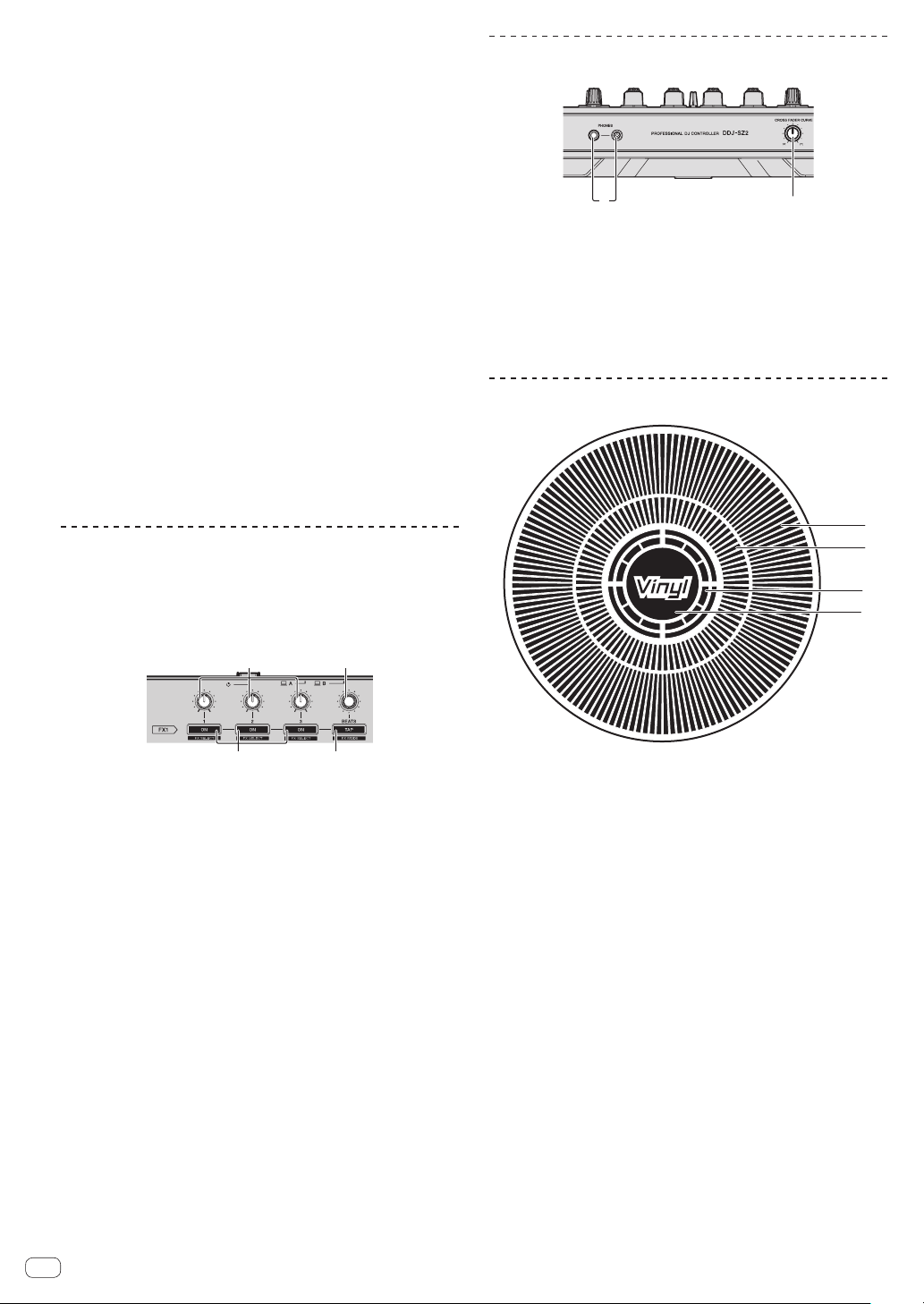
Mixer section
1 2 2 2 23 4 3 4
6
9
5
7
8
a
b
c
d
e
f
g
h
j
k
l
m
m
o oo
s
tttt
o
i
u u u u
v v v v
ww w w
x
y
q q q q
s ss
n n
r r r
p p p p
r

En
13
Connections and part names
1 OFF, ON, TALK OVER selector switch
Turns the microphone on/off.
2 USB connection indicator
Displays the connection status between the USB-A terminal and
USB-B terminal.
Lights: When communication with Serato DJ is normal
Flashes: When the computer is connected to the terminal and the
driver is not installed
Lights out: When the computer is not connected to the terminal
3 USB (A) button
When lights, the USB-A terminal is used in communication with the
computer.
!
The [USB (A)] button and [USB (B)] button located at the left
side are used to control the USB communication for deck 1 or
deck 3. The [USB (A)] button and [USB (B)] button located at the
right side are used to control USB communication for deck 2 or
deck 4.
! When the [USB (A)] button or [USB (B)] button located on the
left side is flashing, it means the deck 1 or deck 3 audio is on
air. Flashing stops when the channel fader of deck 1 or deck 3 is
moved to the frontmost position. When the [USB (A)] button or
[USB (B)] button located on the right side is flashing, it means
deck 2 or deck 4 audio is on air. Flashing stops when the chan-
nel fader of deck 2 or deck 4 is moved to the frontmost position.
(When the USB terminal is switched, sound is also switched
instantaneously. Therefore, when the button is flashing, before
switching the USB terminal, make sure that the deck is not used
by another user.)
4 USB (B) button
When lights, the USB-B terminal is used in communication with the
computer.
! The [USB (A)] button and [USB (B)] button located at the left
side are used to control the USB communication for deck 1 or
deck 3. The [USB (A)] button and [USB (B)] button located at the
right side are used to control USB communication for deck 2 or
deck 4.
! When the [USB (A)] button or [USB (B)] button located on the
left side is flashing, it means the deck 1 or deck 3 audio is on
air. Flashing stops when the channel fader of deck 1 or deck 3 is
moved to the frontmost position. When the [USB (A)] button or
[USB (B)] button located on the right side is flashing, it means
deck 2 or deck 4 audio is on air. Flashing stops when the chan-
nel fader of deck 2 or deck 4 is moved to the frontmost position.
(When the USB terminal is switched, sound is also switched
instantaneously. Therefore, when the button is flashing, before
switching the USB terminal, make sure that the deck is not used
by another user.)
5 MASTER LEVEL control
Adjusts the master sound level output.
6 MASTER CUE button
Turns monitoring of the master output’s sound on and off.
7 Master level indicator
Displays the master output’s audio level.
8 BOOTH MONITOR control
Adjusts the level of audio signals output from the [BOOTH] terminal.
9 MASTER OUT COLOR control
Changes the SOUND COLOR FX parameter applied to the master
output sound.
a OSCILLATOR SELECT buttons
Generates oscillator sound (NOISE, DROP, LASER, and SIREN).
= Using the oscillator function (p. 24 )
b OSCILLATOR VOLUME control
Adjusts the sound level of oscillator sound.
c OSCILLATOR PARAMETER control
Adjusts the quantitative parameters of oscillator sound.
d OSC ASSIGN selector switch
Selects the channel to output oscillator sound.
e HEADPHONES LEVEL control
Adjusts the sound level output from the headphones.
f HEADPHONES MIXING control
Adjusts the balance of the monitor volume between the sound of the
channels for which the headphones [CUE] button is pressed and the
sound of the master channel.
g SOUND COLOR FX buttons
These turn the SOUND COLOR FX effects on/off.
h MIC COLOR control
Changes the SOUND COLOR FX parameter applied to microphone
sound.
i SAMPLER VOL control
Adjusts the sound level of sampler.
j EQ (HI, LOW) controls
These adjust the tone quality of the [MIC1] and [MIC2] channels.
k MIC2 control
Adjusts the sound level output from the [MIC2] channel.
l MIC1 control
Adjusts the sound level output from the [MIC1] channel.
m LINE, PHONO, USB selector switch
Selects the input source of each channel from the components con-
nected to this unit.
! [LINE]: Select this to use a line level output device (DJ player,
etc.) connected to the [LINE] input terminals.
— When [PHONO] is selected, sound is muted momentarily.
! [PHONO]: Select this to use a phono level (for MM cartridges)
output device (analog player, etc.) connected to the [PHONO]
input terminals.
! [USB]: Select this to use the track loaded in the Serato DJ soft-
ware’s deck.
n CD, USB selector switch
Selects the input source of each channel from the components con-
nected to this unit.
! [CD]: Select this to use a line level output device (DJ player, etc.)
connected to the [CD] terminals.
! [USB]: Select this to use the track loaded in the Serato DJ soft-
ware’s deck.
o FX 1 assign button
Turns effect unit FX1 on and off for the respective channel.
p FX 2 assign button
Turns effect unit FX2 on and off for the respective channel.
q Channel Level Indicator
Displays the sound level of the respective channels before passing
through the channel faders.
r TRIM control
Adjusts the level of audio signals input in each channel.
s ISO (HI, MID, LOW) controls
Boosts or cuts frequencies for the different channels.
t COLOR control
This changes the parameters of the SOUND COLOR FX of the differ-
ent channels.
u Headphones CUE button
Press:
The sound of channels for which the headphones [CUE] button is
pressed is output to the headphones.
!
When the headphones [CUE] button is pressed again, monitoring
is canceled.
[SHIFT] + press:
The track’s tempo can be set by tapping the button. (Tap function)
En
14
! When the tap function is used, the deck section’s display on the
computer’s screen switches to the [Beatgrid Editor] display. To
switch the deck section’s display back to how it was before, click
[Edit Grid] on the computer’s screen.
v Channel fader
Move:
Adjusts the level of audio signals output in each channel.
[SHIFT] + move:
Use the channel fader start function.
= Using the channel fader start function (p. 22 )
w Crossfader assign selector switch
Assigns the channel output to the crossfader.
[A]: Assigns to [A] (left) of the crossfader.
[B]: Assigns to [B] (right) of the crossfader.
[THRU]: Selects this when you do not want to use the crossfader.
(The signals do not pass through the crossfader.)
x Crossfader
Outputs the sound assigned with the crossfader assign switch.
[SHIFT] + move:
Uses the crossfader start function.
=
Using the crossfader start function (p. 22 )
y FEELING ADJUST adjustment hole
This can be used to adjust the crossfader’s operating load.
= Adjusting the crossfader’s operating load (p. 22 )
Effect section
This section is used to control the two effect units (FX1 and FX2).
Controls and buttons used to operate the FX1 unit are located on the left
side of the controller, those used to operate the FX2 unit are located on
the right side of the controller. The channels to which the effect is to be
applied are set using the effect assign buttons on the mixer section.
2
4
1
3
1 Effect parameter controls
These adjust the effects’ parameters.
2 FX BEATS control
Adjusts the effect time.
3 Effect parameter buttons
Press:
Turns the effect on and off or switches the parameter.
[SHIFT] + press:
Switches the effect type.
4 TAP button
Press:
The BPM used as the base value for the effect is calculated by the
interval at which the button is tapped with a finger.
When the button is pressed and held, the effect time is reset.
[SHIFT] + press:
Switches the effect mode.
Front panel
12
1 PHONES jacks
2 CROSS FADER CURVE selector switch
This switches the crossfader curve characteristics.
! The further the control is turned clockwise, the sharper the curve
rises.
! The further the control is turned counterclockwise, the more
gradually the curve rises.
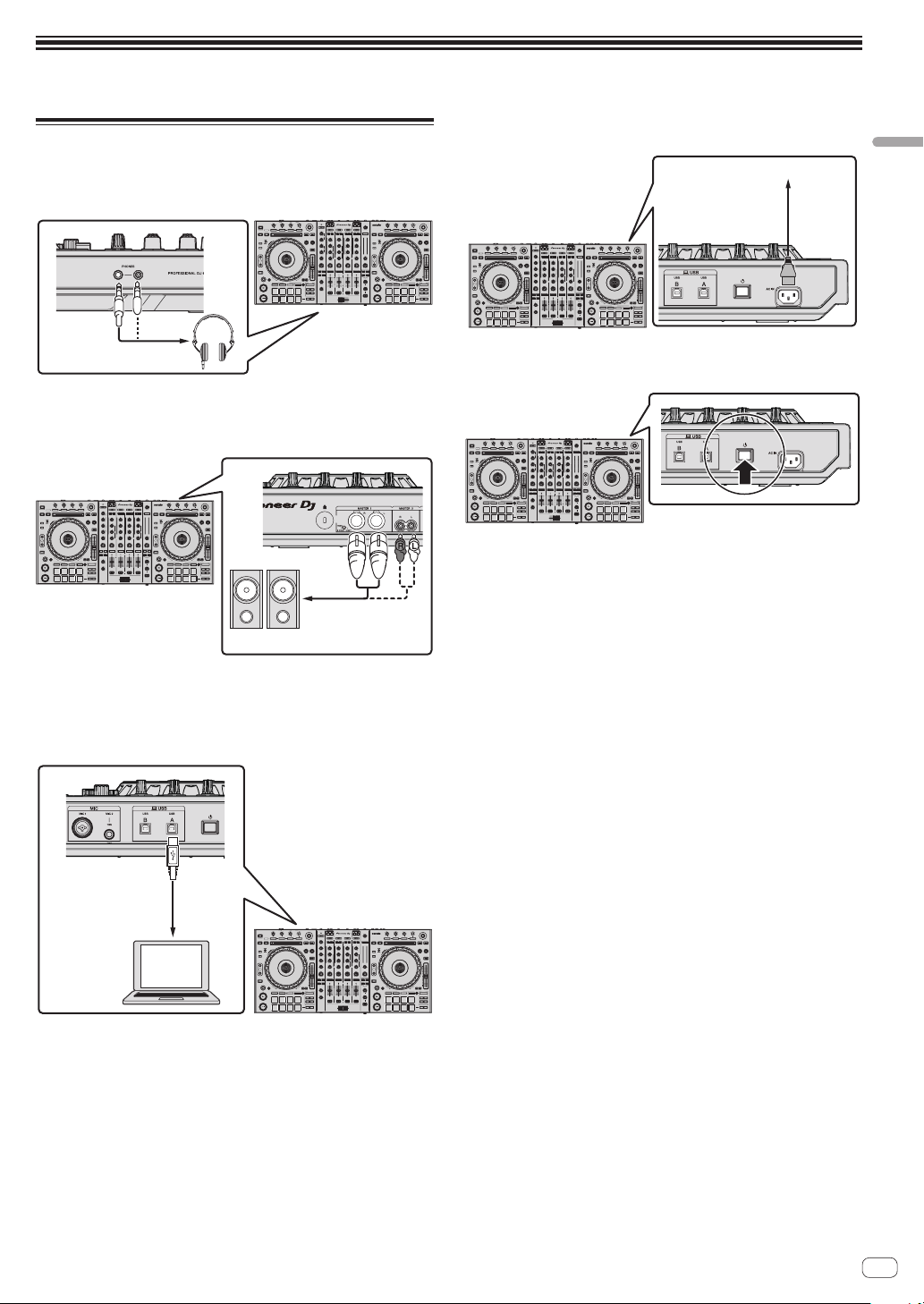
Jog dial display section
1
2
3
4
1 Operation display
It works in synchronization with the rotation display of the Serato DJ
deck.
2 Hot cue point display
3 Jog touch detection display
The display lights when the jog dial top is pressed when VINYL mode
is on.
4 VINYL
The display lights when VINYL mode is on.
En
15
Basic Operation
Basic Operation
Connections
1 Connect headphones to one of the [PHONES]
terminals.
2 Connect powered speakers, a power amplifier,
components, etc., to the [MASTER 1] or [MASTER 2]
terminals.
Powered speaker, etc.
! To output the sound from the [BOOTH] terminals, connect speakers
or other devices to the [BOOTH] terminals.
! For details on the connections of the input/output terminals, see
Connections (p. 7 ).
3 Connect this unit to your computer via a USB cable.
USB cable
(included)
4 Turn on the computer’s power.
5 Connect the power cord.
To power outlet
Power cord
(included)
6 Press the [u] switch on this unit’s rear panel to turn
this unit’s power on.
Turn on the power of this unit.
! For Windows users
The message [Installing device driver software] may appear when
this unit is first connected to the computer or when it is connected to
a different USB port on the computer. Wait a while until the message
[Your devices are ready for use] appears.
7 Turn on the power of the devices connected to the
output terminals (powered speakers, power amplifier,
components, etc.).
! When a microphone, DJ player or other external device is connected
to input terminals, the power of that device also turns on.
En
16
Starting the system
Launching Serato DJ
For Windows 7
From the Windows [Start] menu, click the [Serato DJ] icon under [All Programs] > [Serato] > [Serato DJ].
For Windows 10/8.1
From [Apps view], click the [Serato DJ] icon.
For Mac OS X
In Finder, open the [Applications] folder, then click the [Serato DJ] icon.
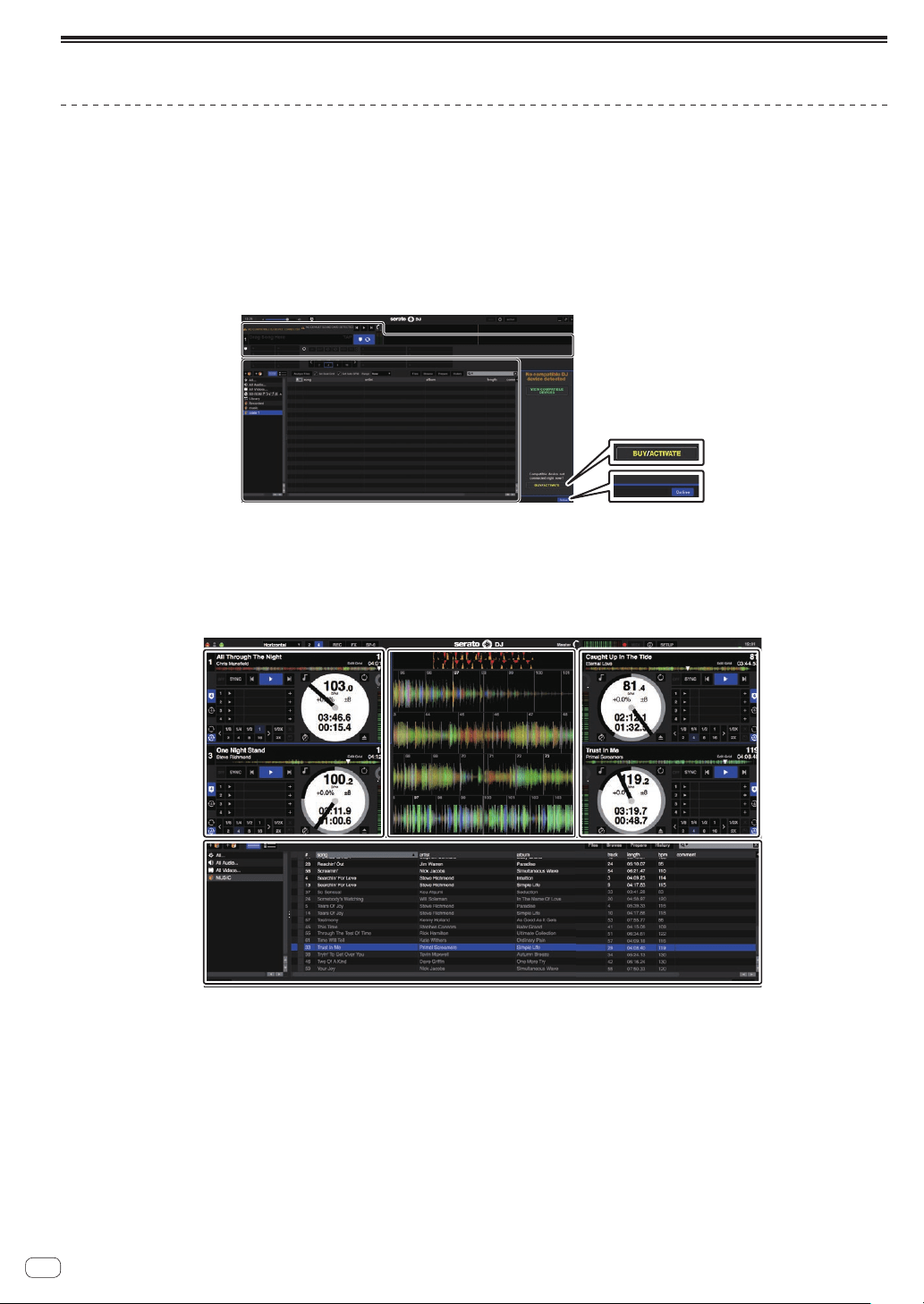
Computer screen directly after the Serato DJ software is launched
A
C
1
2
1 The [BUY/ACTIVATE] icon may appear on the right side of the screen that is displayed when Serato DJ is launched the first time, but there is no
need to activate or purchase a license for those using DDJ-SZ2.
2 Click [Online] to use the unit as is.
Computer screen when a track is loaded in the Serato DJ software
Click [Library] at the upper left of the computer screen, then select [Vertical] or [Horizontal] from the pull-down menu to switch the Serato DJ screen.
AA
C
B
A Deck section
The track information (the name of the loaded track, artist name, BPM, etc.), the overall waveform and other information is displayed here.
B Waveform display
The loaded track’s waveform is displayed here.
C Browser section
Crates in which tracks in the library or sets of multiple tracks are stored are displayed here.
This manual consists mainly of explanations of functions of this unit as hardware. For detailed instructions on operating the Serato DJ software, see
the Serato DJ software manual.
En
17
Basic Operation
Importing tracks
The following describes the typical procedure for importing tracks.
! There are various ways to import tracks with the Serato DJ software. For details, see the Serato DJ software manual.
! If you are already using Serato DJ software (Scratch Live, ITCH or Serato DJ Intro) and have already created track libraries, the track libraries you
have previously created can be used as such.
! If you are using Serato DJ Intro and have already created track libraries, you may have to reanalyze the tracks.
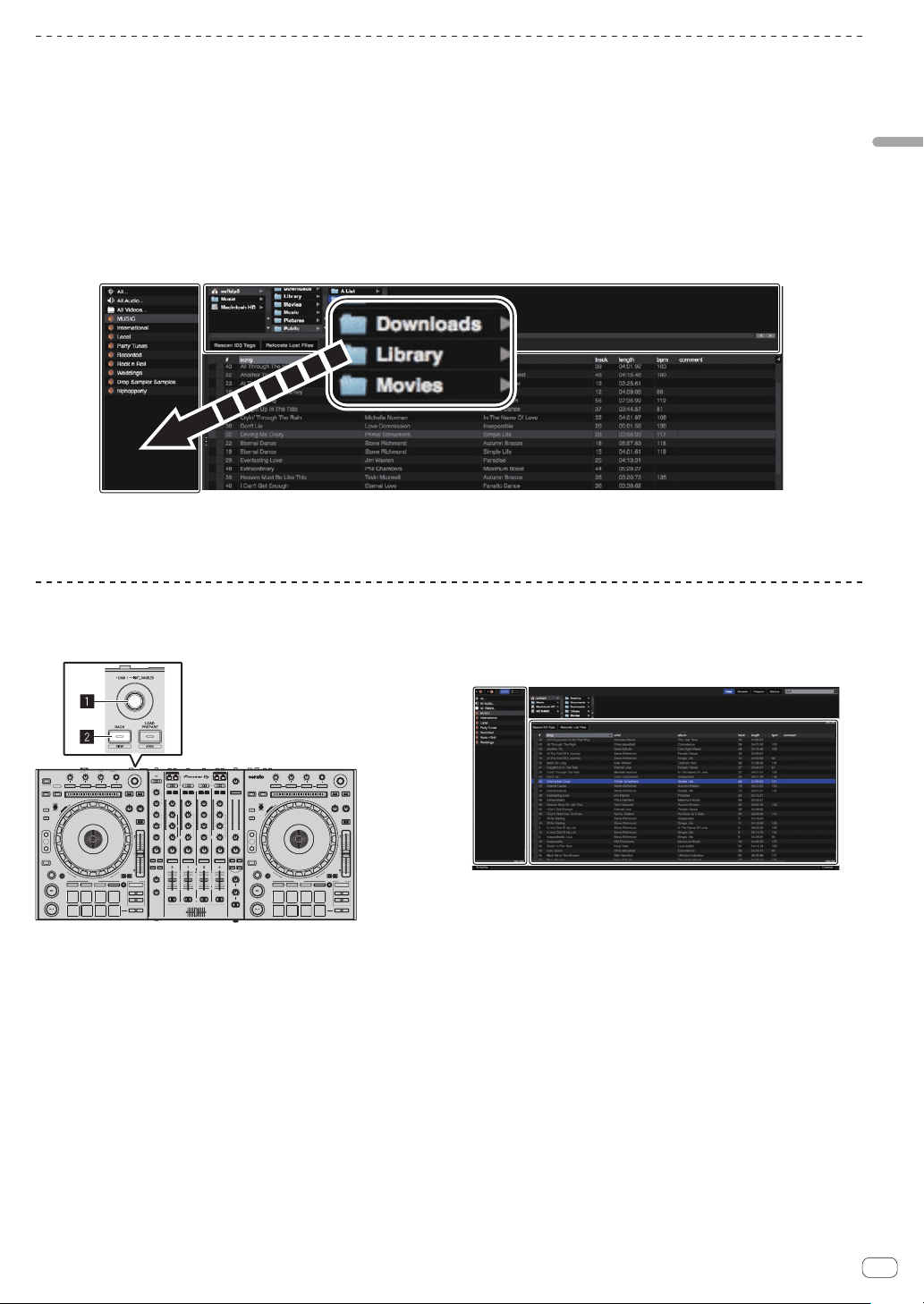
1 Click the [Files] key on the Serato DJ software screen to open the [Files] panel.
The contents of your computer or the peripheral connected to the computer are displayed in the [Files] panel.
2 Click the folder on the [Files] panel containing the tracks you want to add to the library to select it.
3 On the Serato DJ software screen, drag and drop the selected folder to the crates panel.
A crate is created and the tracks are added to the library.
a
b
a [Files] panel
b Crates panel
Loading tracks and playing them
The following describes the procedure for loading tracks into deck [1] as
an example.
1 Rotary selector
2 BACK (VIEW) button
1 Press this unit’s [BACK (VIEW)] button, move the
cursor to the crates panel on the computer’s screen, then
turn the rotary selector to select the crate, etc.
2 Press the rotary selector, move the cursor to the
library on the computer’s screen, then turn the rotary
selector and select the track.
a
b
a Library
b Crates panel
3 Press the [DECK1] button.
4 Press the rotary selector to load the selected track
onto the deck.
En
18
Playing tracks and outputting the sound
The following describes the procedure for outputting the channel 1
sound as an example.
! Set the volume of the devices (power amplifier, powered speakers,
etc.) connected to the [MASTER 1] and [MASTER 2] terminals to an
appropriate level. Note that loud sound will be output if the volume is
set too high.
c
d
e
4
8
7
5
6
9
a
b
f
3 CD, USB selector switch
4 TRIM control
5 ISO (HI, MID, LOW) controls
6 Headphones CUE button
7 Channel fader
8 HEADPHONES MIXING control
9 HEADPHONES LEVEL control
a Crossfader assign selector switch
b Crossfader
c MASTER LEVEL control
d MASTER CUE button
e BOOTH MONITOR control
f CROSS FADER CURVE selector switch
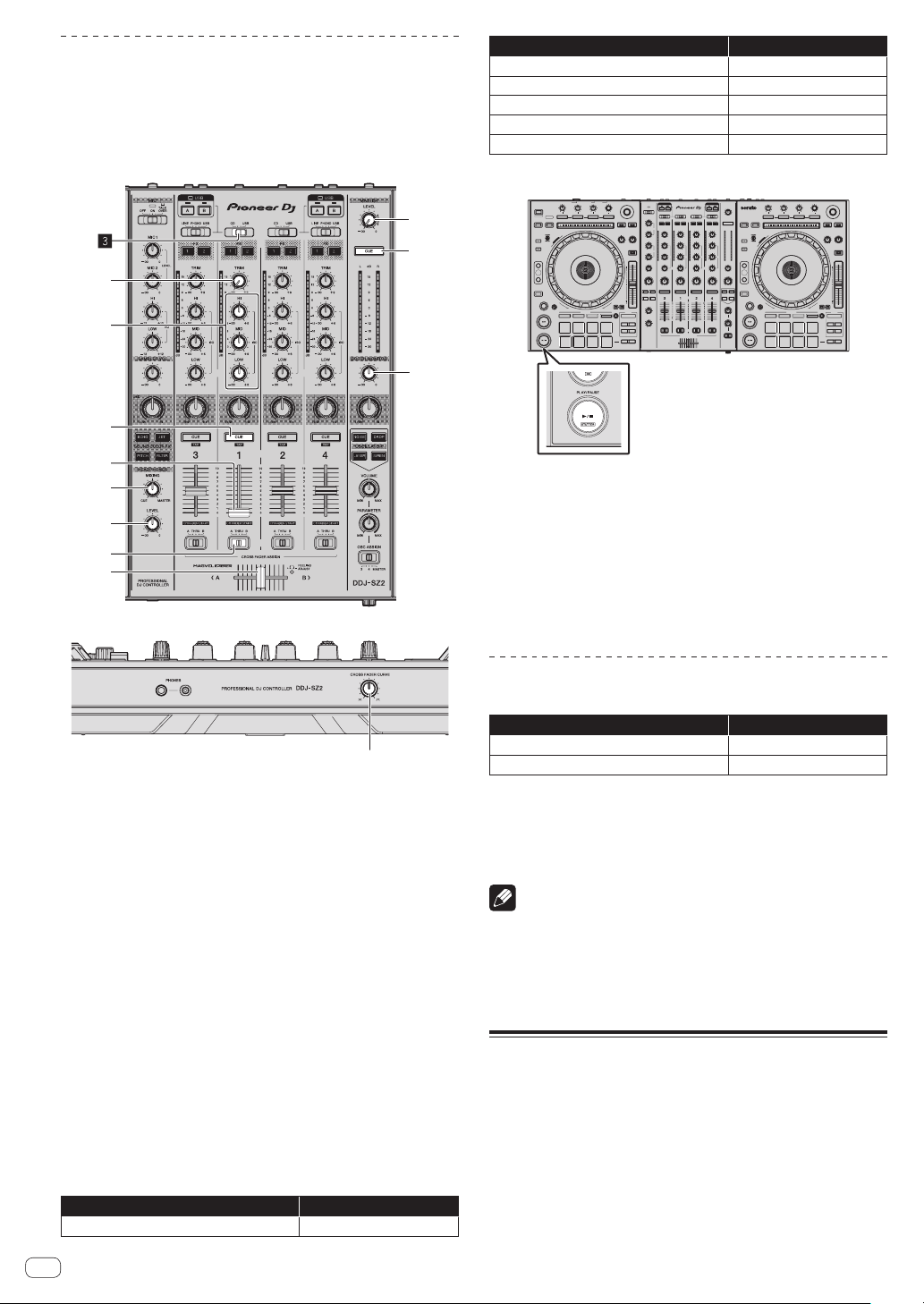
1 Set the positions of the controls, etc., as shown
below.
Names of controls, etc. Position
MASTER LEVEL control Turned fully counterclockwise
Names of controls, etc. Position
CD, USB selector switch [USB] position
TRIM control Turned fully counterclockwise
ISO (HI, MID, LOW) controls Center
Channel fader Moved forward
Crossfader assign selector switch [THRU] position
2 Press the [f] button to play the track.
3 Turn the [TRIM] control.
Adjust the [TRIM] control so that the channel level indicator’s orange
indicator lights at peak level.
4 Move the channel fader away from you.
5 Turn the [MASTER LEVEL] control to adjust the audio
level of the speakers.
Adjust the sound level output from the [MASTER 1] and [MASTER 2]
terminals to an appropriate level.
Monitoring sound with headphones
Set the positions of the controls, etc., as shown below.
Names of controls, etc. Position
HEADPHONES MIXING control Center
HEADPHONES LEVEL control Turned fully counterclockwise
1 Press the headphones [CUE] button for the channel 1.
2 Turn the [HEADPHONES LEVEL] control.
Adjust the sound level output from the headphones to an appropriate
level.
Note
This unit and the Serato DJ software include a variety of functions
enabling individualistic DJ performances. For details on the respective
functions, see the Serato DJ software manual.
! The Serato DJ software manual can be downloaded from “Serato.
com”. For details, see Downloading the Serato DJ software manual
(p. 34 ).
Quitting the system
1 Quit [Serato DJ].
When the software is closed, a message for confirming that you want to
close it appears on the computer’s screen. Click [Yes] to close.
2 Press the [u] switch on this unit’s rear panel to set
this unit’s power to standby.
3 Disconnect the USB cable from your computer.
En
19
Advanced Operation
Advanced Operation
The descriptions from this point on are for functions not described in
the Serato DJ software manual that are specifically for when this unit
and Serato DJ are used in combination.
Using the performance pads
These functions are switched using the respective pad mode buttons
(the [HOT CUE] mode button, [ROLL] mode button, [SLICER] mode but-
ton and [SAMPLER] mode button).
Using hot cues
With this function, playback can be started instantaneously from the
position at which a hot cue is set.
! Up to eight hot cue points can be set and saved per track.
1 Press the [HOT CUE] mode button.
The [HOT CUE] mode button lights and the mode switches to the hot
cue mode.
2 In the play or pause mode, press a performance pad
to set the hot cue point.
The hot cue points are assigned to the respective performance pads as
shown below.
Hot cue 1 Hot cue 2 Hot cue 3 Hot cue 4
Hot cue 5 Hot cue 6 Hot cue 7 Hot cue 8
3 Press the performance pad at which the hot cue point
was set.
Playback starts from the hot cue point.
!
Set hot cue points can be cleared by pressing a performance pad
while pressing the [SHIFT] button.
Using the Roll function
When a performance pad is pressed, a loop with the number of beats
assigned to that pad is set and loop playback continues as long as the
pad is being pressed.
During loop roll playback, normal playback with the original rhythm con-
tinues in the background. When loop roll playback is canceled, playback
resumes from the position reached in the background at the point loop
roll playback was canceled.
1 Press the [ROLL] mode button.
The [ROLL] mode button lights and the mode switches to the roll mode.
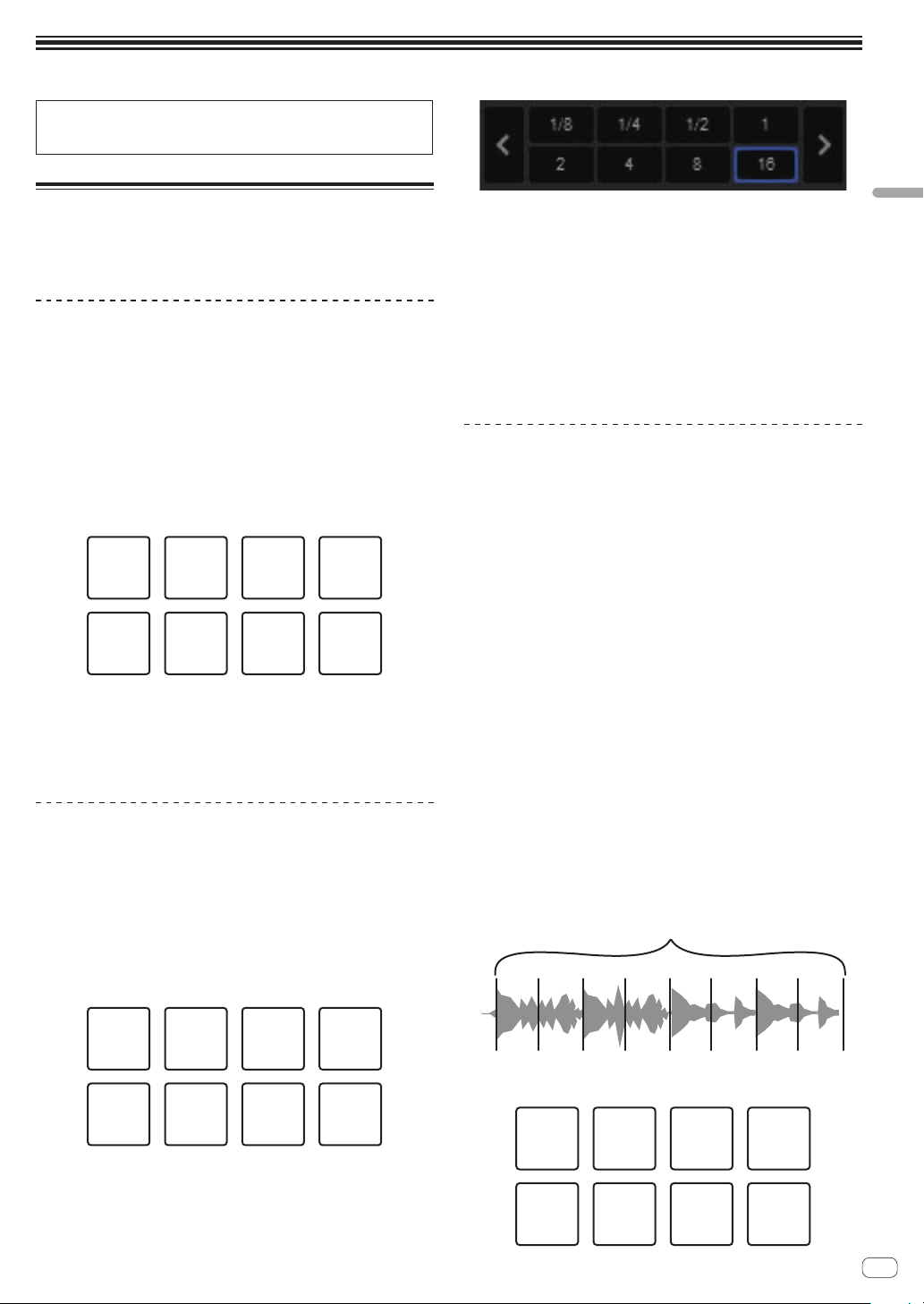
1/8 beat 1/4 beat 1/2 beat 1 beat
16 beat2 beats 4 beats 8 beats
The range of beats set for the loop roll is displayed on the com-
puter’s screen.
2 Press and hold one of the performance pads.
A loop roll with the number of beats assigned to the pad that was
pressed is played. Playback continues in the background during loop roll
playback.
! The number of beats of the currently playing loop roll can be
changed by pressing the [LOOP 1/2X] button, [LOOP 2X] button,
[PARAMETERc] button, or [PARAMETERd] button during loop roll
playback.
3 Release the performance pad.
Loop roll playback is canceled, and playback resumes from the position
reached in the background.
Using the Slicer function
The specified range is divided into eight equal sections, and these eight
sliced sections are assigned to the respective performance pads. While
one of the performance pads is pressed, the sound for the section
assigned to that pad is played in a loop.
During loop playback of the pad’s sound, normal playback with the
original rhythm continues in the background. When the pad is released
and loop playback ends, playback resumes from the position reached at
that point.
! The slicer function cannot be used with tracks for which no beatgrid
is set. For details on setting beatgrids, see the Serato DJ software
manual.
1 Press the [SLICER] mode button.
The [SLICER] mode button lights and the mode switches to slicer mode.
! While pressing the [SHIFT] button, pressing the [SLICER] mode but-
ton switches the mode to slicer loop mode.
! For details, see About slicer mode and slicer loop mode on page 20 .
2 Press the [PARAMETERc] or [PARAMETERd] button
while pressing the [SHIFT] button.
Set the domain for the slicer function. The value set for the domain
switches each time one of the buttons is pressed while pressing the
[SHIFT] button.
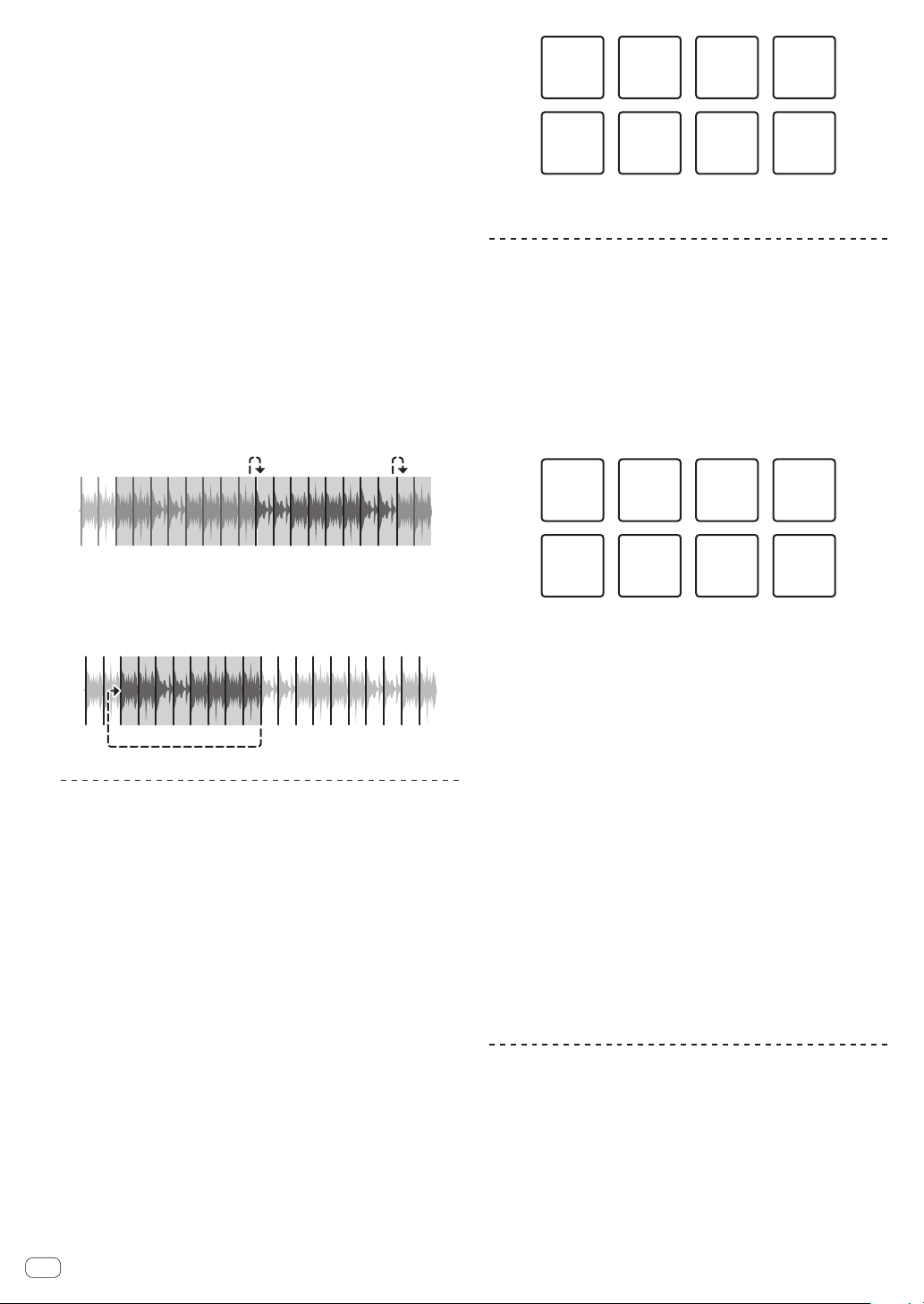
The domain can be set to one of six settings: 2 beats, 4 beats, 8 beats, 16
beats, 32 beats or 64 beats.
The eight equal sections into which the range specified with the domain
setting have been sliced are assigned to the respective performance
pads as shown below.
Sliced sections 1 to 8
Domain
1234 56
78
Section 1 Section 2 Section 3 Section 4
Section 5 Section 6 Section 7 Section 8
En
20
3 Press the [PARAMETERc] or [PARAMETERd] button.
Set the quantization for the slicer function. The value set for the quanti-
zation switches each time one of the buttons is pressed.
The quantization can be set in four ways: 1/8, 1/4, 1/2 and 1.
The length of the loop which is played while the pad is being pressed
can be changed with the “QUANTIZATION” setting. For example, when
“QUANTIZATION” is set to “1”, the entire section assigned to the pad is
played in a loop, and when “QUANTIZATION” is set to “1/2”, only the first
half of the section assigned to the pad is played in a loop.
4 Press and hold one of the performance pads.
When the pad is pressed and held, the sound is played in a loop.
! The length of loop playback differs depending on the quantization
setting.
When the pad is released, the track returns to the position that is playing
in the background.
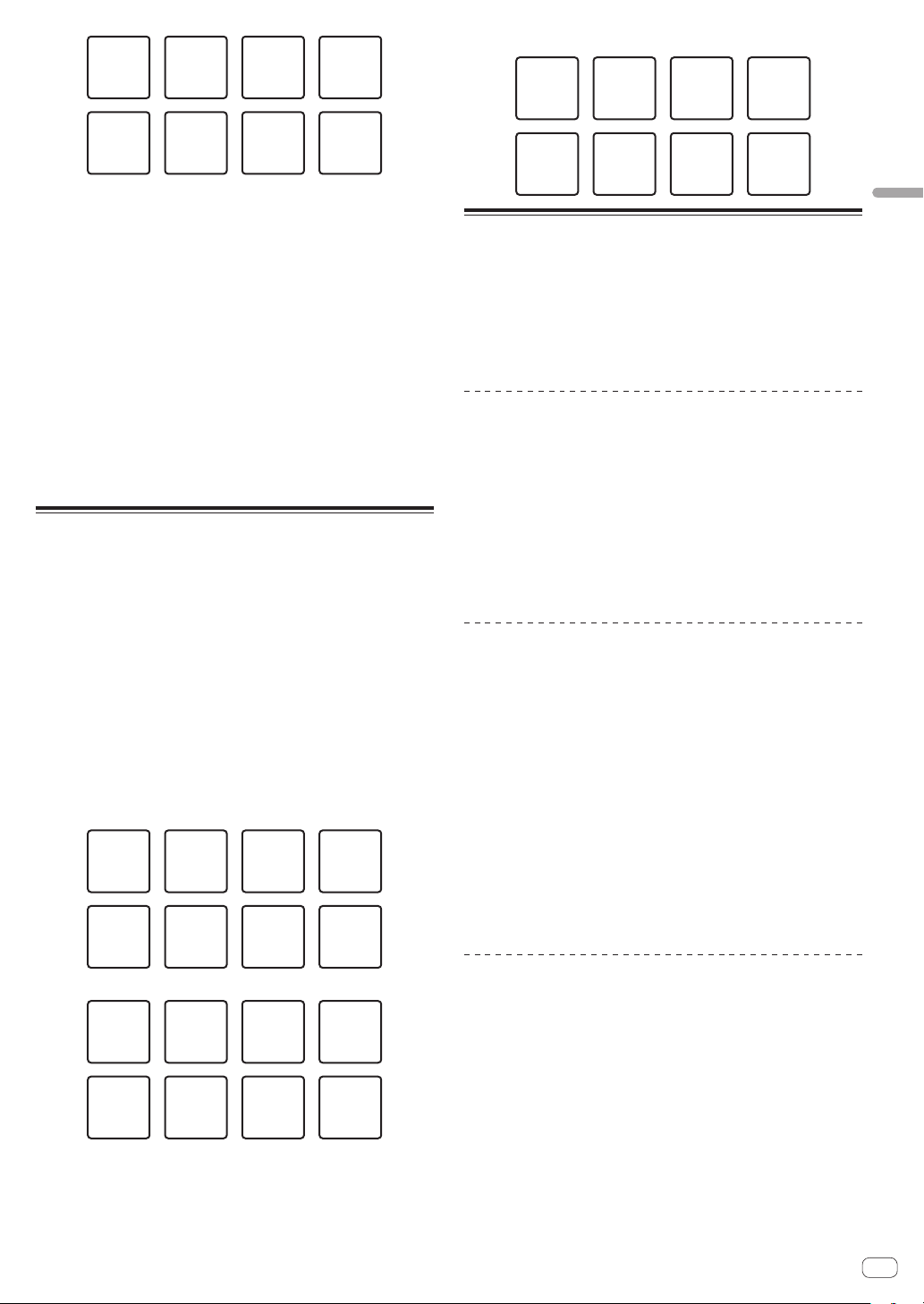
About slicer mode and slicer loop mode
Slicer mode
When the playback position advances to the end of the range that has
been sliced into eight equal sections, the range shown on the display
switches to the next eight sliced sections, and these sliced sections
are assigned to the respective pads, replacing the previously assigned
sections.
12345678
11
2
2
…
345678
Slicer loop mode
When the playback position advances to the end of the range that was
sliced into eight equal parts, the playback position returns to the begin-
ning of the range that was sliced into eight equal parts.
12345678
Using the sampler function
Tracks loaded in the sampler slots of the sampler (SP-6) can be played
with the performance pads.
1 Press the [PANEL] button to open the [SP-6] panel on
the computer’s screen.
2 Press the [SAMPLER] mode button.
The [SAMPLER] mode button lights and the mode switches to the sam-
pler mode.
3 Press the [PARAMETERc] or [PARAMETERd] button.
Switch the sampler (SP-6) bank. The sampler has four banks, A, B, C
and D, and each bank has six slots.
4 Press a performance pad while pressing the [SHIFT]
button to load a track into a slot of the [SP-6] panel.
The sampler settings and loaded tracks are saved.
5 Press a performance pad.
The sound for the slot assigned to the pad that was pressed is played.
! Playback method differs depending on the Serato DJ sampler mode.
For details, see the Serato DJ software manual.
Slot 1 Slot 2 Slot 3 Slot 4
Slot 5 Slot 6
! When a performance pad is pressed while pressing the [SHIFT] but-
ton, the sound of the slot that is currently playing stops.
Using the cue loop
1 Press the [HOT CUE] mode button while pressing the
[SHIFT] button.
The mode switches to cue loop mode.
2 During playback, press a performance pad.
The loop in point is set at the hot cue slot and loop playback starts.
! The length of the loop at this time is the number of beats set for auto
looping.
The loop in points are assigned to the performance pads as shown
below.
Loop 1 Loop 2 Loop 3 Loop 4
Loop 5 Loop 6 Loop 7 Loop 8
! With the cue loop function, the hot cue point is used as the loop-in
point.
If a performance pad at which a hot cue point is already set is
pressed, loop playback starts from that hot cue point.
3 During loop playback, press the [PARAMETERc]
button.
The loop length is cut in half.
Pressing the [LOOP 1/2X] button obtains the same effect.
4 During loop playback, press the [PARAMETERd]
button.
The loop length is doubled.
Pressing the [LOOP 2X] button obtains the same effect.
5 During loop playback, press the [PARAMETERc]
or [PARAMETERd] button while pressing the [SHIFT]
button.
The loop moves, remaining the same length (loop shift).
6 While pressing the [SHIFT] button, press the same
performance pad.
The track returns to the set loop in point and loop playback continues.
7 Press the same performance pad again.
Loop playback is canceled.
Using the saved loop
With this function, loop is saved in a loop slot of Serato DJ or a saved
loop is called.
1 Press the [ROLL] mode button while pressing the
[SHIFT] button.
The mode switches to saved loop mode.
2 During loop playback, press a performance pad.
A loop is assigned to the loop slot of Serato DJ.
En
21
Advanced Operation
Slot 1 Slot 2 Slot 3 Slot 4
Slot 7 Slot 8Slot 5 Slot 6
3 Press the performance pad while pressing the [SHIFT]
button.
Playback continues by returning to the beginning of the loop.
4 Press the same performance pad again.
Loop playback is canceled.
5 During loop playback, press the [PARAMETERc]
button.
The loop length is cut in half.
6 During loop playback, press the [PARAMETERd]
button.
The loop length is doubled.
7 During loop playback, press the [PARAMETERc]
or [PARAMETERd] button while pressing the [SHIFT]
button.
The loop moves, remaining the same length (loop shift).
Pitch play mode
To use this function, you need to activate the Pitch’n Time function. For
details, see “Serato Pitch’n Time Manual” from [Software Info] on the
Pioneer DJ support site below.
http://pioneerdj.com/support/
1 Press the [SAMPLER] mode button while pressing the
[SHIFT] button.
2 Press a performance pad while pressing the [SHIFT]
button to select a registered hot cue point.
3 Press a performance pad.
Pressing the [PARAMETERc] button or [PARAMETERd] button selects
the pitch range from the up range, middle range, and down range.
Playback starts from the hot cue point selected in step 2 at the pitch
assigned to the pressed pad.
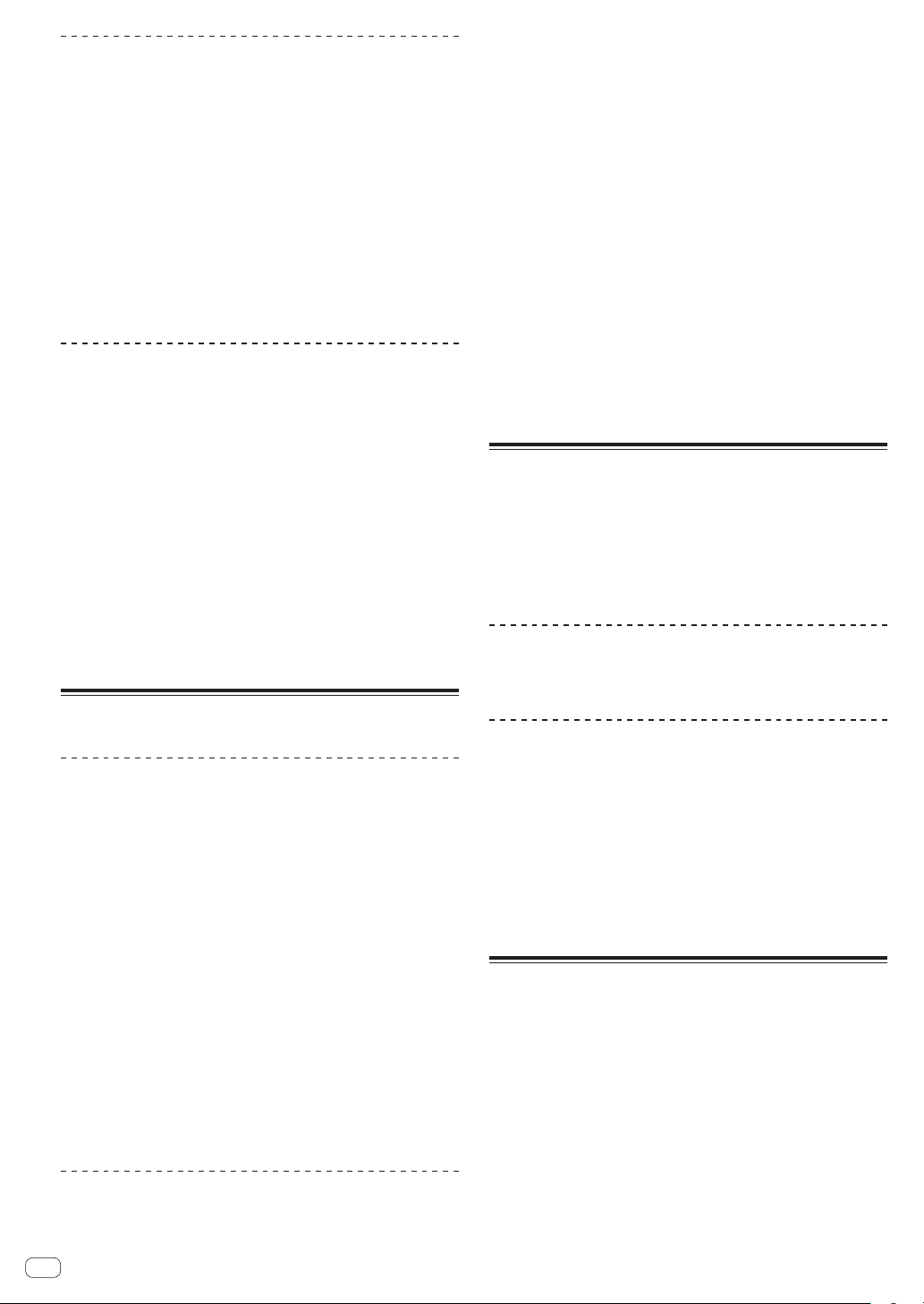
Up range
0+1+
2+
3
+4 +5 +6 +7
Middle range
0+1+
2+
3
−4 −3 −2 −1
Down range
−3 −2 −1 0
−7 −6 −5 −4
Using the slip mode
When the slip mode is turned on, normal playback with the original
rhythm continues in the background during scratching, looping and hot
cue playback. When scratching, looping or hot cue playback is canceled,
normal playback resumes from the position reached up to the point at
which the operation was canceled.
Various performances can be achieved without breaking the rhythm.
! The [SLIP] button lights when the slip mode is set and flashes while
the sound is being played in the background.
Slip scratching
1 While pressing the [SHIFT] button, press the [SLIP]
button.
The unit switches to VINYL mode.
2 During playback, operate the top of the jog dial to
scratch.
Normal playback continues in the background even while scratching.
3 Release your hand from the top of the jog dial.
Playback starts from the position reached in the background.
!
To cancel the slip mode, press the [SLIP] button again.
Slip hot cue
1 Press the [HOT CUE] mode button.
Set the hot cue mode.
2 Set the hot cue.
Press a performance pad to set the hot cue.
3 Press the [SLIP] button.
The mode switches to the slip mode.
4 During playback, press and hold a performance pad.
Playback starts from the position at which the hot cue was set. Playback
continues as long as the performance pad is pressed.
Normal playback continues in the background even while the hot cue is
playing.
5 Release your finger from the performance pad.
Playback starts from the position reached in the background.
! To cancel the slip mode, press the [SLIP] button again.
Slip braking
1 Adjust the [STOP TIME] control
The STOP TIME setting adjusts the speed at which the track stops from
the play mode.
When using slip braking, adjust the [STOP TIME] control to around the
9 o’clock position so that playback stops slowly.
2 Press the [SLIP] button.
The mode switches to the slip mode.
3 During playback, press the [PLAY/PAUSE f] button.
Playback slowly stops while the button is being pressed. Normal play-
back continues in the background while playback is slowly stopping.
4 Press the [PLAY/PAUSE f] button again.
Playback starts from the position reached in the background.
! To cancel the slip mode, press the [SLIP] button again.
En
22
Auto slip looping
1 Press the [SLIP] button.
The mode switches to the slip mode.
2 Press the [LOOP 1/2X] or [LOOP 2X] button.
Select the auto loop beat.
3 Press the [AUTO LOOP] button.
A loop with the specified number of beats is set and loop playback starts.
Normal playback continues in the background even during loop
playback.
4 Press the [AUTO LOOP] button again.
Looping is canceled and playback starts from the position reached in the
background.
! To cancel the slip mode, press the [SLIP] button again.
Manual slip looping
Creating a loop and slipping it
1 Press the [SLIP] button.
The mode switches to the slip mode.
2 Press the [LOOP IN] button, then press [LOOP OUT]
button.
Loop playback starts.
Normal playback continues in the background even during loop
playback.
3 Press the [LOOP OUT] button while pressing the
[SHIFT] button.
Looping is canceled and playback starts from the position reached in the
background.
! To cancel the slip mode, press the [SLIP] button again.
Using the fader start function
Using the channel fader start function
1 Set the cue.
Pause at the position from which you want to start playback, then press
the [CUE] button for the corresponding deck.
!
Cues can also be set by moving the channel fader from the back to
the position nearest you while pressing the [SHIFT] button in the
pause mode.
2 While pressing the [SHIFT] button, move the channel
fader from the position nearest you towards the back.
Playback of the track starts from the set cue point.
! When the channel fader is moved back to the position nearest you
while pressing the [SHIFT] button during playback, the track moves
instantaneously back to the set cue point and the pause mode is set.
(Back Cue)
If no cue is set, playback starts from the beginning of the track.
It is also possible to change the setting in the utility settings so that
the sync mode is set simultaneously when playback is started with
the channel fader start function.
When the channel fader is moved from the back to the position near-
est you while pressing the [SHIFT] button when standing by at a cue,
track playback starts from the set cue.
Using the crossfader start function
To use the crossfader start function, set the crossfader assign selector
switch of the channel you want to move to [A] or [B].
1 Set the cue.
Pause at the position from which you want to start playback, then press
the [CUE] button for the corresponding deck.
! Cues can also be set by moving the crossfader to the left edge or the
right edge while pressing the [SHIFT] button in the pause mode.
2 Move the crossfader to the left edge or right edge
position.
Set to the edge opposite the side on which the channel you want to use
with the fader start function is set.
3 While pressing the [SHIFT] button, move the
crossfader in the opposite direction from the left edge or
right edge.
Playback of the track starts from the set cue point.
! When the crossfader is returned to the original position while press-
ing the [SHIFT] button during playback, the track moves instanta-
neously back to the set cue point and the pause mode is set (Back
Cue).
!
If no cue is set, playback starts from the beginning of the track.
! When the crossfader is moved from the left edge to the right edge (or
from the right edge to the left edge) while pressing the [SHIFT] but-
ton when standing by at a cue, track playback starts from the set cue
point.
Using the sampler velocity mode
When the sampler velocity mode is on, the sample volume level changes
according to the strength with which the performance pads are tapped.
The volume level increases when the performance pads are tapped
strongly, decreases when they are tapped weakly.
When the sampler velocity mode is off, the sound is triggered at the
volume level set with the Serato DJ software, regardless of the strength
with which the performance pads are tapped.
Turning the sampler velocity mode on
When the [SAMPLER] mode button is pressed for over one second, the
sampler velocity mode turns on.
Turning the sampler velocity mode off
When the [SAMPLER] mode button is pressed for over one second, the
mode is changed to the usual sampler mode (sampler velocity mode is
turned off).
! In the utilities mode, the velocity curve and after-touch function can
be set.
When after-touch is enabled, the sample’s volume level changes
while the performance pad is pressed according to the strength at
which the pad is pressed. Also, in the utilities mode, the method for
entering the sampler velocity mode can be changed.
For details, see Changing the sampler velocity mode’s velocity curve
setting on page 28 .
Adjusting the crossfader’s operating
load
The load (resistance) when the crossfader is operated can be adjusted
using a flathead screwdriver.
!
You can adjust the play (cut lag) on both edges of the crossfader. For
details, see Adjusting the crossfader cut lag on page 29 .
1 Move the crossfader to the right edge.
2 Insert the flathead screwdriver into the
[FEELING ADJUST] adjustment hole and turn it.
— Turn clockwise: The load decreases (the resistance of fader
movement gets weaker).
— Turn counterclockwise: The load increases (the resistance of
fader movement gets stronger).
En
23
Advanced Operation
Analyzing tracks
When loading tracks onto the deck by pressing the rotary selector, the
tracks are analyzed, but it may take time to display the BPM and wave-
form until analysis is completed.
When the Serato DJ software is used as an offline player, tracks can be
analyzed ahead of time. For tracks whose analysis has been completed,
the BPM and waveform are displayed immediately when the tracks are
loaded onto the decks.
For details on using the Serato DJ software as an offline player and
instructions on analyzing tracks, see the Serato DJ software manual.
!
Depending on the number of track files, some time may be required
for analysis.
Using effects
Serato DJ has two effect units, FX1 and FX2. Those effects can be applied
to the selected deck or sampler sound (AUX). The following describes
how to operate this unit to assign an effect unit to channel 1.
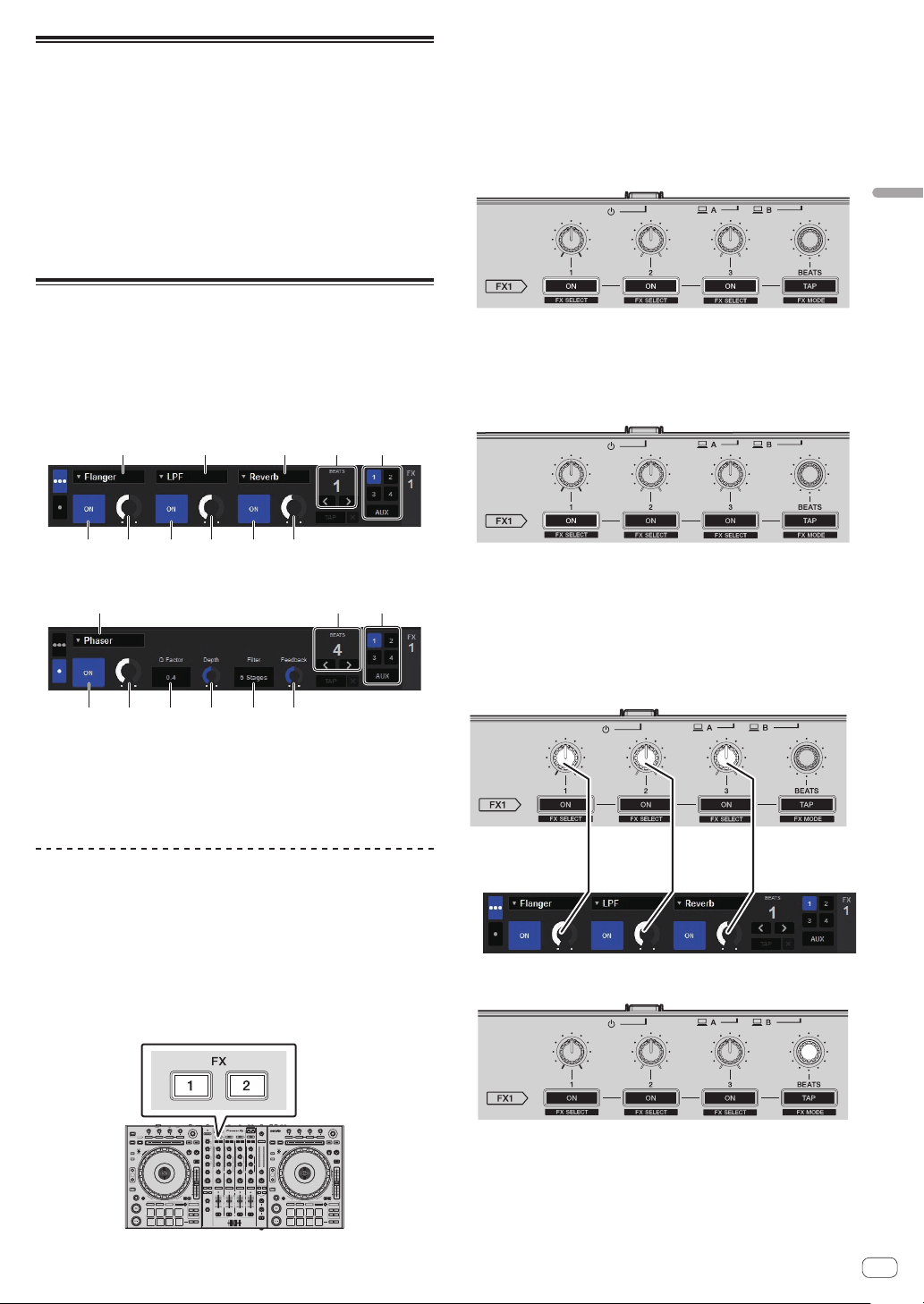
Serato DJ effects unit screen display
Multi FX mode: Up to three effects can be selected per effect unit, and
each effect has one adjustable parameter.
1 1123
54 54 54
Single FX mode: One effect can be selected per effect unit and there are
multiple adjustable parameters.
231
544444
1 This displays the effect type.
2 This displays the effect time.
3 This displays the number of the deck to which the effect unit is
assigned.
4 This displays the effect parameter status.
5 This displays whether the effect is on or off.
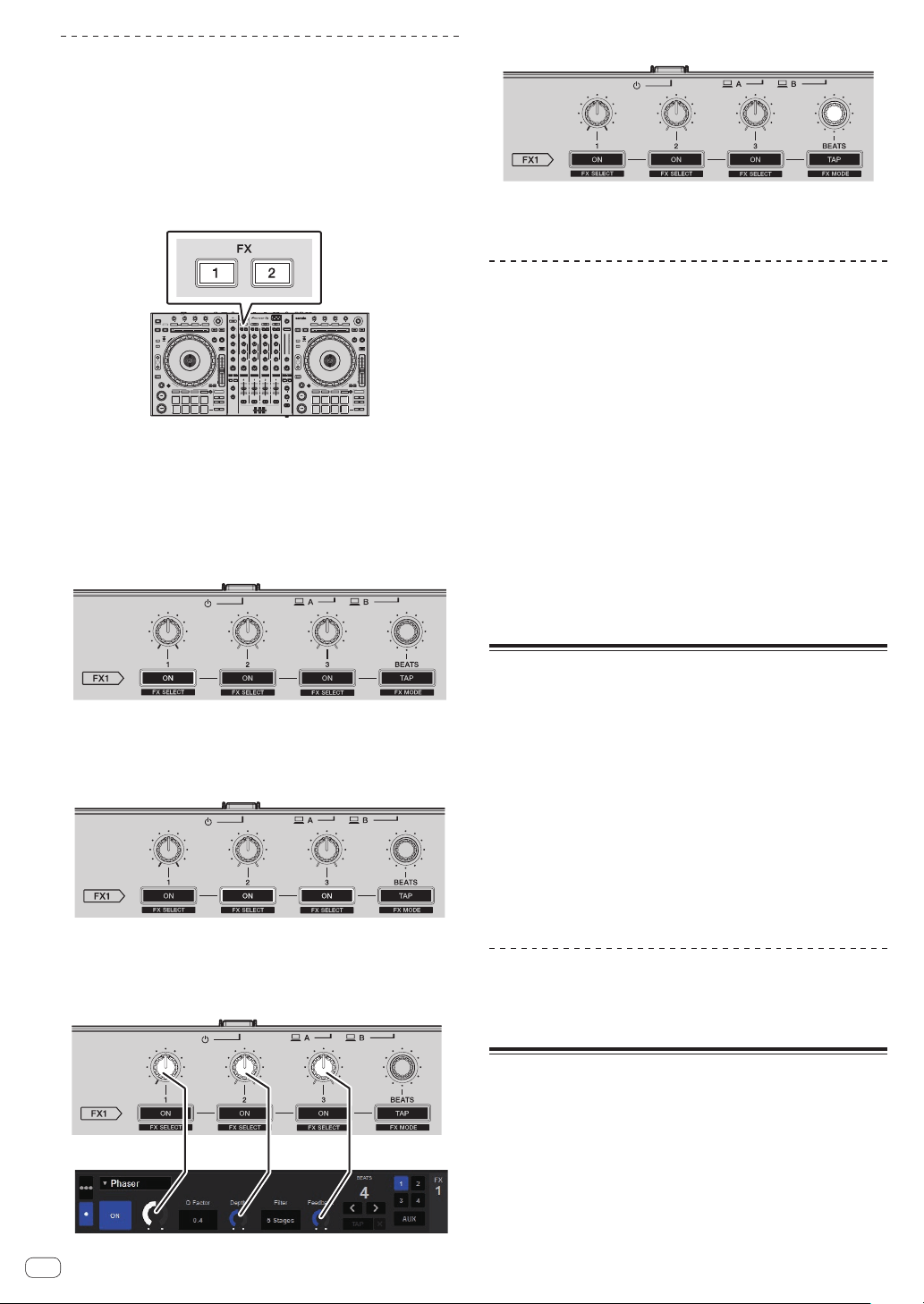
Operating in the multi FX mode
1 Press the [TAP] button while pressing the [SHIFT]
button to switch Serato DJ’s DJ-FX mode to the multi FX
mode.
The mode switches between the multi FX mode and single FX mode each
time the buttons are operated.
2 Press the [FX1] button or [FX2] button of channel 1 to
select the effect unit to assign.
The number of the deck to which the effect is assigned is highlighted on
the Serato DJ screen.
3 Press the effect parameter 1 button while pressing
the [SHIFT] button to select the first effect type.
To select the second effect type, press the effect parameter 2 button
while pressing the [SHIFT] button.
To select the third effect type, press the effect parameter 3 button while
pressing the [SHIFT] button.
The currently selected effect type is displayed on the Serato DJ screen.
4 Press the effect parameter 1 button to turn the first
effect on.
Press the effect parameter 2 button to turn the second effect on.
Press the effect parameter 3 button to turn the third effect on.
The [ON] key for the corresponding effect is highlighted on the Serato
DJ screen.
5 Operate the effect parameter 1 control to adjust the
parameter of the first effect.
Operate the effect parameter 2 control to adjust the parameter of the
second effect.
Operate the effect parameter 3 control to adjust the parameter of the
third effect.
6 Turn the [FX BEATS] control to adjust the effect time.
! It is also possible to set the BPM value to be used as the basis for the
effect time from the interval at which the [TAP] button is tapped.
For details, see Switching the effect’s tempo mode on page 24 .
En
24
Operating in the single FX mode
1 Press the [TAP] button while pressing the [SHIFT]
button to switch Serato DJ’s DJ-FX mode to the single FX
mode.
The mode switches between the multi FX mode and single FX mode each
time the buttons are operated.
2 Press the [FX1] button or [FX2] button of channel 1 to
select the effect unit to assign.
The number of the deck to which the effect is assigned is highlighted on
the Serato DJ screen.
3 Press one of the effect parameter buttons while
pressing the [SHIFT] button to select the effect type.
The selected effect is displayed on the Serato DJ screen.
4 Press the effect parameter 1 button to turn the effect
on.
The effect switches between on and off each time the button is pressed.
! The effect’s [ON] key is highlighted on the Serato DJ screen.
5 Operate the effect parameter 2 button or the effect
parameter 3 button to switch the effect’s parameter.
! Depending on the type of effect, the button may not light when it is
operated.
6 Operate the effect parameter control(s) to adjust the
effect’s parameter(s).
7 Turn the [FX BEATS] control to adjust the effect time.
! It is also possible to set the BPM value to be used as the basis for the
effect time from the interval at which the [TAP] button is tapped.
For details, see Switching the effect’s tempo mode.
Switching the effect’s tempo mode
With Serato DJ effects, there are two ways to set the effect’s tempo: with
the “auto tempo mode” and the “manual tempo mode”.
! By default, the auto tempo mode is set.
Auto tempo mode
The track’s BPM value is used as the basis for the effect’s tempo.
Manual tempo mode
The BPM value used as the effect’s basis is calculated from the interval
at which the [TAP] button is tapped.
Switching to the manual tempo mode
While in the auto tempo mode, press the [TAP] button
three times.
! When the [TAP] button is pressed for over 1 second while in the
manual-tempo mode, the mode switches to the auto tempo mode.
Using the SOUND COLOR FX function
These are effects that change in association with the [COLOR] control.
1 Press one of the [SOUND COLOR FX] buttons.
This selects the type of effect.
The button that was pressed flashes.
! Even when one of the [SOUND COLOR FX] buttons is selected, if a
different [SOUND COLOR FX] button is pressed, the newly pressed
button is selected.
! For the types of effects, see Types of SOUND COLOR FX effects on
page 25 .
! The same effect is set for all channels.
2 Turn the [COLOR] control.
The effect is applied to the channel(s) for which the control(s) was (were)
turned.
Canceling the SOUND COLOR FX effect
Press the flashing [SOUND COLOR FX] button.
The effect is canceled.
Using the oscillator function
You can add a noise-based built-in audio source.
1 Use the [OSC ASSIGN] switch to select the channel to
which you want to apply oscillator sound.
! [CH3]: Applies oscillator sound on channel 3.
! [CH4]: Applies oscillator sound on channel 4.
! [MASTER]: Adds oscillator sound to the master output.
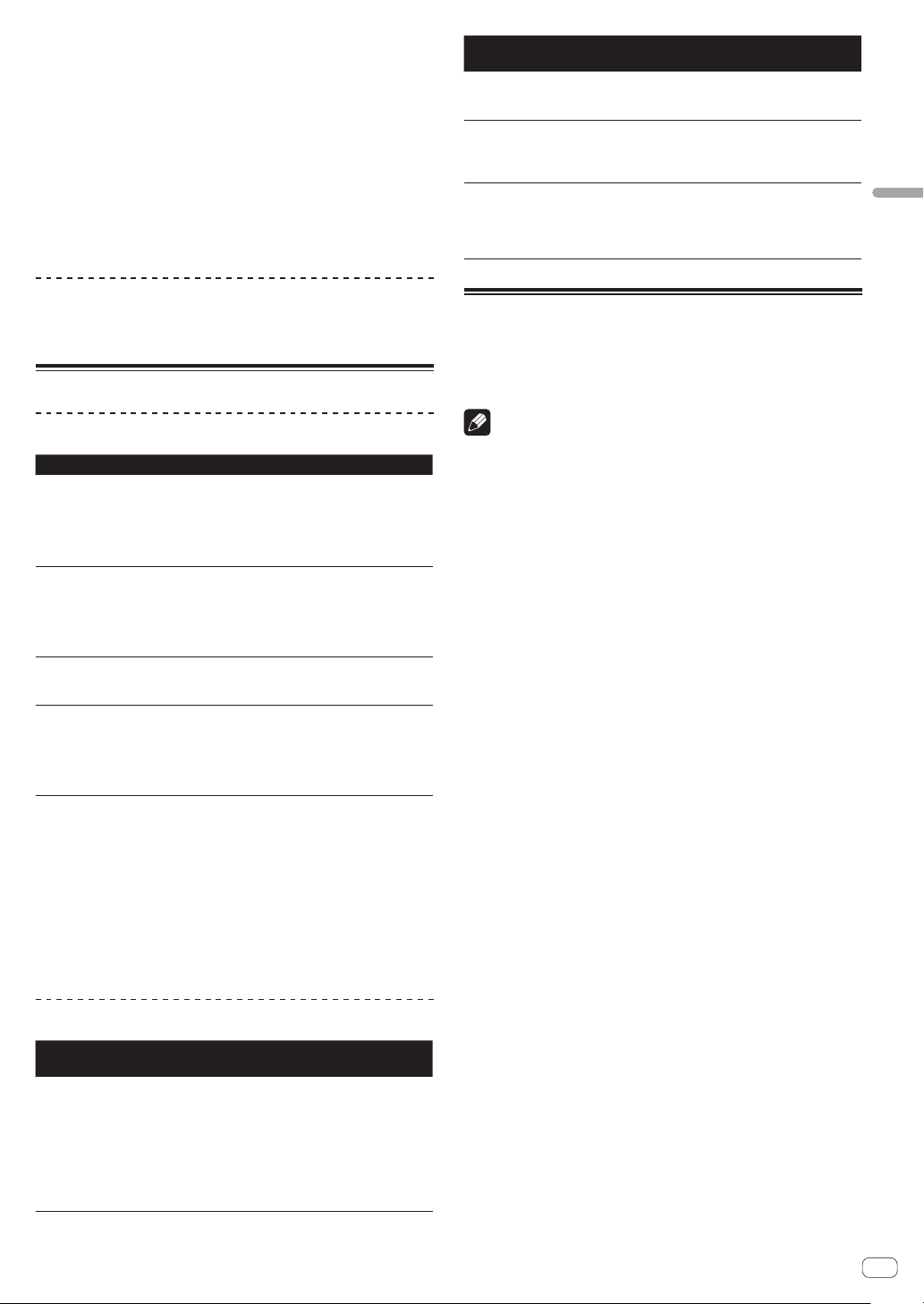
En
25
Advanced Operation
2 Turn the [OSCILLATOR PARAMETER] control.
Turning the control clockwise or counterclockwise adjusts the oscillator
sound tone.
3 Turn the [OSCILLATOR VOLUME] control.
Adjusts the sound level of oscillator sound.
4 Press one of the [OSCILLATOR SELECT] buttons.
This selects the type of oscillator sound.
The button that was pressed flashes for a certain period of time.
! For types of oscillator sound, see Type of oscillator sound on
page 25 .
! You can select more than one oscillator sound.
! While pressing the [NOISE] button, sound output continues.
Quitting the oscillator function
Oscillator sound automatically stops after a certain period of time and
the [OSCILLATOR SELECT] button changes from flashing to lighted.
Types of effects
Types of SOUND COLOR FX effects
Effect Name Descriptions [COLOR] control
ECHO
Applies an echo effect, with
the sound delayed slightly
after the original sound
output several times and
gradually attenuated.
Counterclockwise: The delay
time of echo sound gradually
becomes longer.
Clockwise: The delay time
of echo sound gradually
becomes shorter.
JET
The flanger effect is applied.
Counterclockwise: Applies a
flanger effect, which empha-
sizes low-pitched sound.
Clockwise: Applies a flanger
effect, which emphasizes
high-pitched sound.
PITCH
Changes the sound pitch.
Counterclockwise: Pitch
goes down.
Clockwise: Pitch goes up.
FILTER
Outputs sound that has
passed through a filter.
Turn counterclockwise:
Gradually descends the low-
pass filter’s cutoff frequency.
Turn clockwise: Gradually
rises the high-pass fil-
ter’s cutoff frequency.
!
The specification of the echo sound delay time differs depending on when the
BPM value can be received from the Serato DJ software, or not.
Condition to receive the BPM value from the Serato DJ software side:
— When there is BPM information on the deck to which music was loaded by
Serato DJ
— When the [LINE, PHONO, USB] selector switch or [CD, USB] selector switch
is set to the [USB] position
When in a condition wherein the BPM value can be received from the Serato
DJ software side, the delay time of echo sound can be adjusted to the beat
count. Other than that, the delay time of echo sound gradually becomes longer
from 100 msec by turning the control counterclockwise and gradually becomes
shorter from 125 msec by turning the control clockwise.
Type of oscillator sound
Effect Name Descriptions
OSCILLATOR
PARAMETER control
NOISE
Generates white noise.
Turn counterclockwise: The
cut-off frequency of the filter
through which the white
noise passes gradually
descends.
Turn clockwise: The cut-
off frequency of the filter
through which the white
noise passes gradually rises.
Effect Name Descriptions
OSCILLATOR
PARAMETER control
DROP
Changes the deep bass
sound as time elapses.
Counterclockwise: Pitch
goes down.
Clockwise: Pitch goes up.
LASER
Changes the periodic
electronic sound as time
elapses.
Turn counterclockwise: The
change of the pitch slows.
Turn clockwise: The change
of the pitch speeds up.
SIREN
Generates a siren-like
sound.
Counterclockwise: The pitch
of the siren sound goes
down.
Clockwise: The pitch of the
siren sound goes up.
Using external inputs
This unit is equipped with four sets of external inputs for connecting CD
players, analog turntables, etc. This unit’s 4-channel mixer can be used
to mix externally input sound without passing through a computer. The
mixer functions below can be used without a computer connected.
Notes
! For details on the respective items, see Connections (p. 7 ) and
Part names and functions (p. 10 ).
! The functions below do not work with respect to external inputs.
— Track tempo setting (pressing the headphones [CUE] button
while pressing the [SHIFT] button)
— Fader start function (while pressing the [SHIFT] button, move the
channel fader or cross fader)
—
Applying Serato DJ software effects
! The values adjusted with the various controls for the Serato DJ soft-
ware differ from values adjusted for the external input.
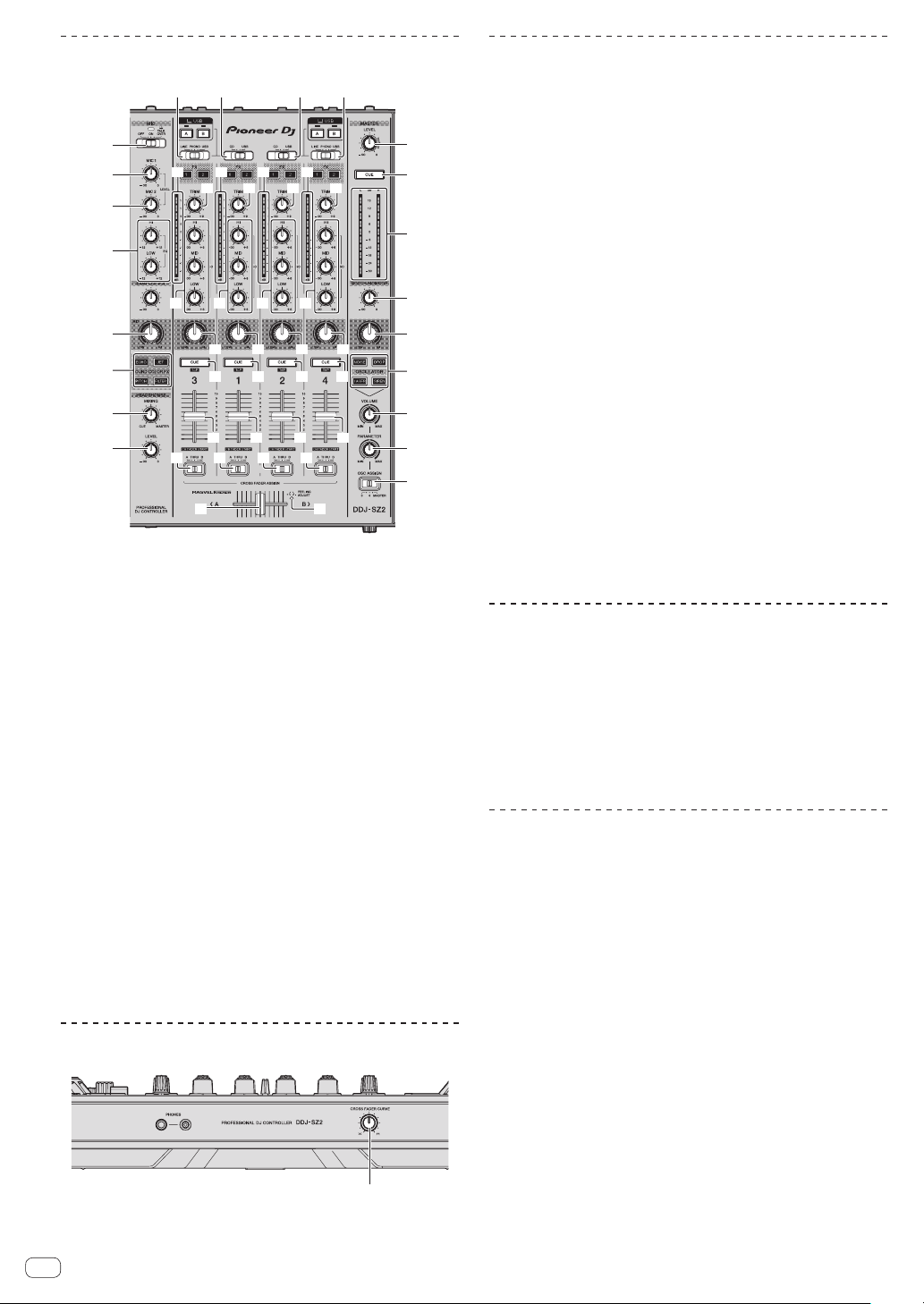
En
26
Mixer section
a
b
c
d
e
f
g
h
i
k
l
m
n
o o o o
p
q q q q
sr
p p p
n n n
m m m
l l l
k k k
ij j
1
2
4
3
5
6
7
9
8
1 MASTER LEVEL control
2 MASTER CUE button
3 Master level indicator
4 BOOTH MONITOR control
5 MASTER OUT COLOR control
6 OSCILLATOR SELECT buttons
7 OSCILLATOR VOLUME control
8 OSCILLATOR PARAMETER control
9 OSC ASSIGN selector switch
a HEADPHONES LEVEL control
b HEADPHONES MIXING control
c SOUND COLOR FX buttons
d MIC COLOR control
e EQ (HI, LOW) controls
f MIC2 control
g MIC1 control
h OFF, ON, TALK OVER selector switch
i LINE, PHONO, USB selector switch
j CD, USB selector switch
k Channel Level Indicator
l TRIM control
m ISO (HI, MID, LOW) controls
n COLOR control
o Headphones CUE button
p Channel fader
q Crossfader assign selector switch
r Crossfader
s FEELING ADJUST adjustment hole
Front panel
1
1 CROSS FADER CURVE selector switch
Using a microphone
1 Connect a microphone to the [MIC1] or [MIC2]
terminal.
2 Set the [OFF, ON, TALK OVER] selector switch to [ON]
or [TALK OVER].
— [ON]: The indicator lights.
— [TALK OVER]: The indicator flashes.
! When set to [TALK OVER], the sound of channels other than the
[MIC1] channel is attenuated by 18 dB (default) when a sound of –10
dB or greater is input to the microphone.
! The sound attenuation level while [TALK OVER] is selected can be
changed in utility mode. For the method to effect that change, see
Changing the talk over function level on page 29 .
! The talk over mode can be switched to the normal mode or the
advanced mode. For instructions on changing it, see Changing the
talk over function setting on page 28 .
3 Turn the [MIC1] or [MIC2] control.
Adjust the level of the sound output from the [MIC1] channel.
! Pay attention that rotating to the extreme right position outputs a
very loud sound.
4 Input audio signals to the microphone.
Adjusting the sound quality
Turn the [EQ (HI, LOW)] controls.
The adjustable ranges for the respective controls are as shown below.
! [HI]: –12 dB to +12 dB (10 kHz)
!
[LOW]: –12 dB to +12 dB (100 Hz)
Mixing the sound of a DJ player, etc.
1 Connect the DJ player or other line level output
device to the [CD] or [LINE] terminals.
2 Set the [LINE, PHONO, USB] selector switch or [CD,
USB] selector switch to [LINE] or [CD].
3 Operate the [TRIM] control and channel fader to
adjust the sound level output from each channel.
Mixing the sound of an analog turntable,
etc.
1 Connect the analog player or other phono level (for
MM cartridges) output device to the [PHONO] terminals.
2 Set the [LINE, PHONO, USB] selector switch to
[PHONO].
3 Operate the [TRIM] control and the channel faders to
adjust the audio level output from the respective decks.
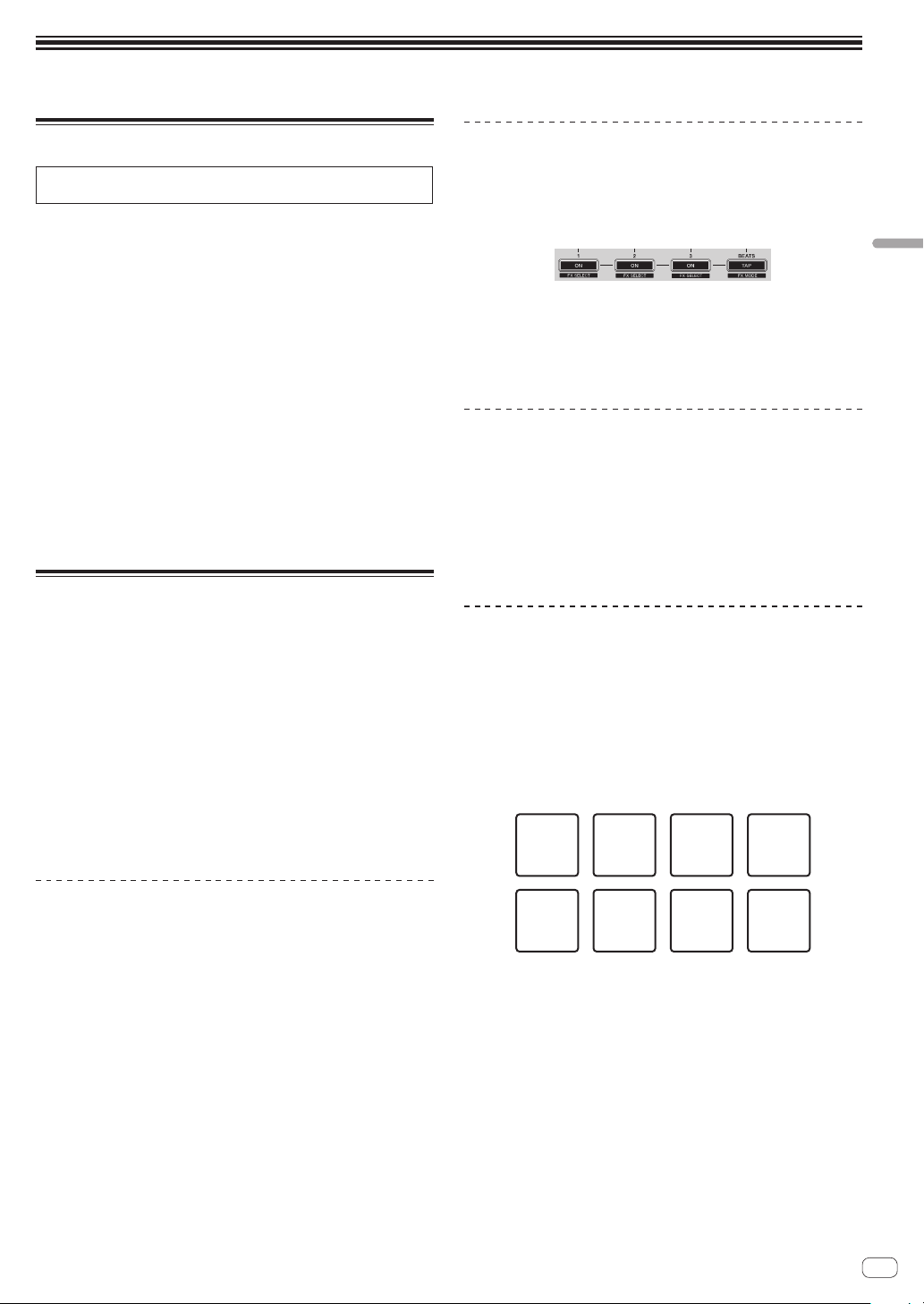
En
27
Changing the settings
Changing the settings
Launching utilities mode
If the utilities mode is launched while the DJ application is running,
the set status may not be displayed properly.
1 Disconnect the USB cable from your computer.
2 Press the [u] switch on this unit’s rear panel to set
this unit’s power to standby.
Set this unit’s power to the standby mode.
3 While pressing both the [SHIFT] and
[PLAY/PAUSE f] buttons on the left deck, press the
[u] switch on this unit’s rear panel.
Utilities mode is launched.
4 After setting this unit to the utility settings mode,
operate the controller for the item whose settings you
want to change.
See the explanations below for the settings that can be changed.
5 Press the [u] switch on this unit’s rear panel to set
this unit’s power to standby.
To save the settings, set the [u] switch on this unit’s rear panel to
standby and quit utilities mode.
Utilities modes
The following settings can be changed:
! MIDI controller setting
! Fader start setting
! Master output attenuator level setting
! Slip mode flashing setting
! Demo mode setting
! Setting of the velocity curve in the sampler velocity mode
! Sampler velocity mode after-touch setting
! Setting of the auto standby function
! Setting of talk over function
! Setting of talk over function level
! Cut lag setting of crossfader
! Output setting of microphone to booth monitor
! Peak limiter setting
! Brightness setting of jog ring
Forcefully using the unit as the general
MIDI controller
The unit automatically changes operation as follows depending on
whether Serato DJ is running.
! When Serato DJ is running, controller operation depends on the
Serato DJ functions.
! When Serato DJ is not running, the unit operates as a general MIDI
controller.
Even though Serato DJ is running, you can forcefully operate the unit as
a general MIDI controller.
Press the [KEY LOCK] button on the left deck.
! [KEY LOCK] button off: Operation automatically changes depending
on whether or not Serato DJ is running.
! [KEY LOCK] button lit: Regardless of whether or not Serato DJ is
running, the unit is forcefully operated as a general MIDI controller.
Changing the fader start setting
The fader start function’s setting can be changed.
! By default, the fader start mode functions without the sync mode set.
Press one of the effect parameter buttons on the left
deck.
! Effect parameter 1 button lit: Fader start with the sync mode set (The
sync function is activated simultaneously when fader starting starts.)
! Effect parameter 2 button lit: Fader start without sync mode set (The
sync function is not activated simultaneously when fader starting
starts.)
! Effect parameter 3 button lit: Fader start function disabled
Setting the master output’s attenuator
level
! The default is 0 dB.
Press one of the left deck’s [HOT CUE] mode, [ROLL]
mode or [SLICER] mode buttons.
! [HOT CUE] mode button lit: 0 dB (no attenuation)
! [ROLL] mode button lit: –3 dB
! [SLICER] mode button lit: –6 dB
Changing the slip mode flashing setting
When slip mode in on, buttons available in slip mode (such as the jog
dial indicator, [AUTO LOOP] button, and [PLAY/PAUSE f] button)
can be set to flash or not flash. The flashing method used for the [SLIP]
button during slip mode changes depending on the setting.
!
By default, slip mode flashing is set to mode 1.
Press the performance pad on the left side to select a
setting.
The currently selected setting can be understood by looking at which
pad lights.
Mode 1 Mode 2 Off
! Mode 1: When slip mode is turned on, the buttons available in
slip mode flash for approximately one second. During slip mode,
the [SLIP] button flashes only while payback continues in the
background.
! Mode 2: When the slip mode is turned on, the buttons available in
slip mode flash for approximately one second. During slip mode, the
[SLIP] button continues flashing.
! Off: The buttons available in slip mode do not flash. During slip
mode, the [SLIP] button flashes only while payback continues in the
background.
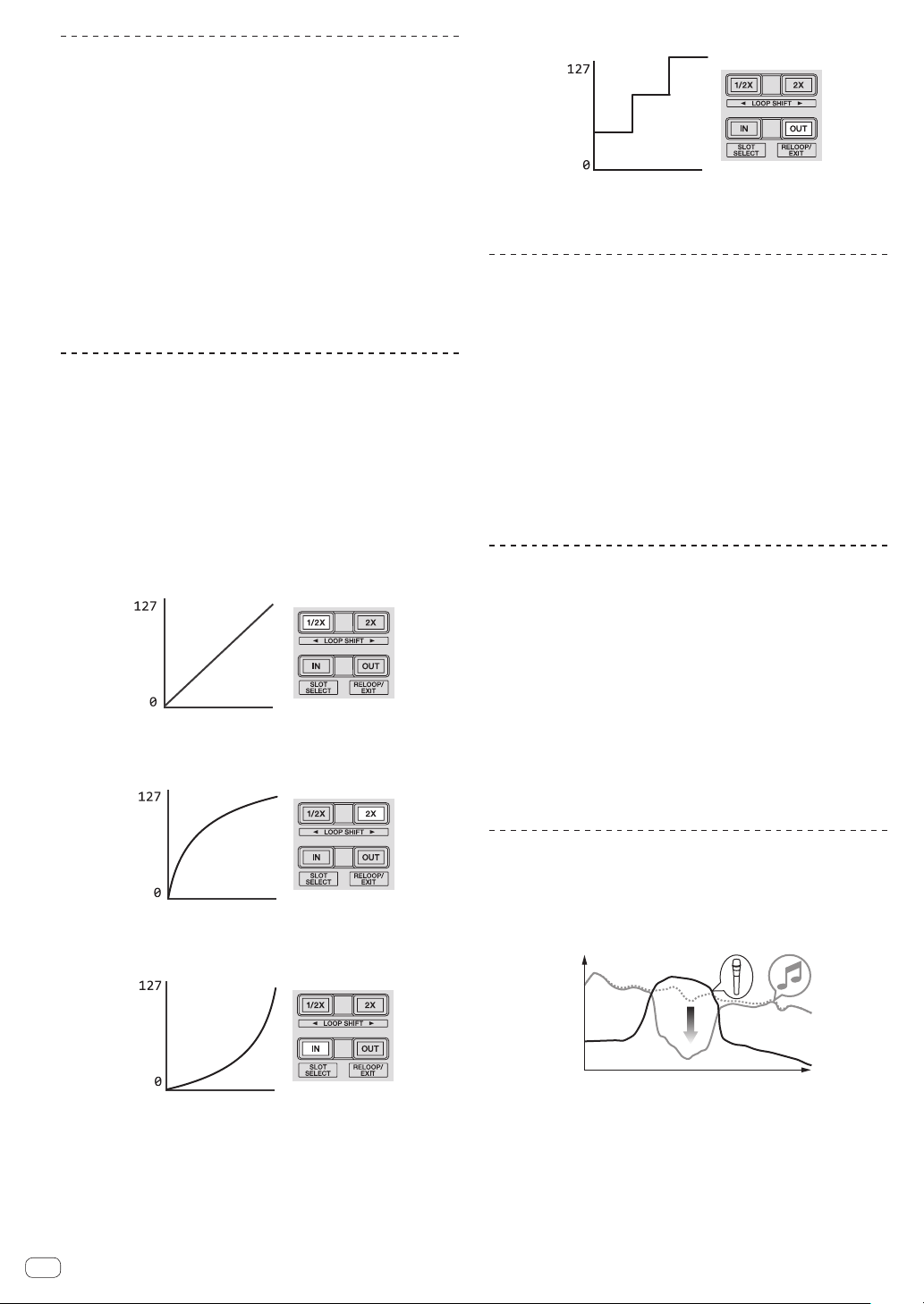
En
28
Disabling the demo mode
On this unit, the demo mode is set if no operation is performed for
10 minutes under normal usage conditions. This demo mode can be
changed.
! By default, demo mode starts when there is no operation for 10
minutes.
! When any control or button on this unit is operated while in the
demo mode, the demo mode is canceled.
Press one of the [SOUND COLOR FX] buttons.
! [ECHO] button lights: Demo mode is disabled
! [JET] button lights: Demo mode starts when there is no operation for
1 minute
!
[PITCH] button lights: Demo mode starts when there is no operation
for 5 minutes
! [FILTER] button lights: Demo mode starts when there is no operation
for 10 minutes
Changing the sampler velocity
mode’s velocity curve setting
Use the procedure below to set the sampler velocity mode’s velocity
curve. You can choose one of four types of velocity curves.
! By default, curve 3 is set.
Press one of the [AUTO LOOP] buttons on the deck
whose setting you want to make.
The velocity curve setting changes each time the [AUTO LOOP] button
is pressed.
The currently set value is indicated by how the [LOOP 1/2X], [LOOP 2X],
[LOOP IN] and [LOOP OUT] buttons light.
Curve 1
MIDI
code
Strength which
performance pad is pressed
Min. Max.
Curve 2
MIDI
code
Strength which
performance pad is pressed
Min. Max.
Curve 3
MIDI
code
Strength which
performance pad is pressed
Min. Max.
Curve 4
MIDI
code
Strength which
performance pad is pressed
Min. Max.
Enabling the sampler velocity
mode’s after touch setting
When the sampler velocity mode is turned on for this unit’s performance
pads, the after touch setting can be turned on and off.
After touch setting disabled: The sampler volume changes according
to the strength with which the performance pad is initially pressed, but
does not keep changing while the pad is held after it is initially pressed.
After touch setting enabled: The sampler volume changes according to
the strength with which the performance pad is initially pressed and the
strength with which the pad is held after it is initially pressed.
! By default, the after touch setting is disabled.
Press the [SAMPLER] mode button on the left deck.
! [SAMPLER] mode button lit: After touch setting enabled
! [SAMPLER] mode button off: After touch setting disabled
Disabling the auto standby function
! When auto standby function is set to on, if 4 hours have passed while
the following conditions are all met, the unit automatically enters
standby status.
—
Buttons and controls of the unit except the [MIC1] control and
[MIC2] control are not operated.
— That no audio signals of -18 dB or greater are input to this
unit’s input terminals.
!
When the [PANEL (WAKE UP)] button is pressed, the standby mode
is canceled.
!
By default, the auto standby function is enabled.
Press the [KEY UP/SYNC] button of the left side deck.
! [KEY UP/SYNC] button lit: Auto standby function is enabled
! [KEY UP/SYNC] button off: Auto standby function is disabled
Changing the talk over function setting
About talk over mode
The talk over function has the two modes described below.
Advanced talk over mode: Sound other than the microphone channel is
output with only the midrange attenuated per the talk over level setting.
dB
Frequency
Normal talk over mode: Sound other than the microphone channel is
output attenuated per the talk over level setting.
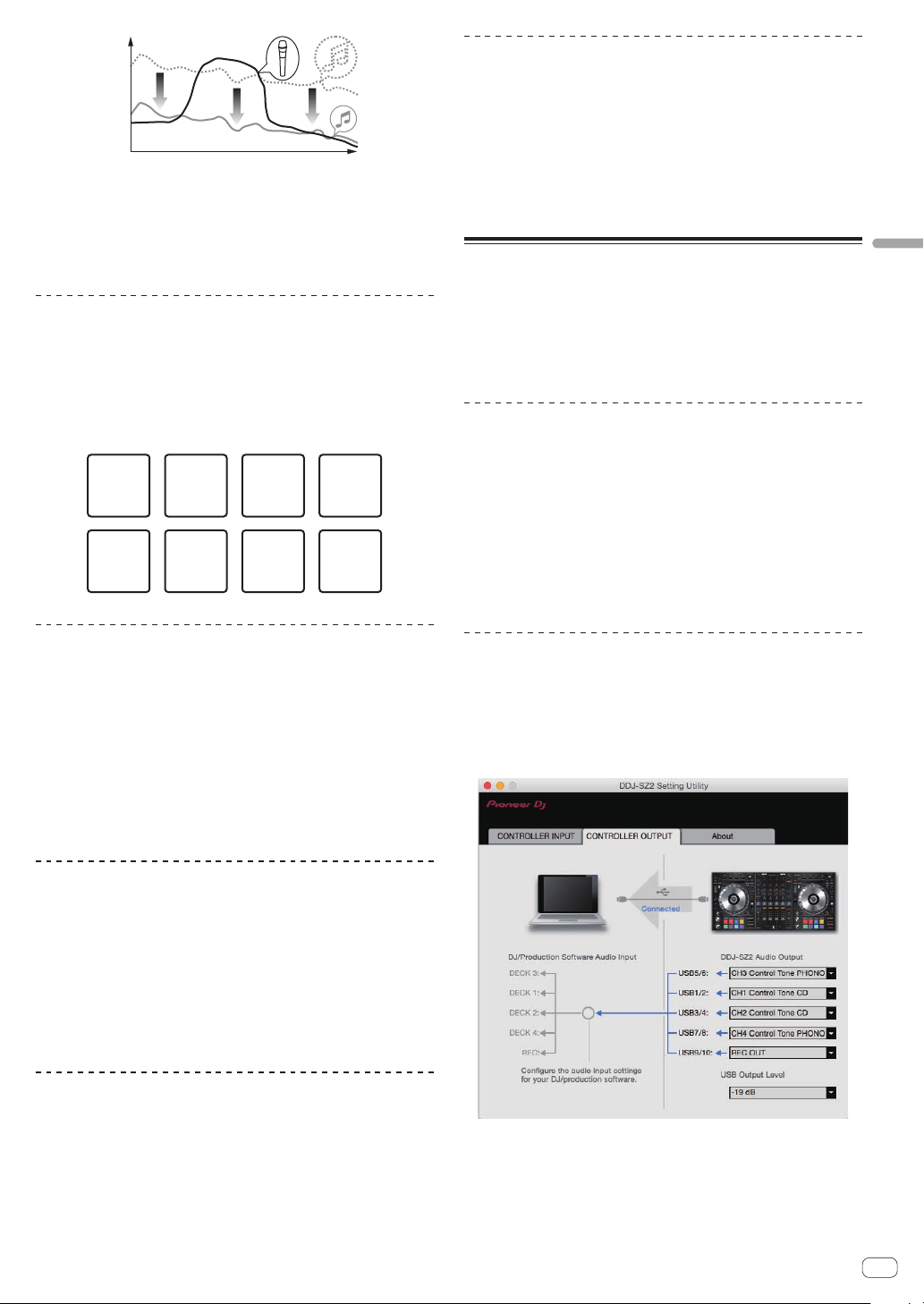
En
29
Changing the settings
dB
Frequency
! By default, the advanced talk over mode is set.
Press the [KEY DOWN/RESET] button of the left side
deck.
! [KEY DOWN/RESET] button lit: Advanced talk over mode
! [KEY DOWN/RESET] button off: Normal talk over mode
Changing the talk over function level
Sets the talk over function’s sound attenuation level.
! By default, the level is set to -18 dB.
Press the performance pad on the left side to select a
setting.
The currently selected setting can be understood by looking at which
pad lights.
–6 dB –12 dB –18 dB –24 dB
Adjusting the crossfader cut lag
Adjust the play (cut lag) on both edges of the crossfader. It can be
adjusted between 0 (0.74 mm) and 52 (5.94 mm) in units of 0.1 mm.
! By default, it is set to 6 (1.34 mm).
Turn the rotary selector on the left deck.
The current setting (0 to 52) is displayed by the lit condition of the chan-
nel level indicator.
!
Number of lit segments of the [CH3] channel level indicator:
Ten’s place
!
Number of lit segments of the [CH1] channel level indicator:
One’s place
Setting the microphone output of the
booth monitor
! By default, it is set to output microphone sound from the [BOOTH]
terminal.
Press the [BACK (VIEW)] button of the left side deck.
! [BACK (VIEW)] button lit: Outputs microphone sound from the
[BOOTH] terminal
! [BACK (VIEW)] button off: Does not output microphone sound from
the [BOOTH] terminal
Changing the peak limiter setting
Lessens sudden, unpleasant digital clipping of the master output.
! By default, the peak limiter is set to enabled.
Press the [LOAD PREPARE (AREA)] button of the left side
deck.
! [LOAD PREPARE (AREA)] button lit: Peak limiter enabled
! [LOAD PREPARE (AREA)] button off: Peak limiter disabled
Adjusting the brightness of jog ring
You can adjust the brightness of the illumination around the jog dial.
! The same setting is applied to the jog dials on the left and right
decks.
! By default, it is set to bright light.
Press the top of the jog dial.
Each time the top of the jog dial is pressed, the setting changes.
The brightness can be set in three levels: light, dark, and off. The current
setting can be understood by the jog ring lit condition.
About the setting utility software
The setting utility can be used to make the checks and settings
described below.
— Checking the status of this unit’s input selector switches
— Setting the audio data output from this unit to the computer
— Adjusting the buffer size (when ASIO is used)
— Checking the version of the driver software
Displaying the setting utility
For Windows 10/8.1
Click [Pioneer] > [DDJ-SZ2 Settings Utility] from [Apps view].
For Windows 7
Click [Start] menu > [All Programs] > [Pioneer] > [DDJ-SZ2] >
[DDJ-SZ2 Settings Utility].
For Mac OS X
Click [Macintosh HD] icon > [Application] > [Pioneer] > [DDJ-SZ2] >
[DDJ-SZ2 Settings Utility].
Setting the audio data output from this
unit to the computer
When Serato DJ is running and using this unit as the default audio
device, set the audio data output in Serato DJ.
Display the setting utility before starting.
1 Click the [CONTROLLER OUPUT] tab.
2 Click the [DDJ-SZ2 Audio Output] pull-down menu.
Select and set the audio data to be output to the computer from the flow
of audio signals inside this unit.
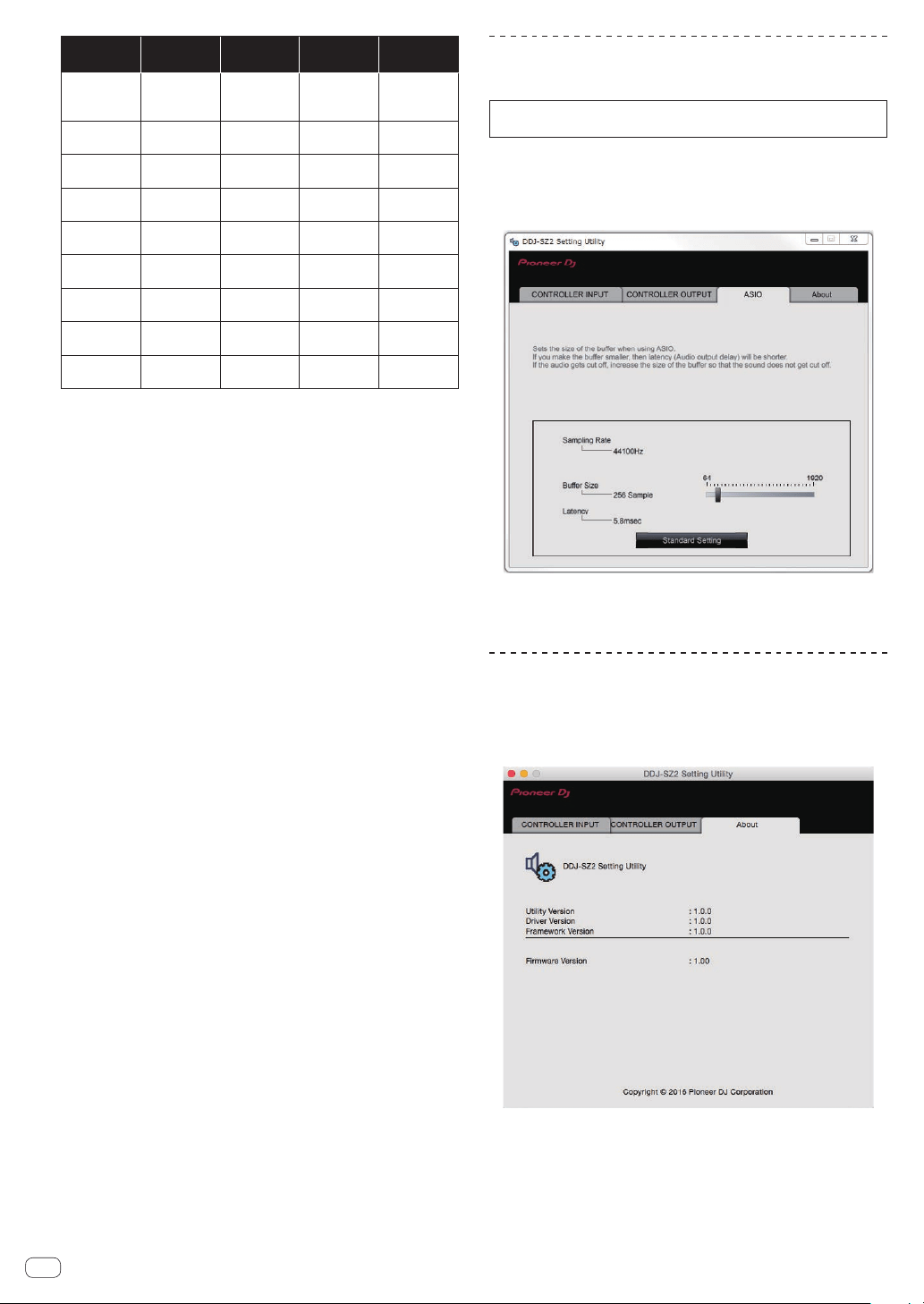
En
30
CH1
(USB1/2)
CH2
(USB3/4)
CH3
(USB5/6)
CH4
(USB7/8)
CH5
(USB9/10)
— —
CH3 Control
Tone
PHONO
1
CH4 Control
Tone
PHONO
1
REC OUT
2
CH1 Control
Tone CD
1
CH2 Control
Tone CD
1
CH3 Control
Tone LINE
1
CH4 Control
Tone LINE
1
REC OUT (NO
MIC)
Post CH1
Fader
2
Post CH2
Fader
2
Post CH3
Fader
2
Post CH4
Fader
2
Cross
Fader A
2
Cross
Fader A
2
Cross
Fader A
2
Cross
Fader A
2
Cross
Fader A
2
Cross
Fader B
2
Cross
Fader B
2
Cross
Fader B
2
Cross
Fader B
2
Cross
Fader B
2
MIC
MIC MIC MIC MIC
Post CH1
Fader
2
— — — —
Post CH2
Fader
2
— — — —
Post CH3
Fader
2
— — — —
Post CH4
Fader
2
1 The audio data is output with the same volume at which it is input to this unit,
regardless of the [USB Output Level] setting.
2 When using for applications other than recording, pay attention to the DJ
application’s settings so that no audio loops are generated. If audio loops are
generated, sound may be input or output at unintended volumes.
! When there is a connection with Serato DJ, the CH5 setting cannot be changed
to other than [REC OUT] or [REC OUT (NO MIC)].
3 Click the [USB Output Level] pull-down menu.
Adjust the volume of the audio data output from this unit.
! The [USB Output Level] setting is applied equally to all audio data.
However, when 1 on the table at step 2 is selected, the audio data is
output with the same volume at which it is input to this unit.
! If not enough volume can be achieved with the DJ software’s volume
adjustment alone, change the [USB Output Level] setting to adjust
the volume of the audio data output from this unit. Note that the
sound will be distorted if the volume is raised too high.
Adjusting the buffer size (when ASIO is
used)
This function can only be used by those using a Windows operating
system.
If an application using this unit as the default audio device (DJ software,
etc.) is running, quit that application before adjusting the buffer size.
Display the setting utility before starting.
Click the [ASIO] tab.
! If the buffer size is made large, drops in audio data (breaks in the
sound) occur less easily, but the time lag due to the delay in the
transfer of the audio data (latency) increases.
Checking the version of the driver
software
Display the setting utility before starting.
Click the [About] tab.
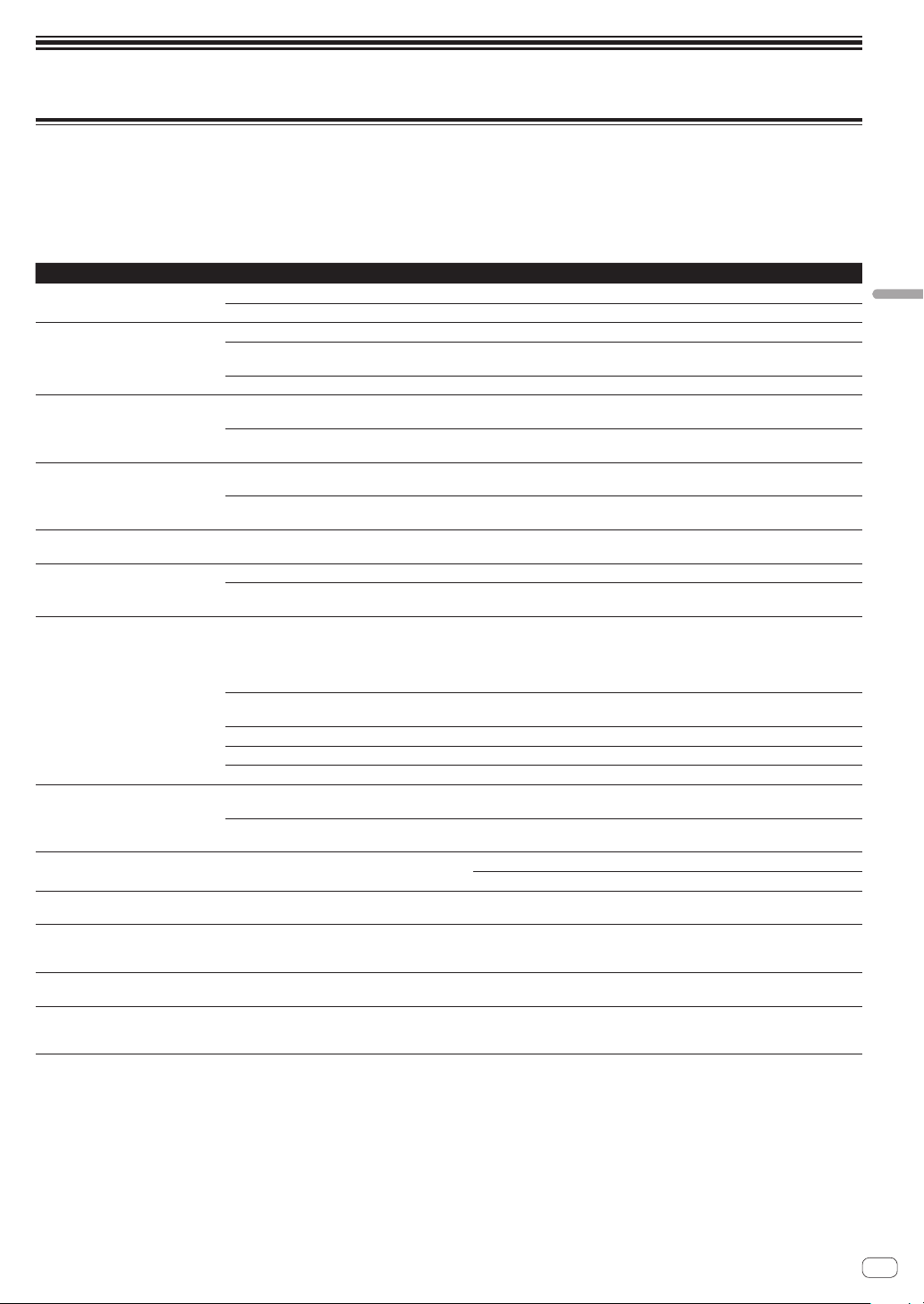
En
31
Additional information
Additional information
Troubleshooting
! If you think that there is something wrong with this unit, check the following items and [FAQ] for [DDJ-SZ2] on the [FAQ] page of the Pioneer DJ
support site.
Sometimes the problem may lie in another component. Inspect the other components and electrical appliances being used. If the problem cannot
be rectified, ask your nearest service center or your dealer to carry out repair work.
! This unit may not operate properly due to static electricity or other external influences. In this case, proper operation may be restored by turning the
power off, waiting 1 minute, then turning the power back on.
Problem Check Remedy
The power is not turned on.
Is the [u] switch of the power on? Turn the [u] switch of the power on.
Is the power cord properly connected?
Plug in the power cord to an AC outlet. (page 7 )
This unit is not recognized. Is the included USB cable properly connected? Connect the included USB cable properly.
Are you using a USB hub? USB hubs cannot be used. Connect the computer and this unit directly using
the included USB cable.
Is the driver software properly set?
Set the driver software properly. (page 4 )
Tracks are not displayed in the library. Have music files been imported? Import the music files properly.
For details on importing music files, see the Serato DJ software manual.
Is a crate or subcrate that does not contain any
tracks selected?
Either select a crate or subcrate that contains any tracks or add tracks to the
crate or subcrate.
iTunes tracks are not displayed in
the library.
Is [Show iTunes Library] at the [Library+Display]
tab in the [SETUP] menu checked?
Check [Show iTunes Library].
For details on importing music files, see the Serato DJ software manual.
Is a crate or subcrate that does not contain any
tracks selected?
Either select a crate or subcrate that contains any tracks or add tracks to the
crate or subcrate.
Music files in the library cannot be
edited (changing track names, etc.).
Is [Protect Library] at the [SETUP]
menu’s [Library+Display] tab enabled?
Disable [Protect Library].
Recording is not possible. Is the recording level low? Adjust the gain control on the [REC] panel in the Serato DJ software.
Have you saved the recording after completing it? Save the recording after completing it.
For detailed instructions on recording, see the Serato DJ software manual.
No sound or small sound. Are the [TRIM] control, channel fader, cross-
fader, the [LINE, PHONO, USB] selector switch
(or the [CD, USB] selector switch) and the
[MASTER LEVEL] control set to the correct
position?
Set the [TRIM] control, channel fader, crossfader, the [LINE, PHONO, USB]
selector switch (or the [CD, USB] selector switch) and the [MASTER LEVEL]
control to the correct position.
Are the connected powered speakers, etc., prop-
erly set?
Properly set the external input selection, volume, etc., on the powered speakers,
etc.
Are the connection cables properly connected? Connect the connection cables properly.
Are the terminals and plugs dirty? Clean the terminals and plugs before making connections.
Is the driver software properly set?
Set the driver software properly. (page 4 )
Distorted sound. Is the [MASTER LEVEL] control set to the proper
position?
Adjust the [MASTER LEVEL] control so that the master level indicator’s orange
indicator lights at the peak level.
Is the [TRIM] control set to the proper position? Adjust the [TRIM] control so that the channel level indicator’s orange indicator
lights at the peak level.
Sound being played is interrupted
when using DJ software.
Is the driver software’s latency value suitable? Set the driver software’s latency to a suitable value.
Set the DJ software’s latency to a suitable value.
Cannot output the microphone sound. Are the [OFF, ON, TALK OVER] selector switches
set to the proper position?
Set the [OFF, ON, TALK OVER] selector switches to the proper position.
Cannot output the sound of the
external device.
Is the [LINE, PHONO, USB] selector switch (or
[CD, USB] selector switch) set to the proper
position?
Set the [LINE, PHONO, USB] selector switch (or [CD, USB] selector switch) to
the proper position.
Sound is interrupted when the ASIO
driver is set.
Has the ASIO driver been set with Serato DJ
running?
Set the ASIO driver before launching Serato DJ.
The indicator flashes and operation
is strange.
— Normal operation can sometimes be restored by unplugging the power cord,
waiting at least 1 minute, then plugging the power cord back in. If the symptom
persists, unplug the power cord and request repairs.
En
32
Problem Check Remedy
Serato DJ operation is unstable. Are you using the latest version of the software? Free updates of Serato DJ can be downloaded from the website. Use the most
recent version. (page 5 )
Are you using softwares other than Serato DJ at
the same time?
Quit other applications to decrease the load on the computer.
If operation continues to be unstable, try disabling the wireless network or other
wireless connections, antivirus software, the screen saver, the low power mode,
etc.
(page 5 )
When other USB devices are connected to the
computer.
Disconnect other USB devices from the computer.
When another USB audio device is connected to the computer at the same time,
it may not operate or be recognized normally.
Are you using a USB hub? USB hubs cannot be used. Connect the computer and this unit directly using
the included USB cable.
There is a problem with the USB port to which this
unit is connected.
If your computer has multiple USB ports, try connecting this unit to a different
USB port.
Is this unit connected to a notebook computer
running on its battery?
Supply power to the notebook computer from an AC power supply.
(Depending on the notebook computer’s settings, the low power mode may be
set when the computer is running on its battery, automatically reducing the
performance of the computer itself.) (page 5 )
The USB buffer size is too small. Raise the USB buffer size. ( 30 Page)
The jog dial illumination does not turn
during playback. (It does turn when
scratching.)
The [TEMPO] slider does not work
when the deck is switched while the
sync mode is set. (The TAKEOVER
indicator lights.)
Is the setting in the utilities mode wrong? In utilities mode, check that the unit is not set to be forcefully operated as a
general MIDI controller.
The fader start function does not work. Is a cue set?
Set a cue. (page 22 )
Is the setting in the utilities mode wrong? In utilities mode, set the fader start setting to “Fader start with the sync mode
set” or “Fader start without the sync mode set”.
The BPM is not displayed.
The sync and auto loop functions do
not work.
Has the track been analyzed? Analyze the file.
Is [Set Auto BPM] checked in the offline player
settings?
Re-analyze the track with [Set Auto BPM] checked.
For detailed instructions on analyzing tracks, see the Serato DJ software
manual.
The USB connection indicator flashes. Is the driver software properly set?
Set the driver software properly. (page 4 )
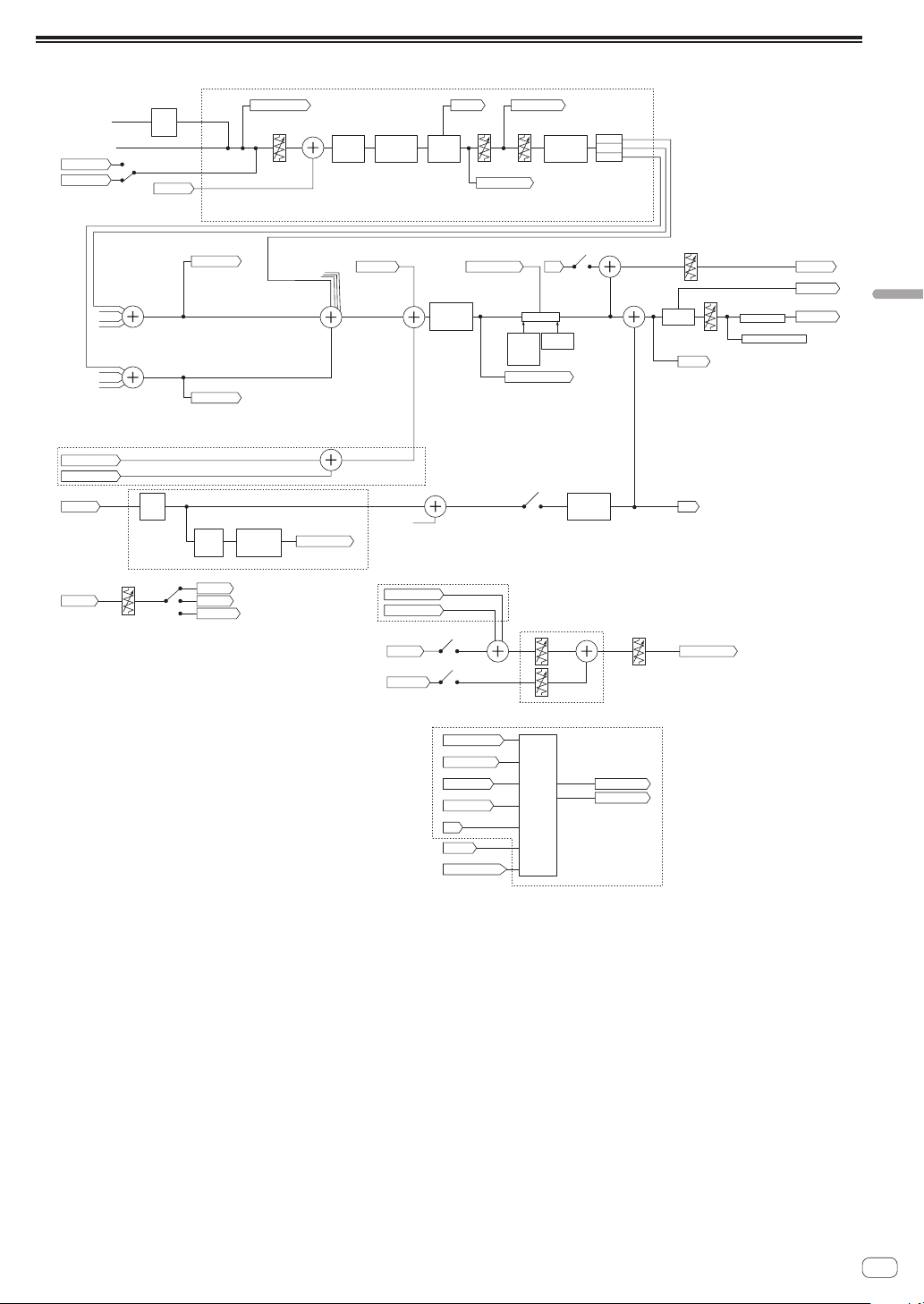
En
33
Additional information
Signal flow
Analog PHONO
Analog CD/LINE
USB A CHx in
CH3/4 OSC
CHx Control Tone CHx Cue
Level Meter CHx
Booth Out
Master Out
Master Cue
Post CHx Fader
Master OSC TalkOver on/off
TalkOver on/off
Mic
USB B CHx in
USB A SAMPLER
USB B SAMPLER
Mic 1/2 in
CH3 OSC
CHx Cue
Headphone Out
CH4 OSC
Master OSC
Cross Fader A
Cross Fader B
Digital Trim
Booth Level
Ch.Fader
CF Assign
CH1-4 Common
Mic to Booth Monitor on/off
Phono
AMP
CH3,4
Thru
CF A
CF B
Assign A
CHx
Assign B
CHx
MIC1,2
Common
MIC1,2 Mix
Headphone Mix
Headphone Level
Assign THRU
CH1-4
TalkOver
Peak Limiter
Level Meter Master
TalkOver
Mode
Advanced/
Normal
TalkOver
Level
Master
CUE
Master Cue
CHx Control Tone
CHx Post-Fader
Cross Fader A
Cross Fader B
Mic
Rec Out
Master Level
Rec Out
REC OUT (NO MIC)
Mic
Filter
Mic in
Level Detect
Mic
Oscillator
OSC Level
2band
Mic EQ
MIC1/2
USB A CHx out
USB B CHx out
Output
Select
Rec Out (NO MIC)
3band
Isolator
CHx
CUE
Monitor
CHx
SOUND
COLOR EFFECT
CHx
SOUND
COLOR EFFECT
CHx
Cross Fader
SOUND
COLOR EFFECT
MIC
SOUND
COLOR EFFECT
MASTER
USB A Monitor
USB B Monitor
CHx Cue
On/Off Sw
Master Cue
On/Off Sw
for Serato DJ
except Serato DJ

En
34
Acquiring the manual
Various instructions are sometimes provided as files in PDF format.
Adobe
®
Reader
®
must be installed in order to view PDF format files.
Downloading the Serato DJ software
manual
1 Click [Software Info] for [DDJ-SZ2] on the [FAQ] page
of the Pioneer DJ support site.
2 Click the link to the Serato DJ download page.
The Serato DJ download page is displayed.
3 Log in to your “Serato.com” user account.
Input the e-mail address and password you have registered to log in to
“Serato.com”.
4 From “More Downloads” on the right side of the
download page, click “Serato DJ x.x.x Manual”.
Downloading of the Serato DJ software manual starts.
Using as a controller for other DJ
software
This unit also outputs the operating data for the buttons and controls in
MIDI format. If you connect a computer with a built-in MIDI-compatible
DJ software via a USB cable, you can operate the DJ software on this
unit. The sound of music files being played on the computer can also be
output from the DDJ-SZ2.
When using this unit as a controller for operating DJ software other than
Serato DJ, change the setting to use DJ software other than Serato DJ at
the utilities mode. Also, make the audio and MIDI-related settings in the
DJ software.
! For details, see your DJ software’s operating instructions.
About MIDI messages
For details on this unit’s MIDI messages, see “List of MIDI Messages”.
! “List of MIDI Messages” can be acquired from the following URL:
http://pioneerdj.com/support/
About the driver software
This driver software is an exclusive driver for outputting audio signals
from a computer.
!
First read the Software end user license agreement on page 34
carefully.
Operating environment
Supported operating systems
Mac OS X: 10.11/10.10/10.9 (latest update)
1
Windows: Windows 10, Windows 8.1, Windows 8.1
Pro (latest service pack), Windows 7 Home Premium,
Professional, Ultimate (latest service pack)
32-bit version
1
64-bit version
1
Checking the latest information on the driver software
For detailed information on this unit’s designated driver software, see
the Pioneer DJ support site below.
http://pioneerdj.com/support/
Software end user license agreement
This Software End User License Agreement (“Agreement”) is between
you (both the individual installing the Program and any single legal
entity for which the individual is acting) (“You” or “Your”) and Pioneer DJ
Corporation (“Pioneer DJ”).
TAKING ANY STEP TO SET UP OR INSTALL THE PROGRAM MEANS
THAT YOU ACCEPT ALL OF THE TERMS OF THIS LICENSE AGREEMENT.
PERMISSION TO DOWNLOAD AND/OR USE THE PROGRAM IS
EXPRESSLY CONDITIONED ON YOUR FOLLOWING THESE TERMS.
WRITTEN OR ELECTRONIC APPROVAL IS NOT REQUIRED TO MAKE
THIS AGREEMENT VALID AND ENFORCEABLE. IF YOU DO NOT
AGREE TO ALL OF THE TERMS OF THIS AGREEMENT, YOU ARE NOT
AUTHORIZED TO USE THE PROGRAM AND MUST STOP INSTALLING IT
OR UNINSTALL IT, AS APPLICABLE.
1 DEFINITIONS
1 “Documentation” means written documentation, specifications
and help content made generally available by Pioneer DJ to aid in
installing and using the Program.
2 “Program” means all or any part of Pioneer DJ’s software
licensed to You by Pioneer DJ under this Agreement.
2 PROGRAM LICENSE
1 Limited License. Subject to this Agreement’s restrictions,
Pioneer DJ grants to You a limited, non-exclusive, non-transfer-
able, license (without the right to sublicense):
a To install a single copy of the Program in Your computer or
mobile device, to use the Program only for Your personal pur-
pose complying with this Agreement and the Documentation
(“Authorized Use”);
b To use the Documentation in support of Your Authorized Use;
and
c To make one copy of the Program solely for backup pur-
poses, provided that all titles and trademark, copyright and
restricted rights notices are reproduced on the copy.
2 Restrictions. You will not copy or use the Program or
Documentation except as expressly permitted by this Agreement.
You will not transfer, sublicense, rent, lease or lend the Program,
or use it for third-party training, commercial time-sharing or
service bureau use. You will not Yourself or through any third
party modify, reverse engineer, disassemble or decompile the
Program, except to the extent expressly permitted by applicable
law, and then only after You have notified Pioneer DJ in writing of
Your intended activities.
3 Ownership. Pioneer DJ or its licensor retains all right, title
and interest in and to all patent, copyright, trademark, trade
secret and other intellectual property rights in the Program and
Documentation, and any derivative works thereof. You do not
acquire any other rights, express or implied, beyond the limited
license set forth in this Agreement.
4 No Support. Pioneer DJ has no obligation to provide support,
maintenance, upgrades, modifications or new releases for the
Program or Documentation under this Agreement.
3 WARRANTY DISCLAIMER
THE PROGRAM AND DOCUMENTATION ARE PROVIDED “AS IS”
WITHOUT ANY REPRESENTATIONS OR WARRANTIES, AND YOU
AGREE TO USE THEM AT YOUR SOLE RISK. TO THE FULLEST EXTENT
PERMISSIBLE BY LAW, PIONEER DJ EXPRESSLY DISCLAIMS ALL
WARRANTIES OF ANY KIND WITH RESPECT TO THE PROGRAM AND
DOCUMENTATION, WHETHER EXPRESS, IMPLIED, STATUTORY,
OR ARISING OUT OF COURSE OF PERFORMANCE, COURSE OF
DEALING OR USAGE OF TRADE, INCLUDING ANY WARRANTIES
OF MERCHANTABILITY, FITNESS FOR A PARTICULAR PURPOSE,
SATISFACTORY QUALITY, ACCURACY, TITLE OR NON-INFRINGEMENT.
4 EXPORT CONTROL AND COMPLIANCE WITH LAWS
AND REGULATIONS
You may not use or otherwise export or re-export the Program except as
authorized by United States law and the laws of the jurisdiction in which
the Program was obtained. In particular, but without limitation, the
Program may not be exported or re-exported (a) into any U.S.-embargoed
countries or (b) to anyone on the U.S. Treasury Department's Specially
Designated Nationals List or the U.S. Department of Commerce Denied
Persons List or Entity List. By using the Program, you represent and war-
rant that you are not located in any such country or on any such list. You
also agree that you will not use the Program for any purposes prohibited
by United States law, including, without limitation, the development,
design, manufacture, or production of nuclear, missile, or chemical or
biological weapons.
En
35
Additional information
5 U.S. GOVERNMENT RESTRICTED RIGHTS
The Program and Documentations are “commercial computer software”
and “commercial computer software documentation” as those terms are
defined in 48 C.F.R. §252.227-7014 (a) (1) (2007) and 252.227-7014 (a) (5)
(2007). The U.S. Government’s rights with respect to the Program and
Documentations are limited by this license pursuant to 48 C.F.R. §12.212
(Computer software) (1995) and 48 C.F.R. §12.211 (Technical data) (1995)
and/or 48 C.F.R. §227.7202-3, as applicable. As such, the Program and
Documentations are being licensed to the U.S. Government end users:
(a) only as “commercial items” as that term is defined in 48 C.F.R. §2.101
generally and as incorporated in DFAR 212.102; and (b) with only those
limited rights as are granted to the public pursuant to this license.
Under no circumstance will the U.S. Government or its end users be
granted any greater rights than we grant to other users, as provided for
in this license. Manufacturer is Pioneer DJ Corporation, 1-1 Shin-Ogura,
Saiwai-ku, Kawasaki-shi, Kanagawa, 212-0031 Japan
6 DAMAGES AND REMEDIES FOR BREACH
You agree that any breach of this Agreement’s restrictions would cause
Pioneer DJ irreparable harm for which money damages alone would be
inadequate. In addition to damages and any other remedies to which
Pioneer DJ may be entitled, You agree that Pioneer DJ may seek injunc-
tive relief to prevent the actual, threatened or continued breach of this
Agreement.
7 TERMINATION
Pioneer DJ may terminate this Agreement at any time upon Your breach
of any provision. If this Agreement is terminated, You will stop using
the Program, permanently delete it from your computer or mobile
device where it resides, and destroy all copies of the Program and
Documentation in Your possession, confirming to Pioneer DJ in writing
that You have done so. Sections 2.2, 2.3, 2.4, 3, 4, 5, 6, 7 and 8 will con-
tinue in effect after this Agreement’s termination.
8 GENERAL TERMS
1 Limitation of Liability. In no event will Pioneer DJ or its subsidiar-
ies be liable in connection with this Agreement or its subject
matter, under any theory of liability, for any indirect, incidental,
special, consequential or punitive damages, or damages for lost
profits, revenue, business, savings, data, use, or cost of substi-
tute procurement, even if advised of the possibility of such dam-
ages or if such damages are foreseeable. In no event will Pioneer
DJ’s liability for all damages exceed the amounts actually paid by
You to Pioneer DJ or its subsidiaries for the Program. The parties
acknowledge that the liability limits and risk allocation in this
Agreement are reflected in the Program price and are essential
elements of the bargain between the parties, without which
Pioneer DJ would not have provided the Program or entered into
this Agreement.
2 The limitations or exclusions of warranties and liability contained
in this Agreement do not affect or prejudice Your statutory rights
as consumer and shall apply to You only to the extent such limita-
tions or exclusions are permitted under the laws of the jurisdic-
tion where You are located.
3 Severability and Waiver. If any provision of this Agreement is held
to be illegal, invalid or otherwise unenforceable, that provision
will be enforced to the extent possible or, if incapable of enforce-
ment, deemed to be severed and deleted from this Agreement,
and the remainder will continue in full force and effect. The
waiver by either party of any default or breach of this Agreement
will not waive any other or subsequent default or breach.
4 No Assignment. You may not assign, sell, transfer, delegate or
otherwise dispose of this Agreement or any rights or obligations
under it, whether voluntarily or involuntarily, by operation of law
or otherwise, without Pioneer DJ’s prior written consent. Any
purported assignment, transfer or delegation by You will be null
and void. Subject to the foregoing, this Agreement will be binding
upon and will inure to the benefit of the parties and their respec-
tive successors and assigns.
5 Entire Agreement. This Agreement constitutes the entire agree-
ment between the parties and supersedes all prior or contempo-
raneous agreements or representations, whether written or oral,
concerning its subject matter. This Agreement may not be modi-
fied or amended without Pioneer DJ’s prior and express written
consent, and no other act, document, usage or custom will be
deemed to amend or modify this Agreement.
6 You agree that this Agreement shall be governed and construed
by and under the laws of Japan.
About trademarks and registered
trademarks
! "Pioneer DJ" is a trademark of PIONEER CORPORATION, and is used
under license.
! Microsoft and Windows are either registered trademarks or trade-
marks of Microsoft Corporation in the United States and/or other
countries.
! Mac OS, iTunes, and Finder are trademarks of Apple Inc., registered
in the U.S. and other countries.
!
Intel and Intel Core are trademarks of Intel Corporation in the U.S.
and/or other countries.
! ASIO is a trademark of Steinberg Media Technologies GmbH.
! Serato DJ, Scratch Live, ITCH and Serato DJ Intro are registered
trademarks of Serato Audio Research Ltd., registered in the U.S. and
other countries.
The names of companies and products mentioned herein are trade-
marks or registered trademarks of their respective owners.
This product has been licensed for nonprofit use. This product has not
been licensed for commercial purposes (for profit-making use), such
as broadcasting (terrestrial, satellite, cable or other types of broadcast-
ing), streaming on the Internet, Intranet (a corporate network) or other
types of networks or distributing of electronic information (online digi-
tal music distribution service). You need to acquire the corresponding
licenses for such uses. For details, see http://www.mp3licensing.com.
Cautions on copyrights
Recordings you have made are for your personal enjoyment and accord-
ing to copyright laws may not be used without the consent of the copy-
right holder.
! Music recorded from CDs, etc., is protected by the copyright laws of
individual countries and by international treaties. It is the full respon-
sibility of the person who has recorded the music to ensure that it is
used legally.
! When handling music downloaded from the Internet, etc., it is the
full responsibility of the person who has downloaded the music to
ensure that it is used in accordance with the contract concluded
with the download site.
— The specifications and design of this product are subject to change
without notice.
© 2016 Pioneer DJ Corporation. All rights reserved.
<DRI1425-A>