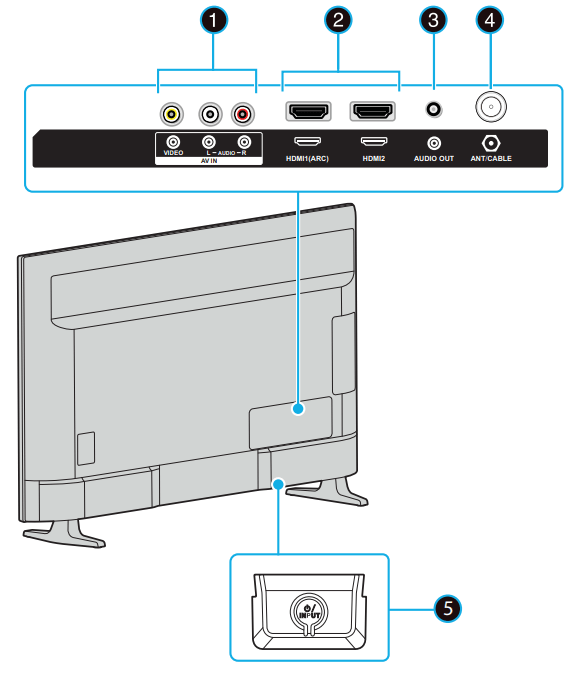
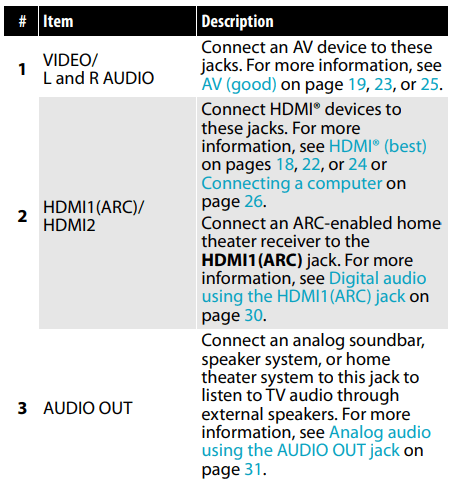
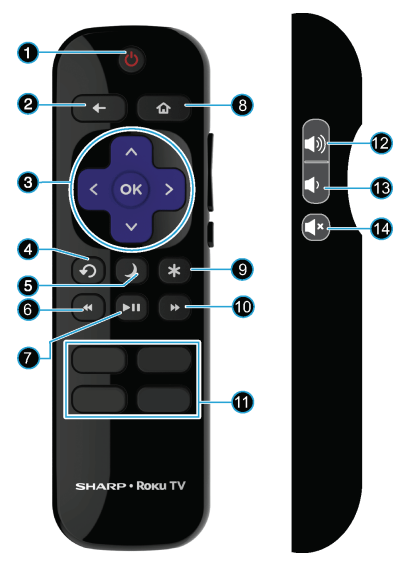
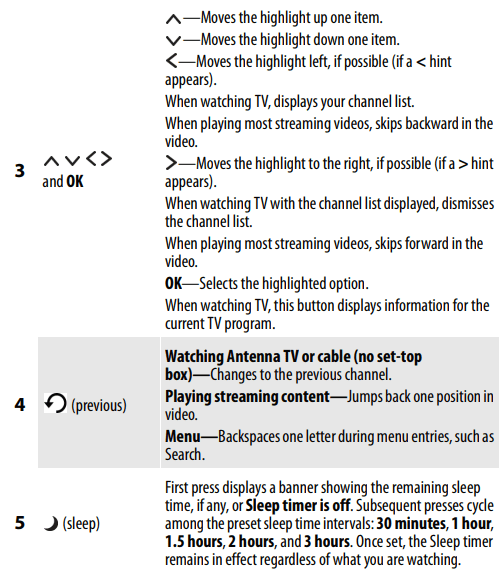
Open the back of your TV remote control and insert two AAA batteries, observing the proper orientation. Reattach the back cover

Remote control on page 15 explains how to use the remote control in each of your TV’s operating modes
Notes
Aiming the remote control

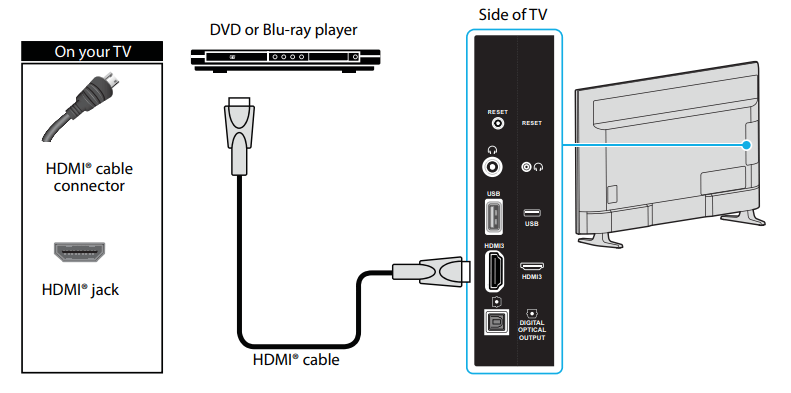
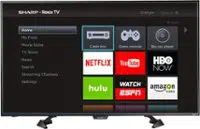
to highlight the HDMI 1, HDMI 2, or HDMI 3 tile, then press OK.
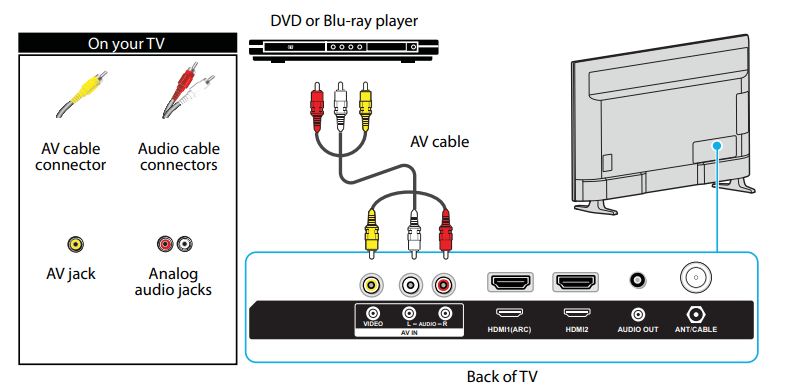
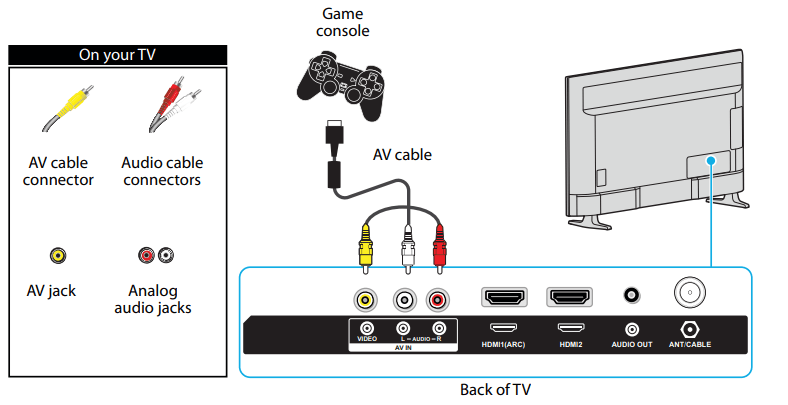
to highlight the AV tile, then press OK.
to highlight the Antenna TV tile, then press OK. If you have not set up the TV tuner, follow the on-screen instructions.
to highlight the HDMI 1, HDMI 2, or HDMI 3 tile, then press OK.
to highlight the AV tile, then press OK.
to highlight the HDMI 1, HDMI 2, or HDMI 3 tile, then press OK.
to highlight the AV tile, then press OK.You can use an HDMI® jack on your TV to connect to a computer

to highlight the HDMI 1, HDMI 2, or HDMI 3 tile, then press OK.
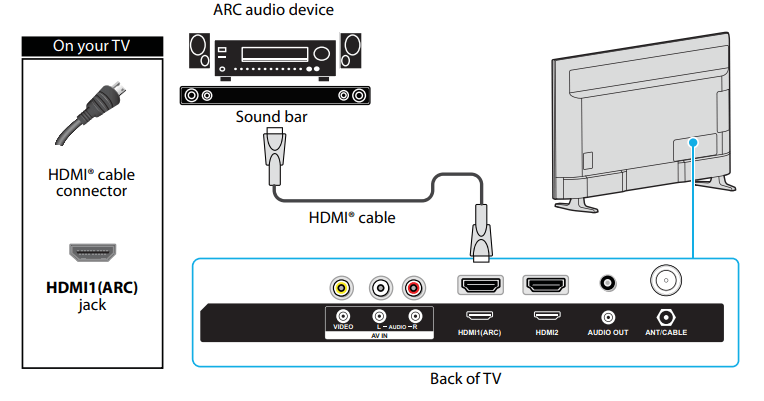
to highlight Settings, then press OK. Highlight Audio, then press OK. Highlight TV speakers, then press OK. Press OK to remove the check from the TV speakers enabled check box.Your TV can send sound to an ARC device, like an AV receiver, to create a home theater that uses two or more speakers. When you connect external speakers or a sound bar, sound plays through your TV speakers and the external speakers or sound bar.

to highlight Settings, then press OK. Highlight Audio, then press OK. Highlight TV speakers, then press OK. Press OK to remove the check from the TV speakers enabled check box.
to highlight Settings, then press OK. Highlight System, then press OK. Highlight Control other devices (CEC), then press OK. Highlight HDMI ARC, then press OK to check the box.When you connect an analog speaker system or sound bar to the audio out jack, the TV speakers are muted.

to highlight Settings, then press OK. Highlight Audio, then press OK. Highlight TV speakers, then press OK. Press OK to remove the check from the TV speakers enabled check box.Cleaning your TV cabinet
Clean the cabinet with a soft, lint-free cloth. If the cabinet is especially dirty, moisten a soft, lint-free cloth in a weak detergent solution, squeeze the excess moisture from the cloth, then wipe the cabinet with the cloth. Use a clean cloth to dry the cabinet.
Cleaning your TV screen
Clean the screen with a soft, lint-free cloth.
Symptom | Possible cause | Try this... |
| Picture does not fill the screen or there are black bars around the picture | The picture size may need to be adjusted | • Adjust the picture size (aspect ratio). See the Picture Size option in the Options menu. |
| I don't see a picture when I select an input | TV is not on | • Make sure that your TV is plugged into a working power outlet, and that your TV is turned on. (Your TV has a light on the front that indicates if your TV is turned off.) |
| Cables are not connected correctly | • Make sure that the video cables are connected correctly and securely to your TV. • Make sure that the antenna or cable TV is connected correctly and securely. See Connecting a cable or satellite box on page 18 or Connecting an antenna or cable TV (no box) on page 21. | |
| Picture settings may be incorrect | • Adjust the contrast and brightness. See the TV brightness option in the Settings menu or Options menu. • Adjust the TV picture. | |
| Incorrect input may be selected | • Make sure that the correct input is selected for the device you want to view. | |
| Input source not detected | • Make sure that the device connected to the input is turned on. • Make sure that the cord to and from the device is connected firmly and correctly to the device and your TV. | |
| TV input may be bad | • Connect a different device to the same input and check to see if it works correctly. | |
| TV channel does not appear | Broadcast TV may be experiencing problems or may not be set up | • Try another channel. The station may be experiencing problems. • Make sure that the incoming signal is compatible. • If you are trying to watch broadcast TV, make sure that Antenna TV is set up. |
| Dark, poor, or no picture (screen is lit), but sound is good | Broadcast TV may be experiencing problems or may not be set up | • Try another channel. The station may be experiencing problems. • If you are using an antenna and the signal strength is low, adjust the antenna or use a highly directional outdoor antenna or set-top antenna with a built-in amplifier. |
| Cables may not be connected correctly | • Make sure that the antenna or cable TV is connected correctly and securely. See Connecting a cable or satellite box on page 18 or Connecting an antenna or cable TV (no box) on page 21. • Make sure that the video cables are connected correctly and securely to your TV. • The video cable(s) you are using may be bad. Try a new set. | |
| Picture settings may be incorrect | • Adjust the brightness. See the TV brightness option in the Settings menu or Options menu. • Change to a different picture mode. See the Picture mode option in the Options menu or Advanced Picture Settings menu. | |
| No color, dark picture, or color is not correct | Picture settings may be incorrect | • Adjust the contrast, color, and brightness settings. See the TV brightness option in the Settings menu or the Options menu. |
| Broadcast TV may be experiencing problems | • Try another channel. The station may be experiencing problems. • If you are using an antenna and the signal strength is low, adjust the antenna or use a highly directional outdoor antenna or set-top antenna with a built-in amplifier. | |
| Cables are not connected correctly | • Make sure that the antenna or cable TV is connected correctly and securely. See Connecting a cable or satellite box on page 18 or Connecting an antenna or cable TV (no box) on page 21. • Make sure that the video cables are connected correctly and securely to your TV. • The video cable(s) you are using may be bad. Try a new set. | |
| Only snow (noise) appears on the screen | Broadcast TV may be experiencing problems or may not be set up | • Try another channel. The station may be experiencing problems. • If you are trying to watch broadcast TV, make sure that Antenna TV is set up. • If you are using an antenna and the signal strength is low, adjust the antenna or use a highly directional outdoor antenna or set-top antenna with a built-in amplifier. |
| Cables may not be connected correctly | • Make sure that the antenna or cable TV is connected correctly and securely. See Connecting a cable or satellite box on page 18 or Connecting an antenna or cable TV (no box) on page 21. | |
| Picture quality is good on some channels and poor on others. Sound is good | Broadcast signal may be weak | • If you connect to cable without a set-top box and experience poor picture quality, you may need to install a set-top box to improve signal reception and picture quality. Contact your cable TV provider about upgrading to a set-top box. |
| Dotted lines or stripes appear on the screen | Cables may not be connected correctly | • Make sure that the antenna or cable TV is connected correctly and securely. See Connecting a cable or satellite box on page 18 or Connecting an antenna or cable TV (no box) on page 21. • Make sure that the video cables are connected correctly and securely to your TV. • The video cable(s) you are using may be bad. Try a new set. |
| Broadcast signal may be weak | • If you are using an antenna and the signal strength is low, adjust the antenna or use a highly directional outdoor antenna or set-top antenna with a built-in amplifier. • Other devices (for example, a surround sound receiver, external speakers, fans, or hair dryers) may be interfering with your TV. Try turning off one device at a time to determine which device is causing interference. After you have determined which device is causing interference, move it further from your TV to eliminate the interference. | |
| Double images | Broadcast signal may be weak | • If you are using an antenna and the signal strength is low, adjust the antenna or use a highly directional outdoor antenna or set-top antenna with a built-in amplifier. • If you are using an antenna and the signal strength is low, switch to a cable or satellite box. |
| The picture has a few bright or dark spots | This is normal in LED TVs | • A few bright or dark spots on an TV screen is normal. It does not affect the operation of your TV. |
| Volume is down or muted | • Increase the volume. • Make sure that the sound is not muted. | |
| Headphones may be connected | • Make sure that you do not have headphones connected. When headphones are connected, no sound comes from your TV speakers. | |
| TV speakers may be turned off | • If you want sound to play through your TV speakers, make sure that your TV speakers are turned on. | |
| You may need to change the audio mode | • Change to a different audio mode. | |
| Good picture, but no sound | Home theater system, soundbar, or external speaker system may not be turned on or may not be set up correctly | • If you are using a home theater system, soundbar, or external speaker system, make sure that it is turned on and is not muted and that it is set to the correct source. • If you connected an ARC audio device to the HDMI1/ARC jack, make sure that you have turned on the ARC feature. • If you are using a home theater system, soundbar, or external speaker system and have connected it with a digital audio cable, make sure that you have set up the digital audio connection. • Make sure that the audio cables are connected correctly and securely to your TV. |
| Bad content, no audio | • Make sure that the selected channel or content is intended to be broadcasting with sound. | |
| Cables may not be connected correctly | • Make sure that the antenna or cable TV is connected correctly and securely. See Connecting a cable or satellite box on page 18 or Connecting an antenna or cable TV (no box) on page 21. • The audio cables you are using may be bad. Try a new set. |
| Light in the viewing area may be interfering | • Make sure that the room is not too bright. Light reflecting off the screen can make the picture difficult to see. | |
| Poor picture | A connected camera or camcorder may be interfering | • If an S-VHS camera or a camcorder is connected while another connected device is turned on, the picture may be poor. Turn off one or more devices. |
| Audio noise | Other devices may be interfering | • Other devices (for example, a surround sound receiver, external speakers, fans, or hair dryers) may be interfering with your TV. Try turning off one device at a time to determine which device is causing interference. After you have determined which device is causing interference, move it further from your TV to eliminate the interference. |
| After images appear | • Do not display a still image, such as a logo, game, or computer image, for an extended period of time. This can cause a permanent after-image to be burned into the screen. This type of damage is not covered by your warranty. |
Symptom | Possible cause | Try this... |
| No power to TV | • Make sure that the power cord is correctly connected to both your TV power connector and power outlet. See Connecting power on page 33. You should see an LED in the front of the TV panel when a button on the remote is pressed. If you see no LED activity, try another outlet or check your fuse box. | |
| My TV doesn't turn on using | Line-of-sight obstructed | • Make sure that no objects (or pets) are obstructing the line-of-sight from the remote control to the remote sensor on the front of your TV. See Aiming the remote control on page 34. |
| the remote control | Remote not responding | • Open the battery compartment and make sure that the batteries are seated in the correct positions (+ and - in the correct positions). See Installing remote control batteries on page 34. • Make sure that the batteries are fresh and working correctly. Replace the batteries, if necessary. |
| TV frozen | • If the front LED is not responding, or abnormally bright, disconnect the power cord from the power outlet, wait a few seconds, then reconnect the power cord. | |
| Trouble programming your existing universal remote control | Remote control may not be programmed correctly | • For instructions on programing a universal remote control, visit: roku.com/universalremote • Refer to the User Guide that accompanied your universal remote control and contact the manufacturer if problems persist. |
| Batteries may be dead | • Replace dead batteries with new batteries. Refer to the User Guide that accompanied your universal remote control. |
Symptom | Possible cause | Try this... |
| No power | Power cord may not be connected correctly | • Make sure that the power cord is correctly connected to both your TV power connector and power outlet. See Connecting power on page 33. You should see an LED in the front of your TV panel when a button on the remote is pressed. If you see no LED activity, try another outlet or check your fuse box. • Unplug the power cord, wait 60 seconds, then plug the cord back in and turn on your TV. |
| Other devices may be interfering | • Other devices (for example, a surround sound receiver, external speakers, fans, or hair dryers) may be interfering with your TV. Try turning off one device at a time to determine which device is causing interference. After you have determined which device is causing interference, move it further from your TV to eliminate the interference. | |
| My TV tuner does not pick up as many over-the-air channels as it should | Antenna may not be placed optimally | • Adjust the antenna location and rescan. Go to Settings > TV inputs > Antenna TV > Scan again for channels. • Reception can vary by channel depending on the broadcast power level of a given station. Contact your cable or satellite TV provider. • Make sure that the antenna or cable/satellite TV is connected securely to your TV. • Try replacing the cable between the antenna/cable or cable/satellite box and your TV. |
| Broadcast TV may not be set up | • Make sure that Antenna TV is set up. | |
| One or more channels do not display | Channels may be blocked or hidden | • Make sure that the channels are not blocked. • Make sure that the channels are not hidden. The channel may have been deleted from the channel list. You can add the channel back to the channel list. |
| The wrong input may be selected | • Make sure that you have selected the correct input tile for the device or service you are trying to use. | |
| You may need to use the remote control that came with the cable or satellite box | • If you are using a cable or satellite box, use the remote that came with that box to change channels. | |
| I lost my parental control PIN | Need PIN recovery | • You will need to factory reset your TV, as the PIN cannot be recovered or reset any other way. Go to Settings > System > Advanced system settings > Factory reset. |
| Some settings cannot be accessed | Not all settings are available for all devices or inputs | • If the icon or a menu option is grayed, you cannot adjust settings for the current video input mode. |
| TV cabinet creaks | This is normal | • When your TV is in use, the temperature rises naturally and may cause the cabinet to expand or contract which can cause a creaking noise. This is not a malfunction. |
| Control buttons do not work | TV may be frozen | • Unplug the power cord, wait a few seconds, then plug the cord back in and turn on your TV. |
| TV keeps turning off | Sleep timer may be turned on | • Make sure that the sleep timer is not turned on. |
Some features are not available | The wrong TV mode may be selected | • You may have Set up for store mode when you set up your TV. Store use mode is for retail environments only. In Store use mode, some of your TV's features are missing or limited. If you selected Set up for store use and you want to change to Set up for home use, you have to reset your TV to the factory defaults. Go to Settings > System > Advanced system settings > Factory reset. |
Symptom | Possible cause | Try this... |
| How can I find out more about using my TV? | • If you need help with using your TV or Roku, go to: https://go.roku.com/tvmanua | |
I can't turn my TV on with the Roku mobile app | Your TV is "asleep" | • You will need to use the physical remote button to "wake up" or turn on your TV. |
| I can't find my TV with the Roku mobile app | TV and mobile app not on same wireless network | • Make sure that your TV and the mobile app are on the same network. |
| TV not powered or working normally | • Make sure that your TV is connected to a working power outlet and that your TV is turned on. See Connecting power on page 33. |
Symptom | Possible cause | Try this... |
| I cannot | Network connection may not be set up | • If you did not connect to the Internet when you first set up your TV, set up a network connection. |
| connect to the Internet | Network name or password may have changed | • If your network name or password has changed, you need to update your network connection. |
| Streaming keeps pausing to load more data | Wireless LAN not optimized | • Rotate wireless router slightly • Elevate the router • Turn off other wireless connections • Use 5.0Ghz, if possible. Roku TVs support dual band. |
| Insufficient broadband speed | • Turn off other wireless connections that may also be using bandwidth. |
Symptom | Possible cause | Try this... |
| My TV is not displaying the video from the connected CEC device | Cables may not be connected correctly | • Make sure that the HDMI® cable is connected securely to your TV and the device. • Make sure that the device is connected to your TV with an HDMI® cable. |
| Picture settings may be incorrect | • Try adjusting your TV picture. | |
| The selected input may be incorrect | • Make sure that the correct input tile is selected. | |
| Connected device may not be a CEC device | • Make sure that the device is a CEC device. See the documentation that came with the device for more information. | |
| CEC control may not be set up correctly | • Make sure that your TV has searched for CEC devices. | |
| My TV is not playing the audio from the connected CEC device. | Cables may not be connected correctly | • Make sure that the HDMI® cable is connected securely to your TV and the device. |
| Volume may be too low or muted | • Make sure that the volume on your TV and the device is turned up and not muted. | |
| TV speakers may be turned off | • If you want sound to play through your TV speakers, make sure that your TV speakers are turned on. | |
| Connected device may not be a CEC device | • Make sure that the device is a CEC device. See the documentation that came with the device. | |
| CEC control may not be set up correctly | • Make sure that your TV has searched for CEC devices. | |
| Connected audio device may not be set up correctly | • If you are using a home theater system, soundbar, or external speaker system, make sure that it is set to the correct source. • If you are using a home theater system, soundbar, or external speaker system and have connected it with a digital audio cable, make sure that you have set up digital audio. • If you connected an ARC audio device to the HDMI1/ARC jack, make sure that you have turned on the ARC feature. | |
| My TV's remote control does not control the device | Connected device may not be turned on | • Make sure that the device is turned on. |
| Line-of-sight obstructed | • Make sure that no objects (or pets) are obstructing the line-of-sight from the remote control to the remote sensor on the front of your TV and the device. | |
| Connected device may not support some or all CEC features | • Depending on the device, all the buttons may not work. • The device may not support this feature. See the documentation that came with the device for more information. | |
| CEC control may not be set up correctly | • Make sure that your TV has searched for CEC devices. • If you are trying to control the volume on an HDMI® CEC audio receiver using your TV remote control, make sure that your TV speakers are turned on. • If you are trying to control the volume on an HDMI® CEC audio receiver using your TV remote control, make sure that the system audio control is turned on. |
| The device does not show up in the CEC device list | Connected device may not be a CEC device | • Make sure that the device is a CEC device. See the documentation that came with the device. |
| Cables may not be connected correctly | • Make sure that the HDMI® cable is connected securely to your TV and the device. • Make sure that the device is connected to your TV with an HDMI® cable. | |
| CEC control may not be set up correctly | • Make sure that your TV has searched for CEC devices. | |
| My device does not turn off when I turn off my TV | Connected device may not be a CEC device | • Make sure that the device is a CEC device. See the documentation that came with the device. |
| Connected device may not support some or all CEC features | • The device may not support this feature. See the documentation that came with the device for more information. | |
| CEC control may not be set up correctly | • Make sure that your TV has searched for CEC devices. • Make sure that system standby is turned on. | |
| My TV does not turn on when I turn on my device | Connected device may not be a CEC device | • Make sure that the device is a CEC device. See the documentation that came with the device. |
| Connected device may not support some or all CEC features | • The device may not support this feature. See the documentation that came with the device for more information. | |
| CEC control may not be set up correctly | • Make sure that your TV has searched for CEC devices. • Make sure that 1-touch play is turned on. |
Reference file: Sharp LC-43LB601C 43" Class (42.5 diag.) FHD Sharp Roku TV
Additionally, the document applies to other Sharp models: LC-43LB601U, LC-50LB601U, LC-50LB601C