WARNING- RISK OF EXPLOSIVE GASES
a. Working in the vicinity of a lead-acid battery can be dangerous. Batteries generate explosive gases during normal battery operation.
b. For this reason it is of the utmost importance that prior to each use of your charger, you read and follow the instructions provided exactly.
c. The appliance is not intended for use by young children or infirm persons without supervision. Young children should be supervised to ensure that they do not play with the appliance.
To reduce risk of a battery explosion, follow these instructions and those marked on the battery
NEVER smoke or allow an open spark or flame in the vicinity of the battery or engine
CAUTION- To reduce the risk of injury, use the charger for charging rechargeable lead-acid battery only. It is not intended to supply power to a low-voltage electrical
5. Do not expose the charger to moisture, rain or snow. Use in well - ventilated and dry area.
6. Use of an attachment not recommended or sold by the battery charger manufacturer may result in a risk of fire, electric shock, or injury to persons.
7. To reduce risk of damage to electric plug and cord, pull by plug rather than cord when disconnecting the charger.
8. Make sure cord is located so that it cannot be slipped on, tripped over, or otherwise subjected to damage or stress.
9. Study all the battery manufacturers specific precautions such as removing or not removing cell caps while charging and recommended rates of charge.
10. Do not use the battery charger unless the battery voltage matches the output voltage rating of the charger.
11. Do not operate the charger in a closed-in area or restrict ventilation in any way.
12. Do not operate the charger with damaged cord or plug. If the supply cord cannot be replaced and the cord is damaged, the appliance should be scrapped.
13. Do not operate the charger if it has received a sharp blow, been dropped, or damaged in any way. Take it to a qualified repair station or local dealer.
14. Do not disassemble the charger. Take it to a qualified repair station or local dealer when service or repair is required. Incorrect reassembly may result in a risk of electric shock or fire.
15. To reduce risk of electric shock, unplug the charger from an outlet before ...
NEVER charge a frozen battery
PREPARING TO CHARGE
a. If it is necessary to remove battery from vehicle to charge it, always remove grounded terminal from battery first. Make sure all accessories in the vehicle are off in order to prevent an arc.
b. Be sure area around battery is well ventilated while battery is being charged. Explosive gas can be forcefully blown away by using a piece of cardboard or other nonmetallic material as a fan.
c. Clean battery terminals. Be careful to keep corrosion from coming in contact with eyes.
d. If battery is not sealed add distilled water in each cell until battery acid reaches level specified by Battery manufacturer's helps gauge excessive gas from cells. Do not overfill. For a sealed battery without cell caps, carefully follow manufacturers' recharging instructions.
e. Study all battery manufacturers' specific precautions such as removing or not removing cell caps while charging and recommended rates of charge.
f. Determine voltage of battery by referring to vehicle owner's manual and make sure it matches output rating of the battery charger.
LOCATE CHARGER
a. Locate the charger as far away from battery as the DC cables permit.
b. Never place the charger directly above or below the battery being charged. Gases or fluids from the battery will corrode and damage the charger.
c. Never allow battery acid to drip on the charger when reading gravity or filling battery.
d. Do not operate charger in a closed-in area or restrict ventilation in any way.
6. Do not set a battery on top of charger.
CONNECTION PRECAUTIONS
Connect and disconnect DC output clips only after setting the charger switches to off position and removing AC cord from the electric outlet. Never allow clips to touch each other.
1. Follow these steps when battery is installed in a vehicle. A spark near battery may cause a battery explosion. To reduce risk of a spark near battery.
a. Position AC and DC cords to reduce risk of damage by hood, door or any moving engine part.
b. Stay clear of fan blades, belts, pulleys, and other parts that can cause injury to persons.
c. Check polarity of battery posts. A positive(POS, +) battery post may have a larger diameter than a negative(NEG) post.
d. Determine which post of battery is grounded (connected) to the chassis. If negative post is grounded to the chassis (as in most vehicles), see item(e). If positive post is grounded to the chassis, see item(f).
e. For a negative-grounded vehicle, connect the positive (red) clip from the battery charger to the positive(POS, +) post of battery first. Connect the negative(black) clip from the battery charger to the vehicle chassis or engine block, remote from the battery and fuel line. Do not connect the clip to carburetor, fuel lines, or sheet-metal body parts. Connect to a heavy gauge metal part of the frame or engine block.
f. For a positive-grounded vehicle, connect the negative(black) clip from the battery charger to negative(NEG) post of battery first. Connect the positive(red) clip from the battery charger to the vehicle chassis or engine block remote from the battery and fuel line. Do not connect clip to carburetor, fuel lines, or sheet-metal body parts. Connect to a heavy gauge metal part of the frame or engine block.
g. If using permanently mounted eyelet lead SAE connector, simply connect to charger output.
1. Connect charger AC supply cord to an electric outlet.
1. When disconnecting the charger, disconnect AC cord, remove clip from vehicle chassis, and then remove clip from battery terminal.
1. See operating instructions for length of charge information.
2. Follow these steps when battery is outside the vehicle. A spark near the battery may cause a battery explosion. To reduce risk of a spark near battery.
a. Check polarity of battery posts. A positive(POS, +) battery post may have larger diameter than a negative(NEG) post.
3. Attach at least a 1.8m long 0.75mm insulated battery output cable of charger to the negative(NEG, -) battery post.
C. Connect the positive (red) clip from the battery charger to the positive(POS, +) post of battery.
d. Position yourself and the free end of cable as far away from battery as possible, then connect negative(black) clip from the battery charger to free end of cable.
e. Do not face battery when making final connection.
f. Connect charger AC supply cord to an electric outlet.
g. When disconnecting the charger, always do so in sequence of connecting procedure and break first connection while standing as far away from battery as practical.
h. A marine(boat) battery must be removed and charged on shore. To charge it on boat requires equipment specially designed for marine use.
AUTOMATIC MONITORING
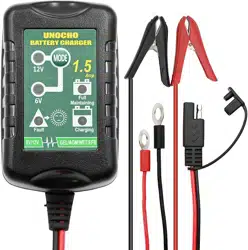
Our new battery charger is completely automatic and can be left whenever input power is made available to the charger. The charger output depends on the conditions of the battery it is charging, when the battery is fully charged, the indicating light will turn green and the charger will switch itself to a storage charge mode and will automatically monitor and maintain the battery at full charge.
CABLE CONNECTIONS
Connect the red positive(+) lead to the positive terminal of the battery. Connect the black negative(-) lead to the negative terminal of the battery.
NOTE: If the charger is left connected to a lead acid battery for long periods of time, check water levels periodically as directed by the battery manufacturer to ensure electrolyte is maintained at proper level.
ATTENTION: THE BATTERY CHARGER HAS A SENSOR FREE, WRONG POLARITY SHORT CIRCUIT PROTECTION CIRCUITRY MUST BE BUILT AS A GOOD PRACTICE NEVER ALLOW THE TWO CLIPS TO TOUCH EACH OTHER.
The Battery Charger will not produce voltage(output) until it recognizes at least three volts from the battery. The battery charger clips must be clipped to a battery in the correct polarity to initiate output voltage and begin charging when in Lead Acid/Polycharge mode. When in Lead Acid(Pb) charge mode if the charger is hooked up in reverse polarity, the Reverse Polarity light will ON indicating that the connection has been made in reverse of the polarity of the battery and a charge has not been initiated. The clips must be re- connected in the proper polarity to start the charger. Red to Positive (+ to +) and Black to Negative(- to -).
SELECTION FOR BATTERY TYPE
AC power is connected with the wall socket property. Press MODE button for battery change mode selection before you connect the charger to the battery terminals.
| LED Signal |
Explanation |
Description |
| 12V |
Lead Acid Charging |
12V lead acid charge mode at 1.5A MAX |
| 6V |
Lead Acid Charging |
6V lead acid charge mode at 1.5A MAX |
LIGHT INDICATION
| LED Signal |
Explanation |
| MODE |
Press the MODE button for the selection of charging program |
| 12V |
PB charging status: the charger is switched to 12V lead acid(Pb) battery charging mode with maximum current 1.5A |
| 6V |
PB charging status: the charger is switched to 6V lead acid(Pb) battery charging mode with maximum current 1.5A |
| Fault(On) |
Battery is connected in reverse polarity, please check the battery connection(joint) connect reverse polarity condition. Make sure Red to POS and Black to NEG. |
| Bad Battery(Flashing) |
The battery is worn out or is possibly defective,suggest replacing battery |
| RAMP 50% Flashing |
<50% battery capacity charging, ON: 50% charging completed |
| 100% Flashing |
<100% battery capacity charging, ON: FULLY CHARGED/MAINTENANCE, The charging process is completed and the battery is in maintenance mode, it can be returned to service if necessary or left safely connected to the charger indefinitely. |
| Symptom |
Possible Cause / Action |
| NO indicator lights are on |
A. Disconnect the charger from the AC outlet. Check connections to battery and ensure they are secure.
B. Check to ensure that there is power at the AC outlet by plugging in a table lamp or power meter. |
| Power Light On but the charging light is off |
A. Battery is not connected.
B. The battery may be damaged or below 3.0 volts, charge process will not begin. In this case the Bad Battery light will be on or the charger remains at Standby mode. |
| Rapid Light On |
A. Battery is connected in reverse polarity.
B. Output is short-circuit. |
| Rapid Light Flashing |
The battery is worn out or is possibly defective. Suggest replacing battery with a new one. |
| The charger is charging but the Fully Charge/Maintenance light does not come on |
A. The battery is worn out or is possibly defective. Suggest testing and/or replacing battery.
B. The battery may have an excessive current draw caused by a potential short circuit. Disconnect battery from charger. Suggest testing and/or replacing battery.
C. The charged battery is larger than the charger marked capacity/ shown in manual/Please exchange with larger capacity charger. |
CHARGING PHASES
1. Qualification Phase
Initially ensures the battery is in good condition prior to launch of normal charge processes, as a safety measure charge processes will not begin if battery is below 3 volts.
2. Soft Start Phase:
Soft Start is applied when the charger has detected a battery at a very low initial state of charge. Voltage and current are delivered at a specified rate to help the battery to recover prior to entering pulse charge mode.
3. Bulk Charge Phase
With the battery now having gone through Qualification and Recovery phases as needed the Bulk Charge phase gives the battery constant current, taking the battery up to 80% of its full capacity.
4. Absorption Phase
In the Absorption phase the battery is given constant voltage while current is reduced based on actions taken from ongoing battery monitoring and if the battery is 100% charged.
5. Maintenance phase
The battery can be left safely connected to the charger indefinitely. The charger will constantly monitor the battery and turn-on again as needed to maintain the battery at a full state of readiness.
TECHNICAL SPECIFICATIONS
Model: EP81000-0612
Input: Auto-switching 100V-240VAC 50/60Hz
Output: 12VDC 1.5A, 6VDC 1.5A
Max Charge Current: 1.5A
Max Voltage: 14.7V(Lead Acid/Pb/Safety charging)
Overcharge Protection: Yes
Short Circuit Protection: Yes
Spark Proof: Yes
Overload Protection: Yes
Reverse Polarity Protection: Yes
Over Heat Protection: Yes
Battery Capacity: Charging LEAD ACID- 12V 1.5A and LEAD ACID- 6V 1.5A (MAX 40 Ah for charging and 80Ah for maintenance)
Charge Selection and Use
Charge and maintenance capacity ranges are suggested only as a guide for battery charger selection and application based on varied customer charging and maintenance requirements. Please be sure to follow safety and use information in user guide for correct product application and use.