Smeg LSTA147 Built-in Washer-Dryer
Product's Documents
Below are documents related to this product, you can read online or download:
- Owner's manual - (English) Read Online | Download pdf
User manual Washer
Important!
The appliance must be installed by a qualified engineer in compliance with the relevant regulations.
The washer-dryer is heavy. Take care when lifting it.
The unit on flexible mounts is fixed in place for transport using the screws (A) on the rear of the washer-dryer, with the relative plastic spacers (B). Once the screws have been removed, the power supply lead can be used.
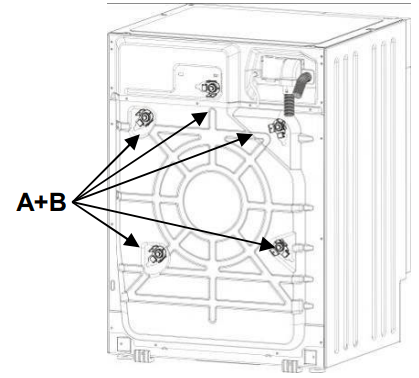
1.Undo all the screws with a 10 mm spanner
2.Remove all the screws (A) from the rear
3.Remove all the plastic spacers (B)
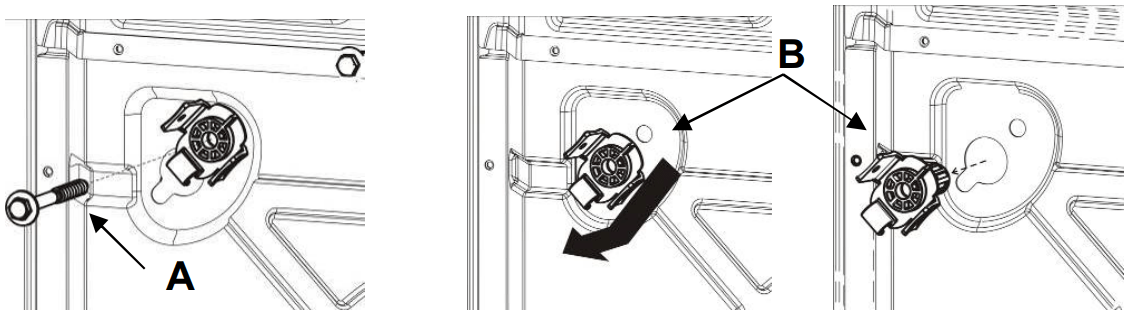
WARNING: It is absolutely necessary to fit all (nr.5) the supplied plastic plugs (C) in order to avoid splashes or water penetrating the machine or to avoid contact with live parts.
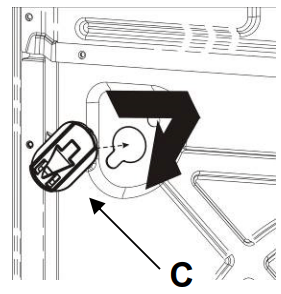
Warning!
1. Place the appliance in the chosen position.
2. Level the appliance carefully in all direc- tions with the aid of a spirit level, adjusting the height of the feet if necessary. Once done, fix the feet in place with the locknuts provided.
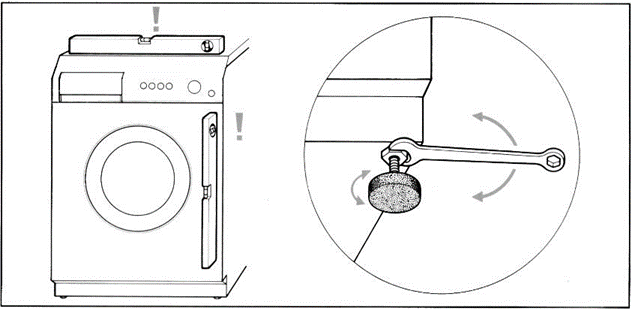
3. On appliances with adjustable rear feet, note that the rear of the appliance rests on skids and not on the feet. Before inserting the appliance into its place between the kitchen units, check that the rear feet are screwed fully in to prevent damage as the appliance is shifted into position.
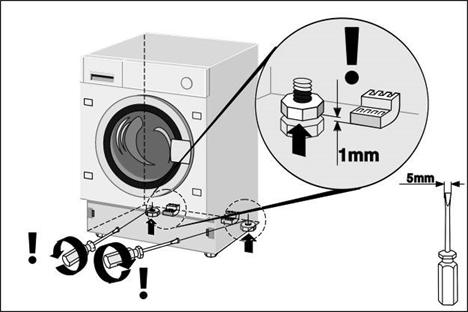
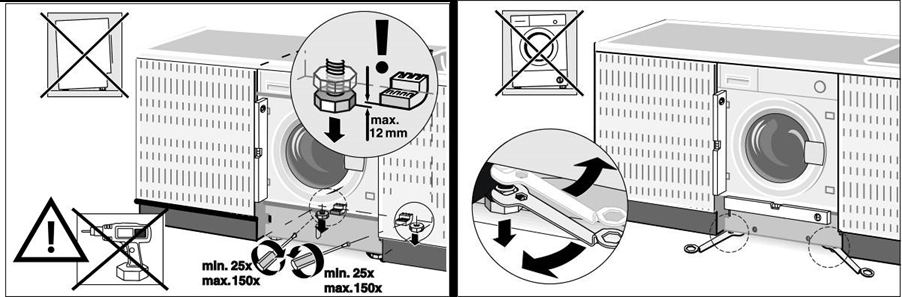
Once the appliance is in position in the kitchen, the height of the rear feet has to be increased so that the appliance no longer stands on the skids. After adjusting the rear feet, level the appliance and fix the front feet at the height required.
EN
The water intake and drain hoses can be fitted pointing to the left or right for effective installation.
Warning!
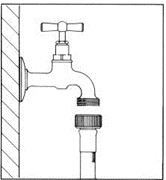
1. Check that the water supply pressure is in the following range: 0,05-0,9MPa. With higher pressures, use a pressure reducer.
2. Connect the cold water supply hose (blue screw collar) to the cold water tap with ¾ gas threaded connector, taking care to tighten firmly to prevent leaks. The water supply hose must not be kinked or crushed and must not be changed or cut. Threaded connections must only be tight- ened by hand.
3. When appliances are supplied with hot water, the intake water temperature must not exceed 60°C and the hose with red screw collar must be connected to the hot water supply tap.
Warning!
1. Insert the end of the drain hose into a drain pipe having inside diameter of at least 4 cm, at least 50 to 90 cm above floor level, or connect it securely (using the plastic fitting on the elbow in the hose) to a sink or bathtub.
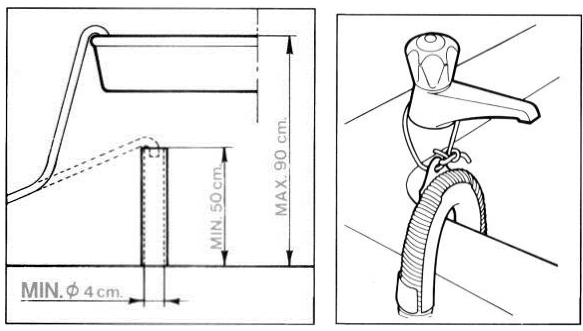
2. In all cases, check that the end of the drain hose is securely fixed to prevent the repulsive force of the water from pushing it out of place.
Warning!
Before connecting the plug to the power socket ensure that:
1.The electrical system voltage is the same as that stated on the nameplate on the front of the appliance, in the zone visible when the door is open. The rated power supply and the fuses required are specified on the nameplate.
2.The meter, safety breakers, power supply line and power socket are rated to withstand the maximum load required, stated on the nameplate.
3.The power supply socket and the plug fitted to the appliance are compatible without the use of reductions, multiple sockets, adapters and extension leads which might cause overheating or scorching.
If the power supply socket is not compatible with the plug supplied, replace the socket with one of the appropriate type.
Warning
The manufacturer declines all liability for direct or indirect injury or damage de- riving from a non-existent or defective earth connection. Correct electrical con- nection guarantees conditions of maximum safety.
All the appliance's control and monitoring devices are placed together on the front panel.
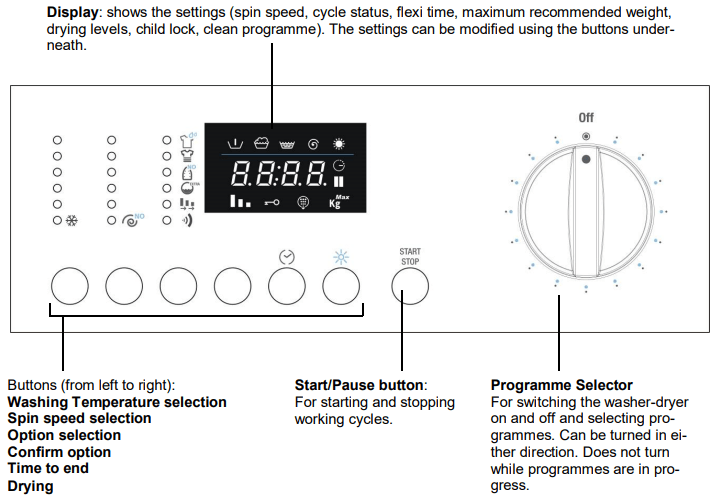
1.Subdivide the items for washing by fabric type and colour fastness.
2. Wash white and coloured items separately. New coloured items should be washed separately the first time. Normally, items carry labels with washing instructions. The following is a short description of the symbols used on these labels.
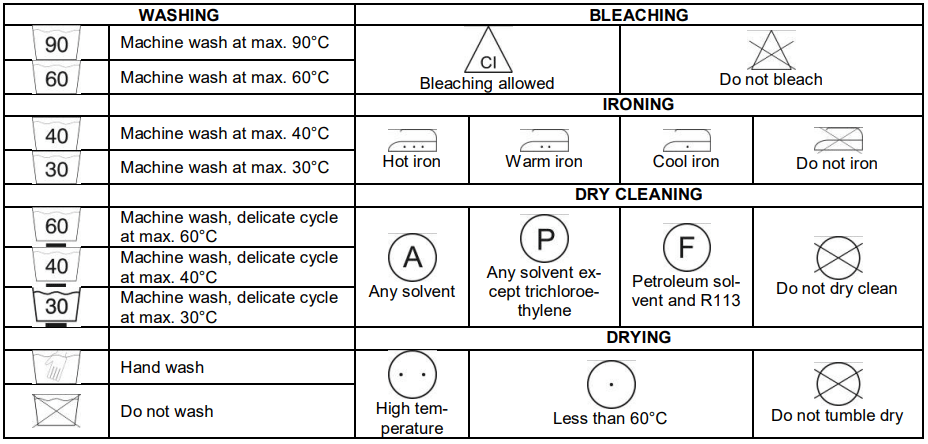
Warning!
Wool – Only wool marked as pure new wool, with the  mark, or labelled "shrink-proof, machine-washable" can be washed in a washing machine on the specific programme; other types of wool should be hand-washed or drycleaned.
The appliance is fitted with a safety device which prevents the door from being opened while the programme is in progress.
1. Check that all the water has been drained from the tank and the drum is at a standstill. Warning!
Warning!
The water may still be boiling hot if the wash was at high temperature. Do not open the door if there is still water in the drum!
As far as possible, to save electricity, it is more economical to wash complete loads of the various types of fabric. Shake out the laundry before loading, and alternate large and small items. It is best to weight the load the first few times, after which you will be able to rely on your experience.
1.Open the door and load the laundry, distributing it evenly over the drum, with items opened out and not bundled together; if possible, large and small items should be well mixed.
2.The washing machine covered by this manual can be loaded with up to 7kg of laundry for each wash. If this weight is exceeded, the washing results will be poor and the appliance may malfunction.
3.To save energy it is more economical to wash full loads of the various types of fabric, following the guidance on quantities provided in the "Programmes Table" supplied in this manual.
4.Close the door by pressing against the frame until you hear it click shut. Take care not to trap items of laundry between the door and the rubber gasket.
Warning!
The internal tray comprises three compartments, marked with the symbols
 prewash detergent
 main wash detergent
 for fabric conditioner, starch, additives, etc. (e.g. treatment products). The additives are added to the washing tank automatically during the final rinse.
The main wash detergent compartment has a tang allowing the use of liquid detergent. To insert it, pull it towards the front and then lower it.
Following the recommendations in the “Programmes Table” supplied with this manual, place the detergent and any addi- tives in the drawer before the start of the programme.
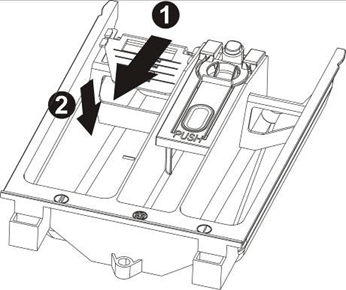
Never fill with liquids above the maximum level marked; otherwise the trays will empty too quickly.
Before pouring dense additives into the container, dilute with a little water to ensure they do not clog the outlet.
Use only low-foam detergents suitable for use in a washer-dryer.
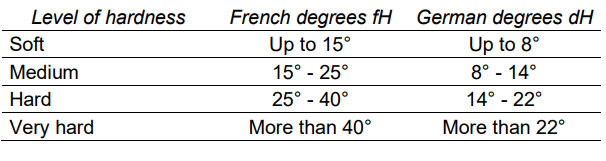
The amount of detergent must be decided in relation of the hard- ness of the water, the type and quantity of items loaded, and their degree of dirt.
This will provide the desired effect with optimal detergent consumption. On detergent packs the recommended dose is indicated for 4 levels of water hardness and for loads of 4-5 kg of laundry with average dirt levels.
Request information about the water's hardness from your water supply company.
Water hardness
Laundry with normal dirt
1.Choose a programme without prewash.
2. Pour the total amount of detergent shown on the pack into the main wash compartment of the detergent drawer.
Very dirty laundry
1.Choose a programme with prewash.
2.Place ¼ of the recommended amount of detergent in the prewash compartment of the detergent drawer and ¾ of the detergent in the wash compartment.
Warning!
1. Pour the dose required into the measuring cap supplied with the bottle of liquid detergent and place it in the drum, or use the main wash compartment of the detergent drawer, fitting the insert provided.
2. The scale on the red insert is intended as an aid when deciding the dose of liquid detergent.
Warning!
To switch on the appliance and select the programme, proceed as follows:
1. Turn the programmes knob in either direction. This switches on the washer-dryer.
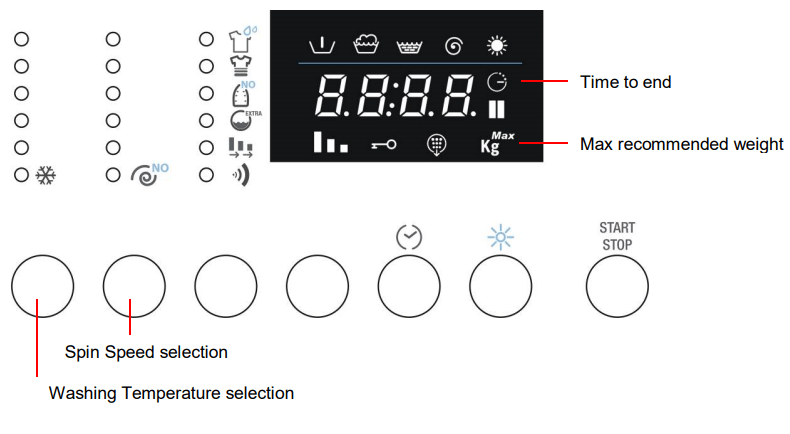
2. Select the washing programme. The time left to the end of the programme and the maximum recommended weight for the selected programme alternate on the display. The symbols on the display light up to identify the information shown.
3. The default spin speed and temperatures values are shown. The initial settings can be modified using the button underneath the sequence of spin speeds and temperatures.
4. If spin speed  is set, there will be no spin cycle and the appliance will stop with the tank full. If this value is set the appliance does not perform the final spin and the washing programme ends with water in the tank.
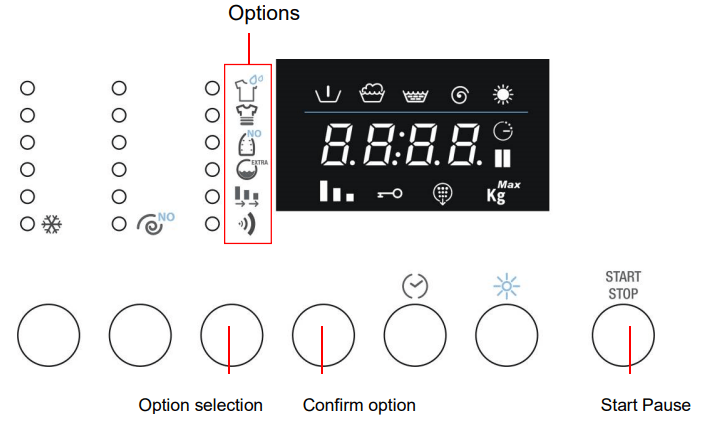
1.The Option Selection button can be used to select the following options in sequence (from the top down): Prewash: adds a stage before the main wash, lasting about 20 minutes at a temperature of 35°C. Suitable for loads of particularly dirty items.
Intensive: the max. temperature is changed to 60°C and the washing stage is extended to increase the effectiveness of the enzymes in the detergents. Suitable for delicate but dirty items.
Easy iron: produces items which are less creased and easy to iron.
Water plus: Increases the amount of water used for washing and rinses.
In alternative Extra rinse: this option adds a rinse to the selected washing programme.
Flexi Time: reduces the duration of the cycle. The symbol is completely illuminated with the initial duration of the selected programme. Once the option has been selected the cycle duration can be further reduced to an intermediate setting and a minimum setting and then returned to the initial duration by repeated pressing of the Set button
In alternative Rapid: reduces the duration of the washing cycle. Suitable for small amounts of laundry with only light dirt.
Buzzer: sets whether or not the buzzer will sound at the end of the cycle. The appliance comes with the buzzer function "on".
2.To confirm the selected option, simply press the Confirm options button and the LED of the option remains on.
3.To delete an option selection, simply return to the option with the Selection button and press the Confirm options button. To annul all the options previously selected in a single operation, simply hold down the Confirm options button for 4 seconds.
4.The Buzzer option retains its "on" or "off" status for subsequent cycles. It is only automatically switched to "off" if the Night Wash programme is chosen.
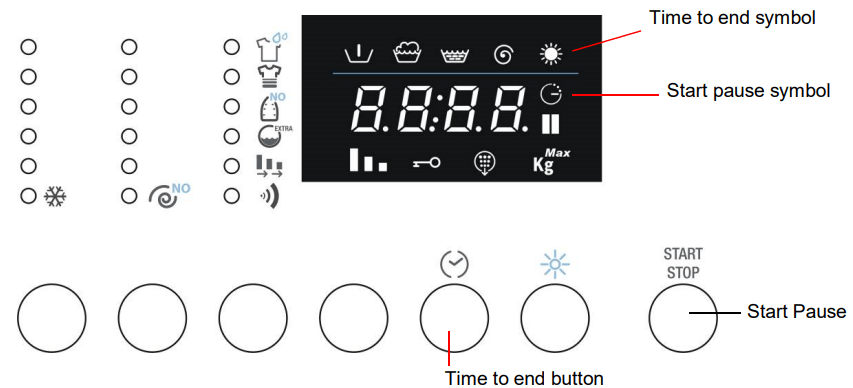
1.The Time to End key can be pressed repeatedly to select the time after which the washing programme will end. The time to end of cycle function calculates the initial duration of the washing/drying cycle, the settings made (temperature, spin speed and options) which may shorten or lengthen the cycle's initial duration, and the delay time the user wishes to add before the cycle starts.
2.After the time to end has been set, the symbol on the display remains on.
3.To annul the Time to End function, keep pressing the key repeatedly until the display shows 0.
4.The Start Pause symbol flashes on and off until the cycle starts. After the cycle starts, the symbol remains constantly lit.
1.To start the washing programme after making your personal settings, press the Start Pause button.
2.Once the cycle has started, the display shows the time remaining before the end of the cycle and the Start Pause symbol on the display is constantly on.
3.During performance of the washing/drying programme, the symbols which identify the various phases light up:
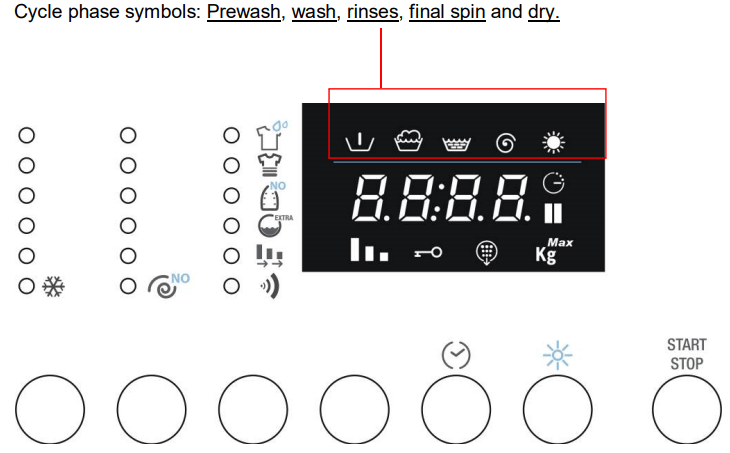
The washing programme in progress can be interrupted at any moment:
1.press the “Start/Pause” button for about 3 seconds: the display shows the word PAUS (for 1 second) alternating with the time remaining until the end of the cycle (for 1 second). The Start/Pause light flashes on and off.
Programmes can also be interrupted by turning the programme/temperature setting knob while the cycle is in progress.
2.To change the washing programme, simply turn the programme knob to select the new programme; there is no need to set the appliance in pause status. The new cycle will be carried out completely, beginning from the start. If the tank had already been filled with water during the previous cycle, the water intake phase will be omitted from the new programme.
3.To restart the cycle, press the Start-Pause button again.
Washing/drying programmes are completed automatically. The word END appears on the display and the "Time remaining" light goes out.
1.Switch the appliance off by turning the programmes knob to OFF
2.Unload the laundry from the drum.
3.Leave the door ajar to allow the interior of the washer-dryer to dry out.
4.Turn off the water intake tap.
If during the initial spin speed setting stage, the "no spin" mode with stop with tank full (spin speed set as 0) was selected, at the end of the washing programme the word STOP appears on the display, alternating with ---- (spin speed of 0) and the spin light is on.
To proceed with the pump-out and spin, press the spin selection button twice. The appliance restarts the cycle with the pump-out and spin. To select the spin speed required, press the button until the chosen speed is displayed. To pump out the water from the tank without performing the spin, press the spin selection button until the display indicates speed of 0: the pump-out will be run without spin.
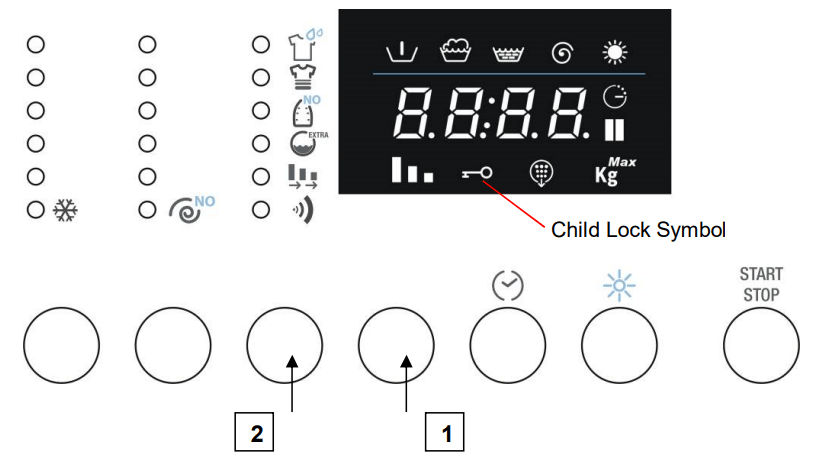
1.When this function is activated, the modification of options, temperatures, spin speed and the washing/dry- ing cycle is not possible while the cycle is in progress.
2.To activate the Child Lock, press the Confirm option button (1) and hold it down. Also press the Option selection button (2) within 3 seconds.
3.The Child Lock symbol lights up to show that the function has been activated.
4.Repeat the same procedure to deactivate the function.
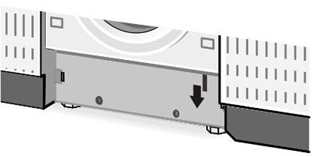
In the event of a power failure, the door is opened using the mechanical release device activated by means of the lever in the bottom of the appliance:
Warning, scolding hazard: before opening the door, check that the appliance does not contain boiling hot water and deter- gent which may pour out and cause injury when the door is opened.
Warning: do not open the door using the emergency release lever while the drum is turning.
During drying cycles, the water tap must be turned on and the drain hose correctly positioned.
This appliance can be set to perform wash only, dry only and wash-and-dry programmes.
In the wash-and-dry programme, the appliance switches from washing to drying automatically, with no need to use the controls (at the end of the wash) to obtain the complete cycle.
Attention
Important – Do not dry delicate fabrics that will not withstand a temperature of 60°C or any fabrics which will not withstand the selected temperature.
EXTRA DRYING
If the laundry is still too damp at the end of the programme, set a short timed drying programme.
Warning!: do not over-dry as this may cause creases or shrinkage of garments.
Automatic washing and drying can be carried out in the tough fabrics (cotton and colours) and synthetic/delicate fabrics programmes. If the wool wash programmes are selected, automatic drying after the wash cannot be set.
For automatic washing and drying, the load of laundry must not exceed 4 kg of cotton or 2 kg of synthetic fabrics.
Therefore, if the load for washing and drying exceeds the quantities stated above, a wash+dry programme is not recommended; the load will have to be halved after washing and dried in two lots.
To set a wash-and-dry programme proceed as follows:
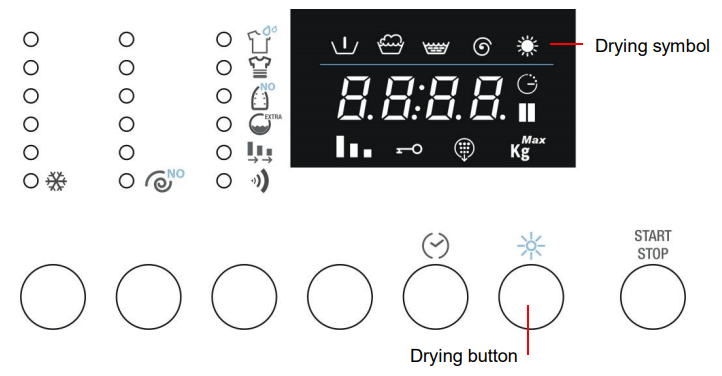
Whether drying will be at the normal temperature (90°C) or the delicate fabrics temperature (60°C) depends on the washing programme set previously.
Once a drying time has been set, the symbol on the display flashes; it remains constantly on once the cycle enters the drying stage.
Attention
To keep the appliance operating at peak efficiency over time, it has a CLEAN programme for regular cleaning of the drying circuit to remove any fluff deposits.
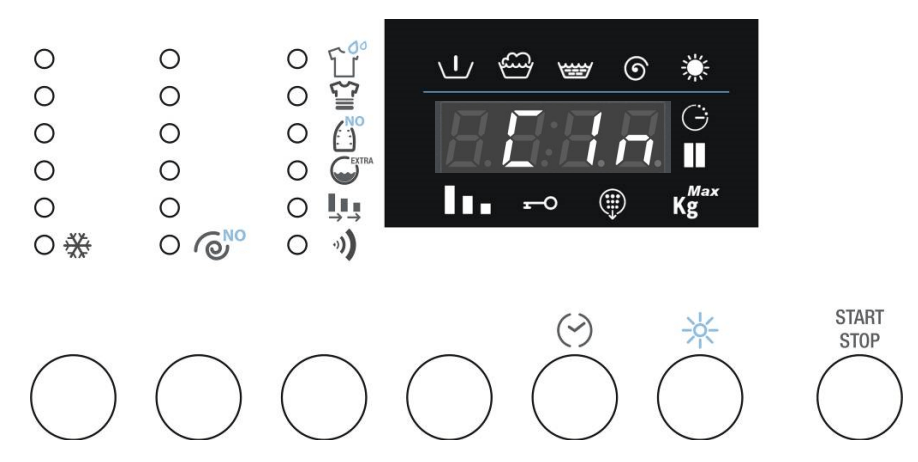
1.After a given number of drying cycles, the CLEAN symbol  lights up and the text Cln appears on the display to warn that this programme needs to be run. The warning light remains on until the CLEAN programme is carried out. The light goes out at the end of the programme.
2.To perform the CLEAN programme, proceed as follows:
a.Make sure that the drum is completely empty and close the door.
b.Turn the knob to the CLEAN programme (see programmes table for the exact position on the knob)
c.Press the START/PAUSE button
The CLEAN programme can also be carried out even if the light on the display is not on.
Important – Before carrying out any cleaning or maintenance procedure, the plug must be disconnected from the power supply socket.
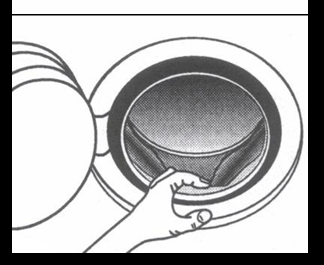
Check regularly that there are no brooches, buttons, nails or pins in the folds of the door gasket.
The drain pump only needs cleaning if it has been blocked by buttons, brooches or similar objects and the water is not being pumped out.
In this case, proceed as described below.
1.Remove the mains plug to disconnect the appliance from the electricity supply.
2.Depending on the model, proceed as follows:
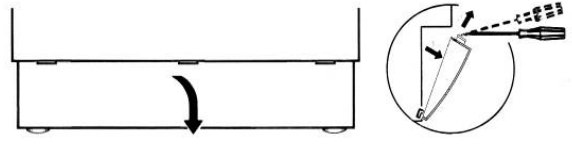
Built-in/totally concealed model – use a small screw- driver as a lever to remove the plugs shown here, turn the plinth downwards and access the pump.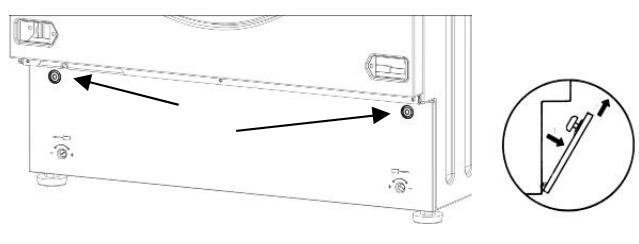
Free-Standing Model – Insert a small screwdriver through the slits in the front of the plinth, then apply upward leverage with the screwdriver to release the top of the plinth from the cabinet.
Tilt the plinth forward slightly and pull it upward to re- move it completely.
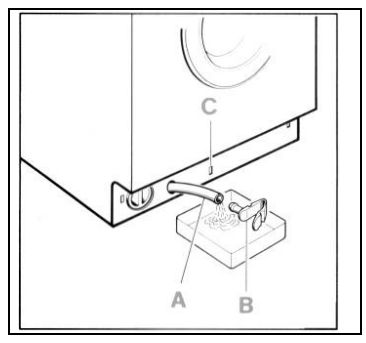
3. Extract the drain hose ”A”.
Warning: if the hose is hot, the water is hot or boiling hot. Place a shallow container on the floor and remove the plug “B” to drain off the water.
Depending on the amount of water in the appliance, the container may have to be emptied several times.
When no more water is coming out, close the hose again by pushing the plug “B” firmly back into place.
4. Unscrew the cover of the pump “D” by turning it to the left. Clean the pump and remove any foreign bodies.
Also check the inside “E”, making sure that the impeller turns freely; any foreign bodies stuck in it must be removed.
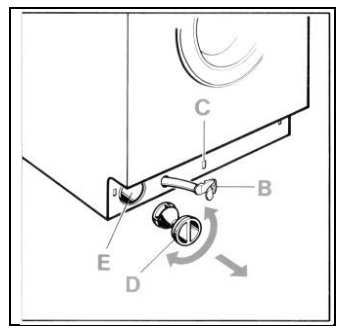
5. Screw the cover back on the pump.
Secure the drain house by snapping the plug back into place "C". Depending on the model, replace the plinth as follows:
Built-in/completely concealed model – Fit the bottom of the plinth first. Push it towards the cabinet and put the plugs back into place.
Free-standing model – Fit the bottom of the plinth first and then push it towards the cabinet until it snaps into place.
The detergent drawer should be kept clean, removing all solid deposits.
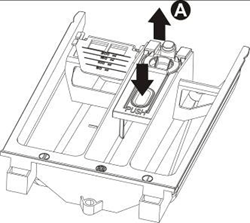
To simplify this operation, completely remove the detergent drawer (pull the drawer fully out, press in the zone marked PUSH and then remove completely).
Remove the siphon "A" and clean all parts with hot water.
Fully re-insert the siphon and remove any detergent deposits before putting the drawer back in position.
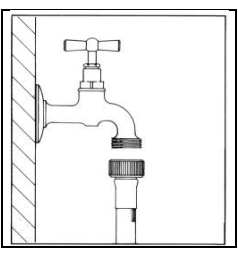
The machine is fitted with a filter which protects the water intake valves.
The filter is in the fitting on the intake hose which is connected to the tap
The filter must be cleaned if the washer-dryer is not taking in water or the amount of water is insufficient.
To clean, proceed as follows:
This produce complies with the relevant regulations governing the safety of electrical equipment. For safety reasons, any technical inspections or repairs must be performed by qualified staff, to prevent all hazards for the user.
If the appliance does not work, before calling the After-Sales Service, to avoid unnecessary expense, check yourself that the operations listed in this troubleshooting table have been carried out..
Appliance does not start | Check that: -plug is properly connected to socket -door is securely closed -“Start/Pause” button has been pressed. Check that: |
| No water filling | Check that: -plug is properly connected to socket -door is securely closed -water tap is turned on -water intake hose filters not fouled. -water intake hose not trapped or kinked. |
| No water visible in washing drum | No malfunction. The water level is below the level of the glass in the door because new appliances use very little water to achieve the same washing and rinsing results.
|
| Water not pumped out | Check that: -drain hose is not kinked -drain pump not fouled. |
| Water not pumped out after last rinse in delicate fabrics and wool wash programmes | It is not a malfunction: pause programmed into washing programme to pre- vent creasing of fabrics. To pump out water, proceed as described in "Programme End" point. |
| Water takes in and pumps out water continually | Check that end of drain hose is not too low down. |
| Strong vibrations during spins | Check that: -Appliance is properly levelled -washer-dryer not too close to walls or kitchen units -internal unit on flexible mounts locked in position. |
| Too much foam formed in tank and flowing out of drawer | Check that: -detergent used is recommended for automatic washing machines and not for hand washing -quantity used is as stated in manual and no more. |
| Water on floor | Check that: -water intake hose fittings not loose -end of drain hose still correctly positioned. |
| Not all fabric conditioner used or too much water left in compartment | Check that detergent drawer siphons are correctly fitted and not fouled. |
| Appliance does not spin | Anti-imbalance safety device tripped because laundry not evenly distrib- uted in drum. If laundry is still wet at end of cycle, rearrange it in the drum by hand and repeat spin programme only. |
| Emptying water from drum | In the event of a power blackout or appliance failure, the water can be re- moved from the drum using the emergency procedure. |
| Laundry not properly spun | Large items screwed up and not evenly distributed within drum. Always wash a mix of large and small items. |
| Traces of detergent on laundry | Many phosphate-free detergents contain substances with low water solu- bility. Select Rinse programme or brush the laundry. |
| Laundry not dried | Check that: -water tap is turned on -load of laundry is not excessive -drying time is long enough -appropriate drying time selected. |
| Washing results unsatisfactory | If the appliance still does not dry the laundry, call the Service Centre to have the fan and drying ducts cleaned to remove any fluff deposits. -Probably too little detergent or unsuitable detergent used -Difficult stains not dealt with before washing -Correct temperature not set -Basket overloaded. |
In case of a malfunction, the appliance will identify the problem by showing an error code on the display.
Error code | Key to problem |
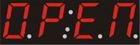 | Door not properly closed. Try reclosing. |
 | Aqua stop device tripped. Cut off power supply, turn off water tap and contact nearest service centre. |
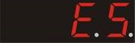 | Water not taken in for washing. See point 2 in troubleshooting table. |
 | Water not pumped out. See point 4 in troubleshooting table. |
 | No error! The unbalanced load detection system has detected an imbalance caused by the laundry items. Cannot start "Flusen Spulen (lint removal)" program. Remove laundry. |
For all the other error codes displayed, cut off the electricity supply, turn off the water tap and contact your nearest Service Centre.