®
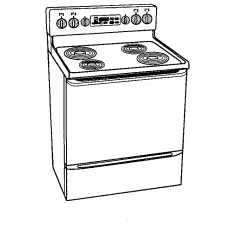
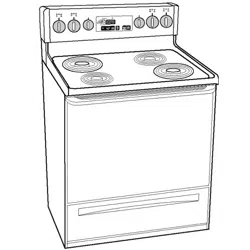
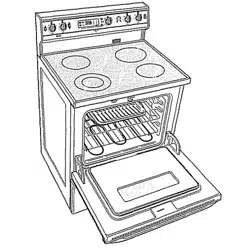
Self-Cleaning Electric Range
Cocina El_ctrica de Autolimpieza
Models, Modelos 665.95775, 95776, 95779
J
Super Capacity with UltraBake TM System
Capacidad extra con el Sistema UltraBake TM
8053878 Sears Roebuck and Co., Hoffman Estates, IL 60179 U.S.A. www.sears.com
rableofContents A Noteto You
A Note to You ............................................... 2
Warranty ....................................................... 3
Range Safety ................................................ 4
Parts and Features ....................................... 7
Using Your Range ........................................ 8
Using the Surface Cooking Areas ...................8
Characteristics of Cookware Materials ........12
Using the Oven ............................................... 13
Bakeware Choices .......................................... 14
Using Aluminum Foil.......................................14
The Electronic Oven Control ..........................15
Setting the Clock ......................................16
Tones .......................................................... 16
Using the Electronic Kitchen -I]mer ........17
Starting/Canceling a Function .................18
UltraBake TM Baking/Roasting .................18
Readjusting the Oven
Temperature Control .................................20
Broiling ....................................................... 22
Using the Timed Oven Control ...............25
The Oven Vent .................................................30
The Anti-Tip Bracket .......................................30
The Storage Drawer .......................................31
Using the Self-Cleaning Cycle ................... 32
Before You Start ..............................................32
Setting the Controls ........................................33
How the Cycle Works .....................................35
Caring for Your Range ................................ 36
Cleaning Chart .................................................36
Cleaning the Radiant Glass Cooktop ...........38
Removing the Oven Door ..............................39
The Oven Light................................................ 40
Troubleshooting .......................................... 41
Range Does Not Work ...................................41
When Self-Cleaning Your Oven ....................41
Cooking Results ..............................................42
Display Messages ...........................................42
Index ........................................................... 43
Service ......................................... Back Cover
Wha!]kIoI 'Io = '= I .'
£ Kl{ll£OlI
Your KENMORE electric range takes on a new value
when you discover that Sears has service centers
around the country. Trained Sears Service
Professionals use fully-equipped trucks and Sears-
approved methods for expert repairs backing up all
Sears guarantees.
Whenever you call to request service for your
appliance, you need to know your complete model
number and serial number. You can find this
information on the model and serial number plate
(see diagram in the "Parts and Features," p. 7).
Please also record the purchase date of your
appliance and your store's name and telephone
number.
Model Number 665.
Serial Number R
Purchase Date
Store Name
Store Phone
Keep this book and the sales slip together in
a safe place for future reference.
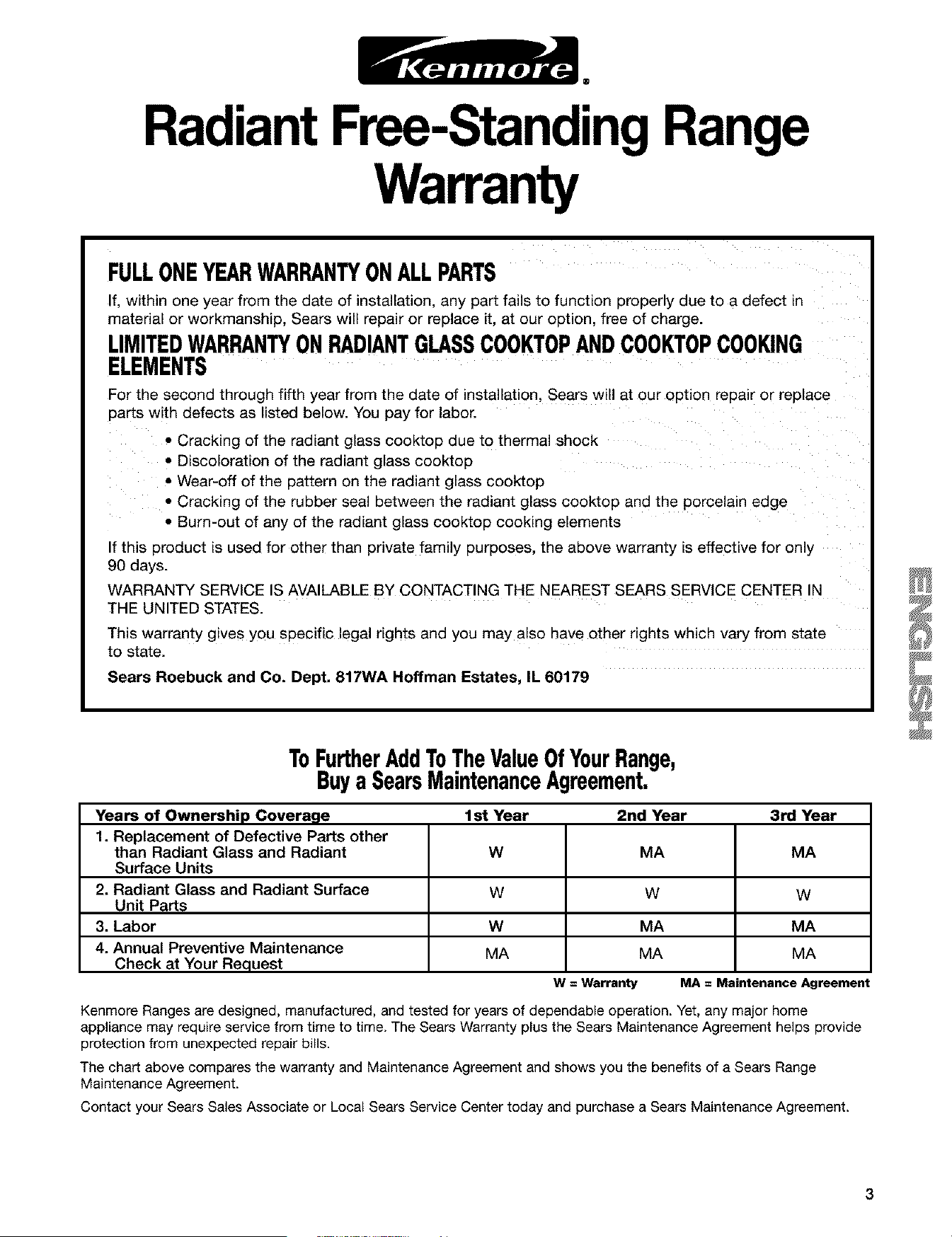
Radiant Free-StandingRange
Warranty
FULLONEYEARWARRANTYONALLPARTS
If, within one year from the date of installation, any part fails to function properly due to a defect in
material or workmanship, Sears will repair or replace it. at our option, free of charge.
LIMITEDWARRANTYONRADIANTGLASSCOOKTOPANDCOOKTOPCOOKING
ELEMENTS
For the second through fifth year from the date of installation. Sears will at our option repair or replace
parts with defects as listed below. You pay for labor.
• Cracking of the radiant glass cooktop due to thermal shock
• Discoloration of the radiant glass cooktop
• Wear-off of the pattern on the radiant glass cooktop
• Cracking of the rubber seal between the radiant glass cooktop and the porcelain edge
• Burn-out of any of the radiant g_ass cooktop cooking elements
If this product is used for other than private family purposes, the above warranty is effective for only
90 days.
WARRANTY SERVICE IS AVAILABLE BY CONTACTING THE NEAREST SEARS SERVICE CENTER IN
THE UNITED STATES.
This warranty gives you specific legal rights and you may also have other rights which vary from state
to state.
Sears Roebuck and Co. Dept. 817WA Hoffman Estates, IL 60179
ToFurtherAddToTheValueOfYourRange,
Buya SearsMaintenanceAgreement.
Years of Ownership Coverage 1st Year 2nd Year 3rd Year
1. Replacement of Defective Parts other
than Radiant Glass and Radiant W MA MA
Surface Units
2. Radiant Glass and Radiant Surface W W W
Unit Parts
3. Labor W MA MA
4. Annual Preventive Maintenance MA MA MA
Check at Your Request
W = Warranty MA = Maintenance Agreement
Kenmore Ranges are designed, manufactured, and tested for years of dependable operation. Yet, any major home
appliance may require service from time to time. The Sears Warranty plus the Sears Maintenance Agreement helps provide
protection from unexpected repair bills.
The chart above compares the warranty and Maintenance Agreement and shows you the benefits of a Sears Range
Maintenance Agreement.
Contact your Sears Sales Associate or Local Sears Service Center today and purchase a Sears Maintenance Agreement.
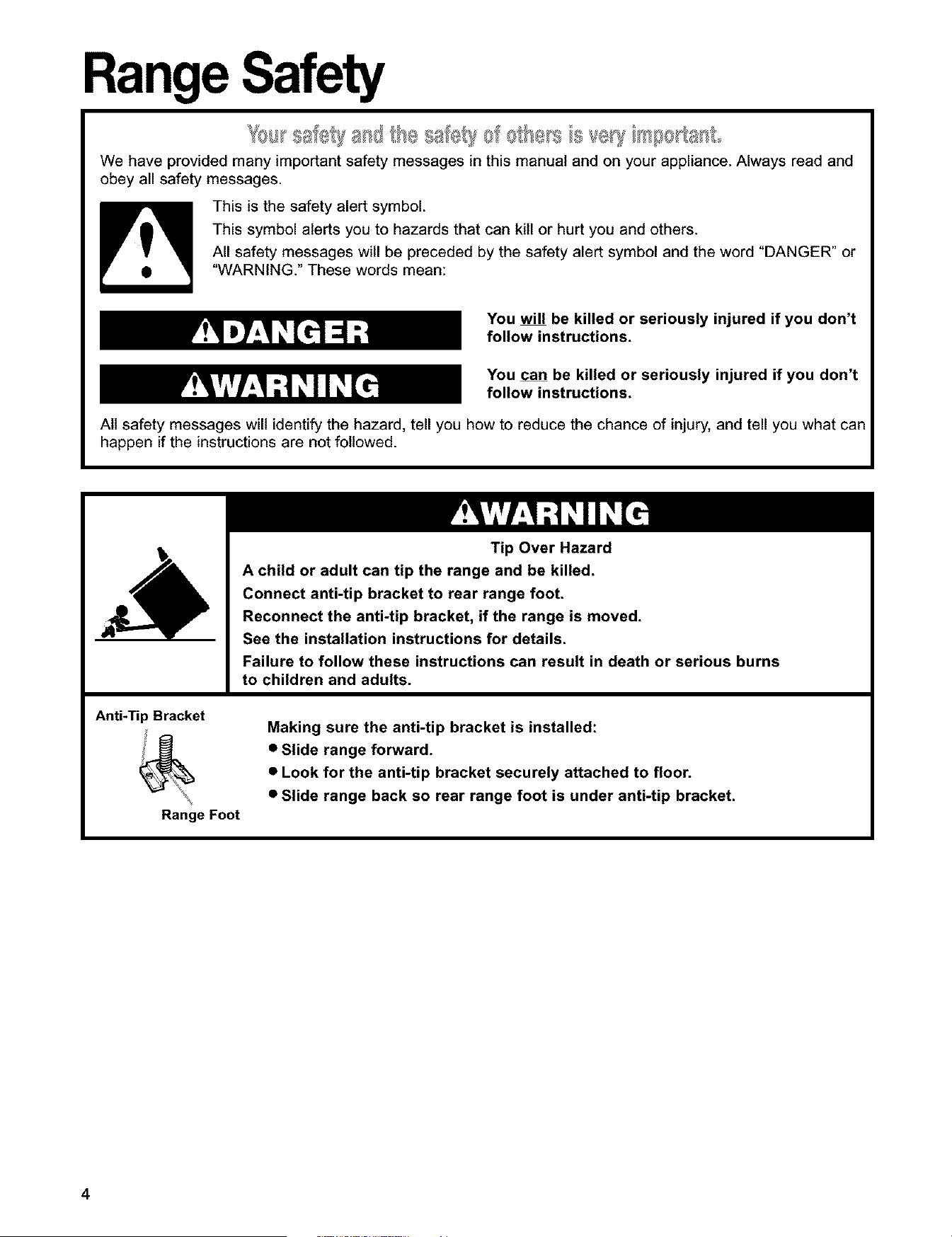
RangeSafety
We have provided many important safety messages in this manual and on your appliance. Always read and
obey all safety messages.
This is the safety alert symbol.
This symbol alerts you to hazards that can kill or hurt you and others.
All safety messages will be preceded by the safety alert symbol and the word "DANGER" or
"WARNING." These words mean:
You will be killed or seriously injured if you don't
follow instructions.
You can be killed or seriously injured if you don't
follow instructions.
All safety messages will identify the hazard, tell you how to reduce the chance of injury, and tell you what can
happen if the instructions are not followed.
Anti-Tip Bracket
Range Foot
Tip Over Hazard
A child or adult can tip the range and be killed.
Connect anti-tip bracket to rear range foot.
Reconnect the anti-tip bracket, if the range is moved.
See the installation instructions for details.
Failure to follow these instructions can result in death or serious burns
to children and adults.
Making sure the anti-tip bracket is installed:
• Slide range forward.
• Look for the anti-tip bracket securely attached to floor.
• Slide range back so rear range foot is under anti-tip bracket.
4
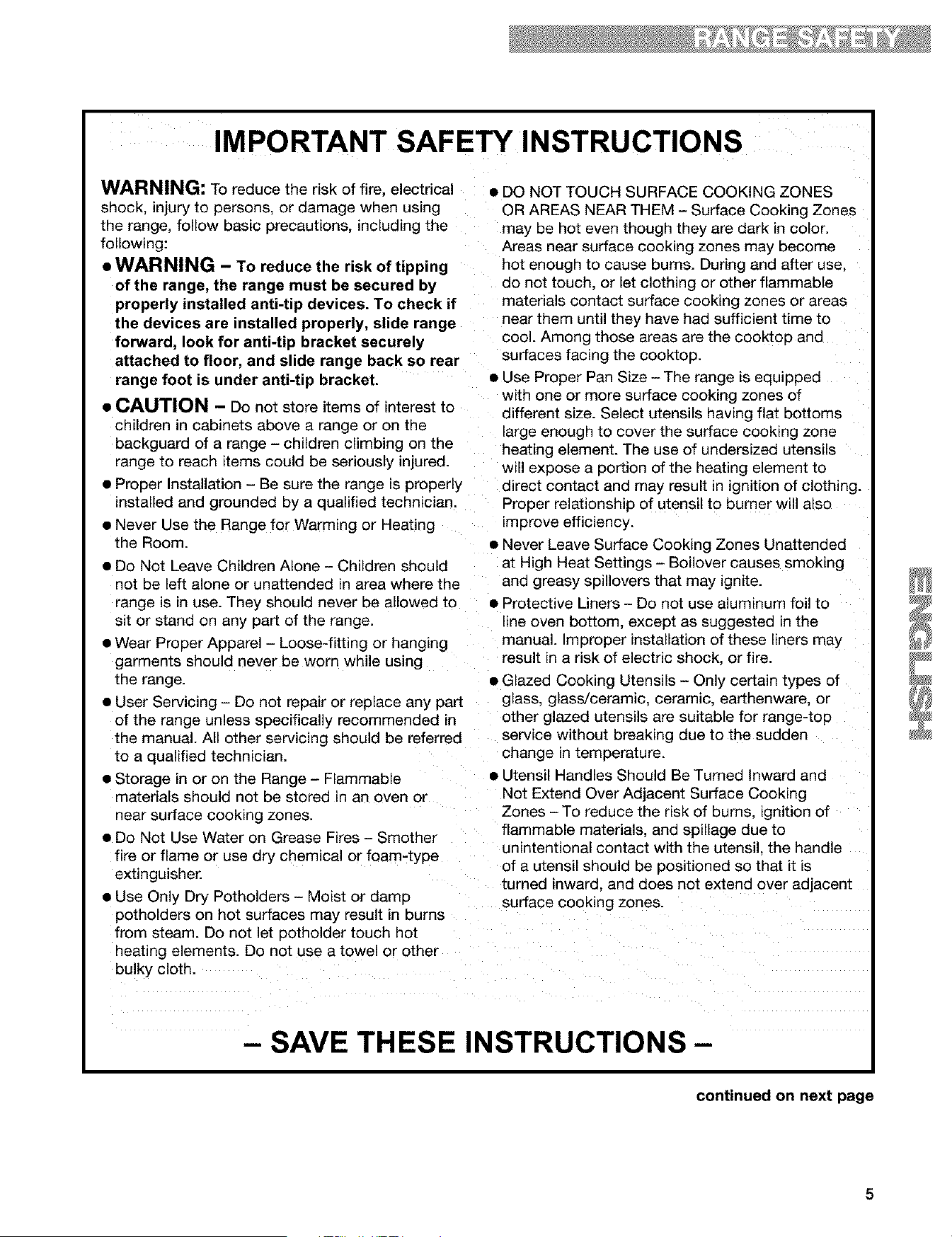
IMPORTANT SAFETY INSTRUCTIONS
WARNING: To reduce the risk of fire. electrical
shock, injury to persons, or damage when us=rig
the range, follow basic precautions, including the
following:
• WARNING - To reduce the risk of tipping
of the range, the range must be secured by
properly installed anti-tip devices. To check if
the devices are installed properly, slide range
forward, look for anti-tip bracket securely
attached to floor, and slide range back so rear
range foot is under anti-tip bracket.
• CAUTION - Do not store items of interestto
cHIdren in cabinets above a range or on the
backguard of a range - children climbing on the
range to reach items could be seriously injured.
• Proper Installation - Be sure the range is properly
installed and grounded by a qualified technician.
• Never Use the Range for Warming or Heating
the Room.
• Do Not Leave CHIdren Alone - CHIdren should
not be left alone or unattended in area where the
range is in use. They should never be allowed to
sit or stand on any part of the range.
• Wear Proper Apparel - Loose-fitting or hanging
garments should never be worn while using
the range.
• User Servicing - Do not repair or replace any part
of the range unless specifically recommended in
the manual. All other servicing should be referred
to a qualified technician.
• Storage in or on the Range - Flammable
materials should not be stored in an oven or
near surface cooking zones.
• Do Not Use Water on Grease Fires - Smother
fire or flame or use dry chemical or foam-type
extinguisher.
• Use Only Dry Potholders - Moist or damp
potholders on hot surfaces may result in burns
from steam. Do not let potholder touch hot
heating elements. Do not use a towel or other
bulky cloth.
• DO NOT TOUCH SURFACE COOKING ZONES
OR AREAS NEAR THEM - Surface Cooking Zones
may be hot even though they are dark in color.
Areas near surface cooking zones may become
hot enough to cause bums. During and after use.
do not touch, or let clothing or other flammable
materials contact surface cooking zones or areas
near them until they have had sufficient time to
cool. Among those areas are the cooktop and
surfaces facing the cooktop.
• Use Proper Pan Size -The range is equipped
with one or more surface cooking zones of
different size. Select utensils having flat bottoms
large enough to cover the surface cooking zone
heating element. The use of undersized utensils
will _=xposea portion of the heating element to
direct contact and may result in ignition of clothing.
Proper relationship of utensil to burner will also
irr prove efficiency.
• Never Leave Surface Cooking Zones Unattended
at High Heat Settings - Boilover causes smoking
and greasy spillovers that may ignite.
• Protective Liners - Do not use aluminum foil to
line oven bottom, except as suggested in the
manual. Improper installation of these liners may
result in a risk of electric shock, or fire.
• Glazed Cooking Utensils - Only certain types of
glass, glass/ceramic ceramic, earthenware, or
other glazed utensils are suitable for range-top
service without breaking due to the sudden
change in temperature.
• Utensil Handles Should Be Turned Inward and
Not Extend Over Adjacent Surface Cooking
Zones - To reduce the risk of bums. ignition of
flammable materials, and spillage due to
unintentional contact with the utensil, the handle
of a utensil should be positioned so that it is
turned inward, and does not extend over adjacent
surface cooking zones.
- SAVE THESE INSTRUCTIONS -
continued on next page
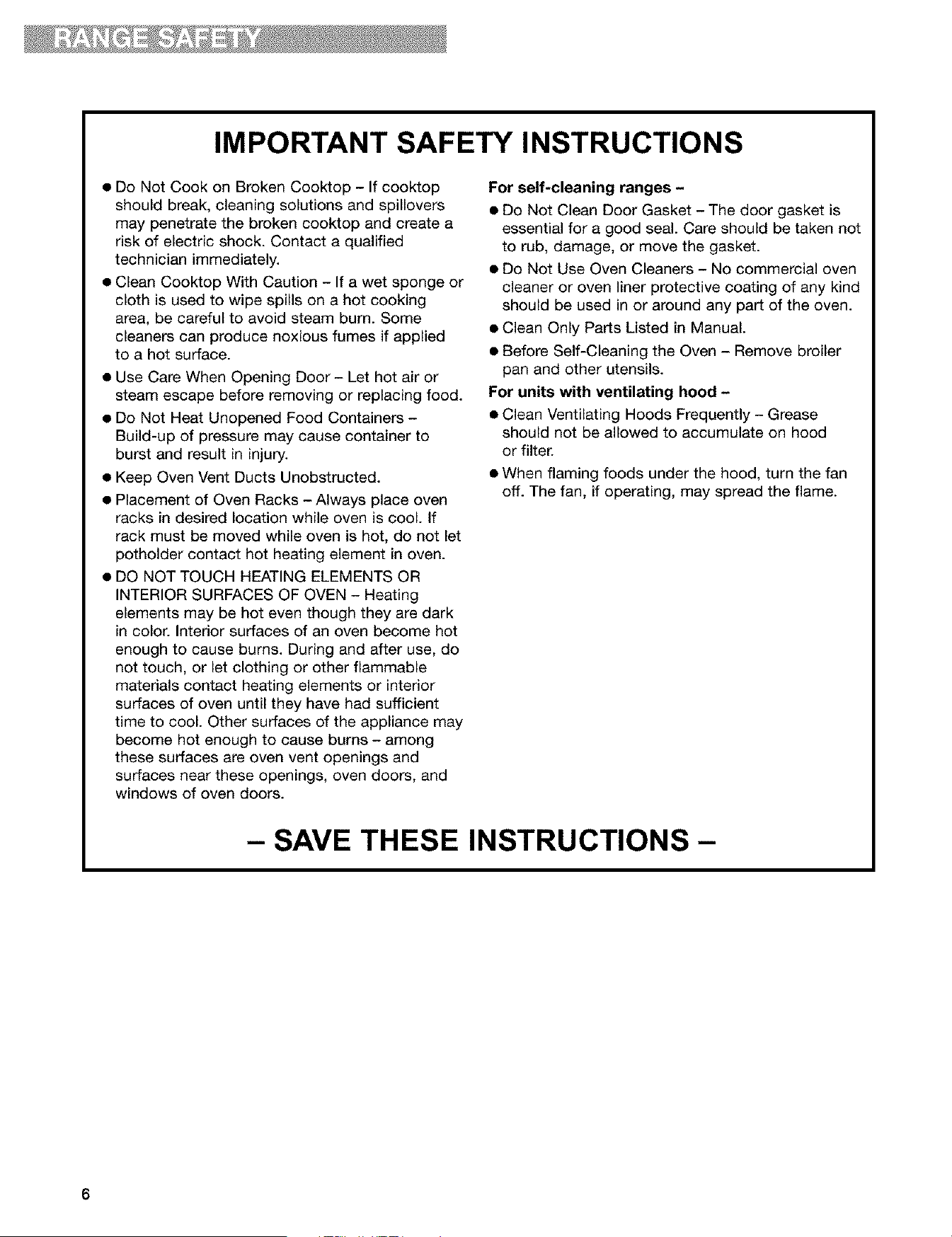
IMPORTANT SAFETY INSTRUCTIONS
• Do Not Cook on Broken Cooktop - If cooktop
should break, cleaning solutions and spillovers
may penetrate the broken cooktop and create a
risk of electric shock. Contact a qualified
technician immediately.
• Clean Cooktop With Caution - If a wet sponge or
cloth is used to wipe spills on a hot cooking
area, be careful to avoid steam burn. Some
cleaners can produce noxious fumes if applied
to a hot surface.
• Use Care When Opening Door- Let hot air or
steam escape before removing or replacing food.
• Do Not Heat Unopened Food Containers -
Build-up of pressure may cause container to
burst and result in injury.
• Keep Oven Vent Ducts Unobstructed.
• Placement of Oven Racks - Always place oven
racks in desired location while oven is cool. If
rack must be moved while oven is hot, do not let
potholder contact hot heating element in oven.
• DO NOT TOUCH HEATING ELEMENTS OR
INTERIOR SURFACES OF OVEN - Heating
elements may be hot even though they are dark
in color. Interior surfaces of an oven become hot
enough to cause burns. During and after use, do
not touch, or let clothing or other flammable
materials contact heating elements or interior
surfaces of oven until they have had sufficient
time to cool. Other surfaces of the appliance may
become hot enough to cause burns - among
these surfaces are oven vent openings and
surfaces near these openings, oven doors, and
windows of oven doors.
For self-cleaning ranges -
• Do Not Clean Door Gasket - The door gasket is
essential for a good seal. Care should be taken not
to rub, damage, or move the gasket.
• Do Not Use Oven Cleaners - No commercial oven
cleaner or oven liner protective coating of any kind
should be used in or around any part of the oven.
• Clean Only Parts Listed in Manual.
• Before Self-Cleaning the Oven - Remove broiler
pan and other utensils.
For units with ventilating hood -
• Clean Ventilating Hoods Frequently - Grease
should not be allowed to accumulate on hood
or filter.
• When flaming foods under the hood, turn the fan
off. The fan, if operating, may spread the flame.
- SAVE THESE INSTRUCTIONS -
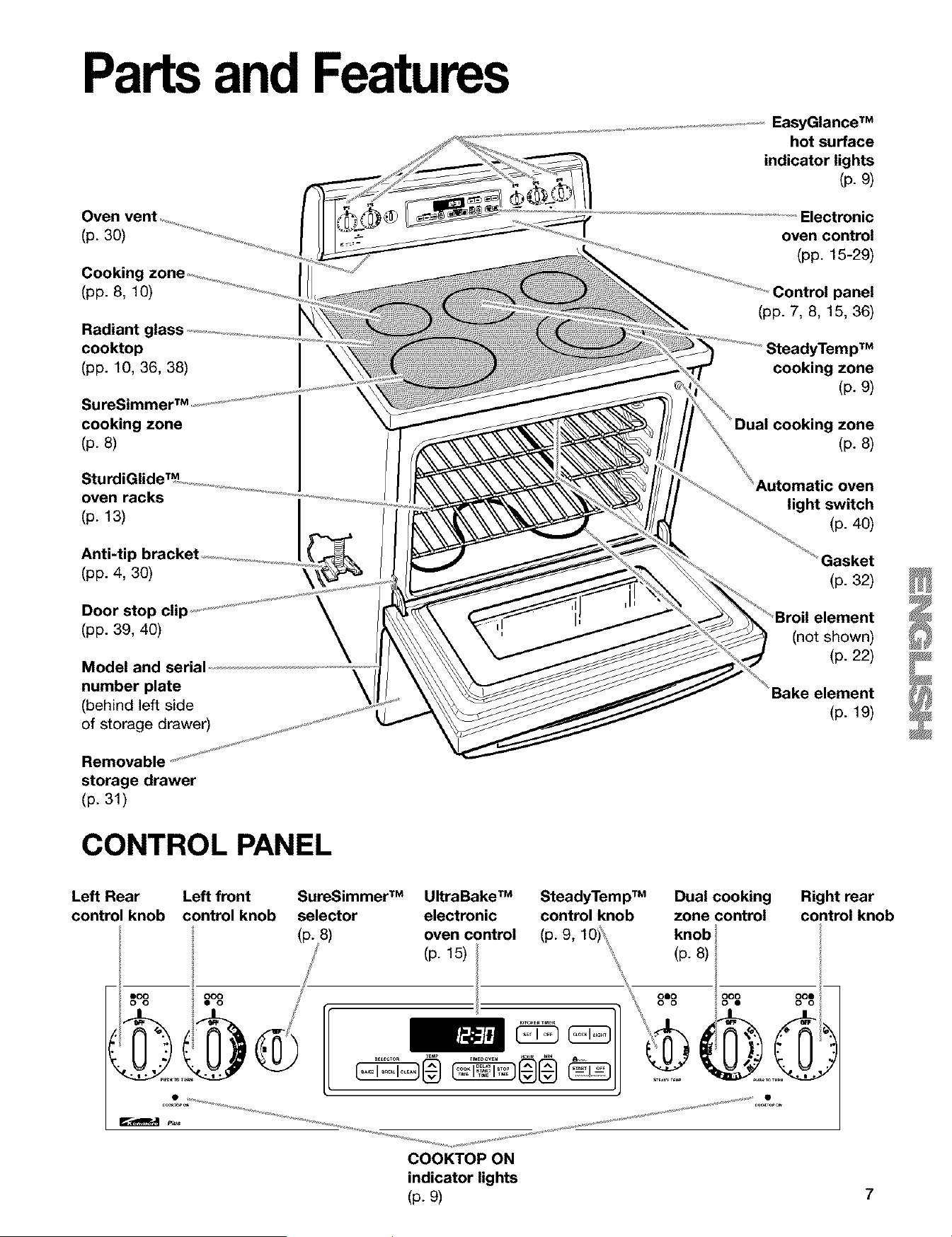
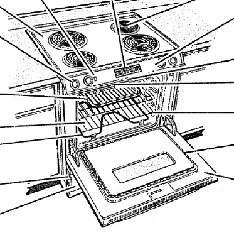
Partsand Features
(p. 30)
Cooking
(pp. 8, 10)
Radiant g
cooktop
(pp. 10, 36, 38)
cooking zone
(p. 8)
oven racks
(p. 13)
Anti-ti_
(pp. 4, 30)
Door stop clip
(pp. 39, 40)
Model and serial
number plate
(behind left side
of storage drawer)
Removable
storage drawer
(p. 31)
CONTROL PANEL
\
................ EasyGlance TM
hot surface
indicator lights
(p. 9)
Electronic
oven control
(pp. 15-29)
Control panel
(pp. 7, 8, 15, 36)
cooking zone
(p. 9)
_gzone
(p. 8)
Automatic oven
light switch
(p. 40)
Gasket
(p. 32)
(not shown)
(p. 22)
Bake element
(p. 19)
Left Rear
control knob
Left front SureSimmer TM UltraBake TM SteadyTemp TM Dual cooking Right rear
control knob selector electronic control knob zone control control knob
8) 1 _
oven control (p. 9, O) knob
(P_ (p.15) _,, (p.8)
\
ooo coo ooo
_ O0 O0 O0
@ @ @ @@ .........
i
i
ooo i coo i
o o _ e o
Ps_
COOKTOP ON
indicator lights
(p. 9)
UsingYourRange
USING THE SURFACE COOKING AREAS
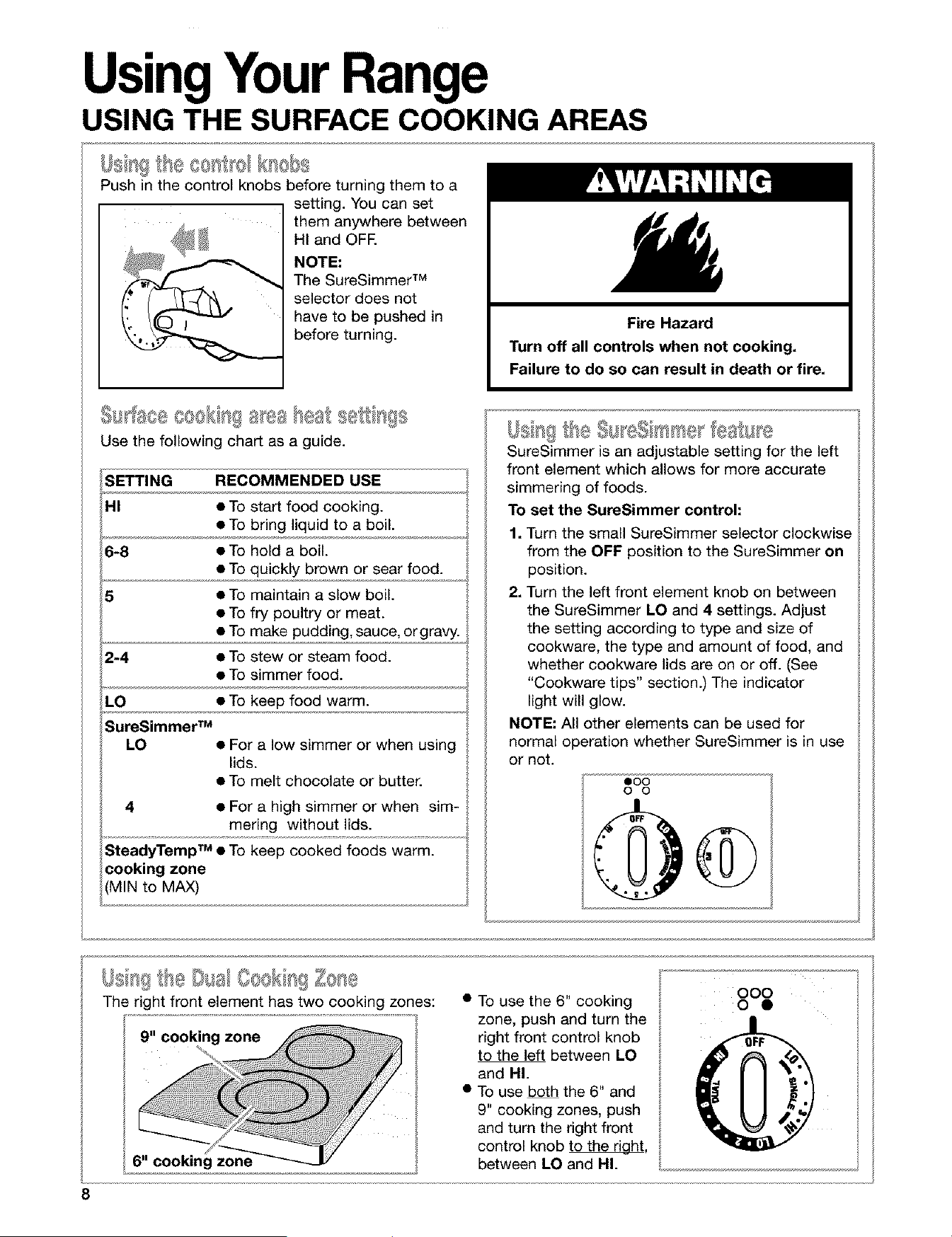
Push in the control knobs before turning them to a
setting. You can set
them anywhere between
HI and OFE
NOTE."
The SureSimmer TM
selector does not
have to be pushed in
before turning.
Fire Hazard
Turn off all controls when not cooking.
Failure to do so can result in death or fire.
4'_IF_I¢8 ©OQR Ig 818_ ,=@81SI_IIISI_
Use the following chart as a guide.
SETTING RECOMMENDED USE
HI • To start food cooking.
• To bring liquid to a boil.
6-8 • To hold a boil.
• To quickly brown or sear food.
• To maintain a slow boil.
• To fry poultry or meat.
• To make pudding, sauce, or gravy.
2-4 • To stew or steam food.
• To simmer food.
LO • To keep food warm.
SureSimmer TM
LO • For a low simmer or when using
lids.
• To melt chocolate or butter.
4 • For a high simmer or when sim-
mering without lids.
SteadyTemp TM • To keep cooked foods warm.
cooking zone
MIN to MAX)
SureSimmer is an adjustable setting for the left
front element which allows for more accurate
simmering of foods.
To set the SureSimmer control:
1. Turn the small SureSimmer selector clockwise
from the OFF position to the SureSimmer on
position.
2. Turn the left front element knob on between
the SureSimmer LO and 4 settings. Adjust
the setting according to type and size of
cookware, the type and amount of food, and
whether cookware lids are on or off. (See
"Cookware tips" section.) The indicator
light will glow.
NOTE." All other elements can be used for
normal operation whether SureSimmer is in use
or not.
000
0 0
F
1
1
1
1
1
1
1
1
1
1
1
1
1
1
1
1
8
The right front element has two cooking zones:
9" cooking zone
6" cooking zone
i
• To use the 6" cooking
zone, push and turn the
right front control knob
to the left between LO
and HI.
• To use both the 6" and
9" cooking zones, push
and turn the right front
control knob to the right,
between LO and HI.
000
0 •
USING THE SURFACE COOKING AREAS (contd.)
Use the 8teadyTemp cooking zone to keep cooked
foods warm. It is not recommended for heating
cold foods. Choose the MIN setting for heat-
sensitive and smaller quantities of food. Choose the
MAX setting for liquids and larger quantities of
food. Adjust as needed.
To set the SteadyTemp cooking zone:
1. Push in and turn the control knob to the desired
setting from MIN to MAX for different levels of
heating.
2. Turn the knob to OFF when finished. The
SteadyTemp cooking zone will remain warm
until the surface indicator light on the cooktop
goes off.
• Cover all foods with a lid or aluminum foil. Do not
use plastic wrap to cover food because it may
melt onto the cooktop surface. When warming
baked goods, allow a small opening in the cover
for moisture to escape.
• Use only cookware and dishes recommended for
oven and cooktop use.
• Use potholders or oven mitts to remove food.
• The SteadyTemp cooking zone will not glow red
when it is on, unlike the surface elements.
However, the surface indicator light on the
control panel will glow.
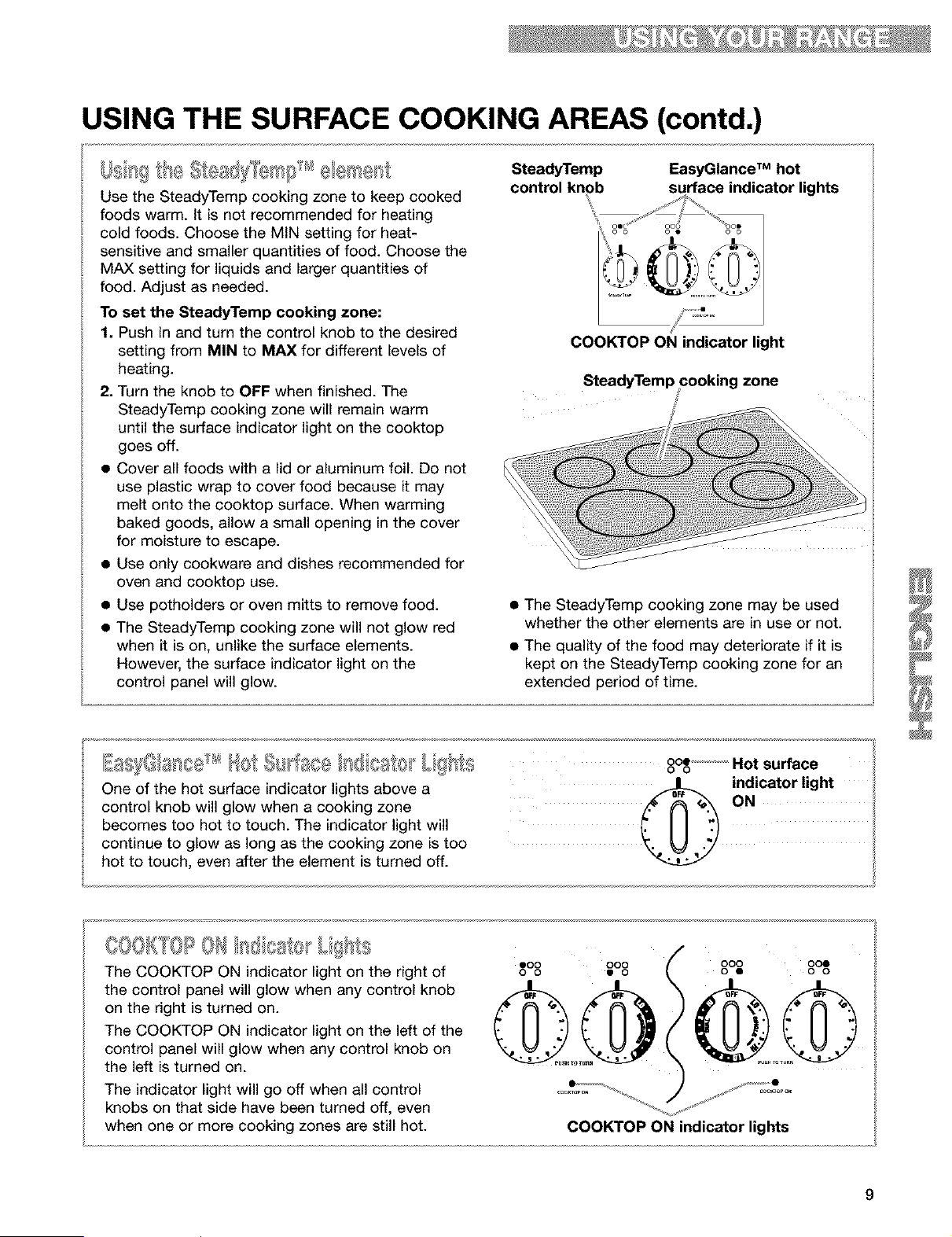
SteadyTemp
control knob
EasyGlance TM hot
surface indicator lights
COOKTOP ON indicator light
SteadyTemp cooking zone
• The SteadyTemp cooking zone may be used
whetherthe otherelements are in use ornot.
• The quality of the food may deteriorate if it is
kept on the SteadyTemp cooking zone for an
extended period of time.
Hot SI face d/,a QI' S
One of the hot surface indicator lights above a
control knob will glow when a cooking zone
becomes too hot to touch. The indicator light will
continue to glow as long as the cooking zone is too
hot to touch, even after the element is turned off.
o°°eo..................Hot surface
indicator light
@o!
The OOOKTOP ON indicator light on the right of
the control panel will glow when any control knob
on the right is turned on.
The OOOKTOP ON indicator light on the left of the
control panel will glow when any control knob on
the left is turned on.
The indicator light will go off when all control
knobs on that side have been turned off, even
when one or more cooking zones are still hot.
aOoO oo8 (
000 000
0 • 0 0
@©
COOKTOP ON indicator lights
USING THE SURFACE COOKING AREAS (contd.)
Je fads 10[]l=ISll! I'I = "_=I L ";;_
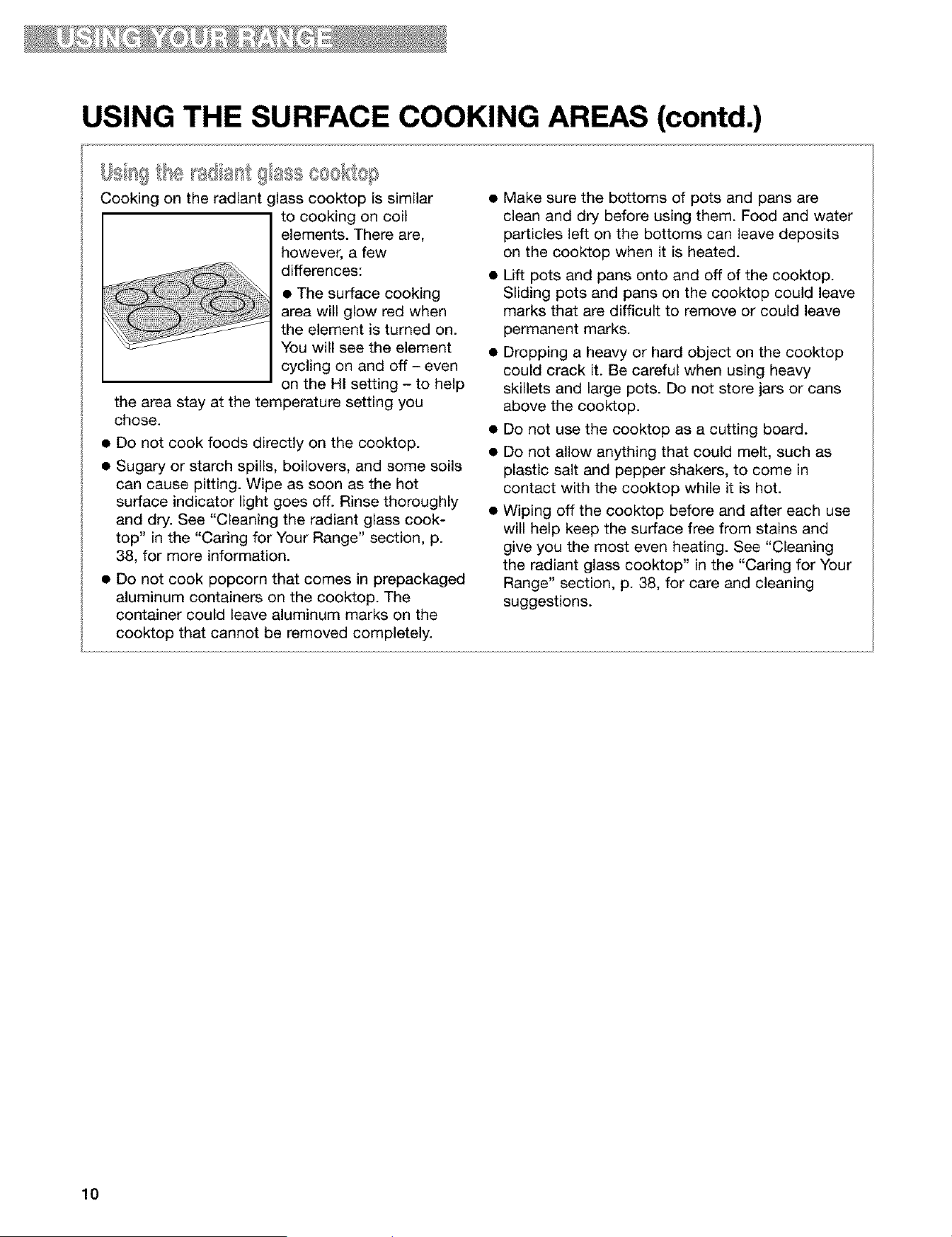
Cooking on the radiant lass cooktop is similar
to cooking on coil
elements. There are,
however, a few
differences:
• The surface cooking
area will glow red when
the element is turned on.
You will see the element
cycling on and off - even
on the HI setting - to help
the area stay at the temperature setting you
chose.
• Do not cook foods directly on the cooktop.
• Sugary or starch spills, boilovers, and some soils
can cause pitting. Wipe as soon as the hot
surface indicator light goes off. Rinse thoroughly
and dry. See "Cleaning the radiant glass cook-
top" in the "Caring for Your Range" section, p.
38, for more information.
• Do not cook popcorn that comes in prepackaged
aluminum containers on the cooktop. The
container could leave aluminum marks on the
cooktop that cannot be removed completely.
Make sure the bottoms of pots and pans are
clean and dry before using them. Food and water
particles left on the bottoms can leave deposits
on the cooktop when it is heated.
Lift pots and pans onto and off of the cooktop.
Sliding pots and pans on the cooktop could leave
marks that are difficult to remove or could leave
permanent marks.
Dropping a heavy or hard object on the cooktop
could crack it. Be careful when using heavy
skillets and large pots. Do not store jars or cans
above the cooktop.
Do not use the cooktop as a cutting board.
Do not allow anything that could melt, such as
plastic salt and pepper shakers, to come in
contact with the cooktop while it is hot.
Wiping off the cooktop before and after each use
will help keep the surface free from stains and
give you the most even heating. See "Cleaning
the radiant glass cooktop" in the "Caring for Your
Range" section, p. 38, for care and cleaning
suggestions.
10
USING THE SURFACE COOKING AREAS (contd.)
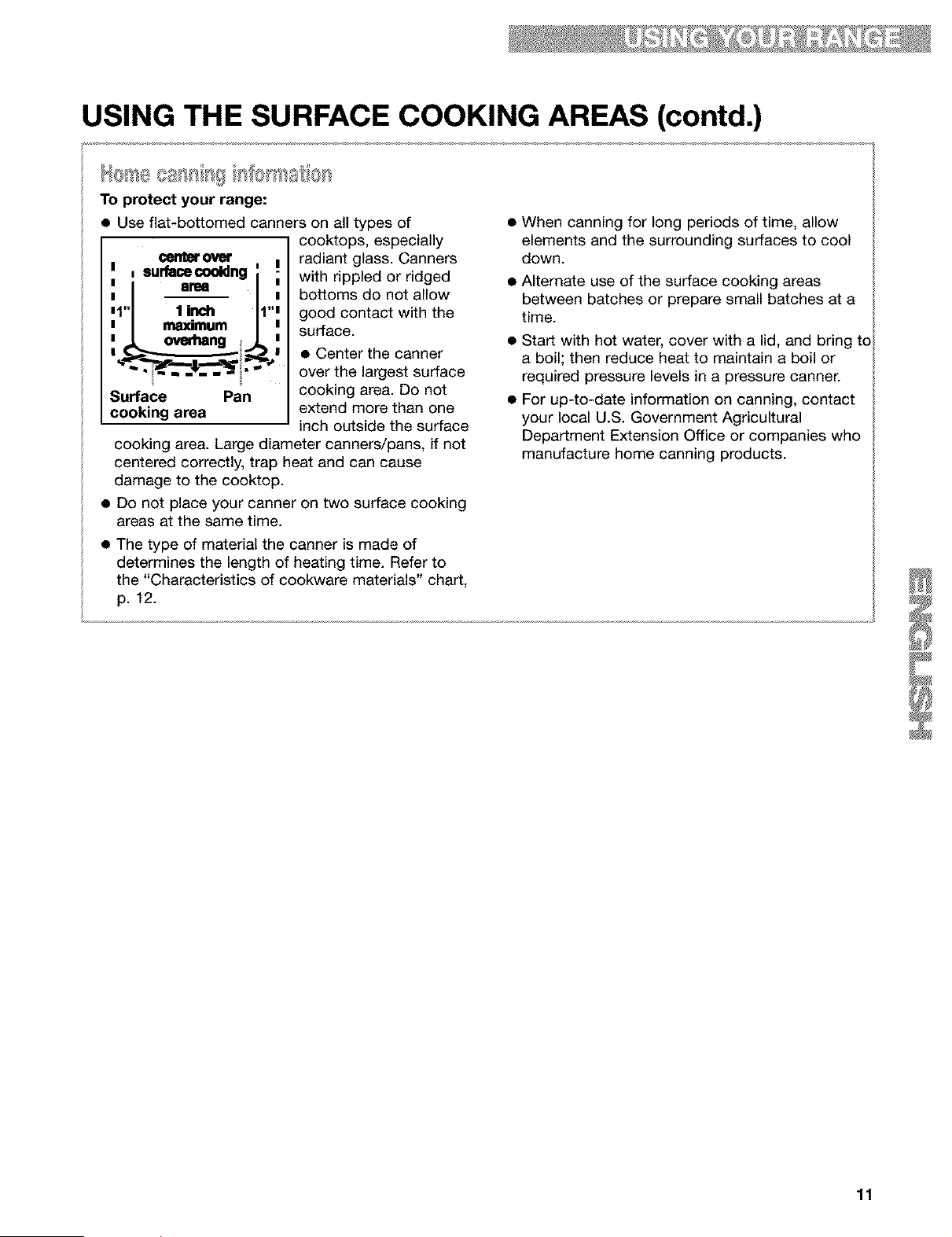
To protect your range:
• Use flat-bottomed canners on all types of
cooktops, especially
centerover
I , sudacecooklng : !
i a_ i
i -- i
11" 1 inch 1"1
i ma_mum i
.I ov.,=gL.
Surface Pan
cooking area
radiant glass. Canners
with rippled or ridged
bottoms do not allow
good contact with the
surface.
• Center the canner
over the largest surface
cooking area. Do not
extend more than one
inch outside the surface
cooking area. Large diameter canners/pans, if not
centered correctly, trap heat and can cause
damage to the cooktop.
• Do not place your canner on two surface cooking
areas at the same time.
When canning for long periods of time, allow
elements and the surrounding surfaces to cool
down.
Alternate use of the surface cooking areas
between batches or prepare small batches at a
time.
Start with hot water, cover with a lid, and bring to
a boil; then reduce heat to maintain a boil or
required pressure levels in a pressure canner.
For up-to-date information on canning, contact
your local U.S. Government Agricultural
Department Extension Office or companies who
manufacture home canning products.
• The type of material the canner is made of
determines the length of heating time. Refer to
the "Characteristics of cookware materials" chart,
p. 12.
11
USING THE SURFACE COOKING AREAS (contd.)
• Select a pan that is about the same size as the
surface cooking area. Cookware should not ex-
tend more than 1 inch (2.5 cm) outside the area.
• For best results and greater energy
efficiency, use only flat-bottomed cookware that
makes good contact with the surface cooking
area. Cookware with rounded, warped, ribbed
(such as some porcelain enamelware), or dented
bottoms could cause uneven heating and poor
cooking results.
• Cookware designed with slightly indented bot-
toms or small expansion channels can be used.
• Check for rough spots on the bottom of metal or
glass cookware which will scratch the radiant glass
surface.
• Use fiat bottom cookware for best heat
conduction from the surface cooking area to the
cookware. Determine flatness with the ruler test.
Place the edge of a ruler across the bottom of the
cookware. Hold it up to the light. No light should be
visible under the ruler. Rotate the ruler in all
directions and look for any light.
• Do net leave empty cookware, or cookware which
has boiled dry, on a hot surface cooking area. The
• Cookware with a non-stick finish has heating cookware could overheat, causing damage to the
characteristics of the base material, cookware or the surface cooking area.
CHARACTERISTICS OF COOKWARE MATERIALS
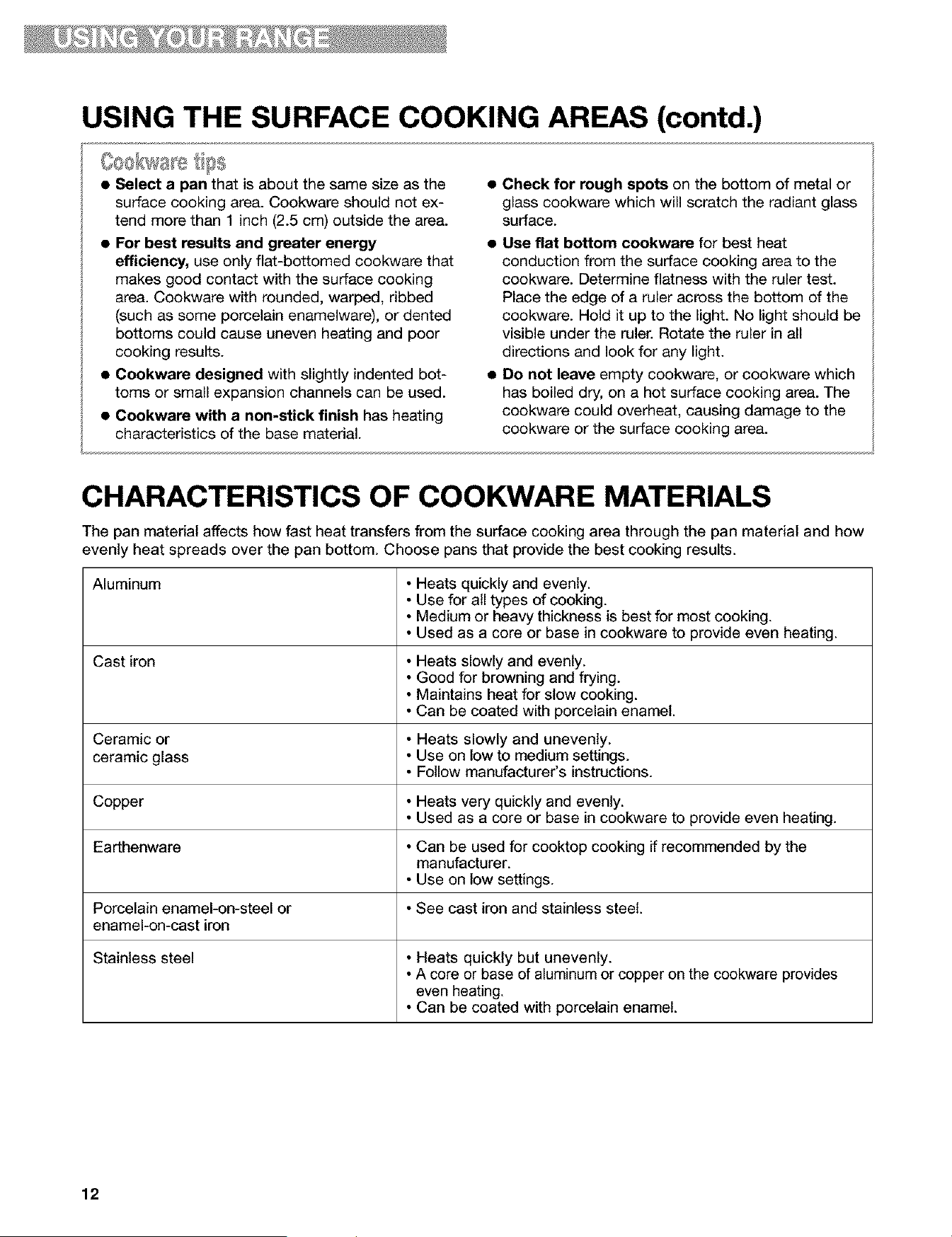
The pan material affects how fast heat transfers from the surface cooking area through the pan material and how
evenly heat spreads over the pan bottom. Choose pans that provide the best cooking results.
Aluminum • Heats quickly and evenly.
• Use for all types of cooking.
• Medium or heavy thickness is best for most cooking.
• Used as a core or base in cookware to provide even heating.
Cast iron • Heats slowly and evenly.
• Good for browning and frying.
• Maintains heat for slow cooking.
• Can be coated with porcelain enamel.
Ceramic or • Heats slowly and unevenly.
ceramic glass • Use on low to medium settings.
• Follow manufacturer's instructions.
Copper • Heats very quickly and evenly.
• Used as a core or base in cookware to provide even heating.
Earthenware • Can be used for cooktop cooking if recommended by the
manufacturer.
• Use on low settings.
Porcelain enamel-on-steel or • See cast iron and stainless steel.
enamel-on-cast iron
Stainless steel • Heats quickly but unevenly.
• A core or base of aluminum or copper on the cookware provides
even heating.
• Can be coated with porcelain enamel.
12
USING THE OVEN
Place the SturdiGlide TM oven racks where you
need them before turning on the oven.
• To move a rack, pull it out to the stop position,
raise the front edge and lift it out.
• Be sure the rack(s) is level.
• Use pot holders or oven mitts to protect your
hands if rack(s) must be moved while the oven is
hot.
• For best performance, cook on one rack. Place
the rack so the top of the food will be centered in
the oven.
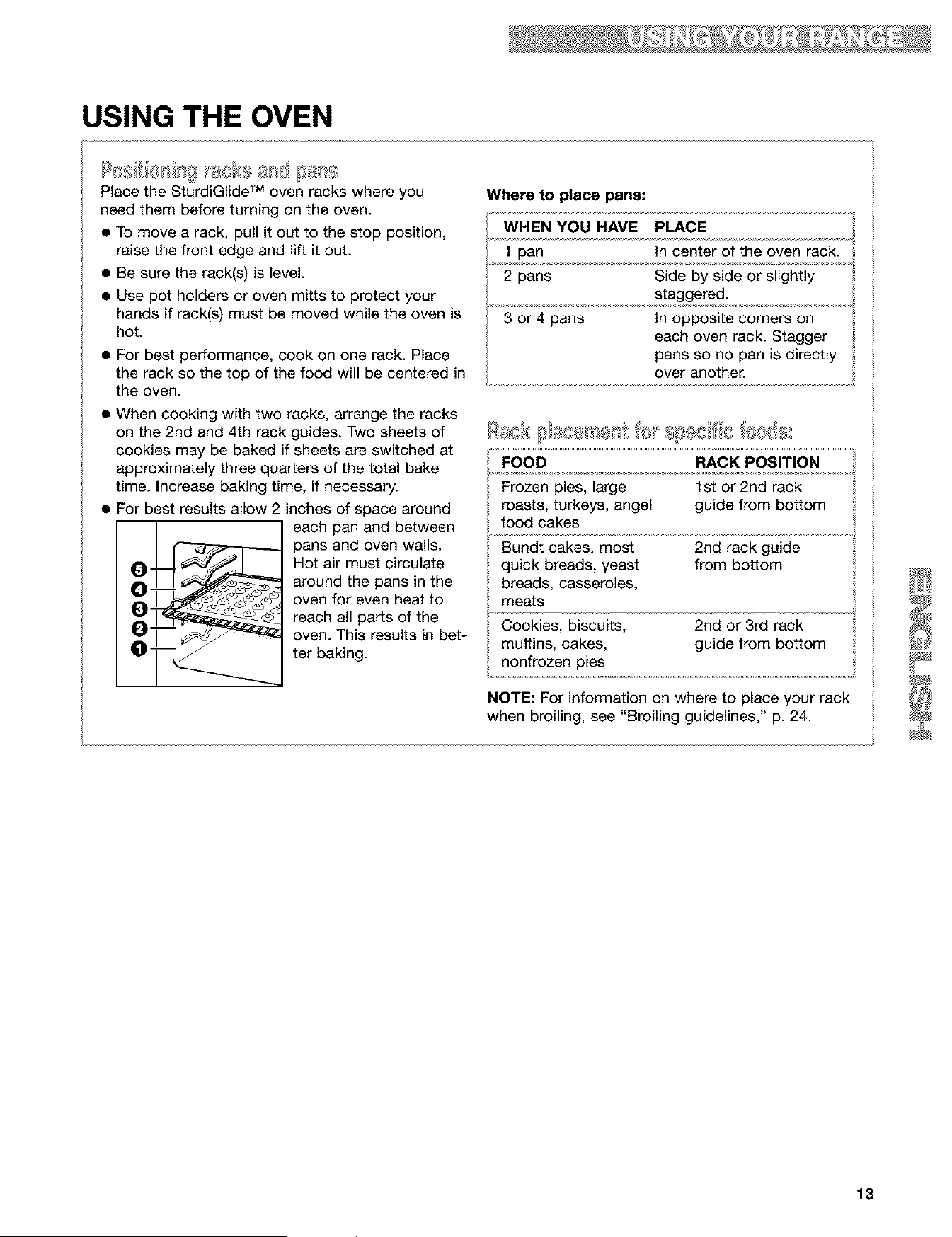
• When cooking with two racks, arrange the racks
on the 2nd and 4th rack guides. Two sheets of
cookies may be baked if sheets are switched at
approximately three quarters of the total bake
time. Increase baking time, if necessary.
• For best results allow
inches of space around
each pan and between
pans and oven walls.
Hot air must circulate
around the pans in the
oven for even heat to
reach all parts of the
oven. This results in bet-
ter baking.
Where to place pans:
WHEN YOU HAVE PLACE
1 pan In center of the oven rack.
2 pans Side by side or slightly
staggered.
3 or 4 pans In opposite corners on
each oven rack. Stagger
pans so no pan is directly
over another.
FOOD RACK POSITION
Frozen pies, large 1st or 2nd rack
roasts, turkeys, angel guide from bottom
food cakes
Bundt cakes, most 2nd rack guide
quick breads, yeast from bottom
breads, casseroles,
meats
Cookies, biscuits, 2nd or 3rd rack
muffins, cakes, guide from bottom
nonfrozen pies
NOTE: For information on where to place your rack
when broiling, see "Broiling guidelines," p. 24.
13
BAKEWARE CHOICES
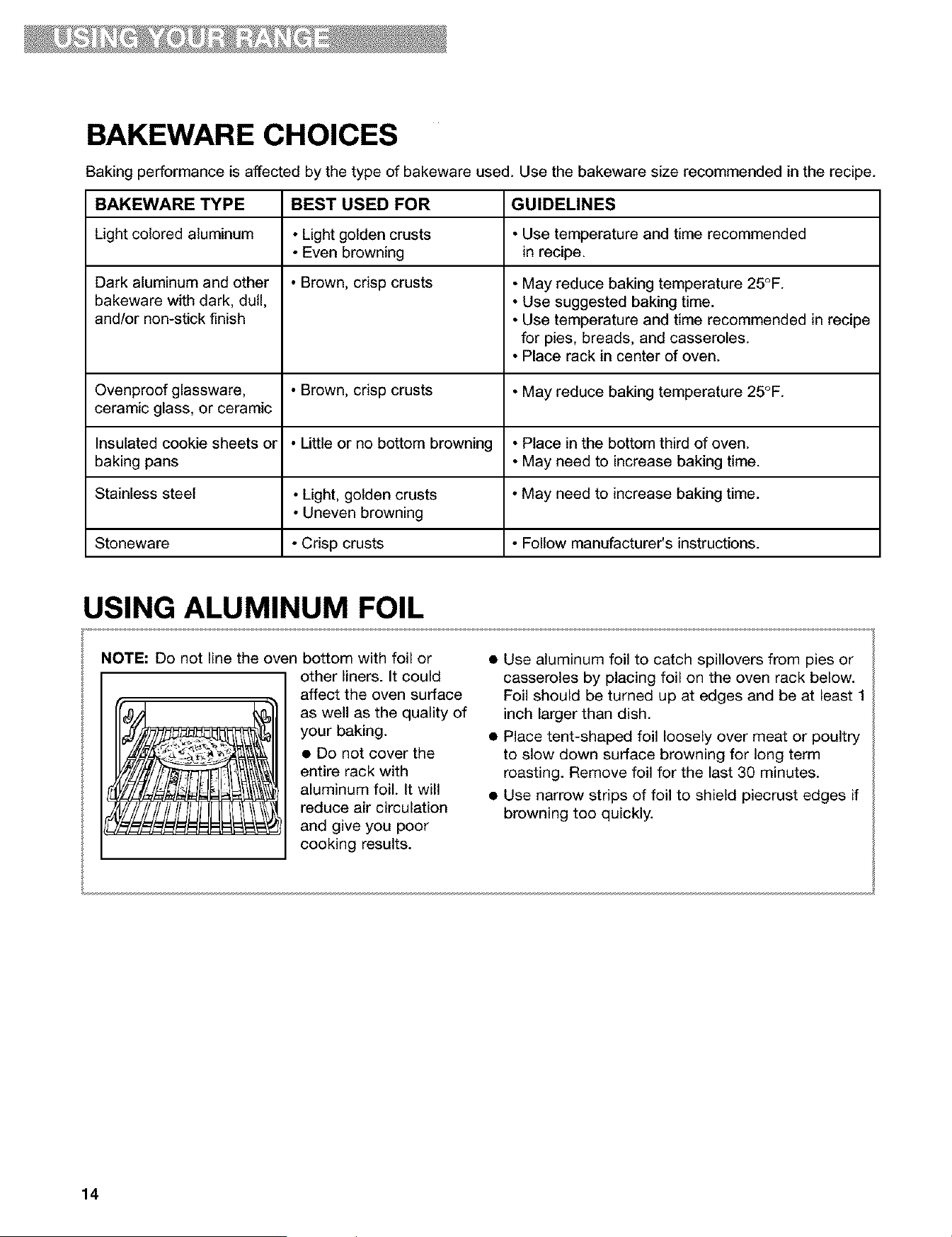
Baking performance is affected by the type of bakeware used. Use the bakeware size recommended in the recipe.
BAKEWARE TYPE BEST USED FOR GUIDELINES
Light colored aluminum • Light golden crusts • Use temperature and time recommended
• Even browning in recipe.
Dark aluminum and other • Brown, crisp crusts • May reduce baking temperature 25°F.
bakeware with dark, dull, • Use suggested baking time.
and/or non-stick finish • Use temperature and time recommended in recipe
for pies, breads, and casseroles.
• Place rack in center of oven.
Ovenproof glassware, • Brown, crisp crusts • May reduce baking temperature 25°F.
ceramic glass, or ceramic
Insulated cookie sheets or • Little or no bottom browning • Place in the bottom third of oven.
baking pans • May need to increase baking time.
Stainless steel • Light, golden crusts • May need to increase baking time.
• Uneven browning
Stoneware • Crisp crusts • Follow manufacturer's instructions.
USING ALUMINUM FOIL
NOTE: Do not line the oven bottom with foil or
other liners. It could
affect the oven surface
as well as the quality of
your baking.
• Do not cover the
entire rack with
aluminum foil. It will
reduce air circulation
and give you poor
cooking results.
• Use aluminum foil to catch spillovers from pies or
casseroles by placing foil on the oven rack below.
Foil should be turned up at edges and be at least 1
inch larger than dish.
• Place tent-shaped foil loosely over meat or poultry
to slow down surface browning for long term
roasting. Remove foil for the last 30 minutes.
• Use narrow strips of foil to shield piecrust edges if
browning too quickly.
14
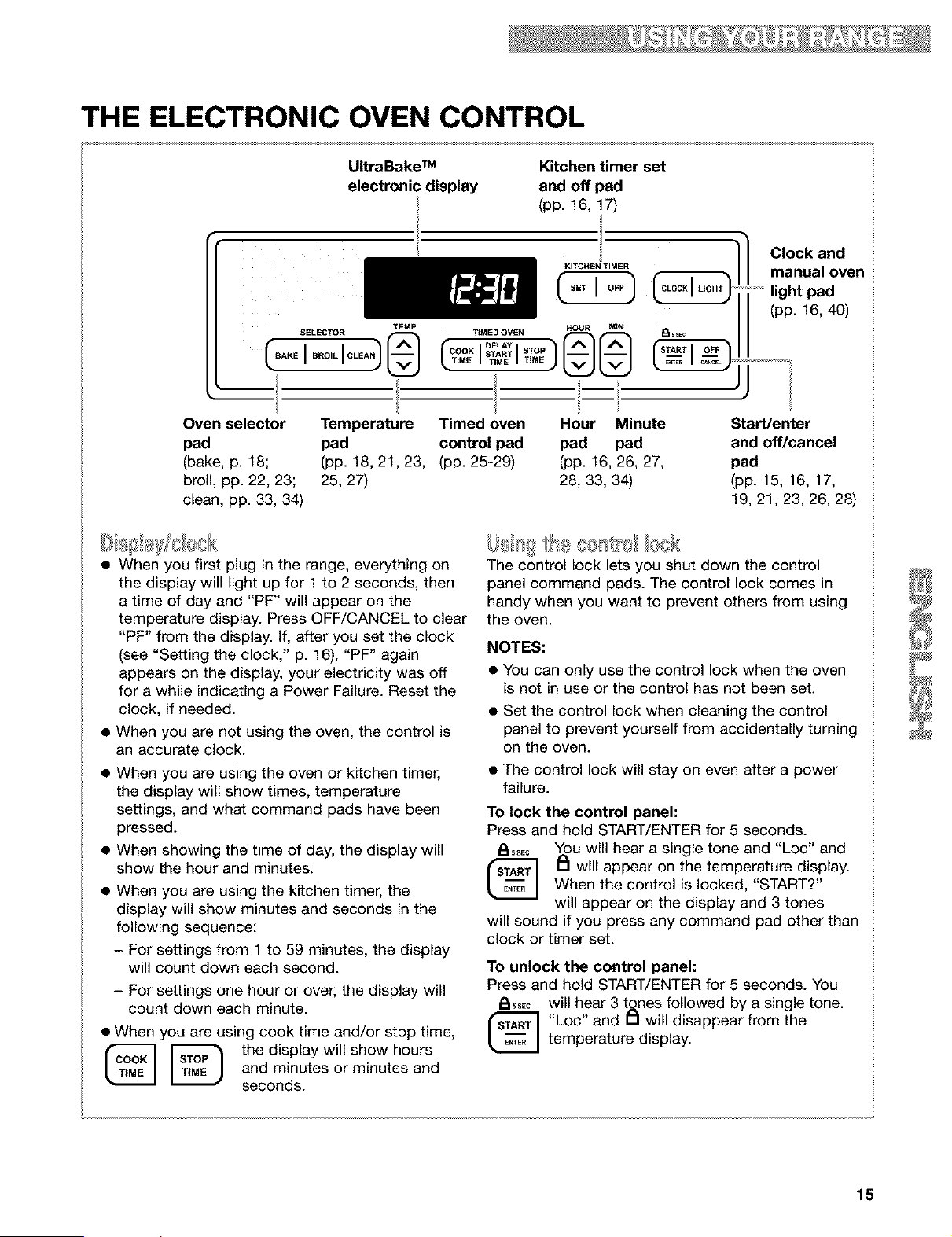
THE ELECTRONIC OVEN CONTROL
UltraBake TM
electronic display
Kitchen timer set
and off pad
(pp. 16, 17)
TEMP
SELECTOR I @
Oven selector Temperature
pad pad
(bake, p. 18; (pp. 18, 21, 23,
broil, pp. 22, 23; 25, 27)
clean, pp. 33, 34)
1] Clock and
_ITO"ENTIMER _ . | | manual oven
...............light pad
(p . 16, 40)
@@HOUR MIN _ i
_ .....................
TIMED OVEN
( )
COOK STAR T S TOP
TtME TIME TiME
Timed oven Hour Minute Start/enter
control pad pad pad and off/cancel
(pp. 25-29) (pp. 16, 26, 27, pad
28,33,34) (pp. 15, 16, 17,
19, 21, 23, 26, 28)
• When you first plug in the range, everything on
the display will light up for 1 to 2 seconds, then
a time of day and "PF" will appear on the
temperature display. Press OFF/CANCEL to clear
"PF" from the display. If, after you set the clock
(see "Setting the clock," p. 16), "PF" again
appears on the display, your electricity was off
for a while indicating a Power Failure. Reset the
clock, if needed.
• When you are not using the oven, the control is
an accurate clock.
• When you are using the oven or kitchen timer,
the display will show times, temperature
settings, and what command pads have been
pressed.
• When showing the time of day, the display will
show the hour and minutes.
• When you are using the kitchen timer, the
display will show minutes and seconds in the
following sequence:
- For settings from 1 to 59 minutes, the display
will count down each second.
- For settings one hour or over, the display will
count down each minute.
• When you are using cook time and/or stop time,
@ _ thedisplaywillshowhours
and minutes or minutes and
seconds.
Ust / g cor t o 0@:
The control lock lets you shut down the control
panel command pads. The control lock comes in
handy when you want to prevent others from using
the oven.
NOTES:
• You can only use the control lock when the oven
is not in use or the control has not been set.
• Set the control lock when cleaning the control
panel to prevent yourself from accidentally turning
on the oven.
• The control lock will stay on even after a power
failure.
To lock the control panel:
Press and hold START/ENTER for 5 seconds.
P,,,,c You will hear a single tone and "Loc" and
_ will appear on the temperature display.When the control is locked, "START?"
will appear on the display and 3 tones
will sound if you press any command pad other than
clock or timer set.
To unlock the control panel:
Press and hold START/ENTER for 5 seconds. You
85s,c will hear 3 t_nes followed by a single tone.
_ Loc" and [] will disappear from thetemperature display.
15
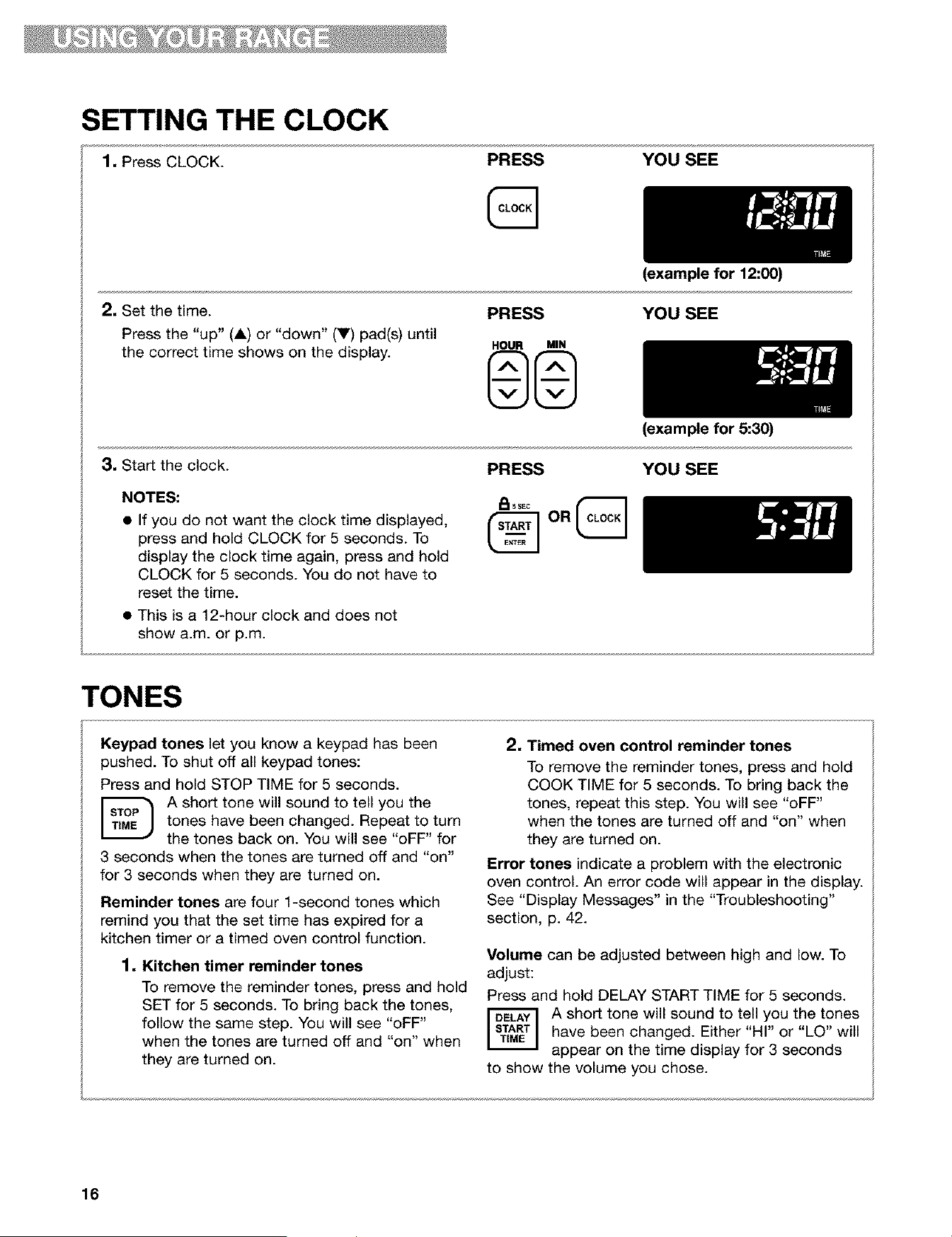
SETTING THE CLOCK
1. Press CLOCK.
PRESS
@
YOU SEE
(example for 12:00)
2. Set the time.
Press the "up" (A) or "down" (V) pad(s) until
the correct time shows on the display.
PRESS
HOUR MIN
@@
YOU SEE
3. Start the clock.
NOTES:
• If you do not want the clock time displayed,
press and hold CLOCK for 5 seconds. To
display the clock time again, press and hold
CLOCK for 5 seconds. You do not have to
reset the time.
• This is a 12-hour clock and does not
show a.m. or p.m.
PRESS
I_1_ $Ec
(example for 5:30)
YOU SEE
TONES
Keypad tones let you know a keypad has been
pushed. To shut off all keypad tones:
Press and hold STOP TIME for 5 seconds.
A short tone will sound to tell you the
tones have been changed. Repeat to turn
the tones back on. You will see "oFF" for
3 seconds when the tones are turned off and "on"
for 3 seconds when they are turned on.
Reminder tones are four 1-second tones which
remind you that the set time has expired for a
kitchen timer or a timed oven control function.
1. Kitchen timer reminder tones
To remove the reminder tones, press and hold
SET for 5 seconds. To bring back the tones,
follow the same step. You will see "oFF"
when the tones are turned off and "on" when
they are turned on.
2. Timed oven control reminder tones
To remove the reminder tones, press and hold
COOK TIME for 5 seconds. To bring back the
tones, repeat this step. You will see "oFF"
when the tones are turned off and "on" when
they are turned on.
Error tones indicate a problem with the electronic
oven control. An error code will appear in the display.
See "Display Messages" in the "Troubleshooting"
section, p. 42.
Volume can be adjusted between high and low. To
adjust:
Press and hold DELAY START TIME for 5 seconds.
A short tone will sound to tell you the tones
have been changed. Either "HI" or "LO" will
appear on the time display for 3 seconds
to show the volume you chose.
16
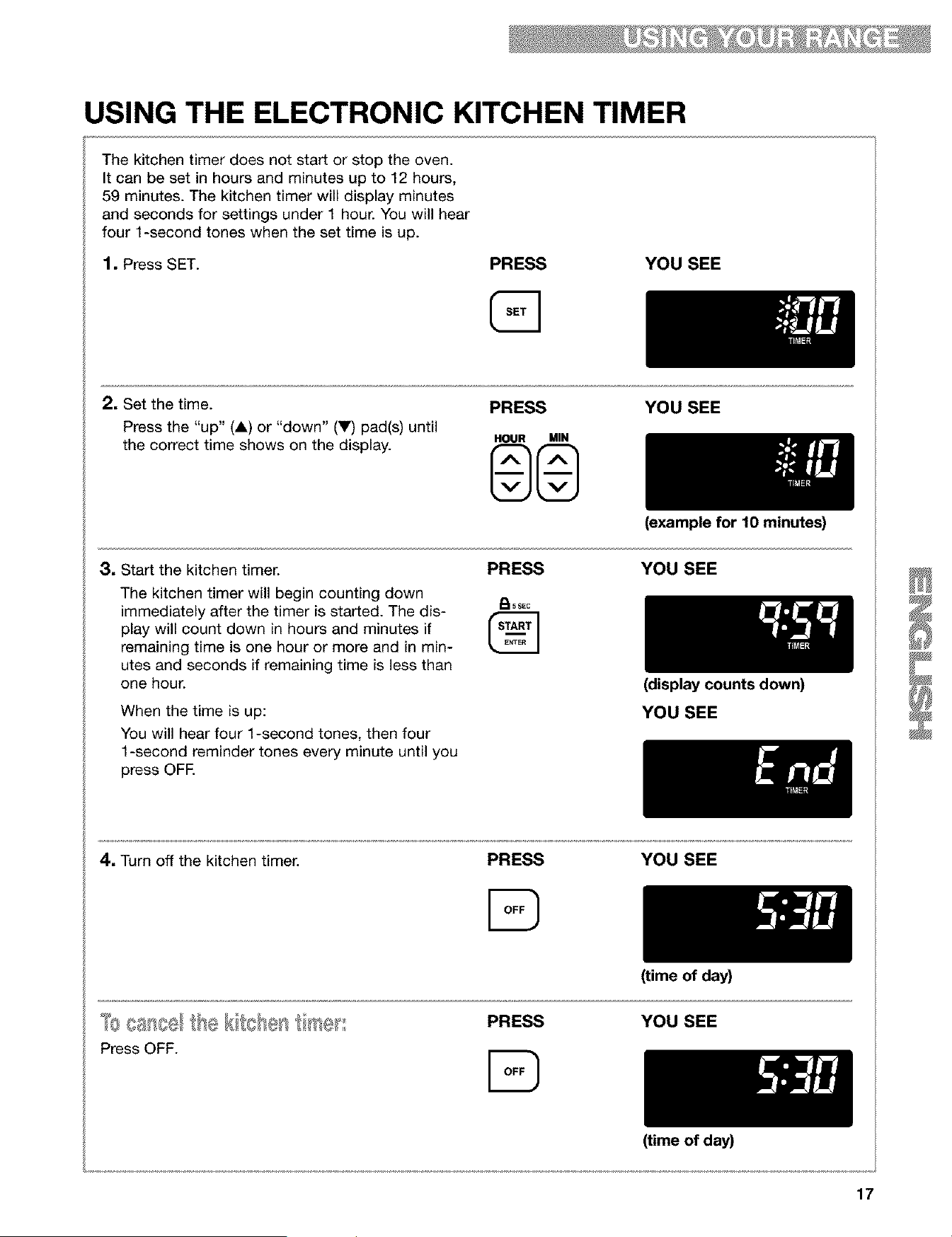
USING THE ELECTRONIC KITCHEN TIMER
The kitchen timer does not start or stop the oven.
It can be set in hours and minutes up to 12 hours,
59 minutes. The kitchen timer will display minutes
and seconds for settings under 1 hour. You will hear
four 1-second tones when the set time is up.
1, Press SET. PRESS
@
YOU SEE
2, Set the time.
Press the "up" (A) or "down" (V) pad(s) until
the correct time shows on the display.
PRESS
HOUR MIN
@@
YOU SEE
3, Start the kitchen timer.
The kitchen timer will begin counting down
immediately after the timer is started. The dis-
play will count down in hours and minutes if
remaining time is one hour or more and in min-
utes and seconds if remaining time is less than
one hour.
When the time is up:
You will hear four 1-second tones, then four
1-second reminder tones every minute until you
press OFE
PRESS
_15 SEC
(example for 10 minutes)
YOU SEE
(display counts down)
YOU SEE
4. Turn off the kitchen timer. PRESS
D
YOU SEE
Press OFF.
PRESS
D
(time of day)
YOU SEE
(time of day)
17
STARTING/CANCELING A FUNCTION
After setting a function, you must press START/
85s,c ENTER to start the function. If you do not
_ ress START/ENTER within 5 seconds of
setting, "START?" will show on the
display as a reminder. If you do not press
START/ENTER within 5 minutes of
setting, the time of day will appear.
OFF/CANCEL will cancel any function except the
clock, timer, or control lock. When you
press OFF/CANCEL, the display will show
the time of day or, if the minute timer is
also being used, the time remaining.
ULTRABAKE rMBAKING/ROASTING
Your oven is designed with the UItraBake
temperature management system to constantly
monitor oven temperature. The bake element
will cycle, as needed, to maintain the desired
temperature. This feature is automatically
activated when the oven is in operation.
1, Place the SturdiGlide TM racks where you need
them in the oven.
For more information, see "Positioning racks and
pans" in the "Using the oven" section, p. 13.
NOTE: Do not place food directly on the oven
door or oven bottom
Rear of rack
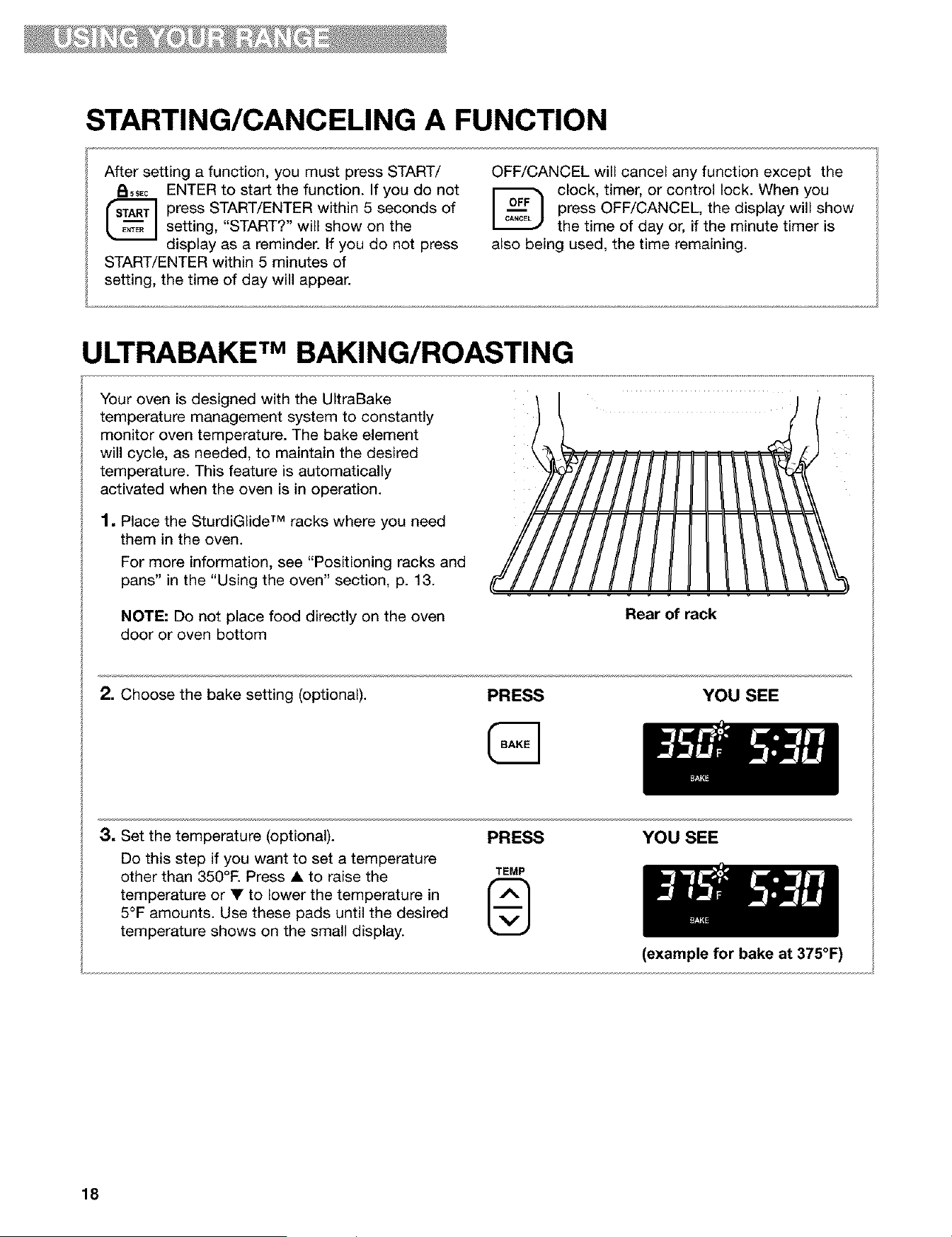
2. Choose the bake setting (optional). PRESS YOU SEE
3. Set the temperature (optional). PRESS
Do this step if you want to set a temperature
other than 350°R Press • to raise the TEMP
temperature or • to lower the temperature in [A I
5°F amounts. Use these pads until the desired
temperature shows on the small display.
YOU SEE
(example for bake at 375°F)
18
ULTRABAKE TM BAKING/ROASTING (contd.)
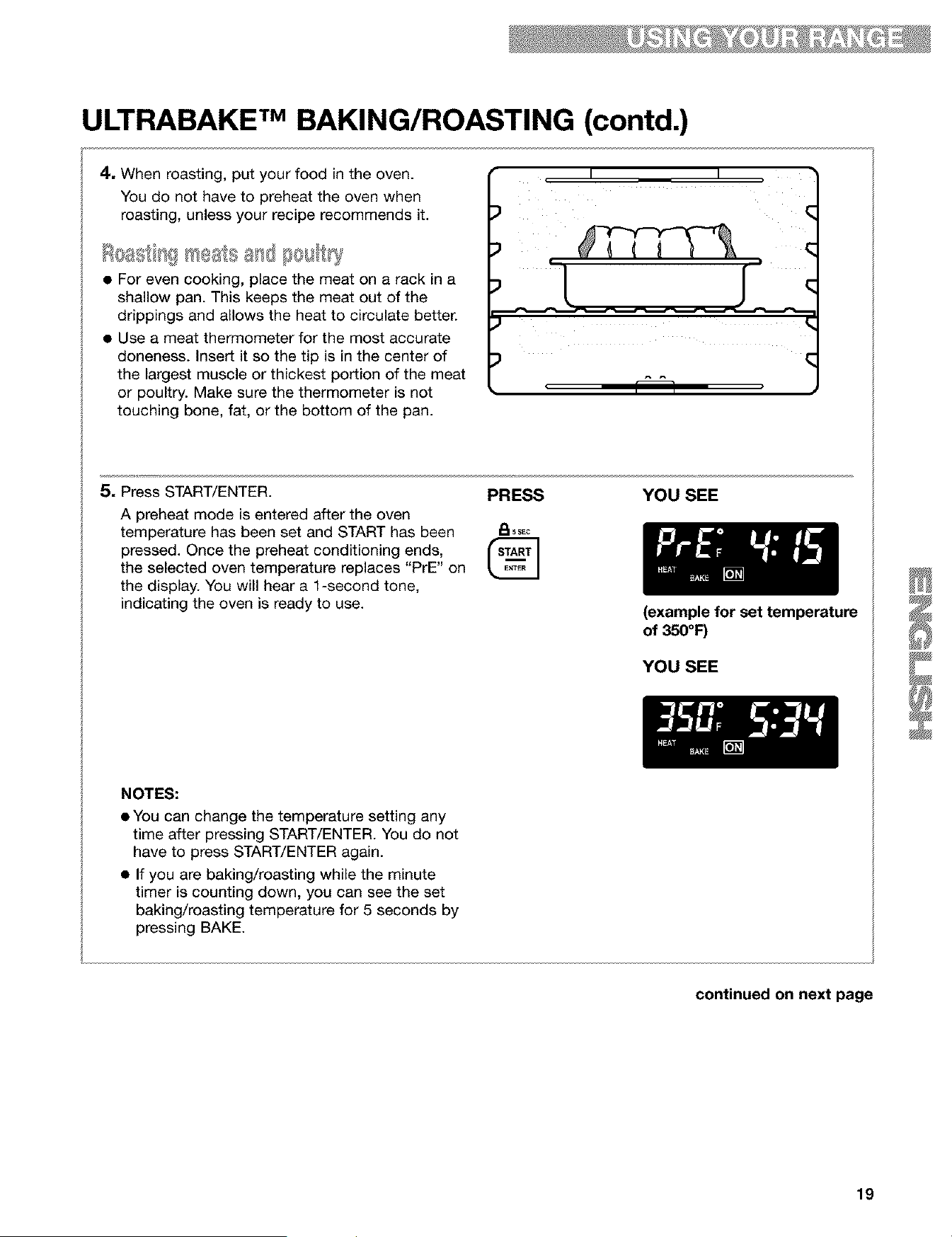
4. When roasting, put your food in the oven.
You do not have to preheat the oven when
roasting, unless your recipe recommends it.
• For even cooking, place the meat on a rack in a
shallow pan. This keeps the meat out of the
drippings and allows the heat to circulate better.
• Use a meat thermometer for the most accurate
doneness, insert it so the tip is in the center of
the largest muscle or thickest portion of the meat
or poultry. Make sure the thermometer is not
touching bone, fat, or the bottom of the pan.
5. Press START/ENTER.
PRESS
A preheat mode is entered after the oven
temperature has been set and START has been 8,s_o
pressed. Once the preheat conditioning ends,
the selected oven temperature replaces "PrE" on
the display. You will hear a 1-second tone,
indicating the oven is ready to use.
YOU SEE
(example for set temperature
of 350°F)
YOU SEE
NOTES:
• You can change the temperature setting any
time after pressing START/ENTER. You do not
have to press START/ENTER again.
• If you are baking/roasting while the minute
timer is counting down, you can see the set
baking/roasting temperature for 5 seconds by
pressing BAKE.
continued on next page
19
ULTRABAKE TMBAKING/ROASTING (contd.)
The UltraBake system electronically regulates
the preheat time and temperature to maintain a
precise temperature range for the best cooking
results.
NOTE: You can change the temperature setting
any time after pressing START/ENTER. You do not
have to press START/ENTER again. The preheat
time will not change if you reset the temperature
before the countdown time ends.
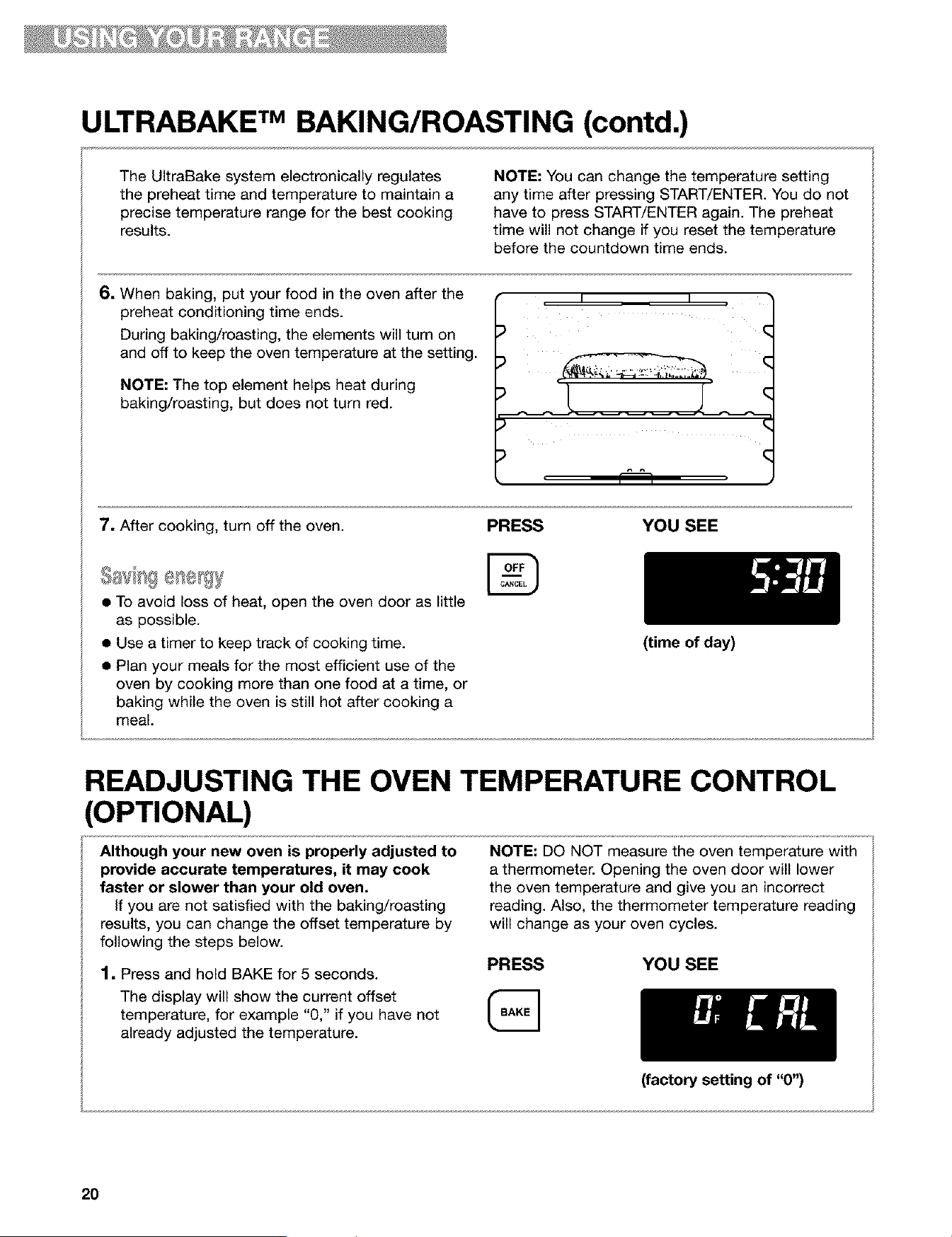
6. When baking, put your food in the oven after the
preheat conditioning time ends.
During baking/roasting, the elements will turn on
and off to keep the oven temperature at the setting.
NOTE: The top element helps heat during
baking/roasting, but does not turn red.
I I
<
J
p=q
7. After cooking, turn off the oven.
Savilsge ® gy
• To avoid loss of heat, open the oven door as little
as possible.
• Use a timer to keep track of cooking time.
• Plan your meals for the most efficient use of the
oven by cooking more than one food at a time, or
baking while the oven is still hot after cooking a
meal.
PRESS YOU SEE
(time of day)
READJUSTING THE OVEN TEMPERATURE CONTROL
(OPTIONAL)
Although your new oven is properly adjusted to
provide accurate temperatures, it may cook
faster or slower than your old oven.
If you are not satisfied with the baking/roasting
results, you can change the offset temperature by
following the steps below.
1. Press and hold BAKE for 5 seconds.
The display will show the current offset
temperature, for example "0," if you have not
already adjusted the temperature.
NOTE: DO NOT measure the oven temperature with
a thermometer. Opening the oven door will lower
the oven temperature and give you an incorrect
reading. Also, the thermometer temperature reading
will change as your oven cycles.
PRESS YOU SEE
2O
(factory setting of "0")
READJUSTING THE OVEN TEMPERATURE
CONTROL (OPTIONAL) (contd.)
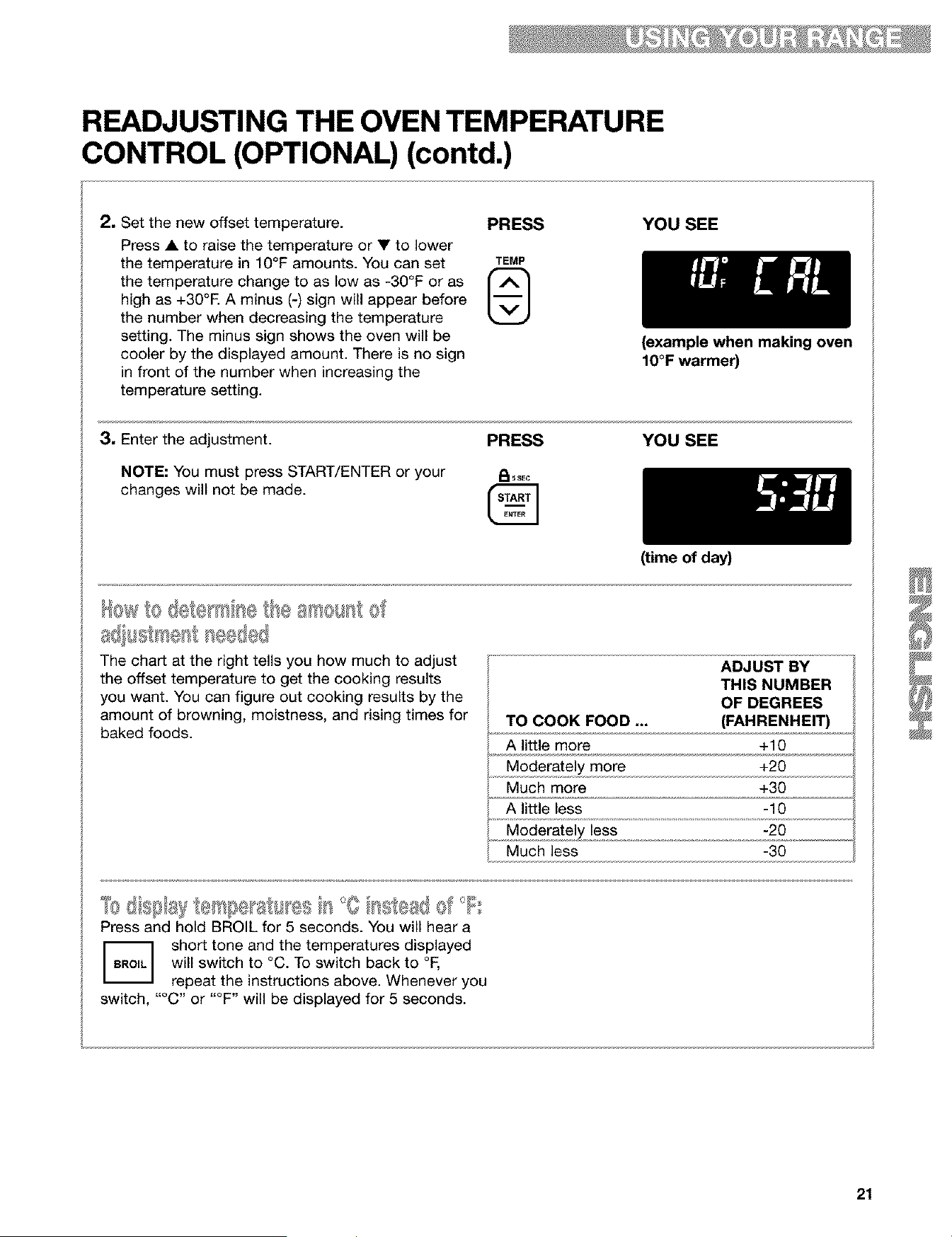
2. Set the new offset temperature. PRESS
Press • to raise the temperature or • to lower
the temperature in 10°F amounts. You can set TEMP
the temperature change to as low as -30°F or as IAI
high as +3O°E A minus (-) sign will appear before
the number when decreasing the temperature
setting. The minus sign shows the oven will be
cooler by the displayed amount. There is no sign
in front of the number when increasing the
temperature setting.
YOU SEE
3. Enter the adjustment.
NOTE: You must press START/ENTER or your
changes will not be made.
PRESS
_15 5EC
(example when making oven
IO°F warmer)
YOU SEE
Hew to d,e%e_s}@e _ _
adust_ _ see@d
The chart at the right tells you how much to adjust
the offset temperature to get the cooking results
you want. You can figure out cooking results by the
amount of browning, moistness, and rising times for
baked foods.
(time of day)
ADJUST BY
THIS NUMBER
OF DEGREES
TO COOK FOOD ... (FAHRENHEIT)
A little more +10
Moderately more +20
Much more +30
A little less -10
,_,,,,M,od,,er,,,,,ate IY,J,e,s,s ,............................................................-_,20,..................................
Much less -30
r:_O rst,ed {_fF
Press and hold BROIL for 5 seconds. You will hear a
._ hort tone and the temperatures displayed
will switch to °C. To switch back to °F,
repeat the instructions above. Whenever you
switch, "°C" or "°F" will be displayed for 5 seconds.
21

BROILING
NOTES:
• Do not preheat when broiling, unless your recipe
recommends it.
• Leave the door partly open whenever you use the
oven to broil. This lets the oven stay at the proper
temperature.
1, Place the SturdiGlide TM rack where you need it.
You need to place the rack so that the surface of
the food is at least 3 inches away from the broil
element. See "Broiling guidelines," pp. 23-24.
Front of rack
Rear of rack
2, Put your food on the broiler pan and place the
pan in the center of the oven rack.
I I
3, Close the door to the broil stop position.
The broil stop position lets the door stay open
by itself about 5 inches.
4. Press BROIL.
PRESS YOU SEE
22
BROILING (contd.)
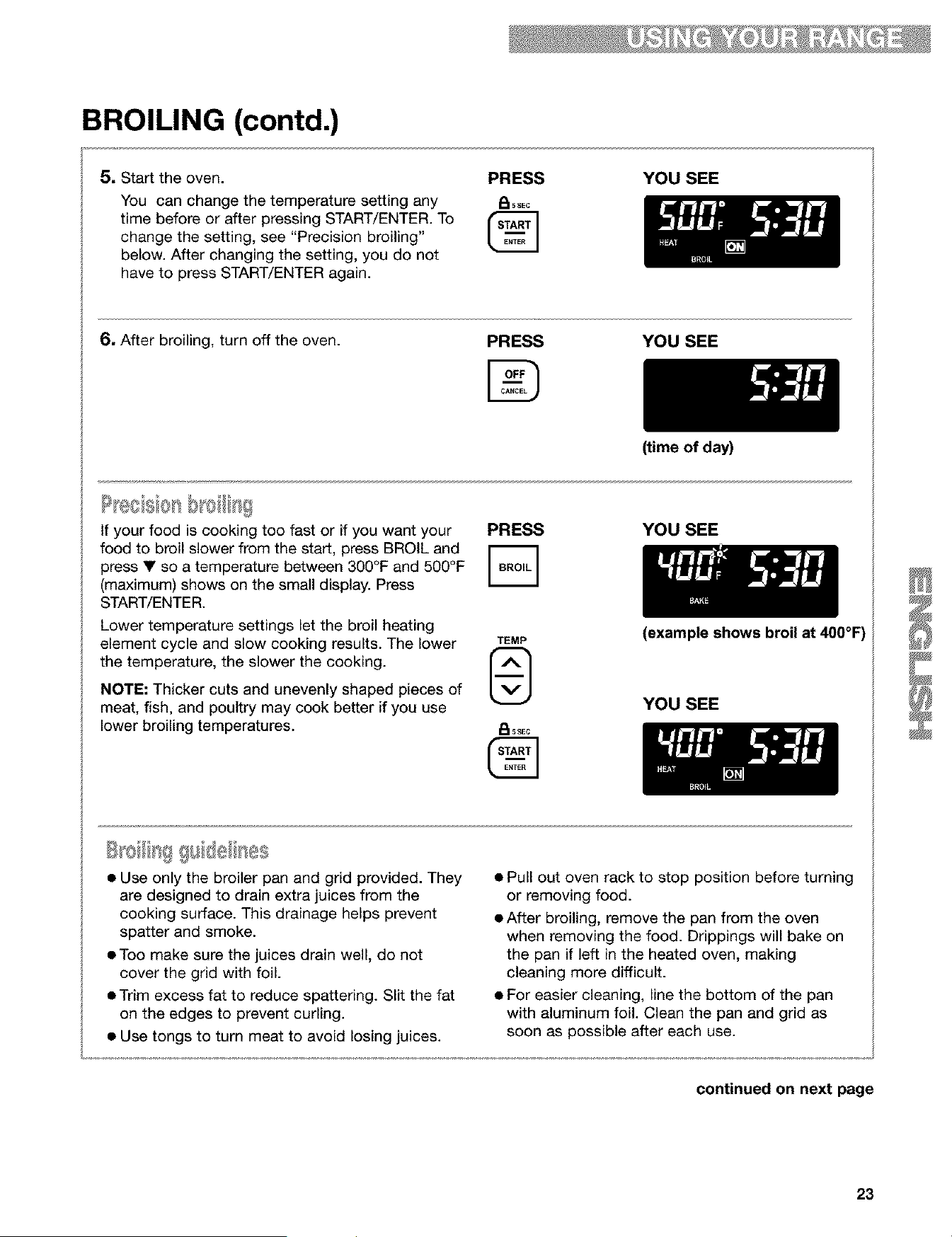
5, Start the oven.
You can change the temperature setting any
time before or after pressing START/ENTER. To
change the setting, see "Precision broiling"
below. After changing the setting, you do not
have to press START/ENTER again.
PRESS
_15 5EC
YOU SEE
6. After broiling, turn off the oven. PRESS YOU SEE
(time of day)
If your food is cooking too fast or if you want your PRESS
food to broil slower from the start, press BROIL and [_1
press • so a temperature between 300°F and 500°F
(maximum) shows on the small display. Press
START/ENTER.
Lower temperature settings let the broil heating
element cycle and slow cooking results. The lower
the temperature, the slower the cooking.
NOTE: Thicker cuts and unevenly shaped pieces of
meat, fish, and poultry may cook better if you use
lower broiling temperatures.
TEMP
_5 SE¢
YOU SEE
(example shows broil at 400°F)
YOU SEE
• Use only the broiler pan and grid provided. They
are designed to drain extra juices from the
cooking surface. This drainage helps prevent
spatter and smoke.
• Too make sure the juices drain well, do not
cover the grid with foil.
• Trim excess fat to reduce spattering. Slit the fat
on the edges to prevent curling.
• Use tongs to turn meat to avoid losing juices.
• Pull out oven rack to stop position before turning
or removing food.
• After broiling, remove the pan from the oven
when removing the food. Drippings will bake on
the pan if left in the heated oven, making
cleaning more difficult.
• For easier cleaning, line the bottom of the pan
with aluminum foil. Clean the pan and grid as
soon as possible after each use.
continued on next page
23
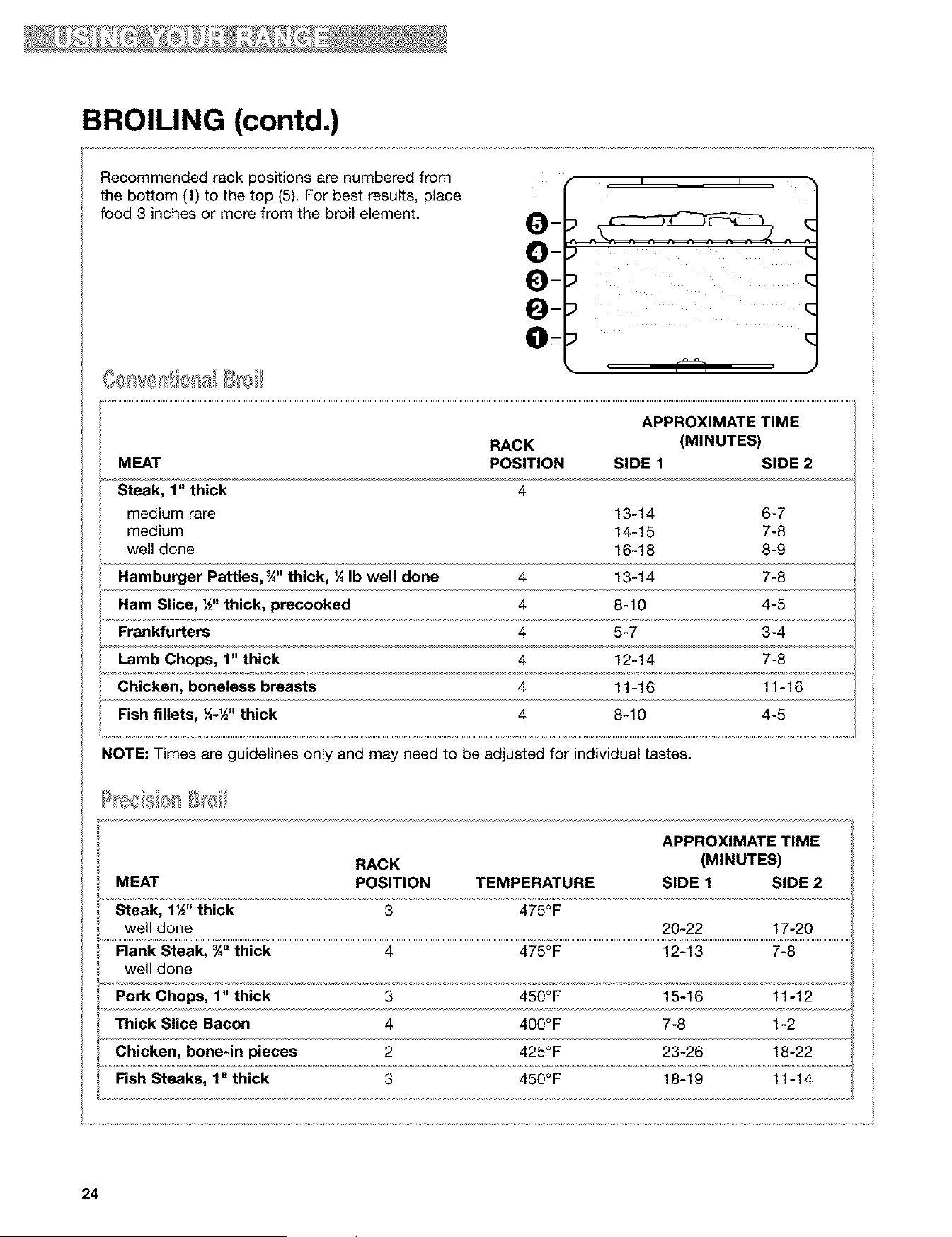
BROILING (contd.)
Recommended rack positions are numbered from
the bottom (1) to the top (5). For best results, place
food 3 inches or more from the broil element.
m
0-
O-
O-
I A I
__,
J C
J q
E
_,=QIv@IIIO[II I[011
APPROXIMATE TIME
RACK (MINUTES)
MEAT POSITION SIDE 1 SIDE 2
Steak, 1" thick 4
medium rare 13-14 6-7
medium 14-15 7-8
well done 16-18 8-9
Hamburger Patties, %"thick, ¼ Ib well done 4 13-14 7-8
Ham Slice, ½" thick, precooked 4 8-10 4-5
Frankfurters 4 5-7 3-4
Lamb Chops, 1" thick 4 12-14 7-8
Chicken, boneless breasts 4 11-16 11-16
Fish fillets, ¼-½" thick 4 8-10 4-5
NOTE: Times are guidelines only and may need to be adjusted for individual tastes.
APPROXIMATE TIME
RACK (MINUTES)
MEAT POSITION TEMPERATURE SIDE 1 SIDE 2
Steak, 1½" thick 3 475°F
well done 20-22 17-20
Flank Steak, %" thick 4 475°F 12-13 7-8
well done
Pork Chops, 1" thick 3 450°F 15-16 11-12
Thick Slice Bacon 4 400°F 7-8 1-2
Chicken, bone-in pieces 2 425°F 23-26 18-22
Fish Steaks, 1" thick 3 450°F 18-19 11-14
24
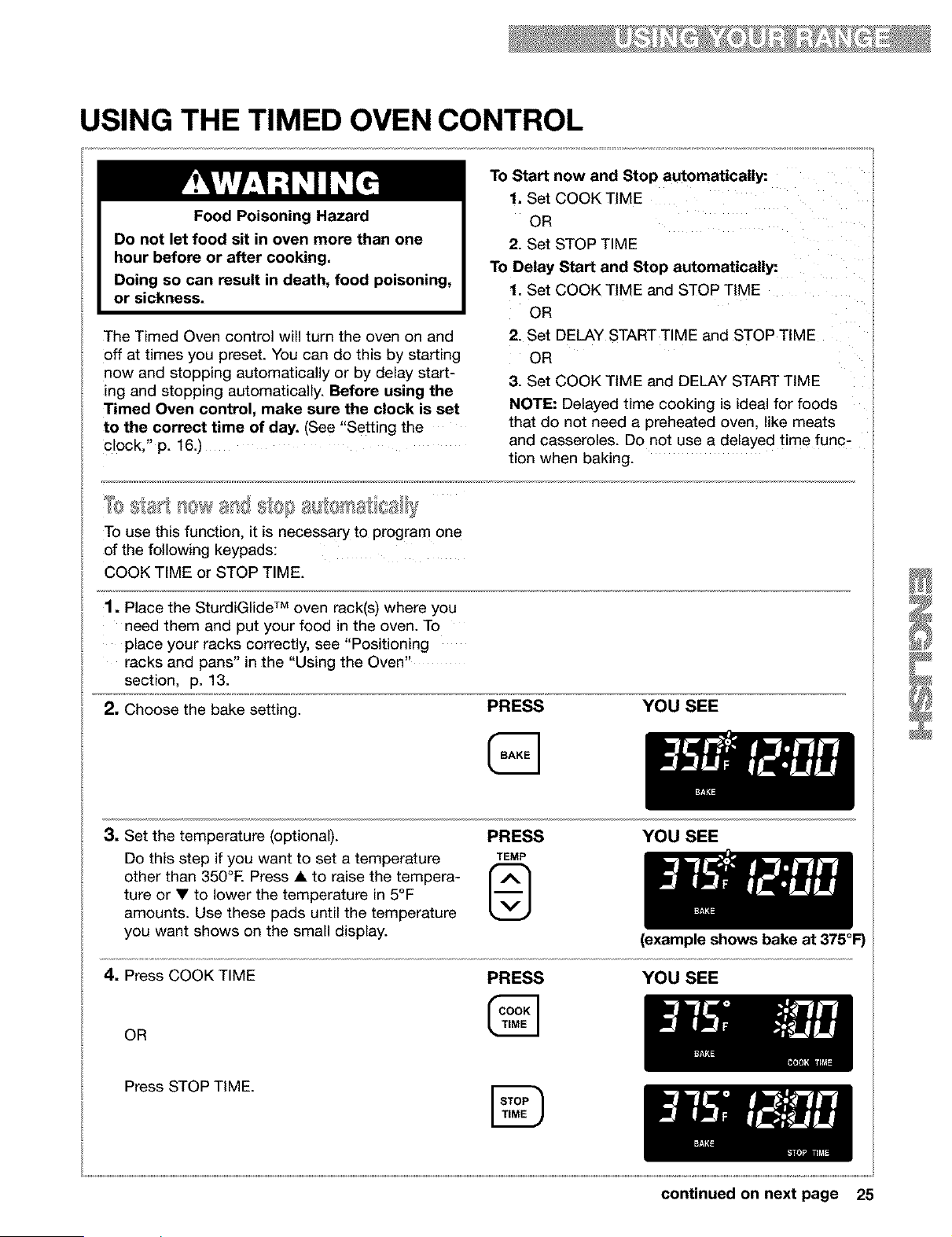
USING THE TIMED OVEN CONTROL
Food Poisoning Hazard
Do not let food sit in oven more than one
hour before or after cooking.
Doing so can result in death, food poisoning,
or sickness.
The Timed Oven control will turn the oven on and
off at times you preset. You can do this by starting
now and stopping automatically or by delay start-
ing and stopping automatically. Before using the
Timed Oven control, make sure the clock is set
to the correct time of day. (See "Setting the
clock," p. 16.)
To Start now and Stop automatically:
1. Set COOK TIME
OR
2. Set STOP TIME
To Delay Start and Stop automatically:
1. Set COOK TIME and STOP TIME
OR
2. Set DELAY START TIME and STOP TIME
OR
3. Set COOK TIME and DELAY START TIME
NOTE: Delayed time cooking is ideal for foods
that do not need a preheated ove_ ike meats
and casseroles. Do not use a delayed time func-
tion when baking.
To use this function, it is necessary to program one
of the following keypads:
COOK TIME or STOP TIME.
1. Place the SturdiGlide TM oven rack(s) where you
need them and put your food in the oven. To
place your racks correctly, see "Positioning
racks and pans" in the "Using the Oven"
section, p. 13.
2. Choose the bake setting.
PRESS YOU SEE
3. Set the temperature (optional). PRESS
Do this step if you want to set a temperature TEMP
other than 350°F. Press • to raise the tempera- [#_1
ture or • to lower the temperature in 5°F
amounts. Use these pads until the temperature
you want shows on the small display.
YOU SEE
(example shows bake at 375°F)
4. Press COOK TIME PRESS
OR @
YOU SEE
Press STOP TIME.
continued on next page 25
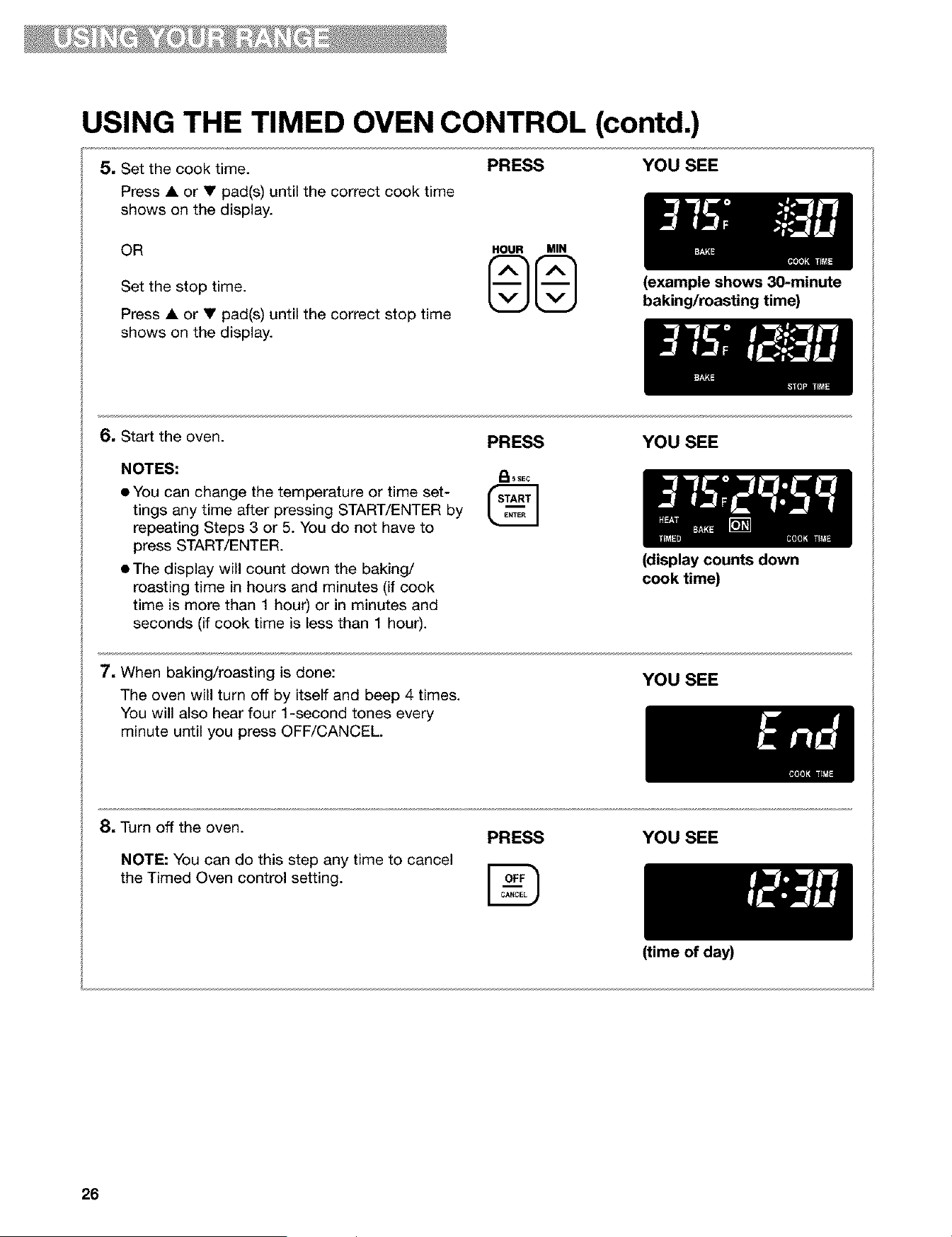
USING THE TIMED OVEN CONTROL (contd.)
5, Set the cook time.
Press • or • pad(s) until the correct cook time
shows on the display.
PRESS YOU SEE
OR HOUR MIN
Press • or • pad(s) until the correct stop time
shows on the display.
6, Start the oven.
NOTES:
• You can change the temperature or time set-
tings any time after pressing START/ENTER by
repeating Steps 3 or 5. You do not have to
press START/ENTER.
• The display will count down the baking/
roasting time in hours and minutes (if cook
time is more than 1 hour) or in minutes and
seconds (if cook time is less than 1 hour).
PRESS
_15 SEC
(example shows 30-minute
baking/roasting time)
YOU SEE
7, When baking/roasting is done:
The oven will turn off by itself and beep 4 times.
You will also hear four 1-second tones every
minute until you press OFF/CANCEL
(display counts down
cook time)
YOU SEE
8, Turn off the oven.
NOTE: You can do this step any time to cancel
the Timed Oven control setting.
PRESS YOU SEE
(time of day)
26
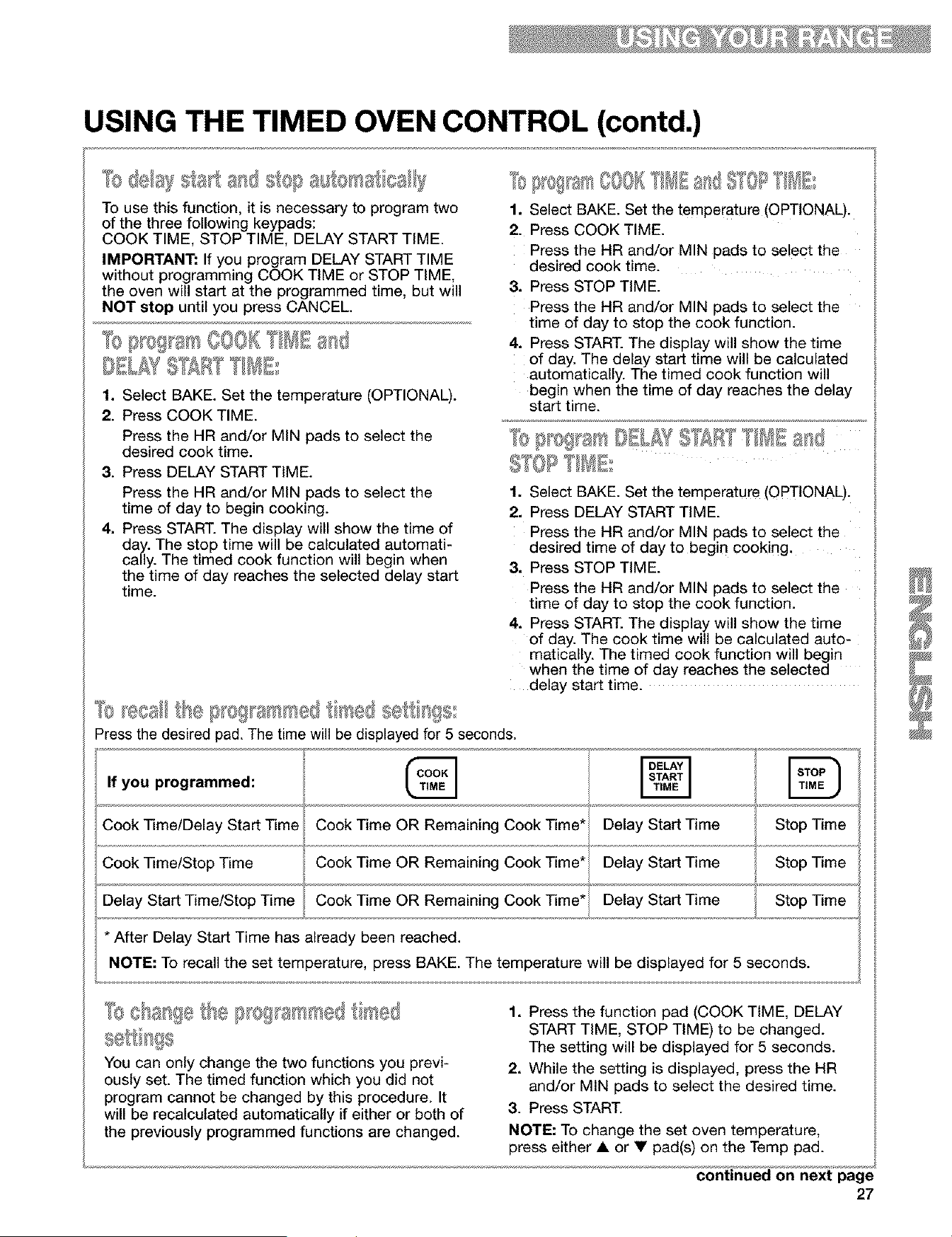
USING THE TIMED OVEN CONTROL (contd.)
To use this function, it is necessary to program two
of the three following keypads:
COOK TIME, STOP TIME, DELAY START TIME.
IMPORTANT: If you program DELAY START TIME
without programming COOK TIME or STOP TIME,
the oven will start at the programmed time, but will
NOT stop until you press CANCEL.
1. Select BAKE. Set the temperature (OPTIONAL).
2. Press COOK TIME.
Press the HR and/or MIN pads to select the
desired cook time.
3. Press DELAY START TIME.
Press the HR and/or MIN pads to select the
time of day to begin cooking.
4. Press START. The display will show the time of
day. The stop time will be calculated automati-
cally. The timed cook function will begin when
the time of day reaches the selected delay start
time.
1. Select BAKE. Set the temperature (OPTIONAL).
2. Press COOK TIME.
Press the HR and/or MIN pads to select the
desired cook time.
3. Press STOP TIME.
Press the HR and/or MIN pads to select the
time of day to stop the cook function.
4. Press START. The display will show the time
of day. The delay start time will be calculated
automatically. The timed cook function will
begin when the time of day reaches the delay
start time.
% Is o£=a s @IL£I dR£R[ ?II?IIi
1. Select BAKE. Set the temperature (OPTIONAL).
2. Press DELAY START TIME.
Press the HR and/or MIN pads to select the
desired time of day to begin cooking.
3. Press STOP TIME.
Press the HR and/or MIN pads to select the
time of day to stop the cook function.
4. Press START. The display will show the time
of day. The cook time will be calculated auto-
matically. The timed cook function will begin
when the time of day reaches the selected
delay start time.
Press the desired pad. The time will be displayed for 5 seconds.
{
ff you programmed:
Cook Time/Delay Start Time Cook Time OR Remaining Cook Time*
+
Cook Time/Stop Time Cook Time OR Remaining Cook Time*
Delay Start Time/Stop Time Cook Time OR Remaining Cook Time*
* After Delay Start Time has already been reached.
Delay Start Time Stop Time
Delay Start Time Stop Time
Delay Start Time Stop Time
NOTE: To recall the set temperature, press BAKE. The temperature will be displayed for 5 seconds.
= 'II _+Jff '* I ! "
B esa '@etl,e Ix'og a usel t
You can only change the two functions you previ-
ously set. The timed function which you did not
program cannot be changed by this procedure. It
will be recalculated automatically if either or both of
the previously programmed functions are changed.
1. Press the function pad (COOK TIME, DELAY
START TIME, STOP TIME) to be changed.
The setting will be displayed for 5 seconds.
2. While the setting is displayed, press the HR
and/or MIN pads to select the desired time.
3. Press START.
NOTE: To change the set oven temperature,
press either • or • pad(s) on the Temp pad.
continued on next page
27
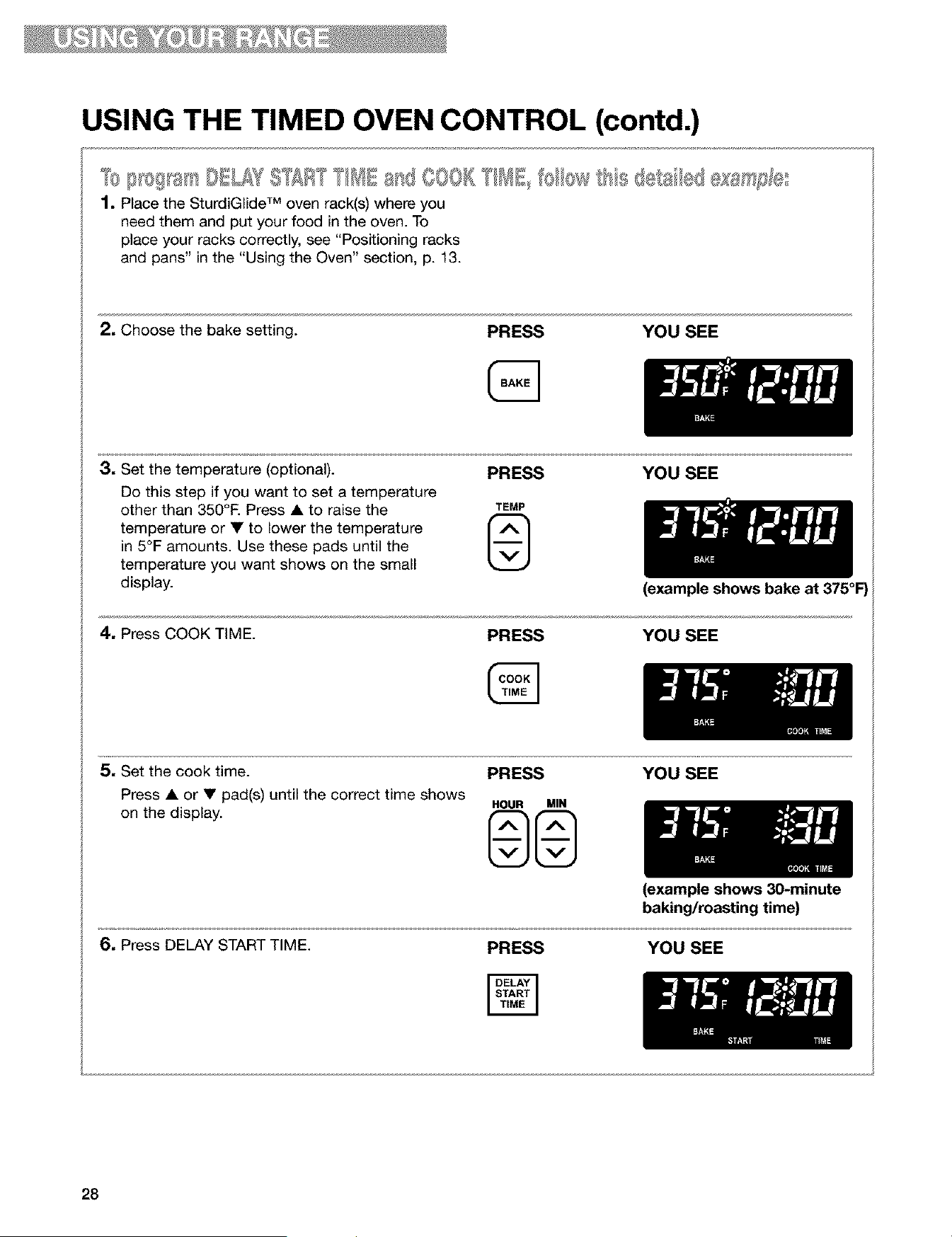
USING THE TIMED OVEN CONTROL (contd.)
1, Place the SturdiGlide TM oven rack(s) where you
need them and put your food in the oven. To
place your racks correctly, see "Positioning racks
and pans" in the "Using the Oven" section, p. 13.
2, Choose the bake setting. PRESS YOU SEE
3, Set the temperature (optional). PRESS
Do this step if you want to set a temperature
other than 350°E Press • to raise the TEMP
temperature or • to lower the temperature fAI
in 5°F amounts. Use these pads until the
temperature you want shows on the small
display.
YOU SEE
(example shows bake at 375°F)
4. Press COOK TIME.
PRESS YOU SEE
5, Set the cook time.
Press • or • pad(s) until the correct time shows
on the display.
PRESS
HOUR MIN
YOU SEE
(example shows 30-minute
baking/roasting time)
6, Press DELAY START TIME.
PRESS YOU SEE
28
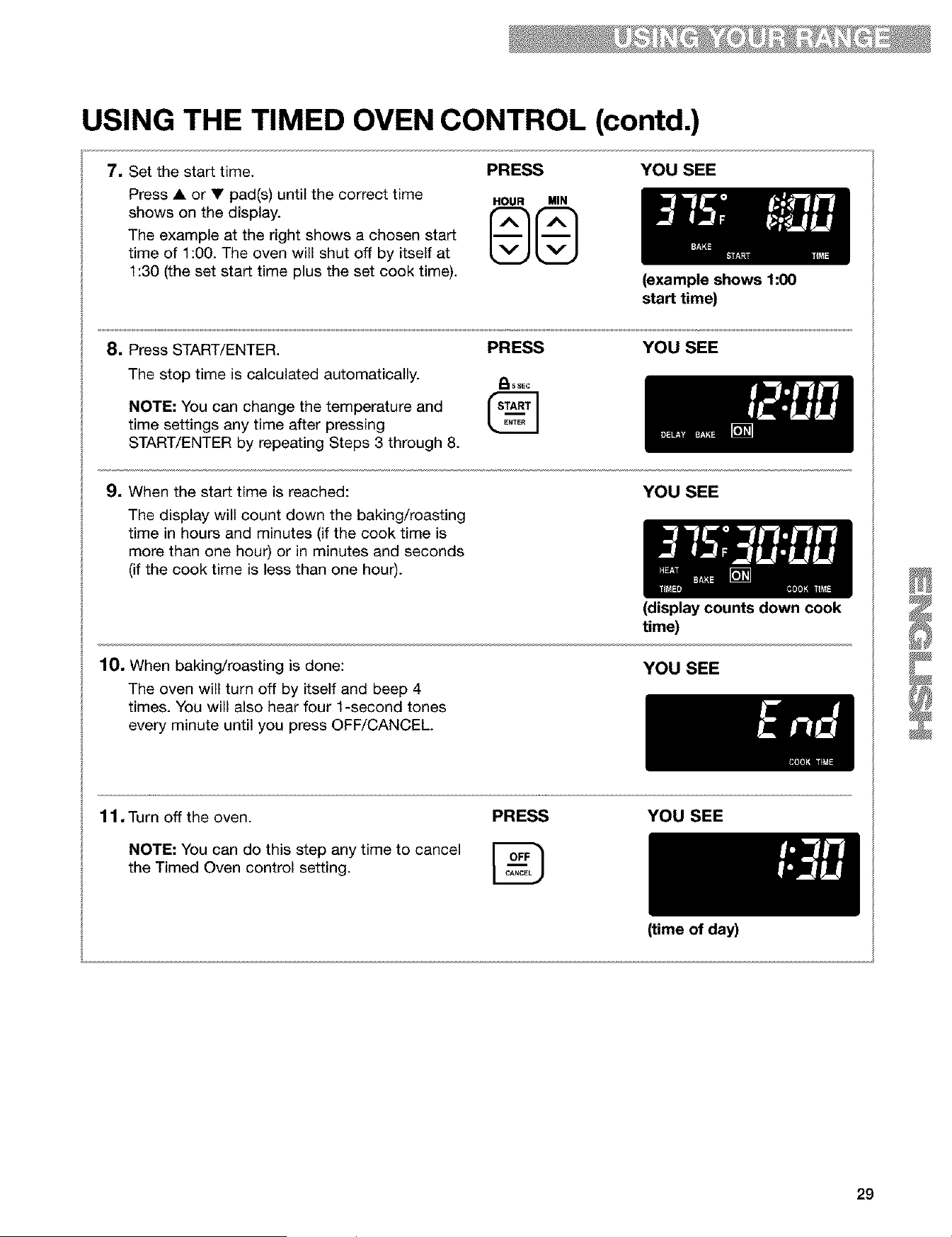
USING THE TIMED OVEN CONTROL (contd.)
7, Set the start time. PRESS
Press • or • pad(s) until the correct time HOUR mN
shows on the display. (_
The example at the right shows a chosen start
time of 1:00. The oven will shut off by itself at
1:30 (the set start time plus the set cook time).
YOU SEE
8, Press START/ENTER.
The stop time is calculated automatically.
NOTE: You can change the temperature and
time settings any time after pressing
START/ENTER by repeating Steps 3 through 8.
PRESS
_15 5EC
(example shows 1:00
start time)
YOU SEE
9, When the start time is reached:
The display will count down the baking/roasting
time in hours and minutes (if the cook time is
more than one hour) or in minutes and seconds
(if the cook time is less than one hour).
YOU SEE
(display counts down cook
time)
10, When baking/roasting is done:
The oven will turn off by itself and beep 4
times. You will also hear four 1-second tones
every minute until you press OFF/CANCEL.
YOU SEE
11. Turn off the oven. PRESS
NOTE: You can do this step any time to cancel
the Timed Oven control setting.
YOU SEE
(time of day)
29
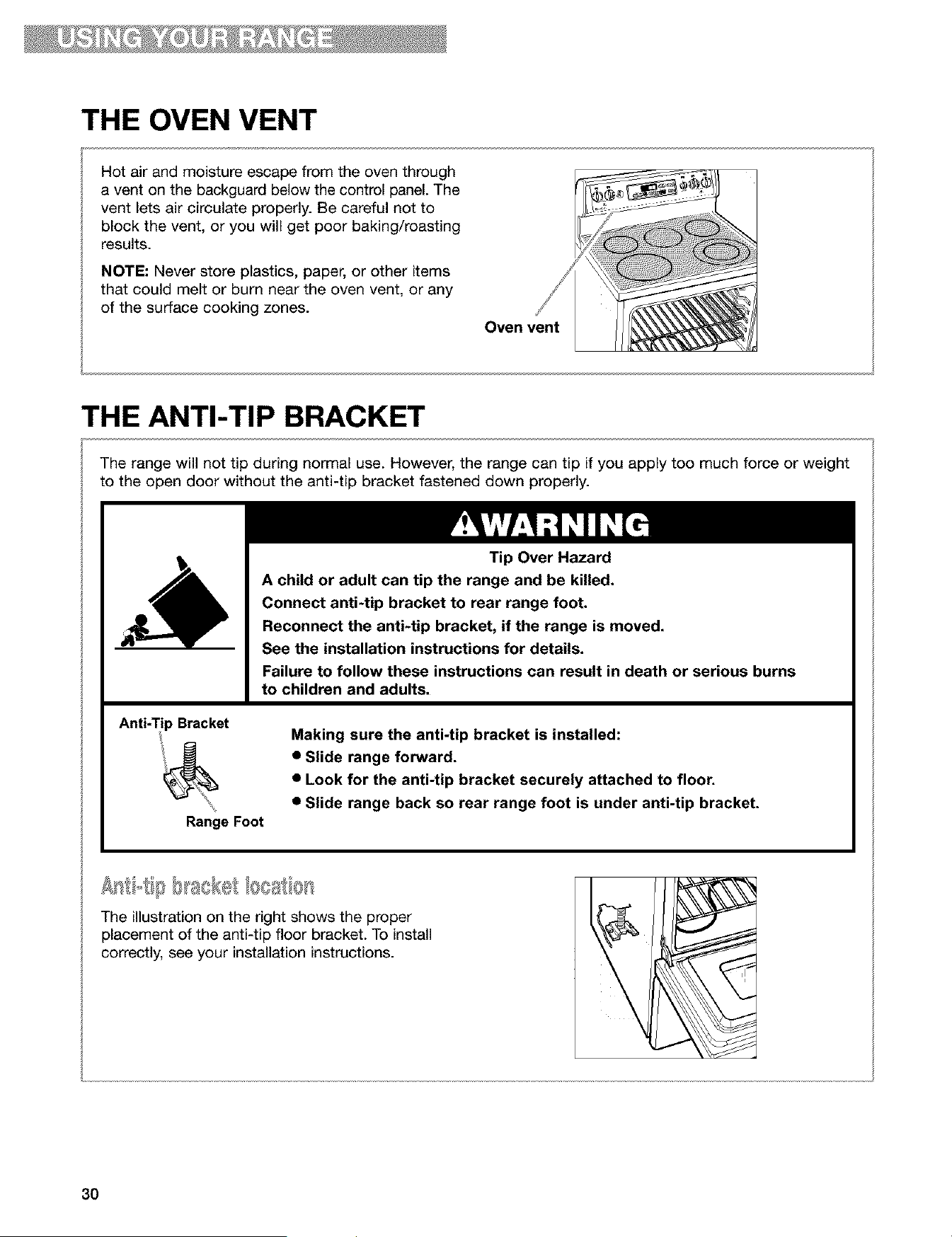
THE OVEN VENT
Hot air and moisture escape from the oven through
a vent on the backguard below the control panel. The
vent lets air circulate properly. Be careful not to
block the vent, or you will get poor baking/roasting
results.
NOTE: Never store plastics, paper, or other items
that could melt or burn near the oven vent, or any
of the surface cooking zones.
Oven vent
THE ANTI-TIP BRACKET
The range will not tip during normal use. However, the range can tip if you apply too much force or weight
to the open door without the anti-tip bracket fastened down properly.
Anti-Tip Bracket
Range Foot
Tip Over Hazard
A child or adult can tip the range and be killed.
Connect anti-tip bracket to rear range foot.
Reconnect the anti-tip bracket, if the range is moved.
See the installation instructions for details.
Failure to follow these instructions can result in death or serious burns
to children and adults.
Making sure the anti-tip bracket is installed:
• Slide range forward.
• Look for the anti-tip bracket securely attached to floor.
• Slide range back so rear range foot is under anti-tip bracket.
The illustration on the right shows the proper
placement of the anti-tip floor bracket. To install
correctly, see your installation instructions.
3O
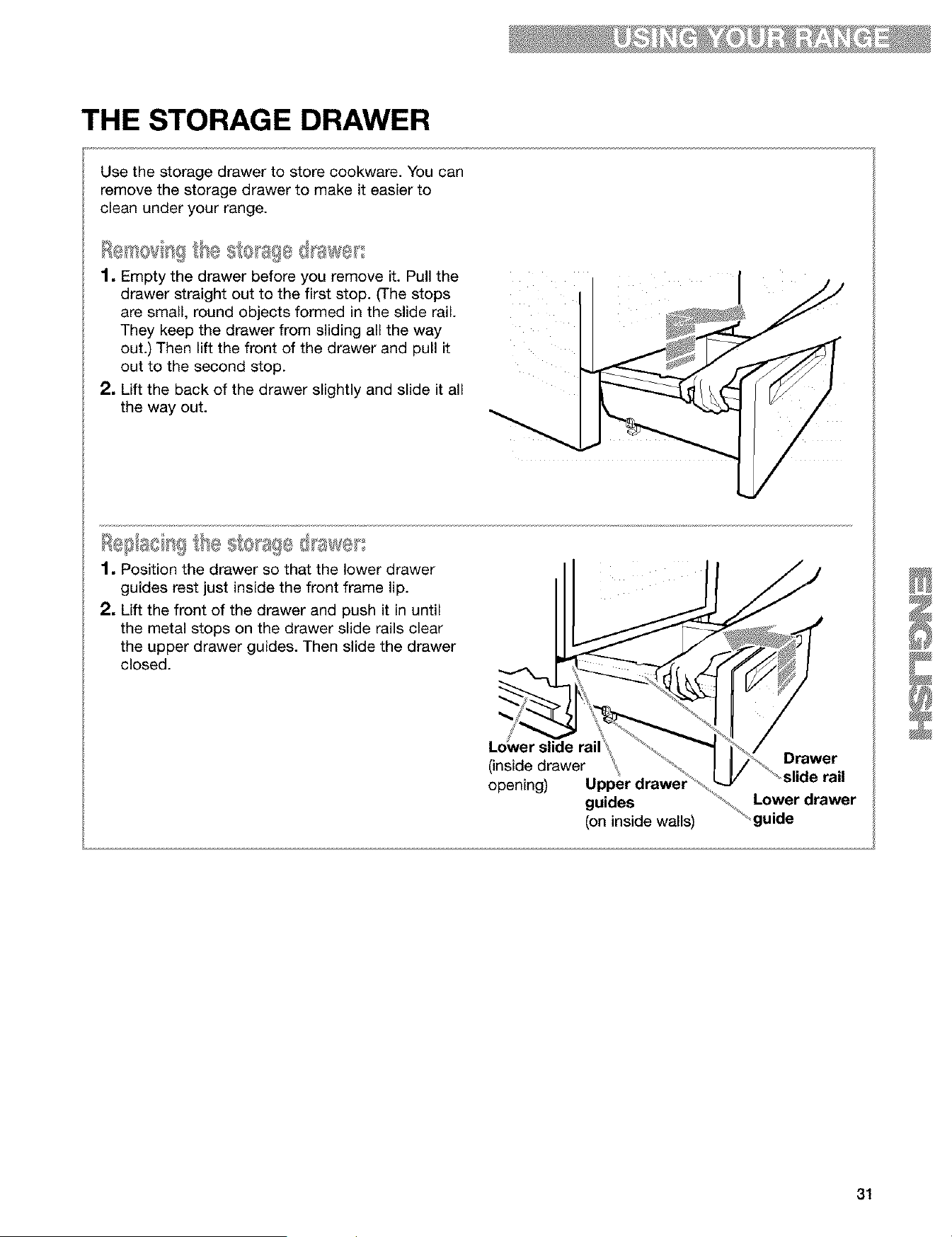
THE STORAGE DRAWER
Use the storage drawer to store cookware. You can
remove the storage drawer to make it easier to
clean under your range.
1. Empty the drawer before you remove it. Pull the
drawer straight out to the first stop. (The stops
are small, round objects formed in the slide rail.
They keep the drawer from sliding all the way
out.) Then lift the front of the drawer and pull it
out to the second stop.
2. Lift the back of the drawer slightly and slide it all
the way out.
lelsls@ l slo a£e
1. Position the drawer so that the lower drawer
guides rest just inside the front frame lip.
2, Lift the front of the drawer and push it in until
the metal stops on the drawer slide rails clear
the upper drawer guides. Then slide the drawer
closed.
Ld_ver
(inside drawer
opening)
guides
(on inside walls)
Drawer
Lower drawer
_luide
31
Usingthe Self-CleaningCycle
Burn Hazard
Do not touch the oven during the Self-Cleaning cycle.
Keep children away from oven during Self-Cleaning cycle.
Do not use commercial oven cleaners in your oven.
Failure to follow these instructions can result in burns, or illness from inhaling
dangerous fumes.
BEFORE YOU START
NOTE: Heat and odors are normal during the
Self-Cleaning cycle. Keep the kitchen well ventilat-
ed by opening a window or by turning on a vent
hood or other kitchen vent during the cycle.
Before you start the Self-Cleaning cycle, make
sure you:
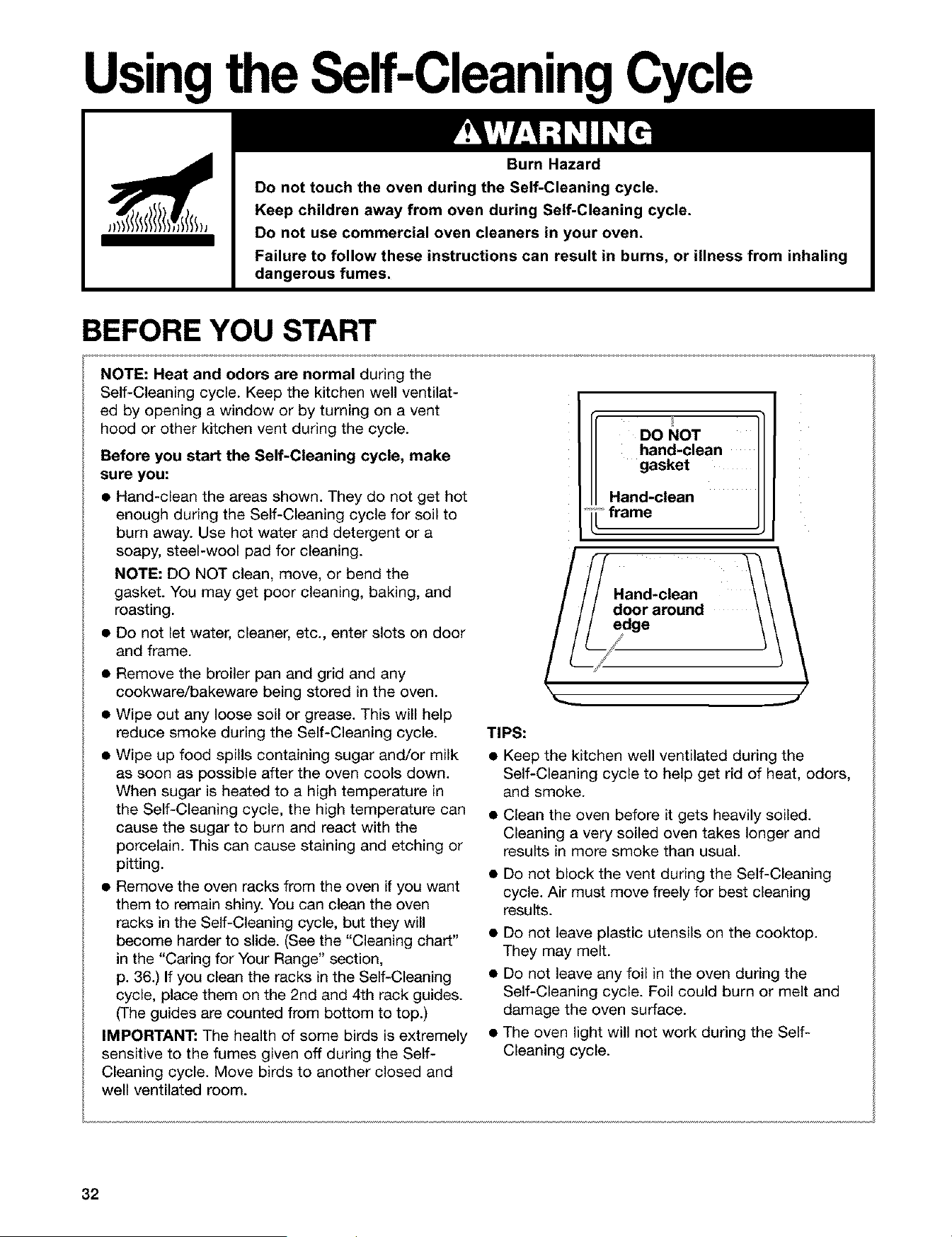
• Hand-clean the areas shown. They do not get hot
enough during the Self-Cleaning cycle for soil to
burn away. Use hot water and detergent or a
soapy, steel-wool pad for cleaning.
NOTE: DO NOT clean, move, or bend the
gasket. You may get poor cleaning, baking, and
roasting.
• Do not let water, cleaner, etc., enter slots on door
and frame.
• Remove the broiler pan and grid and any
cookware/bakeware being stored in the oven.
• Wipe out any loose soil or grease. This will help
reduce smoke during the Self-Cleaning cycle.
• Wipe up food spills containing sugar and/or milk
as soon as possible after the oven cools down.
When sugar is heated to a high temperature in
the Self-Cleaning cycle, the high temperature can
cause the sugar to burn and react with the
porcelain. This can cause staining and etching or
pitting.
• Remove the oven racks from the oven if you want
them to remain shiny. You can clean the oven
racks in the Self-Cleaning cycle, but they will
become harder to slide. (See the "Cleaning chart"
in the "Caring for Your Range" section,
p. 36.) If you clean the racks in the Self-Cleaning
cycle, place them on the 2nd and 4th rack guides.
(The guides are counted from bottom to top.)
IMPORTANT: The health of some birds is extremely
sensitive to the fumes given off during the Self-
Cleaning cycle. Move birds to another closed and
well ventilated room.
TIPS:
DO NOT
hand-clean
gasket
Hand-clean
frame
Keep the kitchen well ventilated during the
Self-Cleaning cycle to help get rid of heat, odors,
and smoke.
Clean the oven before it gets heavily soiled.
Cleaning a very soiled oven takes longer and
results in more smoke than usual.
Do not block the vent during the Self-Cleaning
cycle. Air must move freely for best cleaning
results.
• Do not leave plastic utensils on the cooktop.
They may melt.
• Do not leave any foil in the oven during the
Self-Cleaning cycle. Foil could burn or melt and
damage the oven surface.
• The oven light will not work during the Self-
Cleaning cycle.
32
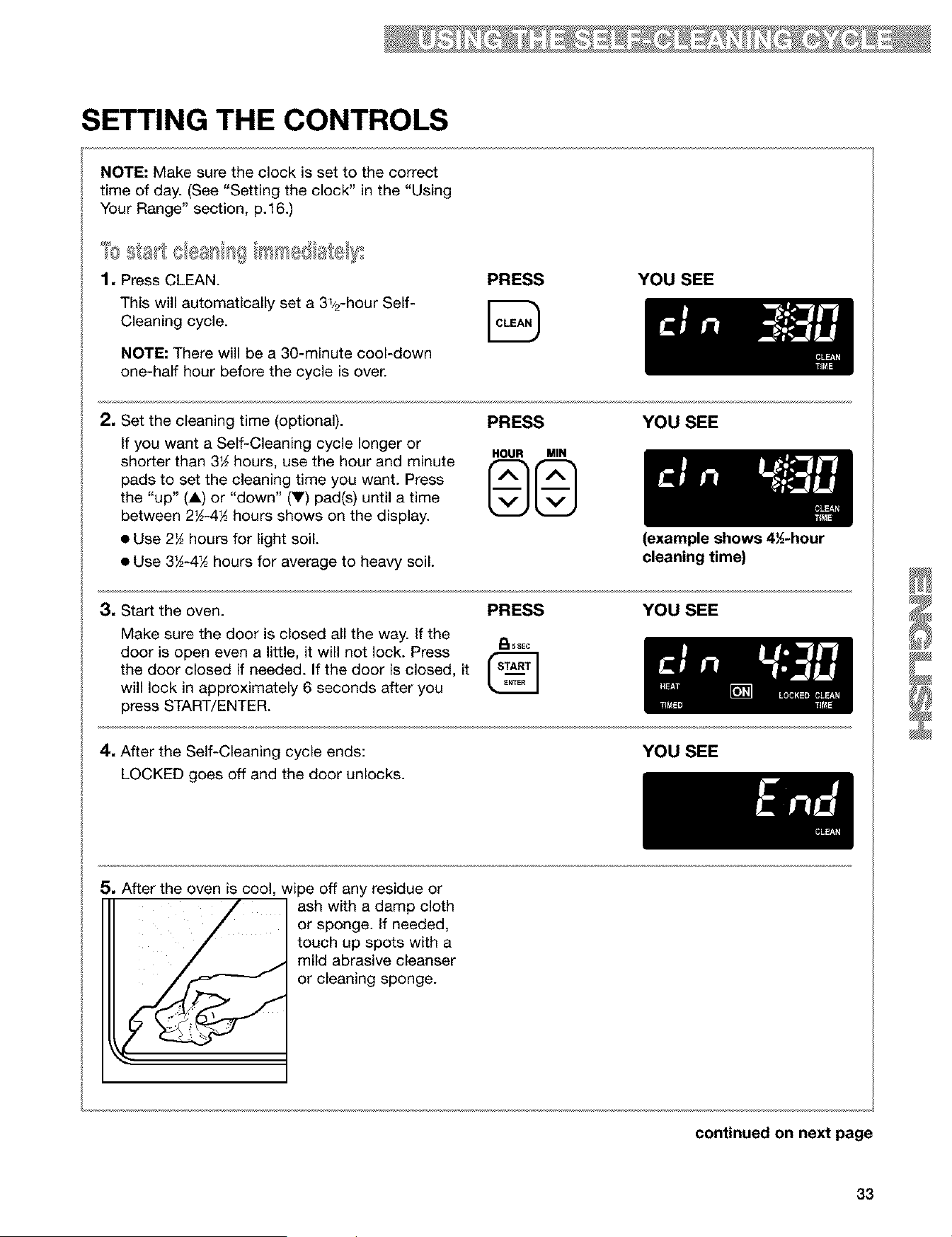
SETTING THE CONTROLS
NOTE: Make sure the clock is set to the correct
time of day. (See "Setting the clock" in the "Using
Your Range" section, p. 16.)
1, Press CLEAN. PRESS
This will automatically set a 31/2-hour Self- [_
Cleaning cycle.
cLttd
NOTE: There will be a 30-minute cool-down
one-half hour before the cycle is over.
YOU SEE
2. Set the cleaning time (optional). PRESS
If you want a Self-Cleaning cycle longer or
shorter than 34 hours, use the hour and minute _HOUR MIN
pads to set the cleaning time you want. Press I_'_11_'_1
the "up" (A) or "down" (V) pad(s) until a time
between 24-44 hours shows on the display.
• Use 24 hours for light soil.
• Use 34-44 hours for average to heavy soil.
YOU SEE
(example shows 44-hour
cleaning time)
3. Start the oven. PRESS
Make sure the door is closed all the way. If the 8 ....
door is open even a little, it will not lock. Press
the door closed if needed. If the door is closed, it
will lock in approximately 6 seconds after you
press START/ENTER.
YOU SEE
4. After the Self-Cleaning cycle ends:
LOCKED goes off and the door unlocks.
YOU SEE
5. After the oven is cool, wipe off any residue or
ash with a damp cloth
or sponge. If needed,
touch up spots with a
mild abrasive cleanser
or cleaning sponge.
continued on next page
33
SETTING THE CONTROLS (contd.)
_ _' _ _ _ _ @/_ _ _ _' 4¸ &_
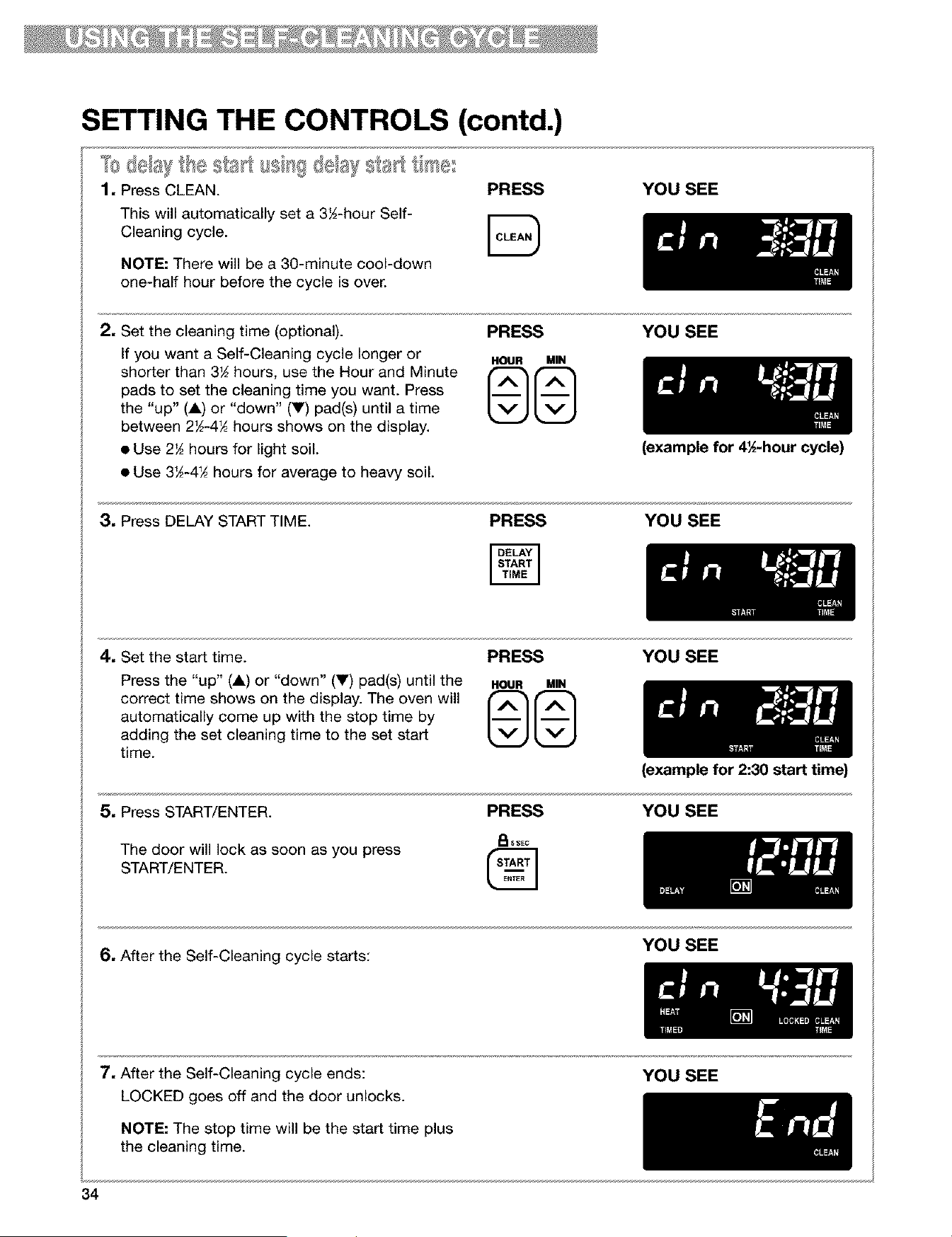
1, Press CLEAN. PRESS
This will automatically set a 3_-hour Self- r_
Cleaning cycle.
NOTE: There will be a 30-minute cool-down
one-half hour before the cycle is over.
YOU SEE
2, Set the cleaning time (optional). PRESS
If you want a Self-Cleaning cycle longer or HOUR MtN
shorter than 3_ hours, use the Hour and Minute _
pads to set the cleaning time you want. Press
@©the "up" (A) or "down" (V) pad(s) until a time
between 2_-4_ hours shows on the display.
• Use 2_ hours for light soil.
• Use 3_-4½ hours for average to heavy soil.
YOU SEE
3, Press DELAY START TIME. PRESS
(example for 4½-hour cycle)
YOU SEE
4, Set the start time. PRESS
Press the "up" (A) or "down" (V) pad(s) until the HOUR MtN
correct time shows on the display. The oven will _-_
automatically come up with the stop time by
® @
adding the set cleaning time to the set start
time.
YOU SEE
(example for 2:30 start time)
5, Press START/ENTER.
The door will lock as soon as you press
START/ENTER.
PRESS
_SSEC
YOU SEE
6, After the Self-Cleaning cycle starts:
YOU SEE
7, After the Self-Cleaning cycle ends:
LOCKED goes off and the door unlocks.
NOTE: The stop time will be the start time plus
the cleaning time.
YOU SEE
34
SETTING THE CONTROLS (contd.)
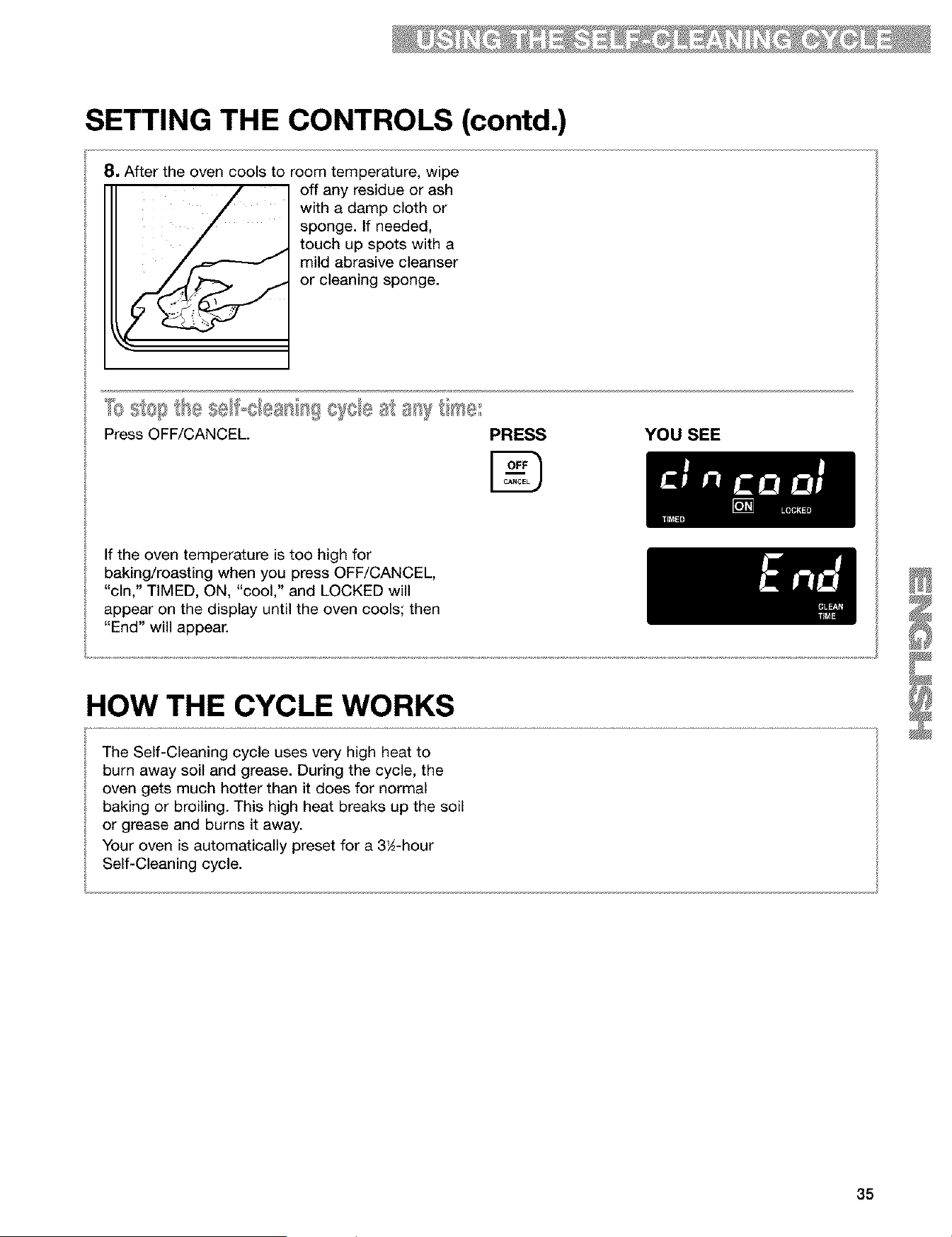
8, After the oven cools to room temperature, wipe
off any residue or ash
with a damp cloth or
sponge. If needed,
touch up spots with a
mild abrasive cleanser
or cleaning sponge.
Press OFF/CANCEL PRESS YOU SEE
If the oven temperature is too high for
baking/roasting when you press OFF/CANCEL,
"cln," TIMED, ON, "cool," and LOCKED will
appear on the display until the oven cools; then
"End" will appear.
HOW THE CYCLE WORKS
The Self-Cleaning cycle uses very high heat to
burn away soil and grease. During the cycle, the
oven gets much hotter than it does for normal
baking or broiling. This high heat breaks up the soil
or grease and burns it away.
Your oven is automatically preset for a 3½-hour
Self-Cleaning cycle.
35
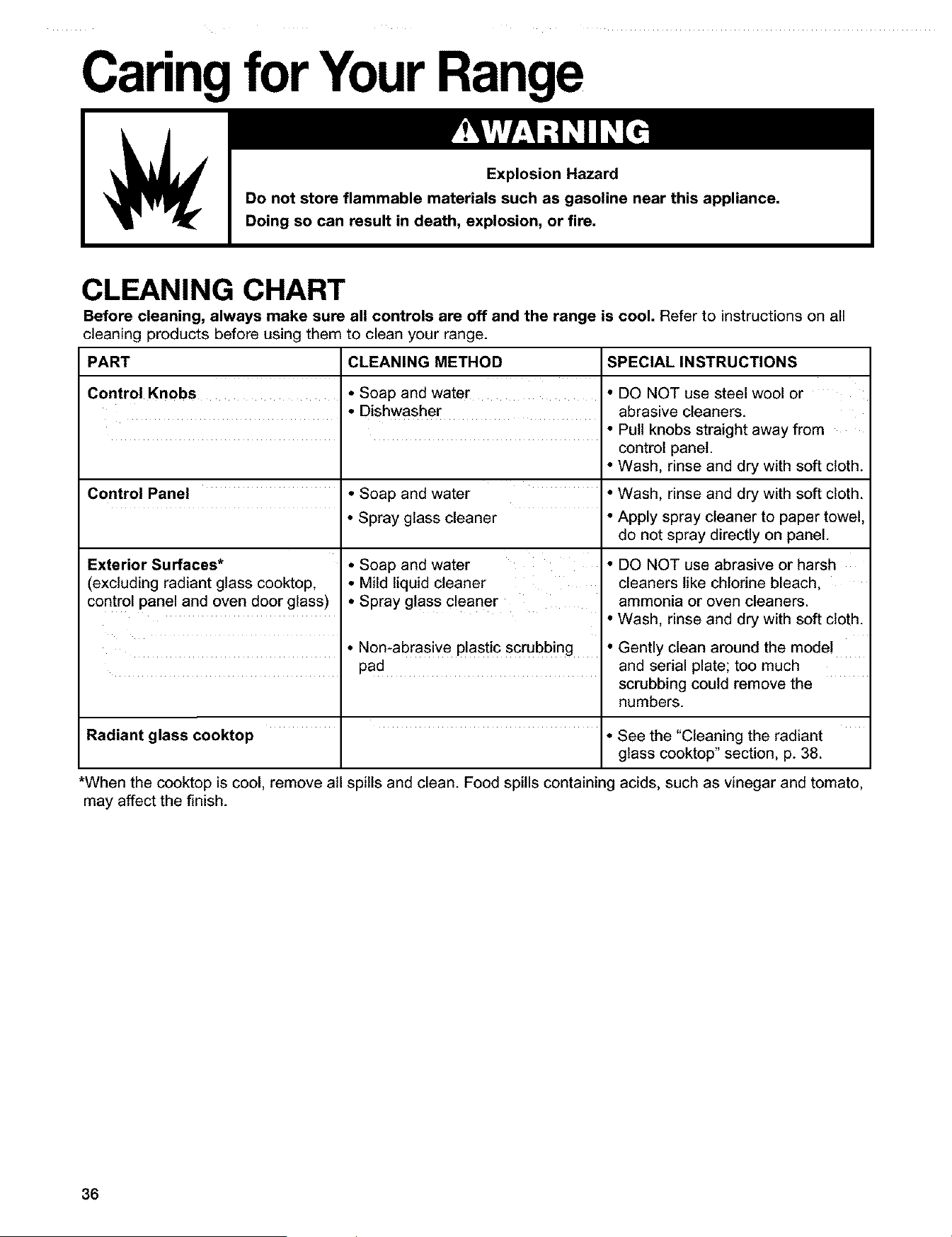
CaringforYourRange
CLEANING CHART
Before cleaning, always make sure all controls are off and the range is cool. Refer to instructions on all
cleaning products before using them to clean your range.
PART CLEANING METHOD SPECIAL INSTRUCTIONS
Control Knobs • Soap and water • DO NOT use steel wool or
• Dishwasher abrasive cleaners.
• Pull knobs straight away from
control panel.
• Wash, rinse and dry with soft cloth.
Control Panel • Soap and water • Wash, rinse and dry with soft cloth.
• Spray glass cleaner • Apply spray cleaner to paper towel,
do not spray directly on panel.
Exterior Surfaces*
(excluding radiant glass cooktop,
control panel and oven door glass)
• Soap and water
• Mild liquid cleaner
• Splay glass cleaner
• Non-abrasive plastic scrubbing
pad
• DO NOT use abrasive or harsh
cleaners like chlorine bleach,
ammonia or oven cleaners.
• Wash, rinse and dry with soft cloth.
• Gently clean around the mode!
and serial plate; too much
scrubbing could remove the
numbers.
Radiant glass cooktop • See the "Cleaning the radiant
glass cooktop" section, p. 38.
*When the cooktop is cool, remove atl s _ills and clean. Food spills containin acids, such as vinegar and tomato,
may affect the finish.
36
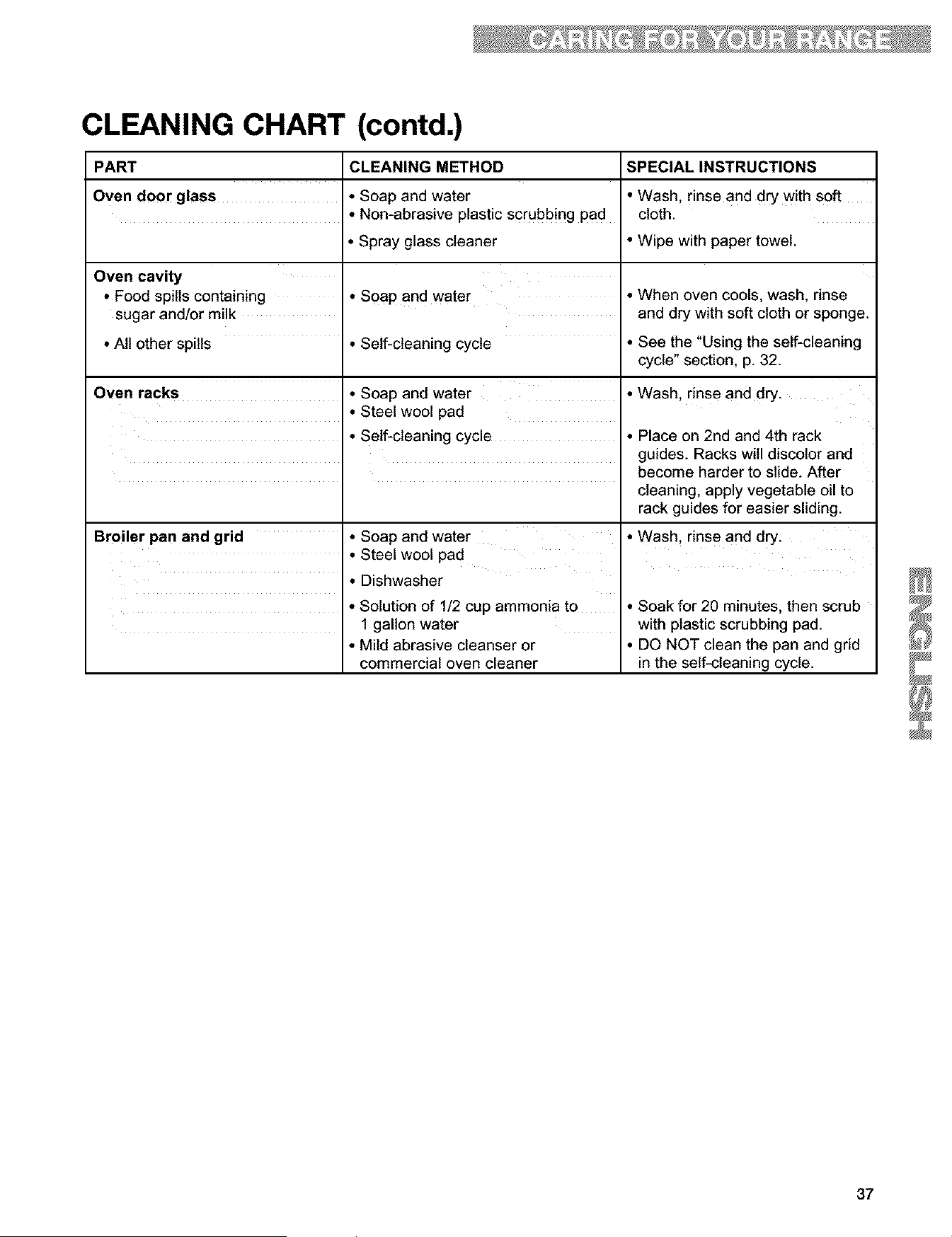
CLEANING CHART (contd.)
PART CLEANING METHOD SPECIAL INSTRUCTIONS
Oven door glass • Soap and water • Wash, rinse and dry with soft
• Non-abrasive plastic scrubbing pad cloth.
• Spray glass cleaner • Wipe with paper towel.
Oven cavity
• Food spills containing • Soap and water • When oven cools, wash, rinse
sugar and/or milk and dry with soft cloth or sponge.
• All other spills • Self-cleaning cycle • See the "Using the self-cleaning
cycle" section, p. 32.
Oven racks • Soap and water • Wash, rinse and dry.
• Steel wool pad
• Self-cleaning cycle
Broiler pan and grid • Soap and water
• Steel wool pad
• Dishwasher
• Solution of 1/2 cup ammonia to
1 gallon water
• Mild abrasive cleanser or
commercial oven cleaner
• Place on 2rid and 4th rack
guides. Racks will discolor and
become harder to slide. After
cleaning, apply vegetable oil to
rack guides for easier sliding.
• Wash, rinse and dry.
• Soak for 20 minutes, then scrub
with plastic scrubbing pad.
• DO NOT clean the pan and grid
in the self-cleaning cycle.
37
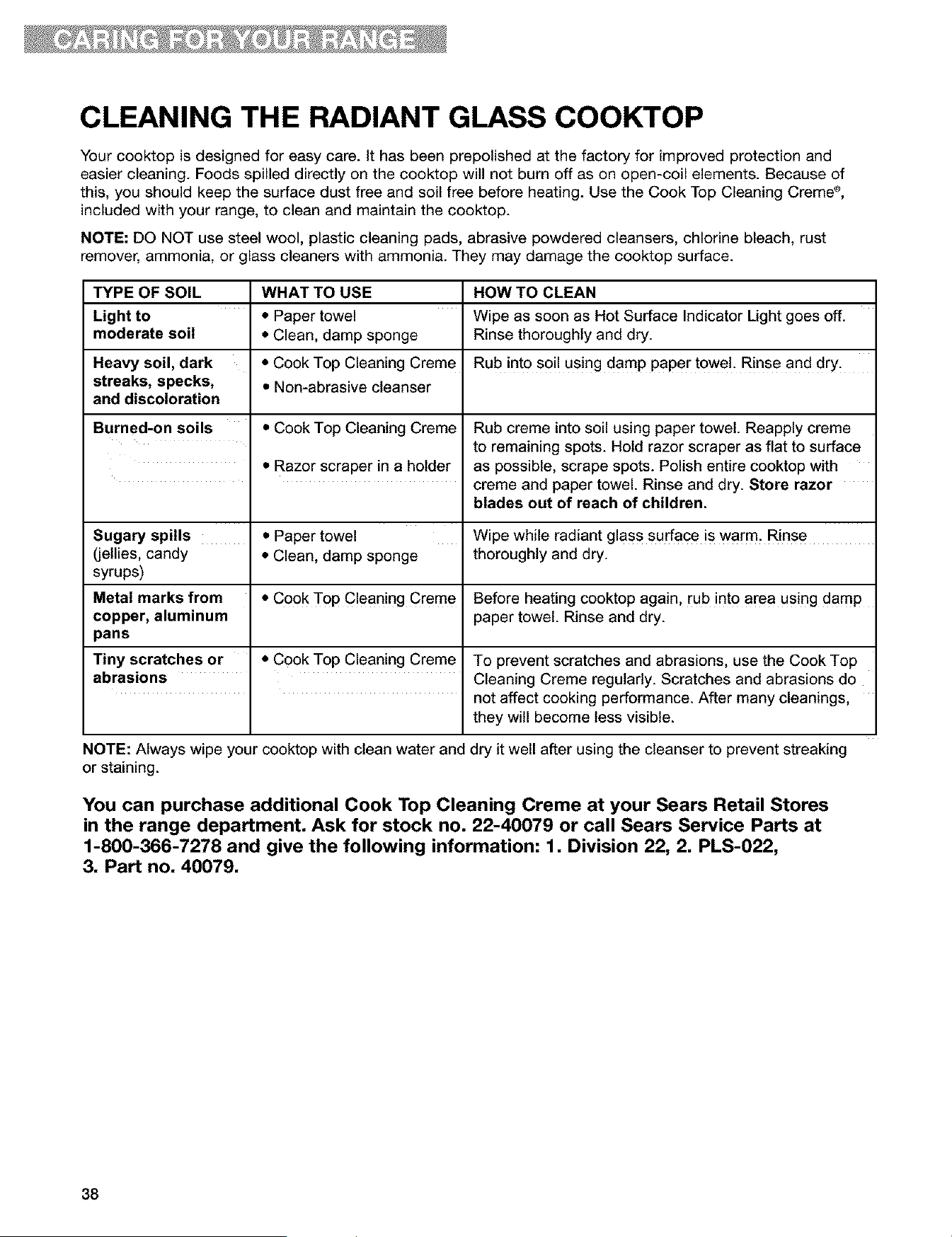
CLEANING THE RADIANT GLASS COOKTOP
Your cooktop is designed for easy care. It has been prepolished at the factory for improved protection and
easier cleaning. Foods spilled directly on the cooktop will not burn off as on open-coil elements. Because of
this, you should keep the surface dust free and soil free before heating. Use the Cook Top Cleaning Creme ®,
included with your range, to clean and maintain the cooktop.
NOTE: DO NOT use steel wool, plastic cleaning pads, abrasive powdered cleansers, chlorine bleach, rust
remover, ammonia, or glass cleaners with ammonia. They may damage the cooktop surface.
TYPE OF SOIL
Light to
moderate soil
Heavy soil, dark
streaks, specks,
and discoloration
Burned-on soils
Sugary spills
(jellies, candy
syrups)
Metal marks from
copper, aluminum
pans
Tiny scratches or
abrasions
WHAT TO USE
• Paper towel
• Clean, damp sponge
• Cook Top Cleaning Creme
• Non-abrasive cleanser
• Cook Top Cleaning Creme
• Razor scraper in a holder
• Paper towel
• Clean, damp sponge
• Cook Top Cleaning Creme
• Cook Top Cleaning Creme
HOW TO CLEAN
Wipe as soon as Hot Surface Indicator Light goes off.
Rinse thoroughly and dry.
Rub into soil using damp paper towel. Rinse and dry.
Rub creme into soil using paper towel. Reapply creme
to remaining spots. Hold razor scraper as flat to surface
as possible, scrape spots. Polish entire cooktop with
creme and paper towel. Rinse and dry. Store razor
blades out of reach of children.
Wipe while radiant glass surface is warm. Rinse
thoroughly and dry.
Before heating cooktop again, rub into area using damp
paper towel. Rinse and dry.
To prevent scratches and abrasions, use the Cook Top
Cleaning Creme regularly. Scratches and abrasions do
not affect cooking performance. After many cleanings,
they will become tess visible.
NOTE: Always wipe your cooktop with clean water and dry it well after using the cleanser to prevent streaking
or staining.
You can purchase additional Cook Top Cleaning Creme at your Sears Retail Stores
in the range department, Ask for stock no, 22-40079 or call Sears Service Parts at
1-800-366-7278 and give the following information: 1, Division 22, 2, PLS-022,
3, Part no, 40079,
38
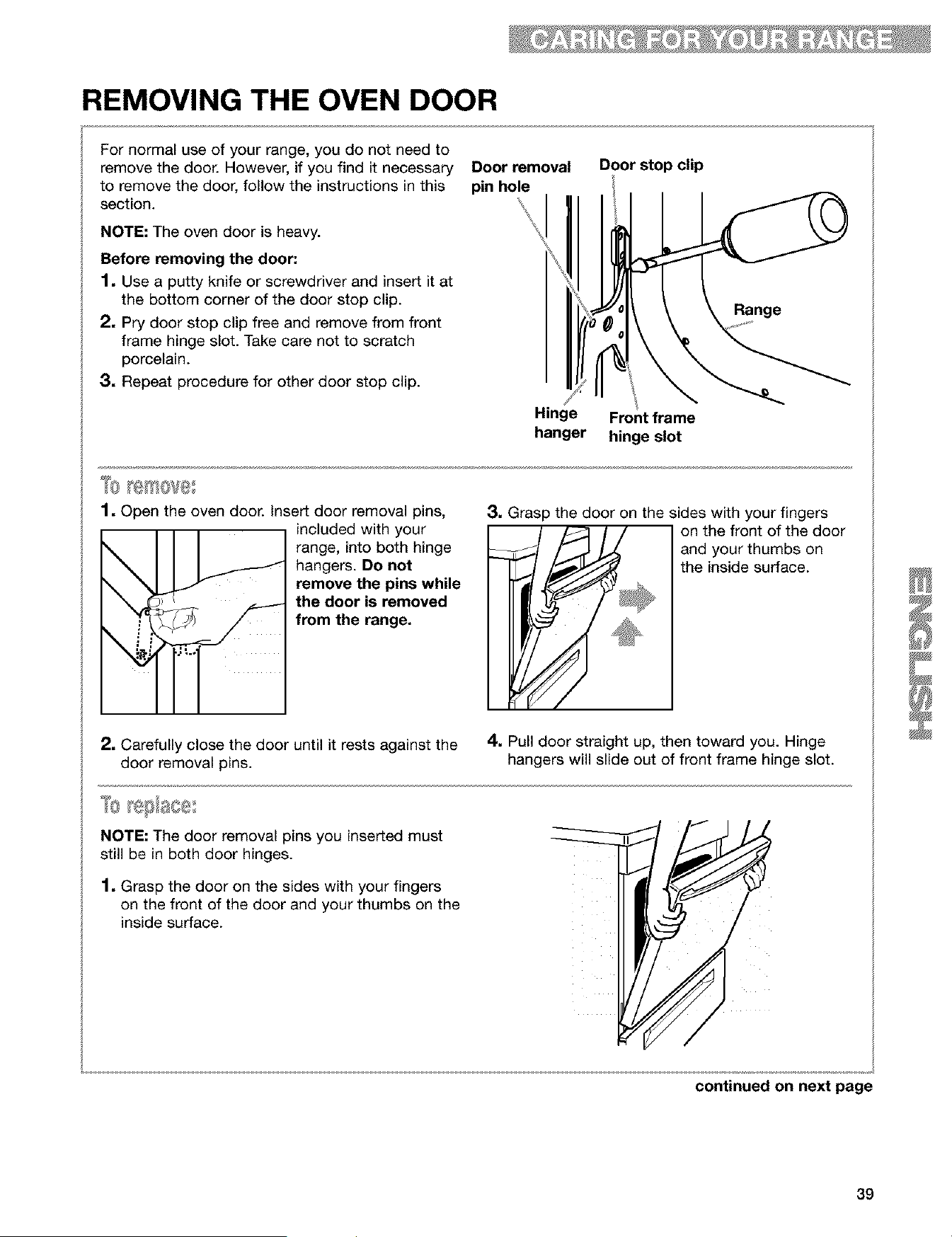
REMOVING THE OVEN DOOR
For normal use of your range, you do not need to
remove the door. However, if you find it necessary
to remove the door, follow the instructions in this
section.
NOTE: The oven door is heavy.
Before removing the door."
1, Use a putty knife or screwdriver and insert it at
the bottom corner of the door stop clip.
2, Pry door stop clip free and remove from front
frame hinge slot. Take care not to scratch
porcelain.
3, Repeat procedure for other door stop clip.
Door removal
pin hole
Door stop clip
p Oo
Hinge Front frame
hanger hinge slot
%1%1111110+1151
1, Open the oven door. Insert door removal pins,
included with your
range, into both hinge
hangers. Do not
remove the pins while
the door is removed
from the range.
3, Grasp the door on the sides with your fingers
on the front of the door
and your thumbs on
the inside surface.
2, Carefully close the door until it rests against the
door removal pins.
4. Pull door straight up, then toward you. Hinge
hangers will slide out of front frame hinge slot.
NOTE: The door removal pins you inserted must
still be in both door hinges.
1, Grasp the door on the sides with your fingers
on the front of the door and your thumbs on the
inside surface.
continued on next page
39
REMOVING THE OVEN DOOR (contd.)
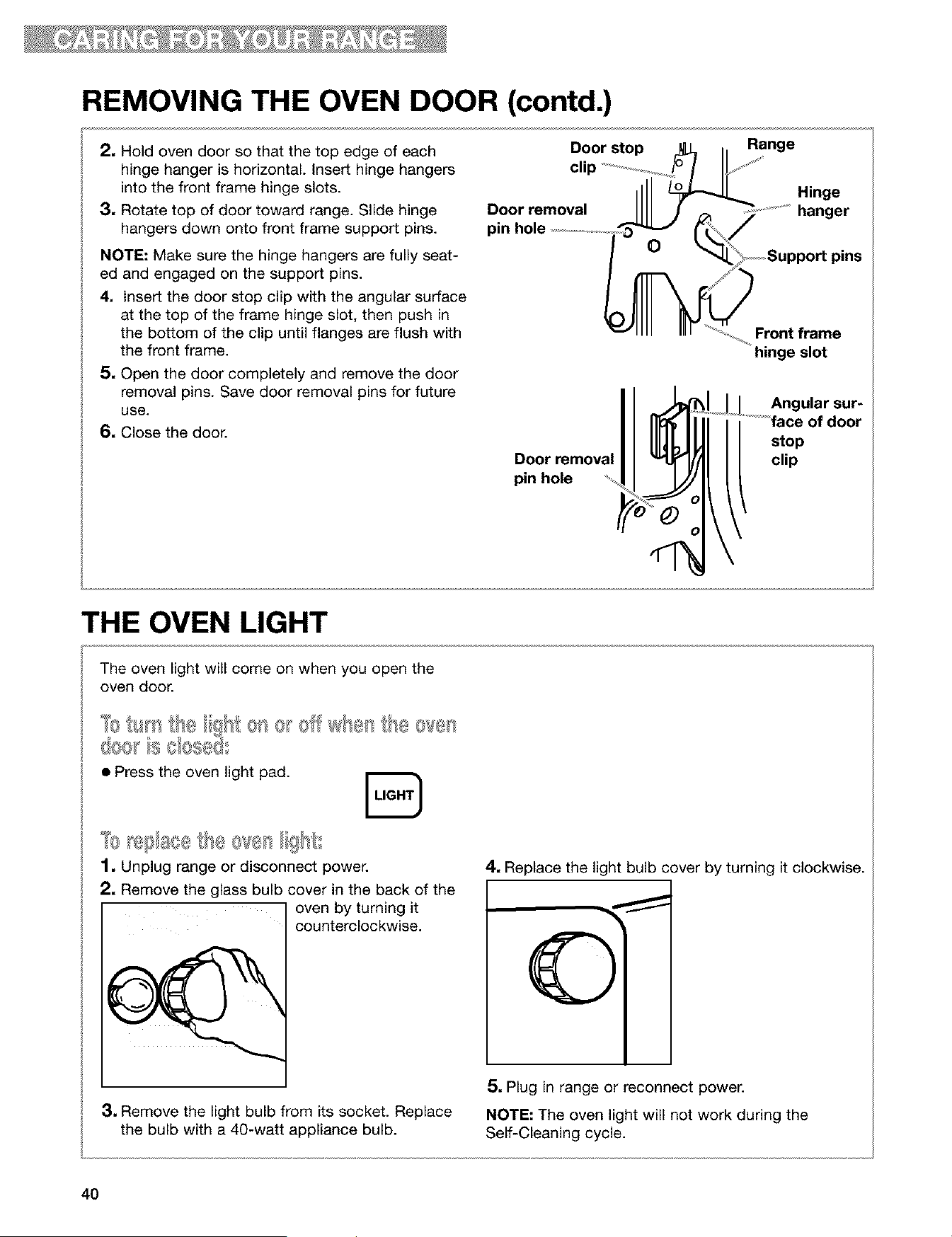
2, Hold oven door so that the top edge of each
hinge hanger is horizontal. Insert hinge hangers
into the front frame hinge slots.
3, Rotate top of door toward range. Slide hinge
hangers down onto front frame support pins.
NOTE: Make sure the hinge hangers are fully seat-
ed and engaged on the support pins.
4, Insert the door stop clip with the angular surface
at the top of the frame hinge slot, then push in
the bottom of the clip until flanges are flush with
the front frame.
5, Open the door completely and remove the door
removal pins. Save door removal pins for future
use.
6, Close the door.
Door stop Range
Door removal
pin hole
Door removal
pin hole
Angular sur-
stop
clip
THE OVEN LIGHT
The oven light will come on when you open the
oven door.
¢tee 's e/ese ;
• Press the oven light pad.
¢ @
@Jr
1, Unplug range or disconnect power.
2, Remove the glass bulb cover in the back of the
oven by turning it
counterclockwise.
4, Replace the light bulb cover by turning it clockwise.
3. Remove the light bulb from its socket. Replace
the bulb with a 40-watt appliance bulb.
5. Plug in range or reconnect power.
NOTE: The oven light will not work during the
Self-Cleaning cycle.
4O
Troubleshooting
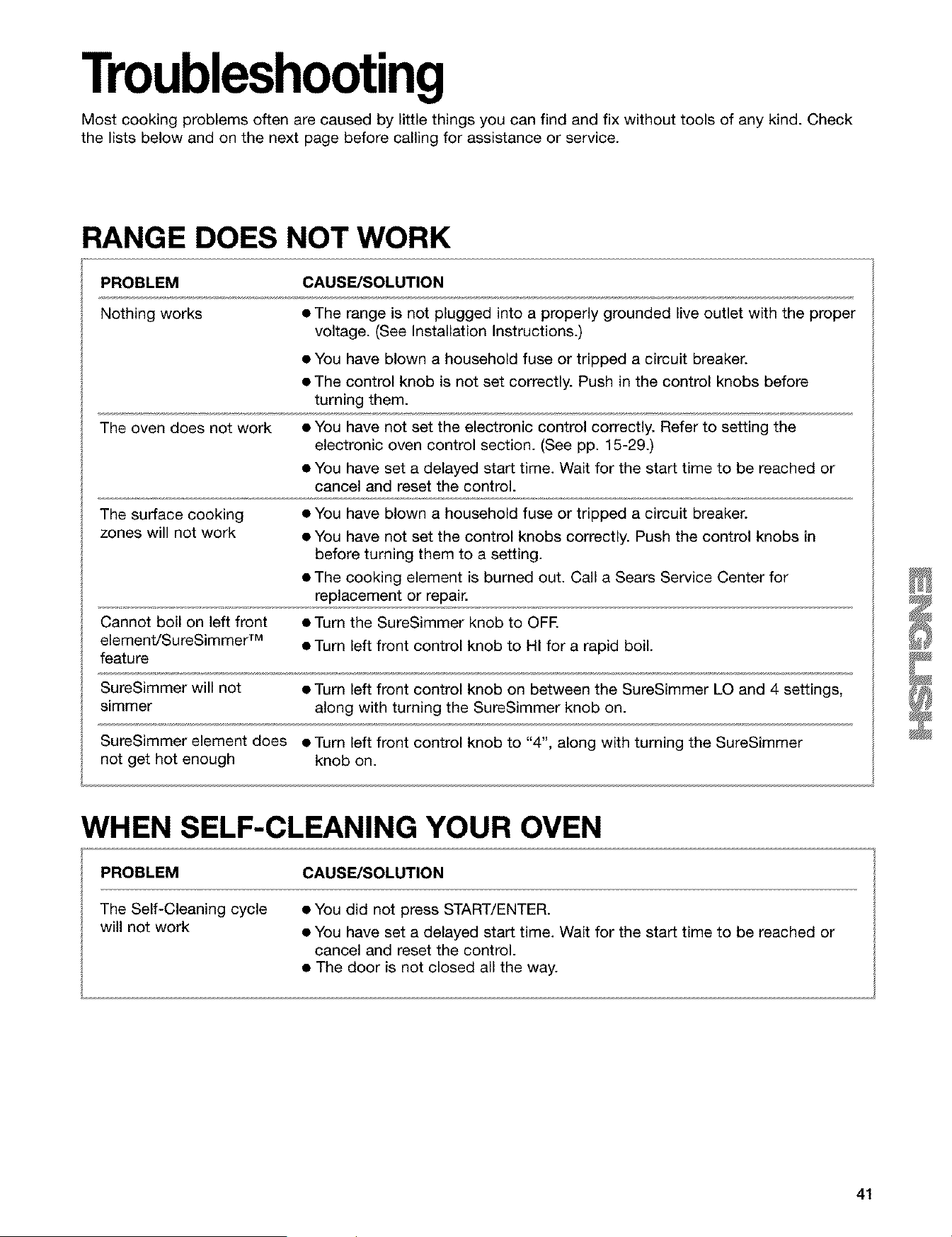
Most cooking problems often are caused by little things you can find and fix without tools of any kind. Check
the lists below and on the next page before calling for assistance or service.
RANGE DOES NOT WORK
PROBLEM CAUSE/SOLUTION
Nothing works • The range is not plugged into a properly grounded live outlet with the proper
voltage. (See Installation Instructions.)
• You have blown a household fuse or tripped a circuit breaker.
• The control knob is not set correctly. Push in the control knobs before
turning them.
The oven does not work • You have not set the electronic control correctly. Refer to setting the
electronic oven control section. (See pp. 15-29.)
• You have set a delayed start time. Wait for the start time to be reached or
cancel and reset the control.
The surface cooking • You have blown a household fuse or tripped a circuit breaker.
zones will not work • You have not set the control knobs correctly. Push the control knobs in
before turning them to a setting.
• The cooking element is burned out. Call a Sears Service Center for
replacement or repair.
Cannot boil on left front • Turn the SureSimmer knob to OFE
element/SureSimmerTM • Turn left front control knob to HI for a rapid boil.
feature
SureSimmer will not • Turn left front control knob on between the SureSimmer LO and 4 settings,
simmer along with turning the SureSimmer knob on.
SureSimmer element does • Turn left front control knob to "4", along with turning the SureSimmer
not get hot enough knob on.
WHEN SELF-CLEANING YOUR OVEN
PROBLEM CAUSE/SOLUTION
The Self-Cleaning cycle • You did not press START/ENTER.
will not work • You have set a delayed start time. Wait for the start time to be reached or
cancel and reset the control.
• The door is not closed all the way.
41
COOKING RESULTS
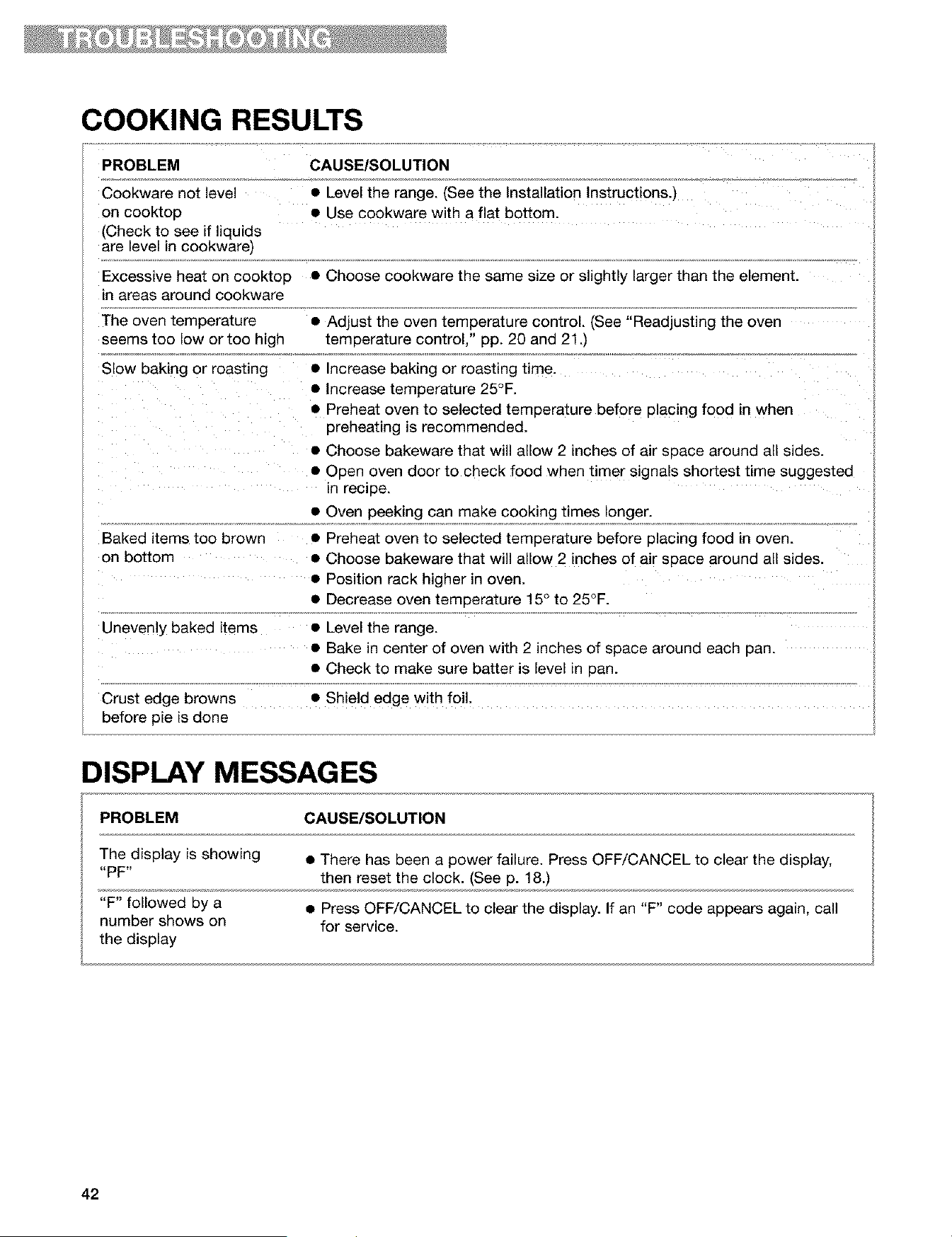
PROBLEM CAUSE/SOLUTION
Cookware not level • Level the range. (See the Installation Instructions.)
on cooktop • Use cookware with a flat bottom.
(Check to see if liquids
are level in cookware)
Excessive heat on cooktop • Choose cookware the same size or slightly larger than the element.
!nareasapu d cookware
The oven temperature • Adjust the oven temperature control. (See "Readjusting the oven
seems too low or too high temperature control," pp. 20 and 21 .)
Slow baking or roasting • Increase baking or roasting time.
• Increase temperature 25°F.
• Preheat oven to selected temperature before placing food in when
preheating is recommended.
• Choose bakeware that will allow 2 inches of air space around all sides.
• Open oven door to check food when timer s_gnals shortest time suggested
in recipe.
• Oven peeking can make cooking times longer.
Baked items too brown • Preheat oven to selected temperature before placing food in oven.
on bottom • Choose bakeware that will allow 2 inches of air space around all sides. ::
• Position rack higher in oven.
• Decrease oven temperature 15° to 25°F.
Unevenly baked items • Level the range.
• Bake in center of oven with 2 inches of space around each pan.
• Check to make sure batter is level in pan. _
Crust edge browns • Shield edge with foil.
before pie is done
DISPLAY MESSAGES
PROBLEM CAUSE/SOLUTION
The display is showing • There has been a power failure. Press OFF/CANCEL to clear the display,
"PF" then reset the clock. (See p. 18.)
"F" followed by a • Press OFF/CANCEL to clear the display. If an "F" code appears again, call
number shows on for service.
the display
42
Index
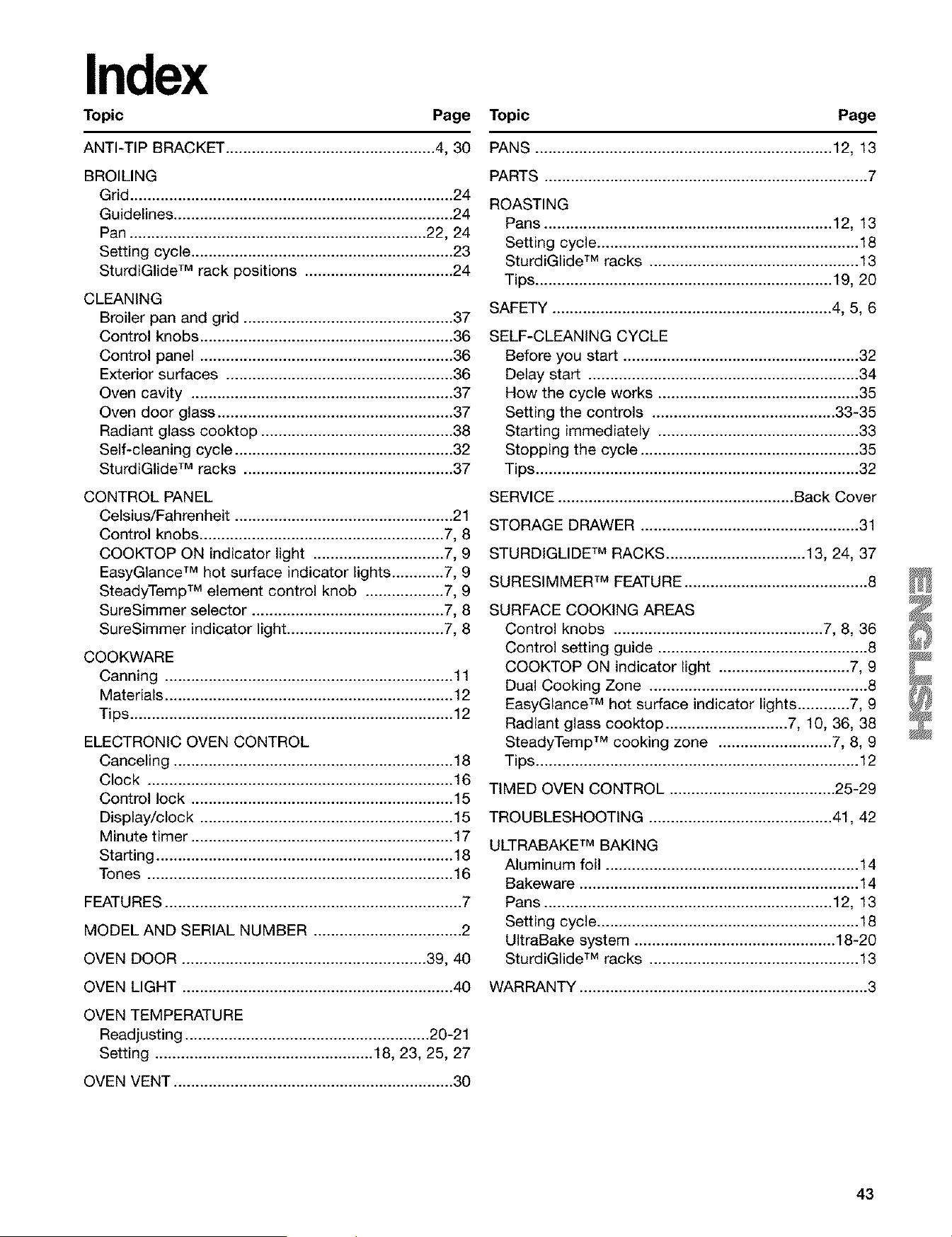
Topic Page Topic Page
ANTI-TIP BRACKET .................................. .4, 30
BROIUNG
Grid ..................................................... .24
Guidelines. ............................................. .24
Pan ................................................. .22, 24
Setting cycle. .......................................... .23
SturdiGlide TM rack positions ................................. .24
CLEANING
Broiler pan and grid ............................................... .37
Control knobs ......................................................... .36
Control panel ......................................................... .36
Exterior surfaces ................................................... .36
Oven cavity ........................................................... .37
Oven door glass ..................................................... .37
Radiant glass cooktop ........................................... .38
Self-cleaning cycle .................................... .32
SturdiGlide TM racks ............................................... .37
CONTROL PANEL
Celsius/Fahrenheit .................................................. 21
Control knobs. ....................................... .7, 8
COOKTOP ON indicator light ..................... .7, 9
EasyGlance TM hot surface indicator lights ............ 7, 9
SteadyTemp TM element control knob ................ 7, 9
SureSimmer selector ................................ .7, 8
SureSimmer indicator light. ......................... .7, 8
COOKWARE
Canning ................................................ 11
Materials ................................................ 12
Tips .......................................................................... 12
ELECTRONIC OVEN CONTROL
Canceling ............................................... 18
Clock ....................................... 16
Control lock ................................. 15
Display/clock ................................ 15
Minute timer ............................................ 17
Starting .................................................................... 18
Tones ....................................... 16
FEATURES ................................................. 7
MODEL AND SERIAL NUMBER ................................ .2
OVEN DOOR ....................................................... .39, 40
OVEN UGHT ............................................................. .40
OVEN TEMPERATURE
Readjusting ........................................ .20-21
Setting ................................................ 18, 23, 25, 27
OVEN VENT .............................................................. .30
PANS ................................................................... 12, 13
PARTS ..................................................... .7
ROASTING
Pans ................................................ 12, 13
Setting cycle. .......................................... 18
SturdiGlide TM racks ........................... 13
Tips. .................................................................. 19, 20
SAFETY .............................................. .4, 5, 6
SELF-CLEANING CYCLE
Before you start ....................................... 32
Delay start ................................... 34
How the cycle works .......................... 35
Setting the controls ........................................ .33-35
Starting immediately .......................... 33
Stopping the cycle ................................................. 35
Tips ......................................................................... 32
SERVICE ....................................... .Back Cover
STORAGE DRAWER .................................... 31
STURDIGUDE TM RACKS ....................... 13, 24, 37
SURESIMMER TM FEATURE .............................. .8
SURFACE COOKING AREAS
Control knobs .................................. .7, 8, 36
Control setting guide ............................................... .8
COOKTOP ON indicator light ..................... .7, 9
Dual Cooking Zone .................................... .8
EasyGlance TM hot surface indicator lights. ....... .7, 9
Radiant glass cooktop ........................... .7, 10, 36, 38
SteadyTemp TM cooking zone ......................... .7, 8, 9
Tips ......................................................................... 12
TIMED OVEN CONTROL .................................. .25-29
TROUBLESHOOTING .............................. 41, 42
ULTRABAKE TM BAKING
Aluminum foil ........................................................ 14
Bakeware ..................................... 14
Pans ................................................ 12, 13
Setting cycle. .......................................... 18
UltraBake system ......................... 18-20
SturdiGlide TM racks ........................... 13
WARRANTY ............................................... .3
43
f
Indicede Materias Un Mensaje
Un mensaje para Usted ........................................,44
=========================================================================
Seguridad de la Cocina .........................................,46
Componentes y Caracteristicas .........................,49
Cbmo usar su Cocina ............................................_50
C,6mo usar las areas de cocci6n exteriores ...50
Caracteffslcas de los materiales
de los utensilios de cocina .................................54
C,6mo usar el homo ............................................55
Selecci6n de utensilios para hornear ...............56
C6mo usar el papel de aluminio .......................56
El conb'ol electr6nico del homo .........................57
C,6mo programar el reloj..............................58
Sefiales audibles ...........................................58
C,6mo usar el temporizador
electr6nico de la cocina electrica ...............59
C,6mo comenzar/cancelar una funci6n....60
Horneado/Asado de Ulb'aBake TM .............60
C,6mo regular el con'col
de temperatura del homo ............................62
C6mo asar a la parrilla .................................64
C,6mo usar el con'col del homo
con tiempo programado ..............................67
El conducto de ventilad6n del homo ...............72
El soporte anti-vuelco ..........................................72
La gaveta de almacenaje ...................................73
Cbmo usar el Ciclo de autolimpieza ................74
Antes de comenzar .............................................74
C,6mo programar los conb'oles .........................75
C6mo funciona el dclo .......................................77
[] cuidado de su Cocina ........................................78
Cuadro de limpieza ..............................................78
La limpieza de la superficie
de cocci6n de cristal radiante ............................80
C,6mo quitar la puerta del homo .......................81
La luz del homo ....................................................82
para Usted
Su cocina electrica KENMORE adquiere un nuevo
valor cuando usted descubre que Sears tiene
centros de servicios por todo et pais. Los profesio-
nales de Servicio T6cnico competentes de Sears
usan camiones totalmente equipados y metodos
aprobados por Sears para respaldar las garantias de
Sears mediante reparaciones expertas.
Siernpre que Ilame para sotcitar servicio tecnico
para su artefacto, tenga a la mano el nt_mero de
modelo y de serie completos. Usted puede
encontrar esta informaci6n en la placa de nQmero de
modelo y serie (vea diagrama "Componentes y
Caracteristicas," en lap. 49.)
Sirvase asimismo registrar la fecha de compra de su
artefacto etectrodomestico y el nombre y nemero
tetef6nico de la tienda donde Io compr&
Modelo Nt_mero 665.
Nt_mero de Serie R
Fecha de Compra
Nombre de la Tienda
Tel_fono de la Tienda
Guarde este manual y el comprobante de
compra juntos en un lugar seguro para
referencia futura.
Diagnbstico y solucibn de problemas ..............2_3
La cocina no funoiona.........................................83
Cuando usa el ciclo
de autolimpieza de su homo .............................83
Resultadosde cocci6n .......................................84
Mensajes en la pantalla luminosa.....................84
[ndice ..........................................................................._5
Servicio ............................................. ,Contracubierta
44
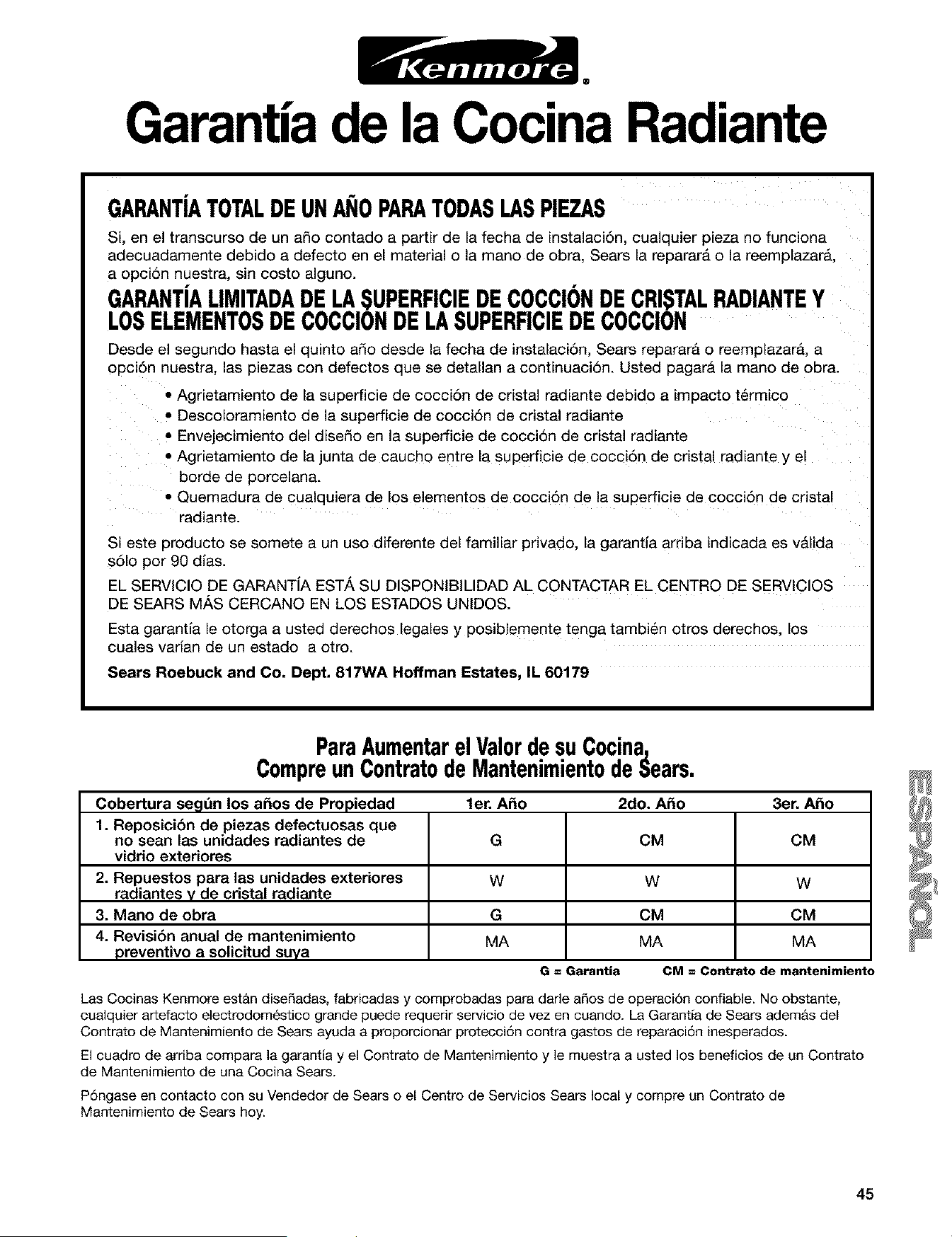
®
Garantiade la CocinaRadiante
GARANTIATOTALDEUNANOPARATODASLASPIEZAS
Si, en el transcurso de un ado contado a partir de la fecha de instalaci6_ cualquier pieza no funciona
adecuadamente debido a defecto en el material o la mano de obra, Sears la reparara o la reemplazara.
a opciSn nuestra, sin costo alguno.
GARANTIAUMITADADELASUPERFICIEDECOCClONDECRISTALRADIANTEY
LOSELEMENTOSDECOGClONDELASUPERFICIEDECOCCION
Desde el segundo hasta el quinto ado desde la fecha de instalacion. Sears reparara o reemplazara, a
opci6n nuestra, las piezas con defectos que se detallan a continuacion. Usted pagar& la mano de obra.
• Agrietamiento de la superficie de cocci6n de cristal radiante debido a impacto t_rmico
• Descoloramiento de la superficie de cocci6n de cristal radiante
• Envejecimiento del disedo en la superficie de coccion de cristal radiante
• Agrietamiento de la junta de caucho entre la superficie de coccion de cristal radiante y el
borde de porcelana.
• Quemadura de cualquiera de los elementos de cocci6n de la superficie de cocci6n de cristal
radiante.
Si este producto se somete a un uso diferente del familiar privado, la garantia arriba indicada es vAlida
s61o por 90 dlas.
EL SERVICIO DE GARANTiA ESTA SU DISPONIBILIDAD AL CONTACTAR EL CENTRO DE SERVICIOS
DE SEARS M,g,S CERCANO EN LOS ESTADOS UNIDOS.
Esta garantla le otorga a usted derechos legales y posiblemente tenga tambien otros derechos, los
cuales varian de un estado a otro.
Sears Roebuck and Co. Dept. 817WA Hoffman Estates, IL 60179
ParaAumentarelValordesuCocina,
CompreunContratode Mantenimientode Sears.
Cobertura se_lt_nlos a_os de Propiedad ler. A_o 2do. A_o 3er. A_o
1. Reposicibn de piezas defectuosas que
no sean las unidades radiantes de G CM CM
vidrio exteriores
2. Repuestos para las unidades exteriores W W W
radiantes y de cristal radiante
3. Mano de obra G CM CM
4. Revisidn anual de mantenimiento MA MA MA
preventivo a solicitud suya
G = Gatantia CM = Contrato de mantenimiento
Las Cocinas Kenmore est&n diseSadas, fabricadas y comprobadas para dade aSos de operacidn confiable. No obstante,
cualquier ar_efacto electrodom6stico grande puede requerir servicio de vez en cuando. La Garantia de Sears adem&s del
Contrato de Mantenimiento de Sears ayuda a proporcionar protecci6n contra gastos de reparacidn inesperados.
El cuadro de arriba compara la garantia y el Contrato de Mantenimiento y le muestra a usted los beneficios de un Contrato
de Mantenimiento de una Cocina Sears.
P6ngase en contacto con su Vendedor de Sears o el Centre de Servicios Sears local y compre un Contrato de
Mantenimiento de Sears hey.
45
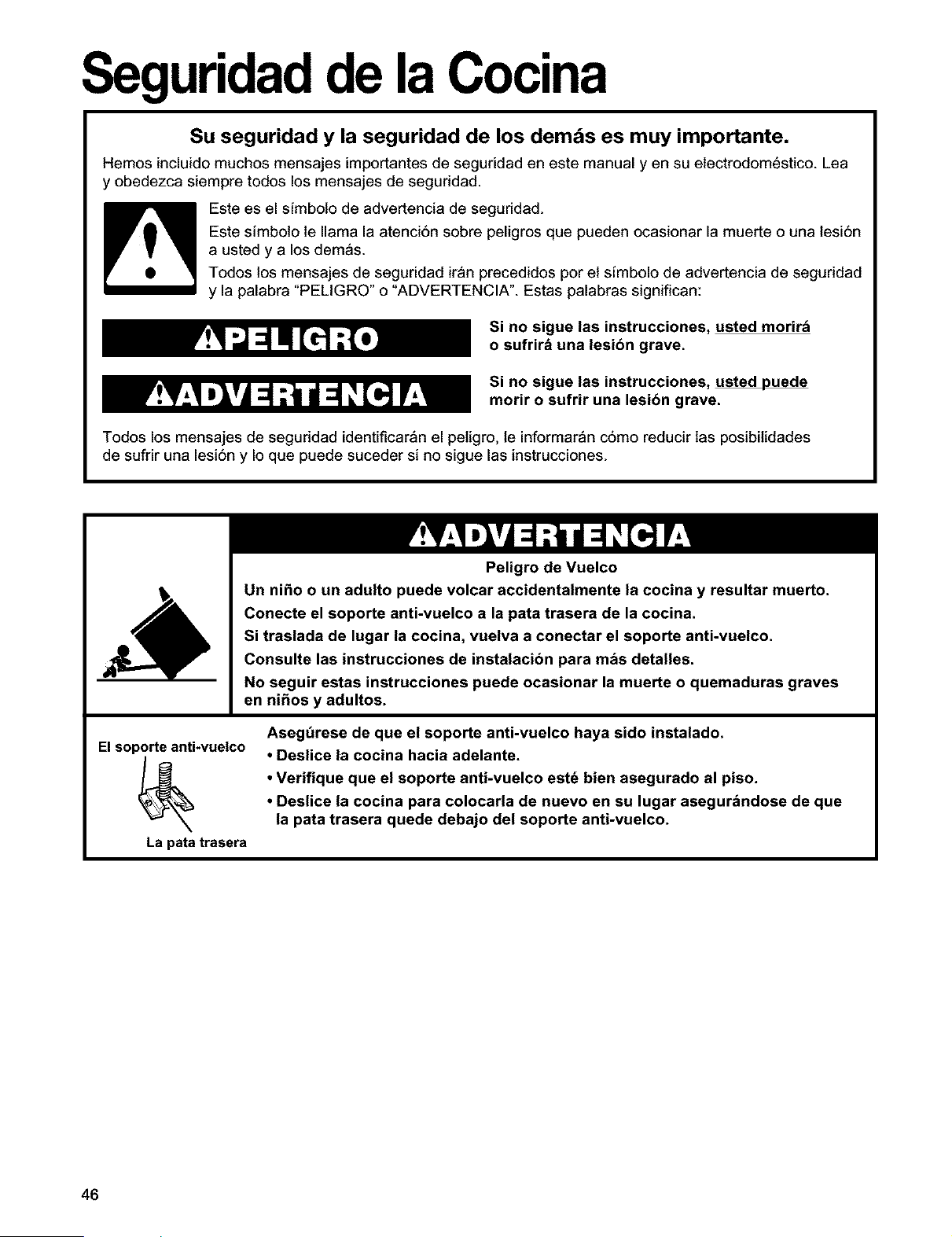
Seguridadde la Cocina
Su seguridad y la seguridad de los dembs es muy importante.
Hemos incluido muchos mensajes importantes de seguridad en este manual yen su etectrodomestico. Lea
y obedezca siempre todos los mensajes de seguddad.
Este es el sfmbolo de advertencia de seguridad.
Este simbolo le llama la atenciSn sobre peligros que pueden ocasionar la muerte o una lesiSn
a usted y a los demas.
Todos los mensajes de seguridad iran precedidos por et sfmbolo de advertencia de seguddad
y la palabra "PELIGRO" o "ADVERTENCIA". Estas palabras significan:
Si no sigue las instrucciones, usted morirb
o sufrir_ una lesibn grave.
Si no sigue las instrucciones, usted puede
morir o sufrir una lesibn grave.
Todos los mensajes de seguddad identificar_n el petigro, te informar_n c{Smoreducir las posibilidades
de sufrir una lesiSn y Io que puede suceder si no sigue las instrucciones.
El soporte anti-vuelco
La pata trasera
Peligro de Vuelco
Un niho o un adulto puede volcar accidentalmente la cocina y resultar muerto.
Conecte el soporte anti-vuelco a la pata trasera de la cocina.
Si traslada de lugar la cocina, vuelva a conectar el soporte anti-vuelco.
Consulte las instrucciones de instalacibn para mbs detalles.
No seguir estas instrucciones puede ocasionar la muerte o quemaduras graves
en nihos y adultos.
AsegQrese de que el soporte anti-vuelco haya sido instalado.
• Deslice la cocina hacia adelante.
• Verifique que el soporte anti-vuelco estd bien asegurado al piso.
• Deslice la cocina para colocarla de nuevo en su lugar asegurbndose de que
la pata trasera quede debajo del soporte anti-vuelco.
46
INSTRUCCIONES IMPORTANTES DE SEGURIDAD
ADVERTENCIA: Para reducir el desgo de
incendio, electrocuci6n, daSos a personas o perjuicios
al usar la cocina, siga precauciones b_sicas,
incluyendo las siguientes:
• ADVERTENCIA- Para reducir el riesgo de
volteo de la cocina, la cocina debe asegurarse
en el piso mediante la instalacibn de
dispositivos de anti-vuelco. Para verificar si los
dispositivos est_n instalados adecuadamente,
deslice la cocina hacia adelante, cercibrese que
el soporte anti-vuelco est_ bien fijo en el piso, y
deslice la cocina hacia atr_s de manera que la
pata trasera de la cocina quede fija debajo del
soporte anti-vuelco.
•AVISO - No almacene articutos que interesen a
los niSos en los armarios que est&n encima de la
cocina o en el respaldo de protecci6n de una cocina
- cuando los nihos suben encima de la cocina para
poder coger objetos pueden lastimarse sedamente.
• Instalaci6n apropiada - Cerci6rese que la instalaci6n
y puesta a tierra de la cocina sean efectuadas
adecuadamente por un t6cnico competente.
• Nunca use la cocina para calentar el cuarto.
• No deje a los niSos solos - No se debe dejar a los
niSos solos en el _rea donde la cocina esta en uso.
Nunca se les debe permitir que se sienten o se
paren en ninguna parte de la cocina.
• Use ropa apropiada - Ropa holgada o que se este
colgando no debe usarse mientras la cocina est_ en
uso.
• Servicio del usuario - No repare o reemplace
ninguna pieza de la cocina a menos que se
recomiende especificamente en el manual.
Cualquier otro servicio se debe dejar en las manos
de un t6cnico competente.
• Almacenaje dentro o encima de la cocina -
Materiales inflamables no deben almacenarse ni en
el homo ni cerca de las zonas de cocci6n exteriores.
• No use agua en incendiosprovocados per grasa -
Contenga el incendio o llama o use un extinguidor
de tipo espuma o quimico seco.
• Use tTnicamente agarraderas secas - Agarraderas
mojadas o ht_medas en las superficies pueden dar
como resultado en quemaduras por vapor. No deje
que la agarradera toque los elementos calorfferos
calientes. No use una toalla o paso voluminoso.
• NO TOQUE LAS ZONAS DE COCCI_N EXTERIO-
RES O AREAS CERCANAS ALAS ZONAS DE
COCCI6N - No obstante su color oscuro, es posible
que las zonas de cocci6n exteriores esten calientes.
Las areas cercanas alas zonas de cocci6n
exteriores pueden calentarse lo suficientemente
como para causar quemaduras. Durante y despues
de usar, no toque, ni deje que ropa u otros
materiales inflamables toquen las zonas de cocci6n
exteriores o las areas cercanas alas zonas de
cocci6n hasta que haya pasado suficiente tiempo
para que se enfrien. Entre esas areas estan la
superficie de cocci6n y las superficies que est_n
frente a la superficie de cocci6n.
• Use cacerolas de tamaSo apropiado - La cocina
viene equipada con una o m_s zonas de cocci6n
exteriores de tamaSo diferente. Seleccione utensilios
que tengan el asiento liso lo suficientemente grandes
para cubdr el elemento calorifero de la zona de
cocci6n exterior. El use de utensilios de menor
tamaSo expondr_ una porci6n del elemento
calorifero a contacto directo y puede dar come
resultado que la ropa se incendie. La relaci6n
apropiada entre el utensilio y el quemador podr_
igualmente mejorar la eficiencia.
• Nunca deje las zonas de cocci6n exteriores a calor
alto, sin supervisi6n. Derrames por ebutlici6n causan
salpicaduras grasosas y humeantes que pueden
incendiarse.
• Forros protectores - No use papel de aluminio para
forrar el fondo del homo, excepto como Io sugiera el
manual. La instalaci6n inapropiada de estos forros
puede dar como resuttado desgos de electrocuci6n,
o incendio.
• Utensilios de cocina con vidrio - S61oalgunos tipos
de utensilios de viddo, ceramica vitdficada, ceramica,
Ioza de barro u otros utensilios con vidrio son
adecuados para use en la cocina sin que se rompan
debido a cambios repentinos de temperatura.
• Los mangos del utensilio deben colocarse hacia
adentro y no deben exceder las zonas de cocci6n
exteriores adyacentes - Para reducir el desgo de
quemaduras, el incendio de matedates inflamables y
salpicaduras debido a contacto accidental con el
utensilio, el mango del utensilio debe colocarse
hacia adentro y que no se extienda encima de las
zonas de cocci6n exteriores adyacentes.
-GUARDE ESTAS INSTRUCCIONES-
continDa en la pagina siguiente
47
INSTRUCCIONES IMPORTANTES DE SEGURIDAD
• No cocine encima de una superficie de cocci6n
quebrada - De quebrarse la superficie de cocci6n,
las soluciones de limpieza y derrames pueden
penetrar la superficie de cocci6n que est& quebra-
day crear un riesgo de electrocuci6n. P6ngase en
contacto con un t6cnico competente de inmedia-
to.
• Limpie la superficie de cocci6n con cuidado - Si
usa un paso o estropajo mojado para limpiar
derrames en una Area de cocci6n caliente, tenga
cuidado de evitar quemaduras por vapor. Algunos
productos de limpieza pueden emitir gases
nocivos al ser aplicados en superficies calientes.
• Tenga cuidado al abrir la puerta - Deje que el aire
caliente o el vapor salga antes de retirar o
reemplazar la comida.
• No caliente recipientes cerrados de comida - La
acumulaci6n de presi6n puede causar que el
recipiente estalle y ocasione da_os/lesiones.
• Mantenga los ductos de ventilaci6n del homo sin
obstrucci6n.
• Ubicaci6n de las parrillas del homo - Siempre
coloque las parrillas del horno en la ubicaci6n
deseada mientras el horno est6 frio. Si tiene que
mover una parrilla mientras el homo est& caliente,
no deje que la agarradera toque el elemento
calorifero caliente en el horno.
• NO TOQUE LOS ELEMENTOS CALORiFEROS O
LAS SUPERFICIES INTERIORES DEL HORNO -
No obstante su color oscuro, los elementos
caloriferos podrian estar calientes. Las superficies
interiores de un homo se calientan Io suficiente
como para causar quemaduras. Durante y
despu6s del uso, no toque, o deje que ropas u
otto material inflamable toquen los elementos
caloriferos o las superficies internas del homo
hasta que haya pasado suficiente tiempo para
enfriarse. Otras superficies del artefacto
electrodomestico pueden calentarse Io suficiente
como para causar quemaduras - entre estas
superficies est&n los orificios del conducto de
ventilaci6n del horno y las superficies cercanas a
estos orificios, puertas de homos y ventanas de
las puertas de hornos.
Para cocinas de autolimpieza -
• No limpie la junta de la puerta- La junta de la
puerta es esencial para un buen cierre. Debe ten-
erse cuidado de no frotar, da_ar o mover la junta
de la puerta.
• No use productos de limpieza para hornos - No
se debe usar productos comerciales de limpieza
para hornos o revestimientos protectores del forro
del homo de ninguna clase dentro o alrededor de
cualquier parte del horno.
• Limpie s61o las piezas mencionadas en el manual.
• Antes de efectuar la autolimpieza del homo - quite
la charola para asar y otros utensilios.
Para unidades con campana de ventilacibn -
• Limpie las campanas de ventilaci6n
frecuentemente - No se debe dejar que la grasa
se acumule en la campana o el filtro.
• Cuando las comidas se incendien debajo de la
campana, apague el ventilador. Si se deja el
ventilador en funcionamiento, puede esparcir las
llamas.
-GUARDE ESTAS INSTRUCCIONES-
48
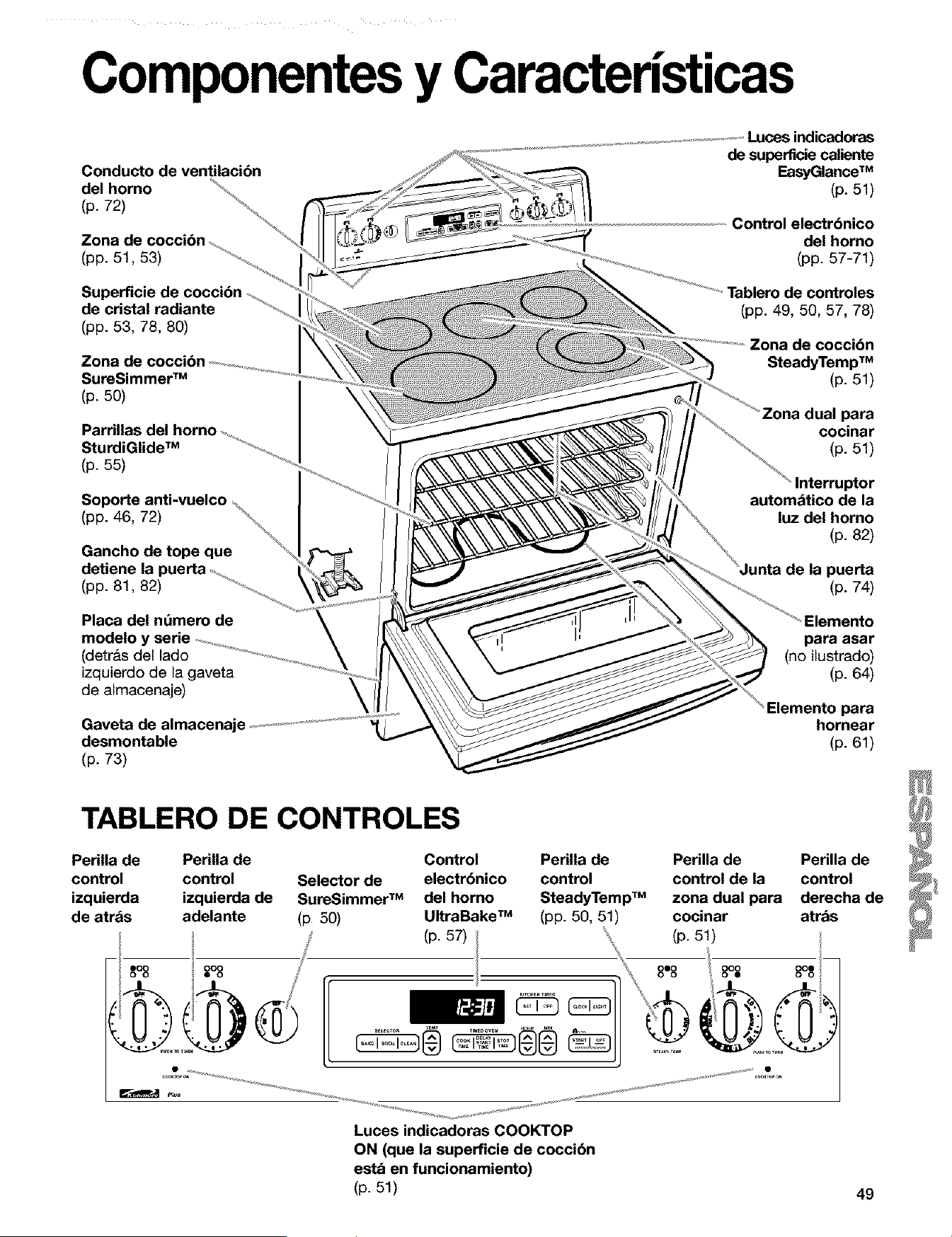
Componentesy Caracteristicas
Conducto de ventilacibn
del horno
(p. 72)
(pp. 51, 53)
Superficie de coccibn
de cristal radiante _
(pp. 53, 78, 80)
SureSimmer TM
(p.50)
Parrillas del
SturdiGlide TM
(p. 55)
Soporte anti-vuelco
(pp. 46, 72)
Gancho de tope que
detiene la
(pp. 81, 82)
Placa del nt_mero de
modelo y serie
(detras del lado
izquierdo de la gaveta
de almacenaje)
Gaveta de almacenaje
desmontable
(p. 73)
.............................Luces indicadoras
de superficie caliente
EasyGlanceTM
(p. 51)
Control electrbnico
del homo
(pp. 57-71)
Tablero de controles
(pp. 49, 50, 57, 78)
coccibn
SteadyTemp TM
(p. 51)
Zona dual para
cocinar
(p. 51)
Interruptor
automatico de la
luz del homo
(p. 82)
puerta
(p. 74)
para asar
(no ilustrado)
(p. 64)
'Elementopara
hornear
(p. 61)
TABLERO DE CONTROLES
Perilla de Perilla de Control Perilla de
control control Selector de electrbnico control
izquierda izquierda de SureSimmer TM del horno SteadyTemp TM
de atras adelante (p 50) UltraBake TM (pp. 50, 51)
/ (p. 57)
Perilla de Perilla de
control de la control
zona dual para derecha de
cocinar atras
(p. 51)
ooo _ coo /
oo oo /
*, o o • g°8 8°8
Ps_
Luces indicadoras COOKTOP
ON (que la superficie de coccibn
est_ en funcionamiento)
(p. 51)
49
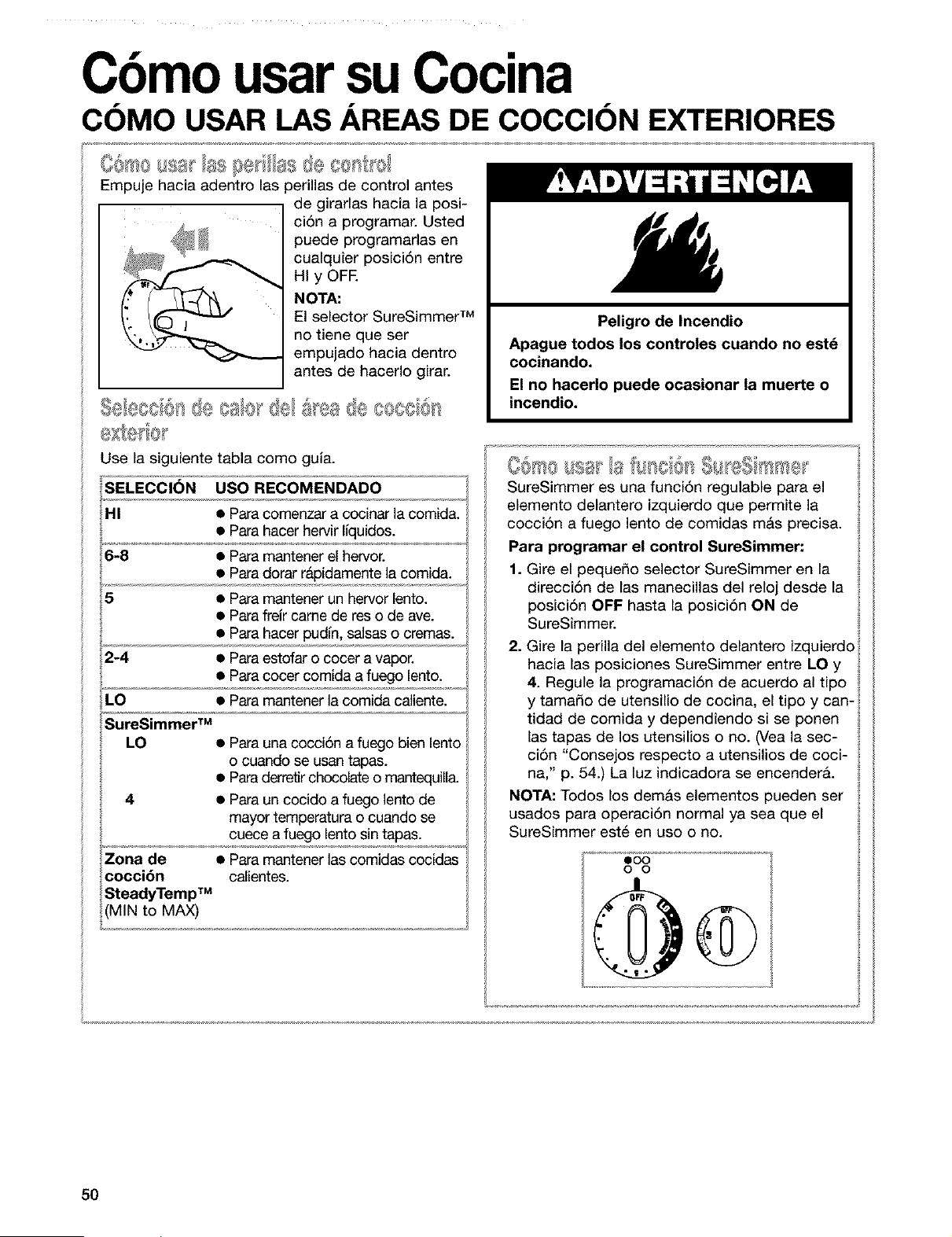
Cbmousarsu Cocina
COMO USAR LAS AREAS DE COCClON EXTERIORES
Empuje hacia adentro las perillas de control antes
de girarlas hacia la posi-
ci6n a programar. Usted
puede programarlas en
cualquier posici6n entre
HI y OFE
NOTA:
El selector SureSimmer TM
no tiene que set
empujado hacia dentro
antes de hacerlo girar.
8@C088 S
Peligro de Incendio
Apague todos los controles cuando no est_
cocinando.
El no hacerlo puede ocasionar la muerte o
incendio.
Use la siguiente tabla como guia.
SELECCI_N
HI
6-8
5
USO RECOMENDADO
• Para comenzar a cocinar la comida.
• Para hacer hervir liquidos.
• Para mantener el hervor.
• Para dorar rapidamente la comida.
• Para mantener un hervor lento.
• Para freir came de res o de ave.
• Para hacer pudin, salsas o cremas.
• Para estofar o cocer a vapor.
• Para cocer comida a fuego lento.
• Para mantener la comida caliente.
SureSimmer TM
LO • Para una cooci6n a fuego bien lento
o cuando se usan tapas.
• Paraderretir chocolate o mantequilla.
4 • Para un cocido a fuego lento de
mayor temperatura o cuando se
cuece a fuego lento sin tapas.
Zona de • Para mantener las comidas cocidas
cocci6n calientes.
SteadyTemp TM
MIN to MAX)
SureSimmer es una funci6n regulable para el
elemento delantero izquierdo que permite la
cocci6n a fuego lento de comidas m&s precisa.
Para programar el control SureSimmer:
1. Gire el pequefio selector SureSimmer en la
direcci6n de las manecillas del reloj desde la
posici6n OFF hasta la posici6n ON de
SureSimmer.
2. Gire la perilla del elemento delantero izquierdo
hacia las posiciones SureSimmer entre/O y
4. Regule la programaci6n de acuerdo al tipo
tamafio de utensilio de cocina, el tipo y can-
Y
tidad de comida y dependiendo si se ponen
las tapas de los utensilios o no. (Vea la sec-
ci6n "Consejos respecto a utensilios de coci-
ha," p. 54.) La luz indicadora se encendera.
NOTA: Todos los dem&s elementos pueden ser
usados para operaci6n normal ya sea que el
SureSimmer est6 en uso o no.
@00
0 0
50
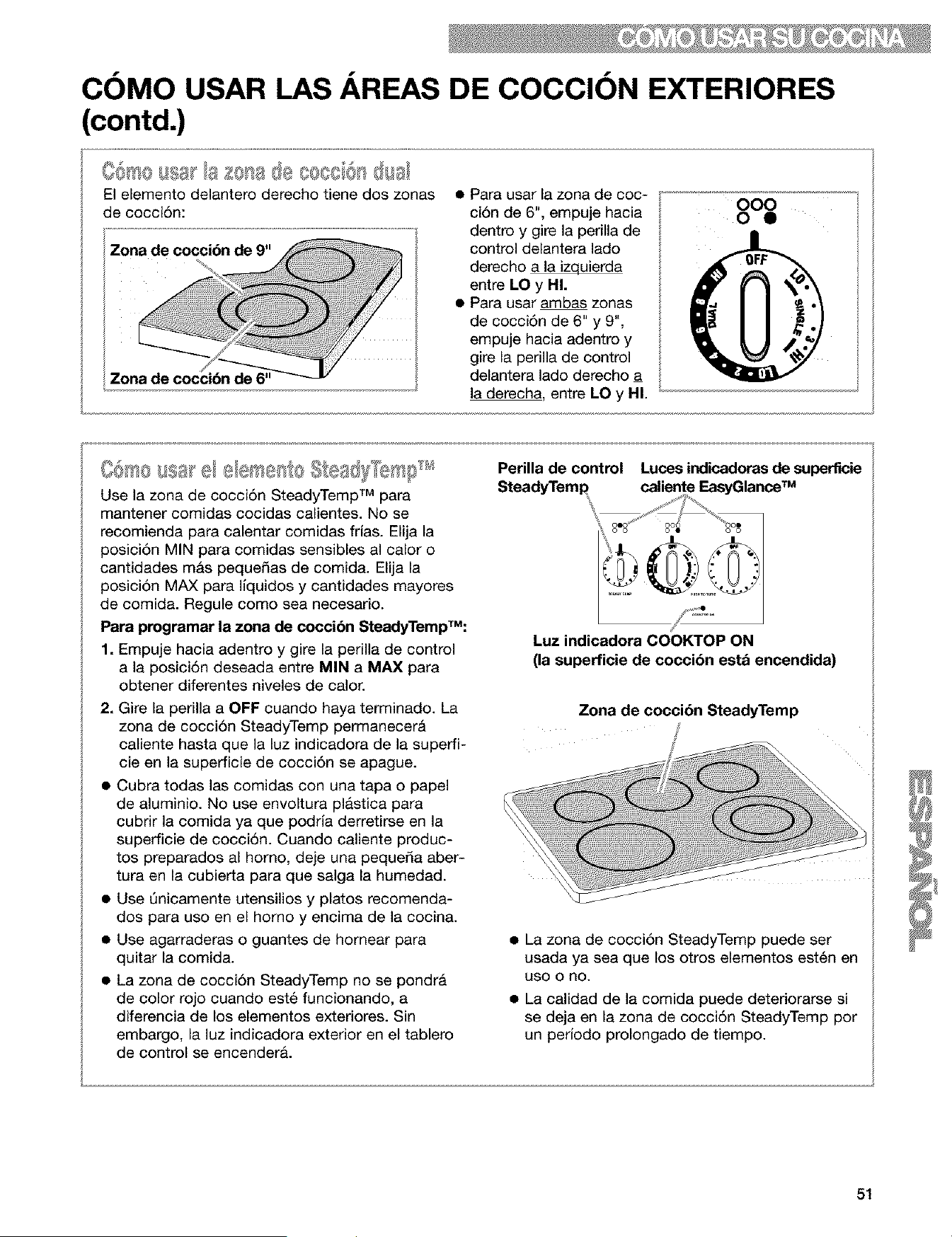
COMO USAR LAS AREAS DE COCCION EXTERIORES
(contd.)
18 101'8 O008101S
El elemento delantero derecho tiene dos zonas
de cocci6n:
• Para usar la zona de coc-
ci6n de 6", empuje hacia
dentro y gire la perila de
control delantera lado
derecho a la izquierda
entre LO y HI.
• Para usar ambas zonas
de cocci6n de 6" y 9",
empuje hacia adentro y
gire la perilla de control
delantera lado derecho a
la derecha, entre LO y HI.
8°8
I
Use la zona de cocci6n SteadyTemp TM para
mantener comidas cocidas calientes. No se
recomienda para calentar comidas frias. Elija la
posici6n MIN para comidas sensibles al calor o
cantidades m&s pequefias de comida. Elija la
posici6n MAX para llquidos y cantidades mayores
de comida. Regule como sea necesario.
Para programar la zona de coccibn SteadyTempTM:
1. Empuje hacia adentro y gire la perilla de control
a la posici6n deseada entre MIN a MAX para
obtener diferentes niveles de calor.
2. Gire la perilla a OFF cuando haya terminado. La
zona de cocci6n SteadyTemp permanecer&
caliente hasta que la luz indicadora de la superfi-
cie en la superficie de cocci6n se apague.
• Cubra todas las comidas con una tapa o papel
de aluminio. No use envoltura plastica para
cubrir la comida ya que podrla derretirse en la
superficie de cocci6n. Cuando caliente produc-
tos preparados al homo, deje una pequefia aber-
tura en la cubierta para que salga la humedad.
• Use Qnicamente utensilios y platos recomenda-
dos para uso en el homo y encima de la cocina.
• Use agarraderas o guantes de hornear para
quitar la comida.
• La zona de cocci6n SteadyTemp no se pondrA
de color rojo cuando est6 funcionando, a
diferencia de los elementos exteriores. Sin
embargo, la luz indicadora exterior en el tablero
de control se encender&
Perilla de control Luces indicadoras de superficie
SteadyTem_ caliente EasyGlanceTM
oj
, o o ol o o
Luz indicadora COOKTOP ON
(la superficie de coccibn estd encendida)
Zona de coccibn SteadyTemp
• La zona de cocci6n SteadyTemp puede ser
usada ya sea que los otros elementos est6n en
uso o no.
• La calidad de la comida puede deteriorarse si
se deja en la zona de cocci6n SteadyTemp por
un periodo prolongado de tiempo.
51
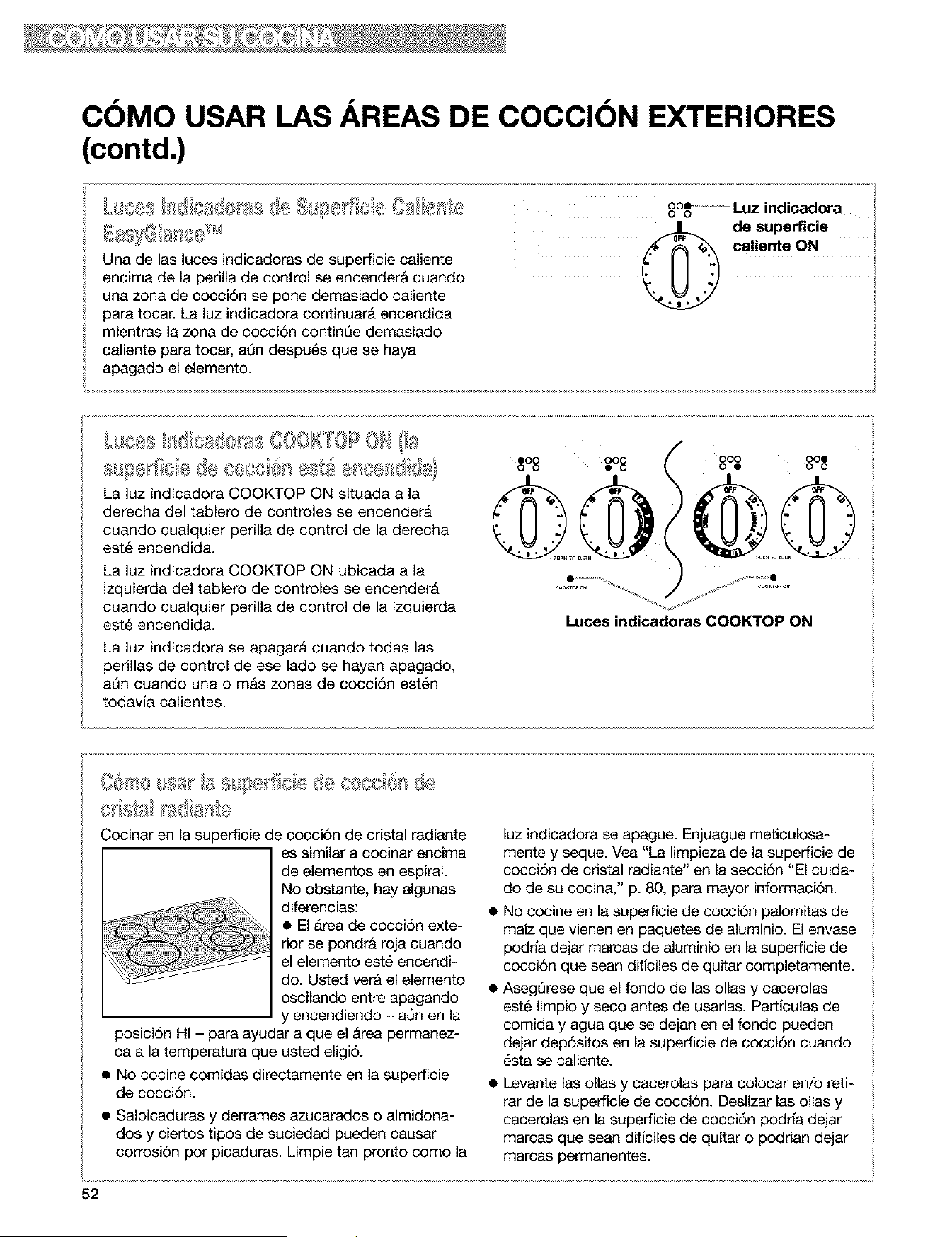
COMO USAR LAS AREAS DE COCCION EXTERIORES
(contd.)
Loees Isd ¢8@£as de _ "<4_
Una de las luces indicadoras de superficie caliente
encima de la perilla de control se encenderA cuando
una zona de cocci6n se pone demasiado caliente
para tocar. La luz indicadora continuarA encendida
mientras la zona de cocci6n continQe demasiado
caliente para tocar, aQn despu6s que se haya
apagado el elemento.
o°°eo..................Luz indicadora
calientedesuperficieON
ufs '£_0 de c_o_sesl
e o+ @;;;s 8 +. 8_s' I
La luz indicadora COOKTOP ON situada a la
derecha del tablero de controles se encendera
cuando cualquier perilla de control de la derecha
estA encendida.
La luz indicadora COOKTOP ON ubicada a la
izquierda del tablero de controles se encenderA
cuando cualquier perilla de control de la izquierda
estA encendida.
La luz indicadora se apagarA cuando todas las
perillas de control de ese lado se hayan apagado,
a_n cuando una o mAs zonas de cocci6n est_n
todavla calientes.
8o8 o08 ( 8°° 800=
Luces indicadoras COOKTOP ON
(}(;d_O _8_* 8 _s4@@8e @ C@08/>S(38
a
s 87 _ f_ 85 £
Cocinar en la superficie de cocci6n de cristal radiante
es similar a cocinar encima
de elementos en espiral.
No obstante, hay algunas
diferencias:
• El Area de cocci6n exte-
rior se pondra roja cuando
el elemento est6 encendi-
do. Usted verA el elemento
oscilando entre apagando
y encendiendo - aQn en la
posici6n HI - para ayudar a que el Area permanez-
ca a la temperatura que usted eligi6.
• No cocine comidas directamente en la superficie
de cocci6n.
• Salpicaduras y derrames azucarados o almidona-
dos y ciertos tipos de suciedad pueden causar
corrosi6n por picaduras. Limpie tan pronto como la
luz indicadora se apague. Enjuague meticulosa-
mente y seque. Yea "La limpieza de la superficie de
cocci6n de cristal radiante" en la secci6n "El cuida-
do de su cocina," p. 80, para mayor informaci6n.
No cocine en la superficie de cocci6n palomitas de
maiz que vienen en paquetes de aluminio. El envase
podrla dejar marcas de aluminio en la superficie de
cocci6n que sean dificiles de quitar completamente.
AsegOrese que el fondo de las ollas y cacerolas
est6 limpio y seco antes de usarlas. Partlculas de
comida y agua que se dejan en el fondo pueden
dejar dep6sitos en la superficie de cocci6n cuando
6sta se caliente.
Levante las ollas y cacerolas para colocar en/o reti-
tar de la superficie de cocci6n. Deslizar las ollas y
cacerolas en la superficie de cocci6n podria dejar
marcas que sean dificiles de quitar o podrian dejar
marcas permanentes.
52
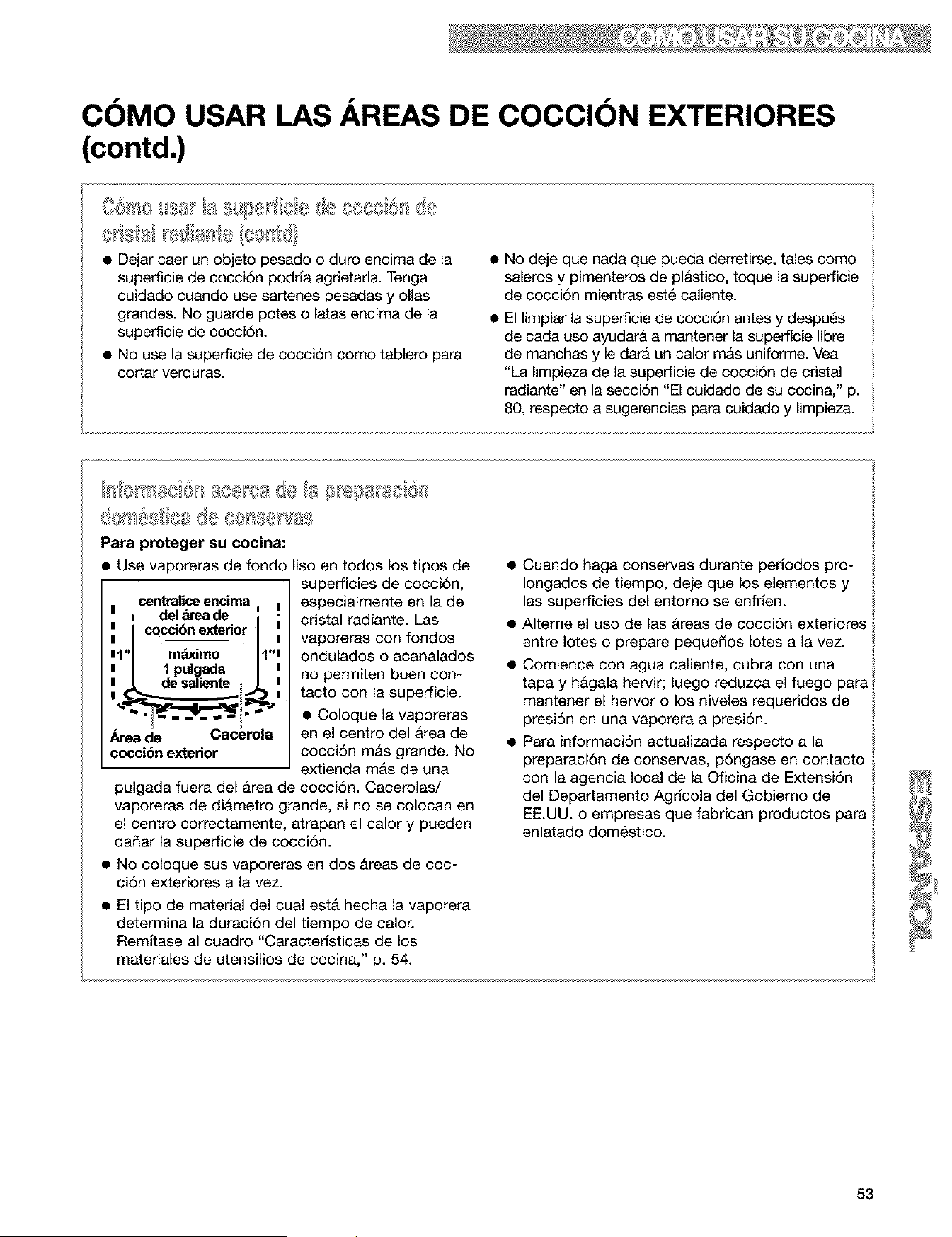
COMO USAR LAS AREAS DE COCClON EXTERIORES
(contd.)
• Dejar caer un objeto pesado o duro encima de la •
superficie de cocci6n podrla agrietarla. Tenga
cuidado cuando use sartenes pesadas y ollas
grandes. No guarde pates o latas encima de la •
superficie de cocci6n.
• No use la superficie de cocci6n como tablero para
cortar verduras.
No deje que nada que pueda derretirse, tales coma
saleros y pimenteros de pl£stico, toque la superficie
de cocci6n mientras est6 caliente.
El limpiar la superficie de cocci6n antes y despu6s
de cada usa ayudar& a mantener la superficie libre
de manchas y le dara un calor mas uniforme. Vea
"La limpieza de la superficie de cocci6n de cristal
radiante" en la secci6n "El cuidado de su cocina," p.
80, respecto a sugerencias para cuidado y limpieza.
Para proteger su cocina:
• Use vaporeras de fondo lisa en todos los tipos de
superficies de cocci6n,
centraliceencima
I
delbreade
i! coccibn exterior
=1" mbximo 1"
i i 1pulgada
i J, de saliente
Area de Cacen la
cocci6n exterior
especialmente en la de
cristal radiante. Las
vaporeras con fondos
ondulados o acanalados
no permiten buen con-
tacto con la superficie.
• Coloque la vaporeras
en el centro del Area de
cocci6n mAs grande. No
extienda mas de una
pulgada fuera del Area de cocci6n. Cacerolas/
vaporeras de diametro grande, si no se colocan en
el centro correctamente, atrapan el calor y pueden
da_ar la superficie de cocci6n.
• No coloque sus vaporeras en dos Areas de coc-
ci6n exteriores a la vez.
• Cuando haga conservas durante periodos pro-
Iongados de tiempo, deje que los elementos y
las superficies del entorno se enfrlen.
• Alteme el uso de las Areas de cocci6n exteriores
entre Iotes o prepare pequedos Iotes a la vez.
• Comience con agua caliente, cubra con una
tapa y hagala hervir; luego reduzca el fuego para
mantener el hervor o los niveles requeridos de
presi6n en una vaporera a presi6n.
• Para informaci6n actualizada respecto a la
preparaci6n de conservas, p6ngase en contacto
con la agencia local de la Oficina de Extensi6n
del Departamento Agrlcola del Gobierno de
EE.UU. o empresas que fabrican productos para
enlatado domAstico.
• El tipo de material del cual estA hecha la vaporera
determina la duraci6n del tiempo de calor.
Remitase al cuadro "Caracteristicas de los
materiales de utensilios de cocina," p. 54.
53
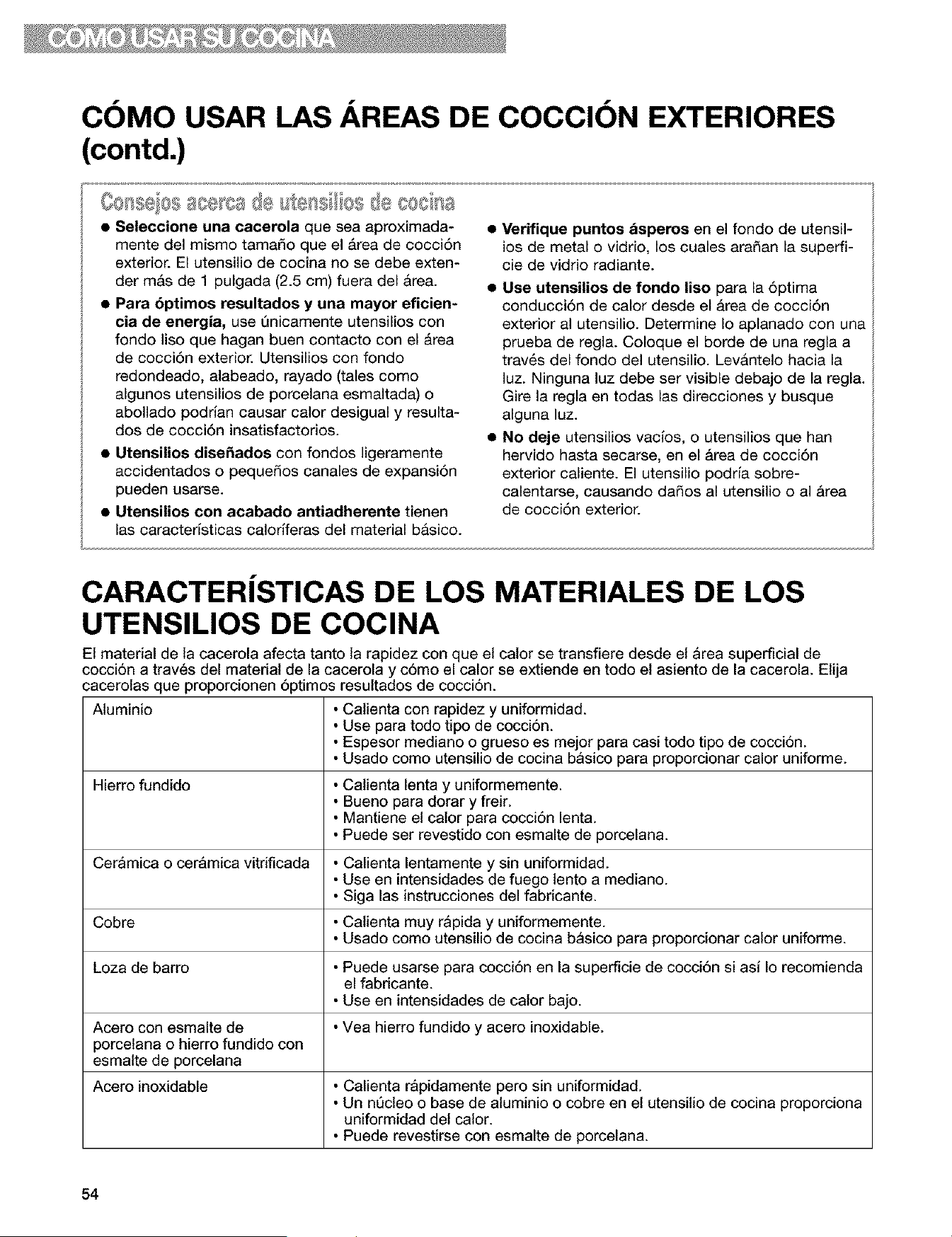
COMa USAR LAS AREAS DE COCCION EXTERIORES
(contd.)
sees cae
• Seleccione una cacerola que sea aproximada-
mente del mismo tama_a que el Area de ca¢ci6n
exterior. El utensilia de ca¢ina no se debe exten-
der mAs de 1 pulgada (2.5 cm) fuera del Area.
• Para 6ptimos resultados y una mayor eficien-
cia de energia, use _nicamente utensilias con
fondo liso que hagan buen contacto con el Area
de cocci6n exterior. Utensilios con fondo
redondeado, alabeado, rayado (tales coma
algunos utensilios de porcelana esmaltada) o
abollado podrlan causar calor desigual y resulta-
dos de cocci6n insatisfactorios.
• Utensilios dise_ados con fondos ligeramente
accidentados o pequedos canales de expansi6n
pueden usarse.
• Utensilios con acabado antiadherente tienen
las caracteristicas calorfferas del material basico.
• Verifique puntos dsperos en el fondo de utensil-
ios de metal o vidrio, los cuales ara_an la superfi-
cie de vidrio radiante.
• Use utensilios de fondo liso para la 6ptima
conducci6n de calor desde el Area de cocci6n
exterior al utensilio. Determine Io aplanado con una
prueba de regla. Coloque el borde de una regla a
trav6s del fondo del utensilio. Levantelo hacia la
luz. Ninguna luz debe ser visible debajo de la regla.
Gire la regla en todas las direcciones y busque
alguna luz.
• No deje utensilios vacios, o utensilios que han
hervido hasta secarse, en el Area de cocci6n
exterior caliente. El utensilio podria sobre-
calentarse, causando daSos al utensilio o al Area
de cocci6n exterior.
CARACTERJSTICAS DE LOS MATERIALES DE LOS
UTENSILIOS DE COCINA
CerAmica o ceramica vitrificada
Cobre
Loza de barro
Acero con esmalte de
porcelana o hierro fundido con
esmalte de porcelana
Acero inoxidable
El material de la cacerola afecta tanto la rapidez con que et calor se transfiere desde el Area superficial de
cocci6n a trav6s del material de la cacerola y c6mo el calor se extiende en todo et asiento de la cacerola. Elija
cacerolas que proporcionen 6ptimos resultados de cocci6n.
Aluminio • Calienta con rapidez y uniformidad.
• Use para todo tipo de cocci6n.
• Espesor mediano o grueso es mejor para casi todo tipo de cocci6n.
• Usado come utensilio de cocina basico para proporcionar calor uniforme.
Hierro fundido • Calienta lenta y uniformemente.
• Bueno para dorar y freir.
• Mantiene el calor para cocci6n lenta.
• Puede ser revestido con esmalte de porcelana.
• Calienta lentamente y sin uniformidad.
• Use en intensidades de fuego lento a mediano.
• Siga las instrucciones del fabricante.
• Calienta muy rApida y uniformemente.
• Usado come utensilio de cocina basico para proporcionar calor uniforme.
• Puede usarse para cocci6n en la superficie de cocci6n si asi Io recomienda
el fabricante.
• Use en intensidades de calor bajo.
• Vea hierro fundido y acero inoxidable.
• Calienta rapidamente pero sin uniformidad.
• Un nQcleo o base de aluminio o cobre en el utensitio de cocina proporciona
uniformidad del calor.
• Puede revestirse con esmalte de porcelana.
54
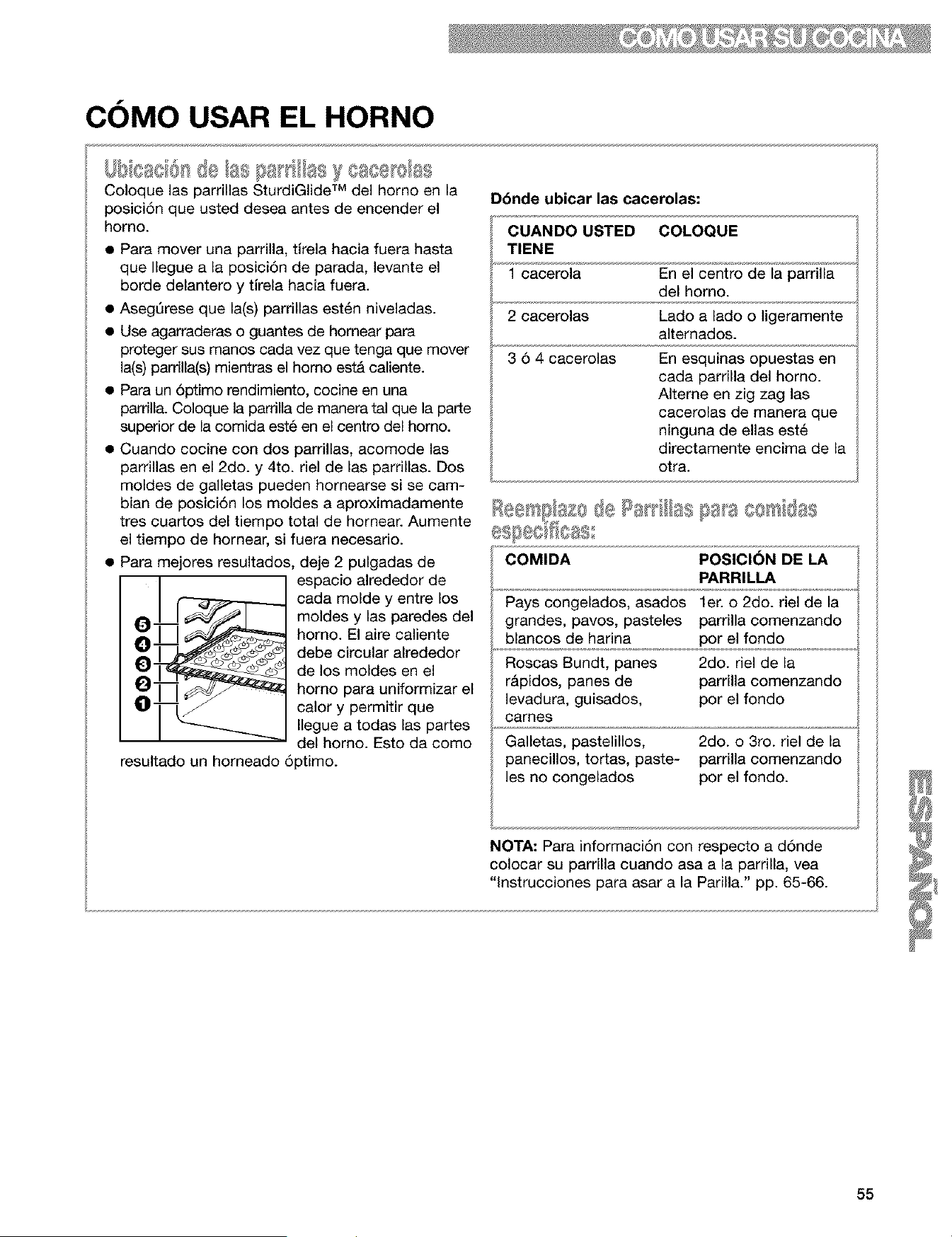
COMO USAR EL HORNO
Coloque las parrillas SturdiGlide TM del homo en la
posici6n que usted desea antes de encender el
homo.
• Para mover una parrilla, tirela hacia fuera hasta
que Ilegue a la posici6n de parada, levante el
borde delantero y tirela hacia fuera.
• AsegQrese que la(s) parrillas est6n niveladas.
• Use agarraderas o guantes de homear para
proteger sus manos cada vez que tenga que mover
la(s) parrilla(s) mientras el homo est& caliente.
• Para un 6ptimo rendimiento, cocine en una
parrilla. Coloque la parrilla de manera tal que la parte
superior de la comida est6 en el centro del homo.
• Cuando cocine con dos parrillas, acomode las
parrillas en el 2do. y 4to. riel de las parrillas. Dos
moldes de galletas pueden hornearse si se cam-
bian de posici6n los moldes a aproximadamente
tres cuartos del tiempo total de hornear. Aumente
el tiempo de hornear, si fuera necesario.
• Para mejores resultados deje 2 pulgadas de
,o,,_<
espacio alrededor de
cada molde y entre los
moldes y las paredes del
homo. El aire caliente
debe circular alrededor
de los moldes en el
homo para uniformizar el
calory permitir que
Ilegue a todas las partes
del horno. Esto da como
resultado un horneado 6ptimo.
Dbnde ubicar las cacerolas:
CUANDO USTED COLOQUE
TIENE
1 cacerola En el centro de la parrilla
del horno.
2 cacerolas Lado a lado o ligeramente
altemados.
3 6 4 cacerolas En esquinas opuestas en
cada parrilla del horno.
Alterne en zig zag las
cacerolas de manera que
ninguna de elias est6
directamente encima de la
otra.
Beesspi a£ede 6%mllssps 's ¢
,€as
COMIDA POSICIbN DE LA
PARRILLA
Pays congelados, asados ler. o 2do. riel de la
grandes, pavos, pasteles parrilla comenzando
blancos de harina por el fondo
Roscas Bundt, panes 2do. riel de la
r&pidos, panes de parrilla comenzando
levadura, guisados, por el fondo
carnes
Galletas, pastelillos, 2do. o 3ro. riel de la
panecillos, tortas, paste- parrilla comenzando
les no congelados por el fondo.
NOTA: Para informaci6n con respecto a d6nde
colocar su parrilla cuando asa a la parrilla, yea
"lnstrucciones para asar a la Parilla." pp. 65-66.
55
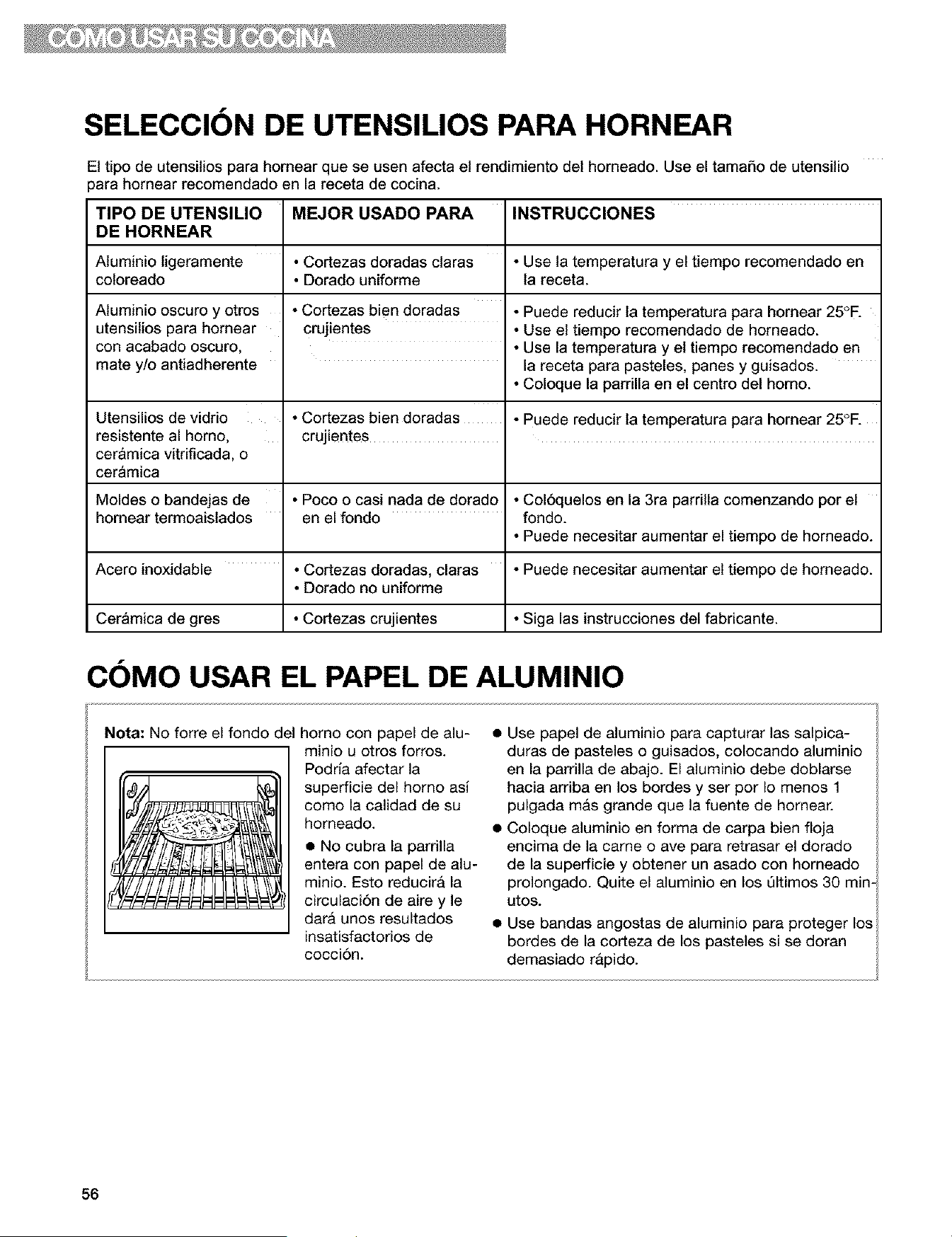
SELECCION DE UTENSILIOS PARA HORNEAR
El tipo de utensilios para homear que se usen afecta el rendimiento det horneado. Use el tamafio de utensilio
)ara hornear recomendado en la receta de cocina.
TIPO DE UTENSILIO MEJOR USADO PARA INSTRUCCIONES
DE HORNEAR
Aluminio tigeramente • Cortezas doradas ctaras • Use ta temperatura y et tiempo recomendado en
coloreado • Dorado uniforme ta receta.
Atuminio oscuro y otros • Cortezas bien doradas • Puede reducir ta temperatura para hornear 25°F.
utensitios para homear crujientes • Use el tiempo recomendado de homeado.
con acabado oscuro, • Use la temperatura y el tiempo recomendado en
mate y/o antiadherente la receta para pasteles, panes y guisados.
• Coloque la parrilla en el centro del homo.
Utensilios de vidrio • Cortezas bien doradas • Puede reducir ta temperatura para hornear 25°F.
resistente al homo, crujientes
ceramica vitrificada, o
ceramica
Moldes o bandejas de • Poco o casi nada de dorado • Col6quelos en la 3ra parrilla comenzando por et
hornear termoaistados en el fondo fondo.
• Puede necesitar aumentar el tiempo de horneado.
Acero inoxidable • Cortezas doradas, claras • Puede necesitar aumentar et tiempo de homeado.
• Dorado no uniforme
Ceramica de gres • Cortezas crujientes • Siga las instrucciones del fabricante.
COMO USAR EL PAPEL DE ALUMINIO
Nota: No forre el fondo del •
homo con papel de alu-
minio u otros forros.
Podrla afectar la
superficie del homo asl
como la calidad de su
homeado.
• No cubra la parrilla
entera con papel de alu-
minio. Esto reducira la
circulaci6n de aire y le
data unos resultados
insatisfactorios de
cocciSn.
Use papel de aluminio para capturar las salpica-
duras de pasteles o guisados, colocando aluminio
en la parrilla de abajo. El aluminio debe doblarse
hacia arriba en los bordes y ser por Io menos 1
pulgada m&s grande que la fuente de hornear.
Coloque aluminio en forma de carpa bien floja
encima de la came o ave para retrasar el dorado
de la superficie y obtener un asado con homeado
prolongado. Quite el aluminio en los Qltimos 30 min-
utos.
Use bandas angostas de aluminio para proteger los
bordes de la corteza de los pasteles si se doran
demasiado rapido.
56
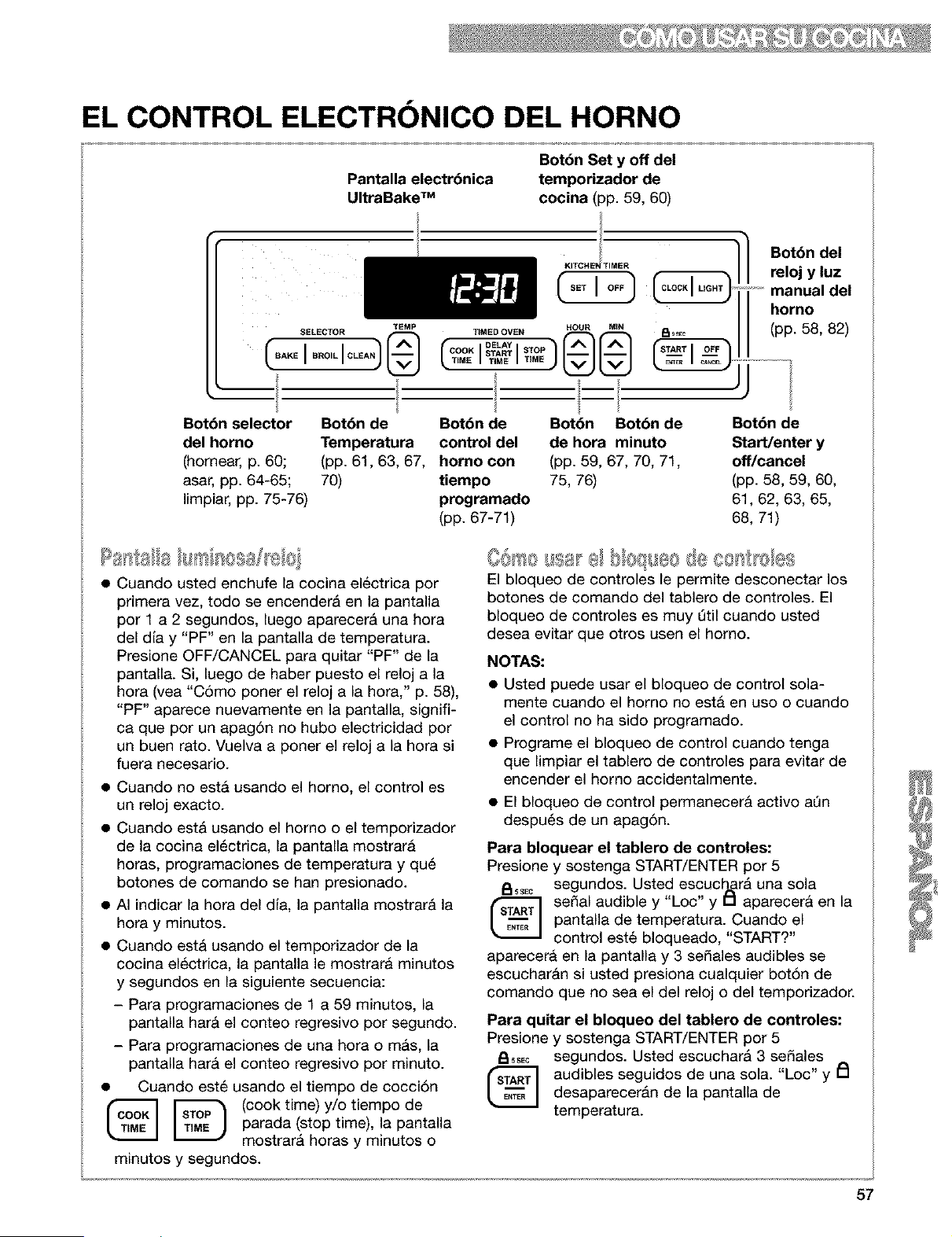
EL CONTROL ELECTRONICO DEL HORNO
Pantalla electr6nica
UltraBake TM
Bot6n Set y off del
temporizador de
cocina (pp. 59, 60)
Botbn selector
del homo
(hornear, p. 60;
asar, pp. 64-65;
limpiar, pp. 75-76)
TEMP
SELECTOR I 8
I BROIL I CLEAN
Bot6n de
Temperatura
(pp. 61, 63, 67,
70)
Bot6n de Bot6n Botbn de
control del de hora minuto
homo con (pp. 59, 67, 70, 71,
tiempo 75, 76)
programado
(pp. 67-71)
Botbn del
reloj y luz
manual del
homo
(pp. 58, 82)
Bot6n de
Start/enter y
off/cancel
(pp. 58, 59, 60,
61, 62, 63, 65,
68, 71)
• Cuando usted enchufe la cocina electrica por
primera vez, todo se encender& en la pantalla
por 1 a 2 segundos, luego aparecer& una hora
del dfa y "PF" en la pantalla de temperatura.
Presione OFF/CANCEL para quitar "PF" de la
pantalla. Si, luego de haber puesto el reloj a la
hora (vea "C6mo poner el reloj a la hora," p. 58),
"PF" aparece nuevamente en la pantalla, signifi-
ca que por un apag6n no hubo electricidad por
un buen rato. Vuelva a poner el reloj a la hora si
fuera necesario.
• Cuando no estA usando el homo, el control es
un reloj exacto.
• Cuando est& usando el homo o el temporizador
de la cocina el6ctrica, la pantalla mostrara
horas, programaciones de temperatura y qu6
botones de comando se han presionado.
• AI indicar la hora del dia, la pantalla mostrar& la
hora y minutos.
• Cuando est& usando el temporizador de la
cocina el_ctrica, la pantalla le mostrar& minutos
y segundos en la siguiente secuencia:
- Para programaciones de 1 a 59 minutos, la
pantalla har& el conteo regresivo por segundo.
- Para programaciones de una hora o m&s, la
pantalla har& el conteo regresivo por minuto.
• Cuando est6 usando el tiempo de cocci6n
@ _ (cooktime)y/otiempode
parada (stop time), la pantalla
mostrar& horas y minutos o
minutos y segundos.
El bloqueo de controles le permite desconectar los
botones de comando del tablero de controles. El
bloqueo de controles es muy 0til cuando usted
desea evitar que otros usen el homo.
NOTAS:
• Usted puede usar el bloqueo de control sola-
mente cuando el homo no esta en uso o cuando
el control no ha sido programado.
• Programe el bloqueo de control cuando tenga
que limpiar el tablero de controles para evitar de
encender el homo accidentalmente.
• El bloqueo de control permanecerA activo aOn
despu6s de un apag6n.
Para bloquear el tablero de controles:
Presione y sostenga START/ENTER por 5
P,_=_c segundos. Usted escuchar& una sola
sepal audible y "Loc" y PI aparecera en la
pantalla de temperatura. Cuando el
control est6 bloqueado, "START?"
aparecera en la pantalla y 3 sedales audibles se
escuchar&n si usted presiona cualquier bot6n de
comando que no sea el del reloj o del temporizador.
Para quitar el bloqueo del tablero de controles:
Presione y sostenga START/ENTER por 5
P,_,,c segundos. Usted escuchar& 3 se_ales
audibles seguidos de una sola. "Loc" y PI
desaparecer&n de la pantalla de
temperatura.
57
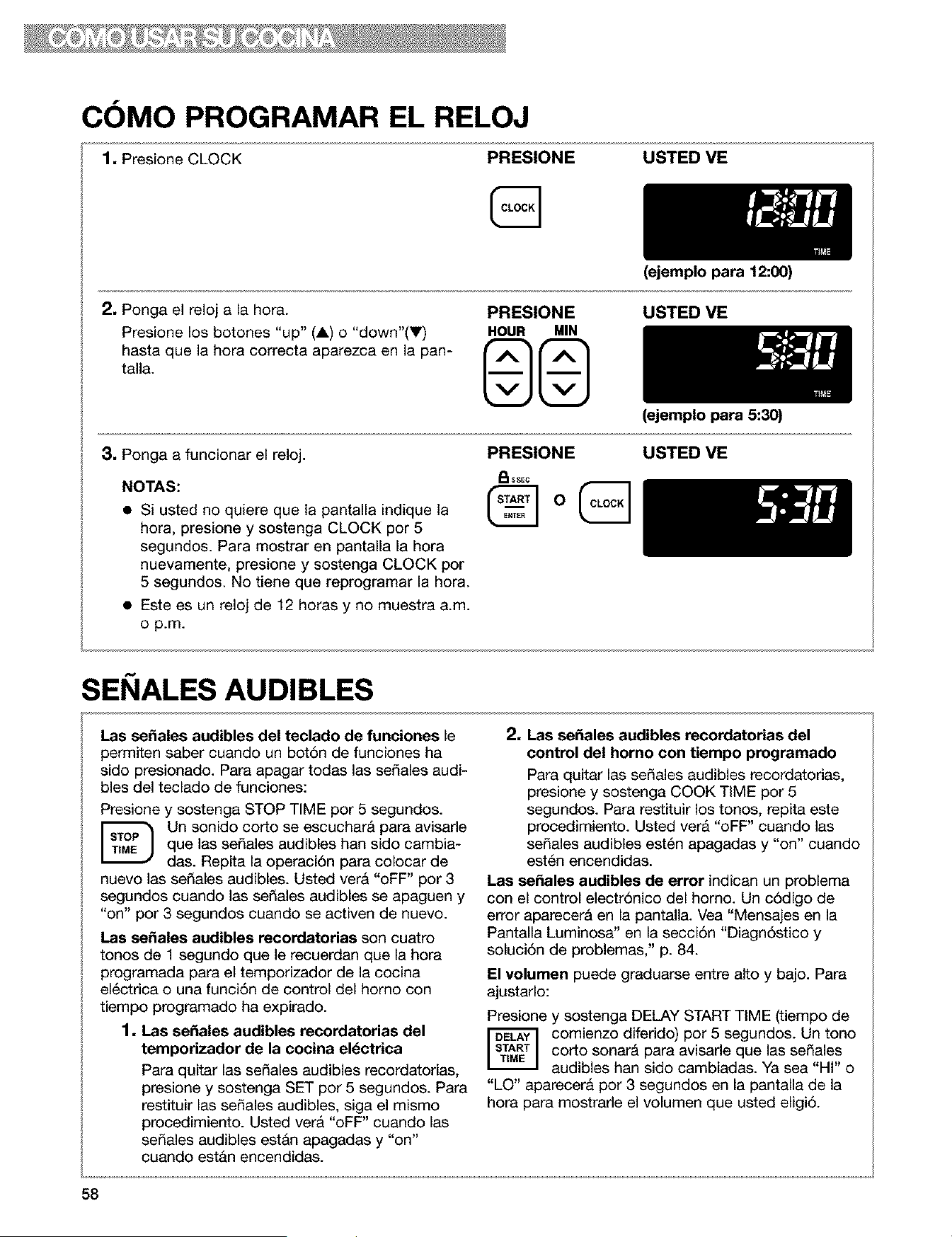
COMO PROGRAMAR EL RELOJ
1. Presione CLOCK PRESIONE
Q
USTED VE
2. Ponga el reloj a la hora.
Presione los botones "up" (A) o "down"(V)
hasta que la hora correcta aparezca en la pan-
talla.
PRESIONE
HOUR MIN
@@
(ejemplo para 12:00)
USTED VE
3, Ponga a funcionar el reloj.
NOTAS:
• Si usted no quiere que la pantalla indique la
hora, presione y sostenga CLOCK por 5
segundos. Para mostrar en pantalla la hera
nuevamente, presione y sostenga CLOCK por
5 segundos. No tiene que reprogramar la hera.
• Este es un reloj de 12 horas y no muestra a.m.
o p.m.
SEI IALES AUDIBLES
PRESIONE
85 SEC
(ejemplo para 5:30)
USTED VE
Las se_ales audibles del teclado de funciones le
permiten saber cuando un bot6n de funciones ha
sido presionado. Para apagar todas las sedales audi-
bles del teclado de funciones:
Presione y sostenga STOP TIME por 5 segundos.
Un sonido corto se escuchar_ para avisade
que las sedales audibles han sido cambia-
das. Repita la operaci6n para colocar de
nuevo las sedales audibles. Usted vera "oFF" por 3
segundos cuando las sedales audibles se apaguen y
"on" por 3 segundos cuando se activen de nuevo.
Las se_ales audibles recordatorias son cuatro
tonos de 1 segundo que le recuerdan que la hora
programada para el temporizador de la cocina
el6ctrica o una funci6n de control del homo con
tiempo programado ha expirado.
1, Las se_ales audibles recordatorias del
temporizador de la cocina eldctrica
Para quitar las se_ales audibles recordatorias,
presione y sostenga SET por 5 segundos. Para
restituir las se_ales audibles, siga el mismo
procedimiento. Usted vera "oFF" cuando las
sedales audibles est&n apagadas y "on"
cuando est&n encendidas.
2, Las se_ales audibles recordatorias del
control del horno con tiempo programado
Para quitar las se_ales audibles recordatorias,
presione y sostenga COOK TIME por 5
segundos. Para restituir los tonos, repita este
procedimiento. Usted verA "oFF" cuando las
sedales audibles est6n apagadas y "on" cuando
est6n encendidas.
Las se£tales audibles de error indican un problema
con el control electr6nico del horno. Un c6digo de
en'or aparecerA en la pantalla. Vea "Mensajes en la
Pantalla Luminosa" en la secci6n "Diagn6stico y
soluci6n de problemas," p. 84.
El volumen puede graduarse entre alto y bajo. Para
ajustarlo:
Presione y sostenga DELAY START TIME (tiempo de
comienzo diferido) por 5 segundos. Un tono
corto sonar_ para avisarle que las se_ales
audibles han sido cambiadas. Ya sea "HI" o
"LO" aparecera por 3 segundos en la pantalla de la
hora para mostrarle el volumen que usted eligi6.
58
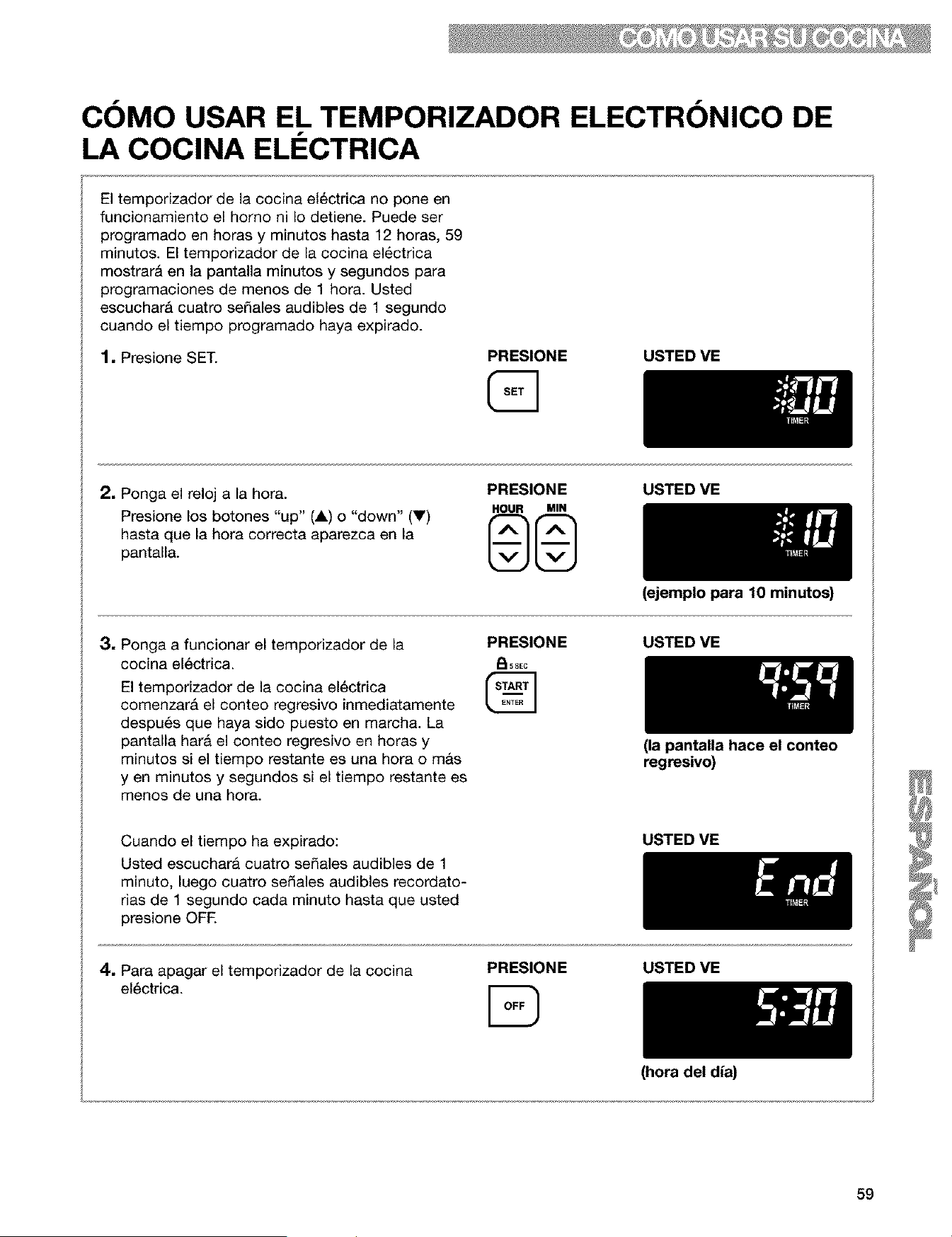
COMO USAR EL TEMPORIZADOR ELECTRONICO DE
LA COClNA ELI CTRICA
El temporizador de la cocina etectrica no pone en
funcionamiento el homo ni Io detiene. Puede ser
programado en horas y minutos hasta 12 horas, 59
minutos. El temporizador de la cocina electrica
mostrar& en la pantalla minutos y segundos para
programaciones de menos de 1 hora. Usted
escuchar& cuatro se_ales audibles de 1 segundo
cuando el tiempo programado haya expirado.
1, Presione SET.
PRESIONE
G
USTED VE
2, Ponga el reloj a la hora.
Presione los botones "up" (A) o "down" (V)
hasta que la hora correcta aparezca en la
pantalla.
PRESIONE
HOUR MIN
@@
USTED ME
3. Ponga a funcionar el temporizador de la
cocina electrica.
El temporizador de la cocina electrica
comenzar& el conteo regresivo inmediatamente
despu6s que haya sido puesto en marcha. La
pantalla har& el conteo regresivo en horas y
minutos si el tiempo restante es una hora o mas
yen minutos y segundos si el tiempo restante es
menos de una hora.
PRESIONE
_15 5EC
(ejemplo para 10 minutos)
USTED ME
Cuando el tiempo ha expirado:
Usted escuchar& cuatro sedales audibles de 1
minuto, luego cuatro sedales audibles recordato-
rias de 1 segundo cada minuto hasta que usted
presione OFE
(la pantalla hace el conteo
regresivo)
USTED VE
4. Para apagar el temporizador de la cocina
et6ctrica.
PRESIONE
D
USTED ME
(hora del dia)
59
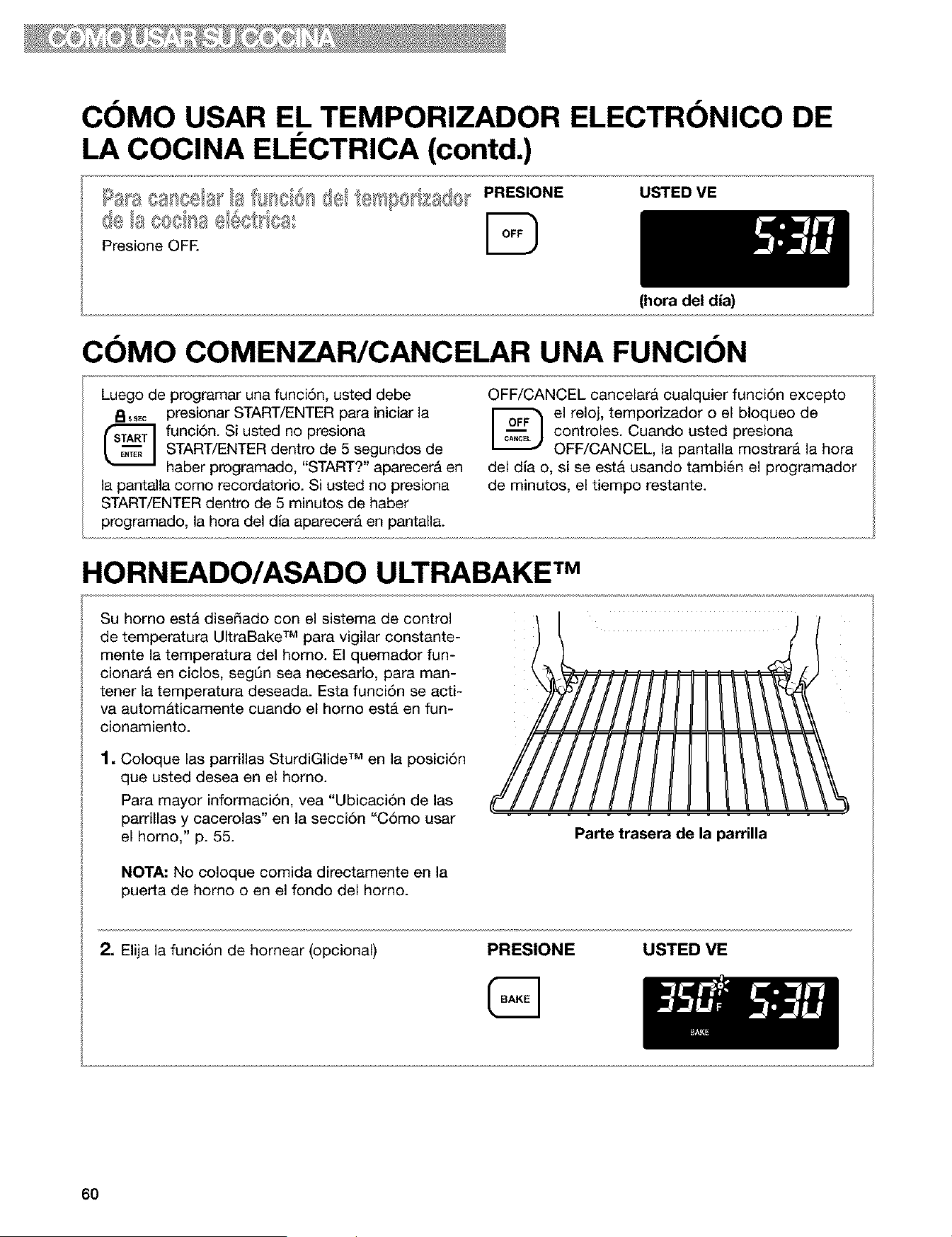
COMO USAR EL TEMPORIZADOR ELECTRONICO DE
LA COCINA ELI_CTRICA (contd.)
LIJPresione OFE
USTED VE
(hora del dia)
COMO COMENZAR/CANCELAR UNA FUNCION
Luego de programar una funci6n, usted debe
P,_s_ presionar START/ENTER para iniciar la
_ unci6n. Si usted no presiona
START/ENTER dentro de 5 segundos de
haber programado, "START?" aparecerfi en
la pantalla como recordatorio. Si usted no presiona
START/ENTER dentro de 5 minutos de haber
programado, la hora del dfa aparecer_ en pantala.
OFF/CANCEL cancelara cualquier funci6n excepto
el reloj, temporizador o el bloqueo de
controles. Cuando usted presiona
OFF/CANCEL, la pantalla mostrarfi la hora
del dfa o, si se esta usando tambi6n el programador
de minutos, el tiempo restante.
HORNEADO/ASADO ULTRABAKE TM
Su homo estfi disefiado con el sistema de control
de temperatura UltraBake TM para vigilar constante-
mente la temperatura del horno. El quemador fun-
cionarfi en ciclos, segQn sea necesario, para man-
tener la temperatura deseada. Esta funci6n se acti-
va automaticamente cuando el homo estfi en fun-
cionamiento.
1. Coloque las parrillas SturdiGlide TM en la posici6n
que usted desea en el homo.
Para mayor informaci6n, vea "Ubicaci6n de las
parrillas y cacerolas" en la secci6n "C6mo usar
el homo," p. 55.
NOTA: No coloque comida directamente en la
puerta de homo o en el fondo del homo.
2. Elija la funci6n de hornear (opcional)
PRESIONE
Parte trasera de la parrilla
USTED VE
60
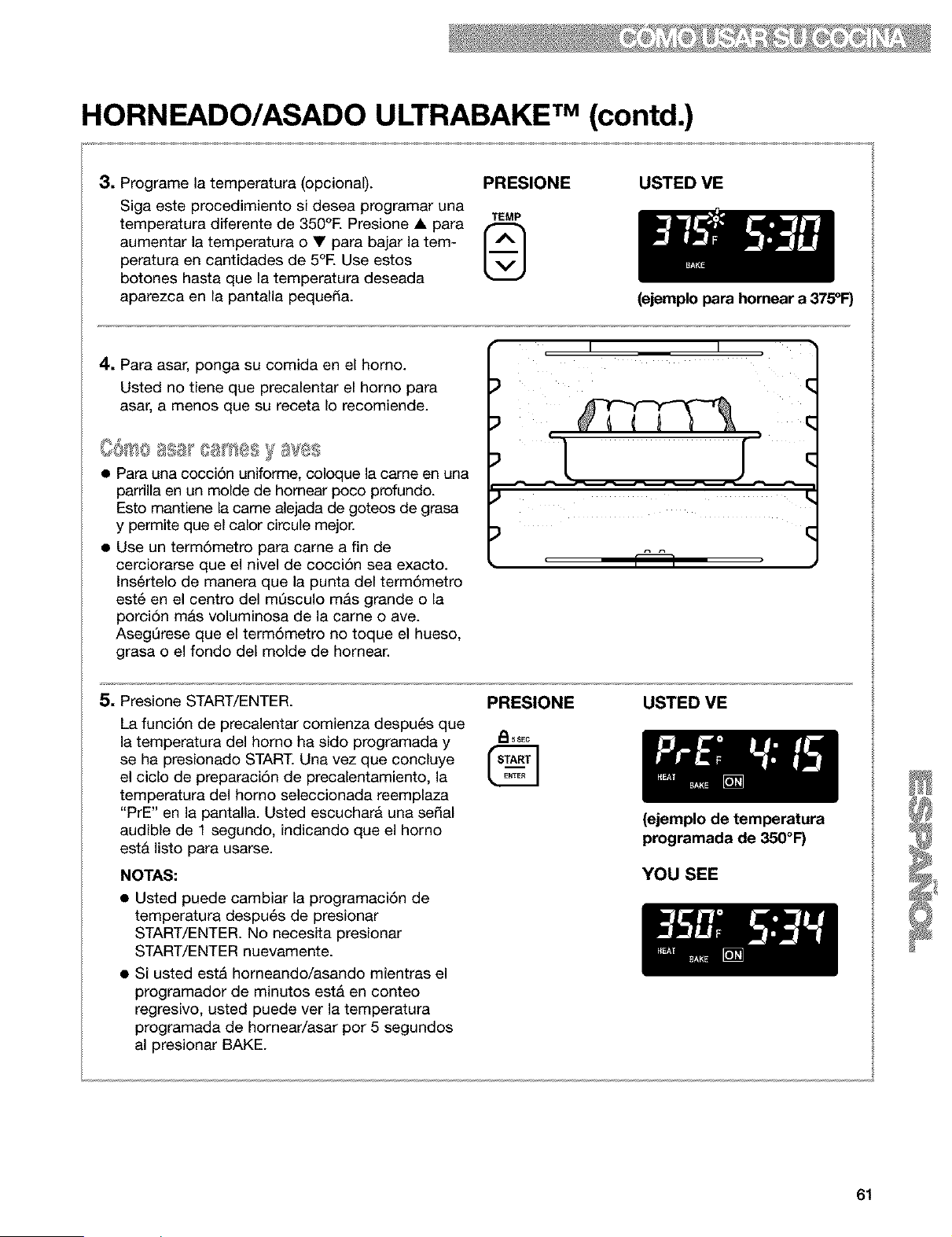
HORNEADO/ASADO ULTRABAKE TM (contd.)
3. Programe la temperatura (opcional). PRESIONE
Siga este procedimiento si desea programar una
temperatura diferente de 350°E Presione • para TEMP
aurnentar la temperatura o • para bajar la tern- IAI
peratura en cantidades de 5°R Use estos
botones hasta que la temperatura deseada
aparezca en la pantalla pequeda.
USTED ME
(ejemplo para homear a 375°1:)
4. Para asar, ponga su comida en el horno.
Usted no tiene que precalentar el homo para
asar, a menos que su receta Io recorniende.
• Para una cocci6n uniforrne, coloque la carne en una
parrilla en un rnolde de hornear poco profundo.
Esto rnantiene la came alejada de goteos de grasa
y perrnite que el calor circule rnejor.
• Use un terrn6rnetro para carne a fin de
cercioraree que el nivel de cocci6n sea exacto.
Ins_rtelo de rnanera que la punta del terrn6rnetro
eet_ en el eentro del rn_sculo rn_s grande o la
porci6n rnae volurninosa de la carneo ave.
Aeeg_rese que el terrn6rnetro no toque el hueso,
grasa o el fondo del rnolde de hornear.
I
€
5. Presione START/ENTER.
PRESIONE
La funci6n de precalentar comienza despu6s que
la ternperatura del homo ha sido prograrnada y A _s_
se ha presionado START. Una vez que concluye I STARTI
el ciclo de preparaciSn de precalentamiento, la "L_ttzJ
ternperatura del homo seleccionada reernplaza
"PrE" en la pantalla. Usted escuchar& una sedal
audible de 1 segundo, indicando que el homo
esta listo para usarse.
NOTAS:
• Usted puede cambiar la programaci6n de
temperatura despu6s de presionar
START/ENTER. No necesita presionar
START/ENTER nuevamente.
• Si usted est& horneando/asando mientras el
programador de minutos est& en conteo
regresivo, usted puede ver la temperatura
programada de hornear/asar por 5 segundos
al presionar BAKE.
USTED VE
(ejemplo de temperatura
programada de 350°1:)
YOU SEE
61
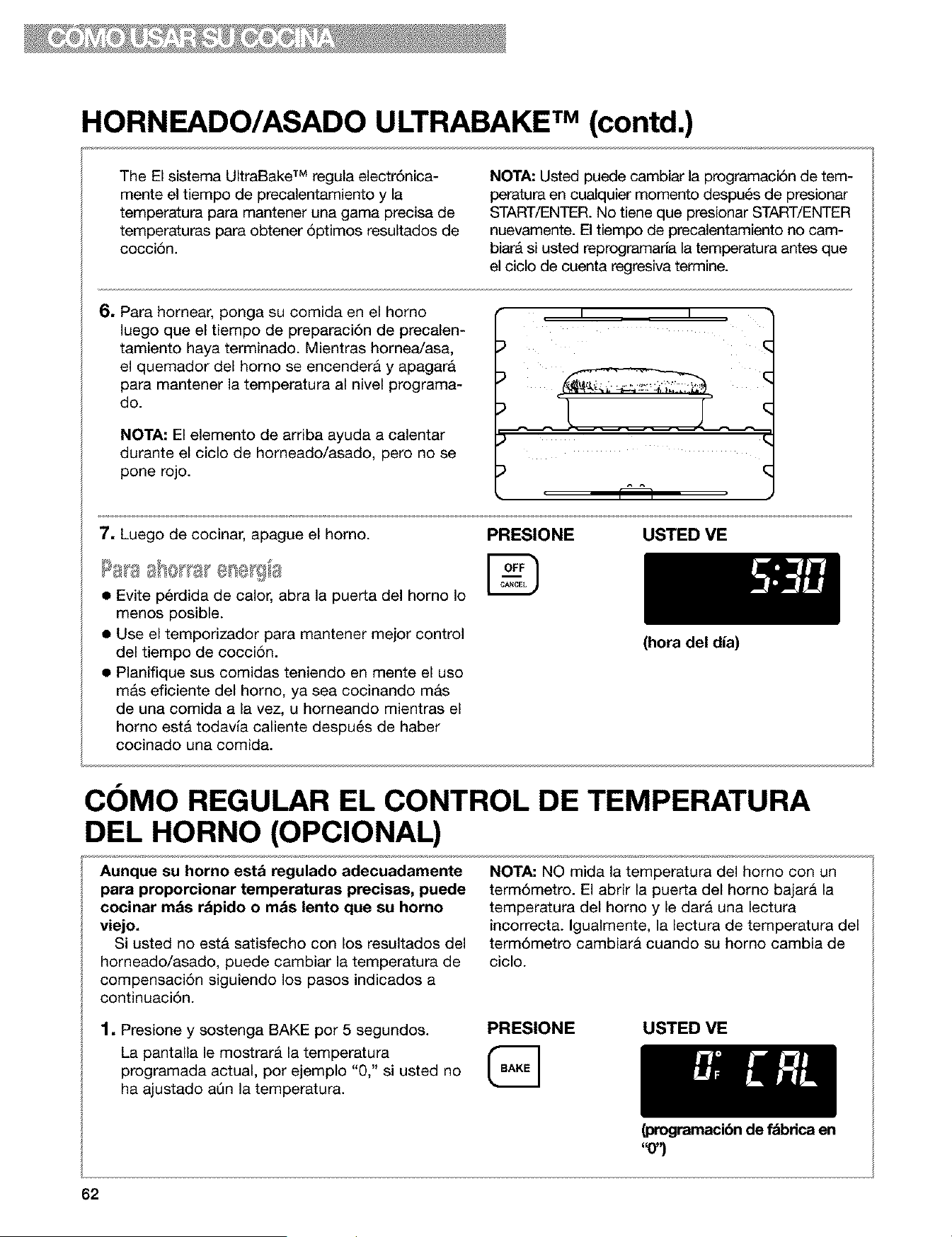
HORNEADO/ASADO ULTRABAKE TM (contd.)
The El sistema UItraBake TM regula electr6nica-
mente el tiempo de precalentamiento y la
temperatura para mantener una gama precisa de
temperaturas para obtener 6ptimos resultados de
cocci6n.
NOTA: Usted puede cambiar la programaci6n de tem-
peratura en cualquier momento despu6s de presionar
START/ENTER. No tiene que presionar START/ENTER
nuevamente. El tiempo de precalentamiento no cam-
biar& si usted reprogramaria la temperatura antes que
el ciclo de cuenta regresiva termine.
6. Para hornear, ponga su comida en el homo
luego que el tiempo de preparaci6n de precalen-
tamiento haya terminado. Mientras hornea/asa,
el quemador del homo se encendera y apagara
para mantener la temperatura al nivel programa-
do.
NOTA: El elemento de arriba ayuda a calentar
durante el ciclo de horneado/asado, pero no se
pone rojo.
I I
q
J
7. Luego de cocinar, apague el horno.
• Evite p6rdida de calor, abra la pue_a del homo Io
menos posible.
• Use el temporizador para mantener mejor control
del tiempo de cocci6n.
• Planifique sus comidas teniendo en mente el uso
mas eficiente del homo, ya sea cocinando mas
de una comida a la vez, u homeando mientras el
homo esta todavla caliente despu_s de haber
cocinado una comida.
PRESIONE USTED VE
(hora del dia)
C( MO REGULAR EL CONTROL DE TEMPERATURA
DEL HORNO (OPCIONAL)
Aunque su horno estd regulado adecuadamente
para proporcionar temperaturas precisas, puede
cocinar rods rdpido o mds lento que su homo
viejo.
Si usted no estA satisfecho con los resultados del
horneado/asado, puede cambiar la temperatura de
compensaci6n siguiendo los pasos indicados a
continuaci6n.
NOTA: NO mida la temperatura del homo con un
term6metro. El abrir la puerta del homo bajar& la
temperatura del homo y le dara una lectura
incorrecta. Igualmente, la lectura de temperatura del
term6metro cambiarA cuando su homo cambia de
ciclo.
1. Presione y sostenga BAKE por 5 segundos.
La pantalla le mostrar& la temperatura
programada actual, por ejemplo "0," si usted no
ha ajustado ann la temperatura.
PRESIONE USTED VE
62
(progmmacibn de f_bdca en
'_3
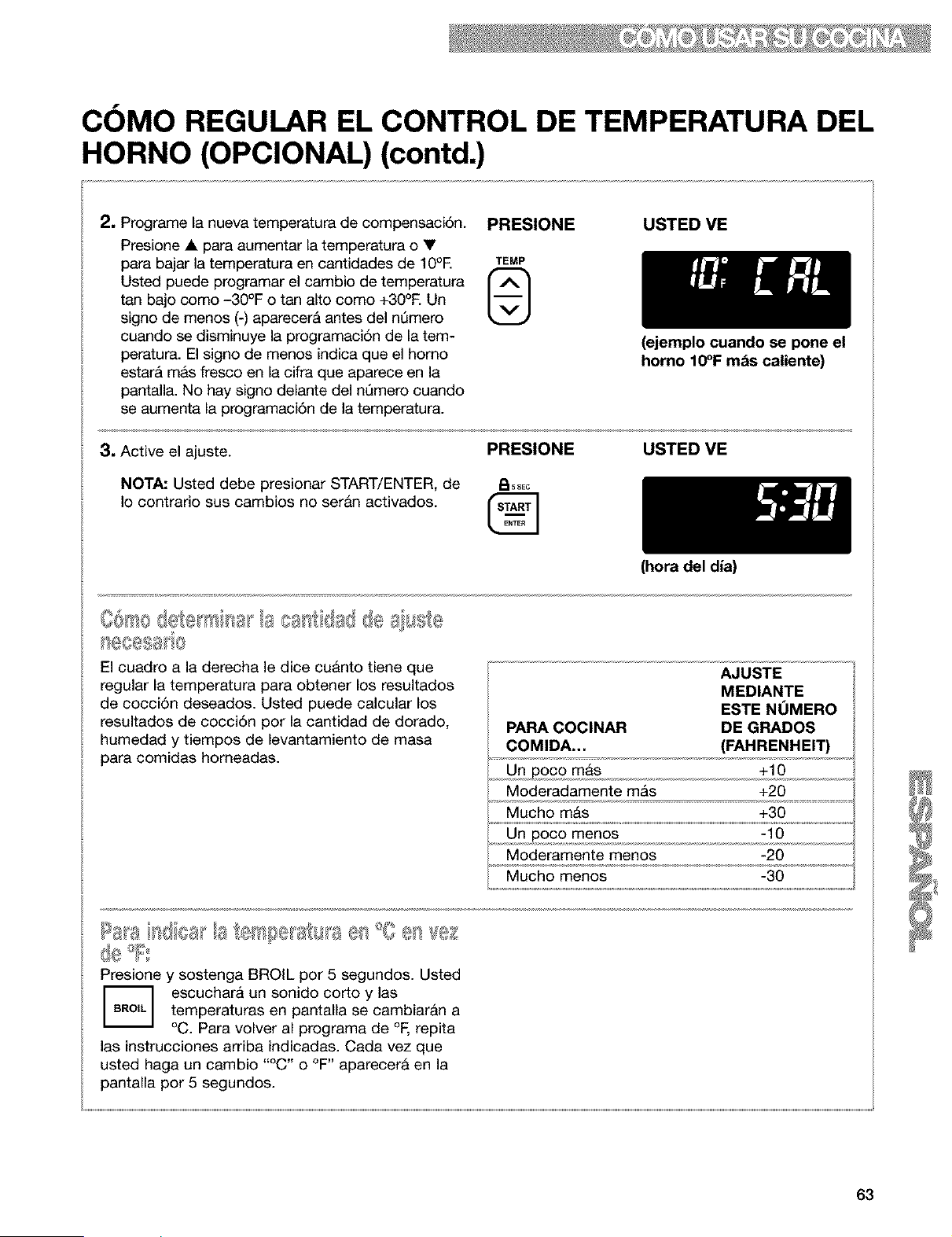
COMO REGULAR EL CONTROL DE TEMPERATURA DEL
HORNO (OPCIONAL) (contd.)
2, Programe la nueva temperatura de compensaci6n. PRESIONE
Presione • para aumentar la temperatura o •
para bajar la temperatura en cantidades de 10°E TEMP
Usted puede programar el cambio de temperatura IA]
tan bajo como -30°F o tan alto como +30°1=.Un
signo de menos (-) aparecerA antes del nQmero
cuando se disminuye la programaci6n de la tem-
peratura. El signo de menos indica que el homo
estarA mAs fresco en la cifra que aparece en la
pantalla. No hay signo delante del nQmero cuando
se aumenta la programaci6n de la temperatura.
USTED VE
3, Active el ajuste.
NOTA: Usted debe presionar START/ENTER, de
Io contrario sus cambios no ser&n activados.
PRESIONE
_15 5EC
(ejemplo cuando se pone el
homo IO°F mas caliente)
USTED VE
El cuadro a la derecha le dice cu&nto tiene que
regular la temperatura para obtener los resultados
de cocci6n deseados. Usted puede calcular los
resultados de cocci6n por la cantidad de dorado,
humedad y tiempos de levantamiento de masa
para comidas homeadas.
(hora del dia)
AJUSTE
MEDIANTE
ESTE NUMERO
PARA COCINAR DE GRADOS
COMIDA.., (FAHRENHEIT)
,,.Unpoco m&s +10
Moderadamente m&s +20
Mucho m_s +30 ...........................
Un poco menos -10
Moderamente menos -20
Mucho menos -30
Presione y sostenga BROIL por 5 segundos. Usted
F_ scuchara un sonido corto y las
temperaturas en pantalla se cambiar&n a
°C. Para volver al programa de °F, repita
las instrucciones arriba indicadas. Cada vez que
usted haga un cambio "°C" o °F" aparecera en la
pantalla por 5 segundos.
63
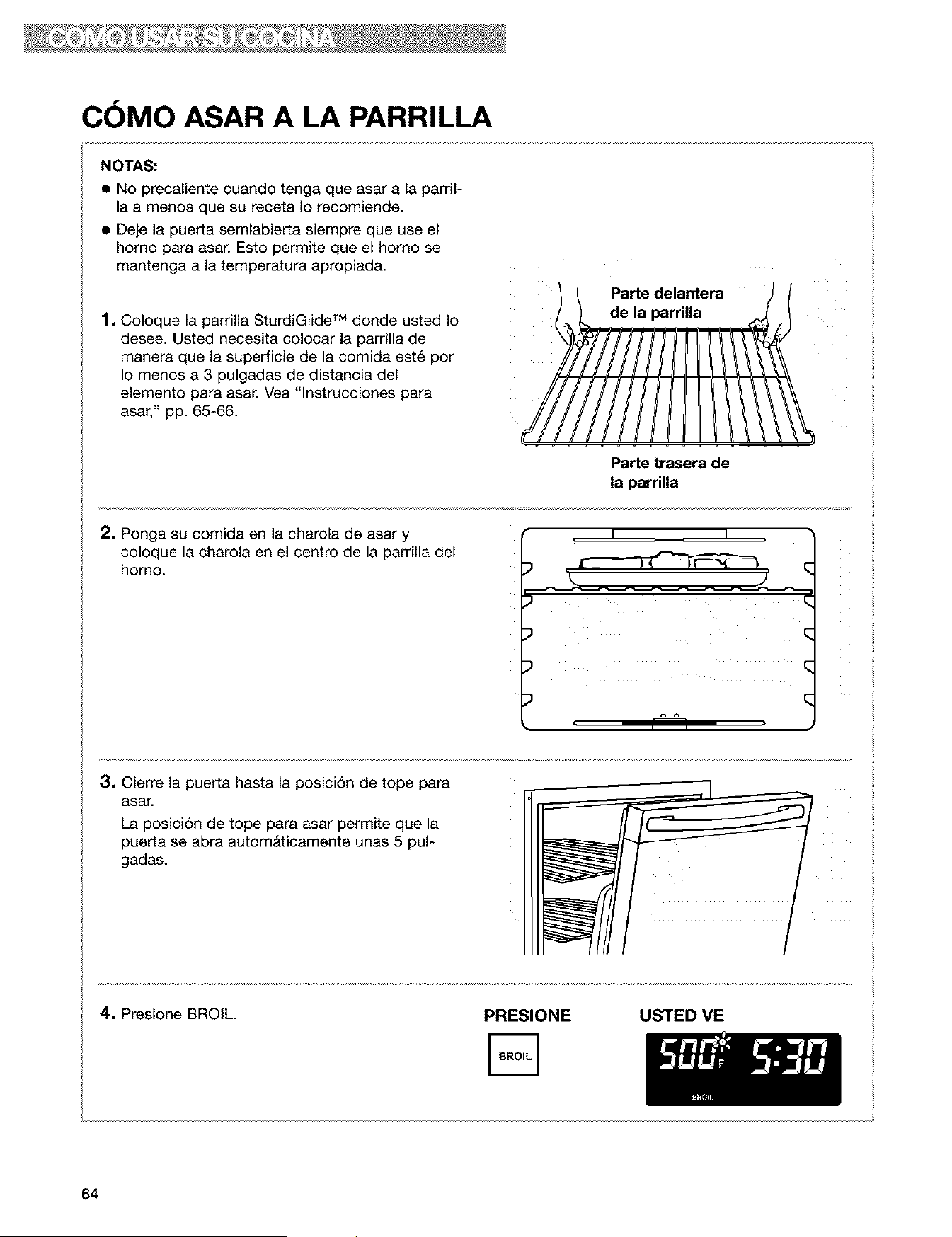
COMO ASAR A LA PARRILLA
NOTAS:
• No precaliente cuando tenga que asar a la parril-
la a menos que su receta Io recomiende.
• Deje la puerta semiabierta siempre que use el
homo para asar. Esto permite que el homo se
mantenga a la temperatura apropiada.
Parte delantera
de la
1, Coloque la parrilla SturdiGlide TM donde usted Io
desee. Usted necesita colocar la parrilla de
manera que la superficie de la comida est_ por
Io menos a 3 pulgadas de distancia del
elemento para asar. Vea "lnstrucciones para
asar," pp. 65-66.
Parte trasera de
la parrilla
2, Ponga su comida en la charola de asar y
coloque la charola en el centro de la parrilla del
homo.
I I
\ J
(
q
3, Cierre la puerta hasta la posici6n de tope para
asar.
La posici6n de tope para asar permite que la
puerta se abra autom&ticamente unas 5 pul-
gadas.
4, Presione BROIL.
PRESIONE USTED VE
64
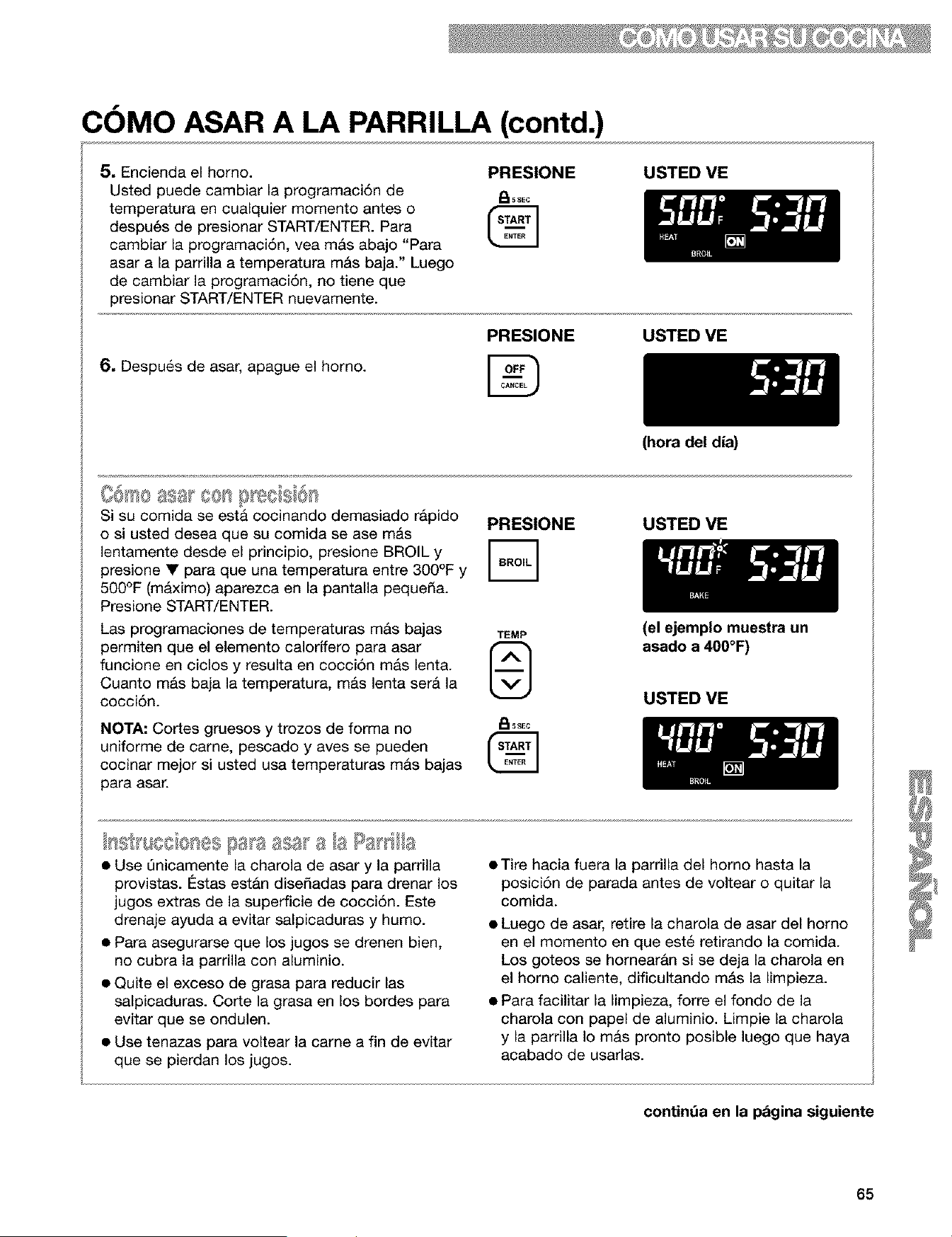
COMO ASAR A LA PARRILLA (contd.)
5. Encienda el homo. PRESIONE
Usted puede cambiar la programaci6n de 8 ....
temperatura en cualquier momento antes o
despu6s de presionar START/ENTER. Para
cambiar la programaci6n, vea m&s abajo "Para
asar a la parrilla a temperatura m&s baja." Luego
de cambiar la programaci6n, no tiene que
presionar START/ENTER nuevamente.
USTED ME
6. Despu6s de asar, apague el homo.
PRESIONE USTED VE
(hora del dia)
Si su comida se esta cocinando demasiado rapido PRESIONE
o si usted desea que su comida se ase m&s
lentamente desde el principio, presione BROIL y F_
presione • para que una temperatura entre 300°F y
500°F (m&ximo) aparezca en la pantalla pequeda.
Presione START/ENTER.
Las programaciones de temperaturas m&s bajas TEMP
permiten que el elemento calorifero para asar
funcione en ciclos y resulta en cocci6n mas lenta.
@Cuanto m&s baja la temperatura, m&s lenta ser& la
cocci6n.
NOTA: Cortes gruesos y trozos de forma no P,_,Ec
uniforme de came, pescado y aves se pueden [ STARTI
cocinar mejor si usted usa temperaturas mAs bajas "k.ztzJ
para asar.
USTED VE
(el ejemplo muestra un
asado a 400°F)
USTED ME
s uccim: spa ssasm:a la <i/a
• Use Qnicamente la charola de asar y la parrilla
provistas. I_stas est&n disedadas para drenar los
jugos extras de la superficie de cocci6n. Este
drenaje ayuda a evitar salpicaduras y humo.
• Para asegurarse que los jugos se drenen bien,
no cubra la parrilla con aluminio.
• Quite el exceso de grasa para reducir las
salpicaduras. Corte la grasa en los bordes para
evitar que se ondulen.
• Use tenazas para voltear la came a fin de evitar
que se pierdan los jugos.
• Tire hacia fuera la parrilla del homo hasta la
posici6n de parada antes de voltear o quitar la
comida.
• Luego de asar, retire la charola de asar del homo
en el momento en que est6 retirando la comida.
Los goteos se hornear&n si se deja la charola en
el homo caliente, dificultando m&s la limpieza.
• Para facilitar la limpieza, forte el fondo de la
charola con papel de aluminio. Limpie la charola
y la parrilla Io mas pronto posible luego que haya
acabado de usarlas.
continda en la pagina siguiente
65
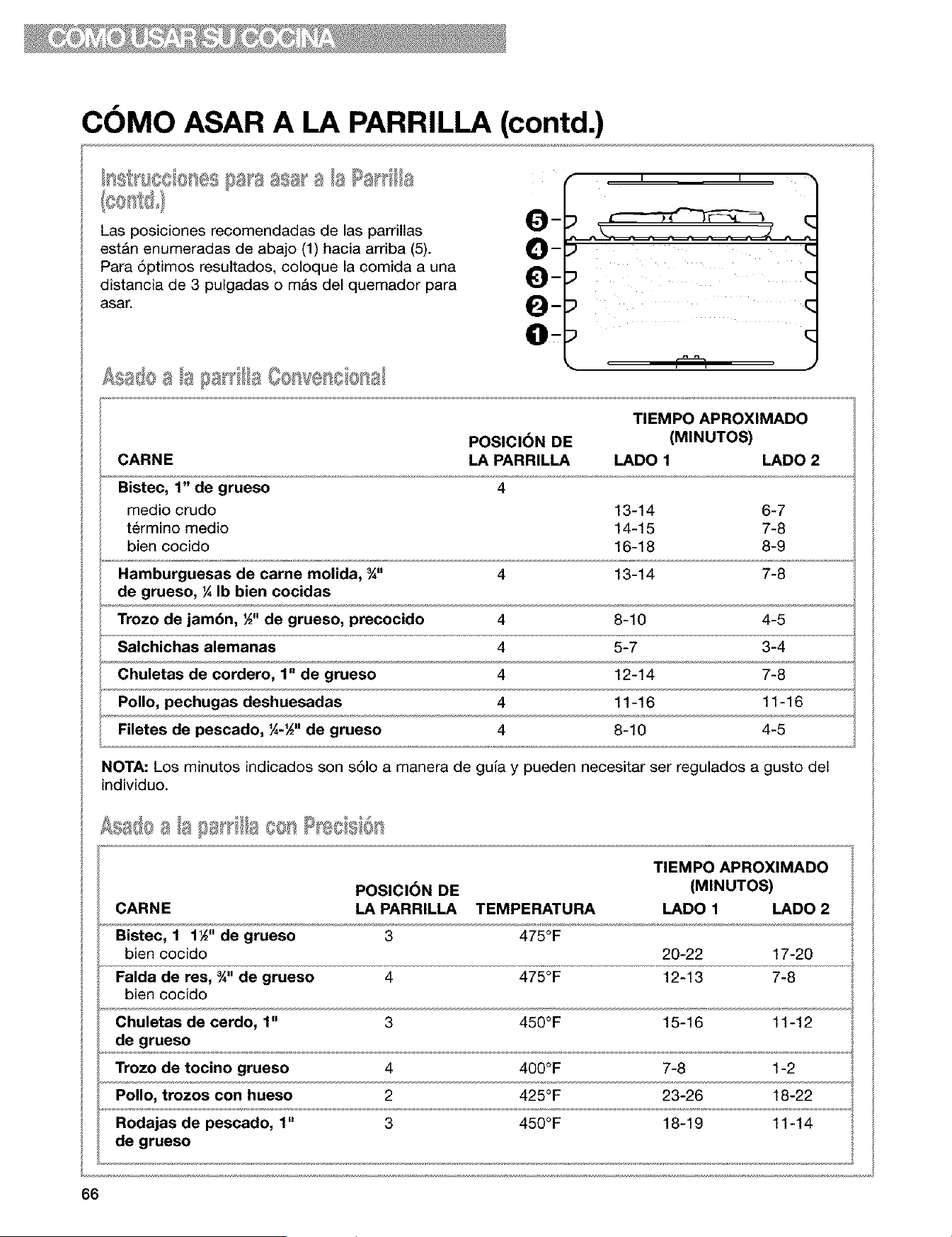
COMO ASAR A LA PARRILLA (contd.)
®_I _, ,_,s_ _ _ 2_ I¸_ _ _"_
Las posiciones recomendadas de las parrillas
est&n enumeradas de abajo (1) hacia arriba (5).
Para 6ptimos resultados, coloque la comida a una
distancia de 3 pulgadas o m&s del quemador para
asar.
m
O-
Q-
@-
O-
I
J
J
Asad<sa a _}a_' a @osvesccssa
TIEMPO APROXIMADO
POSICI6N DE (MINUTOS)
CARNE LA PARRILLA LADO 1 LADO 2
Bistec, 1" de grueso 4
medio crudo 13-14 6-7
t6rmino medio 14-15 7-8
bien cocido 16-18 8-9
Hamburguesas de carne molida, ¾" 4 13-14 7-8
de grueso, ¼ Ib bien cocidas
Trozo de jambn, ½" de grueso, precocido 4 8-10 4-5
Salchichas alemanas 4 5-7 3-4
Chuletas de cordero, 1" de grueso 4 12-14 7-8
Polio, pechugas deshuesadas 4 11-16 11-16
Filetes de pescado, ¼-½" de grueso 4 8-10 4-5
NOTA: Los minutos indicados son s61o a manera de guia y pueden necesitar ser regulados a gusto del
individuo.
a _a_sa _ll_sG0_
TIEMPO APROXIMADO
POSICI6N DE (MINUTOS)
CARNE LA PARRILLA TEMPERATURA LADO 1 LADO 2
Bistec, 1 1½" de grueso 3 475°F
bien cocido 20-22 17-20
Falda de res, _" de grueso 4 475°F 12-13 7-8
bien cocido
Chuletas de cerdo, 1" 3 450°F 15-16 11-12
de grueso
Trozo de tocino grueso 4 400°F 7-8 1-2
Polio, trozos con hueso 2 425°F 23-26 18-22
Rodajas de pescado, 1" 3 450°F 18-19 11-14
de grueso
66
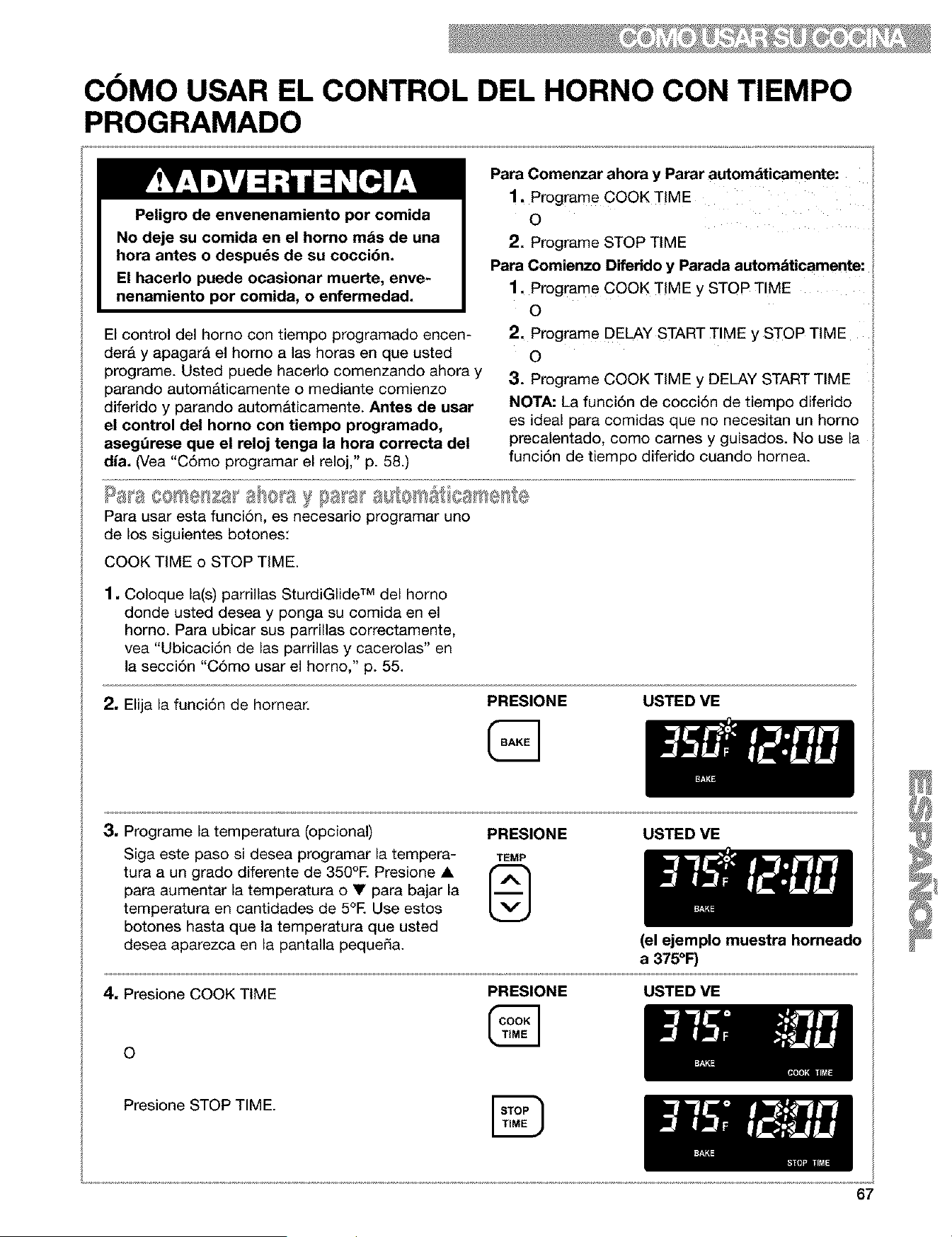
COMO USAR EL CONTROL DEL HORNO CON TIEMPO
PROGRAMADO
Peligro de envenenamiento por comida
No deje su comida en el homo mds de una
hora antes o despu_s de su coccibn.
El hacerlo puede ocasionar muerte, enve-
nenamiento por comida, o enfermedad.
Para Comenzar ahora y Parar automdticamente:
1. Programe COOK T!ME
O
2. Programe STOP TIME
Para Comienzo Diferido y Parada automdticamente:
1. Programe COOK T!ME y STOP TIME
O
El control del homo con tiempo programado encen-
der& y apagar& el homo alas horas en que usted
programe. Usted puede hacerlo comenzando ahora y
parando autom&ticamente o mediante comienzo
diferido y parando autom&ticamente. Antes de usar
el control del horno con tiempo programado,
asegdrese que el reloj tenga la hora correcta del
dia. (Vea "C6mo programar el reloj," p. 58.)
2. Programe DELAY START TIME y STOP TIME
O
3. Programe COOK TIME y DELAY START TIME
NOTA: La funci6n de cocci6n de tiempo diferido
es ideal para comidas que no necesitan un homo
precalentado, como carnes y guisados. No use la
funci6n de tiempo diferido cuando hornea.
Para usar esta funci6n, es necesario programar uno
de los siguientes botones:
COOK TIME o STOP TIME.
1, Coloque la(s) parrillas SturdiGlide TM del horno
donde usted desea y ponga su comida en el
homo. Para ubicar sus parrillas correctamente,
vea "Ubicaci6n de las parrillas y cacerolas" en
la secci6n "C6mo usar el homo," p. 55.
2, Elija la funci6n de hornear.
PRESIONE USTED ME
3, Programe la temperatura (opcional) PRESIONE
Siga este paso si desea programar la tempera- TEMP
tura a un grado diferente de 350°1. Presione •
para aumentar la temperatura o • para bajar la
temperatura en cantidades de 5°E Use estos
botones hasta que la temperatura que usted
desea aparezca en la pantalla peque_a.
USTED ME
(el ejemplo muestra homeado
a 375°F)
4, Presione COOK TIME PRESIONE
o
USTED ME
Presione STOP TIME.
67
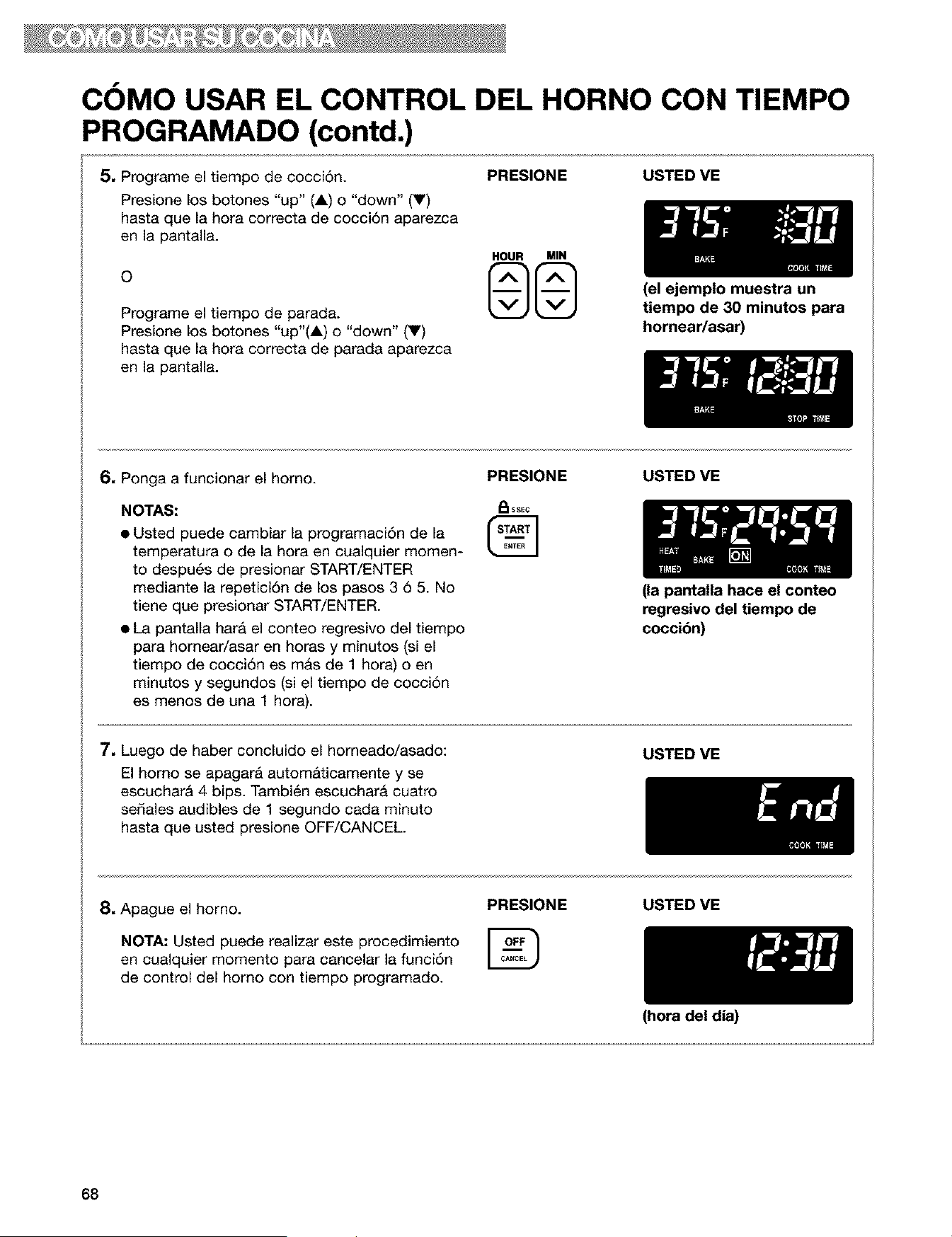
COMO USAR EL CONTROL DEL HORNO CON TIEMPO
PROGRAMADO (contd.)
5, Programe el tiempo de cocci6n.
Presione los botones "up" (1) o "down" (V)
hasta que la hora correcta de cocci6n aparezca
en la pantalla.
O
Programe el tiempo de parada.
Presione los botones "up"(1) o "down" (V)
hasta que la hora correcta de parada aparezca
en la pantalla.
PRESIONE USTED ME
HOUR MIN
(el ejemplo muestra un
tiempo de 30 minutos para
hornear/asar)
6, Ponga a funcionar el homo.
NOTAS:
• Usted puede cambiar la programaci6n de la
temperatura o de la hora en cualquier momen-
to despu6s de presionar START/ENTER
mediante la repeticiSn de los pasos 3 5 5. No
tiene que presionar START/ENTER.
• La pantalla hara el conteo regresivo del tiempo
para hornear/asar en horas y minutos (si el
tiempo de cocciSn es m&s de 1 hora) o en
minutos y segundos (si el tiempo de cocciSn
es menos de una 1 hora).
PRESIONE
85 SEC
USTED ME
(la pantalla hace el conteo
regresivo del tiempo de
coccibn)
7, Luego de haber concluido el horneado/asado:
El homo se apagar& autom&ticamente y se
escuchar& 4 bips. Tambi6n escuchar& cuatro
sedales audibles de 1 segundo cada minuto
hasta que usted presione OFF/CANCEL
USTED ME
8. Apague el homo.
NOTA: Usted puede realizar este procedimiento
en cualquier momento para cancelar la funci6n
de control del homo con tiempo programado.
PRESIONE USTED ME
(hora del dia)
68
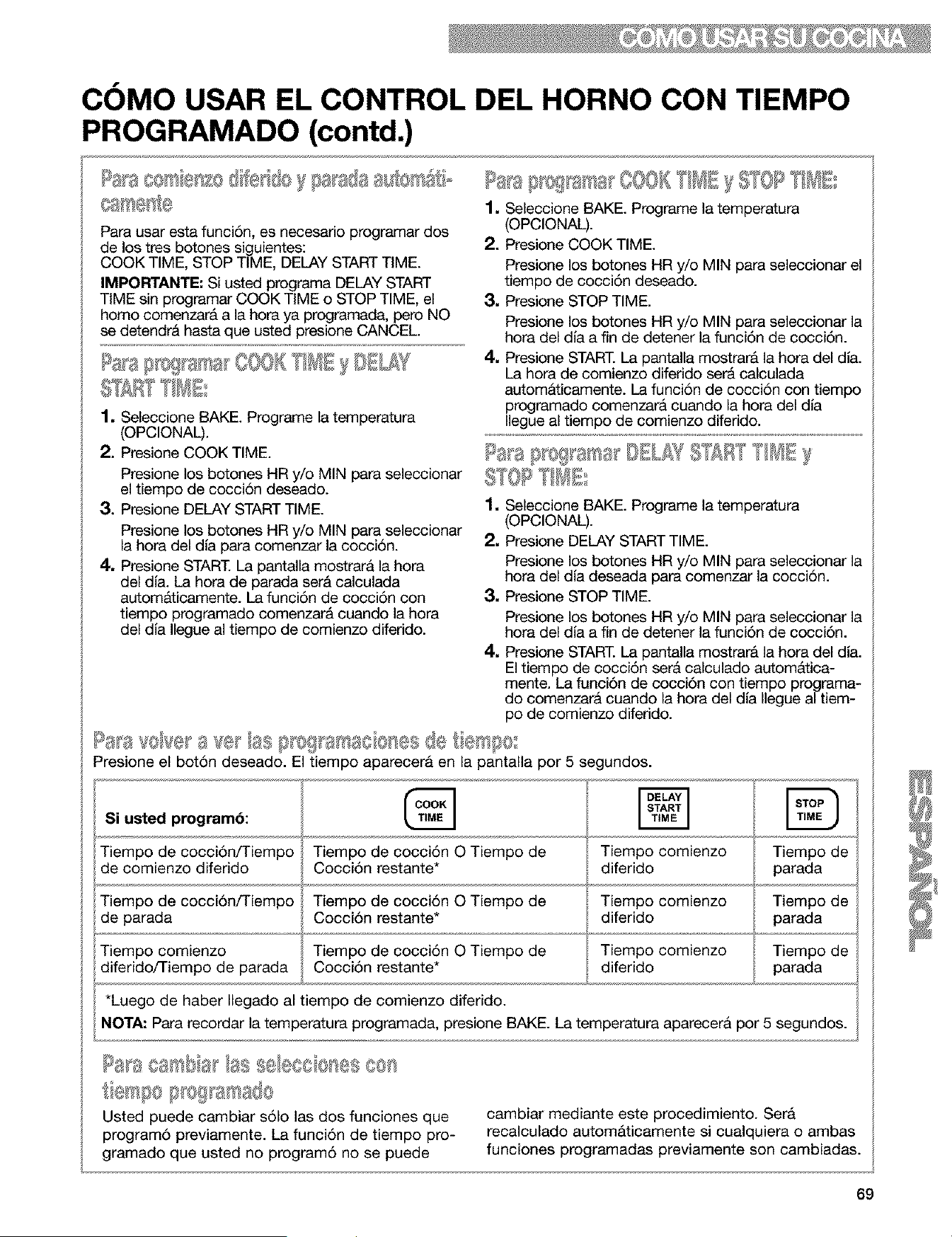
COMO USAR EL CONTROL DEL HORNO CON TIEMPO
PROGRAMADO (contd.)
Para usar esta funci6n, es necesario programar dos
de los tres botones siguientes:
COOK TIME, STOP TIME, DELAY START TIME.
IMPORTANTE: Si usted programa DELAY START
TIME sin programar COOK TIME o STOP TIME, el
homo comenzar& a la hora ya programada, pero NO
se detendr& hasta que usted presione CANCEL.
1, Seleccione BAKE. Programe la temperatura
(OPCIONAL).
2. Presione COOK TIME.
Presione los botones HR y/o MIN para seleccionar
el tiempo de cocci6n deseado.
3. Presione DELAY START TIME.
Presione los botones HR y/o MIN para seleccionar
la hora del dla para comenzar la cocci6n.
4, Presione START. La pantalla mostrara la hora
del dla. La hora de parada ser& calculada
autom&ticamente. La funci6n de cocci6n con
tiempo programado comenzar& cuando la hora
del dla Ilegue al tiempo de comienzo diferido.
1, Seleccione BAKE. Programe la temperatura
(OPGIONAL).
2. Presione COOK TIME.
Presione los botones HR y/o MIN para seleccionar el
tiempo de cocci6n deseado.
3, Presione STOP TIME.
Presione los botones HR y/o MIN para seleccionar la
hora del dla a fin de detener la funci6n de cocci6n.
4, Presione START. La pantalla mostrar& la hora del dla.
La hora de comienzo diferido ser& calculada
automaticamente. La funci6n de cocci6n con tiempo
programado comenzara cuando la hora del dla
Ilegue al tiempo de comienzo diferido.
1. Seleccione BAKE. Programe la temperatura
(OPGIONAL).
2, Presione DELAY START TIME.
Presione los botones HR y/o MIN para seleccionar la
hora del dla deseada para comenzar la cocci6n.
3, Presione STOP TIME.
Presione los botones HR y/o MIN para seleccionar la
hora del dla a fin de detener la funci6n de cocci6n.
4, Presione START. La pantalla mostrar& la hora del dla.
El tiempo de cocci6n ser& calculado a_om&tica-
mente. La funci6n de cocci6n con tiempo programa-
do comenzar& cuando la hora del dla Ilegue al tiem-
po de comienzo diferido.
Presione el bot6n deseado. El tiempo aparecera en la pantalla por 5 segundos.
Si usted program6:
Tiempo de cocci6n/Tiempo
de comienzo diferido
Tiempo de cocci6n/Tiempo
de parada
Tiempo comienzo
diferido/Tiempo de parada
Tiempo de cocci6n O Tiempo de Tiempo comienzo Tiempo de
Cocci6n restante* diferido parada
Tiempo de cocci6n O Tiempo de Tiempo comienzo Tiempo de
Cocci6n restante* diferido parada
Tiempo de cocci6n O Tiempo de
Cocci6n restante*
Tiempo comienzo
diferido
*Luego de haber Ilegado al tiempo de comienzo diferido.
Tiempo de
parada
NOTA: Para recordar la temperatura programada, presione BAKE. La temperatura aparecera por 5 segundos.
Papaca s b /as se ccio '%s
Usted puede cambiar s61o las dos funciones que
program6 previamente. La funci6n de tiempo pro-
gramado que usted no program6 no se puede
cambiar mediante este procedimiento. Sera
recalculado autom&ticamente si cualquiera o ambas
funciones programadas previamente son cambiadas.
69
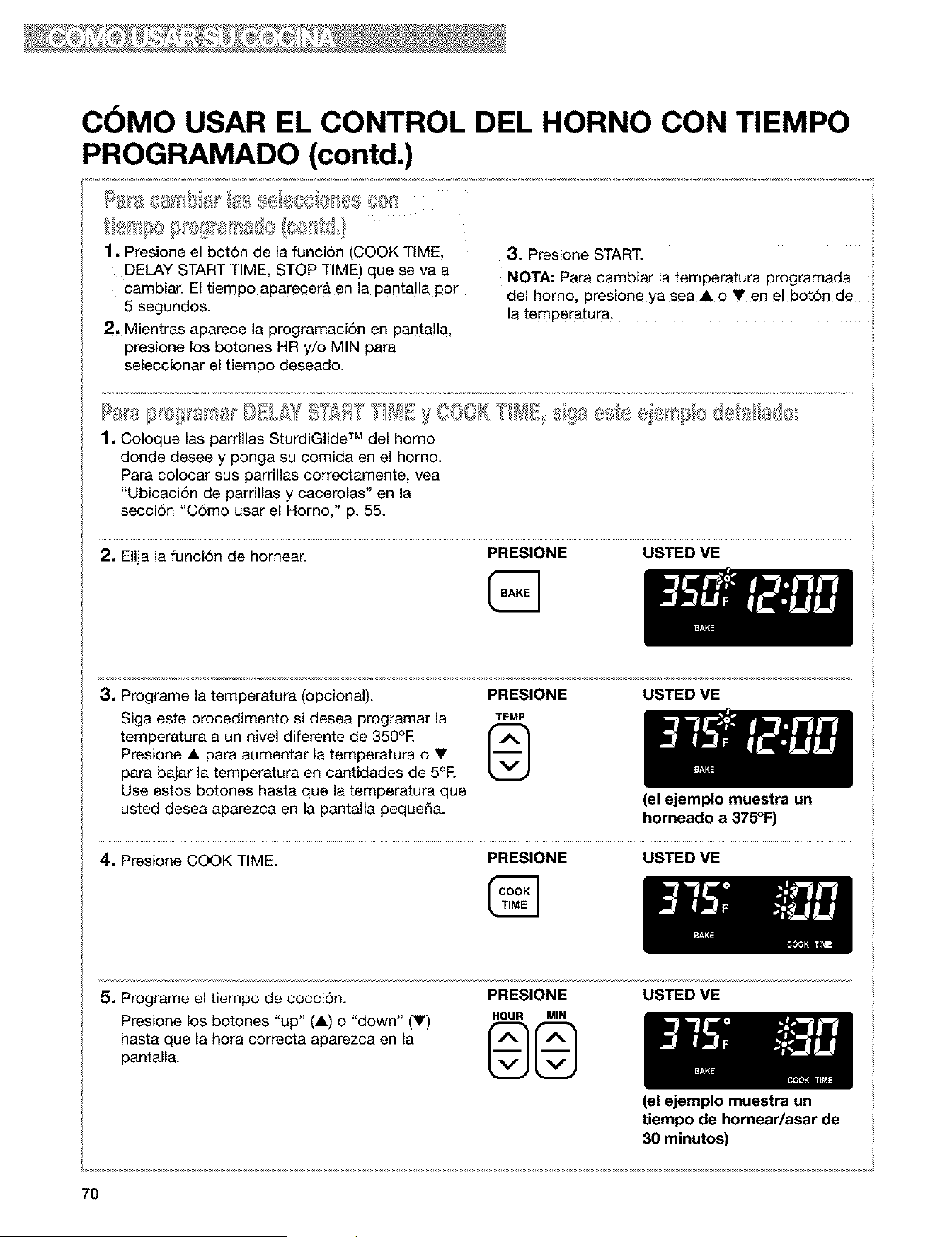
COMO USAR EL CONTROL DEL HORNO CON TIEMPO
PROGRAMADO (contd.)
1. Presione el bot6n de la funci6n (COOK TIME,
DELAY START TIME, STOP TIME) que se va a
cambiar. El tiempo aparecer& en la pantalla por
5 segundos.
2. Mientras aparece la programaci6n en pantalla,
presione los botones HR y/o MIN para
seleccionar el tiempo deseado.
3. Presione START.
NOTA: Para cambiar la temperatura programada
del horno, pres_one ya sea • o • en el bot6n de
la temperatura.
Pa_'a_s_s9ama_"©_SLSY_£F@?%*_Sy 0©@6?/I_I£ sga est,} eiemFse deta_sde
1. Coloque las parrillas SturdiGlide TM del homo
donde desee y ponga su comida en el homo.
Para colocar sus parrillas correctamente, vea
"Ubicaci6n de parrillas y cacerolas" en la
secci6n "C6mo usar el Homo," p. 55.
2. Elija la funci6n de hornear.
PRESIONE USTED ME
3. Programe la temperatura (opcional). PRESIONE
Siga este procedimento si desea programar la TEMP
temperatura a un nivel diferente de 350°E (#_
Presione • para aumentar la temperatura o •
LTJ
para bajar la temperatura en cantidades de 5°1.
Use estos botones hasta que la temperatura que
usted desea aparezca en la pantalla peque_a.
USTED ME
4, Presione COOK TIME.
PRESIONE
(el ejemplo muestra un
horneado a 375°F)
USTED ME
5. Programe el tiempo de cocci6n. PRESIONE
Presione los botones "up" (A) o "down" (•) HOUR M=N
USTED ME
(el ejemplo muestra un
tiempo de hornear/asar de
30 minutos)
70
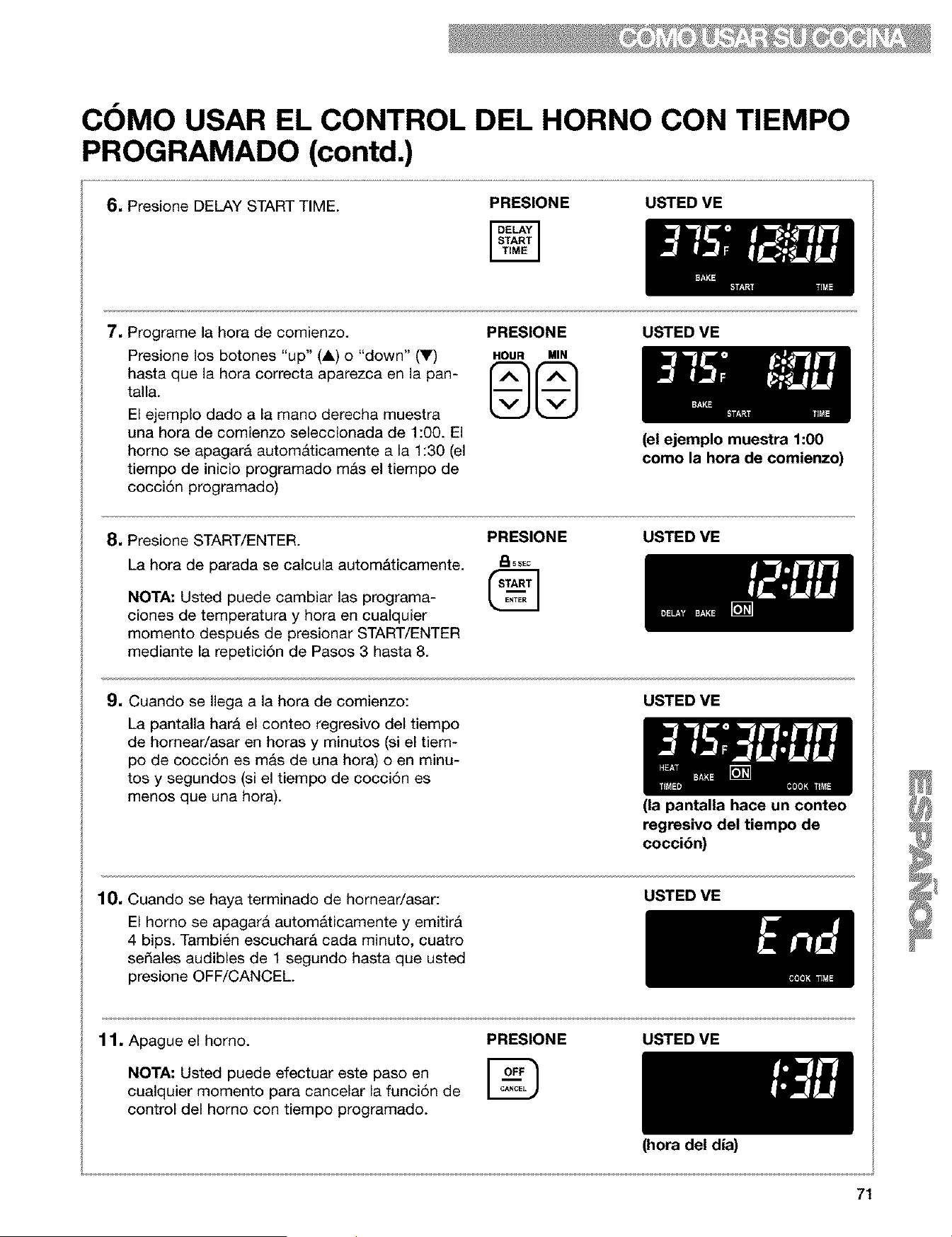
COMO USAR EL CONTROL DEL HORNO CON TIEMPO
PROGRAMADO (contd.)
6, Presione DELAY START TIME.
PRESIONE USTED ME
7, Programe la hora de comienzo. PRESIONE
Presione los botones "up" (A) o "down" (V) _.H°ur mN
hasta que la hora correcta aparezca en la pan- [_%_ (A_
tall&
El ejemplo dado a la mano derecha muestra
una hora de comienzo seleccionada de 1:00. El
homo se apagara automAticamente a la 1:30 (el
tiempo de inicio programado mAs el tiempo de
cocci6n programado)
USTED ME
8, Presione START/ENTER.
La hora de parada se calcula autom&ticamente.
NOTA: Usted puede cambiar las programa-
ciones de temperatura y hora en cualquier
momento despu6s de presionar START/ENTER
mediante la repetici6n de Pasos 3 hasta 8.
PRESIONE
I_15$Ec
(el ejemplo muestra 1:00
como la hora de comienzo)
USTED ME
9, Cuando se Ilega a la hora de comienzo:
La pantalla hara el conteo regresivo del tiempo
de hornear/asar en horas y minutos (si el tiem-
po de cocci6n es mas de una hora) o en minu-
tos y segundos (si el tiempo de cocci6n es
menos que una hora).
USTED ME
(la pantalla hace un conteo
regresivo del tiempo de
cocci6n)
10, Cuando se haya terminado de hornear/asar:
El homo se apagar& autom&ticamente y emitir&
4 bips. Tambi_n escuchar& cada minuto, cuatro
sedales audibles de 1 segundo hasta que usted
presione OFF/CANCEL.
USTED ME
11, Apague el homo.
NOTA: Usted puede efectuar este paso en
cualquier momento para cancelar la funci6n de
control del homo con tiempo programado.
PRESIONE USTED ME
(hora del dia)
71
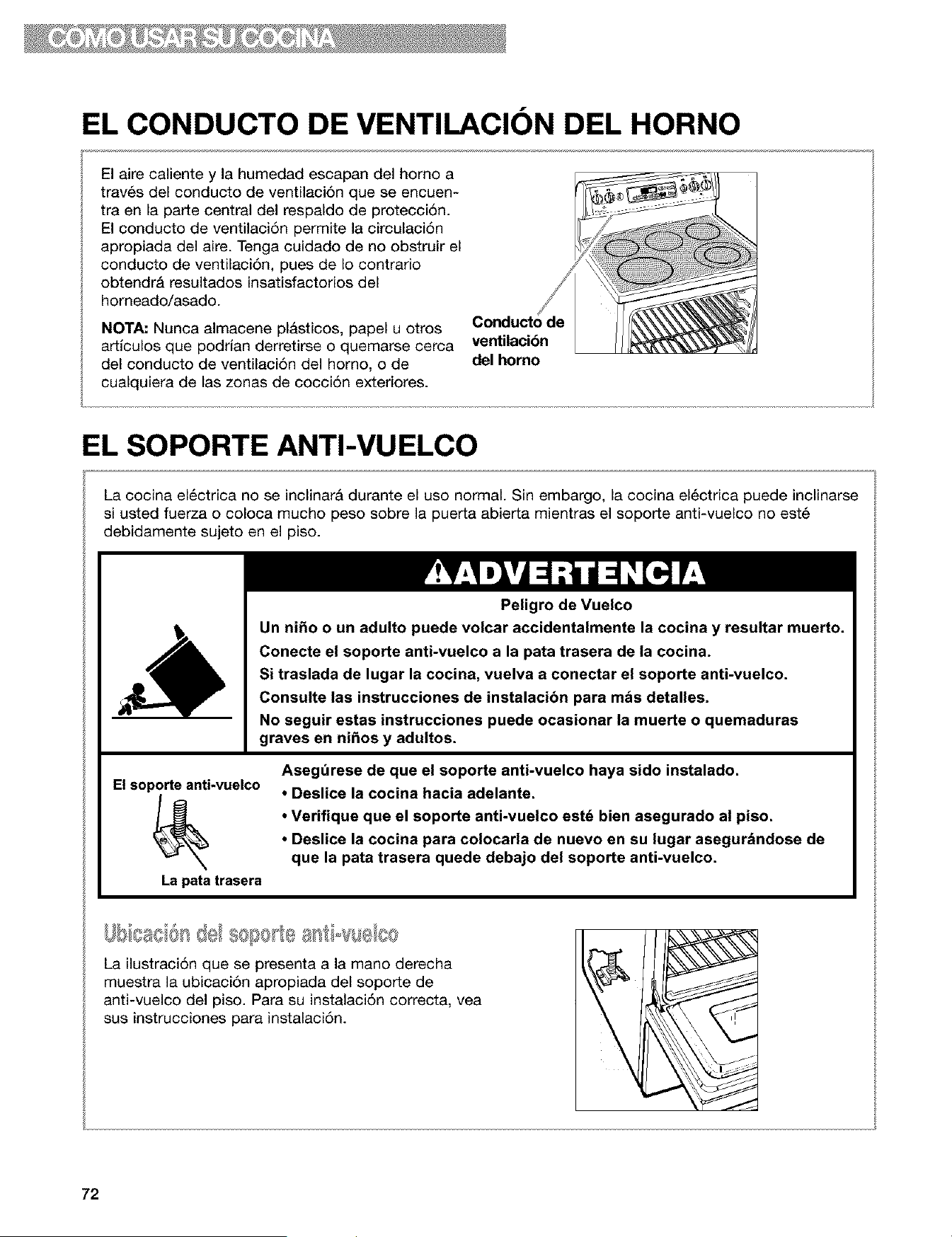
EL CONDUCTO DE VENTILACION DEL HORNO
El aire caliente y la humedad escapan del homo a
trav_s del conducto de ventilaci6n que se encuen-
tra en la parte central del respaldo de protecci6n.
El conducto de ventilaci6n permite la circulaci6n
apropiada del aire. Tenga cuidado de no obstruir el
conducto de ventilaci6n, pues de Io contrario
obtendr& resultados insatisfactorios del
horneado/asado.
NOTA: Nunca almacene plasticos, papel u otros
artlculos que podrian derretirse o quemarse cerca
del conducto de ventilaci6n del homo, o de
cualquiera de las zonas de cocci6n exteriores.
ventilacibn
delhomo
EL SOPORTE ANTI-VUELCO
La cocina el6ctrica no se inclinar& durante el uso normal. Sin embargo, la cocina el6ctrica puede inclinarse
si usted fuerza o coloca mucho peso sobre la puerta abierta mientras el soporte anti-vuelco no est6
debidamente sujeto en el piso.
El soporte anti-vuelco
La pata trasera
Peligro de Vuelco
Un ni_o o un adulto puede volcar accidentalmente la cocina y resultar muerto.
Conecte el soporte anti-vuelco a la pata trasera de la cocina.
Si traslada de lugar la cocina, vuelva a conectar el soporte anti-vuelco.
Consulte las instrucciones de instalacibn para m_s detalles.
No seguir estas instrucciones puede ocasionar la muerte o quemaduras
graves en nihos y adultos.
Asegdrese de que el soporte anti-vuelco haya sido instalado.
• Deslice la cocina hacia adelante.
• Verifique que el soporte anti-vuelco est_ bien asegurado al piso.
• Deslice la cocina para colocarla de nuevo en su lugar asegur_ndose de
que la pata trasera quede debajo del soporte anti-vuelco.
La ilustraci6n que se presenta a la mano derecha
muestra la ubicaci6n apropiada del soporte de
anti-vuelco del piso. Para su instalaci6n correcta, vea
sus instrucciones para instalaci6n.
72
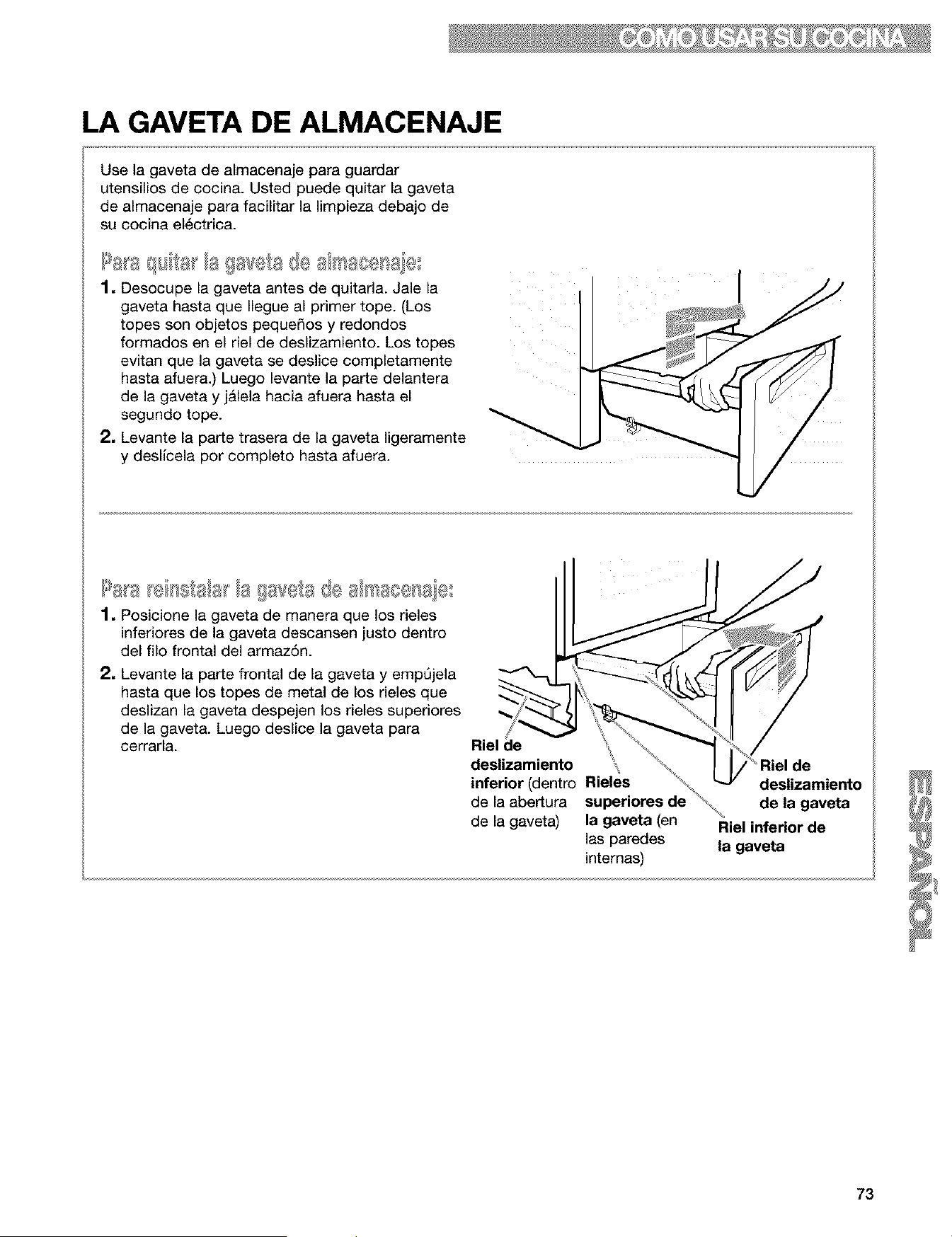
LA GAVETA DE ALMACENAJE
Use la gaveta de almacenaje para guardar
utensilios de cocina. Usted puede quitar la gaveta
de almacenaje para facilitar la limpieza debajo de
su cocina el6ctrica.
1. Desocupe la gaveta antes de quitarla. Jale la
gaveta hasta que Ilegue al primer tope. (Los
topes son objetos peque_os y redondos
formados en el riel de deslizamiento. Los topes
evitan que la gaveta se deslice completamente
hasta afuera.) Luego levante la parte delantera
de la gaveta y j&lela hacia afuera hasta el
segundo tope.
2. Levante la parte trasera de la gaveta ligeramente
y deslicela por completo hasta afuera.
1. Posicione la gaveta de manera que los rieles
inferiores de la gaveta descansen justo dentro
del filo frontal del armaz6n.
2. Levante la parte frontal de la gaveta y empQjela
hasta que los topes de metal de los rieles que
deslizan la gaveta despejen los rieles superiores
de la gaveta. Luego deslice la gaveta para
cerrarla. Riel
deslizamiento '_
\
inferior (dentro Rieles
de la abertura
de la gaveta) la gaveta (en
las paredes
internas)
deslizamiento
de la gaveta
Riel inferior de
la gaveta
73
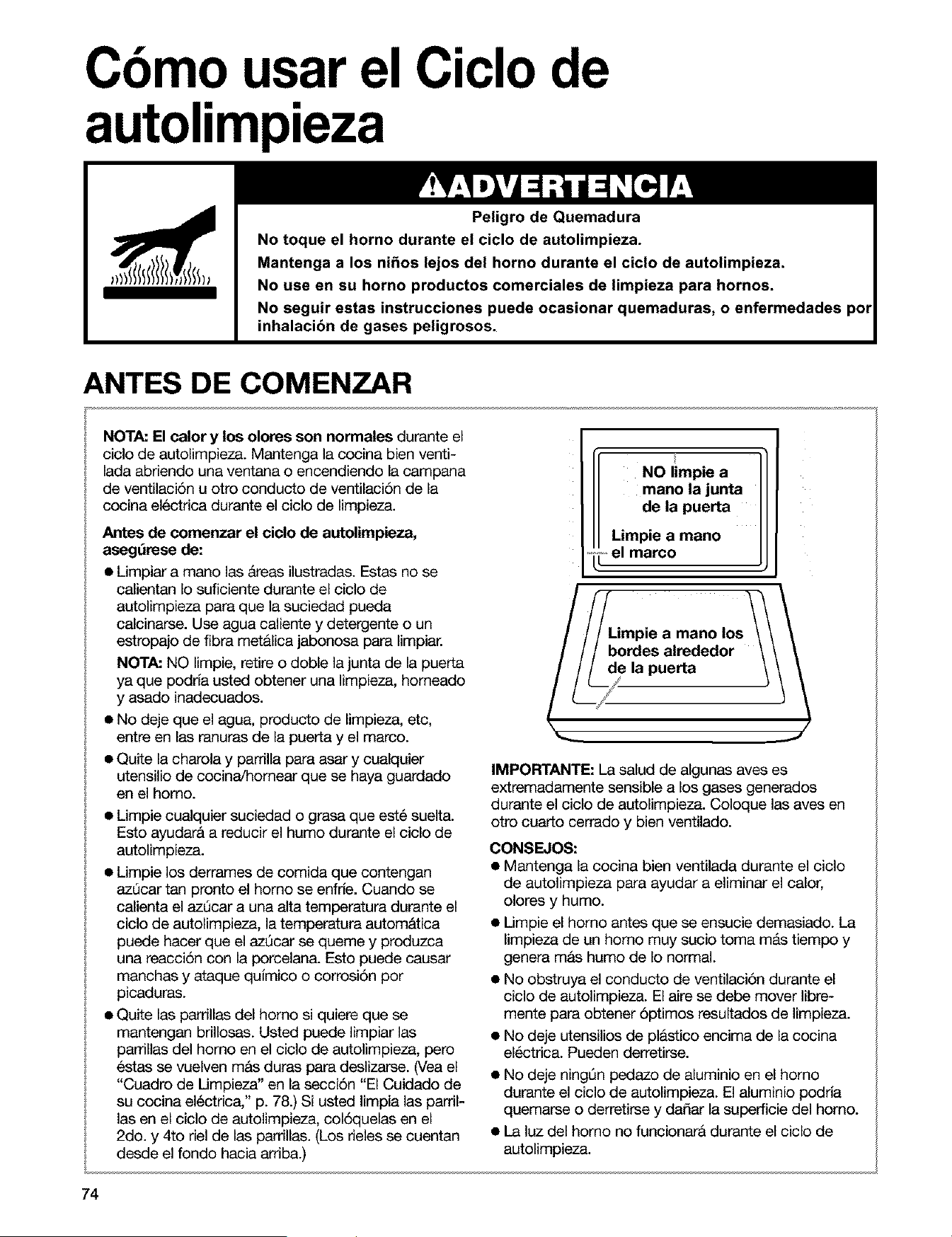
Cbmo usar el Ciclo de
autolimpieza
Peligro de Quemadura
No toque el horno durante el ciclo de autolimpieza.
Mantenga a los ni_os lejos del homo durante el ciclo de autolimpieza.
No use en su homo productos comerciales de limpieza para hornos.
No seguir estas instrucciones puede ocasionar quemaduras, o enfermedades pot
inhalacibn de gases peligrosos.
ANTES DE COMENZAR
NOTA: El calor y los olores son normales durante el
ciclo de autolimpieza. Mantenga la cocina bien venti-
lada abriendo una ventana o encendiendo la campana
de ventilaci6n u otto conducto de ventilaci6n de la
cocina electdca durante el ciclo de limpieza.
Antes de comenzar el ciclo de autolimpieza,
asegerese de:
• Limpiar a mano las Areas ilustradas. Estas no se
calientan Io suficiente durante el ciclo de
autolimpieza para que la suciedad pueda
calcinarse. Use agua caliente y detergente o un
estropajo de fibra metalica jabonosa para limpiar.
NOTA: NO limpie, retire o doble la junta de la puerta
ya que podria usted obtener una limpieza, homeado
y asado inadecuados.
• No deje que el agua, producto de limpieza, etc,
entre en las ranuras de la puerta y el marco.
• Quite la charola y pardlla para asar y cualquier
utensilio de cocina/homear que se haya guardado
en el homo.
• Limpie cualquier suciedad o grasa que est6 suelta.
Esto ayudarA a reducir el humo durante el ciclo de
autolimpieza.
• Limpie los derrames de comida que contengan
azQcar tan pronto el homo se enfrie. Cuando se
calienta el azQcar a una alta temperatura durante el
ciclo de autolimpieza, la temperatura automAtica
puede hacer que el azQcar se queme y produzca
una reacci6n con la porcelana. Esto puede causar
manchas y ataque quimico o corrosi6n por
picaduras.
• Quite las parrillas del homo si quiere que se
mantengan brillosas. Usted puede limpiar las
pardllas del homo en el ciclo de autolimpieza, pero
estas se vuelven m&s duras para deslizarse. (Vea el
"Cuadro de Limpieza" en la secci6n "El Cuidado de
su cocina el6ctrica," p. 78.) Si usted limpia las parril-
las en el ciclo de autolimpieza, col6quelas en el
2do. y 4to riel de las parrillas. (Los deles se cuentan
desde el fondo hacia ardba.)
NO limpie a
mano la junta
de la puerta
Limpie a mano
el marco
I i amanolos !
b_ Ir_laepu_aded°r 11!,!
IMPORTANTE: La salud de algunas ayes es
extremadamente sensible a los gases generados
durante el ciclo de aL_olimpieza. Coloque las aves en
otto cuarto cerrado y bien ventilado.
CONSEJOS:
• Mantenga la cocina bien ventilada durante el ciclo
de autolimpieza para ayudar a eliminar el calor,
olores y humo.
• Umpie el homo antes que se ensucie demasiado. La
limpieza de un homo muy sucio toma mAs tiempo y
genera mas humo de Io normal.
• No obstruya el conducto de ventilaci6n durante el
ciclo de autolimpieza. El aire se debe mover libre-
mente para obtener 6ptimos resultados de limpieza.
• No deje utensilios de pl&stico encima de la cocina
el_ctdca. Pueden den*etirse.
• No deje ningQn pedazo de aluminio en el homo
durante el ciclo de autolimpieza. El aluminio podrla
quemarse o derretirse y dadar la superficie del homo.
• La luz del homo no funcionarA durante el ciclo de
autolimpieza.
74
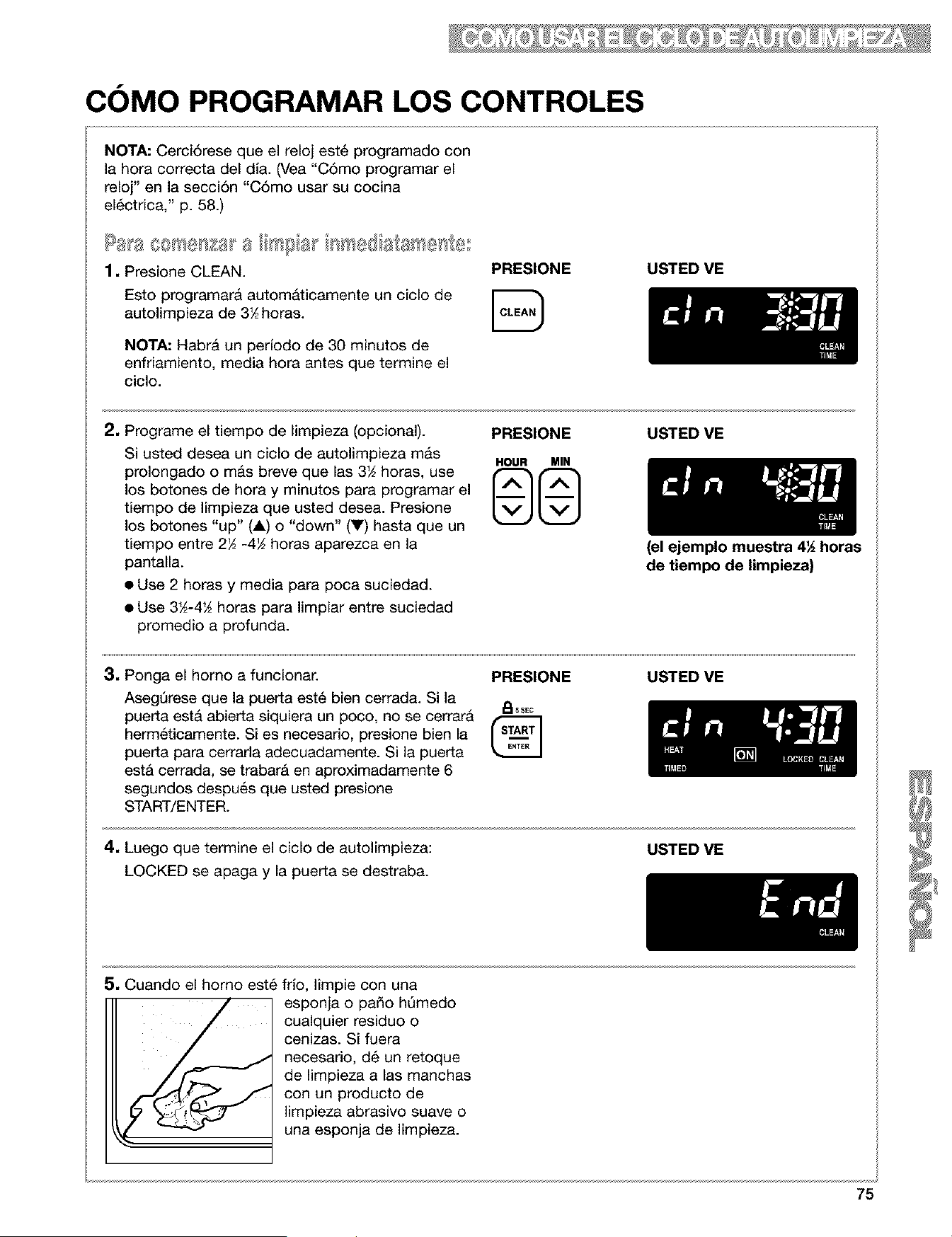
COMO PROGRAMAR LOS CONTROLES
NOTA: Cerci6rese que el reloj est@ programado con
la hora correcta del dla. (Vea "C6mo programar el
reloj" en la secci6n "C6mo usar su cocina
el@ctrica," p. 58.)
Papa
80 8 I 11tSlSF
1, Presione CLEAN. PRESIONE
Esto programara automaticamente un ciclo de
autolimpieza de 3X horas.
Lt J
NOTA: Habr& un pedodo de 30 minutos de
enfriamiento, media hora antes que termine el
ciclo.
USTED ME
2, Programe el tiempo de limpieza (opcional).
Si usted desea un ciclo de autolimpieza m&s
prolongado o mAs breve que las 3_ horas, use
los botones de hora y minutos para programar el
tiempo de limpieza que usted desea. Presione
los botones "up" (A) o "down" (V) hasta que un
tiempo entre 2_ -4_ horas aparezca en la
pantalla.
• Use 2 horas y media para poca suciedad.
• Use 3_-4½ horas para limpiar entre suciedad
promedio a profunda.
PRESIONE
HOUR MIN
USTED ME
(el ejemplo muestra 4½ horas
de tiempo de limpieza)
3, Ponga el homo a funcionar. PRESIONE
Asegt_rese que la puerta est_ bien cerrada. Si la 8,s_o
puerta estA abierta siquiera un poco, no se cerrar&
herm6ticamente. Si es necesario, presione bien la I STARTI
puerta para cerrarla adecuadamente. Si la puerta
estA cerrada, se trabarA en aproximadamente 6
segundos despu6s que usted presione
START/ENTER.
USTED ME
4. Luego que termine el ciclo de autolimpieza:
LOCKED se apaga y la puerta se destraba.
USTED ME
5. Cuando el homo est_ frio, limpie con una
esponja o pa5o hQmedo
cualquier residuo o
cenizas. Si fuera
necesario, d_ un retoque
de limpieza alas manchas
con un producto de
limpieza abrasivo suave o
una esponja de limpieza.
75
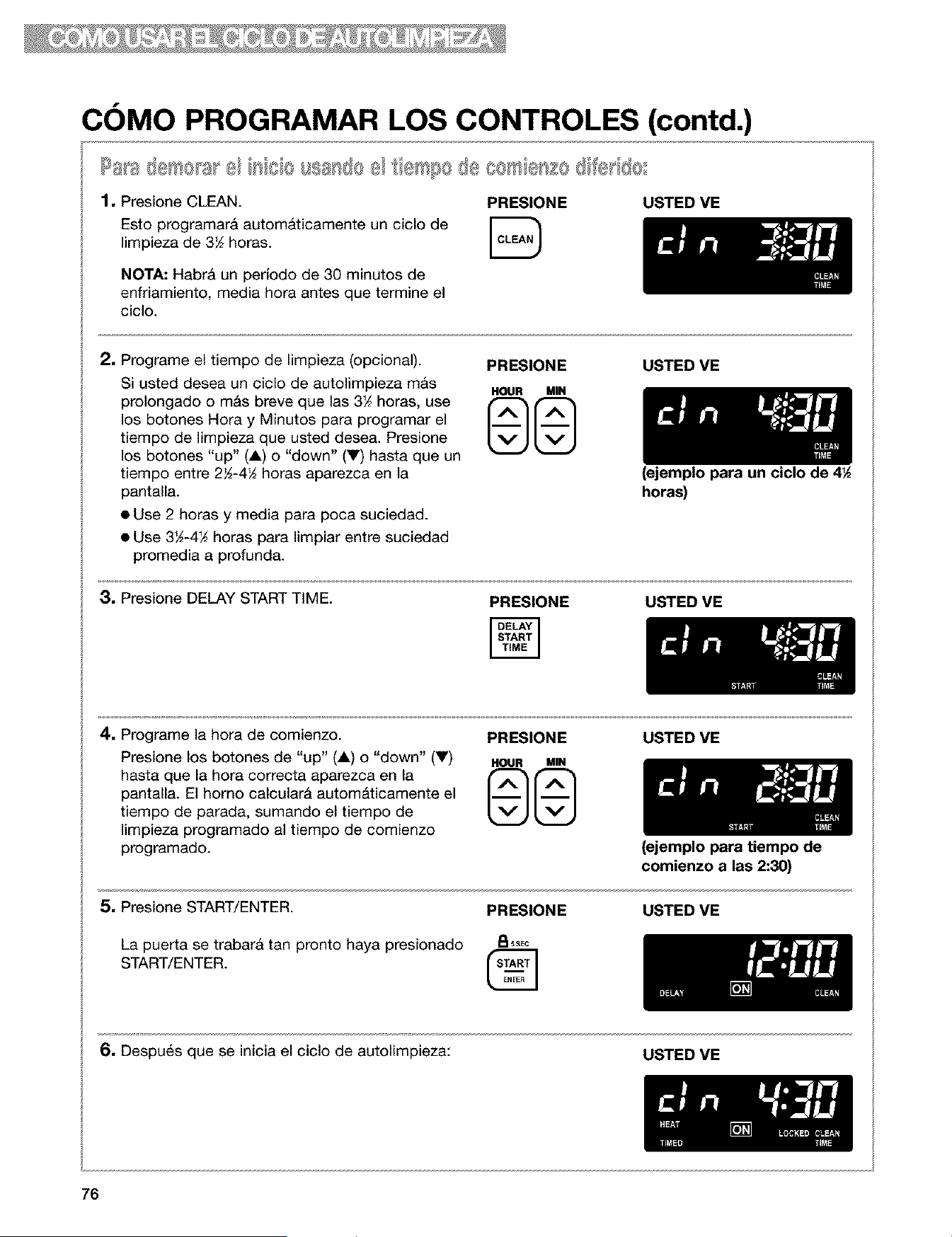
COMO PROGRAMAR LOS CONTROLES (contd.)
I_11111I01(II01>i #I IIQI_ I!i::I[I0 I)I ,i_ ° i = '
1, Presione CLEAN. PRESIONE
Esto programar& autom&ticamente un ciclo de [_
limpieza de 3_ horas.
NOTA: Habr& un per(odo de 30 minutos de
enfriamiento, media hora antes que termine el
ciclo.
USTED ME
2, Programe el tiempo de limpieza (opcional). PRESIONE
Si usted desea un ciclo de autolimpieza m&s HOUR MtN
prolongado o m_s breve que las 3_ horas, use _
los botones Hora y Minutos para programar el
© ©
tiempo de limpieza que usted desea. Presione
los botones "up" (A) o "down" (V) hasta que un
tiempo entre 2_-4½ horas aparezca en la
pantalla.
• Use 2 horas y media para poca suciedad.
• Use 3_-4_ horas para limpiar entre suciedad
promedia a profunda.
USTED ME
3, Presione DELAY START TIME.
PRESIONE
(ejemplo para un ciclo de 4_
horas)
USTED ME
4, Programe la hora de comienzo. PRESIONE
Presione los botones de "up" (A) o "down" (V) HOUR MtN
hasta que la hera correcta aparezca en la @@
pantalla. El homo calcularfi automfiticamente el
tiempo de parada, sumando el tiempo de
limpieza programado al tiempo de comienzo
programado.
USTED ME
(ejemplo paratiempode
comienzoa las 2:30)
5, Presione START/ENTER.
PRESIONE USTED ME
La puerta se trabarA tan pronto haya presionado 8.=_c
START/ENTER.
6, Despu6s que se inicia el ciclo de autolimpieza:
USTED ME
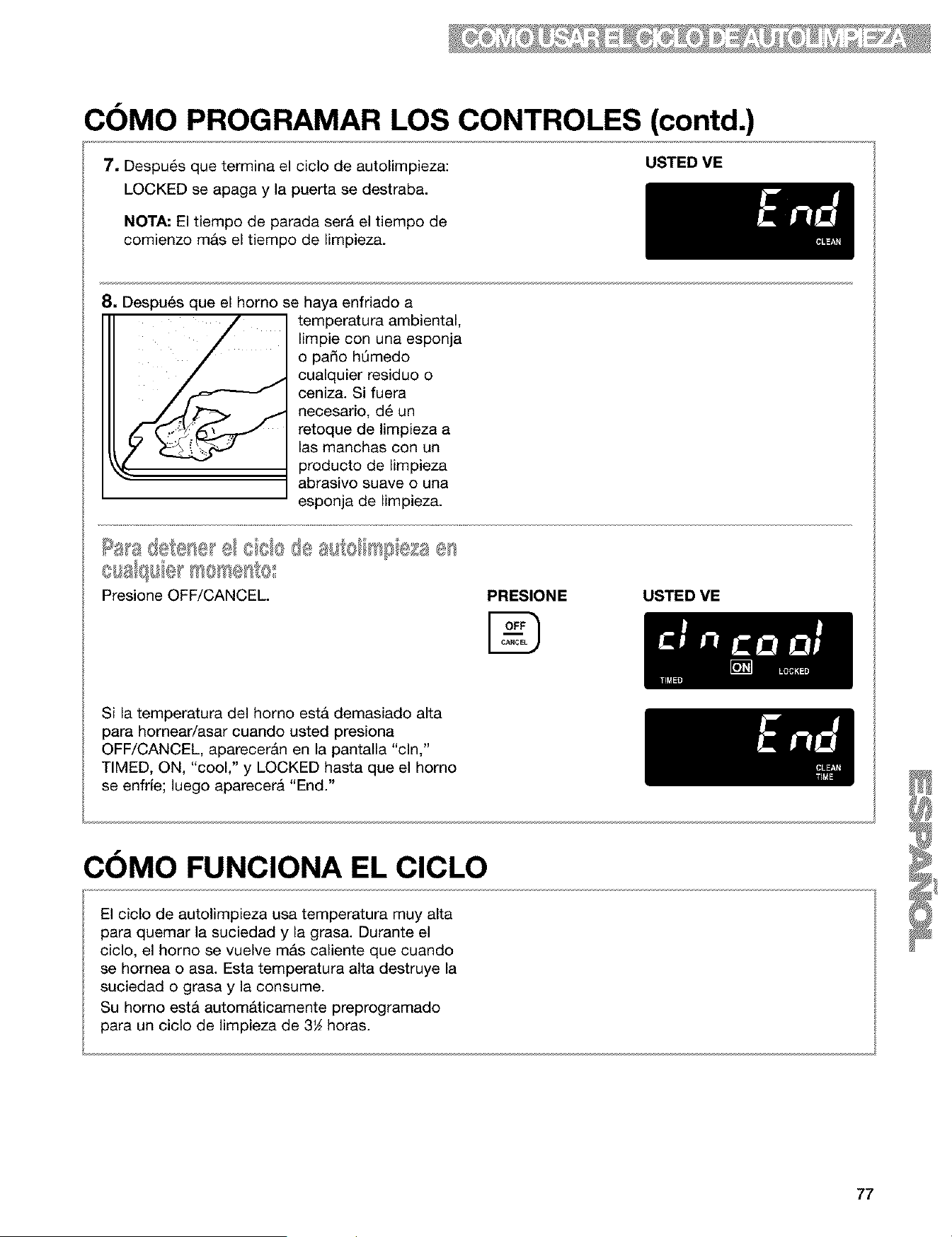
COMO PROGRAMAR LOS CONTROLES (contd.)
7. Despu_s que termina el ciclo de autolimpieza:
LOCKED se apaga y la puerta se destraba.
NOTA: El tiempo de parada ser& el tiempo de
comienzo m&s el tiempo de limpieza.
USTED ME
8. Despu_s que el homo se haya enfriado a
temperatura ambiental,
limpie con una esponja
o paso hQmedo
cualquier residuo o
ceniza. Si fuera
necesario, d6 un
retoque de limpieza a
las manchas con un
producto de limpieza
abrasivo suave o una
esponja de limpieza.
i
,,_,IIIGIel ll?:iomelll'oI
Presione OFF/CANCEL
de al1'oli_l,_;e£a el
PRESIONE USTED ME
Si la temperatura del homo esta demasiado alta
para hornear/asar cuando usted presiona
OFF/CANCEL, aparecer&n en la pantalla "cln,"
TIMED, ON, "cool," y LOCKED hasta que el homo
se enfrie; luego aparecera "End."
COMO FUNCIONA EL ClCLO
El ciclo de autolimpieza usa temperatura muy alta
para quemar la suciedad y la grasa. Durante el
ciclo, el homo se vuelve m&s caliente que cuando
se hornea o asa. Esta temperatura alta destruye la
suciedad o grasa y la consume.
Su homo est& autom&ticamente preprogramado
para un ciclo de limpieza de 31/2horas.
77
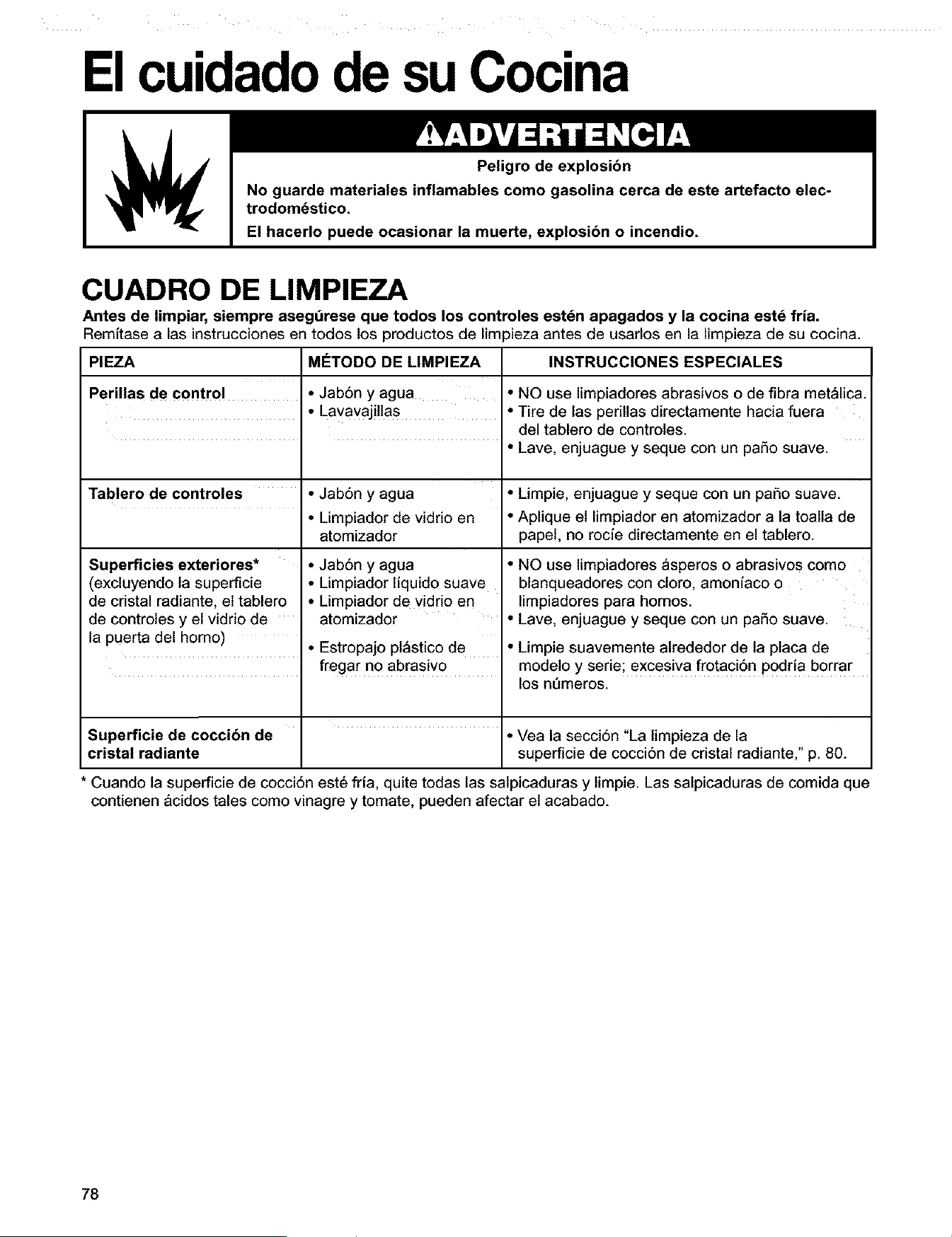
El cuidadode su Cocina
CUADRO DE LIMPIEZA
Antes de limpiar, siempre asegdrese que todos los controles est_n apagados y la cocina est_ fria.
Perillas de control
Rem[tase alas instrucciones en todos los productos de lirr
PIEZA METODO DE LIMPIEZA
• Jab6n y agua
• Lavavajitlas
Tablero de controles • Jab6n y agua
Superficies exteriores*
(excluyendo ta superficie
de cristal radiante, el tablero
de controtes y el vidrio de
la puerta del homo)
• Limpiador de vidrio en
atomizador
• Jab6n y agua
• Limpiador t[quido suave
• Limpiador de vidrio en
atomizador
• Estropajo pl_stico de
fregar no abrasivo
)_ezaantes de usarlos en la limpieza de su cocina.
INSTRUCClONES ESPECIALES
• NO use limpiadores abrasives o de fibra metalica.
• Tire de tas periltas directamente hacia fuera
del tablero de controtes.
• Lave, enjuague y seque con un paso suave.
• Limpie, enjuague y seque con un paso suave.
• Aplique et limpiador en atomizador a la toatta de
papel, no rocie directamente en el tablero.
• NO use limpiadores asperos o abrasivos como
blanqueadores con cloro, amoniaco o
limpiadores para homes.
• Lave, enjuague y seque con un paso suave.
• Limpie suavemente alrededor de ta placa de
modelo y serie; excesiva frotaci6n podr[a borrar
los nQmeros.
Superficie de coccibn de • Vea la secci6n "La timpieza de la
cristal radiante superficie de cocci6n de cristal radiante," p. 80.
Cuando ta superficie de cocci6n este fr[a, quite todas las satpicaduras y timpie. Las satpicaduras de comida que
contienen acidos tales como vinagre y tomate, pueden afectar el acabado.
78
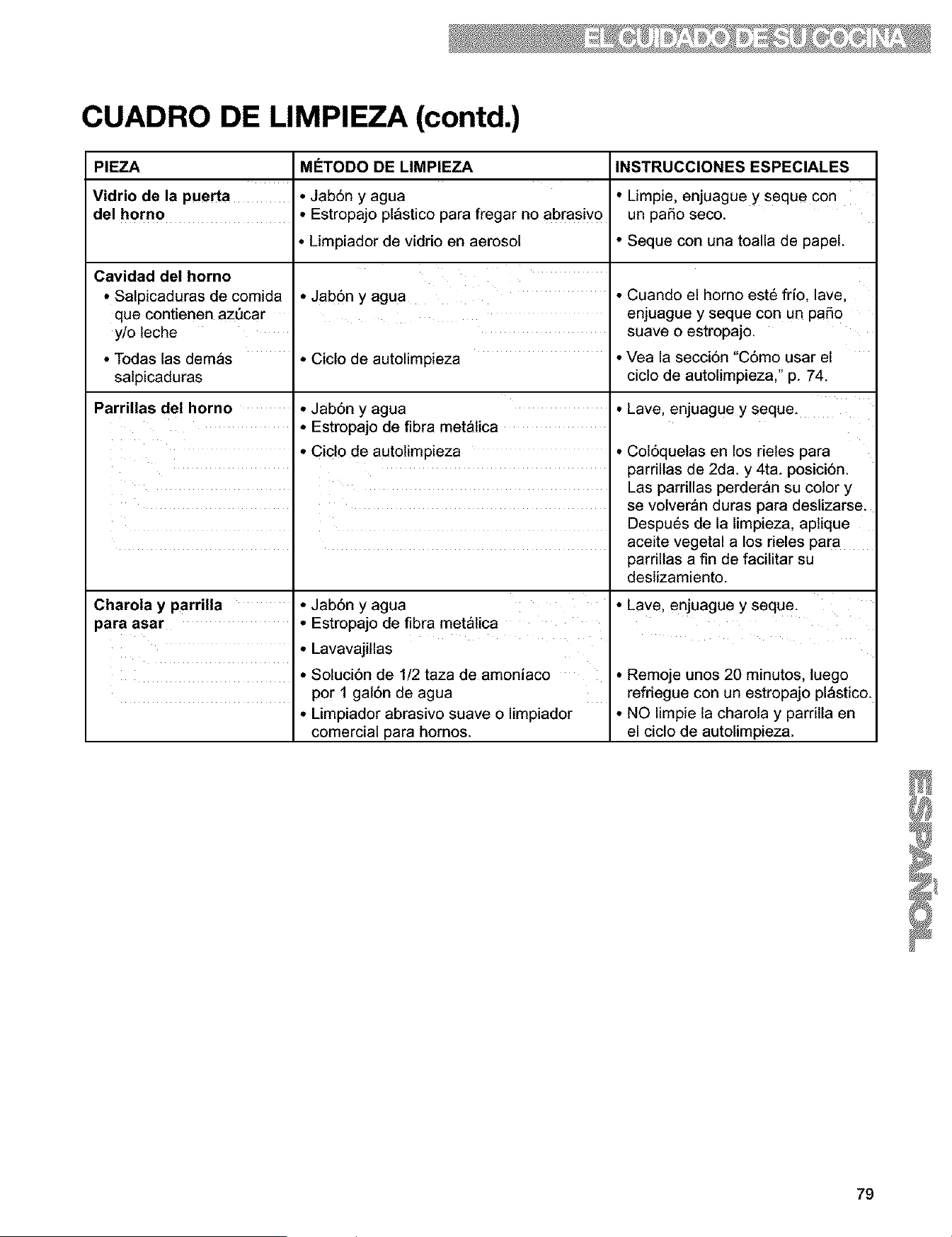
CUADRO DE LIMPIEZA (contd.)
PIEZA METODO DE LIMPIEZA INSTRUCCIONES ESPECIALES
Vidrio de la puerta • Jab6n y agua • Limpie, enjuague y seque con
del homo • Estropajo plastico para fregar no abrasivo un patio seco.
• Limpiador de vidrio en aerosol • Seque con una toalla de papet.
Cavidad del horno
• Salpicaduras de comida
que contienen az_car
y/o teche
• Todas las demas
salpicaduras
Parrillas del horno
• Estropajo de fibra metatica
• Ciclo de autotimpieza
Charola y parrilla
para asar
• JabSn y agua • Cuando el homo est_ frio, lave,
enjuague y seque con un patio
suave o estropajo.
• Cicto de autolimpieza • Vea la secci6n "C6mo usar et
ciclo de autolimpieza," p. 74.
• JabSn y agua • Lave, enjuague y seque.
• JabSn y agua
• Estropajo de fibra metatica
• Lavavajillas
• SoluciSn de 1/2 taza de amoniaco
• Col6quelas en los rietes para
parriltas de 2da. y 4ta. posici6n.
Las parrillas perderan su color y
se votveran duras para deslizarse.
Despu_s de la limpieza, aplique
aceite vegetal a los deles para
parrillas a fin de facilitar su
deslizamiento.
• Lave, enjuague y seque.
• Remoje unos 20 minutos, tuego
por 1 galSn de agua
• Limpiador abrasivo suave o limpiador
comercial para hornos.
refriegue con un estropajo plastico.
• NO limpie ta charota y parritta en
el ciclo de autolimpieza.
79
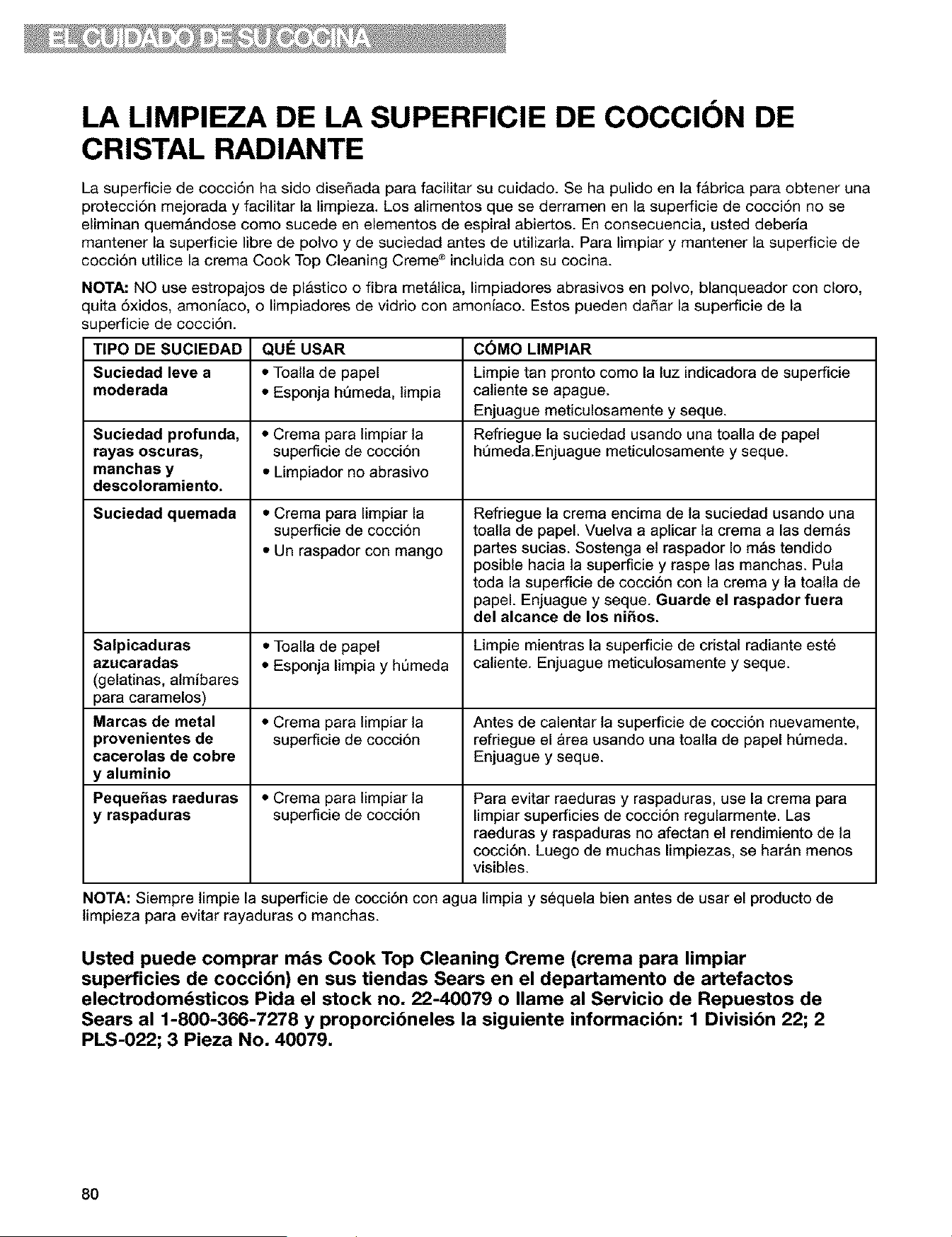
LA LIMPIEZA DE LA SUPERFICIE DE COCCION DE
CRISTAL RADIANTE
La superficie de cocci6n ha sido dise_ada para facilitar su cuidado. Se ha pulido en la fAbrica para obtener una
protecci6n mejorada y facilitar la limpieza. Los alimentos que se derramen en la superficie de cocci6n no se
eliminan quem&ndose como sucede en elementos de espiral abiertos. En consecuencia, usted deberia
mantener la superficie libre de polvo y de suciedad antes de utilizarla. Para limpiar y mantener la superficie de
cocci6n utilice la crema Cook Top Cleaning Creme ® incluida con su cocina.
NOTA: NO use estropajos de plastico o fibra met&lica, limpiadores abrasivos en polvo, blanqueador con cloro,
quita 6xidos, amonlaco, o limpiadores de vidrio con amoniaco. Estos pueden da_ar la superficie de la
superficie de cocci6n.
TIPO DE SUCIEDAD QU €: USAR COMO LIMPIAR
Suciedad leve a • Toalta de papel Limpie tan pronto como la luz indicadora de superficie
moderada • Esponja hemeda, limpia caliente se apague.
Enjuague meticulosamente y seque.
Suciedad profunda, • Crema para limpiar ta Refriegue la suciedad usando una toalla de papel
rayas oscuras, superficie de cocci6n hemeda.Enjuague meticulosamente y seque.
manchas y • Limpiador no abrasivo
descoloramiento.
Suciedad quemada • Crema para limpiar la
superficie de coccidn
• Un raspador con mango
Refriegue la crema encima de la suciedad usando una
toalla de papel. Vuelva a aplicar la crema alas demos
partes sucias. Sostenga et raspador Io m_s tendido
posible hacia la superficie y raspe las manchas. Pula
toda la superficie de cocci6n con la crema y la toalla de
papel. Enjuague y seque. Guarde el raspador fuera
del alcance de los ni_os.
Salpicaduras • Toalla de papel Limpie mientras la superficie de cristal radiante este
azucaradas • Esponja limpia y hemeda caliente. Enjuague meticulosamente y seque.
(gelatinas, almibares
para caramelos)
Marcas de metal • Crema para limpiar ta Antes de calentar ta superficie de cocci6n nuevamente,
provenientes de supenlcie de cocci6n refriegue el Area usando una toalla de papel hemeda.
cacerolas de cobre Enjuague y seque.
y aluminio
Peque_as raeduras • Crema para limpiar ta Para evitar raeduras y raspaduras, use la crema para
y raspaduras superficie de cocci6n limpiar superficies de cocci6n regularmente. Las
raeduras y raspaduras no afectan et rendimiento de ta
cocci6n. Luego de muchas limpiezas, se haran menos
visibles.
NOTA: Siempre limpie la superficie de cocci6n con agua limpia y sequela bien antes de usar el producto de
limpieza para evitar rayaduras o manchas.
Usted puede comprar m&s Cook Top Cleaning Creme (crema para limpiar
superficies de coccibn) en sus tiendas Sears en el departamento de artefactos
electrodom_sticos Pida el stock no, 22-40079 o Ilame al Servicio de Repuestos de
Sears al 1-800-366-7278 y proporcibneles la siguiente informacibn: 1 Divisibn 22; 2
PLS-022; 3 Pieza No, 40079,
80
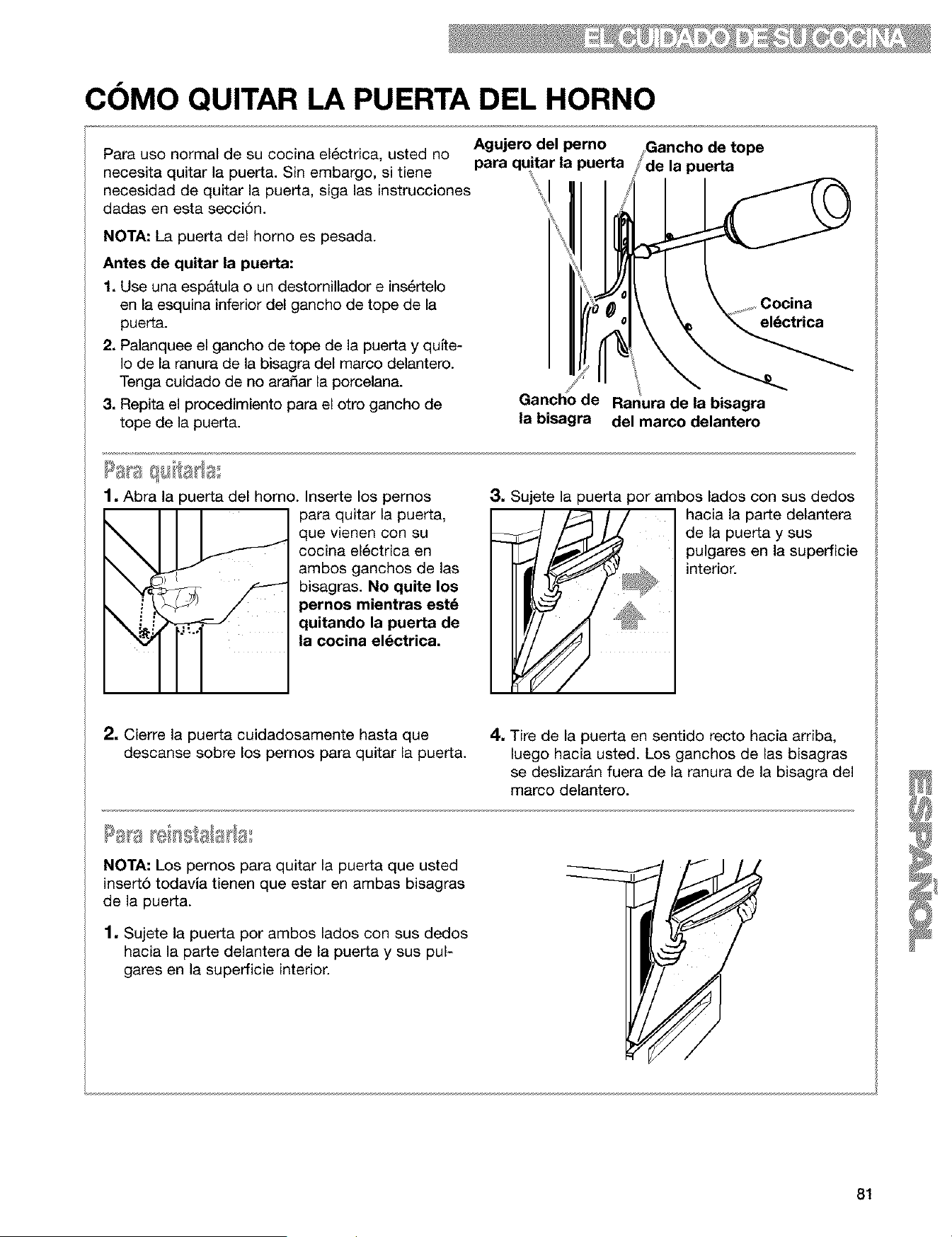
COMO QUITAR LA PUERTA DEL HORNO
Para uso normal de su cocina el_ctrica, usted no para quitar la puerta
/' de la puerta
necesita quitar la puerta. Sin embargo, si tiene .
necesidad de quitar la puerta, siga las instrucciones _'::1
dadas en esta secci6n. '
NOTA: La puerta del homo es pesada.
Antes de quitar la puerta:
1. Use una espatula o un destornillador e ins6rtelo
en la esquina inferior del gancho de tope de la
puerta.
2. Palanquee el gancho de tope de la puerta y quite-
Io de la ranura de la bisagra del marco delantero.
Tenga cuidado de no aradar la porcelana.
3. Repita el procedimiento para el otro gancho de
tope de la puerta.
Agujero del perno Gancho de tope
eldctrica
"4...
Gancli _ de Ranura de la bisagra
la bisagra del marco delantero
1. Abra la puerta del homo. Inserte los pernos
para quitar la puerta,
que vienen con su
cocina el6ctrica en
ambos ganchos de las
bisagras. No quite los
pernos mientraa estd
quitando la puerta de
la cocina el_ctrica.
3, Sujete la puerta por ambos lados con sus dedos
hacia la parte delantera
de la puerta y sus
pulgares en la superficie
interior.
2, Cierre la puerta cuidadosamente hasta que
descanse sobre los pernos para quitar la puerta.
4, Tire de la puerta en sentido recto hacia arriba,
luego hacia usted. Los ganchos de las bisagras
se deslizar&n fuera de la ranura de la bisagra del
marco delantero.
NOTA: Los pernos para quitar la puerta que usted
insert6 todavla tienen que estar en ambas bisagras
de la puerta.
1, Sujete la puerta por ambos lados con sus dedos
hacia la parte delantera de la puerta y sus pul-
gares en la superficie interior.
81
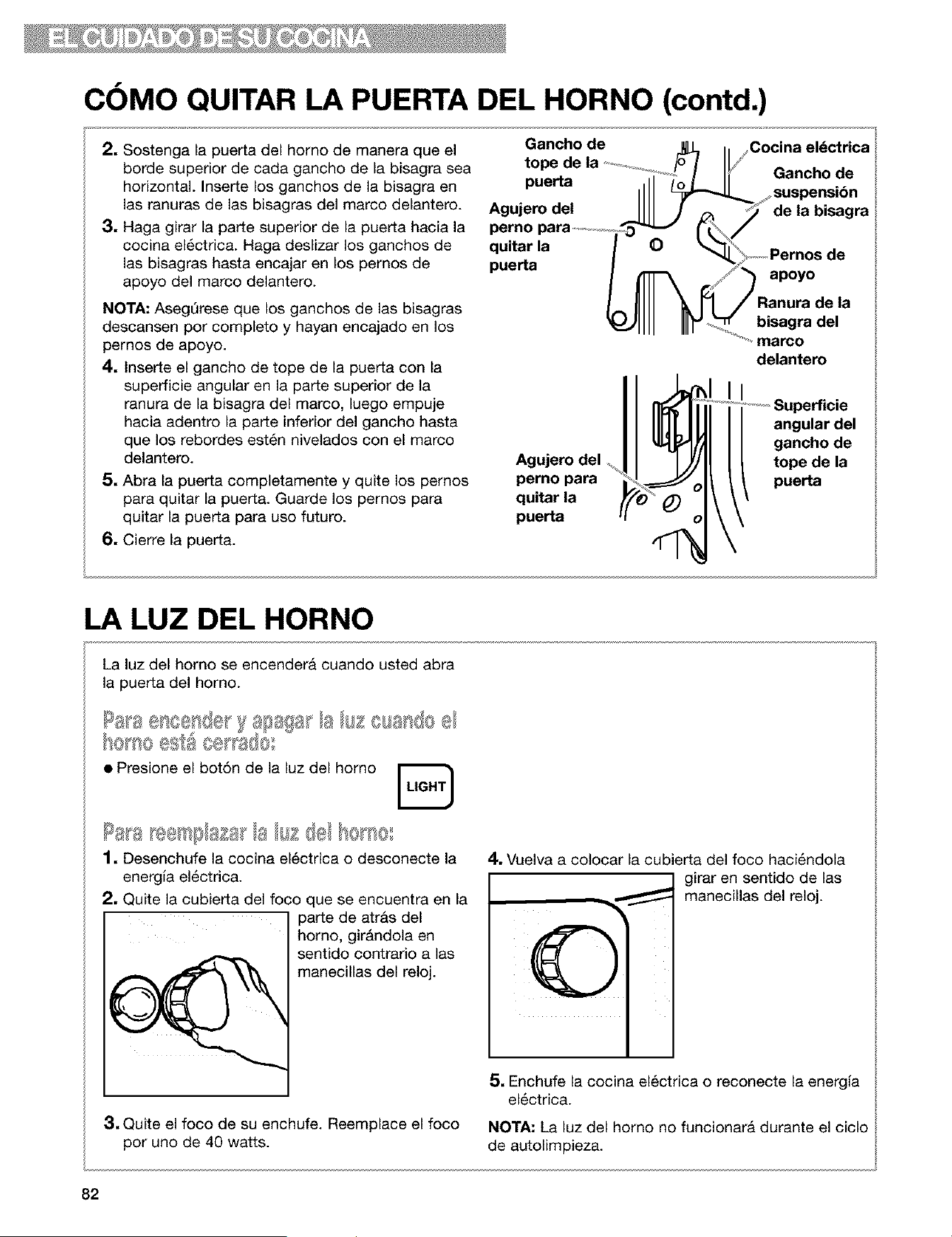
COMO QUITAR LA PUERTA DEL HORNO (contd.)
2. Sostenga la puerta del homo de manera que el
borde superior de cada gancho de la bisagra sea
horizontal. Inserte los ganchos de la bisagra en
las ranuras de las bisagras del marco delantero.
3, Haga girar la parte superior de la puerta hacia la
cocina el6ctrica. Haga deslizar los ganchos de
las bisagras hasta encajar en los pernos de
apoyo del marco delantero.
NOTA: Aseg0rese que los ganchos de las bisagras
descansen por completo y hayan encajado en los
pernos de apoyo.
4. Inserte el gancho de tope de la puerta con la
superficie angular en la parte superior de la
ranura de la bisagra del marco, luego empuje
hacia adentro la parte inferior del gancho hasta
que los rebordes est_n nivelados con el marco
delantero.
5, Abra la puerta completamente y quite los pemos
para quitar la puerta. Guarde los pernos para
quitar la puerta para uso futuro.
Gancho de r_ II !Cocina eldctrica
tope de a .............. !u / I!/_/
................. Gancho de
,ill .suspeso
puerta o n i'n
Agujero del _LJll / _ _/ de la bisagra
perno para ...................._ ('_/
quitar la / O _I';\ o..... -
._.. ,vo Ge
puerta / _ /_"_ apoyo
IIII\ Pi/"anuradela
vJIIII IIIIY bisagradel
........marco
delantero
Agujero del
perno para
quitar la
puerta
[
6. Cierre la puerta.
i ...............Superficie
angular del
gancho de
tope de la
puerta
LA LUZ DEL HORNO
La luz del homo se encender& cuando usted abra
la puerta del horno.
7£ 07_ @0 e/
0@0 e,,a _Je sdo
• Presione el bot6n de la luz del horno
1, Desenchufe la cocina el6ctrica o desconecte la
energfa el6ctrica.
2, Quite la cubierta del foco que se encuentra en la
parte de atr&s del
homo, gir&ndola en
sentido contrario alas
manecillas del reloj.
3, Quite el foco de su enchufe. Reemplace el foco
por uno de 40 watts.
4, Vuelva a colocar la cubierta del foco haci6ndola
O_ irar en sentido de las
manecillas del reloj.
5. Enchufe la cocina el_ctrica o reconecte la energia
el6ctrica.
NOTA: L_ luz del homo no funcionarA durante el ciclo
de autolimpieza.
82
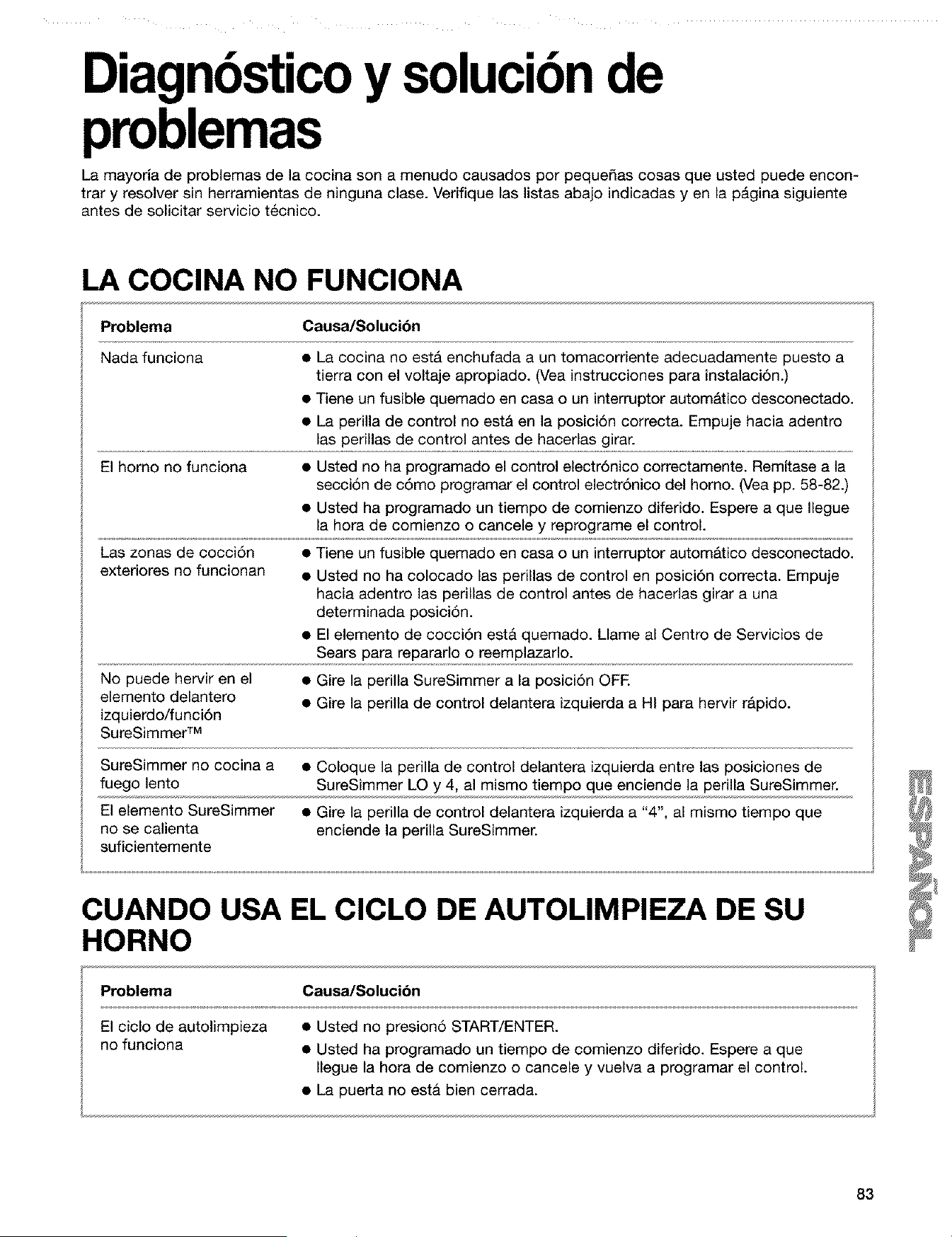
Diagnbsticoy solucibnde
problemas
La mayorla de problemas de la cocina son a menudo causados por pequedas cosas que usted puede encon-
trar y resolver sin herramientas de ninguna clase. Verifique las listas abajo indicadas yen la p&gina siguiente
antes de solicitar servicio t_cnico.
LA COClNA NO FUNCIONA
Problema Causa/Solucibn
Nada funciona • La cocina no est_ enchufada a un tomacorriente adecuadamente puesto a
tierra con el voltaje apropiado. (Vea instrucciones para instalaci6n.)
• Tiene un fusible quemado en casa o un interruptor automAtico desconectado.
• La perilla de control no estA en la posici6n correcta. Empuje hacia adentro
las perillas de control antes de hacerlas girar.
El homo no funciona • Usted no ha programado el control electr6nico correctamente. Remftase a la
secciSn de c6mo programar el control electr6nico del homo. _/ea pp. 58-82.)
• Usted ha programado un tiempo de comienzo diferido. Espere a que Ilegue
la hora de comienzo o cancele y reprograme el control.
Las zonas de cocci6n • Tiene un fusible quemado en casa o un interruptor autom_tico desconectado.
exteriores no funcionan • Usted no ha colocado las perillas de control en posici6n correcta. Empuje
hacia adentro las perillas de control antes de hacerlas girar a una
determinada posiciSn.
• El elemento de cocci6n estA quemado. Llame al Centro de Servicios de
Sears para repararlo o reemplazarlo.
No puede hervir en el • Gire la perilla SureSimmer a la posici6n OFE
elemento delantero • Gire la perilla de control delantera izquierda a HI para hervir rApido.
izquierdo/funci6n
SureSimmer TM
SureSimmer no cocina a • Coloque la perilla de control delantera izquierda entre las posiciones de
fuego lento SureSirnmer LO y 4, al mismo tiempo que enciende la perilla SureSimmer.
El elemento SureSimmer • Gire la perilla de control delantera izquierda a "4", al mismo tiempo que
no se calienta enciende la perilla SureSimmer.
suficientemente
CUANDO USA EL ClCLO DE AUTOLIMPIEZA DE SU
HORNO
Problema Causa/Solucibn
El ciclo de autolimpieza • Usted no presion6 START/ENTER.
no funciona • Usted ha programado un tiempo de comienzo diferido. Espere a que
Ilegue la hora de comienzo o cancele y vuelva a programar el control.
• La puerta no est& bien cerrada.
83
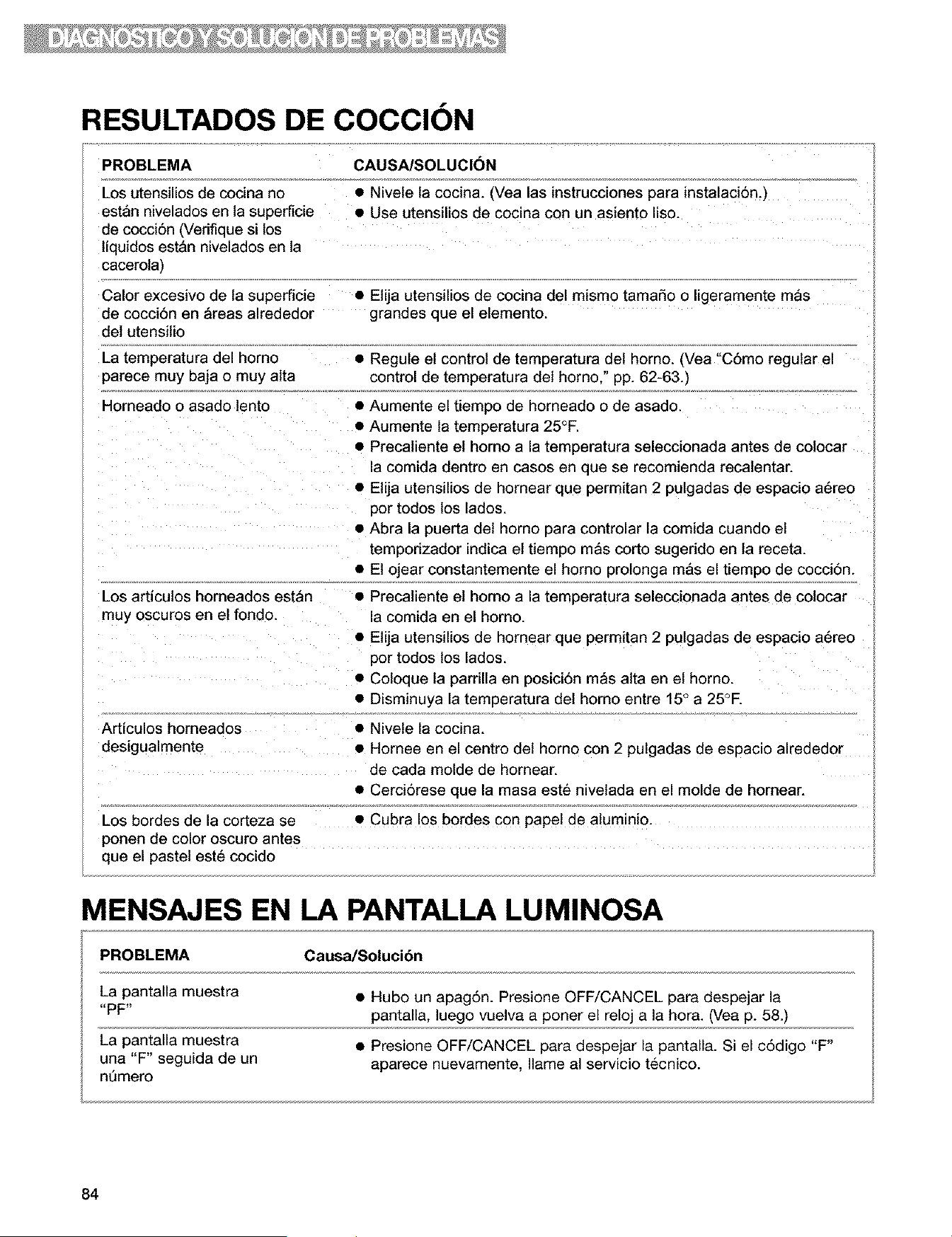
RESULTADOS DE COCClON
PROBLEMA CAUSA/SOLUCI(_N
LOSutensilios de cocina no • Nivete ta cocina. (Vea las instrucciones para instalaci6n,)
estan nivelados en ta superficie • Use utensilios de cocina con un asiento liso.
de cocci6n (Verifique si los
tiquidos estan nivelados en ta
cacerota)
Calor excesivo de ta superficie • Elija utensilios de cocina del mismo tamaSo o ligeramente mas
de cocci6n en &reas alrededor grandes que el elemento.
del utensitio
La iemperatura del homo • Regute el control de temperatura del homo. (Vea !'C6mo regular el
parece muy baja o muy alta control de temperatura del homo," pp. 62-63.)
Horneado o asado lento
Los articutos horneados estan
muy oscuros en et fondo.
• Aumente el tiempo de horneado o de asado
• Aumente ta temperatura 25°F.
• Precatiente el homo a la temperatura seleccionada antes de colocar
a comida dentro en casos en que se recomienda recatentar.
• Elija utensilios de hornear que permitan 2 pulgadas de espacio aereo
por todos los lados.
• Abra la puerta det homo para controlar la comida cuando el
temporizador indica el tiempo mas corto sugeddo en ta receta.
• El ojear constantemente el homo prolonga mas el tiempo de coccion.
• Precaliente el homo a la temperatura seleccionada antes de colocar
a comida en el homo.
• Elija utensilios de hornear que permitan 2 pulgadas de espacio aereo
0or todos los lados.
• Coloque la parrilla en 3osicl6n m_s atta en el homo.
• Disminuya la temperatura del homo entre 15° a 25°E
Articulos homeados
desigualmente
• Nivele ta cocina.
• Hornee en el centro det homo con 2 pulgadas de espacio alrededor
de cada molde de homear.
• Cerci6rese que la masa este nivetada en el molde de hornear.
• Cubra los bordes con papel de atuminio.
Los bordes de la corteza se
ponen de color oscuro antes
que el pastel este cocido
MENSAJES EN LA PANTALLA LUMINOSA
PROBLEMA Causa/Soluci6n
La pantalla muestra
• Hubo un apag6n. Presione OFF/CANCEL para despejar la
"PF" pantalla, luego vuelva a porter el reloj a la hora. (Vea p. 58.)
La pantalla muestra
• Presione OFF/CANCEL para despejar la pantalla. Si el c6digo "F"
una "F" seguida de un aparece nuevamente, Ilame al servicio t6cnico.
nQmero
84
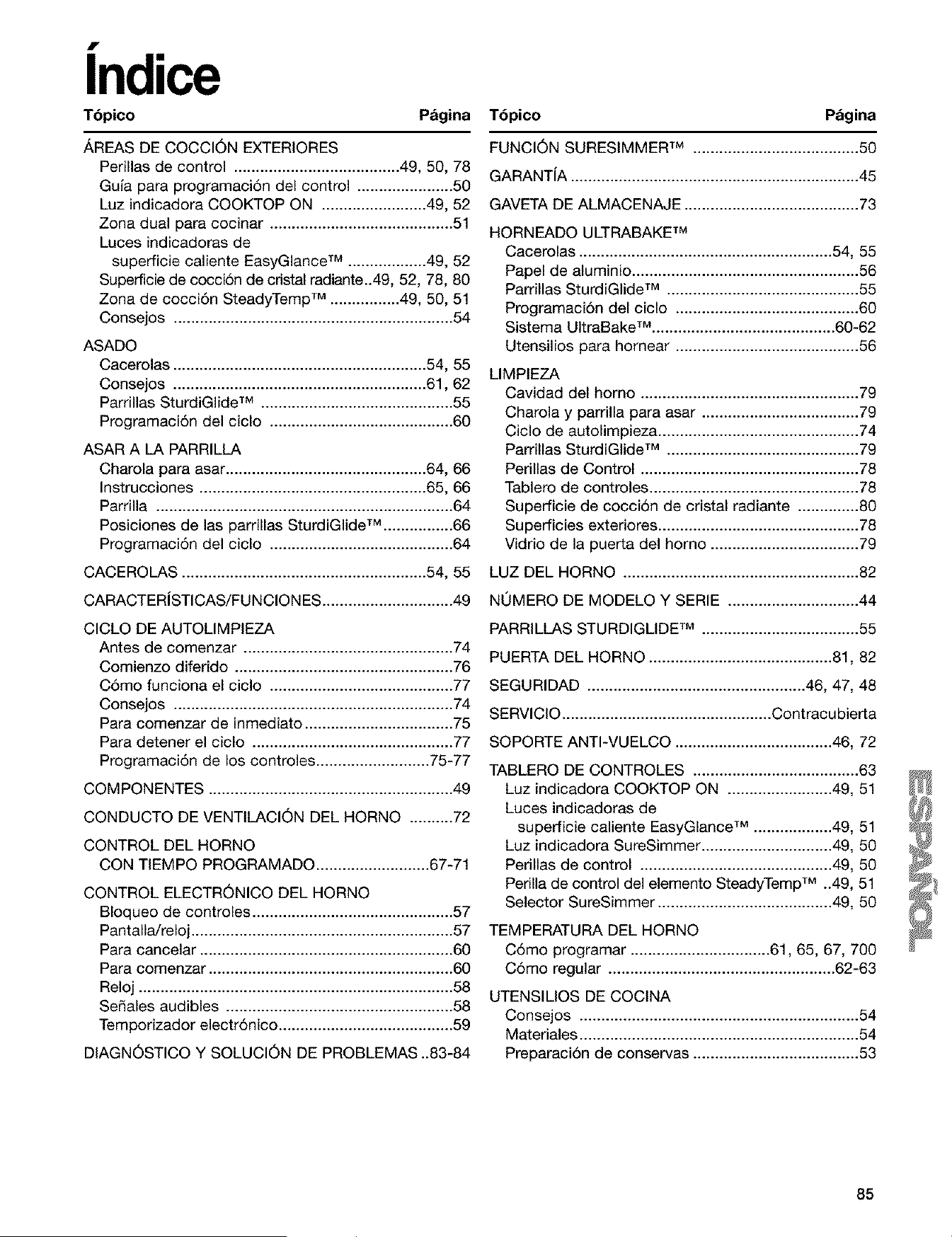
indice
Tbpico Pagina Tbpico Pdgina
AREAS DE COCCION EXTERIORES
Perillas de control ..................................... .49, 50, 78
Guia para programaci6n del control ..................... .50
Luz indicadora COOKTOP ON ....................... .49, 52
Zona dual para cocinar ........................................ .51
Luces indicadoras de
superficie caliente EasyGlance TM ..................49, 52
Superflcie de cocci6n de cristal radiante..49, 52, 78, 80
Zona de cocci6n SteadyTemp TM .............. 49, 50, 51
Consejos .............................................................. .54
ASADO
Cacerolas ......................................... .54, 55
Consejos .......................................... .61, 62
Parrillas SturdiGlide TM ........................................... .55
Programaci6n del ciclo ........................................ .60
ASAR A LA PARRILLA
Charola para asar ................................. .64, 66
Instrucciones ................................................... .65, 66
Parrilla ................................................................... .64
Posiciones de las parrillas SturdiGlide TM ............... .66
Programaci6n del ciclo ........................................ .64
CACEROLAS ........................................ .54, 55
CARACTERiSTICAS/FUNCION ES..................... .49
CICLO DE AUTOUMPIEZA
Antes de comenzar ............................................... .74
Comienzo diferido ................................................. .76
C6mo funciona el ciclo ........................................ .77
Consejos .............................................................. .74
Para comenzar de inmediato ................................. .75
Para detener el ciclo ............................................ .77
Programaci6n de los controles ......................... .75-77
COMPONENTES ....................................................... .49
CONDUCTO DE VENTILACI6N DEL HORNO ........ .72
CONTROL DEL HORNO
CON TIEMPO PROGRAMADO ....................... .67-71
CONTROL ELECTR6NICO DEL HORNO
BIoqueo de controles ................................. .57
Pantalla/reloj ........................................... .57
Para cancelar ......................................................... .60
Para comenzar ........................................ .60
Reloj ................................................... .58
Se_ales audibles ................................................... .58
Tempodzador electr6nico ............................ .59
DIAGN6STICO Y SOLUCI6N DE PROBLEMAS_83-84
FUNCION SURESIMMER TM ..................... 50
GARANTiA ............................................... 45
GAVETA DE ALMACENAJE ............................. 73
HORNEADO ULTRABAKE TM
Cacerolas .......................................... 54, 55
Papel de aluminio ...................................... 56
Parrillas SturdiGlide TM ......................... 55
ProgramaciSn del ciclo ........................ 60
Sistema UltraBake TM. ........................................ .60-62
Utensilios para hornear ........................ 56
UMPtEZA
Cavidad del homo .............................................. 79
Charola y parrilla para asar .................... 79
Ciclo de autolimpieza. ............................................ 74
Pardllas SturdiGlide TM ......................... 79
Pedllas de Control ............................ 78
Tablero de controles ............................................... 78
Superficie de cocciSn de cristal radiante ........ 80
Superficies exteriores. ............................................ 78
Vidrio de la puerta del homo ................... 79
LUZ DEL HORNO .............................. 82
NOMERO DE MODELO Y SERIE ................. 44
PARRILLAS STURDIGUDE TM .................... 55
PUERTA DEL HORNO .............................. 81, 82
SEGURIDAD ................................................. 46, 47, 48
SERVICIO .............................................. .Contracubierta
SOPORTE ANTI-VUELCO ................................... 46, 72
TABLERO DE CONTROLES ..................... 63
Luz indicadora COOKTOP ON ................. 49, 51
Luces indieadoras de
superficie caliente EasyGlance TM ............ ..49, 51
Luz indicadora SureSimmer .............................. 49, 50
Perillas de control .......................................... 49, 50
Perilla de control del elemento SteadyTemp TM ..49, 51
Selector SureSimmer ...................................... .49, 50
TEMPERATURA DEL HORNO
C6mo programar ....................... .61, 65, 67, 700
C6mo regular ................................................... .62-63
UTENSIUOS DE COCINA
Consejos .................................... 54
Materiales .............................................. 54
PreparaciSn de conservas ..................... 53
85

86

87
For in-home major brand repair service:
Call 24 hours a day, 7 days a week
1-800-4-MY-HOME" (1-800-469-4663)
Para pedir servicio reparaci6n a domicilio - 1-800-676-5811
In Canada for all your service and parts needs call
Au Canada pour tout le service ou les pi_ces - 1-800-665-4455
For the repair or replacement parts you need:
Call 7 am - 7 pro, 7 clays a week
1-800-366-PART (1-800-366-7278)
Para ordenar piezas con entrega a domicilio - 1-800-659-7084
For the location of a Sears Parts and Repair Center in your area:
Call 24 hours a day, 7 days a week
1-800-488-1222
For information on purchasing a Sears Maintenance Agreement
or to ,nqu,re about an ex,st,ng Agreement:
Call 9 am - 5 pm, Monday - Saturday
1-800-827-8655
The ServiceSideof Sears."
7/98
8053878 Printed in the U,S,A.