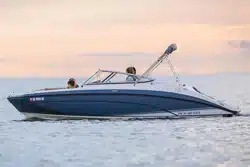
2018 Yamaha Boat
AR210 / SX210
212X
212 Limited S / 212 Limited
OWNER’S/OPERATOR’S MANUAL
F3R-F8199-11
LIT-18626-11-80
Read this manual carefully
before operating this boat.
U.S.A. Edition

WARNING:
Operating, servicing
and maintaining a recreational marine
vessel can expose you to chemicals
including engine exhaust, carbon monoxide,
phthalates, and lead, which are known to
the State of California to cause cancer and
birth defects or other reproductive harm. To
minimize exposure, avoid breathing exhaust,
service your vessel in a well-ventilated area
and wear gloves or wash your hands
frequently when servicing this vessel.
For more information go to
www.P65warnings.ca.gov/marine
Read this manual carefully before operating this boat. This manual should stay
with the boat if it is sold.
SportsBoat_F3R11.book Page 1 Friday, May 19, 2017 9:35 AM
Important manual information
To the owner
Thank you for choosing a Yamaha boat. This
owner’s/operator’s manual contains informa-
tion you will need for proper operation, main-
tenance, and care. A thorough understanding
of these simple instructions will help you to
obtain maximum enjoyment from your new
Yamaha. If you have any questions about the
operation or maintenance of your boat, please
consult a Yamaha Boat Dealer.
In this manual, information of particular impor-
tance is distinguished in the following ways:
This is the safety alert symbol. It is used
to alert you to potential personal injury haz-
ards. Obey all safety messages that follow
this symbol to avoid possible injury or death.
WARNING
A WARNING indicates a hazardous situa-
tion which, if not avoided, could result in
death or serious injury.
NOTICE
A NOTICE indicates special precautions
that must be taken to avoid damage to the
boat or other property.
TIP:
A TIP provides key information to make pro-
cedures easier or clearer.
Because Yamaha has a policy of continuing
product improvement, this product may not be
exactly as described in this owner’s/opera-
tor’s manual. Specifications are subject to
change without notice.
This manual should be considered a perma-
nent part of this boat and should remain with
it even if the boat is subsequently sold.
AR210 / SX210
212X / 212 Limited S / 212 Limited
OWNER’S/OPERATOR’S MANUAL
©2017 by Yamaha Motor Corporation,
U.S.A.
1st Edition, June 2017
All rights reserved.
Any reprinting or unauthorized use
without the written permission of
Yamaha Motor Corporation, U.S.A.
is expressly prohibited.
Printed in U.S.A.
P/N LIT-18626-11-80
SportsBoat_F3R11.book Page 1 Friday, May 19, 2017 9:35 AM

Table of contents
General and important labels.............1
Identification number records...........1
Primary Identification (PRI-ID)
number ....................................... 1
Hull Identification Number (HIN) ...1
Engine serial numbers .................. 1
Emission control information ............2
Approval labels of emission
control certificate ........................ 2
Manufactured date labels
(AR210 / SX210) ........................ 4
Manufactured date labels (212X /
212 Limited S / 212 Limited) ......4
Star labels (4-star models) ............ 4
Important labels................................ 6
Warning labels .............................. 9
Other labels................................. 13
Safety information........................... 14
Limitations on who may operate
the boat ....................................... 14
Cruising limitations ......................... 15
Operational requirements............... 16
Required equipment....................... 17
Additional equipment
recommendations........................ 17
Hazard information......................... 18
Boat characteristics........................ 18
Night operation............................... 19
Wakeboarding and water-skiing..... 20
Rules of the road............................ 21
To get more boating safety
information .................................. 25
Enjoy your boat responsibly ........... 25
Description....................................... 26
Boat glossary ................................. 26
Location of main components ........ 27
Exterior components ................... 27
Seats ........................................... 30
Stern components ....................... 31
Helm components ....................... 32
Engine components .................... 34
Control function operation .............. 37
Boat control functions .................... 37
Engine shut-off switch................. 37
Battery switch
(AR210 / SX210)...................... 37
Battery switches (212X /
212 Limited S / 212 Limited) .... 38
Main switches ............................. 39
Remote control levers................. 39
Steering ...................................... 41
Tilt lever ...................................... 42
Instrument operation........................ 43
Helm controls (AR210 / SX210)..... 43
Tachometers ............................... 44
Multi-function display unit
operation.................................. 44
Multi-function display elements... 44
Screen tabs (screen tab bar) ...... 45
Data bar ...................................... 45
Information display
(home screen tab).................... 46
Cruising information display
(trip screen tab)........................ 47
Multi-function display unit
settings (setting screen tab)..... 47
Setting the time ........................... 48
Selecting the display units .......... 48
Starboard/port engine wellness
alarm display............................ 48
Setting the day mode and night
mode........................................ 49
Setting the display language....... 49
Setting the depth alarm............... 49
Resetting the settings to the
default settings......................... 50
No-wake mode/cruise assist
switch....................................... 50
Operating the boat with a
minimal wake
(no-wake mode)....................... 50
Operating the boat at a steady
speed (cruise assist)................ 51
Operating the boat in reverse
with more thrust
(reverse RPM control).............. 52
Light operation ............................ 52
SportsBoat_F3R11.book Page 1 Friday, May 19, 2017 9:35 AM

Table of contents
Turning the courtesy light on or
off ............................................. 52
Turning the anchor light and bow
light on or off ............................ 52
Horn switch ................................. 53
Ventilating the engine
compartment ............................ 54
Draining the bilge water .............. 54
Warnings ..................................... 54
Warning definition table............... 54
Check engine warning................. 55
Low oil pressure warning ............ 55
Over temperature warning .......... 55
Generic warning .......................... 57
Switch circuit breakers ................ 57
Accessory outlet............................. 58
Audio control keypad...................... 58
Helm controls (212X /
212 Limited S / 212 Limited) .......59
Tachometers ............................... 60
Multi-function display unit
operation .................................. 60
Operation buttons........................ 61
Multi-function display elements ... 62
Screen tabs (screen tab bar)....... 63
Information display
(home screen tab [standard
mode]) ...................................... 63
Information display
(home screen tab [float
mode]) ...................................... 64
Cruising information display
(trip screen tab) ........................ 64
Resetting the display items ......... 65
Light operation (light control
screen tab) ............................... 66
Turning the anchor light on or
off ............................................. 66
Turning the anchor light and
bow light on or off..................... 67
Turning the courtesy lights on or
off ............................................. 67
Boat system control
(system control screen tab)...... 68
Adjusting the wake size (212X)... 69
Shutting off water intake.............. 70
Ventilating the engine
compartment (automatic
operation)................................. 70
Ventilating the engine
compartment (non-automatic
operation)................................. 70
Draining the bilge water
(automatic operation)............... 71
Draining the bilge water
(non-automatic operation)........ 72
Audio system operation and
external device connections
(media screen tab)................... 72
Adjusting the speaker volume
level ......................................... 72
Bluetooth connections ................ 72
Auxiliary input jack
connections.............................. 74
USB connections ........................ 74
Weather radio broadcasts........... 75
Radio broadcasts........................ 75
SiriusXM radio broadcasts.......... 76
Audio system settings................. 76
Multi-function display unit
settings (setting screen tab)..... 77
Setting the day mode and night
mode........................................ 78
Setting the depth alarm............... 78
Resetting the settings to the
default settings......................... 79
Setting the time ........................... 79
Selecting the display units .......... 79
Displaying and resetting the
maintenance counter ............... 80
“CRUISE/NO WAKE” buttons ..... 81
Operating the boat at a steady
speed (cruise assist)................ 81
Operating the boat with a
minimal wake
(no-wake mode)....................... 82
Operating the boat in reverse
with more thrust
(reverse RPM control).............. 82
Warnings..................................... 83
Warning definition table .............. 83
Check engine warning ................ 84
Low oil pressure warning ............ 84
Over temperature warning .......... 84
Low/High voltage warning........... 85
Communication error warning..... 85
Low fuel level warning ................ 85
Depth warning............................. 85
SportsBoat_F3R11.book Page 2 Friday, May 19, 2017 9:35 AM

Table of contents
Accessory outlet............................. 86
Remote control keypad .................. 86
Equipment operation ........................87
Seats .............................................. 87
Driver’s seat (AR210 / SX210) .... 88
Driver’s seat (212X /
212 Limited S / 212 Limited) ....89
Passenger’s seat (212X /
212 Limited S / 212 Limited) ....91
Engine hood ................................... 92
Storage compartments................... 92
Anchor storage compartment......92
Front underseat storage
compartments .......................... 93
Ski locker..................................... 93
Rear underseat storage
compartment (starboard).......... 94
Rear underseat storage
compartment (port)................... 95
Enclosed storage
compartment ............................ 95
Driver’s side console
compartment ............................ 96
Stowable table (212X /
212 Limited S / 212 Limited) ....97
Glove compartment
(AR210 / SX210) ...................... 97
Glove compartment (212X /
212 Limited S / 212 Limited) ....97
Wet storage compartment........... 98
Walk-through.................................. 99
Front walk-through ...................... 99
Rear walk-through....................... 99
Windshield...................................... 99
Folding mirror (212X) ................ 100
Anchor light (AR210 /
212X / 212 Limited S)................ 101
Anchor light
(SX210 / 212 Limited) ............... 101
Bow ladder ................................... 102
Swim platform and stern ladder ... 103
Side table .................................. 104
Wakeboard tower (AR210 /
212X / 212 Limited S)................ 105
Collapsing and setting up the
wakeboard tower (AR210) ..... 106
Collapsing and setting up the
wakeboard tower
(212X / 212 Limited S) ........... 107
Bimini top™ (AR210 /
212X / 212 Limited S) ............... 108
Setting up the bimini top ........... 108
Storing the bimini top ................ 110
Trailering with the bimini top ..... 111
Removing the bimini top ........... 111
Installing the bimini top ............. 111
Bimini top™
(SX210 / 212 Limited) ............... 112
Setting up the bimini top ........... 112
Storing the bimini top in the
upright position ...................... 113
Storing the bimini top in the fully
collapsed position .................. 114
Trailering with the bimini top ..... 114
Removing the bimini top ........... 114
Installing the bimini top ............. 114
Operation and handling
requirements................................... 115
Fuel requirement.......................... 115
Fuel........................................... 115
Engine oil requirement ................. 116
Engine oil .................................. 116
Draining the bilge water ............... 120
Draining the bilge water on
land ........................................ 120
Draining the bilge water on
water ...................................... 121
First-time operation........................ 123
Engine break-in
(AR210 / SX210)....................... 123
Engine break-in (212X /
212 Limited S / 212 Limited) ..... 123
Pre-operation checks ................... 124
Pre-operation checklist ............. 124
Pre-operation check points .......... 126
Pre-launch checks .................... 126
Steering system checks ............ 126
SportsBoat_F3R11.book Page 3 Friday, May 19, 2017 9:35 AM

Table of contents
Remote control lever checks..... 126
Fire extinguisher check ............. 127
Access port cap check .............. 128
Jet intake checks....................... 129
Fuel system checks................... 129
Engine oil level check................ 129
Battery check ............................ 131
Bilge water check ...................... 131
Drain plug check ....................... 131
Blower switch check (AR210 /
SX210) ................................... 132
Blower checks (212X /
212 Limited S / 212 Limited) ..133
Navigation and anchor lights
switch check
(AR210 / SX210) .................... 134
Navigation and anchor lights
checks (212X /
212 Limited S / 212 Limited) ..135
Horn check ................................ 135
Engine shut-off cord (lanyard)
check...................................... 136
Post-launch checks ................... 136
Engine shut-off switch check..... 136
Cooling water pilot outlet
check...................................... 136
Fuel level check ........................ 137
Operation ....................................... 138
Driving your boat .......................... 138
Getting to know your boat ......... 138
Learning to operate your boat ... 138
Starting the engines .................. 138
Stopping the engines ................ 141
Leaving a dock .......................... 142
Turning the boat ........................ 142
Boating with passengers ........... 144
Stopping the boat ...................... 144
Boarding from the water............ 145
Boarding from the bow .............. 145
Boarding from a dock or
landing jetty ............................ 145
Docking ..................................... 145
Beaching ................................... 147
Anchoring .................................. 147
Crossing wakes and swells ....... 148
Post-operation checks.................. 149
Trailering ......................................... 151
Trailering the boat ........................ 151
Hitch.......................................... 151
Trailering checklist .................... 151
Backing your trailer ................... 152
Launching ................................. 153
Loading ..................................... 153
Lifting ........................................ 154
Care and storage ............................ 155
Post-operation care...................... 155
Flushing the cooling system ..... 155
Cleaning the boat...................... 156
Basic stain guide....................... 159
Battery care
(AR210 / SX210).................... 160
Battery care (212X /
212 Limited S / 212 Limited) .. 161
Long-term storage........................ 163
Fuel system .............................. 163
Lubrication ................................ 163
Grease points ........................... 163
Maintenance .................................. 166
Maintenance ................................ 166
Owner’s/operator’s manual and
tool kit .................................... 166
Removing and installing the
engine covers (212X /
212 Limited S / 212 Limited) .. 166
Periodic maintenance chart ...... 168
Specifications ................................. 171
Specifications (AR210 / SX210)... 171
Specifications (212X /
212 Limited S / 212 Limited) ..... 173
Trouble recovery........................... 176
Troubleshooting ........................... 176
Troubleshooting chart ............... 176
Emergency procedures................ 178
Jet pump clean-out
procedure............................... 178
Jump-starting ............................ 180
Fuse replacement
(AR210 / SX210).................... 181
SportsBoat_F3R11.book Page 4 Friday, May 19, 2017 9:35 AM

Table of contents
Fuse replacement (212X /
212 Limited S / 212 Limited) ..182
Running on one engine ............. 184
Towing the boat......................... 184
Consumer information....................185
Limited warranty........................... 185
YAMAHA EXTENDED SERVICE
(Y.E.S.)...................................... 188
Sample float plan ......................... 189
Index ............................................... 190
SportsBoat_F3R11.book Page 5 Friday, May 19, 2017 9:35 AM
1
General and important labels
Identification number records
Record your Primary Identification (PRI-ID)
number, Hull Identification Number (HIN), and
engine serial numbers in the spaces provided
to assist you in ordering spare parts from your
Yamaha Boat Dealer. Also, record and keep
these ID numbers in a separate place in case
your boat is stolen.
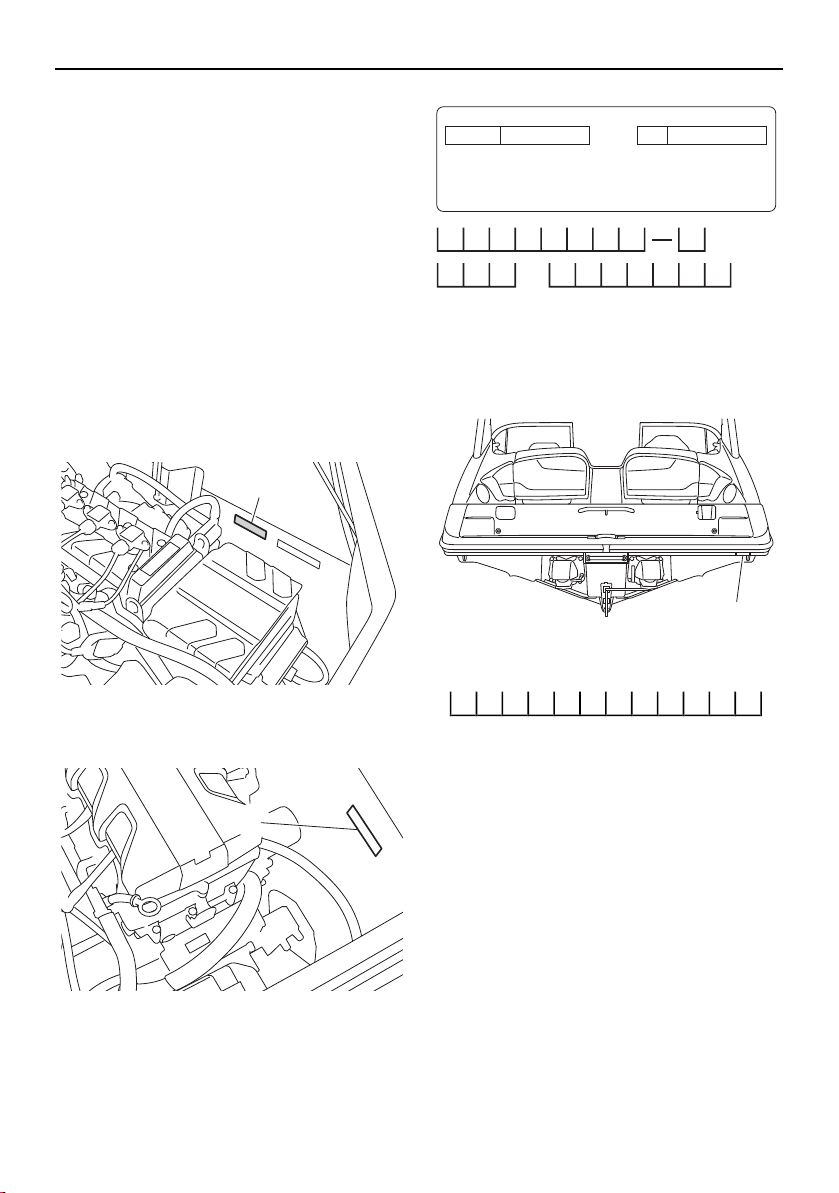
Primary Identification (PRI-ID) number
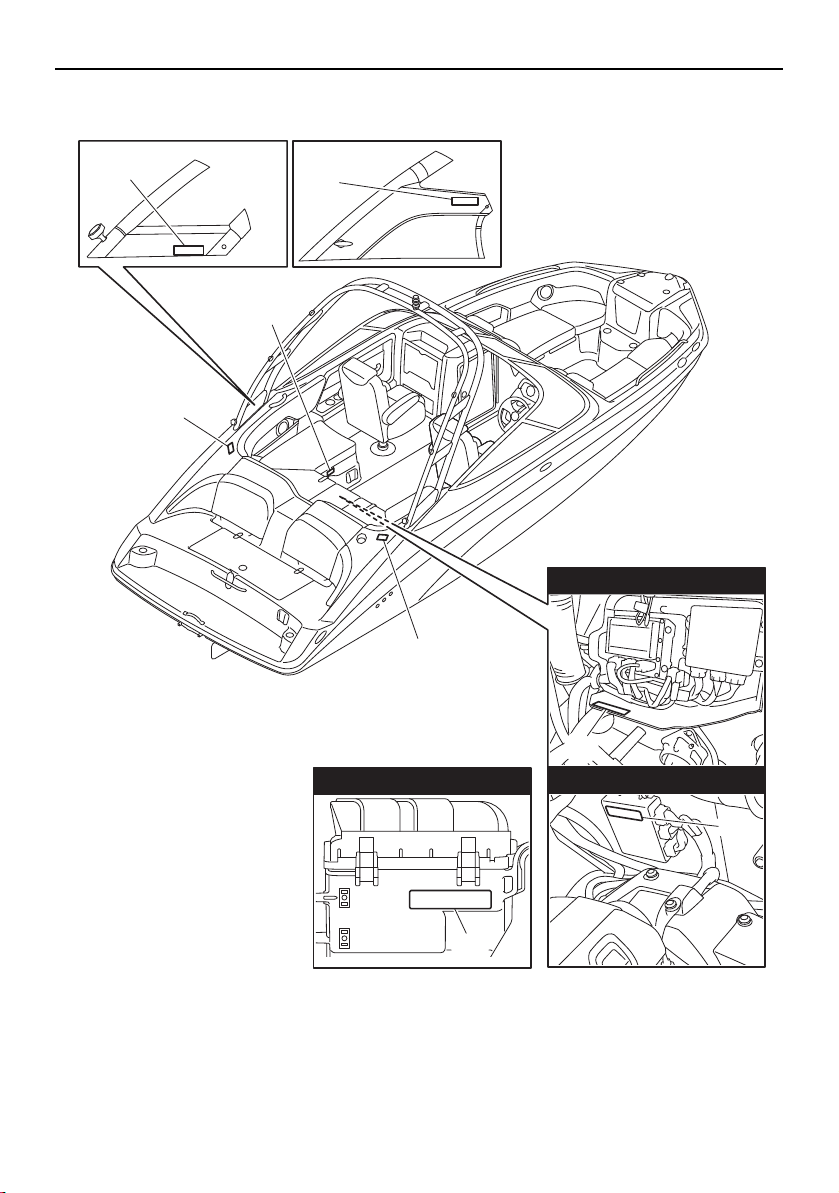
The PRI-ID number is stamped on a label at-
tached inside the engine compartment. (See
page 92 for engine hood opening and closing
procedures.)
AR210 / SX210
1 Primary Identification (PRI-ID) number
212X / 212 Limited S / 212 Limited
1 Primary Identification (PRI-ID) number
Hull Identification Number (HIN)
The HIN is stamped into the right rear corner
of the hull.
1 Hull Identification Number (HIN)
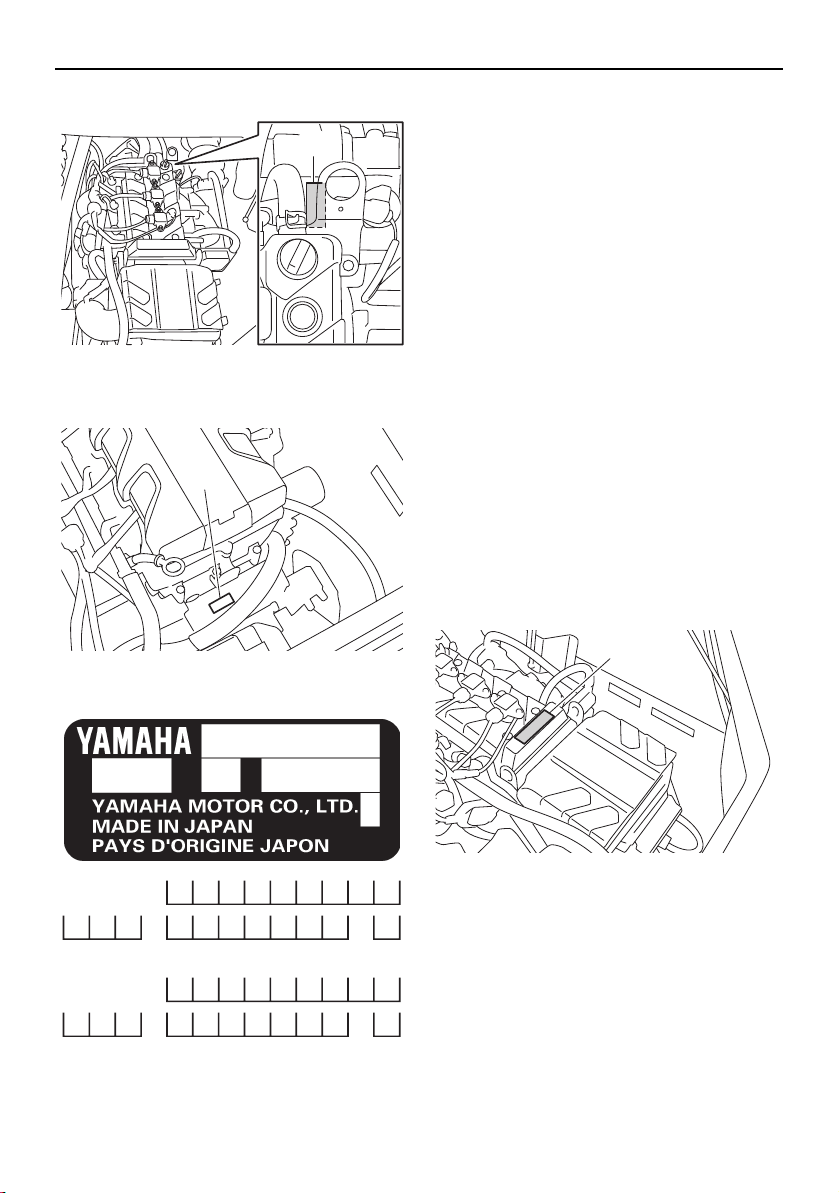
Engine serial numbers
The engine serial numbers are stamped on a
label attached to each engine unit. (See page
92 for engine hood opening and closing pro-
cedures.)
1
1
MODEL
YAMAHA MOTOR CO.,LTD.
ASSEMBLED IN U.S.A. FROM AMERICAN AND JAPANESE
COMPONENTS.
ASSEMBLÉ AUX ÉTATS-UNIS DE PIÈCES AMÉRICAINES ET
JAPONAISES.
PRI-I.D.
1
SportsBoat_F3R11.book Page 1 Friday, May 19, 2017 9:35 AM
General and important labels
2
AR210 / SX210
1 Engine serial number
212X / 212 Limited S / 212 Limited
1 Engine serial number
Emission control information
These engines conform to U.S. Environmen-
tal Protection Agency (EPA) and/or California
Air Resources Board (CARB) regulations for
marine SI engines applicable at the time of
manufacture.
The 4-star labels are affixed to models that
meet the Air Resources Board’s emission
standards for 4-star models. (See page 4 for
information on the star labels.)
Star labels are not affixed to 3-star models.
These engines are certified to operate on reg-
ular unleaded gasoline.
Approval labels of emission control
certificate
These labels are attached to each engine unit
and to the inside of the engine compartment.
(See page 92 for engine hood opening and
closing procedures and page 166 for engine
cover removal and installation procedures.)
AR210 / SX210
1 Emission control information label
1
1
Port side
Starboard side
1
SportsBoat_F3R11.book Page 2 Friday, May 19, 2017 9:35 AM
General and important labels
3
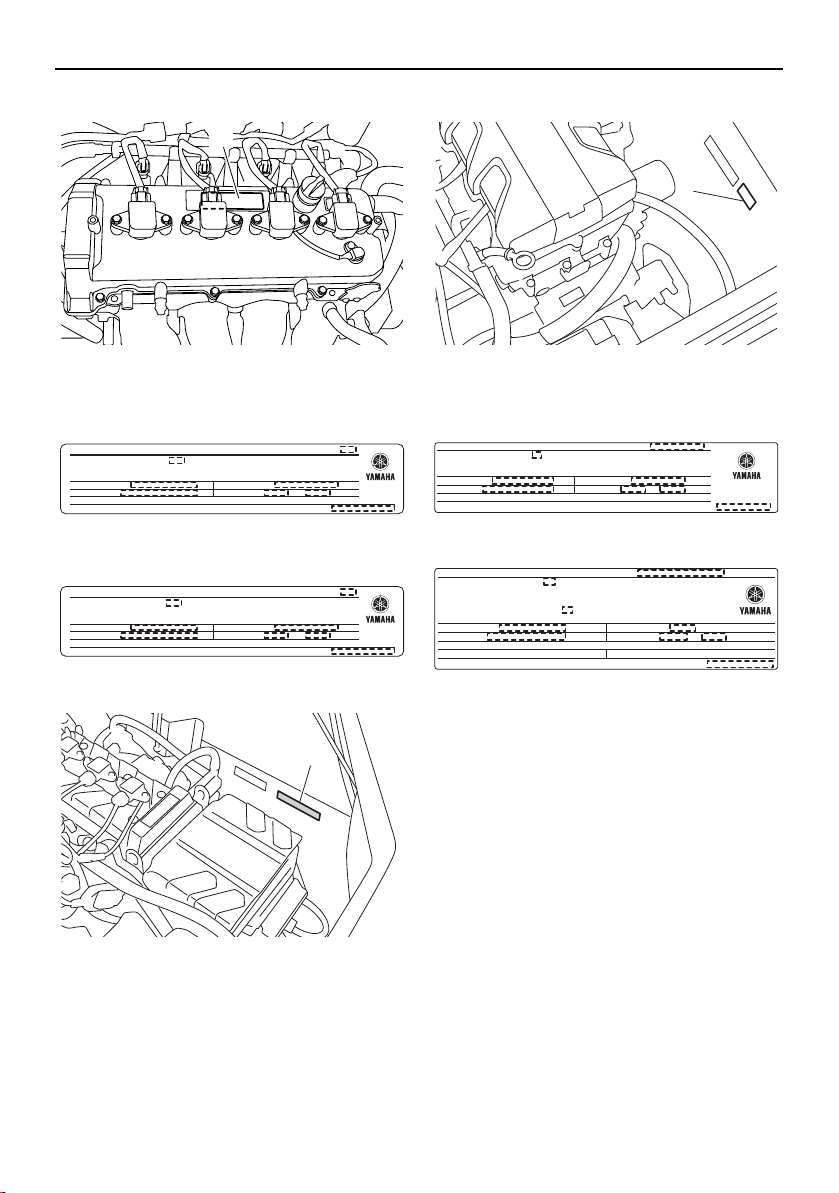
212X / 212 Limited S / 212 Limited
1 Emission control information label
3-star models
4-star models
AR210 / SX210
1 Emission control information label
212X / 212 Limited S / 212 Limited
1 Emission control information label
3-star models
4-star models
1
EMISSION CONTROL INFORMATION
ENGINE FAMILY :
MAX POWER : kW
DISPLACEMENT : liters
FEL : HC+NOx , CO g/kW-h
THIS ENGINE CONFORMS TO U.S. EPA EXHAUST REGULATIONS FOR SI MARINE
ENGINES. REFER TO OWNER’S MANUAL FOR MAINTENANCE SPECIFICATIONS AND
ADJUSTMENTS.
YAMAHA MOTOR CO.,LTD.
EMISSION CONTROL INFORMATION
ENGINE FAMILY :
MAX POWER : kW
DISPLACEMENT : liters
FEL : HC+NOx , CO g/kW-h
THIS ENGINE CONFORMS TO CALIFORNIA AND U.S. EPA EXHAUST REGULATIONS
FOR SI MARINE ENGINES. REFER TO OWNER’S MANUAL FOR MAINTENANCE
SPECIFICATIONS AND ADJUSTMENTS.
YAMAHA MOTOR CO.,LTD.
1
1
YAMAHA MOTOR CO.,LTD.
EPA CERTIFIED EVAP COMPONENTS: JNCNPLINEME1. JATWPMDRN212. JYMXPTANKF2J
MAX POWER: kW
ENGINE FAMILY:
EMISSION CONTROL INFORMATION
FEL: HC+NOx ,CO g/kW-h
DISPLACEMENT: LITERS
THIS ENGINE CONFORMS TO U.S. EPA EXHAUST REGULATIONS FOR SI MARINE
ENGINES. REFER TO OWNER’S MANUAL FOR MAINTENANCE SPECIFICATIONS AND
ADJUSTMENTS. MEETS U.S. EPA EVAP STANDARDS USING CERTIFIED COMPONENTS
YAMAHA MOTOR CO.,LTD.
ARB EVAP FAMILY: JYMXPVSSLYJ1
EPA CERTIFIED EVAP COMPONENTS: JNCNPLINEME1. JATWPMDRN212. JYMXPTANKF2J
MAX POWER: kW
ENGINE FAMILY:
EMISSION CONTROL INFORMATION
TWC/HO25/MFI/OBD/EECS
ARB EVAP EMISSION CONTROL SYSTEM: CP
FEL: HC+NOx CO /kW-h
DISPLACEMENT: LITERS
THIS ENGINE CONFORMS TO CALIFORNIA AND U.S. EPA EXHAUST REGULATIONS
FOR SI MARINE ENGINES. REFER TO OWNER’S MANUAL FOR MAINTENANCE
SPECIFICATIONS AND ADJUSTMENTS. MEETS U.S. EPA EVAP STANDARDS USING
CERTIFIED COMPONENTS. MEETS MY CALIFORNIA EVAP EMISSIONS
REGULATIONS FOR SPARK-IGNITION MARINE WATERCRAFT
SportsBoat_F3R11.book Page 3 Friday, May 19, 2017 9:35 AM
General and important labels
4
Manufactured date labels
(AR210 / SX210)
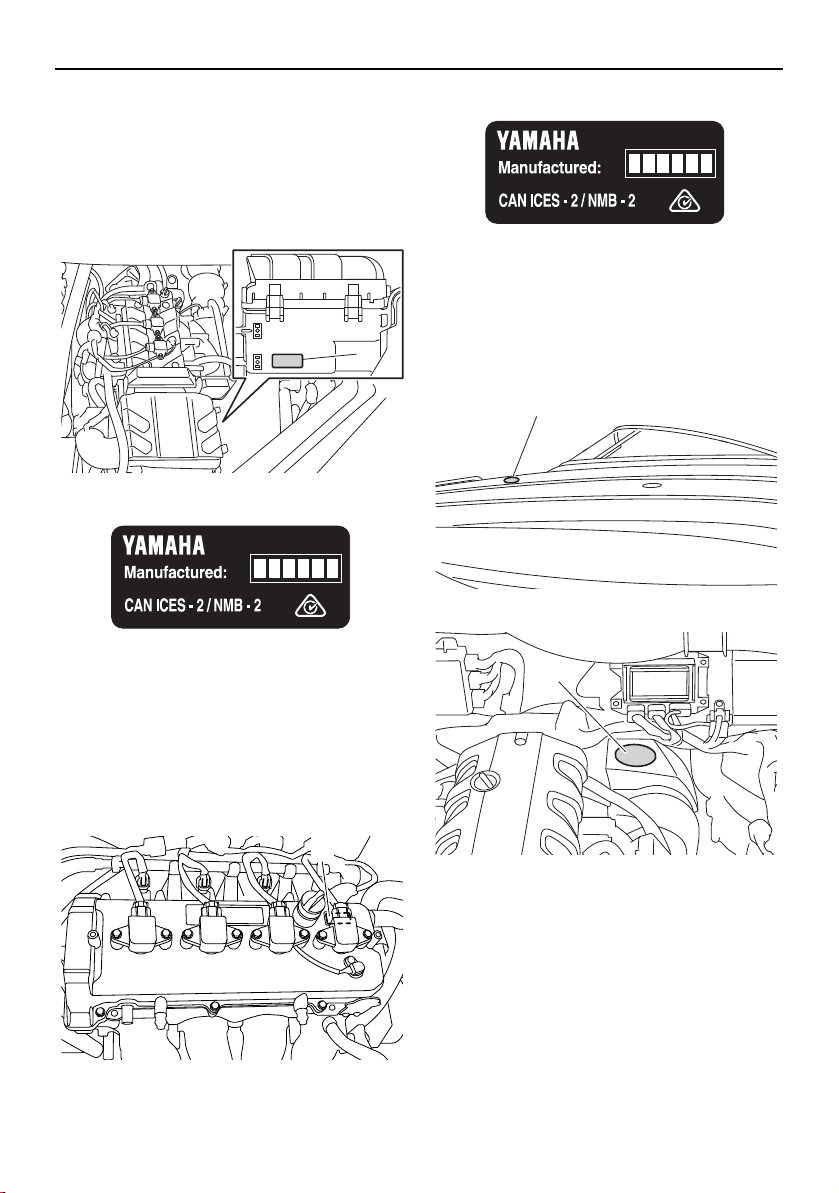
These labels are attached to the each port
sides of the air filter case. (See page 92 for
engine hood opening and closing proce-
dures.)
1 Manufactured date label
Manufactured date labels
(212X / 212 Limited S / 212 Limited)
These labels are attached to each engine
unit. (See page 92 for engine hood opening
and closing procedures and page 166 for en-
gine cover removal and installation proce-
dures.)
1 Manufactured date label
Star labels (4-star models)
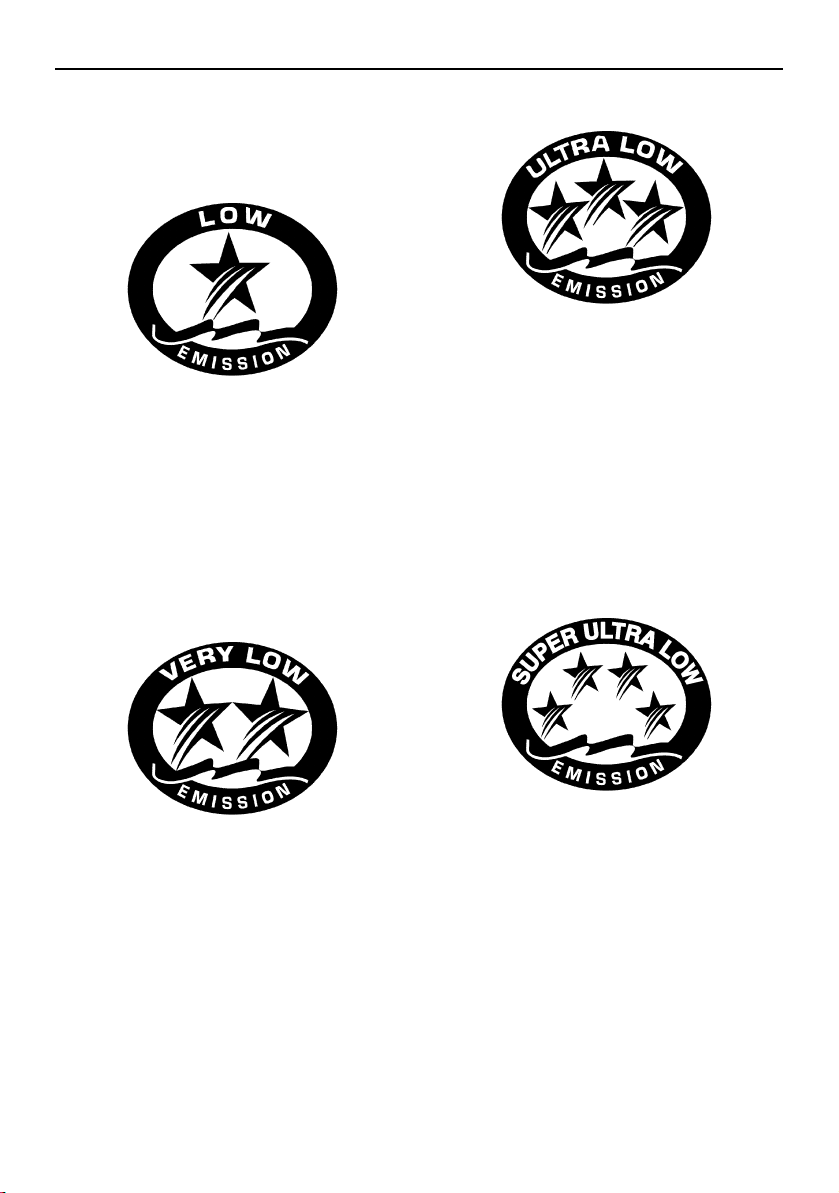
This boat is labeled with a California Air Re-
sources Board (CARB) star label. See below
for a description of your particular label.
1 Star label location
1 Star label location
One Star - Low Emission
The one-star label identifies engines that
meet the Air Resources Board’s Personal
Watercraft and Outboard marine engine 2001
exhaust emission standards. Engines meet-
ing these standards have 75% lower emis-
sions than conventional carbureted two-
1
1
1
1
SportsBoat_F3R11.book Page 4 Friday, May 19, 2017 9:35 AM
General and important labels
5
stroke engines. These engines are equivalent
to the U.S. EPA’s 2006 standards for marine
engines.
Two Stars - Very Low Emission
The two-star label identifies engines that meet
the Air Resources Board’s Personal Water-
craft and Outboard marine engine 2004 ex-
haust emission standards. Engines meeting
these standards have 20% lower emissions
than One Star-Low Emission engines.
Three Stars - Ultra Low Emission
The three-star label identifies engines that
meet the Air Resources Board’s Personal
Watercraft and Outboard marine engine 2008
exhaust emission standards or the Sterndrive
and Inboard marine engine 2003-2008 ex-
haust emission standards. Engines meeting
these standards have 65% lower emissions
than One Star-Low Emission engines.
Four Stars - Super Ultra Low Emission
The four-star label identifies engines that
meet the Air Resources Board’s Sterndrive
and Inboard marine engine 2009 exhaust
emission standards. Personal Watercraft and
Outboard marine engines may also comply
with these standards. Engines meeting these
standards have 90% lower emissions than
One Star-Low Emission engines.
SportsBoat_F3R11.book Page 5 Friday, May 19, 2017 9:35 AM
General and important labels
6
Important labels
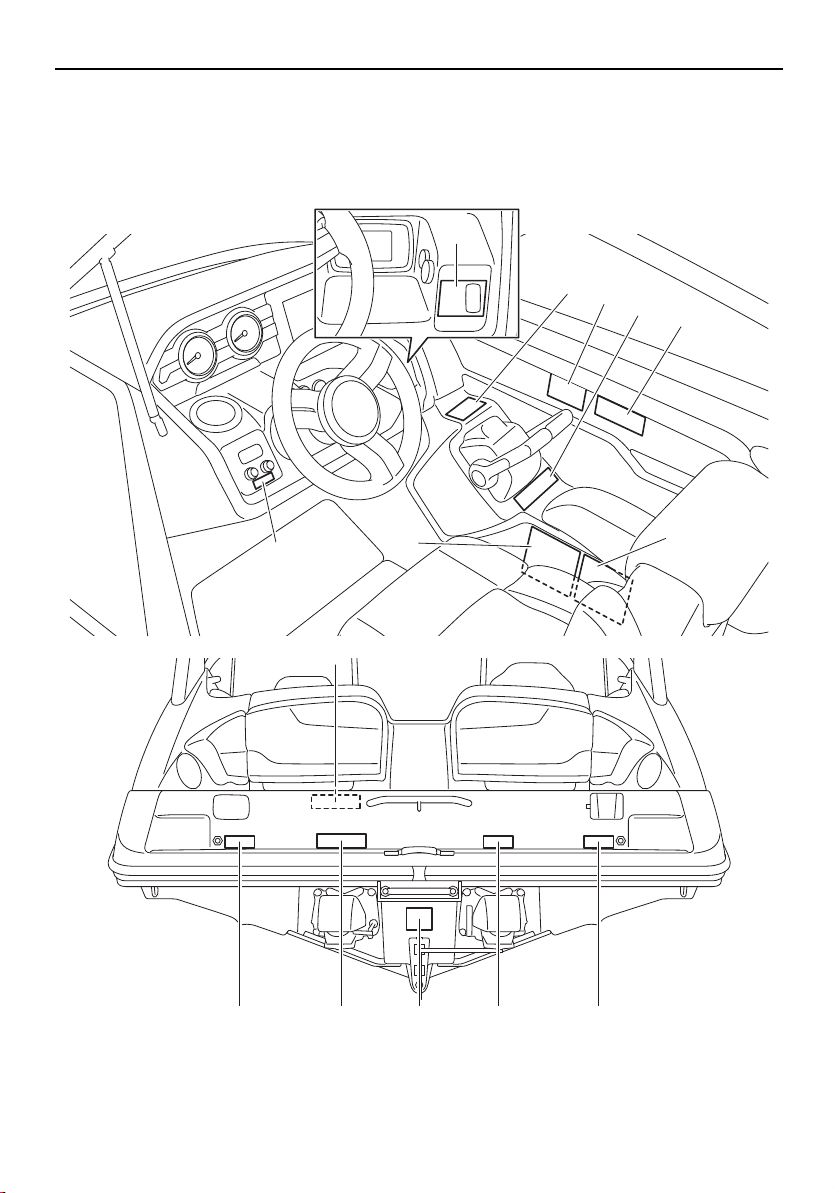
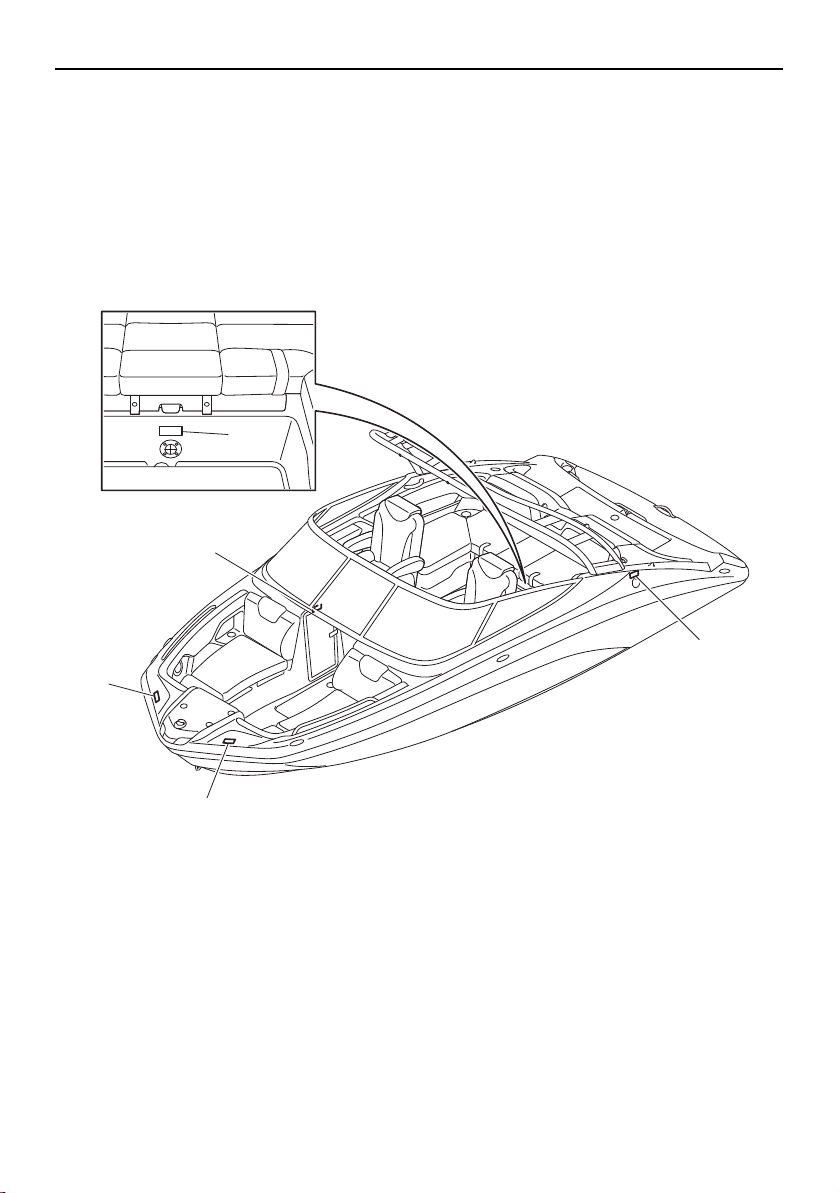
Read the following labels before operating this boat. If you need any additional information,
contact a Yamaha Boat Dealer.
1
6
891610
7
8
5
4
2
3
15
19
AR210/SX210
SportsBoat_F3R11.book Page 6 Friday, May 19, 2017 9:35 AM
General and important labels
7
17
12
13
13
11
SportsBoat_F3R11.book Page 7 Friday, May 19, 2017 9:35 AM
General and important labels
8
18
13
14
14
17
13
212X/212 Limited S/
212 Limited
AR210/SX210
AR210 212X/212 Limited S
18
18
4-star models
3-star models
3-star models
SportsBoat_F3R11.book Page 8 Friday, May 19, 2017 9:35 AM
General and important labels
9
Warning labels
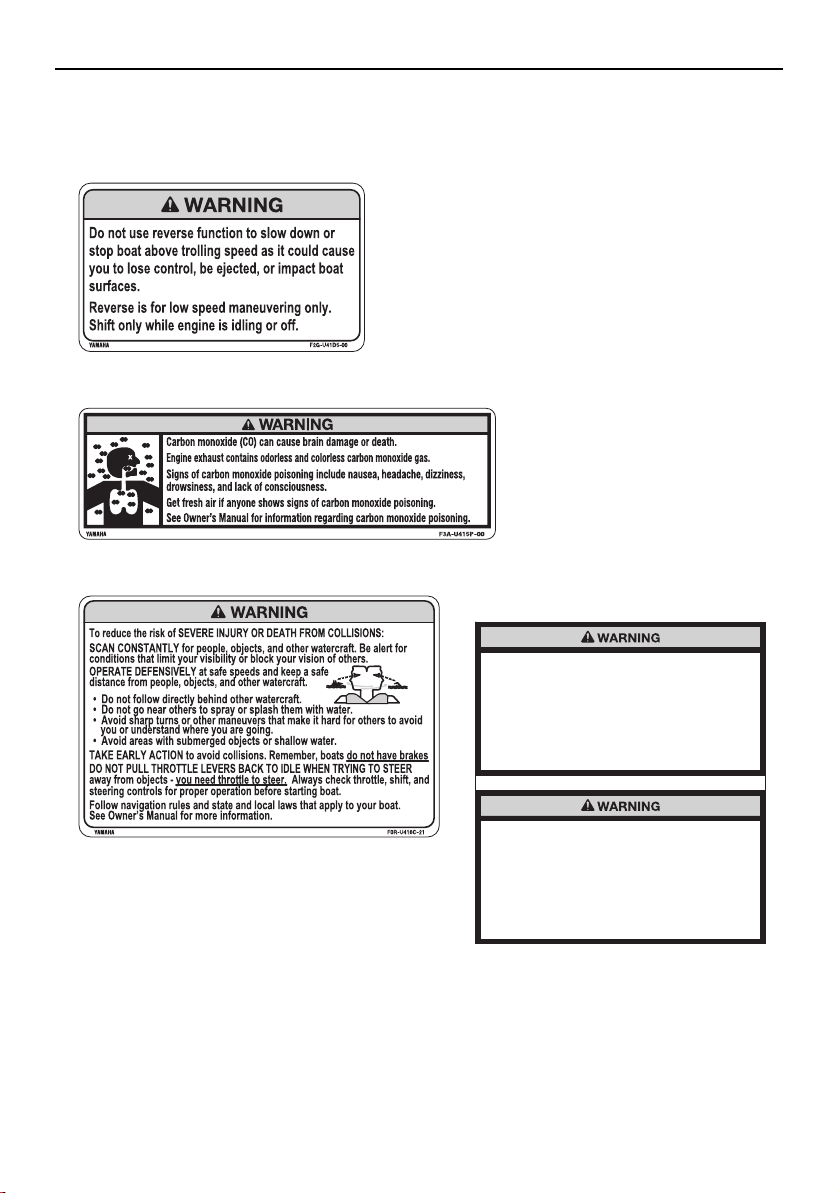
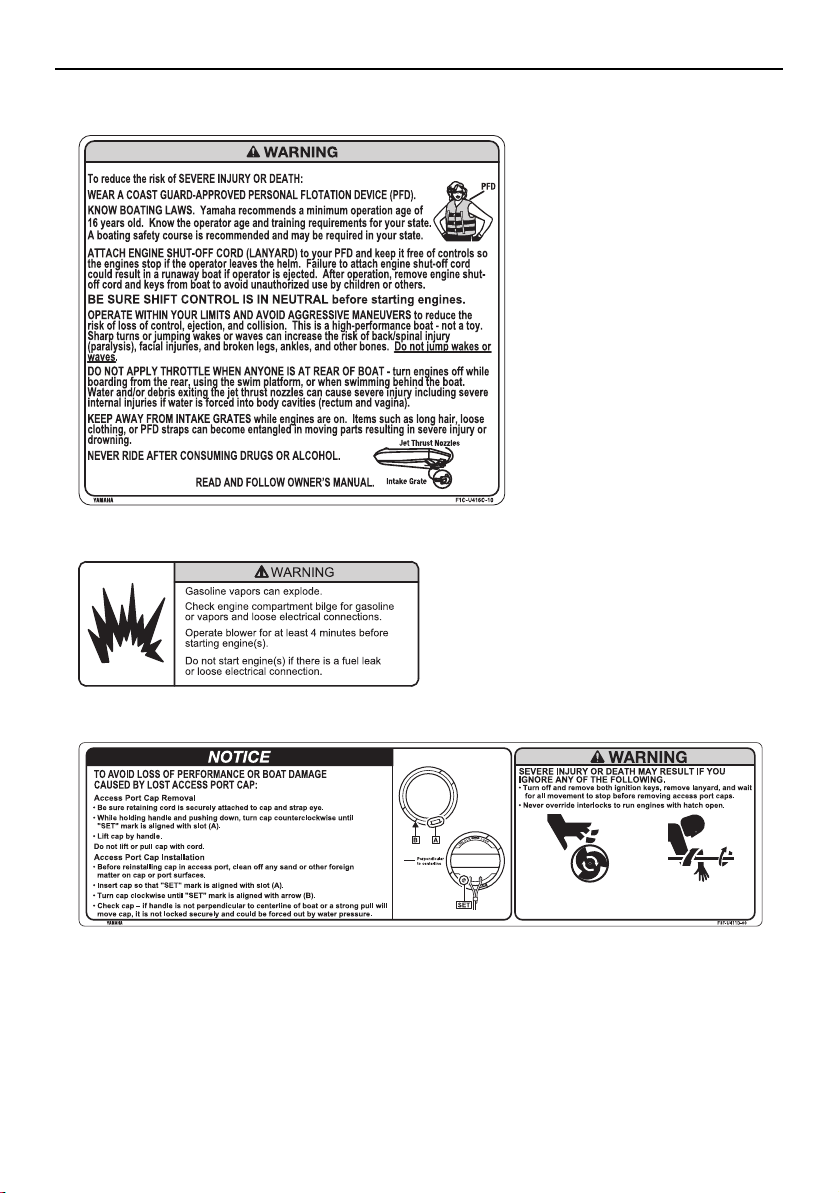
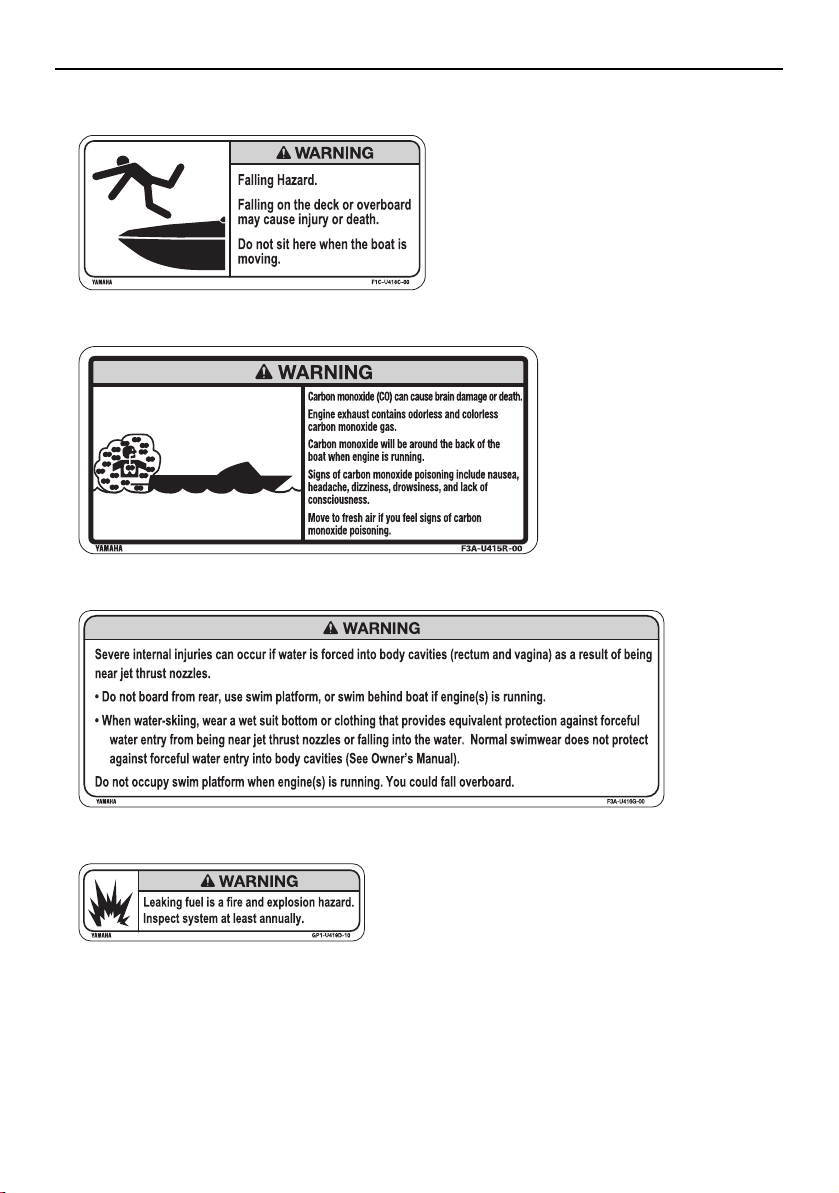
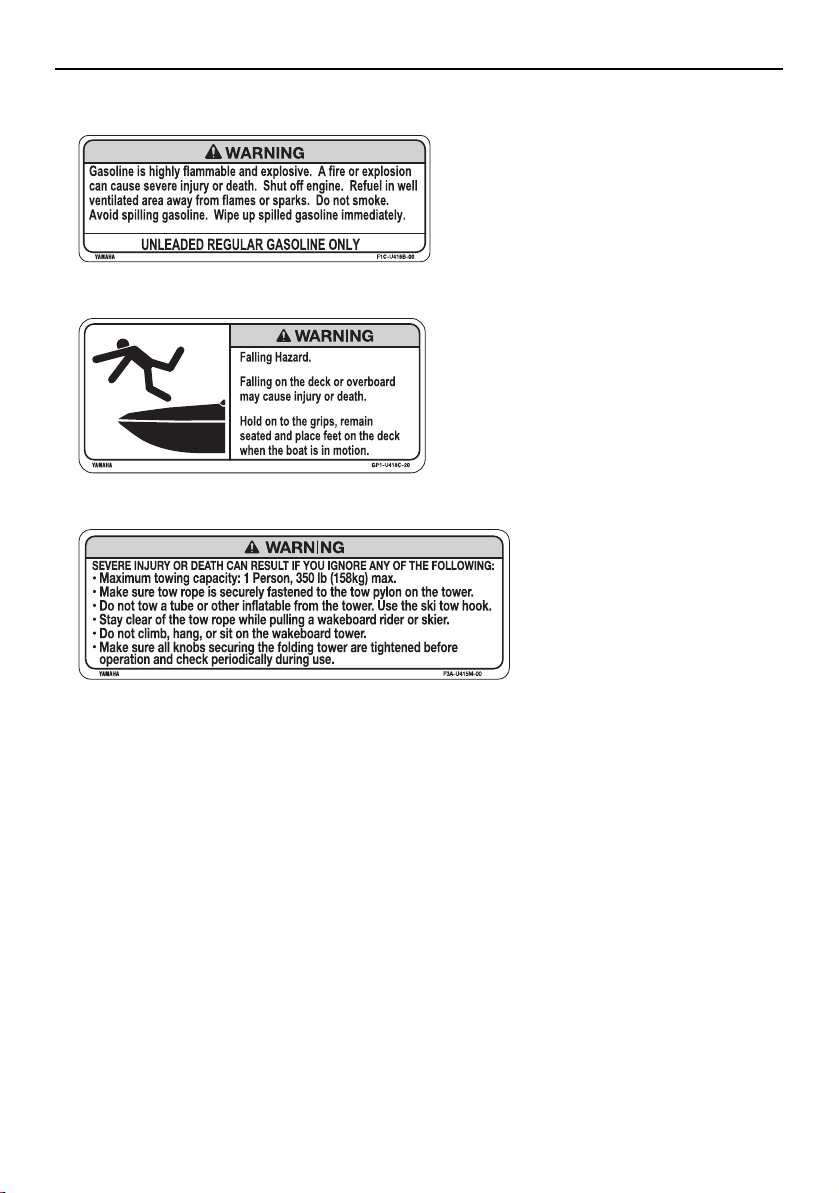
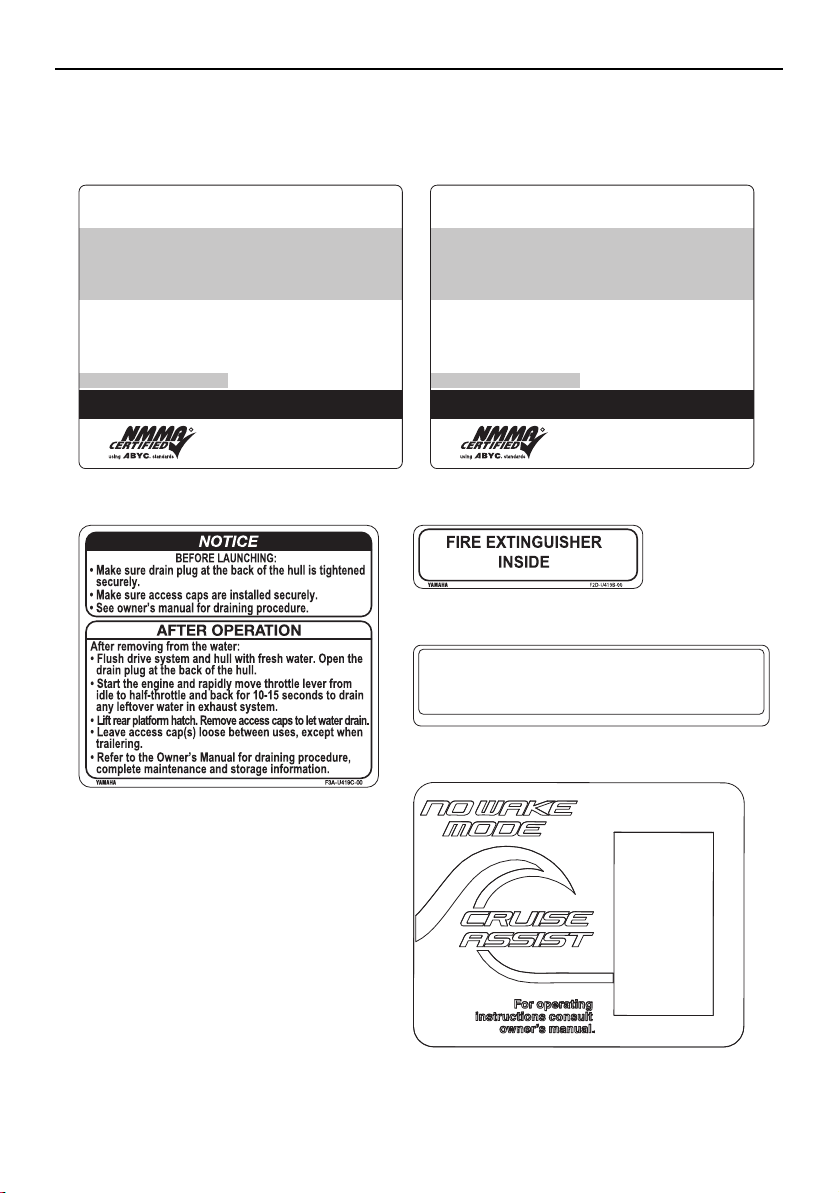
If any of these labels is damaged or missing, contact a Yamaha Boat Dealer for a replacement.
Improper use of the ballast system can
overload the boat, causing poor handling and
increased risk of swamping.
Ballast system adds 1303 lb (591 kg) when full.
Include this weight when making sure your
load does not exceed the weight shown on
the Maximum Capacities Label.
Drain ballast completely before trailering the
boat to reduce the risk of a towing accident.
The Increased weight of ballast can cause
unsafe towing conditions due to negative
tongue weight, including decreased tow
vehicle stability and greater chance of a
runaway trailer that has come off the hitch.
3
2
1
4
212X
SportsBoat_F3R11.book Page 9 Friday, May 19, 2017 9:35 AM
General and important labels
10
7
5
6
SportsBoat_F3R11.book Page 10 Friday, May 19, 2017 9:35 AM
General and important labels
11
8
9
10
11
SportsBoat_F3R11.book Page 11 Friday, May 19, 2017 9:35 AM
General and important labels
12
13
12
14
SportsBoat_F3R11.book Page 12 Friday, May 19, 2017 9:35 AM
General and important labels
13
Other labels
THIS BOAT COMPLIES WITH U.S. COAST GUARD SAFETY
STANDARDS IN EFFECT ON THE DATE OF CERTIFICATION
MAXIMUM CAPACITIES
2200 POUNDS, PERSONS, GEAR
MEETS U.S. EPA EVAP STANDARDS USING CERTIFIED COMPONENTS
DESIGN COMPLIANCE WITH NMMA REQUIREMENTS IS VERIFIED.
MANUFACTURER RESPONSIBLE FOR PRODUCTION CONTROL.
NATIONAL MARINE
MANUFACTURERS ASSOCIATION
MANUFACTURER: YAMAHA JET BOAT MANUFACTURING U.S.A., INC.
MODEL: VONORE, TN
PERSONS OR
LBS.
10
1860
R
THIS BOAT COMPLIES WITH U.S. COAST GUARD SAFETY
STANDARDS IN EFFECT ON THE DATE OF CERTIFICATION
MAXIMUM CAPACITIES
2100 POUNDS, PERSONS, GEAR
MEETS U.S. EPA EVAP STANDARDS USING CERTIFIED COMPONENTS
DESIGN COMPLIANCE WITH NMMA REQUIREMENTS IS VERIFIED.
MANUFACTURER RESPONSIBLE FOR PRODUCTION CONTROL.
NATIONAL MARINE
MANUFACTURERS ASSOCIATION
MANUFACTURER: YAMAHA JET BOAT MANUFACTURING U.S.A., INC.
MODEL: VONORE, TN
PERSONS OR
LBS.
10
1860
R
YAMAHA 60E-83627-00
All applicable electrical system components installed as
original equipment meet appropriate U.S.C.G. requirements
for ignition protection. (Ref. 33 CFR 183.410 and 183.440)
15
except for 212X 212X
16 17
19
18
SportsBoat_F3R11.book Page 13 Friday, May 19, 2017 9:35 AM

14
Safety information
The safe use and operation of this boat is
dependent upon the use of proper operat-
ing techniques, as well as upon the com-
mon sense, good judgment, and expertise
of the operator. Every operator should
know the following requirements before
operating the boat.
● Before operating the boat, read the own-
er’s/operator’s manual, the Operation In-
struction card, and all labels on the boat.
Also, watch the Basic Orientation Video
provided with your boat. These materials
should give you an understanding of the
boat and its operation.
● Never allow anyone to operate this boat un-
til they too have read this owner’s/opera-
tor’s manual, the Operation Instruction
card, and all labels, and, if possible,
watched the Basic Orientation Video.
Showing them the video may help reinforce
the information contained in these materi-
als.
Limitations on who may
operate the boat
● Yamaha recommends a minimum operator
age of 16 years old.
Adults must supervise use by minors.
Know the operator age and training require-
ments for your state. A boating safety
course is recommended and may be re-
quired in your state. You can find local rules
by contacting the United States Coast
Guard (USCG), the National Association of
State Boating Law Administrators, or your
local Power Squadron.
● This boat is designed to carry the operator,
up to 9 passengers, and cargo. Never ex-
ceed the maximum load limit or allow more
than 10 persons (or 9 persons if the wake-
boarder or water-skier is being pulled) to
ride in the boat at any time. Weight distribu-
tion affects performance. Keep weight in
the boat low and evenly distributed from
side-to-side and bow-to-stern. Remove any
unnecessary cargo and store it on shore.
Maximum load (212X):
Total weight of cargo, operator, and
passengers:
952 kg (2100 lb): ballast is empty
495 kg (1092 lb): ballast is full
Total weight of operator and passen-
gers:
843 kg (1860 lb): ballast is empty
386 kg (852 lb): ballast is full
Maximum load (except for 212X):
Total weight of cargo, operator, and
passengers:
997 kg (2200 lb)
Total weight of operator and passen-
gers:
843 kg (1860 lb)
SportsBoat_F3R11.book Page 14 Friday, May 19, 2017 9:35 AM
Safety information
15
Cruising limitations
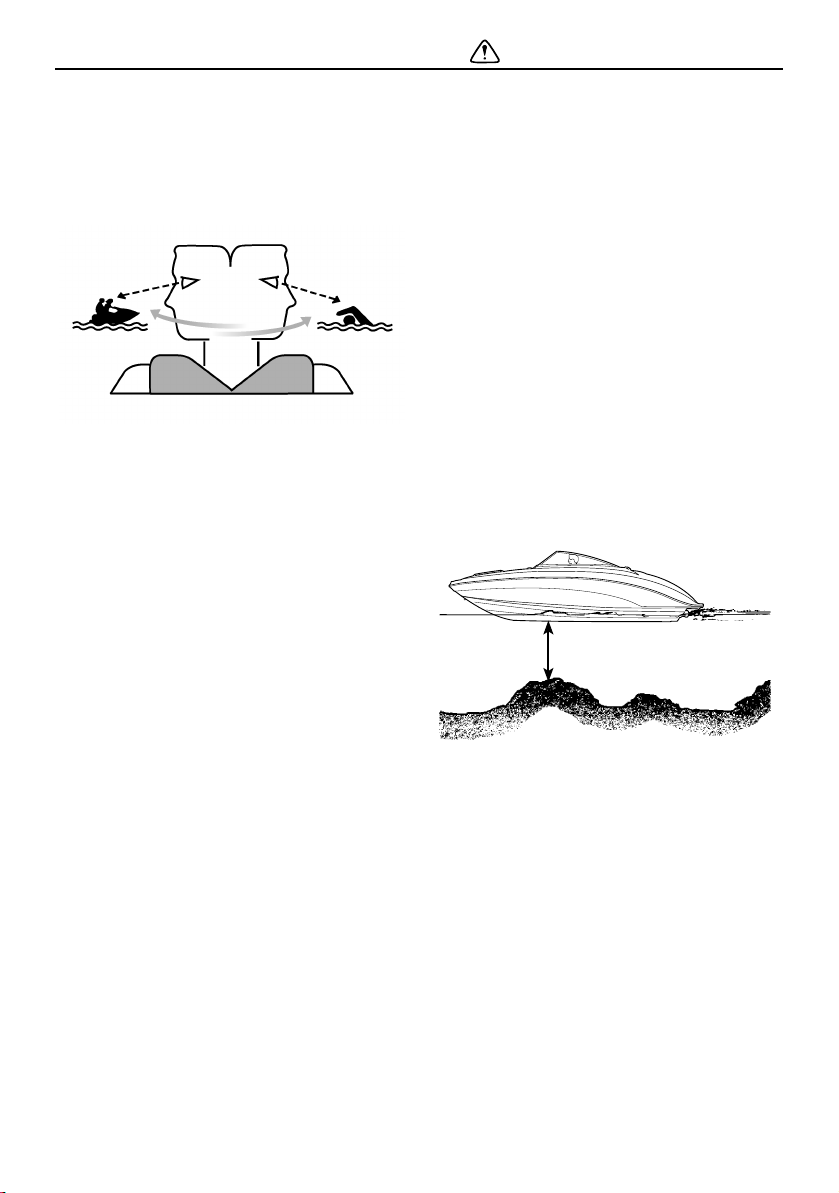
● Scan constantly for people, objects, and
other watercraft. Be alert for conditions that
limit your visibility or block your vision of
others.
● Operate defensively at safe speeds and
keep a safe distance from people, objects,
and other watercraft.
● Do not follow directly behind other water-
craft.
● Do not go near others to spray or splash
them with water.
● Avoid sharp turns or other maneuvers that
make it hard for others to avoid you or un-
derstand where you are going.
● Avoid areas with submerged objects or
shallow water.
● Take early action to avoid collisions. Re-
member, boats do not have brakes.
● Do not pull the remote control levers back to
idle when trying to steer away from ob-
jects—you need throttle to steer. Always
check throttle, shift, and steering controls
for proper operation before starting boat.
● Operate within your limits and avoid ag-
gressive maneuvers to reduce the risk of
loss of control, ejection, and collision.
● This is a high-performance boat—not a toy.
Sharp turns or jumping wakes or waves can
increase the risk of back/spinal injury (pa-
ralysis), facial injuries, and broken legs, an-
kles, and other bones. Do not jump wakes
or waves.
● Do not operate the boat in rough water, bad
weather, or when visibility is poor; this may
lead to an accident causing injury or death.
Be alert to the possibility of adverse weath-
er. Take note of weather forecasts and the
prevailing weather conditions before setting
out in your boat.
● Never operate in water that is less than
90 cm (3 ft) deep from the bottom of the
boat, otherwise you increase your chance
of hitting a submerged object, which could
result in injury.
● Leave a “float plan” with a responsible per-
son on shore. Tell where you plan to go and
when you plan to arrive, and provide a de-
scription of your boat. Advise this person if
your plans change and also when you ar-
rive to prevent false alarms. A sample float
plan is included on page 189.
● Follow navigation rules and state and local
laws that apply to your boat.
90 cm (3 ft)
SportsBoat_F3R11.book Page 15 Friday, May 19, 2017 9:35 AM
Safety information
16
Operational requirements
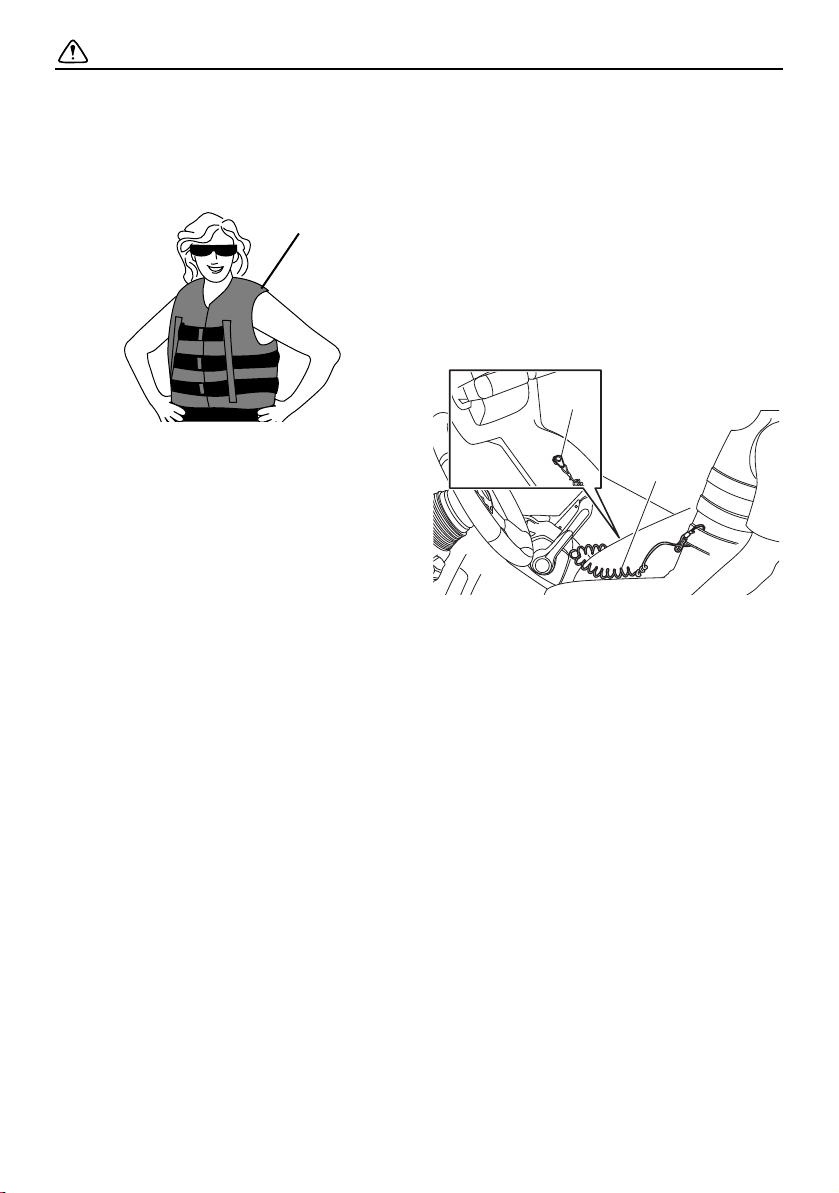
● The operator and all passengers must wear
a U.S. Coast Guard (USCG) approved per-
sonal flotation device (PFD).
1 PFD
● Eye protection is recommended to keep
wind, water, and glare from the sun out of
your eyes while you operate your boat. Re-
straining straps for eyewear are made
which are designed to float should your
eyewear fall in the water.
● Footwear is recommended.
● Never operate the boat after consuming al-
cohol or taking drugs.
● For reasons of safety and proper care of the
boat, always perform the pre-operation
checks listed on page 124 before operating
the boat.
● Passengers must always sit in a designated
seating area, place feet on the deck, and
hold on to the handgrips, handrails, or
straps when the boat is in motion.
● Always consult your doctor on whether it is
safe for you to ride in this boat if you are
pregnant or in poor health.
● Do not attempt to modify this boat.
Modifications to your boat may reduce safe-
ty and reliability, and render the boat unsafe
or illegal to use.
● Attach the engine shut-off cord (lanyard) to
the PFD and keep it free from the steering
wheel or other controls so that the engines
stop if the operator accidentally leaves the
helm. Failure to attach the engine shut-off
cord (lanyard) could result in a runaway
boat if the operator is ejected.
After operation, remove the engine shut-off
cord (lanyard) and the main switch keys to
avoid accidental starting or unauthorized
use by children or others.
1 Engine shut-off switch
2 Engine shut-off cord (lanyard)
● Scan constantly for swimmers and stay
away from swimming areas. Swimmers are
hard to see and you could accidentally hit
someone in the water.
● Avoid being hit by another boat. You should
always take responsibility to watch for traf-
fic; other boaters may not be watching for
you. If they do not see you, or you maneu-
ver more quickly than other boaters expect,
you risk a collision.
● Maintain a safe distance from other boats
and watercraft, and also watch for ski ropes
or fishing lines. Obey the “Rules of the
road”, and be sure to check behind you be-
fore making a turn. (See “Rules of the road”
on page 21.)
1
1
2
SportsBoat_F3R11.book Page 16 Friday, May 19, 2017 9:35 AM

Safety information
17
Required equipment
The U.S. Coast Guard (USCG) has regula-
tions which describe minimum standards of
safety. You must comply with these regula-
tions, which apply to boats like your boat
which are less than 26 feet long.
● Personal flotation devices (PFD):
Type I, II, or III as required for all people on
board (see “Operational requirements” for
more information), plus at least one Type IV
(throwable type).
● Fire extinguisher:
At least one B-1 type hand-held portable
fire extinguisher.
● Visual distress signals:
It is recommended that a USCG-approved
pyrotechnic device be stored on your boat.
A mirror can also be used as an emergency
signal. Contact your Yamaha Boat Dealer
or the Coast Guard for more information.
● Sound signalling device:
Your boat is equipped with a horn that can
be used to signal other boats. See “Rules of
the road” for more information.
● Navigation lights:
Your boat is equipped with navigation lights
for use between sunset and sunrise, and
during periods of reduced visibility, such as
fog. Be sure these lights are working and
are turned on when necessary. (See pages
52, 67, and 101 for more information.)
Additional equipment
recommendations
The following equipment can help make your
boating experience safer and more enjoyable:
● Mooring fenders and lines.
● Anchor with suitable line (a “Danforth” type
anchor and line that is at least 6 times the
depth of the water where you will drop an-
chor are recommended).
● Manual-type bilge pump.
● First-aid kit.
● Waterproof flashlight with extra batteries.
● Tool kit with assorted screwdrivers, pliers,
wrenches (including metric sizes), and
electrical tape.
● Oar or paddle (look for one with a boat hook
on the other end).
● Spare parts, such as fuses.
● Navigation charts for the waters where you
will be boating.
● Tow-rope.
SportsBoat_F3R11.book Page 17 Friday, May 19, 2017 9:35 AM

Safety information
18
Hazard information
Never start the engines or let them run for any
length of time in an enclosed area. Exhaust
fumes contain carbon monoxide, a colorless,
odorless gas that may cause loss of con-
sciousness and death within a short time. Al-
ways operate the boat in an open area.
It is also important to have the engines off
when anyone is using the ladder on models
equipped with one because of the carbon
monoxide in the exhaust gases coming from
underneath the step.
Boat characteristics
● Jet thrust turns the boat. Moving the remote
control levers completely back to idle or the
neutral position produces only minimum
thrust. If you are traveling at speeds above
trolling, you will have rapidly decreasing
ability to steer without throttle. You may still
have some turning ability immediately after
moving the remote control levers back to
idle, but once the engines slow down, the
boat will no longer respond to steering
wheel input until you apply throttle again or
you reach a trolling speed. Practice turning
in an open area without obstructions until
you have a good feel for the maneuver.
● This Yamaha boat is water-jet propelled.
The pumps are directly connected to the
engines. This means that the jet thrust will
produce some movement whenever the en-
gines are running. The boat has a “neutral”
position, but since the boat is always pro-
ducing thrust while the engines are running,
some forward or reverse movement may
occur.
● Do not use the reverse function to slow
down or stop the boat above trolling speed
as it could cause you to lose control, be
ejected, or impact the steering wheel or oth-
er parts of the boat. This could increase the
risk of serious injury. It could also damage
the shift mechanisms.
● Reverse can be used to slow down or stop
during slow-speed maneuvering, such as
when docking. Once the engines are idling,
shift to reverse and gradually increase en-
gine speed. Make sure that there are no ob-
stacles or people behind you before shifting
into reverse.
SportsBoat_F3R11.book Page 18 Friday, May 19, 2017 9:35 AM
Safety information
19
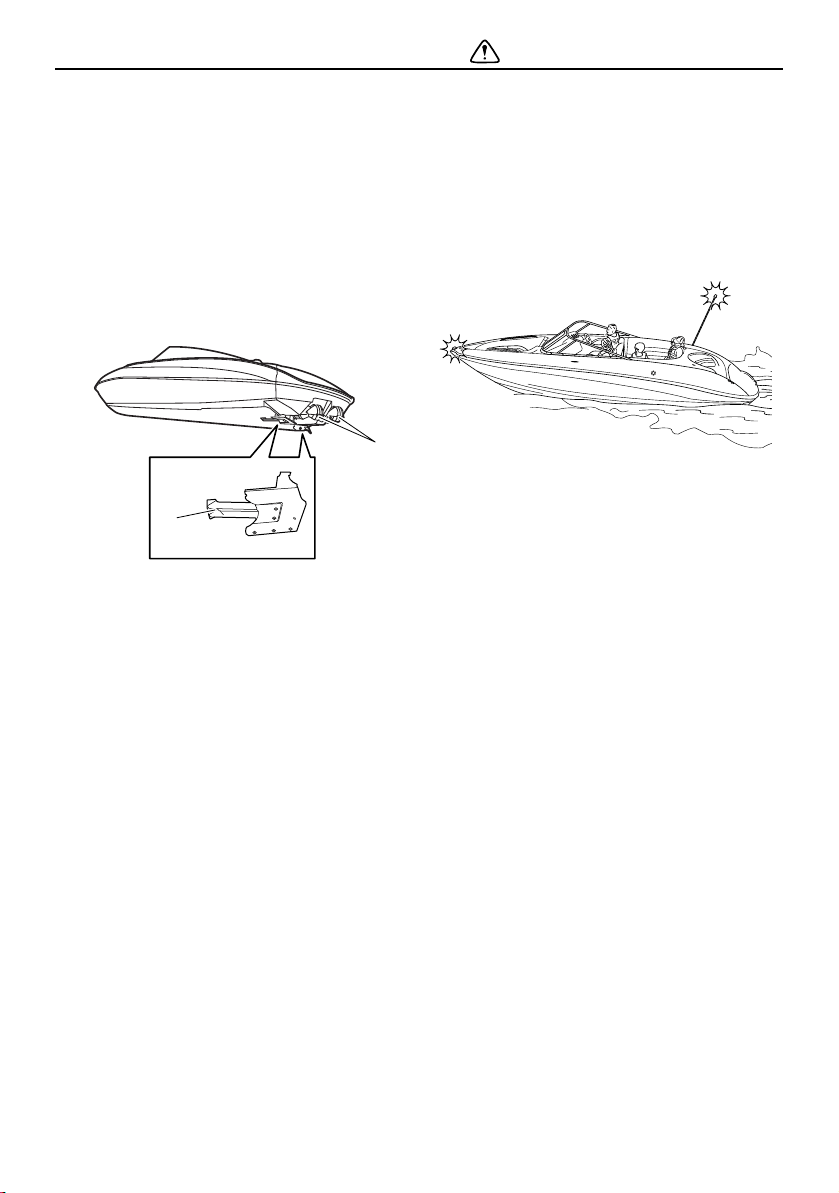
● Keep away from the intake grates while the
engines are on. Items such as long hair,
loose clothing, or PFD straps can become
entangled in moving parts, resulting in se-
vere injury or drowning.
● Never insert any object into the jet thrust
nozzles while the engines are running. Se-
vere injury or death could result from com-
ing in contact with the rotating parts of the
jet pumps.
1 Intake grate
2 Jet thrust nozzle
● Stop the engines and remove the clip from
the engine shut-off switch before removing
any debris or weeds, which may have col-
lected around the jet intakes. (See page
178 for more information.)
Night operation
When using your boat before dawn or after
dusk, you must have both bow and anchor
lights operating. When at anchor in the dark,
the anchor light must be lit. (See pages 52,
67, and 101 for instructions.)
2
1
SportsBoat_F3R11.book Page 19 Friday, May 19, 2017 9:35 AM

Safety information
20
Wakeboarding and water-skiing
You can use the boat to tow a wakeboarder or
water-skier, using the tow pylon or the ski tow
hook provided.
It is the boat operator’s responsibility to be
alert to the safety of the wakeboarder or wa-
ter-skier and others. Know and follow all state
and local regulations in effect for the waters in
which you will be operating.
The following are some important consider-
ations for minimizing risks while pulling a
wakeboarder or water-skier.
● The wakeboarder or water-skier should
wear an approved PFD, preferably a bright-
ly colored one so boat operators can see
the person being pulled.
● The wakeboarder or water-skier should
wear protective clothing. Severe internal in-
juries can occur if water is forced into body
cavities as a result of falling into the water or
while reboarding. Normal swimwear does
not adequately protect against forceful wa-
ter entry into the rectum or vagina. The per-
son being pulled should wear a wetsuit
bottom or clothing that provides equivalent
protection. Such clothing includes thick,
tightly woven, sturdy, and snug-fitting ap-
parel such as denim, but does not include
spandex or similar fabrics, like those used
in bicycle shorts.
● A second person should be on board as a
spotter to watch the wakeboarder or water-
skier; in most states, it is required by law.
Let the person being pulled direct the oper-
ator’s control of speed and direction with
hand signals. Be sure the seat is locked in
place (see page 87) before getting under-
way.
● When preparing to pull the wakeboarder or
water-skier, operate the boat at the slowest
possible speed until the boat is well away
from the person being pulled and slack in
the tow-rope is taken up. Make sure that the
rope is not looped around anything.
After checking that the wakeboarder or wa-
ter-skier is ready and that there is no traffic
or other obstacles, apply enough throttle to
raise the person.
● Make smooth, wide turns. The boat is capa-
ble of very sharp turns, which could exceed
the abilities of the wakeboarder or water-
skier. Keep the person being pulled at least
50 m (164 ft), about twice the distance of a
standard tow-rope, away from any potential
hazard.
● The operators of boats and other watercraft
may not be aware that you are pulling a
wakeboarder or water-skier. Together with
the spotter, pay attention to others around
you and cruise at safe speeds.
● Be alert to the hazard of the tow-rope han-
dle snapping back at the boat when the
wakeboarder or water-skier falls or is un-
able to get up.
See pages 9 and 105 for wakeboard tower
use.
SportsBoat_F3R11.book Page 20 Friday, May 19, 2017 9:35 AM

Safety information
21
Rules of the road
Your Yamaha boat is legally considered a
powerboat. Operation of the boat must be
in accordance with the rules and regula-
tions governing the waterway on which it
is used.
Just as there are rules that apply when you
are driving on streets and highways, there are
waterway rules that apply when you are oper-
ating your boat. These rules are used interna-
tionally, and are also enforced by the United
States Coast Guard and local agencies. You
should be aware of these rules, and follow
them whenever you encounter another vessel
on the water.
Several sets of rules prevail according to geo-
graphic location, but are all basically the same
as the International Rules of the Road. The
rules presented here in this owner’s/opera-
tor’s manual are condensed, and have been
provided for your convenience only. Consult
your local U.S. Coast Guard Auxiliary or De-
partment of Motor Vehicles for a complete set
of rules governing the waters in which you will
be operating your boat.
Steering and sailing rules
Whenever two vessels on the water meet one
another, one vessel has the right-of-way; it is
called the “stand-on” vessel. The vessel that
does not have the right-of-way is called the
“give-way” or “burdened” vessel. These rules
determine which vessel has the right-of-way,
and what each vessel should do.
Stand-on vessel
The vessel with the right-of-way has the duty
to continue its course and speed, except to
avoid an immediate collision. When you main-
tain your direction and speed, the other vessel
will be able to determine how best to avoid
you.
Give-way vessel
The vessel which does not have the right-of-
way has the duty to take positive and timely
action to stay out of the way of the stand-on
vessel. Normally, you should not cross in front
of the vessel with the right-of-way. You should
slow down or change directions briefly and
pass behind the other vessel. You should al-
ways move in such a way that the operator of
the other vessel can see what you are doing.
The General Prudential Rule regarding the
right-of-way is that if a collision appears un-
avoidable, neither boat has the right-of-way.
Both boats must avoid the collision.
In other words, follow the standard rules ex-
cept when a collision will occur unless both
vessels try to avoid each other. If that is the
case, both vessels become give-way vessels.
Rules when encountering vessels
There are three main situations that you may
encounter with other vessels which could lead
to a collision unless the Steering Rules are fol-
lowed:
Meeting: you are approaching another vessel
head-on.
Crossing: you are traveling across another
vessel’s path.
Overtaking: you are passing or being passed
by another vessel.
SportsBoat_F3R11.book Page 21 Friday, May 19, 2017 9:35 AM

Safety information
22
In the following illustration, your boat is in the
center. You should give the right-of-way to
any vessels shown in the white area (you are
the give-way vessel). Any vessels in the shad-
ed area must yield to you (they are the give-
way vessels). Both you and the meeting ves-
sel must alter course to avoid each other.
Meeting
If you are meeting another power-driven ves-
sel head-on, and are close enough to run the
risk of collision, neither of you has the right-of-
way. Both of you should alter course to avoid
an accident. You should keep the other vessel
on your port (left) side. This rule does not ap-
ply if both of you will clear one another if you
continue on your set course and speed.
Crossing
When two power-driven vessels are crossing
each other’s path close enough to run the risk
of collision, the vessel which has the other on
the starboard (right) side must keep out of the
way of the other. If the other vessel is on your
starboard (right) side, you must keep out of its
way; you are the give-way vessel. If the other
vessel is on your port (left) side, remember
that you should maintain course and direction,
provided the other vessel gives you the right-
of-way, as it should.
Overtaking
If you are passing another vessel, you are the
give-way vessel. This means that the other
vessel is expected to maintain its course and
speed. You must stay out of its way until you
are clear of it. Likewise, if another vessel is
passing you, you should maintain your speed
and direction so that the other vessel can
steer itself around you.
SportsBoat_F3R11.book Page 22 Friday, May 19, 2017 9:35 AM

Safety information
23
Other special situations
There are three other rules you should be
aware of when operating your boat around
other vessels.
Narrow channels and bends
When navigating in narrow channels, you
should keep to the right when it is safe and
practical to do so. If the operator of a power-
driven vessel is preparing to go around a
bend that may obstruct the view of other water
vessels, the operator should sound a pro-
longed blast of four to six seconds on the
horn. If another vessel is around the bend, it
too should sound the horn. Even if no reply is
heard, however, the vessel should still pro-
ceed around the bend with caution.
Fishing vessel right-of-way
All vessels fishing with nets, lines, or trawls
are considered to be “fishing vessels” under
the International Rules. Vessels with trolling
lines are not considered fishing vessels. Fish-
ing vessels have the right-of-way regardless
of position. Fishing vessels cannot, however,
impede the passage of other vessels in nar-
row channels.
Sailing vessel right-of-way
Sailing vessels should normally be given the
right-of-way. The exceptions to this are:
(1) When the sailing vessel is overtaking the
power-driven vessel, the power-driven
vessel has the right-of-way.
(2) Sailing vessels should keep clear of any
fishing vessel.
(3) In a narrow channel, a sailing vessel
should not hamper the safe passage of a
power-driven vessel that can navigate
only in such a channel.
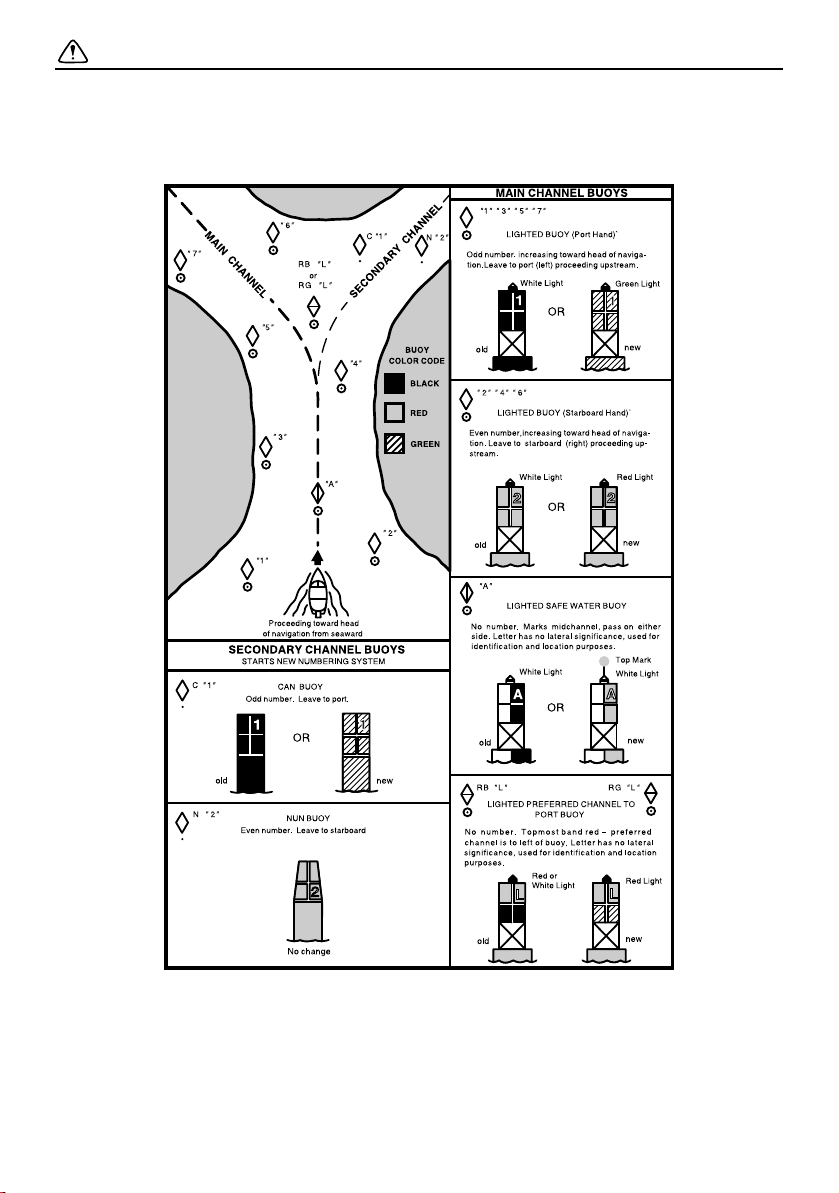
Reading buoys and other markers
The waters of the United States are marked
for safe navigation by the lateral system of
buoyage. Simply put, buoys and markers
have an arrangement of shapes, colors, num-
bers, and lights to show which side of the
buoy a boater should pass on when navigat-
ing in a particular direction. The markings on
these buoys are oriented from the perspective
of being entered from seaward (the boater is
going towards the harbor). Red buoys are
passed on your starboard (right) side when
proceeding from open water into port, and
black buoys are to your port (left) side. An
easy way to remember the meaning of the
colors is the phrase “red right returning.”
When navigating out of the harbor, your posi-
tion with respect to the buoys should be re-
versed; red buoys should be to port and black
buoys to starboard.
Many bodies of water used by boaters are en-
tirely within the boundaries of a particular
state. The Uniform State Waterway Marking
System has been devised for these waters.
SportsBoat_F3R11.book Page 23 Friday, May 19, 2017 9:35 AM
Safety information
24
This system uses buoys and signs with distinctive shapes and colors to show regulatory or ad-
visory information. These markers are white with black letters and orange borders. They signify
speed zones, restricted areas, danger areas, and general information.
Remember, markings may vary by geographic location. Always consult local boating authori-
ties before riding your boat in unfamiliar waters.
SportsBoat_F3R11.book Page 24 Friday, May 19, 2017 9:35 AM

Safety information
25
To get more boating safety
information
Be informed about boating safety. Additional
publications and information can be obtained
from many organizations, including the follow-
ing.
United States Coast Guard
Consumer Affairs Staff (G-BC)
Office of Boating, Public, and Consumer Af-
fairs
US Coast Guard Headquarters
Washington, D.C. 20593-0001
http://www.uscgboating.org
Other sources
You can find local rules by contacting the Na-
tional Association of State Boating Law Ad-
ministrators, or your local Power Squadron.
Boat Education and Training
The Online Boating Safety Course, available
through the watercraft section of the yamaha-
motor.com website, is a free, 50-question
learning course available to the public. Upon
successful completion of 80 percent or better,
the user can request a certificate of comple-
tion by mail or can download one immediate-
ly. The Online Boating Safety Course,
provided by the Boat/US Foundation, is ap-
proved by the National Association of State
Boating Law Administrators (NASBLA) and
recognized by the United States Coast
Guard. This course meets the education re-
quirement for those states that recognize non-
proctored, NASBLA-approved courses.
Enjoy your boat responsibly
You share the areas you enjoy when operat-
ing your boat with others and with nature. So
your enjoyment includes a responsibility to
treat these other people, and the lands, wa-
ters, and wildlife with respect and courtesy.
Whenever and wherever you are boating,
think of yourself as the guest of those around
you. Remember, for example, that the sound
of your boat may be music to you, but it could
be just noise to others. And the exciting
splash of your wake can make waves others
won’t enjoy. Avoid riding close to shoreline
homes and waterfowl nesting areas or other
wildlife areas, and keep a respectful distance
from fishermen, other boats, swimmers, and
populated beaches. When travel in areas like
these is unavoidable, operate slowly and
obey all laws.
Remember that pollution can be harmful to
the environment. Do not refuel or add oil
where a spill could cause damage to nature.
Keep your surroundings pleasant for the peo-
ple and wildlife that share the waterways:
don’t litter!
When you go boating responsibly, with re-
spect and courtesy for others, you help en-
sure that our waterways stay open for the
enjoyment of a variety of recreational opportu-
nities.
The Online Boating Safety Course:
http://www.boatus.org/
SportsBoat_F3R11.book Page 25 Friday, May 19, 2017 9:35 AM
26
Description
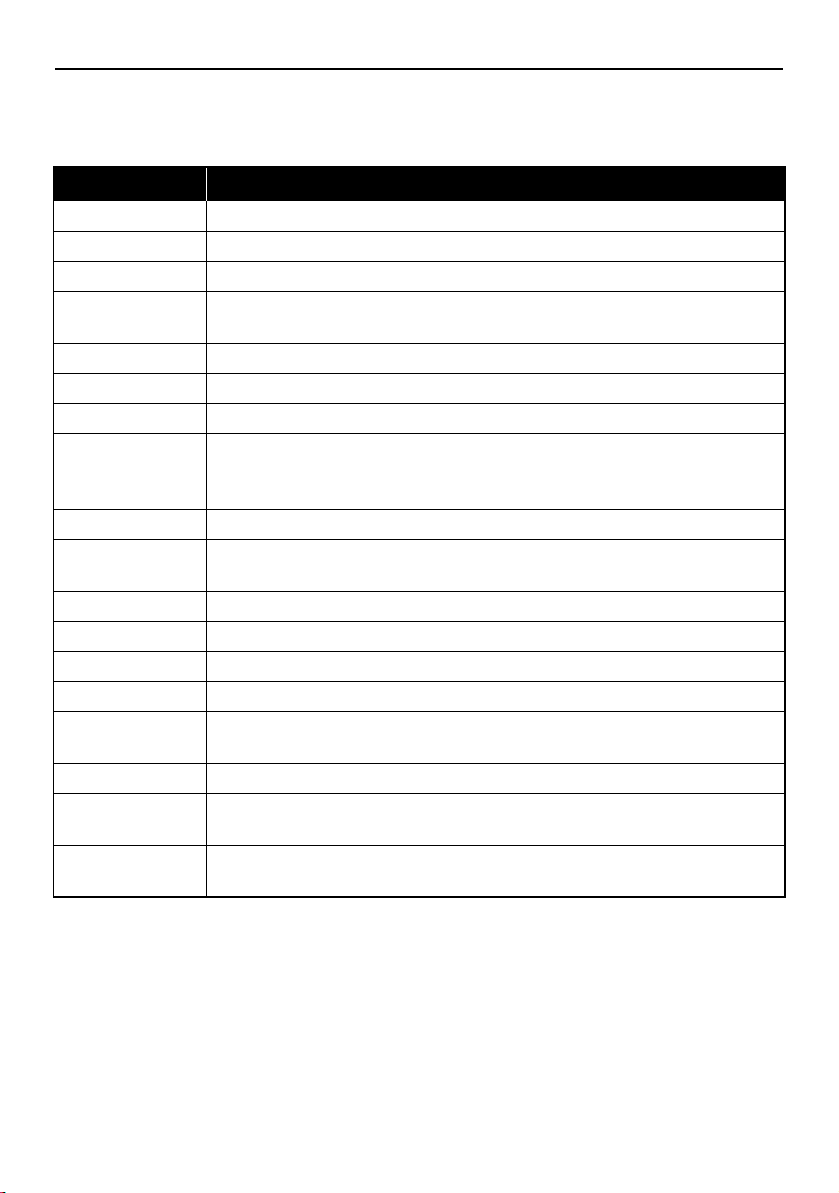
Boat glossary
TERM DEFINITION
Bow The front part of the boat.
Deck The “floor” or upper structure which covers the hull.
Give-way The vessel that must yield the right-of-way when two boats meet.
Gunwale The meeting junction of the deck and hull; the upper edge around the
boat. Pronounced “gunnel.”
Hatch An opening in the deck that provides access below.
Helm The steering console.
Hull The basic part of the boat; the underside.
Lanyard The cord or tether that connects the operator to the engine shut-off
switch so the engines will stop if the operator accidentally leaves the
helm.
PFD A personal flotation device, also known as “life jacket.”
Planing Traveling at a speed fast enough so the boat has leveled out and is
skimming on top of the water. There is a wake.
Port The left side of the boat.
Stand-on The vessel with the right-of-way when two boats meet.
Starboard The right side of the boat.
Stern The back part of the boat.
Sub-planing Traveling at a medium speed. The bow of the boat is out of the water,
but you are still traveling through the water. There is a wake.
Transom The vertical part of the stern.
Trolling Traveling at idle speed, using little or no throttle. The boat is down in the
water and it is not leaving a wake.
Wake The visible track of disturbed water that the boat leaves behind as it
moves in the water.
SportsBoat_F3R11.book Page 26 Friday, May 19, 2017 9:35 AM
Description
27
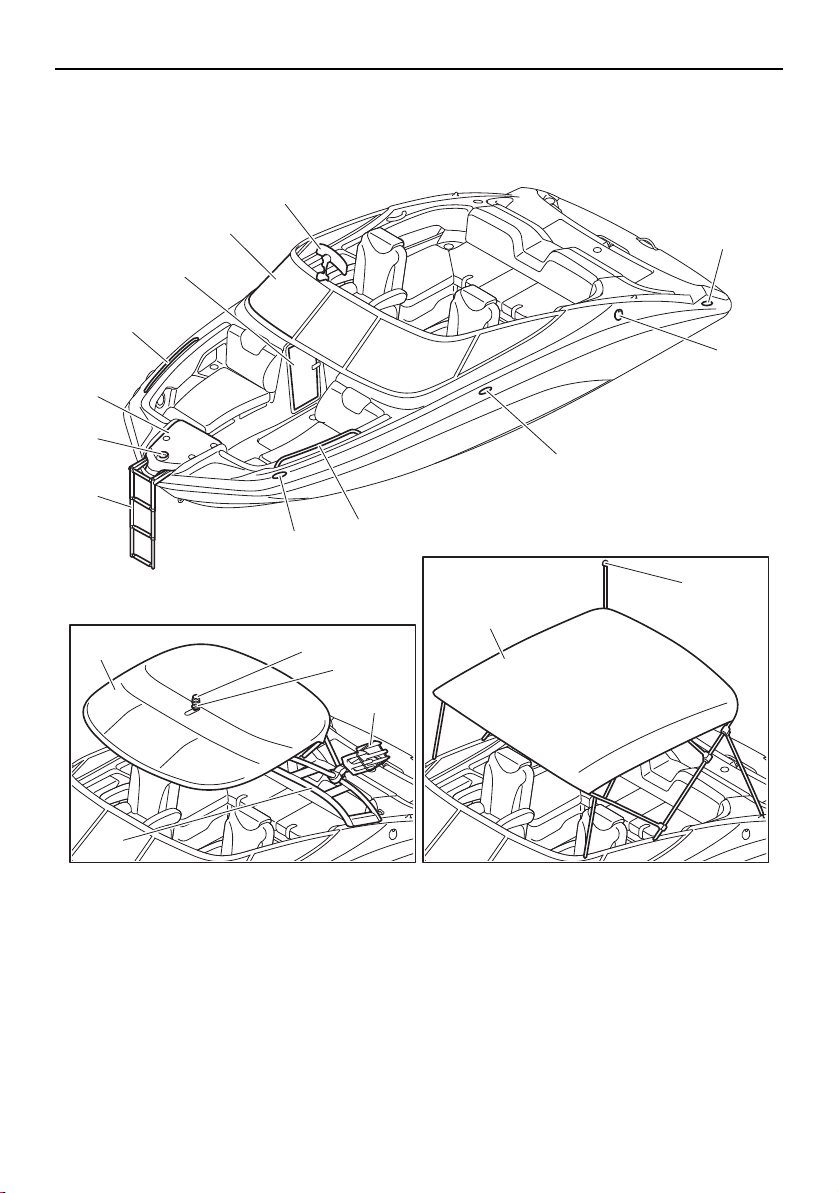
Location of main components
Exterior components
1 Bow ladder (page 102)
2 Bow light (page 52, 67)
3 Anchor storage compartment (page 92)
4 Handrail
5 Driver’s side console compartment (page 96)
6 Windshield (page 99)
7 Folding mirror (212X) (page 100)
8 Cleat
9 Fuel tank filler cap (page 115)
10 Bimini top (page 108)
11 Anchor light (page 66, 101)
12 Tow pylon
13 Wakeboard tower (page 105)
14 Wakeboard tower rack (212X)
15 Bimini top (page 112)
16 Anchor light (page 52, 101)
AR210/212X/212 Limited S
SX210/212 Limited
1
8
11
12
14
10
13
16
15
9
8
4
8
3
4
5
6
7
2
SportsBoat_F3R11.book Page 27 Friday, May 19, 2017 9:35 AM
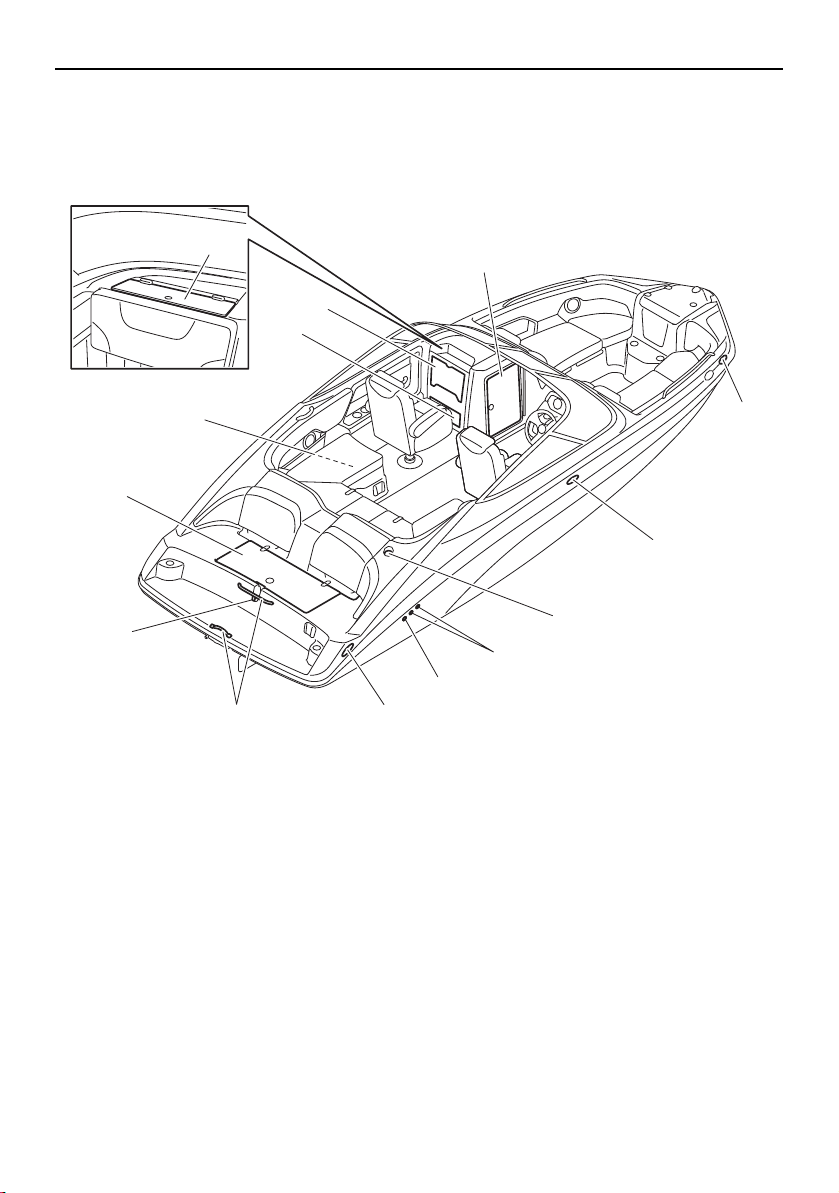
Description
28
1 Rear platform hatch (page 98)
2 Battery (page 131, 160, 161)
3 Glove compartment (page 97)
4 Stowable table (page 97)
5 Glove compartment (page 97)
6 Enclosed storage compartment (page 95)
7 Cleat
8 Anchor light socket (SX210/212 Limited)
(page 101)
9 Cooling water pilot outlet (page 136)
10 Bilge pump outlet (page 121)
11 Reboarding grip
12 Ski tow hook
11
12
1
2
4
6
7
7
8
7
10
9
3
5
AR210/SX210
SportsBoat_F3R11.book Page 28 Friday, May 19, 2017 9:35 AM

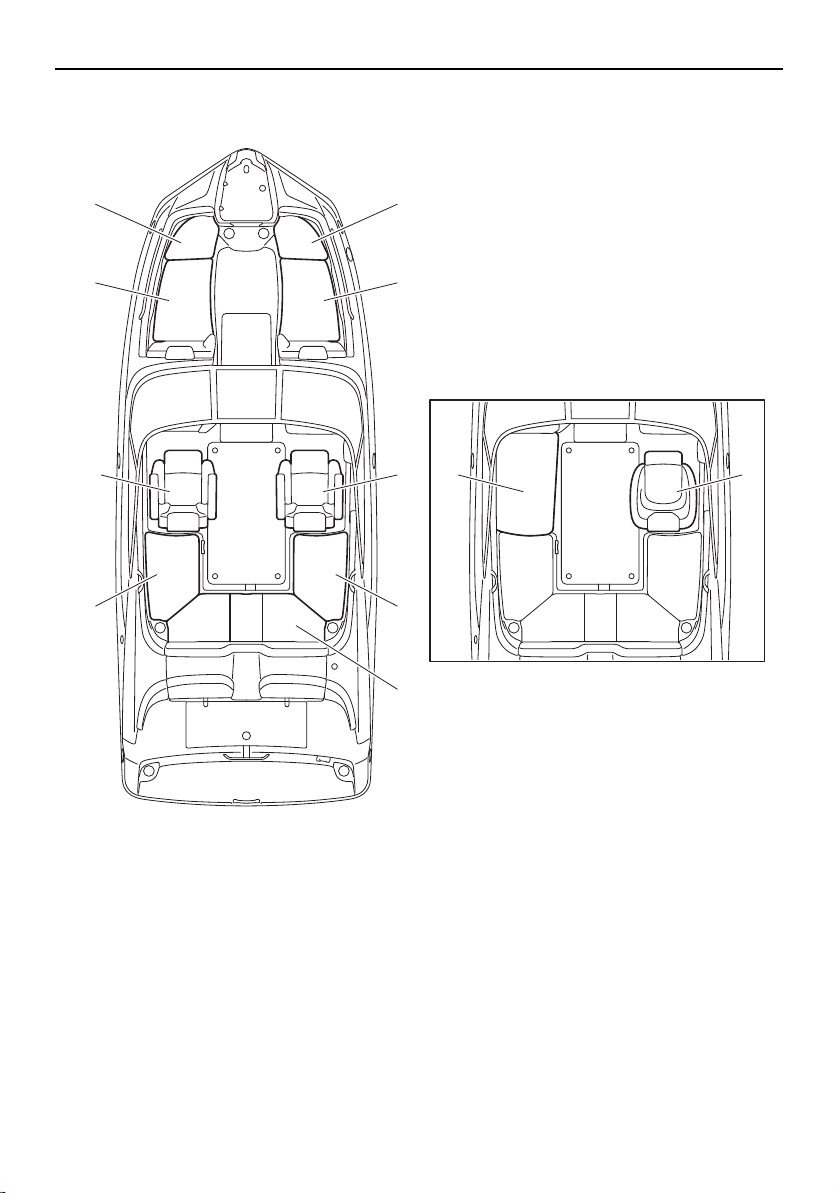
Description
30
Seats
1 Front port seat (rear) (page 87)
2 Front port seat (front) (page 87)
3 Front starboard seat (front) (page 87)
4 Front starboard seat (rear) (page 87)
5 Driver’s seat
(212X/212 Limited S/212 Limited) (page 89)
6 Driver’s seat (AR210/SX210) (page 88)
7 Rear starboard seat (page 88)
8 Rear center seat (page 88)
9 Rear port seat (page 88)
10 Passenger’s seat
(212X/212 Limited S/212 Limited) (page 91)
11 Passenger’s seat (AR210/SX210) (page 88)
2
1
10
9
3
4
5 11 6
7
8
AR210/SX210
SportsBoat_F3R11.book Page 30 Friday, May 19, 2017 9:35 AM
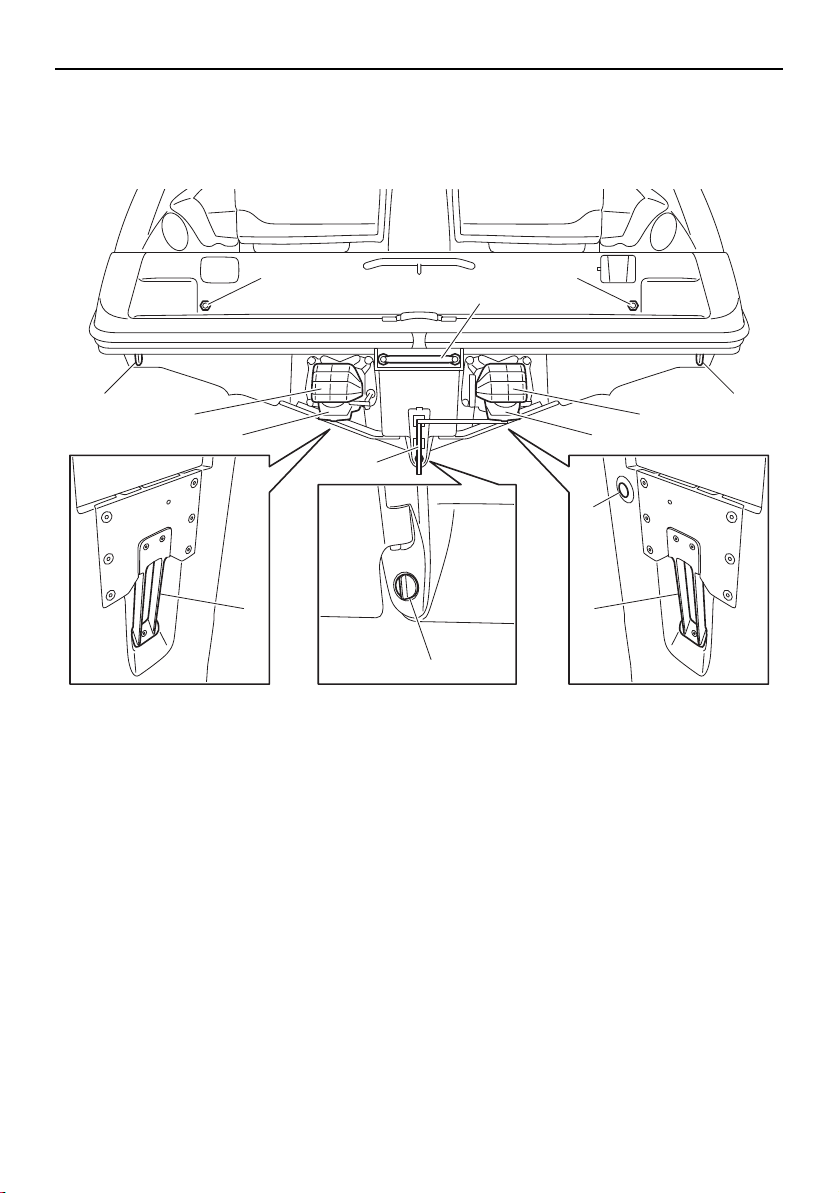
Description
31
Stern components
1 Stern ladder (page 103)
2 Stern eye
3 Shift gate (page 40)
4 Jet thrust nozzle
5 Articulating keel (page 41)
6 Intake grate
7 Hull drain plug (page 121)
8 Water temperature/water depth sensor
9 Flush hose connector (page 155)
2
1
5
3
2
4
3
4
7
6
9 9
6
8
SportsBoat_F3R11.book Page 31 Friday, May 19, 2017 9:35 AM
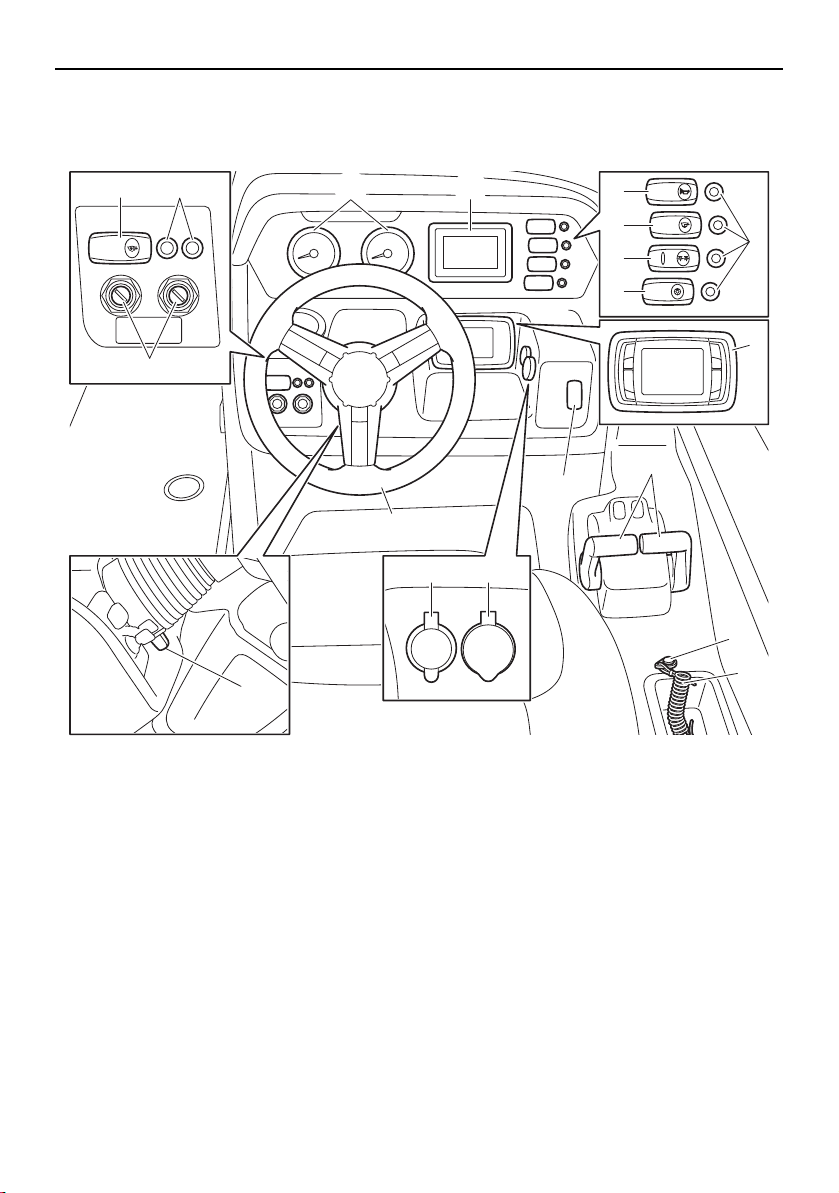
Description
32
Helm components
AR210/SX210
1 Tachometer (page 44)
2 Multi-function display unit (page 44)
3 Horn switch (page 53)
4 Bilge pump switch (page 54)
5 Navigation and anchor lights switch (page 52)
6 Courtesy light switch (page 52)
7 Switch circuit breaker (page 57)
8 Audio control keypad (page 58)
9 No-wake mode/cruise assist switch (page 50)
10 Remote control lever (page 39)
11 Engine shut-off switch (page 37)
12 Engine shut-off cord (lanyard) (page 37)
13 Aux input (page 58)
14 12 V DC outlet (page 58)
15 Steering wheel (page 41)
16 Tilt lever (page 42)
17 Main switch (page 39)
18 Blower switch (page 54)
12V
AUDIO
AUX-USB
BLOWER
BILGE
NAVI
ANC
HORN
CTSY
LIGHTS
15
1 2
9
7
3
4
5
6
11
12
10
17
18 7
16
1314
8
SportsBoat_F3R11.book Page 32 Friday, May 19, 2017 9:35 AM
Description
33
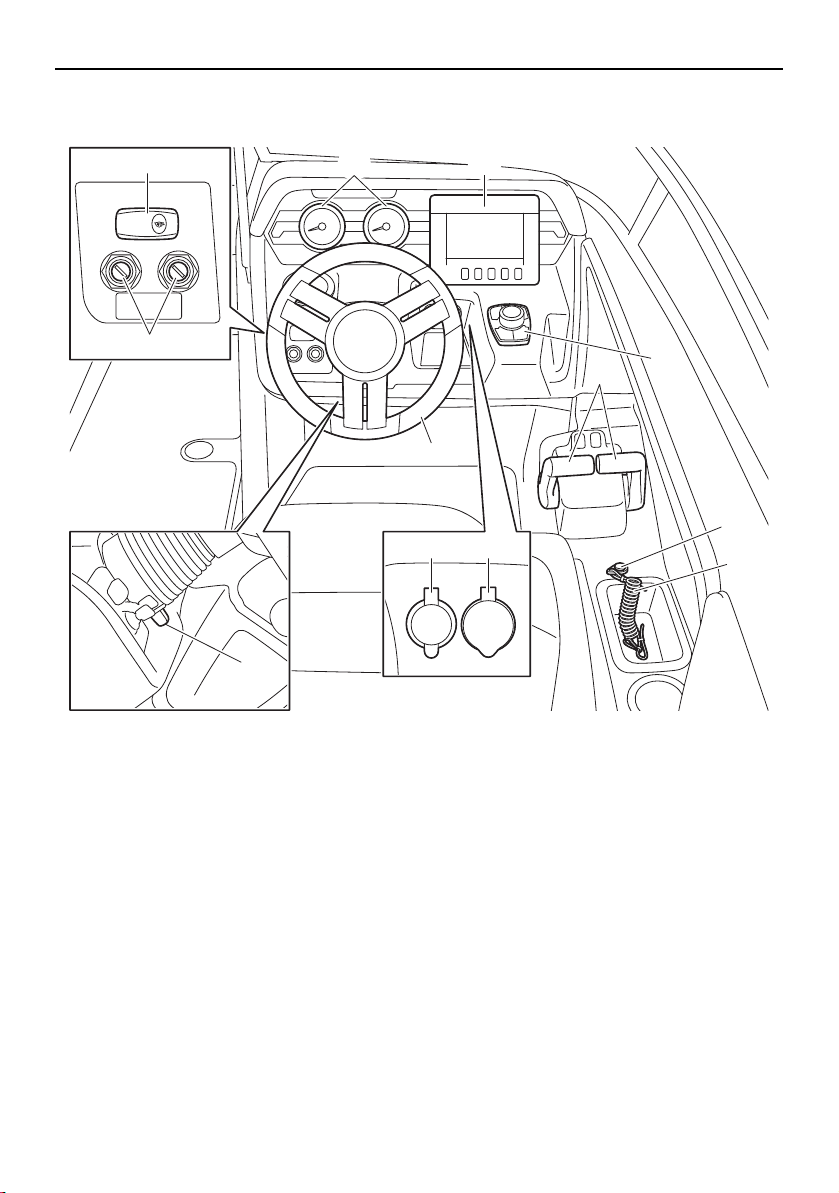
212X/212 Limited S/212 Limited
1 Tachometer (page 60)
2 Multi-function display unit (page 60)
3 Controller (page 60)
4 Remote control lever (page 39)
5 Engine shut-off switch (page 37)
6 Engine shut-off cord (lanyard) (page 37)
7 Aux input (page 74)
8 12 V DC outlet (page 86)
9 Steering wheel (page 41)
10 Tilt lever (page 42)
11 Main switch (page 39)
12 Blower switch (page 70)
BLOWER
12V
AUDIO
AUX-USB
9
1 2
3
5
6
4
11
12
10
78
SportsBoat_F3R11.book Page 33 Friday, May 19, 2017 9:35 AM
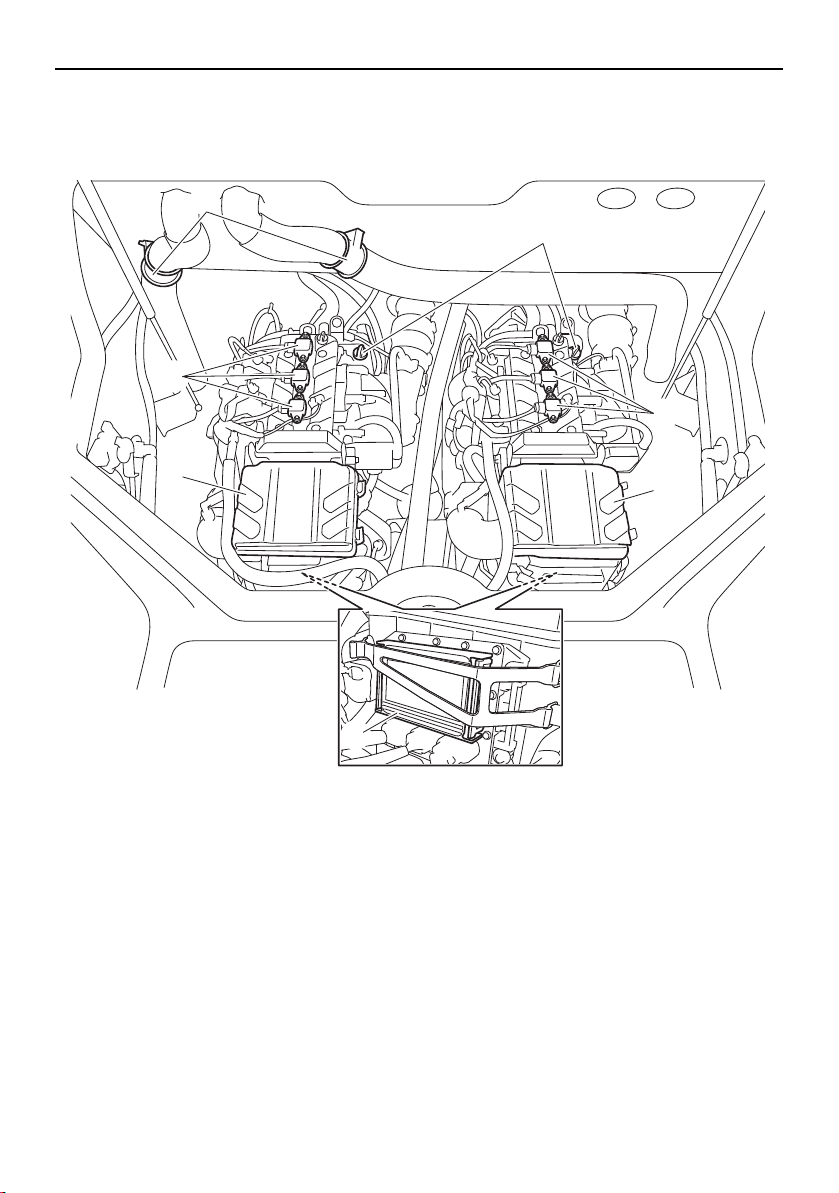
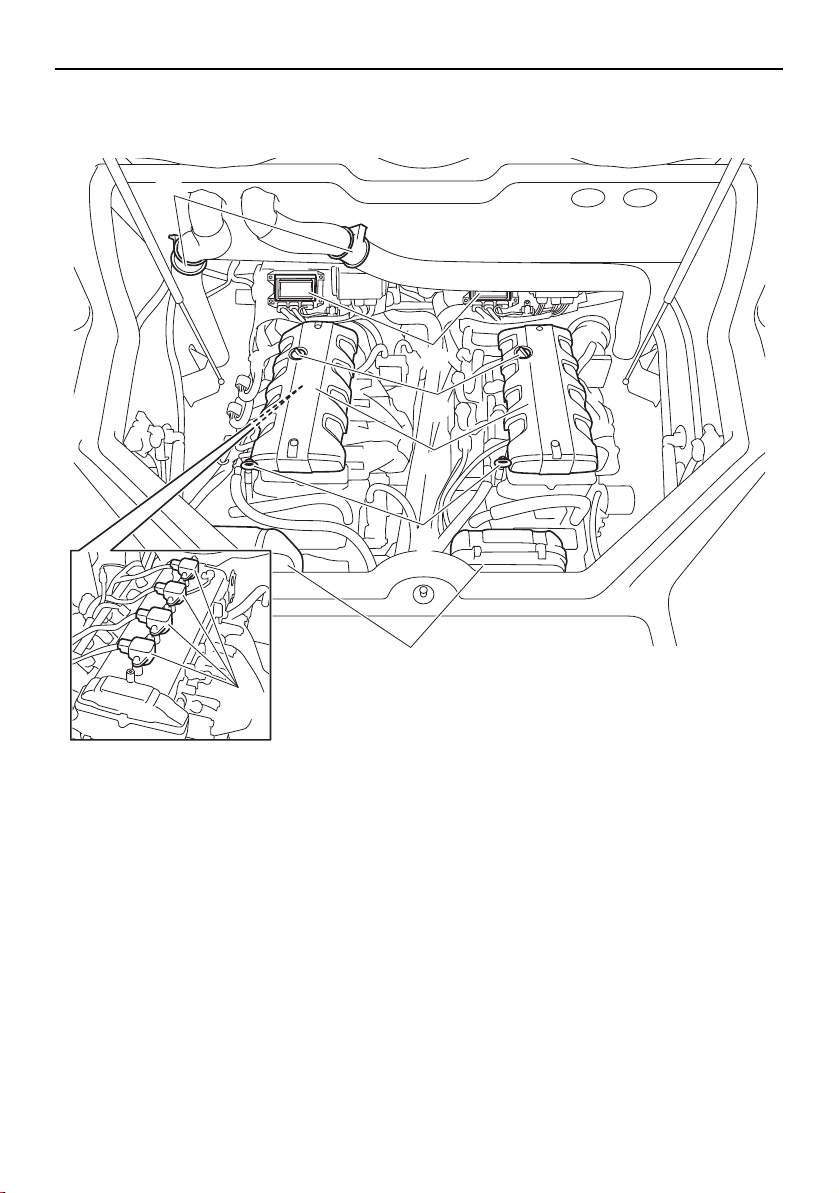
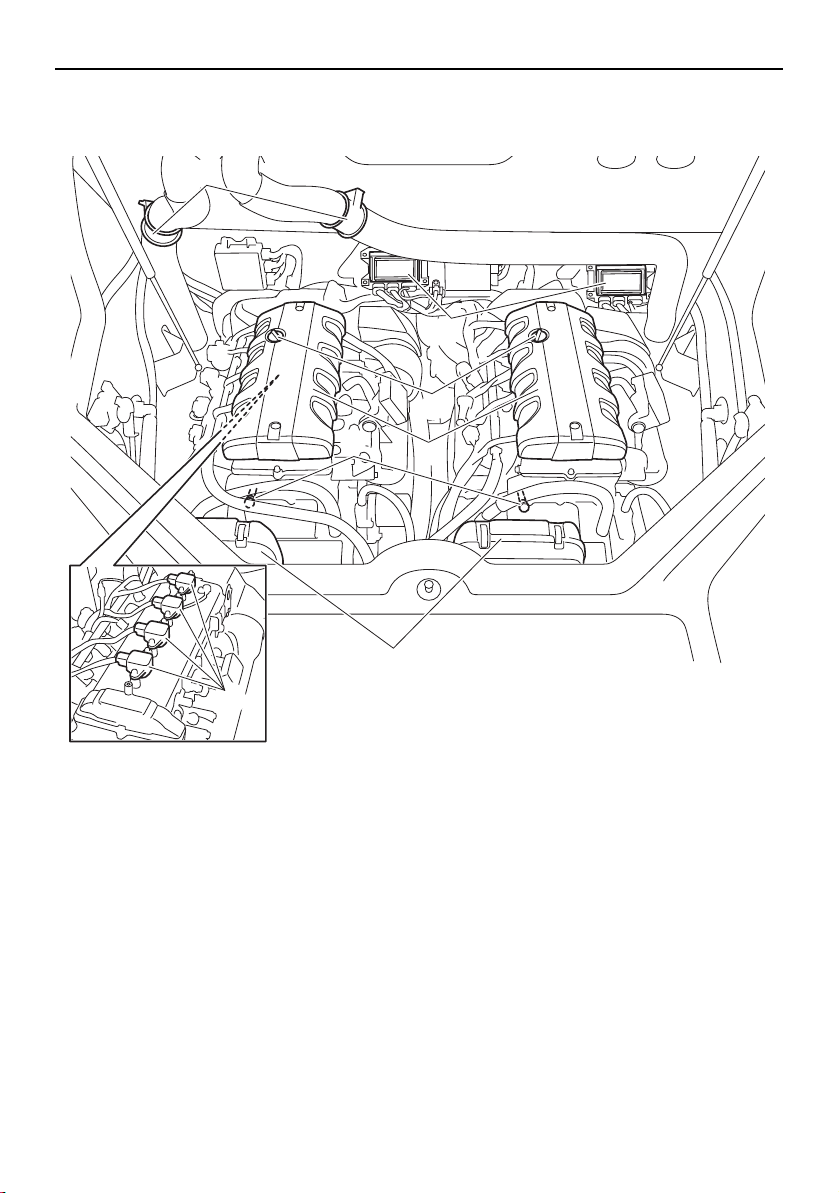
37
Control function operation
Boat control functions
Engine shut-off switch
WARNING
● Always attach the engine shut-off cord
(lanyard) to your PFD before starting the
engines. Failure to attach the cord could
result in a runaway boat if the operator is
ejected.
● Do not attach the cord to clothing that
could tear loose. Do not route the cord in
such a way that it could become entan-
gled, preventing it from functioning.
● Avoid accidentally pulling the cord dur-
ing normal operation. Once the engines
have stopped, you have no steering con-
trol of the boat which could result in an
accident. Also, without engine power,
the boat could slow rapidly from planing
speed. This could cause people and ob-
jects in the boat to be thrown forward,
which could cause injury.
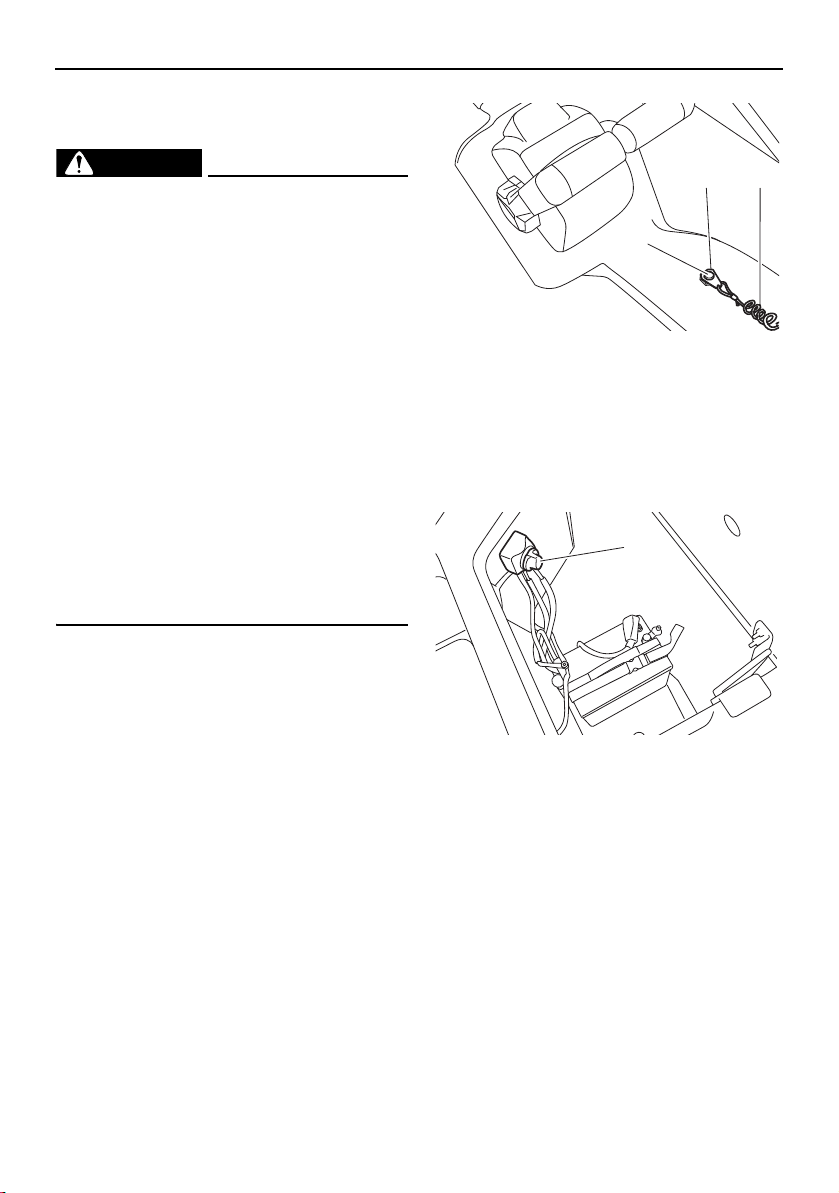
The clip on the end of the engine shut-off cord
(lanyard) must be attached to the engine shut-
off switch for the engines to run. The cord
must be attached to a secure place on the op-
erator’s PFD. Should the operator fall over-
board or leave the helm, the cord will pull out
the clip, stopping the ignition to the both en-
gines. This will prevent the boat from running
away under power.
1 Engine shut-off switch
2 Clip
3 Engine shut-off cord (lanyard)
Battery switch (AR210 / SX210)
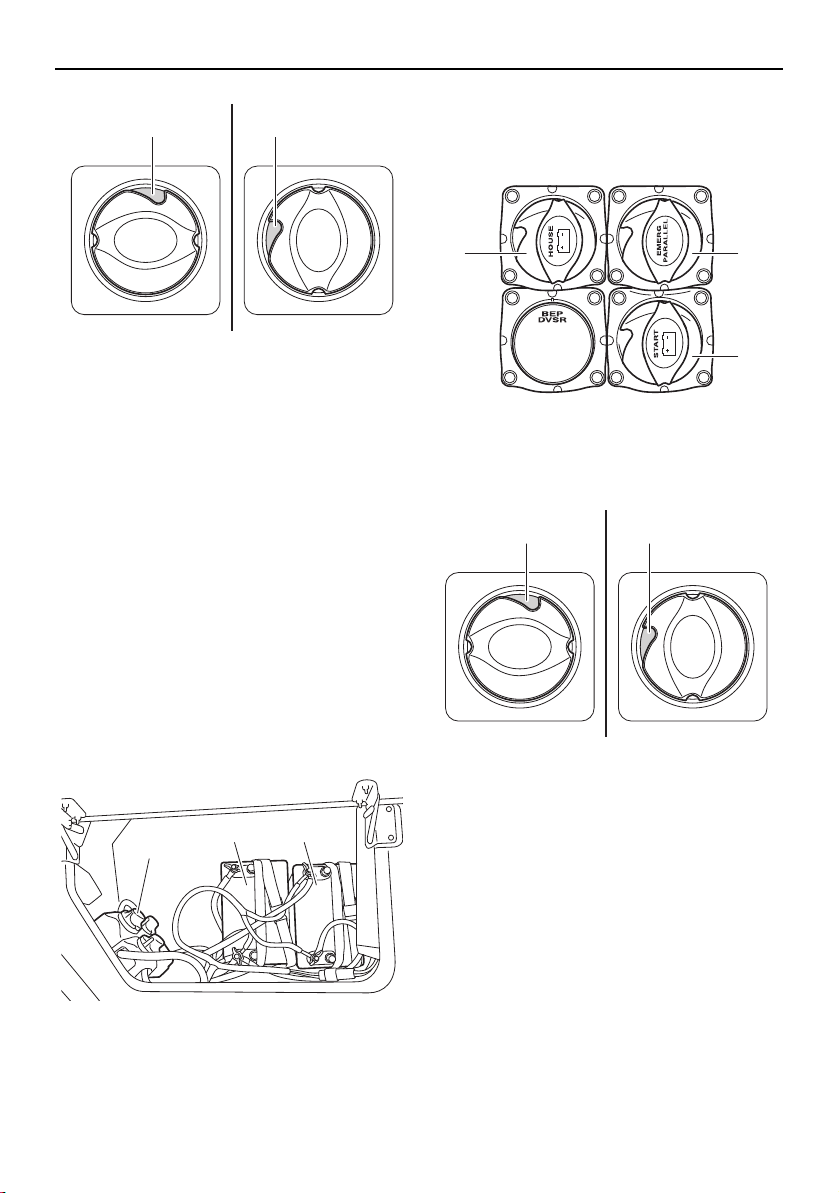
The battery switch is located in the rear under-
seat storage compartment (port).
1 Battery switch
Turn the battery switch to the OFF position
when the boat will not be used again right
away. Turning the switch to the OFF position
will prevent the battery from being drained if
another electrical switch is accidentally left in
the on position. NOTICE: Do not turn the
battery switch to the OFF position if the
boat is moored in the water as it will pre-
vent the anchor light from functioning.
1
2 3
1
SportsBoat_F3R11.book Page 37 Thursday, September 20, 2018 5:42 PM
Control function operation
38
1 ON position (green)
2 OFF position (red)
Battery switches
(212X / 212 Limited S / 212 Limited)
The batteries and switch assembly are locat-
ed in the rear underseat storage compartment
(port).
This boat uses two marine batteries. One bat-
tery is designated as the start battery. The
start battery is connected to the starter circuits
on both engines to provide current for the
starter motors.
The other battery is designated as the house
battery. The house battery provides power for
the various accessory circuits on the boat,
such as the circuits for lighting, bilge pump,
blowers and audio system.
1 Battery switch assembly
2 Start battery
3 House battery
There are three switches on the battery switch
assembly: the “START” switch, “HOUSE”
switch, and “EMERG PARALLEL” switch.
1 “HOUSE” switch (red)
2 “EMERG PARALLEL” switch (yellow)
3 “START” switch (red)
1 ON position (green)
2 OFF position (red)
In normal operation, keep the “START” and
“HOUSE” switches in the ON position. Keep
the “EMERG PARALLEL” switch in the OFF
position. This setting allows both batteries to
be charged automatically while the engines
are running. NOTICE: Do not turn the
“HOUSE” switch to the OFF position if the
boat is moored in the water as it will pre-
vent the anchor light from functioning.
1 2
1
2 3
21
3
1 2
SportsBoat_F3R11.book Page 38 Thursday, September 20, 2018 5:42 PM
Control function operation
39
If the start battery is discharged, turn the
“EMERG PARALLEL” switch to the ON posi-
tion to start the engines. Once the engines are
started or the start battery is charged, turn the
“EMERG PARALLEL” switch to the OFF posi-
tion.
Main switches
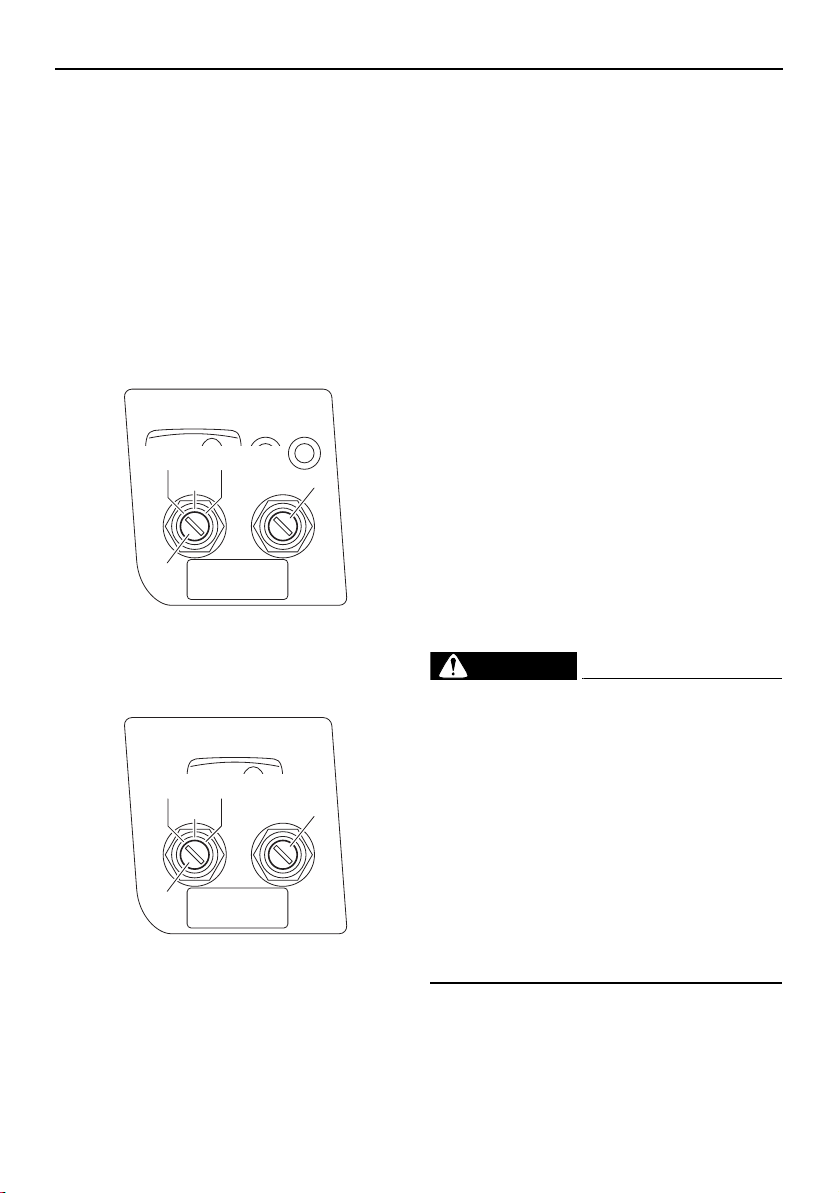
There is a main switch for each engine.
The main switch controls the ignition and
electrical circuits as follows:
AR210 / SX210
1 Main switch (port engine)
2 Main switch (starboard engine)
212X / 212 Limited S / 212 Limited
1 Main switch (port engine)
2 Main switch (starboard engine)
OFF:
Ignition circuit is switched off. The engine can-
not be started, but other switches will operate.
(The main switch key can be removed.)
ON:
Ignition circuit is switched on. (The main
switch key cannot be removed.)
START:
The starter motor will turn to start the engine.
(When the main switch key is released, it re-
turns automatically to “ON”.)
TIP:
● The engine will not start when the clip is re-
moved from the engine shut-off switch. The
starter motor will turn over without the cord
attached.
● The main switch will not operate (the starter
motor will not turn over) if the battery switch
in the rear underseat storage compartment
(port) is turned to the OFF position. (See
page 37 for more information.)
Remote control levers
WARNING
● Before shifting, make sure there are no
swimmers or obstacles in the water near
you.
● When operating in reverse, go slowly.
Do not open the throttle more than half.
Otherwise, the boat may become unsta-
ble, which could result in loss of control
and an accident.
● Do not shift into reverse while traveling
at planing speeds. Loss of control, boat
swamping, or damage to the boat could
occur.
The remote control lever for each engine con-
trols both throttle and shifting. In normal oper-
ation, the levers are moved together.
BLOWER
ON
OFF START
1
2
BLOWER
ON
OFF START
1
2
SportsBoat_F3R11.book Page 39 Friday, May 19, 2017 9:35 AM
Control function operation
40
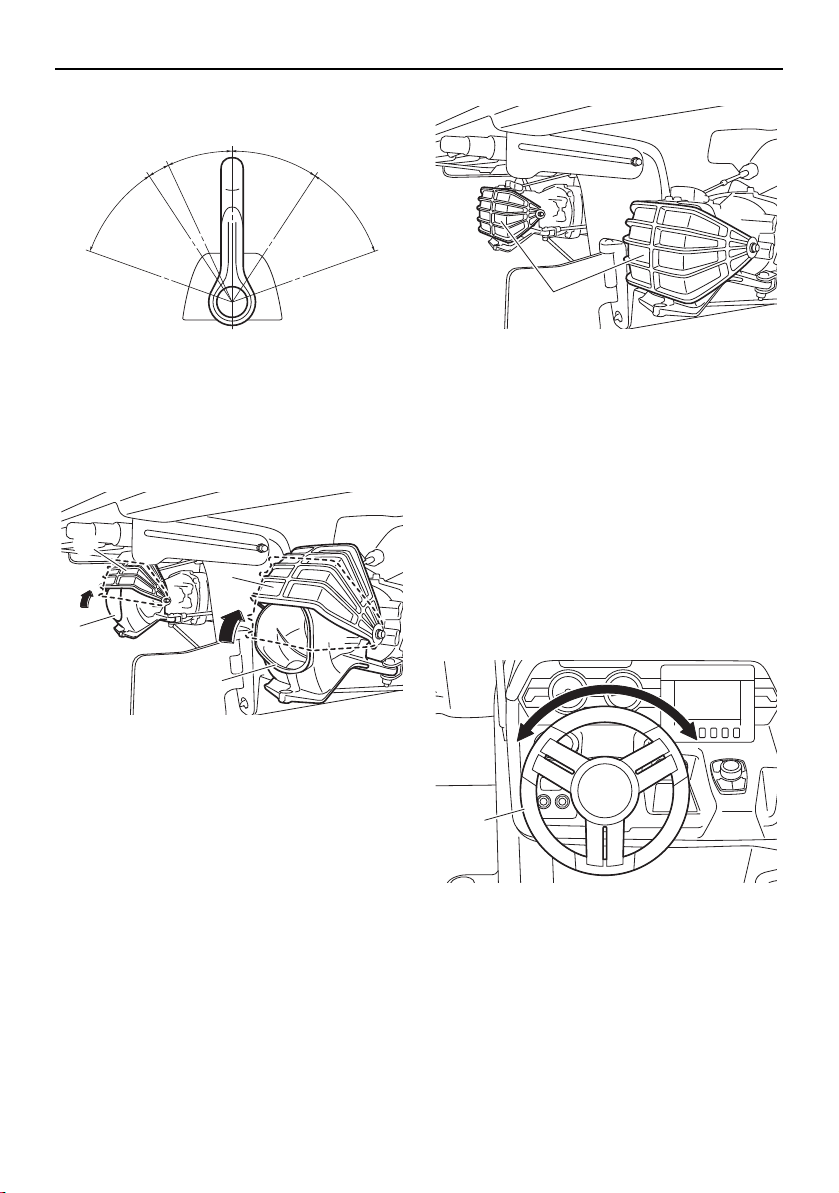
Moving the remote control levers forward from
the neutral position shifts into the forward po-
sition, and then as the levers are moved far-
ther, accelerates the engines for more thrust.
Moving the levers back from the neutral posi-
tion shifts into the reverse position, and then
as the levers are moved farther, accelerates
the engines for more thrust.
For cruising, adjust the remote control levers
so both engines are running at the same en-
gine speed.
TIP:
Because of the mechanical throttle linkage,
the remote control levers may not be exactly
even with one another when the engines are
running at the same engine speed.
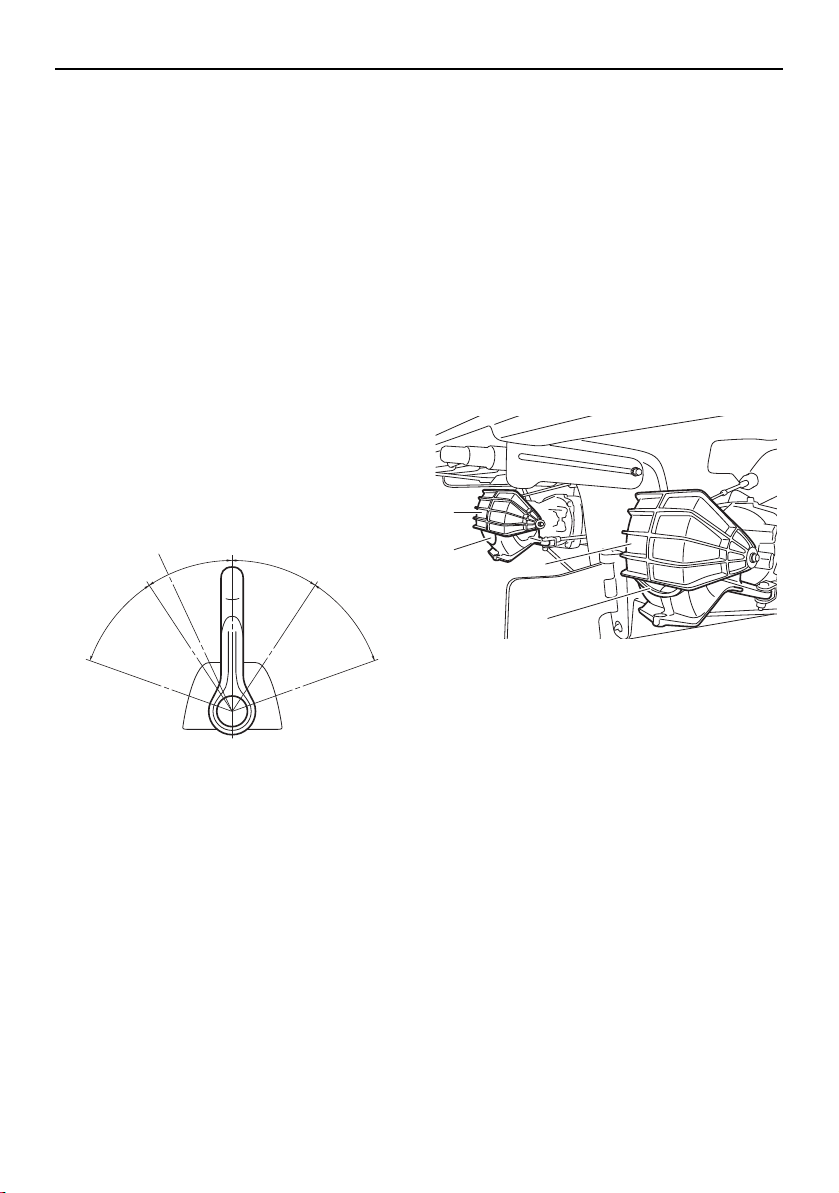
1 Neutral position
2 TDE position
3 Forward position
4 Reverse position
5 Shift
6 Fully closed
7 Throttle
8 Fully open
TIP:
This boat is equipped with a “start-in-gear”
protection. The engines will not start unless
the levers are in the neutral position.
This boat uses a direct-drive propulsion sys-
tem. Therefore, jet thrust is always being pro-
duced while the engines are running. The
direction of the boat is controlled by the shift
gates, which direct the flow of the jet thrust as
follows:
Neutral
The shift gates are dropped down part way
over the jet thrust nozzles. The neutral posi-
tion balances forward and reverse thrust to
help keep the boat from moving, although
some movement may occur.
1 Shift gate
2 Jet thrust nozzle
Forward
When the remote control levers are initially
moved to the forward position and the boat is
operating at a slow speed, the shift gates are
lifted up slightly from the neutral position and
jet thrust is directed downward at an angle.
This function, which is called the thrust direc-
tional enhancer (TDE), helps to provide good
handling response when the steering wheel is
turned, even though there is less thrust avail-
able at low engine speeds.
N
1
F
8
7
3
R
4
2
55
7
6
8
6
1
2
1
2
SportsBoat_F3R11.book Page 40 Friday, May 19, 2017 9:35 AM
Control function operation
41
1 TDE position
When the remote control levers are moved
farther forward, the shift gates are lifted all the
way up. All jet thrust is to the rear, which
moves the boat forward.
1 Shift gate
2 Jet thrust nozzle
Reverse
The shift gates are dropped all the way down
over the jet thrust nozzles. Jet thrust is redi-
rected toward the bow of the boat, which
moves the boat backward.
1 Shift gate
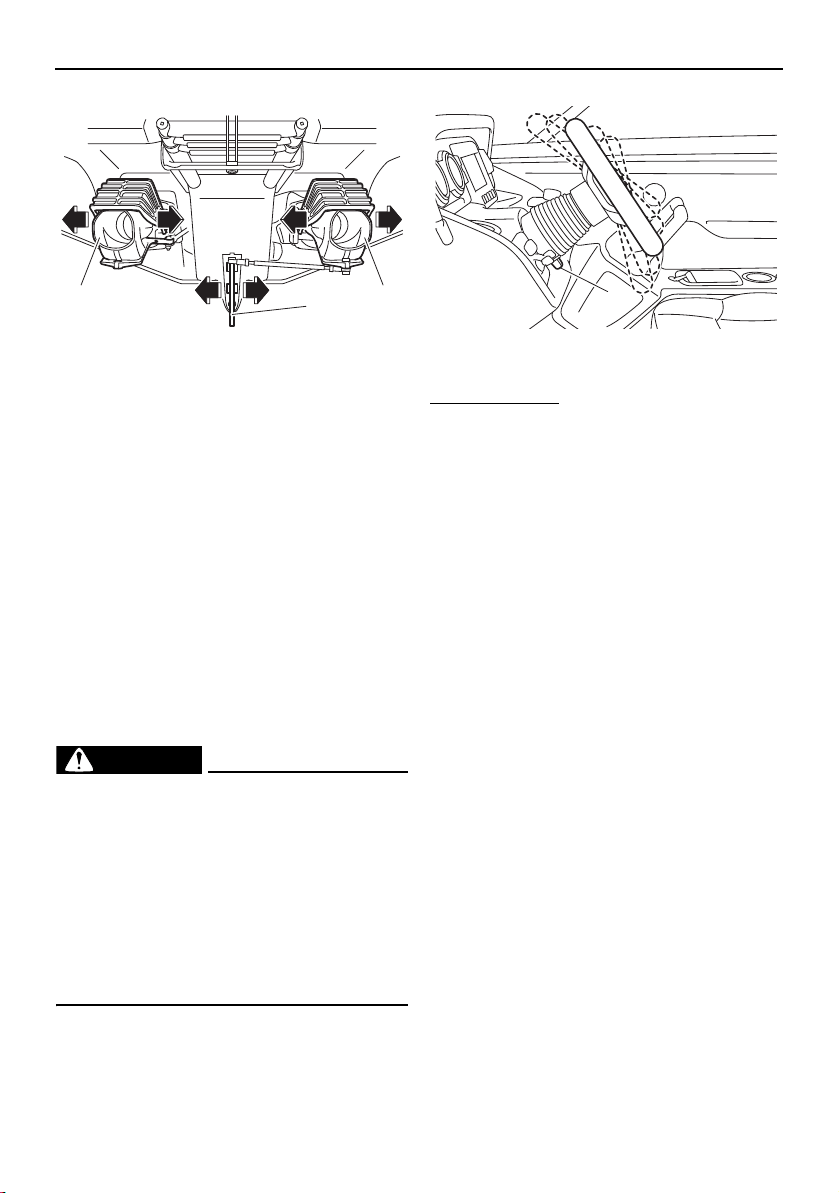
Steering
Your boat can be steered by turning the steer-
ing wheel the same direction you wish to trav-
el, to the right or left. When the steering wheel
is turned, the angle of the jet thrust nozzles at
the rear of the craft is changed, and the
change in direction of the jet thrust nozzles
changes the direction of the boat accordingly.
In addition, the direction of the articulating
keel changes according to the movement of
the jet thrust nozzles.
1 Steering wheel
N
F
1
R
2
2
1
1
1
1
SportsBoat_F3R11.book Page 41 Friday, May 19, 2017 9:35 AM
Control function operation
42
1 Jet thrust nozzle
2 Articulating keel
Since the strength of the jet thrust determines
the speed and direction of a turn, the throttle
must always be opened above idle when at-
tempting a turn, except at trolling speed.
Because boats steer from the stern, the stern
of the boat swings out in the opposite direction
of your turn. If you turn to starboard, for exam-
ple, the stern of the boat will swing to the left.
Keep this in mind when navigating near a per-
son in the water, such as a down wakeboard-
er or water-skier, or an obstacle, such as a
dock.
Tilt lever
WARNING
● Never touch the tilt lever during opera-
tion, otherwise the steering wheel could
suddenly change position, which may
lead to an accident.
● Be sure the steering wheel is locked in
position after adjustment. If the steering
wheel is not locked in position, it may
suddenly change position during opera-
tion, which may lead to an accident.
The tilt lever is located under the steering
wheel and is used to adjust the tilt of the steer-
ing wheel. There are 5 positions.
1 Tilt lever
To adjust the tilt:
(1) Push the lever down, and then move the
steering wheel up or down to the desired
position.
(2) The lever will lock into place when the
steering wheel is moved into one of the 5
available positions.
(3) Make sure that the tilt lever returns to its
original position and that the steering
wheel is securely locked in place.
1
2
1
1
SportsBoat_F3R11.book Page 42 Friday, May 19, 2017 9:35 AM
43
Instrument operation
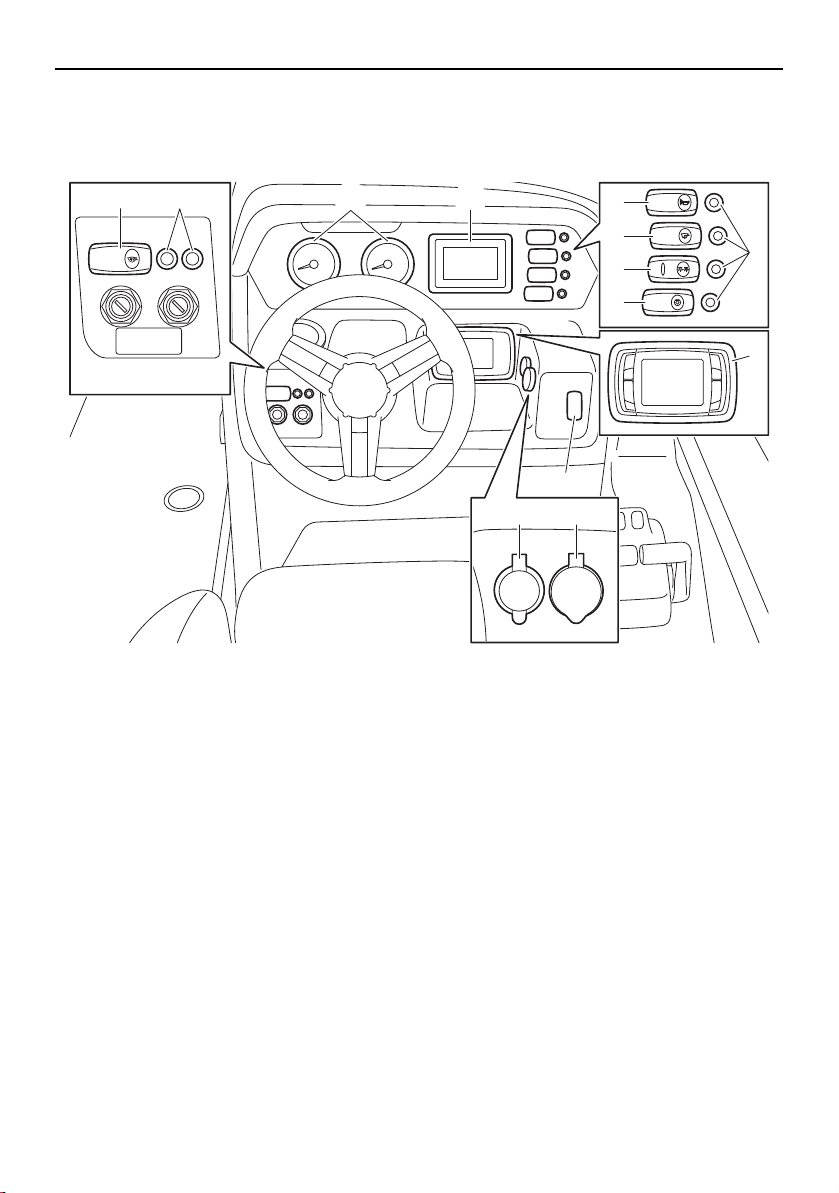
Helm controls (AR210 / SX210)
1 Tachometer
2 Multi-function display unit
3 Horn switch
4 Bilge pump switch
5 Navigation and anchor lights switch
6 Courtesy light switch
7 Switch circuit breaker
8 Audio control keypad
9 No-wake mode/cruise assist switch
10 Aux input
11 12 V DC outlet
12 Blower switch
12V
AUDIO
AUX-USB
BLOWER
BILGE
NAVI
ANC
HORN
CTSY
LIGHTS
1 2
9
7
3
4
5
6
12 7
1011
8
SportsBoat_F3R11.book Page 43 Friday, May 19, 2017 9:35 AM
Instrument operation
44
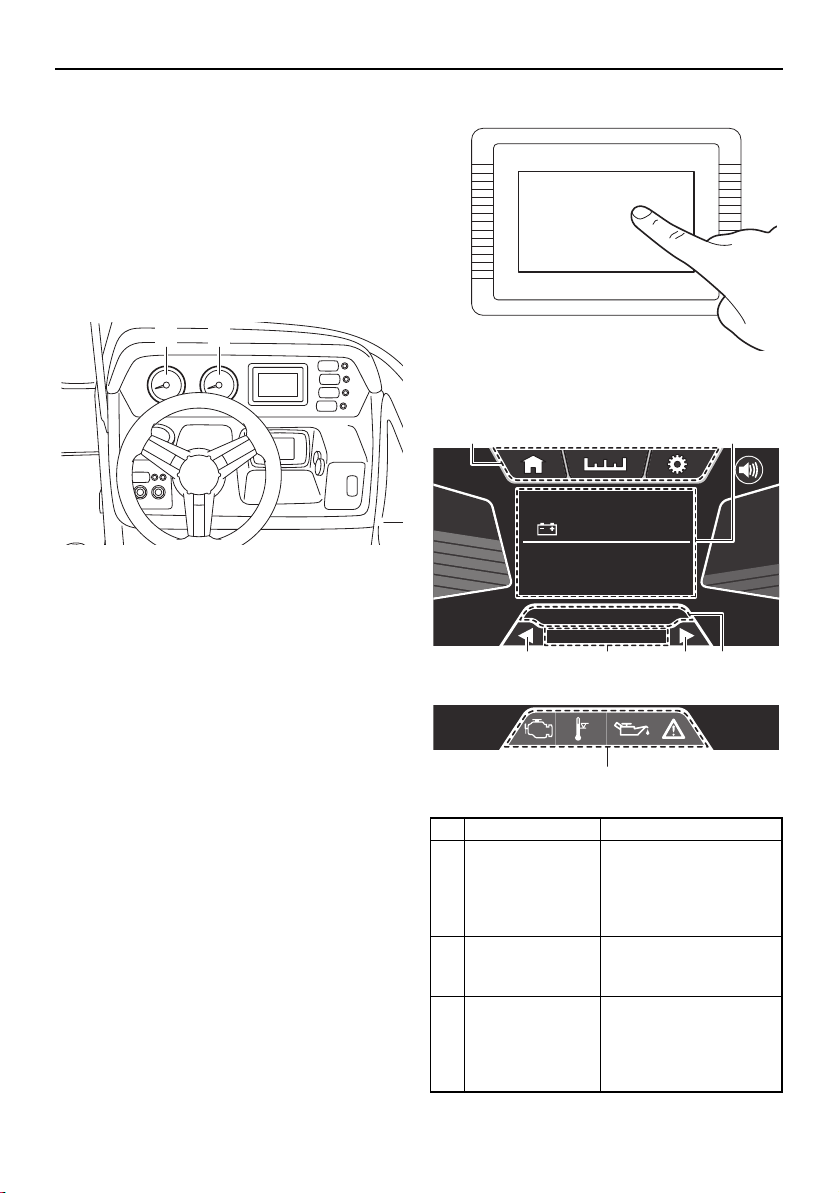
Tachometers
The boat is equipped with two tachometers.
The tachometer on the left is for the port en-
gine. The one on the right is for the starboard
engine.
The analog tachometers show the engine
speed. The numbers on the meters show the
engine speed × 1000 rpm (r/min).
1 Port tachometer
2 Starboard tachometer
TIP:
The tachometer starts operating when the en-
gine is started. At the same time, the buzzer
will sound.
Multi-function display unit operation
Because the multi-function display unit is
equipped with a touch screen, you can touch
the display directly to operate the display
functions.
Touching the multi-function display
Multi-function display elements
1 2
Name Function
1 Screen tab bar Shows the 3 tabs for
the screens that can be
displayed on the multi-
function display. (See
page 45.)
2 Center display Shows various infor-
mation and settings for
each screen.
3 Title bar Shows the title of the
currently selected
screen. This bar will
appear only if there are
no current warnings.
1.5 Hrs
PORT
1.6 Hrs
STBD
STBD 1.6 Hrs
Water
77˚F
12.0V
- Float Mode -
4
Depth
ft
50
Fuel
%
10:15 am
6 4 35
21
1.5 Hrs
PORT
1.6 Hrs
STBD
7
SportsBoat_F3R11.book Page 44 Friday, May 19, 2017 9:35 AM
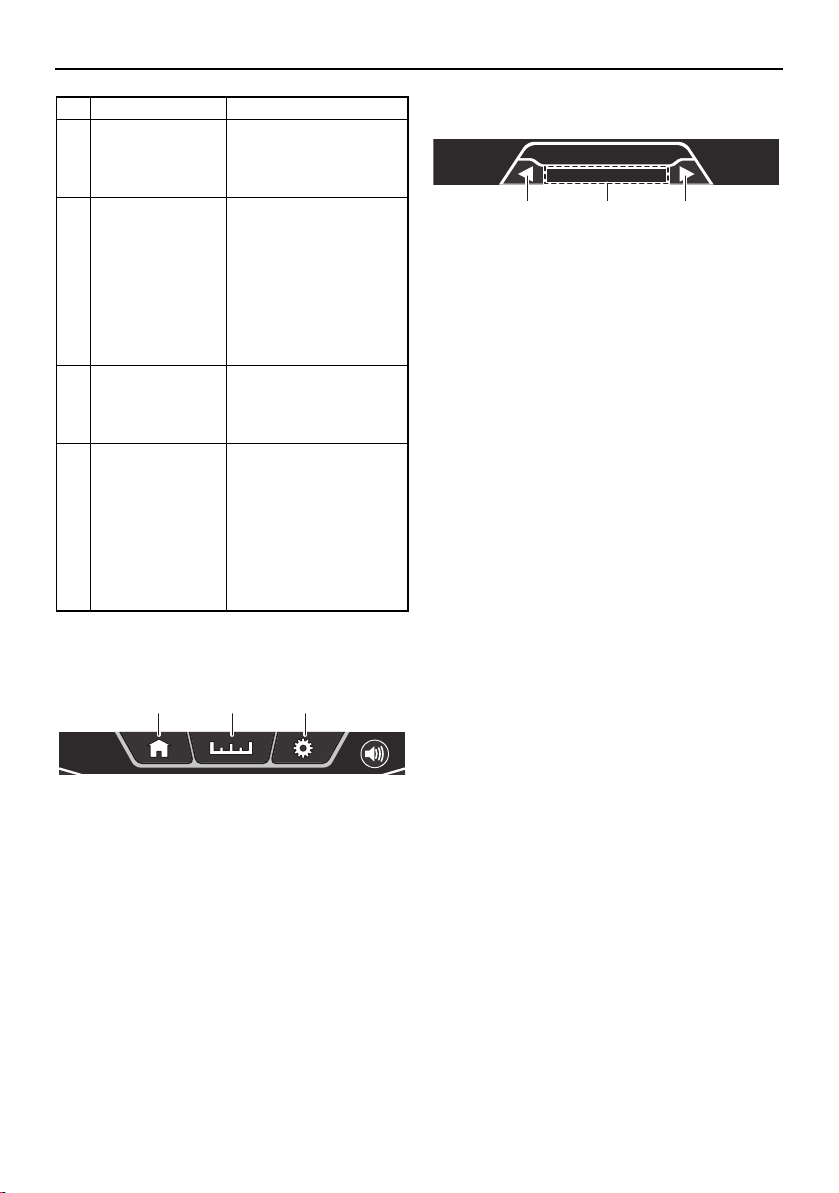
Instrument operation
45
Screen tabs (screen tab bar)
1 Home screen tab
2 Trip screen tab
3 Setting screen tab
The tab for the currently displayed screen is
shown in green.
Data bar
1 Data bar
2 Right arrow
3 Left arrow
The data bar can display the following infor-
mation.
TIP:
To change the information displayed in the
data bar, tap the left arrow or right arrow. The
information displayed in the data bar changes
in the following order:
Average fuel consumption → Trip distance →
Fuel rate → Fuel used → Port engine hours →
Starboard engine hours → Water tempera-
ture
Average fuel consumption
This display shows the average distance that
can be traveled on 1.0 gallon or 1.0 liter of fu-
el.
Trip distance
This display shows the distance traveled by
the boat in miles or kilometers.
Fuel rate
This display shows the total fuel consumption
of the port and starboard engines in gallons
per hour or liters per hour.
Fuel used
This display shows the total fuel that has been
consumed by the port and starboard engines
in gallons or liters.
4 Right arrow Tap this arrow to
change the informa-
tion displayed in the
data bar.
5 Data bar Shows various types of
data. This bar will ap-
pear only if there are
no current warnings.
The displayed data can
be changed by tapping
the left arrow or right
arrow. (See the “Data
bar”.)
6 Left arrow Tap this arrow to
change the informa-
tion displayed in the
data bar.
7 Warning bar Shows current warn-
ings. This bar will ap-
pear only if there are
current warnings. If
there are no current
warnings to display, it
will be replaced by the
data bar and the title
bar.
Name Function
10:15 am
1 2 3
1.5 Hrs
PORT
1.6 Hrs
STBD
STBD 1.6 Hrs
- Settings -
3 21
SportsBoat_F3R11.book Page 45 Friday, May 19, 2017 9:35 AM
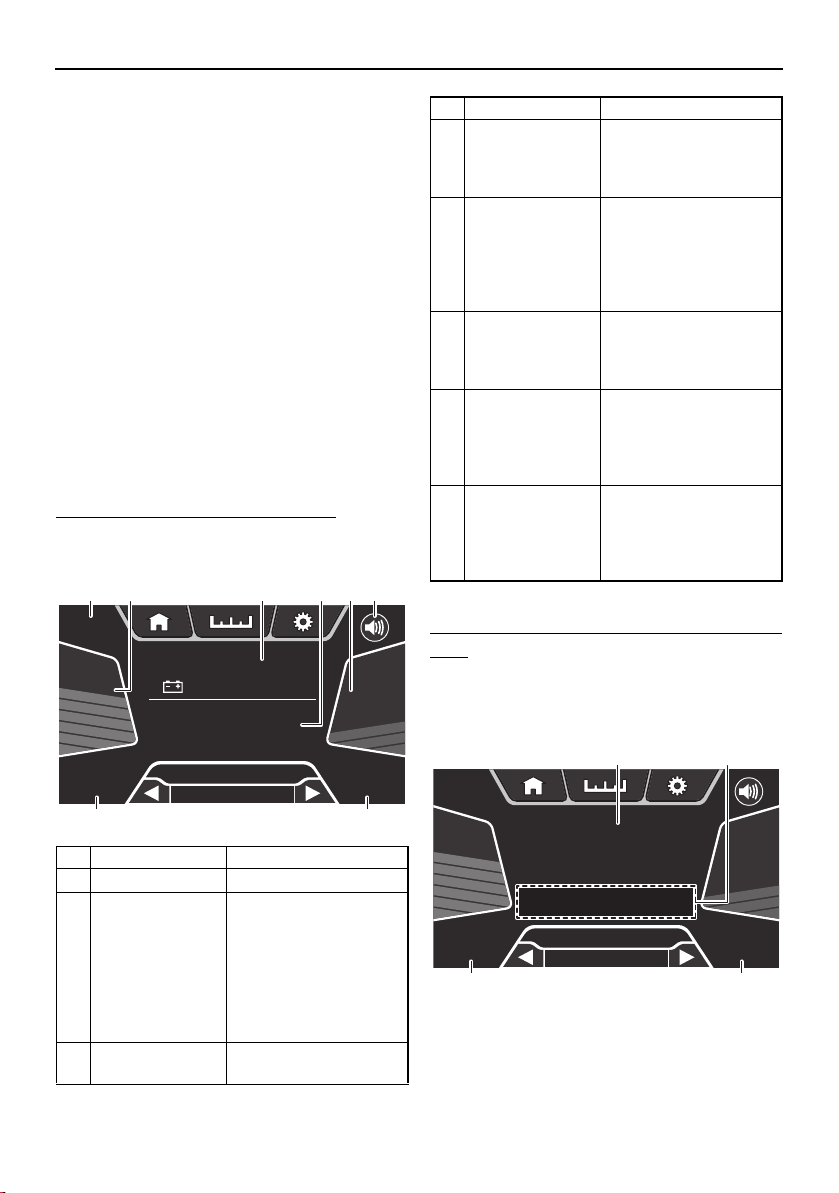
Instrument operation
46
Engine hours (port and starboard)
This display shows the total number of hours
that the port and starboard engines have
been running since the boat was new.
Water temperature
This display shows the ambient water temper-
ature in degrees Fahrenheit or degrees Cel-
sius.
Information display (home screen tab)
The home screen can display various types of
information.
The information that can be displayed varies
depending on whether one of the engines is
running.
When both engines are not running:
The screen displays the fuel level, water tem-
perature, engine hours, and other information.
When one engine or both engines are run-
ning:
The screen displays the boat speed, engine
speed, and operating status of the cruise as-
sist and no-wake mode.
Name Function
1 Clock Shows the time.
2 Fuel level bar
graph
Shows the amount of
fuel remaining in the
fuel tank. Depending
on the amount of re-
maining fuel, the bar
graph is displayed in 3
colors: green, orange,
and red.
3 Voltage level Shows the battery volt-
age of the boat battery.
1.5 Hrs
PORT
1.6 Hrs
STBD
STBD 1.6 Hrs
Water
77˚F
12.0V
- Float Mode -
4
Depth
ft
50
Fuel
%
10:15 am
8 7
1
63 52 4
4 Water tempera-
ture
Shows the ambient wa-
ter temperature in de-
grees Fahrenheit or
degrees Celsius.
5 Depth level bar
graph
Shows the water depth
in feet or meters. De-
pending on the water
depth, the bar graph is
displayed in 3 colors:
green, orange, and red.
6 Mute Mutes the sound of the
buzzer for a specific
time depending on the
warnings present.
7 Starboard en-
gine hours
Shows the total num-
ber of hours that the
starboard engine has
been running since the
boat was new.
8 Port engine
hours
Shows the total num-
ber of hours that the
port engine has been
running since the boat
was new.
Name Function
15
RPM
X100
PORT
15
RPM
X100
STBD
STBD 1.6 Hrs
No Wake Mode
3.0
MPH
- Running Mode -
4
Depth
ft
50
Fuel
%
10:15 am
4 3
1 2
SportsBoat_F3R11.book Page 46 Friday, May 19, 2017 9:35 AM
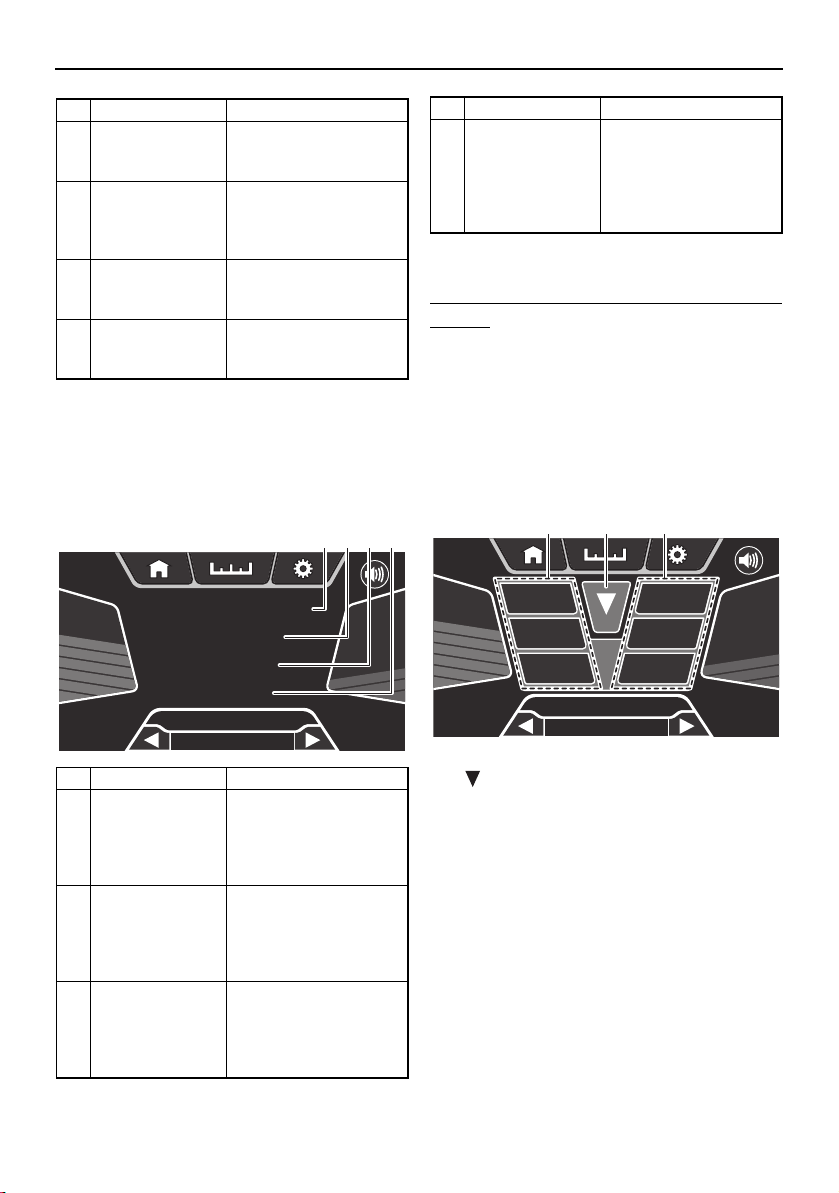
Instrument operation
47
Cruising information display (trip
screen tab)
The trip screen can display 4 types of trip-re-
lated information at the same time.
* This item cannot be reset.
To reset an item on the cruising information
display:
Touch and hold the item that you want to reset
for several seconds.
Multi-function display unit settings
(setting screen tab)
The setting screen can be used to change the
settings of the multi-function display unit.
1 Menu
2 “” button
Use this screen to change the following set-
tings:
● Time
● Unit
● Port Wellness
● Brightness
● Language
● Stbd Wellness
● Depth Alarm
● Reset
Name Function
1 Boat speed Shows the boat speed
in miles per hour or ki-
lometers per hour.
2 Cruise assist
and no-wake
mode status
Shows the operating
status of the cruise as-
sist and no-wake
mode.
3 Starboard en-
gine speed
Shows the engine
speed of the starboard
engine.
4 Port engine
speed
Shows the engine
speed of the port en-
gine.
Name Function
1 Average fuel
consumption
Shows the average dis-
tance that was trav-
eled on 1.0 gallon or
1.0 liter of fuel since
the item was last reset.
2 Trip Shows the distance
traveled by the boat in
miles or kilometers
since the item was last
reset.
3 Total fuel rate* Shows the total fuel
consumption of the
port and starboard en-
gines in gallons per
hour or liters per hour.
1.5 Hrs
PORT
1.6 Hrs
STBD
STBD 1.6 Hrs
- Trip Info -
2
.1 AVG mpg
26
.3 Miles
0
.0 GpH
12
.5 Gal
4
Depth
ft
50
Fuel
%
10:15 am
1 2 3 4
4 Total fuel used Shows the total fuel
that has been con-
sumed by the port and
starboard engines in
gallons or liters since
the item was last reset.
Name Function
1.5 Hrs
PORT
1.6 Hrs
STBD
STBD 1.6 Hrs
- Settings -
Time
Port Wellness
Unit
Brightness
Stbd Wellness
Language
4
Depth
ft
50
Fuel
%
10:15 am
1 12
SportsBoat_F3R11.book Page 47 Friday, May 19, 2017 9:35 AM
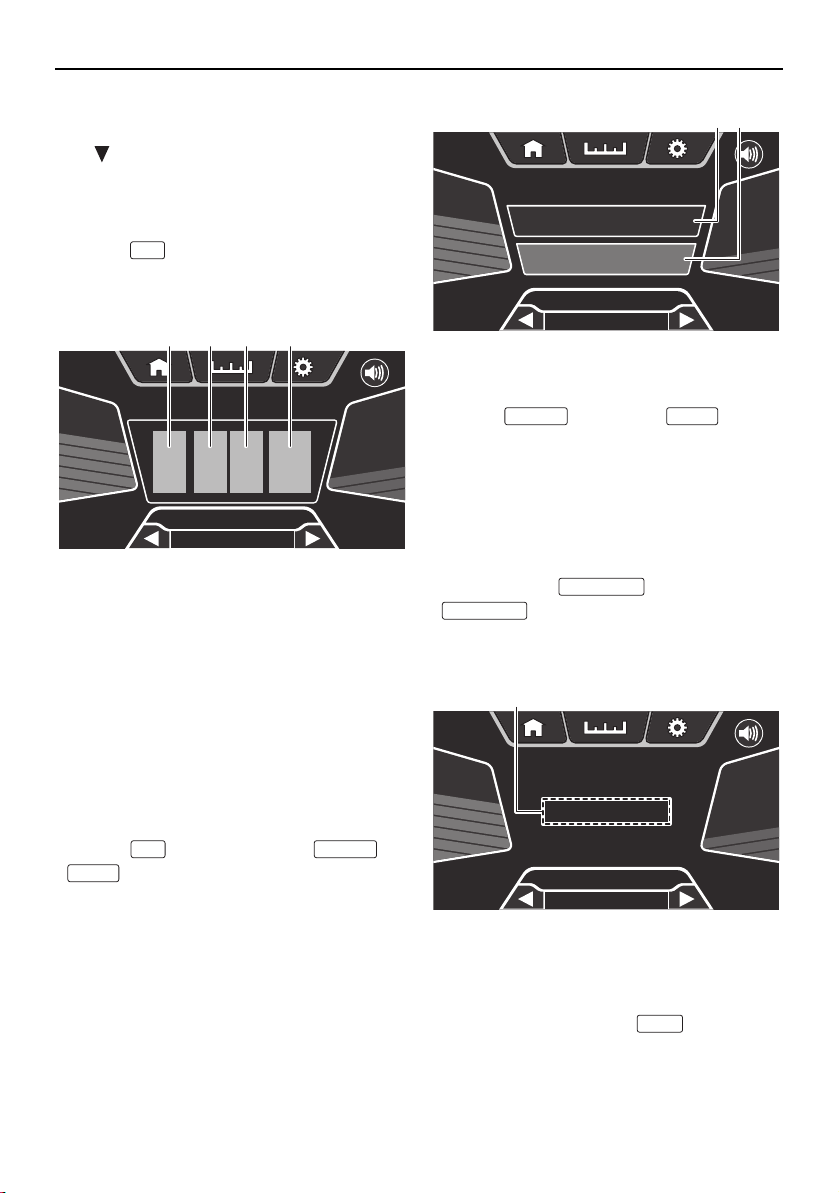
Instrument operation
48
TIP:
The menu displays 6 items at one time. Tap
the “ ” button on the screen to scroll through
the menu items.
Setting the time
Tap the “ ” button to set the time. Tap the
time unit that you want to set and flick up or
down.
1 Hours
2 Ten minutes
3 Minutes
4 AM/PM (Imperial mode only)
TIP:
When “IMPERIAL” is selected, the time is dis-
played in the 12-hour format. When “METRIC”
is selected, the time is displayed in the 24-hour
format.
Selecting the display units
Tap the “ ” button to select “ ” or
“ ” for the display units.
1 “METRIC” button
2 “IMPERIAL” button
Tap the “ ” button or “ ” button
to select the desired display unit setting.
TIP:
The default setting is “IMPERIAL”.
Starboard/port engine wellness alarm
display
Tap the “ ” button or
“ ” button to display the total num-
ber of hours that the engine has been running
since the last maintenance.
1 Hours of engine operation
TIP:
When the number of engine operation hours
reaches 100 hours, the “ ” button will
appear.
Time
1.5 Hrs
PORT
1.6 Hrs
STBD
STBD 1.6 Hrs
Set Time
- Time -
10
11
9
am
pm
pm
1
2
0
5
6
4
:
4
Depth
ft
50
Fuel
%
10:15 am
1 2 3 4
Unit
IMPERIAL
METRIC
1.5 Hrs
PORT
1.6 Hrs
STBD
STBD 1.6 Hrs
IMPERIAL
METRIC
Unit
- Unit -
4
Depth
ft
50
Fuel
%
10:15 am
1 2
IMPERIAL METRIC
Stbd Wellness
Port Wellness
1.5 Hrs
PORT
1.6 Hrs
STBD
STBD 1.6 Hrs
1.5 Hrs
- Stbd Wellness -
Time Since Last
Maintenance
4
Depth
ft
50
Fuel
%
10:15 am
1
RESET
SportsBoat_F3R11.book Page 48 Friday, May 19, 2017 9:35 AM
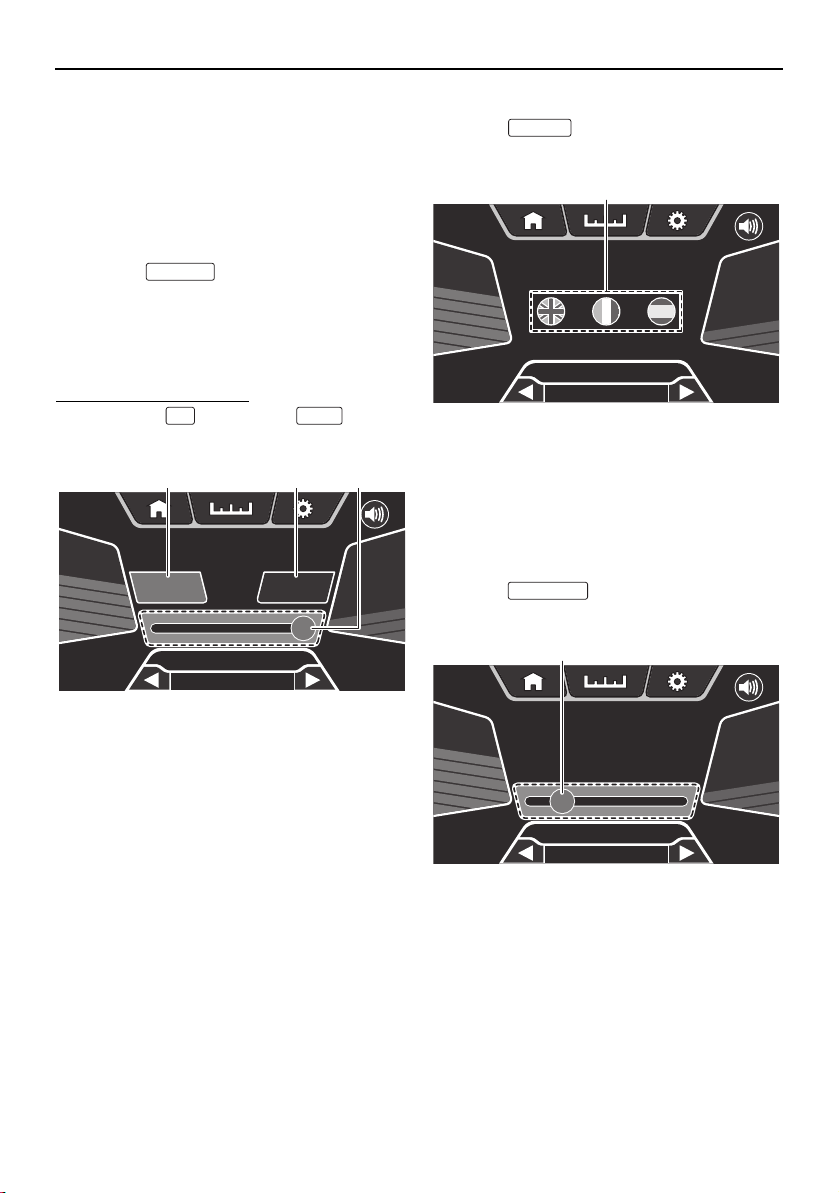
Instrument operation
49
Setting the day mode and night mode
The multi-function display has a day mode
and a night mode.
When the bow light or anchor light is turned
on, the multi-function display will enter the
night mode and the display brightness will de-
crease.
Tap the “ ” button to adjust the
brightness of the display. The brightness can
be set separately for the day mode and for the
night mode.
To adjust the brightness:
(1) Tap the “ ” button or “ ” button
to select the desired mode.
1 “DAY” button
2 “NIGHT” button
3 Slider control
(2) To make the display darker, drag the slid-
er to the left. To make the display bright-
er, drag the slider to the right.
TIP:
● The default settings are 100% for the day
mode and 50% for the night mode.
● When the brightness of the multi-function
display is adjusted, the brightness of the ta-
chometers is also adjusted accordingly.
Setting the display language
Tap the “ ” button to change the se-
lected display language.
1 Display languages
TIP:
The available display languages are English,
French, and Spanish.
Setting the depth alarm
Tap the “ ” button to set the water
depth alarm.
1 Slider control
TIP:
The default setting is 4 ft.
To reduce the water depth setting, drag the
slider to the left.
To increase the water depth setting, drag the
slider to the right.
Brightness
DAY NIGHT
1.5 Hrs
PORT
1.6 Hrs
STBD
STBD 1.6 Hrs
DAY NIGHT
100
%
Brightness
- Brightness -
4
Depth
ft
50
Fuel
%
10:15 am
1 2 3
Language
1.5 Hrs
PORT
1.6 Hrs
STBD
STBD 1.6 Hrs
Language
- Language -
4
Depth
ft
50
Fuel
%
10:15 am
1
Depth Alarm
1.5 Hrs
PORT
1.6 Hrs
STBD
STBD 1.6 Hrs
4.0 ft
Depth Alarm Level
- Depth Alarm -
4
Depth
ft
50
Fuel
%
10:15 am
1
SportsBoat_F3R11.book Page 49 Friday, May 19, 2017 9:35 AM
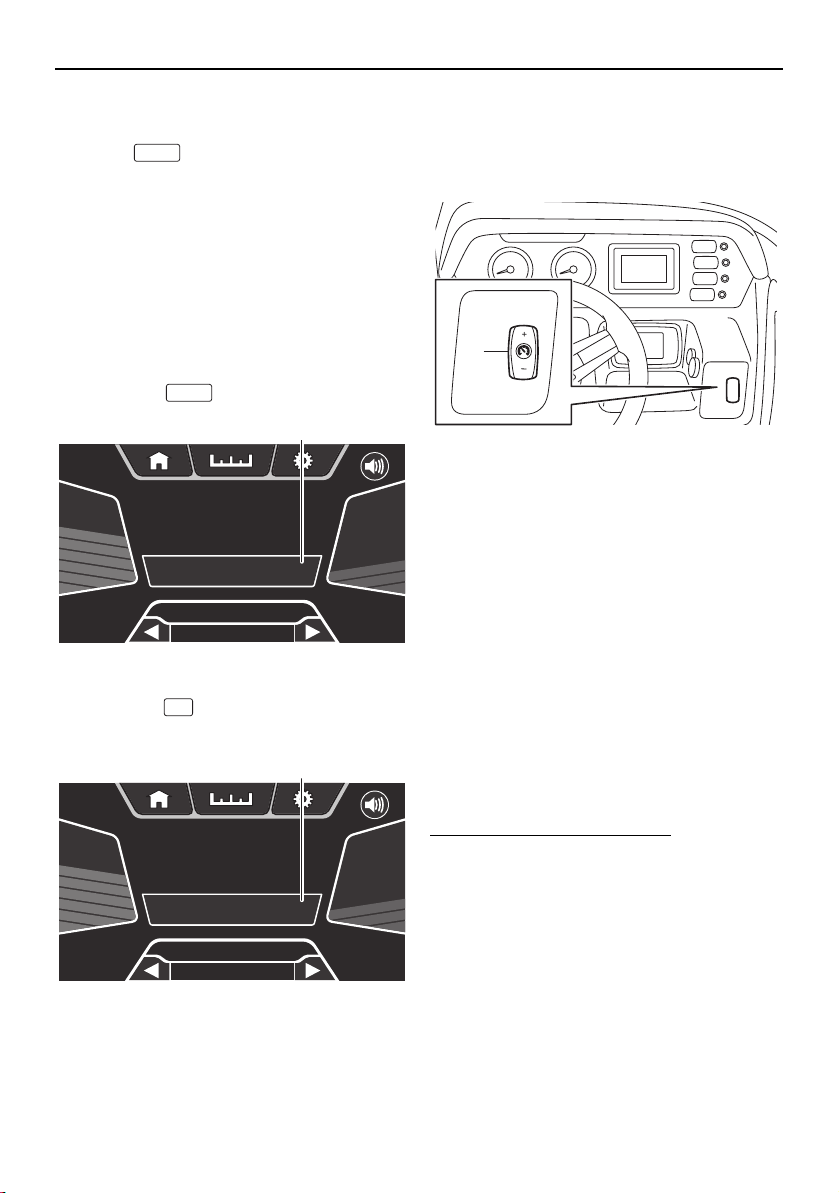
Instrument operation
50
Resetting the settings to the default
settings
Tap the “ ” button to reset the settings
to their factory default settings.
The default settings are as follows:
● Depth alarm: 4 ft
● Day mode brightness: 100%
● Night mode brightness: 50%
● Unit: IMPERIAL
● Language: English
(1) Tap the “ ” button.
1 “RESET” button
(2) Tap the “ ” button on the confirmation
screen.
1 “YES” button
No-wake mode/cruise assist switch
This switch activates and sets the no-wake
mode, cruise assist, and reverse RPM con-
trol.
1 No-wake mode/cruise assist switch
To operate the no-wake mode and cruise as-
sist, see the following sections. To activate
the reverse RPM control, see “Reverse RPM
control” on page 52.
Operating the boat with a minimal
wake (no-wake mode)
The no-wake mode is useful for operating the
boat at a steady speed with a minimal wake.
This is especially convenient when traveling
in harbors, channels, or other areas posted
with low speed limits as “no wake zones”.
The no-wake mode can be used only when
the engines are operating at idle speed.
To activate the no-wake mode:
(1) Put the remote control levers in the TDE
position or forward position so that both
engines are operating at idle speed.
(2) Push the plus side of the no-wake
mode/cruise assist switch. Once “No
Wake Mode” is displayed in the multi-
function display, the no-wake mode is ac-
tivated.
RESET
RESET
1.5 Hrs
PORT
1.6 Hrs
STBD
STBD 1.6 Hrs
RESET
Reset To
Factory?
- Reset to Factory -
4
Depth
ft
50
Fuel
%
10:15 am
1
YES
1.5 Hrs
PORT
1.6 Hrs
STBD
STBD 1.6 Hrs
YES
Are you sure?
- Reset to Factory -
4
Depth
ft
50
Fuel
%
10:15 am
1
1
SportsBoat_F3R11.book Page 50 Friday, May 19, 2017 9:35 AM
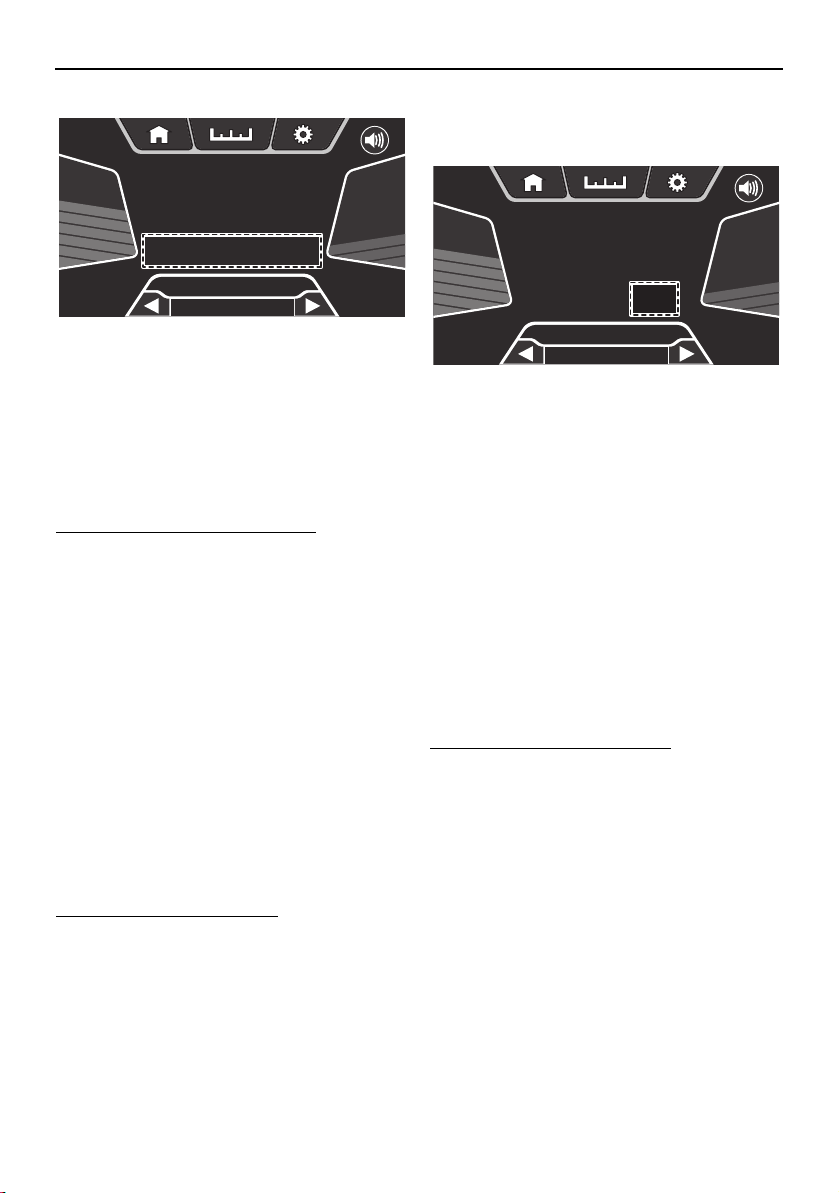
Instrument operation
51
TIP:
The no-wake mode can be set to 3 engine
speeds. To adjust the engine speed while the
no-wake mode is activated, push the plus side
or minus side of the no-wake mode/cruise as-
sist switch.
To deactivate the no-wake mode:
Perform one of the following operations.
● Push the minus side of the no-wake
mode/cruise assist switch until “No Wake
Mode” disappears.
● Push the remote control levers forward to
open the throttle.
Operating the boat at a steady speed
(cruise assist)
The cruise assist feature is for steady engine
speed operation when the boat is traveling
above no-wake speeds. The cruise assist is
available for use whenever the engines are
running above 4000 rpm and below 7000
rpm.
To activate the cruise assist:
(1) Push the remote control levers forward to
open the throttle until the desired engine
speed is reached and both engines are
operating at the same engine speed.
(2) Push the plus side or minus side of the
no-wake mode/cruise assist switch.
Once “Cruise” is displayed in the multi-
function display, the cruise assist is acti-
vated.
TIP:
● Once the cruise assist is activated, the set
engine speed can be increased by pushing
the plus side of the switch or decreased by
pushing the minus side. However, the ad-
justment is limited to a maximum of 8 incre-
ments above or below the initial cruise
assist setting. Each time the switch is
pushed, the engine speed will increase or
decrease approximately 100–200 rpm.
● While the cruise assist is activated, the en-
gine speed can also be adjusted by operat-
ing the remote control levers.
To deactivate the cruise assist:
Operate the remote control levers to decrease
the engine speed to 3000 rpm or less. Once
“Cruise” disappears, the cruise assist is deac-
tivated.
15 RPM
X100
PORT
15 RPM
X100
STBD
STBD 1.6 Hrs
No Wake Mode
3
.0 MPH
- Running Mode -
4
Depth
ft
50
Fuel
%
10:15 am
35 RPM
X100
PORT
35 RPM
X100
STBD
STBD 1.6 Hrs
Cruise +1
5
.8 MPH
- Running Mode -
4
Depth
ft
50
Fuel
%
10:15 am
SportsBoat_F3R11.book Page 51 Friday, May 19, 2017 9:35 AM
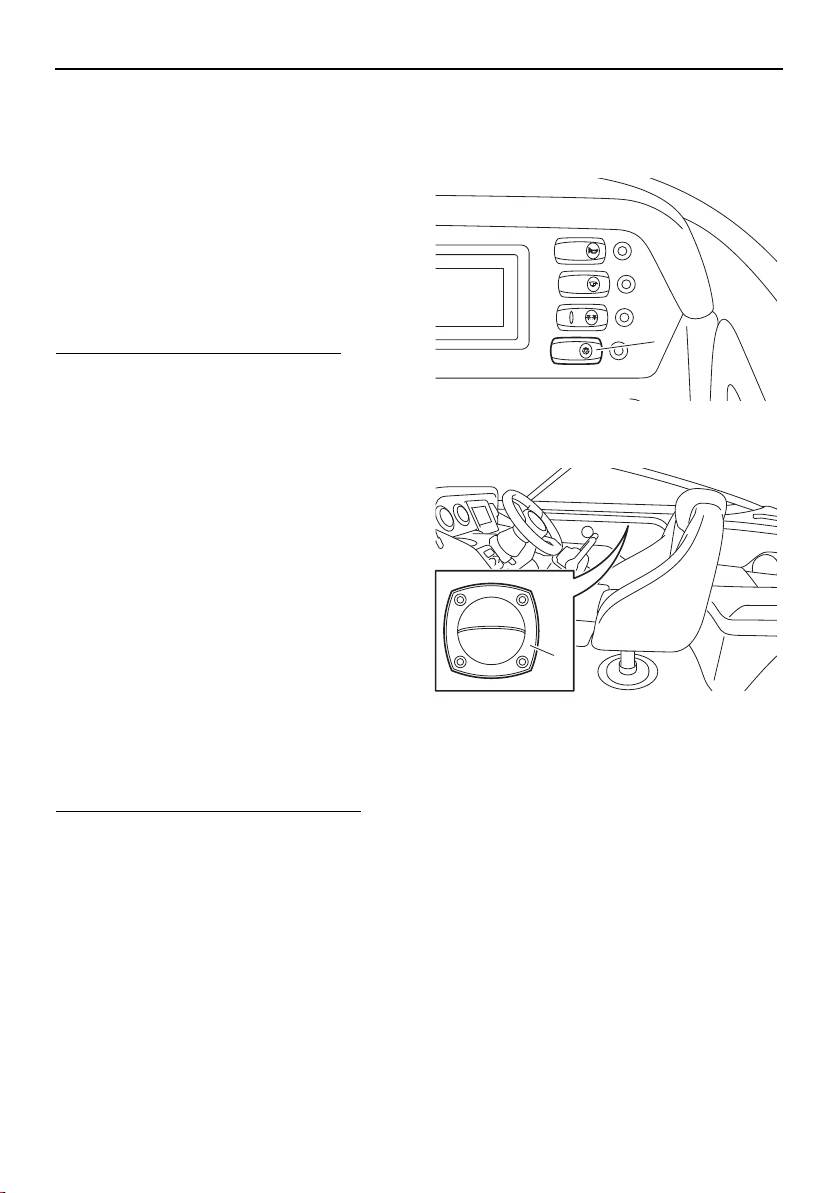
Instrument operation
52
Operating the boat in reverse with
more thrust (reverse RPM control)
Engine speed in reverse is limited to approxi-
mately 4500 rpm. If more thrust is required
when the boat is traveling in reverse, use the
reverse RPM control. WARNING! Be pre-
pared to reduce throttle as soon as the
boat moves as desired. Otherwise, the
boat may become unstable, which could
result in loss of control and an accident.
To activate the reverse RPM control:
(1) Move the remote control levers backward
so that the throttle is opened in reverse
and both engines are operating at the
same engine speed.
(2) Increase the engine speed to 4500 rpm,
and then push the plus side of the no-
wake mode/cruise assist switch.
TIP:
Once the reverse RPM control is activated,
pushing the plus side of the no-wake
mode/cruise assist switch will increase the
available engine speed by approximately 500
rpm in 3 stages up to a maximum of 6000
rpm, and pushing the minus side will de-
crease the available engine speed. However,
the adjustment is limited to these 3 incre-
ments.
To deactivate the reverse RPM control:
Operate the remote control levers to decrease
the engine speed to less than 4500 rpm.
Light operation
The light switches can be used to turn the
boat lights on or off.
Turning the courtesy light on or off
Push the courtesy light switch to turn on the
courtesy light inside the boat.
1 Courtesy light switch
1 Courtesy light
Turning the anchor light and bow light
on or off
The navigation and anchor lights switch is a
toggle switch that controls the bow light and
anchor light. Push the right side of the switch
to turn on both the bow light and anchor light
for night running (“NAVI”). Push the left side of
the switch to operate the anchor light alone
when anchored at night (“ANC”). Put the
switch in the middle position to turn off all
lights.
BILGE
NAVI
ANC
HORN
CTSY
LIGHTS
1
1
SportsBoat_F3R11.book Page 52 Friday, May 19, 2017 9:35 AM
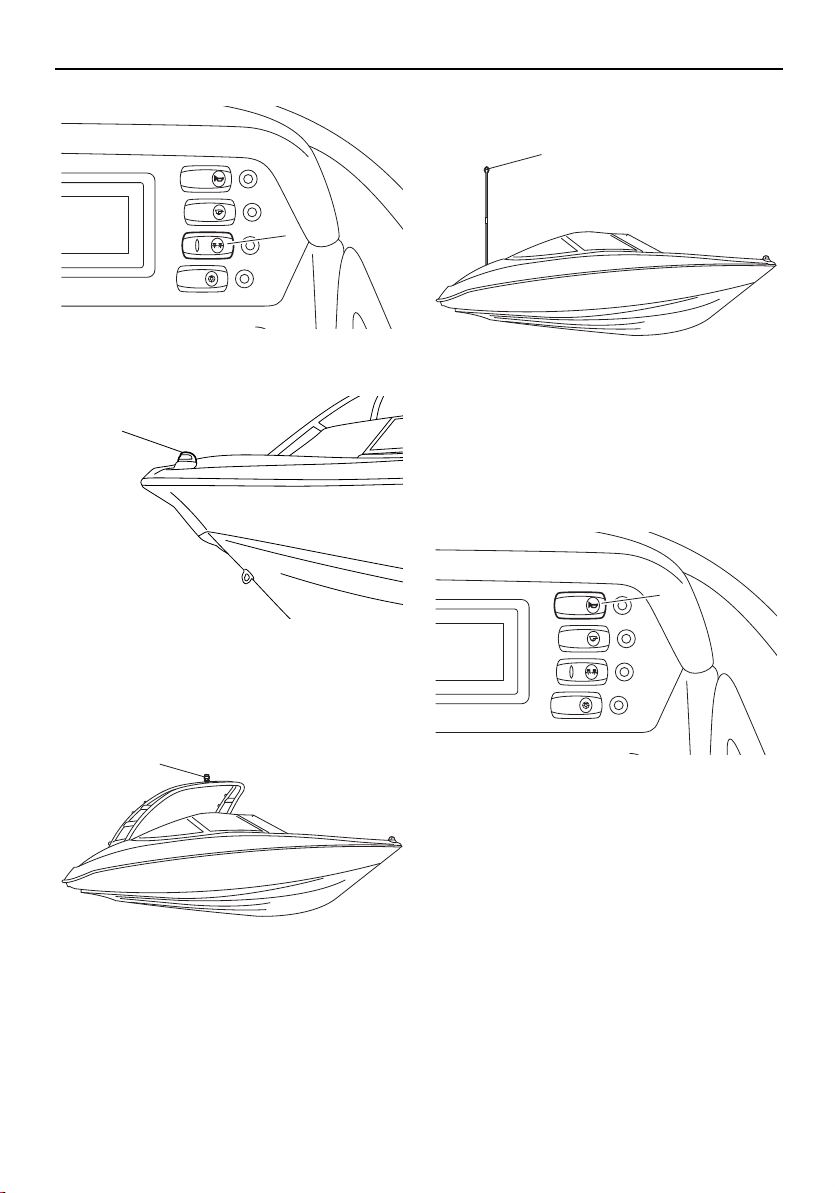
Instrument operation
53
1 Navigation and anchor lights switch
1 Bow light
AR210
1 Anchor light
SX210
1 Anchor light
Horn switch
Push this switch to activate the horn. The horn
can be used to signal other boats as required
by the “Rules of the road”. (See page 21 for
more information.)
1 Horn switch
BILGE
NAVI
ANC
HORN
CTSY
LIGHTS
1
1
1
1
BILGE
NAVI
ANC
HORN
CTSY
LIGHTS
1
SportsBoat_F3R11.book Page 53 Friday, May 19, 2017 9:35 AM
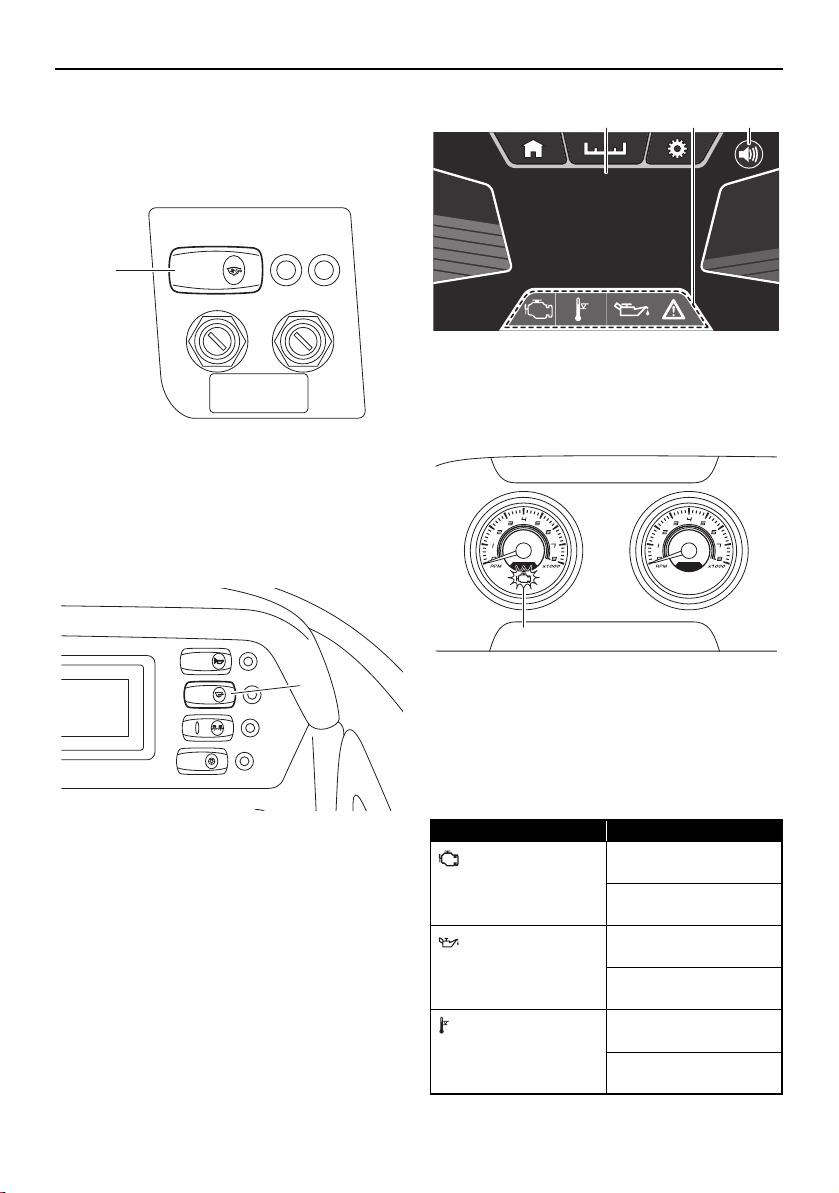
Instrument operation
54
Ventilating the engine compartment
Push the blower switch to turn on the blowers
to ventilate the engine compartment. (See
page 132 for more information.)
1 Blower switch
Draining the bilge water
Push the bilge pump switch to activate the
bilge pump. (See page 121 for more informa-
tion.)
1 Bilge pump switch
Warnings
If a malfunction or fault occurs, a warning
buzzer will sound and a warning icon and
warning message will be displayed on the
center display.
The check engine warning indicator is also
displayed on the tachometer for the engine
with the warning.
1 Warning message
2 Warning icon
3 Mute button
1 Check engine warning indicator
Warning definition table
The warnings that are displayed on the multi-
function display are listed in the following ta-
ble.
BLOWER
1
BILGE
NAVI
ANC
HORN
CTSY
LIGHTS
1
Warning icon Warning message
Check engine warning
Port Engine Check
Engine
Stbd Engine Check
Engine
Low oil pressure warn-
ing
Port Engine Low Oil
Pressure
Stbd Engine Low Oil
Pressure
Over temperature
warning
Port Engine Over
Temperature
Stbd Engine Over
Temperature
1.5 Hrs
PORT
1.6 Hrs
STBD
Port Engine: Over Temperature
Stbd Engine: Over Temperature
4
Depth
ft
50
Fuel
%
10:15 am
1 2 3
1
SportsBoat_F3R11.book Page 54 Friday, May 19, 2017 9:35 AM
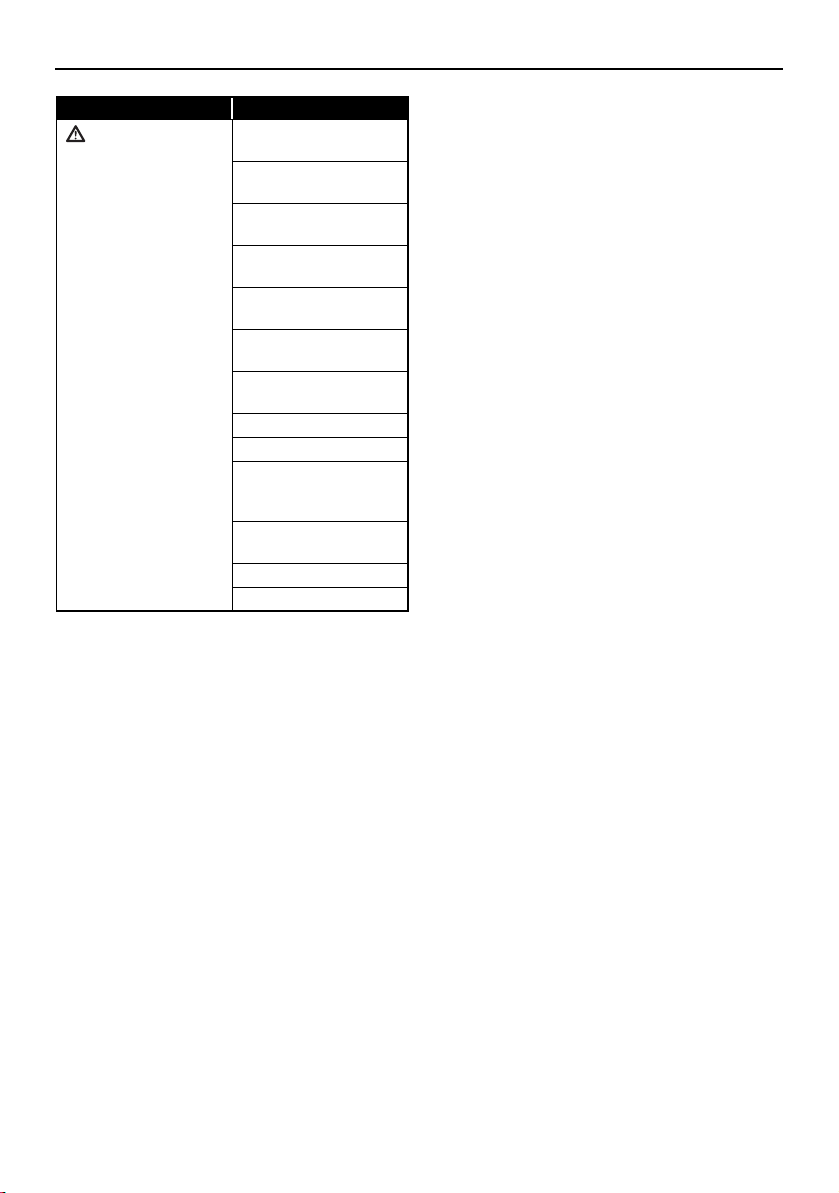
Instrument operation
55
Check engine warning
If an engine sensor malfunction or a short cir-
cuit is detected, a warning will appear on the
multi-function display and the buzzer will
sound. If a fault is detected for the port engine,
“Port Engine Check Engine” will be displayed
and if a fault is detected for the starboard en-
gine, “Stbd Engine Check Engine” will be dis-
played. If this occurs, reduce the engine
speed, return to shore, and have a Yamaha
Boat Dealer check the engine.
Low oil pressure warning
If the oil pressure does not rise to specifica-
tion, a warning will appear on the multi-func-
tion display and the buzzer will sound. If a
fault is detected for the port engine, “Port En-
gine Low Oil Pressure” will be displayed and if
a fault is detected for the starboard engine,
“Stbd Engine Low Oil Pressure” will be dis-
played. At the same time, the engine speed is
automatically limited to help prevent damage.
If this occurs, reduce the engine speed, return
to shore or maneuver to a safe location, and
check the engine oil level. (See page 117 for
engine oil level checking procedures.)
If the oil level is low, add enough engine oil to
raise it to the proper level. If the oil level is suf-
ficient, have a Yamaha Boat Dealer check the
engine.
Over temperature warning
This model is equipped with an over tempera-
ture warning system. If the engines start to
overheat, a warning will appear on the multi-
function display and the buzzer will sound. If
the port engine is overheating, “Port Engine
Over Temperature” will be displayed and if the
starboard engine is overheating, “Stbd En-
gine Over Temperature” will be displayed. At
the same time, the engine speed is automati-
Generic Warning
Depth Transducer
Communication Error
Port Engine Commu-
nication Error
Stbd Engine Commu-
nication Error
Engine CAN Commu-
nication Error
Port Gauge Communi-
cation Error
Stbd Gauge Commu-
nication Error
LIN Communication
Error
Low Fuel
Low Depth
Stbd Engine time
since last mainte-
nance
Port Engine time since
last maintenance
High Battery Voltage
Low Battery Voltage
Warning icon Warning message
SportsBoat_F3R11.book Page 55 Friday, May 19, 2017 9:35 AM
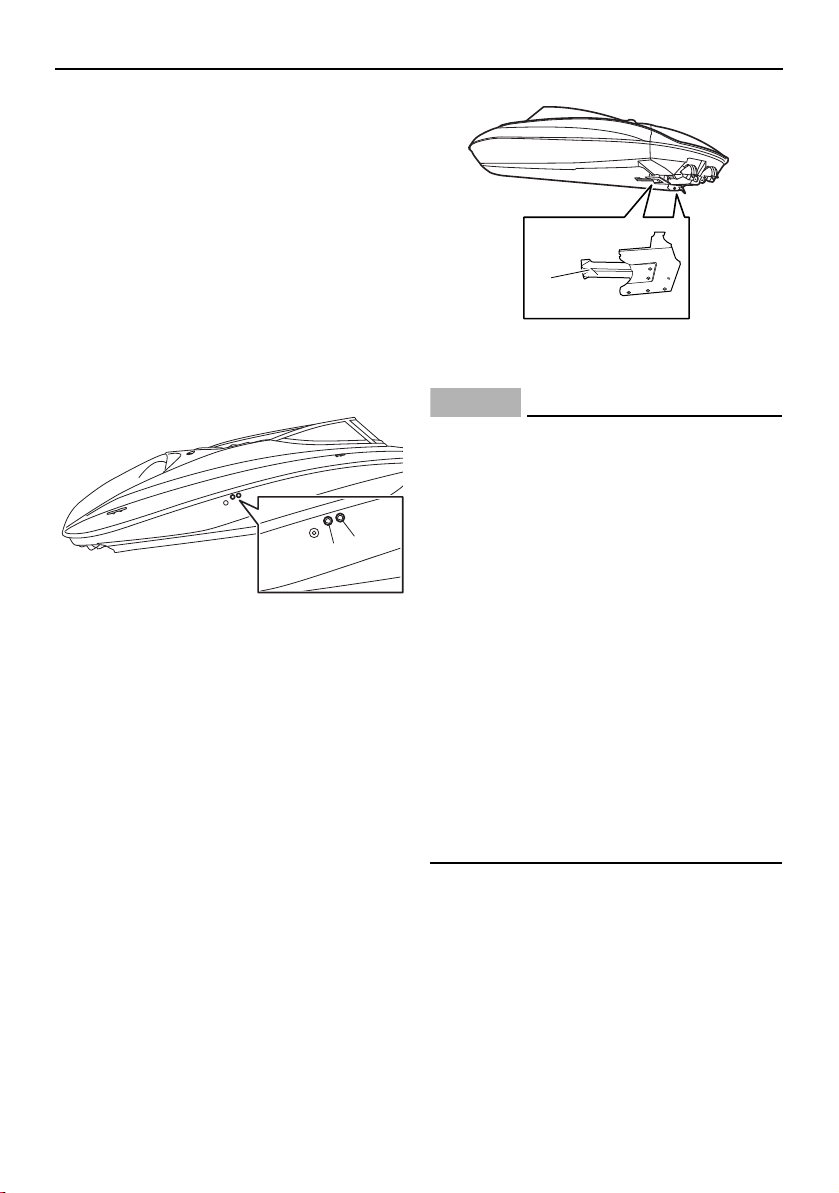
Instrument operation
56
cally limited to help prevent damage. If this oc-
curs, immediately reduce the engine speed,
return to shore or maneuver to a safe location,
and check for water discharge at the cooling
water pilot outlets. There are cooling water pi-
lot outlets on the starboard side of the hull.
Check that water comes out of the outlets
while the engines are running, particularly
while applying throttle. If you do not see any
water at the outlets, cooling water may not be
circulating in the engines.
1 Cooling water pilot outlet (starboard engine)
2 Cooling water pilot outlet (port engine)
TIP:
If the cooling water passages in the engines
are dry, it will take about 20 seconds for water
to reach the pilot outlets after starting.
If water is not circulating, something may be
clogging the intake grates. Refer to “Jet pump
clean-out procedure” on page 178.
1 Intake grate
NOTICE
If the cause of overheating cannot be
found and corrected, take special precau-
tions to avoid major engine damage while
you return to shore.
Single engine overheating — Shut off the
overheating engine and use the properly
running engine to return to shore. Operate
at no-wake speed (8 km/h, 5 mph) to pre-
vent water from flooding the non-operat-
ing engine through the water intake. See
page 50 for information on the no-wake
mode.
Both engines overheating — If getting a
tow from another vessel is not possible,
operate both engines just slightly above
idle while you return to shore. If you can
be towed, refer to “Towing the boat” on
page 184.
1
2
1
SportsBoat_F3R11.book Page 56 Friday, May 19, 2017 9:35 AM
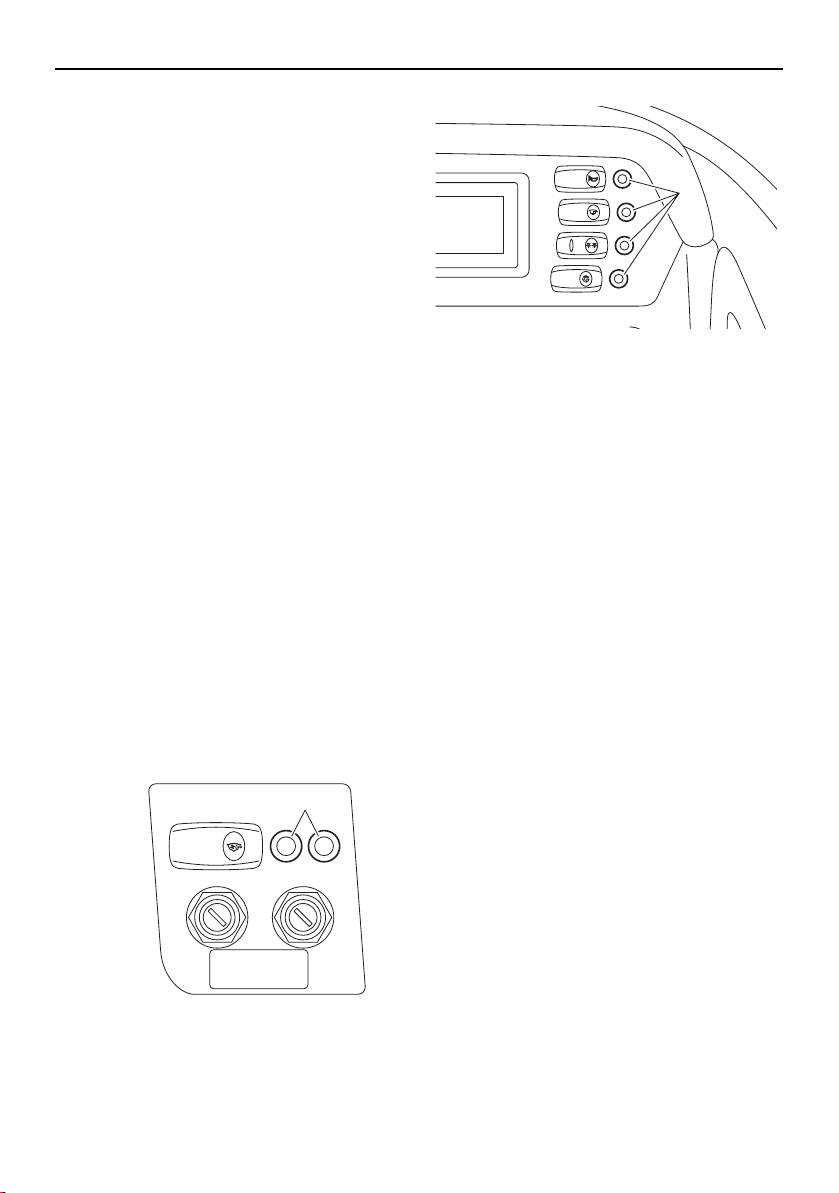
Instrument operation
57
Generic warning
If a generic error is detected, a warning will
appear on the multi-function display and the
buzzer will sound. If this occurs, reduce the
engine speed, return to shore, and have a
Yamaha Boat Dealer check the boat.
When a generic error is detected, the follow-
ing warning messages are displayed.
● Depth Transducer Communication Error
● Port Engine Communication Error
● Stbd Engine Communication Error
● Engine CAN Communication Error
● Port Gauge Communication Error
● Stbd Gauge Communication Error
● LIN Communication Error
● Low Fuel
● Low Depth
● Stbd Engine time since last maintenance
● Port Engine time since last maintenance
● High Battery Voltage
● Low Battery Voltage
Switch circuit breakers
The electrical circuit for each switch is protect-
ed by a circuit breaker. If the button pops out,
push it back in with your finger. If it pops out
again, ask a Yamaha Boat Dealer to inspect
the electrical system.
1 Switch circuit breaker
1 Switch circuit breaker
BLOWER
1
BILGE
NAVI
ANC
HORN
CTSY
LIGHTS
1
SportsBoat_F3R11.book Page 57 Friday, May 19, 2017 9:35 AM
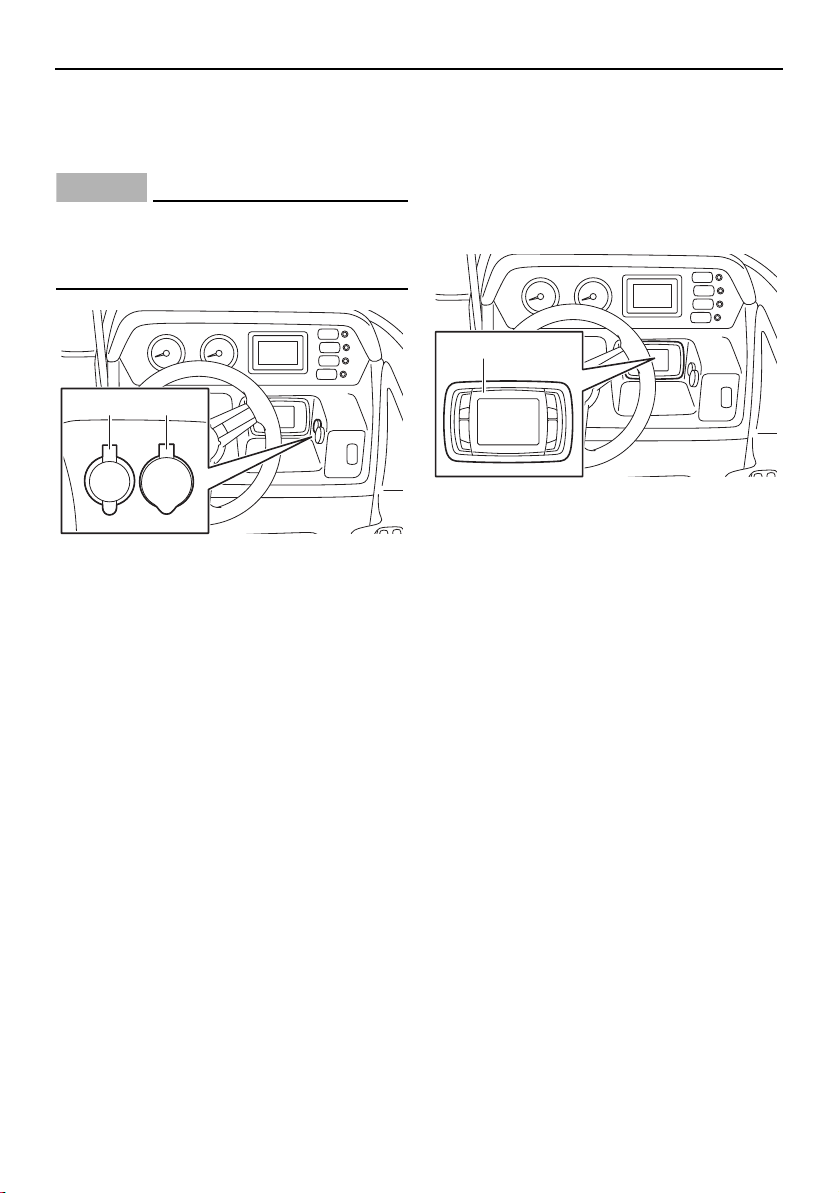
Instrument operation
58
Accessory outlet
There is a 12V DC outlet located on the star-
board side of the steering wheel.
NOTICE
Do not use an automotive cigarette lighter
or other accessories that get hot because
the outlet can be damaged.
1 12V DC outlet
2 Aux input
Audio control keypad
The audio control keypad is located under the
multi-function meter.
For operating instructions, refer to the stereo
system owner’s manual included with your
boat.
1 Audio control keypad
TIP:
The audio control keypad does not turn off
even if you turn the main switch keys to the off
position. To turn off the audio control keypad,
push the power button on the keypad.
12V
AUDIO
AUX-USB
1 2
1
SportsBoat_F3R11.book Page 58 Friday, May 19, 2017 9:35 AM
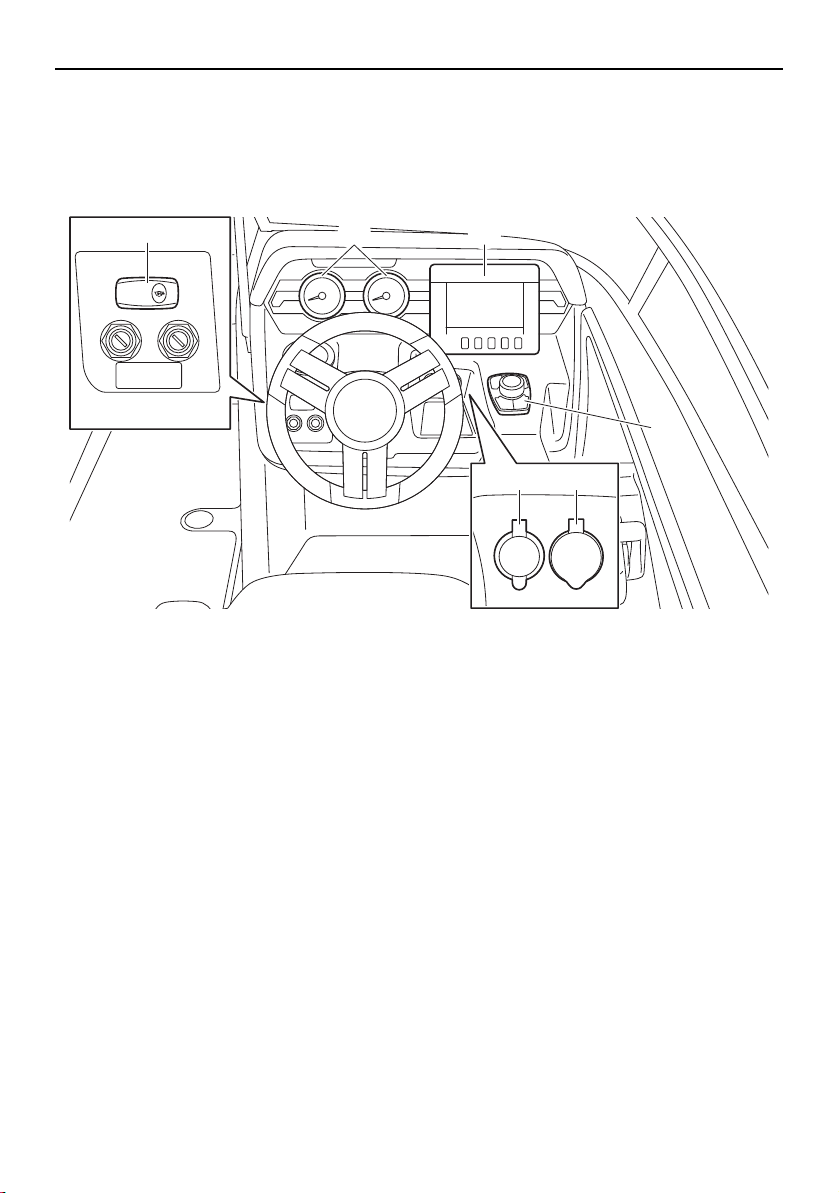
Instrument operation
59
Helm controls (212X / 212 Limited S / 212 Limited)
1 Tachometer
2 Multi-function display unit
3 Controller
4 Aux input
5 12 V DC outlet
6 Blower switch
BLOWER
12V
AUDIO
AUX-USB
1 2
3
6
45
SportsBoat_F3R11.book Page 59 Friday, May 19, 2017 9:35 AM
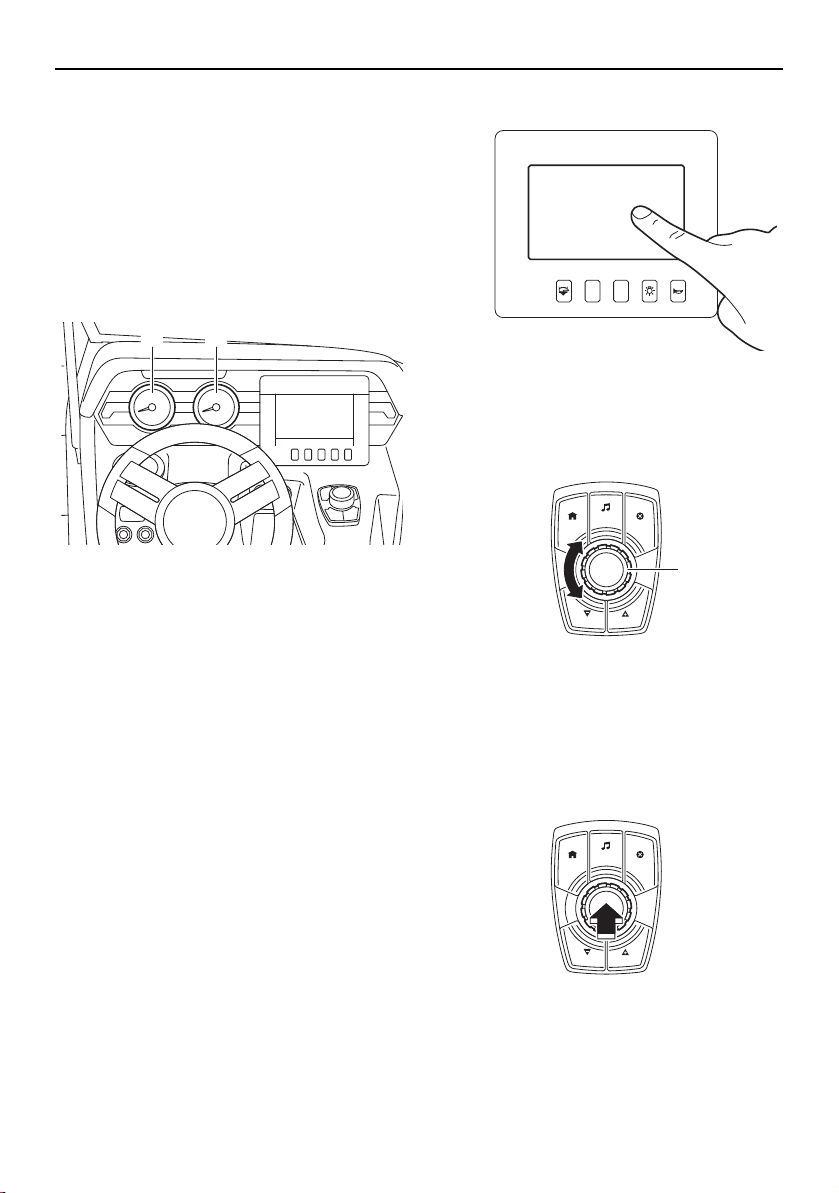
Instrument operation
60
Tachometers
The boat is equipped with two tachometers.
The tachometer on the left is for the port en-
gine. The one on the right is for the starboard
engine.
The analog tachometers show the engine
speed. The numbers on the meters show the
engine speed × 1000 rpm (r/min).
1 Port tachometer
2 Starboard tachometer
TIP:
The tachometer starts operating when the en-
gine is started. The tachometer needle will
sweep once across the rpm range, briefly
stopping in the center of the meter, and then
return to zero. At the same time, the buzzer
will sound.
Multi-function display unit operation
Because the multi-function display unit is
equipped with a touch screen, you can touch
the display directly to operate the display
functions.
In addition to touching the display, you can
use the joystick to operate the display func-
tions.
Touching the multi-function display
Using the joystick
(1) Turn the joystick knob to select an item.
1 Joystick knob
(2) Push the joystick knob to set the selec-
tion.
TIP:
Although the procedures in this manual ex-
plain how to make selections by touching the
1 2
TRIP
INFO
SYS
CTRL
CRUISE
CANCELHOME
MEDIA
NO WAKE
CRUISE
NO WAKE
1
CRUISE
CANCELHOME
MEDIA
NO WAKE
CRUISE
NO WAKE
SportsBoat_F3R11.book Page 60 Friday, May 19, 2017 9:35 AM
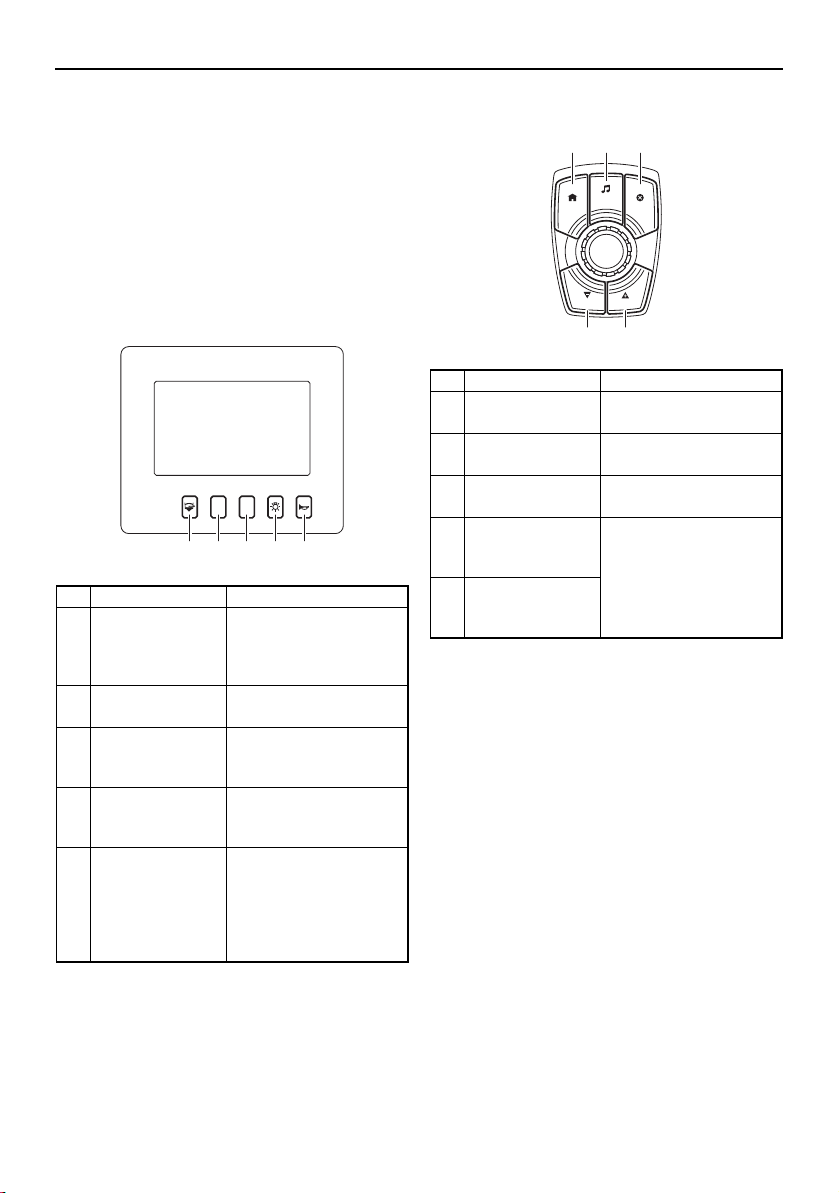
Instrument operation
61
display, you can also make selections using
the joystick knob.
Operation buttons
In addition to touching the multi-function dis-
play directly, you can use the operation but-
tons of the multi-function display unit and the
controller to operate various functions.
Multi-function display unit
Controller
Name Function
1 Bilge button Turns the bilge pump
on or off, or activates
the automatic bilge
mode. (See page 122.)
2 Trip button Displays the trip
screen. (See page 64.)
3 System control
button
Displays the system
control screen. (See
page 68.)
4 Light button Displays the light con-
trol screen. (See page
66.)
5 Horn button Activates the horn. The
horn can be used to
signal other boats as
required by the “Rules
of the road”. (See page
21.)
TRIP
INFO
SYS
CTRL
1 2 3 4 5
Name Function
1 “HOME” button Displays the home
screen. (See page 63.)
2 “MEDIA” button Displays the media
screen. (See page 72.)
3 “CANCEL” but-
ton
Deselects the current-
ly selected item.
4 “CRUISE/NO
WAKE” (–) but-
ton
Activate and set the
cruise assist, no-wake
mode, and reverse
RPM control. (See
page 81.)
5 “CRUISE/NO
WAKE” (+) but-
ton
CRUISE
CANCELHOME
MEDIA
NO WAKE
CRUISE
NO WAKE
21 3
54
SportsBoat_F3R11.book Page 61 Friday, May 19, 2017 9:35 AM
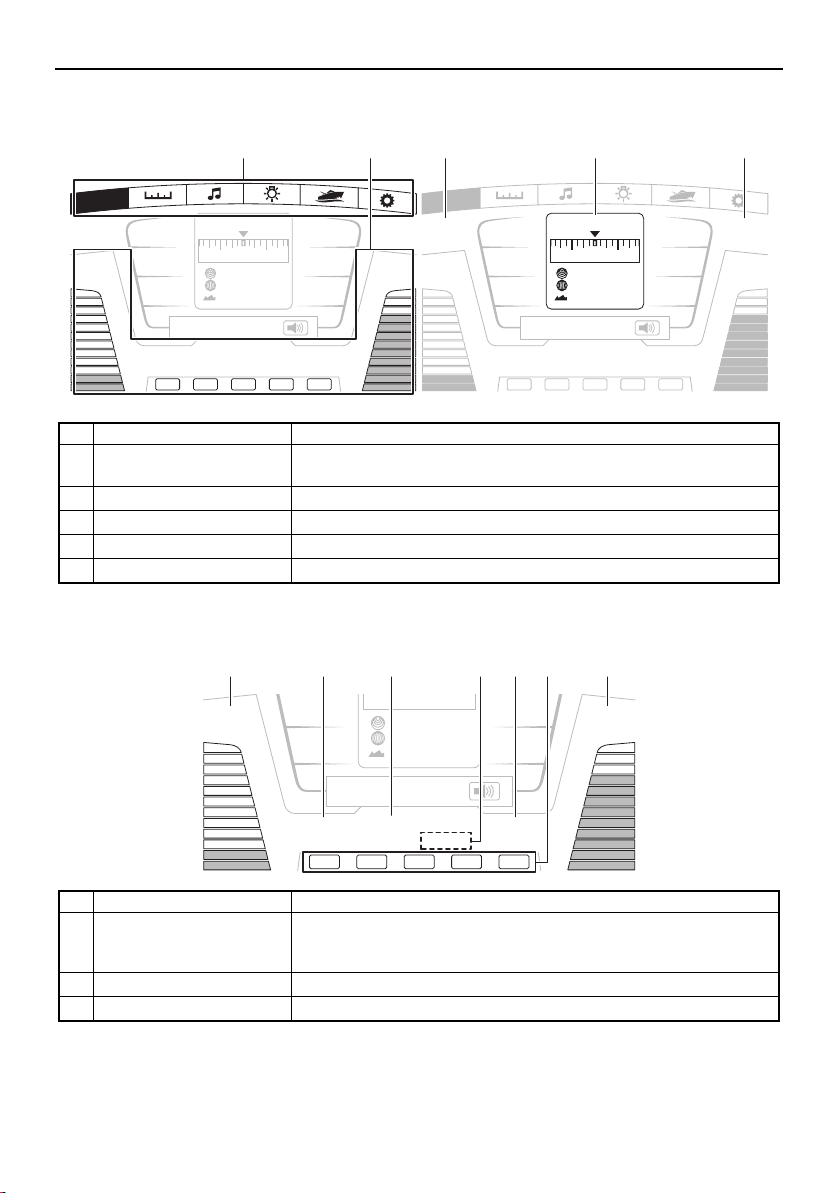
Instrument operation
62
Multi-function display elements
Standard static bar
Name Function
1 Screen tab bar Shows the 6 tabs for the screens that can be displayed on the
multi-function display. (See page 63.)
2 Standard static bar Shows the engine speed, boat speed, and other information.
3 System voltage Shows the battery voltage of the start battery.
4 Center display Shows various information and settings for each screen.
5 Aux voltage Shows the battery voltage of the house battery.
NavAnc
BLWRBILGE BALLCTY LT
SYS
12.3
V
25
FUEL
%
22
ft
AUX
13.2
V
RPM
1300
RPM
1300
MPH
0
DEPTH
H
O
M
E
360
N
EW
NENW
02:18 PM
LAT
LONG
ELEV
00˚00’00”
N
00˚00’00”
E
0
FT
NavAnc
BLWRBILGE BALLCTY LT
SYS
12.3
V
25
FUEL
%
22
ft
AUX
13.2
V
RPM
1300
RPM
1300
MPH
0
DEPTH
H
O
M
E
360
N
EW
NENW
02:18 PM
LAT
LONG
ELEV
00˚00’00”
N
00˚00’00”
E
0
FT
1 2 3 54
Name Function
1 Fuel level bar graph Shows the amount of fuel remaining in the fuel tank. Depending on
the amount of remaining fuel, the bar graph is displayed in 4 colors:
green, yellow, orange, and red.
2 Port engine speed Shows the engine speed.
3 Boat speed Shows the boat speed in miles per hour or kilometers per hour.
NavAnc
BLWRBILGE BALLCTY LT
25
FUEL
% 22 ft
RPM
1300
RPM
1300
MPH
0
DEPTH
360
N
EW
NENW
LAT
LONG
ELEV
00˚00’00”N
00˚00’00”E
0 FT
1 752 3 4 6
SportsBoat_F3R11.book Page 62 Friday, May 19, 2017 9:35 AM
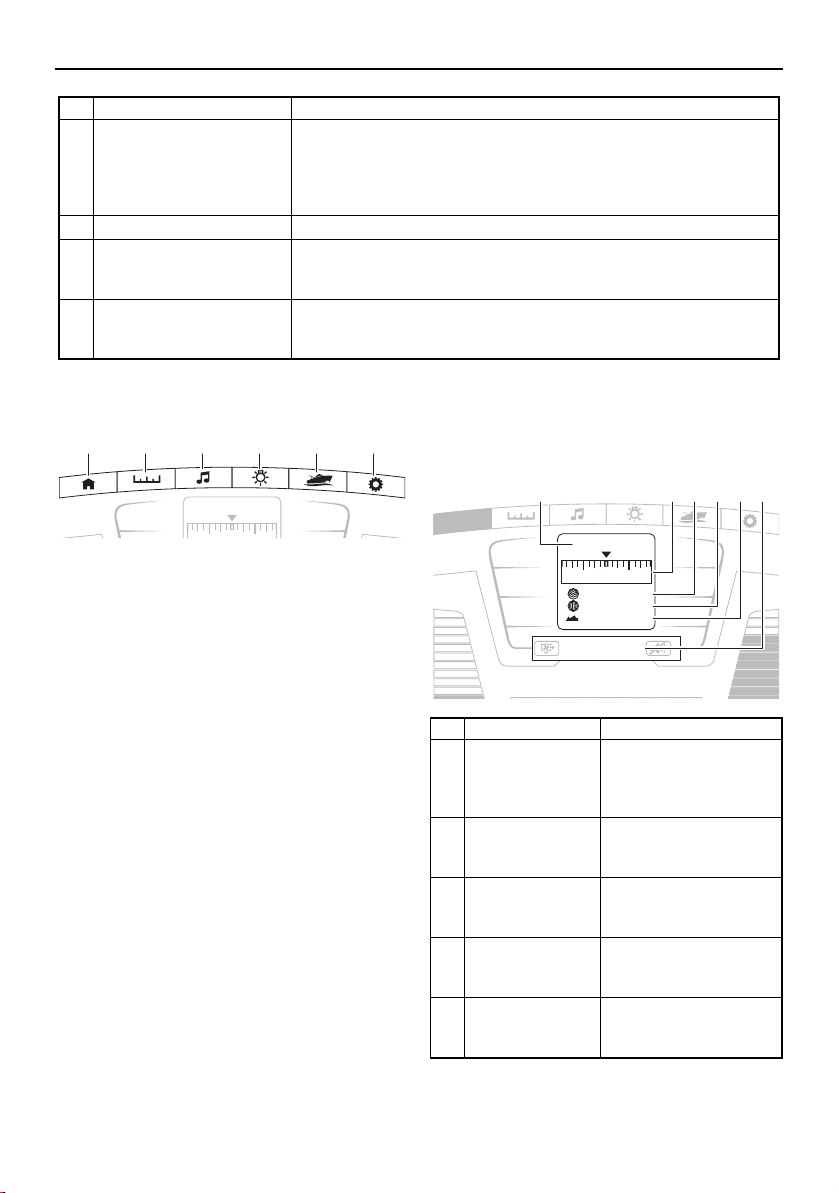
Instrument operation
63
Screen tabs (screen tab bar)
1 Home screen tab
2 Trip screen tab
3 Media screen tab
4 Light control screen tab
5 System control screen tab
6 Setting screen tab
The tab for the currently displayed screen is
shown in red. When the joystick knob is used
to scroll through the tabs, the tab that can be
selected is shown in green.
TIP:
When a tab is shown in red or green, the sym-
bol will change to text.
Information display (home screen tab
[standard mode])
The home screen shows the time, current
heading of the boat, and other information.
4 Cruise assist level/no
wake indicator
Shows whether the cruise assist or no-wake mode is activated.
When the cruise assist is activated, “CRUISE” and the cruise assist
setting level will be displayed.
When the no-wake mode is activated, “NO WAKE” will be dis-
played.
5 Starboard engine speed Shows the engine speed.
6 Status indicator Indicates the operating status and current setting of the bilge
pump, lights, and other devices according to the color of the indica-
tors.
7 Depth level Shows the water depth in feet or meters. Depending on the water
depth, the bar graph is displayed in 4 colors: blue, magenta, or-
ange, and red.
Name Function
SYS
12.3
V
AUX
13.2
V
360
NEW
NENW
02:18 PM
1 2 3 4 5 6
Name Function
1 Clock Shows the time. See
“Time” on page 79 for
information on setting
the time.
2 Compass Shows the current di-
rection of the boat us-
ing compass points.
3 Latitude Shows the latitude of
the boat’s current loca-
tion.
4 Longitude Shows the longitude of
the boat’s current loca-
tion.
5 Elevation Shows the elevation of
the boat’s current loca-
tion in feet or meters.
SYS
12.3 V
25
FUEL
% 22 ft
AUX
13.2 V
RPM
1300
RPM
1300
MPH
0
DEPTH
H
O
M
E
360
N
EW
NENW
02:18 PM
LAT
LONG
ELEV
00˚00’00”N
00˚00’00”E
0 FT
BLOWER 3:35
1 2 3 4 5 6
SportsBoat_F3R11.book Page 63 Friday, May 19, 2017 9:35 AM
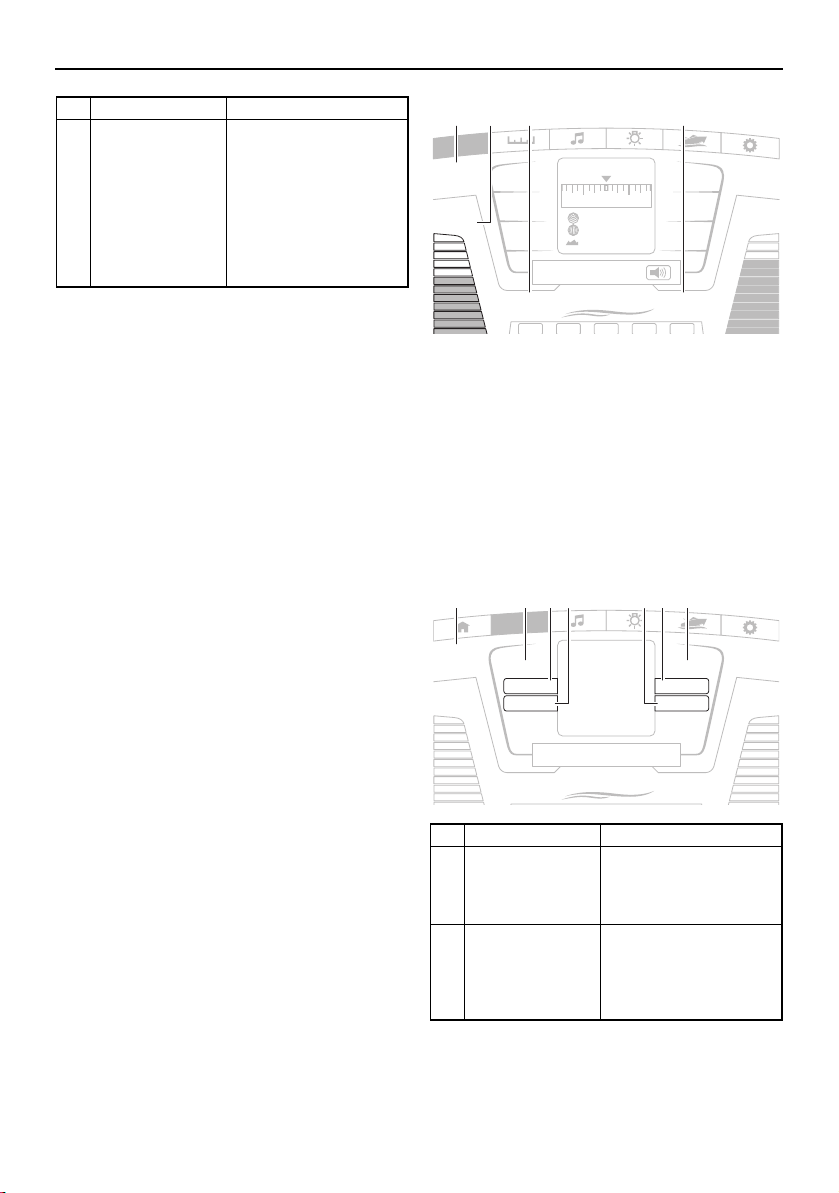
Instrument operation
64
TIP:
This screen is displayed after the engines are
started and the multi-function display per-
forms the initial operation.
Information display (home screen tab
[float mode])
The float mode can be used to listen to the ra-
dio, turn on the lights, and so on, without start-
ing the engines.
If the multi-function display unit is turned on
while the engines are stopped, the display
unit will enter the float mode.
Perform one of the following operations to
turn on the multi-function display unit in the
float mode when the engines are stopped.
● Push any button on the multi-function dis-
play unit.
● Turn a main switch key to the on position.
● Push the blower switch.
When the multi-function display unit is in the
float mode, the following items are different
than they are on the standard home screen.
● Water temperature
● Volume
● System voltage
● Auxiliary voltage
1 Water temperature
2 Volume
3 System voltage
4 Auxiliary voltage
Cruising information display (trip
screen tab)
This screen shows the hours of engine oper-
ation, fuel consumption, and other informa-
tion.
6 Blower timer Shows the remaining
time before the blowers
turn off. (The timer
counts down from 4
minutes.)
This timer appears only
when the automatic
blower mode is turned
on.
Name Function
Name Function
1 Water tempera-
ture
Shows the ambient wa-
ter temperature in de-
grees Fahrenheit or
degrees Celsius.
2 Engine hours
(port engine)*
Shows the total num-
ber of hours that the
engine has been run-
ning since the boat was
new.
NavAnc
BLWRBILGE BALLCTY LT
WATER
--
62
VOLUME
% 22 ft
SYS
12.3V
AUX
12.3V
DEPTH
H
O
M
E
360
N
EW
NENW
02:18 PM
LAT
LONG
ELEV
00˚00’00”N
00˚00’00”E
0 FT
FLOAT MODE
1 2 3 4
WATER
--
0
FUEL
% 0 ft
HOLD 3s
SYS
12.3V
AYX
12.3V
DEPTH
T
R
IP
IN
F
O
- -
Avg MPG
0.0
00
Miles
- -
GPH
- -
Gal
High
MPH
Avg
MPH
00000 Hrs
PORT
00000 Hrs
STBD
0.0
GPH
0.0
Gal
0.0
GPH
0.0
Gal
FLOAT MODE
1 2 3 4 765
SportsBoat_F3R11.book Page 64 Friday, May 19, 2017 9:35 AM
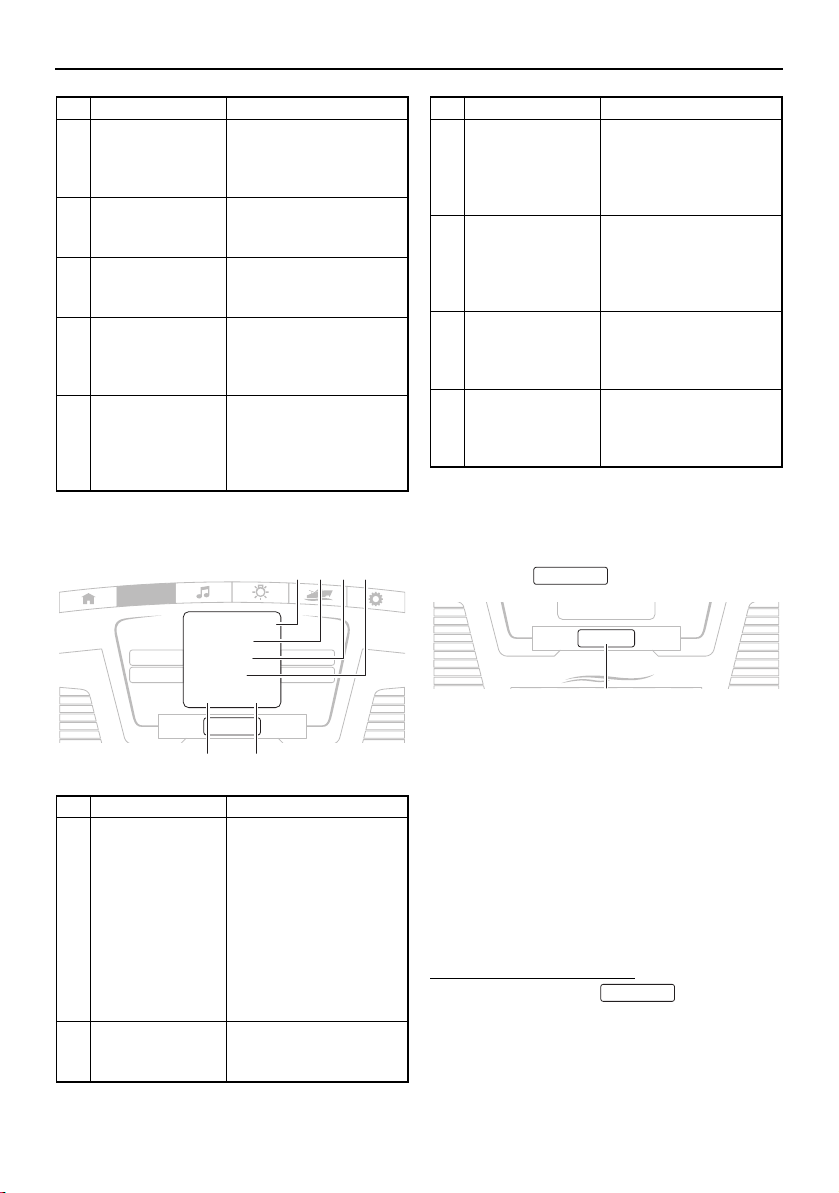
Instrument operation
65
* This item cannot be reset.
* This item cannot be reset.
Resetting the display items
The following display items can be reset by
tapping the “ ” button.
1 “RESET ALL” button
● Average fuel consumption
● Trip
● Fuel used (port engine)
● Fuel used (starboard engine)
● Total fuel used
● Highest speed attained
● Average speed
To reset the display items:
Touch and hold the “ ” button for 3
seconds.
3 Fuel rate (port
engine)*
Shows the current fuel
consumption in gal-
lons per hour or liters
per hour.
4 Fuel used (port
engine)
Shows the amount of
fuel used in gallons or
liters.
5 Fuel used (star-
board engine)
Shows the amount of
fuel used in gallons or
liters.
6 Fuel rate (star-
board engine)*
Shows the current fuel
consumption in gal-
lons per hour or liters
per hour.
7 Engine hours
(starboard en-
gine)*
Shows the total num-
ber of hours that the
engine has been run-
ning since the boat was
new.
Name Function
1 Average fuel
consumption per
gallon or liter
Shows the average dis-
tance that can be trav-
eled on 1.0 gallon or
1.0 liter of fuel. When
gallons are selected for
the display units, the
value is shown in miles
and when liters are se-
lected for the display
units, the value is
shown in kilometers.
2 Trip Shows the distance
traveled by the boat in
miles or kilometers.
Name Function
WATER
--
0
FUEL
% 0 ft
HOLD 3s
DEPTH
T
R
IP
IN
F
O
00000 Hrs
PORT
00000 Hrs
STBD
0.0
GPH
0.0
Gal
0.0
GPH
0.0
Gal
RESET ALL
- -
Avg MPG
0.0
00
Miles
- -
GPH
- -
Gal
High
MPH
Avg
MPH
6
1 2 3 4
5
3 Total fuel rate* Shows the total fuel
consumption of the
port and starboard en-
gines in gallons per
hour or liters per hour.
4 Total fuel used Shows the total fuel
that has been con-
sumed by the port and
starboard engines in
gallons or liters.
5 Highest speed
attained
Shows the highest
speed of the boat in
miles per hour or kilo-
meters per hour.
6 Average speed Shows the average
boat speed in miles per
hour or kilometers per
hour.
Name Function
RESET ALL
SYS
12.3V
AYX
12.3V
00
High
MPH
Avg
MPH
FLOAT MODE
RESET ALL
1
RESET ALL
SportsBoat_F3R11.book Page 65 Friday, May 19, 2017 9:35 AM
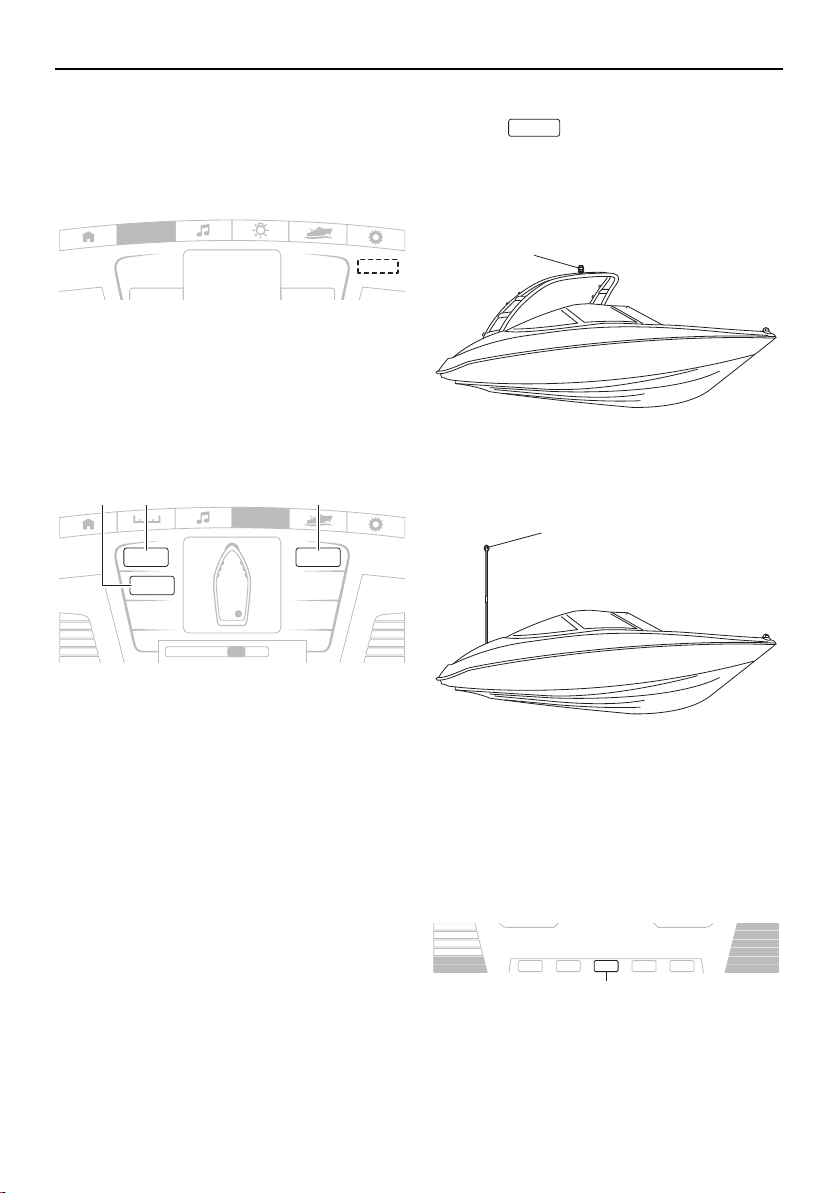
Instrument operation
66
TIP:
When “HOLD 3s”, which is displayed in the
upper-right corner of the display, changes to
“Reset”, the display items are reset.
Light operation (light control screen
tab)
The light control screen can be used to turn
the boat lights on or off.
1 “Anchor” light button
2 “Navigation” light button
3 “Courtesy” light button
Turning the anchor light on or off
Tap the “ ” light button to turn the an-
chor light on or off.
212X/212 Limited S
1 Anchor light
212 Limited
1 Anchor light
When the light is turned on, a white light will
appear at the stern of the boat icon shown on
the display.
Anchor light indicator
1 Anchor light indicator
WATER
--
FUEL
HOLD 3s
DEPTH
T
R
IP
IN
F
O
- -
Avg MPG
0.0
Miles
--
GPH
00000 Hrs
PORT
00000 Hrs
STBD
0.0
GPH
0.0
GPH
0
VOLUME
% 0 ft
DEPTH
LIGHT
72 %
Navigation
Anchor
Courtesy
1 2 3
Anchor
1
1
ANCHBLWRBILGE BALLCTY LT
RPM
1300
RPM
1300
MPH
0
1
SportsBoat_F3R11.book Page 66 Friday, May 19, 2017 9:35 AM
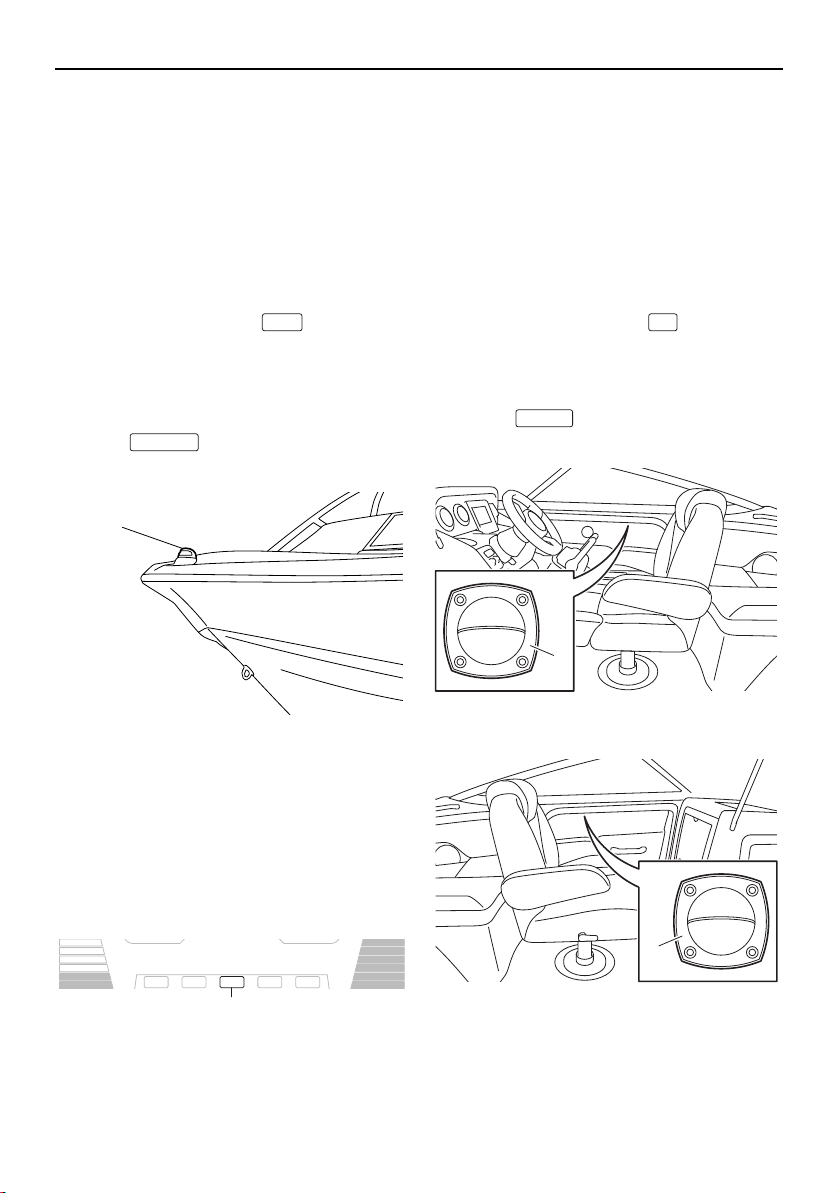
Instrument operation
67
This indicator shows the operating status and
current setting of the bow light and anchor
light. The color of the indicator changes as fol-
lows according to the operating status.
● Green: On
● Gray: Off
● Red: Error
TIP:
When the anchor mode is selected, the indi-
cator will be green and “ ” will be dis-
played.
Turning the anchor light and bow light
on or off
Tap the “ ” light button to turn the an-
chor light and bow light on or off.
1 Bow light
When the lights are turned on, a white light will
appear at the stern of the boat icon shown on
the display and a red light and a green light
will appear at the bow of the icon.
Navigation light indicator
1 Navigation light indicator
This indicator shows the operating status and
current setting of the bow light and anchor
light. The color of the indicator changes as fol-
lows according to the operating status.
● Green: On
● Gray: Off
● Red: Error
TIP:
When the navigation mode is selected, the in-
dicator will be green and “ ” will be dis-
played.
Turning the courtesy lights on or off
Tap the “ ” light button to turn the
courtesy lights on or off.
1 Courtesy light
1 Courtesy light
ANCH
Navigation
1
NAVBLWRBILGE BALLCTY LT
RPM
1300
RPM
1300
MPH
0
1
NAV
Courtesy
1
1
SportsBoat_F3R11.book Page 67 Friday, May 19, 2017 9:35 AM
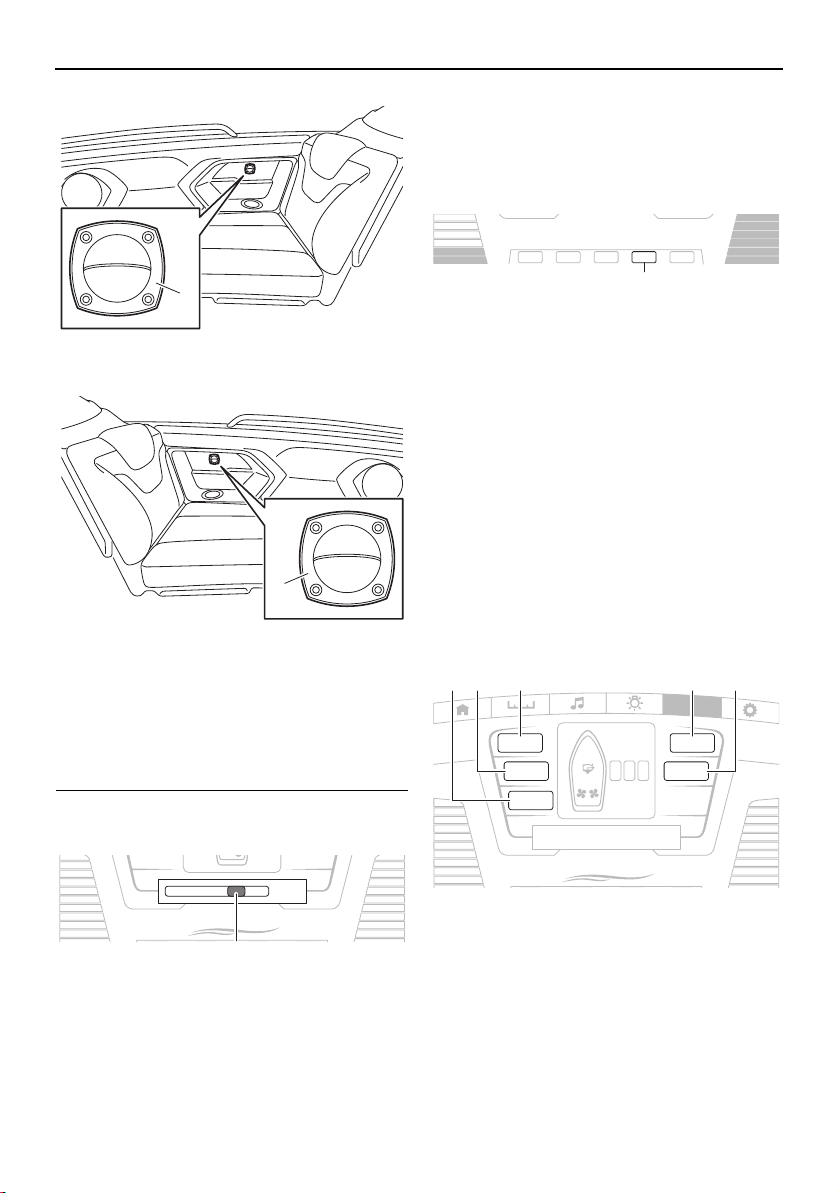
Instrument operation
68
1 Courtesy light
1 Courtesy light
When the lights are turned on, white lights will
appear to the inside of the bow of the boat
icon shown on the display.
To adjust the brightness of the courtesy lights:
When the courtesy lights are turned on, the
slider control will appear on the display.
1 Slider control
To make the lights darker, drag the slider to
the left.
To make the lights brighter, drag the slider to
the right.
Courtesy light indicator
1 Courtesy light indicator
This indicator shows the operating status of
the courtesy lights. The color of the indicator
changes as follows according to the operating
status.
● Green: On
● Gray: Off
● Red: Error
Boat system control (system control
screen tab)
The system control screen can be used to
turn the blowers and bilge pump on and off.
1 “Ballast” button (212X)
2 “Auto Blowr” button
3 “Blower” button
4 “Bilge” button
5 “Auto Bilge” button
1
1
SYS
12.3V
AUX
12.3V
FLOAT MODE
72 %
1
NavAnc
BLWRBILGE BALLCTY LT
RPM
1300
RPM
1300
MPH
0
1
0
VOLUME
% 0 ft
SYS
12.3V
AUX
12.3V
FLOAT MODE
DEPTH
S
Y
S
C
TR
L
AUTO
AUTO
Ballast
Blower
Auto Blowr
Bilge
Auto Bilge
AUTO bilge deplete battery
21 3 54
SportsBoat_F3R11.book Page 68 Friday, May 19, 2017 9:35 AM
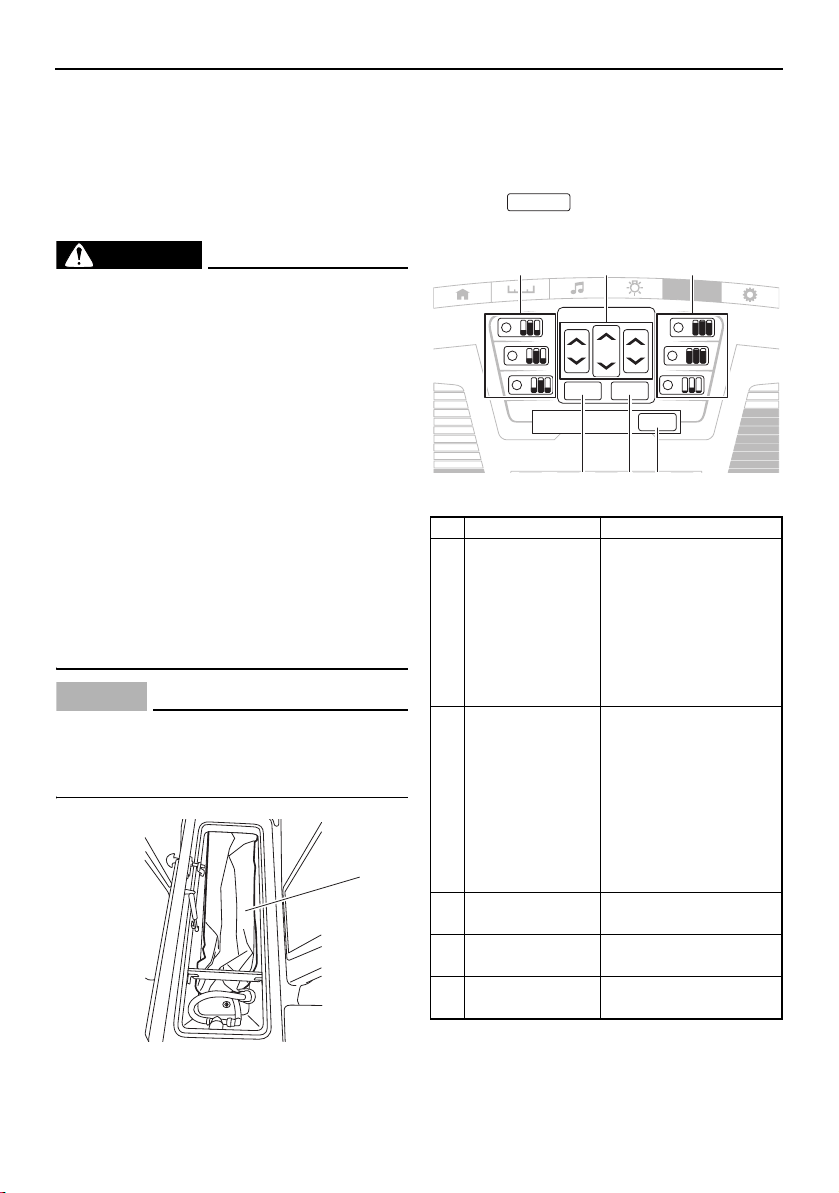
Instrument operation
69
Adjusting the wake size (212X)
This boat is equipped with an adjustable bal-
last system to increase the amount of wake
the boat leaves behind it. The more water that
is pumped into the ballast bag and ballast
tanks, the bigger the boat’s wake.
WARNING
● Improper use of the ballast system can
overload the boat, causing poor han-
dling and increased risk of swamping.
● The ballast system adds 591 kg (1303 lb)
when full. Include this weight when mak-
ing sure your load does not exceed the
weight shown on the maximum capaci-
ties label.
● Drain the ballast completely before
trailering the boat to reduce the risk of a
towing accident. The increased weight
of ballast can cause unsafe towing con-
ditions due to negative tongue weight,
including decreased tow vehicle stabili-
ty and greater chance of a runaway trail-
er that has come off the hitch.
NOTICE
Be sure there is no cargo in the ski locker
that can be damaged by the ballast bag as
it is filled.
1 Ballast bag
TIP:
This boat has a ballast bag and two ballast
tanks. The ballast tanks are not visible.
Tap the “ ” button to display the bal-
last control screen.
1
Name Function
1 Preset button Fills the ballast bag
and ballast tanks to
preset levels.
To register the current
ballast water levels to a
preset button, touch
and hold the desired
preset button for 3 sec-
onds or more.
2 Tank button Adjusts the amount
(percentage) of ballast
water in the ballast bag
and ballast tanks.
Push the upper arrow
on the button to in-
crease the amount of
ballast water and push
the lower arrow to de-
crease the amount.
3 “Fill All” button Fills the ballast bag
and ballast tanks.
4 “Drain All” button Empties the ballast bag
and ballast tanks.
5 “STOP” button Stops the ballast
pumps.
Ballast
SYS
12.3
V
25
FUEL
%
22
ft
AUX
13.2
V
RPM
1300
RPM
1300
MPH
0
DEPTH
S
Y
S
C
TR
L
P1
P2
P3
P5
P6
P4
STOP
BALLAST
25% 25%75%
Fill All Drain All
1 12
3 54
SportsBoat_F3R11.book Page 69 Friday, May 19, 2017 9:35 AM
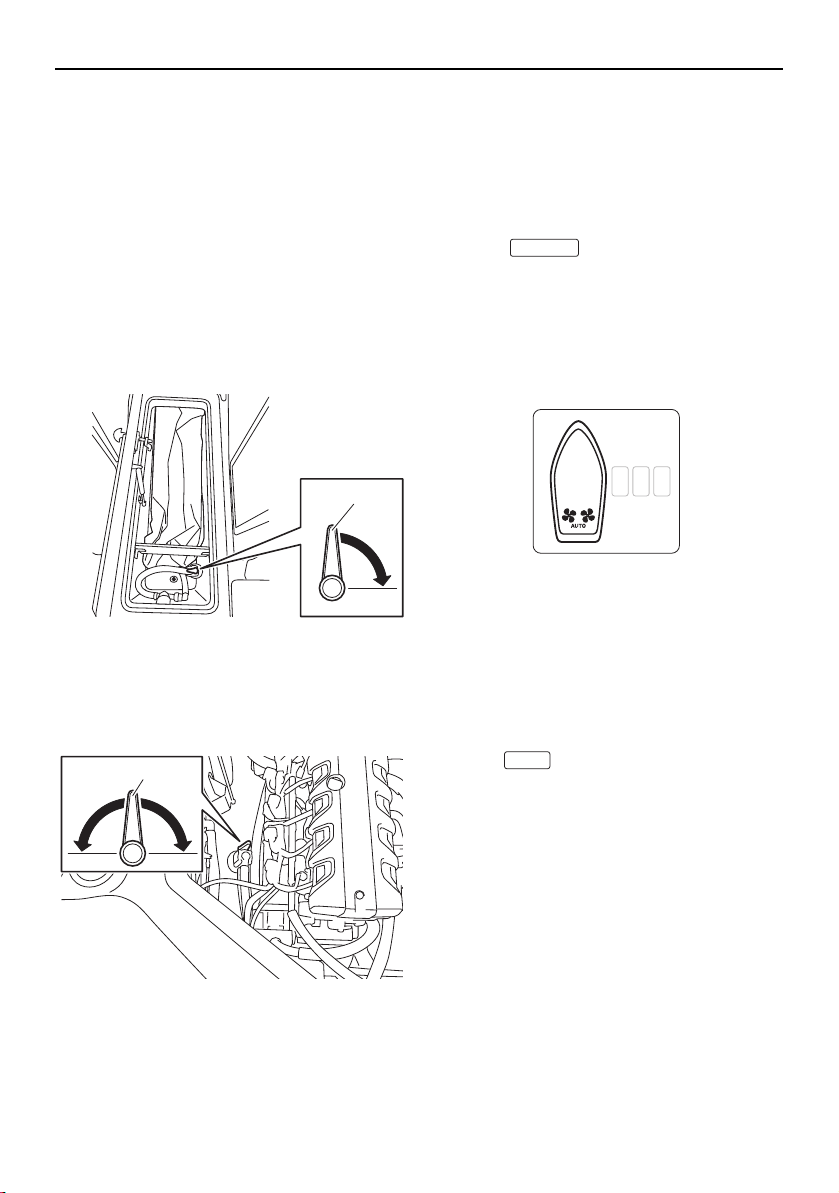
Instrument operation
70
Shutting off water intake
The ballast system has manual shut-off
valves. One manual shut-off valve is located
in the ski locker and the other is located to the
side of the starboard engine.
If you believe there is a failure in the hoses
that is causing the boat to take on water and
possibly sink, turn the manual shut-off valves
as follows to shut off water intake.
Ski locker:
Turn the manual shut-off valve 90° clockwise.
1 Manual shut-off valve
Engine compartment:
Turn the manual shut-off valve 90° clockwise
or counterclockwise.
1 Manual shut-off valve
Ask your Yamaha Boat Dealer to inspect the
boat before continuing to use it. It is recom-
mended that you also shut off the manual
shut-off valves whenever the boat will be left
in the water for a long time.
Ventilating the engine compartment
(automatic operation)
Tap the “ ” button to turn the auto-
matic blower mode on or off. When the auto-
matic blower mode is turned on, blue fan
symbols and “AUTO” will appear on the boat
icon shown on the display.
The blowers will operate for 4 minutes and the
time remaining until the blowers stop will be
displayed on the display.
Ventilating the engine compartment
(non-automatic operation)
Tap the “ ” button on the system control
screen or the blower button on the home
screen to turn the port and starboard blowers
on or off. When the blowers are turned on,
green fan symbols will appear on the boat
icon shown on the display.
1
1
Auto Blowr
Blower
SportsBoat_F3R11.book Page 70 Friday, May 19, 2017 9:35 AM
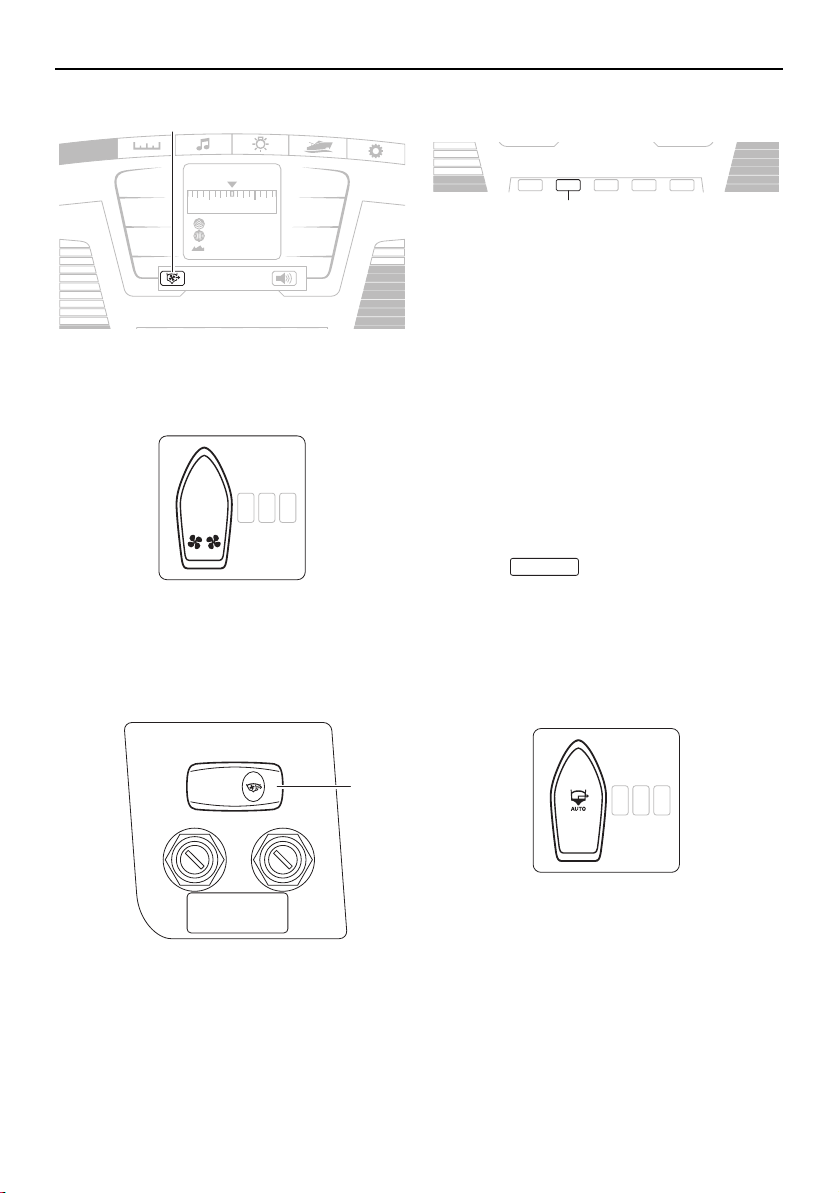
Instrument operation
71
1 Blower button
TIP:
You can also use the blower switch above the
main switches to turn the blowers on or off.
1 Blower switch
Blower indicator
1 Blower indicator
This indicator shows the operating status of
the blowers. The color of the indicator chang-
es as follows according to the operating sta-
tus.
● Green: On
● Blue: Automatic operation
● Gray: Off
● Red: Error
Draining the bilge water (automatic
operation)
Tap the “ ” button to turn the auto-
matic bilge mode on. When the automatic
bilge mode is turned on, a blue bilge-draining
symbol and “AUTO” will appear on the boat
icon shown on the display.
The boat automatically checks for accumulat-
ed bilge water and the bilge pump operates to
discharge the water.
SYS
12.3 V
25
FUEL
% 22 ft
AUX
13.2 V
RPM
1300
RPM
1300
MPH
0
DEPTH
H
O
M
E
360
N
EW
NENW
02:18 PM
LAT
LONG
ELEV
00˚00’00”N
00˚00’00”E
0 FT
1
BLOWER
1
NavAnc
BLWRBILGE BALLCTY LT
RPM
1300
RPM
1300
MPH
0
1
Auto Bilge
SportsBoat_F3R11.book Page 71 Friday, May 19, 2017 9:35 AM
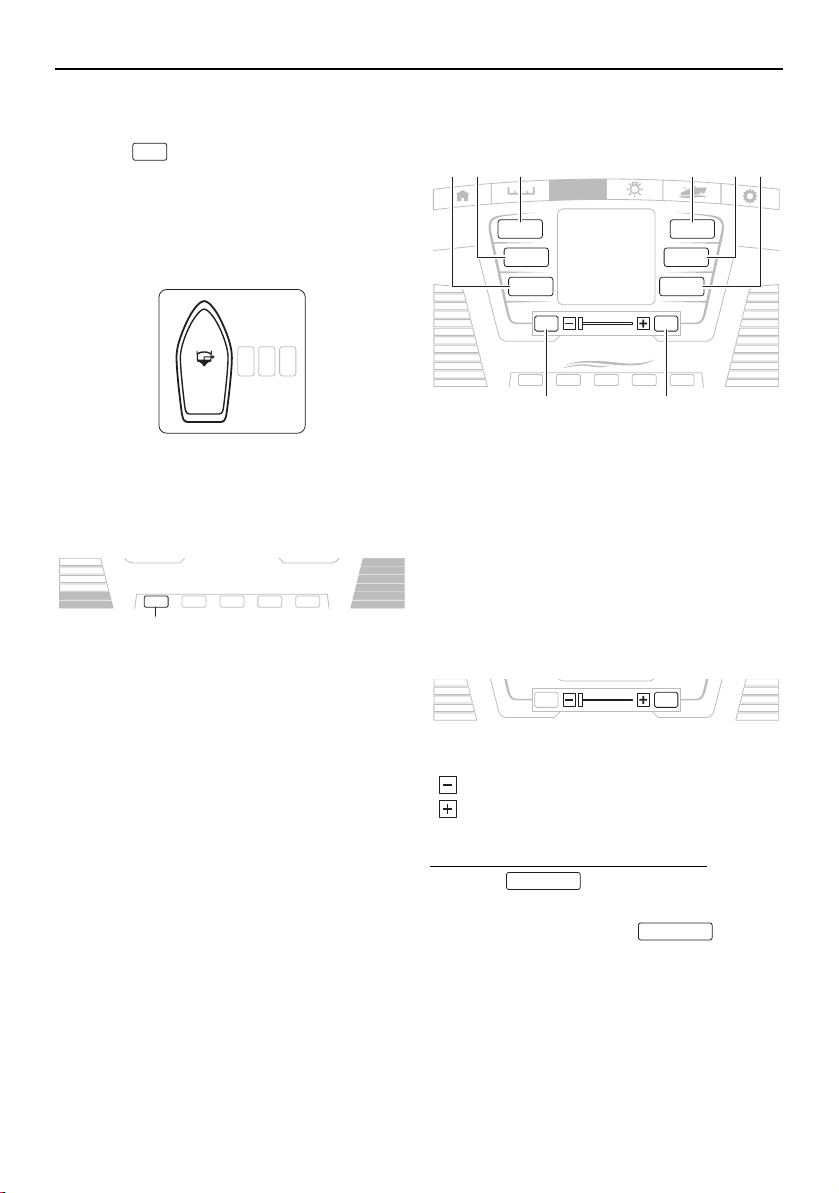
Instrument operation
72
Draining the bilge water (non-
automatic operation)
Tap the “ ” button to turn the bilge pump
on or off. When the bilge pump is turned on, a
green bilge-draining symbol will appear on the
boat icon shown on the display.
Bilge pump indicator
1 Bilge pump indicator
This indicator shows the operating status of
the bilge pump. The color of the indicator
changes as follows according to the operating
status.
● Green: On during manual or automatic op-
eration
● Blue: Off (standby) during automatic opera-
tion
● Gray: Off (standby) during default operation
● Red: On during default operation
Audio system operation and external
device connections (media screen
tab)
The media screen can be used to receive a
radio broadcast, connect to an external de-
vice using Bluetooth wireless technology, and
perform other functions.
1 “Bluetooth” button
2 “Weather Band” button
3 “Auxiliary” button
4 “Radio” button
5 “USB” button
6 “SiriusXM” button
7 “MENU” button
8 “MUTE/PWR” button
Adjusting the speaker volume level
Tap “+” or “–” to adjust the volume level.
: Decrease the volume level.
: Increase the volume level.
To mute the sound of the speakers:
Tap the “ ” button.
TIP:
If you touch and hold the “ ” button,
the media screen will enter the sleep mode.
Bluetooth connections
Smartphones and other external devices that
are compatible with Bluetooth can be con-
nected wirelessly to the audio system to listen
Bilge
NavAnc
BLWRBILGE BALLCTY LT
RPM
1300
RPM
1300
MPH
0
1
NavAnc
BLWRBILGE BALLCTY LT
0
VOLUME
%
0
ft
SYS
12.3V
AUX
12.3V
DEPTH
MEDIA
NO SOURCE
FLOAT MODE
Bluetooth
Auxiliary
Wearher
Band
SiriusXM
Radio
USB
MUTE/
PWR
MENU
21
7 8
3 5 64
MUTE/
PWR
MENU
MUTE/PWR
MUTE/PWR
SportsBoat_F3R11.book Page 72 Thursday, September 20, 2018 5:43 PM
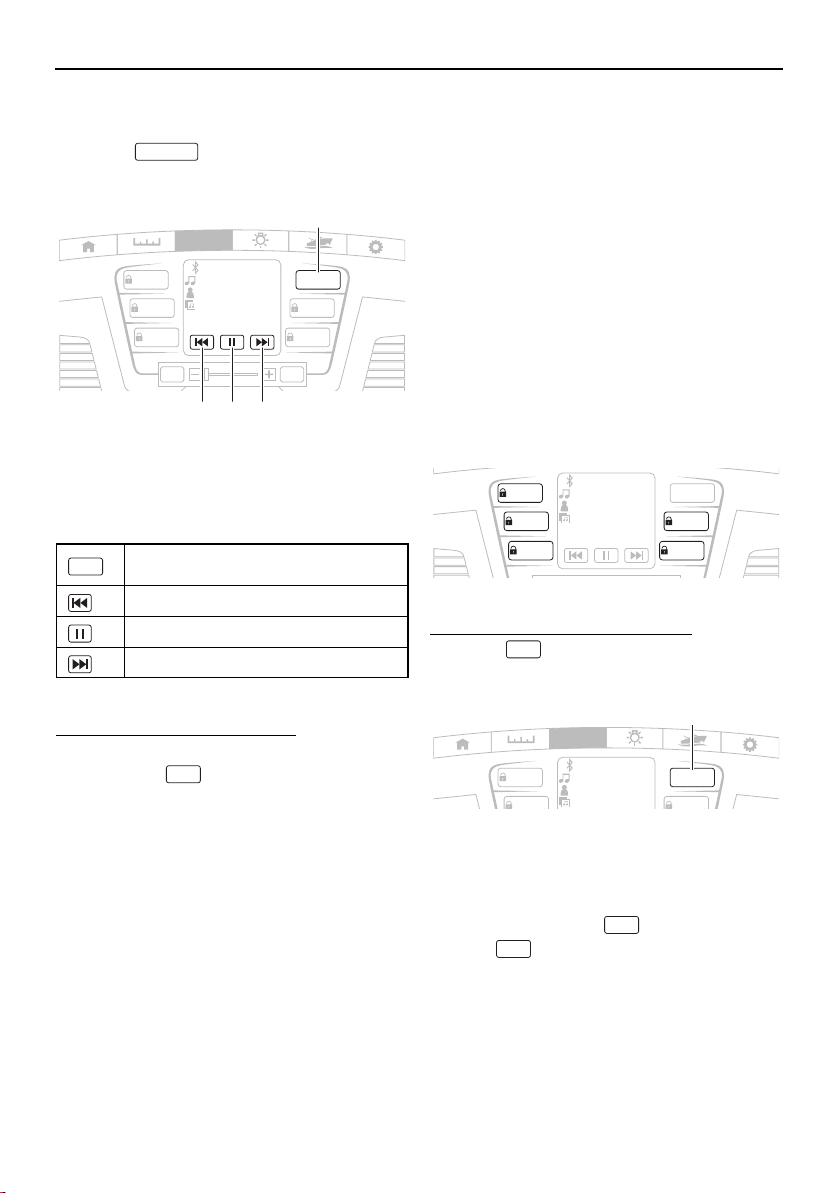
Instrument operation
73
to the audio tracks stored on the devices
through the audio system’s speakers.
Tap the “ ” button to display the fol-
lowing screen.
1 “PAIR” button
2 Previous button
3 Play/pause button
4 Next button
To connect an external device:
Multi-function display:
(1) Tap the “ ” button.
External device:
(2) Turn on the Bluetooth function of the ex-
ternal device, and then search for the
multi-function display unit (PA4A) of the
boat.
TIP:
● The displayed name of the multi-function
display unit varies according to the external
device.
● Make sure that the other external devices
have their Bluetooth function disabled be-
fore beginning the pairing process to re-
duce connection issues.
(3) Select the multi-function display unit of
the boat to connect to it.
TIP:
● While you are talking on a smartphone that
is connected to the audio system using a
Bluetooth connection, the audio track is au-
tomatically paused. When you are finished
talking on the smartphone, the playback of
the audio track will automatically resume.
● When an external device is connected us-
ing Bluetooth wireless technology, the au-
dio tracks will automatically start playing.
To disconnect an external device:
Tap the “ ” button to disconnect the con-
nected device.
1 “DCN” button
TIP:
When a device is connected using Bluetooth
wireless technology, “ ” will be displayed
for the “ ” button.
Starts the pairing process to connect
to an external device.
Selects the previous audio track.
Pauses or resumes the audio track.
Selects the next audio track.
Bluetooth
0
VOLUME
% 0 ft
DEPTH
MEDIA
MUTE/
PWR
MENU
Bluetouth
No info
No info
No info
No Device
Empty
Empty
Empty Empty
Empty
PAIR
1
2 3 4
PAIR
PAIR
0
VOLUME
% 0 ft
DEPTH
Bluetouth
No info
No info
No info
No Device
Smart 1
Smart 2
Empty Empty
Empty
PAIR
DCN
VOLUME DEPTH
MEDIA
Bluetouth
No info
No info
No info
Empty
Empty Empty
DCN
1
DCN
PAIR
SportsBoat_F3R11.book Page 73 Thursday, September 20, 2018 5:43 PM
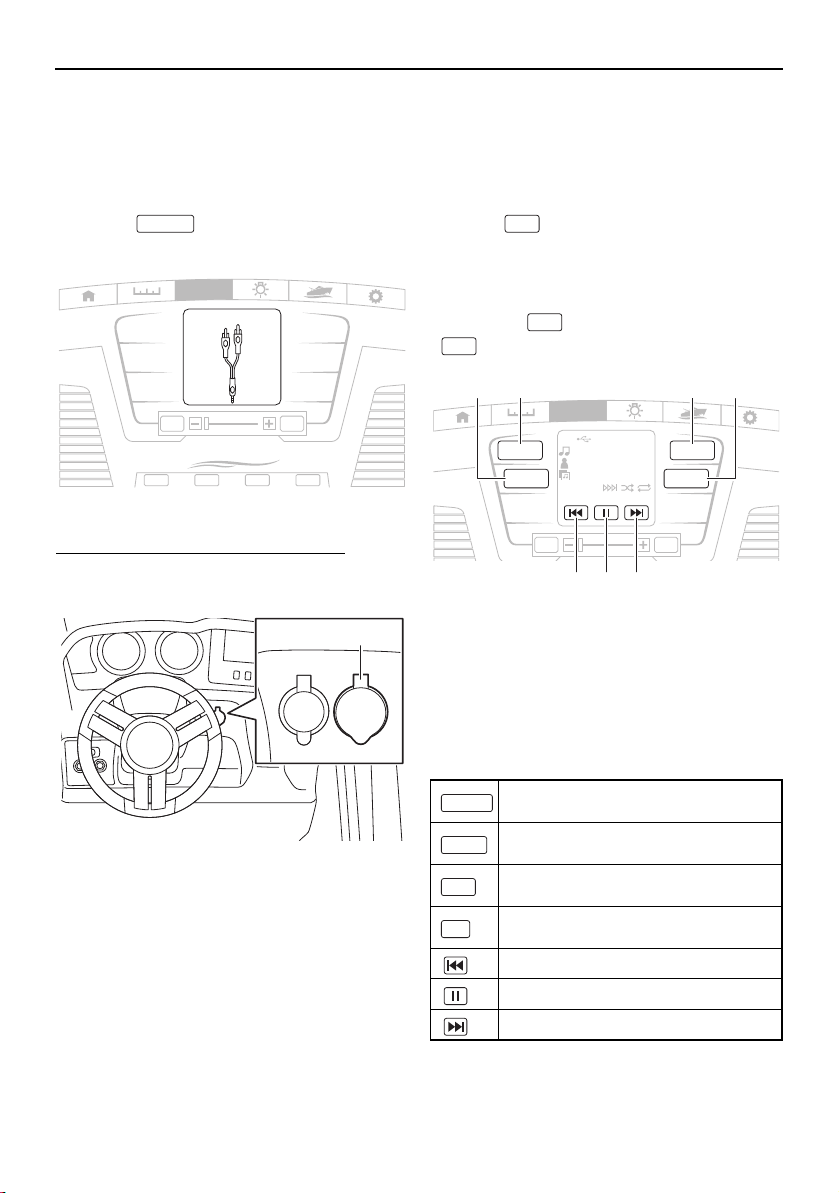
Instrument operation
74
Auxiliary input jack connections
Portable media players and other external de-
vices can be connected to the audio system to
listen to the audio tracks stored on the devices
through the audio system’s speakers.
Tap the “ ” button to display the fol-
lowing screen.
To connect to the auxiliary input jack:
Open the “AUDIO AUX-USB” cap and con-
nect the device to the auxiliary input jack.
1 “AUDIO AUX-USB” cap
TIP:
● You can adjust the volume level of the
speakers using the multi-function display
unit or the volume control of the external de-
vice.
● To select the audio tracks, use the external
device.
USB connections
USB flash drives and other external devices
can be connected to the USB terminal to lis-
ten to the audio tracks stored on the devices
through the audio system’s speakers.
Tap the “ ” button to display the following
screen.
TIP:
When an iPod is connected to the audio sys-
tem, the “ ” button changes to the
“ ” button automatically.
1 “Random” button
2 “Repeat” button
3 “Intro” button
4 “List” button
5 Previous button
6 Play/pause button
7 Next button
* When an iPod is connected to the audio sys-
tem, this button will not be displayed.
Auxiliary
NavAnc
BLWRBILGE CTY LT
0
VOLUME
% 0 ft
SYS
12.3V
AUX
12.3V
FLOAT MODE
DEPTH
M
E
D
IA
MUTE/
PWR
MENU
Auxiliary
12V
AUDIO
AUX-USB
1
Plays the audio tracks in a random or-
der.
Repeats the playback of an audio
track.
*
Starts the playback at the beginning
of an audio track.
Displays the list of audio tracks stored
on a USB flash drive.
Selects the previous audio track.
Pauses or resumes the audio track.
Selects the next audio track.
USB
USB
iPod
0
VOLUME
% 0 ft
DEPTH
M
E
D
IA
MUTE/
PWR
MENU
USB
She Will Be Loved
Maroon 5
Songs About Jane
1/91 00:52
Repeat
Random
Intro
List
5 76
1 2 43
Random
Repeat
Intro
List
SportsBoat_F3R11.book Page 74 Friday, May 19, 2017 9:35 AM
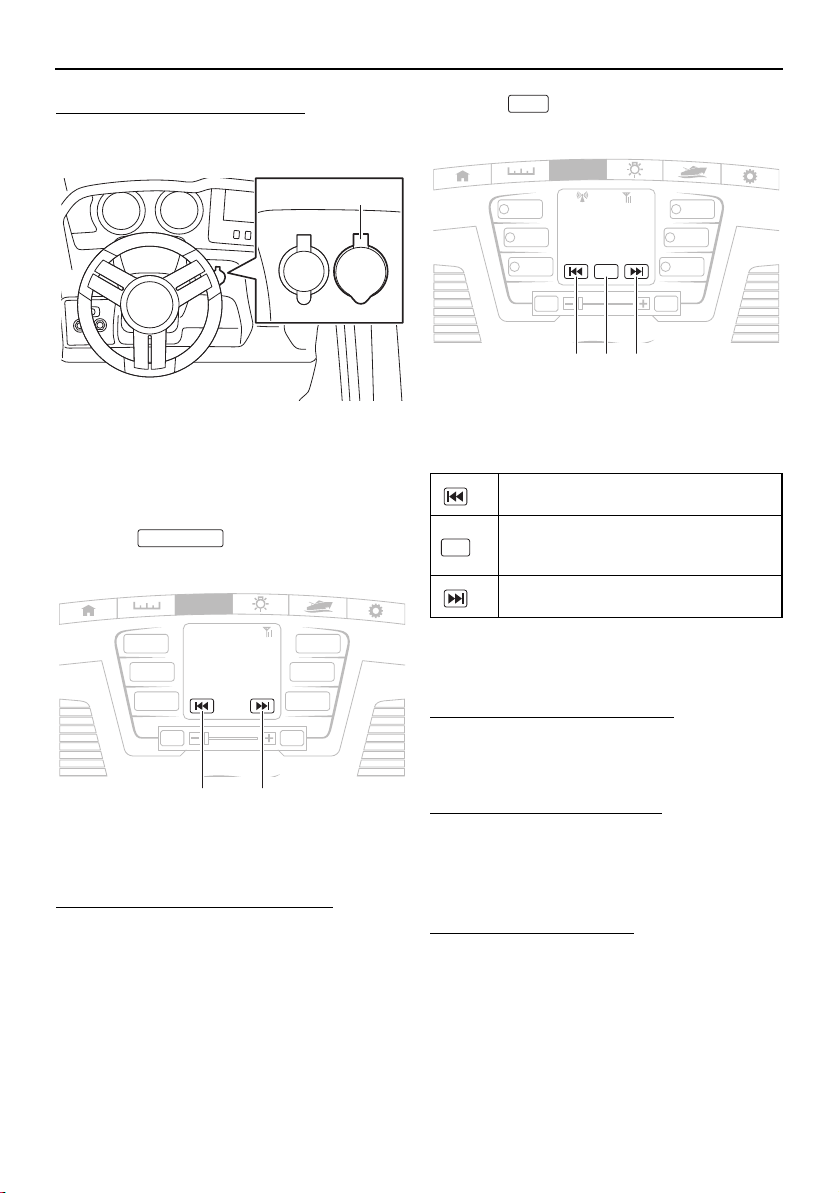
Instrument operation
75
To connect to the USB terminal:
Open the “AUDIO AUX-USB” cap and con-
nect to the USB terminal.
1 “AUDIO AUX-USB” cap
Weather radio broadcasts
You can receive weather information through
a weather radio service.
Tap the “ ” button to display the
following screen.
1 Previous button
2 Next button
To listen to a weather radio service:
Tap the preset button for the desired weather
radio service or tap the previous or next but-
ton to scroll through the preset radio services.
Radio broadcasts
You can receive a radio broadcast.
Tap the “ ” button to display the follow-
ing screen.
1 Previous button
2 Band button
3 Next button
* The icon changes depending on the select-
ed frequency band.
To change the frequency band:
To change the frequency band, tap the band
button.
To listen to a radio broadcast:
To change the received radio frequency, tap
the previous button or next button, or tap a
preset button.
To register a radio station:
(1) Tune the radio to the desired radio sta-
tion.
(2) Touch and hold the desired preset button
for 3 seconds or more.
12V
AUDIO
AUX-USB
1
Weather Band
0
VOLUME
%
0
ft
SYS
12 3V
AUX
12 3V
FLOAT MODE
DEPTH
M
E
D
IA
MUTE/
PWR
MENU
Weather Band
162.475
MHz
162.425
162.550
162.400
162.525
162.450
162.500
1 2
Decreases the received radio fre-
quency.
*
Changes the frequency band.
The frequency band can be changed
to FM1, FM2, FM3, AM1, and AM2.
Increases the received radio frequen-
cy.
Radio
0
VOLUME
%
0
ft
SYS
12 3V
AUX
12 3V
FLOAT MODE
DEPTH
M
E
D
IA
MUTE/
PWR
MENU
Radio
FM1
98.1
MHz
FM1-2
97.7
P4
105.3
P1
101.3
P5
98.1
P2
103.1
P6
106.9
P3
1 32
FM1
SportsBoat_F3R11.book Page 75 Friday, May 19, 2017 9:35 AM

Instrument operation
76
SiriusXM radio broadcasts
You can receive SiriusXM radio broadcasts if
you have a paid subscription for this device.
Tap the “ ” button to display the fol-
lowing screen.
1 Previous button
2 Preset list button
3 Next button
* The icon changes depending on the select-
ed preset list.
To listen to a radio broadcast:
To change the received radio frequency, tap
the previous button or next button, or tap a
preset button.
To register a radio station:
(1) Tune the radio to the desired radio sta-
tion.
(2) Touch and hold the desired preset but-
ton.
To display a list of categories or radio stations:
To display a list of categories, tap the catego-
ry.
Audio system settings
The settings of the audio system can be
changed.
Tap the “ ” button to display the follow-
ing screen.
1 “Bass/Treb” button
2 “Fade/Bal” button
3 “EQ” button
4 “Loudness” button
To adjust the fade and balance:
(1) Tap the “ ” button.
(2) To adjust the fade between the front and
rear speakers, tap “F” or “R”. To adjust
the balance between the left and right
speakers, tap “L” or “R”.
Decreases the received radio fre-
quency.
*
Changes the displayed preset list.
The preset list can be changed to
SXM-1, SXM-2, and SXM-3.
Increases the received radio frequen-
cy.
SiriusXM
0
VOLUME
%
0
ft
SYS
12 3V
AUX
12 3V
FLOAT MODE
DEPTH
M
E
D
IA
MUTE/
PWR
MENU
SMX-1
She Will Be Loved
Maroon 5
10 Pop2K
Pop
SiriusXM
CH752
Holly
P4
CH10
Pop2K
P1
CH30
The Loft
P5
CH115
CNN
P2
CH104
Indie
P6
CH12
Z100/NY
P3
1 32
SXM-1
MENU
0
VOLUME
% 0 ft
SYS
12.3V
AUX
12.3V
FLOAT MODE
DEPTH
M
E
D
IA
MUTE/
PWR
MENU
R
F
RL
Fade/Bal
Bass/Treb
EQ
Loundness
1 2 43
Fade/Bal
SportsBoat_F3R11.book Page 76 Friday, May 19, 2017 9:35 AM
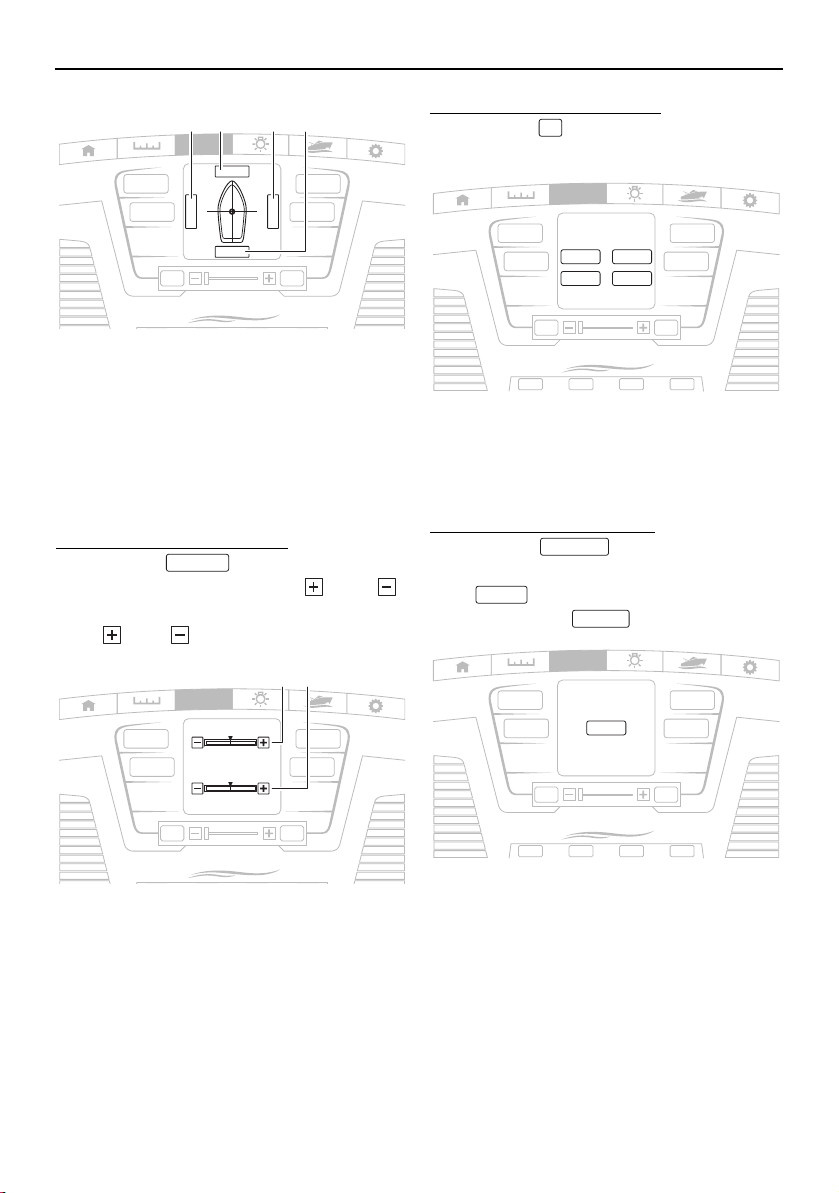
Instrument operation
77
1 Fade
2 Balance
TIP:
From the standard setting of 0, the fade and
balance can be adjusted to 12 levels to the
left, right, front, and rear.
To adjust the treble and bass:
(1) Tap the “ ” button.
(2) To adjust the treble, tap “ ” or “ ”
under “TREBLE”. To adjust the bass, tap
“ ” or “ ” under “BASS”.
1 Treb le
2 Bass
TIP:
From the standard setting of 0, the treble and
bass can be adjusted to 6 levels.
To select the equalizer mode:
(1) Tap the “ ” button.
(2) Tap the desired mode.
TIP:
The 4 available modes are “POP”, “FLAT”,
“CLASSIC”, and “ROCK”.
To set the loudness function:
(1) Tap the “ ” button.
(2) To turn on the loudness function, tap the
“ ”. To turn off the loudness func-
tion, tap the “ ”.
Multi-function display unit settings
(setting screen tab)
The setting screen can be used to change the
settings of the multi-function display unit.
When an item is selected, the item name will
be displayed in red.
0
VOLUME
% 0 ft
SYS
12.3V
AUX
12.3V
FLOAT MODE
DEPTH
M
E
D
IA
MUTE/
PWR
MENU
R
F
RL
Fade/Bal
Bass/Treb
EQ
Loundness
221 1
Bass/Treb
0
VOLUME
% 0 ft
SYS
12.3V
AUX
12.3V
FLOAT MODE
DEPTH
M
E
D
IA
MUTE/
PWR
MENU
Fade/Bal
Bass/Treb
EQ
Loundness
TREBLE
-6 +60
BASS
-6 +60
1 2
EQ
NavAnc
BLWRBILGE CTY LT
0
VOLUME
%
0
ft
SYS
12.3V
AUX
12.3V
FLOAT MODE
DEPTH
M
E
D
IA
MUTE/
PWR
MENU
Fade/Bal
Bass/Treb
EQ
Loundness
FLAT
POP
CLASSIC
FLAT
ROCK
Loundness
Turn ON
Turn OFF
NavAnc
BLWRBILGE CTY LT
0
VOLUME
%
0
ft
SYS
12.3V
AUX
12.3V
FLOAT MODE
DEPTH
M
E
D
IA
MUTE/
PWR
MENU
Fade/Bal
Bass/Treb
EQ
Loundness
Loudness
ON
Turn OFF
SportsBoat_F3R11.book Page 77 Friday, May 19, 2017 9:35 AM
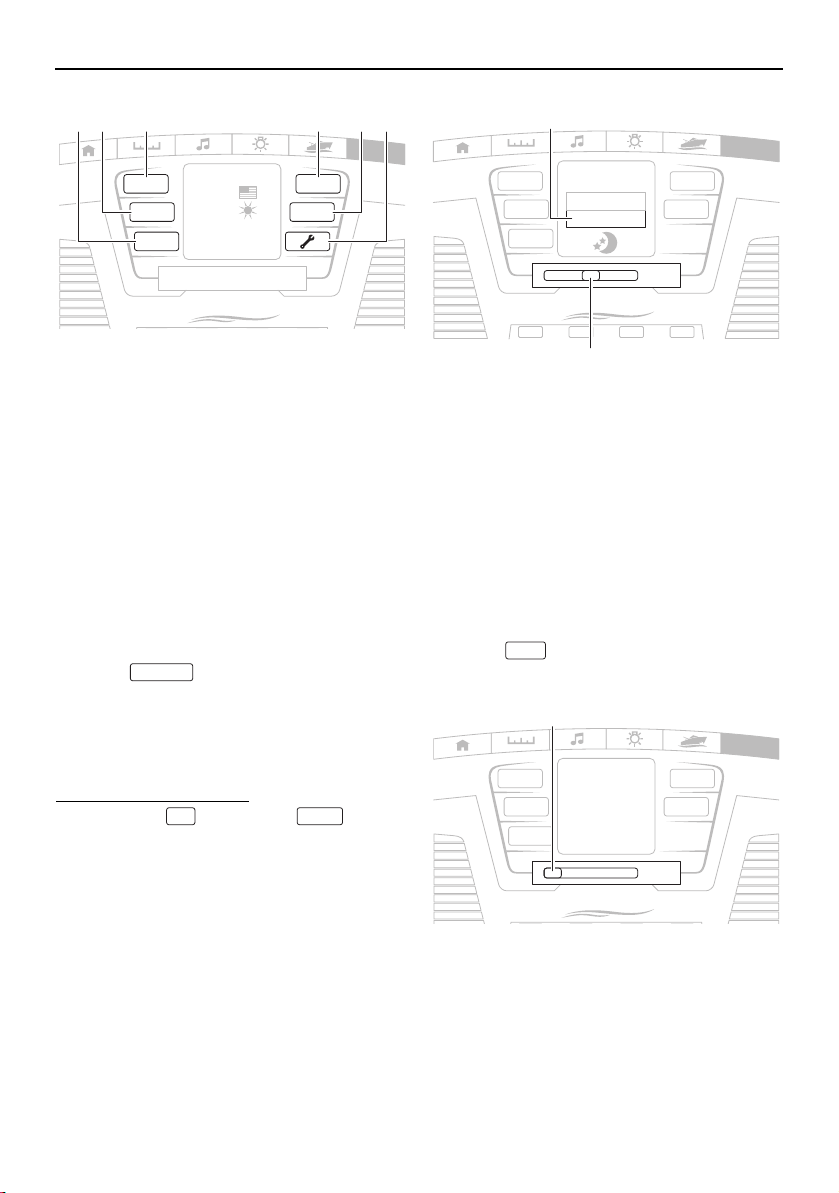
Instrument operation
78
1 “Day/Night” button
2 “Depth” alarm button
3 “Factory” reset button
4 “Time” button
5 “Unit” button
6 Maintenance button
Setting the day mode and night mode
The multi-function display has a day mode
and a night mode.
When the bow light or anchor light is turned
on, the multi-function display will enter the
night mode and the display brightness will de-
crease.
Tap the “ ” button to adjust the bright-
ness of the display. The brightness can be set
separately for the day mode and for the night
mode.
To adjust the brightness:
(1) Tap the “ ” button or “ ” button
to select the desired mode.
1 Selected mode
2 Slider control
(2) To make the display darker, drag the slid-
er to the left. To make the display bright-
er, drag the slider to the right.
TIP:
The default settings are 100% for the day
mode and 50% for the night mode.
Setting the depth alarm
Tap the “ ” alarm button to set the water
depth alarm.
1 Slider control
TIP:
The default setting is 4 ft.
0
VOLUME
% 0 ft
SYS
12.3V
AUX
12.3V
FLOAT MODE
DEPTH
SETTING
S
Day/Night
Factory
Depth
Time
Unit
02:18 PM
Language
Day/Night
Unit
Depth
US
1 ft
21 3 5 64
Day/Night
DAY
NIGHT
NavAnc
BLWRBILGE CTY LT
0
VOLUME
% 0 ft
SYS
12.3V
AUX
12.3V
FLOAT MODE
DEPTH
SETTING
S
Day/Night
Factory
Depth
Time
Unit
Brightness
mode
NIGHT
DAY
50 %
1
2
Depth
0
VOLUME
% 0 ft
SYS
12.3V
AUX
12.3V
FLOAT MODE
DEPTH
SETTING
S
Day/Night
Factory
Depth
Time
Unit
Set the depth level
for the alarm
1 ft
1
SportsBoat_F3R11.book Page 78 Friday, May 19, 2017 9:35 AM
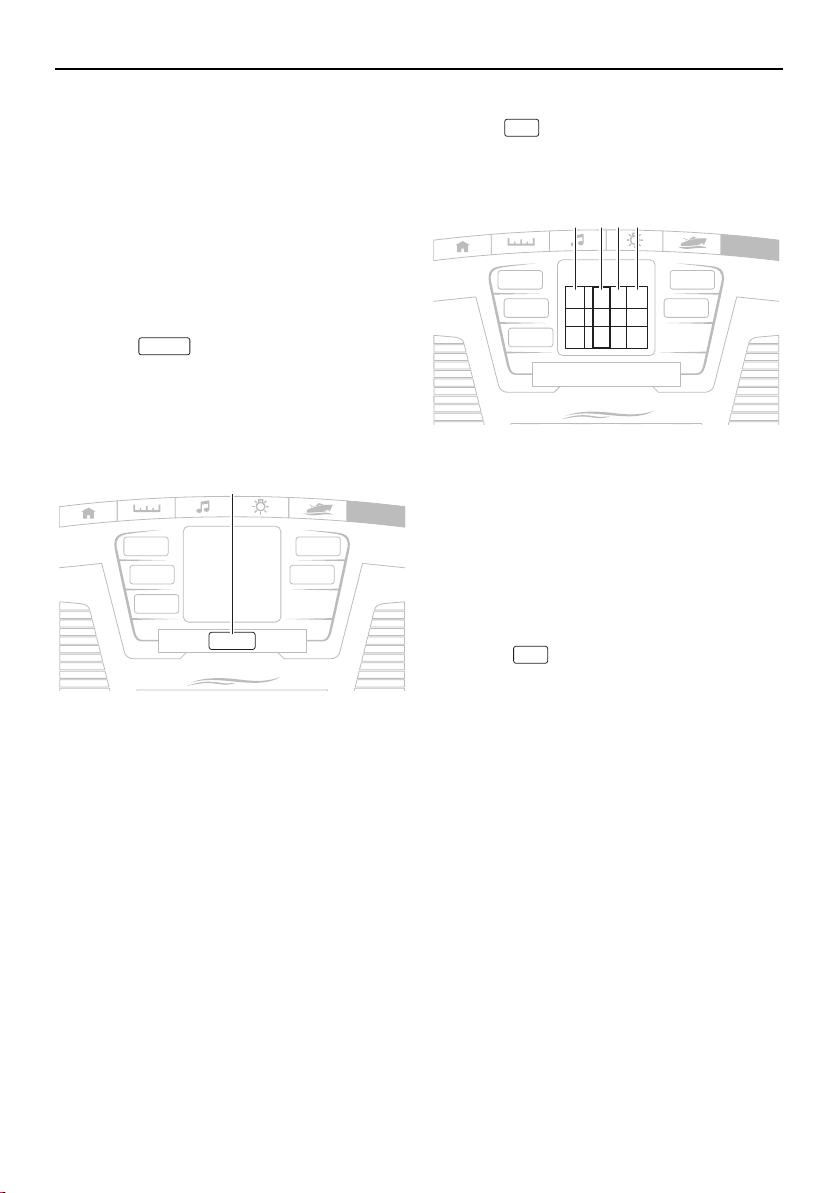
Instrument operation
79
To reduce the water depth setting, drag the
slider to the left.
To increase the water depth setting, drag the
slider to the right.
TIP:
To deactivate the water depth alarm, set the
alarm to 0 ft.
Resetting the settings to the default
settings
Tap the “ ” reset button to reset the
settings to their factory default settings. The
automatic bilge mode and automatic blower
mode will be turned on. When the settings are
reset, the button will be shown in red.
1 “RESET” button
The default settings are as follows:
● Depth alarm: 4 ft
● Day mode brightness: 100%
● Night mode brightness: 50%
● Time shift: GMT+0
● Unit: US SYSTEM
● Automatic bilge mode: ON
● Automatic blower mode: ON
TIP:
When setting the water depth alarm 0 ft, the
alarm will not activate.
Setting the time
Tap the “ ” button to set the time. Tap the
time unit that you want to set and flick up or
down.
1 Hours
2 Ten minutes
3 Minutes
4 AM/PM
TIP:
The default setting is GMT +0.
Selecting the display units
Tap the “ ” button to select “US SYS-
TEM” or “METRIC SYSTEM” for the display
units.
When “US SYSTEM” is selected as the dis-
play units of the multi-function display unit,
values are shown in feet/miles/gallons/de-
grees Fahrenheit.
When “METRIC SYSTEM” is selected as the
display units of the multi-function display unit,
values are shown in meters/kilometers/li-
ters/degrees Celsius.
Factory
0
VOLUME
% 0 ft
SYS
12.3V
AUX
12.3V
FLOAT MODE
DEPTH
SETTING
S
Day/Night
Factory
Depth
Time
Unit
Reset all
parameters to
factory settings ?
RESET
1
Time
0
VOLUME
% 0 ft
SYS
12.3V
AUX
12.3V
FLOAT MODE
DEPTH
SETTING
S
Day/Night
Factory
Depth
Time
Unit
Set time
01
am
0 7:
03 2 9:
02
pm
1 8:
1 2 3 4
Unit
SportsBoat_F3R11.book Page 79 Friday, May 19, 2017 9:35 AM
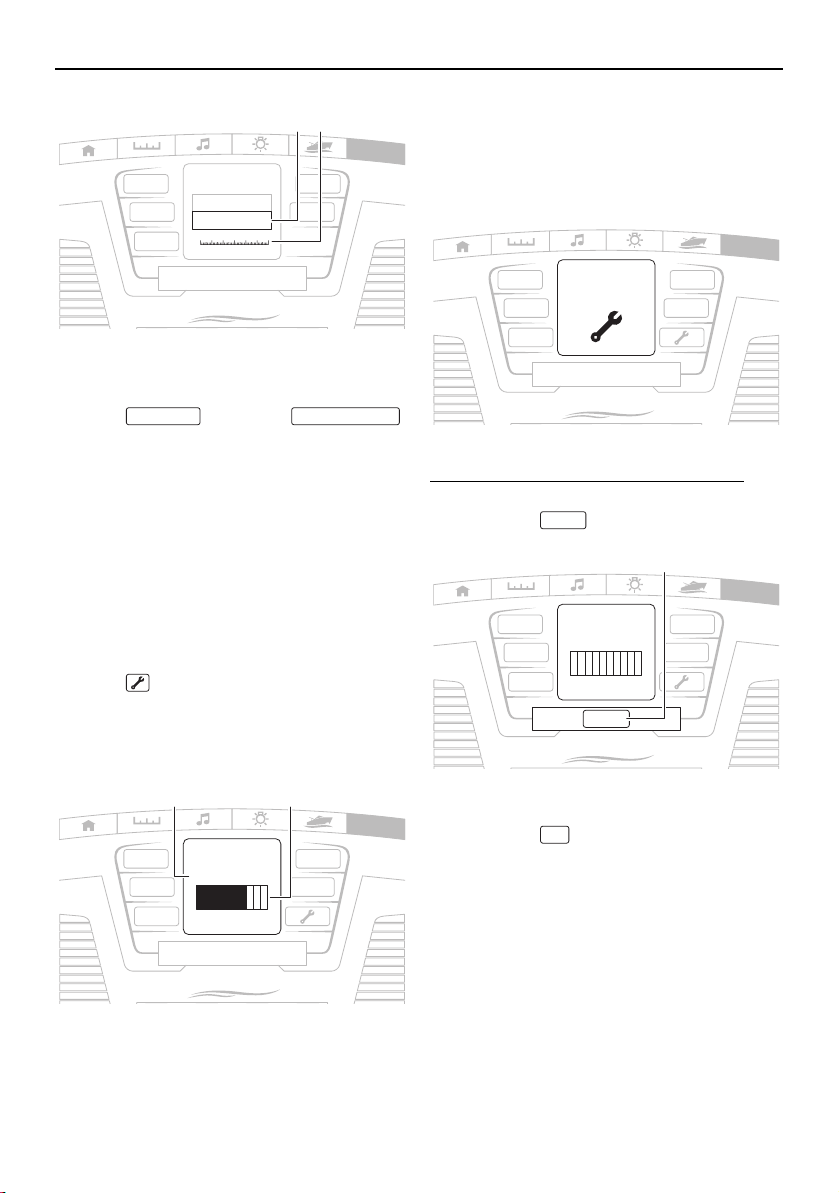
Instrument operation
80
1 Unit
2 Ruler
Tap the “ ” button or “ ”
button to select the desired display unit setting.
A ruler for the set display units will be shown
under the setting.
TIP:
The default setting is “US SYSTEM”.
Displaying and resetting the
maintenance counter
To display the indicator bar and the number of
hours remaining until the next maintenance,
tap the “ ” button.
Depending on the number of hours remain-
ing, the color of the indicator bar will change
to 4 colors: green, yellow, orange, and red.
1 Number of hours remaining
2 Indicator bar
When the number of hours remaining is 0
hours, the maintenance reminder will be dis-
played in the center display and the alarm will
sound.
To reset the number of hours remaining:
(1) Tap the reminder.
(2) Tap the “ ” button.
1 “RESET” button
(3) Tap the “ ” button.
0
VOLUME
% 0 ft
SYS
12.3V
AUX
12.3V
FLOAT MODE
DEPTH
SETTING
S
Day/Night
Factory
Depth
Time
Unit
US SYSTEM
Set Unit
METRIC SYSTEM
654321
INCH
1 2
US SYSTEM
METRIC SYSTEM
0
VOLUME
% 0 ft
SYS
12.3V
AUX
12.3V
FLOAT MODE
DEPTH
SETTING
S
Day/Night
Factory
Depth
Time
Unit
MAINTENANCE
70 HRS REMAIN
0 100
21
0
VOLUME
% 0 ft
SYS
12.3V
AUX
12.3V
FLOAT MODE
DEPTH
SETTING
S
Day/Night
Factory
Depth
Time
Unit
MAINTENANCE
DUE
RESET
0
VOLUME
% 0 ft
SYS
12.3V
AUX
12.3V
FLOAT MODE
DEPTH
SETTING
S
Day/Night
Factory
Depth
Time
Unit
MAINTENANCE
0 HRS REMAIN
0 100
RESET
1
YES
SportsBoat_F3R11.book Page 80 Friday, May 19, 2017 9:35 AM
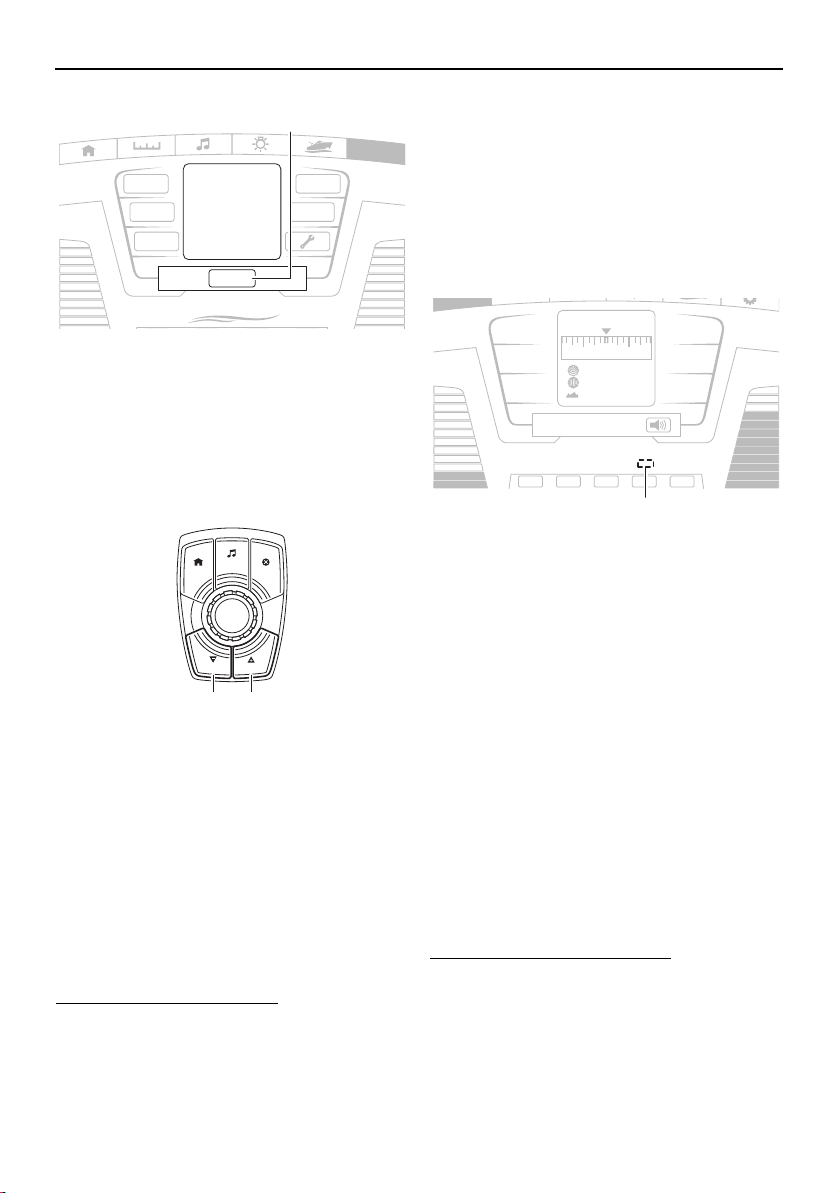
Instrument operation
81
1 “YES” button
“CRUISE/NO WAKE” buttons
These buttons activate and set the cruise as-
sist, no-wake mode, and reverse RPM con-
trol.
1 “CRUISE/NO WAKE” (–) button
2 “CRUISE/NO WAKE” (+) button
Operating the boat at a steady speed
(cruise assist)
The cruise assist feature is for steady engine
speed operation when the boat is traveling
above no-wake speeds. The cruise assist is
available for use whenever the engines are
running above 3000 rpm and below 7000
rpm.
To activate the cruise assist:
(1) Push the remote control levers forward to
open the throttle until the desired engine
speed is reached and both engines are
operating at the same engine speed.
(2) Push the “CRUISE/NO WAKE” (+) button
or “CRUISE/NO WAKE” (–) button. When
the cruise assist is activated, “CRUISE”
and the cruise assist setting level will be
displayed under “MPH” or “KM/h” for the
boat speed.
1 Cruise assist setting level
TIP:
● Once the cruise assist is activated, the set
engine speed can be increased by pushing
the “CRUISE/NO WAKE” (+) button or de-
creased by pushing the “CRUISE/NO
WAKE” (–) button. However, the adjust-
ment is limited to a maximum of 8 incre-
ments above or below the initial cruise
assist setting. Each time a switch is pushed,
the engine speed will increase or decrease
approximately 100–200 rpm.
● While the cruise assist is activated, the en-
gine speed can also be adjusted by operat-
ing the remote control levers.
To deactivate the cruise assist:
Operate the remote control levers to decrease
the engine speed to 3000 rpm or less. When
“CRUISE” and the cruise assist setting level
disappear, the cruise assist is deactivated.
0
VOLUME
% 0 ft
SYS
12.3V
AUX
12.3V
FLOAT MODE
DEPTH
SETTING
S
Day/Night
Factory
Depth
Time
Unit
YES
MAINTENANCE
Are you sure?
1
CRUISE
CANCELHOME
MEDIA
NO WAKE
CRUISE
NO WAKE
21
NavAnc
BLWRBILGE BALLCTY LT
SYS
12.3 V
25
FUEL
% 22 ft
AUX
13.2 V
RPM
5000
RPM
5000
MPH
35
DEPTH
H
O
M
E
360
N
EW
NENW
02:18 PM
LAT
LONG
ELEV
00˚00’00”N
00˚00’00”E
0 FT
CRUISE +1
1
SportsBoat_F3R11.book Page 81 Friday, May 19, 2017 9:35 AM

Instrument operation
82
Operating the boat with a minimal
wake (no-wake mode)
The no-wake mode is useful for operating the
boat at a steady speed with a minimal wake.
This is especially convenient when traveling
in harbors, channels, or other areas posted
with low speed limits as “no wake zones”.
The no-wake mode can be used only when
the engines are operating at idle speed.
To activate the no-wake mode:
(1) Put the remote control levers in the TDE
position or forward position so that both
engines are operating at idle speed.
(2) Push the “CRUISE/NO WAKE” (+) but-
ton. When the no-wake mode is activat-
ed, “NO WAKE” will be displayed under
“MPH” or “KM/h” for the boat speed.
1 “NO WAKE”
TIP:
The no-wake mode can be set to 3 engine
speeds. To adjust the engine speed while the
no-wake mode is activated, push the
“CRUISE/NO WAKE” (+) button or
“CRUISE/NO WAKE” (–) button.
To deactivate the no-wake mode:
Perform one of the following operations.
● Push the “CRUISE/NO WAKE” (–) button
repeatedly until “NO WAKE” disappears.
● Push the remote control levers forward to
open the throttle.
Operating the boat in reverse with
more thrust (reverse RPM control)
Engine speed in reverse is limited to approxi-
mately 4500 rpm. If more thrust is required
when the boat is traveling in reverse, use the
reverse RPM control. WARNING! Be pre-
pared to reduce throttle as soon as the
boat moves as desired. Otherwise, the
boat may become unstable, which could
result in loss of control and an accident.
To activate the reverse RPM control:
(1) Move the remote control levers backward
so that the throttle is opened in reverse
and both engines are operating at the
same engine speed.
(2) Increase the engine speed to 4500 rpm,
and then push the “CRUISE/NO WAKE”
(+) button.
TIP:
Once the reverse RPM control is activated,
pushing the “CRUISE/NO WAKE” (+) button
will increase the available engine speed by
approximately 500 rpm in 3 stages up to a
maximum of 6000 rpm, and pushing the
“CRUISE/NO WAKE” (–) button will decrease
the available engine speed. However, the ad-
justment is limited to these 3 increments.
To deactivate the reverse RPM control:
Operate the remote control levers to decrease
the engine speed to less than 4500 rpm.
NavAnc
BLWRBILGE BALLCTY LT
SYS
12.3 V
25
FUEL
% 22 ft
AUX
13.2 V
RPM
1300
RPM
1300
MPH
5
DEPTH
H
O
M
E
360
N
EW
NENW
02:18 PM
LAT
LONG
ELEV
00˚00’00”N
00˚00’00”E
0 FT
No Wake
1
SportsBoat_F3R11.book Page 82 Friday, May 19, 2017 9:35 AM
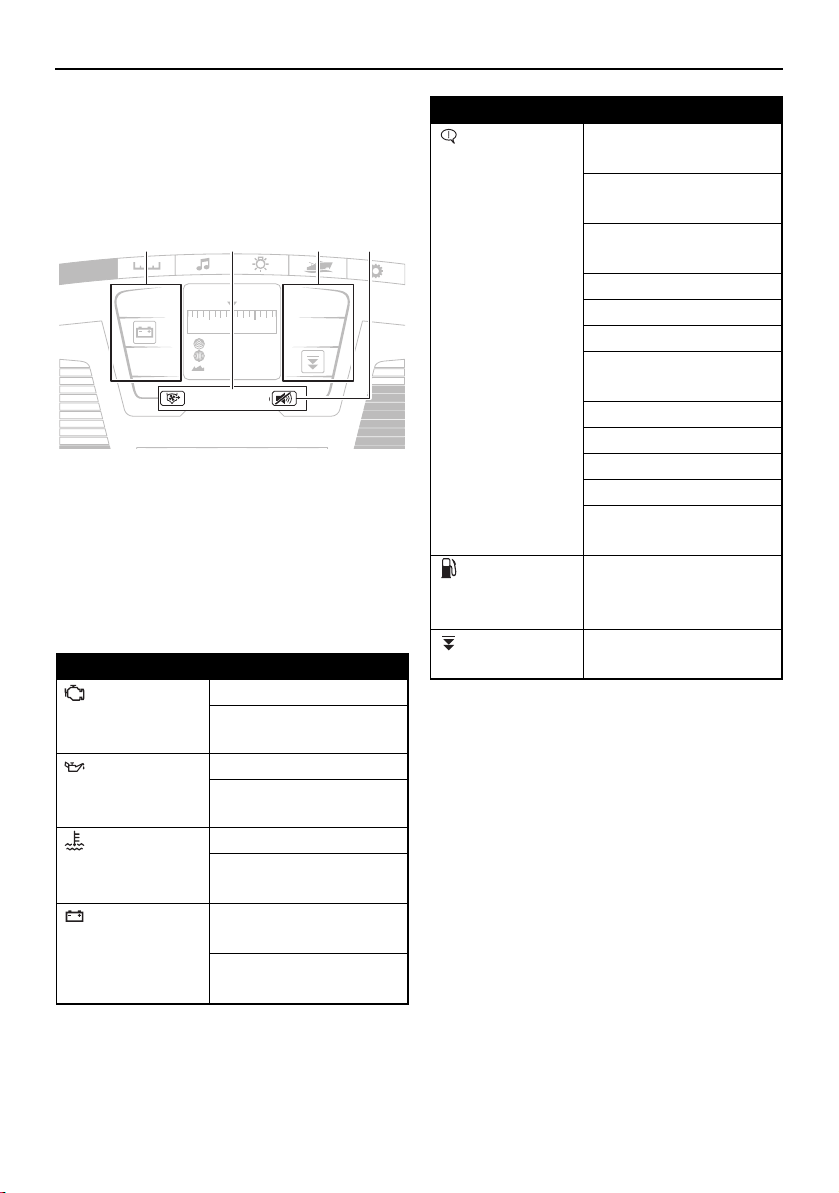
Instrument operation
83
Warnings
If a malfunction or fault occurs, a warning
buzzer will sound and a warning icon and
warning message will be displayed on the
home screen.
1 Warning icon
2 Warning message
3 Mute button
Warning definition table
The warnings that are displayed on the multi-
function display are listed in the following ta-
ble.
Warning icon Warning message
Check engine
warning
Port Check Engine
Stbd Check Engine
Low oil pressure
warning
Port Low Oil Pressure
Stbd Low Oil Pressure
Over temperature
warning
Port Over Temperature
Stbd Over Tempera-
ture
Low/High volt-
age warning
Low/High Main Batt
Voltage
Low/High Aux Batt Volt-
age
SYS
12.3 V
25
FUEL
% 22 ft
AUX
13.2 V
RPM
1300
RPM
1300
MPH
0
DEPTH
H
O
M
E
360
N
EW
NENW
02:18 PM
LAT
LONG
ELEV
00˚00’00”N
00˚00’00”E
0 FT
High Aux Batt
Vo
1 2 1 3
Communication
error warning
CAN 1 Loss –
SPU/Depth/Joys/Pump
Port Engine Comm Er-
ror
Stbd Engine Comm Er-
ror
CAN 2 Loss – Engines
GPS Comm Error
SPU25 Comm Error
CAN 4 Loss – Ste-
reo/GPS/Gauges
Depth Comm Error
Joystick Comm Error
Stereo Comm Error
LIN Comm Error
Pump Controller Comm
Error (212X)
Low fuel level
warning
Low Fuel
Depth warning
Low Depth
Warning icon Warning message
SportsBoat_F3R11.book Page 83 Friday, May 19, 2017 9:35 AM
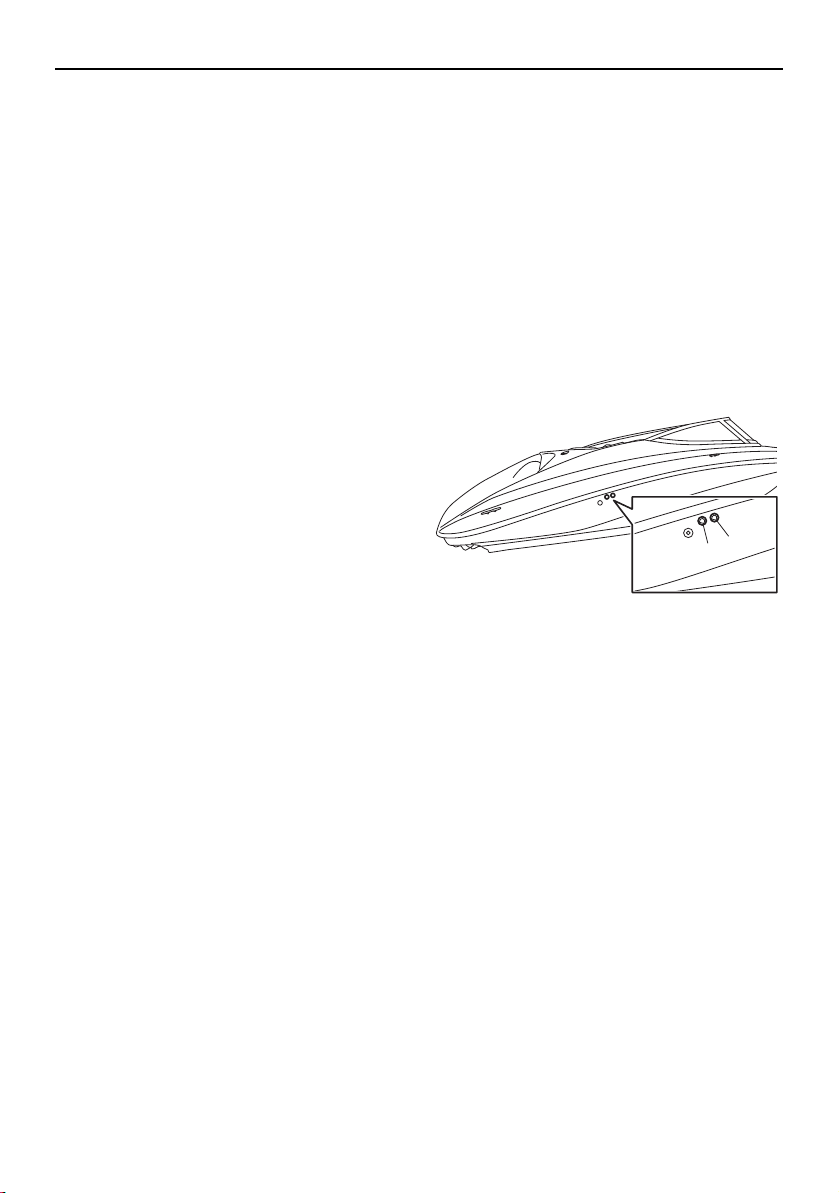
Instrument operation
84
Check engine warning
If an engine sensor malfunction or a short cir-
cuit is detected, a warning will appear on the
multi-function display and the buzzer will
sound. If a fault is detected for the port engine,
“Port Check Engine” will be displayed and if a
fault is detected for the starboard engine, “St-
bd Check Engine” will be displayed. If this oc-
curs, reduce the engine speed, return to
shore, and have a Yamaha Boat Dealer
check the engine.
Low oil pressure warning
If the oil pressure does not rise to specifica-
tion, a warning will appear on the multi-func-
tion display and the buzzer will sound. If a
fault is detected for the port engine, “Port Low
Oil Pressure” will be displayed and if a fault is
detected for the starboard engine, “Stbd Low
Oil Pressure” will be displayed. At the same
time, the engine speed is automatically limited
to help prevent damage. If this occurs, reduce
the engine speed, return to shore or maneu-
ver to a safe location, and check the engine oil
level. (See page 118 for engine oil level
checking procedures.)
If the oil level is low, add enough engine oil to
raise it to the proper level. If the oil level is suf-
ficient, have a Yamaha Boat Dealer check the
engine.
Over temperature warning
This model is equipped with an over tempera-
ture warning system. If the engines start to
overheat, a warning will appear on the multi-
function display and the buzzer will sound. If
the port engine is overheating, “Port Over
Temperature” will be displayed and if the star-
board engine is overheating, “Stbd Over Tem-
perature” will be displayed. At the same time,
the engine speed is automatically limited to
help prevent damage. If this occurs, immedi-
ately reduce the engine speed, return to shore
or maneuver to a safe location, and check for
water discharge at the cooling water pilot out-
lets. There are cooling water pilot outlets on
the starboard side of the hull. Check that wa-
ter comes out of the outlets while the engines
are running, particularly while applying throt-
tle. If you do not see any water at the outlets,
cooling water may not be circulating in the en-
gines.
1 Cooling water pilot outlet (starboard engine)
2 Cooling water pilot outlet (port engine)
TIP:
If the cooling water passages in the engines
are dry, it will take about 20 seconds for water
to reach the pilot outlets after starting.
If water is not circulating, something may be
clogging the intake grates. Refer to “Jet pump
clean-out procedure” on page 166.
1
2
SportsBoat_F3R11.book Page 84 Friday, May 19, 2017 9:35 AM
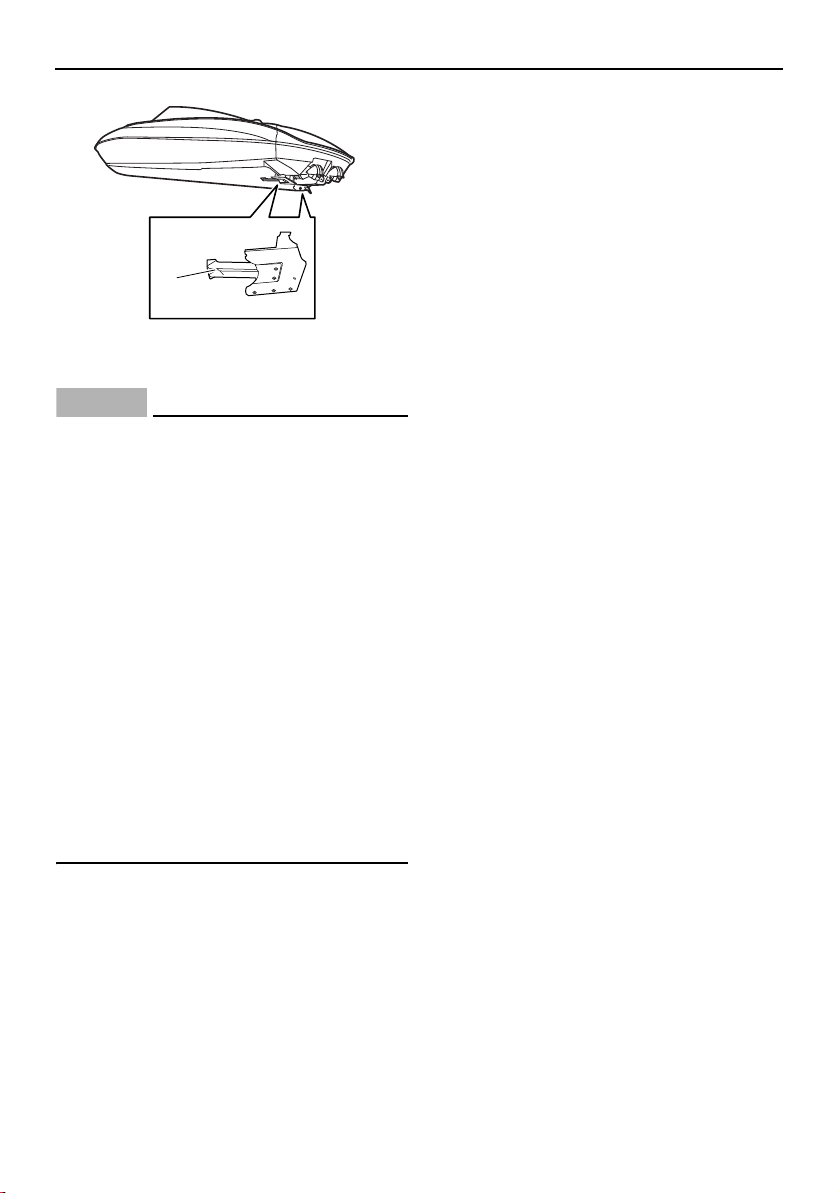
Instrument operation
85
1 Intake grate
NOTICE
If the cause of overheating cannot be
found and corrected, take special precau-
tions to avoid major engine damage while
you return to shore.
Single engine overheating — Shut off the
overheating engine and use the properly
running engine to return to shore. Operate
at no-wake speed (8 km/h, 5 mph) to pre-
vent water from flooding the non-operat-
ing engine through the water intake. See
page 82 for information on the no-wake
mode.
Both engines overheating — If getting a
tow from another vessel is not possible,
operate both engines just slightly above
idle while you return to shore. If you can
be towed, refer to “Towing the boat” on
page 184.
Low/High voltage warning
If either “Low/High Main Batt Voltage” or
“Low/High Aux Batt Voltage” appears on the
multi-function display and the buzzer will
sound, check the battery connections. If the
battery connections are clean and tight and the
warning indication continues, have a Yamaha
Boat Dealer check the charging system.
Communication error warning
If a communication error is detected for the
GPS function, a sensor, or other device, a
warning will appear on the multi-function dis-
play and the buzzer will sound. If this occurs,
reduce the engine speed, return to shore, and
have a Yamaha Boat Dealer check the boat.
When a communication error is detected, the
following warning messages are displayed.
● CAN 1 Loss – SPU/Depth/Joys/Pump
● Port Engine Comm Error
● Stbd Engine Comm Error
● CAN 2 Loss – Engines
● GPS Comm Error
● SPU25 Comm Error
● CAN 4 Loss – Stereo/GPS/Gauges
● Depth Comm Error
● Joystick Comm Error
● Stereo Comm Error
● LIN Comm Error
● Pump Controller Comm Error (212X)
Low fuel level warning
If “Low Fuel” appears on the multi-function
display and the buzzer will sound, refill the
fuel tank as soon as possible. (See page 115
for information on filling the fuel tank.)
Depth warning
If the boat enters an area that is shallower
than the water depth set for the depth alarm,
the depth warning will be activated and the
buzzer will sound.
If the warning is activated, move the boat to
an area that is deeper than the water depth
set for the depth alarm. (See page 78 for infor-
mation on setting the depth alarm.)
1
SportsBoat_F3R11.book Page 85 Friday, May 19, 2017 9:35 AM
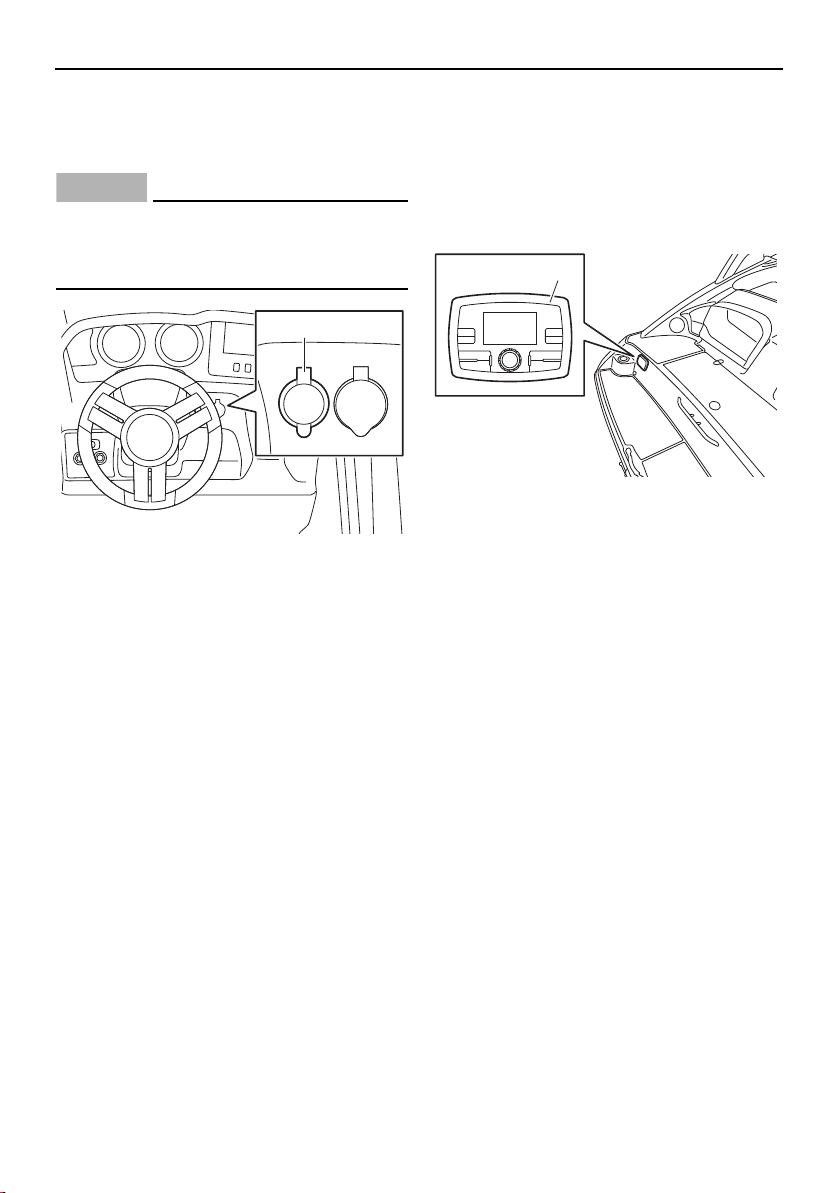
Instrument operation
86
Accessory outlet
There is a 12V DC outlet located on the star-
board side of the steering wheel.
NOTICE
Do not use an automotive cigarette lighter
or other accessories that get hot because
the outlet can be damaged.
1 12V DC outlet
Remote control keypad
The remote control keypad is located on the
port side of the swim platform.
For operating instructions, refer to the stereo
system owner’s manual included with your
boat.
1 Remote control keypad
12V
AUDIO
AUX-USB
1
1
SportsBoat_F3R11.book Page 86 Friday, May 19, 2017 9:35 AM
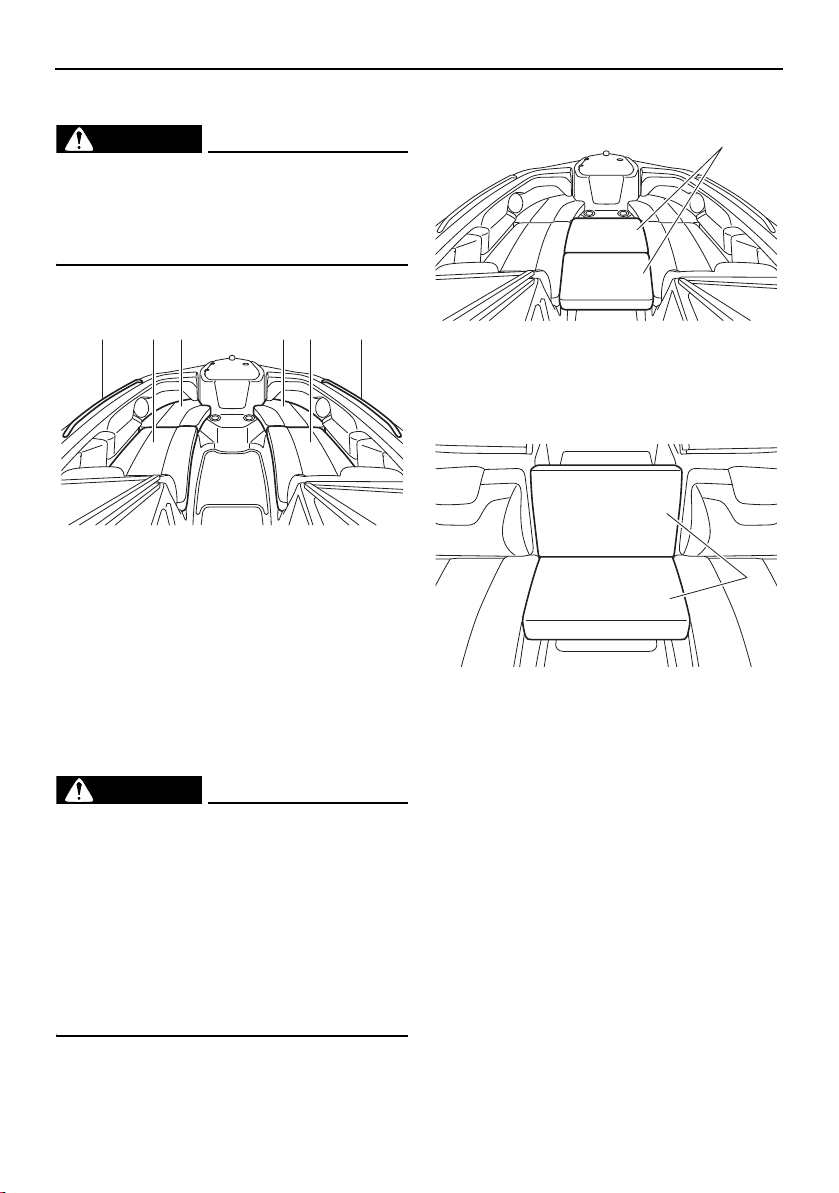
87
Equipment operation
Seats
WARNING
Passengers must always sit in a designat-
ed seating area, place feet on the deck,
and hold on to the handgrips, handrails, or
straps when the boat is in motion.
This boat is equipped with the following seats.
1 Handrail
2 Front port seat (rear)
3 Front port seat (front)
4 Front starboard seat (front)
5 Front starboard seat (rear)
Two bow filler cushions are provided for use
while the boat is not being operated.
These cushions can be used to make a large
flat area in the bow for use as a sundeck.
WARNING
● Do not use the bow filler cushions while
the boat is underway. A passenger
could lose balance and fall on the deck
or overboard, causing injury or death.
● Stow the cushions securely before oper-
ating the boat. A loose cushion could be
blown by the wind, distracting the oper-
ator or striking a passenger, which
could result in an accident.
1 Bow filler cushion
These cushions can also be used to create a
temporary center seat.
1 Bow filler cushion
1 2 3 154
1
1
SportsBoat_F3R11.book Page 87 Friday, May 19, 2017 9:35 AM
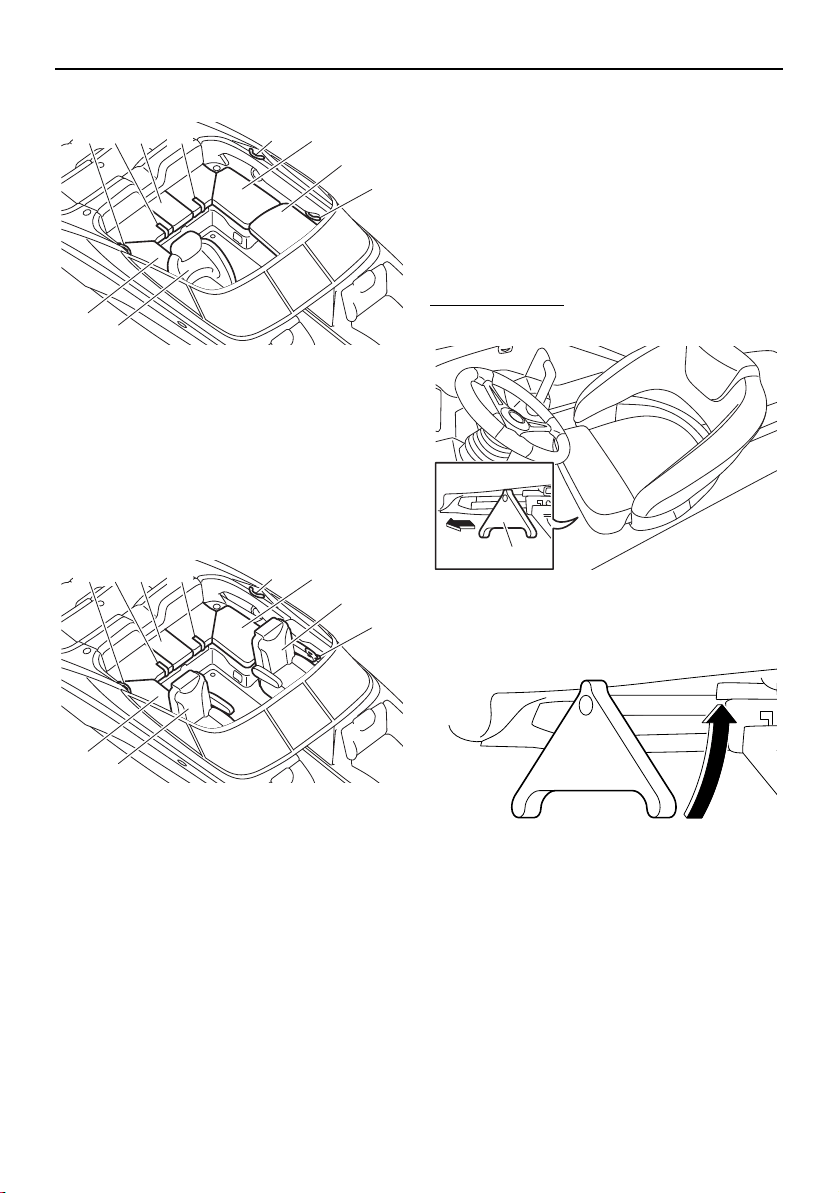
Equipment operation
88
AR210 / SX210
1 Driver’s seat
2 Rear starboard seat
3 Handgrip
4 Rear center seat
5 Rear port seat
6 Passenger’s seat
7 Strap
212X / 212 Limited S / 212 Limited
1 Driver’s seat
2 Passenger’s seat
3 Handgrip
4 Rear starboard seat
5 Strap
6 Rear center seat
7 Rear port seat
Driver’s seat (AR210 / SX210)
The driver’s seat can slide forward and rear-
ward, and the seat can swivel. In addition, the
seat bolster at the front of the seat can be
flipped up to change the seat style for a raised
seating position.
Make sure that the seat is securely locked in
place before getting underway.
To slide the seat:
(1) Extend the slide/swivel lock lever.
1 Slide/swivel lock lever
(2) Rotate the lever to port (left).
(3) Move the seat to the desired position,
and then release the lever.
(4) Push the lever to its original position.
1
3
3
3 7 4 7
6
5
2
1
3
3
3 5 6 5
2
7
4
1
SportsBoat_F3R11.book Page 88 Friday, May 19, 2017 9:35 AM
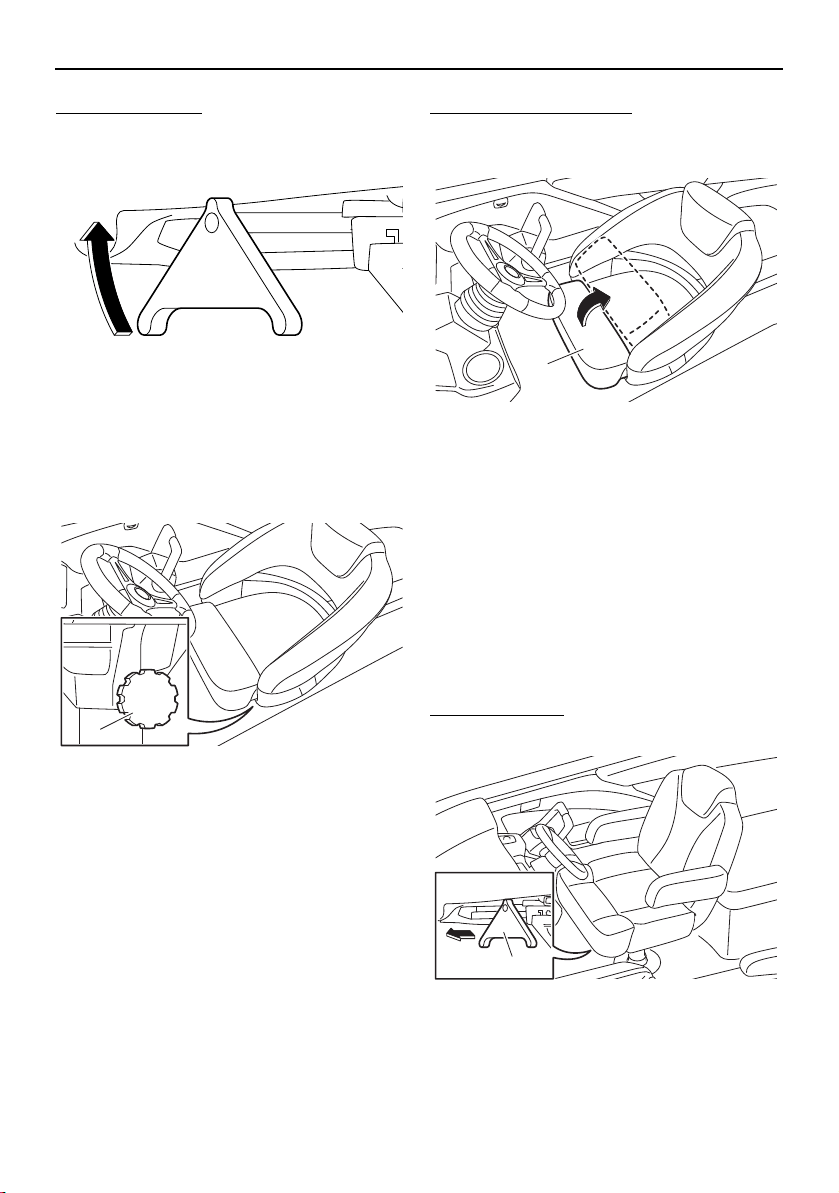
Equipment operation
89
To swivel the seat:
(1) Extend the slide/swivel lock lever.
(2) Rotate the lever to starboard (right).
(3) Swivel the seat to the desired position. If
it is too easy or too difficult to rotate the
seat, adjust the swivel friction by turning
the swivel friction knob in or out.
1 Swivel friction knob
(4) Push the lever to its original position.
To flip up the seat bolster:
Lift up the seat bolster at the front of the seat
so that it is resting against the backrest.
1 Seat bolster
Driver’s seat
(212X / 212 Limited S / 212 Limited)
The driver’s seat can slide forward and rear-
ward, and the seat can swivel, and the back-
rest angle can be adjusted. In addition, the
seat bolster at the front of the seat can be
flipped up to change the seat style for a raised
seating position.
Make sure that the seat is securely locked in
place before getting underway.
To slide the seat:
(1) Extend the slide/swivel lock lever.
1 Slide/swivel lock lever
1
1
1
SportsBoat_F3R11.book Page 89 Friday, May 19, 2017 9:35 AM

Equipment operation
90
(2) Rotate the lever to port (left).
(3) Move the seat to the desired position,
and then release the lever.
(4) Push the lever to its original position.
To swivel the seat:
(1) Extend the slide/swivel lock lever.
(2) Rotate the lever to starboard (right).
(3) Swivel the seat to the desired position. If
it is too easy or too difficult to rotate the
seat, adjust the swivel friction by turning
the swivel friction knob in or out.
1 Swivel friction knob
(4) Push the lever to its original position.
To flip up the seat bolster (driver’s seat only):
Lift up the seat bolster at the front of the seat
so that it is resting against the backrest.
1 Seat bolster
1
1
SportsBoat_F3R11.book Page 90 Friday, May 19, 2017 9:35 AM
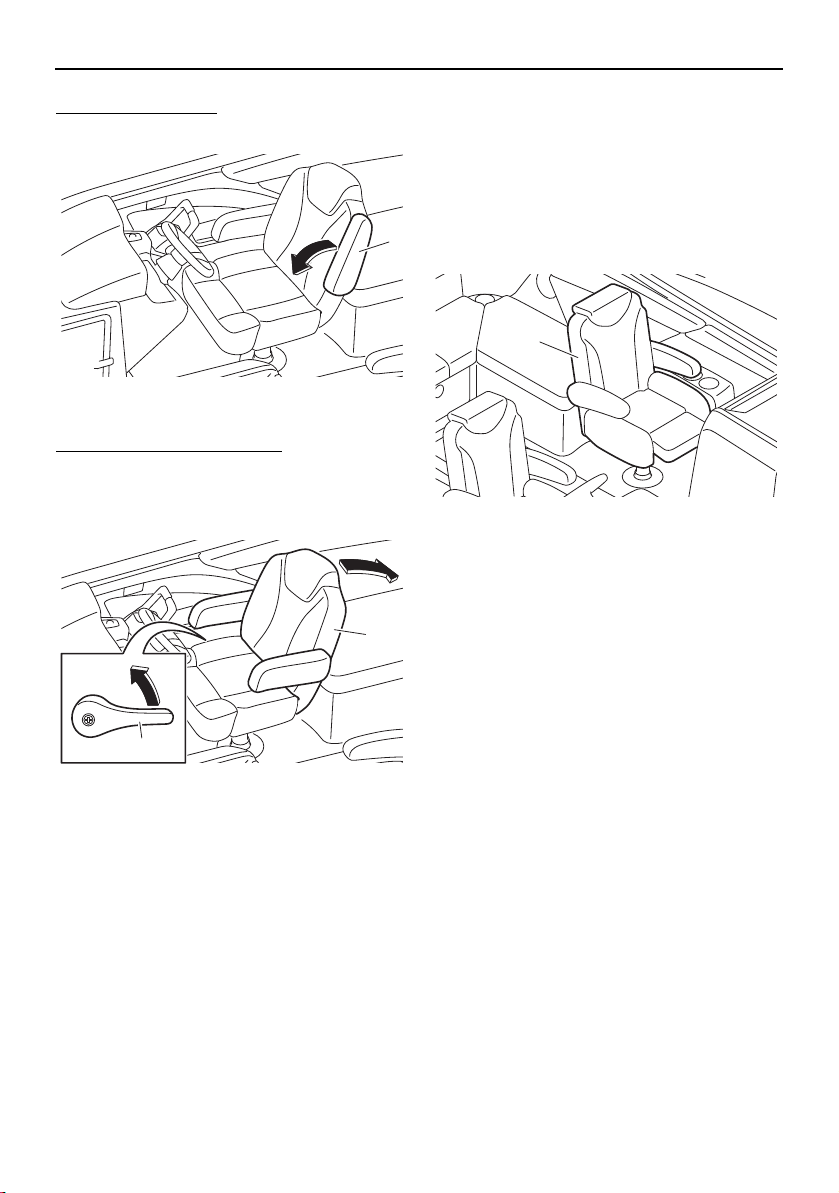
Equipment operation
91
To use the armrests:
Lower the armrests until they stop.
1 Armrest
To adjust the backrest angle:
While lifting the adjusting lever on the star-
board side of the seat, move the backrest to
the desired position.
1 Backrest
2 Adjusting lever
Passenger’s seat
(212X / 212 Limited S / 212 Limited)
The passenger’s seat can be adjusted in the
same ways as the driver’s seat.
See “Driver’s seat” for instructions on adjust-
ing the seat. However, the seat bolster of the
passenger’s seat cannot be adjusted.
1 Passenger’s seat
1
1
2
1
SportsBoat_F3R11.book Page 91 Friday, May 19, 2017 9:35 AM

Equipment operation
92
Engine hood
The engine hood can be opened to access
the engines.
The engine hood latch is located under the
front of the rear center seat.
To open the engine hood, pull the engine
hood latch up and lift the engine hood.
1 Engine hood
2 Engine hood latch
To prevent excess water from spilling onto the
engines after a rainfall or washing down the
boat, wipe off the seat cushions before open-
ing the engine hood.
To close the engine hood, push the front of
the rear center seat to securely lock it in place.
Storage compartments
This boat is equipped with the following con-
venient on-board storage compartments.
Make sure that the storage compartments are
securely closed before getting underway.
Anchor storage compartment
The anchor storage compartment is located
at the bow.
To open the anchor storage compartment:
Pull the anchor storage compartment lid latch
to open the lid.
1 Anchor storage compartment lid
2 Anchor storage compartment lid latch
1 Anchor storage compartment
When storing the anchor, place some cush-
ioning material or the anchor line under the
anchor.
1
2
1
2
1
SportsBoat_F3R11.book Page 92 Friday, May 19, 2017 9:35 AM
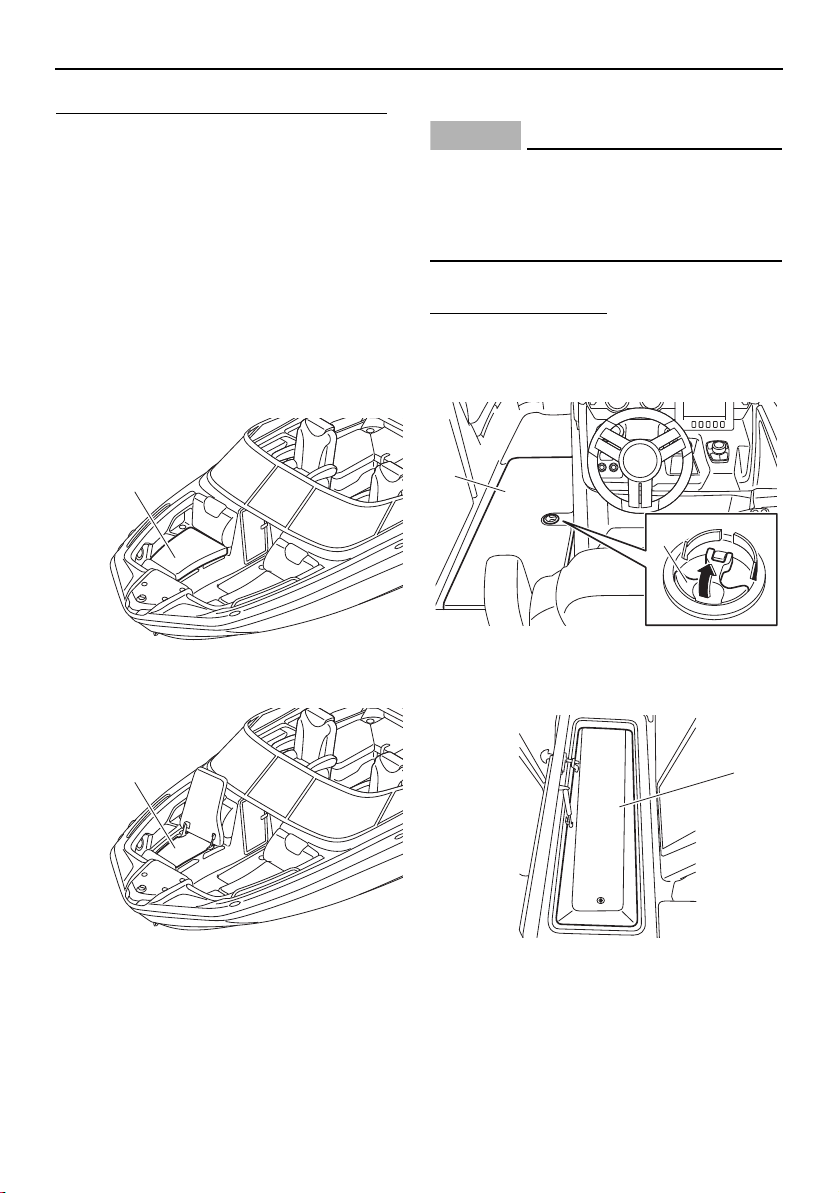
Equipment operation
93
To close the anchor storage compartment:
Close the anchor storage compartment lid,
and then push it to securely lock it in place.
Front underseat storage
compartments
The front underseat storage compartment
(starboard) and front underseat storage com-
partment (port) are located under the front
starboard seat and front port seat respective-
ly.
To open a front underseat storage compart-
ment, lift the front seat (rear) up.
1 Front starboard seat (rear)
1 Front under storage compartment
To close a front underseat storage compart-
ment, lower the front seat (rear).
Ski locker
NOTICE
212X: This storage compartment contains
a ballast bag. Be careful not to store items
in this area that could be crushed or dam-
aged by the ballast bag as it fills.
The ski locker is located under the floor.
To open the ski locker:
(1) Pull the lock handle up.
(2) Turn the lock handle, and then open the
ski locker lid.
1 Lock handle
2 Ski locker lid
1 Ski locker
1
1
1
2
1
SportsBoat_F3R11.book Page 93 Friday, May 19, 2017 9:35 AM
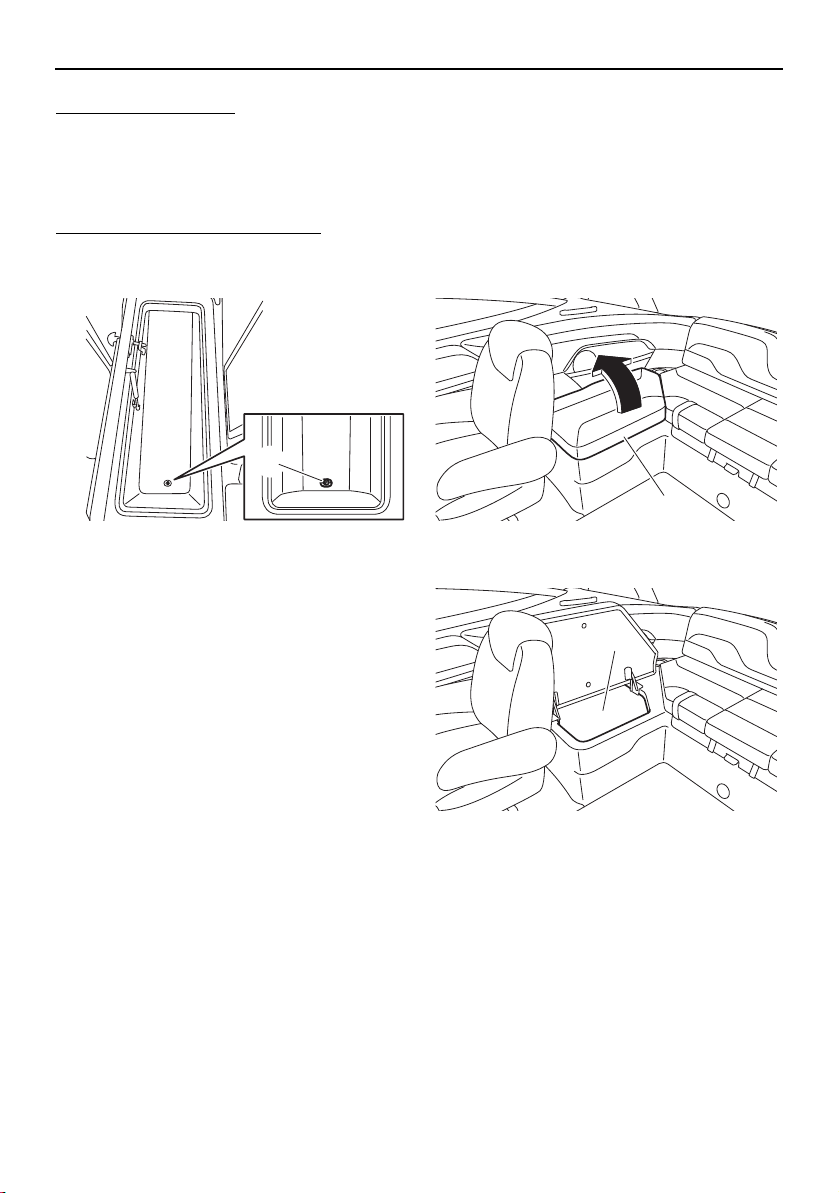
Equipment operation
94
To close the ski locker:
(1) Close the ski locker lid.
(2) Turn the lock handle and make sure that
the lid is securely closed.
(3) Push the lock handle down.
To drain water from the ski locker:
(1) Remove the drain plug on the bottom of
the ski locker to drain the water.
1 Drain plug
(2) Securely install the drain plug in its origi-
nal position.
Rear underseat storage compartment
(starboard)
The rear underseat storage compartment
(starboard) is located under the rear star-
board seat.
To open the rear underseat storage compart-
ment (starboard), lift the rear starboard seat
up.
1 Rear starboard seat
1 Rear underseat storage compartment (star-
board)
To close the rear underseat storage compart-
ment (starboard), lower the rear starboard
seat.
1
1
1
SportsBoat_F3R11.book Page 94 Friday, May 19, 2017 9:35 AM
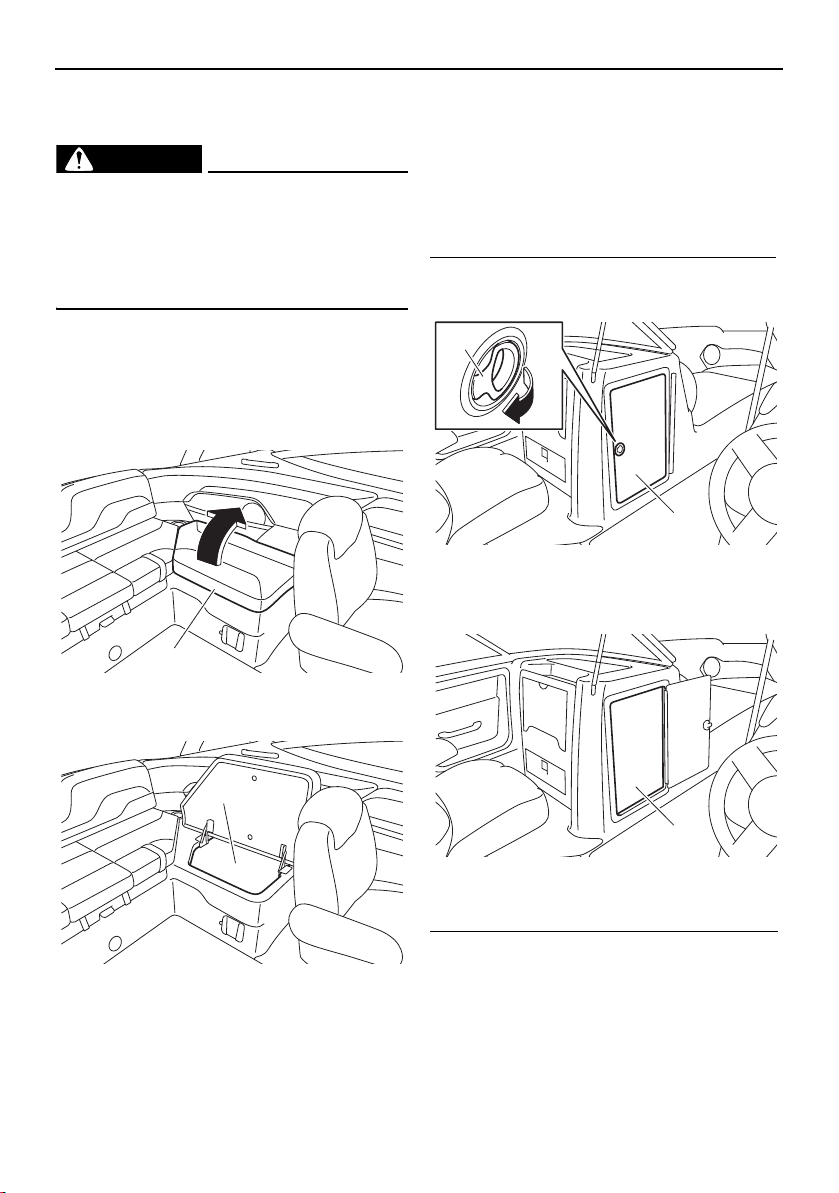
Equipment operation
95
Rear underseat storage compartment
(port)
WARNING
Do not carry any flammable substances in
the storage compartment or any heavy or
metal items that can damage the battery or
cause a short circuit. Sparks or fire could
result.
The rear underseat storage compartment
(port) is located under the rear port seat.
To open the rear underseat storage compart-
ment (port), lift the rear port seat up.
1 Rear port seat
1 Rear underseat storage compartment (port)
To close the rear underseat storage compart-
ment (port), lower the rear port seat.
Enclosed storage compartment
The enclosed storage compartment is a large
storage compartment that is located on the
port side.
There is a cooler box in the enclosed storage
compartment.
To open the enclosed storage compartment:
Pull the enclosed storage compartment door
latch to open the door.
1 Enclosed storage compartment door latch
2 Enclosed storage compartment door
1 Enclosed storage compartment
To close the enclosed storage compartment:
Close the enclosed storage compartment
door, and then push it to securely lock it in
place.
1
1
1
2
1
SportsBoat_F3R11.book Page 95 Friday, May 19, 2017 9:35 AM
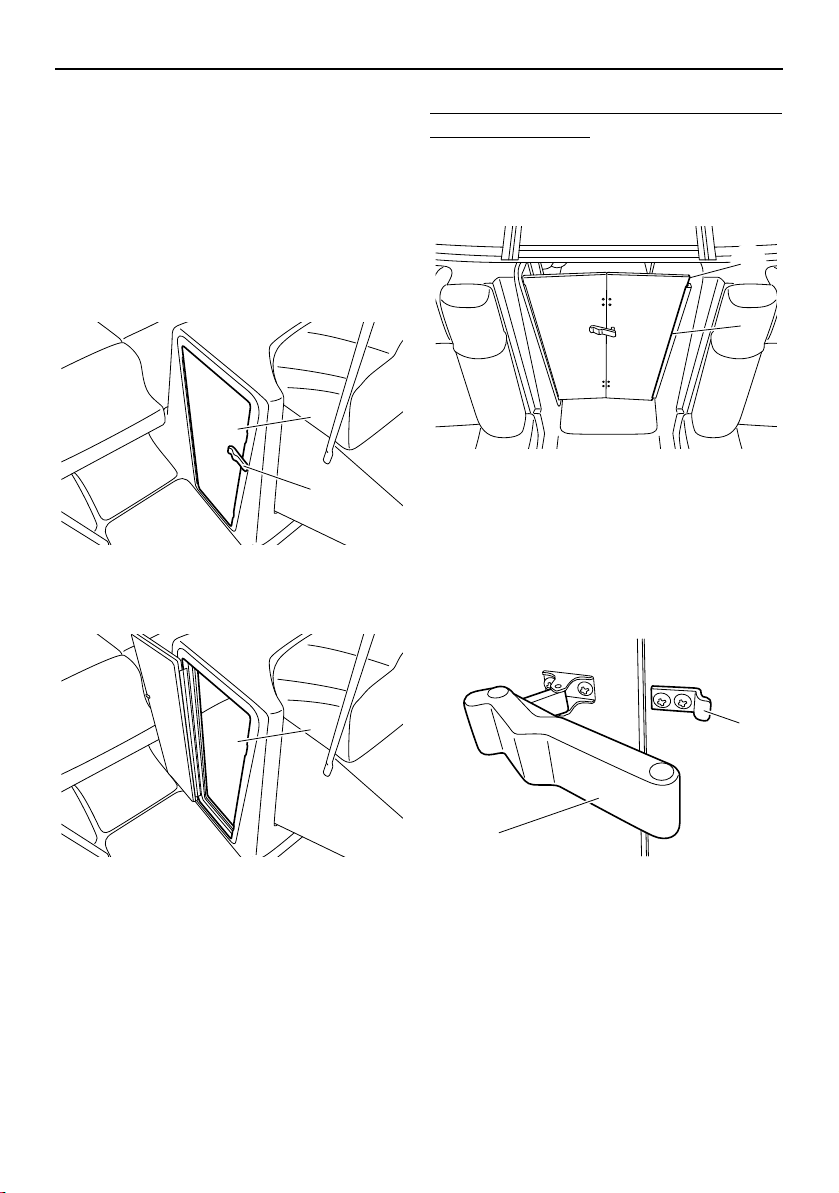
Equipment operation
96
Driver’s side console compartment
The driver’s side console compartment is lo-
cated in front of the helm.
The driver’s side console compartment door
can be used as a partition in the front walk-
through.
To open the driver’s side console compart-
ment, unhook the driver’s side console com-
partment door latch.
1 Driver’s side console compartment door
2 Driver’s side console compartment door latch
1 Driver’s side console compartment
To close the driver’s side console compart-
ment, close the driver’s side console compart-
ment door, and then hook the latch to
securely lock it in place.
To use the driver’s side console compartment
door as the partition:
(1) Unfold the door and guide the edge of it
into the channel on the enclosed storage
compartment.
1 Edge
2 Channel
(2) To hold the door in place, hook the driv-
er’s side console compartment door latch
to the metal tab on the front side of the
door.
1 Driver’s side console compartment door latch
2 Metal tab
1
2
1
1
2
1
2
SportsBoat_F3R11.book Page 96 Friday, May 19, 2017 9:35 AM
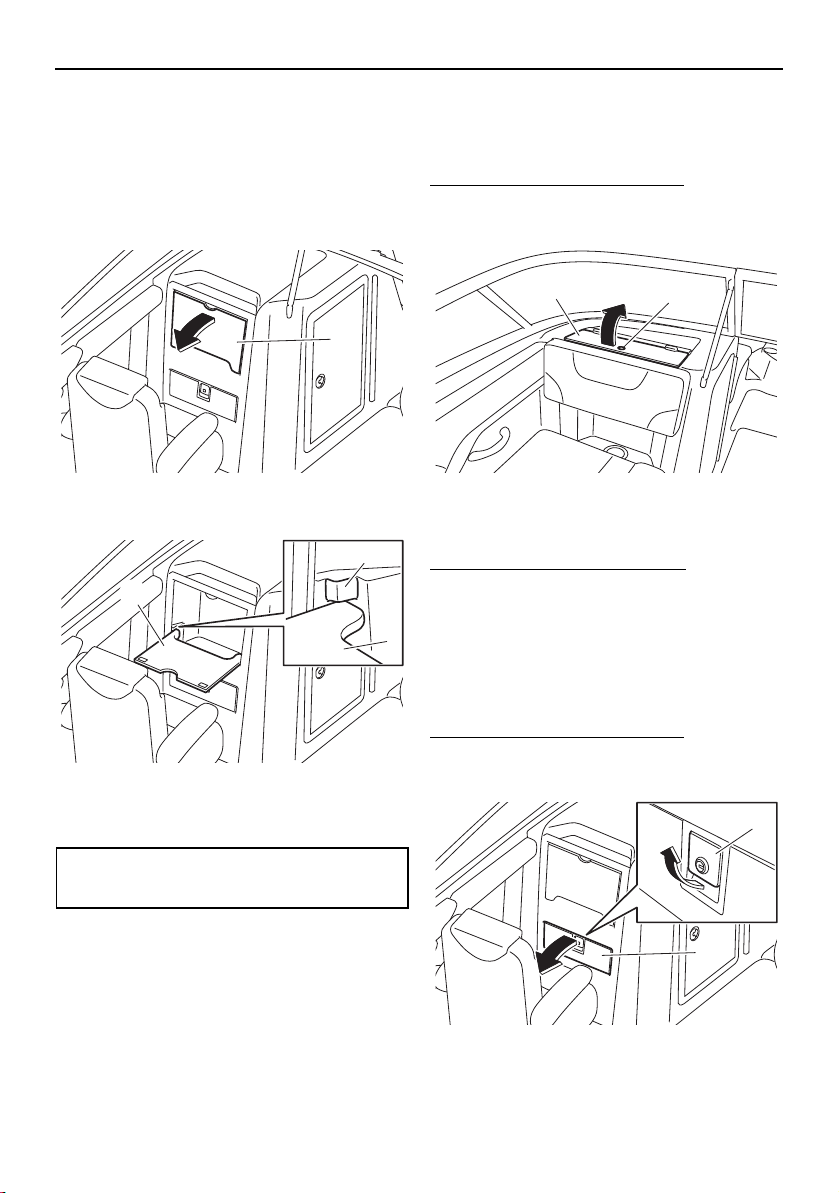
Equipment operation
97
Stowable table
(212X / 212 Limited S / 212 Limited)
The stowable table is located in front of the
passenger’s seat.
To use the stowable table, pull the table and
lower it until it contacts the stoppers.
1 Stowable table
1 Stowable table
2 Stopper
To stow the stowable table, lift the table and
place it in its original position.
Glove compartment (AR210 / SX210)
The glove compartment is located in the port
console.
To open the glove compartment:
Insert your finger into the glove compartment
lid hole and open the glove compartment lid.
1 Glove compartment lid hole
2 Glove compartment lid
To close the glove compartment:
Close the glove compartment lid.
Glove compartment
(212X / 212 Limited S / 212 Limited)
The glove compartment is located in front of
the passenger’s seat.
To open the glove compartment:
While pulling the glove compartment latch,
pull the glove compartment lid to open it.
1 Glove compartment latch
2 Glove compartment lid
Maximum weight limit:
9 kg (20 lb)
1
1
1
2
2
1
2
1
SportsBoat_F3R11.book Page 97 Friday, May 19, 2017 9:35 AM
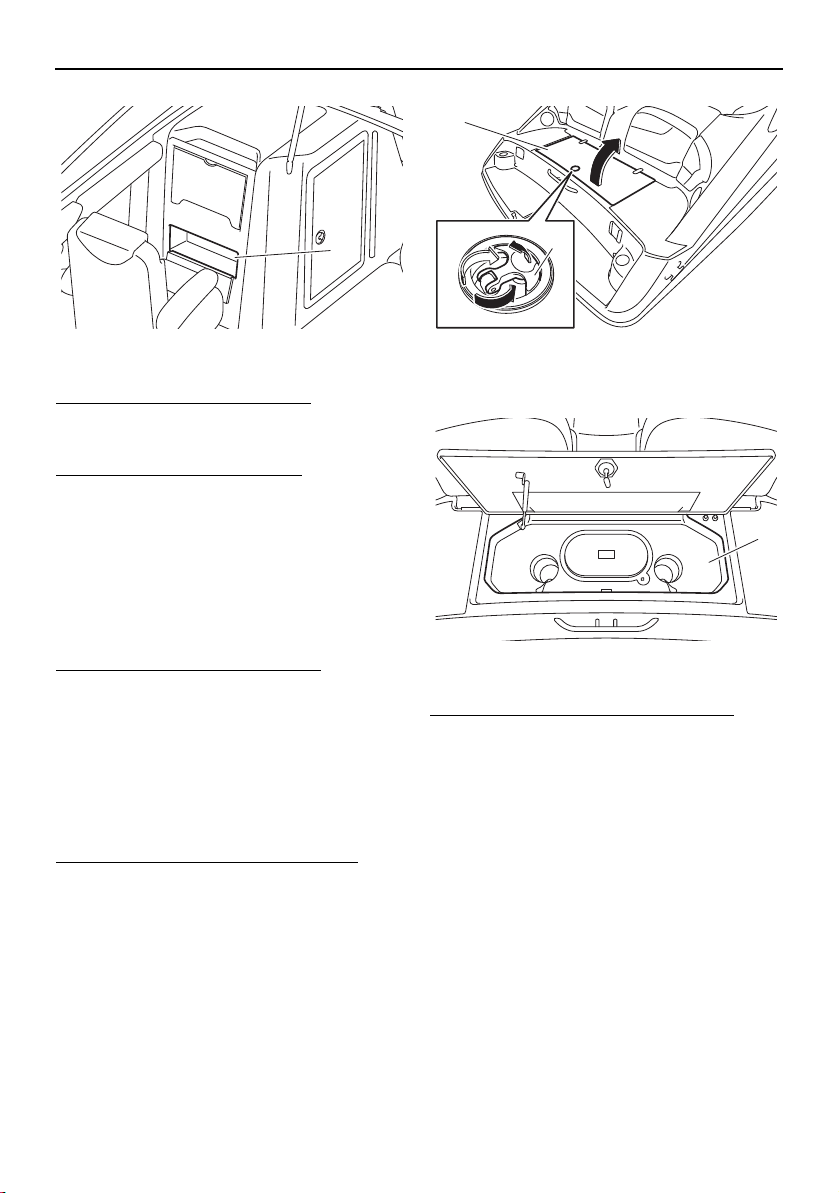
Equipment operation
98
1 Glove compartment
To close the glove compartment:
Close the glove compartment lid, and then
push it to securely lock it in place.
To lock the glove compartment:
(1) Close the glove compartment.
(2) Insert the glove compartment key into the
glove compartment latch, and then turn
the key counterclockwise.
TIP:
Store the glove compartment key so that it is
not lost.
To unlock the glove compartment:
Insert the glove compartment key into the
glove compartment latch, and then turn the
key clockwise.
Wet storage compartment
The wet storage compartment is located un-
der the swim platform.
To open the wet storage compartment:
(1) Pull the lock handle up.
(2) Turn the lock handle, and then open the
rear platform hatch.
1 Rear platform hatch
2 Lock handle
1 Wet storage compartment
To close the wet storage compartment:
(1) Close the rear platform hatch.
(2) Turn the lock handle and make sure that
the hatch is securely closed.
(3) Push the lock handles down.
TIP:
The engines will not start if the rear platform
hatch is not securely closed.
1
1
2
1
SportsBoat_F3R11.book Page 98 Friday, May 19, 2017 9:35 AM
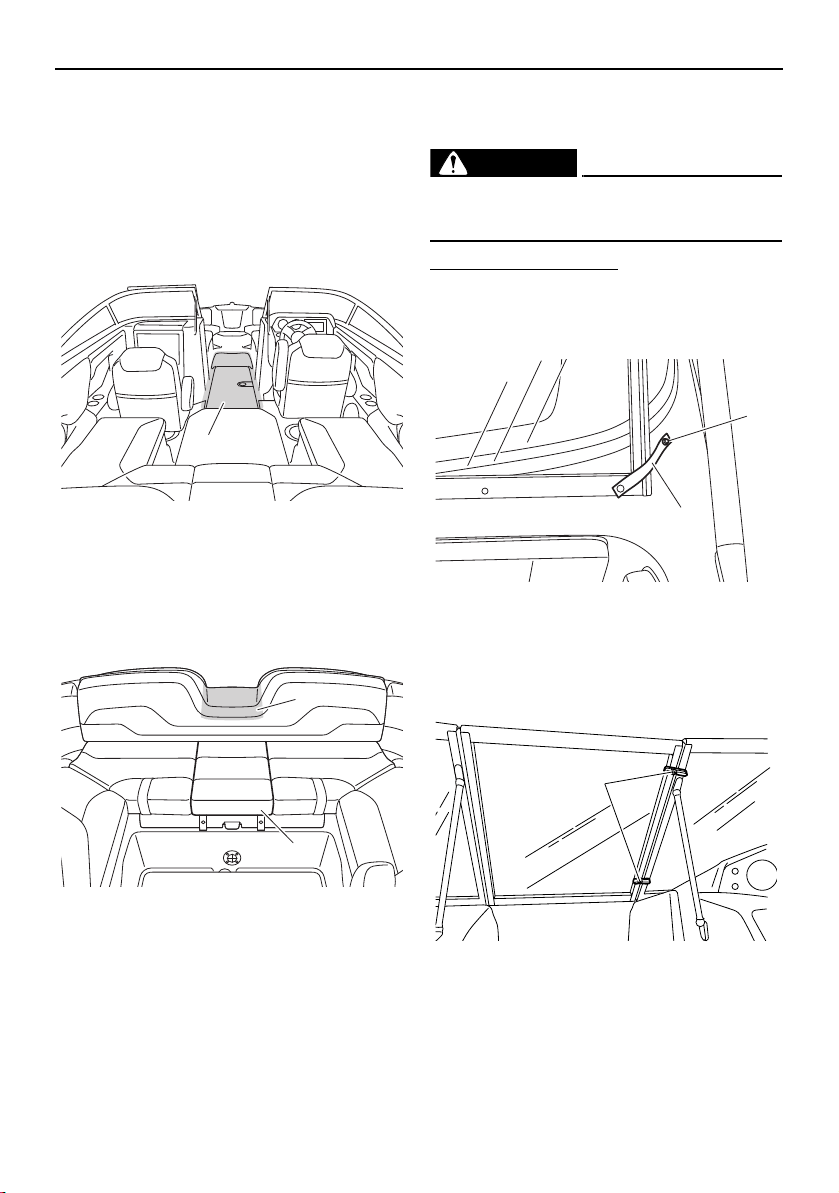
Equipment operation
99
Walk-through
Front walk-through
This boat has a large bow area where two
adults can sit comfortably with their legs out-
stretched. The front walk-through provides
easy access to the bow area from the cabin
area.
1 Front walk-through
Rear walk-through
The backrest of the rear center seat is low in
order to make boarding the boat from the rear
easier.
1 Rear walk-through
2 Center seat cushion
TIP:
In order to board or disembark from the boat,
the center seat cushion can be removed.
Windshield
The windshield can be opened and closed.
WARNING
To avoid injury, the windshield must be se-
cured when the boat is in motion.
To close the windshield:
(1) Unsnap the retaining strap from the wind-
shield, and then snap it onto the strap
base.
1 Retaining strap
2 Strap base
(2) Close the windshield, and then turn the
windshield latches to the lock position.
1 Windshield latch
1
2
1
1
2
1
SportsBoat_F3R11.book Page 99 Friday, May 19, 2017 9:35 AM
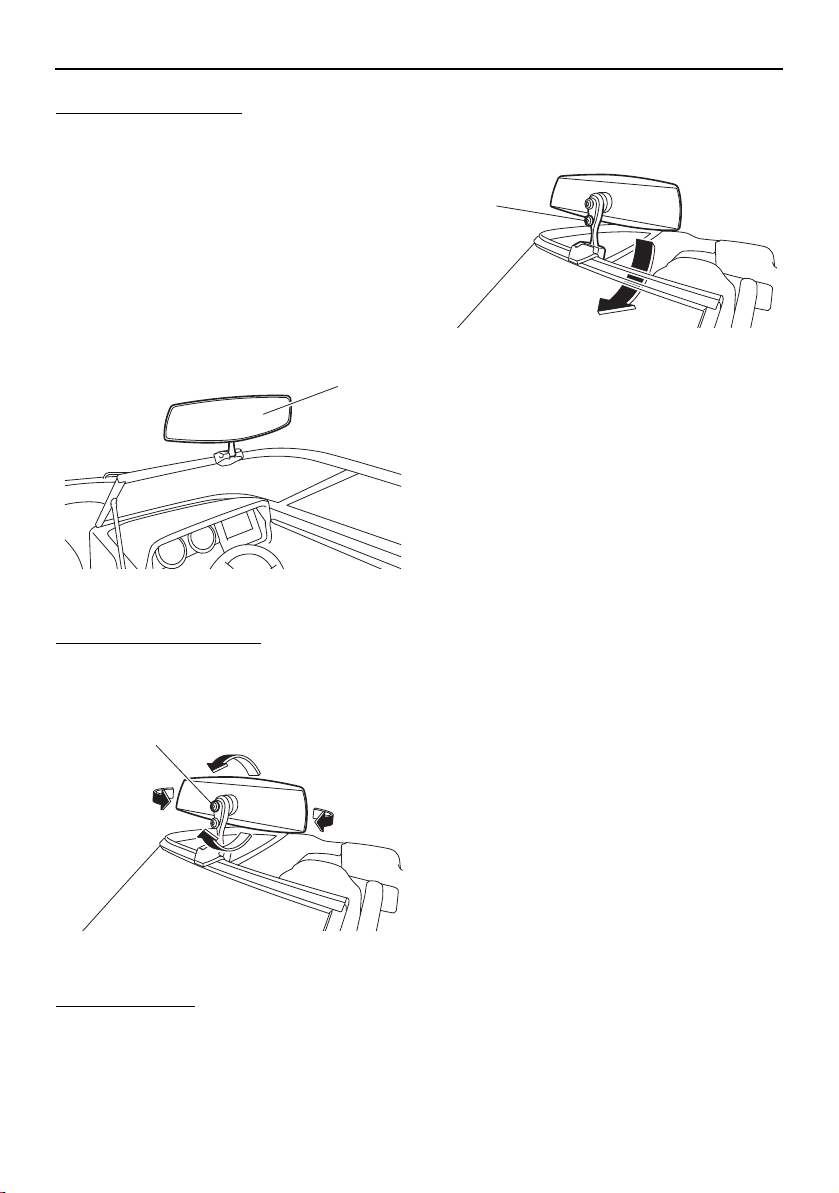
Equipment operation
100
To open the windshield:
(1) Turn the windshield latches to the unlock
position, and then open the windshield.
(2) Unsnap the retaining strap from the strap
base, and then snap it onto the wind-
shield.
Folding mirror (212X)
The mirror is installed on the driver’s side of
the windshield.
1 Folding mirror
To adjust the mirror angle:
Loosen the upper lock knob, adjust the angle
of the mirror, and then tighten the knob.
1 Upper lock knob
To fold the mirror:
Loosen the lower lock knob, fold the mirror,
and then tighten the knob.
1 Lower lock knob
1
1
1
SportsBoat_F3R11.book Page 100 Friday, May 19, 2017 9:35 AM
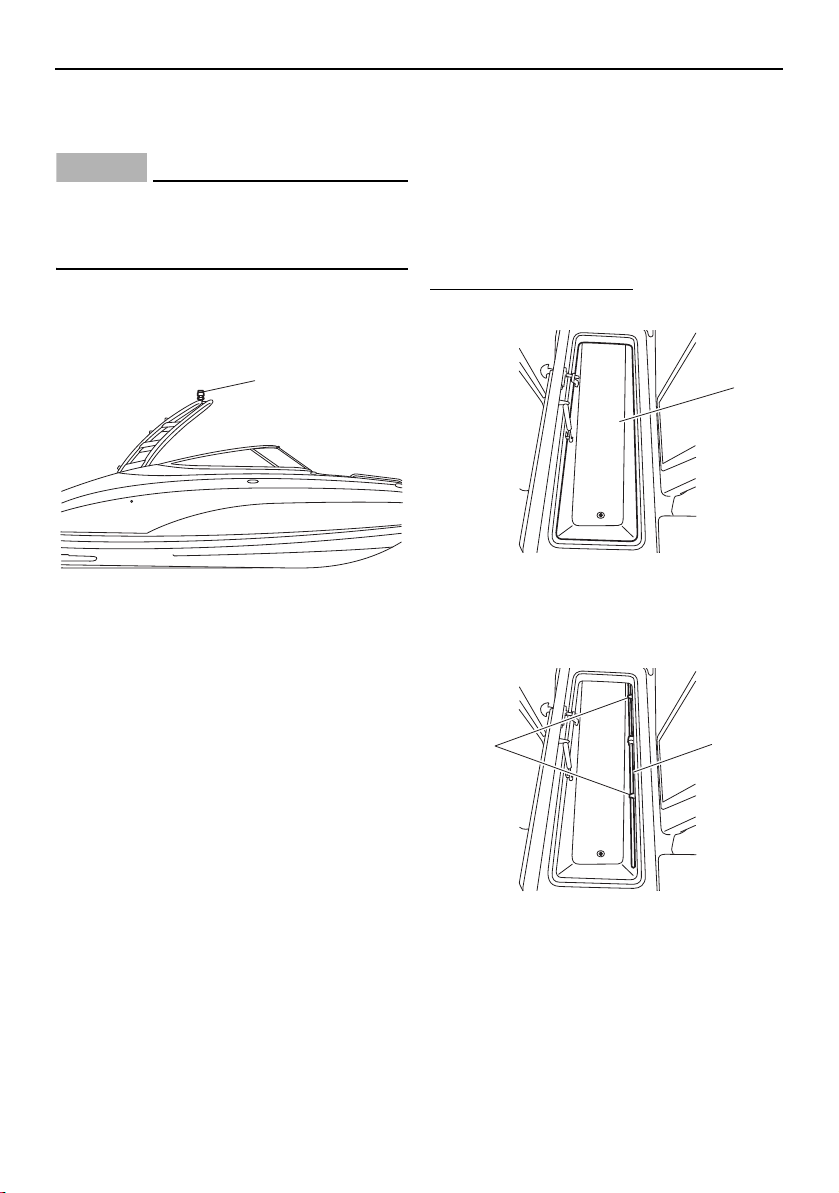
Equipment operation
101
Anchor light
(AR210 / 212X / 212 Limited S)
NOTICE
Do not attach a ski rope or other tow-rope
to the anchor light. Otherwise, the anchor
light could be damaged.
The anchor light is located at the top center of
the wakeboard tower. (See page 52, 66 for in-
formation on the anchor light on.)
1 Anchor light
Anchor light
(SX210 / 212 Limited)
The boat is equipped with a removable an-
chor light.
The anchor light is stored in the ski locker.
(See page 52, 66 for information on the an-
chor light on.)
To set up the anchor light:
(1) Open the ski locker. (See page 93.)
1 Ski locker
(2) Remove the anchor light from the anchor
light holder.
1 Anchor light holder
2 Anchor light
1
1
2
1
SportsBoat_F3R11.book Page 101 Friday, May 19, 2017 9:35 AM
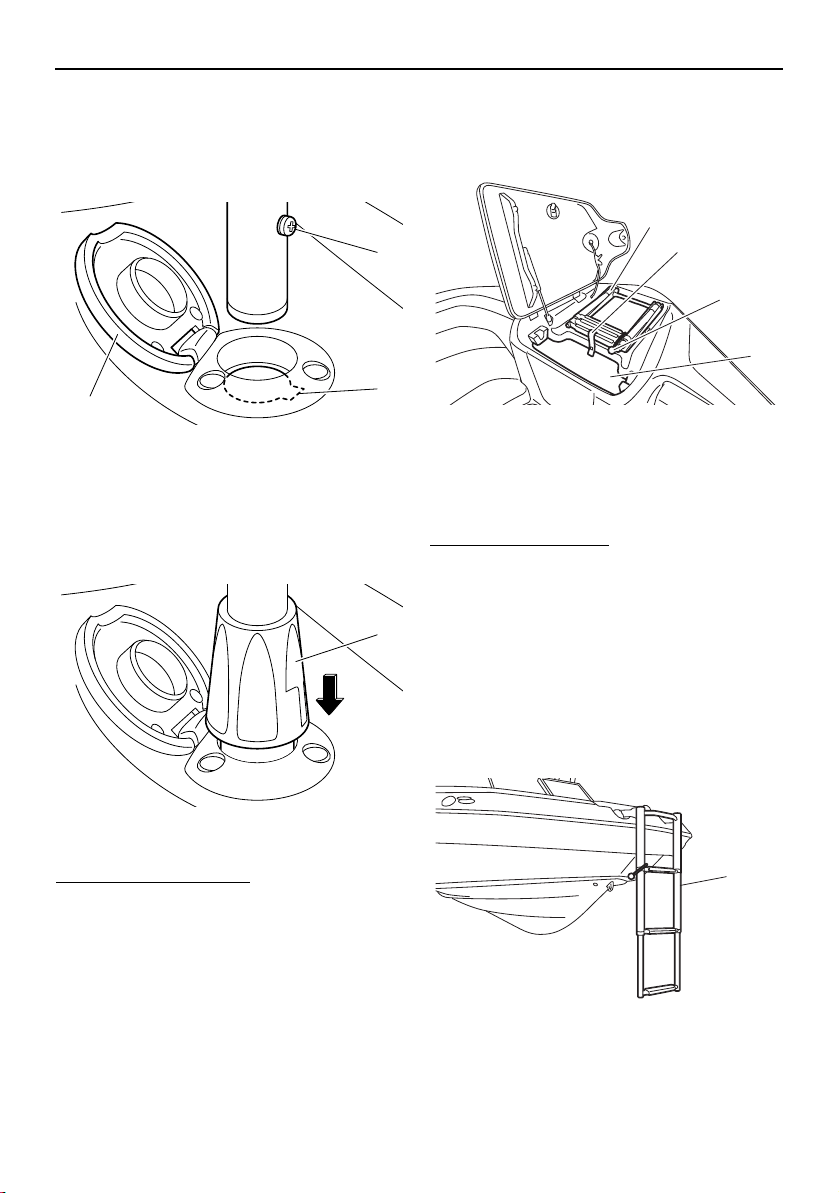
Equipment operation
102
(3) Open the cap of the anchor light socket,
fit the protrusion on the anchor light into
the slot in the socket, and then install the
light into the socket.
1 Cap
2 Slot
3 Protrusion
(4) Fit the anchor light stopper into the an-
chor light socket.
1 Anchor light stopper
To store the anchor light:
(1) Pull the anchor light stopper upward, re-
move the anchor light, and then close the
cap of the anchor light socket.
(2) Install the anchor light into the anchor
light holder, and then close the ski locker.
Bow ladder
The bow ladder is located in the anchor stor-
age compartment.
1 Bow ladder
2 Retaining strap
3 Bow ladder strap
4 Anchor storage compartment
To use the bow ladder:
(1) Open the anchor storage compartment
lid. (See page 92.)
(2) Unsnap the retaining strap from the an-
chor storage compartment.
(3) Unhook the bow ladder strap.
(4) Extend the bow ladder out completely,
and then lower it.
(5) Close the anchor storage compartment
lid to use it as a step.
1 Bow ladder
2
3
1
1
1
2
3
4
1
SportsBoat_F3R11.book Page 102 Friday, May 19, 2017 9:35 AM
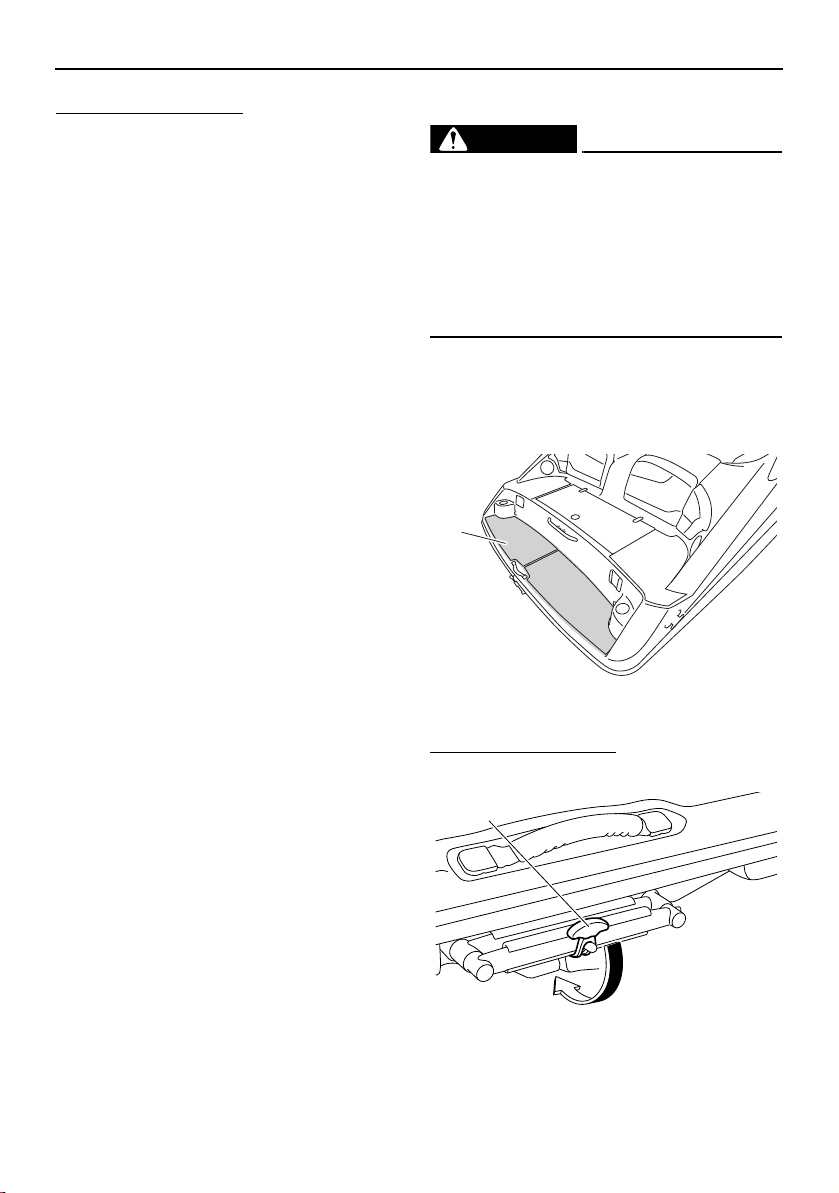
Equipment operation
103
To stow the bow ladder:
(1) Open the anchor storage compartment
lid.
(2) Raise the bow ladder, and then pull it
rearward completely.
(3) Hook the bow ladder strap onto the bow
ladder.
(4) Fold the bow ladder, and then store it in
the anchor storage compartment.
(5) Snap the retaining strap onto the strap
base to secure the bow ladder.
(6) Close the anchor storage compartment
lid.
Swim platform and stern ladder
WARNING
Stay away from the swim platform area
while the engines are running. Exhaust
gases coming from underneath it contain
carbon monoxide, a colorless, odorless
gas which may cause brain damage or
death when inhaled. Symptoms include
nausea, dizziness, and drowsiness.
The swim platform area provides a place to
stand or sit while putting on skis or a wake-
board, and includes a stern ladder to make
boarding from the water easier.
1 Swim platform
To use the stern ladder:
(1) Unhook the stern ladder strap.
1 Stern ladder strap
1
1
SportsBoat_F3R11.book Page 103 Friday, May 19, 2017 9:35 AM
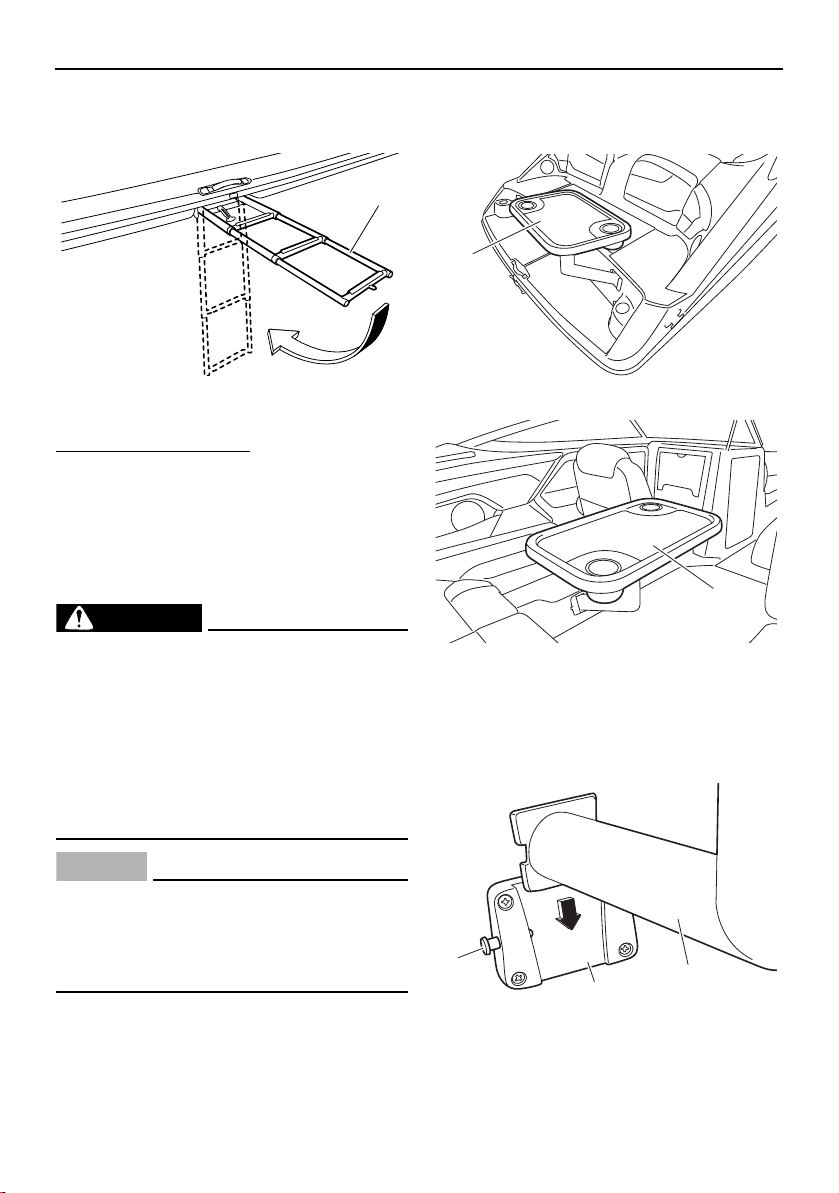
Equipment operation
104
(2) Pull the stern ladder out completely, and
then lower it.
1 Stern ladder
To stow the stern ladder:
(1) Raise the stern ladder until it is horizontal,
and then push it forward completely.
(2) Hook the stern ladder strap onto the stern
ladder.
Side table
WARNING
If the side table is installed at the swim
platform, do not use the table while the en-
gines are running. Exhaust gases coming
from underneath the swim platform con-
tain carbon monoxide, a colorless, odor-
less gas which may cause brain damage
or death when inhaled. Symptoms include
nausea, dizziness, and drowsiness.
NOTICE
If the side table is installed at the swim
platform, remove the side table before op-
erating the boat. Otherwise, the side table
may fall into the water.
The side table can be installed at the swim
platform or in front of the rear port seat.
1 Side table
1 Side table
To install the side table, slide the end of the ta-
ble pole into the table bracket until it is locked
in place.
1 Table bracket
2 Table pole
3 Table bracket knob
1
1
1
1
3
2
SportsBoat_F3R11.book Page 104 Friday, May 19, 2017 9:35 AM
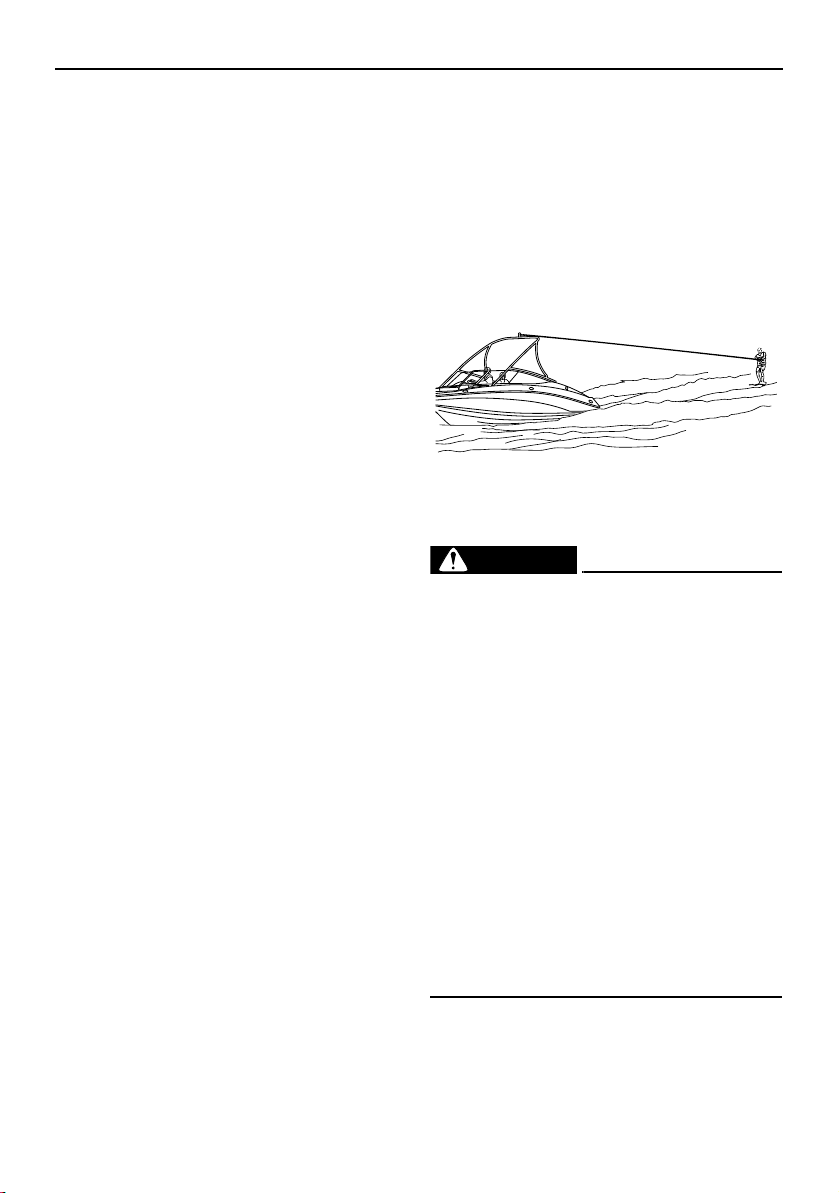
Equipment operation
105
To remove the side table, pull the table brack-
et knob, and then pull the table pole upward.
Wakeboard tower
(AR210 / 212X / 212 Limited S)
The wakeboard tower is provided as an ele-
vated tow point suitable for wakeboards and
similar towable recreational equipment. The
tow pylon can be used to attach a standard ski
rope or other tow-rope.
WARNING
Severe injury or death can result if you ig-
nore any of the following:
● Maximum towing capacity:
1 Person, 158 kg (350 lb) max.
● Make sure the tow-rope is securely fas-
tened to the tow pylon on the wakeboard
tower.
● Do not tow a tube or other inflatable
from the wakeboard tower. Use the ski
tow hook on the transom.
● Stay clear of the tow-rope while pulling a
wakeboard rider or skier.
● Do not climb, hang, or sit on the wake-
board tower.
● Make sure all knobs securing the wake-
board tower are tightened before opera-
tion and check periodically during use.
SportsBoat_F3R11.book Page 105 Friday, May 19, 2017 9:35 AM
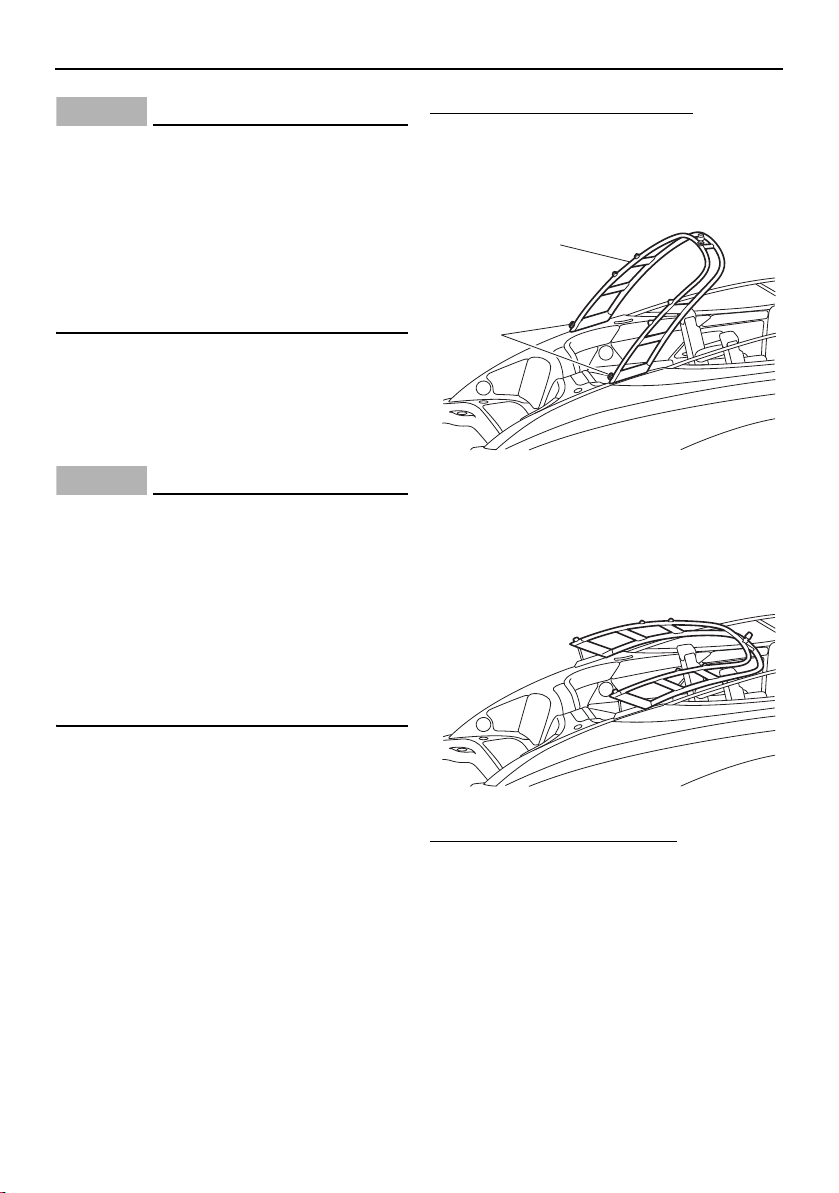
Equipment operation
106
NOTICE
Do not modify the wakeboard tower to tow
from any other point or to carry accesso-
ries not designed for it. The wakeboard
tower could be damaged. Also, the wake-
board tower collapsing feature is intended
for storage only. The boat should not be
transported or operated with the tower in
the collapsed position.
Collapsing and setting up the
wakeboard tower (AR210)
When storing the boat, collapse the wake-
board tower.
NOTICE
● Accidentally dropping the wakeboard
tower while collapsing or raising it can
damage the tower, the boat, or both. An
assistant needs to help hold the wake-
board tower in place during the proce-
dure.
● Do not operate the boat or transport it on
the trailer with the tower in the collapsed
position to avoid possible damage.
To collapse the wakeboard tower:
(1) While an assistant supports the wake-
board tower, completely loosen the lock
knobs on both sides of the wakeboard
tower.
1 Wakeboard tower
2 Lock knob
(2) Lower the wakeboard tower until it stops.
To set up the wakeboard tower:
(1) Lift the wakeboard tower.
(2) While an assistant supports the wake-
board tower, tighten the lock knobs on
both sides of the wakeboard tower until
they stop.
2
1
SportsBoat_F3R11.book Page 106 Friday, May 19, 2017 9:35 AM
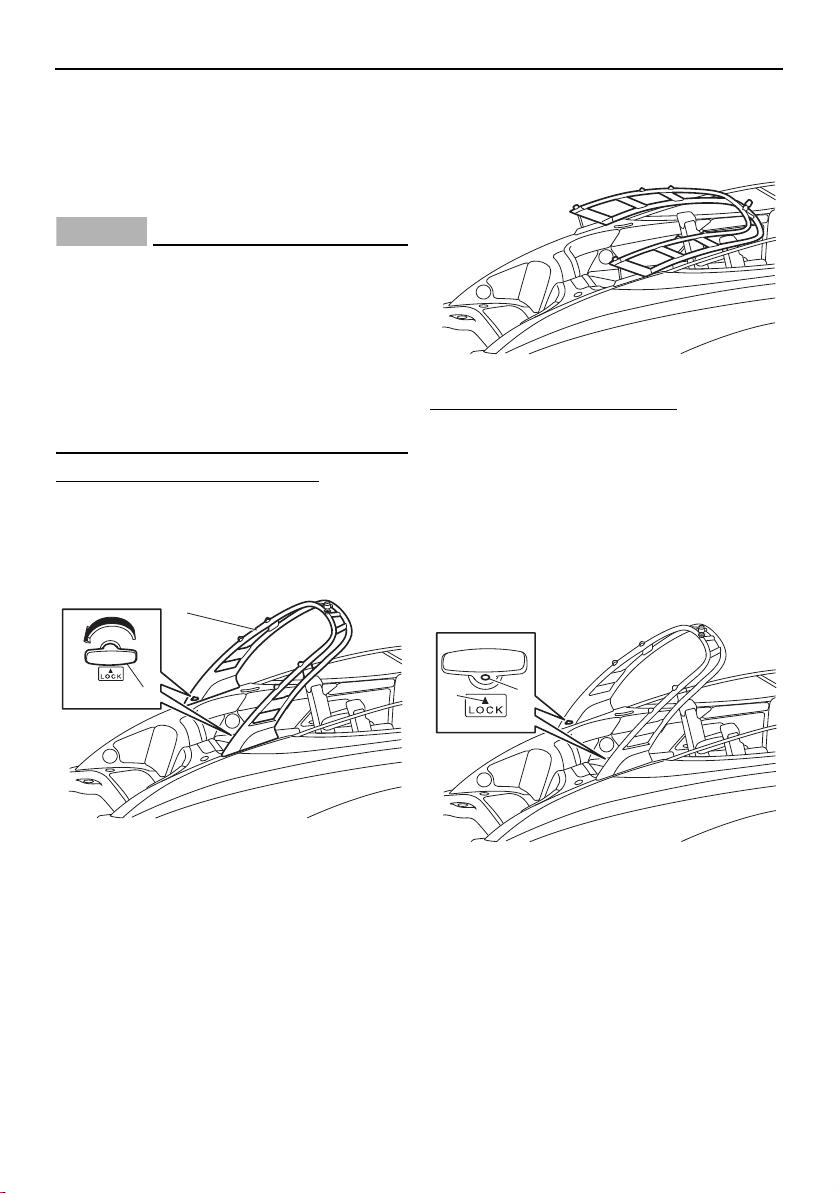
Equipment operation
107
Collapsing and setting up the
wakeboard tower
(212X / 212 Limited S)
When storing the boat, collapse the wake-
board tower.
NOTICE
● Accidentally dropping the upper tower
section while collapsing or raising it can
damage the tower, the boat, or both. An
assistant needs to support the upper
tower section during the procedure.
● Do not operate the boat or transport it on
the trailer with the tower in the collapsed
position to avoid possible damage.
To collapse the wakeboard tower:
(1) While an assistant supports the wake-
board tower, remove the T-handle lock
pin on both sides of the wakeboard tower
by turning it 180° and pulling it out.
1 Wakeboard tower
2 T-handle lock pin
(2) Lower the wakeboard tower until it stops.
To set up the wakeboard tower:
(1) Lift the wakeboard tower.
(2) While an assistant supports the wake-
board tower, insert the T-handle lock pins
into the tower with the white mark on
each pin facing up.
(3) Turn each T-handle lock pin 180° so that
the white mark on the pin is aligned with
the “LOCK” arrow mark.
1 White mark
2 Arrow mark
2
1
2
1
SportsBoat_F3R11.book Page 107 Friday, May 19, 2017 9:35 AM
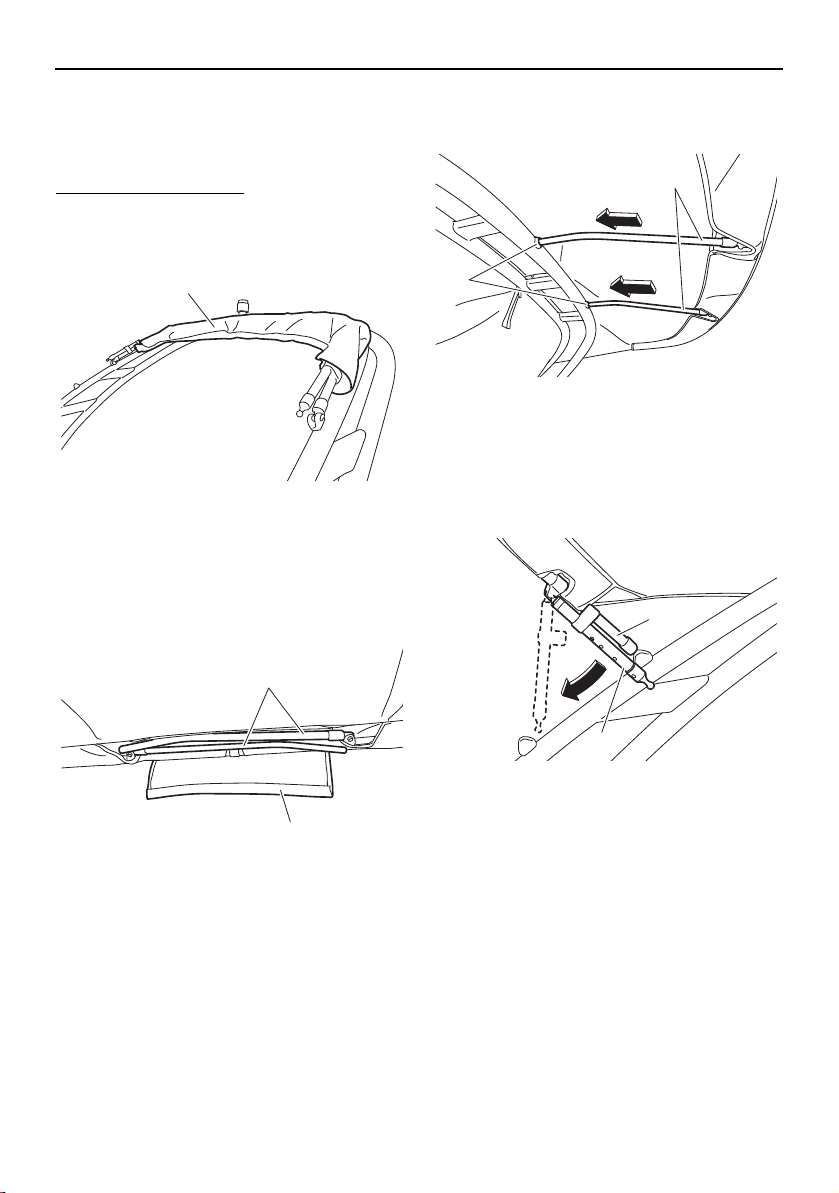
Equipment operation
108
Bimini top™
(AR210 / 212X / 212 Limited S)
Setting up the bimini top
To set up the bimini top:
(1) Remove the storage cover, and then un-
wrap the bimini top.
1 Storage cover
(2) Pull the front of the bimini top toward the
bow, and then open the flap and pull out
the front support poles from the bimini
top.
1 Front support pole
2 Flap
(3) Insert the front support poles into the
mounting holes in the wakeboard tower.
1 Mounting hole
2 Front support pole
(4) Pull the rear of the bimini top toward the
stern, and then unhook the rear support
poles from the main pole.
1 Rear support pole
2 Main pole
1
1
2
2
1
1
2
SportsBoat_F3R11.book Page 108 Friday, May 19, 2017 9:35 AM
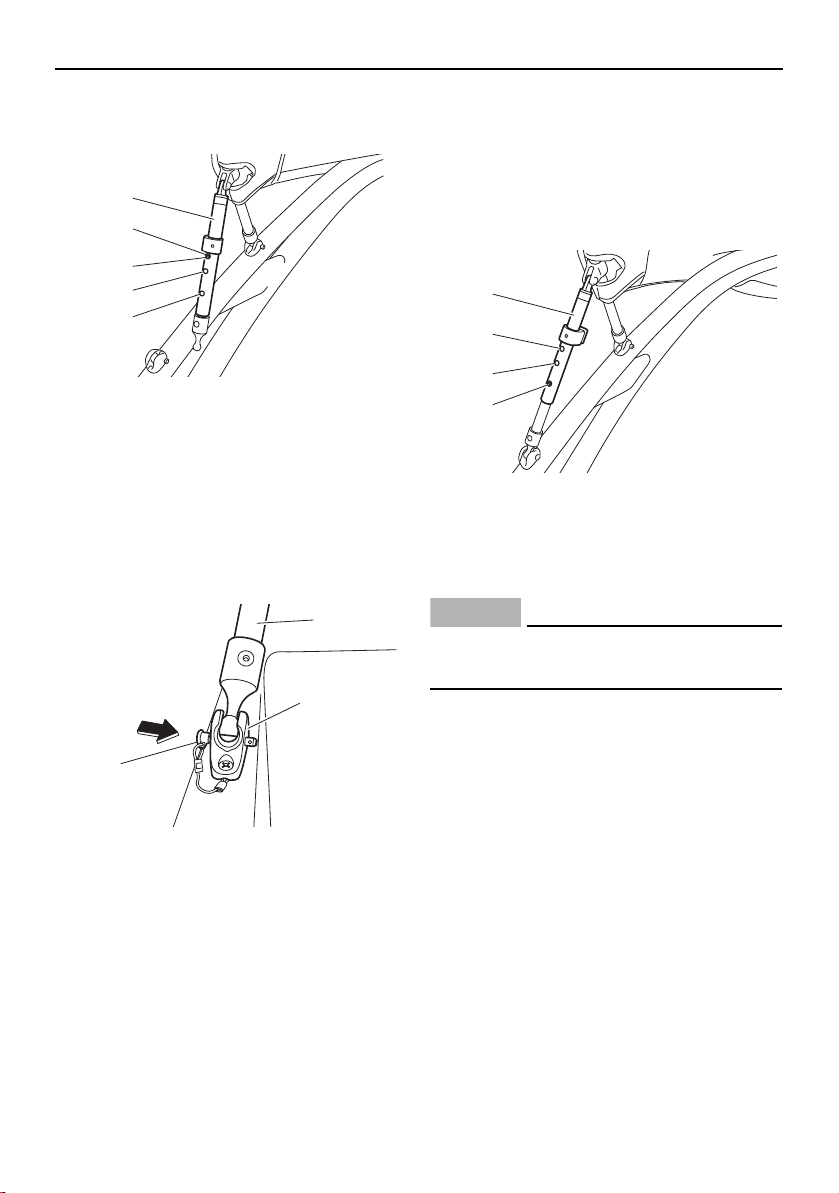
Equipment operation
109
(5) Push the snap button and extend each
rear support pole to the long position.
1 Rear support pole
2 Snap button
3 Short position
4 Middle position
5 Long position
(6) Secure each rear support pole to the rear
support pole mounting bracket using the
lock pin.
1 Rear support pole
2 Lock pin
3 Rear support pole mounting bracket
(7) While pulling the main pole down, push
the snap button and shorten each rear
support pole to either the middle position
for cruising or to the short position if you
are using the wakeboard tower. Be sure
the snap buttons click into place.
1 Rear support pole
2 Short position
3 Middle position
4 Snap button
NOTICE
Do not exceed 72 km/h (45 mph) with the
bimini top in the up position.
1
2
3
4
5
2
3
1
1
2
3
4
SportsBoat_F3R11.book Page 109 Friday, May 19, 2017 9:35 AM
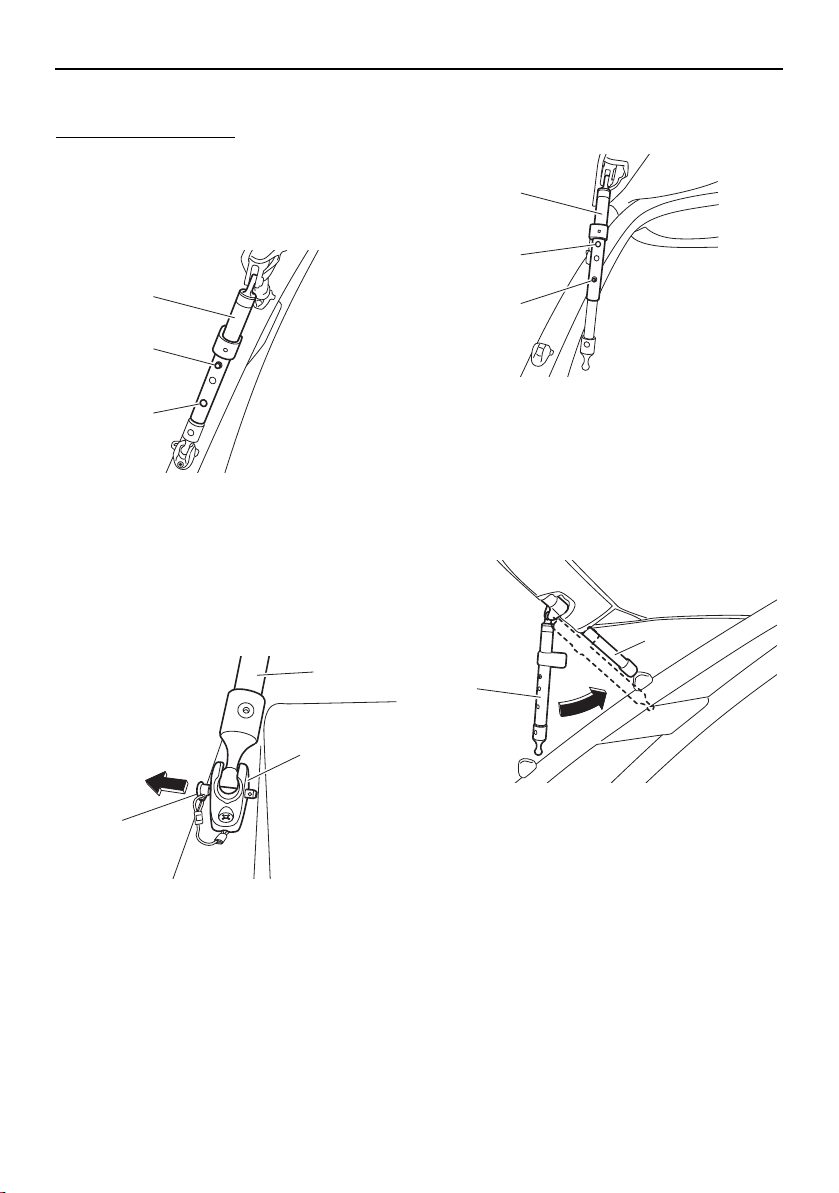
Equipment operation
110
Storing the bimini top
To store the bimini top:
(1) While pulling the main pole down slightly,
push the snap button, and then extend
each rear support pole to the long posi-
tion to loosen the bimini top.
1 Rear support pole
2 Snap button
3 Long position
(2) Remove each rear support pole from the
rear support pole mounting bracket by re-
moving the lock pin.
1 Rear support pole
2 Lock pin
3 Rear support pole mounting bracket
(3) Push the snap button and shorten each
rear support pole to the short position.
1 Rear support pole
2 Short position
3 Snap button
(4) Hook the rear support poles onto the
main pole, and then pull the rear of the bi-
mini top toward the bow.
1 Rear support pole
2 Main pole
1
2
3
2
3
1
1
2
3
2
1
SportsBoat_F3R11.book Page 110 Friday, May 19, 2017 9:35 AM
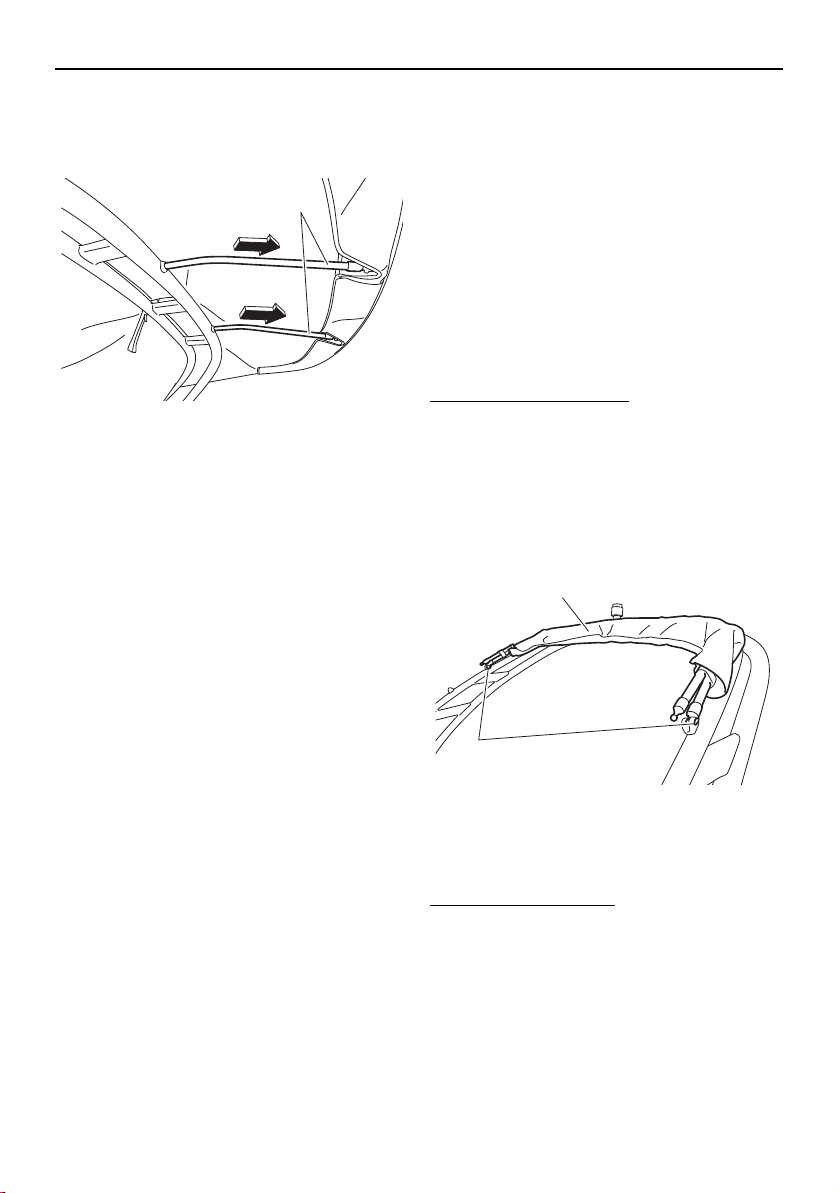
Equipment operation
111
(5) Remove the front support poles from the
wakeboard tower, and then place the
poles in the flap of the bimini top.
1 Front support pole
(6) Pull the front of the bimini top toward the
stern, wrap the bimini top around the
main pole, and then install the storage
cover.
Trailering with the bimini top
The bimini top must be secured to the boat
when it is being trailered. When the boat is
trailered with a genuine Yamaha boat cover,
simply store the bimini top in the fully col-
lapsed position and install the storage cover.
If a boat cover is not used, wrap an elastic
cord around the top and secure the ends to
the tow pylon on the wakeboard tower to re-
strict movement.
Removing the bimini top
To remove the bimini top:
(1) Store the bimini top. See “Storing the bi-
mini top”.
(2) While supporting the bimini top, remove
the lock pins securing the main pole to
the wakeboard tower, and then remove
the top.
1 Bimini top
2 Lock pin
Installing the bimini top
To install the bimini top:
When installing the bimini top, simply reverse
the removal steps, and then make sure that
the lock pins are securely installed.
1
1
2
SportsBoat_F3R11.book Page 111 Friday, May 19, 2017 9:35 AM
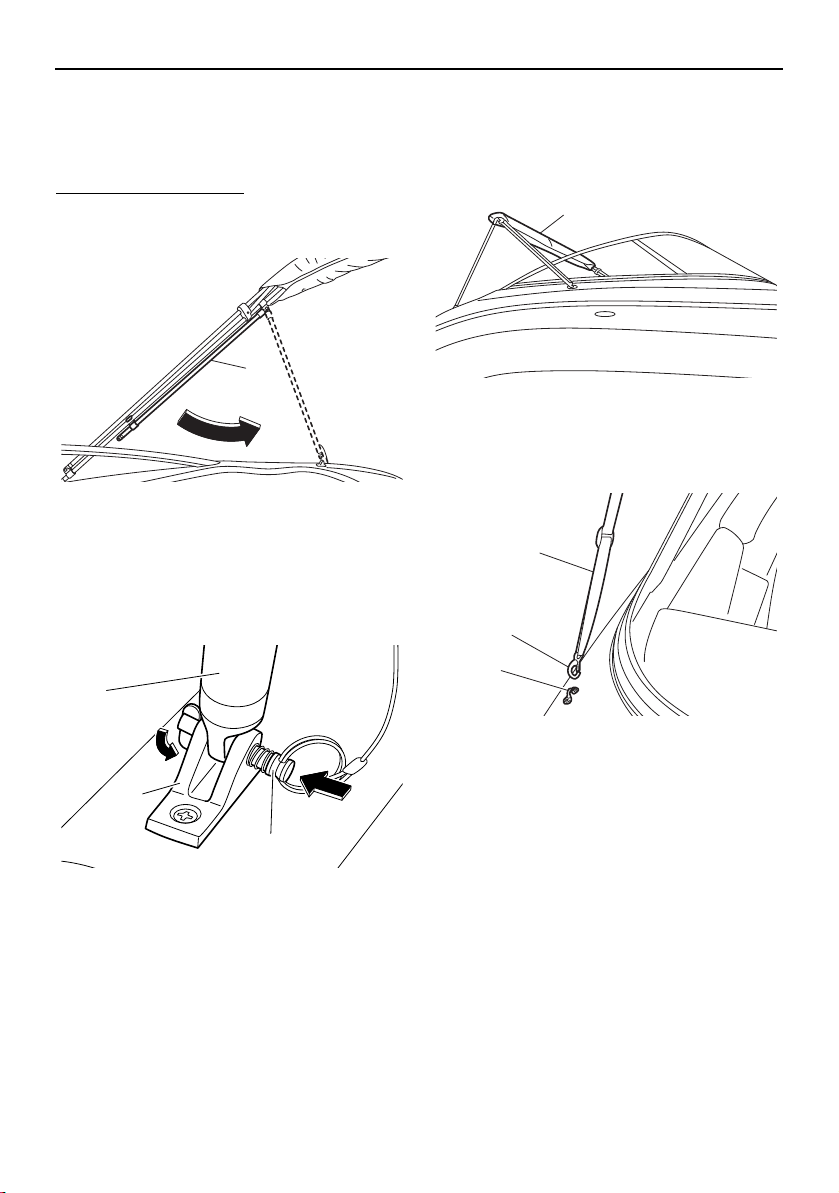
Equipment operation
112
Bimini top™
(SX210 / 212 Limited)
Setting up the bimini top
To set up the bimini top:
(1) Raise the bimini top, and then unhook the
rear support poles from the main pole.
1 Rear support pole
(2) Secure each rear support pole to the rear
support pole mounting bracket using the
lock pin. Make sure that the tab on the
end of the lock pin is pointing downward.
1 Rear support pole
2 Rear support pole mounting bracket
3 Lock pin
(3) Remove the storage cover, unfold the bi-
mini top, and pull it toward the bow.
1 Storage cover
(4) Hook the latch on each front strap onto
the strap eye.
1 Front strap
2 Latch
3 Strap eye
1
3
2
1
1
3
1
2
SportsBoat_F3R11.book Page 112 Friday, May 19, 2017 9:35 AM
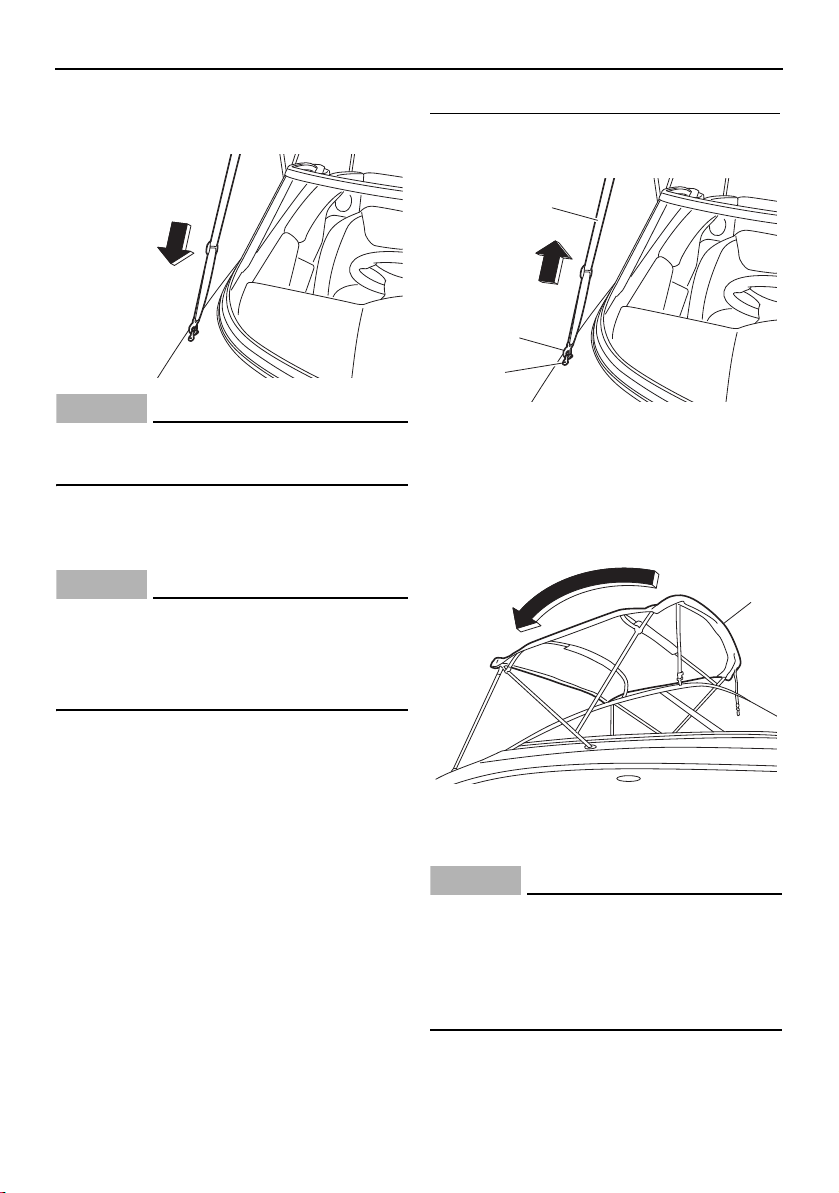
Equipment operation
113
(5) Tighten the front straps so that the top is
snug and wrinkle free.
NOTICE
Do not exceed 72 km/h (45 mph) with the
bimini top in the up position.
Storing the bimini top in the upright
position
NOTICE
Do not trailer the boat with the bimini top
in the fully extended or upright storage po-
sition. Put the bimini top in the fully col-
lapsed position to avoid damage.
To store the bimini top in the upright position:
(1) Loosen each front strap, and then un-
hook the latch from the strap eye.
1 Front strap
2 Latch
3 Strap eye
(2) Pull the bimini top toward the stern, and
then fold it.
1 Bimini top
(3) Install the storage cover.
NOTICE
Do not trailer the boat with the bimini top
in the fully extended or upright position.
When transporting the boat, put the bimini
top in the fully collapsed position to avoid
damage.
1
2
3
1
SportsBoat_F3R11.book Page 113 Friday, May 19, 2017 9:35 AM
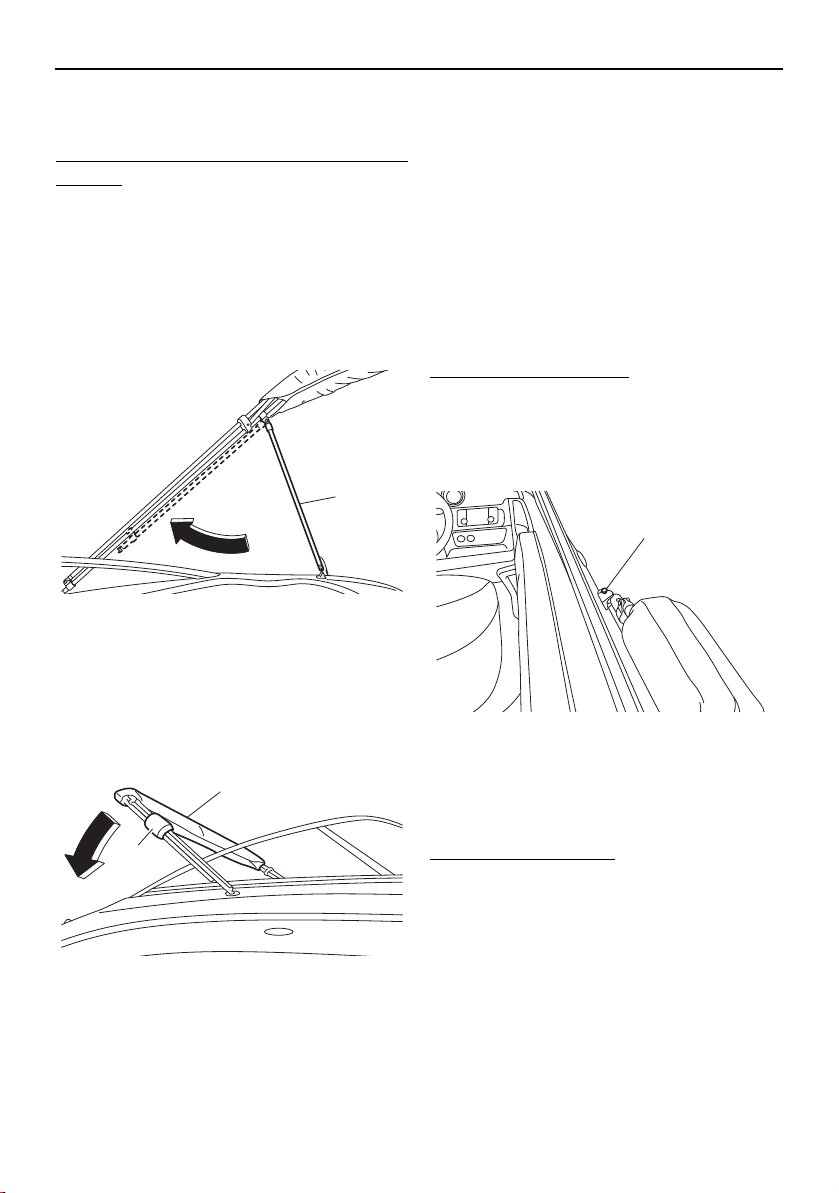
Equipment operation
114
Storing the bimini top in the fully
collapsed position
To store the bimini top in the fully collapsed
position:
(1) Follow the above steps for “Storing the bi-
mini top in the upright position”.
(2) While supporting the bimini top, remove
the lock pins securing the rear support
poles to the rear support pole mounting
brackets, and then hook each rear sup-
port pole onto the main pole.
1 Rear support pole
(3) Install the protective cushions around the
poles, and then lower the bimini top onto
the rear deck.
1 Protective cushion
2 Bimini top
Trailering with the bimini top
The bimini top must be secured to the boat
when it is being trailered. When the boat is
trailered with a genuine Yamaha boat cover,
simply store the bimini top in the fully col-
lapsed position and install the storage cover.
If a boat cover is not used, wrap an elastic
cord around the top and secure the ends to
the ski tow hook to restrict movement.
Removing the bimini top
To remove the bimini top:
(1) Store the bimini top. See “Storing the bi-
mini top in the fully collapsed position”.
(2) Remove the lock pins securing the bimini
top to the main pole mounting brackets.
1 Lock pin
(3) Remove the bimini top from the boat.
Installing the bimini top
To install the bimini top:
When installing the bimini top, simply reverse
the removal steps, and then make sure that
the lock pins are securely installed.
1
2
1
1
SportsBoat_F3R11.book Page 114 Friday, May 19, 2017 9:35 AM
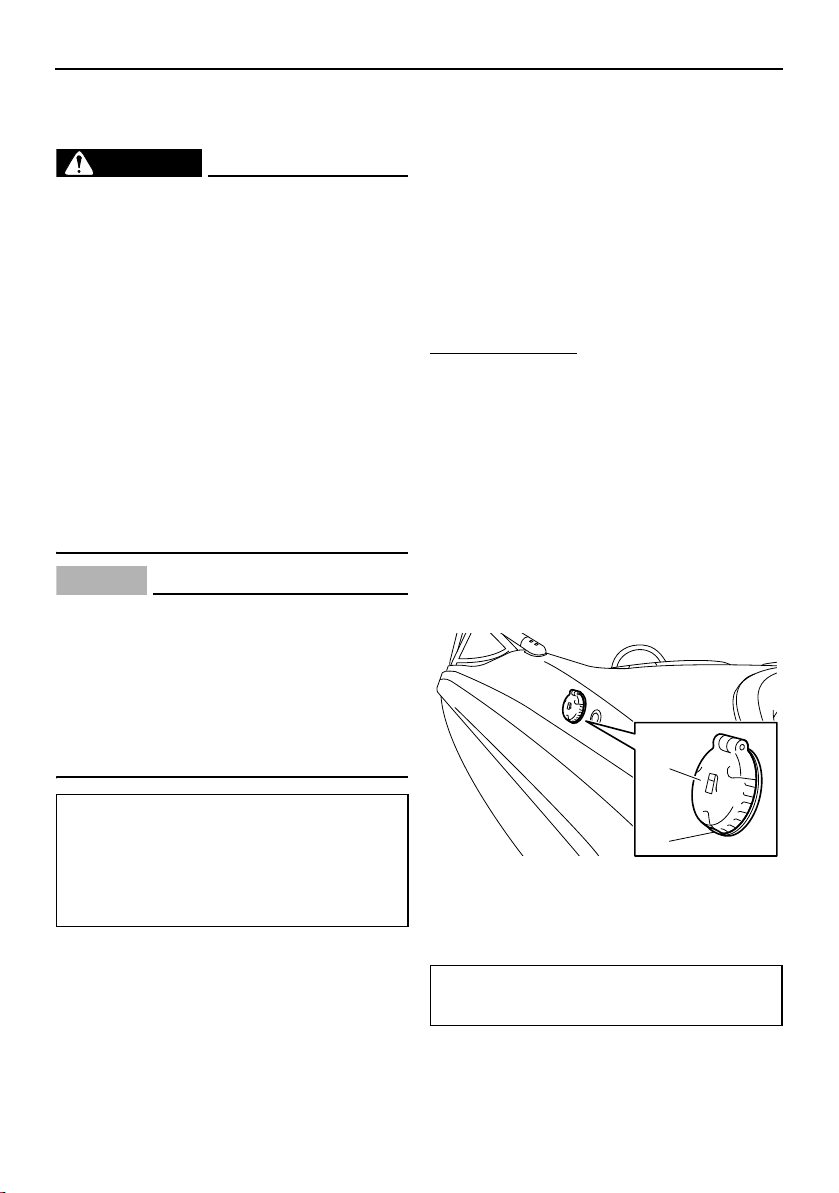
115
Operation and handling requirements
Fuel requirement
Fuel
WARNING
● Gasoline and gasoline vapors are ex-
tremely flammable. To avoid fires and
explosions and to reduce the risk of in-
jury when refueling, follow these in-
structions.
● Gasoline is poisonous and can cause in-
jury or death. Handle gasoline with care.
Never siphon gasoline by mouth. If you
should swallow some gasoline, inhale a
lot of gasoline vapor, or get some gaso-
line in your eyes, see your doctor imme-
diately. If gasoline spills on your skin,
wash with soap and water. If gasoline
spills on your clothing, change your
clothes.
NOTICE
● Do not use leaded gasoline. Leaded gas-
oline can seriously damage the engines.
● Avoid getting water and contaminants in
the fuel tank. Contaminated fuel can
cause poor performance and engine
damage. Use only fresh gasoline that
has been stored in clean containers.
Gasohol
There are two types of gasohol: gasohol con-
taining ethanol and that containing methanol.
Gasohol containing ethanol can be used if
ethanol content does not exceed 10% and the
fuel meets minimum octane ratings. E-85 is a
fuel blend containing 85% ethanol and there-
fore must not be used in this boat. All ethanol
blends containing more than 10% ethanol can
cause fuel system damage or engine perfor-
mance problems.
Yamaha does not recommend gasohol con-
taining methanol because it can cause fuel
system damage and engine performance
problems.
To fill the fuel tank:
(1) Before refueling, turn off the engines.
Never refuel while smoking, or while in
the vicinity of sparks, open flames, or oth-
er sources of ignition.
(2) Refuel the boat in a well-ventilated area.
If the boat is in the water, be sure it is se-
curely moored to the fueling dock. All
passengers must be out of the boat dur-
ing refueling.
(3) Press the fuel tank filler cap button, and
then open the fuel tank filler cap.
1 Fuel tank filler cap
2 Fuel tank filler cap button
(4) Slowly add fuel to the fuel tank.
Recommended fuel:
Regular unleaded gasoline with a
minimum octane rating of 86
(Pump octane number) = (R + M)/2
90 (Research octane number)
Fuel tank capacity:
189 L (50.0 US gal, 41.6 Imp.gal)
1
2
SportsBoat_F3R11.book Page 115 Friday, May 19, 2017 9:35 AM
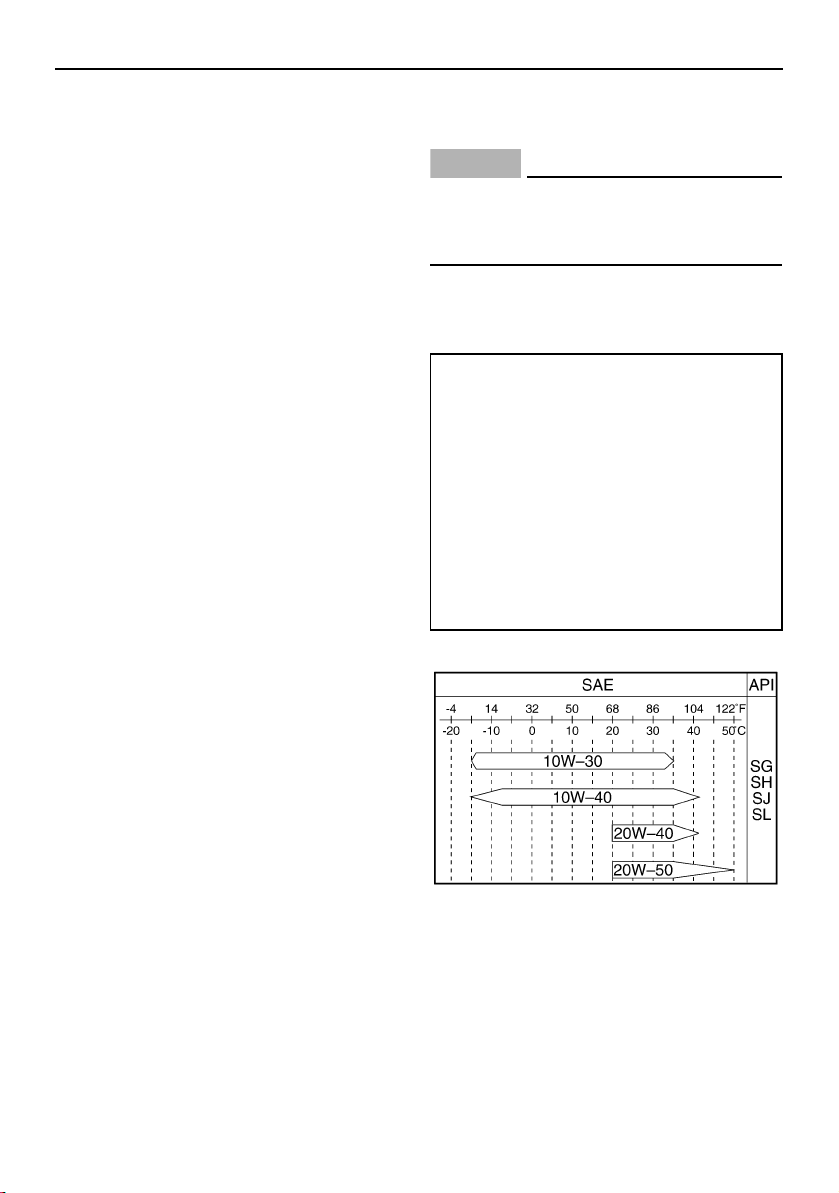
Operation and handling requirements
116
(5) Stop filling when the fuel just becomes
visible in the bottom of the filler tube. Do
not “top off” the tank, because gasoline
could spill out.
(6) Wipe up any spilled fuel immediately.
(7) Close the fuel tank filler cap by pushing it
until it locks in place. Make sure that the
fuel tank filler cap is securely closed.
Engine Med RX Fuel Additive
As the fuel mixture burns in your engine’s
combustion chambers, carbon deposits are
left behind. Over time, these deposits can re-
duce performance and even cause engine
damage. Marine engines tend to run at lower
operating temperatures than other engines,
making them more likely to accumulate these
harmful deposits. Engine Med RX, available
from your Yamaha Boat Dealer, is formulated
to remove existing deposits and, when used
continuously, prevent new ones from forming,
while also helping to keep fuel injectors and
other fuel system components clean for prop-
er performance and longer engine life.
Engine oil requirement
Engine oil
NOTICE
Use only 4-stroke engine oil. Usage of 2-
stroke engine oil could result in severe en-
gine damage.
Select an oil grade according to the average
temperatures in the area where the boat will
be used.
3-star models
Recommended engine oil:
YAMALUBE 4W
Recommended engine oil type:
SAE 10W-30, 10W-40, 20W-40, 20W-
50
Recommended engine oil grade
(3-star models):
API SG, SH, SJ, SL
Recommended engine oil grade
(4-star models):
API SJ, SL
SportsBoat_F3R11.book Page 116 Friday, May 19, 2017 9:35 AM
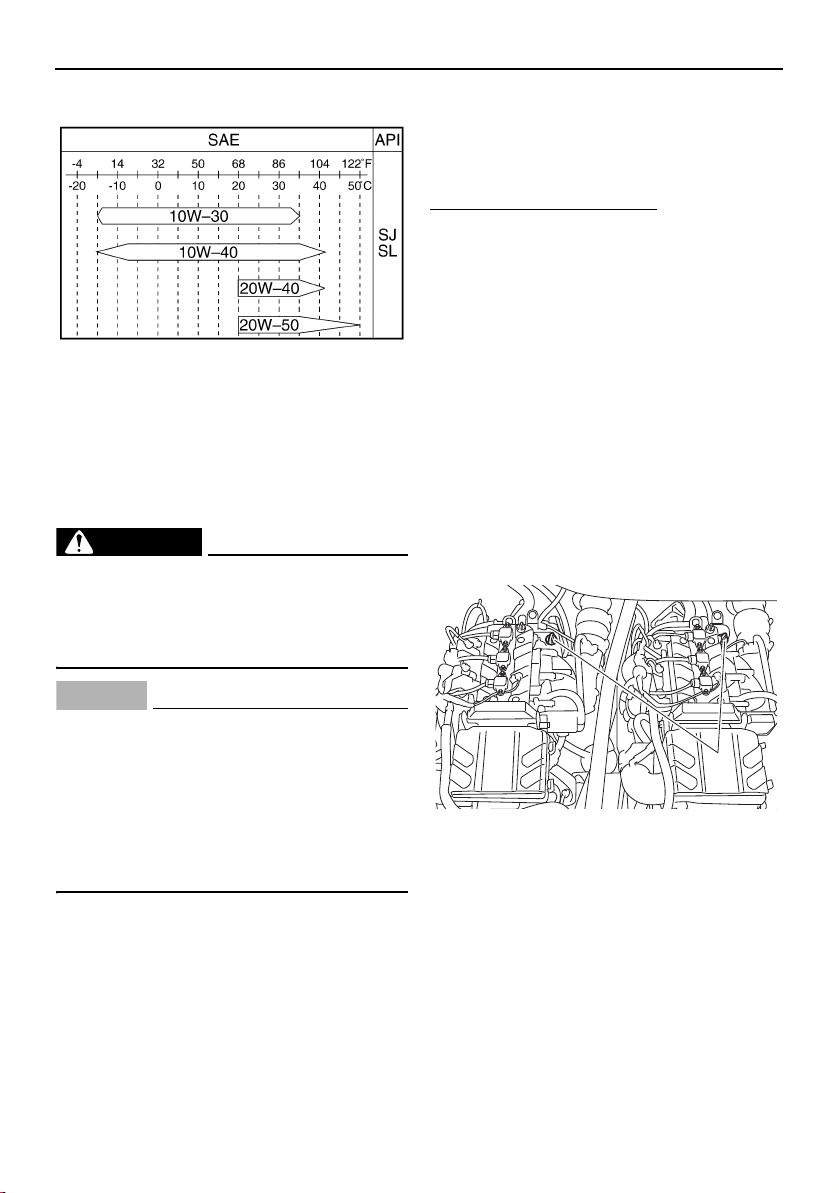
Operation and handling requirements
117
4-star models
TIP:
When the engine is operated at high speeds,
some engine oil may be consumed. Be sure
to check the engine oil level.
Checking the engine oil level
(AR210 / SX210)
WARNING
Engine oil is extremely hot immediately af-
ter the engines are turned off. Coming in
contact with or getting any engine oil on
your clothes could result in burns.
NOTICE
● Do not run the engine with too much or
not enough oil in the oil tank, otherwise
the engine could be damaged.
● Make sure that debris and water do not
enter the oil tank filler hole. Debris and
water in the engine oil can cause serious
engine damage.
TIP:
● When checking the engine oil level on land,
the engine must be running while water is
being supplied to the cooling water passag-
es. (See “Flushing the cooling system” on
page 155 for information on supplying wa-
ter.)
● When checking the engine oil level on wa-
ter, moor the boat so that it will not drift
away.
To check the engine oil level:
(1) With the engine stopped, place the boat
in a precisely level position on land or
launch the boat.
(2) Look in all directions, and then start the
engine. (See page 138 for information on
starting the engine.)
(3) Run the engine at idling speed for 6 min-
utes or more. Run the engine an addition-
al 5 minutes if the ambient temperature is
20 °C (68 °F) or less.
(4) Stop the engine.
(5) Open the engine hood. (See page 92.)
(6) Loosen the oil tank filler cap and remove
it, and then wipe the attached dipstick
clean.
1 Oil tank filler cap/Dipstick
(7) Screw the oil tank filler cap into the filler
hole until it stops. Remove the oil tank fill-
er cap again and make sure that the en-
gine oil level is between the minimum and
maximum level marks.
1
SportsBoat_F3R11.book Page 117 Friday, May 19, 2017 9:35 AM

Operation and handling requirements
118
1 Dipstick
2 Maximum level mark
3 Minimum level mark
(8) If the engine oil level is significantly above
the maximum level mark, consult a
Yamaha Boat dealer. If the engine oil lev-
el is below the minimum level mark, slow-
ly add engine oil.
(9) Repeat steps (6)–(8) until the engine oil is
at the proper level.
(10) Securely install the oil tank filler cap and
turn it until it stops.
(11) Repeat the checking oil level procedure
for the other engine.
(12) Close the engine hood.
Checking the engine oil
(212X / 212 Limited S / 212 Limited)
WARNING
Engine oil is extremely hot immediately af-
ter the engines are turned off. Coming in
contact with or getting any engine oil on
your clothes could result in burns.
NOTICE
Make sure debris and water do not enter
the oil filler hole. Debris and water in the
engine oil can cause serious engine dam-
age.
To check the engine oil level:
(1) Place the boat in a precisely level position
on land with the engine stopped. If the en-
gine was running, allow the engine oil to
settle by waiting 5 minutes or more be-
fore checking the oil level.
(2) Open the engine hood. (See page 92.)
(3) Remove the dipstick and wipe it clean.
3-star models
1 Dipstick
4-star models
1 Dipstick
(4) Insert the dipstick back into the dipstick
tube completely. Remove the dipstick
again and check that the engine oil level
is between the minimum level mark and
maximum level mark.
FL
21 3
1
1
SportsBoat_F3R11.book Page 118 Friday, May 19, 2017 9:35 AM
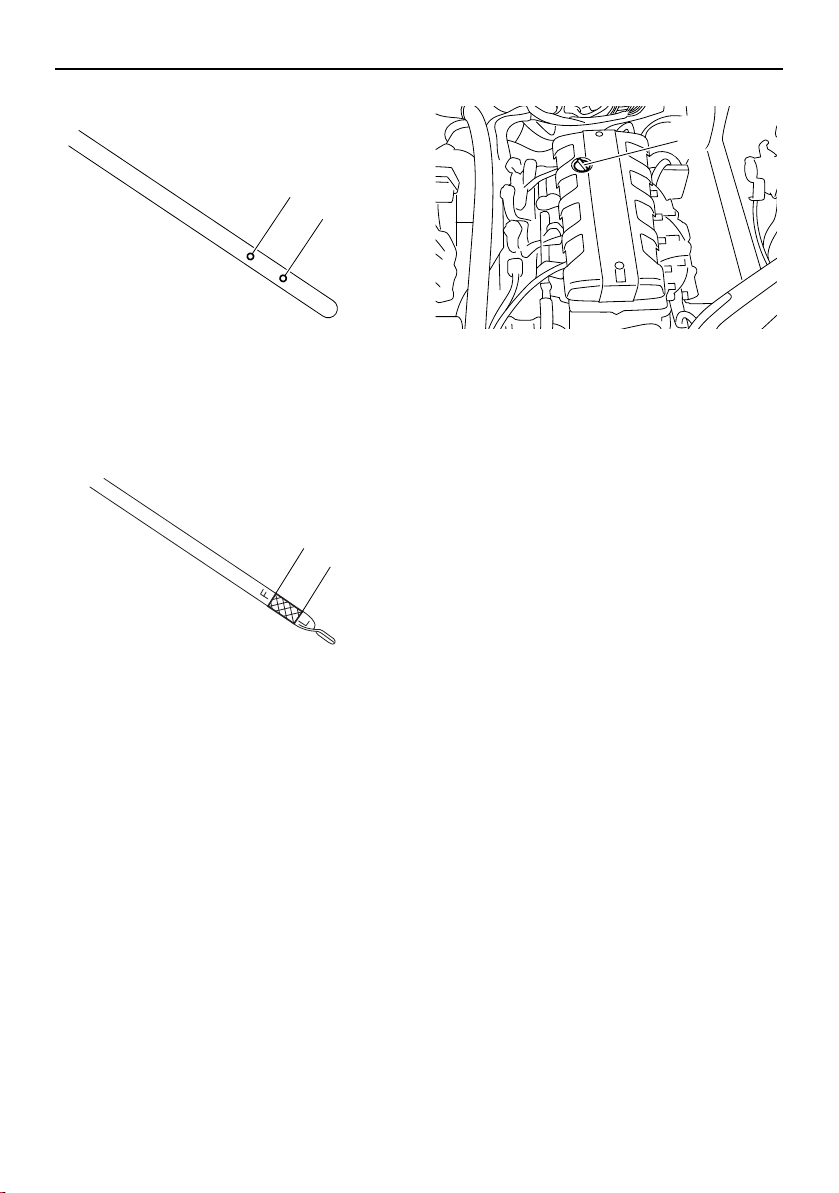
Operation and handling requirements
119
3-star models
1 Maximum level mark
2 Minimum level mark
4-star models
1 Maximum level mark
2 Minimum level mark
(5) If the engine oil level is significantly above
the maximum level mark, consult a
Yamaha Boat Dealer. If the engine oil lev-
el is below the minimum level mark, add
engine oil.
(6) Remove the engine oil filler cap.
1 Engine oil filler cap
(7) Slowly add engine oil.
(8) Wait approximately 5 minutes to allow the
engine oil to settle, and then check the
engine oil level again.
(9) Repeat steps 3–8 until the engine oil is at
the proper level.
(10) Install the engine oil filler cap.
(11) Repeat the checking oil level procedure
for the other engine.
(12) Close the engine hood.
2
1
2
1
1
SportsBoat_F3R11.book Page 119 Friday, May 19, 2017 9:35 AM
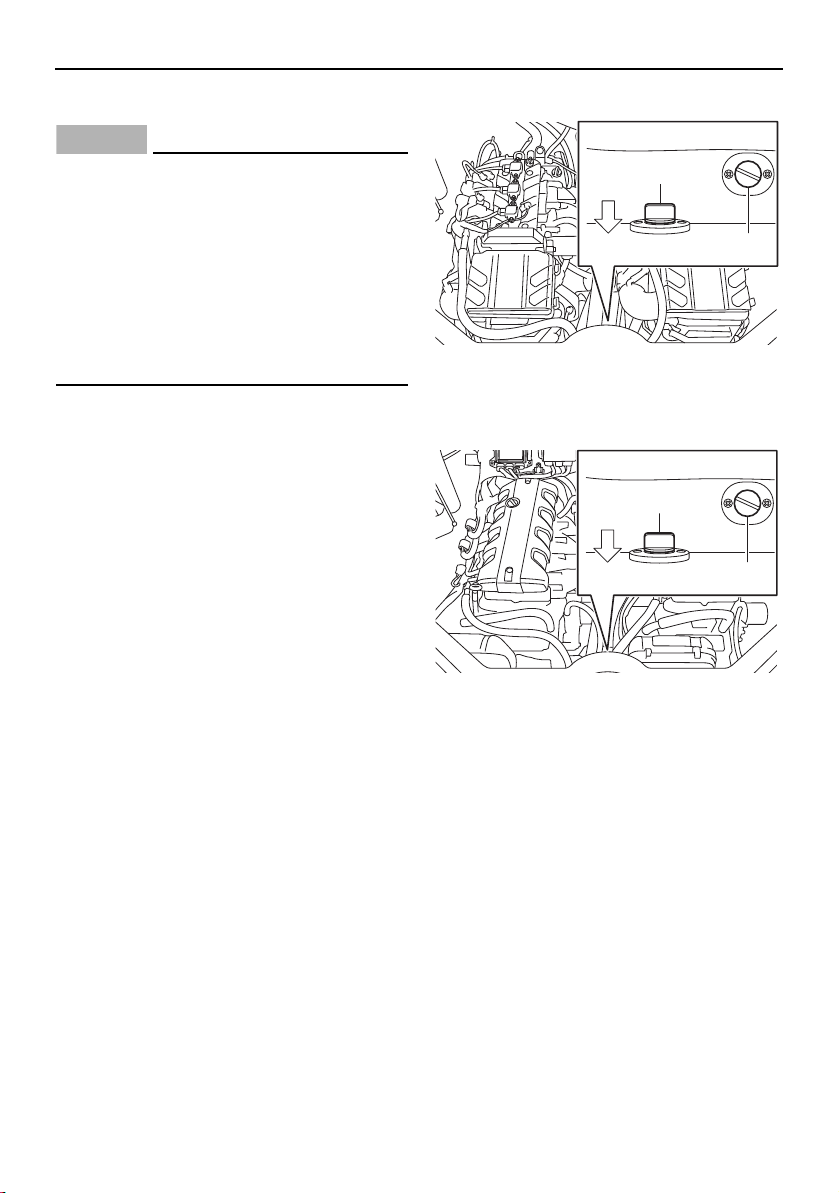
Operation and handling requirements
120
Draining the bilge water
NOTICE
● Do not run the engines at full throttle
when bilge water remains in the engine
compartment. The bilge water can
splash into the engines, which can re-
sult in severe damage.
● Be sure all drain plugs are tightened be-
fore operating your boat. Otherwise, wa-
ter may flood the boat and cause it to
submerge.
Draining the bilge water on land
This model is equipped with a fuel tank com-
partment drain plug, engine compartment
drain plug, and hull drain plug.
To drain the bilge water from the various com-
partments, see the following sections.
Draining the bilge water from the fuel tank
compartment and engine compartment
If there is fuel or a fuel/water mixture in the en-
gine compartment, wipe it up immediately
with dry rags. WARNING! This indicates a
fuel leak. Do not operate the boat until the
source of the fuel leak is found and cor-
rected. Gasoline and its vapors are highly
flammable and explosive.
(1) Open the engine hood.
(2) Remove the fuel tank compartment drain
plug to drain the water.
(3) Remove the engine compartment drain
plug to drain the water.
AR210 / SX210
1 Fuel tank compartment drain plug
2 Engine compartment drain plug
212X / 212 Limited S / 212 Limited
1 Fuel tank compartment drain plug
2 Engine compartment drain plug
(4) If the boat was operated in salt water,
wash down the compartment with fresh
water.
(5) Securely install the drain plugs in their
original positions.
(6) Close the engine hood.
1
2
BOW
1
2
BOW
SportsBoat_F3R11.book Page 120 Friday, May 19, 2017 9:35 AM
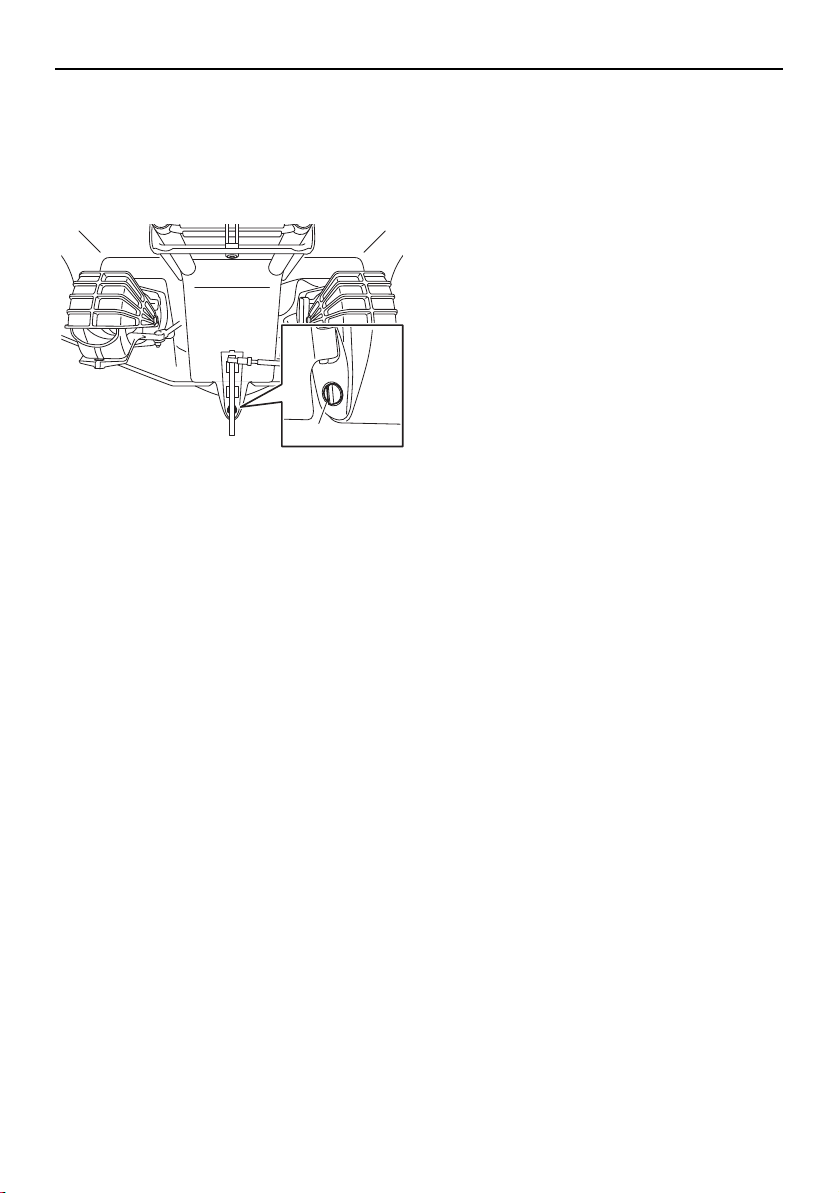
Operation and handling requirements
121
Draining the bilge water from the hull
Remove the hull drain plug at the stern to
drain the water. Check the condition of the
O-ring on the hull drain plug, and then secure-
ly install the drain plug.
1 Hull drain plug
Draining the bilge water on water
This model is equipped with a self-draining
deck and bilge pump to drain the bilge water
on water.
Self-draining deck
Most water that enters the deck area drains
automatically out the stern through the large
drain hole in the deck.
A one-way check valve in the drain prevents
water from traveling back to the deck while
the boat is moored or moving in reverse.
Bilge pump (AR210 / SX210)
Your boat is equipped with a drainage system
that channels water that enters the boat from
the storage compartments to the bilge under
the engine compartment. When the bilge
pump switch is turned on, the bilge pump will
operate.
Even if the bilge pump switch is not turned on,
the bilge pump will detect when there is ex-
cessive water in the bilge and will automati-
cally drain most of it through the bilge pump
outlet. This function works automatically even
if the battery switch is turned to the off posi-
tion.
1
SportsBoat_F3R11.book Page 121 Thursday, September 20, 2018 5:43 PM

Operation and handling requirements
122
1 Bilge pump switch
1 Bilge pump outlet
Bilge pump
(212X / 212 Limited S / 212 Limited)
Your boat is equipped with a drainage system
that channels water that enters the boat from
the storage compartments to the bilge under
the engine compartment. When the “Auto
Bilge” is turned on, the bilge pump will detect
when there is excessive water in the bilge and
will automatically drain most of it through the
bilge pump outlet. For normal operation, turn
the “Auto Bilge” on during boat use and turn it
off when leaving the boat.
Even if the bilge pump switch is not turned on,
the bilge pump will detect when there is ex-
cessive water in the bilge and will automati-
cally drain most of it through the bilge pump
outlet. This function works automatically even
if the battery switch is turned to the off posi-
tion.
1 “Auto Bilge” button
1 Bilge pump outlet
TIP:
To turn on the bilge pump and discharge the
water continuously, tap the “ ” button. To
turn off the bilge pump when water is no lon-
ger discharged from the bilge water outlet, tap
the button again.
BILGE
NAVI
ANC
HORN
CTSY
LIGHTS
1
1
0
VOLUME
% 0 ft
SYS
12.3V
AUX
12.3V
FLOAT MODE
DEPTH
SYS CTRL
AUTO
AUTO
Ballast
Blower
Auto Blowr
Bilge
Auto Bilge
AUTO bilge deplete battery
1
1
Bilge
SportsBoat_F3R11.book Page 122 Thursday, September 20, 2018 5:43 PM

123
First-time operation
Engine break-in
(AR210 / SX210)
NOTICE
Failure to perform the engine break-in
could result in reduced engine life or even
severe engine damage.
The engine break-in period is essential to al-
low the various components of the engines to
wear and polish themselves to the correct op-
erating clearances. This ensures proper per-
formance and promotes longer component
life.
(1) Check the engine oil level. (See page 117
for information on checking the engine oil
level.)
(2) Launch the boat and start the engines.
(See page 138 for information on starting
the engines.)
(3) For the first 5 minutes, operate with the
engines at idling speed.
(4) For the next 30 minutes, operate with the
engines speed below 5000 r/min.
(5) For the next 1 hour, operate with the en-
gines speed below 6500 r/min.
After the engine break-in is complete, the boat
can be operated normally.
Engine break-in (212X /
212 Limited S / 212 Limited)
NOTICE
Failure to perform the engine break-in
could result in reduced engine life or even
severe engine damage.
The engine break-in period is essential to al-
low the various components of the engines to
wear and polish themselves to the correct op-
erating clearances. This ensures proper per-
formance and promotes longer component
life.
(1) Check the engine oil level. (See page 118
for information on checking the engine oil
level.)
(2) Launch the boat and start the engines.
(See page 138 for information on starting
the engines.)
(3) For the first 5 minutes, operate with the
engines at trolling speed.
(4) For the next 30 minutes, operate with the
engines speed below 5000 r/min.
(5) For the next 1 hour, operate with the en-
gines speed below 6000 r/min.
After the engine break-in is complete, the boat
can be operated normally.
SportsBoat_F3R11.book Page 123 Friday, May 19, 2017 9:35 AM
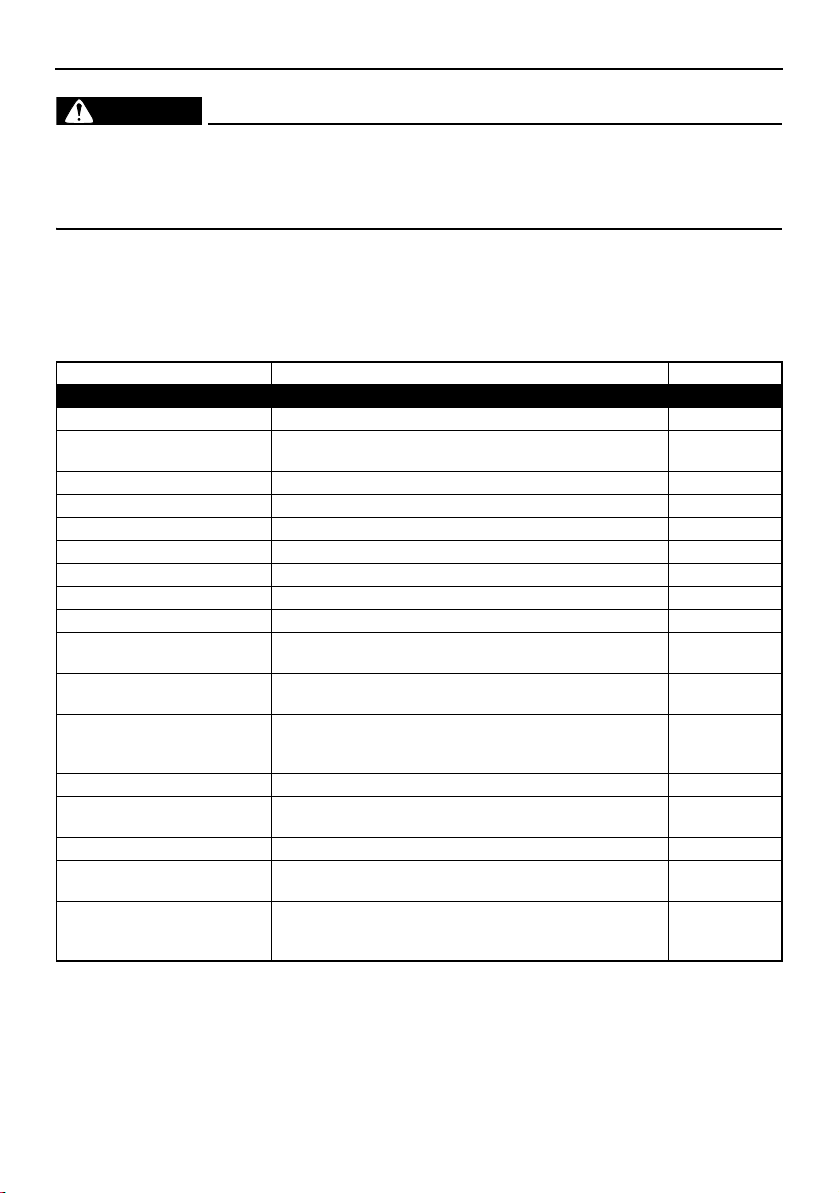
124
Pre-operation checks
WARNING
Failure to inspect or maintain the boat properly increases the possibility of an accident
or damage to the boat. Do not operate the boat if you find any problem.
If a problem cannot be corrected by the procedures provided in this manual, have the
boat inspected by a Yamaha Boat Dealer.
Pre-operation checklist
Before operating this boat, perform the checks in the following checklist. Always follow the inspec-
tion and maintenance procedures and schedules described in this owner’s/operator’s manual.
Pre-operation checks should be made each time the boat is used. These checks can be com-
pleted in a short time. It is worth the time spent to ensure safety and reliability.
ITEM CHECK PAGE
PRE-LAUNCH CHECKS
Steering system Check for proper steering operation. 126
Remote control levers Check for proper throttle operation.
Check for proper shift operation.
126
Fire extinguisher Check readiness of the extinguisher. 127
Hull Check hull for damage and cracks before launching. —
Access port caps Check for proper installation. 128
Jet intakes Check that no debris is in the intakes before launching. 129
Fuel system Check fuel system for leaks. 129
Engine oil level Check engine oil level; add as necessary. 117, 118
Battery Check battery condition, mounting, and connection. 131
Bilge water Check the engine compartment and fuel tank compart-
ment for bilge water.
131
Drain plugs Check the drain plugs for damage and foreign material
and check that they are securely installed.
131
Engine compartment and
blowers
Open the engine hood and check to be sure no gasoline,
gasoline vapors, or loose electrical connections are pres-
ent. Operate the blowers for at least 4 minutes.
132, 133
Engine hood Check that the hood latch is secure. 92
Lights and horn Check lights to be sure they operate. Push the horn
switch/button to be sure it operates.
134, 135
Bimini top Check that the top is secure. 108, 112
Engine shut-off cord (lan-
yard)
Check the engine shut-off cord (lanyard) for damage. 136
Callapsible tower fasteners
(AR210 / 212X /
212 Limited S)
Check that the tower fasteners are secured. 105
SportsBoat_F3R11.book Page 124 Friday, May 19, 2017 9:35 AM

Pre-operation checks
125
The steering and shifting pre-operation checks will require two persons: one person to operate
the controls and one person to observe the proper operation at the stern.
POST-LAUNCH CHECKS
Switches Check operation of the main switches and engine shut-
off switch.
136
Cooling water pilot outlets Check that water comes out while the engines are run-
ning.
136
Fuel level Check fuel level; add as necessary. 137
ITEM CHECK PAGE
SportsBoat_F3R11.book Page 125 Friday, May 19, 2017 9:35 AM
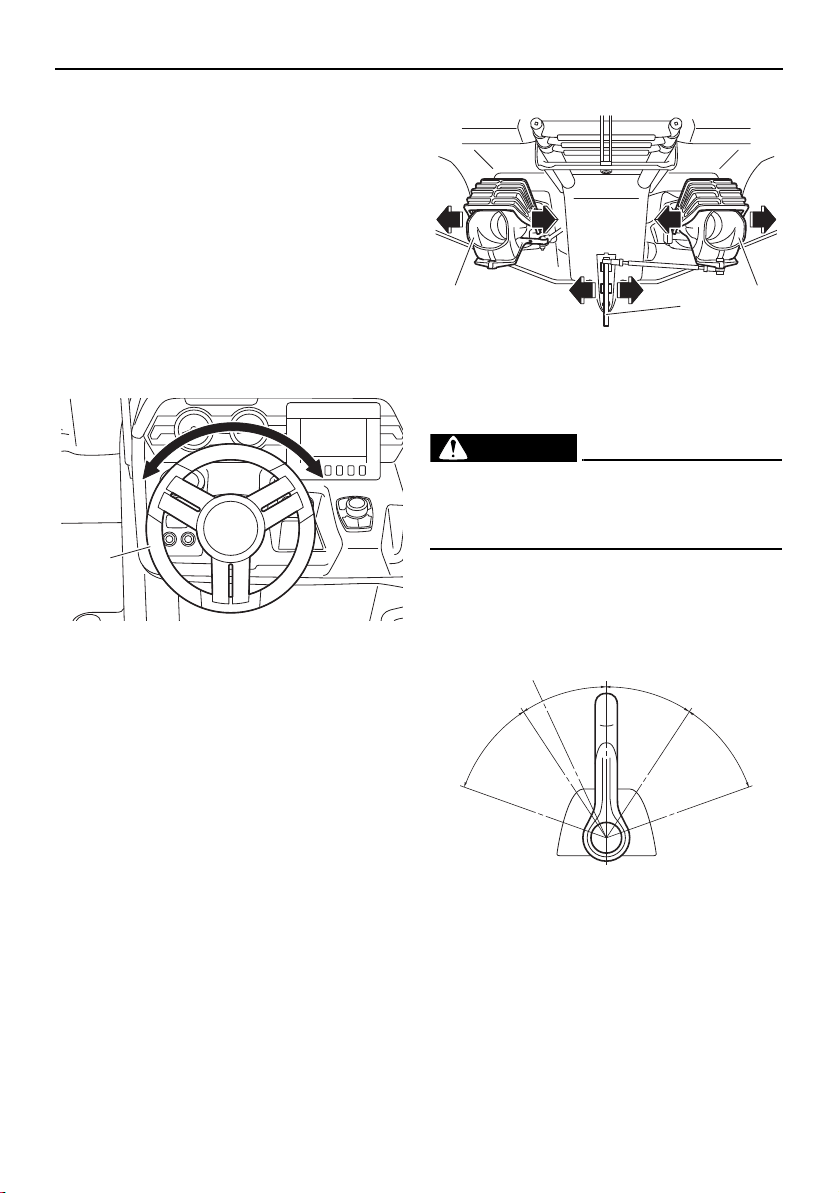
Pre-operation checks
126
Pre-operation check points
Pre-launch checks
Perform the pre-launch checks in the pre-op-
eration checklist while the boat is on land.
Steering system checks
Make sure the steering wheel is not loose.
There should not be any free play, either in-
and-out or in rotation. Turn the steering wheel
fully to the right and left to make sure opera-
tion is smooth and unrestricted throughout the
whole range.
1 Steering wheel
Make sure both jet thrust nozzles change di-
rections as the steering wheel is turned. The
jet thrust nozzles should point to starboard
(right) when the wheel is turned to the right.
The jet thrust nozzles should point to port (left)
when the wheel is turned to the left. There
should not be free play between the steering
wheel and the jet thrust nozzles. In addition,
check that the direction of the articulating keel
changes according to the movement of the jet
thrust nozzles.
1 Jet thrust nozzle
2 Articulating keel
Remote control lever checks
WARNING
Do not touch the shift gates while the re-
mote control levers are being operated,
otherwise, you could be pinched.
Operate the remote control levers several
times to make sure that operation is smooth
throughout the whole range.
1 Neutral position
2 TDE position
3 Forward position
4 Reverse position
5 Shift
6 Fully closed
7 Throttle
8 Fully open
1
1
2
1
N
1
F
8
7
3
R
4
2
55
7
6
8
6
SportsBoat_F3R11.book Page 126 Friday, May 19, 2017 9:35 AM
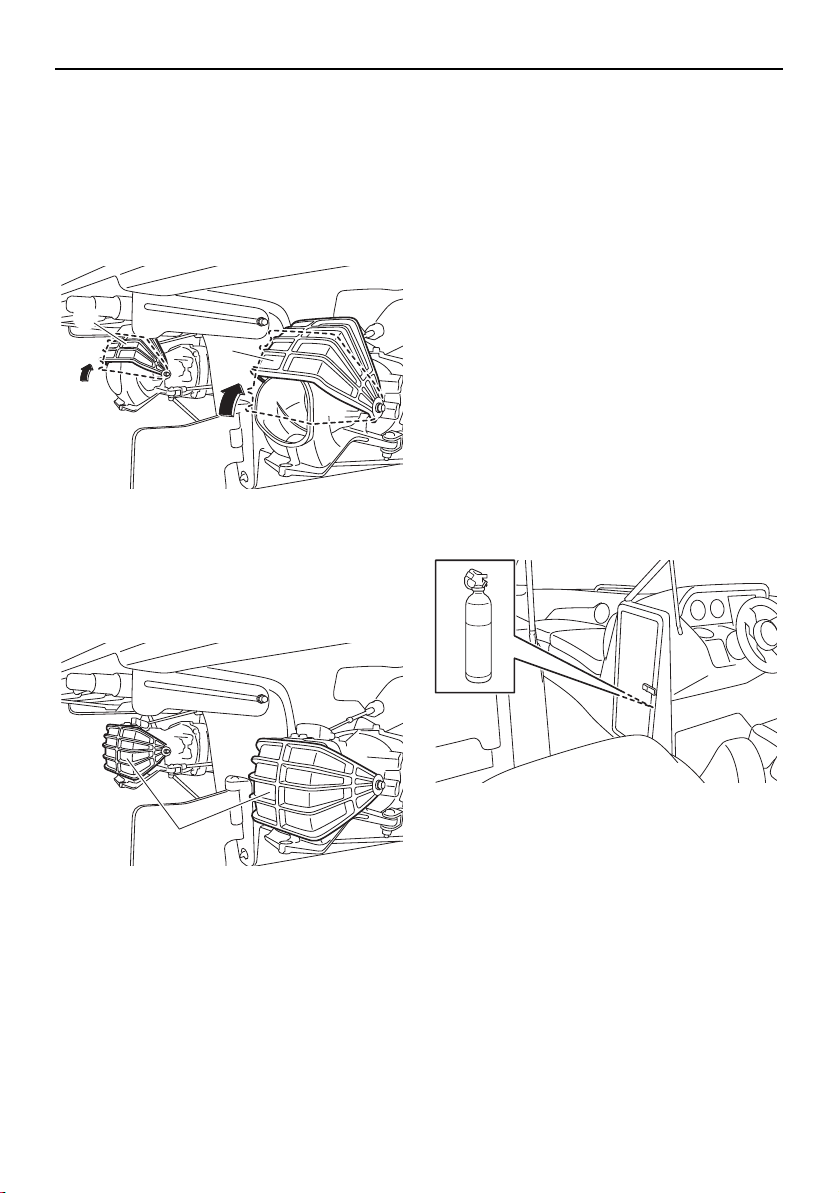
Pre-operation checks
127
Check that the shift gates are slightly above
the shift gate neutral position when the re-
mote control levers are in the forward posi-
tion, and that the shift gates are in the fully
open position when the remote control levers
are moved farther forward.
Fully open position
1 Shift gate
Check that the shift gates are in the fully
closed position when the remote control le-
vers are in the reverse position.
Fully closed position
1 Shift gate
Fire extinguisher check
As an inboard boat less than 26 feet in length,
your boat must be fitted with one B-1 type fire
extinguisher when navigating waters con-
trolled by the U.S. Coast Guard. In addition,
most state and local boating laws require that
the craft carry a USCG-approved fire extin-
guisher whenever the boat is operated.
Make sure at least one fire extinguisher is
aboard and full; two fire extinguishers are rec-
ommended. See the instructions supplied by
the extinguisher manufacturer to determine
the indication of the condition.
A fire extinguisher is not standard equipment
with this boat. If you do not have a fire extin-
guisher, contact your local Yamaha Boat
Dealer or fire extinguisher dealer for one
meeting the proper specifications.
Storing the fire extinguisher
One fire extinguisher is to be mounted in the
driver’s side console storage compartment.
The fire extinguisher recommended for this lo-
cation is a chemical-type extinguisher with a
capacity of two pounds or more.
If you choose to have two fire extinguishers,
the other fire extinguisher is to be mounted in
the rear underseat storage compartment
(port). There is a location label outside the
compartment. This fire extinguisher located
near the engine compartment should be a
“clean agent” type designed to displace oxy-
gen, with an inert gas, such as CO
2
, or FE-
36™, and have a capacity of five pounds or
more.
1
1
1
SportsBoat_F3R11.book Page 127 Friday, May 19, 2017 9:35 AM
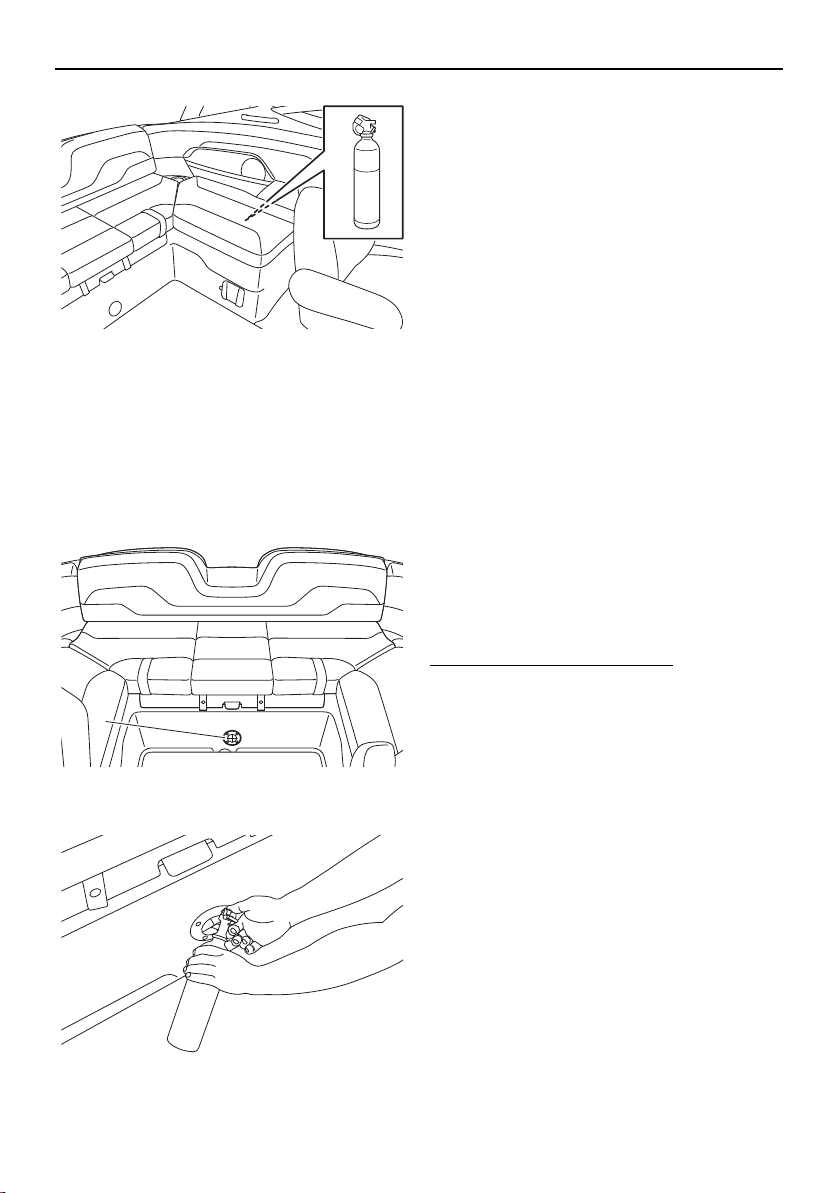
Pre-operation checks
128
Operating the fire extinguisher
A chemical-type fire extinguisher may not
help when sprayed into the engine compart-
ment through the FIRE-PORT™ because that
type needs to be aimed directly at the base of
the flames to be effective. See below for
FIRE-PORT™ information.
1 FIRE-PORT™
A FIRE-PORT™ is mounted below the rear
center seat. Use this port to spray the con-
tents of a fire extinguisher into the engine
compartment if a fire breaks out in the engine
area. WARNING! If there is a fire in the en-
gine compartment, opening the hatch will
add more oxygen to the fire, increasing the
risk of a larger fire or an explosion.
If you see smoke or otherwise suspect a fire,
you can look through the transparent flaps of
the FIRE-PORT™ to look for signs of flames.
If there is a fire, push the nozzle of the fire ex-
tinguisher through the FIRE-PORT™ and fol-
low the manufacturer’s instructions to empty
the contents of the fire extinguisher into the
engine compartment.
A “clean agent” type fire extinguisher is rec-
ommended; a chemical-type fire extinguisher
may not be adequate in this application.
Access port cap check
Make sure that the access port caps are se-
curely installed.
To check the access port caps:
(1) Open the rear platform hatch. (See page
98 for information on the rear platform
hatch.)
(2) Make sure that the access port caps are
securely installed. If they are removed or
are not locked, securely install them.
(See page 178 for information on the ac-
cess port caps.)
1
SportsBoat_F3R11.book Page 128 Friday, May 19, 2017 9:35 AM
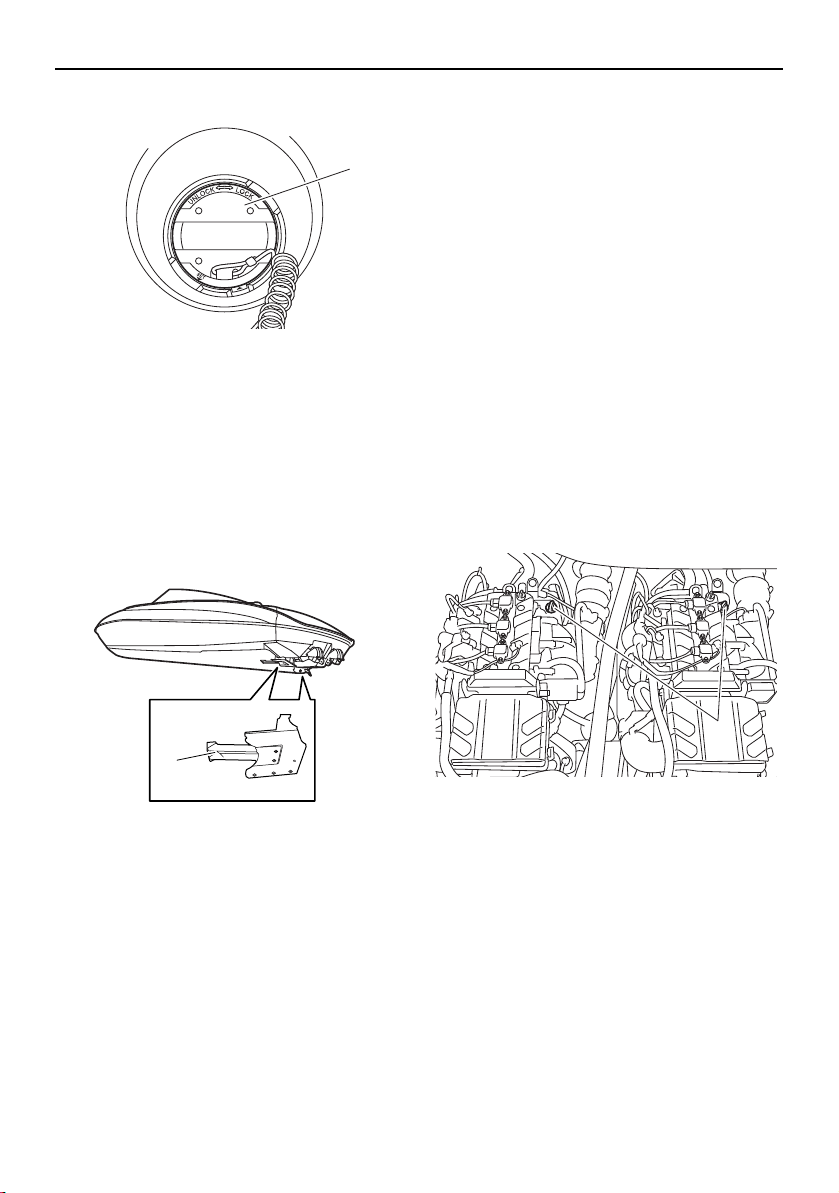
Pre-operation checks
129
1 Access port cap
(3) Close the rear platform hatch.
Jet intake checks
Carefully check the jet intakes under the boat
for weeds, debris, or anything else that might
restrict the intake of water. If the intakes are
clogged, cavitation could occur, reducing jet
thrust, and possibly damaging jet pump parts.
1 Jet intake
In some cases, the engines may overheat be-
cause of a lack of cooling water, and damage
could result. If the jet intakes are clogged,
clean them. (See page 178 for information on
the jet intakes.) WARNING! Rotating parts
could cause severe injury or death. Before
attempting to remove weeds or debris
from the jet intakes or impeller areas; shut
off the engines, remove the main switch
keys, and then remove the engine shut-off
cord (lanyard) from the engine shut-off
switch.
Fuel system checks
Check the fuel filler hoses and joints in the en-
gine compartment for damage, looseness,
and signs of leaking. At least annually, or if a
problem is suspected, check the fuel tank and
fuel filler hoses and clamps. Have a Yamaha
Boat Dealer check the fuel tank and fuel filler
hoses and clamps.
Engine oil level check
Make sure that the engine oil level is between
the minimum level mark and maximum level
mark on the dipstick. (See page 117, 118 for
information on checking the engine oil level.)
3-star models (AR210 / SX210)
1 Oil tank filler cap/Dipstick
1
1
1
SportsBoat_F3R11.book Page 129 Friday, May 19, 2017 9:35 AM
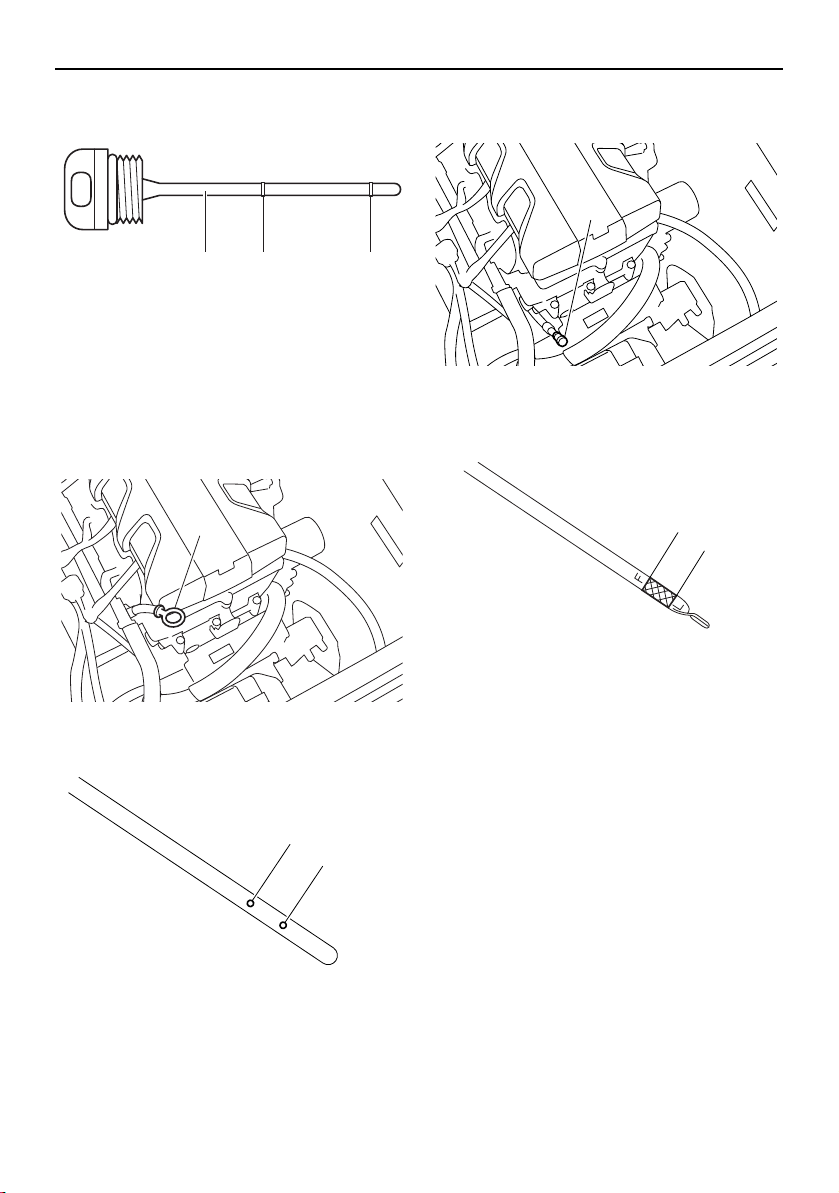
Pre-operation checks
130
1 Dipstick
2 Maximum level mark
3 Minimum level mark
3-star models
(212X / 212 Limited S / 212 Limited)
1 Dipstick
1 Maximum level mark
2 Minimum level mark
4-star models
(212X / 212 Limited S / 212 Limited)
1 Dipstick
1 Maximum level mark
2 Minimum level mark
FL
21 3
1
2
1
1
2
1
SportsBoat_F3R11.book Page 130 Friday, May 19, 2017 9:35 AM
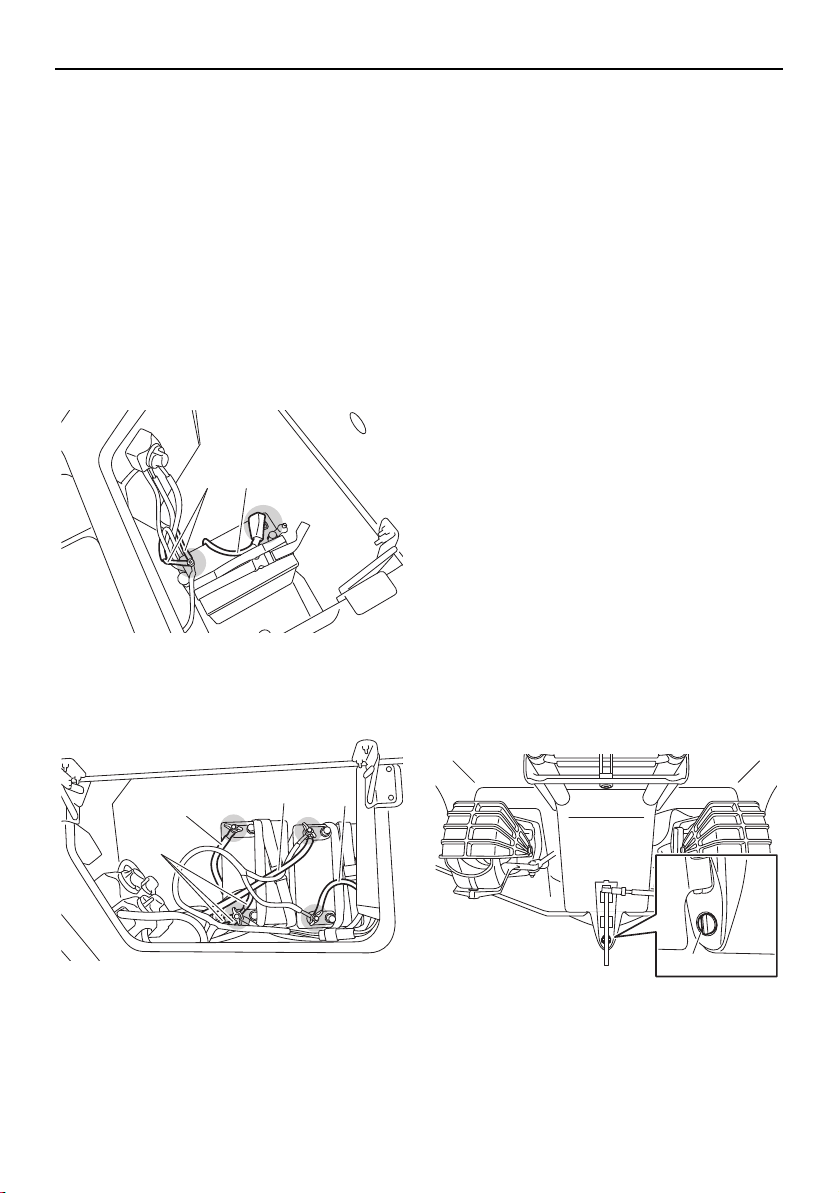
Pre-operation checks
131
Battery check
Make sure that the battery terminals are not
damaged and that the battery leads are con-
nected properly. (See pages 160 and 161 for
battery cover removal and installation proce-
dures.) WARNING! The battery must al-
ways be fully charged and in good
condition. Loss of battery power may
leave you stranded. Never operate the
boat if the battery does not have sufficient
power to start the engines or if it shows
any other signs of decreased power.
AR210 / SX210
1 Positive (+) battery terminal: Red lead
2 Negative (–) battery terminal: Black lead
212X / 212 Limited S / 212 Limited
1 Positive (+) battery terminal: Red lead
2 Negative (–) battery terminal: Black lead
Bilge water check
Make sure that no bilge water has collected in
the engine compartment and the fuel tank
compartment. If bilge water has collected in
the engine compartment and the fuel tank
compartment, drain it. (See page 120 for in-
formation on draining the bilge water.)
Drain plug check
Loosen the drain plugs and remove them, and
then make sure that the plugs and the O-ring
on the hull drain plug are not damaged and
that there is no foreign material on the threads
or the O-ring on the hull drain plug. NOTICE:
Before installing the drain plugs, clean the
drain plug threads and the O-ring on the
hull drain plug to remove any foreign ma-
terials, such as dirt or sand. Otherwise, the
drain plugs could be damaged, allowing
water to enter the engine compartment or
the fuel tank compartment. Make sure that
the drain plugs are tightened securely be-
fore launching the boat. Otherwise, water
may flood the boat and cause it to sub-
merge.
Securely install the drain plugs by tightening
them until they stop.
1 Hull drain plug
12
2
1
1
2
1
SportsBoat_F3R11.book Page 131 Friday, May 19, 2017 9:35 AM
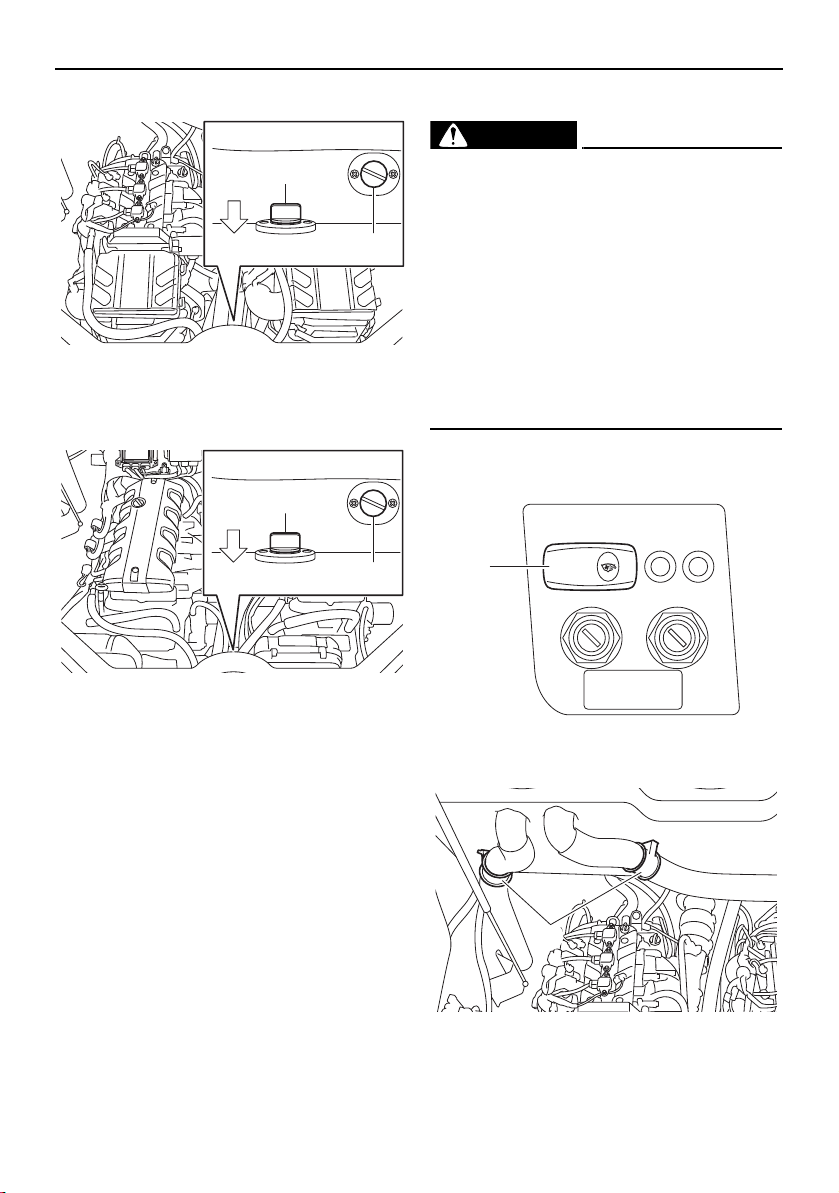
Pre-operation checks
132
AR210 / SX210
1 Fuel tank compartment drain plug
2 Engine compartment drain plug
212X / 212 Limited S / 212 Limited
1 Fuel tank compartment drain plug
2 Engine compartment drain plug
Blower switch check (AR210 / SX210)
WARNING
Gasoline vapors can explode. Before
starting the engines, check the engine
compartment for gasoline, gasoline va-
pors, and loose electrical connections,
and then operate the blowers for at least 4
minutes. Do not start the engines or oper-
ate the blowers if you can smell gasoline
vapors in the engine compartment or if
there are any loose electrical connections.
Contact a Yamaha Boat Dealer if there is a
problem you cannot locate or correct.
Make sure that the blowers operate properly
when the blower switch is pushed.
1 Blower switch
1 Blower
1
2
BOW
1
2
BOW
BLOWER
1
1
SportsBoat_F3R11.book Page 132 Friday, May 19, 2017 9:35 AM
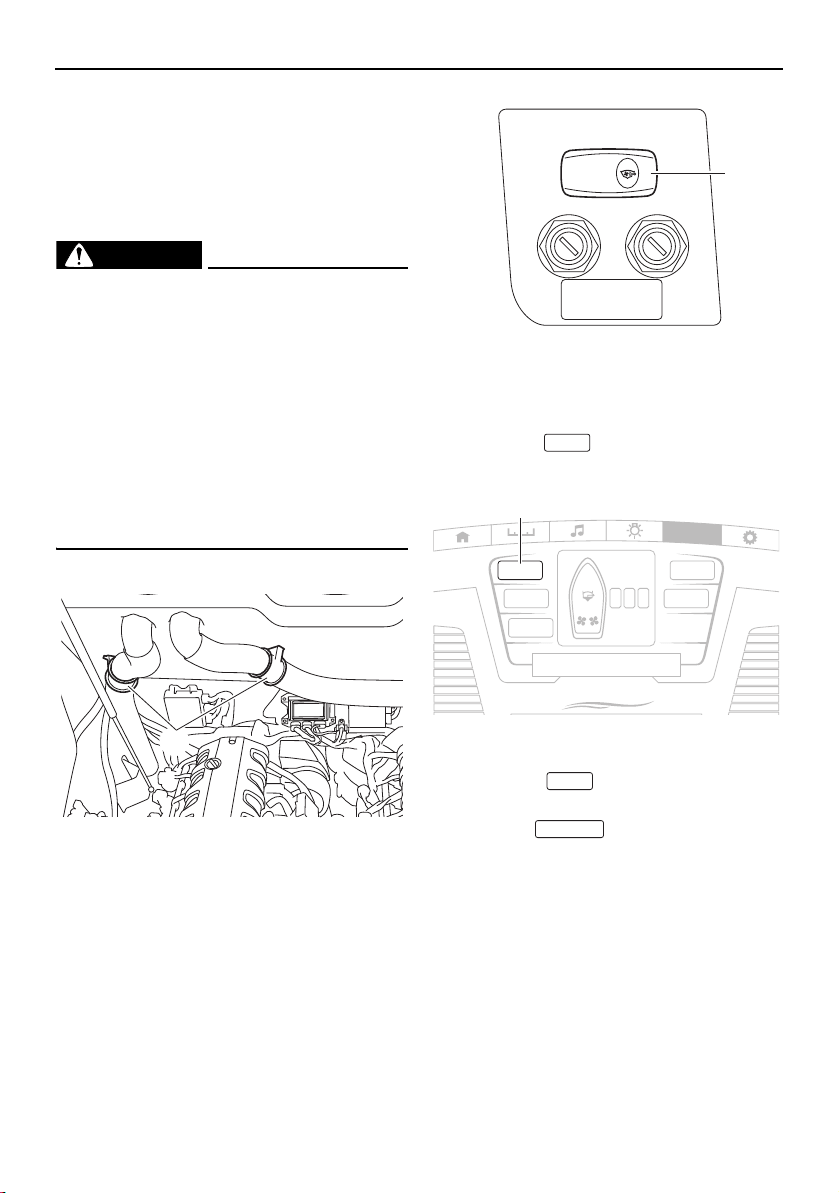
Pre-operation checks
133
Push the blower switch to operate the blowers
and ventilate the engine compartment for at
least 4 minutes.
Blower checks
(212X / 212 Limited S / 212 Limited)
WARNING
Gasoline vapors can explode. Before
starting the engines, check the engine
compartment for gasoline, gasoline va-
pors, and loose electrical connections,
and then operate the blowers for at least 4
minutes. Do not start the engines or oper-
ate the blowers if you can smell gasoline
vapors in the engine compartment or if
there are any loose electrical connections.
Contact a Yamaha Boat Dealer if there is a
problem you cannot locate or correct.
Make sure that the blowers operate properly.
1 Blower
(1) Push the blower switch and check that
the blowers operate.
1 Blower switch
(2) Push the blower switch to turn off the
blowers.
(3) Tap the “ ” button and check that
the blowers operate.
1 “Blower” button
(4) Tap the “ ” button to turn off the
blowers.
(5) Tap the “ ” button and check that
the blowers operate.
1
BLOWER
1
Blower
0
VOLUME
% 0 ft
SYS
12.3V
AUX
12.3V
FLOAT MODE
DEPTH
S
Y
S
C
TR
L
AUTO
AUTO
Ballast
Blower
Auto Blowr
Bilge
Auto Bilge
AUTO bilge deplete battery
1
Blower
Auto Blowr
SportsBoat_F3R11.book Page 133 Friday, May 19, 2017 9:35 AM
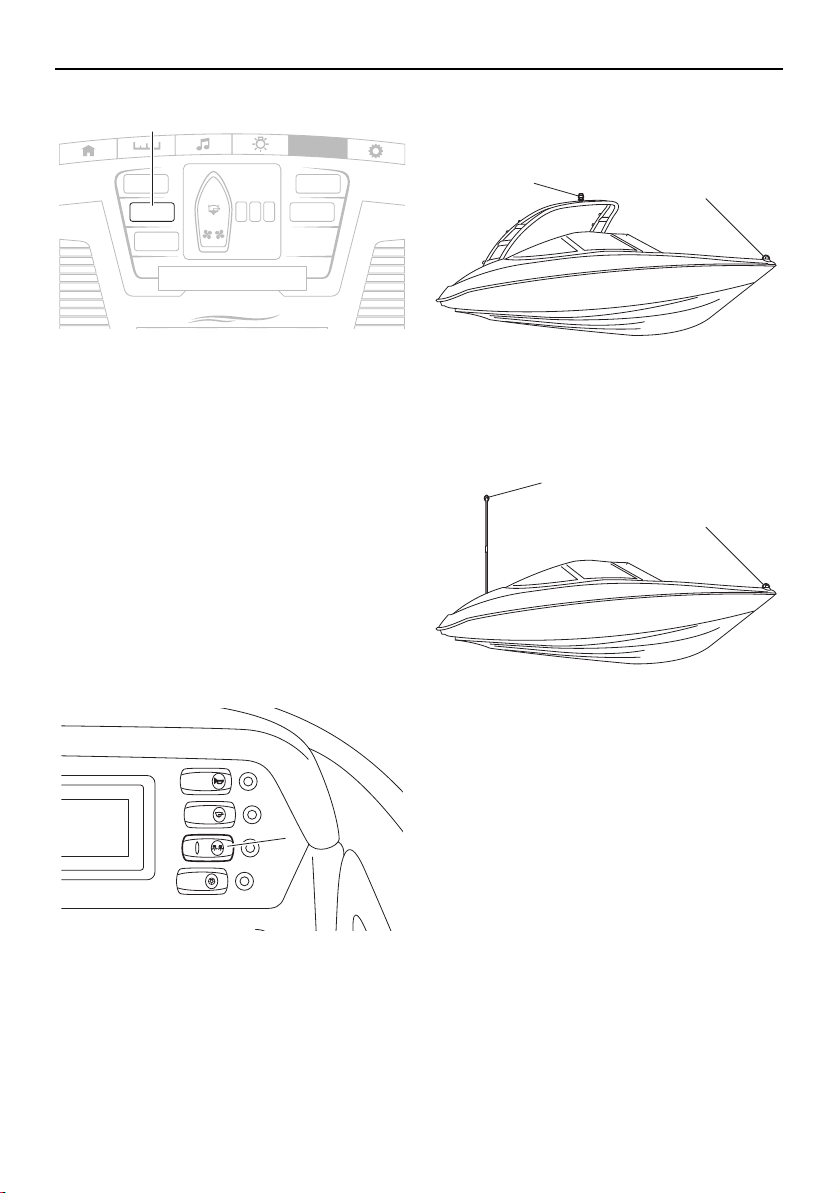
Pre-operation checks
134
1 “Auto Blowr” button
(6) Check that the blowers turn off after 4
minutes.
Navigation and anchor lights switch
check (AR210 / SX210)
Push the navigation and anchor lights switch
and check that the bow light and anchor light
come on.
(1) SX210: Install the anchor light. (See page
101 for information on the anchor light.)
(2) Push the right side of the navigation and
anchor lights switch and check that the
bow light and anchor light come on.
1 Navigation and anchor lights switch
AR210
1 Bow light
2 Anchor light
SX210
1 Bow light
2 Anchor light
(3) Push the left side of the navigation and
anchor lights switch and check that only
the anchor light comes on.
(4) Put the navigation and anchor lights
switch in the middle position and check
that the bow light and anchor light are off.
(5) SX210: Remove the anchor light.
0
VOLUME
% 0 ft
SYS
12.3V
AUX
12.3V
FLOAT MODE
DEPTH
S
Y
S
C
T
R
L
AUTO
AUTO
Ballast
Blower
Auto Blowr
Bilge
Auto Bilge
AUTO bilge deplete battery
1
BILGE
NAVI
ANC
HORN
CTSY
LIGHTS
1
1
2
1
2
SportsBoat_F3R11.book Page 134 Friday, May 19, 2017 9:35 AM
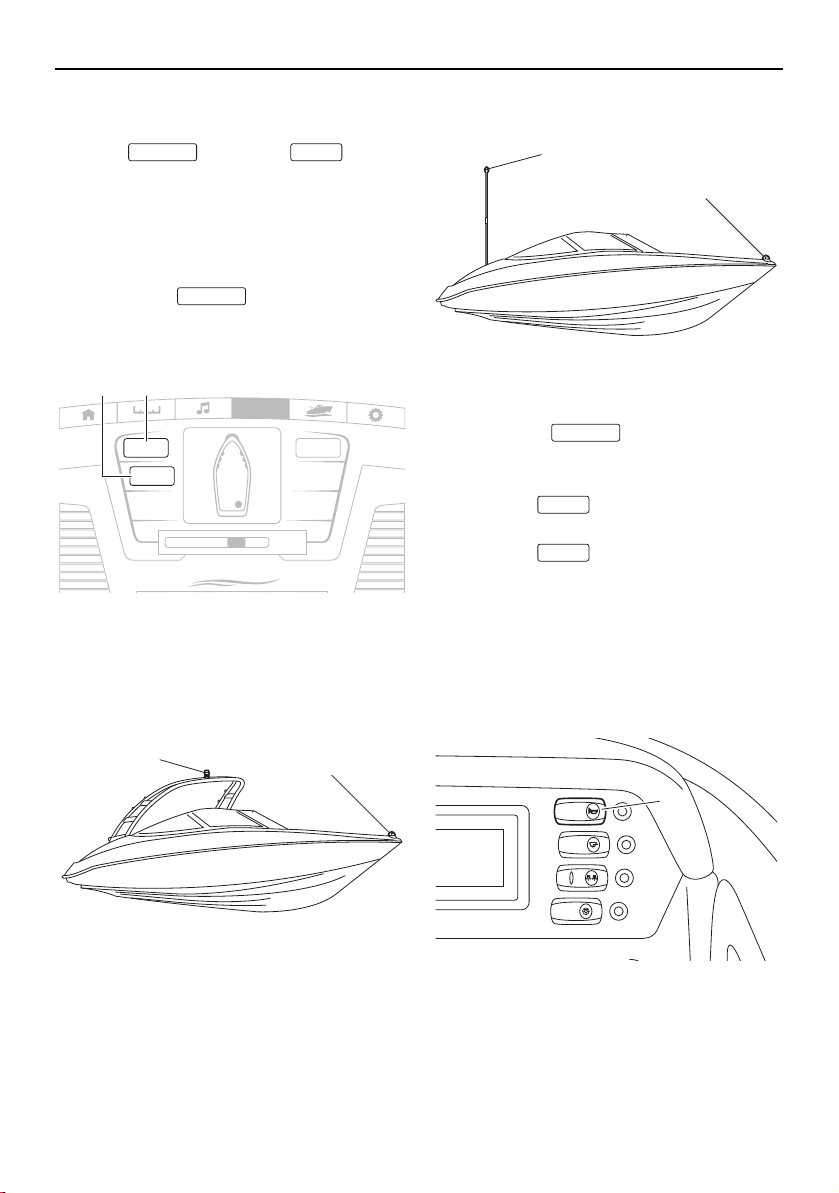
Pre-operation checks
135
Navigation and anchor lights checks
(212X / 212 Limited S / 212 Limited)
Tap the “ ” button or “ ” button,
and check that the bow light and anchor light
come on.
(1) 212 Limited: Install the anchor light. (See
page 101 for information on the anchor
light.)
(2) Tap the “ ” button, and then
check that the bow light and anchor light
come on.
1 “Anchor” light button
2 “Navigation” light button
212 X / 212 Limited S
1 Bow light
2 Anchor light
212 Limited
1 Bow light
2 Anchor light
(3) Tap the “ ” button, and then
check that the bow light and anchor light
go off.
(4) Tap the “ ” button, and then check
that only the anchor light comes on.
(5) Tap the “ ” button, and then check
that the anchor light goes off.
(6) 212 Limited: Remove the anchor light.
Horn check
Push the horn switch/button and check that
the horn sounds.
AR210 / SX210
1 Horn switch
Navigation Anchor
Navigation
0
VOLUME
%
0
ft
SYS
12.3V
AUX
12.3V
FLOAT MODE
DEPTH
LIGHT
72 %
Navigation
Anchor
Courtesy
1 2
1
2
1
2
Navigation
Anchor
Anchor
BILGE
NAVI
ANC
HORN
CTSY
LIGHTS
1
SportsBoat_F3R11.book Page 135 Friday, May 19, 2017 9:35 AM
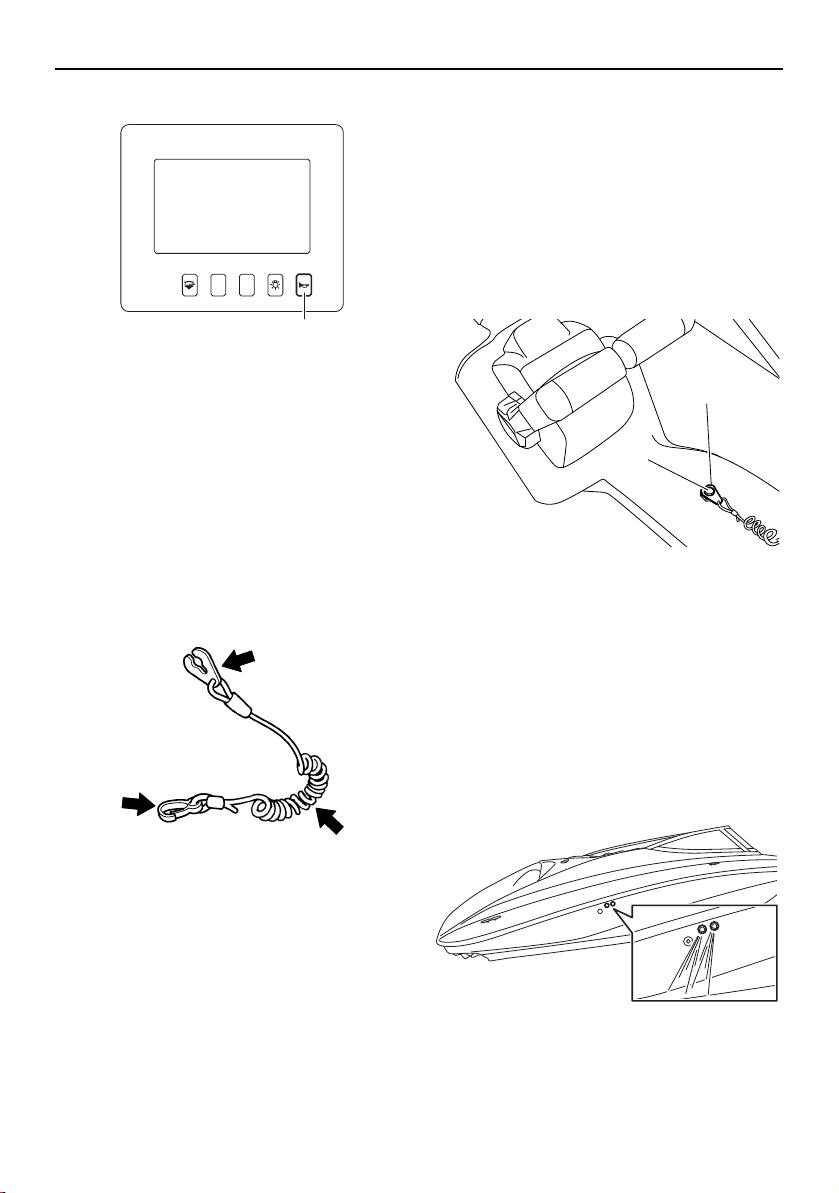
Pre-operation checks
136
212X / 212 Limited S / 212 Limited
1 Horn button
Engine shut-off cord (lanyard) check
Make sure that the engine shut-off cord (lan-
yard) is not damaged. If the cord is damaged,
replace it. WARNING! Never try to repair
the engine shut-off cord (lanyard) or tie it
together. The engine shut-off cord (lan-
yard) may not pull free when the operator
falls off, allowing the boat to continue to
run and cause an accident.
Post-launch checks
Perform the post-launch checks in the pre-op-
eration checklist while the boat is in the water
and the engines are running.
Engine shut-off switch check
Check the engine shut-off switch for proper
operation.
(1) Start the engines. (See page 138 for in-
formation on starting the engines.)
(2) Pull the engine shut-off cord (lanyard) to
remove the clip from the engine shut-off
switch to make sure that the engines stop
immediately.
(3) Make sure that the engines cannot be
started with the clip removed from the en-
gine shut-off switch.
1 Engine shut-off switch
2 Clip
Cooling water pilot outlet check
Check that water comes out from the pilot out-
lets while the engines are running in the wa-
ter. If water is not circulating, something may
be clogging the intake grates. Refer to “Jet
pump clean-out procedure” on page 178.
TIP:
It may take up to 20 seconds for water to
reach the pilot outlets when first launching the
TRIP
INFO
SYS
CTRL
1
1
2
SportsBoat_F3R11.book Page 136 Friday, May 19, 2017 9:35 AM
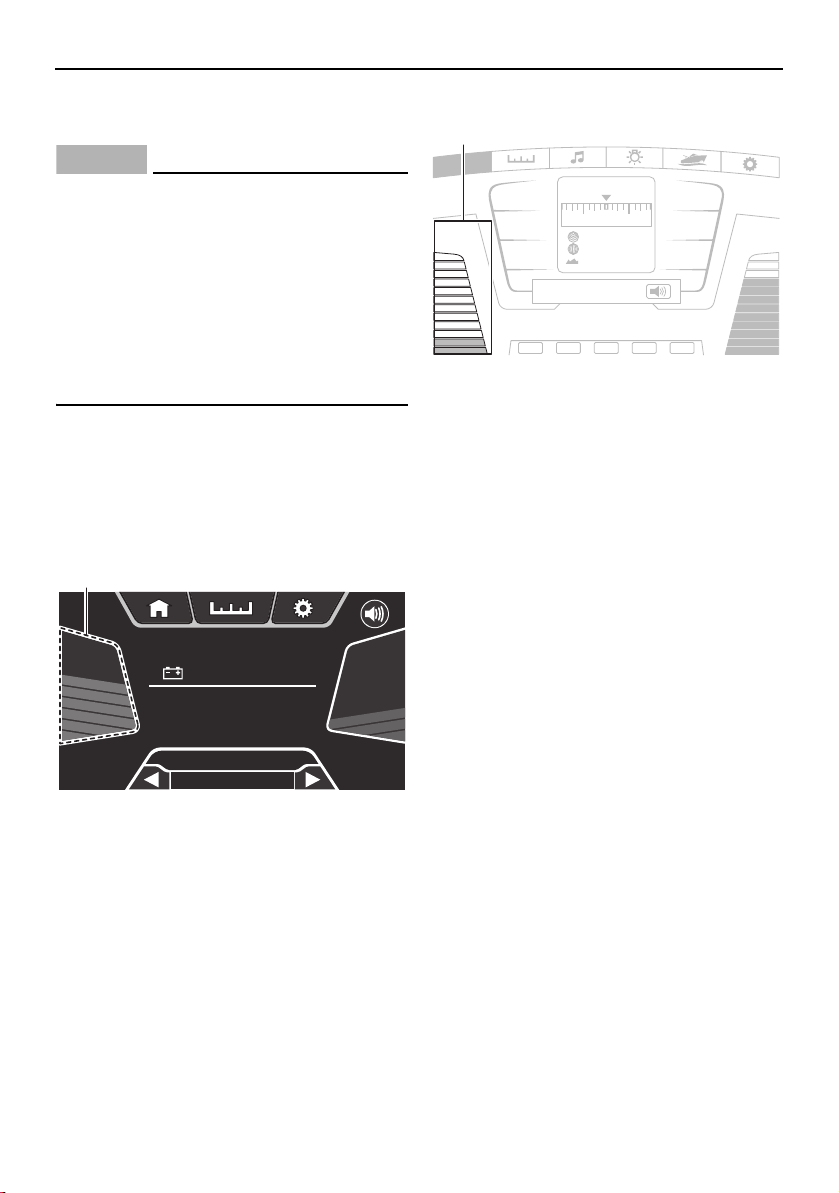
Pre-operation checks
137
boat. The amount and force of the exiting wa-
ter will vary with engine speed.
NOTICE
A continuous flow of water from the pilot
outlets shows that water is flowing
through the engine cooling water passag-
es. If water is not flowing out of the pilot
outlets during operation, do not continue
to run the engines. Overheating and seri-
ous damage could occur. (See “Engine
overheat warning system” on page 55, 84
for more information.)
Fuel level check
Check the amount of fuel remaining in the fuel
tank using the fuel level bar graph on the
multi-function display.
AR210 / SX210
1 Fuel level bar graph
212X / 212 Limited S / 212 Limited
1 Fuel level bar graph
Add fuel if necessary. (See page 115 for infor-
mation on filling the fuel tank.)
1.5 Hrs
PORT
1.6 Hrs
STBD
STBD 1.6 Hrs
Water
77˚F
12.0V
- Float Mode -
4
Depth
ft
50
Fuel
%
10:15 am
1
NavAnc
BLWRBILGE BALLCTY LT
SYS
12.3 V
25
FUEL
% 22 ft
AUX
13.2 V
RPM
1300
RPM
1300
MPH
0
DEPTH
H
O
M
E
360
N
EW
NENW
02:18 PM
LAT
LONG
ELEV
00˚00’00”N
00˚00’00”E
0 FT
1
SportsBoat_F3R11.book Page 137 Friday, May 19, 2017 9:35 AM
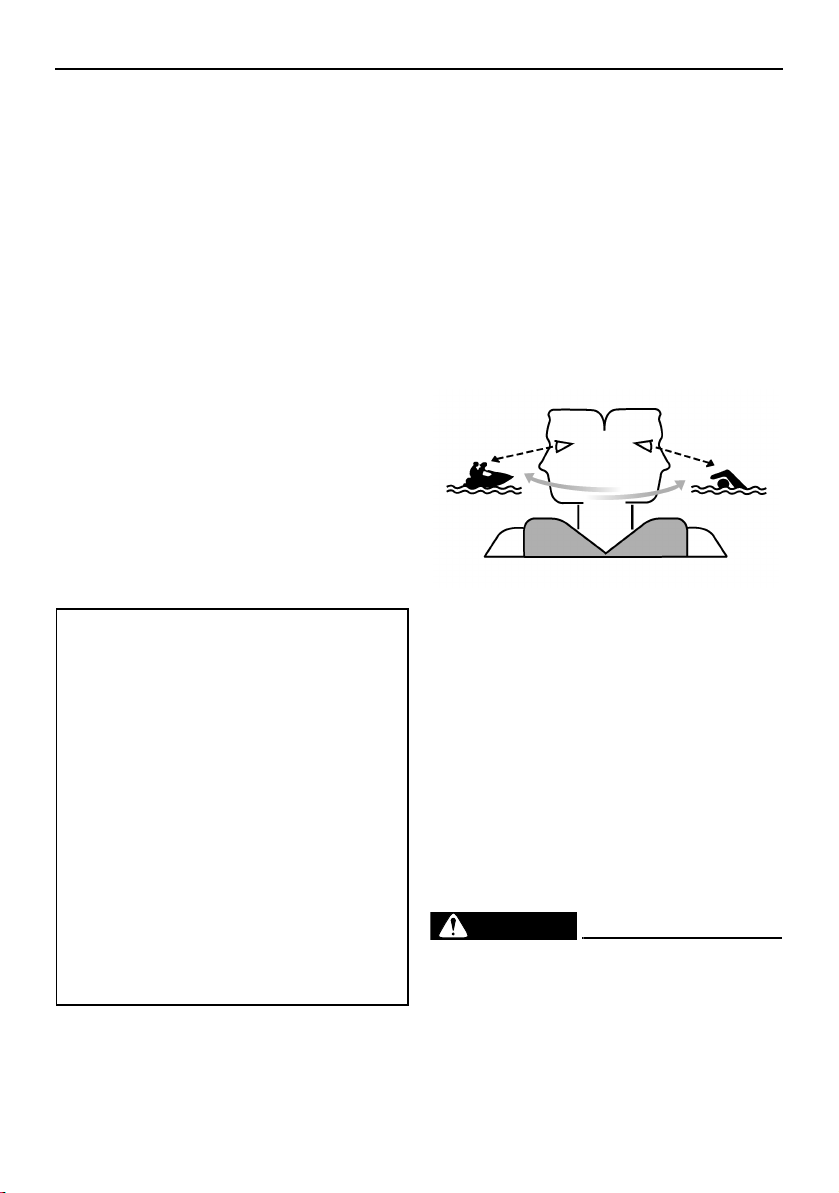
138
Operation
Driving your boat
Getting to know your boat
Operating your boat requires skills acquired
through practice over a period of time. Take
the time to learn the basic techniques well be-
fore attempting more difficult maneuvers.
Boating with your new boat can be a very en-
joyable activity, providing you with hours of
pleasure. But it is essential to familiarize your-
self with the operation of the boat to achieve
the skill necessary to enjoy boating safely.
Before operating this boat, read this own-
er’s/operator’s manual, the Operation Instruc-
tion card, and all labels on the boat. Pay
particular attention to the safety information
beginning on page 14. Also, watch the Basic
Orientation Video provided with your boat.
These materials should give you an under-
standing of the boat and its operation. This
boat is designed to carry one operator and up
to 9 passengers.
Learning to operate your boat
Before boating, always perform the pre-oper-
ation checks listed on page 124. The short
time spent checking the boat will reward you
with added safety and reliability.
Know and follow U.S. Coast Guard, state, and
local laws when operating your boat.
Select a wide area to learn in, where visibility
is good and other boat traffic is light. Keep the
proper distance from other boats and vehi-
cles. Do not operate where people are swim-
ming.
Always attach the engine shut-off cord (lan-
yard) to your PFD before operating.
You and all other passengers must always
wear a USCG-approved PFD when riding in
the boat. You should consider wearing water
shoes, eye protection, and other protective
apparel. Water sports increase your risk of in-
jury from contact with your boat, other ves-
sels, docks, rocks, or coral.
Grip the steering wheel firmly and keep both
feet on the deck when driving the boat.
Starting the engines
WARNING
Severe injury or death may result if you ig-
nore any of the following:
● Before operating your boat, become fa-
miliar with all controls. Consult a
Yamaha Boat Dealer about any control
or function you do not fully understand.
Maximum load (212X):
Total weight of cargo, operator, and
passengers:
952 kg (2100 lb): ballast is empty
495 kg (1092 lb): ballast is full
Total weight of operator and passen-
gers:
843 kg (1860 lb): ballast is empty
386 kg (852 lb): ballast is full
Maximum load (except for 212X):
Total weight of cargo, operator, and
passengers:
997 kg (2200 lb)
Total weight of operator and passen-
gers:
843 kg (1860 lb)
SportsBoat_F3R11.book Page 138 Friday, May 19, 2017 9:35 AM
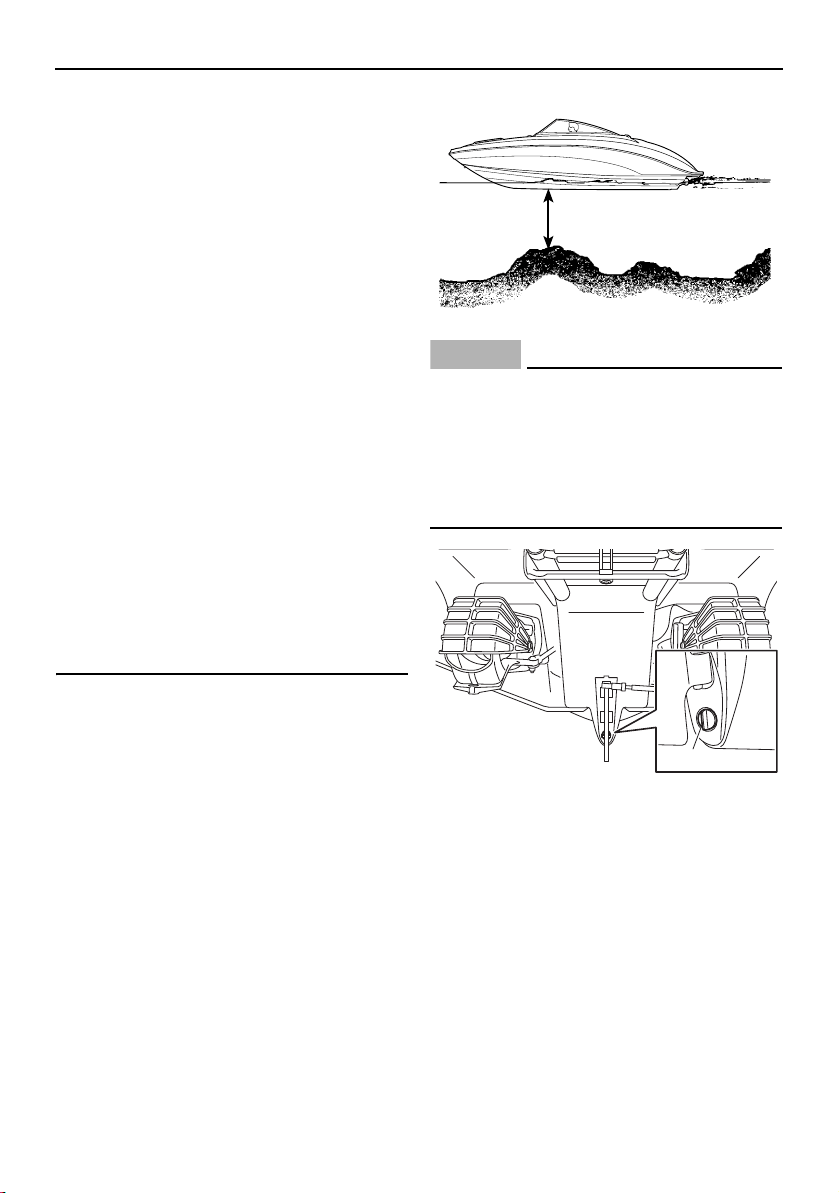
Operation
139
Failure to understand how the controls
work could cause an accident or prevent
you from avoiding an accident.
● Gasoline vapors can explode. Before
starting the engines, check the engine
compartment for gasoline, gasoline va-
pors, and loose electrical connections,
and then operate the blowers for at least
4 minutes. Do not start the engines or
operate the blowers if you can smell
gasoline vapors in the engine compart-
ment or if there are any loose electrical
connections. Contact a Yamaha Boat
Dealer if there is a problem you cannot
locate or correct.
● Attach the engine shut-off cord (lanyard)
to your PFD before operating. Failure to
attach the cord could result in a runaway
boat if the operator is ejected.
● Do not apply throttle when anyone is at
the rear of the boat. Turn the engines off
or keep them at idle. Water and debris
exiting the jet thrust nozzles can cause
severe injury.
(1) Always make sure the boat is launched
and used in waters that are free from
weeds and debris, and at least 90 cm
(3 ft) deep from the bottom of the boat.
WARNING! Never operate in water that
is less than 90 cm (3 ft) deep from the
bottom of the boat. You increase your
chance of hitting an underwater ob-
stacle. You could be injured. Pebbles
or sand can also be sucked into the jet
intakes, damaging the impellers.
NOTICE
There is a hull drain plug at the bottom of
the stern. Check the O-ring on the hull
drain plug and make sure that the plug is
tightened securely before launching the
boat. Otherwise, water may flood the boat
and cause it to submerge.
1 Hull drain plug
(2) Turn the battery switch to the ON (green)
position.
(3) AR210 / SX210: Push the blower switch
to operate the blowers and ventilate the
engine compartment for at least 4 min-
utes.
90 cm (3 ft)
1
SportsBoat_F3R11.book Page 139 Friday, May 19, 2017 9:35 AM
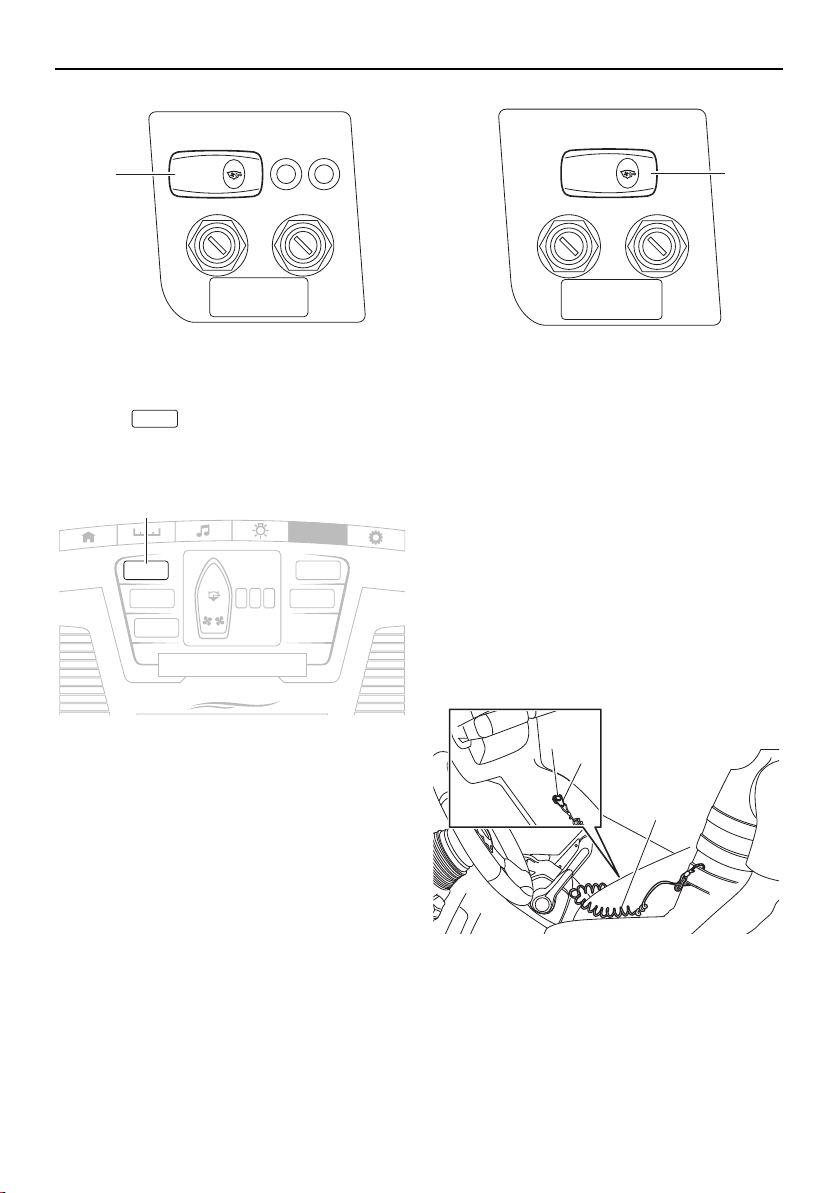
Operation
140
1 Blower switch
(4) 212X / 212 Limited S / 212 Limited: Tap
the “ ” button to operate the blow-
ers and ventilate the engine compart-
ment for at least 4 minutes.
1 “Blower” button
TIP:
You can also push the blower switch to venti-
late the engine compartment.
1 Blower switch
(5) Attach the engine shut-off cord (lanyard)
to your PFD. Install the clip onto the en-
gine shut-off switch by pushing the clip
groove over the nut beneath the knob. Be
sure the cord is not wrapped around the
steering wheel or tangled in the controls.
WARNING! Check that the engine
shut-off cord (lanyard) is attached cor-
rectly. If the engine shut-off cord (lan-
yard) is not attached correctly, it may
not pull free when the operator falls
off, allowing the boat to continue to
run and cause an accident.
1 Engine shut-off switch
2 Clip
3 Engine shut-off cord (lanyard)
BLOWER
1
Blower
0
VOLUME
% 0 ft
SYS
12.3V
AUX
12.3V
FLOAT MODE
DEPTH
S
Y
S
C
TR
L
AUTO
AUTO
Ballast
Blower
Auto Blowr
Bilge
Auto Bilge
AUTO bilge deplete battery
1
BLOWER
1
2
1
3
SportsBoat_F3R11.book Page 140 Friday, May 19, 2017 9:35 AM
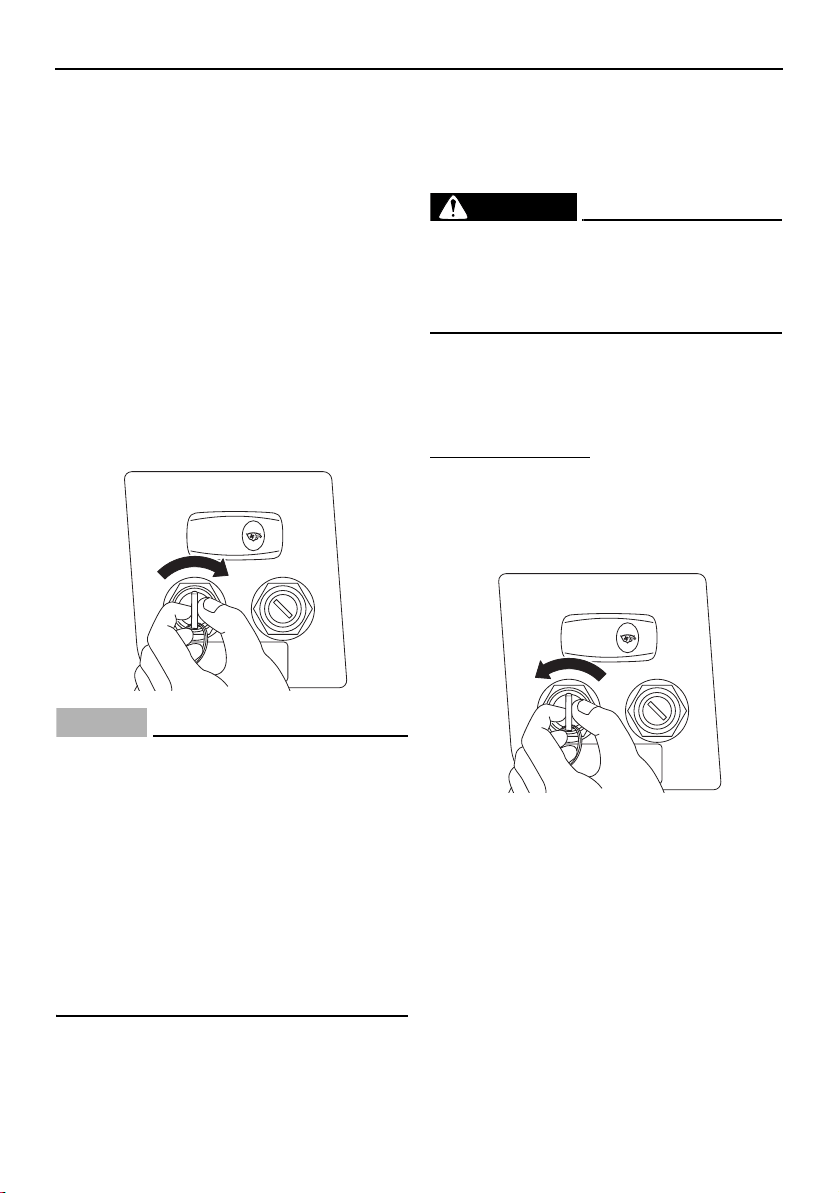
Operation
141
TIP:
The engines will not start when the clip is re-
moved from the engine shut-off switch. The
starter motors will turn over without the cord
attached.
(6) Put the remote control levers in the neu-
tral position. The starter motors will not
operate unless the remote control levers
are in neutral.
(7) Turn the main switch keys to the start po-
sition and release them when the engines
start. If the engines do not start after 5
seconds of cranking, release the keys.
Wait at least 15 seconds before trying to
start the engines again.
NOTICE
● Never turn the main switch keys to the
start position while the engines are run-
ning. The starter mechanisms could be
damaged.
● If the starter motors are engaged contin-
uously for more than 5 seconds, the bat-
tery will become quickly discharged and
it will be impossible to start the engines.
The starter motors may also be dam-
aged if they are engaged continuously
for more than 5 seconds.
On this boat, the engines are connected di-
rectly to the drive units. Starting either engine
generates some thrust immediately. Only
enough throttle should be applied to keep the
engine at a fast enough idle to stay running.
Stopping the engines
WARNING
Once the engines have stopped, you have
NO STEERING CONTROL over the boat.
You could collide with another boat, a
dock, or other obstacle.
Stopping the engines immediately after oper-
ating at high engine speeds is not recom-
mended. Let the engines cool off at idle or low
speed for a few minutes first.
To stop the engines:
(1) Return the remote control levers to the
neutral position.
(2) Turn the main switch keys to the off posi-
tion.
TIP:
The engines can also be stopped by pulling
the engine shut-off cord (lanyard).
(3) Remove the main switch keys and the
engine shut-off cord (lanyard) if the boat
will be left unattended.
BLOWER
BLOWER
SportsBoat_F3R11.book Page 141 Friday, May 19, 2017 9:35 AM
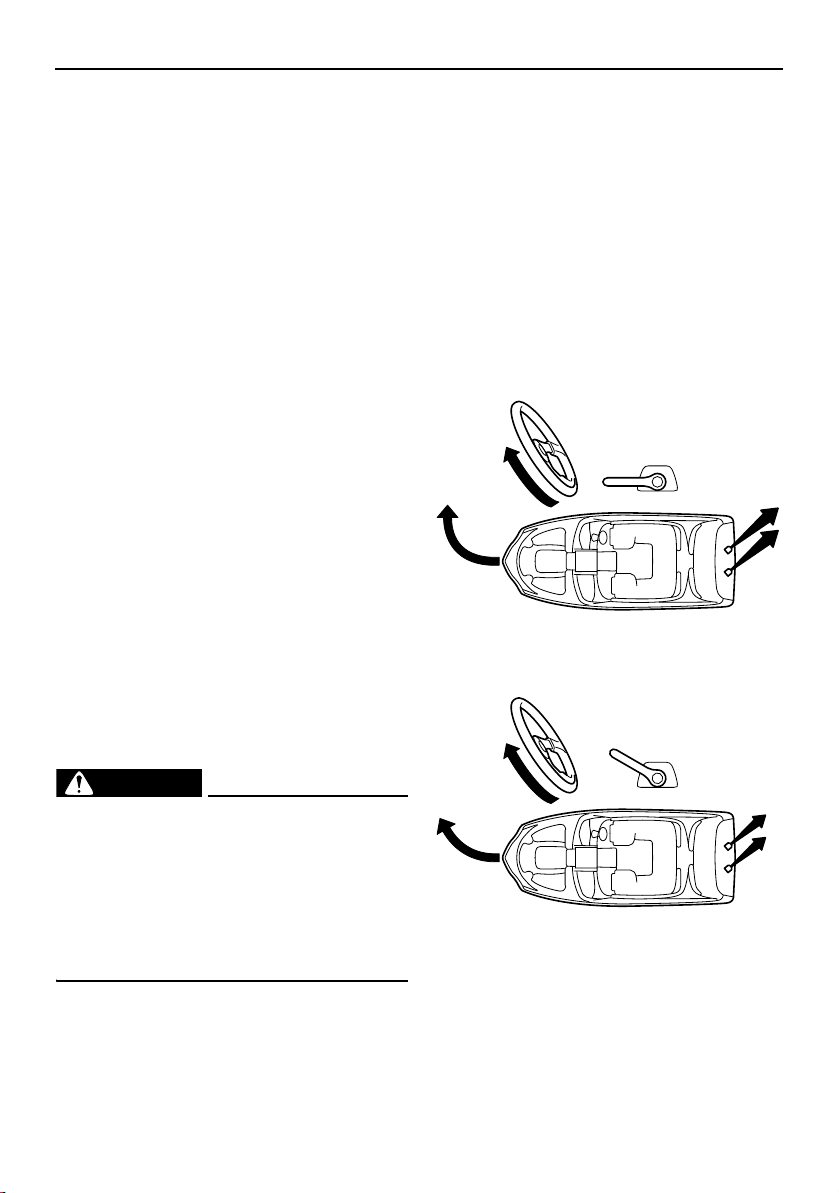
Operation
142
Leaving a dock
Because boats steer from the stern, the stern
first moves in the direction opposite your de-
sired turn. It is especially important to under-
stand this characteristic when leaving a dock.
If you move the remote control levers to the
forward position and simply turn the steering
wheel to steer the bow away from the dock, as
you would when driving a car out of a parking
space, you will drive the stern of the boat into
the dock.
The following steps are basic maneuvering
techniques which can be used in most circum-
stances:
(1) With the engines idling and the bow still
moored to the dock, turn the steering
wheel toward the dock. Moving the re-
mote control levers into the TDE position
or forward position will start to move the
stern of the boat away from the dock.
(2) When the stern is out a few feet, release
the bow mooring, and then turn the steer-
ing wheel to the center position or away
from the dock. Move the remote control
levers into the reverse position and move
away from the dock.
Turning the boat
WARNING
● Do not pull the remote control levers
back to idle when trying to steer away
from objects — you need throttle to
steer.
● Be sure passengers are holding on be-
fore making turns. An unprepared pas-
senger could lose balance and fall.
Steering control depends on the combination
of steering wheel position and the amount of
throttle.
Water sucked in through the intake grates is
pressurized by the impellers in the jet pumps.
As the pressurized water is expelled from the
pumps through the jet thrust nozzles, it cre-
ates thrust to move and steer the boat. The
higher the engine speed, the more thrust is
produced.
The amount of jet thrust, in addition to the po-
sition of the steering wheel, determines how
sharply you turn.
A. More throttle produces high thrust, so the
boat will turn more sharply.
B. Less throttle produces low thrust, so the
boat will turn more gradually.
A
B
SportsBoat_F3R11.book Page 142 Friday, May 19, 2017 9:35 AM
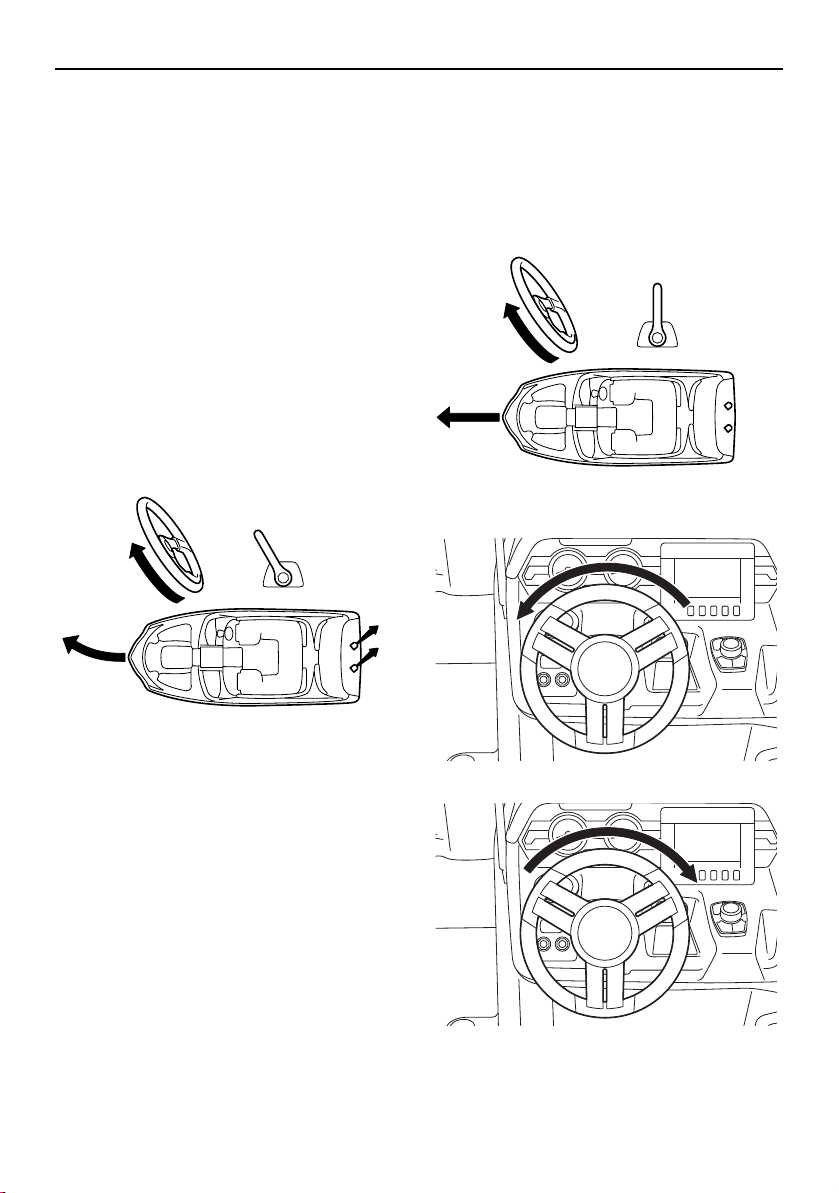
Operation
143
C. Pulling the remote control levers back to
idle or the neutral position produces only
minimum thrust. If you are traveling at
speeds above trolling, you will have rap-
idly decreasing ability to steer without
throttle. You may still have some turning
ability immediately after pulling the re-
mote control levers back to idle, but when
the engines slow down, the boat will no
longer respond to steering wheel input
until you apply throttle again or you reach
a trolling speed.
At trolling speed, the boat can be turned
gradually by steering wheel position
alone using just the amount of thrust
available at engine idle.
D. If the boat is moving and the remote con-
trol levers are in the neutral position, or if
there is no thrust because the engines
are stopped, the boat will go straight even
though the steering wheel is turned. You
need throttle to steer.
Turning left
Turning right
C
D
SportsBoat_F3R11.book Page 143 Friday, May 19, 2017 9:35 AM
Operation
144
Boating with passengers
WARNING
When passengers are on board, make
sure they are seated and holding onto the
handgrips, handrails, or straps before you
start to accelerate. An unprepared passen-
ger could lose balance and fall.
Your boat is designed for one operator and up
to 9 passengers only. Never have more than
10 people in the boat. Passengers must sit in
one of the seats and hold onto the handgrips.
Passengers should sit so the weight in the
boat is balanced from side-to-side and bow-
to-stern as much as possible. If the passenger
seat in front of the helm is used, be sure the
operator’s view ahead is not obstructed.
Stopping the boat
WARNING
● Allow adequate stopping distance.
● Take early action to avoid collisions. Re-
member, boats do not have brakes.
● Operate defensively at safe speeds and
keep a safe distance away from people,
objects, and other boats to give you time
to stop.
● Do not shut the engines off when slow-
ing down in case you need engine power
to steer away from a boat or other obsta-
cle that comes into your path.
● You will lose steering control if you
completely pull the remote control le-
vers back to idle. You need throttle to
steer.
● Do not use the reverse function to slow
down or stop the boat from planing
speed as it could cause you to lose con-
trol, be ejected, or impact the steering
wheel or other parts of the boat. This
could increase the risk of serious injury.
The boat is not equipped with a separate
braking system. It is stopped by water resis-
tance after the remote control levers are
moved back to idle. From full speed, the boat
stops in approximately 105 m (344 ft) for the
AR210 / SX210 or 140 m (459 ft) for the
212X / 212 Limited S / 212 Limited after the
remote control levers are moved back to idle.
The stopping distance varies depending on
gross weight, water surface conditions, and
wind direction. The stated straight-line stop-
ping distance should be used for a reference.
The boat slows down as soon as the remote
control levers are returned to idle but will
coast for a distance before fully stopping. If
you are not sure you can stop in time before
Maximum load (212X):
Total weight of cargo, operator, and
passengers:
952 kg (2100 lb): ballast is empty
495 kg (1092 lb): ballast is full
Total weight of operator and passen-
gers:
843 kg (1860 lb): ballast is empty
386 kg (852 lb): ballast is full
Maximum load (except for 212X):
Total weight of cargo, operator, and
passengers:
997 kg (2200 lb)
Total weight of operator and passen-
gers:
843 kg (1860 lb)
SportsBoat_F3R11.book Page 144 Friday, May 19, 2017 9:35 AM
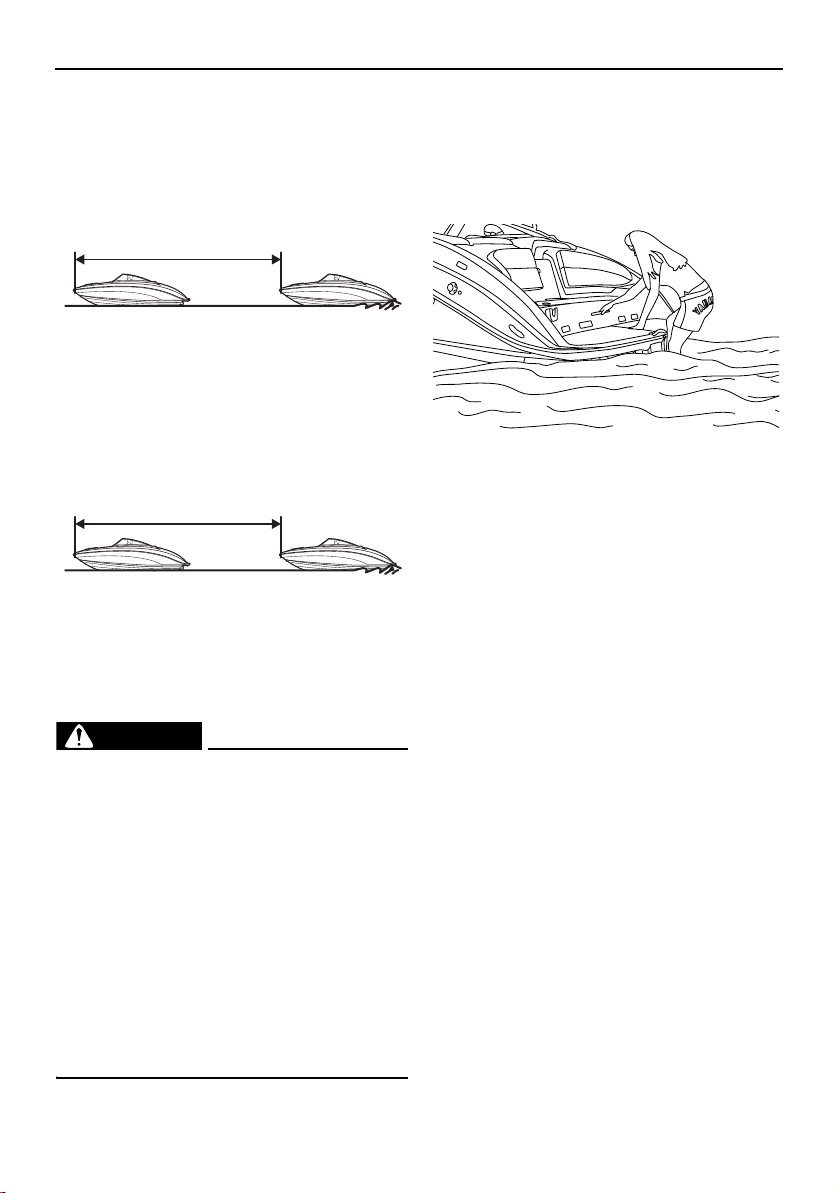
Operation
145
hitting an obstacle, apply throttle and turn in
another direction.
AR210 / SX210
212X / 212 Limited S / 212 Limited
Boarding from the water
WARNING
To avoid severe injury or death, do not
board from the rear, use swim platform, or
swim behind boat if the engines are run-
ning.
● Severe internal injuries can occur if wa-
ter is forced into body cavities as a re-
sult of being near the jet thrust nozzles.
● Exhaust gases coming from underneath
the swim platform contain carbon mon-
oxide, a colorless, odorless gas which
may cause brain damage or death when
inhaled. Symptoms include nausea, diz-
ziness, and drowsiness.
(1) Be sure the engines are off, and then
move to the stern of the boat.
(2) Pull out the stern ladder and climb up
onto the swim platform. (See page 103
for information on the stern ladder.)
(3) Return the stern ladder to the stowed po-
sition, and then sit in one of the seats pro-
vided.
Boarding from the bow
A bow ladder is available when boarding from
the bow of the boat is desired, when the boat
is beached. (See page 102 for bow ladder us-
ing procedures.)
Boarding from a dock or landing jetty
(1) Board the boat from the side. One person
should board at a time by stepping into
the boat. Never jump in. Avoid stepping
on slick gelcoat surfaces on the boat’s
gunwales, especially if wet.
(2) Sit in one of the seats provided and put
both feet on the deck.
Docking
(1) Make sure no obstructions, boats, or
swimmers are close to the boat. Come to
a stop before you reach the dock.
(2) Notice how wind and water currents are
affecting boat movement as you attach
your mooring lines and fenders.
105 m (344 ft)
140 m (459 ft)
SportsBoat_F3R11.book Page 145 Friday, May 19, 2017 9:35 AM
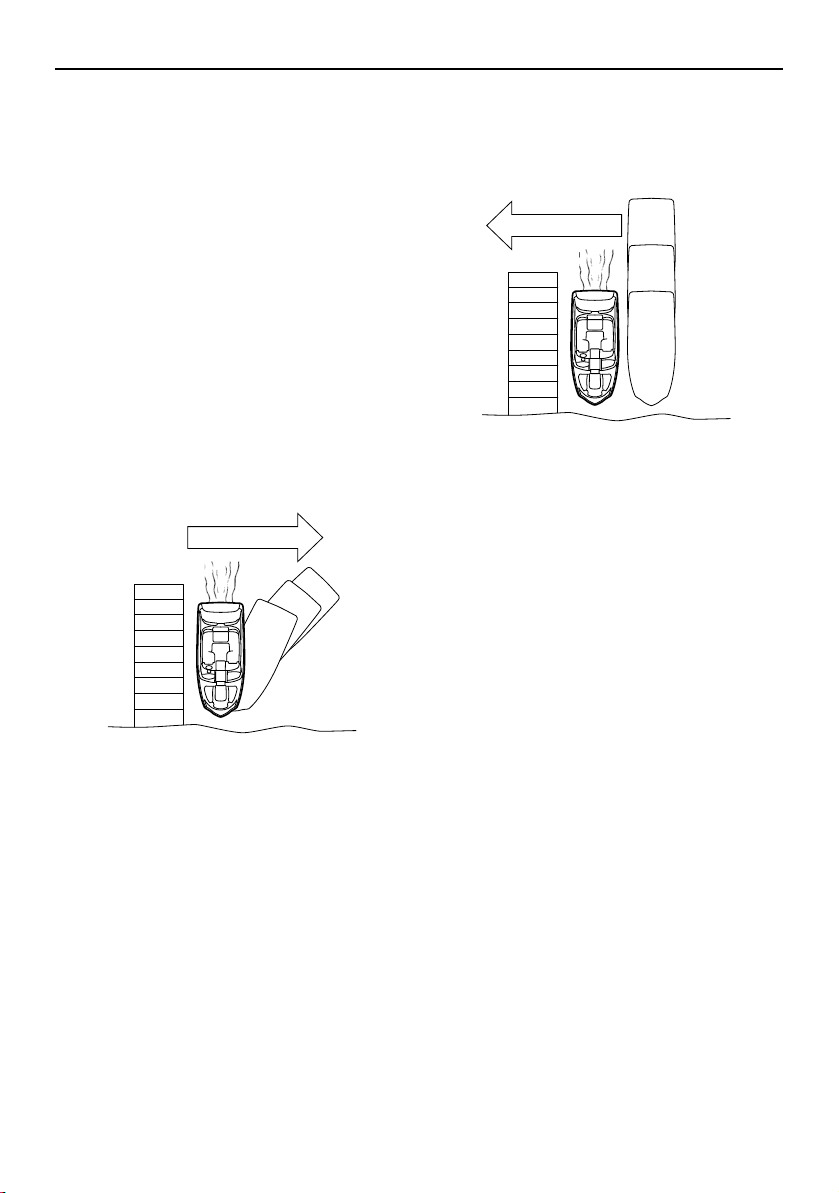
Operation
146
(3) Approach the dock at idle speed. Use re-
verse as necessary during slow-speed
maneuvering to help control speed and
direction. Position the boat according to
wind and water conditions. WARNING!
Do not use your hand, arm, or other
parts of your body to try to keep the
boat from hitting the dock. You could
be injured if the boat pushes against
the dock.
Wind or current pushing boat away from
dock:
Slowly approach the dock at about a 45° an-
gle. Secure the bow to the dock, and then use
engine thrust or a boat hook to gently move
the stern to the dock.
Wind or current pushing boat toward
dock:
Slowly maneuver to a shallow angle and allow
the boat to move toward the dock.
No wind or current:
Approach the dock at a shallow angle. Secure
the bow to the dock, and then use engine
thrust or a boat hook to gently move the stern
to the dock.
Wind or current
Wind or current
SportsBoat_F3R11.book Page 146 Friday, May 19, 2017 9:35 AM
Operation
147
Beaching
NOTICE
● Small pebbles, sand, seaweed, and oth-
er debris can be sucked into the jet in-
takes and impair or damage the
impellers. Always stop the engines be-
fore beaching the boat. Be sure the boat
is in water 90 cm (3 ft) deep from the bot-
tom of the boat before starting the en-
gines again.
● Do not beach the boat on rocky beach-
es. The hull gelcoat and exposed pump
housings can be damaged.
● Pay attention to shifts in tides. Beaching
at high tide may make it impossible to
re-launch the boat if the tide recedes.
(1) Make sure no obstructions, boats, or
swimmers are near the beach.
(2) Approach the beach slowly and stop the
engines when the water is about 90 cm
(3 ft) deep from the bottom of the boat.
Remember: turning is impossible with the
engines stopped.
(3) Get out of the boat and pull the bow up on
the beach.
(4) When leaving the beach, push the boat
out into water that is at least 90 cm (3 ft)
deep from the bottom of the boat before
starting the engines.
Anchoring
WARNING
Always anchor from the bow. Anchoring
from the stern will make the boat un-
steady. A strong current can pull a stern-
anchored boat underwater.
Select an anchor appropriate for your boat
and water conditions. A “Danforth” (or fluke)
type anchor is suitable for most applications;
your Yamaha Boat Dealer can help you
choose an anchor.
(1) Make sure the anchor line is securely tied
to the anchor and to the bow eye or a bow
cleat.
(2) Move the boat to the spot where you want
to lower the anchor, heading the boat into
the wind or current. Stop the boat, and
then lower the anchor until it hits bottom.
(3) While keeping tension on the line, slowly
back up the boat until you have let out line
that is 4–6 times the depth of the water.
For example, if you are anchoring in 10
feet of water, let out 40–60 feet of line.
Secure the line.
(4) Pull on the line to be sure the anchor is
holding. Also, periodically check your
boat’s position against the shoreline to
make sure it is not drifting and dragging
the anchor. Reset if necessary.
(5) To pull in (“weigh”) the anchor, start the
engines and move forward, keeping ten-
sion on the line as you pull it in. When the
anchor line is straight up and down, pull
hard to lift the anchor from the bottom
material.
SportsBoat_F3R11.book Page 147 Friday, May 19, 2017 9:35 AM

Operation
148
(6) If the anchor is stuck on the bottom, try
this: Let out a few feet of anchor line and
secure the line to the boat, again. Slowly
maneuver the boat around the anchor
until the anchor pulls loose. Keep the line
taut during this procedure.
Crossing wakes and swells
You will not always have flat, smooth water.
There will be swells and wakes from other
boats, etc.
The best way to cross wakes and swells is
with the least jolt to you and the boat. Small
swells are not as difficult to cross as larger
swells or wakes. Crossing a sharp wake gives
more of a jolt than a broad swell.
To cross a wake or swell, change your speed
and choose the angle at which you cross the
wake or swell. Usually, a slower speed and
“quartering” the wake (crossing at an angle)
will reduce the jolt.
Two other things you may notice. The first is
that crossing a group of wakes or swells is not
as easy or smooth as crossing just one wake.
The second is that when you quarter the wake
or swell, the boat will try to steer away from
the wake or swell. When crossing at a 45° an-
gle, you may not notice this, but at a smaller
angle, say 10°, it can be very strong. Be pre-
pared to steer and balance as necessary.
Sharp wakes
Broad swell
Wake
90˚
45˚
10˚
SportsBoat_F3R11.book Page 148 Friday, May 19, 2017 9:35 AM

Operation
149
Post-operation checks
These post-operation procedures are devel-
oped to help preserve the long-term appear-
ance and reliability of your boat. Perform
these procedures as soon as possible after
the boat is loaded back on the trailer after the
day’s use.
Some owners prefer to moor their boat sea-
sonally, rather than keeping it on the trailer
between uses. Extended mooring is not
recommended. Proper flushing of the cool-
ing system on each engine is not possible
with the boat in the water. In addition, condi-
tions such as stray electrical voltage in the
water, marine organisms, and saltwater corro-
sion can adversely affect the life of many boat
components. NOTICE: Leaving the boat in
the water for extended periods will accel-
erate the rate of normal deterioration of
the jet pump components, sacrificial an-
odes, hull finish and other components.
If you do decide to moor your boat, be sure to
remove it from the water periodically to clean
the hull and jet pump areas. The frequency of
maintenance required will depend upon
whether the water is salt water or fresh water
and other local water conditions.
(1) After putting the boat on the trailer, flush
the cooling system on each engine to
prevent the cooling system from clogging
up with salt, sand, or dirt. Refer to page
155 for the cooling system flushing pro-
cedure.
(2) Drain residual water from the exhaust
system by starting the engine, and then
alternately pushing the remote control le-
ver up to half throttle and back to idle for
10 to 15 seconds. NOTICE: Do not run
the engine over 4000 r/min on land. Al-
so, do not run the engine for more
than 15 seconds without supplying
water, otherwise, the engine could
overheat and/or seize.
(3) Stop the engine.
(4) Wash down the hull, helm, and both jet
drive units with fresh water.
(5) Open the rear platform hatch. (See page
98 for rear platform hatch opening and
closing procedures.)
(6) Remove the access port caps to let any
water drain that has pooled on them.
(See page 178 for access port cap re-
moval and installation procedures.) If the
boat will be stored on the trailer nearby,
leave the caps out until you prepare to
launch the boat again. If the boat will be
transported on the trailer any distance,
temporarily reinstall the caps and close
the hatch until you get home. Open the
hatch again when you arrive and remove
the caps as before. Leave the caps loose
until you plan to transport the boat on the
trailer again. NOTICE: Leaving the ac-
cess port caps out when you are not
using or transporting the boat helps
keep them from becoming stuck in the
access ports.
(7) Remove the hull drain plug, the engine
compartment drain plug, and the fuel tank
compartment drain plug. (See page 120.)
(8) Rinse the engine compartment with a
small amount of fresh water. Be careful
not to get water on the air filter area or
electrical components. Allow any water in
the bilge to drain out. After the water has
drained, wipe the engine compartment
and bilge with dry rags.
(9) Reinstall all drain plugs. NOTICE: Tight-
en the hull drain plug securely before
launching the boat. Otherwise, water
may flood the boat and cause it to sub-
merge. Clean any foreign material,
SportsBoat_F3R11.book Page 149 Friday, May 19, 2017 9:35 AM

Operation
150
such as dirt or sand, from the threads
and the O-ring on the hull drain plug
before installing the drain plug.
(10) Spray a rust inhibitor, such as Yamaha
Silicone Protectant and Lubricant, on me-
tallic parts to minimize corrosion.
(11) Use the included boat cover, or store the
boat in a building or under a canopy or
carport in order to prevent rain from fall-
ing onto the boat. Because all of the wa-
ter will not be drained from the deck
automatically, take sufficient measures to
prevent rainwater from entering the boat.
NOTICE: Make sure that the turnbuck-
les on the boat cover do not contact
the boat directly when using the cov-
er. Otherwise, the boat could be dam-
aged.
(12) Turn the battery switch in the rear under-
seat storage compartment (port) to the
OFF (red) position. (See page 37 and 38
for more information.)
SportsBoat_F3R11.book Page 150 Friday, May 19, 2017 9:35 AM
151
Trailering
Trailering the boat
WARNING
Avoid accident and injury from improper
trailering:
● The trailer must be matched for the
boat’s weight and hull.
● The towing vehicle must have the capac-
ity of pulling the load. Pulling a load that
exceeds the towing capacity may cause
loss of control.
● Be sure the boat is secured to the trailer
and the trailer is properly hitched to the
towing vehicle before towing.
● Read the manuals supplied with the
trailer by the manufacture.
A trailer is provided as standard equipment
with your boat. If you need to obtain another
trailer, choose one that is manufactured to
carry a boat of the size and weight of your
boat. Check the certification label on the left
forward side of the trailer. This label is re-
quired to show the Gross Vehicle Weight Rat-
ing (GVWR), which is the load carrying
capacity of the trailer plus the trailer’s weight.
Be sure that the total weight of your boat, any
cargo, and the trailer weight itself does not ex-
ceed the GVWR.
Hitch
The trailer hitch ball must match the size of
the socket on the trailer hitch coupler. Hitches
are divided into classes that specify the Gross
Trailer Weight (GTW) and the maximum
tongue weight. Always use a hitch rated for
the same or higher class. Use a bolted-on or
welded-on hitch; clamp-on bumper hitches
are not recommended. Be sure the trailer
hitch’s release handle is latched with the lock
pin installed before towing.
Use safety chains between the towing vehicle
and the trailer so the trailer will not detach
completely from the towing vehicle if it acci-
dentally comes loose from the hitch ball.
Crisscross the chains under the trailer tongue
so the tongue will not hit the road surface if it
falls loose. Rig the chains as tightly as possi-
ble while allowing just enough slack to permit
tight turns.
Be sure the tongue weight (vertical weight on
the hitch point) is correct. Generally, 5% to
10% of the combined weight of the boat and
trailer should be on the tongue. Too much or
too little weight can cause difficult steering or
trailer swaying.
Trailering checklist
● Check your state laws to be sure your trailer
meets all regulations, such as proper li-
censing, brake, axle load, and safety chain
requirements.
● Check the trailer for any loose fasteners or
damaged parts.
● Check the tires for proper inflation.
● Check the wheel bearings and wheel lug
nuts before each trip.
● Check the tail, brake, and turn signal lights
for proper operation.
SportsBoat_F3R11.book Page 151 Friday, May 19, 2017 9:35 AM
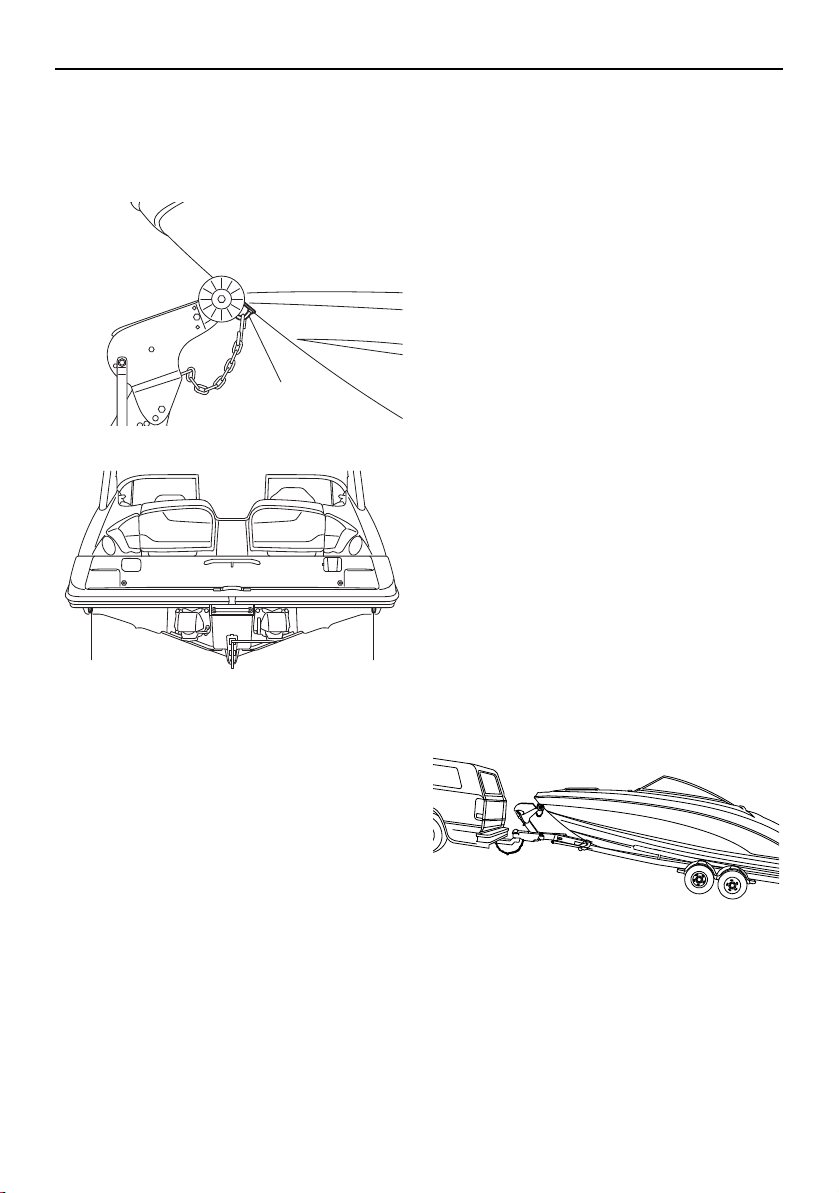
Trailering
152
● Secure the bow of the boat to the trailer with
the winch line and also with the chain. Se-
cure the stern eyes to the trailer with tie-
downs.
1 Bow eye
1 Stern eye
● Take down and store the bimini top, if used.
The bimini top is not designed to stay unse-
cured on the boat at highway speeds. (See
page 110 or 114.)
TIP:
During transport, use a boat cover to prevent
any items from blowing out of the boat, or
make sure to store any items inside the stor-
age compartments and securely close the
compartments.
● Be sure the access port caps are properly
installed (see page 178 for more informa-
tion) and the rear platform hatch is closed
securely.
● Be sure any cargo that must be carried in
the boat as well as the folding windshield
and all hatches are secured. A durable,
properly fitting cover, such as the genuine
Yamaha cover available from your Yamaha
Boat Dealer designed specifically for your
boat, is highly recommended to help protect
your boat during transport and storage.
● Carry a spare tire for the trailer, along with
sufficient tools to change the tire.
● While traveling, check the wheel hubs on
the trailer whenever you park. If a hub feels
abnormally hot, have the bearing inspected
before continuing your trip. On longer trips,
it is a good idea to carry a set of spare
wheel bearings, seals, and races.
● When making a turn, do not cut corners.
The trailer has a smaller turning circle, so it
turns more sharply around the corner than
the towing vehicle.
Backing your trailer
It takes practice to back a trailer successfully.
If you are not familiar backing up with a trailer,
practice first in an open area away from ob-
stacles.
Keep the following points in mind when
backing up
● Back slowly. Make steering adjustments in
small steps.
1
11
SportsBoat_F3R11.book Page 152 Friday, May 19, 2017 9:35 AM
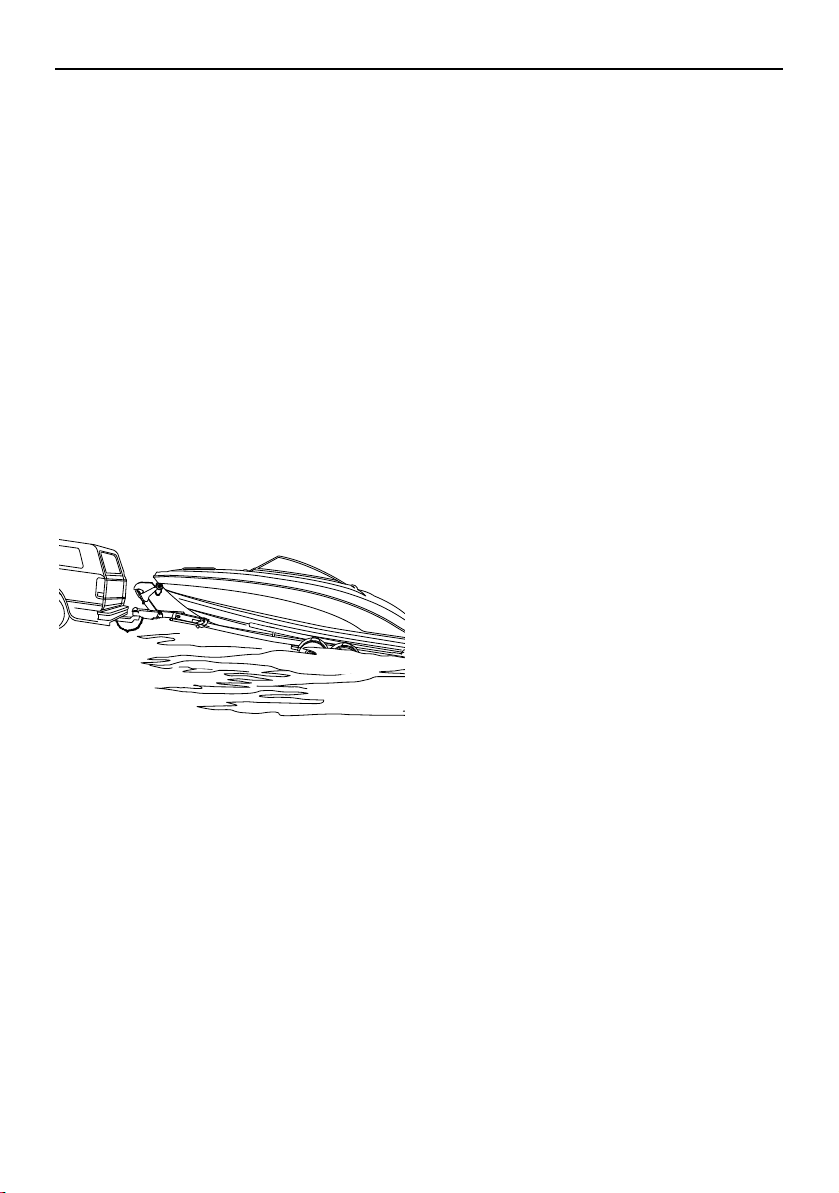
Trailering
153
● Turn the towing vehicle’s wheels opposite
the direction you want the trailer to go.
● After the trailer begins moving, turn the tow-
ing vehicle to follow it.
● Have a second person stand by to help di-
rect you with hand signals.
Launching
As a courtesy to other boaters, prepare your
boat for launching before using the ramp.
Each launch may have particular differences,
such as ramp angle, prevailing wind, waves,
and water currents. If possible, watch a cou-
ple of boaters launch their boats first to notice
any problems. While every boater develops a
preferred launch procedure, here is a recom-
mended general procedure:
(1) Perform the pre-operation checks shown
on page 124 that can be performed on
land.
(2) Remove all trailering tie-down lines from
the boat and attach your docking lines
and fenders, if used.
(3) Disconnect the trailer lights from the tow-
ing vehicle.
(4) Back the trailer down the ramp as close
to 90° to the shoreline as you can. If pos-
sible, have a second person stand aside
as an observer. Stop when the wheels
are at least halfway submerged. Set the
parking brake.
(5) Remove the bow line from the bow eye.
(6) Back the trailer farther into the water until
just the tops of the fenders show, and
then reset the parking brake. Board the
boat and start it. If possible, remain on the
trailer until the engines are warm and are
responding to throttle.
(7) Back the boat out into the water, watch-
ing carefully for people, other boats, or
obstacles.
Loading
(1) Disconnect the trailer lights from the tow-
ing vehicle.
(2) Back the trailer down the ramp as close
to 90° to the shoreline as you can. If pos-
sible, have a second person act as an ob-
server while standing to the side of the
trailer. Stop when the tops of the trailer’s
fenders are about 3 inches above the wa-
terline.
(3) With the boat moving at the slowest idle
speed, guide the boat onto the support
rails. Use throttle only if necessary for
steering ability. WARNING! Using too
much throttle can cause the boat to
jump over the front of the trailer,
which can result in injury to the boat
operator and bystanders.
(4) Make sure the boat is centered on the
support rails and is headed straight for
the bow stop (bumper board). Ease the
boat forward until the bow rests against
the bow stop. NOTICE: The winch line
is not designed to pull the boat onto
the trailer.
(5) Attach and tighten the winch line.
NOTICE: The winch line should not be
the only line securing the bow during
trailering. Use the chain along with the
winch to secure the boat to the trailer.
SportsBoat_F3R11.book Page 153 Friday, May 19, 2017 9:35 AM
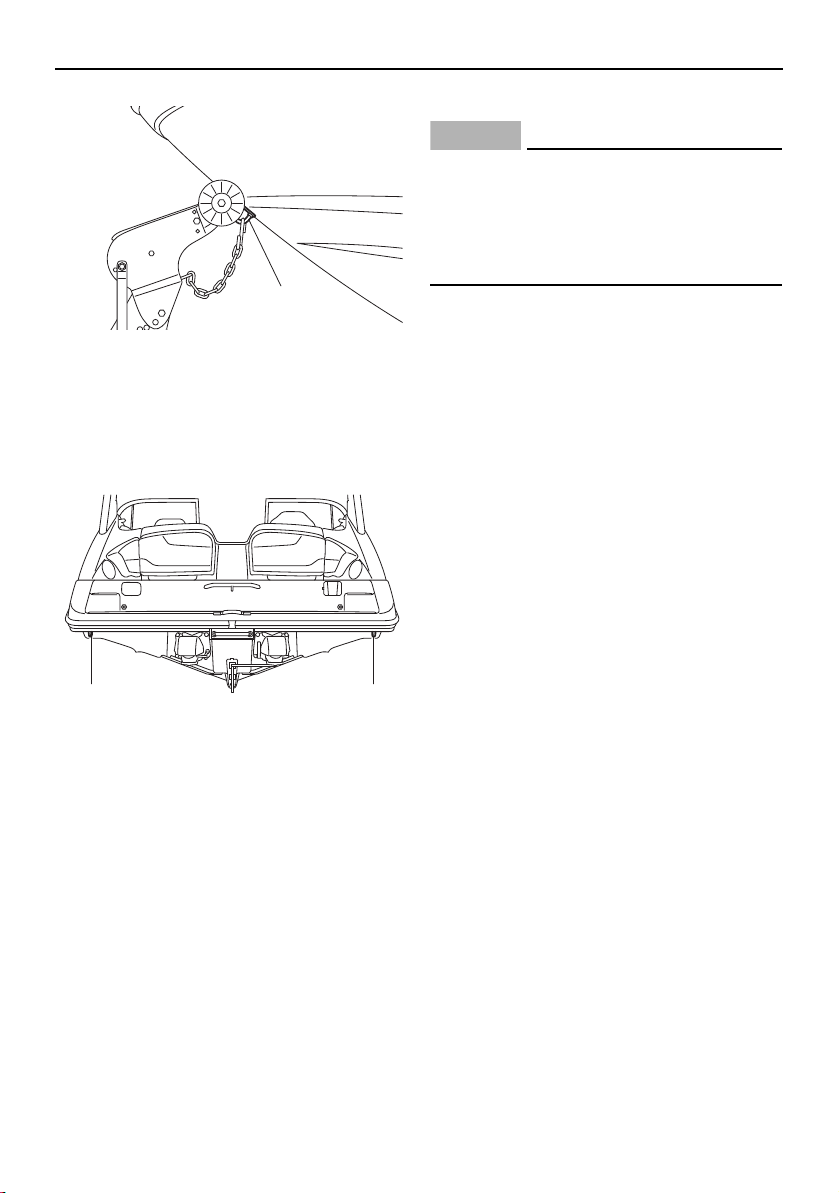
Trailering
154
1 Bow eye
(6) Pull the trailer up the ramp out of the way
of other boaters. Attach the bow and
stern tie-downs. Reconnect the trailer
lights.
1 Stern eye
(7) Perform the post-operation checks on
page 149.
Lifting
NOTICE
Do not attach lifting cables to the bow eye,
cleats, stern eyes, ski tow hook, or hand-
grips. Serious damage to the boat can oc-
cur. Use only a sling designed specifically
for lifting boats.
If you need to remove the boat from the water
without a trailer, use these guidelines:
● Use a sling-type lifting mechanism de-
signed for lifting boats. The sling should be
covered with a protective material to pre-
vent damage to the hull gelcoat.
● Use spreader bars to avoid side stress to
the hull that may cause cracks in the gel-
coat and fiberglass.
● Attach guidelines to the bow eye and stern
eyes to control movement of the boat dur-
ing lifting.
● Remove all people and all cargo from the
boat. Drain any excess water from the bilge
using the bilge pump.
● Be sure all people are standing clear, and
then lift the boat slowly and just far enough
to verify that the boat is securely held and
properly balanced. If necessary, lower the
boat again and adjust the slings.
● When ready, lift the boat slowly and careful-
ly.
1
11
SportsBoat_F3R11.book Page 154 Friday, May 19, 2017 9:35 AM
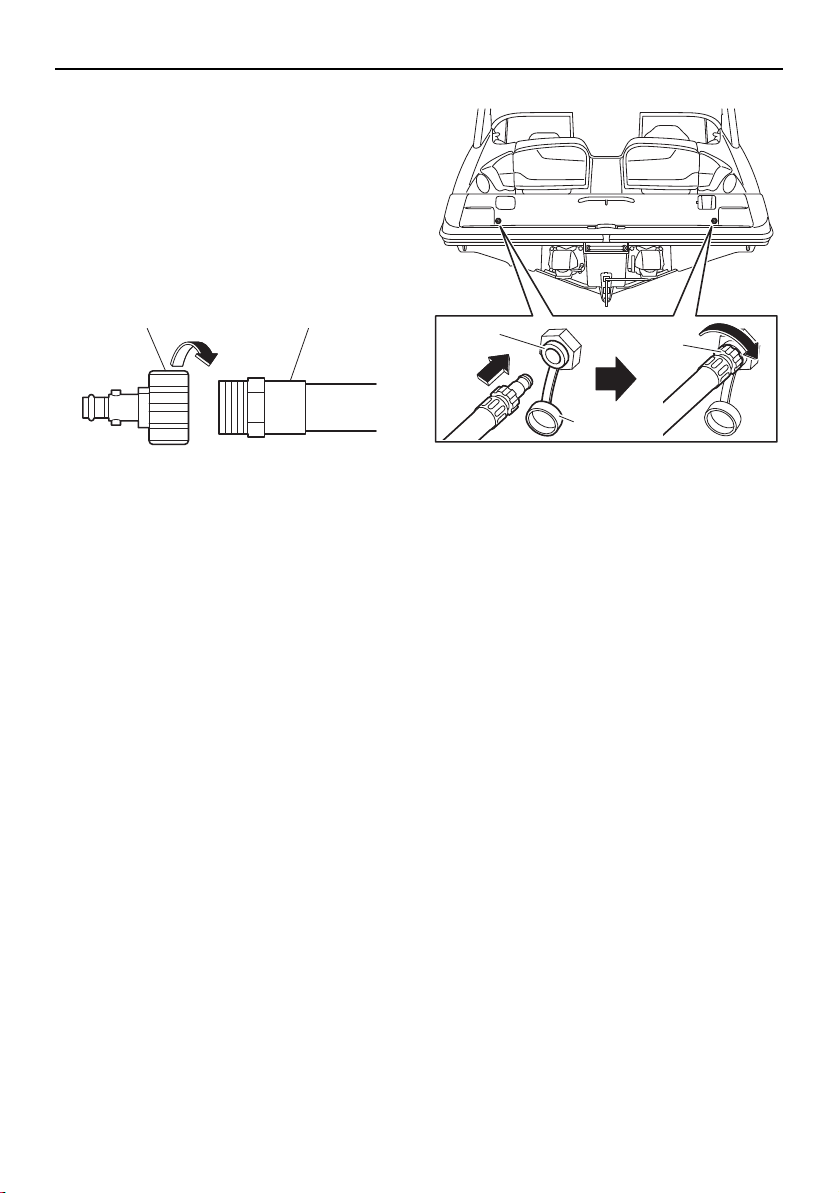
155
Care and storage
Post-operation care
Flushing the cooling system
Cooling system flushing is essential to pre-
vent the cooling system from clogging up with
salt, sand, or dirt.
(1) Connect the garden hose adapter to a
garden hose.
1 Garden hose adapter
2 Garden hose
(2) Loosen the flush hose connector cap for
the engine you are going to flush and re-
move it. Insert the garden hose adapter
into the flush hose connector by pushing
and twisting it until it is securely connect-
ed.
1 Flush hose connector
2 Flush hose connector cap
3 Garden hose adapter
(3) Connect the garden hose to a water tap.
(4) Make sure that the area around the boat
is clear, and then start the engine. Imme-
diately after the engine starts, fully turn
the water supply on so that water flows
out continually from the jet thrust nozzle
and cooling water pilot outlet. NOTICE:
Never turn on the water before starting
the engine. The water could flow back
through the muffler into the crankcase
causing severe engine damage. Be
sure to turn on the water immediately
after starting the engine to prevent en-
gine overheating.
(5) Run the engine at a fast idle for 3 to 5
minutes. If the engine stops while flush-
ing, turn the water supply off immediately
and perform the procedure again from
step 4.
(6) Turn off the water supply, and then drain
residual water from the exhaust system
by alternately pushing the remote control
12
1
3
2
SportsBoat_F3R11.book Page 155 Friday, May 19, 2017 9:35 AM
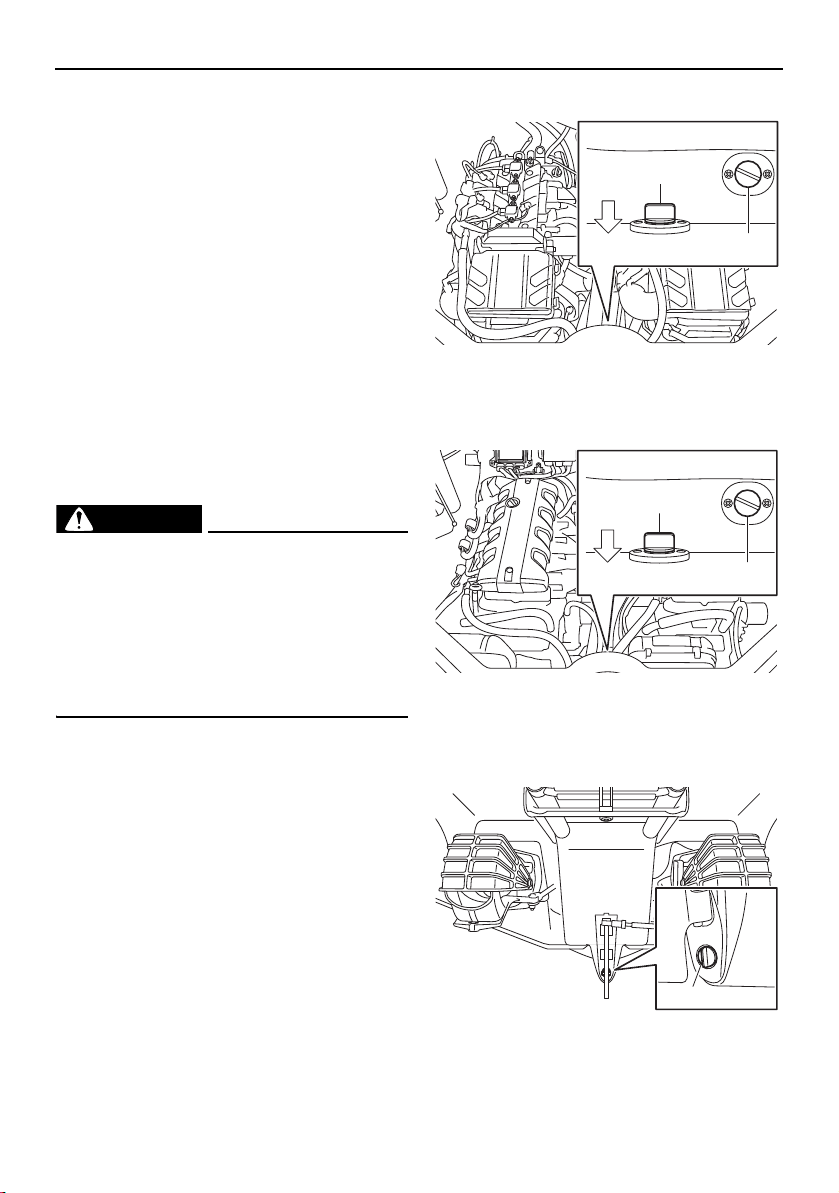
Care and storage
156
lever up to half throttle and back to idle for
10 to 15 seconds.
(7) Stop the engine. NOTICE: Never have
the water on when the engine is not
running. The water could flow back
through the muffler into the crankcase
causing severe engine damage. Do
not run the engine for more than 15
seconds after the water supply has
been turned off to avoid engine over-
heating.
(8) Remove the garden hose adapter.
(9) Install and tighten the cap securely.
(10) Repeat the flushing procedure for the
other engine.
Cleaning the boat
WARNING
Gasoline and its vapors are highly flam-
mable and explosive. If there is fuel or a fu-
el/water mixture in the engine
compartment or the fuel tank compart-
ment, wipe it up immediately with dry rags.
Do not operate the boat until the source of
the fuel leak is found and corrected.
TIP:
Quality Yamaclean
®
, Yamashield™, and oth-
er Yamalube care products are available from
your Yamaha Boat Dealer.
(1) Remove the engine compartment drain
plug and the fuel tank compartment drain
plug to drain the water. (See page 120 for
engine compartment drain plug and fuel
tank compartment drain plug removal
and installation procedures.) Reinstall the
fuel tank compartment drain plug.
AR210 / SX210
1 Fuel tank compartment drain plug
2 Engine compartment drain plug
212X / 212 Limited S / 212 Limited
1 Fuel tank compartment drain plug
2 Engine compartment drain plug
(2) Remove the hull drain plug.
1 Hull drain plug
1
2
BOW
1
2
BOW
1
SportsBoat_F3R11.book Page 156 Friday, May 19, 2017 9:35 AM

Care and storage
157
(3) Clean the hull, boat interior, and drive
units with Yamaclean Wash & Wax Con-
centrate, or a mild natural soap, and wa-
ter. Rinse with fresh water. Scum on the
hull can be removed with Yamaclean Hull
Cleaner™. NOTICE: Incorrect cleaning
can damage vinyl. See “Basic stain
guide” on page 159.
(4) Clean the engine and bilge areas with
Yamaclean Bilge Cleaner™ or an equiv-
alent and rinse with fresh water. Drain all
water and wipe up any remaining mois-
ture with clean, dry rags. Reinstall the en-
gine compartment drain plug. NOTICE:
Be careful not to get water on the air
filter area or electrical components.
Do not use high-pressure water when
rinsing the engine or engine compart-
ment as severe engine damage could
result.
(5) Open the rear platform hatch. (See page
98 for rear platform hatch opening and
closing procedures.)
(6) Remove the access port caps to let any
water drain that has pooled on them.
(See page 178 for access port cap re-
moval and installation procedures.) If the
boat will be stored on the trailer nearby,
leave the caps out until you prepare to
launch the boat again. If the boat will be
transported on the trailer any distance,
temporarily reinstall the caps and close
the hatch until you get home. Open the
hatch again when you arrive and remove
the caps as before. Leave the caps loose
until you plan to transport the boat on the
trailer again. NOTICE: Leaving the ac-
cess port caps out when you are not
using or transporting the boat helps
keep them from becoming stuck in the
access ports. (See page 178 for more
information.)
(7) Securely install the hull drain plug by
tightening it until it stops. NOTICE: Be-
fore installing the hull drain plug,
clean the drain plug threads and
O-ring to remove any foreign materi-
als, such as dirt or sand. Otherwise,
the hull drain plug could be damaged,
allowing water to enter the hull. Check
the O-ring on the hull drain plug and
make sure that the hull drain plug is
tightened securely before launching
the boat. Otherwise, water may flood
the boat and cause it to submerge.
(8) Spray the exterior of the engines with
Yamalube Silicone Protectant & Lubri-
cant, or an equivalent. For areas requir-
ing heavy protection, use Yamashield™.
(9) Wax the hull with Yamaclean Spray
Wax
®
or other non-abrasive wax de-
signed for marine gelcoat. WARNING!
Slippery surfaces can cause falls and
injury. Be careful not to apply too
much wax on deck and gunwale step-
ping surfaces. This will make them
slippery.
(10) Wipe all vinyl and rubber components,
such as the seats and engine compart-
ment seals, with Yamaclean Vinyl Dress-
ing™ or other quality vinyl protectant.
NOTICE: Some well-known “protec-
tant” products on the market can actu-
ally damage vinyl over time. Consult a
Yamaha Boat Dealer if you want to use
a product other than Yamaclean Vinyl
Protectant.
(11) Vacuum and hose-off the carpeting as
necessary. If needed, use Yamaclean
Carpet Cleaner
®
or other quality brand-
name carpet cleaner product to clean
SportsBoat_F3R11.book Page 157 Friday, May 19, 2017 9:35 AM

Care and storage
158
soiled areas. Roll up the carpet face out
for storage. NOTICE: Always dry the
carpet face up. Never roll up the carpet
while wet. Never fold the carpet.
(12) Wash the fabric of the bimini top with a
mild natural soap in lukewarm water, then
rinse. Do not use detergents. Allow to air
dry thoroughly before storage.
SportsBoat_F3R11.book Page 158 Friday, May 19, 2017 9:35 AM
Care and storage
159
Basic stain guide
Here are basic steps to remove common stains from boat upholstery. Consult a Yamaha Boat
Dealer or upholstery-cleaning professional for difficult stains.
* May cause permanent staining.
TYPE OF STAIN STEPS
(rinse with clean, warm water and then dry after application)
123
General care/Dirt A B —
Chewing gum E A —
Coffee/Tea/Chocolate B — —
Grease E B —
Ink* C F D
Ketchup A B —
Lipstick C B A
Mustard A B C
Mildew/Wet leaves* C B A
Motor oil B — —
Permanent marker* C F D
Suntan lotion* A B —
Tar/Asphalt E B —
A Medium-soft brush with warm, soapy water
B Yamaclean All Purpose Cleaner or equivalent
C Isopropyl alcohol (91% is best)
D
Mixture of 1 tablespoon (15 ml) ammonia, 1/4 cup (60 ml) hydrogen peroxide, and
3/4 cup (177 ml) water
E Wipe or scrape off excess (chill gum with ice first)
F Name brand ink remover
SportsBoat_F3R11.book Page 159 Friday, May 19, 2017 9:35 AM
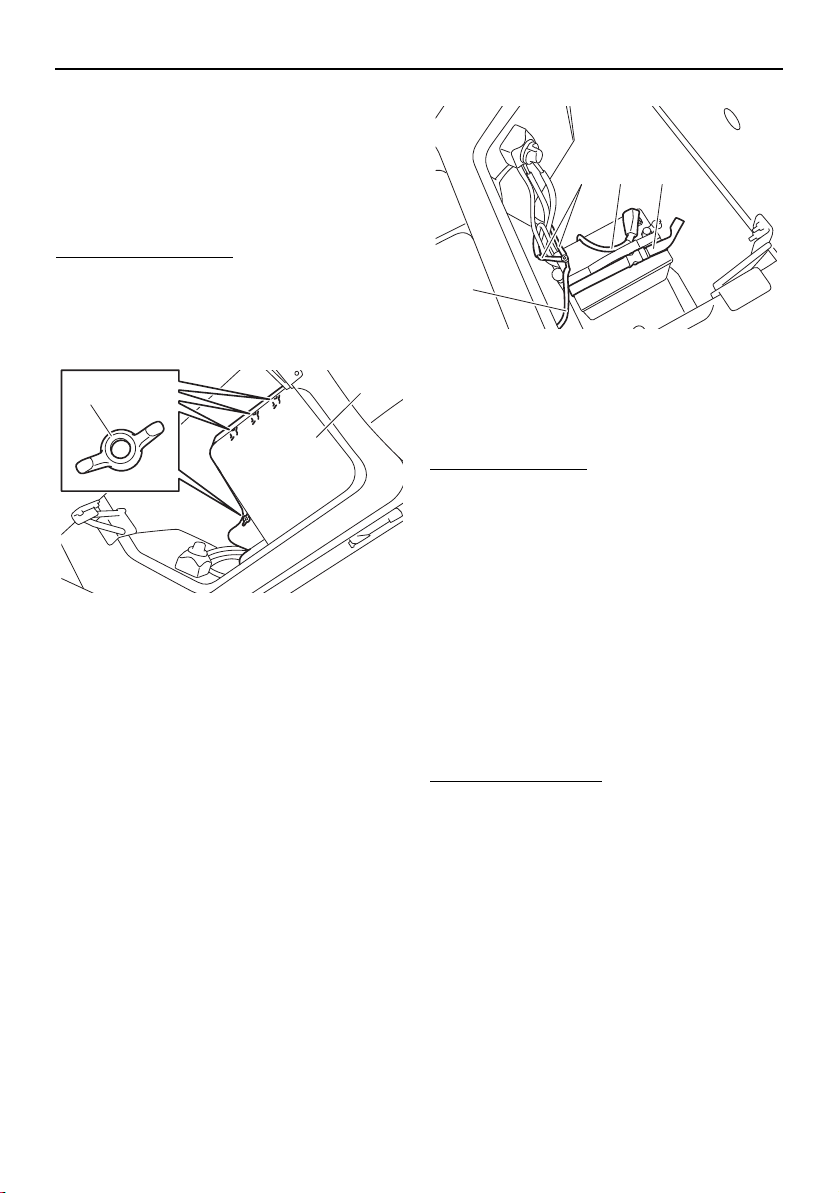
Care and storage
160
Battery care (AR210 / SX210)
If the boat will not be used for more than a
month, remove the battery and store it in a
cool, dark place.
The battery is located in the rear underseat
storage compartment (port).
To remove the battery:
(1) Turn the battery switch to the OFF (red)
position. (See page 37.)
(2) Remove the battery cover by removing
the nuts.
1 Nut
2 Battery cover
(3) Disconnect the ground lead (black), the
negative (–) battery leads (black).
(4) Disconnect the positive (+) battery lead
(red).
(5) Unfasten the battery strap, and then re-
move the battery from the boat.
1 Negative (–) battery lead (black)
2 Positive (+) battery lead (red)
3 Battery strap
4 Ground lead (balck)
To store the battery:
(1) Clean the battery casing and terminals
using a mixture of baking soda and water
(one tablespoon of baking soda to one
cup of water).
(2) Apply dielectric grease or petroleum jelly
to the battery terminals and to all ex-
posed connectors.
(3) If the battery will be stored for a longer
period, check its state of charge (use a
hydrometer or a voltmeter and load tes-
ter) at least once a month and recharge
the battery if it gets too low.
To charge the battery:
(1) Remove the caps from the cells. Add dis-
tilled water if necessary to top up the
electrolyte to the proper level.
(2) Follow the battery manufacturer’s instruc-
tions for charging. WARNING! When
charging a battery, keep it well away
from sparks and open flames, as it
gives off explosive gases. When using
a battery charger, connect the battery
to the charger before you turn on the
charger. This will prevent sparking at
1
2
2 3
4
1
SportsBoat_F3R11.book Page 160 Friday, May 19, 2017 9:35 AM
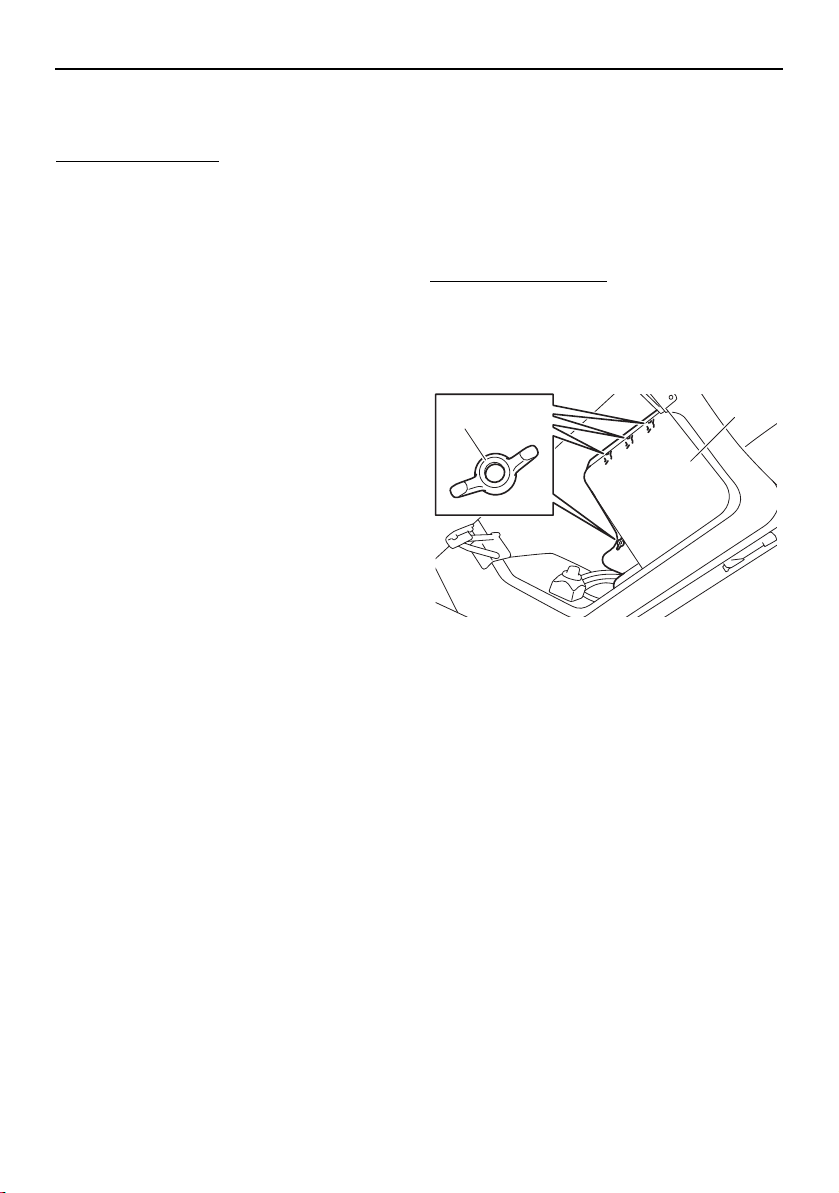
Care and storage
161
the terminals that could ignite battery
gases.
To install the battery:
(1) Place the battery in the battery holder,
and then fasten the battery using the bat-
tery strap.
(2) Connect the positive (+) battery lead (red)
to the positive (+) battery terminal.
NOTICE: Reversal of the battery leads
will damage the electrical parts.
(3) Connect the negative (–) battery lead
(black) and the ground lead (black) to the
negative (–) battery terminal.
(4) Make sure that the battery is securely
held in place.
(5) Install the battery cover by installing the
nuts.
Battery care
(212X / 212 Limited S / 212 Limited)
If the boat will not be used for more than a
month, remove the battery and store it in a
cool, dark place.
The battery is located in the rear underseat
storage compartment (port).
To remove the battery:
(1) Turn the battery switch to the OFF (red)
position. (See page 38.)
(2) Remove the battery cove by removing
the nuts.
1 Nut
2 Battery cover
(3) Disconnect the ground lead (black), the
negative (–) battery lead (black), and the
negative (–) amplifier lead (black) (212X).
(4) Disconnect the positive (+) battery lead
(red) and the positive (+) amplifier lead
(red) (212X).
(5) Unfasten the battery strap, and then re-
move the battery from the boat.
1
2
SportsBoat_F3R11.book Page 161 Friday, May 19, 2017 9:35 AM
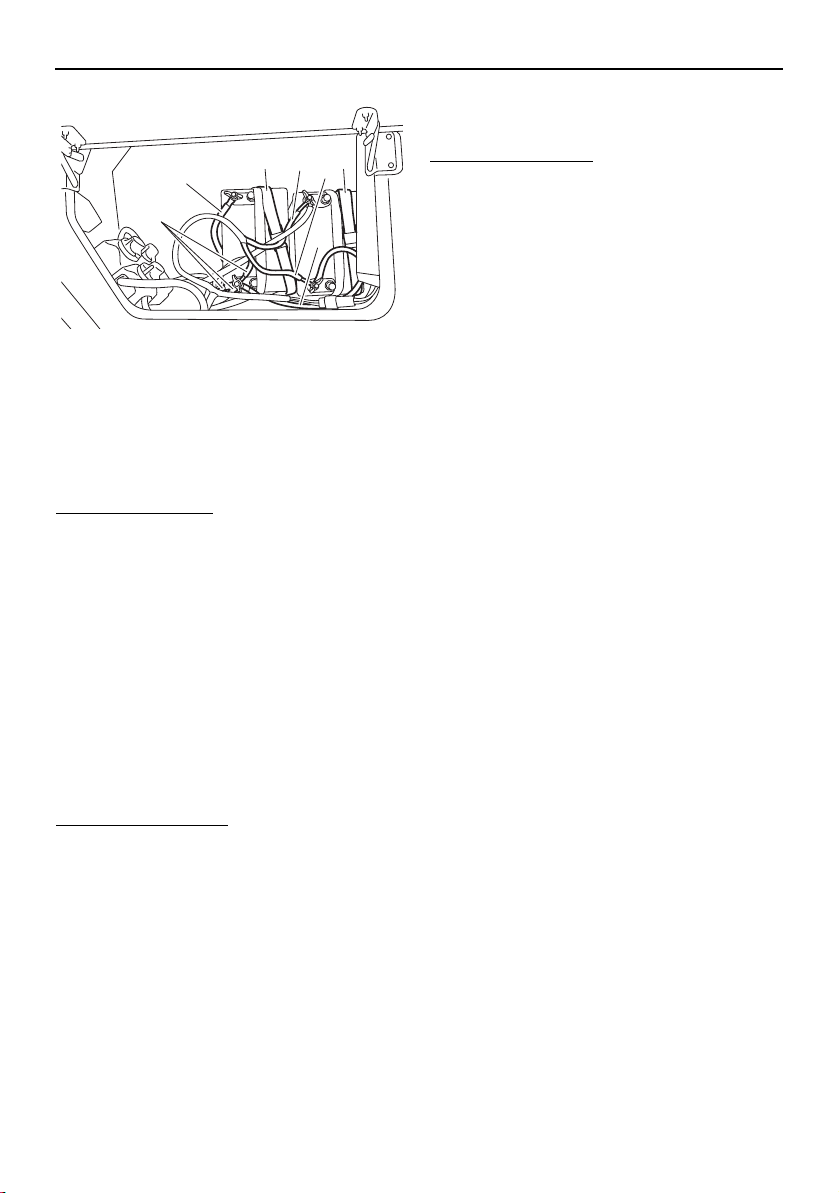
Care and storage
162
1 Positive (+) battery lead (red)
2 Negative (–) battery lead (black)
3 Battery strap
4 Ground lead (black)
5 Positive (+) amplifier lead (red) (212X)
6 Negative (–) amplifier lead (black) (212X)
To store the battery:
(1) Clean the battery casing and terminals
using a mixture of baking soda and water
(one tablespoon of baking soda to one
cup of water).
(2) Apply dielectric grease or petroleum jelly
to the battery terminals and to all ex-
posed connectors.
(3) If the battery will be stored for a longer
period, check its state of charge (use a
hydrometer or a voltmeter and load tes-
ter) at least once a month and recharge
the battery if it gets too low.
To charge the battery:
(1) Remove the caps from the cells. Add dis-
tilled water if necessary to top up the
electrolyte to the proper level.
(2) Follow the battery manufacturer’s instruc-
tions for charging. WARNING! When
charging a battery, keep it well away
from sparks and open flames, as it
gives off explosive gases. When using
a battery charger, connect the battery
to the charger before you turn on the
charger. This will prevent sparking at
the terminals that could ignite battery
gases.
To install the battery:
(1) Place the battery in the battery holder,
and then fasten the battery using the bat-
tery strap.
(2) Connect the positive (+) amplifier lead
(red) (212X) and the positive (+) battery
lead (red) to the positive (+) battery termi-
nal. NOTICE: Reversal of the battery
leads will damage the electrical parts.
(3) Connect the negative (–) amplifier lead
(black) (212X) and the negative (–) bat-
tery lead (black), and the ground lead
(black) to the negative (–) battery termi-
nal.
(4) Make sure that the battery is securely
held in place.
(5) Install the battery cover by installing the
nuts.
6
5
4
3 3
2
1
SportsBoat_F3R11.book Page 162 Friday, May 19, 2017 9:35 AM
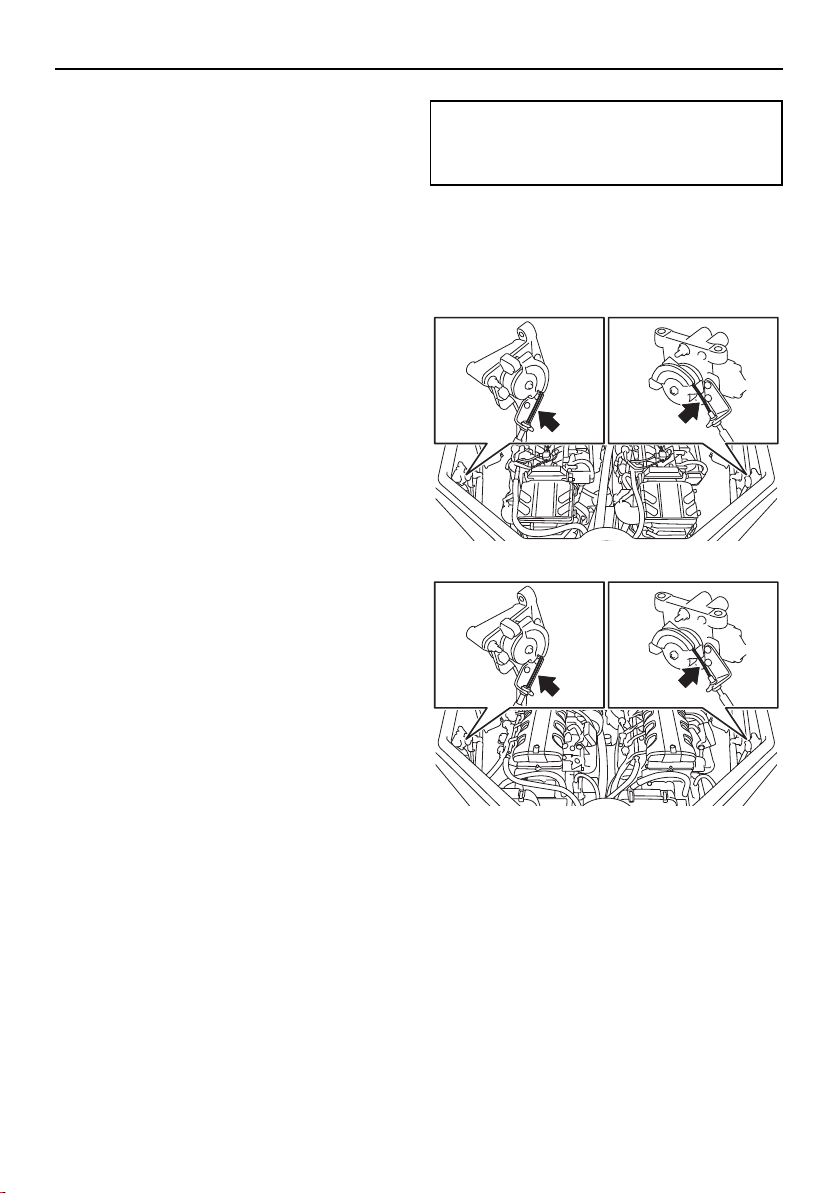
Care and storage
163
Long-term storage
Storing your boat for prolonged periods of
time, such as winter storage, requires preven-
tative maintenance to ensure against deterio-
ration. It is advisable to have the boat serviced
by an authorized Yamaha Boat Dealer before
storage. However, the following procedures
can be performed by the owner with a mini-
mum of tools.
Fuel system
Fill the fuel tank with fresh fuel, adding one
ounce of Fuel Med RX, available from your
Yamaha Boat Dealer, to each gallon of fuel or
use an equivalent according to the manufac-
ture’s instructions. (See page 115 for informa-
tion on filling the fuel tank.) Do not “top off” the
tank, because fuel could spill. A full fuel tank
is less likely to allow condensation to collect in
the tank, reducing the chance of contaminat-
ed fuel. Running the engines with treated fuel
during cooling system flushing will also help
protect the fuel system.
TIP:
Use of Fuel Med RX eliminates the need to
drain the fuel system. Consult a Yamaha Boat
Dealer or other qualified mechanic if the fuel
system is to be drained instead.
Lubrication
It is advisable to take the boat to a Yamaha
Boat Dealer to have the engines fogged for
long-term storage.
Grease points
To keep moving parts sliding or rotating
smoothly, coat them with water-resistant
grease.
● Throttle cables
Grease the throttle-cable inner wires at the
pulley wheel of each APS.
AR210 / SX210
212X / 212 Limited S / 212 Limited
● Steering cable ball joints and inner wires
Grease the steering cable and shift cable ball
joints at the jet thrust nozzles. Extend the
steering cable and shift cable inner wires and
apply a thin coat of grease to them.
Recommended water-resistant grease:
YAMALUBE MARINE GREASE or
Yamaha Grease A
SportsBoat_F3R11.book Page 163 Friday, May 19, 2017 9:35 AM
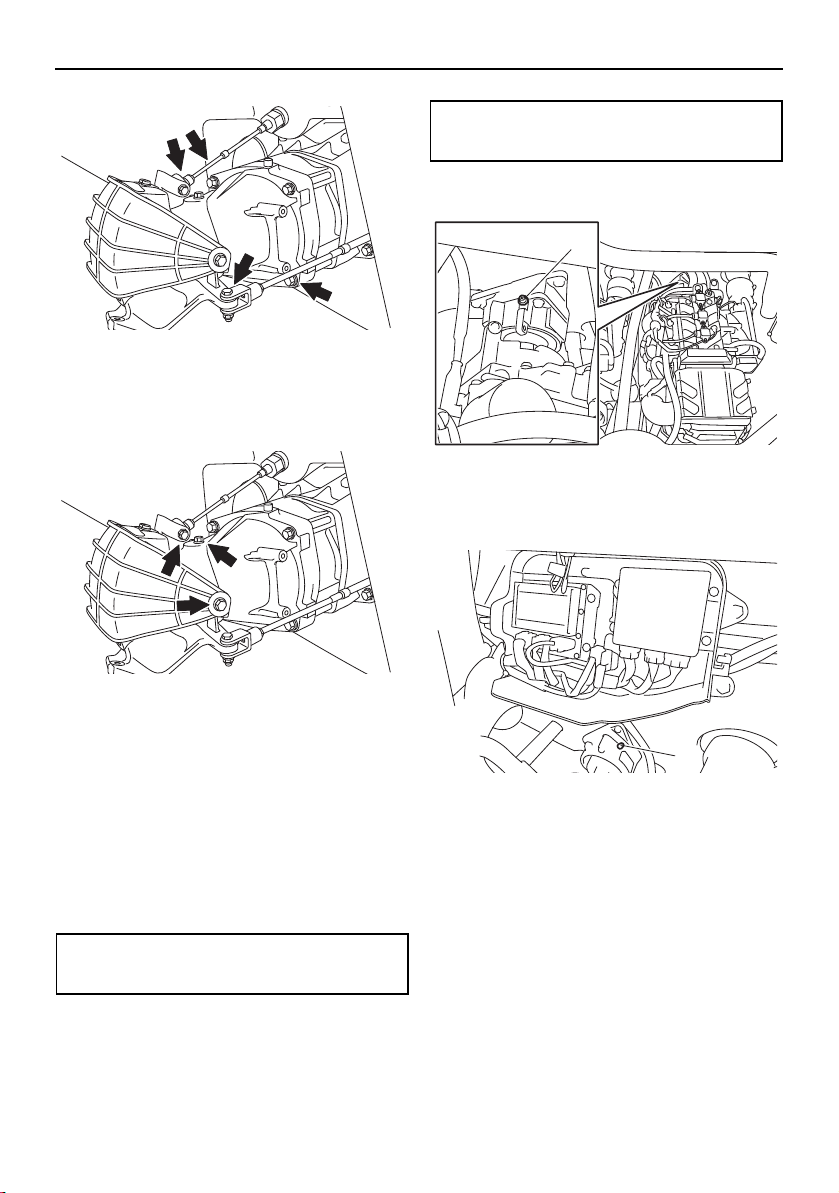
Care and storage
164
● Pivot points
Grease all pivot points of the steering and shift
mechanisms at the pump ends.
● Bearing housings
Grease the bearing housings through the
grease nipples. NOTICE: Fill the grease
slowly and carefully, because it can dam-
age the hoses and the joints.
The first service should be done after 10
hours or 1 month by a Yamaha Boat Dealer.
Fill the bearing housings with water-resistant
grease through the grease nipples.
After first service: Every 100 hours or 6
months (you may do this yourself).
3-star models (AR210 / SX210)
1 Bearing housing grease nipple
3-star models
(212X / 212 Limited S / 212 Limited)
1 Bearing housing grease nipple
Grease capacity:
33.0–35.0 cc (1.11–1.18 oz)
Grease capacity:
6.0–8.0 cc (0.20–0.27 oz)
1
1
SportsBoat_F3R11.book Page 164 Friday, May 19, 2017 9:35 AM
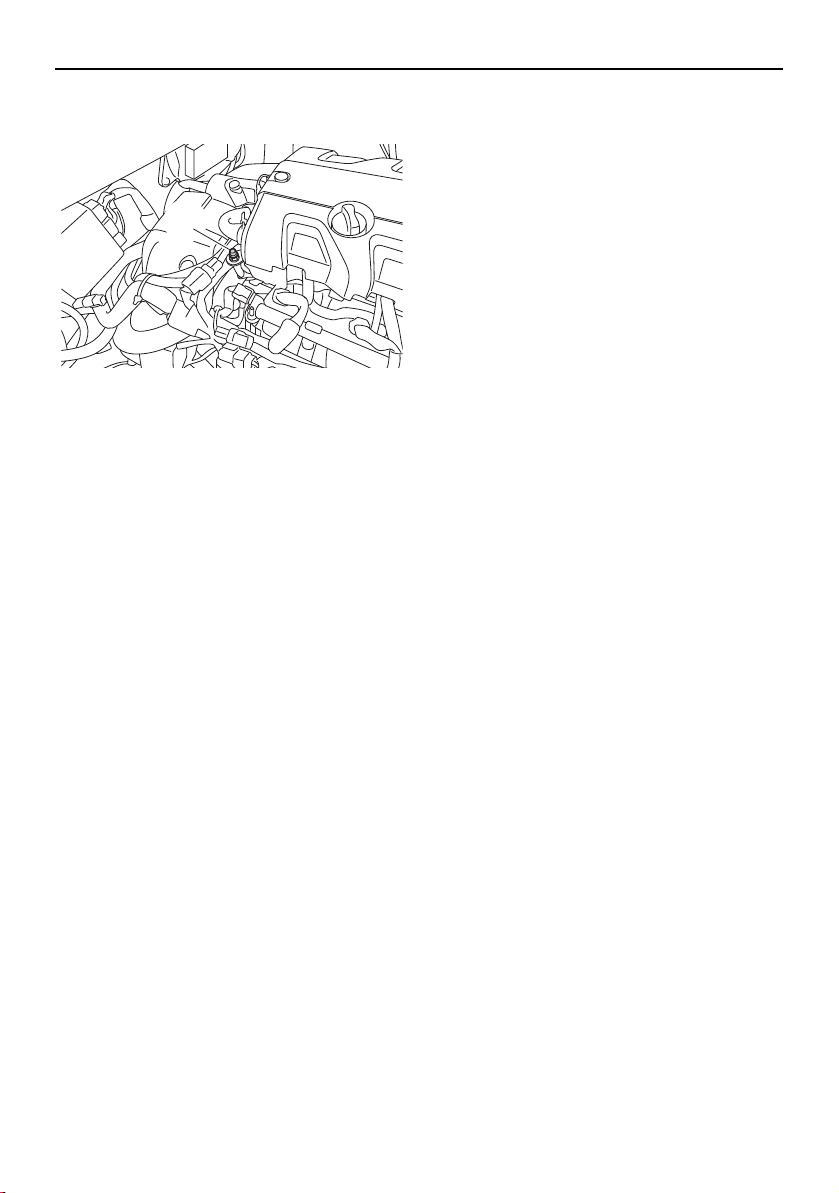
Care and storage
165
4-star models
(212X / 212 Limited S / 212 Limited)
1 Bearing housing grease nipple
1
SportsBoat_F3R11.book Page 165 Friday, May 19, 2017 9:35 AM
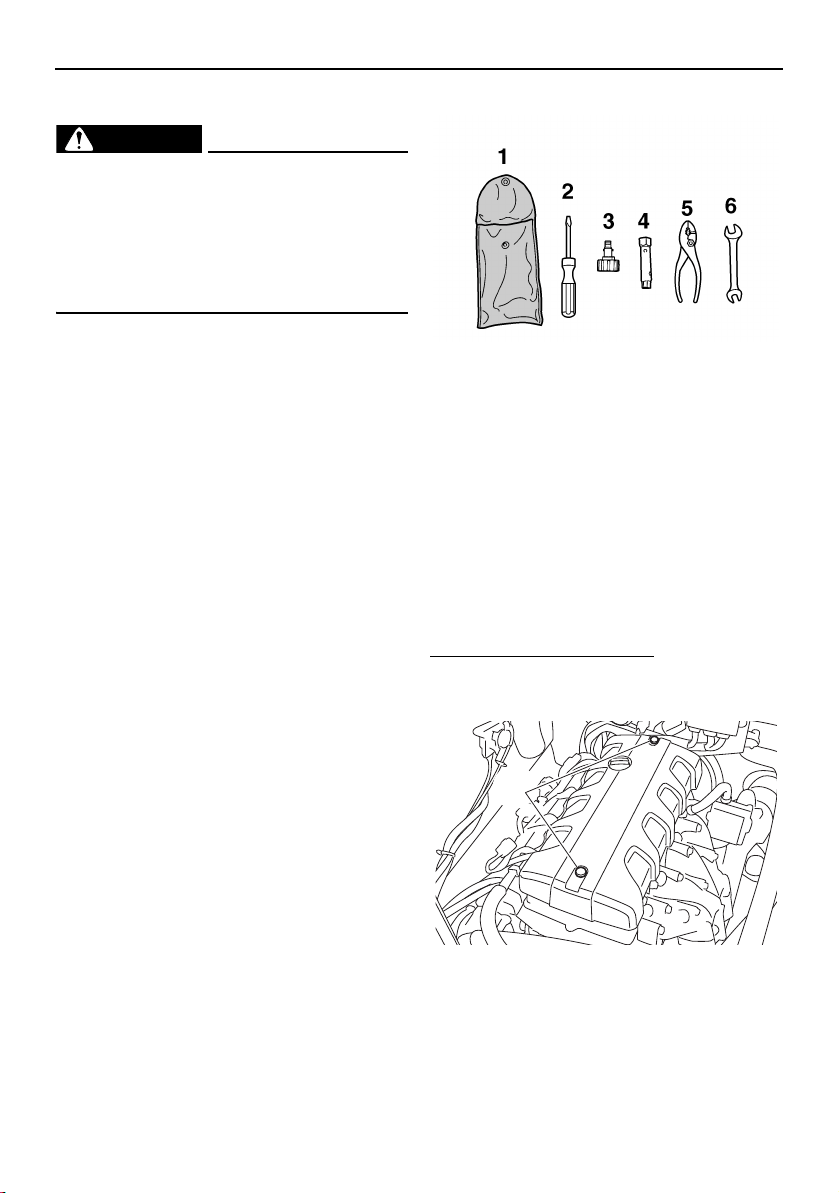
166
Maintenance
Maintenance
WARNING
Be sure to turn off the engines when you
perform maintenance unless otherwise
specified. If you are not familiar with ma-
chine servicing, this work should be done
by a Yamaha Boat Dealer or other qualified
mechanic.
Maintenance, replacement, or repair of the
emission control devices and system may be
performed by any marine SI engine repair es-
tablishment or individual. Warranty repair,
however, must be performed at an authorized
Yamaha Boat Dealer. A service manual is
available for purchase through a Yamaha
Boat Dealer for owners who have the me-
chanical skills, tools, and other equipment
necessary to perform maintenance not cov-
ered by this owner’s/operator’s manual.
Owner’s/operator’s manual and tool
kit
It is advisable to always carry the owner’s/op-
erator’s manual and tool kit with you whenev-
er you use the boat.
To protect these materials from water dam-
age, it would be a good idea to put them in a
waterproof bag. If your owner’s/operator’s
manual is damaged, order a replacement
from a Yamaha Boat Dealer.
The service information included in this man-
ual is intended to provide you, the owner, with
the necessary information for completing your
own preventive maintenance and minor re-
pairs. The tools provided in the owner’s tool kit
are sufficient for this purpose, except that a
torque wrench is also necessary for tightening
nuts and bolts properly.
1 Tool bag
2 Screwdriver
3 Garden hose adapter
4 10/12 mm box wrench
5 Pliers
6 10/12 mm open-end wrench
Removing and installing the engine
covers
(212X / 212 Limited S / 212 Limited)
The engine cover of each engine is remov-
able.
To remove the engine cover:
(1) Open the engine hood. (See page 92.)
(2) Remove the engine cover screws.
1 Engine cover screw
1
SportsBoat_F3R11.book Page 166 Friday, May 19, 2017 9:35 AM
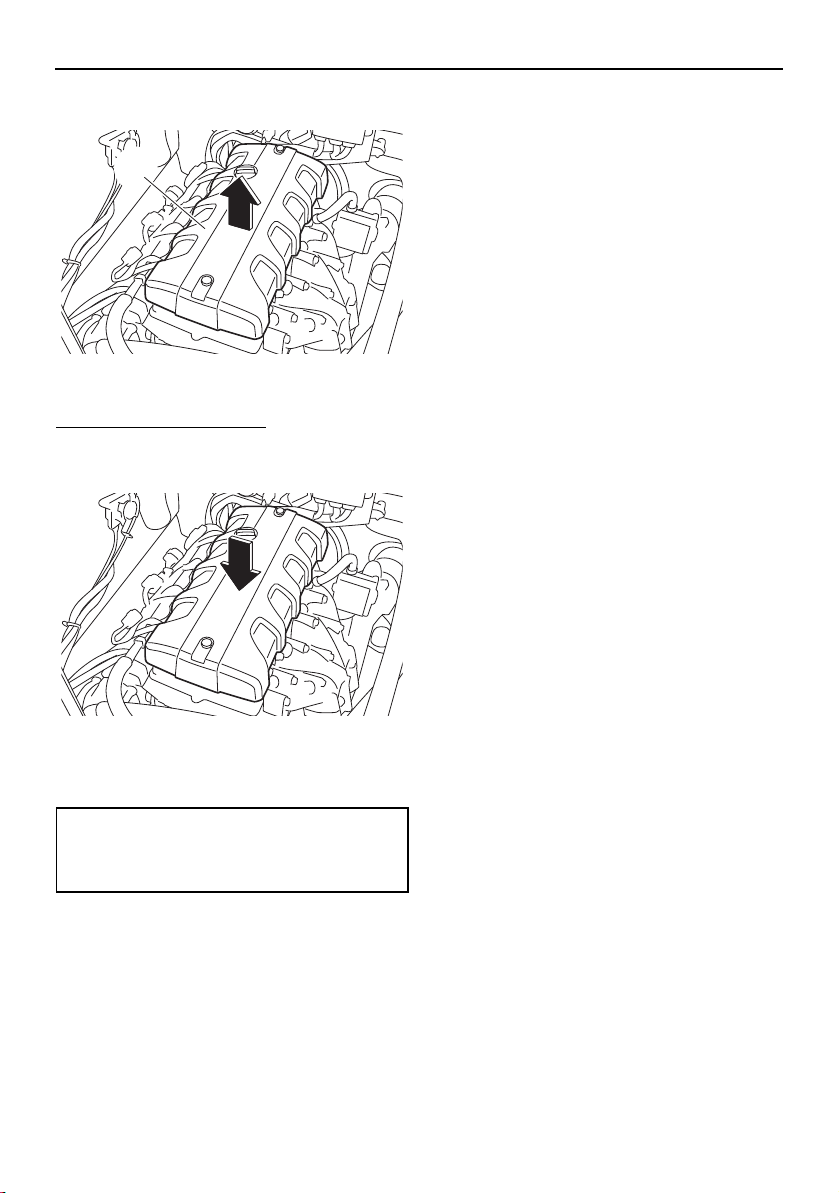
Maintenance
167
(3) Lift up the engine cover and remove it.
1 Engine cover
To install the engine cover:
(1) Place the engine cover in its original posi-
tion, and then push it down.
(2) Install the engine cover screws, and then
tighten them to the specified torque.
(3) Close the engine hood.
Tightening torque:
Engine cover screw:
4.5 N·m (0.46 kgf·m, 3.3 lb·ft)
1
SportsBoat_F3R11.book Page 167 Friday, May 19, 2017 9:35 AM

Maintenance
168
Periodic maintenance chart
The periodic maintenance chart gives general guidelines for periodic maintenance. Have a
Yamaha dealer perform the checks in the following chart. However, maintenance may need to
be performed more frequently depending on your operating conditions. If you have any ques-
tions, consult a Yamaha dealer.
This “√” mark indicates items to be checked and serviced by a Yamaha dealer.
Item Operation
Initial Thereafter every
10
hours
50
hours
or 12
months
*1
100
hours
or 12
months
*1
200
hours
or 24
months
*1
Fuel hoses, clamps,
canister, and check
valve
Check for damage, and check con-
nections and tightening of clamps
√
Fuel filler cap
Check cap for damage, and check
seal for cracks and deformation
√
Fuel tank Check installation √√
Main switches and
engine shut-off
switch
Check operation √√
Battery
(AR210 / SX210)
Batteries (212X /
212 Limited S /
212 Limited)
Check state of charge and termi-
nals, and check for broken battery
straps
√
Battery leads Check terminals √
Battery switch
(AR210 / SX210)
Battery switches
(212X /
212 Limited S /
212 Limited)
Check operation √√
Meters (after com-
pleting the pre-opera-
tion checks)
Check lighting √√
Neutral switches Check operation √√
Hatch interlock
switches (wet storage
compartment)
Check operation √√
Blowers Check operation √√
Horn Check operation √√
Navigation lights Check lighting √√
Electric bilge pump
Check for water discharge by auto-
matic operation, clean filter, check
hoses for damage, and check tight-
ening of clamps
√
Other electrical com-
ponents
Check operation of stereo, and oth-
er components
√√
SportsBoat_F3R11.book Page 168 Friday, May 19, 2017 9:35 AM
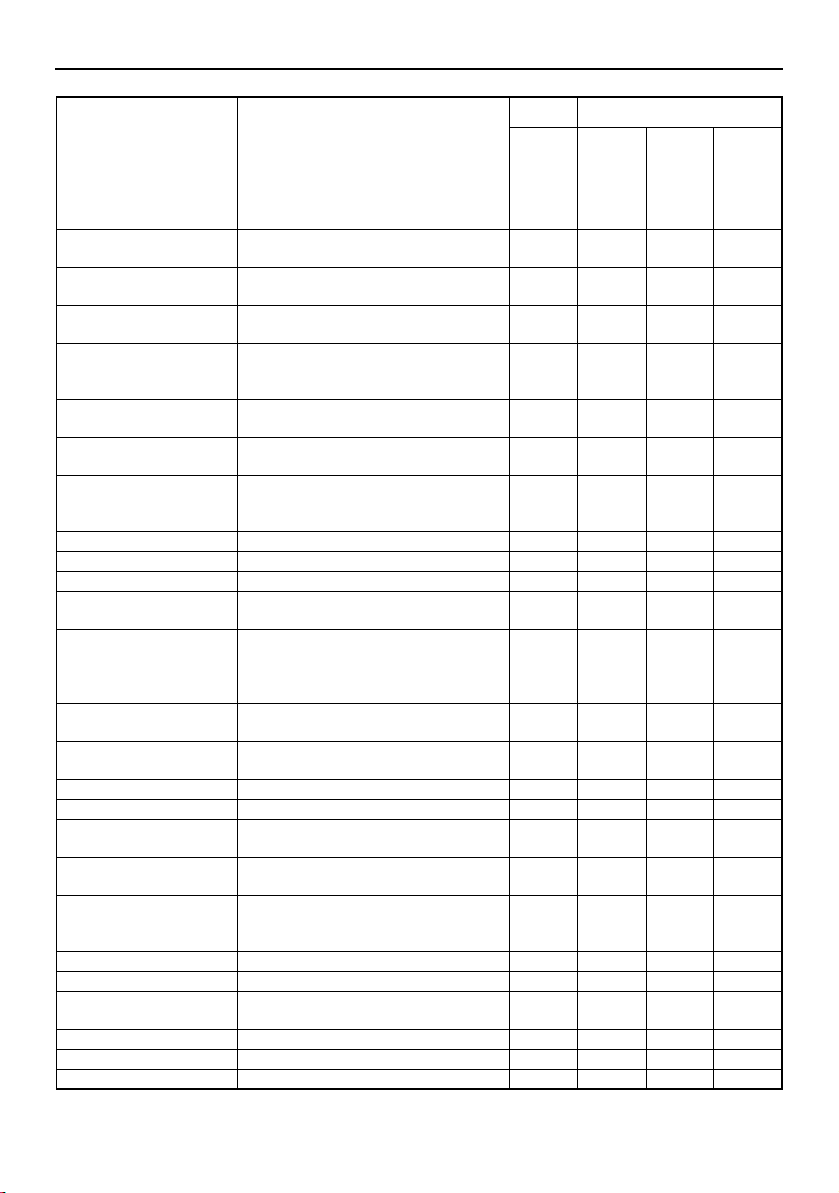
Maintenance
169
Steering master
ASSY
Check operation and tilting mecha-
nism, and check for looseness
√√
Steering cables
Check connections and exterior,
and lubricate
√
Articulating keel
Check operation, and check link rod
for bends and damage
√
Remote control le-
vers
Check exterior and operation, check
shift operation, and check for loose-
ness
√√
Throttle cables
Check connections and exterior,
and lubricate
√
Shift cables
Check connections and exterior,
and lubricate (shift gate end)
√
Exhaust hoses, wa-
ter locks, and resona-
tors
Check for exhaust leakage, and
check clamps at connections
√
Drain passages Remove clogs √
Drain plugs Check O-rings √√
Hull and deck Check for damage √√
Windshield and seats
Check installation and operation,
and check for damage
√√
Wakeboard tower
(AR210 / 212X /
212 Limited S) and bi-
mini top
Check installation, and check for
damage
√√
Hatches, hinges, and
packing seals
Check installation √√
Ladders (bow and
stern)
Check installation √√
Access port caps Check exterior and installation √
Spark plugs Check √√
High-pressure fuel
hoses
Check connections and exterior,
and check for leakage
√
Engine oil
(AR210 / SX210)
Replace √√
Engine oil (212X /
212 Limited S /
212 Limited)
Replace √√√
Engine oil filters Replace √
Air filter elements Check for damage and dirt √
Intake hoses and
breather hoses
Check for damage, and check con-
nections
√
Throttle bodies Lubricate throttle valves √
Anodes (engines) Check for corrosion √ *2
Valve clearance Check and adjust √ *2
Item Operation
Initial Thereafter every
10
hours
50
hours
or 12
months
*1
100
hours
or 12
months
*1
200
hours
or 24
months
*1
SportsBoat_F3R11.book Page 169 Friday, May 19, 2017 9:35 AM
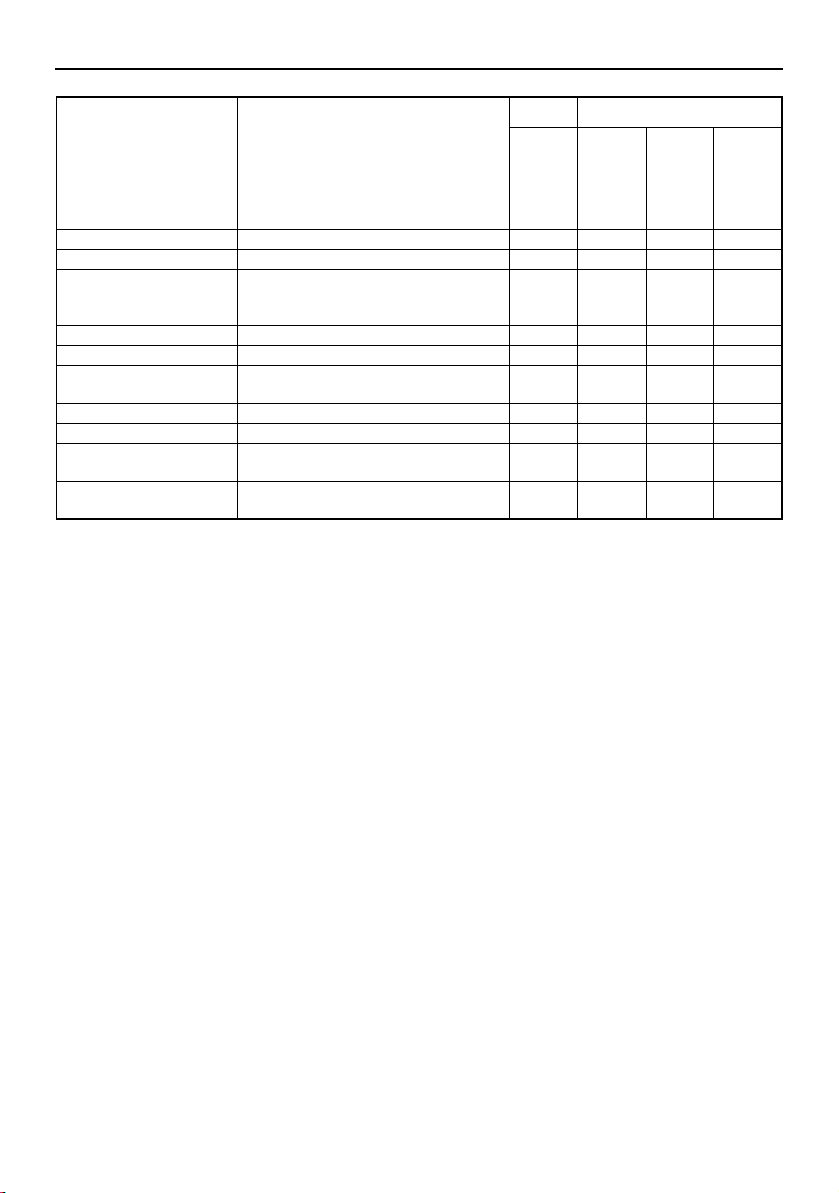
Maintenance
170
*1: Whichever comes first.
*2: Check every 200 hours.
Perform the pre-operation checks and post-operation checks before performing periodic main-
tenance.
Rubber couplings Check for looseness and noise √
Engine mounts Check for damage and peeling √
Cooling water hoses
and cooling water pi-
lot outlet hoses
Check for damage, and check con-
nections
√
Water inlet strainers Check for damage √√
Intake grates Check for damage √√
Impellers
Check for bends, damage, and for-
eign material
√√
Impeller ducts Check and lubricate √
Jet thrust nozzles Check movement, and lubricate √
Intermediate hous-
ings
Lubricate √
Anodes (jet pump
units)
Check for corrosion √
Item Operation
Initial Thereafter every
10
hours
50
hours
or 12
months
*1
100
hours
or 12
months
*1
200
hours
or 24
months
*1
SportsBoat_F3R11.book Page 170 Friday, May 19, 2017 9:35 AM
171
Specifications
Specifications (AR210 / SX210)
ITEM Specification
Boat capacity
Maximum people on board: 10
Maximum load capacity: 997 kg (2200 lb)
Dimensions and weight
Length: 6460 mm (254.3 in)
Beam: 2580 mm (101.6 in)
Height: 2780 mm (109.5 in) (AR210)
1780 mm (70.1 in) (SX210)
Draft
Draft: 430 mm (16.9 in)
Dry weight: 1464 kg (3228 lb) (AR210)
1439 kg (3172 lb) (SX210)
Performance
Maximum fuel consumption: 67.0 L/h (17.7 US gal/h, 14.7 Imp.gal/h)
Cruising range at full throttle: 2.83 hour
Trolling speed: 1500 ±100 r/min
Engine
Number of engines: 2
Engine type: Liquid cooled 4-stroke, DOHC
Number of cylinders: 3
Engine displacement: 1049 cm³
Bore × stroke: 82.0 × 66.2 mm (3.23 × 2.61 in)
Compression ratio: 11.0 : 1
Valve clearance-intake (cold): 0.14–0.23 mm (0.0055–0.0091 in)
Valve clearance-exhaust (cold): 0.28–0.37 mm (0.0110–0.0146 in)
Lubrication system: Dry sump
Cooling system: Water
Starting system: Electric
Ignition system: T.C.I.
Spark plug (NGK): CR9EB
Spark plug gap: 0.7–0.8 mm (0.028–0.031 in)
Battery capacity: 12 V, 85 Ah
Charging system: Flywheel magneto
SportsBoat_F3R11.book Page 171 Friday, May 19, 2017 9:35 AM

Specifications
172
Drive unit
Propulsion system: Jet pump
Jet pump type: Axial flow, single stage
Impeller rotation: Counterclockwise
Pitch angle: 11.2°
Transmission: Direct drive from engine
Jet thrust nozzle angle: 23+23°
Jet thrust nozzle trim angle 3°
Fuel and oil
Recommended fuel: Regular unleaded gasoline
Minimum octane rating (PON): 86
Minimum octane rating (RON): 90
Fuel tank total capacity: 189 L (50.0 US gal, 41.6 Imp.gal)
Recommended engine oil type SAE: SAE 10W-30, 10W-40, 20W-40, 20W-50
Recommended engine oil grade API: API SG, SH, SJ, SL
Engine oil total quantity: 3.7 L (3.91 US qt, 3.26 Imp.qt)
Engine oil quantity with oil filter replacement: 3.4 L (3.59 US qt, 2.99 Imp.qt)
Engine oil quantity without oil filter replacement: 3.2 L (3.38 US qt, 2.82 Imp.qt)
Fuse amperage
Battery fuse: 30 A
Main fuse: 20 A
Main relay drive fuse: 10 A
Electronic throttle valve fuse: 10 A
Accessory fuse: 20 A
Fuel pump fuse: 10 A
ITEM Specification
SportsBoat_F3R11.book Page 172 Friday, May 19, 2017 9:35 AM

Specifications
173
Specifications (212X / 212 Limited S / 212 Limited)
ITEM Specification
Boat capacity
Maximum people on board: 10
Maximum load capacity: 952 kg (2100 lb) (212X)
997 kg (2200 lb) (212 Limited S, 212 Limited)
Dimensions and weight
Length: 6460 mm (254.3 in)
Beam: 2580 mm (101.6 in)
Height: 2730 mm (107.5 in) (212X, 212 Limited S)
1780 mm (70.1 in) (212 Limited)
Draft
Draft: 520 mm (20.5 in)
Dry weight: 1640 kg (3616 lb) (3-star models [212X])
1650 kg (3638 lb) (4-star models [212X])
1632 kg (3598 lb) (3-star models [212 Limited S])
1642 kg (3620 lb) (4-star models [212 Limited S])
1581 kg (3485 lb) (3-star models [212 Limited])
1591 kg (3508 lb) (4-star models [212 Limited])
Performance
Maximum fuel consumption:
97.0 L/h (25.6 US gal/h, 21.3 Imp.gal/h) (3-star
models)
88.8 L/h (23.4 US gal/h, 19.5 Imp.gal/h) (4-star
models)
Cruising range at full throttle: 1.95 hour (3-star models)
2.13 hour (4-star models)
Trolling speed: 1300 ± 100 r/min
SportsBoat_F3R11.book Page 173 Friday, May 19, 2017 9:35 AM
Specifications
174
Engine
Number of engines: 2
Engine type: Liquid cooled 4-stroke, DOHC
Number of cylinders: 4
Engine displacement: 1812 cm³
Bore × stroke: 86.0 × 78.0 mm (3.39 × 3.07 in)
Compression ratio: 11.0 : 1
Valve clearance-intake (cold): 0.14–0.23 mm (0.0055–0.0091 in)
Valve clearance-exhaust (cold): 0.28–0.37 mm (0.0110–0.0146 in)
Lubrication system: Wet sump
Cooling system: Water
Starting system: Electric
Ignition system: T.C.I.
Spark plug (NGK): LFR6A
Spark plug gap: 0.8–0.9 mm (0.031–0.035 in)
Battery capacity: 12 V, 85 Ah
Charging system: Flywheel magneto
Drive unit
Propulsion system: Jet pump
Jet pump type: Axial flow, single stage
Impeller rotation: Counterclockwise
Pitch angle: 14.7°
Transmission: Direct drive from engine
Jet thrust nozzle angle: 23+23°
Jet thrust nozzle trim angle 3°
Fuel and oil
Recommended fuel: Regular unleaded gasoline
Minimum octane rating (PON): 86
Minimum octane rating (RON): 90
Fuel tank total capacity: 189 L (50.0 US gal, 41.6 Imp.gal)
Recommended engine oil: YAMALUBE 4W or 4-stroke motor oil
Recommended engine oil type SAE: SAE 10W-30, 10W-40, 20W-40, 20W-50
Recommended engine oil grade API:
3-star models
API SG, SH, SJ, SL
4-star models
API SJ, SL
Engine oil total quantity: 5.3 L (5.60 US qt, 4.66 Imp.qt)
Engine oil quantity with oil filter replacement: 3.6 L (3.81 US qt, 3.17 Imp.qt)
Engine oil quantity without oil filter replacement: 3.5 L (3.70 US qt, 3.08 Imp.qt)
ITEM Specification
SportsBoat_F3R11.book Page 174 Friday, May 19, 2017 9:35 AM

Specifications
175
Fuse amperage
Battery fuse: 30 A
Main fuse: 20 A
Main relay drive fuse: 10 A
Electronic throttle valve fuse: 10 A
Accessory fuse: 20 A, 30 A, 40 A (212X)
20 A (212 Limited S, 212 Limited)
Fuel pump fuse: 10 A
ITEM Specification
SportsBoat_F3R11.book Page 175 Friday, May 19, 2017 9:35 AM
176
Trouble recovery
Troubleshooting
If you have any trouble with your boat, use this section to check for the possible cause. If you
cannot find the cause or if the procedure for replacement or repair is not described in this own-
er’s/operator’s manual, ask your Yamaha Boat Dealer or a qualified mechanic for the proper
service.
Troubleshooting chart
The Troubleshooting chart contains: “TROUBLE,” “POSSIBLE CAUSE,” “REMEDY,” and
“PAGE.”
Check the possible cause and remedy, and also the referred page for the maintenance steps
to solve the trouble.
TROUBLE POSSIBLE CAUSE REMEDY PAG E
Starter mo-
tor does not
turn over
Fuse Burned out Replace fuse and check wiring 181,
182
Battery Run down Recharge 160,
161
Poor terminal con-
nections
Tighten as required 160,
161
Battery switch off Turn on switch 37, 38
Rear platform
hatch
Not latched Latch securely
98
Starter compo-
nent
Faulty Have serviced by Yamaha
Boat Dealer
—
Remote control
lever
Not in neutral posi-
tion
Move remote control lever to
neutral position
39
Starter mo-
tor turns
over/engine
does not
start
Engine shut-off
switch
Clip on cord is not in
place
Install clip in engine shut-off
switch
37
Fuel Empty Refill as soon as possible 115
Stale or contaminat-
ed
Have serviced by Yamaha
Boat Dealer
—
Fuel tank Water or dust collect-
ed
Have serviced by Yamaha
Boat Dealer
—
Spark plug Fouled or defective Have serviced by Yamaha
Boat Dealer
—
Crankcase Filled with fuel Have serviced by Yamaha
Boat Dealer
—
Filled with water Have serviced by Yamaha
Boat Dealer
—
Fuel filter Clogged or water col-
lected
Have serviced by Yamaha
Boat Dealer
—
SportsBoat_F3R11.book Page 176 Friday, May 19, 2017 9:35 AM

Trouble recovery
177
TROUBLE POSSIBLE CAUSE REMEDY PAG E
Warning is
displayed
Over temperature
warning*
Jet intake clogged Clean 178
Cooling system
clogged
Clean
136
Low oil pressure
warning*
Oil pressure dropped Have serviced by Yamaha
Boat Dealer
—
Fuel Empty Refill as soon as possible 115
Check engine
warning
Faulty sensors Have serviced by Yamaha
Boat Dealer
—
Engine runs
irregularly or
stalls
Fuel Empty Refill as soon as possible 115
Stale or contaminat-
ed
Have serviced by Yamaha
Boat Dealer
—
Fuel filter Water or dust collect-
ed
Have serviced by Yamaha
Boat Dealer
—
Fuel tank Water or dirt present Have serviced by Yamaha
Boat Dealer
—
Spark plug Fouled or defective Have serviced by Yamaha
Boat Dealer
—
Incorrect heat range Have serviced by Yamaha
Boat Dealer
—
Gap incorrect Have serviced by Yamaha
Boat Dealer
—
Boat speed
too slow or
loses power
Cavitation Jet intake clogged Clean 178
Engine overheat* Jet intake clogged Clean 178
Cooling system
clogged
Clean
136
Fuel filter Clogged Have serviced by Yamaha
Boat Dealer
—
Spark plug Fouled or defective Have serviced by Yamaha
Boat Dealer
—
Incorrect heat range Have serviced by Yamaha
Boat Dealer
—
Gap incorrect Have serviced by Yamaha
Boat Dealer
—
Fuel Stale or contaminat-
ed
Have serviced by Yamaha
Boat Dealer
—
*Engine speed will be limited to 3500 rpm.
SportsBoat_F3R11.book Page 177 Friday, May 19, 2017 9:35 AM
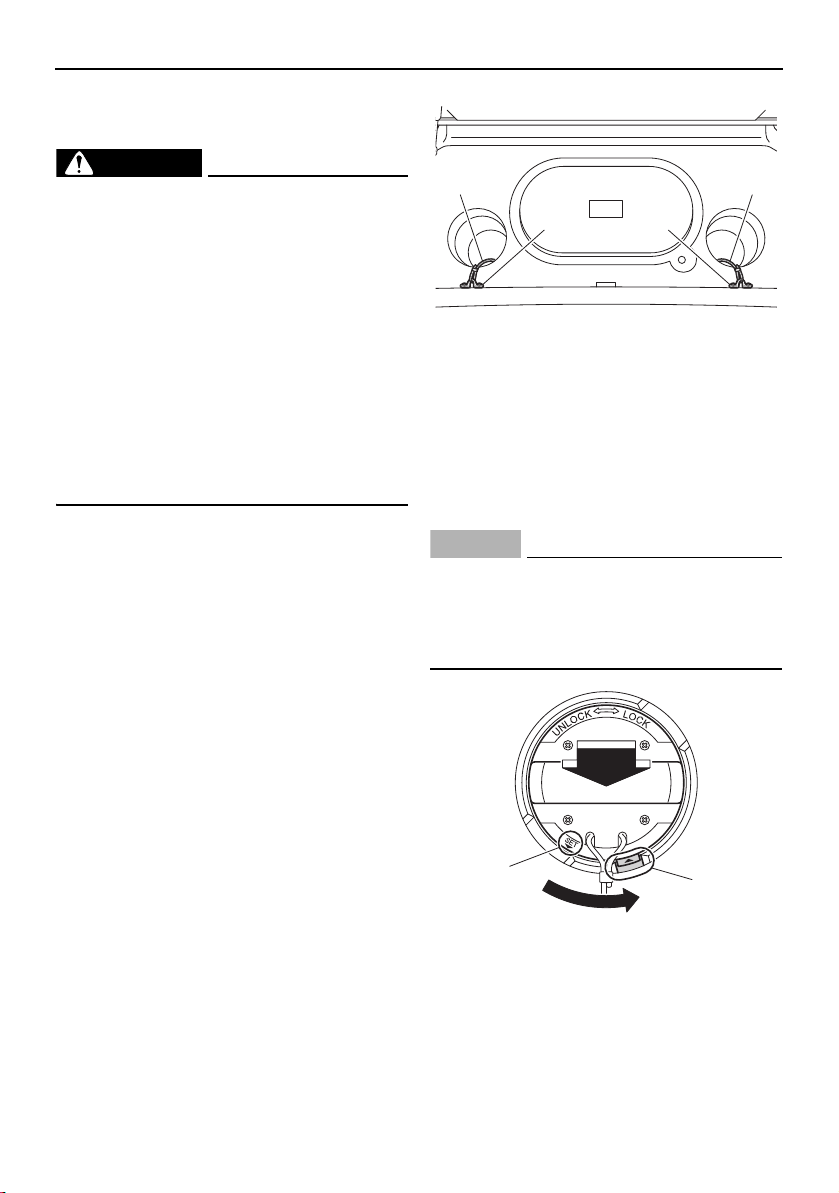
Trouble recovery
178
Emergency procedures
Jet pump clean-out procedure
WARNING
Severe injury or death may result if you ig-
nore any of the following:
● Turn off and remove both main switch
keys, remove the clip from the engine
shut-off switch, and wait for all move-
ment to stop before removing the ac-
cess port caps.
● Never override the interlocks to run the
engines with the rear platform hatch
open.
● The impellers have sharp edges. Be
careful when reaching into jet pump ar-
eas.
If weeds or debris get caught in the intakes or
impellers, cavitation can occur, and though
the engine speed rises, forward thrust will de-
crease. If this condition is allowed to continue,
jet pump damage can occur and the engines
may overheat and seize. If there is any sign
that a jet intake or impeller is clogged with
weeds or debris, follow this clean-out proce-
dure.
(1) Turn off and remove the main switch key,
remove the clip from the engine shut-off
switch, and wait for all movement to stop.
(2) Open the rear platform hatch. (See page
98.)
(3) Check that the retaining cord is securely
attached to the access port cap and strap
eye.
1 Retaining cord
2 Strap eye
(4) While holding the handle and pushing
down, turn the access port cap counter-
clockwise until the “SET” mark is aligned
with the slot, and then lift the cap by the
handle.
NOTICE
● Do not lift or pull the cap with the retain-
ing cord.
● Set the cap where it cannot be acciden-
tally knocked overboard.
1 “SET” mark
2 Slot
1
2
1
2
2
1
SportsBoat_F3R11.book Page 178 Friday, May 19, 2017 9:35 AM
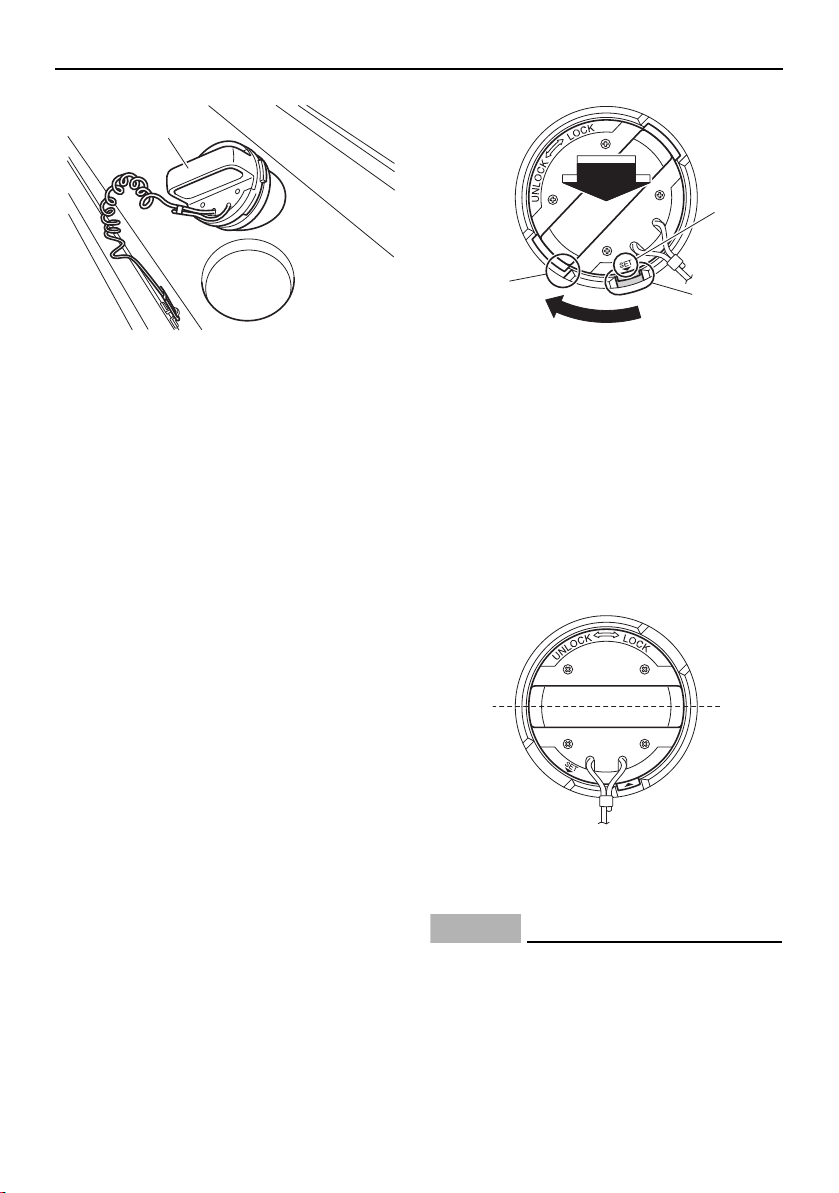
Trouble recovery
179
1 Access port cap
(5) Remove any weeds or debris from the
drive shaft, impeller, pump housing, and
jet thrust nozzle. If you cannot remove
the debris, consult a Yamaha Boat Deal-
er.
(6) To reinstall the access port cap, first
clean off any sand or other foreign matter
from the cap or port surfaces. Apply a
light coat of Yamalube Waterproof Ma-
rine Grease (P/N: ACC-GREAS-10-CT),
if available, to the seal of the access port
cap. If grease is not available, apply the
grease during the post-operation checks.
(7) Insert the cap so that the “SET” mark is
aligned with the slot, and then while
pushing the handle turn the cap clock-
wise until the “SET” mark is aligned with
the edge of the access port.
1 “SET” mark
2 Slot
3 Edge of the access port
(8) Check that the cap is perpendicular to the
centerline of the boat. Pull the handle
forcefully to make sure that the cap is
locked securely. If a strong pull will move
the access port cap, it is not locked se-
curely—the cap could be forced out by
water pressure during operation.
1 Perpendicular to the centerline of the boat
(9) Close the rear platform hatch.
NOTICE
● Be sure the access port caps are locked
securely in place. Otherwise, the caps
could be forced out of the access ports
by water pressure, causing loss of per-
formance and possible damage.
1
2
3
1
1
SportsBoat_F3R11.book Page 179 Friday, May 19, 2017 9:35 AM
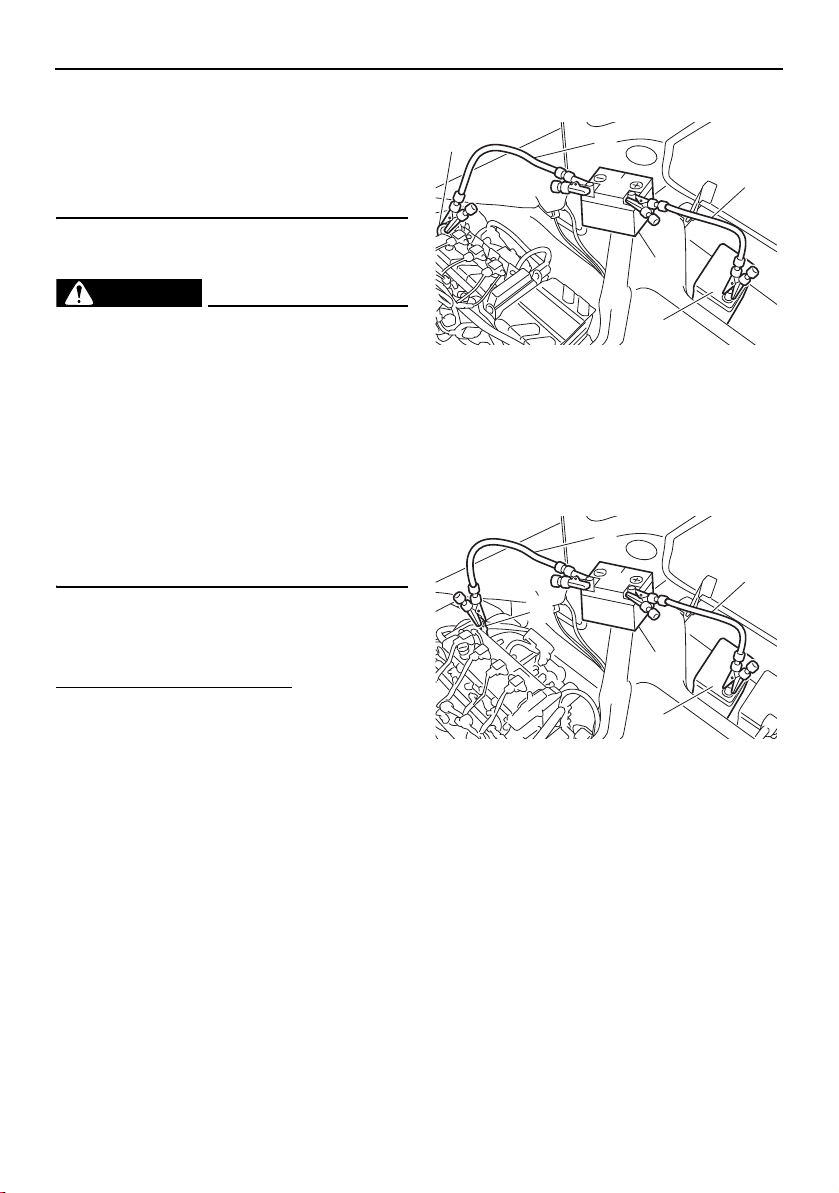
Trouble recovery
180
● The rear platform hatch has interlocks to
shut off the engines should the hatch be
accidentally opened during operation.
The engines will not restart unless the
hatch is closed and latched.
Jump-starting
WARNING
Severe injury or death may result if you ig-
nore any of the following:
● If the blowers will not operate, ventilate
the engine compartment by opening the
engine hood for several minutes before
attempting a jump-start.
● Do not connect the negative (–) jumper
cable to the negative (–) terminal of the
dead battery. Sparks could ignite battery
or fuel vapors, which could cause an ex-
plosion.
If the boat battery runs down, the engines can
be started in an emergency using a 12-volt
booster battery and jumper cables.
To connect the jumper cables:
(1) Connect the positive (+) terminal of the
dead battery to the positive (+) terminal of
the booster battery with the positive (+)
jumper cable.
(2) Connect one end of the negative (–)
jumper cable to the negative (–) terminal
of the booster battery.
(3) Connect the other end of the negative (–)
jumper cable to an engine hanger.
NOTICE: Be sure all connections are
secure and correct before attempting
to start the engine. Any wrong con-
nection may damage the electrical
system.
AR210 / SX210
1 Negative (–) jumper cable
2 Positive (+) jumper cable
3 Engine hanger
4 Booster battery
5 Starter battery
212X / 212 Limited S / 212 Limited
1 Negative (–) jumper cable
2 Positive (+) jumper cable
3 Engine hanger
4 Booster battery
5 Starter battery
(4) Start the engine, and then disconnect the
jumper cables by reversing the above
steps. NOTICE: Do not turn the main
switch key for more than 5 seconds. If
the engine does not start in 5 seconds,
release the main switch key and try
again after 15 seconds. Continuous
cranking for more than 5 seconds will
2
4
1
5
3
2
4
1
5
3
SportsBoat_F3R11.book Page 180 Friday, May 19, 2017 9:35 AM
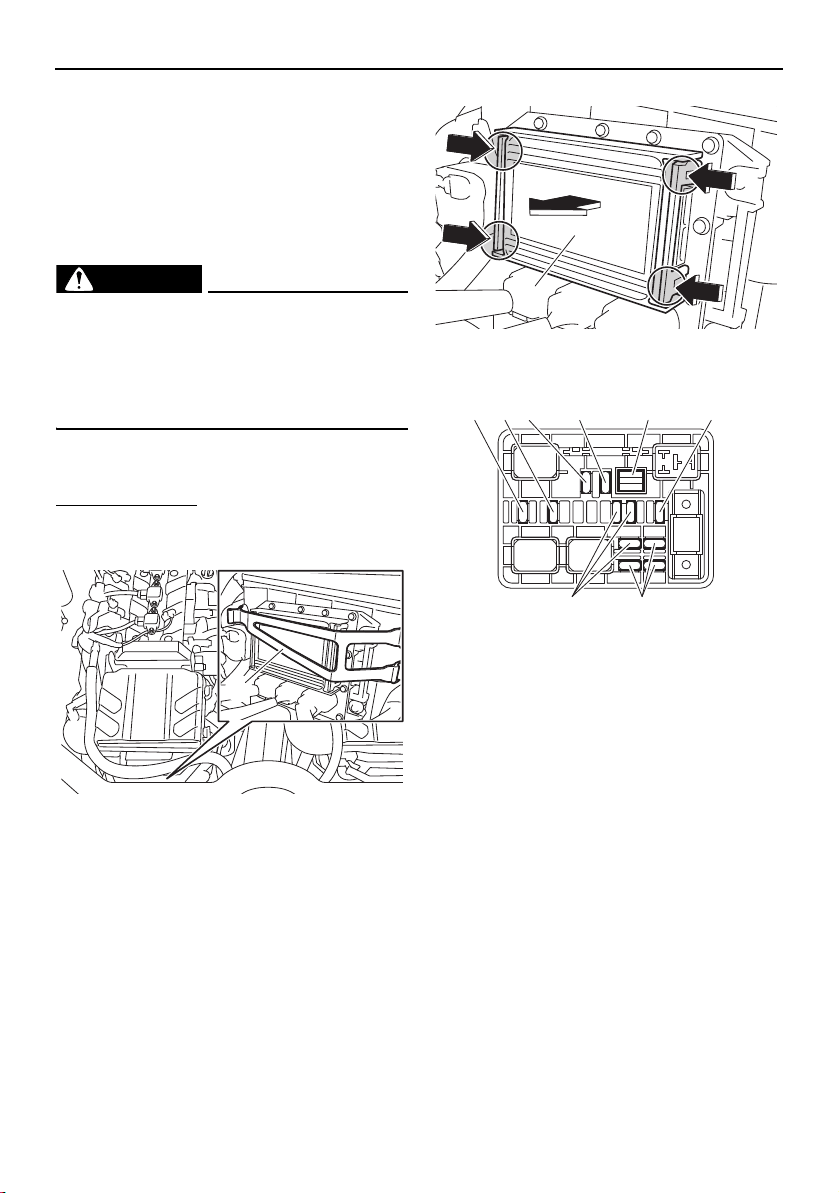
Trouble recovery
181
discharge the battery and the engine
will not start. The starter motor may
also be damaged if they are engaged
continuously for more than 5 sec-
onds.
Fuse replacement (AR210 / SX210)
WARNING
Do not use fuses of a higher amperage
than recommended. Substitution with a
fuse that has an improper rating can cause
extensive electrical system damage and
possible fire.
If a fuse is blown, replace it with the proper
fuse.
To replace a fuse:
(1) Open the engine hood. (See page 92.)
(2) Unfasten the band.
1 Band
(3) Remove the fuse box from the air filter
case by pulling the fuse box toward the
bow.
(4) While pushing both sides of the fuse box
cover inward, pull the cover toward the
bow and remove it.
1 Fuse box cover
1 Electronic throttle valve fuse
2 Fuel pump fuse
3 Main relay drive fuse
4 Main fuse
5 Fuse puller
6 Battery fuse
7 Spare fuse
8 Unused fuse
(5) When replacing the accessory fuse, re-
move the accessory fuse holder. (Open
the rear underseat storage compartment
[port] to access the accessory fuse. [See
page 95.])
1
1
123 4 5 6
78
SportsBoat_F3R11.book Page 181 Friday, May 19, 2017 9:35 AM
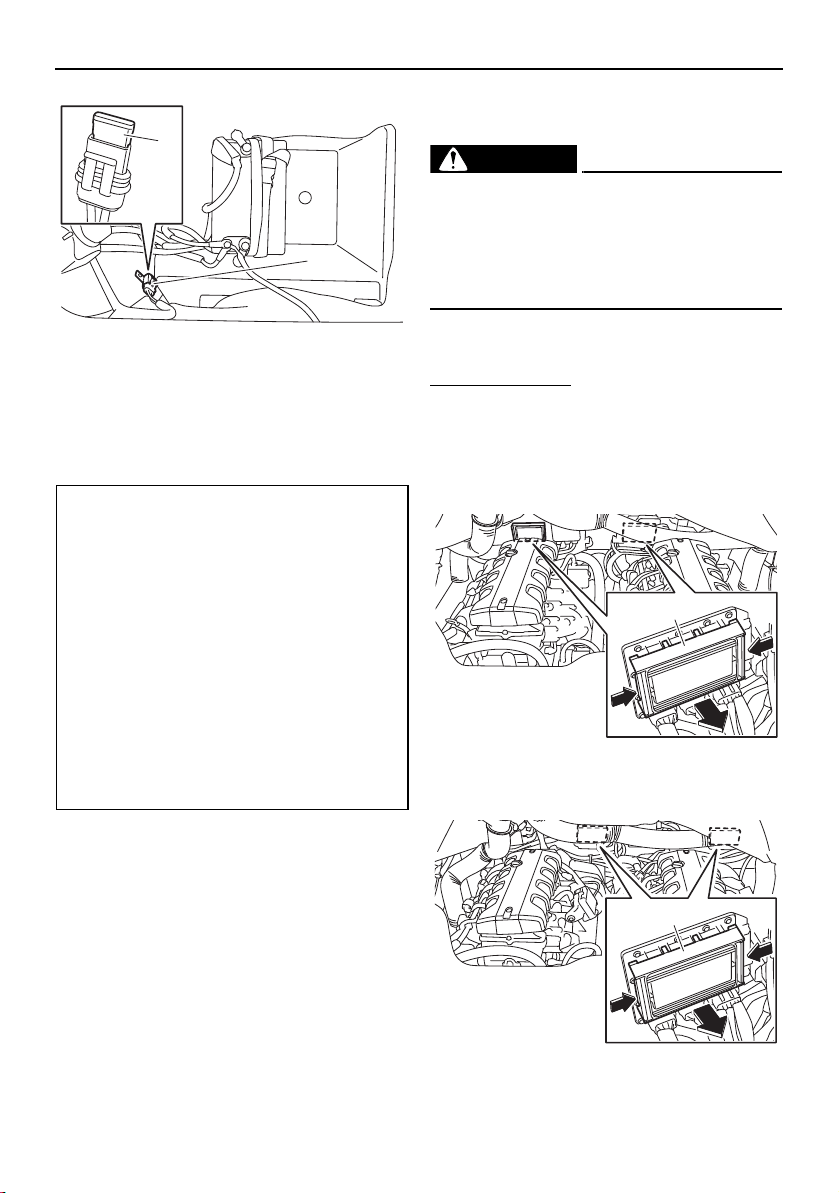
Trouble recovery
182
1 Accessory fuse holder
2 Accessary fuse
(6) Replace the blown fuse with the spare
fuse of the correct amperage by using the
fuse puller.
(7) Install the fuse box cover.
(8) If the accessory fuse was replaced, install
the accessory fuse holder.
(9) Install the fuse box to the air filter case.
(10) Fasten the band.
(11) Close the engine hood.
Fuse replacement
(212X / 212 Limited S / 212 Limited)
WARNING
Do not use fuses of a higher amperage
than recommended. Substitution with a
fuse that has an improper rating can cause
extensive electrical system damage and
possible fire.
If a fuse is blown, replace it with the proper
fuse.
To replace a fuse:
(1) Open the engine hood. (See page 92.)
(2) While pushing both sides of the fuse box
cover inward, pull the cover toward the
bow and remove it.
3-star models
1 Fuse box cover
4-star models
1 Fuse box cover
Fuse amperage:
Electronic throttle valve fuse:
10 A
Fuel pump fuse:
10 A
Main relay drive fuse:
10 A
Main fuse:
20 A
Battery fuse:
30 A
Accessory fuse:
20 A
2
1
1
1
SportsBoat_F3R11.book Page 182 Friday, May 19, 2017 9:35 AM

Trouble recovery
183
1 Electronic throttle valve fuse
2 Fuel pump fuse
3 Main relay drive fuse
4 Main fuse
5 Fuse puller
6 Battery fuse
7 Spare fuse
8 Unused fuse
(3) When replacing an accessory fuse, re-
move the accessory fuse holder or cover.
(Lift up the rear port seat to access the
accessory fuse. [See page 95])
212X
1 Accessory fuse holder
2 Accessory fuse cover
3 Accessory fuse
212 Limited S / 212 Limited
1 Accessory fuse cover
2 Accessory fuse
(4) Replace the blown fuse with the spare
fuse of the correct amperage by using the
fuse puller.
(5) Install the fuse box cover.
(6) If an accessory fuse was replaced, install
the accessory fuse holder or cover.
(7) Close the engine hood.
123 4 5 6
78
3
3
2
1
1
Fuse amperage:
Electronic throttle valve fuse:
10 A
Fuel pump fuse:
10 A
Main relay drive fuse:
10 A
Main fuse:
20 A
Battery fuse:
30 A
Accessory fuse:
40 A
30 A
20 A
2
1
SportsBoat_F3R11.book Page 183 Friday, May 19, 2017 9:35 AM
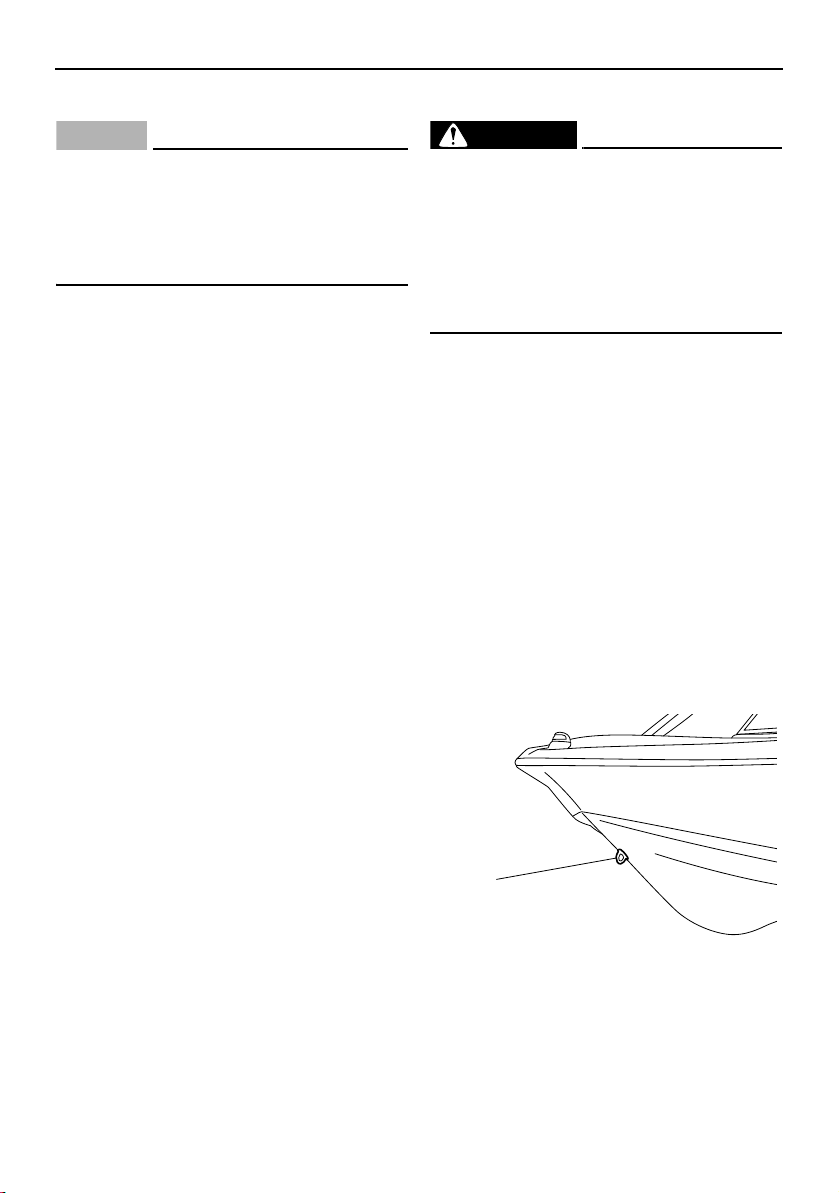
Trouble recovery
184
Running on one engine
NOTICE
Do not operate the boat above a no-wake
speed with just one engine.
Severe engine damage could result be-
cause water can flood the non-operating
engine through the water intake.
If one engine becomes inoperative, the prop-
erly running engine can be used to return to
shore. Operate at a no-wake speed to prevent
water from flooding the non-operating engine
through the water intake. The no-wake mode
can be used for this purpose. (See page 50,
82.)
Towing the boat
WARNING
● The operator of the towing boat must
keep speed to a minimum and avoid traf-
fic or obstacles which could be a hazard
to either boat.
● The towing line should be long enough
so the towed boat will not collide with
the towing boat when slowing down.
The boat should be towed only if it becomes
inoperative.
The towing rope should be long enough so
that the boat will not collide with the towing
boat when slowing down. A good rule of
thumb is a tow rope which is three times the
combined length of the towing boat and the
boat.
Tow the boat using the bow eye only. Tow the
boat at a no-wake speed. NOTICE: Do not
tow the boat at speed fast enough to leave
a wake (8 km/h, 5 mph). Severe engine
damage could result because water can
flood the non-operating engines through
the water intakes.
1 Bow eye
1
SportsBoat_F3R11.book Page 184 Friday, May 19, 2017 9:35 AM

185
Consumer information
Limited warranty
YAMAHA MOTOR CORPORATION, U.S.A.
YAMAHA BOAT LIMITED WARRANTY
Yamaha Motor Corporation, U.S.A. hereby warrants that new Yamaha Boats will be free from
defects in materials or workmanship for the period of time stated herein, subject to certain stated
limitations.
PERIOD OF WARRANTY: The hull and deck on any new Yamaha Boat purchased for pleasure
use from an authorized Yamaha Boat dealer in the United States will be warranted against major
structural defects for a period of five (5) years in pleasure use, or for one (1) year in commercial
applications. All other Yamaha Boat components will be warranted against defects in material or
workmanship, subject to exclusions noted herein, for a period of one (1) year from date of purchase
in pleasure use, or ninety (90) days from the date of purchase in commercial applications.
Replacement parts used in warranty repairs will be warranted for the balance of the applicable
warranty period.
The warranty described here applies to boats purchased and registered for use in the United
States only. For warranty pro
visions outside the United States, contact that particular country’s
local Yamaha distributor.
OBTAINING REPAIRS UNDER WARRANTY: During the period of warranty, any authorized
Yamaha Boat dealer will, free of charge, repair or replace, at Yamaha’s option, any parts adjudged
defective by Yamaha due to faulty workmanship or material from the factory. All parts replaced
under warranty will become the property of Yamaha Motor Corporation, U.S.A.
CUSTOMER’S RESPONSIBILITY: Under the terms of this warranty, the customer will be respon-
sible for ensuring that the boat is properly operated, maintained, and stored as specified in the
applicable Owner’s Manual.
The owner of the boat shall give notice to an authorized Yamaha Boat dealer of any and all appar-
ent defects within ten (10) days of discovery and make the boat available at that time for inspection
and repairs at the dealer’s place of business.
GENERAL EXCLUSIONS FROM WARRANTY: This warranty will not cover the repair of damage if
the damage is a result of a
buse or neglect of the product. Examples of abuse and neglect include,
but are not limited to:
1. Racing or competition use, modification of original parts, abnormal strain.
2. Lack of proper maintenance and off season storage as described in the Owner’s Manual,
installation of parts or accessories that are not equivalent in design and quality to genuine
Yamaha parts.
3. Use of lubricants, oils, and fuel/oil mixtures that are not suitable for boat motor use.
4. Damage as a result of accidents, collisions, contact with foreign materials, or submersion.
5. Growth of marine organisms on motor or hull surfaces.
6. Normal deterioration.
7. Gel coat stress cracks.
SportsBoat_F3R11.book Page 185 Friday, May 19, 2017 9:35 AM

Consumer information
186
SPECIFIC PARTS EXCLUDED FROM WARRANTY; Parts replaced due to normal wear or routine
maintenance such as oil, spark plugs, fuel filters, impeller and liner, and anodes are not covered
by warranty. Charges for transporting the boat to and from an authorized Yamaha Boat dealer are
excluded from warranty coverage.
EMISSION CONTROL WARRANTY: Yamaha warrants to the ultimate purchaser and any
subsequent owner, that the exhaust emission control components on this engine are designed,
built and equipped so as to conform at the time of sale with applicable regulations under section
213 of the Clean Air Act and that PWC engines used in Yamaha boats are free from defects in
materials and workmanship which cause said engines to fail to conform with applicable
regulations for thirty (30) months from the date of purchase or 175 hours of operation, whichever
comes first. For the inboard-classified engines used in Yamaha boats, this warranty period is
three (3) years from date of purchase or 480 hours whichever comes first. For evaporative
emission components, for a failure that will increase evaporative emissions, the warranty
coverage is two (2) years from the date of purchase. Some states may have different emission
control warranty provisions. As these vary from state to state, consult your Yamaha dealer or
contact Yamaha Customer Relations at 1-800-962-7926 for more information.
TRANSFER OF WARRANTY: Transfer of the warranty from the original purchaser to any subse-
quent purchaser is possible by having the boat inspected by an authorized Yamaha Boat dealer
and requesting the dealer to submit a change of registration to Yamaha Motor Corporation,
U.S.A. within ten (10) days of the transfer.
YAMAHA MOTOR CORPORATION, U.S.A. MAKES NO OTHER WARRANTY OF ANY KIND,
EXPRESSED OR IMPLIED. ALL IMPLIED WARRANTIES OF MERCHANTABILITY AND FITNESS
FOR A PARTICULAR PURPOSE WHICH EXCEED THE OBLIGATIONS AND TIME LIMITS STATED
IN THIS WARRANTY ARE HEREBY DISCLAIMED BY YAMAHA MOTOR CORPORATION,
U.S.A. AND EXCLUDED FROM THIS WARRANTY.
SOME STATES DO NOT ALLOW LIMITATIONS ON HOW LONG AN IMPLIED WARRANTY
LASTS, SO THE ABOVE LIMITATION MAY NOT APPLY TO YOU. ALSO EXCLUDED FROM THIS
WARRANTY ARE ANY INCIDENTAL OR CONSEQUENTIAL DAMAGES INCLUDING LOSS OF
USE. SOME STATES DO NOT ALLOW THE EXCLUSION OR LIMITATION OF INCIDENTAL OR
CONSEQUENTIAL DAMAGES. SO THE ABOVE EXCLUSION MAY NOT APPLY TO YOU.
THIS WARRANTY GIVES YOU SPECIFIC LEGAL RIGHTS, AND YOU MAY ALSO HAVE OTHER
RIGHTS WHICH VARY FROM STATE TO STATE.
YAMAHA MOTOR CORPORATION, U.S.A.
Post Office Box 6555
Cypress, California 90630
WARRANTY QUESTIONS AND ANSWERS
Q. What costs are my responsibility during the warranty period?
A. The customer’s responsibility includes all costs of normal maintenance services, non-warranty
repairs, accident, and collision damages.
Q. What are some examples of “abnormal” strain, neglect, or abuse?
A. These terms are general and overlap each other in areas. Specific examples include:
Running the boat out of oil, operating the boat with a broken or damaged part which causes
another part to fail, and so on. If you have any specific questions on operation or maintenance,
please contact your Yamaha Boat dealer for advice.
Q. Does the warranty cover incidental costs such as transportation due to a failure?
A. No. The warranty is limited to repair of the boat itself.
SportsBoat_F3R11.book Page 186 Friday, May 19, 2017 9:35 AM

Consumer information
187
CUSTOMER SERVICE
If your boat requires warranty service, you must take it to any authorized Yamaha Boat dealer
within the United States. Be sure to bring your warranty registration card or other valid proof of the
original date of purchase. If a question or problem arises regarding warranty, first contact the owner
of the dealership. Since all warranty matters are handled at the dealer level, this person is in the
best position to help you. If you are still not satisfied and require additional assistance, please write:
CHANGE OF ADDRESS
The federal government requires each manufacturer to maintain a complete, up-to-date list of all
first purchasers against the possibility of a safety-related defect and recall. This list is compiled
from the purchase registrations sent to Yamaha Motor Corporation, U.S.A. by the selling dealer at
the time of your purchase.
If you should move after you have purchased your new boat, please advise us of your new address
by sending a postcard listing your Yamaha model name, engine number, dealer number [or deal-
er’s name] as it is shown on your warranty card, your name and new mailing address.
Mail to:
YAMAHA MOTOR CORPORATION, U.S.A.
CUSTOMER RELATIONS DEPARTMENT
P.O. Box 6555
Cypress, California 90630
YAMAHA MOTOR CORPORATION, U.S.A.
WARRANTY DEPARTMENT
1270 Chastain Road
Kennesaw, Georgia 30144
This will ensure that Yamaha Motor Corporation, U.S.A. has an up-to-date registration record in
accordance with federal law.
Q. May I perform any or all of the recommended maintenance shown in the Owner’s Manual
instead of having the dealer do them?
A. Yes, if you are a qualified mechanic and follow the procedures specified in the Owner’s and
Service Manual. We do recommend, however, that items requiring special tools or equipment
be done by a Yamaha Boat dealer.
Q. Will the warranty be void or cancelled if I do not operate or maintain my new boat exactly as
specified in the Owner’s Manual?
A. No. The warranty on a new boat cannot be “voided” or “cancelled.” However, if a particular
failure is caused by operation or maintenance other than as shown in the Owner’s Manual,
that failure may not be covered under warranty.
Q. What responsibility does my dealer have under this warranty?
A. Each Yamaha Boat dealer is expected to:
1. Completely set up each new boat before sale.
2. Explain the operation, maintenance, and warranty requirements to your satisfaction at the
time of sale, and upon your request at any later date. In addition, each Yamaha Boat dealer
is held responsible for his setup, service and warranty repair work.
Q. Is the warranty transferable to second owners?
A. Yes. The remainder of the existing warranty can be transferred upon request. The unit has
to be inspected and re-registered by an authorized Yamaha Boat dealer for the policy to
remain effective.
SportsBoat_F3R11.book Page 187 Friday, May 19, 2017 9:35 AM
Consumer information
188
YAMAHA EXTENDED SERVICE (Y.E.S.)
Keep your Yamaha Boat protected even after
the 1-year warranty coverage provisions
expire with genuine Yamaha Extended Service
(Y.E.S.).
Y.E.S. is designed and administered by
Yamaha Motor Corporation to provide maxi-
mum owner satisfaction. You get uninterrupted
factory-backed coverage for extra peace of
mind.
This excellent Y.E.S. plan coverage is only
available to Yamaha owners like you, and only
while your Yamaha is still within the first year
of the Yamaha Limited Warranty period. So
visit your authorized Yamaha dealer to get all
the facts. He can show you how easy it is to
protect your investment with Yamaha Extended
Service. We urge you to act now. You’ll get
the excellent benefits of TRIP coverage right
away, and you’ll rest easy knowing you’ll have
strong factory-backed protection even after
your Yamaha Limited Warranty expires. See
your dealer today!
A special note:
If visiting your dealer isn’t convenient, contact
Yamaha with your Primary ID number or Hull
Identification Number. We’ll be happy to help
you get the Y.E.S. coverage you need.
Yamaha Service Marketing
P.O. Box 6555
Cypress, CA 90630
1-(866)-YES-EXTD
(1-866-937-3983)
•
Y.E.S. is flexible. You choose the plan that’s
right for you: 12 months, 24 months, or 36
months beyond the 1-year warranty cover-
age period. That means you can get up
to 5 years of coverage on the power train,
controls, and other components to match
the comforting 5-year standard protection on
the hull.
•
Y.E.S. is designed and administered by the
same Yamaha people who handle your war-
ranty–and it shows in the comprehensive
coverage benefits. There are no limitations
on hours of use. Coverage isn’t limited to
“moving parts” or the “drive train” like many
other plans. And Y.E.S. covers manufactur-
ing defects just like the warranty. See the
sample contract at your Yamaha dealer to
see how comforting uninterrupted factory-
backed protection can be.
•
You don’t have to pay anything for cov-
ered repairs. There’s no deductible to pay,
and repairs aren’t “prorated.” You don’t have
any “out-of-pocket” expenses for covered
repairs.
•
In addition, Travel and Recreation
Interruption Protection (TRIP) is included
at no extra cost. TRIP gives you up to $250
reimbursement per occurrence for any rea-
sonable expenses you incur because your
Yamaha needs covered service: replace-
ment vehicle rental, emergency towing,
phone calls, even food and lodging when
you are away from home. This superb cov-
erage goes into effect when you purchase
Y.E.S., so it applies to any warranty repairs
as well as covered repairs during your entire
Y.E.S. plan period.
•
Y.E.S. coverage is honored at any autho-
rized Yamaha dealer nationwide.
•
Y.E.S. coverage is transferable to a new
owner if you sell or trade-in. That can make
your Yamaha Boat much more valuable!
SportsBoat_F3R11.book Page 188 Friday, May 19, 2017 9:35 AM
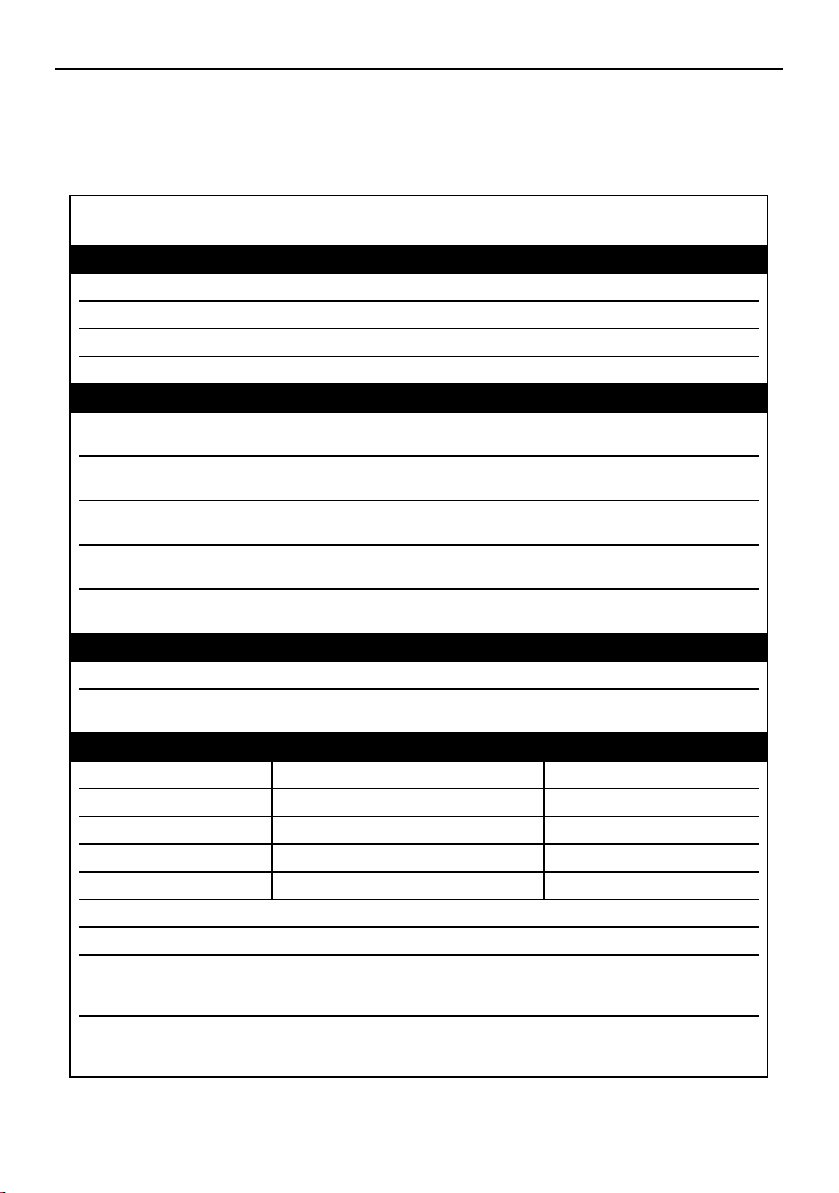
Consumer information
189
Sample float plan
Leave a float plan with a responsible person on shore before boating. The example below can
be copied and used.
FLOAT PLAN
VESSEL INFORMATION
BOAT MAKE:
Yamaha
MOTOR TYPE:
Jet
MODEL:
LENGTH: REGISTRATION NO:
DECK COLOR: HULL COLOR:
PASSENGER
OPERATOR
ADDRESS:
EMERGENCY PHONE:
PASSENGER #1:
ADDRESS:
EMERGENCY PHONE:
PASSENGER #2:
ADDRESS:
EMERGENCY PHONE:
PASSENGER #3:
ADDRESS:
EMERGENCY PHONE:
PASSENGER #4:
ADDRESS:
EMERGENCY PHONE:
DEPARTURE INFORMATION
POINT OF DEPARTURE: DATE/TIME:
TOW VEHICLE
MAKE / MODEL
LICENSE: TRAILER LICENSE:
DESTINATION INFORMATION
DESTINATION: LORAN OR GPS COORDINATES: INTENDED ACTIVITY:
EXPECTED RETURN DATE: TIME:
LOCAL U.S. COAST GUARD PHONE #:
NOTES: HULL COLOR:
OPERATOR
ADDRESS:
EMERGENCY PHONE:
PASSENGER #1:
ADDRESS:
EMERGENCY PHONE:
SportsBoat_F3R11.book Page 189 Friday, May 19, 2017 9:35 AM

190
Index
A
Access port cap check ........................... 128
Accessory outlet................................. 58, 86
Additional equipment
recommendations ................................. 17
Anchor light (AR210 /
212X / 212 Limited S) ......................... 101
Anchor light (SX210 / 212 Limited) ........ 101
Anchor storage compartment................... 92
Anchoring............................................... 147
Approval labels of emission control
certificate ................................................ 2
Audio control keypad................................ 58
Audio system settings .............................. 76
Auxiliary input jack connections ............... 74
B
Backing your trailer ................................ 152
Basic stain guide .................................... 159
Battery care (212X /
212 Limited S / 212 Limited)............... 161
Battery care (AR210 / SX210)................ 160
Battery check ......................................... 131
Battery switch (AR210 / SX210)............... 37
Battery switches (212X /
212 Limited S / 212 Limited)................. 38
Beaching ................................................ 147
Bilge water check................................... 131
Bilge water, draining............................... 120
Bilge water, draining (automatic).............. 71
Bilge water, draining (non-automatic) ...... 72
Bilge water, draining on land.................. 120
Bilge water, draining on water................ 121
Bimini top, installing
(AR210 / 212X / 212 Limited S) .......... 111
Bimini top, installing
(SX210 / 212 Limited) ......................... 114
Bimini top, removing
(AR210 / 212X / 212 Limited S) .......... 111
Bimini top, removing
(SX210 / 212 Limited) ......................... 114
Bimini top, setting up
(AR210 / 212X / 212 Limited S) .......... 108
Bimini top, setting up
(SX210 / 212 Limited) ......................... 112
Bimini top, storing
(AR210 / 212X / 212 Limited S) .......... 110
Bimini top, storing in the fully collapsed
position (SX210 / 212 Limited)............ 114
Bimini top, storing in the upright
position (SX210 / 212 Limited)............ 113
Bimini top, trailering
(AR210 / 212X / 212 Limited S) .......... 111
Bimini top, trailering
(SX210 / 212 Limited) ......................... 114
Bimini top™
(AR210 / 212X / 212 Limited S) .......... 108
Bimini top™
(SX210 / 212 Limited) ......................... 112
Blower checks
(212X / 212 Limited S / 212 Limited) .. 133
Blower switch check (AR210 / SX210)... 132
Bluetooth connections.............................. 72
Boarding from a dock or landing jetty..... 145
Boarding from the bow ........................... 145
Boarding from the water......................... 145
Boat characteristics.................................. 18
Boat control functions............................... 37
Boating with passengers ........................ 144
Bow ladder ............................................. 102
C
Check engine warning........................ 55, 84
Cleaning the boat ................................... 156
Communication error warning .................. 85
Cooling water pilot outlet check ............. 136
Crossing wakes and swells .................... 148
Cruise assist....................................... 51, 81
“CRUISE/NO WAKE” buttons................... 81
Cruising information display
(trip screen tab)............................... 47, 64
Cruising limitations ................................... 15
D
Data bar ................................................... 45
Depth warning .......................................... 85
Displaying and resetting the
maintenance counter ............................ 80
Docking .................................................. 145
Drain plug check .................................... 131
Draining the bilge water ........................... 54
SportsBoat_F3R11.book Page 190 Friday, May 19, 2017 9:35 AM

Index
191
Driver’s seat
(212X / 212 Limited S / 212 Limited) .... 89
Driver’s seat (AR210 / SX210) ................. 88
Driver’s side console compartment .......... 96
Driving your boat.................................... 138
E
Emergency procedures .......................... 178
Emission control information ...................... 2
Enclosed head compartment ................... 95
Engine break-in
(212X / 212 Limited S / 212 Limited) .. 123
Engine break-in (AR210 / SX210).......... 123
Engine compartment, ventilating
(automatic)............................................ 70
Engine compartment, ventilating
(non-automatic)..................................... 70
Engine covers, removing and installing
(212X / 212 Limited S / 212 Limited) .. 166
Engine hood ............................................. 92
Engine oil ............................................... 116
Engine oil level check............................. 129
Engine oil requirement ........................... 116
Engine serial numbers ............................... 1
Engine shut-off cord (lanyard) check ..... 136
Engine shut-off switch .............................. 37
Engine shut-off switch check.................. 136
Enjoy your boat responsibly ..................... 25
F
Fire extinguisher check .......................... 127
Flushing the cooling system................... 155
Front underseat storage compartments ... 93
Front walk-through ................................... 99
Fuel ........................................................ 115
Fuel level check ..................................... 137
Fuel requirement.................................... 115
Fuel system............................................ 163
Fuel system checks................................ 129
Fuse replacement
(212X / 212 Limited S / 212 Limited) .. 182
G
Generic warning ....................................... 57
Getting to know your boat ...................... 138
Glossary, boat .......................................... 26
Glove compartment
(212X / 212 Limited S / 212 Limited) .... 97
Glove compartment (AR210 / SX210)...... 97
Grease points......................................... 163
H
Hazard information................................... 18
Helm controls
(212X / 212 Limited S / 212 Limited) .... 59
Helm controls (AR210 / SX210) ............... 43
High voltage warning................................ 85
Hitch ....................................................... 151
Horn check ............................................. 135
Horn switch .............................................. 53
Hull Identification Number (HIN)................. 1
I
Identification number records..................... 1
Information display (home screen tab) ..... 46
Information display (home screen tab
[float mode]).......................................... 64
Information display (home screen tab
[standard mode])................................... 63
J
Jet intake checks....................................129
Jet pump clean-out procedure ............... 178
Jump-starting ......................................... 180
L
Labels, important........................................ 6
Labels, other ............................................ 13
Labels, warning .......................................... 9
Launching............................................... 153
Learning to operate your boat ................ 138
Leaving a dock ....................................... 142
Lifting...................................................... 154
Light operation ......................................... 52
Light operation
(light control screen tab) ....................... 66
Limitations on who may operate the
boat....................................................... 14
Limited warranty ..................................... 185
Loading .................................................. 153
Long-term storage.................................. 163
Low fuel level warning .............................. 85
SportsBoat_F3R11.book Page 191 Friday, May 19, 2017 9:35 AM

Index
192
Low oil pressure warning ................... 55, 84
Low voltage warning ................................ 85
Lubrication.............................................. 163
M
Main components, location ...................... 27
Main switches........................................... 39
Maintenance........................................... 166
Manufactured date label
(212X / 212 Limited S / 212 Limited) ...... 4
Manufactured date label
(AR210 / SX210)..................................... 4
Media screen tab...................................... 72
Multi-function display elements .......... 44, 62
Multi-function display unit operation... 44, 60
Multi-function display unit settings
(setting screen tab) ......................... 47, 77
N
Navigation and anchor lights checks
(212X / 212 Limited S / 212 Limited) .. 135
Navigation and anchor lights switch
check (AR210 / SX210) ...................... 134
Night operation......................................... 19
No-wake mode ................................... 50, 82
No-wake mode/cruise assist switch ......... 50
O
Operation buttons..................................... 61
Operational requirements......................... 16
Over temperature warning ................. 55, 84
Owner’s/operator’s manual and
tool kit ................................................. 166
P
Passenger’s seat
(212X / 212 Limited S / 212 Limited) .... 91
Periodic maintenance chart.................... 168
Post-launch checks................................ 136
Post-operation care................................ 155
Post-operation checks............................ 149
Pre-launch checks.................................. 126
Pre-operation check points .................... 126
Pre-operation checklist........................... 124
Primary Identification (PRI-ID) number ...... 1
R
Radio broadcasts ..................................... 75
Rear underseat storage compartment
(port) ..................................................... 95
Rear underseat storage compartment
(starboard) ............................................ 94
Rear walk-through .................................... 99
Remote control keypad ............................ 86
Remote control lever checks.................. 126
Remote control levers .............................. 39
Required equipment................................. 17
Resetting the settings to the default
settings ........................................... 50, 79
Reverse RPM control ......................... 52, 82
Rules of the road ...................................... 21
Running on one engine .......................... 184
S
Sample float plan ................................... 189
Screen tabs (screen tab bar).............. 45, 63
Seats ........................................................ 87
Selecting the display units.................. 48, 79
Setting the day mode and
night mode ...................................... 49, 78
Setting the depth alarm ...................... 49, 78
Setting the display language .................... 49
Setting the time .................................. 48, 79
Side table ............................................... 104
SiriusXM radio broadcasts ....................... 76
Ski locker.................................................. 93
Speaker volume level, adjusting .............. 72
Specifications
(212X / 212 Limited S / 212 Limited) .. 173
Specifications (AR210 / SX210)............. 171
Star labels (4-star models) ......................... 4
Starboard/port engine wellness alarm
display................................................... 48
Starting the engines ............................... 138
Steering.................................................... 41
Steering system checks ......................... 126
Stern ladder............................................ 103
Stopping the boat ................................... 144
Stopping the engines ............................. 141
Storage compartments............................. 92
SportsBoat_F3R11.book Page 192 Friday, May 19, 2017 9:35 AM

Index
193
Stowable table
(212X / 212 Limited S / 212 Limited...... 97
Swim platform ........................................ 103
Switch circuit breakers ............................. 57
System control screen tab........................ 68
T
Tachometers ...................................... 44, 60
Tilt lever.................................................... 42
To get more boating safety information.... 25
Towing the boat...................................... 184
Trailering checklist ................................. 151
Trailering the boat .................................. 151
Troubleshooting ..................................... 176
Troubleshooting chart ............................ 176
Turning the anchor light and bow light
on or off........................................... 52, 67
Turning the anchor light on or off ............. 66
Turning the boat ..................................... 142
Turning the courtesy light on or off........... 52
Turning the courtesy lights on or off......... 67
U
USB connections...................................... 74
V
Ventilating the engine compartment......... 54
W
Wake size, adjusting ................................ 69
Wakeboard tower
(AR210 / 212X / 212 Limited S) .......... 105
Wakeboard tower, collapsing and
setting up ............................................ 106
Wakeboard tower, collapsing and
setting up (212X / 212 Limited S) ....... 107
Wakeboarding and water-skiing............... 20
Walk-through............................................ 99
Warning definition table...................... 54, 83
Warnings............................................ 54, 83
Water intake, shutting off ......................... 70
Weather radio broadcasts........................ 75
Wet storage compartment........................ 98
Windshield................................................ 99
Y
YAMAHA EXTENDED SERVICE
(Y.E.S.) ............................................... 188
SportsBoat_F3R11.book Page 193 Friday, May 19, 2017 9:35 AM

SportsBoat_F3R11.book Page 194 Friday, May 19, 2017 9:35 AM

For your best ownership experience, think Genuine Yamaha!
Genuine Yamaha Parts – Genuine Yamaha replacement parts are the exact same
parts as the ones originally equipped on your vehicle, providing you with the
performance and durability you have come to expect. Why settle for aftermarket parts
that may not provide full confidence and satisfaction?
Genuine Yamaha Accessories – Yamaha only offers accessories that meet our
high standards for quality and performance. Buy with confidence, knowing your
Genuine Yamaha Accessories will fit right and perform right – right out of the box.
Yamalube – Take care of your Yamaha with legendary Yamalube oils, lubricants,
and care products. They’re formulated and approved by the toughest judges we
know: the Yamaha engineering teams that know your Yamaha from the inside out.
Genuine Yamaha Service Manuals – Get the same factory manual for yo
ur vehicle
that the technicians at your authorized Yamaha dealer use. Service manuals are
available through your Yamaha dealer or you can order them directly through
yamahapubs.com.
Genuine Yamaha products are available only from your Yamaha dealer.
Find out more at yamaha-motor.com
SportsBoat_F3R11.book Page 1 Friday, May 19, 2017 9:35 AM

DIC183
Printed in USA
July 2017–0.3 × 1 CR