This personal space offers advice and other useful information for
the care and maintenance o
f
y
our vehicle.
You can
f
ind
y
our user
g
uide on the PEU
G
E
O
T website, under the
h
ea
di
n
g
"P
ersona
l
space
"
.
Re
f
errin
g
to the user
g
uide on-line also
g
ives
y
ou access to the
latest in
f
ormation available, easil
y
identi
f
ied b
y
the bookmarks,
associated with this picto
g
ram:
I
f
the headin
g
"Personal space" is not available on the public website
f
or
y
our countr
y
,
y
ou can find
y
our user
g
uide at the followin
g
add
r
ess
:
http:
//
public.servicebox.peu
g
eot.com
the link in "Private customer access",
t
h
e
l
an
g
ua
g
e,
the model,
the edition date appropriate
f
or the date o
f
re
g
istration o
f
y
our vehicle.
P
lease note the followin
g
point:
The fittin
g
of electrical equipment or accessories which are
n
ot recommended b
y
PEU
G
E
O
T ma
y
result in a
f
ailure o
f
y
our
vehicle's electronic s
y
stem. Please note this specific warnin
g
.
It is advisable to contact a PEU
G
E
O
T dealer to be shown the
r
ecommended equipment and accessories.
Se
l
ec
t:
You will
f
ind
y
our user
g
uide, presented in the same wa
y
as the paper version.
!
i
1
Thank you for choosing a 308, symbol
of confi dence, passion and inspiration.
Page reference:
this symbol invites you to refer to
the pages which provide details of
the function.
Key
Protection of the environment:
this symbol accompanies advice
relating to protection of the envi-
ronment.
Information:
this symbol draws your attention
to additional information for better
use of your vehicle.
Warning:
this symbol marks warnings which
it is essential to observe for your
own safety, for the safety of others
or to avoid any risk of damaging
your vehicle.
Your vehicle is fi tted with only some of the
equipment described in this document,
depending on its trim level, version and
the specifi cation for the country in which
it was sold.
WELCOME
This handbook has been designed to
enable you to make the most of your
308 saloon or 308 SW.
On the fi rst few pages, you will fi nd a
detailed summary, followed by a quick
reference guide intended to make it
easier for you to become familiar with
your vehicle.
All of the details specifi c to your 308,
comfort, safety, driving, are then pre-
sented in this handbook, to increase
your appreciation of the vehicle and
make the most of it.
308 saloon
308 SW with bench rear
seat
308 SW with individual rear
seats
At the end of the handbook, a visual
search enables you to identify the spe-
cial features in relation to the outline
illustration of your vehicle, saloon or SW.
Key
This key will enable you to distinguish
the special features of your vehicle:

2
CONTENT
S
Instrument panels 25
Warning and indicator lamps 29
Indicators 39
Instrument panel buttons 43
Ventilation 61
Heating 63
Manual air conditioning 63
Rear screen demist - defrost 65
Dual-zone digital air conditioning 66
Front seats 68
Rear seats 72
Seat modularity 78
Mirrors 80
Steering wheel adjustment 82
COMFORT 61 Î 82
Remote control key 83
Alarm 87
Electric windows 89
Doors 91
Boot 94
Panoramic sunroof 95
Fuel tank 96
Misfuel prevention (Diesel) 97
ACCESS 83 Î 98
Lighting controls 99
LED lamps 101
Daytime running lamps 101
Headlamp adjustment 103
Directional lighting 104
Wiper controls 105
Automatic rain sensitive wipers 107
Courtesy lamps 108
Interior mood lighting 109
Boot lamp 109
VISIBILITY 99 Î 109
Child seats 125
ISOFIX child seats 131
Child lock 136
CHILD
SAFETY 125 Î 136
FAMILIARISATION 4 Î 22
INSTRUMENTS and
CONTROLS 25 Î 44
Screens without audio equipment 45
Screens with audio equipment 47
Retractable colour screen
(Peugeot Connect Navigation (RT6))
52
Retractable colour screen (Peugeot Connect
Media Navigation (NG4 3D))
54
Trip computer 57
MULTIFUNCTION
SCREENS
45 Î 60
Interior fi ttings 110
Front armrest 113
Boot fi ttings 116
FITTINGS 110 Î 124
7
5
4
3
2
6
ECO-DRIVING 23 Î 24

3
CONTENT
S
Direction indicators 137
Hazard warning lamps 137
Horn 137
Tyre under-infl ation detection 138
Emergency or assistance call 139
Braking assistance systems 139
Trajectory control systems 140
Front seat belts 141
Airbags 146
SAFETY 137 Î 149
Parking brake 150
Manual gearbox 150
Gear shift indicator 151
Hill start assist 152
6-speed electronic
gear control gearbox 153
Automatic gearbox 157
Stop & Start 160
Speed limiter 163
Cruise control 165
Parking sensors 167
DRIVING 150 Î 168
Bonnet 170
Running out of fuel (Diesel) 171
Petrol engines 172
Diesel engines 173
Checking levels 174
Checks 176
CHECKS 169 Î 177
Temporary puncture repair kit 178
Changing a wheel 187
Changing a bulb 194
Changing a fuse 201
Battery 207
Energy economy mode 210
Changing a wiper blade 211
Towing the vehicle 211
Towing a trailer 214
Very cold climate screen 215
Fitting roof bars 216
Accessories 217
PRACTICAL
INFORMATION 178 Î 218
Petrol engines 219
Petrol weights 222
Diesel engines 228
Diesel weights 231
Dimensions 240
Identifi cation markings 241
TECHNICAL
DATA 219 Î 242
AUDIO EQUIPMENT
and TELEMATICS 243 Î 364
VISUAL SEARCH 365 Î 371
ALPHABETICAL
INDEX 372 Î 376
Emergency or assistance 243
Peugeot Connect Media
Navigation (NG4 3D) 247
Peugeot Connect Navigation (RT6)
291
Peugeot Connect Sound (RD5) 345
8
9
10
11
12
4
FAMILIARISATIO
N
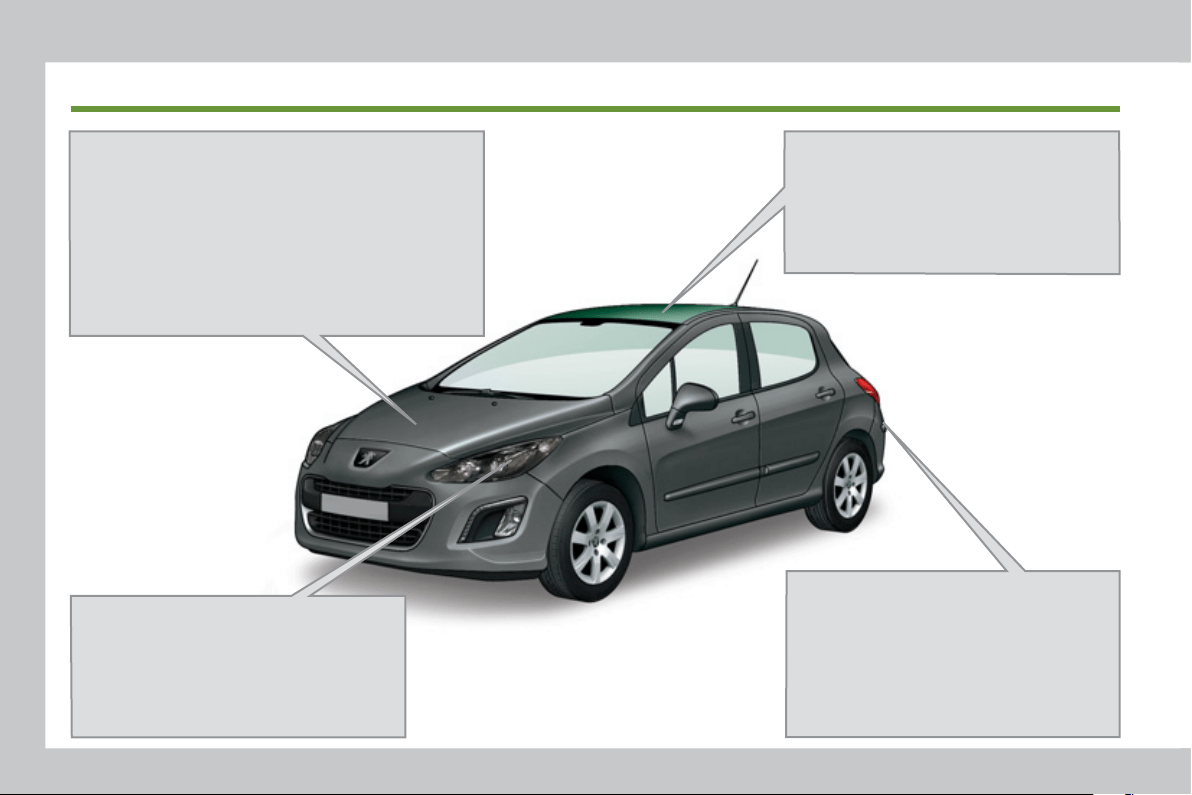
EXTERIOR
Stop & Start system
This system puts the engine temporarily into
standby during stops in the traffi c (red lights,
traffi c jams, etc....). The engine restarts auto-
matically as soon as you want to move off.
The Stop & Start system reduces fuel con-
sumption, exhaust emissions and the noise
level when stationary.
160
Directional lighting
This lighting automatically provides
additional visibility when cornering.
104
Panoramic sunroof
This roof provides incomparable vis-
ibility and light in the passenger com-
partment.
95
Temporary puncture repair kit
This kit is a complete system, con-
sisting of a compressor and a sealant
cartridge, for the temporary repair of
a tyre.
178
5
FAMILIARISATION
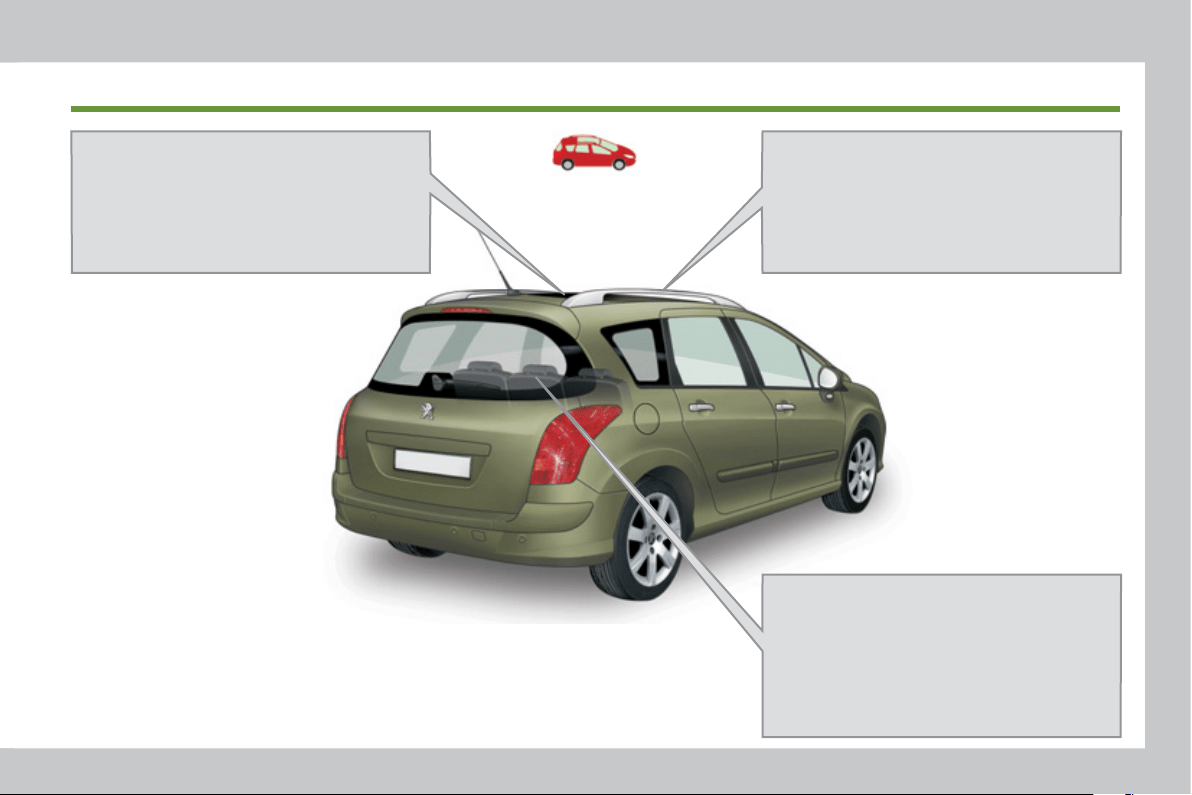
EXTERIOR
Roof bars
Transverse bars fi tted on longitudinal
bars, these allow you to load long and
bulky objects on the roof.
216
Panoramic sunroof
This roof provides incomparable visibility
and light in the passenger compartment.
95
Seat modularity
The individual rear seats of the 2nd and
3rd rows can be arranged in various
ways to permit different layout and load-
ing confi gurations.
78
6
FAMILIARISATIO
N
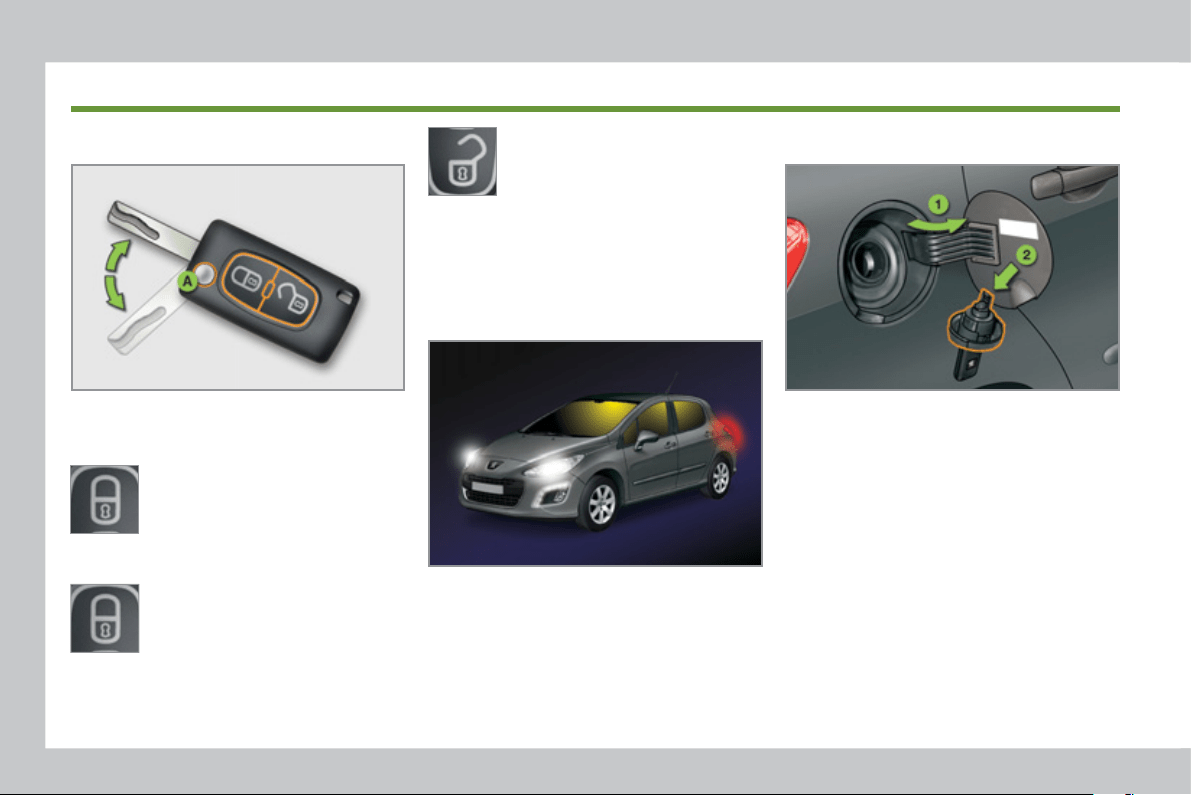
ACCE
SS
Remote control key
A. Unfolding / Folding the key
(fi rst press this button).
Normal locking
(press once; fi xed lighting of
the direction indicators).
Fuel tank
1. Opening the fuel fi ller fl ap.
2. Opening and hooking the fuel fi ller
cap.
Unlocking of the vehicle
(rapid fl ashing of the direction
indicators).
In the same way, the passenger com-
partment lighting, such as the courtesy
lamps, the front door sill lamps and the
footwell lamps, comes on.
or
Deadlocking of the vehicle
(press twice in succession;
fi xed lighting of the direction
indicators).
83 109 96
Capacity of the tank: approximately
60 litres.
103
When a sensor detects a low level of light,
the remote switching on of the dipped
beam headlamps and sidelamps makes
your approach to the vehicle easier.
7
FAMILIARISATION
ACCE
SS
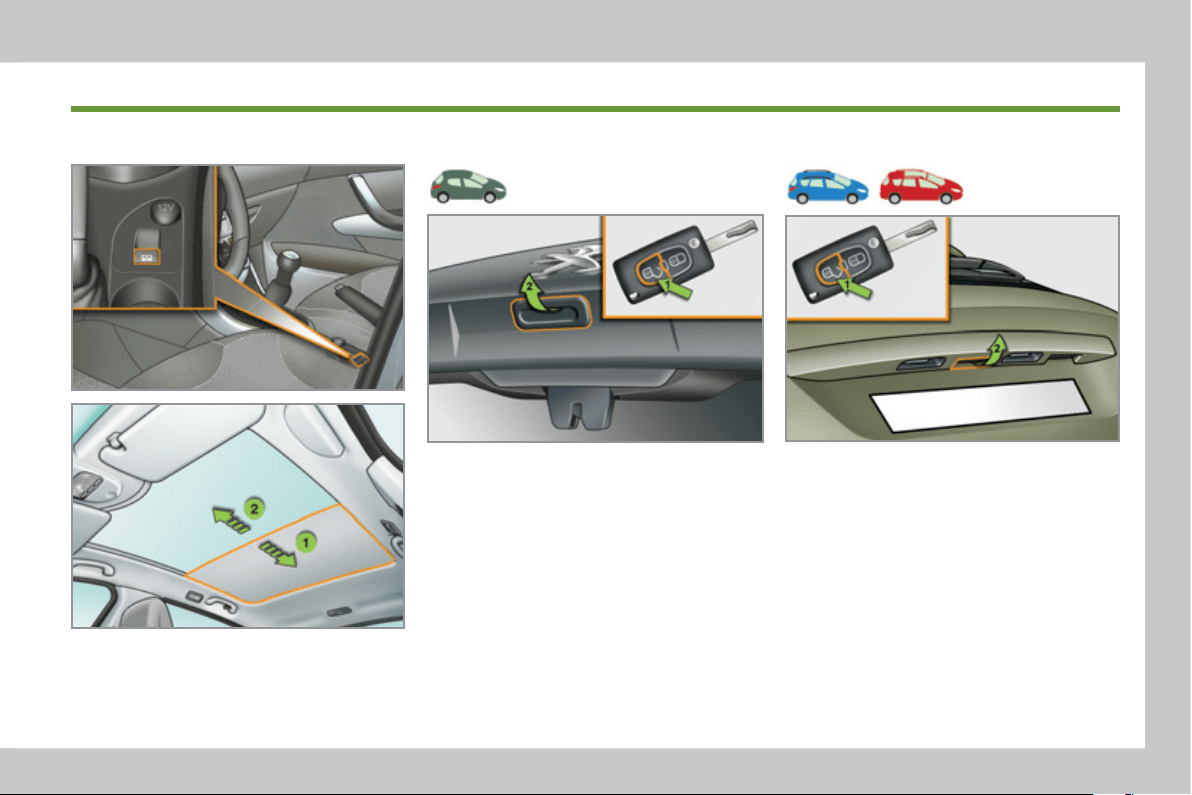
Panoramic sunroof Boot
95
1. Opening the blind.
2. Closing the blind.
1. Unlocking the vehicle.
2. Opening the boot.
94
8
FAMILIARISATIO
N
INTERIOR
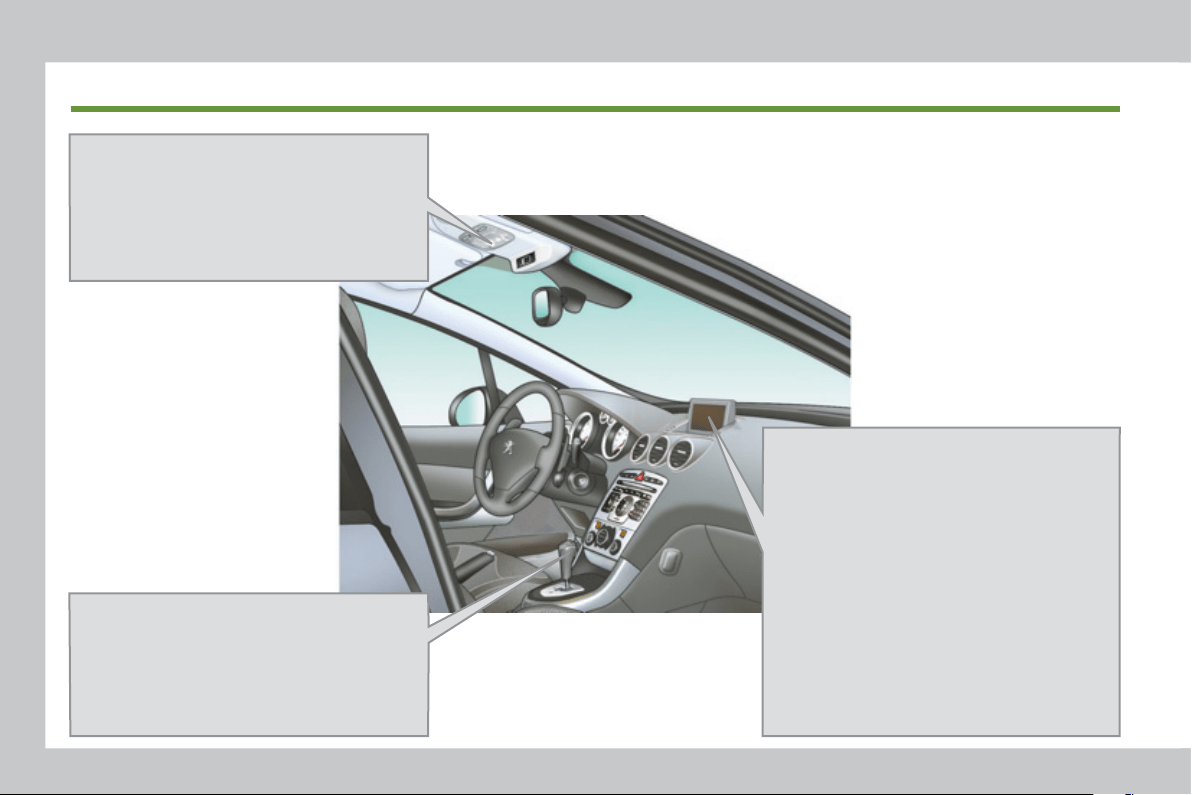
Interior mood lighting
This dimmed lighting of the passenger
compartment improves visibility inside
the vehicle when the light is poor.
109
6-speed electronic gear control
gearbox
This system offers driving combining a
fully automatic mode and a a manual
mode.
153
Audio and communication systems
This equipment benefi ts from the latest
technology: MP3 compatible Peugeot
Connect Sound (RD5), Bluetooth,
Peugeot Connect Navigation (RT6) or
Peugeot Connect Media Navigation
(NG4 3D) with 16/9 retractable colour
screen, JBL audio system, auxiliary
sockets.
Peugeot Connect Sound (RD5)
345
Peugeot Connect Navigation (RT6)
291
Peugeot Connect Media Navigation (NG4 3D)
247
9
FAMILIARISATION
IN
S
TRUMENT
S
AND CONTROL
S
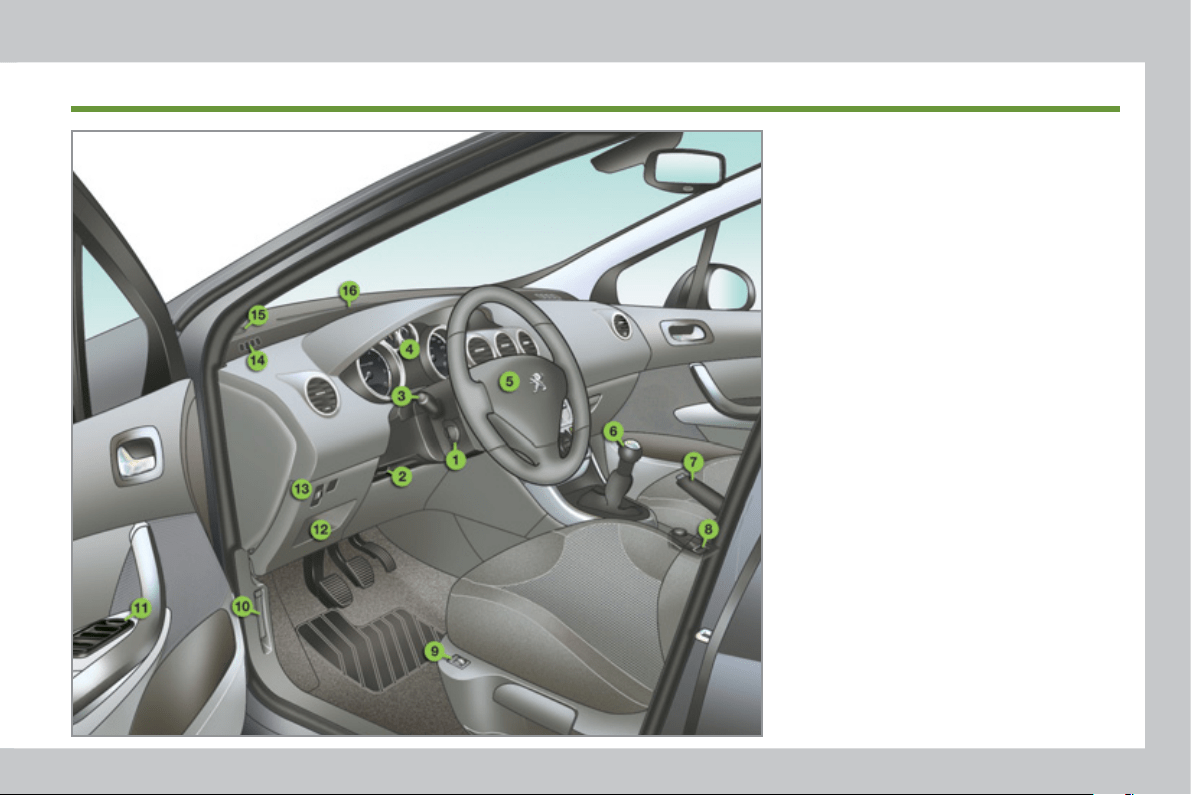
1. Cruise control / speed limiter
switches.
2. Steering wheel adjustment control.
3. Lighting and direction indicator
control stalk.
4. Instrument panel.
5. Driver's airbag.
Horn.
6. Gear lever.
7. Parking brake lever.
8. Panoramic sunroof blind control.
9. Heated seat control.
10. Bonnet release.
11. Door mirror controls.
Electric window controls.
12. Fusebox.
13. Manual headlamp height
adjustment.
Stop & Start button.
14. Front side window demisting vent.
15. Speaker (tweeter).
16. Windscreen demisting vent.
1
0
FAMILIARISATIO
N
IN
S
TRUMENT
S
AND CONTROL
S
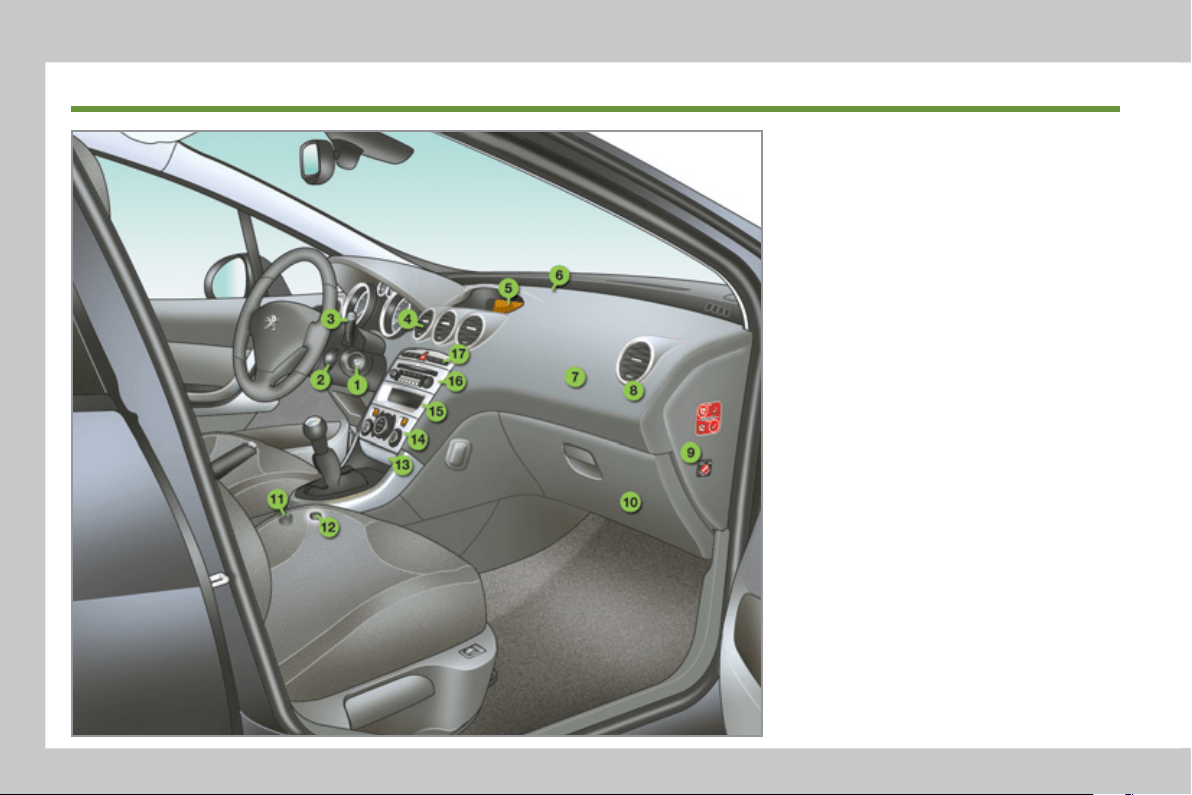
1. Steering lock and ignition.
2. Audio and telematics system
steering mounted control.
3. Wiper / screenwash / trip computer
control stalk.
4. Central adjustable air vents.
5. Multifunction screen.
6. Sunshine sensor.
7. Passenger's airbag.
8. Side adjustable air vent.
9. Passenger's airbag deactivation.
10. Glove box / Audio/video sockets.
11. Storage compartment or instrument
panel navigator associated with
Peugeot Connect Media Navigation
(NG4 3D).
12. 12 V accessory socket.
13. Front ashtray.
14. Heating / air conditioning controls.
15. Open storage.
16. Audio and telematics system.
17. Emergency call button.
Alarm button.
Central locking button.
Hazard warning lamps button.
Dynamic stability control (ESP/
ASR) button.
Parking sensors button.
PEUGEOT services button
11
FAMILIARISATION
S
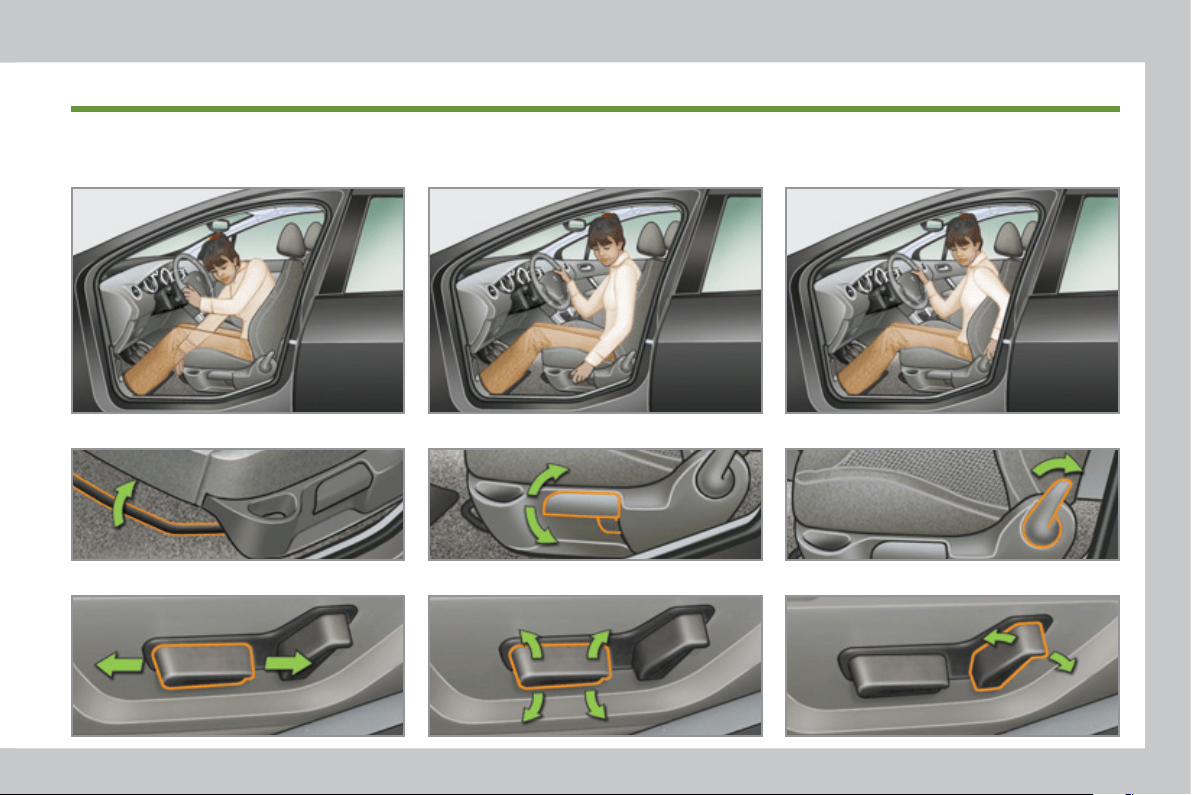
ITTING COMFORTABLY
Driver's seat
Manual adjustment
Electric adjustment
Forwards-backwards
68
69
Seat back angle Height
FAMILIARISATIO
N
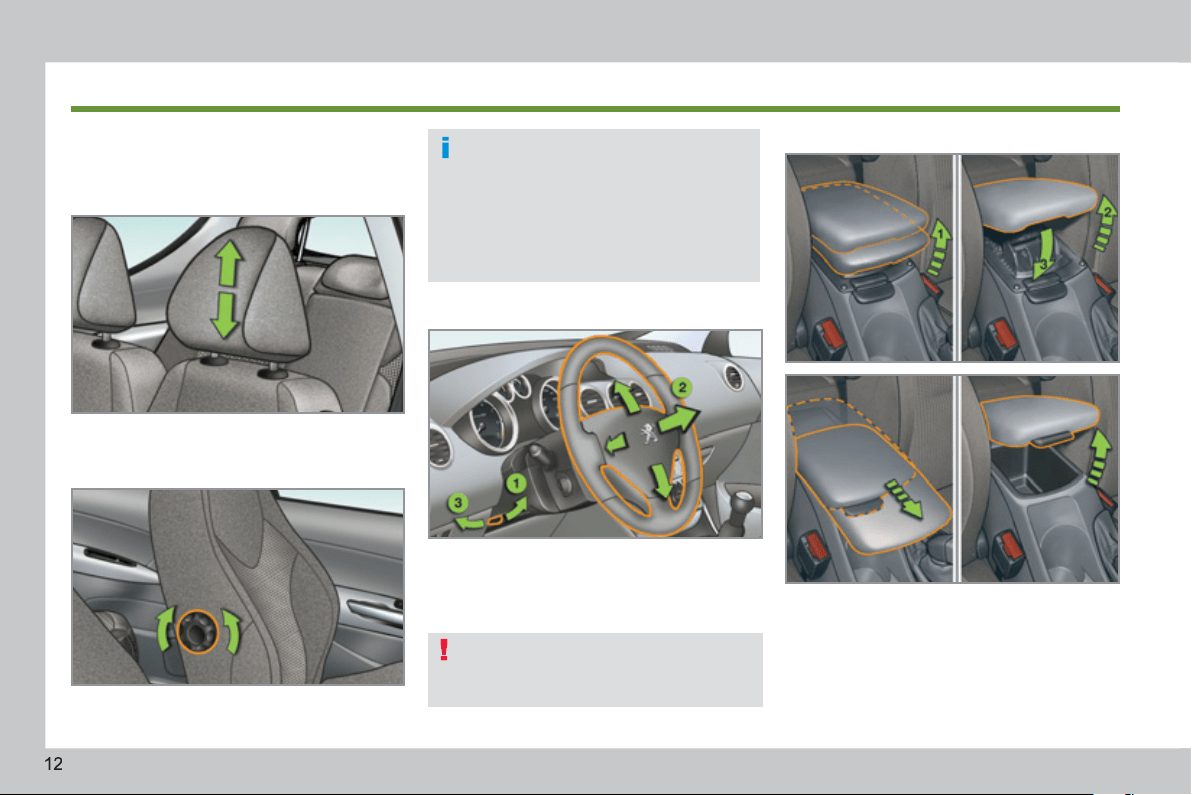
Steering wheel adjustment
1. Unlocking the control.
2. Adjustment for height and reach.
3. Locking the control.
S
ITTING COMFORTABLY
Front seats
Other functions available...
Table position for the front passen-
ger seat (SW).
Storing driving positions (driver's
electric seat).
Heated seats.
Head restraint height
Lumbar
Front armrest
70 113 82
For your comfort, the height and longi-
tudinal position of the front armrest can
be adjusted.
It also has a storage compartment.
As a safety precaution, these op-
erations must only be carried out
when stationary.
1
3
FAMILIARISATION
S
ITTING COMFORTABLY
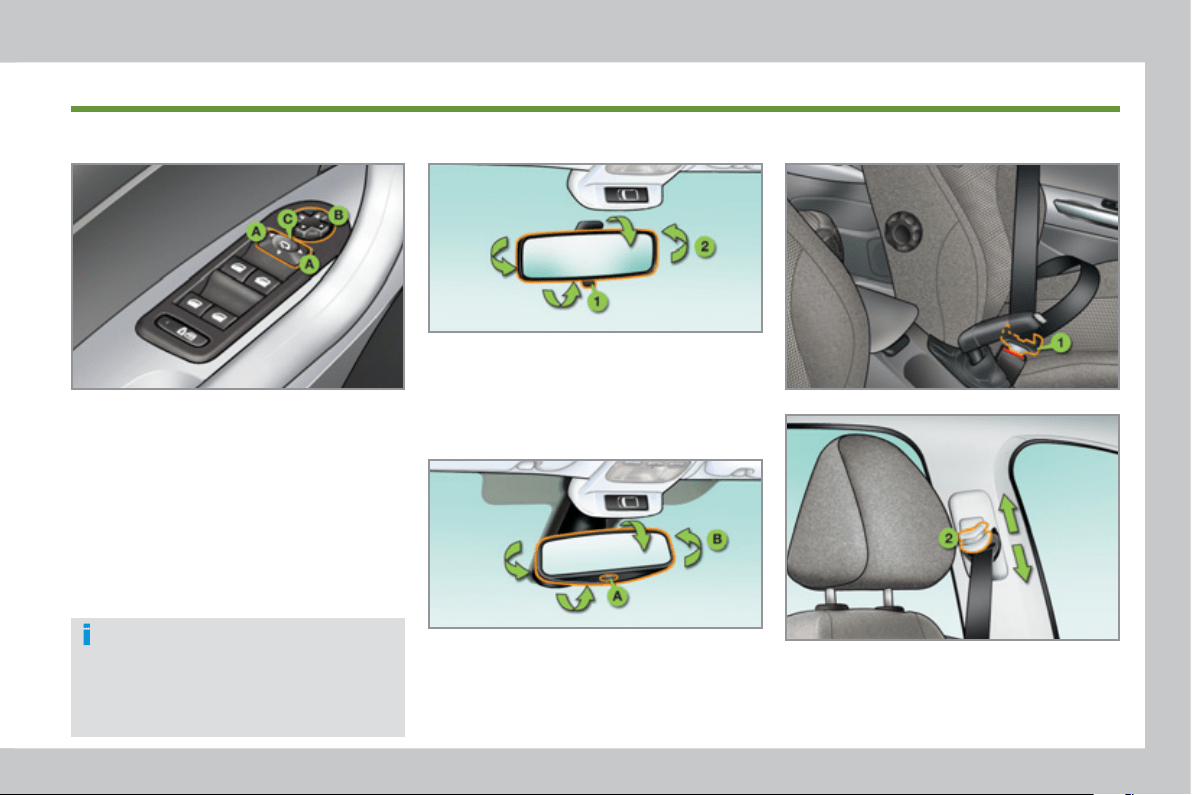
Door mirrors
Adjustment
Other functions available...
Folding / Unfolding.
Automatic tilting of the mirror in re-
verse gear for parking.
Rear view mirror
Manual day/night model
Front seat belts
1. Fastening the buckle.
2. Height adjustment.
A. Selection of the mirror to be adjusted.
B. Adjustment of the position of the
mirror in the four directions.
C. De-selection of the mirror.
82
141
80
1. Selection of the "day" position of
the mirror.
2. Adjusting the mirror.
Automatic day/night model
A. Light sensor.
B. Adjusting the mirror.
82
14
FAMILIARISATIO
N
S
EEING CLEARLY
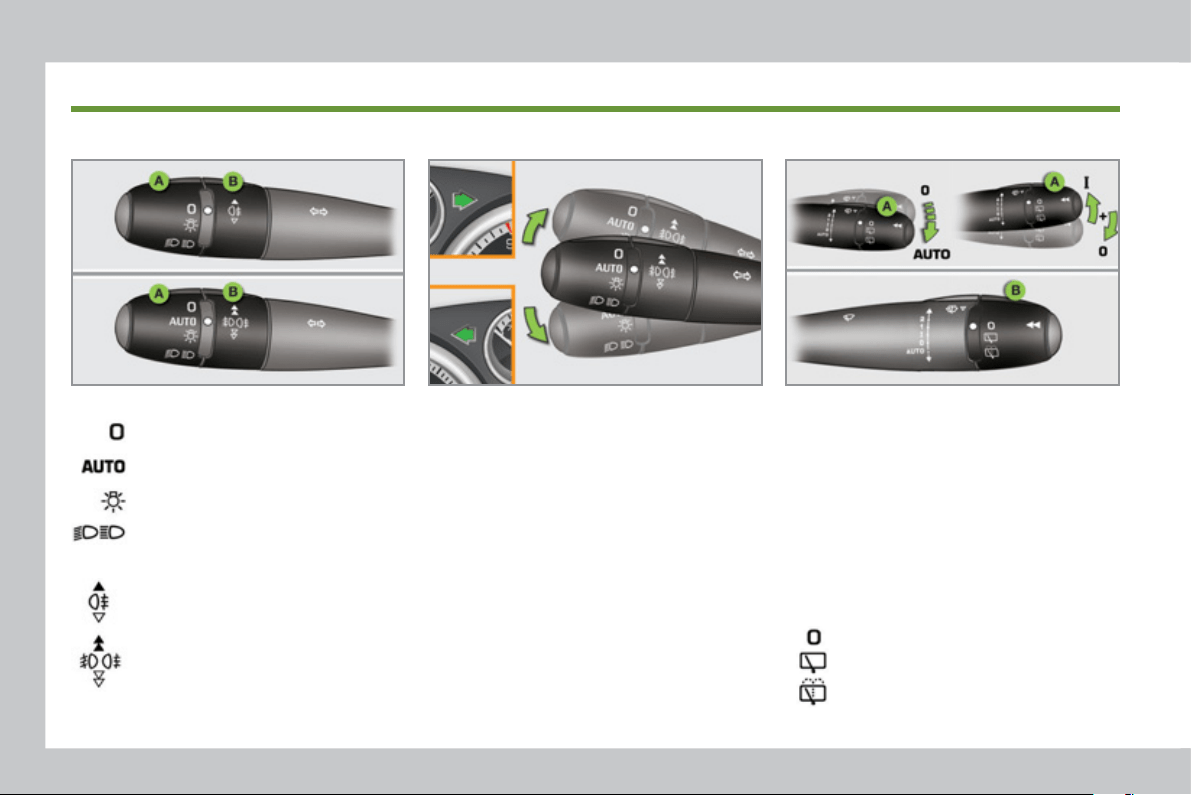
Lighting
Ring A
Ring B
Raise or lower the lighting stalk passing
the point of resistance; the corresponding
direction indicators will fl ash for as long
as the stalk remains in this position.
Direction indicators
Switching on "AUTO"
) Press the stalk down and release it.
Ring B: rear wiper
99 106
Lighting off.
Automatic illumination of head-
lamps.
Sidelamps.
Dipped / main beam headlamps.
Rear foglamp.
or
Front and rear foglamps.
Park.
Intermittent wipe.
Wash-wipe.
Stalk A: windscreen wipers
105
Wipers
Switching off "AUTO"
) Push the stalk up and return it to
position "0" .
107
137
"Motorway" function
Press the lighting stalk up or down once,
without passing the point of resistance;
the corresponding direction indicators
will fl ash three times.
This function can be used at any speed,
but it is particularly useful when chang-
ing lane on high-speed roads.
–
1
5
FAMILIARISATION
V
ENTILATION
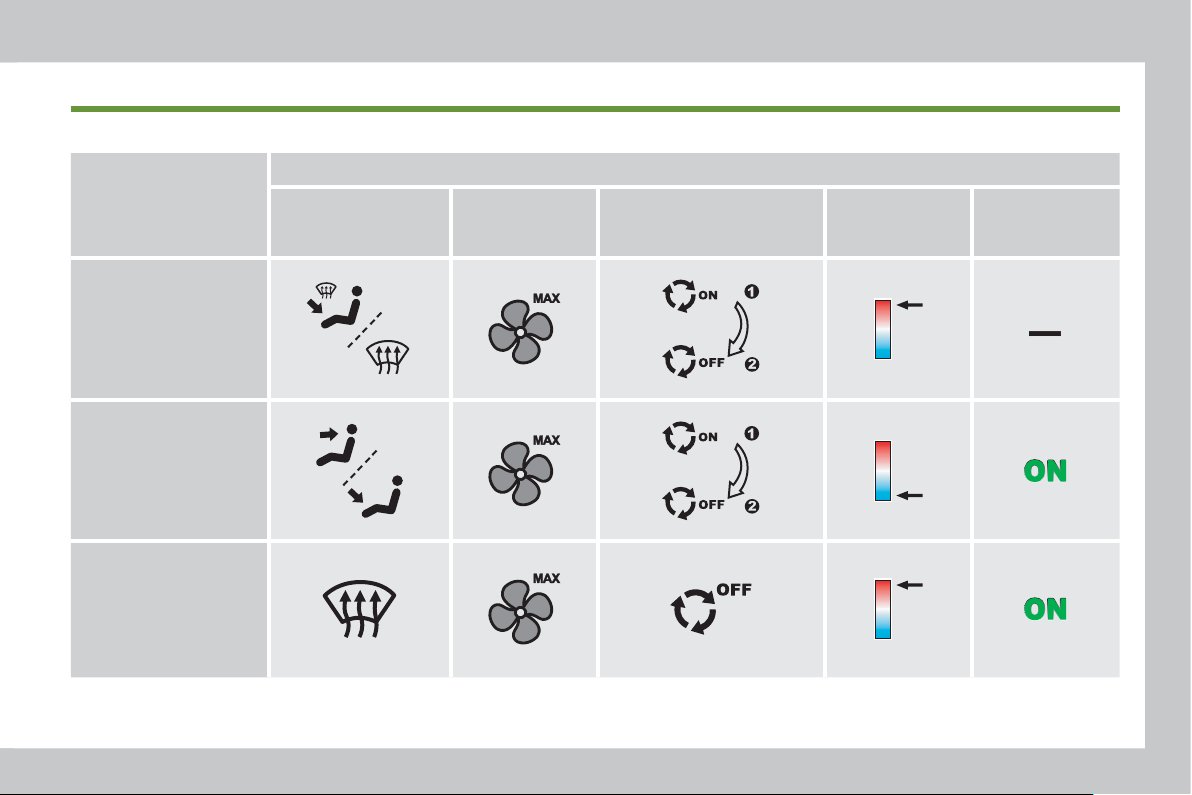
Digital air conditioning: we recommend use of the fully automatic mode by pressing the "AUTO" button.
I require...
Heating or Manual Air Conditioning
Air distribution Air fl ow
Air recirculation /
Intake of outside air
Temperature Manual A/C
HOT
COLD
DEMISTING
DEFROSTING
Recommended interior settings
1
6
FAMILIARISATIO
N
MONITORING
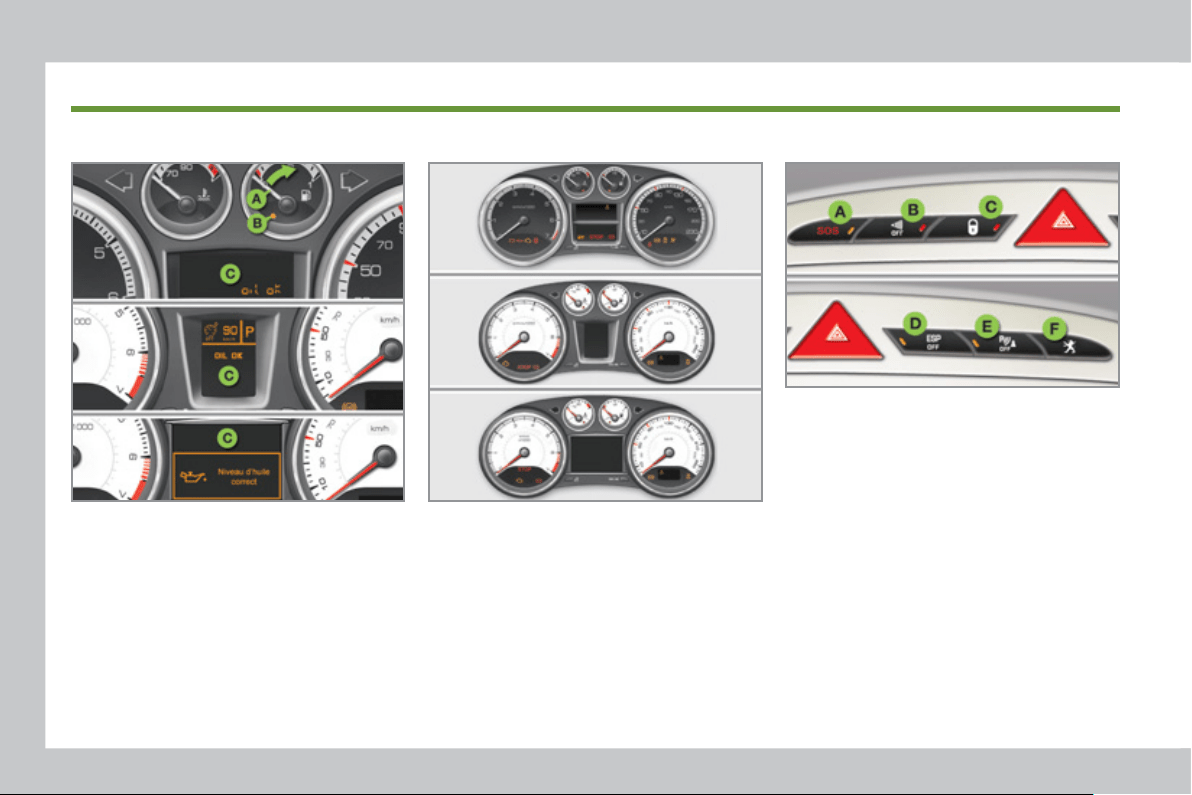
Instrument panel Switch panel
A. With the ignition on, the needle
should indicate the level of fuel
remaining.
B. With the engine running, its
associated low level warning lamp
should switch off.
C. With the ignition on, the oil level
indicator should indicate for a few
seconds that the level is correct or
OK, depending on version.
If the levels are not correct, top up the
levels which are low.
Lighting of the indicator lamp indicates
the status of the corresponding function.
A. Emergency call in progress. 243
B. Deactivation of the alarm interior
volumetric monitoring.
87
C. Central locking.
92
D. Deactivation of the ESP/ASR
system. 140
E. Deactivation of the front and rear
parking sensors. 168
F. Access to PEUGEOT services.
243
1. With the ignition on, the orange and
red warning lamps come on.
2. With the engine running, these
warning lamps should go off.
If warning lamps remain on, refer to the
page concerned.
Warning lamps
25 29, 33
17
FAMILIARISATION
PA
SS
ENGER
S
AFETY
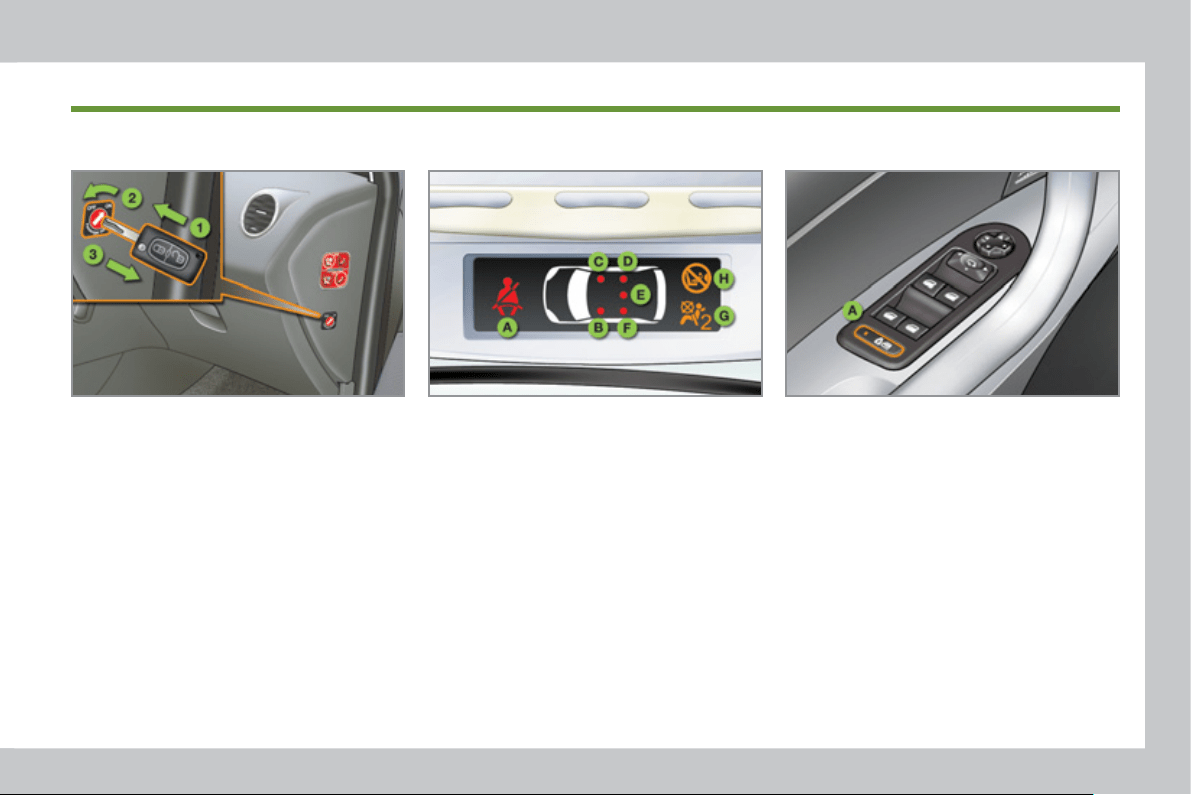
Passenger's front airbag Electric child lock
1. Insert the key.
2. Select the position:
"OFF" (deactivation), with "rear
facing" child seat,
"ON" (activation), with front
passenger or "forwards facing"
child seat.
3. Remove the key keeping the switch
in the new position.
Lighting of the indicator lamp indicates
the status of the corresponding function.
A. Activation of the electric child lock.
A. Front and/or rear seat belts not
fastened / unfastened warning
lamp.
B. Front left seat belt warning lamp.
C. Front right seat belt warning lamp.
D. Rear right seat belt warning lamp * .
E. Rear centre seat belt warning
lamp * .
F. Rear left seat belt warning lamp * .
G. Passenger's front airbag
deactivated warning lamp.
H. Passenger's front airbag activated
warning lamp.
Seat belts and passenger's
front airbag
142, 147 146 136
* Only on SW individual rear seats.
1
8
FAMILIARISATIO
N
PA
SS
ENGER COMFORT
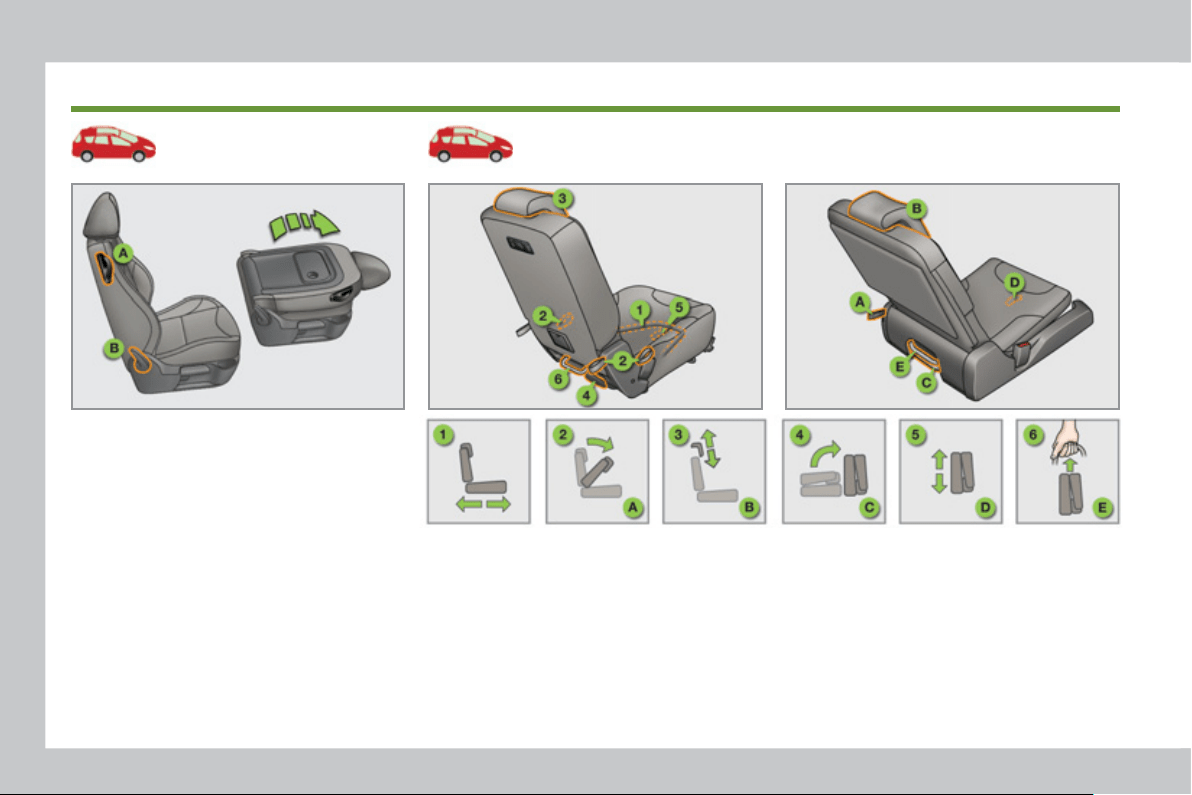
Operating the rear seats
2nd row rear seats
1. Forwards-backwards adjustment.
2. Seat back angle adjustment / Table
position.
3. Head restraint height adjustment.
4. Folding.
5. Removal / Installation.
6. Carrying.
74
3rd row additional seats
A. Seat back angle adjustment / Table
position.
B. Head restraint height adjustment.
C. Folding.
D. Removal / Installation.
E. Carrying.
76
Operating the front
passenger seat
Table position
A. Placing in the partial table position.
B. Placing in the full table position.
70
1
9
FAMILIARISATION
S
EAT CONFIGURATION
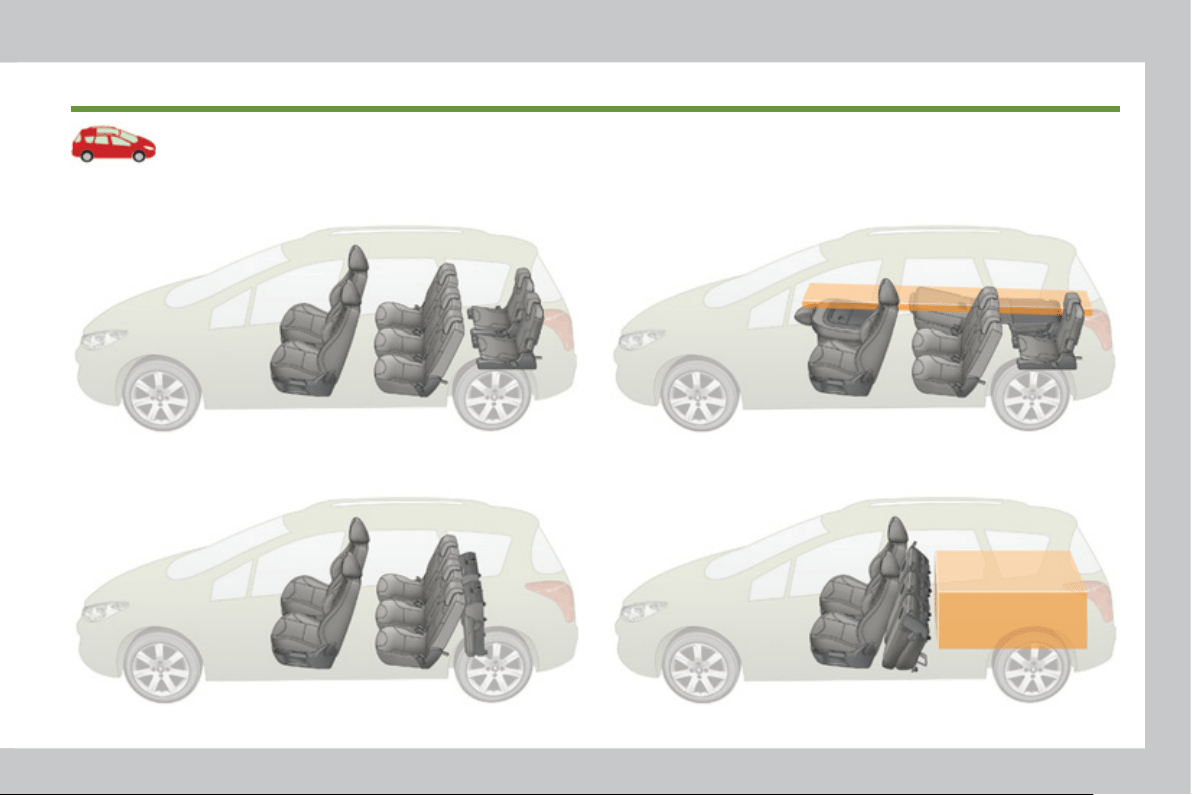
A few examples of seat modularity
7 seats
7 seats in 5 seats with additional
seats folded confi guration
Transporting long objects
Loading a large volume
78
2
0
FAMILIARISATIO
N
Stop & Start
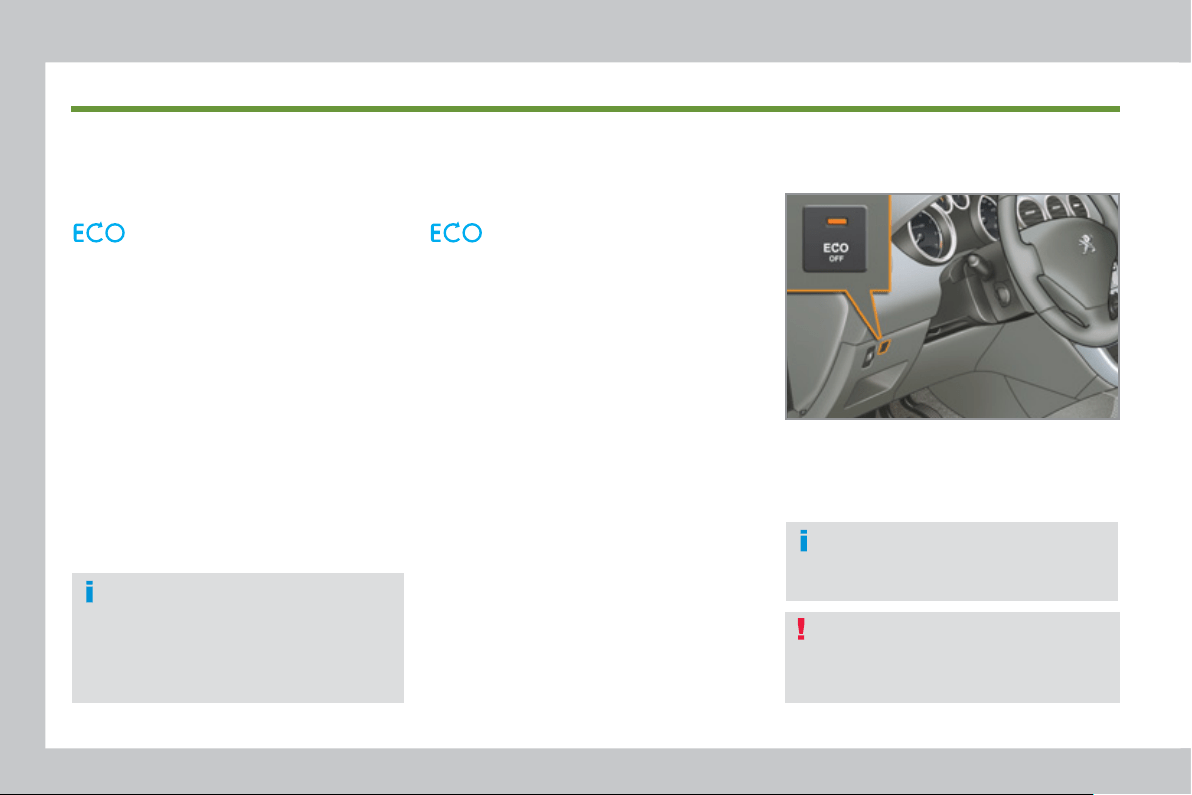
Going into engine STOP mode Going into engine START mode Deactivation / Activation
DRIVING
S
AFELY
161
You can deactivate the system at any
time by pressing "ECO OFF" ; the warn-
ing lamp in the button comes on.
The "ECO" warning lamp comes on
in the instrument panel and the en-
gine automatically goes into standby:
The "ECO" warning lamp goes
off and the engine restarts au-
tomatically:
- with a manual gearbox ; when you
fully depress the clutch pedal,
- with a 6-speed electronic gear
control gearbox;
● gear lever in position A or M , when
you release the brake pedal,
● or gear lever in position N and the
brake pedal release, when you
move to position A or M ,
● or when you engage reverse.
- with a manual gearbox ; at speeds
below 12 mph (20 km/h), put the
gear lever into neutral, then release
the clutch pedal,
- with a 6-speed electronic gear
control gearbox ; at speeds below
5 mph (8 km/h), when you press
the brake pedal or move the gear
lever to position N .
In certain circumstances, STOP mode
may not be available; the "ECO" warn-
ing lamp fl ashes for a few seconds,
then goes off.
160
If you change gear without com-
pletely declutching, the engine will
not restart automatically. An alert
message is displayed to encour-
age you to fully depress the clutch
pedal.
161
The system is reactivated auto-
matically at every new start using
the key.
Before refuelling or doing anything
under the bonnet, you must switch
off the ignition with the key.
In certain circumstances, START mode
may be invoked automatically; the
"ECO" warning lamp fl ashes for a few
seconds, then goes off.
21
FAMILIARISATION
DRIVING
S
AFELY
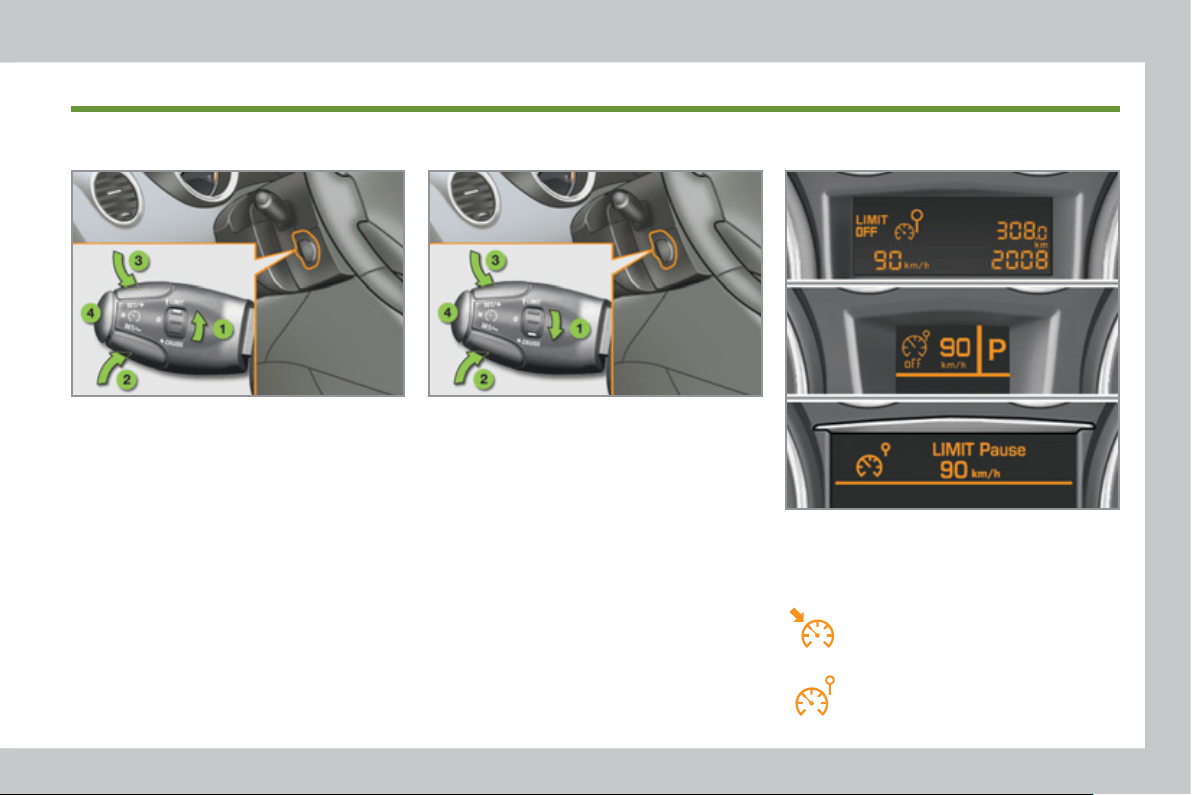
Speed limiter "LIMIT" Display in the instrument panel
1. Limiter mode Selection / Off.
2. Decreasing of the programmed
value.
3. Increasing of the programmed
value.
4. Speed limiter On / Off.
The cruise control or speed limiter mode
appears in the instrument panel when it
is selected.
1. Cruise control mode Selection / Off.
2. Programming a speed / Decreasing
of the programmed value.
3. Programming a speed / Increasing
of the programmed value.
4. Cruise control Off / Resume.
Cruise control "CRUISE"
Cruise control
Speed limiter
165 163
In order to be programmed or activated,
the vehicle speed must be higher than
25 mph (40 km/h), with at least fourth gear
engaged on the manual gearbox (second
gear for the 6-speed electronic gear con-
trol gearbox or automatic gearbox).
The values must be set with the engine
running.
22
FAMILIARISATIO
N
DRIVING
S
AFELY
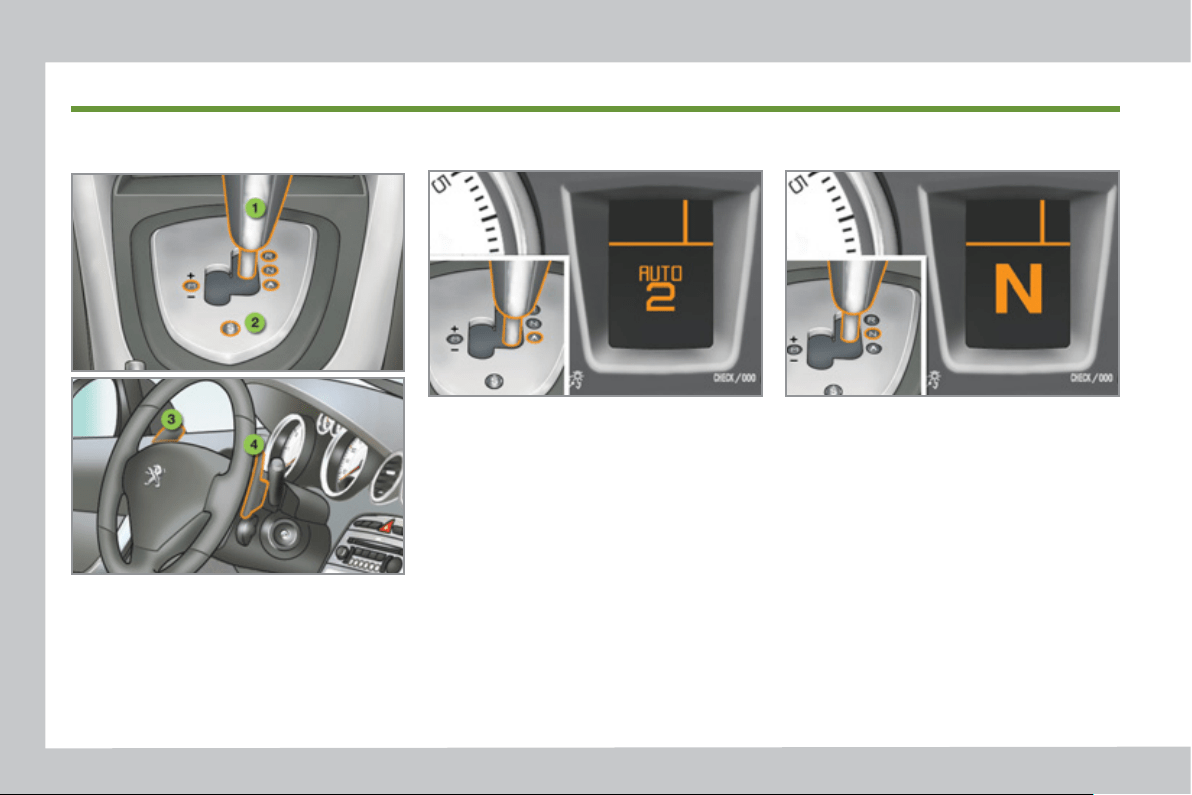
This 6-speed gearbox offers a choice
between the comfort of fully automatic
operation or the pleasure of manual
gear changing.
1. Gear lever.
2. Button "S" (sport) .
3. Steering wheel "-" paddle.
4. Steering wheel "+" paddle.
The gear or the driving mode select-
ed appears in the instrument panel
screen.
N: neutral.
R: reverse gear.
1 2 3 4 5 6: gears engaged.
AUTO: automatic mode.
S: Sport driving style.
Display in the instrument panel
) Select position N and press the
brake pedal fi rmly while starting the
engine.
) Engage fi rst gear (position A or M )
or reverse (position R ) using the
gear lever 1 .
) Release the parking brake.
) Take your foot off the brake pedal
then accelerate.
Moving off
153
6-speed electronic gear control
gearbox

2
3
E
CO-DRIVING
Eco-driving is a range of everyday practices that allow the motorist to optimise their fuel consumption and CO
2
emissions.
Optimise the use of your
gearbox
With a manual gearbox, move off gen-
tly, change up without waiting and
drive by changing up quite soon. If
your vehicle has the system, the gear
shift indicator invites you to change up;
it is displayed in the instrument panel,
follow its instructions.
With an automatic or electronic gear-
box, stay in Drive "D" or Auto "A" , ac-
cording to the type of gearbox, without
pressing the accelerator pedal heavily
or suddenly.
Drive smoothly
Maintain a safe distance between ve-
hicles, use engine braking rather than
the brake pedal, and press the accel-
erator progressively. These practices
contribute towards a reduction in fuel
consumption and CO
2
emissions and
also helps reduce the background traf-
fi c noise.
If your vehicle has cruise control, make
use of the system at speeds above
25 mph (40 km/h) when the traffi c is
fl owing well.
Control the use of your
electrical equipment
Before moving off, if the passenger
compartment is too warm, ventilate it by
opening the windows and air vents be-
fore using the air conditioning.
Above 30 mph (50 km/h), close the win-
dows and leave the air vents open.
Remember to make use of equipment
that can help keep the temperature in
the passenger compartment down (sun-
roof and window blinds...).
Switch off the air conditioning, unless
it has automatic digital regulation, as
soon as the desired temperature is at-
tained.
Switch off the demisting and defrosting
controls, if not automatic.
Switch off the heated seat as soon as
possible.
Switch off the headlamps and front fo-
glamps when the level of light does not
require their use.
Avoid running the engine before moving
off, particularly in winter; your vehicle will
warm up much faster while driving.
As a passenger, if you avoid connecting
your multimedia devices (fi lm, music,
video game...), you will contribute to-
wards limiting the consumption of elec-
trical energy, and so of fuel.
Disconnect your portable devices be-
fore leaving the vehicle.

Limit the causes of excess
consumption
Spread loads throughout the vehicle;
place the heaviest items in the bottom
of the boot, as close as possible to the
rear seats.
Limit the loads carried in the vehicle
and reduce wind resistance (roof bars,
roof rack, bicycle carrier, trailer...). Use
a roof box in preference.
Remove roof bars and roof racks after
use.
At the end of winter, remove snow
tyres and refi t your summer tyres.
Observe the recommendations
on maintenance
Check the tyre pressures regularly,
when cold, referring to the label in the
door aperture, driver's side.
Carry out this check in particular:
- before a long journey,
- at each change of season,
- after a long period out of use.
Don't forget the spare wheel and the
tyres on any trailer or caravan.
Have your vehicle serviced regularly
(engine oil, oil fi lter, air fi lter...) and ob-
serve the schedule of operations rec-
ommended by the manufacturer.
When refuelling, do not continue after
the 3
rd
cut-off of the nozzle to avoid
any overfl ow.
At the wheel of your new vehicle,
it is only after the fi rst 1 800 miles
(3 000 kilometres) that you will see
the fuel consumption settle down to a
consistent average.
24
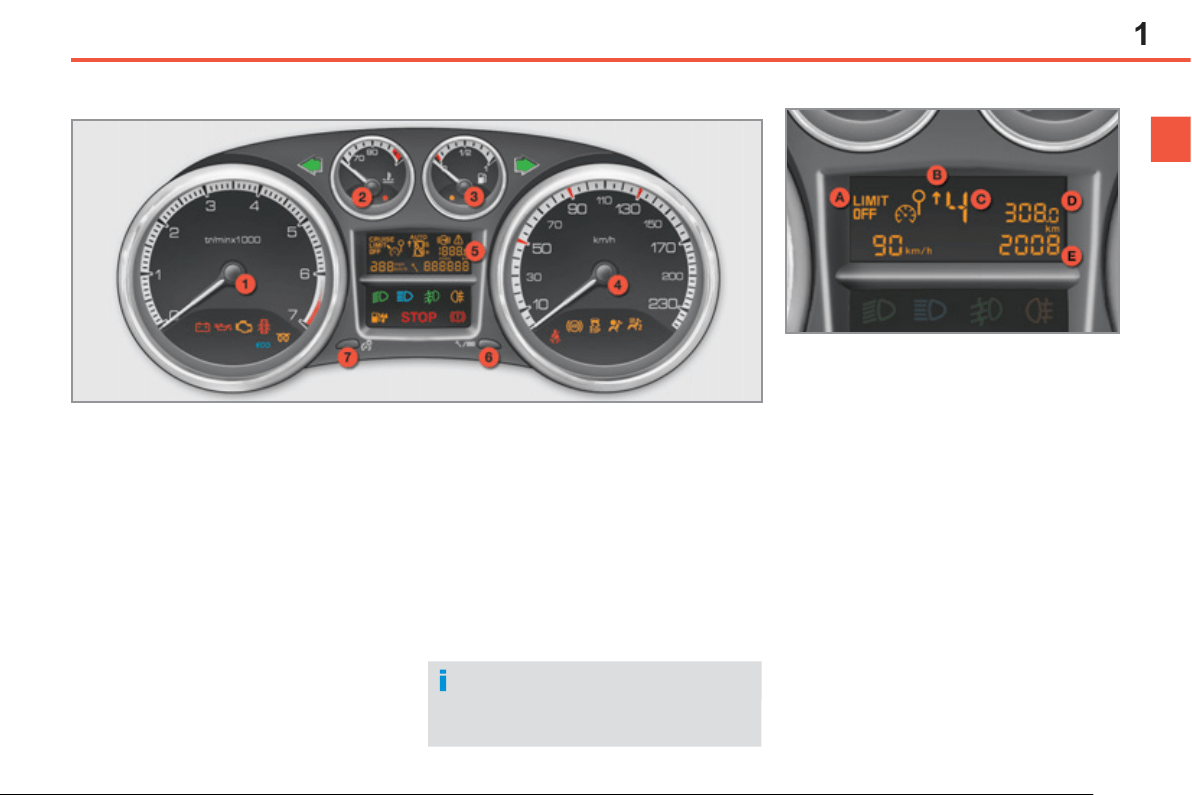
1
2
5
INSTRUMENTS and CONTROLS
T
YPE 1 IN
S
TRUMENT PANEL
Dials
5. Screen.
6. Control button.
Recalls the service information.
Resets the function to zero (trip
distance recorder or service
indicator).
7. Instrument panel lighting button.
Adjusts the brightness of the lighting
of the instruments and controls.
1. Rev counter.
Indicates the speed of rotation of
the engine (x 1000 rpm).
2. Coolant temperature.
Indicates the temperature of the
engine coolant (° Celsius).
3. Fuel level.
Indicates the quantity of fuel
remaining in the tank.
4. Vehicle speed.
Indicates the current speed of the
moving vehicle (mph or km/h).
A. Speed limiter
(mph or km/h) or
Cruise control.
B. Gear shift indicator.
C. 6-speed electronic gear control
or automatic gearbox.
D. Trip distance recorder.
(miles or km)
E. Service indicator
(miles or km) then,
engine oil level indicator
then
distance recorder.
(miles or km)
These three functions are displayed
in succession when the ignition is
switched on.
Displays
For more information, refer to the
section on the button or function
and its associated display.
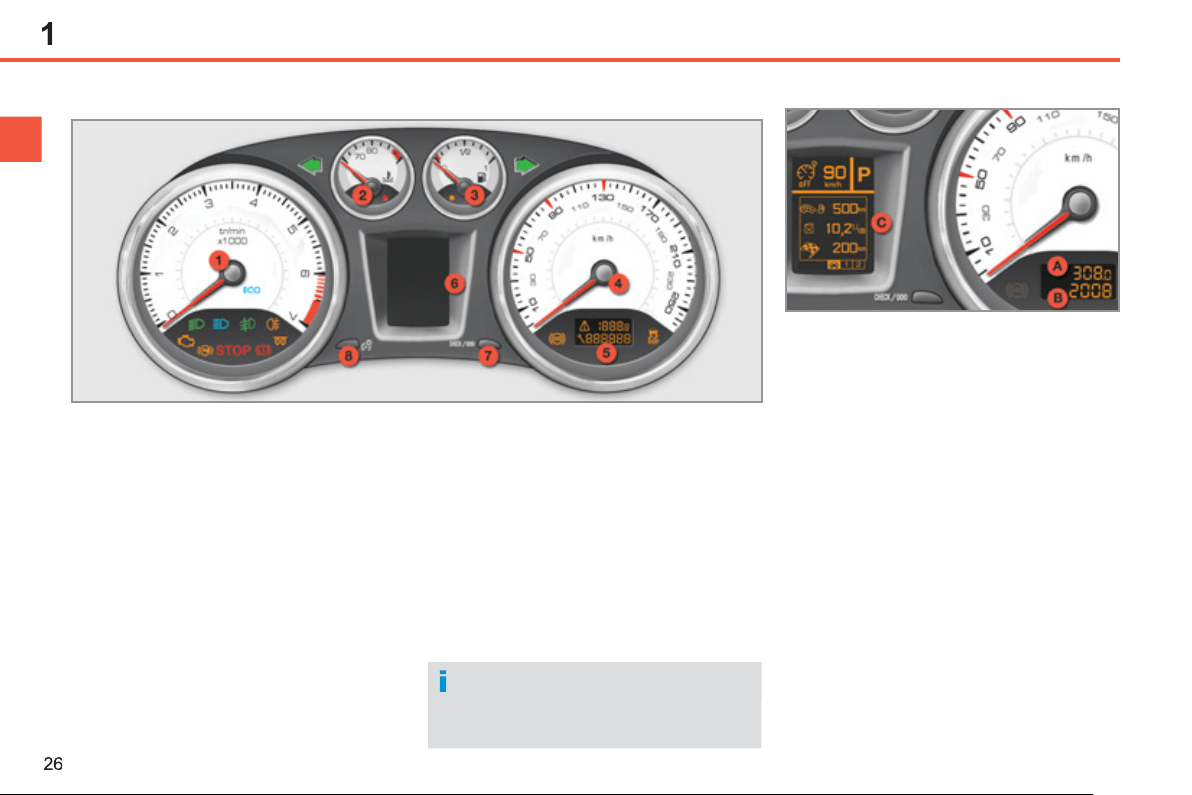
1
INSTRUMENTS and CONTROLS
TYPE 2 IN
S
TRUMENT PANEL
Dials
6. Central screen.
7. Control button.
Starts a manual CHECK and
recalls the service information.
Resets the function to zero (trip
distance recorder or service
indicator).
8. Instrument panel lighting button.
Adjusts the brightness of the lighting
of the instruments and controls.
1. Rev counter.
Indicates the speed of rotation of
the engine (x 1000 rpm).
2. Coolant temperature.
Indicates the temperature of the
engine coolant (° Celsius).
3. Fuel level.
Indicates the quantity of fuel
remaining in the tank.
4. Vehicle speed.
Indicates the current speed of the
moving vehicle (mph or km/h).
5. Small screen.
A. Trip distance recorder.
(miles or km)
B. Distance recorder.
(miles or km)
C. Engine oil level indicator,
service indicator.
(miles or km)
These two functions are displayed
when the ignition is switched on,
then disappear after a few seconds.
Displays
For more information, refer to the
section on the button or function
and its associated display.
The following functions are displayed
depending on the selection.
- Warning lamps / CHECK.
- Tyre under-infl ation detection.
- Speed limiter / Cruise control.
- Gear shift indicator.
- 6-speed electronic gear control
or automatic gearbox.
- Navigation - Guidance / Trip
computer.
- Alert messages symbol.
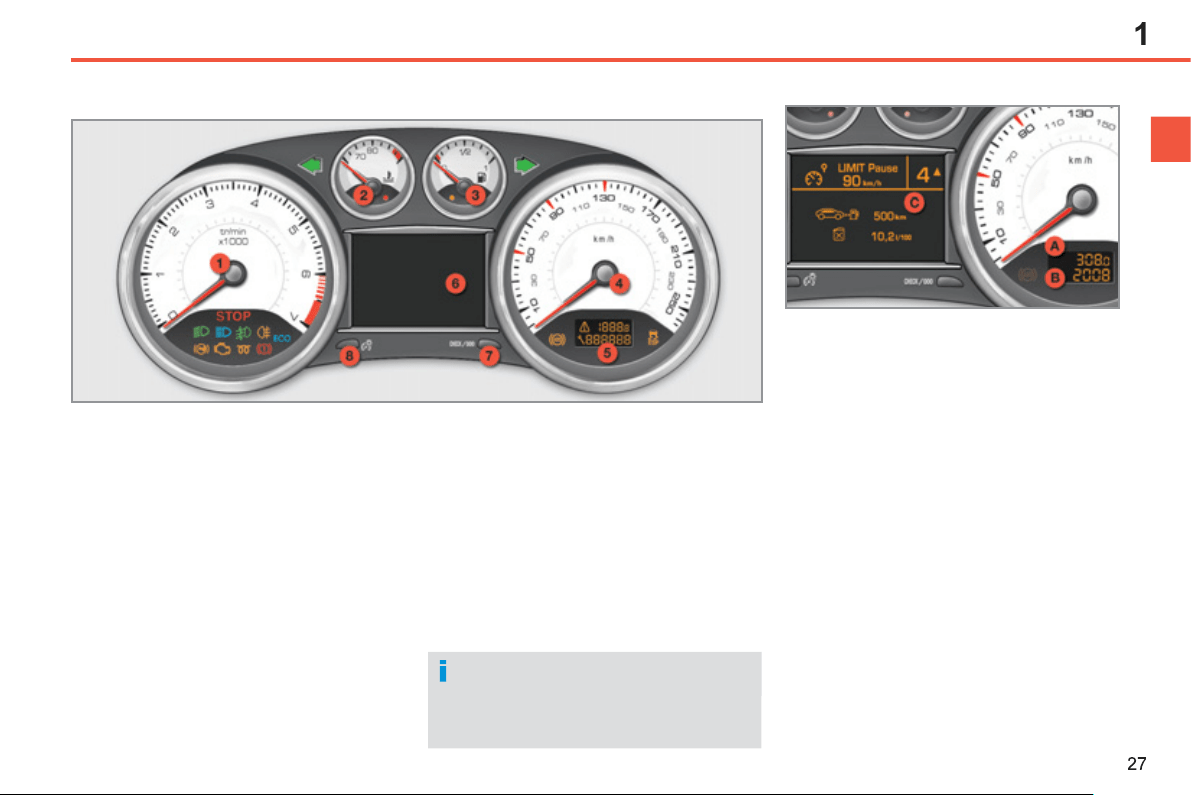
1
INSTRUMENTS and CONTROLS
TYPE 3 IN
S
TRUMENT PANEL WITH PEUGEOT CONNECT MEDI
A
NAVIGATION
(
NG4 3D
)
1. Rev counter.
Indicates the speed of rotation of
the engine (x 1000 rpm).
2. Coolant temperature.
Indicates the temperature of the
engine coolant (° Celsius).
3. Fuel level.
Indicates the quantity of fuel
remaining in the tank.
4. Vehicle speed.
Indicates the current speed of the
moving vehicle (km/h or mph).
5. Small screen.
A. Trip distance recorder.
(miles or km)
B. Distance recorder.
(miles or km).
C. Engine oil level indicator,
service indicator.
(miles or km)
These two functions are displayed
when the ignition is switched on,
then disappear after a few seconds.
The following functions are displayed
depending on the selection.
- Warning lamps / CHECK.
- Tyre under-infl ation detection.
- Speed limiter / Cruise control.
- Gear shift indicator.
- 6-speed electronic gear control
or automatic gearbox.
- Navigation - Guidance / Trip
computer.
- Vehicle and screen parameter
settings menus.
- Alert messages.
Dials
Displays
6. Central screen.
7. Control button.
Starts a manual CHECK and
recalls the service information.
Resets the function to zero (trip
distance recorder or service
indicator).
8. Instrument panel lighting button.
Adjusts the brightness of the lighting
of the instruments and controls.
For more information, refer to the
section on the button or function
and its associated display.
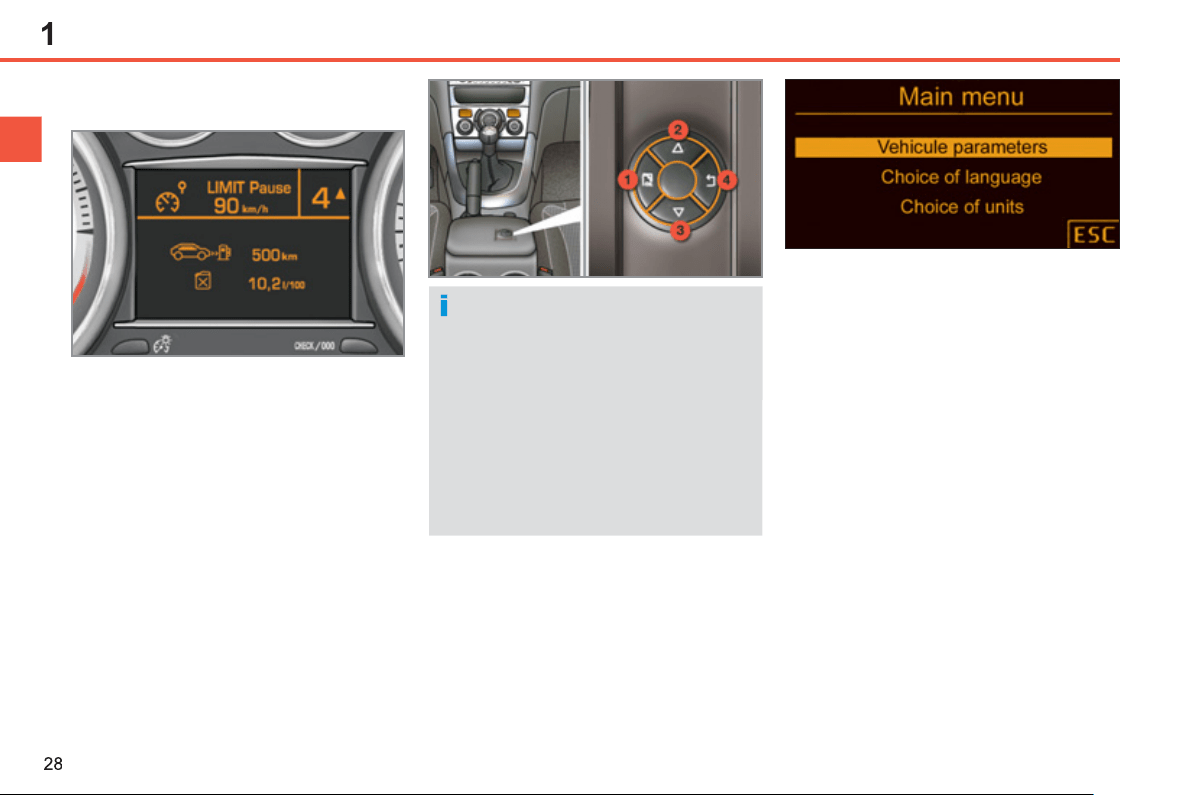
1
INSTRUMENTS and CONTROLS
* According to country.
Instrument panel navigator associated
with the Peugeot Connect Media
Controls
There are four buttons to control the
large central instrument panel screen:
1. access the main menu, confi rm the
selection,
2. move up through the menu,
3. move down through the menu,
4. return to the previous screen, exit
from the menu.
Main menu
) Press button 1 for access to the
main menu and select one of the
following functions:
- "Vehicle parameters",
- "Choice of language",
- "Choice of units".
) Press button 2 or 3 to move on the
screen.
) Press button 1 again to confi rm the
selection.
The main menu and its associated
functions can only be accessed
when stationary, via buttons 1 to 4 .
A message appears on the cen-
tral screen above a certain speed
threshold, indicating that the main
menu cannot be displayed.
The trip computer displays can
only be accessed while driving, via
buttons 2 and 3 (refer to the "Trip
computer" section).
This group of buttons permits:
- when stationary , confi guration of
the vehicle's equipment and of the
parameters of the central screen
(languages, units...),
- while driving , scrolling of the
active functions (trip computer,
navigation...).
Vehicle parameters
This menu allows you to activate or
deactivate certain driving and comfort
equipment:
- wiper linked with reverse gear
(refer to the "Visibility" section),
- guide-me-home and welcome lighting
(refer to the "Visibility" section),
- interior mood lighting (refer to the
"Visibility" section),
- daytime running lamps (refer to the
"Visibility" section),
- directional headlamps (refer to the
"Visibility" section),
- rear parking sensors (refer to the
"Driving" section).
Choice of language
This menu allows you to select the lan-
guage used by the display: Deutsch,
English, Espanol, Français, Italiano,
Nederlands, Portugues, Türkçe * .
Choice of units
This menu allows you to select the
units: temperature (°Celsius or °Fahr-
enheit) and consumption (l/100 km,
mpg or km/l).
1
2
9
INSTRUMENTS and CONTROLS
The illumination of a warning lamp
is always accompanied by the dis-
play of an additional message, to
assist you in identifying the fault.
If you encounter any problems,
contact a PEUGEOT dealer or a
qualifi ed workshop.
Warning and indicator lamps
Visual indicators which inform the driver
of the occurrence of a fault (warning
lamp) or of the operation of a system
(operation or deactivation indicator
lamp).
Associated warnings
The illumination, fi xed or fl ashing, of
certain warning lamps is accompanied
by an audible signal.
Depending on your version of instru-
ment panel, illumination of the warning
lamp is also accompanied by:
Warning lamps
When the ignition is switched on
Certain warning lamps come on for
a few seconds when the ignition is
switched on.
When the engine is started, these warn-
ing lamps should go off.
If they remain on, before moving off,
refer to the explanations given for the
warning or indicator lamp concerned in
the tables below.
- a message in the multifunction
screen,
or
- a pictogram in the central instrument
panel screen and a message in the
multifunction screen,
or
- a pictogram and a message in the
central instrument panel screen.
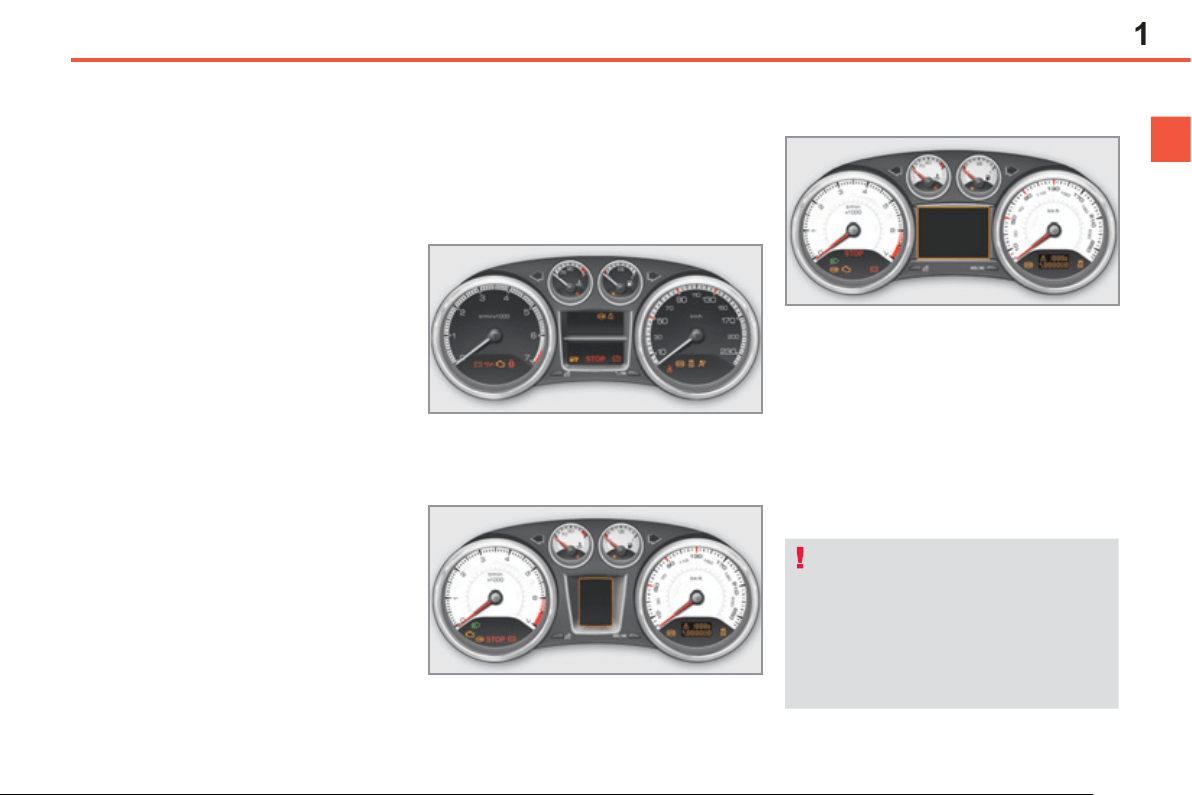
When the engine is running or the vehicle is
being driven, the illumination of one of the fol-
lowing warning lamps indicates a fault which
requires action on the part of the driver.
1
30
INSTRUMENTS and CONTROLS
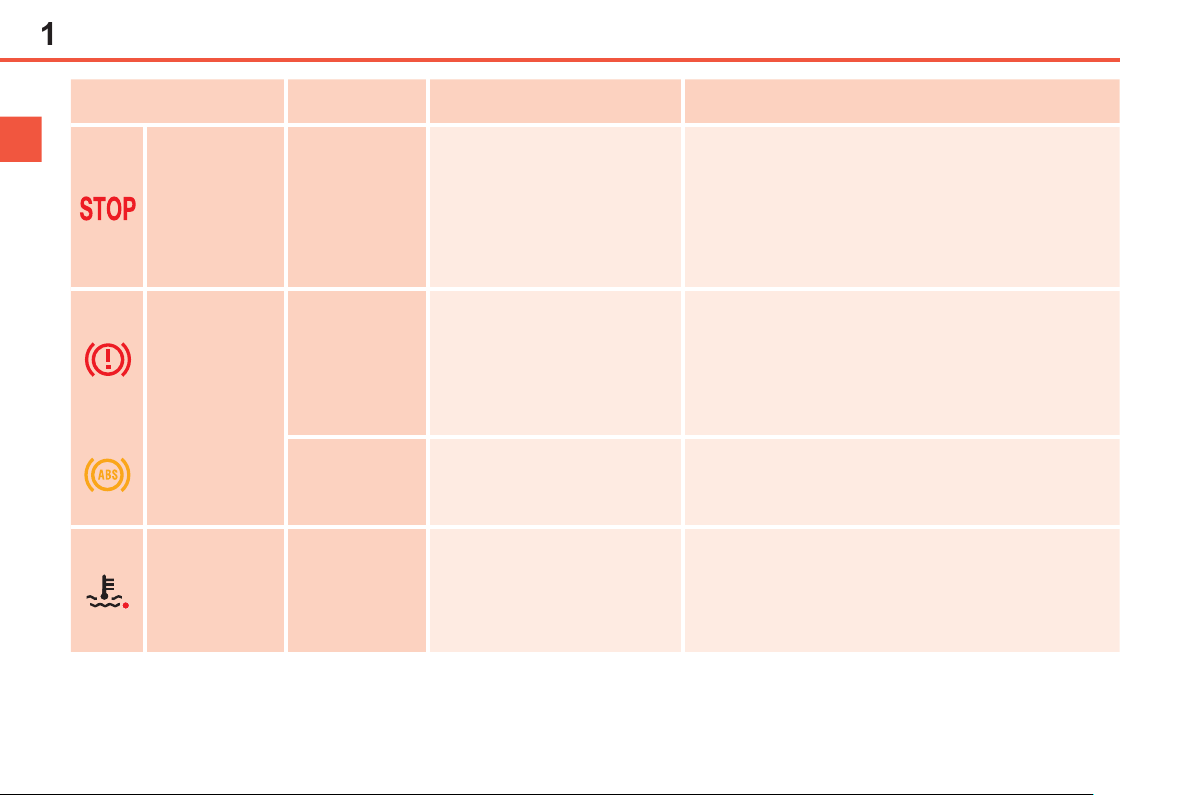
Warning lamp is on Cause Action / Observations
STOP
fi xed, alone
or associated
with another
warning lamp,
accompanied
by an audible
signal and a
message in
the screen.
Illumination of this warning
lamp is associated with a
serious braking system,
power steering, engine
lubrication or cooling
system malfunction or a
punctured tyre.
Stop as soon as it is safe to do so as there is a
risk that the engine will cut out while driving.
Park, switch off the ignition and contact a
PEUGEOT dealer or a qualifi ed workshop.
Braking
fi xed,
associated
with the STOP
warning lamp.
The braking system fl uid
level is too low.
You must stop as soon as it is safe to do so.
Top up with brake fl uid recommended by
PEUGEOT.
If the problem persists, have the system checked
by a PEUGEOT dealer or a qualifi ed workshop.
+
fi xed, associated
with the STOP
and ABS
warning lamp.
The electronic brake force
distribution (EBFD) system
has a fault.
You must stop as soon as it is safe to do so.
Have it checked by a PEUGEOT dealer or a
qualifi ed workshop.
Maximum
coolant
temperature
fi xed with the
needle in the
red zone.
The temperature of the
cooling system is too high.
Stop as soon as it is safe to do so.
Wait until the engine has cooled down before
topping up the level, if necessary.
If the problem persists, contact a PEUGEOT
dealer or a qualifi ed workshop.

1
31
INSTRUMENTS and CONTROLS
Service
temporarily,
accompanied
by a message.
Minor faults have occurred
for which there is no
specifi c warning lamp.
Identify the fault by reading the message
displayed in the screen, such as:
- doors, boot or bonnet open,
- low engine oil level,
- low screenwash/headlamp wash reservoir
level,
- remote control battery fl at,
- low tyre pressures,
- saturation of the particle emission fi lter on
Diesel vehicles (see Checks - checking
levels / particle emissions fi lter).
For any other faults, contact a PEUGEOT dealer
or a qualifi ed workshop.
fi xed,
accompanied
by a message
and an audible
signal.
Major faults have occurred
for which there is no
specifi c warning lamp.
Identify the fault by reading the message shown
in the screen and you must then contact a
PEUGEOT dealer or a qualifi ed workshop.
Warning lamp is on Cause Action / Observations
Engine
autodiagnosis
system
fl ashing.
The engine management
system has a fault.
Risk of destruction of the catalytic converter.
Have it checked by a PEUGEOT dealer or a
qualifi ed workshop.
fi xed.
The emission control
system has a fault.
The warning lamp should go off when the engine
is started.
If it does not go off, contact a PEUGEOT dealer
or qualifi ed workshop without delay.
1
32
INSTRUMENTS and CONTROLS
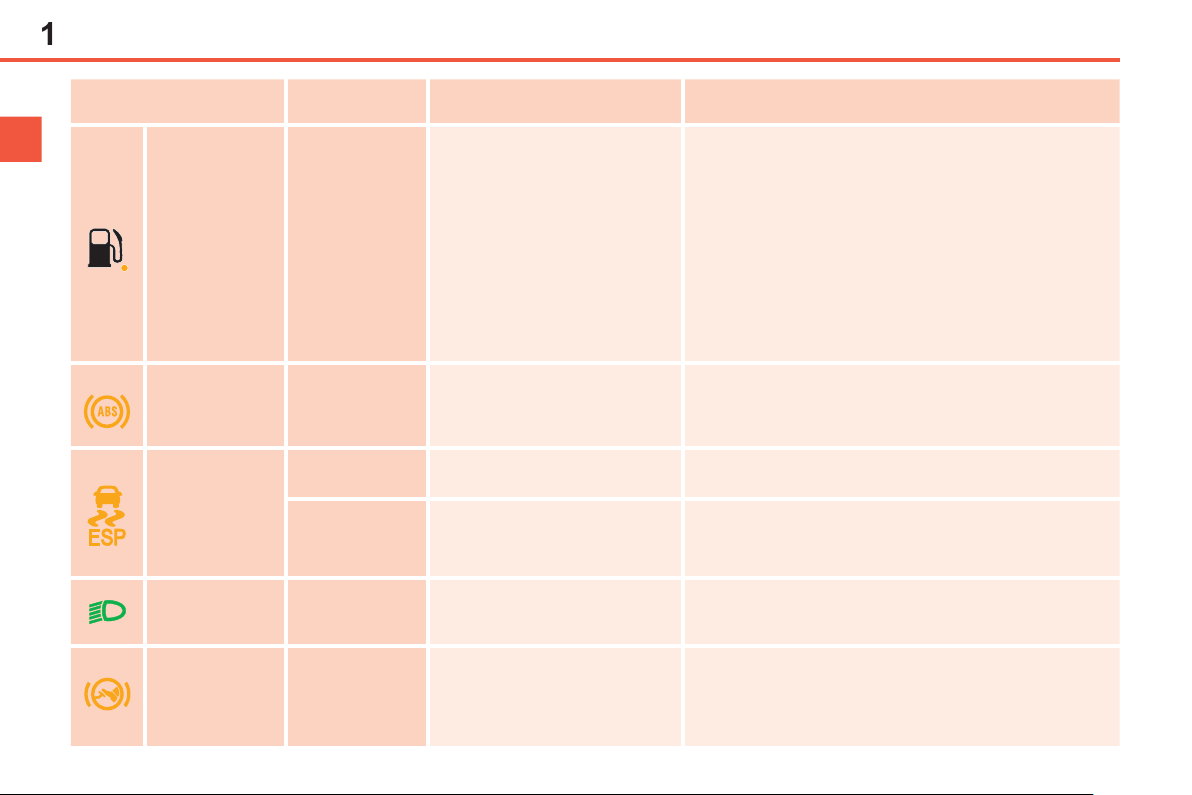
Low fuel level
fi xed with the
needle in the
red zone,
accompanied
by an audible
signal and a
message.
When it fi rst comes on there
remains approximately 6 litres
of fuel in the tank.
At this point, you begin to
use the fuel reserve.
Refuel as soon as possible to avoid running out
of fuel.
Until suffi cient fuel has been added, this warning
lamp will come on every time the ignition is
switched on, accompanied by an audible signal
and a message.
This audible signal and message are repeated
with increasing frequency as the fuel level drops
towards "0" .
Fuel tank capacity: approximately 60 litres .
Never continue to drive until you run out of fuel,
as this could damage the emission control and
injection systems.
Warning lamp is on Cause Action / Observations
Anti-lock
Braking
System
(ABS)
fi xed.
The anti-lock braking
system has a fault.
The vehicle retains conventional braking.
Drive carefully at reduced speed and contact
a PEUGEOT dealer or a qualifi ed workshop
without delay.
Dynamic
stability
control (ESP/
ASR)
fl ashing.
The ESP/ASR regulation is
active.
The system optimises traction and improves the
directional stability of the vehicle.
fi xed.
Unless it has been
deactivated (button pressed
and its indicator lamp on) the
ESP/ASR system has a fault.
Have it checked by a PEUGEOT dealer or a
qualifi ed workshop.
Directional
headlamps
fl ashing.
The directional headlamps
system has a fault.
Have it checked by a PEUGEOT dealer or a
qualifi
ed workshop.
Foot on the
brake pedal
fi xed.
You have forgotten to press
the brake pedal when
starting the engine, with
an electronic gear control
gearbox.
You have to press the brake pedal to start the
engine (gear lever in position N ).
1
INSTRUMENTS and CONTROLS
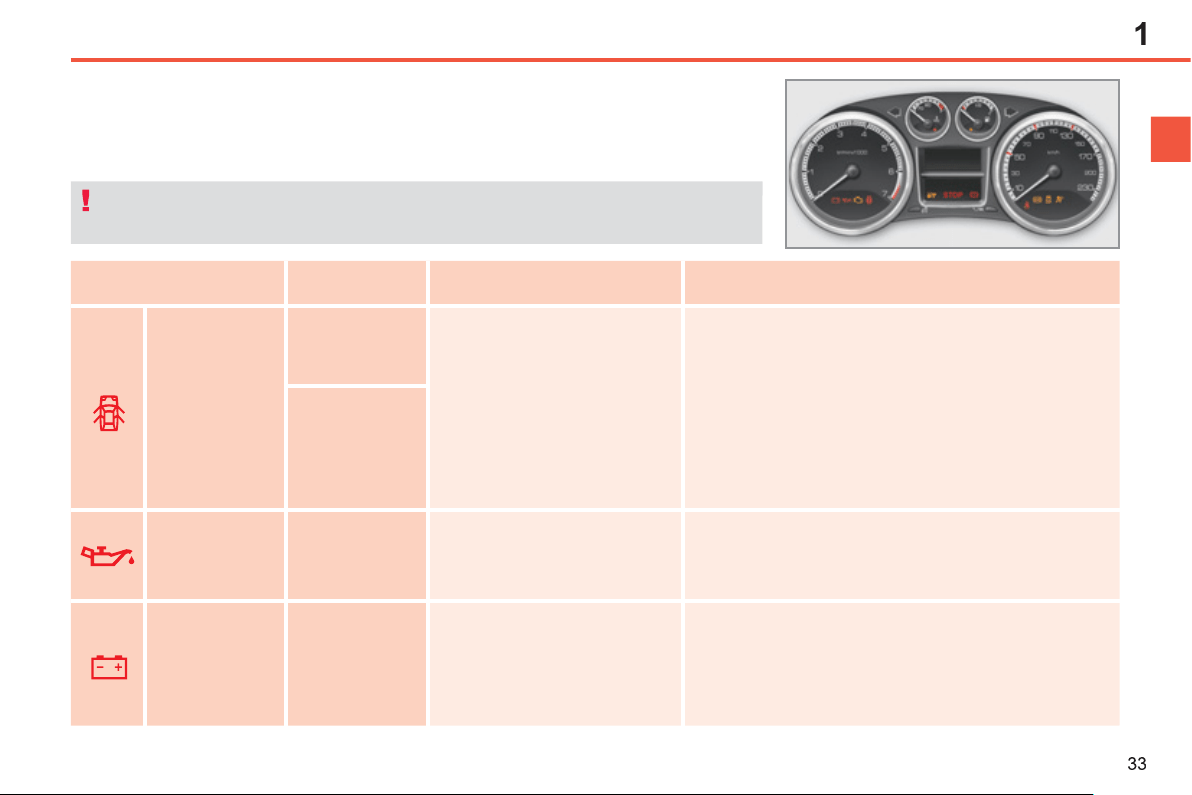
The other warning lamps appear only in this instrument panel.
The illumination of certain warning lamps may be accompanied by an audible sig-
nal; an additional message is still displayed in the multifunction screen, to help you
identify the fault.
Warning lamp is on Cause Action / Observations
Door(s) open
fi xed if the
speed is
below 6 mph
(10 km/h).
A door or the boot is still
open.
Close the door or boot.
fi xed and
accompanied
by an audible
signal if the
speed is
above 6 mph
(10 km/h).
Engine oil
pressure
fi xed.
There is a fault with the
engine lubrication system.
You must stop as soon it is safe to do so.
Park, switch off the ignition and contact a
PEUGEOT dealer or a qualifi ed workshop.
Battery
charge *
fi xed.
The battery charging circuit
has a fault (dirty or loose
terminals, slack or cut
alternator belt, ...).
The warning lamp should go off when the engine
is started.
If it does not go off, contact a PEUGEOT dealer
or a qualifi ed workshop.
If they are associated with the STOP warning lamp, you must stop the vehicle
as soon as it is safe to do so!
* According to destination country.
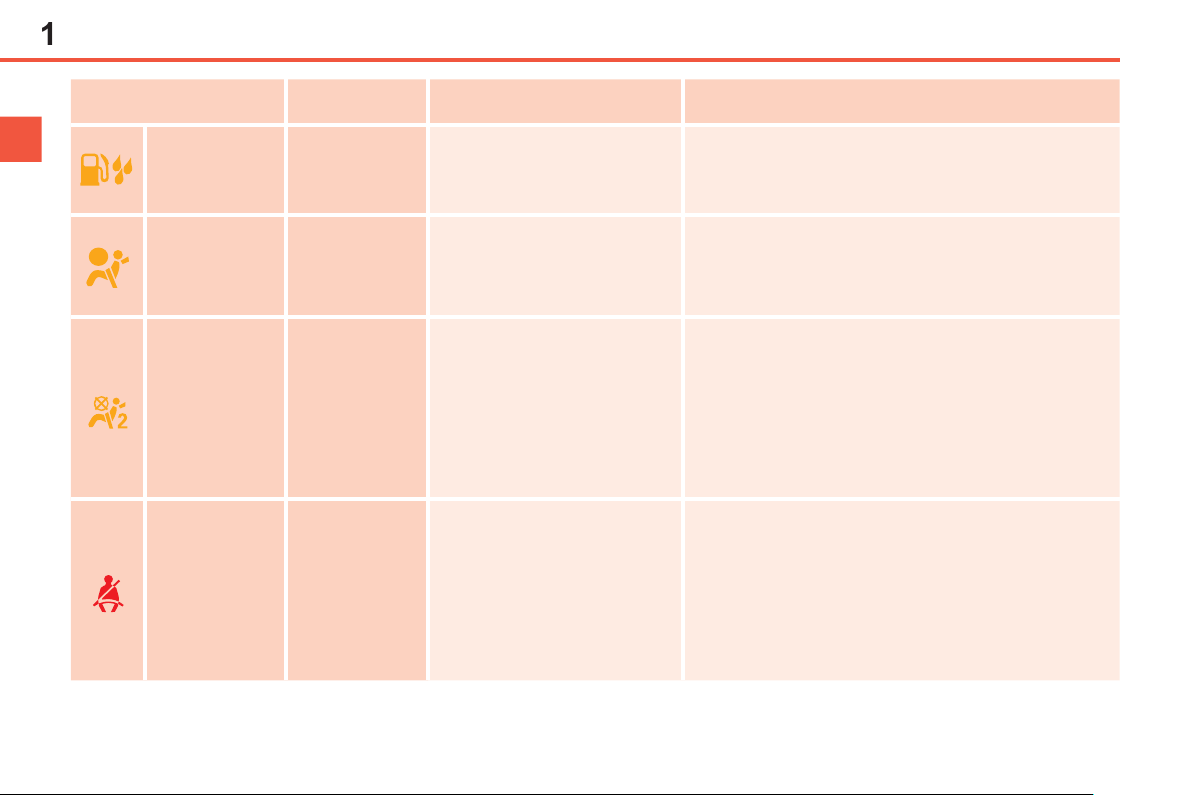
1
34
INSTRUMENTS and CONTROLS
Warning lamp is on Cause Action / Observations
Water in
Diesel
fi xed.
The Diesel fuel fi lter
contains water.
Risk of damage to the injection system on Diesel
engines.
Contact a PEUGEOT dealer or a qualifi ed
workshop without delay.
Airbags fi xed.
One of the airbag or seat
belt pretensioner systems
has a fault.
Have it checked by a PEUGEOT dealer or a
qualifi ed workshop.
Seat belt not
fastened /
unfastened
fi xed then
fl ashing
accompanied
by an
increasing
audible signal.
The driver and/or the front
passenger has not fastened
or has unfastened their seat
belt.
At least one of the rear
passengers has unfastened
their seat belt (only on the
2nd row rear seats on SW
individual rear seats).
Pull the strap then insert the tongue in the
buckle.
Passenger's
front airbag
fl ashing in the
instrument
panel and/or
in the seat
belt belt and
passenger's
front airbag
warning lamps
display.
The passenger's front
airbag has a fault.
The passenger's front airbag may not be
deployed in the event of a serious impact.
Have it checked by a PEUGEOT dealer or a
qualifi
ed workshop.
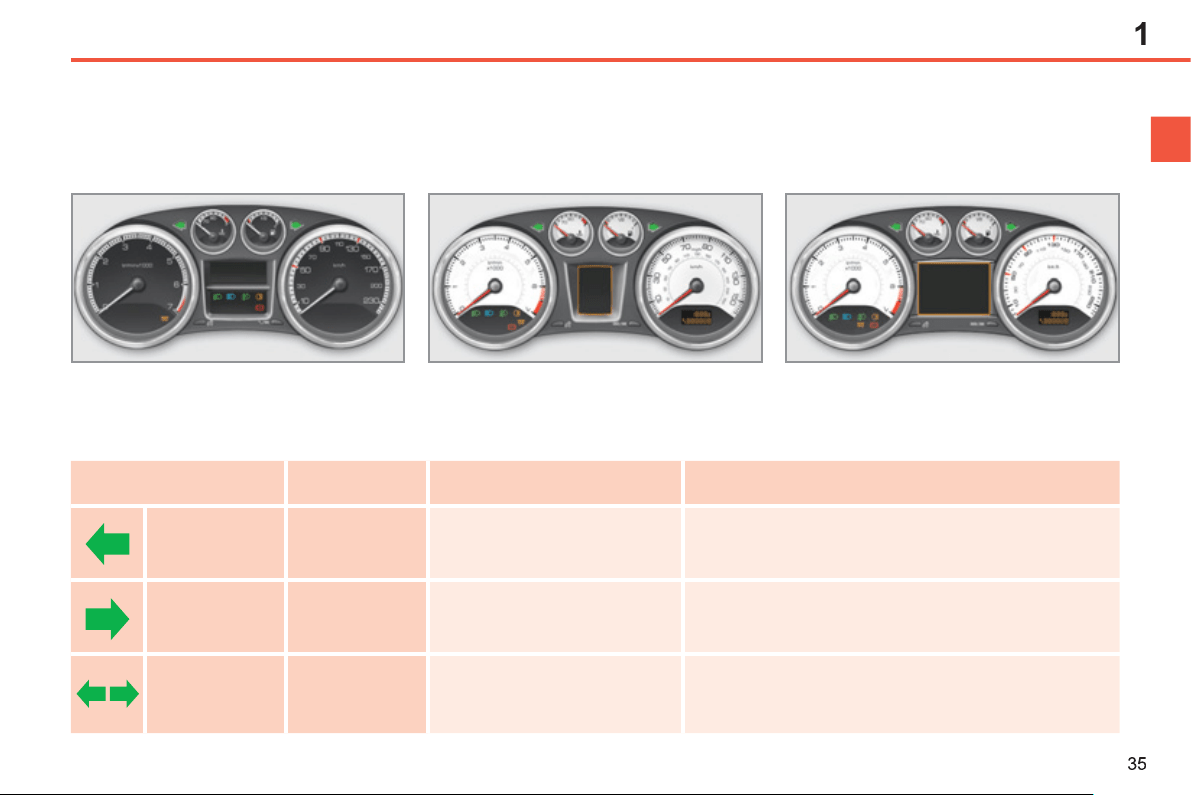
1
INSTRUMENTS and CONTROLS
Operation indicator lamps
If one of the following indicator lamps comes on, this confi rms that the corresponding system has come into operation.
It may be accompanied by an audible signal.
Depending on your version of instrument panel, the illumination of the lamp is accompanied by:
Warning lamp is on Cause Action / Observations
Left-hand
direction
indicato r
fl ashing with
buzzer.
The lighting stalk is pushed
down.
Right-hand
direction
indicator
fl ashing with
buzzer.
The lighting stalk is pushed up.
Hazard
warning
lamps
fl ashing with
audible signal.
The hazard warning
lamps switch, located on
the dashboard, has been
operated.
The left-hand and right-hand direction indicators
and their associated indicator lamps fl ash
simultaneously.
- a message in the multi-function
screen,
or
- a pictogram in the central instrument
panel screen and a message in the
multifunction screen,
or
- a pictogram and a message in the
central instrument panel screen.
1
36
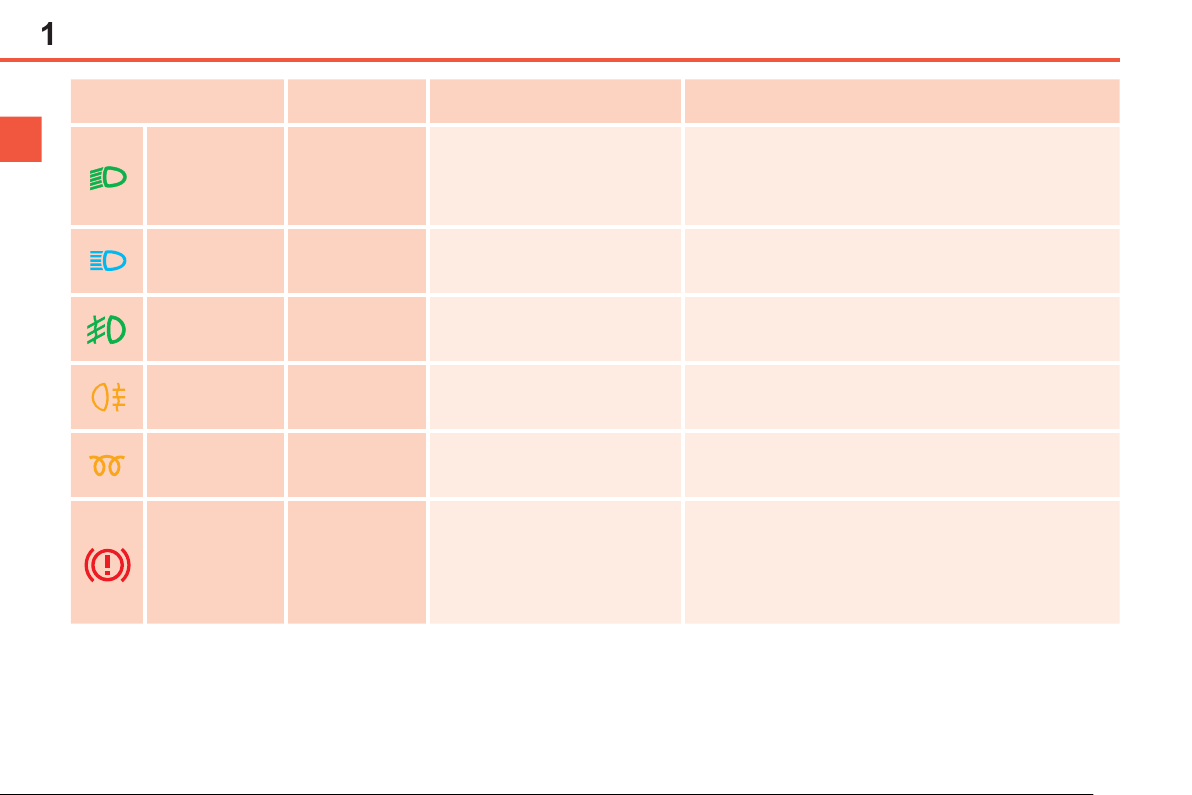
INSTRUMENTS and CONTROLS
Warning lamp is on Cause Action / Observations
Front
foglamps
fi xed.
The front foglamps are
switched on.
Turn the ring on the stalk rearwards twice to
switch off the front foglamps.
Rear
foglamps
fi xed.
The rear foglamps are
switched on.
Turn the ring on the stalk rearwards to switch off
the rear foglamps.
Diesel engine
pre-heating
fi xed.
The ignition switch is at the
2nd position (ignition on).
Wait until the warning lamp has switched off before starting.
The duration for which the warning lamp is on is
determined by the climatic conditions.
Parking brake fi xed.
The parking brake is applied
or not properly released.
Release the parking brake to switch off the
warning lamp, keeping your foot on the brake
pedal.
Observe the safety recommendations.
For further information on the parking brake, refer
to the "Driving" section.
Dipped beam
headlamps
fi xed.
The lighting stalk is in the
"Dipped beam headlamps"
position or in the "AUTO"
position in conditions of low
light.
Main beam
headlamps
fi xed.
The lighting stalk is pulled
towards you.
Pull the stalk again to return to dipped beam
headlamps.
1
37
INSTRUMENTS and CONTROLS
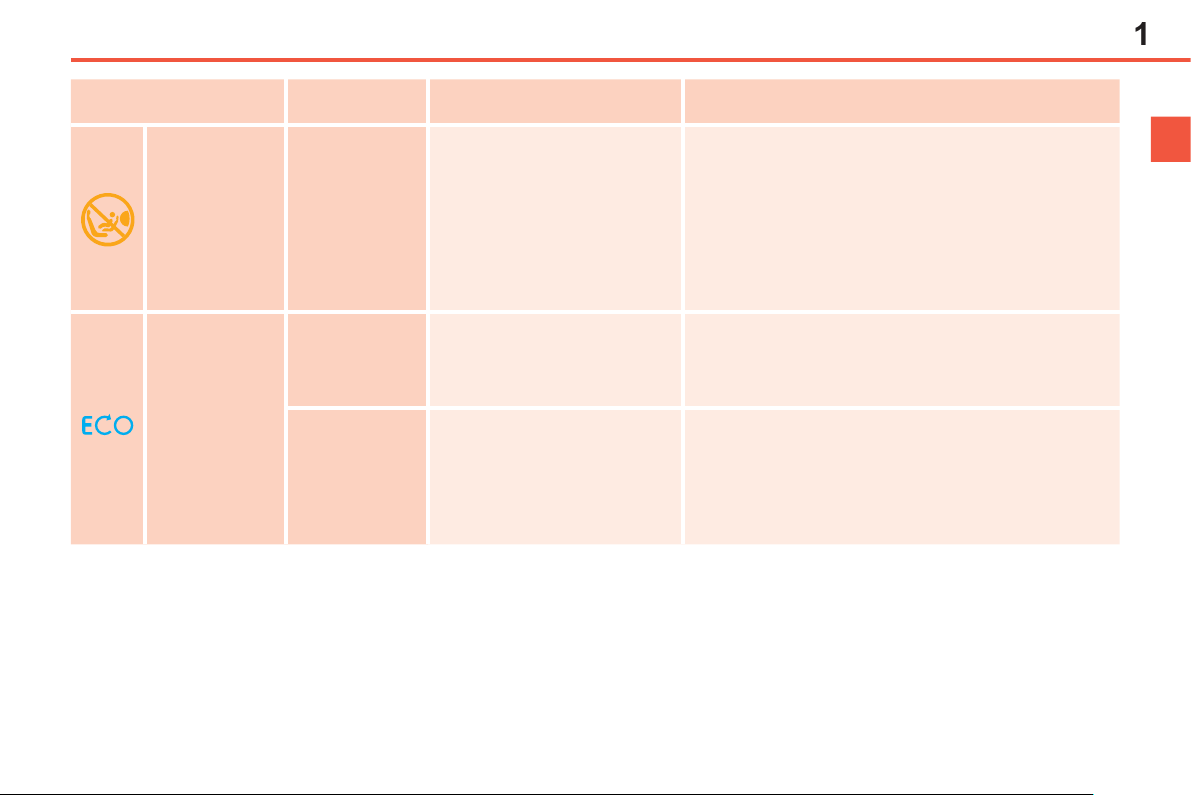
Stop & Start
fi xed.
When the vehicle stops (red
lights, traffi c jams, ...) the
Stop & Start system has
put the engine into STOP
mode.
The warning lamp goes off and the engine
restarts automatically in START mode, as soon
as you want to move off.
fl ashes for a
few seconds,
then goes off.
STOP mode is temporarily
unavailable.
or
START mode is invoked
automatically.
Refer to "Driving - § Stop & Start" for special
cases with STOP mode and START mode.
Warning lamp is on Cause Action / Observations
Passenger's
front airbag
fi xed on the
seat belt and
passenger's
front airbag
warning lamps
display.
The control switch, located
on the passenger's side of
the dashboard, has been
placed in the "ON" position.
The passenger's front
airbag is activated.
In this case, do not install a
"rear facing" child seat.
While you do not have a rear-facing child
seat fi tted to the front passenger seat, it is
recommended that the passenger's front airbag
be activated.
On the other hand, before fi tting a rear-facing
child seat, you must turn the control switch to the
"OFF" position.
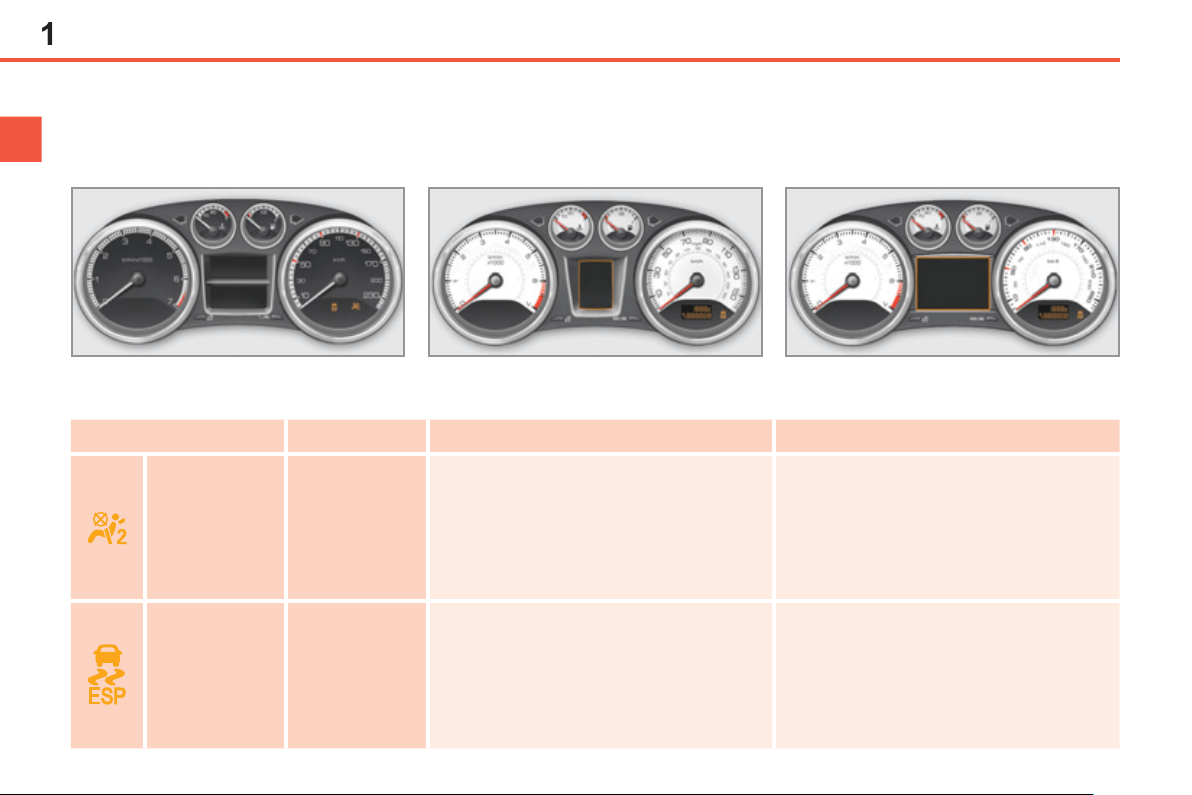
1
38
INSTRUMENTS and CONTROLS
Warning lamp is on Cause Action / Observations
Deactivation warning lamps
If one of the following warning lamps comes on, this confi rms that the corresponding system has been switched off intentionally.
This may be accompanied by an audible signal.
Depending on your version of instrument panel, illumination of the warning lamp is also accompanied by:
Passenger's
front airbag
fi xed in the
instrument
panel and/or
in the seat
belt and front
passenger's
airbag warning
lamps display.
The control switch, located on the
passenger's end of the dashboard, is
set to the "OFF" position.
The passenger's front airbag is
deactivated.
You can install a rear-facing child seat
on the front passenger seat.
To activate the front passenger's
airbag, set the switch to the "ON"
position; in this case, it is not possible
to fi t a child seat in the rear-facing
position on this seat.
ESP/ASR fi xed.
The button, located in the middle of
the dashboard, is pressed. Its indicator
lamp is on.
The ESP/ASR is deactivated. The
following functions are deactivated:
- ESP (dynamic stability control),
- ASR (wheel anti-slip regulation).
Press the button again to manually reactivate
these functions. Its indicator lamp goes off.
From approximately 30 mph (50 km/h), these
systems are reactivated automatically (except
for the 1.6 litre THP 200 hp petrol engine).
These function are activated automatically
when the vehicle is started.
- a message in the multifunction
screen,
or
- a pictogram in the central instrument
panel screen and a message in the
multifunction screen,
or
- a pictogram and a message in the
central instrument panel screen.

1
39
INSTRUMENTS and CONTROLS
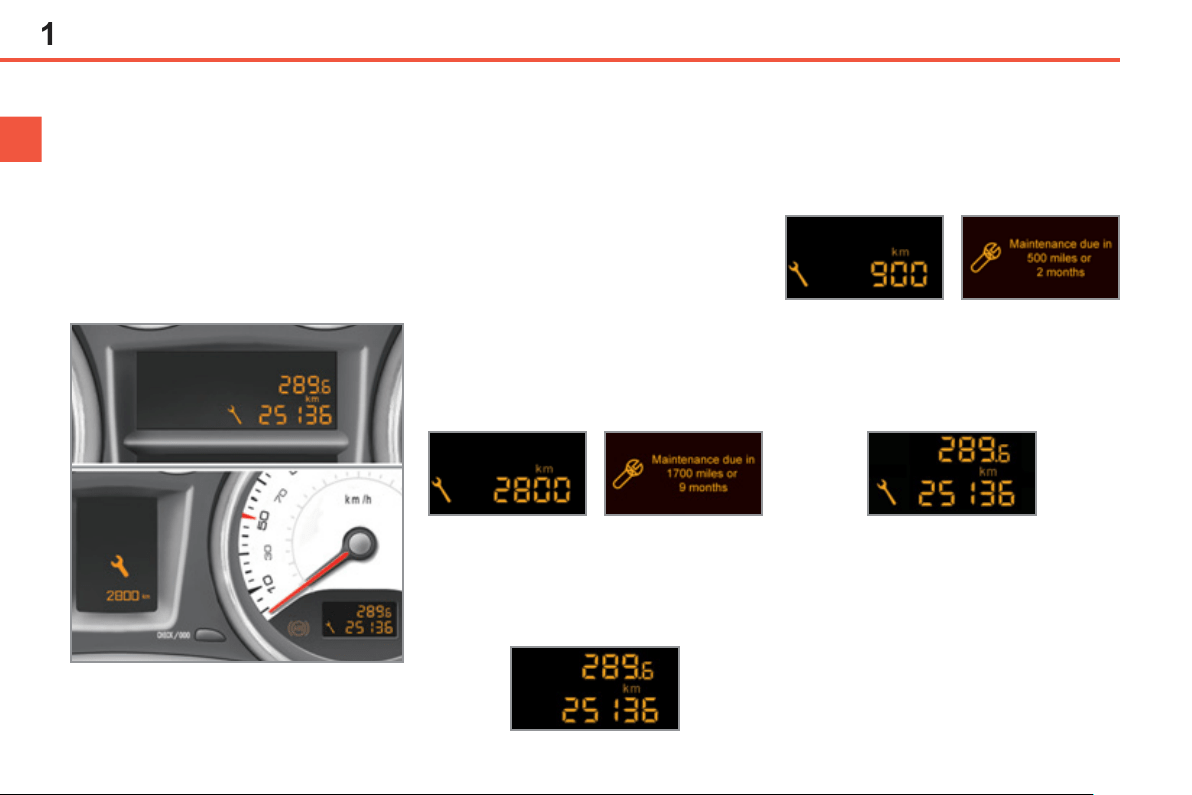
Coolant temperature indicator
With the engine running, when the nee-
dle is:
- in zone A , the temperature is
correct,
- in zone B , the temperature is
too high; the max temperature
warning lamp 1 and the central
STOP warning lamp come on,
accompanied by an audible signal
and a message in the screen.
You must stop as soon as it is safe
to do so.
Wait a few minutes before switching off
the engine.
Contact a PEUGEOT dealer or a quali-
fi ed workshop.
After driving for a few minutes, the tem-
perature and pressure in the cooling
system increase.
To top up the level:
) wait for the engine to cool,
) unscrew the cap by two turns to
allow the pressure to drop,
) when the pressure has dropped,
remove the cap,
) top up the level to the "MAX" mark.
1
4
0
INSTRUMENTS and CONTROLS
Service indicator
System which informs the driver when
the next service is due, in accordance
with the manufacturer's servicing
schedule.
The point at which the service is due is
calculated from the last indicator zero
reset. It is determined by two param-
eters:
- the distance travelled,
- the time elapsed since the last
service.
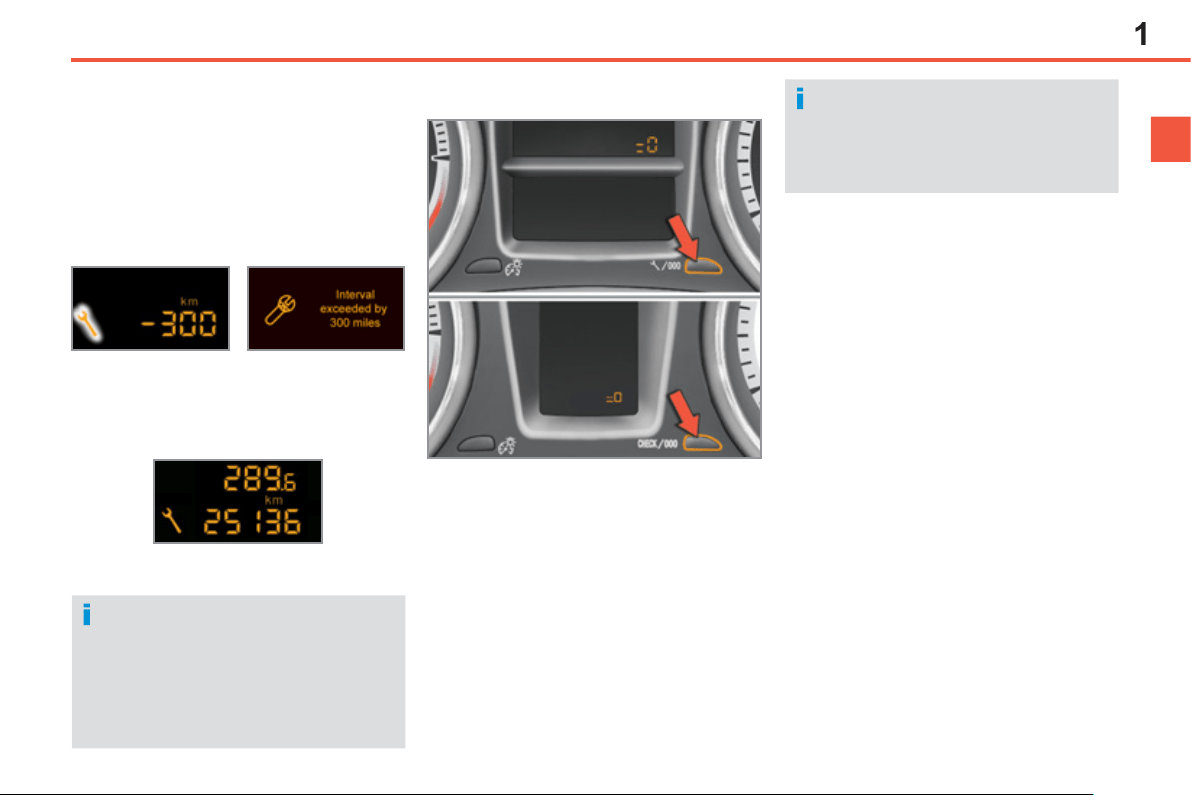
Between 600 miles (1 000 km) and
1 800 miles (3 000 km) remain before
the next service is due
For 5 seconds after the ignition is switched
on, the spanner symbolising the service
operations comes on. The distance re-
corder display line indicates the distance
remaining before the next service is due.
Example: 1 700 miles (2 800 km) re-
main before the next service is due.
For 5 seconds after the ignition is
switched on, the screen indicates:
5 seconds after the ignition is switched
on, the spanner goes off ; the distance
recorder resumes its normal operation.
The screen then indicates the total and
trip distances.
Less than 600 miles (1 000 km)
remain before the next service is due
Example: 560 miles (900 km) remain
before the next service is due.
For 5 seconds after the ignition is
switched on, the screen indicates:
5 seconds after the ignition is switched
on, the distance recorder resumes its
normal operation. The spanner re-
mains on to indicate that a service
must be carried out soon.
More than 1 800 miles (3 000 km)
remain before the next service is due
When the ignition is switched on, no ser-
vice information appears in the screen.
1
41
INSTRUMENTS and CONTROLS
Following this operation, if you wish
to disconnect the battery, lock the
vehicle and wait at least fi ve min-
utes for the zero reset to be reg-
istered.
Service indicator zero reset
After each service, the service indicator
must be reset to zero.
The procedure for resetting to zero is as
follows:
) switch off the ignition,
) press and hold the ".../000" button
on the right of the instrument panel,
) switch on the ignition; the
distance recorder display begins a
countdown,
) when the instrument panel central
screen indicates "=0" , release the
button; the spanner disappears
from the screen.
The distance remaining may be
weighted by the time factor, de-
pending on the driving conditions.
Therefore, the spanner may also
come on if you have exceeded the
two year service interval.
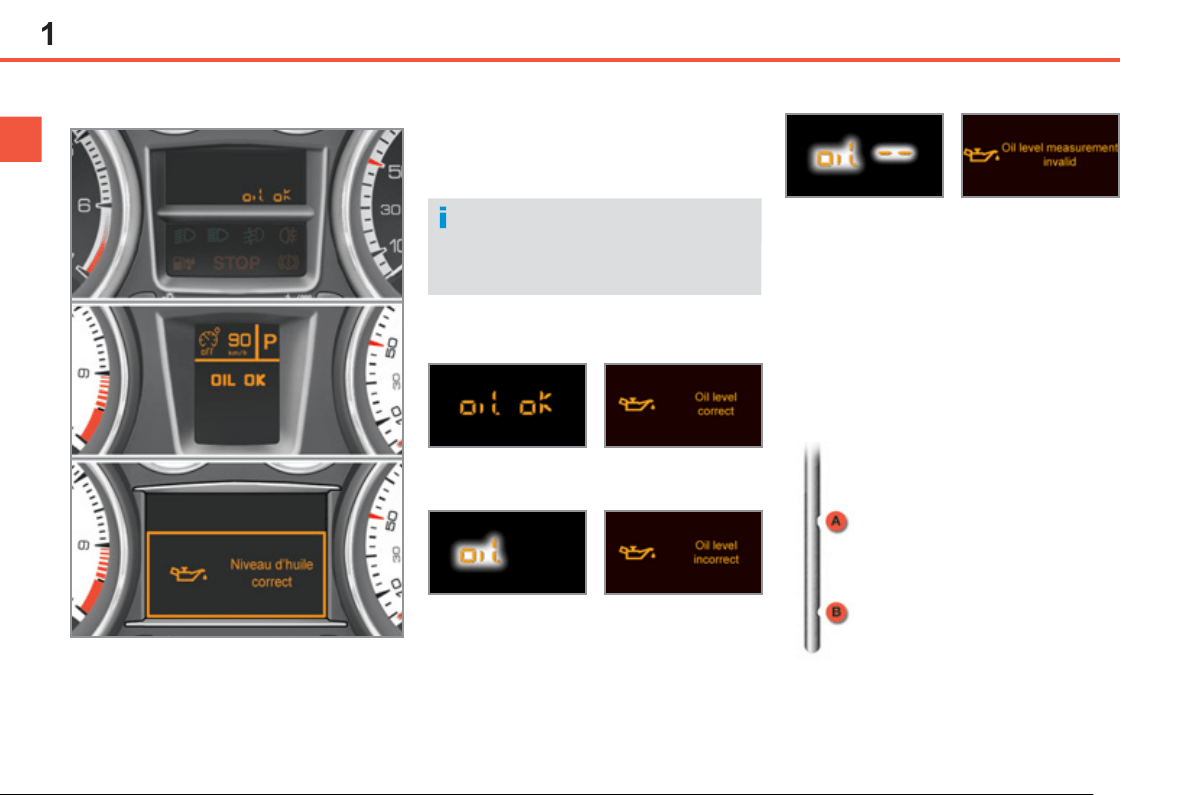
Service overdue
For 5 seconds after the ignition is
switched on, the spanner fl ashes to
indicate that the service must be carried
out as soon as possible.
Example: the service is overdue by 186 miles
(300 km).
For 5 seconds after the ignition is
switched on, the screen indicates:
5 seconds after the ignition is switched
on, the distance recorder resumes its
normal operation. The spanner re-
mains on .
Retrieving the service information
You can access the service information
at any time.
This information appears, depending
on version, when running through the
manual check procedure.
) Briefl y press the ".../000" button on
the right of the instrument panel.
The service information is
displayed for a few seconds on the
instrument panel central screen,
then disappears.
1
42
INSTRUMENTS and CONTROLS
The level shown will only be correct
if the vehicle is on level ground and
the engine has been off for more
than 30 minutes.
Engine oil level indicator
This information is displayed for a few
seconds when the ignition is switched
on, after the service information.
Oil level correct
Oil level low
Oil level indicator fault
Dipstick
This is indicated by the fl ashing of "OIL" ,
linked with the service warning lamp, ac-
companied by an audible signal and a
message in the multifunction screen.
If the low oil level is confi rmed by a
check using the dipstick, the level must
be topped up to prevent damage to the
engine.
This is indicated by the fl ashing of "OIL--" .
Contact a PEUGEOT dealer or a qualifi ed
workshop.
Refer to the "Checks" section to locate
the dipstick and the oil fi ller cap on your
engine.
There are 2 marks on the
dipstick:
- A = max; never exceed
this level (risk of
damage to the engine),
- B = min; top up the level
via the oil fi ller cap,
using the grade of oil
suited to your engine.
1
4
3
INSTRUMENTS and CONTROLS
Distance recorders
The total and trip distances are dis-
played for thirty seconds when the ig-
nition is switched off, when the driver's
door is opened and when the vehicle is
locked or unlocked.
Total distance recorder
Trip distance recorder
) With the ignition on, press and hold
this button until zeros appear.
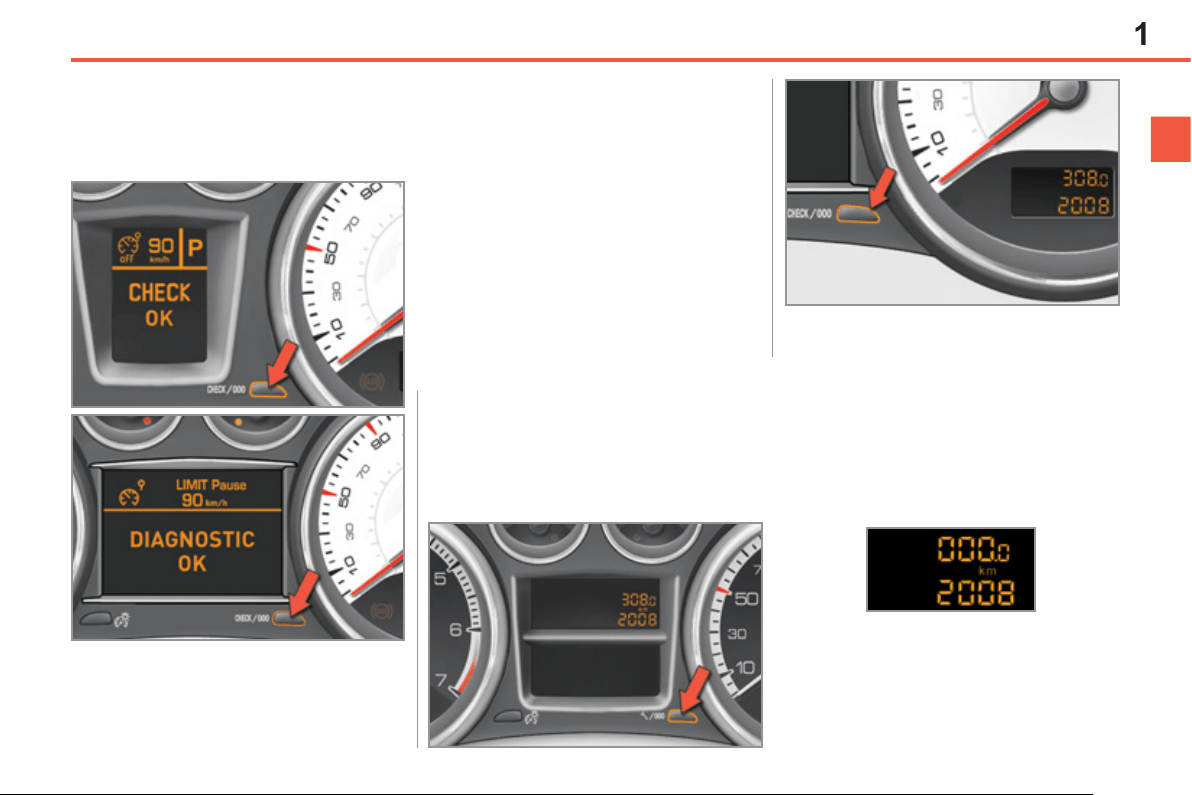
Manual Check
This function allows you to check the status
of the vehicle (reminder of the active alert
warnings) and the service information.
) With the engine running, to start
a manual check, briefl y press
the "CHECK/000" button on the
instrument panel.
If no faults have been detected,
"CHECK OK" appears in the instru-
ment panel central screen.
If a "major" fault has been detected, only
the warning lamps concerned appear
in the instrument panel central screen.
Have it checked by a PEUGEOT dealer
or a qualifi ed workshop.
If a "minor" fault has been detected, the warn-
ing lamp concerned then "CHECK OK" ap-
pear in the instrument panel central screen.
Contact a PEUGEOT or a qualifi ed work-
shop.
Measures a distance travelled since it
was reset to zero by the driver.
Measures the total distance travelled by
the vehicle since its fi rst registration.
1
44
INSTRUMENTS and CONTROLS
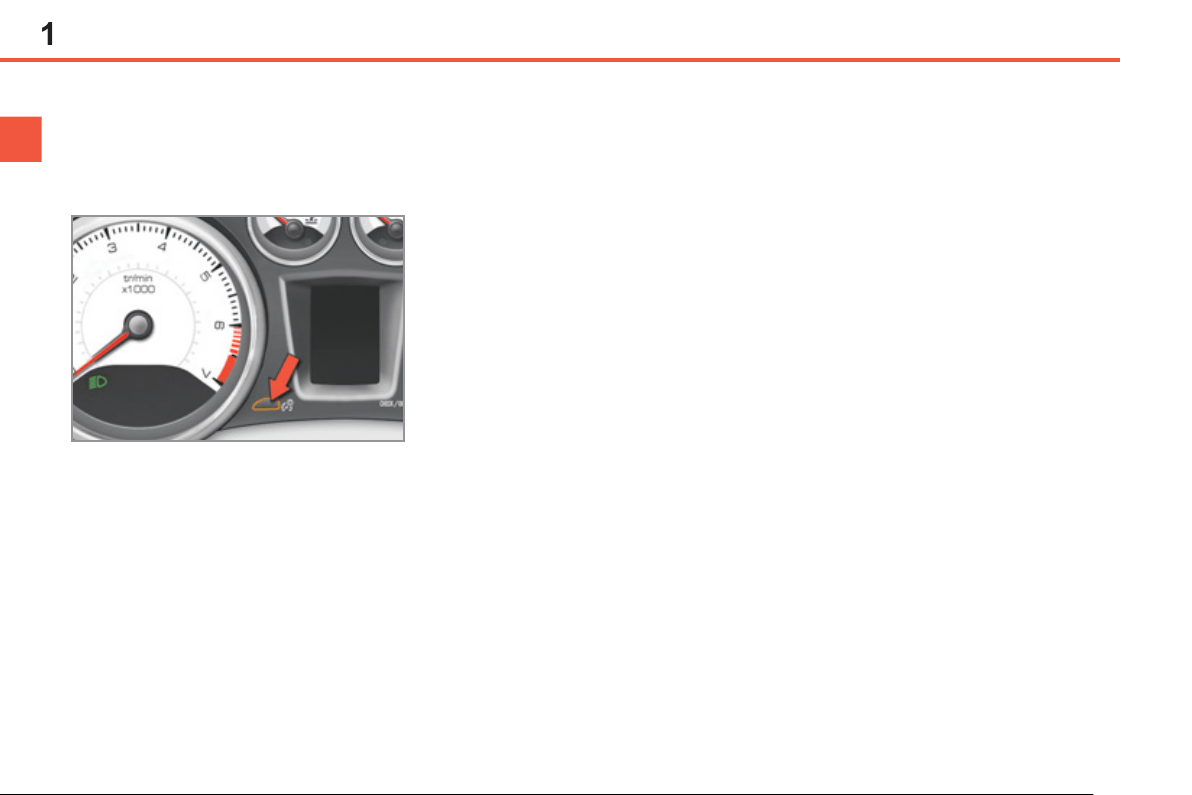
Lighting dimmer
Permits manual adjustment of the bright-
ness of the instruments and controls to
suit the ambient light level. Only operates
when the vehicle lighting is on, with the
exception of the daytime running lamps.
Activation
) Press the button to change the
brightness of the instruments and
controls.
) When the lighting reaches the
minimum setting, release the
button, then press again to
increase it.
or
) When the lighting reaches the
maximum setting, release the
button, then press again to reduce
it.
) When the lighting reaches the level
of brightness required, release the
button.
Deactivation
When the vehicle lighting is off, or in
day mode on vehicles fi tted with day-
time running lamps, pressing the button
does not have any effect.
2
4
5
MULTIFUNCTION SCREENS
Displays in the screen
Depending on the context, displays:
- time,
- date,
- ambient temperature with air condi-
tioning (the value if there is a risk of
ice),
- trip computer,
- alert messages,
- parameter settings menus for the
screen and vehicle equipment.
MONOCHROME SCREEN A
(
WITHOUT
PEUGEOT CONNECT SOUND
(
RD5
))
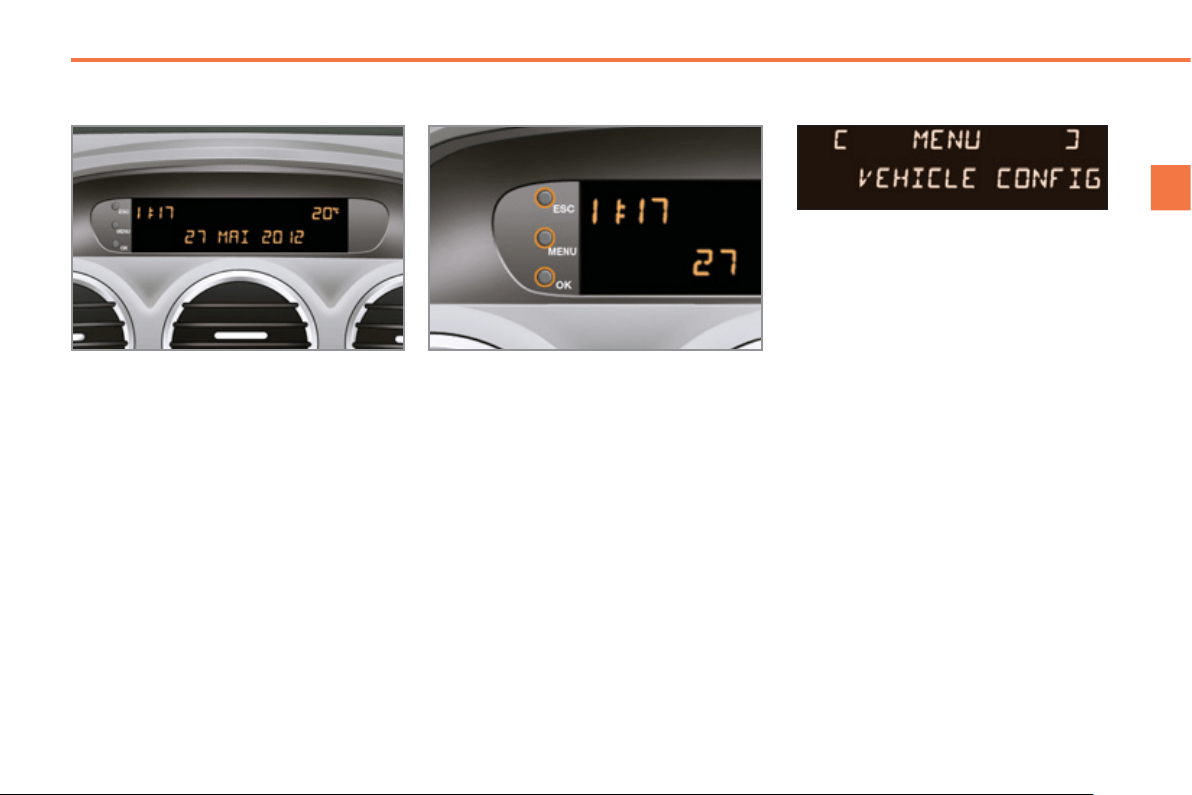
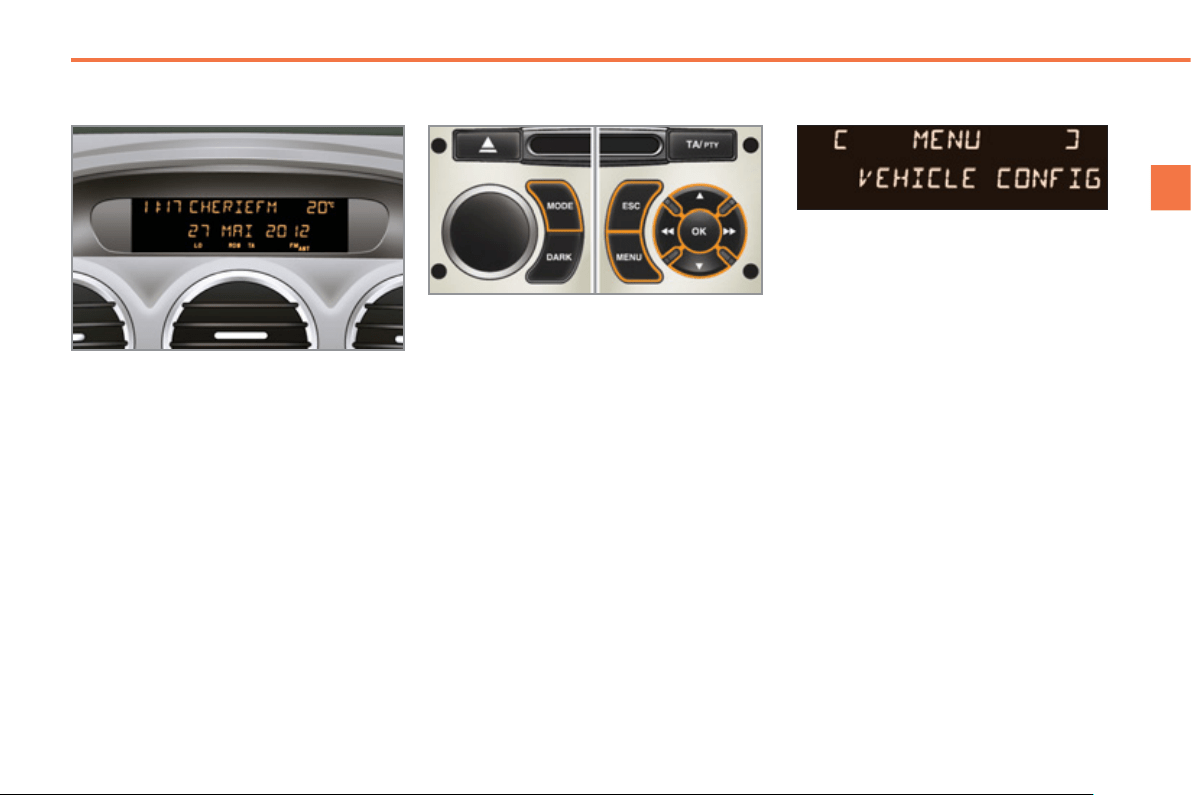
Controls Main menu
Three buttons are used to control the
the screen:
- "ESC" to abandon the operation in
progress,
- "MENU" to scroll through the menus
or sub-menus,
- "OK" to select the menu or sub-
menu required.
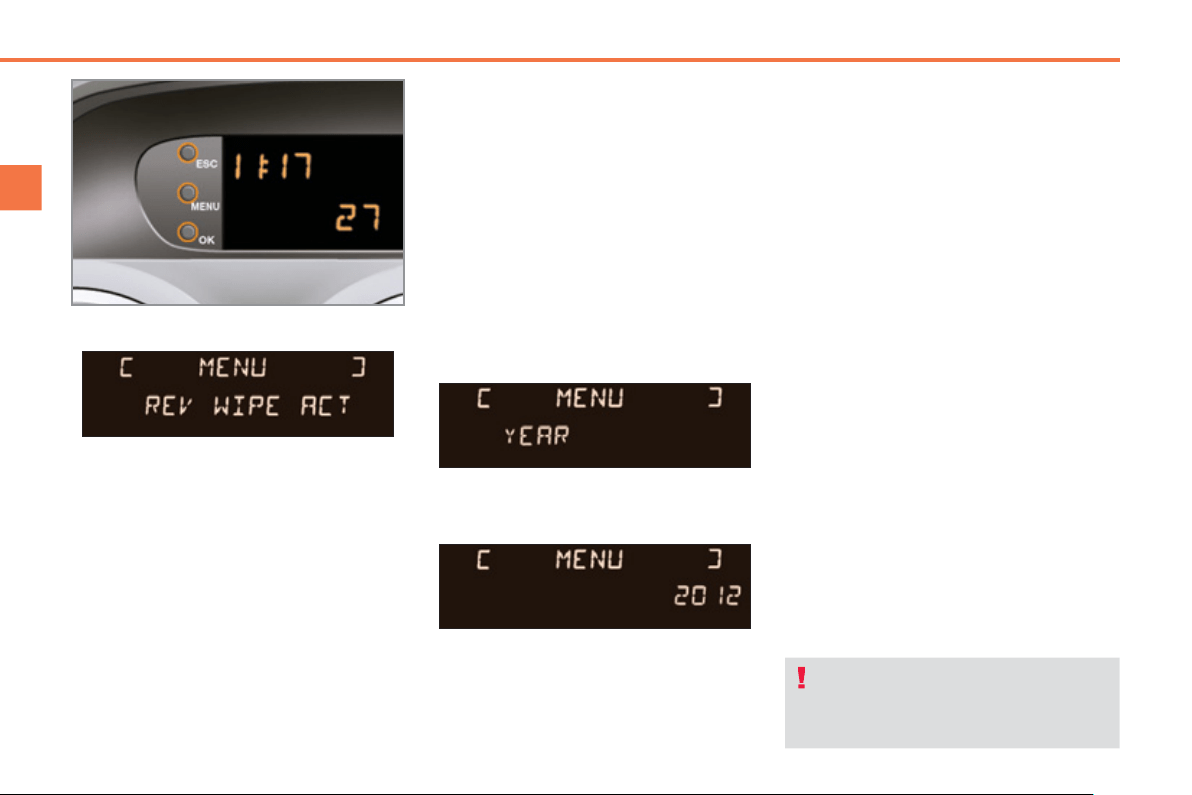
) Press the "MENU" button to scroll
through the various menus of the
main menu :
- vehicle confi guration,
- options,
- display settings,
- languages,
- units.
) Press the "OK" button to select the
menu required.
2
4
6
MULTIFUNCTION SCREENS
Vehicle confi guration
Options
Once the "Options" menu has been se-
lected, you can start diagnostics on the
state of the vehicle (current alerts).
Languages
Once the "Languages" menu has been
selected, you can change the language
used by the display (Français, Italiano,
Nederlands, Portugues, Portugues-Brasil,
Deutsch, English, Espanol).
Display settings
Once the "Display settings" menu has
been selected, you can gain access to
the following settings:
- year,
- month,
- day,
- hour,
- minutes,
- 12 or 24 hour mode.
Units
Once the "Units" menu has been se-
lected, you can change the units of the
following parameters:
- temperature (°C or °F),
- fuel consumption (l/100 km, mpg or
km/l).
) Once you have selected a setting,
press the "OK" button to change its
value.
) Wait for approximately ten sec-
onds without any action to allow
the changed data to be recorded or
press the "ESC" button to cancel.
The screen then returns to the normal
display.
Once the "Vehicle confi guration" menu
has been selected, you can activate or
deactivate the following equipment:
- wiper linked with reverse gear (see
"Visibility"),
-
daytime running lamps (see "Visibility"),
- rear parking sensors (see "Driving").
For safety reasons, confi guration
of the multifunction screen by the
driver must only be done when sta-
tionary.
2
47
MULTIFUNCTION SCREENS
M
ONOCHROME
S
CREEN
A
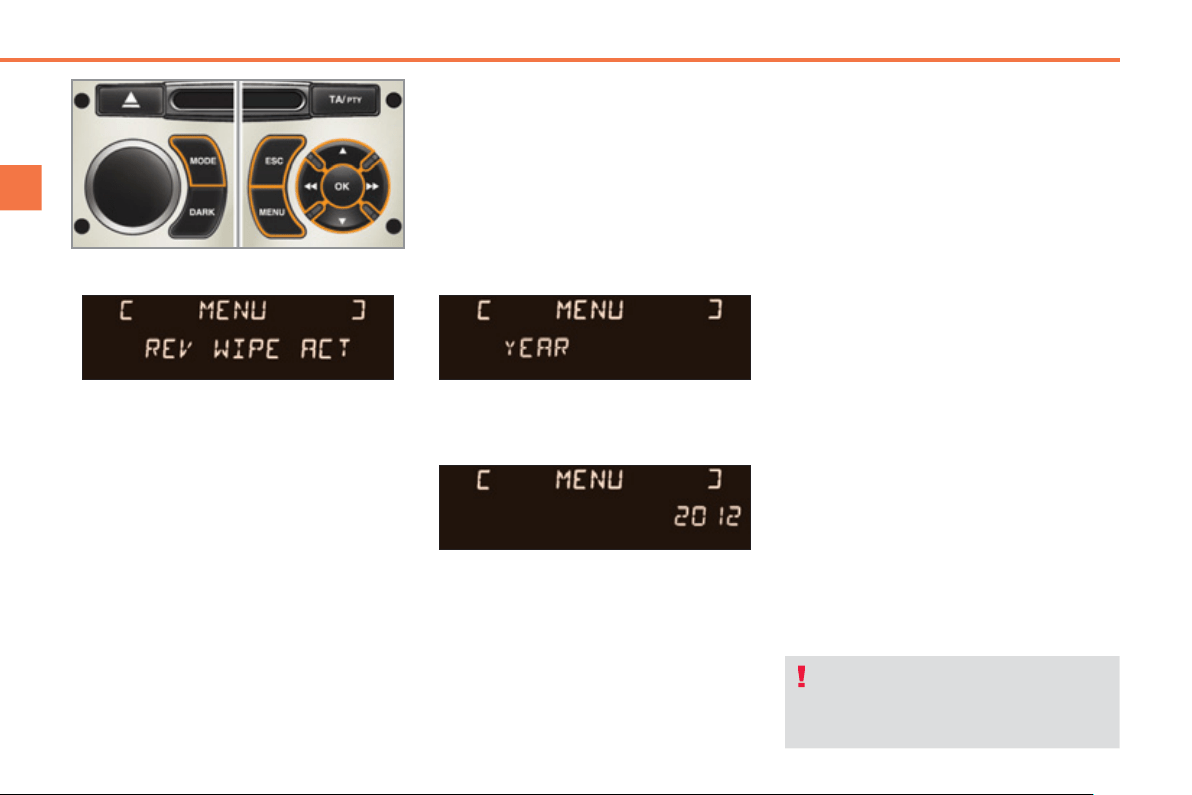
Controls
Displays in the screen
Displays according to context:
- time,
- date,
- ambient temperature with air condi-
tioning (the value displayed fl ashes
if there is a risk of ice),
- audio functions,
- trip computer,
- alert messages,
- screen display and vehicle equip-
ment parameter settings menus.
Main menu
) Press the "MENU" button for access
to the main menu , then press the
" " or " " buttons to scroll through
the various menus:
- radio-CD,
- vehicle confi guration,
- options,
- display settings,
- languages,
- units.
) Press the "OK" button to select the
menu required.
From the control panel of your Peugeot
Connect Sound (RD5), you can:
) press the "MENU" button for access
to the main menu ,
) press the " " or " " buttons to scroll
through the items on the screen,
) press the "MODE" button to change
the permanent application (trip com-
puter, audio source...),
) press the " " or " " buttons to
change a setting value,
) press the "OK" button to confi rm,
or
) press the "ESC" button to abandon
the operation in progress.
Radio-CD
With the Peugeot Connect Sound (RD5)
switched on, once the "Radio-CD" menu
has been selected you can activate or
deactivate the functions linked with use
of the radio (RDS, REG), or CD (CD in-
troscan, shuffl e, repeat).
For more information on the "Radio-CD"
application, refer to the Peugeot Connect
Sound (RD5) section.
2
4
8
MULTIFUNCTION SCREENS
For safety reasons, confi guration
of the multifunction screen by the
driver must only be done when sta-
tionary.
Screen display settings
Once the "Display settings" menu has
been selected, you can gain access to
the following settings:
- year,
- month,
- day,
- hour,
- minutes,
- 12 or 24 hour mode.
Languages
Once the "Languages" menu has been
selected, you can change the language
used by the display (Français, Italiano,
Nederlands, Portugues, Portugues-Brasil,
Deutsch, English, Espanol).
Units
Once the "Units" menu has been se-
lected, you can change the units of the
following parameters:
- temperature (°C or °F),
- fuel consumption (l/100 km, mpg or
km/l).
) Once you have selected a setting,
press the " " or " " buttons to
change its value.
) Press the " " or " " buttons to
switch respectively to the previous
or next setting.
) Press the "OK" button to record
the change and return to the normal
display or press the "ESC" button to
cancel.
Vehicle confi guration
Options
Once the "Options" menu has been se-
lected, you can start diagnostics of the
status of the equipment (active, not ac-
tive, faulty).
Once the "Vehicle Confi guration" menu
has been selected, you can activate or
deactivate the following equipment:
- wiper linked with reverse gear (see
"Visibility"),
- daytime running lamps (see "Visibility"),
- rear parking sensors (see "Driving").

2
MULTIFUNCTION SCREENS
M
ONOCHROME
S
CREEN C Main menu
Displays in the screen
Displays according to context:
- time,
- date,
- ambient temperature with air condi-
tioning (the value displayed fl ashes
if there is a risk of ice),
- parking sensor information,
- audio functions,
- contacts and telephone information,
- trip computer (with type 1 instrument
panel),
- alert messages,
- screen display and vehicle equip-
ment parameter setting menus.
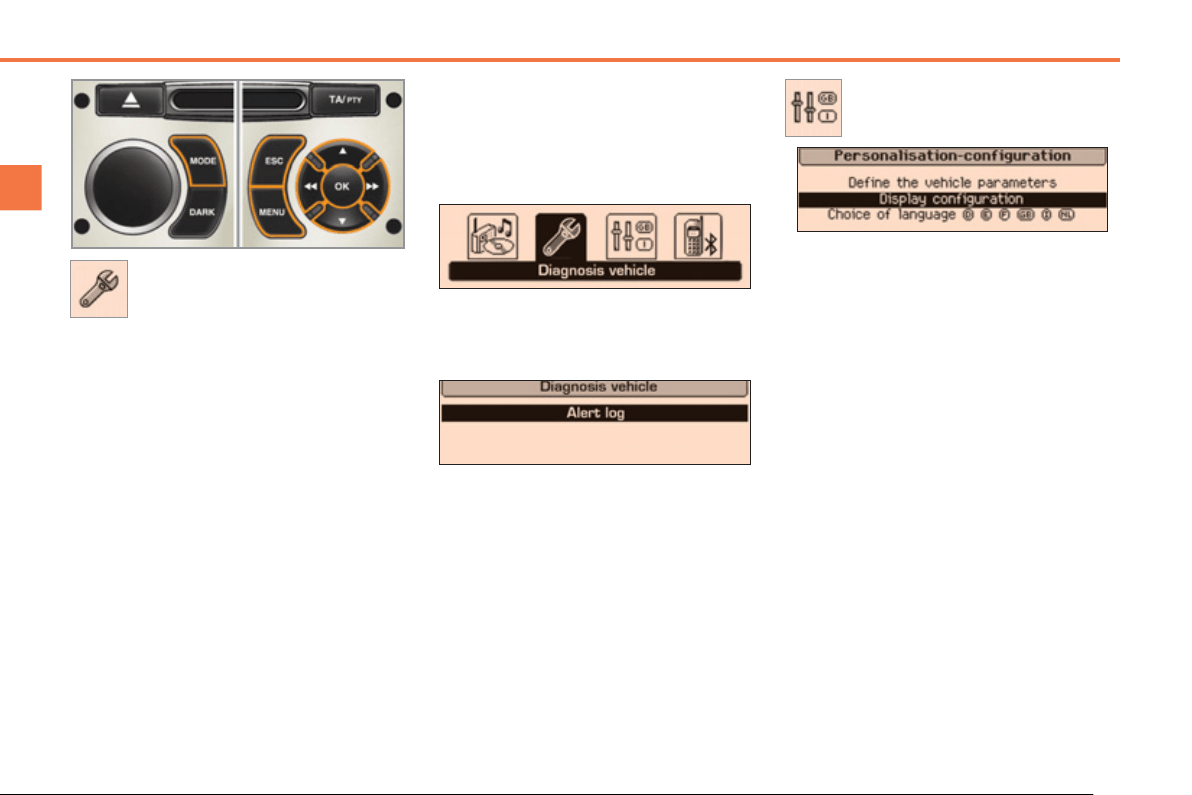
"Audio functions" menu
Controls
From the control panel of your Peugeot
Connect Sound (RD5), you can:
) press the "MENU" button for access
to the main menu ,
) press the " " or " " buttons to scroll
through the items on the screen,
) press the "MODE" button to change
the permanent application (trip com-
puter, audio source...),
) press the " " or " " buttons to
change a setting value,
) press the "OK" button to confi rm,
or
) press the "ESC" button to abandon
the operation in progress.
) Press the "MENU" button for ac-
cess to the main menu :
- audio functions,
- diagnosis vehicle,
- personalisation-confi guration,
- telephone (Bleutooth system).
) Press the " " or " " buttons to se-
lect the menu required, then confi rm
by pressing the "OK" button.
With the Peugeot Connect Sound (RD5)
switched on, once this menu has been
selected you can activate or deactivate
the functions linked with use of the ra-
dio (RDS, REG, RadioText), or CD (CD
introscan, shuffl e, repeat).
For more information on the "Audio func-
tions" application, refer to the Peugeot
Connect Sound (RD5) section.
2
50
MULTIFUNCTION SCREENS
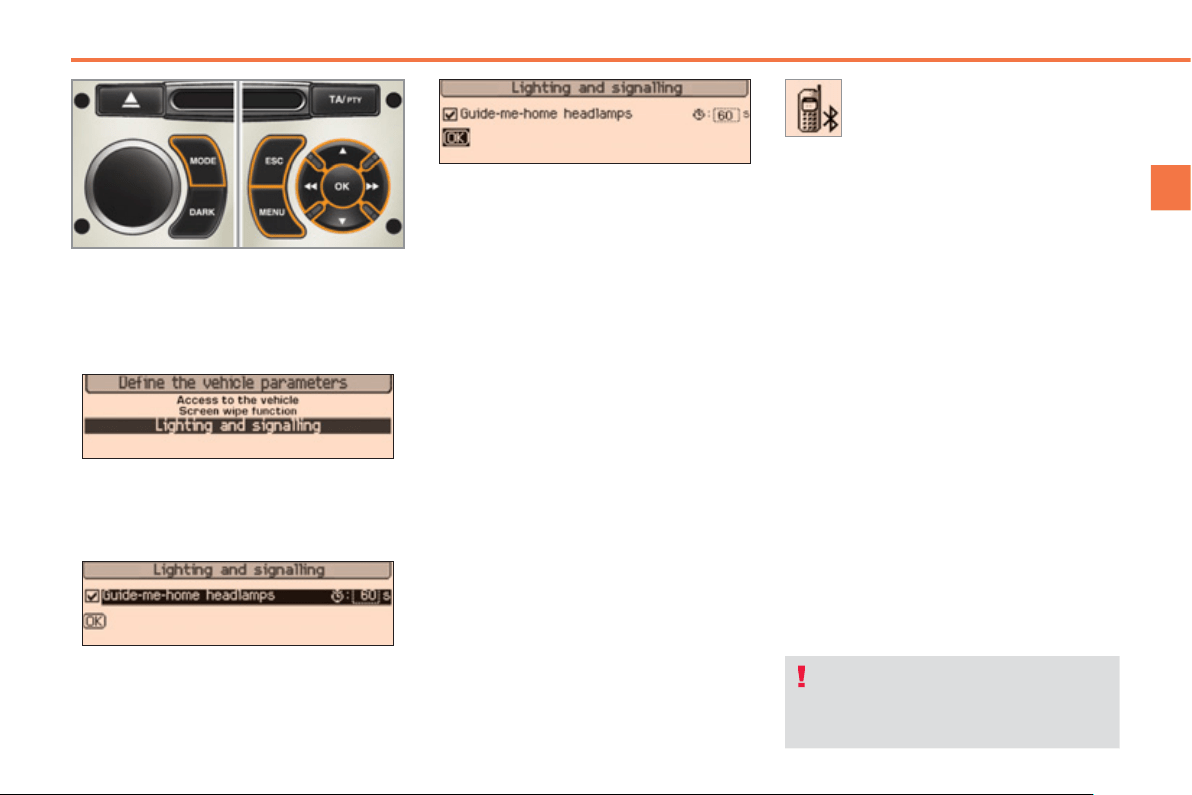
"Diagnosis vehicle"
menu
) Press the "MENU" button for ac-
cess to the main menu.
) Press the arrows, then the "OK"
button to select the " Diagnosis ve-
hicle " menu.
) On the " Diagnosis vehicle " menu,
select the following application:
Alert log
This summarises the active warning
messages, displaying them in succes-
sion on the multifunction screen.
Once this menu has been selected, you
can consult information concerning the
status of the vehicle, such as the alert log.
Defi ne the vehicle parameters
Once this menu has been selected, you
can activate or deactivate the following
equipment:
- wiper linked with reverse gear (see
"Visibility"),
- "guide-me-home" lighting (see "Vis-
ibility"),
- interior mood lighting (see "Visibility"),
- daytime running lamps (see "Visibility"),
- rear parking sensors (see "Driving").
"Personalisation-
Configuration" menu
Once this menu has been selected, you
can gain access to the following func-
tions:
- defi ne the vehicle parameters,
- display confi guration,
- choice of language.
2
51
MULTIFUNCTION SCREENS
For safety reasons, confi guration
of the multifunction screen by the
driver must only be done when sta-
tionary.
"Telephone" menu
Display confi guration
Once this menu has been selected, you
can gain access to the following set-
tings:
- brightness-video setting,
- date and time setting,
- choice of units.
Choice of language
Once this menu has been selected,
you can change the language used by
the display (Deutsch, English, Espanol,
Français, Italiano, Nederlands, Portugues,
Portugues-Brasil, Russe, Türkçe * ).
Example: setting of the duration of the
"guide-me-home" lighting
) Press the " " or " " buttons, then
the "OK" button to select the menu
required.
) Press the " " or " " buttons,
then the "OK" button to select the
"Guide-me-home headlamps" line.
) Press the " " or " " buttons to set
the value required (15, 30 or 60 sec-
onds), then press the "OK" button
to confi rm.
) Press the " " or " " buttons, then
the "OK" button to select the "OK"
box and confi rm or press the "ESC"
button to cancel.
With the Peugeot Connect Sound
(RD5) switched on, once this menu has
been selected you can confi gure your
Bluetooth system (pairing), consult the
various telephone directories (calls log,
services...) and manage your communi-
cations (pick up, hang up, call waiting,
secret mode...).
For more information on the "Tele-
phone" application, refer to the Peugeot
Connect Sound (RD5) section.
* According to country.
2
MULTIFUNCTION SCREENS
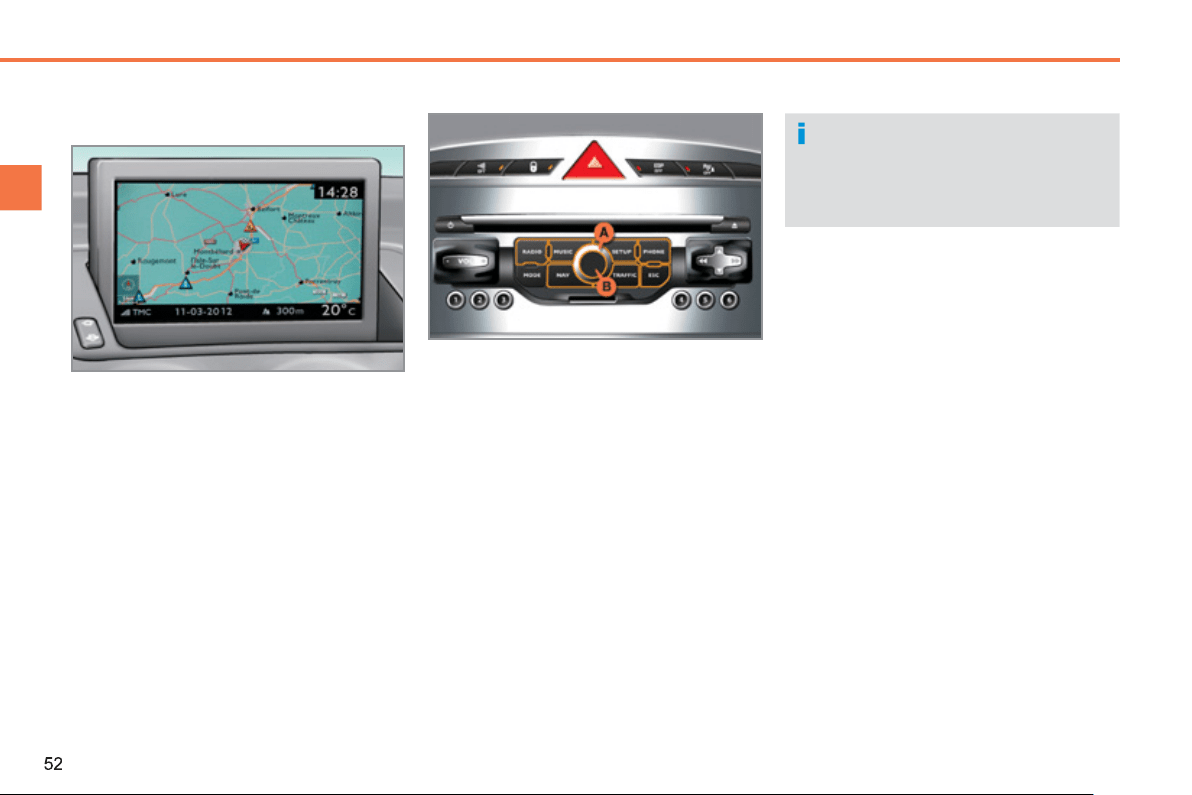
For operation of the retractable
screen (opening, closing, adjust-
ment of the position, etc.), refer
to the "Access to the retractable
screen" section.
Displays in the screen
Displays according to context:
- time,
- date,
- altitude,
- ambient temperature (the value dis-
played fl ashes if there is a risk of
ice),
- parking sensor information,
- audio functions,
- telephone and contacts information,
- satellite navigation system informa-
tion,
- alert messages,
- menus for settings of the screen,
navigation system and vehicle
equipment.
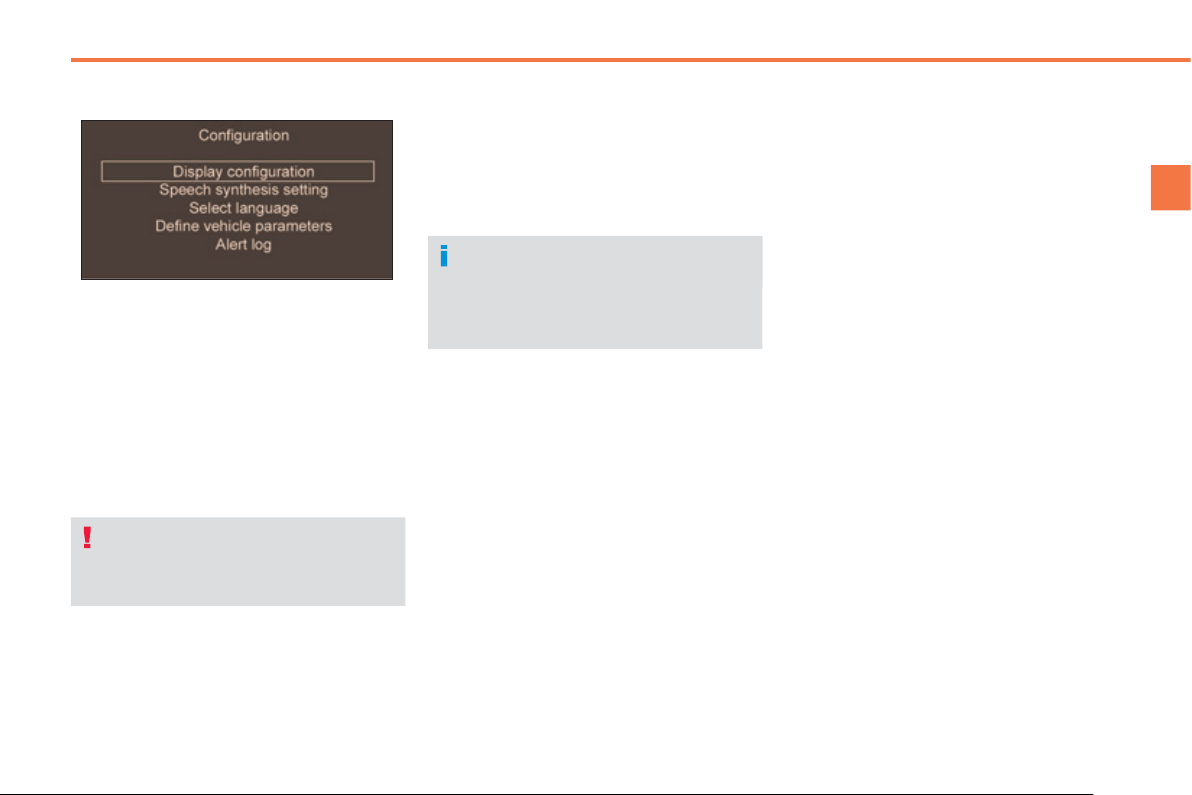
From the navigation system control
panel, to select one of the applications:
) press the dedicated "RADIO" ,
"MUSIC" , "NAV" , "TRAFFIC" ,
"PHONE" or "SETUP" button for
access to the corresponding menu,
) turn dial A to select a function, an
item in a list,
) press button B to confi rm the selec-
tion,
or
) press the "ESC" button to abandon
the current operation and return to
the previous display.
R
ETRACTABLE COLOUR
SCREEN
(
WITH PEUGEOT
CONNECT NAVIGATION
(
RT6
))
Controls
For more information on these applica-
tions, refer to the "Audio and Telematics"
section.
2
53
MULTIFUNCTION SCREENS
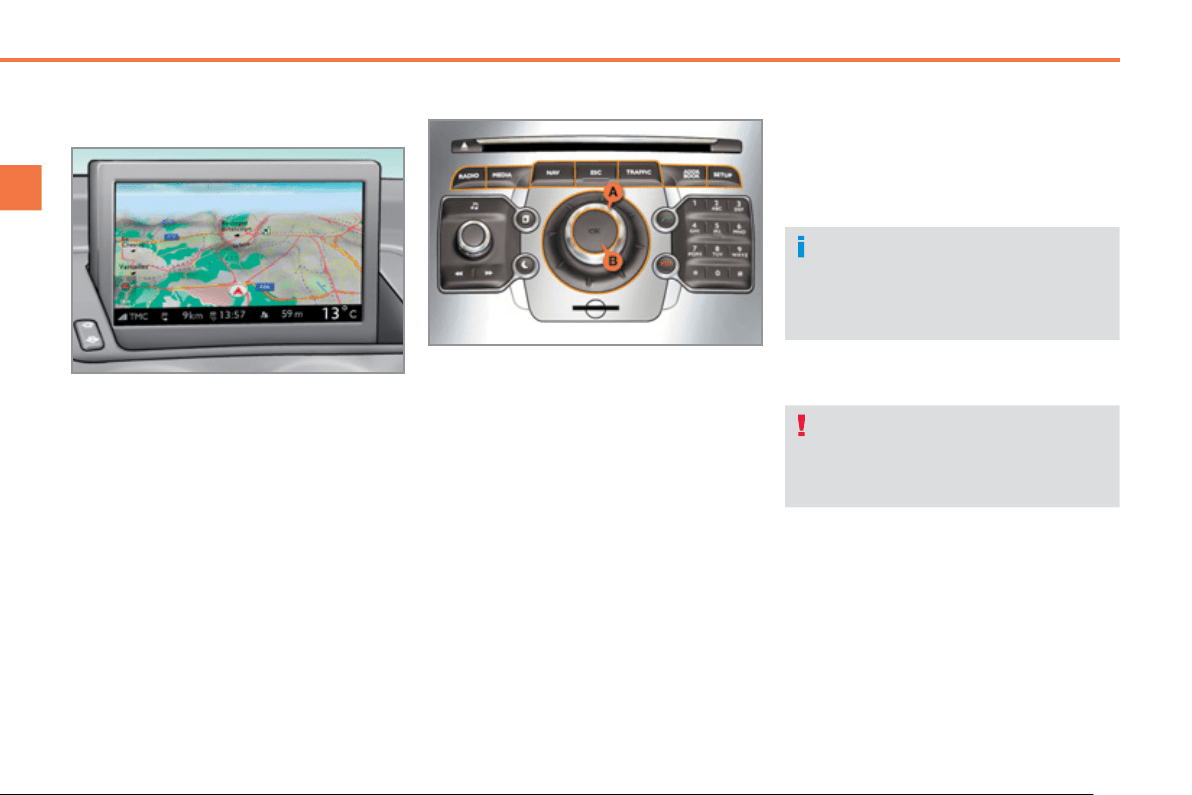
) Press the "SETUP" button to gain
access to the confi guration menu:
- "Display confi guration",
- "Voice synthesis",
- "Choice of language",
- "Vehicle parameters",
- "Alert log".
Display confi guration
This menu allows you to choose a co-
lour scheme for the screen, to adjust
the brightness, set the date and time
and choose the units for distance (km or
miles), fuel consumption (l/100 km, mpg
or km/l) and temperature (°Centigrade
or °Fahrenheit).
When setting the time, you can
select " Synchronise minutes
with GPS ", so that the minutes
are set automatically by satellite
reception.
For safety reasons, confi guration
of the multifunction screen by the
driver must only be done when sta-
tionary.
Alert log
It lists the active alerts by displaying
their associated messages in turn.
Choice of language
This menu allows you to choose the
language used by the screen (French,
English, Italian, Portuguese, Spanish,
German, Dutch, Turkish, Polish, Russian).
Voice synthesis
This men allows you to adjust the vol-
ume for navigation instructions and to
choose the type of voice (male or fe-
male).
Vehicle parameters *
This menu allows you to activate or
deactivate certain driving and comfort
equipment, arranged by category:
- Parking assistance
- Operation of wipers
● Enagages rear wiper linked to
reverse (Rear wiper operates in
reverse gear; refer to "Visibility"),
- Lighting confi guration (see "Vis-
ibility"):
● Duration of the guide-me-home
lighting,
● Directional headlamps (main/
additional directional lighting),
●
Mood lighting (Interior mood
lighting),
● Daytime running lamps function ** .
"SETUP" menu
* Depending on version.
** According to country of sale.
2
54
MULTIFUNCTION SCREENS
For safety reasons, confi guration
of the multifunction screen by the
driver must only be done when sta-
tionary.
RETRACTABLE COLOUR
S
CREEN
(
WITH PEUGEOT CONNECT
MEDIA NAVIGATION
(
NG4 3D
))
Displays in the screen
Displays according to context:
- time,
- date,
- altitude,
- ambient temperature (the value dis-
played fl ashes if there is a risk of
ice),
- parking sensor information,
- audio functions,
- telephone and address book infor-
mation,
- satellite navigation system informa-
tion,
- display screen or navigation system
parameter settings menus.
From the Peugeot Connect Media Navi-
gation (NG4 3D) control panel, to select
one of the applications:
) press the dedicated "RADIO" , "ME-
DIA" , "NAV" , "TRAFFIC" , "ADDR
BOOK" or "SETUP" button for ac-
cess to the corresponding menu,
) turn dial A to select a function, an
item in a list,
) press button B to confi rm the selec-
tion,
or
) press the "ESC" button to abandon
the current operation and return to
the previous display.
For operation of the retractable
screen (opening, closing, adjust-
ment of the position, etc.), refer
to the "Access to the retractable
screen" section.
For more information on these applica-
tions, refer to the Peugeot Connect Media
Navigation (NG4 3D) section.
Controls
2
55
MULTIFUNCTION SCREENS
"SETUP" menu
Language and speech
This menu allows you to:
- select the language used by the
display (Deutsch, English, Espanol,
Français, Italiano, Nederlands,
Polski, Portugues, Portugues-Brasil,
Türkçe * ),
- select the voice recognition parame-
ters (activation/deactivation, advice
on use, personal voice program-
ming, etc.),
- set the volume of the voice synthe-
siser.
Date and time
This menu allows you to set the date
and time, the format of the date and the
format of the time.
Principle of GPS (GMT) synchronisation:
1. Confi rm the selection "Synchronise
with GPS", the time is then aligned
with GMT universal time, the date is
updated as well.
2. Using the 4-direction navigator, move
the cursor onto the hours fi eld and
press on OK .
3. Using the rotating ring, you can then
adjust the time to the time zone of your
choice.
Note that in the case of a summer/win-
ter time change, the time zone must be
set again manually.
Display
This menu allows you to set the bright-
ness of the screen, the screen colour
scheme and the colour of the map (day/
night or auto mode).
Units
This menu allows you to select the
units: temperature (°C or °F) and dis-
tance (miles or km).
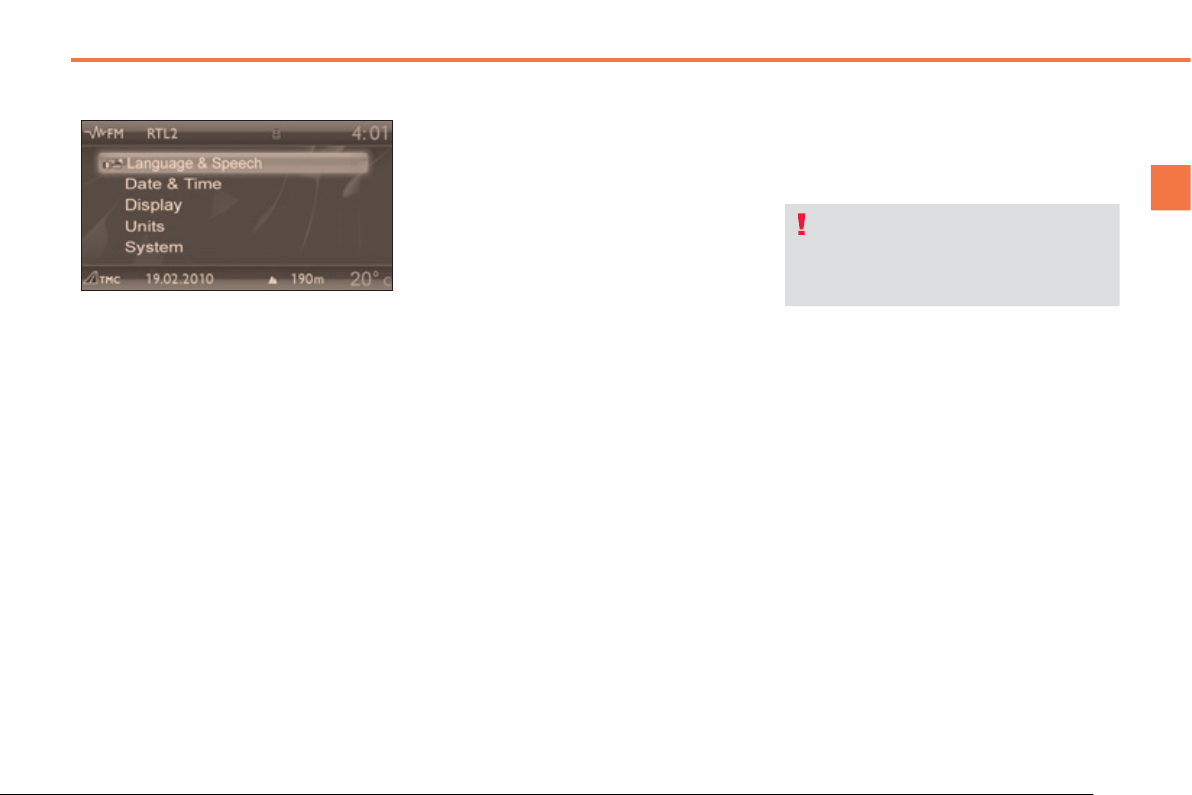
) Press the "SETUP" button to gain
access to the "SETUP" menu. This
allows you to select from the follow-
ing functions:
- "Language and speech",
- "Date and time",
- "Display",
- "Units",
- "System".
System
This menu allows you to restore the fac-
tory confi guration, display the software
version and activate scrolling text.
For safety reasons, confi guration
of the multifunction screen by the
driver must only be done when
stationary.
* According to country.
2
56
MULTIFUNCTION SCREENS
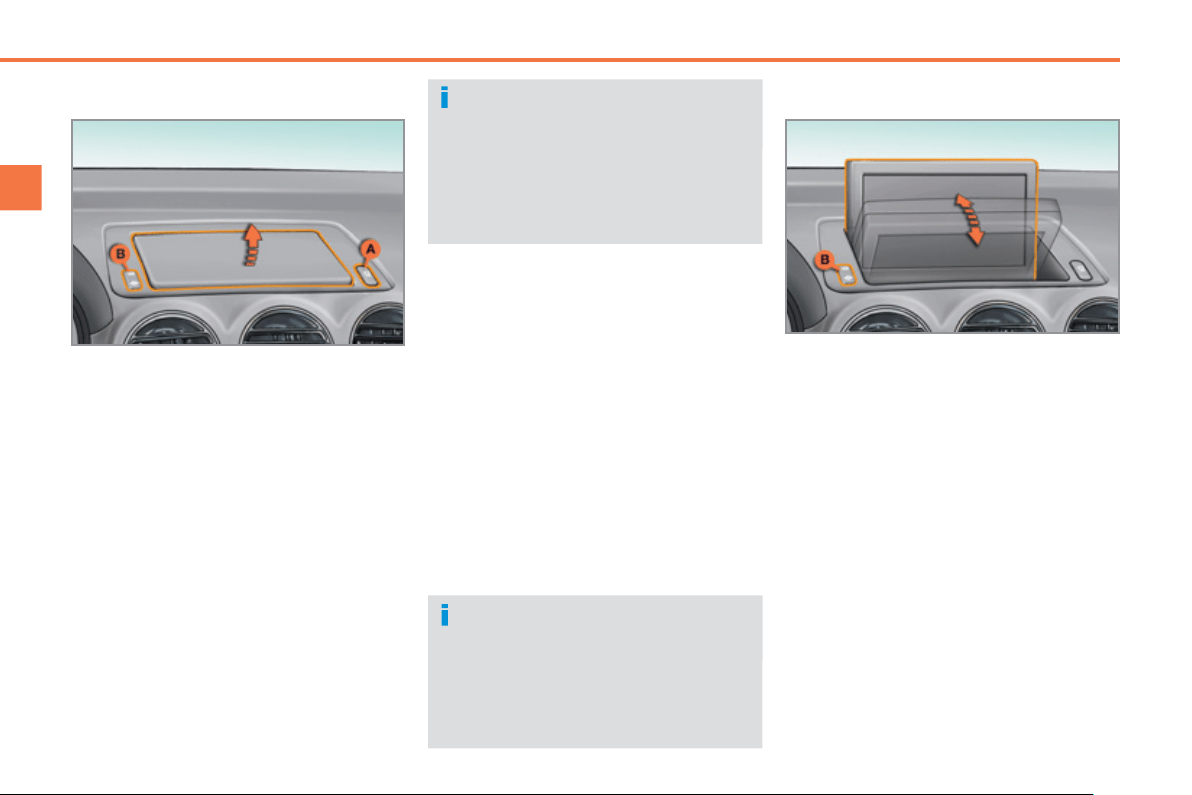
This screen is opened and stored auto-
matically.
However, you can also open it, store it
and adjust it using the various manual
controls:
- opening or storing by means of con-
trol A ,
- angle adjustments by means of con-
trol B .
It is also fi tted with safety auto-reverse
protection.
Opening the screen
) With the screen stored, press con-
trol A to open it.
The screen opens automatically when
the ignition is switched on, when the au-
dio and telematics system is switched
on, when an outgoing telephone call is
made, when a voice command is given
and when a warning message linked with
the STOP warning lamp is received.
Closing the screen
) With the screen open, press con-
trol A to store it.
The screen is stored automatically
when the ignition is switched off, after
approximately three seconds, if the au-
dio and telematics system is off.
If you wish the screen to open or
close automatically when the audio
and telematics system is switched
on or off, the screen must not be
closed when the audio and tele-
matics system is operating.
When the screen is open, you can ad-
just it precisely in different ways:
) press the corresponding part of con-
trol B to move the screen towards
you or towards the windscreen,
or
) push or pull the screen gently by
hand.
Adjusting the position of the screen
Safety auto-reverse
If the screen meets an obstacle as it
opens or closes, the movement stops
immediately and is reversed by a few
millimetres.
After clearing the obstacle, issue the
command required again.
Storing the position of the screen
The system has four pre-set positions
in its memory.
Each time the screen is closed, the
system stores the last position of the
screen.
Each time the screen is re-opened, the
system returns the screen to the pre-set
position closest to that stored.
If you close the screen during op-
eration of the audio and telematics
system, it will re-open automatically
when an outgoing telephone call is
made, when a voice command is
given or when a warning message
linked with the STOP warning lamp
is received.
Access to the retractable screen
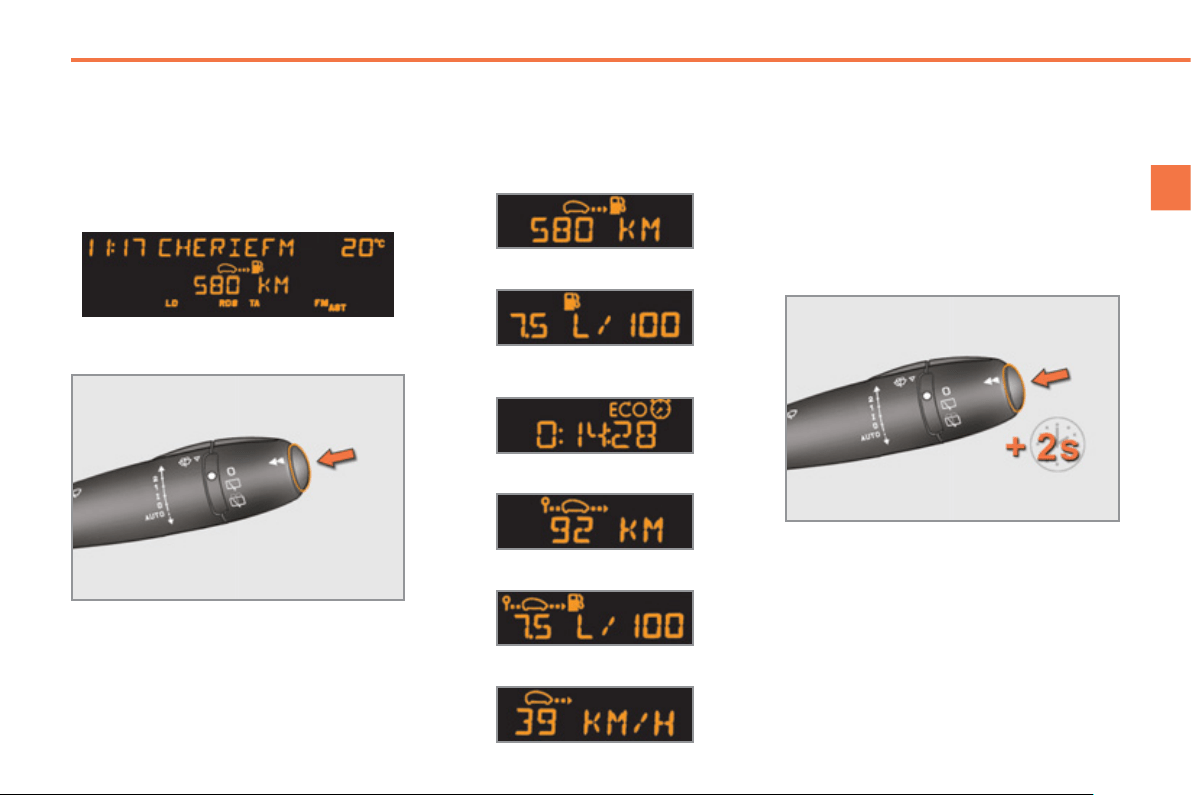
2
57
MULTIFUNCTION SCREENS
Monochrome screen A
) Press the button, located at the end
of the wiper stalk , to display the
various items of trip computer infor-
mation in succession.
The trip computer provides the follow-
ing information:
Information displays
- range,
- current fuel consumption,
- Stop & Start time counter,
- distance travelled,
- average fuel consumption,
) The next press then returns you to
the normal display.
- average speed.
Zero reset
) Press the control for more than two
seconds to reset to zero the distance
travelled, the average fuel consump-
tion and the average speed.
TRIP COMPUTER
System that gives you information on
the journey in progress (range, fuel con-
sumption…).
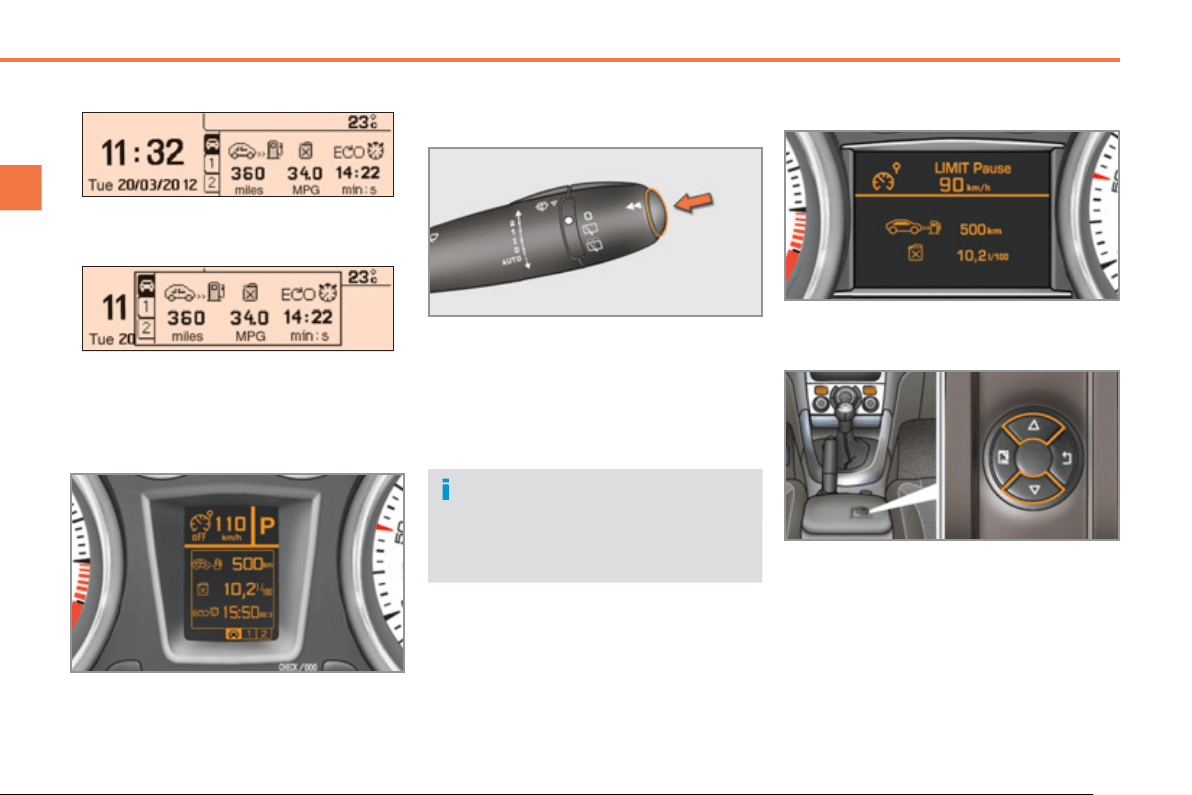
2
58
MULTIFUNCTION SCREENS
Display of information
) Press the up and down arrows on
the instrument panel navigator , as-
sociated with Peugeot Connect Me-
dia Navigation (NG4 3D), to cycle
through the information.
Monochrome screen C
Display of information with the
screen C or the small central screen
in the instrument panel
Large central screen with
type 3 instrument panel
Small central screen with
type 2 instrument panel
Depending on your vehicle's equip-
ment, the trip computer information
appears in the multifunction screen
or on the central screen in the in-
strument panel.
) Cycle through the information with
successive short presses on this
button.
Permanent display ( "MODE" button on the
Peugeot Connect Sound (RD5) control panel)
Temporary display in a new window.

2
59
MULTIFUNCTION SCREENS
- The trip "2" tab with:
● the distance travelled,
●
the average fuel consumption,
● the average speed.
) Pressing the button again takes you
to a black screen.
A further press returns you to the
normal display.
- The current information tab,
for the trip in use, with:
● the range,
●
the current fuel consumption,
● the distance remaining to
be travelled or the Stop &
Start counter.
- The trip "1" tab with:
● the distance travelled,
●
the average fuel consumption,
● the average speed.
Trip zero reset
) When the trip required is displayed,
press the button on the end of the
wiper stalk for more than two sec-
onds.
) When the required trip is displayed,
press the "OK" button on the instru-
ment panel navigator , associated with
Peugeot Connect Media Navigation
NG4 3D), for more than two seconds.
With the instrument panel large central
screen
Trips "1" and "2" are independent
but their use is identical.
For example, trip "1" can be used
for daily fi gures, and trip "2" for
monthly fi gures.
The trip computer can display:
With the monochrome screen C or
the instrument panel small screen
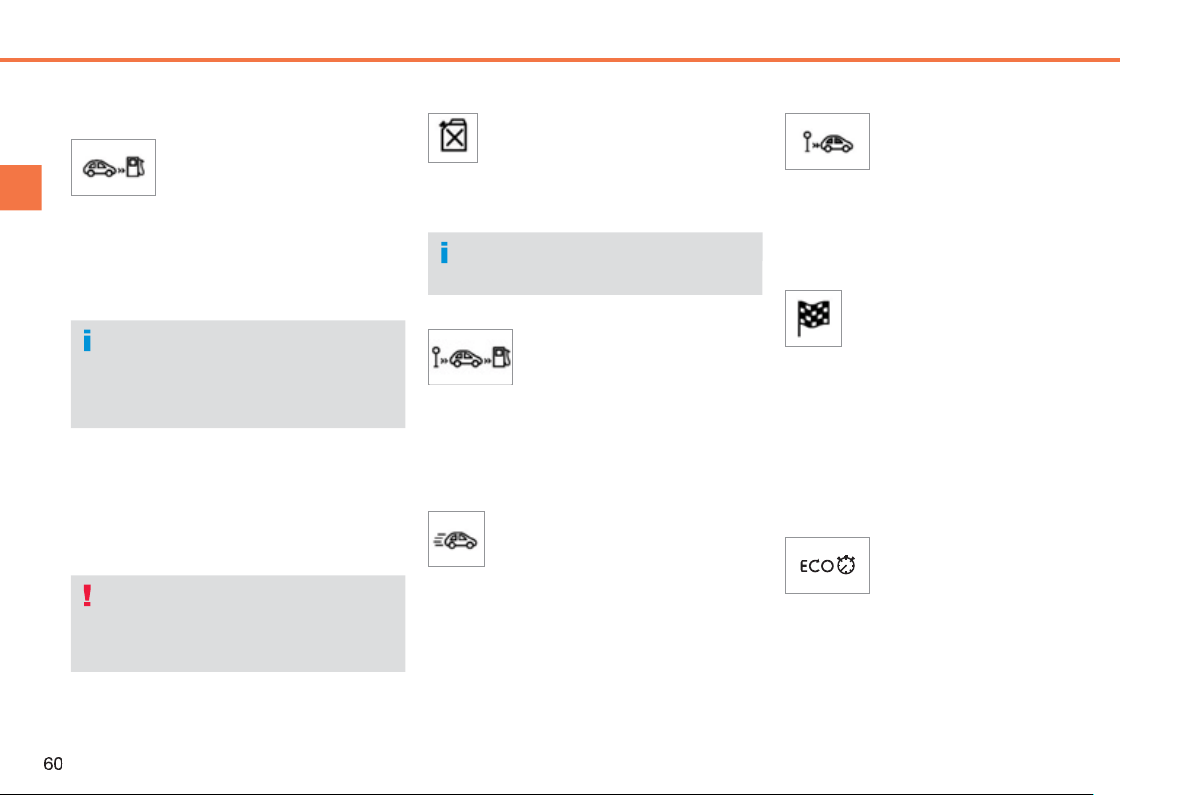
2
MULTIFUNCTION SCREENS
A few definitions
(trip computer)
When the range falls below 20 miles
(30 km), dashes are displayed. After fi ll-
ing with at least 5 litres of fuel, the range
is recalculated and is displayed when it
exceeds 60 miles (100 km).
If dashes are displayed continu-
ously while driving in place of the
digits, contact a PEUGEOT dealer
or a qualifi ed workshop.
This function is only displayed from
20 mph (30 km/h).
This value may vary following a
change in the style of driving or
the relief, resulting in a signifi cant
change in the current fuel con-
sumption.
Range
(miles or km)
This indicates the distance
which can still be travelled
with the fuel remaining in the tank in
relation to the average fuel consump-
tion over the last few miles (kilometres)
travelled.
Current fuel consumption
(mpg or l/100 km or km/l)
This is the average fuel con-
sumption during the last few
seconds.
Average fuel
consumption
(mpg or l/100 km or km/l)
This is the average fuel con-
sumption since the last trip
computer zero reset.
Distance travelled
(miles or km)
This indicates the distance
travelled since the last trip
computer zero reset.
Average speed
(mph or km/h)
This is the average speed cal-
culated since the last trip com-
puter zero reset (ignition on).
Distance remaining to
destination
(miles or km)
This is the distance remaining
to be travelled to the fi nal destination. It
is either calculated instantly by the navi-
gation system, if guidance is activated,
or entered by the user.
If the distance is not entered, dashes
are displayed in place of the digits.
Stop & Start time counter
(minutes / seconds or hours /
minutes)
If your vehicle is fi tted with
Stop & Start, a time counter calculates
the time spent in STOP mode during a
journey.
It resets to zero every time the ignition
is switched on with the key.
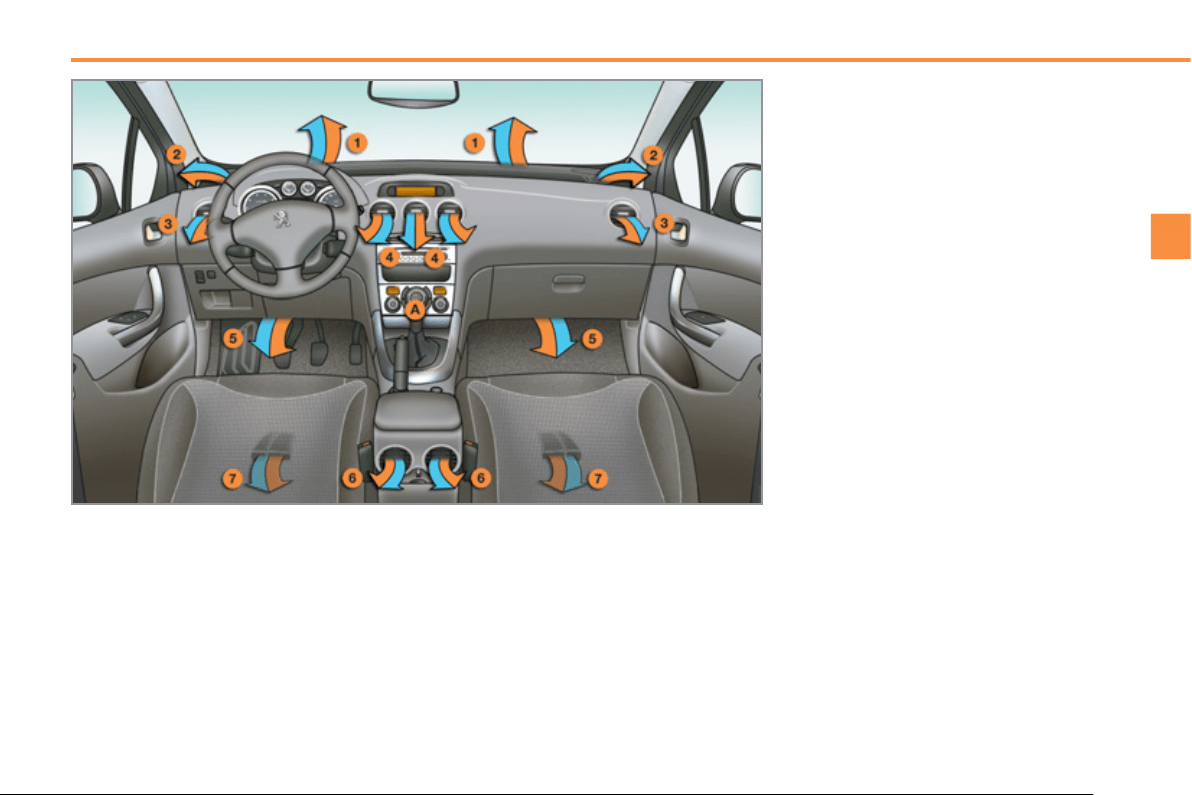
3
61
COMFORT
V
ENTILATION Air treatment
The incoming air follows various routes
depending on the controls selected by
the driver:
- direct arrival in the passenger compart-
ment (air intake),
- passage through a heating circuit
(heating),
- passage through a cooling circuit
(air conditioning).
The temperature control enables you to
obtain the level of comfort required by
mixing the air of the various circuits.
The air distribution control enables you to
diffuse the air in the passenger compart-
ment combining several air vents.
The air fl ow control enables you to increase
or reduce the speed of the ventilation blower.
Air intake
The air circulating in the passenger com-
partment is fi ltered and originates either
from the outside via the grille located at
the base of the windscreen or from the
inside in air recirculation mode.
Control panel
The controls of this system are grouped
together on control panel A on the centre
console. Depending on the model, the
functions offered are:
- level of comfort required,
- air fl ow,
- air distribution,
- demisting and defrosting,
- manual or digital air conditioning
controls.
Air diffusion
1. Windscreen demisting vents.
2. Front side window demisting/defrosting
vents.
3. Side adjustable air vents.
4. Central adjustable air vents.
5. Air outlets to the front footwells.
6.
Adjustable air vents for the rear passengers.
7. Air outlets to the rear footwells.

3
62
COMFORT
If after an extended stop in sunshine,
the interior temperature is very high,
fi rst ventilate the passenger com-
partment for a few moments.
Put the air fl ow control at a setting
high enough to quickly change the
air in the passenger compartment.
The air conditioning system does
not contain chlorine and does not
present any danger to the ozone
layer.
RECOMMENDATION
S
FOR VENTILATION AND
AIR CONDITIONING
In order for these systems to be fully effective, follow the operation and main-
tenance guidelines below:
) To obtain an even air distribution, take care not to obstruct the exterior air
intake grilles located at the base of the windscreen, the nozzles, the vents
and the air outlets, as well as the air extractor located in the boot.
) Do not cover the sunshine sensor, located on the dashboard; this is used
for regulation of the digital air conditioning system.
) Operate the air conditioning system for at least 5 to 10 minutes, once or
twice a month to keep it in perfect working order.
) Ensure that the passenger compartment fi lter is in good condition and
have the fi lter elements replaced regularly (refer to the "Checks" section).
We recommend the use of a combined passenger compartment fi lter.
Thanks to its special active additive, it contributes to the purifi cation of
the air breathed by the occupants and the cleanliness of the passenger
compartment (reduction of allergic symptoms, bad odours and greasy de-
posits).
) To ensure correct operation of the air conditioning system, you are also
advised to have it checked regularly as recommended in the servicing
booklet.
) If the system does not produce cold air, switch it off and contact a PEUGEOT
dealer or a qualifi ed workshop.
When towing the maximum load on a steep gradient in high temperatures,
switching off the air conditioning increases the available engine power and so
improves the towing ability.
The condensation created by the
air conditioning results in a dis-
charge of water under the vehicle
which is perfectly normal.
Stop & Start
The heating and air conditioning systems only work when the engine is run-
ning. To maintain a comfortable temperature in the passenger compartment,
you can temporarily deactivate the Stop & Start system (see "Driving").
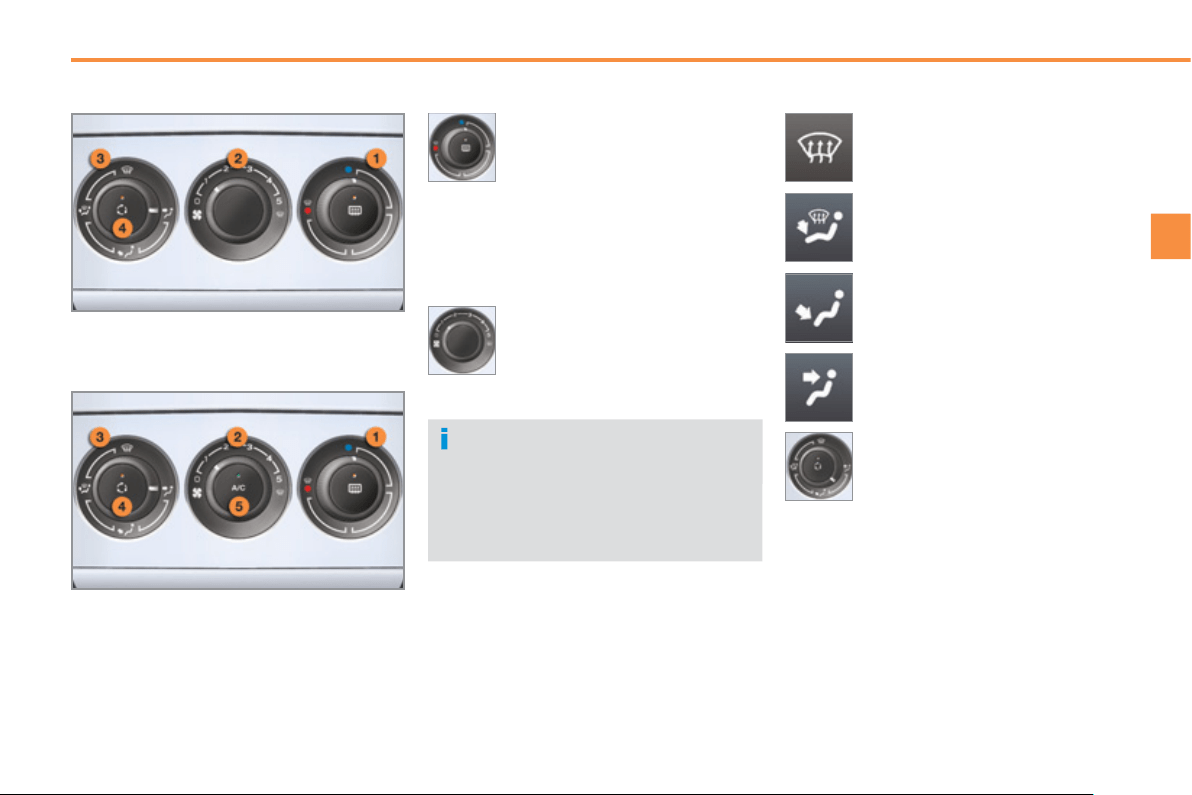
3
63
COMFORT
2. Air fl ow adjustment
) Turn the dial from position 1
to position 5 to obtain a
comfortable air fl ow.
Windscreen, side windows
and footwells.
Footwells.
Central and side vents.
) Turn the dial from blue
(cold) to red (hot) to adjust
the temperature to your re-
quirements.
Windscreen and side windows.
1. Temperature adjustment
The air distribution can be
adapted by placing the dial in
an intermediate position.
The heating / ventilation or air condi-
tioning systems can only operate with
the engine running.
) If you place the air fl ow control
in position 0 (deactivation of the
system), the temperature is no
longer maintained at a comfort-
able level. However, a slight
fl ow of air, due to the movement
of the vehicle, can still be felt.
3. Air distribution adjustment
HEATING / VENTILATION
MANUAL AIR CONDITIONING
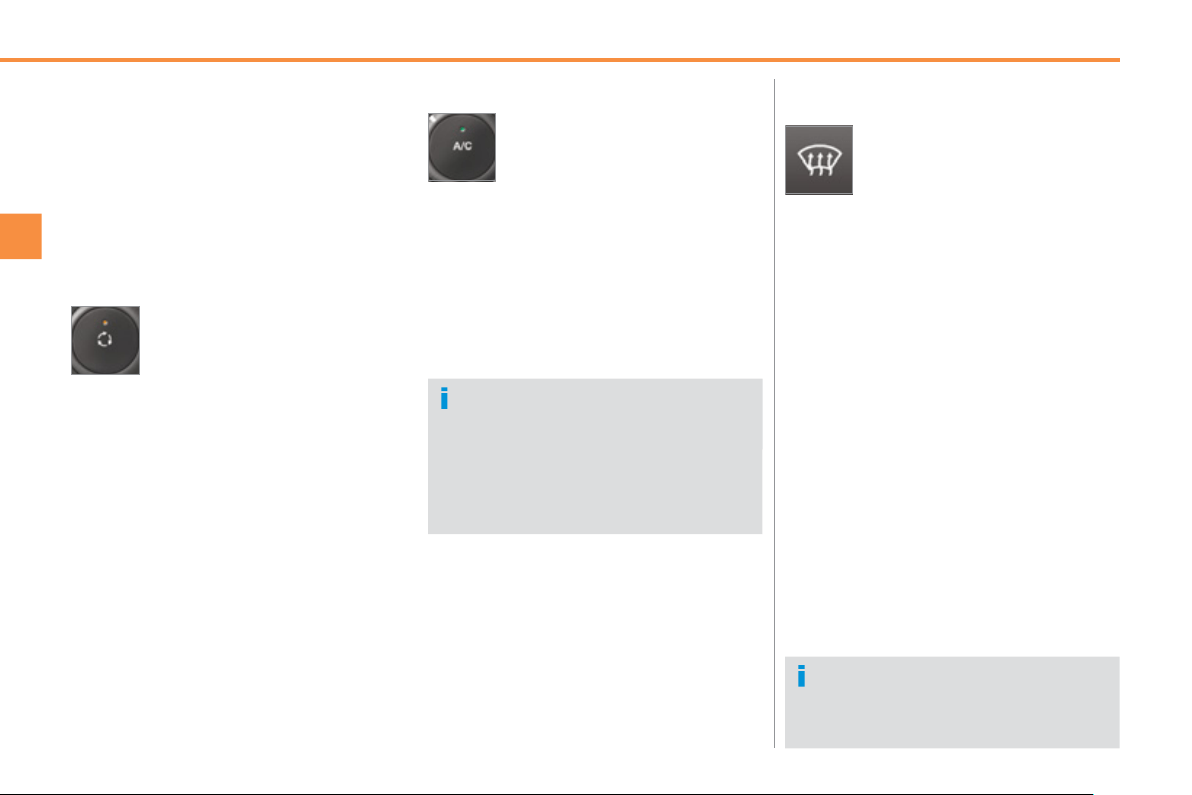
3
64
COMFORT
4. Air intake / Air recirculation
The intake of exterior air prevents the
formation of mist on the windscreen and
side windows.
The recirculation of interior air isolates
the passenger compartment from exterior
odours and smoke.
Return to exterior air intake as soon as
possible to prevent deterioration of the
the air quality and the formation of mist.
) Press the button to recir-
culate the interior air. The
indicator lamp comes on to
confi rm this.
) Press the button again to permit the
intake of exterior air. The indicator
lamp switches off to confi rm this.
5. Air conditioning On / Off
The air conditioning is de-
signed to operate effectively in
all seasons, with the windows
closed.
It enables you to:
- lower the temperature, in summer,
- increase the effectiveness of the de-
misting in winter, above 3 °C.
Switching off
) Press the "A/C" button again, the
button's indicator lamp goes off.
Switching off may affect comfort levels
(humidity, condensation).
Switching on
) Press the "A/C" button, the button's
indicator lamp comes on.
FRONT DEMI
S
T - DEFRO
S
T
These markings on the control
panel indicate the control po-
sitions for rapid demisting or
defrosting of the windscreen
and side windows.
With the heating / ventilation
system
) Put the temperature and air fl ow
controls to the dedicated marked
position.
) Put the air intake control to the "Exterior
air intake" position
(control indicator lamp off).
) Put the air distribution control to the
"Windscreen" position.
With manual air conditioning
) Put the temperature, air fl ow and
distribution controls to the dedicated
marked position.
) Put the air intake control to the
"Exterior air intake" position
(indicator lamp on the control off).
) Switch on the air conditioning by
pressing the "A/C" button; the warn-
ing lamp in the button comes on.
The air conditioning does not oper-
ate when the air fl ow adjustment
control 2 is in position " 0 ".
To obtain cooled air more quickly,
you can use recirculation of interior
air for a few moments. Then return
to fresh air intake.
With Stop & Start, when the de-
misting, air conditioning and air
fl ow functions are activated, STOP
mode is not available.
3
65
COMFORT
The control button is located on
the heating or air conditioning
system control panel.
R
EAR
S
CREEN DEMI
S
T -
D
EFRO
S
T
) Switch off the demisting/
defrosting of the rear screen
and door mirrors as soon as
appropriate as lower current
consumption results in reduced
fuel consumption.
If the engine is switched off be-
fore the demisting/defrosting is
switched off automatically, demist-
ing/defrosting will resume next time
the engine is switched on.
Switching on
The rear screen demisting/defrosting
can only operate when the engine is
running.
) Press this button to demist/defrost
the rear screen and (depending on
version) the door mirrors. The indica-
tor lamp associated with the button
comes on.
Switching off
The demisting/defrosting switches off
automatically to prevent an excessive
consumption of current.
) It is possible to stop the demist-
ing/defrosting operation before it is
switched off automatically by press-
ing the button again. The indicator
lamp associated with the button
switches off.
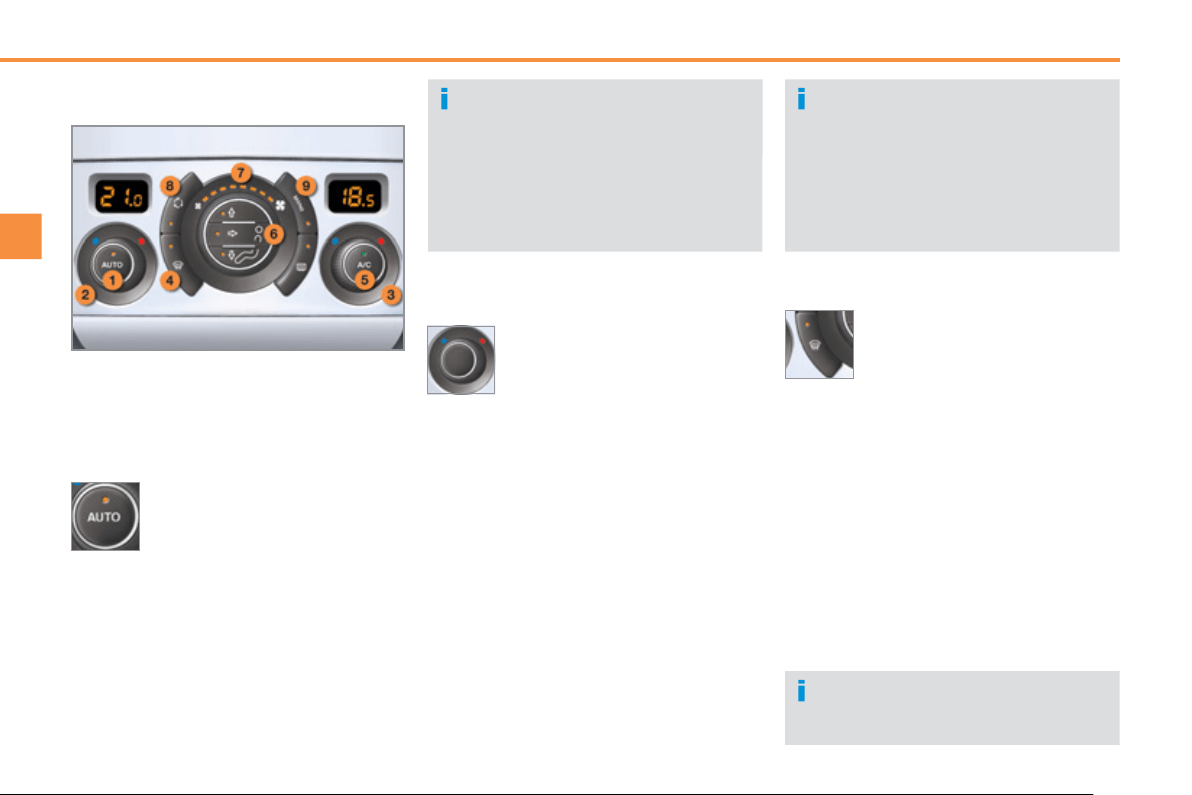
3
66
COMFORT
When the engine is cold, to prevent
too great a distribution of cold air,
the air fl ow will reach its optimum
level gradually.
In cold weather, it favours the distri-
bution of warm air to the windscreen,
side windows and footwells only.
On entering the vehicle, if the in-
terior temperature is much colder
or warmer than the comfort value,
there is no need to change the val-
ue displayed in order to obtain the
comfort required. The system cor-
rects the difference in temperature
automatically and as quickly as
possible.
The air conditioning only operates when
the engine is running.
The driver and front passenger
can each adjust the tempera-
ture to their requirements.
) Turn control 2 or 3 to the left or to
the right respectively to decrease or
increase this value.
A setting around the value 21 provides
optimum comfort. However, depend-
ing on your requirements, a setting be-
tween 18 and 24 is normal.
You are advised to avoid a left / right
setting difference of more than 3.
4. Automatic visibility programme
The automatic comfort pro-
gramme may not be suffi cient
to quickly demist or defrost the
windscreen and side windows
(humidity, several passengers,
ice, etc.).
Automatic operation
) Press the "AUTO" button.
The indicator lamp in the
button comes on.
2. Driver's side adjustment
D
UAL-ZONE DIGITAL
AIR CONDITIONING
We recommend the use of this mode:
it permits automatic and optimised ad-
justment of all of the functions, passen-
ger compartment temperature, air fl ow,
air distribution and air recirculation, in
accordance with the comfort value that
you have chosen.
This system is designed to operate ef-
fectively in all seasons, with the windows
closed.
The value indicated on the display cor-
responds to a level of comfort and not
to a temperature in degrees Celsius or
Fahrenheit.
) To switch it off, press the "visibility"
button again or press the "AUTO"
button, the indicator lamp in the but-
ton goes off and the indicator lamp
in the "AUTO" button comes on.
1. Automatic comfort programme
3. Passenger side adjustment
) In this case, select the automatic
visibility programme.
The system automatically controls the
air conditioning, the air fl ow and the air
intake and provides optimum distribu-
tion of the ventilation to the windscreen
and side windows.
With Stop & Start, when demist-
ing has been activated, the STOP
mode is not available.
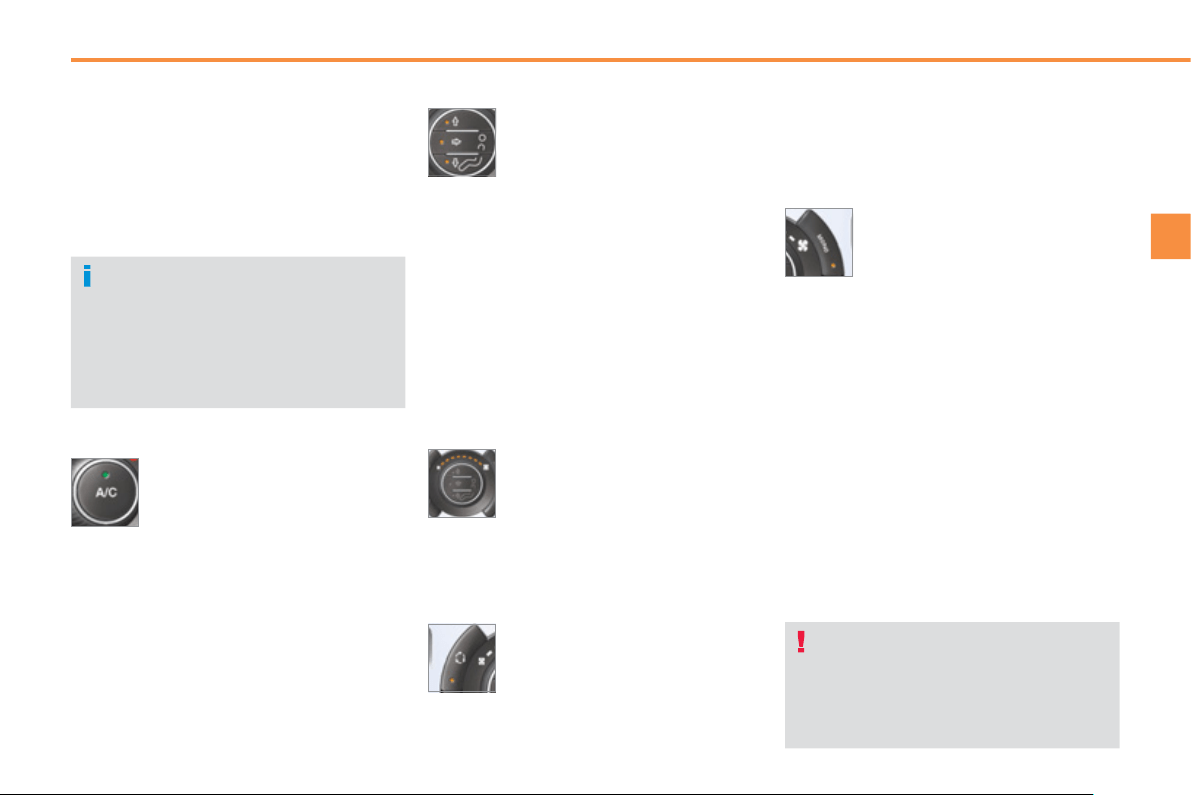
3
67
COMFORT
Manual operation
If you wish, you can make a different
choice from that offered by the system
by changing a setting. The other func-
tions will still be controlled automatically.
) Pressing the "AUTO" button returns
the system to completely automatic
operation.
) Press this button to switch
off the air conditioning.
6. Air distribution adjustment
) Press one or more buttons to
direct the air fl ow towards:
7. Air fl ow adjustment
) Turn this control to the left
to decrease the air fl ow or
to the right to increase the
air fl ow.
8. Air intake / Air recirculation
Switching the system off
) Turn the air fl ow control to the left until
all of the indicator lamps go off.
This action switches off the air condi-
tioning and the ventilation.
Temperature related comfort is no long-
er guaranteed but a slight fl ow of air,
due to the movement of the vehicle, can
still be felt.
) Turn the air fl ow dial to the right or
press the "AUTO" button to reacti-
vate the system with the values set
before it was switched off.
) Press this button for recir-
culation of the interior air.
The indicator lamp in the
button comes on.
5. Air conditioning On / Off
Avoid prolonged operation in inte-
rior air recirculation mode or driving
for long periods with the system off
(risk of condensation and deterio-
ration of the air quality).
- the windscreen and side windows
(demisting or defrosting),
- the windscreen, the side windows
and the vents,
- the windscreen, the side windows,
the vents and the footwells,
- the vents and the footwells,
- the vents,
- the footwells,
- the windscreen, the side windows
and the footwells.
The air fl ow indicator lamps, between
the two fans, come on progressively in
relation to the value requested.
) As soon as possible, press this but-
ton again to permit the intake of out-
side air and prevent the formation
of condensation. The indicator lamp
on the button switches off.
For maximum cooling or heating
of the passenger compartment, it
is possible to exceed the minimum
value 14 or the maximum value 28.
) Turn control 2 or 3 to the left
until "LO" is displayed or to the
right until "HI" is displayed.
9. Mono-zone / Dual-zone
) Press this button to equal-
ise the comfort value on the
passenger's side with that
on the driver's side (mono
zone). The indicator lamp in
the button comes on.
Air recirculation enables the passenger
compartment to be isolated from exte-
rior odours and smoke.
Switching the system off could result in
discomfort (humidity, condensation).
) Press this button again to return to
automatic operation of the air con-
ditioning. The indicator lamp in the
"A/C" button comes on.

3
68
COMFORT
FRONT
S
EAT
S
WITH MANUAL
ADJU
S
TMENT
S
Seat consisting of a seat cushion, a seat
back and a head restraint which can all
be adjusted to adapt your position for
ease of driving and comfort.
Height
) Pull the control upwards to raise
or push it downwards to lower, as
many times as required, to obtain
the position required.
Seat back angle
) Push the control rearwards.
Forwards-backwards
) Raise the control and slide the seat
forwards or backwards.
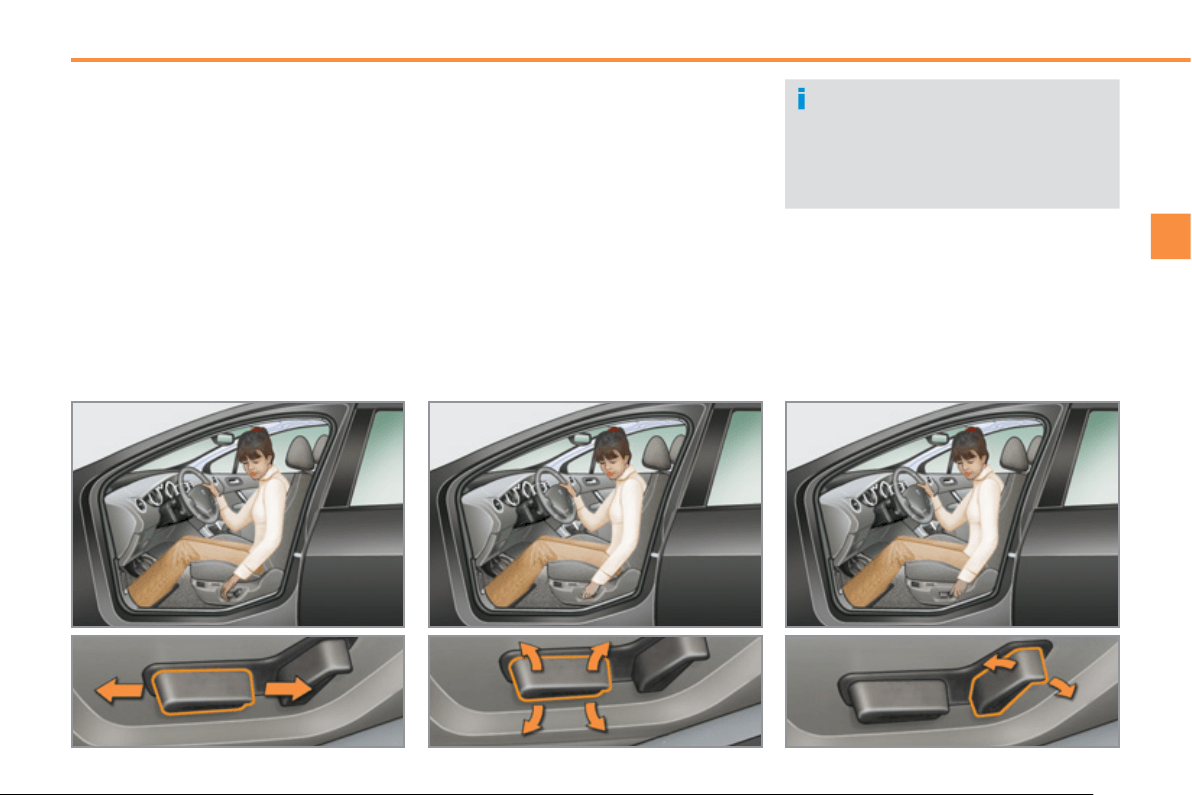
3
69
COMFORT
FRONT
S
EAT
S
Seat consisting of a seat cushion, a seat
back and a head restraint which can all
be adjusted to adapt your position for
ease of driving and comfort.
Forwards-backwards
) Push the control forwards or rear-
wards to slide the seat.
Cushion height and angle
) Tilt the rear part of the control up-
wards or downwards to obtain the
required height.
) Tilt the front part of the control up-
wards or downwards to obtain the
required angle.
Seat back angle
) Tilt the control forwards or rearwards
to adjust the angle of the seat back.
Driver's seat electric
adjustments
The electrical functions of the driv-
er's seat are deactivated approxi-
mately one minute after the ignition
is switched off.
To reactivate them, switch on the
ignition.
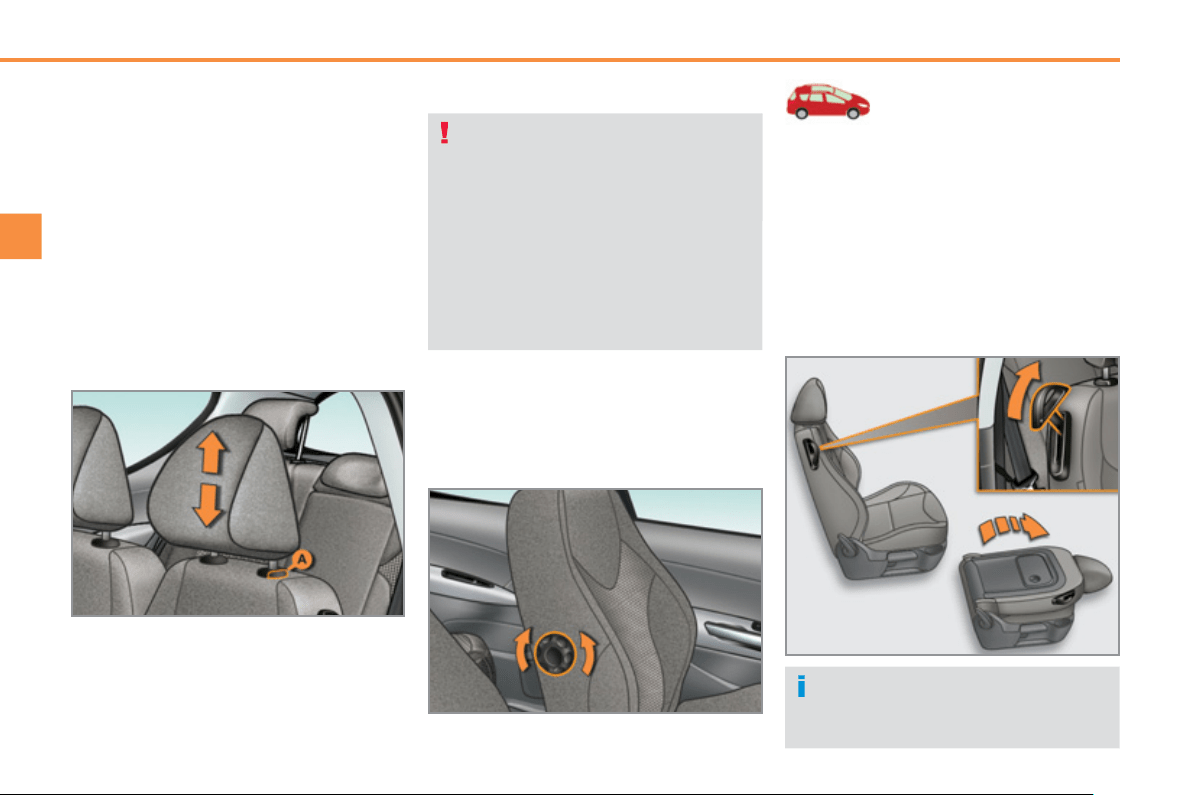
3
7
0
COMFORT
Table position for front
passenger seat
Head restraint height adjustment
) To raise the head restraint, pull it for-
wards and upwards at the same time.
) To remove the head restraint, press
the lug A and pull the head restraint
upwards.
) To put the head restraint back in
place, engage the head restraint
stems in the openings keeping them
in line with the seat back.
) To lower the head restraint, press
the lug A and the head restraint at
the same time.
The head restraint is fi tted with a
frame with notches which prevents
it from lowering; this is a safety de-
vice in case of impact.
The adjustment is correct when
the upper edge of the head re-
straint is level with the top of the
head.
Never drive with the head restraints
removed; they must be in place and
adjusted correctly.
Manual lumbar adjustment
) Turn the knob to obtain the desired
level of lumbar support.
Additional adjustments
Placing this seat in the table position, with
the rear seats also in the table position,
allows you to transport long objects.
) Pull the control upwards to fold the
seat back onto the seat cushion.
To lower the seat back fully, tilt the
seat back angle adjustment control.
) Pull the control again to release the
seat back and raise it.
When put back in place, the seat
back returns to its initial position.
Do not forget to fold the "aircraft"
type table fi xed on the back of the
seat fi rst.
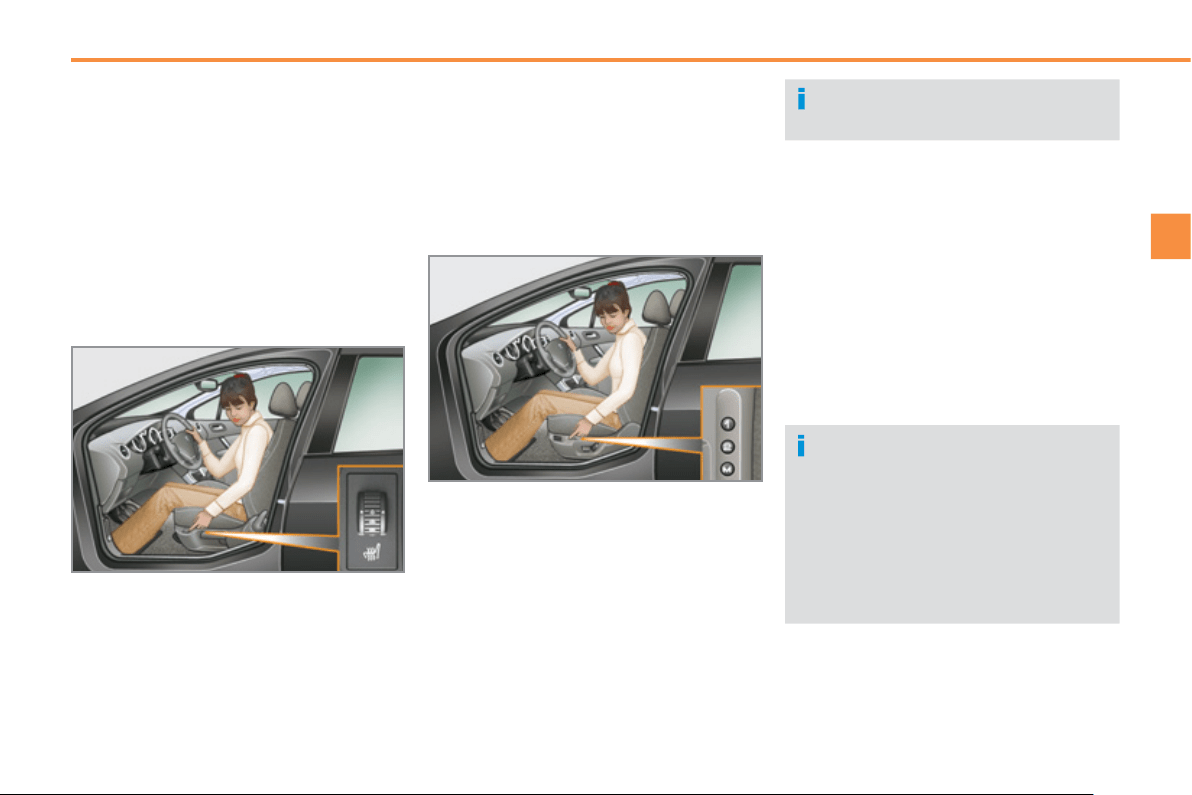
3
71
COMFORT
Storing driving positions
System which registers the electrical
settings of the driver's seat and door
mirrors. It enables you to store and re-
call two positions using the buttons on
the side of the driver's seat.
Ignition on or engine running
) Press button 1 or 2 to recall the cor-
responding position.
An audible signal confi rms that ad-
justment is complete.
Storing a position
Storing a new position cancels the
previous position.
Recalling a stored position
Using buttons M / 1 / 2
) Switch on the ignition.
) Adjust your seat and the door mirrors.
) Press button M , then press button 1
or 2 within four seconds.
An audible signal indicates that the
position has been stored.
You can interrupt the current move-
ment by pressing button M , 1 or 2 or
by using one of the seat controls.
A stored position cannot be re-
called while driving.
Recalling stored positions is deac-
tivated 45 seconds after switching
off the ignition.
Heated seats control
With the engine running, the front seats
can be heated separately.
) Use the adjustment dial, placed on
the side of each front seat, to switch
on and select the level of heating re-
quired:
0 : Off.
1 : Low.
2 : Medium.
3 : High.
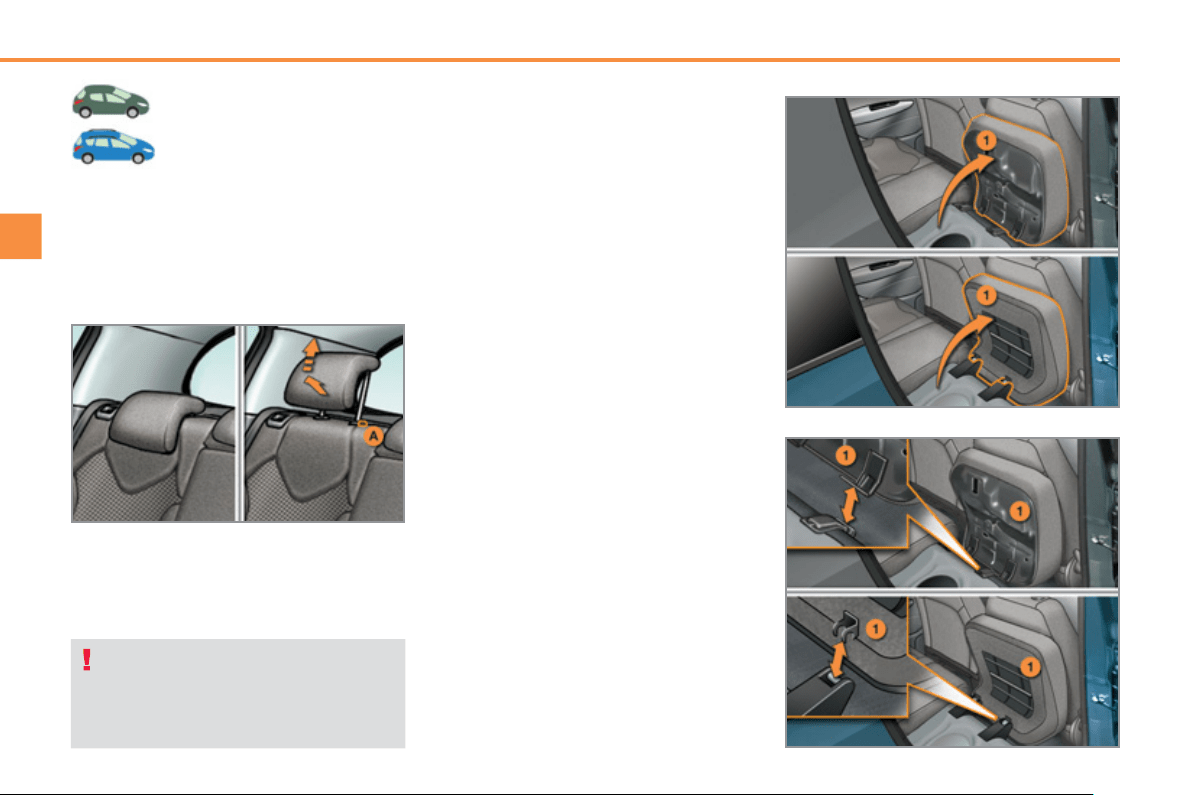
3
72
COMFORT
R
EAR
S
EAT
S
Never drive with the head restraints
removed; they must be in place
and in the high position when pas-
sengers are seated in the rear.
Rear head restraints
These have a high position (comfort
and safety) and a low position (rear vis-
ibility).
They can also be removed.
To remove a head restraint:
) pull the head restraint fully forwards
and upwards at the same time,
) then, press the lug A .
Removing the seat cushion
) Move the corresponding front seat
forwards if necessary.
) Raise the seat cushion 1 lifting it
with a hand from the rear.
) Tilt the seat cushion 1 fully against
the front seat.
) Remove the seat cushion 1 from its
fi xings by pulling upwards.
Refitting the seat cushion
) Position the seat cushion 1 vertically
in its fi xings.
) Fold down the seat cushion 1 .
) Press on the seat cushion to secure it.
Bench seat, the left-hand (2/3) or right-
hand (1/3) section of which can be folded
to adapt the boot load space.
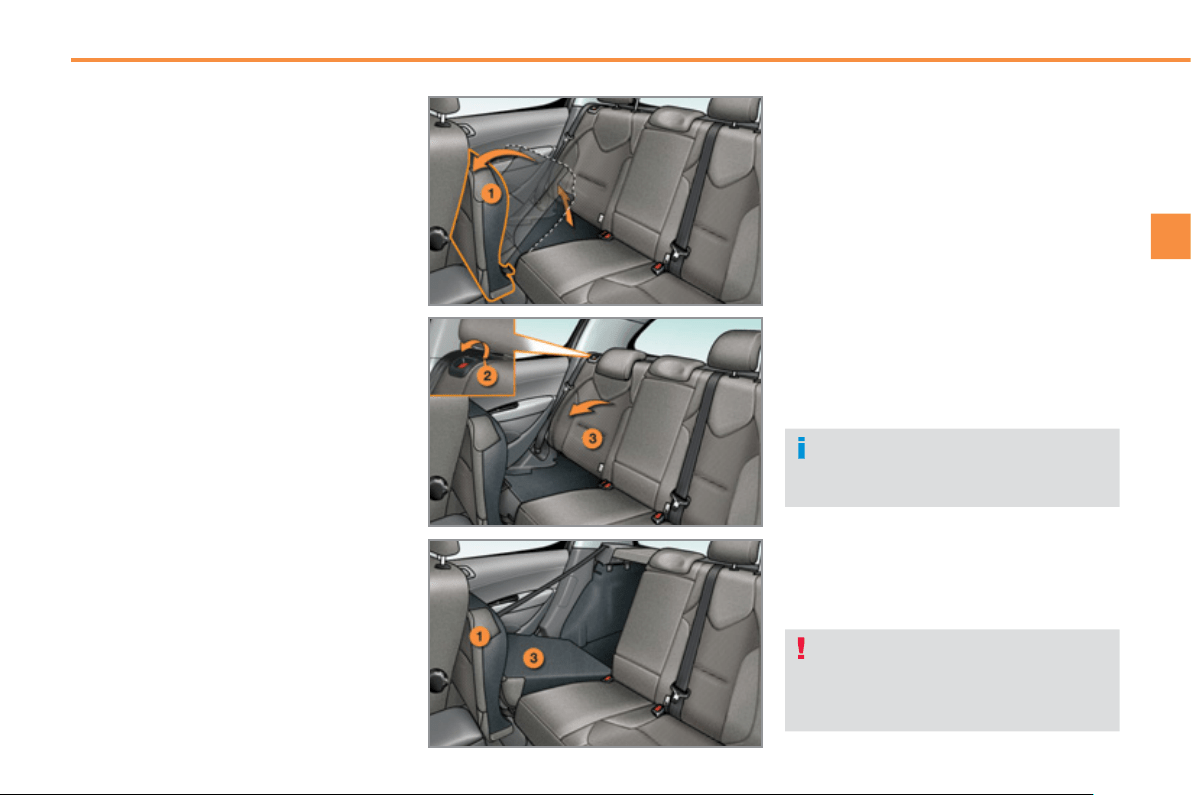
3
7
3
COMFORT
Folding the seat
In order to fold a rear seat without any risk
of damage, always start with the seat
cushion, never with the seat back:
) move the corresponding front seat
forwards if necessary,
) raise the seat cushion 1 lifting it with
a hand from the rear,
) tilt the seat cushion 1 fully against
the front seat,
Returning the seat back to its
original position
When returning the rear seat back to its
original position:
) put the seat back 3 in the upright po-
sition and secure it,
) fold the seat cushion 1 ,
) refi t the head restraints or put them
back in place.
) check that the seat belt is positioned
correctly on the side of the seat
back,
) lower or remove the head restraints
if necessary,
) pull the control 2 forwards to release
the seat back 3 ,
) tilt the seat back 3 .
When returning the rear seat back
to its original position, take care not
to trap the seat belts and ensure
that their buckles are positioned
correctly.
The seat cushion 1 can be removed
to increase the loading volume.
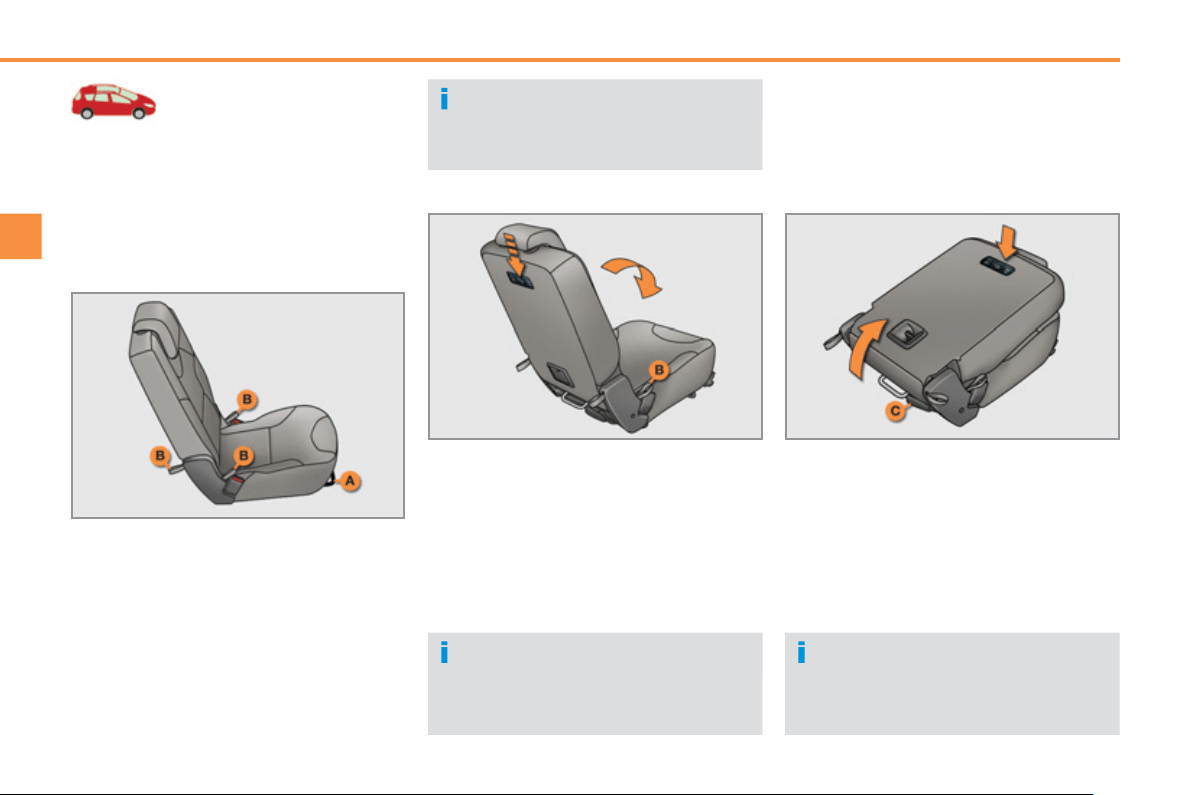
3
74
COMFORT
R
EAR
S
EAT
S
Forwards-backwards adjustment
Seat back angle adjustment
) Pull one of the straps B , located at
the front of the seat, then adjust the
angle to one of the 7 positions of-
fered.
) Release the strap to lock the seat
back in this position.
Table position
) Raise the bar A and slide the seat
forwards or backwards.
) Place the head restraint in the low
position.
) Pull one of the straps B , located at
the front of the seat.
) Fold the seat back fully onto the
seat cushion; the seat automatically
moves back fully.
) Press on the seat back to lock it.
Folding
Once the seat has been placed in the
table position, carry out the following
operations:
)
move back the seat fully using the bar A ,
) raise the lever C , located at the rear
right of the seat, to release the rear
feet,
) raise the seat fully so that it remains
in the fully folded position.
You can also carry out these oper-
ations from the 3rd row using one
of the straps B , located at the rear
of the seat.
These operations allow access to
the 3
rd
row, exit from the 3
rd
row and
folding of the seats from the boot.
In the 2nd row, these three seats are
identical and can be adjusted for your
comfort. They can be placed in the table
position, folded or removed to obtain a
variety of loading confi gurations.
During the forwards-backwards and
seat back angle adjustment opera-
tions, take care not to apply any
force to the load space cover roller.
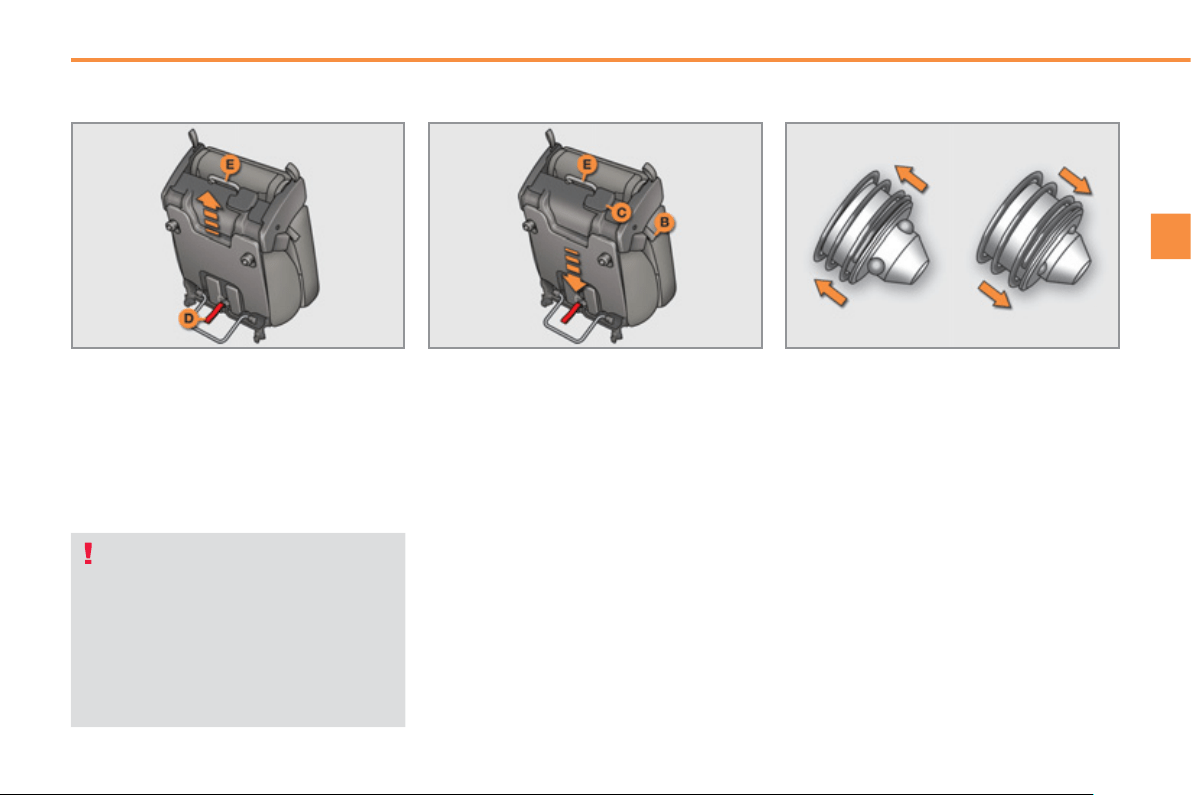
3
7
5
COMFORT
Removal Installation
Once the seat has been folded, carry
out the following operations:
) pull the red strap D to release the
front feet of the seat,
) lift the seat and carry it using the
carrying handle E .
Never use the adjustment straps
to remove, install or carry a seat;
use the carrying handle E provided
for this purpose (weight of the seat:
approximately 18 kg).
Once the seat has been removed,
in order to protect its electronic
systems, it must be stored in a
clean, dry location sheltered from
bad weather.
Locked Released
) Tilt the folded seat rearwards; the
front and rear feet lock automatically.
) Pull one of the straps B to release
the seat back, then raise it.
) Check that no object is obstructing
the anchorages on the fl oor, so pre-
venting correct locking seat's feet.
) Carry the seat using the carrying
handle E .
) Put the front feet of the seat in place
in the corresponding anchorages.
) Raise the lever C to check that the
rear feet are released.
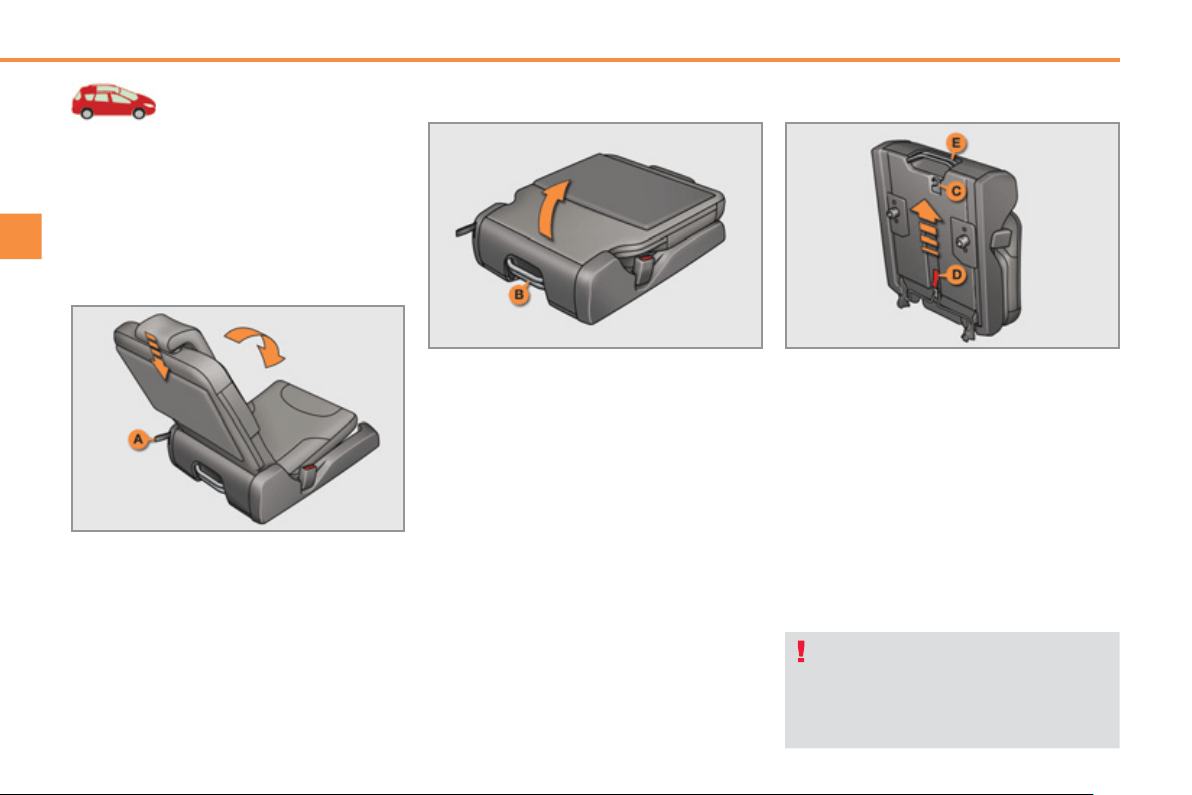
3
7
6
COMFORT
A
DDITIONAL
S
EAT
S
Table position
) Place the head restraint in the low
position.
) Pull the strap A , located at the rear
left of the seat.
) Fold the seat back onto the seat
cushion.
Folding
Once the seat has been placed in the
table position, carry out the following
operations:
) remove the load space cover roller,
) raise the bar B , located at the rear of
the seat, to release the rear feet,
) raise the seat and secure it to the
head restraint rod of the 2nd row
seat, using the integrated retaining
strap C .
Removal
Once the seat has been folded, carry
out the following operations:
) pull the red strap D to release the
front feet of the seat,
) lift the seat and carry it using the
carrying handle E ,
) put the anchorage covers back in
place to obtain a fl at boot fl oor.
Never use the adjustment and re-
taining straps to remove, install
or carry a seat; use the carrying
handle E provided for this purpose
(weight of the seat: approximately
15 kg).
In the 3rd row, these two seats are iden-
tical and are used for the occasional
carrying of additional passengers. They
can be placed in the table position,
folded or removed to obtain a variety of
loading confi gurations.
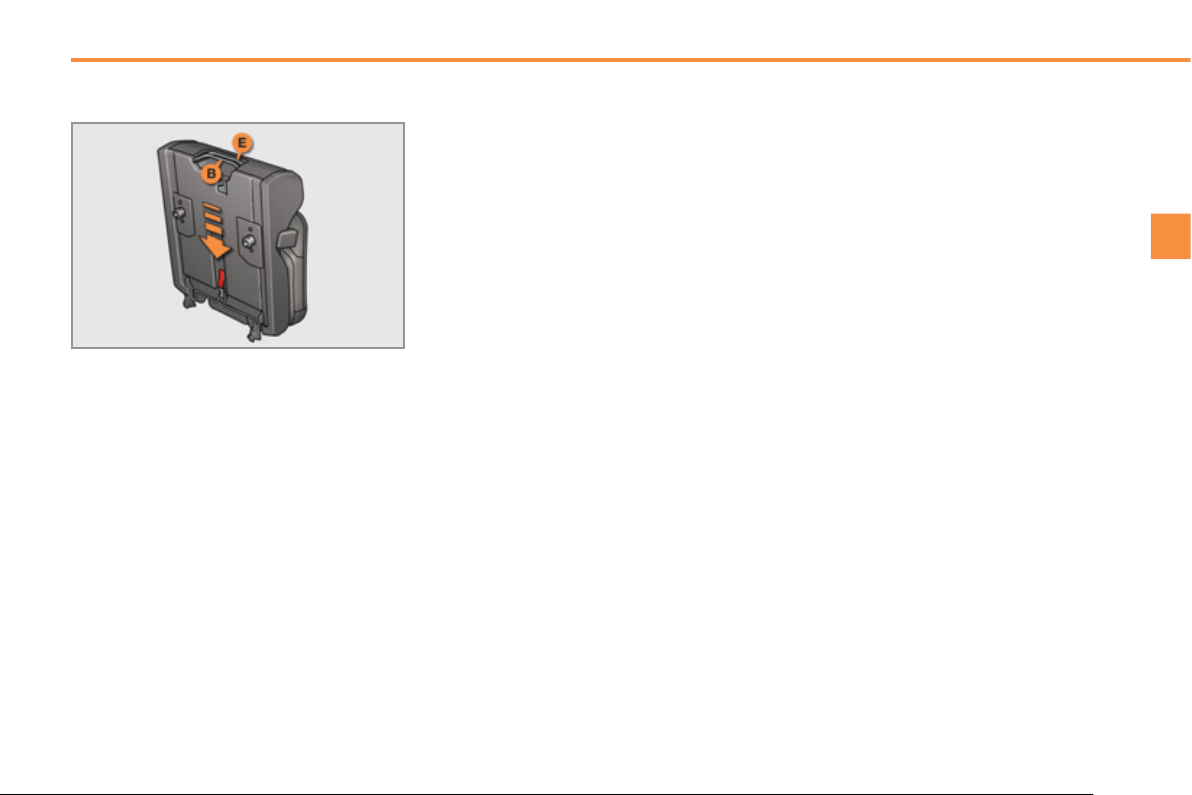
3
77
COMFORT
Installation
) First remove the anchorage covers
on the fl oor.
) Carry the seat using the carrying
handle E .
) Put the seat's front feet in place in
the corresponding anchorages.
) Raise the bar B to check that the
rear feet are released.
) Tilt the folded seat rearwards; the
front and rear feet lock automatically.
) Raise the seat back.
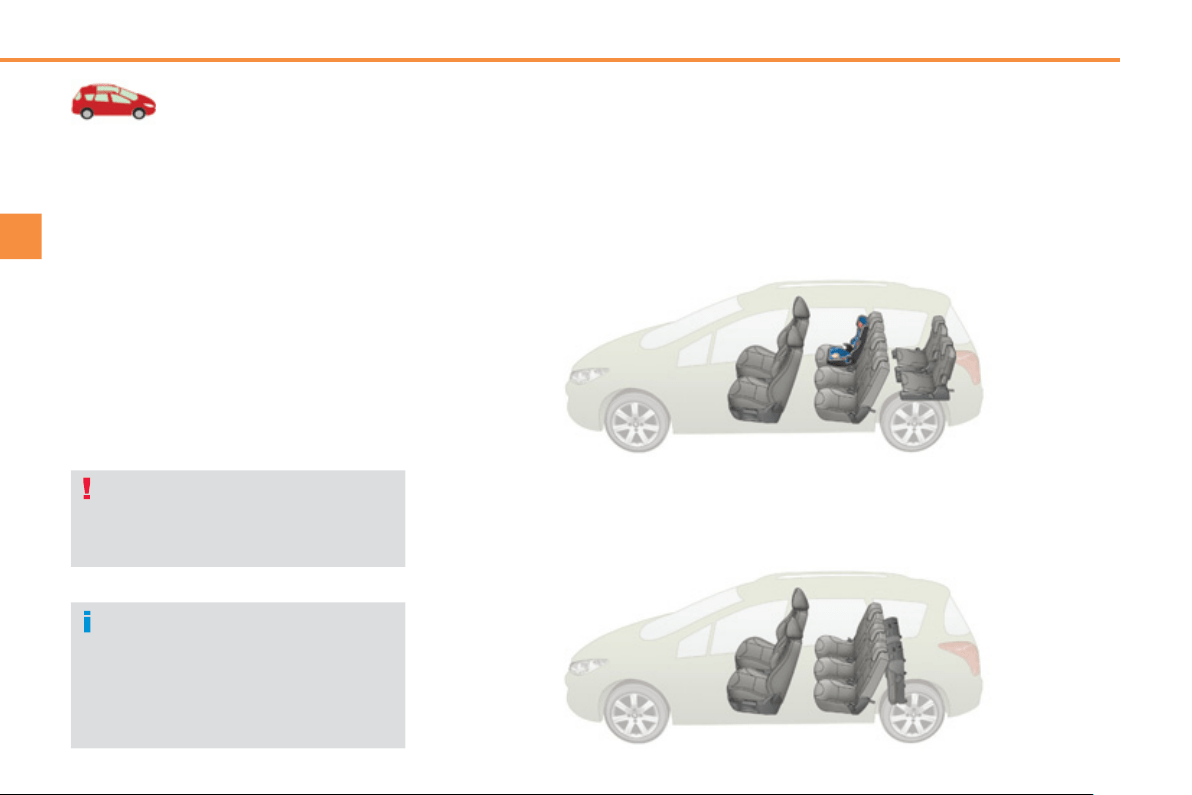
3
7
8
COMFORT
S
EAT MODULARITY
A
ND VARIOU
S
CONFIGURATION
S
Examples of configurations
7 seats
Operations to change the existing
confi guration must only be car-
ried out when stationary (see the
"Rear seats" and "Additional seats"
sections of the SW individual rear
seats).
Special features
The outer seats of the 2nd row can be
moved inwards, once the central seat
has been removed.
The 2nd row seats can be installed in
the 3rd row.
Conversely, the 3rd row seats cannot
be installed in the 2nd row.
5 seats with additional seats folded
Do not seat passengers in the
3rd row if the 2nd row seats are in
the fully folded position.
Designed to be modular, your vehicle
offers numerous seat installation and
loading confi gurations.
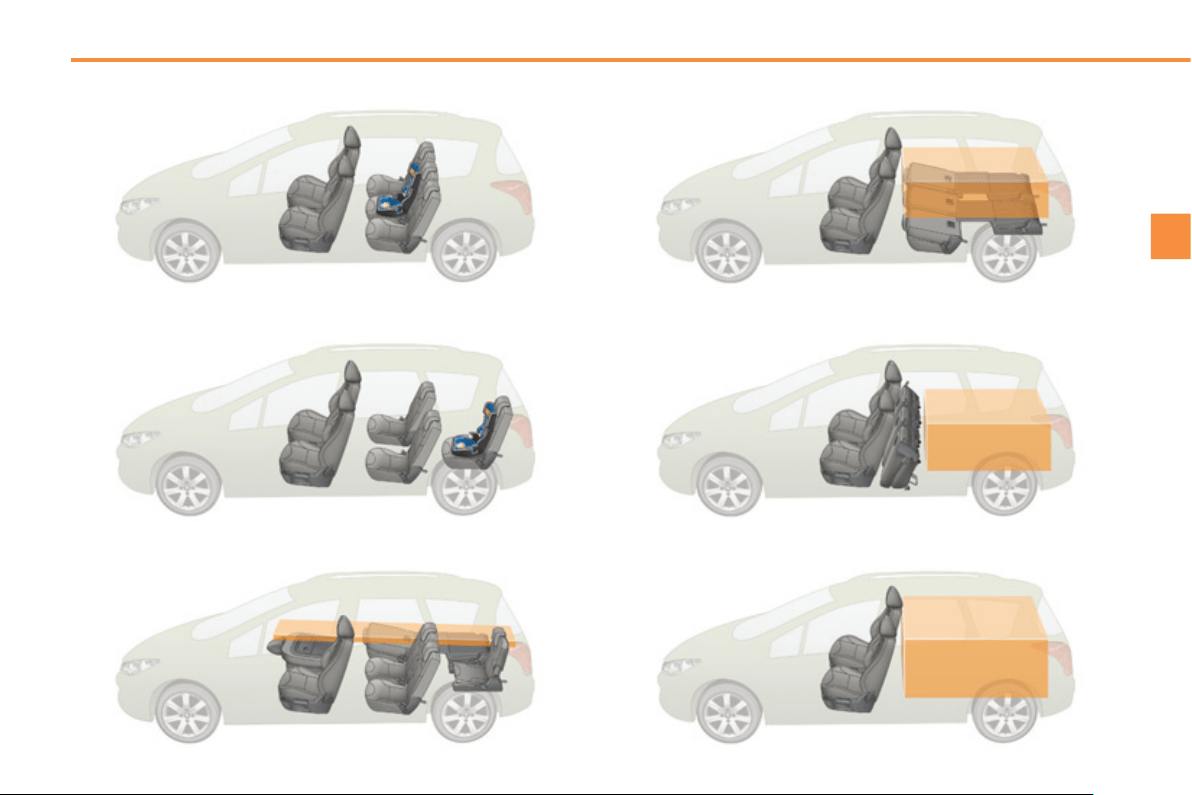
3
7
9
COMFORT
5 seats
5 seats with 2nd row seats moved inwards
Transporting long objects
Loading a large volume
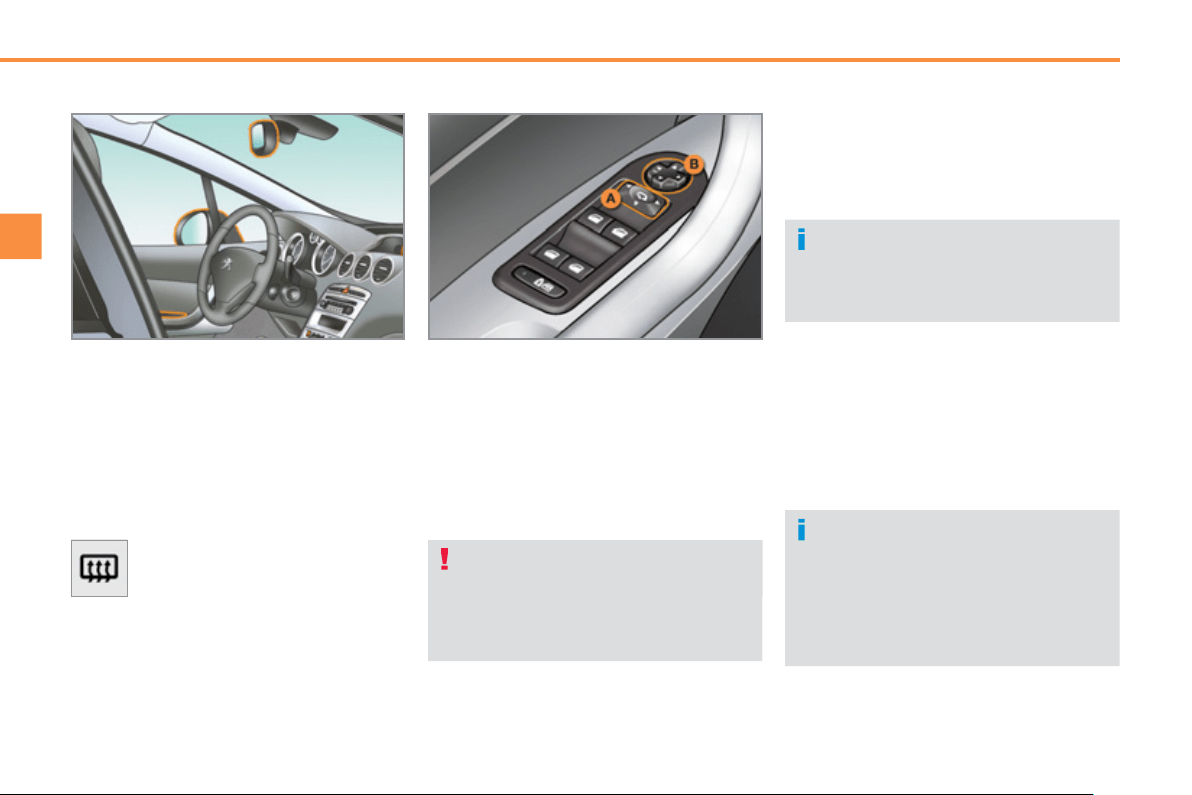
3
80
COMFORT
The objects observed are, in reality,
closer than they appear.
Take this into account in order to
correctly judge the distance of ve-
hicles approaching from behind.
M
IRROR
S
Door mirrors
Each fi tted with an adjustable mirror
glass permitting the lateral rearward vi-
sion necessary for overtaking or parking.
They can also be folded for parking in
confi ned spaces.
Folding
) From outside: lock the vehicle using
the remote control or the key.
) From inside: with the ignition on, pull
the control A in the central position
rearwards.
The folding and unfolding of the
door mirrors using the remote
control can be deactivated by a
PEUGEOT dealer or a qualifi ed
workshop.
Never fold or unfold the electric
folding mirrors manually.
Adjustment
Unfolding
) From outside: unlock the vehicle using
the remote control or the key.
) From inside: with the ignition on, pull
the control A in the central position
rearwards.
If the mirrors are folded using con-
trol A , they will not unfold when the
vehicle is unlocked. Pull again on
control A .
) Move control A to the right or to the left
to select the corresponding mirror.
) Move control B in all four directions
to adjust.
)
Return control A to the central position.
Demisting - Defrosting
If your vehicle is fi tted with
heated mirrors, the demisting-
defrosting operates by switch-
ing on the heated rear screen
(refer to the "Rear screen demist-
defrost" page).
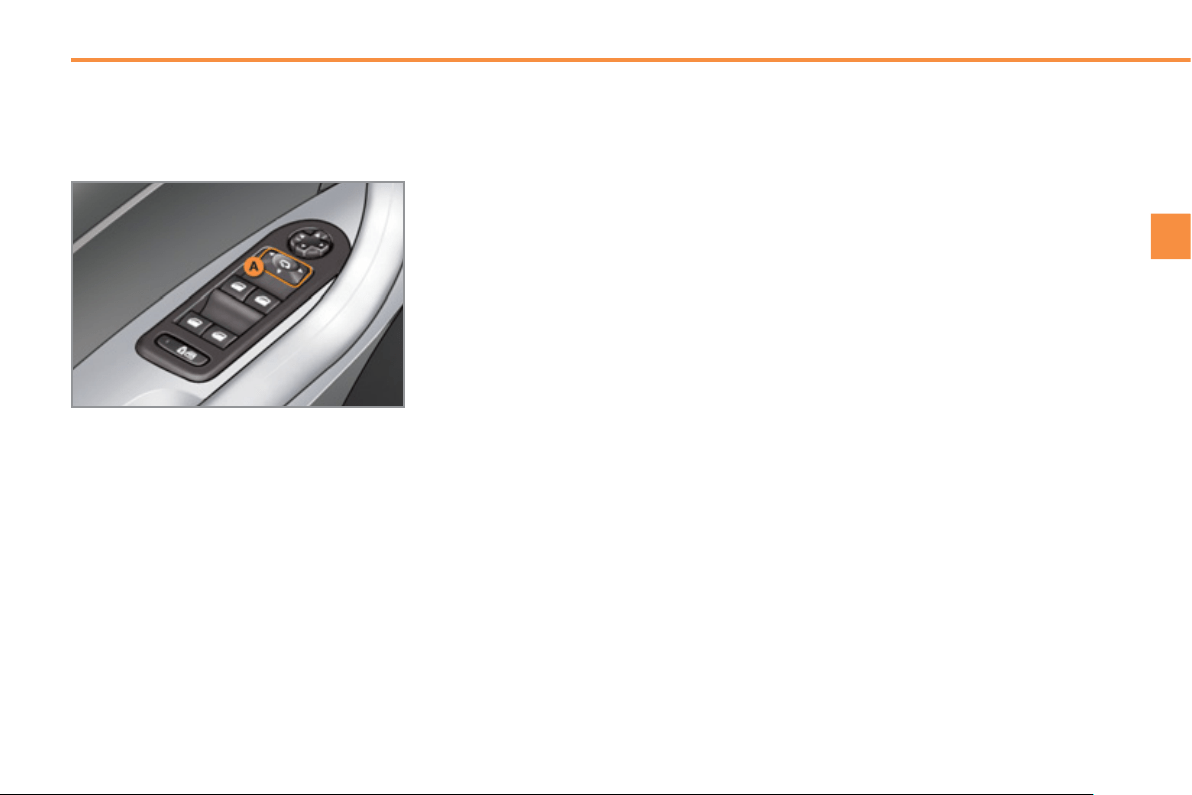
3
81
COMFORT
Automatic tilting in reverse gear
System which provides a view of the
ground during parking manoeuvres in
reverse gear.
Switching on
) With the engine running, engage re-
verse gear.
) Move control A to the right or to the left
to select the corresponding mirror.
The glass of the mirror selected tilts
downwards, in accordance with its pro-
gramming.
Programming
) With the engine running, engage re-
verse gear.
) Select and adjust the left-hand and
right-hand mirrors in succession.
The adjustment is stored immediately.
Switching off
)
Exit reverse gear and wait ten seconds.
or
)
Return control A to the central position.
The mirror glass returns to its initial po-
sition.
The mirror glass also returns to its initial
position:
- if the speed exceeds 6 mph (10 km/h),
- if the engine is switched off.

3
82
COMFORT
S
TEERING WHEEL ADJU
S
TMENT
) When stationary , pull the con-
trol lever to release the adjustment
mechanism.
) Adjust the height and reach to suit
your driving position.
) Push the control lever to lock the ad-
justment mechanism.
As a safety precaution, these op-
erations should only be carried out
while the vehicle is stationary.
Automatic day/night model
In order to ensure optimum vis-
ibility during your manoeuvres, the
mirror lightens automatically when
reverse gear is engaged.
By means of a sensor, which measures
the light from the rear of the vehicle, this
system automatically and progressively
changes between the day and night
uses.
Adjustment
) Adjust the mirror so that the glass is di-
rected correctly in the "day" position.
As a safety measure, the mirrors
should be adjusted to reduce the
"blind spot".
Manual day/night model
Day / night position
) Pull the lever to change to the "night"
anti-dazzle position.
) Push the lever to change to the normal
"day" position.
Rear view mirror
Adjustable mirror providing a central
rearward view.
Equipped with an anti-dazzle system,
which darkens the mirror glass: this re-
duces the nuisance to the driver caused
by the headlamps from following vehi-
cles, low sun...
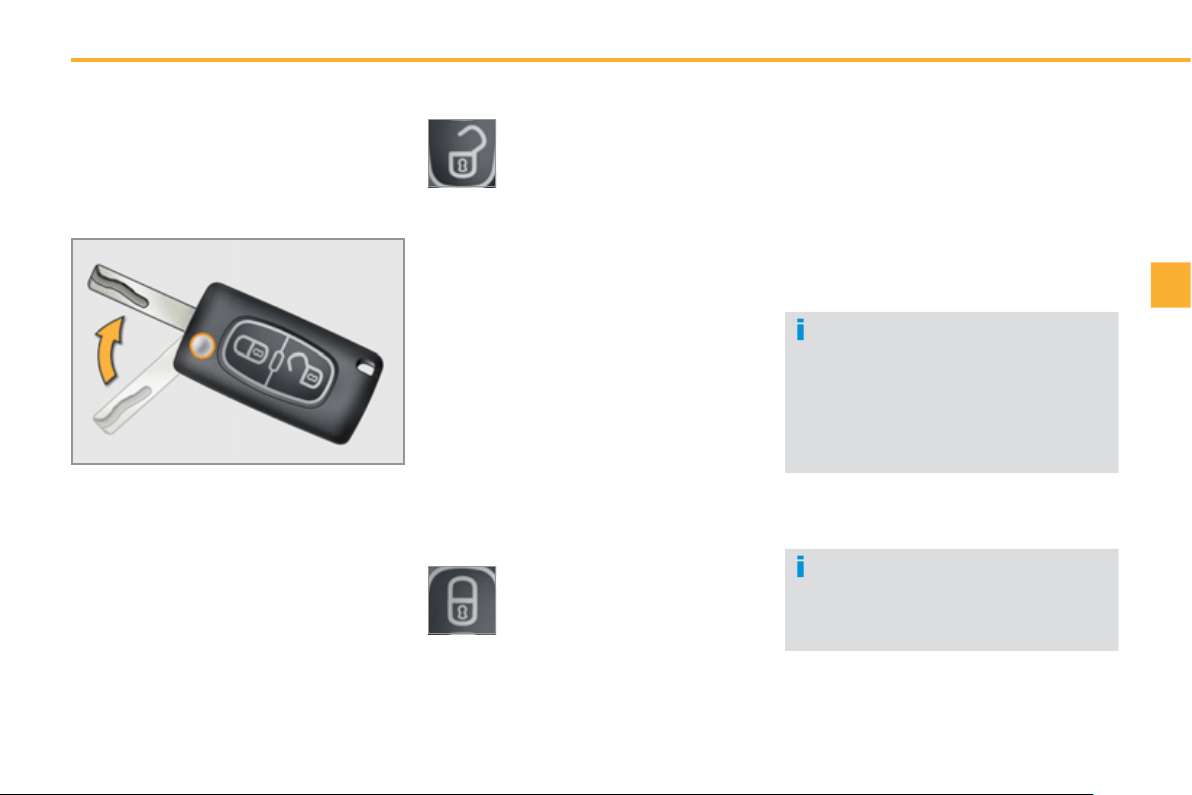
4
83
ACCESS
R
EMOTE CONTROL KEY
System which permits central unlock-
ing or locking of the vehicle using the
lock or from a distance. It is also used to
locate and start the vehicle, as well as
providing protection against theft.
Unfolding the key
) First press this button to unfold the
key.
Unlocking the vehicle
) Press the open padlock to
unlock the vehicle.
Unlocking using the key
) Turn the key to the left in the driver's
door lock to unlock the vehicle.
Unlocking using the remote control
If one of the doors or the boot is still
open, the central locking does not
take place.
When the vehicle is locked, if it is
unlocked inadvertently, it will relock
automatically after thirty seconds
unless a door is opened.
Normal locking using the key
) Turn the key to the right in the driver's
door lock to lock the vehicle.
The folding and unfolding of the
door mirrors using the remote
control can be deactivated by a
PEUGEOT dealer or a qualifi ed
workshop.
Locking the vehicle
) Briefl y press the closed
padlock to lock the vehicle.
or
) Press and hold the closed padlock
to close the windows automatically
in addition to locking (according to
version).
Normal locking using the remote
control
Locking is confi rmed by fi xed lighting of
the direction indicators for approximately
two seconds.
According to version, the door mirrors
fold at the same time.
Unlocking is confi rmed by rapid fl ashing
of the direction indicators for approxi-
mately two seconds.
According to version, the door mirrors
unfold at the same time.

4
84
ACCESS
Deadlocking renders the exterior
and interior door controls inopera-
tive.
It also deactivates the manual central
control button.
Therefore, never leave anyone in-
side the vehicle when it is dead-
locked.
Deadlocking using the remote
control
Deadlocking using the key
) Short press on the closed
padlock to lock the vehicle
or
Deadlocking is confi rmed by fi xed light-
ing of the direction indicators for ap-
proximately two seconds.
According to version, the door mirrors
fold at the same time.
) Turn the key to the right in the driv-
er's door lock to lock the vehicle.
) Turn the key to the right again within
fi ve seconds to deadlock the vehicle.
Folding the key
) First press this button to fold the
key.
If you do not press the button when fold-
ing the key, there is a risk of damage to
the mechanism.
Locating your vehicle
This function allows you to identify your
vehicle from a distance, particularly in
poor light. Your vehicle must be locked.
Electronic engine immobiliser
The key contains an electronic chip
which has a special code. When the
ignition is switched on, this code must
be recognised in order for starting to be
possible.
This electronic engine immobiliser locks
the engine management system a few
minutes after the ignition is switched off
and prevents starting of the engine by
anyone who does not have the key.
Anti-theft protection
In the event of a fault, you are
informed by illumination of this
warning lamp, an audible signal
and a message in the screen.
In this case, your vehicle will not start;
contact a PEUGEOT dealer as soon as
possible.
Keep safely the label attached to the
keys given to you on acquisition of the
vehicle.
) Long press on the closed padlock to
lock the vehicle and also close the
windows (depending on version).
) Short press on the closed padlock
again within fi ve seconds to dead-
lock the vehicle.
) Press the closed padlock
on the remote control.
This will switch on the courtesy lamps
and the direction indicators will fl ash for
a few seconds.
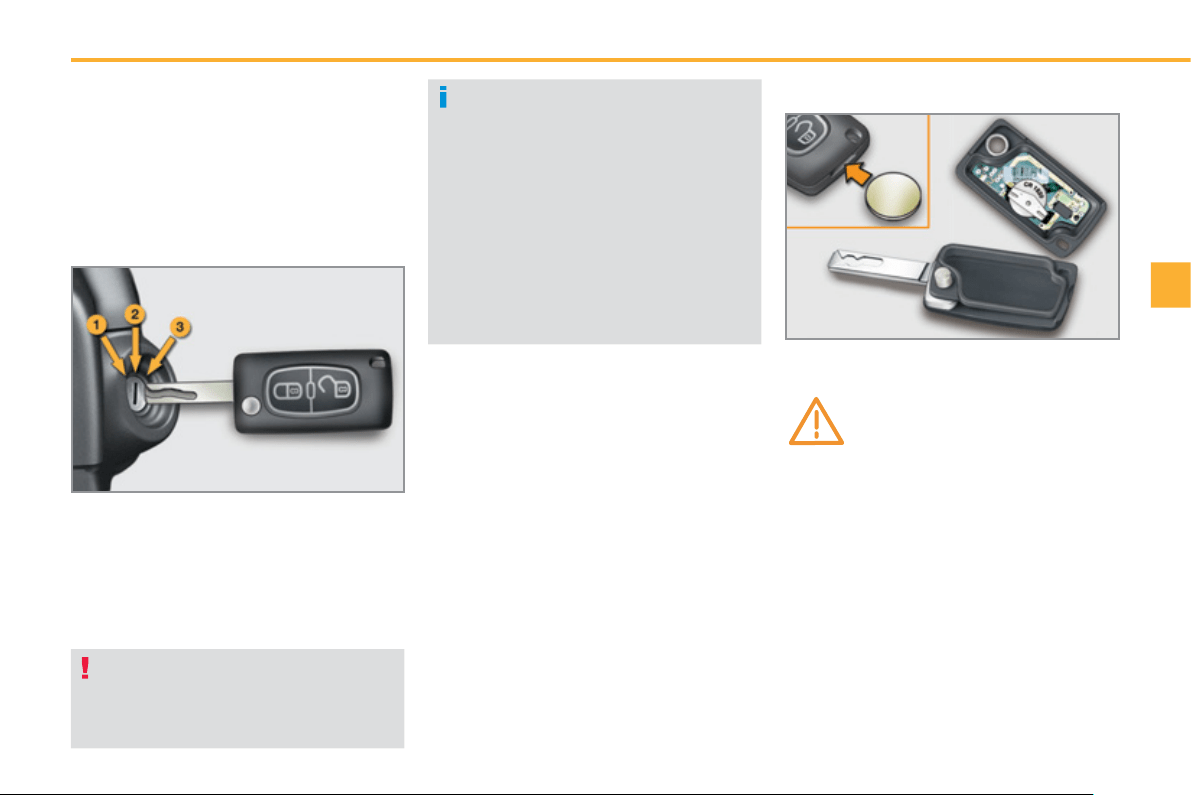
4
85
ACCESS
Starting the vehicle
) Insert the key in the ignition switch.
The system recognises the starting
code.
) Turn the key fully towards the dash-
board to position 3 (Starting) .
) When the engine starts, release the
key.
Switching the vehicle off
) Immobilise the vehicle.
) Turn the key fully towards you to po-
sition 1 (Stop) .
) Remove the key from the ignition
switch.
Remote control problem
Following disconnection of the vehicle
battery, replacement of the remote con-
trol battery or in the event of a remote
control malfunction, you can no longer
unlock, lock or locate your vehicle.
) First of all, use the key in the lock to
unlock or lock your vehicle.
) Then, reinitialise the remote control.
If the problem persists, contact a PEUGEOT
dealer as soon as possible.
Changing the battery
Battery ref.: CR1620 / 3 volts.
Reinitialisation
) Switch off the ignition.
)
Turn the key to position 2 (Ignition on) .
) Press the closed padlock immedi-
ately for a few seconds.
) Switch off the ignition and remove
the key from the ignition switch.
The remote control is fully operational
again.
If the battery is fl at, you are in-
formed by illumination of this
warning lamp, an audible signal
and a message in the multi-
function screen.
Key left in the "Ignition on"
position
On opening the driver's door, an
alert message is displayed, accom-
panied by an audible signal, to re-
mind you that the key is still in the
ignition switch at position 1 (Stop) .
If the key has been left in the igni-
tion switch at position 2 (Ignition
on) , the ignition will be switched off
automatically after one hour.
To switch the ignition back on, turn
the key to position 1 (Stop) , then
back to position 2 (Ignition on) .
) Unclip the casing using a coin at the
notch.
) Slide the fl at battery out of its location.
) Slide the new battery into its loca-
tion observing the original direction.
) Clip the casing.
) Reinitialise the remote control.
A heavy object (key fob...), attached
to the key and weighing down on
its shaft in the ignition switch, could
cause a malfunction.

4
86
ACCESS
Lost keys
Visit a PEUGEOT dealer with the vehicle's registration document, your per-
sonal identifi cation documents and if possible the key code label.
The PEUGEOT dealer will be able to look up the key code and the transpond-
er code required to order a new key.
Do not throw the remote control
batteries away, they contain metals
which are harmful to the environ-
ment.
Take them to an approved collection
point.
Remote control
The high frequency remote control is a sensitive system; do not operate it while it is in your
pocket as there is a possibility that it may unlock the vehicle, without you being aware of it.
Do not repeatedly press the buttons of your remote control out of range and out of sight of
your vehicle. You run the risk of stopping it from working and the remote control would have
to be reinitialised.
The remote control does not operate when the key is in the ignition switch, even when the
ignition is switched off, except for reinitialisation.
Locking the vehicle
Driving with the doors locked may make access to the passenger compart-
ment by the emergency services more diffi cult in an emergency.
However, the vehicle unlocks automatically in the event of a serious impact
causing airbag deployment.
As a safety precaution (with children on board), remove the key from the igni-
tion switch when you leave the vehicle, even for a short time.
Anti-theft protection
Do not make any modifi cations to the electronic engine immobiliser system;
this could cause malfunctions.
When purchasing a second-hand vehicle
Have the pairing of all of the keys in your possession checked by a PEUGEOT
dealer, to ensure that only your keys can be used to open and start the vehicle.
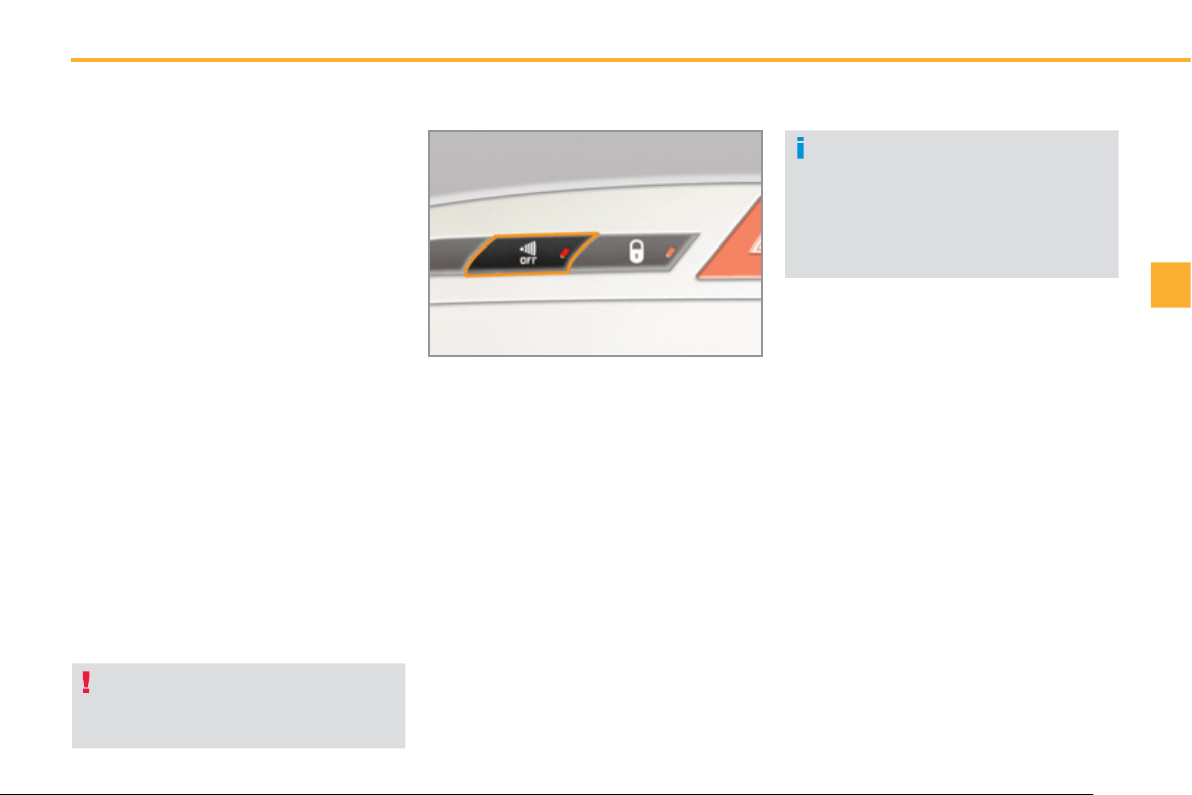
4
87
ACCESS
ALARM
System which protects and provides a de-
terrent against theft and break-ins. It pro-
vides the following types of monitoring:
Locking the vehicle with full
alarm system
For all work on the alarm system,
contact a PEUGEOT dealer or a
qualifi ed workshop.
Activation
) Switch off the ignition and get out of
the vehicle.
) Press the locking button on the re-
mote control.
The monitoring system is active: the in-
dicator lamp in the button fl ashes once
per second.
After the locking button on the remote
control is pressed, the exterior perimeter
monitoring is activated after a delay of
5 seconds and the interior volumetric
monitoring after a delay of 45 seconds.
- Exterior perimeter
The system checks for opening of the
vehicle.
The alarm is triggered if anyone tries to
open a door, the boot, the bonnet...
- Interior volumetric
The system checks for any variation in
the volume in the passenger compart-
ment.
The alarm is triggered if anyone breaks
a window, enters the passenger com-
partment or moves inside the vehicle.
Self-protection function
The system checks for the putting out of
service of its components.
The alarm is triggered if the battery, the
central control or the wires of the siren
are put out of service or damaged.
Deactivation
) Press the unlocking button on the
remote control.
The alarm system is deactivated: the in-
dicator lamp in the button goes off.
If an opening (door, boot...) is
not closed fully, the vehicle is not
locked but the exterior perimeter
monitoring will be activated after a
delay of 45 seconds at the same
time as the interior volumetric
monitoring.
4
88
ACCESS
Triggering of the alarm
The monitoring functions remain
active until the alarm has been trig-
gered eleven times in succession.
When the vehicle is unlocked using
the remote control, rapid fl ashing
of the indicator lamp in the button
informs you that the alarm was trig-
gered during your absence. When
the ignition is switched on, this
fl ashing stops immediately.
Failure of the remote control
To deactivate the monitoring functions:
) Lock or deadlock the vehicle using
the key in the driver's door lock.
Locking the vehicle without
activating the alarm
When the ignition is switched on, fi xed
illumination of the indicator lamp in the
button indicates a malfunction of the
system.
Have it checked by a PEUGEOT dealer
or a qualifi ed workshop.
This is indicated by sounding of the si-
ren and fl ashing of the direction indica-
tors for thirty seconds.
) Unlock the vehicle using the key in
the driver's door lock.
) Open the door; the alarm is trig-
gered.
) Switch on the ignition; the alarm
stops. The indicator lamp in the but-
ton goes off.
Malfunction
Automatic activation *
To be effective, this deactivation
must be carried out each time the
ignition is switched off.
Deactivation of the interior
volumetric monitoring
) Switch off the ignition.
) Within ten seconds, press the but-
ton until the indicator lamp is on
continuously.
) Get out of the vehicle.
) Press the locking button on the re-
mote control immediately.
The exterior perimeter monitoring alone
is activated: the indicator lamp in the
button fl ashes once per second.
Locking the vehicle with
exterior perimeter monitoring
only
Deactivate the interior volumetric moni-
toring to avoid unwanted triggering of
the alarm in certain cases such as:
- leaving a pet in the vehicle,
- leaving a window partially open,
- washing your vehicle.
Reactivation of the interior
volumetric monitoring
) Press the unlocking button on the
remote control to deactivate the ex-
terior perimeter monitoring.
) Press the locking button on the re-
mote control to activate all the moni-
toring functions.
The indicator lamp in the button again
fl ashes once per second.
* According to country.
2 minutes after the last door or the boot
is closed, the system is activated auto-
matically.
) To avoid triggering the alarm on enter-
ing the vehicle, fi rst press the unlocking
button on the remote control.
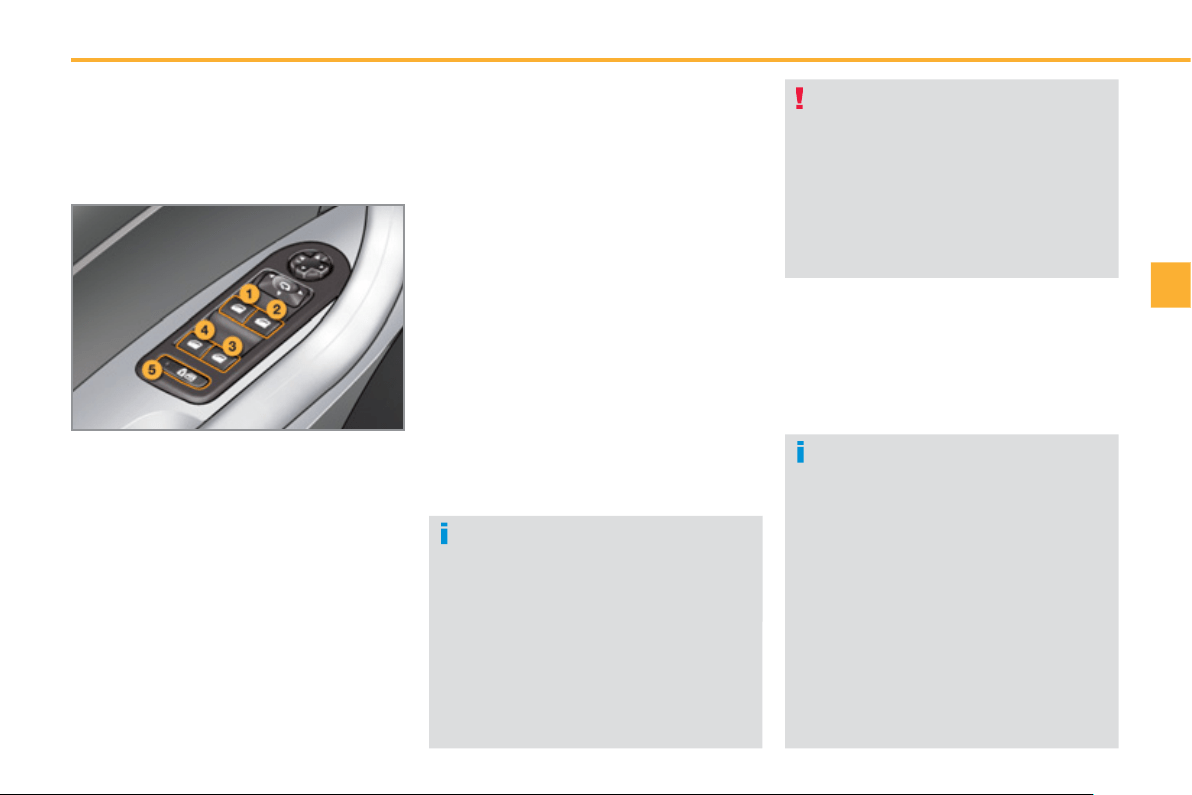
4
89
ACCESS
The electric window controls re-
main operational for approximately
45 seconds after the ignition is
switched off or until the vehicle is
locked after a door is opened.
If one of the passenger windows
cannot be operated from the driver's
door control panel, carry out the op-
eration from the control panel of the
passenger door concerned, and vice
versa.
E
LECTRIC WINDOW
S
Fitted with a safety anti-pinch system
and a deactivation system to prevent
misuse of the rear controls.
Electric window controls
If the window cannot be closed (for
example, in the presence of ice),
immediately after the movement is
reversed:
) press and hold the control until
the window opens fully,
)
then pull the control immediately
and hold it until the window closes,
) continue to hold the control for
approximately one second after
the window has closed.
The safety anti-pinch function is
not operational during these op-
erations.
Safety anti-pinch
When the window rises and meets an
obstacle, it stops and partially lowers
again.
- automatic mode
) Press or pull the control fi rmly.
The window opens or closes fully
when the control is released.
) Pressing the control again stops
the movement of the window.
One-touch electric windows
There are two options:
- manual mode
) Press or pull the control gently.
The window stops when the
control is released.
After approximately ten consecutive
complete opening/closing movements
of the window, a protection function is
activated which only authorises clos-
ing of the window to prevent damage
to the electric window motor.
Once the window is closed, the controls
will become available again after ap-
proximately 40 minutes.
1. Driver's electric window.
2. Passenger's electric window.
3. Rear right electric window.
4. Rear left electric window.
5. Deactivation of the rear electric
window and door controls.
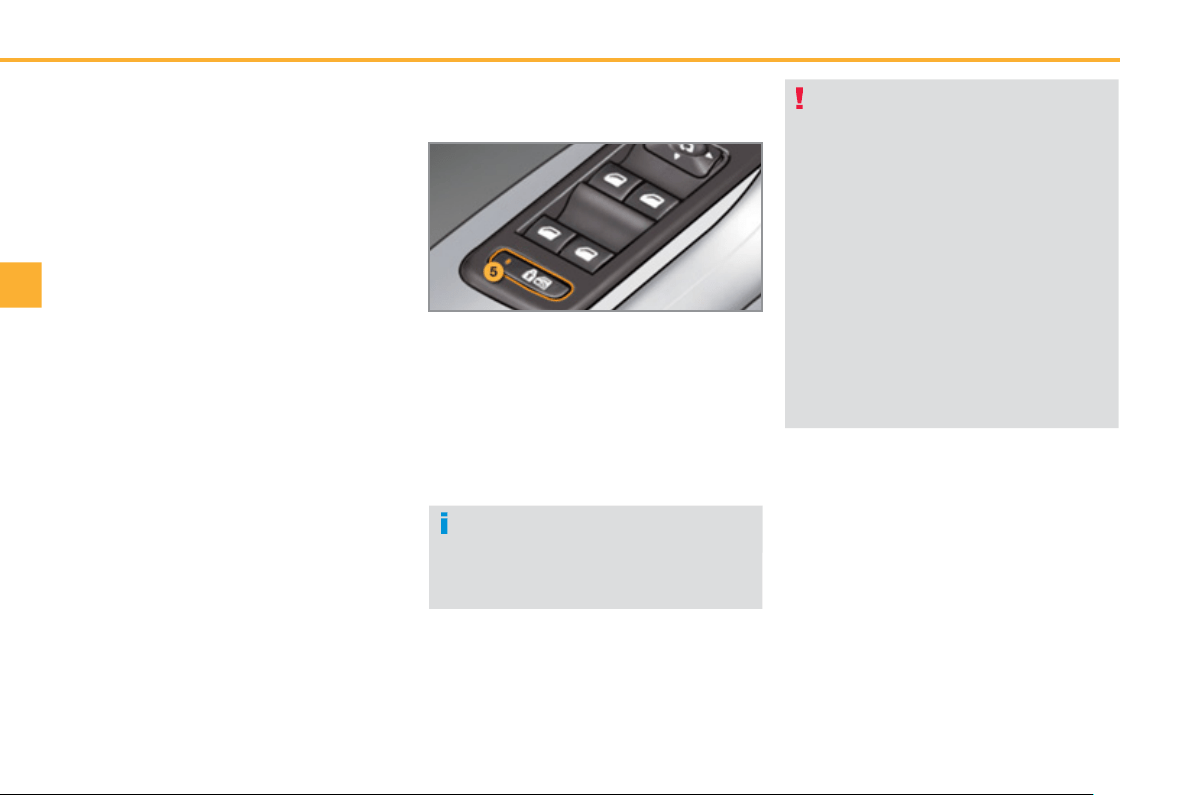
4
90
ACCESS
This control also deactivates the
interior controls for the rear doors
(refer to the section "Child safety -
Electric child lock").
Reinitialisation
If a window does not rise automatically,
its operation must be reinitialised:
) pull the control until the window
stops,
) release the control and pull it again
until the window closes fully,
) continue to hold the control for ap-
proximately one second after the
window has closed,
) press the control to lower the win-
dow automatically to the low posi-
tion,
) when the window has reached the
low position, press the control again
for approximately one second.
Always remove the key from the
ignition when leaving the vehicle,
even for a short time.
If an obstacle is encountered during
operation of the electric windows,
you must reverse the movement of
the window. To do this, press the
control concerned.
When the driver operates the controls
for the passengers' electric windows,
they must ensure that no one is pre-
venting correct closing of the win-
dows.
The driver must ensure that the pas-
sengers use the electric windows
correctly.
Be aware of children when operating
the windows.
Deactivation of the rear electric
window and door controls
) For the safety of your children, press
control 5 to deactivate the rear elec-
tric window controls regardless of
their position.
Indicator lamp on, the rear controls are
deactivated.
Indicator lamp off, the rear controls are
activated.
The safety anti-pinch function is not
operational during these operations.
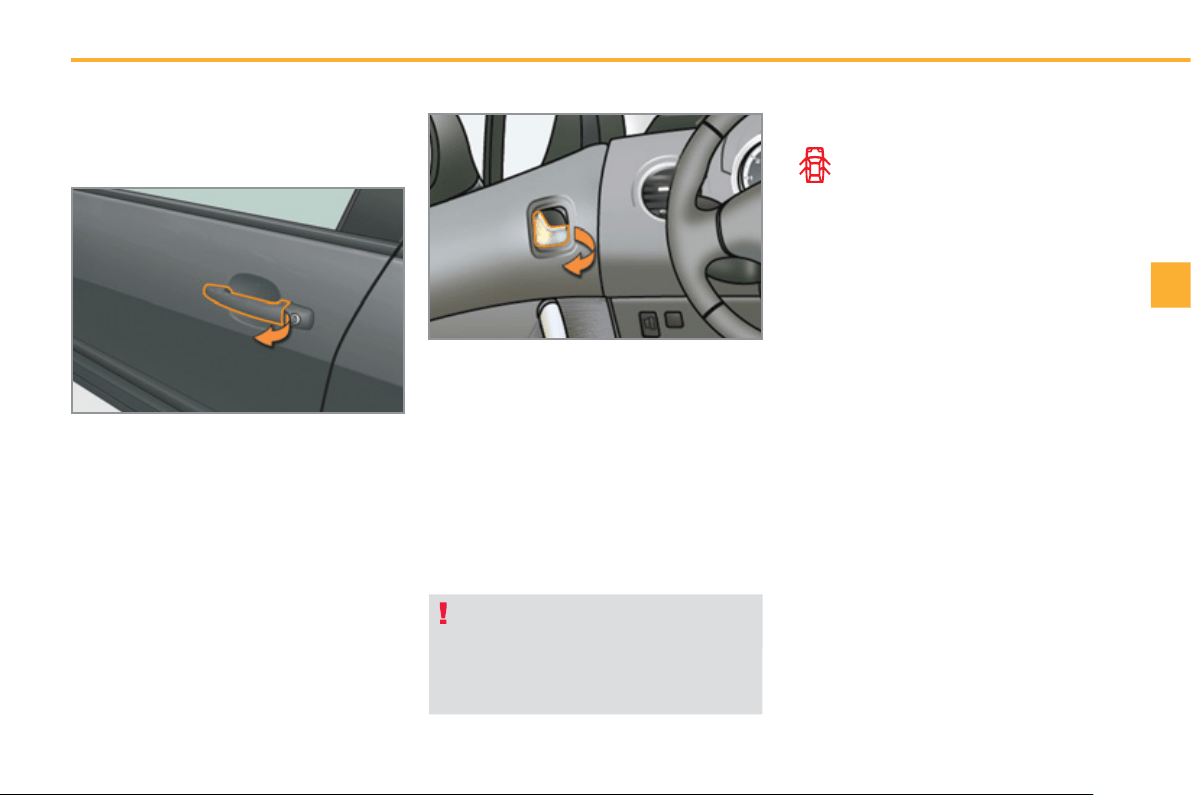
4
91
ACCESS
D
OOR
S
) After unlocking the vehicle completely
using the remote control or the key,
pull the door handle.
From inside
) Pull the interior control lever of a
front door; this unlocks the vehicle
completely.
Closing
When a door is not closed correctly:
- when the engine is running ,
this warning lamp comes on,
accompanied by a message in
the multifunction screen for a
few seconds,
- when the vehicle is moving (speed
higher than 6 mph (10 km/h)), this
warning lamp comes on, accom-
panied by an audible signal and a
message in the multifunction screen
for a few seconds.
Opening
From outside
Version with deadlocking
The interior door controls do not
operate when the vehicle is dead-
locked.
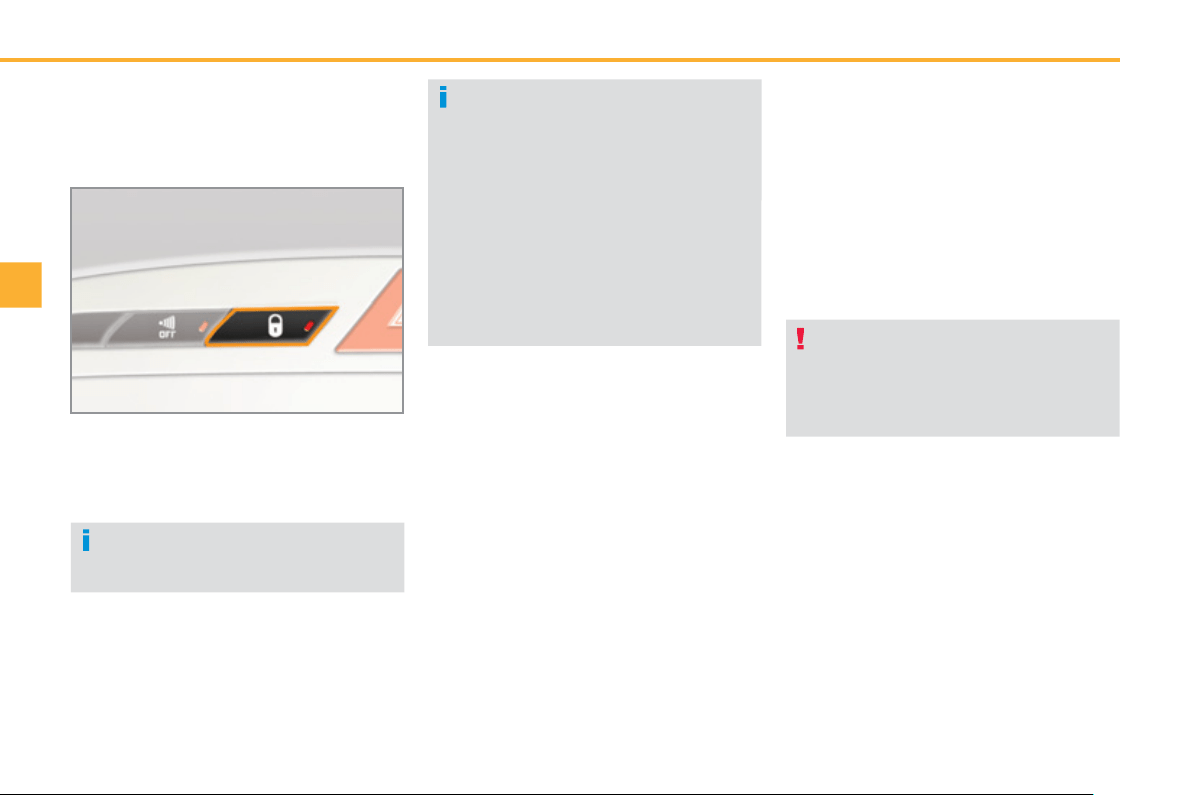
4
92
ACCESS
When locking / deadlocking
from the outside
When the vehicle is locked or dead-
locked from the outside, the red in-
dicator lamp fl ashes and the button
is inactive.
) After normal locking, pull the
interior door lever to unlock the
vehicle.
) After deadlocking, it is neces-
sary to use the remote control or
the key to unlock the vehicle.
If one of the doors is open, the au-
tomatic central locking does not
take place.
If the boot is open, the automatic
central locking of the doors is ac-
tive.
Centralised locking control
System which provides full manual
locking or unlocking of the doors from
the inside.
Locking
) Press this button to lock the vehicle.
The red indicator lamp in the button
comes on.
Anti-intrusion security
System which provides full automatic
locking or unlocking of the doors and
boot while driving.
You can activate or deactivate this func-
tion.
Unlocking
) Above 6 mph (10 km/h), press this
button to unlock the doors and boot
temporarily.
If one of the doors is open, the central
locking from the inside does not take
place.
Unlocking
) Press this button again to unlock the
vehicle.
The red indicator lamp in the button
goes off.
Locking
When the speed exceeds 6 mph (10 km/h),
the doors and boot lock automatically.
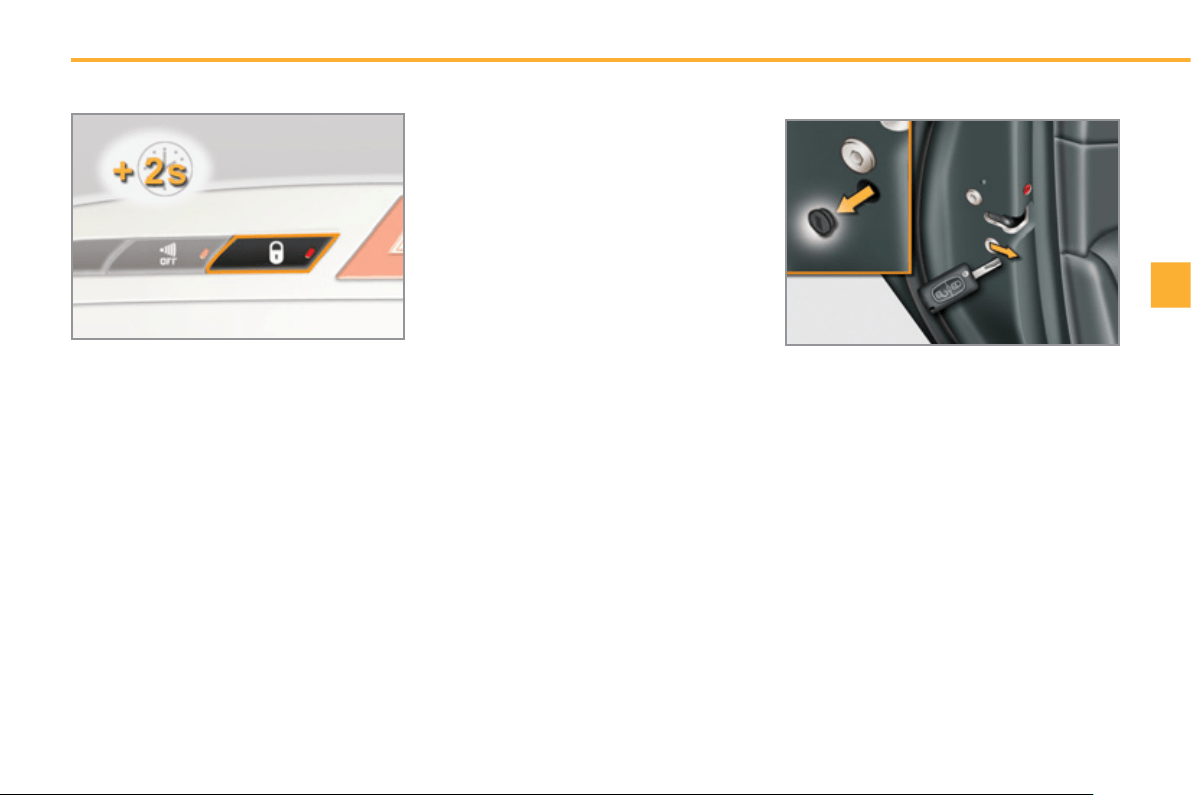
4
93
ACCESS
Emergency control
System allowing the doors to be locked
and unlocked manually in the event of
a malfunction of the central locking sys-
tem or battery failure.
) Open the doors.
) On the rear doors, check that the child
lock is not on (see Child Safety).
) Remove the black cap, located on
the edge of the door, using the key.
) Insert the key in the socket without
forcing it, then without turning it,
move the latch sideways towards
the inside of the door.
) Remove the key and refi t the cap.
) Close the doors and check that the
vehicle has locked correctly from
the outside.
Locking the driver's door
) Insert the key in the door lock, then
turn it to the rear.
You can also apply the procedure de-
scribed for the passenger doors.
Unlocking the driver's door
) Insert the key in the door lock, then
turn it to the front.
Locking the front and rear
passenger doors
Unlocking the front and rear
passenger doors
) Pull the interior door opening control.
Activation
) Press this button for more than two
seconds.
A confi rmation message appears in the
multifunction screen, accompanied by
an audible signal.
Deactivation
) Press this button again for more
than two seconds.
A confi rmation message appears in the
multifunction screen, accompanied by
an audible signal.
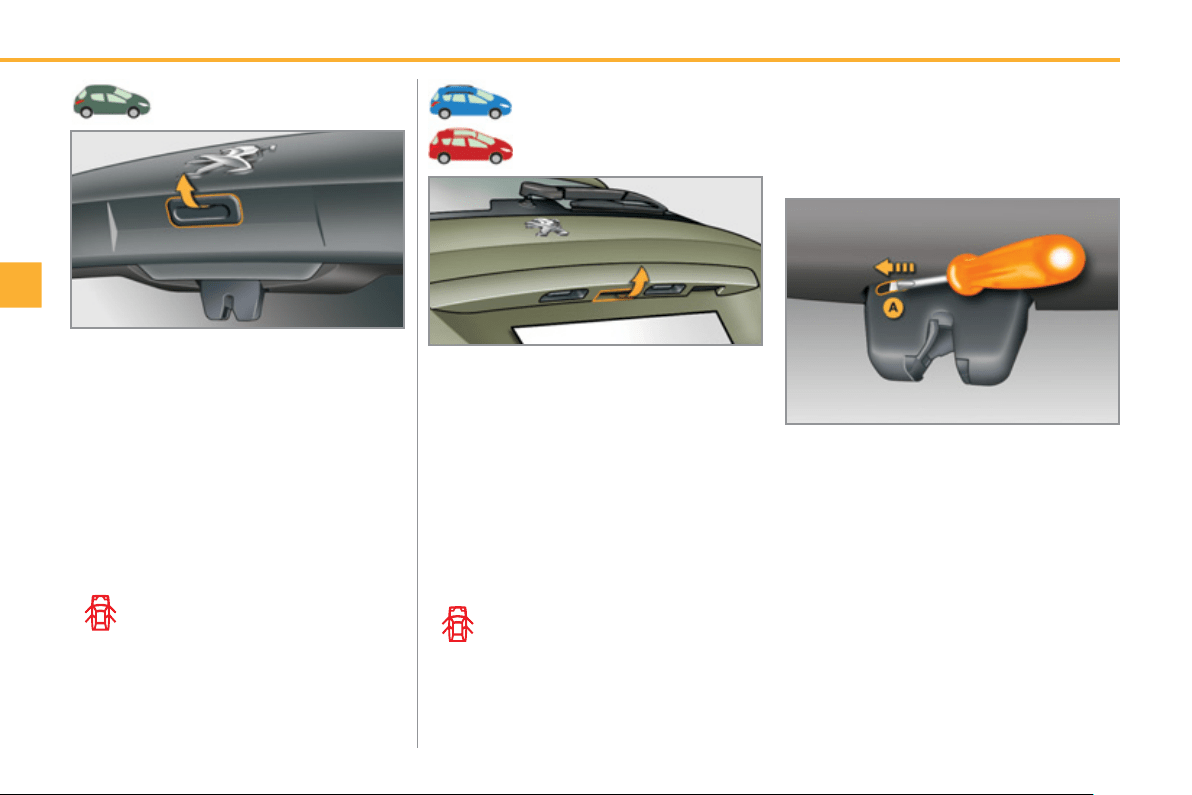
4
94
ACCESS
BOOT
Opening
) After unlocking the vehicle using the
remote control or the key, pull the
handle and raise the tailgate.
Closing
) Lower the tailgate using the interior
grab handle.
- when the engine is running ,
this warning lamp comes on,
accompanied by a message
in the multifunction screen for
a few seconds,
-
when the vehicle is moving (speed
above 6 mph (10 km/h)), this warning
lamp comes on, accompanied by an au-
dible signal and a message in the multi-
function screen for a few seconds.
If the tailgate is not closed correctly:
Opening
) After unlocking the vehicle using the
remote control or the key, pull the
handle and raise the tailgate.
BOOT
- when the engine is running ,
this warning lamp comes on,
accompanied by a message
in the multifunction screen for
a few seconds,
-
when the vehicle is moving (speed
above 6 mph (10 km/h)), this warning
lamp comes on, accompanied by an
audible signal and a message in the
multifunction screen for a few seconds.
Tailgate release
System allowing the mechanical unlock-
ing of the boot in the event of a battery
or central locking system malfunction.
Unlocking
) Fold back the rear seats to gain
access to the lock from inside the
boot.
)
Insert a small screwdriver into hole A
of the lock to unlock the tailgate.
) Move the latch to the left.
Closing
) Lower the tailgate using the interior
grab handle.
If the tailgate is not closed correctly:
Locking after closing
If the fault persists after closing again,
the boot will remain locked.
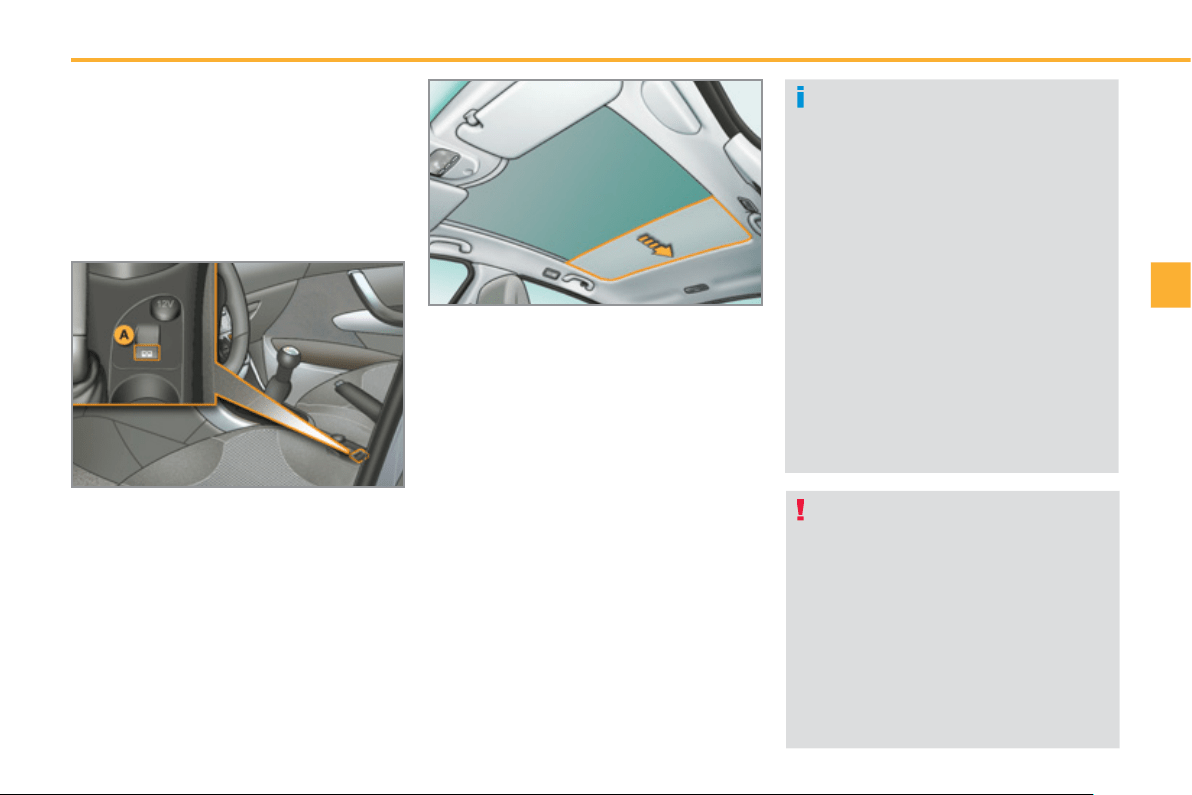
4
95
ACCESS
P
ANORAMIC
S
UNROOF
Component which has a tinted glass
panoramic surface to increase the light
and visibility in the passenger compart-
ment.
Fitted with an electric blind in several
sections to improve temperature and
noise related comfort.
If the blind meets an obstacle dur-
ing operation, you must reverse the
movement of the blind. To do this,
press the control concerned.
When the driver operates the blind
control, he must ensure that no one
is preventing correct closing of the
blind.
The driver must ensure that pas-
sengers use the blind correctly.
Be aware of children when operat-
ing the blind.
- manual mode
) Pull or press control A gently.
The blind stops when you release
the control.
- automatic mode
) Pull or press control A fi rmly.
One press opens or closes the
blind completely.
Pressing the control again stops
the blind.
Safety anti-pinch
In automatic mode and at the end of
its travel, if the blind meets an obstacle
while closing it stops and moves back
slightly.
One-touch electric blind
There are two options for opening and
closing:
Reinitialisation: if the blind's sup-
ply is cut off while it is moving, the
safety anti-pinch must be reinitial-
ised:
) press the control until the blind
is fully closed,
) continue to press for at least
3 seconds. A slight movement
of the blind will then be notice-
able, confi rming the reinitialisa-
tion.
If the blind re-opens during a clos-
ing manoeuvre, and immediately
after it stops:
) pull the control until the blind is
fully open,
) press the control until the blind
is fully closed.
The safety anti-pinch function is
not operational during these op-
erations.
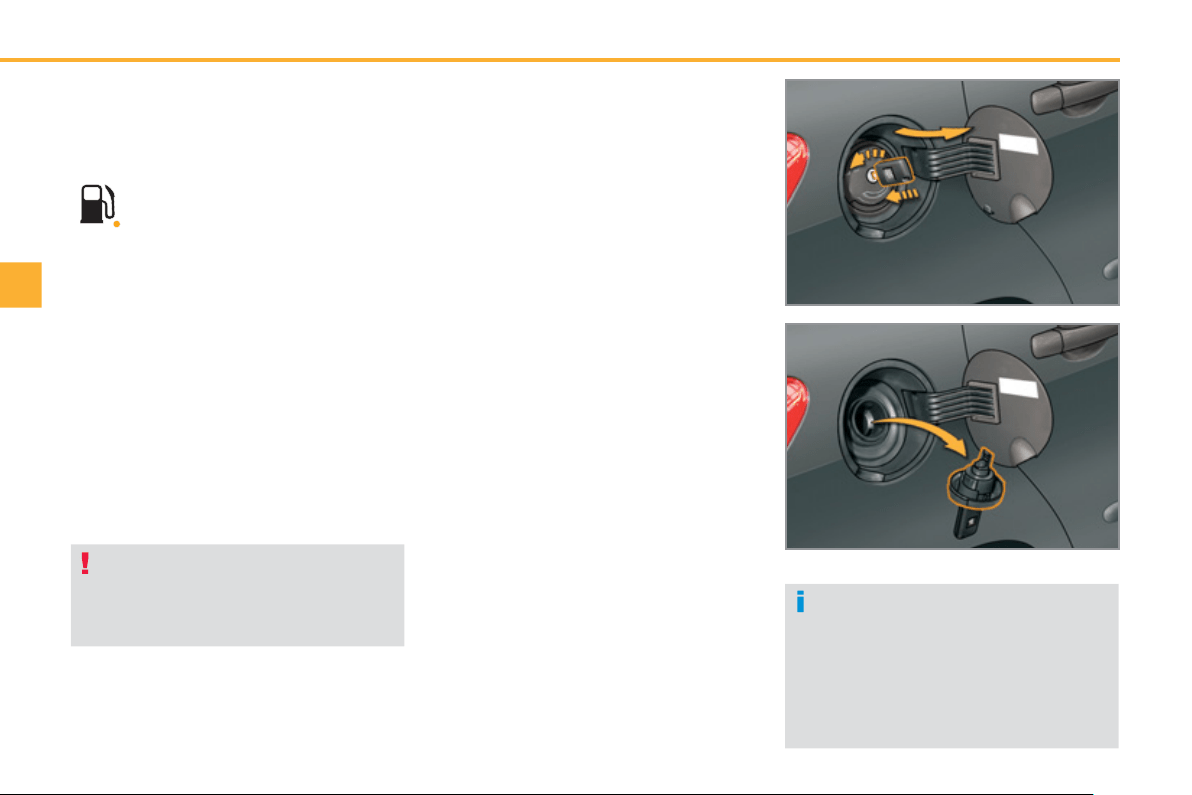
4
96
ACCESS
More than 5 litres of fuel must be add-
ed in order to be registered by the fuel
gauge.
FUEL TANK
Capacity of the tank: approximately
60 litres.
The key cannot be removed from
the lock until the cap is put back on
the tank.
Opening the cap may cause an in-
rush of air. This vacuum, which is
perfectly normal, is caused by the
sealing of the fuel system.
Low fuel level
Operating fault
A fuel gauge malfunction is indicated by
the return of the fuel gauge needle to
zero.
Have it checked by a PEUGEOT dealer
or a qualifi ed workshop.
Filling
A label affi xed to the inside of the fl ap
reminds you of the type of fuel to be
used according to your engine.
When the low fuel level is
reached, this warning lamp
comes on on the instrument
panel, accompanied by an
audible signal and an alert message.
When it fi rst comes on, you have ap-
proximately 6 litres of fuel remaining.
Until suffi cient fuel has been added, this
warning lamp comes on every time the
ignition is switched on, accompanied
by an audible signal and a message.
When driving, this audible signal and
the display of the alert message are re-
peated with increasing frequency as the
fuel level drops towards "0" .
Refuel as soon as possible to avoid run-
ning out of fuel.
If you run out of fuel (Diesel), refer also
to the "Checks" section.
With Stop & Start, never refuel with
the system in STOP mode; you
must switch off the ignition with the
key.
) remove the cap and secure it on the
hook, located on the inside of the
fl ap,
)
fi ll the tank, but do not continue after
the 3rd cut-off of the nozzle ; this could
cause malfunctions.
When fi lling is complete:
) refi t the cap,
) turn the key to the right, then remove
it from the cap,
) close the fl ap.
To fi ll the tank safely:
) it is essential that the engine is
switched off,
) open the fuel fi ller fl ap,
) insert the key in the cap, then turn it
to the left,
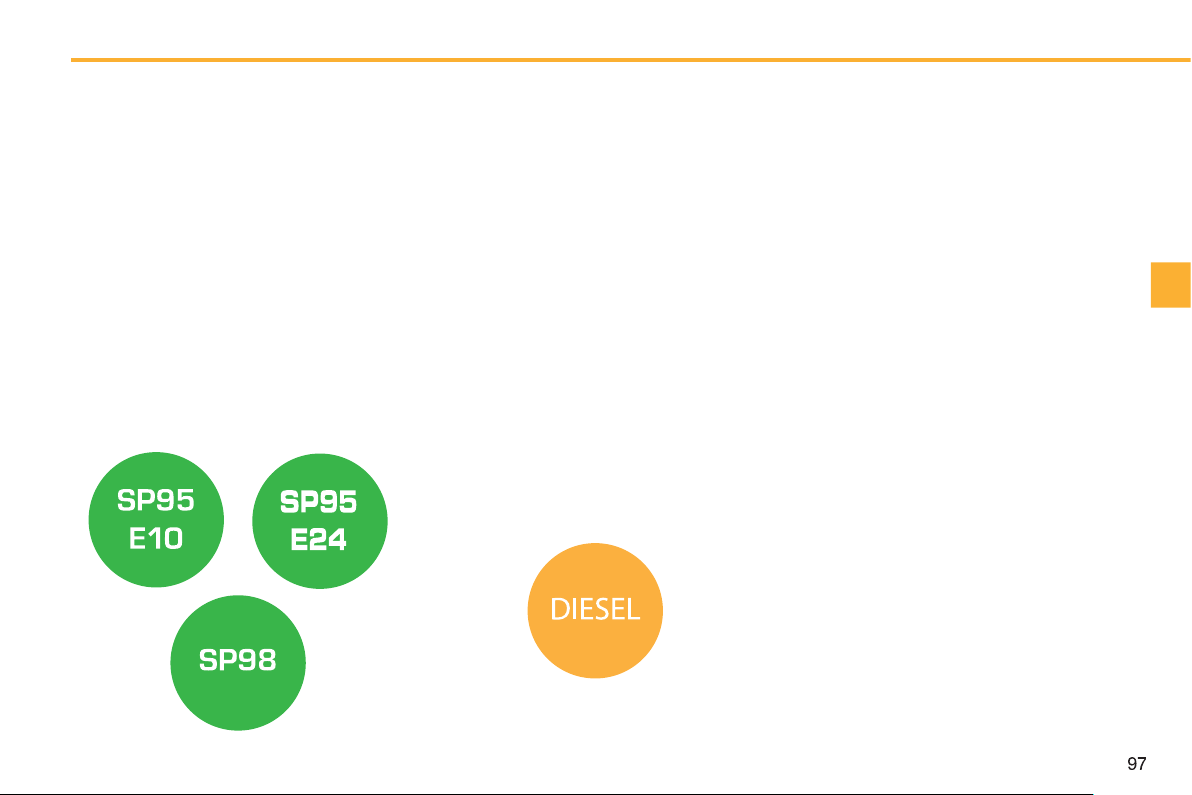
4
ACCESS
Quality of the fuel used for
petrol engines
The petrol engines are perfectly com-
patible with E10 or E24 type petrol
biofuels (containing 10 % or 24 % etha-
nol), conforming to European standards
EN 228 and EN 15376.
E85 type fuels (containing up to 85 %
ethanol) are reserved exclusively for ve-
hicles marketed for the use of this type
of fuel (BioFlex vehicles). The quality of
the ethanol must comply with European
standard EN 15293.
For Brazil only, special vehicles are
marketed to run on fuels containing up
to 100 % ethanol (E100 type).
Quality of the fuel used for
Diesel engines
The Diesel engines are perfectly com-
patible with biofuels which conform to
current and future European standards
(Diesel fuel which complies with stand-
ard EN 590 mixed with a biofuel which
complies with standard EN 14214)
available at the pumps (containing up
to 7 % Fatty Acid Methyl Ester).
The B30 biofuel can be used in cer-
tain Diesel engines; however, this use
is subject to strict application of the
special servicing conditions. Contact a
PEUGEOT dealer or a qualifi ed work-
shop.
The use of any other type of (bio)fuel
(vegetable or animal oils, pure or dilut-
ed, domestic fuel...) is strictly prohibited
(risk of damage to the engine and fuel
system).
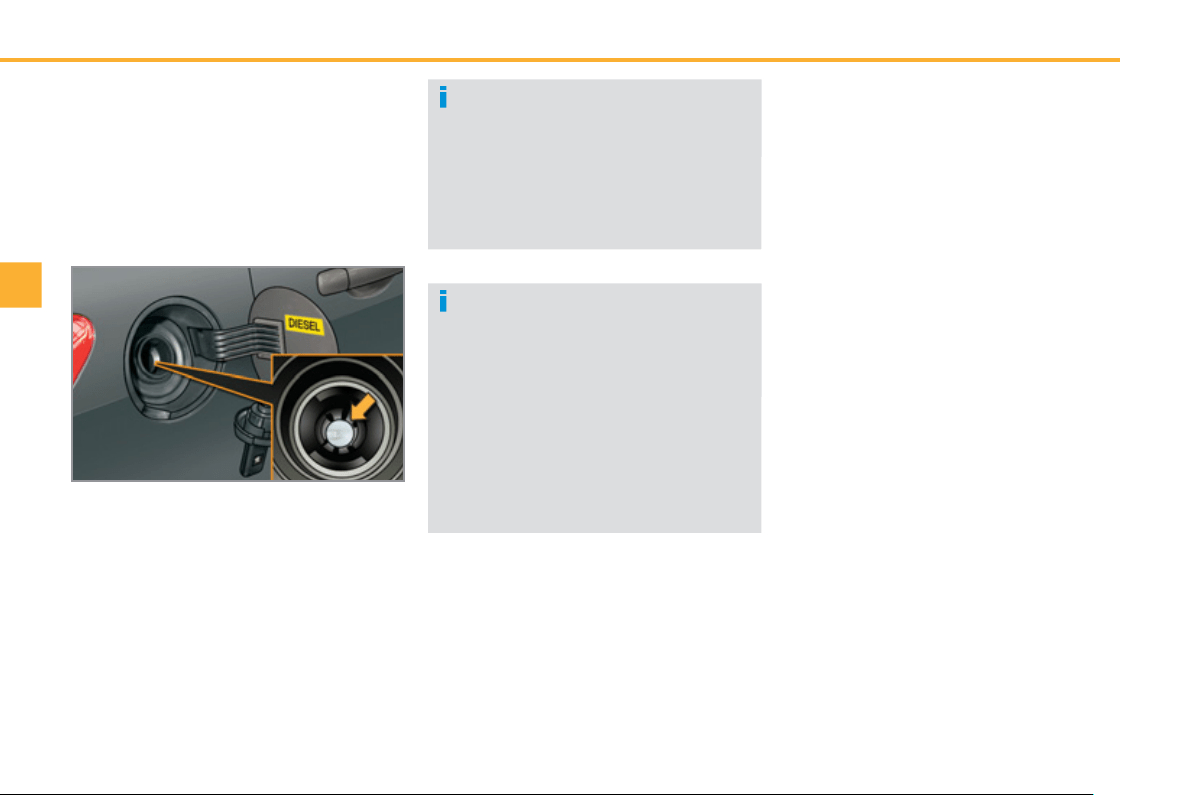
4
98
ACCESS
M
I
S
FUEL PREVENTION
(
DIESEL
)
*
Mechanical device which prevents fi lling
the tank of a Diesel vehicle with petrol. It
avoids the risk of engine damage that can
result from fi lling with the wrong fuel.
Located in the fi ller neck, the misfuel
prevention device appears when the
fi ller cap is removed.
Operation
When a petrol fi ller nozzle is introduced
into the fuel fi ller neck of your Diesel
vehicle, it comes into contact with the
fl ap. The system remains closed and
prevents fi lling.
Do not persist but introduce a Diesel
type fi ller nozzle.
It remains possible to use a fuel
can to fi ll the tank.
In order to ensure a good fl ow of
fuel, do not place the nozzle of the
fuel can in direct contact with the
fl ap of the misfuel prevention de-
vice and pour slowly.
Travelling abroad
As Diesel fuel pump nozzles may
be different in other countries, the
presence of the misfuel prevention
device may make refuelling impos-
sible.
Before travelling abroad, we rec-
ommend that you check with the
PEUGEOT dealer network, wheth-
er your vehicle is suitable for the
fuel pumps in the country in which
you want to travel.
* According to country of sale.
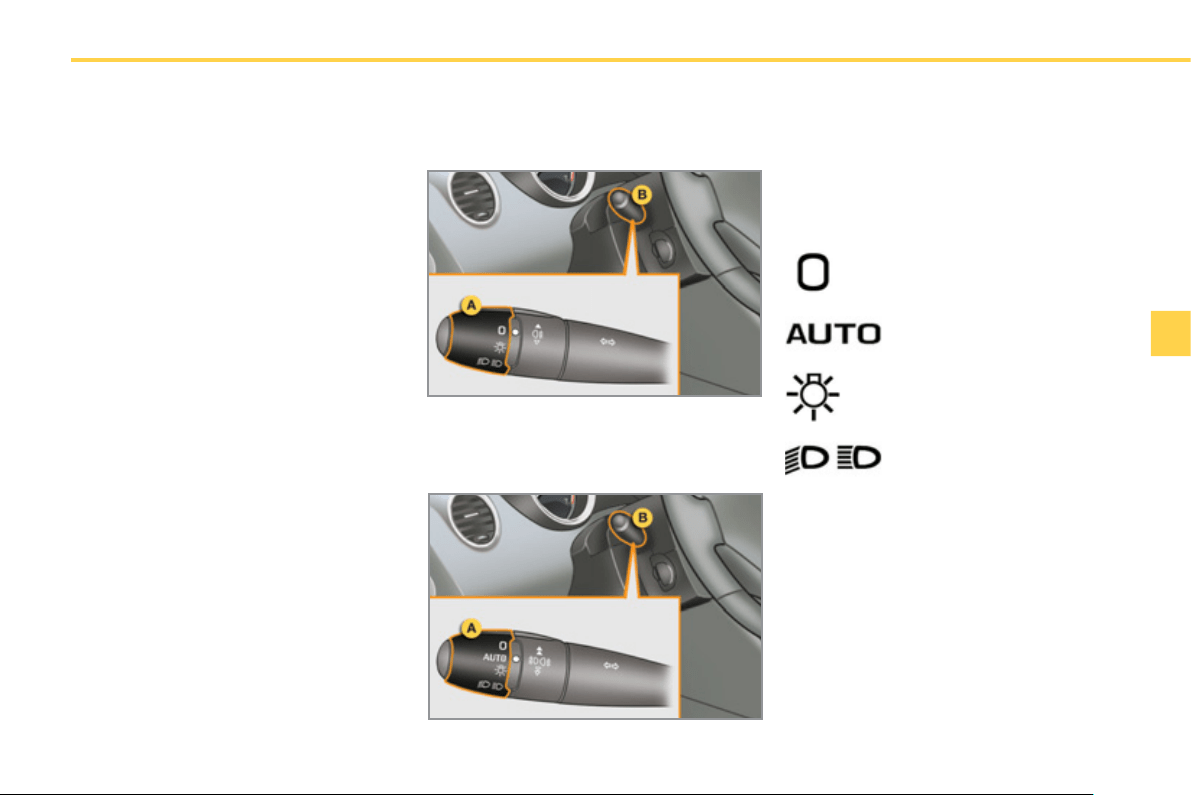
5
99
VISIBILITY
E
XTERIOR LIGHTING
CONTROL
S
Control stalk for the selection and control
of the various front and rear lamps pro-
viding the vehicle's lighting.
Main lighting
The various front and rear lamps of the
vehicle are designed to adapt the driv-
er's visibility progressively in relation to
the climatic conditions:
- sidelamps, to be seen,
- dipped beam headlamps to see
without dazzling other drivers,
- main beam headlamps to see clearly
when the road is clear.
Additional lighting
Other lamps are fi tted to fulfi l the require-
ments of particular driving conditions:
- a rear foglamp to be seen from a
distance,
- front foglamps for even better for-
ward vision,
- directional headlamps for improved
visibility when cornering,
- daytime running lamps to be seen
during the day.
Settings
Various automatic lighting control modes
are also available depending on options:
- daytime running lamps,
- automatic illumination of headlamps,
- directional lighting,
- guide-me-home lighting.
Model without AUTO lighting
Model with AUTO lighting
Automatic illumination of
headlamps.
Manual controls
The lighting is controlled directly by the
driver by means of the ring A and the
stalk B .
A. Main lighting mode selection ring:
turn it to position the symbol re-
quired facing the mark.
Lamps off.
Sidelamps.
B. Stalk for switching headlamps: pull
the stalk towards you to switch the
lighting between dipped and main
beam headlamps.
In the lamps off and sidelamps modes,
the driver can switch on the main beam
headlamps temporarily ("headlamp
fl ash") by maintaining a pull on the
stalk.
Dipped headlamps or main
beam headlamps.
Displays
Illumination of the corresponding indica-
tor lamp in the instrument panel confi rms
that the lighting selected is on.
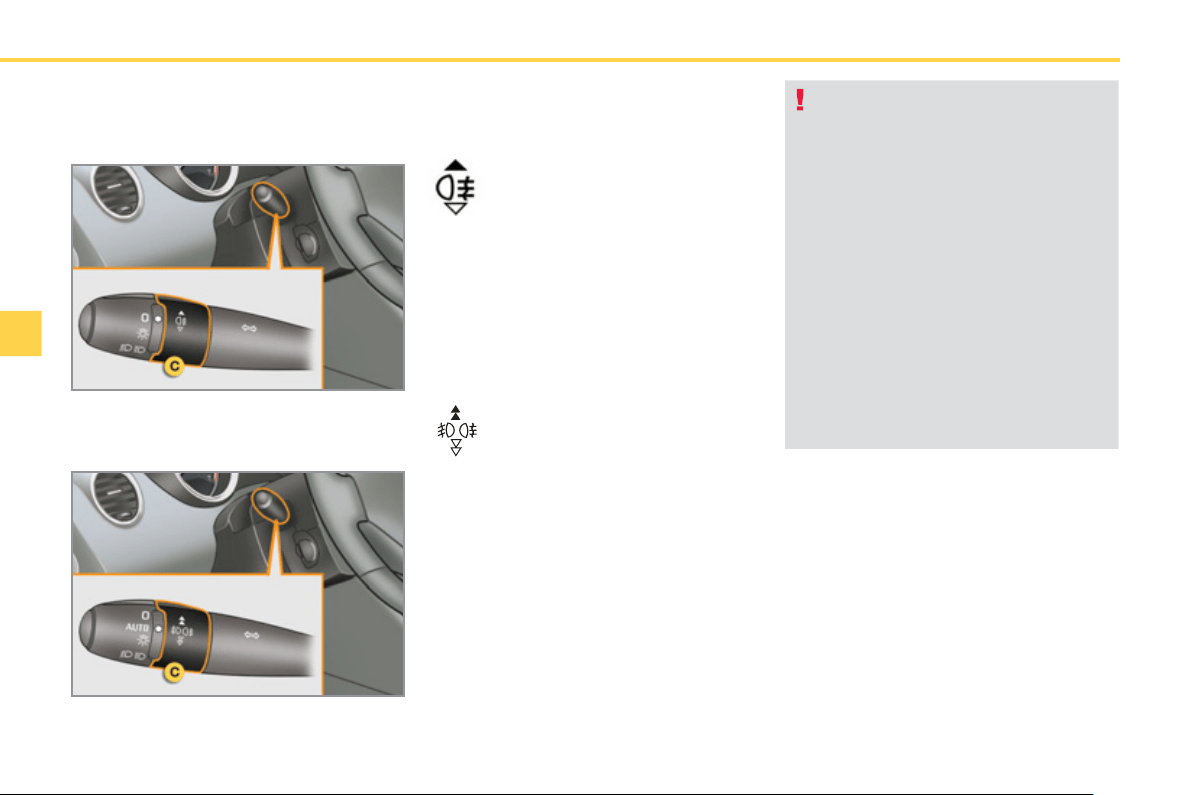
5
1
00
VISIBILITY
Model with rear foglamp only
Rear foglamp
) To switch on the foglamp, turn the
ring C forwards.
When the lighting is switched off automati-
cally (with AUTO model), the foglamp and
the dipped beam headlamps will remain
on.
) To switch off all of the lighting, turn
the ring C rearwards.
In good or rainy weather, both day
and night, the front foglamps and
the rear foglamp are prohibited. In
these situations, the power of their
beams may dazzle other drivers.
They should only be used in fog or
snow.
In these weather conditions, it is
your responsibility to switch on the
foglamps and dipped beam head-
lamps manually as the sunshine
sensor may detect suffi cient light.
Do not forget to switch off the front
foglamps and the rear foglamp
when they are no longer neces-
sary.
Model with front foglamps and a
rear foglamp
Front and rear foglamps
Rotate and release the ring C :
) forwards a fi rst time to switch on the
front foglamps,
) forwards a second time to switch on
the rear foglamp,
) rearwards a fi rst time to switch off
the rear foglamp,
) rearwards a second time to switch
of the front fog lamps.
When the lighting is switched off auto-
matically (with AUTO model) or when
the dipped headlamps are switched off
manually, the foglamps and sidelamps
will remain on.
) Turn the ring rearwards to switch
off the foglamps, the sidelamps will
then switch off.
C. Foglamp selection ring.
The foglamps operate with the dipped
and main beam headlamps.
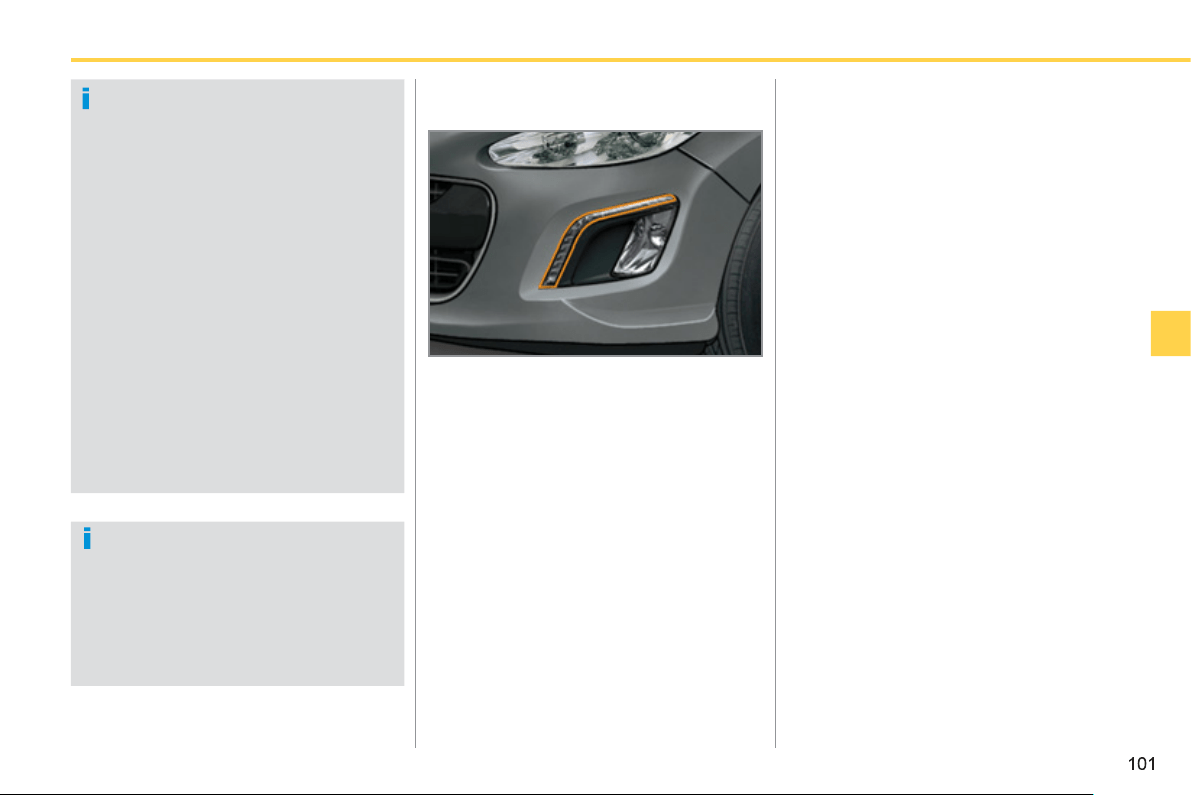
5
VISIBILITY
Switching off the lamps when
the ignition is switched off
On switching off the ignition, all of the
lamps turn off immediately, except for
dipped beam if guide-me-home lighting
is activated.
Switching on the lamps after the
ignition is switched off
To reactivate the lighting control, rotate
ring A to the "0" position - lamps off,
then to the desired position.
On opening the driver's door a
temporary audible signal warns the
driver that the lighting is on.
The lamps, with the exception of the
sidelamps, switch off automatically
after a maximum duration of thirty
minutes to prevent discharging of the
battery.
LED lamps
In some weather conditions (e.g.
low temperature or humidity), the
presence of misting on the internal
surface of the glass of the head-
lamps and rear lamps is normal;
it disappears after the lamps have
been on for a few minutes.
Daytime running lamps
Daytime lighting, compulsory in certain
countries, which comes on automati-
cally when the engine is started making
the vehicle more visible to other users.
This function is assured:
- in countries where it is imposed by
regulations,
by illumination of the dipped beam
headlamps with the sidelamps and
number plate lamps; this function
cannot be deactivated.
- for other countries where it is pro-
vided,
by the use of dedicated lamps (bulbs
or LEDs); this function can be acti-
vated or deactivated via the vehicle
confi guration menu.
The lighting control stalk must be placed in
the "0" or "AUTO" (day mode) position.
Deactivation of the daytime running
lamps is effective after operation of the
lighting control stalk or after the next
engine start; activation is effective im-
mediately.
The instruments and controls (instrument
panel, multifunction screen, air conditioning
control panel, ...) are not illuminated, except
in night mode with manual or automatic il-
lumination of headlamps.
They come on when the engine is started.
Depending on the destination country,
they are used for:
- daytime running lamps * in day mode
and sidelamps in night mode (they
are brighter when daytime running
lamps),
or
- sidelamps in day and night mode.
Where LED lamps are fi tted, the fi la-
ment bulbs for the daytime running
lamps / sidelamps in the front lamp units
are not used.
* function that can be set in the vehicle
confi guration menu.
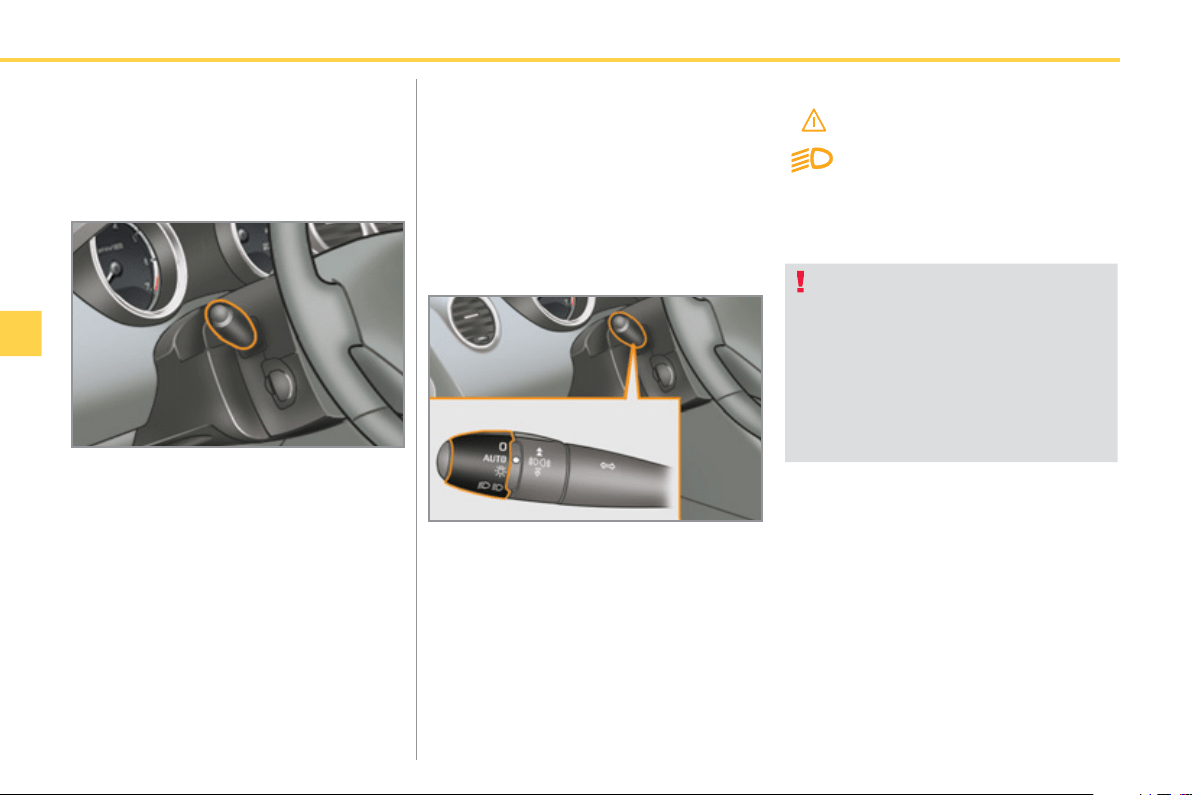
5
AUTO
1
02
VISIBILITY
In fog or snow, the sunshine sensor
may detect suffi cient light. There-
fore, the lighting will not come on
automatically.
Do not cover the sunshine sensor,
coupled with the rain sensor and
located in the centre of the wind-
screen behind the rear view mirror;
the associated functions would no
longer be controlled.
Operating fault
In the event of a fault with the
sunshine sensor, the lighting
come on, this warning lamp
is displayed in the instrument
panel and/or a message ap-
pears in the screen, accompanied by
an audible signal.
Contact a PEUGEOT dealer or a qualifi ed
workshop.
Manual guide-me-home lighting
Temporarily keeping the dipped beam
headlamps on after the vehicle's igni-
tion has been switched off makes the
driver's exit easier when the light is
poor.
Switching on
) With the ignition off, "fl ash" the
headlamps using the lighting stalk.
) A further "headlamp fl ash" switches
the function off.
Switching off
The manual guide-me-home lighting
switches off automatically after a set
time.
Automatic illumination of headlamps
The sidelamps and dipped beam head-
lamps are switched on automatically,
without any action on the part of the
driver, when a low level of external light
is detected or in certain cases of activa-
tion of the windscreen wipers.
As soon as the brightness returns to a
suffi cient level or after the windscreen
wipers are switched off, the lamps are
switched off automatically.
Activation
) Turn ring to the "AUTO" position. The
automatic illumination of headlamps
is accompanied by a message in the
screen.
Deactivation
) Turn ring to a position other than
"AUTO" . Deactivation is accompanied
by a message in the screen.
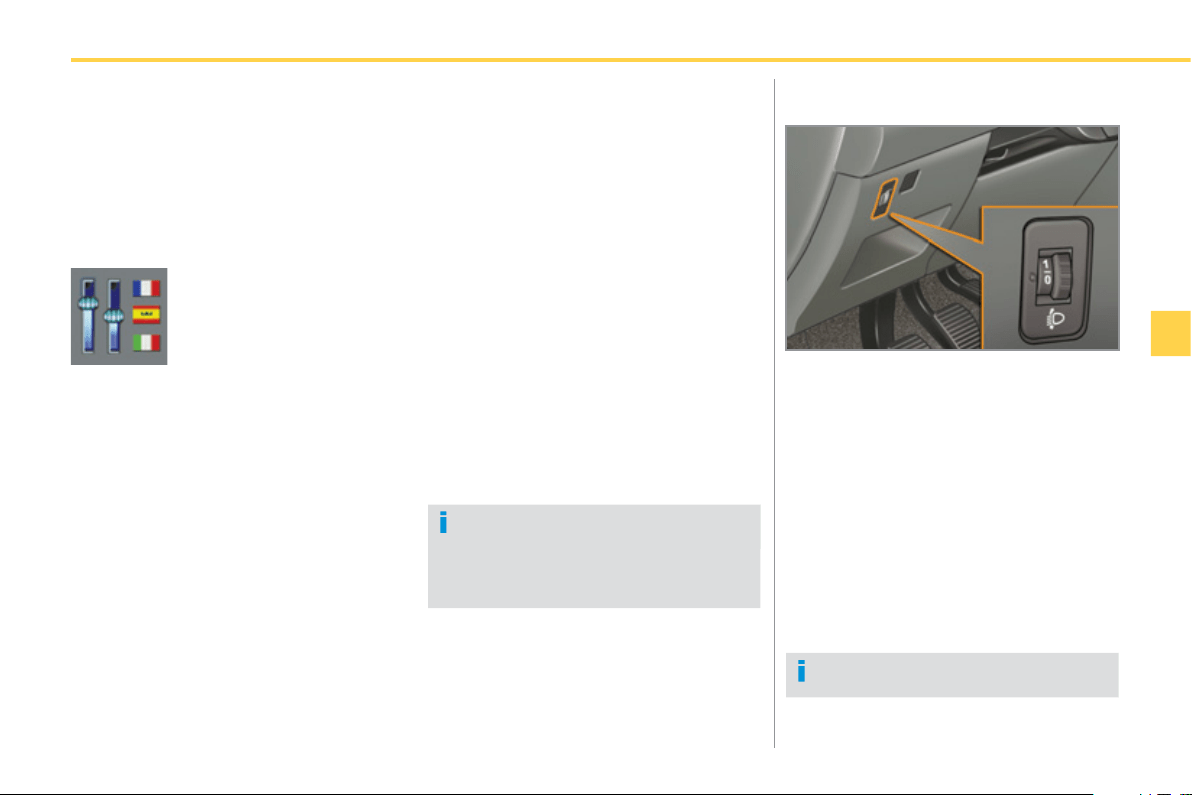
5
1
03
VISIBILITY
Exterior welcome lighting
The remote switching on of the light-
ing makes your approach to the vehicle
easier in poor light. It is activated ac-
cording to the level of light detected by
the sunshine sensor.
Switching on
) Press the open padlock on the remote
control.
The dipped beam headlamps and the
sidelamps come on; your vehicle is
also unlocked.
Switching off
The exterior welcome lighting switches
off automatically after a set time, when
the ignition is switched on or on locking
the vehicle.
M
ANUAL ADJU
S
TMENT OF
H
ALOGEN HEADLAMP
S
The initial setting is position "0" .
To avoid causing a nuisance to other road
users, the height of the halogen head-
lamps should be adjusted according to the
load in the vehicle.
0. 1 or 2 people in the front seats.
-. 3 people.
1. 5 people.
-. Intermediate setting.
2. 5 people + maximum authorised load.
-. Intermediate setting.
3. Driver + maximum authorised load.
The activation, deactivation and
duration of the welcome lighting
are independant of the settings
for the automatic guide-me-hope
lighting.
Automatic "Guide-me-home"
lighting
When the automatic illumination of
headlamps functions is activated, if the
ambient light level is low the dipped
beams remain on when switching off
the ignition.
Settings
Activation and deactivation,
as well as the duration of the
guide-me-home lighting can
be set in the vehicle confi gu-
ration menu.
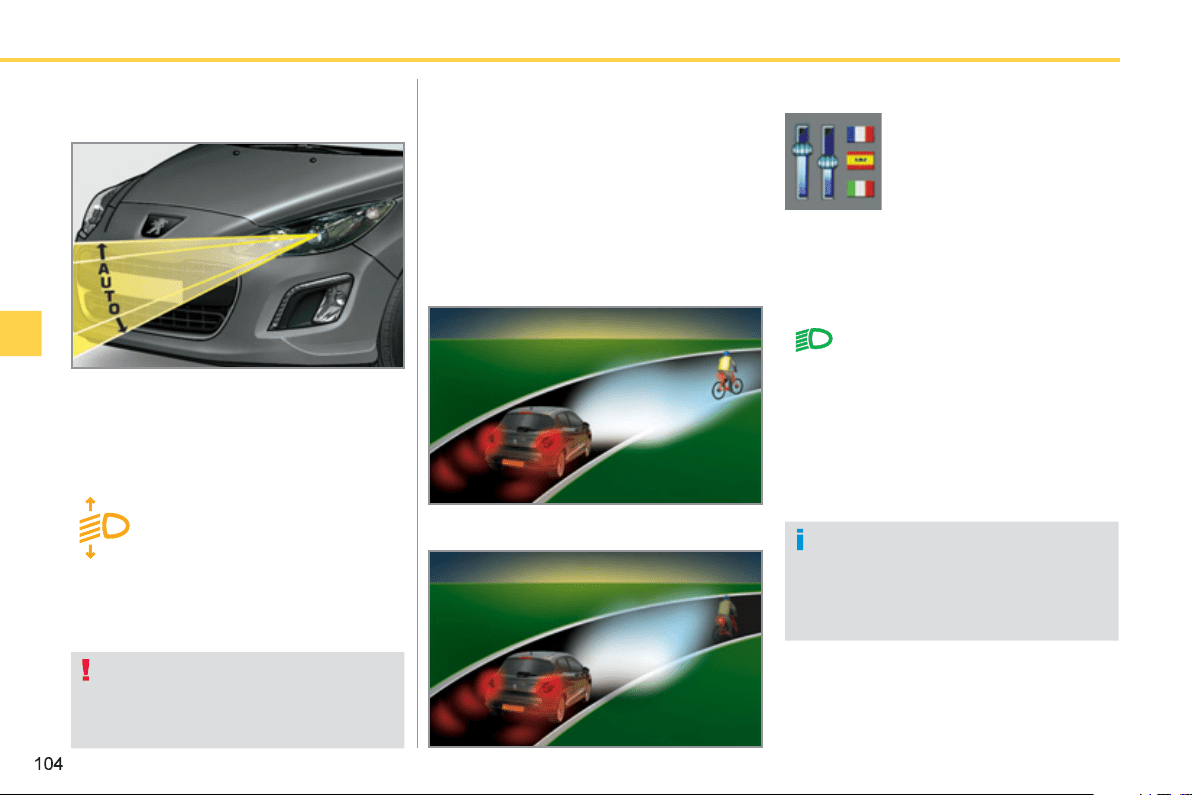
5
VISIBILITY
D
IRECTIONAL LIGHTING
When the dipped or main beam head-
lamps are on, this function enables the
light beams to provide improved lighting
of the side of the road when cornering.
The use of this function, from approxi-
mately 12 mph (20 km/h) and associ-
ated with the xenon headlamps only,
considerably improves the quality of
your lighting when cornering.
with directional lighting
without directional lighting
Programming
Operating fault
The function is activated or
deactivated via the vehicle
confi guration menu.
If a fault occurs, this warning
lamp fl ashes in the instrument
panel, accompanied by a mes-
sage in the screen.
Contact a PEUGEOT dealer or a qualifi ed
workshop.
AUTOMATIC ADJU
S
TMENT OF
X
ENON HEADLAMP
S
Do not touch the xenon headlamp
bulbs.
Contact a PEUGEOT dealer or a
qualifi ed workshop.
In order to avoid causing a nuisance to
other road users, this system corrects the
height of the xenon headlamp beams au-
tomatically and when stationary, in relation
to the load in the vehicle.
If a malfunction occurs, this
warning lamp is displayed on
the instrument panel, accom-
panied by an audible signal
and a message in the screen.
The system then places your headlam-
ps in the lowest position.
When stationary or moving at very
low speed or when reverse gear is
engaged, the function is inactive.
The status of the function remains
in the memory when the ignition is
switched off.
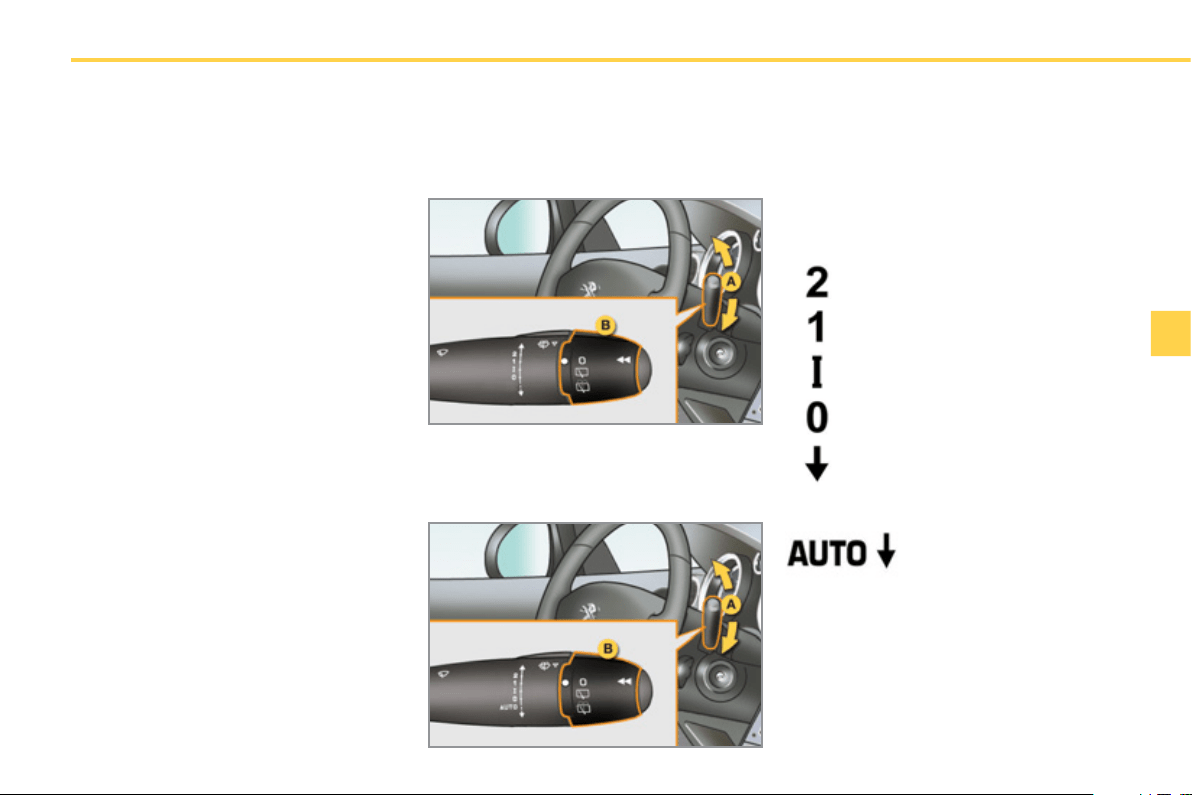
5
1
05
VISIBILITY
WIPER CONTROL
S
System for selection and control of the
various front and rear wiping modes for
the elimination of rain and cleaning.
The vehicle's front and rear wipers are
designed to improve the driver's visibility
progressively according to the climatic con-
ditions.
Manual controls
The wiper commands are issued direct-
ly by the driver by means of the stalk A
and the ring B .
Model without AUTO wiping
Model with AUTO wiping
Fast (heavy rain).
Normal (moderate rain).
Intermittent (proportional to
the speed of the vehicle).
Automatic, then single
wipe (see the corre-
sponding section).
Off.
Single wipe (press down and
release).
Programming
Various automatic wiper control modes
are also available according to the fol-
lowing options:
- automatic rain sensitive windscreen
wipers,
- rear wiping on engaging reverse
gear.
Windscreen wipers
A. Wiping speed selection stalk.
or
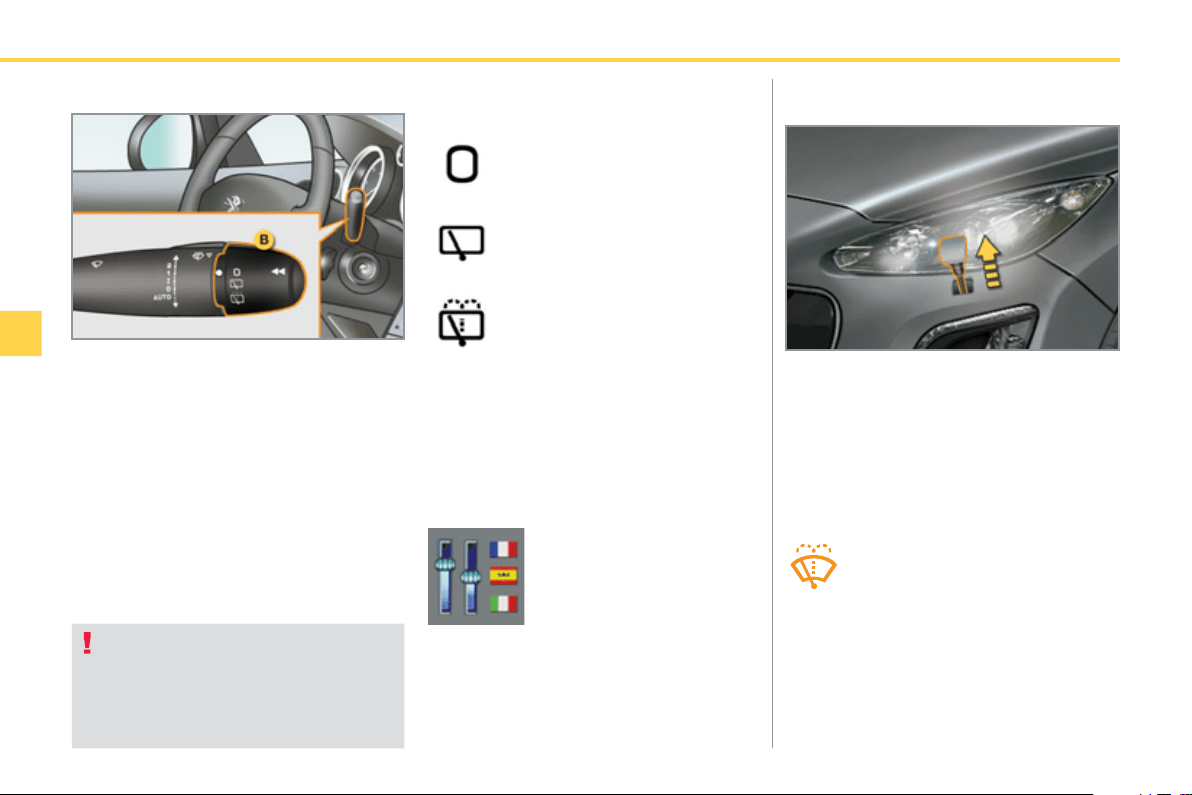
5
1
06
VISIBILITY
Windscreen and headlamp
wash
B. Rear wiper selection ring:
park,
intermittent wipe,
wash-wipe (set duration).
Programming
) Pull the windscreen wiper stalk to-
wards you. The windscreen wash
then the windscreen wipers operate
for a fi xed period.
The headlamp washers only operate when
the dipped beam headlamps are on .
Rear wiper
If a signifi cant accumulation of snow
or ice is present, or when using a tail-
gate bicycle carrier, deactivate the
automatic rear wiper via the multifunc-
tion screen confi guration menu.
Screenwash/headlamp wash low
The function is activated or
deactivated via the vehicle
confi guration menu.
Reverse gear
When reverse gear is engaged, the
rear wiper will come into operation if the
windscreen wipers are operating.
This function is activated by default.
In the case of vehicles fi tted with
headlamp washers, when the
minimum level of the reservoir is
reached, this warning lamp and/or
the service warning lamp is displayed in the
instrument panel, accompanied by an au-
dible signal and a message in the screen.
Next time you stop, fi ll the screenwash /
headlamp wash fl uid reservoir.
The warning lamp is displayed when
the ignition is switched on, or every time
the stalk is operated, until the reservoir
is fi lled.
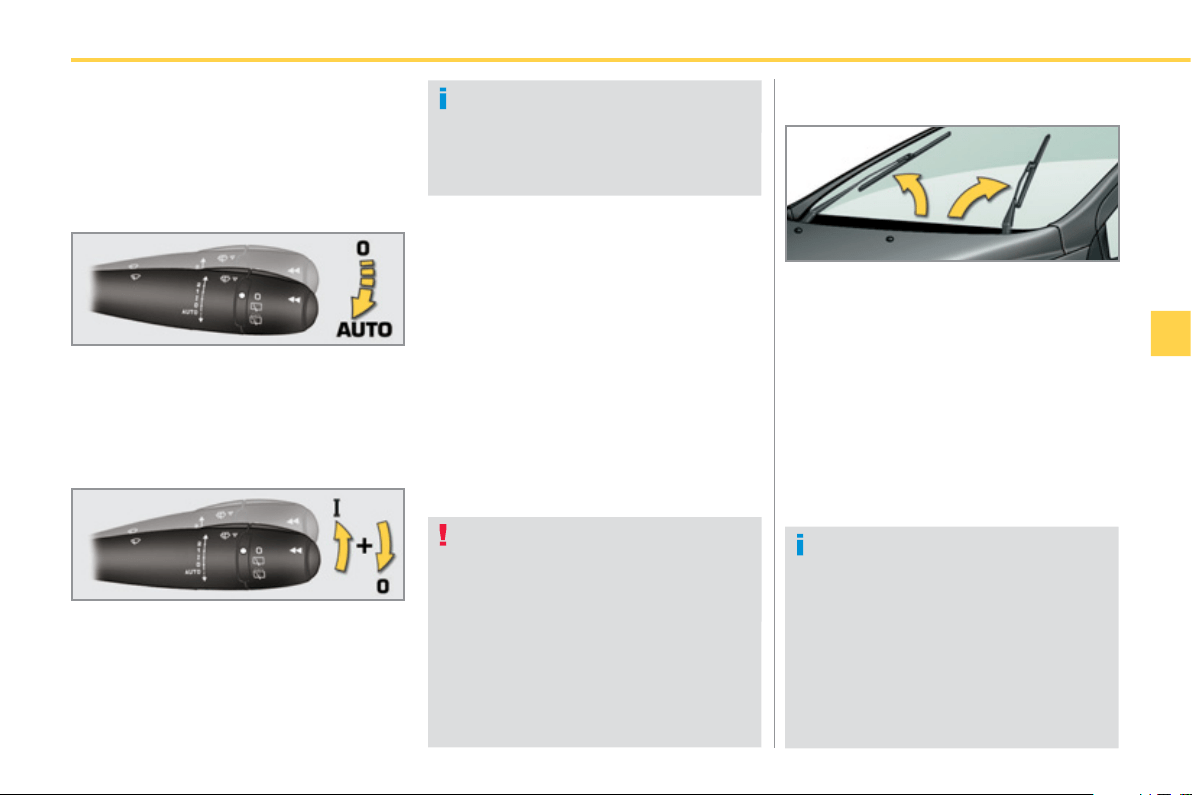
5
1
07
VISIBILITY
Special position of the
windscreen wipers
Automatic rain sensitive
windscreen wipers
The windscreen wipers operate automati-
cally, without any action on the part of the
driver, if rain is detected (sensor behind
the rear view mirror), adapting their speed
to the intensity of the rainfall.
Activation
This is controlled manually by the driver
by pushing the stalk downwards to the
"AUTO" position.
It is accompanied by a message in the
screen.
This position permits release of the
windscreen wiper blades.
It is used for cleaning or replacement
of the blades. It can also be useful, in
winter, to detach the blades from the
windscreen.
Do not cover the rain sensor, linked
with the sunshine sensor and locat-
ed in the centre of the windscreen
behind the rear view mirror.
Switch off the automatic rain sensitive
wipers when using an automatic car
wash.
In winter, to avoid damaging the
wiper blades, it is advisable to wait
until the windscreen is completely
clear of ice before activating the
automatic rain sensitive wipers.
The automatic rain sensitive wip-
ers must be reactivated if the igni-
tion has been off for more than one
minute, by pushing the stalk down-
wards.
Switching off
This is controlled manually by the driver
by moving the stalk upwards then re-
turning it to position "0" .
It is accompanied by a message in the
screen.
Operating fault
If an automatic wiping malfunction oc-
curs, the wipers will operate in intermittent
mode.
Have it checked by a PEUGEOT dealer
or a qualifi ed workshop.
To maintain the effectiveness of the
"fl at-blade" type of wiper blades, it
is advisable to:
- handle them with care,
- clean them regularly using
soapy water,
- avoid using them to retain card-
board on the windscreen,
- replace them at the fi rst signs of
wear.
) Any action on the wiper stalk in the
minute after switching off the igni-
tion places the blades vertically on
the screen.
) To park the blades again, switch on
the ignition and operate the wiper
stalk.
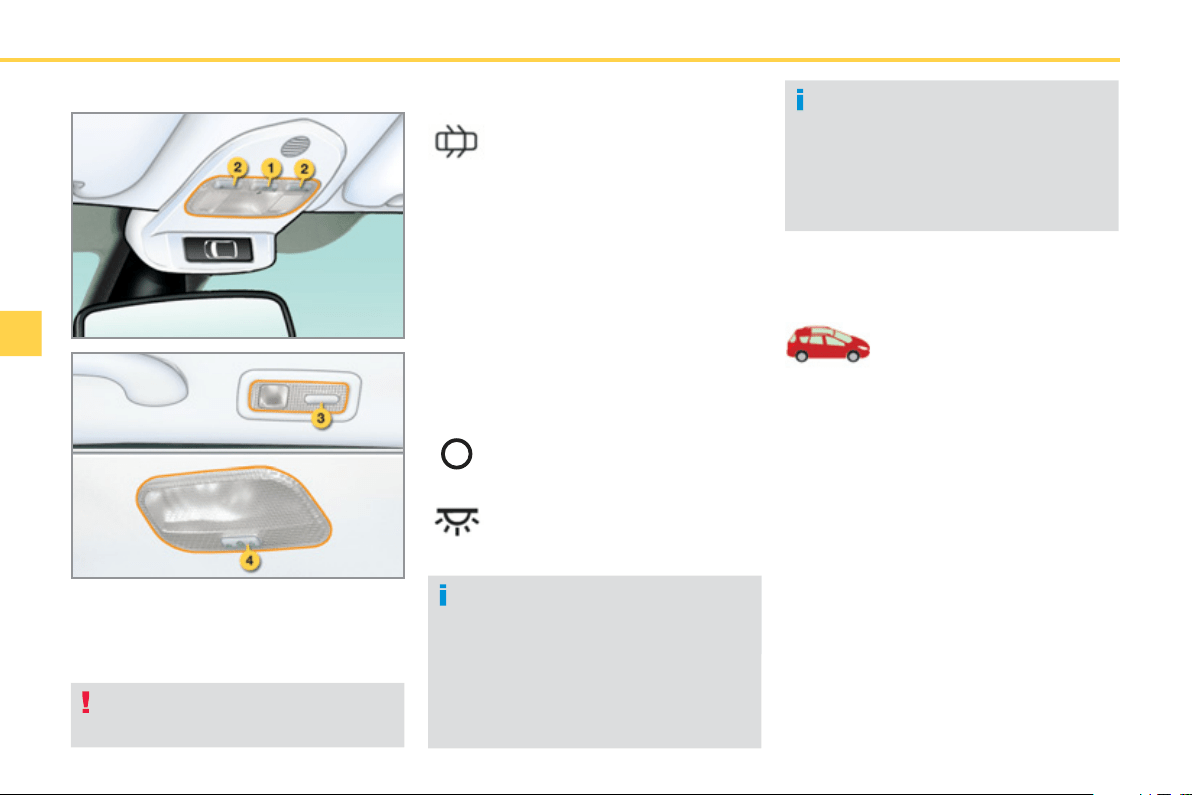
5
1
08
VISIBILITY
COURTE
S
Y LAMP
S
1. Front courtesy lamp
2. Map reading lamps
3. Rear side reading lamps
4. Rear courtesy lamp
Front and rear courtesy lamps
In this position, the courtesy
lamp comes on gradually:
Map reading lamps
) With the ignition on, press the cor-
responding switch.
With the "permanent lighting" mode, the
duration of lighting varies depending on
the context:
- with the ignition off, approxi-
mately ten minutes,
- in energy economy mode, ap-
proximately thirty seconds,
-
with the engine running, unlimited.
- when the vehicle is unlocked,
- when the key is removed from the
ignition,
- when a door is opened,
-
when the remote control locking button is
activated, in order to locate your vehicle.
Permanently off.
Permanent lighting.
When the front courtesy lamp is in
the "permanent lighting" position,
the rear courtesy lamp will also
come on, unless it is in the "perma-
nently off" position.
To switch off the rear courtesy
lamp, place it in the "permanently
off" position.
Rear side reading
lamps
It switches off gradually:
- when the vehicle is locked,
- when the ignition is switched on,
- 30 seconds after the last door is
closed.
Take care not to place anything in
contact with the courtesy lamps.
With the ignition on and the switch
pressed, the reading lamp comes on
in "permanent lighting" mode. It goes
off on switching off the ignition or if the
switch is pressed again.
With the ignition on and the switch off,
it comes on:
- when the vehicle is unlocked,
- when the key is removed from the
ignition,
- when a door is opened,
- when the remote control locking
button is pressed, in order to locate
your vehicle.
It switches off gradually:
- when the vehicle is locked,
- when the ignition is switched on,
-
30 seconds after the last door is closed.
Pressing the switch changes to "permanent
lighting" mode.
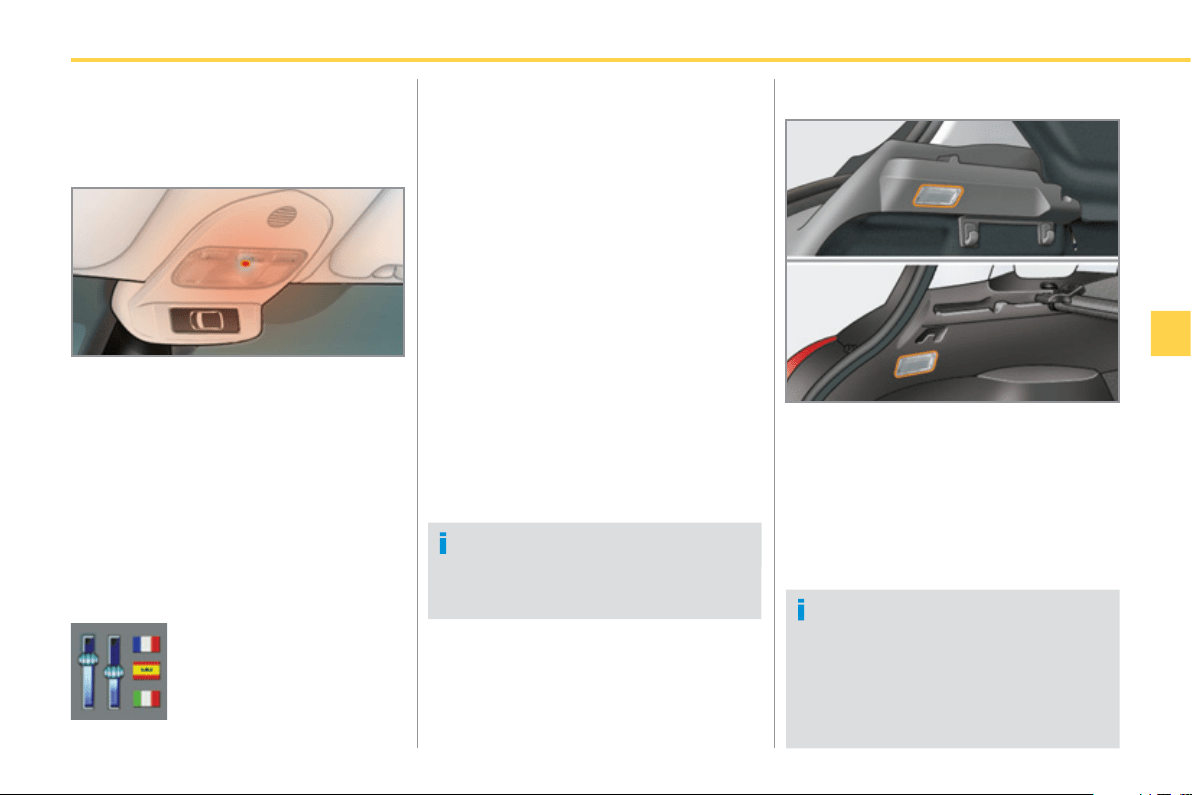
5
1
09
VISIBILITY
INTERIOR MOOD LIGHTING
The dimmed passenger compartment
lighting improves visibility in the vehicle
when the light is poor.
The lighting time varies according
to the circumstances:
- when the ignition is off, approxi-
mately ten minutes,
- in energy economy mode, ap-
proximately thirty seconds,
- when the engine is running, no
limit.
This comes on automatically when the
boot is opened and switches off auto-
matically when the boot is closed.
INTERIOR WELCOME LIGHTING
The remote switching on of the passen-
ger compartment lighting makes your
entry into the vehicle easier in poor
light. It is activated in accordance with
the light intensity detected by the bright-
ness sensor.
BOOT LAMP
Switching on
) Press the open padlock on the re-
mote control.
The front door sill lighting, the footwell
lighting and the courtesy lamps come
on; your vehicle is also unlocked.
Switching off
The interior welcome lighting switch-
es off automatically after a set time or
when one of the doors is opened.
Switching on
At night, the footwell lighting and the
front courtesy mood lamp come on
automatically when the sidelamps are
switched on.
Switching off
The interior mood lighting switches off
automatically when the sidelamps are
switched off.
Programming
The welcome lighting duration is
associated with and identical to
that of the automatic guide-me-
home lighting.
The function is activated or
deactivated via the vehicle
confi guration menu.
This function is activated
by default.
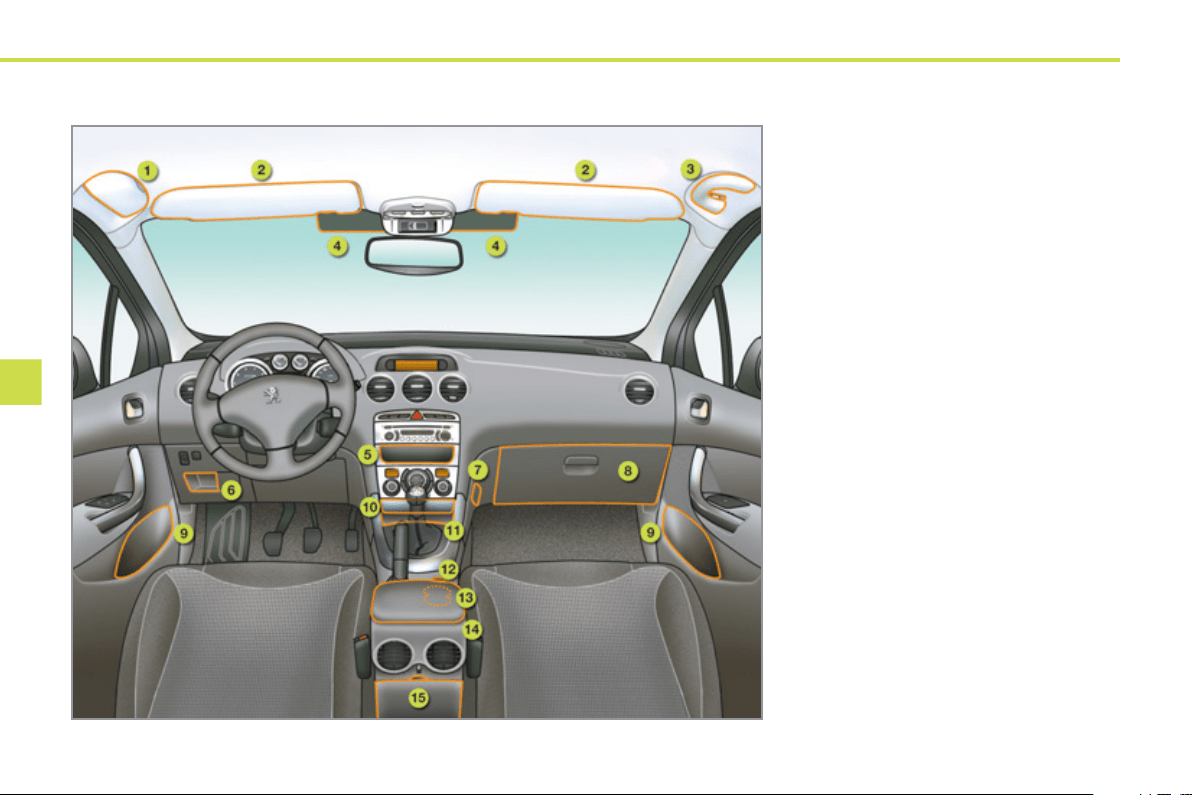
6
11
0
FITTINGS
INTERIOR FITTING
S
1. Spectacles storage
2. Sun visor
(see details on following page)
3. Grab handle with coat hook
4. Toll card/car park ticket windows
(see details on following page)
5. Storage compartment
6. Oddments box
7. Bag hook
8. Illuminated glove box
(see details on following page)
9. Door pockets
10. Illuminated ashtray
(see details on following page)
11. Storage compartment with non-
slip carpet
12. 12 V accessory socket
(see details on following page)
13. Cup holder
14. Front armrest
(see details on following page)
15. Storage box
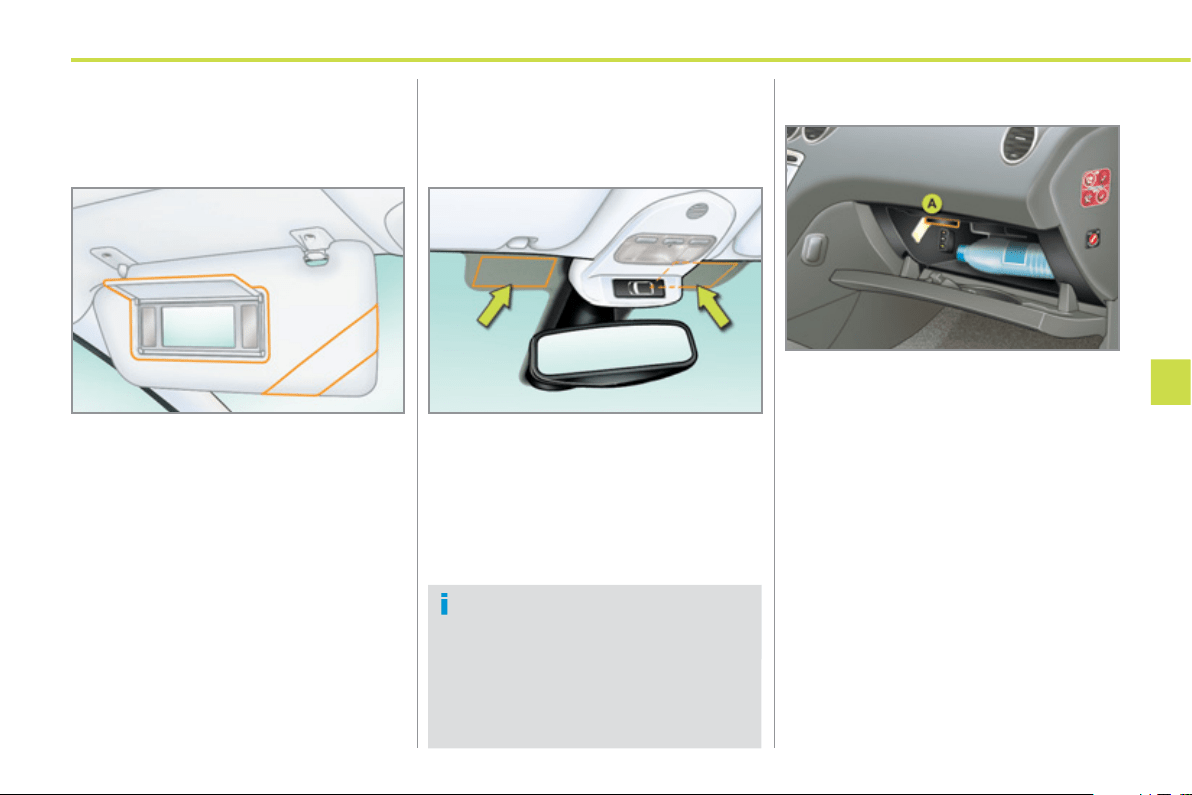
6
111
FITTINGS
ILLUMINATED GLOVE BOX
This has areas for storing a bottle of wa-
ter, the vehicle's handbook pack...
Its lid has areas for storing a pen, a pair
of spectacles, tokens, cards, a can...
S
UN VI
S
OR
Component which protects against sunlight
from the front or the side, also equipped
with an illuminated courtesy mirror.
) With the ignition on, raise the con-
cealing fl ap; the mirror is lit automat-
ically.
This sun visor is also equipped with a
ticket holder.
T
OLL CARD / CAR PARK
T
ICKET WINDOW
S
Facility for affi xing toll cards and/or car
park tickets.
These windows are located on each
side of the base of the rear view mirror.
They are two non-refl ective areas of the
athermic windscreen.
The athermic windscreen limits
heating of the passenger compart-
ment by reducing the effects of the
sun's rays (ultra-violet). It consists
of a refl ective layer, which also
blocks certain radio-electric signals
(toll card payments, ...).
) To open the glove box, raise the
handle.
The lamp comes on when the lid is
opened.
If your vehicle is fi tted with air condition-
ing, the glove box has an air vent A ,
which can be opened or closed. This
distributes the same conditioned air as
the vents in the passenger compart-
ment.
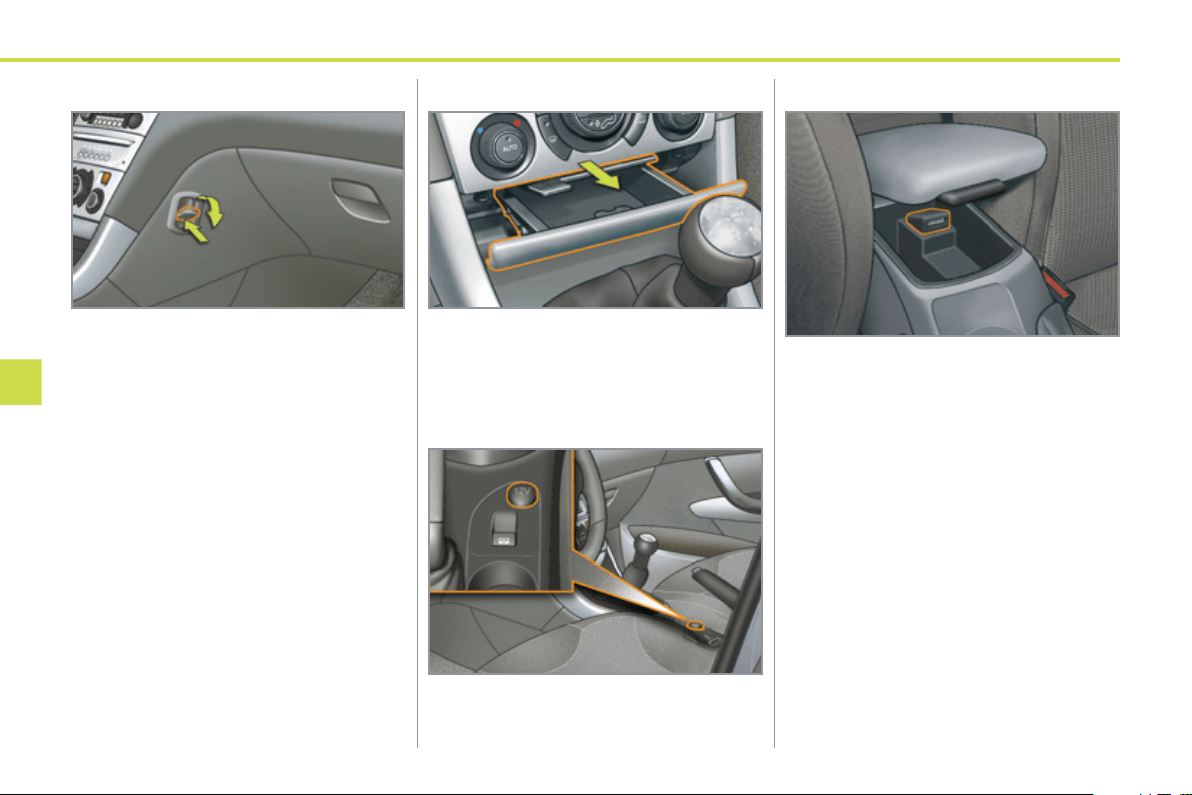
6
112
FITTINGS
12 V ACCESSORY SOCKET
) To connect a 12 V accessory (max
power: 120 W), lift the cover and
connect a suitable adaptor.
ILLUMINATED A
S
HTRAY
) Pull the drawer for access to the
ashtray.
) To empty the ashtray, after opening,
press the tab and remove the ash-
tray.
BAG HOOK
) Press the lower part of the hook to
unfold it.
) Hang the strap of your bag on the
hook to secure it.
P
EUGEOT CONNECT U
S
B
This connection box, consisting of a
USB port, is located in the front arm-
rest.
It permits the connection of portable
equipment, such as an iPod
®
digital au-
dio player of generation 5 or later or a
USB stick.
It reads the audio fi le formats (mp3,
ogg, wma, wav...) which are transmitted
to your audio equipment and played via
the vehicle's speakers.
You can manage these fi les using the
steering wheel controls or the audio
equipment control panel and display
them on the multifunction screen.
When it is in use, the portable equip-
ment charges automatically.
For more information on the use of this
equipment, refer to the "Audio and Tele-
matics" section.
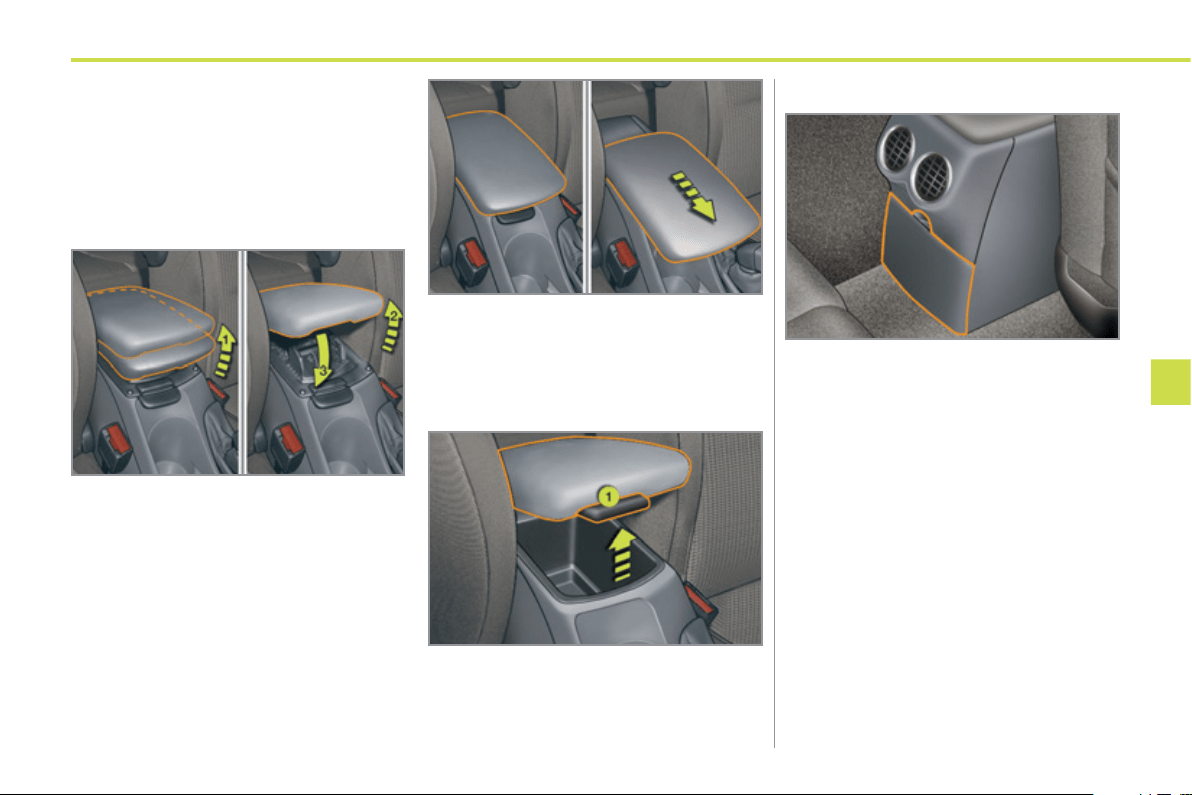
6
11
3
FITTINGS
FRONT ARMRE
S
T
Comfort and storage device for the driv-
er and front passenger.
The height and length of the armrest
cover can be adjusted for greater com-
fort.
Height adjustment
) Raise the cover to the required posi-
tion (low, intermediate or high).
) If you raise the cover slightly beyond
the high position, guide it when low-
ering it to the low position.
S
TORAGE BOX
Storage area, built into the rear of the
front armrest, for the rear passengers.
) To empty the box, after opening,
press the tab and remove it.
Storage
The armrest's compartment can hold up
to 6 CDs.
) Raise the lever 1 .
) Raise the cover fully.
Longitudinal adjustment
) Slide the cover fully forwards or
rearwards.
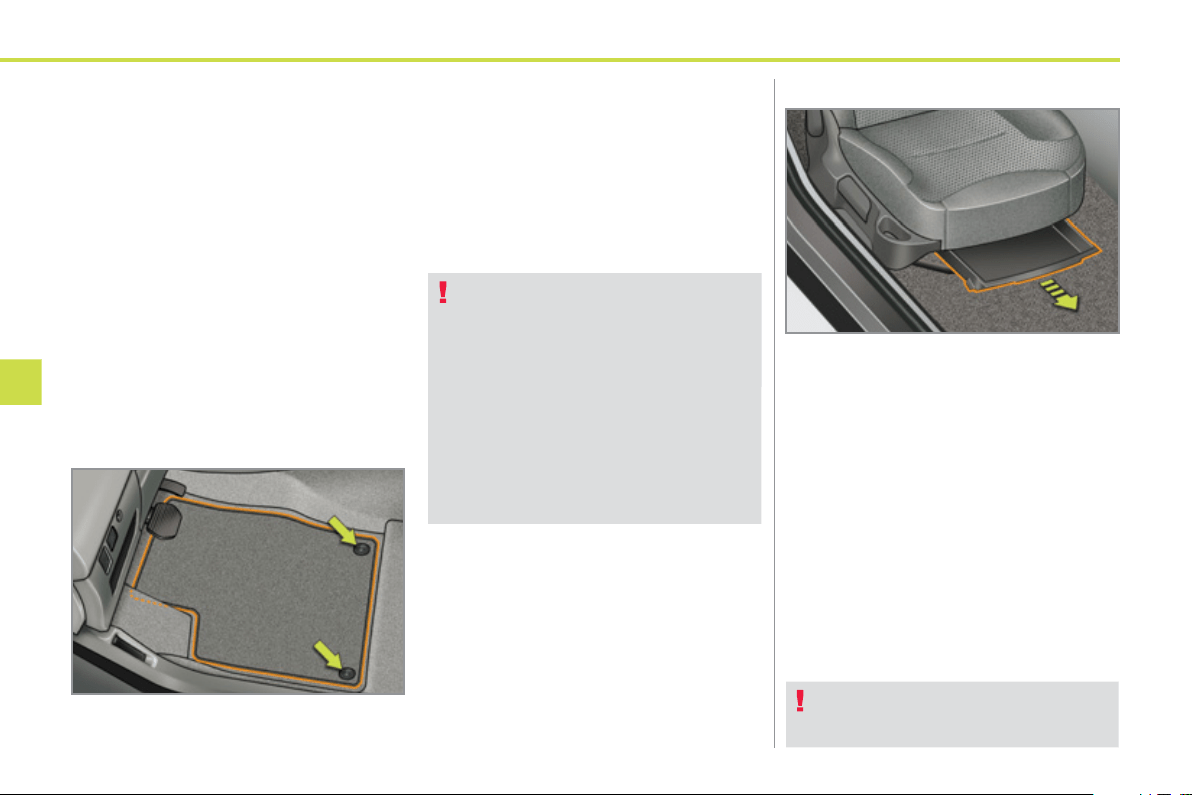
6
114
FITTINGS
To avoid any risk of jamming of the
pedals:
- only use mats which are suited
to the fi xings already present in
the vehicle; these fi xings must
be used,
- never fi t one mat on top of an-
other.
The use of mats not approved by
PEUGEOT may interfere with ac-
cess to the pedals and hinder the
operation of the cruise control /
speed limiter.
M
AT
S
Removable carpet protection.
Refitting
To refi t the mat on the driver's side:
) position the mat correctly,
) refi t the fi xings by pressing,
) check that the mat is secured cor-
rectly.
Fitting
When fi tting the mat for the fi rst time,
on the driver's side use only the fi xings
provided in the wallet attached.
The other mats are simply placed on
the carpet.
Removal
To remove the mat on the driver's side:
) move the seat as far back as pos-
sible,
) unclip the fi xings,
) remove the mat.
S
TORAGE DRAWER
Opening
)
Raise the front of the drawer and pull it.
Do not place heavy objects in the
drawer.
Removal
) Bring the drawer to the end of its
travel.
) Press the ends of the slides.
) Raise the drawer and pull it fully.
Refitting
) Engage the drawer in its slides.
) At the end of its travel, press on the
top of the drawer to secure it.
The storage drawer is located under the
front passenger's seat.
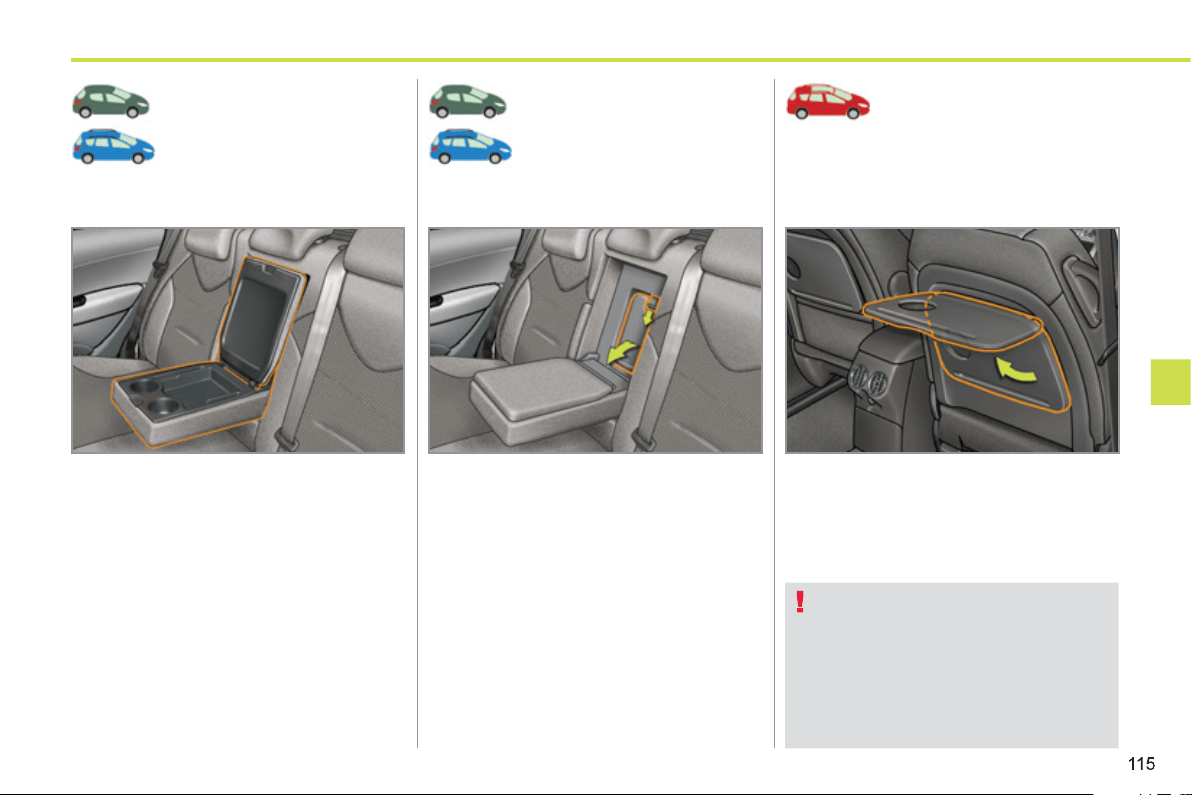
6
FITTINGS
R
EAR ARMRE
S
T
S
KI FLAP
Opening
) Lower the rear armrest.
) Pull the fl ap handle downwards.
) Lower the fl ap.
) Load the objects from inside the
boot.
) Lower the rear armrest for a more
comfortable position.
) Raise the cover to gain access to its
storage compartment.
This has a storage tray, two cup holders
and two pen holders.
"
AIR
C
RAFT" TYPE
T
ABLE
S
) To use the table, raise it fully until it
locks in the high position.
) To store the table, lower it, passing
the point of resistance, to the low
position.
On the passenger side, do not for-
get to fold the "aircraft" type table
before placing the seat in the table
position.
Do not place hard or heavy objects
on the table. They could become
dangerous projectiles in the event
of emergency braking or impact.
Comfort and storage device for the rear
passengers.
Arrangement for storing and transport-
ing long objects.
Installed on the back of each front seat,
these allow you to set down objects and
each is equipped with a cup holder.
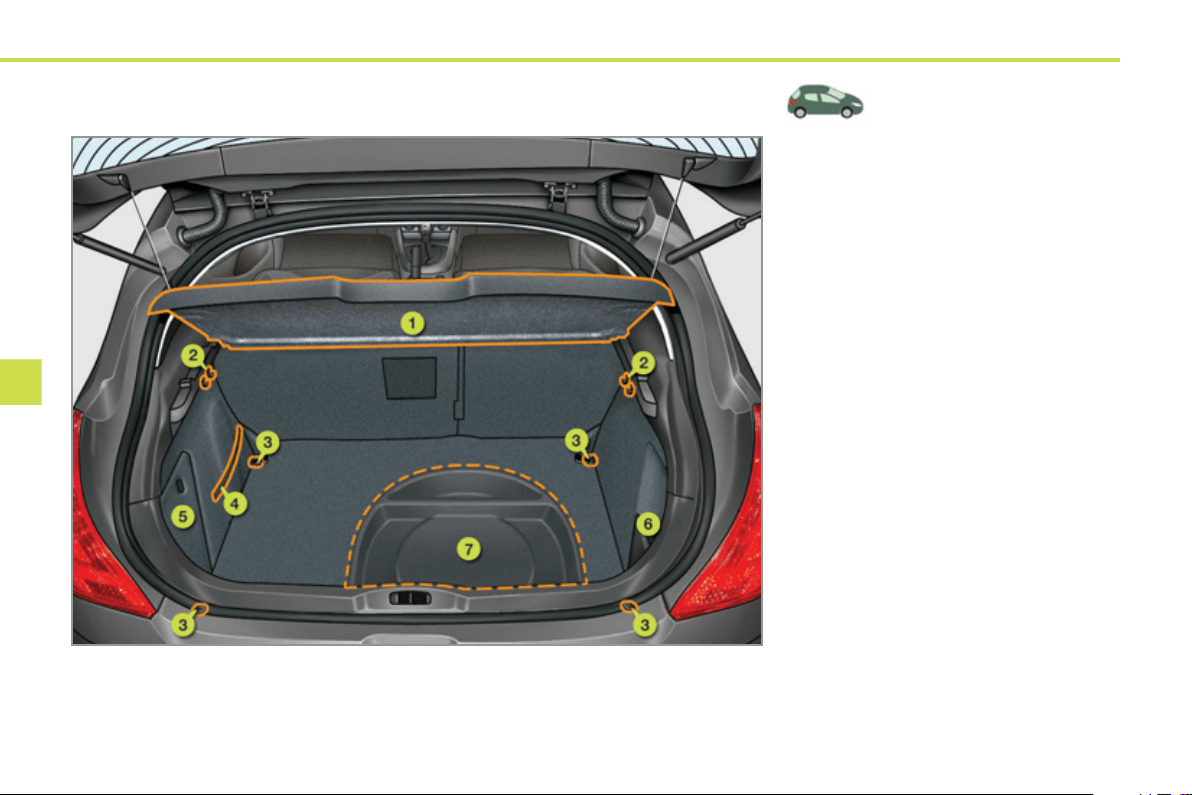
6
11
6
FITTINGS
B
OOT FITTING
S
1. Rear parcel shelf
(see details on following page)
2. Hooks
(see details on following page)
3. Stowing rings
4. Luggage retaining strap
5. Enclosed storage tray
6. Open storage tray
7. Storage box
(see details on following page)
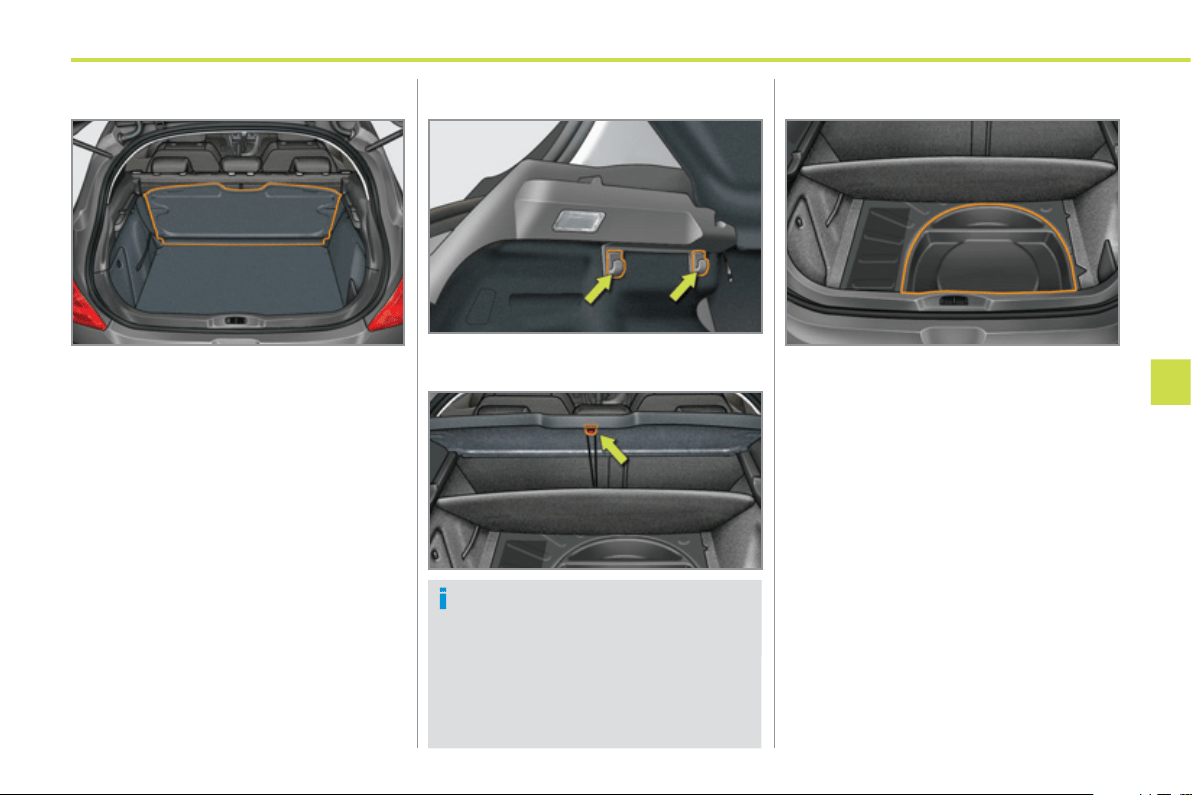
6
117
FITTINGS
To remove the shelf:
) unhook the two cords,
) raise the shelf slightly, then remove it.
Rear parcel shelf
Access to the storage box
An additional hook under the shelf
is used to hold up the boot fl oor us-
ing its cord, to facilitate access to
the tools and spare wheel or the
temporary puncture repair kit...
The hooks can be used to secure shop-
ping bags.
Hooks
There are several options for storing the
shelf:
- either upright behind the front
seats,
- or fl at at the base of the boot.
) Raise the boot carpet for access to
the storage box.
This has areas for the storage a box of
spare bulbs, a fi rst aid kit, two warning
triangles...
It also contains the vehicle tools, the
temporary puncture repair kit...
Storage box
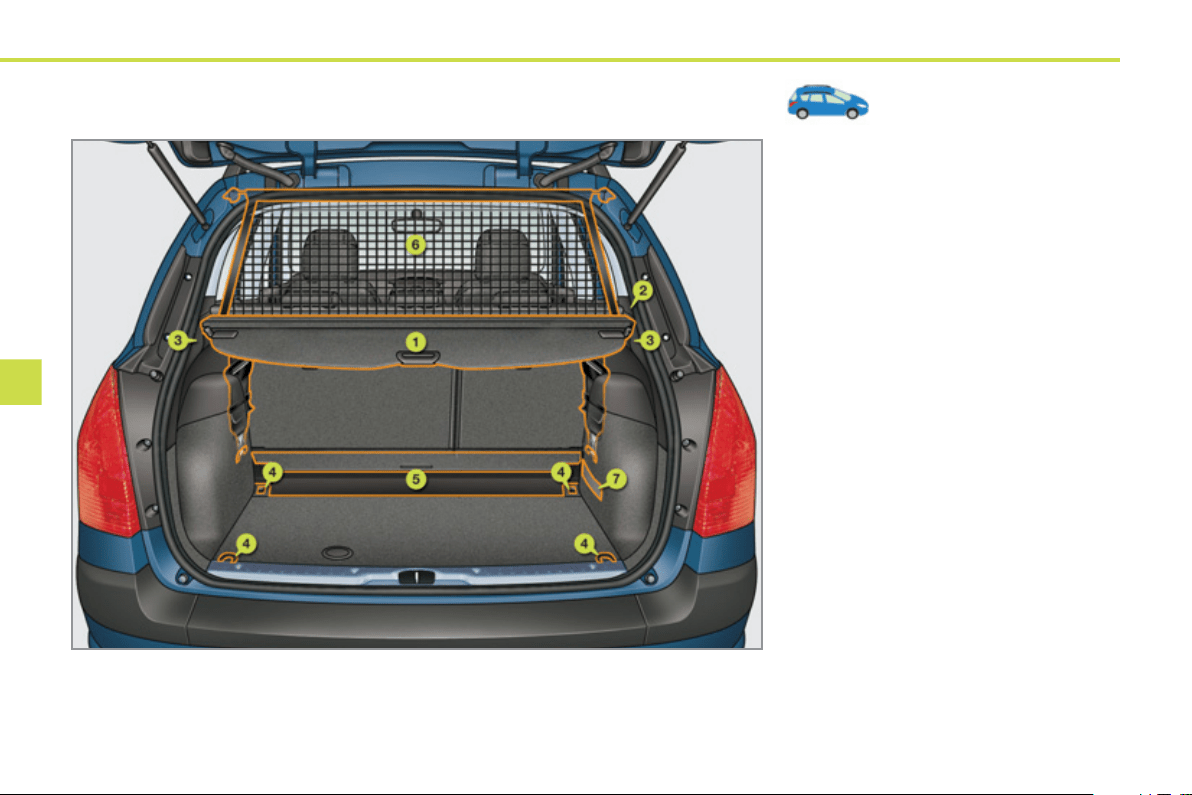
6
11
8
FITTINGS
B
OOT FITTING
S
1. Rear parcel shelf
(see details on following page)
2. 12 V accessories socket
(see details on following page)
3. Hooks
(see details on following page)
4. Stowing rings
5. Storage tray
6. High load retaining net
(see details on following page)
7. Luggage retaining strap
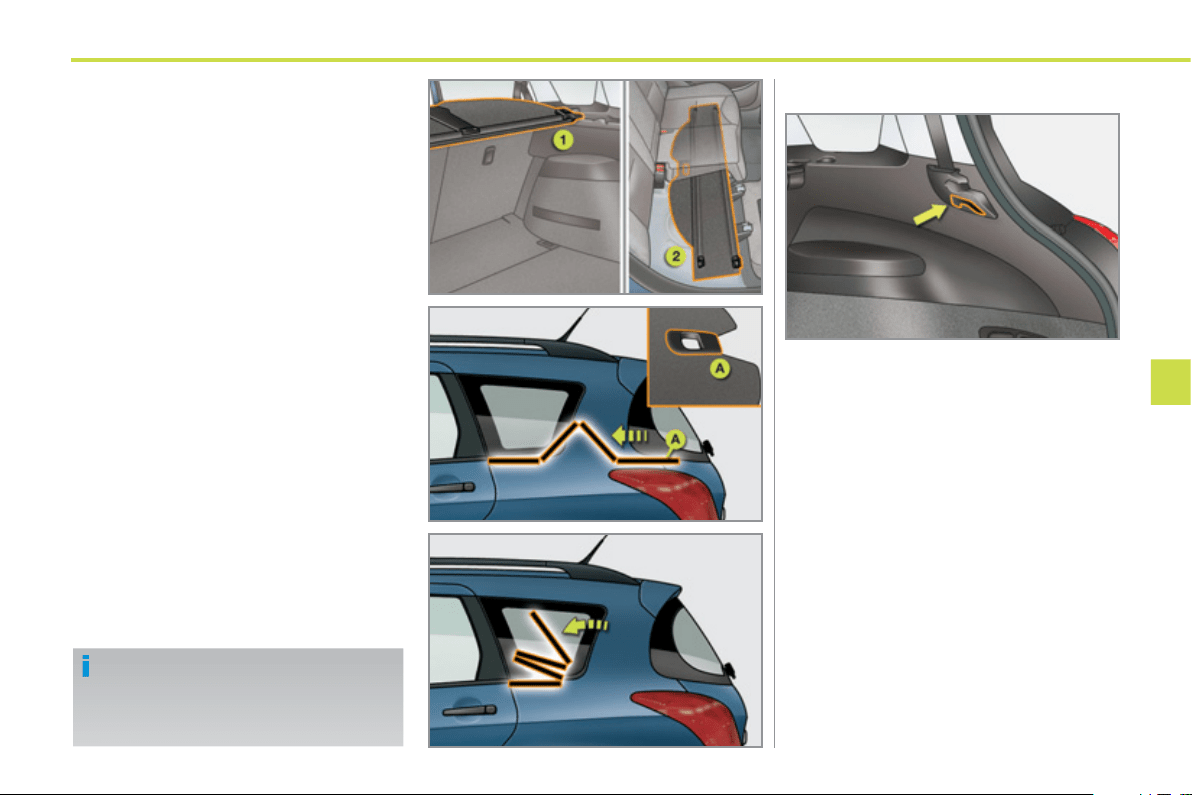
6
11
9
FITTINGS
Rear parcel shelf
This consists of four sections three of
which can be folded back on each other.
There are several options for storing the
rear parcel shelf:
- either folded back on itself near the
rear seats (1),
- or folded back on itself and stored
in a location provided under the rear
seats (2).
To fold it from the boot:
) unclip the load space cover from its
side supports,
) take hold of the load space cover by
its handle A ,
) fold it concertina-style to the rear
seats.
To unfold it from the boot:
) take hold of the load space cover by
its handle A ,
) unfold it to the boot pillars,
) clip the load space cover on its side
supports.
Hooks
Maximum loads
7.5 kg, rear parcel shelf unfolded
with high load retaining net at row 2.
The hooks can be used to hold shop-
ping bags.
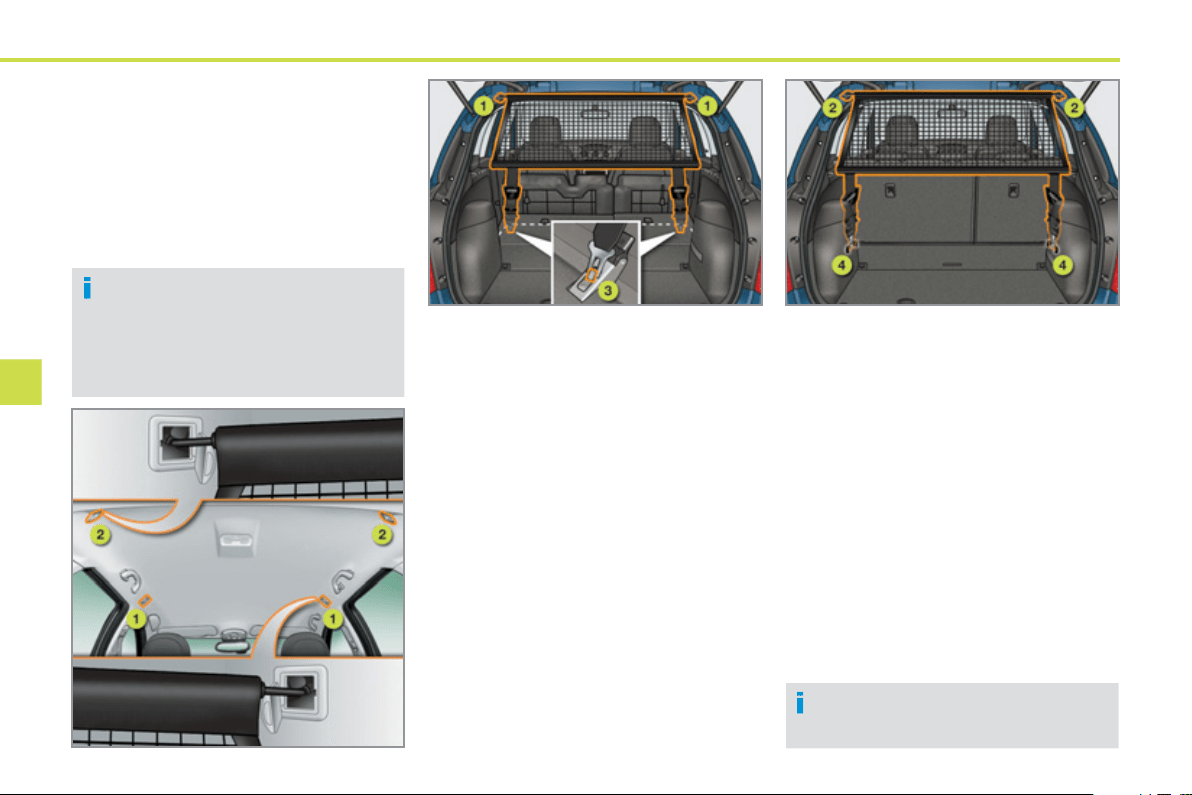
6
12
0
FITTINGS
High load retaining net
Hooked onto the special upper and low-
er fi xings, this permits use of the entire
loading volume up to the roof:
- behind the rear seats (row 2),
- behind the front seats (row 1) when
the rear seats are folded.
To use it in row 1:
) open the covers of the upper fi xings 1 ,
) unroll the high load retaining net,
) position one of the ends of the net's
metal bar in the corresponding up-
per fi xing 1 , then do the same with
the other end,
) slacken the straps fully,
) fi x the snap hook of each of the
straps on the corresponding bar 3 ,
located under the cushion of the
rear seats,
) fold the rear seats,
) tighten the straps,
) check that the net is hooked and
tightened correctly.
To use it in row 2:
) fold or remove the load space cover,
) open the covers of the upper fi xings 2 ,
) unroll the high load retaining net,
) position one of the ends of the net's
metal bar in the corresponding up-
per fi xing 2 , then do the same with
the other end,
) fi x the snap hook of each of the
straps in the corresponding ring 4 ,
located on the rear seats mecha-
nism support,
) tighten the straps,
) check that the net is hooked and
tightened correctly.
When positioning the net, check
that the strap loops are visible from
the boot; this will make slackening
or tightening easier.
This net can be stored in the stor-
age tray on the fl oor.
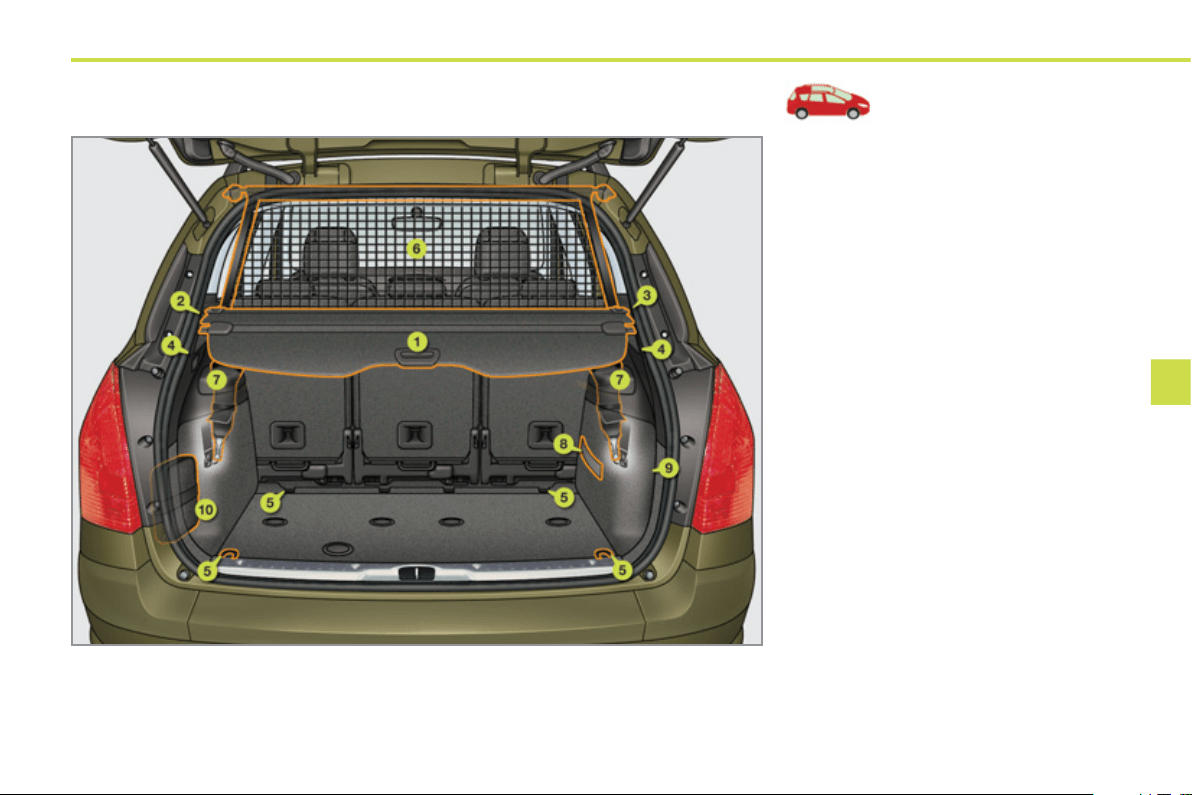
6
121
FITTINGS
B
OOT FITTING
S
1. Load space screen
(see details on following page)
2. Storage box
3. 12 V accessory socket
(see details on following page)
4. Hooks
(see details on following page)
5. Stowing rings
6. High load retaining net
(see details on following page)
7. Rear armrests with cup holder
8. Luggage retaining strap
9. Location for torch or for Hi-Fi am-
plifi er
(see details on following page)
10. Temporary puncture repair kit
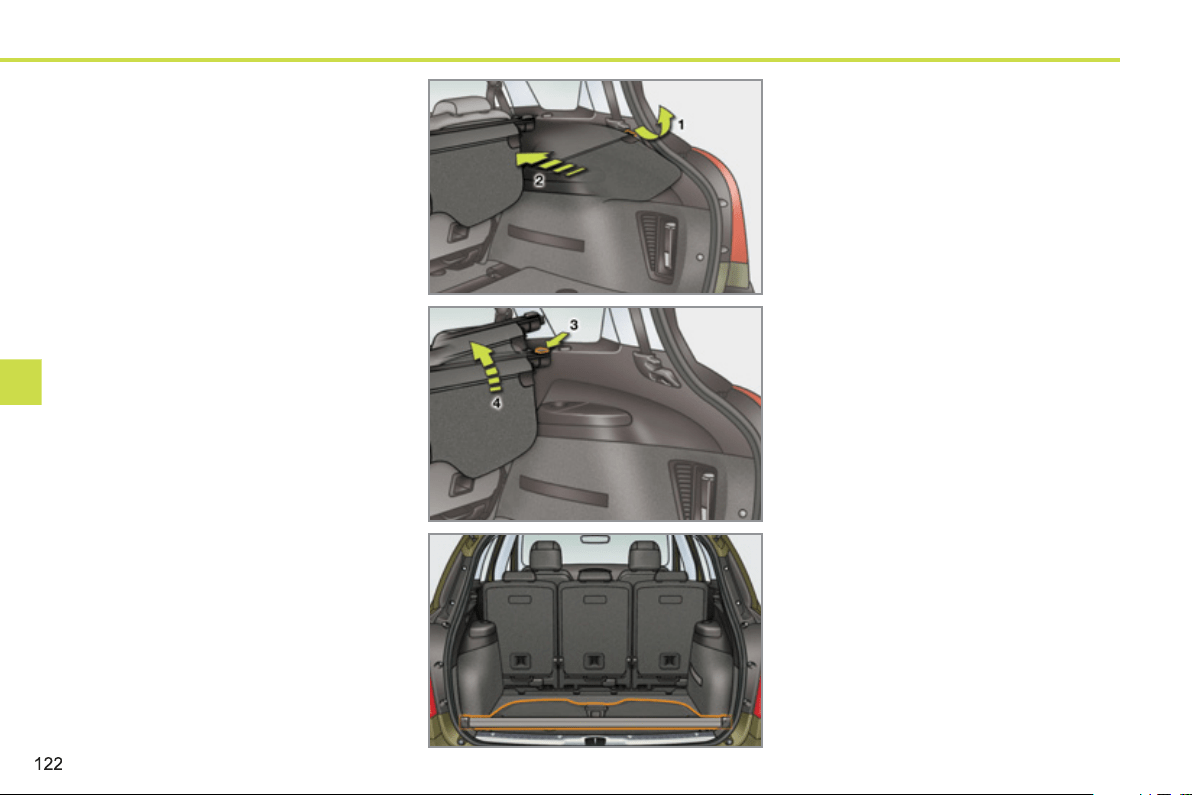
6
FITTINGS
Load space screen
To install the load space screen:
) position one of the ends of the roller
in its support,
) insert the second end in its support;
the catch locks automatically,
) unroll the load space screen to the
boot pillars,
) insert the load space screen guides
in the rails on the boot pillars.
To remove the load space screen:
) remove the load space screen
guides from the rails on the boot pil-
lars,
) roll up the load space screen in its
roller,
) pull and support the catch at one of
the ends of the roller to release it,
) remove the roller from its support
from the released end, then from the
second.
To store the load space screen, place it
at the boot sill, roller uppermost and fl ap
facing inwards.
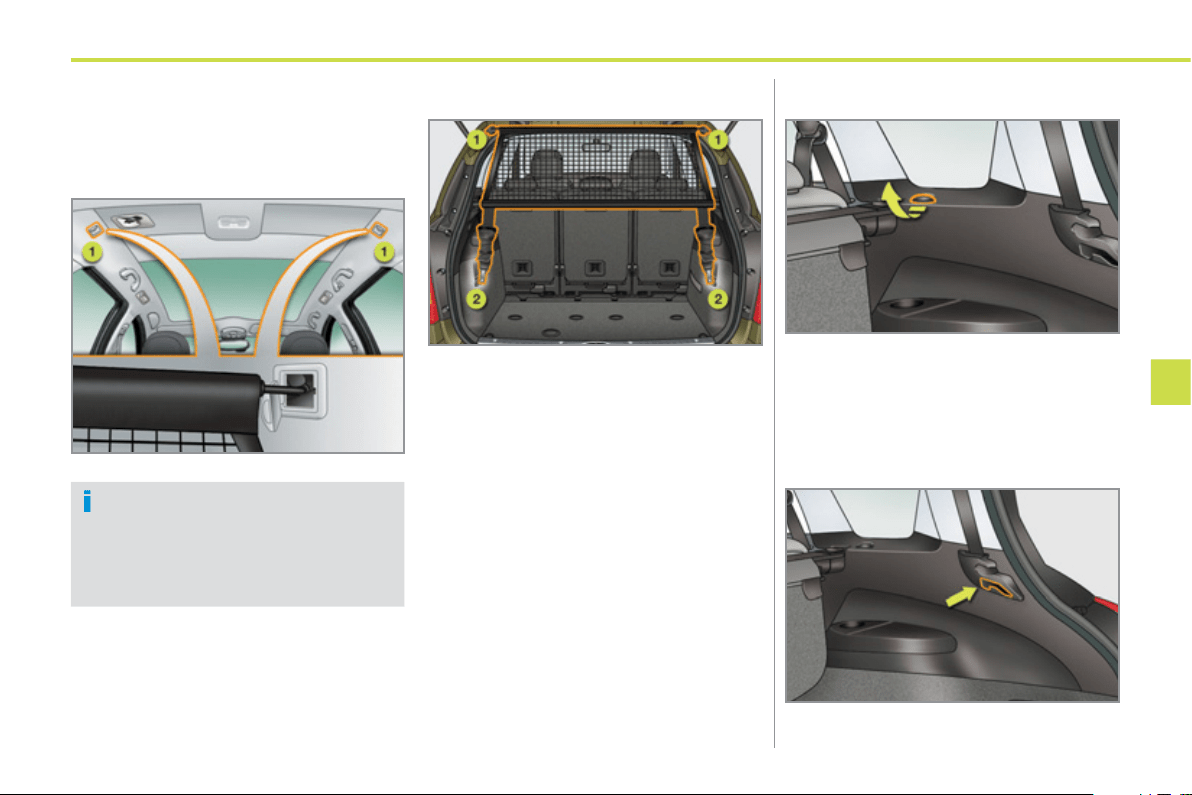
6
12
3
FITTINGS
High load retaining net
Hooked onto the special upper and low-
er fi xings, this permits use of the entire
loading volume up to the roof behind
the seats of the 2nd row.
12 V accessory socket
) To connect a 12 V accessory (max
power: 120 W), remove the cap and
connect an appropriate adaptor.
) Turn the key to the ignition on posi-
tion.
To use the net in the 2nd row (additional
seats folded or removed):
) roll up or remove the load space
screen,
) open the covers of the upper fi xings 1 ,
) unroll the high load retaining net,
) position one of the ends of the net's
metal bar in the corresponding up-
per fi xing 1 , then do the same with
the other end,
) attach the snap hook of each of the
net's straps in the corresponding
ring 2 , located on the lower fi xing of
the rear side seat belt,
) tighten the straps,
) check that the net is hooked and
tightened correctly.
When positioning the net, check
that the strap loops are visible from
the boot; this will make slackening
or tightening easier.
Hooks
The hooks can be used to hold shop-
ping bags.
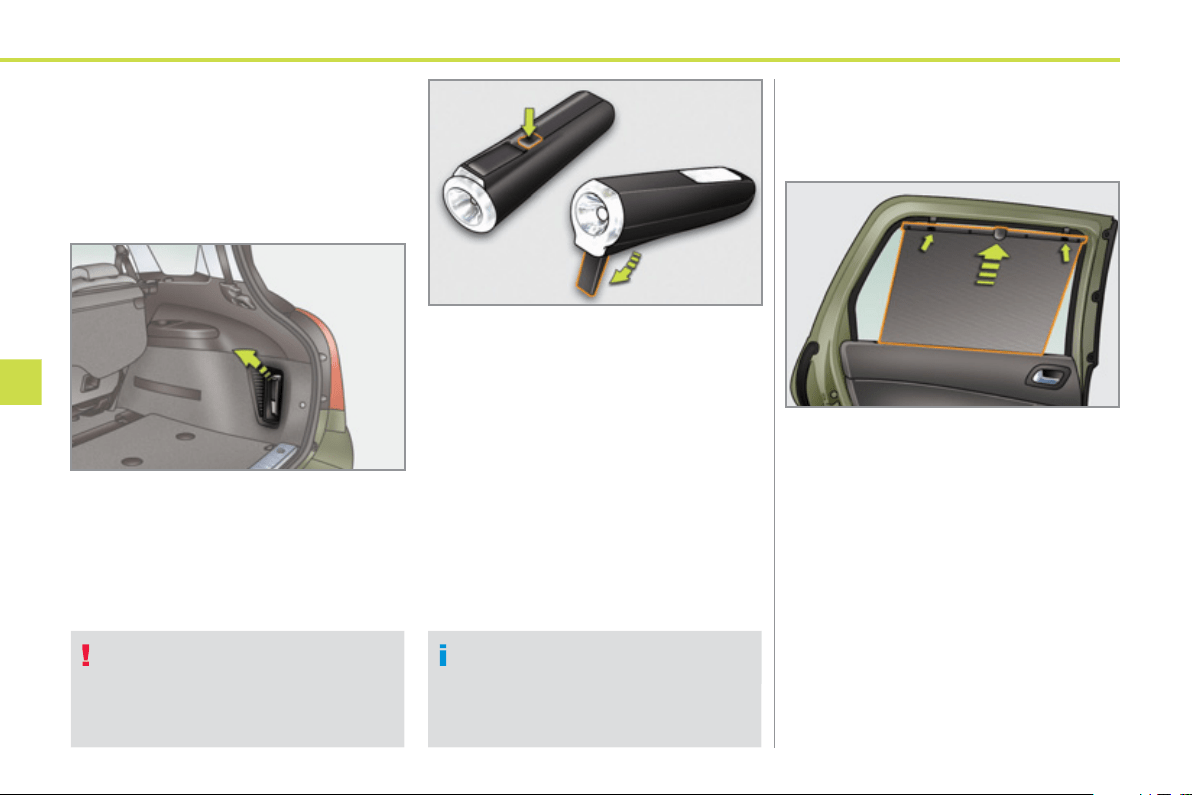
6
124
FITTINGS
Torch
This is a removable lamp, fi tted in the
boot wall, which can be used to light the
boot or as a torch.
For the boot lamp function, refer to the
"Visibility - § Boot lamp" section.
Operation
This torch operates with NiMH type re-
chargeable batteries.
It has a battery life of approximately
45 minutes and charges while you are
driving.
Use
) Extract the torch from its location
pulling it upwards.
) Press the switch, located on the
back, to switch the torch on or off.
) Unfold the support, located on the
back, to set down and raise the
torch; for example, when changing
a wheel.
Storing
) Put the torch back in place in its lo-
cation starting with the lower part.
If you have forgotten to switch off
the torch, this switches it off auto-
matically.
Side blinds
Fitted on the rear windows of the 2nd
row, these protect your young children
from the sun.
) Pull the blind by the central tab.
) Position the blind attachments on
the corresponding hooks.
Observe the polarities when fi tting
the rechargeable batteries.
Never replace the rechargeable
batteries with normal disposable
batteries.
It the torch is not engaged correct-
ly, it may not charge and may not
come on when the boot is opened.
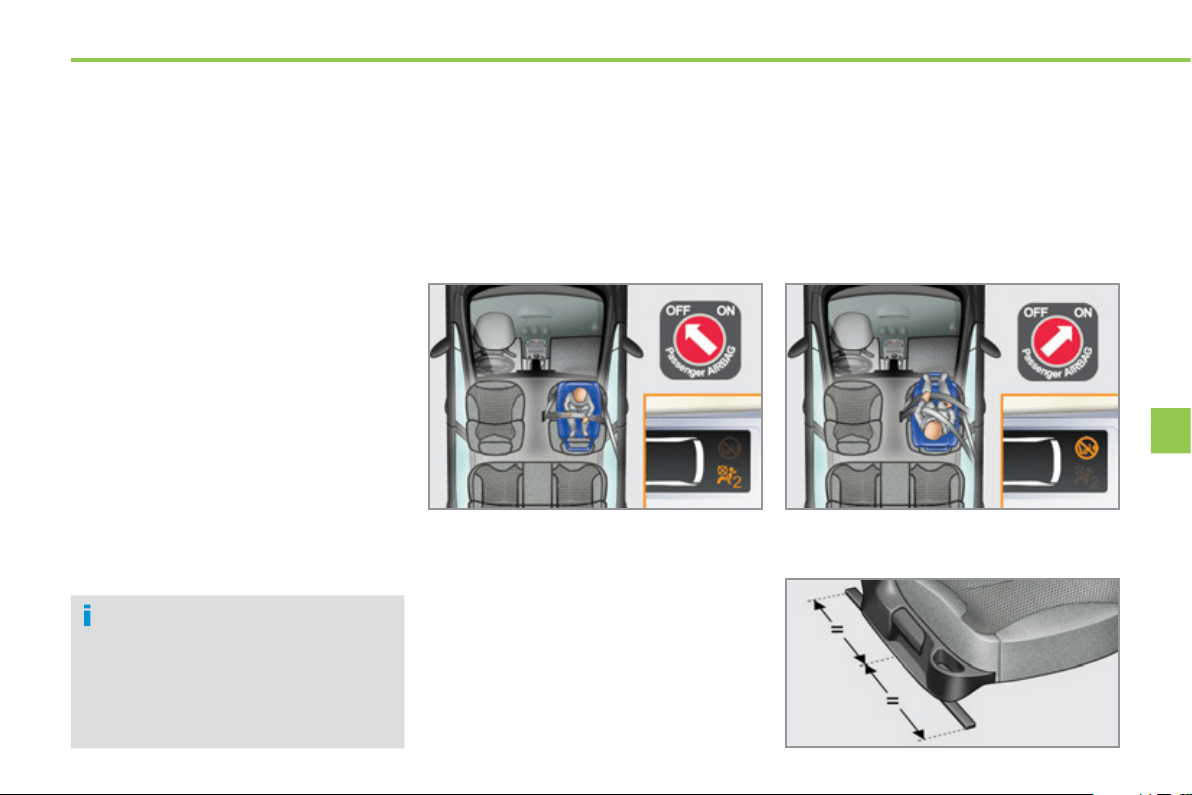
7
12
5
CHILD SAFETY
PEUGEOT recommends that chil-
dren should travel in the rear seats
of your vehicle:
- "rearwards-facing" up to the
age of 2,
- "forwards-facing" over the
age of 2.
G
ENERAL POINT
S
RELATING
T
O CHILD
S
EAT
S
CHILD
S
EAT IN THE FRONT
"Forwards-facing"
When a "forwards-facing" child seat is
installed on the front passenger seat ,
adjust the vehicle's seat to the interme-
diate longitudinal position with the seat
back upright and leave the passenger
airbag activated.
"Rearwards-facing"
When a "rearwards-facing" child seat is
installed on the front passenger seat ,
it is essential that the passenger airbag
is deactivated. Otherwise, the child
would risk being seriously injured or
killed if the airbag were to infl ate .
* The rules for carrying children are
specifi c to each country. Refer to the
current legislation in your country.
Although one of PEUGEOT's main cri-
teria when designing your vehicle, the
safety of your children also depends on
you.
For maximum safety, please observe
the following recommendations:
- in accordance with European reg-
ulations, all children under the
age of 12 or less than one and a
half metres tall must travel in ap-
proved child seats suited to their
weight , on seats fi tted with a seat
belt or ISOFIX mountings * ,
- statistically, the safest seats in
your vehicle for carrying children
are the rear seats,
- a child weighing less than 9 kg
must travel in the "rearwards-fac-
ing" position both in the front and
in the rear.
Intermediate longitudinal position
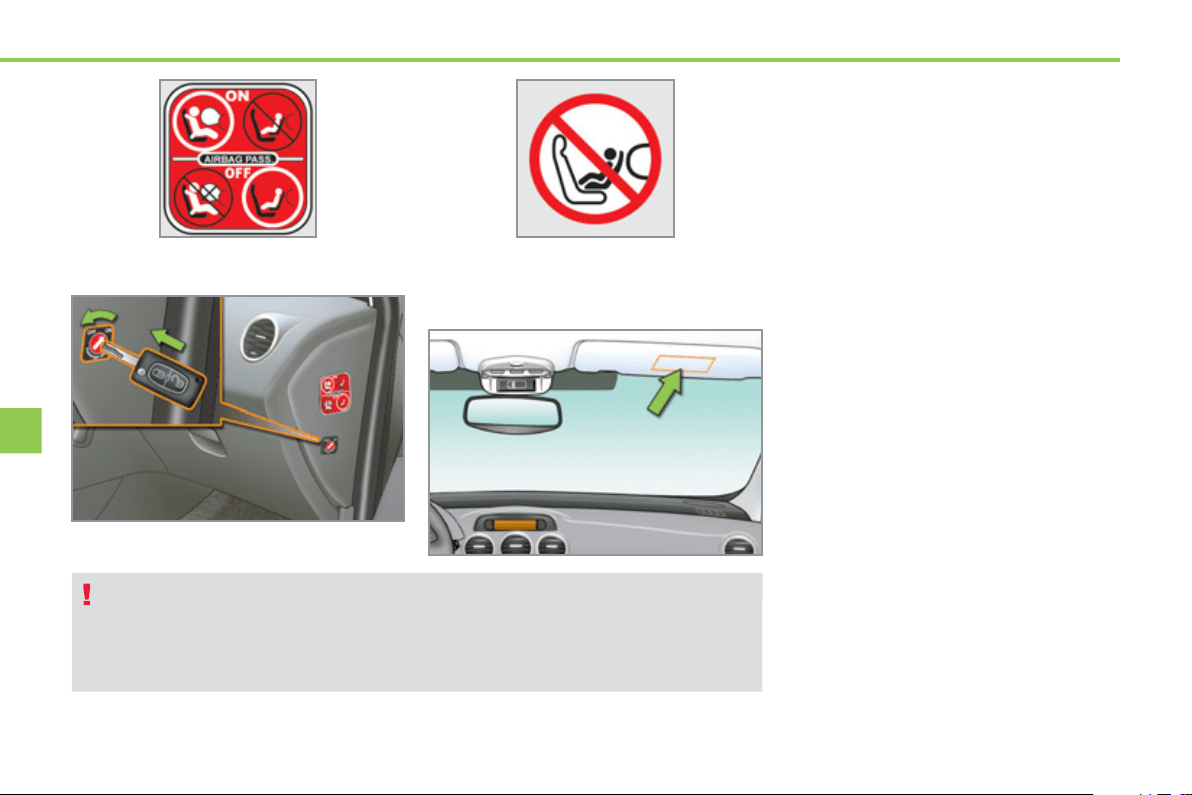
7
12
6
CHILD SAFETY
Passenger airbag OFF Refer to the advice given on the label
present on both sides of the passen-
ger's sun visor.
To assure the safety of your child, you must deactivate the passenger's front
airbag when you install a child seat in the rearwards facing position on the
front passenger's seat.
Otherwise, there is a risk that the child could be seriously injured or killed if
the airbag were deployed.
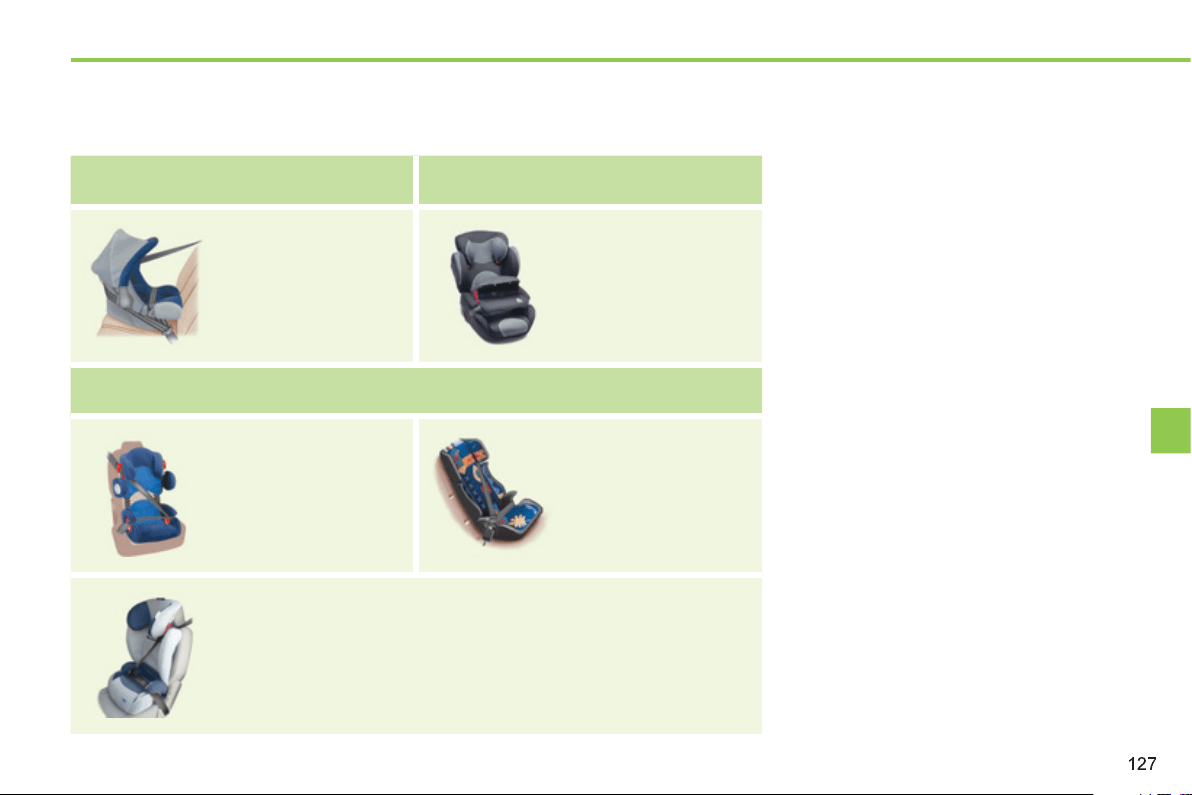
7
CHILD SAFETY
Group 0+: from birth to 13 kg Groups 1, 2 and 3: from 9 to 36 kg
L1
"RÖMER Baby-Safe
Plus"
Installed in the
rearwards-facing
position.
L2
"KIDDY Comfort Pro"
The impact shield
must be used for
carrying young
children (from 9 to
18 kg).
Groups 2 and 3: from 15 to 36 kg
L3
"RECARO Start''
L4
"KLIPPAN Optima"
From the age
of 6 years
(approximately
22 kg), the booster is
used on its own.
L5
"RÖMER KIDFIX"
Can be fi tted to the vehicle's ISOFIX
mountings.
The child is restrained by the seat belt.
CHILD
S
EAT
S
RECOMMENDED BY PEUGEOT
PEUGEOT offers a complete range of recommended child seats which are se-
cured using a three point seat belt :
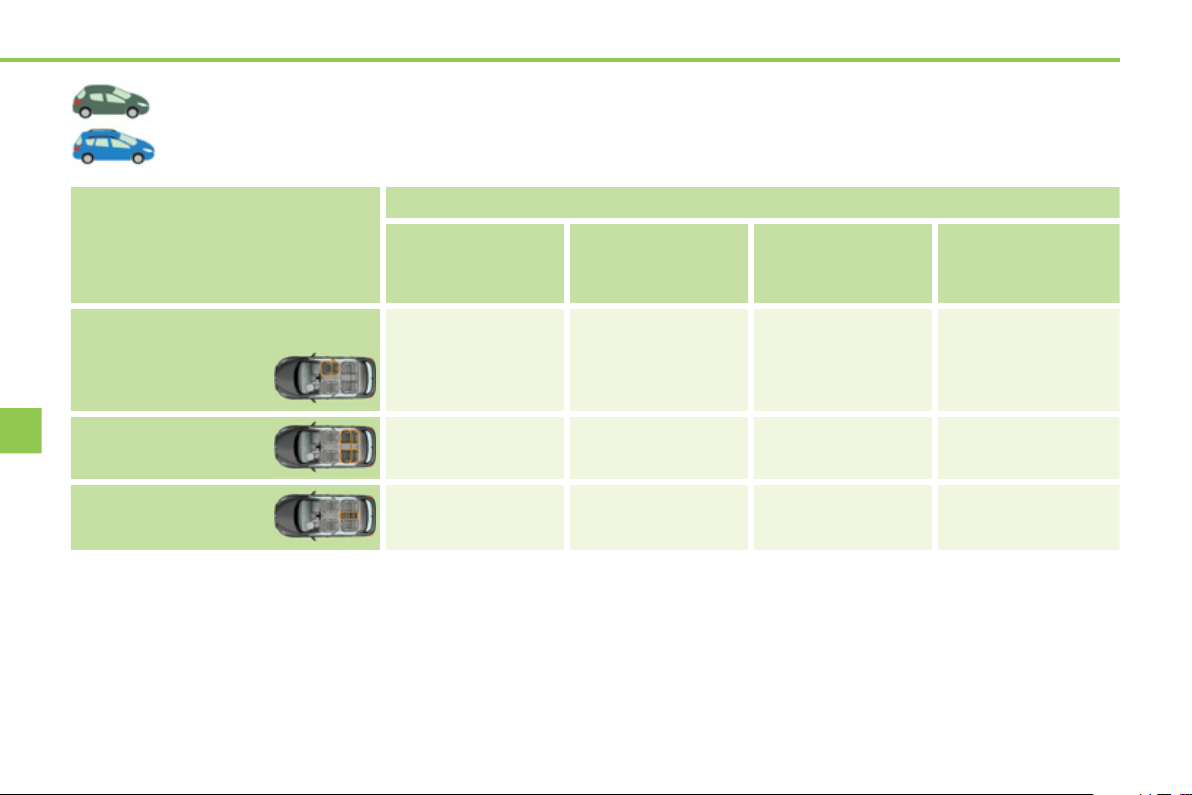
7
12
8
CHILD SAFETY
L
OCATION
S
FOR CHILD
S
EAT
S
S
ECURED U
S
ING THE
S
EAT BELT
In accordance with European regulations, this table indicates the options for installing child seats secured using
the seat belt and universally approved (a) in relation to the weight of the child and the seat in the vehicle.
(a) Universal child seat: child seat which can be installed in all vehicles using the seat belt.
(b) Group 0: from birth to 10 kg. Infant car seats and "car cots" cannot be installed on the front passenger seat.
(c) Consult the legislation in force in your country before installing your child on this seat.
U : seat suitable for the installation of a child seat secured using the seat belt and universally approved "rear facing" and/or
"forward facing".
U(R1) : identical to U , with the vehicle's seat adjusted to the intermediate longitudinal position.
U(R2) : identical to U , with the vehicle's seat adjusted to the highest position and moved back fully.
* The seat's head restraint must be removed and stored.
Seat
Weight of the child / indicative age
Less than 13 kg
(groups 0 (b)
and 0+)
Up to ≈ 1 year
From 9 to 18 kg
(group 1)
From 1 to ≈ 3 years
From 15 to 25 kg
(group 2)
From 3 to ≈ 6 years
From 22 to 36 kg
(group 3)
From 6 to ≈ 10 years
Front passenger seat (c)
- fi xed U(R1) U(R1) U(R1) U(R1)
- height adjustable
U(R2) U(R2) U(R2) U(R2)
Outer rear seats U U * U * U *
Centre rear seat U U * U * U *
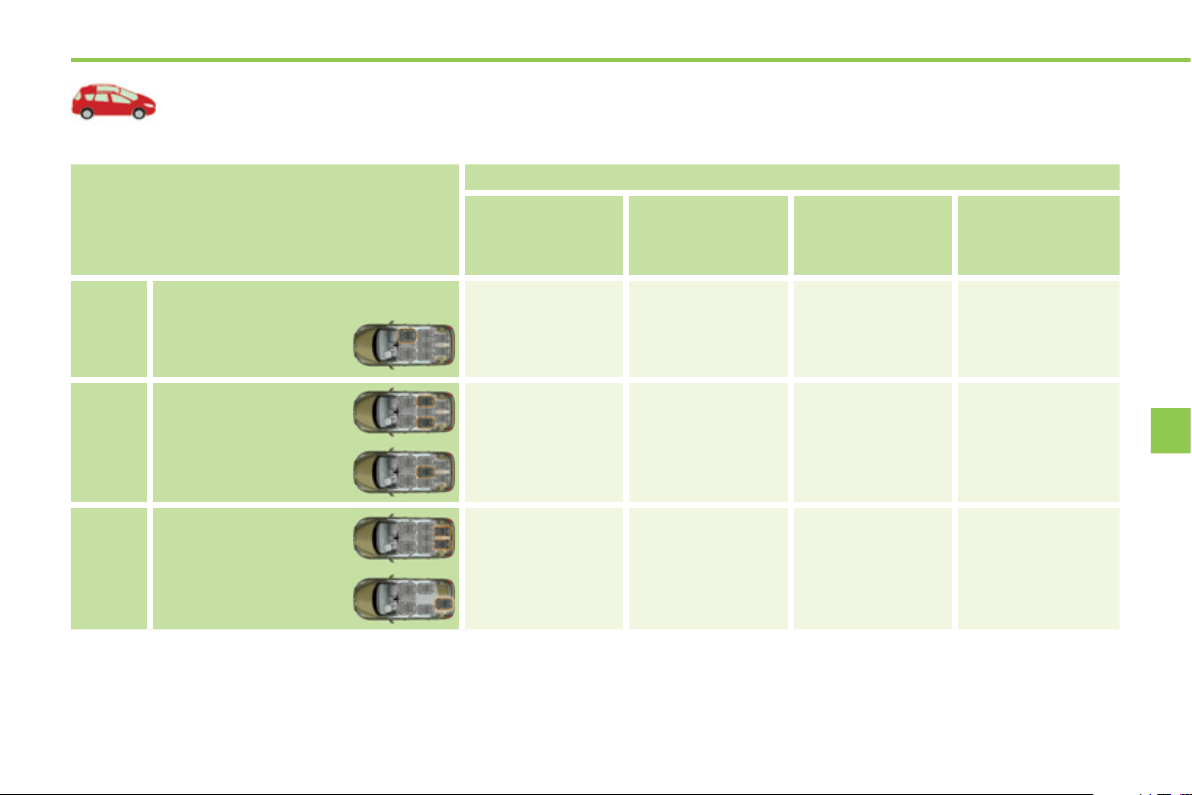
7
12
9
CHILD SAFETY
LOCATION OF CHILD
S
EAT
S
S
ECURED U
S
ING THE
S
EAT BELT
In accordance with the European regulation, this table indicates the options for the installation of child seats se-
cured using the seat belt and universally approved (a) depending on the weight of the child and the seat in the
vehicle.
(a) Universal child seat: child seat which
can be installed in all vehicles using
the seat belt.
(b) Group 0: from birth to 10 kg. Infant
car seats and "car cots" cannot be
installed on the front passenger
seat.
Seat
Weight of the child /indicative age
Below 13 kg
(groups 0 (b)
and 0+)
Up to ≈ 1 year
9 to 18 kg
(group 1)
From 1 to ≈ 3 years
15 to 25 kg
(group 2)
From 3 to ≈ 6 years
22 to 36 kg
(group 3)
From 6 to ≈ 10 years
1st
row
Front passenger seat (c)
- fi xed U(R1) U(R1) U(R1) U(R1)
- height adjustable U(R2) U(R2) U(R2) U(R2)
2nd
row
Outer
Seat in standard position
and moved inwards
U U U U
Centre
Centre seat
U U U U
3rd
row
Outer
Additional seat
U U U U
Outer
2nd row seat
U U U U
(c) Consult the current legislation in
your country before installing your
child on this seat.
U : seat suitable for the installation of a
child seat secured using the seat belt
and universally approved, "rear fac-
ing" and/or "forwards facing".
U(R1) : identical to U , with the vehicle's
seat adjusted to the intermedi-
ate longitudinal position.
U(R2) : identical to U , with the vehicle's
seat adjusted to its highest posi-
tion and moved back fully.

7
1
30
CHILD SAFETY
ADVICE ON CHILD SEATS
Installing a booster seat
The chest part of the seat belt must
be positioned on the child's shoulder
without touching the neck.
Ensure that the lap part of the seat
belt passes correctly over the child's
thighs.
PEUGEOT recommends the use of
a booster seat which has a back, fi t-
ted with a seat belt guide at shoulder
level.
As a safety precaution, do not leave:
- a child or children alone and unsu-
pervised in a vehicle,
- a child or an animal in a vehicle
which is exposed to the sun, with
the windows closed,
- the keys within reach of children
inside the vehicle.
To prevent accidental opening of the
doors and rear windows, use the
"Child lock".
Take care not to open the rear win-
dows by more than one third.
To protect young children from the
rays of the sun, fi t side blinds on the
rear windows.
The incorrect installation of a child
seat in a vehicle compromises the
child's protection in the event of an ac-
cident.
Remember to fasten the seat belts or
the child seat harnesses keeping the
slack relative to the child's body to a
minimum, even for short journeys.
When installing a child seat using the
seat belt, ensure that the seat belt is
tightened correctly on the child seat
and that it secures the child seat fi rm-
ly on the seat of your vehicle. If your
passenger seat is adjustable, move it
forwards if necessary.
For optimum installation of the "for-
wards-facing" child seat, ensure that
the back of the child seat is in contact
with the back of the vehicle's seat and
that the head restraint does not cause
any discomfort.
If the head restraint has to be re-
moved, ensure that it is stored or at-
tached securely to prevent it from
being thrown around the vehicle in the
event of sharp braking.
Children under the age of 10 must not
travel in the "forwards-facing" position
on the front passenger seat, unless
the rear seats are already occupied
by other children, cannot be used or
are absent.
Deactivate the passenger airbag
when a "rearwards-facing" child seat
is installed on the front seat.
Otherwise, the child would risk being
seriously injured or killed if the airbag
were to infl ate.
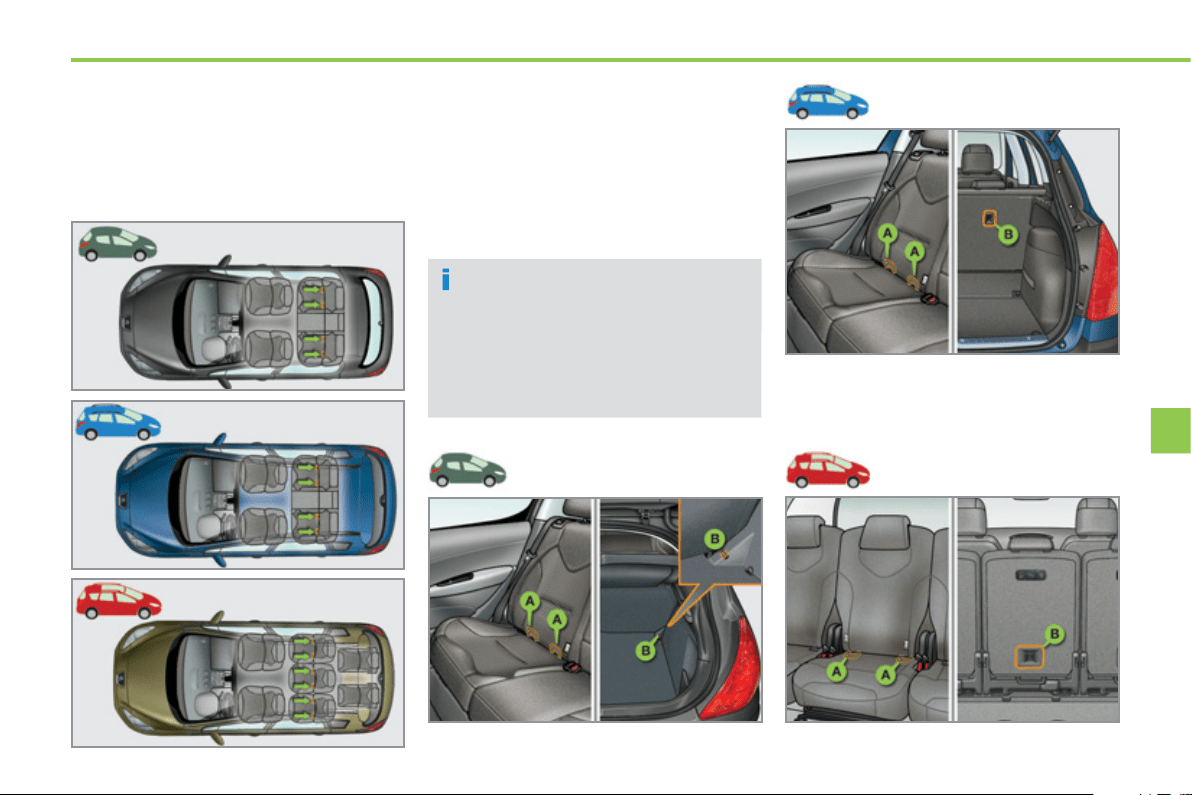
7
1
31
CHILD SAFETY
"
I
S
OFIX" MOUNTING
S
Your vehicle has been approved in accor-
dance with the new ISOFIX regulation .
The seats, represented below, are fi tted
with regulation ISOFIX mountings:
Rear seats
The Isofi x mountings are three rings for
each seat:
- two rings A , located between the
vehicle seat back and cushion, indi-
cated by a label,
- a ring B , located behind the seat,
referred to as the TOP TETHER for
fi xing the upper strap.
Rear seats
Rear seats of the 2nd row
When installing an ISOFIX child
seat in the left hand rear position
of the bench seat, before fi tting the
child seat, fi rst move the centre
rear seat belt towards the middle
of the vehicle so as to avoid the
child seat interfering with the op-
eration of the seat belt.
7
1
32
CHILD SAFETY
This ISOFIX mounting system ensures
fast, reliable and safe fi tting of the child
seat in your vehicle.
The ISOFIX child seats are fi tted with
two locks which are secured easily on
the two rings A .
Some also have an upper strap (or top
tether) which is attached to ring B .
The incorrect installation of a child
seat in a vehicle compromises the
child's protection in the event of an
accident.
For information regarding the ISOFIX
child seats which can be installed in
your vehicle, consult the summary
table for the location of the ISOFIX
child seats.
To attach this strap, raise the vehicle
seat's head restraint then pass the hook
between its rods. Then fi x the hook on
ring B and tighten the upper strap.
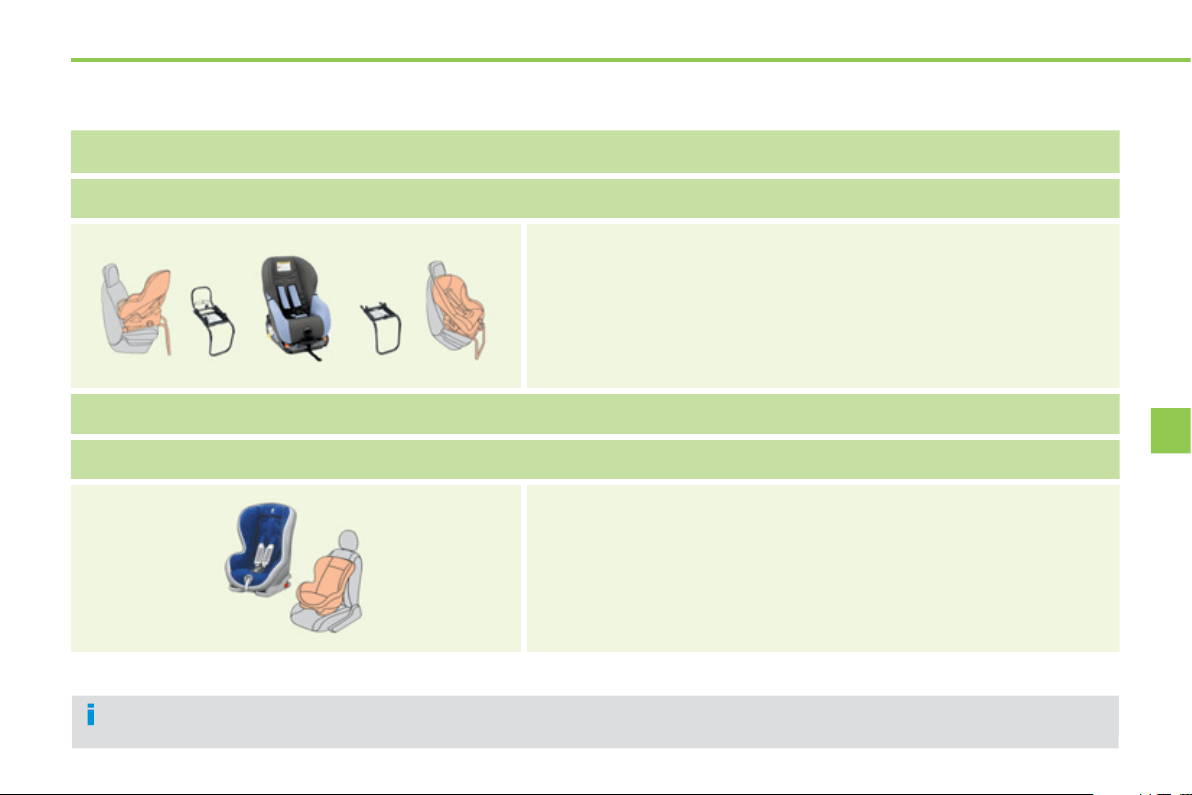
7
1
33
CHILD SAFETY
Follow the instructions for fi tting child seats contained in the seat manufacturer's installation guide.
I
S
OFIX CHILD
S
EAT
S
RECOMMENDED BY PEUGEOT AND APPROVED FOR YOUR VEHICLE
FAIR Bimbofi x ISOFIX (size category: C or A )
Group 0/1: up to 18 kg
Can be installed facing forward or rearward using an ISOFIX base
which is attached to the rings A and includes a stay which extends
down to the fl oor of the vehicle.
6 seat body angle positions.
Can be installed facing forward, attached to the seat using a three-
point seat belt.
RÖMER Duo Plus ISOFIX (size category: B1 )
Group 1: from 9 to 18 kg
Is installed in the forward-facing position.
Is attached to the rings A and the upper ring B , referred to as the
Top Tether, using an upper strap.
Three seat body angles: sitting, reclining, lying down.
Can be installed facing forward, attached to the seat using a three-
point seat belt.
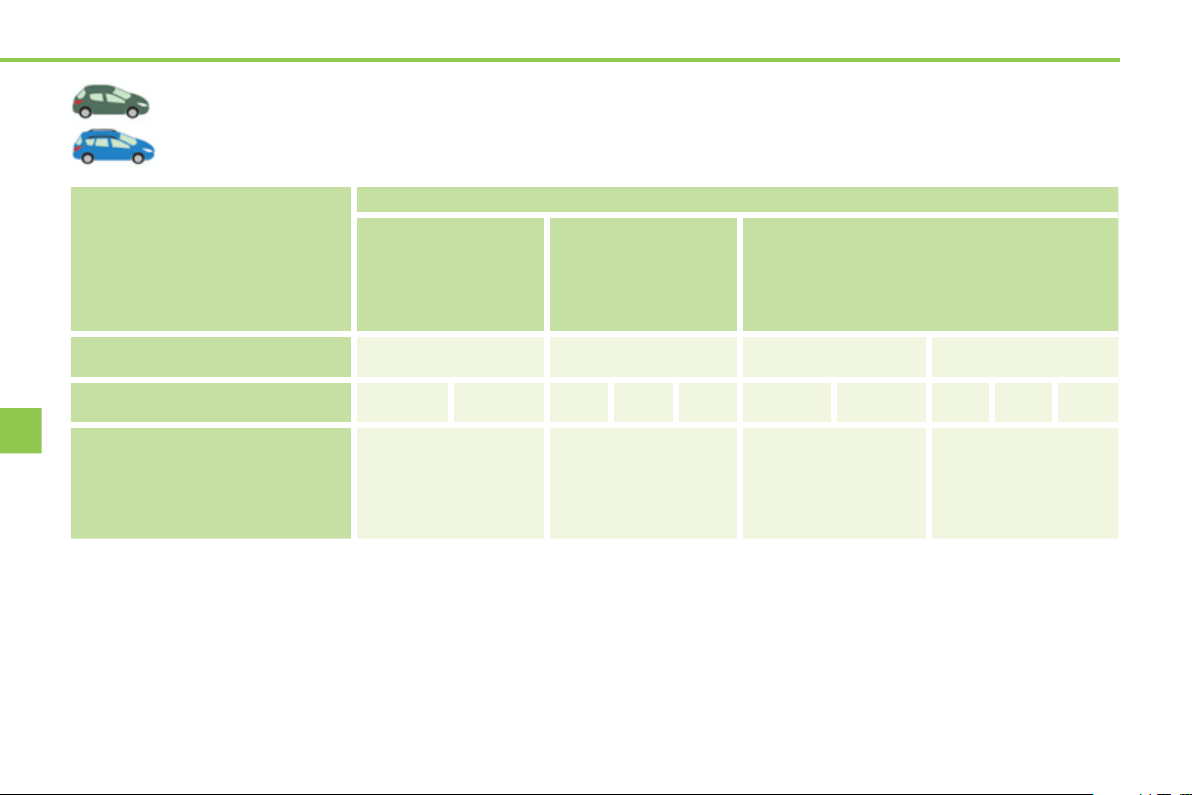
7
1
34
CHILD SAFETY
LOCATION
S
FOR I
S
OFIX CHILD
S
EAT
S
In accordance with European Regulations, this table indicates the options for installing ISOFIX child seats on
seats in the vehicle fi tted with ISOFIX mountings.
In the case of universal and semi-universal ISOFIX child seats, the ISOFIX size category, determined by a letter
from A to G , is indicated on the child seat next to the ISOFIX logo.
IUF: seat suitable for the installation of an I sofi x U niversal seat, " F orward facing" secured using the upper strap.
IL-SU: seat suitable for the installation of an I sofi x S emi- U niversal seat either:
- "rear facing" fi tted with an upper strap or a stay,
- "forward facing" fi tted with a stay,
- an infant car seat fi tted with an upper strap or a stay.
For advice on securing of the upper strap, refer to the paragraph "ISOFIX mountings".
* Infant car seats and "car cots" cannot be installed on the front passenger seat.
** The ISOFIX infant car seat, secured on the lower rings of a vehicle ISOFIX seat, occupies two rear seats.
Weight of the child / indicative age
Less than 10 kg
(group 0)
Up to approx.
6 months
Less than 10 kg
(group 0)
Less than 13 kg
(group 0+)
Up to approx. 1 year
From 9 to 18 kg (group 1)
From approx. 1 to 3 years
Type of ISOFIX child seat
Infant car seat * "rear facing" "rear facing" "forward facing"
ISOFIX size category F G C D E C D A B B1
ISOFIX child seats universal
and semi-universal which
can be installed on the rear
outer seats
IL-SU ** IL-SU IL-SU
IUF
IL-SU
7
1
35
CHILD SAFETY
LOCATION
S
FOR I
S
OFIX CHILD
S
EAT
S
In accordance with European Regulations, this table indicates the options for installing ISOFIX child seats on
seats in the vehicle fi tted with ISOFIX mountings.
In the case of universal and semi-universal ISOFIX child seats, the ISOFIX size category, determined by a letter from A to G ,
is indicated on the child seat next to the ISOFIX logo.
IUF: seat suitable for the installation of an I sofi x U niversal seat, " F orward facing" secured using the upper strap.
IL-SU: seat suitable for the installation of an I sofi x S emi- U niversal seat either:
- "rear facing" fi tted with an upper strap or a stay,
- "forward facing" fi tted with a stay,
- an infant car seat fi tted with an upper strap or a stay.
For advice on securing of the upper strap, refer to the "ISOFIX mountings" paragraph.
X: seat not suitable for the installation of an ISOFIX seat of the size category indicated.
Weight of the child / indicative age
Less than 10 kg
(group 0)
Up to approx.
6 months
Less than 10 kg
(group 0)
Less than 13 kg
(group 0+)
Up to approx. 1 year
From 9 to 18 kg (group 1)
From approx. 1 to 3 years
Type of ISOFIX child seat Infant car seat * "rear facing" "rear facing" "forward facing"
ISOFIX size category F G C D E C D A B B1
Rear ISOFIX
seats; 2nd row
seat
Side IL-SU IL-SU IL-SU
IUF
IL-SU
Centre X IL-SU IL-SU
IUF
IL-SU
Outer, moved
inwards
X IL-SU IL-SU
IUF
IL-SU
Rear ISOFIX
seats; 2nd row
seat installed
in the 3rd row
Outer X X X
IUF
IL-SU
* Infant car seats and "car cots" cannot be installed on the front passenger seat.
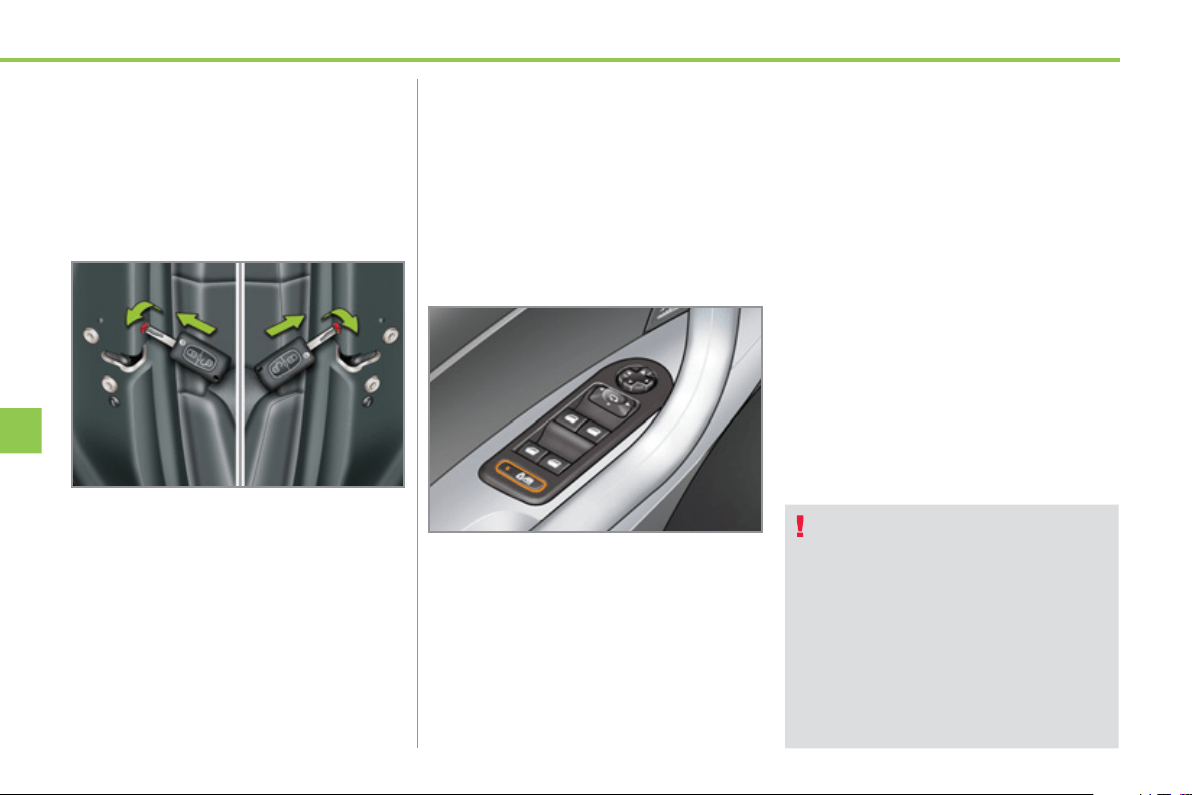
7
1
36
CHILD SAFETY
This system is independent and in
no circumstances does it take the
place of the central locking control.
Check the status of the child lock
each time you switch on the ignition.
Always remove the key from the
ignition when leaving the vehicle,
even for a short time.
In the event of a serious impact,
the electric child lock is deactivated
automatically to permit the exit of
the rear passengers.
M
ANUAL CHILD LOCK
Mechanical system to prevent opening
of the rear door using its interior control.
The control is located on the edge of
each rear door.
) Using the ignition key, turn the red
control as far as it will go:
- to the left on the left-hand rear
door,
- to the right on the right-hand rear
door.
ELECTRIC CHILD LOCK
Remote control system to prevent open-
ing of the rear doors using their interior
controls and use of the rear electric win-
dows.
The control is located on the driver's
door, with the electric window controls.
) Press this button.
The indicator lamp on the button comes
on, accompanied by a message in the
multifunction screen.
This indicator lamp remains on until the
child lock is deactivated.
Locking
Unlocking
) Using the ignition key, turn the red
control as far as it will go:
- to the right on the left-hand rear
door,
- to the left on the right-hand rear
door.
Activation
Deactivation
) Press the button again.
The indicator lamp on the button switch-
es off, accompanied by a message in
the multifunction screen.
This indicator lamp remains off until the
child lock is activated.

8
1
37
SAFETY
D
IRECTION INDICATOR
S
If you forget to cancel the direc-
tion indicators for more than twenty
seconds, the volume of the audible
signal will increase if the speed is
above 40 mph (60 km/h).
) Left: lower the lighting stalk passing
the point of resistance.
) Right: raise the lighting stalk pass-
ing the point of resistance.
HAZARD WARNING LAMP
S
A visual warning by means of the direc-
tion indicators to alert other road users
to a vehicle breakdown, towing or ac-
cident.
) Press this button, the direction indi-
cators fl ash.
They can operate with the ignition off.
Automatic operation of hazard
warning lamps
H
ORN
) Press one of the spokes of the steering
wheel.
Use the horn moderately and only
in the following cases:
- immediate danger,
- when approaching an area
where there is no visibility.
Audible warning to alert other road us-
ers to an imminent danger.
When braking in an emergency, de-
pending on the deceleration, the hazard
warning lamps come on automatically.
They switch off automatically the fi rst
time you accelerate.
) You can also switch them off by
pressing the button.
On vehicles fi tted with the 1.6 litre THP
200 hp petrol engine, deactivating the
ESP/ASR systems also deactivates the
automatic operation of the hazard warn-
ing lamps; refer to the section "Trajectory
control systems - § Deactivation".

8
1
38
SAFETY
T
YRE UNDER-INFLATION
D
ETECTION
System which automatically and contin-
uously checks the pressure of the tyres
while driving.
All repairs and changing of tyres on
a wheel fi tted with this system must
be carried out by a PEUGEOT
dealer or a qualifi ed workshop.
If, when changing a tyre, you fi t a
wheel which is not detected by your
vehicle (example: fi tting of snow
tyres), you must have the system
reinitialised by a PEUGEOT dealer
or a qualifi ed workshop.
This system does not avoid the
need to have the tyre pressures
checked regularly (refer to the
"Identifi cation markings" section) to
ensure that the optimum dynamic
performance of the vehicle is main-
tained and prevent premature wear
of the tyres, particularly in arduous
driving conditions (heavy load, high
speed).
The tyre pressures must be checked
cold, at least once a month. Re-
member to check the pressure of
the spare wheel.
The tyre under-infl ation detection
system may experience temporary
interference due to electro-magnet-
ic emissions on a frequency close
to that used by the system.
Sensors fi tted in each valve trigger a
warning in the event of problem (speed
above 12 mph (20 km/h)).
This warning lamp is displayed
in the instrument panel and/or a
message appears in the screen,
accompanied by an audible signal,
to identify the wheel concerned.
) Check the tyre pressures as soon
as possible.
This check must be carried out when the tyres are cold.
Under-infl ated tyre
The STOP warning lamp comes
on and/or this warning lamp
is displayed in the instrument
panel, accompanied by an au-
dible signal and a message in
the screen identifying the wheel
concerned.
) Stop as soon as it is safe to do so,
avoiding any sudden movement of
the steering wheel and the brakes.
) Repair or change the damaged
wheel (punctured or very defl ated
tyre), and have the tyre pressure
checked as soon as possible.
Puncture
The tyre under-infl ation detection sys-
tem is an aid to driving which does not
replace the need for the driver to be
vigilant or to drive responsibly.
Sensor(s) not detected or faulty
This warning lamp is displayed
on the instrument panel and/
or a message appears in the
screen, accompanied by an
audible signal, to locate the wheel or
wheels which are not detected or to in-
dicate a malfunction of the system.
Contact a PEUGEOT dealer or a quali-
fi ed workshop to replace the faulty
sensor(s).
This message is also displayed
when one of the wheels is away
from the vehicle (being repaired) or
when one or more wheels without a
sensor are fi tted.
If your vehicle is equipped with a
spare wheel, this is not fi tted with
a sensor.
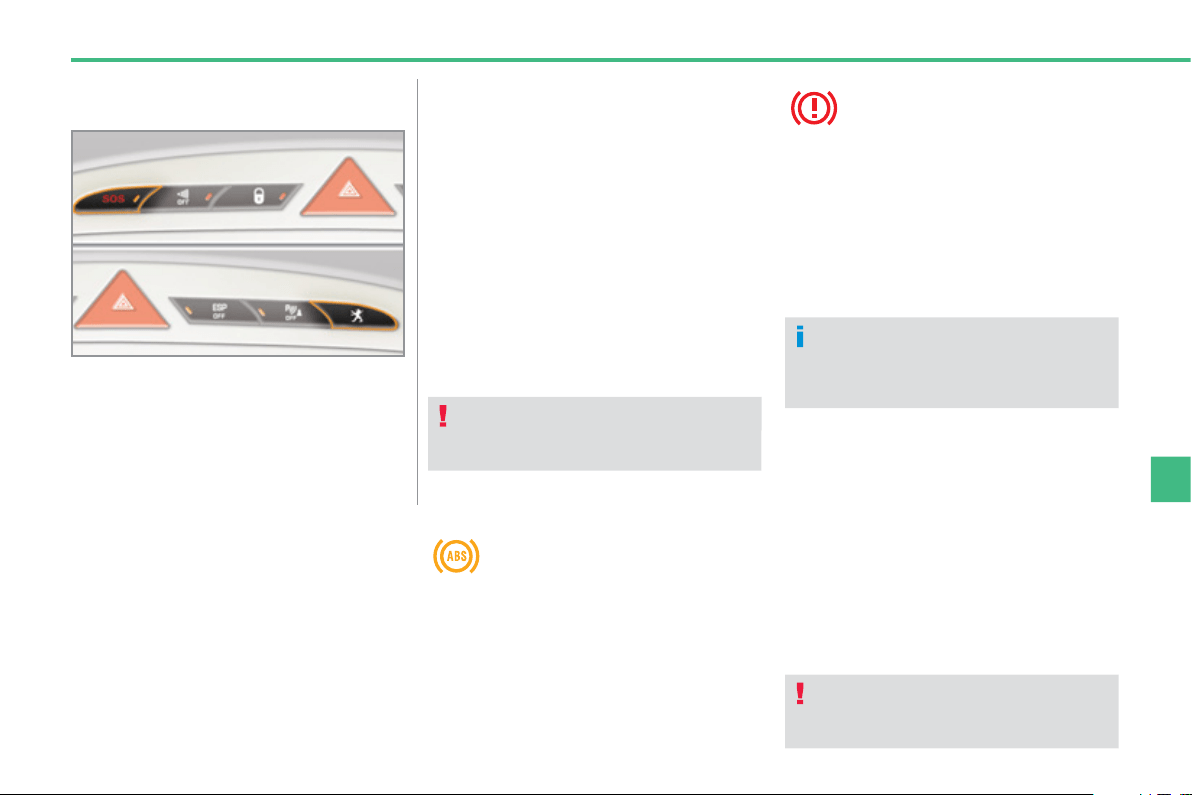
8
1
39
SAFETY
B
RAKING A
SS
I
S
TANCE
S
Y
S
TEM
S
Group of supplementary systems which
help you to obtain optimum braking in
complete safety in emergency situa-
tions:
- anti-lock braking system (ABS),
- electronic brake force distribution
(EBFD),
- emergency braking assistance (EBA).
Anti-lock braking system
and electronic brake force
distribution
Linked systems which improve the stability
and manoeuvrability of your vehicle when
braking, in particular on poor or slippery
surfaces.
When braking in an emergency,
press very fi rmly without releasing
the pressure.
When replacing wheels (tyres and
rims), ensure that they conform to the
manufacturer's recommendations.
Operating fault
If this warning lamp comes on,
accompanied by an audible
signal and a message in the
screen, it indicates a malfunc-
tion of the anti-lock braking system
which could result in loss of control of
the vehicle when braking.
If this warning lamp comes on,
together with the STOP and
ABS warning lamps, accompa-
nied by an audible signal and
a message in the screen, it indicates a
malfunction of the electronic brake force
distribution which could result in loss of
control of the vehicle when braking.
You must stop as soon as it is safe
to do so.
Emergency braking assistance
System which, in an emergency, en-
ables you to obtain the optimum braking
pressure more quickly, thus reducing
the stopping distance.
Activation
The anti-lock braking system comes
into operation automatically when there
is a risk of wheel lock.
Normal operation of the ABS may make
itself felt by slight vibration of the brake
pedal.
Activation
It is triggered by the speed at which the
brake pedal is pressed.
The effect of this is a reduction in the
resistance of the pedal and an increase
in braking effi ciency.
In either case, contact a PEUGEOT
dealer or a qualifi ed workshop.
When braking in an emergency,
press fi rmly without releasing the
pressure.
E
MERGENCY OR A
SS
I
S
TANCE
C
ALL
This system allows you to make an
emergency or assistance call to the
emergency services or to the dedicated
PEUGEOT service.
For more information on the use of this
function, refer to the "Audio and tele-
matics" section.
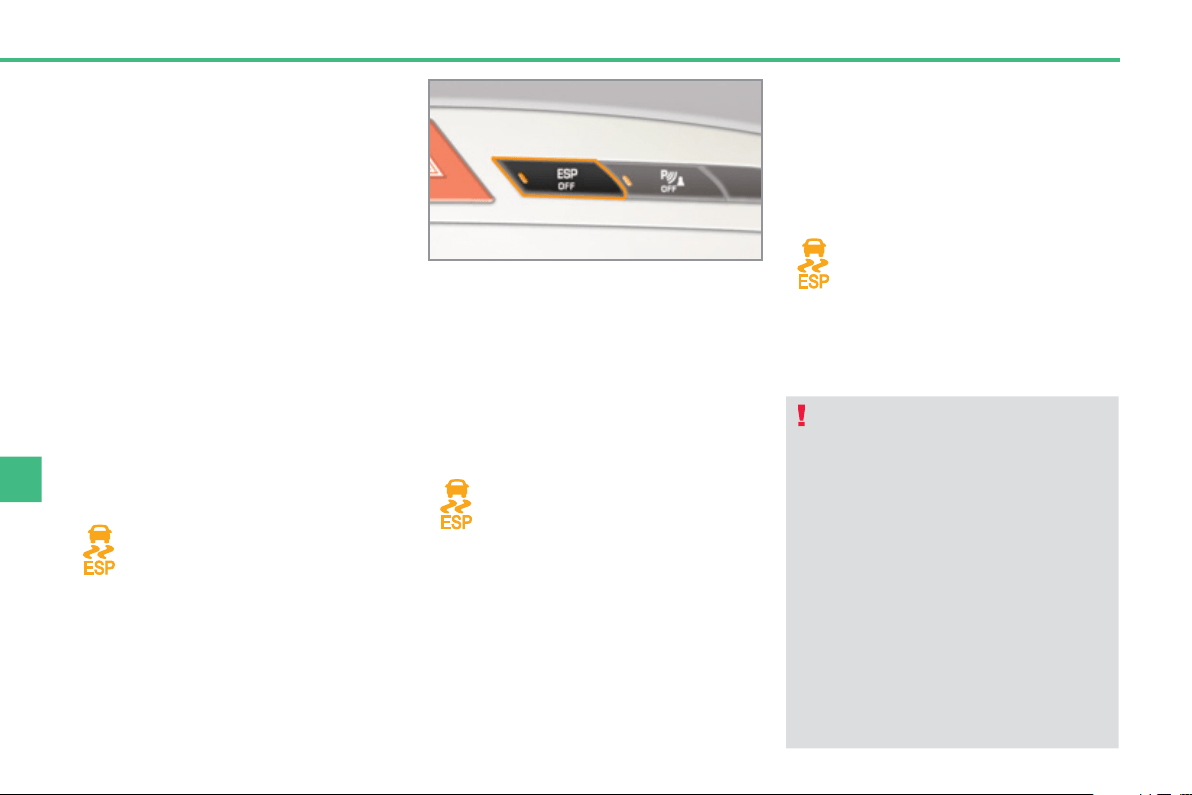
8
14
0
SAFETY
The ESP/ASR systems offer ex-
ceptional safety in normal driving,
but this should not encourage the
driver to take extra risks or drive at
high speed.
The correct functioning of these
systems depends on observation
of the manufacturer's recommen-
dations on:
- wheels (tyres and rims),
- braking components,
- electronic components,
- repair and assembly procedures.
After an impact, have these sys-
tems checked by a PEUGEOT
dealer or a qualifi ed workshop.
Deactivation
In exceptional conditions (starting a ve-
hicle which is bogged down, stuck in
snow, on soft ground, ...), it may be ad-
visable to deactivate the ASR and ESP
systems, so that the wheels can move
freely and regain grip.
) Press the "ESP OFF" button, locat-
ed in the middle of the dashboard.
If this warning lamp comes on in the
instrument panel and the indicator
lamp in the button come on, this indi-
cates that the ASR and ESP systems
are deactivated.
On vehicles fi tted with the 1.6 litre THP 200 hp
engine, this action also deactivates the auto-
matic operation of hazard warning lamps.
Reactivation
These systems are reactivated automat-
ically each time the ignition is switched
back on or from 30 mph (50 km/h) (ex-
cept in the case of the 1.6 litre THP
200 hp petrol engine).
) Press the "ESP OFF" button again
to reactivate them manually.
Operating fault
If this warning lamp comes on,
accompanied by an audible
signal and a message in the
screen, this indicates a mal-
function of these systems.
Have it checked by a PEUGEOT dealer
or a qualifi ed workshop.
T
RAJECTORY CONTROL
S
Y
S
TEM
S
Activation
These systems are activated automati-
cally each time the vehicle is started.
They come into operation in the event
of a grip or trajectory problem.
Anti-slip regulation (ASR) and
electronic stability programme
(ESP)
This is indicated by fl ashing of
this warning lamp in the instru-
ment panel.
The anti-slip regulation (also known as
Traction Control) optimises traction to
prevent skidding of the wheels, by act-
ing on the brakes of the driving wheels
and on the engine.
The electronic stability programme acts
on the brake of one or more wheels and
on the engine to keep the vehicle on the
trajectory required by the driver, within
the limits of the laws of physics.
On vehicles fi tted with the 1.6 litre THP
200 hp engine, this action also reacti-
vates the automatic operation of hazard
warning lamps.
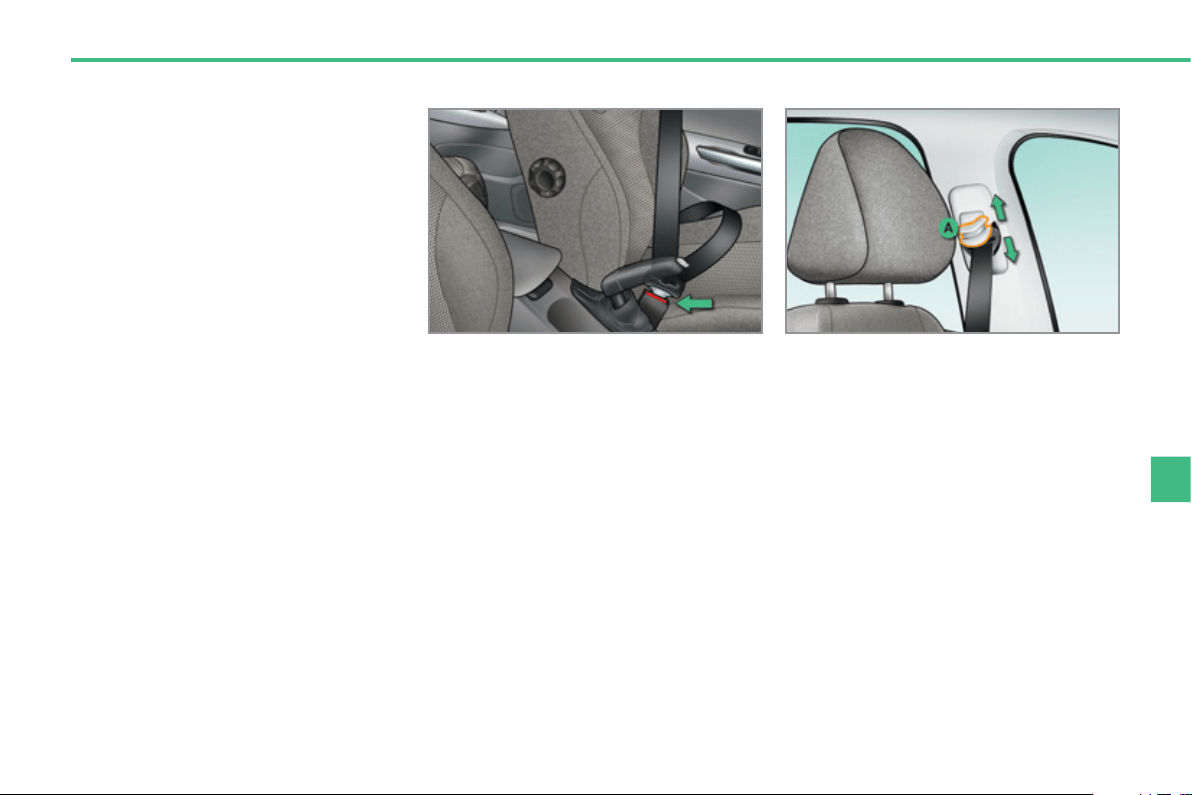
8
141
SAFETY
S
EAT BELT
S
Front seat belts
The front seat belts are fi tted with a pre-
tensioning and force limiting system.
This system improves safety in the front
seats in the event of a front or side im-
pact. Depending on the severity of the
impact, the pretensioning system in-
stantly tightens the seat belts against
the body of the occupants.
The pretensioning seat belts are active
when the ignition is on.
The force limiter reduces the pressure
of the seat belt on the chest of the occu-
pant, so improving their protection.
Fastening
Unfastening
) Press the red button on the buckle.
) Guide the seat belt as it reels in.
Height adjustment
) Pull the strap, then insert the tongue
in the buckle.
) Check that the seat belt is fastened
correctly by pulling the strap.
) To lower the attachment point,
squeeze the control A and slide it
downwards.
) To raise the attachment point, slide
the control A upwards.
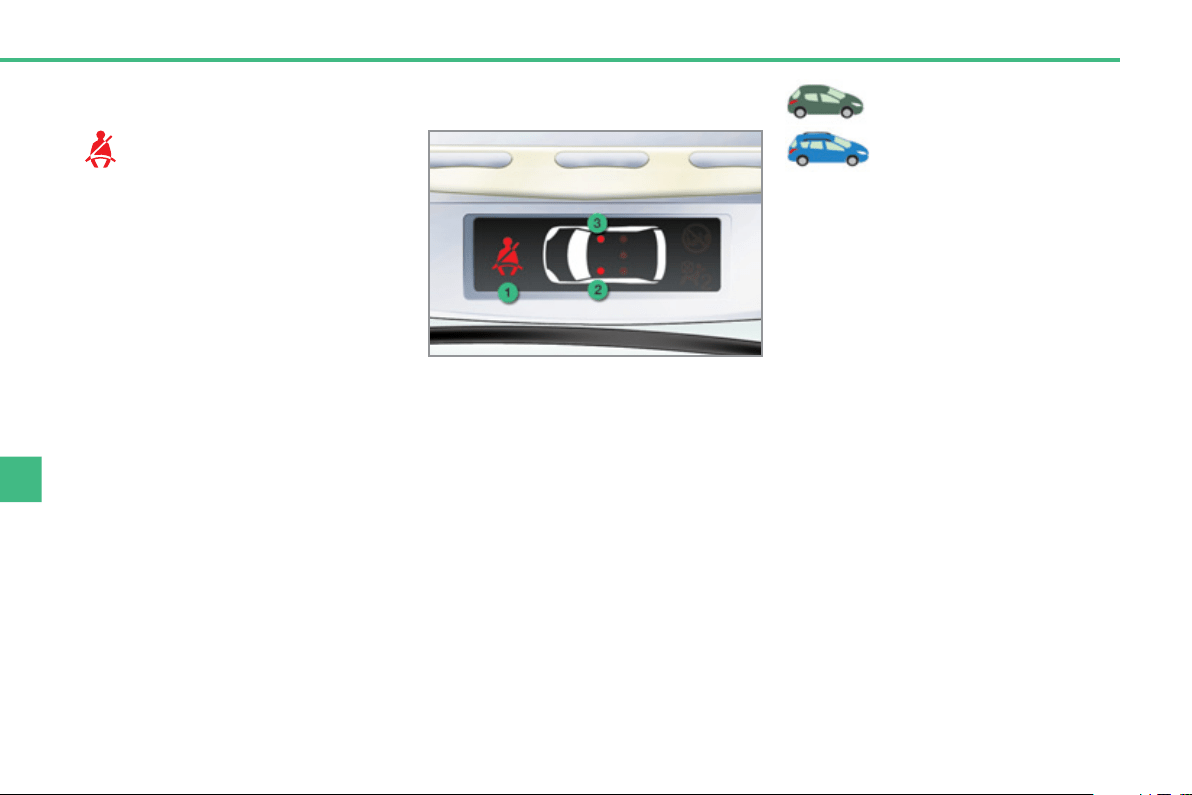
8
142
SAFETY
Seat belt not fastened / unfastened
warning lamp
When the ignition is switched
on, this warning lamp comes on,
either on the instrument panel or
on the seat belt and passenger's
front airbag warning lamps display, if the
driver and/or the front passenger has not
fastened their seat belt.
From approximately 12 mph (20 km/h)
this warning lamp fl ashes for two min-
utes accompanied by an audible signal
of increasing volume. Once these two
minutes have elapsed, this warning lamp
remains on until the driver and/or the
front passenger fastens their seat belt.
* According to version and/or country.
Seat belt not fastened / unfastened
warning lamps display
1. Front seat belts not fastened / un-
fastened warning lamp.
2. Driver's seat belt not fastened / un-
fastened warning lamp.
3. Front passenger's seat belt not fas-
tened / unfastened or unfastened
warning lamp * .
The corresponding warning lamp 2 or 3
comes on in red on the seat belt and
passenger's front airbag warning lamps
display if the seat belt is not fastened or
is unfastened.
Rear seat belts
The rear seats are each fi t-
ted with a three-point seat
belt with pretensioner and
for the side seats a force
limiter.
Fastening
) Pull the strap, then insert the tongue
in the buckle.
) Check that the seat belt is fastened
correctly by pulling the strap.
Unfastening
) Press the red button on the buckle.
) Guide the seat belt as it reels in.
) On the outer seat belts, raise the bar
to the top of the backrest to prevent
the tongue from knocking against
the side trim.

8
14
3
SAFETY
Unfastening
) Press the red button on the buckle.
) Guide the seat belt as it reels in.
) On the outer seat belts, raise the bar
to the top of the backrest to prevent
the tongue from knocking against
the side trim.
Seat belt unfastened warning lamp
This warning lamp comes on,
either on the instrument panel
or on the seat belt and pas-
senger's front airbag warning
lamps display, when one or more rear
passengers unfasten their seat belt.
From approximately 12 mph (20 km/h),
this warning lamp fl ashes for two min-
utes accompanied by an audible signal
of increasing volume. Once these two
minutes have elapsed, this warning
lamp remains on until the one or more
rear passengers fasten their seat belt.
1. Rear seat belts unfastened warning
lamp.
4. Rear right seat belt warning lamp.
5. Rear centre seat belt warning lamp.
6. Rear left seat belt warning lamp.
Seat belt unfastened warning lamps
display
When the ignition is switched on, with
the engine running or when the vehicle is
moving at less than 12 mph (20 km/h), the
corresponding warning lamps 4 , 5 and 6
come on in red for approximately 30 sec-
onds, if the seat belt is not fastened.
When the vehicle is moving at more than
12 mph (20 km/h), the corresponding
warning lamp 4 , 5 or 6 comes on in red,
accompanied by an audible signal and
a message on the multifunction screen,
if a rear passenger has unfastened their
seat belt.
2nd row rear seat belts
The rear seats are each fi t-
ted with a three-point seat
belt, with force limiter and, for the outer
seats, a pretensioner.
Fastening
) Pull the strap, then insert the tongue
in the buckle.
) Check that the seat belt is fastened
correctly by pulling the strap.
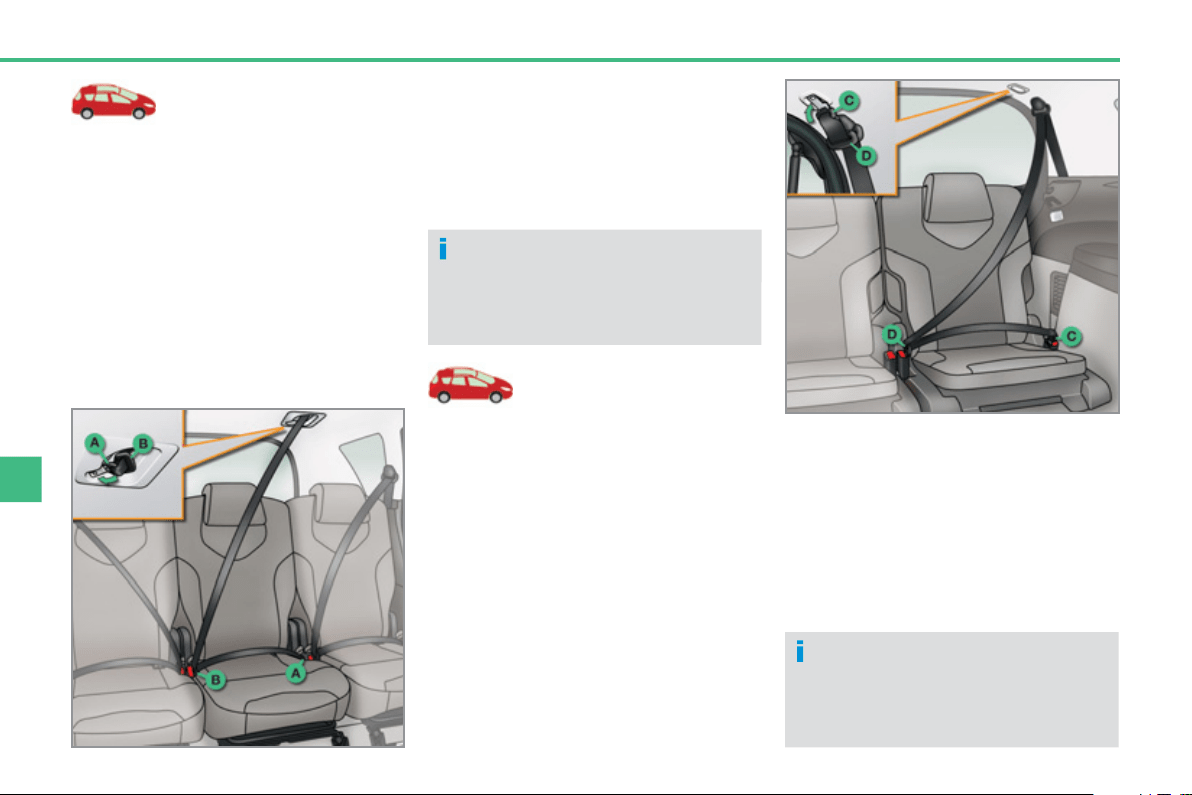
8
144
SAFETY
2nd row rear centre
seat belt
Installation
Removal and storing
) Press the red button on the buckle B ,
then on the buckle A .
) Guide the strap as it reels in and
bring the tongue B , then A onto the
magnet of the attachment point on
the roof.
3rd row rear seat belts
Installation
) Pull the strap and insert the tongue
C in the buckle, on the boot side trim
side.
) Insert the tongue D in the opposite
buckle.
) Check the fastening of each buckle
by pulling the strap.
) Pull the strap and insert the tongue
A in the left-hand buckle.
) Insert the tongue B in the right-hand
buckle.
) Check the fastening of each buckle
by pulling the strap.
The seat belts for the rear seats of the
3rd row are located at the corner of the
corresponding boot pillar and roof.
If the two outer seats of the 2nd row
are moved inwards, always use the
outer rear seat belts.
Removal and storing
) Press the red button on the buckle D ,
then on the buckle C .
) Guide the strap as it reels in and
bring the tongue D , then C onto the
magnet of the attachment point on
the corresponding boot pillar.
The seat belt for the rear centre seat of
the 2nd row is located at the rear left of
the roof.
The 3rd row of seats (SW with in-
dividual rear seats) is not fi tted
with seat belt unfastened warning
lamps.

8
14
5
SAFETY
The driver must ensure that passen-
gers use the seat belts correctly and
that they are all restrained securely
before setting off.
Wherever you are seated in the ve-
hicle, always fasten your seat belt,
even for short journeys.
Do not interchange the seat belt
buckles as they will not fulfi l their role
fully.
The seat belts are fi tted with an inertia
reel permitting automatic adjustment
of the length of the strap to your size.
The seat belt is stowed automatically
when not in use.
Before and after use, ensure that the
seat belt is reeled in correctly.
The lower part of the strap must be
positioned as low as possible on the
pelvis.
The upper part must be positioned in
the hollow of the shoulder.
The inertia reels are fi tted with an au-
tomatic locking device which comes
into operation in the event of a col-
lision, emergency braking or if the
vehicle rolls over. You can release
the device by pulling fi rmly on the
strap and releasing it so that it reels
in slightly.
In order to be effective, a seat belt
must:
- be tightened as close to the body
as possible,
- be pulled in front of you with a
smooth movement, checking that
it does not twist,
-
be used to restrain only one person,
-
not bear any trace of cuts or fraying,
- not be converted or modifi ed to
avoid affecting its performance.
In accordance with current safety
regulations, for all repairs on your
vehicle, go to a qualifi ed workshop
with the skills and equipment need-
ed, which a PEUGEOT dealer is able
to provide.
Have your seat belts checked regu-
larly by a PEUGEOT dealer or a
qualifi ed workshop, particularly if the
straps show signs of damage.
Clean the seat belt straps with soapy
water or a textile cleaning product,
sold by PEUGEOT dealers.
After folding or moving a seat or rear
bench seat, ensure that the seat belt
is positioned and reeled in correctly.
Recommendations for children
Use a suitable child seat if the pas-
senger is less than 12 years old or
shorter than one and a half metres.
Never use the same seat belt to secure
more than one person.
Never allow a child to travel on your
lap.
In the event of an impact
Depending on the nature and se-
riousness of the impact , the pre-
tensioning device may be deployed
before and independently of the
airbags. Deployment of the preten-
sioners is accompanied by a slight
discharge of harmless smoke and
a noise, due to the activation of the
pyrotechnic cartridge incorporated in
the system.
In all cases, the airbag warning lamp
comes on.
Following an impact, have the seat belts
system checked, and if necessary re-
placed, by a PEUGEOT dealer or a
qualifi ed workshop.
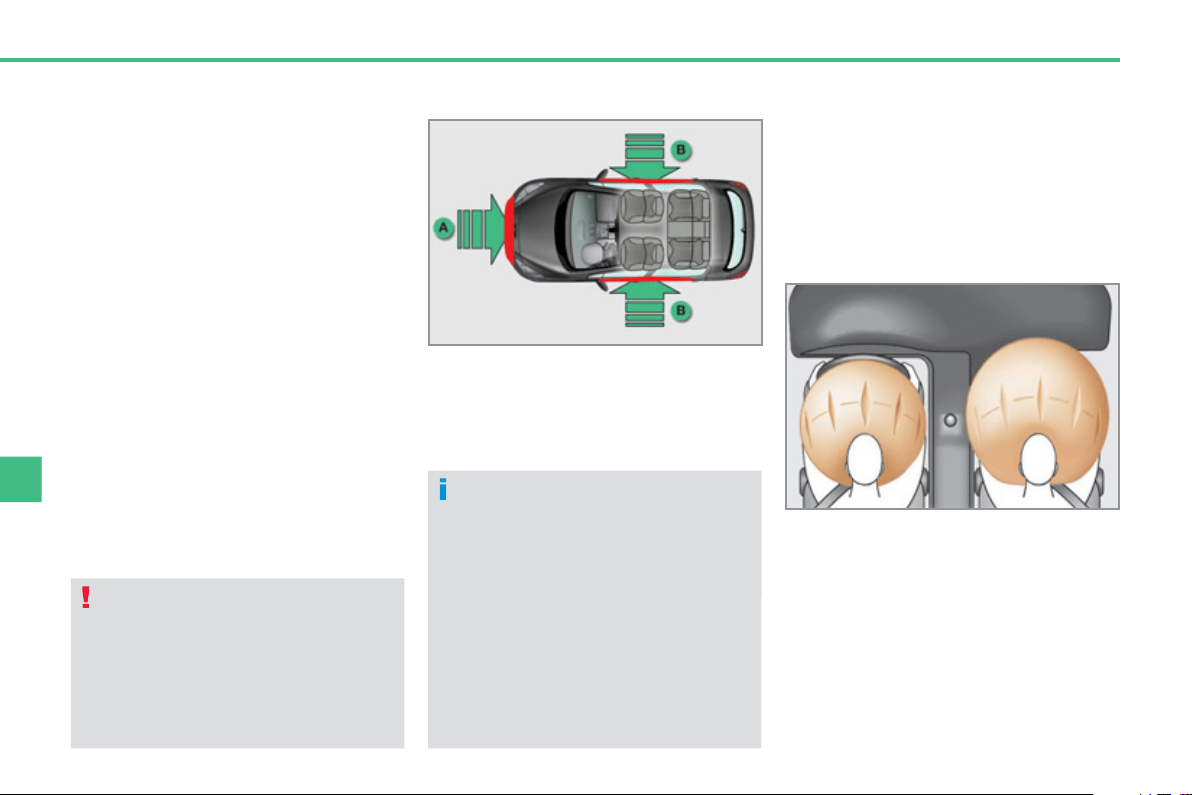
8
14
6
SAFETY
AIRBAG
S
Deployment of the airbag(s) is ac-
companied by a slight emission of
harmless smoke and a noise, due
to the activation of the pyrotechnic
cartridge incorporated in the sys-
tem.
This smoke is not harmful, but sen-
sitive individuals may experience
slight irritation.
The noise of the detonation may
result in a slight loss of hearing for
a short time.
Front airbags
System which protects the driver and
front passenger in the event of a seri-
ous front impact in order to limit the risk
of injury to the head and thorax.
The driver's airbag is fi tted in the centre
of the steering wheel; the front passen-
ger's airbag is fi tted in the dashboard
above the glove box.
Deployment
The airbags are deployed simultaneously,
unless the passenger's front airbag is deac-
tivated, in the event of a serious front impact
to all or part of the front impact zone A , in the
longitudinal centreline of the vehicle on a hori-
zontal plane and directed from the front to the
rear of the vehicle.
The front airbag infl ates between the tho-
rax and head of the front occupant of the
vehicle and the steering wheel, driver's
side, and the dashboard, passenger's side
to cushion their forward movement.
Impact detection zones
A. Front impact zone.
B. Side impact zone.
The airbags do not operate when
the ignition is switched off.
This equipment will only deploy
once. If a second impact occurs
(during the same or a subsequent
accident), the airbag will not be de-
ployed again.
System designed to maximise the safety
of the occupants (with the exception of
the rear centre passenger) in the event
of violent collisions. It supplements the
action of the force-limiting seat belts
(with the exception of the rear centre
passenger).
If a collision occurs, the electronic de-
tectors record and analyse the front and
side impacts sustained in the impact
detection zones:
- in the case of a serious impact, the
airbags are deployed instantly and
protect the occupants of the vehicle
(with the exception of the rear centre
passenger); immediately after the
impact, the airbags defl ate rapidly
so that they do not hinder visibility
or the exit of the occupants,
- in the case of a minor or rear impact
or in certain roll-over conditions, the
airbags will not be deployed; the
seat belt alone is suffi cient to pro-
vide optimum protection in these
situations.
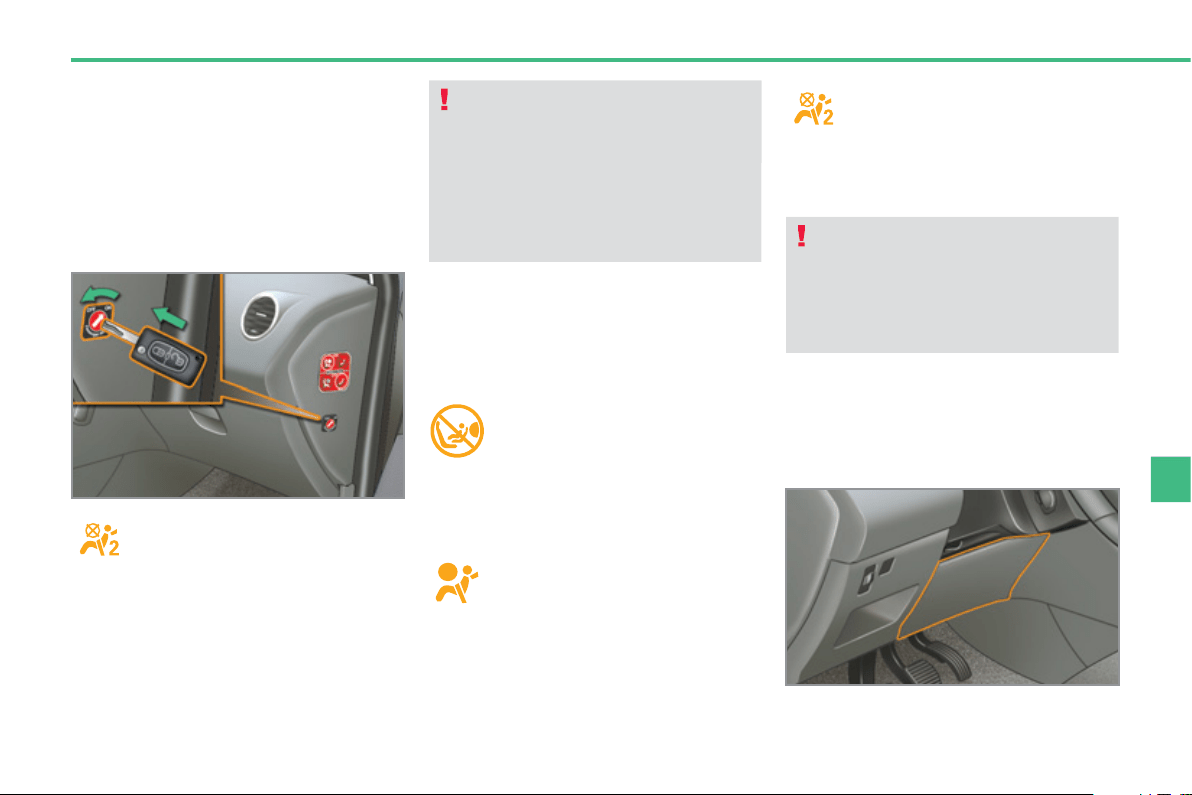
8
147
SAFETY
If even one of the two airbag warn-
ing lamps comes on continuously,
do not install a child seat on the
front passenger seat.
Have the system checked by a
PEUGEOT dealer or a qualifi ed
workshop.
Operating fault
If this warning lamp comes on in
the instrument panel, accompa-
nied by an audible warning and
a message in the screen, con-
tact a PEUGEOT dealer or a qualifi ed
workshop to have the system checked.
The airbags may no longer be deployed
in the event of a serious impact.
Knee airbag *
System which protects the driver's
knees in the event of a serious front im-
pact.
This airbag is fi tted in the dashboard
below the steering column.
Deployment
It is deployed at the same time as the
front airbags.
Reactivation
When you remove the child seat, turn
the switch to the "ON" position to re-
activate the airbag and so assure the
safety of your front passenger in the
event of an impact.
With the ignition on, this warn-
ing lamp comes on in the seat
belt and passenger's front airbag
warning lamps display for ap-
proximately one minute, if the passenger's
front airbag is activated.
To assure the safety of your child,
the passenger's front airbag must
be deactivated when you install a
"rear facing" child seat on the front
passenger seat.
Otherwise, the child would risk be-
ing seriously injured or killed if the
airbag were deployed.
According to version, this warning
lamp comes on in the instrument
panel and/or in the seat belt and
passenger's front airbag warning
lamps display when the ignition is on and
until the airbag is reactivated.
If this warning lamp fl ashes in
the instrument panel and/or in
the seat belt and passenger's
front airbag warning lamps dis-
play, contact a PEUGEOT dealer or a
qualifi ed workshop. The passenger's
front airbag may no longer be deployed
in the event of a serious impact.
Deactivation
Only the passenger's front airbag can
be deactivated:
) with the ignition off , insert the key
in the passenger airbag deactivation
switch,
) turn it to the "OFF" position,
) then, remove the key keeping the
switch in the new position.
* According to country.
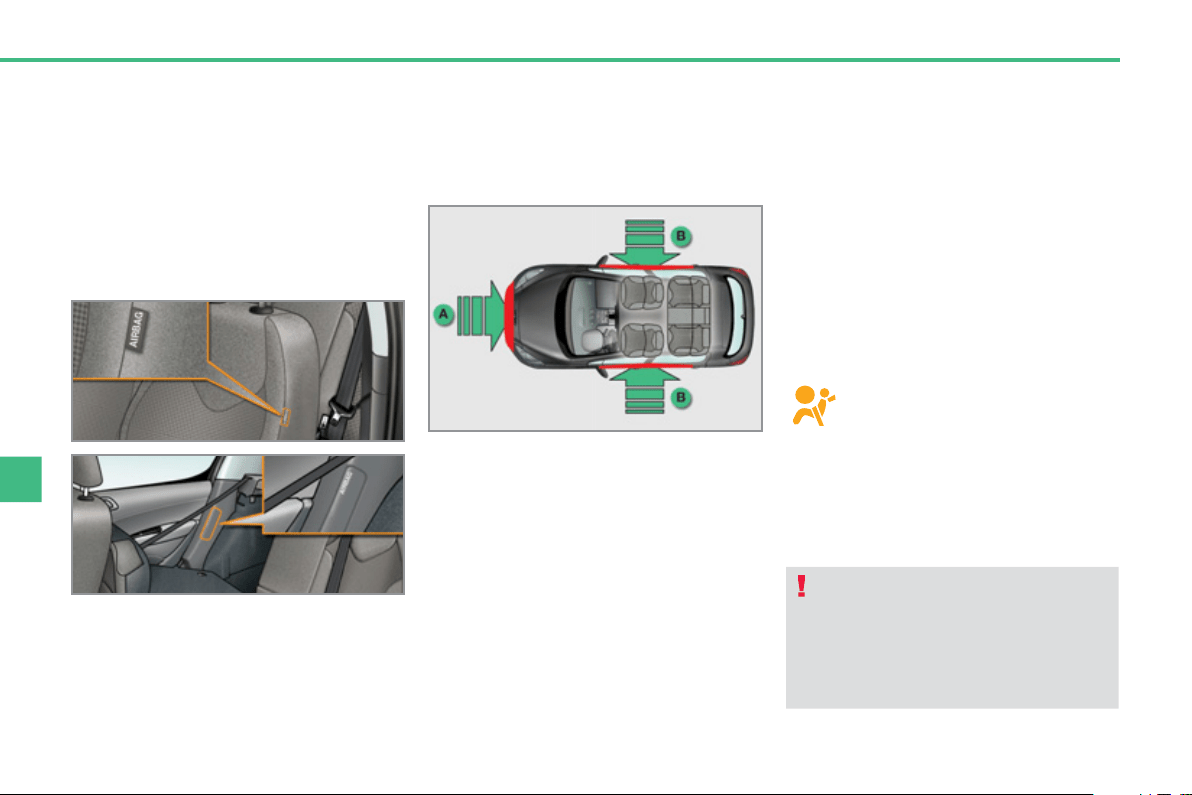
8
14
8
SAFETY
Lateral airbags
System which protects the driver and
passengers (with the exception of the
rear centre passenger) in the event of a
serious side impact in order to limit the
risk of injury to the chest.
Each lateral airbag is fi tted:
- in the front, in the seat back frame,
on the door side,
- in the rear, in the side trim (except
SW models).
Deployment
The lateral airbags are deployed unilater-
ally in the event of a serious side impact
applied to all or part of the side impact
zone B , perpendicular to the longitudinal
centreline of the vehicle on a horizontal
plane and directed from the outside to-
wards the inside of the vehicle.
Curtain airbags
System which protects the driver and
passengers (with the exception of the
rear centre passenger) in the event of a
serious side impact in order to limit the
risk of injury to the side of the head.
Each curtain airbag is built into the pillars
and the upper passenger compartment
area.
Operating fault
Deployment
The curtain airbag is deployed at the same
time as the corresponding lateral airbag in
the event of a serious side impact applied
to all or part of the side impact zone B , per-
pendicular to the longitudinal centreline of
the vehicle on a horizontal plane and di-
rected from the outside towards the inside
of the vehicle.
The curtain airbag infl ates between the
front or rear occupant of the vehicle and
the windows.
In the event of a minor impact or
bump on the side of the vehicle or
if the vehicle rolls over, the airbag
may not be deployed.
In the event of a rear or front colli-
sion, the airbag is not deployed.
Impact detection zones
A. Front impact zone.
B. Side impact zone.
If this warning lamp comes on
in the instrument panel, accom-
panied by an audible signal and
a message in the screen, con-
tact a PEUGEOT dealer or a qualifi ed
workshop to have the system checked.
The airbags may no longer be deployed
in the event of a serious impact.
The lateral airbag infl ates between the
front or rear occupant of the vehicle and
the corresponding door trim panel.

8
14
9
SAFETY
For the airbags to be fully
effective, observe the following
safety rules:
Sit in a normal upright position.
Wear a correctly adjusted seat belt.
Do not leave anything between the
occupants and the airbags (a child,
pet, object...). This could hamper the
operation of the airbags or injure the
occupants.
* According to country.
Knee airbag *
Do not sit with your knees any nearer to the steering wheel than necessary.
Lateral airbags
Use only approved covers on the seats, compatible with the deployment the
lateral airbags. For information on the range of seat covers suitable for your
vehicle, you can contact a PEUGEOT dealer (see "Practical information - § Ac-
cessories").
Do not fi x or attach anything to the seat backs (clothing...). This could cause
injury to the chest or arms if the lateral airbag is deployed.
Do not sit with the upper part of the body any nearer to the door than necessary.
Curtain airbags
Do not fi x or attach anything to the roof. This could cause injury to the head if
the curtain airbag is deployed.
If fi tted on your vehicle, do not remove the grab handles installed on the roof,
they play a part in securing the curtain airbags.
After an accident or if the vehicle has
been stolen or broken into, have the
airbag systems checked.
All work on the airbag system must
be carried out by a PEUGEOT dealer
or a qualifi ed workshop.
Even if all of the precautions men-
tioned are observed, a risk of injury
or of minor burns to the head, chest
or arms when an airbag is deployed
cannot be ruled out. The bag infl ates
almost instantly (within a few mil-
liseconds) then defl ates within the
same time discharging the hot gas
via openings provided for this pur-
pose.
Front airbags
Do not drive holding the steering wheel by its spokes or resting your hands on
the centre part of the wheel.
Passengers must not place their feet on the dashboard.
If possible, do not smoke as deployment of the airbags can cause burns or the
risk of injury from a cigarette or pipe.
Never remove or pierce the steering wheel or hit it violently.
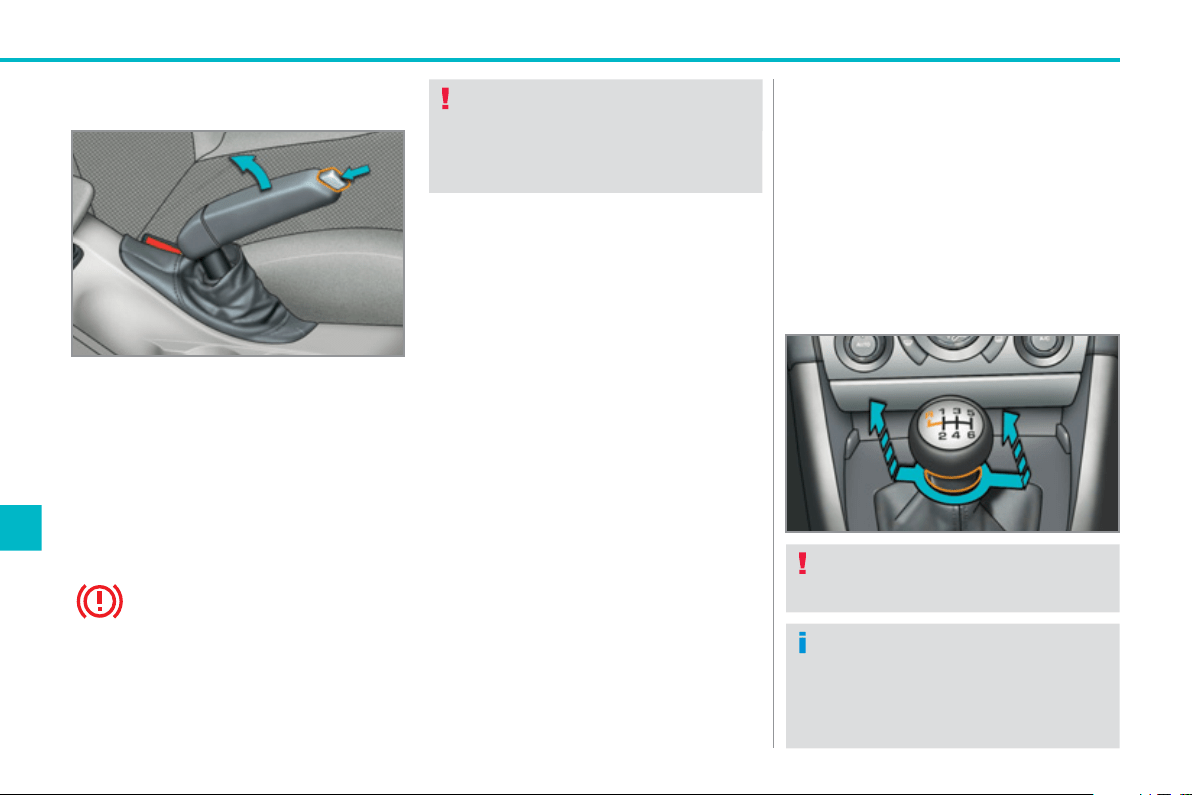
9
1
50
DRIVING
When parking on a slope, direct
your wheels against the pavement,
apply the parking brake and en-
gage a gear.
P
ARKING BRAKE
Applying
) Pull the parking brake lever fully up
to immobilise your vehicle.
When the vehicle is being driven,
if this warning lamp and the STOP
warning lamp come on, accom-
panied by an audible signal and a
message on the multifunction screen, this
indicates that the parking brake is still on or
has not been properly released.
Releasing
) Pull the parking brake lever gently,
press the release button then lower
the lever fully.
6-
S
PEED MANUAL GEARBOX
Engaging 5
th
or 6
th
gear
) Move the lever fully to the right to
engage 5
th
or 6
th
gear.
Engaging reverse gear
) Raise the ring under the knob and
move the gear lever to the left then
forwards.
Only engage reverse gear when
the vehicle is stationary with the
engine at idle.
As a safety precaution and to facili-
tate starting of the engine:
- always select neutral,
- press the clutch pedal.
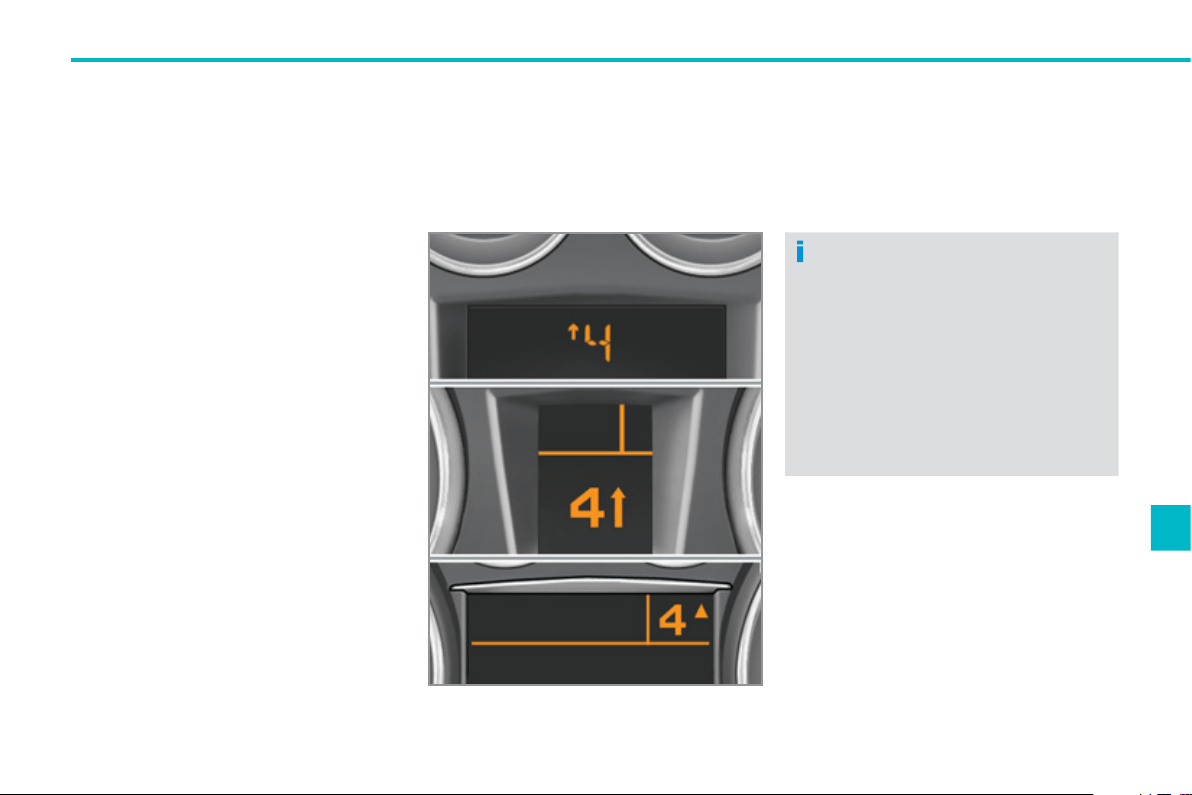
9
1
51
DRIVING
G
EAR
S
HIFT INDICATOR *
System which reduces fuel consump-
tion by advising the driver to change up
on vehicles fi tted with a manual gear-
box.
Operation
The system intervenes only when driving
economically.
Depending on the driving situation and
your vehicle's equipment, the system
may advise you to skip one or more
gears. You can follow this instruc-
tion without engaging the intermediate
gears.
The gear engagement recommenda-
tions must not be considered compulso-
ry. In fact, the confi guration of the road,
the amount of traffi c and safety remain
determining factors when choosing the
best gear. Therefore, the driver remains
responsible for deciding whether or not to
follow the advice given by the system.
This function cannot be deactivated.
* According to engine.
Example:
- You are in third gear.
- You press the accelerator pedal
moderately.
- The system may suggest that you
engage a higher gear, if appropriate.
The information appears in the instru-
ment panel in the form of an arrow ac-
companied by the suggested gear.
In the case of driving which makes
particular demands on the per-
formance of the engine (fi rm pres-
sure on the accelerator pedal, for
example, when overtaking...), the
system will not recommend a gear
change.
The system never suggests:
- engaging fi rst gear,
- engaging reverse gear,
- engaging a lower gear.
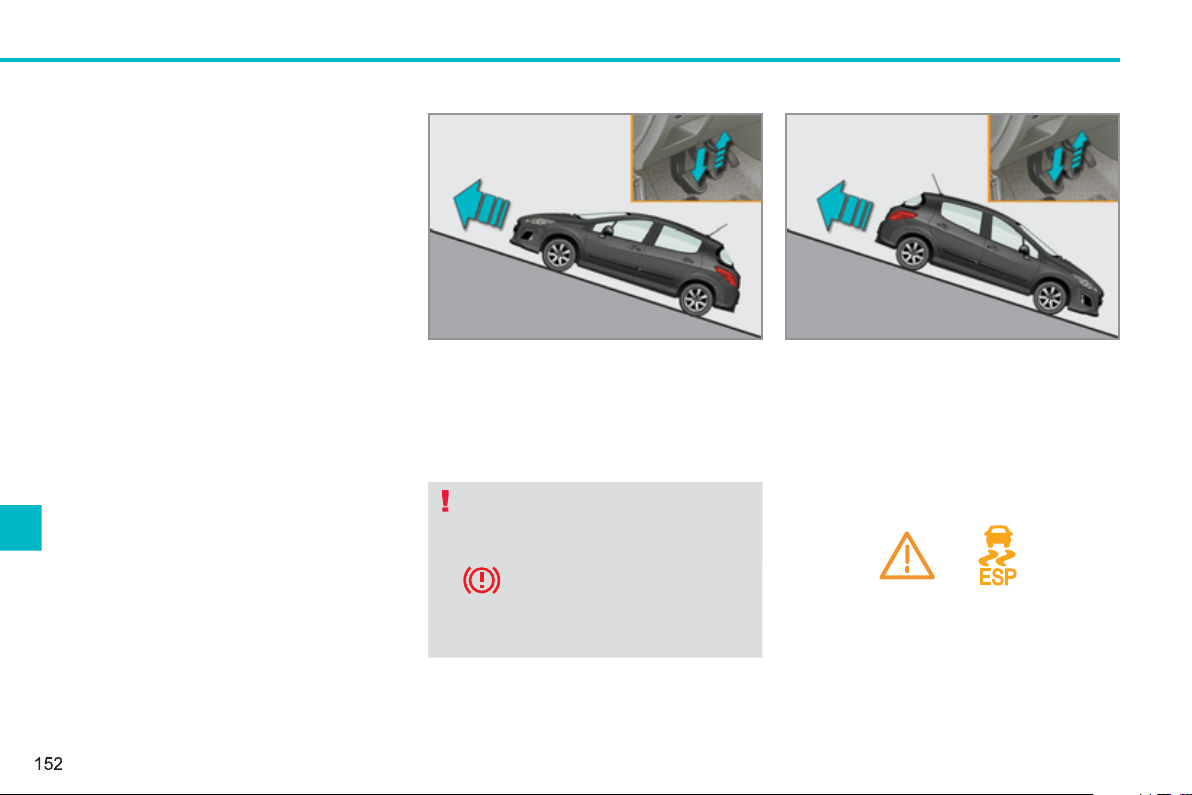
9
DRIVING
H
ILL
S
TART A
SS
I
S
T *
System which keeps your vehicle im-
mobilised temporarily (approximately
2 seconds) when starting on a gradi-
ent, the time it takes to move your foot
from the brake pedal to the accelerator
pedal.
This function is only active when:
- the vehicle is completely stationary,
with your foot on the brake pedal,
- in particular conditions on a slope,
- with the driver’s door closed.
The hill start assist cannot be deacti-
vated.
On an ascending slope, with the ve-
hicle stationary, the vehicle is held
for a brief moment when you release
the brake pedal and you are in fi rst
gear or neutral.
Operation
On a descending slope, with the ve-
hicle stationary and reverse gear en-
gaged, the vehicle is held for a brief
moment when you release the brake
pedal.
* Model fi tted with the 1.6 litre THP 200 hp
petrol engine.
Do not exit the vehicle while it is
being held in the hill start assist
phase.
Operating fault
If a malfunction of the system occurs,
these warning lamps come on. Have
it checked by a PEUGEOT dealer or a
qualifi ed workshop.
If you need to exit the vehi-
cle with the engine running,
apply the parking brake
and ensure that this warn-
ing lamp in the instrument
panel is on fi xed.
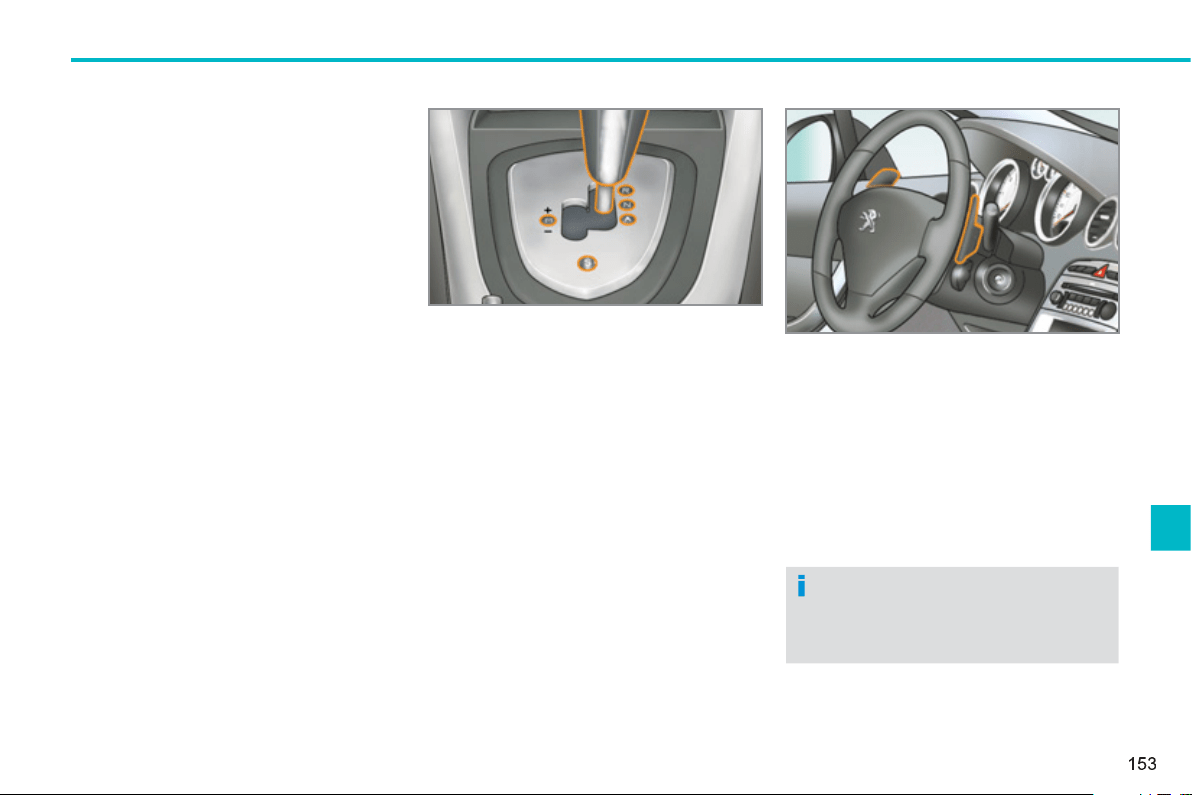
9
DRIVING
6-
S
PEED ELECTRONIC GEAR
CONTROL GEARBOX
Gear lever
R. Reverse
) With your foot on the brake, move
the lever upwards to select this posi-
tion.
N. Neutral.
) With your foot on the brake, select
this position to start.
A. Automated mode.
) Move the lever downwards to select
this mode.
M + / -. Sequential mode with manual
changing of the gears.
) Move the lever downwards then to
the left to select this mode, then:
- push the lever forwards to change
up a gear,
- or pull the lever rearwards to
change down a gear.
S. Sport function.
) Press this button to activate or de-
activate this function.
Steering mounted control paddles
+. Change up control paddle to the
right of the steering wheel.
) Press the back of the "+" steering
wheel control paddle to change up a
gear.
-. Change down control paddle to the
left of the steering wheel.
) Press the back of the "-" steer-
ing wheel control paddle to change
down a gear.
The steering wheel control pad-
dles do not permit the selection of
neutral or engaging or disengaging
reverse gear.
Six-speed electronic gear control gear-
box which offers a choice between the
comfort of automated operation or the
pleasure of manual gear changing.
Two driving modes are offered:
- automated mode for automatic
control of the gears by the gearbox,
without any action on the part of the
driver,
- manual mode for sequential chang-
ing of the gears by the driver using
the gear lever or steering mounted
control paddles.
With each of these two modes, a Sport
function is available for a more dynamic
style of driving.
With the automated mode, you can tem-
porarily take control of gear changing at
any time.
This gearbox provides you with additional
functions:
- hill start assist,
- creep * (movement of the vehicle on
releasing the brake pedal) in auto-
mated mode or reverse.
* Model fi tted with the 1.6 litre e-HDi
PEF 112 hp Diesel engine.

9
1
54
DRIVING
Displays in the instrument panel
Gear lever positions
Moving off
N. Neutral
R. Reverse
1 2 3 4 5 6. Gears in sequential mode
AUTO. This comes on when the au-
tomated mode is selected. It
switches off on changing to
manual mode.
S. Sport (Sport function)
) Select position N .
) Press the brake pedal down fully.
) Start the engine.
)
Select automated mode (position A ),
manual mode (position M ) or reverse
(position R ).
) Release the parking brake.
) Progressively release the brake
pedal.
Vehicles with the 1.6 litre e-HDi PEF
112 hp Diesel engine then start to
move.
) Accelerate away.
AUTO and 1 , 1 or R appear in the in-
strument panel screen.
N fl ashes in the instrument panel,
accompanied by an audible signal
and a message in the screen, if the
gear lever is not in position N on
starting.
Automated mode
) Select position A .
Never select neutral N while the
vehicle is moving.
The gearbox operates in auto-active
mode, without any action on the part
of the driver. It continuously selects the
most suitable gear for:
- optimum fuel consumption,
- the style of driving,
- the profi le of the road,
- the vehicle load.
For optimum acceleration, for example
when overtaking another vehicle, press
the accelerator pedal fi rmly past the
point of resistance.
N appears in the instrument
panel screen.
An audible signal is heard when
reverse gear is engaged.
AUTO and the gear engaged
appear in the instrument panel
screen.
The Foot on the brake
pedal warning lamp comes
on, accompanied by an au-
dible signal and a message, if the
brake pedal is not pressed on start-
ing the engine
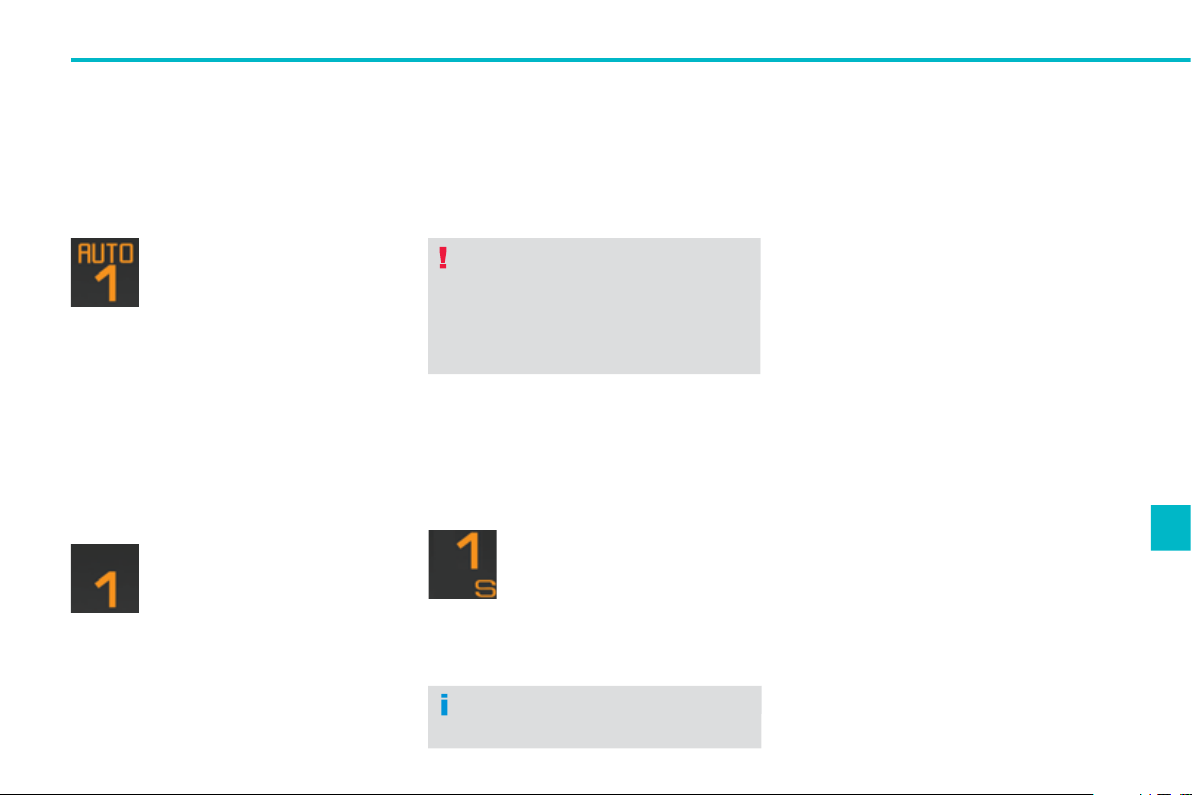
9
1
55
DRIVING
Temporary manual control of gear
changing
You can temporarily take over control
of gear changing using the steering
mounted "+" and "-" control paddles: if
the engine speed allows, the request to
change gear is accepted.
AUTO and the gear engaged
is displayed in the instrument
panel.
When braking or slowing down, the
gearbox changes down automatically
so that the vehicle picks up in the cor-
rect gear.
On sharp acceleration, the gearbox will
not change up unless the driver acts on
the gear lever or the steering mounted
control paddles.
The gears engaged appear in
succession in the instrument
panel screen.
Manual mode
) Select position M .
Sport function
) Following selection of the manual
mode or automated mode, press
button S to activate the Sport func-
tion which offers you a more dynam-
ic style of driving.
Never select neutral N when the
vehicle is moving.
It is possible to change mode at
any time, by moving the gear lever
from A to M or from M to A .
This function allows you to anticipate
certain situations such as overtaking
another vehicle or approaching a bend.
After a few moments without any ac-
tion on the control paddles, the gearbox
starts managing gear changes auto-
matically again.
S appears next to the gear en-
gaged in the instrument panel
screen.
) Press button S again to deactivate
the function.
S is then cleared from the instrument
panel screen.
Reverse
To engage reverse, the vehicle must be
stationary, with your foot on the brake
pedal.
) Select position R .
At very low speed, if reverse gear is re-
quested, this will only be taken into ac-
count when the vehicle is immobilised.
The Foot on the brake pedal warning
lamp comes on in the instrument panel
to encourage you to brake.
At high speed, if reverse gear is re-
quested, the N indicator lamp will fl ash
and the gearbox will change to neutral
automatically. To engage a gear again,
return the lever to position A or M .
The gear change requests are only car-
ried out if the engine speed permits.
It is not necessary to release the accel-
erator during gear changes.
Hill start assist
This function allows temporary immobi-
lisation of your vehicle.
It maintains the pressure of the brakes
briefl y, long enough for you to move
your foot from the brake pedal to the
accelerator pedal.
It comes into operation if the vehicle is
immobilised by pressing the brake ped-
al and depending on the gradient:
- on an ascending gradient, with the
vehicle stationary, gear lever in po-
sition A or M , the vehicle is held
briefl y when the brake pedal is re-
leased,
- on a descending gradient, with the
vehicle stationary, gear lever in po-
sition R , the vehicle is held briefl y
when the brake pedal is released.
The Sport function is deactivated
each time the ignition is switched
off.
9
PRND
1
56
DRIVING
Creep function *
This function makes manoeuvring the
vehicle much easier at low speeds
(when parking, in traffi c jams…).
After fi rst placing the gear lever in posi-
tion A , M or R , the vehicle starts moving
as soon as you take your foot off the
brake pedal.
When the engine is idling, brakes
released, if position A , M or R is
selected, the vehicle moves even if
you do not press the accelerator.
Never leave unsupervised children in
the vehicle with the engine running.
Do not hold the vehicle using the
accelerator: use the foot brake or
the parking brake.
Never leave the vehicle during a
hill start assist phase.
* Model fi tted with the 1.6 litre e-HDi
PEF 112 hp Diesel engine.
Stopping the vehicle
Before switching off the engine, you can:
- move to position N to select neutral,
or
- leave the gear engaged; in this case
the vehicle cannot be moved.
In both cases, it is essential that you ap-
ply the parking brake to immobilise the
vehicle.
Operating fault
When immobilising the vehicle,
with the engine running, you must
place the gear lever in neutral N .
Before carrying out any work in the
engine compartment, check that
the gear lever is in neutral N and
that the parking brake is applied.
With the ignition on, if this warn-
ing lamp comes on and AUTO
fl ashes, accompanied by an
audible signal and a message
in the screen, this indicates a malfunc-
tion of the gearbox.
Have it checked by a PEUGEOT dealer
or a qualifi ed workshop.
This warning lamp may also come on if
a door is opened.
With the ignition on, if the warn-
ing lamp above and this warning
lamp come on, accompanied
by an audible signal and a mes-
sage in the screen, this indicates a mal-
function of the hill start assist system.
Have it checked by a PEUGEOT dealer
or a qualifi ed workshop.
It is essential to press the brake
pedal when starting the engine.
When parking, is it essential to ap-
ply the parking brake to immobilise
the vehicle, whatever the circum-
stances.
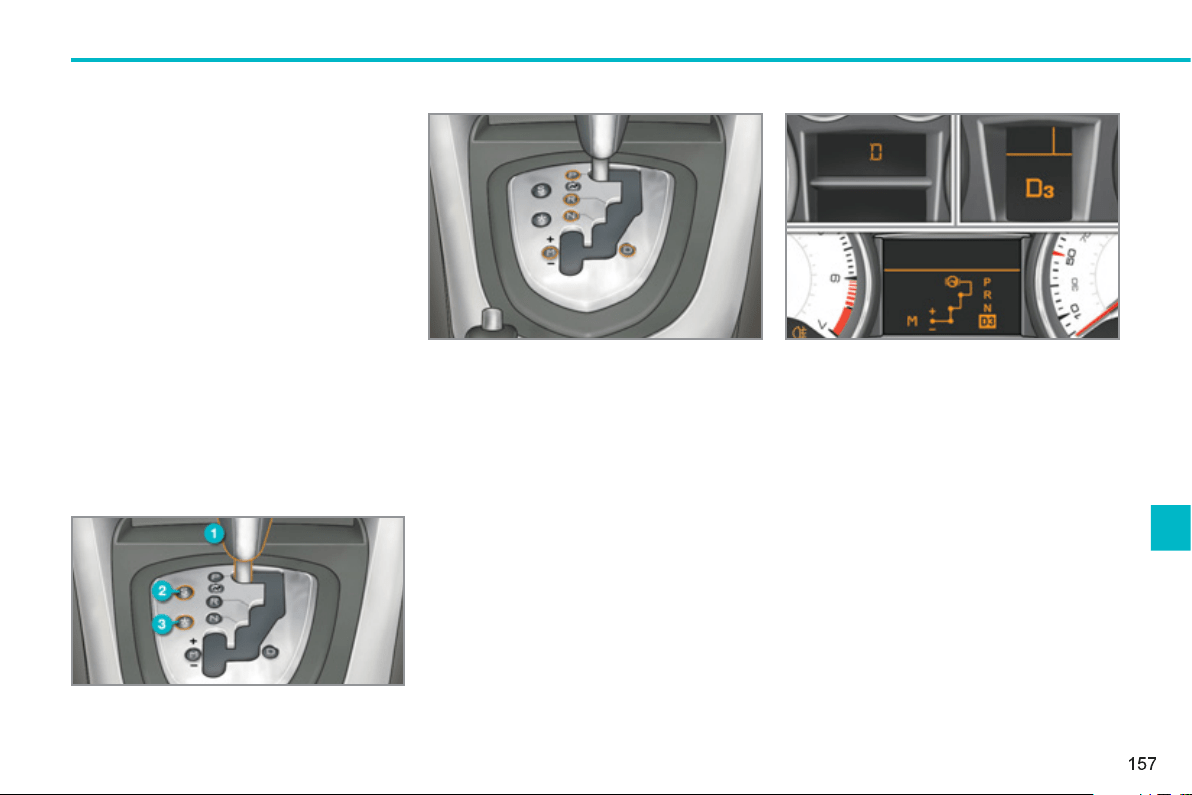
9
DRIVING
"
POR
S
CHE TIPTRONIC
S
Y
S
TEM" AUTOMATIC
G
EARBOX
Gear lever
P. Park.
- Immobilisation of the vehicle, parking
brake on or off.
- Starting the engine.
R. Reverse.
- Reversing manoeuvres, vehicle sta-
tionary, engine at idle.
N. Neutral.
- Immobilisation of the vehicle, parking
brake on.
- Starting the engine.
D. Automatic operation.
M.+ / - Manual operation with sequential
changing of the four or six gears.
) Push forwards to change up through
the gears.
or
) Pull rearwards to change down
through the gears.
Displays in the instrument panel
When you move the lever in the gate
to select a position, the corresponding
indicator is displayed in the instrument
panel.
P. Park
R. Reverse
N. Neutral
D. Drive (Automatic driving)
S. Sport programme
7 . Snow programme
1 to 4. Gear engaged during
1 to 6. manual operation
-. Invalid value during manual operation
Gear selection gate
1. Gear lever.
2. Button " S " (sport) .
3. Button " 7 " (snow) .
Four or six speed automatic gearbox
which offers a choice between the comfort
of fully automatic operation, enhanced by
sport and snow programmes, or manual
gear changing.
Two driving modes are provided:
- automatic operation for electronic
management of the gears by the
gearbox, with a sport programme
to give a more dynamic driving style
and a snow programme for im-
proved driving in conditions of poor
grip.
- manual operation for sequential
changing of the gears by the driver.
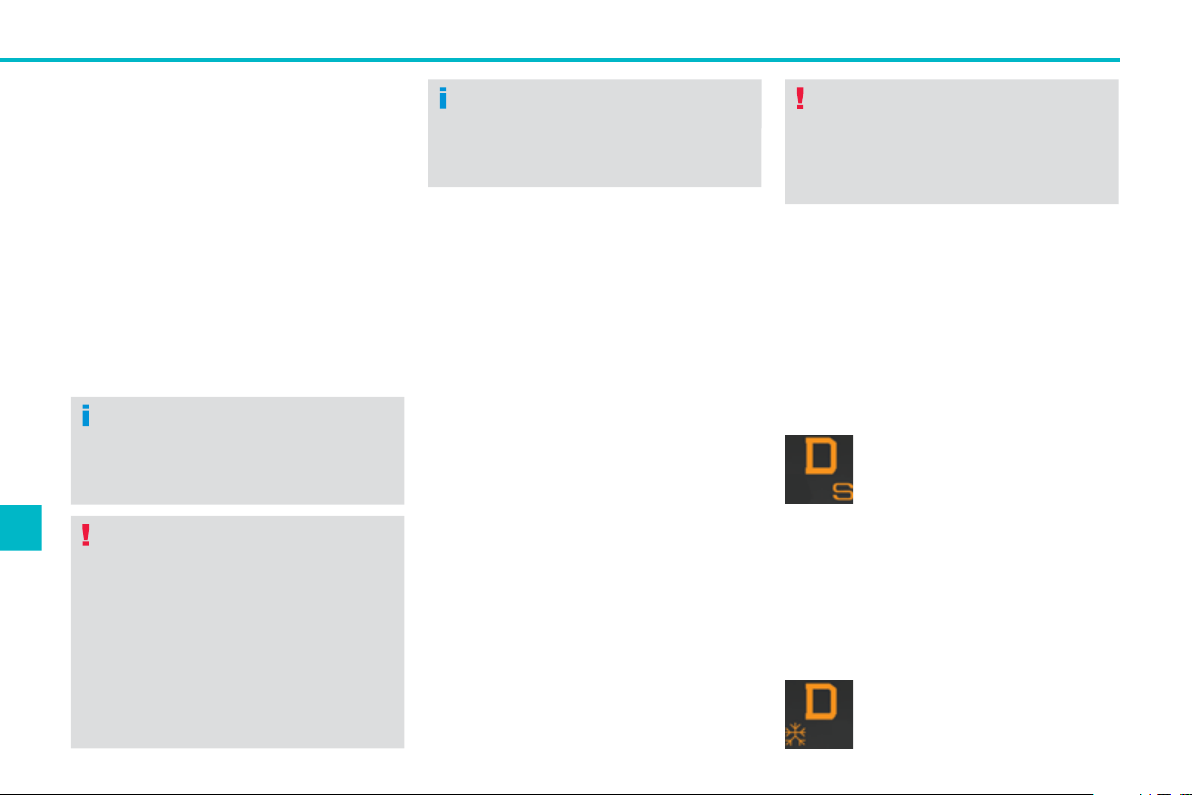
9
1
58
DRIVING
Moving off
) Apply the parking brake.
) With your foot in the brake pedal,
select position P or N .
) Start the engine.
If this procedure is not followed, there
is an audible signal, accompanied by a
message in the screen.
) With the engine running, press the
brake pedal .
) Release the parking brake.
) Select position R , D or M ,
) Gradually release the brake pedal.
The vehicle moves off immediately.
If position N is engaged inadvert-
ently while driving, allow the en-
gine to return to idle then engage
position D to accelerate.
When the engine is running at
idle, with the brakes released, if
position R , D or M is selected, the
vehicle moves even without the
accelerator being pressed.
When the engine is running, never
leave children in the vehicle with-
out supervision.
When carrying out maintenance with
the engine running, apply the parking
brake and select position P .
A message appears if you try to
move the gear lever from posi-
tion P to another position without
pressing the brake pedal.
Automatic operation
) Select position D for automatic
changing of the four or six gears.
The gearbox then operates in auto-
adaptive mode, without any intervention
on the part of the driver. It continuously
selects the most suitable gear accord-
ing to the style of driving, the profi le of
the road and the load in the vehicle.
For maximum acceleration without
touching the lever, press the accelera-
tor pedal down fully (kick down). The
gearbox changes down automatically
or maintains the gear selected until the
maximum engine speed is reached.
On braking, the gearbox changes down
automatically to provide effi cient engine
braking.
If you release the accelerator sharply,
the gearbox will not change to a higher
gear for safety reasons.
Never select position N while the
vehicle is moving.
Never select positions P or R unless
the vehicle is completely stationary.
Sport and snow programmes
These two special programmes supple-
ment the automatic operation in very
specifi c conditions of use.
"S" Sport programme
) Press button "S" , after starting the
engine.
The gearbox automatically favours a
dynamic style of driving.
Snow programme " 7 "
) Press button " 7 ", after starting the
engine.
The gearbox adapts to driving on slip-
pery roads.
This programme improves starting and
drive when grip is poor.
S appears in the instrument
panel.
7 appears in the instrument panel.
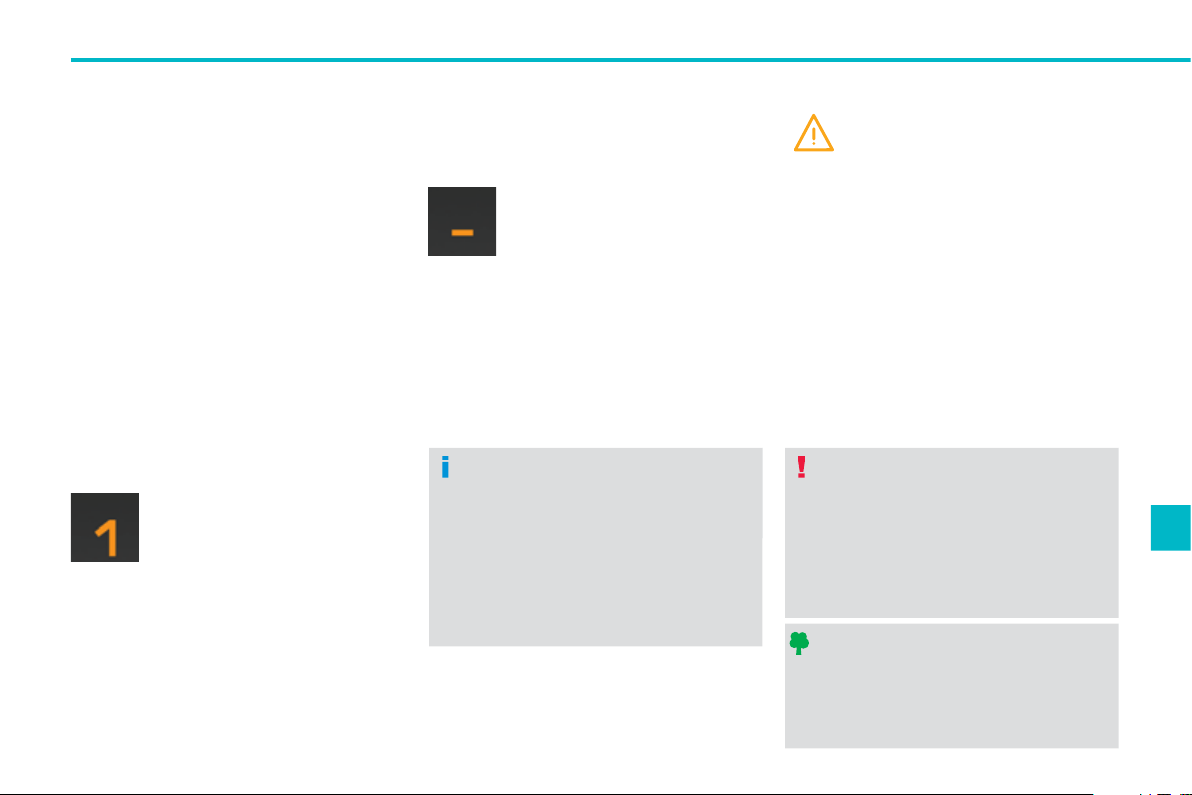
9
PRND
1
59
DRIVING
To limit fuel consumption when sta-
tionary for long periods with the en-
gine running (traffi c jam...), place the
gear lever in position N and apply
the parking brake.
Return to standard automatic
operation
) At any time, press the button select-
ed again to quit the programme en-
gaged and return to auto-adaptive
mode.
Manual operation
) Select position M for sequential
changing of the four or six gears.
) Push the lever towards the + sign to
change up a gear.
) Pull the lever towards the - sign to
change down a gear.
It is only possible to change from one
gear to another if the vehicle speed and
engine speed permit; otherwise, the
gearbox will operate temporarily in au-
tomatic mode.
D disappears and the gears
engaged appear in succes-
sion on the instrument panel.
If the engine speed is too low or too
high, the gear selected fl ashes for a few
seconds, then the actual gear engaged
is displayed.
It is possible to change from position D
(automatic) to position M (manual) at
any time.
When the vehicle is stationary or mov-
ing very slowly, the gearbox selects
gear M1 automatically.
The sport and snow programmes do not
operate in manual mode.
Invalid value during manual
operation
This symbol is displayed if a
gear is not engaged correctly
(selector between two posi-
tions).
Stopping the vehicle
Before switching off the engine, you
can engage position P or N to place the
gearbox in neutral.
In both cases, apply the parking brake
to immobilise the vehicle.
If the lever is not in position P ,
when the driver's door is opened or
approximately 45 seconds after the
ignition is switched off, an audible
signal is heard and a message ap-
pears in the screen.
) Return the lever to position P ;
the audible signal stops and the
message disappears.
Operating fault
There is a risk of damage to the
gearbox:
- if you press the accelerator and
brake pedals at the same time,
- if you force the lever from posi-
tion P to another position when
the battery is fl at.
When the ignition is on, the
lighting of this warning lamp, ac-
companied by an audible signal
and a message in the screen,
indicates a gearbox fault.
In this case, the gearbox switches
to emergency mode and is locked in
3rd gear. You may feel a substantial
knock when changing from P to R and
from N to R . This will not cause any
damage to the gearbox.
Do not exceed a speed of 60 mph
(100 km/h), local speed restrictions per-
mitting.
Have it checked by a PEUGEOT dealer
or a qualifi ed workshop.
This warning lamp may also come on if
a door is opened.
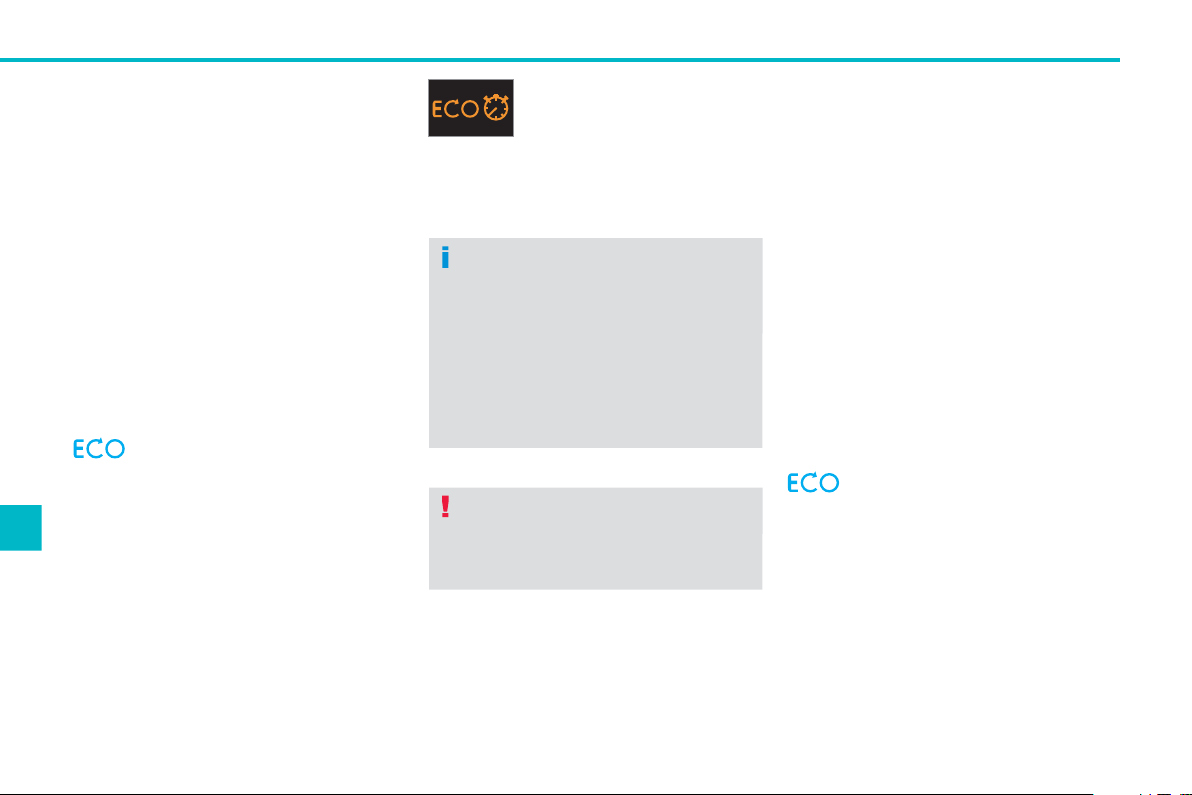
9
1
60
DRIVING
STOP & START
The Stop & Start system puts the engine
temporarily on standby - STOP mode -
during stops in the traffi c (red lights, traf-
fi c jams, or other...). The engine restarts
automatically - START mode - as soon as
you want to move off. The restart takes
place instantly, quickly and silently.
Perfect for urban use, the Stop & Start
system reduces fuel consumption and
exhaust emissions as well as the noise
level when stationary.
Operation
Going into engine STOP mode
The "ECO" warning lamp comes
on in the instrument panel and the
engine goes into standby:
- with a manual gearbox , at speeds
below 12 mph (20 km/h), when you
put the gear lever into neutral and
release the clutch pedal,
- with the 6-speed electronic gear
control gearbox , at a speed below
5 mph (8 km/h), when you press the
brake pedal or put the gear lever
into position N .
If your vehicle is fi tted with
the system, a time counter
calculates the sum of the
periods in STOP mode dur-
ing a journey. It rests itself to
zero every time the ignition
is switched on with the key.
With the automatic gearbox system,
for your comfort during parking ma-
noeuvres, STOP mode is not avail-
able for a few seconds after coming
out of reverse gear.
STOP mode does not affect the
functionality of the vehicle, such as
braking, power steering, for example.
Never refuel with the engine in
STOP mode; you must switch off
the ignition with the key.
Special cases: STOP mode
unavailable
STOP mode is not invoked when:
- the driver's door is open,
- the driver's seat belt is not fastened,
- the vehicle has not exceeded 6 mph
(10 km/h) since the last engine start
using the key,
- the engine is needed to maintain a
comfortable temperature in the pas-
senger compartment,
- demisting is on,
- some special conditions (battery
charge, engine temperature, braking
assistance, ambient temperature...)
where the engine is needed to as-
sure control of a system.
In this case, the "ECO" warning
lamp fl ashes for a few seconds,
then goes off.
This operation is perfectly normal.
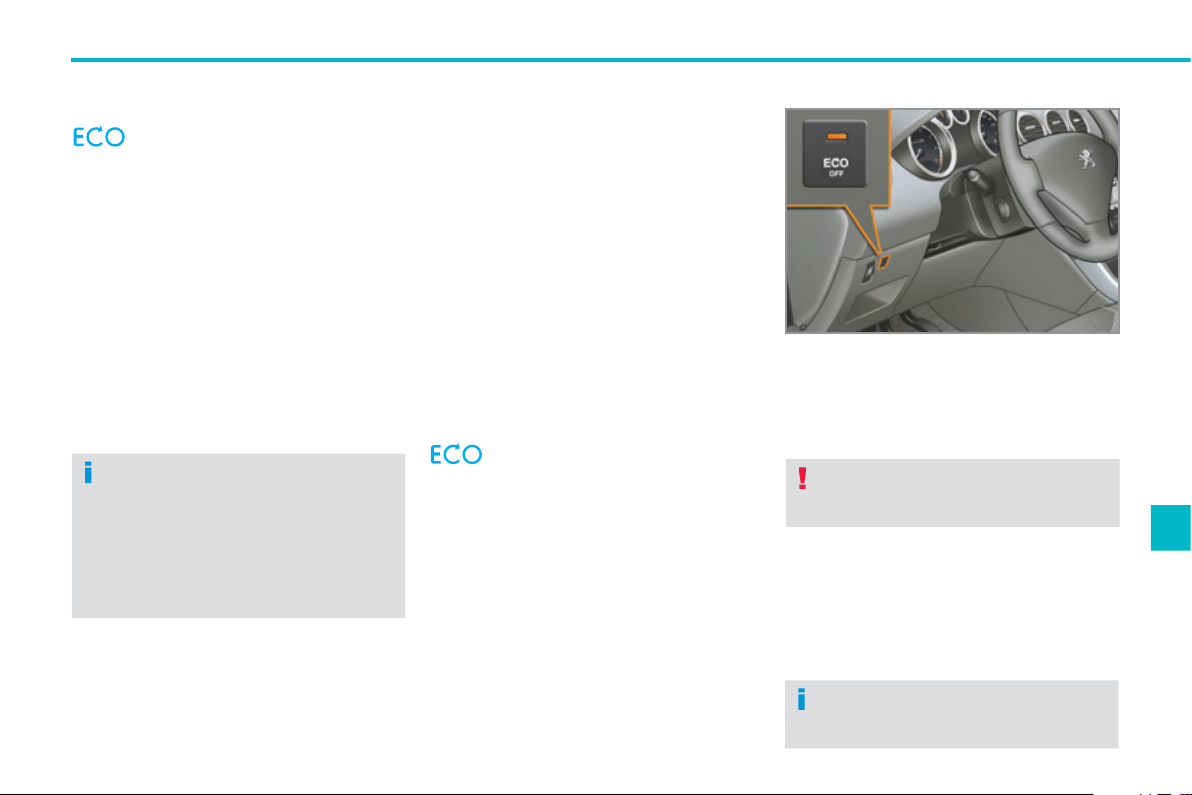
9
1
61
DRIVING
Going into engine START mode
The "ECO" warning lamp goes
off and the engine starts:
- with a manual gearbox , when you
fully depress the clutch pedal,
- with the 6-speed electronic gear
control gearbox :
● gear lever in position A or M , when
you release the brake pedal,
● or gear lever in position N and the
brake pedal released, when you
move the gear lever to position A
or M ,
● or when you engage reverse gear.
Special cases: START invoked
automatically
For your safety and comfort, START is
invoked automatically when:
- you open the driver's door,
- you unfasten the driver's seat belt,
- the speed of the vehicle exceeds
15 mph (25 km/h) with a manual
gearbox or 7 mph (11 km/h) with the
6-speed electronic gearbox system,
- some special conditions (battery
charge, engine temperature, braking
assistance, ambient temperature...)
where the engine is needed to as-
sure control of a system.
In this case the "ECO" warning
lamp fl ashes for few seconds,
then goes off.
This operation is perfectly normal.
Deactivation
If the system has been deactivated
in STOP mode, the engine restarts
immediately.
At any time, press the "ECO OFF" switch
to deactivate the system.
This is confi rmed by the switch warn-
ing lamp coming on accompanied by a
message in the screen.
Reactivation
Press the "ECO OFF" switch again.
The system is active again; this is confi rmed
by the switch warning lamp going off and a
message in the instrument panel.
The system is reactivated auto-
matically at every new start using
the key.
With a manual gearbox in STOP
mode, if a gear is engaged without
fully depressing the clutch pedal, a
warning lamp comes on or a mes-
sage is displayed asking you to de-
press the clutch pedal to restart the
engine.
9
1
62
DRIVING
Operating fault
In the event of a malfunction with the
system, the "ECO OFF" switch warning
lamp fl ashes, then comes on continu-
ously.
have it checked by a PEUGEOT dealer
or a qualifi ed workshop.
In the event of a fault in STOP mode,
the vehicle may stall. All of the warning
lamps in the instrument panel come on.
It is then necessary to switch off the ig-
nition and start the engine again using
the key.
Maintenance
Before working under the bonnet,
deactivate the Stop & Start system
to avoid any risk of injury resulting
from automatic operation of START
mode.
This system requires a specifi c battery
with a special specifi cation and techno-
logy (reference numbers available from
a PEUGEOT dealer or a qualifi ed work-
shop).
Fitting a battery not listed by PEUGEOT
introduces the risk of malfunction of the
system.
The Stop & Start system makes use
of advanced technology. All work on
this type of battery must be done
only by a PEUGEOT dealer or a
qualifi ed workshop.
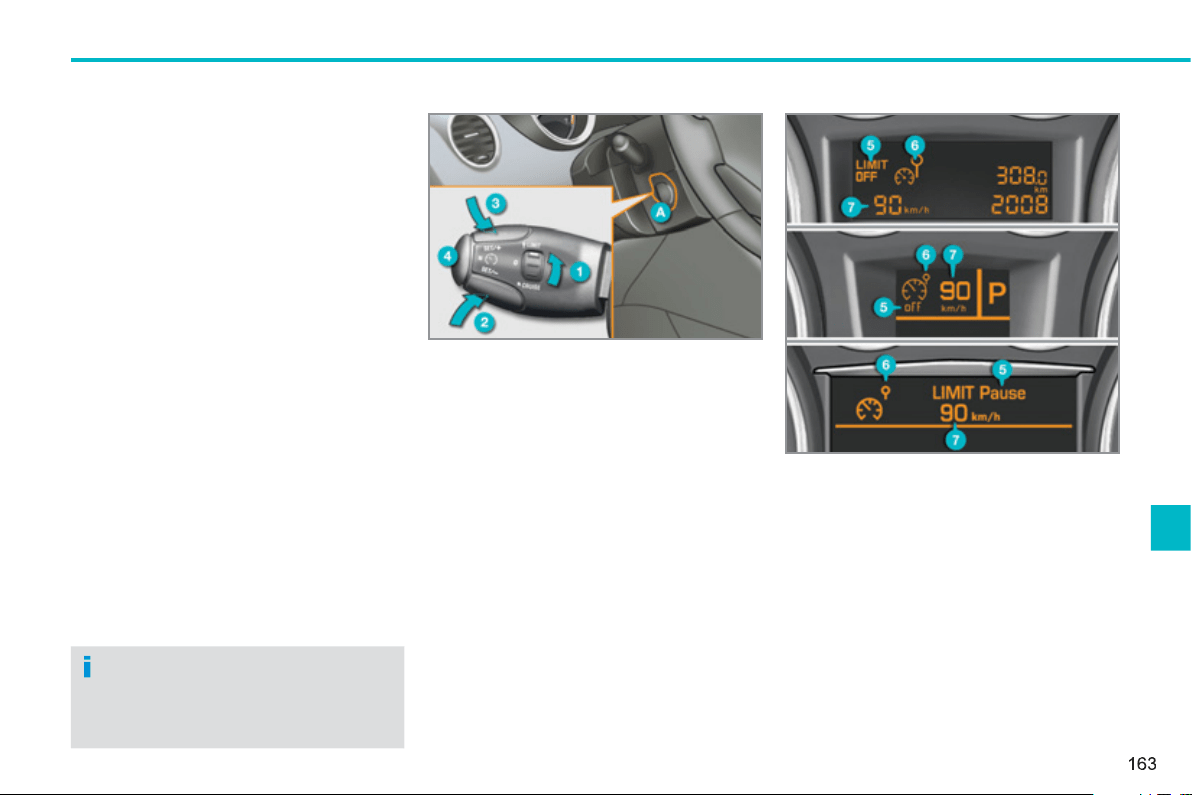
9
DRIVING
S
PEED LIMITER
System which prevents the vehicle from
exceeding the speed programmed by
the driver.
When the programmed speed limit is
reached, pressing the accelerator pedal
no longer has any effect.
The controls of this system are grouped
together on stalk A .
1. Speed limiter mode selection dial
2. Value decrease button
3. Value increase button
4. Speed limiter on / off button
The programmed information is grouped
together on the instrument panel screen.
5. Speed limiter on / off indication
6.
Speed limiter mode selection indication
7. Programmed speed value
Steering mounted controls Displays in the instrument panel
The speed limiter cannot, in any
circumstances, replace the need to
respect speed limits, nor can it re-
place the need for vigilance and re-
sponsibility on the part of the driver.
The speed limiter is switched on manu-
ally: it requires a programmed speed of
at least 20 mph (30 km/h).
The speed limiter is switched off by
manual operation of the control.
The programmed speed can be exceed-
ed temporarily by pressing the accelera-
tor fi rmly.
To return to the programmed speed,
simply slow down to a speed below the
programmed speed.
The programmed speed remains in the
memory when the ignition is switched
off.
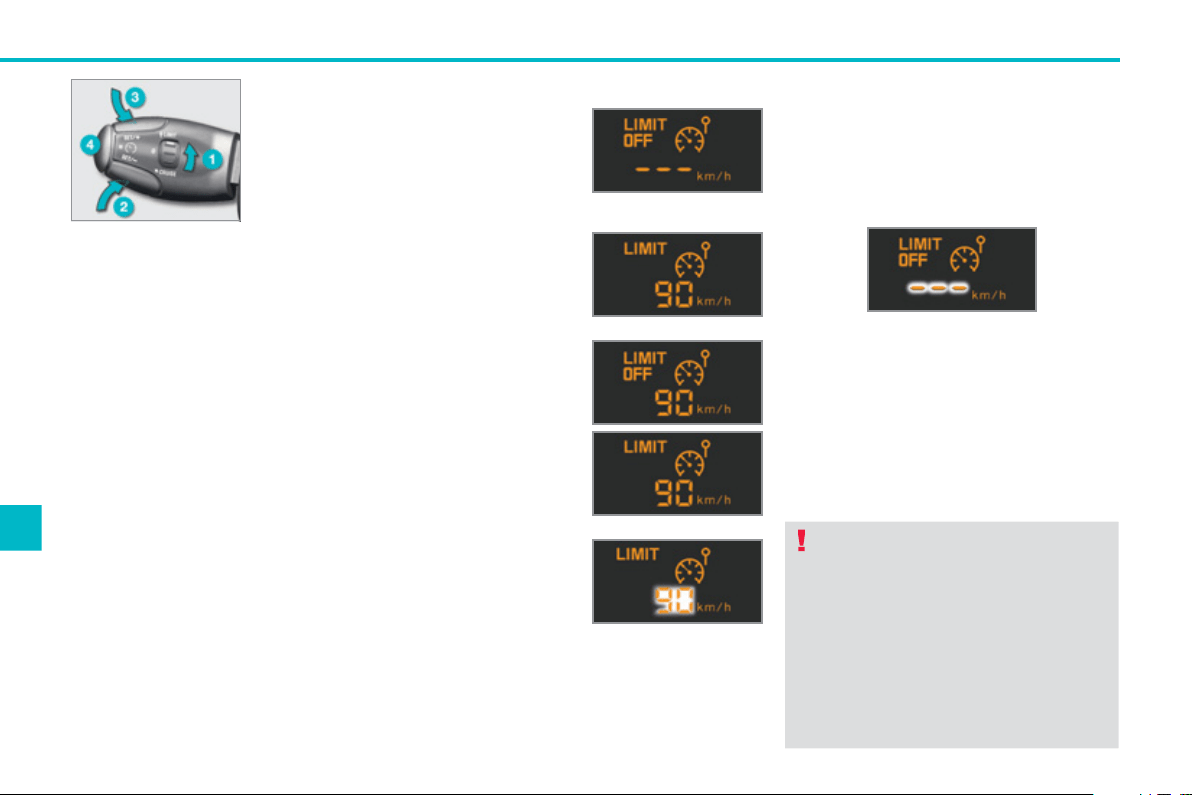
9
1
64
DRIVING
On a steep descent or in the event
of sharp acceleration, the speed
limiter will not be able to prevent
the vehicle from exceeding the pro-
grammed speed.
To avoid any risk of jamming of the
pedals:
- ensure that the mat is posi-
tioned correctly,
-
do not fi t one mat on top of another.
Programming
) Turn dial 1 to the "LIMIT" position:
the speed limiter mode is selected
but is not switched on (OFF).
You do not have to switch the speed
limiter on in order to set the speed.
Exceeding the programmed speed
Pressing the accelerator pedal to exceed the programmed
speed will not have any effect unless you press the pedal
fi rmly past the point of resistance .
The speed limiter is deactivated temporarily and the pro-
grammed speed, which is still displayed, fl ashes.
Returning to the programmed speed, by means of intentional or
unintentional deceleration of the vehicle, automatically cancels
the fl ashing of the programmed speed.
Return to normal driving
) Turn dial 1 to the "0" position: the speed limiter mode is
deselected. The display returns to the distance recorder.
Operating fault
In the event of a speed limiter malfunc-
tion, the speed is cleared resulting in
fl ashing of the dashes.
Have it checked by a PEUGEOT dealer
or a qualifi ed workshop.
) Switch the speed limiter off by pressing button 4 : the dis-
play confi rms that it has been switched off (OFF).
) Switch the speed limiter back on by pressing button 4
again.
) Set the speed value by pressing button 2 or 3 (e.g.: 55 mph
(90 km/h)).
You can then change the programmed speed using buttons 2
and 3 :
- by + or - 1 mph (km/h) = short press,
- by + or - 5 mph (km/h) = long press,
- in steps of + or - 5 mph (km/h) = maintained press.
) Switch the speed limiter on by pressing button 4 .
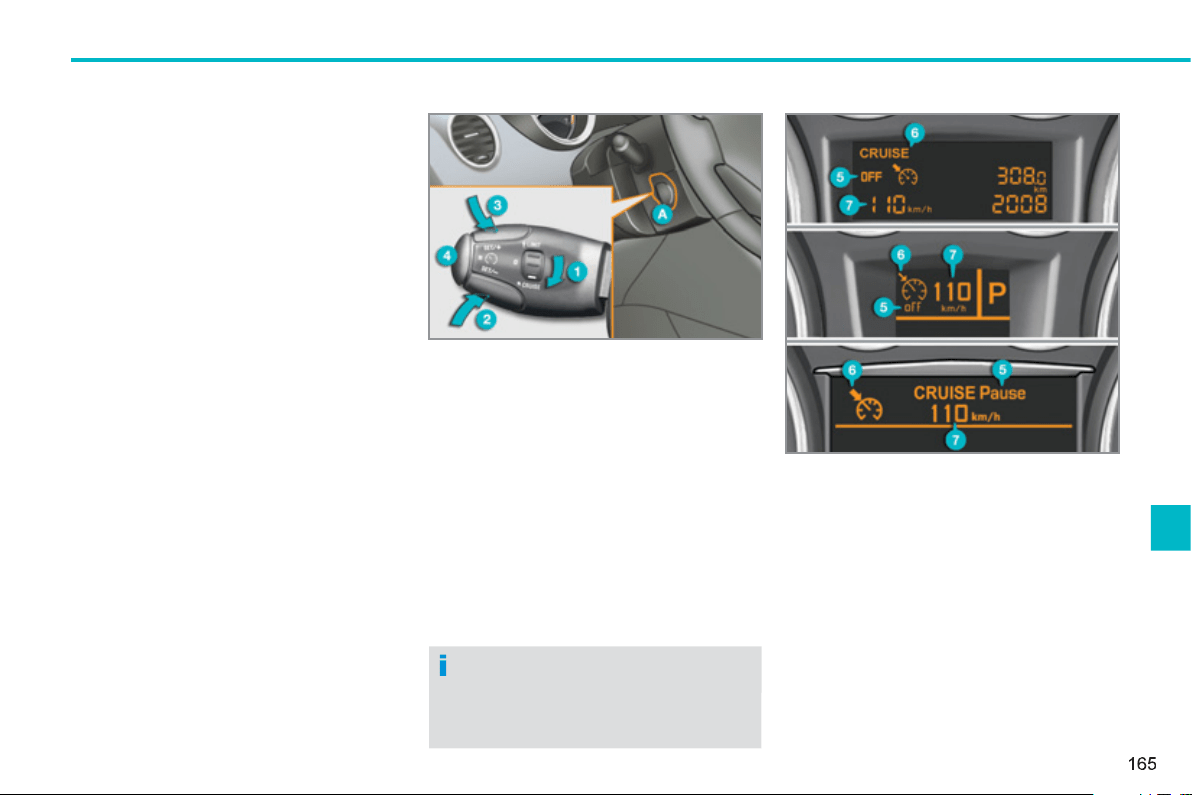
9
DRIVING
CRUI
S
E CONTROL
System which automatically maintains
the speed of the vehicle at the value
programmed by the driver, without any
action on the accelerator pedal.
The cruise control is switched on
manually: it requires a minimum vehicle
speed of 25 mph (40 km/h) and the en-
gagement of:
- fourth gear on the manual gearbox,
- second gear in sequential mode on
the electronic gear control gearbox
or automatic gearbox,
- position A on the electronic gear
control gearbox or D on the auto-
matic gearbox.
The controls of this system are grouped
together on stalk A .
1. Cruise control mode selection dial
2. Speed programming / programmed
value decrease button
3. Speed programming / programmed
value increase button
4. Cruise control off / resume button
The programmed information is grouped
together in the instrument panel screen.
5. Cruise control off / resume indication
6. Cruise control mode selection indi-
cation
7. Programmed speed value
Steering mounted controls Displays in the instrument panel
The cruise control cannot, in any
circumstances, replace the need to
observe speed limits, nor can it re-
place the need for vigilance and re-
sponsibility on the part of the driver.
The cruise control is switched off man-
ually or by pressing the brake or clutch
pedal or on triggering of the ESP sys-
tem for safety reasons.
It is possible to exceed the programmed
speed temporarily by pressing the ac-
celerator pedal.
To return to the programmed speed,
simply release the accelerator pedal.
Switching off the ignition cancels any
programmed speed value.
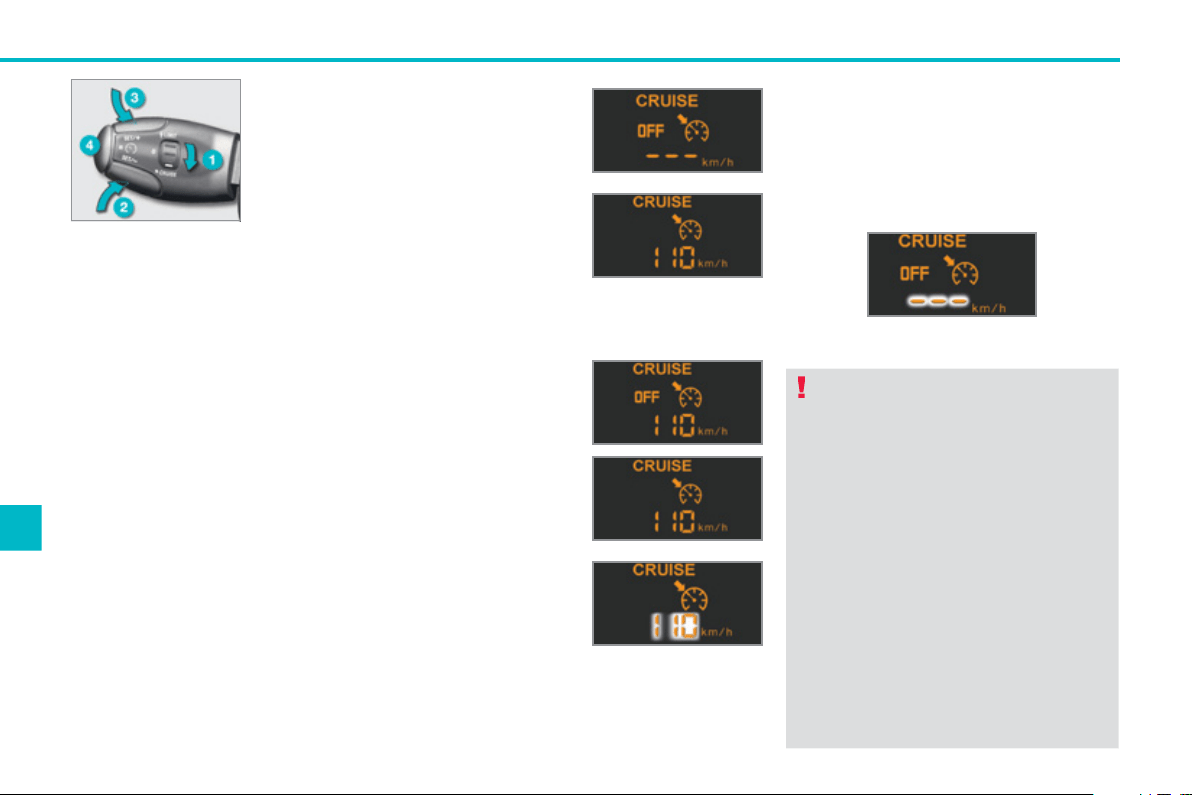
9
1
66
DRIVING
When the cruise control is switched
on, be careful if you maintain the
pressure on one of the programmed
speed changing buttons: this may
result in a very rapid change in the
speed of your vehicle.
Do not use the cruise control on
slippery roads or in heavy traffi c.
On a steep descent, the cruise
control will not be able to prevent
the vehicle from exceeding the pro-
grammed speed.
To avoid any risk of jamming of the
pedals:
- ensure that the mat is posi-
tioned correctly,
-
never fi t one mat on top of another.
Programming
) Turn dial 1 to the "CRUISE" posi-
tion: the cruise control mode is se-
lected but is not switched on (OFF).
Exceeding the programmed speed
Intentional or unintentional exceeding of the programmed
speed results in fl ashing of this speed in the screen.
Return to the programmed speed, by means of intentional or
unintentional deceleration of the vehicle, automatically cancels
the fl ashing of the speed.
Return to normal driving
) Turn dial 1 to the "0" position: the cruise control mode is
deselected. The display returns to the distance recorder.
Operating fault
In the event of a cruise control malfunc-
tion, the speed is cleared resulting in
fl ashing of the dashes.
Have it checked by a PEUGEOT dealer
or a qualifi ed workshop.
) Set the programmed speed by
accelerating to the required
speed, then press button 2 or 3
(e.g.: 70 mph (110 km/h)).
) Switch off the cruise control by pressing button 4 : the
display confi rms that it has been switched off (OFF).
) Switch the cruise control back on by pressing button 4
again.
You can then change the programmed speed using buttons 2
and 3 :
- by + or - 1 mph (km/h) = short press,
- by + or - 5 mph (km/h) = long press,
- in steps of + or - 5 mph (km/h) = maintained press.
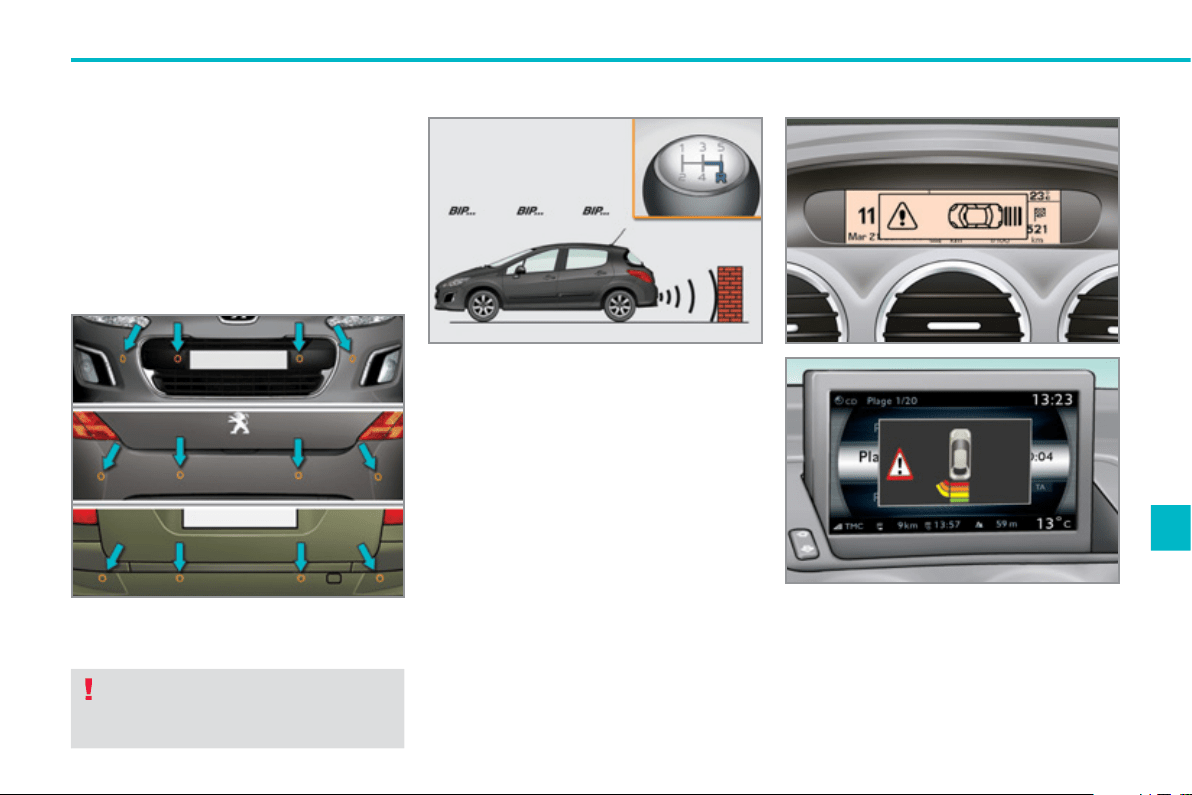
9
1
67
DRIVING
P
ARKING
S
EN
S
OR
S
This system indicates the proximity of an
obstacle (person, vehicle, tree, gate, etc.)
which comes within the fi eld of detection
of sensors located in the bumper.
Certain types of obstacle (stake, road-
works cone, etc.) detected initially will
no longer be detected at the end of the
manoeuvre due to the presence of blind
spots.
This function cannot, in any cir-
cumstances, take the place of the
vigilance and responsibility of the
driver.
Rear parking sensors
The system is switched on by engaging
reverse gear. This is accompanied by
an audible signal.
The system is switched off when you
exit reverse gear.
Audible assistance
The proximity information is given by an
intermittent audible signal, the frequency
of which increases as the vehicle ap-
proaches the obstacle.
The sound emitted by the speaker (right
or left) indicates the side on which the
obstacle is located.
When the distance between the vehicle
and the obstacle becomes less than ap-
proximately thirty centimetres, the audible
signal becomes continuous.
This supplements the audible signal
by displaying bars in the multifunction
screen which move progressively nearer
to the vehicle. When the obstacle is near,
the "Danger" symbol is also displayed in
the screen.
Visual assistance
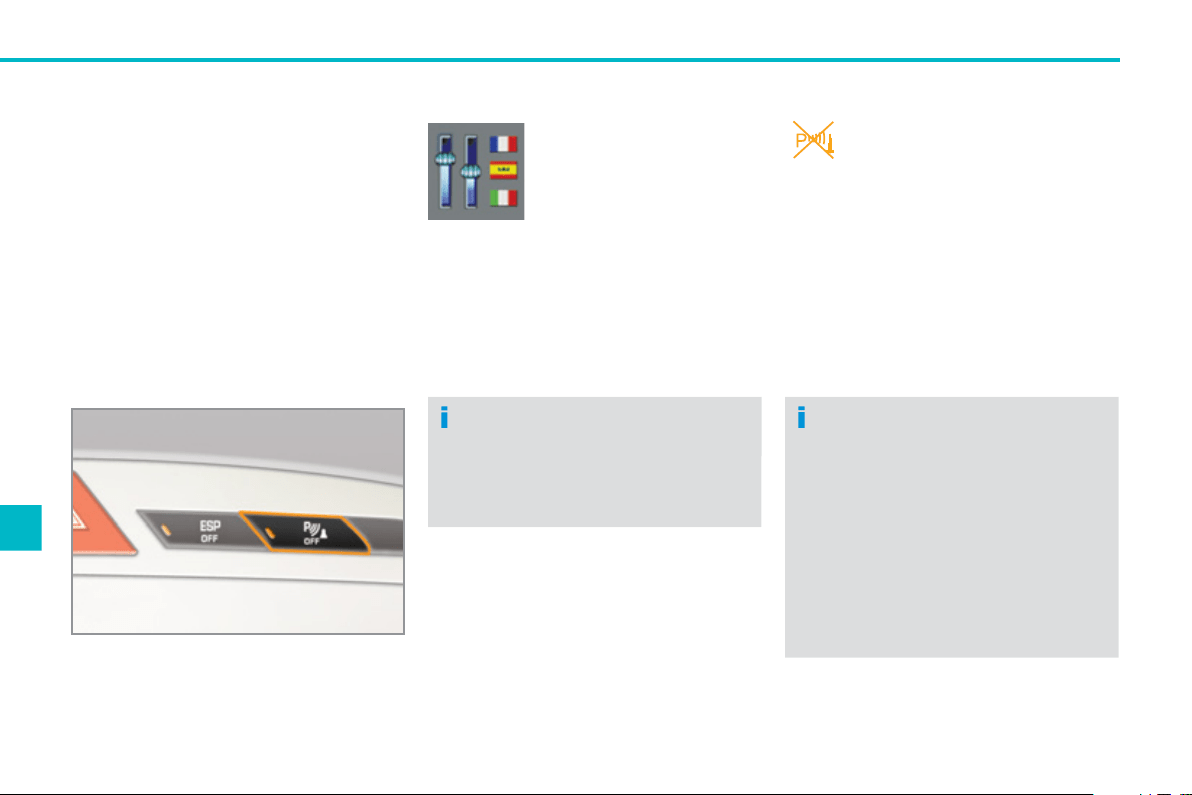
9
1
68
DRIVING
Front parking sensors
In addition to the rear parking sensors, the
front parking sensors are triggered when
an obstacle is detected in front and the
speed of the vehicle is still below 6 mph
(10 km/h).
The front parking sensors are interrupted
if the vehicle stops for more than three
seconds in forward gear, if no further ob-
stacles are detected or when the speed of
the vehicle exceeds 6 mph (10 km/h).
Deactivation / Activation of the front
and rear parking sensors
Deactivation / Activation of the rear
parking sensors
The function will be deactivated au-
tomatically if a trailer is being towed
or a bicycle carrier is fi tted (vehicle
fi tted with a towbar or bicycle car-
rier recommended by PEUGEOT).
Operating fault
In bad weather or in winter, ensure
that the sensors are not covered
with mud, ice or snow. When re-
verse gear is engaged, an audible
signal (long beep) indicates that
the sensors may be dirty.
When the vehicle is moving at a
speed below 6 mph (10 km/h), cer-
tain sound sources (motorcycle,
lorry, pneumatic drill, etc.) may trig-
ger the audible signals of the parking
sensor system.
The function is deactivated by pressing
this button. The indicator lamp in the
button comes on.
Pressing this button again reactivates
the function. The indicator lamp in the
button goes off.
The function is deactivated
or activated via the vehicle
confi guration menu.
The status of the function
is stored when the ignition
is switched off.
For more information on access to the
parking sensors menu, refer to the sec-
tion covering the confi guration of vehicle
systems.
In the event of a malfunction of
the system, when reverse gear
is engaged this warning lamp
is displayed in the instrument
panel and/or a message appears in the
screen, accompanied by an audible sig-
nal (short beep).
Contact a PEUGEOT dealer or a qualifi ed
workshop.
The sound emitted by the speaker (front
or rear) indicates whether the obstacle
is in front or behind.
10
1
69
CHECKS
Partners in performance and
protection of the environment
Innovation at the service of performance
The TOTAL Research and Development teams
develop lubricants for PEUGEOT which satisfy
the requirements of the latest technical innova-
tions incorporated in PEUGEOT vehicles.
This ensures that you obtain the best per-
formance and the maximum engine life.
RECOMMENDS
Reduced exhaust emissions
TOTAL lubricants are formulated to optimise
the effi ciency of engines and the protection
of the emissions post-treatment systems. It is
crucial to observe the servicing recommenda-
tions made by PEUGEOT to ensure correct
operation.
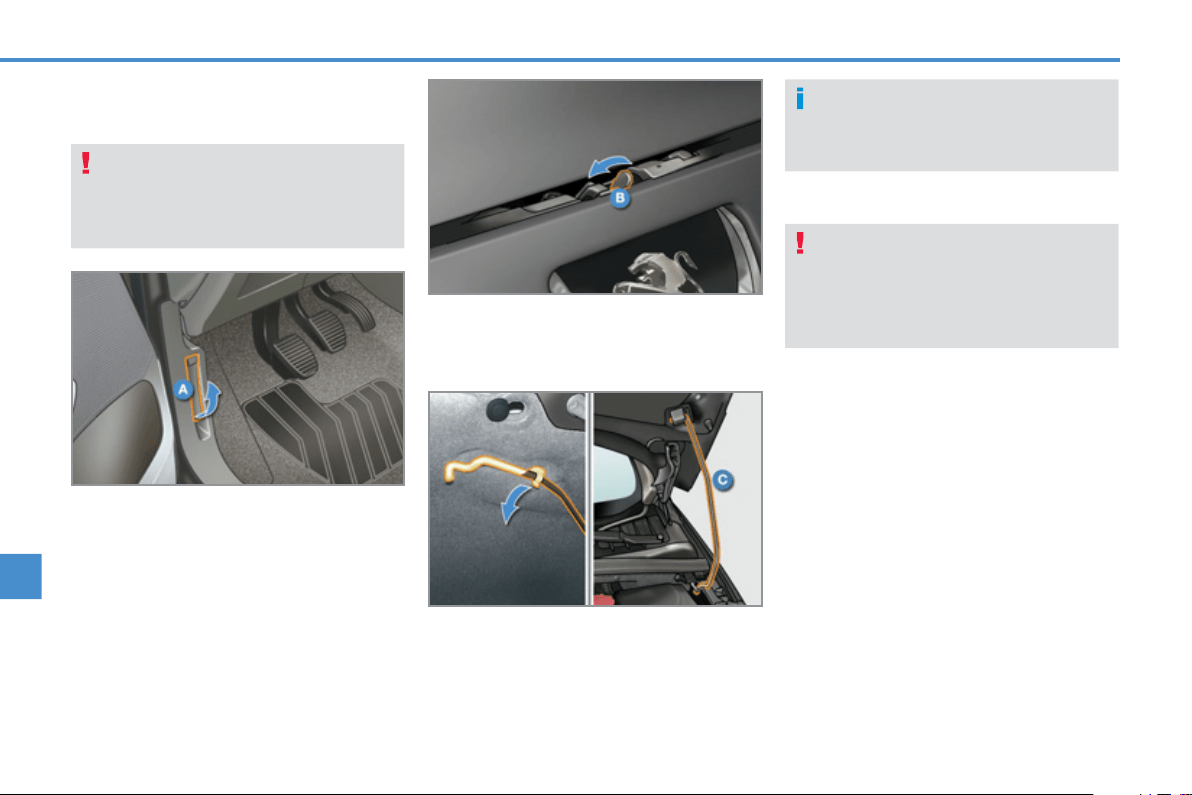
1
0
17
0
CHECKS
B
ONNET
) Push the exterior safety catch B to
the left and raise the bonnet.
) Unclip the stay C from its housing.
) Fix the stay in the notch to hold the
bonnet open.
Closing
) Take the stay out of the support
notch.
) Clip the stay in its housing.
) Lower the bonnet and release it at
the end of its travel.
) Pull on the bonnet to check that it is
secured correctly.
) Open the front left door.
) Pull the interior bonnet release le-
ver A , located at the bottom of the
door aperture.
The location of the interior bonnet
release lever prevents opening of
the bonnet while the front left door
is closed.
Do not open the bonnet in high
winds.
When the engine is hot, handle the
exterior safety catch and the bon-
net stay with care (risk of burns).
Before doing anything under the
bonnet, switch off the Stop & Start
system to avoid any risk of injury
resulting from an automatic change
to START mode.
Opening

10
171
CHECKS
R
UNNING OUT OF FUEL
(
DIESEL
)
1.6 litre HDi engine
) Fill the fuel tank with at least fi ve litres
of diesel.
) Open the bonnet.
) If necessary, unclip the styling cover
for access to the priming pump.
) Squeeze and release the priming
pump repeatedly until resistance is
felt (there may be resistance at the
fi rst press).
) Operate the starter until the engine
starts (if the engine does not start at the
fi rst attempt, wait around 15 seconds
before trying again).
) If the engine does not start after a
few attempts, operate the priming
pump again then start the engine.
) Clip the styling cover back in place.
) Close the bonnet.
2 litre HDi engine
) Fill the fuel tank with at least fi ve litres
of Diesel.
) Open the bonnet.
) If necessary, unclip the style cover
for access to the priming pump.
) Squeeze and release the priming
pump repeatedly until fuel appears
in the transparent pipe.
) Operate the starter until the engine
starts (if the engine fails to start at the
fi rst attempt, wait around 15 seconds
before trying again).
) If the engine fails to start after a few
attempts, operate the priming pump
again, then the starter.
) Put the style cover back in position
and clip it in place, ensuring that it
has clipped correctly.
) Close the bonnet.
If the engine does not start fi rst
time, don't keep trying. Start the
procedure again from the begin-
ning.
On vehicle fi tted with HDi engines, the
fuel system must be primed if you run
out of fuel; refer to the engine compart-
ment view on the "Diesel engine" page.
If the tank on your vehicle is fi tted with
a misfuel prevention device, refer to the
section "Access - § Misfuel prevention
(Diesel)".
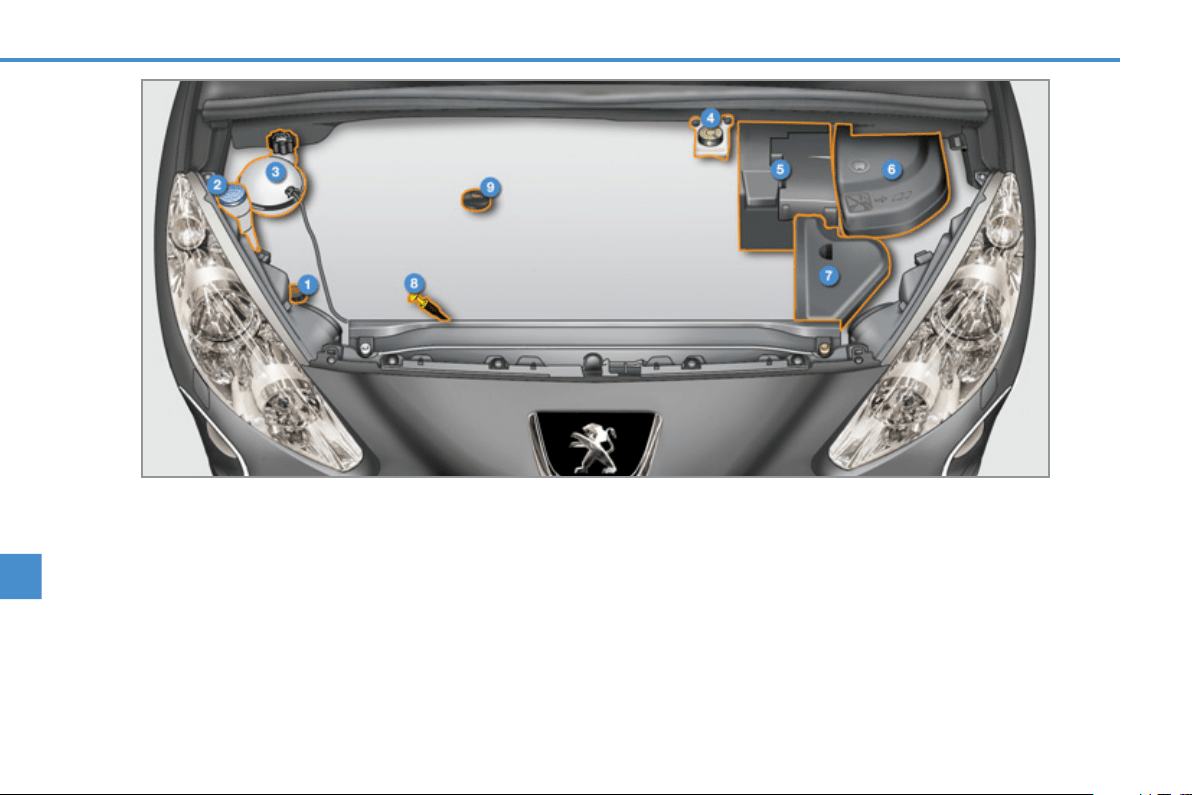
1
0
172
CHECKS
P
ETROL ENGINES
The various caps and covers allow access for checking the levels of the various fl uids and for replacing certain components.
1. Power steering reservoir.
2. Screenwash and headlamp wash
reservoir.
3. Coolant reservoir.
4. Brake fl uid reservoir.
5. Battery / Fuses.
6. Fusebox.
7. Air fi lter.
8. Engine oil dipstick.
9. Engine oil fi ller cap.
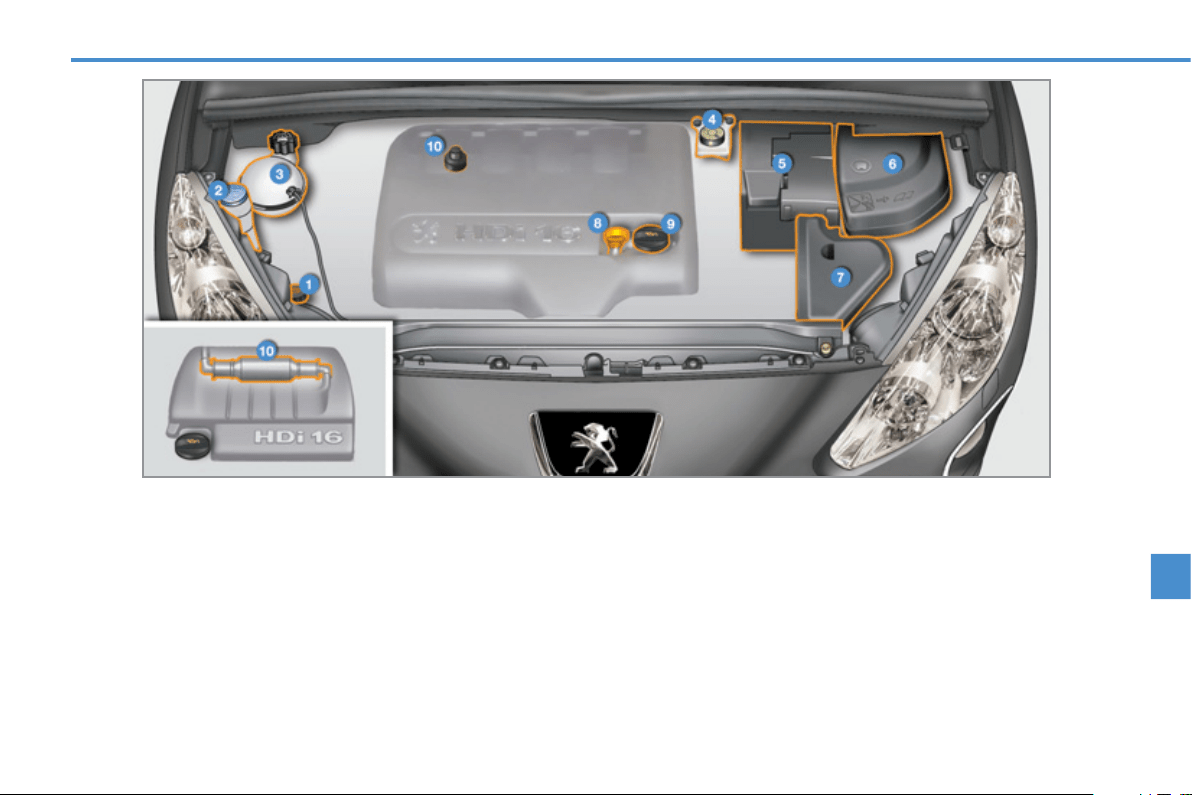
10
17
3
CHECKS
D
IESEL ENGINES
The various caps and covers allow access for checking the levels of the various fl uids, for replacing certain components and
for priming the fuel system.
1. Power steering reservoir.
2. Screenwash and headlamp wash
reservoir.
3. Coolant reservoir.
4. Brake fl uid reservoir.
5. Battery / Fuses.
6. Fusebox.
7. Air fi lter.
8. Engine oil dipstick.
9. Engine oil fi ller cap.
10. Priming pump * .
* According to engine.
1
0
174
CHECKS
CHECKING LEVEL
S
Check all of these levels regularly and
top them up if necessary, unless other-
wise indicated.
If a level drops signifi cantly, have the
corresponding system checked by a
PEUGEOT dealer or a qualifi ed work-
shop.
Brake fluid level
On vehicles which are fi tted with a par-
ticle emission fi lter, the fan may oper-
ate after the vehicle has been switched
off, even if the engine is cold.
In addition, as the cooling system is
pressurised, wait at least one hour after
switching off the engine before carrying
out any work.
To avoid any risk of scalding, unscrew the
cap by two turns to allow the pressure to
drop. When the pressure has dropped,
remove the cap and top up the level.
Oil level
The check is carried out either
when the ignition is switched on
using the oil level indicator on
the instrument panel, or using
the dipstick.
This manual check will only be correct
if the vehicle is on level ground and
the engine has been off for more than
30 minutes.
After topping up the oil, the check when
switching on the ignition with the oil level
indicator in the instrument panel will only
be valid 30 minutes after topping up.
The brake fl uid level should be
close to the "MAX" mark. If it is
not, check the brake pad wear.
Changing the fl uid
Refer to the servicing booklet for details
of the interval for this operation.
Power steering fluid level
The power steering fl uid level
should be close to the "MAX"
mark. Unscrew the cap, with the
engine cold, to check the level.
Engine oil change
Refer to the servicing booklet for details
of the interval for this operation.
In order to maintain the reliability of the
engine and emission control system,
the use of additives in the engine oil is
prohibited.
It is normal to top up the oil level
between services. PEUGEOT re-
commends that you check the oil
level and top up if necessary every
3 000 miles (5 000 kilometres).
Fluid specifi cation
The brake fl uid must conform to the
manufacturer's recommendations and
meet the DOT4 standard.
Changing the coolant
The coolant does not have to be changed.
Coolant level
The coolant level should be
close to the "MAX" mark but
should never exceed it.
When the engine is warm, the tempera-
ture of the coolant is regulated by the
fan. This can operate with the ignition
off.
Fluid specifi cation
The coolant must conform to the manu-
facturer's recommendations.
When working under the bonnet,
take care, as certain areas of the
engine may be extremely hot (risk
of burns).
Oil specifi cation
The oil must be the correct grade for
your engine and conform to the manu-
facturer's recommendations.
10
17
5
CHECKS
Avoid prolonged contact of used oil
or fl uids with the skin.
Most of these fl uids are harmful to
health or indeed very corrosive.
Do not discard used oil or fl uids into
sewers or onto the ground.
Take used oil to a PEUGEOT dealer
or a qualifi ed workshop (France) or to
an authorised waste disposal site.
Used products Screenwash and headlamp
wash fluid
In the case of vehicles fi tted
with headlamp washers, the
low fl uid level is indicated by an
audible signal and a message
in the instrument panel screen.
Top up the reservoir when you stop the
vehicle.
Fluid specifi cation
For optimum cleaning and to avoid
freezing, this fl uid must not be topped
up with or replaced with plain water.
Additive level (Diesel with
particle emissions filter)
Topping up
The reservoir must be topped up with-
out delay by a PEUGEOT dealer or a
qualifi ed workshop.
The additive reservoir low
level is indicated by fi xed illu-
mination of this warning lamp,
accompanied by an audible
signal and a message that the
particle emissions fi lter addi-
tive level is too low.
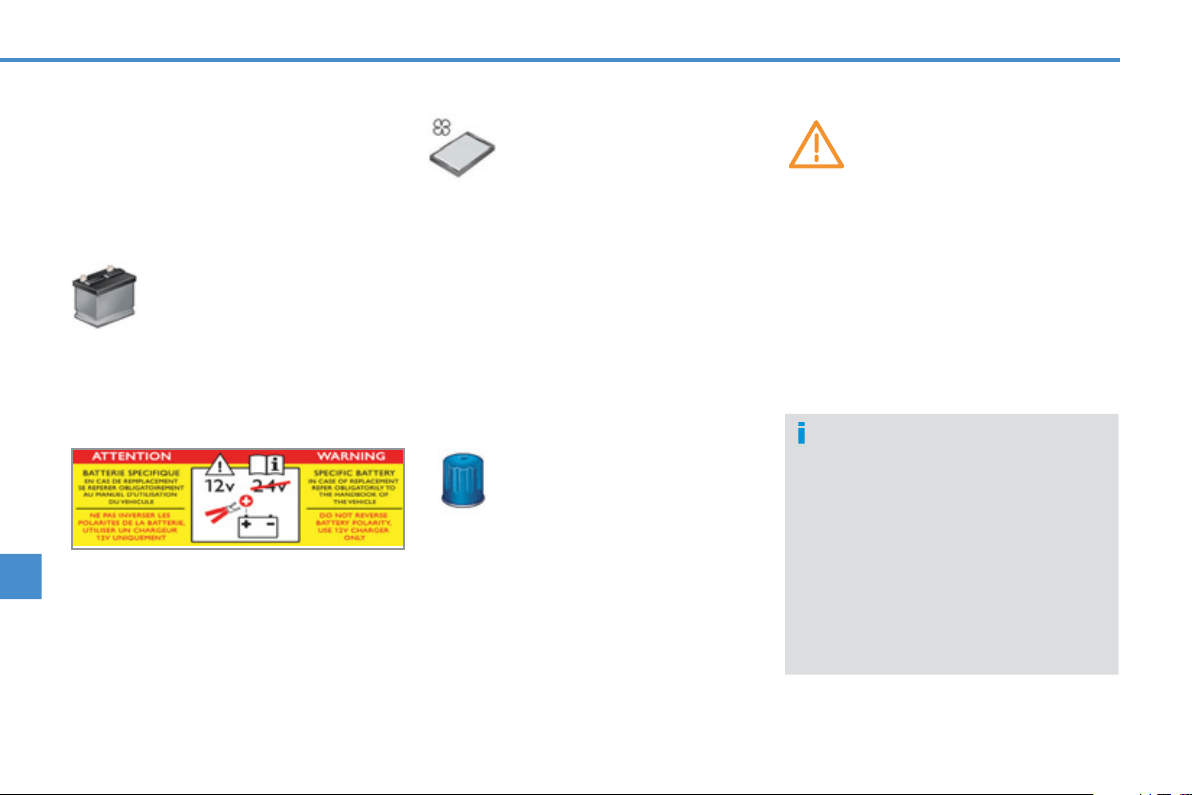
1
0
17
6
CHECKS
CHECK
S
12 V battery
The battery does not require any
maintenance.
However, check that the terminals
are clean and correctly tightened,
particularly in summer and winter.
When carrying out work on the battery, re-
fer to the "Practical information" section for
details of the precautions to be taken before
disconnecting the battery and following its
reconnection.
The presence of this label, in particular
with the Stop & Start system, indicates
the use of a specifi c 12 V lead-acid bat-
tery with special technology and specifi -
cation. The involvement of a PEUGEOT
dealer or a qualifi ed workshop is essen-
tial when replacing or disconnecting the
battery.
Particle emission filter (Diesel)
The start of saturation of the
particle emissions fi lter is in-
dicated by the temporary illu-
mination of this warning lamp,
accompanied by an audible
signal and a message on the risk of
blockage of the particle emissions fi lter.
As soon as the traffi c conditions per-
mit, regenerate the fi lter by driving at a
speed of at least 40 mph (60 km/h) until
the warning lamp goes off.
If the warning lamp stays on, refer to the
"Additive level" section.
On a new vehicle, the fi rst particle
fi lter regeneration operations may
be accompanied by a "burning"
smell, which is perfectly normal.
Following prolonged operation of
the vehicle at very low speed or at
idle, you may, in exceptional cir-
cumstances, notice the emission
of water vapour at the exhaust on
acceleration. This does not affect
the behaviour of the vehicle or the
environment.
Unless otherwise indicated, check these
components in accordance with the servic-
ing booklet and according to your engine.
Otherwise, have them checked by a
PEUGEOT dealer or a qualifi ed work-
shop.
Air filter and passenger compartment filter
Refer to the servicing booklet
for details of the replacement
intervals for these compo-
nents.
Depending on the environment
(e.g. dusty atmosphere) and the use of
the vehicle (e.g. city driving), replace
them twice as often if necessary .
A clogged passenger compartment fi lter
may have an adverse effect on the per-
formance of the air conditioning system
and generate undesirable odours.
Oil filter
Replace the oil fi lter each time
the engine oil is changed.
Refer to the servicing booklet
for details of the replacement
interval for this component.
10
177
CHECKS
Brake disc wear
Brake pads
Brake wear depends on the
style of driving, particularly in
the case of vehicles used in
town, over short distances. It
may be necessary to have the
condition of the brakes checked, even
between vehicle services.
Unless there is a leak in the circuit, a
drop in the brake fl uid level indicates
that the brake pads are worn.
For information on checking
brake disc wear, contact a
PEUGEOT dealer or a quali-
fi ed workshop.
Manual gearbox
The gearbox does not re-
quire any maintenance (no oil
change).
Refer to the servicing book-
let for the details of the level
checking interval for this com-
ponent.
6-speed electronic gearbox
The gearbox does not re-
quire any maintenance (no oil
change).
Refer to the servicing booklet
for details of the checking in-
terval for this component.
Automatic gearbox
The gearbox does not re-
quire any maintenance (no oil
change).
Refer to the servicing booklet
for details of the level checking
interval for this component.
Only use products recommended
by PEUGEOT or products of equi-
valent quality and specifi cation.
In order to optimise the operation
of units as important as the brak-
ing system, PEUGEOT selects and
offers very specifi c products.
To avoid damaging the electrical
units, the use of a high pressure
washer in the engine compartment
is strictly prohibited .
Parking brake
If excessive travel or a loss of
effectiveness of this system
is noticed, the parking brake
must be checked, even be-
tween two services.
Checking this system must be done by
a PEUGEOT dealer or a qualifi ed work-
shop.

1
1
17
8
PRACTICAL INFORMATION
T
EMPORARY
P
UNCTURE REPAIR
KIT
The kit is stowed in the boot under the
fl oor. It is installed in the tool box, lo-
cated under the storage box.
Access to the kit
Complete system consisting of a com-
pressor and a sealant cartridge which
permits temporary repair of a tyre so
that you can drive to the nearest ga-
rage.
It is designed to repair most punctures
which could affect the tyre, located on
the tyre tread or shoulder.
Access to the kit
The kit is stowed in a bag, located on
the left-hand side of the boot.

1
1
PRACTICAL INFORMATION
The speed limit sticker I must be
affi xed to the vehicle's steering
wheel to remind you that a wheel is
in temporary use.
Do not exceed a speed of 50 mph
(80 km/h) when driving with a tyre
repaired using this type of kit.
Description of the kit
A. "Sealant" or "Air" position selector.
B. On "I" / off "O" switch.
C. Defl ation button.
D. Pressure gauge (in bar or p.s.i.).
E. Compartment housing:
- a cable with adaptor for 12 V socket,
- various infl ation adaptors for
accessories, such as balls, bicycle
tyres...
F. Sealant cartridge.
G. White pipe with cap for repair.
H. Black pipe for infl ation.
I. Speed limit sticker.
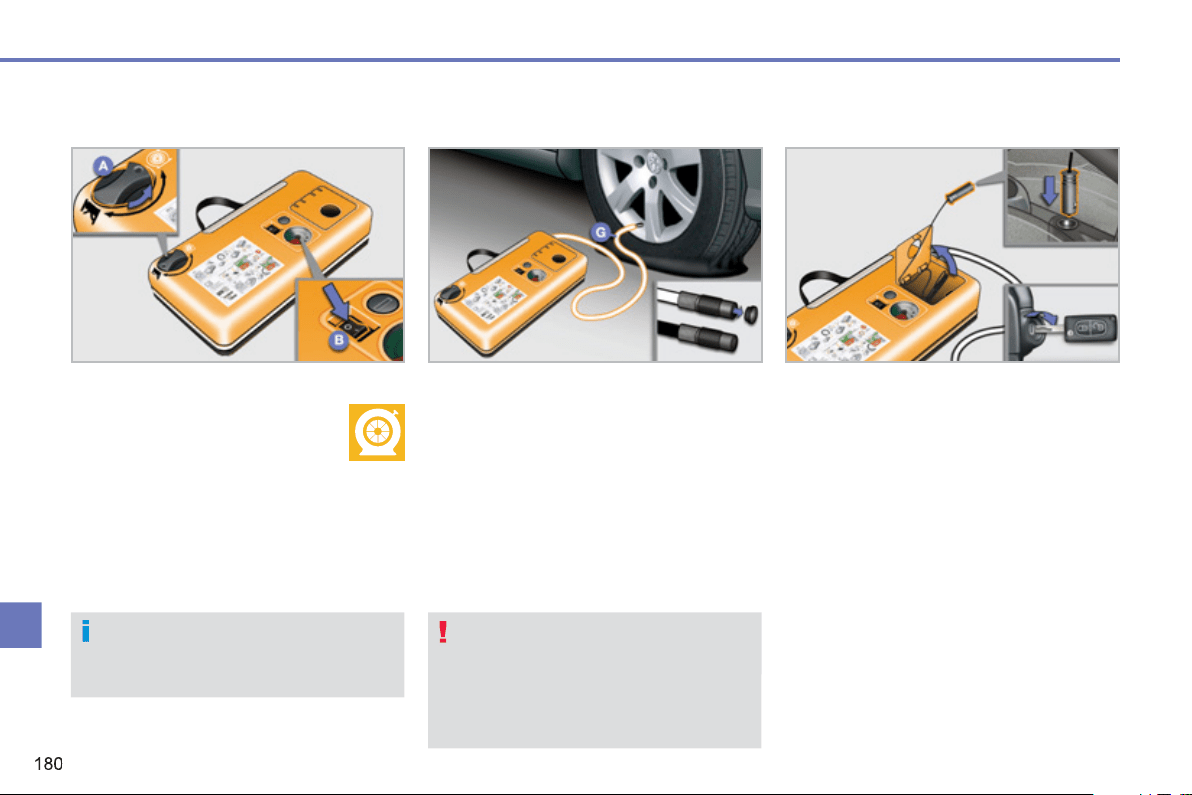
1
1
PRACTICAL INFORMATION
Repair procedure
) Switch off the ignition.
) Turn the selector A to the
"sealant" position.
) Check that the switch B is in
position "O" .
1. Sealing
) Uncoil the white pipe G fully.
) Unscrew the cap from the white pipe.
) Connect the white pipe to the valve
of the tyre to be repaired.
) Connect the compressor's electric
plug to the vehicle's 12 V socket.
) Start the vehicle and leave the en-
gine running.
Avoid removing any foreign bodies
which have penetrated into the tyre.
Take care, this product is harmful
(e.g. ethylene-glycol, colophony...)
if swallowed and causes irritation
to the eyes.
Keep it out of reach of children.
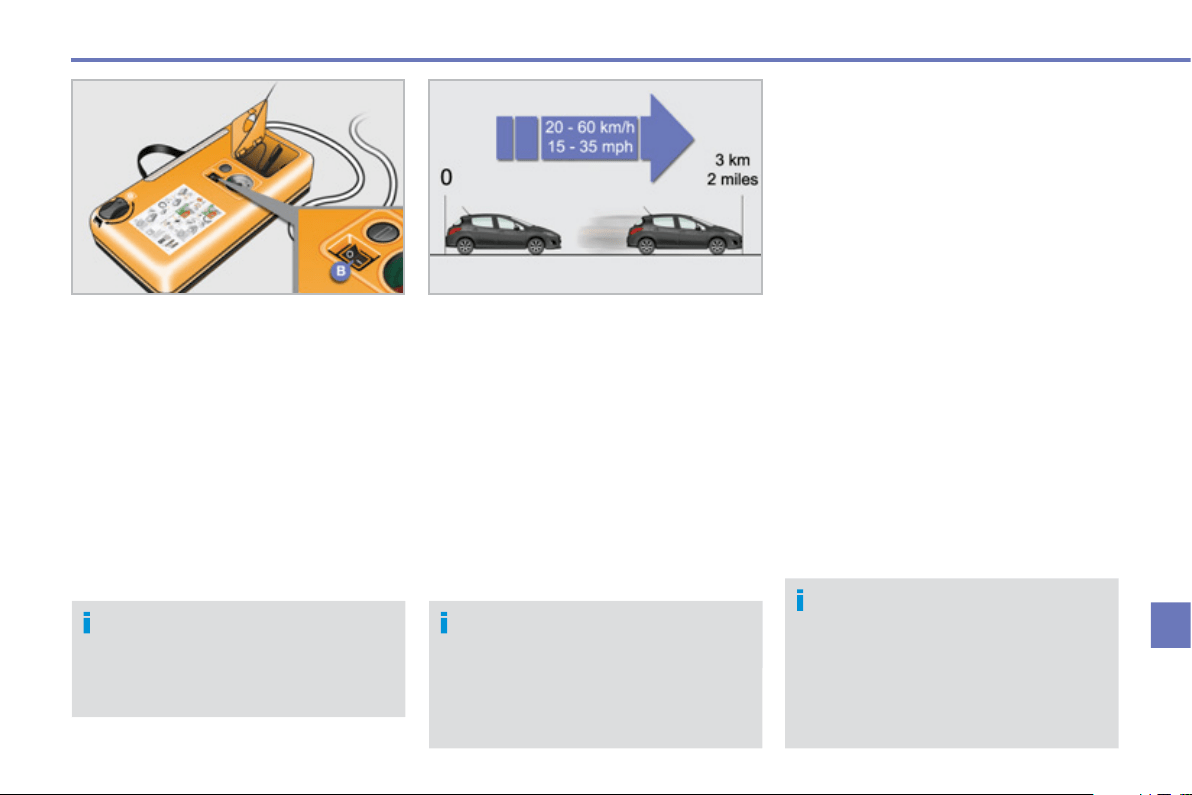
1
1
1
81
PRACTICAL INFORMATION
If after around 5 to 7 minutes the
pressure is not attained, this indi-
cates that the tyre is not repairable;
contact a PEUGEOT dealer or a
qualifi ed workshop for assistance.
) Switch on the compressor by mov-
ing the switch B to position "I" until
the tyre pressure reaches 2.0 bars.
The sealant is injected into the tyre
under pressure; do not disconnect
the pipe from the valve during this
operation (risk of splashing).
) Remove the kit and screw the cap
back on the white pipe.
Take care to avoid staining your ve-
hicle with traces of fl uid. Keep the kit
to hand.
) Drive immediately for approximate-
ly three miles (fi ve kilometres), at
reduced speed (between 15 and
35 mph (20 and 60 km/h)), to plug
the puncture.
) Stop to check the repair and the tyre
pressure using the kit.
Tyre under-infl ation detection
If the vehicle is fi tted with tyre under-
infl ation detection, the under-infl a-
tion warning lamp will remain on
after the wheel has been repaired
until the system is reinitialised by
a PEUGEOT dealer or a qualifi ed
workshop.
Do not start the compressor before
connecting the white pipe to the tyre
valve: the sealant product would be
expelled through the pipe.
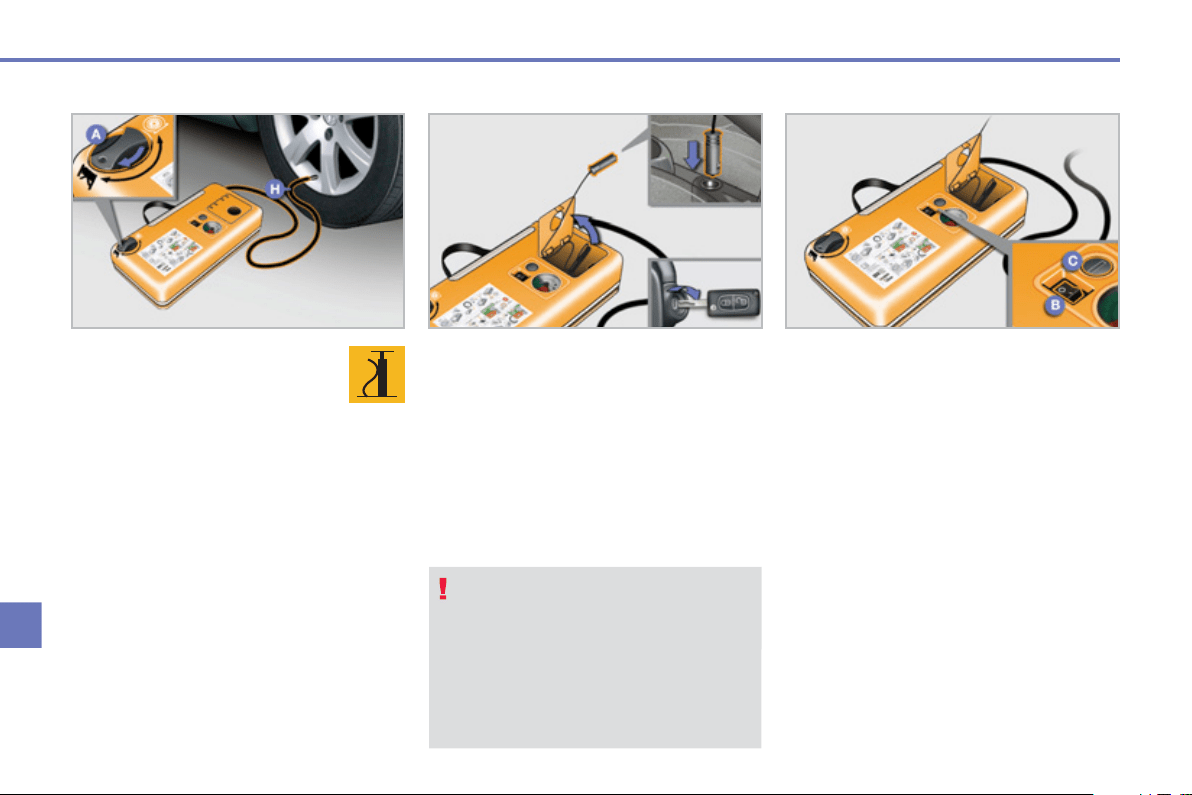
1
1
1
82
PRACTICAL INFORMATION
) Turn the selector A to the
"air" position.
) Uncoil the black pipe H fully.
) Connect the black pipe to
the valve of the wheel.
) Connect the compressor's electric
plug to the vehicle's 12 V socket.
) Start the vehicle again and leave the
engine running.
) Visit a PEUGEOT dealer or a
qualifi ed workshop as soon as
possible.
You must inform the technician
that you have used this kit. After
inspection, the technician will in-
form you whether the tyre can be
repaired or must be replaced.
2. Infl ation
) Adjust the pressure using the com-
pressor (to infl ate: switch B in po-
sition "I" ; to defl ate: switch B in
position "O" and press button C ), in
accordance with the vehicle's tyre
pressure label (located on the left
hand door aperture).
A loss of pressure indicates that the
puncture has not been fully plugged;
contact a PEUGEOT dealer or qual-
ifi ed workshop for assistance.
) Remove and stow the kit.
) Drive at reduced speed (50 mph
[80 km/h] max) limiting the distance
travelled to approximately 120 miles
(200 km).
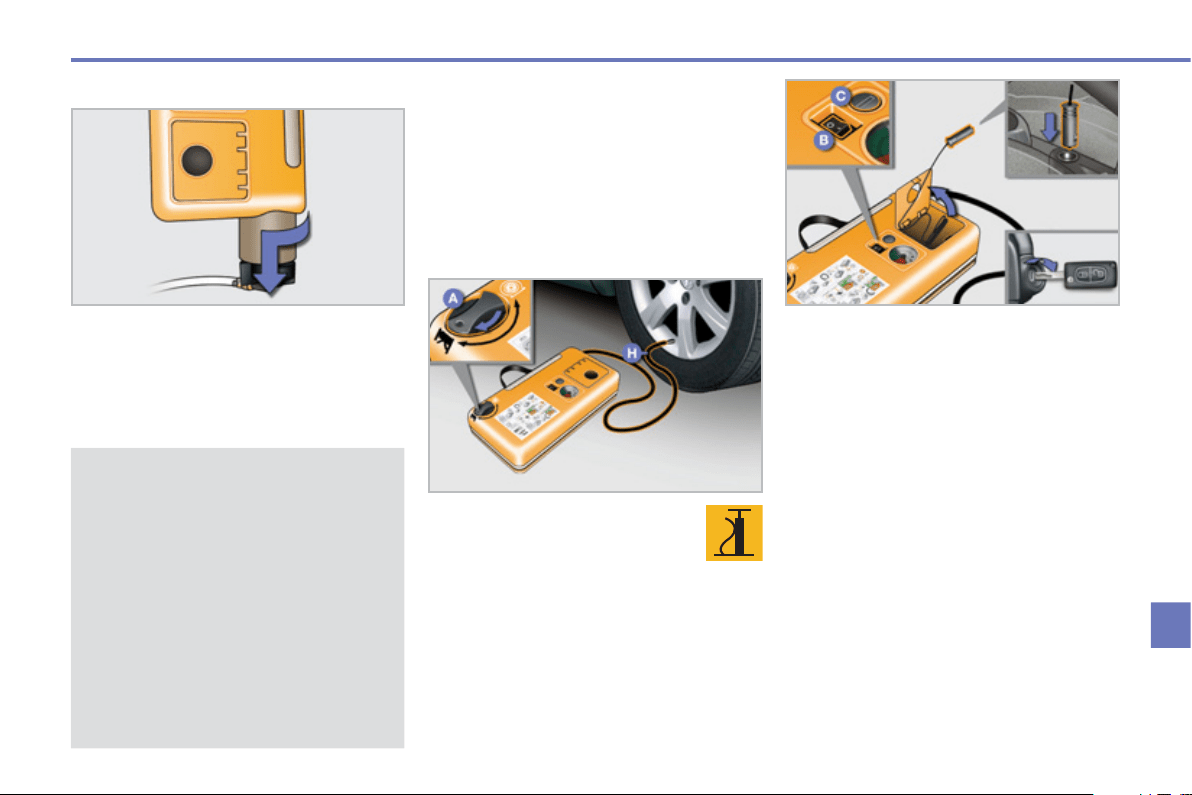
1
1
!
1
83
PRACTICAL INFORMATION
Beware of discharges of fl uid.
The expiry date of the fl uid is indi-
cated on the cartridge.
The sealant cartridge is designed
for single use; even if only partly
used, it must be replaced.
After use, do not discard the car-
tridge into the environment, take
it to an authorised waste disposal
site or a PEUGEOT dealer.
Do not forget to obtain a new sealant
cartridge, available from PEUGEOT
dealers or from a qualifi ed workshop.
Removing the cartridge
) Stow the black pipe.
) Detach the angled base from the
white pipe.
) Support the compressor vertically.
)
Unscrew the cartridge from the bottom.
Checking tyre pressures /
inflating accessories
You can also use the compressor, without
injecting any product, to:
- check or adjust the pressure of your
tyres,
- infl ate other accessories (balls, bicycle
tyres...).
) Turn the selector A to the
"Air" position.
) Uncoil the black pipe H fully.
) Connect the black pipe to
the valve of the wheel or accessory.
If necessary, fi t one of the adaptors
supplied with the kit fi rst.
) Connect the compressor's electri-
cal connector to the vehicle's 12 V
socket.
) Start the vehicle and let the engine
run.
) Adjust the pressure using the
compressor (to infl ate: switch B in
position "I" ; to defl ate: switch B in
position "O" and press button C ),
according to the vehicle's tyre
pressure label or the accessory's
pressure label.
) Remove the kit then stow it.
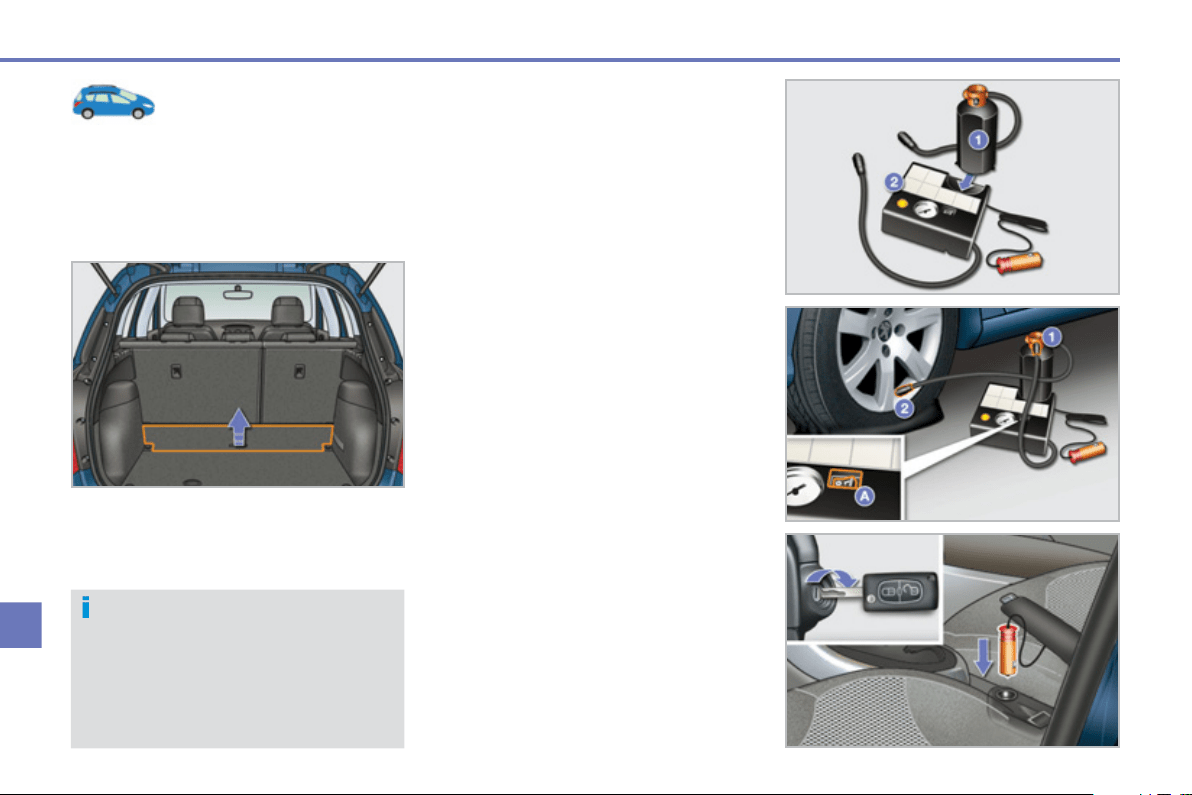
1
1
1
84
PRACTICAL INFORMATION
It is designed to repair holes of a
maximum diameter of 6 mm, only
where located on the tyre tread or
shoulder. Avoid removing any for-
eign bodies which have penetrated
the tyre.
T
EMPORARY
P
UNCTURE REPAIR KIT
Complete system consisting of a com-
pressor and a bottle of sealant which per-
mits temporary repair of the tyre so that
you can drive to the nearest garage.
The kit is stowed in the boot storage
tray.
Using the kit
) Switch off the ignition.
) Tick the wheel to be repaired on the
speed limitation sticker enclosed
then affi x the sticker to the vehicle's
steering wheel to remind you that a
wheel is in temporary use.
) Clip the bottle 1 on the compressor 2 .
) Check that the switch A is tilted to
position "0" .
) Connect the pipe of the bottle 1 to
the valve of the tyre to be repaired.
) Unwind the pipe of the compressor 2
fully, then connect it to the bottle.
) Connect the compressor's electric
plug to the vehicle's 12 V socket.
) Start the vehicle and leave the engine
running.
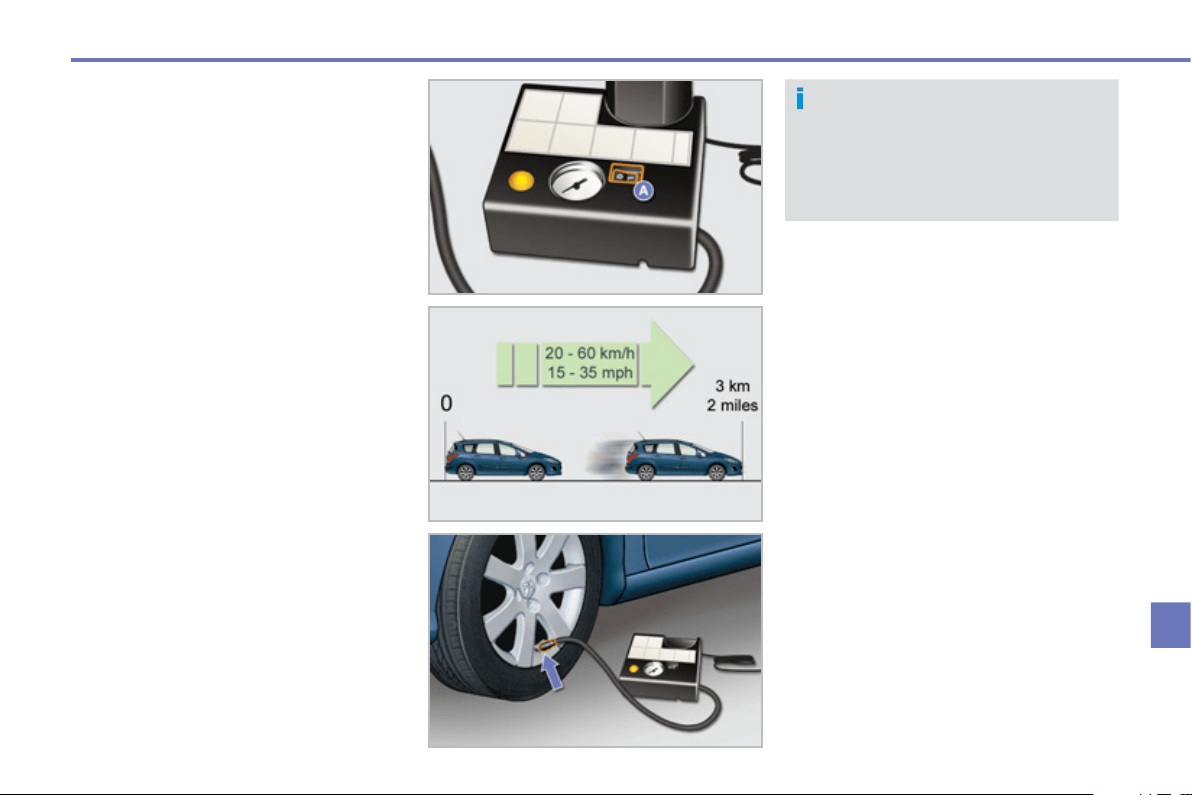
1
1
1
85
PRACTICAL INFORMATION
If this pressure has not been
reached after approximately fi ve to
ten minutes, the tyre cannot be re-
paired; contact a PEUGEOT deal-
er or a qualifi ed workshop to have
your vehicle repaired.
) Switch on the compressor by tilting
the switch A to position "1" until the
tyre pressure reaches 2.0 bars.
) Remove the compressor and store
the bottle in the plastic bag, supplied
in the kit, to avoid staining your vehi-
cle with traces of fl uid.
) Drive immediately for approximate-
ly two miles (three kilometres), at
reduced speed (between 10 and
35 mph [20 and 60 km/h]), to plug the
puncture.
) Stop to check the repair and the
pressure.
) Connect the compressor pipe di-
rectly to the valve of the repaired
wheel.
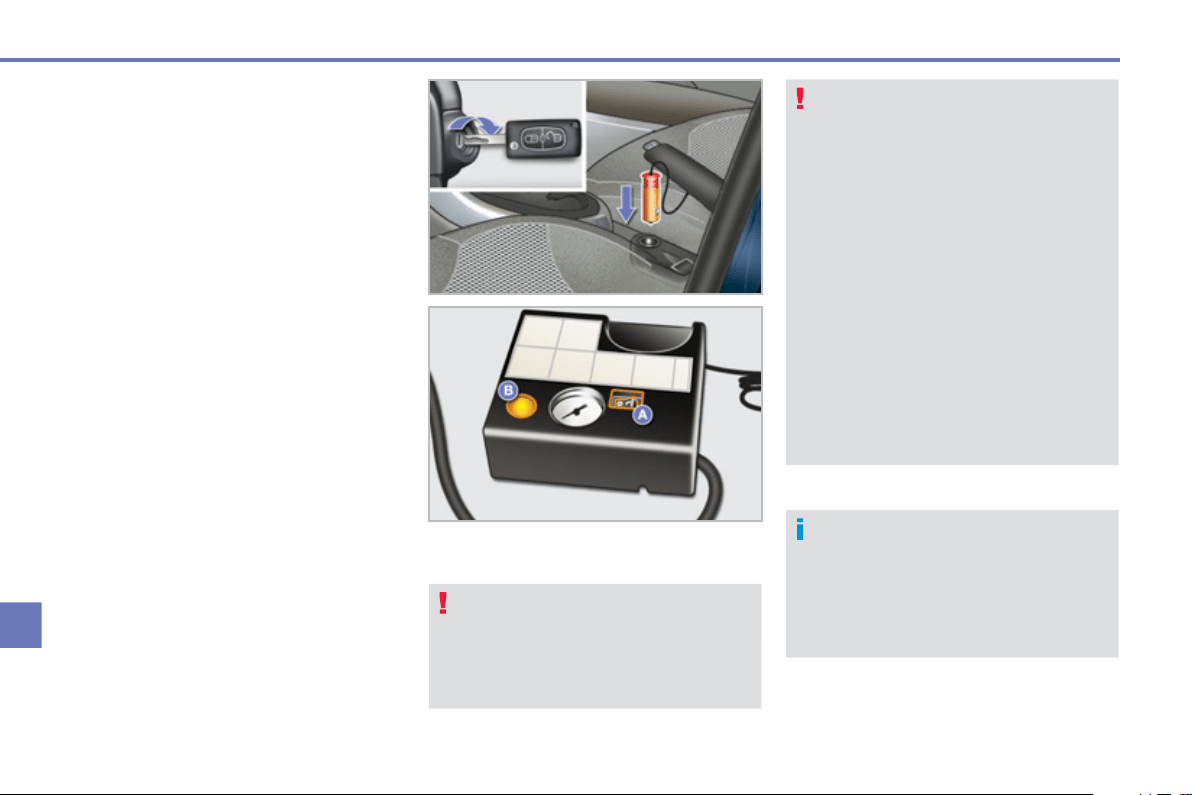
1
1
1
86
PRACTICAL INFORMATION
If the vehicle is fi tted with tyre un-
der-infl ation detection, the tyre
under-infl ation warning lamp will
remain on after the wheel has been
repaired until the system is reini-
tialised by a PEUGEOT dealer or a
qualifi ed workshop.
Take care, the bottle of fl uid con-
tains ethylene-glycol. This product
is harmful if swallowed and causes
irritation to the eyes. Keep it out of
reach of children.
The expiry date of the fl uid is indi-
cated on the base of the bottle.
The bottle is designed for a sin-
gle use; even if only partly used, it
must be replaced.
After use, do not discard the bot-
tle into the environment, take it to a
PEUGEOT dealer or an authorised
waste disposal site.
Do not forget to obtain a new bottle
of sealant product, available from
a PEUGEOT dealer or a qualifi ed
workshop.
) Connect the compressor's electric
plug to the vehicle's 12 V socket
again.
) Start the vehicle again and leave the
engine running.
)
Adjust the pressure using the compres-
sor (to infl ate: switch A in position "1" ;
to defl ate: switch A in position "0" and
press button B ), in accordance with
the vehicle's tyre pressure label (locat-
ed on the door aperture on the driver's
side), then remember to check that the
leak is plugged correctly (no further
loss of pressure after several miles
[kilometres]).
) Remove the compressor, then store
the whole kit.
) Visit a PEUGEOT dealer or a
qualifi ed workshop as soon as
possible to have the tyre repaired
or replaced by a technician.
) Drive at reduced speed (50 mph
[80 km/h] max) for no more than ap-
proximately 125 miles (200 km).
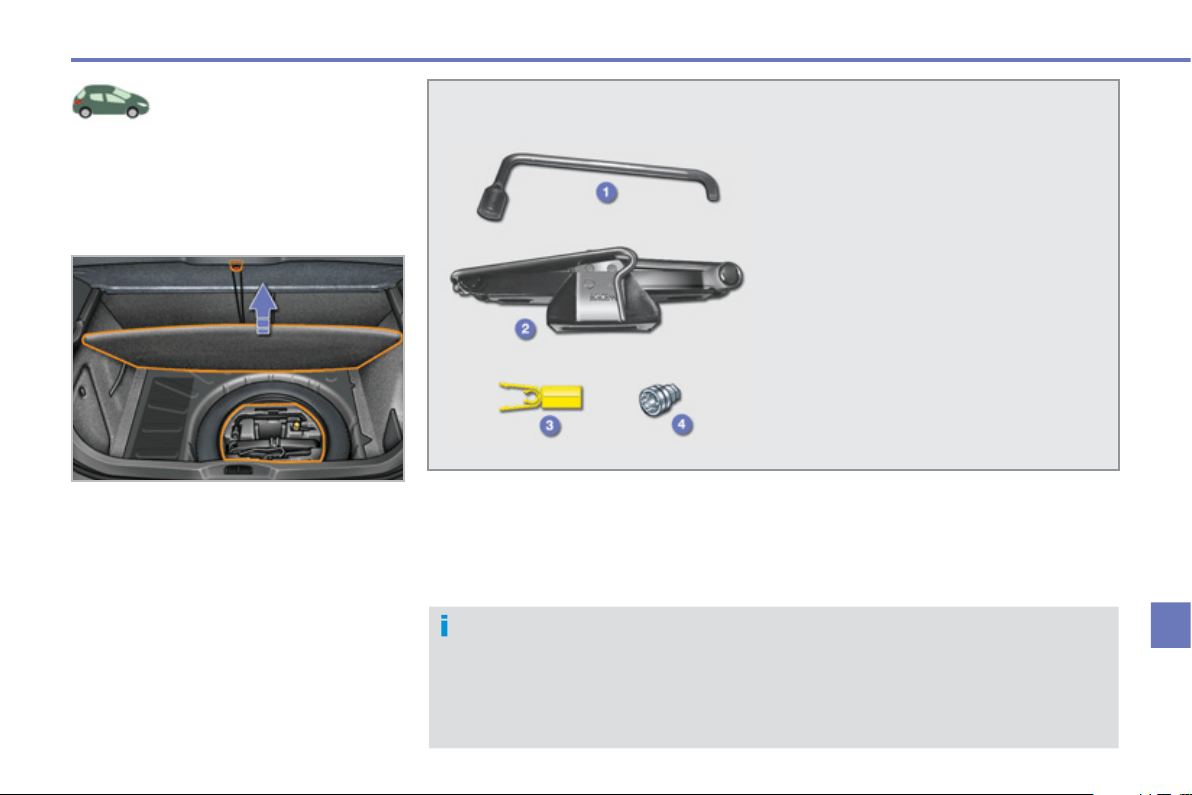
1
1
1
87
PRACTICAL INFORMATION
CHANGING A WHEEL
The tools are installed in the boot under
the fl oor.
To gain access to them:
) open the boot,
) raise the fl oor,
) secure it by hooking its cord on the
hook on the rear parcel shelf support,
) unclip and remove the box containing
the tools.
All of these tools are specifi c to your
vehicle. Do not use them for other
purposes.
1. Wheelbrace.
For removing the wheel trim and
the wheel fi xing bolts.
2. Jack with integral handle.
For raising the vehicle.
3. Wheel bolt fi nisher tool.
Used for removing the wheel bolt
fi nisher caps on alloy wheels.
4. Socket for the security bolts (located
in the glove box).
For adapting the wheelbrace to
the special security bolts.
List of tools
Access to the tools
Wheel with trim
When removing the wheel , detach the trim fi rst using the wheelbrace 1 pulling
at the valve passage hole.
When refi tting the wheel , refi t the trim starting by placing its notch facing the
valve and press around its edge with the palm of your hand.
Procedure for changing a faulty wheel
for the spare wheel using the tools pro-
vided with the vehicle.
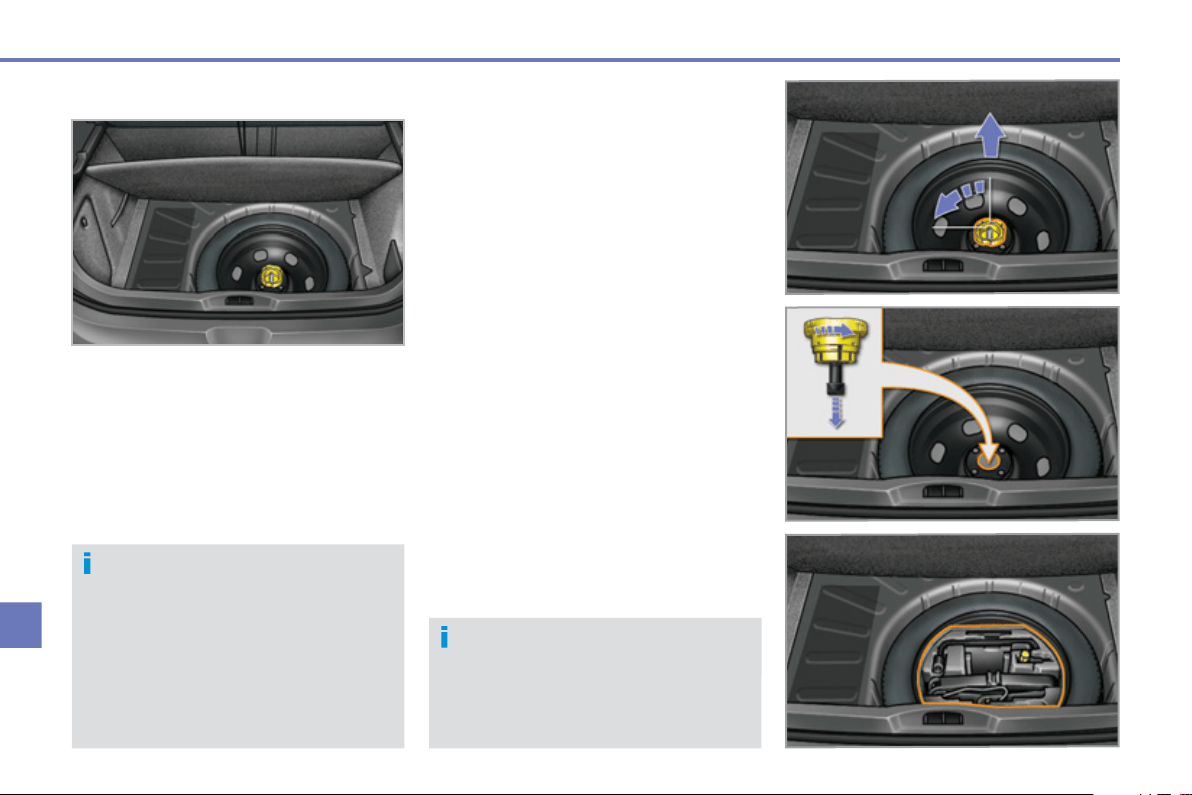
1
1
1
88
PRACTICAL INFORMATION
Fitting a steel spare wheel
If your vehicle is fi tted with alloy
wheels, it is normal to notice, when
tightening the bolts on fi tting, that
the washers do not come into con-
tact with the steel spare wheel. The
wheel is secured by the conical
contact of each bolt.
Access to the spare wheel
The spare wheel is installed in the boot
under the fl oor.
According to country, the spare wheel
may be steel or alloy.
For access to it, refer to the paragraph
"Access to the tools" on the previous
page.
Taking out the wheel
) Unscrew the yellow central bolt.
) Raise the spare wheel towards you
from the rear.
) Take the wheel out of the boot.
Putting the wheel back in place
) Put the wheel back in its housing.
) Unscrew the yellow central bolt by a
few turns then put it in place in the
centre of the wheel.
) Tighten fully until the central bolt
clicks to retain the wheel correctly.
) Put the box back in place in the centre
of the wheel and clip it.
Tyre under-infl ation detection
The spare wheel is not fi tted with a
sensor. The punctured wheel must
be repaired by a PEUGEOT dealer
or a qualifi ed workshop.
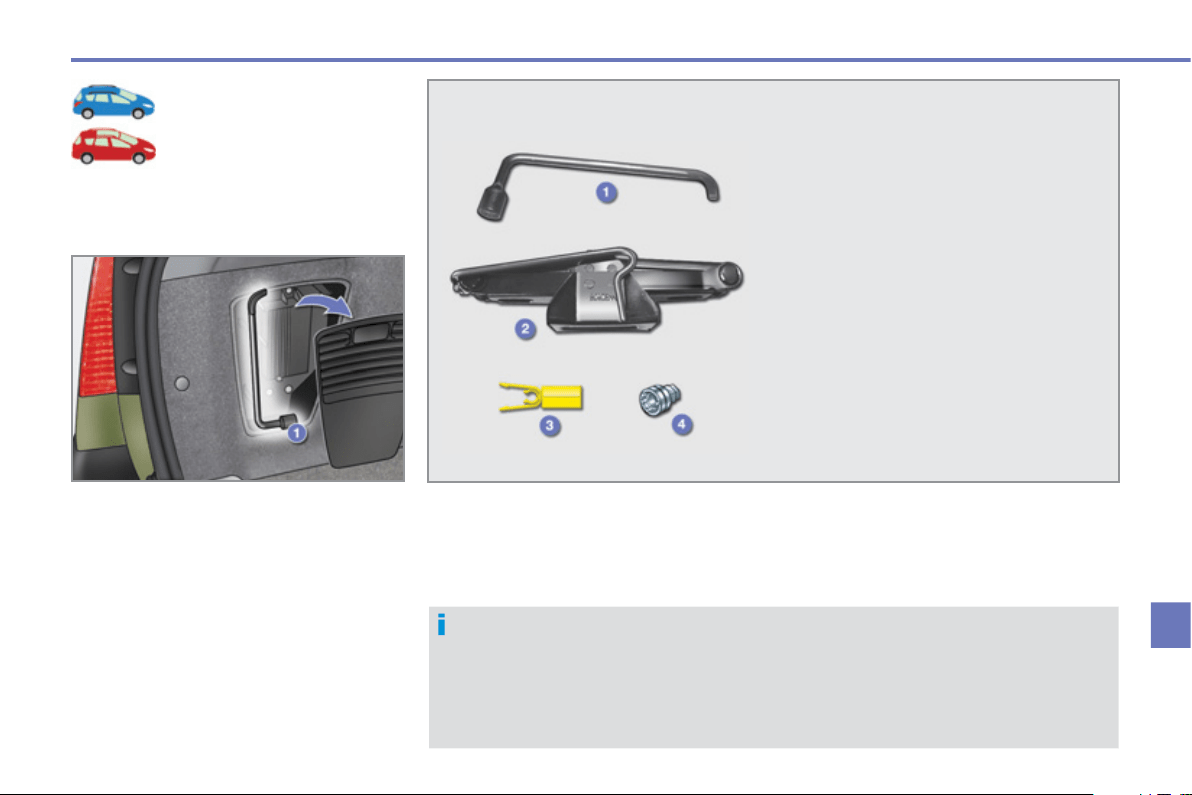
1
1
1
89
PRACTICAL INFORMATION
CHANGING A WHEEL
Procedure for changing a
faulty wheel for the spare
wheel using the tools pro-
vided with the vehicle.
The wheelbrace 1 is stowed in the boot
left-hand side trim; for access to it:
) open the boot,
) open the access fl ap in the left-hand
side trim,
) unclip the wheelbrace from its support,
The tools 2 and 3 are stowed in a box fi t-
ted under the spare wheel; the assembly
is installed underneath the rear of the ve-
hicle (refer to the section "Access to the
spare wheel" on the following page for
instructions on how to get them out).
Access to the tools
List of tools
Wheel with trim
When removing the wheel , detach the trim fi rst using the wheelbrace 1 pulling
at the valve passage hole.
When refi tting the wheel , refi t the trim starting by placing its notch facing the
valve and press around its edge with the palm of your hand.
All of these tools are specifi c to your
vehicle. Do not use them for other pur-
poses.
1. Wheelbrace.
For removing the wheel trim wheel
fi xing bolts.
2. Jack with integral handle.
For raising the vehicle.
3. Wheel bolt fi nisher tool.
Used for removing the wheel bolt
fi nisher caps on alloy wheels.
4. Socket for the security bolts (located
in the glove box or in the tool box un-
der the spare wheel).
For adapting the wheelbrace to the
special security bolts.
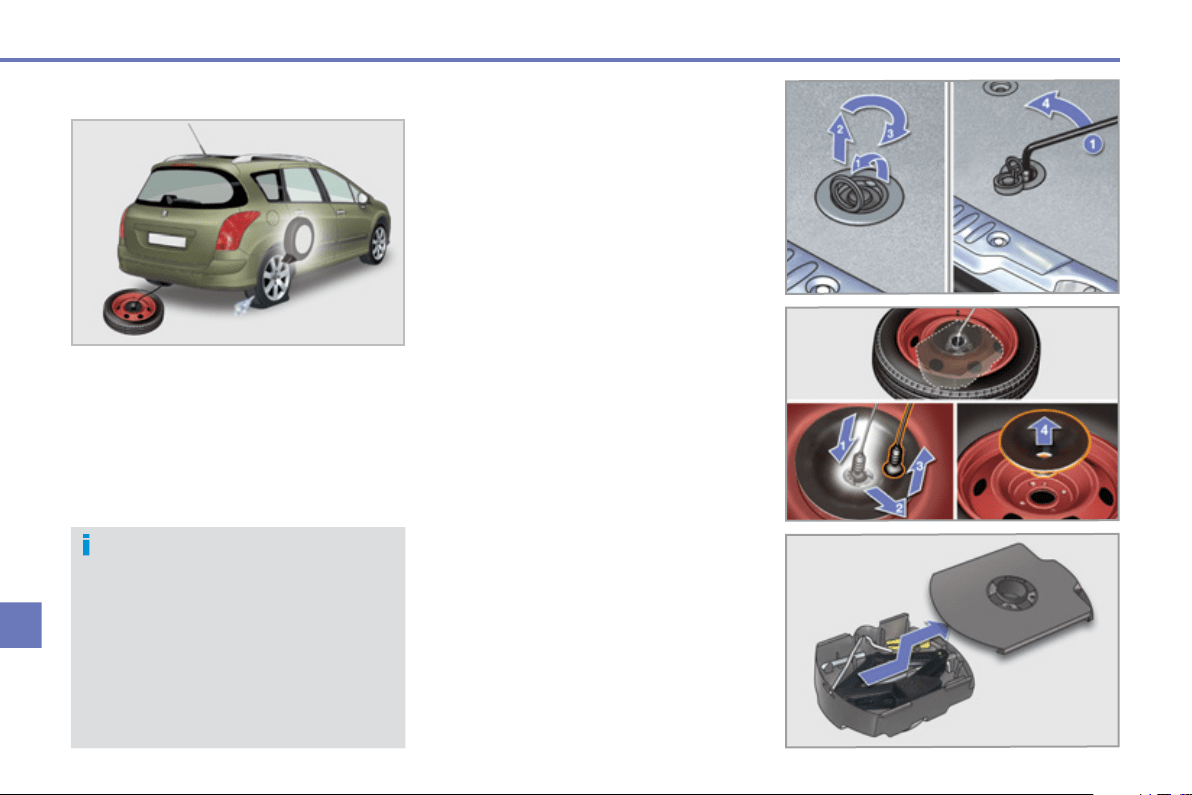
1
1
1
90
PRACTICAL INFORMATION
Fitting a steel or "space-saver"
type spare wheel
If your vehicle is fi tted with alloy
wheels, it is normal to notice, when
tightening the bolts on fi tting, that
the washers do not come into con-
tact with the steel or "space-saver"
type spare wheel. The wheel is
secured by the conical contact of
each bolt.
Access to the spare wheel
The spare wheel is supported by a
winch system underneath the rear of
the vehicle.
According to country, the spare wheel
may be steel, alloy or of the "space-
saver" type.
Taking out the wheel
) Lift up the cover eyelet, pull the cov-
er upwards, then pivot it to open the
fl ap; these actions release the winch
and give access to its control nut.
) Unscrew this nut fully, using the
wheelbrace 1 , to unwind the winch
cable.
) Once the wheel/box is on the
ground, disengage the assembly
from the rear of the vehicle.
) Detach the hook mechanism to release
the wheel/box assembly, as shown in
the illustration.
) Take out the black plastic centring
cone.
Access to the set of tools
) Lift up the wheel to release the set
of tools.
) To open the storage box, slide the
cover until half open, then pull it off.
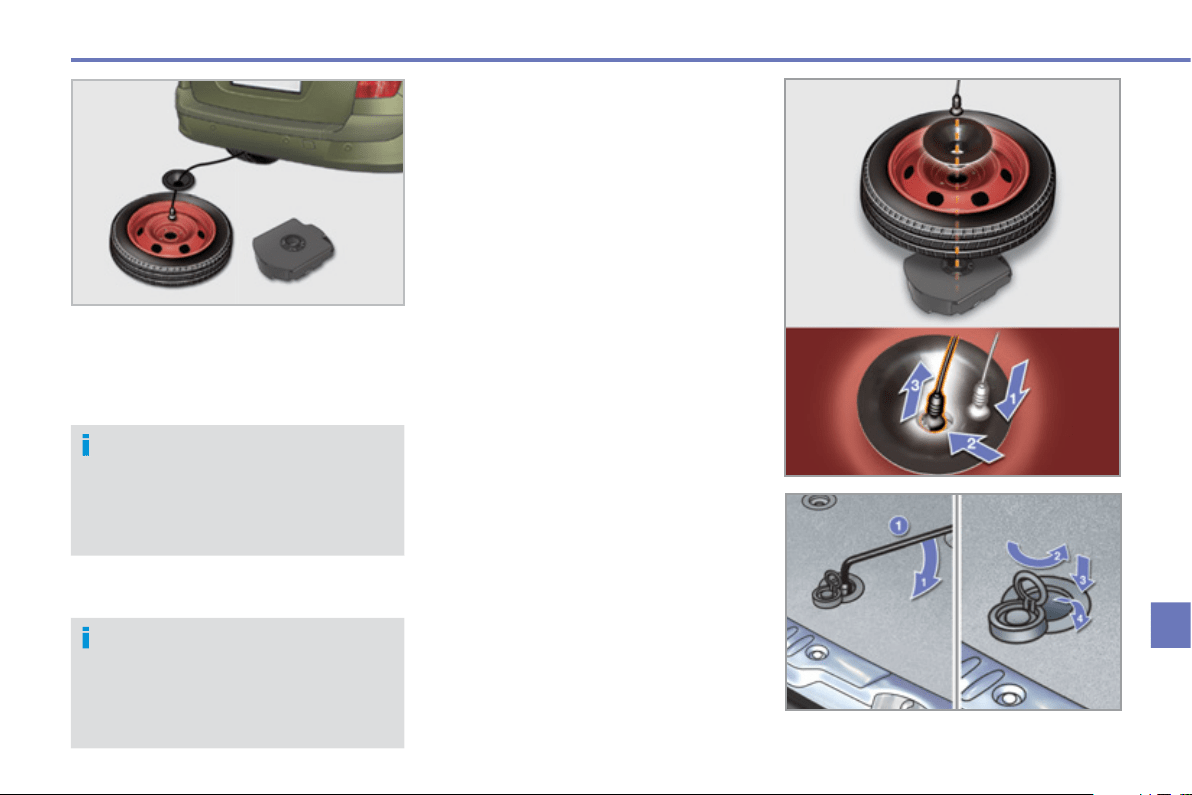
1
1
1
91
PRACTICAL INFORMATION
Tyre under-infl ation detection
The spare wheel is not fi tted with a
sensor. The punctured wheel must
be repaired by a PEUGEOT dealer
or a qualifi ed workshop.
Putting the wheel back in place
) Store tools 2 and 3 in the box and
close the cover.
) Position the box on the ground.
) Place the spare wheel on the box.
) Fit the black plastic centring cone in
the centre of the wheel (on steel or
"space-saver" type wheels only).
) Pass the hooking device through
the cone and the wheel to secure it
to the box cover.
) Raise the wheel/box assembly un-
derneath the rear of the vehicle by
tightening the winch control nut us-
ing the wheelbrace 1 .
) Fully tighten the nut.
) Close the fl ap with the eyelet and
cover to secure the winch.
) Check that the wheel is located
squarely against the fl oor.
If not, repeat the operation.
If you purchase a wheel of standard
size to replace the "space-saver"
type spare wheel, the spacer, lo-
cated underneath the vehicle, must
be removed. Contact a PEUGEOT
dealer or a qualifi ed workshop.

1
1
1
92
PRACTICAL INFORMATION
Parking the vehicle
Immobilise the vehicle where it
does not block traffi c: the ground
must be level, stable and non-slip-
pery ground.
Apply the parking brake, switch off
the ignition and engage fi rst gear *
to lock the wheels.
If necessary, place a chock under
the wheel diagonally opposite the
wheel to be changed.
It is imperative that you ensure that
the occupants get out of the vehicle
and wait where they are safe.
Never go underneath a vehicle
raised using a jack; use an axle
stand.
Removing the wheel
List of operations
) Remove the fi nisher cap from each
wheel bolt using tool 3 .
) Fit the security socket 4 on the wheel-
brace 1 to slacken the security bolt.
) Slacken the other bolts using the
wheelbrace 1 only.
) Place the jack 2 in contact with one
of the two front A or rear B locations
provided on the underbody, which-
ever is closest to the wheel to be
changed.
) Extend the jack 2 until its base plate
is in contact with the ground. Ensure
that the centreline of the jack base
plate is directly below the location A
or B used.
) Raise the vehicle until there is suf-
fi cient space between the wheel and
the ground to admit the spare (not
punctured) wheel easily.
) Remove the bolts and store them in
a clean place.
) Remove the wheel.
* position R for the electronic gear
control gearbox; P for the auto-
matic gearbox.
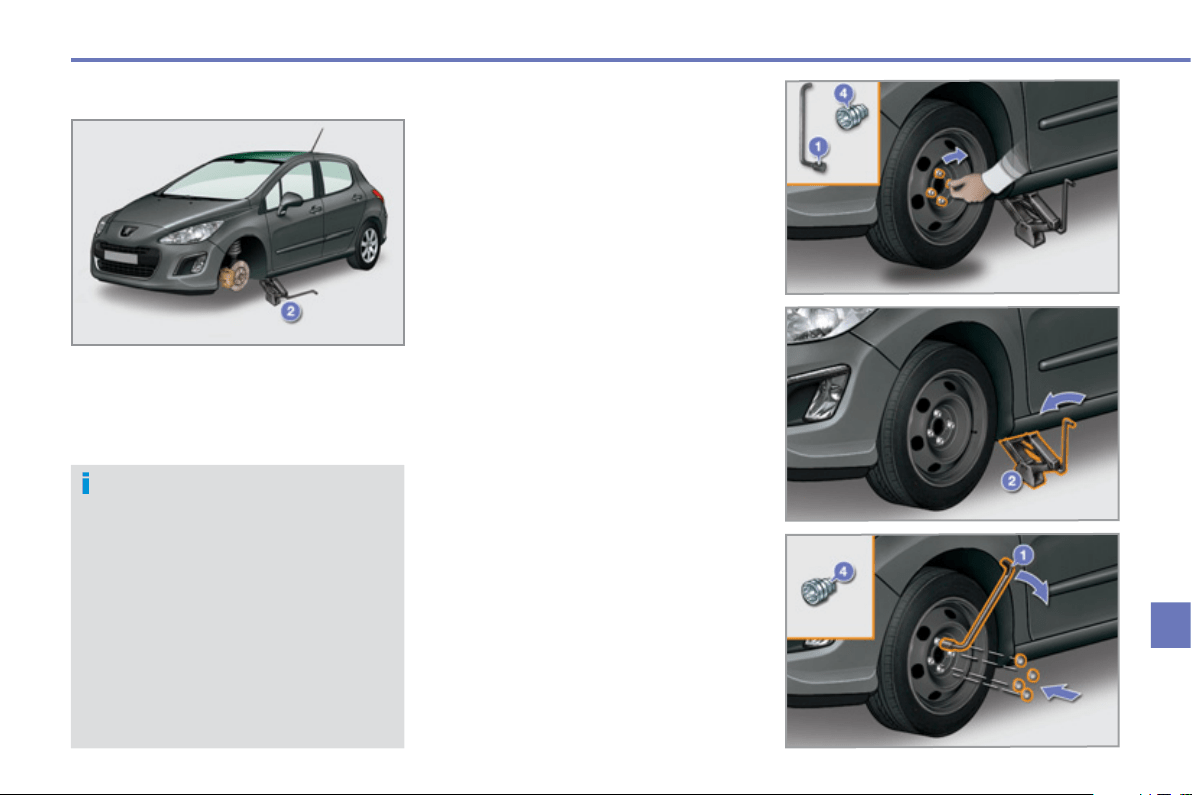
1
1
1
93
PRACTICAL INFORMATION
After changing a wheel
To store the punctured wheel in the
boot correctly, fi rst remove the cen-
tral cover.
When using the "space-saver" type
spare wheel, do not exceed 50 mph
(80 km/h).
Have the tightening of the bolts and
the pressure of the spare wheel
checked by a PEUGEOT dealer or
a qualifi ed workshop without delay.
Have the punctured wheel repaired
and replace it on the vehicle as
soon as possible.
Fitting the wheel
List of operations
) Put the wheel in place on the hub.
) Screw in the bolts by hand to the
stop.
) Pre-tighten the security bolt using the
wheelbrace 1 fi tted with the security
socket 4 .
) Pre-tighten the other bolts using the
wheelbrace 1 only.
) Lower the vehicle fully.
) Fold the jack 2 and detach it.
) Tighten the security bolt using the
wheelbrace 1 fi tted with the security
socket 4 .
) Tighten the other bolts using the
wheelbrace 1 only.
) Refi t the fi nisher caps on each wheel
bolt.
) Store the tools in the box.
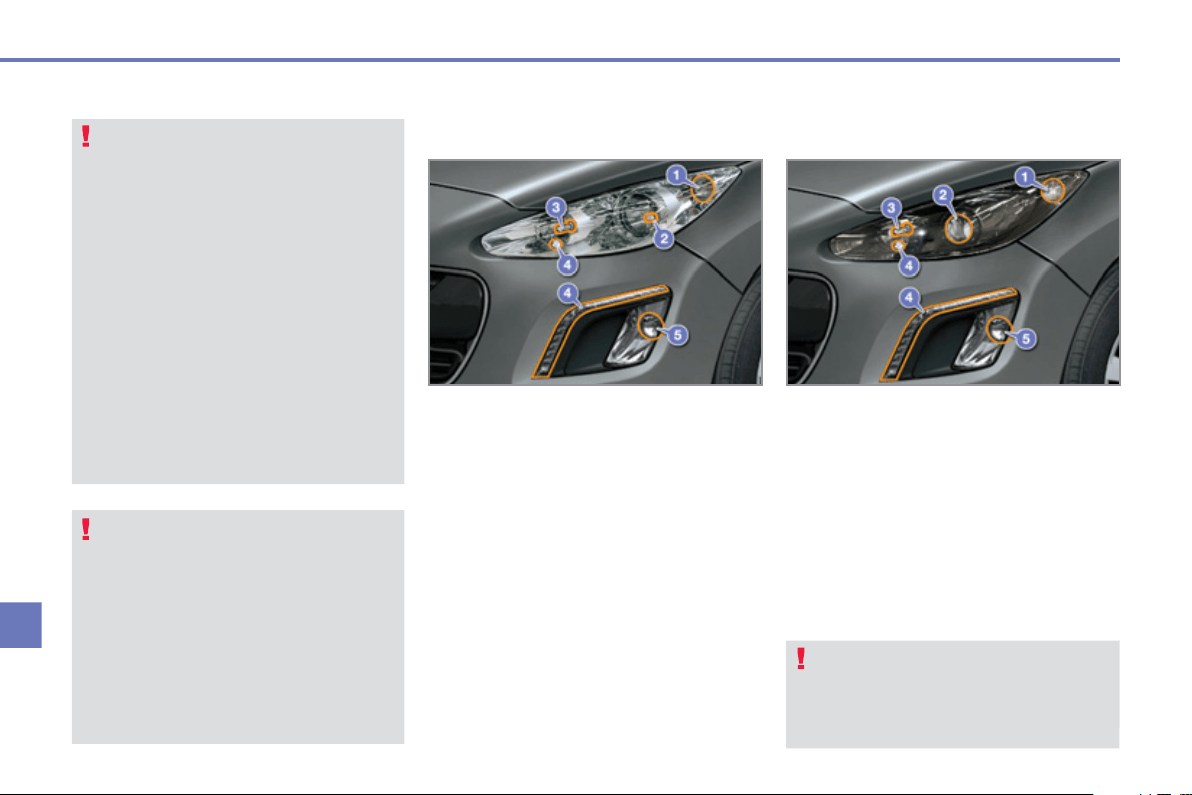
1
1
1
94
PRACTICAL INFORMATION
Risk of electrocution
Xenon bulbs (D1S-35W) must be
replaced by a PEUGEOT dealer or
a qualifi ed workshop.
CHANGING A BULB
Model with halogen headlamps
1. Direction indicators
(PY21W amber).
2. Dipped beam headlamps
(H7 - 55W).
3. Main beam headlamps
(H1 - 55W).
4. Daytime running lamps /
sidelamps (P21/5W)
or
Daytime running lamps /
sidelamps (LEDs).
5. Foglamps (H8 - 35W).
1. Direction indicators
(PY21W SV silver).
2. Directional dipped / main beam
headlamps (D1S-35W).
3. Additional main beam headlamps
(H1-55W).
4. Daytime running lamps / sidelamps
(P21/5W)
or
Daytime running lamps / sidelamps
(LEDs).
5. Foglamps (H8-35W).
Model with xenon and directional
headlamps
The headlamps are fi tted with poly-
carbonate glass with a protective
coating:
) do not clean them using a dry
or abrasive cloth, nor with a
detergent or solvent product,
) use a sponge and soapy water,
) when using a high pressure
washer on persistent marks, do
not keep the lance directed to-
wards the lamps or their edges
for too long, so as not to dam-
age their protective coating and
seals,
) do not touch the bulb directly
with your fi ngers, use lint-free
cloths.
Changing a bulb should only be
done after the headlamp has been
switched off for a few minutes (risk
of serious burns).
It is imperative to use only anti-ultra-
violet (UV) type bulbs in order not to
damage the headlamp.
Always replace a failed bulb with a
new bulb with the same type and
specifi cation.
Front lamps
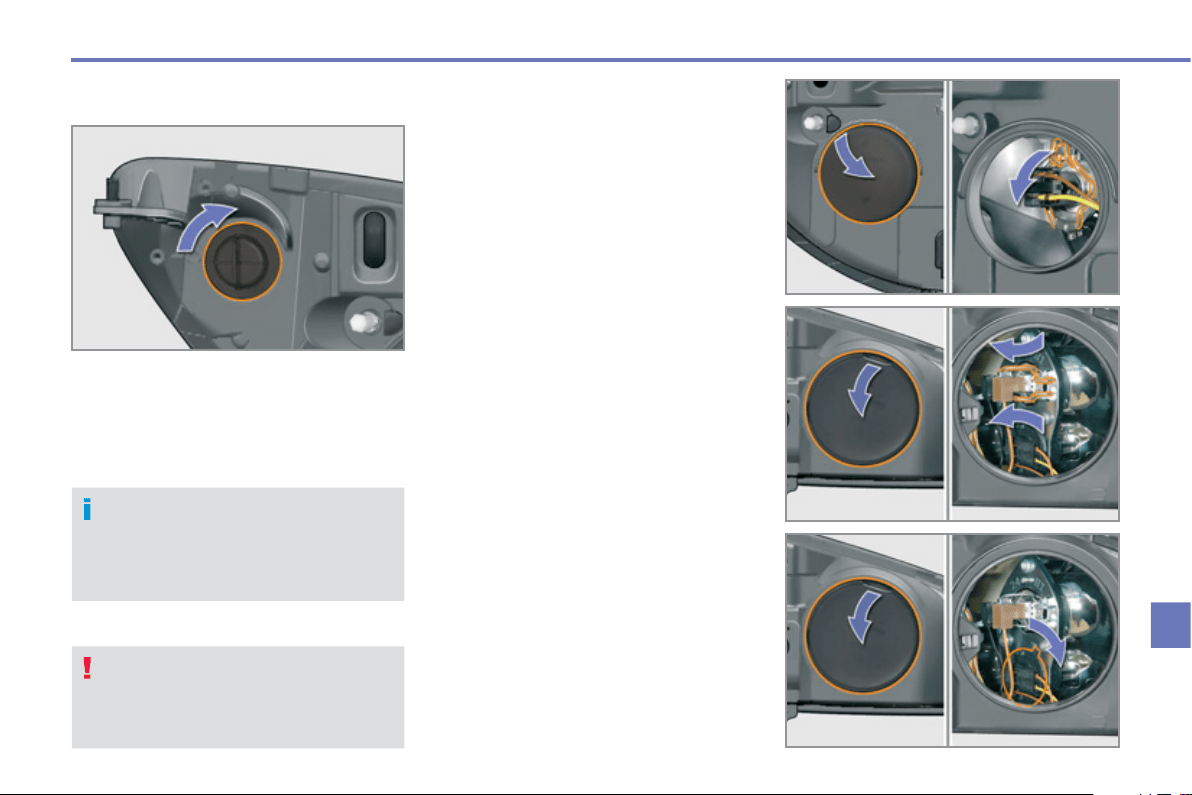
1
1
1
95
PRACTICAL INFORMATION
Changing main beam headlamp
bulbs
) Remove the protective cover by
pulling the tab.
) Disconnect the bulb connector.
) Compress the springs to release the
bulb.
) Extract the bulb and change it.
To refi t, carry out these operations in re-
verse order.
Changing daytime running lamp /
sidelamp bulbs
) Remove the protective cover by
pulling the tab.
) Disconnect the bulb connector.
) Turn the bulb holder a quarter of a
turn and extract it.
) Pull the bulb out and change it.
To refi t, carry out these operations in re-
verse order.
Changing dipped beam headlamp
bulbs
) Remove the protective cover by
pulling the tab.
) Disconnect the bulb connector.
) Spread the springs to release the
bulb.
) Pull the bulb out and change it.
To refi t, carry out these operations in re-
verse order.
Changing direction indicator bulbs
) Turn the bulb holder a quarter of a
turn and extract it.
) Pull the bulb out and change it.
To refi t, carry out these operations in re-
verse order.
Amber or silver coloured bulbs,
such as the direction indicators,
must be replaced with bulbs of
identical specifi cations and colour.
When refi tting, close the protective
cover carefully to assure the seal-
ing of the headlamp.
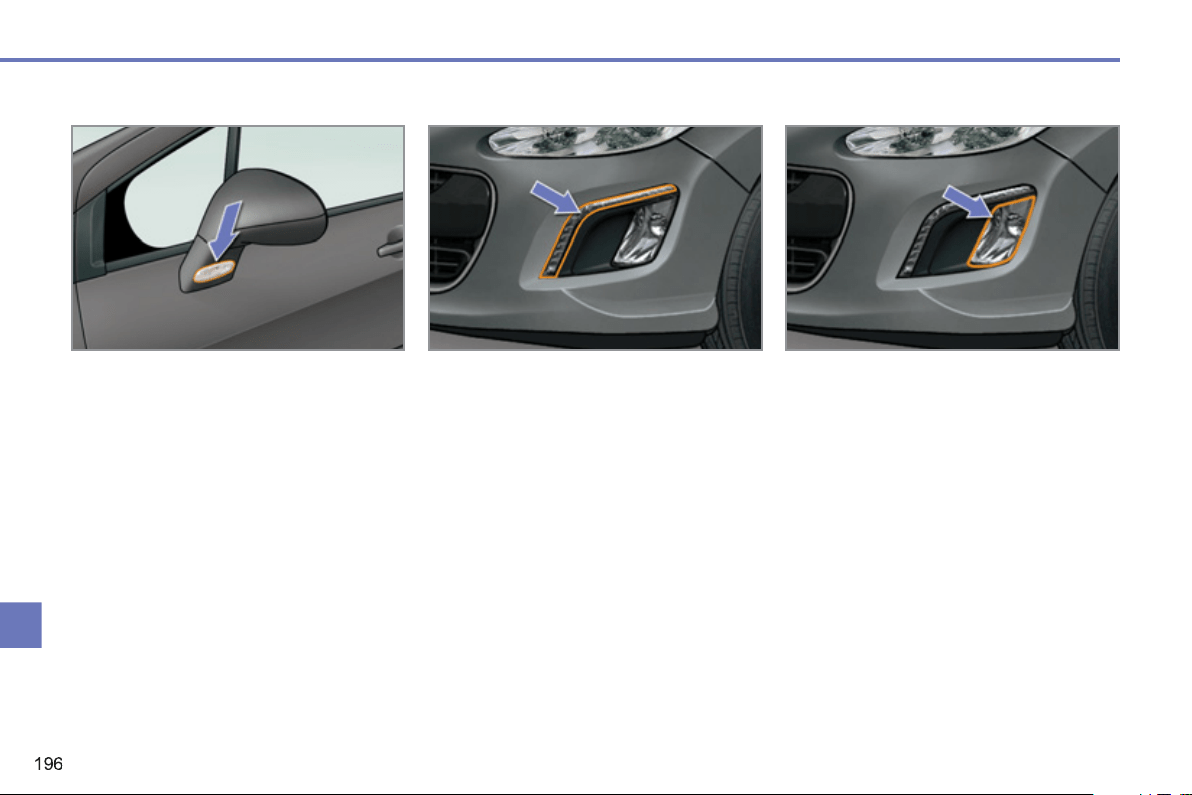
1
1
PRACTICAL INFORMATION
Changing front foglamp bulbs
) Insert a screwdriver at the middle of
the repeater between the repeater
and the base of the mirror.
) Tilt the screwdriver to extract the re-
peater and remove it.
) Disconnect the repeater connector.
To refi t, carry out these operations in re-
verse order.
Contact a PEUGEOT dealer or a quali-
fi ed workshop to obtain replacement re-
peaters.
Changing integrated direction
indicator side repeaters
To replace these bulbs contact a PEUGEOT
dealer or a qualifi ed workshop.
Changing the daytime running
lamps / sidelamps
For the replacement of this type of LED
lamp, contact a PEUGEOT dealer or a
qualifi ed workshop.
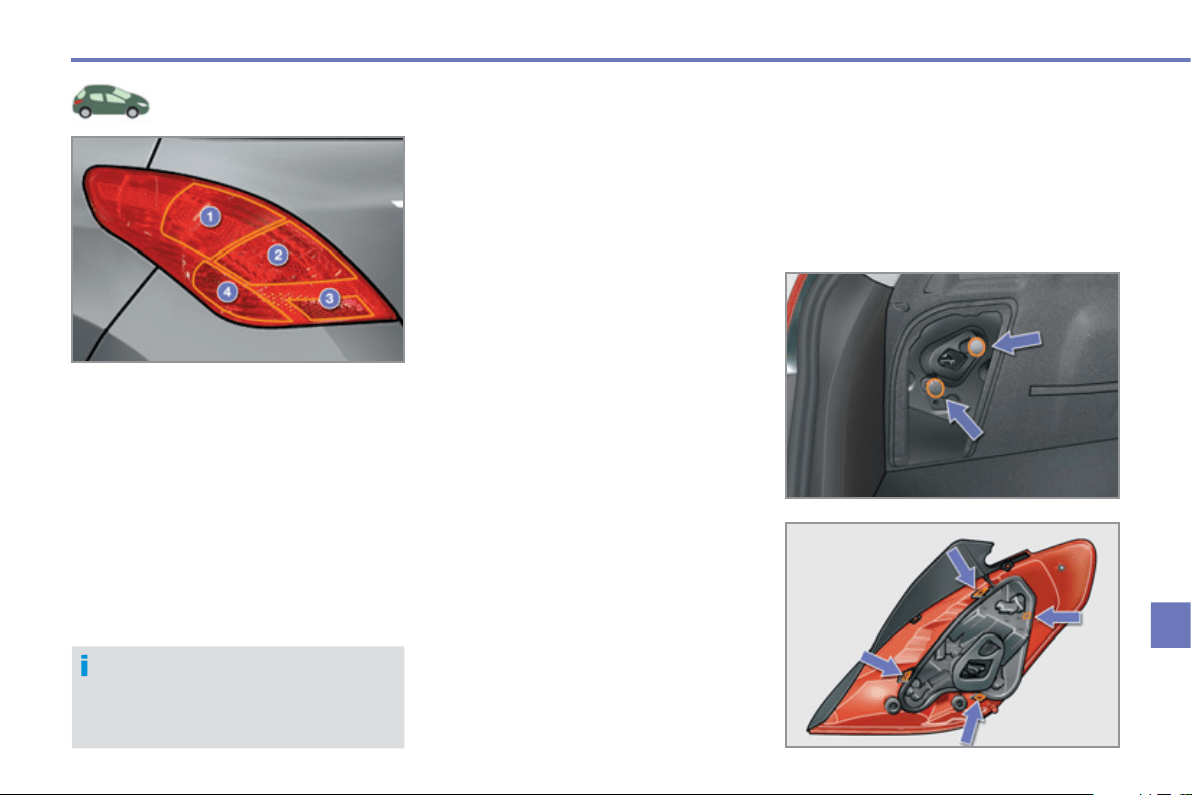
1
1
1
97
PRACTICAL INFORMATION
Rear lamps
1. Brake lamps / sidelamps (P21/5W).
2. Sidelamps (P21/5W).
3. Foglamp, offside (P21W).
Reversing lamp, nearside (P21W).
4. Direction indicators (P21W).
Changing bulbs
These fi ve bulbs are changed from out-
side the boot:
) remove the two lamp fi xing nuts,
) extract the lamp carefully from the
outside,
) disconnect the lamp connector,
) press the four tabs and remove the
bulb holder,
) turn the bulb a quarter of a turn and
change it.
To refi t, carry out these operations in re-
verse order.
If the vehicle is fi tted with the JBL
audio system, on the right-hand
side, fi rst remove the three fi xing
bolts, then move the box.
) on the right-hand side; remove the
access fl ap,
) on the left-hand side; turn the fi xing
bolt a quarter of a turn and remove
the storage box cover,
) unclip the storage box,
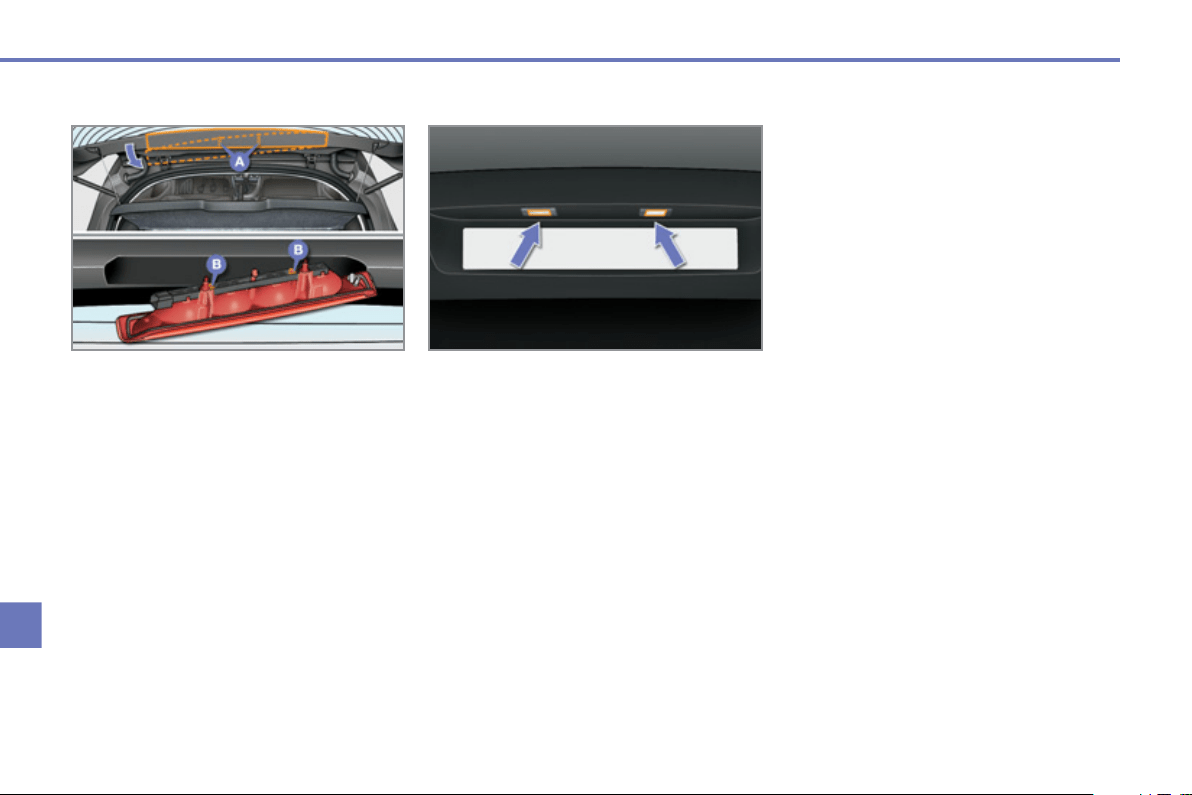
1
1
1
98
PRACTICAL INFORMATION
Changing third brake lamp bulbs
(4 bulbs W5W)
) Unclip the tailgate upper trim from
left to right.
) Unscrew the two lamp fi xing nuts A .
) Unclip the lamp's central pin.
) Extract the lamp from the outside.
) Disconnect the bulb holder connector
and the wash-wipe pipe.
) Unclip the bulb holder from the lamp
by pressing on the two tabs B .
) Pull the bulb and change it.
To refi t, carry out these operations in re-
verse order.
Do not apply force to the lamp when
tightening the nuts.
Changing the number plate lamp
bulbs (W5W)
) Insert a thin screwdriver into one of
the outer holes of the lens.
) Push it outwards to unclip.
) Remove the lens.
) Pull the bulb and change it.
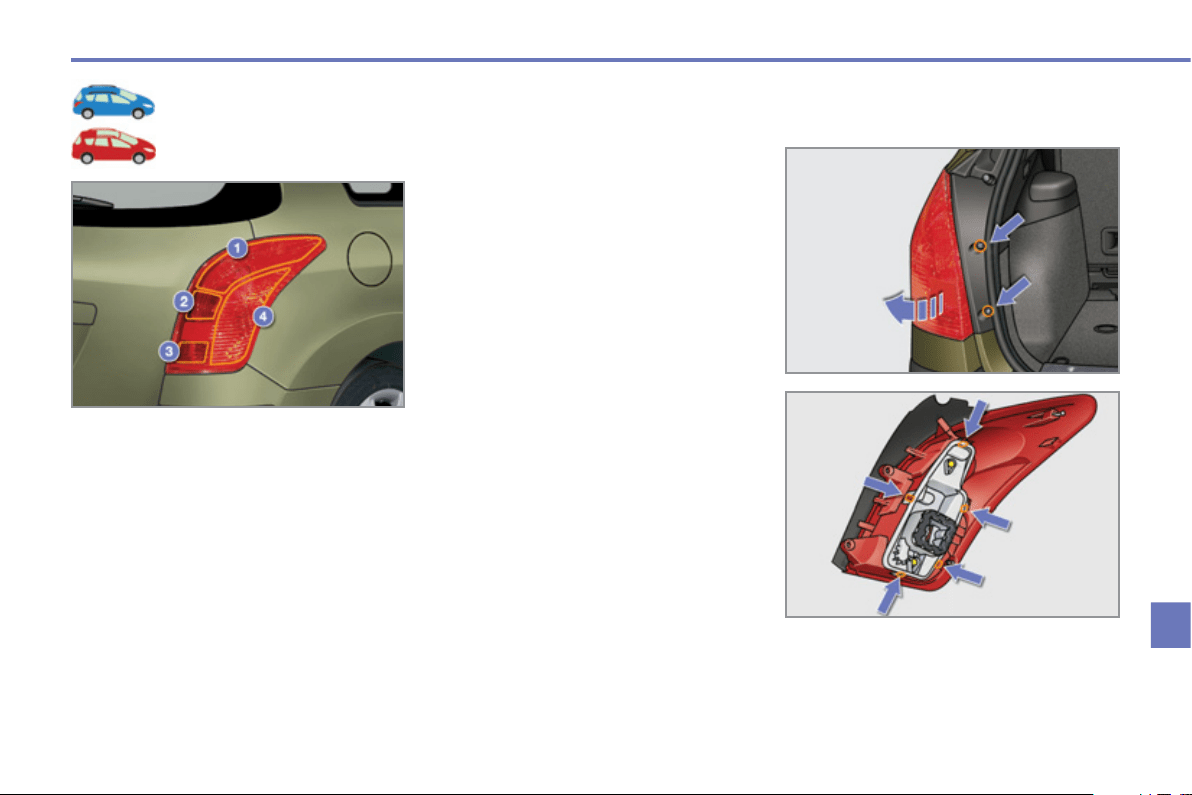
1
1
1
99
PRACTICAL INFORMATION
Rear lamps
1. Brake lamps / sidelamps (P21/5W).
2. Sidelamps (P21/5W).
3. Foglamp, offside (P21W)
Reversing lamp, nearside (P21W).
4. Direction indicators (P21W)
Changing bulbs
These fi ve bulbs are changed from out-
side the boot:
) unclip the lamp connector,
) separate the fi ve tabs and remove
the bulb holder,
) turn the bulb a quarter of a turn and
change it.
) open the boot,
) unscrew the two lamp fi xing bolts,
) extract the lamp carefully pulling it
from the bottom and pivoting it to-
wards the outside,
To refi t, carry out these operations in re-
verse order.
Take care to engage the lamp in its
guides keeping it in line with the vehicle.
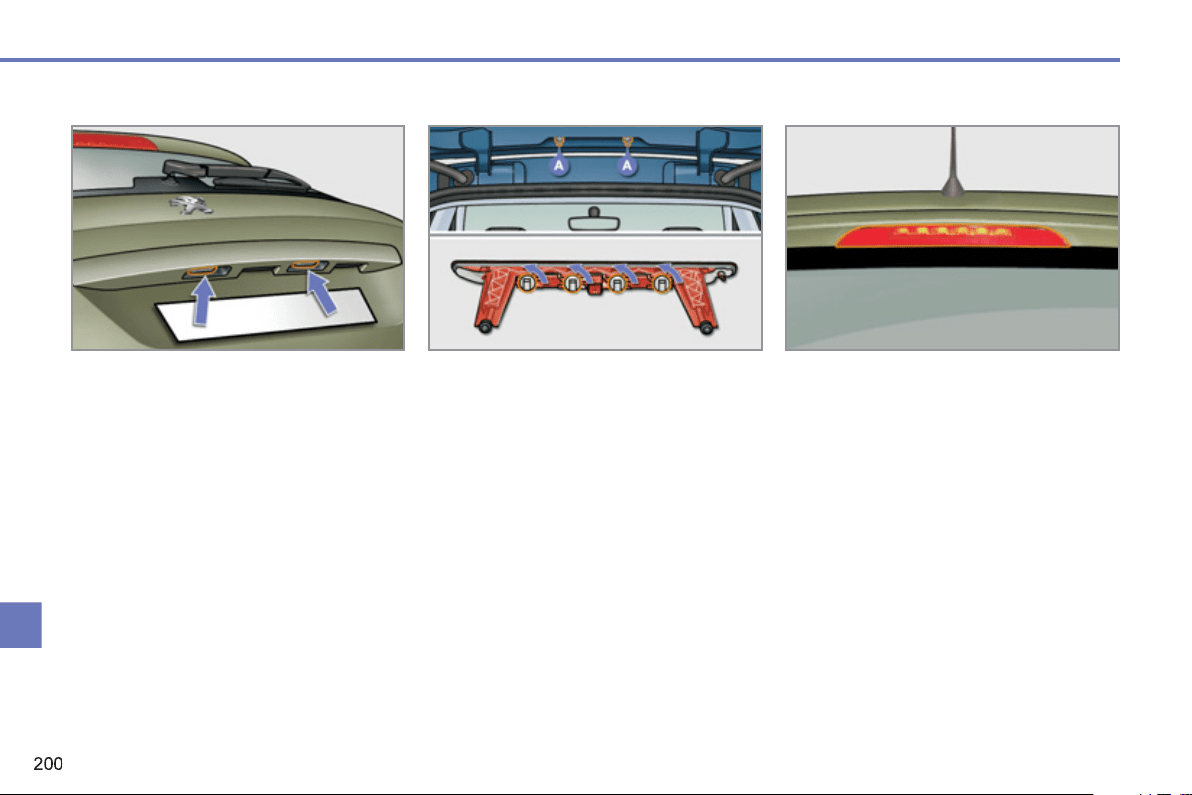
1
1
PRACTICAL INFORMATION
Changing the number plate lamp
bulbs (W5W)
) Insert a thin screwdriver into one of
the outer holes of the lens.
) Push it outwards to unclip.
) Remove the lens.
) Pull the bulb and change it.
Changing the third brake lamp
(SW - 4 bulbs W5W)
) Remove the two lamp fi xing nuts A .
) Take out the lamp from the outside.
) Disconnect the connector and the
screenwash pipe from the lamp.
) Turn the bulb holder corresponding
to the faulty bulb a quarter of a turn.
) Pull the bulb and change it.
To refi t, carry out these operations in re-
verse order.
Do not force the lamp when tightening
the nuts.
Changing the third brake lamp
(SW - LEDs)
For the replacement of this type of LED
lamp, contact a PEUGEOT dealer or a
qualifi ed workshop.
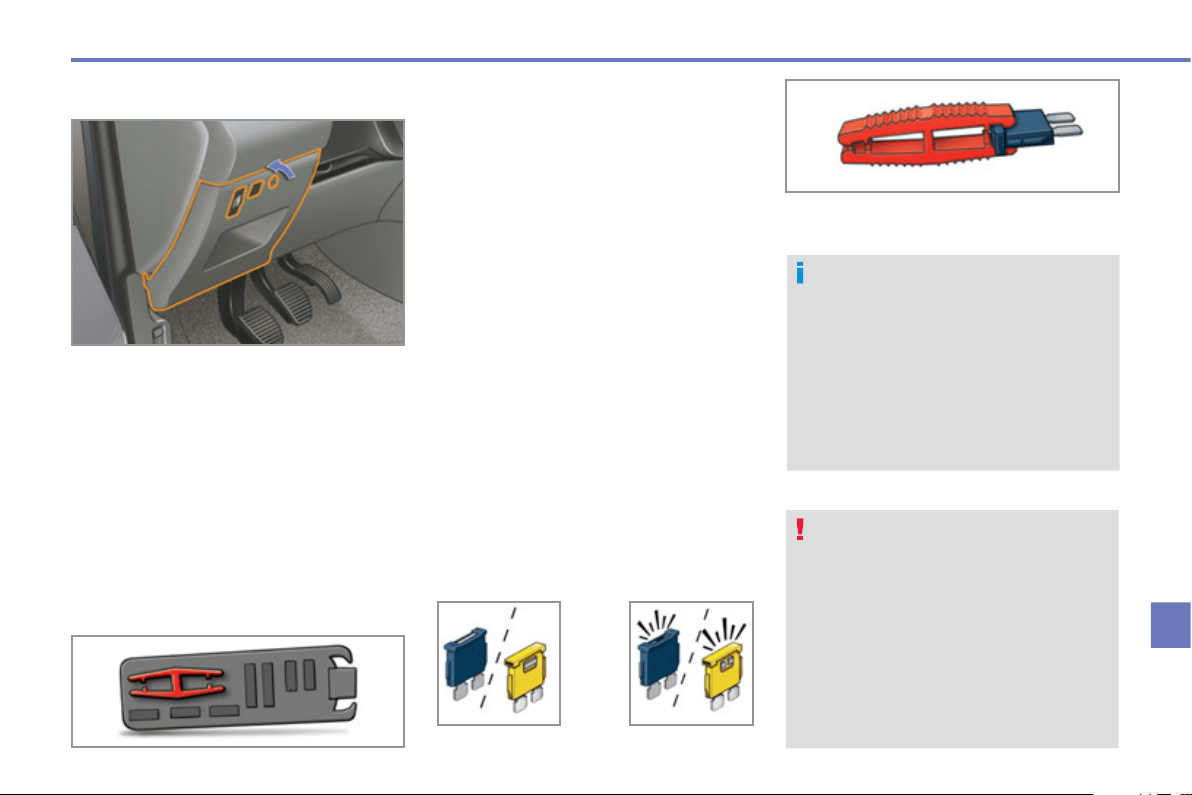
1
1
2
01
PRACTICAL INFORMATION
PEUGEOT will not accept responsi-
bility for the cost incurred in repairing
your vehicle or for rectifying mal-
functions resulting from the installa-
tion of accessories not supplied and
not recommended by PEUGEOT
and not installed in accordance with
its instructions, in particular when
the combined consumption of all of
the additional equipment connected
exceeds 10 milliamperes.
Installing electrical accessories
Your vehicle's electrical system is
designed to operate with standard
or optional equipment.
Before installing other electrical
equipment or accessories on your
vehicle, contact a PEUGEOT dealer
or a qualifi ed workshop.
CHANGING A FU
S
E
Access to the tools
The extraction tweezer is fi tted on the
back of the dashboard fusebox cover.
To gain access to it:
) turn the screw a quarter of a turn to
the left,
) unclip the cover by pulling the top
right,
) remove the cover completely and
turn it over,
) remove the carrier, on the back of
which is fi tted the tweezer.
Changing a fuse
Before changing a fuse:
) the cause of the failure must be
identifi ed and rectifi ed,
) all electric consumers must be
switched off,
) the vehicle must be immobilised
with the ignition off,
) identify the failed fuse using the al-
location tables and drawings in the
following pages.
To replace a fuse, you must:
) use the special tweezer to extract
the fuse from its housing and check
its fi lament,
) always replace the failed fuse with
a fuse of the same rating (same col-
our); use of a different rating may
cause malfunctions (risk of fi re).
If the fault recurs soon after changing
the fuse, have the electrical system
checked by a PEUGEOT dealer or a
qualifi ed workshop.
Good Failed
Tweezer
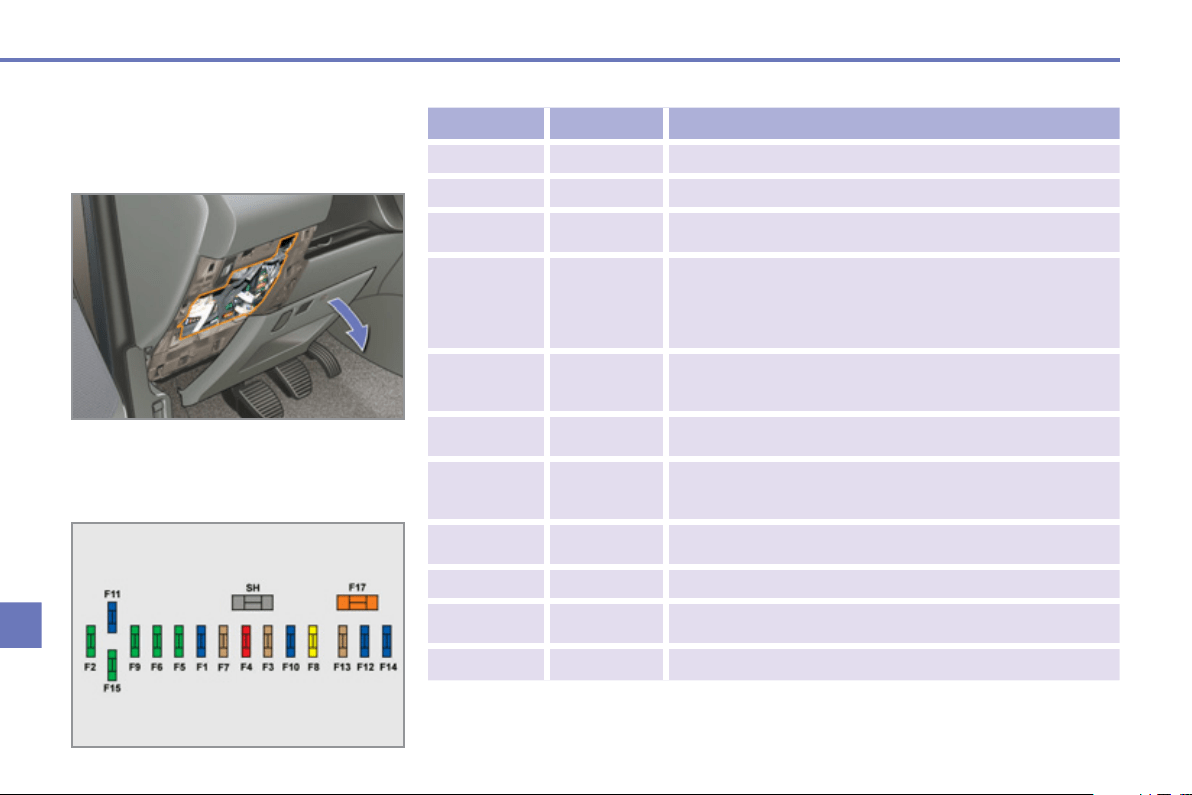
1
1
2
02
PRACTICAL INFORMATION
Dashboard fuses
The fusebox is placed in the lower section
of the dashboard (left-hand side).
Access to the fuses
) refer to the paragraph "Access to
the tools".
Fuse tables
Fuse N° Rating Functions
F1 15 A Rear wiper.
F2 30 A Locking and deadlocking earth.
F3 5 A Airbags and pretensioners control unit.
F4 10 A
Clutch pedal and dual-function brake switches,
electrochromatic rear view mirror, air conditioning,
steering wheel angle sensor, automatic gearbox,
switching and protection unit.
F5 30 A
Front one-touch electric windows, folding mirrors
supply, panoramic sunroof blind.
F6 30 A Rear one-touch electric windows, trailer fusebox.
F7 5 A
Front and rear courtesy lamps, map reading lamps,
rear reading lamps, sun visor illumination, glove
box illumination, torch.
F8 20 A
Audio equipment, audio/telephone, multifunction
screen, tyre under-infl ation detection.
F9 30 A Front 12 V socket.
F10 15 A
Steering mounted controls, alarm siren, alarm
control unit.
F11 15 A Low current ignition switch.
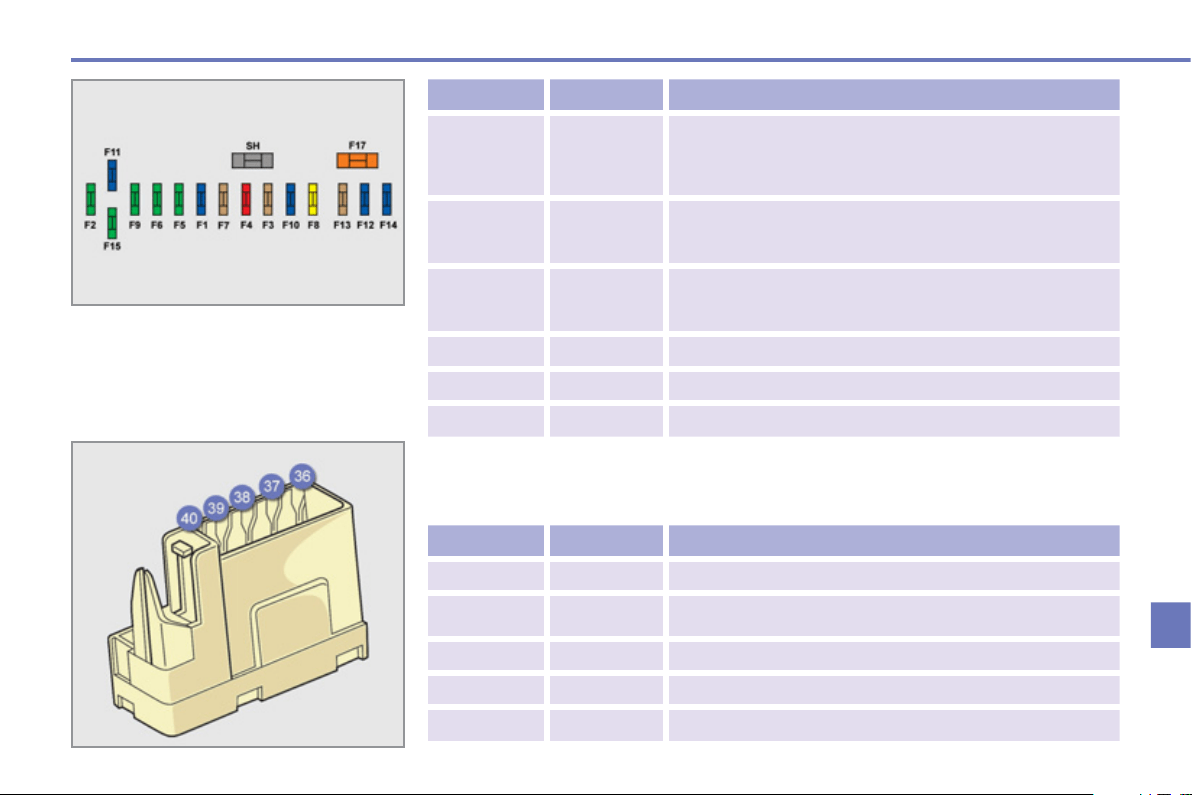
1
1
2
03
PRACTICAL INFORMATION
Fuse N° Rating Functions
F12 15 A
Instrument panel, seat belt and passenger's front
airbag warning lamps display, air conditioning,
driver's seat memory unit, 2nd row rear seat
switches, driving school module.
F13 5 A
Engine fusebox, airbags, electronic gear control
gearbox gear lever, trailer fusebox.
F14 15 A
Multifunction screen, amplifi er, Bluetooth system,
rain / sunshine sensor, parking sensors control unit.
F15 30 A Locking and deadlocking.
F17 40 A Rear screen and door mirrors demist/defrost.
SH - PARC shunt.
Fuse N° Rating Functions
G36 30 A Driver and passenger heated seats.
G37 5 A Driving position memory unit, lighting dimmer.
G38 30 A Driver's seat memory unit.
G39 30 A Trailer fusebox supply.
G40 30 A Hi-Fi amplifi er.
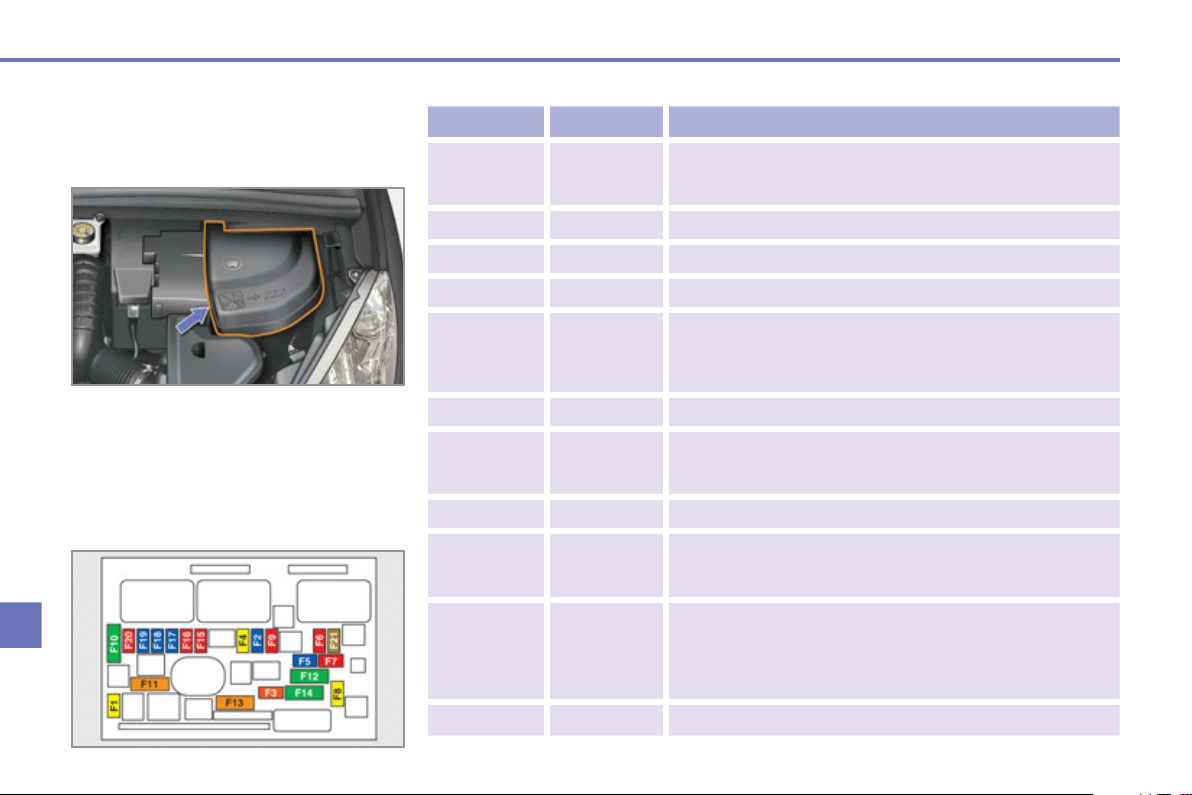
1
1
2
04
PRACTICAL INFORMATION
Engine compartment fuses
The fusebox is placed in the engine
compartment near the battery (left-hand
side).
Fuse N° Rating Functions
F1 20 A
Engine control unit supply, injection pump and EGR
electrovalves (2 litre HDI), injectors (2 litre HDI).
F2 15 A Horn.
F3 10 A Front / rear wash-wipe.
F4 20 A Headlamp wash.
F5 15 A
Canister purge, turbine discharge and Turbo
pressure regulation electrovalves (1.6 litre THP),
oil vapour heater (1.6 litre THP), Diesel heater
(1.6 litre HDI).
F6 10 A Vehicle speed sensor, ABS/ESP control unit.
F7 10 A
Power steering control unit, automatic gearbox,
engine coolant level detector.
F8 25 A Starter motor control.
F9 10 A
Diagnostic socket, directional headlamps, air fl ow
sensor (Diesel), particle emission fi lter pump
(Diesel).
F10 30 A
Engine control unit actuators (petrol: ignition coils,
electrovalves, oxygen sensors, injectors, heaters,
fuel pump, electronic thermostat)
(Diesel: electrovalves, heaters).
F11 40 A Air conditioning blower.
Access to the fuses
) Unclip the cover.
) Change the fuse (see correspond-
ing paragraph).
) When you have fi nished, close the
cover carefully to ensure sealing of
the fusebox.
Fuse table
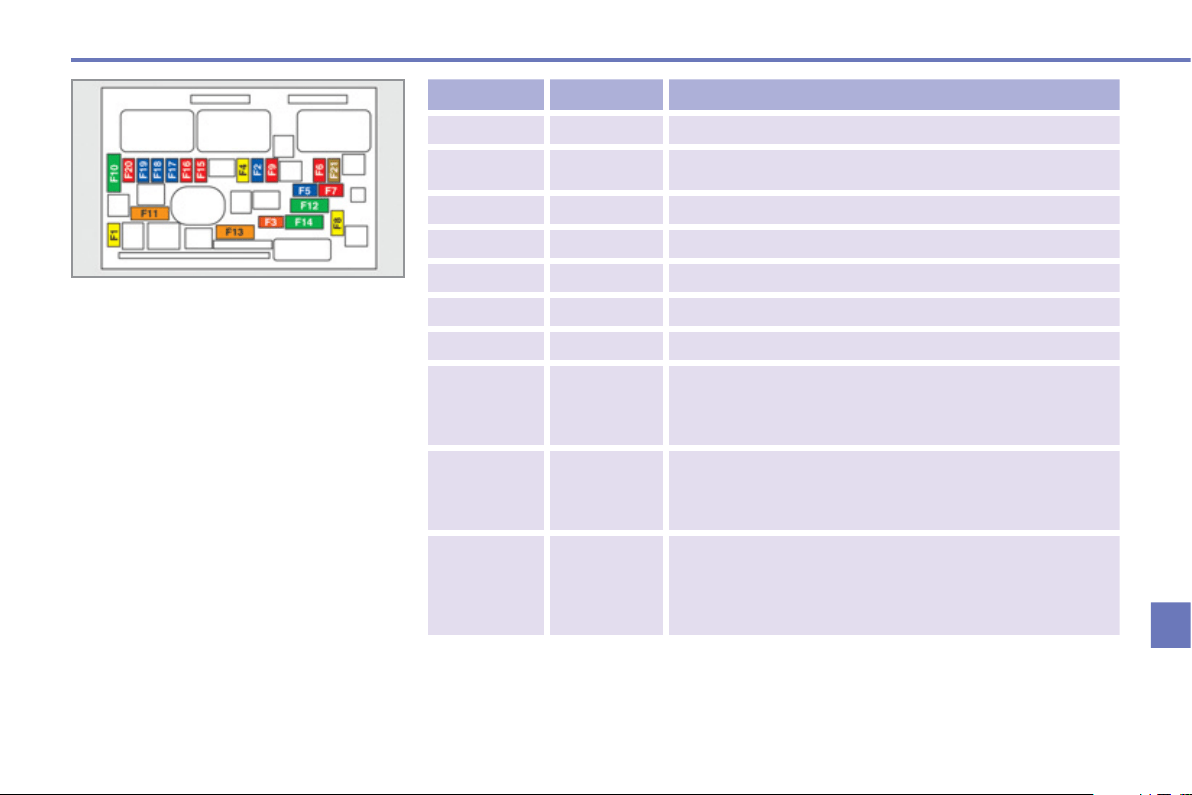
1
1
2
05
PRACTICAL INFORMATION
Fuse N° Rating Functions
F12 30 A Windscreen wipers slow / fast speed.
F13 40 A Built-in systems interface supply (ignition positive).
F14 30 A Air pump.
F15 10 A Right-hand main beam headlamp.
F16 10 A Left-hand main beam headlamp.
F17 15 A Left-hand dipped headlamp.
F18 15 A Right-hand dipped headlamp.
F19 15 A
Oil vapour heater (1.4 litre and 1.6 litre VTi),
canister purge electrovalve (1.4 litre
and 1.6 litre VTi), oxygen sensors (petrol),
air cooling electrovalves (Diesel).
F20 10 A
Electronic thermostat, variable timing electrovalves,
airfl ow sensor (1.6 litre THP 200),Turbo pressure
regulation electrovalve (Diesel), engine coolant
level detector (Diesel).
F21 5 A
Fan assembly relay supply, Valvetronic relay
control (1.4 litre and 1.6 litre VTi ), Turbo cooling
(1.6 litre THP), Valvetronic motor (1.6 litre
THP 200), air fl ow sensor (1.6 litre HDI).
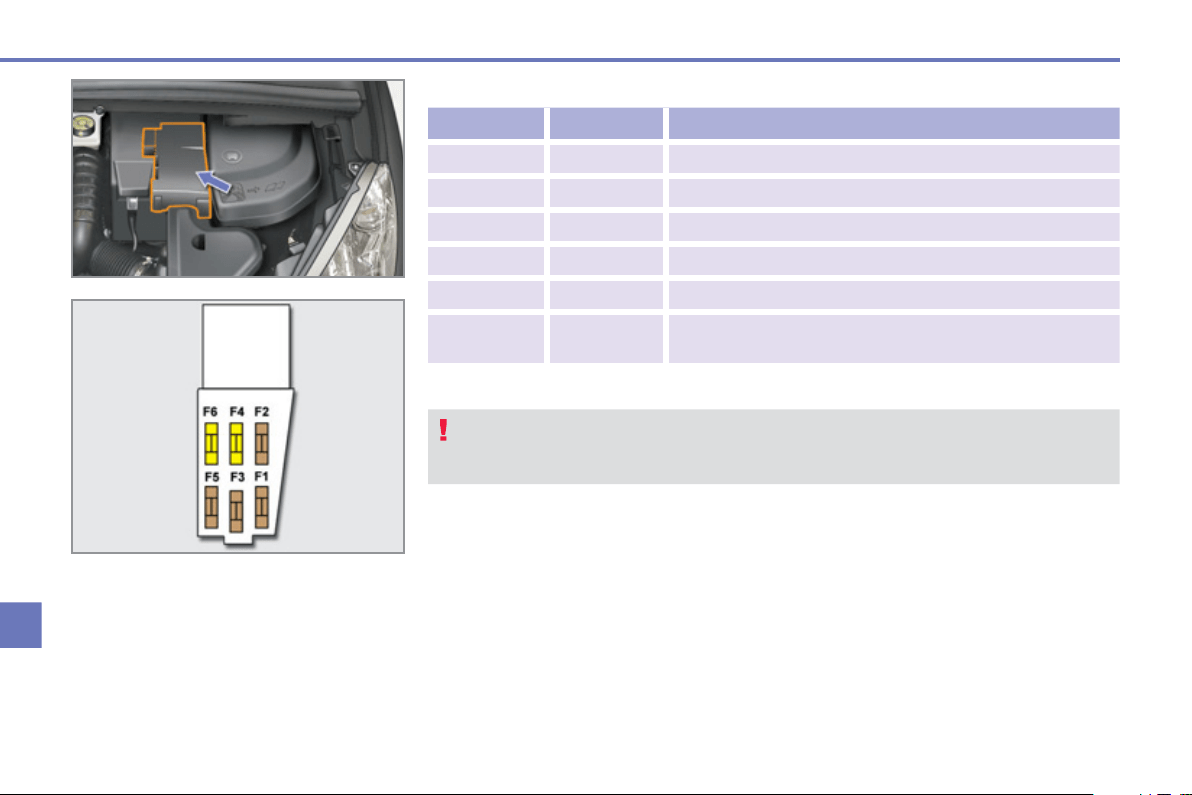
1
1
2
06
PRACTICAL INFORMATION
All work onthe other types of fuse (midi-fuses and maxi-fuses) must only be
carried out by a PEUGEOT dealer or a qualifi ed workshop.
Fuse N° Rating Functions
F1 - Not used.
F2 5 A Dual-function brake switch.
F3 5 A Battery charge unit.
F4 25 A ABS/ESP electrovalves.
F5 - Not used.
F6 15 A Gearbox (electronic gear control or automatic).
Table of fuses above the battery
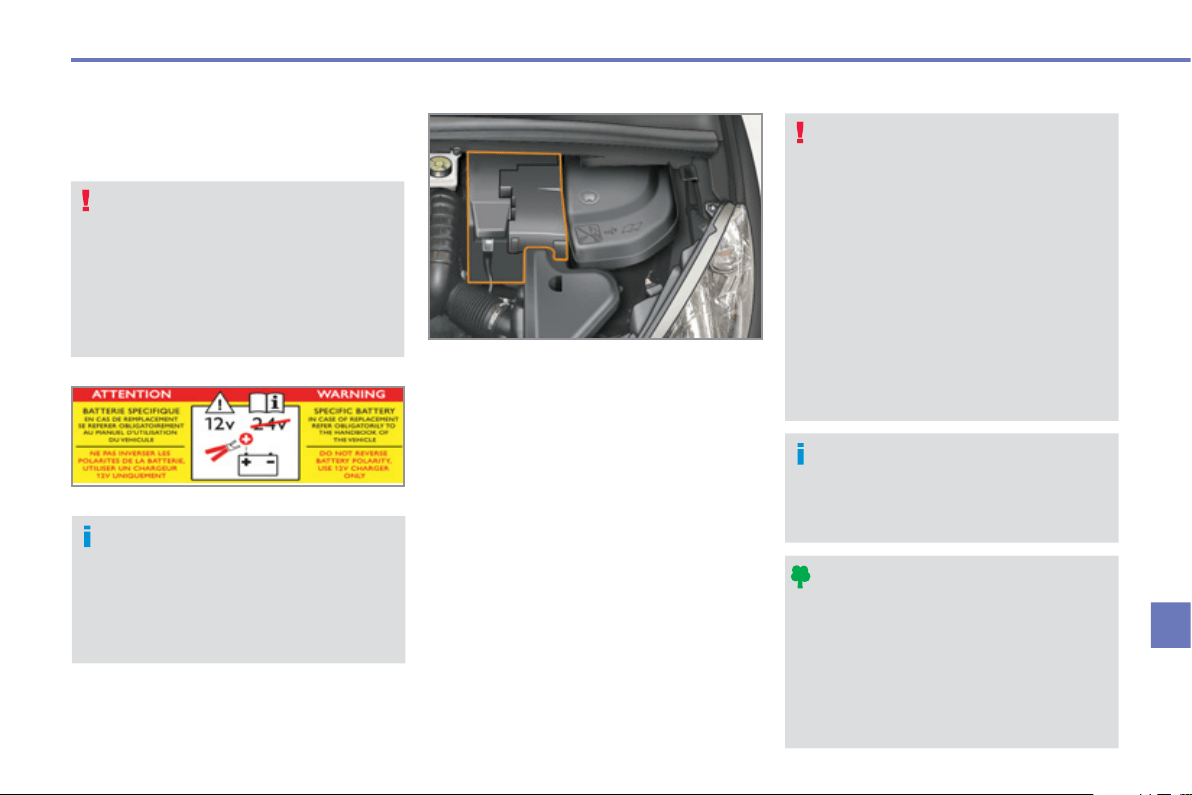
1
1
2
07
PRACTICAL INFORMATION
12 V BATTERY
Access to the battery
The battery is located under the bonnet.
To gain access to it:
) open the bonnet using the interior re-
lease lever, then the exterior safety
catch,
) secure the bonnet stay,
) remove the plastic cover on the (+)
terminal.
The presence of this label, in par-
ticular with the Stop & Start system,
indicates the use of a 12 V lead-
acid battery with special technology
and specifi cation; the involvement
of a PEUGEOT dealer or a qualifi ed
workshop is essential when replac-
ing or disconnecting the battery.
After refi tting the battery, the Stop &
Start system will only be active after
a continuous period of immobilisa-
tion of the vehicle, a period which
depends on the climatic conditions
and the state of charge of the bat-
tery (up to about 8 hours).
Procedure for starting the engine using
another battery or charging a discharged
battery.
Before doing any work
Immobilise the vehicle: apply the
parking brake, put the gearbox into
neutral (or position P if your vehicle
has an automatic gearbox), then
switch of the ignition.
Check that all electrical systems
are off.
Do not reverse the polarity and use
only a 12 V charger.
Do not disconnect the terminals
while the engine is running.
Do not charge the batteries without
disconnecting the terminals fi rst.
Ensure that the battery posts and
terminals are clean. If covered in
sulphate (white or green deposits),
remove and clean them.
The batteries contain harmful sub-
stances such as sulphuric acid and
lead. They must be disposed of in
accordance with regulations and
must not, in any circumstances, be
discarded with household waste.
Take used remote control batteries
and vehicle batteries to a special
collection point.
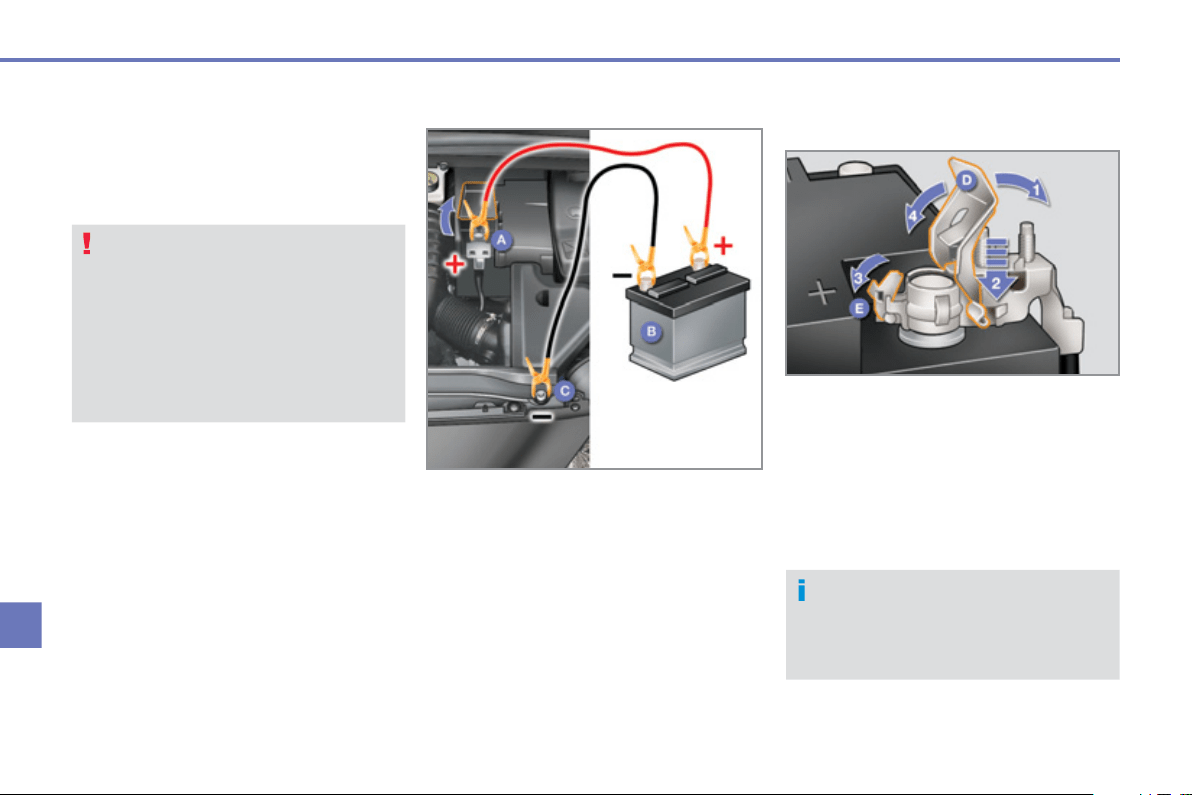
1
1
2
08
PRACTICAL INFORMATION
Do not apply excessive force on the
tab as locking will not be possible if
the clip is not positioned correctly;
start the procedure again.
Starting using another battery
When your vehicle's battery is dis-
charged, the engine can be started
using a slave battery (external or on an-
other vehicle) and jump leads.
Disconnecting the (+) cable
) Raise the locking tab D fully to re-
lease the cable terminal E .
Reconnecting the (+) cable
) Position the open clip E of the cable
on the positive post (+) of the battery.
) Press vertically on the clip E to posi-
tion it correctly on the battery.
) Lock the clip by spreading the position-
ing lug and then lowering the tab D .
First check that the slave battery
has a nominal voltage of 12 V and
a capacity at least equal to that of
the discharged battery.
Do not try to start the engine by
connecting a battery charger.
Do not disconnect the (+) terminal
when the engine is running.
) Connect the red cable to the posi-
tive terminal (+) of the fl at battery A ,
then to the positive terminal (+) of
the slave battery B .
) Connect one end of the green or
black cable to the negative terminal
(-) of the slave battery B (or earth
point on the other vehicle).
) Connect the other end of the green
or black cable to the earth point C
on the broken down vehicle (or on
the engine mounting).
) Start the vehicle with the good bat-
tery and leave it running for a few
minutes.
) Operate the starter on the broken
down vehicle and let the engine run.
If the engine does not start straight
away, switch off the ignition and wait
a few moments before trying again.
) Wait until the engine returns to idle
then disconnect the cables in the re-
verse order.

1
1
2
09
PRACTICAL INFORMATION
Charging
) Disconnect the (+) terminal.
) Follow the instructions for use pro-
vided by the manufacturer of the
charger.
) Connect the charger's red cable to
the (+) terminal of the battery, then
the black cable to the (-) terminal.
) Once the battery is fully charged,
disconnect the charger cables in re-
verse order.
Charging should be carried out in
a well-ventilated area and away
from naked fl ames and sources of
sparks, so as to avoid any risk of
explosion and fi re.
Do not try to charge a frozen bat-
tery; fi rst thaw it out so as to avoid
the risk of explosion.
If the battery had frozen, before
charging, have it checked by a
PEUGEOT dealer or qualifi ed
workshop who will ensure that
the internal components have not
been damaged and that the casing
is not cracked, which would cause
a leak of toxic and corrosive acid.
Reinitialisation after
reconnection
After any reconnection of the battery,
switch on the ignition and wait at least one
minute before starting, to allow time for the
initialisation of the electronic systems.
By referring to the corresponding sections,
you should set or initialise the following
systems yourself:
- remote control,
- one-touch electric windows,
- panoramic sunroof blind,
- time and date,
- audio and navigation system settings.
Check that no alert message or
warning lamp comes on after
switching on the ignition.
However, if minor problems per-
sist after carrying out these opera-
tions, contact a PEUGEOT dealer
or a qualifi ed workshop.
The Stop & Start battery does not
have to be disconnected for charging.
Charging the battery using
a battery charger
Before disconnecting
) Go to the battery.
) Check that the doors and boot are
closed but not locked.
) Switch off the ignition and wait for at
least four minutes.
If the vehicle is to not going to be used for
more than a month, it is recommended
that the battery be disconnected.
When your vehicle's battery is dis-
charged or when the vehicle is to be
out of use for a prolonged period, you
can charge the battery using a battery
charger.
Contact a PEUGEOT dealer or a quali-
fi ed workshop for the specifi cation of
chargers compatible with your battery.
1
1
21
0
PRACTICAL INFORMATION
A fl at battery prevents the engine
from starting (refer to the corre-
sponding section).
If the telephone is being used at this
time:
-
it will be maintained for ten min-
utes with the hands-free kit of your
Peugeot Connect Sound (RD5),
-
it will be maintained for ten minutes
with the Peugeot Connect Naviga-
tion (RT6) or the Peugeot Connect
Media Navigation (NG4 3D), then
it will transfer to your telephone de-
pending on the telephone model.
System which manages the duration of
use of certain functions to conserve a
suffi cient level of charge in the battery.
After the engine has stopped, you can
still use functions such as the audio and
telematics system, windscreen wip-
ers, dipped beam headlamps, courtesy
lamps, etc. for a maximum combined
duration of thirty minutes.
This period may be greatly reduced if
the battery is not fully charged.
Exiting economy mode
These functions are reactivated auto-
matically next time the vehicle is driven.
To restore the use of these functions im-
mediately, start the engine and let it run
for at least fi ve minutes.
Switching to economy mode
Once this time has elapsed, a message
appears in the screen indicating that
the vehicle has switched to economy
mode and the active functions are put
on standby.
LOAD REDUCTION MODE
System which manages the use of cer-
tain functions according to the level of
charge remaining in the battery.
When the vehicle is being driven, the
load reduction function temporarily de-
activates certain functions, such as
the air conditioning, the heated rear
screen...
The deactivated functions are reactivat-
ed automatically as soon as conditions
permit.

1
1
211
PRACTICAL INFORMATION
T
OWING THE VEHICLE
Access to the tools
The towing eye is installed in the boot
under the fl oor.
To gain access to it:
) open the boot,
) raise the fl oor,
) secure it by hooking its cord on the
hook on the rear parcel shelf support,
) remove the polystyrene storage box,
) remove the towing eye from the
holder.
Procedure for having your vehicle towed
or for towing another vehicle using a re-
movable towing eye.
CHANGING A WIPER BLADE
Removing
) Raise the corresponding wiper arm.
) Unclip the wiper blade and remove it.
Fitting
) Put the corresponding new wiper
blade in place and clip it.
) Fold down the wiper arm carefully.
Before removing a front wiper
blade
) Within one minute after switching off
the ignition, operate the wiper stalk
to position the wiper blades verti-
cally on the windscreen.
After fitting a front wiper blade
) Switch on the ignition.
) Operate the wiper stalk again to
park the wiper blades.
General recommendations
Observe the legislation in force in
your country.
Ensure that the weight of the tow-
ing vehicle is higher than that of
the towed vehicle.
The driver must stay at the wheel
of the towed vehicle.
Driving on motorways and fast
roads is prohibited when towing.
When towing a vehicle with all four
wheels on the ground, always use
an approved towing bar; rope and
straps are prohibited.
When towing a vehicle with the
engine off, there is no longer any
power assistance for braking or
steering.
In the following cases, you must al-
ways call on a professional recovery
service:
- vehicle broken down on a mo-
torway or fast road,
- when it is not possible to put
the gearbox into neutral, un-
lock the steering, or release
the parking brake,
- towing with only two wheels on
the ground,
- where there is no approved
towing bar available...
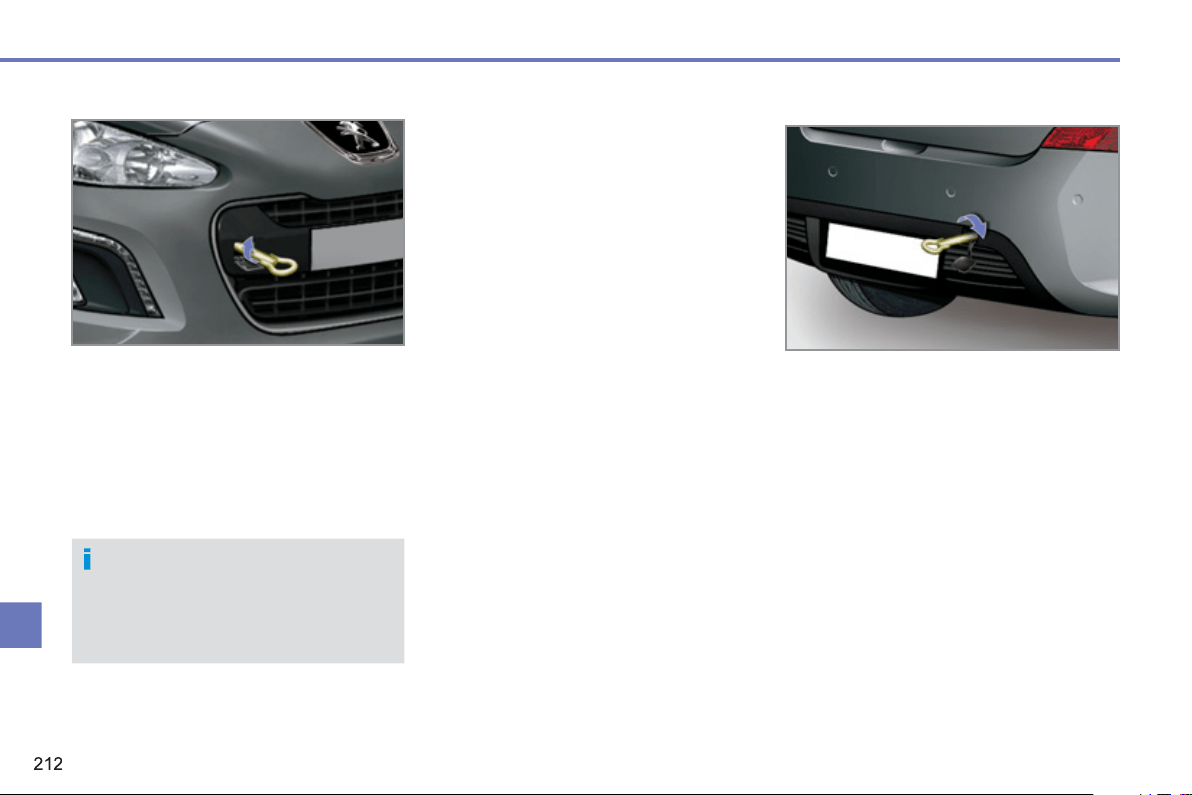
1
1
PRACTICAL INFORMATION
Towing your vehicle
) On the front bumper, unclip the cover
by pressing at the bottom.
) Screw the towing eye in fully.
) Install the towing bar.
) Place the gear lever in neutral (po-
sition N on the electronic gearbox
system or automatic gearbox).
) On the rear bumper, unclip the cover
by pressing at the bottom.
) Screw the towing eye in fully.
) Install the towing bar.
) Switch on the hazard warning lamps
on both vehicles.
) Move off gently and drive slowly for
a short distance only.
Towing another vehicle
Failure to observe this instruction
could result in damage to certain
components (braking, transmis-
sion...) and the absence of braking
assistance the next time the engine
is started.
) Unlock the steering by turning the
ignition key one notch and release
the parking brake.
) Switch on the hazard warning lamps
on both vehicles.
) Move off gently and drive slowly for
a short distance only.

1
1
21
3
PRACTICAL INFORMATION
T
OWING THE VEHICLE
Procedure for having your
vehicle towed or for towing
another vehicle using a re-
movable towing eye.
Access to the tools
Towing your vehicle
) On the front bumper, unclip the cover
by pressing it on the left.
) Screw the towing eye in fully.
) Install the towing bar.
) Place the gear lever in neutral (posi-
tion N on the automatic gearbox).
The towing eye is installed in the left-
hand side trim of the boot.
To gain access to it:
) open the boot,
) open the access fl ap in the left-hand
side trim,
) unclip the wheelbrace from its support,
) remove the towing eye from the
same support.
General recommendations
Observe the legislation in force in
your country.
Ensure that the weight of the tow-
ing vehicle is higher than that of the
towed vehicle.
The driver must stay at the wheel
of the towed vehicle.
Driving on motorways and fast
roads is prohibited when towing.
When towing a vehicle with all four
wheels on the ground, always use
an approved towing bar; rope and
straps are prohibited.
When towing a vehicle with the
engine off, there is no longer any
power assistance for braking or
steering.
In the following cases, you must
always call on a professional re-
covery service:
- vehicle broken down on a mo-
torway or fast road,
- when it is not possible to put the
gearbox into neutral, unlock the
steering, or release the parking
brake,
- towing with only two wheels on
the ground,
- where there is no approved
towing bar available...
Failure to observe this instruction
could result in damage to certain
components (braking, transmis-
sion...) and the absence of braking
assistance the next time the engine
is started.
) Unlock the steering by turning the
ignition key one notch and release
the parking brake.
) Switch on the hazard warning lamps
on both vehicles.
) Move off gently and drive slowly for
a short distance only.
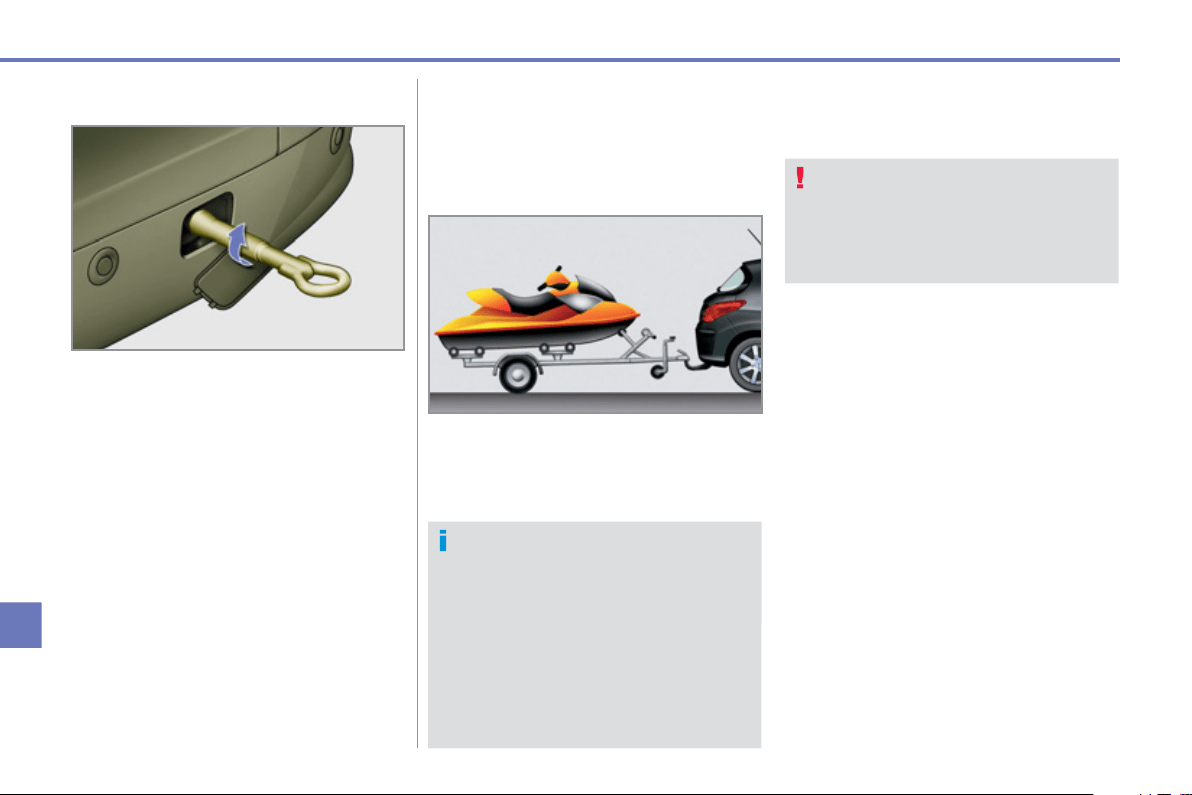
1
1
214
PRACTICAL INFORMATION
) On the rear bumper, unclip the cover
by pressing it on the left.
) Screw the towing eye in fully.
) Install the towing bar.
) Switch on the hazard warning lamps
on both vehicles.
) Move off gently and drive slowly for
a short distance only.
Towing another vehicle
T
OWING A TRAILER
Your vehicle is primarily designed for
transporting people and luggage, but it
may also be used for towing a trailer.
Driving advice
Side wind
) Take into account the increased
sensitivity to side wind.
Cooling
Towing a trailer on a slope increases
the temperature of the coolant.
Towbar suitable for the attachment of a
trailer with additional lighting and sig-
nalling.
Distribution of loads
) Distribute the load in the trailer so
that the heaviest items are as close
as possible to the axle and the nose
weight approaches the maximum
permitted without exceeding it.
Air density decreases with altitude, thus
reducing engine performance. Above
1 000 metres, the maximum towed load
must be reduced by 10 % for every
1 000 metres of altitude.
Refer to the "Technical Data" section for
details of the weights and towed loads
which apply to your vehicle.
Driving with a trailer places greater de-
mands on the towing vehicle and the
driver must take particular care.
We recommend the use of genuine
PEUGEOT towbars and their har-
nesses that have been tested and
approved from the design stage of
your vehicle, and that the fi tting of the
towbar is entrusted to a PEUGEOT
dealer or a qualifi ed workshop.
If the towbar is not fi tted by a PEUGEOT
dealer, it is imperative that it is fi tted in
accordance with the vehicle manufac-
turer's instructions.
If your vehicle is fi tted with the
1.6 litre THP 200 hp engine, you
cannot fi t a towbar. The space oc-
cupied by the sport exhaust system
prevents this.
1
1
21
5
PRACTICAL INFORMATION
V
ERY COLD CLIMATE
S
CREEN *
Removable protective screen which
prevents the accumulation of snow at
the radiator cooling fan.
Fitting
) Offer up the very cold climate screen
to the front of the lower section of
the front bumper.
) Press around its edge to engage its
fi xing clips one by one.
Do not forget to remove the very
cold climate screen:
- when the ambient temperature
exceeds 10 °C,
- when towing,
-
at speeds above 75 mph (120 km/h).
Removal
) Use a screwdriver as a lever to re-
lease each fi xing clip in turn.
As the fan is electrically controlled, its
cooling capacity is not dependent on
the engine speed.
) To lower the engine speed, reduce
your speed.
The maximum towed load on a long in-
cline depends on the gradient and the
ambient temperature.
In all cases, keep a check on the cool-
ant temperature.
Braking
Towing a trailer increases the braking
distance.
To avoid overheating of the brakes on a
long mountain type of descent, the use
of engine braking is recommended.
Tyres
) Check the tyre pressures of the towing
vehicle and of the trailer, observing the
recommended pressures.
Lighting
) Check the electrical lighting and sig-
nalling on the trailer.
The rear parking sensors will be
deactivated automatically if a gen-
uine PEUGEOT towbar is used.
) If the warning lamp and the
STOP warning lamp come
on, stop the vehicle and
switch off the engine as
soon as possible.
* According to country.
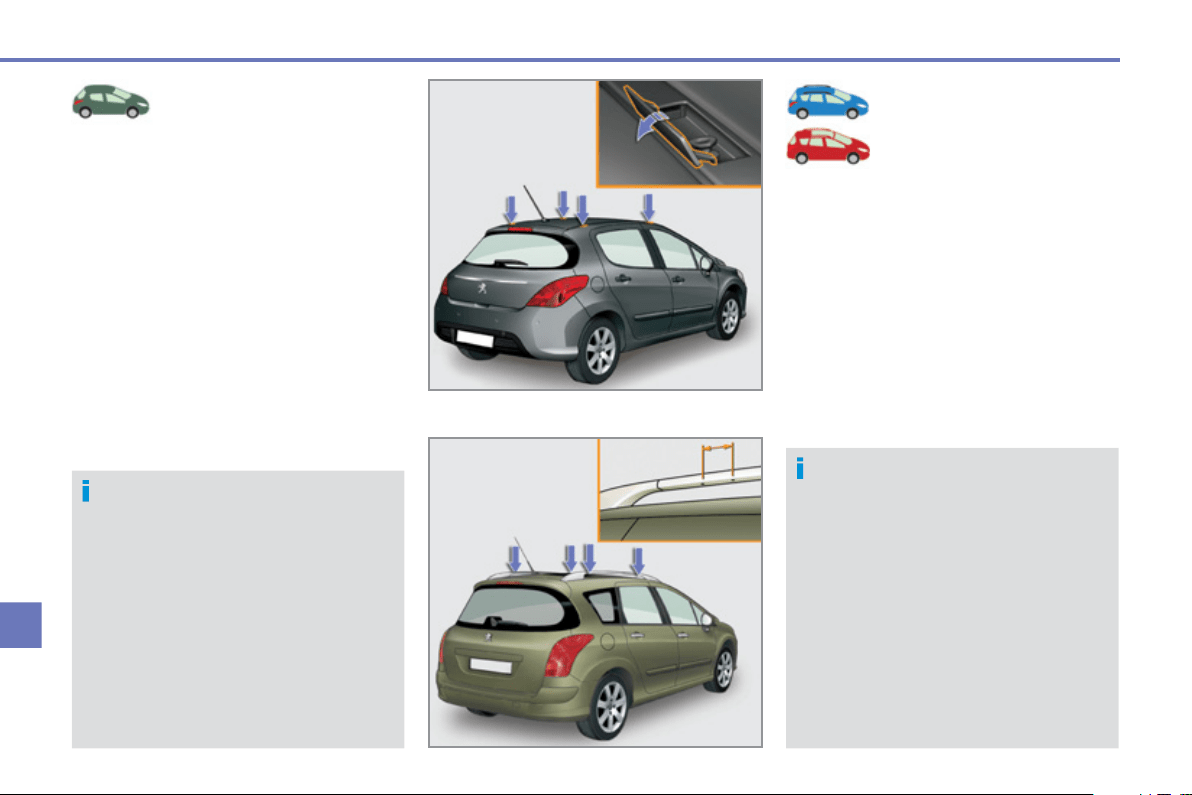
1
1
21
6
PRACTICAL INFORMATION
FITTING ROOF BAR
S
When fi tting transverse
roof bars, ensure that they
are positioned correctly as
shown by marks under the
longitudinal roof bars.
Use accessories recommended by
PEUGEOT and follow the accessory
manufacturer's fi tting instructions.
In order to place a load on the roof,
transverse roof bars must be fi tted on
the longitudinal roof bars.
After putting the load in place and securing
it, retighten the transverse roof bars.
The longitudinal roof bars cannot
be removed.
Maximum authorised weight on the
roof bars, for a loading height not
exceeding 40 cm (except bicycle
carriers): 75 kg.
If the height exceeds 40 cm, adapt
the speed of the vehicle to the condi-
tion of the road, to avoid damaging
the roof bars and the fi xings on the
roof.
Be sure to refer to national legis-
lation in order to comply with the
regulations for transporting objects
which are longer than the vehicle.
FITTING ROOF BAR
S
Maximum authorised weight on the
roof rack, for a loading height not
exceeding 40 cm (with the excep-
tion of bicycle carriers): 80 kg.
If the height exceeds 40 cm, adapt
the speed of the vehicle to the pro-
fi le of the road to avoid damaging
the roof bars and the fi xings on the
roof.
Be sure to refer to national legis-
lation in order to comply with the
regulations for transporting objects
which are longer than the vehicle.
When fi tting transverse roof bars, use
the four quick-fi t fi xings provided for this
purpose:
) lift the concealing fl aps,
) open the fi xing covers on each bar
using the spanner,
) put each fi xing in place and lock
them on the roof one by one,
) close the fi xing covers on each bar
using the spanner.
1
1
217
PRACTICAL INFORMATION
"Protection":
mats * , mud fl aps, seat covers compat-
ible with lateral airbags, vehicle covers,
door sill protectors, translucent bumper
protectors.
* To avoid any risk of jamming of the
pedals:
- ensure that the mat is positioned
and secured correctly,
- never fi t one mat on top of
another.
ACCE
SS
ORIE
S
A wide range of accessories and genu-
ine parts is available from the PEUGEOT
dealer network.
These accessories and parts have been
tested and approved for reliability and
safety.
They are all adapted to your vehicle and
benefi t from PEUGEOT's recommenda-
tion and warranty.
"Comfort":
parking sensors, side and rear blinds,
door defl ectors, isotherm module, head
restraint-mounted coat hanger, front
centre armrest, reading lamp, scented
air freshener...
Conversion kits
You can obtain an "Enterprise" kit to
convert a trade vehicle to a private car
and vice-versa.
"Transport solutions":
boot liner, boot mat, boot spacers, stor-
age under parcel shelf, transverse roof
bars, bicycle carrier, ski carrier, roof
box, towbars, wiring harnesses...
"Style":
leather steering wheel, aluminium gear
lever knob, alloy wheels, wheel trims,
body styling kit...
"Security and safety":
anti-theft alarm, wheel security locks,
vehicle tracking system, child seats and
booster cushions, breathalyser, fi rst aid
kit, warning triangle, high visibility vest,
dog guard, front foglamp kit, temporary
puncture repair kit, snow chains, anti-
skid covers.
Where the towbar and its wiring har-
ness are not fi tted by a PEUGEOT
dealer, they must be fi tted in line
with the vehicle manufacturer's rec-
ommendations.
1
1
21
8
PRACTICAL INFORMATION
The fi tting of electrical equipment
or accessories which are not rec-
ommended by PEUGEOT may
result in a failure of your vehicle's
electronic system and excessive
electrical consumption.
Please note this precaution. You are
advised to contact a PEUGEOT rep-
resentative to be shown the range
of recommended equipment and
accessories.
Depending on the legislation in
force in the country, it may be com-
pulsory to have a high visibility
safety vest, warning triangle and
spare bulbs and fuses available in
the vehicle.
"Mulitmedia":
audio systems, satellite navigation sys-
tems, Bluetooth system, speakers, DVD
player, USB Box, Wi-Fi on board...
Installation of radio
communication transmitters
Before installing any after-market
radio communication transmitter,
you can contact a PEUGEOT deal-
er for the specifi cation of transmit-
ters which can be fi tted (frequency,
maximum power, aerial position,
specifi c installation requirements),
in line with the Vehicle Electro-
magnetic Compatibility Directive
(2004/104/EC).
By visting a PEUGEOT dealer, you can
also obtain products for cleaning and main-
tenance (exterior and interior) - including
products from the "TECHNATURE" range,
products for topping up (screenwash...),
paint touch-up pens and aerosols for the
exact colour of your vehicle, refi lls (sealant
cartridge for the temporary puncture repair
kit...)...

12
21
9
TECHNICAL DATA
MODELS: ENGINES AND GEARBOXES
Model codes:
4C... 4E... 4H...
8FR-0 5FS-0 5FS-9
PETROL ENGINES 1.4 litre VTi 98 hp 1.6 litre VTi 120 hp
Cubic capacity (cc) 1 397 1 598
Bore x stroke (mm) 77 x 75 77 x 85.8
Max power: EU standard (kW) 72 88
Max power engine speed (rpm) 6 000 5 660
Max torque: EU standard (Nm) 136 160
Max torque engine speed (rpm) 4 000 4 250
Fuel Unleaded Unleaded
Catalytic converter Yes Yes
GEARBOXES
Manual
(5-speed)
Manual
(5-speed)
Automatic
(4-speed)
OIL CAPACITIES (in litres)
Engine (with fi lter replacement)
- 4.25 4.25
4C...: 5-door. 4E...: SW with bench rear seat. 4H...: SW with individual rear seats.
12
22
0
TECHNICAL DATA
MODELS: ENGINES AND GEARBOXES
Model codes:
4C... 4E... 4H...
N6A-C
N6A-5
5FE-J 5FV-8 5FV-A 5FM-J
PETROL ENGINES
1.6 litre 16V
110 hp
1.6 litre THP
150 hp
1.6 litre THP 156 hp
1.6 litre THP
163 hp
Cubic capacity (cc) 1 587 1 598 1 598 1 598
Bore x stroke (mm) 82 x 107 77 x 85.8 77 x 85.8 77 x 85.8
Max power: EU standard (kW) 78 110 115 120
Max power engine speed (rpm) 5 600 6 000 6 000 6 000
Max torque: EU standard (Nm) 142 240 240 240
Max torque engine speed (rpm) 4 000 1 400 1 400
1 400
Fuel Unleaded Unleaded Unleaded Unleaded
Catalytic converter Yes Yes Yes Yes
GEARBOXES
Manual
(5-speed)
Automatic
(6-speed)
Manual
(6-speed)
Automatic
(6-speed)
Automatic
(6-speed)
OIL CAPACITIES (in litres)
Engine (with fi lter replacement) 3.25 - - - -
4C...: 5-door. 4E...: SW with bench rear seat. 4H...: SW with individual rear seats.

12
221
TECHNICAL DATA
MODELS: ENGINES AND GEARBOXES
Model codes:
4C... 4E... 4H...
5FU-8
PETROL ENGINES 1.6 litre THP 200 hp
Cubic capacity (cc) 1 598
Bore x stroke (mm) 77 x 85.8
Max power: EU standard (kW) 147
Max power engine speed (rpm) 5 800
Max torque: EU standard (Nm) 275
Max torque engine speed (rpm) 1 700
Fuel Unleaded
Catalytic converter Yes
GEARBOXES
Manual
(6-speed)
OIL CAPACITIES (in litres)
Engine (with fi lter replacement) 4.25
4C...: 5-door. 4E...: SW with bench rear seat. 4H...: SW with individual rear seats.
12
222
TECHNICAL DATA
* The weight of the braked trailer can be increased, within the GTW limit, if the GVW of the towing vehicle is reduced by an
equal amount; warning, towing using a lightly loaded towing vehicle may have an adverse effect on its road holding.
The GTW and towed load values indicated are valid up to a maximum altitude of 1000 metres; the towed load mentioned must
be reduced by 10 % for each additional 1000 metres of altitude.
The speed of a towing vehicle must not exceed 60 mph (100 km/h) (comply with the legislation in force in your country).
High ambient temperatures may result in a reduction in the performance of the vehicle to protect the engine; if the ambient
temperature is above 37 °C, limit the towed load.
WEIGHTS AND TOWED LOADS (in kg)
Petrol engines 1.4 litre VTi 98 hp
1.6 litre 16V 110 hp
1.6 litre VTi 120 hp
Gearboxes Manual Manual Manual Automatic
Model codes:
4C...
8FR-0
N6A-C
N6A-5
5FS-0 5FS-9
- Unladen weight 1 271 1 302 1 287 1 312
- Kerb weight 1 346 1 377 1 362 1 387
- Payload 509 518 528 523
- Gross vehicle weight (GVW) 1 780 1 820 1 815 1 835
- Gross train weight (GTW)
on a 12% gradient
2 980 3 020 3 315 3 085
- Braked trailer (within GTW limit)
on a 10% or 12% gradient
1 200 1 200 1 500 1 250
- Braked trailer * (with load transfer
within the GTW limit)
1 450 1 450 1 500 1 500
- Unbraked trailer 670 685 680 690
- Recommended nose weight 60 60 76 60
12
22
3
TECHNICAL DATA
WEIGHTS AND TOWED LOADS (in kg)
Petrol engines
1.6 litre THP
150 hp
1.6 litre THP 156 hp
1.6 litre THP
163 hp
1.6 litre THP
200 hp
Gearboxes Automatic Manual Automatic Automatic Manual
Model codes:
4C...
5FE-J 5FV-8 5FV-A 5FM-J 5FU-8
- Unladen weight 1 358 1 315 1 368 1 358 1 399
- Kerb weight 1 433 1 390 1 443 1 433 1 474
- Payload 502 525 502 502 451
- Gross vehicle weight (GVW) 1 860 1 840
1 870 1 860 1 850
- Gross train weight (GTW)
on a 12% gradient
2 660 3 390 3 470 2 660 1 850
- Braked trailer (within GTW limit)
on a 10% or 12% gradient
800 1 550 1 600 800 X
- Braked trailer * (with load transfer
within the GTW limit)
800 1 650 1 650 800 X
- Unbraked trailer 710 695 720 710 X
- Recommended nose weight 65 70 70 65 X
The GTW and towed load values indicated are valid up to a maximum altitude of 1000 metres; the towed load mentioned must
be reduced by 10 % for each additional 1000 metres of altitude.
The speed of a towing vehicle must not exceed 60 mph (100 km/h) (comply with the legislation in force in your country).
High ambient temperatures may result in a reduction in the performance of the vehicle to protect the engine; if the ambient
temperature is above 37 °C, limit the towed load.
* The weight of the braked trailer can be increased, within the GTW limit, if the GVW of the towing vehicle is reduced by an
equal amount; warning, towing using a lightly loaded towing vehicle may have an adverse effect on its road holding.
12
224
TECHNICAL DATA
WEIGHTS AND TOWED LOADS (in kg)
Petrol engines 1.4 litre VTi 98 hp
1.6 litre 16V
110 hp
1.6 litre VTi 120 hp
Gearboxes Manual Manual Manual Automatic
Model codes: 4E... 8FR-0
N6A-C
N6A-5
5FS-0 5FS-9
- Unladen weight 1 320 1 374 1 320 1 356
- Kerb weight 1 395 1 449 1 395 1 431
- Payload 600 576 602 592
- Gross vehicle weight (GVW) 1 920 1 950 1 922 1 948
- Gross train weight (GTW)
on a 12% gradient
3 020
3 150 3 272 3 298
- Braked trailer (within GTW limit)
on a 10% or 12% gradient
1 100 1 200 1 350 1 350
- Braked trailer * (with load transfer
within the GTW limit)
1 100 1 400 1 500 1 500
- Unbraked trailer 695 720 695 715
- Recommended nose weight 60 75 65 60
The GTW and towed load values indicated are valid up to a maximum altitude of 1000 metres; the towed load mentioned must
be reduced by 10 % for each additional 1000 metres of altitude.
The speed of a towing vehicle must not exceed 60 mph (100 km/h) (comply with the legislation in force in your country).
High ambient temperatures may result in a reduction in the performance of the vehicle to protect the engine; if the ambient
temperature is above 37 °C, limit the towed load.
* The weight of the braked trailer can be increased, within the GTW limit, if the GVW of the towing vehicle is reduced by an
equal amount; warning, towing using a lightly loaded towing vehicle may have an adverse effect on its road holding.
12
22
5
TECHNICAL DATA
WEIGHTS AND TOWED LOADS (in kg)
Petrol engines 1.6 litre THP 156 hp 1.6 litre THP 163 hp
Gearboxes Manual Automatic Automatic
Model codes: 4E... 5FV-8 5FV-A 5FM-J
- Unladen weight 1 400 1 428 1 436
- Kerb weight 1 475 1 503 1 511
- Payload 540 537 584
- Gross vehicle weight (GVW) 1 940 1 965 2 020
- Gross train weight (GTW)
on a 12% gradient
3 390 3 515 2 820
- Braked trailer (within GTW limit)
on a 10% or 12% gradient
1 450 1 550 800
- Braked trailer * (with load transfer
within the GTW limit)
1 600 1 550 800
- Unbraked trailer 735 750 750
- Recommended nose weight 65 65 75
The GTW and towed load values indicated are valid up to a maximum altitude of 1000 metres; the towed load mentioned must
be reduced by 10 % for each additional 1000 metres of altitude.
The speed of a towing vehicle must not exceed 60 mph (100 km/h) (comply with the legislation in force in your country).
High ambient temperatures may result in a reduction in the performance of the vehicle to protect the engine; if the ambient
temperature is above 37 °C, limit the towed load.
* The weight of the braked trailer can be increased, within the GTW limit, if the GVW of the towing vehicle is reduced by an
equal amount; warning, towing using a lightly loaded towing vehicle may have an adverse effect on its road holding.
12
22
6
TECHNICAL DATA
WEIGHTS AND TOWED LOADS (in kg)
Petrol engines 1.6 litre 16V 110 hp 1.6 litre VTi 120 hp
Gearboxes Manual Manual Automatic
Model codes: 4H...
N6A-C
N6A-5
5FS-0 5FS-9
- Unladen weight 1 462 1 406 1 430
- Kerb weight 1 537 1 481 1 505
- Payload 648 694 700
- Gross vehicle weight (GVW) 2 110 2 100 2 130
- Gross train weight (GTW)
on a 12% gradient
3 110 3 300 3 080
- Braked trailer (within GTW limit)
on a 10% or 12% gradient
1 000 1 200 950
- Braked trailer * (with load transfer
within the GTW limit)
1 350 1 400 1 100
- Unbraked trailer 750 740 750
- Recommended nose weight 75 60 55
The GTW and towed load values indicated are valid up to a maximum altitude of 1000 metres; the towed load mentioned must
be reduced by 10 % for each additional 1000 metres of altitude.
The speed of a towing vehicle must not exceed 60 mph (100 km/h) (comply with the legislation in force in your country).
High ambient temperatures may result in a reduction in the performance of the vehicle to protect the engine; if the ambient
temperature is above 37 °C, limit the towed load.
* The weight of the braked trailer can be increased, within the GTW limit, if the GVW of the towing vehicle is reduced by an
equal amount; warning, towing using a lightly loaded towing vehicle may have an adverse effect on its road holding.
12
227
TECHNICAL DATA
WEIGHTS AND TOWED LOADS (in kg)
Petrol engines
1.6 litre THP 150 hp
1.6 litre THP 156 hp
1.6 litre THP 163 hp
Gearboxes Automatic Manual Automatic Automatic
Model codes: 4H... 5FE-J 5FV-8 5FV-A 5FM-J
- Unladen weight 1 487 1 481 1 509 1 487
- Kerb weight 1 562 1 556 1 584 1 562
- Payload 633 649 651 633
- Gross vehicle weight (GVW) 2 120 2 130 2 160 2 120
- Gross train weight (GTW)
on a 12% gradient
2 920 3 380 3 510 2 920
- Braked trailer (within GTW limit)
on a 10% or 12% gradient
800 1 250 1 350 800
- Braked trailer * (with load transfer
within the GTW limit)
800 1 400 1 350 800
- Unbraked trailer 750 750 750 750
- Recommended nose weight 75 60 60 75
* The weight of the braked trailer can be increased, within the GTW limit, if the GVW of the towing vehicle is reduced by an
equal amount; warning, towing using a lightly loaded towing vehicle may have an adverse effect on its road holding.
The GTW and towed load values indicated are valid up to a maximum altitude of 1000 metres; the towed load mentioned must
be reduced by 10 % for each additional 1000 metres of altitude.
The speed of a towing vehicle must not exceed 60 mph (100 km/h) (comply with the legislation in force in your country).
High ambient temperatures may result in a reduction in the performance of the vehicle to protect the engine; if the ambient
temperature is above 37 °C, limit the towed load.

12
22
8
TECHNICAL DATA
4C...: 5-door.
4R...: 5-door "Van". 4E...: SW with bench rear seat.
MODELS: ENGINES AND GEARBOXES
Model codes:
4C... 4R... 4E... 4H...
9HJ-C 9HP-0
DIESEL ENGINES 1.6 litre HDi 92 hp 1.6 litre HDi PEF 92 hp
Cubic capacity (cc) 1 560
Bore x stroke (mm) 75 x 88.3
Max power: EU standard (kW) 68
Max power engine speed (rpm) 4 000
Max torque: EU standard (Nm) 230
Max torque engine speed (rpm) 1 750
Fuel Diesel
Catalytic converter Yes
Particle emission fi lter (PEF) No Yes
GEARBOXES
Manual
(5-speed)
OIL CAPACITIES (in litres)
Engine (with fi lter replacement) -
4H...: SW with individual rear seats.

12
22
9
TECHNICAL DATA
MODELS: ENGINES AND GEARBOXES
Model codes:
4C... 4R... 4E... 4H...
9HG-C
9HR-8/S
9HR-8/1S
9HR-8/2S
9HR-8/PS
9HR-8/1PS
9HR-8/2P S
DIESEL ENGINES 1.6 litre HDi 115 hp 1.6 litre e-HDi PEF 112 hp
Cubic capacity (cc) 1 560
Bore x stroke (mm) 75 x 88.3
Max power: EU standard (kW) 84 82
Max power engine speed (rpm) 3 600
Max torque: EU standard (Nm) 254 270
Max torque engine speed (rpm) 1 750
Fuel Diesel
Catalytic converter Yes
Particle emission fi lter (PEF) No Yes
GEARBOXES
Manual
(5-speed)
Manual
(6-speed)
Electronic gear control
(6-speed)
OIL CAPACITIES (in litres)
Engine (with fi lter replacement) -
.../S: model fi tted with Stop & Start.
.../1S: model fi tted with Stop & Start and
very low rolling resistance tyres
(e.g.: MICHELIN Energy Saver).
.../2S: model fi tted with Stop & Start and
ultra low rolling resistanc tyres
(e.g.: MICHELIN UBRR).
4C...: 5-door.
4R...: 5-door "Van".
4E...: SW with bench rear seat.
4H...: SW with individual rear seats.

12
2
30
TECHNICAL DATA
MODELS: ENGINES AND GEARBOXES
Model codes:
4C... 4E... 4H...
RHE-8 RHH-A
DIESEL ENGINES 2.0 litre HDi PEF 150 hp 2.0 litre HDi PEF 163 hp
Cubic capacity (cc) 1 997 1 997
Bore x stroke (mm) 85 x 88 85 x 88
Max power: EU standard (kW) 110 120
Max power engine speed (rpm) 3 750 3 750
Max torque: EU standard (Nm) 340 340
Max torque engine speed (rpm) 2 000 2 000
Fuel Diesel Diesel
Catalytic converter Yes Yes
Particle emission fi lter (PEF) Yes Yes
GEARBOXES
Manual
(6-speed)
Automatic
(6-speed)
OIL CAPACITIES (in litres)
Engine (with fi lter replacement)
5.25 -
4C...: 5-door. 4E...: SW with bench rear seat. 4H...: SW with individual rear seats.
12
2
31
TECHNICAL DATA
* The weight of the braked trailer can be increased, within the GTW limit, if the GVW of the towing vehicle is reduced by an
equal amount; warning, towing using a lightly loaded towing vehicle may have an adverse effect on its road holding.
The GTW and towed load values indicated are valid up to a maximum altitude of 1000 metres; the towed load mentioned must
be reduced by 10 % for each additional 1000 metres of altitude.
The speed of a towing vehicle must not exceed 60 mph (100 km/h) (comply with the legislation in force in your country).
High ambient temperatures may result in a reduction in the performance of the vehicle to protect the engine; if the ambient
temperature is above 37 °C, limit the towed load.
WEIGHTS AND TOWED LOADS (in kg)
Diesel engines 1.6 litre HDi 92 hp 1.6 litre HDi PEF 92 hp
Gearboxes Manual Manual
Model codes:
4C... 4R...
9HJ-C 9HP-0
- Unladen weight 1 301 1 303 - 1 316
- Kerb weight 1 376 1 378 - 1 391
- Payload 509 512 - 514
- Gross vehicle weight (GVW) 1 810 1 815 - 1 830
- Gross train weight (GTW)
on a 12% gradient
2 610 2 915 - 3 130
- Braked trailer (within GTW limit)
on a 10% or 12% gradient
800 1 100 - 1 300
- Braked trailer
* (with load transfer
within the GTW limit)
800 1 300
- Unbraked trailer 680 685
- Recommended nose weight 65 60 - 55
12
2
32
TECHNICAL DATA
* The weight of the braked trailer can be increased, within the GTW limit, if the GVW of the towing vehicle is reduced by an
equal amount; warning, towing using a lightly loaded towing vehicle may have an adverse effect on its road holding.
The GTW and towed load values indicated are valid up to a maximum altitude of 1000 metres; the towed load mentioned must
be reduced by 10 % for each additional 1000 metres of altitude.
The speed of a towing vehicle must not exceed 60 mph (100 km/h) (comply with the legislation in force in your country).
High ambient temperatures may result in a reduction in the performance of the vehicle to protect the engine; if the ambient
temperature is above 37 °C, limit the towed load.
WEIGHTS AND TOWED LOADS (in kg)
Diesel engines
1.6 litre HDi 115 hp
1.6 litre e-HDi PEF 112 hp
Gearboxes Manual Manual Electronic gear control
Model codes:
4C... 4R...
9HG-C
9HR-8/S
9HR-8/1S
9HR-8/2S
9HR-8/PS
9HR-8/1PS
9HR-8/2PS
- Unladen weight 1 299 1 318 1 205 1 205
- Kerb weight 1 374 1 393 1 280 1 280
- Payload 511 542 655 655
- Gross vehicle weight (GVW) 1 810 1 860 1 860 1 860
- Gross train weight (GTW)
on a 12% gradient
2 610 3 160
3 160 2 260
- Braked trailer (within GTW limit)
on a 10% or 12% gradient
800 1 300 1 300 400
- Braked trailer * (with load transfer
within the GTW limit)
800 1 500 1 500 600
- Unbraked trailer 680 695 640 400
- Recommended nose weight 65 60 60 60
12
2
33
TECHNICAL DATA
* The weight of the braked trailer can be increased, within the GTW limit, if the GVW of the towing vehicle is reduced by an
equal amount; warning, towing using a lightly loaded towing vehicle may have an adverse effect on its road holding.
WEIGHTS AND TOWED LOADS (in kg)
Diesel engines 2 litre HDi PEF 150 hp 2 litre HDi PEF 163 hp
Gearboxes Manual Automatic
Model codes:
4C...
RHE-8 RHH-A
- Unladen weight 1 398 1 428
- Kerb weight 1 473 1 503
- Payload 502 532
- Gross vehicle weight (GVW) 1 900 1 960
- Gross train weight (GTW)
on a 12% gradient
3 600 3 460
- Braked trailer (within GTW limit)
on a 10% or 12% gradient
1 700 1 500
- Braked trailer * (with load transfer
within the GTW limit)
1 700 1 500
- Unbraked trailer 735 750
- Recommended nose weight 70 66
The GTW and towed load values indicated are valid up to a maximum altitude of 1000 metres; the towed load mentioned must
be reduced by 10 % for each additional 1000 metres of altitude.
The speed of a towing vehicle must not exceed 60 mph (100 km/h) (comply with the legislation in force in your country).
High ambient temperatures may result in a reduction in the performance of the vehicle to protect the engine; if the ambient
temperature is above 37 °C, limit the towed load.
12
2
34
TECHNICAL DATA
* The weight of the braked trailer can be increased, within the GTW limit, if the GVW of the towing vehicle is reduced by an
equal amount; warning, towing using a lightly loaded towing vehicle may have an adverse effect on its road holding.
WEIGHTS AND TOWED LOADS (in kg)
Diesel engines 1.6 litre HDi 92 hp 1.6 litre HDi PEF 92 hp
Gearboxes Manual Manual
Model codes:
4E...
9HJ-C 9HP-0
- Unladen weight 1 390 1 378
- Kerb weight 1 465 1 453
- Payload 610 570
- Gross vehicle weight (GVW) 2 000 1 948
- Gross train weight (GTW)
on a 12% gradient
2 800 3 148
- Braked trailer (within GTW limit)
on a 10% or 12% gradient
800 1 200
- Braked trailer * (with load transfer
within the GTW limit)
800 1 300
- Unbraked trailer 730 725
- Recommended nose weight 75 60
The GTW and towed load values indicated are valid up to a maximum altitude of 1000 metres; the towed load mentioned must
be reduced by 10 % for each additional 1000 metres of altitude.
The speed of a towing vehicle must not exceed 60 mph (100 km/h) (comply with the legislation in force in your country).
High ambient temperatures may result in a reduction in the performance of the vehicle to protect the engine; if the ambient
temperature is above 37 °C, limit the towed load.
12
2
35
TECHNICAL DATA
* The weight of the braked trailer can be increased, within the GTW limit, if the GVW of the towing vehicle is reduced by an
equal amount; warning, towing using a lightly loaded towing vehicle may have an adverse effect on its road holding.
The GTW and towed load values indicated are valid up to a maximum altitude of 1000 metres; the towed load mentioned must
be reduced by 10 % for each additional 1000 metres of altitude.
The speed of a towing vehicle must not exceed 60 mph (100 km/h) (comply with the legislation in force in your country).
High ambient temperatures may result in a reduction in the performance of the vehicle to protect the engine; if the ambient
temperature is above 37 °C, limit the towed load.
WEIGHTS AND TOWED LOADS (in kg)
Diesel engines 1.6 litre e-HDi PEF 112 hp
Gearboxes Manual Electronic gear control
Model codes:
4E...
9HR-8/S 9HR-8/PS
- Unladen weight 1 407 1 399
- Kerb weight 1 482 1 474
- Payload 563 576
- Gross vehicle weight (GVW) 1 970 1 975
- Gross train weight (GTW)
on a 12% gradient
3 120 3 125
- Braked trailer (within GTW limit)
on a 10% or 12% gradient
1 150 1 150
- Braked trailer * (with load transfer
within the GTW limit)
1 400 1 300
- Unbraked trailer 740 735
- Recommended nose weight 60 60
12
2
36
TECHNICAL DATA
* The weight of the braked trailer can be increased, within the GTW limit, if the GVW of the towing vehicle is reduced by an
equal amount; warning, towing using a lightly loaded towing vehicle may have an adverse effect on its road holding.
The GTW and towed load values indicated are valid up to a maximum altitude of 1000 metres; the towed load mentioned must
be reduced by 10 % for each additional 1000 metres of altitude.
The speed of a towing vehicle must not exceed 60 mph (100 km/h) (comply with the legislation in force in your country).
High ambient temperatures may result in a reduction in the performance of the vehicle to protect the engine; if the ambient
temperature is above 37 °C, limit the towed load.
WEIGHTS AND TOWED LOADS (in kg)
Diesel engines 2.0 litre HDi PEF 150 hp
Gearboxes Manual
Model codes:
4E...
RHE-8
- Unladen weight 1 430
- Kerb weight 1 505
- Payload 600
- Gross vehicle weight (GVW) 2 030
- Gross train weight (GTW)
on a 12% gradient
3 650
- Braked trailer (within the GTW limit)
on a 10% or 12% gradient
1 500
- Braked trailer * (with load transfer
within the GTW limit)
1 700
- Unbraked trailer 750
- Recommended nose weight 70
12
2
37
TECHNICAL DATA
* The weight of the braked trailer can be increased, within the GTW limit, if the GVW of the towing vehicle is reduced by an
equal amount; warning, towing using a lightly loaded towing vehicle may have an adverse effect on its road holding.
The GTW and towed load values indicated are valid up to a maximum altitude of 1000 metres; the towed load mentioned must
be reduced by 10 % for each additional 1000 metres of altitude.
The speed of a towing vehicle must not exceed 60 mph (100 km/h) (comply with the legislation in force in your country).
High ambient temperatures may result in a reduction in the performance of the vehicle to protect the engine; if the ambient
temperature is above 37 °C, limit the towed load.
WEIGHTS AND TOWED LOADS (in kg)
Diesel engines 1.6 litre HDi 92 hp 1.6 litre HDi PEF 92 hp
Gearboxes Manual Manual
Model codes:
4H...
9HJ-C 9HP-0
- Unladen weight 1 460 1 430
- Kerb weight 1 535 1 505
- Payload 640 670
- Gross vehicle weight (GVW) 2 100 2 100
- Gross train weight (GTW)
on a 12% gradient
2 900 3 100
- Braked trailer (within GTW limit)
on a 10% or 12% gradient
800 1 000
- Braked trailer * (with load transfer
within the GTW limit)
800 1 200
- Unbraked trailer 750 750
- Recommended nose weight 75 60
12
2
38
TECHNICAL DATA
* The weight of the braked trailer can be increased, within the GTW limit, if the GVW of the towing vehicle is reduced by an
equal amount; warning, towing using a lightly loaded towing vehicle may have an adverse effect on its road holding.
The GTW and towed load values indicated are valid up to a maximum altitude of 1000 metres; the towed load mentioned must
be reduced by 10 % for each additional 1000 metres of altitude.
The speed of a towing vehicle must not exceed 60 mph (100 km/h) (comply with the legislation in force in your country).
High ambient temperatures may result in a reduction in the performance of the vehicle to protect the engine; if the ambient
temperature is above 37 °C, limit the towed load.
WEIGHTS AND TOWED LOADS (in kg)
Diesel engines 1.6 litre e-HDi PEF 112 hp
Gearboxes Manual Electronic Gear Control
Model codes:
4H...
9HR-8/S 9HR-8/PS
- Unladen weight 1 485 1 488
- Kerb weight 1 560 1 563
- Payload 660 662
- Gross vehicle weight (GVW) 2 145 2 150
- Gross train weight (GTW)
on a 12% gradient
3 145 3 150
- Braked trailer (within GTW limit)
on a 10% or 12% gradient
1 000 1 000
- Braked trailer * (with load transfer
within the GTW limit)
1 200 1 200
- Unbraked trailer 740 750
- Recommended nose weight 60 60
12
2
39
TECHNICAL DATA
* The weight of the braked trailer can be increased, within the GTW limit, if the GVW of the towing vehicle is reduced by an
equal amount; warning, towing using a lightly loaded towing vehicle may have an adverse effect on its road holding.
The GTW and towed load values indicated are valid up to a maximum altitude of 1000 metres; the towed load mentioned must
be reduced by 10 % for each additional 1000 metres of altitude.
The speed of a towing vehicle must not exceed 60 mph (100 km/h) (comply with the legislation in force in your country).
High ambient temperatures may result in a reduction in the performance of the vehicle to protect the engine; if the ambient
temperature is above 37 °C, limit the towed load.
WEIGHTS AND TOWED LOADS (in kg)
Diesel engines 2.0 litre HDi PEF 163 hp
Gearboxes Automatic
Model codes:
4H...
RHH-A
- Unladen weight 1 603
- Kerb weight 1 678
- Payload 642
- Gross vehicle weight (GVW) 2 245
- Gross train weight (GTW)
on a 12% gradient
3 445
- Braked trailer (within GTW limit)
on a 10% or 12% gradient
1 200
- Braked trailer * (with load transfer
within the GTW limit)
1 200
- Unbraked trailer 750
- Recommended nose weight 56
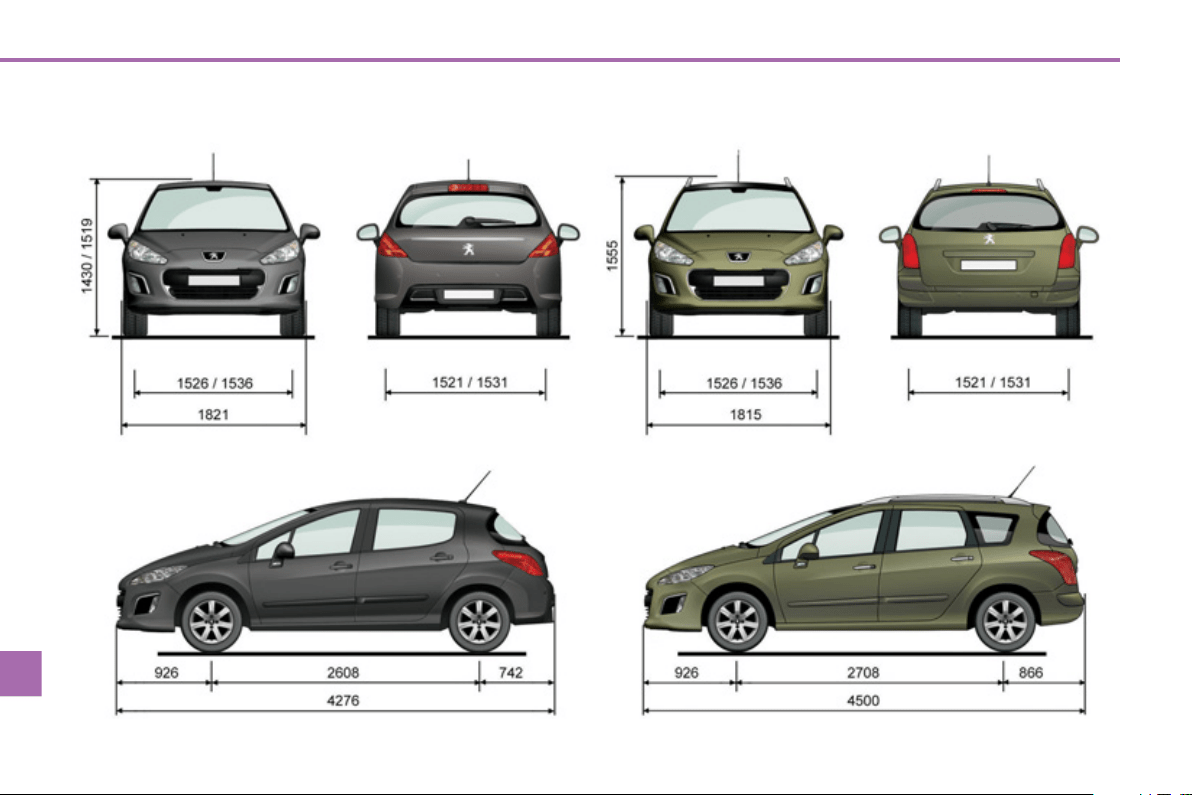
12
24
0
TECHNICAL DATA
D
IMENSIONS
(
IN MM
)
308 saloon 308 SW
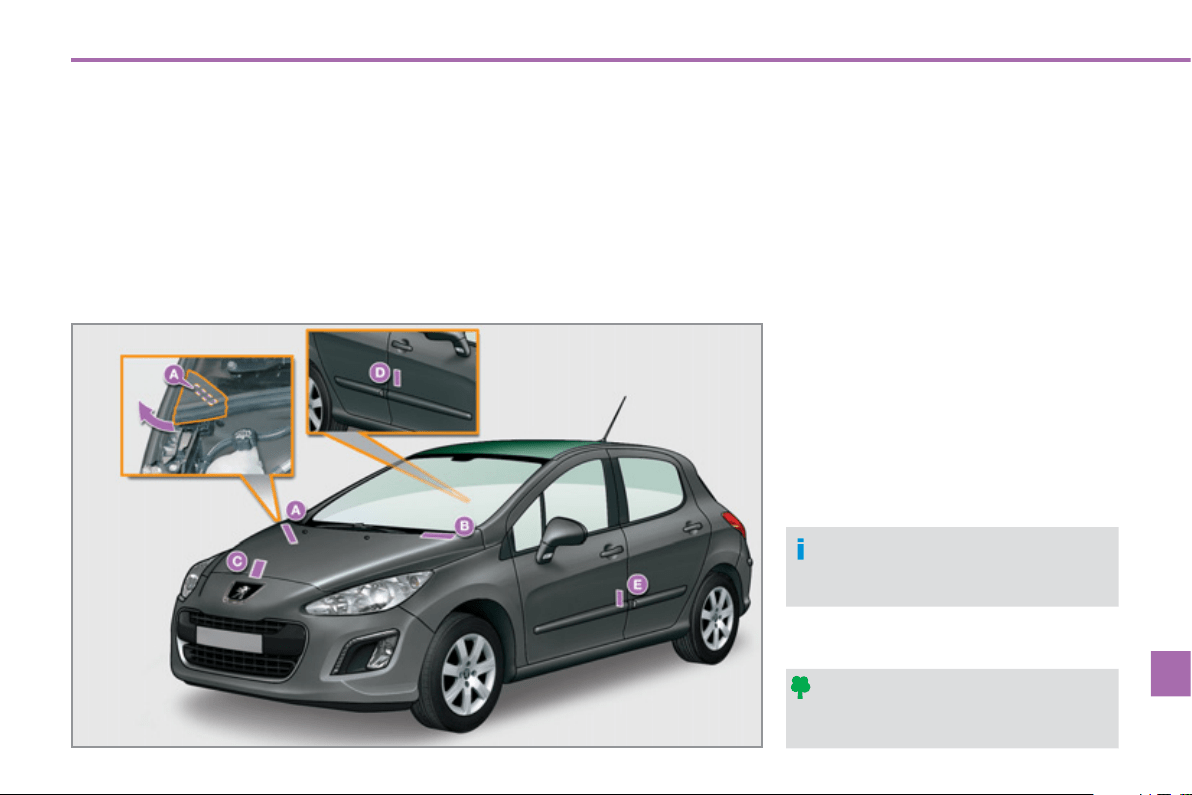
12
241
TECHNICAL DATA
IDENTIFICATION MARKING
S
Various visible markings for the identifi -
cation and tracking of your vehicle.
If the tyre pressures are too low,
this increases fuel consumption.
The tyre pressures must be
checked when the tyres are cold,
at least once a month.
A. Vehicle Identifi cation Number
(VIN) under the bonnet.
This number is engraved on the
bodywork near the damper support.
To gain access to it, raise the plastic
cover.
B. VIN on the windscreen lower
crossmember.
This number is indicated on a self-
adhesive label which is visible
through the windscreen.
C. Manufacturer's plate.
This plate is riveted onto the engine
mounting.
or
D. Manufacturer's label.
This number is indicated on a self-
destroying label affi xed to the right
hand centre pillar.
This plate / label also indicates
the kerb weight, the gross vehicle
weight (GVW) and the gross train
weight (GTW).
E. Tyre/paint label.
This label is affi xed to the middle pil-
lar, on the driver's side.
It bears the following information:
- the tyre infl ation pressures with and
without load,
- the tyre sizes,
- the infl ation pressure of the spare
wheel,
- the paint colour code.

12
242
TECHNICAL DATA
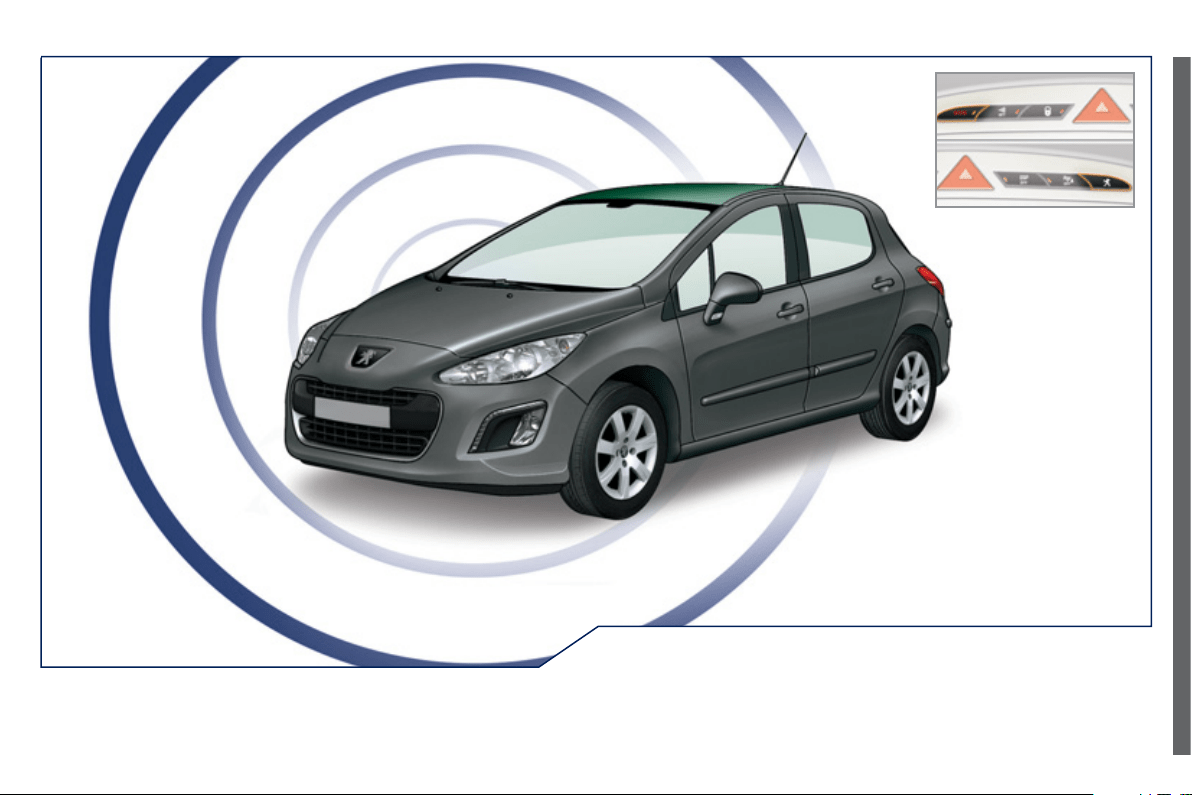
24
3
EMERGENCY OR ASSISTANCE CALL
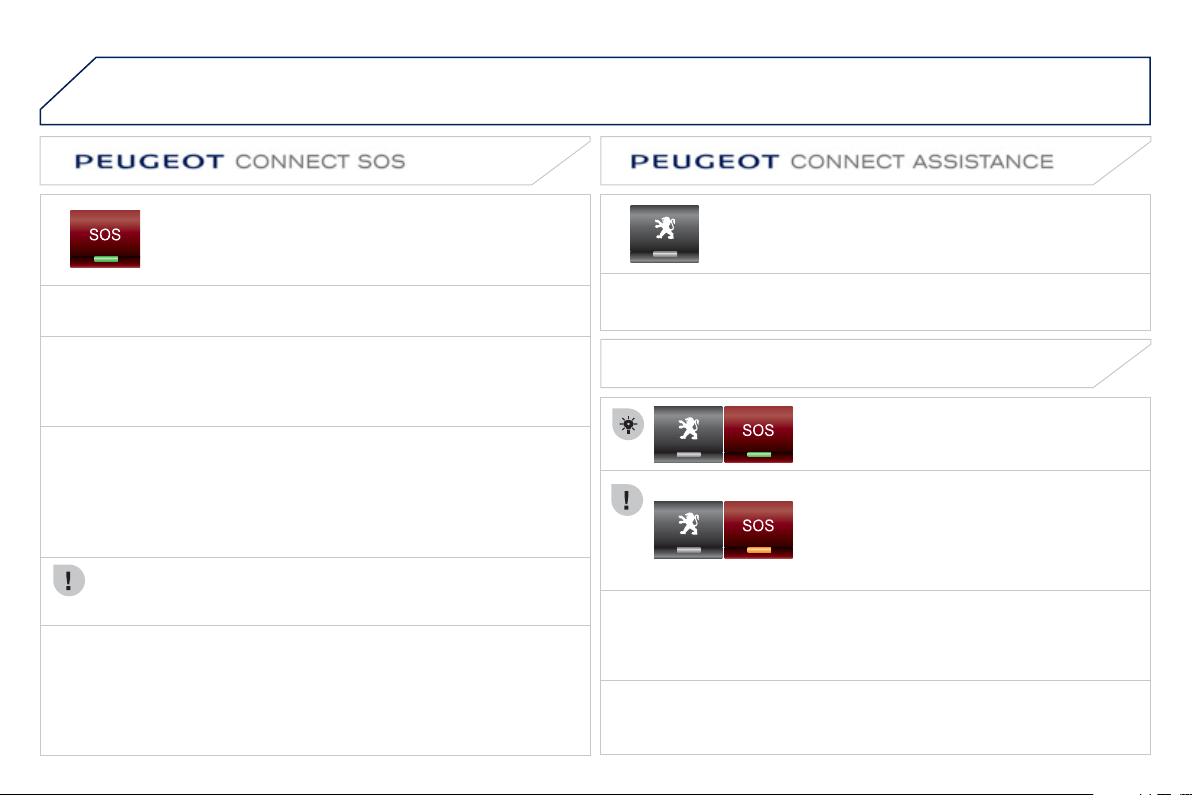
244
E
MERGENCY OR ASSISTANCE CALL
In an emer
g
enc
y
, press this button for more tha
n
2
seconds. Flashin
g
of the
g
reen LED and a voice
messa
g
e con
fi
rm that the call has been made to the
PEU
G
E
O
T
CO
NNE
C
T
SOS
call centre
*
.
The
g
reen LED remains on
(
without
fl
ashin
g)
when communication is
e
stablished. It
g
oes o
ff
at the end o
f
communication.
Wh
en t
h
e
ig
n
i
t
i
on
i
s sw
i
tc
h
e
d
on, t
h
e
g
reen
LED comes on
f
or 3 seconds indicatin
g
that
t
h
e s
y
stem
i
s operat
i
n
g
correct
ly
.
Pressin
g
this button a
g
ain immediatel
y
cancels the request.
The cancellation is confi rmed b
y
a voice messa
g
e.
Press this button for more than 2 seconds to request
ass
i
s
t
a
n
ce
if th
e
v
e
hi
c
l
e
b
r
ea
k
s
do
wn.
A
voice messa
g
e con
fi
rms that the call has been made
**
.
OPERATION OF THE SYSTEM
Pressin
g
this button a
g
ain immediatel
y
cancels the request. The
g
reen
L
ED
g
oes off. Cancellation is confi rmed b
y
a voice messa
g
e.
To cancel a call, repl
y
to the PEUGE
O
T C
O
NNECT S
O
S call centre that it
w
as
a
m
is
t
ake
.
PEUGE
O
T C
O
NNECT S
O
S immediatel
y
locates
y
ou vehicle, starts
c
ommunication with
y
ou in
y
our lan
g
ua
g
e ** , and where necessar
y
sends
the appropriate public emer
g
enc
y
services ** . In countries where the
team
i
s not operat
i
ona
l
, or w
h
en t
h
e
l
ocat
i
n
g
serv
i
ce
h
as
b
een express
ly
declined, the call sent directl
y
to the emer
g
enc
y
services
(
112
)
without the
v
e
hi
c
l
e
l
oca
ti
o
n.
If an impact is detected b
y
the airba
g
control unit, and
independentl
y
of the deplo
y
ment of an
y
airba
g
s, an emer
g
enc
y
call
is made automaticall
y
.
* Sub
j
ect to the
g
eneral conditions for the service available from dealers
a
nd to technolo
g
ical and technical limitations.
**
Dependin
g
on the
g
eo
g
raphical cover o
f
PEU
G
E
O
T
CO
NNE
C
T
SOS
,
PEU
G
E
O
T
CO
NNE
C
T A
SS
I
S
TAN
C
E and the o
ffi
cial national lan
g
ua
g
e
s
elected by the owner o
f
the vehicle.
Th
e
li
s
t
of
cou
ntri
es
co
v
e
r
ed
a
n
d
PE
UG
E
O
T
CO
NNE
C
T
se
rvi
ces
a
r
e
a
vailable
f
rom dealers or at www.peu
g
eot.co.uk.
If the oran
g
e LED fl ashes: there is a s
y
stem
f
au
lt.
If the oran
g
e LED is on continuousl
y
: the
b
ac
k
up
b
atter
y
must
b
e rep
l
ace
d
.
In either case, contact a PEU
G
E
O
T dealer.
I
f
you purchased your vehicle outside the PEU
G
E
O
T dealer network,
we invite
y
ou to have a dealer check the con
fi
g
uration o
f
these services
and, i
f
desired, modi
fi
ed to suit
y
our wishes. In a multi-lin
g
ual countr
y
,
c
on
fi
g
uration is possible in the o
ffi
cial national lan
g
ua
g
e o
f
y
our choice.
For technical reasons and in particular to improve the qualit
y
o
f
P
EU
G
E
O
T
CO
NNE
C
T services to customers, the manu
f
acturer reserves
t
h
e r
igh
t to carr
y
out up
d
ates to t
h
e ve
hi
c
l
e
'
s on-
b
oar
d
te
l
emat
i
c s
y
stem.
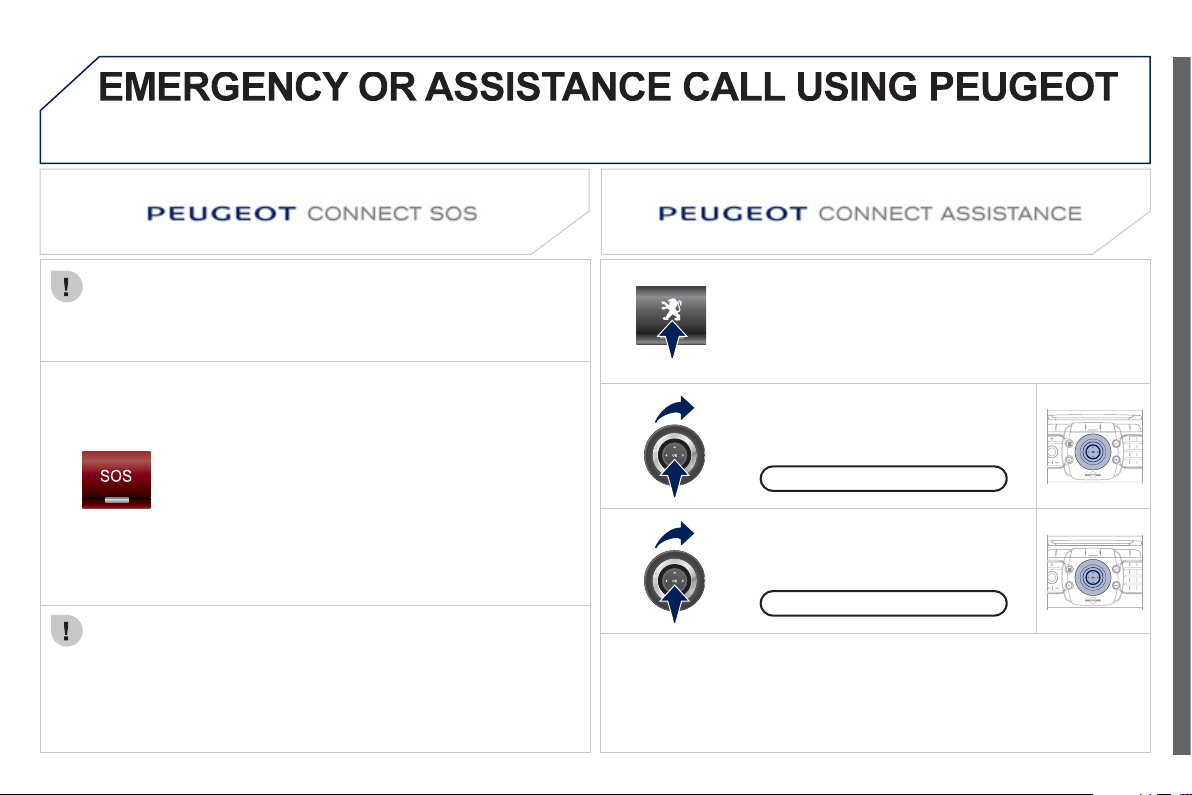
24
5
2
ABC
3
DEF
5
JKL
4
GHI
6
MNO
8
TUV
7
PQRS
9
WXY
Z
0
*
#
1
RADIO MEDIA
NAV ESC TRAFFIC
SETUP
ADDR
BOOK
2
ABC
3
DEF
5
JKL
4
GHI
6
MNO
8
TUV
7
PQRS
9
WXY
Z
0
*
#
1
RADIO MEDIA
NAV ESC TRAFFIC
SETUP
ADDR
BOOK
CONNECT MEDI
A
In an emer
g
enc
y
, press the S
O
S button until an audible
si
g
nal is heard and a "Confi rmation / Cancellation"
screen is displa
y
ed
(
if valid SIM card inserted
)
.
A call is made to the PEU
G
E
O
T Emer
g
enc
y
team
which receives locatin
g
in
f
ormation
f
rom the vehicle
a
nd can send a detailed alert to the relevant emergency
se
rvi
ces
.
In countries in which the team is not operational, or
when the locatin
g
service has been expressl
y
declined,
the call is sent to the emer
g
enc
y
services
(
112
)
.
Warning - the emergency call and the services are only active
i
f
the internal telephone is used with a valid
S
IM card. With a
Bluetooth tele
p
hone and without a
S
IM card, these services are not
o
p
erational.
Press this button
f
or access to PEU
G
E
O
T services.
Customer call
Select "Customer call" to request
an
y
information about the PEUGE
O
T
marq
u
e
.
Se
l
ec
t "PE
UG
E
O
T A
ss
i
s
t
a
n
ce
" t
o
ma
k
e
a
r
oads
i
de
ass
i
s
t
a
n
ce
ca
ll.
PEUGEOT Assistanc
e
This service is sub
j
ect to conditions and availabilit
y
.
C
onsult a
PEUGE
O
T dealer. If
y
ou have purchased
y
our vehicle outside the
PEUGE
O
T dealer network, we invite
y
ou to have a dealer check the
c
onfi
g
uration of these services and, if desired, modifi ed to suit
y
our
w
ishes
.
If an impact is detected b
y
the airba
g
control unit, and independentl
y
o
f the deplo
y
ment of an
y
airba
g
s, an emer
g
enc
y
call is made
automat
i
ca
lly
.
Th
e messa
g
e
"D
eter
i
orate
d
emer
g
enc
y
ca
ll"
assoc
i
ate
d
w
i
t
h
fl
ashing o
f
the orange indicator lamp indicates a mal
f
unction.
Co
nt
ac
t
a
PE
UG
E
O
T
dea
l
e
r.

24
6
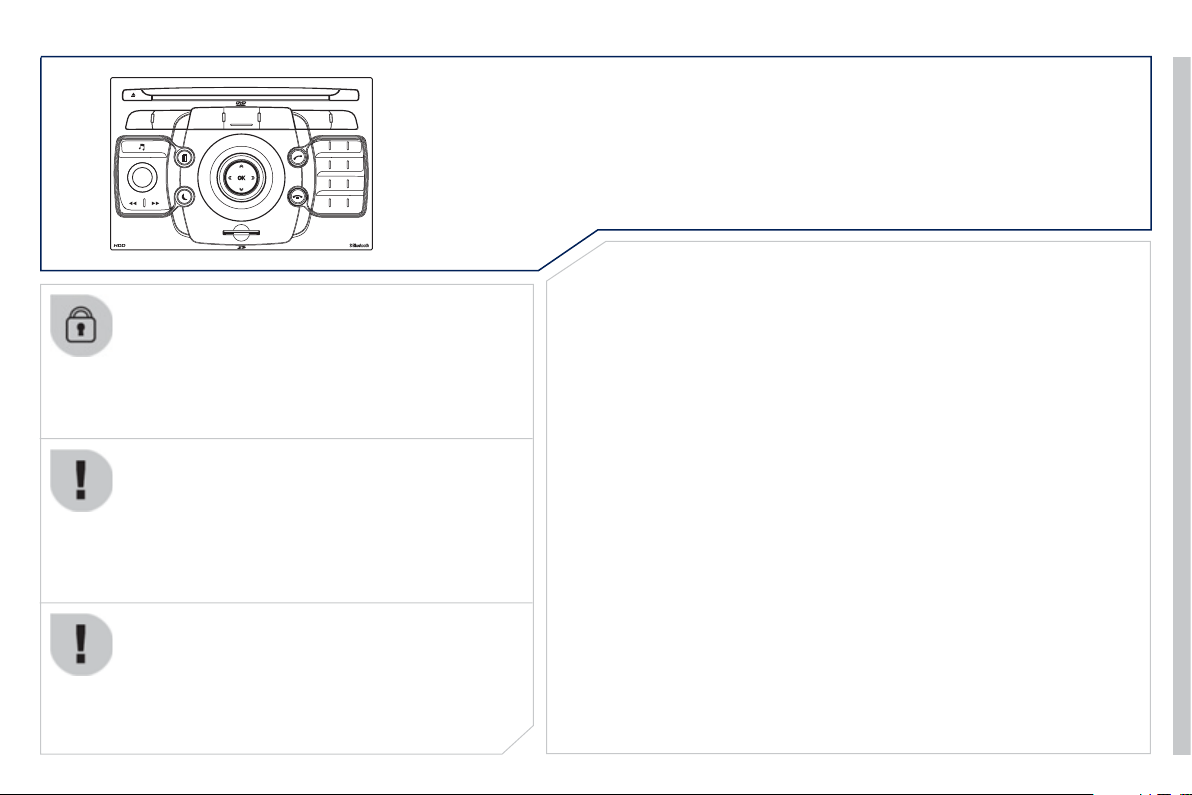
247
2
ABC
3
DEF
5
JKL
4
GHI
6
MNO
8
TUV
7
PQRS
9
WXYZ
0
*
#
1
RADIO MEDIA
NAV ESC TRAFFIC
SETUP
ADDR
BOOK
The Peu
g
eot
C
onnect Media Navi
g
ation
(
N
G
4 3D
)
is
p
rotecte
d
i
n suc
h
a wa
y
t
h
at
i
t w
ill
on
ly
operate
i
n
y
our
vehicle. I
f
it is to be installed in another vehicle, contact
a PEU
G
E
O
T dealer
f
or con
fi
g
uration o
f
the s
y
stem.
C
ertain functions described in this handbook will
become available durin
g
the course of the
y
ear.
P
eu
g
eot Connect Media
Navi
g
ation
(
NG4 3D
)
For sa
f
et
y
reasons, it is imperative that the driver
c
arries out operations which require prolon
g
ed attention
while the vehicle is stationar
y
.
When the en
g
ine is switched off and to prevent
dischar
g
in
g
of the batter
y
, the Peu
g
eot Connect Media
N
avi
g
ation
(
N
G
4 3D
)
switches o
ff
f
ollowin
g
activation o
f
t
h
e
E
ner
gy
E
conom
y
mo
d
e.
01 First steps
02 Voice commands and
steering mounted controls
03 General operation
04 Navigation - Guidance
05 Traffic information
06 Radio
07 Music media players
08 Using the telephone
09 Screen menu map
Frequently asked questions
p.
p.
p.
p.
p.
p.
p.
p.
p.
p.
24
8
25
0
25
3
25
8
2
6
7
2
6
9
27
0
27
5
28
0
2
8
5
CONTENTS
MULTIMEDIA AUDIO SYSTEM / BLUETOOTH TELEPHONE
GPS EUROPE
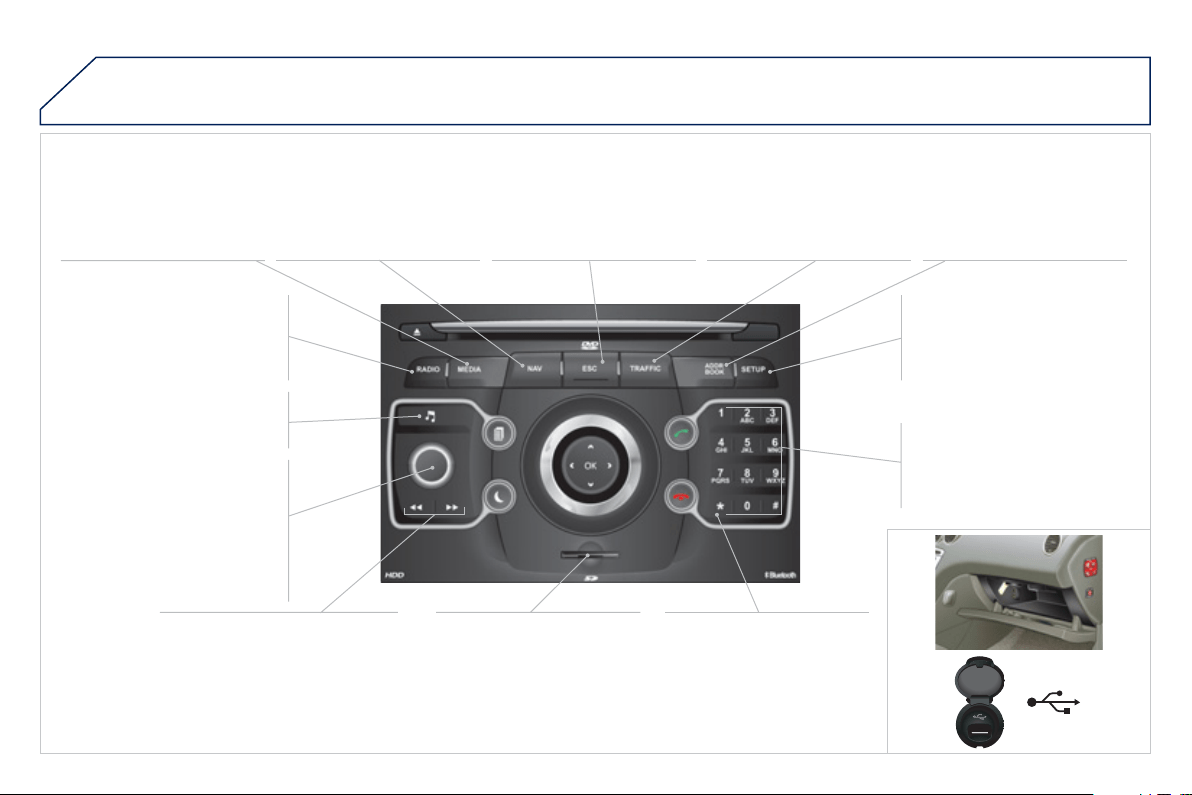
24
8
01
FIRST STEPS
Peugeot Connect Media Navigation (NG4 3D) CONTROL PANEL
Access
t
o
t
he
Radio
Me
n
u
Displa
y
the list o
f
stations in
alphabetical order
(
FM band
)
or
f
requency order
(
AM band
)
.
Access
t
o
t
he
Media
Me
n
u
(
audio
C
D, Jukebox,
Auxiliar
y
input
)
.
Display the list o
f
tracks.
C
han
g
e the audio source.
A
ccess to t
h
e
N
av
ig
at
i
on
M
enu and display recent
des
tin
a
ti
o
n
s
.
Aba
n
do
n t
he
cu
rr
e
nt
operat
i
on.
Long press: return to main
displa
y
.
Access
t
o
th
e
Tr
affi
c
M
e
n
u
.
A
ccess
t
o
th
e
A
dd
r
ess
boo
k
Me
n
u
.
A
ccess
t
o
th
e
"
S
ET
U
P" m
e
n
u
(
confi
g
uration
)
.
Lon
g
press: GPS covera
g
e.
A
udio settin
g
s
(
Balance /
Fader, Bass / Treble, Musical
ambience...
)
.
A
d
j
ust volume
(
each source
is independent, including
n
avi
g
ation messa
g
es and alerts
)
.
Lon
g
press: reinitialise the
sy
stem.
Short press: mute.
A
utomatic search down
/
up
f
o
r
r
adio
f
requencies.
Select
p
revious/next CD or MP3
tr
ac
k.
S
D
ca
r
d
r
eade
r.
S
hort press: clears the last
c
h
a
r
ac
t
e
r.
E
nt
e
r t
he
n
u
m
be
r
s
o
r
le
tt
e
r
s
u
s
i
n
g
t
h
e a
l
p
h
a-numer
i
c
k
e
y
pa
d
.
Presettin
g
10 radio
f
requencies.
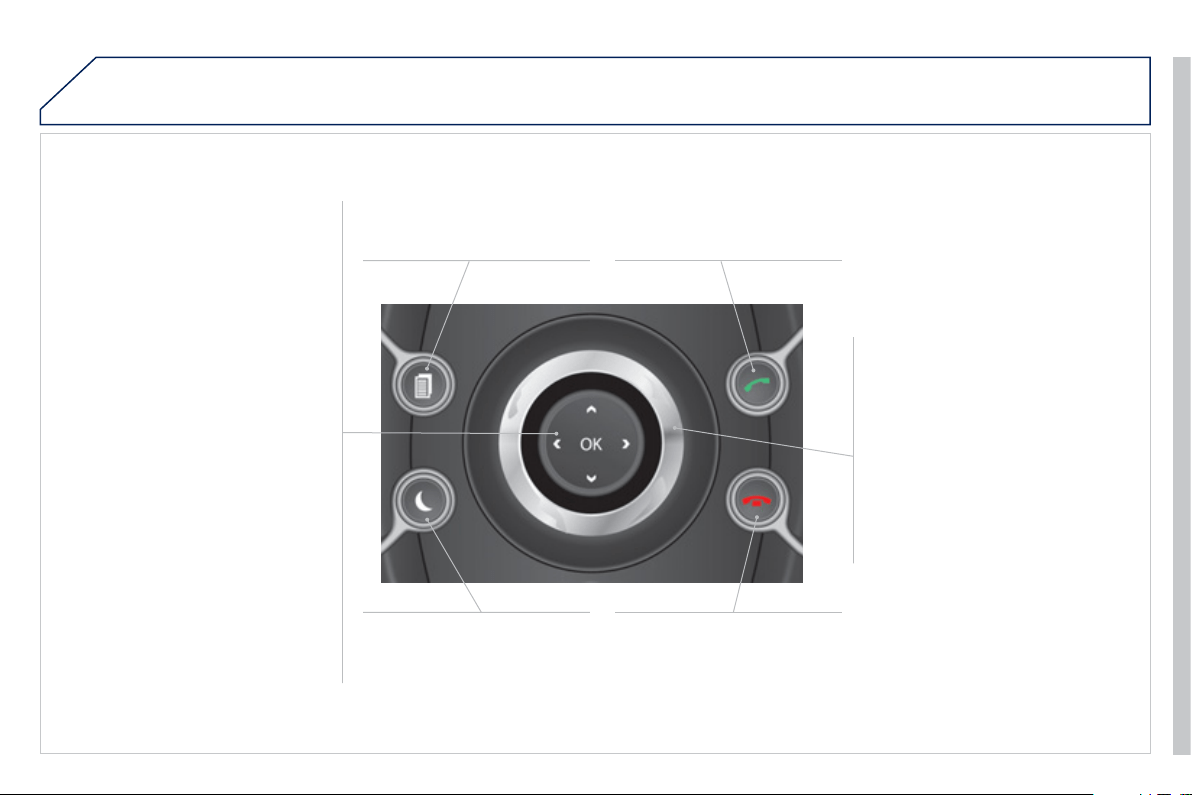
24
9
01
FIRST STEPS
Peugeot Connect Media Navigation (NG4 3D) NAVIGATOR
Press to le
f
t
/
right:
W
ith displa
y
o
f
the "RADI
O
" screen:
s
elect the previous
/
next
f
requenc
y
.
W
ith displa
y
of the "MEDIA" screen:
s
elect the
p
revious / next track.
W
ith displa
y
of the "MAP" or "NAV":
h
or
i
zonta
l
movement on t
h
e map.
Press up / down:
W
ith displa
y
o
f
the "RADI
O
" screen:
s
elect the previous
/
next radio station
i
n t
he
lis
t.
W
ith displa
y
o
f
the "MEDIA" screen:
se
l
ec
t th
e
MP
3
fo
l
de
r.
W
ith displa
y
of the "MAP" or "NAV":
vertical movement on the ma
p
.
Go the the next or previous pa
g
e in a
menu
.
M
ovement on t
h
e v
i
rtua
l
k
e
y
pa
d
displayed.
O
K: con
fi
rm the hi
g
hli
g
hted item.
END
C
ALL:
access
t
o
th
e
P
h
o
n
e
m
e
n
u
.
End a call in pro
g
ress or re
j
ect
an incomin
g
call, Bluetooth
co
nn
ec
t
io
n.
Normal displa
y
or black screen.
Select successive displa
y
in the
s
creen o
f
"MAP"
/
"NAV"
(
i
f
navi
g
ation
in pro
g
ress
)
/
"TEL"
(
i
f
a call is in
progress
)
/
"RADI
O
" or "MEDIA"
bein
g
pla
y
ed.
C
ALL: access to the Phone
menu
.
Bluetooth connection, accept
an incomin
g
call.
R
o
t
a
t
e
th
e
d
i
a
l:
With displa
y
of the "RADI
O
" screen:
s
elect the
p
revious / next radio station
in th
e
li
s
t.
With displa
y
of the "MEDIA" screen:
s
elect the previous
/
next
C
D or MP3
tr
ack
.
With displa
y
o
f
the "MAP" or "NAV":
z
oom the map in
/
out.
M
o
v
e
m
e
nt
o
f th
e
m
e
n
u
se
l
ec
ti
o
n
cu
r
so
r.
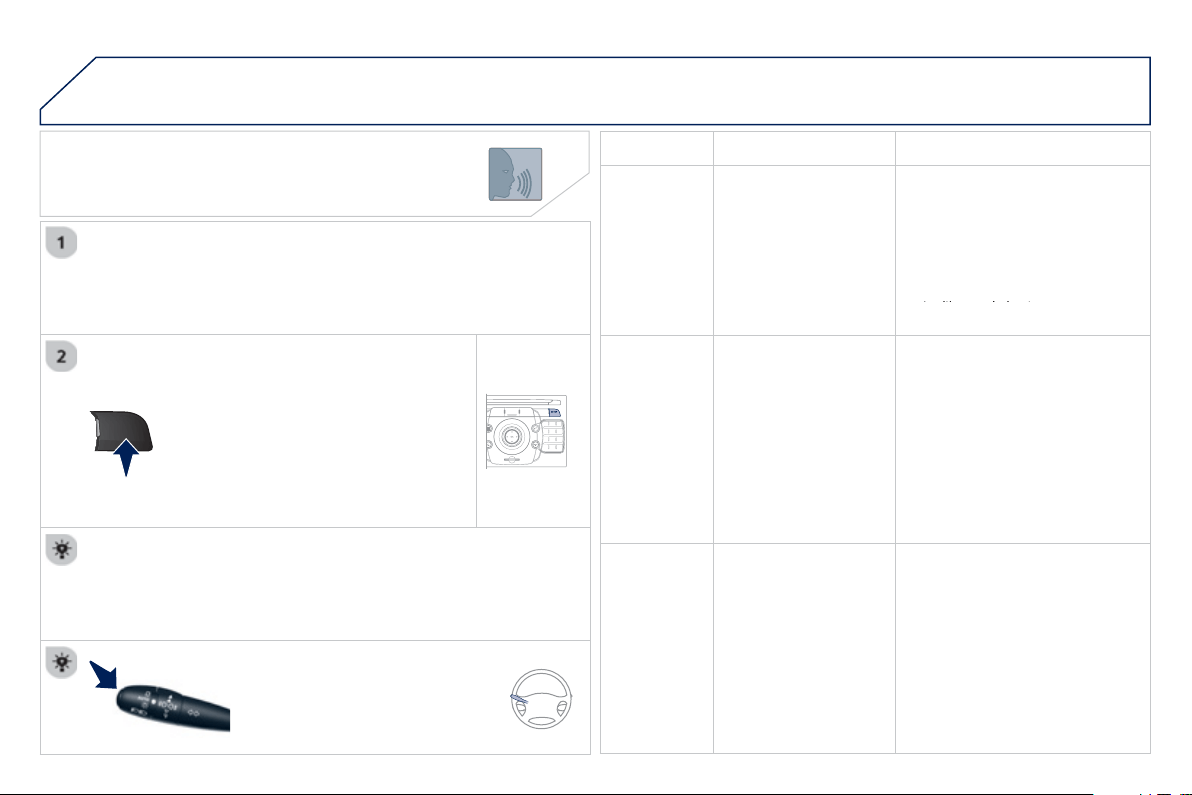
2
50
02
SETUP
2
ABC
3
DEF
5
JKL
4
GHI
6
MNO
8
TUV
7
PQRS
9
WXYZ
0
*
#
1
NAV ESC TRAFFIC
ADDR
BOOK
SETUP
Be
f
ore usin
g
the s
y
stem
f
or the
fi
rst time,
y
ou are advised to listen
to, sa
y
and practice the tutorial.
Press the
S
ET
U
P button and select
the "Lan
g
ua
g
e & Speech" function.
T
urn t
h
e r
i
n
g
an
d
se
l
ect
"V
o
i
ce contro
l"
.
A
ct
i
vate vo
i
ce reco
g
n
i
t
i
on.
Se
l
ec
t "T
u
t
o
ri
a
l".
VOICE COMMANDS - VOICE
RECO. INITIATION
Th
e p
h
rases to
b
e spo
k
en accor
di
n
g
to t
h
e context are
i
n
di
cate
d
i
n
t
he
t
ables
belo
w.
S
peak and Peugeot
C
onnect Media acts.
Pressing the end o
f
the lighting
co
ntr
o
l
s
t
a
lk
ac
tiv
a
t
es
v
o
i
ce
reco
g
nition.
CONTEX
T
SAY
A
CTION
GENERAL
H
elp address book
Help voice control
Help media
Help navi
g
ation
Hel
p
tele
p
hone
H
e
lp
ra
di
o
Ca
n
ce
l
Correction
Access to the address book help
Access to the voice reco
g
nition help
Access to the media mana
g
ement help
Access to the
g
uidance, navi
g
ation help
Access to the tele
p
hone hel
p
A
ccess to t
h
e ra
di
o
h
e
lp
To
ca
n
cel
a
v
oice
co
mm
a
n
d
w
hich
is
i
n
progress
Request to correct the last voice
recogn
iti
on carr
i
e
d
ou
t
q
Clear
RADIO
Select station
S
tation <tts:stationName>
R
ead
ou
t
s
t
a
ti
o
n li
s
t
Enter
f
requenc
y
Select wave band
AM
FM
TA
o
n
TA
off
Select a radio station
Select a radio station usin
g
its RDS
description <tts:station Name>
f
rom the
R
ADI
O
li
s
t
Li
s
t
e
n t
o
th
e
li
s
t
o
f
s
t
a
ti
o
n
s
a
v
a
il
ab
l
e
Listen to the frequency of the current
r
ad
i
o
s
t
a
ti
o
n
C
hoose the
f
requenc
y
waveband
(
AM or FM
)
C
han
g
e the
f
requenc
y
waveband to AM
Change the frequency waveband to FM
Activate Traffi c Info (TA)
D
eac
tiv
a
t
e
Tr
a
ffi
c
Inf
o
NAVIGATIO
N
Destination input
V
o
i
ce
ad
vi
ce
o
f
f
Voice
ad
v
ice
o
n
Save address
Start
g
uidance
Abort
g
uidance
Navi
g
ate entr
y
P
O
I Search
Command to enter a new destination
add
r
ess
Deactivate the spoken
g
uidance
i
n
s
tr
uc
t
io
n
s
A
ct
i
vate t
h
e spo
k
en gu
id
ance
i
nstruct
i
ons
Save an address in the address book
Start
g
uidance
(
once the address has
been entered
)
S
top the
g
uidance
Start guidance to an entry in the address
boo
k
S
tart
g
uidance to a point o
f
interest
V
OICE COMMANDS AND STEERING MOUNTED CONTROLS
2
51
02
VOICE COMMANDS - VOICE
RECO. INITIATION
V
OICE COMMANDS AND STEERING MOUNTED CONTROLS
CONTEX
T
S
AY
A
CTION
M
EDIA
M
ed
i
a
S
elect media
S
in
g
le slot
Jukebo
x
USB
Ext
e
rn
a
l
de
vi
ce
S
D-
C
ard
Track <1 - 1
000
>
F
o
l
de
r <1 - 1
000
>
S
elect the MEDIA source
C
hoose a source
S
elect the
C
D pla
y
er source
Se
l
ec
t th
e
Ju
k
ebo
x
sou
r
ce
Select the USB player source
Select the audio AUX input source
S
elect the
S
D card source
S
elect a speci
fi
c track
(
number between 1
and 1 000
)
on the active MEDIUM
Select a Folder (number between 1 and
1000
)
on the active MEDIUM
T
ELEPHON
E
P
ho
n
e
m
e
n
u
Ent
e
r n
u
m
ber
Ph
o
n
e
boo
k
Dial
Save number
Accept
Re
j
ect
Open the Telephone Menu
Enter a telephone number to be called
Op
en the
p
hone book
Make
a
call
Save a number in the phone book
Accept an incomin
g
call
Re
j
ect an incomin
g
call
ADDRE
SS
BOOK
A
dd
r
ess
boo
k m
e
n
u
C
all <entr
y
>
N
av
ig
ate <entr
y
>
O
pen the address book
Call fi le usin
g
its <fi le> description as
desc
ri
bed
in th
e
add
r
ess
boo
k
S
tart
g
uidance to an address in the
address book using its <fi le> description
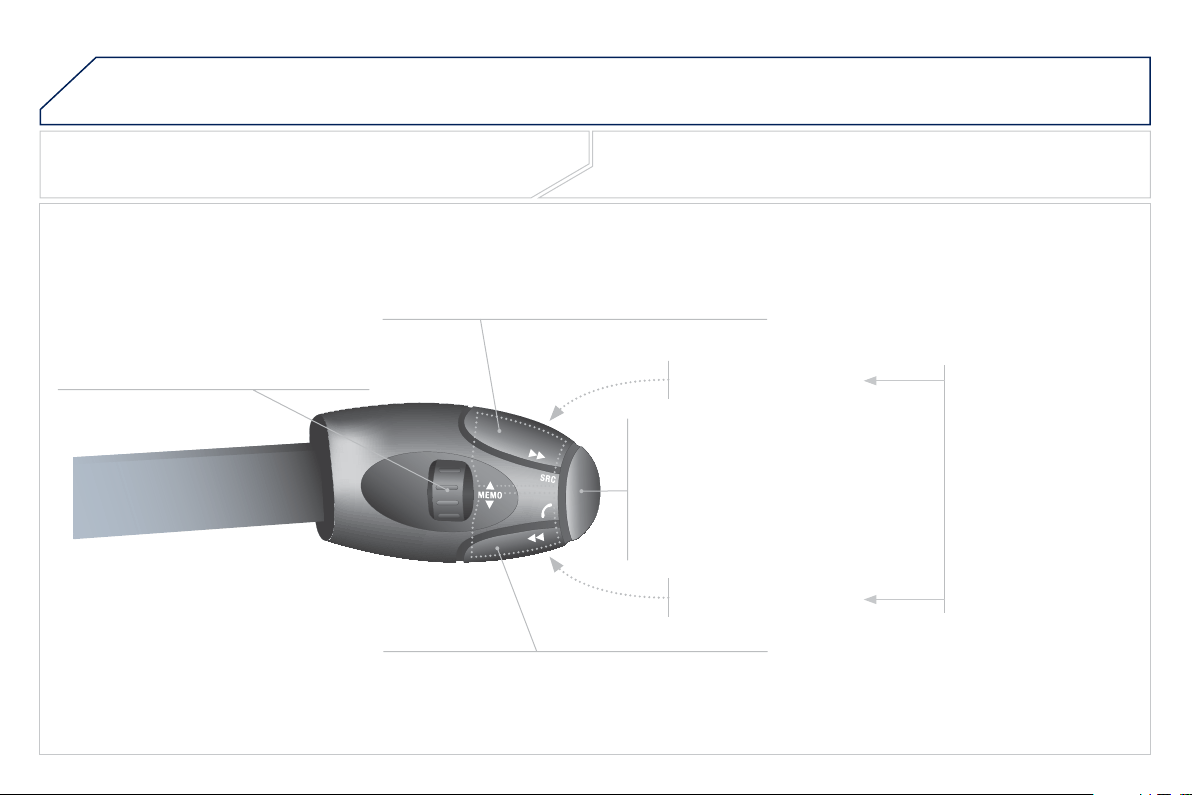
2
5
2
02
V
OICE COMMANDS AND STEERING MOUNTED CONTROLS
STEERING MOUNTED CONTROLS
Wiper stalk: displa
y
"RADI
O
" and "MEDIA".
Li
g
htin
g
stalk: activate voice commands with a short press; indication o
f
the
c
urrent navigation instruction with a long press .
C
han
g
e audio source.
S
t
a
rt
a
ca
ll
f
r
o
m th
e
co
nt
ac
t
s
li
s
t
Call/han
g
up the telephone.
C
onfi rm a selection.
Pr
ess
f
o
r m
o
r
e
th
a
n 2
seco
n
ds
:
te
l
ep
h
one menu.
Radio: automatic search for a lower frequenc
y
.
C
D
/
S
D
C
ARD
/
JUKEB
O
X: select the previous track.
C
D
/
S
D
C
ARD
/
JUKEB
O
X: continuous press:
f
ast
bac
kw
a
r
ds
.
Radio: select the previous
/
next pre-set
s
t
a
ti
o
n.
C
D audio: select the previous
/
next track .
If "MEDIA" is displa
y
ed in the screen:
MP
3
C
D
/
S
D
C
ARD
/
JU
KEB
O
X: select the
previous/next folder.
S
elect the previous
/
next item in the contacts
lis
t.
Radio: automatic search
f
or a higher
f
requency.
C
D
/
S
D
C
ARD
/
JU
KEB
O
X:
se
l
ec
t th
e
n
e
xt tr
ac
k.
C
D
/
S
D
C
ARD
/
JUKEB
O
X: continuous press:
f
ast
f
o
rw
a
r
ds
.
Volu
m
e
i
n
c
r
ease
.
Volu
m
e
dec
r
ease
.
Mute: press the volume
i
n
c
r
ease
a
n
d
dec
r
ease
buttons simultaneousl
y
.
The sound is restored b
y
p
ressin
g
one of the two
v
o
l
u
m
e
bu
tt
o
n
s
.
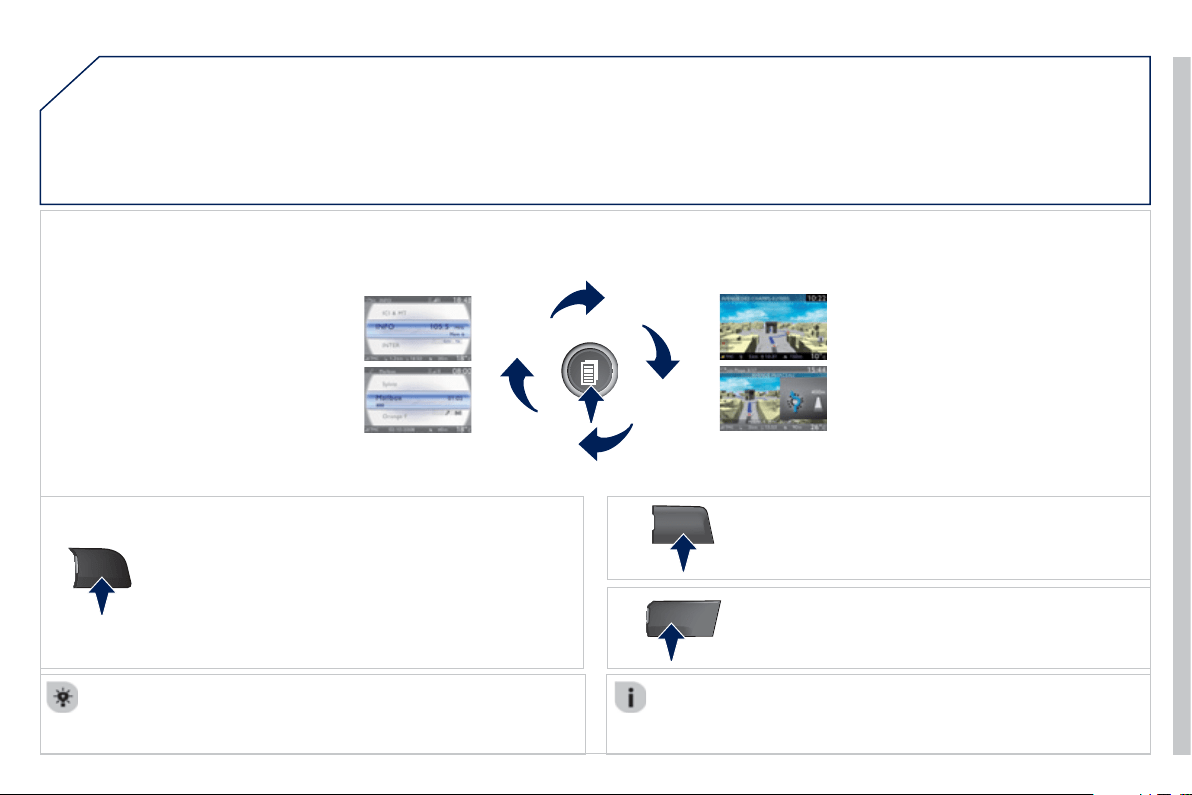
2
53
03
SETUP
TRAFFIC
MEDIA
GENERAL OPERATION
For a detailed
g
lobal view o
f
the menus available, re
f
er to the
"S
creen menu map" section o
f
this handbook.
Press the M
O
DE button several times in succession to
g
ain access to the followin
g
displa
y
s:
Lon
g
press: access to the GPS covera
g
e and to the demonstration
m
ode
.
For maintenance o
f
the screen, the use o
f
a so
f
t, non-abrasive cloth
(
spectacles cloth
)
is recommended, without any additional product.
RADIO
/
MUSIC MEDIA
/
V
IDEO
T
ELEPHON
E
(
If a conversation is in pro
g
ress
)
FULL
S
CREEN MAP
NAVIGATION
(
If
g
uidance is in pro
g
ress
)
S
ETUP
:
access to the "
S
ETUP" Menu: s
y
stem lan
g
ua
g
e
*
and voice
f
unctions
*
, voice initialisation
(
section 09
)
,
date and time * , displa
y
, unit and s
y
stem parameters.
T
RAFFI
C:
access to the Traffi c Menu: displa
y
of the current
tr
a
ffi
c
a
l
e
rt
s
.
DISPLAY ACCORDING TO THE CONTEXT
MEDIA:
"DVD
-
audio"
m
e
n
u
"
DVD-Vi
deo
" m
e
n
u
* Available accordin
g
to model.
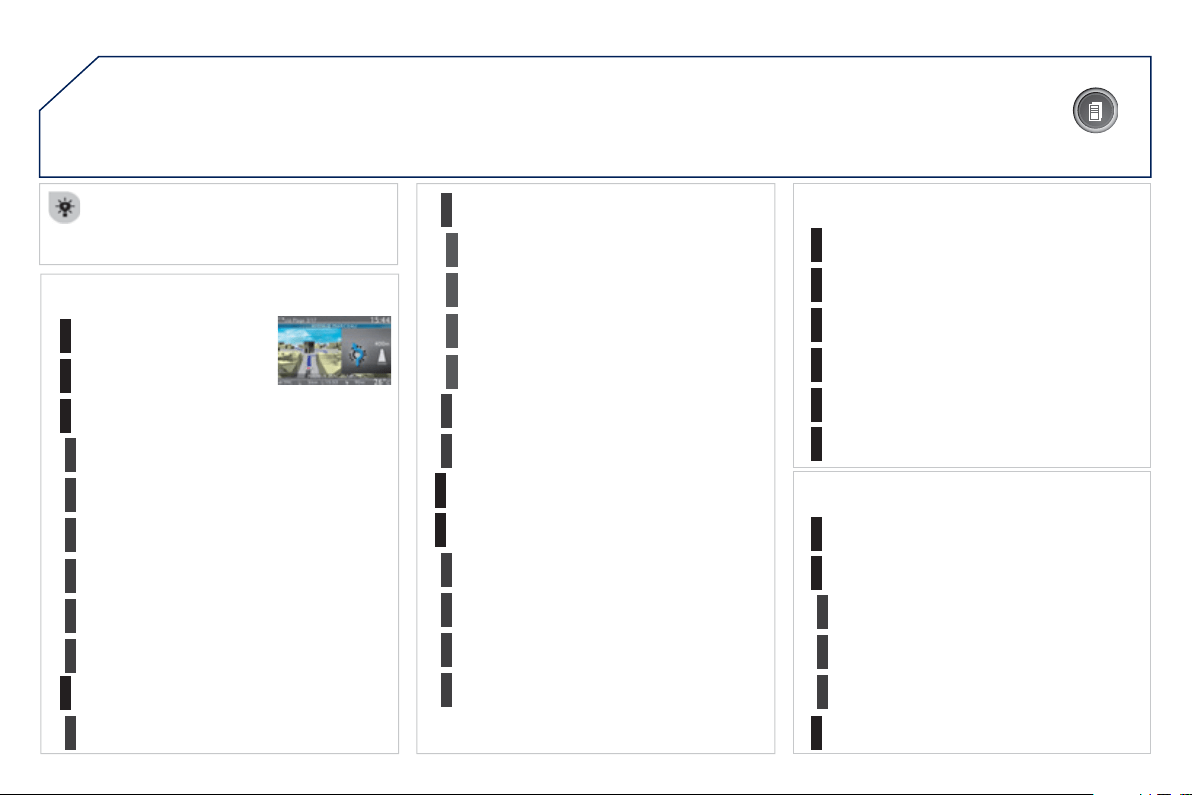
2
5
4
03 GENERAL OPERATION
Pressin
g
O
K
g
ives access to short-cut
menus accor
di
n
g
to t
h
e
di
sp
l
a
y
on t
h
e
screen
.
DISPLAY ACCORDING TO THE CONTEXT
NAVIGATION
(
IF GUIDANCE IS IN
P
ROGRESS
)
:
Abort guidanc
e
1
1
1
R
e
p
eat a
d
v
i
c
e
Bl
oc
k
roa
d
2
2
U
nblock
M
o
r
e
2
L
ess
3
3
R
oute t
y
pe
A
v
o
i
d
3
S
atellites
2
2
C
alculate
Z
oo
m
/Sc
r
o
ll
2
Br
o
w
se
r
ou
t
e
1
Route info
2
2
S
how destination
Trip in
f
o
3
Stopovers
2
2
Br
o
w
se
r
ou
t
e
Zoom
/S
croll
1
1
V
o
i
ce a
d
v
i
c
e
Route o
p
tions
2
2
Route t
y
pe
R
oute
d
ynam
i
cs
2
Av
o
i
da
n
ce
c
rit
e
ri
a
2
R
eca
l
cu
l
a
t
e
TELEPHONE:
E
nd cal
l
1
1
1
1
Hold cal
l
Di
a
l
DTMF
-
T
one
s
1
P
rivate mod
e
1
Micro off
MU
S
IC MEDIA PLAYER
S
:
TA
1
1
Pl
a
y
opt
i
ons
1
Select medi
a
2
2
N
o
rm
a
l
o
r
de
r
R
a
n
do
m tr
ac
k
2
S
can
2
55
03 GENERAL OPERATION
DISPLAY ACCORDING TO THE CONTEXT
RADIO:
I
n
FM
mo
de
1
2
2
TA
RD
S
2
Radio
t
e
xt
2
Re
g
ional pro
g
.
FULL
S
CREEN MAP:
A
bort
g
uidance
/
Resume
g
uidanc
e
1
1
1
1
Set destination / Add sto
p
over
P
OIs nearb
y
P
osition inf
o
2
G
uidance options
3
3
Navi
g
ate to
Dial
3
Save
p
osition
3
Z
oo
m
/Sc
r
o
ll
M
ap Settin
gs
1
1
Zoom/Scrol
l
2
2
2D Map
2.5D Map
2
3D Map
2
North Up
2
Headin
g
Up
A
UDIO DVD
(
LONG PRESS
)
:
1
Sto
p
2
G
roup
3
G
roup 1 .2
/
n
TA
1
2
S
elect media
2
Play options
3
Normal order
/
Random track
/
S
can
AM
In AM mod
e
TA
R
ef
r
es
h AM li
s
t
FM
2
1
2
2
2
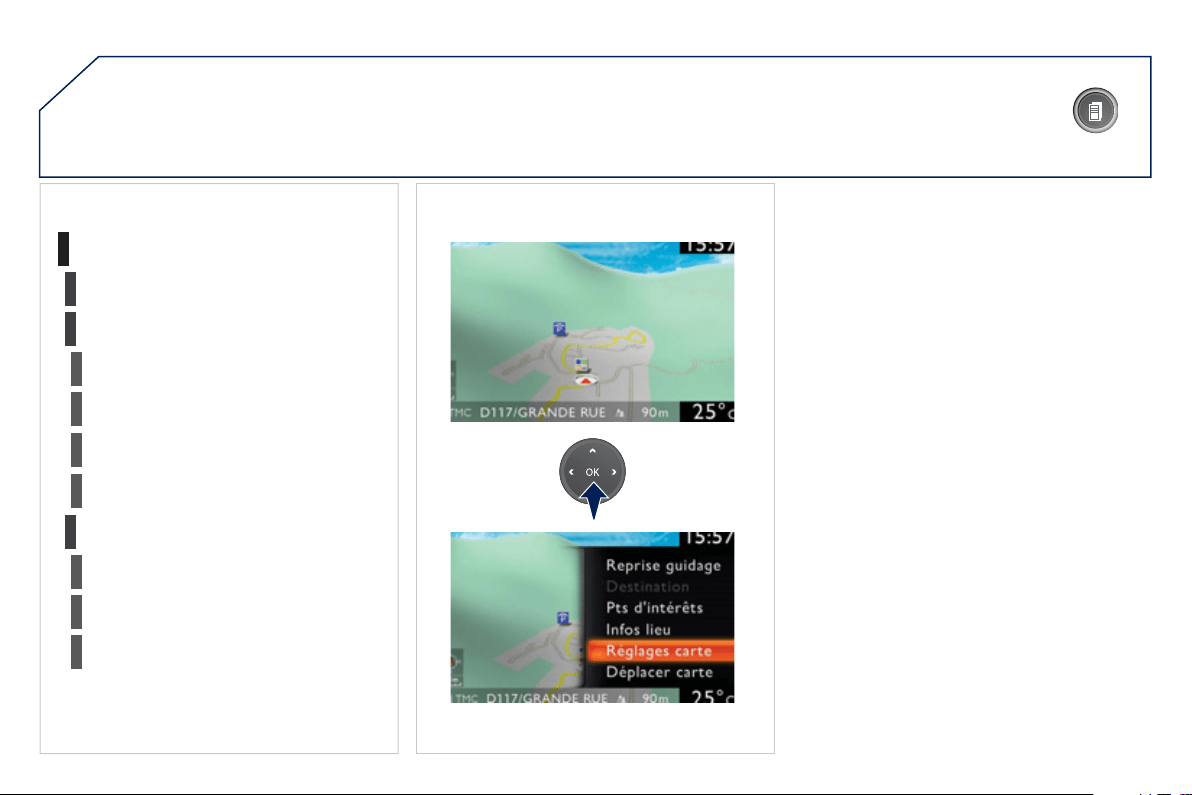
2
56
03
3
3
DVD m
e
n
u
DVD to
p
menu
3
Li
s
t
of
titl
es
3
List of chapters
V
IDEO DVD
(
LONG PRESS
)
:
Pl
a
y
1
GENERAL OPERATION
DISPLAY ACCORDING TO THE CONTEXT
2
2
S
top
DVD
m
e
n
us
3
3
Audio
S
ubtitles
3
A
ngle
2
DVD
O
ptions
Examples:
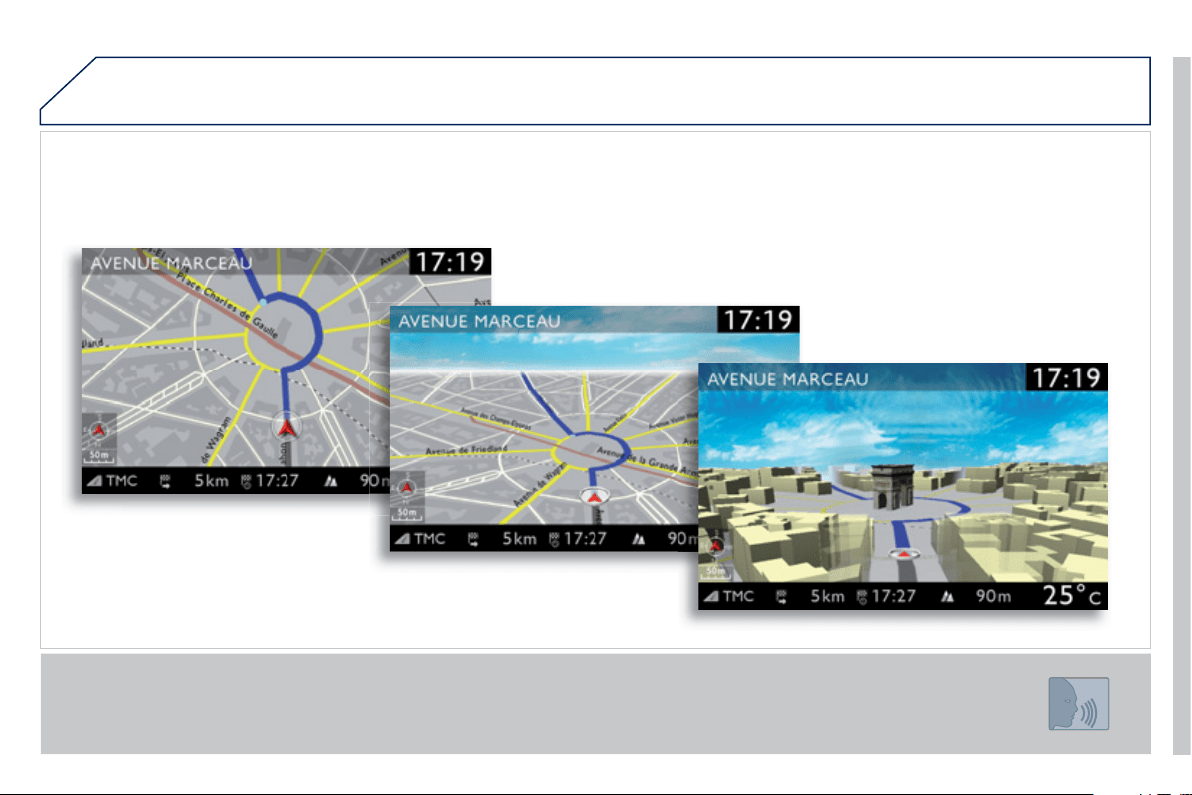
2
57
-
t
he map settin
g
which allows the map to be displa
y
ed fl at, in perspective or in 3D
.
-
c
onfi
g
uration of the s
y
stem b
y
means of voice commands
.
M
ap in 3
D
Flat ma
p
Ma
p
in
p
ers
p
ectiv
e
Peugeot Connect Media IS:
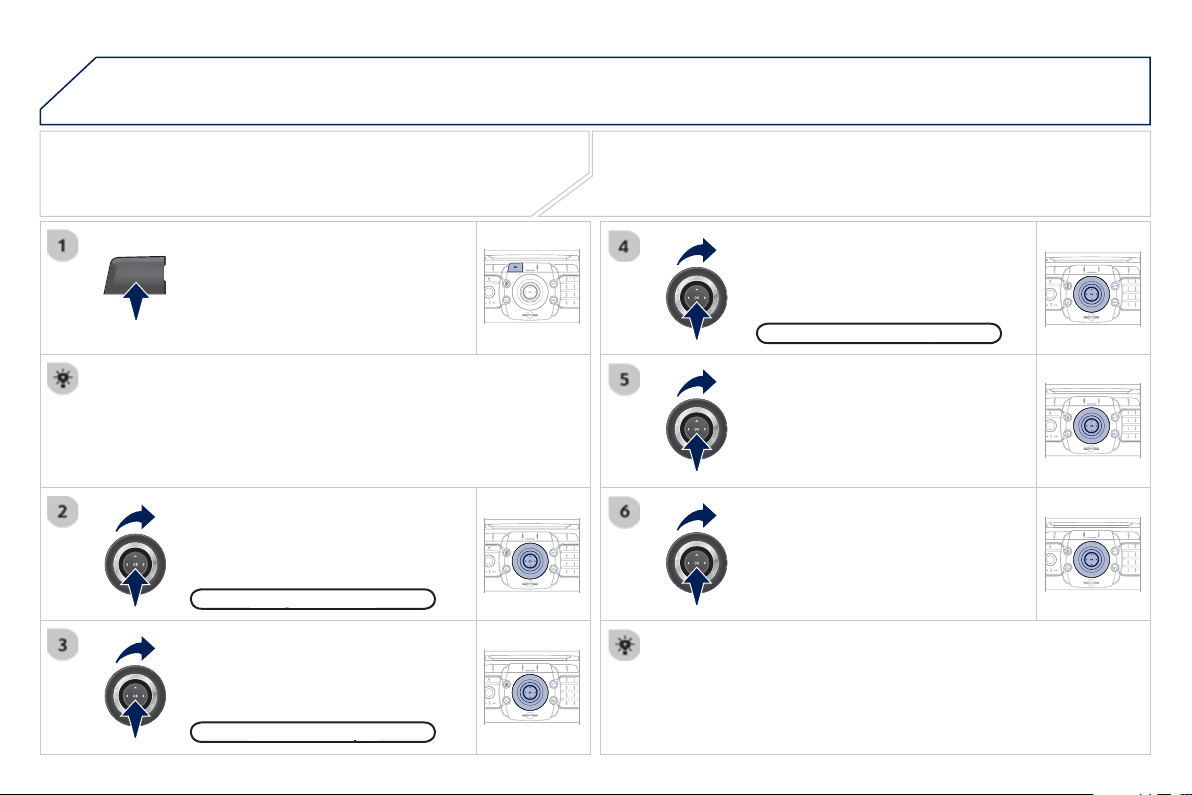
2
58
04
NAV
2
ABC
3
DEF
5
JKL
4
GHI
6
MN
O
8
TUV
7
PQRS
9
WXY
Z
0
*
#
1
RADIO MEDIA
NAV ESC TRAFFIC
SETUP
ADDR
BOOK
2
ABC
3
DEF
5
JKL
4
GHI
6
MN
O
8
TUV
7
PQRS
9
WXY
Z
0
*
#
1
RADIO MEDIA
NAV ESC TRAFFIC
SETUP
ADDR
BOOK
2
ABC
3
DEF
5
JKL
4
GHI
6
MN
O
8
TUV
7
PQRS
9
WXY
Z
0
*
#
1
RADIO MEDIA
NAV ESC TRAFFIC
SETUP
ADDR
BOOK
2
ABC
3
DEF
5
JKL
4
GHI
6
MN
O
8
TUV
7
PQRS
9
WXY
Z
0
*
#
1
RADIO MEDIA
NAV ESC TRAFFIC
SETUP
ADDR
BOOK
2
ABC
3
DEF
5
JKL
4
GHI
6
MN
O
8
TUV
7
PQRS
9
WXY
Z
0
*
#
1
RADIO MEDIA
NAV ESC TRAFFIC
SETUP
ADDR
BOOK
2
ABC
3
DEF
5
JKL
4
GHI
6
MN
O
8
TUV
7
PQRS
9
WXY
Z
0
*
#
1
RADIO MEDIA
NAV ESC TRAFFIC
SETUP
ADDR
BOOK
NAVIGATION - GUIDANCE
SELECTING A DESTINATION
Press the NAV button a
g
ain or select
the Navi
g
ation Menu function and
press
O
K to confi rm.
S
elect the "Destination input"
f
unction and press
O
K to con
fi
rm.
Pr
ess
th
e
NAV
bu
tt
o
n.
Se
l
ec
t th
e
l
e
tt
e
r
s
of
th
e
t
o
wn
o
n
e
b
y
one confi rmin
g
each time b
y
p
ressin
g
O
K.
O
nce the countr
y
has been selected,
turn the rin
g
and select the town
function. Press
O
K to confi rm.
Navi
g
ation Menu
g
D
estination in
p
u
t
p
A
pre-set list
(
b
y
enterin
g
the
fi
rst
f
ew letters
)
o
f
the towns in the
c
ountr
y
selected can be accessed via the LI
S
T button on the virtual
keypad.
S
elect the "Address input"
f
unction
and press
O
K to con
fi
rm.
Add
ress
i
n
p
u
t
p
The list of the last 20 destinations appears under the Navi
g
ation
Me
n
u
fu
n
c
ti
o
n.
The "NAVI
G
ATI
O
N" voice commands are listed in section
0
2.
Durin
g
g
uidance, a lon
g
press on the end of the li
g
htin
g
stalk repeats the
l
ast
g
u
id
ance
i
nstruct
i
on.
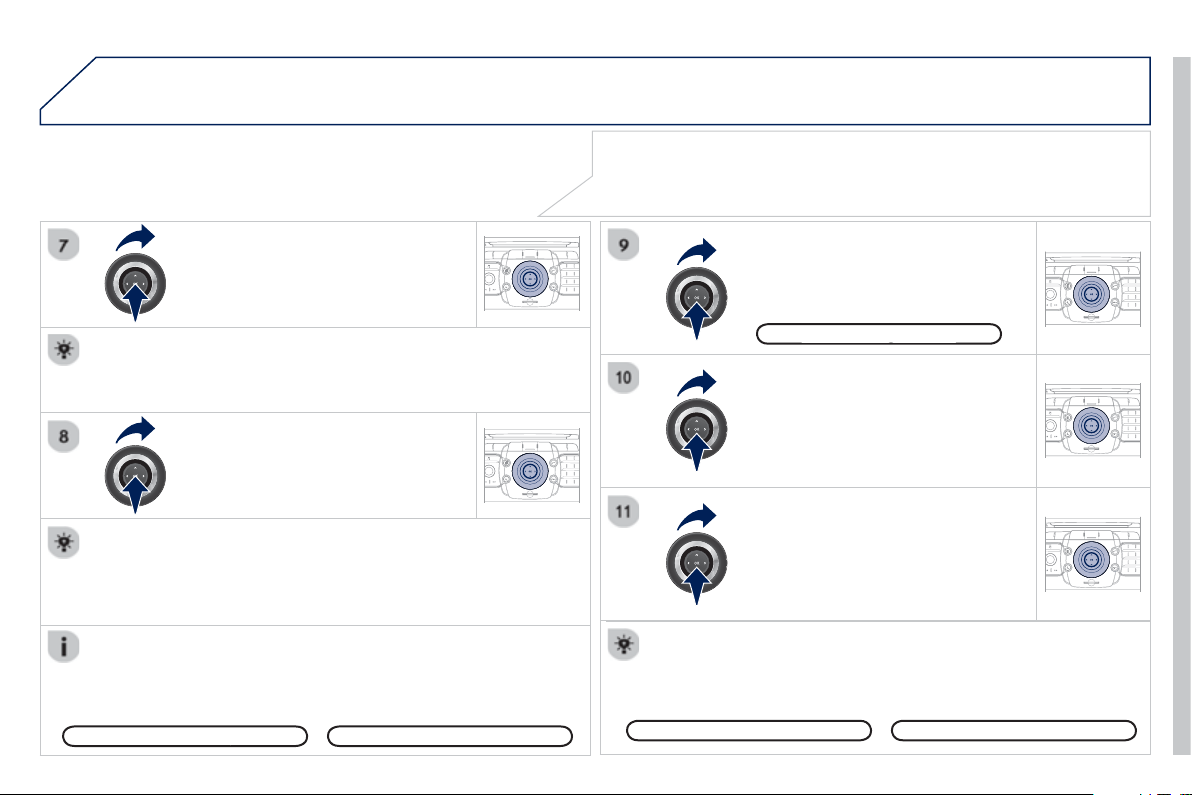
2
59
04
2
ABC
3
DEF
5
JKL
4
GHI
6
MN
O
8
TUV
7
PQRS
9
WXY
Z
0
*
#
1
RADIO MEDIA
NAV ESC TRAFFIC
SETUP
ADDR
BOOK
2
ABC
3
DEF
5
JKL
4
GHI
6
MN
O
8
TUV
7
PQRS
9
WXY
Z
0
*
#
1
RADIO MEDIA
NAV ESC TRAFFIC
SETUP
ADDR
BOOK
2
ABC
3
DEF
5
JKL
4
GHI
6
MN
O
8
TUV
7
PQRS
9
WXY
Z
0
*
#
1
RADIO MEDIA
NAV ESC TRAFFIC
SETUP
ADDR
BOOK
2
ABC
3
DEF
5
JKL
4
GHI
6
MN
O
8
TUV
7
PQRS
9
WXY
Z
0
*
#
1
RADIO MEDIA
NAV ESC TRAFFIC
SETUP
ADDR
BOOK
2
ABC
3
DEF
5
JKL
4
GHI
6
MN
O
8
TUV
7
PQRS
9
WXY
Z
0
*
#
1
RADIO MEDIA
NAV ESC TRAFFIC
SETUP
ADDR
BOOK
Repeat steps 5 to 7
f
or the "
S
treet"
a
n
d
"H
ouse
n
u
m
be
r"
fu
n
c
ti
o
n
s
.
To delete a destination; from ste
p
s 1 to 3, select "Choose from last
des
tin
a
ti
o
n
s
".
A
lon
g
press on one of the destinations displa
y
s a list of actions
from which
y
ou can select:
Se
l
ec
t th
e
"
Sa
v
e
t
o
add
r
ess
boo
k"
fu
n
c
ti
o
n t
o
r
eco
r
d
th
e
add
r
ess
entered in a director
y
fi le. Press
O
K to confi rm the selection.
The Peu
g
eot Connect Media allows more than 4 000 contact
r
eco
r
ds
t
o
be
sa
v
ed
.
To speed up the process, the post code can be entered directl
y
after selectin
g
the "Postal code" function.
U
se t
h
e v
i
rtua
l
k
e
y
pa
d
to enter t
h
e
l
etters an
d
digi
ts.
Select the route t
y
pe:
"Fast route"
,
"Short route"
,
or
"O
ptimized route" and press
O
K to
co
n
fi
rm.
Then select "Start route
g
uidance"
and the
p
ress
O
K to confi rm.
It is also
p
ossible to select a destination via "Choose from address
book" or "Choose from last destinations", b
y
selectin
g
a
j
unction, a
town centre,
g
eo
g
rap
hi
c coor
di
nates, or
di
rect
ly
on t
h
e
"M
ap
"
.
Choose from address book Choose from last destination
s
Start route
g
uidanc
e
g
It is possible to scroll the map usin
g
the 4-direction navi
g
ator. It is possible
to select its orientation via the short-cut menu of the "Full screen ma
p
".
Press
O
K then select "Map Settin
g
s" and confi rm.
S
elect the road with the colour
c
orrespondin
g
to the route chosen
and press
O
K to confi rm and start
g
u
id
ance.
Turn the rin
g
and select
O
K.
Press
O
K to confi rm.
D
e
l
ete entr
y
y
D
e
l
ete
li
s
t
NAVIGATION - GUIDANCE
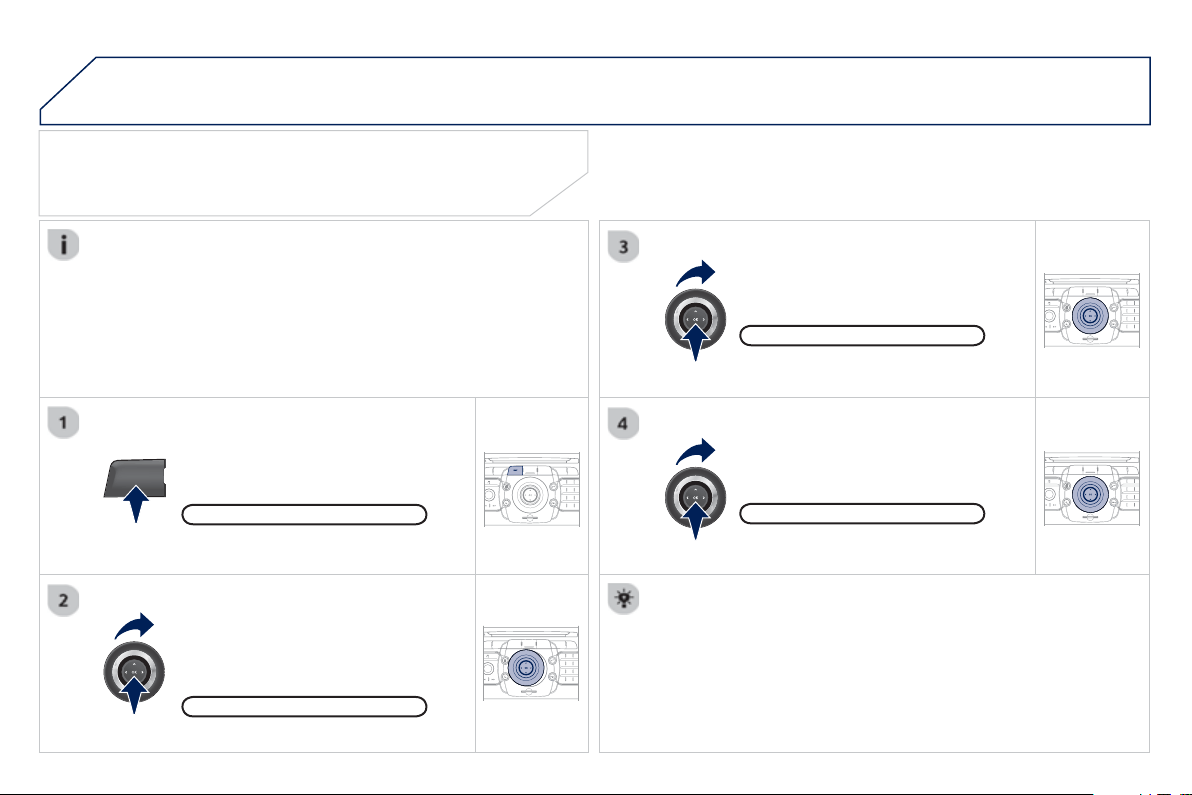
2
60
04
NAV
2
ABC
3
DEF
5
JKL
4
GHI
6
MN
O
8
TUV
7
PQRS
9
WXY
Z
0
*
#
1
RADIO MEDIA
NAV ESC TRAFFIC
SETUP
ADDR
BOOK
2
ABC
3
DEF
5
JKL
4
GHI
6
MN
O
8
TUV
7
PQRS
9
WXY
Z
0
*
#
1
RADIO MEDIA
NAV ESC TRAFFIC
SETUP
ADDR
BOOK
2
ABC
3
DEF
5
JKL
4
GHI
6
MN
O
8
TUV
7
PQRS
9
WXY
Z
0
*
#
1
RADIO MEDIA
NAV ESC TRAFFIC
SETUP
ADDR
BOOK
2
ABC
3
DEF
5
JKL
4
GHI
6
MN
O
8
TUV
7
PQRS
9
WXY
Z
0
*
#
1
RADIO MEDIA
NAV ESC TRAFFIC
SETUP
ADDR
BOOK
NAVIGATION - GUIDANCE
SETTING AND NAVIGATING TO MY
"HOME ADDRESS"
Press the NAV button twice to displa
y
the Navi
g
ation Menu.
To be set as the "Home address", an address must
fi
rst be
e
ntered in the address book,
f
or example
f
rom "Destination
input"
/
"Address input" then "
S
ave to address book".
Select "Destination input" and confi rm.
Then select "
C
hoose
f
rom address
boo
k"
a
n
d
co
n
fi
rm.
Se
l
ec
t "
Se
t
as
H
o
m
e
add
r
ess
"
a
n
d
co
nfi rm t
o
sa
v
e
.
Select
y
our home address and confi rm.
Then select "Edit entr
y
" and confi rm.
To start navi
g
ation towards "Home", press NAV twice to displa
y
the
Navi
g
ation Menu, select "Destination input" and con
fi
rm.
Then select "Navi
g
ate H
O
ME" and confi rm to start
g
uidance.
Navi
g
ation Menu
D
est
i
nat
i
on
i
n
p
u
t
E
dit entr
y
Set as home address
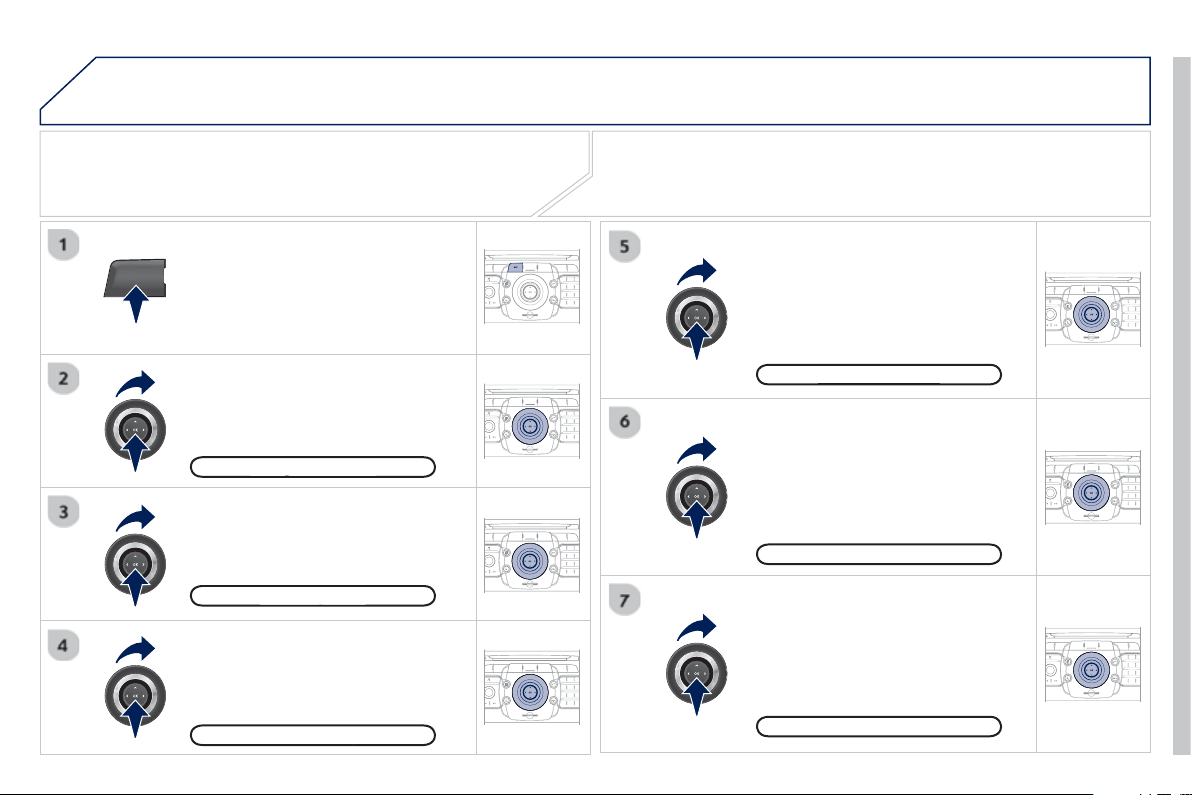
2
61
04
NAV
2
ABC
3
DEF
5
JKL
4
GHI
6
MN
O
8
TUV
7
PQRS
9
WXY
Z
0
*
#
1
RADIO MEDIA
NAV ESC TRAFFIC
SETUP
ADDR
BOOK
2
ABC
3
DEF
5
JKL
4
GHI
6
MN
O
8
TUV
7
PQRS
9
WXY
Z
0
*
#
1
RADIO MEDIA
NAV ESC TRAFFIC
SETUP
ADDR
BOOK
2
ABC
3
DEF
5
JKL
4
GHI
6
MN
O
8
TUV
7
PQRS
9
WXY
Z
0
*
#
1
RADIO MEDIA
NAV ESC TRAFFIC
SETUP
ADDR
BOOK
2
ABC
3
DEF
5
JKL
4
GHI
6
MN
O
8
TUV
7
PQRS
9
WXY
Z
0
*
#
1
RADIO MEDIA
NAV ESC TRAFFIC
SETUP
ADDR
BOOK
2
ABC
3
DEF
5
JKL
4
GHI
6
MN
O
8
TUV
7
PQRS
9
WXY
Z
0
*
#
1
RADIO MEDIA
NAV ESC TRAFFIC
SETUP
ADDR
BOOK
2
ABC
3
DEF
5
JKL
4
GHI
6
MN
O
8
TUV
7
PQRS
9
WXY
Z
0
*
#
1
RADIO MEDIA
NAV ESC TRAFFIC
SETUP
ADDR
BOOK
2
ABC
3
DEF
5
JKL
4
GHI
6
MN
O
8
TUV
7
PQRS
9
WXY
Z
0
*
#
1
RADIO MEDIA
NAV ESC TRAFFIC
SETUP
ADDR
BOOK
NAVIGATION - GUIDANCE
ROUTE OPTIONS
S
elect the "Route dynamics"
fu
n
c
ti
o
n.
This
f
unction provides access to
the "Traffi c inde
p
endent", "Semi-
d
y
namic" and "D
y
namic" options.
Se
l
ec
t th
e
"Av
o
i
da
n
ce
c
rit
e
ri
a
"
f
unction. This
f
unction provides
access to the "Avoid" o
p
tions
(
motorwa
y
s, toll roads, ferries,
tunnels
)
.
Turn the rin
g
and select the
"
R
eca
l
cu
l
a
t
e
" f
u
n
c
ti
o
n t
o
t
a
k
e
int
o
account the route options selected.
Press
O
K to confi rm.
P
r
ess
t
he
NAV
bu
tt
o
n.
Press the NAV button again or select
the Navi
g
ation Menu
f
unction and
press
O
K to con
fi
rm.
Select the "Route t
y
pe" function and
press
O
K to con
fi
rm. This
f
unction
all
ows
y
ou to c
h
an
g
e t
h
e route t
y
pe.
S
elect the "Route options"
f
unction
a
nd press
O
K to con
fi
rm.
Navi
g
ation Menu
g
Route o
p
tions
p
R
oute t
ype
yp
Route d
y
namics
y
A
vo
id
ance cr
i
ter
i
a
Recalculat
e
When the map is displa
y
ed on the screen,
y
ou can select "Map
S
ettin
g
s"
then "2D Map / 2.5D Map / 3D Map / North Up / Headin
g
Up". The displa
y
of buildin
g
s in 3D mode depends on the pro
g
ress in town mappin
g
.
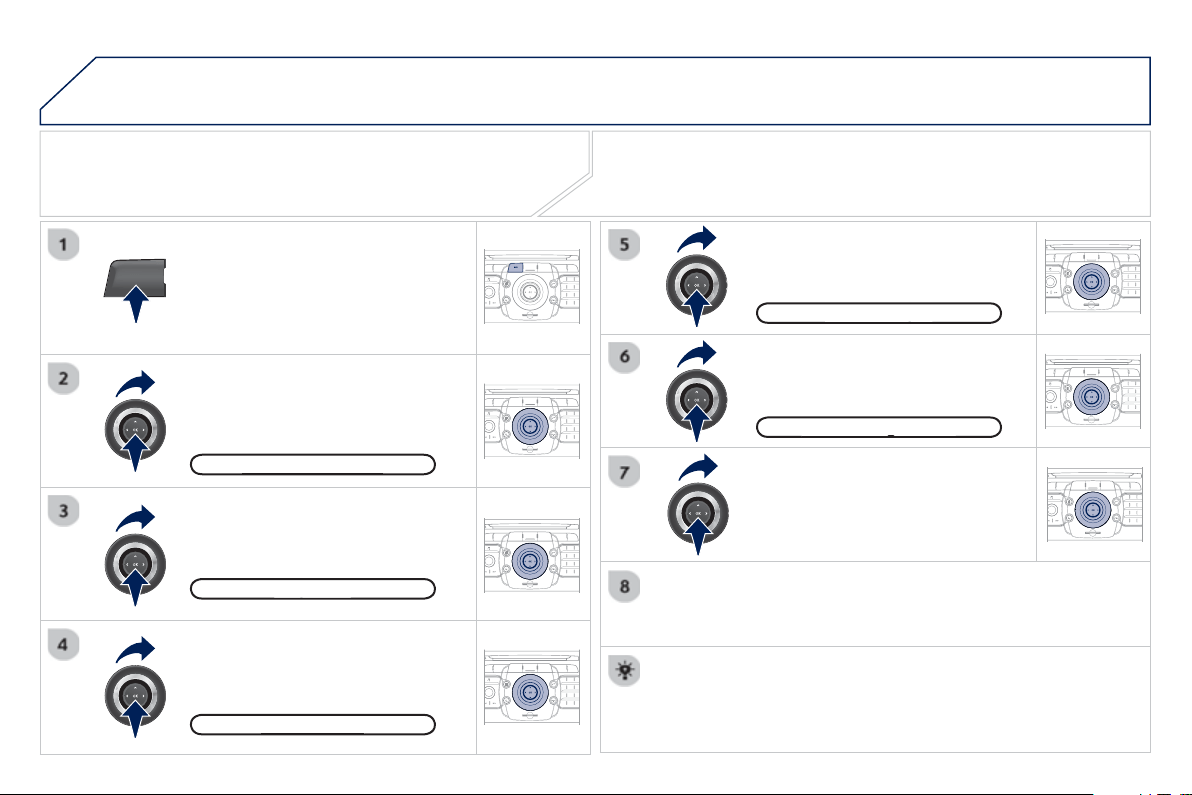
2
6
2
04
NAV
2
ABC
3
DEF
5
JKL
4
GHI
6
MN
O
8
TUV
7
PQRS
9
WXY
Z
0
*
#
1
RADIO MEDIA
NAV ESC TRAFFIC
SETUP
ADDR
BOOK
2
ABC
3
DEF
5
JKL
4
GHI
6
MN
O
8
TUV
7
PQRS
9
WXY
Z
0
*
#
1
RADIO MEDIA
NAV ESC TRAFFIC
SETUP
ADDR
BOOK
2
ABC
3
DEF
5
JKL
4
GHI
6
MN
O
8
TUV
7
PQRS
9
WXY
Z
0
*
#
1
RADIO MEDIA
NAV ESC TRAFFIC
SETUP
ADDR
BOOK
2
ABC
3
DEF
5
JKL
4
GHI
6
MN
O
8
TUV
7
PQRS
9
WXY
Z
0
*
#
1
RADIO MEDIA
NAV ESC TRAFFIC
SETUP
ADDR
BOOK
2
ABC
3
DEF
5
JKL
4
GHI
6
MN
O
8
TUV
7
PQRS
9
WXY
Z
0
*
#
1
RADIO MEDIA
NAV ESC TRAFFIC
SETUP
ADDR
BOOK
2
ABC
3
DEF
5
JKL
4
GHI
6
MN
O
8
TUV
7
PQRS
9
WXY
Z
0
*
#
1
RADIO MEDIA
NAV ESC TRAFFIC
SETUP
ADDR
BOOK
2
ABC
3
DEF
5
JKL
4
GHI
6
MN
O
8
TUV
7
PQRS
9
WXY
Z
0
*
#
1
RADIO MEDIA
NAV ESC TRAFFIC
SETUP
ADDR
BOOK
ADDING A STOPOVER
Enter a new address, for example.
O
nce the new address has
been entered, select "
S
tart route
g
uidance" and press
O
K to con
fi
rm.
Position the stopover on the list and
p
ress
O
K to confi rm.
Pr
ess
th
e
NAV
bu
tt
o
n.
Press the NAV button a
g
ain or select
the "Navi
g
ation" Menu function and
press
O
K to confi rm.
S
elect the "Add stopover"
f
unction
(
5 stopovers maximum
)
and press
O
K t
o
co
n
fi
rm.
Select the "Sto
p
overs" function and
press
O
K to confi rm.
"Navi
g
ation" Menu
g
Sto
p
over
s
p
Add sto
p
ove
r
p
Add
ress
i
n
p
u
t
p
To chan
g
e the stopovers, repeat operations
1
to
3
and select
"Rearran
g
e route"
(
select a stopover, delete it or move it on the
list usin
g
the rin
g
to chan
g
e the order, confi rm its new position and
fi nish with "Recalculate"
)
.
S
topovers can be added to or deleted
f
rom the route once the destination
has
bee
n
selec
t
ed
.
Repeat operations 1 to 7 as man
y
times as necessar
y
then select
"
Recalculate" and press
O
K to con
fi
rm.
Start route
g
uidanc
e
g
NAVIGATION - GUIDANCE
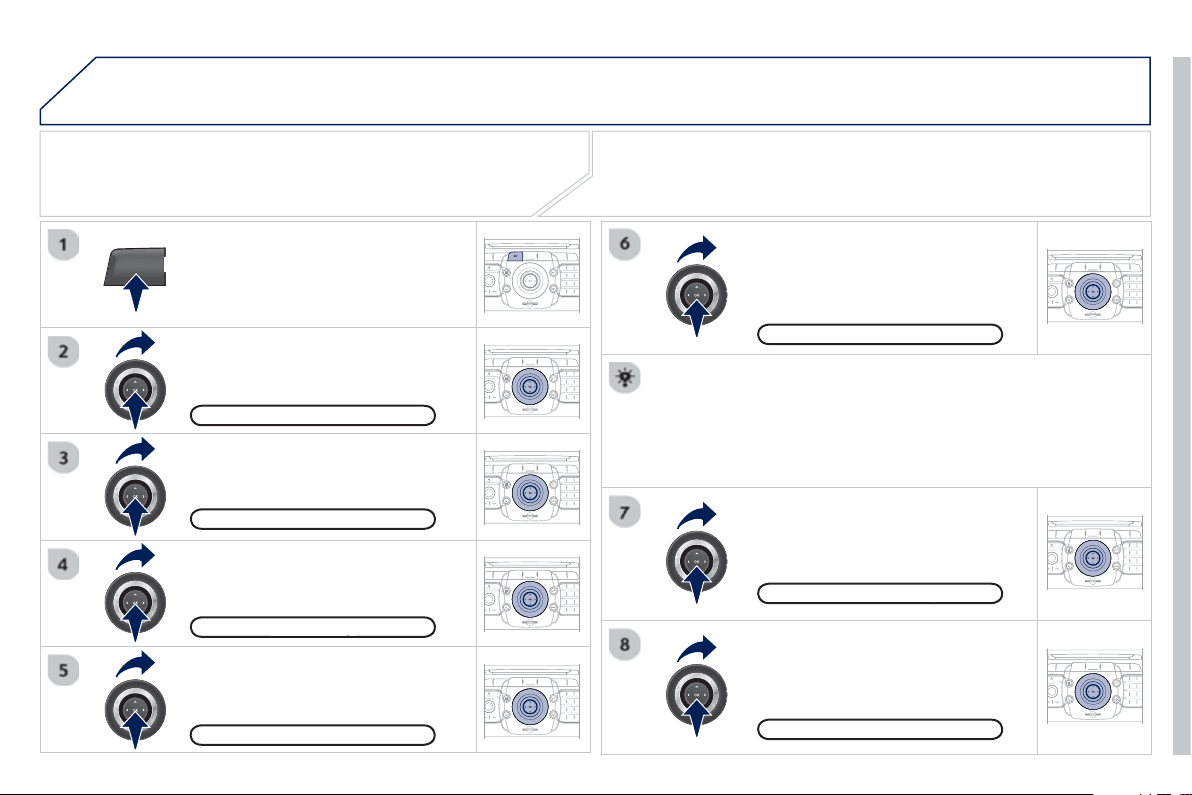
2
63
04
NAV
2
ABC
3
DEF
5
JKL
4
GHI
6
MN
O
8
TUV
7
PQRS
9
WXY
Z
0
*
#
1
RADIO MEDIA
NAV ESC TRAFFIC
SETUP
ADDR
BOOK
2
ABC
3
DEF
5
JKL
4
GHI
6
MN
O
8
TUV
7
PQRS
9
WXY
Z
0
*
#
1
RADIO MEDIA
NAV ESC TRAFFIC
SETUP
ADDR
BOOK
2
ABC
3
DEF
5
JKL
4
GHI
6
MN
O
8
TUV
7
PQRS
9
WXY
Z
0
*
#
1
RADIO MEDIA
NAV ESC TRAFFIC
SETUP
ADDR
BOOK
2
ABC
3
DEF
5
JKL
4
GHI
6
MN
O
8
TUV
7
PQRS
9
WXY
Z
0
*
#
1
RADIO MEDIA
NAV ESC TRAFFIC
SETUP
ADDR
BOOK
2
ABC
3
DEF
5
JKL
4
GHI
6
MN
O
8
TUV
7
PQRS
9
WXY
Z
0
*
#
1
RADIO MEDIA
NAV ESC TRAFFIC
SETUP
ADDR
BOOK
2
ABC
3
DEF
5
JKL
4
GHI
6
MN
O
8
TUV
7
PQRS
9
WXY
Z
0
*
#
1
RADIO MEDIA
NAV ESC TRAFFIC
SETUP
ADDR
BOOK
2
ABC
3
DEF
5
JKL
4
GHI
6
MN
O
8
TUV
7
PQRS
9
WXY
Z
0
*
#
1
RADIO MEDIA
NAV ESC TRAFFIC
SETUP
ADDR
BOOK
2
ABC
3
DEF
5
JKL
4
GHI
6
MN
O
8
TUV
7
PQRS
9
WXY
Z
0
*
#
1
RADIO MEDIA
NAV ESC TRAFFIC
SETUP
ADDR
BOOK
NAVIGATION - GUIDANCE
SEARCHING FOR POINTS OF INTEREST
(POI)
Pr
ess
th
e
NAV
bu
tt
o
n.
Press the NAV button a
g
ain or select
the Navi
g
ation Menu function and
press
O
K to confi rm.
S
elect the "P
O
I nearb
y
"
f
unction to
search for P
O
Is around the vehicle.
Se
l
ec
t th
e
"P
O
I
sea
r
c
h"
fu
n
c
ti
o
n
a
n
d
p
ress
O
K to confi rm.
Navi
g
ation Menu
g
POI search
P
OI nearb
y
y
S
elect the "P
O
I in cit
y
"
f
unction to
s
earch
f
or P
O
Is in the cit
y
required.
S
elect the country then enter the
n
ame o
f
the cit
y
usin
g
the virtual
ke
y
pad.
S
elect the "P
O
I near route"
f
unction
t
o
sea
r
c
h
fo
r P
O
I
s
n
ea
r th
e
r
ou
t
e
.
S
elect the "P
O
I in countr
y
"
f
unction
to search for P
O
Is in the countr
y
re
q
uired.
S
elect the "P
O
I near destination"
f
unction to search for P
O
Is near the
point of arrival of the route.
P
OI near destination
P
OI in countr
y
y
P
OI near rout
e
A
list of cities present in the countr
y
selected can be accessed via
the LIST button on the virtual ke
y
pad.
P
OI in cit
y
y
The points o
f
interest
(
P
O
Is
)
indicate all o
f
the service locations in the
vicinit
y
(
hotels, various businesses, airports...
)
.
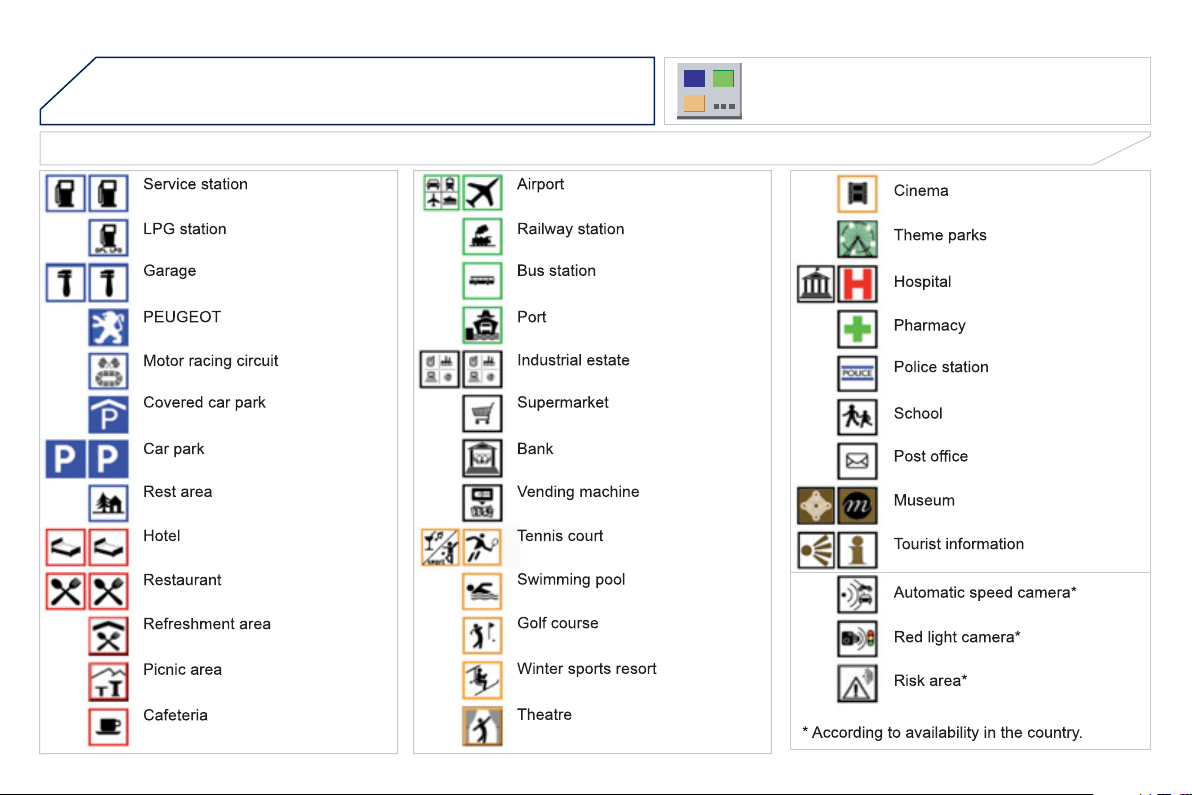
2
6
4
04 NAVIGATION - GUIDANCE
LIST OF PRINCIPAL POINTS OF INTEREST (POI)
This icon appears when several P
O
Is are
g
rouped
together in the same area. Zooming in on this icon
s
h
o
w
s
de
t
a
il
s
of
th
e
P
O
I
s
.
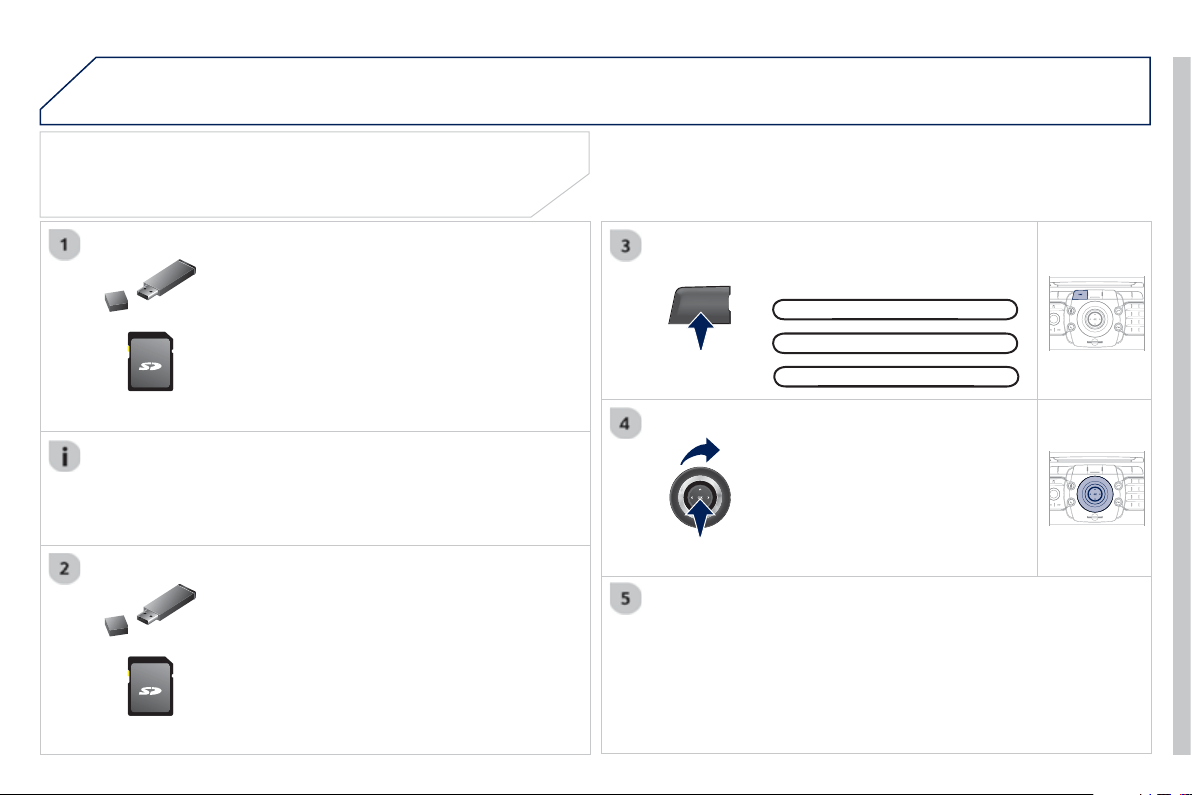
2
65
04
NAV
2
ABC
3
DEF
5
JKL
4
GHI
6
MN
O
8
TUV
7
PQRS
9
WXY
Z
0
*
#
1
RADIO MEDIA
NAV ESC TRAFFIC
SETUP
ADDR
BOOK
2
ABC
3
DEF
5
JKL
4
GHI
6
MN
O
8
TUV
7
PQRS
9
WXY
Z
0
*
#
1
RADIO MEDIA
NAV ESC TRAFFIC
SETUP
ADDR
BOOK
NAVIGATION - GUIDANCE
Download the "P
O
Is" update fi le onto an SD
c
ard or U
S
B memor
y
stick
f
rom the Internet. This
s
ervice is available at wipin
f
oradars.co.uk.
UPDATING POIs
Settings
The
fi
les must be copied to the root on the chosen medium.
Insert the medium
(S
D card or U
S
B memor
y
s
tick
)
containin
g
the P
O
I database into the
sy
stem's SD card reader or USB port.
Select the medium
(
"USB" or "SD-
C
ard"
)
used and press
O
K.
Press NAV, select Navi
g
ation Menu,
then "Settin
g
s", then "Update personal
P
O
I".
Successful downloadin
g
is confi rmed b
y
a messa
g
e.
Th
e s
y
stem restarts.
The P
O
Is version can be
f
ound in the
S
ETUP
\
Sy
stem menu.
Up
date
p
ersonal POI
pp
Navi
g
ation Menu
g
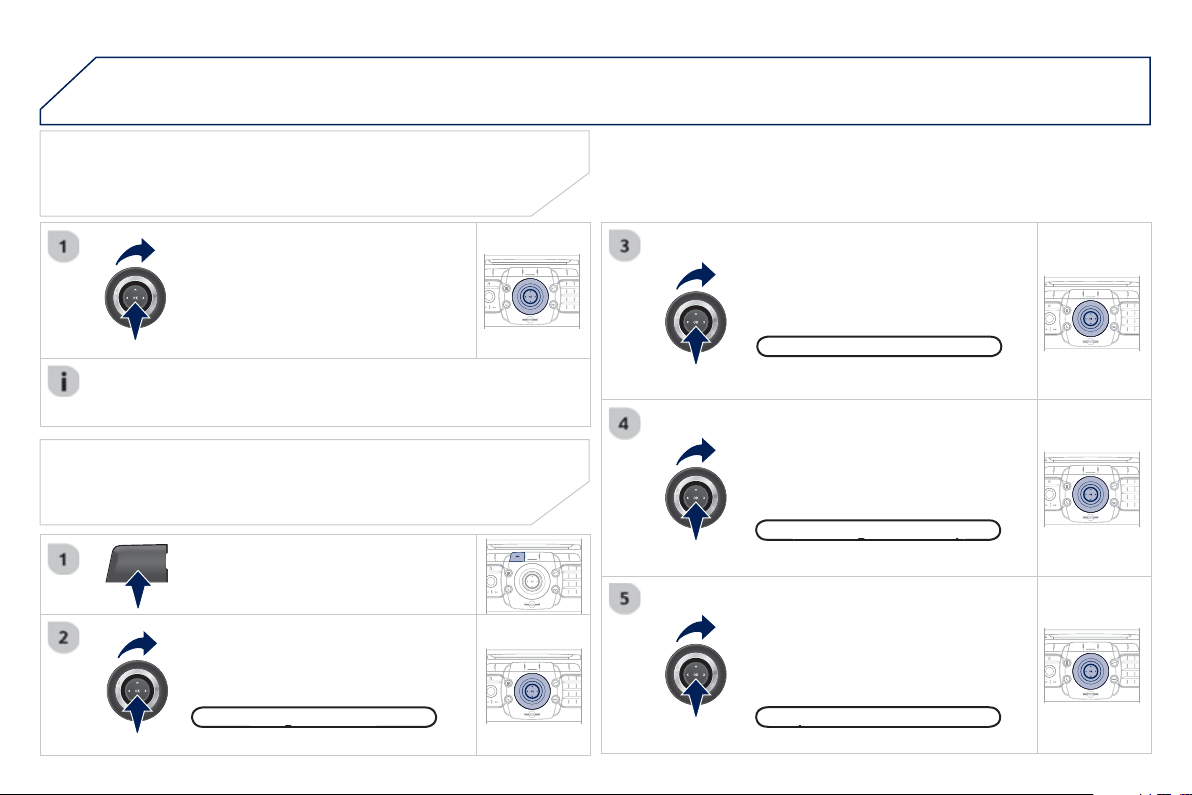
2
66
NAV
04
2
ABC
3
DEF
5
JKL
4
GHI
6
MN
O
8
TUV
7
PQRS
9
WXY
Z
0
*
#
1
RADIO MEDIA
NAV ESC TRAFFIC
SETUP
ADDR
BOOK
2
ABC
3
DEF
5
JKL
4
GHI
6
MN
O
8
TUV
7
PQRS
9
WXY
Z
0
*
#
1
RADIO MEDIA
NAV ESC TRAFFIC
SETUP
ADDR
BOOK
2
ABC
3
DEF
5
JKL
4
GHI
6
MN
O
8
TUV
7
PQRS
9
WXY
Z
0
*
#
1
RADIO MEDIA
NAV ESC TRAFFIC
SETUP
ADDR
BOOK
2
ABC
3
DEF
5
JKL
4
GHI
6
MN
O
8
TUV
7
PQRS
9
WXY
Z
0
*
#
1
RADIO MEDIA
NAV ESC TRAFFIC
SETUP
ADDR
BOOK
2
ABC
3
DEF
5
JKL
4
GHI
6
MN
O
8
TUV
7
PQRS
9
WXY
Z
0
*
#
1
RADIO MEDIA
NAV ESC TRAFFIC
SETUP
ADDR
BOOK
2
ABC
3
DEF
5
JKL
4
GHI
6
MN
O
8
TUV
7
PQRS
9
WXY
Z
0
*
#
1
RADIO MEDIA
NAV ESC TRAFFIC
SETUP
ADDR
BOOK
NAVIGATION - GUIDANCE
SPOKEN INSTRUCTION SETTINGS
Pr
ess
th
e
NAV
bu
tt
o
n.
Press the NAV button a
g
ain or select
the Navi
g
ation Menu function and
p
ress
O
K to confi rm.
S
elect the "
S
ettin
g
s"
f
unction and
p
ress
O
K to con
fi
rm.
N
av
ig
at
i
on
M
enu
g
Settin
g
s
When the navi
g
ation is displa
y
ed in
the screen,
p
ress
O
K then select or
dese
l
ec
t "V
o
i
ce
ad
vi
ce
" t
o
ac
tiv
a
t
e
o
r deactivate the spoken
g
uidance
i
n
s
tr
uc
t
io
n
s
.
U
se t
h
e vo
l
ume
b
utton to a
dj
ust t
h
e
v
o
l
u
m
e
.
POINTS OF INTEREST AND RISK AREAS
SETTINGS
The volume of the Risk Areas P
O
Is alert can onl
y
be ad
j
usted
durin
g
this t
y
pe o
f
alert.
P
OI cate
g
ories on Ma
p
gp
Set
p
arameters for risk areas
p
Select "Set
p
arameters for risk areas"
to
g
ain access to the "Displa
y
on
m
ap", "Visual alert" and "Sound alert"
fu
n
c
ti
o
n
s
.
S
elect the "P
O
I cate
g
ories on Map"
function to select the P
O
Is to be
displa
y
ed on the map b
y
default.
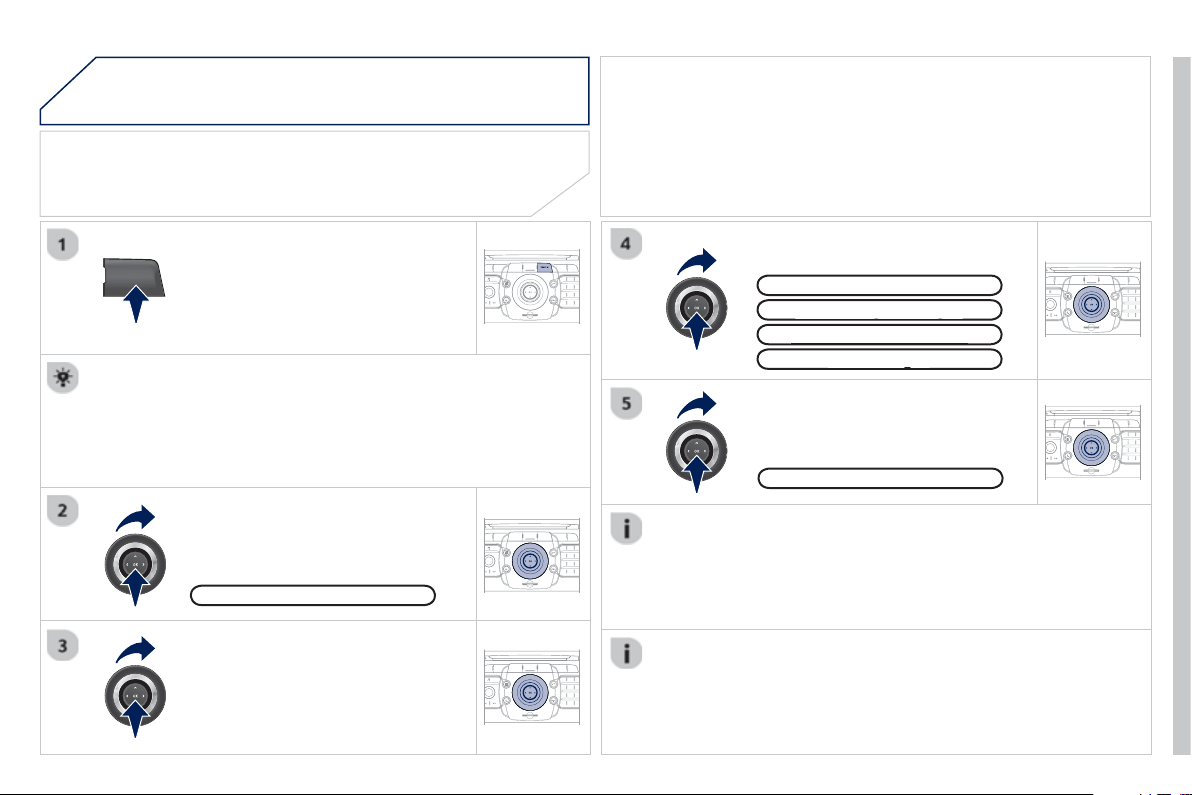
2
67
0
5
TRAFFIC
2
ABC
3
DEF
5
JKL
4
GHI
6
MN
O
8
TUV
7
PQRS
9
WXY
Z
0
*
#
1
RADIO MEDIA
NAV ESC TRAFFIC
SETUP
ADDR
BOOK
2
ABC
3
DEF
5
JKL
4
GHI
6
MN
O
8
TUV
7
PQRS
9
WXY
Z
0
*
#
1
RADIO MEDIA
NAV ESC TRAFFIC
SETUP
ADDR
BOOK
2
ABC
3
DEF
5
JKL
4
GHI
6
MN
O
8
TUV
7
PQRS
9
WXY
Z
0
*
#
1
RADIO MEDIA
NAV ESC TRAFFIC
SETUP
ADDR
BOOK
2
ABC
3
DEF
5
JKL
4
GHI
6
MN
O
8
TUV
7
PQRS
9
WXY
Z
0
*
#
1
RADIO MEDIA
NAV ESC TRAFFIC
SETUP
ADDR
BOOK
2
ABC
3
DEF
5
JKL
4
GHI
6
MN
O
8
TUV
7
PQRS
9
WXY
Z
0
*
#
1
RADIO MEDIA
NAV ESC TRAFFIC
SETUP
ADDR
BOOK
TRAFFIC INFORMATION
CONFIGURE THE FILTERING AND
DISPLAYING OF THE TMC MESSAGES
When all o
f
the messages on the route are selected, the addition
o
f
a
g
eo
g
raphic
fi
lter is recommended
(
within a radius o
f
3 miles
(
5 km
)
f
or example
)
to reduce the number o
f
messa
g
es displa
y
ed
on the map. The
g
eo
g
raphic fi lter follows the movement of the
v
e
hi
c
l
e
.
The
fi
lters are independent and their results are concealed.
W
e
r
eco
mm
e
n
d
:
- a
fi
lter over 6 miles
(
10 km
)
around the vehicle in heav
y
tra
ffi
c,
- a
fi
lter over 30 miles
(
50 km
)
around the vehicle or a
fi
lter on
the route on motorwa
y
j
ourne
y
s.
Press the TRAFFI
C
button again or
se
l
ec
t th
e
Tr
affi
c
M
e
n
u
fu
n
c
ti
o
n
a
n
d
press
O
K to con
fi
rm.
S
elect "
G
eo. Filter".
The list o
f
TM
C
messa
g
es appears under the Tra
ffi
c Menu sorted
in order o
f
proximity.
S
elect the
fi
lter o
f
y
our choice:
Messa
g
es on rout
e
g
A
ll warnin
g
messa
g
es
gg
Onl
y
warnin
g
s on rout
e
yg
All
messa
g
e
s
g
T
raffi c Menu
S
elect "
S
elect pre
f
erred list" and
p
ress
O
K to con
fi
rm.
The TM
C
(
Tra
ffi
c Messa
g
e
C
hannel
)
messa
g
es provide in
f
ormation
relatin
g
to tra
ffi
c and weather conditions, received in real time and
transmitted to the driver audibl
y
and visuall
y
on the navi
g
ation map.
The
g
uidance s
y
stem can then su
gg
est an alternative route.
Pr
ess
th
e
TRAFFI
C
bu
tt
o
n.
G
eo. Filte
r
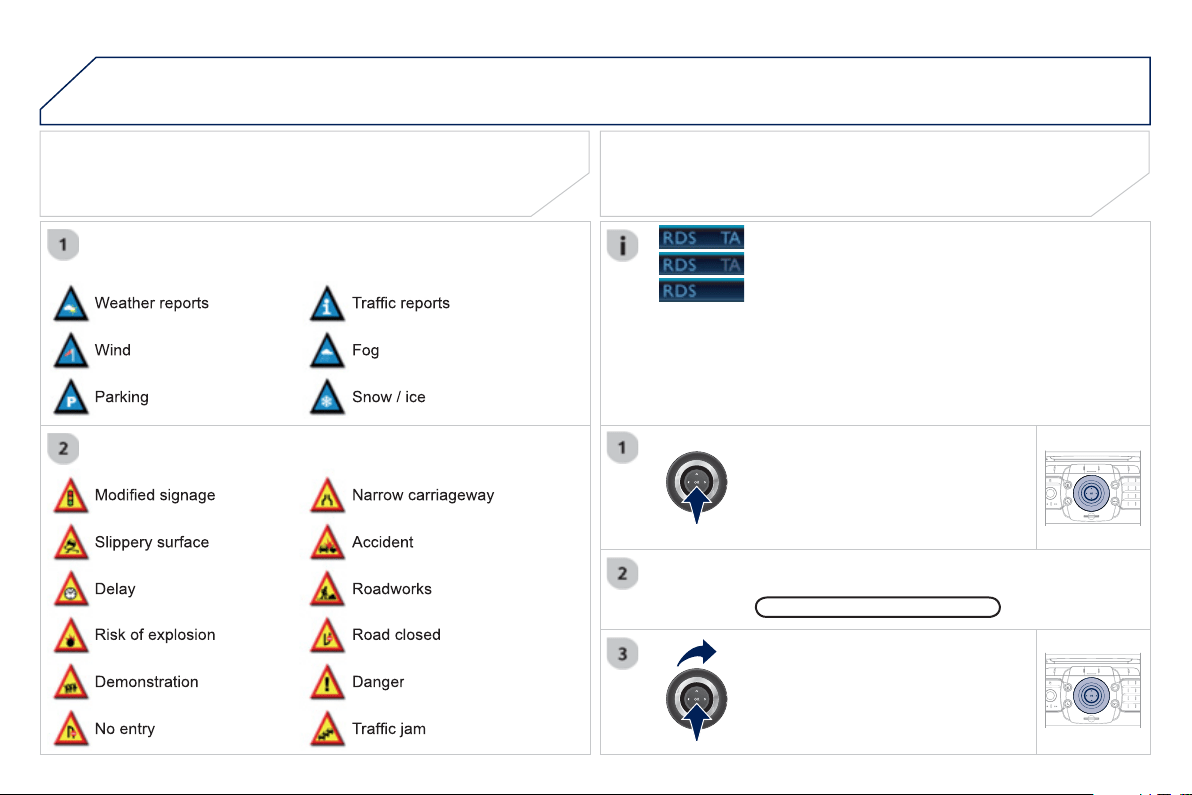
2
68
05
2
ABC
3
DEF
5
JKL
4
GHI
6
MN
O
8
TUV
7
PQRS
9
WXY
Z
0
*
#
1
RADIO MEDIA
NAV ESC TRAFFIC
SETUP
ADDR
BOOK
2
ABC
3
DEF
5
JKL
4
GHI
6
MN
O
8
TUV
7
PQRS
9
WXY
Z
0
*
#
1
RADIO MEDIA
NAV ESC TRAFFIC
SETUP
ADDR
BOOK
TRAFFIC INFORMATION
PRINCIPAL TMC SYMBOLS
Red and
y
ellow trian
g
le: traffi c information, for example:
Black and blue trian
g
le:
g
eneral in
f
ormation,
f
or example:
Wi
t
h
t
he
cu
rr
e
nt
audio
sou
r
ce
displayed on the screen, press the
d
i
a
l.
The shortcut menu for the source appears and
g
ives access to:
Select Traffi c Announcements
(
TA
)
and press the dial to confi rm and
g
o
to t
h
e assoc
i
ate
d
sett
i
n
g
s.
TA
The TA
(
Tra
ffi
c Announcement
)
f
unction
g
ives priorit
y
to TA alert
m
essa
g
es. To operate, this
f
unction needs
g
ood reception o
f
a radio
s
tation transmittin
g
this t
y
pe o
f
messa
g
e. When a tra
ffi
c report is
transmitted, the current audio source
(
Radio, CD, ...
)
is interrupted
automaticall
y
to pla
y
the TA messa
g
e. Normal pla
y
back of the audio
s
ource resumes at the end of the transmission of the messa
g
e.
RECEIVING TA MESSAGES
- the station transmits TA messa
g
es.
- the station does not transmit TA messa
g
es.
- TA messa
g
es are not activated.
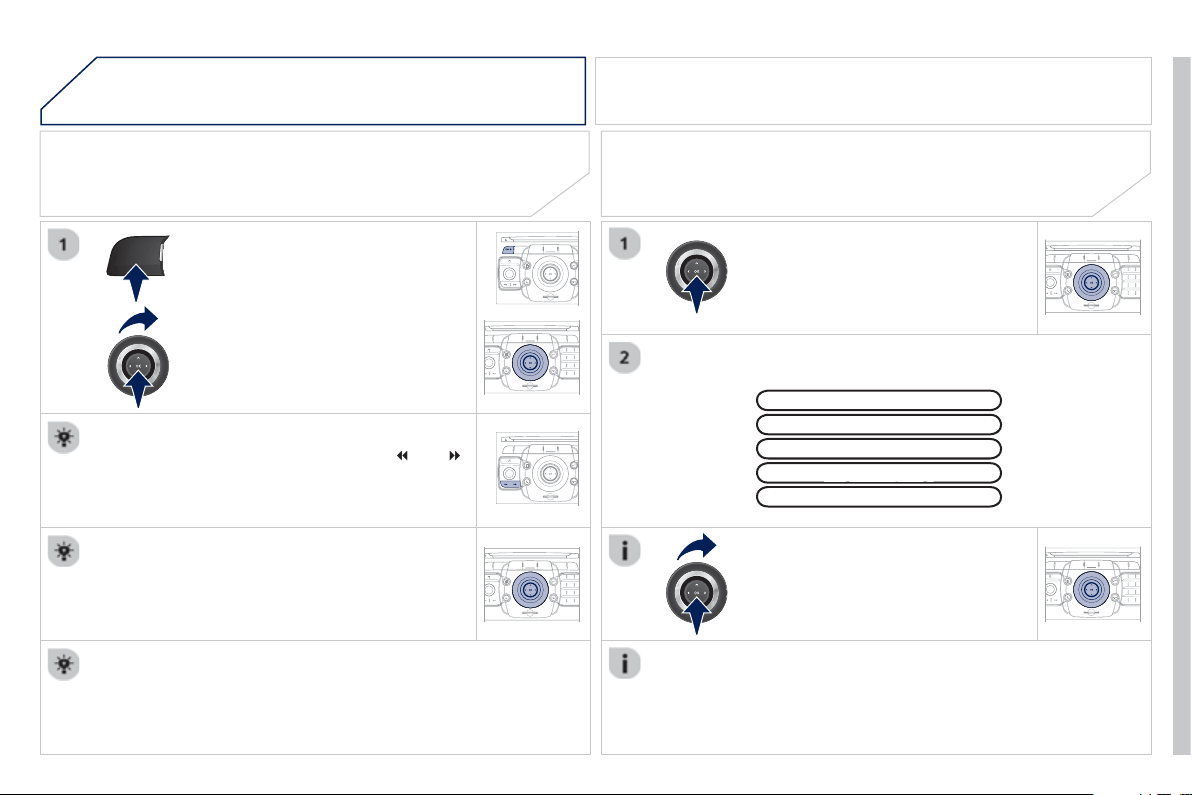
2
69
06
RADIO
2
ABC
3
DEF
5
JKL
4
GHI
6
MN
O
8
TUV
7
PQRS
9
WXY
Z
0
*
#
1
RADIO MEDIA
NAV ESC TRAFFIC
SETUP
ADDR
BOOK
2
ABC
3
DEF
5
JKL
4
GHI
6
MN
O
8
TUV
7
PQRS
9
WXY
Z
0
*
#
1
RADIO MEDIA
NAV ESC TRAFFIC
SETUP
ADDR
BOOK
2
ABC
3
DEF
5
JKL
4
GHI
6
MN
O
8
TUV
7
PQRS
9
WXY
Z
0
*
#
1
RADIO MEDIA
NAV ESC TRAFFIC
SETUP
ADDR
BOOK
2
ABC
3
DEF
5
JKL
4
GHI
6
MN
O
8
TUV
7
PQRS
9
WXY
Z
0
*
#
1
RADIO MEDIA
NAV ESC TRAFFIC
SETUP
ADDR
BOOK
RADIO
NAV ESC TRAFFIC
MEDIA
RADIO
NAV ESC TRAFFIC
MEDIA
SELECTING A STATION
Wh
e
n th
e
cu
rr
e
nt r
ad
i
o
s
t
a
ti
o
n i
s
displa
y
ed on the screen, press
O
K.
The radio source short-cuts menu a
pp
ears and
p
rovides access to
the followin
g
short-cuts:
S
elect the
f
unction required and
p
ress
O
K to confi rm to
g
ain access
to the correspondin
g
settin
g
s.
T
A
RD
S
, i
f
displayed, allows you to continue listening to the same
s
tation b
y
automatic retunin
g
to alternative
f
requencies. However,
in certain conditions, covera
g
e o
f
an RD
S
station ma
y
not be
assured throu
g
hout the countr
y
as radio stations do not cove
r
100 % of the territor
y
. This explains the loss of reception of the
s
tation durin
g
a
j
ourne
y
.
The external environment
(
hill, buildin
g
, tunnel, under
g
round car park...
)
may inter
f
ere with the reception, including in RD
S
f
ollowing mode. This
phenomenon is a normal result o
f
the wa
y
in which radio waves are
transmitted and does not in an
y
wa
y
indicate a
f
ailure o
f
the audio equipment.
RDS - REGIONAL MODE
Press the RADI
O
button to displa
y
the
l
ist o
f
stations received locall
y
sorted
i
n a
l
p
h
a
b
et
i
ca
l
or
d
er.
Press one o
f
the buttons on the numeric keypad
f
or more than
2
seconds to store the current station. A bleep con
fi
rms that it has
bee
n
s
t
o
r
ed
.
Press the button on the numeric ke
y
pad to recall the stored radio
s
t
a
ti
o
n.
RD
S
R
adiotex
t
R
e
gi
ona
l
p
ro
g.
gpg
RADIO
When the "RADI
O
" screen is displa
y
ed, turn the
ri
n
g
or use t
h
e
4
-
di
rect
i
on nav
ig
ator to se
l
ect t
h
e
p
rev
i
ous or next stat
i
on on t
h
e
li
st.
While listenin
g
to the radio, press buttons
a
n
d
for the automatic search for a lower or hi
g
her
frequenc
y
.
Select the station required b
y
turnin
g
the rin
g
and press to confi rm.
AM
27
0
07
MUSIC MEDIA PLAYERS
CD, MP3 / WMA CD, MP3 / WMA SD
CARD / USB PLAYER
In order to be able to pla
y
a recorded
C
DR or
C
DRW, when
recordin
g
it is preferable to select the IS
O
9660 level 1, 2 or Joliet
s
t
a
n
da
r
d
.
If the disc is recorded in another format it ma
y
not be pla
y
ed
c
orrect
ly
.
I
t
i
s recommen
d
e
d
t
h
at t
h
e same recor
di
n
g
stan
d
ar
d
i
s a
l
wa
y
s
used
f
or an individual disc, with as low a speed as possible
(
4x maximum
)
f
or optimum sound qualit
y
.
In the particular case o
f
a multi-session
C
D, the Joliet standard is
r
eco
mm
e
n
ded
.
The audio equipment will onl
y
pla
y
audio fi les with the extension
"
.mp3" with a speed o
f
between 8 Kbps and 320 Kbps and the
e
xtension ".wma" with a speed o
f
between 5 Kbps and 384 Kbps.
It also supports the VBR
(
Variable Bit Rate
)
mode.
No other t
y
pe o
f
fi
le
(
.mp4, .m3u...
)
can be pla
y
ed.
The MP3 format, an abbreviation of MPEG 1, 2 & 2.5 Audio La
y
er 3
and the WMA format, an abbreviation of Windows Media Audio and
the propert
y
of Microsoft, are audio compression standards which
p
ermit the recordin
g
o
f
several tens o
f
music
fi
les on a sin
g
le disc.
C
onnectin
g
an IPod:
To pla
y
MP3 t
y
pe fi les, connect the IPod usin
g
the USB port
(
limited functions
)
.
To pla
y
ITunes fi les, connect the IPod usin
g
the auxiliar
y
socket
(
AUX
)
.
In order to be read, a U
S
B memor
y
stick must be
f
ormatted to FAT 32.
It is advisable to restrict
fi
le names to 20 characters, without usin
g
o
f
special characters
(
e.
g
.: " "
?
; ù
)
to avoid an
y
pla
y
in
g
and
displa
y
in
g
problems.
Durin
g
pla
y
, exit the "SD-Card" or "USB" source before removin
g
the SD card or the USB memor
y
stick from its port.
To avoid an
y
risk of theft, remove the SD card or the USB memor
y
stick when
y
ou leave
y
our vehicle with the roof open.
INFORMATION AND ADVICE
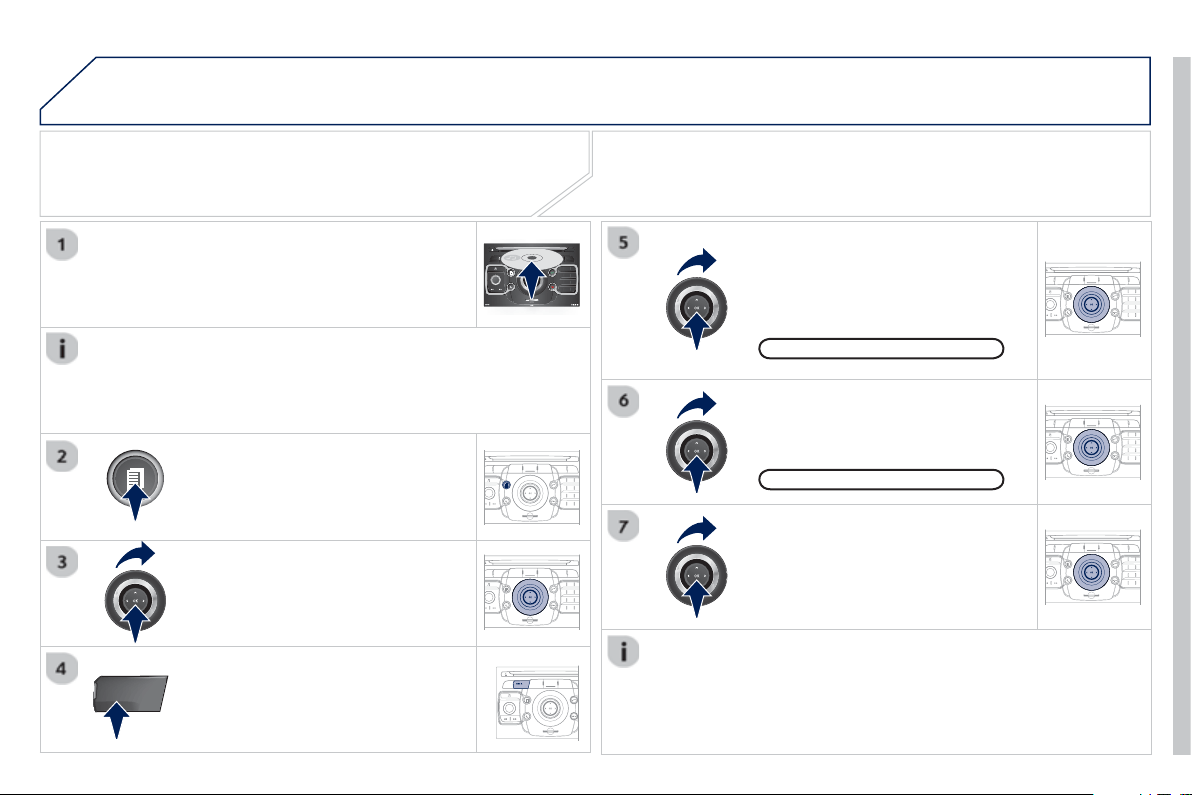
271
0
7
MEDIA
2
ABC
3
DEF
5
JKL
4
GHI
6
MNO
8
TUV
7
PQRS
9
WXYZ
0
*
#
1
RADIO MEDIA
NAV ESC TRAFFIC
SETUP
ADDR
BOOK
2
ABC
3
DEF
5
JKL
4
GHI
6
MN
O
8
TUV
7
PQRS
9
WXY
Z
0
*
#
1
RADIO MEDIA
NAV ESC TRAFFIC
SETUP
ADDR
BOOK
2
ABC
3
DEF
5
JKL
4
GHI
6
MN
O
8
TUV
7
PQRS
9
WXY
Z
0
*
#
1
RADIO MEDIA
NAV ESC TRAFFIC
SETUP
ADDR
BOOK
2
ABC
3
DEF
5
JKL
4
GHI
6
MN
O
8
TUV
7
PQRS
9
WXY
Z
0
*
#
1
RADIO MEDIA
NAV ESC TRAFFIC
SETUP
ADDR
BOOK
2
ABC
3
DEF
5
JKL
4
GHI
6
MN
O
8
TUV
7
PQRS
9
WXY
Z
0
*
#
1
RADIO MEDIA
NAV ESC TRAFFIC
SETUP
ADDR
BOOK
2
ABC
3
DEF
5
JKL
4
GHI
6
MN
O
8
TUV
7
PQRS
9
WXY
Z
0
*
#
1
RADIO MEDIA
NAV ESC TRAFFIC
SETUP
ADDR
BOOK
RADIO
NAV ESC TRAFFIC
MEDIA
SELECTING / PLAYING
CD, MP3 / WMA CD, MP3 / WMA SD
CARD / USB PLAYER
The playing and displaying o
f
an MP3
/
WMA compilation may
depend on the recordin
g
pro
g
ramme and
/
or the parameters used.
We recommend the I
SO
9660 recordin
g
standard.
Pr
ess
th
e
MEDIA
bu
tt
o
n.
S
elect the "
S
elect media"
f
unction
and press
O
K to con
fi
rm.
Pr
ess
thi
s
bu
tt
o
n.
S
elect the music source required.
P
ress
O
K to con
fi
rm. Pla
y
be
g
ins.
S
elect medi
a
P
ress t
h
e
MEDIA
b
utton a
g
a
i
n or
se
l
ec
t th
e
"M
ed
i
a
" M
e
n
u
fu
n
c
ti
o
n
a
n
d
p
ress
O
K to con
fi
rm.
Whe
n t
he
"MEDIA"
sc
r
ee
n
is
di
sp
l
a
y
e
d
, turn t
h
e r
i
n
g
up or
d
own to
s
e
l
ect t
h
e prev
i
ous or next compat
ibl
e
source
.
"Media" Menu
The list o
f
tracks or MP3
/
WMA
fi
les appears under "Media" Menu.
Insert the audio or MP3
C
D in the pla
y
er, the
S
D
c
ard in the card reader or the U
S
B peripheral in the
U
SB port. Pla
y
be
g
ins automaticall
y
.
MP3 CDs, SD cards or USB
p
eri
p
herals are the com
p
atible sources.
MUSIC MEDIA PLAYERS
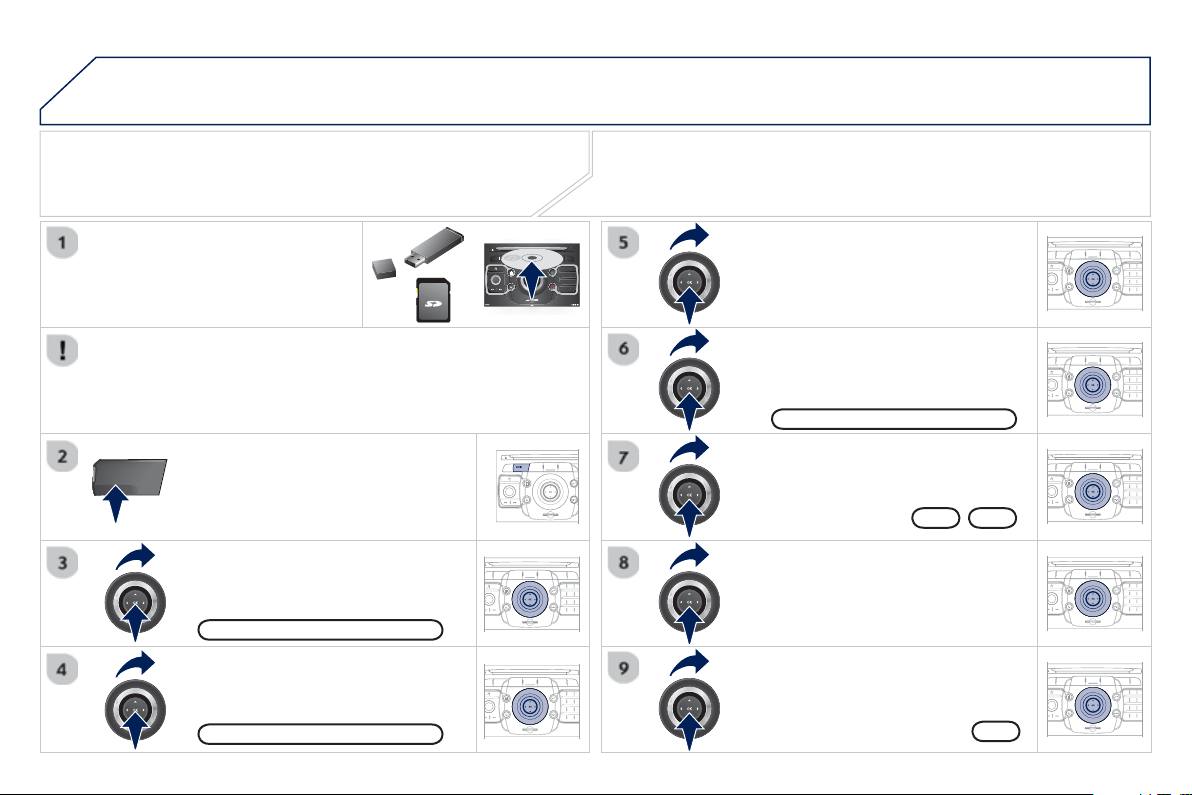
272
07
MEDIA
2
ABC
3
DEF
5
JKL
4
GHI
6
MNO
8
TUV
7
PQRS
9
WXYZ
0
*
#
1
RADIO MEDIA
NAV ESC TRAFFIC
SETUP
ADDR
BOOK
2
ABC
3
DEF
5
JKL
4
GHI
6
MN
O
8
TUV
7
PQRS
9
WXY
Z
0
*
#
1
RADIO MEDIA
NAV ESC TRAFFIC
SETUP
ADDR
BOOK
2
ABC
3
DEF
5
JKL
4
GHI
6
MN
O
8
TUV
7
PQRS
9
WXY
Z
0
*
#
1
RADIO MEDIA
NAV ESC TRAFFIC
SETUP
ADDR
BOOK
2
ABC
3
DEF
5
JKL
4
GHI
6
MN
O
8
TUV
7
PQRS
9
WXY
Z
0
*
#
1
RADIO MEDIA
NAV ESC TRAFFIC
SETUP
ADDR
BOOK
2
ABC
3
DEF
5
JKL
4
GHI
6
MN
O
8
TUV
7
PQRS
9
WXY
Z
0
*
#
1
RADIO MEDIA
NAV ESC TRAFFIC
SETUP
ADDR
BOOK
2
ABC
3
DEF
5
JKL
4
GHI
6
MN
O
8
TUV
7
PQRS
9
WXY
Z
0
*
#
1
RADIO MEDIA
NAV ESC TRAFFIC
SETUP
ADDR
BOOK
2
ABC
3
DEF
5
JKL
4
GHI
6
MN
O
8
TUV
7
PQRS
9
WXY
Z
0
*
#
1
RADIO MEDIA
NAV ESC TRAFFIC
SETUP
ADDR
BOOK
2
ABC
3
DEF
5
JKL
4
GHI
6
MN
O
8
TUV
7
PQRS
9
WXY
Z
0
*
#
1
RADIO MEDIA
NAV ESC TRAFFIC
SETUP
ADDR
BOOK
RADIO
NAV ESC TRAFFIC
MEDIA
Select "Jukebox mana
g
ement" then
"
Add fi les" and
p
ress
O
K at each ste
p
t
o
co
nfi rm.
Pr
ess
th
e
MEDIA
bu
tt
o
n. Pr
ess
th
e
M
EDIA button a
g
ain or select Media
M
enu and press
O
K to con
fi
rm.
Insert an audio
/
MP3
C
D, a U
S
B
m
emor
y
stick or an
S
D card.
JUKEBOX
A
dd fi les
C
heck that the active MEDIA source is that o
f
the medium used
(C
D, U
S
B or
S
D card
)
.
S
elect "Add
fi
les
f
rom MP
3
-Disc"
f
or
e
xample and press
O
K to validate.
S
elect the tracks required then "Rip
selection" or select all o
f
the tracks usin
g
"
Ri
p
all".
S
elect "[New
f
older]" to create a new
f
older or select an existin
g
f
older
(
created previously
)
.
A
dd fi les from MP3-Dis
c
[
New folder
]
"Do you want to change the names o
f
the tracks that
will be ripped
?
": select "Yes" to chan
g
e them or "No".
To cop
y
an MP3 CD, then select "Real
time rippin
g
", "Fast rippin
g
" / "Hi
g
h
qualit
y
(
192 kbit/sec
)
" or "Standard
qualit
y
(
128 kbit
/
sec
)
" then select "
S
tart
ri
pp
i
n
g"
.
C
on
fi
rm the warnin
g
messa
g
e b
y
p
ressin
g
"
O
K" to start the cop
y
.
OK
Y
es No
When cop
y
in
g
is in pro
g
ress, switchin
g
off the i
g
nition will interrupt the
process
b
ut
i
t w
ill
resume
di
rect
ly
w
h
en t
h
e
ig
n
i
t
i
on
i
s sw
i
tc
h
e
d
on a
g
a
i
n.
MUSIC MEDIA PLAYERS
COPYING A CD, A USB MEMORY STICK OR AN SD CARD
ONTO THE HARD DI
S
K
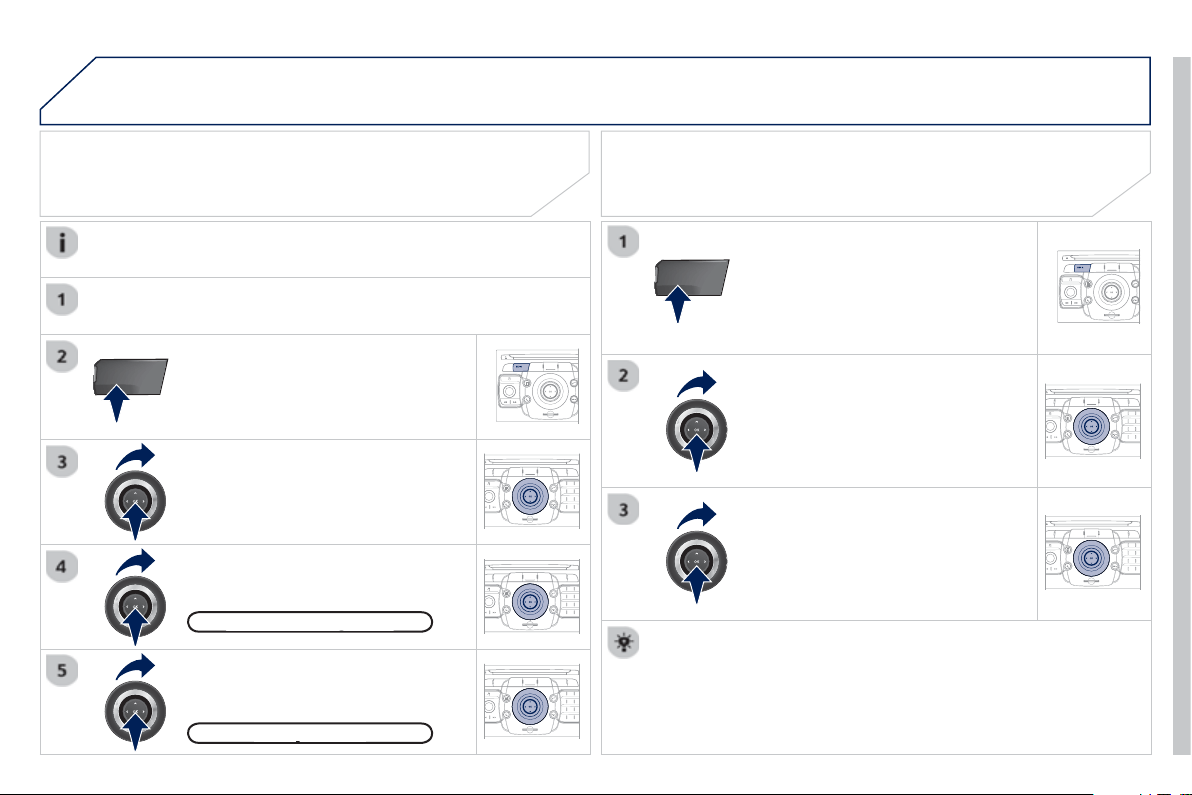
27
3
0
7
MEDIA
MEDIA
2
ABC
3
DEF
5
JKL
4
GHI
6
MN
O
8
TUV
7
PQRS
9
WXY
Z
0
*
#
1
RADIO MEDIA
NAV ESC TRAFFIC
SETUP
ADDR
BOOK
2
ABC
3
DEF
5
JKL
4
GHI
6
MN
O
8
TUV
7
PQRS
9
WXY
Z
0
*
#
1
RADIO MEDIA
NAV ESC TRAFFIC
SETUP
ADDR
BOOK
2
ABC
3
DEF
5
JKL
4
GHI
6
MN
O
8
TUV
7
PQRS
9
WXY
Z
0
*
#
1
RADIO MEDIA
NAV ESC TRAFFIC
SETUP
ADDR
BOOK
2
ABC
3
DEF
5
JKL
4
GHI
6
MN
O
8
TUV
7
PQRS
9
WXY
Z
0
*
#
1
RADIO MEDIA
NAV ESC TRAFFIC
SETUP
ADDR
BOOK
2
ABC
3
DEF
5
JKL
4
GHI
6
MN
O
8
TUV
7
PQRS
9
WXY
Z
0
*
#
1
RADIO MEDIA
NAV ESC TRAFFIC
SETUP
ADDR
BOOK
RADIO
NAV ESC TRAFFIC
MEDIA
RADIO
NAV ESC TRAFFIC
MEDIA
P
r
ess
t
he
MEDIA
bu
tt
o
n.
P
ress t
h
e
MEDIA
b
utton a
g
a
i
n o
r
s
elect Media Menu and press
O
K to
co
n
fi
rm.
S
elect "Jukebox mana
g
ement" and
press
O
K to con
fi
rm.
S
elect "Pla
y
options" and press
O
K to
co
nfi rm.
Select "Folders & Files" or "Pla
y
lists"
then press
O
K to confi rm.
LISTENING TO THE JUKEBOX
J
ukebox mana
g
emen
t
g
Pr
ess
th
e
MEDIA
bu
tt
o
n.
P
ress t
h
e
MEDIA
b
utton a
g
a
i
n o
r
select Media Menu and press
O
K to
co
n
fi
rm.
S
elect "Jukebox mana
g
ement" and
press
O
K to con
fi
rm.
JUKEBOX
RENAMING OR DELETING AN ALBUM
Activate the playing o
f
a source other than the Jukebox
(C
D, radio, etc...
)
.
C
heck that the active source is not the
J
ukebox in order to be able
to rename or delete a track
/
f
older.
MUSIC MEDIA PLAYERS
S
elect "Modi
fy
content" and press
O
K
co
n
fi
rm.
Press the E
SC
button to return to the fi rst fi le level.
Pla
y
lists can be created in the Jukebox.
Media Menu> Jukebox mana
g
ement>
C
reate new pla
y
list. Add the
trac
k
s requ
i
re
d
one
by
one t
h
en save t
h
e c
h
an
g
e.
Th
e
"Pl
a
yli
sts
"
play mode must then be selected.
M
odif
y
conten
t
y
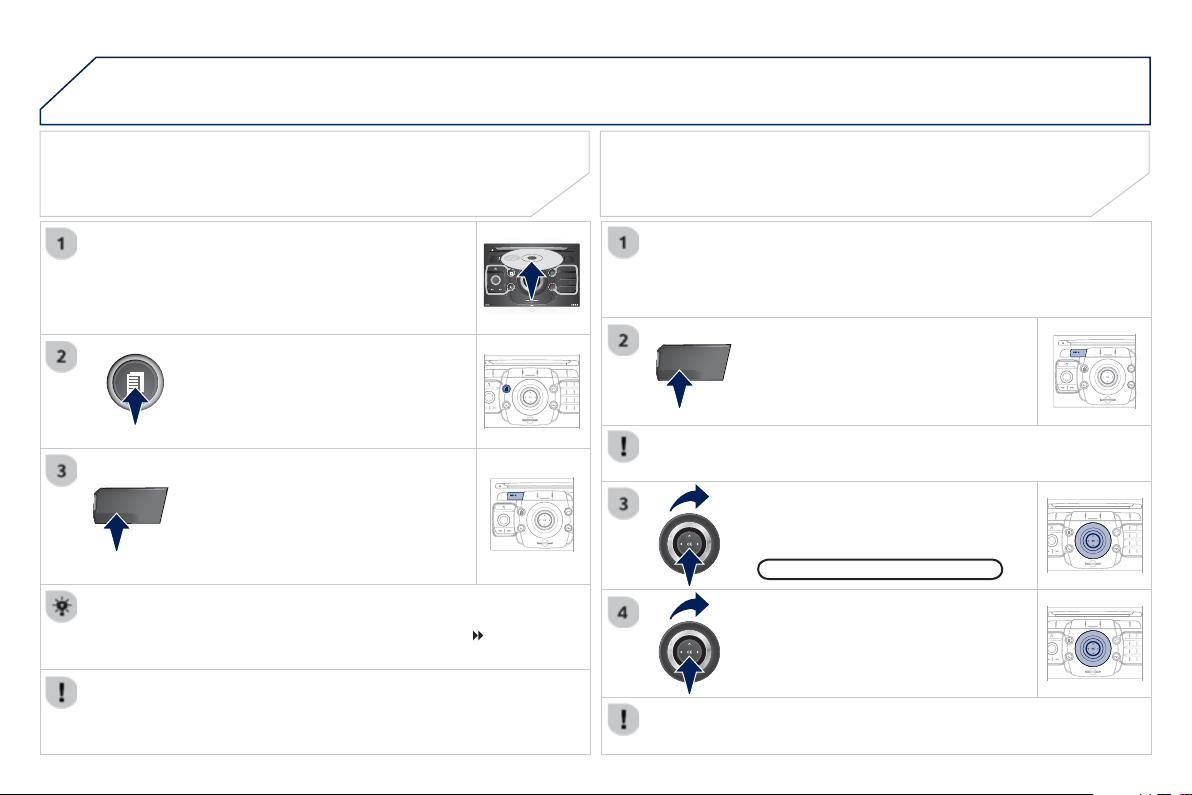
274
07
MEDIA
2
ABC
3
DEF
5
JKL
4
GHI
6
MNO
8
TUV
7
PQRS
9
WXYZ
0
*
#
1
RADIO MEDIA
NAV ESC TRAFFIC
SETUP
ADDR
BOOK
MEDIA
2
ABC
3
DEF
5
JKL
4
GHI
6
MN
O
8
TUV
7
PQRS
9
WXY
Z
0
*
#
1
RADIO MEDIA
NAV ESC TRAFFIC
SETUP
ADDR
BOOK
2
ABC
3
DEF
5
JKL
4
GHI
6
MN
O
8
TUV
7
PQRS
9
WXY
Z
0
*
#
1
RADIO MEDIA
NAV ESC TRAFFIC
SETUP
ADDR
BOOK
2
ABC
3
DEF
5
JKL
4
GHI
6
MN
O
8
TUV
7
PQRS
9
WXY
Z
0
*
#
1
RADIO MEDIA
NAV ESC TRAFFIC
SETUP
ADDR
BOOK
RADIO
NAV ESC TRAFFIC
MEDIA
RADIO
NAV ESC TRAFFIC
MEDIA
C
onnect the portable device
(
MP3 player, camcorder, camera…
)
to
the R
C
A sockets
(
white and red
f
or audio;
y
ellow
f
or video
)
in the
g
love box usin
g
a JA
C
K
/
R
C
A audio cable.
Press the MEDIA button then press
i
t a
g
a
i
n or se
l
ect t
h
e
M
e
di
a
M
enu
f
unction and press
O
K to con
fi
rm.
S
elect the A
U
X music source and
p
ress
O
K to con
fi
rm. Pla
y
be
g
ins
automat
i
ca
lly
.
S
elect "
S
elect media" then "External
device
(
AV
)
" and press
O
K to
ac
tiv
a
t
e
it.
E
xternal devic
e
The displa
y
and mana
g
ement o
f
the controls is via the portable
de
vi
ce
.
USING AN EXTERNAL DEVICE (AUX)
If the external input is not activated, select "Ext. Device
(
Aux
)
mana
g
ement" to activate it.
VIEWING A VIDEO DVD
Select the video source required
(
"DVD-Video", "External device
(
AV
)
"
)
. Press
O
K to confi rm. Pla
y
be
g
ins.
P
ress t
h
e
MEDIA
b
utton to
g
a
i
n
a
ccess to the DVD menu at any time,
o
r t
o
th
e
fu
n
c
ti
o
n
s
of
th
e
M
ed
i
a
M
e
n
u
which ad
j
ust the video
(
bri
g
htness
/
c
ontrast, ima
g
e format...
)
.
If the DVD does not a
pp
ear on the
s
creen,
p
ress the M
O
DE button to
g
ain access to the "MEDIA" screen
w
hi
c
h
di
sp
l
a
y
s t
h
e
DVD
screen.
Insert the DVD in the pla
y
er. Pla
y
be
g
ins
automaticall
y
.
Th
e
4
-
di
rect
i
on nav
ig
ator an
d
t
h
e c
h
rome
d
r
i
n
g
a
ll
ow
y
ou to move t
h
e
D
VD selection cursor.
C
han
g
e chapter b
y
pressin
g
the
or
bu
tt
o
n.
MUSIC MEDIA PLAYERS
AUDIO / VIDEO / RCA CABLE NOT SUPPLIED
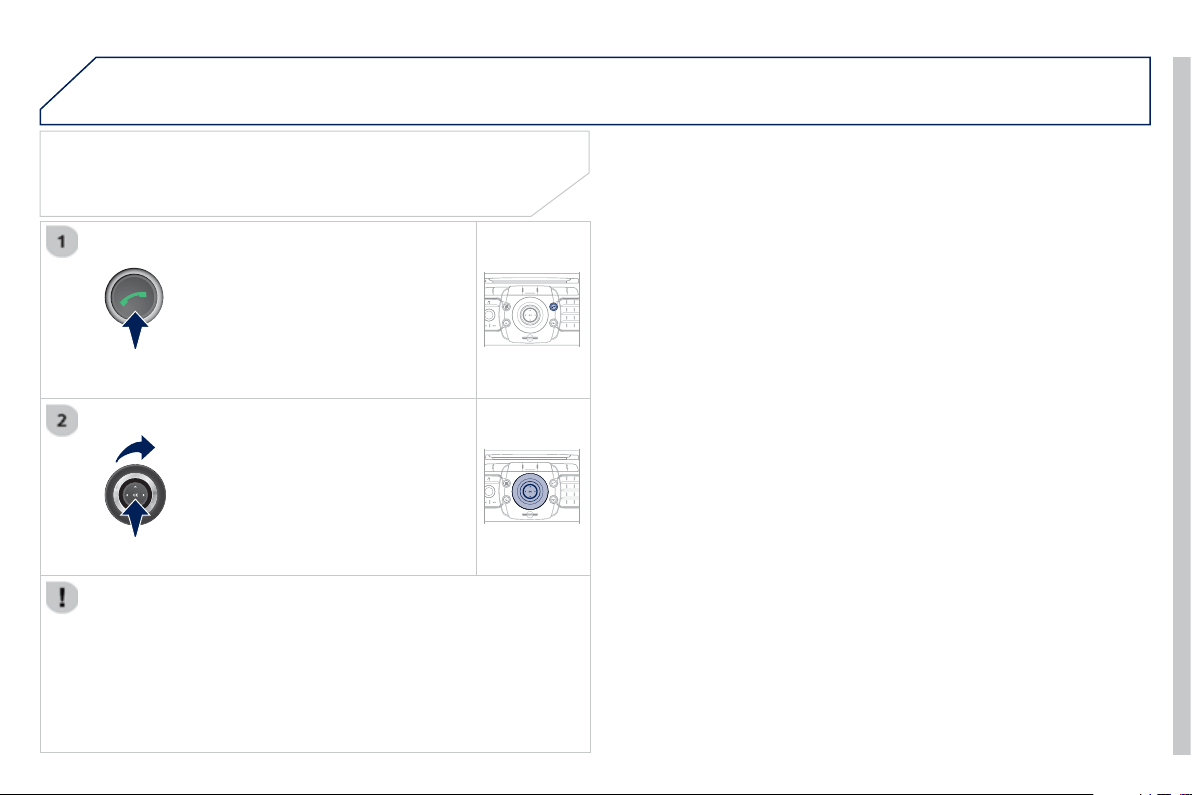
27
5
08
2
ABC
3
DEF
5
JKL
4
GHI
6
MN
O
8
TUV
7
PQRS
9
WXY
Z
0
*
#
1
RADIO MEDIA
NAV ESC TRAFFIC
SETUP
ADDR
BOOK
2
ABC
3
DEF
5
JKL
4
GHI
6
MN
O
8
TUV
7
PQRS
9
WXY
Z
0
*
#
1
RADIO MEDIA
NAV ESC TRAFFIC
SETUP
ADDR
BOOK
CHOOSING BETWEEN THE BLUETOOTH
TELEPHONE / INTERNAL TELEPHONE
To activate the Bluetooth tele
p
hone or
the internal telephone, press PICK UP.
USING THE TELEPHONE
Select Phone menu
,
then "Select
ph
one
"
t
h
en c
h
oose
b
etween
"
Telephone o
ff
", "Use Bluetooth
p
hone" or "Use internal phone". Press
O
K at each step to con
fi
rm.
Th
e s
y
stem can on
ly
b
e connecte
d
to one
Bl
uetoot
h
te
l
ep
h
one an
d
o
ne
S
IM card
(
Internal telephone
)
at the same time.
In this case, the phone book is synchronised with the Bluetooth
telephone.
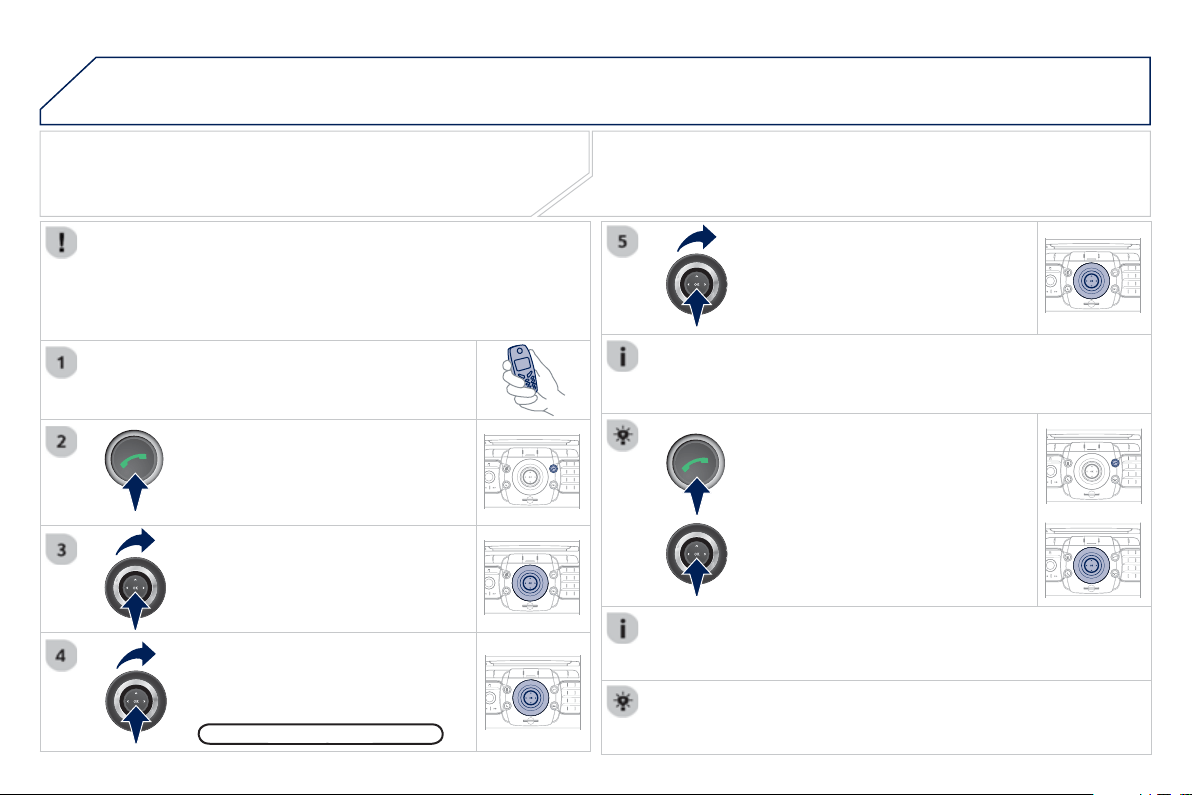
27
6
08
2
ABC
3
DEF
5
JKL
4
GHI
6
MN
O
8
TUV
7
PQRS
9
WXY
Z
0
*
#
1
RADIO MEDIA
NAV ESC TRAFFIC
SETUP
ADDR
BOOK
2
ABC
3
DEF
5
JKL
4
GHI
6
MN
O
8
TUV
7
PQRS
9
WXY
Z
0
*
#
1
RADIO MEDIA
NAV ESC TRAFFIC
SETUP
ADDR
BOOK
2
ABC
3
DEF
5
JKL
4
GHI
6
MN
O
8
TUV
7
PQRS
9
WXY
Z
0
*
#
1
RADIO MEDIA
NAV ESC TRAFFIC
SETUP
ADDR
BOOK
2
ABC
3
DEF
5
JKL
4
GHI
6
MN
O
8
TUV
7
PQRS
9
WXY
Z
0
*
#
1
RADIO MEDIA
NAV ESC TRAFFIC
SETUP
ADDR
BOOK
2
ABC
3
DEF
5
JKL
4
GHI
6
MN
O
8
TUV
7
PQRS
9
WXY
Z
0
*
#
1
RADIO MEDIA
NAV ESC TRAFFIC
SETUP
ADDR
BOOK
2
ABC
3
DEF
5
JKL
4
GHI
6
MN
O
8
TUV
7
PQRS
9
WXY
Z
0
*
#
1
RADIO MEDIA
NAV ESC TRAFFIC
SETUP
ADDR
BOOK
* The services available via the telephone depend on the network, the SIM
c
ard and the compatibilit
y
o
f
the Bluetooth equipment used. Re
f
er to
y
our
te
l
ep
h
one
'
s manua
l
an
d
y
our operator to c
h
ec
k
w
hi
c
h
serv
i
ces
y
ou
h
ave
access
to
.
USING THE TELEPHONE
PAIRING A BLUETOOTH TELEPHONE
FIRST CONNECTION
For sa
f
ety reasons and because they require prolonged attention on
the part o
f
the driver, the operations
f
or pairin
g
the Bluetooth mobile
telephone to the hands-
f
ree s
y
stem o
f
the Peu
g
eot
C
onnect Media
m
ust be carried out with the vehicle stationar
y
and the i
g
nition on.
Visit www.peu
g
eot.co.uk for more information
(
compatibilit
y
, more
h
elp, ...
)
.
Activate the tele
p
hone's Bluetooth function and
e
nsure that it is "visible to all"
(
refer to the telephone
instructions
)
.
If no tele
p
hone has been
p
aired, the
s
y
stem prompts
y
ou to "Connect
phone". Select "Yes" and press
O
K to
co
nfi rm.
Ent
e
r th
e
au
th
e
nti
ca
ti
o
n
code
o
n th
e
telephone. The code to be entered
is displa
y
ed on the screen o
f
the
sy
stem.
To pair another telephone, press the
TEL
b
utton
,
t
h
en se
l
ect
Ph
one menu
,
then "
S
elect phone" then "
C
onnect
Bl
uetoot
h
p
h
one
"
t
h
en se
l
ect t
h
e
telephone required.
Press
O
K at each step to con
fi
rm.
O
nce the telephone has been connected, the Peu
g
eot
C
onnect
M
edia can synchronise the address book and the call list. This
s
y
nchronisation ma
y
take a
f
ew minutes
*
.
Pairin
g
can be started
f
rom the telephone
(
re
f
er to the telephone
instructions
)
.
Press the
C
ALL button.
S
elect "
S
earch phone" and press
O
K
t
o
co
n
fi
rm. Th
e
n
se
l
ec
t th
e
n
a
m
e
of
the telephone.
Search
p
hon
e
p
To delete a pairin
g
, press TEL, select "Connect phone" then
"D
e
l
ete pa
i
r
i
n
g"
.
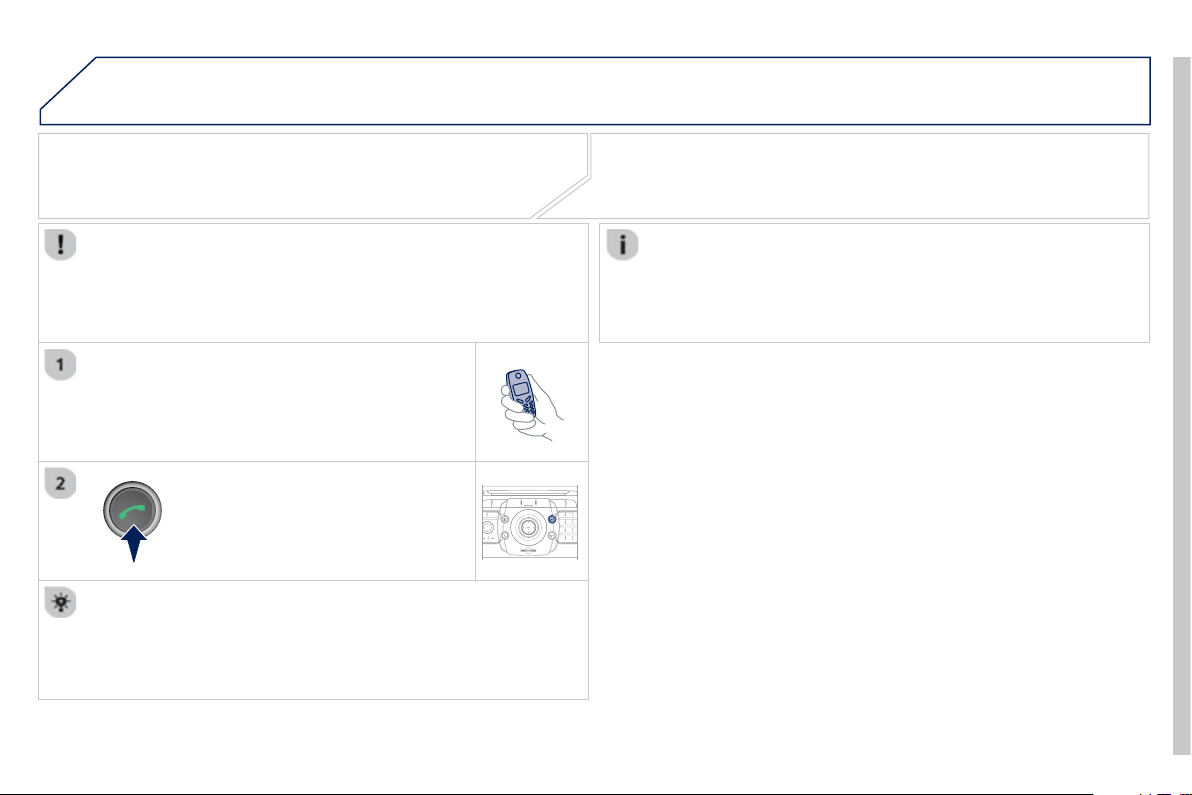
277
08
2
ABC
3
DEF
5
JKL
4
GHI
6
MN
O
8
TUV
7
PQRS
9
WXY
Z
0
*
#
1
RADIO MEDIA
NAV ESC TRAFFIC
SETUP
ADDR
BOOK
*
The services available via the telephone depend on the network, the
S
IM card and the compatibilit
y
o
f
the Bluetooth equipment used. Re
f
er to
y
our telephone's manual and
y
our operator to check which services
y
ou
h
ave access to. A list of mobile telephones which offer the best ran
g
e of
se
rvi
ces
i
s
a
v
a
il
ab
l
e
fr
o
m
dea
l
e
r
s
.
USING THE TELEPHONE
CONNECTING A BLUETOOTH
TELEPHONE
For safet
y
reasons and because the
y
require prolon
g
ed attention
on the part of the driver, the operations for pairin
g
the Bluetooth
m
obile telephone to the hands-
f
ree s
y
stem o
f
the Peu
g
eot
C
onnect
M
e
di
a must
b
e carr
i
e
d
out w
i
t
h
t
h
e ve
hi
c
l
e stat
i
onar
y
an
d
t
h
e
i
g
nition on.
A
ctivate the telephone's Bluetooth
f
unction and
e
n
su
r
e
th
a
t it i
s
vi
s
i
b
l
e
t
o
a
ll.
O
nce the telephone has been connected, the Peu
g
eot
C
onnect
M
edia can s
y
nchronise the address book and the call list. This
sy
nchronisation ma
y
take a few minutes * .
Press the PI
C
K UP button.
The list of telephones connected previousl
y
(
4 maximum
)
appears
in the multifunction screen. Select the telephone required then
s
elect "Connect phone" for a new connection. Select "Delete
p
a
i
r
i
n
g"
to cance
l
t
h
e connect
i
on to t
h
e te
l
ep
h
one.
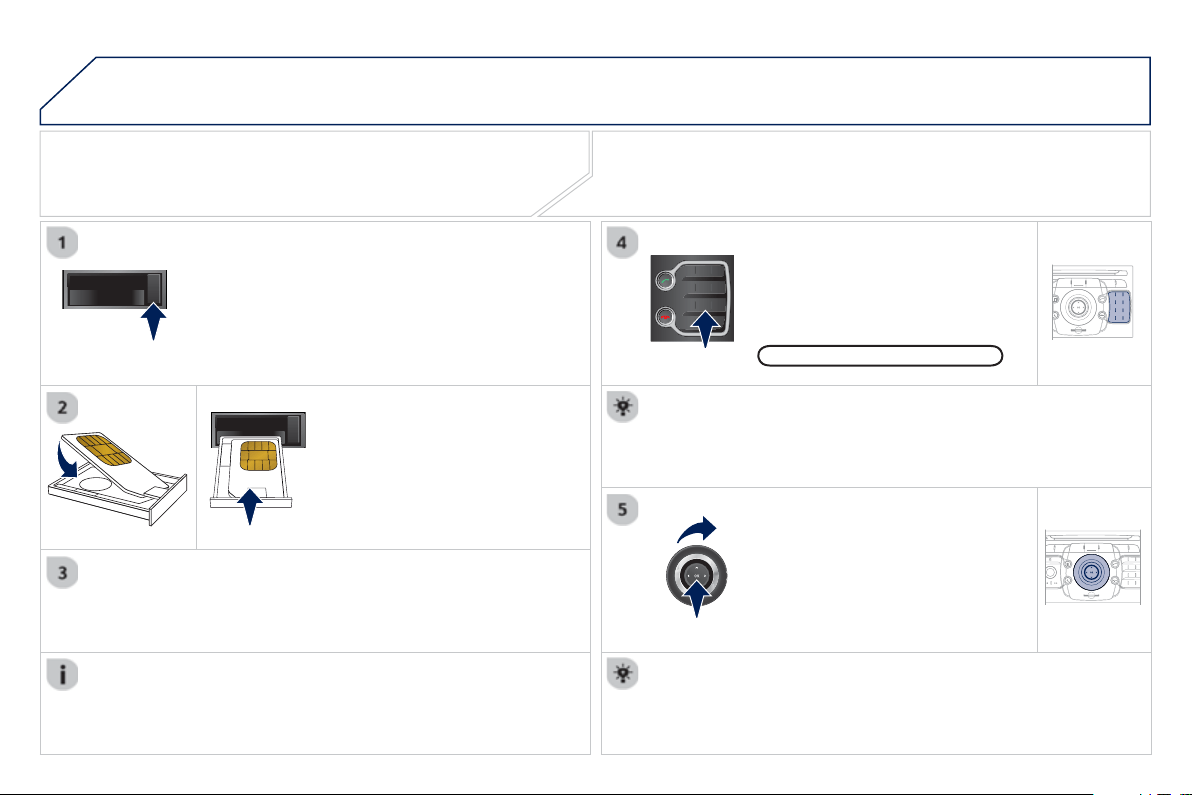
27
8
0
8
2
ABC
3
DEF
5
JKL
4
GHI
6
MNO
8
TUV
7
PQRS
9
WXYZ
0
*
#
1
2
ABC
3
DEF
5
JKL
4
GHI
6
MN
O
8
TUV
7
PQRS
9
WXY
Z
0
*
#
1
RADIO MEDIA
NAV ESC TRAFFIC
SETUP
ADDR
BOOK
2
ABC
3
DEF
5
JKL
4
GHI
6
MNO
8
TUV
7
PQRS
9
WXYZ
0
*
#
1
NAV ESC TRAFFIC
ADDR
BOOK
SETUP
2
ABC
3
DEF
5
JKL
4
GHI
6
MNO
8
TUV
7
PQRS
9
WXYZ
0
*
#
1
Extract the holder by pressing the
ej
ect button.
Install the
S
IM card in the holder
a
n
d
th
e
n in
se
rt it in th
e
s
l
o
t.
To remove the
S
IM card, repeat step 1.
For safet
y
reasons and because the
y
require prolon
g
ed attention
on the part of the driver, the SIM card installation operations must
b
e carr
i
e
d
out w
h
en stat
i
onar
y
.
E
nter t
h
e
PIN
co
d
e on t
h
e
k
e
y
pa
d
then select
O
K and con
fi
rm.
Th
e s
y
stem as
k
s
"D
o
y
ou want to
s
witch to the internal phone
?
", select
"Yes" i
f
y
ou wish to use
y
our
S
IM card
f
or
y
our personal calls.
O
therwise,
o
nl
y
the emer
g
enc
y
call and the
s
ervices will use the
S
IM card.
R
emember PIN
When enterin
g
y
our PIN code, tick the "Remember PIN" tab to
a
llow use of the telephone without havin
g
to enter this code when it
i
s use
d
su
b
sequent
ly
.
USING THE INTERNAL TELEPHONE
WITH A SIM CARD
USING THE TELEPHONE
O
nce the
S
IM card has been installed, the s
y
stem can s
y
nchronise
t
he
add
r
ess
book
a
n
d
t
he
call
lis
t.
This synchronisation may take a
f
ew minutes.
I
f
y
ou have declined to use the internal telephone
f
or personal calls,
y
ou
c
an still connect a Bluetooth telephone to receive
y
our calls on the vehicle's
a
udio s
y
stem.
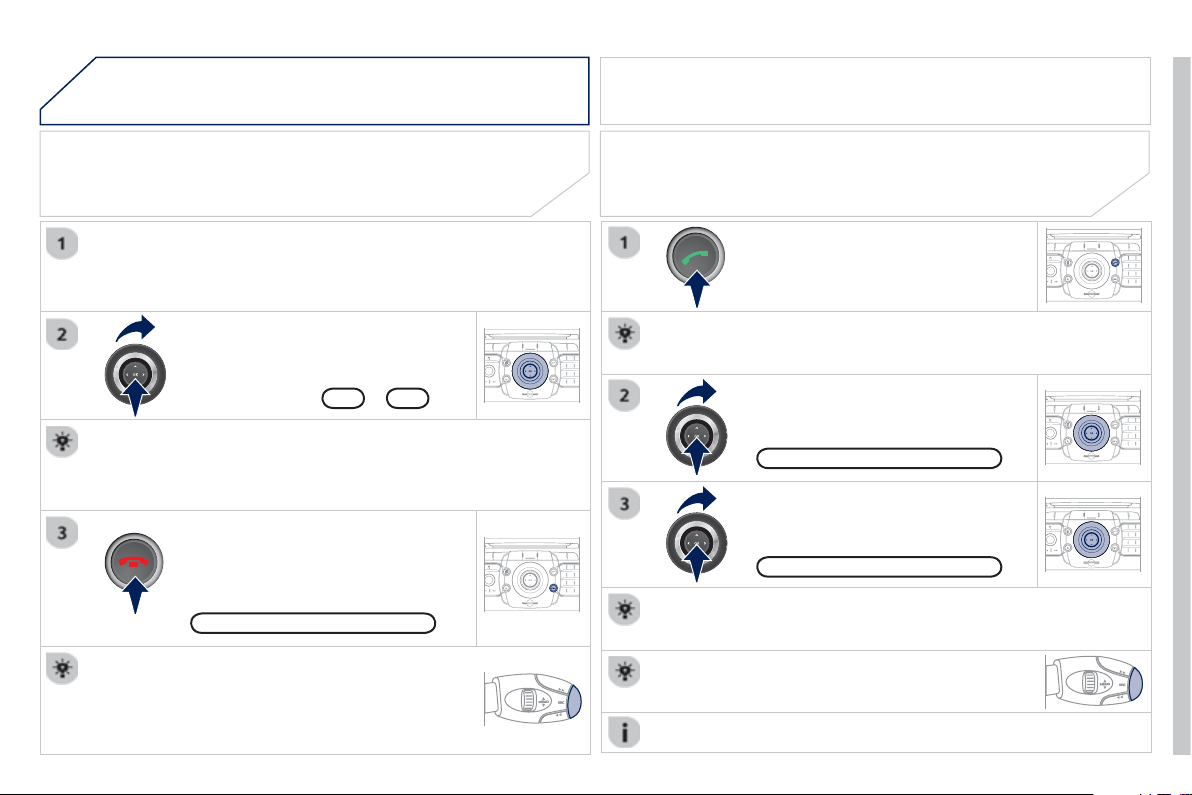
27
9
08
2
ABC
3
DEF
5
JKL
4
GHI
6
MN
O
8
TUV
7
PQRS
9
WXY
Z
0
*
#
1
RADIO MEDIA
NAV ESC TRAFFIC
SETUP
ADDR
BOOK
2
ABC
3
DEF
5
JKL
4
GHI
6
MN
O
8
TUV
7
PQRS
9
WXY
Z
0
*
#
1
RADIO MEDIA
NAV ESC TRAFFIC
SETUP
ADDR
BOOK
2
ABC
3
DEF
5
JKL
4
GHI
6
MN
O
8
TUV
7
PQRS
9
WXY
Z
0
*
#
1
RADIO MEDIA
NAV ESC TRAFFIC
SETUP
ADDR
BOOK
2
ABC
3
DEF
5
JKL
4
GHI
6
MN
O
8
TUV
7
PQRS
9
WXY
Z
0
*
#
1
RADIO MEDIA
NAV ESC TRAFFIC
SETUP
ADDR
BOOK
2
ABC
3
DEF
5
JKL
4
GHI
6
MN
O
8
TUV
7
PQRS
9
WXY
Z
0
*
#
1
RADIO MEDIA
NAV ESC TRAFFIC
SETUP
ADDR
BOOK
Press the end of the steerin
g
mounted control to
accept the call or end the call in pro
g
ress.
Select the "Yes" tab to accept or "No"
to re
f
use and con
fi
rm b
y
pressin
g
O
K.
RECEIVING A CALL
MAKING A CALL
An incomin
g
call is announced b
y
a rin
g
and a superimposed
displa
y
in the screen.
To han
g
up, press the HAN
G
UP
button or press
O
K and select "End
c
all" then con
fi
rm b
y
pressin
g
O
K.
E
nd cal
l
Press the PI
C
K
U
P button.
It is also possible to select a number
f
rom the address book. You
c
an select "Dial from address book". The Peu
g
eot Connect Media
c
an record u
p
to 4096 entries.
S
elect "Dial number", then dial the
te
l
ep
h
one num
b
er us
i
n
g
t
h
e v
i
rtua
l
k
eypad.
S
elect the Phone menu
f
unction and
p
ress
O
K to confi rm.
D
ial numbe
r
P
hone menu
Th
e
li
s
t
of
th
e
l
as
t 2
0
ca
ll
s
m
ade
a
n
d
r
ece
iv
ed
in th
e
v
e
hi
c
l
e
a
pp
ears under Phone menu. You can select a number and
p
ress
O
K to make the call.
Y
es N
o
The PI
C
K UP button accepts, the HAN
G
UP button rejects the
incomin
g
call.
USING THE TELEPHONE
Press the end o
f
the steering mounted control
f
or
m
ore than two seconds to open the address book.
O
peratin
g
the telephone while drivin
g
is prohibited. It is recommended
that
y
ou park safel
y
or use in preference the steerin
g
mounted controls.
It is alwa
y
s possible to start a call directl
y
from the telephone; park
the vehicle as a safet
y
measure.

2
80
09
MEDIA
TRAFFIC
SCREEN MENU MAP
MAIN FUNCTION
o
p
t
i
on
A
o
p
t
i
on
B
...
op
tion A
1
op
tion A2
1
2
3
2
3
"Traffic" Menu
M
essa
g
es on rout
e
Select
p
referred list
1
2
3
D
eac
tiv
a
t
e
PIN
4
Onl
y
warnin
g
s on rout
e
3
All
warn
i
n
g
messa
g
es
3
All
messa
g
es
3
G
eo. Filte
r
3
Within 2 miles
(
3 km
)
4
Within 3 miles
(
5 km
)
4
Within 6 miles
(
10 km
)
4
Within 30 miles
(
50 km
)
4
On confi rmation
Read out settin
g
s
2
3
I
ncom
i
n
g
messa
g
es
3
TMC station information
2
"Media" Menu
Audio CD / MP3-Dis
c
/
/
DVD
-
A
u
dio
/
/
DVD
-
Vid
eo
Select media
1
2
3
Jukebox
(
Folders & Files
)
3
S
D-Card
3
U
S
B
3
E
xternal device
(
audio
/
AV
)
3
A
dd fi le
s
Jukebox mana
g
ement
2
3
Folders
&
Files
4
Create folde
r
3
M
odify conten
t
3
E
dit pla
y
lis
t
3
P
la
y
options
3
Pla
y
lists
4
M
emor
y
capacit
y
3
Refer to the "Sound settin
g
s
"
menu
details of which are shown on the next
page.
Sound settin
g
s
2
3
A
s
p
ect rat
io
Vid
eo sett
i
n
g
s
2
3
M
enu
l
an
g
ua
ge
3
Di
sp
l
a
y
3
B
r
igh
tness
4
C
ontrast
4
Co
l
ou
r
4

2
81
NAV
RADIO
AUX
stan
d
ar
d
3
R
eset v
id
eo sett
i
n
g
s
3
Off / Audio / Audio and Video
(
AV
)
Ext. Device
(
Aux
)
mana
g
ement
2
3
"Radio" Menu
Waveband
1
2
Manual tune
2
Refer to the "Sound settin
gs
"
menu
b
e
l
ow
.
Sound settin
g
s
2
3
"Sound settings" Menu
Balance
/
Fader
1
2
Bass
/
Treble
2
Eq
ua
li
zer
2
Li
near
3
Classic
3
Jaz
z
3
Rock/Pop
3
T
ec
h
n
o
3
V
ocal
3
Mute rear speakers
2
Loudness
2
S
p
eed de
p
endent volume
2
Reset sound settin
g
s
2
"Navigation" Menu
A
bort
g
uidance
/
Resume
g
uidance
1
2
Destination in
p
ut
2
A
ddress inpu
t
3
Countr
y
4
Cit
y
4
S
treet
4
House
n
u
m
be
r
4
S
tart route
g
uidance
4
Pos
t
al
code
4
S
ave to address book
4
I
nt
e
r
sec
t
io
n
4
C
it
y
district
4
G
eo position
4
M
ap
4
Navi
g
ate HOM
E
3
Choose from last destinations
3
Choose from address book
3
Sto
p
overs
2
Add
sto
p
ove
r
3
Add
ress
i
nput
4
Navi
g
ate H
O
ME
4
C
hoose
f
rom address book
4
C
hoose
f
rom last destinations
4
R
earran
g
e rout
e
3
R
e
pl
ace sto
p
over
3
D
e
l
ete sto
p
ove
r
3
F
M
3
AM
3

2
8
2
ADDR
BOOK
Recalculat
e
3
F
as
t r
ou
t
e
4
S
hort route
4
O
ptimized route
4
POI nearb
y
POI search
2
3
POI near destination
3
POI in city
3
POI in country
3
POI near rout
e
3
R
oute typ
e
Route o
p
tions
2
3
P
O
I near destination
4
S
hort route
4
O
ptimized route
4
S
ubscr. service
4
Route dynamic
s
Settings
2
3
Tra
ffi
c independent
4
S
emi-dynamic
4
Dynamic
4
A
voidance criteria
3
Avoid motorways
4
Av
o
i
d
t
o
ll r
oads
4
Av
o
i
d
t
u
nn
e
l
s
4
Av
o
i
d
fe
rri
es
4
R
ecalculat
e
3
"Address book" Menu
Create new entr
y
1
2
Show memor
y
status
2
E
x
p
ort a
dd
ress
b
oo
k
2
Delete all voice entries
2
D
e
l
ete a
ll
entr
i
es
2
Delete folder "M
y
Addresses"
2
"Phone" menu
Dial numbe
r
1
2
Dial from address book
2
Call lists
2
M
essa
g
es
2
Select phone
2
S
earch phone
4
T
ele
p
hone off
3
U
se Bluetooth
p
hon
e
3
U
se
i
nterna
l
ph
on
e
3
Connect Bluetooth phon
e
3
Disconnect phone
5
R
ename p
h
one
5
Delete pairin
g
5
Delete all pairin
g
s
5
S
how details
5
2
83
SETUP
Settings
2
A
utomatic answering system
3
Select ring ton
e
3
P
hone
/
Ring tone volum
e
3
E
nter mailbox number
3
Internal phone setting
s
3
A
utomatically accept call
3
Signal waiting call (?)
3
S
how status
3
A
ctivate waiting call
3
D
eactivate waiting call
3
Call forward (?
)
3
S
how status
3
A
ctivate call forward
3
D
eactivate call forward
3
Su
pp
ress own number
3
S
elect network
3
Set network automaticall
y
3
Set network manually
3
S
earch for networks
3
P
IN settings
3
C
hange PIN
3
A
c
tiv
a
t
e
PIN
4
D
eac
tiv
a
t
e
PIN
4
R
emember PI
N
3
SIM-card memory statu
s
3
"SETUP" Menu
M
enu lan
g
ua
ge
Language & Speech
1
2
3
D
eu
t
sc
h
4
E
n
gli
s
h
4
Español
4
Français
4
It
a
li
a
n
o
4
Nede
r
la
n
ds
4
P
o
l
s
ki
4
Voice control
3
V
o
i
ce
co
ntr
o
l
ac
tiv
e
4
T
u
t
o
ri
a
l
4
Portuguese
4
B
as
i
cs
5
Examples
5
Tips
5
S
peaker adaptation
4
New speaker adaptation
5
Delete speaker adaptation
5
Voice out
p
ut volum
e
3
Date & Time
2
Set date & tim
e
3
D
ate forma
t
3
T
ime forma
t
3

2
8
4
Displa
y
2
B
r
igh
tness
3
Colour
3
S
t
ee
l
4
blue li
g
ht
(
onl
y
in da
y
mode
)
4
O
ran
g
e Ra
y
4
Bl
ue
Fl
a
m
e
4
M
a
p
co
l
our
3
Da
y
mode for map
4
Night mode
f
or map
4
Auto. Da
y
/Ni
g
ht for map
4
Units
2
T
em
p
eratur
e
3
C
elsius
4
F
a
hr
e
nh
e
it
4
M
etric
/
Im
p
erial
3
km
4
Mil
es
4
S
y
stem
2
Factor
y
rese
t
3
S
oftware version
3
A
utomat
i
c scro
lli
n
g
3
2
85
FREQUENTLY ASKED QUESTIONS
Q
UESTIO
N
A
NSWER SOLUTIO
N
Th
e
r
e
i
s
a
d
iff
e
r
e
n
ce
in
s
ound qualit
y
between
th
e
d
iff
e
r
e
nt
aud
i
o
s
ources
(
radio, CD...
)
.
For optimum sound qualit
y
, the audio settin
g
s
(
Volume, Bass, Treble,
Ambience, Loudness
)
can be adapted to the different sound sources,
which ma
y
result in audible differences when chan
g
in
g
source
(
radio,
CD...
)
.
Check that the audio settin
g
s
(
Volume, Bass,
Treble, Ambience, Loudness
)
are adapted to
th
e
sou
r
ces
li
s
t
e
n
ed
t
o
. It i
s
ad
vi
sab
l
e
t
o
se
t
the AUDI
O
functions
(
Bass, Treble, Front-Rear
Balance, Le
f
t-Ri
g
ht Balance
)
to the middle
p
os
i
t
i
on, se
l
ect t
h
e mus
i
ca
l
am
bi
ence
"Li
near
"
an
d
s
et t
h
e
l
ou
d
ness correct
i
on to t
h
e
"A
ct
i
ve
"
pos
i
t
i
on
in
C
D mode or to the "Inactive" position in radio
mode
.
The
C
D is e
j
ected
automaticall
y
or is not
p
la
y
ed b
y
the pla
y
er.
The
C
D is inserted upside down, is unpla
y
able, does not contain an
y
a
udio data or contains an audio
f
ormat which the pla
y
er cannot pla
y
.
The CD is protected b
y
an anti-piratin
g
protection s
y
stem which is not
r
eco
g
nised b
y
the audio equipment.
-
C
heck that the
C
D is inserted in the pla
y
er the
ri
g
ht wa
y
up.
-
C
heck the condition of the
C
D: the
C
D cannot
be pla
y
ed if it is too dama
g
ed.
-
C
heck the content in the case of a recorded
C
D: consult the advice in the "Audio" section.
- The audio equipment's
C
D pla
y
er does not
p
l
a
y
DVD
s.
- Due to inadequate qualit
y
, certain recorded
C
Ds will not be pla
y
ed b
y
the audio s
y
stem.
The CD pla
y
er sound is
poor
.
The CD used is scratched or of poor qualit
y
. Insert
g
ood qualit
y
CDs and store them in suitable
co
n
di
t
io
n
s
.
The audio equipment settin
g
s
(
bass, treble, ambiences
)
are unsuitable.
S
et the treble or bass level to 0, without selectin
g
a
n
a
m
b
i
e
n
ce
.

2
86
Q
UESTIO
N
A
N
S
WER
S
OLUTIO
N
Th
e
s
t
o
r
ed
s
t
a
ti
o
n
s
do
n
ot
f
unction
(
no sound,
8
7.5 Mhz is displa
y
ed...
)
.
An in
co
rr
ec
t w
a
v
eba
n
d
i
s
se
l
ec
t
ed
. Press RADI
O
, select Radio Menu then
"
W
a
v
eba
n
d
" t
o
r
e
t
u
rn t
o
th
e
w
a
v
eba
n
d
o
n whi
c
h
th
e
s
t
a
ti
o
n
s
a
r
e
s
t
o
r
ed
.
The qualit
y
o
f
reception
of
th
e
r
ad
i
o
s
t
a
ti
o
n
listened to gradually
de
t
e
ri
o
r
a
t
es
o
r th
e
s
t
o
r
ed
s
t
a
ti
o
n
s
do
n
o
t
fu
n
c
ti
o
n
(
no sound, 87.5 Mhz is
displa
y
ed...
)
.
The vehicle is too
f
ar
f
rom the transmitter used b
y
the station listened
to or t
h
ere
i
s no transm
i
tter
i
n t
h
e
g
eo
g
rap
hi
ca
l
area t
h
rou
gh
w
hi
c
h
t
h
e
vehicle is travelling.
A
ctivate the "RD
S
"
f
unction b
y
means o
f
the
sh
ort-cut menu to ena
bl
e t
h
e s
y
stem to c
h
ec
k
whether there is a more power
f
ul transmitter in the
g
eo
g
raphical area.
The environment
(
hills, buildin
g
s, tunnels, basement car parks...
)
block
r
eception, includin
g
in RDS mode.
This phenomenon is normal and does not indicate
a failure of the audio equipment.
The aerial is absent or has been dama
g
ed
(
for example when
g
oin
g
throu
g
h a car wash or into an under
g
round car park
)
.
Have the aerial checked b
y
a PEUGE
O
T dealer.
S
ound cut-outs o
f
1 to
2
seco
n
ds
in r
ad
i
o
m
ode
.
During this brie
f
sound cut-out, the RD
S
searches
f
or any
f
requency
permittin
g
better reception o
f
the station.
Deactivate the "RD
S
"
f
unction by means o
f
the
s
hort-cut menu i
f
the phenomenon is too
f
requent
and alwa
y
s on the same route.
With the en
g
ine o
ff
, the
sy
stem switches o
ff
a
f
ter
a
fe
w min
u
t
es
of
use
.
When the en
g
ine is switched o
ff
, the s
y
stem's operatin
g
time depends on
t
h
e
b
atter
y
c
h
ar
g
e.
The switch-o
ff
is normal: the system switches to economy mode and
switches o
ff
to prevent dischar
g
in
g
o
f
the vehicle's batter
y
.
Start the vehicle's en
g
ine to increase the batter
y
ch
ar
g
e.

2
87
Q
UESTIO
N
A
N
S
WER
S
OLUTIO
N
"TA" i
s
se
l
ec
t
ed
.
H
owever, certain tra
ffi
c
j
ams alon
g
the route are
no
t in
d
i
ca
t
ed
in r
ea
l tim
e
.
O
n startin
g
, it is several minutes be
f
ore the s
y
stem be
g
ins to receive the
tr
affi
c
in
fo
rm
a
ti
o
n.
Wait until the tra
ffi
c in
f
ormation is bein
g
received
c
orrectl
y
(
displa
y
in
g
o
f
the tra
ffi
c in
f
ormation
sy
mbols on the map
)
.
In certain countries, onl
y
ma
j
or routes
(
motorwa
y
s...
)
are listed for the
tr
a
ffi
c
inf
o
rm
a
ti
o
n.
This phenomenon is normal. The s
y
stem is
dependent on the traffi c information available.
Th
e
tim
e
t
a
k
e
n t
o
ca
l
cu
l
a
t
e
a
r
ou
t
e
so
m
e
tim
es
see
m
s
lon
g
er than usual.
The per
f
ormance o
f
the system may slow down temporarily i
f
a
C
D
/
DVD
is bein
g
copied onto the Jukebox at the same time as a route is bein
g
ca
l
cu
l
a
t
ed
.
Wait until the
C
D
/
DVD has been copied or stop
the cop
y
in
g
be
f
ore startin
g
the
g
uidance
f
unction.
I receive a speed camera
alert for a speed camera
w
hi
c
h
i
s not on m
y
route.
The s
y
stem announces all speed cameras positioned in a cone located
in front of the vehicle. It ma
y
detect speed cameras located on nearb
y
o
r
para
ll
e
l
roa
d
s.
Zoom in on the map to view the exact position of
t
h
e spee
d
camera.
The speed camera
audible warnin
g
does not
w
o
rk.
The audible warnin
g
is not active.
A
ctivate the audible warnin
g
on Navi
g
ation Menu,
S
ettin
g
s,
S
et parameters
f
or risk areas.
Th
e
a
l
e
rt v
o
l
u
m
e
i
s
se
t t
o
minim
u
m. Increase the volume of the alert when passin
g
a
s
pee
d
camera.
Does the emergency call
fu
n
c
ti
o
n w
o
rk with
ou
t
a
S
IM
ca
r
d?
No, as certain national regulations impose the presence o
f
a
S
IM card in
order to make an emer
g
enc
y
call.
Insert a valid
S
IM card in the slot.
Th
e
a
ltit
ude
i
s
n
o
t
displa
y
ed.
O
n startin
g
, the initialisation of the GPS ma
y
take up to 3 minutes to
r
eceive more than 4 satellites correctl
y
.
Wait until the s
y
stem has started up completel
y
.
Check that there is a GPS covera
g
e of at least
4 satellites
(
lon
g
press on the SETUP button, then
s
elect "
G
P
S
covera
g
e"
)
.
Dependin
g
on the
g
eo
g
raphical environment
(
tunnel...
)
or the weather,
the conditions o
f
reception o
f
the
G
P
S
si
g
nal ma
y
var
y
.
This phenomenon is normal. The s
y
stem is
dependent on the conditions o
f
reception o
f
the
GPS si
g
nal.

2
88
Q
UESTIO
N
A
NSWER SOLUTIO
N
Th
e
r
ou
t
e
ca
l
cu
l
a
ti
o
n i
s
no
t
successfu
l.
The exclusion criteria may con
fl
ict with the current location
(
exclusion o
f
toll roads on a toll motorwa
y)
.
C
heck the exclusion criteria on the Navigation
M
enu
(
"Route options" - "Avoidance criteria"
)
.
Th
ere
i
s a
l
on
g
wa
i
t
i
n
g
p
eriod
f
ollowin
g
the
insertion o
f
a
C
D.
When a new medium is inserted, the s
y
stem reads a certain amount o
f
data
(
director
y
, title, artist, etc.
)
. This ma
y
take a
f
ew seconds.
Thi
s p
h
enomenon
i
s norma
l
.
I cannot connect m
y
Bluetooth tele
p
hone.
The telephone's Bluetooth
f
unction ma
y
be switched o
ff
or the equipment
ma
y
not be visible.
-
C
heck that
y
our telephone's Bluetooth
fu
n
c
ti
o
n i
s
s
wit
c
h
ed
o
n.
- Check that
y
our telephone is visible.
Th
e
Bl
uetoot
h
te
l
ep
h
one
i
s not compat
ibl
e w
i
t
h
t
h
e s
y
stem.
A
list o
f
compatible Bluetooth mobile telephones is
a
v
a
il
ab
l
e
f
r
o
m th
e
dea
l
e
r n
e
tw
o
rk.
Th
e
v
o
l
u
m
e
o
f th
e
tele
p
hone connected
in Bl
ue
t
oo
th m
ode
i
s
i
n
audible
.
The volume depends both on the s
y
stem and on the telephone. Increase the volume of the Peu
g
eot Connect
M
edia Navi
g
ation
(
NG4 3D
)
, to maximum
if required, and increase the volume of the
telephone if necessar
y
.
Th
e s
y
stem
d
oes not p
l
a
y
th
e
DVD.
Th
e re
gi
on protect
i
on ma
y
not
b
e compat
ibl
e.
I
nsert
DVD
s w
hi
c
h
h
ave compat
ibl
e re
gi
on
p
rotection.
I cannot cop
y
the CD to
the
J
ukebox.
The wron
g
source is selected. Chan
g
e the active source to CD.
The
C
D is cop
y
-protected. It is normal that a protected
C
D cannot be copied.

2
89
Q
UESTIO
N
A
NSWER SOLUTIO
N
The system does not
rece
iv
e
S
M
S
.
The Bluetooth mode does not permit sending o
f
the
S
M
S
to the system. Use your
S
IM card and the internal telephone.
The
S
IM card used is a twin card. Use the ori
g
inal SIM card to receive the SMS.
I
cannot up
d
ate t
h
e r
i
s
k
area P
O
Is.
The Navi
g
ation Menu - "Update personal P
O
I" is not displa
y
ed.
C
heck that the medium used
f
or the update
(S
D
c
ard or U
S
B memor
y
stick
)
is inserted correctl
y
.
An error messa
g
e is displa
y
ed at the end of the procedure. - Start the procedure a
g
ain in full.
- Consult a PEUGE
O
T dealer if the problem
pers
i
sts.
-
C
heck that the data on the MEDIUM is
supplied b
y
an o
ffi
cial partner o
f
PEU
G
E
O
T.
The voice
f
re
q
uencies
(
DTMF
)
are not
ac
tiv
e
wh
e
n I
a
m
c
ommunicatin
g
and I
p
ress num
b
ers on t
h
e
k
e
y
pa
d
.
The numeric buttons on the ke
y
pad are onl
y
active
f
or calls i
f
the displa
y
is in tele
p
hone mode.
To activate them,
p
ress the M
O
DE button until the
telephone is displa
y
ed on the screen.
A
n
acc
i
de
nt
a
r
ea
whi
c
h
does
n
o
t
co
n
ce
rn m
e
i
s
displa
y
ed on the screen.
The accident areas are displa
y
ed near a point de
fi
ned on the map and in
re
l
a
ti
o
n t
o
a
d
ir
ec
ti
o
n
o
f tr
a
v
e
l.
The alert ma
y
be tri
gg
ered when travellin
g
under a
r
oad or near a road which has a s
p
eed camera.

2
90
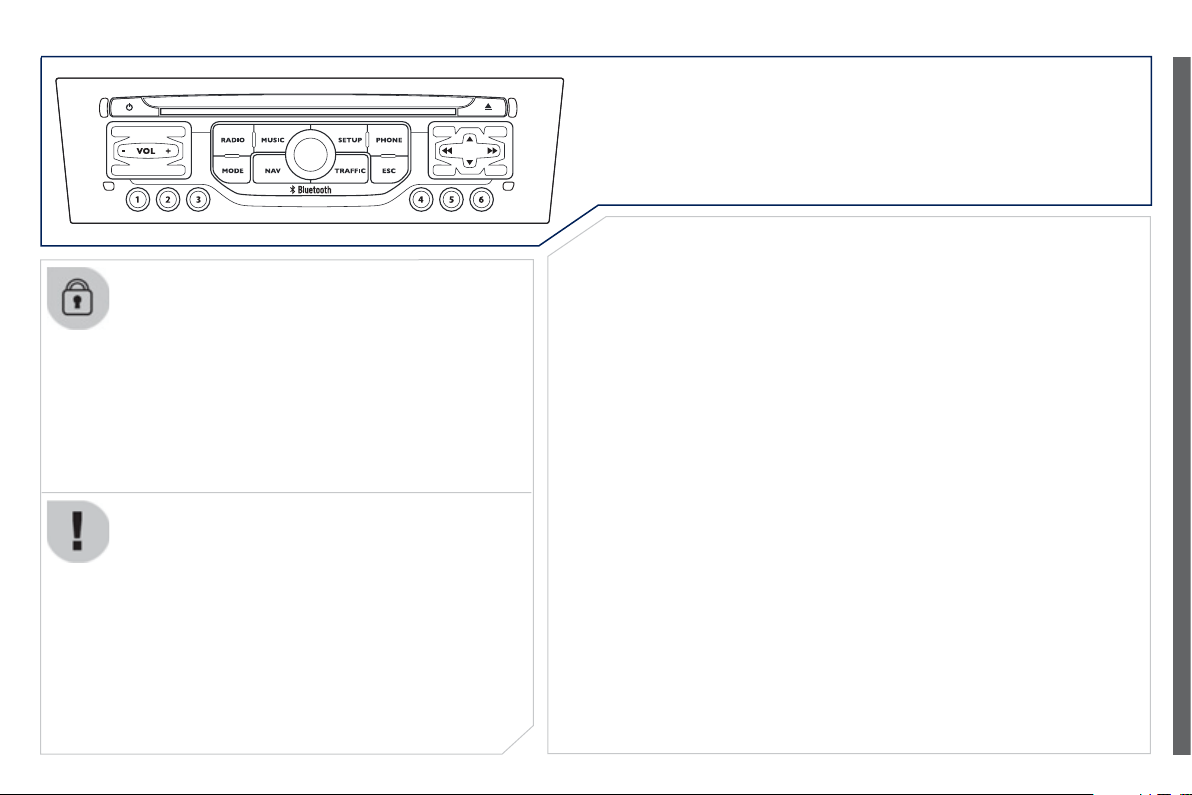
2
91
The s
y
stem is protected in such a wa
y
that it will onl
y
operate
i
n
y
our ve
hi
c
l
e.
P
EUGEOT CONNECT NAVIGATION
(
RT6
)
01 First ste
p
s - Control
p
anel
For safet
y
reasons, the driver must carr
y
out operations
which require prolon
g
ed attention while the vehicle is
s
tationar
y
.
When the en
g
ine is switched o
ff
and to prevent
dischar
g
in
g
o
f
the batter
y
, the s
y
stem switches o
ff
f
ollowing the activation o
f
the energy economy mode.
CONTENTS
02 Steerin
g
mounted controls
03 General o
p
eration
04 Navi
g
ation - Guidance
05 Traffic information
06 Usin
g
the telephone
07 Radio
08 Music media pla
y
ers
09 Audio settin
g
s
10 Confi
g
uration
11 Screen menu ma
p
Frequentl
y
asked questions
p
.
p
.
p
.
p
.
p
.
p
.
p
.
p
.
p
.
p
.
p
.
p
.
29
2
29
4
295
297
3
1
0
3
1
3
32
3
32
6
3
3
2
3
3
3
3
3
4
3
3
8
SATELLITE NAVIGATION SYSTEM
MULTIMEDIA BLUETOOTH
T
ELEPHONE AUDIO SYSTEM
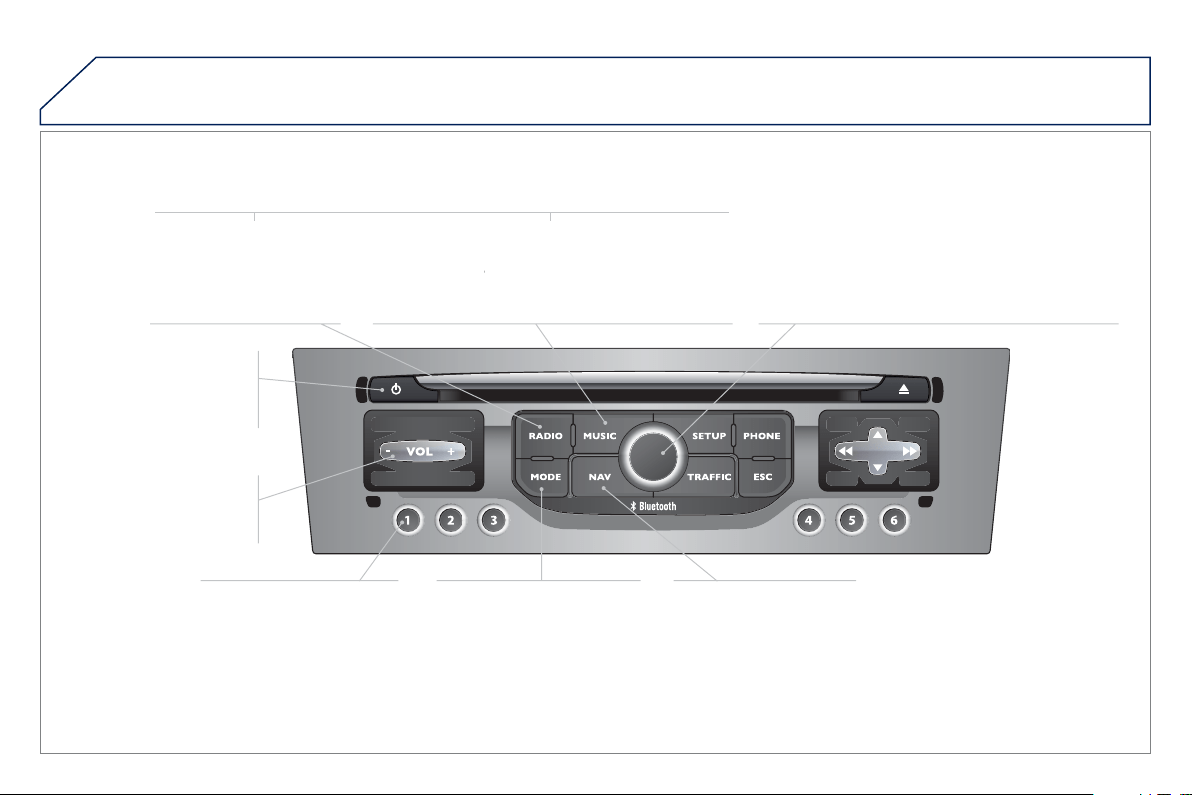
2
92
01
FIRST STEPS
Access
t
o
t
he
"
N
av
ig
at
i
on -
g
uidanc
e
" menu and display
th
e
r
ece
nt
des
tin
a
ti
o
n
s
.
Short
p
ress without the
e
n
g
ine runnin
g
: on / off.
S
hort press with the en
g
ine
r
unnin
g
: audio source o
ff
/
resto
r
e
.
S
hort press: select pre-set
rad
i
o
s
t
a
ti
o
n.
Lon
g
press: pre-set the
cu
rr
e
nt
s
t
a
ti
o
n.
M
ODE button:
S
election o
f
the
type o
f
permanent display.
Lon
g
press: black screen
(
DARK.
A
ccess
t
o
th
e
"
M
USIC " menu, and displa
y
of the
C
D/MP3/A
pp
le
®
tracks and folders.
®
Lon
g
press: mana
g
ement of the sortin
g
of MP3/
WMA fi les/update of the list of stations received.
Lon
g
press: open the "
A
udio settin
g
s" menu: music ambience, bass, treble,
loudness, left/ri
g
ht balance, front/rear fader, automatic volume ad
j
ustment.
A
ccess
t
o
th
e
" RADIO"
menu and displa
y
the list o
f
s
t
a
t
io
n
s
r
ecei
v
ed
.
S
election and con
fi
rmation
O
K dial:
S
election o
f
an item on the screen or in a list or a
menu, then con
fi
rmation with a short press.
O
ther than
f
or menus and lists, a short press
displa
y
s a contextual menu dependin
g
on the
cu
rr
e
nt
sc
r
ee
n.
Rotation with map displa
y
ed: zoom the map scale
i
n
a
n
d
ou
t.
Volume ad
j
ustment
(
each
source is independent,
includin
g
TA messa
g
es and
navi
g
ation instructions
)
.
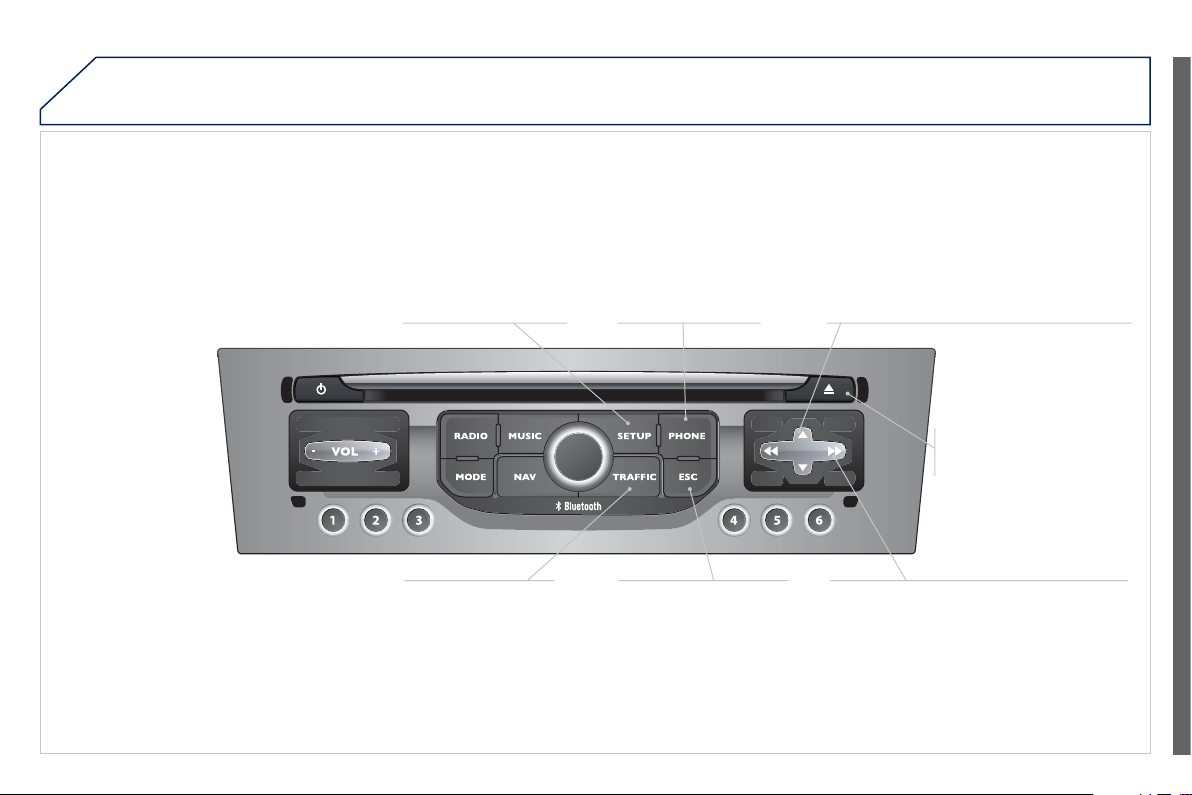
2
93
01
S
elect:
- the next lower / hi
g
her radio
f
requenc
y
automaticall
y
.
- the previous
/
next
C
D track, MP3
tr
ac
k
o
r m
ed
i
a
.
- the le
f
t
/
ri
g
ht o
f
the screen when a
m
enu is displa
y
ed.
Move left / ri
g
ht in "Move the map " m
ode
.
E
SC
: abandon the current
operation, up one level in
t
he
m
e
n
u
.
L
on
g
press: return to t
h
e
p
ermanent display.
Continuous
p
ress:
reinitialisation of the s
y
stem.
O
pen the"
T
ele
p
hon
e
"
m
enu and displa
y
the
l
i
s
t
o
f r
ece
nt
ca
ll
s
o
r
accept an incomin
g
call
.
O
pen the
"Confi
g
uration " m
e
n
u
.
Lon
g
press: access
to the GPS covera
g
e
a
nd the navi
g
ation
de
m
o
n
s
tr
a
t
io
n m
ode
.
O
pen the "
T
raffi c
i
nformation
"
m
e
n
u
a
n
d
di
sp
l
a
y
t
h
e
cu
rr
e
nt tr
affi
c
a
l
e
rt
s
.
S
elect:
- the previous
/
next line in a list or menu.
- the previous
/
next media
f
older.
- step b
y
step selection of the previous/
n
ext radio frequenc
y
.
- the previous / next MP3 folder.
Move up/down, in "
M
ove t
h
e ma
p
"
m
ode
.
FIRST STEPS
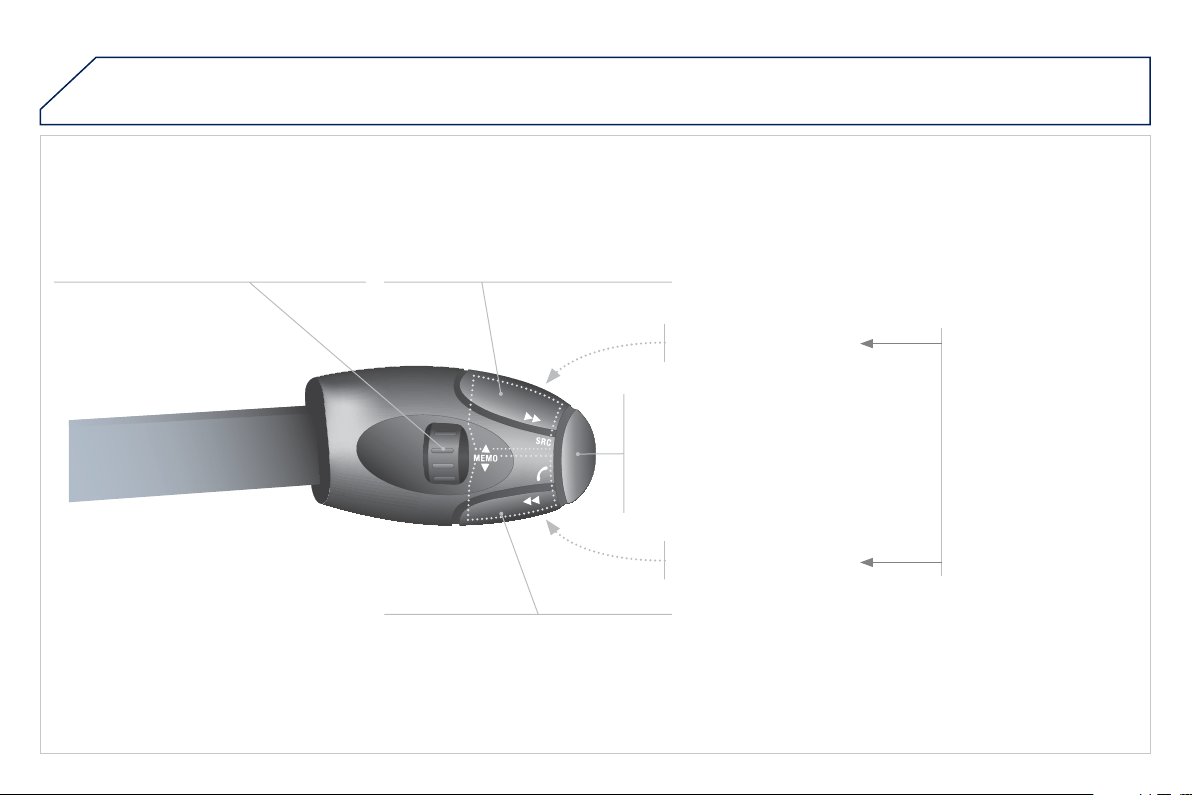
2
9
4
02 STEERING MOUNTED CONTROLS
RADI
O
: select the previous
/
next preset
s
t
a
ti
o
n.
Select the next entr
y
in the address book.
RADI
O
: chan
g
e to the next radio station
i
n t
he
lis
t.
Lon
g
press: automatic search
f
or a
h
igher
f
requency.
C
D:
se
l
ec
t th
e
n
e
xt tr
ac
k.
CD: continuous press: fast forward pla
y
.
Volu
m
e
i
n
c
r
ease
.
C
han
g
e the audio source.
S
tart a call from the address book.
Call/End call on the tele
p
hone.
Pr
ess
f
o
r m
o
r
e
th
a
n 2
seco
n
ds
:
access
t
o
t
he
add
r
ess
book
.
V
o
l
u
m
e
dec
r
ease
.
RADI
O
: chan
g
e to the previous radio
s
t
a
ti
o
n in th
e
li
s
t.
Lon
g
press: automatic search for a
l
ower frequenc
y
.
CD: select the previous track.
CD: continuous press: fast reverse.
M
ute: press t
h
e vo
l
ume
i
n
c
r
ease
a
n
d
dec
r
ease
b
uttons s
i
mu
l
taneous
ly
.
Restore the sound b
y
p
ressin
g
one o
f
the two
v
o
l
u
m
e
bu
tt
o
n
s
.
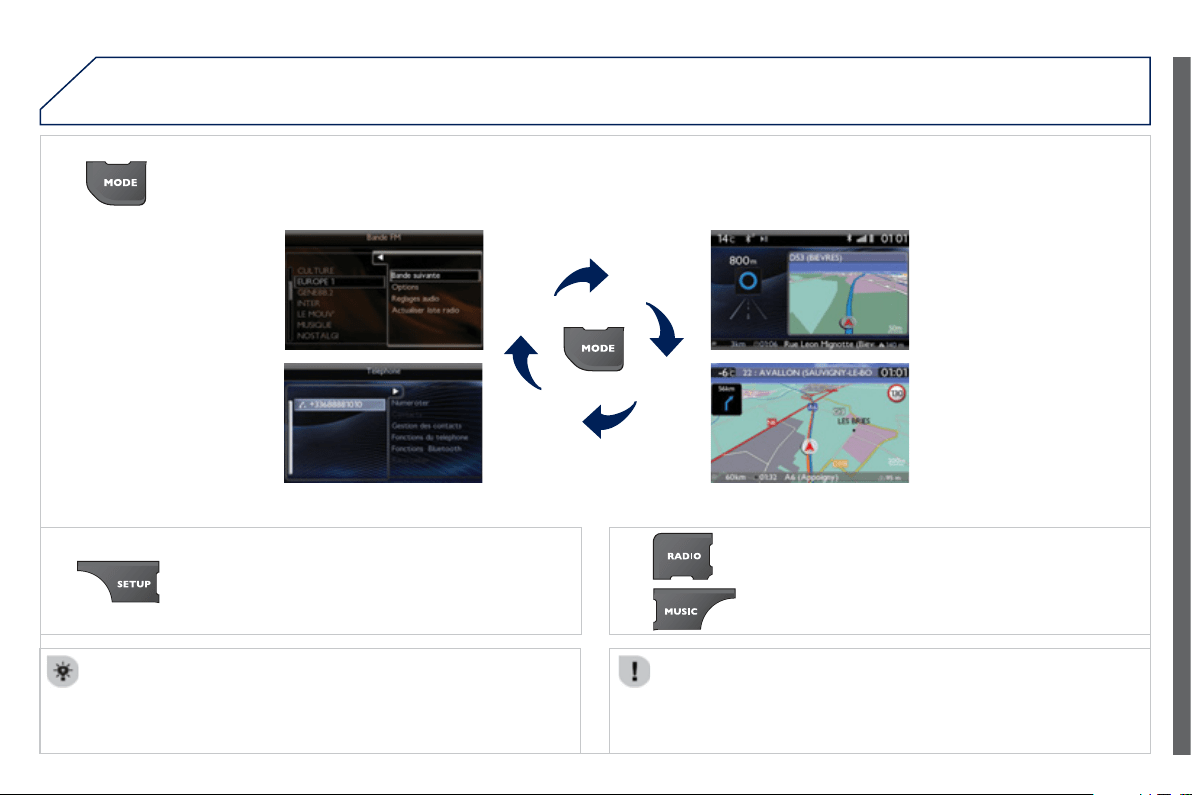
2
95
03
For a detailed
g
lobal view o
f
the menus available, re
f
er to the
"
S
creen menu map" section.
For cleanin
g
the screen, the use of a soft, non-abrasive cloth
(
spectacles cloth
)
is recommended, with no additional product.
"RADIO "
"
T
ELEPHON
E
"
(
I
f
conversation in pro
g
ress
)
S
ETUP: PARAMETER
S
date and time, displa
y
con
fi
g
uration, sound.
C
han
g
in
g
the audio source:
R
ADI
O
:
R
ADI
O
b
r
oadcas
t
s
.
M
U
S
I
C
: pla
y
in
g
MU
S
I
C
.
Pr
ess
th
e
M
OD
E
button several times in succession
f
or access to the
f
ollowin
g
displa
y
s:
GENERAL OPERATION
"
FULL SCREEN MA
P
"
"
M
AP IN WINDO
W
"
(
I
f
navi
g
ation
g
uidance in
p
ro
g
ress
)
2
96
03
A
press on t
h
e
di
a
l
gi
ves access to
sh
ort-cut menus accor
di
n
g
to t
h
e
di
sp
l
a
y
i
n t
h
e screen.
GENERAL OPERATION
D
ISPLAY ACCORDING TO CONTEXT
RADIO:
Activate / Deactivate T
A
Activate / Deactivate RDS
MUSIC MEDIA PLAYERS,
CD or USB
(
accordin
g
to
m
edia
)
:
Pla
y
modes:
Normal
Random
R
an
d
om on a
ll
me
di
a
R
e
p
et
i
t
i
on
TELEPHONE
(
call in pro
g
ress
)
:
Private mode
FULL
S
CREEN MAP OR IN
A
NEW WINDOW:
Stop / Restore
g
uidance
Select destination
E
nter an a
dd
ress
D
irector
y
G
PS coordinate
s
Divert route
M
ove t
h
e ma
p
Info. on location
S
elect as destination
Select as sta
ge
Save this place
(
contacts
)
Quit ma
p
mod
e
Guidance criteria
P
ut ca
ll
on
h
o
ld
DTMF
r
i
n
g
tones
Hang up
1
1
1
1
1
1
1
1
2
2
2
2
2
1
2
2
2
1
1
1
1
1
1
Guidance o
p
tions
Change waveband
A
ctivate / Deactivate TA information
2
2
1
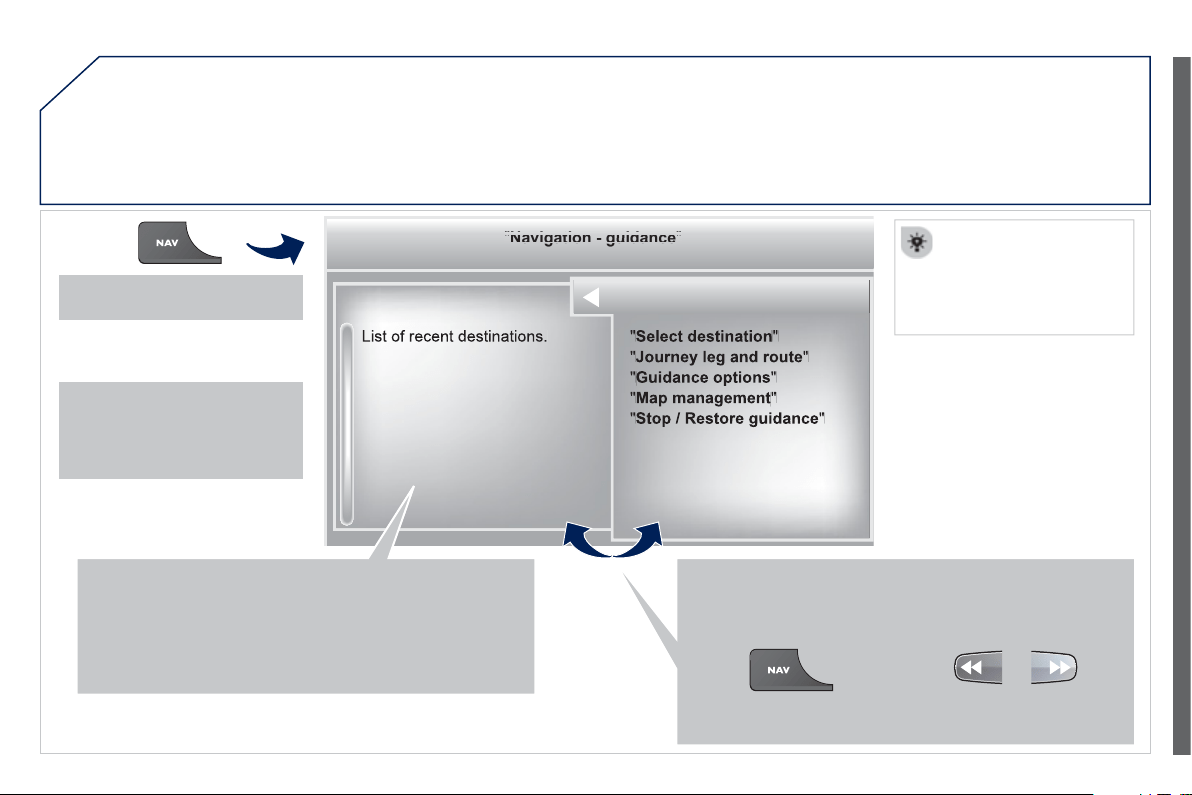
2
97
04
"
"
"
"
"
"
"
"
"
"
"
"
gg
gg
gg
gg
gg
Navigation
guidance
Navigation guidance
Navigation guidance
Navigation guidance
Navigation guidance
Navigation - guidance
Navigation - guidance
Navigation - guidance
Navigation - guidance
Navigation guidance
Navigation guidance
Navigation guidance
Navigation guidance
N i ti id
N i ti id
N i ti id
N i ti id
N i ti id
N i ti id
N i ti id
N i ti id
N i ti id
Ni i id
"
"
"
"
"
"
"
"
"
"
"
"
To delete the list of recent destinations, select "
G
uidance
o
p
tions" in the navi
g
ation menu then select "
D
elete last
d
est
i
nat
i
ons
" and confi rm. Select "
Yes
" th
e
n
co
nfi rm.
D
e
l
et
i
n
g
j
ust one
d
est
i
nat
i
on
i
s not poss
ibl
e.
Go from the list to the menu
(
left/ri
g
ht
)
.
NAVIGATION - GUIDANCE
Access to the "NAVIGATION" menu
Pr
ess
NAV
.
o
r
C
ontact a PE
UG
E
O
T
dealer for mappin
g
up
d
ates.
A lon
g
press on the end o
f
the
li
g
htin
g
control stalk repeats
the last navi
g
ation messa
g
e.
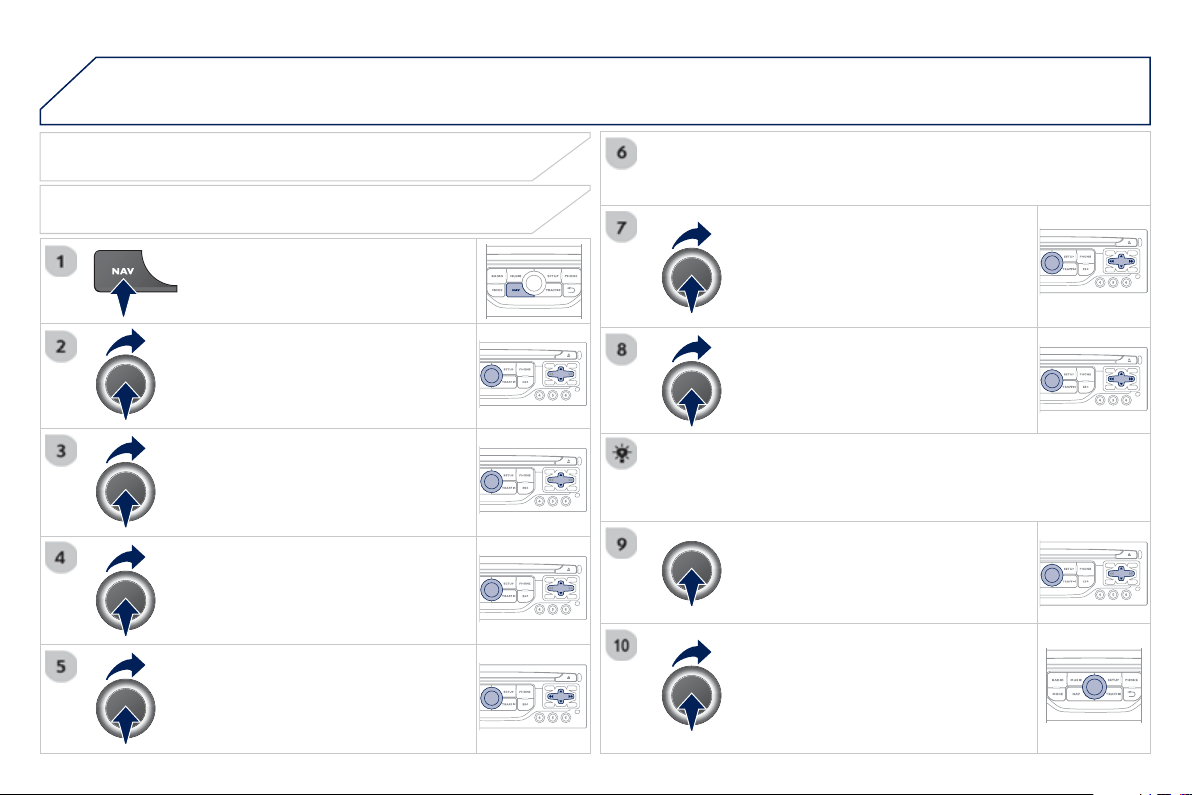
2
98
04
Pr
ess
NAV
to displa
y
the
"
N
av
ig
at
i
on -
g
u
id
anc
e
"
m
e
n
u
.
TOWARDS A NEW DESTINATION
NAVIGATION - GUIDANCE
SELECTING A DESTINATION
S
elect "Select destination "
a
n
d
c
onfi rm, then select "
E
nter an address"
a
n
d
co
nfi rm.
S
elect the "
C
ountr
y
"
fu
n
c
ti
o
n th
e
n
co
n
fi
rm.
S
elect "
T
own" f
u
n
c
ti
o
n th
e
n
co
nfi rm t
o
e
nt
e
r th
e
des
tin
a
ti
o
n t
o
wn.
S
elect the letters in the name of the
town one at a time, con
fi
rmin
g
each one
w
i
t
h
t
he
dial
.
S
election the town
f
rom the list o
ff
ered, then con
fi
rm.
A
pre-set list
(
by entering the
fi
rst
f
ew letters
)
o
f
the towns in the country selected
c
an be accessed directl
y
b
y
selectin
g
and con
fi
rmin
g
"
List
"
o
n th
e
sc
r
ee
n.
t
Tu
rn t
he
dial
a
n
d
selec
t
"
OK
"
t
he
n
co
n
fi
rm.
If possible, enter the "
R
oad "
a
n
d
"N°
/X
"
information in the same wa
y
.
Se
l
ec
t "Archiv
e
" t
o
sa
v
e
th
e
add
r
ess
e
nt
e
r
ed
in
a
co
nt
ac
t
fi
l
e
.
The s
y
stem allows up to 400 contact
fi
les to be recorded.
C
on
fi
rm " OK " to start guidance.
S
elect the
g
uidance criteria: "
F
astest
rout
e
"
,
"
S
hortest rout
e
"
or opt
i
m
i
se
d
"
D
istance
/
Tim
e
", then select the
des
ir
ed
r
es
tri
c
ti
o
n
c
rit
e
ri
a
: "With tolls",
"
With Ferr
y
", or "
T
raffi c info" th
e
n
co
nfi rm "OK".

2
99
04
SELECTING A DESTINATION
NAVIGATION - GUIDANCE
TO ONE OF THE RECENT DESTINATIONS
P
r
ess
NAV
to
di
sp
l
a
y
t
h
e
"
N
av
ig
at
i
on -
g
u
id
anc
e
"
m
e
n
u
.
S
elect the desired destination and
c
onfi rm to start
g
uidance.
TOWARDS A CONTACT IN THE CONTACTS DIRECTORY
S
elect " Select destination"
a
n
d
c
onfi rm
,
then select "
Di
rector
y
"
a
n
d
co
n
fi
rm.
Se
l
ec
ti
o
n th
e
des
ir
ed
des
tin
a
ti
o
n
f
r
o
m
y
our contacts and confi rm "OK " t
o
s
t
a
rt
the
g
uidance.
Pr
ess
NAV to displa
y
the
"
Navi
g
ation -
g
uidanc
e
" m
e
n
u
.
Navi
g
ation towards a contact imported
f
rom
y
our telephone is onl
y
possible i
f
the address is compatible with the system.

300
04
Se
l
ec
t "
S
elect destination"
a
n
d
c
on
fi
rm, then select " GPS coordinate
s
"
a
n
d
co
nfi rm.
Enter the
G
P
S
coordinates and confi rm
"
O
K
"
to start t
h
e
g
u
id
ance.
Pr
ess
NAV to displa
y
the
"Navi
g
ation -
g
uidanc
e
" m
e
n
u
.
NAVIGATION - GUIDANCE
T
OWARDS GPS COORDINATES TOWARDS A POINT ON THE MAP
With the map displa
y
ed, press
O
K t
o
displa
y
the contextual menu.
S
elect
"
Move the map "
a
n
d
co
nfi rm.
Pr
ess
OK to displa
y
the contextual
m
e
n
u
fo
r "
M
ove the ma
p
" m
ode
.
S
elect " Select as destination "
or
"
Select as sta
ge
"
a
n
d
co
nfi rm.
Move the cursor usin
g
the control to
identif
y
the desired destination.
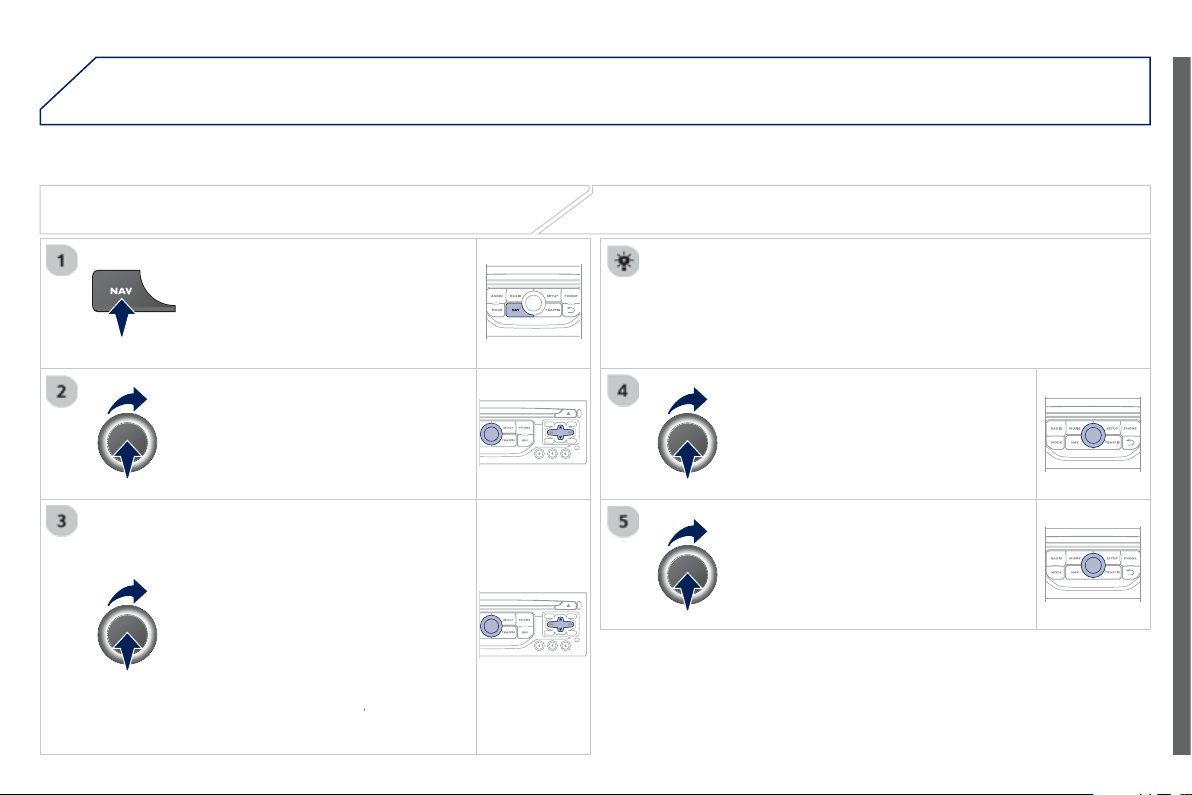
301
04
TOWARDS POINTS OF INTEREST
(
POI
)
NAVIGATION - GUIDANCE
The points o
f
interest
(
P
O
I
)
indicate all o
f
the service locations in the vicinit
y
(
hotels, various businesses, airports...
)
.
S
elect the "
E
nter an a
dd
ress "
fu
n
c
ti
o
n
and con
fi
rm, then select Select
destination
a
n
d
co
n
fi
rm.
To select a P
O
I close to your current
l
ocation, select "POI" and con
fi
rm, then
se
l
ec
t "
A
round the current
p
lac
e
"
a
n
d
co
nfi rm.
To select a P
O
I as a sta
g
e on the route,
se
l
ec
t " PO
I
" and confi rm, then select " On
t
h
e rout
e
"
a
n
d
co
nfi rm.
To select a P
O
I as a destination,
fi
rst
e
nter the countr
y
and town
(
see "Towards
a new destination"
)
, select "POI"
a
n
d
c
on
fi
rm,
fi
nall
y
select "
Near
" and confi rm.
r
Search for P
O
Is in the cate
g
ories
su
gg
ested in the followin
g
pa
g
es.
S
elect " Search b
y
Nam
e
" to search for P
O
Is b
y
name and not b
y
p
roximit
y
.
Se
l
ec
t th
e
P
O
I
a
n
d
co
n
fi
rm " O
K
" t
o
s
t
a
rt
the
g
uidance.
Pr
ess
NAV to displa
y
the
"Navi
g
ation -
g
uidanc
e
" m
e
n
u
.
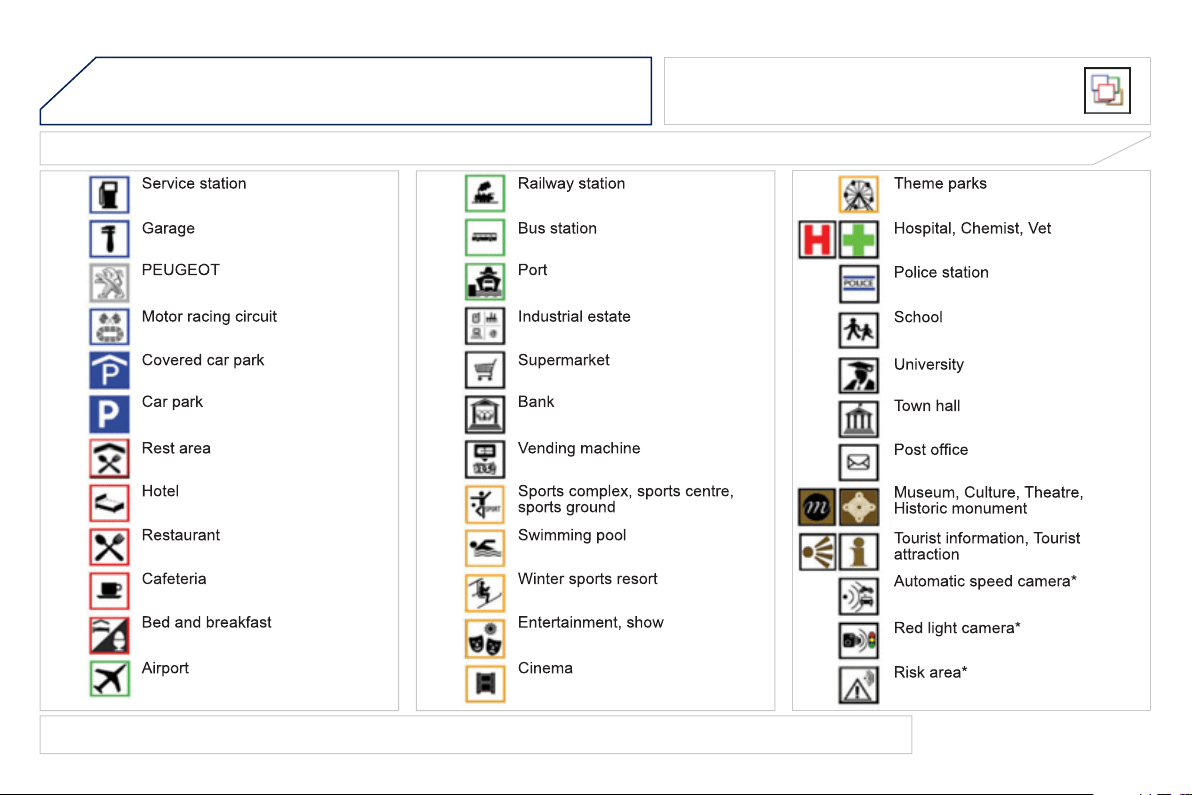
302
04
LIST OF PRINCIPAL POINTS OF INTEREST
(
POI
)
NAVIGATION - GUIDANCE
This icon appears when several P
O
Is are
g
rouped
to
g
ether in the same area. Zoomin
g
in on this icon
s
hows details of the P
O
Is.
*
Accordin
g
to availabilit
y
in the
c
ountr
y
.
The detailed procedure
f
or updatin
g
P
O
Is can be
f
ound at wipin
f
oradars.co.uk.
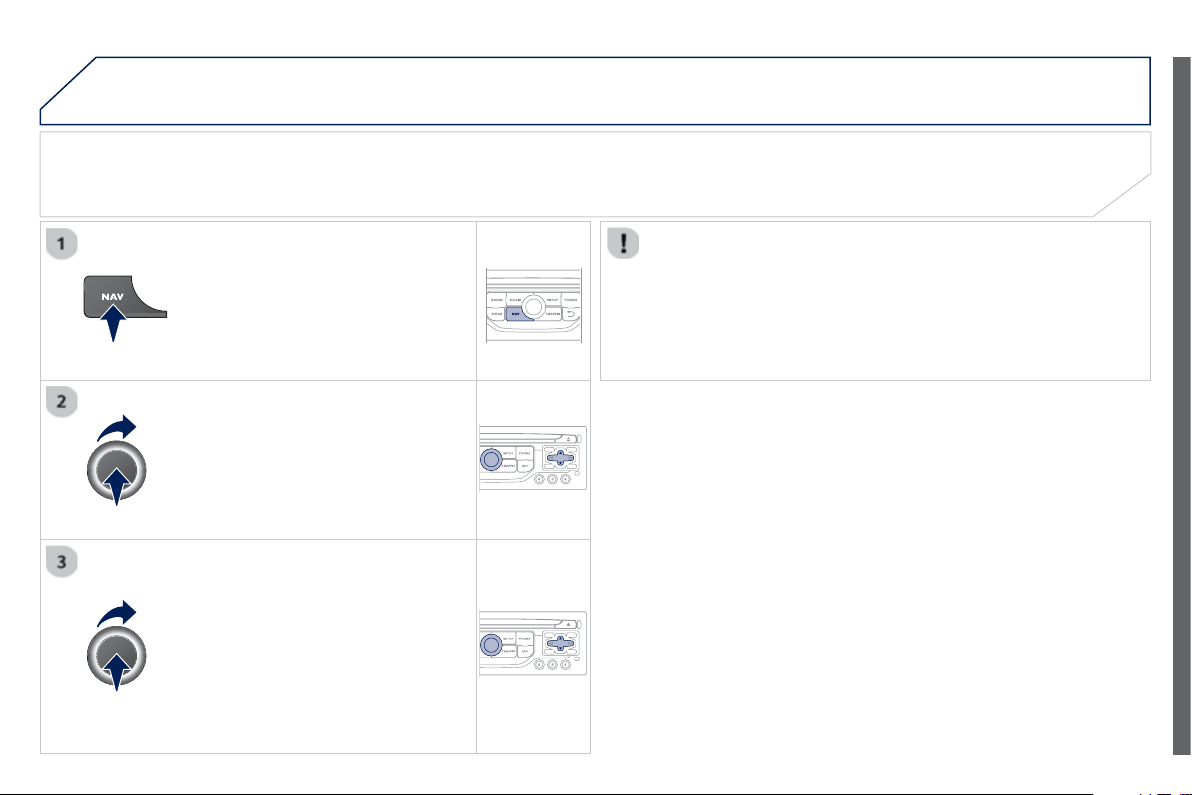
303
04 NAVIGATION - GUIDANCE
ALERT PARAMETERS
R
ISK AREAS
S
elect:
- "Vi
sua
l
a
l
e
rt"
- "A
ud
i
b
l
e
a
l
e
rt"
-
"Al
ert on
ly
i
n
g
u
id
ance
"
- "
O
verspeed alarm onl
y
".
Th
e
c
h
o
i
ce
of
tim
e
of
n
o
ti
fi
ca
ti
o
n
defi
n
es
h
ow lon
g
in advance that speed camera
warnin
g
s are
g
iven.
S
elect " OK " t
o
co
nfi rm th
e
sc
r
ee
n.
S
elect "
G
uidance o
p
tions " and con
fi
rm,
th
e
n
se
l
ec
t "Set
p
arameters for risk
areas
"
a
n
d
co
n
fi
rm.
These
f
unctions are onl
y
available i
f
risk areas have been
downloaded and installed on the s
y
stem.
The detailled procedure for updatin
g
risk area P
O
Is can be found at
www.peu
g
eot.com.
P
r
ess
NAV
to
di
sp
l
a
y
t
h
e
"
N
av
ig
at
i
on -
g
u
id
anc
e
"
m
e
n
u
.
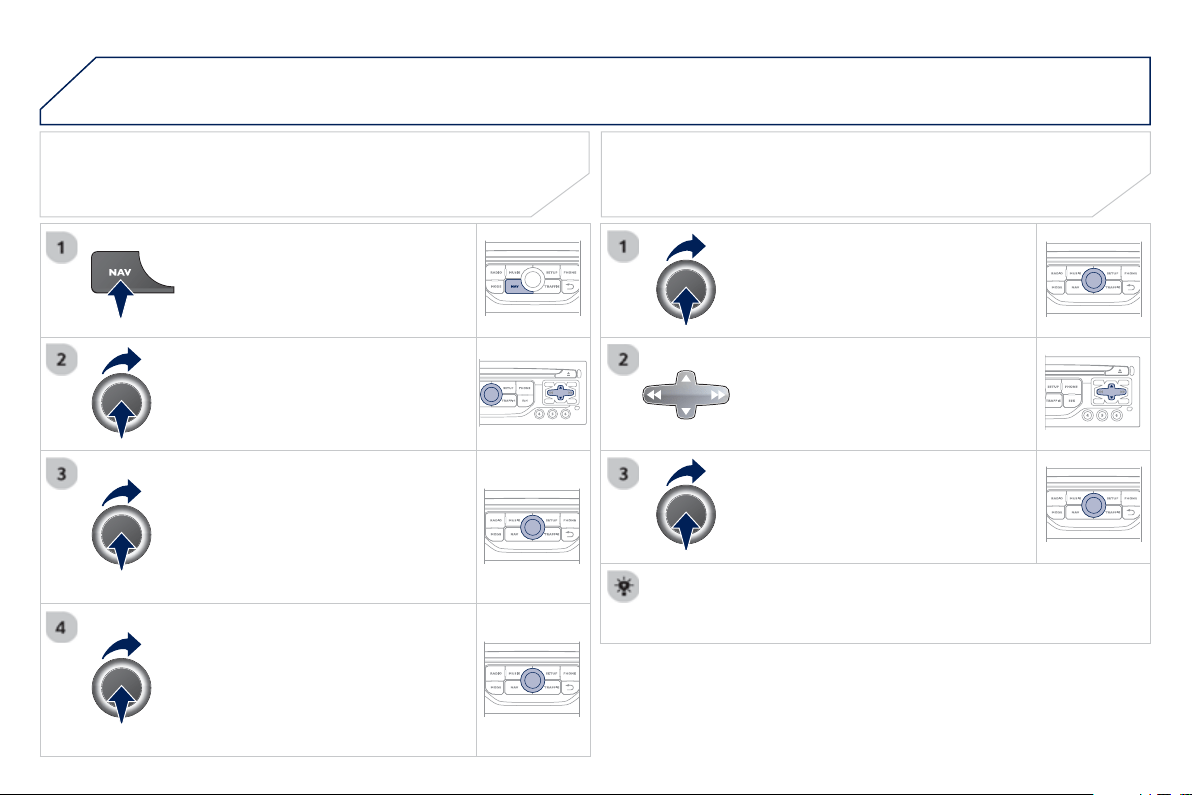
30
4
04 NAVIGATION - GUIDANCE
ADDING A STAGE
Pr
ess
NAV
to displa
y
the
"
Navi
g
ation -
g
uidanc
e
" m
e
n
u
.
Se
l
ec
t "
J
ourne
y
le
g
and rout
e
" th
e
n
co
n
fi
rm.
S
elect " Close t
o
" a route passin
g
c
lose to the sta
g
e or " Stric
t
" f
o
r
a
r
ou
t
e
pass
i
n
g
t
h
rou
gh
t
h
e sta
g
e.
C
on
fi
rm " OK
"
to start t
h
e
g
u
id
ance, an
d
g
ive a
g
eneral indication o
f
the
g
uidance
r
oute
.
S
elect "Add a stag
e
" th
e
n
co
n
fi
rm.
The address o
f
the sta
g
e is entered as
a destination, b
y
"
E
nter an address",
a
co
nt
ac
t in "
D
irector
y
", or "
P
revious
d
estinations"
.
ORGANISING STAGES
To or
g
anise sta
g
es, carr
y
out operations
1 to 2 a
g
ain, then select " Order/delete
j
ourne
y
le
g
s"
a
n
d
co
nfi rm.
S
elect and confi rm to save the
m
od
ifi
ca
ti
o
n
s
.
S
elect the sta
g
e that
y
ou want to move
in th
e
o
r
de
r.
Se
l
ec
t "
D
elet
e
" to delete the sta
g
e.
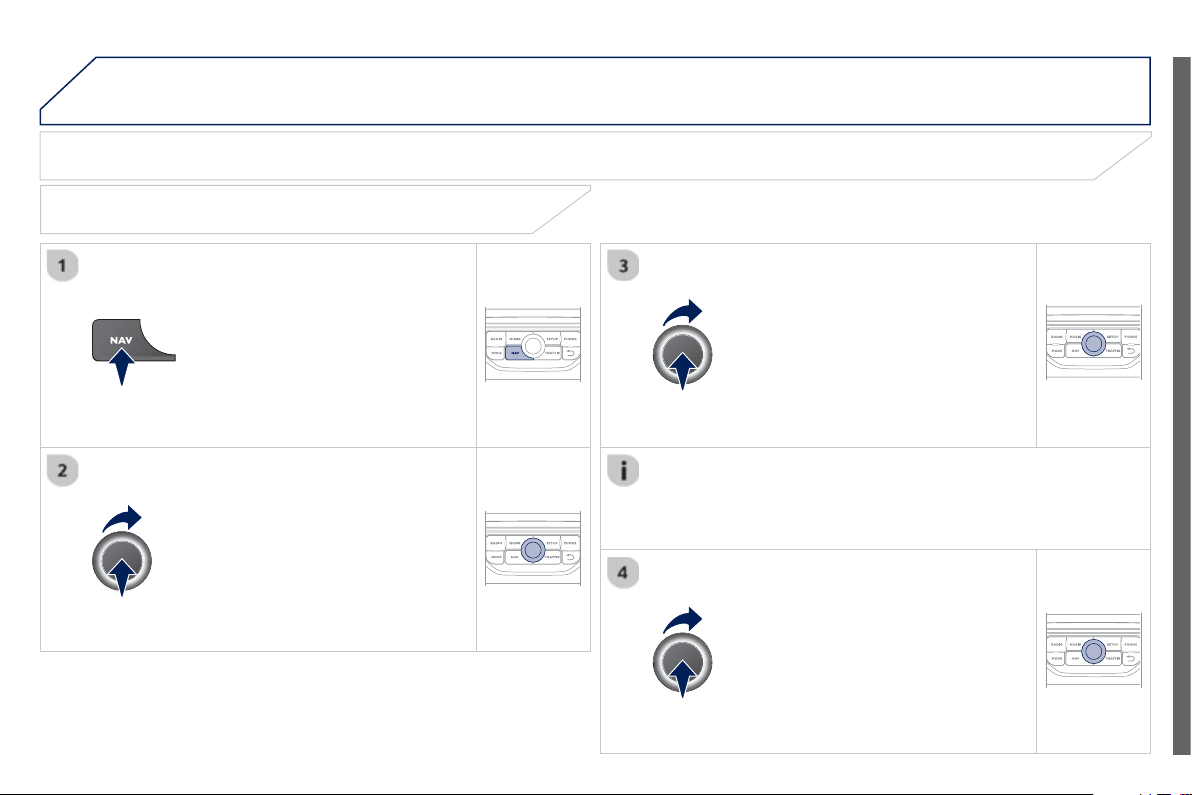
305
04 NAVIGATION - GUIDANCE
ROUTE OPTIONS
CALCULATION CRITERIA
S
elect " Guidance o
p
tion
s
"
a
n
d
co
nfi rm.
S
elect " OK "
a
n
d
co
nfi rm t
o
sa
v
e
th
e
mod
ifi
ca
ti
o
n
s
.
S
elect "
D
efi ne calculation criteri
a
"
a
n
d
co
nfi rm.
Thi
s
fu
n
c
ti
o
n
a
ll
o
w
s
m
od
i
fi
ca
ti
o
n
of
:
- the
g
uidance criteria:
(
"
F
astest
rout
e
", "
S
hortest rout
e
",
"
D
istance
/
Tim
e
"
)
,
- the exclusion criteria:
(
" With tolls"
o
r "With Ferr
y
"
)
,
- traffi c avoidance:
(
"
T
raffi c inf
o
"
)
.
P
r
ess
NAV
to
di
sp
l
a
y
t
h
e
"
N
av
ig
at
i
on -
g
u
id
anc
e
"
m
e
n
u
.
I
f
tra
ffi
c avoidance
(
Tra
ffi
c in
f
o
)
is selected, the s
y
stem su
gg
ests
an alternative route if there is a dela
y
on the
g
uidance route.
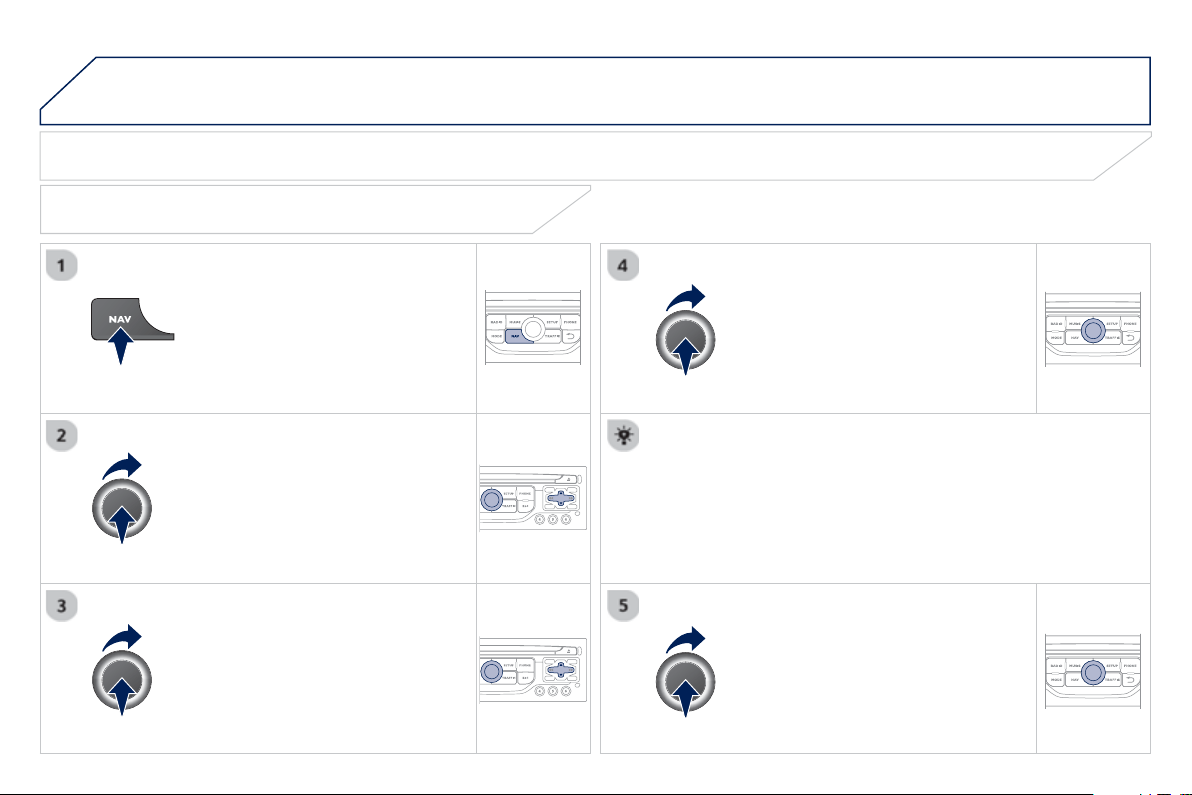
306
04 NAVIGATION - GUIDANCE
Pr
ess
NAV to display the
"Navi
g
ation -
g
uidanc
e
" m
e
n
u
.
MAP MANAGEMENT
S
ELECTING THE POINT
S
OF INTERE
S
T DI
S
PLAYED ON
T
HE MAP
S
elect "
M
ap mana
g
emen
t
"
a
n
d
co
nfi rm.
S
elect
f
rom the various cate
g
ories the
ones that
y
ou want to displa
y
on the
sc
r
ee
n.
Se
l
ec
t "Ma
p
details"
a
n
d
co
n
fi
rm.
S
elect "
By
defaul
t
" to have onl
y
"Oil stations,
g
ara
g
es"
a
n
d
"
Accident-
p
rone are
a
" appear on the map
(
if installed in the
s
y
stem
)
.
S
elect " OK " th
e
n
co
n
fi
rm
a
n
d
se
l
ec
t
"
O
K
" a
g
ain then con
fi
rm to save the
m
od
i
fi
ca
ti
o
n
s
.
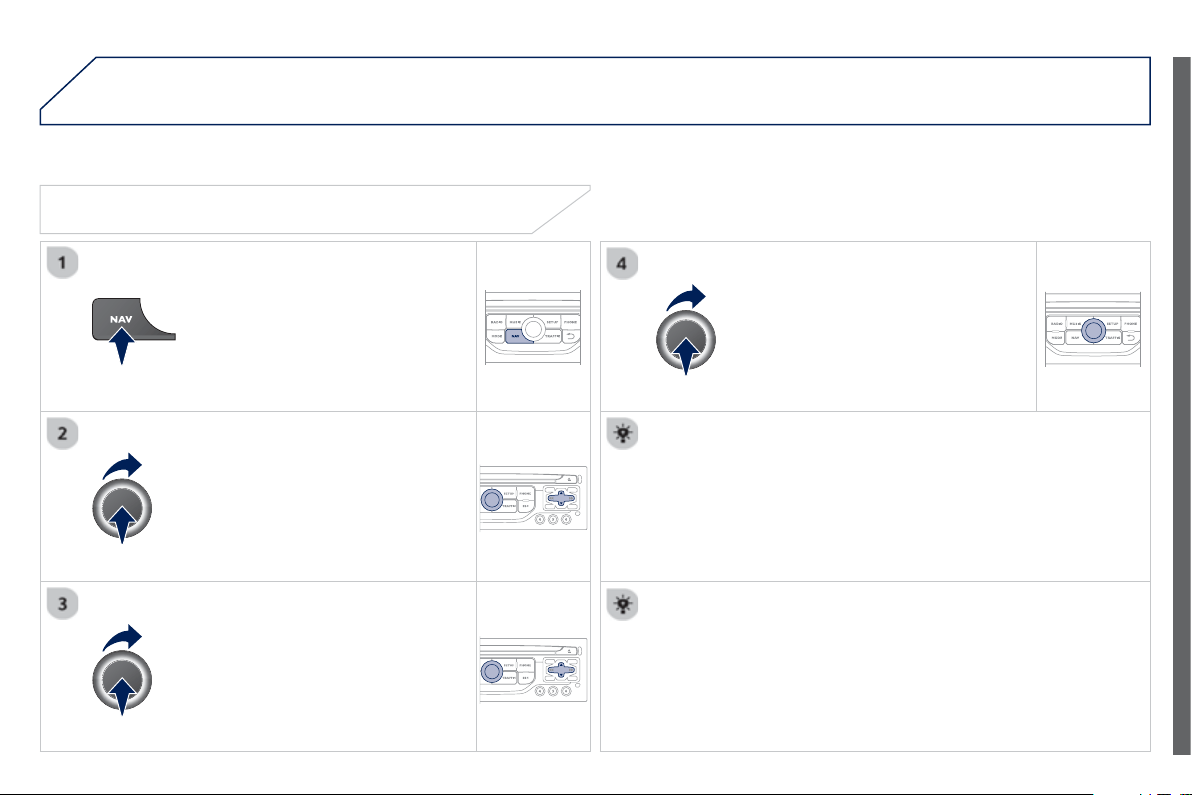
307
04 NAVIGATION - GUIDANCE
S
elect "
M
ap mana
g
emen
t
"
a
n
d
co
nfi rm.
S
elect:
-
"
V
e
hi
c
l
e
di
rect
i
on
"
to
h
ave t
h
e map
f
ollow the direction o
f
travel,
- "North direction" to keep the map
alwa
y
s North up,
- "Perspective view " to displa
y
a
p
ers
p
ective view.
Se
l
ec
t "Ma
p
orientation "
a
n
d
co
n
fi
rm.
The colour o
f
the map, di
ff
erent
f
rom the day and night mode, is
c
on
fi
g
ured in the "
S
ETUP" m
e
n
u
.
MAP ORIENTATION
Pr
ess
NAV to display the
" Navi
g
ation -
g
uidanc
e
" m
e
n
u
.
S
treet names are visible on the map
f
rom the 100 m scale.
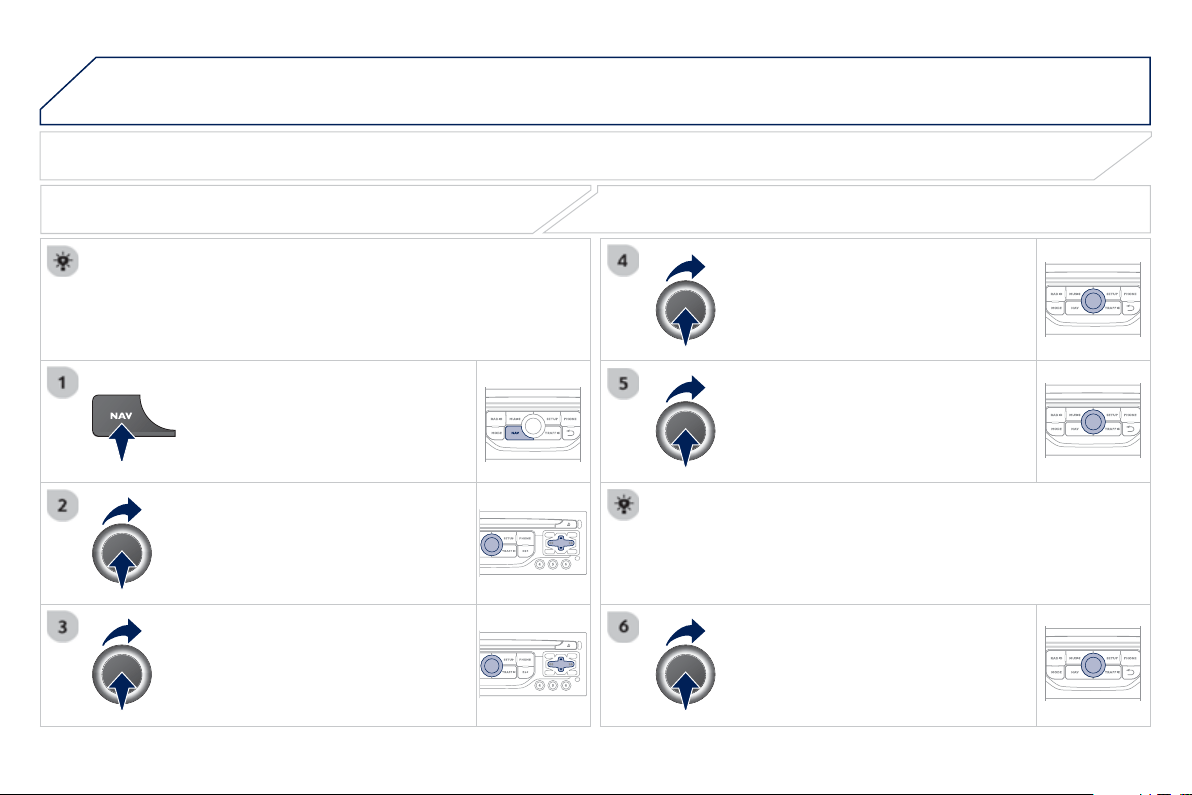
308
04 NAVIGATION - GUIDANCE
P
r
ess
NAV
to
di
sp
l
a
y
t
h
e
"
N
av
ig
at
i
on -
g
u
id
anc
e
"
m
e
n
u
.
ADJUSTING THE GUIDANCE SPEECH SYNTHESIS
S
elect " Guidance o
p
tion
s
"
a
n
d
co
n
fi
rm.
ADJUSTING THE VOLUME/DEACTIVATION
S
elect " Set speech synthesis"
a
n
d
co
n
fi
rm.
S
elect the volume
g
raph and con
fi
rm.
S
elect "
D
eact
i
vat
e
"
to
d
eact
i
vate vo
i
ce messa
g
es.
S
elect " OK
"
an
d
press t
h
e
di
a
l
to
co
n
fi
rm.
A
d
j
ust the volume to the desired level
a
n
d
co
nfi rm.
The volume o
f
messages can be adjusted during the transmission
of
the messa
g
e usin
g
the volume ad
j
ustment control.
The volume settin
g
o
f
g
uidance messa
g
es is also accessible via the
"
S
ETU
P
"
/
"
V
oice synthesi
s
" m
e
n
u
.
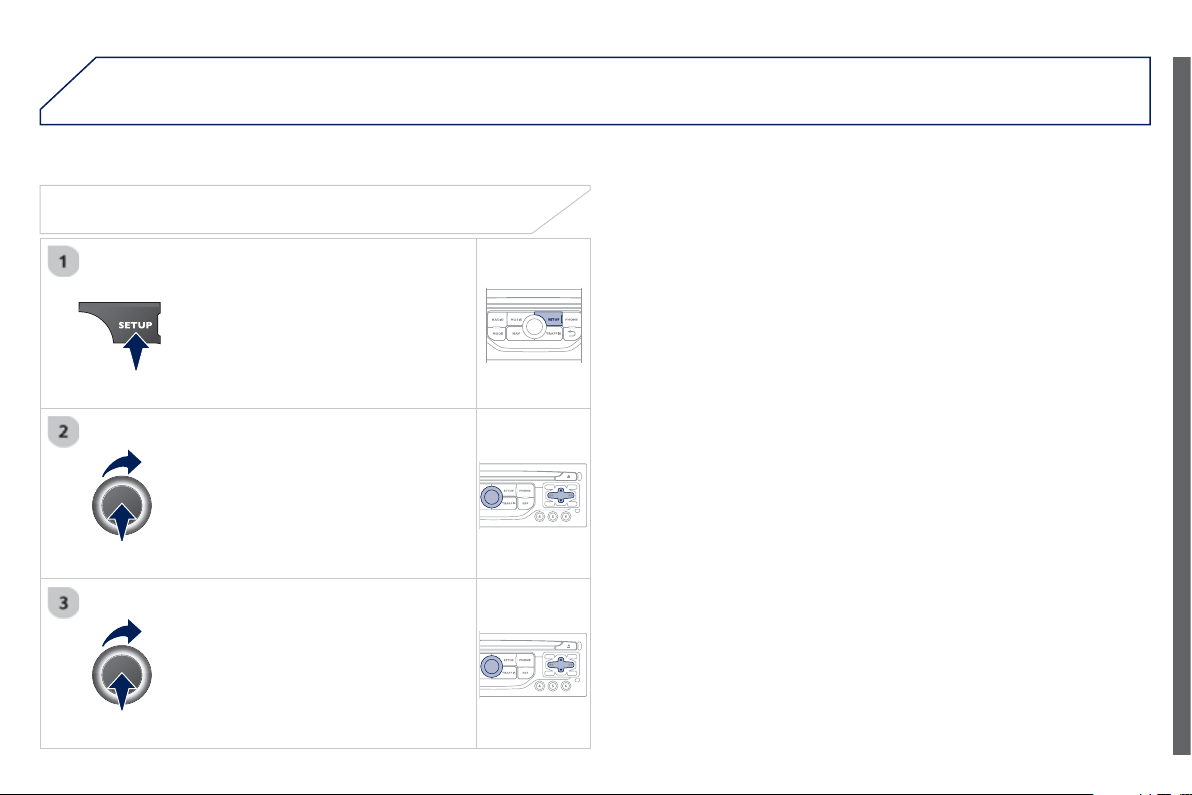
309
04 NAVIGATION - GUIDANCE
MALE VOICE / FEMALE VOICE
P
r
ess
SETU
P
to
di
sp
l
a
y
t
h
e
c
on
fi
g
uration menu.
Se
l
ec
t "Select male voic
e
"
o
r "Select
f
emale voic
e
" then confi rm "
Yes
" t
o
ac
tiv
a
t
e
a
m
a
l
e
o
r f
e
m
a
l
e
v
o
i
ce
. Th
e
sy
stem restarts.
S
elect "
V
oice synthesis "
a
n
d
co
n
fi
rm.
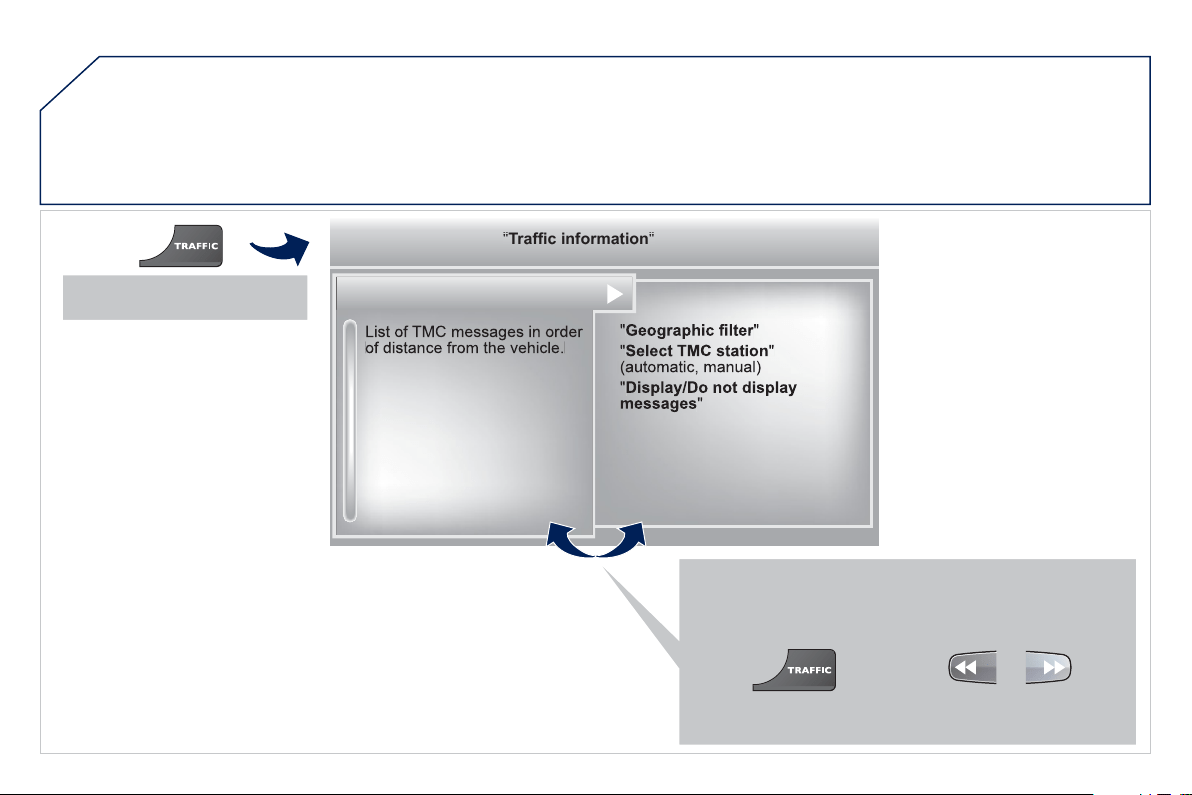
3
1
0
05
TRAFFIC INFORMATION
Access to the "TRAFFIC INFORMATION" menu
G
o
f
rom the list to the menu
(
le
f
t
/
ri
g
ht
)
.
"
"
"
"
"
"
"
a c o at o
Traffi
c
information
Traffic information
Traffic information
Traffic information
Traffic information
Traffic information
Traffic information
Traffic information
Traffic information
Traffic information
Traffic information
Traffic information
Traffic information
Traffic information
Tffi if ti
Tffi if ti
Tffi if ti
Tffi if ti
"
"
"
"
"
"
"
o
r
P
r
ess
"
T
RAFFI
C
".
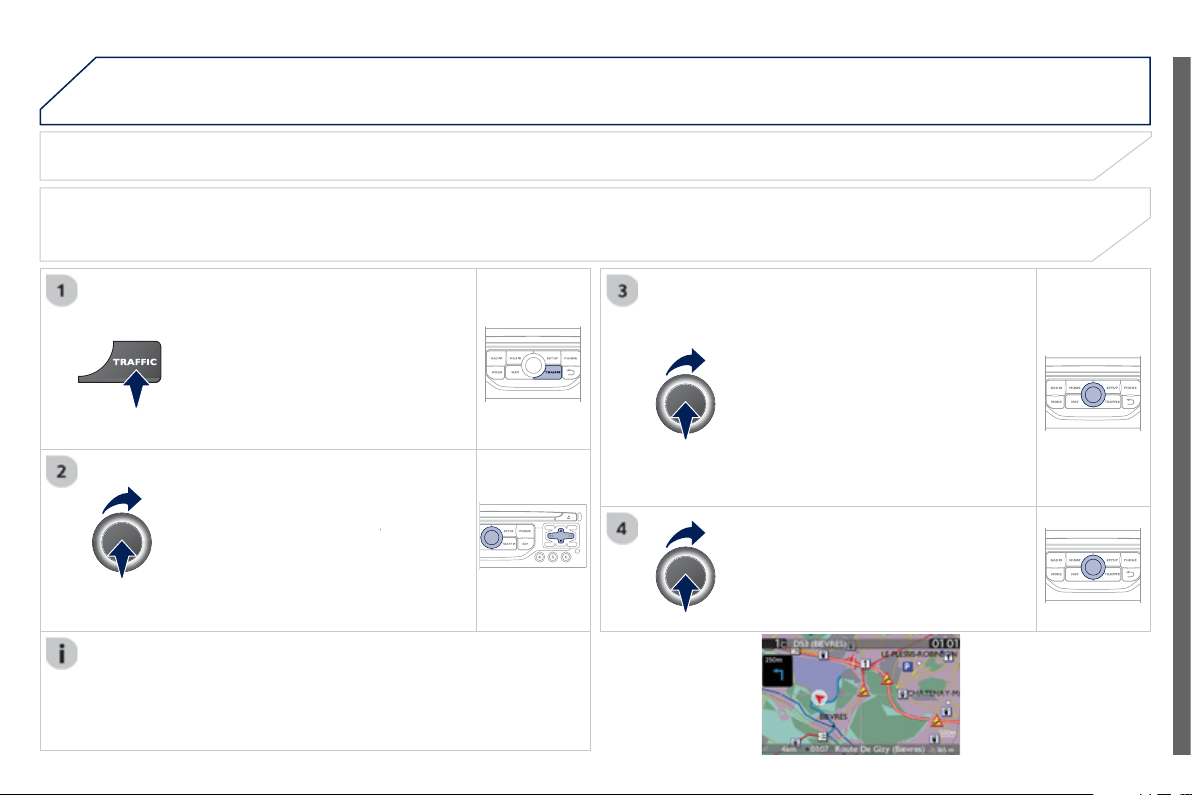
3
1
1
05 TRAFFIC INFORMATION
CONFIGURE THE FILTERING AND DISPLAY OF TMC MESSAGES
TM
C
(
Tra
ffi
c Messa
g
e
C
hannel
)
messa
g
es contain in
f
ormation on tra
ffi
c and weather conditions, received in real time and transmitted to the
driver in the
f
orm o
f
audible announcements and s
y
mbols on the navi
g
ation map.
The navi
g
ation s
y
stem can then su
gg
est an alternative route to avoid a traffi c problem.
Pr
ess
th
e
T
RAFFI
C
button to displa
y
the
T
raffi c information m
e
n
u
.
Se
l
ec
t th
e
"
Geographic fi lter
"
fu
n
c
ti
o
n
r
a
n
d
co
nfi rm.
The s
y
stem o
ff
ers a choice o
f
:
- " Retain all the messa
g
es",
o
r
-"Retain the messa
g
e
s
"
●
"
A
roun
d
t
h
e ve
hi
c
le
",
(
confi rm
the milea
g
e to modi
fy
and select
the distance
)
,
● " On the rout
e
".
C
onfi rm " OK " t
o
sa
v
e
th
e
m
od
ifi
ca
ti
o
n
s
.
We
r
eco
mm
e
n
d
:
-
a
fi
lt
e
r
o
n th
e
r
ou
t
e
a
n
d
-
a
fi
lt
e
r
a
r
ou
n
d
th
e
v
e
hi
c
l
e
of
:
- 12 miles
(
20 km
)
in urban areas,
- 30 miles
(
50 km
)
on motorwa
y
s.
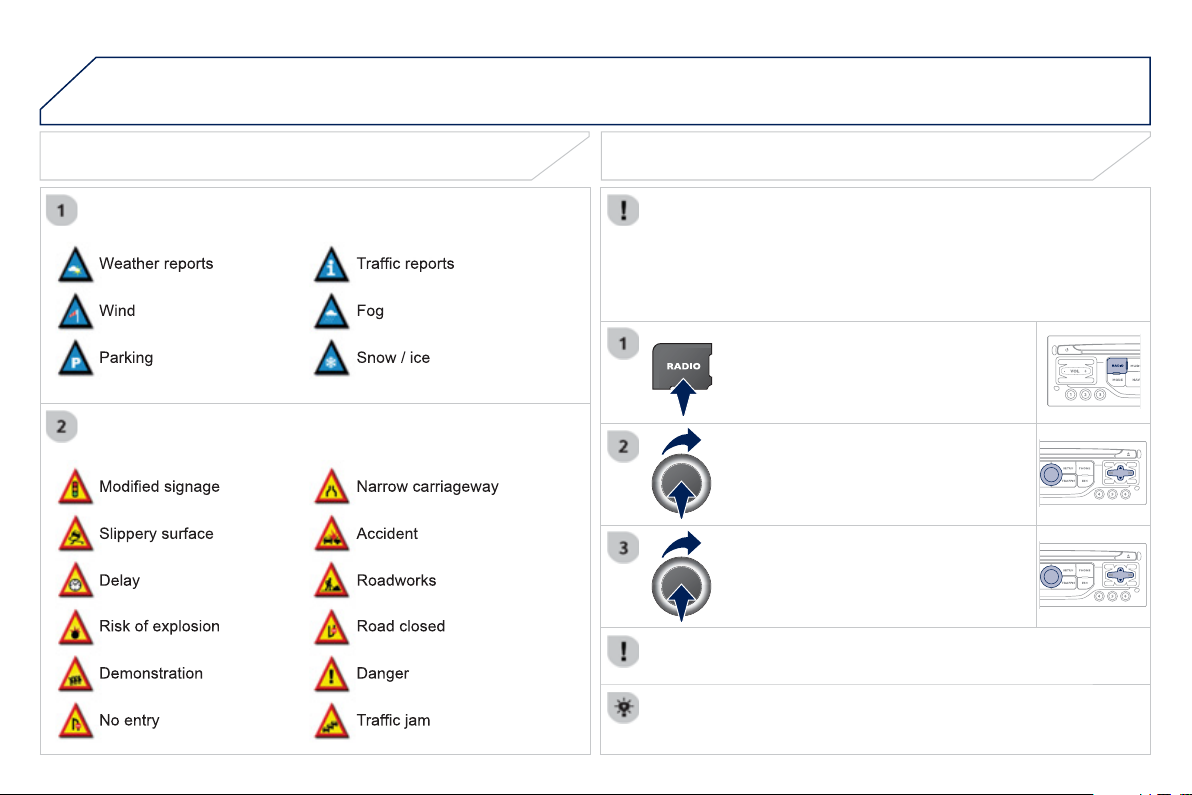
3
1
2
05 TRAFFIC INFORMATION
PRINCIPAL TMC SYMBOLS
Red and
y
ellow trian
g
le: tra
ffi
c in
f
ormation,
f
or example:
Black and blue trian
g
le:
g
eneral information, for example:
R
ECEIVING TA MESSAGES
The TA
(
Traffi c Announcement
)
function
g
ives priorit
y
to TA alert
m
essa
g
es. To operate, this function needs
g
ood reception of a
r
adio station transmittin
g
this t
y
pe of messa
g
e. When a traffi c report
is transmitted, the current audio source
(
Radio,
C
D, U
S
B, ...
)
is
i
nterrupte
d
automat
i
ca
lly
to p
l
a
y
t
h
e
TA
messa
g
e.
N
orma
l
p
l
a
yb
ac
k
of
th
e
aud
i
o
sou
r
ce
r
esu
m
es
a
t th
e
e
n
d
of
th
e
tr
a
n
s
mi
ss
i
o
n
of
th
e
message
.
Pr
ess
R
ADIO to displa
y
the "FM
/
AM
band " m
e
n
u
.
S
elect " Guidance o
p
tion
s
"
t
he
n
co
n
fi
rm.
S
elect "
A
ctivate / Deactivate T
A
" th
e
n
co
nfi rm.
The volume settin
g
f
or TA messa
g
es can be ad
j
usted onl
y
durin
g
the
transmission o
f
this t
y
pe o
f
alert.
A
ctivate or deactivate the
f
unction at any time by pressing the button.
Durin
g
a messa
g
e, press the button to interrupt it.
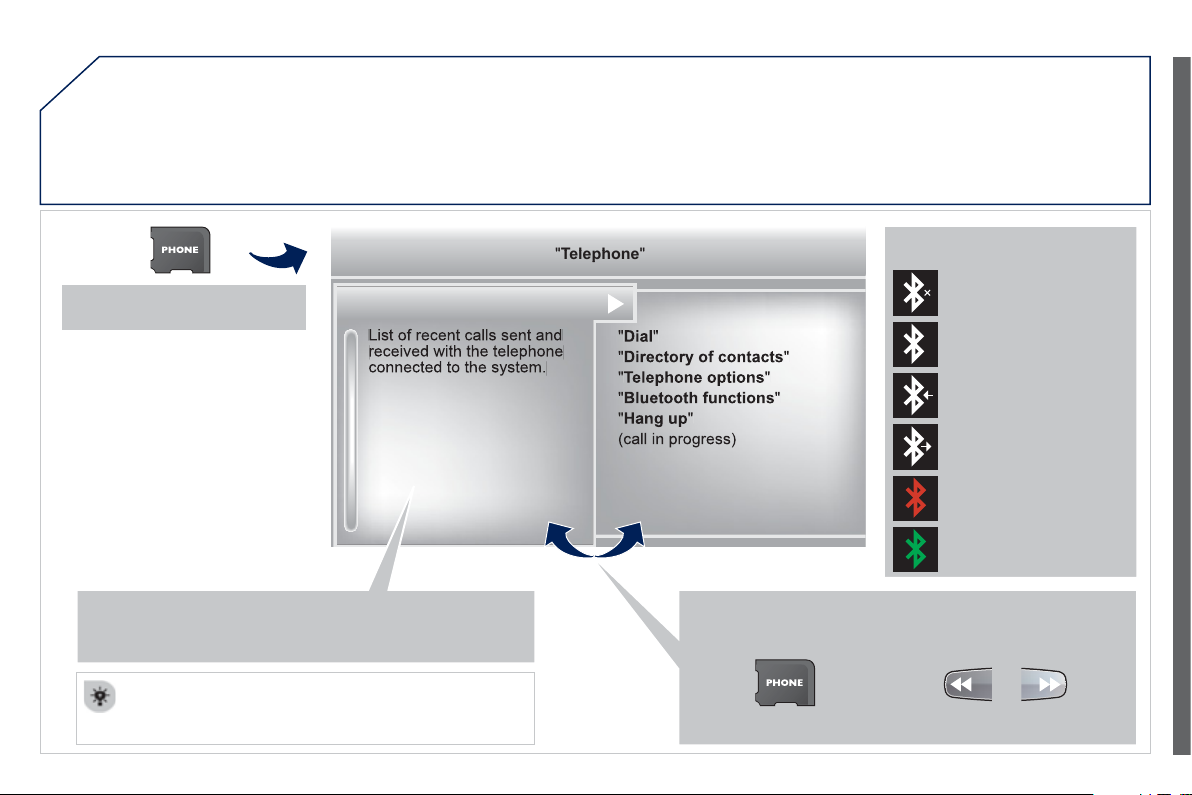
3
1
3
06
USING THE TELEPHONE
Access to the "TELEPHONE" menu
"
"
"
"
"
"
"
p
p
p
p
eepoe
Telephone
Telephone
Telephone
Telephone
Telephone
Telephone
Telephone
Telephone
Telephone
Telephone
Telephone
Telephone
Telephone
Telephone
Tl h
Tl h
Tl h
Tl h
"
"
"
"
"
"
"
G
o
f
rom the list to the menu
(
le
f
t
/
right
)
.
or
P
r
ess
PHON
E
.
To make a call, select a number in the list and con
fi
rm "OK
"
t
o
s
t
a
rt th
e
ca
ll.
C
onnecting a di
ff
erent telephone deletes the list o
f
rece
nt
ca
ll
s
.
N
o te
l
ep
h
one connecte
d
.
Tele
p
hone connected.
Incomin
g
call.
O
ut
g
oin
g
call.
S
y
nchronisation
of
add
r
ess
boo
k in
progress
.
Tele
p
hone call in
p
ro
g
ress.
In the top bar of the permanent
d
ispla
y
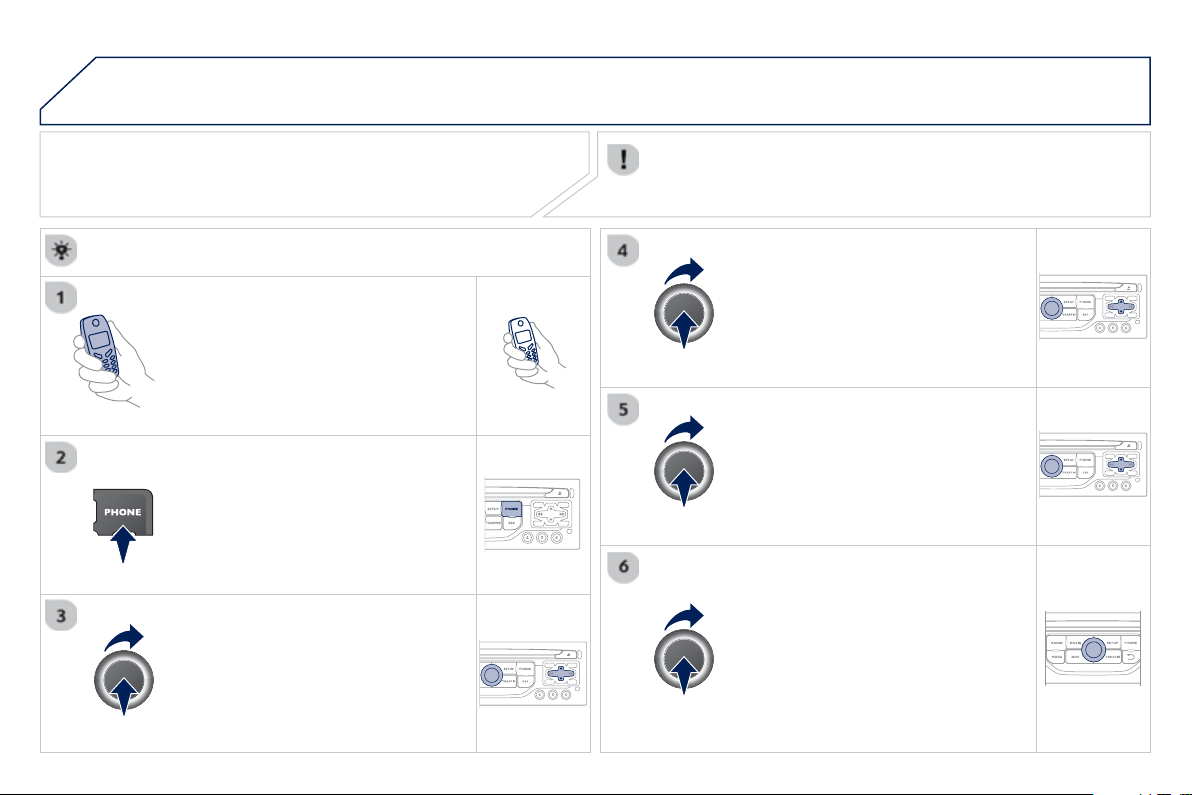
3
14
06
PAIRING A BLUETOOTH TELEPHONE
FIRST CONNECTION
For reasons of safet
y
and because the
y
require prolon
g
ed attention
on the part o
f
the driver, the operations
f
or pairin
g
the Bluetooth
m
obile telephone to the hands-
f
ree s
y
stem o
f
the audio unit must be
ca
rri
ed
ou
t with th
e
v
ehicle stationar
y
.
A
ct
i
vate t
h
e te
l
ep
h
one
'
s
Bl
uetoot
h
fu
n
c
ti
o
n
a
n
d
e
n
su
r
e
th
a
t it i
s
"
s
h
o
wn t
o
a
ll"
(
telephone con
fi
guration
)
.
Pr
ess
thi
s
bu
tt
o
n.
S
elect the name o
f
the desired
peripheral
f
rom the list o
f
devices
de
t
ec
t
ed
th
e
n
se
l
ec
t "Connec
t
"
a
n
d
co
n
fi
rm.
The s
y
stem offers to connect the
tele
p
hone:
-
in
"
H
ands-free mod
e
"
(
telephone
o
nl
y)
,
-
in "
A
u
di
o" mode
(
streamin
g
: pla
y
in
g
music
fi
les on the telephone
)
,
-
o
r "All "
(f
or selection o
f
both
modes
)
.
S
elect " OK "
a
n
d
co
nfi rm.
S
elect "
B
luetooth functions
"
a
n
d
co
n
fi
rm.
S
elect "Peripherals search"
a
n
d
co
nfi rm.
The list of peripherals detected is
di
sp
l
a
y
e
d
.
W
a
i
t unt
il
t
h
e
"
Connec
t
"
bu
tt
o
n
is
a
v
ailable
.
USING THE TELEPHONE
Visit www.peugeot.co.uk
f
or more in
f
ormation
(
compatibility,
additional help, ...
)
.
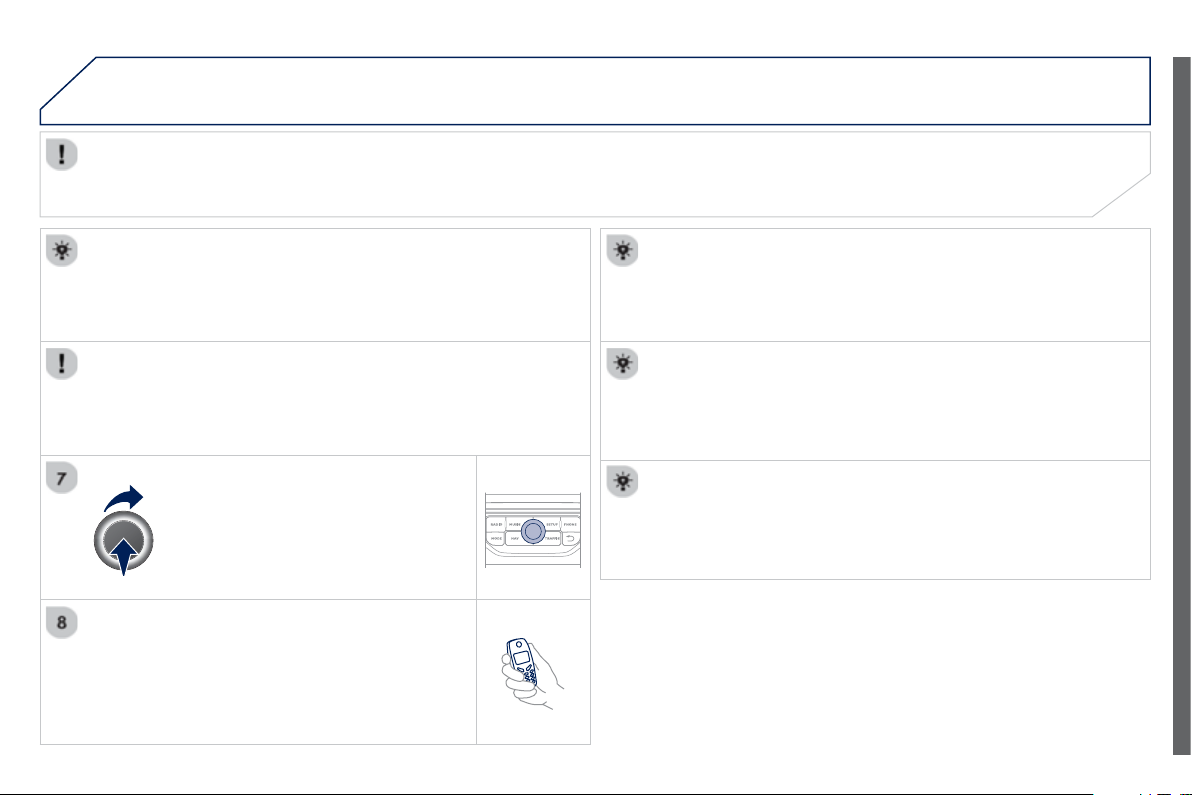
3
1
5
06
E
nter t
h
e same co
d
e on t
h
e te
l
ep
h
one t
h
en accept
t
he
co
nn
ec
t
io
n.
Then accept automatic connection on the telephone to allow the
te
l
ep
h
one to reconnect automat
i
ca
lly
ever
y
t
i
me t
h
e ve
hi
c
l
e
i
s
s
t
a
rt
ed
.
The abilit
y
o
f
the s
y
stem to connect in onl
y
one mode depends on
the telephone. The two modes ma
y
both connect b
y
de
f
ault.
USING THE TELEPHONE
Th
e
"Hands-free mod
e
" should be used in pre
f
erence i
f
"S
treamin
g
" is not desired.
The services available depend on the network, the
S
IM card and the compatibility o
f
the Bluetooth telephone used.
C
heck the telephone
m
anual and with
y
our network provider
f
or details o
f
the services available to
y
ou.
S
elect a code for the connection then
co
nfi rm "OK
".
Dependin
g
on the t
y
pe of telephone, the s
y
stem will ask
y
ou to
accept or not the transfer of
y
our contacts.
O
n return to the vehicle,the last telephone connected
automaticall
y
reconnects, within around 30 seconds after
s
witchin
g
on the i
g
nition
(
Bluetooth activated and visible
)
.
To modi
fy
the automatic connection mode, remove the pairin
g
and pair the telephone again with the desired mode.
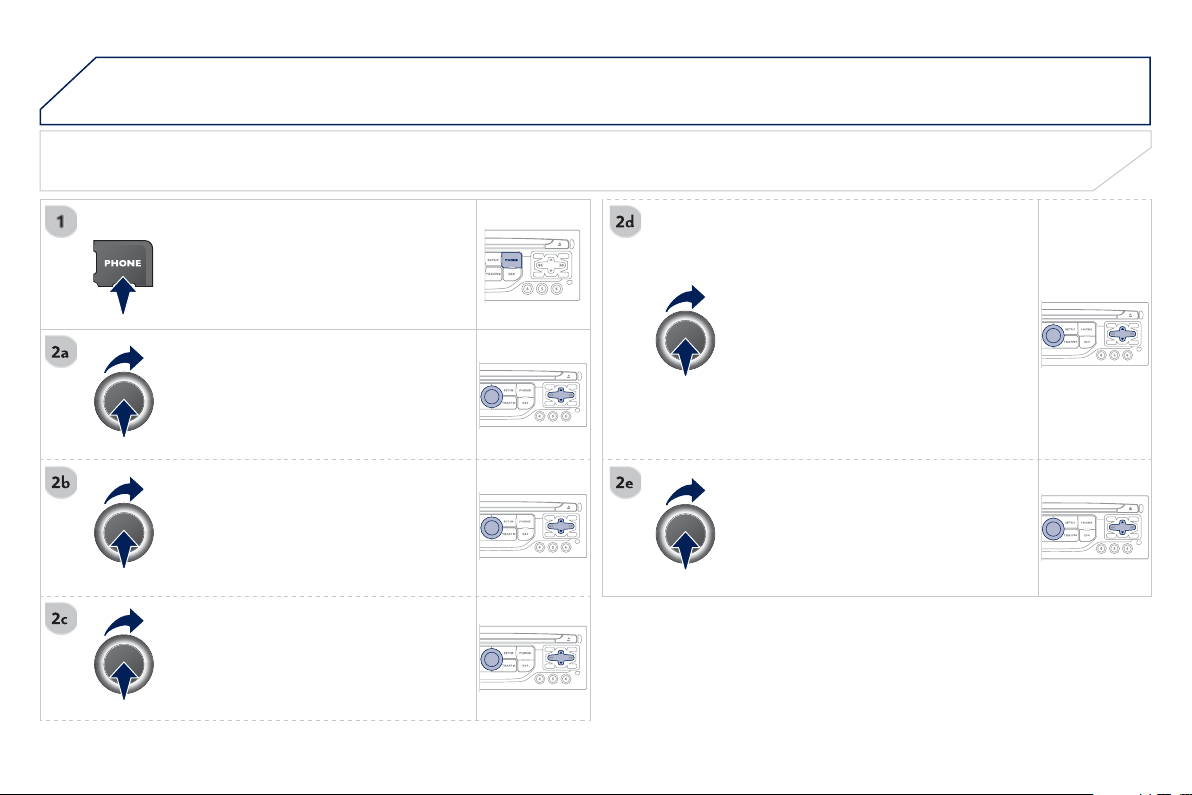
3
1
6
06 USING THE TELEPHONE
DIRECTORY / SYNCHRONIZING CONTACTS
Pr
ess
PHON
E
th
e
n
se
l
ec
t " Contacts
mana
g
emen
t
"
a
n
d
co
n
fi
rm.
S
elect "New contac
t
" t
o
e
nt
e
r
a
n
e
w
co
nt
ac
t.
S
elect "
D
e
l
ete a
ll
contacts
"
t
o
dele
t
e
t
h
e contacts save
d
i
n t
h
e s
y
stem.
S
elect "Im
p
ort all the entries " to import
all the contacts in the telephone and
s
ave them in the s
y
stem.
O
nce im
p
orted, a contact remains visible
w
hatever tele
p
hone is connected.
S
election "Synchronization options":
- No s
y
nchronization: onl
y
the
c
ontacts saved in the s
y
stem
(
alwa
y
s present
)
.
- Displa
y
telephone contacts: onl
y
the
c
ontacts saved in the telephone.
- Displa
y
SIM card contacts: onl
y
the
c
ontacts saved on the
S
IM card.
- Display all phone contacts:
co
nt
ac
t
s
o
n th
e
S
IM
ca
r
d
a
n
d
in th
e
telephone.
Se
l
ec
t "Contact mem. status" t
o
see
th
e
n
umber o
f
contacts saved in the s
y
stem
o
r imported, and the free memor
y
.
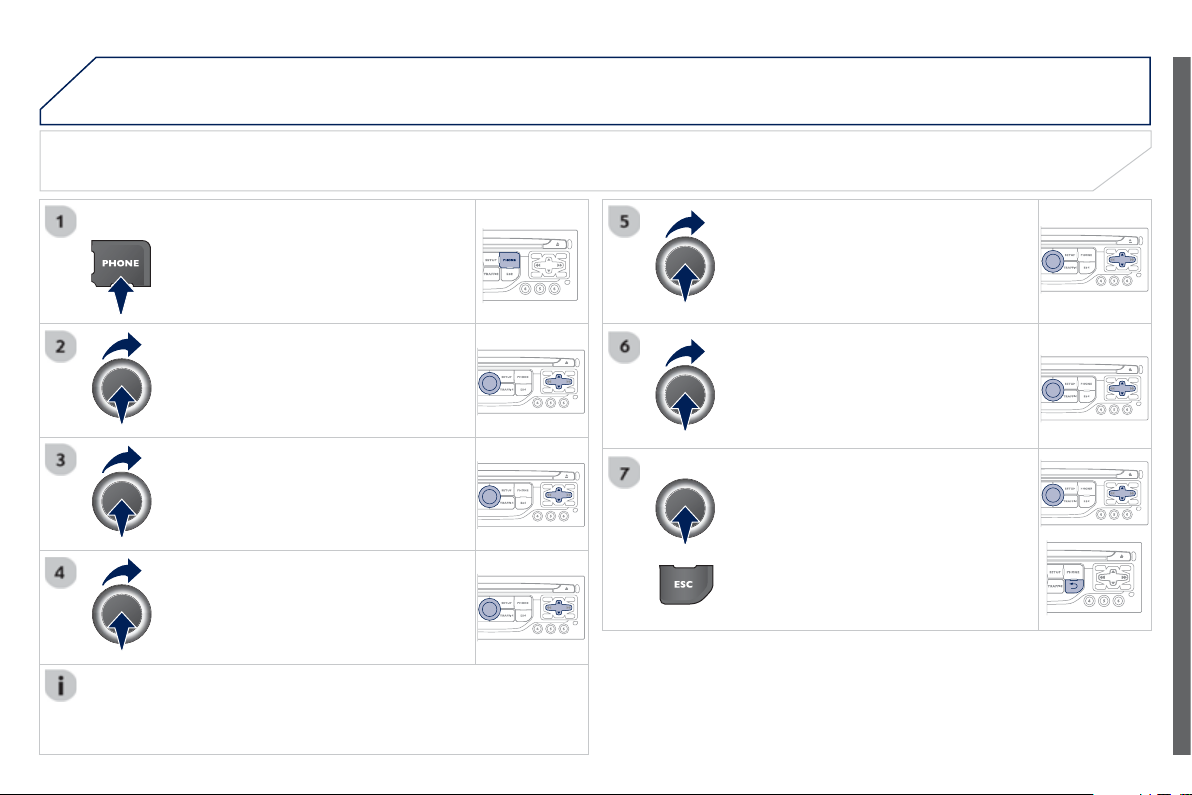
3
1
7
06
MANAGING CONTACTS
Pr
ess
P
HON
E
th
e
n
se
l
ec
t "
D
irector
y
of
c
ontacts"
a
n
d
co
n
fi
rm.
S
elect the desired contact and confi rm.
S
elect " Im
p
or
t
" to cop
y
one contact to
t
h
e s
y
stem.
S
elect " Call" t
o
s
t
a
rt th
e
ca
ll.
S
elect " Open " t
o
vi
e
w
a
n
e
xt
e
rn
a
l
co
nt
ac
t
or modif
y
a contact saved in the s
y
stem.
S
elect OK
o
r
E
SC t
o
e
xit thi
s
m
e
n
u
.
S
elect "
D
elet
e
" t
o
de
l
e
t
e
a
co
nt
ac
t
sa
v
ed
in the s
y
stem.
It is necessar
y
to import an external contact to modif
y
the record.
It will be saved in the s
y
stem. It is not possible to modif
y
or delete
c
ontacts in the telephone or the
S
IM card via the Bluetooth
co
nn
ec
t
io
n.
USING THE TELEPHONE
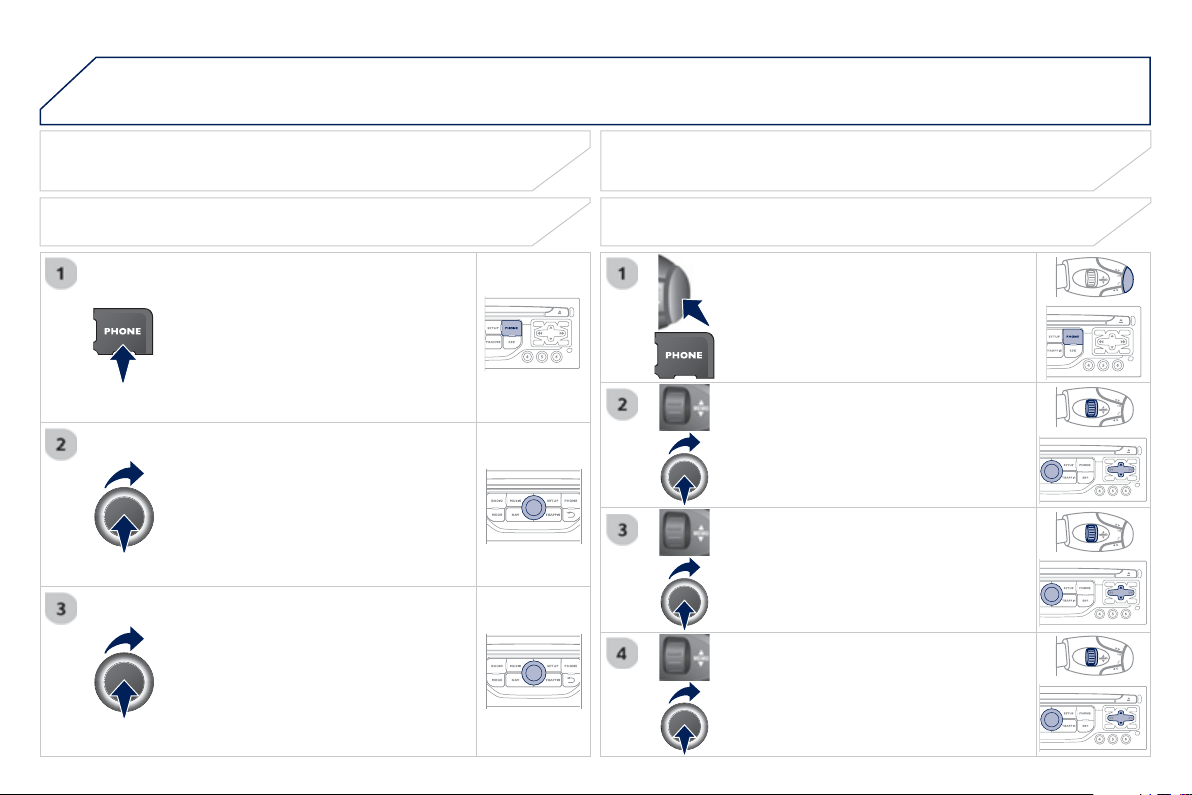
3
1
8
06 USING THE TELEPHONE
Pr
ess
P
HON
E
twi
ce
.
S
elect "
Di
a
l
" th
e
n
co
n
fi
rm.
Se
l
ec
t "
D
irector
y
of contacts" th
e
n
co
nfi rm.
Dial the telephone number usin
g
the
virtual ke
y
pad selectin
g
each number
i
n t
u
rn.
C
on
fi
rm " OK
"
t
o
m
ake
t
he
call
.
P
r
ess
TEL
o
r tw
ice
o
n
P
HON
E
.
CALLING A NEW NUMBER CALLING A CONTACT
Se
l
ec
t th
e
des
ir
ed
co
nt
ac
t
a
n
d
co
n
fi
rm.
If
access
w
as
vi
a
th
e
P
HON
E
button,
se
l
ec
t "Cal
l
"
a
n
d
co
nfi rm.
S
elect the number and con
fi
rm to start
th
e
ca
ll.
M
AKING A CALL
Use o
f
the telephone is not recommended while drivin
g
. We
r
ecommended that
y
ou park sa
f
el
y
or make use o
f
the steerin
g
mou
nt
ed
co
ntr
o
l
s
.
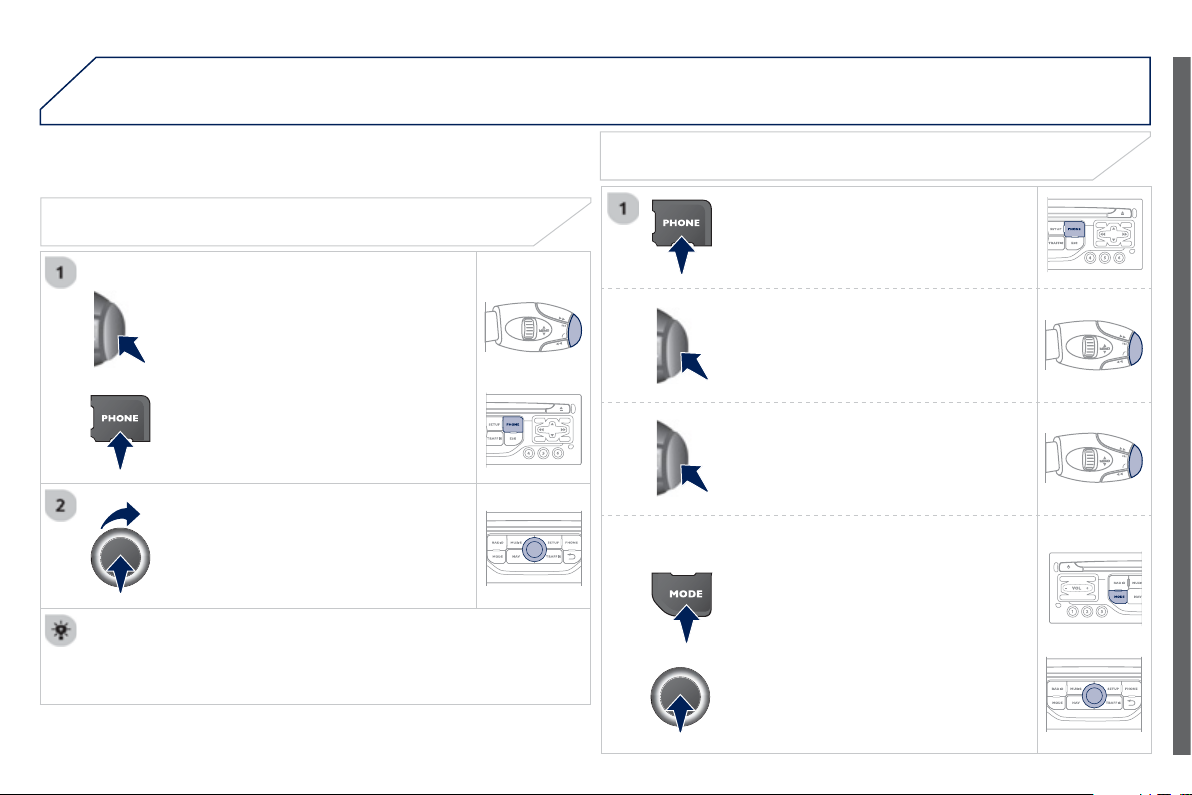
3
1
9
06 USING THE TELEPHONE
CALLING A RECENTLY ENTERED NUMBER
Pr
ess
TEL
, select "Call lis
t
"
a
n
d
c
onfi rm
,
S
elect the desired number and con
fi
rm.
To erase the calls lo
g
, press
P
HONE twice, select "
P
hone
f
unctions"
a
n
d
co
nfi rm th
e
n
se
l
ec
t "
D
elete calls lo
g
"
a
n
d
co
nfi rm.
ENDING A CALL
P
r
ess
P
HON
E
t
he
n
selec
t
"
O
K
"
t
o
e
n
d
t
he
call
.
O
r make a lon
g
press on
T
EL
a
t th
e
steerin
g
mounted controls.
O
r make two short
p
resses on
T
E
L
a
t
the steerin
g
mounted controls.
O
r
p
ress the MODE button, as man
y
times as necessar
y
, until the telephone
screen
i
s
di
sp
l
a
y
e
d
.
p
ress
P
HONE to displa
y
the calls lo
g
.
or
P
r
ess
"
O
K
"
to
di
sp
l
a
y
t
h
e contextua
l
m
e
n
u
t
he
n
selec
t
"
H
an
g
up
"
a
n
d
co
n
fi
rm.
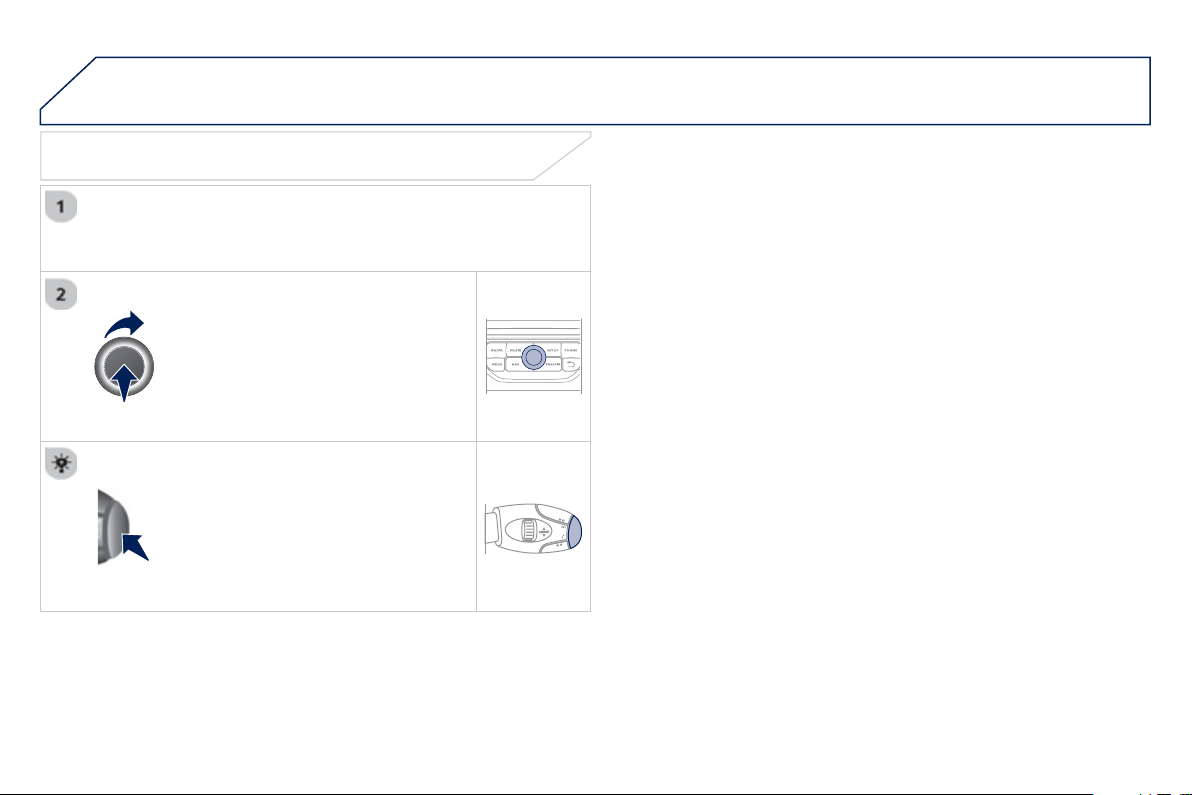
3
2
0
06 USING THE TELEPHONE
RECEIVING A CALL
A
n incomin
g
call is announced b
y
a rin
g
and a superimposed displa
y
o
n th
e
sc
r
ee
n.
"
Yes" to accept the call is selected by
defau
lt.
Pr
ess
" O
K
" to acce
p
t the call.
S
elect " N
o
" and confi rm to re
j
ect the
ca
ll.
A
short press on
T
E
L
accepts an
i
ncomin
g
call.
A
lon
g
press on
T
EL re
j
ects an incomin
g
ca
ll.
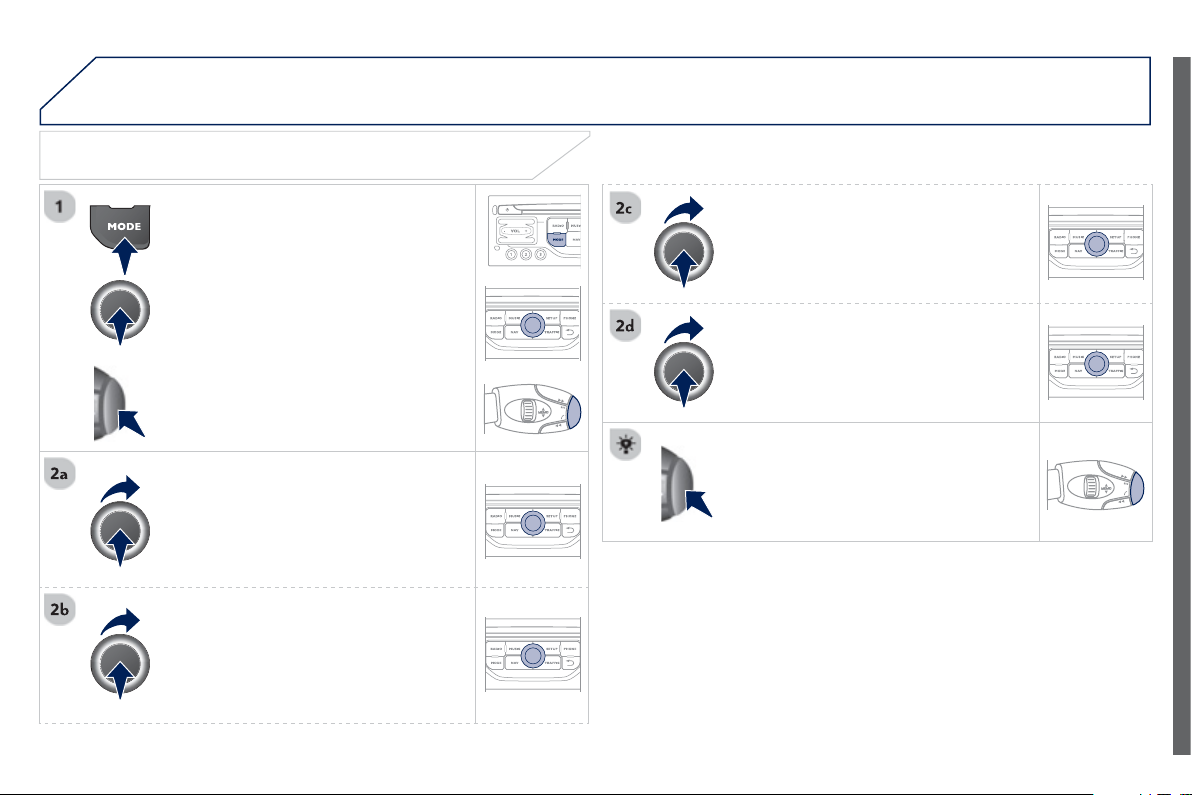
3
2
1
06 USING THE TELEPHONE
OPTIONS DURING A CALL *
D
ur
i
n
g
a ca
ll
, press t
h
e
M
OD
E
bu
tt
o
n
several times to select displa
y
o
f
the
te
l
ep
h
one screen, t
h
en press
"
OK
"
t
o
open the contextual menu.
Se
l
ec
t "
P
rivate mod
e
"
a
n
d
co
n
fi
rm t
o
t
a
k
e
th
e
ca
ll
o
n th
e
h
a
n
dse
t.
O
r select "
H
ands-free mod
e
"
a
n
d
co
nfi rm t
o
t
a
k
e
th
e
ca
ll vi
a
th
e
v
e
hi
c
l
e
'
s
spea
k
ers.
S
elect "
P
ut call on hold"
a
n
d
co
nfi rm t
o
p
ut the current call on hold.
O
r select "
R
esume the call"
a
n
d
co
nfi rm t
o
r
esu
m
e
th
e
ca
ll
o
n h
o
l
d
.
S
elect "
D
TMF rin
g
tones " t
o
use
th
e
numerical ke
y
pad, so as to navi
g
ate
throu
g
h the menu of an interactive vocal
ser
v
er
.
S
elect "
H
an
g
u
p
"
t
o
e
n
d
t
he
call
.
*
Dependin
g
on the compatibilit
y
o
f
the phone and
y
our service plan.
it is possible to hold a 3-wa
y
conference
c
all b
y
makin
g
2 calls in succession*.
S
elect "Conferenc
e
m
o
d
e ca
ll
"
i
n t
he
c
ontextua
l
menu access
ibl
e us
i
n
g
t
hi
s
bu
tt
o
n.
O
r make a short press on this button.
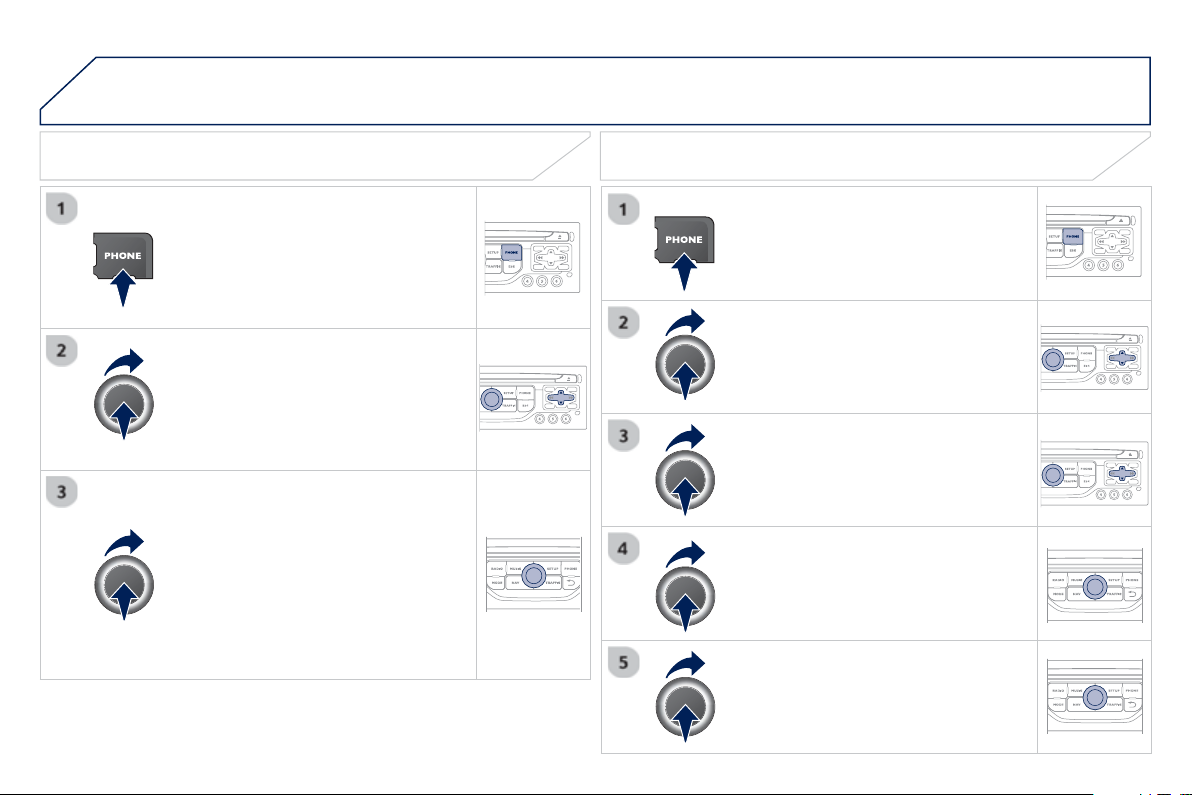
3
2
2
06
Pr
ess
P
HON
E
twi
ce
.
Se
l
ec
t "
L
ist of the
p
aired
p
eri
p
herals"
a
n
d
co
n
fi
rm.
It is
p
ossible to:
-"Connec
t
"
o
r "
D
isconnec
t
" th
e
s
elected telephone,
- delete the pairin
g
o
f
the selected
te
l
ep
h
one.
It is also possible to select all pairings.
USING THE TELEPHONE
MANAGING PAIRED TELEPHONES CHANGING THE RING TONE
Pr
ess
P
HON
E
twi
ce
.
Se
l
ec
t "
P
hone functions "
a
n
d
co
n
fi
rm.
S
elect "
R
in
g
options"
a
n
d
co
nfi rm.
You can ad
j
ust the volume and the t
y
pe
o
f
rin
g
tone.
S
elect "
B
luetooth functions
".
S
elect " OK "
a
n
d
co
n
fi
rm t
o
sa
v
e
th
e
ch
an
g
es.
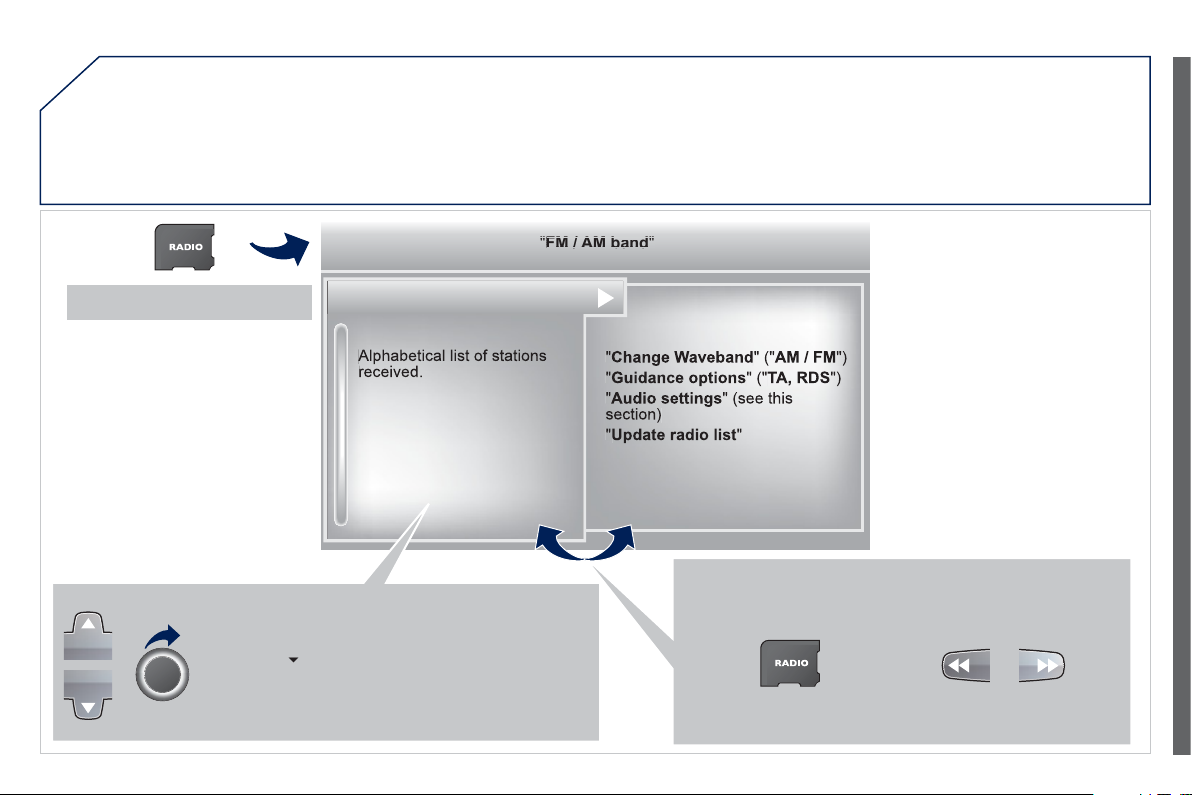
3
2
3
07
RADIO
Access to the "RADIO" menu
"
"
"
"
"
"
"
"
FM
/
AM
band
FM / AM band
FM / AM band
FM / AM band
FM / AM band
FM / AM band
FM / AM band
FM / AM band
FM / AM band
FM / AM band
FM / AM band
FM / AM band
FM / AM band
FM / AM band
FM / AM b d
FM / AM b d
FM / AM b d
FM / AM b d
FM / AM b d
"
"
"
"
"
"
"
"
Pr
ess
or
or use the rotar
y
control to select the
p
revious or next station in the list.
G
o
f
rom the list to the menu
(
le
f
t
/
ri
g
ht
)
.
or
Pr
ess
RADIO
.
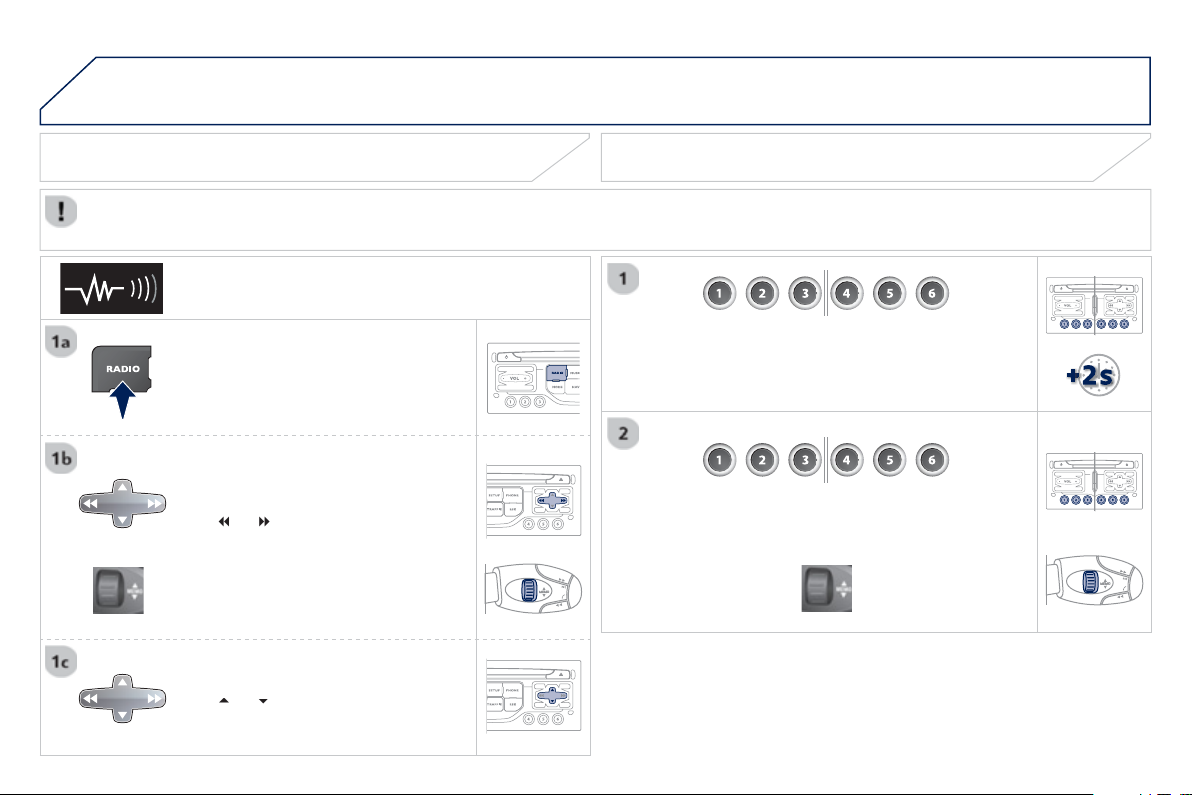
3
24
07 RADIO
By alphabetical list
Pr
ess
R
ADIO
or
L
I
ST
, select the station
o
f
y
our choice and con
fi
rm.
B
y
automatic frequenc
y
search
P
r
ess
or
fo
r th
e
au
t
o
m
a
ti
c
sea
r
c
h
f
or a lower or higher radio
f
requency.
O
r turn the thumb wheel at the steerin
g
m
ou
nt
ed
co
ntr
o
l
s
.
B
y
manual frequenc
y
search
Pr
ess
o
r
to ad
j
ust the radio
f
requenc
y
step b
y
step.
Press the button on the numerical ke
y
pad to recall a
preset station.
O
r press then turn the thumb wheel at the steerin
g
m
ou
nt
ed
co
ntr
o
l
s
.
SELECTING A STATION
The external environment
(
hill, buildin
g
, tunnel, under
g
round car park...
)
ma
y
inter
f
ere with the reception, includin
g
in RD
S
station trackin
g
mode.
T
his phenomenon is a normal result o
f
the way in which radio waves are transmitted and does not in any way indicate a
f
ault with the audio system.
PRESETTING A STATION
A
fter selectin
g
a station, press one of the buttons
on the numerical ke
y
pad for 2 seconds to preset the
cu
rr
e
nt
s
t
a
t
io
n.
A
n audible si
g
nal con
fi
rms that the station has been
p
reset.
The qualit
y
o
f
reception is represented b
y
the number o
f
a
ctive waves in this s
y
mbol.
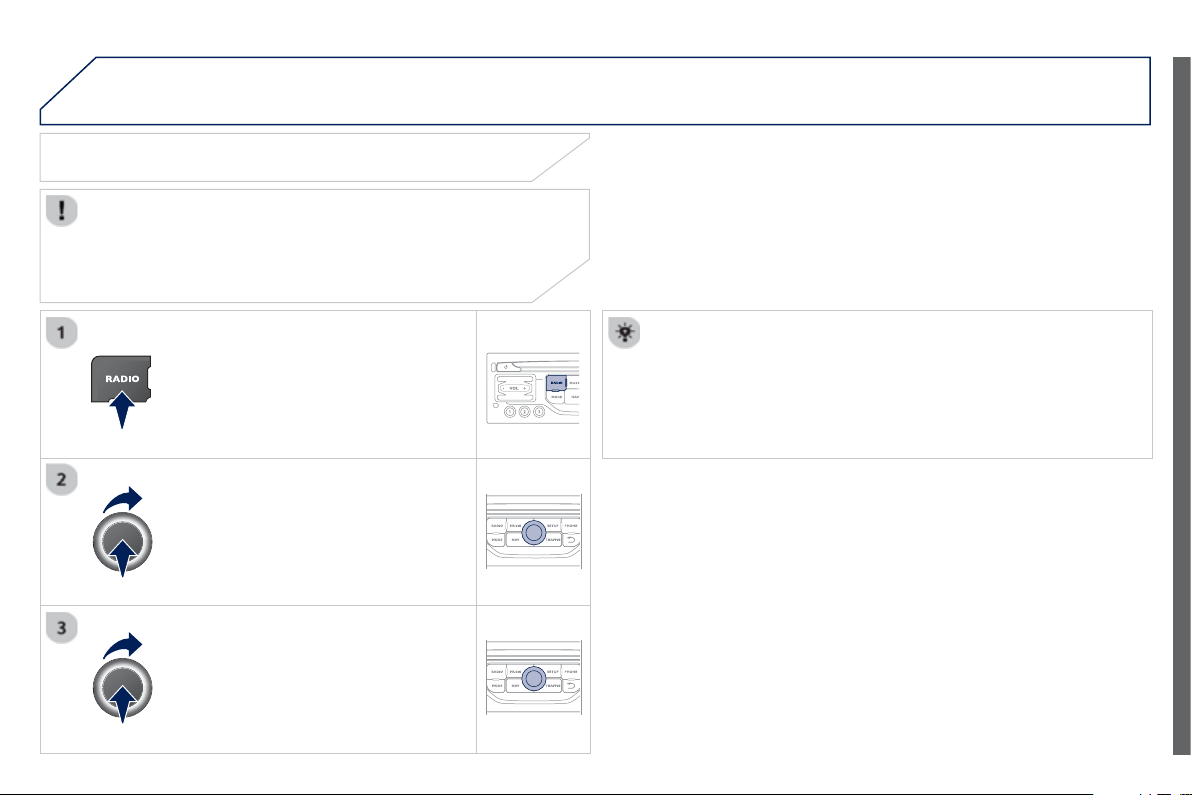
3
2
5
07
P
r
ess
RADIO .
ACTIVATE / DEACTIVATE RDS
RD
S
, i
f
activated, allows you to continue listening to the same
s
tation b
y
automatic retunin
g
to alternative
f
requencies. However,
in certain conditions, covera
g
e o
f
an RD
S
station ma
y
not be
assured throu
g
hout the entire countr
y
as radio stations do not
c
over 100 % of the territor
y
. This explains the loss of reception o
f
the station durin
g
a
j
ourne
y
.
S
elect "
G
uidance o
p
tions"
a
n
d
co
nfi rm.
S
elect "Activate / Deactivate RD
S
"
a
n
d
co
n
fi
rm.
RADIO
Se
l
ec
t "
A
ctivate / Deactivate RD
S
".
R
a
di
o
di
sp
l
a
y
e
d
, press
"
OK
"
to
di
sp
l
a
y
t
h
e contextua
l
menu.
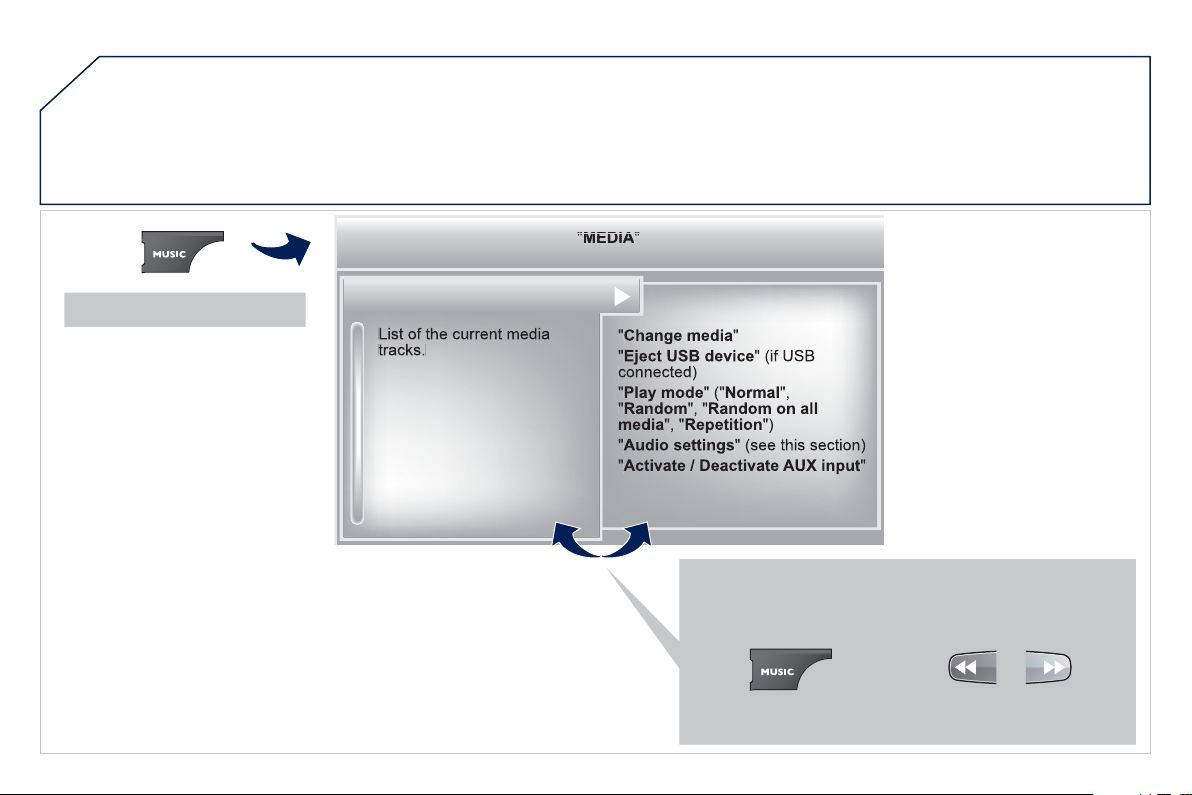
3
2
6
08
MUSIC MEDIA PLAYERS
Access to the "MUSIC MEDIA PLAYER" menu
"
"
"
"
"
"
"
"
MEDIA
MEDIA
MEDIA
MEDIA
MEDIA
MEDIA
MEDIA
MEDIA
MEDIA
MEDIA
MEDIA
MEDIA
MEDIA
MEDIA
MEDIA
MEDIA
MEDIA
MEDIA
MEDIA
"
"
"
"
"
"
"
"
G
o
f
rom the list to the menu
(
le
f
t
/
ri
g
ht
)
.
o
r
P
r
ess
M
USI
C
.
3
2
7
08 MUSIC MEDIA PLAYERS
CD, MP3 CD / USB PLAYER
The audio equipment will only play audio fi les with ".wma, .aac, .fl ac,
.ogg and. mp3" fi le extensions and with a bit rate of between 32 Kbps
yy
yp y
and
320
Kbps.
It also supports VBR
(
Variable Bit Rate
)
mode.
No other t
y
pe of fi le
(
.mp4, .m3u...
)
can be pla
y
ed.
WMA
fi
les must be o
f
the standard wma 9 t
y
pe.
The samplin
g
rates supported are 11, 22, 44 and 48 KHz.
It is advisable to restrict
fi
le names to 20 characters, without usin
g
o
f
s
pecial characters
(
e.
g
.: " "
?
; ù
)
to avoid an
y
pla
y
in
g
and displa
y
in
g
p
roblems.
In order to be able to pla
y
a recorded CDR or CDRW, when recordin
g
it is
p
referable to select the IS
O
9660 level 1, 2 or Joliet standard.
If the disc is recorded in another format it ma
y
not be pla
y
ed correctl
y
.
I
t
i
s recommen
d
e
d
t
h
at t
h
e same recor
di
n
g
stan
d
ar
d
i
s a
l
wa
y
s use
d
f
or an individual disc, with as low a speed as possible
(
4x maximum
)
f
or optimum sound qualit
y
.
In the particular case o
f
a multi-session
C
D, the Joliet standard is
reco
mm
e
n
ded
.
INFORMATION AND ADVICE
The s
y
stem supports USB mass stora
g
e or iPod
devices via the U
S
B port
(
suitable cable not supplied
)
.
C
ontrol o
f
the peripheral device is with the audio
sy
stem contro
l
s.
O
ther peripherals, not reco
g
nised on connection, must
be connected to the auxiliar
y
socket usin
g
a Jack cable
(
not supplied
)
.
In order to be read, a USB memor
y
stick must be formatted FAT 16 or 32.
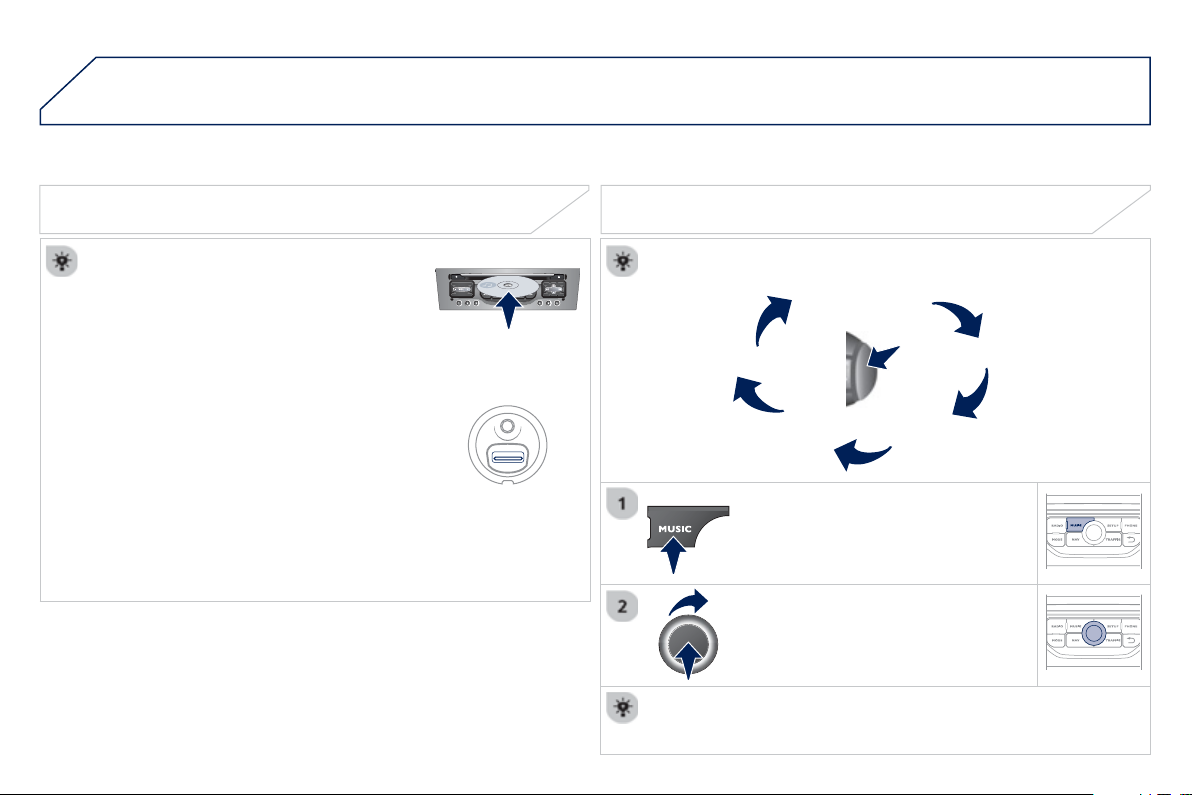
3
2
8
08 MUSIC MEDIA PLAYERS
Insert the
C
D in the pla
y
er, insert the U
S
B
m
emor
y
stick in the U
S
B pla
y
er or connect the
U
SB peripheral to the USB port usin
g
a suitable
c
able
(
not supplied
)
The s
y
stem builds pla
y
lists
(
in temporar
y
m
emor
y)
, an operation which can take from
a
fe
w
seco
n
ds
t
o
se
v
e
r
a
l min
u
t
es
a
t th
e
fi
r
s
t
co
nn
ec
t
io
n.
R
educe
th
e
n
u
m
be
r
of
n
o
n-m
us
i
c
fi
l
es
a
n
d
th
e
n
umber o
f
f
olders to reduce the waitin
g
time.
The pla
y
lists are updated ever
y
time the i
g
nition
is switched off or connection of a USB memor
y
s
tick. However, the s
y
stem memorises these
lists and if the
y
are not modifi ed, the loadin
g
t
i
m
e
w
ill
be
sho
rt
e
r.
Pla
y
starts automaticall
y
a
f
ter a period which
depends on the capacity o
f
the U
S
B memory
s
ti
c
k.
SELECTION OF SOURCE
Th
e
SOURC
E
button on the steerin
g
mounted controls allows a
di
rect c
h
an
g
e to t
h
e next me
di
a source.
" CD / CD MP
3
"
"
U
SB, IPod"
"AUX " "
S
TREAMIN
G
"
"RADIO "
Pr
ess
M
U
S
I
C
to display the "MEDIA "
menu
.
S
elect "
F
o
ll
ow
i
n
g
me
di
a sourc
e
"
a
n
d
co
n
fi
rm.
R
epeat t
h
e operat
i
on as man
y
t
i
mes as necessar
y
to o
b
ta
i
n t
h
e
desired media source
(
except
f
or radio which is accessible either
w
ith
SOURCE
or
RADIO
)
.
SOURCES
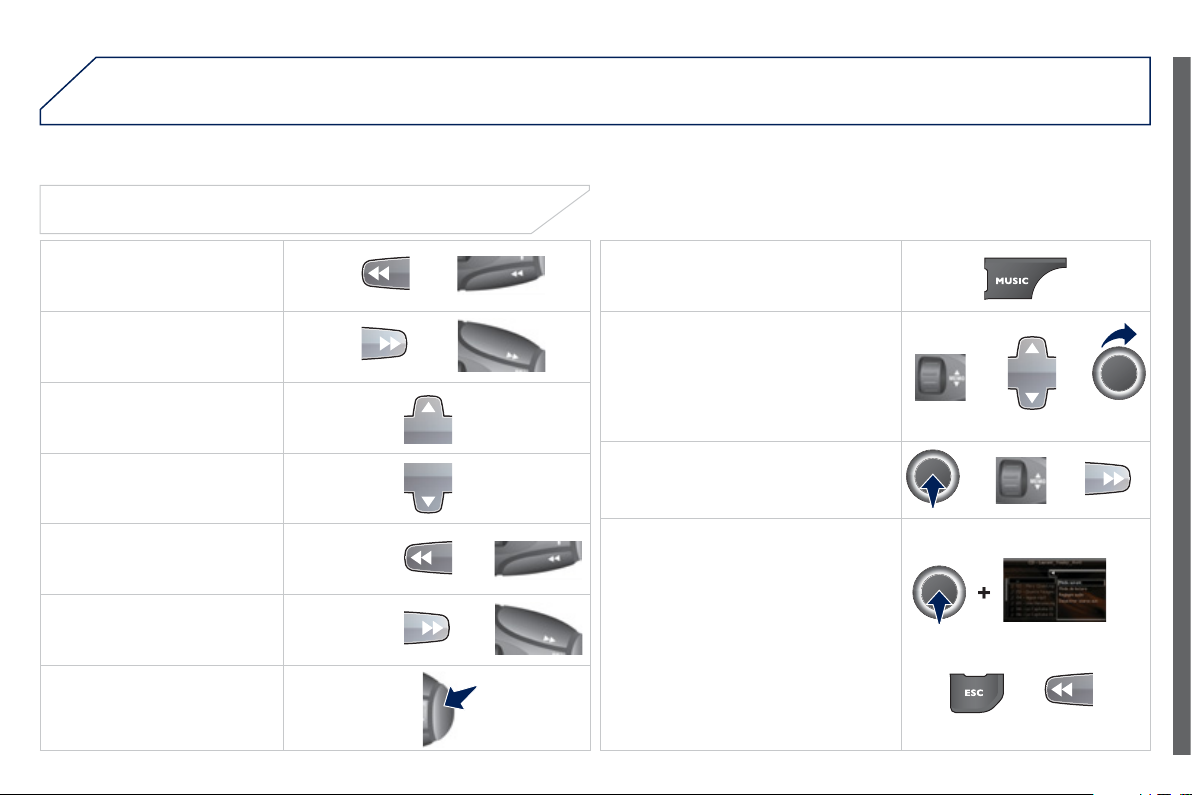
3
2
9
08
/
/
/
/
/
/
/
+
/
/
/
SELECTING A TRACK
MUSIC MEDIA PLAYERS
P
r
e
v
ious
tr
ack
.
N
e
xt tr
ac
k.
Pr
e
vi
ous
fo
l
de
r.
N
e
xt
fo
l
de
r.
F
as
t f
o
rw
a
r
d
.
F
as
t
bac
kw
a
r
d
.
Pause: lon
g
press on SR
C
.
MU
S
IC: List of U
S
B or CD tracks o
r
f
olders
Up or down in the list.
Confi rm, next menu level.
U
p one menu
l
eve
l
.
L
on
g
press
Lon
g
press
330
08
A
UDIO STREAMING
S
treamin
g
allows audio
fi
les on
y
our telephone to be pla
y
ed via the
vehicle's speakers.
C
onnect the telephone: see "U
S
IN
G
THE TELEPH
O
NE".
Se
l
ec
t "
A
udio"
o
r "
A
ll" pro
fi
le.
I
f
pla
y
does not start automaticall
y
, it ma
y
be necessar
y
to start the
a
udio pla
y
back
f
rom the telephone.
Control is from the peripheral device or b
y
usin
g
the audio s
y
stem
bu
tt
o
n
s
.
O
nce connected in streamin
g
mode, the telephone is considered to be
a
m
edia
sou
r
ce
.
It is recommended that
y
ou activate "
R
e
p
ea
t
"
o
n th
e
Bl
ue
t
oo
th
peripheral.
MUSIC MEDIA PLAYERS
CONNECTING APPLE
®
PLAYERS
®
Connect the A
pp
le
®
pla
y
er to the USB port usin
g
a suitable cable
(
not supplied
)
.
Pl
a
y
starts automat
i
ca
lly
.
C
ontrol is via the audio s
y
stem.
The classifi cations available are those of the portable device
c
onnected
(
artists / albums /
g
enres / pla
y
lists / audiobooks /
p
odcasts
)
.
The de
f
ault classi
fi
cation used is b
y
artist. To modi
fy
the classi
fi
cation
u
sed, return to the
fi
rst level o
f
the menu then select the desired
c
lassi
fi
cation
(
pla
y
lists
f
or example
)
and con
fi
rm to
g
o down throu
g
h
th
e
m
e
n
u
t
o
th
e
des
ir
ed
tr
ac
k.
The version of software in the audio s
y
stem ma
y
not be compatible
with the
g
eneration of
y
our Apple
®
pla
y
er.
The list of devices compatible with software versions is available from
PEU
G
E
O
T dealers.
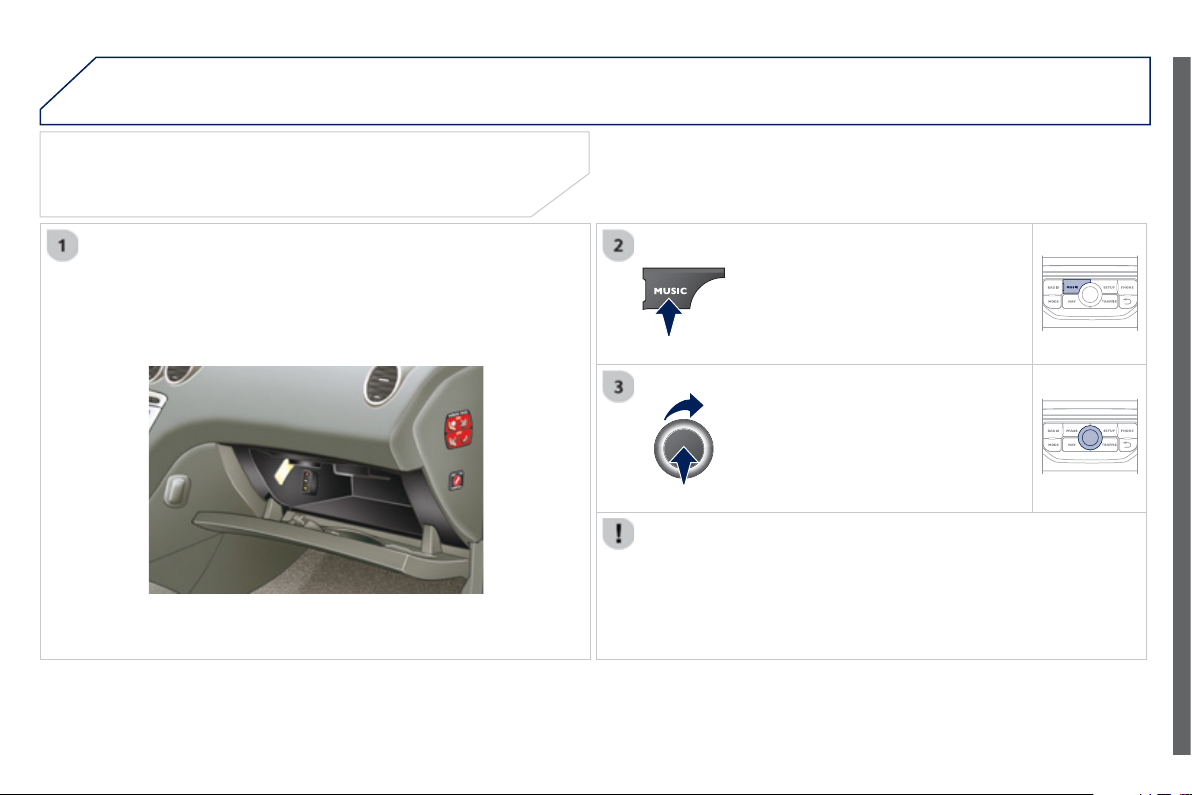
331
08 MUSIC MEDIA PLAYERS
U
SING THE AUXILIARY INPUT
(
AUX
)
J
ACK/RCA AUDIO CABLE NOT SUPPLIED
C
onnect the portable device
(
MP3, WMA pla
y
er…
)
to the R
C
A audio
s
ockets
(
white and red
)
using a JA
C
K-R
C
A audio cable.
P
r
ess
MUSIC to
di
sp
l
a
y
t
h
e
"
M
USI
C
"
menu
.
S
elect "Activate / Deactivate AUX
in
p
u
t
"
a
n
d
co
nfi rm.
First ad
j
ust the volume of
y
our portable
device
(
to a hi
g
h level
)
. Then ad
j
ust the
volume o
f
y
our audio s
y
stem.
Displa
y
and mana
g
ement of the controls are via the portable device.
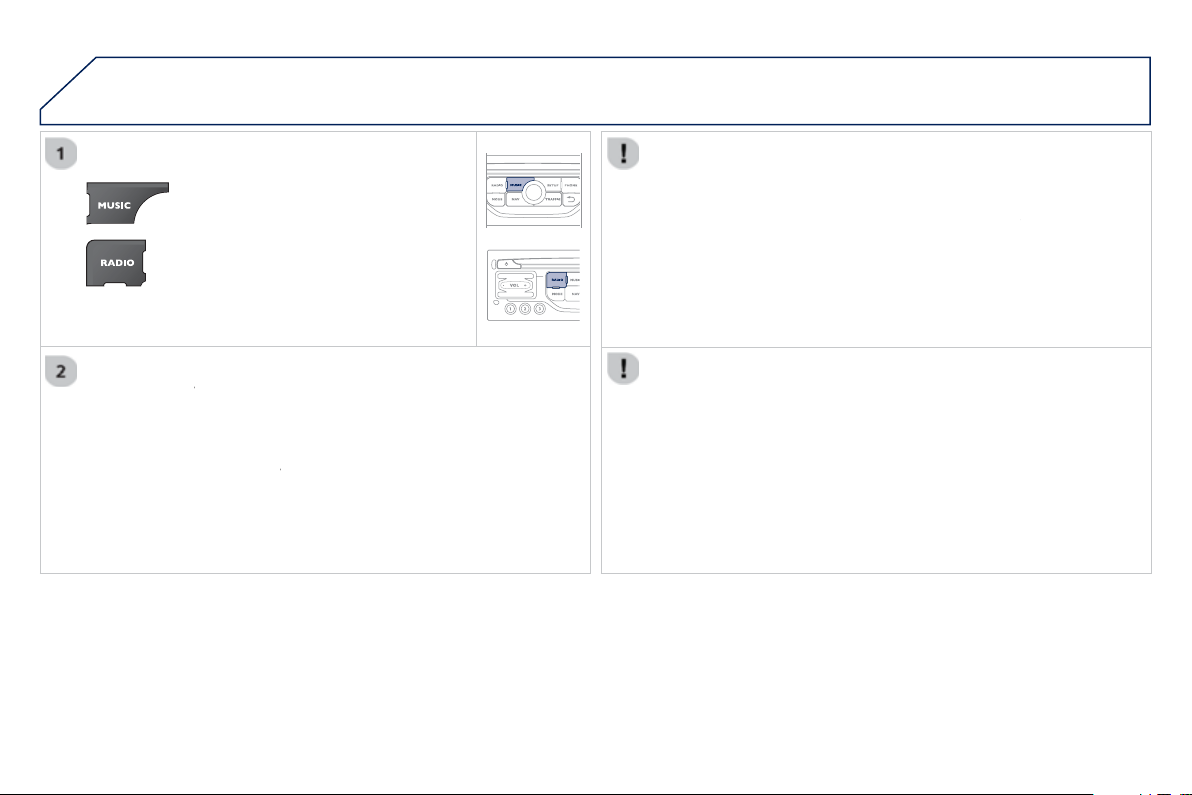
332
09
A
UDIO SETTINGS
They are accessible by the
M
U
S
IC
button in the control panel or b
y
a lon
g
press
on
RADI
O
accordin
g
to the source
in
use
.
- "
Eq
ualize
r
" (choice of 6 musical ambiences)
r
- " Bass"
- " Trebl
e
"
-"Loudness"
(
Activate/Deactivate
)
-
"
Di
str
ib
ut
i
o
n
"
(
"
Driver
", "
r
All
passen
g
er
s
"
)
-
"
Le-
Ri
b
a
l
anc
e
"
(
Le
f
t
/
Ri
g
ht
)
-
"
F
r-
R
e
b
a
l
anc
e
"
(
Front
/
Rear
)
- "
A
uto. Volum
e
" depending on road speed
(
Activate
/
Deactivate
)
The audio settings
(
Equalizer
,
r
Bas
s
,
T
rebl
e
a
n
d
L
oudness
)
are
di
ff
erent and independent
f
or each sound source.
The settin
g
s
f
or distribution and balance are common to all sources.
The distribution
(
or spatialisation usin
g
the Arkam
y
s
©
system) of sound
©
is an audio process that allows the audio qualit
y
to be adapted to the
n
u
m
be
r
o
f li
s
t
e
n
e
r
s
in th
e
v
e
hi
c
l
e
.
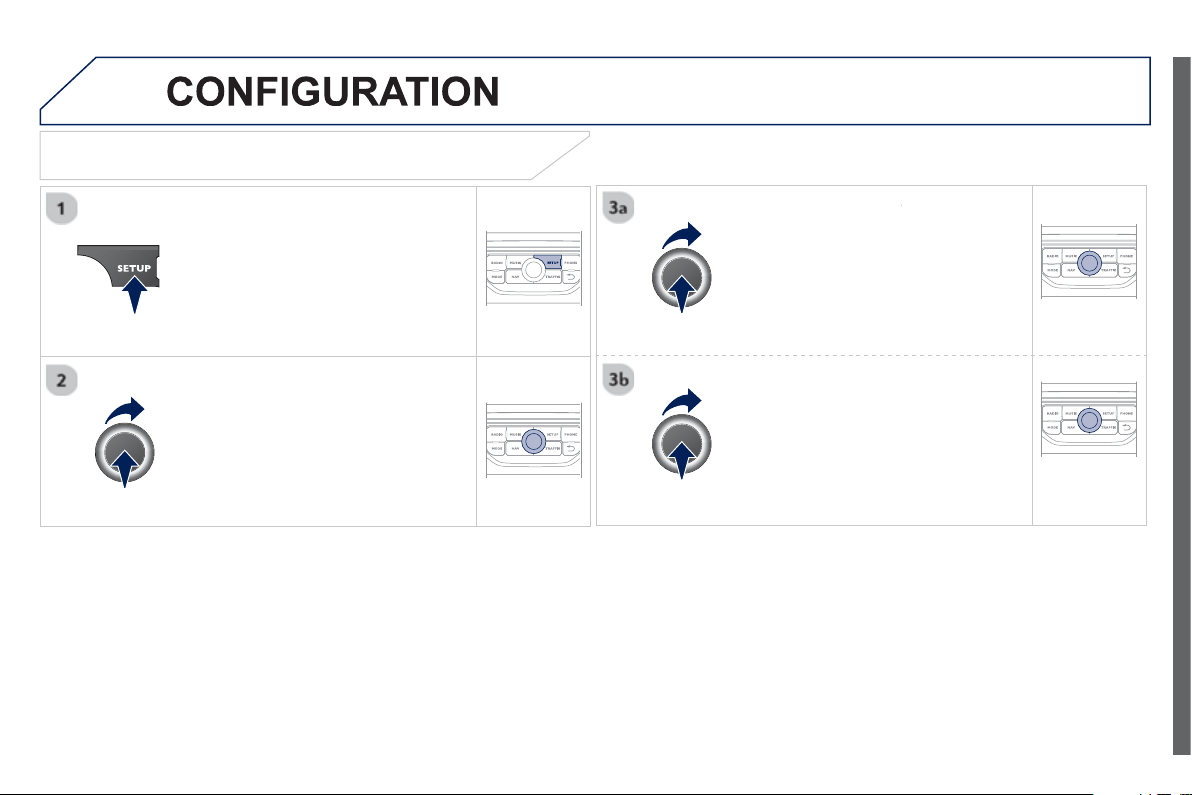
333
10
Pr
ess
SETU
P
to displa
y
the
"
Confi
g
uration " m
e
n
u
.
S
elect "
Choose colour
"
a
n
d
co
nfi rm t
o
r
select the screen colour harmon
y
and
t
h
e map presentat
i
on mo
d
e:
-
d
a
y
mo
d
e,
- n
igh
t mo
d
e,
- automatic day
/
night mode,
a
ccordin
g
to whether the
headlamps are on.
S
elect "
Adj
ust
l
um
i
nos
i
t
y
"
a
n
d
co
nfi rm
to a
dj
ust t
h
e screen
b
r
igh
tness.
Pr
ess
" O
K
" to save the changes.
The settings
f
or day and night are
i
ndependent.
S
elect "
D
ispla
y
confi
g
uratio
n
"
a
n
d
co
nfi rm.
DISPLAY CONFIGURATION
33
4
11 SCREEN MENU MAP
"N
av
ig
at
i
on -
g
u
id
ance
"
M
ENU
Enter an address
Select destination
Directory
GPS coordinates
(
Archive
)
J
ourne
y
l
e
g
an
d
route
Add a sta
g
e
E
nter an address
D
irector
y
P
revious destinations
Order/delete
j
ourne
y
le
g
s
Di
vert route
Chosen destination
Guidance o
p
tions
Defi ne calculation criteria
Set speech s
y
nthesis
D
e
l
ete
l
ast
d
est
i
nat
i
ons
Map mana
g
ement
M
a
p
or
i
entat
i
on
Select TMC station
Automatic TMC
Manual TMC
List of TMC stations
Displa
y
/ Do not displa
y
messages
M
AIN FUNCTION
o
p
tion A
1
o
p
tion A2
OPTION A
OPTION B...
Ma
p
details
Move the map
/
"Vehicle monitoring"
Mapping and updating
Descri
p
tion of risk areas database
Stop / Restore
g
uidance
"TRAFFIC" MENU
Geo
g
raphic filter
Retain all the messa
g
es:
Retain the messa
g
es:
Around the vehicl
e
On the rout
e
1
2
3
1
2
2
2
1
2
2
3
3
1
1
3
3
2
2
2
2
1
3
1
1
2
2
2
2
2
2
2
2
2
2
2
1
1
Set
p
arameters for risk areas
2
335
11 SCREEN MENU MAP
Dial
Director
y
of contacts
Call
Open
Import
Phone MENU
1
2
2
2
1
2
2
2
2
1
2
3
3
3
2
2
2
1
1
1
3
3
3
2
3
2
2
3
1
2
2
1
1
3
3
3
3
3
3
2
List of the
p
aired
p
eri
p
herals
Connec
t
D
isconnec
t
D
elet
e
D
elete al
l
Contact mem. status
Phone functions
Rin
g
options
Delete calls lo
g
Bluetooth functions
Equalize
r
"RADIO" MENU
Chan
g
e Waveband
Guidance o
p
tions
A
ctivate / Deactivate T
A
A
ctivate / Deactivate RDS
Audio settin
g
s
Peri
p
herals search
Rename radiotele
p
hone
Han
g
up
D
ispla
y
all phone contacts
Delete
Contacts mana
g
ement
New contact
Delete all contacts
Im
p
ort all the entries
S
y
nchronizin
g
contacts
D
ispla
y
telephone contacts
No s
y
nchronization
D
ispla
y
SIM card contacts
Non
e
Classical
Jaz
z
Roc
k
T
echn
o
V
ocal
336
11 SCREEN MENU MAP
2
3
3
1
4
2
2
1
4
4
2
2
1
1
1
2
1
1
2
2
2
2
2
2
2
3
3
2
2
2
1
Random on all media
Re
p
etition
A
udio settin
g
s
(
same as RADIO
)
A
ctivate / Deactivate AUX in
p
ut
"MUSIC" MENU
Chan
g
e Media
E
j
ect USB support
Read mode
Normal
Random
A
ll passen
g
ers
Le-Ri balance
Fr-Re balance
A
uto. Volume
Upd
ate ra
di
o
li
st
Bass
Treble
Loudness
Distribution
D
rive
r
Ni
g
ht mode
A
uto Da
y
/Ni
g
ht
Ad
j
ust luminosit
y
Set date and time
"SETUP" MENU
Displa
y
confi
g
uration
Choose colou
r
Harmon
y
Carto
g
raph
y
Da
y
mode
Speech s
y
nthesis settin
g
Guidance instructions volume
Select male voice / Select female voice
2
Select units

337
11 SCREEN MENU MAP
2
3
3
1
2
1
2
3
3
3
* The parameters var
y
accordin
g
to the vehicle.
Li
g
htin
g
confi
g
uration
Select lan
g
ua
g
e
Parkin
g
assistance
En
g
a
g
e rear wiper in REVERSE
D
uration of
g
uide-me home li
g
htin
g
Define vehicle
p
arameters *
O
p
eration of wi
p
ers
Di
rect
i
ona
l
h
ea
dl
am
p
s
Mood lighting
D
a
y
time runnin
g
lamps

338
FREQUENTLY ASKED QUESTIONS
The followin
g
table
g
roups to
g
ether the answers to the most frequentl
y
asked questions concernin
g
y
our audio s
y
stem.
Q
UESTIO
N
A
N
S
WER
S
OLUTIO
N
The
r
ou
t
e
calcula
t
io
n
is
no
t
successfu
l.
The
g
uidance criteria ma
y
confl ict with the current location
(
exclusion o
f
toll roads on a toll motorwa
y)
.
Check the
g
uidance criteria on the Navi
g
ation
M
enu, "
G
uidance options"
\
"De
fi
ne calculation
c
r
i
t
e
r
ia"
.
The P
O
Is do not appear. The P
O
Is have not been selected.
S
elect the P
O
Is in the list of P
O
Is.
The P
O
Is have not been downloaded. Download the P
O
Is
f
rom the website:
"
wipin
f
oradars.co.uk".
The speed camera
audible warnin
g
does not
w
o
rk.
The audible warnin
g
is not active.
A
ctivate audible warnin
g
s in the
G
uidance options
m
enu, "Navi
g
ation -
g
uidance", "
S
et parameters
f
o
r ri
s
k
a
r
eas
".
The system does not
s
u
gg
est a detour around
a
n in
c
i
de
nt
o
n th
e
r
ou
t
e
.
The guidance criteria do not take account o
f
TM
C
messages.
S
elect the "Tra
ffi
c in
f
o"
f
unction in the list o
f
g
uidance criteria.
I
rece
i
ve a spee
d
camera
alert
f
or a speed camera
w
hi
c
h
i
s not on m
y
route.
O
ther than
g
uidance, the s
y
stem announces all speed cameras
positioned in a cone located in
f
ront o
f
the vehicle. It ma
y
provide an alert
f
or speed cameras located on nearb
y
or parallel roads.
Zoom in on the map to view the exact position of
the speed camera.
S
elect "
O
n the route" to no
l
on
g
er rece
i
ve a
l
erts ot
h
er t
h
an
g
u
id
ance or to
reduce
th
e
tim
e
fo
r th
e
a
nn
ou
n
ce
m
e
nt.

339
FREQUENTLY ASKED QUESTIONS
Q
UESTIO
N
A
NSWER SOLUTIO
N
C
ertain tra
ffi
c
j
ams
alon
g
the route are not
in
d
i
ca
t
ed
in r
ea
l tim
e
.
O
n startin
g
, it is several minutes be
f
ore the s
y
stem be
g
ins to receive the
tr
a
ffi
c
inf
o
rm
a
ti
o
n.
Wait until the tra
ffi
c in
f
ormation is bein
g
received
c
orrectl
y
(
displa
y
of the traffi c information icons on
the map
)
.
Th
e
fi lt
e
r
s
a
r
e
t
oo
r
es
tri
c
tiv
e
. Modif
y
the "Geo
g
raphic fi lter" settin
g
s.
In certain countries, onl
y
ma
j
or routes
(
motorwa
y
s...
)
are listed
f
or the
tr
affi
c
in
fo
rm
a
ti
o
n.
This phenomenon is normal. The s
y
stem is
dependent on the tra
ffi
c in
f
ormation available.
Th
e
a
ltit
ude
i
s
n
o
t
displa
y
ed.
O
n startin
g
, the initialisation of the GPS ma
y
take up to 3 minutes to
r
eceive more than 4 satellites correctl
y
.
Wait until the s
y
stem has started up completel
y
.
Check that there is a GPS covera
g
e of at least
4 satellites
(
lon
g
press on the SETUP button, then
s
elect "
G
P
S
covera
g
e"
)
.
Dependin
g
on the
g
eo
g
raphical environment
(
tunnel...
)
or the weather,
the conditions of reception of the GPS si
g
nal ma
y
var
y
.
This phenomenon is normal. The s
y
stem
is dependent on the GPS si
g
nal reception
co
n
di
t
io
n
s
.
I cannot connect m
y
Bluetooth tele
p
hone.
The telephone's Bluetooth
f
unction ma
y
be switched o
ff
or the telephone
ma
y
not be visible.
-
C
heck that
y
our telephone's Bluetooth
fu
n
c
ti
o
n i
s
s
wit
c
h
ed
o
n.
- Check in the telephone settin
g
s that it is
"
vi
s
i
b
l
e
t
o
a
ll".
The Bluetooth telephone is not compatible with the s
y
stem.
A
list of com
p
atible Bluetooth mobile tele
p
hones is
a
v
a
il
ab
l
e
fr
o
m th
e
dea
l
e
r n
e
tw
o
rk.
Th
e
v
o
l
u
m
e
of
th
e
telephone connected
in Bl
ue
t
oo
th m
ode
i
s
in
aud
i
b
l
e
.
The volume depends both on the s
y
stem and on the telephone. Increase the volume o
f
the audio s
y
stem, to
m
aximum i
f
required, and increase the volume o
f
the telephone if necessar
y
.
The ambient noise level has an in
fl
uence on the quality o
f
telephone
co
mm
u
ni
ca
ti
o
n.
Reduce the ambient noise level
(
close the windows,
r
educe the booster
f
an speed, slow down, ...
)
.
3
4
0
Q
UESTIO
N
A
N
S
WER
S
OLUTIO
N
S
ome contacts are
d
up
li
cate
d
i
n t
h
e
li
st.
The options for s
y
nchronizin
g
contacts are s
y
nchronizin
g
the contacts
on the
S
IM card, the contacts on the telephone, or both. When both
s
y
nc
h
ron
i
zat
i
ons are se
l
ecte
d
, some contacts ma
y
b
e
d
up
li
cate
d
.
Select "Displa
y
SIM card contacts" or "Displa
y
te
l
ep
h
one contacts
"
.
C
ontacts are not shown
i
n a
l
p
h
a
b
et
i
ca
l
or
d
er.
Some telephones offer displa
y
options. Dependin
g
on the settin
g
s
c
hosen, contacts can be trans
f
erred in a speci
fi
c order.
Modif
y
the displa
y
settin
g
in the telephone
di
rector
y
.
The s
y
stem does not
receive SMS text messa
g
es.
The Bluetooth mode does not permit sendin
g
SMS text messa
g
es to the
s
y
stem.
The CD is e
j
ected
automat
i
ca
lly
or
i
s not
pl
a
y
e
d
by
t
h
e p
l
a
y
er.
The CD is inserted upside down, is unpla
y
able, does not contain an
y
a
udio data or contains an audio
f
ormat which the pla
y
er cannot pla
y
.
- Check that the CD is inserted in the pla
y
er the
r
igh
t wa
y
up.
-
C
heck the condition o
f
the
C
D: the
C
D cannot
be pla
y
ed i
f
it is too dama
g
ed.
-
C
h
ec
k th
e
co
nt
e
nt in th
e
case
of
a
r
eco
r
ded
C
D: consult the advice in the "Audio" section.
- The audio s
y
stem's CD pla
y
er does not pla
y
DVD
s
.
-
S
ome recorded
C
Ds will not be pla
y
ed b
y
the audio s
y
stem because the
y
are not o
f
the
c
orrect qua
li
ty.
Le CD has been recorded in a format that is not compatible with the pla
y
er.
The
C
D is protected b
y
an anti-piratin
g
protection s
y
stem which is not
r
eco
g
nised b
y
the audio s
y
stem.
There is a lon
g
waitin
g
period
f
ollowin
g
the insertion
of a
C
D or connection of a
U
SB memor
y
stick.
When a new medium is inserted, the s
y
stem reads a certain amount o
f
data
(
director
y
, title, artist, etc.
)
. This ma
y
take
f
rom a
f
ew seconds to a
f
e
w min
u
t
es
.
This phenomenon is normal.
The CD pla
y
er sound is
poor
.
The CD used is scratched or of poor qualit
y
. Insert
g
ood qualit
y
CDs and store them in suitable
co
n
di
t
io
n
s
.
The audio equipment settin
g
s
(
bass, treble, ambiences
)
are unsuitable.
S
et the treble or bass level to 0, without selectin
g
a
n
a
m
b
i
e
n
ce
.

3
4
1
FREQUENTLY ASKED QUESTIONS
Q
UESTIO
N
A
NSWER SOLUTIO
N
So
m
e
c
h
a
r
ac
t
e
r
s
in th
e
med
i
a
inf
o
rm
a
ti
o
n
a
r
e
n
o
t
displa
y
ed correctl
y
while
p
la
y
in
g
.
The audio s
y
stem does not displa
y
some t
y
pes o
f
characters.
Use
s
t
a
n
da
r
d
c
h
a
r
ac
t
e
r
s
t
o
n
a
m
e
tr
ac
k
s
a
n
d
f
o
l
de
r
s
.
Pla
y
in
g
of streamin
g
fi les
does
n
o
t
s
t
a
rt.
The peripheral device connected does not support automatic pla
y
. Start the pla
y
back from the device.
Th
e
n
a
m
es
of
tr
ac
k
s
a
n
d
the track len
g
th are not
displa
y
ed on the screen
when streamin
g
audio.
The Bluetooth pro
fi
le does not allow the trans
f
er o
f
this in
f
ormation.
The qualit
y
of reception
o
f th
e
r
ad
i
o
s
t
a
ti
o
n
li
stene
d
to
g
ra
d
ua
lly
de
t
e
r
io
r
a
t
es
o
r t
he
s
t
o
r
ed
s
t
a
ti
o
n
s
do
n
o
t
fu
n
c
ti
o
n
(
no sound, 87.5 Mhz is
displa
y
ed...
)
.
The vehicle is too far from the transmitter used b
y
the station listened
to or t
h
ere
i
s no transm
i
tter
i
n t
h
e
g
eo
g
rap
hi
ca
l
area t
h
rou
gh
w
hi
c
h
t
h
e
ve
hi
c
l
e
i
s trave
lli
n
g
.
A
ctivate the "RDS" function b
y
means of the
sh
ort-cut menu to ena
bl
e t
h
e s
y
stem to c
h
ec
k
whether there is a more power
f
ul transmitter in the
g
eo
g
rap
hi
ca
l
area.
The environment
(
hills, buildin
g
s, tunnels, basement car parks...
)
block
r
eception, includin
g
in RD
S
mode.
Thi
s p
h
enomenon
i
s norma
l
an
d
d
oes not
i
n
di
cate
a
f
ault with the audio s
y
stem.
The aerial is absent or has been dama
g
ed
(f
or example when
g
oin
g
throu
g
h a car wash or into an under
g
round car park
)
.
Have the aerial checked b
y
a PEU
G
E
O
T dealer.
I
ca
nn
o
t fi n
d
so
m
e
r
ad
i
o
s
t
a
ti
o
n
s
in th
e
li
s
t
of
s
t
a
t
io
n
s
r
ecei
v
ed
.
The station is not received or its name has chan
g
ed in the list.
S
ome radio stations send other in
f
ormation in place o
f
their name
(
the title o
f
the son
g
f
or example
)
.
The system interprets this in
f
ormation as the name o
f
the station.
Th
e
n
a
m
e
o
f th
e
r
ad
i
o
s
tation chan
g
es.

3
4
2
FREQUENTLY ASKED QUESTIONS
Q
UESTIO
N
A
NSWER SOLUTIO
N
In chan
g
in
g
the settin
g
of
tr
eb
l
e
a
n
d
bass
th
e
e
qualizer settin
g
is
dese
l
ec
t
ed
.
The selection o
f
an equalizer settin
g
imposes the balance settin
g
s.
Modi
fy
in
g
one without the other is not possible.
Modi
fy
the balance or equalizer settin
g
s to obtain
th
e
des
ir
ed
m
us
i
ca
l
a
m
b
i
e
n
ce
.
I
n c
h
an
gi
n
g
t
h
e equa
li
zer
s
ett
i
n
g
, tre
bl
e an
d
b
ass
re
t
u
rn t
o
z
e
r
o
.
When chan
g
in
g
the
balance settin
g
s, the
distribution settin
g
is
dese
l
ec
t
ed
.
The selection o
f
a distribution settin
g
imposes the balance settin
g
s.
Modif
y
in
g
one without the other is not possible.
Modi
fy
the balance or distribution settin
g
s to
ob
t
a
in th
e
des
ir
ed
m
us
i
ca
l
a
m
b
i
e
n
ce
.
Wh
en c
h
an
gi
n
g
an
distribution setting,
the balance settin
g
is
dese
l
ec
t
ed
.
Th
e
r
e
i
s
a
d
iff
e
r
e
n
ce
in
s
oun
d
qua
li
t
y
b
etween
th
e
d
i
ffe
r
e
nt
aud
i
o
s
ources
(
radio,
C
D...
)
.
For optimum sound qualit
y
, the audio settin
g
s for Volume, Bass, Treble,
Equalizer and Loudness can be adapted to the di
ff
erent sound sources,
which ma
y
result in audible di
ff
erences when chan
g
in
g
source
(
radio,
C
D...
)
.
Check that the audio settin
g
s for
(
Volume, Bass,
Treble, Equalizer, Loudness
)
are adapted to
t
he
sou
r
ces
lis
t
e
n
ed
t
o
.
I
t
is
ad
v
isable
t
o
se
t t
he
A
UDI
O
f
unctions
(
Bass, Treble, Fr-Re balance,
Le-Ri balance
)
to the middle position, select the
"
None", musical ambience and set the loudness
c
orrection to the "Active"
p
osition in CD mode or
to the "Inactive"
p
osition in radio mode.

3
4
3
FREQUENTLY ASKED QUESTIONS
Q
UESTIO
N
A
NSWER SOLUTIO
N
With the engine o
ff
, the
sy
stem switches o
ff
a
f
ter
a
fe
w min
u
t
es
of
use
.
When the engine is switched o
ff
, the system's operating time depends on
the batter
y
char
g
e.
The switch-o
ff
is normal: the s
y
stem switches to econom
y
mode and
switches off to prevent dischar
g
in
g
of the vehicle's batter
y
.
S
tart the vehicle's engine to increase the battery
c
har
g
e.
Pla
y
back o
f
m
y
U
S
B
m
emor
y
st
i
c
k
starts on
ly
a
f
ter a very long wait
(
around 2 to 3 minutes
)
.
S
ome
fi
les supplied with the memor
y
stick ma
y
g
reatl
y
slow down access
to readin
g
the memor
y
stick
(
multiplication b
y
10 o
f
the catalo
g
ue time
)
.
Delete the
fi
les supplied with the memor
y
stick
a
n
d
limit th
e
n
u
m
be
r
of
sub
-
fo
l
de
r
s
in th
e
fi
l
e
s
tructure on the memory stick.
Wh
en
I
connect m
y
iPh
one as te
l
ep
h
one an
d
to the U
S
B port at the
s
ame time, I am unable
to pla
y
the music
fi
les.
When the iPhone connects automaticall
y
as a telephone, it
f
orces the
streamin
g
f
unction. The streamin
g
f
unction takes the place o
f
the U
S
B
f
unction which is then not useable, there is a period without sound o
f
the
track bein
g
pla
y
ed with Apple
®
players.
®
Disconnect and reconnect to the U
S
B port
(
the U
S
B
f
unction takes priorit
y
over streamin
g)
.

3
44
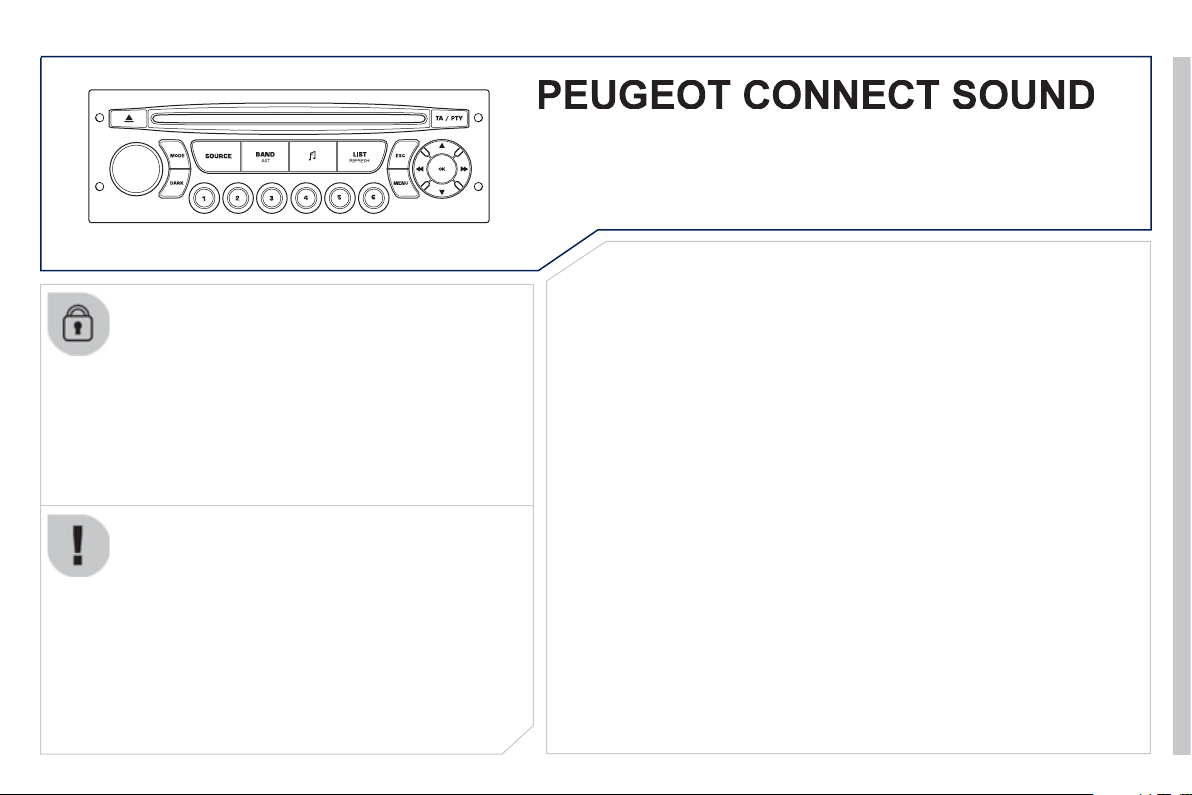
3
4
5
(
RD5
)
Your Peu
g
eot
C
onnect
S
ound
(
RD5
)
is coded in such a
way that it will only operate in your vehicle.
For safet
y
reasons, the driver must carr
y
out operations
which require prolon
g
ed attention while the vehicle is
s
tationar
y
.
When the en
g
ine is switched off and to prevent
dischar
g
in
g
o
f
the batter
y
, the audio equipment ma
y
s
wit
c
h
off
af
t
e
r
a
fe
w min
u
t
es
.
AUDIO SYSTEM / BLUETOOTH
®
01 First steps
02 Steering mounted controls
03 Main menu
04 Audio
05 Peugeot Connect USB
06 Bluetooth
07 Screen menu map
Frequently asked questions
p.
p.
p.
p.
p.
p.
p.
p.
346
347
348
349
352
355
358
363
CONTENTS
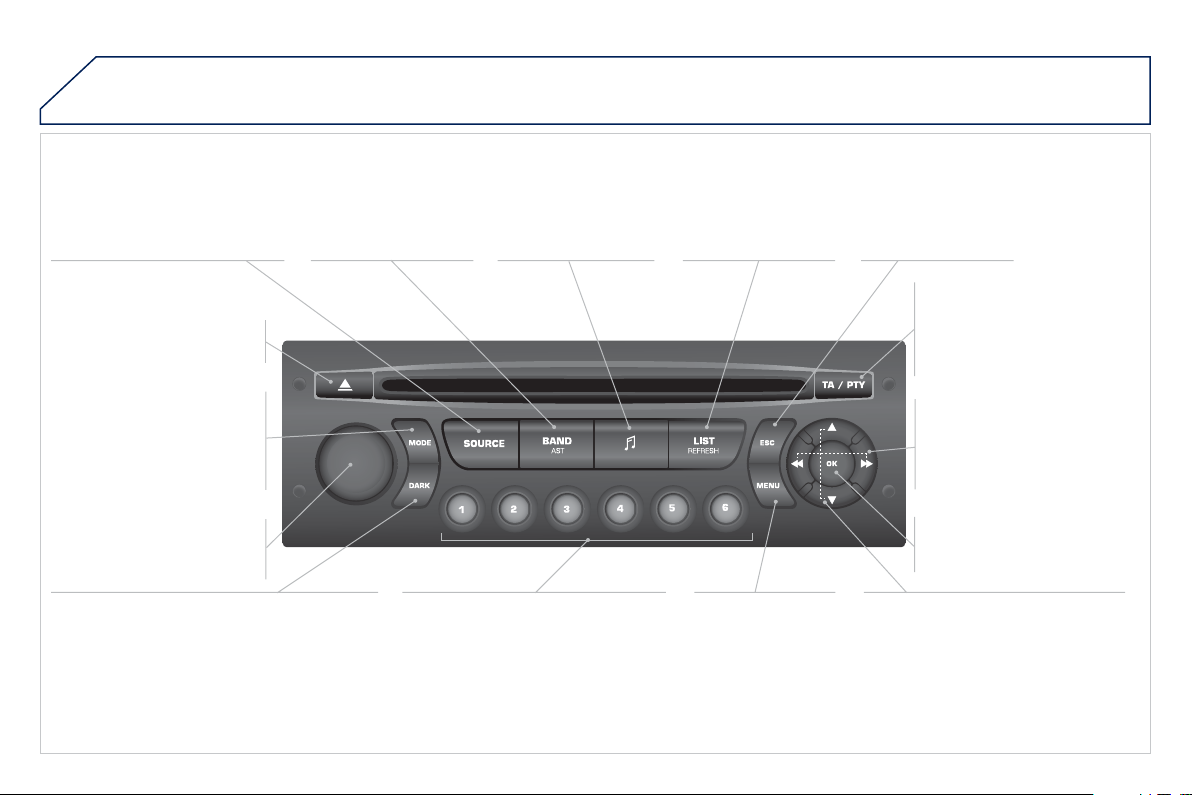
3
4
6
01
FIRST STEPS
E
j
ect
C
D.
S
elect source:
r
adio, audio
C
D
/
MP3
C
D, U
S
B,
J
ack connection,
S
treaming,
AU
X.
S
elect the screen display
mode
:
D
ate, audio
f
unctions, trip
c
om
p
uter, tele
p
hone.
A
utomatic
f
requenc
y
search
down
/
up.
S
elect
p
revious/next CD, MP3
or
US
B track.
A
udio settin
g
s: front/
r
ear
f
ader, le
f
t
/
ri
g
ht
balance, bass
/
treble,
l
oudness, audio
a
m
b
i
e
n
ces
.
Displa
y
the list o
f
local
s
t
a
t
io
n
s
.
Lon
g
press:
C
D
tracks or MP
3
f
olders
(C
D
/
U
S
B
)
.
TA
(
Traffi c Announcements
)
on
/
off.
Lon
g
press: PTY *
(
radio
Pro
g
ramme TYpe
)
mode.
Display main menu.The DARK button changes the screen display
f
or improved drivin
g
com
f
ort at ni
g
ht.
1
st
press: upper bar onl
y
illuminated.
2
n
d
p
ress: black screen.
3
rd
press: return to standard displa
y
.
O
n/off, volume settin
g
.
Buttons 1 to 6:
S
elect a pre-set radio station.
Lon
g
press: pre-set a station.
S
elect next
f
requency down
/
up.
S
elect previous
/
next MP3
f
older.
S
elect previous
/
next
f
older
/
g
enre
/
artist / pla
y
list
(
USB
)
.
C
on
fi
rm.
S
elect wavebands
F
M1, FM2, FMast and
A
M.
A
ba
n
do
n th
e
cu
rr
e
nt
operation.
*
Available according to version.

3
4
7
02
STEERING MOUNTED CONTROLS
R
adio: select the previous/next pre-set
s
t
a
t
io
n.
U
S
B: select
g
enre
/
artist
/
f
older
f
rom the
c
l
ass
i
fi
ca
ti
o
n li
s
t.
S
elect the previous
/
next item in a menu.
Chan
g
e audio source.
C
onfi rm a selection.
Call/end call on the telephone.
Pr
ess
fo
r m
o
r
e
th
a
n 2
seco
n
ds
:
telephone main menu.
R
ad
i
o
:
au
t
o
m
a
ti
c
sea
r
c
h f
o
r
a
l
o
w
er
frequenc
y
.
C
D
/
MP
3
/
US
B: selection of the
p
rev
i
ous trac
k
.
C
D
/
U
S
B: continuous press:
f
ast
re
v
erse
.
M
o
v
e
in th
e
li
s
t.
Radio: automatic search for a hi
g
her
frequenc
y
.
C
D
/
MP
3
/
US
B: selection of the next
tr
ack
.
C
D
/
U
S
B: continuous press:
f
ast
f
orwards pla
y
.
M
o
v
e
in th
e
li
s
t.
V
o
l
u
m
e
in
c
r
ease
.
V
o
l
u
m
e
dec
r
ease
.
M
ute: press t
h
e vo
l
ume
i
n
c
r
ease
a
n
d
dec
r
ease
b
uttons s
i
mu
l
taneous
ly
.
The sound is restored by
p
ressin
g
one o
f
the two
v
o
l
u
m
e
bu
tt
o
n
s
.
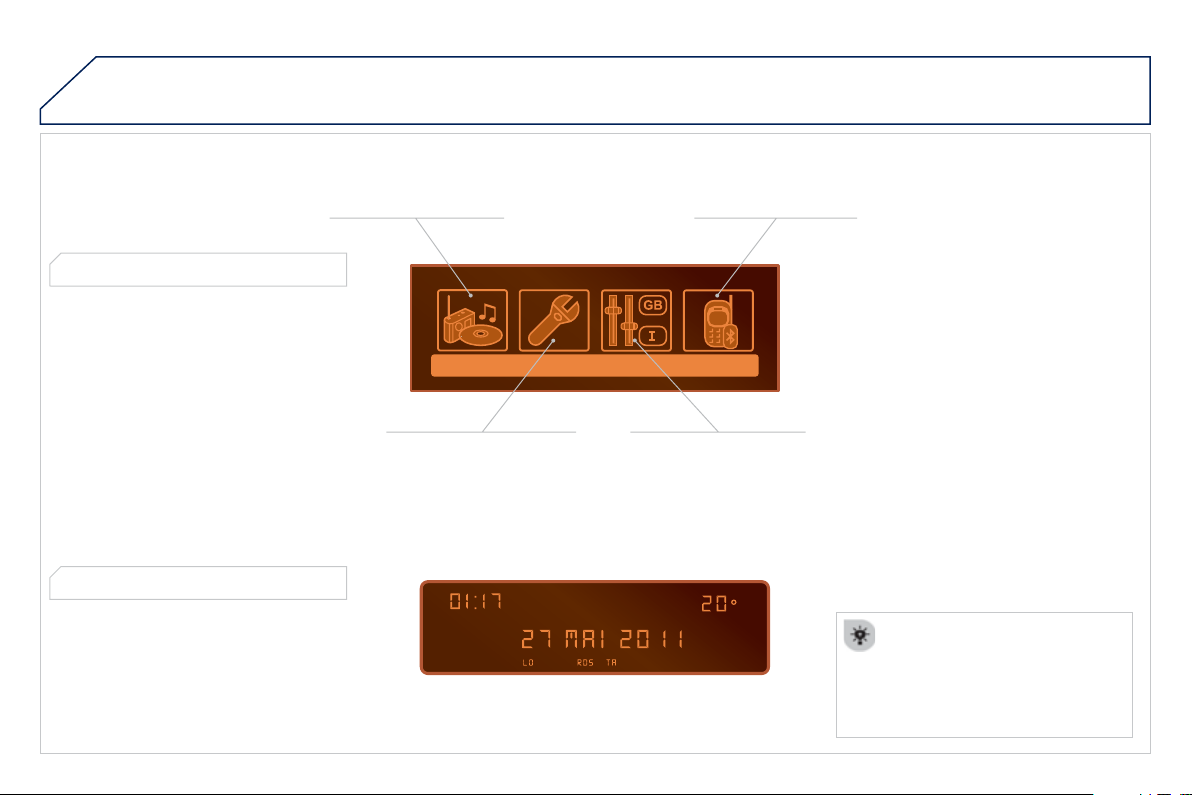
3
4
8
03
MAIN MENU
AUDIO FUNCTION
S
:
r
adio,
C
D, U
S
B, options.
> MONOCHROME SCREEN C
For a detailed
g
lobal view of the
menus available, re
f
er to the
"
S
creen menu map" section o
f
this chapter.
T
ELEPHON
E
:
hands-
f
ree kit, pairin
g
,
mana
g
ement o
f
a call.
P
ERSONALISATION-
CONFIGURATIO
N
:
vehicle
p
arameters,
displa
y
, lan
g
ua
g
es.
V
EHICLE DIAGNOSTIC
S
:
a
lerts lo
g
.
> MONOCHROME
S
CREEN
A
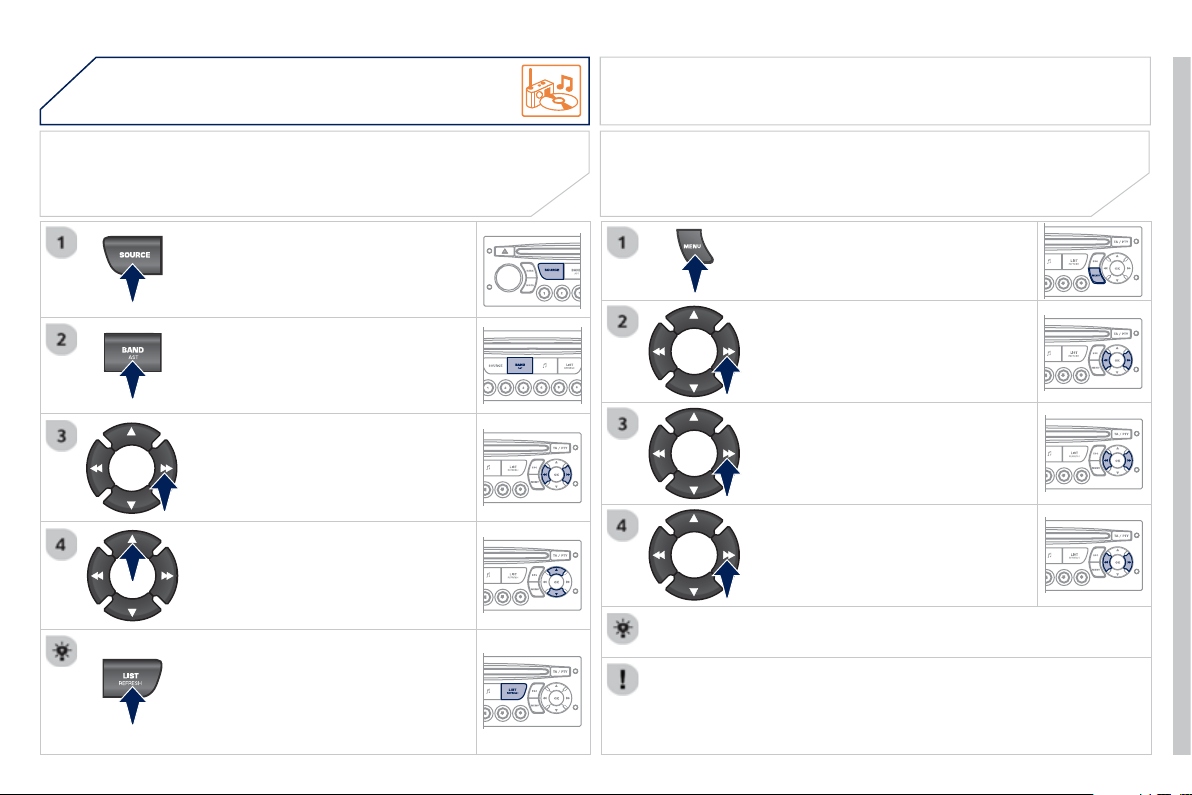
3
4
9
04 AUDIO
Press the
SOU
R
C
E button several
tim
es
in
success
i
o
n
a
n
d
se
l
ec
t th
e
rad
i
o
.
Press the BAND A
S
T button to select
a waveband: FM1
,
FM2
,
FMast
,
AM.
Briefl
y
press one of the buttons to
c
arr
y
out an automatic search o
f
the
radio
s
t
a
t
io
n
s
.
Press one o
f
the buttons to carry out
a manual search up
/
down
f
or radio
f
requencies.
Press the LI
S
T REFRE
S
H button to
displa
y
the list of stations received
locall
y
(
30 stations maximum
)
.
To update this list, press for more
t
ha
n tw
o
seco
n
ds
.
The external environment
(
hills, buildin
g
s, tunnels, basement car parks, ...
)
ma
y
block reception, includin
g
in RD
S
mode. This is a normal e
ff
ect o
f
the wa
y
in
which radio waves are transmitted and does not indicate any
f
ailure o
f
the audio
sy
stem.
RDS
RADIO
SELECTING A STATION
Press the MENU button.
S
elect A
U
DI
O
F
U
N
C
TI
O
N
S
then
p
ress
O
K.
S
elect the FM WAVEBAND
P
REFERENCES function then press
O
K.
S
elect A
C
TIVATE RD
S
then press
O
K. RD
S
appears on the screen.
In radio mode, press
O
K directl
y
to activate / deactivate RDS
mode
.
The RDS, if displa
y
ed, enables
y
ou to continue listenin
g
to the same
s
tation b
y
automatic retunin
g
to alternative frequencies. However, in certain
c
onditions, covera
g
e of an RDS station ma
y
not be assured throu
g
hout the
c
ountr
y
as radio stations do not cover 100
%
o
f
the territor
y
. Under conditions
of
ver
y
weak reception, the s
y
stem ma
y
chan
g
e to a re
g
ional station.
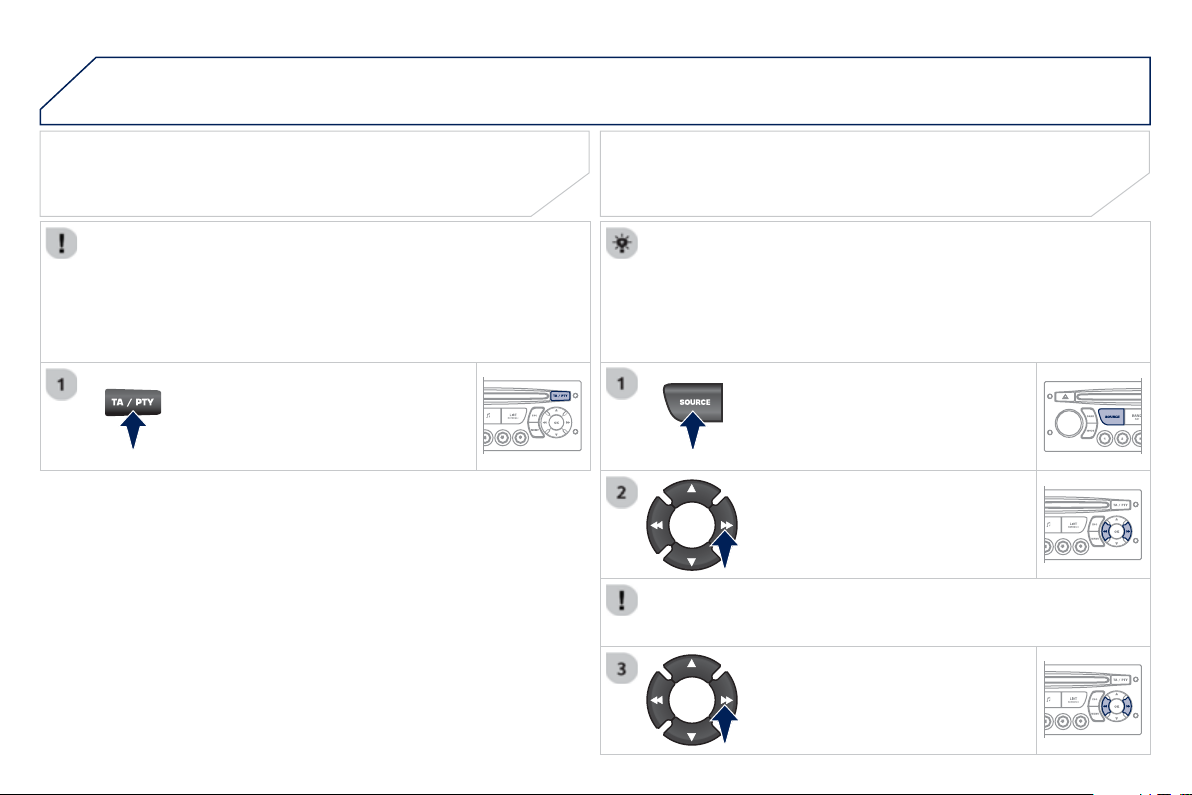
350
04 AUDIO
Insert circular compact discs only.
S
ome anti-piratin
g
s
y
stems, on ori
g
inal discs or
C
Ds copied usin
g
a
personal recorder, ma
y
cause faults which are no refl ection on the
q
ualit
y
of the ori
g
inal pla
y
er.
Without pressin
g
the EJECT button, insert a CD in the pla
y
er, pla
y
b
e
gi
ns automat
i
ca
lly
.
CD
PLAYING A CD
To pla
y
a disc which has alread
y
been
inserted,
p
ress the S
O
URCE button
se
v
e
r
a
l tim
es
in
success
i
o
n
a
n
d
s
elect
C
D.
Pr
ess
o
n
e
of
th
e
bu
tt
o
n
s
t
o
se
l
ec
t
a
track on the
C
D.
Press the LI
S
T REFRE
S
H button to display the list o
f
tracks on the
C
D.
Pr
ess
a
n
d
h
o
l
d
o
n
e
o
f th
e
bu
tt
o
n
s
f
o
r
f
as
t f
o
rw
a
r
d
o
r
bac
kw
a
r
d
.
RECEIVING TA MESSAGES
Pr
ess
th
e
TA
bu
tt
o
n t
o
ac
tiv
a
t
e
o
r
deactivate traffi c messa
g
es.
The TA
(
Traffi c Announcement
)
function
g
ives priorit
y
to TA alert
m
essa
g
es. To operate, this
f
unction needs
g
ood reception o
f
a
radio station transmittin
g
this t
y
pe o
f
messa
g
e. When a tra
ffi
c
report is transmitted, the current audio source
(
Radio,
C
D, ...
)
is
interrupted automaticall
y
to pla
y
the TA messa
g
e. Normal pla
y
back
of
th
e
aud
i
o
sou
r
ce
r
esu
m
es
a
t th
e
e
n
d
of
th
e
tr
a
n
s
mi
ss
i
o
n
of
th
e
m
essa
g
e.
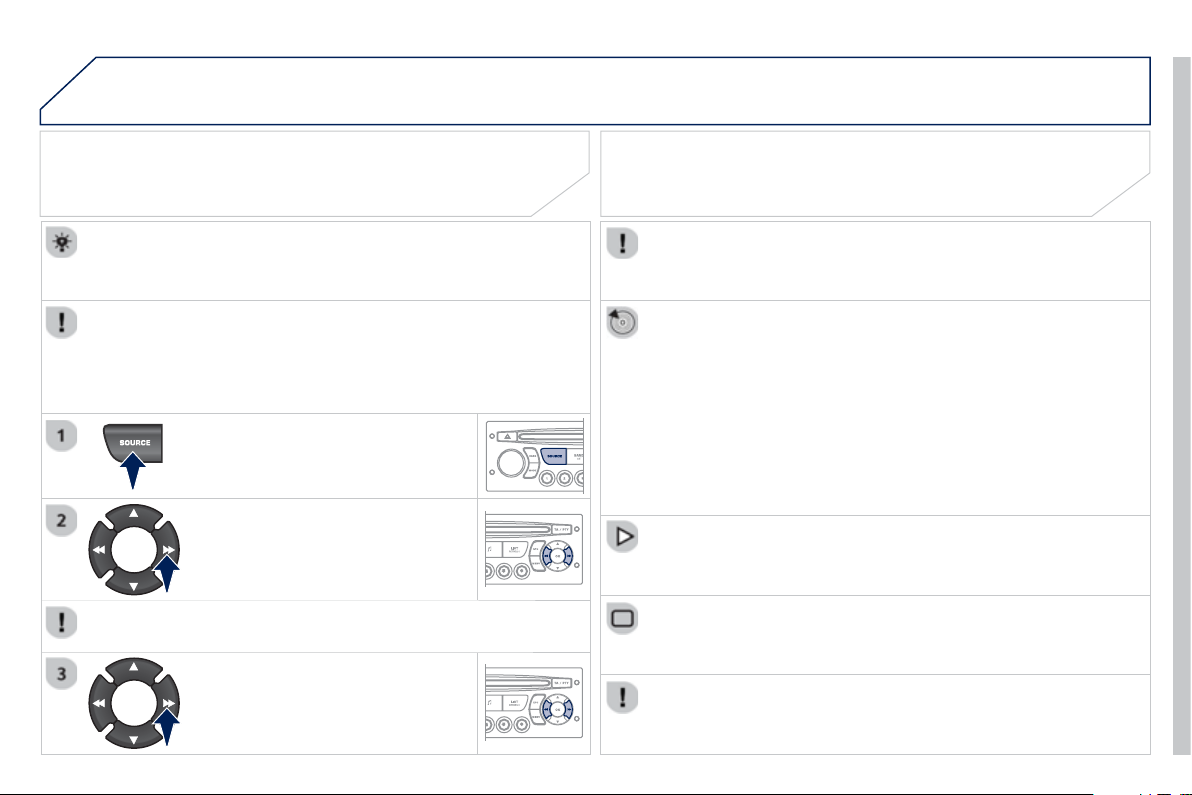
351
04
The MP3 format, an abbreviation of MPEG 1.2 & 2.5 Audio La
y
er 3,
is an audio compression standard which permits the recordin
g
o
f
s
everal tens o
f
music
fi
les on a sin
g
le disc.
In order to be able to play a recorded
C
DR or
C
DRW, when
r
ecordin
g
, the I
SO
9660 level 1.2 or Joliet
fi
le
f
ormat is
reco
mm
e
n
ded
.
If the disc is recorded in another format, it ma
y
not be pla
y
ed
c
orrectl
y
.
It is recommended that the same recordin
g
format is alwa
y
s
u
sed
f
or an individual disc, with as low a speed as possible
(
4x maximum
)
f
or optimum sound qualit
y
.
In the particular case o
f
a multi-session
C
D, the Joliet
f
ormat is
reco
mm
e
n
ded
.
The audio s
y
stem will onl
y
pla
y
fi les with the extension ".mp3" with
a samplin
g
rate o
f
22.05 KHz or 44.1 KHz. No other t
y
pe o
f
fi
le
(
.wma, .mp4, .m3u...
)
can be pla
y
ed.
It is advisable to restrict fi le names to 20 characters without usin
g
s
pecial characters
(
e.
g
. " ? ; ù
)
to avoid an
y
pla
y
in
g
or displa
y
in
g
p
roblems.
MP3 CD
INFORMATION AND ADVICE
AUDIO
Empt
y
CDs are not reco
g
nised and ma
y
dama
g
e the s
y
stem.
Insert an MP3 compilation in the pla
y
er.
The audio equipment searches
f
or all o
f
the music tracks, which
ma
y
take an
y
thin
g
between a
f
ew seconds and several tens o
f
s
econds, be
f
ore pla
y
be
g
ins.
MP3 CD
PLAYING AN MP3 COMPILATION
O
n a sin
g
le disc, the
C
D pla
y
er can read up to 255 MP3
fi
les
sp
read over 8 folder levels. However, it is advisable to kee
p
to
a limit of two levels to reduce the access time before the
C
D is
p
la
y
ed.
While the CD is bein
g
pla
y
ed, the folder structure is not followed.
A
ll o
f
the
fi
les are displa
y
ed on a sin
g
le level.
T
o p
l
a
y
a
di
sc w
hi
c
h
h
as a
l
rea
dy
been inserted, press the
SO
UR
C
E
bu
tt
o
n
se
v
e
r
a
l tim
es
in
success
i
o
n
a
n
d
se
l
ec
t
C
D.
Pr
ess
o
n
e
o
f th
e
bu
tt
o
n
s
t
o
se
l
ec
t
a
track on the
C
D.
Press the LI
S
T REFRE
S
H button to displa
y
the list o
f
directories o
f
the MP3 com
p
ilation.
Pr
ess
a
n
d
h
o
l
d
o
n
e
of
th
e
bu
tt
o
n
s
fo
r
f
ast
f
orward or backward pla
y
.
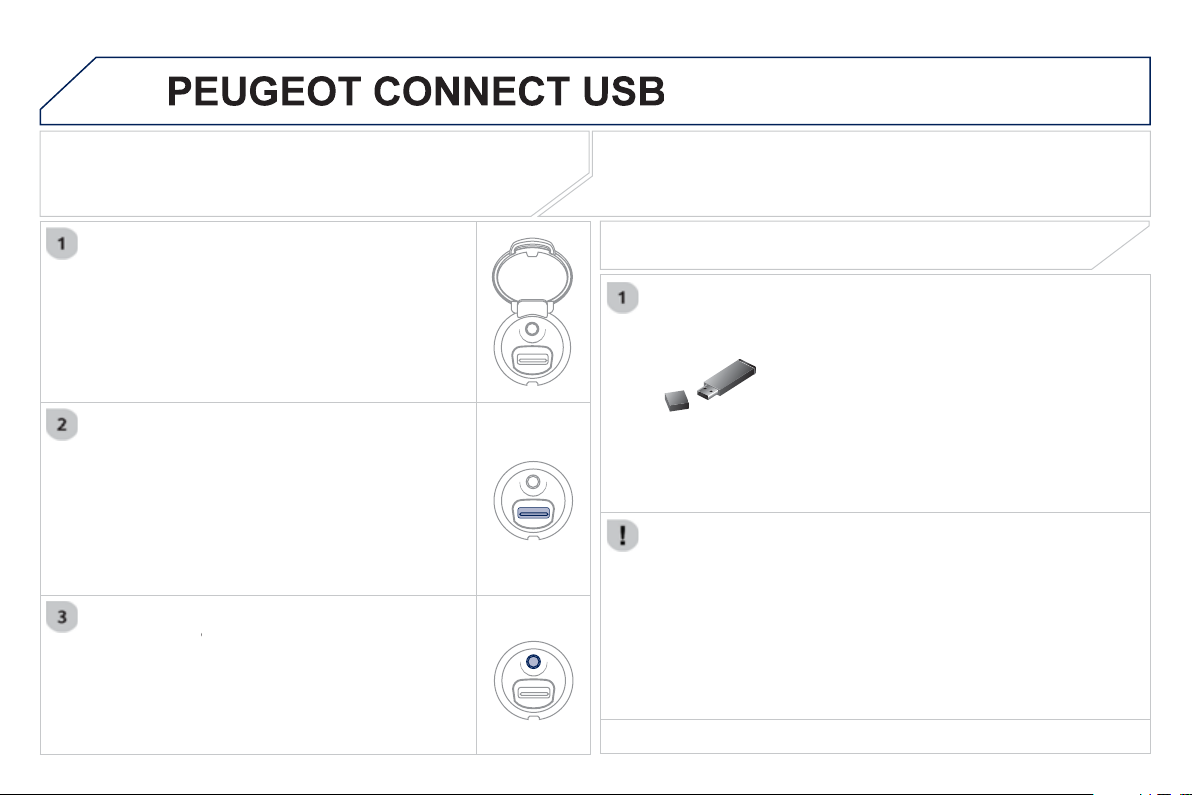
352
05
The s
y
stem puts to
g
ether pla
y
lists
(
temporar
y
memor
y)
created
o
ver a period which depends on the capacity o
f
the U
S
B device.
The other sources are available durin
g
this time.
The pla
y
lists are updated each time the i
g
nition is switched off or
e
ach time a USB memor
y
stick is connected.
When connectin
g
for the fi rst time, the classifi cation su
gg
ested
is b
y
folder. When
y
ou reconnect, the classifi cation selected
prev
i
ous
ly
i
s reta
i
ne
d
.
C
onnect the memor
y
stick to the port, directl
y
or
u
sin
g
a lead. If the audio equipment is switched
on, the USB source is detected as soon as it
is connected. Pla
y
be
g
ins automaticall
y
after a
dela
y
which depends on the capacit
y
of the USB
m
emor
y
st
i
c
k
.
The
fi
le
f
ormats supported are .mp3
(
mpe
g
1
l
ayer 3 only
)
, .wma
(
standard 9 only, 128 kbits
/
sec
c
ompression
)
, .wav and .o
gg
.
C
ertain pla
y
list
f
ormats are supported
(
.m3u, ...
)
.
O
n reconnection of the previous memor
y
stick
u
sed, pla
y
is resumed automaticall
y
with the last
trac
k
p
l
a
y
e
d
.
This unit consists o
f
a U
S
B port and an auxiliar
y
J
ack socket * . The audio fi les are transmitted
from a portable device - di
g
ital pla
y
er or a USB
m
emor
y
stick - to
y
our Peu
g
eot Connect Sound
(
RD5
)
and heard via the vehicle's speakers.
USB memor
y
stick
(
1.1, 1.2 and 2.0
)
or Apple
®
p
la
y
er o
f
g
eneration 5 or later:
- U
S
B memory sticks should be
f
ormatted
F
AT or FAT 32
(
NTF
S
not supported
)
,
- the Apple
®
pla
y
er lead is essential,
- navi
g
ation throu
g
h the fi le database is also
possible b
y
means of the steerin
g
mounted
co
ntr
o
l
s
.
The list o
f
compatible equipment and the compression rates supported
a
r
e
a
v
a
il
ab
l
e
f
r
o
m PE
UG
E
O
T
dea
l
e
r
s
.
USING THE PEUGEOT CONNECT USB
CONNECTING A USB MEMORY STICK
O
ther Apple
®
players of earlier generations and
®
p
la
y
ers usin
g
the MTP protocol * :
- pla
y
via Jack-Jack lead onl
y
(
not supplied
)
,
- navi
g
ation throu
g
h the fi le database is from
t
h
e porta
bl
e
d
ev
i
ce.
* Accordin
g
to vehicle.
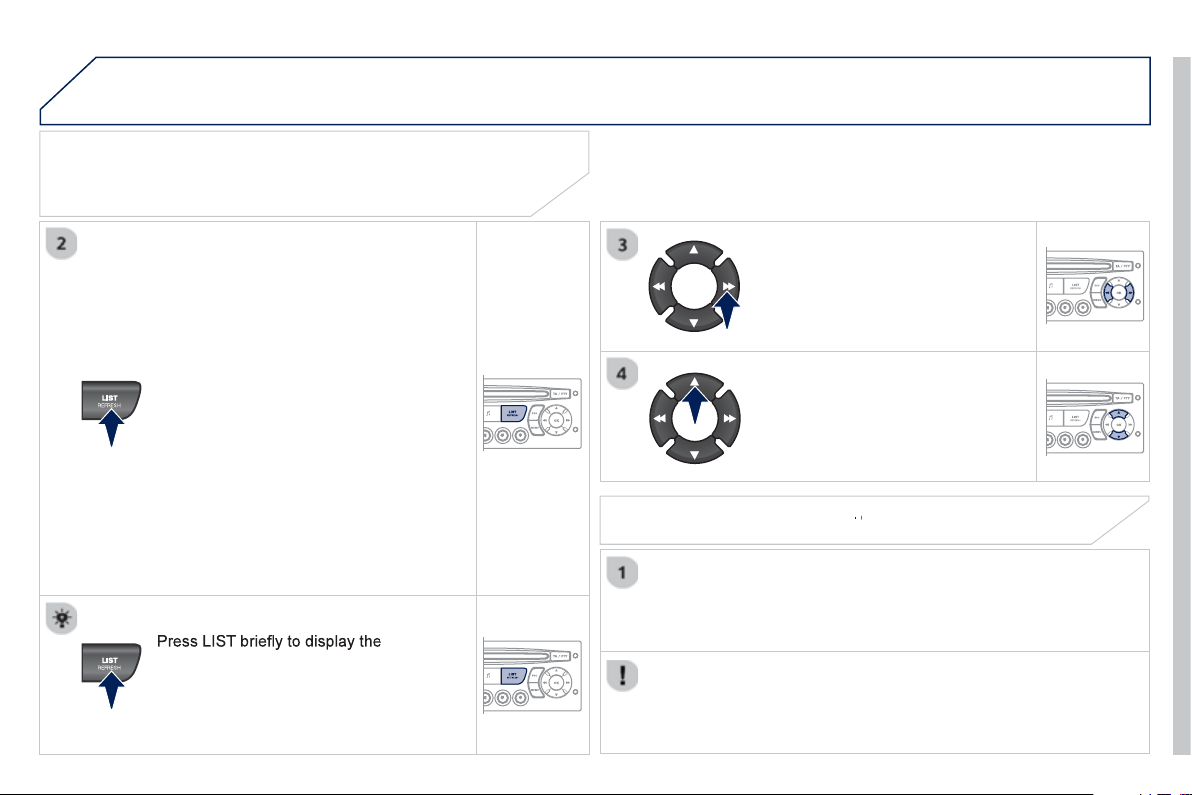
353
05
USING THE PEUGEOT CONNECT USB
p
reviousl
y
selected classifi cation.
Navi
g
ate throu
g
h the list usin
g
the left/
r
i
g
ht and up
/
down buttons.
C
on
fi
rm the selection b
y
pressin
g
O
K.
The lists available are Artist, Genre and Pla
y
list
(
as defi ned in the
Apple
®
pla
y
er
)
.
S
election and Navi
g
ation are described in steps 1 to 4 above.
Do not connect a hard disk or
US
B connection device other
than audio equipment to the USB port. This could dama
g
e
y
ou
r
in
s
t
a
ll
a
ti
o
n.
CONNECTING AN APPLE
®
PLAYER VIA THE USB PORT
®
Press one of these buttons to
g
ain
access to the
p
revious / next track on
the classifi cation list currentl
y
bein
g
pl
a
y
e
d
.
Pr
ess
a
n
d
h
o
l
d
o
n
e
of
th
e
bu
tt
o
n
s
fo
r
f
ast
f
orward or backward pla
y
.
Pr
ess
o
n
e
o
f th
ese
bu
tt
o
n
s
t
o
g
ain access to the previous / next
Genre, Folder, Artist or Pla
y
list on
the classi
fi
cation list currentl
y
bein
g
pl
a
y
e
d
.
Press and hold LI
S
T to displa
y
the
d
i
ffe
r
e
nt
c
l
ass
i
fi
ca
ti
o
n
s
.
Select b
y
Folder / Artist / Genre / Pla
y
list,
p
ress
O
K to select the classifi cation
r
equired, then press
O
K a
g
ain to confi rm.
- b
y
Folder: all folders containin
g
audio
fi
les reco
g
nised on the peripheral
de
v
ice
.
- by Artist: all o
f
the artist names
de
fi
ned in the ID3 Ta
g
s, classi
fi
ed in
a
lphabetical order.
- b
y
Genre: all of the
g
enres defi ned in
the ID3 Ta
g
s.
- b
y
Pla
y
list: in accordance with the
pla
y
lists recorded on the USB device.
PEUGEOT CONNECT USB
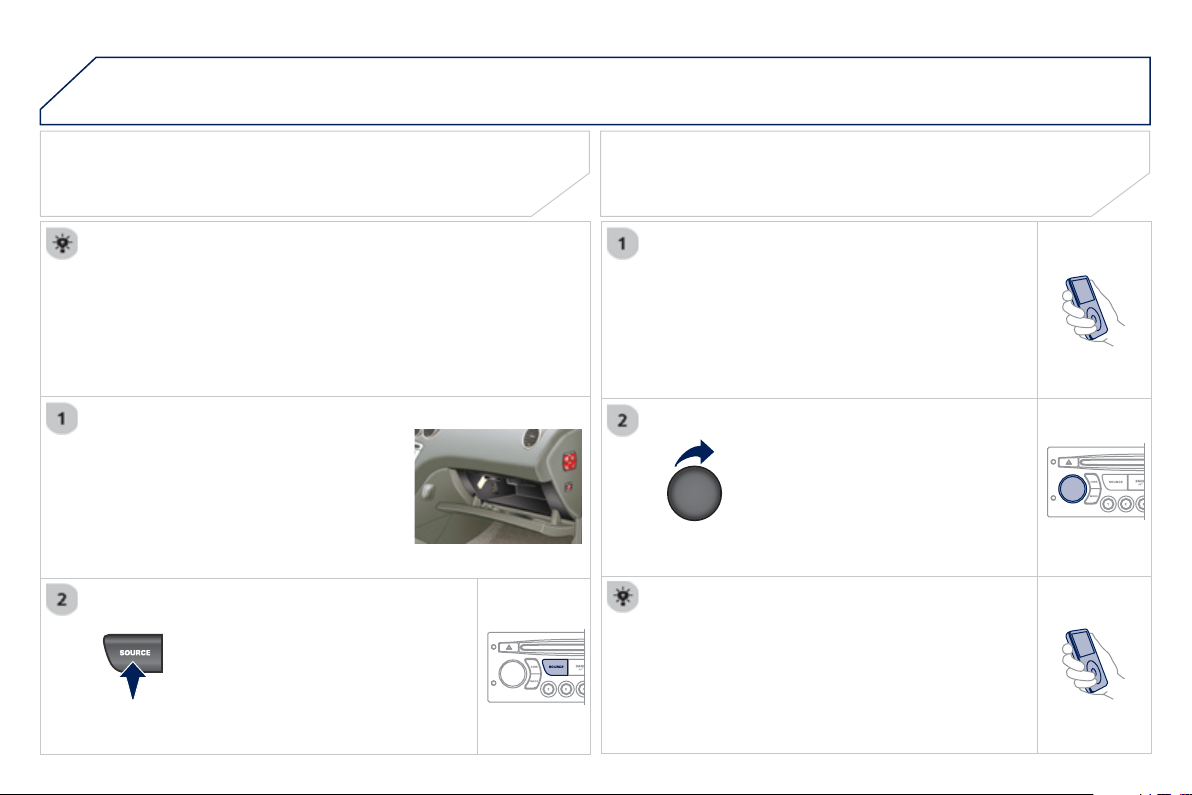
35
4
05
The displa
y
and control is via the portable device.
First ad
j
ust the volume of
y
our portable device.
Then ad
j
ust the volume o
f
y
our audio
sy
stem.
USING THE AUXILIARY SOCKET (AUX)
ADJUSTING THE VOLUME OF THE
AUXILIARY SOURCE
RCA
S
OCKET
Connect the portable device
(
MP3 pla
y
er…
)
to the audio sockets
(
white
and red, R
C
A t
y
pe
)
usin
g
a suitable cable
(
not supplied
)
.
Press the
SO
UR
C
E button several
tim
es
in
success
i
o
n
a
n
d
se
l
ec
t A
U
X.
The RCA auxiliar
y
socket permits the connection of a portable device
(
MP3 pla
y
er...
)
.
PEUGEOT CONNECT USB
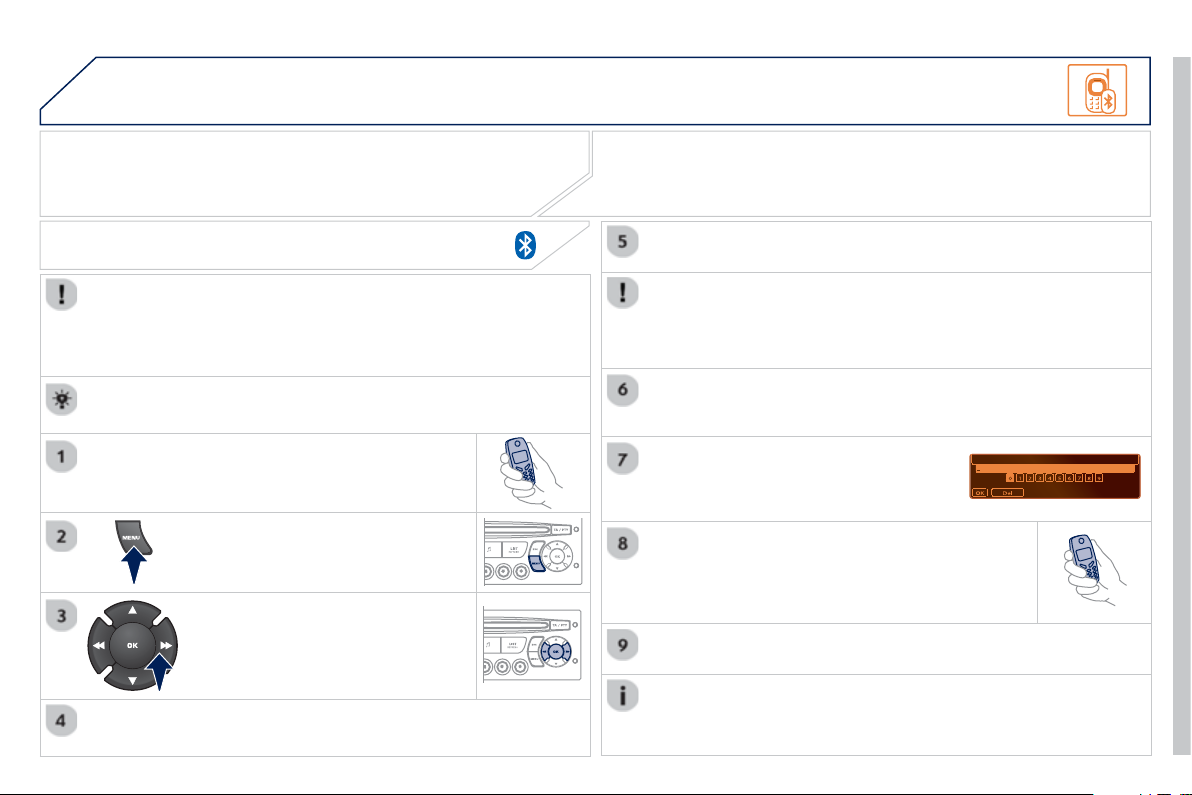
355
06 BLUETOOTH
For safet
y
reasons and because the
y
require prolon
g
ed attention
o
n the part of the driver, the operations for pairin
g
of the Bluetooth
m
obile telephone with the Bluetooth hands-free s
y
stem of
y
our
au
di
o equ
i
pment must
b
e carr
i
e
d
out w
i
t
h
t
h
e ve
hi
c
l
e stat
i
onar
y
an
d
t
h
e
ig
n
i
t
i
on on.
Pr
ess
th
e
MEN
U
bu
tt
o
n.
A
w
i
n
d
ow
i
s
di
sp
l
a
y
e
d
w
i
t
h
a messa
g
e t
h
at a searc
h
i
s
i
n pro
g
ress.
Activate the telephone's Bluetooth
f
unction
and ensure that it is "visible to all"
(
telephone
c
on
fi
g
uration
)
.
In the menu, select:
- Bluetooth telephone
f
unction -
A
ud
i
o
- Bluetooth confi
g
uration
- P
e
rf
o
rm
a
Bl
ue
t
oo
th
sea
r
c
h
The services o
ff
ered depend on the network, the
S
IM card and the
c
ompatibility o
f
the Bluetooth equipment used.
C
onsult
y
our telephone's manual and
y
our operator to
fi
nd out which
services are available to
y
ou.
BLUETOOTH TELEPHONE
S
CREEN C
The TELEPH
O
NE menu permits access to the followin
g
functions
in particular: Director
y
* , Call list, Pairin
g
mana
g
ement.
The
fi
rst 4 telephones reco
g
nised are displa
y
ed in this window.
A virtual ke
y
pad is displa
y
ed in the
s
creen: enter a co
d
e w
i
t
h
at
l
east
4
digi
ts.
C
on
fi
rm b
y
pressin
g
O
K.
A messa
g
e that the pairin
g
has been success
f
ul appears in the
screen
.
S
elect the telephone to be connected
f
rom the list.
O
nl
y
one
tele
p
hone can be connected at a time.
A messa
g
e is displa
y
ed in the screen of the
te
l
ep
h
one c
h
osen.
T
o accept t
h
e pa
i
r
i
n
g
, enter t
h
e
s
ame code on the telephone, then con
fi
rm with
O
K.
The automatic connection authorised is onl
y
active after the
telephone has been con
fi
g
ured.
The directory and the call list can be accessed a
f
ter the
sy
nchronisation period.
(
Available accordin
g
to model and version
)
*
I
f
y
our telephone is
f
ull
y
compatible.
I
f
pairin
g
f
ails, the number o
f
attempts is not limited.
Go to www.peu
g
eot.co.uk for more information
(
compatibilit
y
, more
h
elp, ...
)
.
PAIRING A TELEPHONE / FIR
S
T CONNECTION
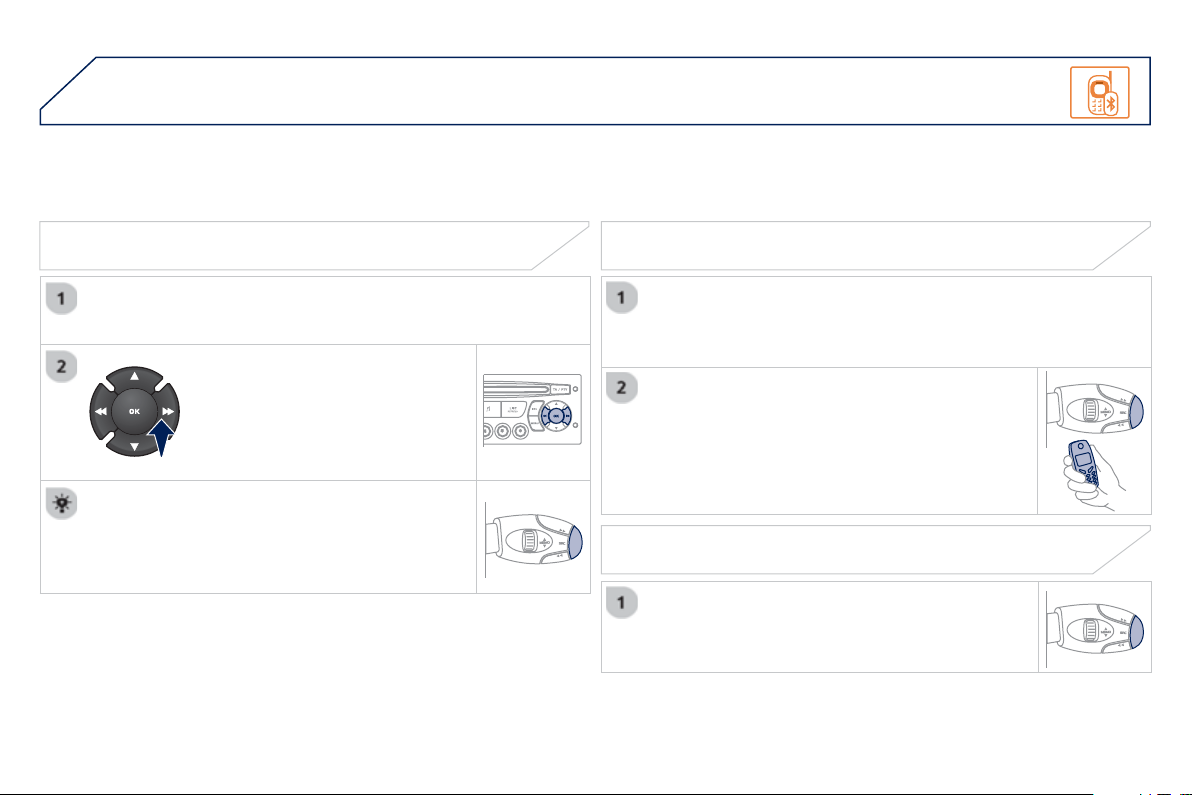
356
06
RECEIVING A CALL
An incomin
g
call is announced b
y
a rin
g
and a superimposed
displa
y
in the vehicle's screen.
S
elect the YE
S
tab on the displa
y
usin
g
the buttons and confi rm b
y
p
ressin
g
O
K.
P
ress t
h
e steer
i
n
g
mounte
d
contro
l
to accept t
h
e
ca
ll.
MAKING A CALL
From the Bluetooth telephone
f
unction Audio menu, select Mana
g
e
the telephone call then
C
all,
C
all list or Director
y
.
Press the steerin
g
mounted control
f
or more than
two seconds for access to
y
our director
y
, then
n
avi
g
ate with the thumb wheel.
O
r
T
o
di
a
l
a num
b
er, use
y
our te
l
ep
h
one
'
s
k
e
y
pa
d
,
wi
t
h
t
h
e ve
hi
c
l
e stat
i
onar
y
.
Durin
g
a call, press the steerin
g
mounted control
f
o
r m
o
r
e
th
a
n 2
seco
n
ds
.
C
onfi rm with
O
K to end the call.
BLUETOOTH
ENDING A CALL
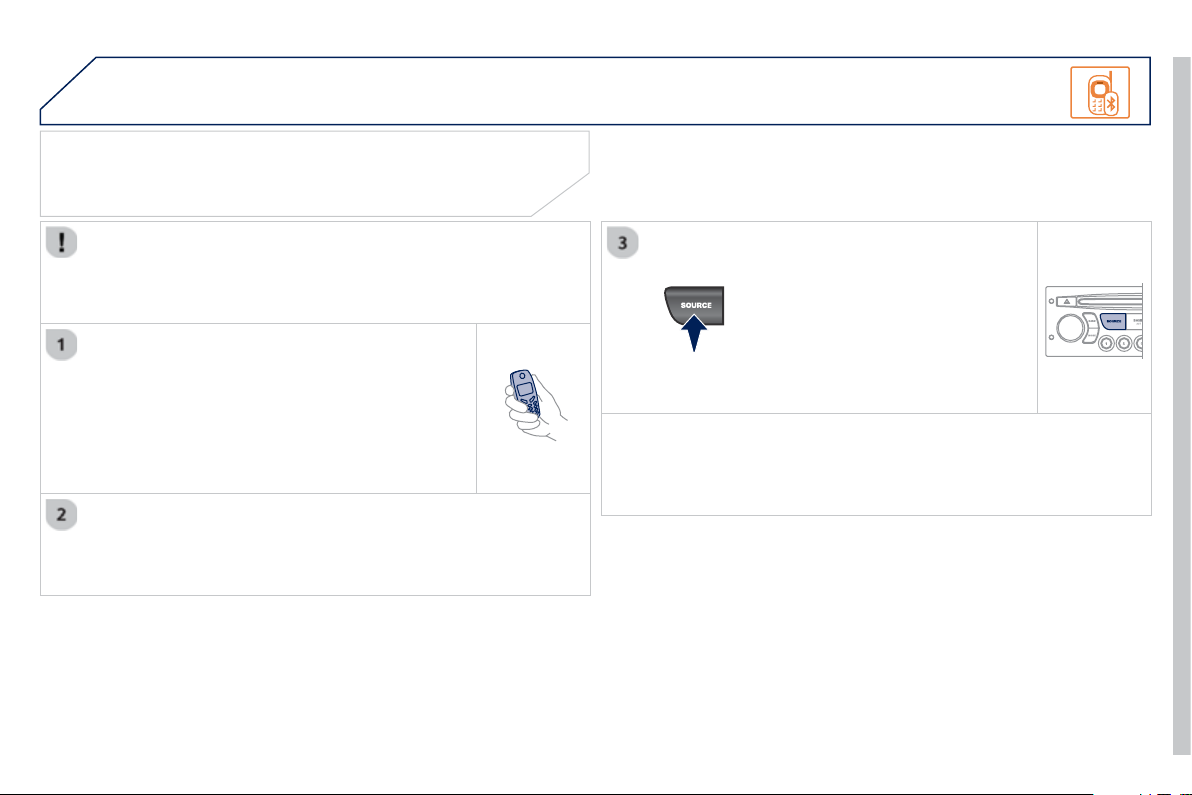
357
06
Initiate the pairin
g
between the telephone and
the vehicle. This pairin
g
can be initiated from
the vehicle's telephone function menu or via the
telephone's ke
y
pad.
S
ee steps 1 to 9 on the previous
p
a
g
es.
D
ur
i
n
g
t
h
e pa
i
r
i
n
g
p
h
ase, t
h
e ve
hi
c
l
e must
b
e
s
tat
i
onary w
i
t
h
t
h
e
k
ey
i
n t
h
e
i
gn
i
t
i
on.
Select the telephone to be connected from the telephone function
menu
.
Th
e au
di
o s
y
stem connects to a new
ly
pa
i
re
d
te
l
ep
h
one
a
utomat
i
ca
lly
.
BLUETOOTH AUDIO STREAMING *
Wireless transmission of the telephone's music fi les via the audio
e
qu
i
pment.
Th
e te
l
ep
h
one must
b
e a
bl
e to mana
g
e t
h
e appropr
i
ate
Bluetooth pro
fi
les
(
Pro
fi
les A2DP
/
AVR
C
P
)
.
*
Depending on the compatibility o
f
the telephone.
**
In certain cases, pla
y
in
g
o
f
the Audio
fi
les must be initiated
f
rom the
ke
y
pad.
*** If the tele
p
hone su
pp
orts the function.
Activate the streamin
g
source b
y
pressin
g
the S
O
URCE button ** .
Th
e trac
k
s to
b
e p
l
a
y
e
d
can
b
e
co
ntr
olled
as
usual
v
ia
t
he
bu
tt
o
n
s
o
n
t
h
e au
di
o system contro
l
pane
l
an
d
the steerin
g
mounted controls
***
.
Th
e
co
nt
e
xt
ua
l in
fo
rm
a
ti
o
n
ca
n
be
displa
y
ed on the screen.
BLUETOOTH
358
07 SCREEN MENU MAP
RADIO-CD
MAIN FUNCTION
* The parameters var
y
accordin
g
to vehicle.
OPTION
A
OPTION B...
M
ONOCHROME
A
OPTION A
1
OPTION A2
REG MODE
CD REPEAT
RANDOM PLAY
VEHICLE CONFIG *
REV WIPE A
C
T
OPTIONS
GUIDE LAMPS
DIAGNO
S
TIC
S
RDS SEARCH
CONSUL
T
ABANDO
N
1
2
3
3
1
2
2
2
2
1
2
3
2
3
1
2
2
359
07
UNITS
FUEL CON
S
UMPTION
:
KM/L - L/100 - MPG
1
2
2
SCREEN MENU MAP
DISPLAY ADJUST
MONTH
DATE
HOUR
MINUTES
YEAR
12 H/24 H MODE
LANGUAGE
ITALIANO
NEDERLANDS
PORTUGUES
PORTUGUES-BRASIL
FRANCAIS
DEUTSCH
ENGLISH
ESPANOL
1
2
2
2
2
2
2
1
2
2
2
2
2
2
2
2
360
07
SCREEN MENU MAP
Press the
O
K dial for access to short-cut menus accordin
g
to the displa
y
o
n t
he
sc
r
ee
n:
M
ONOCHROME C
a
ctivate / deactivate RD
S
a
ctivate / deactivate REG mod
e
a
ctivate
/
deactivate radiotex
t
RADIO
a
ctivate / deactivate Intro
CD / MP3 CD
a
ctivate
/
deactivate track re
p
eat
(
the entire current CD for CD, the entire
c
urrent folder for MP3 CD
)
a
ctivate / deactivate random pla
y
(
the entire current CD for CD, the entire
c
urrent folder for MP3 CD
)
a
ctivate / deactivate track repeat
(
of the
c
urrent folder / artist /
g
enre / pla
y
list
)
USB
a
ctivate / deactivate random pla
y
(
of the
c
urrent folder / artist /
g
enre / pla
y
list
)
1
1
1
1
1
1
1
1
361
07
MONOCHROME C
SCREEN MENU MAP
AUDIO FUNCTIONS
a
lternative frequencies
(
RDS
)
activate
/
deactivate
FM BAND PREFERENCE
S
re
g
ional mode
(
REG
)
activate
/
deactivate
radio-text information
(
RDTXT
)
ac
tiv
a
t
e
/
deac
tiv
a
t
e
1
2
3
4
3
4
3
4
PLAY MODES
a
lbum repeat
(
RPT
)
ac
tiv
a
t
e
/
deac
tiv
a
t
e
t
rack random pla
y
(
RDM
)
activate
/
deactivate
2
3
4
3
4
VEHICLE DIAGNOSTICS
A
LERT LOG
1
2
Pressin
g
the MENU button displa
y
s:
*
The parameters var
y
accordin
g
to vehicle.
v
ideo bri
g
htness ad
j
ustmen
t
DISPLAY CONFIGURATION
DEFINE THE VEHICLE PARAMETERS *
PERSONALISATION-CONFIGURATION
n
o
rm
a
l vi
deo
i
nv
e
r
se
v
ideo
bri
g
htness
(
- +
)
ad
j
ustment
d
ate an
d
t
i
me a
dj
ustmen
t
da
y/
month
/y
ear ad
j
ustment
hour
/
minute adjustment
c
h
o
i
ce
of
12 h
/
24 h m
ode
c
hoice of unit
s
l
/
100 km - mp
g
- km
/
l
°
C
elsius
/
°Fahrenheit
CHOICE OF LANGUAGE
1
2
4
3
2
4
4
3
4
4
2
3
4
4
4
362
07
SCREEN MENU MAP
BLUETOOTH TELEPHONE
Connect/Disconnect a devic
e
C
onsult the paired device
Bluetooth confi
g
uration
T
ele
p
hone function
Audio Streamin
g
function
Delete a paired device
P
e
r
fo
rm
a
Bl
ue
t
oo
th
sea
r
c
h
Calls lis
t
Call
Di
rector
y
T
erminate the current call
M
ana
g
e t
h
e te
l
ep
h
one ca
ll
Activate private mod
e
1
2
3
3
3
4
4
4
2
3
4
2
3
3

363
FREQUENTLY ASKED QUESTIONS
Q
UESTIO
N
A
NSWER SOLUTIO
N
Th
e
r
e
i
s
a
d
iff
e
r
e
n
ce
in
s
ound qualit
y
between
th
e
d
iff
e
r
e
nt
aud
i
o
s
ources
(
radio, CD...
)
.
For optimum sound qualit
y
, the audio settin
g
s
(
Volume, Bass, Treble,
Ambience, Loudness
)
can be adapted to the different sound sources,
which ma
y
result in audible differences when chan
g
in
g
source
(
radio,
CD...
)
.
Check that the audio settin
g
s
(
Volume, Bass,
Treble, Ambience, Loudness
)
are adapted to
th
e
sou
r
ces
li
s
t
e
n
ed
t
o
. It i
s
ad
vi
sab
l
e
t
o
se
t
the AUDI
O
functions
(
Bass, Treble, Front-Rear
Balance, Le
f
t-Ri
g
ht Balance
)
to the middle
p
os
i
t
i
on, se
l
ect t
h
e mus
i
ca
l
am
bi
ence
"N
one
"
an
d
s
et the loudness correction to the "Active" position
in
C
D mode or to the "Inactive" position in radio
mode
.
The CD is e
j
ected
automaticall
y
or is not
pl
a
y
e
d
by
t
h
e p
l
a
y
er.
The CD is inserted upside down, is unpla
y
able, does not contain an
y
a
udio data or contains an audio format which the pla
y
er cannot pla
y
.
The CD is protected b
y
an anti-piratin
g
protection s
y
stem which is not
r
eco
g
n
i
se
d
by
t
h
e au
di
o equ
i
pment.
- Check that the CD is inserted in the pla
y
er the
ri
g
ht wa
y
up.
-
C
heck the condition of the
C
D: the
C
D cannot
be pla
y
ed i
f
it is too dama
g
ed.
-
C
heck the content in the case o
f
a recorded
C
D:
co
n
su
lt th
e
ad
vi
ce
in th
e
"A
ud
i
o
"
sec
ti
o
n.
- The audio equipment's
C
D pla
y
er does not
pla
y
DVDs.
- Due to their qualit
y
level, certain writeable
C
Ds will not be pla
y
ed b
y
the audio s
y
stem.
The messa
g
e "U
S
B
p
eripheral error" is
displa
y
ed on the screen.
Th
e
Bl
ue
t
oo
th
co
nn
ec
ti
o
n
i
s
cu
t.
The batter
y
o
f
the peripheral ma
y
not be su
ffi
cientl
y
char
g
ed. Rechar
g
e the batter
y
o
f
the peripheral device.
The U
S
B memor
y
stick is not reco
g
nised.
The memor
y
stick ma
y
be corrupt.
Re
f
ormat the memor
y
stick.
The CD pla
y
er sound is
poor
.
The CD used is scratched or of poor qualit
y
. Insert
g
ood qualit
y
CDs and store them in suitable
co
n
di
t
io
n
s
.
The audio equipment settings
(
bass, treble, ambiences
)
are unsuitable.
S
et the treble or bass level to 0, without selecting
a
n
a
m
b
i
e
n
ce
.

36
4
Q
UESTIO
N
A
NSWER SOLUTIO
N
Th
e
s
t
o
r
ed
s
t
a
ti
o
n
s
do
n
ot
f
unction
(
no sound,
8
7.5 Mhz is displa
y
ed...
)
.
An in
co
rr
ec
t w
a
v
eba
n
d
i
s
se
l
ec
t
ed
. Press the BAND A
S
T button to return to the
waveband
(
AM, FM1, FM2, FMA
S
T
)
on which the
s
t
a
ti
o
n
s
a
r
e
s
t
o
r
ed
.
Th
e
tr
a
ffi
c
a
nn
ou
n
ce
m
e
nt
(
TA
)
is displa
y
ed. I do
n
ot receive an
y
tra
ffi
c
in
fo
rm
a
ti
o
n.
The radio station is not part of the re
g
ional traffi c information network. T
u
n
e
t
o
a
r
ad
i
o
s
t
a
ti
o
n whi
c
h
b
r
oadcas
t
s
tr
a
ffi
c
in
fo
rm
a
ti
o
n.
The qualit
y
o
f
reception
o
f th
e
r
ad
i
o
s
t
a
ti
o
n
listened to
g
raduall
y
de
t
e
ri
o
r
a
t
es
o
r th
e
s
t
o
r
ed
s
t
a
ti
o
n
s
do
n
o
t f
u
n
c
ti
o
n
(
no sound, 87.5 Mhz is
displa
y
ed...
)
.
The vehicle is too
f
ar
f
rom the transmitter used b
y
the station listened
to or there is no transmitter in the
g
eo
g
raphical area throu
g
h which the
vehicle is travellin
g
.
A
ctivate the RD
S
f
unction to enable the s
y
stem
to check whether there is a more
p
owerful
transmitter in the
g
eo
g
raphical area.
The environment
(
hills, buildin
g
s, tunnels, basement car parks...
)
block
r
eception, includin
g
in RD
S
mode.
Thi
s p
h
enomenon
i
s norma
l
an
d
d
oes not
i
n
di
cate
a
f
ailure o
f
the audio equipment.
The aerial is absent or has been dama
g
ed
(f
or example when
g
oin
g
throu
g
h a car wash or into an under
g
round car park
)
.
Have the aerial checked b
y
a PEU
G
E
O
T dealer.
S
ound cut-outs of 1 to
2
seco
n
ds
in r
ad
i
o
m
ode
.
Durin
g
this brief sound cut-out, the RDS searches for an
y
frequenc
y
permittin
g
better reception of the station.
Deactivate the RDS function if the phenomenon is
too frequent and alwa
y
s on the same route.
With the en
g
ine o
ff
,
the audio equipment
s
wit
c
h
es
o
ff
a
ft
e
r
a
f
e
w
m
in
u
t
es
o
f
use
.
When the en
g
ine is switched o
ff
, the audio equipment operatin
g
time
depends on the batter
y
char
g
e.
The switch-off is normal: the audio equipment switches to econom
y
mode
a
nd switches off to prevent dischar
g
in
g
of the vehicle's batter
y
.
S
tart the vehicle's en
g
ine to increase the batter
y
c
har
g
e.
Th
e messa
g
e
"
t
h
e au
di
o
sy
stem
i
s over
h
eate
d"
appears on the display.
In order to protect the installation i
f
the surroundin
g
temperature is too
high
, t
h
e au
di
o equ
i
pment sw
i
tc
h
es to an automat
i
c t
h
erma
l
protect
i
on
mode leading to a reduction o
f
the volume or stopping o
f
the playing o
f
th
e
C
D.
S
witch the audio s
y
stem o
ff
f
or a
f
ew minutes to
a
ll
ow t
h
e s
y
stem to coo
l
.
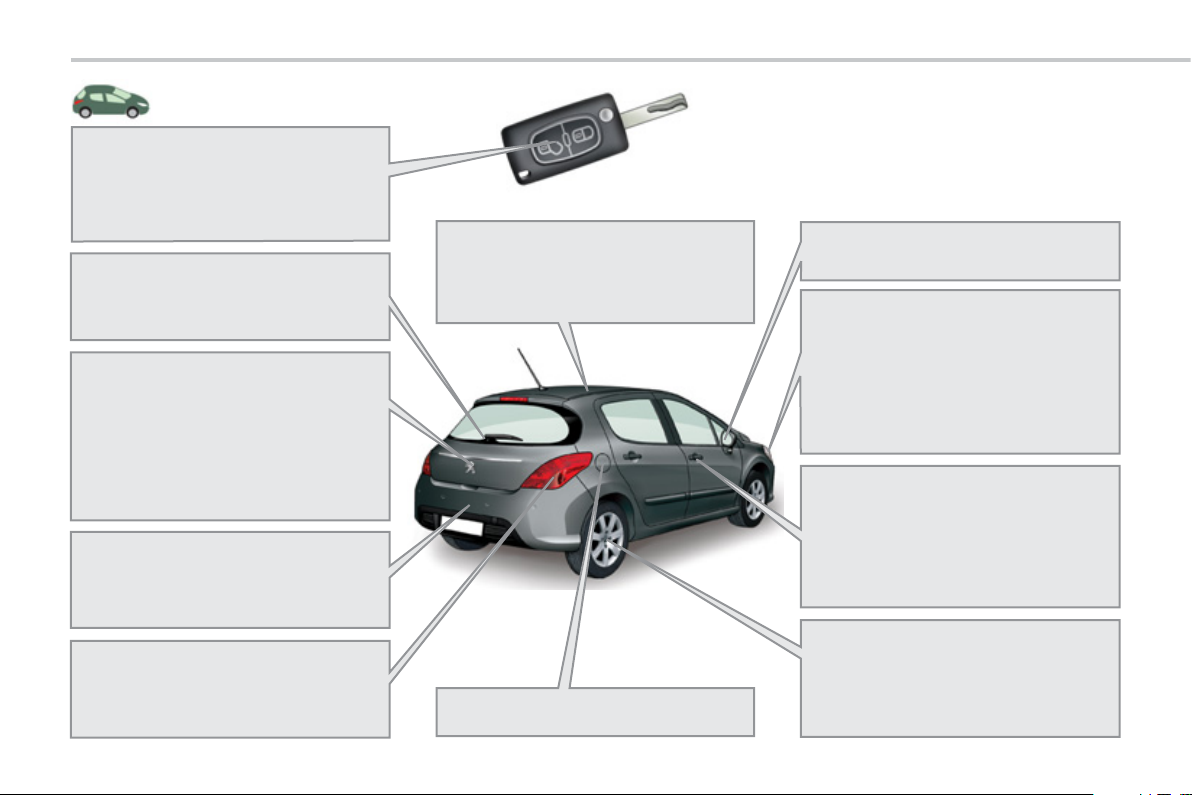
365
V
ISUAL SEARC
H
EXTERIOR
Boot ..............................................92, 94
- opening / closing
- emergency release
Temporary puncture repair kit ....178-183
Changing a wheel .....................187, 192
- tools
- removing / refi tting
Wiper controls............................105-107
Changing a wiper blade .................... 211
Changing bulbs..........................197-198
- rear lamps
- 3rd brake lamp
- number plate lamps
Parking sensors .........................167-168
Towbar .......................................214-215
Towing .......................................211-212
Remote control key........................83-86
- opening / closing
- anti-theft protection
- starting
- battery
Accessories ...............................217-218
Roof bars ..........................................216
Panoramic sunroof .............................95
Fuel tank, misfuel prevention.........96-98
Door mirrors ...................................80-81
Doors .............................................91-93
- opening / closing
- central locking
- emergency control
Alarm .............................................87-88
Electric windows ............................89-90
Lighting controls ..........................99-103
Directional lighting ............................104
Headlamp height adjustment .....103-104
Changing bulbs..........................194-196
- front lamps
- foglamps
- direction indicator repeaters
Braking assistance ...........................139
Trajectory control ..............................140
Tyre under-infl ation detection ...........138
Tyre pressures ..........................183, 241
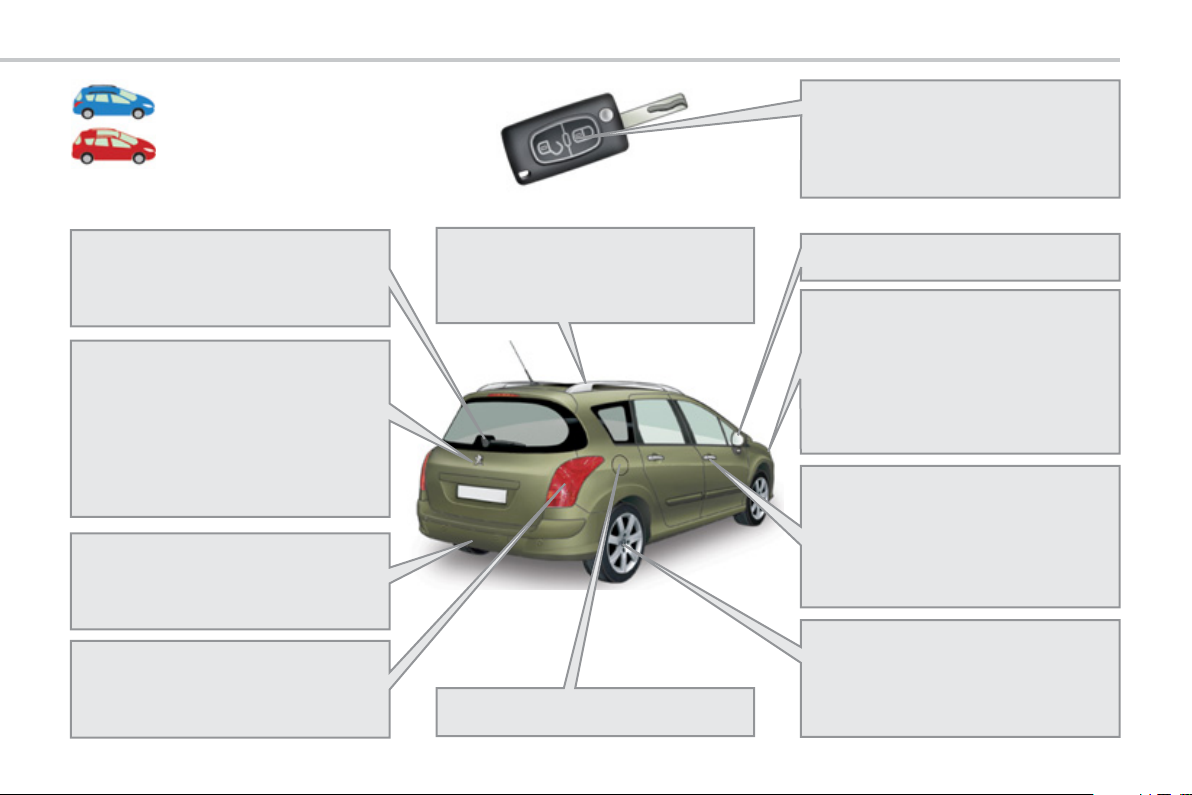
366
V
ISUAL SEARC
H
EXTERIOR
Boot ..............................................92, 94
- opening / closing
- emergency release
Temporary puncture repair kit ....178-186
Changing a wheel .....................189, 192
- tools
- removing / refi tting
Wiper controls............................105-107
Changing a wiper blade .................... 211
Changing bulbs..........................199-200
- rear lamps
- 3rd brake lamp
- number plate lamps
Parking sensors .........................167-168
Towbar .......................................214-215
Towing .......................................213-214
Remote control key........................83-86
- opening / closing
- anti-theft protection
- starting
- battery
Accessories ...............................217-218
Roof bars ..........................................216
Panoramic sunroof .............................95
Fuel tank, misfuel prevention.........96-98
Door mirrors ...................................80-81
Doors .............................................91-93
- opening / closing
- central locking
- emergency control
Alarm .............................................87-88
Electric windows ............................89-90
Lighting controls ..........................99-103
Directional lighting ............................104
Headlamp height adjustment .....103-104
Changing bulbs..........................194-196
- front lamps
- foglamps
- direction indicator repeaters
Braking assistance ...........................139
Trajectory control ..............................140
Tyre under-infl ation detection ...........138
Tyre pressures ..........................183, 241
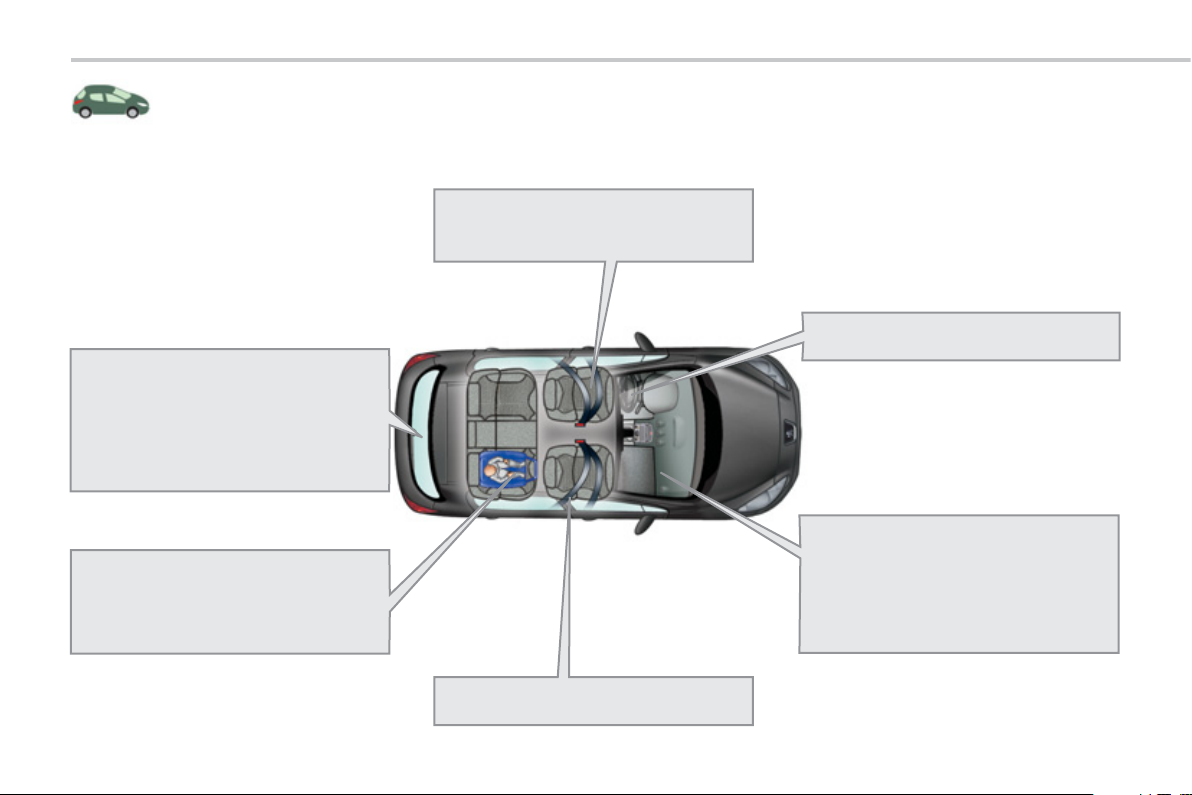
367
V
ISUAL SEARC
H
INTERIOR
Boot fi ttings ............................... 116-117
- rear parcel shelf
- luggage retaining strap
- hooks
- stowing rings
- storage box
Child seats .........................125-128, 130
ISOFIX child seats .....................131-134
Child lock ..........................................136
Front seats.....................................68-71
Rear seats .....................................72-73
Seat belts...........................141-142, 145
Airbags ......................................146-149
Interior fi ttings ............................ 110-115
- glove box
- ashtray / 12 V accessory socket
- mats
Deactivating the passenger's front
airbag................................................147
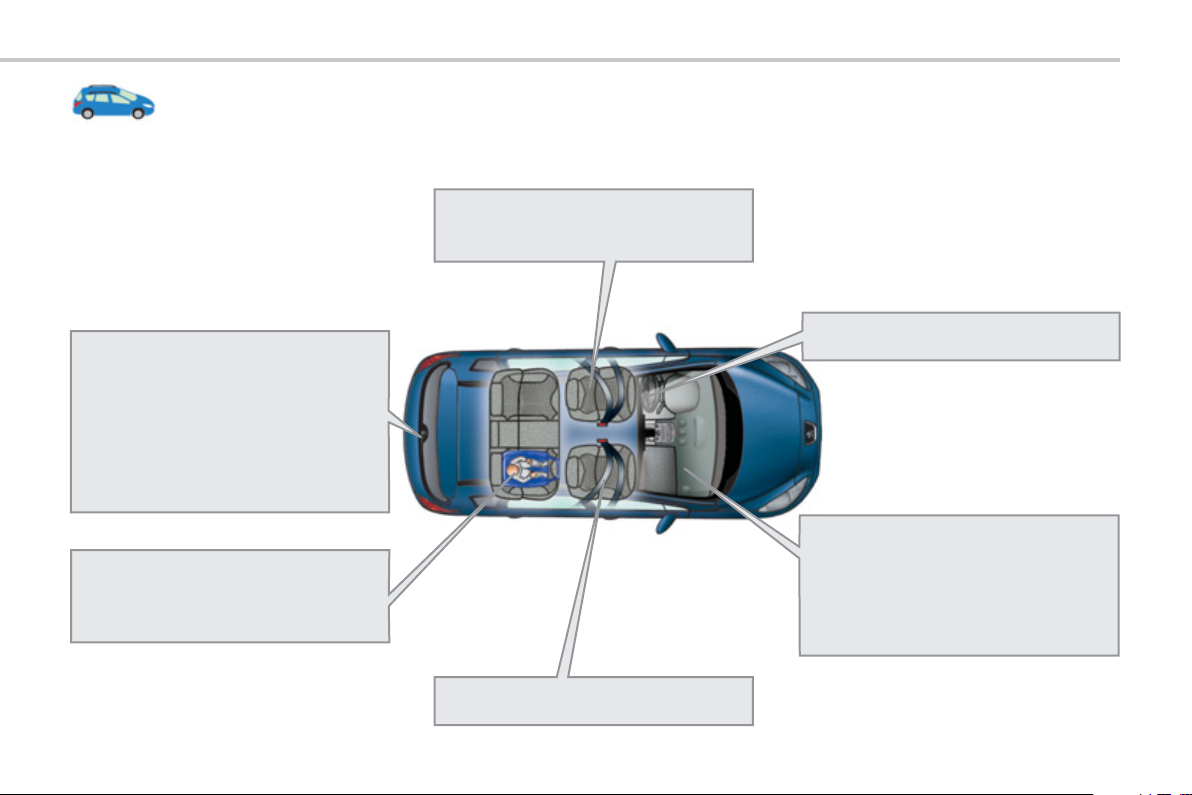
368
V
ISUAL SEARC
H
INTERIOR
Boot fi ttings ................................118-120
- rear parcel shelf
- 12 V accessory socket
- hooks
- stowing rings
- high load retaining net
- luggage retaining strap
- storage tray
Child seats .........................125-128, 130
ISOFIX child seats .....................131-134
Child lock ..........................................136
Front seats.....................................68-71
Rear seats .....................................72-73
Seat belts...........................141-142, 145
Airbags ......................................146-149
Interior fi ttings ............................ 110-115
- glove box
- ashtray / 12 V accessory socket
- mats
Deactivating the passenger's front
airbag................................................147
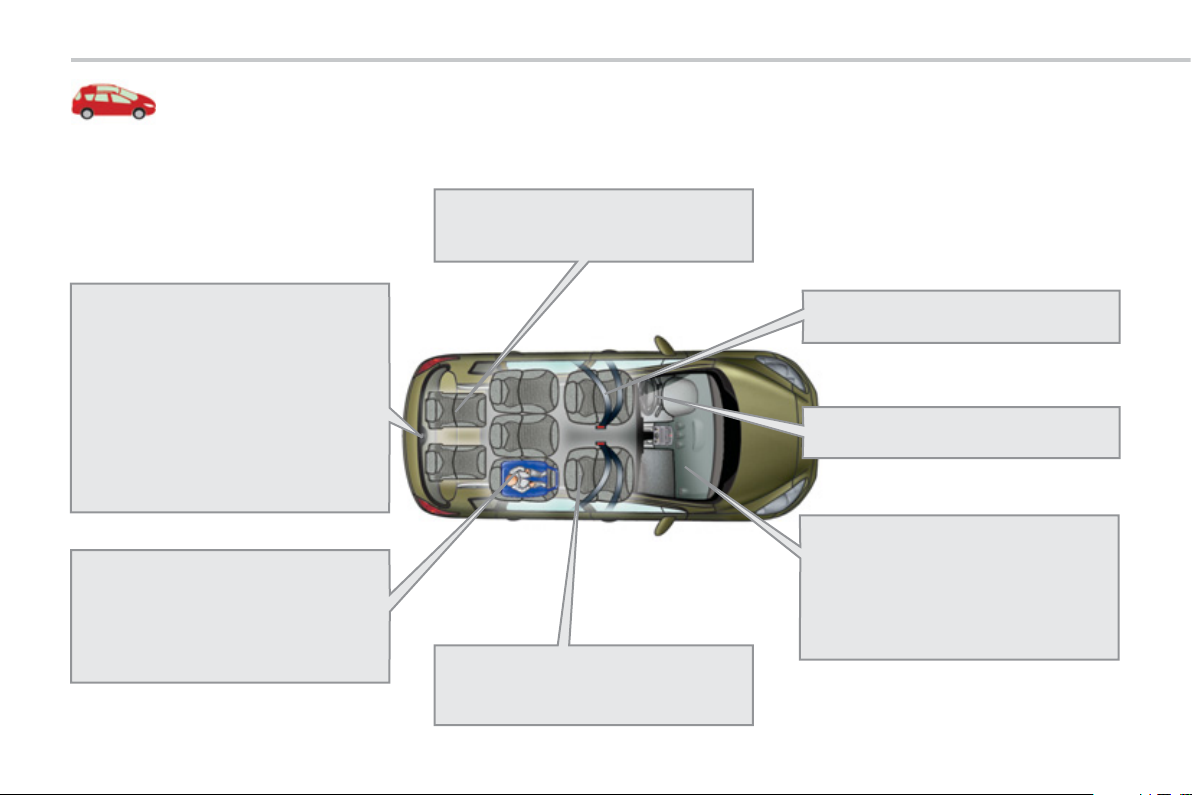
369
V
ISUAL SEARC
H
INTERIOR
Boot fi ttings ................................121-124
- load space screen
- 12 V accessory socket
- hooks
- stowing rings
- high load retaining net
- rear armrests
- luggage retaining strap
- torch
- storage box
Child seats ................. 125-127, 129-130
ISOFIX child seats .............131-133, 135
Child lock ..........................................136
Side blinds ........................................124
Additional seats .............................76-77
Seat modularity..............................78-79
Front seats.....................................68-71
Rear seats .....................................74-75
Seat belts...................................141-145
Interior fi ttings ............................ 110-115
- glove box
- ashtray / 12 V accessory socket
- mats
Deactivating the passenger's front
airbag................................................147
Airbags ......................................146-149
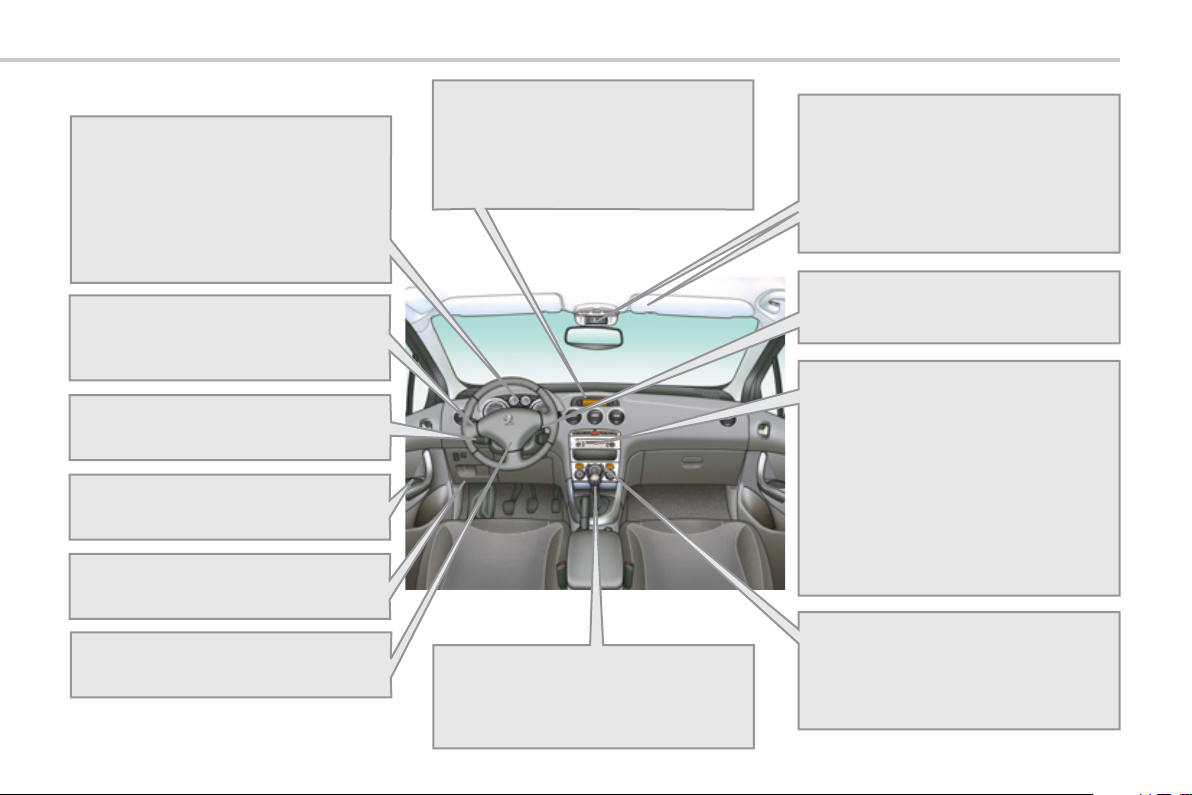
3
7
0
V
ISUAL SEARC
H
IN
S
TRUMENT
S
AND CONTROL
S
Instrument panels ..........................25-28
Warning lamp ................................29-38
Indicators ....................................... 39-42
Buttons ..........................................43-44
- check / service indicator / trip
distance recorder
- lighting dimmer
Lighting controls ..........................99-102
Headlamp height adjustment .....103-104
Stop & Start ...............................160-162
Door mirrors ...................................80-81
Electric windows ............................89-90
Speed limiter..............................163-164
Cruise control ............................165-166
Dashboard fuses .......................201-203
Opening the bonnet ..........................170
Multifunction screens .....................45-56
Hazard warning lamps ......................137
Switch panel .......................................16
Emergency or
assistance call ..........................139, 243
Steering wheel adjustment .................82
Horn .................................................. 137
Parking brake ...................................150
Manual gearbox .........................150-152
Electronic gear control /
automatic gearbox ..... 153-156, 157-159
Ventilation ................................ 61-62, 65
Heating ..........................................63-64
Manual air conditioning..................63-64
Digital air conditioning ...................66-67
Peugeot Connect
Media Navigation (NG4 3D) ......247-290
Peugeot Connect Navigation (RT6)
...291-344
Peugeot Connect Sound (RD5) ...345-364
Setting the date/time:
-
Screen A (without Peugeot Connect Sound (RD5))
... 46
- Screen A ........................................48
- Screen C .......................................51
- Colour screen (with Peugeot
Connect Navigation (RT6)) .................53
-
Colour screen (with Peugeot
Connect Media Navigation (NG4 3D)) ..... 55
Courtesy lamps.................................108
Seat belt / passenger's front
airbag warning lamps display ....142-143
Rear view mirror .................................82
Sun visor........................................... 111
Toll card / car park ticket windows .... 111
Wiper controls............................105-107
Trip computer ................................57-60
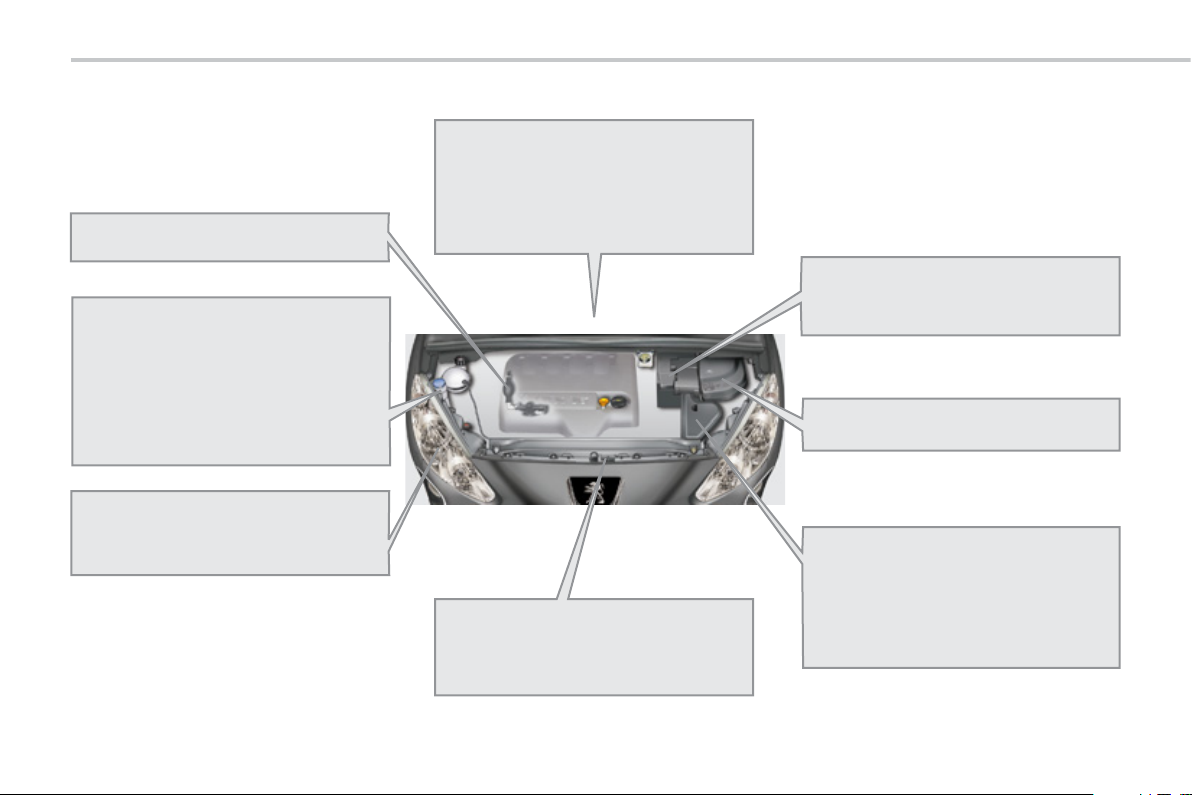
3
7
1
V
ISUAL SEARC
H
TE
C
HNI
C
AL DATA - MAINTENAN
C
E
Running out of fuel, Diesel ...............171
Checking levels .........................174-175
- oil
- brake fl uid
- power steering fl uid
- coolant
- screenwash/headlamp wash fl uid
- additive (Diesel with particle
emissions fi lter)
Changing bulbs..........................194-200
- front
- rear
Opening the bonnet .......................... 170
Under the bonnet, petrol ...................172
Under the bonnet, Diesel ..................173
Petrol engines............................219-227
Diesel engines ...........................228-239
Dimensions ....................................... 240
Identifi cation markings ......................241
Battery .......................................207-209
Energy economy mode..................... 210
Checking components ...............176-177
- air fi lter
- passenger compartment fi lter
- oil fi lter
- particle emissions fi lter (Diesel)
- brake pads / discs
Engine
compartment fuses ............201, 204-206

3
7
2
A
LPHABETICAL INDEX
A
BS and EBFD s
y
stems
......................
1
3
9
Accesso
ri
es
..........................................
21
7
A
ccessor
y
socket,
12V
.................
11
2
,
12
3
A
ccess to the
3
rd row
.............................
7
4
Addi
t
io
n
al
sea
t
s
......................................
7
6
A
d
j
ustin
g
headlamps
....................
1
0
3
,
1
0
4
A
d
j
ustin
g
head restraints
........................
7
0
A
djusting seat belt heigh
t
.............
14
1
,
14
3
Adj
ust
i
n
g
t
h
e steer
i
n
g
w
h
ee
l
..................
8
2
A
irba
g
, kne
e
.................................
14
7
,
14
9
A
irba
g
s, curtai
n
............................
14
8
,
14
9
A
irba
g
s,
f
ron
t
................................
1
4
6
,
1
4
9
Ai
r
b
a
g
s,
l
atera
l
.............................14
8
,
14
9
Ai
r con
di
t
i
on
i
n
g
.......................................
2
3
A
ir conditionin
g
, di
g
ita
l
.....................
6
2
,
6
6
A
ir conditionin
g
, manua
l
...................
6
2
,
6
3
Air filter
.................................................
r
17
6
A
ir
f
l
ow
....................................................
2
3
A
ir v
e
nt
s
.................................................
6
1
A
l
a
rm
......................................................
8
7
A
lert
/
warnin
g
lo
g
............................
4
9
,
5
2
A
nti-lock brakin
g
s
y
stem
(
AB
S)
............1
3
9
A
nt
i
-p
i
nc
h
..........................................
8
9
,
9
5
A
nti-th
e
f
t
.................................................
8
4
A
rmrest,
f
ron
t
........................................
11
3
Armrest, rear
........................................
r
11
5
A
s
h
tra
y
.................................................
11
2
Ass
i
s
t
a
n
ce
ca
l
l
..............................
1
3
9
,
24
4
A
th
e
rmi
c
win
dsc
r
ee
n
............................
1
1
1
A
udible warnin
g
....................................
13
7
A
udio
/
video sockets .............................
27
4
A
udio streamin
g
(
Bluetooth
)
.........
33
0
,
35
7
A
udio s
y
stems
........................................
5
6
Au
t
o
m
a
ti
c
ill
u
min
a
ti
o
n
o
f
headlamps
....................
9
9
,
1
0
2
,
1
0
3
Backup startin
g
.....................................
2
0
8
Batter
y
..................................
17
6
,
2
0
7
-
2
0
9
Batter
y
, char
g
in
g
..........................
2
0
7
,
2
0
9
Batter
y
, remote control
.....................
8
5
,
8
6
Blind for panoramic sunroof
...................
f
9
5
Blin
ds
....................................................
12
4
Bl
ue
t
oo
th
(
hands-free
)
.............
27
5
-
27
7
,
31
4
,
35
5
Bluetooth
(
telephone
)
...........
27
5
-
27
7
,
31
4
B
o
nn
et
..................................................
17
0
Bonnet sta
y
..........................................
17
0
B
oot
........................................................
9
4
Boot lam
p
.....................................
1
0
9
,
12
4
Boot stora
g
e tra
y
s
................................
11
8
Br
a
k
e
d
i
scs
...........................................
17
7
Brake lam
p
s
.................................
1
9
7
,
1
9
9
Brake
p
ads
...........................................
17
7
Br
a
k
es
..................................................
17
7
Brakin
g
assistance s
y
stem
...................
1
3
9
C
han
g
in
g
a wheel
.........................
1
8
7
,
1
8
9
C
han
g
in
g
a wiper blad
e
...............
1
0
7
,
2
1
1
C
han
g
in
g
the remote control batter
y
......
8
5
C
HE
C
K
...................................................
4
3
C
heckin
g
levels
............................
1
7
4
,
1
7
5
C
heckin
g
the en
g
ine oil level
.................
4
2
C
heckin
g
t
y
re pressures
(
usin
g
the kit
)
...................................
1
7
8
C
hecks
.........................
1
7
2
,
1
7
3
,
1
7
6
,
1
7
7
C
hild lock
..............................................
1
3
6
C
hildre
n
................................
1
2
8
,
1
3
3
-
1
3
5
C
hild seats
..........................
1
2
5
,
1
2
7
,
1
3
0
C
hild seats, conventiona
l
.....................
1
2
7
C
losin
g
the boo
t
...............................
8
3
,
9
4
C
losin
g
the doors
.............................
8
3
,
9
1
C
old climate scree
n
..............................
21
5
C
olour screen, retractabl
e
..........
5
2
,
5
4
,
5
6
C
onnectors, audio
................
1
1
2
,
35
2
,
35
4
C
ontrol for
p
anoramic sunroof blin
d
.......
9
5
C
oolant leve
l
...................................
3
9
,
1
7
4
Coolant temperature indicator
................
r
3
9
C
ourtes
y
lamps
....................................
1
0
8
Courtesy mirror
.....................................
r
1
1
1
C
ruise contro
l
.......................................
1
6
5
Cup holder
............................................
r
1
1
0
Automatic o
p
eration
o
f hazard warnin
g
lamps
.................
1
3
7
A
u
t
o
m
a
ti
c
r
a
in
se
n
s
itiv
e
win
dsc
r
ee
n
wi
p
ers
.......................................
1
0
5
,
1
0
7
Auxiliar
y
sockets
..........
27
4
,
331,
35
2
,
35
4
A
B
C
apacit
y
,
f
uel tan
k
..................................
9
6
C
D MP
3
................................................
35
1
Central lockin
g
..................................
8
3
,
9
2
C
han
g
in
g
a bul
b
..........
19
4
,
19
7
,
19
9
,
20
0
C
hanging a
f
us
e
...................................
2
0
1
C
Date
(
setting
)
.................
4
5
,
4
7
,
4
9
,
5
2
,
5
4
Da
y
time runnin
g
lamps
........
1
0
1
, 1
9
4
, 1
9
5
Deactivating the passenger airba
g
.......
14
6
Deadlockin
g
............................................
8
4
De
f
rosting
...............................................
6
5
Dials and
g
au
g
es
...............................
2
5
-
2
7
Di
ese
l
add
itiv
e
l
e
v
el
..............................
1
7
5
D

3
7
3
ALPHABETICAL INDEX
EBA
(
Emergency braking assistance
)
......
1
3
9
E
co-
d
r
i
v
i
n
g
...........................................
.
2
3
Eco-drivin
g
(
advice
)
................................
2
3
Economical drivin
g
................................
2
3
Econom
y
mod
e
....................................
21
0
El
ec
tri
c
win
do
w
co
ntr
o
l
s
.........................
8
9
El
ec
tr
o
ni
c
b
r
a
k
e
fo
r
ce
d
i
s
tri
bu
ti
o
n
(
EBFD
)
.............................................
13
9
El
ectron
i
c en
gi
ne
i
mmo
bili
se
r
.
.........
.
8
4
,
8
6
E
mer
g
enc
y
b
oot re
l
eas
e
........................
9
4
E
mer
g
enc
y
b
ra
ki
n
g
s
y
stem
..................
1
3
9
Emer
g
enc
y
call
....................
1
3
9
,
24
4
,
24
5
Emer
g
enc
y
warnin
g
lamps
...................
1
3
7
Ener
gy
econom
y
mod
e
........................
21
0
En
g
ine, Diesel
...............
9
7
,
17
1
,
17
3
,
22
8
Engine, petro
l
........................
9
7
,
17
2
,
21
9
E
n
gi
ne compartmen
t
....................1
7
2
,1
7
3
En
g
ine compartment
f
usebo
x
...............
20
1
Engine oil level indicator
................
r
4
2
,
17
4
En
g
ines
.........................................
21
9
,
22
8
Envir
o
nm
e
n
t
.....................................
2
3
,
8
6
Equipment settin
g
s
........
4
5
,
4
7
,
4
9
,
5
2
,
5
4
E
S
P
/
A
SR
..............................................
14
0
F
illin
g
with fuel
...................................
9
6
-
9
8
F
ittin
g
a wheel
......................................
1
9
2
F
ittin
g
roof bars
....................................
21
6
F
ittin
g
s, boo
t
.........................
11
6
,
11
8
,
12
1
F
lashin
g
indicators
...............................
1
3
7
Foglamps, rear
.....................................
r
1
0
0
F
oldin
g
the rear seats
................
7
2
,
7
4
,
7
6
F
ront fo
g
lamps
....................
1
0
0
,
1
9
4
,
1
9
6
F
r
o
nt
sea
t
s
.................................
6
8
,
6
9
,
7
1
Fue
l
.............................................
2
3
,
9
6
,
9
7
F
uel consumptio
n
...................................
2
3
F
uel filler ca
p
..........................................
9
6
F
uel filler fla
p
....................................
9
6
,
9
8
F
uel
g
au
ge
.............................................
9
6
Fue
l t
a
nk
...........................................
9
6
,
9
8
F
usebox, dashboar
d
.............................
2
0
1
Fuses
....................................................
2
0
1
H
alo
g
en headlamps
.............................
1
9
4
Ha
n
ds
-fr
ee
ki
t
...............................
31
4
,
35
5
H
azard warnin
g
lamps
..........................
1
3
7
H
eadlamp ad
j
ustmen
t
..................
1
0
3
, 1
0
4
H
eadlamps, directiona
l
.................
1
0
4
, 1
9
4
H
eadlamp was
h
....................................
1
0
6
H
eadlamp wash reservoir
.....................
17
4
H
ead restraints, fron
t
..............................
7
0
H
ead restraints, rear
...............................
7
2
Hea
t
ed
sea
t
s
..........................................
7
1
H
eatin
g
.............................................
2
3
,
6
3
H
ei
g
ht and reach ad
j
ustment,
s
teerin
g
whee
l
....................................
8
2
H
i
g
h load retainin
g
ne
t
.................
12
0
,
12
3
H
ill
s
t
a
rt
ass
i
st
..............................
1
5
2
, 1
5
3
Hoo
k
s
...................................
11
7
,
11
9
,
12
3
Ho
rn
......................................................
1
3
7
Dim
e
n
s
i
o
n
s
...........................................
2
4
0
Di
pp
ed beam
.........................
9
9
,
1
9
4
,
1
9
5
Di
p
stick
...........................................
4
2
,
1
7
4
Directional li
g
htin
g
................................
1
0
4
Dir
ec
ti
o
n in
d
i
ca
t
o
r
s
......
1
3
7
,
1
9
4
,
1
9
7
,
1
9
9
D
oo
r
s
......................................................
9
1
Doors emer
g
enc
y
control
.......................
9
3
Door tra
y
s
.............................................
1
1
0
Drivin
g
positions
(
memorisin
g)
...............
7
1
E
F
H
G
.P.
S.
...........................................
25
8
,
30
0
G
earbox, automatic
......................
15
7
,
17
7
G
earbox, electronic
g
ear contro
l
.....................
15
3
,
16
0
,
17
7
G
earbox, manual
.........
15
0
,
15
1
,
16
0
,
17
7
Gear lever
...............................................
r
2
3
G
ear lever, automatic
g
earbo
x
.............
15
7
G
ear lever, electronic
g
ear control
g
earbo
x
............................................
15
3
G
ear lever, manual
g
earbo
x
.................
15
0
Gear shift indicator
...............................
r
15
1
G
l
o
v
e
box
.............................................
11
1
G
r
ab
h
a
n
d
l
es
........................................
11
0
Gu
i
da
n
ce
.............................
25
8
,
29
8
,
30
5
G
Identi
f
ication plates
...............................
2
4
1
I
g
nitio
n
....................................................
8
5
Indicators, directio
n
..............................
13
7
In
f
latin
g
accessories
(
usin
g
the kit
)
......
17
8
In
f
latin
g
t
y
res
..........................................
2
3
Inputs
f
or audio s
y
stem
.....
27
4
,
33
1
,
35
2
,
35
4
Instrument panel li
g
htin
g
........................
44
Instrument panels
.......................
2
5
-
2
8
,
4
3
Instrument panel scree
n
...........
2
5
-
2
7
,
15
1
Interior
f
ittin
g
s
.......................................
11
0
Interior mood li
g
htin
g
............................
10
9
I
SO
FIX
c
hil
d
sea
t
s
................
13
1
,
13
3
-
13
5
I
SO
FIX mountin
g
s
................................
13
1
I

3
74
A
LPHABETICAL INDEX
Navi
g
atio
n
............................
25
8
,
29
7
,
29
8
N
et
........................................................
12
2
Number plate lamps
.....................
19
7
,
19
9
Oil filter
.................................................
r
17
6
O
il leve
l
...........................................
4
2
,
17
4
O
penin
g
the bonne
t
..............................
17
0
O
penin
g
the boo
t
..............................
8
3
,
9
4
O
penin
g
the doors
............................
8
3
,
9
1
O
penin
g
the panoramic sunroof blin
d
....
9
5
O
penin
g
the retractable scree
n
..............
5
6
O
peration indicator lamps
................
3
5
,
3
8
P
a
int
co
l
ou
r
code
..................................
2
4
1
Panoramic glass sunroof
........................
f
9
5
Parcel shelf, rear
..................................
r
11
7
Parkin
g
brak
e
...............................
15
0
,
17
7
Parkin
g
sensors,
f
ron
t
..........................
16
8
Parking sensors, rear
...........................
r
16
7
Particle emission filter
..................
r
17
5
,
17
6
Passenger compartment filter
..............
r
17
6
PE
UG
E
O
T
ca
ll
bu
tt
on
..........................
2
4
5
PE
UG
E
O
T
CO
NNE
C
T A
SS
I
S
TAN
CE
.....
2
44
Peu
g
eot
C
onnect Media Navi
g
ation
(
N
G
4 3D
)
...
2
8
,
5
4
,
5
8
,
24
7
,
25
0
,
25
3
,
28
0
Peu
g
eot
C
onnect Navi
g
ation
(
RT6
)
..........................................
5
2
,
29
1
PE
UG
E
O
T
CO
NNE
C
T
SOS
........
2
44
,
2
4
5
Peu
g
eot
C
onnect
S
ound
(
RD5
)
..............................
3
4
5
,
35
8
,
36
0
PE
UG
E
O
T
se
rvi
ces
..............................
2
4
5
PIN
code
...............................................
27
8
Pla
y
er,
C
D MP
3
....................................
35
1
P
O
Is
(
updatin
g)
....................................
26
5
Port, U
SB
.....................................
11
2
,
35
2
Primin
g
the
f
uel s
y
stem
........................
17
1
Mai
n
bea
m
.............................
9
9
,
1
9
4
,
1
9
5
Mai
nt
e
n
a
n
ce
...........................................
2
3
M
ap rea
di
n
g
l
amps
...............................
1
0
8
M
arkin
g
s, identificatio
n
.........................
24
1
Mat
........................................................
11
4
M
enu
,
ma
i
n
...........................................
34
8
M
ini f
ue
l l
e
v
e
l
..........................................
9
6
Mi
rror
,
rear v
i
ew
......................................
8
2
Mirrors, door
.....................................
r
8
0
,
8
1
M
isfuel preventio
n
..................................
9
8
M
o
d
u
l
ar
i
t
y
, seats
.....................................
7
8
M
ountin
g
s for IS
O
FIX seats
.................
1
3
1
M
P
3
CD
................................................
35
1
M
us
i
c me
di
a p
l
a
y
ers
.....................
27
0
,
32
6
K
eep
i
n
g
c
hil
d
r
e
n
sa
f
e
....
12
5
,
12
8
,
1
3
3
-
1
3
5
,
14
6
K
e
y
i
n
ig
n
i
t
i
on warn
i
n
g
...........................
8
5
K
e
y
w
i
t
h
remote contro
l
..............
8
3
,
8
4
,
8
6
Labels, identificatio
n
.............................
2
4
1
Lamps,
warning and indicator
.....
r
2
9
,
3
3
,
3
5
,
3
8
LED
d
a
y
t
i
me runn
i
n
g
l
amps
.................
1
0
1
Level, brake flui
d
..................................
17
4
Level, headlamp was
h
..................
10
6
,
17
4
Level, power steering
f
lui
d
...................
1
7
4
Le
v
els
a
n
d
checks
.........................
17
2
-
17
5
Li
g
htin
g
,
g
uide-me hom
e
..............
1
0
2
,
1
0
3
Lighting, interior
............................
r
1
0
8
,
1
0
9
Li
g
htin
g
bulbs
(
replacement
)
.........
.
1
9
4
, 1
9
7
, 1
9
9
,
20
0
Ligh
t
i
n
g
contro
l
sta
lk
...............................
9
9
Lighting dimmer
......................................
r
4
4
Li
g
htin
g
on reminder
.............................
10
0
Loadin
g
.....................................
2
3
,
7
8
,
21
6
L
oad
r
educ
ti
o
n m
ode
............................
2
1
0
Load space cover
.........................
r
1
1
9
,
1
2
2
Locatin
g
y
our vehicl
e
..............................
8
4
Lockin
g
from the insid
e
..........................
9
2
Lon
g
ob
j
ects, transportin
g
..............
7
8
,
1
1
5
Lu
gg
a
g
e retainin
g
stra
p
........
1
1
6
,
1
1
8
,
1
2
1
K
L
M
N
O
P
J
ack
..............................................
1
8
7
,
1
8
9
J
A
C
K socke
t
.................................
33
1
,
35
2
J
ukebox
(
cop
y)
.....................................
27
2
J
ukebox
(
pla
y
in
g)
.................................
27
3
J

3
7
5
ALPHABETICAL INDEX
Rad
i
o
...........................
26
9
,
32
3
,
32
4
,
3
4
9
RC
A sockets
.................................
2
7
4
,
33
1
Reading lamps, rear
.............................
r
1
0
8
R
ear fo
g
lam
p
................................
1
9
7
,
1
9
9
R
ear screen
(
demistin
g)
........................
.
6
5
R
echarging the batter
y
.................
20
7
,
20
9
Reduc
ti
o
n
of
e
l
ec
tri
ca
l l
oad
..................
21
0
R
einitialisin
g
the electric windows
..........
8
9
R
einitialisin
g
the remote control
.............
8
5
Re
m
o
t
e
co
ntr
ol
.................................
8
3
,
8
6
R
emovable screen
(
snow shield
)
.........
21
5
R
emoving a whee
l
................................
19
2
R
emovin
g
the ma
t
................................
11
4
R
e
p
air kit,
p
unctur
e
......................
1
7
8
,
1
8
4
R
eplacin
g
bulbs
...........
1
9
4
, 1
9
7
, 1
9
9
,
20
0
R
eplacin
g
fuses
....................................
20
1
Replacing the air filter
..........................
r
1
7
6
Replacing the oil filter
...........................
r
1
7
6
R
eplacin
g
the particle emission
f
ilter
....
17
6
R
eplacin
g
the passen
g
er
compartment filter
............................
r
17
6
R
ep
l
ac
i
n
g
w
i
per
bl
a
d
es
................
1
0
7
,
21
1
Resetting the service indicator
..............
.
r
4
1
Resetting the trip recorder
......................
r
4
3
Rev counter
.......................................
r
2
5
-
2
7
R
eversin
g
lamp
............................
1
9
7
,
1
9
9
R
isk areas
(
update
)
......................
2
6
5
,
30
2
Roo
f
ba
r
s
..............................................
21
6
Rou
t
i
n
e
checks
.............................1
7
6
,1
7
7
R
unning out o
f
f
uel
(
Diesel
)
..................
1
7
1
S
afet
y
for childre
n
..........................
8
9
,
1
3
6
S
creen, colour 16/
9
......................
2
5
3
,
2
8
0
S
creen, colour and mappin
g
........
29
5
,
33
4
S
creen, monochrom
e
..........
3
4
8
,
35
8
,
3
6
0
S
creen
,
monochrome
C
.........................
5
8
S
creen, multifunction
(
with audio
e
quipment
)
................
4
7
,
4
9
,
5
2
,
5
4
,
5
6
S
creen, multi
f
unction
(
without audio
e
quipment
)
.........................................
4
5
Screen-wash reservoir
.........................
r
17
4
S
creen menu ma
p
.......
28
0
,
33
4
,
35
8
,
36
0
S
creenwash,
f
ron
t
................................
10
6
S
creenwash
f
luid level.................
.
1
0
6
,
1
7
4
S
eat ad
j
ustmen
t
...............................
6
8
,
6
9
S
eat belts
....................
12
7
,
14
1
,
14
3
,
14
5
S
eat con
f
i
g
urations
.................................
7
8
S
eats, electric
.........................................
6
9
Seats, rear
..................................
r
7
2
,
7
4
,
7
6
S
erial number, vehicl
e
..........................
24
1
Service indicator
.....................................
r
4
0
S
ervicin
g
.................................................
2
3
S
ettin
g
the cloc
k
...........
.
4
5
,
4
7
,
4
9
,
5
2
,
5
4
S
hort-cut menus
...........................
2
5
4
,
2
9
6
S
idelam
p
s
......
9
9
,
1
0
1
,
1
9
4
,
1
9
5
,
1
9
7
,
1
9
9
Side repeater
........................................
r
19
5
S
IM car
d
...............................................
27
8
S
ki
f
lap
..................................................
11
5
S
now chains
.........................................
24
1
Sp
are wheel
.................................
1
8
7
,
1
8
9
S
pectacles stora
ge
...............................
11
0
Speed limiter
.......................................
.
r
16
3
Speedometer
.....................................
r
2
5
-
2
7
S
tabilit
y
control
(
ESP
)
..........................
14
0
S
t
a
r
t
......................................................
20
8
S
tarting the vehicl
e
................
8
5
,
1
5
3
,
1
5
7
S
teerin
g
mounted controls,
aud
i
o
........................................
2
5
2
,
3
4
7
S
toppin
g
the vehicl
e
..............
8
5
,
1
5
3
,
1
5
7
S
to
p
& Star
t
......................
6
0
,
6
6
,
9
6
,
1
6
0
,
1
7
0
,
1
7
6
,
20
7
S
tora
ge
..........
1
1
0
,
1
1
3
,
1
1
5
,
1
1
6
,
1
1
8
,
1
2
1
S
tora
g
e bo
x
..................................
1
1
3
,
1
2
1
Storage drawer
.....................................
r
1
1
4
S
tora
g
e wells
........................................
1
1
6
S
torin
g
drivin
g
positions
.........................
7
1
S
towin
g
rin
g
s
........................
1
1
6
,
1
1
8
,
1
2
1
Sun visor
......................................
r
1
1
1
,
1
2
4
Sy
nchronisin
g
the remote control
...........
8
5
Sy
nthesiser, voic
e
................................
30
8
Sy
stem, navi
g
ation
.......................
2
5
8
,
29
8
Sy
stems, ASR and ESP
.......................
14
0
R
S
Protectin
g
c
hil
d
r
en
............
1
2
5
,
1
2
8
,
1
3
3
-
1
3
5
,
14
6
P
u
n
c
t
u
r
e
.......................................
1
7
8
,
1
8
4
T
able o
f
wei
g
hts
.
...........................2
1
9
,
22
8
T
able positio
n
.............................
7
0
,
7
4
,
7
6
T
ables, aircraf
t
......................................
11
5
T
ables o
f
en
g
ines
.........................
21
9
,
22
8
Tab
l
es
of
fuses
.....................................
20
1
T
ank, fuel
................................................
9
8
Tec
hni
ca
l
da
t
a
.....................
21
9
,
22
8
,
24
0
T
e
l
ep
h
on
e
............. 2
4
5
, 2
7
5
-
2
7
7
,
31
4
,
31
8
T
elephone, hands-
f
re
e
...................
27
5
-
27
7
T
em
p
erature, coolan
t
..............................
3
9
T
emperature control for heated seats
....
7
1
T
emporary tyre repa
i
r
kit
......................
17
8
T
hird brake lam
p
..........................
19
7
,
20
0
T
MC
(
Traffic info
)
..........................
2
6
7
,
31
1
T
oll
/
car park cards
................................
11
1
Too
l
s
.............................................
1
8
7
,
18
9
T

3
7
6
A
LPHABETICAL INDEX
U
nder-in
f
lation
(
detection
)
....................1
3
8
U
nder
f
loor stora
ge
...............................1
1
7
U
n
l
oc
ki
n
g
...............................................
.
8
3
U
nlockin
g
f
rom the insid
e
......................
.
9
2
U
p
d
ate r
i
s
k
areas .........................26
5
,
30
2
U
pdatin
g
P
O
Is ......................................
2
6
5
US
B
(
Peu
g
eot
C
onnect
)
...............1
1
2
,
3
5
2
Warnin
g
lamps
............................
2
9
,
3
3
,
4
3
Wash-wipe, rear
...................................
r
1
0
6
Wei
g
hts
.........................................
21
9
,
22
8
Welcome li
g
htin
g
..........................
1
0
3
, 1
0
9
Win
do
w
co
ntr
o
l
s
.....................................
8
9
Windscreen zones for toll
/
c
ar park cards
..................................
11
1
Wiper, rear
............................................
r
1
0
6
Wiper control stalk
.........................
1
0
5
-
1
0
7
Wipers
..........................................
1
0
5
, 1
0
7
Writin
g
tabl
e
............................................
7
0
X
enon
h
ea
dl
amps
................................
1
9
4
U
W
X
T
o
r
ch
.....................................................
1
2
4
Total distance recorder
...........................
r
4
3
Towbar
..................................................
r
21
4
T
o
w
ed
l
oads
.................................
2
1
9
,
22
8
Towin
g
another vehicl
e
.................
2
1
1
,
21
3
Traction control
(
ASR
)
..........................
14
0
Tr
a
ffi
c
inf
o
rm
a
ti
o
n
(
TA
)
.........................
2
6
8
,
31
2
,
32
5
,
35
0
Tr
a
ffi
c
inf
o
rm
a
ti
o
n
(
TMC
)
.......................
26
7
,
2
6
8
,
31
1
,
31
2
Trailer
...................................................
r
21
4
Trip computer
.............................
r
5
7
,
5
8
,
6
0
Trip distance recorder
............................
r
4
3
T
y
re pressures
......................................
2
4
1
T
y
res
.......................................................
2
3
T
y
re under-inflation detection
...............
1
3
8
Vehicle con
f
i
g
uratio
n
.....
4
5
,
4
7
,
4
9
,
5
2
,
5
4
V
e
hi
c
l
e
di
a
g
nos
i
s
....................................
4
9
V
e
hi
c
l
e
i
de
ntifi
ca
ti
on
.............................
24
1
V
e
ntil
a
ti
o
n
..........................................
6
1
-
6
3
V
o
i
ce
co
mm
a
n
ds
..................................
2
5
0
V


12-11
This handbook describes all of the equip-
ment available in the whole range.
This document is an integral part of
your vehicle. It should be passed on
to the new user in the event of sale or
transfer.
Reproduction or translation of all or part
of this handbook is prohibited without
written authorisation from Automobiles
PEUGEOT.
Your vehicle will be fi tted with some
of this equipment described in this
document, depending on its trim level,
version and the specifi cation for the
country in which it is sold.
Automobiles PEUGEOT declares, by
application of the provisions of the Eu-
ropean regulation (Directive 2000/53)
relating to End of Life Vehicles, that
it achieves the objectives set by this
regulation and that recycled materi-
als are used in the manufacture of the
products that it sells.
The descriptions and illustrations are
given without any obligation. Automo-
biles PEUGEOT reserves the right to
modify the technical specifi cations,
equipment and accessories without
having to update the current hand-
book.
Printed in the EU
Anglais
For any work on your vehicle, use a
qualifi ed workshop that has the techni-
cal information, competence and equip-
ment required, which a PEUGEOT
dealer is able to provide.

An
g
lais
A
N. 12
308
.
00
4
0
www.peu
g
eot.com