OWNER'S MANUAL


VÄLKOMMEN!
We hope you will enjoy many years of driving pleasure in your Volvo. The
car has been designed for the safety and comfort of you and your pas-
sengers. Volvo is one of the world's safest passenger vehicles. Your
Volvo is also designed to meet applicable safety and environmental
requirements.
In order to increase your enjoyment of your Volvo, we recommend that
you read the instructions and maintenance information in this owner's
manual. The owner's manual is also available as a mobile app (Volvo
Manual) and on the Volvo Cars support site (support.volvocars.com).

2
INTRODUCTION
This is how you find owner's information
12
Digital owner's manual in the car
13
Volvo Cars support site
15
Reading the owner's manual
16
Recording data
19
Accessories and extra equipment
20
Volvo ID
20
Environmental philosophy
22
The owner's manual and the environment
25
Laminated glass
25
SAFETY
General information on seatbelts
28
Seatbelt - putting on
29
Seatbelt - loosening
30
Seatbelt - pregnancy
30
Seatbelt reminder
31
Seatbelt tensioner
31
Safety - warning symbol
32
Airbag system
33
Driver airbag
34
Passenger airbag
34
Passenger airbag - activating/deac-
tivating*
36
Side airbag (SIPS)
38
Inflatable Curtain (IC)
39
General information on WHIPS
(whiplash protection)
39
WHIPS - seating position
40
General information on safety mode
41
Safety mode - attempting to start the car
42
Safety mode - moving the car
43
General information on child safety
43
Child seats
45
Child seats - location
49
Child seat - ISOFIX
50
ISOFIX - size classes
51
ISOFIX - types of child seat
52
Child seats - upper mounting points
54
TABLE OF CONTENTS

3
INSTRUMENTS AND CONTROLS
Instruments and controls, left-hand
drive car - overview
56
Instruments and controls, right-hand
drive car - overview
59
Combined instrument panel
62
Analogue combined instrument
panel - overview
62
Digital combined instrument panel -
overview
63
Eco guide & Power guide*
66
Combined instrument panel - mean-
ing of indicator symbols
67
Combined instrument cluster -
meaning of warning symbols
69
Outside temperature gauge
71
Trip meter
71
Clock
72
Combined instrument panel - license
agreement
72
Symbols in the display
73
Volvo Sensus
76
Key positions
77
Key positions - functions at different
levels
77
Seats, front
79
Seats, front - electrically operated*
80
Seats, rear
81
Steering wheel
83
Heating* of the steering wheel
84
Light switches
85
Position lamps
86
Daytime running lights
87
Tunnel detection*
88
Main/dipped beam
88
Active main beam*
89
Active Xenon headlamps*
91
Headlamps - adjusting headlamp pattern
92
Rear fog lamp
92
Brake lights
93
Hazard warning flashers
93
direction indicators
94
Interior lighting
95
Home safe lighting
96
Approach lighting
96
Wipers and washers
97
Power windows
98
Sun blind*
100
Door mirrors
100
Windows and rearview and door mir-
rors - heating
102
Rearview mirror - interior
102
Compass*
103
Sunroof*
104
Menu navigation - combined instru-
ment panel
106
Menu overview - combined instru-
ment panel
107
Messages
108
Messages - handling
109
MY CAR
109
Trip computer
110
Trip computer - analogue combined
instrument panel
112
Trip computer - digital combined
instrument panel
115
Trip computer - trip statistics*
118

4
CLIMATE CONTROL
General information on climate control
120
Actual temperature
121
Sensors - climate control
121
Air quality
121
Air quality - passenger compartment filter
122
Air quality - Clean Zone Interior
Package (CZIP)*
122
Air quality - IAQS*
122
Air quality - material
123
Menu settings - climate control
123
Air distribution in the passenger
compartment
123
Electronic climate control - ECC
126
Heated front seats*
127
Heated rear seat*
128
Fan
128
Auto-regulation
129
Temperature control in the passen-
ger compartment
129
Air conditioning
130
Demisting and defrosting the windscreen
130
Air distribution - recirculation
131
Air distribution - table
132
Engine block heater and passenger
compartment heater*
134
Engine block heater and passenger
compartment heater* - direct start
135
Engine block heater and passenger
compartment heater* - immediate stop
136
Engine block heater and passenger
compartment heater* - timer
136
Engine block heater and passenger
compartment heater* - messages
138
Additional heater*
140
Fuel-driven additional heater*
140
Electric additional heater*
141
LOADING AND STORAGE
Storage spaces
144
Tunnel console
146
Glovebox
146
Inlaid mats*
146
Vanity mirror
147
Tunnel console - 12 V-sockets
147
Loading
148
Loading - long load
149
Roof load
149
Load retaining eyelets
150
Loading - bag holder*
150
12 V electrical socket, cargo area*
151

5
LOCKS AND ALARM
Remote control key
154
Remote control key - losing
154
Remote control key - personalisation*
155
Locking/unlocking - indicator
156
Lock indicator
156
Immobiliser
157
Remote-controlled immobiliser with
tracking system*
157
Remote control key - functions
158
Remote control key - range
159
Remote control key with PCC* -
unique functions
159
Remote control key with PCC* - range
160
Detachable key blade
161
Detachable key blade - detaching/
attaching
161
Detachable key blade - unlocking doors
162
Privacy locking*
163
Remote control key - replacing the
battery
164
Keyless drive*
165
Keyless Drive* - remote control key
range
166
Keyless drive* - secure handling of
the remote control key
166
Keyless Drive* - interference to
remote control key function
167
Keyless Drive* - locking
167
Keyless drive* - unlocking
168
Keyless Drive* - unlocking with the
key blade
168
Keyless Drive* - lock settings
169
Keyless Drive* - antenna location
169
Locking/unlocking - from the outside
170
Manual locking of the door
170
Locking/unlocking - from the inside
171
Global opening
172
Locking/unlocking - glovebox
173
Locking/unlocking - boot lid
173
Deadlocks*
175
Child safety locks - manual activation
176
Child safety locks - electrical activation*
177
Alarm*
177
Alarm indicator*
178
Alarm* - automatic re-arming
179
Alarm* - remote control key not working
179
Alarm signals*
179
Reduced alarm level*
180
Type approval - remote control key
system
180
DRIVER SUPPORT
Adjustable steering force*
182
Electronic stability control (ESC) -
general
182
Electronic stability control (ESC) -
operation
183
Electronic stability control (ESC) -
symbols and messages
185
Speed limiter*
187
Speed limiter* - getting started
187
Speed limiter* - changing speed
188
Speed limiter* - temporary deactiva-
tion and standby mode
188
Speed limiter* - alarm for speed
exceeded
189
Speed limiter* - deactivation
189
Cruise control*
190
Cruise control* - managing speed
191
Cruise control* temporary deactiva-
tion and standby mode
191
Cruise control* - resume set speed
192
Cruise control* - deactivate
192
Distance Warning*
193
Distance Warning* - limitations
194
Distance Warning* - symbols and
messages
195
Adaptive cruise control - ACC*
196

6
Adaptive cruise control* - function
197
Adaptive cruise control* - overview
198
Adaptive cruise control* - managing
speed
200
Adaptive cruise control* - set time
interval
201
Adaptive cruise control* - temporary
deactivation, and standby mode
202
Adaptive cruise control* - overtaking
another vehicle
203
Adaptive cruise control* - deactivate
203
Adaptive Cruise Control* - queue
assistance
203
Adaptive cruise control* - switch
cruise control functionality
205
Adaptive cruise control* - fault trac-
ing and action
207
Adaptive cruise control* - symbols
and messages
208
Radar sensor
210
Radar sensor - limitations
210
Type approval - radar system
212
City Safety™
215
City Safety™ - function
216
City Safety™ - operation
216
City Safety™ - limitations
217
City Safety™ - laser sensor
219
City Safety™ - symbols and messages
221
Collision warning system*
222
Collision warning system* - function
223
Collision warning system* - detection
of cyclists
224
Collision warning system* - detection
of pedestrians
225
Collision warning system* - operation
226
Collision warning system* - limitations
228
Collision warning system* - camera
sensor limitations
229
Collision warning system* - symbols
and messages
231
BLIS*
233
BLIS* - operation
234
CTA*
235
BLIS - symbols and messages
237
Road Sign Information (RSI)*
237
Road Sign Information (RSI)* - operation
239
Road Sign Information (RSI)* - limitations
241
Driver Alert System*
241
Driver Alert Control (DAC)*
242
Driver Alert Control (DAC)* - operation
243
Driver Alert Control (DAC)* - symbols
and messages
244
Lane Departure Warning (LDW)*
245
Lane Departure Warning (LDW) -
function
246
Lane Departure Warning (LDW) -
operation
247
Lane Departure Warning (LDW) -
limitations
247
Lane Departure Warning (LDW) -
symbols and messages
248
Lane Keeping Aid (LKA)*
249
Lane Keeping Aid (LKA) - function
250
Lane Keeping Aid (LKA) - operation
251
Lane Keeping Aid (LKA) - limitations
252
Lane Keeping Aid (LKA) - symbols
and messages
253
Park Assist*
254
Park assist syst* - function
254
Park assist syst* - backward
255
Park assist syst* - forward
256
Park assist syst* - fault indication
257
Park assist syst* - cleaning the sensors
257
Park assist camera*
258
Park assist camera - settings
261
Park assist camera - limitations
261
Park Assist Pilot (PAP)*
262
Park Assist Pilot (PAP)* - function
262
Park Assist Pilot (PAP)* - operation
263

7
Park Assist Pilot (PAP)* - limitations
265
Park Assist Pilot (PAP)* - symbols
and messages
267
STARTING AND DRIVING
Starting the engine
270
Switching off the engine
271
Steering lock
271
Remote start (ERS)*
271
Remote start (ERS) - operation
272
Remote start (ERS) - symbols and
messages
273
Jump starting with another battery
275
Gearboxes
276
Manual gearbox
276
Gear shift indicator*
277
Automatic gearbox - Geartronic*
278
Gear selector inhibitor
281
Hill start assist (HSA)*
282
All-wheel drive - (AWD)*
282
Hill Descent Control (HDC)*
283
Start/Stop*
284
Start/Stop* - function and operation
285
Start/Stop* - the engine does not stop
286
Start/Stop* - the engine auto-starts
287
Start/Stop* - the engine does not
auto-start
288
Start/Stop* - involuntary stop manual
gearbox
289
Start/Stop* - symbols and messages
290
Drive mode ECO*
292
Foot brake
294
Foot brake - anti-lock braking system
295
Foot brake - emergency brake lights
and automatic hazard warning flashers
295
Foot brake - emergency brake assistance
296
Parking brake
297
Driving in water
301
Overheating
301
Driving with open tailgate/boot lid
302
Overload - starter battery
302
Before a long journey
303
Winter driving
303
Fuel filler flap - Opening/closing
304
Fuel filler flap - manual opening
304
Filling up with fuel
304
Fuel - handling
305
Fuel - petrol
306
Fuel - diesel
307
Diesel particle filter (DPF)
308
Catalytic converters
309
Economical driving
310
Driving with a trailer*
311
Driving with a trailer* - manual gearbox
312

8
Driving with a trailer* - automatic gearbox
312
Towing bracket/Towbar*
313
Detachable towbar* - storage
314
Detachable towbar* - specifications
314
Detachable towbar* - attachment/
removal
315
Trailer Stability Assist - TSA
317
Towing
318
Towing eye
319
Recovery
320
WHEELS AND TYRES
Tyres - maintenance
324
Tyres - direction of rotation
325
Tyres - tread wear indicators
326
Tyres - air pressure
326
Wheel and wheel rim dimensions
328
Tyres - dimensions
328
Tyres - load index
329
Tyres - speed ratings
329
Wheel bolts
330
Winter tyres
330
Changing wheels - removing wheels
331
Changing wheels - fitting
334
Warning triangle
335
Tools
335
Jack*
336
First aid kit*
336
Tyre pressure monitoring*
337
Tyre monitoring (TM)*
337
Emergency puncture repair
339
Emergency puncture repair kit - location
340
Emergency puncture repair kit - overview
340
Emergency puncture repair - operation
341
Emergency puncture repair - rechecking
343
Emergency puncture repair kit -
inflating the tyres
344

9
MAINTENANCE AND SERVICE
Volvo service programme
346
Book service and repair*
346
Raising the car
349
Bonnet - opening and closing
351
Engine compartment - overview
351
Engine compartment - checking
352
Engine oil - general
353
Engine oil - checking and filling
354
Coolant - level
357
Brake and clutch fluid - level
358
Power steering fluid - level
358
Climate control system - fault tracing
and repair
359
Lamp replacement - general
360
Lamp replacement - headlamps
361
Lamp replacement - cover for main/
dipped beam bulbs
362
Lamp replacement - dipped beam
362
Lamp replacement - main beam
363
Lamp replacement - extra main beam
364
Lamp replacement - direction indica-
tors front
364
Lamp replacement - rear lamp
365
Lamp replacement - location of rear
lamps
365
Lamp replacement - number plate
lighting
366
Lamp replacement - lighting in cargo
area
366
Lamp replacement - vanity mirror lighting
366
Lamps - specifications
367
Wiper blades
368
Washer fluid - filling
369
Starter battery - general
370
Battery - symbols
372
Starter battery - replacement
372
Battery - Start/Stop
374
Electrical system
377
Fuses - general
377
Fuses - in engine compartment
379
Fuses - under glovebox
383
Fuses - in the control module under
the glovebox
385
Fuses - in cargo area
387
Fuses - in the engine compartment's
cold zone
389
Car wash
391
Polishing and waxing
393
Water and dirt-repellent coating
393
Rustproofing
394
Cleaning the interior
394
Paint damage
396

10
SPECIFICATIONS
Type designations
400
Dimensions
403
Weights
404
Towing capacity and towball load
405
Engine specifications
406
Engine oil - adverse driving conditions
407
Engine oil - grade and volume
408
Coolant - grade and volume
410
Transmission fluid - grade and volume
411
Brake fluid - grade and volume
412
Power steering fluid - grade
412
Fuel tank - volume
413
Specifications for air conditioning
414
Fuel consumption and CO2 emissions
416
Wheels and tyres - approved dimensions
419
Load index and speed rating
420
Tyres - approved tyre pressures
421
ALPHABETICAL INDEX
Alphabetical Index 423

INTRODUCTION
INTRODUCTION
12
This is how you find owner's
information
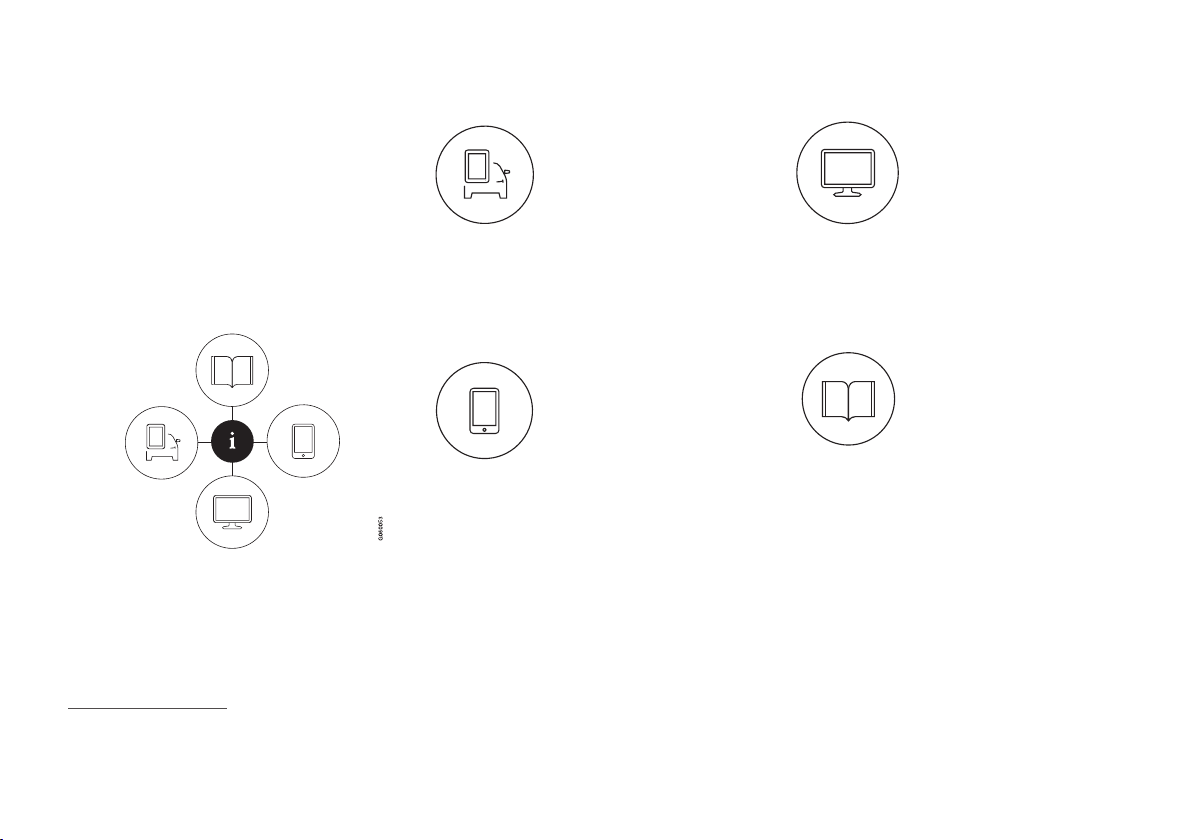
Owner's information is available in several differ-
ent product formats, both digital and printed.
The owner's manual is available in the car's
screen, as a mobile app and on the Volvo Cars
support site. There is a Quick Guide and a sup-
plement to the owner's manual available in the
glovebox, with specifications and fuse informa-
tion, amongst other things. A printed owner's
manual can be ordered.
The car's screen
1
A digital version of the owner's
manual is available in the car's
screen. Press the MY CAR but-
ton in the centre console, press
OK/MENU and select
Owner's manual. The infor-
mation is searchable and can
also be subdivided into categories.
Read more in the Digital owner's manual in the
car.
Mobile app
In App Store or Google Play,
search for "Volvo Manual",
download the app to your
smartphone or tablet and select
the car.
The app contains video tutorials
as well as options for visual navigation with exte-
rior and interior images of the car. It is easy to
navigate between the different sections in the
owner's manual and the content is searchable.
Read more about Owner's Manual in mobile devi-
ces.
Volvo Cars support site
Go to support.volvocars.com
and select your country. Here
you can find owner's manuals,
both online and in PDF format.
On the Volvo Cars support site
there are also video tutorials
and further information and
help regarding your Volvo and your car owner-
ship. The page is available for most markets.
Read more on the Volvo Cars support site.
Printed information
There is a supplement to the
owner's manual
2
in the glove-
box that contains information
on fuses and specifications, as
well as a summary of important
and practical information.
There is also a Quick Guide available in printed
format that helps you to get started with the most
commonly used functions in the car.
Depending on equipment level selected, market,
etc. additional owner's information may also be
available in printed format in the car.
A printed owner's manual and associated supple-
ment can be ordered. Contact a Volvo dealer to
order. See how the owner's manual is structured
in Reading the owner's manual.
1
A complete printed manual is included with the car for markets without owner's manual in the screen.
2
A complete printed manual is included with the car for markets without owner's manual in the screen.
INTRODUCTION
}}
13
Changing the language in the car's
screen
Changing the language in the car's display may
mean that some information does not correspond
to national or local laws and regulations. Don't
change to a language that's difficult to under-
stand, it may then be difficult to find your way
back in the structure on the screen.
IMPORTANT
The driver is always responsible that the vehi-
cle is driven safely in traffic and that applica-
ble laws and regulations are followed. It is
also important that the car is maintained and
handled in accordance with Volvo's recom-
mendations in the owner's information.
If there should be a difference between the
information in the screen and the printed
information then it is always the printed infor-
mation that applies.
Related information
•
Digital owner's manual in the car (p. 13)
•
Volvo Cars support site (p. 15)
•
Reading the owner's manual (p. 16)
Digital owner's manual in the car
The owner's manual can be read on the screen
in the car
3
. The content is searchable and it is
easy to navigate between different sections.
Open the digital owner's manual - press the MY
CAR button in the centre console, press OK/
MENU and select
Owner's manual.
For basic navigation, see Operating the system.
See below for a more detailed description.
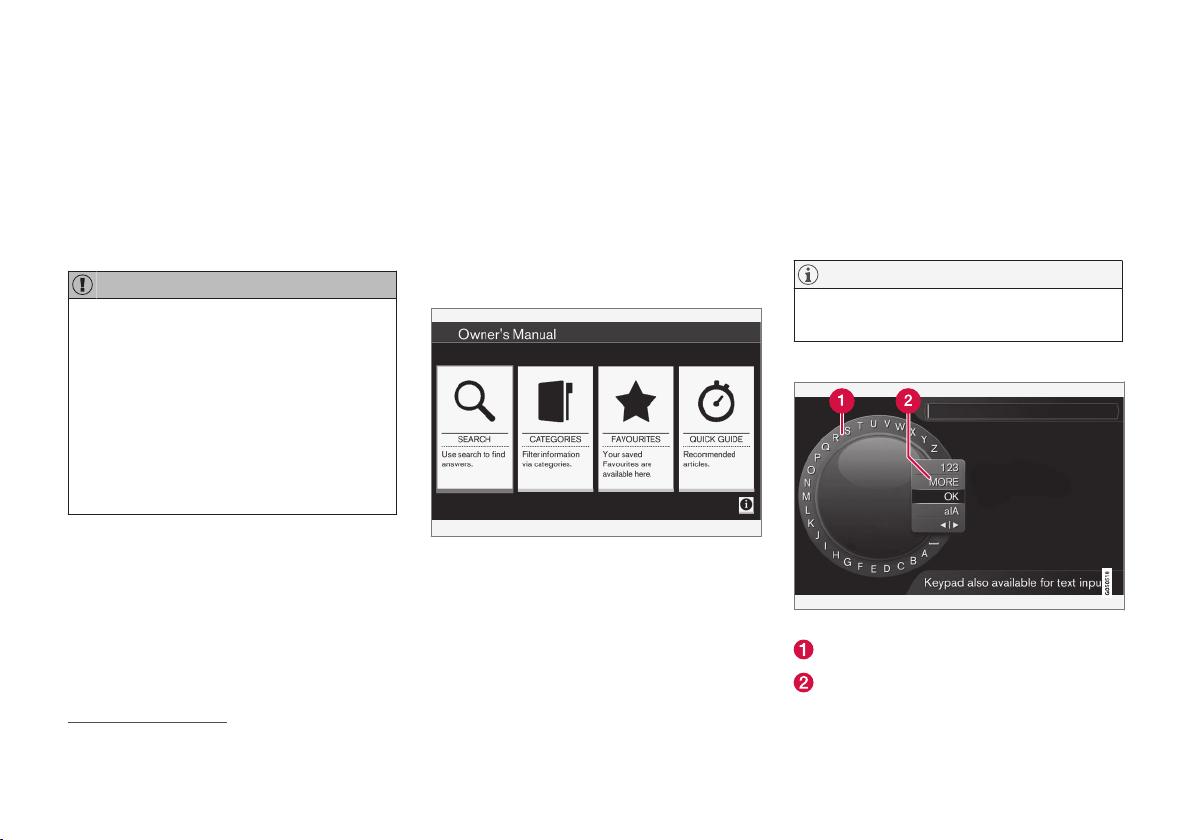
Owner's manual, start page.
There are four options for finding information in
the digital owner's manual:
•
Search - Search function for finding an arti-
cle.
•
Categories - All articles sorted into catego-
ries.
•
Favourites - Quick access to favourite-
bookmarked articles.
•
Quick Guide - A selection of articles for
common functions.
Select the information symbol in the lower right-
hand corner in order to obtain information about
the digital owner's manual.
NOTE
The digital owner's manual is not available
while driving.
Search
Searching using the character wheel.
Character list.
Changing the input mode (see following
table).
3
Applies to certain car models.
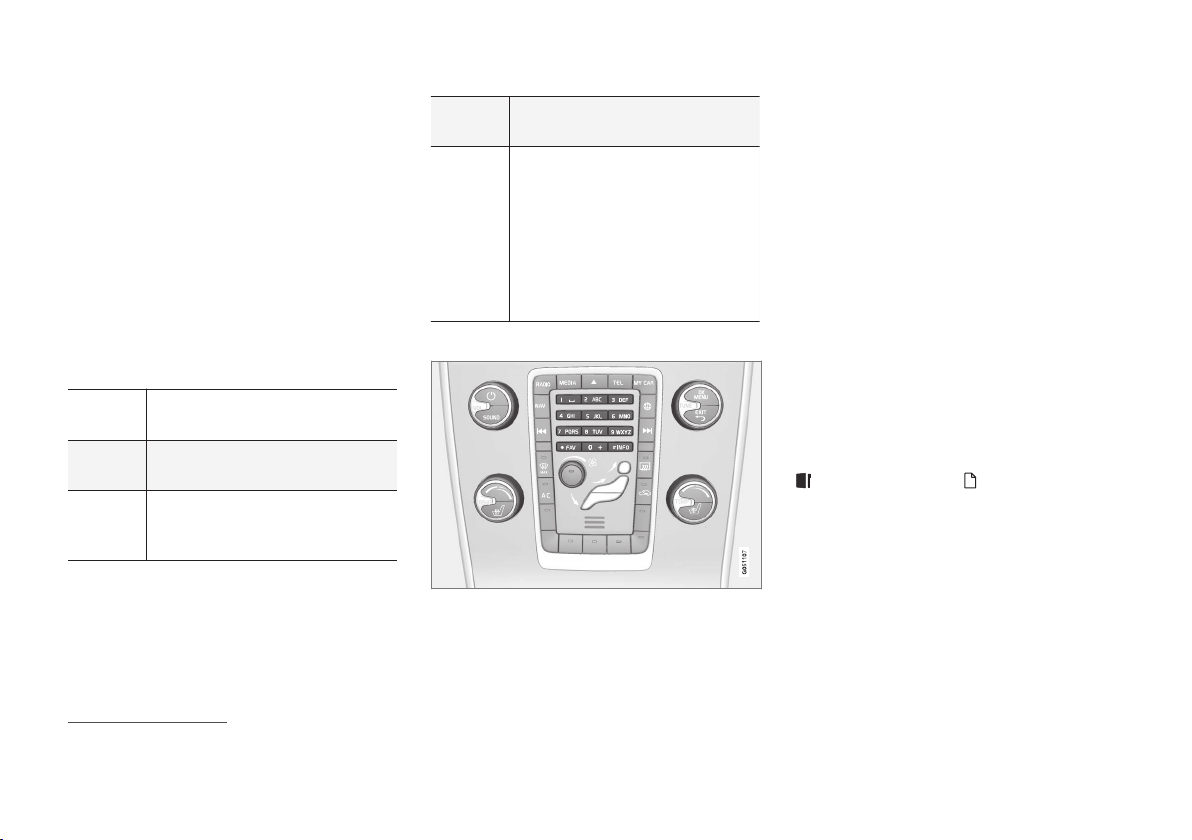
||
INTRODUCTION
14
Use the character wheel to enter a search term,
e.g. "seatbelt".
1.
Turn TUNE to the desired letter, press OK/
MENU to confirm. The number and letter
buttons on the control panel in the centre
console can also be used.
2. Continue with the next letter and so on.
3. To change the input mode to numbers or
special characters, or to perform a search,
turn TUNE to one of the options (see explan-
ation in the following table) in the list for
changing the input mode (2), press OK/
MENU.
123/AB
C
Change between letters and num-
bers with OK/MENU.
MORE
Change to special characters with
OK/MENU.
OK
Perform the search. Turn TUNE to
select a search result article, press
OK/MENU to go to the article.
a|A
Changes between lowercase and
uppercase letters with OK/MENU.
| | }
Changes from the character wheel
to the search field. Move the cur-
sor with TUNE. Delete any mis-
spelling with EXIT. To return to the
character wheel, press OK/MENU.
Note that the digit and letter but-
tons on the control panel can be
used for editing in the search field.
Enter with the numerical keyboard
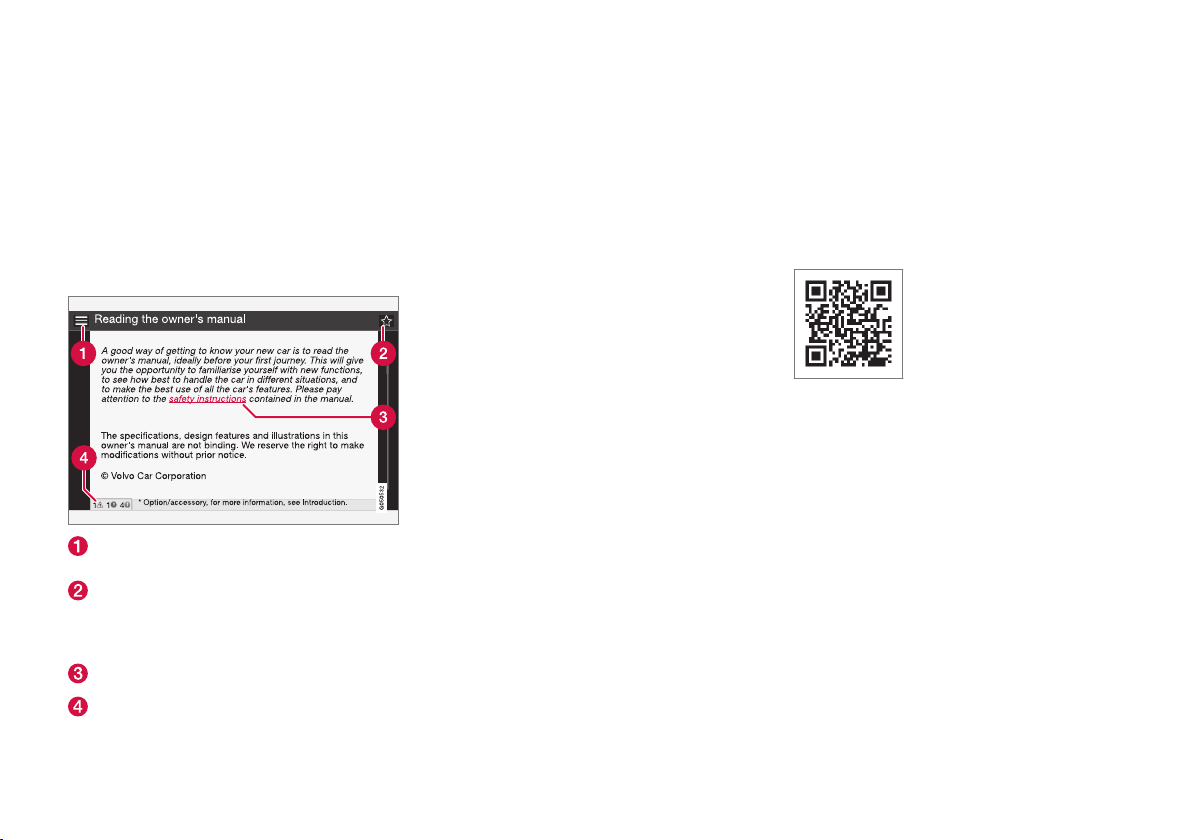
Numerical keyboard.
Another way of entering characters is to use the
centre console's buttons 0-9, * and #.
When e.g. 9 is pressed, a bar appears with all
characters
4
under the button, e.g.
W, x, y, z and
9. Quick presses on the button move the cursor
through these characters.
•
Stop with the cursor on the desired character
in order to select it - the character is shown
on the enter line.
•
Delete/undo using EXIT.
To enter a number, hold in the corresponding
number key.
Categories
The articles in the owner's manual are structured
into main categories and subcategories. The
same article can be in several appropriate cate-
gories in order to be found more easily.
Turn TUNE to navigate in the category tree and
press OK/MENU to open a category - selected
- or article - selected . Press EXIT to go
back to the previous view.
Favourites
Located here are the articles that are saved as
favourites. To select an article as a favourite, see
the heading "Navigating in an article" below.
Turn TUNE to navigate in the favourite list and
press OK/MENU to open an article. Press EXIT
to go back to the previous view.
4
The character for each button may vary depending on market/country/language.
INTRODUCTION
}}
* Option/accessory.
15
Quick Guide
Located here is a selection of articles for getting
to know the car's most common functions. The
articles can also be accessed via categories, but
are collected here for quick access.
Turn TUNE to navigate in the Quick Guide and
press OK/MENU to open an article. Press EXIT
to go back to the previous view.
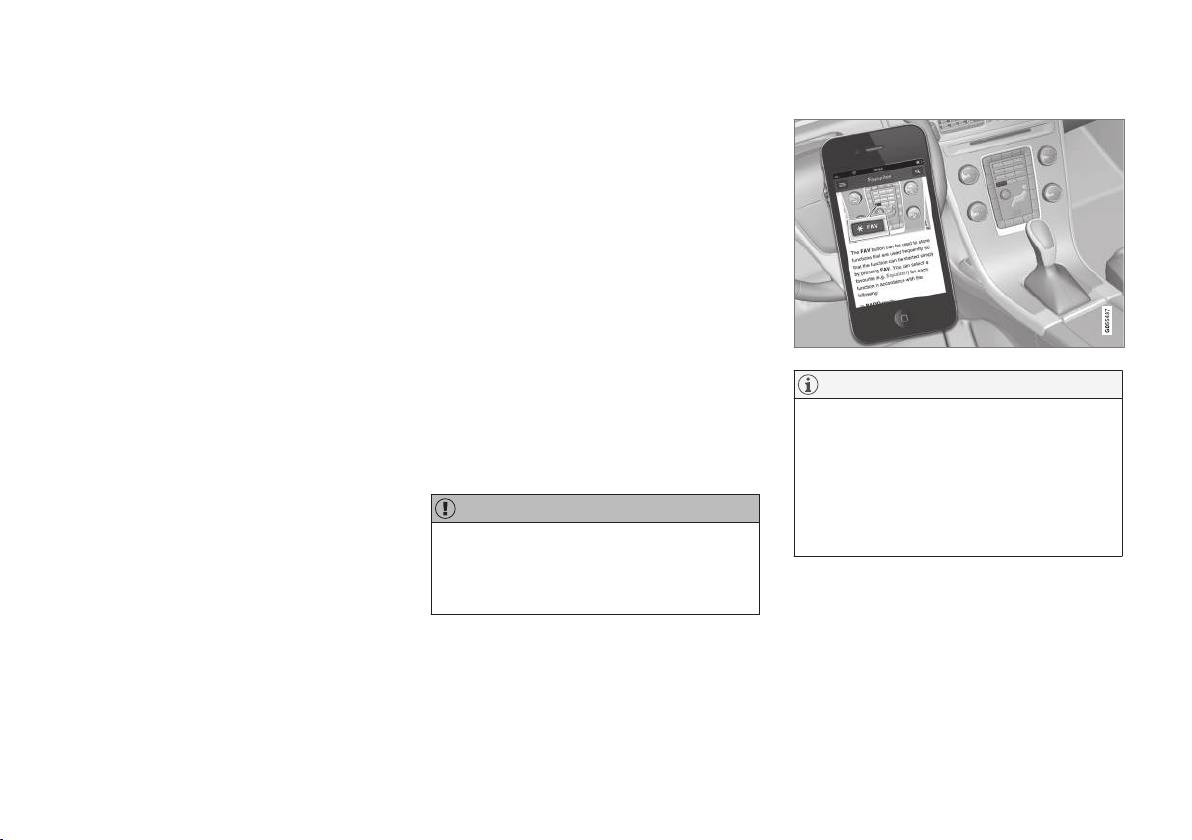
Navigating in an article
Home - leads to the start page for the
owner's manual.
Favourite - adds/removes an article as a
favourite. You can also press the FAV button
in the centre console to add/remove an arti-
cle as a favourite.
Highlighted link - leads to linked article.
Special texts - if the article contains warn-
ings, important or note texts then an associ-
ated symbol is shown here as well as the
number of such texts in the article.
Turn TUNE to navigate between the links or
scroll in an article. When the screen has scrolled
to the start/end of an article the home and
favourite options are accessed by scrolling a fur-
ther step up/down. Press OK/MENU to activate
the selection/highlighted link. Press EXIT to go
back to the previous view.
Volvo Cars support site
More information on your car is available on the
Volvo Cars website and support site.
Support on the Internet
Go to support.volvocars.com or use the QR code
below to visit the page. The support page is avail-
able for most markets.
QR code that leads to the support page.
The information on the support page is searcha-
ble and can also be subdivided into different cat-
egories. Available here is support for options rela-
ted to e.g. Internet connected services and func-
tions, Volvo On Call*, the navigation system* and
apps. Video and step-by-step instructions explain
different procedures, e.g. how the car is con-
nected to the Internet via a mobile phone.
Downloadable information from the
support page
Maps
For cars equipped with Sensus Navigation*, there
is the facility to download maps from the support
page.
||
INTRODUCTION
* Option/accessory.
16
Apps
For selected Volvo models from model year 2014
and 2015, the owner's manual is available in the
form of an app. The Volvo On Call* app can also
be accessed from here.
Owner's manuals from previous model years
Owner's manuals from previous model years are
available here in PDF format. The Quick Guide
and supplement can also be accessed from the
support page. Select car model and model year in
order to download the publication required.
Contact
On the support page there is contact information
for customer support and the nearest Volvo
dealer.
Log in to the Volvo Cars website
Create a personal Volvo ID and log in to
www.volvocars.com. Once you are logged in you
can get an overview of service, agreements and
warranties, amongst other things. There is also
information here about accessories and software
adapted for your car model.
Related information
•
Volvo ID (p. 20)
Reading the owner's manual
A good way of getting to know your new car is
to read the owner's manual, ideally before your
first journey.
Reading the owner's manual is a good way to
become familiar with new functions, get advice
on how best to handle the car in different situa-
tions and learn how to make the best use of all
the car's features. Please pay attention to the
safety instructions contained in the owner's man-
ual.
Development work is constantly in progress to
improve our product. Modifications may mean
that information, descriptions and illustrations in
the owner's manual differ from the equipment in
the car. We reserve the right to make modifica-
tions without prior notice.
© Volvo Car Corporation
IMPORTANT
Do not remove this manual from the car -
should a problem arise then the information
required about where and how to seek pro-
fessional help would be missing.
Owner's Manual in mobile devices
NOTE
The Owner's manual is available for download
as a mobile application (applies for certain car
models and mobile devices), see
www.volvocars.com.
The mobile application also includes video
and searchable content and easy navigation
between different sections.
Options/accessories
All types of option/accessory are marked with an
asterisk*.
In addition to standard equipment, the owner's
manual also describes options (factory fitted
equipment) and certain accessories (retrofitted
extra equipment).
INTRODUCTION
}}
17
The equipment described in the owner's manual
is not available in all cars - they have different
equipment depending on adaptations for the
needs of different markets and national or local
laws and regulations.
In the event of uncertainty over what is standard
or an option/accessory, contact a Volvo dealer.
Special texts
WARNING
Warning texts appear if there is a risk of
injury.
IMPORTANT
"Important" texts appear if there is a risk of
damage.
NOTE
NOTE texts give advice or tips that facilitate
the use of e.g. features and functions.
Footnote
There is footnote information in the owner's man-
ual that is located at the bottom of the page. This
information is an addition to the text that it refers
to via a number. If the footnote refers to text in a
table then letters are used instead of numbers
for referral.
Message texts
In the car there are displays that show menu
texts and message texts. In the owner's manual
the appearance of these texts differs from the
normal text. Examples of menu texts and mes-
sage texts:
Media, Sending location.
Decals
The car contains different types of decal which
are designed to convey important information in a
simple and clear manner. The decals in the car
have the following descending degree of impor-
tance for the warning/information.
Warning for personal injury
G031590
Black ISO symbols on yellow warning field, white
text/image on black message field. Used to indi-
cate the presence of danger which, if the warning
is ignored, may result in serious personal injury or
fatality.
Risk of property damage
G031592
White ISO symbols and white text/image on
black or blue warning field and message field.
Used to indicate the presence of danger which, if
the warning is ignored, may result in damage to
property.
||
INTRODUCTION
18
Information
G031593
White ISO symbols and white text/image on
black message field.
NOTE
It is not intended that the decals illustrated in
the owner's manual should be exact replicas
of those in the car. They are included to show
their approximate appearance and locations
in the car. The information that applies to your
particular car can be found on the decal on
the car.
Procedure lists
Procedures where action must be taken in a cer-
tain sequence are numbered in the owner's man-
ual.
When there is a series of illustrations for
step-by-step instructions each step is num-
bered in the same way as the corresponding
illustration.
Lists of letters appear adjacent to the series
of illustrations where the order of the instruc-
tions is not significant.
Arrows appear numbered and unnumbered
and are used to illustrate a movement.
Arrows with letters are used to clarify a
movement when the reciprocal order is of no
relevance.
If there is no series of illustrations for step-by-
step instructions then the different steps are
numbered with normal numbers.
Position lists
Red circles containing a number are used in
overview images where different components
are pointed out. The number recurs in the
position list featured in connection with the
illustration that describes the item.
Bulleted lists
A bulleted list is used when there is a list of
points in the owner's manual.
Example:
•
Coolant
•
Engine oil
Related information
Related information refers to other articles con-
taining closely-associated information.
Images
The manual's images are sometimes schematic
and may deviate from the car's appearance
depending on equipment level and market.
To be continued
}} This symbol is located furthest down to the
right when an article continues on the following
page.
Continued from previous page
|| This symbol is located furthest up to the left
when an article continues from the previous
page.
Related information
•
The owner's manual and the environment
(p. 25)
•
Volvo Cars support site (p. 15)

INTRODUCTION
19
Recording data
As part of Volvo's safety and quality assurance,
certain information about the vehicle's operation,
functionality and incidents are recorded in the
car.
This vehicle is equipped with an "Event Data
Recorder" (EDR). Its primary purpose is to regis-
ter and record data related to traffic accidents or
collision-like situations, such as times when the
airbag deploys or the vehicle strikes an obstacle
in the road. The data is recorded in order to
increase understanding of how vehicle systems
work in these types of situations. The EDR is
designed to record data related to vehicle
dynamics and safety systems for a short time,
usually 30 seconds or less.
The EDR in this vehicle is designed to record
data related to the following in the event of traffic
accidents or collision-like situations:
•
How the various systems in the car worked
•
Whether the driver and passenger seatbelts
were fastened/tensioned
•
The driver's use of the accelerator or brake
pedal
•
The travel speed of the vehicle
This information can help us better understand
the circumstances in which traffic accidents, inju-
ries and damage occur. The EDR only records
data when a non-trivial collision situation occurs.
The EDR does not record any data during normal
driving conditions. Similarly, the system never
registers who is driving the vehicle or the geo-
graphic location of the accident or near-miss sit-
uation. However, other parties, such as the police,
could use the recorded data in combination with
the type of personally identifiable information
routinely collected after a traffic accident. Special
equipment and access to either the vehicle or the
EDR is required to be able to interpret the regis-
tered data.
In addition to the EDR, the car is equipped with a
number of computers designed to continually
check and monitor the function of the car. They
can record data during normal driving conditions,
but in particular register faults affecting the vehi-
cle's operation and functionality, or upon activa-
tion of the vehicle's active driver support function
(e.g. City Safety and the auto brake function).
Some of the recorded data is required to enable
service and maintenance technicians to diagnose
and remedy any faults that occurred in the vehi-
cle. The registered information is also needed to
enable Volvo to satisfy legal requirements laid out
in laws and by government authorities. Informa-
tion registered in the vehicle is stored in its com-
puter until the vehicle is serviced or repaired.
In addition to the above, the registered informa-
tion can be used in aggregate form for research
and product development with the aim of contin-
uously improving the safety and quality of Volvo
cars.
Volvo will not contribute to the above-described
information being disclosed to third parties with-
out the vehicle owner's consent. To comply with
national legislation and regulations, Volvo may be
forced to disclose information of this nature to
the police or other authorities who may assert a
legal right to access such. Special technical
equipment which Volvo and workshops that have
entered into agreements with Volvo have access
to is required to be able to read and interpret the
recorded data. Volvo is responsible that the infor-
mation, which is transferred to Volvo during serv-
icing and maintenance, is stored and handled in a
secure manner and that the handling complies
with applicable legal requirements. For further
information - contact a Volvo dealer.
INTRODUCTION
* Option/accessory.
20
Accessories and extra equipment
The incorrect connection and installation of
accessories and extra equipment can negatively
affect the car's electronic system.
Certain accessories only function when associ-
ated software is installed in the car's computer
system. Volvo therefore recommends that you
always contact an authorised Volvo workshop
before installing accessories or extra equipment
which are connected to or affect the electrical
system.
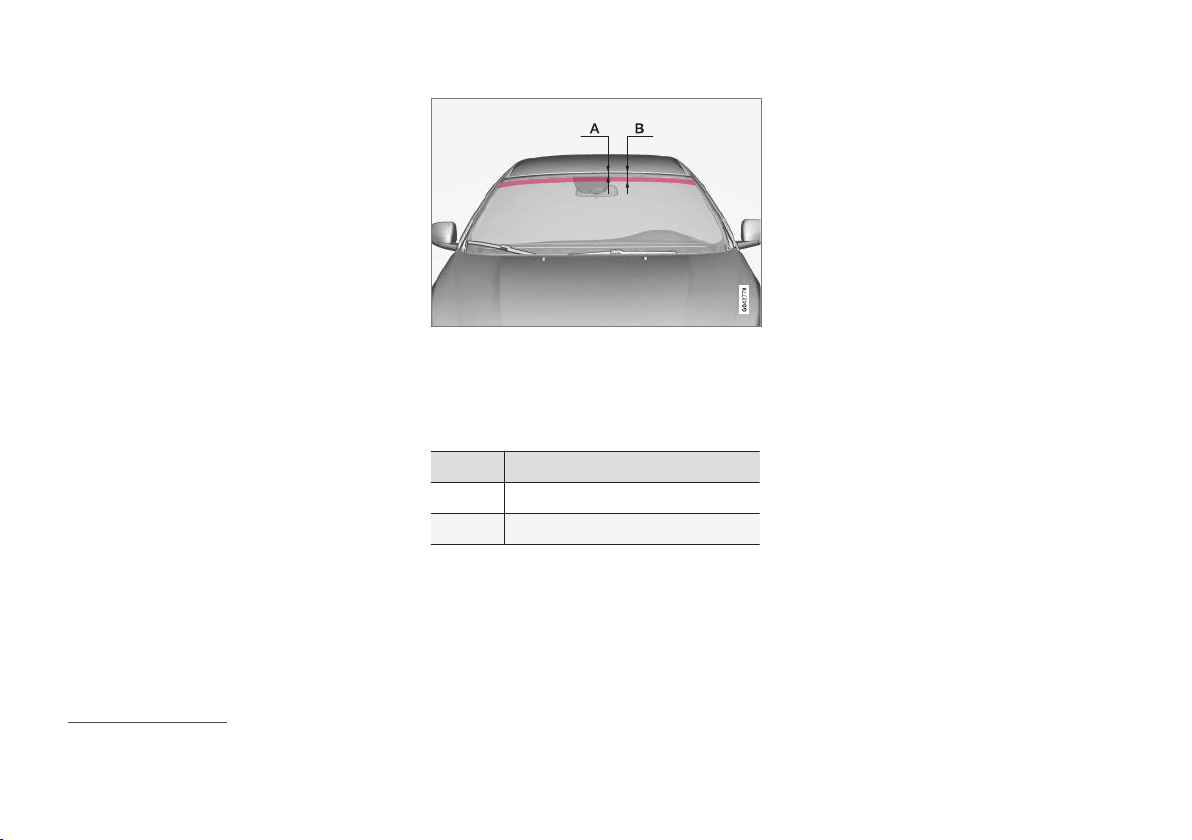
Heat-reflecting windscreen*
The windscreen is equipped with a heat-reflect-
ing film (IR) that reduces the solar heat radiation
into the passenger compartment.
The positioning of electronic equipment, such as
a transponder, behind a glass surface with heat-
reflecting film may affect its function and per-
formance.
For the optimal function of electronic equipment,
it should be positioned on the part of the wind-
screen with no heat-reflecting film (see the high-
lighted area in the illustration).
Areas where IR film is not applied.
A is the distance from the top edge of the wind-
screen down to the start of the field. B is the dis-
tance from the top edge of the windscreen down
to the end of the field.
Dimensions
A 40 mm
B 80 mm
Volvo ID
Volvo ID provides access to a wide range of per-
sonalized Volvo services
5
online.
Examples of services:
•
In an Internet-connected car* - Certain func-
tions and services require that you have reg-
istered your car to a personal Volvo ID, for
example to be able to send a new address
from a map service on the Internet directly to
the car.
•
Volvo On Call* - Volvo ID is used when log-
ging in to the Volvo On Call app.
Advantages of Volvo ID
•
One user name and one password to access
online services, i.e. only one username and
one password to remember.
•
When changing the username/password for
a service (e.g. Volvo On Call) it will also be
changed automatically for other services.
Create a Volvo ID
To create a Volvo ID you need to enter a personal
e-mail address. Then follow the instructions in
the e-mail message that is automatically sent to
the specified address in order to complete the
registration. It is possible to create a Volvo ID via
one of the following services:
5
The services available may vary over time and vary depending on equipment level and market.

INTRODUCTION
* Option/accessory.
21
•
Volvo Cars website - Go to
www.volvocars.com and log in
6
at the icon,
top right. Select Create Volvo ID.
•
For an Internet-connected car* - Enter your
e-mail address in the app that requires Volvo
ID and follow the instructions. Alternatively,
press the Connect button
in the centre
console twice and select
Apps Settings
and follow the instructions.
•
Volvo On Call* - Download the latest version
of the Volvo On Call app. Choose to create a
Volvo ID from the start page, enter e-mail
address and follow the instructions.
Related information
•
Volvo Cars support site (p. 15)
6
Available in certain markets.
INTRODUCTION
22
Environmental philosophy
Volvo Car Corporation is constantly working on
the development of safer and more efficient
products and solutions in order to reduce the
negative impact on the environment.
Environmental care is one of Volvo Cars’ core val-
ues and influences all operations. The environ-
mental work is based on the whole life cycle of
the car and takes into account the environmental
impact it has, from design to scrapping and recy-
cling. Volvo Cars' basic principle is that every new
product developed must have less impact on the
environment than the product it replaces.
Volvo's environmental management work has
resulted in the development of the more efficient
and less polluting Drive-E drivelines. The personal
environment is also important to Volvo - the air
inside a Volvo is, for example, cleaner than the air
outside thanks to the climate control system.
Your Volvo complies with stringent international
environmental standards. All Volvo's manufactur-
ing units must be ISO 14001 certified, and this
supports a systematic approach to the opera-
tion's environmental issues, which leads to con-
tinuous improvement with reduced environmental
impact. Holding the ISO certificate also means
that environmental laws and regulations in force
are complied with. Volvo also requires that its
partners must also meet these requirements.
Fuel consumption
Since a large part of a car's total environmental
impact stems from its use, the emphasis of Volvo
Cars' environmental work is on reducing fuel con-
sumption, carbon dioxide emissions and other air
pollutants. Volvo cars have competitive fuel con-
sumption in each of their respective classes.
Lower fuel consumption generally results in lower
emission of the greenhouse gas, carbon dioxide.

INTRODUCTION
}}
* Option/accessory.
23
Contributing to a better environment
An energy-efficient and fuel-efficient car not only
contributes to a reduced impact on the environ-
ment, but also means reduced costs for the
owner of the car. As the driver, it is easy to
reduce fuel consumption and thereby save
money and contribute to a better environment -
here is some advice:
•
Plan for an effective average speed. Speeds
above approx. 80 km/h (50 mph) and below
50 km/h (30 mph) lead to increased energy
consumption.
•
Follow the Service and Warranty Booklet's
recommended intervals for service and main-
tenance of the car.
•
Avoid letting the engine idle - switch off the
engine when stationary for longer periods.
Pay attention to local regulations.
•
Plan the journey - a lot of unnecessary stops
and uneven speed contribute to increased
fuel consumption.
•
If the car is equipped with an engine block
heater*, use it before starting from cold - it
improves starting capacity and reduces wear
in cold weather and the engine reaches nor-
mal operating temperature more quickly,
which lowers consumption and reduces
emissions.
Also remember to always dispose of environmen-
tally hazardous waste, such as batteries and oil, in
an environmentally safe manner. Consult a work-
shop in the event of uncertainty about how this
type of waste should be discarded - an author-
ised Volvo workshop is recommended.
Following this advice can save money, the plan-
et's resources are saved, and the car's durability
is extended. For more information and further
advice see Eco guide (p. 66), Economical driv-
ing (p. 310) and Fuel consumption (p. 416).
Efficient emission control
Your Volvo is manufactured following the concept
"Clean inside and out" – a concept that encom-
passes a clean interior environment as well as
highly efficient emission control. In many cases
the exhaust emissions are well below the applica-
ble standards.
Clean air in the passenger
compartment
A passenger compartment filter prevents dust
and pollen from entering the passenger compart-
ment via the air intake.
The Interior Air Quality System (IAQS)* ensures
that the incoming air is cleaner than the air in the
traffic outside.
The system cleans the air in the passenger com-
partment from contaminants such as particles,
hydrocarbons, nitrous oxides and ground-level
ozone. If the outside air is contaminated then the
air intake is closed and the air is recirculated.
Such a situation may arise in heavy traffic,
queues and tunnels for example.
IAQS is a part of the Clean Zone Interior Pack-
age (CZIP)*, which also includes a function that
allows the fan to start when the car is unlocked
with the remote control key.
Interior
The material used in the interior of a Volvo is
carefully selected and has been tested in order to
be pleasant and comfortable. Some of the details
are hand-made, such as the seams of the steer-
ing wheel that are sewn by hand. The interior is
monitored in order not to emit strong odours or
substances that cause discomfort in the event of
e.g. high heat and bright light.
Volvo workshops and the environment
Regular maintenance creates the conditions for a
long service life and low fuel consumption for
your car. In this way you also contribute to a
cleaner environment. When Volvo's workshops
are entrusted with the service and maintenance
of your car it becomes part of Volvo's system.
Volvo makes clear demands regarding the way in
which workshop premises shall be designed in
order to prevent spills and discharges into the
environment. The workshop staff have the knowl-
edge and the tools required to guarantee good
environmental care.
Recycling
Since Volvo works from a life cycle perspective, it
is also important that the car is recycled in an
environmentally sound manner. Almost all of the
car can be recycled. The last owner of the car is


INTRODUCTION
* Option/accessory.
25
The owner's manual and the
environment
The paper pulp in a printed owner's manual
comes from Forest Stewardship Council
®
certi-
fied forests or other controlled sources.
The FSC
®
symbol shows that the paper pulp in a
printed owner's manual comes from FSC
®
certi-
fied forests or other controlled sources.
Related information
•
Environmental philosophy (p. 22)
Laminated glass
The glass is reinforced which provides
better protection against break-ins and
improved sound insulation in the pas-
senger compartment. The windscreen
and the side windows* have laminated glass.


SAFETY
SAFETY
28
General information on seatbelts
Heavy braking can have serious consequences
if the seatbelts are not used. Ensure that all pas-
sengers are using their seatbelts during the jour-
ney.
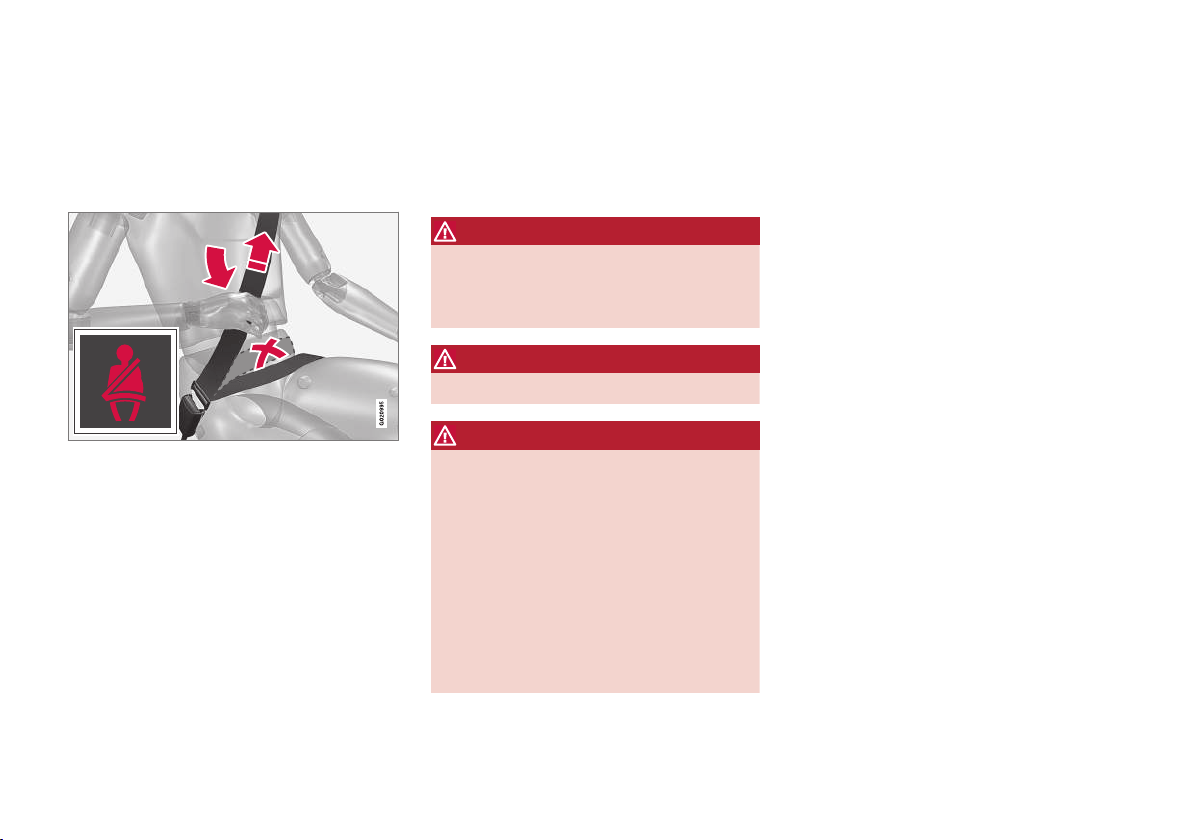
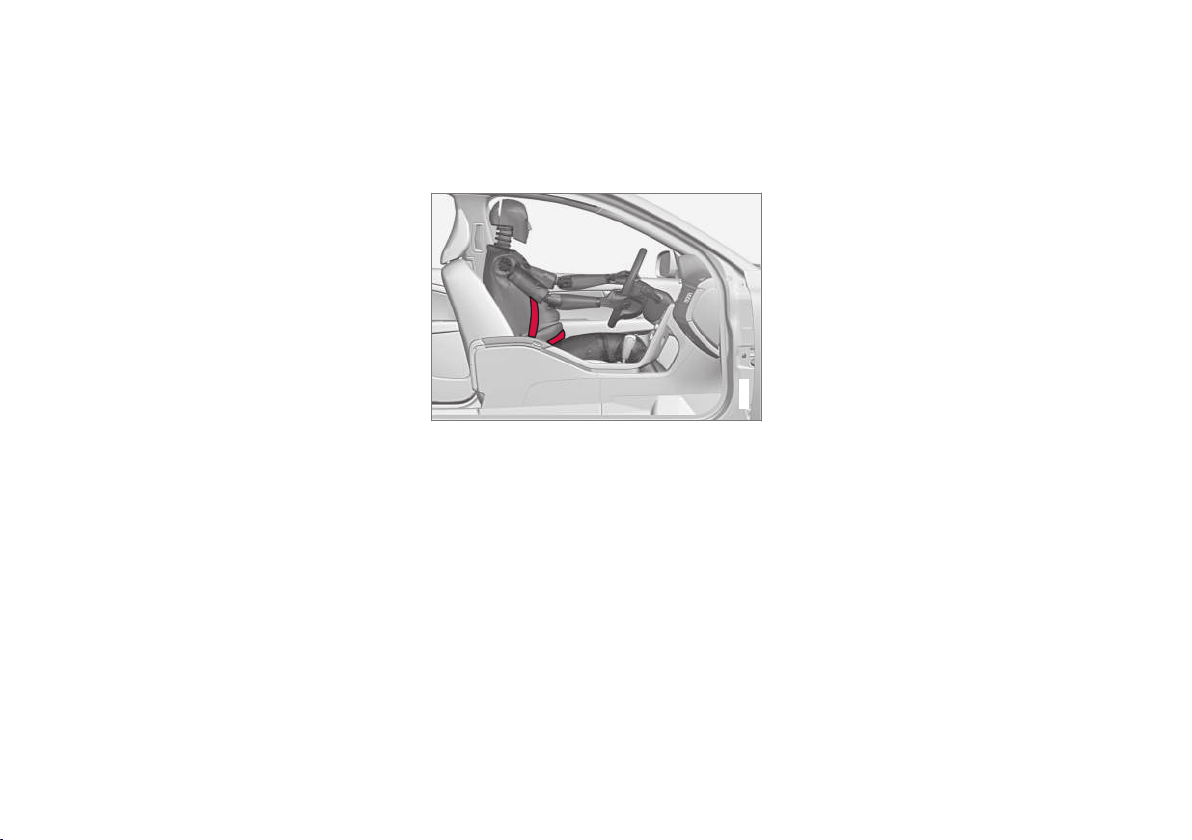
Tension the hip strap over the lap by pulling the diagonal
shoulder belt up towards the shoulder. The hip strap
must be positioned low down (not over the abdomen).
It is important that the seatbelt lies against the
body so it can provide maximum protection. Do
not lean the backrest too far back. The seatbelt is
designed to protect in a normal seating position.
Unbelted occupants will be reminded to fasten
their (p. 29) seatbelt by means of an audio and
visual reminder (p. 31).
Remember
•
Do not use clips or anything else that can
prevent the seatbelt from fitting properly.
•
The seatbelt must not be twisted or caught
on anything.
WARNING
The seatbelts and airbags interact. If a seat-
belt is not used or is used incorrectly, this may
diminish the protection provided by the airbag
in the event of a collision.
WARNING
Each seatbelt is designed for only one person.
WARNING
Never modify or repair the seatbelts yourself.
Volvo recommends that you contact an
authorised Volvo workshop.
If a seatbelt has been subjected to a major
load, such as in conjunction with a collision,
the entire seatbelt must be replaced. Some of
the protective characteristics of the seatbelt
may have been lost, even if it appears to be
undamaged. In addition, replace the seatbelt if
the belt is worn or damaged. The new seat-
belt must be type-approved and intended for
installation in the same position as the
replaced seatbelt.
Related information
•
Seatbelt - pregnancy (p. 30)
•
Seatbelt - loosening (p. 30)
•
Seatbelt tensioner (p. 31)
SAFETY
29
Seatbelt - putting on
Put on the seatbelt (p. 28) before driving starts.
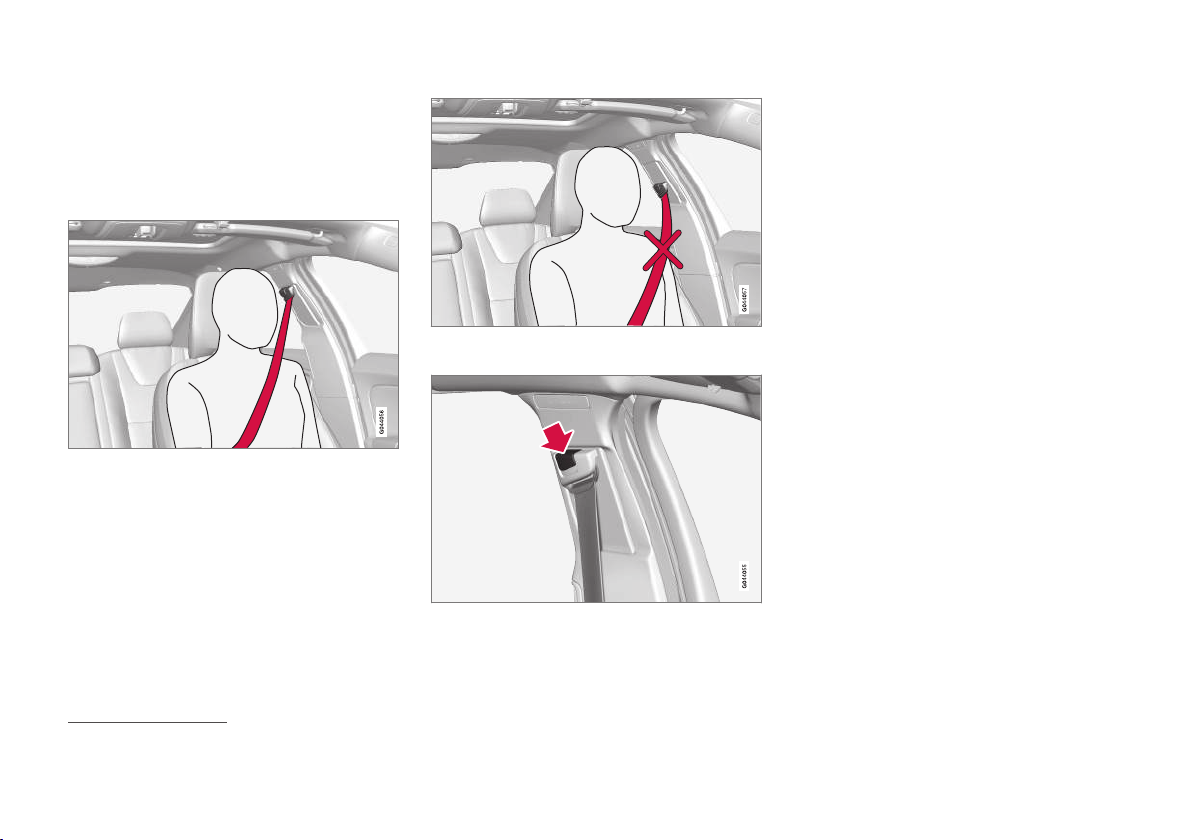
Pull the belt out slowly and secure it by pressing
its locking tab into the seatbelt buckle. A loud
"click" indicates that the belt has locked.
Correctly fitted seatbelt.
Incorrectly fitted seatbelt. The belt must rest on the
shoulder.
Seatbelt height adjustment. Press the button and move
the belt vertically. Position the belt as high as possible
without it chafing against your throat.
The buckles only fit the intended lock in the rear
seat
1
.
Remember
The seatbelt locks and cannot be withdrawn:
•
if it is pulled out too quickly
•
during braking and acceleration
•
if the car leans heavily.
Related information
•
Seatbelt - pregnancy (p. 30)
•
Seatbelt - loosening (p. 30)
•
Seatbelt tensioner (p. 31)
•
Seatbelt reminder (p. 31)
1
Certain markets.
SAFETY
30
Seatbelt - loosening
Loosen the seatbelt (p. 28) when the car is sta-
tionary.
Press the red button on the seatbelt buckle and
then let the belt retract. If the seatbelt does not
retract fully, feed it in by hand so that it does not
hang loose.
Related information
•
Seatbelt - putting on (p. 29)
•
Seatbelt reminder (p. 31)
Seatbelt - pregnancy
Seatbelt (p. 28) must always be worn during
pregnancy. But it is crucial that it be worn in the
correct way.
G020998
The diagonal section should wrap over the shoul-
der then be routed between the breasts and to
the side of the abdomen.
The lap section should lay flat over the thighs and
as low as possible under the abdomen. It must
never be allowed to ride upward. Remove the
slack from the seatbelt and ensure that it fits as
close to the body as possible. In addition, check
that there are no twists in the seatbelt.
As the pregnancy progresses, pregnant drivers
must adjust the seat (p. 79) and steering wheel
(p. 83) such that they can easily maintain con-
trol of the vehicle as they drive (which means that
they must be able to easily operate the foot ped-
als and steering wheel). The aim should be to
position the seat with as large a distance as pos-
sible between abdomen and steering wheel.
Related information
•
Seatbelt - putting on (p. 29)
•
Seatbelt - loosening (p. 30)
SAFETY
31
Seatbelt reminder
Unbelted occupants will be reminded to fasten
their (p. 29) seatbelt by means of an audio and
visual reminder.
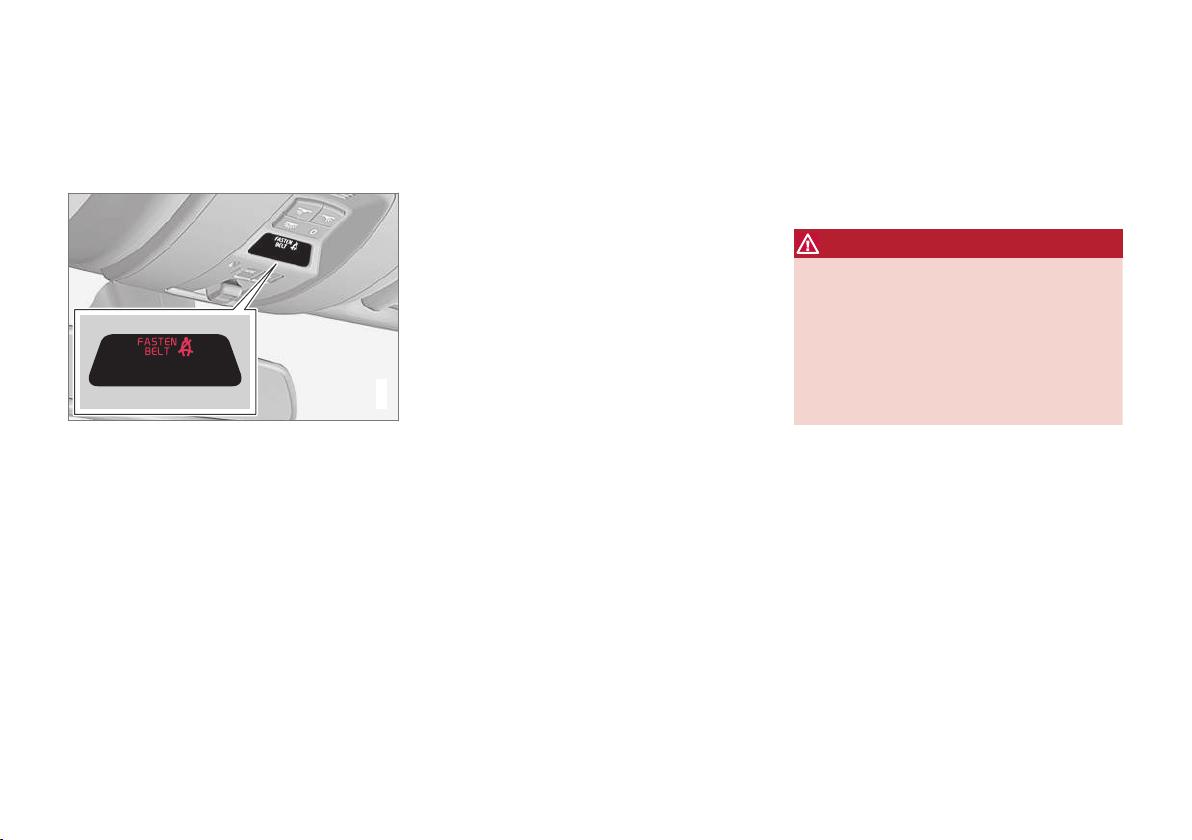
G017726
The audio reminder is speed dependent, and in
some cases time dependent. The visual reminder
is located in the roof console and in the com-
bined instrument panel (p. 62).
Child seats are not covered by the seatbelt
reminder system.
Rear seat
The seatbelt reminder in the rear seat has two
subfunctions:
•
Provides information on which seatbelts
(p. 28) are being used in the rear seat. A
message appears in the combined instru-
ment panel when the seatbelts are in use, or
if one of the rear doors has been opened.
The message is cleared automatically after
driving for approximately 30 seconds or after
pressing the indicator stalk OK button
(p. 106).
•
Provides a warning if one of the rear seat-
belts is unfastened during travel. This warn-
ing takes the form of a message in the com-
bined instrument panel along with the audio/
visual signal. The warning stops when the
seatbelt is re-fastened, or it can also be
acknowledged manually by pressing the OK
button.
The message in the combined instrument panel
showing which seatbelts are in use is always
shown. Press the OK button to see stored mes-
sages.
Certain markets
An acoustic signal and indicator lamp remind the
driver and front seat passenger to use a seatbelt
if either of them is not wearing one. At low speed,
the audio reminder will sound for the first 6 sec-
onds.
Seatbelt tensioner
All the seatbelts (p. 28) are equipped with belt
tensioners. A mechanism in the seatbelt ten-
sioner tightens the seatbelt in the event of a suf-
ficiently violent collision. The seatbelt then pro-
vides more effective restraint for the occupants.
WARNING
Never insert the tongue of the passenger's
seatbelt into the buckle on the driver's side.
Always insert the tongue of the seatbelt into
the buckle on the correct side. Do not make
any damages on seatbelts nor insert any for-
eign objects into a buckle. The seatbelts and
buckles would then possibly not function as
intended in the event of a collision. There is a
risk of serous injury.
SAFETY
32
Safety - warning symbol
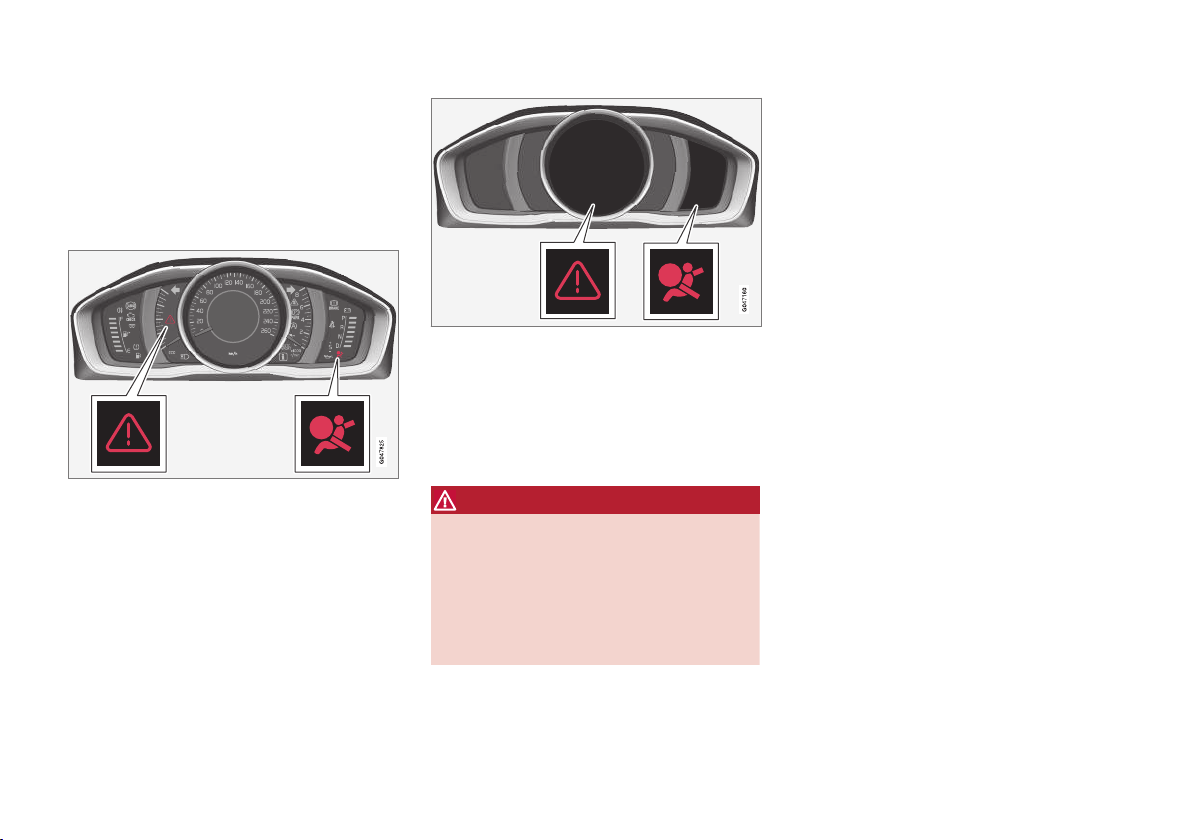
The warning symbol is shown if a fault is
detected during fault tracing or if a system has
been activated. Where required, the warning
symbol is shown together with a message in the
combined instrument panel (p. 62) information
display.
Warning triangle and warning symbol for the airbag sys-
tem (p. 33) in the analogue combined instrument
panel.
Warning triangle and warning symbol for the airbag sys-
tem in the digital combined instrument panel.
The warning symbol in the combined instrument
panel illuminates when the remote control key is
in key position II (p. 77). The symbol clears
after approx. 6 seconds provided the airbag sys-
tem is fault-free.
WARNING
If the warning symbol for the airbag system
remains illuminated or illuminates while driv-
ing, it means that the airbag system does not
have full functionality. The symbol indicates a
fault in the seatbelt tensioner system, SIPS,
the IC system or some other fault in the sys-
tem. Volvo recommends that you contact an
authorised Volvo workshop immediately.
If the warning symbol malfunctions, the warning
triangle illuminates and
SRS airbag Service
required or SRS airbag Service urgent
appears in the display. Volvo recommends that
you contact an authorised Volvo workshop imme-
diately.
Related information
•
General information on safety mode (p. 41)
SAFETY
}}
33
Airbag system
In the event of a frontal collision the airbag sys-
tem helps to protect the head, face and chest of
the driver and passenger.
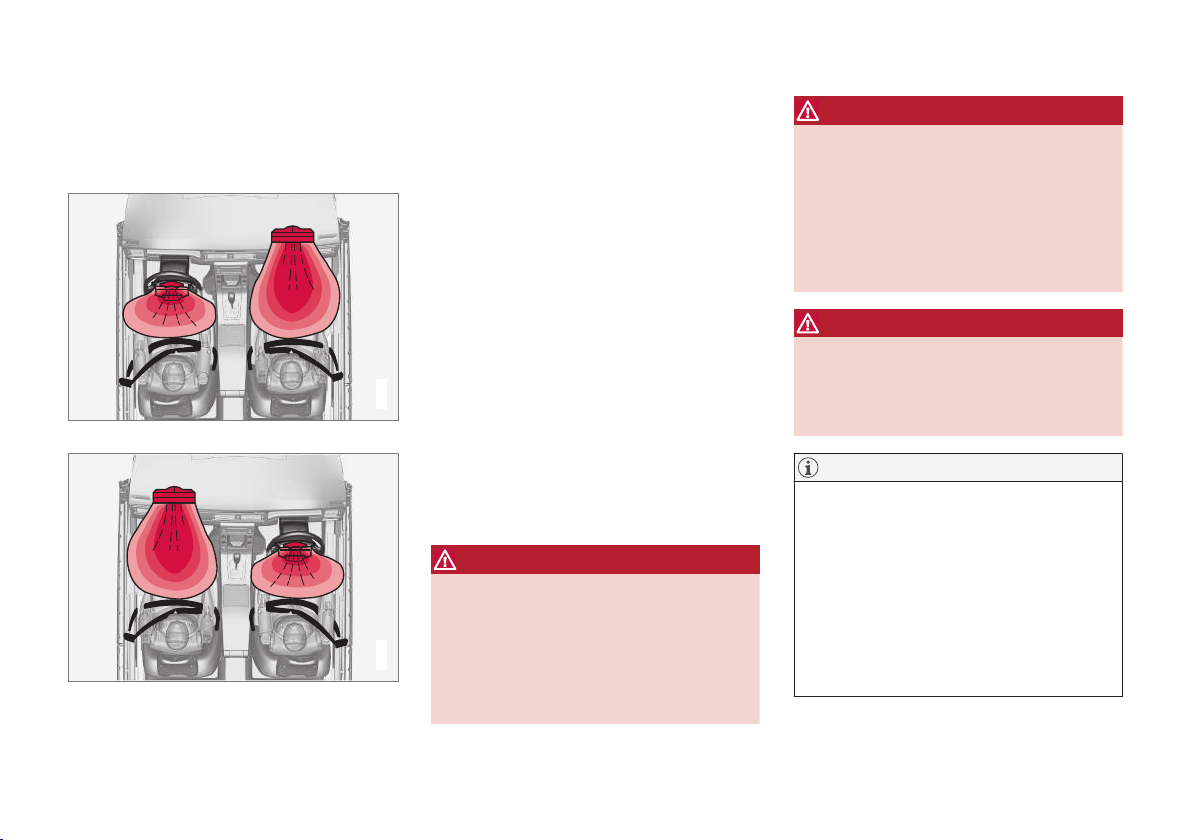
G018665
Airbag system viewed from above, left-hand-drive car.
G018666
Airbag system viewed from above, right-hand-drive car.
The system consists of airbags and sensors. A
sufficiently violent collision trips the sensors and
the airbag(s) are inflated and become hot. The
airbag cushions the initial collision impact for the
occupant. The airbag deflates when compressed
by the collision. When this occurs, smoke
escapes into the car. This is completely normal.
The entire process, including inflation and defla-
tion of the airbag, occurs within tenths of a sec-
ond.
If the airbags have deployed, the following is rec-
ommended:
•
Recovering the car. Volvo recommends that
you have it conveyed to an authorised Volvo
workshop. Do not drive with deployed air-
bags.
•
Volvo recommends that you engage an
authorised Volvo workshop to handle the
replacement of components in the car's
safety systems.
•
Always contact a doctor.
WARNING
The airbag system's control module is located
in the centre console. If the centre console is
drenched with water or other liquid, discon-
nect the battery cables. Do not attempt to
start the car since the airbags may deploy.
Recovering the car. Volvo recommends that
you have it conveyed to an authorised Volvo
workshop.
WARNING
Never drive with deployed airbags. They can
make steering difficult. Other safety systems
may also be damaged. The smoke and dust
created when the airbags are deployed can
cause skin and eye irritation/injury after inten-
sive exposure. In case of irritation, wash with
cold water. The rapid deployment sequence
and airbag fabric may cause friction and skin
burns.
WARNING
Volvo recommends that you contact an
authorised Volvo workshop for repair. Defec-
tive work in the airbag system could cause
malfunction and result in serious personal
injury.
NOTE
The detectors react differently depending on
the nature of the collision and whether or not
the seatbelts are fastened. Applies to all belt
positions.
It is therefore possible that only one (or none)
of the airbags may inflate in a collision. The
detectors sense the force of the collision on
the vehicle and the action is adapted accord-
ingly so that one or more airbags are
deployed.
||
SAFETY
34
Related information
•
Driver airbag (p. 34)
•
Passenger airbag (p. 34)
•
Safety - warning symbol (p. 32)
Driver airbag
To supplement the protection afforded by the
seatbelt (p. 28) the car is equipped on the driv-
er's side with an airbag (p. 33).
This airbag is fitted into the centre of the steering
wheel. The steering wheel is marked AIRBAG.
WARNING
The seatbelts and airbags interact. If the belt
is not used or is used incorrectly, this may
diminish the protection provided by the airbag
in the event of a collision.
Related information
•
Passenger airbag (p. 34)
Passenger airbag
To supplement the protection afforded by the
seatbelt (p. 28) on the passenger side, the car
is equipped with an airbag (p. 33).
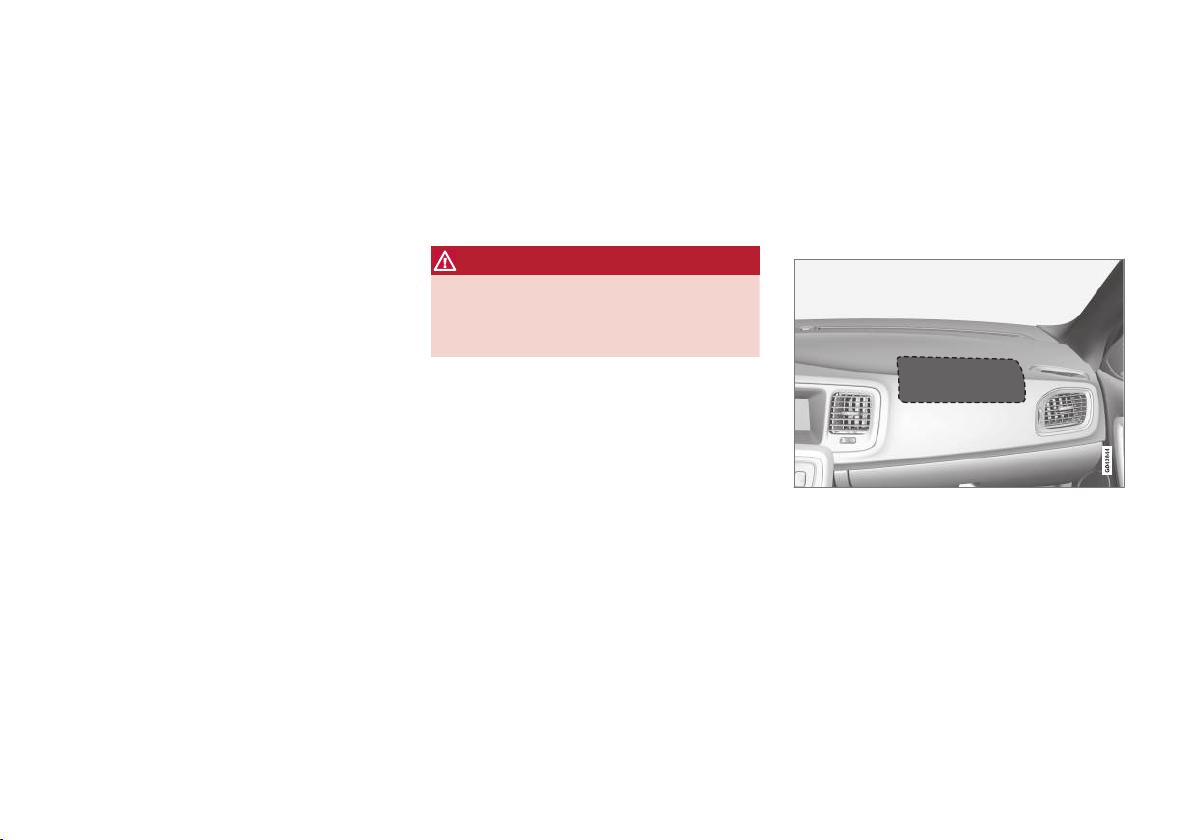
The airbag is folded up into a compartment
above the glovebox. Its cover panel is marked
AIRBAG.
Location of the front passenger airbag in a left-hand
drive car.
SAFETY
}}
35
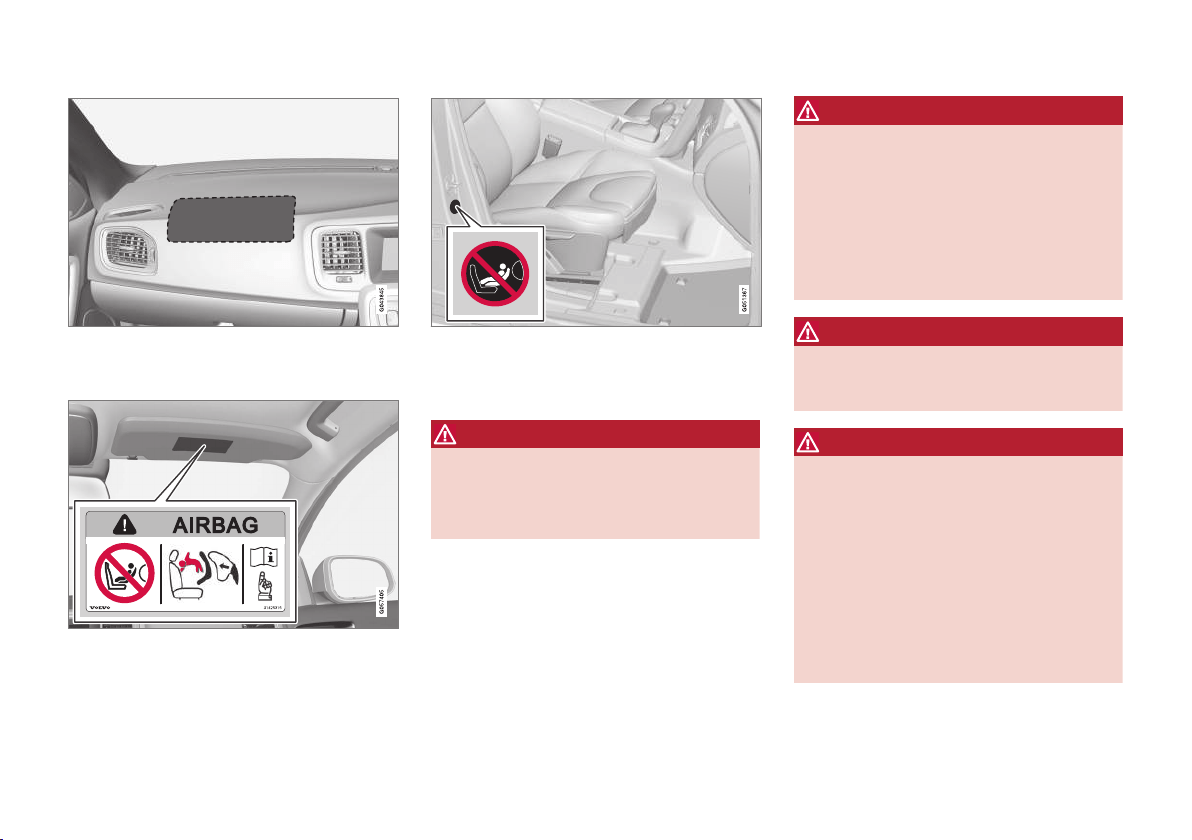
Location of the front passenger airbag in a right-hand
drive car.
Label for passenger airbag
Label on the passenger side's sun visor.
Label on the passenger side's door pillar. The label
becomes visible when the passenger door is opened.
The warning label for the passenger airbag is
positioned as shown above.
WARNING
Never use a rear-facing child seat on a seat
protected by an activated airbag. Failure to
follow this advice can lead to death or serious
injury to the child.
WARNING
The seatbelts and airbags interact. If the belt
is not used or is used incorrectly, this may
diminish the protection provided by the airbag
in the event of a collision.
To minimise the risk of injury if the airbag
deploys, passengers must sit as upright as
possible with their feet on the floor and backs
against the backrest. Seatbelts must be
secured.
WARNING
Do not put objects in front of or above the
dashboard where the passenger airbag is
located.
WARNING
Never allow anybody to stand or sit in front of
the front passenger seat.
Never use a rear-facing child seat on the front
passenger seat if the passenger airbag is
activated.
Front-facing passengers (children and adults)
must never sit on the front passenger seat if
the passenger airbag is deactivated.
Failure to follow the advice given above can
endanger life or lead to serious personal
injury.
||
SAFETY
* Option/accessory.
36
Switch - PACOS*
The front passenger airbag can be deactivated
(p. 36) if the car is equipped with a switch,
PACOS (Passenger Airbag Cut Off Switch).
WARNING
If the car is equipped with an airbag for the
front passenger seat, but does not have a
switch PACOS (Passenger Airbag Cut Off
Switch), then the airbag will always be acti-
vated.
Related information
•
Driver airbag (p. 34)
•
Child seats (p. 45)
Passenger airbag - activating/
deactivating*
The front passenger airbag (p. 34) can be deac-
tivated if the car is equipped with a switch,
PACOS (Passenger Airbag Cut Off Switch).
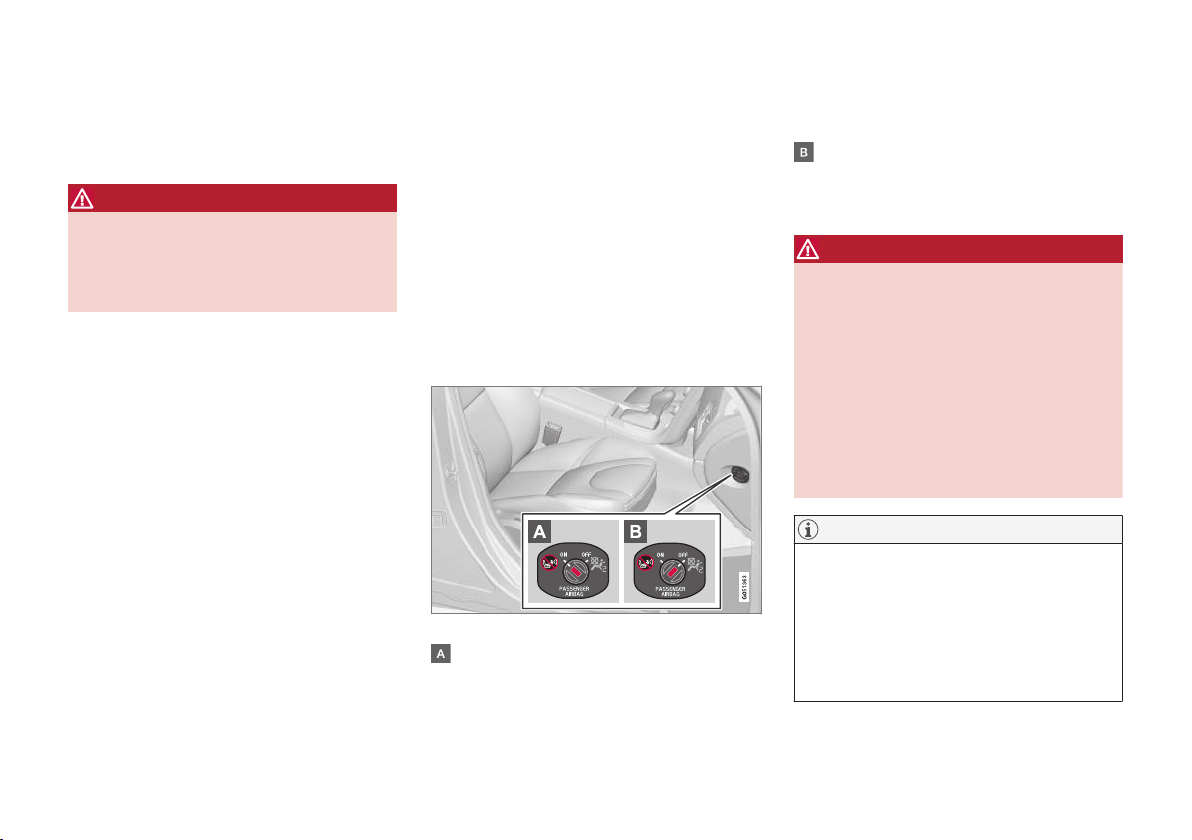
Switch - PACOS
The switch for the passenger airbag (PACOS) is
located on the passenger end of the instrument
panel and is accessible when the passenger door
is open.
Check that the switch is in the required position.
The remote control key's key blade (p. 161)
should be used to change position.
Location of airbag switch.
ON- the airbag is activated. With the switch
in this position, all front-facing passengers
(children and adults) can sit safely on the
passenger seat.
OFF - the airbag is deactivated. With the
switch in this position, children in rear-facing
child seats can sit safely on the front pas-
senger seat.
WARNING
Activated airbag (passenger seat):
Never use a rear-facing child seat on the front
passenger seat when the passenger airbag is
activated.
Deactivated airbag (passenger seat):
Front-facing passengers (children and adults)
must never sit on the front passenger seat
when the passenger airbag is deactivated.
Failure to follow the advice given above can
endanger life or lead to serious personal
injury.
NOTE
When the remote control key is in key posi-
tion II (p. 77) the warning symbol (p. 32) for
the airbag is shown in the combined instru-
ment panel for approx. 6 seconds.
Following which, the indicator in the roof con-
sole is illuminated showing the correct status
for the front passenger seat airbag.
SAFETY
37
G017800
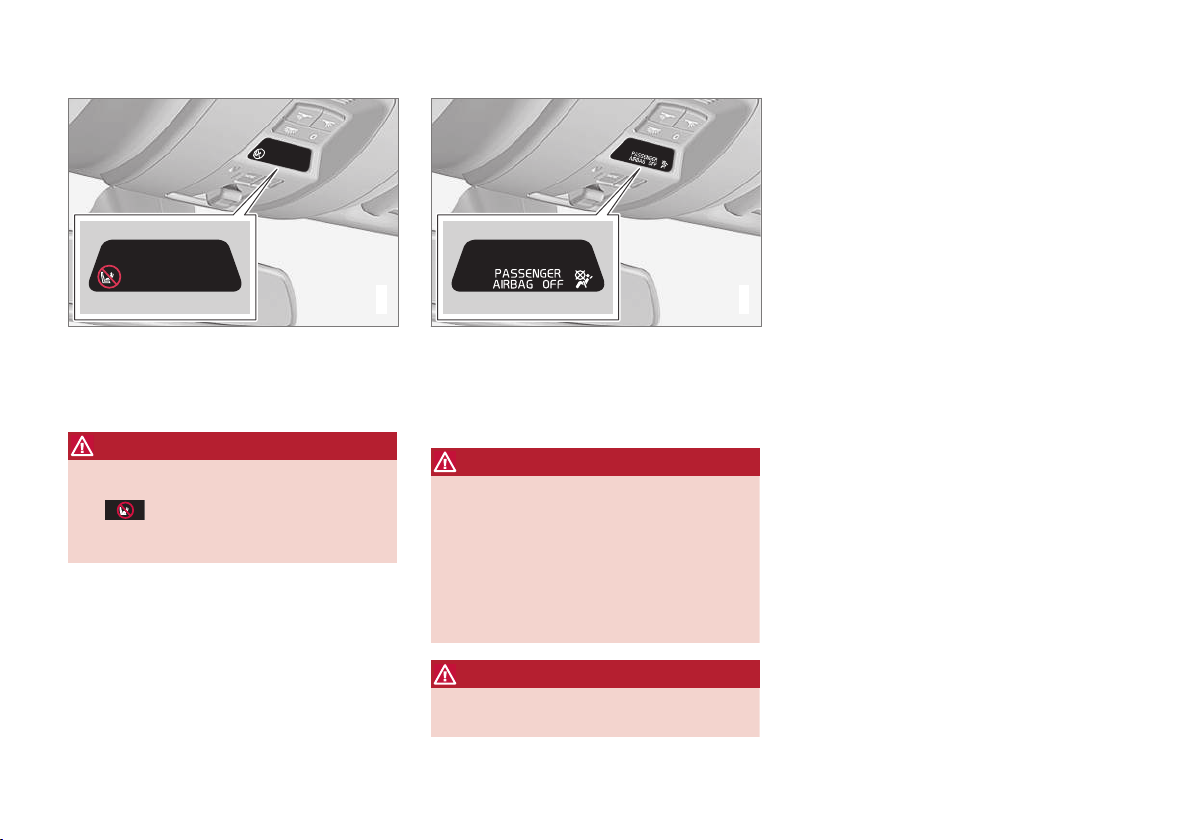
Indicator showing that the passenger airbag is activated.
A warning symbol in the roof console indicates
that the airbag for the front passenger seat is
activated (see preceding illustration).
WARNING
Never use a rear-facing child seat on the front
seat if the passenger airbag is activated and
the
symbol in the roof console is illumi-
nated to indicate this. Failure to follow this
advice could endanger the life of the child.
2
2
G017724
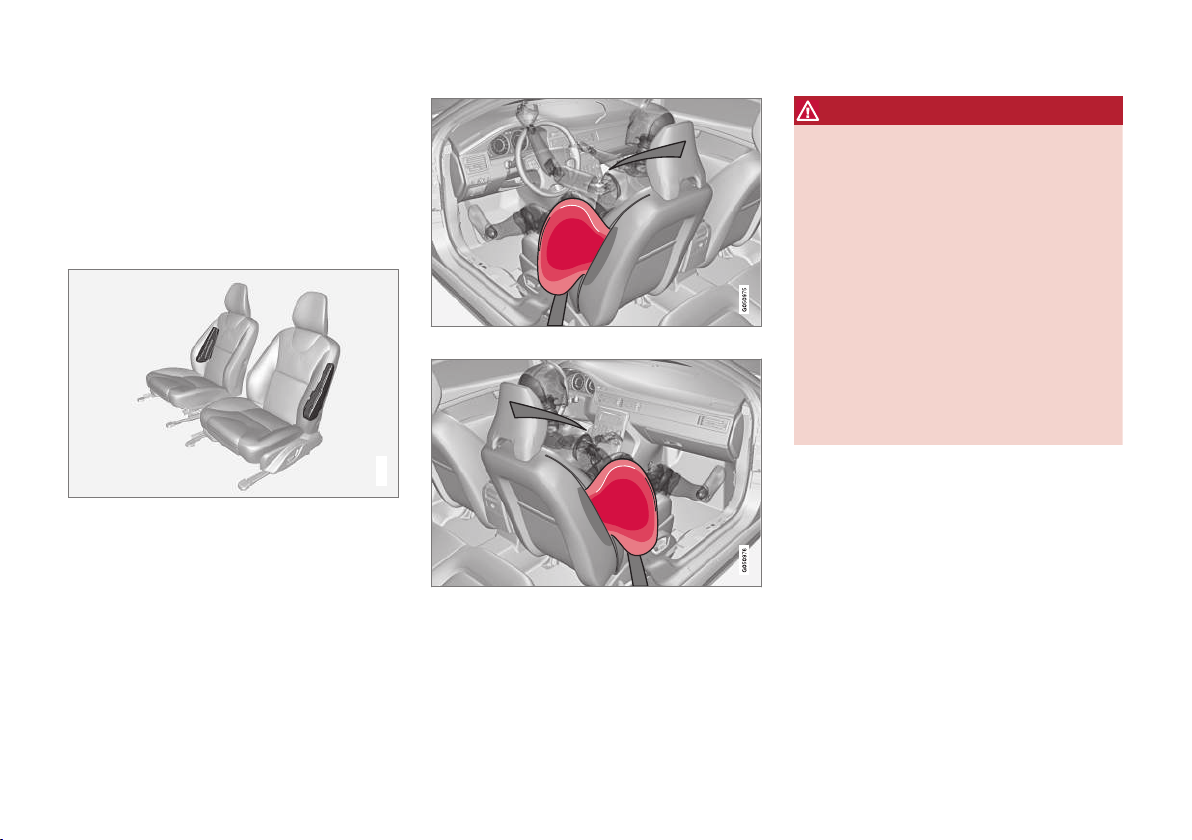
Indicator showing that the passenger airbag is deacti-
vated.
A text message and a symbol in the roof console
indicate that the airbag for the front passenger
seat is deactivated (see preceding illustration).
WARNING
Do not allow anyone to sit in the front pas-
senger seat if the message in the roof con-
sole indicates that the airbag is deactivated,
and if the warning symbol (p. 32) for the air-
bag system is also displayed on the combined
instrument panel. This indicates that there has
been a severe malfunction. Visit a workshop
as soon as possible. Volvo recommends that
you contact an authorised Volvo workshop.
WARNING
Failure to follow the advice given above can
endanger the lives of passengers in the car.
Related information
•
Child seats (p. 45)
SAFETY
38
Side airbag (SIPS)
In a side impact collision a large proportion of
the collision force is transferred by the SIPS
(Side Impact Protection System) to beams, pil-
lars, the floor, the roof and other structural parts
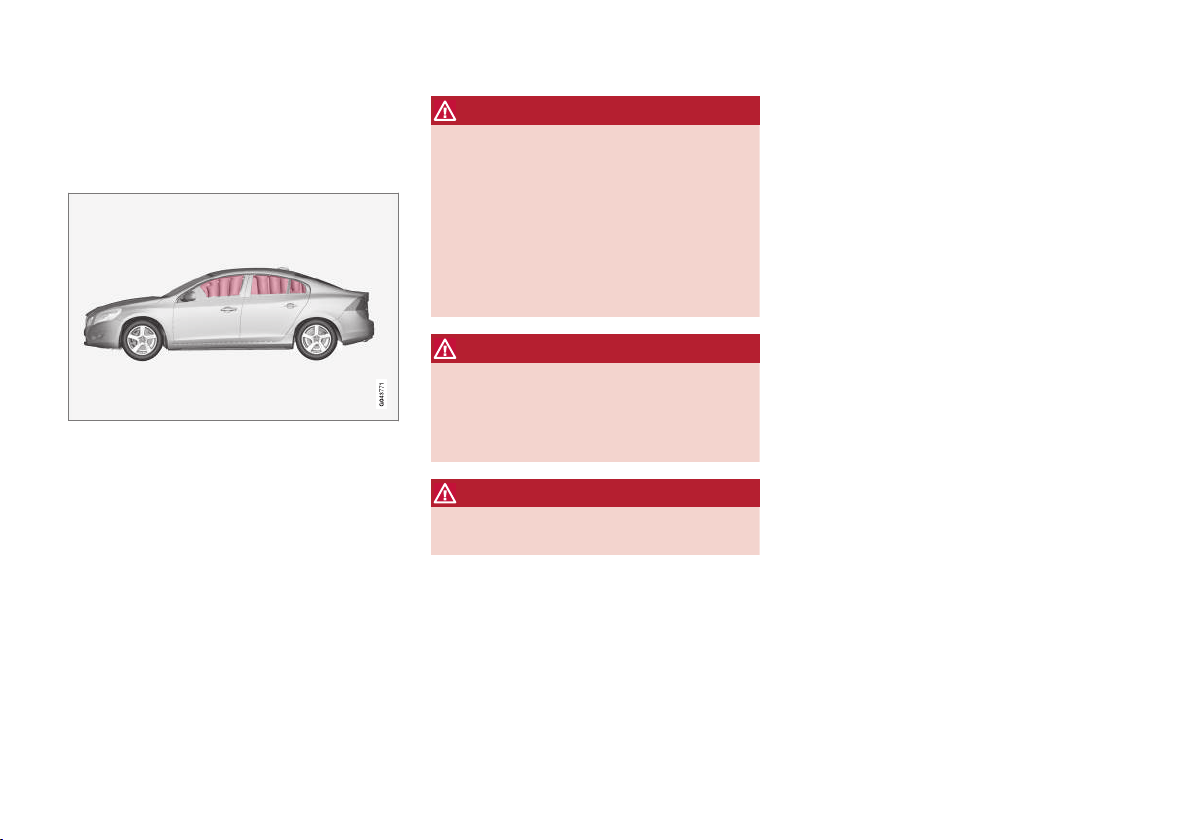
of the body. The side airbags at the driver's and
front passenger seats protect the chest area and
the hip and are an important part of the SIPS.
G032949
The SIPS bag system consists of two main com-
ponents, side airbag and sensors. The side air-
bags are located in the front seat's backrests.
A sufficiently violent collision trips the sensors
and the side airbags are inflated. The airbag
inflates between the occupant and the door
panel and thereby cushions the initial impact. The
airbag deflates when compressed by the collision.
The side airbag is normally only deployed on the
side of the collision.
Driver's seat, left-hand drive.
Front passenger seat, left-hand drive.
WARNING
•
Volvo recommends that repairs are only
carried out by an authorised Volvo work-
shop. Defective work in the SIPS-bag
system could cause malfunction and
result in serious personal injury.
•
Do not put objects in the area between
the outside of the seat and the door
panel, since this area is required by the
side airbag.
•
Volvo recommends the use only of car
seat covers approved by Volvo. Other seat
covers may impede the operation of the
side airbags.
•
Side airbags are a supplement the seat-
belts. Always use a seatbelt.
SIPS and child seats
The protection provided by the car to children
seated in a child seat or on a booster cushion is
not diminished by the side airbag.
Related information
•
Driver airbag (p. 34)
•
Passenger airbag (p. 34)
•
Inflatable Curtain (IC) (p. 39)
SAFETY
}}
39
Inflatable Curtain (IC)
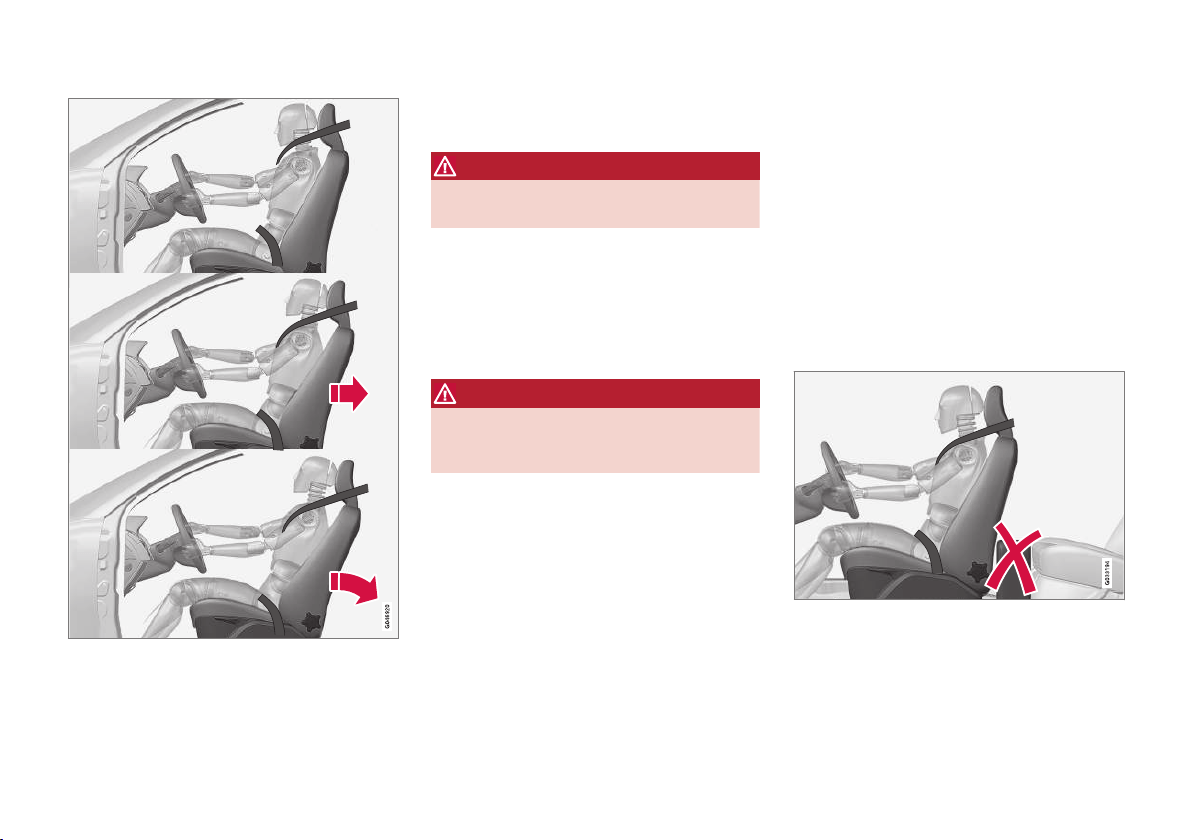
The inflatable curtain helps to prevent the driver
and passengers from striking their heads on the
inside of the car during a collision.
Inflatable curtain IC (Inflatable Curtain) is part of
the SIPS system (p. 38) and the airbag system
(p. 33). It is fitted along both sides of the headlin-
ing and helps protect the driver and passengers
in the car's outer seats. A sufficiently violent colli-
sion trips the sensors and the inflatable curtain is
inflated.
WARNING
Never hang or attach heavy items onto the
handles in the roof. The hook is only designed
for light clothing (not for solid objects such as
umbrellas for example).
Do not screw or install anything onto the car's
headlining, door pillars or side panels. This
could compromise the intended protection.
Volvo recommends that you only ever use
Volvo genuine parts that are approved for
placement in these areas.
WARNING
Do not load the car higher than 50 mm under
the top edge of the windows in the doors.
Otherwise, the intended protection of the
inflatable curtain, which is concealed in the
headlining, may be compromised.
WARNING
The inflatable curtain is a supplement to the
seatbelts. Always use a seatbelt.
Related information
•
General information on seatbelts (p. 28)
General information on WHIPS
(whiplash protection)
WHIPS (Whiplash Protection System) is a pro-
tection against whiplash injuries. The system
consists of energy absorbing backrests and
specially designed head restraints in the front
seats.
||
SAFETY
40
The WHIPS system is actuated by a rear-end col-
lision, where the angle and speed of the collision,
and the nature of the colliding vehicle all have an
influence.
WARNING
The WHIPS system is a supplement to the
seatbelts. Always use a seatbelt.
Seat properties
When the WHIPS system is deployed, the front
seat backrests are lowered backward to change
the seating position of the driver and front seat
passenger. This reduces the risk of whiplash
injury.
WARNING
Never modify or repair the seat or WHIPS
system yourself. Volvo recommends that you
contact an authorised Volvo workshop.
WHIPS and child seats
The protection provided by the car to children
seated in a child seat or on a booster cushion is
not diminished by the WHIPS system.
Related information
•
WHIPS - seating position (p. 40)
•
General information on seatbelts (p. 28)
WHIPS - seating position
For optimum protection from the WHIPS system
(p. 39) the driver and passenger must have the
correct seating position and make sure that the
system's function is not obstructed.
Seating position
Set the correct seating position in the front seat
(p. 79) before driving starts.
Driver and front seat passenger should sit in the
centre of the seat with as little space as possible
between the head and the head restraint.
Function
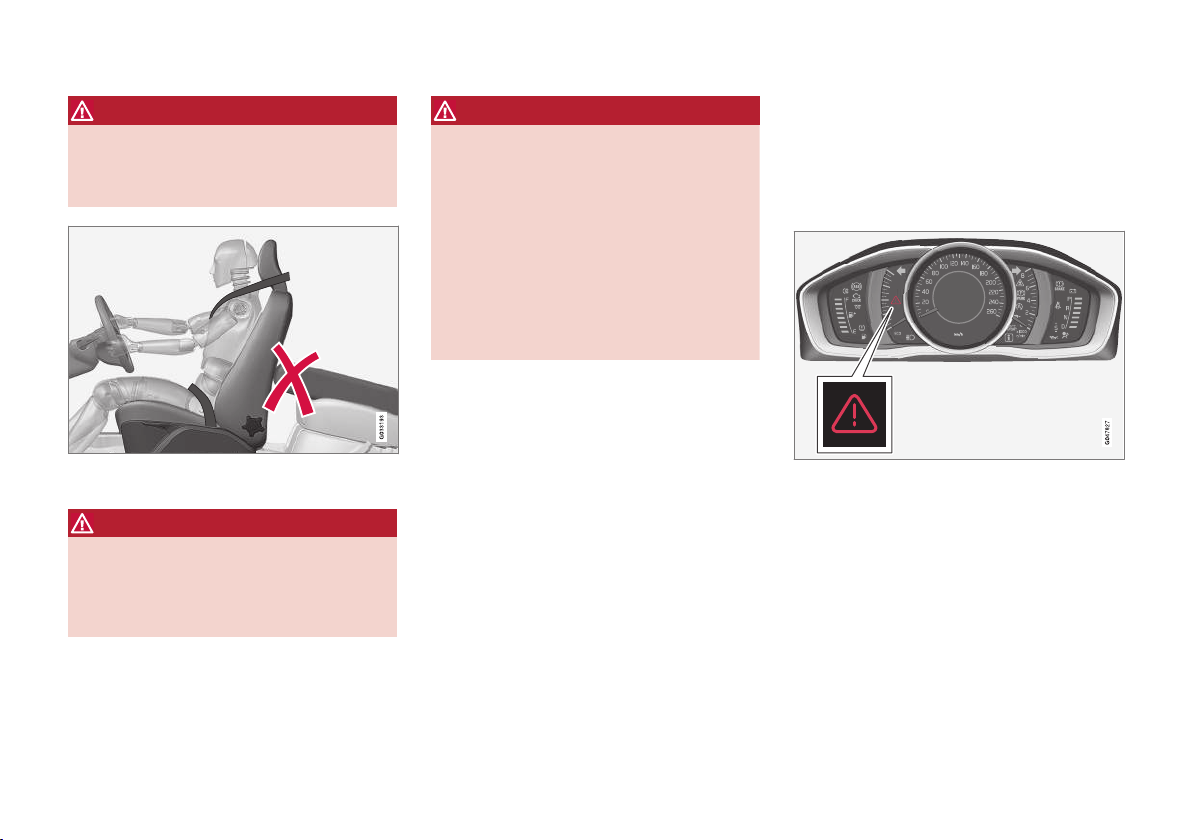
Do not leave any objects on the floor behind the driver's
seat/passenger seat that may prevent the WHIPS sys-
tem from functioning.
SAFETY
}}
41
WARNING
Do not squeeze rigid objects between the
rear seat cushion and the front seat's back-
rest. Make sure you do not to obstruct the
function of the WHIPS system.
Do not place objects on the rear seat that may prevent
the WHIPS system from functioning.
WARNING
If a backrest in the rear seat is lowered or a
rear-facing child seat is used in the rear seat,
the corresponding front seat must be moved
forward so that it does not make contact with
the lowered backrest or child seat.
WARNING
If a seat has been subjected to extreme
forces, such as due to a rear-end collision, the
WHIPS system must be checked. Volvo rec-
ommends that it is checked by an authorised
Volvo workshop.
Part of the WHIPS system's protective
capacity may have been lost even if the seat
appears to be undamaged.
Volvo recommends that you contact an
authorised Volvo workshop to have the sys-
tem checked even after a minor rear-end col-
lision.
General information on safety mode
Safety mode is a protective state that is trig-
gered when a collision may have damaged any
of the car's vital functions, such as the fuel lines,
sensors for any of the safety systems, or the
brake system.
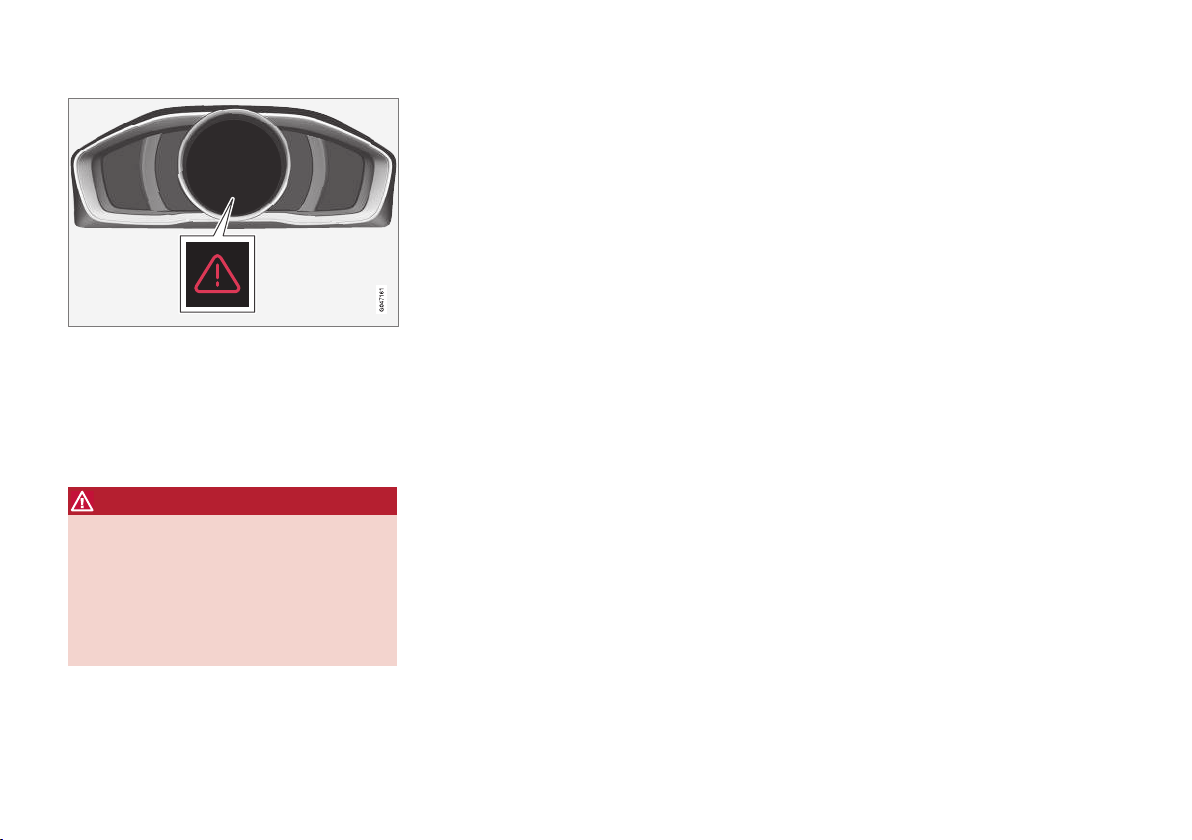
Warning triangle in the analogue combined instrument
panel.
||
SAFETY
42
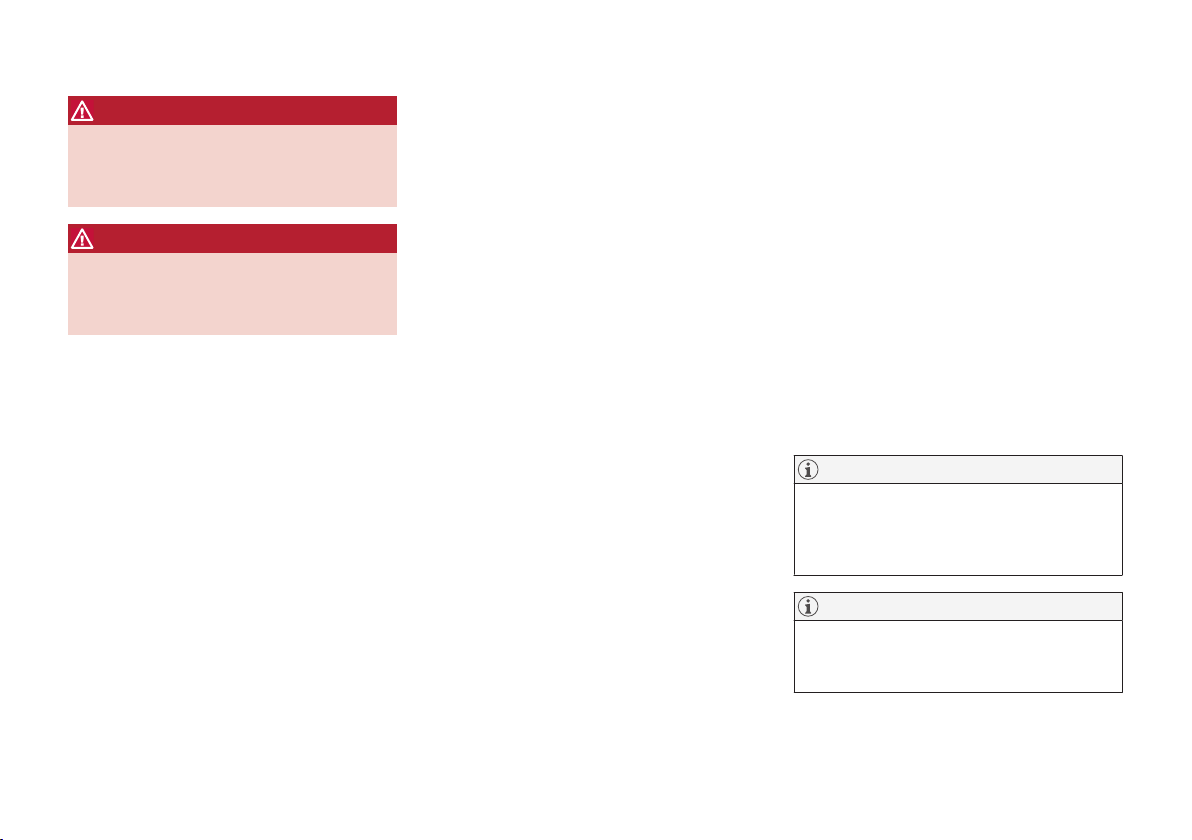
Warning triangle in the digital combined instrument
panel.
If the car is involved in a collision, the text Safety
mode See manual may appear in the combined
instrument panel (p. 62) information display.
This means that the car has reduced functional-
ity.
WARNING
Never attempt to repair your car or reset the
electronics yourself if the car has been in
safety mode. This could result in personal
injury or the car not functioning as normal.
Volvo recommends that you engage an
authorised Volvo workshop to check and
restore the car to normal status after
Safety
mode See manual
has been displayed.
Related information
•
Safety mode - attempting to start the car
(p. 42)
•
Safety mode - moving the car (p. 43)
Safety mode - attempting to start
the car
If the car is set in safety mode (p. 41) then an
attempt to start the car can be made if every-
thing seems normal and the absence of fuel
leakage has been checked.
First, check that no fuel is leaking from the car.
There must be no smell of fuel either.
If everything seems normal and you have
checked for indications of fuel leakage, you may
attempt to start the car.
Remove the remote control key and open the
driver's door. If a message is now shown to the
effect that the ignition is on, press the start but-
ton. Then close the door and reinsert the remote
control key. The car's electronics will now try to
reset themselves to normal mode. Then try to
start the car.
If the message
Safety mode See manual is
still shown on the display then the car must not
be driven or towed but a vehicle recovery service
(p. 320) used instead. Even if the car appears to
be driveable, hidden damage may make the car
impossible to control once moving.
SAFETY
}}
43
WARNING
Never, under any circumstances, attempt to
restart the car if it smells of fuel when the
Safety mode See manual message is dis-
played. Leave the car at once.
WARNING
If the car is in safety mode it must not be
towed. It must be transported from its loca-
tion. Volvo recommends that it is transported
to an authorised Volvo workshop.
Related information
•
Safety mode - moving the car (p. 43)
Safety mode - moving the car
If
Normal mode is shown after Safety mode
See manual has been reset after attempting to
start the car (p. 42) , the car can be moved care-
fully out of a dangerous position.
Do not move the car further than necessary.
Related information
•
General information on safety mode (p. 41)
General information on child safety
Volvo has child safety equipment (child seats,
booster cushions & attachment devices) which
is designed for fitting in this particular car.
Using Volvo's child safety equipment, the opti-
mum conditions are obtained for the child to
travel safely in the car. In addition, the child safety
equipment fits well and is simple to use.
Children of all ages and sizes must always sit
correctly secured in the car. Never allow a child to
sit on the knee of a passenger.
Volvo recommends that children travel in rear-
facing child seats until as late an age as possible,
at least up to 3-4 years of age, and then in front-
facing booster cushions/child seats until the
child is 140 cm tall.
NOTE
Legal provisions about the type of child seat
that must be used for children of different
ages and heights vary from country to coun-
try. Check what does apply.
NOTE
In the event of questions when fitting child
safety products, contact the manufacturer for
clearer instructions.

||
SAFETY
* Option/accessory.
44
Child safety locks
The rear doors and the windows in the rear
doors* can be locked manually (p. 176) or elec-
tronically (p. 177)* to prevent them being opened
from inside.
Related information
•
Child seats - location (p. 49)
•
Child seat - ISOFIX (p. 50)
•
Child seats - upper mounting points (p. 54)
SAFETY
}}
45
Child seats
Children should sit comfortably and safely. Make
sure that the child seat is being used correctly.
NOTE
When using child safety products it is impor-
tant to read the installation instructions
included.
NOTE
Never leave a child seat unsecured in the car.
Always secure it according to the instructions
for the child seat, even when it is not in use.
WARNING
Do not secure the straps of the child seat to
the seat's horizontal adjustment bar, springs
or the rails and beams under the seat. Sharp
edges may damage the straps.
Look in the installation instructions for the child
seat for the correct fitting.
Recommended child seats
2
Weight Front seat (with deactivated air-
bag, only rear-facing child
seats)
Front seat (with activated air-
bag, only front-facing child
seats)
Outer rear seat Centre rear seat
Group 0
max 10 kg
Group 0+
max 13 kg
Volvo infant seat (Volvo Infant Seat) - rear-
facing child seat, secured with the ISOFIX
fixture system.
Type approval: E1 04301146
(L)
Group 0
max 10 kg
Group 0+
max 13 kg
Volvo infant seat (Volvo Infant
Seat) - rear-facing child seat,
secured with the car's seatbelt.
Type approval: E1 04301146
(U)
Volvo infant seat (Volvo Infant Seat) - rear-
facing child seat, secured with the car's
seatbelt.
Type approval: E1 04301146
(U)
Volvo infant seat (Volvo
Infant Seat) - rear-facing
child seat, secured with the
car's seatbelt.
Type approval: E1
04301146
(U)
2
With regard to other child seats your car should be included in the manufacturer's enclosed list of vehicles or be universally approved in accordance with the ECE R44 legal requirement.

||
SAFETY
46
Weight Front seat (with deactivated air-
bag, only rear-facing child
seats)
Front seat (with activated air-
bag, only front-facing child
seats)
Outer rear seat Centre rear seat
Group 0
max 10 kg
Group 0+
max 13 kg
Child seats which are universally
approved.
(U)
Child seats which are universally approved.
(U)
Child seats which are uni-
versally approved.
(U)
Group 1
9-18 kg
Volvo turnable child seat (Volvo
Convertible Child Seat) – rear-
facing child seat, secured with
the car's seatbelt and straps.
Type approval: E5 04192
(L)
Volvo turnable child seat (Volvo Convertible
Child Seat) – rear-facing child seat, secured
with the car's seatbelt and straps.
Type approval: E5 04192
(L)
Group 1
9-18 kg
Volvo rear-facing child seat
Type approval: E5 04212
(L)
Volvo rear-facing child seat
Type approval: E5 04212
(L)
Group 1
9-18 kg
Front-facing child seats
which are universally
approved.
A
(UF)
Child seats which are universally approved.
(U)
Child seats which are uni-
versally approved.
(U)

SAFETY
}}
47
Weight Front seat (with deactivated air-
bag, only rear-facing child
seats)
Front seat (with activated air-
bag, only front-facing child
seats)
Outer rear seat Centre rear seat
Group 2
15-25 kg
Volvo turnable child seat (Volvo
Convertible Child Seat) – rear-
facing child seat, secured with
the car's seatbelt and straps.
Type approval: E5 04192
(L)
Volvo turnable child seat (Volvo Convertible
Child Seat) – rear-facing child seat, secured
with the car's seatbelt and straps.
Type approval: E5 04192
(L)
Group 2
15-25 kg
Volvo rear-facing child seat
Type approval: E5 04212
(L)
Volvo rear-facing child seat
Type approval: E5 04212
(L)
Group 2
15-25 kg
Volvo turnable child seat
(Volvo Convertible Child
Seat) - front-facing child
seat, secured with the car's
seatbelt.
Type approval: E5 04191
(U)
Volvo turnable child seat (Volvo Convertible
Child Seat) - front-facing child seat, secured
with the car's seatbelt.
Type approval: E5 04191
(U)
Group 2/3
15-36 kg
Volvo booster seat with
backrest (Volvo Booster Seat
with backrest).
Type approval: E1
04301169
(UF)
Volvo booster seat with backrest (Volvo
Booster Seat with backrest).
Type approval: E1 04301169
(UF)
Volvo booster seat with
backrest (Volvo Booster
Seat with backrest).
Type approval: E1
04301169
(UF)

||
SAFETY
48
Weight Front seat (with deactivated air-
bag, only rear-facing child
seats)
Front seat (with activated air-
bag, only front-facing child
seats)
Outer rear seat Centre rear seat
Group 2/3
15-36 kg
Volvo booster seat
Type approval: E1
04301312
(UF)
Volvo booster seat
Type approval: E1 04301312
(UF, L)
Volvo booster seat
Type approval: E1
04301312
(UF)
Group 2/3
15-36 kg
Booster cushion with and
without backrest (Booster
Cushion with and without
backrest).
Type approval: E5 04216
(UF)
Booster cushion with and without backrest
(Booster Cushion with and without
backrest).
Type approval: E5 04216
(UF)
Booster cushion with and
without backrest (Booster
Cushion with and without
backrest).
Type approval: E5 04216
(UF)
L: Suitable for specific child seats. These child seats may be intended for use in a special car model, limited or semi-universal categories.
U: Suitable for universally approved child seats in this weight class.
UF: Suitable for front-facing universally approved child seats in this weight class.
A
Volvo recommends rear-facing child seat for children in this mass group.
Related information
•
Child seats - location (p. 49)
•
Child seats - upper mounting points (p. 54)
•
Child seat - ISOFIX (p. 50)
•
General information on child safety (p. 43)
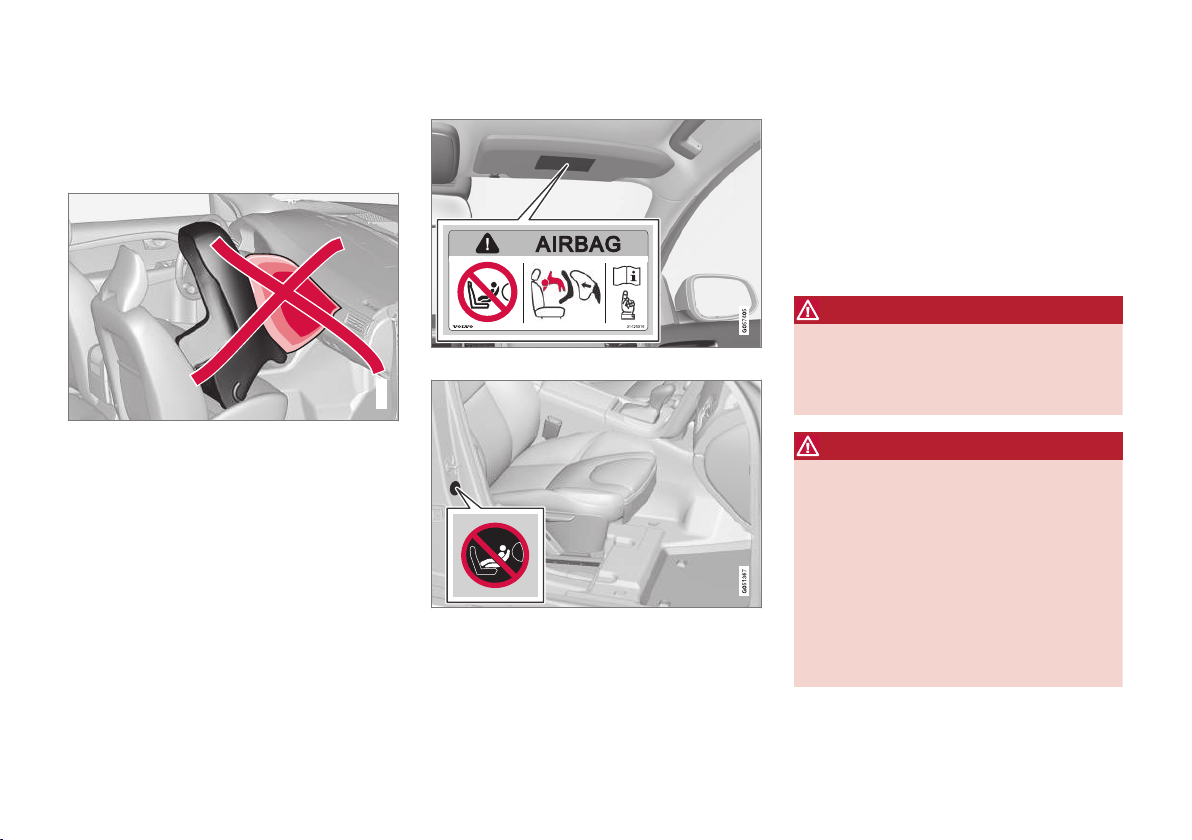
SAFETY
}}
49
Child seats - location
The position of a child in the car and the choice
of equipment are dictated by the child's weight
and size.
G020739
Rear-facing child seat and airbag are not compatible.
Always fit rear-facing child seats (p. 45) in the
rear seat if the passenger airbag is activated
(p. 36). If a child is sitting on the front passenger
seat then he/she could suffer serious injury if the
airbag deploys.
If the passenger airbag is deactivated then rear-
facing child seats can be fitted on the front pas-
senger seat.
Label for passenger airbag
Label on the passenger side's sun visor.
Label on the passenger side's door pillar. The label
becomes visible when the passenger door is opened.
The warning label for the passenger airbag is
positioned as shown above.
You may place:
•
a rear-facing child seat on the front passen-
ger seat when the passenger airbag is deac-
tivated.
•
a front-facing child seat/booster cushion on
the front passenger seat when the passen-
ger airbag is activated.
•
one or more child seats/booster cushions in
the rear seat.
WARNING
Never use a rear-facing child seat on a seat
protected by an activated airbag. Failure to
follow this advice can lead to death or serious
injury to the child.
WARNING
Never allow anybody to stand or sit in front of
the front passenger seat.
Never use a rear-facing child seat on the front
passenger seat if the passenger airbag is
activated.
Front-facing passengers (children and adults)
must never sit on the front passenger seat if
the passenger airbag is deactivated.
Failure to follow the advice given above can
endanger life or lead to serious personal
injury.
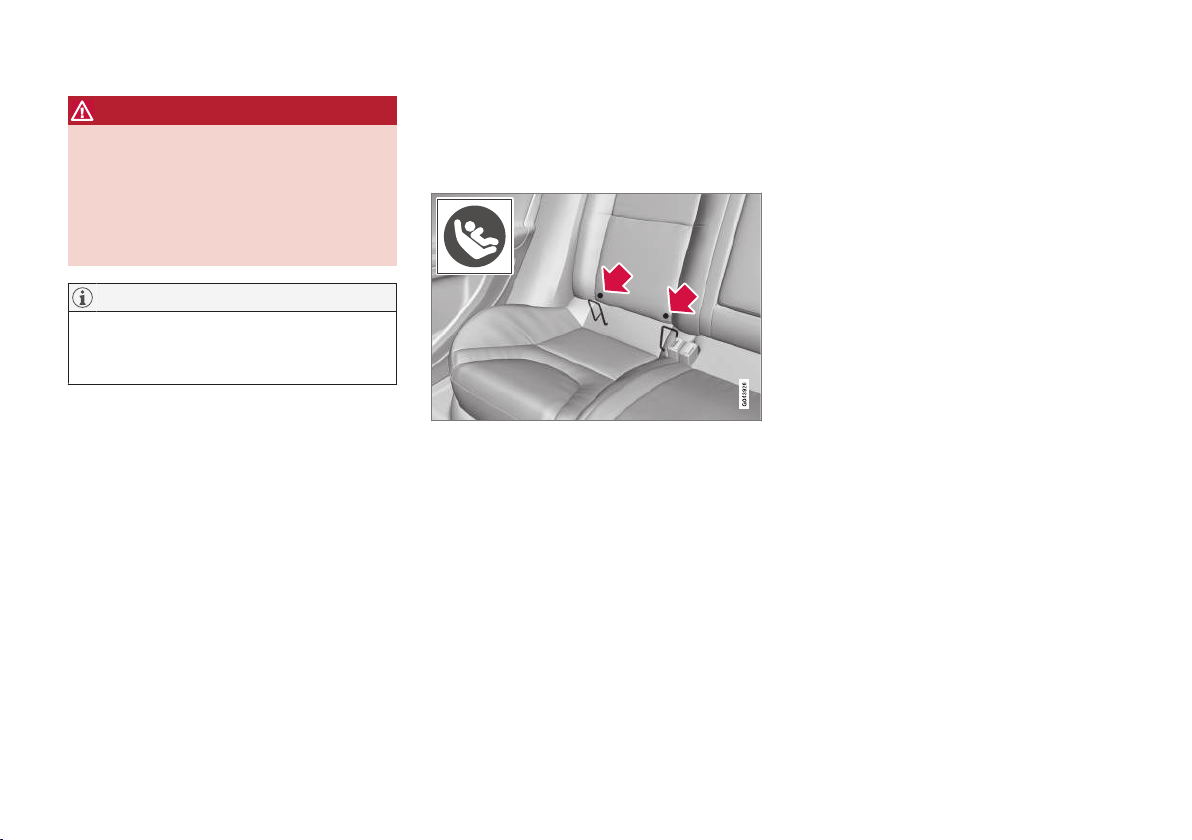
||
SAFETY
50
WARNING
Booster cushions/child seats with steel
braces or some other design that could rest
on the seatbelt buckle's opening button must
not be used, as they could cause the seatbelt
buckle to open accidentally.
Do not allow the upper section of the child
seat to rest against the windscreen.
NOTE
Regulations regarding the placement of chil-
dren in cars vary from country to country.
Check what does apply.
Related information
•
Child seats (p. 45)
•
General information on child safety (p. 43)
•
Child seats - upper mounting points (p. 54)
•
Child seat - ISOFIX (p. 50)
Child seat - ISOFIX
ISOFIX is a fixture system for car child seats
(p. 45) that is based on an international stand-
ard.
Mounting points for the ISOFIX fixture system are
concealed behind the lower section of the rear
seat backrest, in the outer seats.
The location of the mounting points is indicated
by symbols in the backrest upholstery (see pre-
ceding illustration).
Press the seat cushion down to access the
mounting points.
Always follow the manufacturer's installation
instructions when connecting a child seat to the
ISOFIX mounting points.
Related information
•
ISOFIX - size classes (p. 51)
•
ISOFIX - types of child seat (p. 52)
•
General information on child safety (p. 43)
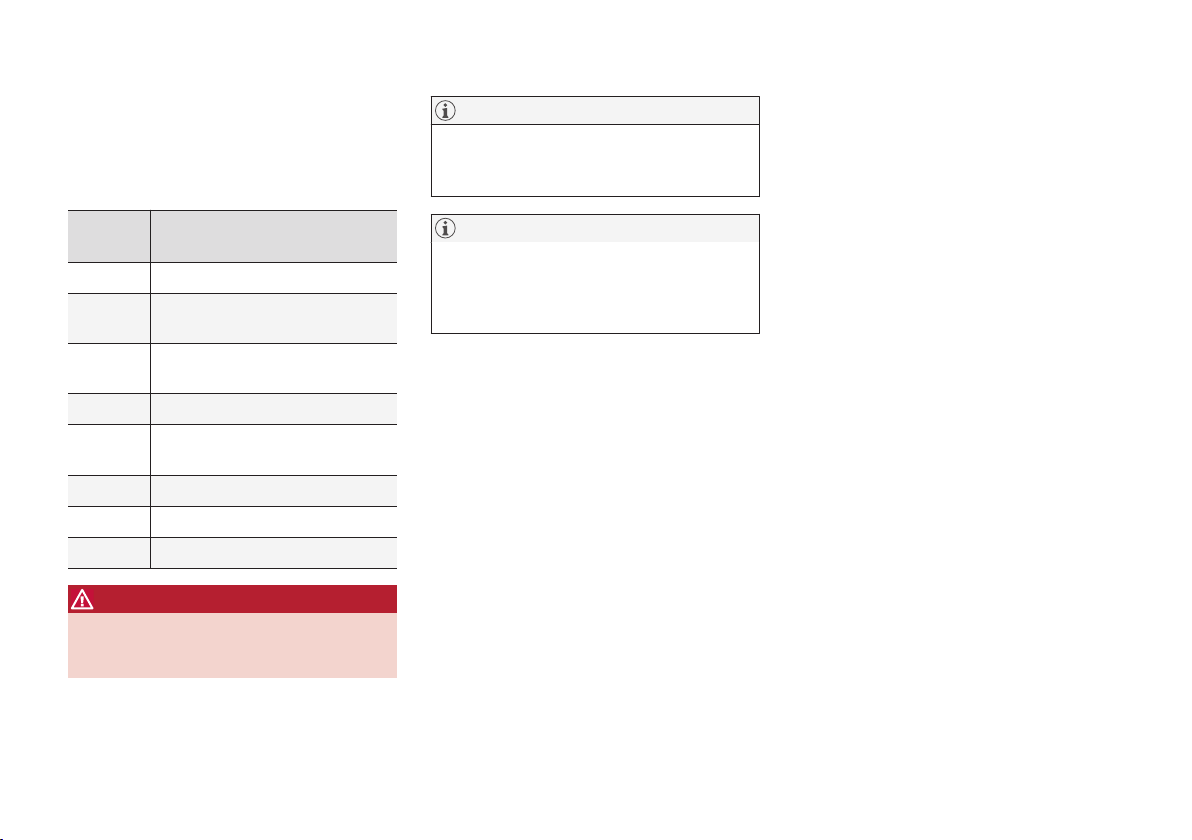
SAFETY
51
ISOFIX - size classes
There is a size classification for child seats using
the ISOFIX (p. 50) fixture system in order to
assist users in choosing the correct type of child
seat (p. 52).
Size
class
Description
A Full size, front-facing child seat
B Reduced size (alt. 1), front-facing
child seat
B1 Reduced size (alt. 2), front-facing
child seat
C Full size, rear-facing child seat
D Reduced size, rear-facing child
seat
E Rear-facing infant seat
F Transverse infant seat, left-hand
G Transverse infant seat, right-hand
WARNING
Never use a rear-facing child seat on the front
passenger seat if the passenger airbag is
activated.
NOTE
If an ISOFIX child seat has no size classifica-
tion, the car model must be included on the
vehicle list for the child seat.
NOTE
Volvo recommends that you contact an
authorised Volvo dealer for recommendations
about which ISOFIX child seats Volvo recom-
mends.
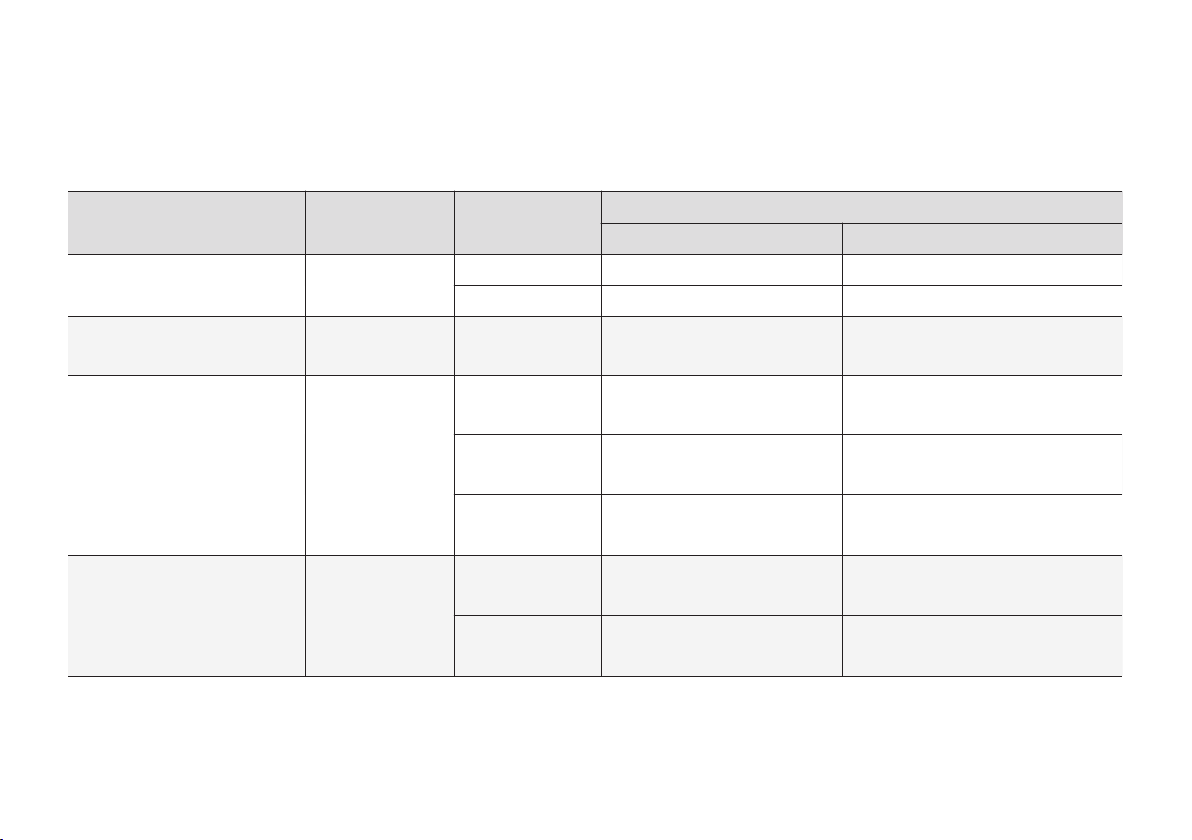
SAFETY
52
ISOFIX - types of child seat
Child seats are in different sizes – cars are in dif-
ferent sizes. This means that not all child seats
are suitable for all seats in all car models.
Type of child seat Weight Size class Passenger seats for ISOFIX installation of child seats
Front seat Outer rear seat
Infant seat transverse max 10 kg F X X
G X X
Infant seat, rear-facing max 10 kg E X OK
(IL)
Infant seat, rear-facing max 13 kg E X OK
(IL)
D X
OK
A
(IL)
C X
OK
A
(IL)
Child seat, rear-facing 9-18 kg D X
OK
A
(IL)
C X
OK
A
(IL)
SAFETY
53
Type of child seat Weight Size class Passenger seats for ISOFIX installation of child seats
Front seat Outer rear seat
Front-facing child seat 9-18 kg B X
OK
B
(IUF)
B1 X
OK
B
(IUF)
A X
OK
B
(IUF)
X: The ISOFIX position is not suitable for ISOFIX child seats in this weight class and/or size class.
IL: Suitable for specific ISOFIX child seats. These child seats may be intended for a particular car model, limited or semi-universal categories.
IUF: Suitable for front-facing ISOFIX child seats that are universally approved in this weight class.
A
For the infant/child seat to have space in the rear seat the seat in front must be adjusted longitudinally to a position in front of centre position.
B
Volvo recommends rear-facing child seats for this group.
Make sure you select the right size class (p. 51)
of child seat with ISOFIX (p. 50) fixture system.
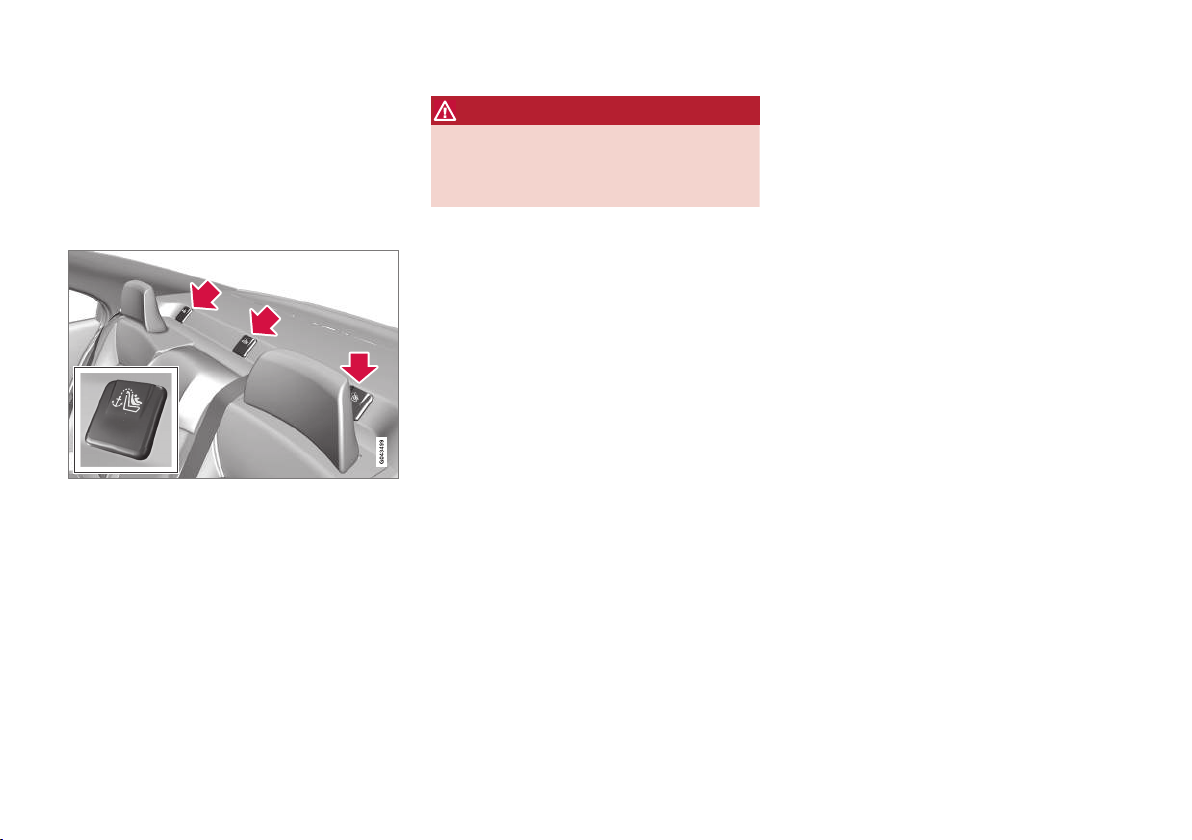
SAFETY
54
Child seats - upper mounting points
The car is equipped with upper mounting points
for child seats (p. 45). These mounting points
are located on the parcel shelf and are con-
cealed by plastic covers. Bend aside the plastic
covers to access each respective mounting
point.
For cars with folding head restraints on the out-
side seats the head restraints should be folded to
facilitate installation.
The upper mounting points are primarily intended
for use with front-facing child seats. Volvo recom-
mends that small children should sit in rear-fac-
ing child seats for as long as possible.
For detailed information on how the child seat
should be tensioned in the upper mounting
points, see the seat manufacturer's instructions.
WARNING
The child seat's straps must always be drawn
through the hole in the head restraint leg
before they are tensioned at the attachment
point.
Related information
•
General information on child safety (p. 43)
•
Child seats - location (p. 49)
•
Child seat - ISOFIX (p. 50)

INSTRUMENTS AND CONTROLS

INSTRUMENTS AND CONTROLS
56
Instruments and controls, left-hand
drive car - overview
The overview shows where the car's displays
and controls are located.
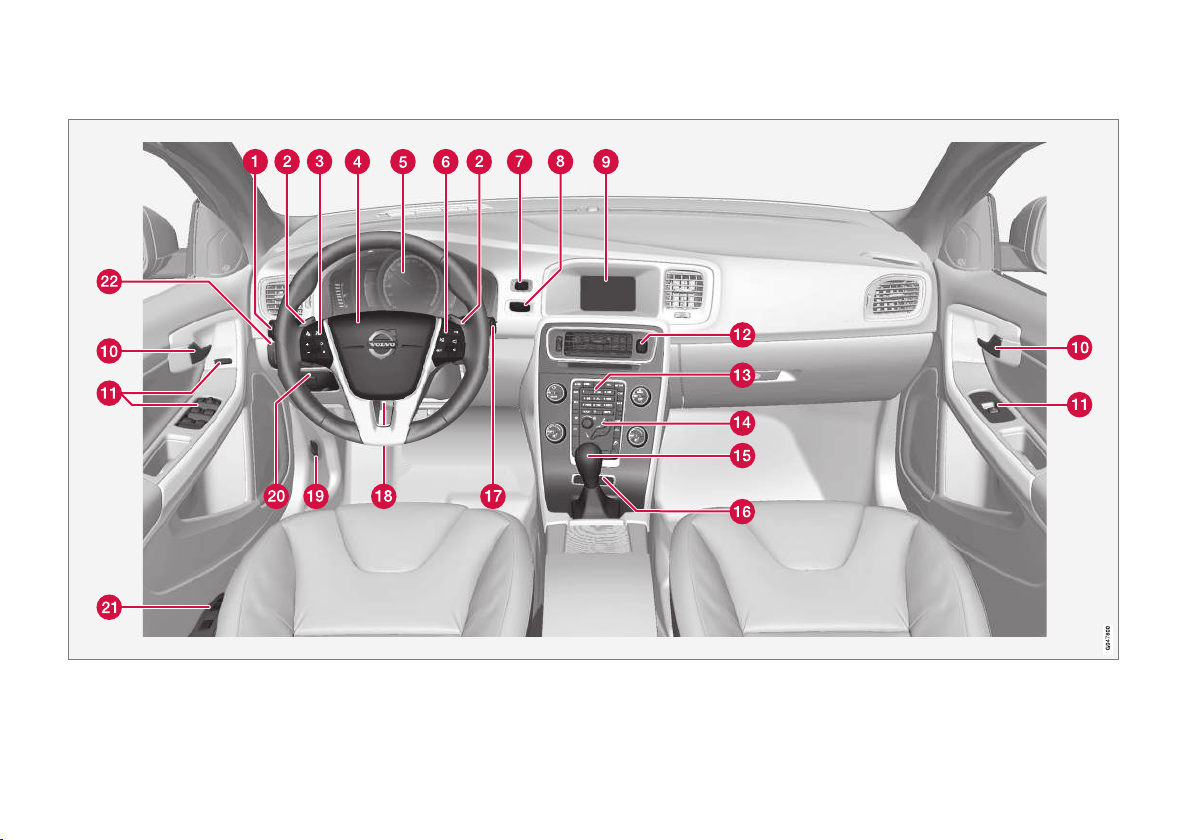
INSTRUMENTS AND CONTROLS
}}
57
Overview, left-hand drive cars

||
INSTRUMENTS AND CONTROLS
* Option/accessory.
58
Function See
Menus and mes-
sages, direction indi-
cators, main/dipped
beam, trip computer
(p. 106),
(p. 109),
(p. 94),
(p. 88) and
(p. 110).
Manual gear chang-
ing in an automatic
gearbox*
(p. 278).
Cruise control*
(p. 190) and
(p. 196).
Horn, airbags (p. 83) and
(p. 33).
Combined instrument
panel
(p. 62).
Menu navigation,
audio control, phone
control*
(p. 109) and
the Sensus Info-
tainment sup-
plement.
START/STOP
ENGINE button
(p. 270).
Ignition switch (p. 77).
Screen for infotain-
ment system and dis-
play of menus
(p. 109) and
the Sensus Info-
tainment sup-
plement.
Function See
Door handle -
Control panel (p. 171),
(p. 177),
(p. 98) and
(p. 100).
Hazard warning flash-
ers
(p. 93).
Control panel for info-
tainment system and
menu navigation
(p. 109) and
the Sensus Info-
tainment sup-
plement.
Control panel for cli-
mate control
(p. 126).
Gear selector (p. 276) or
(p. 278).
- -
Wipers and washing (p. 97).
Steering wheel
adjustment
(p. 83).
Bonnet opener (p. 351).
Parking brake (p. 297).
Function See
Seat adjustment*
(p. 80).
Headlamp control,
opener for fuel filler
flap and boot lid
(p. 85),
(p. 304) and
(p. 173).
Related information
•
Outside temperature gauge (p. 71)
•
Trip meter (p. 71)
•
Clock (p. 72)

INSTRUMENTS AND CONTROLS
}}
59
Instruments and controls, right-
hand drive car - overview
The overview shows where the car's displays
and controls are located.
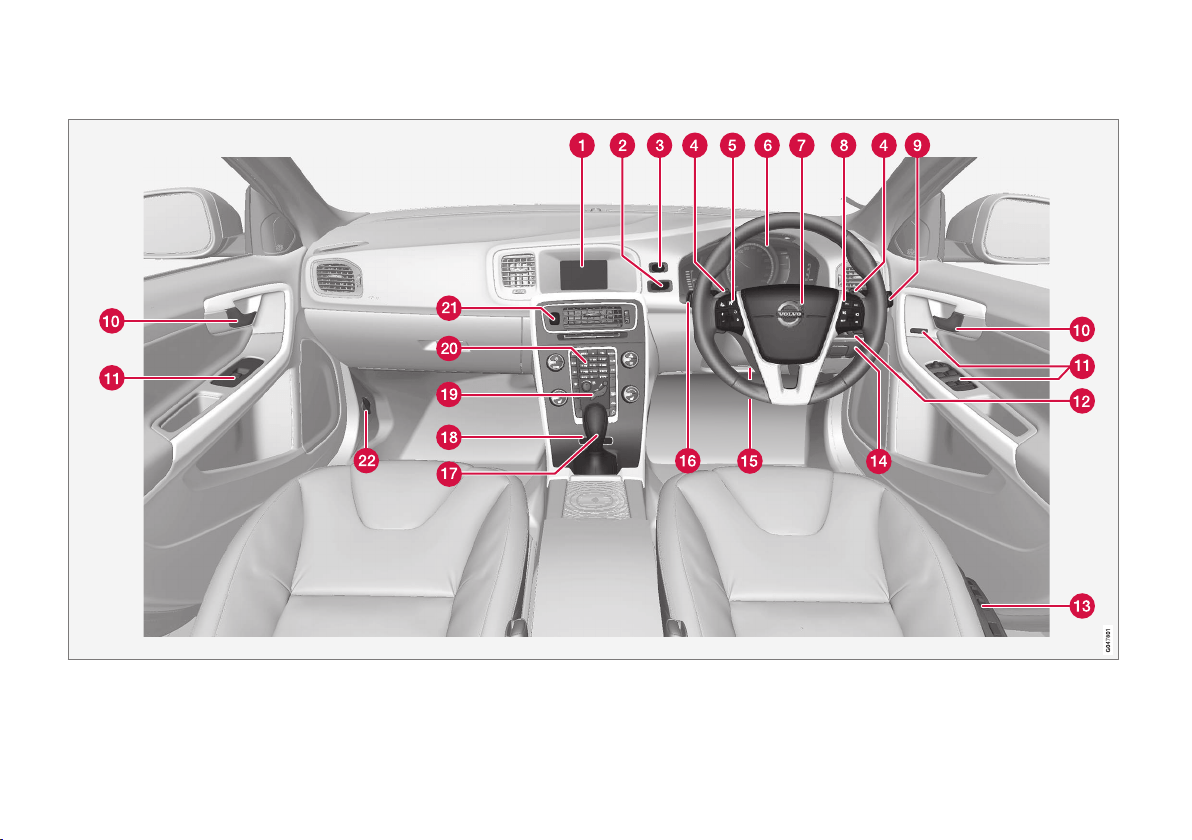
||
INSTRUMENTS AND CONTROLS
60
Overview, right-hand drive cars

INSTRUMENTS AND CONTROLS
* Option/accessory.
61
Function See
Screen for infotain-
ment system and dis-
play of menus
(p. 109) and
the Sensus Info-
tainment sup-
plement.
Ignition switch (p. 77).
START/STOP
ENGINE button
(p. 270).
Manual gear chang-
ing in an automatic
gearbox*
(p. 278).
Cruise control*
(p. 190) and
(p. 196).
Combined instrument
panel
(p. 62).
Horn, airbags (p. 83) and
(p. 33).
Menu navigation,
audio control, phone
control*
(p. 109) and
the Sensus Info-
tainment sup-
plement.
Wipers and washing (p. 97).
Door handle -
Function See
Control panel (p. 171),
(p. 177),
(p. 98) and
(p. 100).
Headlamp control,
opener for fuel filler
flap and boot lid
(p. 85),
(p. 304) and
(p. 173).
Seat adjustment*
(p. 80).
Parking brake (p. 297).
Steering wheel
adjustment
(p. 83).
Menus and mes-
sages, direction indi-
cators, main/dipped
beam, trip computer
(p. 106),
(p. 109),
(p. 94),
(p. 88) and
(p. 110).
Gear selector (p. 276) or
(p. 278).
- -
Control panel for cli-
mate control
(p. 126).
Control panel for info-
tainment system and
menu navigation
(p. 109) and
the Sensus Info-
tainment sup-
plement.
Function See
Hazard warning flash-
ers
(p. 93).
Bonnet opener (p. 351).
Related information
•
Outside temperature gauge (p. 71)
•
Trip meter (p. 71)
•
Clock (p. 72)
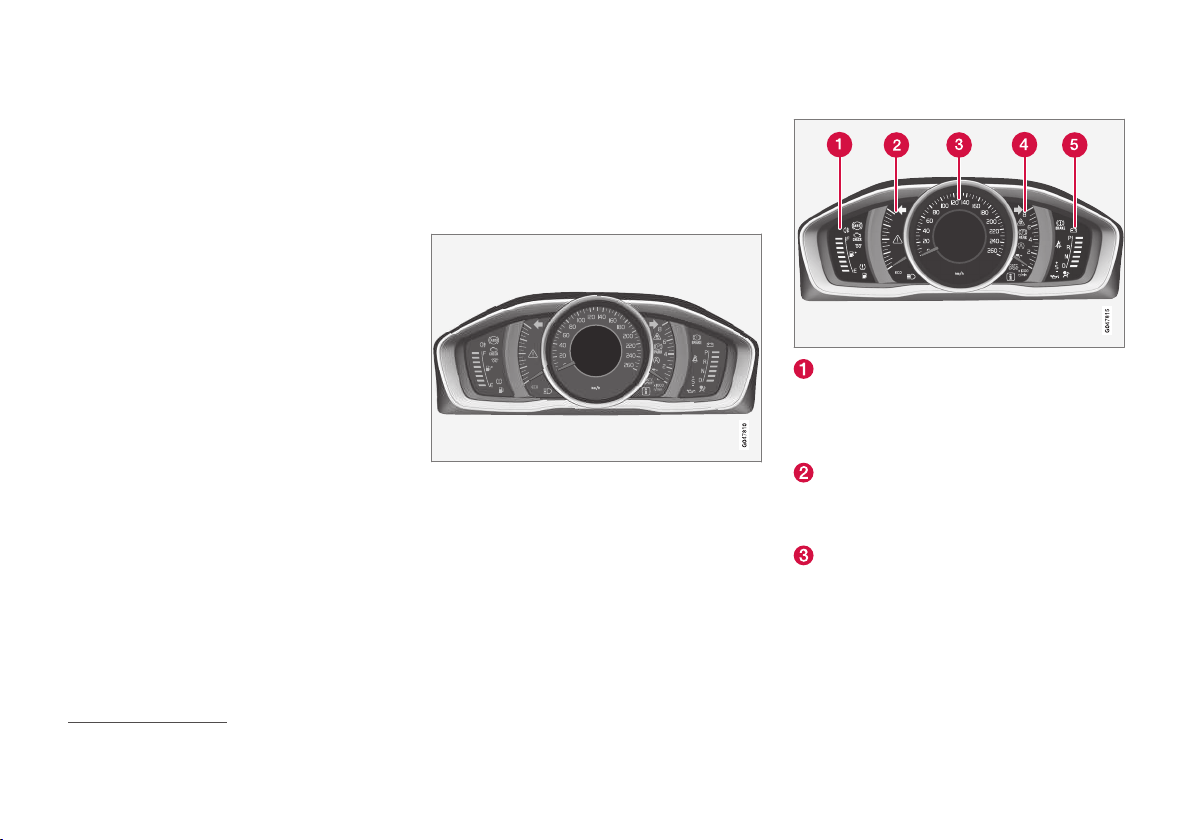
INSTRUMENTS AND CONTROLS
62
Combined instrument panel
The combined instrument panel's information
display shows information on some of the car's
functions, as well as messages.
•
Analogue combined instrument panel - over-
view (p. 62)
•
Digital combined instrument panel - overview
(p. 63)
•
Combined instrument panel - meaning of
indicator symbols (p. 67)
•
Combined instrument cluster - meaning of
warning symbols (p. 69)
Analogue combined instrument
panel - overview
The combined instrument panel's information
display shows information on some of the car's
functions, as well as messages.
Information display
Information display, analogue instrument panel.
The combined instrument panel's information dis-
play shows information on some of the car's
functions, e.g. cruise control and trip computer, as
well as messages. The information is shown with
symbols and text. There are further descriptions
under the functions that use the display.
Gauges and indicators
Fuel gauge. When the indicator lowers to
only one white marking
1
, the yellow indicator
symbol for low level in the fuel tank is illumi-
nated. See also Trip computer (p. 110) and
Filling up with fuel (p. 304).
Eco meter. The meter provides an indication
of how economically the car is being driven.
The higher the reading on the scale, the
more economically the car is driven.
Speedometer
1
When the display's message "
Distance to empty fuel tank:" starts to show "----", the marking becomes red.
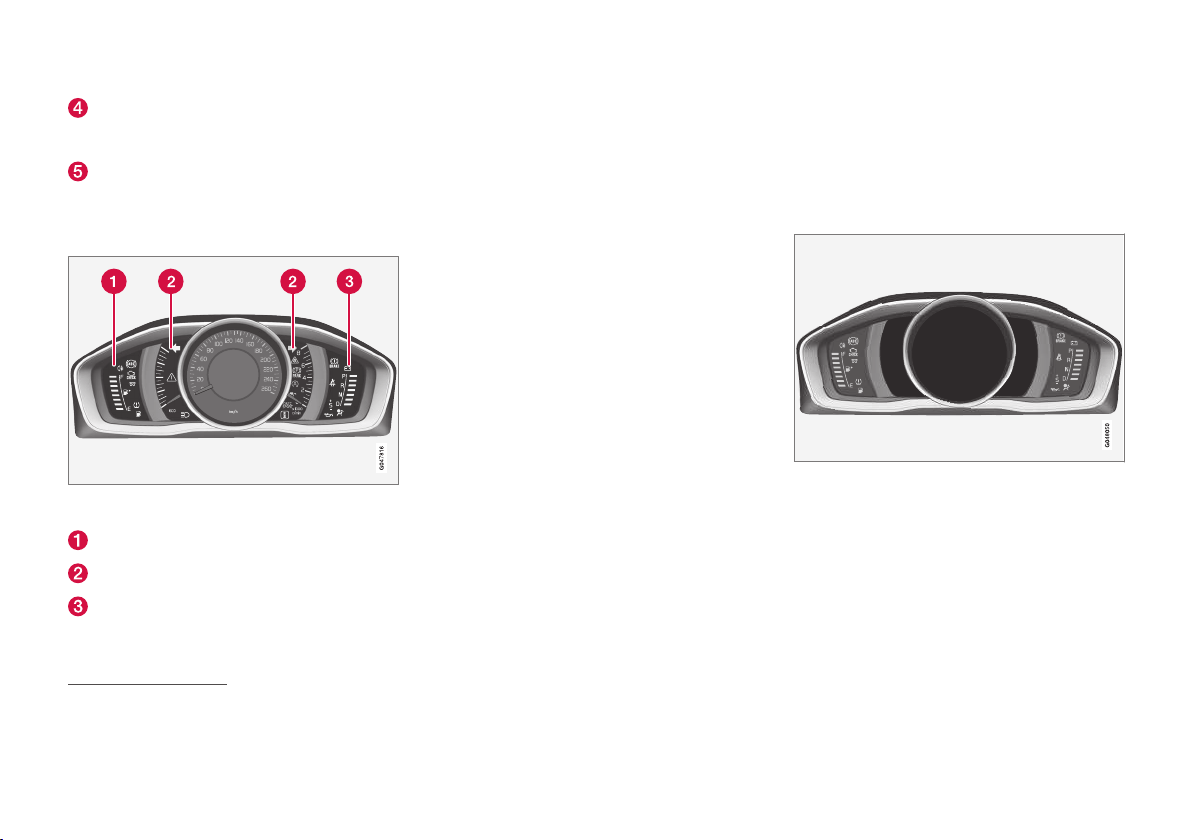
INSTRUMENTS AND CONTROLS
}}
* Option/accessory.
63
Tachometer. The meter indicates engine
speed in thousands of revolutions per minute
(rpm).
Gear shift indicator
2
/Gear position indicator
3
See also Gear shift indicator* (p. 277) or
Automatic gearbox - Geartronic* (p. 278).
Indicator and warning symbols
Indicator and warning symbols, analogue instrument
panel.
Indicator symbols
Indicator and warning symbols
Warning symbols
4
Functionality check
All indicator and warning symbols, apart from
symbols in the centre of the information display,
illuminate in key position II or when the engine is
started. When the engine has started, all the
symbols should go out except the parking brake
symbol, which only goes out when the brake is
disengaged.
If the engine does not start or if the functionality
check is carried out in key position II then all
symbols go out within a few seconds except the
symbol for faults in the car's emissions system
and the symbol for low oil pressure.
Related information
•
Combined instrument panel (p. 62)
•
Combined instrument panel - meaning of
indicator symbols (p. 67)
•
Combined instrument cluster - meaning of
warning symbols (p. 69)
Digital combined instrument panel -
overview
The combined instrument panel's information
display shows information on some of the car's
functions, as well as messages.
Information display
Information display, digital instrument panel*.
The combined instrument panel's information dis-
play shows information on some of the car's
functions, e.g. cruise control and trip computer, as
well as messages. The information is shown with
symbols and text. There are further descriptions
under the functions that use the display.
2
Manual gearbox.
3
Automatic gearbox.
4
Certain engine variants do not have systems to warn of oil pressure loss. In cars with these variants the symbol for low oil pressure is not used. Warning for low oil level is via display text. For more information, see
Engine oil - general (p. 353).
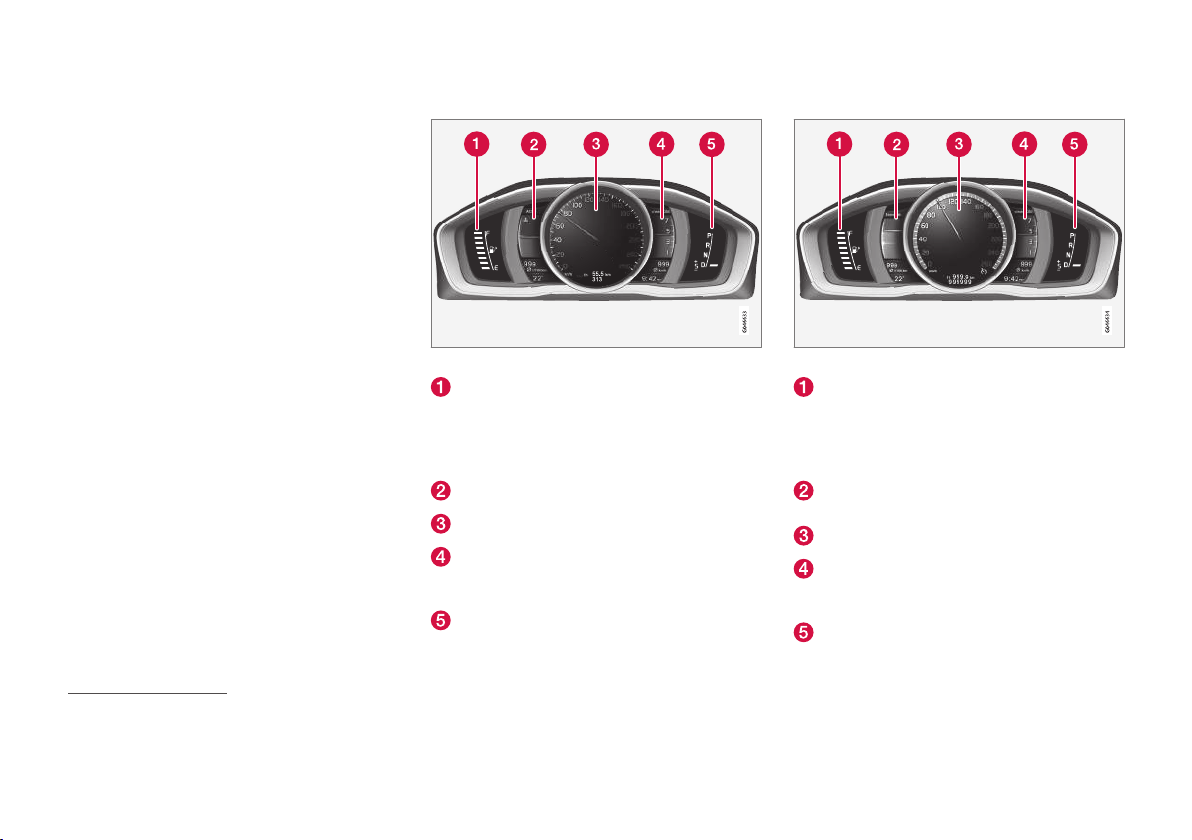
||
INSTRUMENTS AND CONTROLS
* Option/accessory.
64
Gauges and indicators
Alternative themes can be selected for the digital
combined instrument panel. Possible themes are
"Elegance", "Eco" and "Performance".
A theme can only be selected when the engine is
running.
To select the theme, press the left-hand stalk
switch's OK button and select the
Themes
menu option by turning the thumbwheel on the
lever. Press the OK button. Turn the thumbwheel
to select the theme and confirm the selection by
pressing the OK button.
On certain model variants, the appearance of the
centre console's screen follows the theme
selected for the combined instrument panel.
The contrast mode and colour mode for the
instrument can also be set using the left-hand
stalk switch.
For more information on menu navigation, see
Menu navigation - combined instrument panel
(p. 106).
The choice of theme and setting of contrast
mode and colour mode can be stored for each
remote control key in the car key memory*, see
Remote control key - personalisation* (p. 155).
Theme "Elegance"
Gauges and indicators, theme "Elegance".
Fuel gauge. When the indicator lowers to
only one white marking
5
, the yellow indicator
symbol for low level in the fuel tank is illumi-
nated. See also Trip computer (p. 110) and
Filling up with fuel (p. 304).
Temperature gauge for engine coolant.
Speedometer.
Tachometer. The meter indicates engine
speed in thousands of revolutions per minute
(rpm).
Gear shift indicator
6
/Gear position indicator
7
See also Gear shift indicator* (p. 277) or
Automatic gearbox - Geartronic* (p. 278).
Theme "Eco"
Gauges and indicators, theme "Eco".
Fuel gauge. When the indicator lowers to
only one white marking
5
, the yellow indicator
symbol for low level in the fuel tank is illumi-
nated. See also Trip computer (p. 110) and
Filling up with fuel (p. 304).
Eco guide. See also Eco guide & Power
guide* (p. 66).
Speedometer.
Tachometer. The meter indicates engine
speed in thousands of revolutions per minute
(rpm).
Gear shift indicator
6
/Gear position indicator
7
.
See also Gear shift indicator* (p. 277) or
Automatic gearbox - Geartronic* (p. 278).
5
When the display's message "
Distance to empty fuel tank:" starts to show "----", the marking becomes red.
6
Manual gearbox.
7
Automatic gearbox.
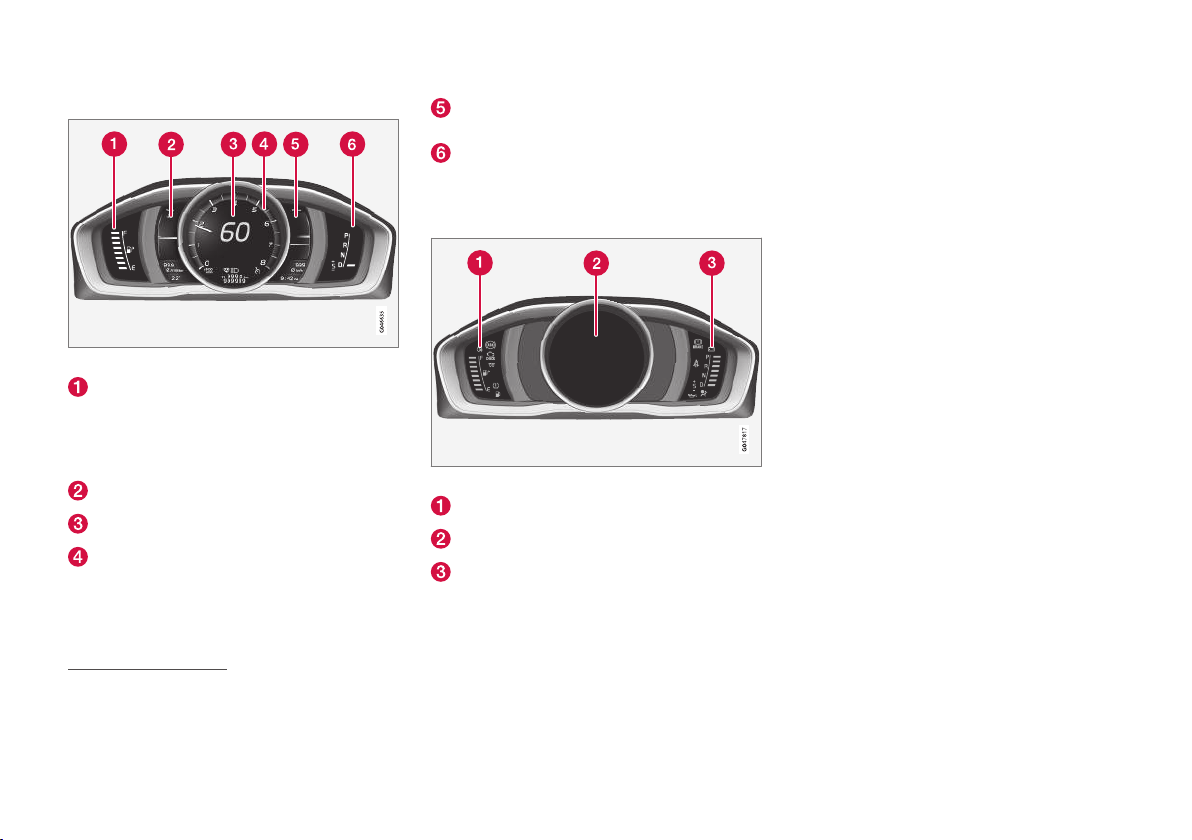
INSTRUMENTS AND CONTROLS
* Option/accessory.
65
Theme "Performance"
Gauges and indicators, theme "Performance".
Fuel gauge. When the indicator lowers to
only one white marking
5
, the yellow indicator
symbol for low level in the fuel tank is illumi-
nated. See also Trip computer (p. 110) and
Filling up with fuel (p. 304).
Temperature gauge for engine coolant.
Speedometer.
Tachometer. The meter indicates engine
speed in thousands of revolutions per minute
(rpm).
Power guide. See also Eco guide & Power
guide* (p. 66).
Gear shift indicator
6
/Gear position indicator
7
.
See also Gear shift indicator* (p. 277) or
Automatic gearbox - Geartronic* (p. 278).
Indicator and warning symbols
Indicator and warning symbols, digital instrument panel.
Indicator symbols
Indicator and warning symbols
Warning symbols
8
Functionality check
All indicator and warning symbols, apart from
symbols in the centre of the information display,
illuminate in key position II or when the engine is
started. When the engine has started, all the
symbols should go out except the parking brake
symbol, which only goes out when the brake is
disengaged.
If the engine does not start or if the functionality
check is carried out in key position II then all
symbols go out within a few seconds except the
symbol for faults in the car's emissions system
and the symbol for low oil pressure.
Related information
•
Combined instrument panel (p. 62)
•
Combined instrument panel - meaning of
indicator symbols (p. 67)
•
Combined instrument cluster - meaning of
warning symbols (p. 69)
5
When the display's message "
Distance to empty fuel tank:" starts to show "----", the marking becomes red.
6
Manual gearbox.
7
Automatic gearbox.
8
Certain engine variants do not have systems to warn of oil pressure loss. In cars with these variants the symbol for low oil pressure is not used. Warning for low oil level is via display text. For more information, see
Engine oil - general (p. 353).
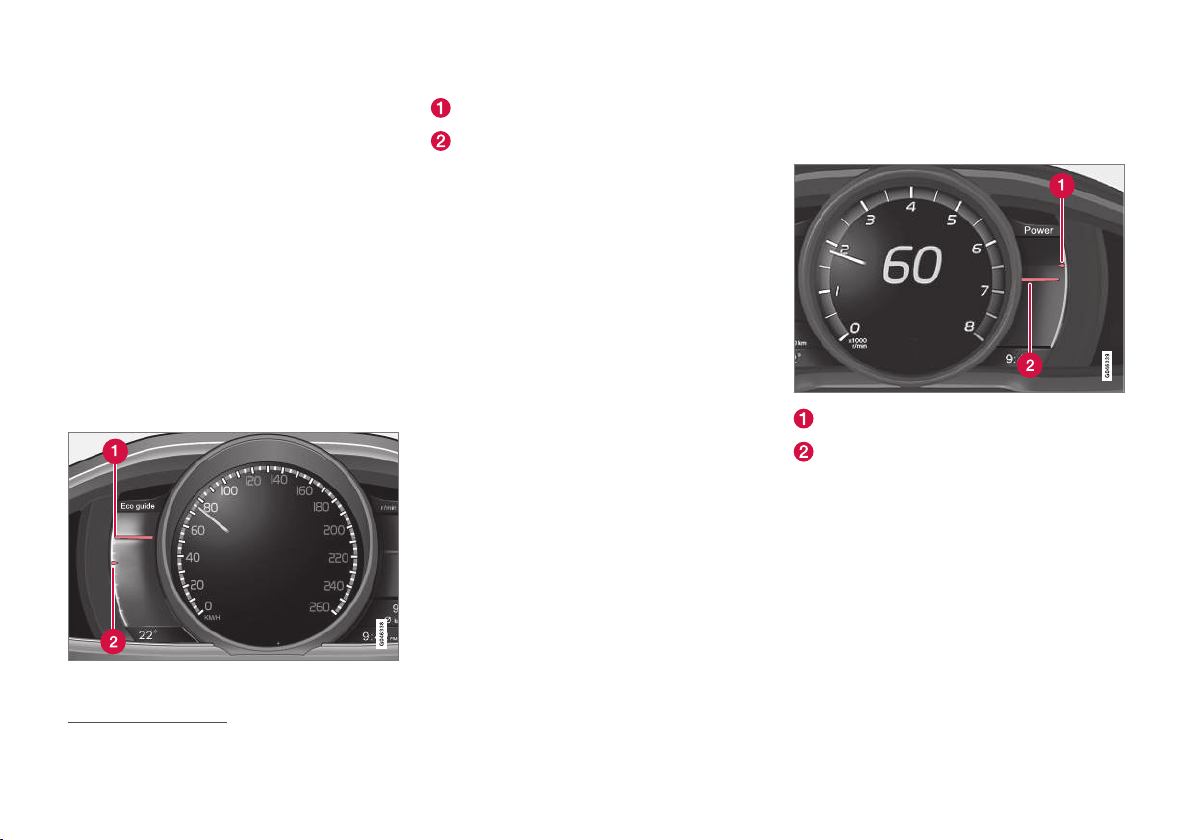
INSTRUMENTS AND CONTROLS
* Option/accessory.
66
Eco guide & Power guide*
Eco guide and Power guide are two combined
instrument panel (p. 62) instruments which help
the driver to drive the car with optimum driving
economy.
The car also stores statistics of journeys made,
which can be viewed in the form of a block dia-
gram; see Trip computer - trip statistics*
(p. 118).
Eco guide
This instrument provides an indication of how
economically the car is being driven.
To view this function, select the theme "Eco"; see
Digital combined instrument panel - overview
(p. 63).
Instantaneous value
Average value
Instantaneous value
The instantaneous value is shown here - the
higher the reading on the scale, the better.
The instantaneous value is calculated based on
speed, engine speed, engine power utilised plus
use of the foot brake.
Optimum speed (50-80 km/h (30-50 mph)) and
low engine speeds are encouraged. The pointers
fall during acceleration and braking.
Very low instantaneous values illuminate the red
zone on the meter (with a short delay), which
means poor driving economy and hence should
be avoided.
Average value
The average value slowly follows the instantane-
ous value and describes how the car has been
driven most recently. The higher the pointers on
the scale, the better the economy achieved by
the driver.
Power guide
This instrument shows the relationship between
how much power (Power) is being taken from the
engine and how much power is available.
To view this function, select the theme
"Performance"; see Digital combined instrument
panel - overview (p. 63).
Available engine power
Engine power utilised
Available engine power
The smaller, upper pointer shows the available
engine power
9
. The higher the reading on the
scale, the more power is available in the current
gear.
Engine power utilised
The larger, lower pointer shows the engine power
utilised
9
. The higher the reading on the scale, the
more power is being taken from the engine.
A large gap between the two pointers indicates a
large power reserve.
9
Power is dependent on engine speed.
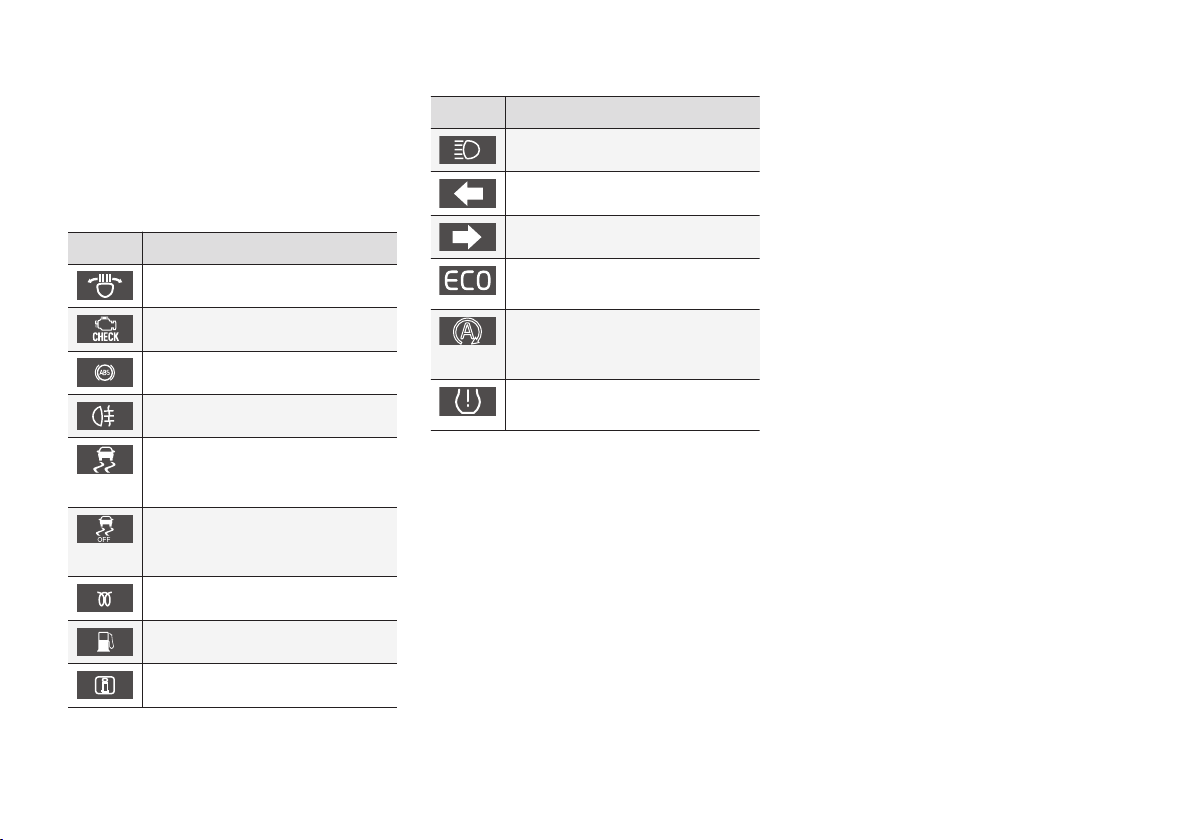
INSTRUMENTS AND CONTROLS
}}
* Option/accessory.
67
Combined instrument panel -
meaning of indicator symbols
The indicator symbols alert the driver that a func-
tion is activated, that the system is operating, or
that an error or failure has occurred.
Indicator symbols
Symbol Specification
ABL fault
Emissions system
ABS fault
Rear fog lamp on
Stability system, see Electronic sta-
bility control (ESC) - general
(p. 182)
Stability system, sport mode, see
Electronic stability control (ESC) -
operation (p. 183)
Engine preheater (diesel)
Low level in fuel tank
Information, read display text
Symbol Specification
Main beam On
Left-hand direction indicator
Right-hand direction indicator
Eco- function on, see Drive mode
ECO* (p. 292)
Start/Stop, the engine auto-stop-
ped; see Start/Stop* - function and
operation (p. 285)
Tyre pressure system , see Tyre
pressure monitoring* (p. 337)
ABL fault
The symbol illuminates if a fault has arisen in the
ABL function (Active Bending Lights).
Emissions system
If the symbol illuminates after the engine has
been started then it may be due to a fault in the
car's emissions system. Drive to a workshop for
checking. Volvo recommends that you seek
assistance from an authorised Volvo workshop.
ABS fault
If this symbol illuminates then the system is not
working. The car's regular brake system contin-
ues to work, but without the ABS function.
1. Stop the car in a safe place and turn off the
engine.
2. Restart the engine.
3. If the symbol remains illuminated, drive to a
workshop to have the ABS system checked.
Volvo recommends that you seek assistance
from an authorised Volvo workshop.
Rear fog lamp on
This symbol illuminates when the rear fog lamp is
switched on.
Stability system
A flashing symbol indicates that the stability sys-
tem is operating. If the symbol illuminates with
constant glow then there is a fault in the system.
Stability system, sport mode
The symbol illuminates when the sport mode is
activated. Sport mode allows for a more active
driving experience. The system then detects
whether the accelerator pedal, steering wheel
movements and cornering are more active than in
normal driving and then allows controlled skid-
ding of the rear section up to a certain level
before it intervenes and stabilises the car.
Engine preheater (diesel)
This symbol illuminates during engine preheating.
Preheating takes place mostly due to low tem-
perature.
Low level in fuel tank
When the symbol illuminates the level in the fuel
tank is low, refuel as soon as possible.
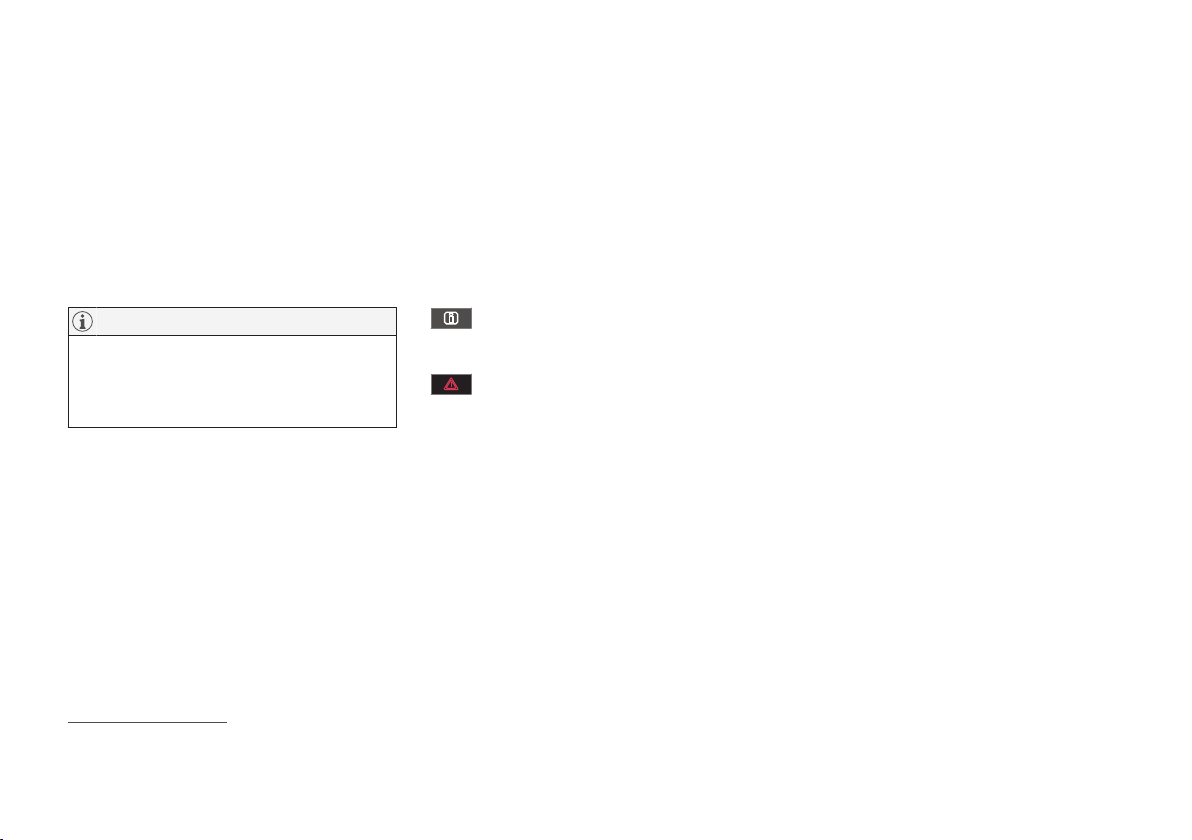
||
INSTRUMENTS AND CONTROLS
* Option/accessory.
68
Information, read display text
When one of the car's systems does not behave
as intended, this information symbol illuminates
and a text appears on the information display.
The message text is cleared with the OK button,
see Menu navigation - combined instrument
panel (p. 106), or it disappears automatically
after a time (time depending on which function is
indicated). The information symbol can also illu-
minate in conjunction with other symbols.
NOTE
When a service message is shown, the sym-
bol and message are cleared using the OK
button, or disappear automatically after a
time.
Main beam On
The symbol illuminates when main beam is on
and with main beam flash.
Left/right-hand direction indicator
Both direction indicator symbols flash when the
hazard warning flashers are used.
Eco function on
This symbol illuminates when the Eco function is
activated.
Start/Stop
The symbol shines when the engine is auto-stop-
ped.
Tyre pressure system
The symbol illuminates in the event of low tyre
pressure, or if a fault arises in the tyre pressure
system.
Reminder – doors not closed
If one of the doors is not closed properly then the
information or warning symbol illuminates
together with an explanatory image in the infor-
mation display. Stop the car in a safe place as
soon as possible and close the door that is open.
If the car is driven at a speed lower than
approx. 7 km/h (approx. 4 mph) then the
information symbol illuminates.
If the car is driven at a speed higher than
approx. 7 km/h (approx. 4 mph) then the
warning symbol illuminates.
If the bonnet
10
is not closed properly then the
warning symbol illuminates together with an
explanatory image in the information display. Stop
the car in a safe place as soon as possible and
close the bonnet.
If the boot lid is not closed properly then the
information symbol illuminates together with an
explanatory image in the information display. Stop
the car in a safe place as soon as possible and
close the boot lid.
Related information
•
Combined instrument panel (p. 62)
•
Combined instrument cluster - meaning of
warning symbols (p. 69)
•
Analogue combined instrument panel - over-
view (p. 62)
•
Digital combined instrument panel - overview
(p. 63)
10
Only cars with alarm*.
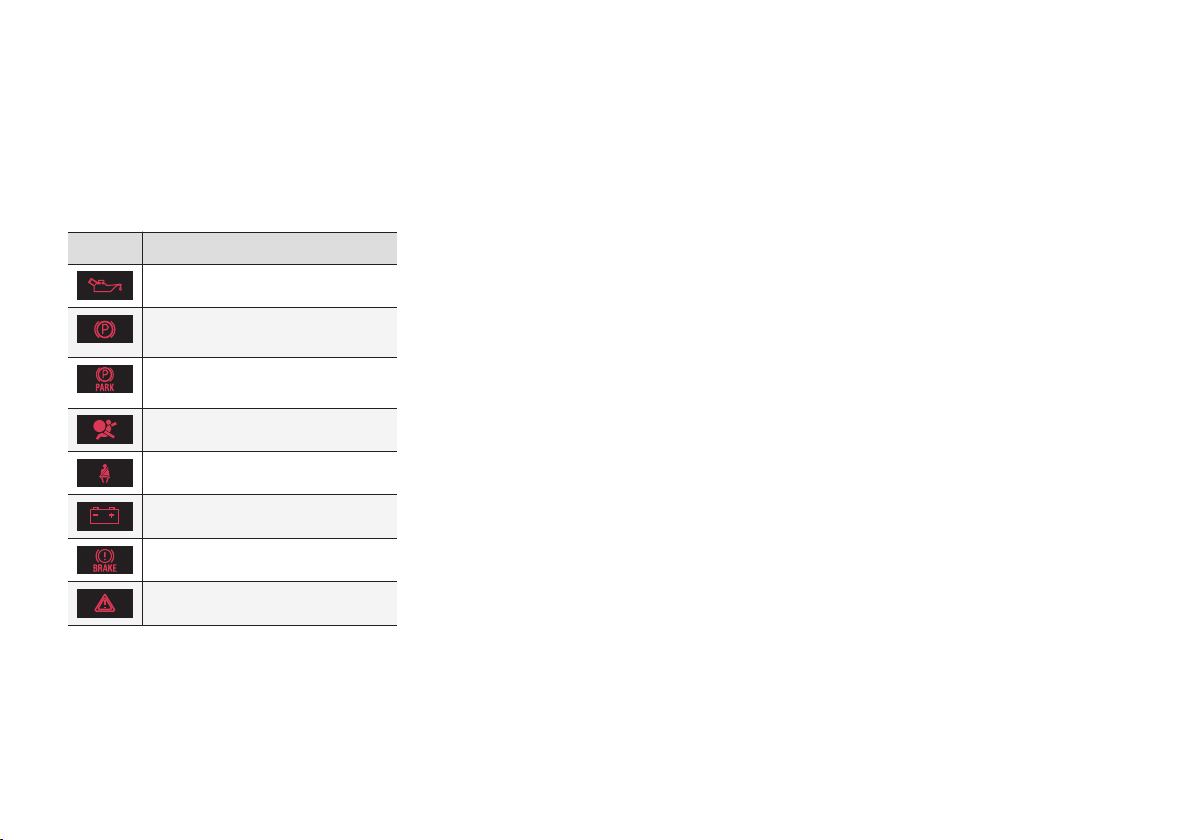
INSTRUMENTS AND CONTROLS
}}
69
Combined instrument cluster -
meaning of warning symbols
The warning symbols alert the driver that an
important function is activated, or that a serious
error or a serious failure has occurred.
Warning symbols
Symbol Specification
Low oil pressure
A
Parking brake applied (digital
instrument panel)
Parking brake applied (analogue
instrument panel)
Airbags – SRS
Seatbelt reminder
Alternator not charging
Fault in brake system
Warning
A
Certain engine variants do not have systems to warn of oil pres-
sure loss. In cars with these variants the symbol for low oil pres-
sure is not used. Warning for low oil level is via display text. For
more information, see Engine oil - general (p. 353).
Low oil pressure
If this symbol illuminates during driving then the
engine's oil pressure is too low. Stop the engine
immediately and check the engine oil level, top
up if necessary. If the symbol illuminates and the
oil level is normal, contact a workshop. Volvo rec-
ommends that you seek assistance from an
authorised Volvo workshop.
Parking brake applied
This symbol illuminates with a constant glow
when the parking brake is applied. The symbol
flashes during application, and then changes over
to a constant glow.
A flashing symbol in any other situation means
that a fault has arisen. Read the message on the
information display.
For more information, see Parking brake
(p. 297).
Airbags – SRS
If the symbol remains illuminated or illuminates
while driving, a fault has been detected in one of
the car's safety systems. Drive to a workshop for
checking as soon as possible. Volvo recommends
that you seek assistance from an authorised
Volvo workshop.
Seatbelt reminder
This symbol flashes if someone in a front seat
has not put on their seatbelt or if someone in a
rear seat has taken off their seatbelt.
Alternator not charging
This symbol illuminates during driving if a fault
has occurred in the electrical system. Visit a
workshop. Volvo recommends that you seek
assistance from an authorised Volvo workshop.
||
INSTRUMENTS AND CONTROLS
* Option/accessory.
70
Fault in brake system
If this symbol illuminates, the brake fluid level
may be too low. Stop the car in a safe place and
check the level in the brake fluid reservoir; see
Brake and clutch fluid - level (p. 358).
If the brake and ABS symbols illuminate at the
same time, there may be a fault in the brake
force distribution system.
1. Stop the car in a safe place and turn off the
engine.
2. Restart the engine.
•
If both symbols extinguish, continue driv-
ing.
•
If the symbols remain illuminated, check
the level in the brake fluid reservoir; see
Brake and clutch fluid - level (p. 358). If
the brake fluid level is normal but the
symbols are still illuminated, the car can
be driven, with great care, to a workshop
to have the brake system checked. Volvo
recommends that you seek assistance
from an authorised Volvo workshop.
WARNING
If the brake fluid is under the MIN level in the
brake fluid reservoir, do not drive further
before topping up the brake fluid.
The loss of brake fluid must be investigated
by a workshop. Volvo recommends that you
contact an authorised Volvo workshop.
WARNING
If the BRAKE and ABS symbols are lit at the
same time, there is a risk that the rear end will
skid during heavy braking.
Warning
The red warning symbol illuminates when a fault
has been indicated which could affect the safety
and/or driveability of the car. An explanatory text
is shown on the information display at the same
time. The symbol remains visible until the fault
has been rectified but the text message can be
cleared with the OK button; see Menu navigation
- combined instrument panel (p. 106). The warn-
ing symbol can also illuminate in conjunction with
other symbols.
Action:
1. Stop in a safe place. Do not drive the car fur-
ther.
2. Read the information on the information dis-
play. Implement the action in accordance
with the message in the display. Clear the
message using the OK button.
Reminder – doors not closed
If one of the doors is not closed properly then the
information or warning symbol illuminates
together with an explanatory image in the infor-
mation display. Stop the car in a safe place as
soon as possible and close the door that is open.
If the car is driven at a speed lower than
approx. 7 km/h (approx. 4 mph) then the
information symbol illuminates.
If the car is driven at a speed higher than
approx. 7 km/h (approx. 4 mph) then the
warning symbol illuminates.
If the bonnet
11
is not closed properly then the
warning symbol illuminates together with an
explanatory image in the information display. Stop
the car in a safe place as soon as possible and
close the bonnet.
If the boot lid is not closed properly then the
information symbol illuminates together with an
explanatory image in the information display. Stop
the car in a safe place as soon as possible and
close the boot lid.
11
Only cars with alarm*.
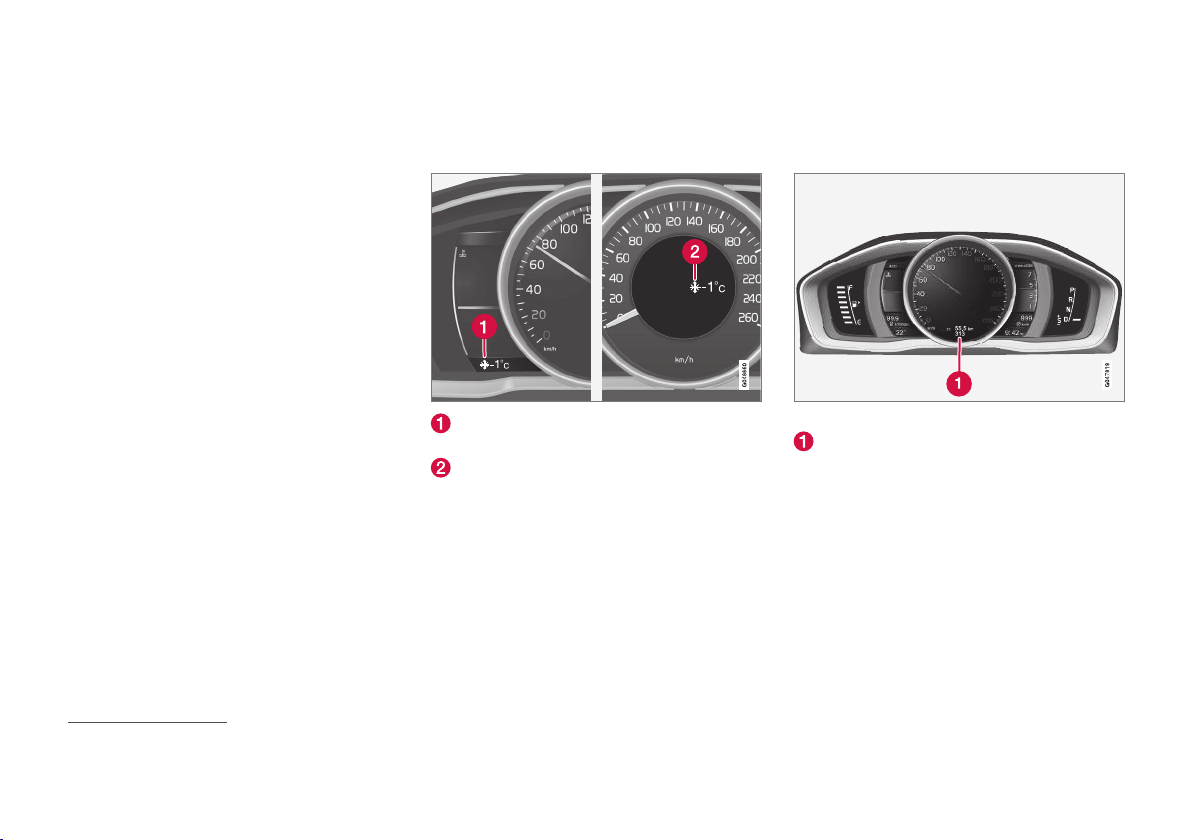
INSTRUMENTS AND CONTROLS
71
Related information
•
Combined instrument panel (p. 62)
•
Combined instrument panel - meaning of
indicator symbols (p. 67)
•
Analogue combined instrument panel - over-
view (p. 62)
•
Digital combined instrument panel - overview
(p. 63)
Outside temperature gauge
The display for the outside temperature gauge
appears in the combined instrument panel.
Display for outside temperature gauge, digi-
tal instrument panel
Display for outside temperature gauge, ana-
logue instrument panel
When the temperature lies between +2 °C to -5
°C a snowflake symbol illuminates in the display.
This warns of icy roads. If the car has been sta-
tionary, the gauge may display a reading that is
too high.
Related information
•
Combined instrument panel (p. 62)
Trip meter
The trip meter display appears in the combined
instrument panel.
Trip meter, digital instrument panel.
Display for trip meter
12
Both trip meters
T1 and T2 are used to measure
short distances. The distance is shown in the dis-
play.
Turn the left-hand stalk switch's thumbwheel to
show the required meter.
A long press (until the change occurs) on the
left-hand stalk switch RESET button resets the
trip meter shown. For more information, see Trip
computer (p. 110).
Related information
•
Combined instrument panel (p. 62)
12
Display appearance may differ depending on instrument variant.
INSTRUMENTS AND CONTROLS
72
Clock
The clock display appears in the combined
instrument panel.
Clock, digital instrument panel.
Display for showing the time
13
Setting the clock
The clock can be adjusted in the menu system
MY CAR, see MY CAR (p. 109).
Related information
•
Combined instrument panel (p. 62)
Combined instrument panel -
license agreement
A license is an agreement for the right to oper-
ate a certain activity or the right to use someone
else's entitlement according to the terms and
conditions in the agreement. The following text is
Volvo's agreement with the manufacturer/devel-
oper.
Combined Instrument Panel Software
Open Source Software Notice
This product uses certain free / open source and
other software originating from third parties, that
is subject to the GNU Lesser General Public
License version 2 (LGPLv2), The FreeType
Project License ("FreeType License") and other
different and/or additional copy right licenses,
disclaimers and notices. The links to access the
exact terms of LGPLv2, and the other open
source software licenses, disclaimers,
acknowledgements and notices are provided to
you below. Please refer to the exact terms of the
relevant License, regarding your rights under said
licenses. Volvo Car Corporation (VCC) offers to
provide the source code of said free/open source
software to you for a charge covering the cost of
performing such distribution, such as the cost of
media, shipping and handling, upon written
request. Please contact your nearest Volvo
Dealer.
The offer is valid for a period of at least three (3)
years from the date of the distribution of this
product by VCC / or for as long as VCC offers
spare parts or customer support.
Portions of this product uses software
copyrighted © 2007 The FreeType Project
(www.freetype.org). All rights reserved.
Portions of this product uses software with
Copyright © 1994–2013 Lua.org, PUC-Rio
(http://www.lua.org/)
This product includes software under
following licenses:
LGPL v2.1: http://www.gnu.org/licenses/old-
licenses/lgpl-2.1.html
•
GNU FriBidi
•
DevIL
The FreeType Project License: http://
git.savannah.gnu.org/cgit/freetype/freetype2.git/
tree/docs/FTL.TXT
•
FreeType 2
13
The time is shown in the centre of an analogue instrument panel.
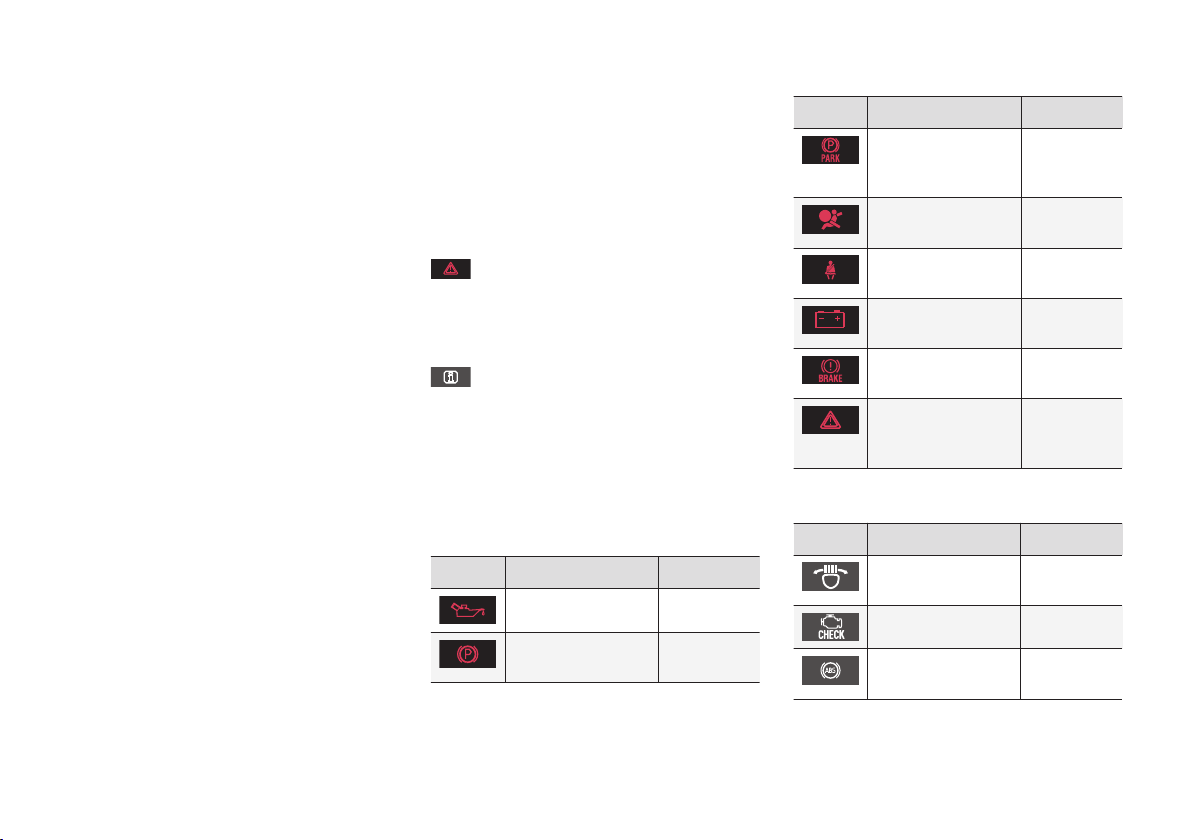
INSTRUMENTS AND CONTROLS
}}
* Option/accessory.
73
MIT License: http://opensource.org/licenses/
mit-license.html
•
Lua
Symbols in the display
There are a variety of different symbols in the
display in the car. The symbols are divided into
warning, indicator and information symbols.
Shown below are the most common symbols with
their meanings and a reference to where in the
manual further information can be found.
- Red warning symbol, illuminates when a
fault has been indicated which could affect the
safety and/or driveability of the car. An explana-
tory text is shown in the information display in the
combined instrument panel at the same time.
- Information symbol, illuminates in combi-
nation with text in the information display in the
combined instrument panel, when a deviation in
any of the car's systems has occurred. The infor-
mation symbol can also illuminate in conjunction
with other symbols.
Warning symbols in the combined
instrument panel
Symbol Specification See
Low oil pressure (p. 69)
Parking brake
applied
(p. 69),
(p. 297)
Symbol Specification See
Parking brake
applied, alternative
symbol
(p. 69)
Airbags – SRS (p. 32),
(p. 69)
Seatbelt reminder (p. 28),
(p. 69)
Alternator not
charging
(p. 69)
Fault in brake sys-
tem
(p. 69),
(p. 294)
Warning, safety
mode
(p. 32),
(p. 41),
(p. 69)
Control symbols in the combined
instrument panel
Symbol Specification See
ABL fault*
(p. 67),
(p. 91)
Emissions system (p. 67)
ABS fault (p. 67),
(p. 294)

||
INSTRUMENTS AND CONTROLS
* Option/accessory.
74
Symbol Specification See
Rear fog lamp on (p. 67),
(p. 92)
Stability system,
ESC (Electronic
Stability Control),
Trailer stability
assist
(p. 67),
(p. 185),
(p. 317)
Stability system,
sport mode
(p. 67),
(p. 185)
Engine preheater
(diesel)
(p. 67)
Low level in fuel
tank
(p. 67),
(p. 138)
Information, read
display text
(p. 67)
Main beam On (p. 67),
(p. 88)
Left-hand direction
indicators
(p. 67)
Right-hand direc-
tion indicators
(p. 67)
Start/Stop*, engine
auto-stopped
(p. 67),
(p. 290)
Symbol Specification See
ECO function* on
(p. 67),
(p. 292)
Tyre pressure sys-
tem*
(p. 67),
(p. 337)
Information symbols in the combined
instrument panel
Symbol Specification See
Cruise control*
(p. 190)
Adaptive cruise con-
trol*
(p. 208)
Adaptive cruise con-
trol*, time interval
(p. 196),
(p. 198)
Adaptive cruise con-
trol*, Distance Warn-
ing* (Distance Alert)
(p. 201),
(p. 193)
Radar sensor*
(p. 208),
(p. 195),
(p. 231)
Speed limiter (p. 187)
Symbol Specification See
Windscreen sensor*,
Camera sensor*,
Laser sensor*
(p. 89),
(p. 221),
(p. 231),
(p. 244),
(p. 248),
(p. 253)
Auto Brake*, Dis-
tance Warning* (Dis-
tance Alert), City
Safety
TM
, Collision
warning system*
(p. 195),
(p. 221),
(p. 231)
ABL system*
(p. 91)
Driver Alert System*,
Time for a break
(p. 243)
Driver Alert System*,
Time for a break
(p. 244)
Parking brake (p. 297)
Rain sensor*
(p. 97)
Active main beam,
AHB (Active High
Beam)*
(p. 89)
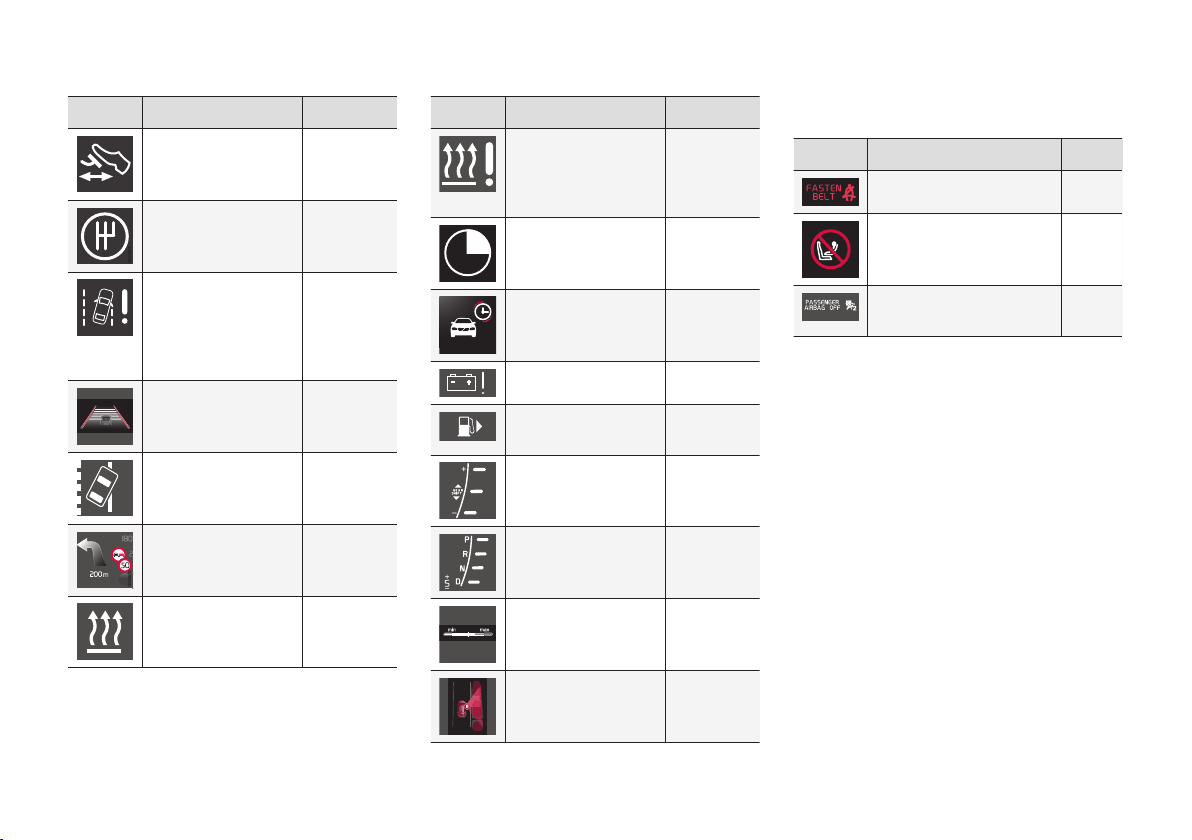
INSTRUMENTS AND CONTROLS
* Option/accessory.
75
Symbol Specification See
Start/Stop*
(p. 290)
Start/Stop*
(p. 290)
Driver Alert System*,
Lane Departure
Warning (LDW),
Lane Keeping Aid
(LKA)
(p. 244),
(p. 248),
(p. 253)
Driver Alert System*,
Lane Departure
Warning*
(p. 247)
Driver Alert System*,
Lane Departure
Warning*
(p. 248),
(p. 253)
Recorded speed
information*
(p. 239)
Engine block and
passenger compart-
ment heater*
(p. 138)
Symbol Specification See
Engine block heater
and passenger com-
partment heater*
Service required
(p. 138)
Activated timer*
(p. 138)
Activated timer*
(p. 138)
Low battery (p. 138)
Fuel filler flap, right-
hand side
(p. 304)
Gear shift indicator (p. 277)
Gear positions (p. 278)
Measuring the oil
level
(p. 354)
Park Assist Pilot -
PAP*
(p. 262)
Information symbols in the roof console
display
Symbol Specification See
Seatbelt reminder (p. 31)
Airbag, passenger seat,
activated
(p. 36)
Airbag, passenger seat,
deactivated
(p. 36)
Related information
•
Combined instrument panel - meaning of
indicator symbols (p. 67)
•
Combined instrument cluster - meaning of
warning symbols (p. 69)
•
Messages - handling (p. 109)
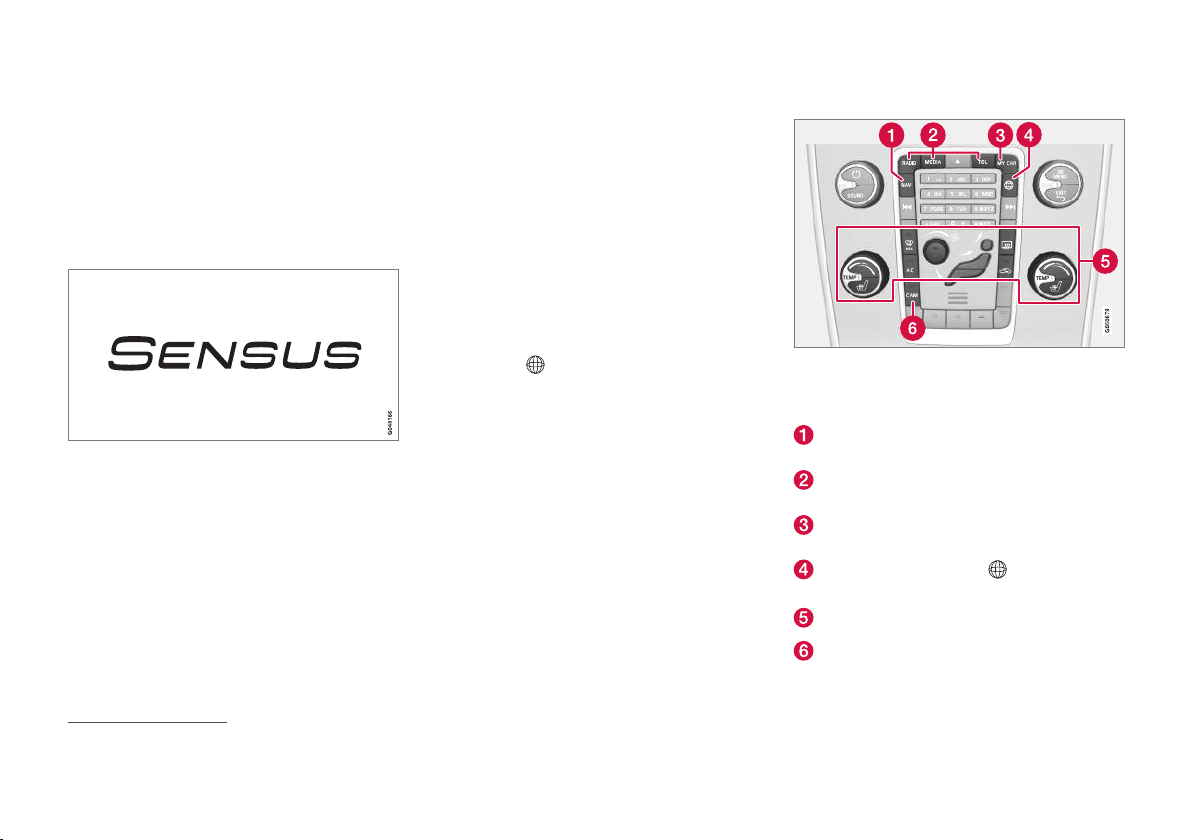
INSTRUMENTS AND CONTROLS
* Option/accessory.
76
Volvo Sensus
Volvo Sensus is the heart of the personal Volvo
experience and connects you with the car and
outside world. Sensus provides information,
entertainment and assistance when it is needed.
Sensus consists of intuitive functions that both
enhance the car journey and simplifies owner-
ship of the car.
An intuitive navigation structure makes it possible
to receive relevant support, information and
entertainment when it is necessary, without dis-
tracting the driver.
Sensus covers all the car's solutions that enable
connection* to the outside world and provides
you with intuitive control over all the car's capabil-
ities.
Volvo Sensus combines and presents many func-
tions in several of the car's systems on the centre
console's screen. With Volvo Sensus the car can
be personalised by means of an intuitive user
interface. Settings can be made in Car settings,
Audio and media, Climate control, etc.
With the centre console buttons and controls or
the steering wheel's right-hand keypad* functions
can be activated or deactivated and many differ-
ent settings can be made.
With a press on MY CAR all settings related to
the driving and control of the car are presented,
such as City Safety, locks and alarm, automatic
fan speed, setting the clock, etc.
With a press on the respective function RADIO,
MEDIA, TEL*,
*, NAV* and CAM
14
other
sources, systems and functions can be activated,
e.g. AM, FM, CD, DVD*, TV*, Bluetooth
®
*, naviga-
tion* and park assist camera*.
For more information about all functions/
systems, see the relevant section in the owner's
manual or its supplement.
Overview
Control panel in centre console. The figure is schematic
- the number of functions and layout of the buttons both
vary, depending on the equipment selected and the mar-
ket.
Navigation* - NAV, see separate supplement
(Sensus Navigation).
Audio and media - RADIO, MEDIA, TEL*, see
separate supplement (Sensus Infotainment).
Function settings - MY CAR, see MY CAR
(p. 109).
Internet-connected car - *, see separate
supplement (Sensus Infotainment).
Climate control system (p. 120).
Park assist camera* (p. 258) – CAM*.
14
Applies to certain car models.
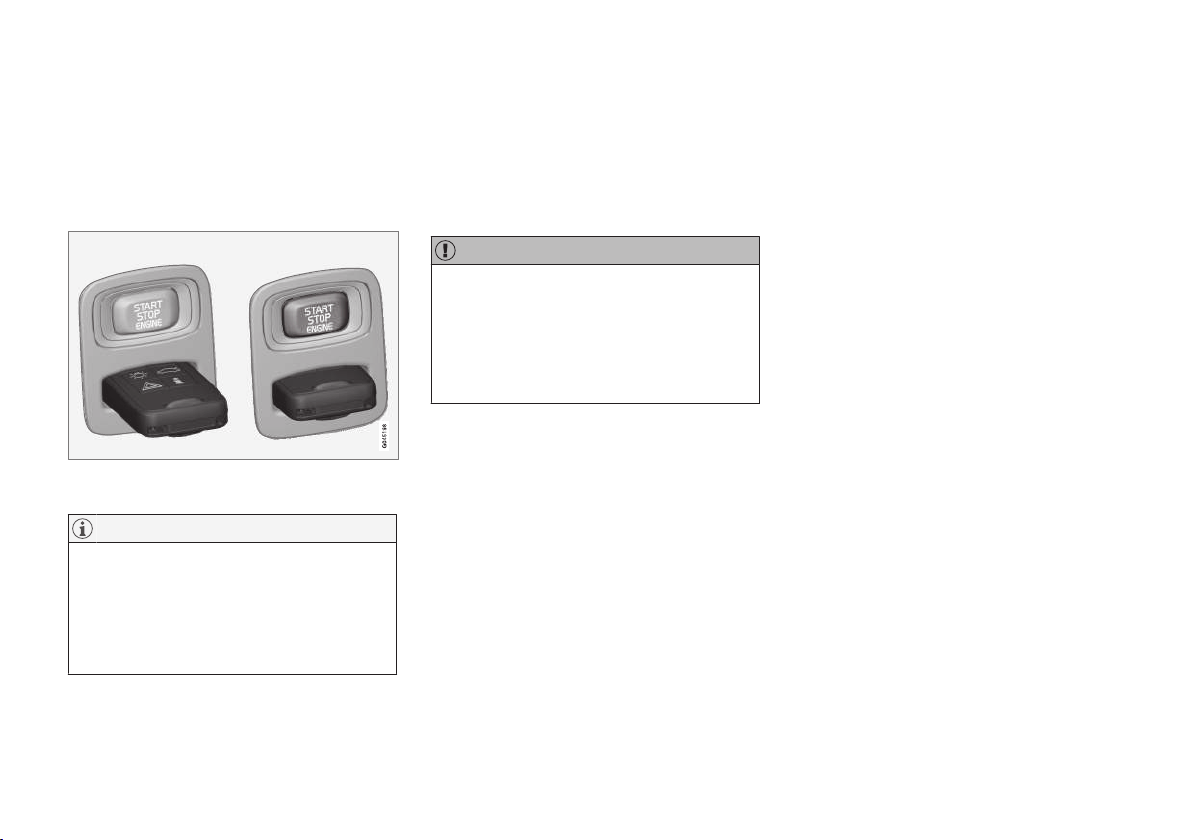
INSTRUMENTS AND CONTROLS
}}
* Option/accessory.
77
Key positions
The remote control key can be used to set the
vehicle's electrical system in different modes/
levels so that different functions are available;
see Key positions - functions at different levels
(p. 77).
Ignition switch with remote control key extracted/
inserted.
NOTE
For cars with the keyless start and lock sys-
tem* the remote control key does not need to
be inserted into the ignition switch but can be
stored in e.g. a pocket. For more information
on the keyless start and lock system, see
Keyless drive* (p. 165).
Insert the remote control key
1. Hold the end of the remote control key with
the detachable key blade and insert the
remote control key in the ignition switch.
2. Then press the remote control key in the
ignition switch up to its end position.
IMPORTANT
Foreign objects in the ignition switch can
impair the function or destroy the lock.
Do not press in the remote control key incor-
rectly turned - hold the end with the detacha-
ble key blade, see Detachable key blade -
detaching/attaching (p. 161).
Remove the remote control key
Grip the remote control key and pull it out from
the ignition switch.
Key positions - functions at different
levels
To enable the use of a limited number of func-
tions with the engine switched off, the car's elec-
trical system can be set in 3 different levels - 0, I
and II - with the remote control key. This owner's
manual describes these levels throughout using
the denomination "key positions".
The following table shows the functions available
in each key position/level.
||
INSTRUMENTS AND CONTROLS
* Option/accessory.
78
Level Functions
0
•
Odometer, clock and temperature
gauge are illuminated.
•
Electrically operated seats can be
adjusted.
•
The audio system can be used for
a limited time - see the Sensus
Infotainment supplement.
I
•
Sunroof, power windows, 12 V
socket in the passenger compart-
ment, navigation, phone, ventilation
fan and windscreen wipers can be
used.
II
•
The headlamps come on.
•
Warning/indicator lamps illuminate
for 5 seconds.
•
Several other systems are acti-
vated. However, electric heating in
seat cushions and the rear window
can only be activated after starting
the engine.
This key position consumes a lot of
current from the starter battery and
should therefore be avoided!
Selecting key position/level
•
Key position 0 - Unlock the car - This
means that the car's electrical system is at
level 0.
NOTE
To reach level I or II without starting the
engine - do not depress the brake/clutch
pedal when these key positions are due to be
selected.
•
Key position I - With the remote control key
fully inserted into the ignition switch
15
-
Briefly press START/STOP ENGINE.
•
Key position II - With the remote control
key fully inserted into the ignition switch
15
-
Give a long
16
press on START/STOP
ENGINE.
•
Back to key position 0 - To return to key
position 0 from position II and I - Briefly
press on START/STOP ENGINE.
Audio system
For information on audio system functions with
remote control key removed, see the Sensus
Infotainment supplement.
Starting and stopping the engine
For information about starting/stopping the
engine, see Starting the engine (p. 270).
Towing
For important information about the remote con-
trol key during towing, see Towing (p. 318).
Related information
•
Key positions (p. 77)
15
Not required for cars with keyless start and lock system*.
16
Approx. 2 seconds.
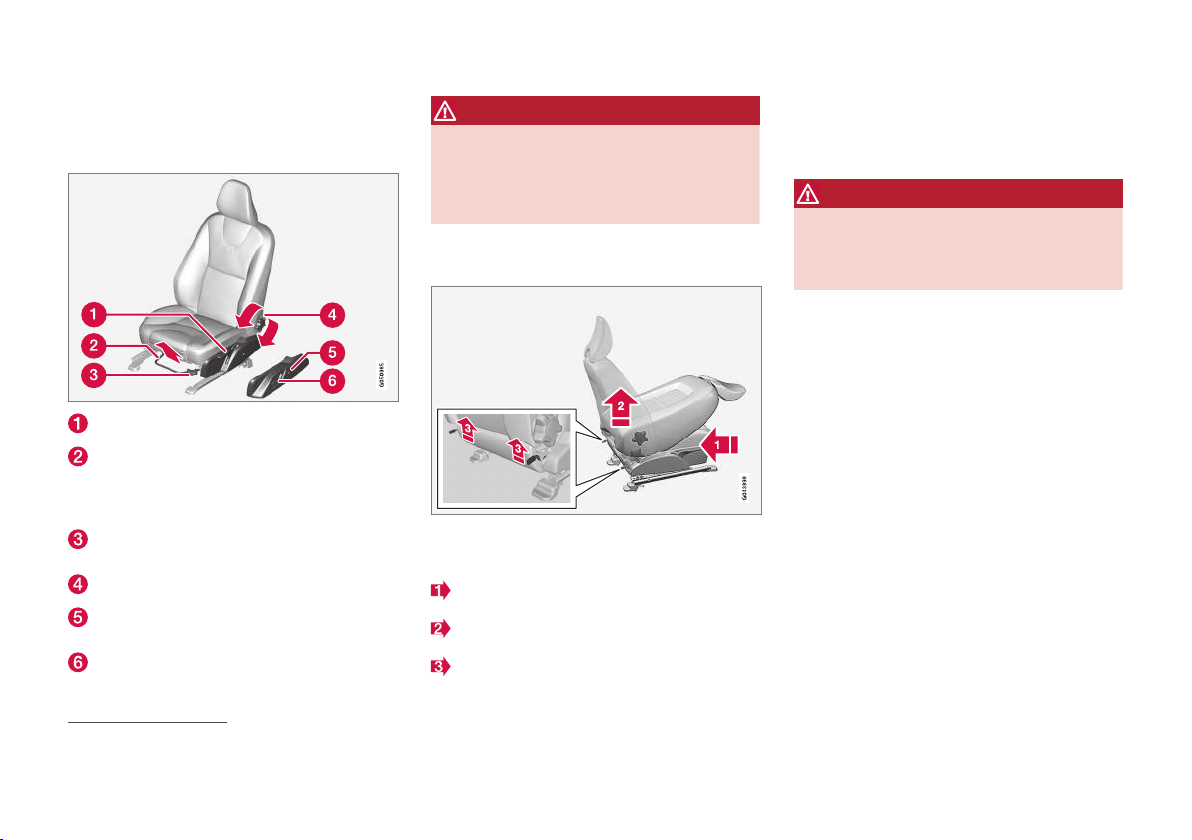
INSTRUMENTS AND CONTROLS
* Option/accessory.
79
Seats, front
The car's front seats have different setting
options for optimum seating comfort.
Raise/lower the seat, pump up/down.
Forward/backward: lift the handle to adjust
the distance to the steering wheel and ped-
als. Check that the seat is locked after
changing position.
Raise/lower* front edge of seat cushion,
pump up/down.
Adjust backrest rake, turn the wheel.
Change the lumbar support*, press the but-
ton.
Control panel for power seat*, see Seats,
front - electrically operated* (p. 80).
WARNING
Adjust the position of the driver's seat before
setting off, never while driving. Make sure that
the seat is in locked position in order to avoid
personal injury in the event of heavy braking
or an accident.
Lowering the passenger seat
backrest*
17
The passenger seat's backrest can be folded for-
ward to make room for long loads.
Move the seat as far back/down as possible.
Adjust the backrest to an upright position.
Lift the catches on the rear of the backrest
and fold it forward.
4. Push the seat forward so that the head
restraint "locks" in under the glovebox.
Raising takes place in reverse order.
WARNING
Grasp the backrest and make sure that it is
properly locked after being folded up in order
to avoid personal injury in the event of sudden
braking or an accident.
Related information
•
Seats, front - electrically operated* (p. 80)
•
Seats, rear (p. 81)
17
Only applies to comfort seats.
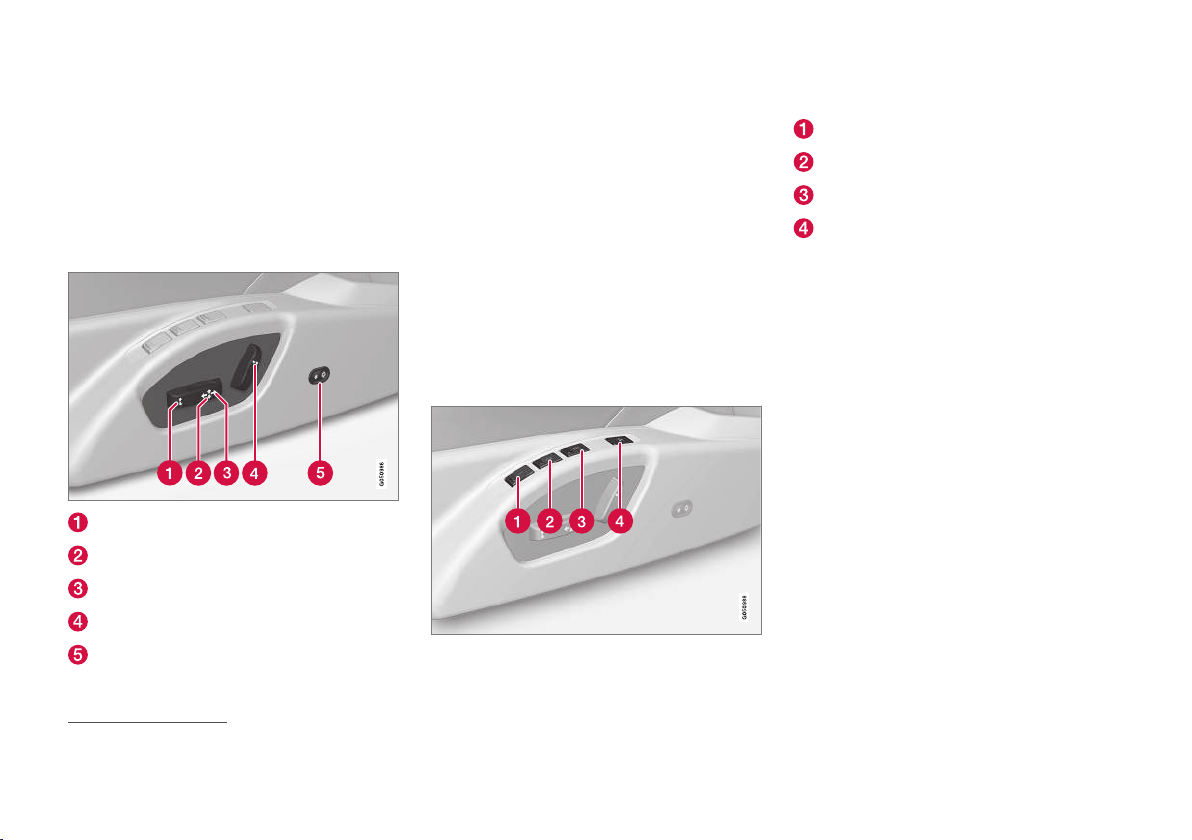
INSTRUMENTS AND CONTROLS
* Option/accessory.
80
Seats, front - electrically operated*
The car's front seats have different setting
options for optimum seating comfort. The power
seat can be moved forward/backward and up/
down. The front edge of the seat cushion can be
raised/lowered. The backrest angle and lumbar
support* can be changed.
Power seat
Front edge of seat cushion up/down
Raise/lower seat
Seat, forward/backward
Backrest rake
Lumbar support* is adjusted inward and out-
ward
The power seats have overload protection which
is tripped if a seat is blocked by an object. If this
should happen, set the car's electrical system in
key position I or 0 and wait a short time before
adjusting the seat again.
Only one movement (forward/back/up/down/
inward/outward) can be made at a time.
Preparations
The seat can be adjusted for a certain time after
unlocking the door with the remote control key
without the key in the ignition switch. Seat adjust-
ment is normally made in key position I and can
always be made when the engine is running.
Seat with memory function*
The memory function stores settings for the seat
and the door mirrors.
Store setting
Memory button
Memory button
Memory button
Button for storing settings
1. Adjust the seat and the door mirrors.
2.
Press and hold button M while pressing but-
ton 1, 2 or 3 simultaneously. Hold the but-
tons depressed until the acoustic signal is
heard and text is shown in the combined
instrument panel.
The seat must be adjusted again before a new
memory can be set.
The setting for lumbar support is not stored.
Using a stored setting
Press one of the memory buttons 1-3 until the
seat and the door mirrors stop. If the button is
released, the movement of the seat and door mir-
rors will be interrupted.
Key memory* in remote control key
All remote control keys can be used by different
drivers to store the settings for the driver's seat
and door mirrors
18
, see Remote control key - per-
sonalisation* (p. 155).
18
Only if the car is equipped with power seat with memory and power retractable door mirrors. The setting for lumbar support is not stored.
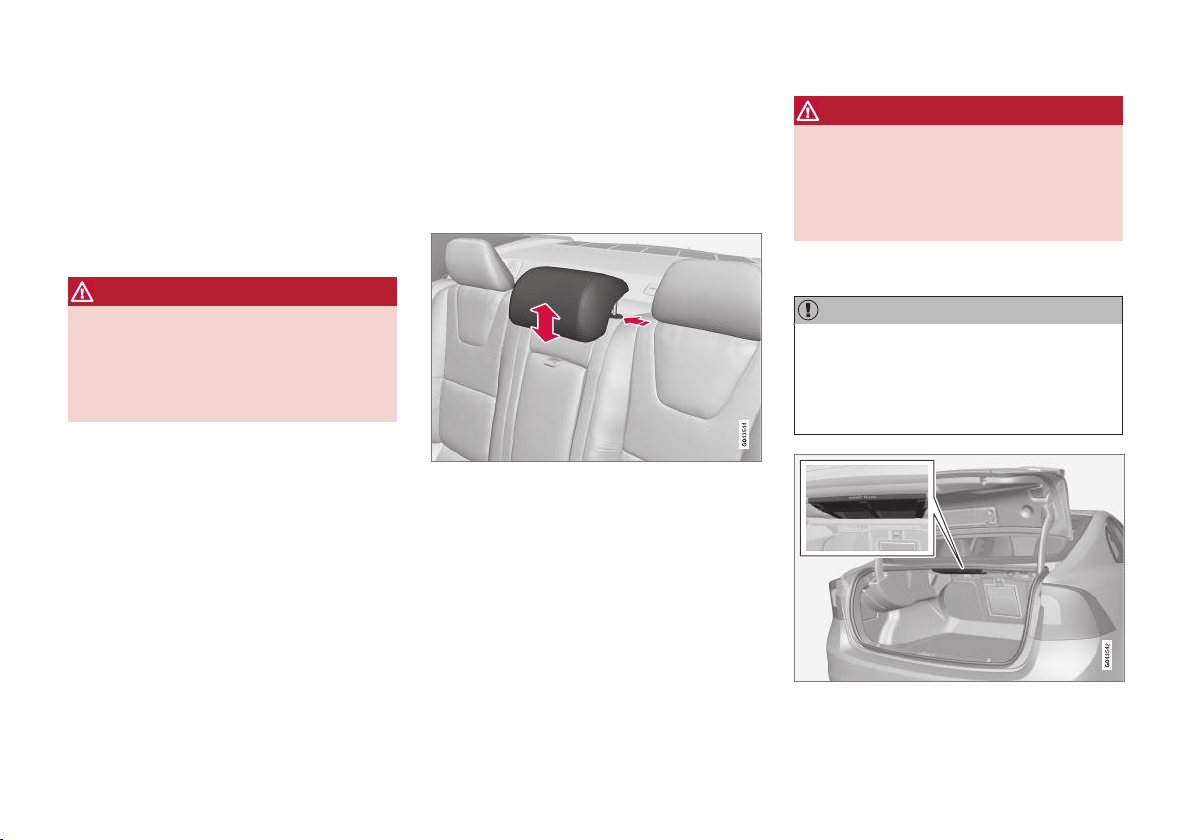
INSTRUMENTS AND CONTROLS
}}
* Option/accessory.
81
Emergency stop
If the seat accidentally begins to move, press one
of the setting buttons for the seat or memory
buttons in order to stop the seat.
Restarting to reach the seat position stored in
the key memory is performed by pressing the
unlock button on the remote control key. The
driver's door must then be open.
WARNING
Risk of crushing! Make sure that children do
not play with the controls. Check that there
are no objects in front of, behind or under the
seat during adjustment. Make sure that none
of the passengers in the rear seat is in danger
of becoming trapped.
Heated seats
For heated seats, see Heated front seats*
(p. 127) and Heated rear seat* (p. 128).
Related information
•
Seats, front (p. 79)
•
Seats, rear (p. 81)
Seats, rear
The rear seat backrest and the outer seat head
restraints can be folded. The centre seat head
restraint can be adjusted to suit the height of the
passenger.
Head restraint, centre seat, rear
Adjust the head restraint according to passenger
height so that the whole of the back of the head
is covered if possible. Slide it up as required.
To lower the head restraint again, the button by
the left-hand shaft (see illustration) must be
pressed in while the head restraint is pressed
down carefully.
WARNING
The centre seat head restraint must be in its
lowest position when the centre seat is not
used. When the centre seat is used, the head
restraint must be correctly adjusted to the
height of the passenger so that it covers the
whole of the back of the head if possible.
Lowering the rear seat backrest
IMPORTANT
There must be no objects on the rear seat
when the backrest is to be folded down. The
seat belts must not be connected either. Oth-
erwise there is a risk of damaging the rear
seat upholstery.
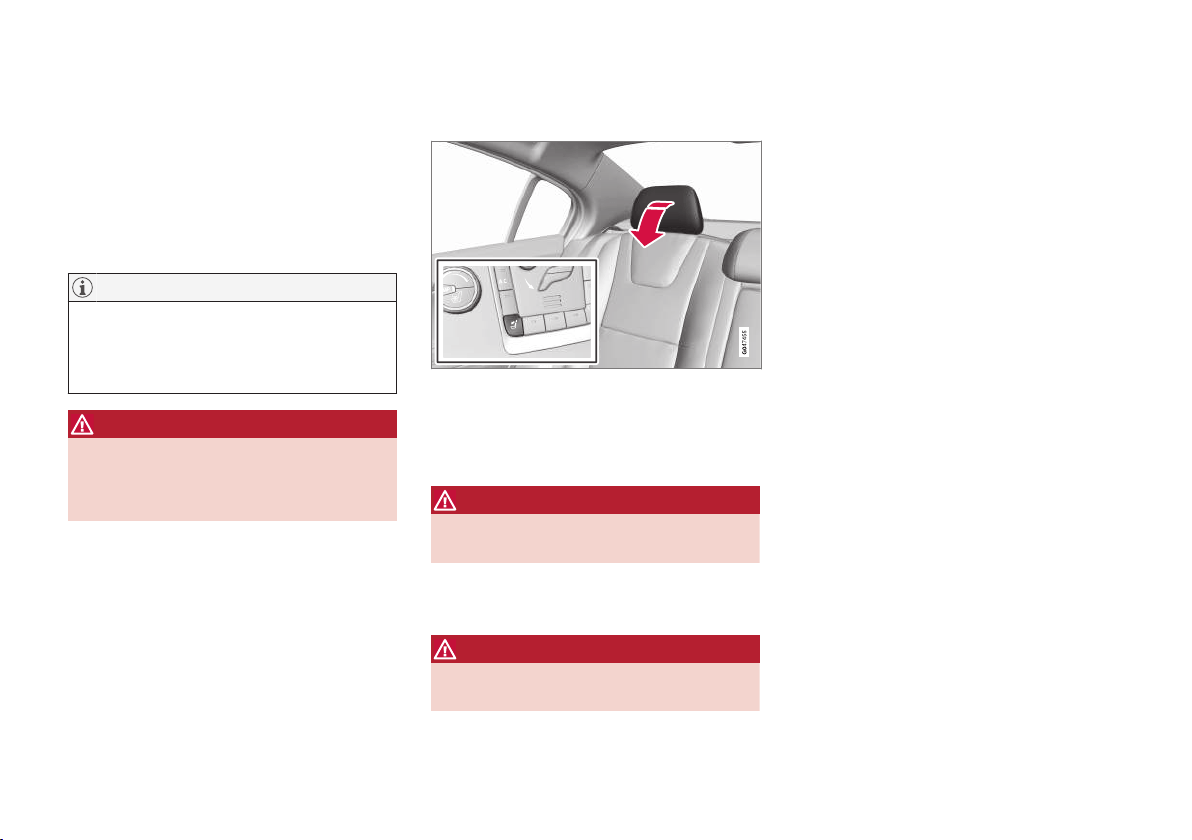
||
INSTRUMENTS AND CONTROLS
* Option/accessory.
82
The backrest is in two parts. The parts can be
folded forward, together or separately.
1. Pull on the required handle. They are located
just inside the hatch opening.
2. Fold the backrest forward.
Lower the centre head restraint fully if the back-
rest's wide section shall be lowered.
NOTE
When the backrests have been lowered, the
head restraints may need to be moved for-
ward slightly so as not to make contact with
the seat cushion.
WARNING
Check that the backrests and head restraints
are securely locked after raising to avoid per-
sonal injury in the event of sudden braking or
an accident.
Electrical lowering of the rear seat's
outer head restraints*
1. The remote control key must be in key posi-
tion II.
2. Press the button to lower the rear outer head
restraints to improve rearward visibility.
WARNING
Do not lower the outer head restraints if there
are passengers in any of the outer rear seats.
Move the head restraint back manually until a
click is heard.
WARNING
The head restraint must be in locked position
after being folded up.
Related information
•
Seats, front (p. 79)
•
Seats, front - electrically operated* (p. 80)
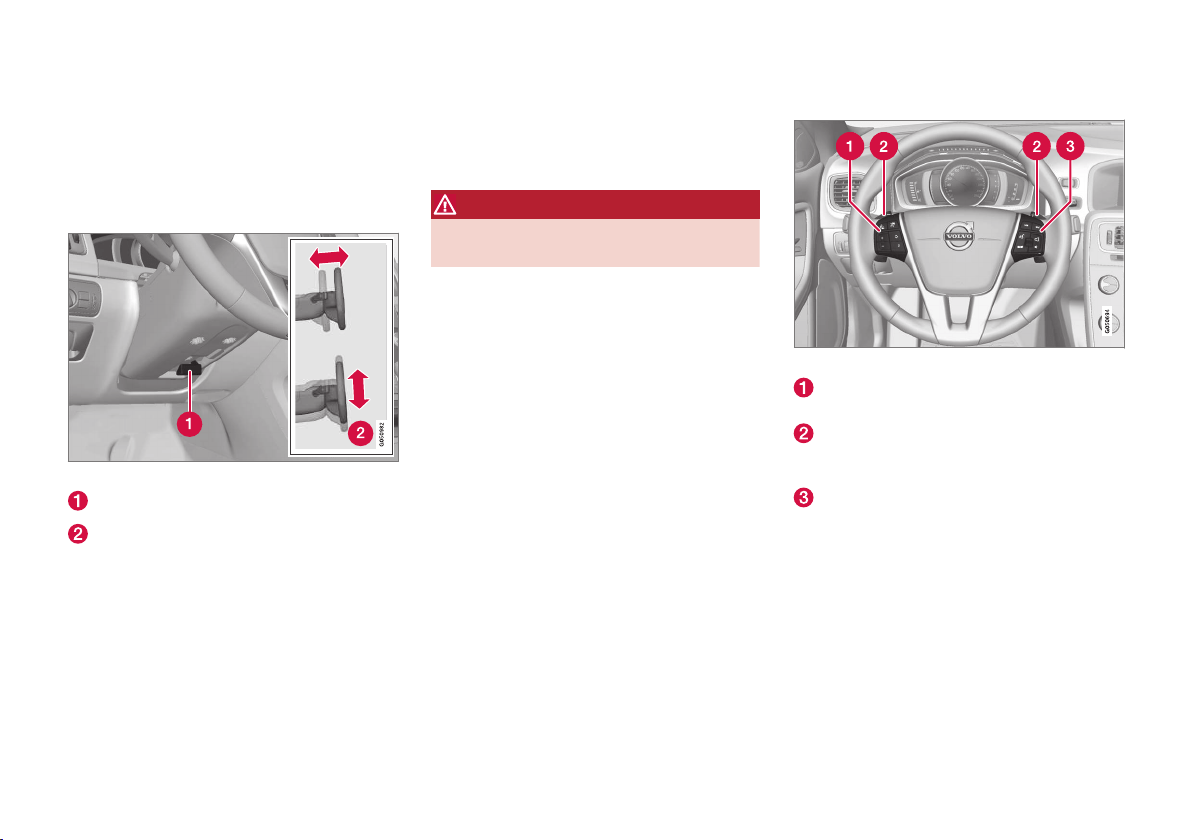
INSTRUMENTS AND CONTROLS
}}
* Option/accessory.
83
Steering wheel
The steering wheel can be adjusted in different
positions and has controls for horn and cruise
control, as well as menu, audio and phone con-
trol.
Adjusting
Adjusting the steering wheel.
Lever - releasing the steering wheel
Possible steering wheel positions
The steering wheel can be adjusted for both
height and depth:
1. The lever is pulled towards the driver to
release the steering wheel.
2. Adjust the steering wheel to the position that
suits you.
3. Push back the lever to fix the steering wheel
in place. If the lever is stiff, press the steering
wheel lightly at the same time as you push
the lever back.
WARNING
Adjust the steering wheel and fix it before
driving away.
With speed related power steering* the level of
steering force can be adjusted, see Adjustable
steering force* (p. 182).
Keypads* and paddles*
Keypads and paddles in the steering wheel.
Cruise control* (p. 190)* and Adaptive cruise
control - ACC* (p. 196)*.
Paddle for manual gear changing in an auto-
matic gearbox, see Automatic gearbox -
Geartronic* (p. 278).
Audio and phone control, see supplement,
Sensus Infotainment.
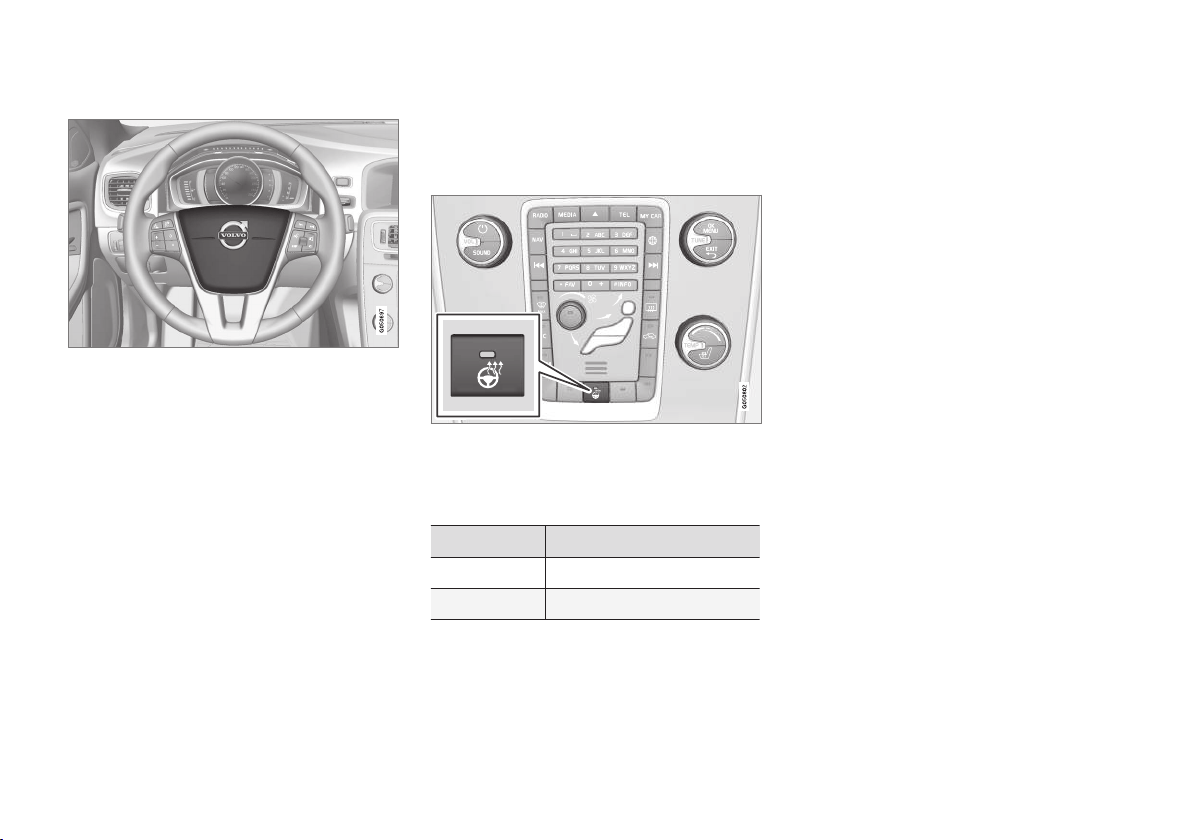
||
INSTRUMENTS AND CONTROLS
* Option/accessory.
84
Horn
Horn.
Press the centre of the steering wheel to signal.
Related information
•
Heating* of the steering wheel (p. 84)
Heating* of the steering wheel
The steering wheel can be heated with electric
heating.
Function
Button position may vary depending on equipment
selected and market.
Repeatedly press the button to switch
between the following functions:
Function Indicator
Switched off Button lamp extinguished
Heating Button lamp illuminated
Automatic steering wheel heating
With activated automatic start of steering wheel
heating, the heating of the steering wheel starts
when the engine is started. Automatic start takes
place when the car is cold and the ambient tem-
perature is below approx. 10 °C. Activate/deacti-
vate the function in the menu system MY CAR
(p. 109).
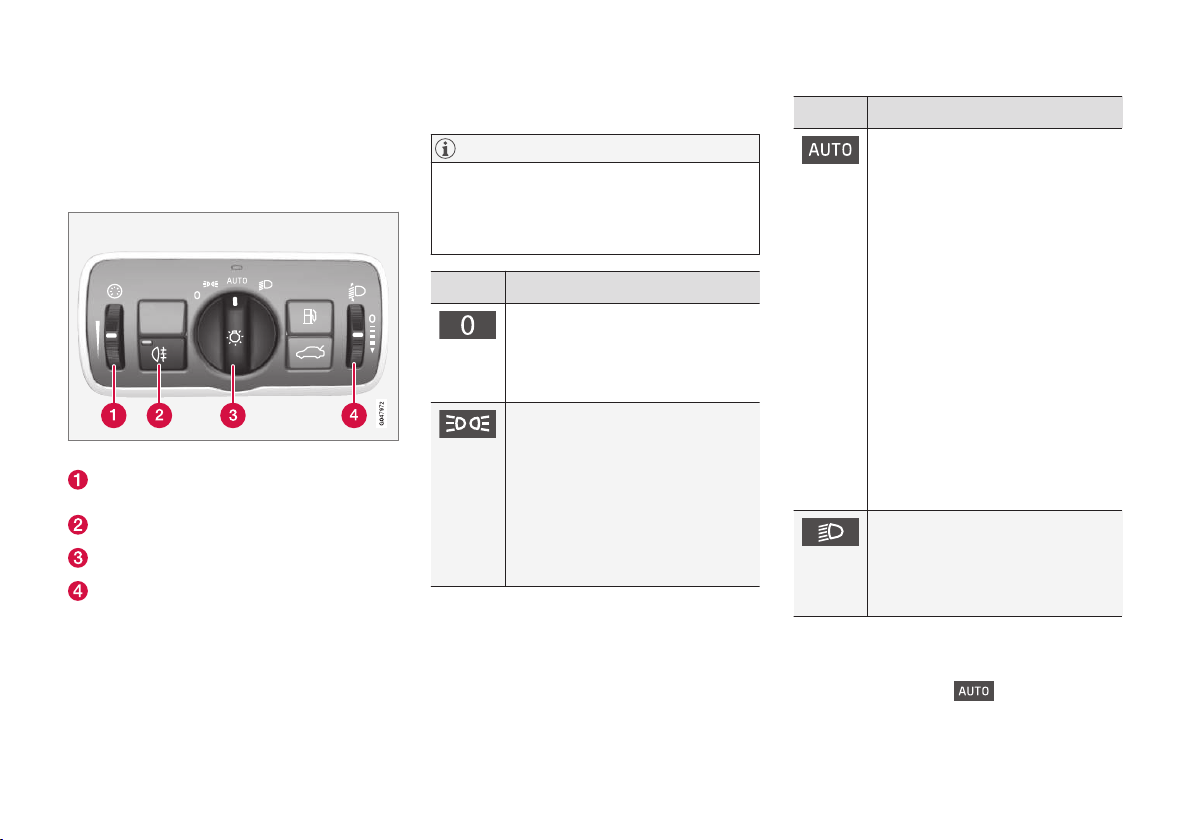
INSTRUMENTS AND CONTROLS
}}
* Option/accessory.
85
Light switches
The headlamp control activates and adjusts the
external lighting. It is also used to adjust display
and instrument lighting and ambience lights
(p. 95).
Overview, light switches.
Thumbwheel for adjusting display and instru-
ment lighting as well as ambience lights*
Button for rear fog lamp
Knob for lighting while driving and parking
Thumbwheel for headlamp levelling
A car with active xenon headlamps* has auto-
matic headlamp levelling and therefore does not
have the thumbwheel for headlamp levelling.
Knob positions
NOTE
The same lamps are used for daytime running
lights and front position lamps. The bright-
ness is higher when the lamps are used as
daytime running lights.
Position Specification
Daytime running lights
A
when the
car's electrical system is in key
position II or the engine is running.
Main beam flash can be used.
Daytime running lights, position
lamps rear and side marker lamps
when the car's electrical system is
in key position II or the engine is
running.
Position lamps/side marker lamps
when the car is parked
B
.
Main beam flash can be used.
Position Specification
Daytime running lights, position
lamps rear and side marker lamps
in daylight when the car's electrical
system is in key position II or the
engine is running.
Dipped beam and position lamps/
side marker lamps in weak daylight
or darkness, or when the rear fog
lamp or windscreen wipers with
continuous wiping are activated.
The tunnel detection (p. 88)*
function is activated.
The Active main beam (p. 89)*
function can be used.
Main beam can be activated when
dipped beam is switched on.
Main beam flash can be used.
Dipped beam and position lamps/
side marker lamps.
Main beam can be activated.
Main beam flash can be used.
A
Fitted in or under the front bumper.
B
Also at idle when the engine is running, provided that the knob
is moved to this position from another position.
Volvo recommends that mode is used
when the car is driven.
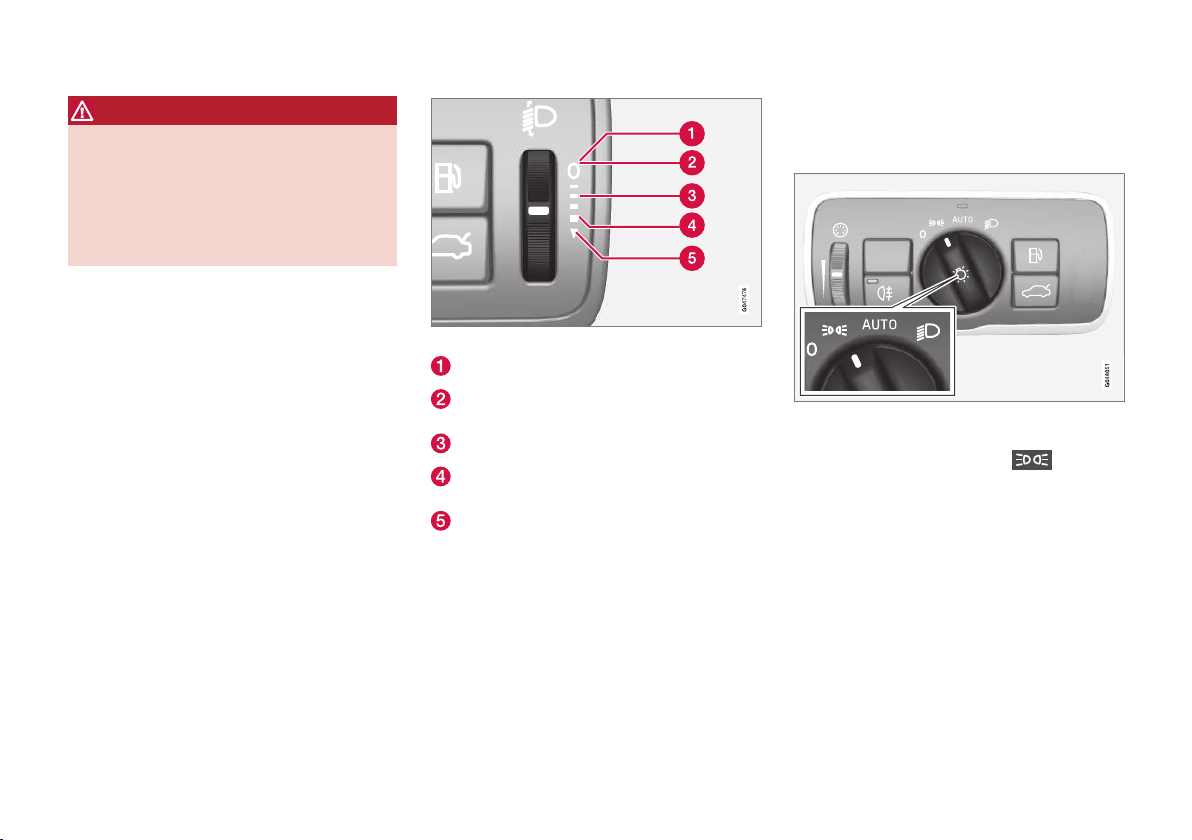
||
INSTRUMENTS AND CONTROLS
86
WARNING
The car's audio system is not able to deter-
mine when daylight is too weak or sufficiently
strong, e.g. in fog and rain, in all situations.
The driver is always responsible for ensuring
that the car is driven with a beam pattern suit-
able for the traffic situation and in accordance
with applicable traffic regulations.
Display and instrument lighting
Different display and instrument lighting is
switched on depending on key position; see Key
positions - functions at different levels (p. 77).
The display lighting is automatically subdued in
darkness - the sensitivity is set with the thumb-
wheel.
The intensity of the instrument lighting is
adjusted with the thumbwheel.
Headlamp levelling
The load in the car changes the vertical align-
ment of the headlamp beam, which could dazzle
oncoming motorists. Avoid this by adjusting the
height of the beam. Lower the beam if the car is
heavily laden.
1. Leave the engine running, or have the car's
electrical system in key position I.
2. Roll the thumbwheel up/down to raise/lower
beam alignment.
Thumbwheel positions for different load cases.
Only driver
Driver and passenger in the front passenger
seat
Occupants in all seats
Occupants in all seats and maximum load in
the cargo area
The driver and maximum load in the cargo
area
Related information
•
Position lamps (p. 86)
•
Daytime running lights (p. 87)
•
Main/dipped beam (p. 88)
Position lamps
Position lamps are switched on using the head-
lamp control's knob.
Knob for headlamp control in the position for position
lamps.
Turn the knob to the position for (number
plate lighting is switched on at the same time).
If the car's electrical system is in key position II or
the engine is running then the daytime running
lights are switched on instead of the front posi-
tion lamps.
When it is dark outside and the boot lid is
opened the rear position lamps illuminate to alert
traffic behind. This takes place irrespective of
what position the knob is in or what key position
the car's electrical system is in.
When driving for more than 30 seconds at max.
10 km/h (approx. 6 mph), or if the speed
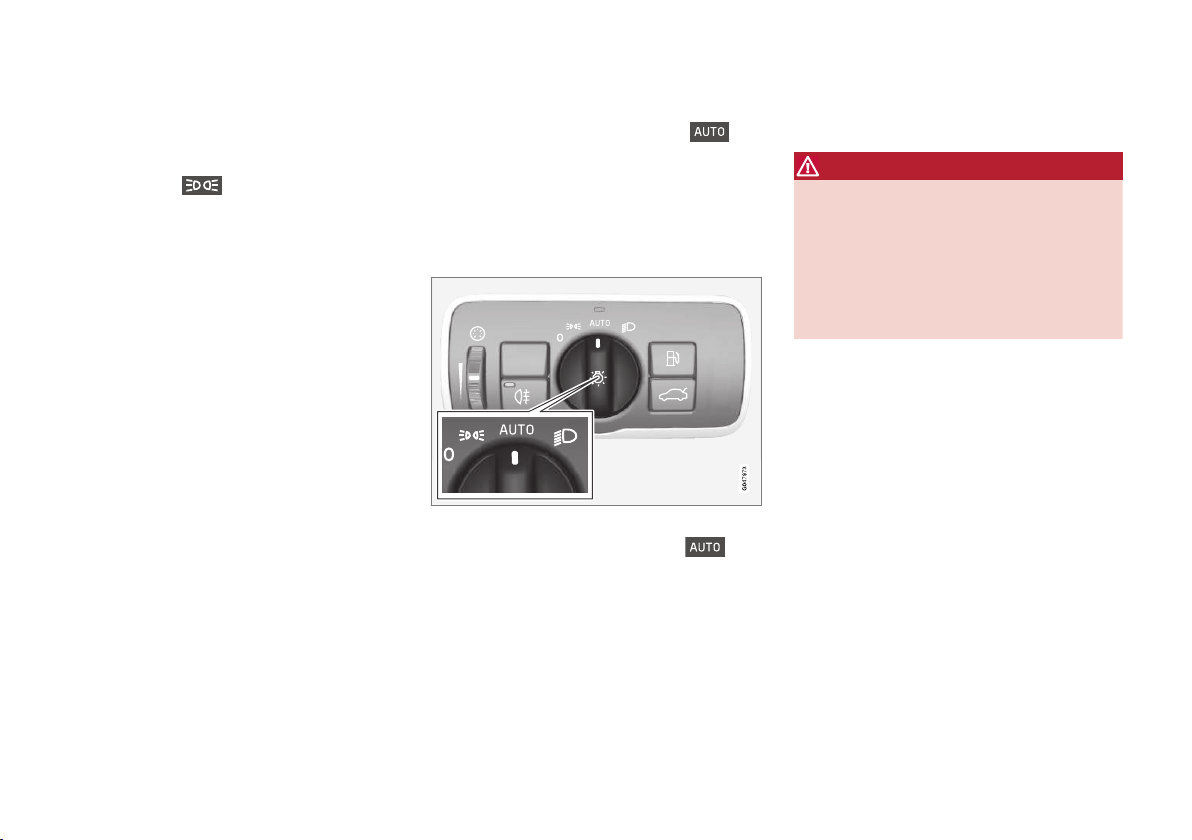
INSTRUMENTS AND CONTROLS
87
exceeds 10 km/h (approx. 6 mph), the daytime
running lights are switched on and
Reset light
switch position is shown in the combined
instrument panel, which prompts you to turn to a
mode other than
.
Related information
•
Light switches (p. 85)
Daytime running lights
With the knob for headlamp control in
position, and the car's electrical system in key
position II or the engine running, the daytime
running lights are activated automatically in day-
light.
Daytime running lights during the day.
DRL
Knob for headlamp control in AUTO position.
With the knob for headlamp control in
position the daytime running lights (Daytime
Running Lights - DRL) are activated automati-
cally when the car is driven in daylight. A light
sensor on the top of the instrument panel
changes from daytime running lights to dipped
beam at twilight or when daylight becomes too
weak. Switching to dipped beam also takes place
when the windscreen wipers or rear fog lamp are
activated.
WARNING
This system help to save energy - it cannot
determine in all situations when daylight is too
weak or sufficiently strong, e.g. in mist and
rain.
The driver is always responsible for ensuring
that the car is driven with the correct beam
pattern for the traffic situation and in accord-
ance with applicable traffic regulations.
Related information
•
Main/dipped beam (p. 88)
•
Light switches (p. 85)
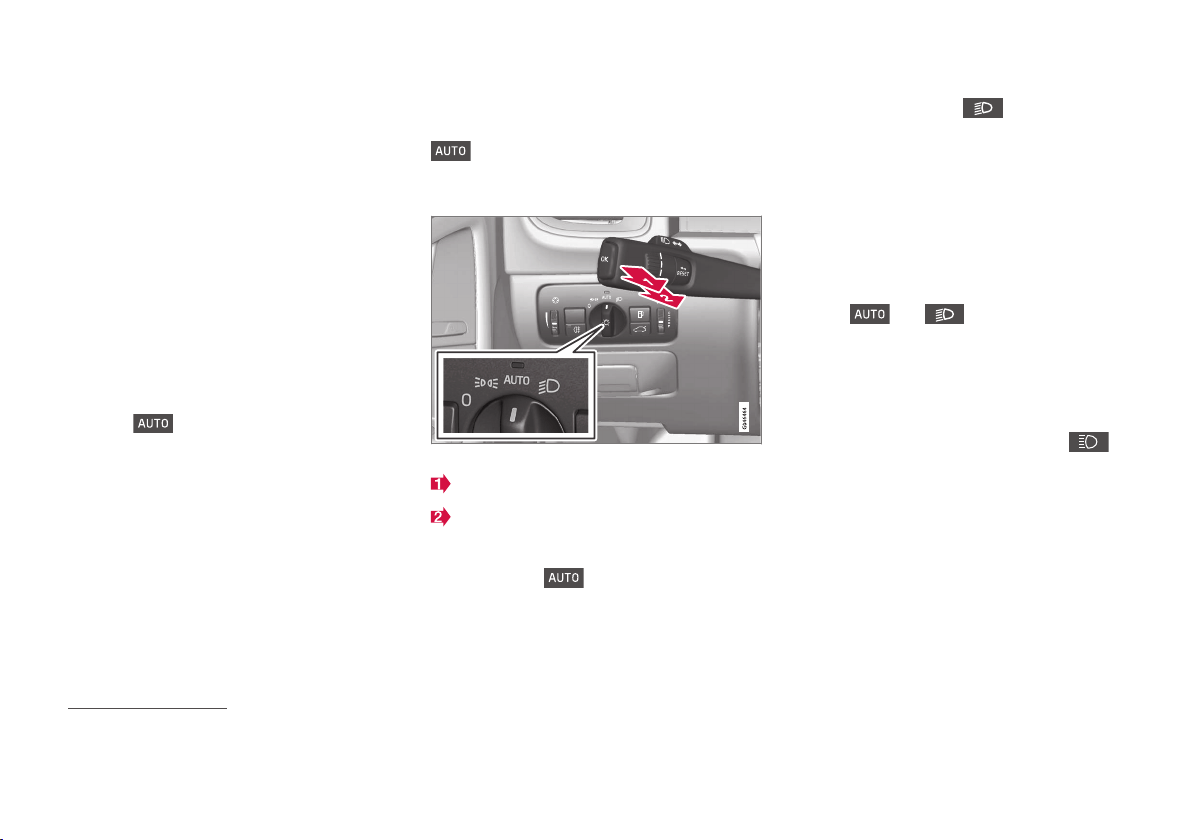
INSTRUMENTS AND CONTROLS
* Option/accessory.
88
Tunnel detection*
Tunnel detection changes the lighting from day-
time running lights to dipped beam when the car
is driven into a tunnel.
The tunnel detection function is available in cars
with rain sensor*. The sensor detects the
entrance to a tunnel and resets the lighting from
daytime running lights to dipped beam. Approx.
20 seconds after the car has left the tunnel, the
lighting returns to daytime running lights. If the
car is driven into another tunnel within this time
period then dipped beam is kept switched on.
This avoids repeated changes to the car's light-
ing.
Note that the headlamp control's knob must
remain in
position for tunnel detection to
work.
Related information
•
Main/dipped beam (p. 88)
•
Light switches (p. 85)
Main/dipped beam
With the knob for headlamp control in position
and the car's electrical system in key posi-
tion II or the engine running, the dipped beam is
activated automatically in poor light conditions.
Stalk switch and knob for headlamp control.
Position for main beam flash
Position for main beam
Dipped beam
With the knob in position, dipped beam is
activated automatically at twilight or when day-
light becomes too weak. Dipped beam is also
activated automatically if the windscreen wipers
or the rear fog lamps are activated.
With the knob in position
dipped beam is
always switched on when the engine is running
or when key position II is active.
Main beam flash
Move the stalk switch gently towards the steering
wheel to the position for main beam flash. Main
beam comes on until the stalk switch is released.
Main beam
Main beam can be activated when the knob is in
position
19
or
. Activate/deactivate
main beam by moving the stalk switch towards
the steering wheel to the end position and then
releasing. Alternatively, the main beam can be
deactivated by a light press of the stalk switch
toward the steering wheel.
When main beam has been activated the
symbol illuminates in the combined instrument
panel.
Auxiliary lamps*
If the car has auxiliary lamps, the driver can use
the MY CAR menu system to choose whether
they should be deactivated or switched on/off
simultaneously with the main beam
20
, see MY
CAR (p. 109).
19
When dipped beam is switched on.
20
Auxiliary lamps must be connected to the electrical system by a workshop. Volvo recommends that you contact an authorised Volvo workshop.
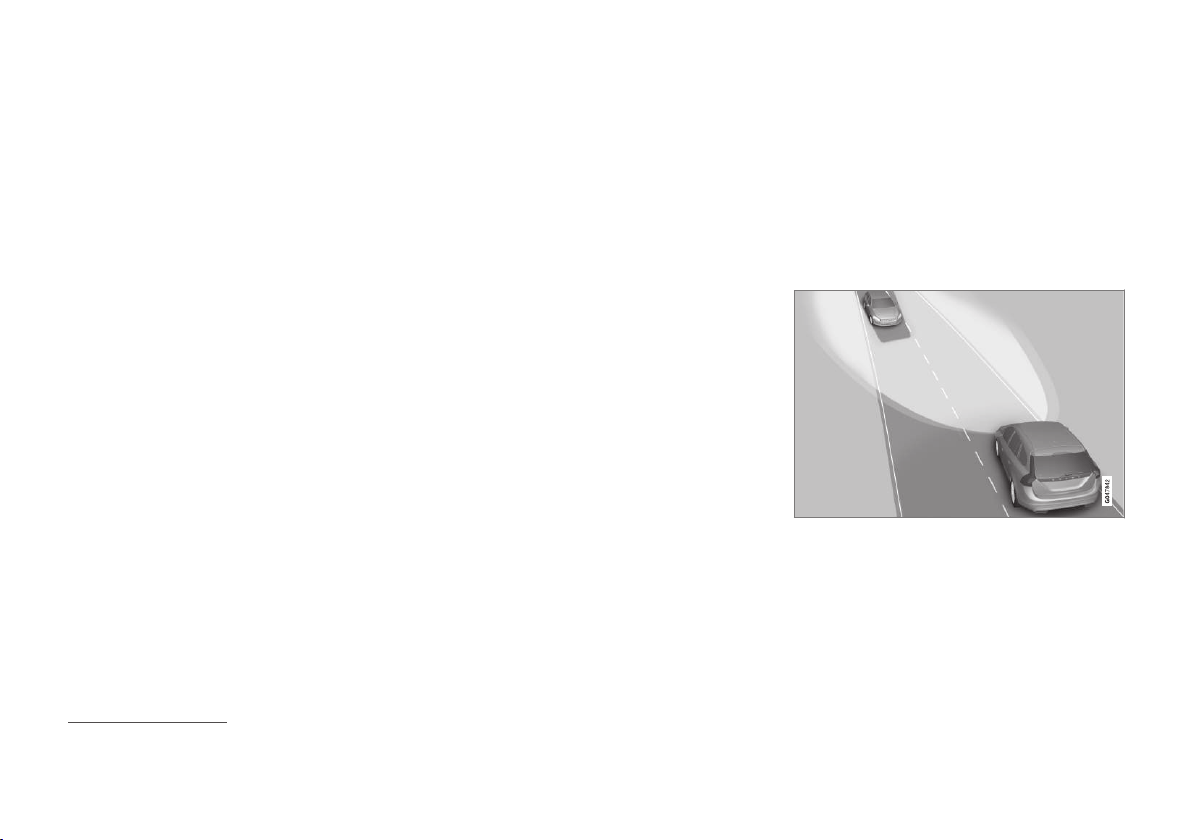
INSTRUMENTS AND CONTROLS
}}
* Option/accessory.
89
Related information
•
Active Xenon headlamps* (p. 91)
•
Active main beam* (p. 89)
•
Light switches (p. 85)
•
Headlamps - adjusting headlamp pattern
(p. 92)
•
Tunnel detection* (p. 88)
Active main beam*
Active main beam function detects the headlamp
beams from oncoming traffic or the rear lights of
vehicles in front, and switches the lighting from
main beam to dipped beam. The lighting returns
to main beam when the incoming light has stop-
ped.
Active main beam - AHB
Active main beam (Active High Beam - AHB) is a
function which uses a camera sensor at the top
edge of the windscreen to detect the headlamp
beams from oncoming traffic or the rear lights of
vehicles in front, and then switches from main
beam to dipped beam. The function can also take
streetlights into account.
Main beam is reactivated when the camera sen-
sor no longer sees any oncoming vehicles or
vehicles ahead.
Car with halogen headlamps
The lighting returns to main beam about a sec-
ond after the camera sensor no longer detects
the headlamp beams from oncoming traffic or the
rear lights from vehicles in front.
Car with active Xenon headlamps
If the active main beam has the on/off functional-
ity
21
then the lighting returns to main beam about
a second after the camera sensor no longer
detects the headlamp beams from oncoming
traffic or the rear lights from vehicles in front.
If the active main beam has adaptive functional-
ity
21
then, unlike what happens during conven-
tional dimming, the light beam continues to illu-
minate with main beam on both sides of oncom-
ing traffic or vehicles ahead - only the part of the
light beam that points directly to the vehicle is
dimmed.
Adaptive functionality: Dipped beam directly toward
oncoming vehicles, but continued main beam on both
sides of the vehicle.
The lighting returns to full main beam about a
second after the camera sensor no longer
detects the headlamp beams from oncoming
traffic or the rear lights from vehicles in front.
21
Depending on the car's equipment level.
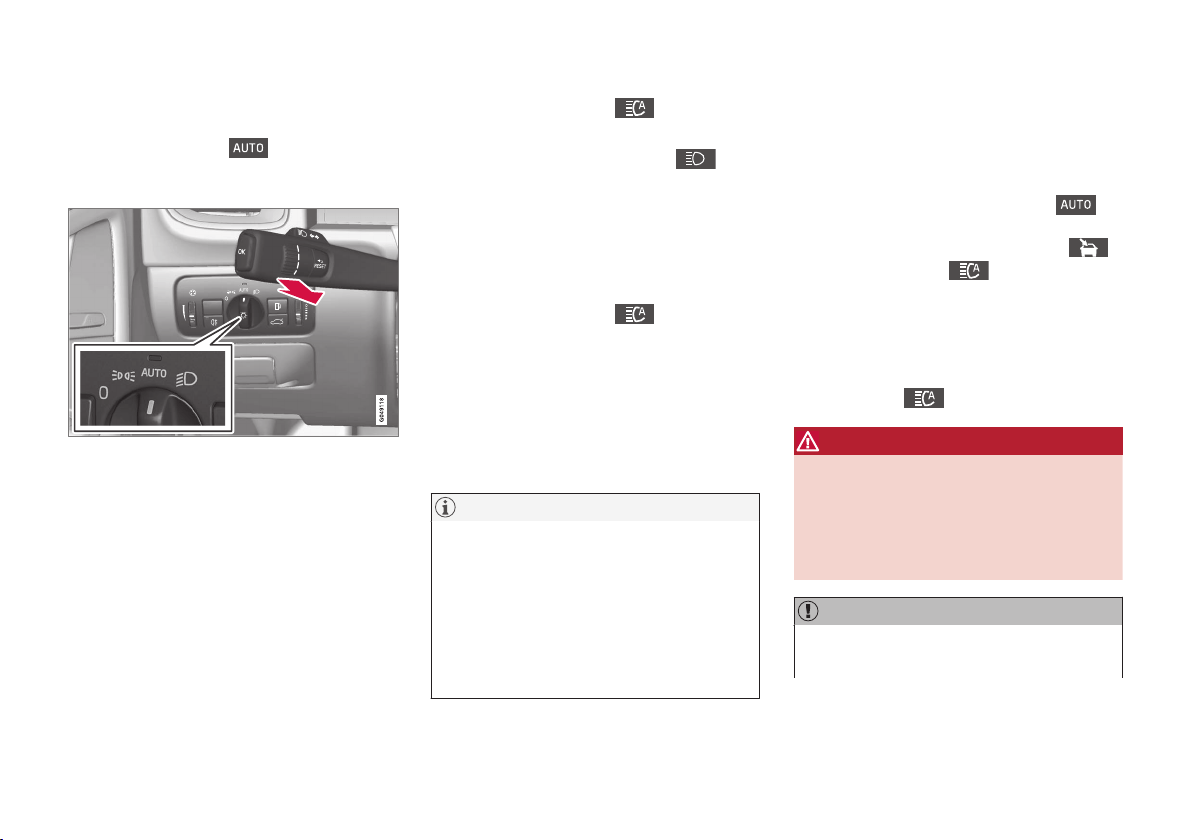
||
INSTRUMENTS AND CONTROLS
90
Activating/deactivating
AHB can be activated when the headlamp con-
trol's knob is in position
(provided that the
function has not been deactivated in the menu
system MY CAR, see MY CAR (p. 109)).
Stalk switch and knob for headlamp control in AUTO
position.
The function can start while driving in the dark
when the car's speed is approx. 20 km/h
(12 mph) or higher.
Activate/deactivate AHB by moving the left-hand
stalk switch towards the steering wheel to the
end position and then releasing. Deactivation
when main beam is on means that the lights are
reset directly to dipped beam.
Car with analogue combined instrument
panel
When AHB is activated the
symbol illumi-
nates in the instrument's information display.
When main beam is switched on the
sym-
bol also illuminates in the combined instrument
panel. This also applies for active Xenon head-
lamps if the main beam is partially dimmed, i.e. as
soon as the light beam shines with slightly more
than dipped beam.
Car with digital combined instrument panel
When AHB is activated the symbol turns
white in the instrument's information display.
When main beam is activated, the symbol turns
blue. This also applies for active Xenon head-
lamps if the main beam is partially dimmed, i.e. as
soon as the light beam shines with slightly more
than dipped beam.
Manual operation
NOTE
Keep the windscreen surface in front of the
camera sensor free from ice, snow, mist and
dirt.
Do not stick or attach anything to the wind-
screen in front of the camera sensor as this
may reduce effectiveness or cause one or
more of the systems dependent on the cam-
era to stop working.
If the message Active main beam Temporary
unavailable Switch manually is shown in the
combined instrument panel's information display
then you have to switch manually between main
and dipped beam. However, the knob for head-
lamp control can still remain in position
.
The same applies if the message
Windscreen
sensors blocked See manual
and the
symbol are shown. The symbol goes out
when these messages are shown.
AHB may be temporarily unavailable e.g. in situa-
tions with dense fog or heavy rain. When AHB
becomes available again, or the windscreen sen-
sors are no longer blocked, the message extin-
guishes and the
symbol illuminates.
WARNING
AHB is an aid for using the optimum beam
pattern when conditions are favourable.
The driver always bears responsibility for man-
ually switching between main and dipped
beam when traffic situations or weather con-
ditions so require.
IMPORTANT
Examples of when manual switching between
main and dipped beam may be required:
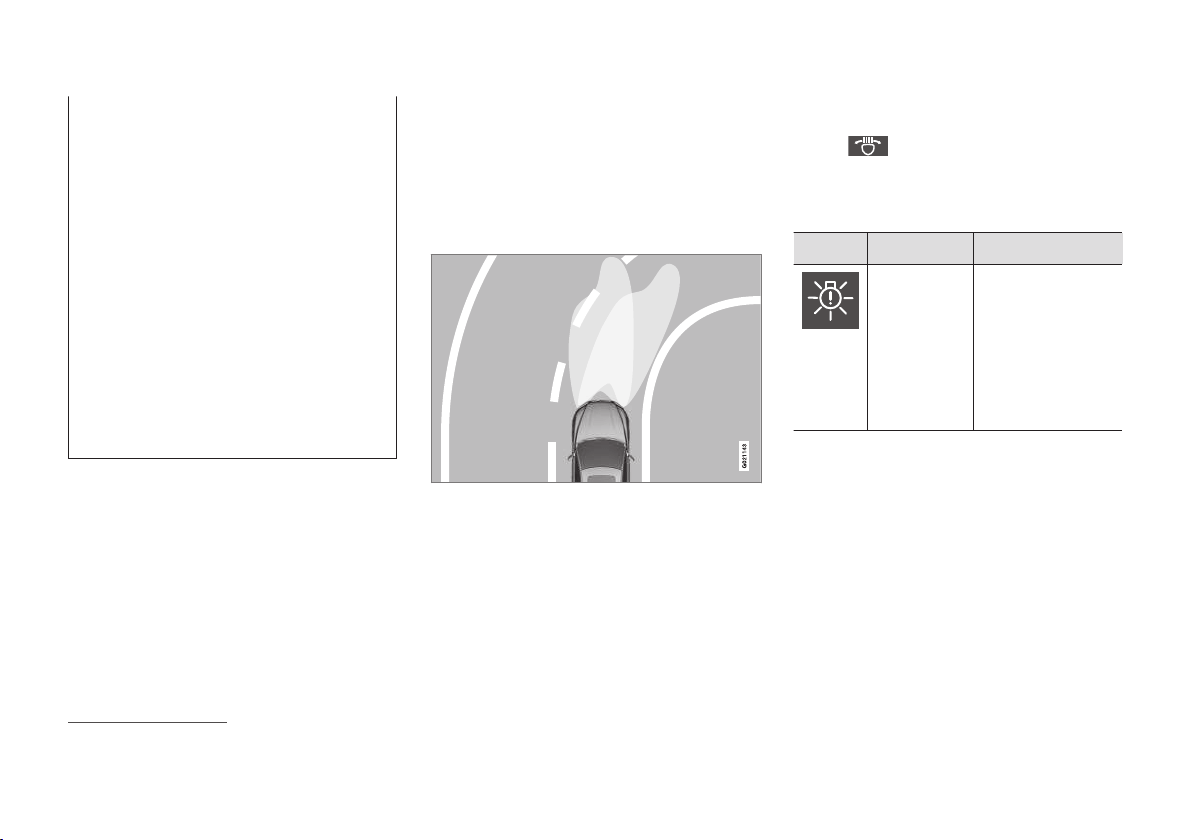
INSTRUMENTS AND CONTROLS
}}
* Option/accessory.
91
•
In heavy rain or dense fog
•
In freezing rain
•
In snow flurries or slush
•
In moonlight
•
When driving in poorly lit built-up areas
•
When the traffic ahead has weak lighting
•
If there are pedestrians on or beside the
road
•
If there are highly reflective objects such
as signs in the vicinity of the road
•
When the lighting from oncoming traffic
is obscured by e.g. a crash barrier
•
When there is traffic on connecting roads
•
On the brow of a hill or in a hollow
•
In sharp bends.
For more information on the limitations of the
camera sensor, see Collision warning system* -
camera sensor limitations (p. 229).
Related information
•
Main/dipped beam (p. 88)
•
Light switches (p. 85)
Active Xenon headlamps*
Active xenon headlamps/active bending lights
are designed to provide maximum illumination in
bends and junctions and so provide increased
safety.
Active xenon headlamps/active
bending lights - ABL
Headlamp pattern with function deactivated (left) and
activated (right) respectively.
If the car is equipped with active xenon head-
lamps/active bending lights (Active Bending
Lights, ABL) the light from the headlamps follows
the steering wheel movement in order to provide
maximum lighting in bends and junctions and so
provide increased safety.
The function is activated automatically when the
car is started (provided that it has not been deac-
tivated in the menu system MY CAR, see MY
CAR (p. 109)). In the event of a fault in the func-
tion the
symbol illuminates in the com-
bined instrument panel at the same time as the
information display shows an explanatory text and
a further illuminated symbol.
Symbol Message Specification
Headlamp
system
malfunction
Service
required
The system is dis-
engaged. Visit a
workshop if the
message remains.
Volvo recommends
that you contact an
authorised Volvo
workshop.
The function is only active in twilight or darkness
and only when the car is moving.
The function
22
can be deactivated/activated in
the menu system MY CAR, see MY CAR
(p. 109).
22
Activated on delivery from the factory.

||
INSTRUMENTS AND CONTROLS
* Option/accessory.
92
Cornering lights*
Active xenon headlamps/active bending lights
with Automatic main beam function with adaptive
functionality are equipped with cornering lights.
The cornering lights temporarily illuminate the
area diagonally in front of the car in the direction
the steering wheel is turned on a sharp bend, or
in the direction shown by the direction indicators.
The function is activated when main beam or
dipped beam is used and the car's speed is lower
than approx. 30 km/h (20 mph).
In addition, both cornering lights are switched on
as a supplement to the reversing lamp during
reversing.
Related information
•
Main/dipped beam (p. 88)
•
Active main beam* (p. 89)
•
Light switches (p. 85)
Headlamps - adjusting headlamp
pattern
If the car is equipped with active Xenon head-
lamps and has the Active main beam function
then the headlamp pattern must be reset when
changing from right to left-hand traffic, and vice
versa.
Active Xenon headlamps*
No adjustment of the headlamp pattern is neces-
sary for cars without the Active main beam* func-
tion. The headlamp pattern is designed in such a
way that oncoming traffic is not dazzled.
Adjustment of the headlamp pattern is required
for cars with Active main beam. The car must be
stationary with the engine running when the
headlamp pattern is shifted between right and
left-hand traffic.
The headlamp pattern is changed in the menu
system MY CAR, see MY CAR (p. 109).
Halogen headlamps
No adjustment of the headlamp pattern is neces-
sary. The headlamp pattern is designed in such a
way that oncoming traffic is not dazzled.
Rear fog lamp
When visibility is reduced by fog the rear fog
lamp can be used so that other road users can
detect the vehicle in front at an early stage.
Button for rear fog lamp.
The rear fog lamp can only be switched on when
key position II is active or the engine is running
and the headlamp control's knob is in position
or .
Press the button for On/Off. The indicator sym-
bol
in the combined instrument panel and
the light in the button both illuminate when the
rear fog lamp is switched on.
The rear fog lamp is switched off automatically
when the START/STOP ENGINE button is
depressed or when the headlamp control's knob
is turned to position
or .
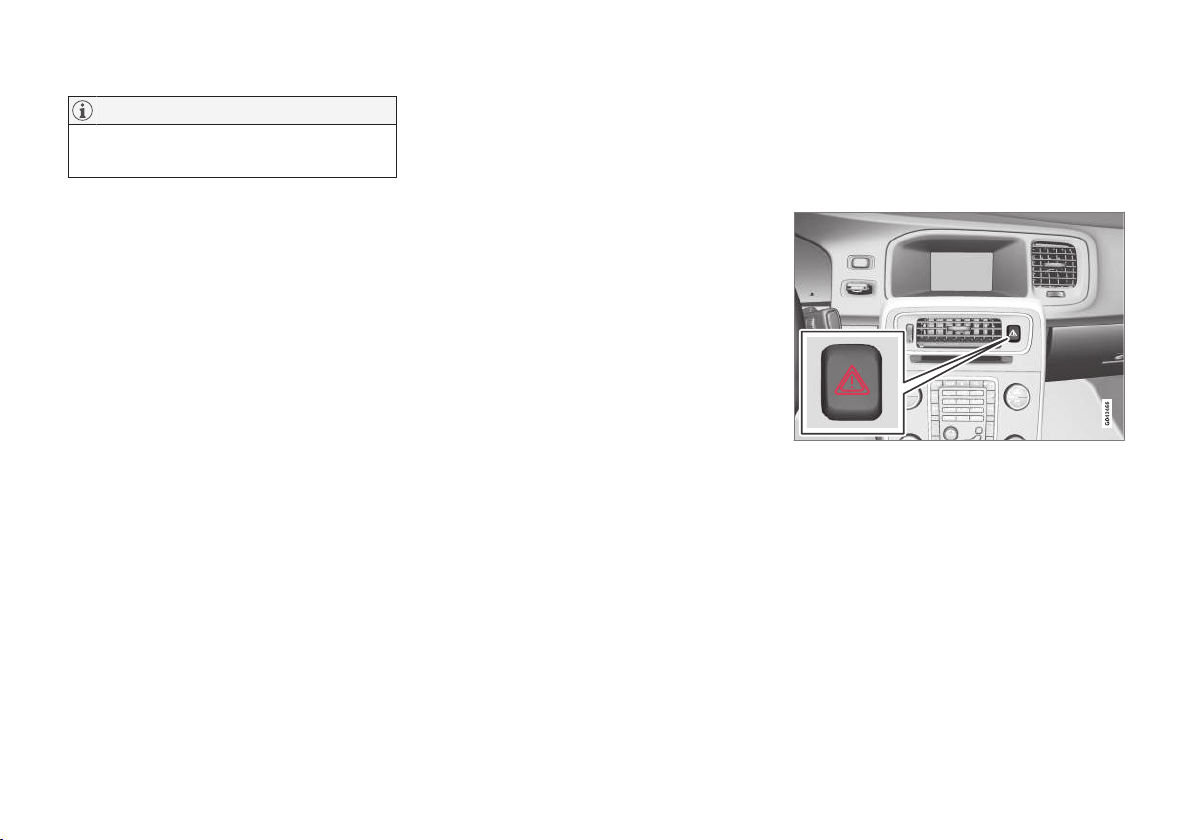
INSTRUMENTS AND CONTROLS
}}
93
NOTE
Regulations on the use of rear fog lamps vary
from country to country.
Related information
•
Light switches (p. 85)
Brake lights
The brake light automatically comes on during
braking.
The brake light is switched on when the brake
pedal is depressed. In addition, it is switched on
when one of driving support systems Adaptive
cruise control (p. 196), City Safety (p. 215) or
Collision warning system (p. 222) brakes the car.
Related information
•
Foot brake - emergency brake lights and
automatic hazard warning flashers (p. 295)
Hazard warning flashers
The hazard warning flashers warn other road
users by means of all of the car's direction indi-
cator lamps flashing simultaneously when this
function is activated.
Button for hazard warning flashers.
Press the button to activate the hazard warning
flashers. Both direction indicator symbols in the
combined instrument panel flash when the haz-
ard warning flashers are used.
The hazard warning flashers are activated auto-
matically when the car has been braked so sud-
denly that the emergency brake lights have been
activated and speed is below approx. 10 km/h
(6 mph). The hazard warning flashers remain
active when the car has stopped and are deacti-
vated automatically when you start driving again;
they can also be deactivated by pressing the but-
ton.
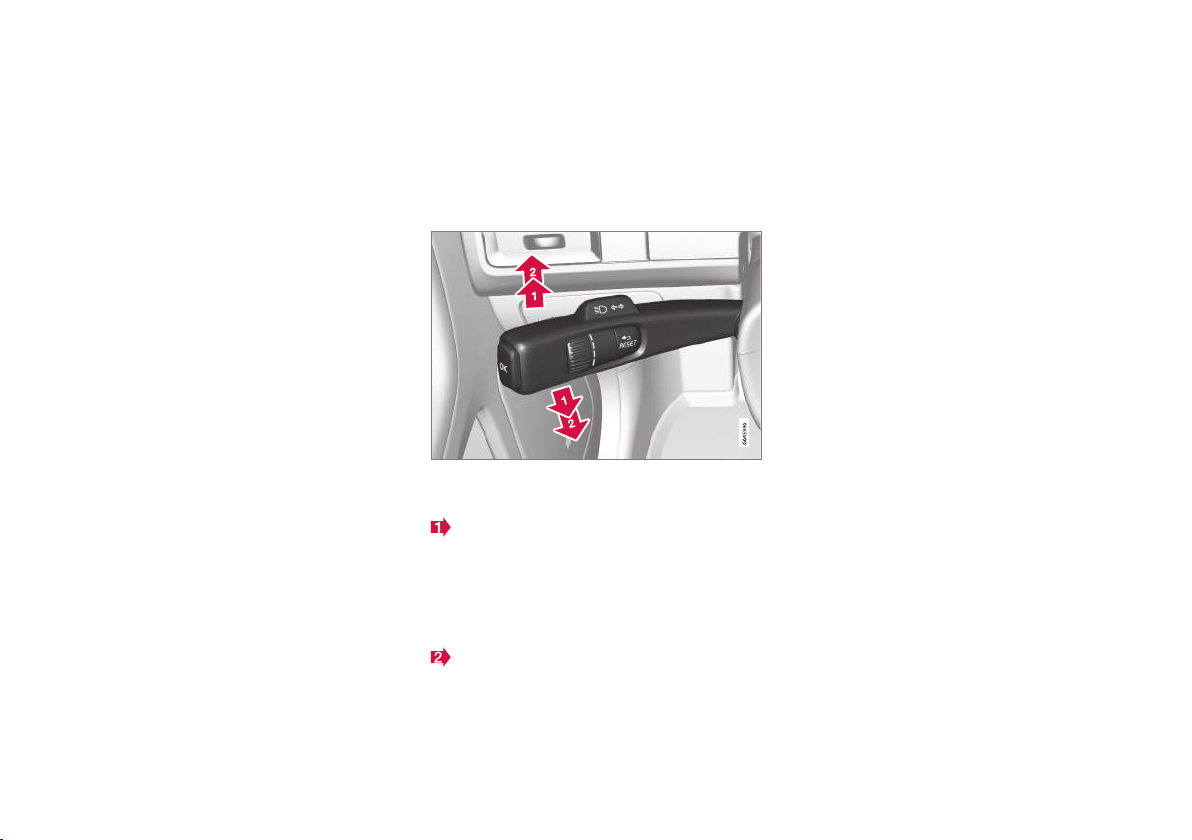
||
INSTRUMENTS AND CONTROLS
94
Related information
•
direction indicators (p. 94)
•
Foot brake - emergency brake lights and
automatic hazard warning flashers (p. 295)
direction indicators
The car's direction indicators are operated with
the left-hand stalk switch. The direction indicator
lamps flash three times or continuously, depend-
ing on how far up or down the stalk switch is
moved.
Direction indicators.
Short flash sequence
Move the stalk switch up or down to the first
position and release. The direction indicator
lamps flash three times. The function can be
activated/deactivated in the menu system
MY CAR, see MY CAR (p. 109).
Continuous flash sequence
Move the stalk switch up or down to its end
position.
The stalk switch remains in its position and is
moved back manually, or automatically by the
steering wheel movement.
Direction indicator symbols
For direction indicator symbols, see Combined
instrument panel - meaning of indicator symbols
(p. 67).
Related information
•
Hazard warning flashers (p. 93)
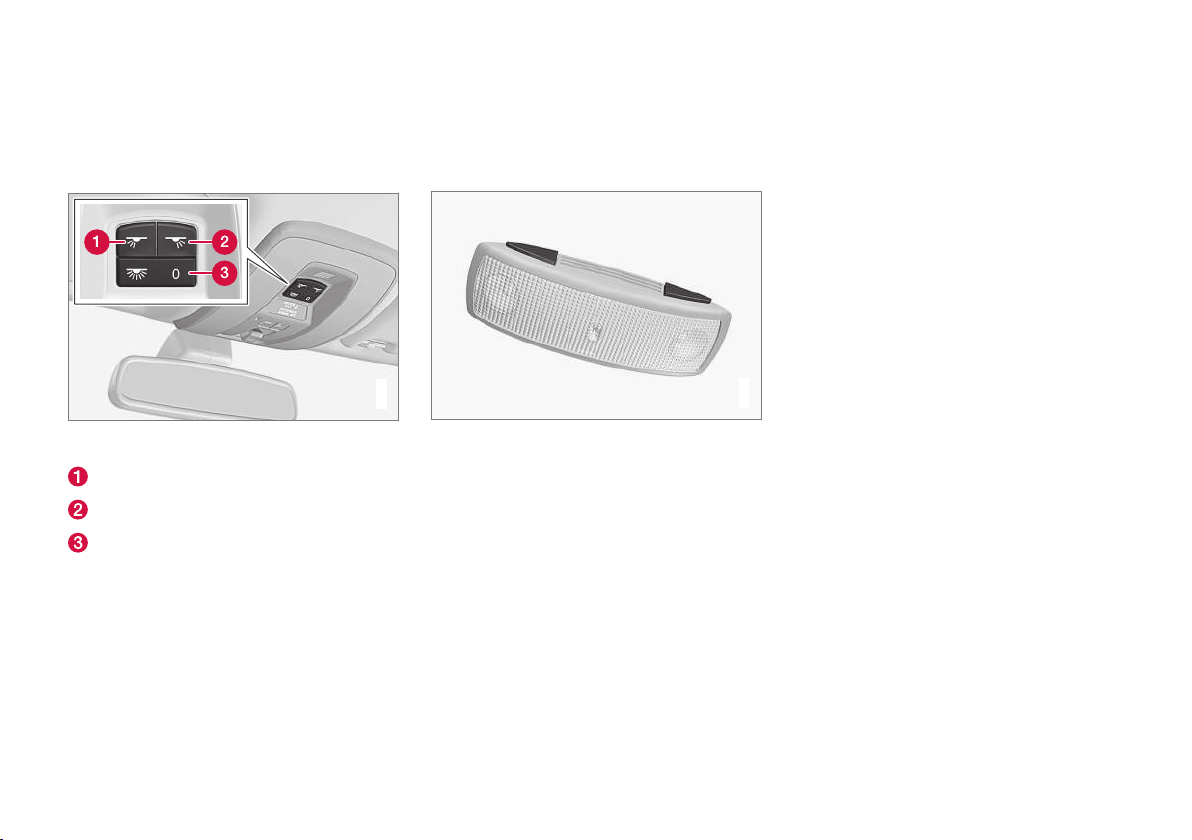
INSTRUMENTS AND CONTROLS
}}
95
Interior lighting
The passenger compartment lighting is acti-
vated/deactivated with the buttons in the con-
trols above the front seats and the rear seat.
G021149
Controls in roof console for the front reading lamps and
passenger compartment lighting.
Reading lamp, left-hand side
Reading lamp, right-hand side
Interior lighting
All lighting in the passenger compartment can be
switched on and off manually within 30 minutes
from when:
•
the engine has been switched off and the
car's electrical system is in key position 0
•
the car has been unlocked but the engine
has not been started.
Front roof lighting
The front reading lamps are switched on or off by
pressing the relevant button in the roof console.
Rear roof lighting
G021150
Rear roof lighting.
The lamps are switched on or off by pressing
each respective button.
Courtesy lighting
Courtesy lighting (and passenger compartment
lighting) is switched on and off respectively when
a side door is opened or closed.
Glovebox lighting
Glovebox lighting is switched on and off respec-
tively when the lid is opened or closed.
Vanity mirror lighting
The lighting for the vanity mirror (p. 147) is
switched on and off respectively when the cover
is opened or closed.
Lighting in cargo area
The lighting in the cargo area is switched on and
off respectively when the boot lid is opened or
closed.
Automatic lighting
The switch for passenger compartment lighting
has three positions for the lighting in the passen-
ger compartment:
•
Off – right-hand side pressed in, automatic
lighting deactivated.
•
Neutral position – automatic lighting acti-
vated.
•
On – left-hand side pressed in, passenger
compartment lighting switched on.
Neutral position
When the button is in neutral position the pas-
senger compartment lighting is switched on and
off automatically in accordance with the following.
The passenger compartment lighting is switched
on and remains on for 30 seconds if:
•
the car is unlocked with the remote control
key or key blade, see Remote control key -

||
INSTRUMENTS AND CONTROLS
* Option/accessory.
96
functions (p. 158) or Detachable key blade -
unlocking doors (p. 162)
•
the engine has been switched off and the
car's electrical system is in key position 0.
Passenger compartment lighting is switched off
when:
•
the engine is started
•
the car is locked.
The passenger compartment lighting comes on
and remains on for two minutes if one of the
doors is open.
If any lighting is switched on manually and the
car is locked then it will be switched off automati-
cally after two minutes.
Ambience lights*
When the normal passenger compartment light-
ing is switched off and the engine is running, a
number of LEDs illuminate, including one in the
ceiling lighting, in order to provide a low-light and
enhance the mood while driving. The light also
makes it easier to see objects in storage com-
partments etc. during the darker hours of the day.
This lighting goes out for a little while after the
normal passenger compartment lighting when
the car is locked. The brightness is controlled
using the thumbwheel on the headlamp control
(p. 85).
Home safe lighting
Home safe lighting consists of dipped beam,
position lamps, lamps in the door mirrors, num-
ber plate lighting.
Some of the exterior lighting can be kept
switched on to work as home safe lighting after
the car has been locked.
1. Remove the remote control key from the
ignition switch.
2. Move the left-hand stalk switch toward the
steering wheel to the end position and
release it. The function can be activated in
the same way as with main beam flash; see
Main/dipped beam (p. 88).
3. Get out of the car and lock the door.
When the function is activated, dipped beam,
position lamps, lamps in the door mirrors and
number plate lighting are switched on.
The length of time for which the home safe light-
ing should be kept on can be set in the menu
system MY CAR, see MY CAR (p. 109).
Related information
•
Approach lighting (p. 96)
Approach lighting
Approach lighting consists of position lamps,
lamps in the door mirrors, number plate lighting,
interior roof lighting as well as courtesy lighting.
Approach lighting is switched on with the remote
control key, see Remote control key - functions
(p. 158), and is used to switch on the car's light-
ing at a distance.
When the function is activated with the remote
control key, position lamps, lamps in the door mir-
rors, number plate lighting, interior roof lamps
and courtesy lighting are switched on.
The length of time for which the approach light-
ing should be kept on can be set in the menu
system MY CAR, see MY CAR (p. 109).
Related information
•
Home safe lighting (p. 96)
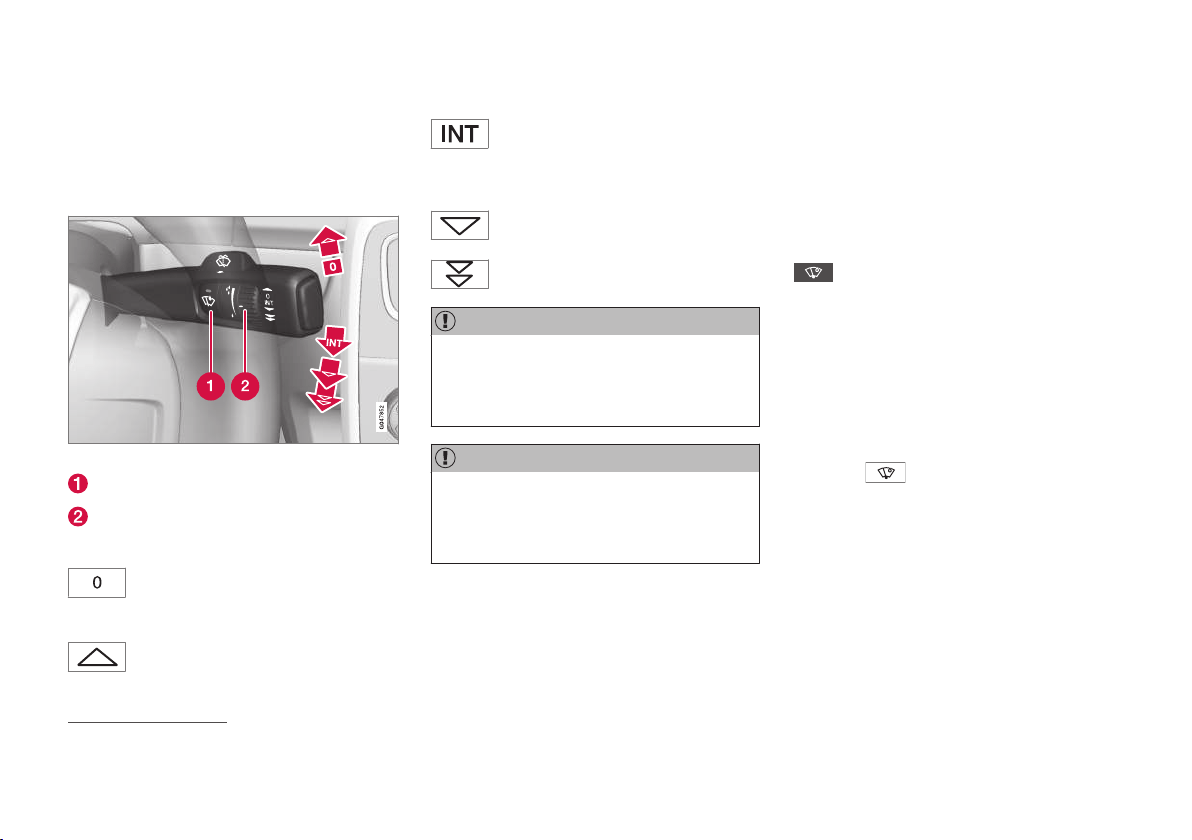
INSTRUMENTS AND CONTROLS
}}
* Option/accessory.
97
Wipers and washers
Wipers and washers clean the windscreen and
rear window. The headlamps are cleaned with
high-pressure washing.
Windscreen wipers
23
Windscreen wipers and windscreen washers.
Rain sensor, On/Off
Thumbwheel sensitivity/frequency
Windscreen wipers off
Move the stalk switch to position 0 to
switch off the windscreen wipers.
Single sweep
Raise the stalk switch and release to
make one sweep.
Intermittent wiping
Set the number of sweeps per time
unit with the thumbwheel when inter-
mittent wiping is selected.
Continuous wiping
The wipers sweep at normal speed.
The wipers sweep at high speed.
IMPORTANT
Before activating the wipers - ensure that the
wiper blades are not frozen in, and that any
snow or ice on the windscreen (and rear win-
dow) is scraped away.
IMPORTANT
Use plenty of washer fluid when the wipers
are cleaning the windscreen. The windscreen
must be wet when the windscreen wipers are
operating.
Service position wiper blade
For cleaning the windscreen/wiper blades and
replacement of wiper blades, see Car wash
(p. 391) and Wiper blades (p. 368).
Rain sensor*
The rain sensor automatically starts the wind-
screen wipers based on how much water it
detects on the windscreen. The sensitivity of the
rain sensor can be adjusted using the thumb-
wheel.
When the rain sensor is activated a lamp in the
button is illuminated and the rain sensor symbol
is shown in the combined instrument
panel.
Activating and setting the sensitivity
When activating the rain sensor, the car must be
running or the remote control key in position I or
II while the windscreen wiper stalk switch must
be in position 0 or in the position for a single
sweep.
Activate the rain sensor by pressing the rain sen-
sor button
. The windscreen wipers make
one sweep.
Press the stalk switch up for the wipers to make
an extra sweep.
Turn the thumbwheel upward for higher sensitiv-
ity and downward for lower sensitivity. (An extra
sweep is made when the thumbwheel is turned
upward.)
23
For replacing the wiper blades and service position wiper blades, see Wiper blades (p. 368). For filling washer fluid, see Washer fluid - filling (p. 369).
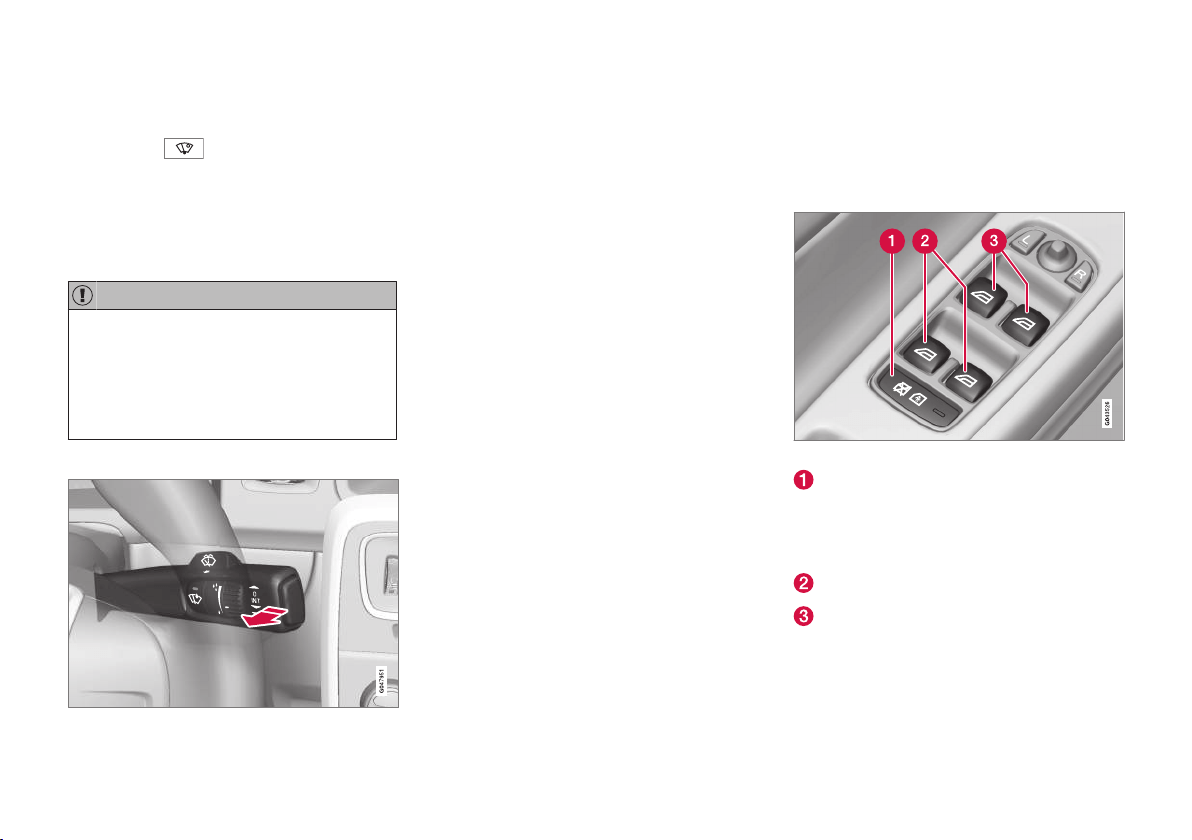
||
INSTRUMENTS AND CONTROLS
* Option/accessory.
98
Deactivate
Deactivate the rain sensor by pressing the rain
sensor button
or move the stalk switch
down to another wiper program.
The rain sensor is automatically deactivated when
the remote control key is removed from the igni-
tion switch or five minutes after the engine has
been switched off.
IMPORTANT
The windscreen wipers could start and be
damaged in an automatic car wash. Switch off
the rain sensor while the car is in motion or
when the remote control key is in position I or
II. The symbol in the combined instrument
panel and the lamp in the button go out.
Washing the headlamps and windows
Washing function.
Washing the windscreen
Move the stalk switch toward the steering wheel
to start the windscreen and headlamp washers.
The windscreen wipers will make several more
sweeps and the headlamps are washed once the
stalk switch has been released.
Heated washer nozzles*
The washer nozzles are heated automatically in
cold weather to prevent the washer fluid freezing
solid.
High-pressure headlamp washing*
High-pressure headlamp washing consumes a
large quantity of washer fluid. To save fluid, the
headlamps are washed automatically at every
fifth windscreen wash cycle.
Reduced washing
If only approx. 1 litre of washer fluid remains in
the reservoir and the message that you should fill
the washer fluid is shown in the combined instru-
ment panel, then the supply of washer fluid to the
headlamps is switched off. This is in order to pri-
oritise cleaning the windscreen and the visibility
through it.
Related information
•
Washer fluid - filling (p. 369)
Power windows
All power windows can be operated using the
control panel for the driver's door - the control
panels for the other doors operate their respec-
tive power window.
Driver's door control panel.
Electric child safety locks that prevent chil-
dren from being able to open the rear doors
from inside* and open/close the rear win-
dows, see Child safety locks - electrical acti-
vation* (p. 177).
Controls for rear windows
Controls for front windows
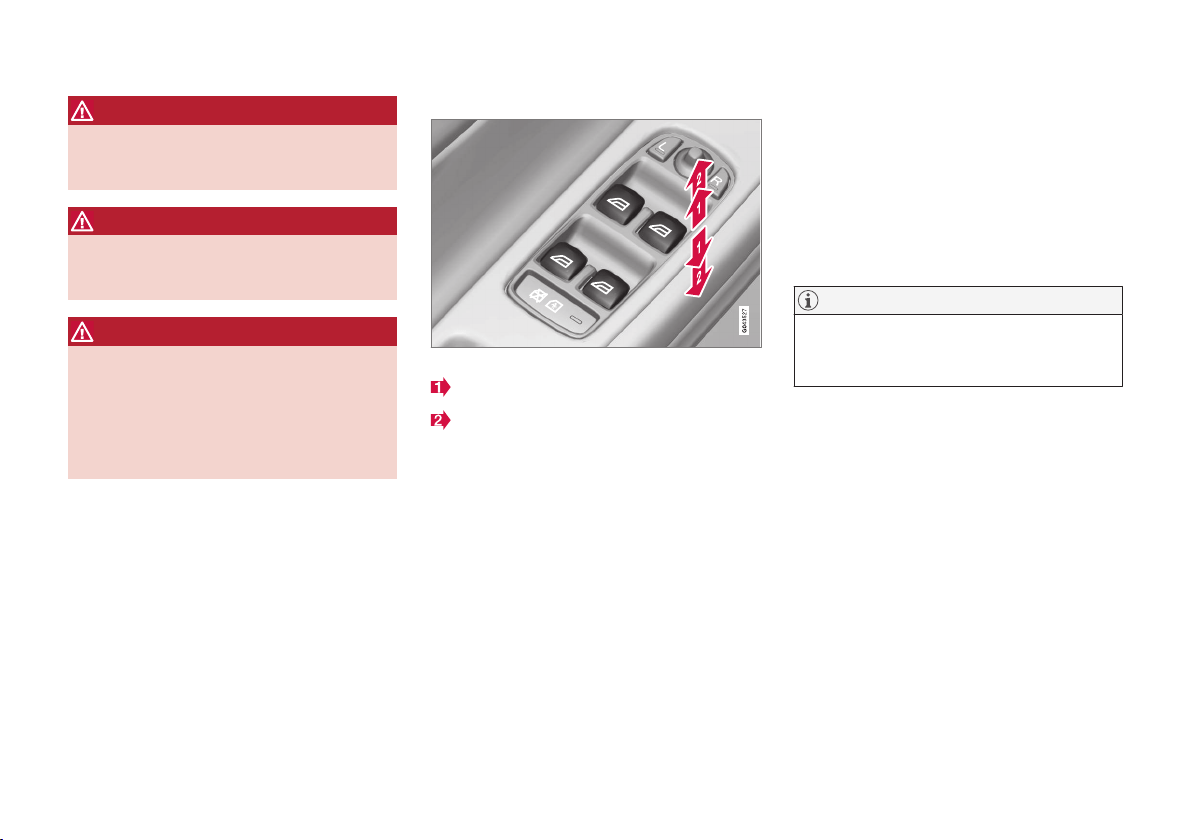
INSTRUMENTS AND CONTROLS
}}
99
WARNING
Check that children or other passengers are
not trapped when the windows are closed
from the driver's door.
WARNING
Check that no children or other passengers
are trapped if/when the windows are closed
using the remote control key.
WARNING
If there are children in the car - remember to
always switch off the power supply to the
power windows by selecting key position 0
and then take the remote control key with you
when leaving the car. For information on key
positions - see Key positions - functions at
different levels (p. 77).
Operating
Operating the power windows.
Operating without auto
Operating with auto
All power windows can be operated using the
control panel for the driver's door - the control
panels for the other doors can only operate their
respective power window. Only one control panel
can be operated at a time.
In order for the power windows to be used, the
key position must be at least I - see Key posi-
tions - functions at different levels (p. 77). The
power windows can be operated for a few
minutes after the engine has been switched off
and after the remote control key has been
removed - although not after a door has been
opened.
Closing of the windows is stopped and the win-
dow is opened if anything prevents its movement.
It is possible to override the pinch protection
when closing has been interrupted, e.g. if there is
ice forming. After two successive closing inter-
ruptions the pinch protection will be forced and
the automatic function deactivated for a short
while, now it is possible to close by continually
holding the button pulled up.
NOTE
One way to reduce the pulsating wind noise
when the rear windows are open is to also
open the front windows slightly.
Operating without auto
Move one of the controls up/down gently. The
power windows move up/down as long as the
control is held in position.
Operating with auto
Move one of the controls up/down to the end
position and release it. The window runs auto-
matically to its end position.
Operating with the remote control key or
central locking button
To operate the power windows from the outside
with the remote control key, or from inside with
the central locking button, see Remote control
key - functions (p. 158) or Locking/unlocking -
from the inside (p. 171).
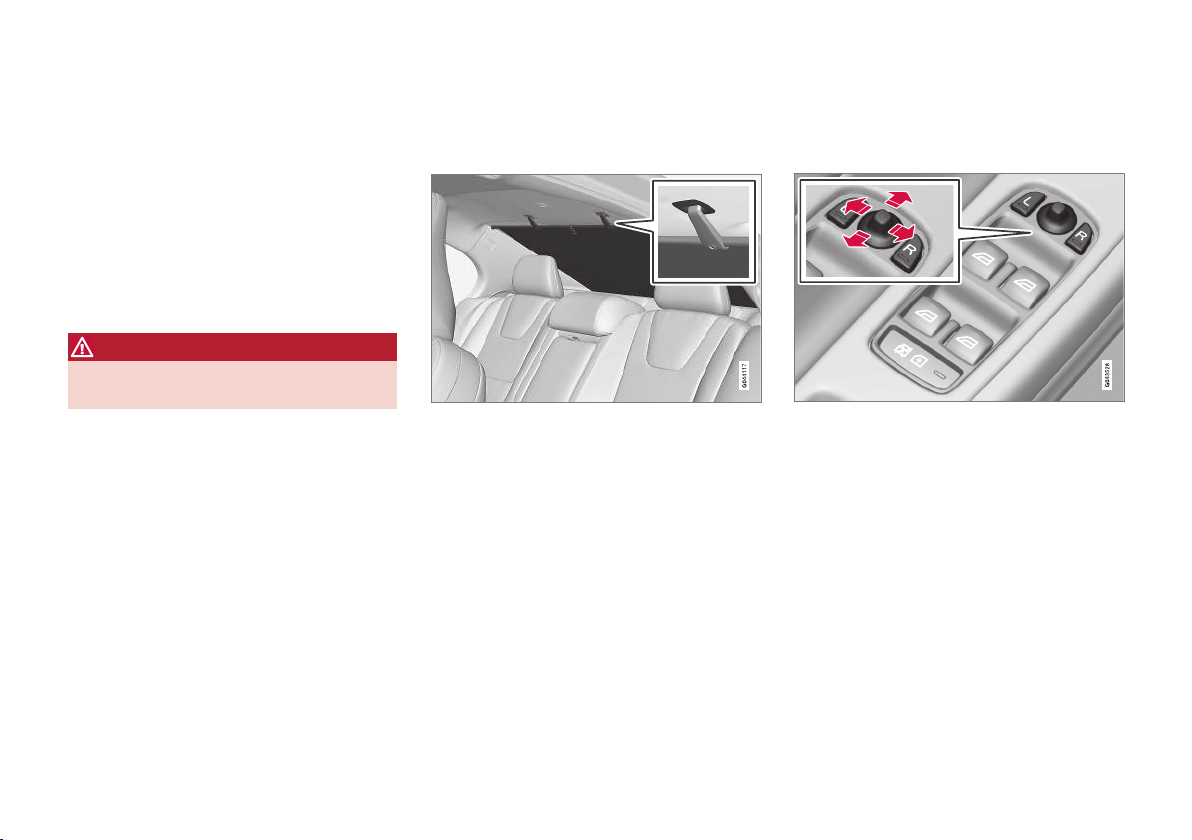
||
INSTRUMENTS AND CONTROLS
* Option/accessory.
100
Resetting
If the battery is disconnected then the function
for automatic opening must be reset so that it
can work correctly.
1. Gently raise the front section of the button to
raise the window to its end position and hold
it there for one second.
2. Release the button briefly.
3. Raise the front section of the button again
for one second.
WARNING
A reset must take place for pinch protection
to work.
Sun blind*
There is a sun blind built into the rear parcel
shelf.
–
Pull up the sun blind and hook it into the roof
clip using the two hooks for the blind.
> The spring force in the blind keeps the
hooks in position.
When the sun blind is not in use - unhook it, hold
onto the handle and allow the blind to roll up
slowly.
Door mirrors
The door mirror positions are adjusted with the
joystick in the driver's door controls.
Controls for door mirrors.
Adjusting
1.
Press the L button for the left-hand door mir-
ror or the R button for the right-hand door
mirror. The light in the button illuminates.
2. Adjust the position with the joystick in the
centre.
3.
Press the L or R button again. The light
should no longer be illuminated.

INSTRUMENTS AND CONTROLS
* Option/accessory.
101
WARNING
Both mirrors are bent to provide optimal
vision. Objects may appear further away than
they actually are.
Storing settings
24
The settings for the door mirrors and the posi-
tions of the driver's seat can be stored for each
remote control key in the car key memory*, see
Remote control key - personalisation* (p. 155).
Angling the door mirror when parking
24
The door mirror can be angled down for the
driver to view the side of the road when parking
for example.
–
Engage reverse gear and press the L or R
button.
When reverse gear is disengaged the mirror
automatically returns to its original position after
approx. 10 seconds, or earlier by pressing the
button labelled L or R respectively.
Automatic angling of the door mirror
when parking
24
When reverse gear is engaged the door mirror is
automatically angled down so that the driver can
see the side of the road when parking for exam-
ple. When reverse gear is disengaged the mirror
automatically returns to its original position after
a short time.
The function can be activated/deactivated in the
menu system MY CAR, see MY CAR (p. 109).
Automatic retraction when locking*
When the car is locked/unlocked with the remote
control key the door mirrors are automatically
retracted/extended.
The function can be activated/deactivated in the
menu system MY CAR, see MY CAR (p. 109).
Resetting to neutral
Mirrors that have been moved out of position by
an external force must be reset electrically to the
neutral position for electric retracting/extending
to work correctly:
1.
Retract the mirrors with the L and R buttons.
2.
Fold them out again with the L and R but-
tons.
3. Repeat the above procedure as necessary.
The mirrors are now reset in neutral position.
Automatic dimming*
For the door mirrors to be fitted with this function
requires that the interior rearview mirror also has
automatic dimming, see Rearview mirror - interior
(p. 102).
Retractable power door mirrors*
The mirrors can be retracted for parking/driving
in narrow spaces:
1.
Depress the L and R buttons simultaneously
(key position must be at least I).
2. Release them after approximately 1 second.
The mirrors automatically stop in the fully
retracted position.
Fold out the mirrors by pressing down the L and
R buttons simultaneously. The mirrors automati-
cally stop in the fully extended position.
Home safe and approach lighting
The lamp on the door mirrors illuminates when
approach lighting (p. 96) or home safe lighting
(p. 96) is selected.
Related information
•
Rearview mirror - interior (p. 102)
•
Windows and rearview and door mirrors -
heating (p. 102)
24
Only in combination with power seat with memory, see Seats, front - electrically operated* (p. 80).
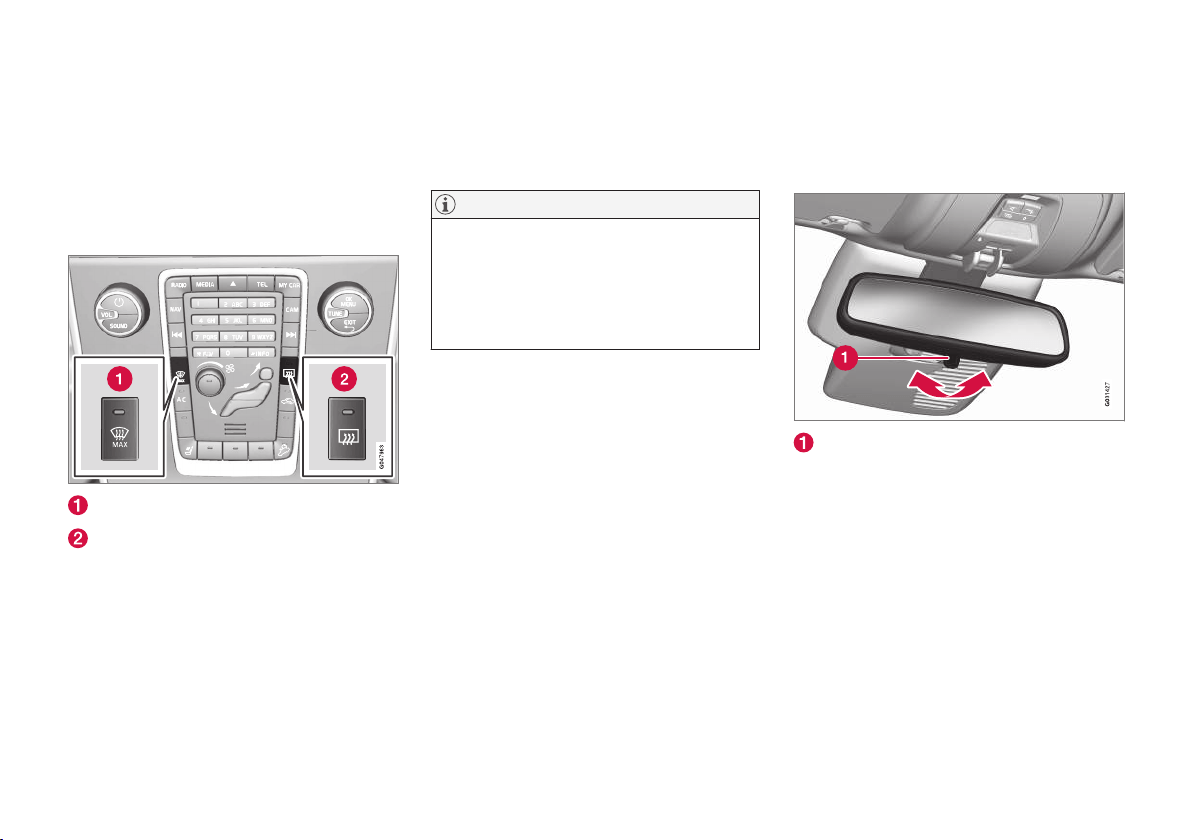
INSTRUMENTS AND CONTROLS
* Option/accessory.
102
Windows and rearview and door
mirrors - heating
The defroster is used to quickly remove misting
and ice from the windscreen, rear window and
door mirrors.
Heated windscreen*, rear window and
door mirrors
Heating, windscreen
Heating, rear window and door mirrors
The function is used to remove ice and misting
from the windscreen, rear window and door mir-
rors.
One press of the respective button starts the
heating. The light in the button indicates that the
function is active. Switch off the heating as soon
as the ice/misting is cleared in order not to load
the battery unnecessarily. However, the function
is switched off automatically after a certain time.
Following which, rear window heating is switched
on and off automatically as long as the outside
temperature is lower than +7 °C.
NOTE
Rear window heating is not switched on and
off automatically if the Eco function is acti-
vated, but then remains switched off, even in
outside temperatures below +7 °C. For infor-
mation about the Eco function, see Drive
mode ECO* (p. 292).
See also Demisting and defrosting the wind-
screen (p. 130).
The door mirrors and rear window are demisted/
defrosted automatically if the car is started in an
outside temperature lower than +7 °C. Automatic
defrosting can be selected in the menu system
MY CAR, see MY CAR (p. 109).
Using the Engine Remote Start (ERS)* function,
the heated windscreen is demisted/defrosted
automatically if the ambient temperature is lower
than +5 °C and automatic defrosting has been
selected in the menu system MY CAR.
Rearview mirror - interior
The interior rearview mirror can be dimmed with
a control in the mirror's lower edge. Alternatively,
the rearview mirror dims automatically.
Control for dimming
Manual dimming
Bright light from behind could be reflected in the
rearview mirror and dazzle the driver. Use dim-
ming with the dimming control when lights from
behind are distracting:
1. Use dimming by moving the control in
towards the passenger compartment.
2. Return to normal position by moving the con-
trol towards the windscreen.
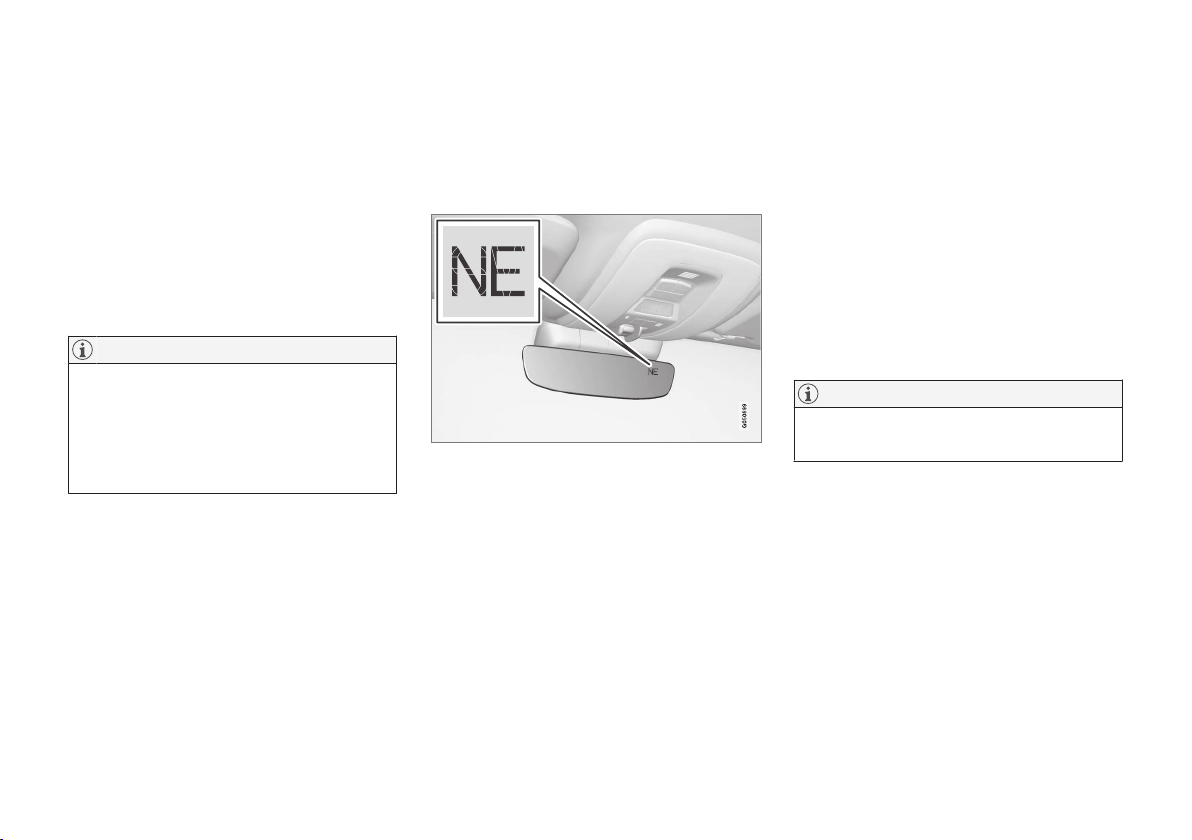
INSTRUMENTS AND CONTROLS
}}
* Option/accessory.
103
Automatic dimming*
Bright light from behind is automatically dimmed
by the rearview mirror. The control for manual
dimming is not available on mirrors with auto-
matic dimming.
The rearview mirror contains two sensors - one
forward facing and one rearward facing - that
work together to identify and eliminate dazzling
light. The forward facing sensor detects ambient
light, while the rearward facing sensor detects
the light from vehicle headlights behind.
NOTE
If the sensors are obscured by e.g. parking
permits, transponders, sun visors or objects in
the seats or on the parcel shelf in such a way
that light is prevented from reaching the sen-
sors, then the dimming function of the interior
rearview and door mirrors is reduced.
Only rearview mirror with automatic dimming can
be equipped with compass (p. 103).
Related information
•
Door mirrors (p. 100)
Compass*
The upper right-hand corner of the rearview mir-
ror contains a display that shows the compass
direction in which the front of the car is pointing.
Operation
Rearview mirror with compass.
Eight different directions are shown with English
abbreviations:
N (north), NE (north east), E (east),
SE (south east), S (south), SW (south west), W
(west) and NW (north west).
The compass is activated automatically when the
car is started or when key position II is active, see
Key positions - functions at different levels
(p. 77). To deactivate/activate the compass -
press in the button on the underside of the mirror
using a paper clip for example.
Calibration
The compass may need calibrating to show the
correct compass direction.
The earth is divided into 15 magnetic zones. The
compass should be calibrated if the car is moved
across several magnetic zones.
Proceed as follows to perform calibration:
1. Stop the car in a large open area free from
steel structures and high-voltage power lines.
2. Start the car and switch off all electrical
equipment (air conditioning, wipers, etc.) and
ensure that all doors are closed.
NOTE
Calibration may fail or not start at all if electri-
cal equipment is not switched off.
3. Hold the button on the underside of the rear-
view mirror depressed (use a paper clip or
similar) for approx. 3 seconds. The number of
the current magnetic zone is shown.
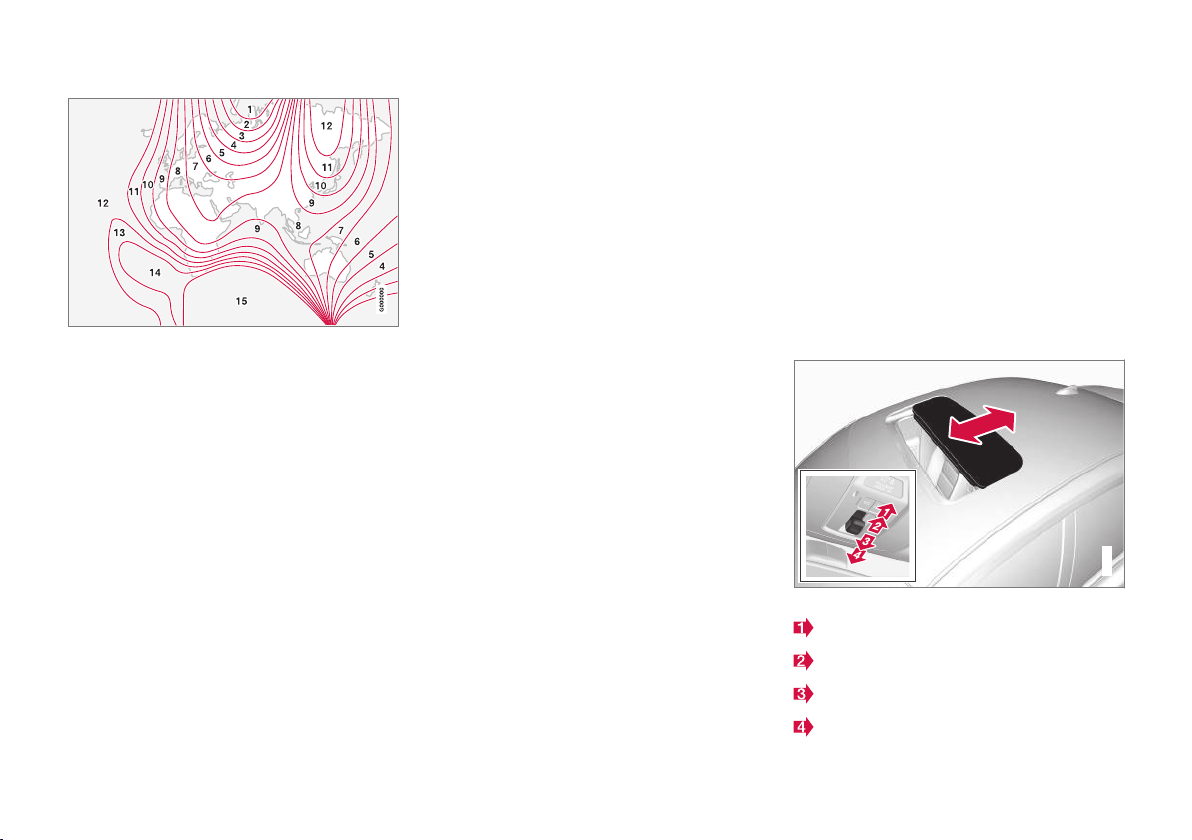
INSTRUMENTS AND CONTROLS
* Option/accessory.
104
Magnetic zones.
4. Press the button repeatedly until the
required magnetic zone (
1–15) is shown.
See the map of magnetic zones for the com-
pass.
5. Wait until the display returns to showing the
character C, or hold the button on the under-
side of the rearview mirror depressed for
approx. 6 seconds until the character C is
shown.
6. Drive slowly in a circle at a speed of no more
than 10 km/h (6 mph) until a compass direc-
tion is shown in the display, indicating that
calibration is complete. Then drive a further
2 circles to fine-tune calibration.
7.
Cars with heated windscreen*: If the
C
character is shown in the display when the
heated windscreen is activated, perform a
calibration as described in point 6 above with
the heated windscreen activated; see
Demisting and defrosting the windscreen
(p. 130).
8. Repeat the above procedure as necessary.
Sunroof*
The sunroof is operated with the control in the
roof.
The sunroof's inner sunscreen is closed man-
ually.
The sunroof has a wind deflector.
The sunroof controls are located in the roof
panel. The sunroof can be opened vertically at
the rear edge and horizontally. Key position I or II
is required for the sunroof to be opened.
Horizontal opening
G021343
Horizontal opening, backward/forward.
Opening, automatic
Opening, manual
Closing, manual
Closing, automatic
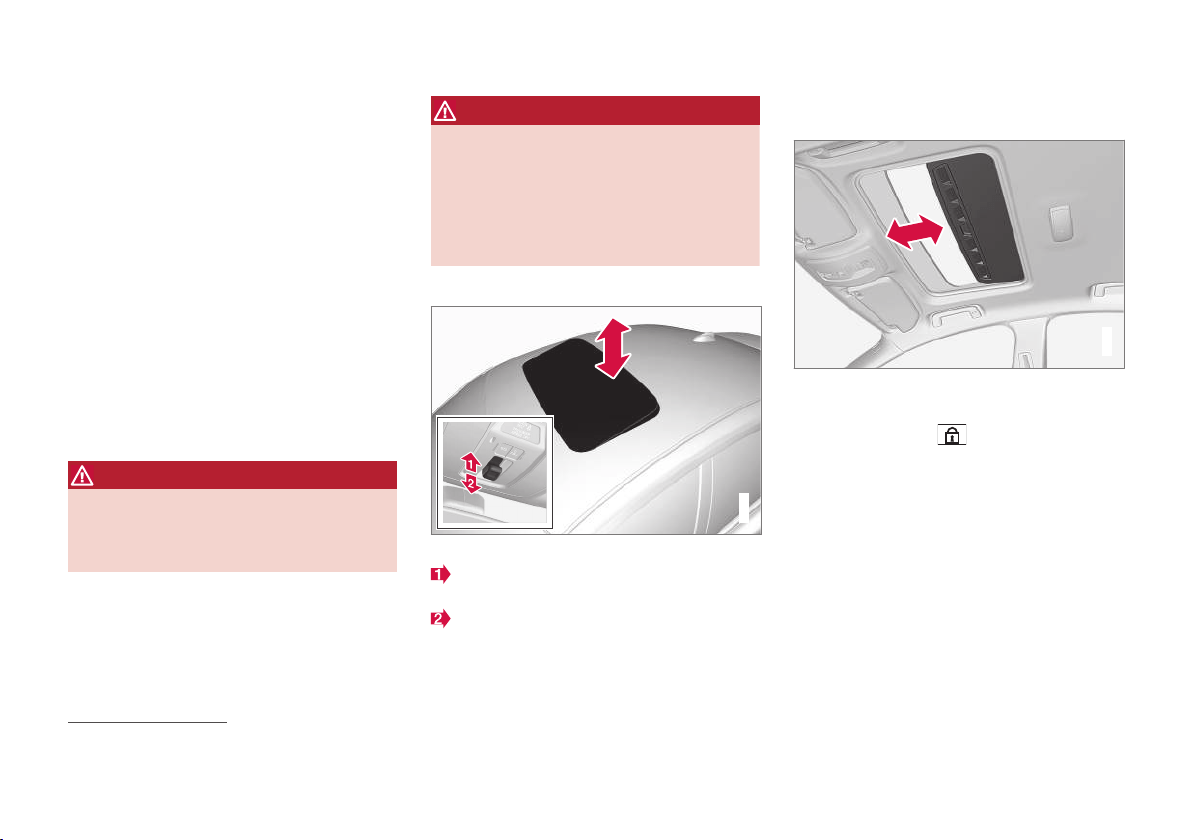
INSTRUMENTS AND CONTROLS
}}
105
Opening
To open the sunroof to comfort position
25
, press
the control back to the position for automatic
opening and release. To fully open the sunroof,
press the control back to the position for auto-
matic opening again and release.
Open manually by pressing the control back-
wards to the point of resistance for manual open-
ing. The sunroof moves to comfort position
25
while the control is being pressed backwards. To
fully open the sunroof, press the control back-
wards again.
Closing
Close manually by pushing the control forwards
to the point of resistance for manual closing. The
sunroof moves to the closed position while the
control is being pressed forwards.
WARNING
Risk of crushing when the sunroof is closed.
The sunroof's pinch-protection function only
operates during automatic closing, not man-
ual.
Close automatically by pressing the control to the
position for automatic closing and then release it.
The power supply to the sunroof is switched off
by selecting key position 0 and removing the
remote control key from the ignition switch.
WARNING
If there are children in the car:
Remember to always switch off the power
supply to the sunroof by selecting key posi-
tion 0 and then take the remote control key
with you when leaving the car. For information
on key positions - see Key positions - func-
tions at different levels (p. 77).
Vertical opening
G028899
Vertical opening, raised at the rear edge.
Open by pressing the rear edge of the con-
trol upward.
Close by pulling the rear edge of the control
down.
Closing using the remote control key or
central locking button
G021345
Remote control key
–
Give one long press on the remote control
key's lock button
until the sunroof and
all the windows are closed and the doors and
the boot lid are locked.
To interrupt closing, press the remote control
key's lock button again.
25
Comfort position is an open position for the sunroof, where wind noise and resonance noise are at a comfortably low level while driving.
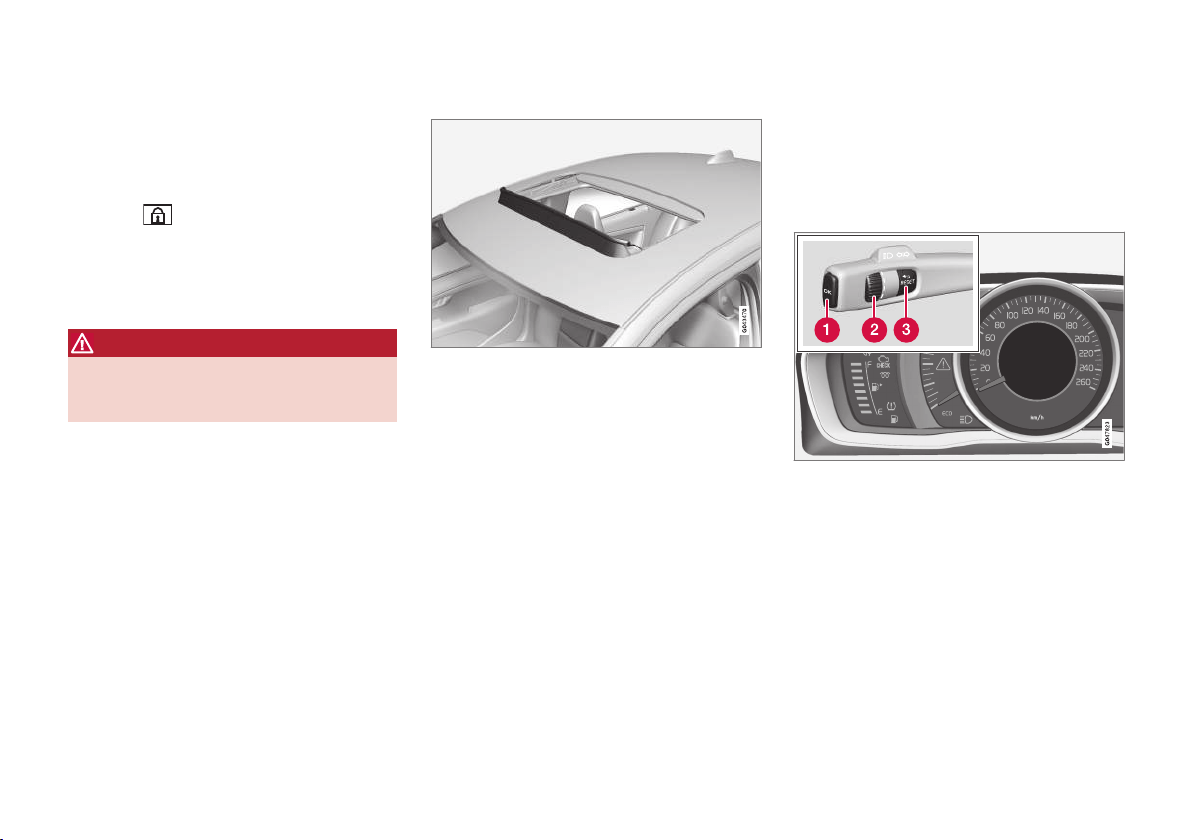
||
INSTRUMENTS AND CONTROLS
* Option/accessory.
106
Central locking button
The central locking button in the driver's door or
passenger door* can be used to close the sun-
roof.
–
Give one long press on the central locking
button
until the sunroof and all the win-
dows are closed and the doors and the boot
lid are locked.
To interrupt closing, press the central locking
button again.
WARNING
If the sunroof is closed with the remote con-
trol key or the central locking button, check
that no one risks being trapped.
Sunscreen
The sunroof features a manual, sliding interior
sunscreen. The sunscreen slides back automati-
cally when the sunroof is opened. Grip the handle
and slide the sunscreen forward to close it.
Pinch protection
The sunroof has a pinch protection function
which is triggered if it is blocked by an object
during automatic closing. If blocked, the sunroof
will stop and automatically open to the previous
position.
Wind deflector
The sunroof has a wind deflector that is folded
up when the sunroof is in the open position.
Related information
•
Remote control key - functions (p. 158)
•
Locking/unlocking - from the inside (p. 171)
Menu navigation - combined
instrument panel
The left-hand stalk controls the menus (p. 107)
shown on the information display in the com-
bined instrument panel (p. 62). Which menus
are shown depends on the key position (p. 77).
Display (analogue combined instrument panel) and con-
trols for menu navigation.
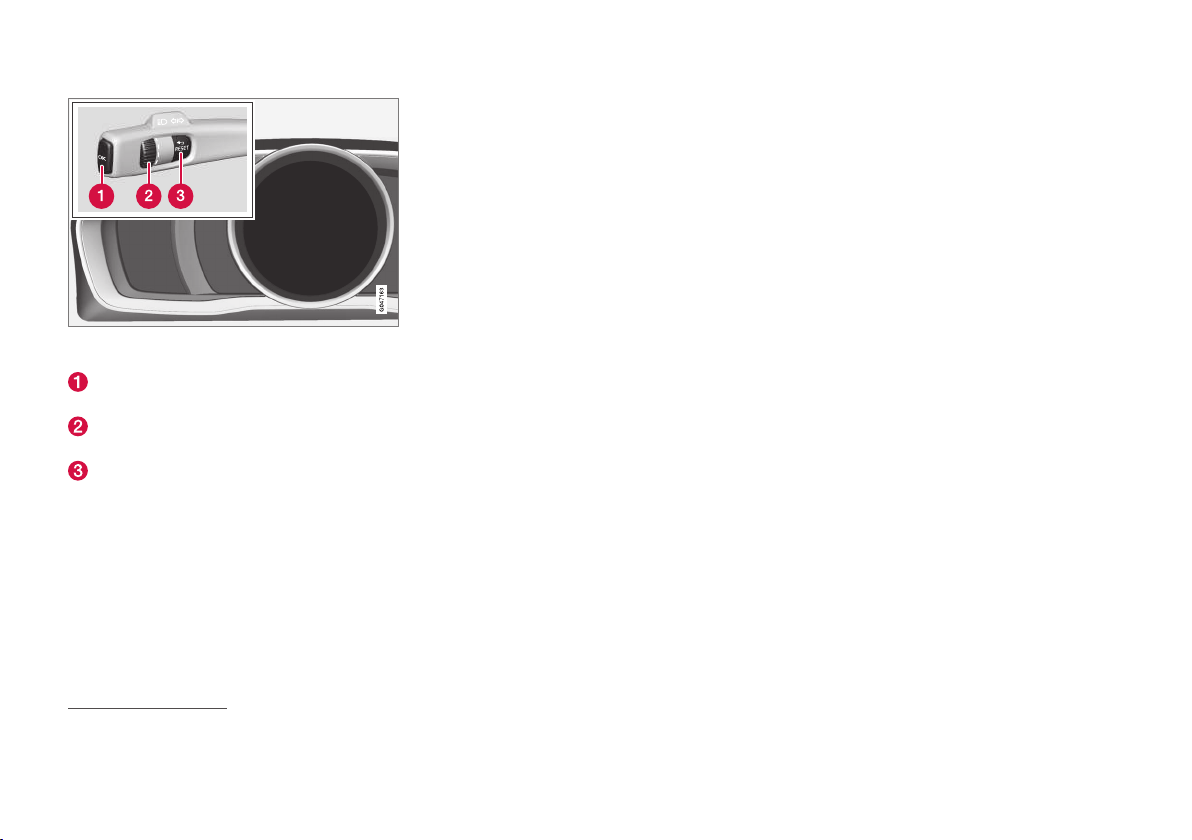
INSTRUMENTS AND CONTROLS
* Option/accessory.
107
Display (digital combined instrument panel) and controls
for menu navigation.
OK – access to message list and message
confirmation.
Thumbwheel – browse between menu
options.
RESET – reset the active function. Used in
certain cases to select/activate a function,
see the explanation under each respective
function.
If there is a message (p. 108) then it must be
acknowledged with OK in order that the menus
shall be shown.
Related information
•
Messages - handling (p. 109)
Menu overview - combined
instrument panel
Which menus are shown in the combined instru-
ment panel's information display depends on the
key position (p. 77).
Some of the following menu options require the
function and hardware to be installed in the car.
Analogue combined instrument panel
Digital speed
Parking heater*
Additional heater*
TC options
Service status
Oil level
26
Messages (##)
27
Digital combined instrument panel
Settings*
Themes
Contrast mode/Colour mode
Service status
Messages
27
Oil level
26
Parking heater*
Trip computer reset
Related information
•
Analogue combined instrument panel - over-
view (p. 62)
•
Digital combined instrument panel - overview
(p. 63)
•
Menu navigation - combined instrument
panel (p. 106)
26
Certain engines.
27
The number of messages is indicated in brackets.

INSTRUMENTS AND CONTROLS
* Option/accessory.
108
Messages
When a warning, information or indicator symbol
illuminates, a corresponding message appears
on the information display.
Message Specification
Stop safely
A
Stop and switch off the
engine. Serious risk of dam-
age - consult a workshop
B
.
Stop engine
A
Stop and switch off the
engine. Serious risk of dam-
age - consult a workshop
B
.
Service
urgent
A
Contact a workshop
B
to
check the car immediately.
Service
required
A
Contact a workshop
B
to
check the car as soon as
possible.
See manual
A
Read the owner's manual.
Book time for
maintenance
Time to book regular service
- contact a workshop
B
.
Time for reg-
ular mainte-
nance
Time for regular service -
contact a workshop
B
. The
timing is determined by the
number of kilometres driven,
number of months since the
last service, engine running
time and oil grade.
Message Specification
Maintenance
overdue
If the service intervals are
not followed then the war-
ranty does not cover any
damaged parts - contact a
workshop
B
.
Transmission
Oil change
needed
Contact a workshop
B
to
check the car as soon as
possible.
Transmission
Reduced per-
formance
The gearbox cannot handle
full capacity. Drive carefully
until the message clears
C
.
If shown repeatedly - con-
tact a workshop
B
.
Transmission
hot Reduce
speed
Drive more smoothly or stop
the car in a safe manner.
Disengage the gear and run
the engine at idling speed
until the message clears
C
.
Transmission
hot Stop
safely Wait for
cooling
Critical fault. Stop the car
immediately in a safe man-
ner and contact a work-
shop
B
.
Message Specification
Temporarily
off
A
A function has been tempo-
rarily switched off and is
reset automatically while
driving or after starting
again.
Low battery
charge Power
save mode
The audio system is
switched off to save energy.
Charge the battery.
A
Part of message, shown together with information on where the
problem has arisen.
B
An authorised Volvo workshop is recommended.
C
For more information regarding the automatic gearbox, see
Automatic gearbox - Geartronic* (p. 278).
IMPORTANT
For the Volvo warranty to apply, check and
follow the instructions in the Service and
Warranty Booklet.
Related information
•
Messages - handling (p. 109)
•
Menu navigation - combined instrument
panel (p. 106)
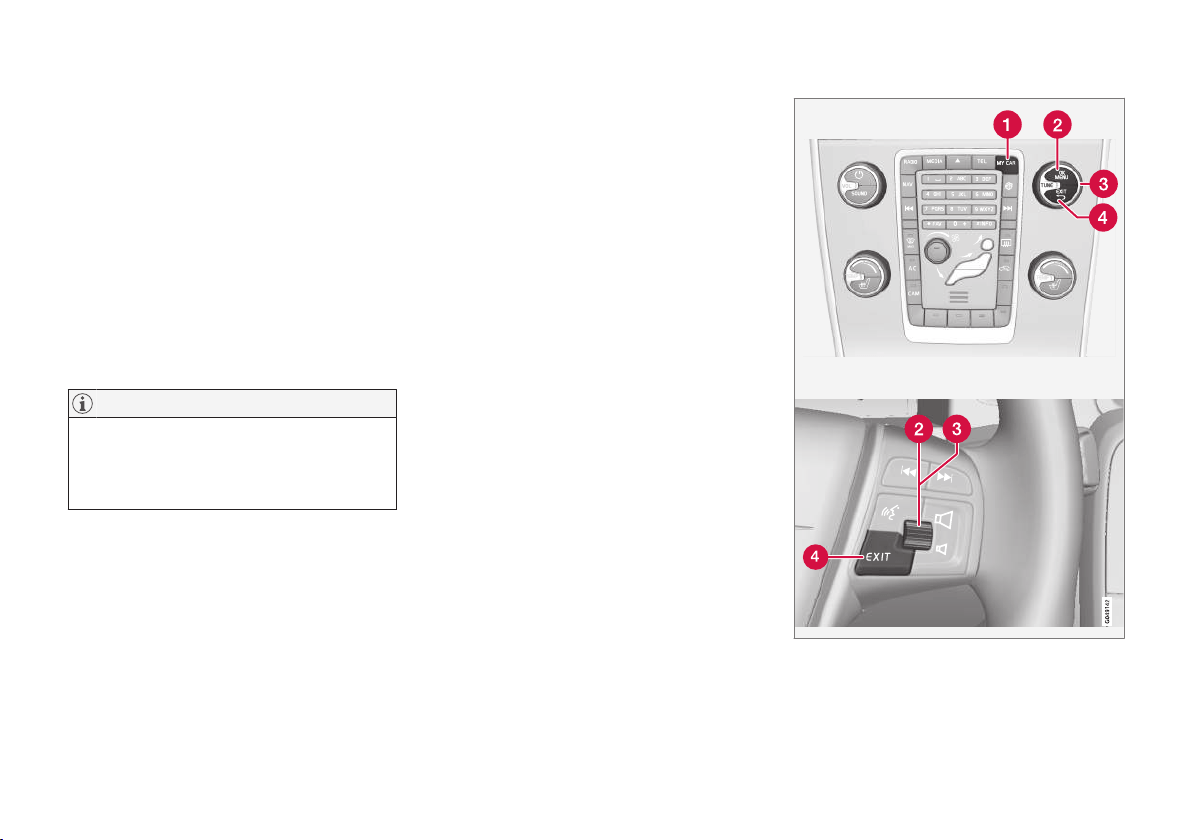
INSTRUMENTS AND CONTROLS
}}
* Option/accessory.
109
Messages - handling
Use the left-hand stalk switch to acknowledge
and browse among messages (p. 108) that are
shown in the information display of the com-
bined instrument panel.
When a warning, information or indicator symbol
illuminates, a corresponding message appears in
the display at the same time. An error message is
stored in a memory list until the fault has been
rectified.
Press OK on the left-hand stalk switch to
acknowledge a message. Scroll through mes-
sages with the thumbwheel (p. 106).
NOTE
If a warning message appears while you are
using the trip computer, the message must be
read (press OK) before the previous activity
can be resumed.
Related information
•
Menu overview - combined instrument panel
(p. 107)
MY CAR
MY CAR is a menu source that handles many of
the car's functions, e.g. City Safety™, locks and
alarm, automatic fan speed, setting the clock,
etc.
Certain functions are standard, others are
optional - the range also varies depending on the
market.
Operation
Navigation in the menus is carried out using but-
tons in the centre console or with the steering
wheel's right-hand keypad*.
Control panel in centre console and steering wheel key-
pad. The figure is schematic - the number of functions
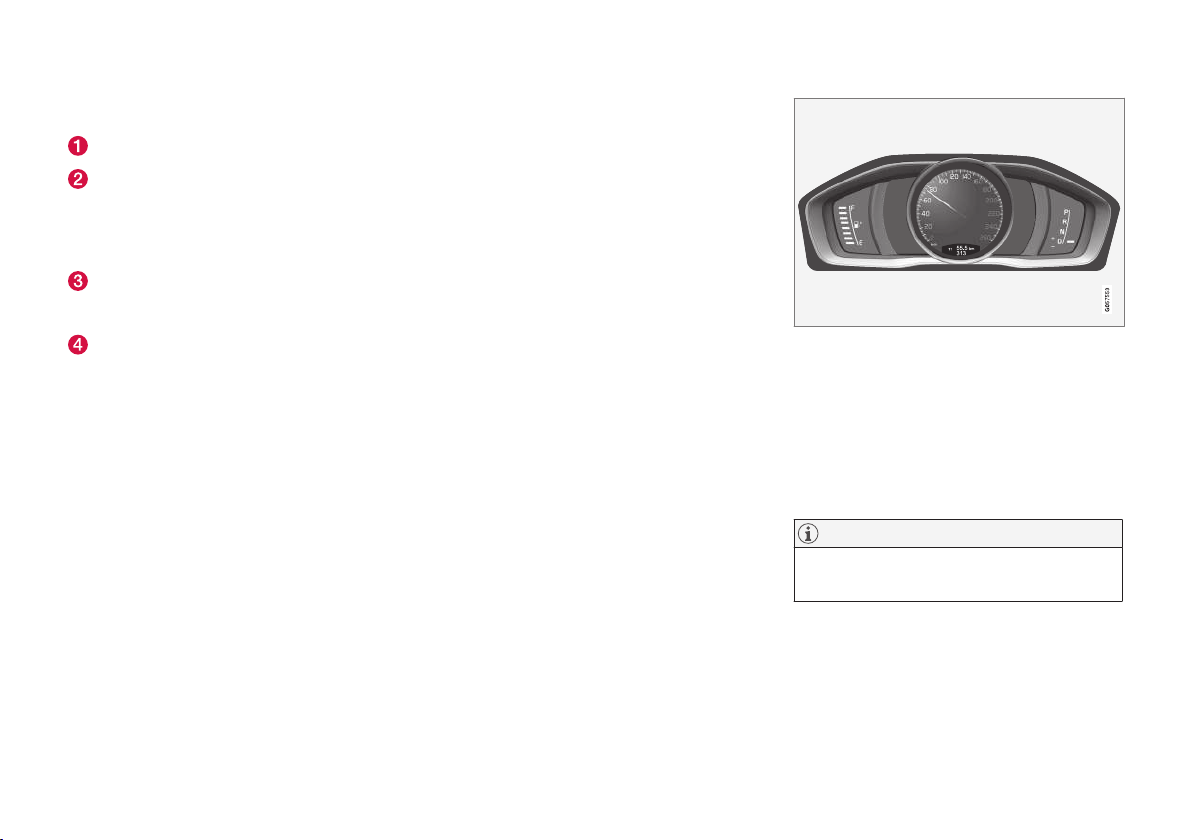
||
INSTRUMENTS AND CONTROLS
* Option/accessory.
110
and layout of the buttons both vary, depending on the
equipment selected and the market.
MY CAR - opens the menu system MY CAR.
OK/MENU - press the button in the centre
console or the thumbwheel on the steering
wheel to select/tick in the highlighted menu
option or store the selected function in the
memory.
TUNE - turn the knob in the centre console
or the thumbwheel on the steering wheel to
scroll up/down through the menu options.
EXIT
EXIT functions
Depending on the function the cursor is on when
EXIT is depressed briefly, and on which menu
level, one of the following may occur:
•
phone call is rejected
•
current function is interrupted
•
input characters are deleted
•
most recent selections are undone
•
leads up in the menu system.
A long press on EXIT leads to the normal view
for MY CAR or if you are in the normal view, to
the highest menu level (main source menu).
Menu options and search paths
For a description of the menu options and search
paths in MY CAR, see the Sensus Infotainment
supplement.
Trip computer
The car's trip computer records and calculates
vales such as e.g. distance, fuel consumption
and average speed whilst driving.
Trip computer content and appearance varies
depending on whether the combined instrument
panel is analogue or digital:
•
Trip computer - analogue combined instru-
ment panel (p. 112)
•
Trip computer - digital combined instrument
panel (p. 115)
The information from the trip computer can be shown in
the combined instrument panel's information display
28
.
Trip meter
The trip computer has two trip meters and one
odometer for the total mileage.
Average
Average fuel consumption is calculated from the
last resetting.
NOTE
There may be a slight deviation if a fuel-driven
heater* has been used.
Average speed
The average speed is calculated for the driving
distance driven since the last reset to zero.

INSTRUMENTS AND CONTROLS
* Option/accessory.
111
Instantaneous
The information for current fuel consumption is
updated continuously - approximately once per
second. When the car is driven at low speed the
consumption is shown per time unit - at a higher
speed it is shown related to mileage.
Different units (km/miles) can be selected for the
display - see section "Change unit" (p. 110).
Range - distance to empty tank
The trip computer shows the approximate dis-
tance that can be driven with the fuel quantity
remaining in the tank.
No guaranteed range remains when the heading
Distance to empty shows "----".
•
In which case, refuel as soon as possible.
The calculation is based on the average fuel con-
sumption over the last 30 km and the remaining
driveable fuel quantity.
NOTE
There may be a slight deviation if the driving
style has been changed.
An economic driving style generally results in a
longer driving distance. For more information on
how fuel consumption can be influenced, see
Volvo Car Corporation 's Environmental Philoso-
phy (p. 22).
Digital speed display in another unit
29
If the main instrument is graduated in mph, the
equivalent digital speed is shown as km/h.
Change unit
Distance and fuel unit can be changed in the
menu system MY CAR, see MY CAR (p. 109).
NOTE
In addition to in the trip computer, these units
are also changed in Volvo's navigation sys-
tem*.
Related information
•
Trip computer - analogue combined instru-
ment panel (p. 112)
•
Trip computer - digital combined instrument
panel (p. 115)
•
Trip computer - trip statistics* (p. 118)
28
The appearance and showing of the display may vary depending on the instrument variant.
29
Only digital combined instrument panel and certain markets.
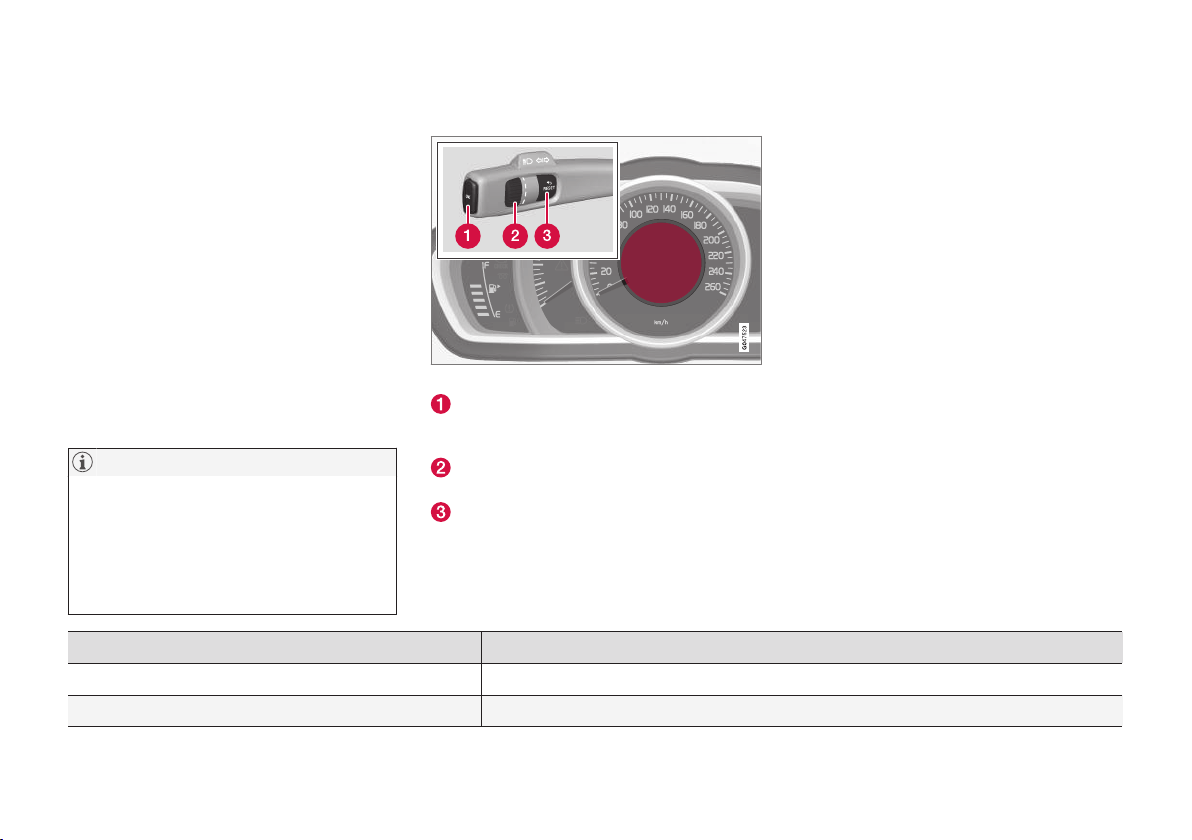
INSTRUMENTS AND CONTROLS
112
Trip computer - analogue combined
instrument panel
The information from the trip computer can be
shown in the combined instrument panel and
operated with the controls on the left-hand stalk
switch and with the combined instrument panel's
menu.
Checking and settings can be made immediately
after the combined instrument panel is automati-
cally illuminated in connection with unlocking. If
none of the trip computer's controls are actuated
within approx. 30 seconds after the driver's door
has been opened then the instrument extin-
guishes, after which either key position II or
engine starting is required in order to operate the
trip computer.
NOTE
If a warning message appears when the trip
computer is used then the message must first
be acknowledged before the trip computer
can be reactivated.
•
Acknowledge the message by briefly
pressing the indicator stalk OK button.
Controls
Information display and controls.
OK - opens the combined instrument panel's
menu, confirms messages or menu selec-
tions.
Thumbwheel - browses between menu
options or trip computer options.
RESET - resets the current trip meter or
goes back out of the menu structure.
Trip comp. opt.
Choose which trip computer should be shown:
1. To ensure that no control is in the middle of
a sequence - reset them first with
two presses on RESET.
2. Turn the thumbwheel to browse between the
options and stop at the required heading.
The trip computer display in the combined instru-
ment panel can be shifted to another option at
any time during the journey. One of the options
means that no trip computer is shown.
Trip computer heading in combined instrument panel Information
Trip meter T1 and total dist.
•
Long press on RESET resets trip meter T1.
Trip meter
T2 and total dist.
•
Long press on RESET resets trip meter T2.

INSTRUMENTS AND CONTROLS
}}
* Option/accessory.
113
Trip computer heading in combined instrument panel Information
Distance to empty
For more information - see the section "Range - distance to empty tank" (p. 110).
Fuel consumption
Current consumption.
Average speed
•
Long press on RESET resets
Average speed.
No trip computer information. This option shows a blank display and it also indicates the beginning/end of the loop.
Resetting the trip computer
1. Turn the thumbwheel and stop at the trip
computer heading to be reset:
T1 and total
dist., T2 and total dist. or Average speed.
2.
One long press on RESET resets the value
for the selected heading.
Each heading must be zeroed individually.
Functions in the combined instrument
panel's menu
The combined instrument panel's menu includes
setting options for trip computer. Open the menu
to check/adjust the functions in the table below.
1. To ensure that no control is in the middle of
a sequence - reset them first with
two presses on RESET.
2.
Press OK.
3. Browse through the functions with the
thumbwheel and select/confirm with OK.
4.
Finish by pressing twice on RESET after
completed checking/adjustment.
Functions Information
Digital speed
•
km/h
•
mph
•
No display
Shows the car's speed digitally in the centre of the combined instrument panel.
Parking heater*
•
DIRECT START
•
- Timer 1 - leads to the menu for selecting time.
•
- Timer 2 - leads to the menu for selecting time.
For a description of programming the timer, see Engine block heater and passenger com-
partment heater* - timer (p. 136).
||
INSTRUMENTS AND CONTROLS
* Option/accessory.
114
Functions Information
Additional heater*
•
Auto On
•
Off
For more information, see Additional heater* (p. 140).
TC options
•
Distance to empty tank
•
Fuel consumption
•
Average speed
•
Trip meter
T1 and total dist.
•
Trip meter
T2 and total dist.
Here you can activate the options that you want to be available as selectable headings in
the trip computer. The symbols for the options already selected are white with a "tick" -
others are grey and have no "tick".
Service status
Shows the number of months and mileage to next service.
Oil level
A
For more information, see Engine oil - checking and filling (p. 354).
Messages (##)
For more information, see Messages - handling (p. 109).
A
Certain engines.
Related information
•
Trip computer (p. 110)
•
Trip computer - trip statistics* (p. 118)
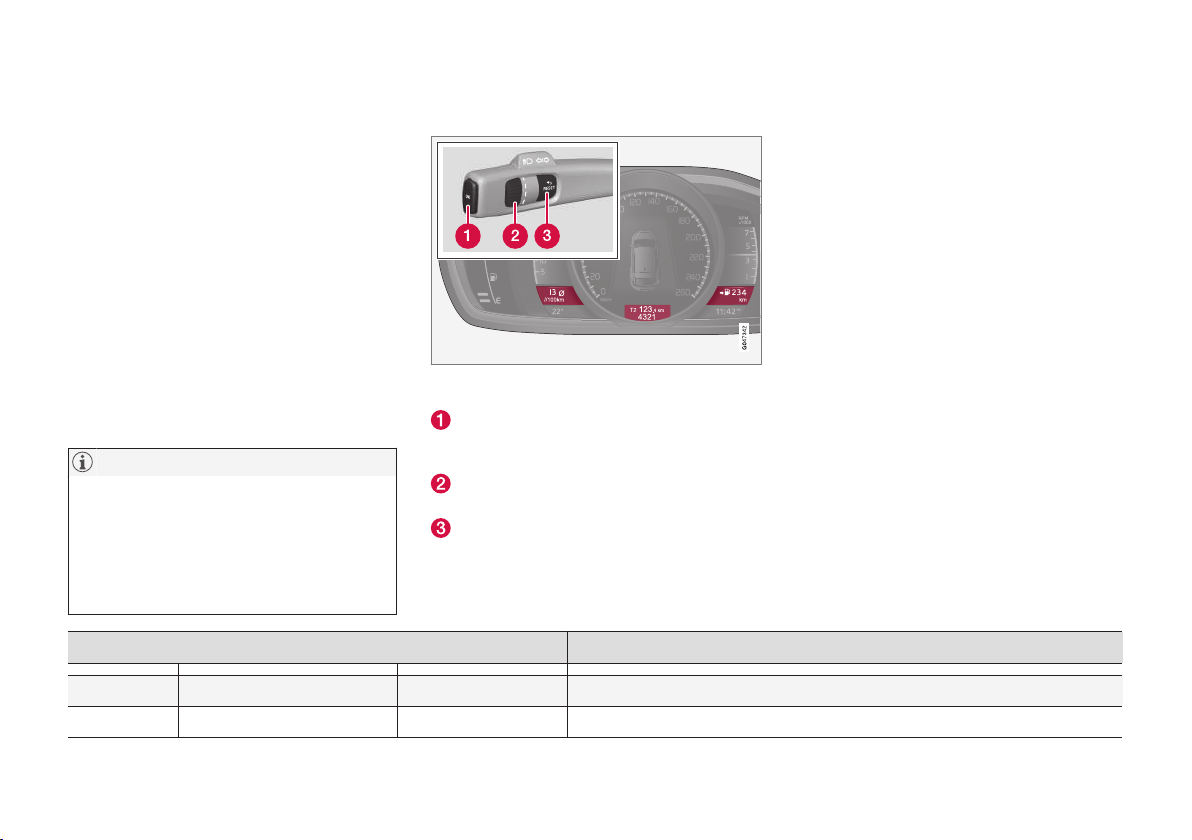
INSTRUMENTS AND CONTROLS
}}
115
Trip computer - digital combined
instrument panel
The information from the trip computer can be
shown in the combined instrument panel and
operated with the controls on the left-hand stalk
switch and with the combined instrument panel's
menu.
Checking and settings can be made immediately
after the combined instrument panel is automati-
cally illuminated in connection with unlocking. If
none of the trip computer's controls are actuated
within approx. 30 seconds after the driver's door
has been opened then the instrument extin-
guishes, after which either key position II or
engine starting is required in order to operate the
trip computer.
NOTE
If a warning message appears when the trip
computer is used then the message must first
be acknowledged before the trip computer
can be reactivated.
•
Acknowledge the message by briefly
pressing the indicator stalk OK button.
Controls
Three trip computer options can be displayed simultane-
ously - one in each "window".
OK - opens the combined instrument panel's
menu, confirms messages or menu selec-
tions.
Thumbwheel - browses between menu
options or trip computer options.
RESET - resets the current trip meter or
goes back out of the menu structure.
Trip comp. opt.
Choose which trip computer should be shown:
1. To ensure that no control is in the middle of
a sequence - reset them first with
two presses on RESET.
2. Turn the thumbwheel to browse between the
heading combinations.
3. Stop at the required combination for the con-
stant display of this trip data in the combined
instrument panel.
The trip computer display in the combined instru-
ment panel can be shifted to another option at
any time during the journey. One of the options
means that no trip computer is shown.
Heading combinations Information
Average Trip meter T1 + Meter reading Average speed
•
Long press on RESET resets trip meter T1.
Instantaneous Trip meter T2 + Meter reading Distance to empty tank
•
Long press on RESET resets trip meter T2.

||
INSTRUMENTS AND CONTROLS
116
Heading combinations Information
Instantaneous Meter reading kmh<>mph kmh<>mph - see section Reverse digital speed display (p. 110).
No trip computer information. This option extinguishes all three trip computer displays and it also indicates the
beginning/end of the loop.
Resetting the trip computer
Trip meter
1. Turn the thumbwheel and stop at the head-
ing combination with the trip meter to be
reset.
2.
One long press on RESET resets the value
for the selected heading.
Average speed and average consumption
1.
Press OK to open the combined instrument
panel's menu.
2.
Browse to the
Trip computer reset menu
option with the thumbwheel and confirm with
OK.
3. Choose to reset average consumption, aver-
age speed or to reset both. Confirm the
selection with OK.
4.
Finish by pressing RESET.
Functions in the combined instrument
panel's menu
The combined instrument panel's menu includes
setting options for trip computer. Open the menu
to check/adjust the functions in the table below.
1. To ensure that no control is in the middle of
a sequence - reset them first with
two presses on RESET.
2.
Press OK.
3. Browse through the functions with the
thumbwheel and select/confirm with OK.
4.
Finish by pressing twice on RESET after
completed checking/adjustment.
Functions Information
Trip computer reset
•
Average
•
Average speed
Reset the value of average fuel consumption and average speed.
Note that this function does not reset both trip meters T1 and T2.
Messages
For more information, see Messages - handling (p. 109).
Themes
Select the theme for the appearance of the combined instrument panel (p. 62).
INSTRUMENTS AND CONTROLS
* Option/accessory.
117
Functions Information
Settings*
Select
Auto On or Off.
For more information, see Additional heater* (p. 140).
Contrast mode/Colour mode
Adjusting the combined instrument panel's brightness and colour intensity.
Parking heater*
•
Direct start
•
- Symbol Timer 1 - leads to the menu for
selecting time.
•
- Symbol Timer 2 - leads to the menu for
selecting time.
For a description of programming the timer, see Engine block heater and passenger compartment
heater* - timer (p. 136).
Service status
Shows the number of months and mileage to next service.
Oil level
A
For more information, see Engine oil - checking and filling (p. 354).
A
Certain engines.
Related information
•
Trip computer (p. 110)
•
Trip computer - trip statistics* (p. 118)
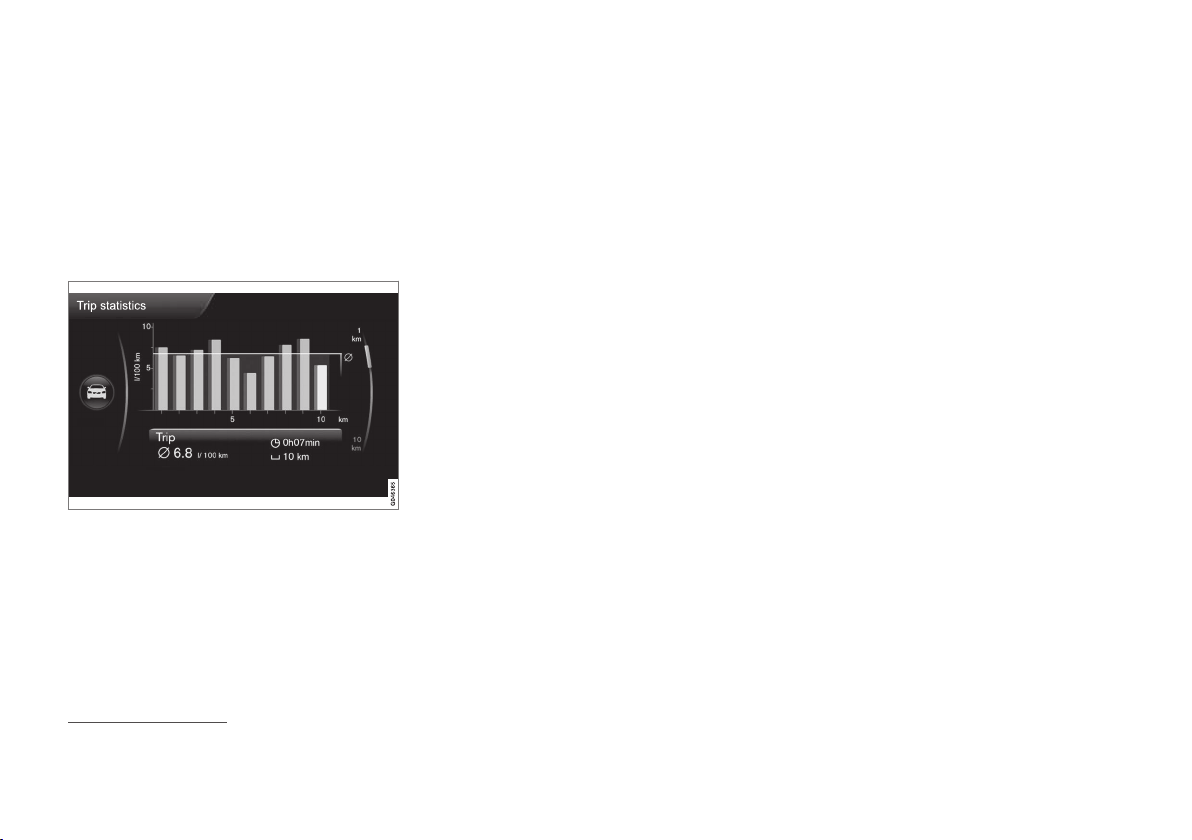
INSTRUMENTS AND CONTROLS
* Option/accessory.
118
Trip computer - trip statistics*
Trip statistics from the trip computer can be
shown in the centre console's screen and pro-
vide a graphic overview of fuel consumption.
Function
–
Open the menu system MY CAR (p. 109)
and select
Trip statistics in order to see the
bar chart.
Trip statistics
30
Each bar symbolises 1 km or 10 km driven dis-
tance, depending on the scale selected - the bar
at the far right shows the value for the current kil-
ometre or 10 km.
Using the TUNE control, the scale for the bars
can be changed between 1 km and 10 km - the
cursor on the far right changes position between
up and down in relation to the scale selected.
Settings
Different settings can be made for trip statistics
in the menu system MY CAR -
Trip statistics.
•
Reset when vehicle has been off for
minimum 4h - highlight the box by select-
ing ENTER and go back out of the menu by
selecting EXIT. With this option selected, all
statistics are deleted automatically after fin-
ishing driving and the car has been stationary
for more than 4 hours. Trip statistics start
again from zero the next time the engine is
started.
•
Start new trip - ENTER is used to delete all
previous statistics, go back out of the menu
by selecting EXIT. If a new driving cycle shall
be started before 4 hours have elapsed then
the current period must first be deleted man-
ually with this option.
See also information on Eco guide (p. 66).
Related information
•
Trip computer (p. 110)
30
The figure is schematic - layout may vary depending on car model or updated software.

CLIMATE CONTROL

CLIMATE CONTROL
* Option/accessory.
120
General information on climate
control
The car is equipped with electronic climate con-
trol (p. 126). The climate control system cools
or heats as well as dehumidifies the air in the
passenger compartment.
NOTE
Air conditioning (AC) (p. 130) can be
switched off, but to ensure the best possible
climate comfort in the passenger compart-
ment, and to prevent the windows from mist-
ing, it should always be switched on.
To bear in mind
•
To ensure that the air conditioning works
optimally, the side windows, and sunroof*
should be closed.
•
Global opening (p. 172) opens/closes all
side windows simultaneously and can be
used for example to quickly air the car during
hot weather.
•
Remove ice and snow from the climate con-
trol system air intake (the grille between the
bonnet and the windscreen).
•
In warm weather, condensation from the air
conditioning may drip under the car. This is
normal.
•
When the engine requires full power, e.g. for
full acceleration, the air conditioning can be
temporarily switched off. There may then be
a temporary increase in temperature in the
passenger compartment.
•
Remove misting on the insides of the win-
dows primarily by using the defroster func-
tion (p. 130). To reduce the risk of misting,
keep the windows clean and use window
cleaner.
NOTE
To avoid misting on the rear window, do not
block the ventilation holes at the back of the
parcel shelf with articles of clothing or other
objects.
Cars with Start/Stop*
With an auto-stopped (p. 284) engine certain
equipment may have its function temporarily
reduced, e.g. climate control fan speed (p. 128).
Cars with ECO*
Certain equipment may have its function tempo-
rarily reduced or deactivated when the ECO
(p. 292) function is activated, e.g. the air condi-
tioning (p. 130).
NOTE
When the ECO function is activated, several
parameters in the climate control system's
settings are changed, and several electricity
consumer functions are reduced. Certain set-
tings can be reset manually, but full function-
ality is only restored by deactivating the ECO
function.
Related information
•
Actual temperature (p. 121)
•
Menu settings - climate control (p. 123)
•
Electronic climate control - ECC (p. 126)
•
Air distribution in the passenger compart-
ment (p. 123)
•
Air quality (p. 121)
CLIMATE CONTROL
* Option/accessory.
121
Actual temperature
The temperature you select in the passenger
compartment corresponds to the physical expe-
rience with reference to factors such as ambient
temperature, air speed, humidity and solar radia-
tion etc. in and around the car at the time.
The system includes a sun sensor (p. 121) which
detects on which side the sun is shining into the
passenger compartment. This means that the
temperature can differ between the right and left-
hand air vents despite the controls being set for
the same temperature on both sides.
Related information
•
General information on climate control
(p. 120)
•
Temperature control in the passenger com-
partment (p. 129)
Sensors - climate control
The climate control system has a number of sen-
sors to help control the temperature (p. 121) in
the car.
•
The sun sensor is located on the top side of
the dashboard.
•
The temperature sensor for the passenger
compartment is located below the climate
control panel.
•
The outside temperature sensor is located in
the door mirror.
•
The humidity sensor* is located by the inte-
rior rearview mirror.
NOTE
Do not cover or block the sensors with cloth-
ing or other objects.
Related information
•
General information on climate control
(p. 120)
Air quality
The interior in a passenger compartment is
designed to be pleasant and comfortable, even
for people with contact allergies and for asthma
sufferers.
•
Passenger compartment filter (p. 122)
•
Material in the passenger compartment
(p. 123)
•
Clean Zone Interior Package (CZIP)
(p. 122)*
•
Interior Air Quality System (IAQS) (p. 122)*
Related information
•
General information on climate control
(p. 120)

CLIMATE CONTROL
* Option/accessory.
122
Air quality - passenger
compartment filter
All air entering the car's passenger compartment
is cleaned with a filter.
The filter must be replaced at regular intervals.
Follow the Volvo Service Programme for the rec-
ommended replacement intervals. If the car is
used in a severely contaminated environment, it
may be necessary to replace the filter more often.
NOTE
There are different types of passenger com-
partment filter. Make sure that the correct fil-
ter is fitted.
Related information
•
Air quality (p. 121)
Air quality - Clean Zone Interior
Package (CZIP)*
CZIP comprises a series of modifications that
keep the passenger compartment even clearer
from allergy and asthma-inducing substances.
The following is included:
•
An enhanced fan function that means that
the fan starts when the car is opened with
the remote control key. The fan fills the pas-
senger compartment with fresh air. The func-
tion starts when required and is disengaged
automatically after a time or when one of the
passenger compartment doors is opened.
The amount of time the fan runs is reduced
gradually due to reduced need up until the
car is 4 years old.
•
The air quality system IAQS (p. 122) is a fully
automatic system that cleans the air in the
passenger compartment from contaminants
such as particles, hydrocarbons, nitrous
oxides and ground-level ozone.
Related information
•
General information on climate control
(p. 120)
•
Air quality (p. 121)
Air quality - IAQS*
The air quality system IAQS separates gases
and particles to reduce the levels of odours and
pollution in the passenger compartment.
If the outside air is contaminated then the air
intake is closed and the air is recirculated.
It is possible to activate/deactivate the function
in the menu system MY CAR. For a description of
the menu system, see MY CAR (p. 109).
NOTE
The air quality sensor must always be enabled
to ensure the best air in the passenger com-
partment.
In a cold climate recirculation is limited so as
to prevent misting.
In the event of misting, the air quality sensor
should be disengaged, and the defroster
functions for the windscreen and side win-
dows, as well as the rear window, should be
used.
Related information
•
General information on climate control
(p. 120)
•
Air quality (p. 121)
•
Air quality - Clean Zone Interior Package
(CZIP)* (p. 122)
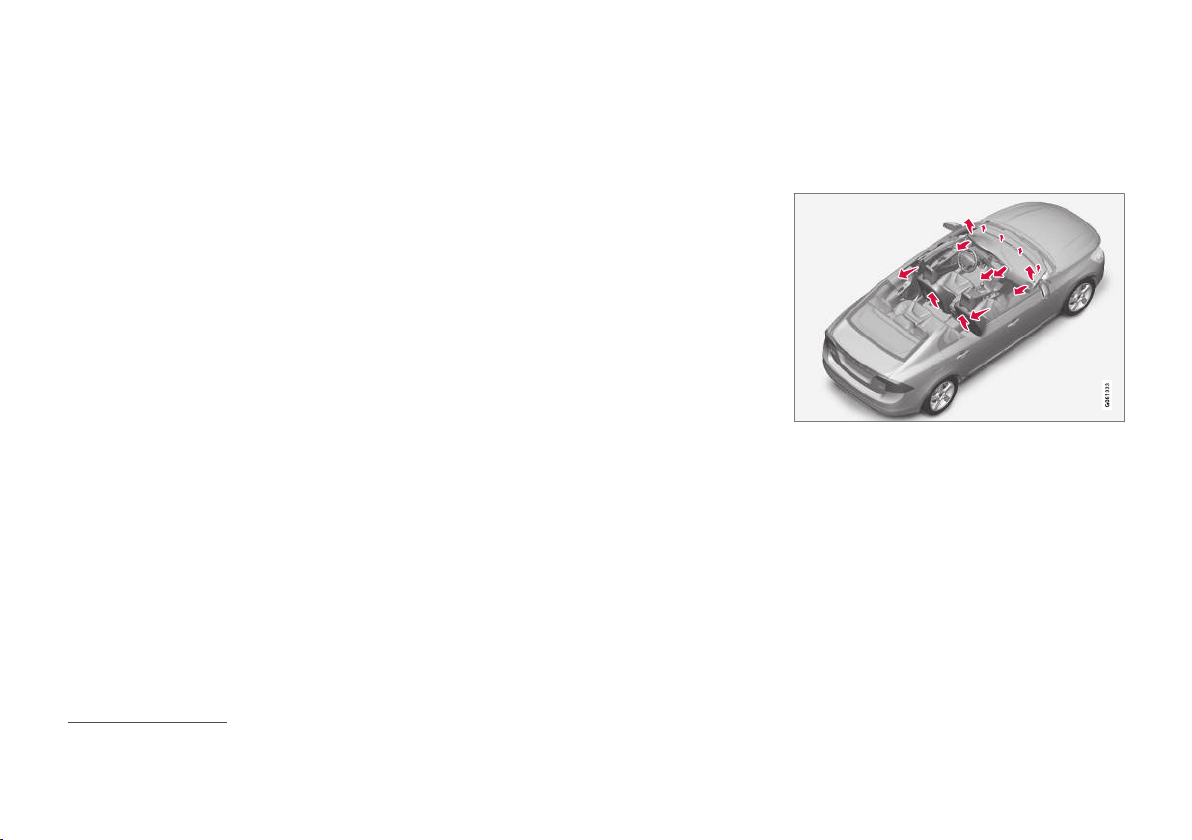
CLIMATE CONTROL
}}
* Option/accessory.
123
Air quality - material
Tested materials have been developed in order
to minimise the quantity of dust in the passenger
compartment and to contribute to making the
passenger compartment easier to keep clean.
The carpets in both the passenger compartment
and the cargo area are removable and easy to
remove and clean. Use cleaning agents and car
care products recommended by Volvo to clean
the interior (p. 394).
Related information
•
Air quality (p. 121)
Menu settings - climate control
It is possible to activate/deactivate or change
the default settings for six of the climate control
system's functions via the centre console.
•
Fan level during automatic climate control
(p. 129).
•
Recirculation timer (p. 131).
•
Automatic start of rear window defroster
(p. 102)
1
.
•
Interior air quality system* (p. 122).
•
Automatic start of seat heating driver
(p. 127).
•
Automatic start of steering wheel heating
(p. 84).
More information is available in the description of
the menu system (p. 109).
The climate control system's functions can be
reset in the menu system MY CAR to the default
settings. For a description of the menu system,
see MY CAR (p. 109).
Related information
•
General information on climate control
(p. 120)
Air distribution in the passenger
compartment
The incoming air is divided between a number of
different vents in the passenger compartment.
Air distribution is fully automatic in AUTO mode.
If necessary it can be controlled manually; see
the air distribution table (p. 132).
1
Using the Engine Remote Start (ERS)* function, the heated windscreen is also demisted/defrosted automatically if the setting for rear window defroster is activated.
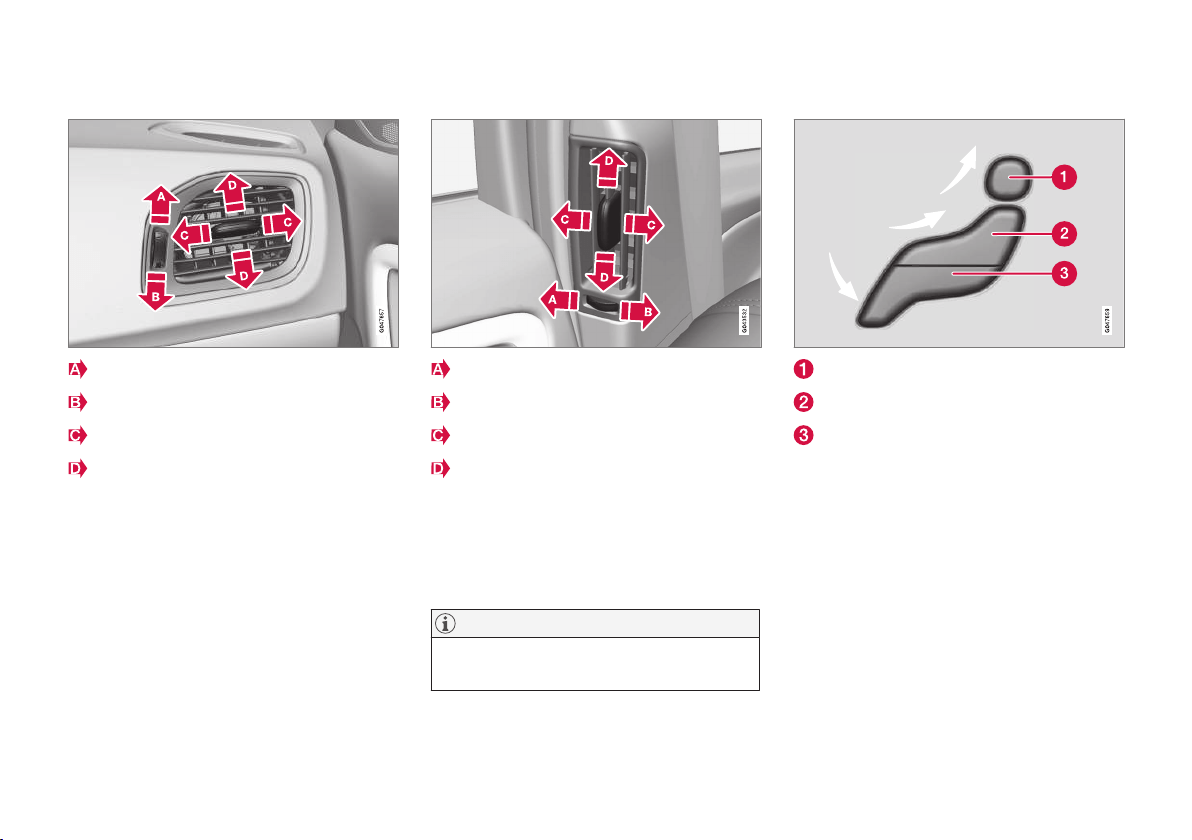
||
CLIMATE CONTROL
124
Air vents in the dashboard
Open
Closed
Lateral airflow
Vertical airflow
Aim the outer vents at the side windows to
remove misting.
Air vents in the door pillars
Closed
Open
Lateral airflow
Vertical airflow
Aim the vents at the windows to remove misting
in cold weather.
Aim the vents into the passenger compartment to
maintain a comfortable climate in the rear seat in
hot weather.
NOTE
Remember that small children may be sensi-
tive to air flows and draughts.
Air distribution
Air distribution - defroster windscreen
Air distribution - air vent instrument panel
Air distribution - ventilation floor
The figure consists of three buttons. When press-
ing the buttons the corresponding figure is illumi-
nated in the screen (see following figure) and an
arrow in front of each part of the figure shows
the air distribution that is selected. For more
information, see the air distribution table
(p. 132).
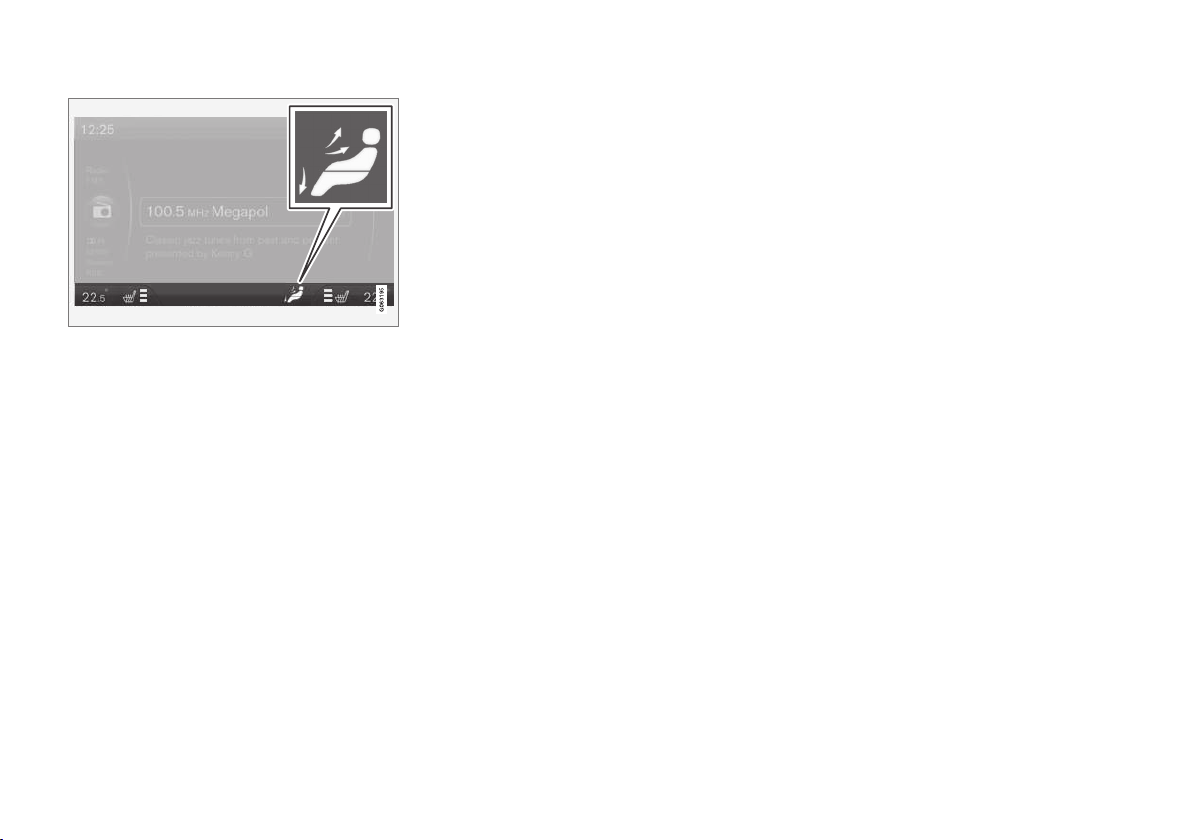

CLIMATE CONTROL
* Option/accessory.
126
Electronic climate control - ECC
ECC (Electronic Climate Control) maintains the
temperature selected in the passenger compart-
ment and can be set separately for the driver's
side and passenger side.
The auto function is used to automatically con-
trol temperature, air conditioning, fan speed,
recirculation and air distribution.
Temperature control (p. 129), left-hand side
Electrically heated front seat (p. 127), left
side
Heated windscreen* and max. defroster
(p. 130)
Fan (p. 128)
Air distribution (p. 123) - ventilation floor
Air distribution - air vent instrument panel
Air distribution - defroster windscreen
Rear window and door mirror defrosters
(p. 102)
Electrically heated front seat (p. 127), right
side
Temperature control (p. 129), right-hand
side
Recirculation (p. 131)
ECO* (p. 292)
AUTO - Automatic climate control (p. 129)
AC - Air conditioning on/off (p. 130)
Related information
•
General information on climate control
(p. 120)
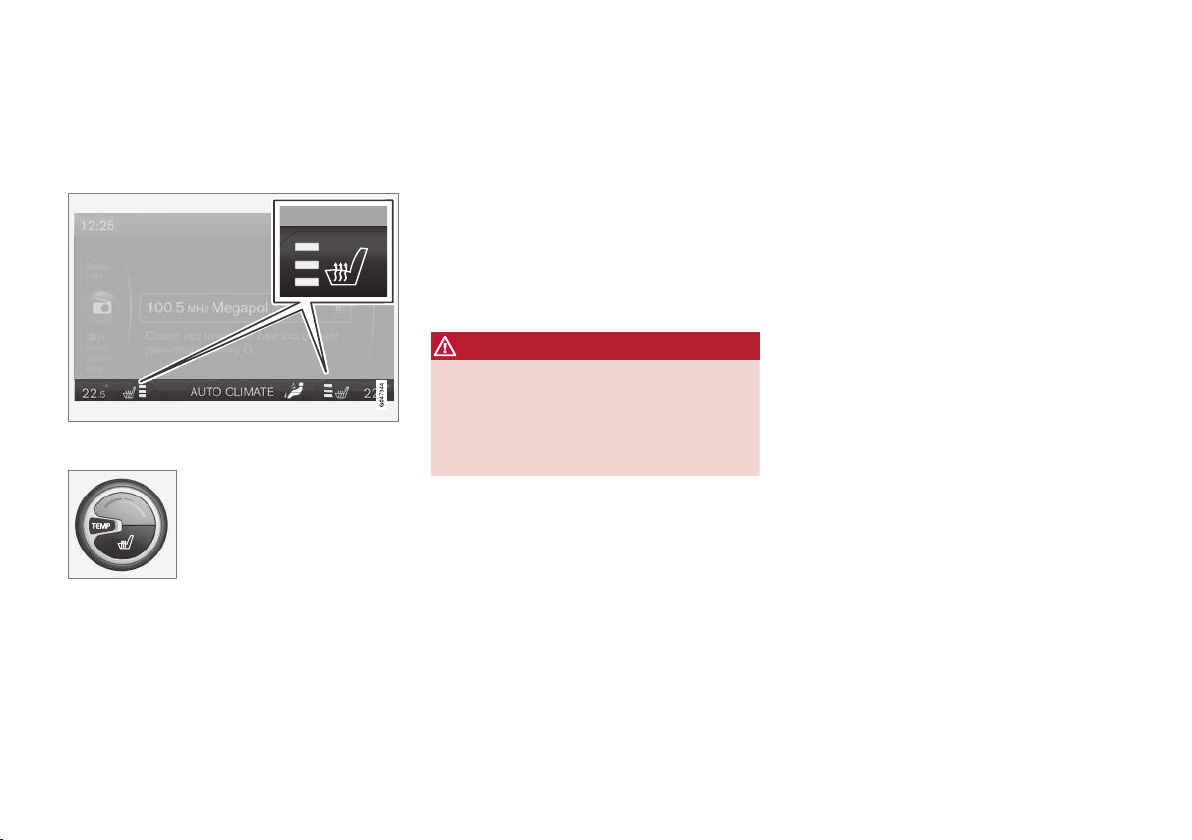
CLIMATE CONTROL
* Option/accessory.
127
Heated front seats*
The front seat heating has three positions for
increasing the comfort for driver and passenger
when it is cold.
Current heat level is shown in the centre console display
screen.
Press the button repeatedly to
change between the different
levels or to deactivate the func-
tion.
There are three heat levels that give different
heating outputs:
•
Highest heat level - three orange fields illu-
minate in the centre console's screen (see
figure above).
•
Lower heat level - two orange fields illumi-
nate in the screen.
•
Lowest heat level - one orange field illumi-
nates in the screen.
•
Switch off the heat - no field illuminates.
WARNING
Heated seats must not be used by people
who find it difficult to perceive an increase in
temperature due to a lack of sensation or who
otherwise have problems operating the con-
trols for the heated seats. Otherwise they may
suffer burn injuries.
Automatic start of driver's seat heating
With the automatic start of the driver's seat heat-
ing activated, the driver's seat will have the high-
est heat level when the engine is started.
Automatic start takes place when the car is cold
and the ambient temperature is lower than
approx. +10 °C.
It is possible to activate/deactivate the function
in the menu system MY CAR. For a description of
the menu system, see MY CAR (p. 109).
Related information
•
General information on climate control
(p. 120)
•
Heated rear seat* (p. 128)
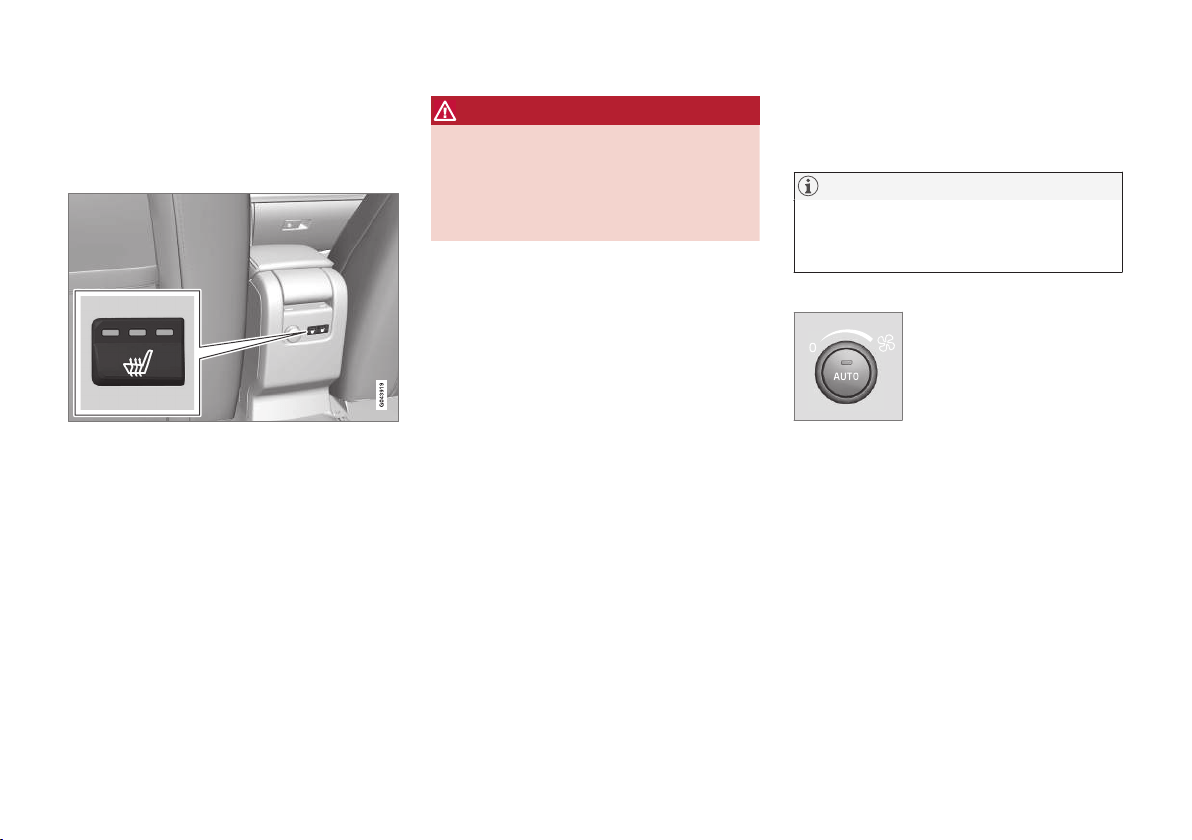
CLIMATE CONTROL
* Option/accessory.
128
Heated rear seat*
The heating for the rear seat's outer positions
has three positions for increasing the comfort for
passengers when it is cold.
Current heat level is shown in the pushbutton's lamps.
Press the button repeatedly to change between
the different levels or to deactivate the function.
There are three heat levels that give different
heating outputs:
•
Highest heat level - three lamps illuminate.
•
Lower heat level - two lamps illuminate.
•
Lowest heat level - one lamp illuminates.
•
Switch off the heat - no lamp illuminates.
WARNING
Heated seats must not be used by people
who find it difficult to perceive an increase in
temperature due to a lack of sensation or who
otherwise have problems operating the con-
trols for the heated seats. Otherwise they may
suffer burn injuries.
Related information
•
General information on climate control
(p. 120)
•
Heated front seats* (p. 127)
Fan
The fan should always be activated in order to
avoid misting on the windows.
NOTE
If the fan is fully switched off then the air con-
ditioning is not engaged - which can cause a
risk of misting on the windows.
Fan knob
Turn the knob to increase or
decrease fan speed. If AUTO is
selected, then the fan speed is
regulated automatically
(p. 129) - the fan speed previ-
ously set is disengaged.
Related information
•
General information on climate control
(p. 120)
•
Electronic climate control - ECC (p. 126)

CLIMATE CONTROL
129
Auto-regulation
The auto function automatically regulates tem-
perature (p. 129), air conditioning (p. 130), fan
speed (p. 128), recirculation (p. 131) and air
distribution (p. 123).
If you select one or more man-
ual functions, the other func-
tions continue to be controlled
automatically. All manual set-
tings are disengaged when
AUTO is pressed. The display
screen shows
AUTO
CLIMATE.
Fan speed in automatic mode can be set in the
menu system MY CAR. For a description of the
menu system, see MY CAR (p. 109).
Related information
•
General information on climate control
(p. 120)
Temperature control in the
passenger compartment
When the car is started, the most recent tem-
perature setting is resumed.
NOTE
Heating or cooling cannot be hastened by
selecting a higher or lower temperature than
the actual desired temperature.
Current temperature for each side is shown in the centre
console's display screen.
The temperature can be
adjusted with the knob - sepa-
rately for the driver's side and
the passenger side.
Related information
•
General information on climate control
(p. 120)
•
Actual temperature (p. 121)
•
Electronic climate control - ECC (p. 126)
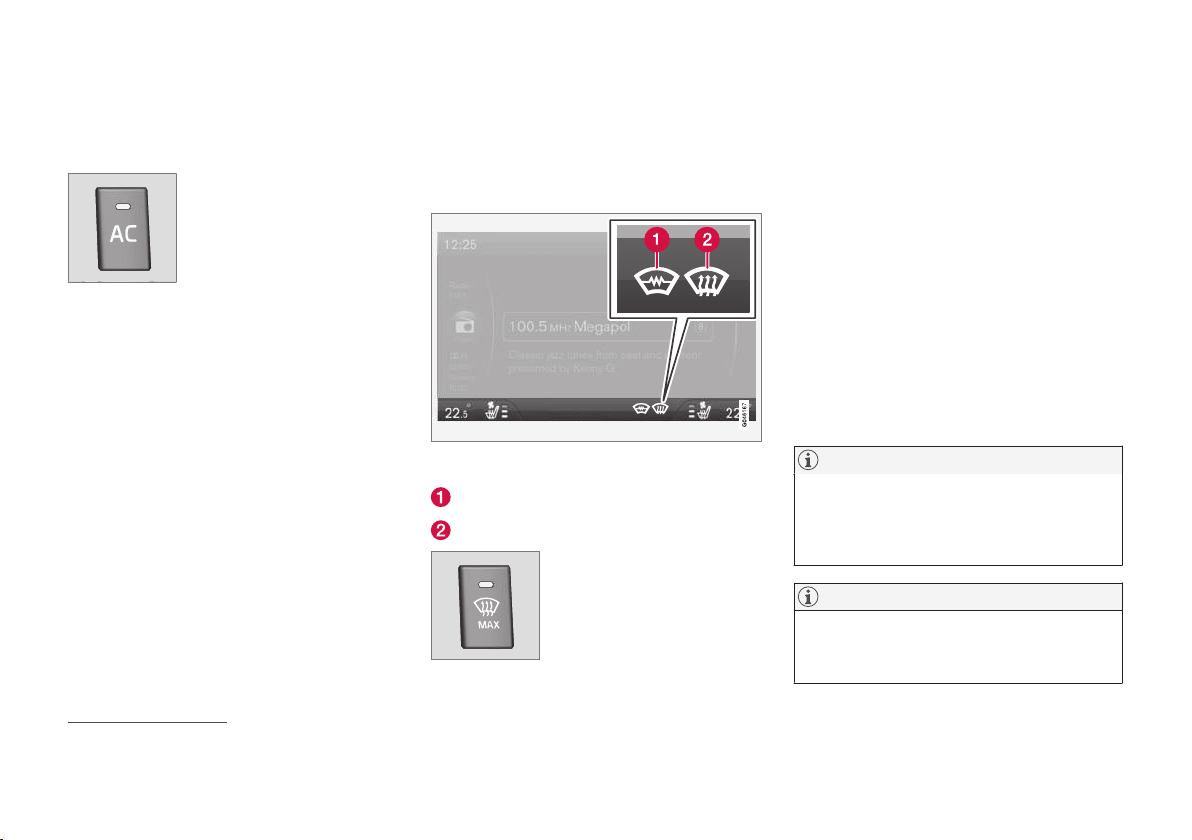
CLIMATE CONTROL
* Option/accessory.
130
Air conditioning
The air conditioning cools and dehumidifies
incoming air as required.
When the lamp in the AC but-
ton illuminates, the air condi-
tioning is controlled by the sys-
tem's automatic function.
When the lamp in the AC but-
ton is switched off the air con-
ditioning is disconnected. Other functions are still
controlled automatically. When the max. defroster
function (p. 130) is activated, the air conditioning
is switched on automatically so that the air is
dehumidified at the maximum setting.
Demisting and defrosting the
windscreen
Heated windscreen* and max. defroster are
used to quickly remove misting and ice from the
windscreen and side windows.
The selected setting is shown in the centre console's
screen.
Heated windscreen*
Max. defroster
The light in the defroster but-
ton illuminates when the func-
tion is active.
Press the button repeatedly to
change between the different
levels or to deactivate the func-
tion.
For cars without heated windscreen there is one
defrost level:
•
Air flows to the windows - symbol (2) illumi-
nates in the screen.
•
Switch off the function - no symbol illumi-
nates.
For cars with heated windscreen there are two
defrost levels:
•
Start the heating for the windscreen
2
- sym-
bol (1) illuminates in the screen.
•
Start the heating for the windscreen
2
and air
flow to the windows - symbols (1) and (2)
illuminate in the screen.
•
Switch off the function - no symbol illumi-
nates.
NOTE
Heated windscreen and IR window (p. 20)
may have an impact on the performance of
transponders and other communication
equipment.
NOTE
A triangular area at the end of each side of
the windscreen is not electrically heated,
where de-icing may take longer.
2
If the character
C is shown in the rearview mirror when the heated windscreen is activated then the compass (p. 103)* must be recalibrated.
CLIMATE CONTROL
131
NOTE
Electrically heated windscreen is not available
when the engine is auto-stopped (p. 284).
The following also takes place when the max.
defroster function is active in order to provide
maximum dehumidification in the passenger
compartment:
•
the air conditioning is automatically engaged
•
recirculation and the air quality system are
automatically disengaged.
NOTE
The noise level increases as the fan is operat-
ing at max.
When the defroster is switched off the climate
control returns to the previous settings.
Related information
•
General information on climate control
(p. 120)
Air distribution - recirculation
Select recirculation to shut out bad air, exhaust
gases etc. from the passenger compartment, i.e.
no outside air is taken into the car when this
function is activated.
When recirculation is engaged
the orange lamp in the button
illuminates.
IMPORTANT
If the air in the car is recirculated for too long
then there is a risk of misting on the insides
of the windows.
Timer
With the timer function activated the system will
exit manually activated recirculation mode
according to a time that depends on the outside
temperature. This reduces the risk of ice, misting
and bad air.
It is possible to activate/deactivate the function
in the menu system MY CAR. For a description of
the menu system, see MY CAR (p. 109).
NOTE
When max. defroster is selected, recirculation
is always deactivated.
Related information
•
General information on climate control
(p. 120)
•
Air distribution in the passenger compart-
ment (p. 123)
•
Air distribution - table (p. 132)
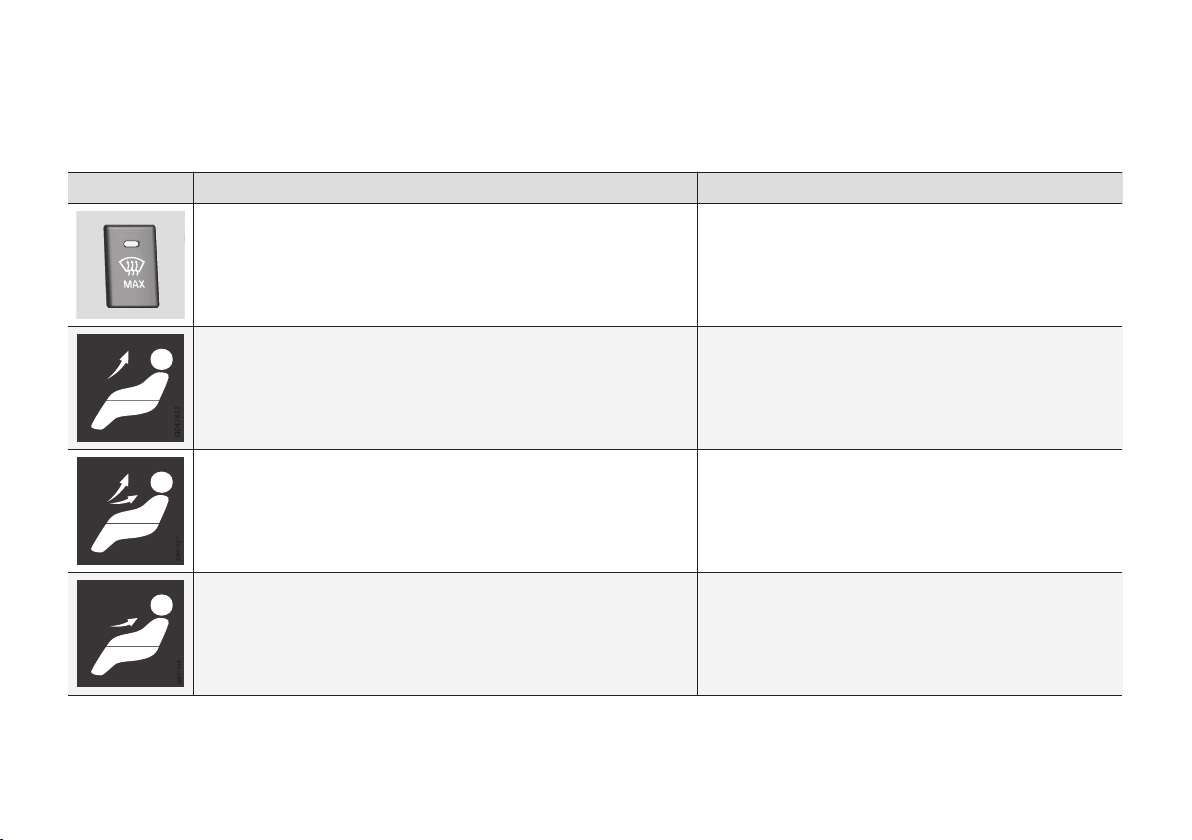
CLIMATE CONTROL
132
Air distribution - table
Three buttons are used to select the distribution
(p. 123) of the air.
Air distribution Use
Air to windows. Some air flows from the air vents. The air is not recircula-
ted. Air conditioning is always engaged.
to remove ice and misting quickly.
Air to windscreen, via defroster vent, and side windows. Some air flows
from the air vents.
to avoid misting and icing in a cold and humid climate (to
achieve this the fan level must not be too low).
Airflow to windows and from dashboard air vents. to ensure good comfort in warm, dry weather.
Airflow to the head and chest from dashboard air vents. to ensure efficient cooling in warm weather.
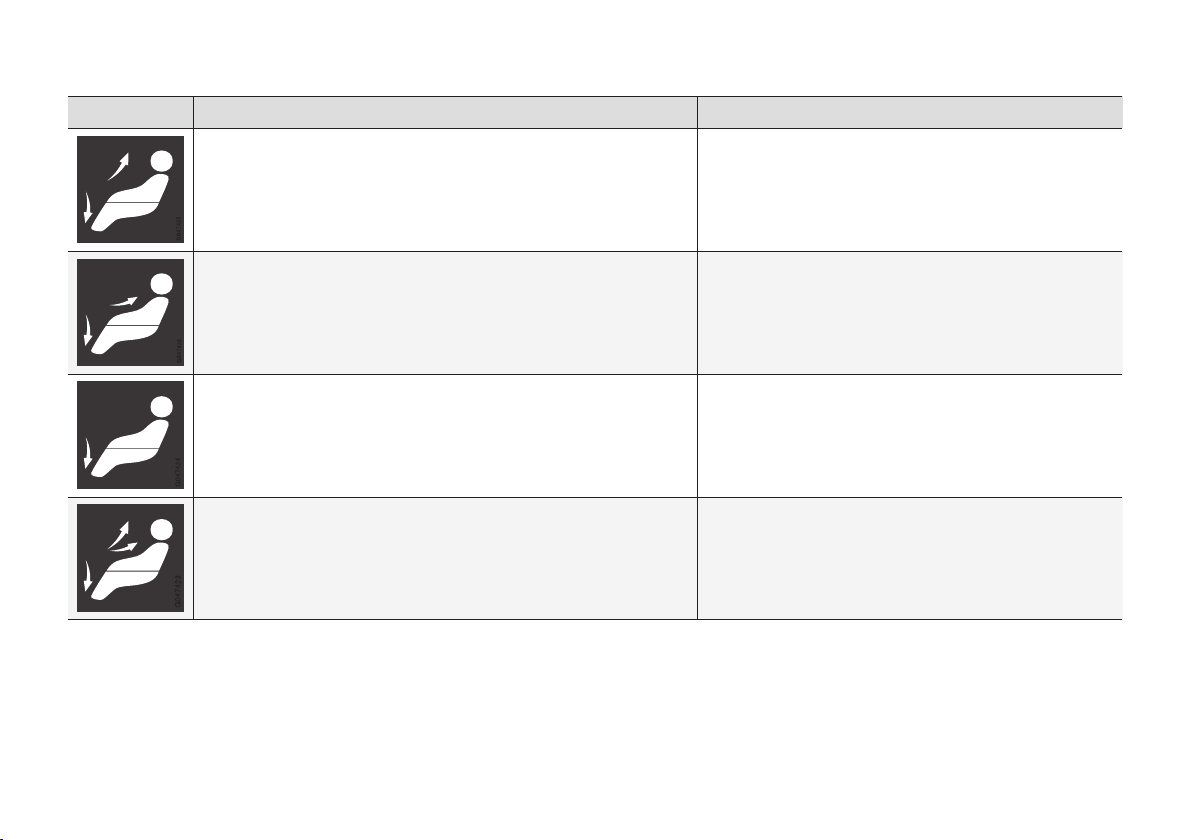
CLIMATE CONTROL
133
Air distribution Use
Air to the floor and windows. Some air flows from the dashboard air
vents.
to ensure comfortable conditions and good demisting in cold
or humid weather.
Air to floor and from dashboard air vents. in sunny weather with cool outside temperatures.
Air to floor. Some air flows to the dashboard air vents and windows. to direct heat or cold to the floor.
Airflow to windows, from dashboard air vents and to the floor. to provide cooling along the floor in hot, dry weather or warm-
ing upwards in cold weather.
Related information
•
General information on climate control
(p. 120)
•
Air distribution - recirculation (p. 131)
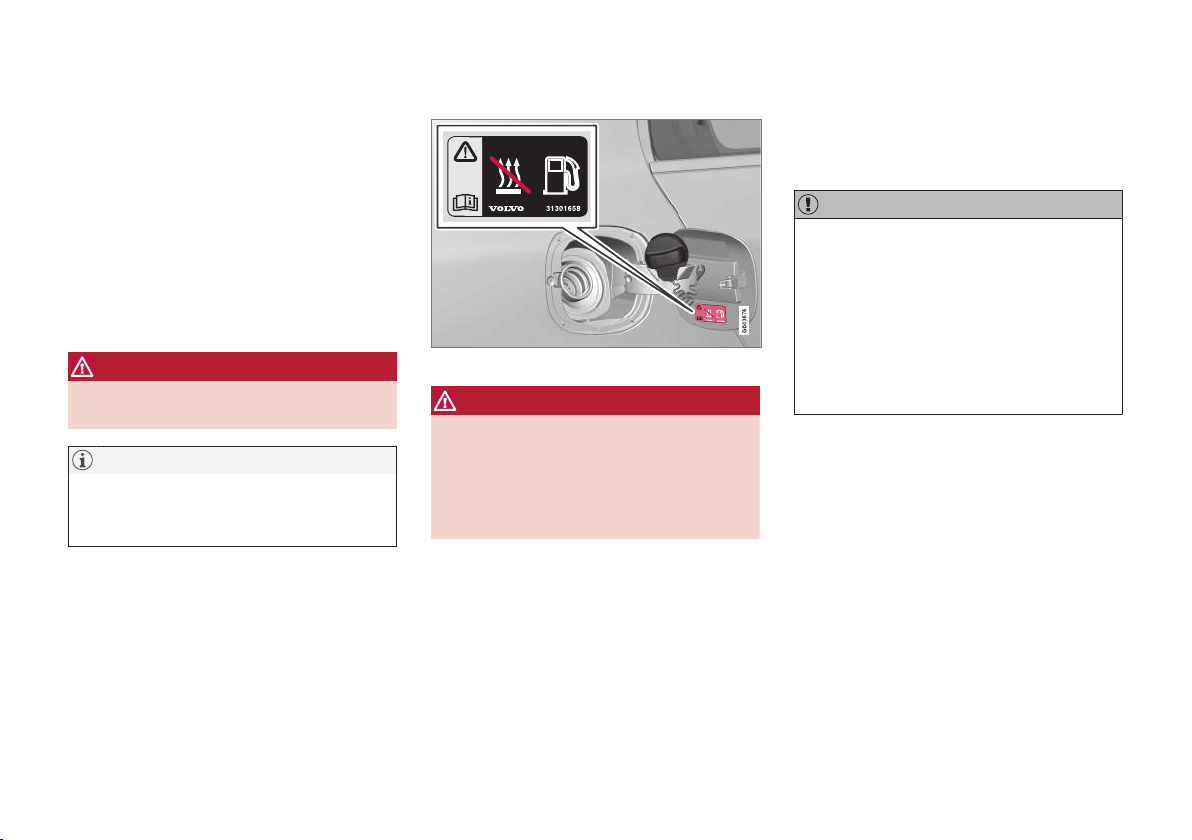
CLIMATE CONTROL
* Option/accessory.
134
Engine block heater and passenger
compartment heater*
Preconditioning prepares the heater, engine and
passenger compartment before departure so
that both wear and energy needs during the jour-
ney are reduced.
The heater can be started directly (p. 135) or
with a timer (p. 136).
The heater cannot start if the outside tempera-
ture exceeds 15 °C. The heater's maximum run-
ning time is 50 minutes.
WARNING
Do not use the fuel-driven heater indoors.
Exhaust gases are secreted.
NOTE
When the fuel-driven auxiliary heater is active
there may be smoke from the right-hand
wheel housing, which is perfectly normal.
Refuelling
Warning label on fuel filler flap.
WARNING
Fuel which spills out could be ignited. Switch
off the fuel-driven auxiliary heater before star-
ting to refuel.
Check in the combined instrument panel that
the heater is switched off. The heat symbol is
shown when it is operating.
Parking on a hill
If the car is parked on a steep hill, the front of the
car should point downhill to ensure that there is a
supply of fuel to the fuel-driven heater.
Battery and fuel
If the battery has insufficient charge or the fuel
level is too low, the heater will be switched off
automatically and a message appears on the
information display. Acknowledge the message
by pressing the indicator stalk (p. 106) OK but-
ton once.
IMPORTANT
Repeated use of the heater combined with
short journeys leads to the battery discharg-
ing and consequential starting problems.
The car should be driven for the same time as
the heater is used to ensure that the car's
battery is recharged adequately to replace the
energy consumed by the heater when it is
used on a regular basis. The heater is used
for a maximum of 50 minutes each time.
Related information
•
Engine block heater and passenger compart-
ment heater* - messages (p. 138)
•
Additional heater* (p. 140)

CLIMATE CONTROL
* Option/accessory.
135
Engine block heater and passenger
compartment heater* - direct start
The engine block heater and passenger com-
partment heater can be started directly.
Direct start can be performed via:
•
information display
•
remote control key*
•
mobile*.
Upon direct start of the engine block and pas-
senger compartment heater (p. 134), it will run
for 50 minutes.
Heating of the passenger compartment will begin
as soon as the engine coolant has reached the
correct temperature.
NOTE
The car can be started and driven while the
heater is running.
Direct start via the information display
1.
Press OK to access the menu.
2.
Scroll with the thumbwheel to
Parking
heater and select with OK.
3.
Scroll forward in the next menu to
Direct
start in order to activate the heater and
select with OK.
4.
Exit the menu with RESET.
Direct start via the remote control key*
Indicator lamp on remote control key with PCC*.
The engine block heater and passenger compart-
ment heater can be activated via the remote con-
trol key:
–
Hold the button for approach lighting
depressed for 2 seconds.
Hazard warning flashers provide information
in accordance with the following:
•
5 short flashes followed by a constant
glow for approx. 3 seconds - the signal
has reached the car and the heater has
been activated.
•
5 short flashes - the signal has reached
the car but the heater has not been acti-
vated.
•
Hazard warning flashers remain switched
off - the signal has not reached the car.
If the button for information
is depressed
when the heater is active then the indicator lamp
will show the status for this - at the same time
the car's lock status (p. 159) is shown. While the
status is being investigated the indicator lamp
emits a pair of short flashes followed by a con-
stant glow if the heater is active.
Status is also shown in the trip computer during
heating.
Direct start via app*
Activation and information on selected settings
are available via the Volvo On Call* app.
Related information
•
Engine block heater and passenger compart-
ment heater* - timer (p. 136)
•
Engine block heater and passenger compart-
ment heater* - immediate stop (p. 136)
•
Engine block heater and passenger compart-
ment heater* - messages (p. 138)
CLIMATE CONTROL
* Option/accessory.
136
Engine block heater and passenger
compartment heater* - immediate
stop
The engine block heater and passenger com-
partment heater can be deactivated directly via
the information display.
1.
Press OK to access the menu.
2.
Scroll with the thumbwheel to
Parking
heater and select with OK.
3.
Scroll forward in the next menu to
Stop in
order to deactivate the heater and select with
OK.
4.
Exit the menu with RESET.
Related information
•
Engine block heater and passenger compart-
ment heater* - direct start (p. 135)
•
Engine block heater and passenger compart-
ment heater* - timer (p. 136)
•
Engine block heater and passenger compart-
ment heater* - messages (p. 138)
Engine block heater and passenger
compartment heater* - timer
The timer of the engine block and passenger
compartment heater (p. 134) is connected to
the car's clock.
Two different times can be selected using the
timer. Here, time refers to the time when the car
is heated and ready. The car's electronic system
calculates when heating should be started based
on the outside temperature.
NOTE
All timer programming will be cleared if the
car's clock is reset.
Adjusting
3
1.
Press OK to access the menu.
2. Use the thumbwheel (p. 106) to scroll to one
of the timers
Parking heater and select
with OK.
3. Select one of the two timers using the
thumbwheel and confirm with OK.
4.
Briefly press OK to move to the lit hours set-
ting.
5. Select the required hour using the thumb-
wheel.
6.
Briefly press OK to move to the flashing
minutes setting.
7. Select the required minute using the thumb-
wheel.
8.
Press OK
4
to confirm the setting.
9.
Go back in the menu structure using RESET.
10. Select the other time (continue from step 2)
or exit the menu with RESET.
Starting
1.
Press OK to access the menu.
2.
Scroll with the thumbwheel to
Parking
heater and select with OK.
3. Select one of the two timers using the
thumbwheel and activate with OK.
4.
Exit the menu with RESET.
Switching off
A timer-started heater can be switched off man-
ually before the set time has elapsed. Proceed as
follows:
1.
Press OK to access the menu.
2.
Scroll with the thumbwheel to
Parking
heater and select with OK.
> If a timer is set but not activated then a
clock icon is shown beside the set time.
3
Setting the timer is only possible with the engine switched off.
4
Press OK again to activate the timer.

CLIMATE CONTROL
* Option/accessory.
137
3. Select one of the two timers using the
thumbwheel and confirm with OK.
4. Deactivate the timer as follows:
•
long press on OK or
•
short press on OK to continue in the
menu. Then select to stop the timer and
confirm with OK.
5.
Exit the menu with RESET.
A timer-started heater can be switched off
directly (p. 136).
Related information
•
Engine block heater and passenger compart-
ment heater* - messages (p. 138)
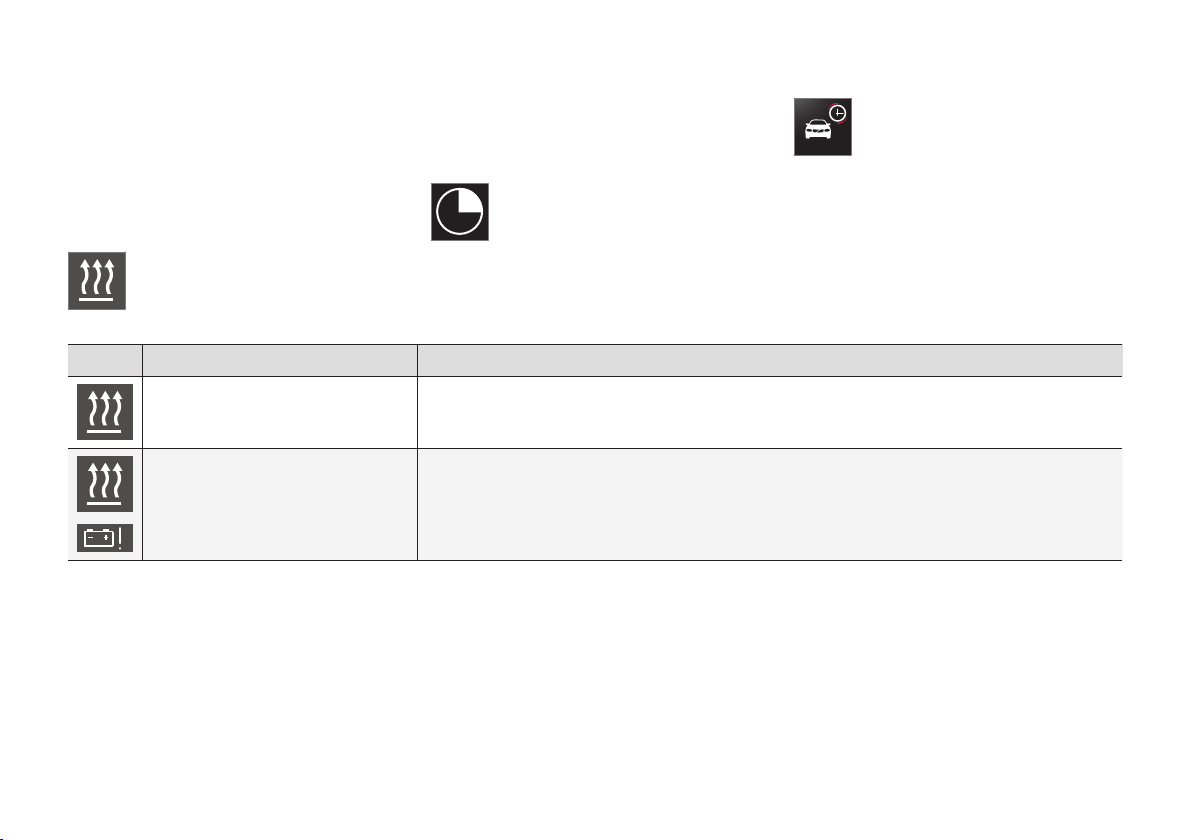
CLIMATE CONTROL
* Option/accessory.
138
Engine block heater and passenger
compartment heater* - messages
Symbols and display messages regarding the
engine block and passenger compartment
heater (p. 134) differ depending on whether the
combined instrument panel (p. 62) is analogue
or digital.
When the heater has been activated
the heat symbol illuminates in the
information display.
When one of the timers has been activated, the
symbol for activated timer illuminates in the dis-
play at the same time as the set time is shown
next to the symbol.
Symbol for activated timer in analogue
combined instrument panel.
Symbol for activated timer in digital
combined instrument panel.
The table shows symbols and display texts that
appear.
Symbol Message Specification
The heater is switched on and running.
Fuel operated heater stopped Bat-
tery saving mode
The heater has been stopped by the car's electronics in order to facilitate starting the engine.
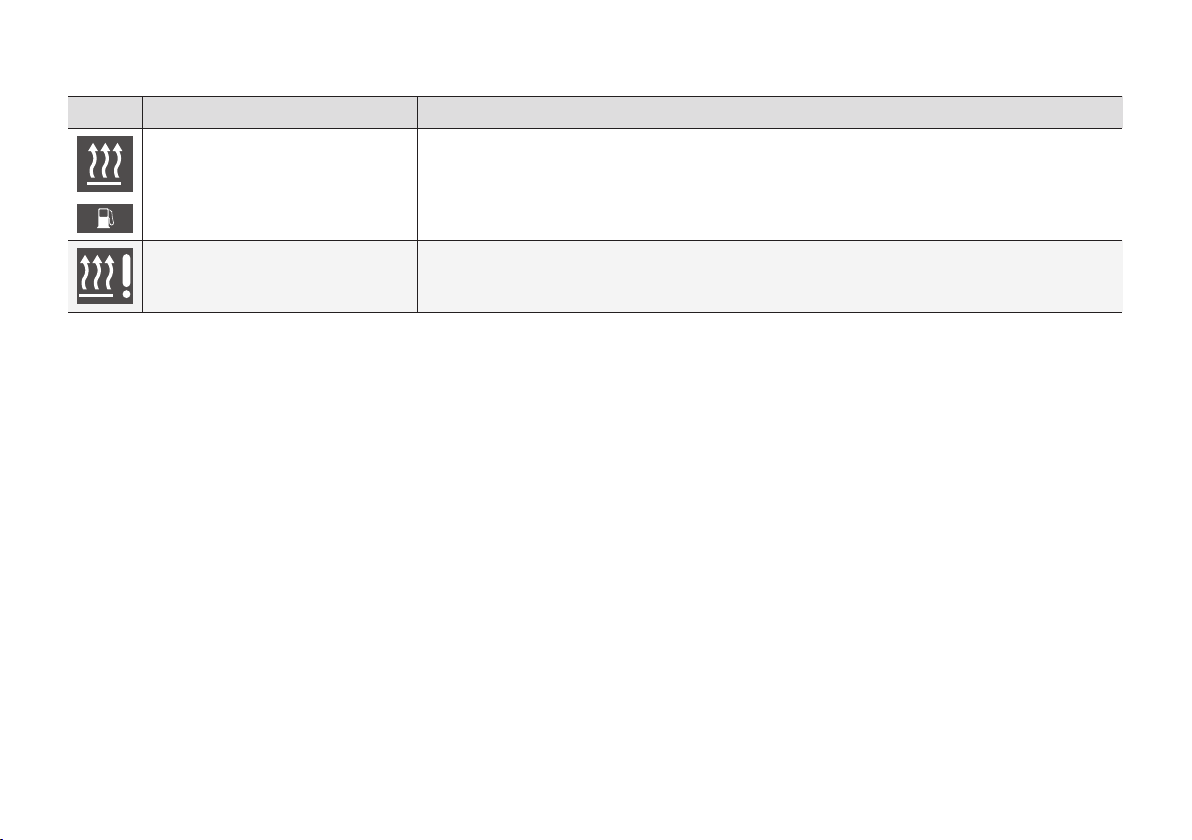
CLIMATE CONTROL
139
Symbol Message Specification
Fuel operated heater stopped Low
fuel level
Starting the heater is not possible due to fuel level being too low - this is in order to facilitate starting
the engine as well as approx. 50 km driving.
Fuel operated heater Service
required
Heater not working. Contact a workshop for repair. Volvo recommends that you contact an authorised
Volvo workshop.
A display text clears automatically after a time or
after one press on the indicator stalk (p. 106) OK
button.

CLIMATE CONTROL
* Option/accessory.
140
Additional heater*
In cold climate zones
5
an additional heater may
be required to obtain the correct operating tem-
perature in the engine and to obtain sufficient
heating in the passenger compartment.
A fuel-driven additional heater (p. 140) is fitted
in cars with diesel engines.
In a semi-cold
5
climate zone diesel-driven cars
have an electric additional heater (p. 141)
instead of a fuel-driven version.
Cars with certain petrol engines
6
have an electric
additional heater integrated into the car's climate
control system.
Related information
•
Engine block heater and passenger compart-
ment heater* (p. 134)
Fuel-driven additional heater*
The car is equipped with either an electric
(p. 141) or a fuel-driven additional heater
(p. 140).
The heater starts automatically when extra heat is
required when the engine is running.
The heater is switched off automatically when the
correct temperature is reached or when the
engine is switched off.
NOTE
When the additional heater is active there
may be smoke from the right-hand wheel
housing, which is perfectly normal.
Auto mode or shutdown
The additional heater's automatic start sequence
can be switched off if required.
NOTE
Volvo recommends that the fuel-driven addi-
tional heater should be switched off for short
distances.
1. Before starting the engine: Select key posi-
tion I (p. 77).
2.
Press OK to access the menu.
3.
Scroll with the thumbwheel to
Additional
heater
7
or
Settings
8
and select with OK.
4.
Select one of the options
ON or OFF using
the thumbwheel and confirm with OK.
5.
Exit the menu with RESET.
NOTE
The menu options are only visible in key posi-
tion I - any adjustments must therefore be
made before starting the engine.
Passenger compartment heater*
If the additional heater is supplemented with a
timer function then it can be used as a passen-
ger compartment heater (p. 134).
5
An authorised Volvo dealer has information regarding the geographical areas concerned.
6
An authorised Volvo dealer has information regarding the engines concerned.
7
Analogue combined instrument panel.
8
Digital combined instrument panel.

CLIMATE CONTROL
* Option/accessory.
141
Electric additional heater*
The car is equipped with either a fuel-driven
(p. 140) or an electric additional heater (p. 140).
The heater cannot be controlled manually, but is
instead activated automatically after the engine
has been started in outside temperatures below
14 °C and is switched off after the set passenger
compartment temperature has been reached.
Related information
•
Engine block heater and passenger compart-
ment heater* (p. 134)


LOADING AND STORAGE

LOADING AND STORAGE
144
Storage spaces
Overview of storage spaces in the passenger
compartment.

LOADING AND STORAGE
* Option/accessory.
145
Storage compartment in door panel
Storage pocket* on front edge of front seat
cushions
Ticket clip
Glovebox (p. 146)
Storage compartment
Storage compartment, cup holder (p. 146)
Cup holder* in armrest, rear seat
Storage pocket
WARNING
Keep loose objects such as mobile phones,
cameras, remote controls for accessories, etc.
in the glove compartment or other compart-
ments. Otherwise they may injure people in
the car in the event of sudden braking or a
collision.
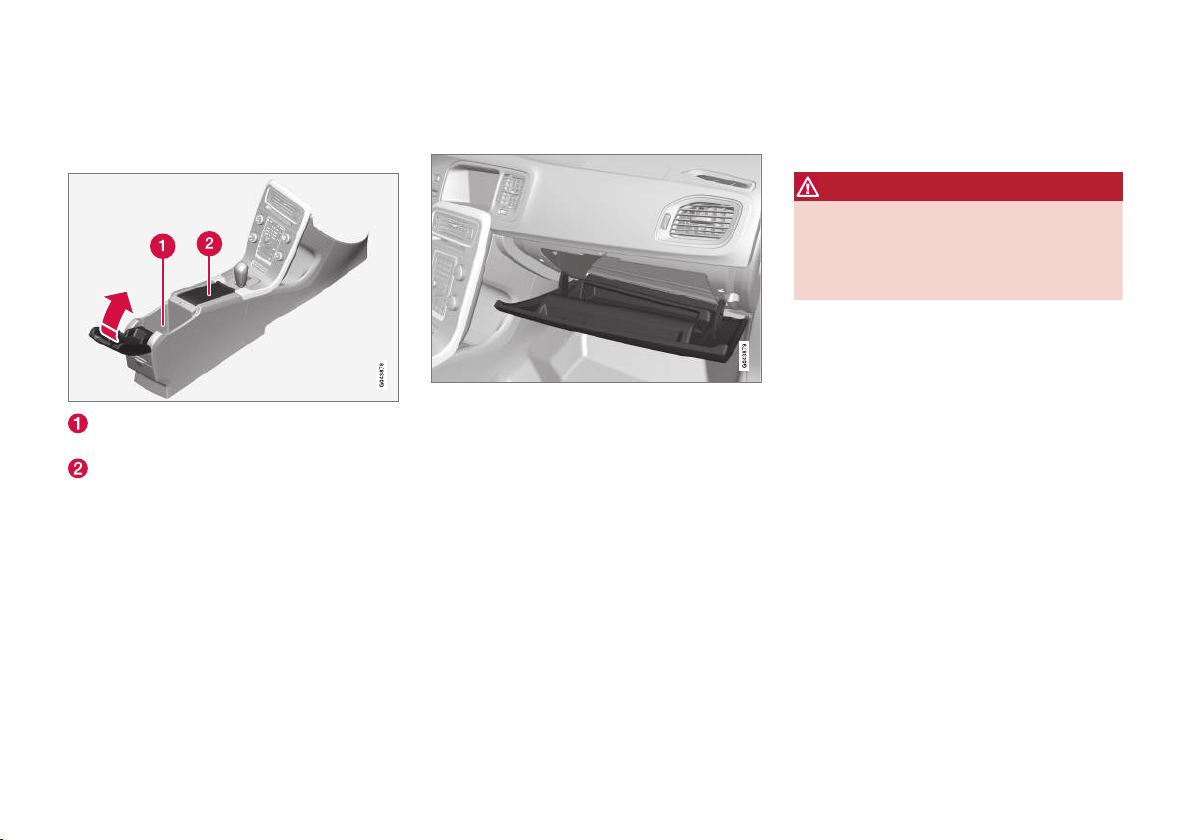
LOADING AND STORAGE
* Option/accessory.
146
Tunnel console
The tunnel console is located between the front
seats.
Storage compartment (e.g. for CDs) and
USB*/AUX input under the armrest.
Includes cup holder for driver and passenger.
Related information
•
Storage spaces (p. 144)
Glovebox
The glovebox is located on the passenger side.
The owner's manual and maps can be kept in
here for example. There are also holders for pens
on the inside of the lid. The glovebox can be
locked* (p. 173) using the key blade (p. 161).
Related information
•
Storage spaces (p. 144)
Inlaid mats*
Inlay mats collect e.g. rubbish and slush. Volvo
supplies specially manufactured inlay mats.
WARNING
Only use one inlaid mat at each seat, and
check before setting off that the mat by the
driver's seat is firmly affixed and secured in
the pins so that it does not get caught adja-
cent to and under the pedals.
Related information
•
Cleaning the interior (p. 394)
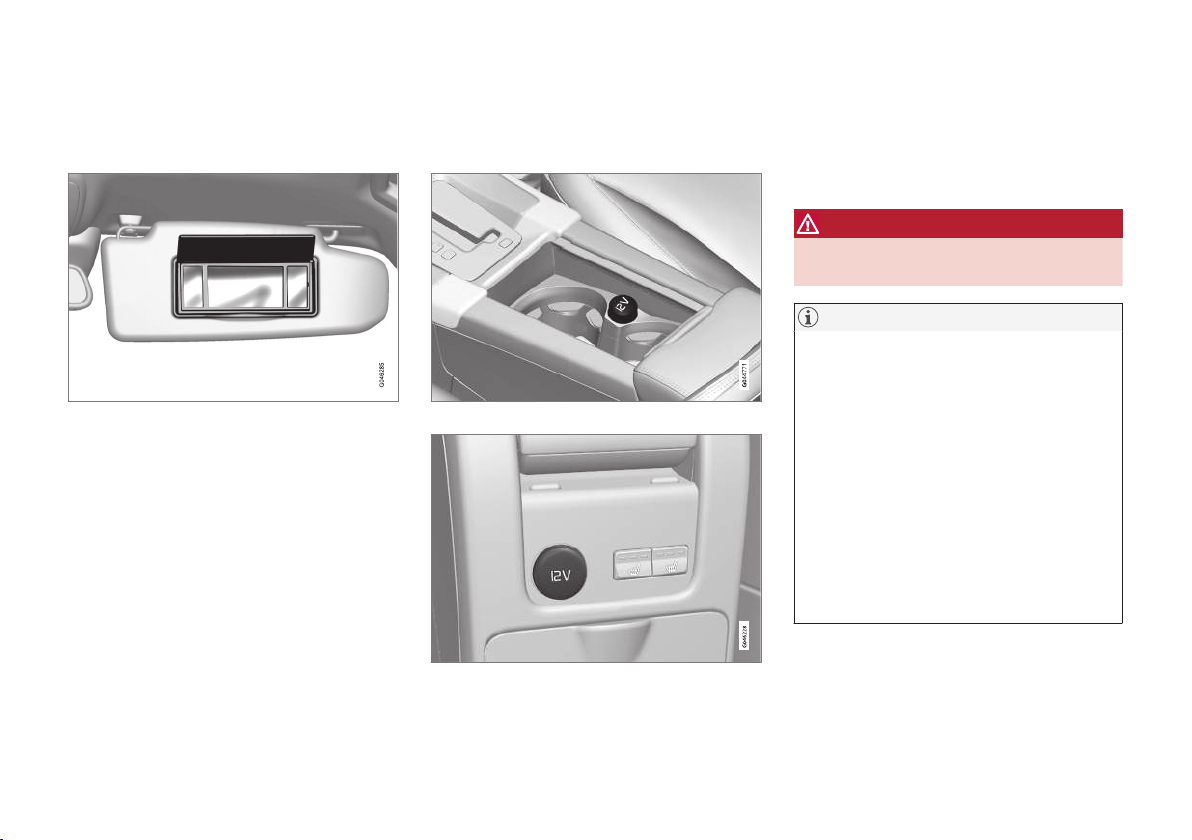
LOADING AND STORAGE
}}
147
Vanity mirror
The vanity mirror is located on the rear of the sun
visor.
Vanity mirror with lighting.
The light illuminates automatically when the cover
is lifted.
Related information
•
Lamp replacement - vanity mirror lighting
(p. 366)
Tunnel console - 12 V-sockets
The electrical sockets (12 V) are located next to
the cup holder and rear of the tunnel console.
12 V socket in tunnel console, front seat.
12 V socket in tunnel console, rear seat.
The electrical socket can be used for various
accessories designed for 12 V, e.g. TV screens,
music players and mobile phones. For the socket
to supply current, the remote control key must be
in at least key position I (p. 77).
WARNING
Always leave the plug in the socket when the
socket is not in use.
NOTE
Optional equipment and accessories - e.g.
display screens, music players and mobile
phones - which are connected to one of the
passenger compartment's 12V electrical
sockets, could be activated by the climate
control system, even when the remote control
key has been removed or when the car is
locked, for example, when the parking heater
is activated at a preset time.
For this reason remove the plugs from the
electrical sockets for optional equipment or
accessories when not in use because the bat-
tery could be drained in the event of such an
occurrence!
||
LOADING AND STORAGE
* Option/accessory.
148
IMPORTANT
Max. socket is 10 A (120 W) if one socket is
used at a time. If both sockets in the tunnel
console are used simultaneously, 7.5 A (90
W) per socket is applicable.
If the compressor for emergency puncture
repair is connected to one of the two sockets,
no other current consumer must be con-
nected to the other one.
NOTE
The compressor for emergency puncture
repair (p. 339) has been tested and approved
by Volvo.
Related information
•
12 V electrical socket, cargo area* (p. 151)
Loading
Payload depends on the car's kerb weight.
The total of the weight of the passengers and all
accessories reduces the car's payload by a cor-
responding weight.
For more detailed information on weights, see
Weights (p. 404).
The boot lid is opened via a button on
the lighting panel or the remote control
key, see Locking/unlocking - boot lid
(p. 173).
WARNING
The car’s driving properties change depend-
ing on the weight and positioning of the load.
To bear in mind when loading
•
Position the load firmly against the rear
seat's backrest.
Note that objects must not prevent the function
of the WHIPS system for the front seats if any of
the rear seat's backrests is folded down, see
WHIPS - seating position (p. 40).
•
Centre the load.
•
Heavy objects should be placed as low as
possible. Avoid placing heavy loads on low-
ered backrests.
•
Cover sharp edges with something soft to
avoid damaging the upholstery.
•
Secure all loads to the load retaining eyelets
with straps or web lashings.
WARNING
A loose object weighing 20 kg (44 pounds)
can, in a frontal collision at a speed of
50 km/h (30 mph) carry the impact of an
item weighing 1000 kg (2200 pounds).
WARNING
The protection provided by the inflatable cur-
tain in the headlining may be compromised or
eliminated by high loads.
•
Never load cargo above the backrest.
WARNING
Always secure the load. During heavy braking
the load may otherwise shift, causing injury to
the car's occupants.
Cover sharp edges and sharp corners with
something soft.
Switch off the engine and apply the parking
brake when loading/unloading long items.
Otherwise you may accidentally knock the
gear lever or gear selector with the load into a
drive position - and the car could then move
off.

LOADING AND STORAGE
* Option/accessory.
149
Related information
•
Load retaining eyelets (p. 150)
•
Loading - long load (p. 149)
•
Roof load (p. 149)
Loading - long load
To simplify loading (p. 148) in the cargo area,
the rear seat backrest can be folded down. The
passenger seat
1
backrest can also be folded*
for an extra long load.
Lowering the rear seat backrest
If the rear seat backrest needs to be lowered, see
Seats, rear (p. 81).
Hatch
When transporting long, narrow objects, the
hatch behind the armrest in the rear seat can be
folded forward.
Roof load
The load carriers recommended for roof loads
are the ones developed by Volvo. This is in order
to avoid damage to the car and in order to
achieve the maximum possible safety during a
journey.
Carefully follow the installation instructions sup-
plied with the carriers.
•
Check periodically that the load carriers and
load are properly secured. Lash the load
securely with retaining straps.
•
Distribute the load evenly over the load carri-
ers. Put the heaviest objects at the bottom.
•
The size of the area exposed to the wind, and
therefore fuel consumption, increase with the
size of the load.
•
Drive gently. Avoid quick acceleration, heavy
braking and hard cornering.
WARNING
The car's centre of gravity and driving charac-
teristics are altered by roof loads.
For information about the maximum permitted
load on the roof, including load carriers and
any space box, see Weights (p. 404).
Related information
•
Loading (p. 148)
1
Only applies to comfort seats.
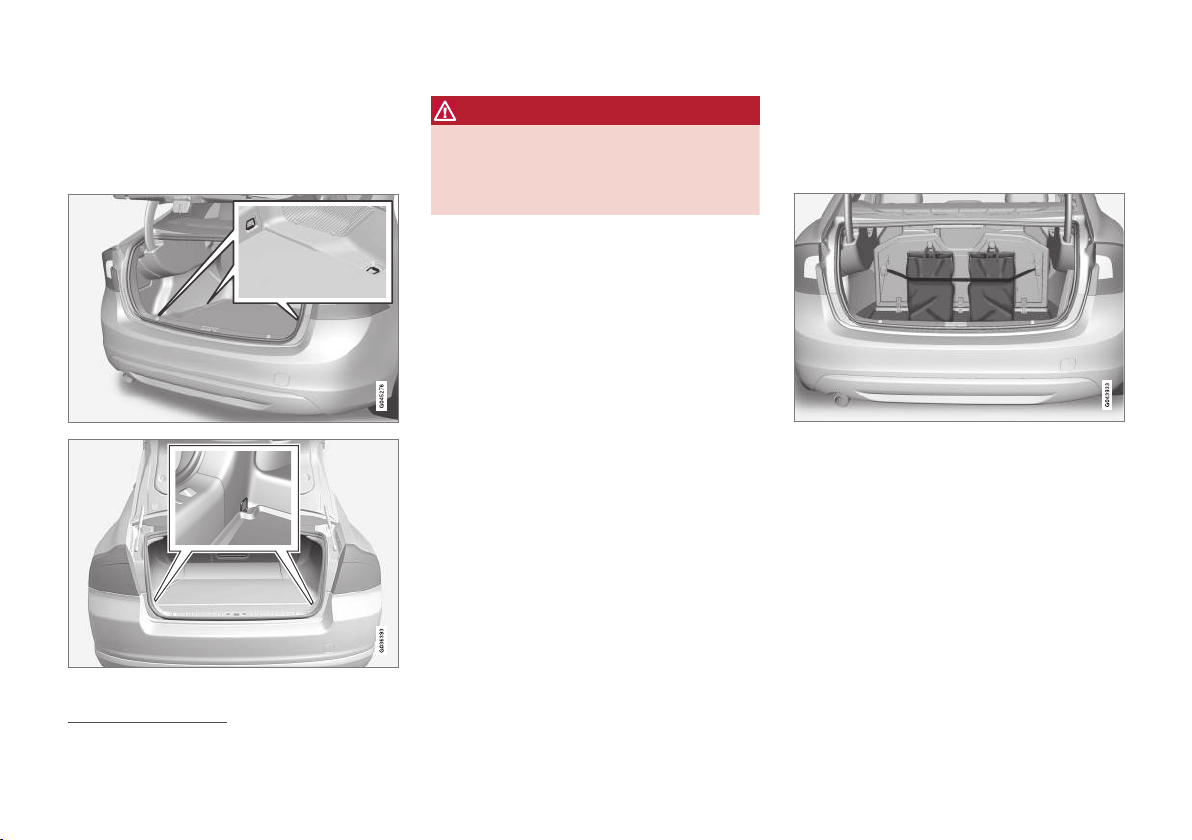
LOADING AND STORAGE
* Option/accessory.
150
Load retaining eyelets
The folding load retaining eyelets
2
are used to
fasten straps in order to anchor items in the
cargo area.
WARNING
Hard, sharp and/or heavy objects which pro-
trude may cause injury under violent braking.
Always secure large and heavy objects with a
seatbelt or cargo retaining straps.
Related information
•
Loading (p. 148)
Loading - bag holder*
The bag holder keeps carrier bags in place and
prevents them from overturning and spreading
their contents across the cargo area.
Bag holder under folding hatch in the floor.
1. Fold up the holder, which is part of the floor
hatch.
2. Fasten the bags with strap and secure the
carrying handle in the hooks.
Related information
•
Loading (p. 148)
2
Number of eyes and their locations varies depending on market.
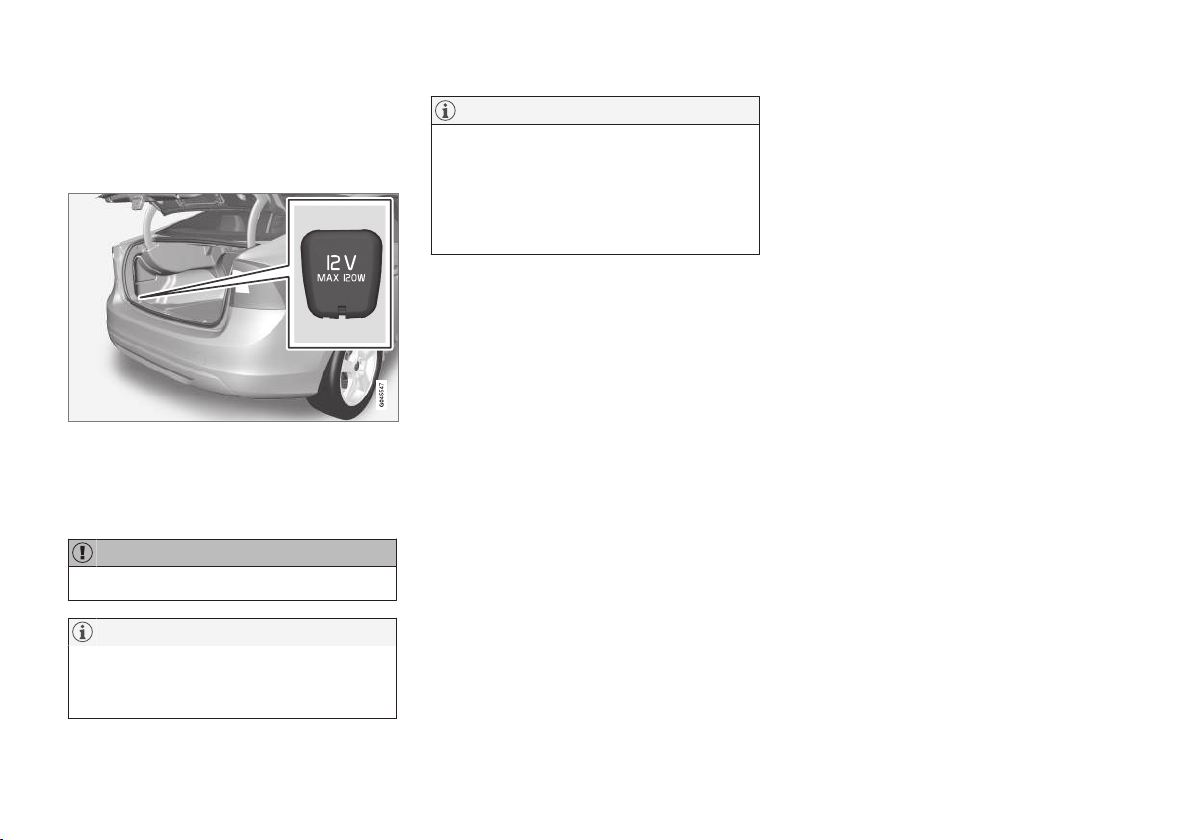
LOADING AND STORAGE
* Option/accessory.
151
12 V electrical socket, cargo area*
The electrical socket can be used for various
accessories designed for 12 V, e.g. screens,
music players and mobile phones.
Raise the cover to access the electrical socket.
•
The socket also provides voltage when the
remote control key is not in the ignition
switch.
IMPORTANT
Max. power takeoff is 10 A (120 W).
NOTE
Remember that using the electrical socket
with the engine switched off involves the risk
of discharging the car's starter battery.
NOTE
The compressor for temporary emergency
puncture repair has been tested and
approved by Volvo. For information on the use
of Volvo's recommended temporary emer-
gency puncture repair (TMK), see Emergency
puncture repair (p. 339).


LOCKS AND ALARM
LOCKS AND ALARM
* Option/accessory.
154
Remote control key
Amongst other things, the remote control key is
used for locking/unlocking and starting the
engine.
There are two variants of remote control key -
Remote control key in basic version and Remote
control key with PCC (Personal Car
Communicator)*.
Functionality
Basic
A
with
PCC
B
Locking/unlocking and
detachable key blade
x x
Keyless locking/unlock-
ing
x
Keyless engine starting x
Information button and
indicator lamps
x
A
5-button key
B
6-button key
Remote control key with PCC has extended func-
tionality compared with the remote control key in
the basic version - e.g. support for keyless star-
ting and locking/unlocking (Keyless Drive
(p. 165)) as well as certain unique functions
(p. 159).
All remote control keys have a detachable key
blade (p. 161) made of metal. The visible section
is available in two versions so that it is possible to
distinguish between the remote control keys.
More remote control keys can be ordered - but
not variants other than the one supplied with the
car. Up to six keys can be programmed and used
for one single car.
The car is supplied with two remote control keys.
WARNING
If there are children in the car:
Remember to switch off the supply to the
power windows and sunroof by removing the
remote control key if the driver leaves the car.
Related information
•
Remote control key - functions (p. 158)
Remote control key - losing
If you lose a remote control key then a new one
can be ordered at a workshop - an authorised
Volvo workshop is recommended.
The remaining remote control keys must be
taken to the Volvo workshop. The code of the
missing remote control key must be erased from
the system as a theft prevention measure.
The current number of keys registered to the car
can be checked in the menu system MY CAR.
For a description of the menu system, see MY
CAR (p. 109).
Related information
•
Remote control key - functions (p. 158)

LOCKS AND ALARM
}}
* Option/accessory.
155
Remote control key -
personalisation*
The key memory in the remote control key
(p. 154) means that certain settings in the car
can be individually adapted for different people.
The key memory function is available in combina-
tion with, for example, power* driver's seat.
Settings for door mirrors (p. 100), driver's seat,
steering force (p. 182) and the combined instru-
ment panel's theme, contrast and colour mode
(p. 63) can be stored in the memory, depending
on the car's equipment level.
The function
1
can be activated/deactivated in the
menu system MY CAR. For a description of the
menu system, see MY CAR (p. 109).
When the function is activated, the settings are
automatically linked to the key memory. This
means that a change in a setting will automati-
cally be saved to the specific remote control key's
memory.
Storing settings
Proceed as follows in order to store the settings
and use the key memory in the remote control
key:
1. Unlock the car with the remote control key in
whose memory the setting
2
shall be stored.
2. Make sure that the key memory function is
activated in the menu system MY CAR.
3. Make the desired settings for e.g. the seat
and the door mirrors.
4. The settings are stored in the current remote
control key's memory.
The next time the car is unlocked with the same
remote control key, the positions that are stored
in the key memory will be set automatically - pro-
viding that they have been changed since the last
time the current remote control key was used.
Emergency stop
If the seat accidentally begins to move, press one
of the setting buttons for the seat or memory
buttons in order to stop the seat.
Restarting to reach the seat position stored in
the key memory is performed by pressing the
unlock button on the remote control key. The
driver's door must then be open.
WARNING
Risk of crushing! Make sure that children do
not play with the controls. Check that there
are no objects in front of, behind or under the
seat during adjustment. Make sure that none
of the passengers in the rear seat is in danger
of becoming trapped.
Changing settings
If several people each with a remote control key
approach the car, then the settings for e.g. seat
and door mirrors are implemented for the person
whose remote control key unlocks the driver's
door.
If the driver's door has been opened by person A
with remote control key A, but person B with
remote control key B shall drive, then the settings
can be changed as follows:
•
Standing by the driver's door, or sitting
behind the steering wheel, person B presses
the button for unlocking on his/her remote
control key, see Remote control key - func-
tions (p. 158).
•
Select one of three possible memories for
seat adjustment with seat button 1-3, see
Seats, front - electrically operated* (p. 80).
•
Adjust seat and door mirrors manually, see
Seats, front - electrically operated* (p. 80)
and Door mirrors (p. 100).
1
Called
Car key memory in MY CAR.
2
This setting does not affect settings that have been stored in the power seat's memory function.
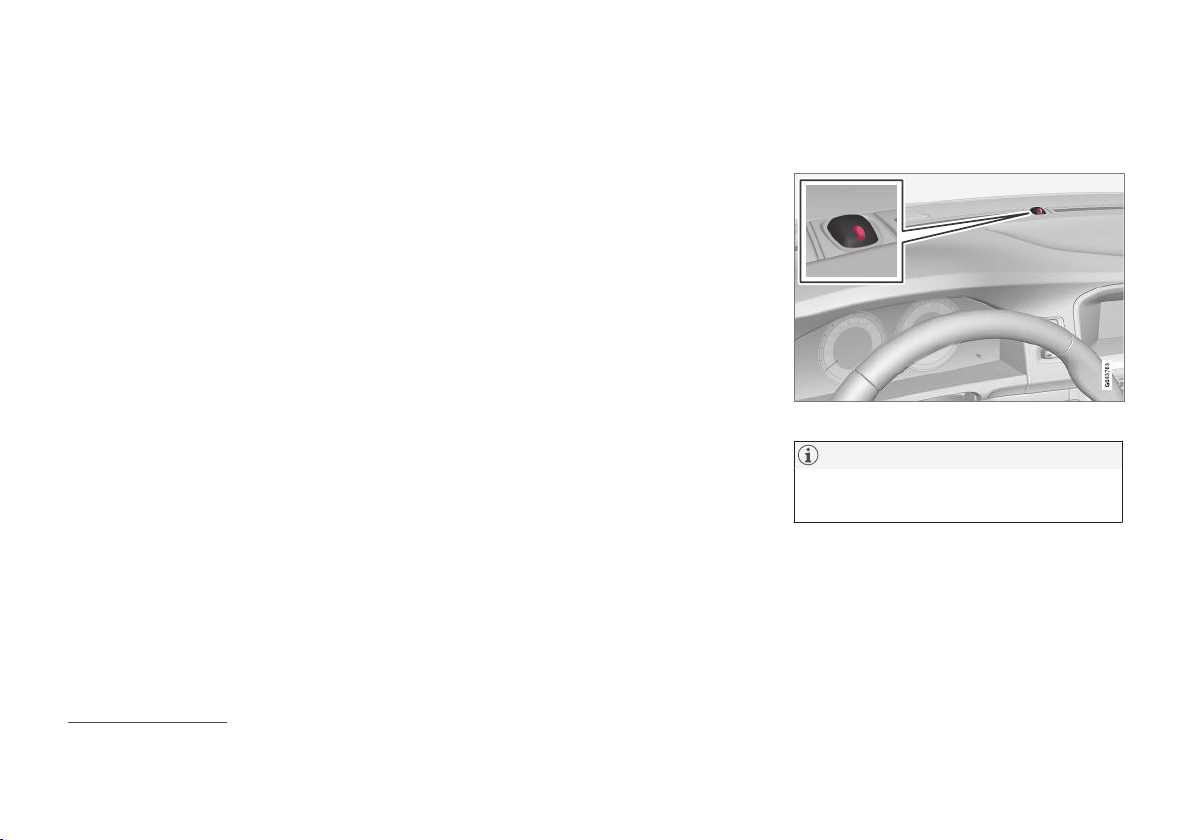
||
LOCKS AND ALARM
* Option/accessory.
156
Reactivation of settings
When the car is locked or after 30 minutes if the
car is left unlocked, the key memory will be deac-
tivated and a standard driver profile will be set. To
reactivate the key memory for the current remote
control key, the following is required.
For cars without keyless start and lock
system
The settings that are stored in the key memory
are activated if the car is unlocked by pressing
the remote control key's unlock button.
For cars with keyless start and lock system
The key memory is activated if:
1. The car is unlocked either by pressing the
remote control key's unlock button or via
keyless unlocking.
2. If the car is unlocked, a key scan is made
when the driver's door is opened. If a unique
remote control key is found, its stored set-
tings will be activated. If the car is locked,
see the previous point.
Related information
•
Remote control key with PCC* - unique func-
tions (p. 159)
Locking/unlocking - indicator
When the car is locked or unlocked using the
remote control key (p. 154) the direction indica-
tors confirm that locking/unlocking was correctly
performed.
•
Locking - one flash and the door mirrors are
folded
3
in.
•
Unlocking - two flashes and the door mirrors
are folded
3
out.
After locking the indication is only given if all
locks are activated once the doors have been
closed.
Selecting the function
Different options for indicating locking/unlocking
with light can be set in the car's menu system
MY CAR. For a description of the menu system,
see MY CAR (p. 109).
Related information
•
Keyless drive* (p. 165)
•
Lock indicator (p. 156)
•
Alarm indicator* (p. 178)
Lock indicator
A flashing LED by the windscreen verifies that
the car is locked.
Same LED as alarm indicator (p. 178).
NOTE
Cars that are not equipped with alarm also
have this indicator.
Related information
•
Locking/unlocking - indicator (p. 156)
3
Only for cars with retractable power door mirrors.

LOCKS AND ALARM
* Option/accessory.
157
Immobiliser
The electronic immobiliser is a theft protection
system that prevents an unauthorised person
from starting the car.
Each remote control key (p. 154) has a unique
code. The car can only be started with the correct
remote control key with the correct code.
The following error messages in the combined
instrument panel's information display are related
to the electronic immobiliser:
Message Specification
Insert car
key
Error when reading the remote
control key during starting -
Remove the key from the ignition
switch, press it in again and
make a new start attempt.
Car key
not found
Error reading the remote control
key during starting - Try to start
again.
If the error persists: Insert the
remote key into the ignition
switch and try to start again.
Immobi-
liser Try
to start
again
Error in immobiliser system dur-
ing starting. If the error persists:
Contact a workshop - an author-
ised Volvo workshop is recom-
mended.
For starting the car, see Starting the engine
(p. 270).
Related information
•
Remote-controlled immobiliser with tracking
system* (p. 157)
Remote-controlled immobiliser with
tracking system*
Remote-controlled immobiliser with tracking sys-
tem
4
makes it possible to track and locate the
car, and to remotely activate the immobiliser.
Contact your nearest Volvo dealer for more infor-
mation and assistance with activating the system.
Related information
•
Remote control key (p. 154)
•
Immobiliser (p. 157)
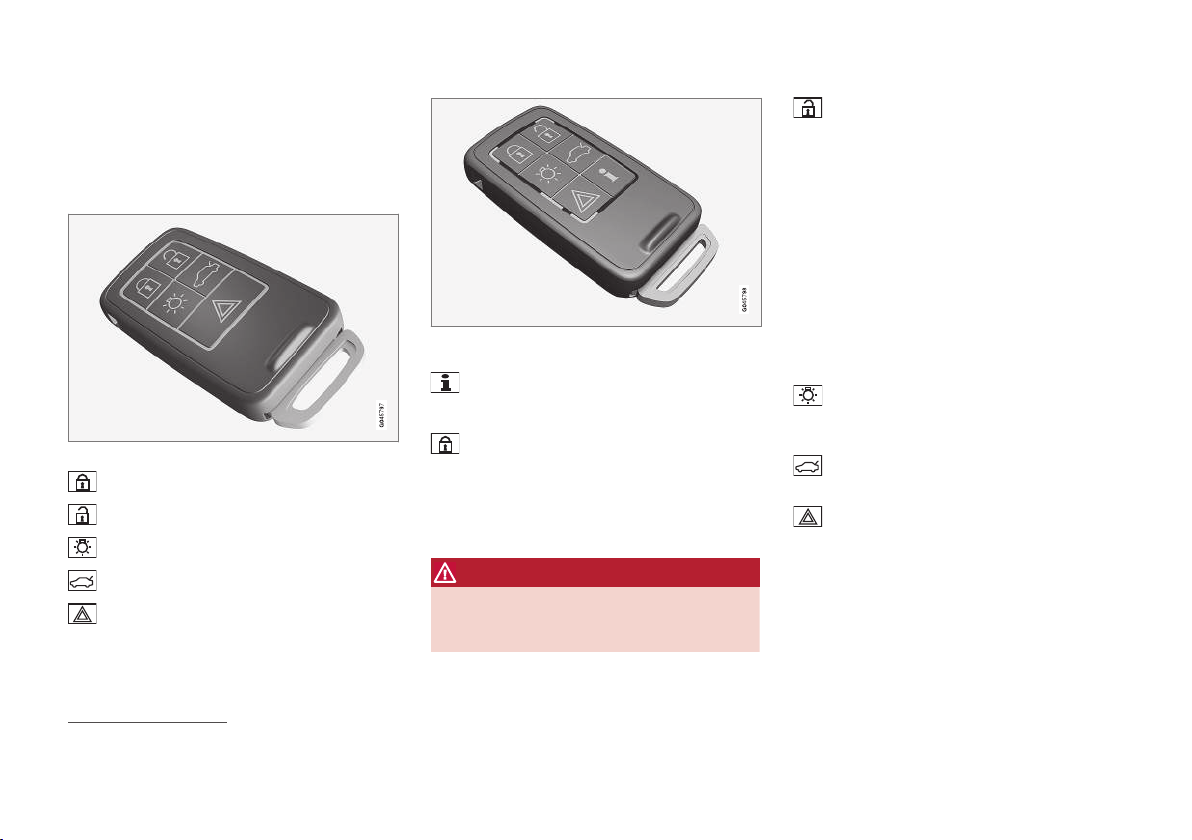
LOCKS AND ALARM
* Option/accessory.
158
Remote control key - functions
The remote control key in basic version has
functions such as locking and unlocking the
doors.
Functions
Remote control key in basic version.
Locking
Unlocking
Approach light duration
Boot lid
Panic function
Remote control key with PCC*( Personal Car
Communicator).
Information
Function buttons
Locking – Locks the doors and boot lid
while the alarm is activated.
Press and hold to close all the windows and sun-
roof* simultaneously. For more information, see
Global opening (p. 172).
WARNING
If the sunroof and windows are closed using
the remote control key, check that nobody's
hands are trapped.
Unlocking – Unlocks the doors and boot lid
while the alarm is deactivated.
Press and hold to open all windows simultane-
ously. For more information, see Global opening
(p. 172).
The function can be changed from unlocking all
doors simultaneously, to unlocking the driver's
door only with one press of the button and, after
a further press of the button - within ten seconds
- unlocking the remaining doors.
The function can be changed in the menu system
MY CAR. For a description of the menu system,
see MY CAR (p. 109).
Approach light duration – Used to switch
on the car's lighting at a distance. For more infor-
mation, see Approach lighting (p. 96).
Boot lid (p. 173) - Unlocks and disarms
the alarm for the boot lid only.
Panic function – Used to attract attention
in an emergency.
Press and hold the button for at least 3 seconds
or press it twice within 3 seconds to activate the
direction indicators and the horn.
The function can be turned off with the same
button once it has been active for at least 5 sec-
onds. Otherwise the function switches off auto-
matically after approx. 3 minutes.
4
Only certain markets and in combination with Volvo On Call*.
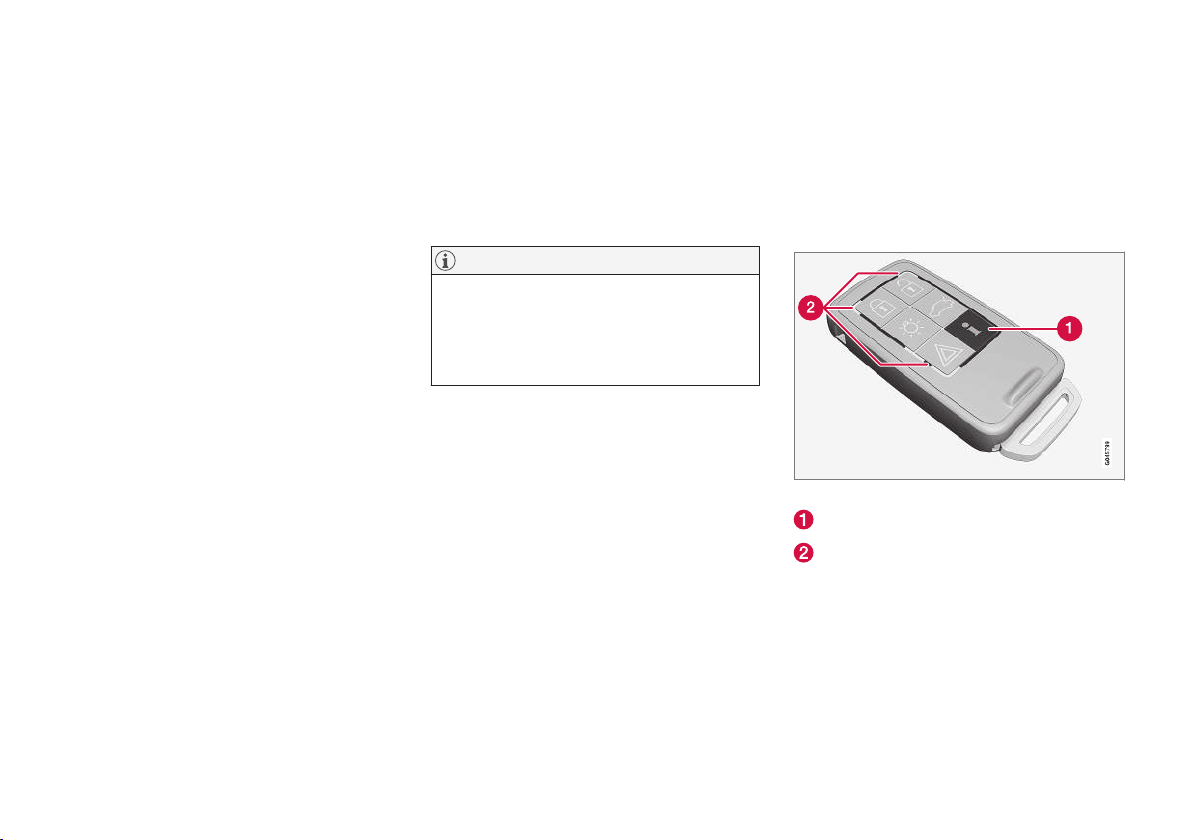
LOCKS AND ALARM
}}
* Option/accessory.
159
Related information
•
Remote control key (p. 154)
•
Remote control key with PCC* - unique func-
tions (p. 159)
•
Locking/unlocking - from the outside
(p. 170)
Remote control key - range
Remote control key functions (in its basic ver-
sion) have a range of approx. 20 metres from
the car.
If the car does not verify a button being pressed -
move closer and try again.
NOTE
The remote control key functions may be dis-
rupted by surrounding radio waves, buildings,
topographical conditions, etc. The car can
always be locked/unlocked with the key blade
(p. 162).
If the remote control key is removed from the car
when the engine is running or key position I or II
(p. 77) is active, and all doors are closed, then a
warning message is shown in the information dis-
play in the combined instrument panel and a
short audio reminder signal sounds at the same
time.
The message extinguishes when the remote con-
trol key is returned to the car, followed by a press
of the OK button, or when all doors are closed.
Related information
•
Remote control key (p. 154)
•
Remote control key - functions (p. 158)
Remote control key with PCC* -
unique functions
A remote control key with PCC (Personal Car
Communicator) has enhanced functionality com-
pared with a remote control key in basic version
(p. 154) in the form of an information button and
indicator lamps.
Remote control key with PCC.
Information button
Indicator lamps
Using the information button enables access to
certain information from the car via the indicator
lamps.

||
LOCKS AND ALARM
* Option/accessory.
160
Using the information button
–
Press the information button .
> All indicator lamps flash for approximately
7 seconds and the light travels around on
the remote control key. This indicates that
information from the car is being scanned.
If any of the other buttons are pressed
during this time then the reading is inter-
rupted.
NOTE
If none of the indicator lamps illuminates
with repeated use of the information button
and in different locations (as well as after 7
seconds and after the light has travelled
around on the PCC), contact a workshop - an
authorised Volvo workshop is recommended.
Indicator lamps display information in accordance
with the following illustration:
Green continuous light – the car is locked.
Yellow continuous light – the car is unlocked.
Red continuous light – the alarm has been
triggered since the car was locked.
Red light flashing alternately in both indicator
lamps – The alarm was triggered less than 5
minutes ago.
Related information
•
Remote control key with PCC* - range
(p. 160)
Remote control key with PCC* -
range
The range of a remote control key with PCC
(Personal Car Communicator) for locking,
unlocking the doors and boot lid is approx. 20
metres from the car - the other functions are up
to approx. 100 metres.
If the car does not verify a button being pressed -
move closer and try again.
NOTE
The information button function may be dis-
rupted by surrounding radio waves, buildings,
topographical conditions, etc.
Outside the remote control key's range
If the remote control key is too far away from the
car for the information to be read then the status
the car was last left in is shown, without the light
in the indicator lamps travelling around on the
remote control key.
If several remote control keys are used for the
car then it is only the one last used for locking/
unlocking that shows the correct status.
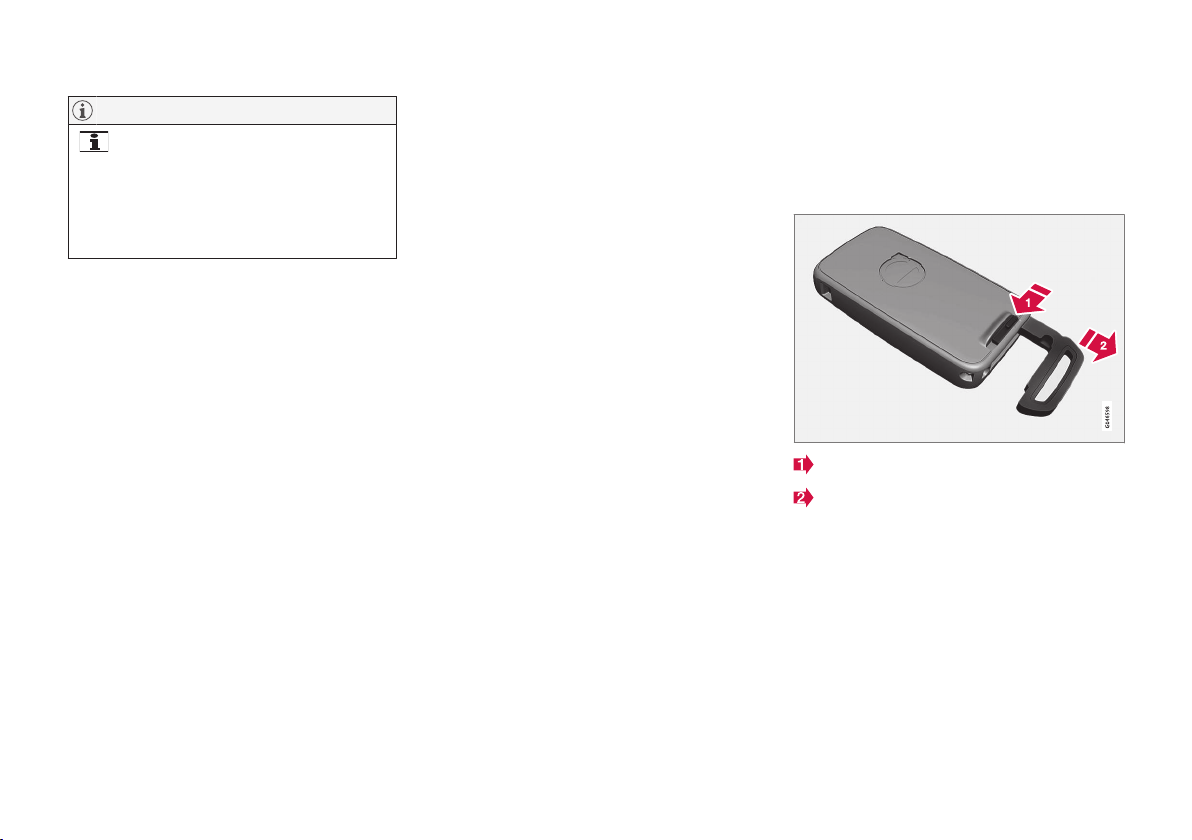
LOCKS AND ALARM
}}
* Option/accessory.
161
NOTE
If no indicator lamps illuminate when the
information button is used within range then
this may be because the last communication
between the remote control key and the car
was disrupted by surrounding radio waves,
buildings, topographical conditions, etc.
Related information
•
Keyless Drive* - remote control key range
(p. 166)
•
Remote control key - range (p. 159)
Detachable key blade
A remote control key contains a detachable key
blade of metal with which some functions can
be activated and some operations carried out.
The key blade's unique code is provided by
authorised Volvo workshops, which are recom-
mended when ordering new key blades.
Key blade functions
Using the remote control key's detachable key
blade:
•
the left-hand front door is unlocked manually
if central locking cannot be activated with the
remote control key, see Detachable key
blade - unlocking doors (p. 162).
•
the rear doors' mechanical child safety locks
can be activated/deactivated (p. 176).
•
the right-hand front door and the rear doors
can be locked manually (p. 170), e.g. in the
event of power failure.
•
access to the glovebox and cargo area (pri-
vacy locking* (p. 163)) can be blocked.
•
the airbag for front passenger seat
(PACOS*) can be activated/deactivated
(p. 36).
Related information
•
Remote control key - functions (p. 158)
•
Remote control key (p. 154)
Detachable key blade - detaching/
attaching
Detaching/attaching the detachable key blade
(p. 161) is carried out as follows:
Removing the key blade
Slide the spring-loaded catch to the side.
At the same time pull the key blade straight
out backwards.
Attaching the key blade
Carefully refit the key blade into its location in the
remote control key (p. 154).
1. Hold the remote control key with the slot
pointed up and lower the key blade into its
slot.
2. Lightly press the key blade. You should hear
a "click" when the key blade is locked in.
||
LOCKS AND ALARM
* Option/accessory.
162
Related information
•
Detachable key blade - unlocking doors
(p. 162)
•
Child safety locks - manual activation
(p. 176)
•
Passenger airbag - activating/deactivating*
(p. 36)
Detachable key blade - unlocking
doors
The detachable key blade (p. 161) can be used
if central locking cannot be activated with the
remote control key (p. 154), e.g. if the key's bat-
tery has run out.
If central locking cannot be activated with the
remote control key - e.g. if the batteries are dis-
charged - then the left-hand front door is
unlocked as follows:
1. Unlock the left-hand front door with the key
blade in the door handle's lock cylinder. For
illustration and more information, see Keyless
Drive* - unlocking with the key blade
(p. 168).
NOTE
When the door has been unlocked using the
key blade and is opened, the alarm is trig-
gered.
2. Deactivate the alarm by inserting the remote
control key in the ignition switch.
For cars with keyless start and lock system, see
Keyless Drive* - unlocking with the key blade
(p. 168).
Related information
•
Remote control key (p. 154)
•
Remote control key - replacing the battery
(p. 164)
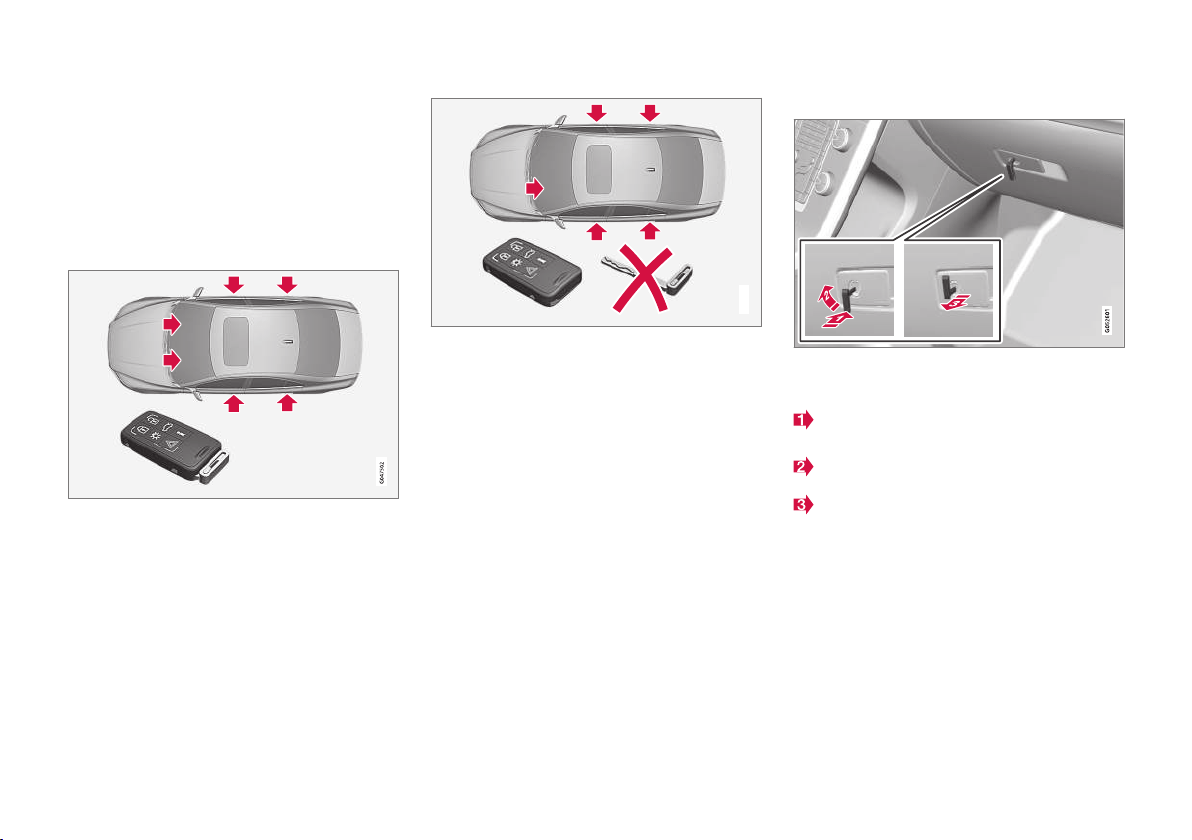
LOCKS AND ALARM
}}
* Option/accessory.
163
Privacy locking*
Privacy locking is intended for when the car is
left for service, with a hotel parking valet or simi-
lar. The glovebox is then locked and the boot lid
lock is disconnected from the central locking -
the boot lid cannot be opened with either the
central locking button in the front doors or the
remote control key (p. 154).
Active locks for remote control key with key blade.
G021084
Active locks for remote control key, without key blade
and privacy locking activated.
This means that the remote control key without
key blade can only be used to activate/deactivate
the alarm (p. 177), to unlock the doors and to
start the car.
The remote control key without key blade can
then be handed over to the service or hotel staff -
the loose key blade is retained by the car owner.
Activate/deactivate
Activating privacy locking.
To activate privacy locking:
Insert the key blade in the glovebox lock cyl-
inder.
Turn the key blade 180 degrees clockwise.
Pull out the key blade. The combined instru-
ment panel's information display shows a
message at the same time.
The glovebox is then locked and the boot lid can
no longer be unlocked with the remote control
key or the central locking button.
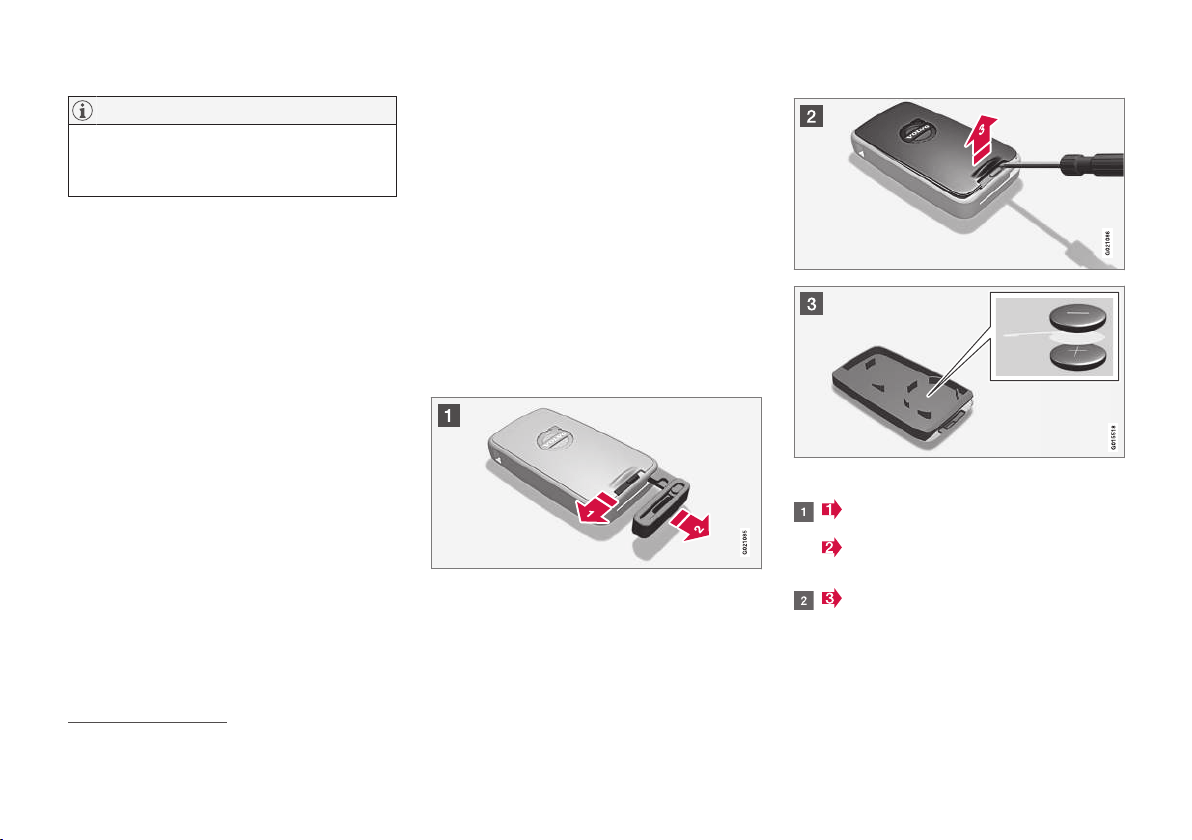
LOCKS AND ALARM
164
NOTE
Do not reinsert the key blade into the remote
control key, but keep it in a safe place
instead.
•
Deactivation takes place in reverse order.
For information on locking the glovebox only, see
Locking/unlocking - glovebox (p. 173).
Remote control key - replacing the
battery
The battery
5
for the remote control key may need
to be replaced.
The battery for the remote control key should be
replaced if:
•
the information symbol in the combined
instrument panel illuminates and the display
shows
Car key battery low See manual
and/or
•
the locks repeatedly do not react to signals
from the remote control key within 20 metres
from the car.
Opening
Slide the spring-loaded catch to the side.
At the same time pull the key blade
straight out backwards.
Insert a 3 mm slot screwdriver in the hole
behind the spring-loaded catch and gently
prize the remote control key up.
5
Remote control key with PCC has two batteries.

LOCKS AND ALARM
* Option/accessory.
165
NOTE
Turn the remote control key over with the but-
tons facing up, this is to avoid the batteries
falling out when it is opened.
IMPORTANT
Avoid touching new batteries and their con-
tact surfaces with your fingers as this may
impair their function.
Battery replacement
Closely study how the battery/batteries are
secured on the inside of the cover, with
regard to their (+) and (–) sides.
Remote control key (one battery)
1. Carefully prize out the battery.
2.
Install a new one with the (+) side down.
Remote control key with PCC* (two
batteries)
1. Carefully prize out the batteries.
2.
First install one new one with the (+) side up.
3. Position the white plastic tab in between and
finally install a second new battery with the
(+) side down.
Battery type
Use batteries with the designation CR2430, 3V -
one in the remote control key, two in the remote
control key with PCC.
NOTE
Volvo recommends that the batteries to be
used in the remote control key/PCC fulfil UN
Manual of Test and Criteria, Part III, sub-
section 38.3. Batteries fitted in the factory or
replaced by an authorised Volvo workshop
fulfil the above criteria.
Assembly
1. Press the remote control key together.
2. Hold the remote control key with the slot
pointed up and lower the key blade into its
slot.
3. Lightly press the key blade. You should hear
a "click" when the key blade is locked in.
IMPORTANT
Make sure that exhausted batteries are dis-
posed of in a manner which is kind to the
environment.
Related information
•
Remote control key (p. 154)
•
Remote control key - functions (p. 158)
Keyless drive*
Cars equipped with Keyless Drive have a star-
ting and locking system that can be operated
keylessly.
With the keyless start and lock system the car
can be started, locked and unlocked without the
remote control key (p. 154)
6
inserted in the igni-
tion switch. It is enough to have the remote con-
trol key with you in a pocket. The system makes it
easier and more convenient to e.g. open the car
when your hands are full.
Both of the remote control keys included with the
car have keyless functionality. It is possible to
order more remote control keys.
The car's electrical system can be set to three
different levels - key position 0, I and II (p. 77) -
with the remote control key.
Related information
•
Keyless Drive* - remote control key range
(p. 166)
•
Keyless drive* - secure handling of the
remote control key (p. 166)
•
Keyless Drive* - interference to remote con-
trol key function (p. 167)
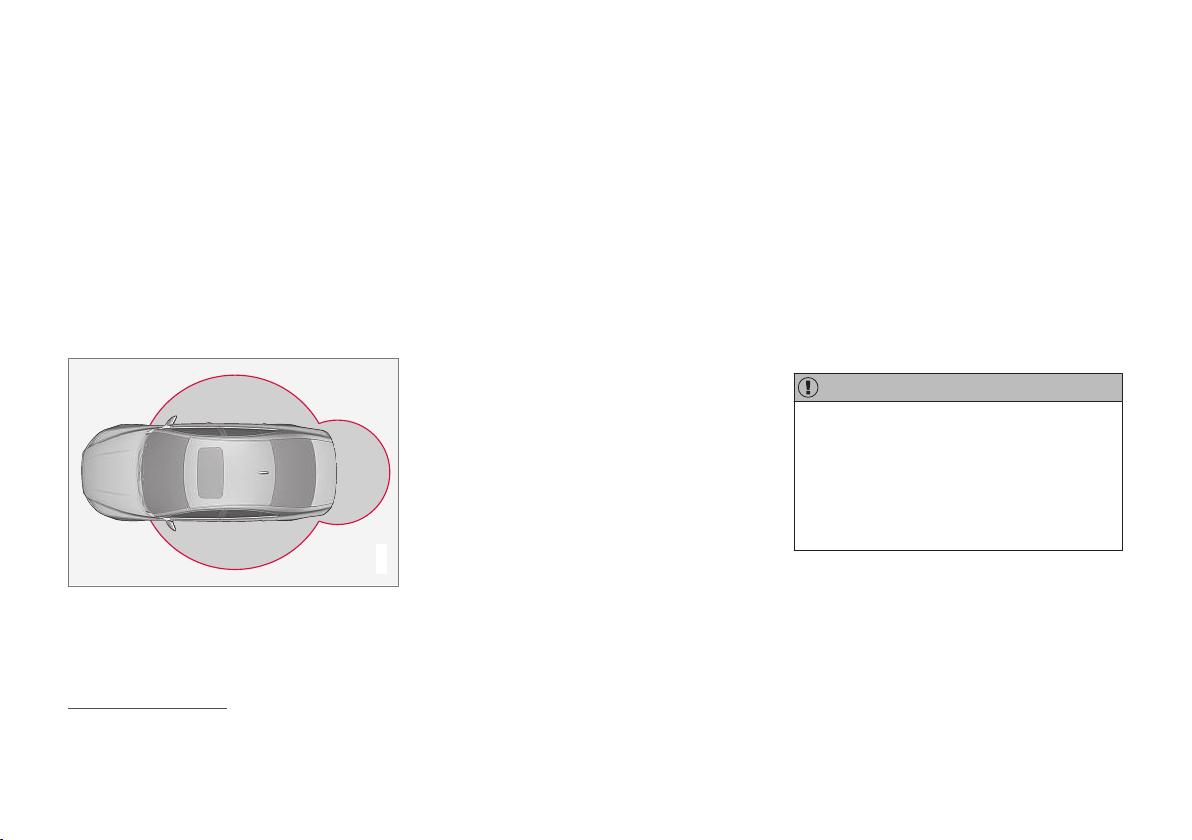
LOCKS AND ALARM
* Option/accessory.
166
Keyless Drive* - remote control key
range
In order to unlock the doors or boot lid automati-
cally without pressing a button on the remote
control key
7
, a remote control key must be within
approx. 1.5 metres from the car's door handle or
boot lid.
The person who wishes to lock or unlock a door
must have the remote control key with him or her.
It is not possible to lock or unlock a door if the
remote control key is on the opposite side of the
car.
G020577
The red rings in the above figure indicate the
range covered by the system's antennas.
If all remote control keys are removed from the
car when the engine is running or key position I
or II (p. 77) is active, and if all doors are closed,
then a warning message is shown in the informa-
tion display in the combined instrument panel
and an audio reminder signal sounds at the same
time.
When the remote control key has been returned
to the car, the warning message goes off and the
audible reminder ceases once either/or:
•
a door has been opened and closed
•
the remote control key has been inserted in
the ignition switch
•
The OK button has been pressed.
Related information
•
Keyless drive* (p. 165)
•
Keyless Drive* - antenna location (p. 169)
Keyless drive* - secure handling of
the remote control key
It is important to handle the car's remote control
keys with great care.
If one of the remote control keys
8
has been left
in the car then the keyless functions are deacti-
vated in case the car is e.g. locked with the other
remote control key that belongs to the car. This
prevents unauthorised entry.
The next time the car is unlocked with the other
remote control key the forgotten remote control
key is reactivated again.
IMPORTANT
Avoid leaving the remote control key with
PCC behind in the car. If someone breaks into
your car and takes the remote control key, it
will e.g. be possible to start the car by press-
ing the remote control key in the ignition
switch and then pressing the START/STOP
ENGINE button.
Related information
•
Keyless drive* (p. 165)
6
Only applies to Remote Control Key with PCC.
7
Applies to remote control key with PCC (Personal Car Communicator).
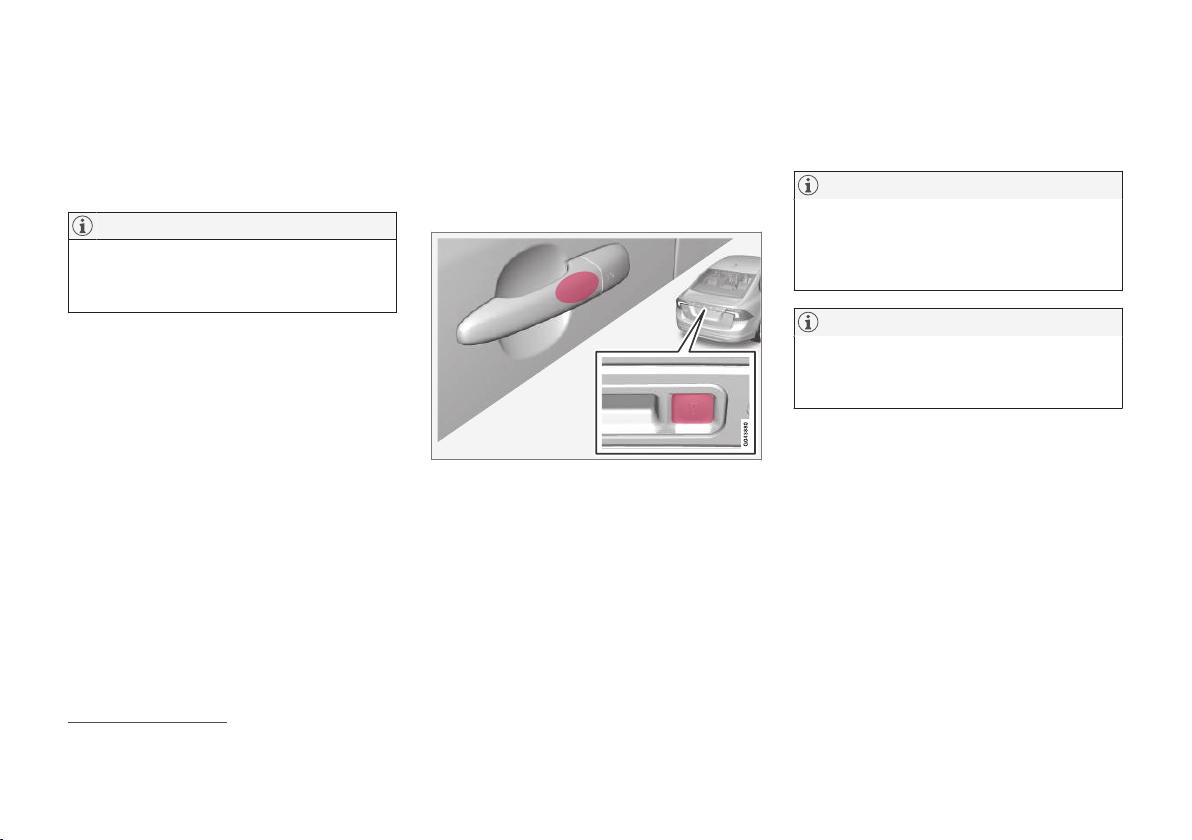
LOCKS AND ALARM
* Option/accessory.
167
Keyless Drive* - interference to
remote control key function
Electromagnetic fields and screening can inter-
fere with the remote control key's keyless func-
tions (p. 165).
NOTE
Do not place/store the PCC near a mobile
phone or metal object - no closer than 10-15
cm.
If interference is experienced nonetheless, use
the remote control key and the key blade like a
remote control key in basic version, see Remote
control key - functions (p. 158).
Related information
•
Remote control key - replacing the battery
(p. 164)
•
Keyless drive* - secure handling of the
remote control key (p. 166)
•
Keyless Drive* - remote control key range
(p. 166)
Keyless Drive* - locking
Cars equipped with keyless start and lock sys-
tem have a touch-sensitive area on the outside
handle of the doors and a rubberised button
next to the boot lid's rubberised pressure plate
for locking/unlocking.
The touch-sensitive area on the outer door handles and
a rubberised button next to the boot lid's rubberised
pressure plate.
Lock the doors and the boot lid with one long
press on any of the door handles' touch-sensitive
areas or press the smaller of the boot lid's two
rubberised buttons - the lock indicator (p. 156) in
the windscreen confirms that locking has been
completed by starting to flash.
All doors and the boot lid must be closed before
the car can be locked - otherwise the car is not
locked.
NOTE
In cars with automatic gearbox selectors, the
gear selector must be set to the P position;
otherwise the car can be neither locked nor
alarmed.
NOTE
Be aware that the system may be activated in
connection with car washing if the remote
control key is in range.
Related information
•
Keyless drive* (p. 165)
•
Alarm indicator* (p. 178)
8
Applies to remote control key with PCC (Personal Car Communicator).
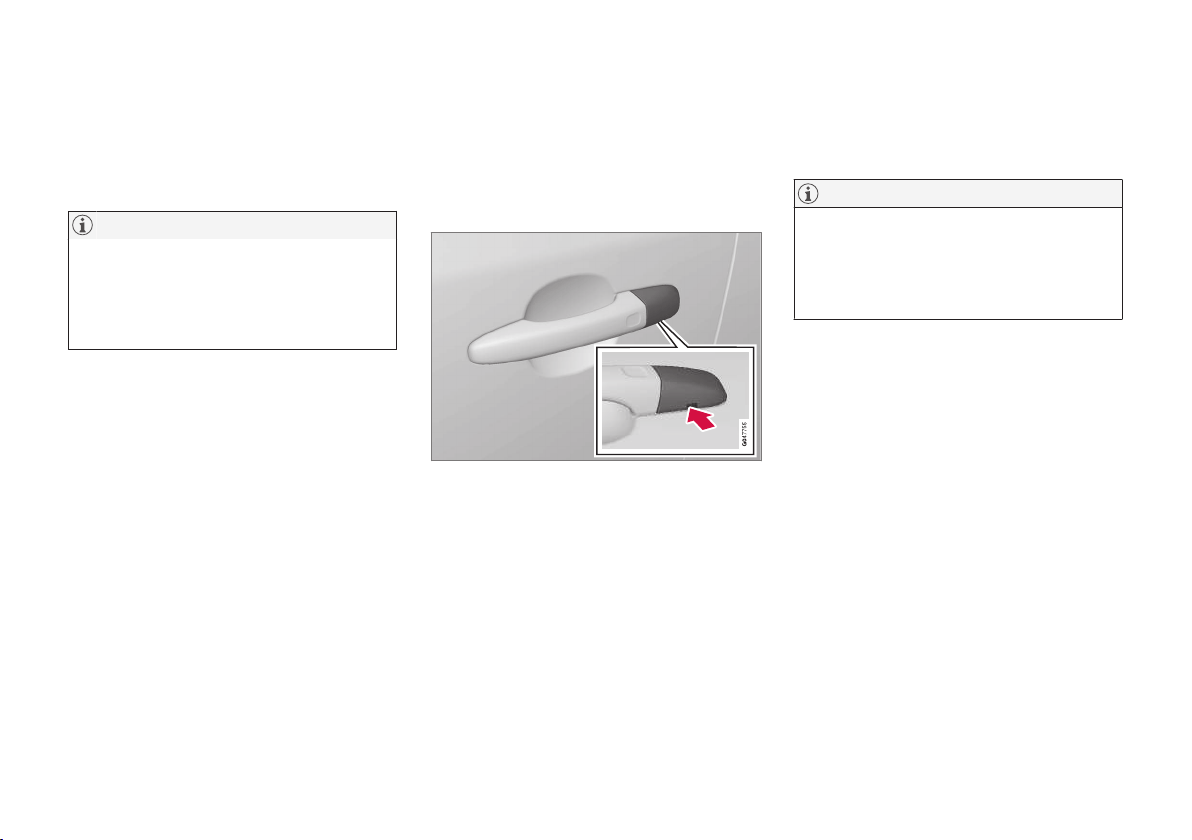
LOCKS AND ALARM
* Option/accessory.
168
Keyless drive* - unlocking
Unlocking takes place when a hand grasps a
door handle or the boot lid's rubberised pres-
sure plate is actuated - open the door or boot lid
as normal.
NOTE
The door handles normally register a hand
that takes hold of the handle, but with thick
gloves on or after a very quick hand move-
ment a second attempt may be required, or
with the glove taken off.
Related information
•
Keyless drive* (p. 165)
•
Keyless Drive* - locking (p. 167)
Keyless Drive* - unlocking with the
key blade
If central locking cannot be unlocked with the
remote control key, e.g. if the batteries are dis-
charged, then the left-hand front door can be
opened using the detachable key blade.
Hole for key blade - to loosen the cover.
To access the lock cylinder, the door handle's
plastic cover must be removed - this is also done
with the key blade:
1. Press the key blade approx. 1 cm straight up
into the hole on the underside of the door
handle/cover - do not prize.
> The plastic cover loosens automatically by
means of the torque when the blade is
pushed straight up and into the opening.
2. Then insert the key blade in the lock cylinder
and unlock the door.
3. Refit the plastic cover after unlocking.
NOTE
When the driver's door is unlocked using the
key blade and is opened, the alarm is trig-
gered. It is switched off by inserting the PCC
in the ignition switch, see Alarm* - remote
control key not working (p. 179).
Related information
•
Keyless drive* (p. 165)
•
Detachable key blade - detaching/attaching
(p. 161)
•
Alarm* (p. 177)
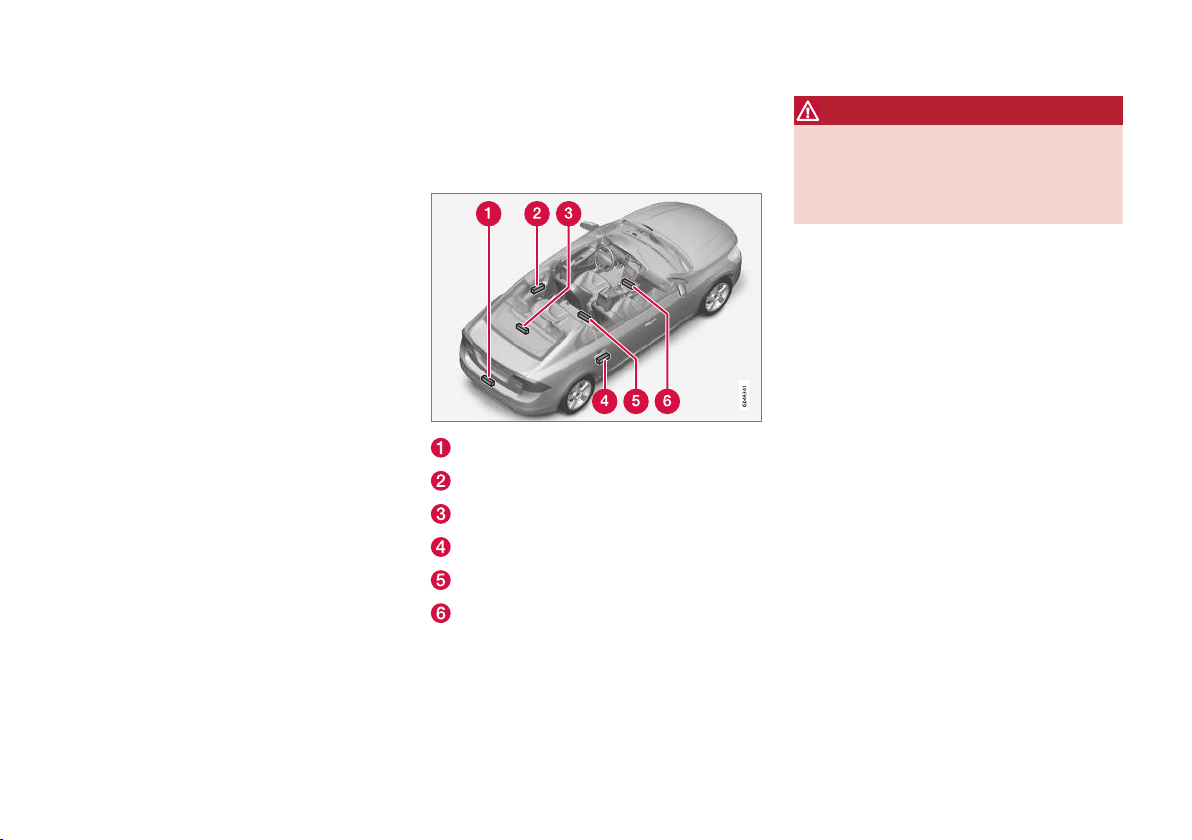
LOCKS AND ALARM
* Option/accessory.
169
Keyless Drive* - lock settings
Lock settings for cars equipped with keyless
start and lock system can be adapted by indicat-
ing in the menu system MY CAR which doors
are to be unlocked.
For a description of the menu system, see MY
CAR (p. 109).
Related information
•
Keyless drive* (p. 165)
Keyless Drive* - antenna location
Cars equipped with keyless start and lock sys-
tem have a number of built-in antennas posi-
tioned at different locations in the car.
Rear bumper, centre
Door handle, left rear
Parcel shelf, centre, underside
Door handle, right rear
Centre console, under the rear section
Centre console, under the front section.
WARNING
People with pacemaker operations should not
come closer than 22 cm to the keyless sys-
tem's antennae with their pacemaker. This is
to prevent interference between the pace-
maker and the keyless system.
Related information
•
Keyless drive* (p. 165)
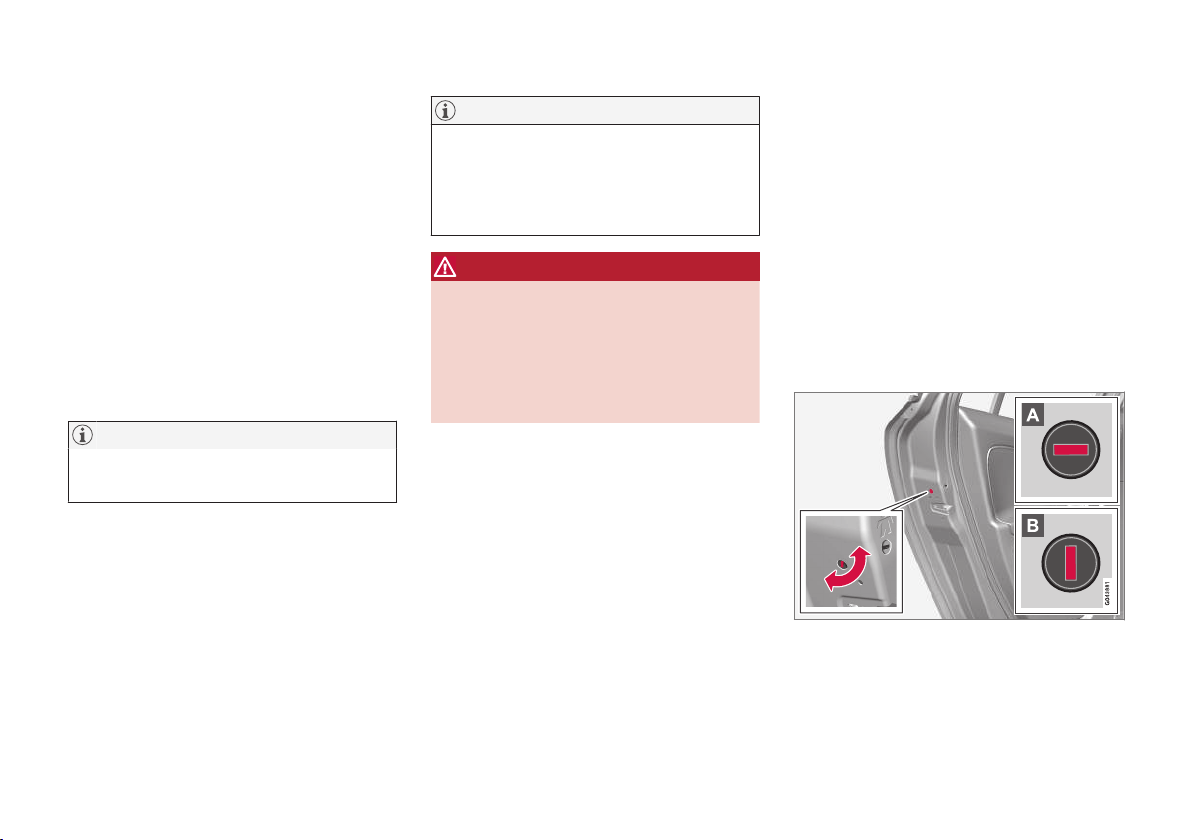
LOCKS AND ALARM
* Option/accessory.
170
Locking/unlocking - from the
outside
Locking/unlocking from the outside is carried
out using the remote control key (p. 154). The
remote control key can lock/unlock all doors and
the boot lid simultaneously. Different sequences
for unlocking can be selected, see Remote con-
trol key - functions (p. 158).
In order that the lock sequence can be activated,
the driver's door must be closed - if any of the
other doors or the boot lid is open, then it/they
is/are locked and the alarm is activated only
when it/they are closed. For cars equipped with
keyless locking system* all doors and the boot lid
must be closed.
NOTE
Be aware of the risk of locking the remote
control key in the car.
If it is not possible to lock/unlock with the remote
control key, the battery may be discharged - lock
or unlock the left-hand front door with the
detachable key blade, see Detachable key blade -
detaching/attaching (p. 161).
NOTE
Remember that the alarm is triggered when
the door is opened after being unlocked with
the key blade - the alarm is switched off when
the remote control key is inserted into the
ignition switch.
WARNING
Be aware of the risk of being locked in the
car when it is locked from the outside using
the remote control key - it is then not possible
to open any of the doors from the inside with
the door controls.
For more information, see Deadlocks*
(p. 175).
Automatic relocking
If none of the doors or the boot lid is opened
within two minutes of unlocking, all are locked
again automatically. This function reduces the
risk that the car is left unlocked unintentionally.
(For cars with alarm, see Alarm* (p. 177).)
Related information
•
Locking/unlocking - from the inside (p. 171)
•
Keyless drive* (p. 165)
Manual locking of the door
In certain situations the car must be lockable
manually, e.g. in the event of power failure.
The left-hand front door can be locked with its
lock cylinder and the remote control key's
detachable key blade, see Keyless Drive* -
unlocking with the key blade (p. 168).
Other doors do not have lock cylinders and
instead have lock knobs on each door's end face
which must be re-turned - then they are mechan-
ically locked/blocked against opening from the
outside. The doors can still be opened from the
inside.
Manual locking of the door. Not to be mixed up with
child safety locks (p. 176).
–
Use the remote control key's detachable key
blade to turn the knob, see Detachable key
blade - detaching/attaching (p. 161).
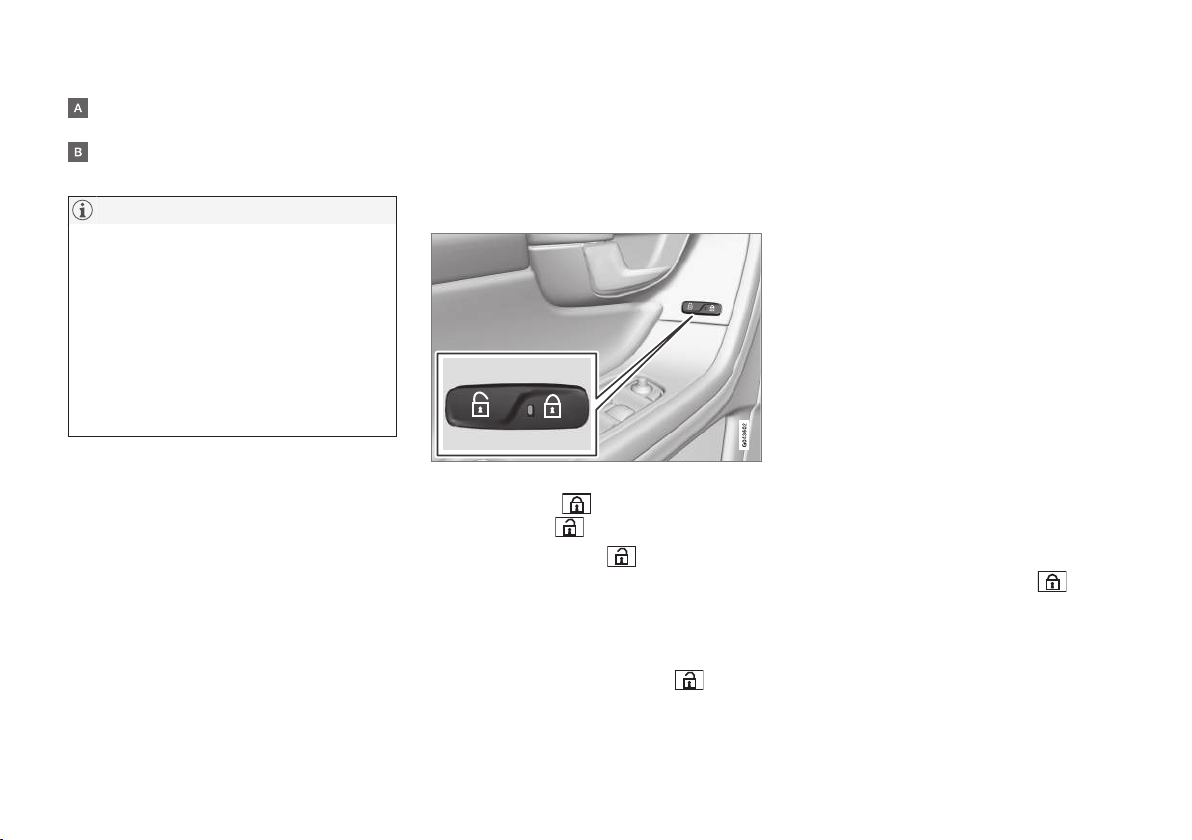
LOCKS AND ALARM
}}
* Option/accessory.
171
The door is blocked against opening from
the outside.
The door can be opened from both the out-
side and the inside.
NOTE
•
A door's knob control only locks that par-
ticular door - not all doors simultaneously.
•
A manually locked rear door with an acti-
vated manual child safety lock cannot be
opened from either the outside or the
inside, see Child safety locks - manual
activation (p. 176). A rear door that is
locked in this way can only be unlocked
with the remote control key or central
locking button.
Related information
•
Remote control key - replacing the battery
(p. 164)
Locking/unlocking - from the inside
All of the doors and the boot lid can be locked
or unlocked simultaneously using the central
locking button on the driver's door and passen-
ger door*.
Central locking
Central locking.
•
Press one side
of the button to lock -
the other side
to unlock.
Press and hold the button
to also open all
side windows simultaneously*.
Unlocking
A door can be unlocked from the inside in two
different ways:
•
Press the central locking button
.
A long press also opens all the side windows*
simultaneously (see also Global opening
(p. 172)).
•
Pull the door handle and open the door - the
door is unlocked and opened in one opera-
tion.
Lamp in lock button
Central locking is available in two variants - the
lamp in the central locking button for the driver's
door has different meanings dependent on the
variant.
With central locking button only in the driver's
door, other doors have no button:
•
Illuminated lamp means that all doors are
locked.
With central locking button on both front doors
and electric lock button in each rear door:
•
Illuminated lamp means that only that partic-
ular door is locked. When all buttons are illu-
minated all doors are locked.
Locking
•
Press the central locking button
- all
closed doors are locked.
A long press also closes all side windows and
sunroof simultaneously (see also Global opening
(p. 172)).
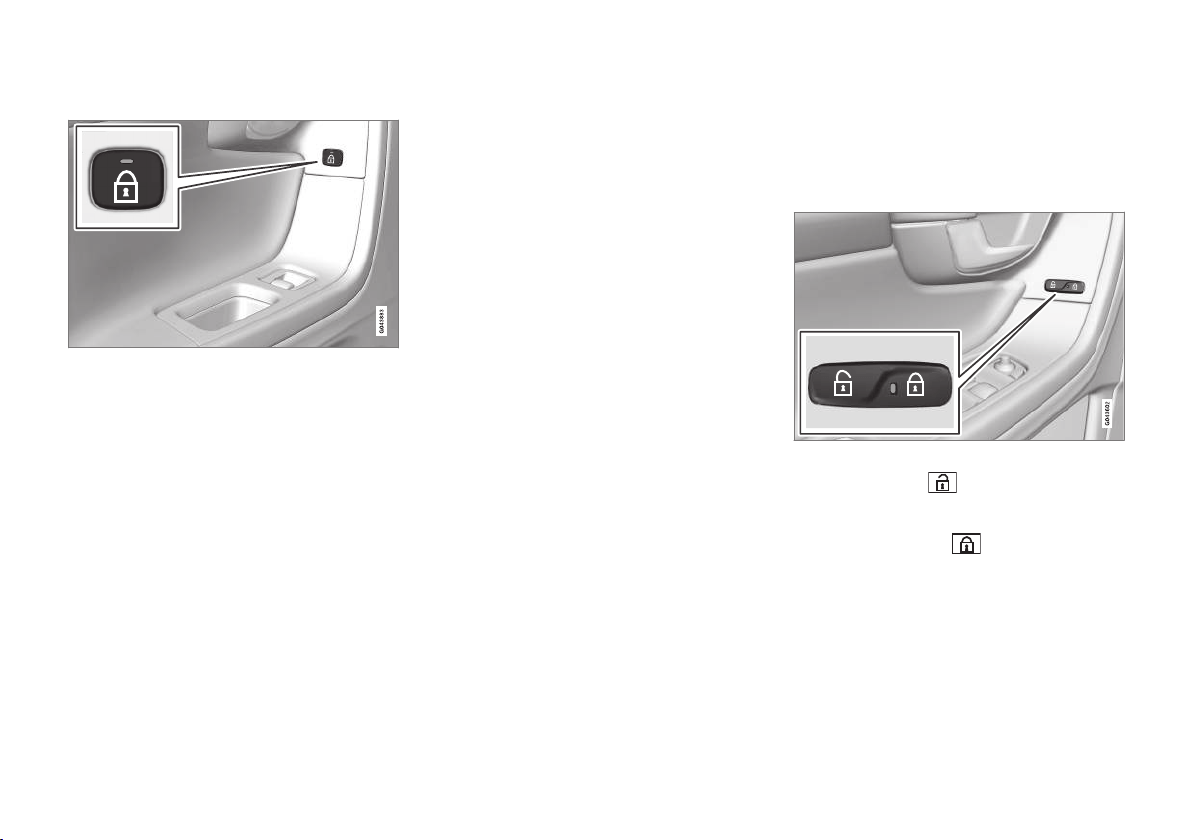
||
LOCKS AND ALARM
* Option/accessory.
172
Lock button* rear doors
The button's lamp illuminates when the door is locked.
The rear door lock buttons only lock their respec-
tive rear door.
To unlock the door:
•
Pull the door handle - the door is unlocked
and opened.
Automatic locking
The doors and boot lid are locked automatically
when the car starts to move.
The function can be activated/deactivated in the
menu system MY CAR. For a description of the
menu system, see MY CAR (p. 109).
Related information
•
Locking/unlocking - from the outside
(p. 170)
•
Alarm* (p. 177)
•
Remote control key - functions (p. 158)
Global opening
The global opening function opens or closes all
side windows simultaneously and can be used
for example to quickly air the car during hot
weather.
Central locking button
A long press on the symbol in the central
locking button or on the remote control key
opens all side windows simultaneously. The
same procedure on the
symbol closes all
side windows simultaneously.
Related information
•
Locking/unlocking - from the inside (p. 171)
•
Power windows (p. 98)
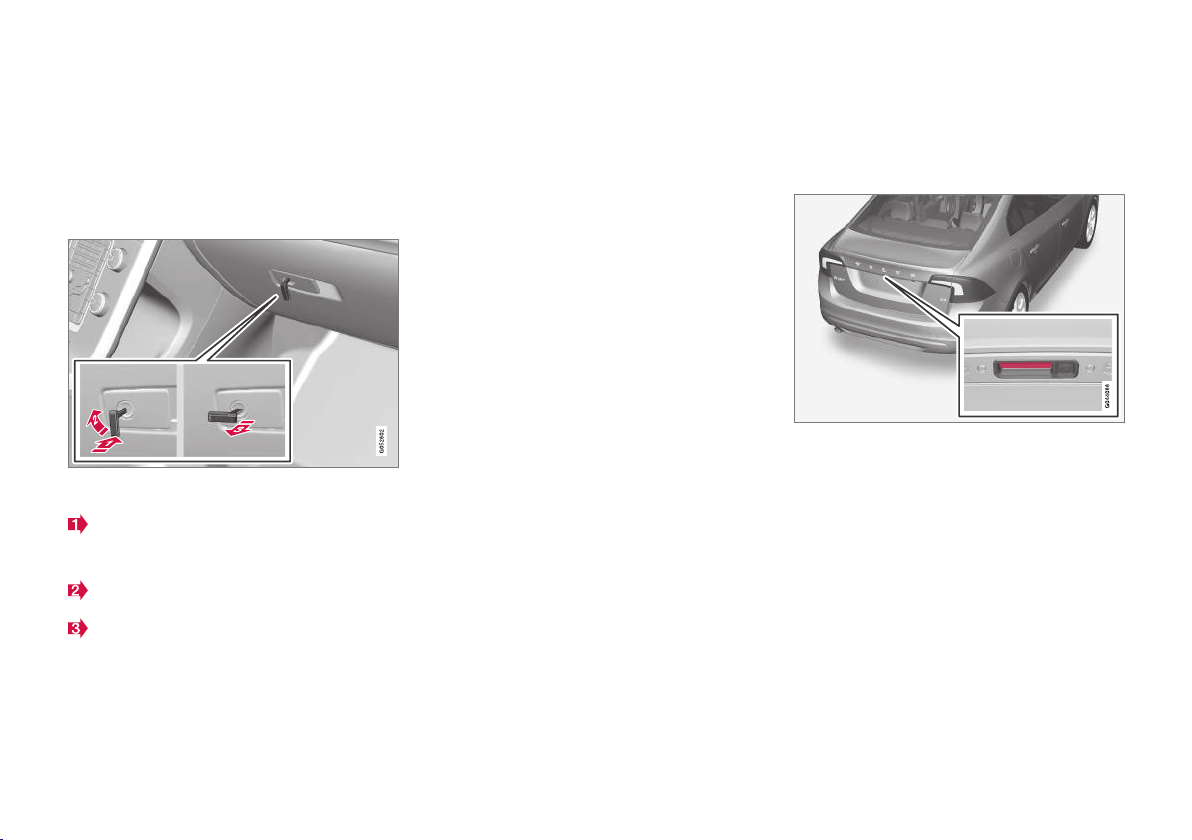
LOCKS AND ALARM
}}
* Option/accessory.
173
Locking/unlocking - glovebox
The glovebox (p. 146) can only be locked/
unlocked using the remote control key's detach-
able key blade.
For information on the key blade, see Detachable
key blade - detaching/attaching (p. 161).
Locking the glovebox:
Insert the key blade in the glovebox lock cyl-
inder in accordance with the illustration
above.
Turn the key blade 90 degrees clockwise.
Pull out the key blade.
•
Unlock by carrying this out in reverse order.
For information on privacy locking, see Privacy
locking* (p. 163).
Related information
•
Remote control key (p. 154)
Locking/unlocking - boot lid
The boot lid can be opened, locked and
unlocked in several ways.
Manual opening
Rubber plate with electrical contact.
The boot lid is held closed by an electrical lock.
To open:
1. Push down gently on the wide rubberised
pressure plate under the outer handle - the
lock is released.
2. Lift the outside handle in order to fully open
the tailgate.
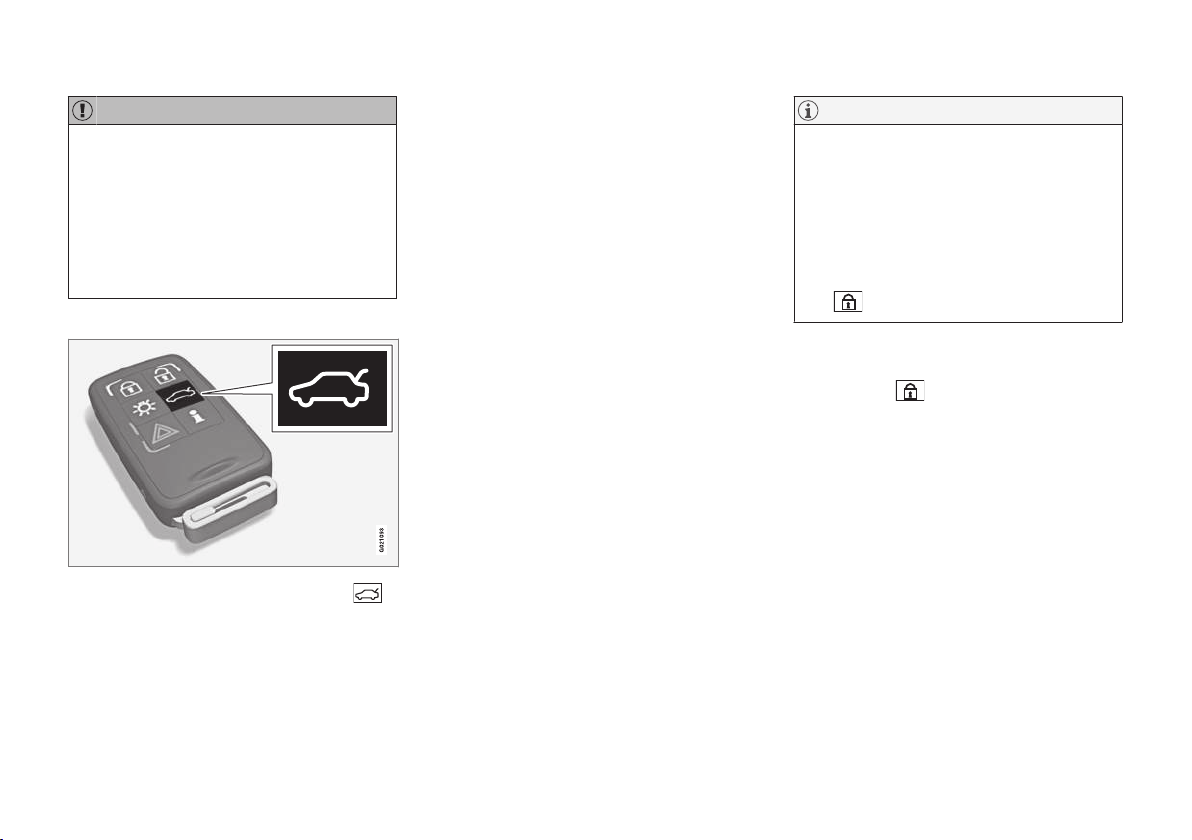
||
LOCKS AND ALARM
* Option/accessory.
174
IMPORTANT
•
Minimal force is required to release the
boot lid's lock - just gently press the rub-
berised panel.
•
Do not place the lift force on the rubber
panel when opening the boot lid - lift the
handle. Using too much force may dam-
age the electrical contacts on the rubber
panel.
Unlocking with the remote control key
The alarm for the boot lid can be disarmed
and the boot lid unlocked on its own by using the
remote control key's* button.
The lock indicator on the instrument panel stops
flashing which indicates that not all of the car is
locked and the alarm's* level and movement sen-
sors and the sensors for opening the boot lid are
disconnected.
The doors remain locked and armed.
•
The boot lid is unlocked, but remains closed
- press lightly on the rubberised pressure
plate under the outer handle and lift the boot
lid.
If the boot lid is not opened within two minutes
then it is relocked and the alarm is re-armed.
The boot lid can be opened in two
different ways
One press - The boot lid is unlocked, but
remains closed - press lightly on the rubberised
pressure plate under the outer handle and lift the
boot lid.
If the boot lid is not opened within two minutes
then it is relocked and the alarm is re-armed.
Two presses - The boot lid is unlocked and the
lock is disengaged at which the boot lid opens
about a centimetre - lift the outer handle to open.
Rain, cold, frost or snow could however prevent
the tailgate from disengaging from the lock.
NOTE
•
When the boot lid/tailgate is unlocked
with 2 presses, automatic relocking does
not take place because the boot lid/tail-
gate is open - it must be closed manually.
•
After the boot lid/tailgate has been
closed it is unlocked and the alarm is not
armed - relock it and re-arm the alarm
with the remote control key's lock button
.
Locking with the remote control key
•
Press the remote control key (p. 158) button
for locking
.
The lock indicator on the instrument panel starts
flashing, which means that the car is locked and
the alarm* has been activated.
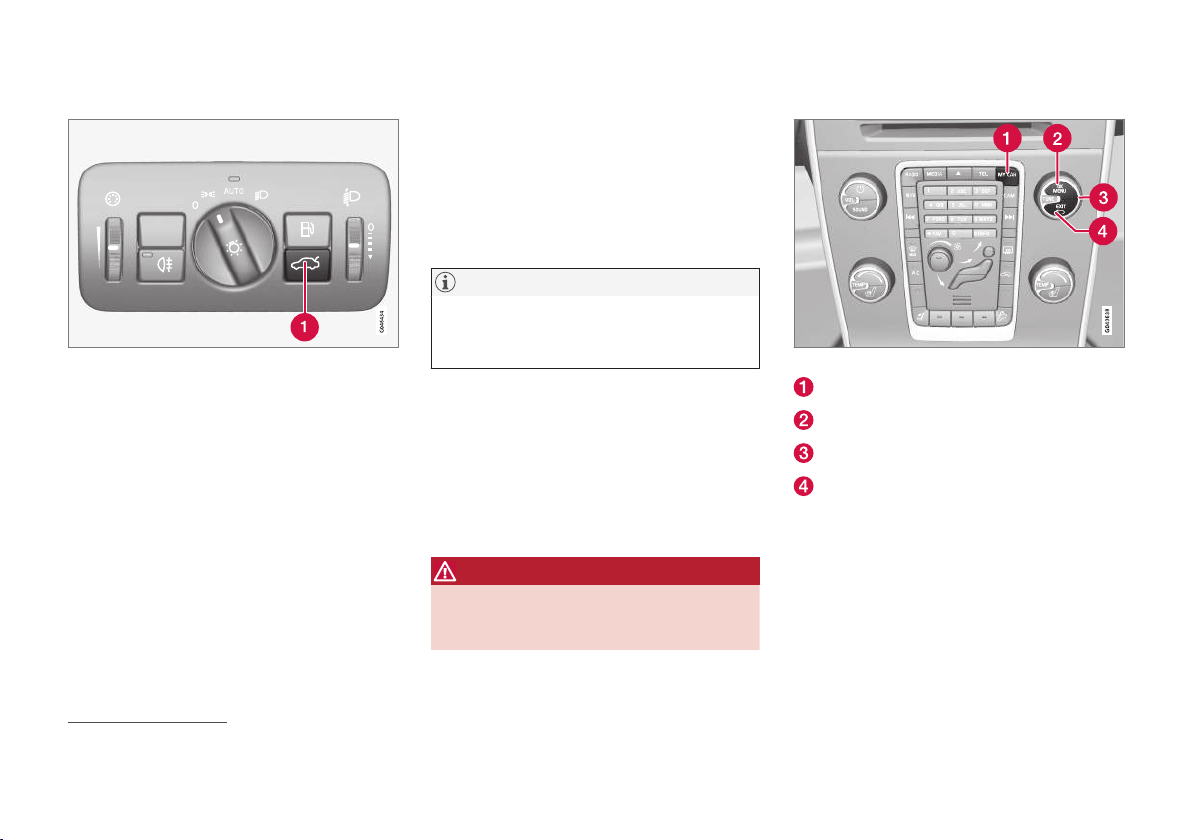
LOCKS AND ALARM
}}
* Option/accessory.
175
Unlocking the car from inside
To unlock the boot lid:
–
Press the button (1) on the headlamp control
panel.
> The lock releases and the tailgate opens
by a few centimetres.
Related information
•
Locking/unlocking - from the inside (p. 171)
•
Locking/unlocking - from the outside
(p. 170)
Deadlocks*
Deadlocks
9
means that all door handles are
mechanically disengaged, which prevents doors
being opened from both inside and outside.
The deadlocks are activated with the remote con-
trol key (p. 154) and are set after an approx. ten
seconds delay after the doors have been locked.
NOTE
If a door is opened within the delay time then
the sequence is interrupted and the alarm is
deactivated.
The car can only be unlocked with the remote
control key when the deadlocks function is acti-
vated. The front left door can also be unlocked
with the detachable key blade (p. 161). In addi-
tion, it is possible to unlock and open the doors
and boot lid on cars equipped with keyless start
and lock system* by touching door handles or the
handle on the boot lid.
WARNING
Do not allow anyone to remain in the car with-
out first deactivating the deadlocks in order to
avoid the risk of anyone being locked in.
Temporary deactivation
Active menu options are indicated with a cross.
MY CAR
OK MENU
TUNE knob control
EXIT
If someone is going to stay in the car but the
doors must be locked from the outside, then the
deadlocks function can be temporarily switched
off. This takes place the menu system MY CAR.
For a description of the menu system, see MY
CAR (p. 109).
9
Only in combination with alarm.
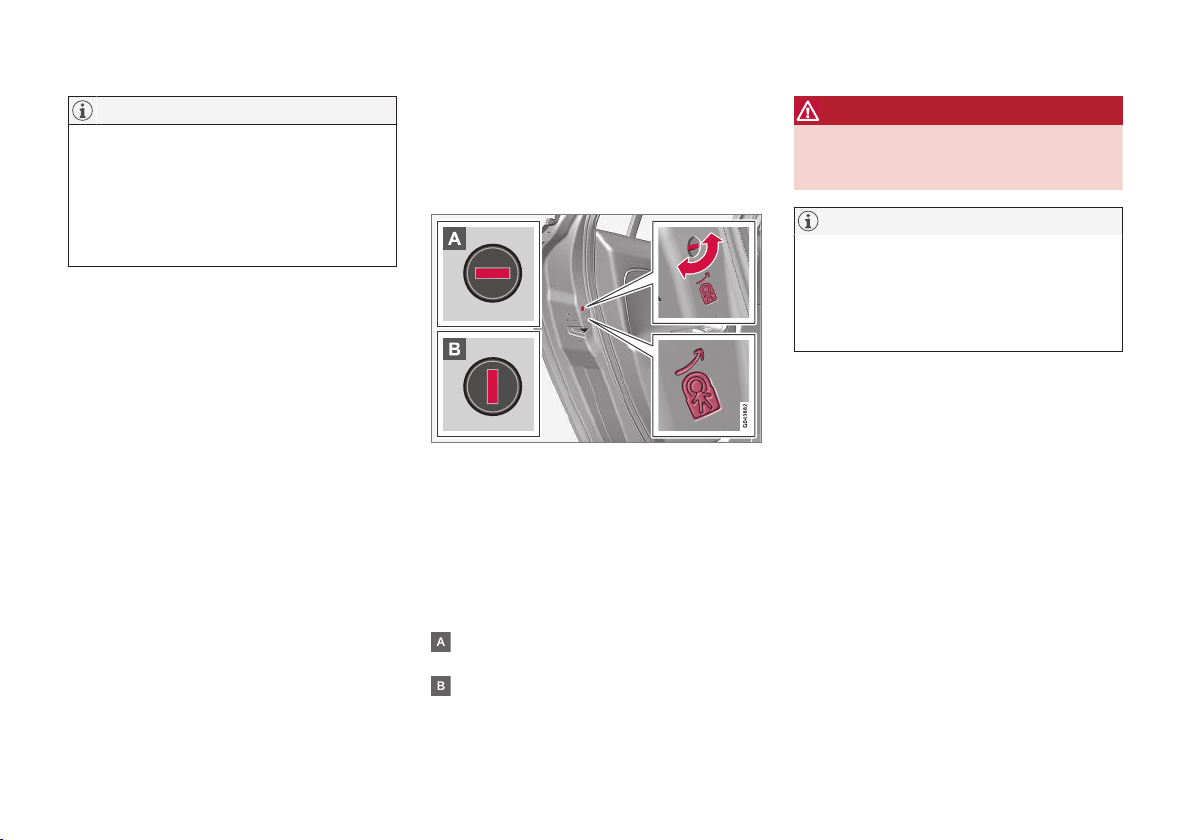
||
LOCKS AND ALARM
* Option/accessory.
176
NOTE
•
Remember that the alarm is activated
when the car is locked.
•
If any of the doors are opened from the
inside then the alarm is triggered.
The above applies if the deadlocks have not
been deactivated temporarily.
Related information
•
Keyless Drive* - unlocking with the key blade
(p. 168)
•
Remote control key (p. 154)
Child safety locks - manual
activation
The child safety locks prevent children from
being able to open a rear door from the inside.
Activate/deactivate child safety locks
Manual child safety locks. Not to be mixed up with man-
ual door lock (p. 170).
The child safety locks are located on the trailing
edge of the rear doors and are only accessible
when the doors are open.
To activate/deactivate the child safety locks:
–
Use the remote control key's detachable key
blade (p. 161) to turn the knob.
The door is blocked against opening from
the inside.
The door can be opened from both the out-
side and the inside.
WARNING
Each rear door has two knob controls - do not
mix up the child safety locks with manual door
locks.
NOTE
•
A door's knob control only blocks that
particular door - not both rear doors
simultaneously.
•
Cars with an electric child safety lock do
not have a manual child lock.
Related information
•
Child safety locks - electrical activation*
(p. 177)
•
Locking/unlocking - from the inside (p. 171)
•
Locking/unlocking - from the outside
(p. 170)
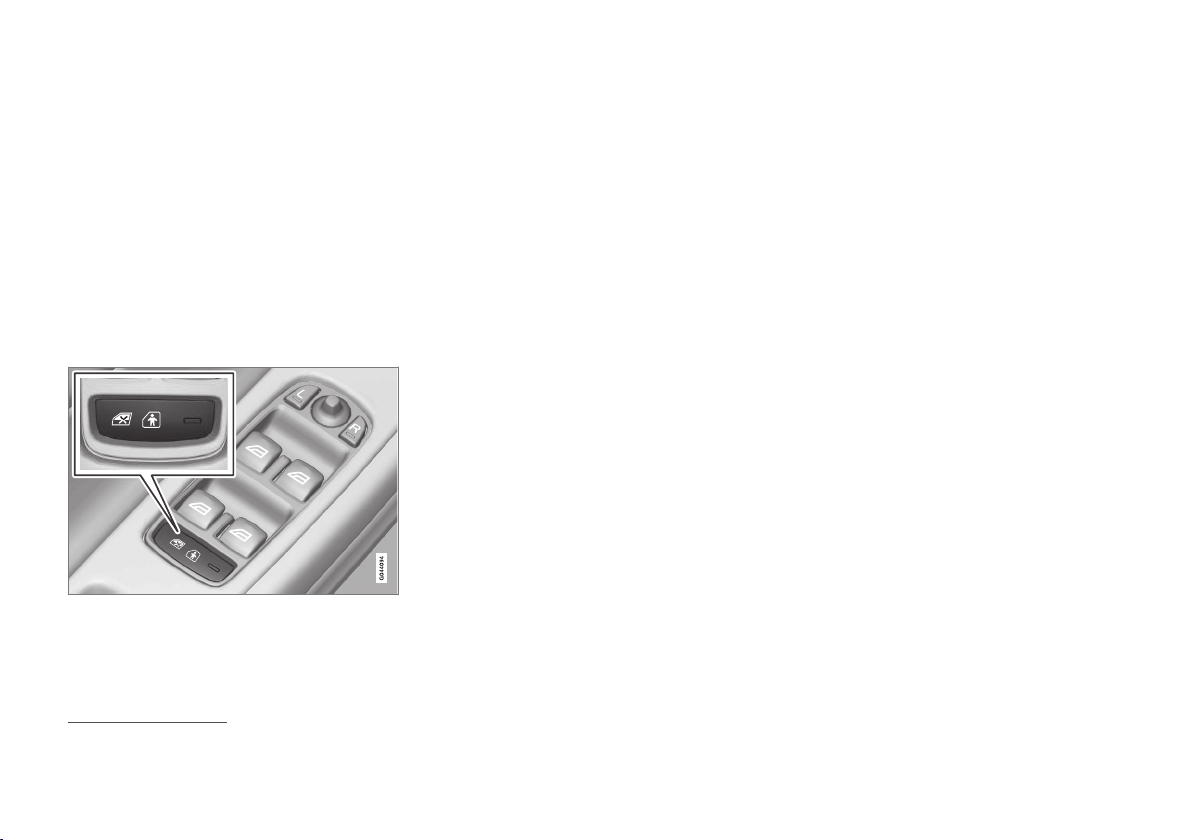
LOCKS AND ALARM
}}
* Option/accessory.
177
Child safety locks - electrical
activation*
Child safety locks with electrical activation pre-
vent children from opening the rear doors or win-
dows from the inside.
Activation
The child safety locks can be activated/deacti-
vated in all key positions (p. 77) higher than 0.
Activation/deactivation can be performed up to
2 minutes after switching off the engine, provided
that no door is opened.
To activate the child safety locks:
Control panel driver's door.
1. Start the engine or choose a key position
higher than 0.
2. Press the button in the driver's door control
panel.
> The combined instrument panel's informa-
tion display shows the message
Rear
child lock activated and the button's
lamp illuminates - the locks are active.
When the child safety lock is active then the rear:
•
windows can only be opened with the driver's
door control panel
•
doors cannot be opened from inside.
The current setting is stored when the engine is
switched off - if the child safety locks are acti-
vated at engine shutdown, the function will
remain activated the next time the engine is
started.
Related information
•
Child safety locks - manual activation
(p. 176)
•
Locking/unlocking - from the inside (p. 171)
Alarm*
The alarm is a device that warns in the event of
e.g. a break-in in the car.
Activated alarm is triggered if:
•
a door, the bonnet or the boot lid is opened
10
•
a movement is detected in the passenger
compartment (if fitted with a movement
detector*)
•
the car is raised or towed away (if fitted with
a tilt detector*)
•
the starter battery's cable is disconnected
•
the siren is disconnected.
If there is a fault in the alarm system then the
information display in the combined instrument
panel shows a message. In which case, contact a
workshop - an authorised Volvo workshop is rec-
ommended.
10
Applies to certain markets.
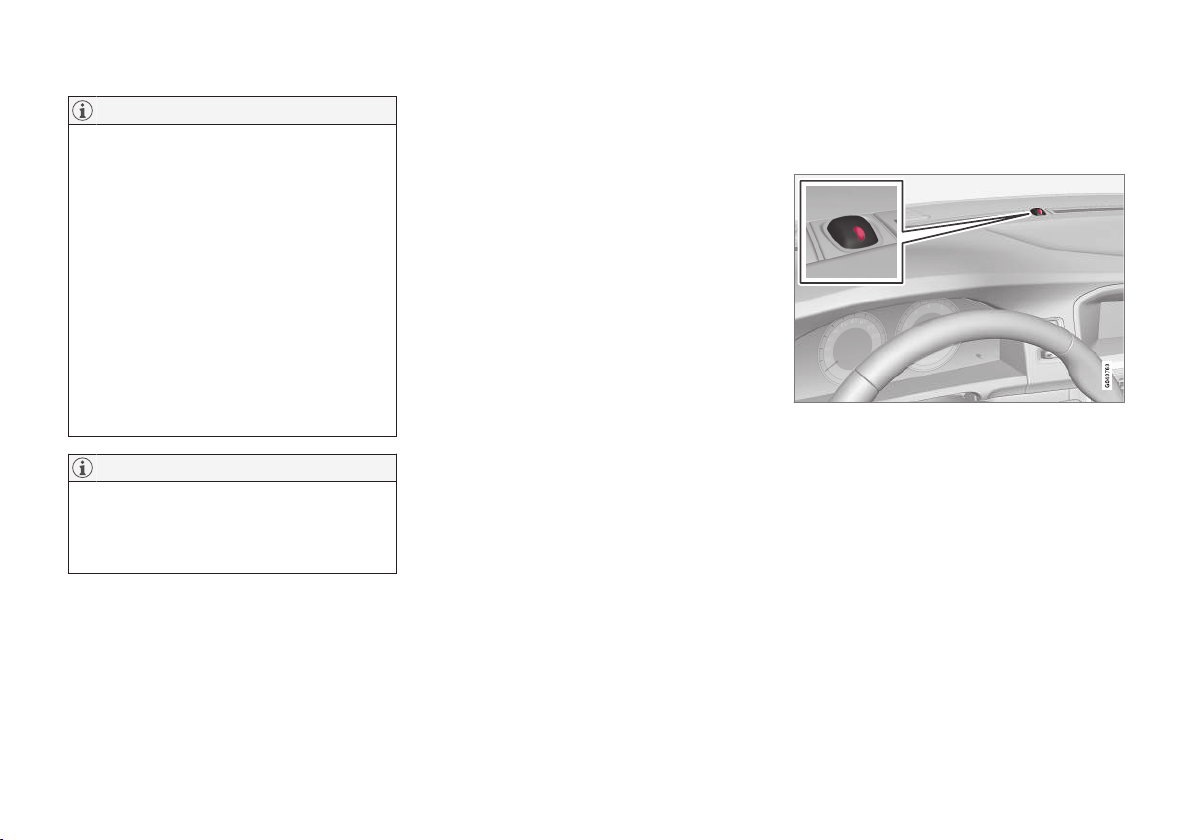
||
LOCKS AND ALARM
* Option/accessory.
178
NOTE
The movement sensors trigger an alarm in
the event of movement in the passenger
compartment - air currents are also regis-
tered. For this reason the alarm is triggered if
the car is left with a window or the sunroof
open or if the passenger compartment heater
is used.
To avoid this: Close the window/sunroof
when leaving the car. If the car's integrated
passenger compartment heater (or a portable
electric heater) shall be used - direct the air-
flow from the air vents so that they are not
pointing upwards in the passenger compart-
ment. Alternatively, reduced alarm level can
be used, see Reduced alarm level* (p. 180).
NOTE
Do not attempt to repair or alter components
in the alarm system yourself. Any such
attempts may affect the terms of the insur-
ance.
Arming the alarm
–
Press the remote control key lock button.
Deactivate the alarm
–
Press the remote control key unlock button.
Deactivating a triggered alarm
–
Press the remote control key unlock button
or insert the remote control key in the igni-
tion switch.
Related information
•
Alarm indicator* (p. 178)
•
Alarm* - automatic re-arming (p. 179)
•
Alarm* - remote control key not working
(p. 179)
Alarm indicator*
The alarm indicator shows alarm system
(p. 177) status.
Same LED as lock indicator (p. 156).
A red LED on the instrument panel indicates the
alarm system's status:
•
LED not lit – Alarm not armed
•
The LED flashes once every other second –
Alarm is armed
•
The LED flashes rapidly after disarming the
alarm (and until the remote control key is
inserted in the ignition switch and key posi-
tion I is selected) – Alarm has been trig-
gered.
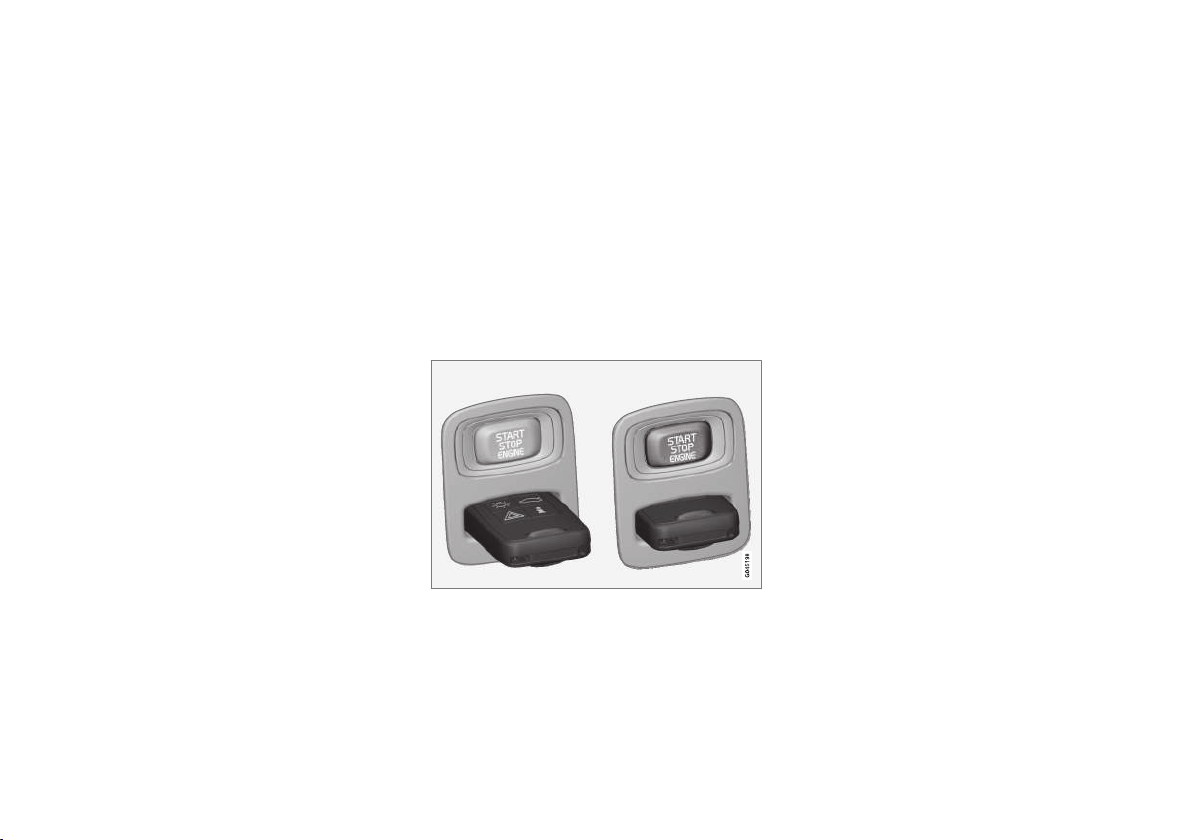
LOCKS AND ALARM
* Option/accessory.
179
Alarm* - automatic re-arming
Automatic re-arming of the alarm (p. 177) pre-
vents the car being left with the alarm disarmed
unintentionally.
If the car is unlocked with the remote control key
(and the alarm is disarmed) but none of the
doors or the boot lid is opened within 2 minutes,
then the alarm is automatically re-armed. The car
is relocked at the same time.
Related information
•
Reduced alarm level* (p. 180)
Alarm* - remote control key not
working
If the alarm (p. 177) cannot be deactivated with
the remote control key, e.g. if the key's battery
(p. 164) is discharged - the car can be
unlocked, disarmed and the engine started as
follows:
1. Open the driver's door with the detachable
key blade (p. 168).
> The alarm is triggered, the alarm indicator
(p. 178) flashes rapidly and the siren
sounds.
2. Insert the remote control key in the ignition
switch.
> The alarm is deactivated and the alarm
indicator goes out.
3. Start the engine.
Alarm signals*
When the alarm (p. 177) is triggered a siren
sounds and all direction indicators flash.
•
A siren sounds for 30 seconds or until the
alarm is switched off. The siren has its own
battery and works independently of the car
battery.
•
The direction indicators flash for 5 minutes
or until the alarm is switched off.
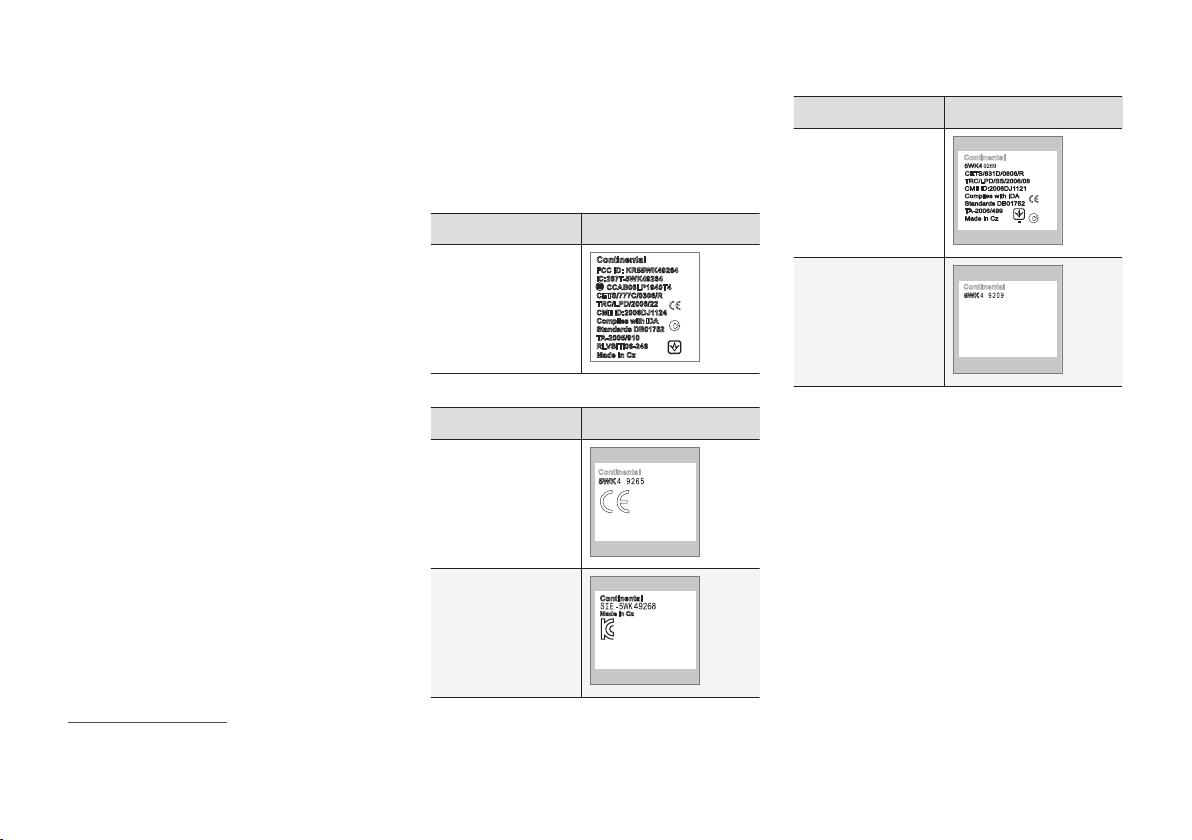
LOCKS AND ALARM
* Option/accessory.
180
Reduced alarm level*
Reduced guard means that the movement and
tilt detectors can be temporarily deactivated.
To avoid accidental triggering of the alarm
(p. 177) - e.g. if a dog is left in a locked car or
during transport on a car train or car ferry - tem-
porarily deactivate the movement and tilt detec-
tors.
The procedure is the same as with the temporary
disengaging of deadlocks (p. 175)
11
.
Related information
•
Alarm indicator* (p. 178)
Type approval - remote control key
system
Type approval for the remote control key system
can be read in the table.
Lock system, standard
Country/Area
EU, China
Keyless lock system (Keyless drive)
Country/Area
EU
Korea
Country/Area
China
Hong Kong
Related information
•
Remote control key (p. 154)
11
Only in combination with alarm.

DRIVER SUPPORT
DRIVER SUPPORT
* Option/accessory.
182
Adjustable steering force*
Speed related power steering causes the steer-
ing wheel force to increase with the speed of the
car in order to give the driver enhanced sensitiv-
ity.
On motorways the steering feels firmer. Steering
is light and requires no extra effort when parking
and at low speed.
The driver can choose between three different
levels of steering force for road responsiveness
or steering sensitivity in the menu system MY
CAR (p. 109):
•
Once there, search for
Steering force level
and select Low, Medium or High.
This setting is not accessible when the car is
moving.
NOTE
In certain situations the power steering may
become too hot and then needs to be tempo-
rarily cooled - during this time the power
steering operates with reduced power and
turning the steering wheel may then be per-
ceived to be slightly heavier.
In parallel with the temporarily reduced steer-
ing assistance the combined instrument panel
shows a message.
Related information
•
MY CAR (p. 109)
Electronic stability control (ESC) -
general
Stability system ESC (Electronic Stability
Control) helps the driver to avoid skidding and
improves the car's traction.
The activation of the ESC system dur-
ing braking may be noticed as a throb-
bing sound. The car may accelerate
slower than expected when the accel-
erator pedal is depressed.
WARNING
•
The stability system ESC is supplemen-
tary driver support intended to facilitate
driving and make it safer – it cannot han-
dle all situations in all traffic, weather and
road conditions.
•
ESC is not a substitute for the driver's
attention and judgement. The driver is
always responsible for ensuring the car is
driven in a safe manner, at the appropri-
ate speed, with an appropriate distance to
other vehicles, and in accordance with
current traffic rules and regulations.
The ESC system consists of the following func-
tions:
•
Active Yaw Control
•
Spin Control
•
Traction control system
DRIVER SUPPORT
}}
* Option/accessory.
183
•
Engine drag control - EDC
•
Corner Traction Control - CTC
•
Trailer Stability Assist - TSA
Active Yaw Control
The function checks the driving and brake force
of the wheels individually in order to stabilise the
car.
Spin Control
The function prevents the driving wheels from
spinning against the road surface during acceler-
ation.
Traction control system
The function is active at low speed and transfers
power from the driving wheel that is spinning to
the one that is not.
Engine drag control - EDC
EDC (Engine Drag Control) prevents involuntary
wheel locking, e.g. after shifting down or engine
braking when driving in low gears on slippery
road surfaces.
Involuntary wheel locking while driving can,
amongst other things, impair the driver's ability to
steer the car.
Corner Traction Control - CTC*
CTC compensates for understeer and allows
higher than normal acceleration in a bend without
wheelspin on the inner wheel, e.g. on an arcing
motorway entrance road to quickly reach the pre-
vailing traffic speed.
Trailer Stability Assist* - TSA
1
Trailer stability assist (p. 317) function is to sta-
bilise the car and trailer combination if it begins
to snake. For more information, see Driving with a
trailer* (p. 311).
NOTE
The function is deactivated if the driver
selects Sport mode.
Related information
•
Electronic stability control (ESC) - operation
(p. 183)
•
Electronic stability control (ESC) - symbols
and messages (p. 185)
Electronic stability control (ESC) -
operation
Selection of level - Sport mode
The ESC system is always activated - it cannot be
deactivated.
However, the driver can select
the Sport mode, which allows
for a more active driving experi-
ence.
Sport mode is selected in the
menu system MY CAR. For a
description of the menu system, see MY CAR
(p. 109).
In Sport mode the system detects whether the
accelerator pedal, steering wheel movements and
cornering are more active than in normal driving
and then allows controlled skidding with the rear
section up to a certain level before it intervenes
and stabilises the car.
If, for example, the driver stops a controlled skid
by releasing the accelerator pedal, then the ESC
system intervenes and stabilises the car.
With Sport mode, maximum traction is also
obtained if the car has become stuck, or when
driving on a loose surface - e.g. sand or deep
snow.
1
Trailer Stability Assist is included in the installation of Volvo genuine towbar.

||
DRIVER SUPPORT
184
Sport mode is indicated in the com-
bined instrument panel by means of
this symbol illuminating with a constant
glow until the driver deselects the
function or until the engine is switched off - after
the next time the engine is started the ESC sys-
tem is back in its normal mode again.
Related information
•
Electronic stability control (ESC) - general
(p. 182)
•
Electronic stability control (ESC) - symbols
and messages (p. 185)
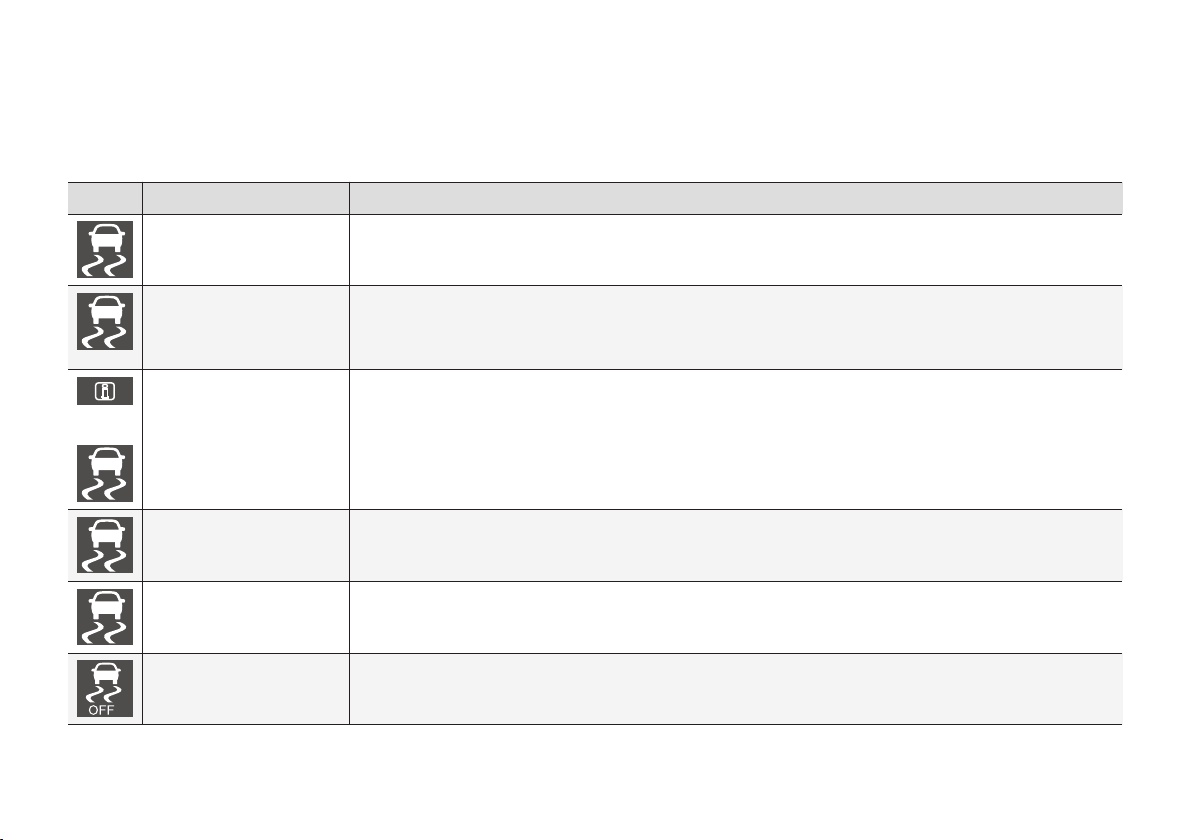
DRIVER SUPPORT
}}
185
Electronic stability control (ESC) -
symbols and messages
Table
Symbol Message Specification
ESC Temporarily OFF
ESC system has been temporarily reduced due to excessive brake disc temperature - the function is reactivated
automatically when the brakes have cooled.
ESC Service required
ESC system disengaged.
•
Stop the car in a safe place, switch off the engine and start it again.
•
Visit a workshop if the message remains - an authorised Volvo workshop is recommended.
and
"Message"
There is a text message in the combined instrument panel (p. 62) - Read it!
Constant glow for
2 seconds.
System check when the engine is started.
Flashing light. ESC system is being activated.
Constant glow.
Sport mode is activated.
NOTE: The ESC system is not deactivated in this mode - it is partially reduced.

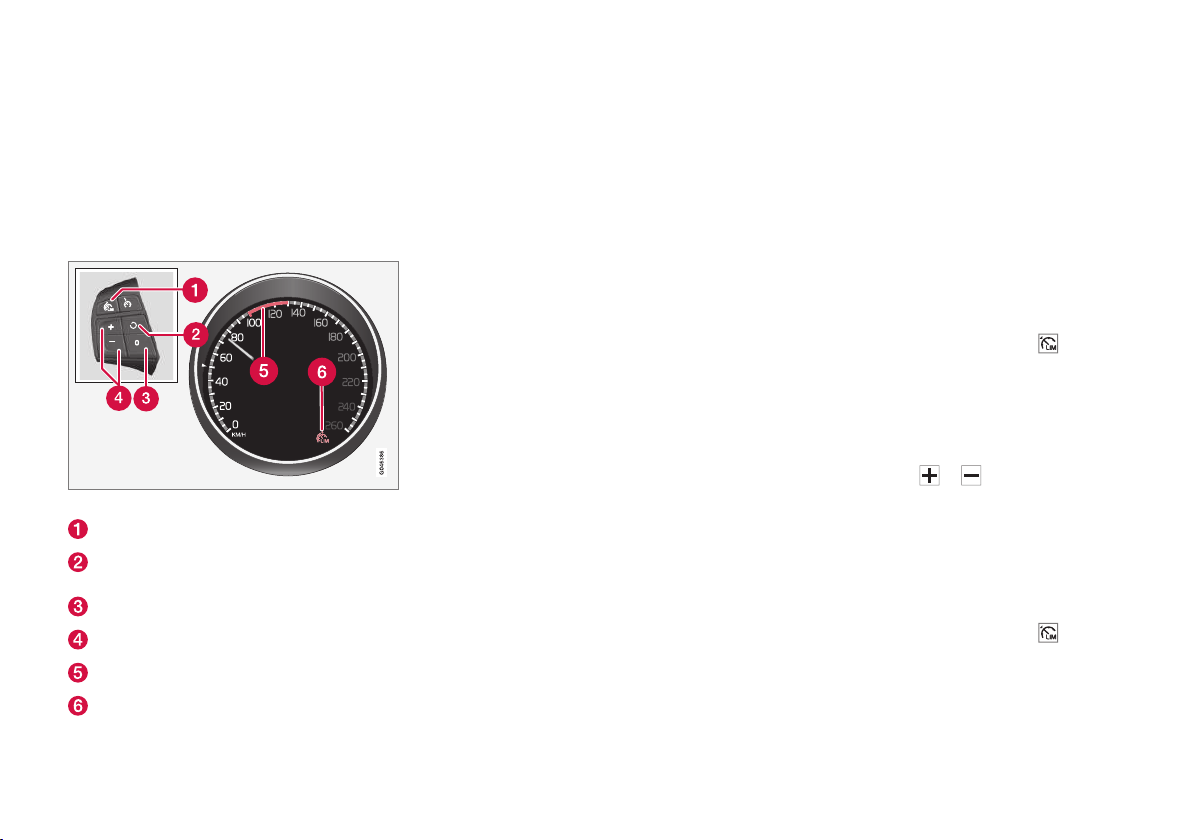
DRIVER SUPPORT
}}
* Option/accessory.
187
Speed limiter*
A Speed Limiter (Speed Limiter) can be regar-
ded as a reverse cruise control - the driver regu-
lates the speed using the accelerator pedal but
is prevented from accidentally exceeding a pre-
selected/set speed by the speed limiter.
Overview
Steering wheel keypad and combined instrument panel.
Speed limiter - On/Off.
Standby mode ceases and the stored speed
is resumed.
Standby mode.
Activate and adjust the max. speed.
Selected speed.
Speed limiter active.
Related information
•
Speed limiter* - getting started (p. 187)
•
Speed limiter* - temporary deactivation and
standby mode (p. 188)
•
Speed limiter* - alarm for speed exceeded
(p. 189)
•
Speed limiter* - deactivation (p. 189)
Speed limiter* - getting started
Switch on and activate
When the speed limiter is active, its symbol (6) is
shown in combination with a mark (5) by the set
maximum speed in the combined instrument
panel.
Selection and storage of the highest possible
speed in the memory can be made both during a
journey and while stationary.
While driving
1.
Press the steering wheel button
to switch
on the speed limiter.
> The symbol (6) for speed limiter illumi-
nates in the combined instrument panel.
2. When the car is moving at the desired high-
est possible speed: Press one of the steering
wheel buttons
or until the combined
instrument panel shows a mark (5) by the
desired maximum speed.
> The speed limiter is then active and the
selected max. speed is stored in the
memory.
When stationary
1.
Press the steering wheel button
to switch
on the speed limiter.

||
DRIVER SUPPORT
* Option/accessory.
188
2.
Scroll with the
button until the combined
instrument panel shows a mark (5) by the
desired maximum speed.
> The speed limiter is then active and the
selected max. speed is stored in the
memory.
Related information
•
Speed limiter* (p. 187)
Speed limiter* - changing speed
Changing the stored speed
Stored max. speed is changed with short or long
presses on the
or steering wheel button.
To adjust +/- 5 km/h (+/- 5 mph):
•
Use short presses - each press gives
+/- 5 km/h (+/- 5 mph).
To adjust +/- 1 km/h (+/- 1 mph):
•
Hold down the button and release it at the
required max. speed.
Last press made is stored in the memory.
Related information
•
Speed limiter* (p. 187)
Speed limiter* - temporary
deactivation and standby mode
A Speed Limiter (Speed Limiter) can be regar-
ded as a reverse cruise control - the driver regu-
lates the speed using the accelerator pedal but
is prevented from accidentally exceeding a pre-
selected/set speed by the speed limiter.
Temporary deactivation - standby mode
To temporarily deactivate the speed limiter and
set it in standby mode:
–
Press .
> The mark (5) in the combined instrument
panel changes colour from GREEN to
WHITE and the driver can temporarily
exceed the set maximum speed.
The speed limiter is reactivated with one
press on
. The mark (5) then changes
colour from WHITE to GREEN and the
car's maximum speed is limited once
again.
Temporary deactivation with the
accelerator pedal
The speed limiter can also be set in standby
mode with the accelerator pedal, e.g. for rapidly
accelerating the car out of a situation:
DRIVER SUPPORT
* Option/accessory.
189
–
Depress the accelerator pedal fully.
> The combined instrument panel shows
the stored maximum speed with a col-
oured mark (5) and the driver can tempo-
rarily exceed the set maximum speed -
the mark (5) changes colour during this
time from GREEN to WHITE.
The speed limiter is automatically reacti-
vated after the release of the accelerator
pedal and the car's speed is slowed down
to below the selected/stored maximum
speed - the display's mark (5) changes
colour from WHITE to GREEN and the
car's maximum speed is again limited.
Related information
•
Speed limiter* (p. 187)
•
Speed limiter* - getting started (p. 187)
•
Speed limiter* - changing speed (p. 188)
•
Speed limiter* - deactivation (p. 189)
•
Speed limiter* - alarm for speed exceeded
(p. 189)
Speed limiter* - alarm for speed
exceeded
A Speed Limiter (Speed Limiter) can be regar-
ded as a reverse cruise control - the driver regu-
lates the speed using the accelerator pedal but
is prevented by the speed limiter from acciden-
tally exceeding a speed that is selected/set in
advance.
On a steep downhill gradient the speed limiter's
engine braking effect may be inadequate and the
selected maximum speed is exceeded. The driver
is alerted about this with an acoustic signal.
The signal is active until the driver has slowed to
below the selected maximum speed.
NOTE
The alarm is only activated after 5 seconds if
the speed has been exceeded by at least
3 km/h (approx. 2 mph), provided that neither
of the
or buttons has been depressed
during the last half minute.
Related information
•
Speed limiter* (p. 187)
•
Speed limiter* - changing speed (p. 188)
•
Speed limiter* - getting started (p. 187)
•
Speed limiter* - temporary deactivation and
standby mode (p. 188)
•
Speed limiter* - deactivation (p. 189)
Speed limiter* - deactivation
A Speed Limiter (Speed Limiter) can be regar-
ded as a reverse cruise control - the driver regu-
lates the speed using the accelerator pedal but
is prevented from accidentally exceeding a pre-
selected/set speed by the speed limiter.
To deactivate the speed limiter:
–
Press the steering wheel button .
> The combined instrument panel's symbol
for speed limiter (6) and the selection of
the set speed (5) both extinguish - the
set/stored speed is thus cleared and can-
not then be resumed with the
button.
The driver can then use the accelerator
pedal to choose a speed without limita-
tion.
Related information
•
Speed limiter* (p. 187)
•
Speed limiter* - getting started (p. 187)
•
Speed limiter* - temporary deactivation and
standby mode (p. 188)
•
Speed limiter* - alarm for speed exceeded
(p. 189)
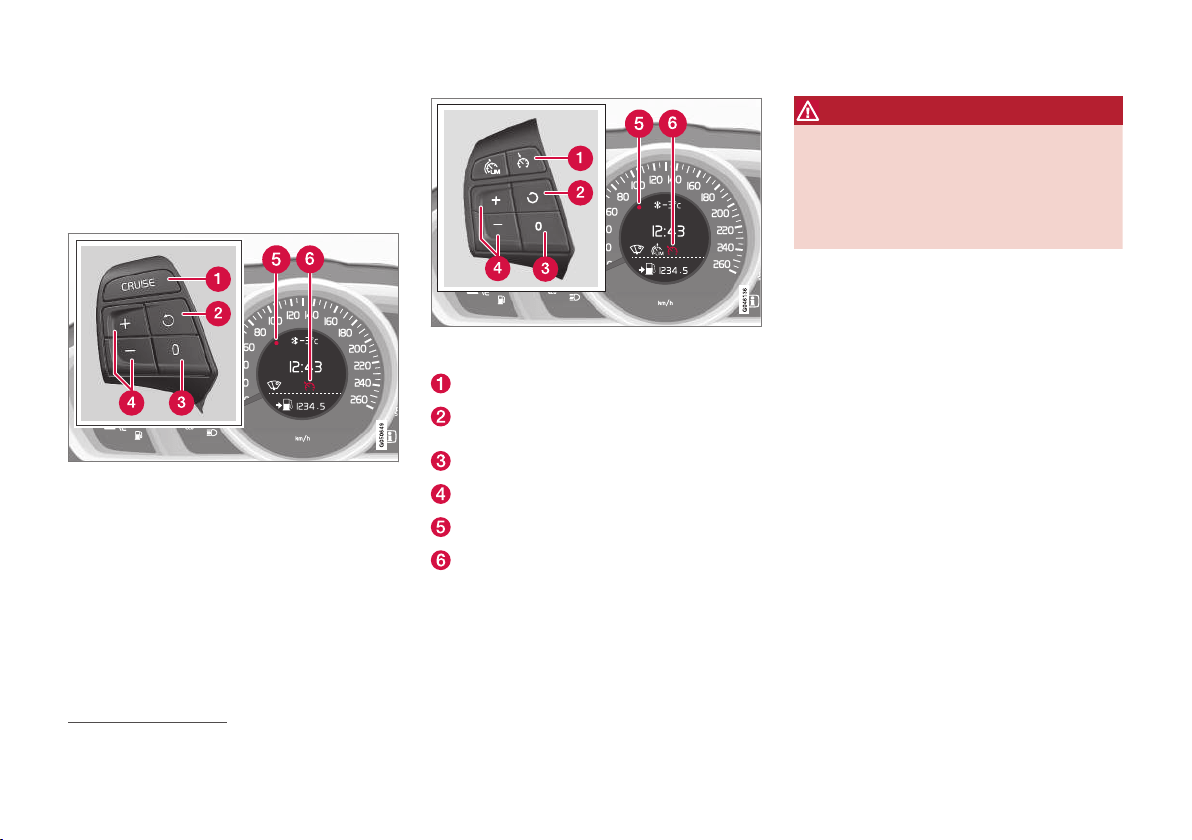
DRIVER SUPPORT
* Option/accessory.
190
Cruise control*
The cruise control (CC – Cruise Control) helps
the driver maintain an even speed, resulting in a
more relaxed driving on motorways and long,
straight roads in regular traffic flows.
Overview
The steering wheel buttons and combined instrument
panel in cars without speed limiter
2
.
The steering wheel buttons and combined instrument
panel in cars with speed limiter
2
.
Cruise control - On/Off.
Standby mode ceases and the stored speed
is resumed.
Standby mode.
Activate and adjust the speed.
Selected speed (GREY = Standby mode).
Cruise control active - WHITE symbol (GREY
= Standby mode).
WARNING
The driver must always be observant with
regard to the traffic conditions and intervene
when the cruise control is not maintaining a
suitable speed and/or suitable distance.
The driver always bears ultimate responsibility
for ensuring that the vehicle is driven safely.
Related information
•
Cruise control* - managing speed (p. 191)
•
Cruise control* temporary deactivation and
standby mode (p. 191)
•
Cruise control* - resume set speed (p. 192)
•
Cruise control* - deactivate (p. 192)
•
Adaptive cruise control - ACC* (p. 196)
2
A Volvo dealer has updated information about what applies in each respective market.
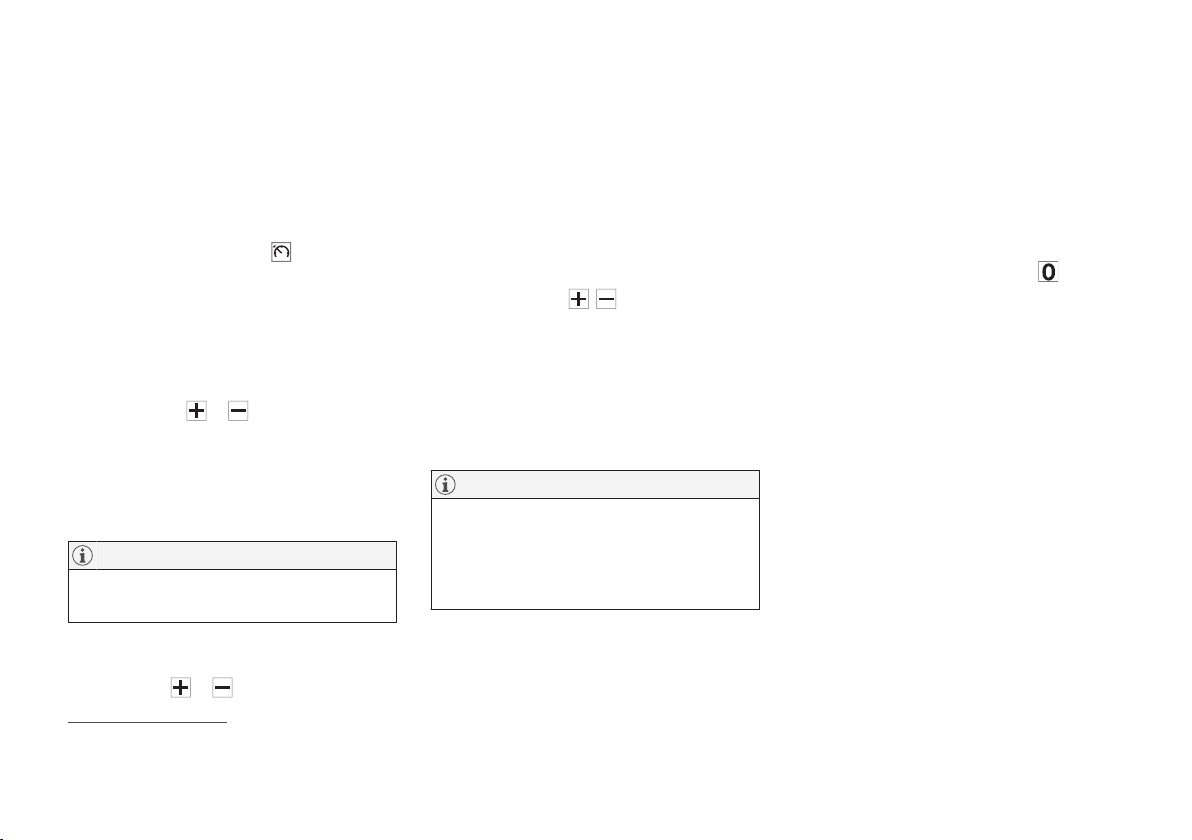
DRIVER SUPPORT
}}
* Option/accessory.
191
Cruise control* - managing speed
It is possible to activate, set and change the
stored speed.
Activating and setting the speed
To start the cruise control:
•
Press the steering wheel button for CRUISE
(without speed limiter) or
(with speed
limiter).
> The cruise control symbol (6) in the com-
bined instrument panel illuminates - cruise
control is in standby mode.
To activate cruise control:
•
At the required speed - press the steering
wheel button
or .
> The current speed is stored in memory and
the combined instrument panel's marking (5)
illuminates at the selected speed and the
symbol (6) changes from GREY to WHITE -
the car then follows the stored speed.
NOTE
Cruise Control cannot be enabled at speeds
below 30 km/h (20 mph).
Changing the stored speed
Stored speed is changed with short or long
presses on the
or steering wheel button.
To adjust 5 km/h (5 mph):
•
Use short presses - each press gives 5 km/h
(5 mph).
To adjust 1 km/h (1 mph):
•
Hold down the button and release it at the
required speed.
Last press made is stored in the memory.
If speed is increased using the accelerator pedal
prior to pressing the
/ button, then it is the
car's current speed when the button is pressed
that is stored.
A temporary increase in speed with the accelera-
tor pedal, e.g. during overtaking, does not affect
the cruise control setting - the car returns to the
last stored speed when the accelerator pedal is
released.
NOTE
If any of the Cruise Control buttons are held
depressed for several minutes then it is
blocked and deactivated. To be able to reacti-
vate Cruise Control, the car must be stopped
and the engine restarted.
Related information
•
Cruise control* (p. 190)
Cruise control* temporary
deactivation and standby mode
The function can be temporarily deactivated and
set in standby mode.
Temporary deactivation - standby mode
To temporarily disengage cruise control and set it
in standby mode:
•
Press the steering wheel button
.
> The combined instrument panel's
marking (5) and symbol (6) change colour
from WHITE to GREY - cruise control is tem-
porarily disengaged.
Standby mode due to driver
intervention
Cruise control is temporarily disengaged and
automatically set in standby mode if:
•
the foot brake is used
•
the clutch pedal is depressed for longer than
1 minute
3
•
the gear lever/selector is moved to N posi-
tion
•
the driver maintains speed higher than the
stored speed for longer than 1 minute.
The driver must then regulate the speed.
A temporary increase in speed with the accelera-
tor pedal, e.g. during overtaking, does not affect
3
Disengaging and selecting a higher or lower gear does not involve standby mode.

||
DRIVER SUPPORT
* Option/accessory.
192
the setting - the car returns to the last stored
speed when the accelerator pedal is released.
Automatic standby mode
Cruise control is temporarily disengaged and set
in standby mode if:
•
wheels lose traction
•
engine speed is too low/high
•
speed falls below 30 km/h (20 mph).
The driver must then regulate the speed.
Related information
•
Cruise control* (p. 190)
•
Cruise control* - managing speed (p. 191)
•
Cruise control* - resume set speed (p. 192)
•
Cruise control* - deactivate (p. 192)
Cruise control* - resume set speed
The cruise control (CC – Cruise Control) helps
the driver to maintain an even speed.
After temporary deactivation and standby
mode (p. 191) it is possible to resume the set
speed.
To reactivate the cruise control from standby
mode:
•
Press the steering wheel button
.
> The combined instrument panel's
marking (5) and symbol (6) change colour
from GREY to WHITE - the car then follows
the last stored speed.
NOTE
A marked speed increase may occur once the
speed has been resumed by selecting the
button.
Related information
•
Cruise control* (p. 190)
•
Cruise control* - managing speed (p. 191)
•
Cruise control* temporary deactivation and
standby mode (p. 191)
•
Cruise control* - deactivate (p. 192)
Cruise control* - deactivate
How it is deactivated is described here.
Cruise control is switched off with the steering
wheel button (1) or by switching off the engine -
the set/stored speed is thus cleared and cannot
then be resumed with the button.
Related information
•
Cruise control* (p. 190)
•
Cruise control* - managing speed (p. 191)
•
Cruise control* temporary deactivation and
standby mode (p. 191)
•
Cruise control* - resume set speed (p. 192)
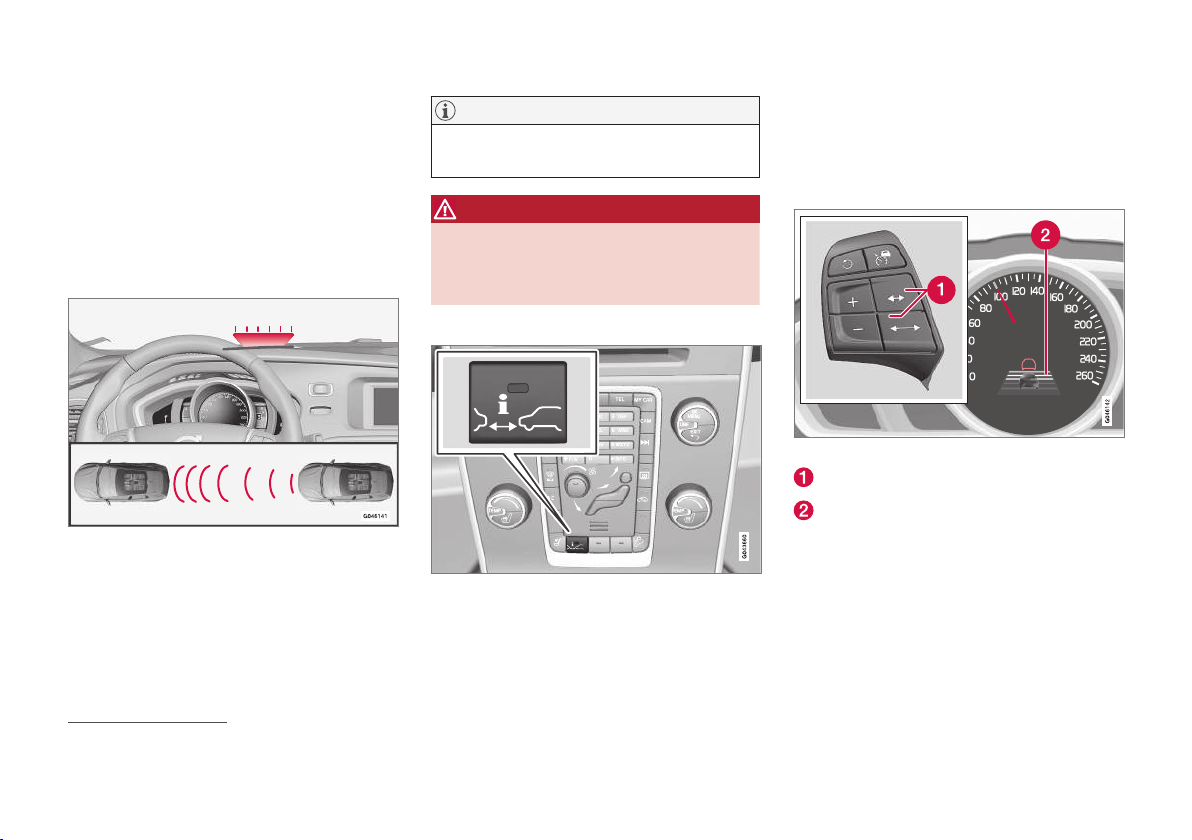
DRIVER SUPPORT
}}
* Option/accessory.
193
Distance Warning*
The Distance Warning function (Distance Alert)
warns the driver if the time interval to the vehicle
ahead becomes too short.
Distance Warning is active at speeds above
30 km/h (20 mph) and only reacts to vehicles
driving in front of the car, in the same direction.
No distance information is provided for oncoming,
slow or stationary vehicles.
Orange-coloured warning lamp
4
.
An orange-coloured warning lamp in the wind-
screen illuminates with a constant glow if the dis-
tance to the vehicle in front is shorter than the
set time interval.
NOTE
Distance warning is deactivated during the
time the adaptive cruise control is active.
WARNING
Distance warning only reacts if the time win-
dow to the vehicle ahead is shorter than the
preset value – the speed of the driver's vehi-
cle is not affected.
Operation
Press the button in the centre console to switch
the function on or off. The function is switched on
if one lamp is illuminated in the button.
Some combinations of the selected equipment
leave no vacant space for a button in the centre
console - in which case, the function is operated
in the car's menu system MY CAR (p. 109) -
once there, search for the
Distance Alert func-
tion.
Set time interval
Controls and symbol for time interval.
Time interval - Increase/decrease.
Time interval - On.
4
NOTE: The illustration is schematic - details may vary depending on car model.

||
DRIVER SUPPORT
* Option/accessory.
194
Different time intervals to the
vehicle in front can be selected
and shown in the combined
instrument panel as 1-5 hori-
zontal lines - the more lines the
longer the time interval. One
line corresponds to approxi-
mately 1 second to the vehicle in front, 5 lines
approximately 3 seconds.
The same symbol is also shown when Adaptive
cruise control (p. 197) is activated.
NOTE
The higher the speed the longer the calcula-
ted distance in metres for a given time inter-
val.
The set time interval is also used by the func-
tion adaptive cruise control (p. 197).
Only use the time intervals permitted by local
traffic regulations.
Related information
•
Distance Warning* - limitations (p. 194)
•
Distance Warning* - symbols and messages
(p. 195)
Distance Warning* - limitations
This function, which uses the same radar sensor
as Adaptive cruise control (p. 196) and Collision
warning with auto brake (p. 222), has certain lim-
itations.
NOTE
Strong sunlight, reflections or strong varia-
tions in light intensity, as well as wearing sun-
glasses, could mean that the warning light in
the windscreen cannot be seen.
Poor weather or winding roads could affect
the radar sensor's capacity to detect vehicles
in front.
The size of other vehicles could also affect
detection capacity, e.g. motorcycles. This
could mean that the warning lamp illuminates
at a shorter distance than the setting or that
the warning is temporarily absent.
Extremely high speeds can also cause the
lamp to illuminate at a shorter distance than
that set due to limitations in sensor range.
For further information on radar sensor limita-
tions, see Radar sensor - limitations (p. 210) and
(p. 227).
Related information
•
Distance Warning* (p. 193)
•
Distance Warning* - symbols and messages
(p. 195)
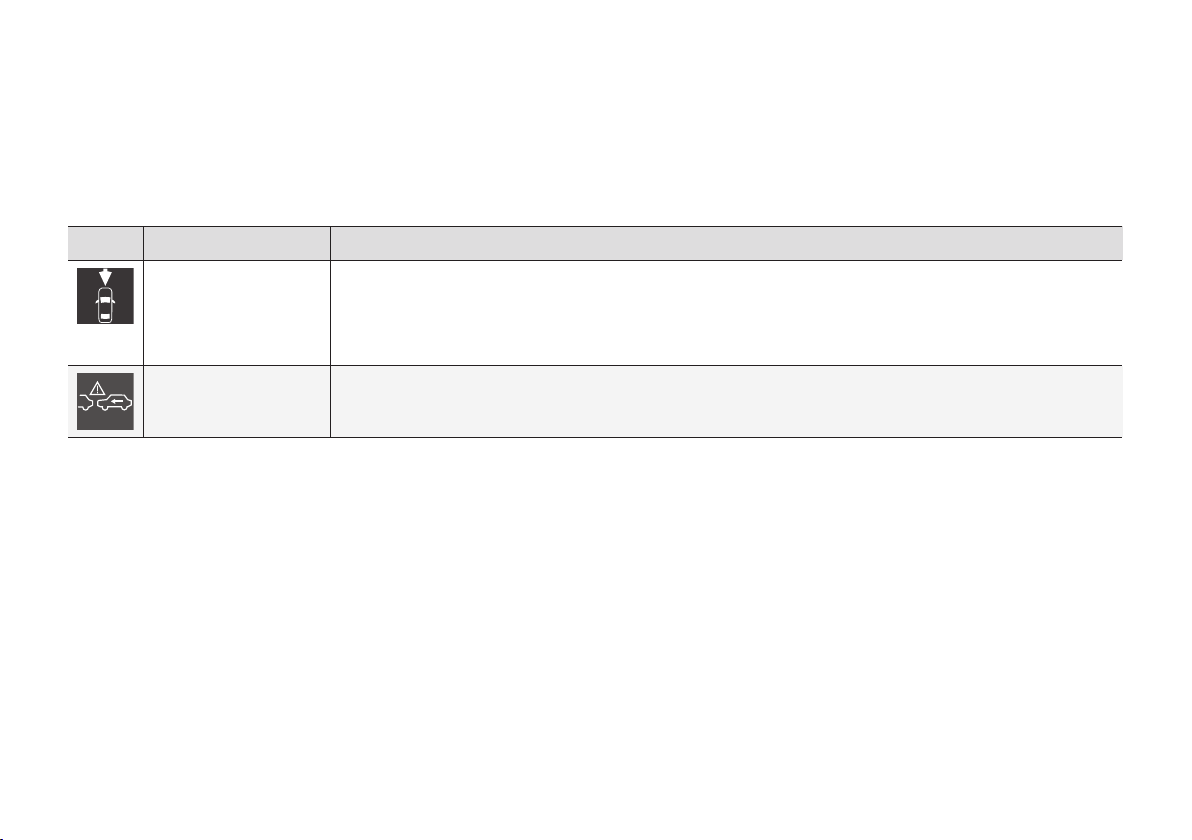
DRIVER SUPPORT
* Option/accessory.
195
Distance Warning* - symbols and
messages
The function has certain symbols and messages
that can be shown in the combined instrument
panel if the function is reduced due to its limita-
tions.
Symbol
A
Message Specification
Radar blocked See
manual
Distance Warning temporarily disengaged.
The radar sensor is blocked and cannot detect other vehicles, e.g. in the event of heavy rain or if slush has collected
in front of the radar sensor.
Read about radar sensor limitations (p. 210).
Collision warning
Service required
Distance Warning and Collision Warning with Auto Brake fully or partially disengaged.
Visit a workshop if the message remains - an authorised Volvo workshop is recommended.
A
Symbols are schematic - may vary by market and car model.
Related information
•
Distance Warning* (p. 193)
•
Distance Warning* - limitations (p. 194)

DRIVER SUPPORT
* Option/accessory.
196
Adaptive cruise control - ACC*
The adaptive cruise control (ACC – Adaptive
Cruise Control) helps the driver to maintain an
even speed combined with a pre-selected time
interval to the vehicle ahead.
The adaptive cruise control provides a more
relaxing driving experience on long journeys on
motorways and long straight main roads in
smooth traffic flows.
The driver sets the desired speed (p. 200) and
time interval (p. 201) to the car in front. When
the radar detector detects a slower vehicle in
front of the car, the speed is automatically adap-
ted to that. When the road is clear again the car
returns to the selected speed.
If the adaptive cruise control is switched off or
set to standby mode (p. 202) and the car comes
too close to a vehicle in front, then the driver is
warned instead by the Distance Warning (p. 193)
function about the short distance.
WARNING
The driver must always be observant with
regard to the traffic conditions and intervene
when the adaptive cruise control is not main-
taining a suitable speed or suitable distance.
The adaptive cruise control cannot handle all
traffic, weather and road conditions.
Read all the sections about the adaptive
cruise control in the owner's manual in order
to learn about its limitations, of which the
driver should be aware before it is used.
The driver always bears responsibility for
maintaining the correct distance and speed,
even when the adaptive cruise control is
being used.
IMPORTANT
Maintenance of adaptive cruise control com-
ponents must only be performed at a work-
shop - an authorised Volvo workshop is rec-
ommended.
For a limited time after the service, the ACC
function can have a somewhat limited range.
The system is calibrated whilst driving and full
function returns automatically.
Automatic gearbox
Cars with automatic gearbox have enhanced
functionality with the adaptive cruise control's
Queue assistance (p. 203) function.
Related information
•
Adaptive cruise control* - function (p. 197)
•
Adaptive cruise control* - overview (p. 198)
•
Adaptive cruise control* - managing speed
(p. 200)
•
Adaptive cruise control* - set time interval
(p. 201)
•
Adaptive cruise control* - temporary deacti-
vation, and standby mode (p. 202)
•
Adaptive cruise control* - overtaking another
vehicle (p. 203)
•
Adaptive cruise control* - deactivate (p. 203)
•
Adaptive Cruise Control* - queue assistance
(p. 203)
•
Adaptive cruise control* - switch cruise con-
trol functionality (p. 205)
•
Radar sensor (p. 210)
•
Radar sensor - limitations (p. 210)
•
Adaptive cruise control* - fault tracing and
action (p. 207)
•
Adaptive cruise control* - symbols and mes-
sages (p. 208)
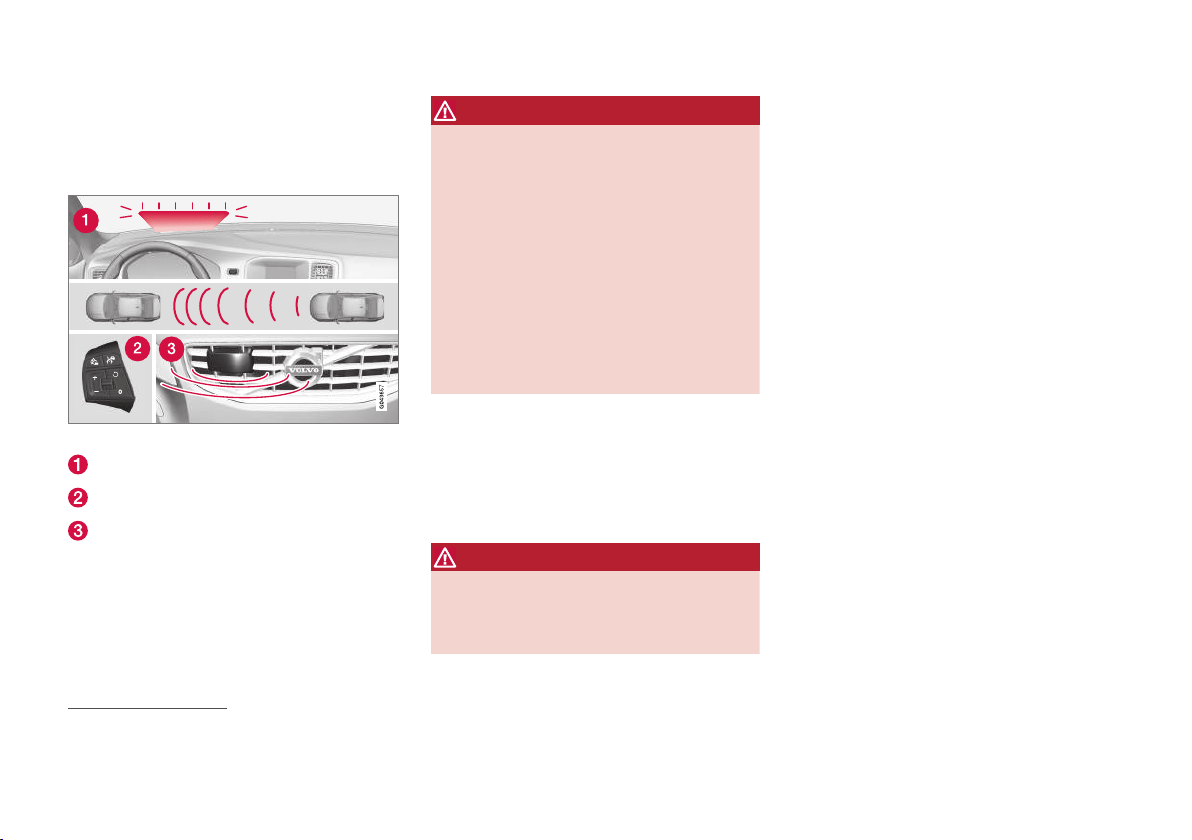
DRIVER SUPPORT
}}
* Option/accessory.
197
Adaptive cruise control* - function
Adaptive cruise control consists of a cruise con-
trol system and a coordinated spacing system.
Function overview
Function overview
5
.
Warning lamp - braking by driver required
Steering wheel keypad (p. 198)
Radar sensor (p. 210)
WARNING
Adaptive cruise control is not a collision avoid-
ance system. The driver must intervene if the
system does not detect a vehicle in front.
The adaptive cruise control does not brake for
humans or animals, and not for small vehicles
such as bicycles and motorcycles. Nor for low
trailers, oncoming, slow or stationary vehicles
and objects.
Do not use the adaptive cruise control, for
example, in city traffic, in dense traffic, at junc-
tions, on slippery surfaces, with a lot of water
or slush on the road, in heavy rain/snow, in
poor visibility, on winding roads or on slip
roads.
Distance to the vehicle ahead (p. 201) is meas-
ured primarily by a radar sensor (p. 210). The
cruise control function regulates the speed with
acceleration and braking. It is normal for the
brakes to emit a low sound when they are being
used by the adaptive cruise control.
WARNING
The brake pedal moves when the adaptive
cruise control brakes. Do not rest your foot
beneath the brake pedal - it may then
become trapped.
The adaptive cruise control aims to follow the
vehicle ahead in the same lane according to what
the driver set for time interval (p. 201). If the
radar sensor cannot see any vehicle in front then
the car will instead maintain the speed set and
stored by the driver. This also takes place if the
speed of the vehicle in front exceeds the stored
speed.
The adaptive cruise control aims to control the
speed in a smooth way. In situations that demand
sudden braking the driver must brake himself/
herself. This applies with large differences in
speed, or if the vehicle in front brakes heavily.
Due to limitations in the radar sensor (p. 210)
braking may come unexpectedly or not at all.
The adaptive cruise control can be activated to
follow another vehicle at speeds from 30 km/h
6
(20 mph) up to 200 km/h (125 mph). If the
speed falls below 30 km/h (20 mph) or if the
engine speed becomes too low, the cruise con-
trol is set in standby mode (p. 202) at which
automatic braking ceases - the driver must then
take over himself/herself to maintain a safe dis-
tance to the vehicle in front.
5
NOTE: The illustration is schematic - details may differ depending on car model.
6
Queue Assist (p. 203) (in cars with automatic gearbox) can operate in the range 0-200 km/h (0-125 mph).
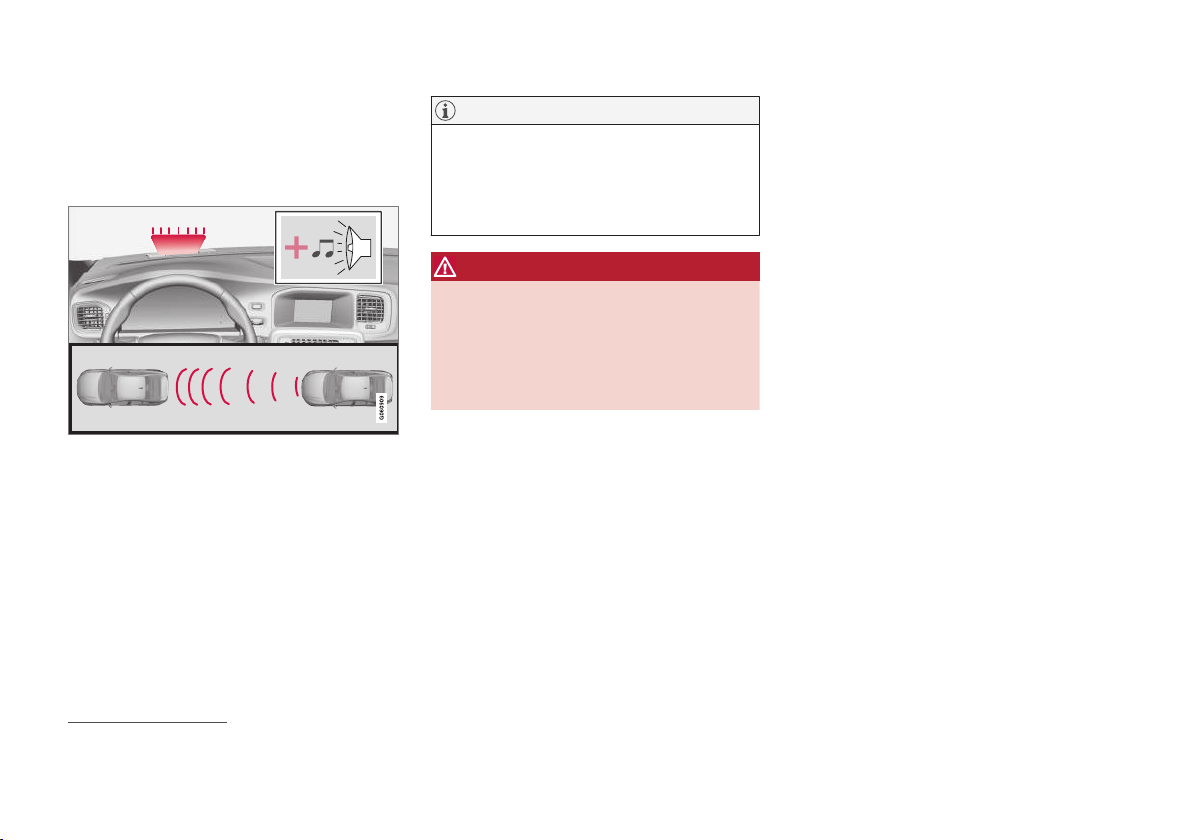
||
DRIVER SUPPORT
* Option/accessory.
198
Warning lamp - braking by driver
required
Adaptive cruise control has a braking capacity
that is equivalent to approx. 40% of the car's
braking capacity.
Audio-visual warning signal in the event of a collision
risk
7
.
If the car needs to be braked more heavily than
the adaptive cruise control capacity and the driver
does not brake, then the warning lamp and warn-
ing sound from the Collision warning system
(p. 222) are used in order to alert the driver that
immediate intervention is required.
NOTE
Strong sunlight, reflections, extreme light con-
trasts, the use of sunglasses, or if the driver is
not looking straight ahead may make the vis-
ual warning signal in the windscreen difficult
to recognise.
WARNING
The adaptive cruise control only warns of
vehicles which its radar unit has detected -
hence a warning may not be given, or it may
be given with a certain delay.
•
Never wait for a warning. Apply the
brakes when the situation requires.
Steep roads and/or heavy load
Bear in mind that the adaptive cruise control is
primarily intended for use when driving on level
road surfaces. It may have difficulty in keeping
the correct distance from the vehicle ahead when
driving on steep downhill slopes, with a heavy
load or with a trailer - in which case, be extra
attentive and ready to slow down.
Related information
•
Adaptive cruise control - ACC* (p. 196)
•
Adaptive cruise control* - deactivate (p. 203)
•
Adaptive cruise control* - overtaking another
vehicle (p. 203)
Adaptive cruise control* - overview
Operation of the adaptive cruise control and
steering wheel keypad varies depending on
7
NOTE: The illustration is schematic - details may vary depending on car model.
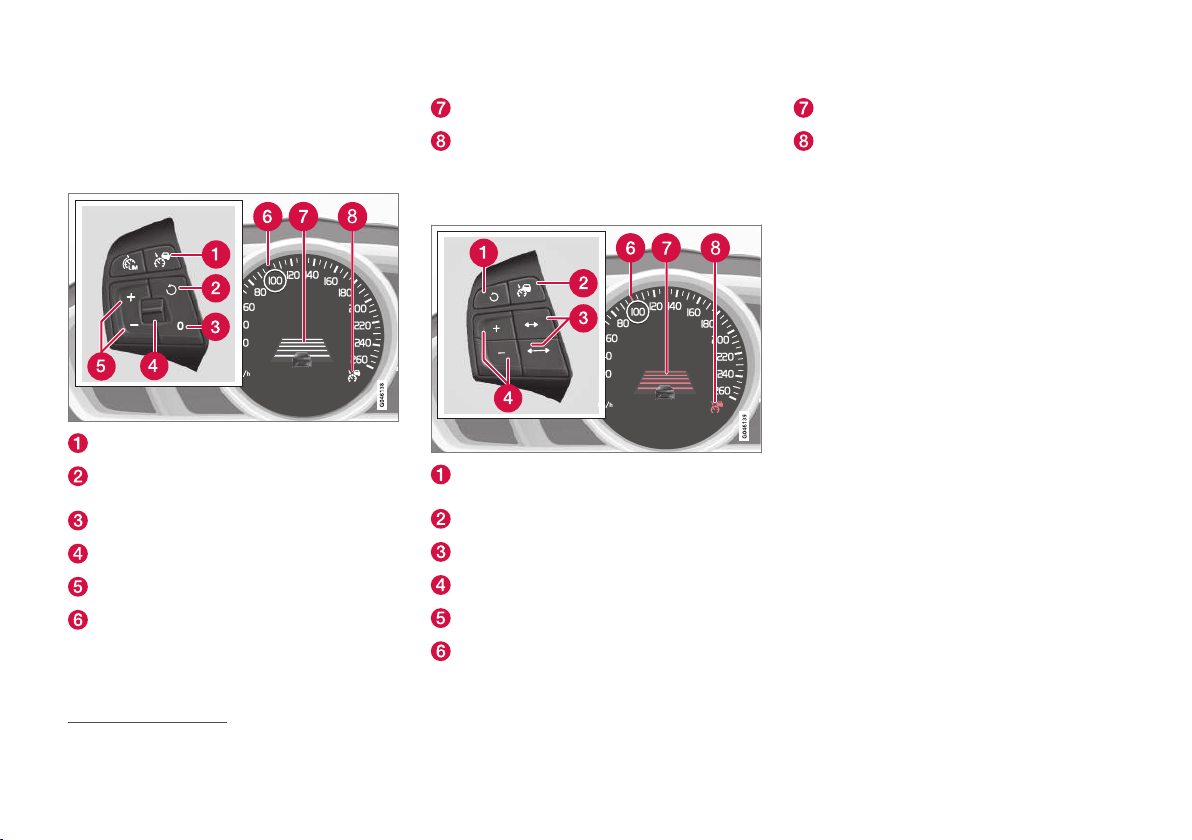
DRIVER SUPPORT
* Option/accessory.
199
whether or not the car is equipped with speed
limiter
8
.
Adaptive cruise control with Speed
limiter
Cruise control - On/Off.
Standby mode ceases and the stored speed
is resumed.
Standby mode
Time interval - Increase/decrease.
Activate and adjust the speed.
Green marking at stored speed (WHITE =
standby mode).
Time distance
ACC is active at the GREEN symbol (WHITE
= standby mode).
Adaptive cruise control without Speed
limiter
Standby mode ceases and the stored speed
is resumed.
Cruise control - On/Off or Standby mode.
Time interval - Increase/decrease.
Activate and adjust the speed.
(Not used)
Green marking at stored speed (WHITE =
standby mode).
Time distance
ACC is active at the GREEN symbol (WHITE
= standby mode).
Related information
•
Adaptive cruise control - ACC* (p. 196)
•
Adaptive cruise control* - function (p. 197)
•
Adaptive cruise control* - symbols and mes-
sages (p. 208)
8
A Volvo dealer has updated information about what applies in each respective market.
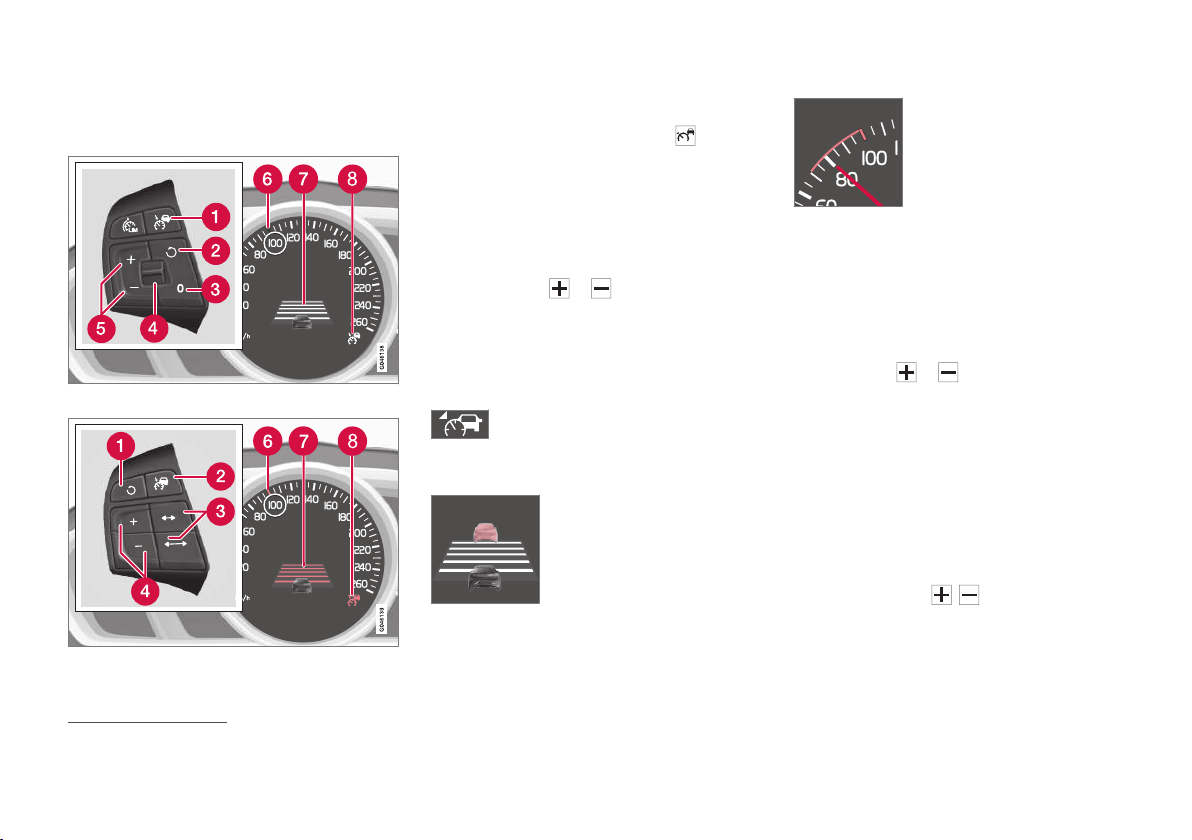
DRIVER SUPPORT
* Option/accessory.
200
Adaptive cruise control* - managing
speed
Adaptive cruise control with Speed limiter
9
.
Adaptive cruise control without Speed limiter
9
.
To start the ACC:
•
Press the steering wheel button
- a simi-
lar WHITE symbol illuminates in the com-
bined instrument panel (8) which shows that
the adaptive cruise control is in standby
mode (p. 202).
To activate ACC:
•
At the required speed - press the steering
wheel button
or .
> The current speed is stored in the memory,
the combined instrument panel shows a
"magnifying glass" (6) around the stored
speed for a second or so and its marking
changes from WHITE to GREEN.
When this symbol changes colour from
WHITE to GREEN, the ACC is active
and the car maintains the stored
speed.
Only when the symbol shows
an image of another vehicle is
the distance to the vehicle in
front controlled by the ACC.
At the same time a speed
range is marked:
•
the higher speed with GREEN marking is the
pre-programmed speed
•
the lower speed is the speed of the vehicle
in front.
Changing the stored speed
Stored speed is changed with short or long
presses on the
or steering wheel button.
To adjust +/- 5 km/h (+/- 5 mph):
•
Use short presses - each press gives
+/- 5 km/h (+/- 5 mph).
To adjust +/- 1 km/h (+/- 1 mph):
•
Hold down the button and release it at the
required speed.
Last press made is stored in the memory.
If speed is increased using the accelerator pedal
prior to pressing the
/ button, then it is the
car's current speed when the button is pressed
that is stored.
A temporary increase in speed with the accelera-
tor pedal, e.g. during overtaking, does not affect
9
An explanation of the illustration's figures is given in the section "Adaptive cruise control - overview" (p. 198).
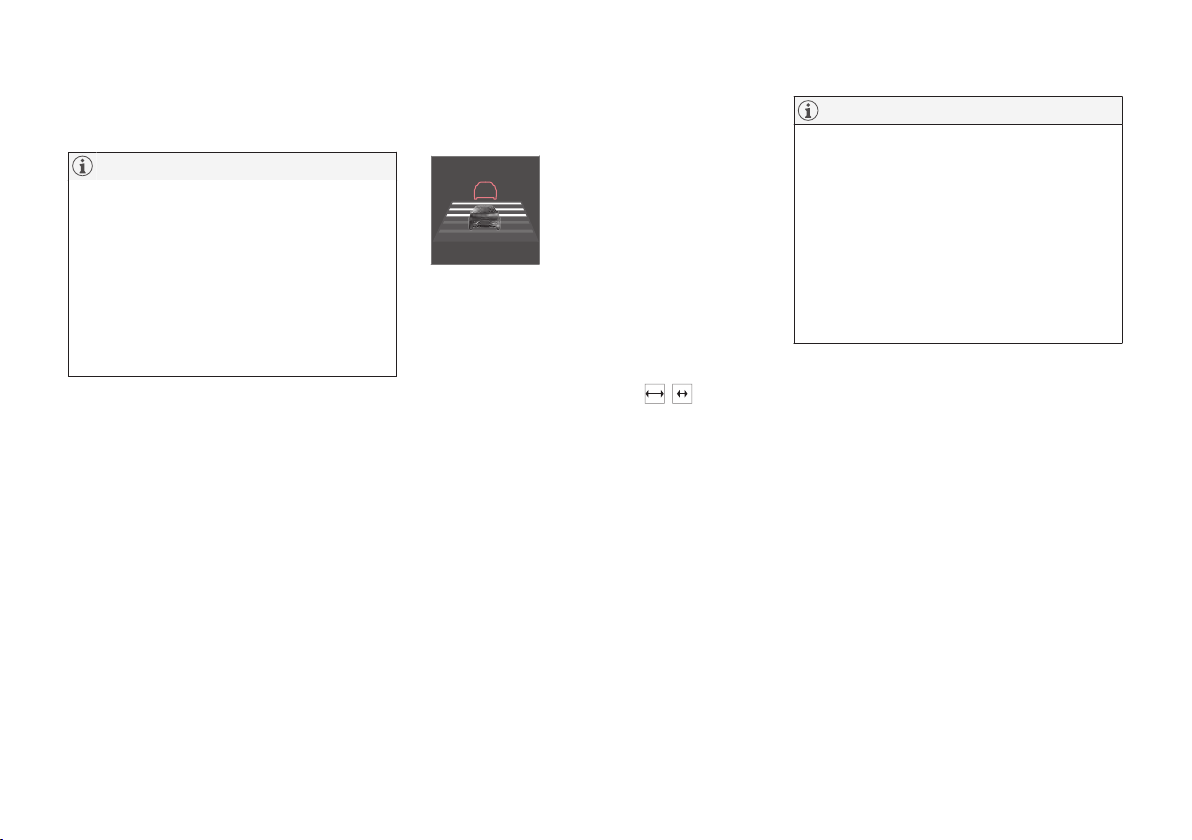
DRIVER SUPPORT
* Option/accessory.
201
the setting - the car returns to the last stored
speed when the accelerator pedal is released.
NOTE
If any of the adaptive cruise control buttons
are held depressed for several minutes then
the function is blocked and deactivated. To be
able to reactivate it, the car must be stopped
and the engine restarted.
In certain situations it cannot be reactivated -
in which case, the combined instrument panel
(p. 208) shows
Adaptive cruise control
unavailable.
Related information
•
Adaptive cruise control - ACC* (p. 196)
•
Adaptive cruise control* - overview (p. 198)
•
Adaptive cruise control* - function (p. 197)
Adaptive cruise control* - set time
interval
Different time intervals to the
vehicle in front can be selected
and shown in the combined
instrument panel as 1-5 hori-
zontal lines - the more lines the
longer the time interval. One
line corresponds to approxi-
mately 1 second to the vehicle in front, 5 lines
approximately 3 seconds.
To set/change the time distance:
•
Turn the thumbwheel on the steering wheel
keypad (p. 198) (or use the
/ buttons
for cars without Speed limiter).
At low speed, when the distances are short, the
adaptive cruise control increases the time interval
slightly.
The adaptive cruise control allows the time inter-
val to vary noticeably in certain situations in order
to allow the car to follow the vehicle in front
smoothly and comfortably.
Note that a short time interval only allows the
driver a short time to react and take action if any
unforeseen traffic problem should arise.
The same symbol is also shown when Distance
Warning (p. 193) function is activated.
NOTE
•
The higher the speed the longer the cal-
culated distance in metres for a given
time interval.
•
Only use the time intervals permitted by
local traffic regulations.
•
If the adaptive cruise control does not
seem to respond with a speed increase
when activated, it may be because the
time window to the vehicle ahead is
shorter than the set time window.
Read more how speed is handled (p. 200).
Related information
•
Adaptive cruise control - ACC* (p. 196)
•
Adaptive cruise control* - overview (p. 198)
•
Adaptive cruise control* - function (p. 197)
•
Adaptive cruise control* - deactivate (p. 203)

DRIVER SUPPORT
* Option/accessory.
202
Adaptive cruise control* - temporary
deactivation, and standby mode
The adaptive cruise control can be temporarily
deactivated and set in standby mode.
Temporary deactivation/standby mode
- with speed limiter
To temporarily disengage the adaptive cruise
control and set it in standby mode:
•
Press the steering wheel button
This symbol and the stored speed's
marking then change colour from
GREEN to WHITE.
Temporary deactivation/standby mode
- without speed limiter
To temporarily disengage the adaptive cruise
control and set it in standby mode:
•
Press the steering wheel button
Standby mode due to driver
intervention
The adaptive cruise control is temporarily disen-
gaged and set automatically in standby mode if:
•
the foot brake is used
•
the clutch pedal is depressed for longer than
1 minute
10
•
the gear selector is moved to N position
(automatic gearbox)
•
the driver maintains speed higher than the
stored speed for longer than 1 minute.
The driver must then regulate the speed.
A temporary increase in speed with the accelera-
tor pedal, e.g. during overtaking, does not affect
the setting - the car returns to the last stored
speed when the accelerator pedal is released.
Automatic standby mode
The adaptive cruise control is dependent on
other systems, e.g. Stability system ESC (p. 182).
If any of these systems stops working, the adap-
tive cruise control is deactivated automatically.
In the event of automatic deactivation a signal will
sound and the message
Adaptive cruise
control cancelled is shown in the combined
instrument panel. The driver must then intervene
and adapt the speed and distance to the vehicle
ahead.
An automatic deactivation can be due to:
•
the driver opens the door
•
the driver takes off his seatbelt
•
engine speed is too low/high
•
speed has fallen below 30 km/h
11
(20 mph)
•
wheels lose traction
•
brake temperature is high
•
the radar sensor is covered e.g. by wet snow
or heavy rain (radar waves blocked).
Resume set speed
Adaptive cruise control in standby mode is reacti-
vated with one press on the steering wheel but-
ton
- the speed is then set to the last stored
speed.
NOTE
A pronounced increase in speed may occur
after the cruise control has been reactivated
with the
button.
Related information
•
Adaptive cruise control - ACC* (p. 196)
•
Adaptive cruise control* - overview (p. 198)
•
Cruise control* (p. 190)
10
Disengaging and selecting a higher or lower gear does not involve standby mode.
11
Does not apply to a car with Queue assistance - it can go all the way down to 0 km/h.
DRIVER SUPPORT
}}
* Option/accessory.
203
Adaptive cruise control* - overtaking
another vehicle
When the car is following another vehicle and the
driver indicates an impending overtaking
manoeuvre with the direction indicator
12
, the
adaptive cruise control helps to briefly accelerate
the car towards the vehicle in front.
The function is active at speeds above 70 km/h
(43 mph).
WARNING
Be aware that this function can be activated
in more situations than during overtaking, e.g.
when a direction indicator is used to indicate
a change of lane or exit to another road – the
car will then accelerate briefly.
Related information
•
Adaptive cruise control - ACC* (p. 196)
•
Adaptive cruise control* - overview (p. 198)
•
Adaptive cruise control* - function (p. 197)
Adaptive cruise control* - deactivate
Keypad with Speed limiter
The adaptive cruise control is switched off with
the steering wheel button
in the steering
wheel keypad (p. 198) - the set/stored speed is
thus cleared and cannot then be resumed with
the
button.
Keypad without Speed limiter
With a short press on the steering wheel button
the adaptive cruise control is set in standby
mode (p. 202). It is switched off with an addi-
tional short press - the set/stored speed is thus
cleared and cannot then be resumed with the
button.
Related information
•
Adaptive cruise control - ACC* (p. 196)
•
Adaptive cruise control* - function (p. 197)
•
Adaptive cruise control* - symbols and mes-
sages (p. 208)
Adaptive Cruise Control* - queue
assistance
Queue assistance also provides the adaptive
cruise control with enhanced functionality at
speeds below 30 km/h (20 mph).
In cars with automatic gearbox the adaptive
cruise control is supplemented with the queue
assistance function (also referred to as "Queue
Assist").
Queue assistance has the following functions:
•
Extended speed range - also at lower than
30 km/h (20 mph) and at stationary
•
Change of target
•
Automatic braking ceases when stationary
•
Automatic activation parking brake.
Note that the lowest programmable speed for the
adaptive cruise control is 30 km/h (20 mph) -
even though it is capable of following another
vehicle down to 0 km/h, a speed lower than
30 km/h (20 mph) cannot be selected/stored.
Extended speed range
NOTE
In order to activate the adaptive cruise control,
the driver's door must be closed and the
driver must be wearing the seatbelt.
12
On left flash only in left-hand-drive car, or right flash in right-hand-drive car.
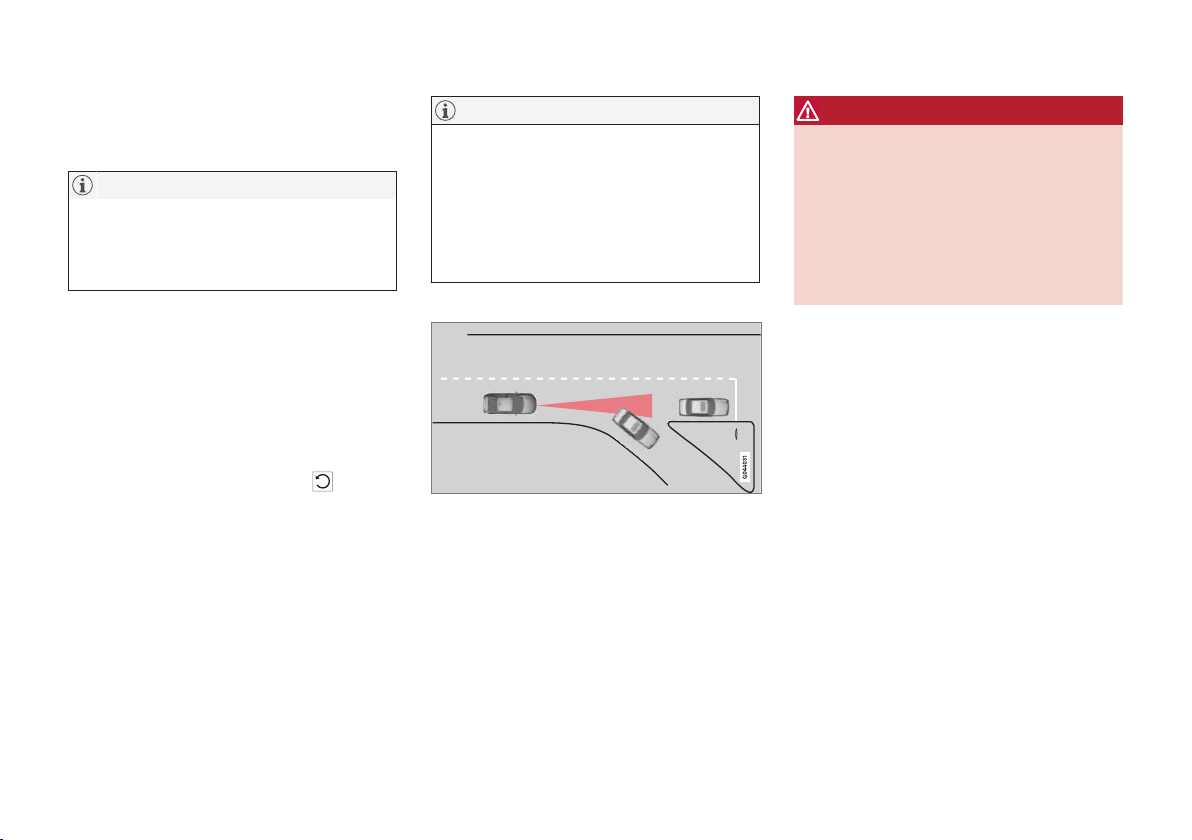
||
DRIVER SUPPORT
204
With an automatic gearbox, the adaptive cruise
control can follow another vehicle within the
range 0-200 km/h (0-125 mph).
NOTE
A vehicle in front must be within a reasonable
distance in order to enable activation of the
adaptive cruise control at a speed lower than
30 km/h (20 mph).
For shorter stops in connection with inching in
slow traffic or at traffic lights driving is automati-
cally resumed if the stops do not exceed about
3 seconds - if it takes longer before the car in
front starts moving again then the Adaptive
cruise control is set in standby mode with auto-
matic braking. The driver must then reactivate it
in one of the following ways:
•
Press the steering wheel button
...or...
•
Depress the accelerator pedal.
> The adaptive cruise control will then resume
following the vehicle in front.
NOTE
The Queue Assist function can hold the car
stationary for a maximum of 4 minutes - then
the parking brake is applied and the adaptive
cruise control is disengaged.
•
The parking brake must be released
before the adaptive cruise control can be
reactivated.
Change of target
If the target vehicle in front suddenly turns then there
may be stationary traffic in front.
When the adaptive cruise control is following
another vehicle at speeds below 30 km/h
(20 mph) and the target is changed from a mov-
ing vehicle to a stationary vehicle, the adaptive
cruise control will brake for the stationary vehicle.
WARNING
When the adaptive cruise control is following
a vehicle in front at speeds in excess of
30 km/h (20 mph) and the target is changed
from a vehicle in front to a stationary vehicle,
the adaptive cruise control will ignore the sta-
tionary vehicle and instead select the stored
speed.
•
The driver must intervene him/herself and
brake.
Automatic standby mode with change
of target
The adaptive cruise control is disengaged and set
in standby mode:
•
when the speed is below 5 km/h (5 mph)
and the adaptive cruise control is uncertain
whether the target object is a stationary vehi-
cle or some other object, e.g. a speed bump.
•
when the speed is below 5 km/h (5 mph)
and the vehicle in front turns off so the adap-
tive cruise control no longer has a vehicle to
follow.
Termination of automatic braking at a
standstill
In certain situations, queue assistance stops
automatic braking at a standstill. This means that
the brakes are released and the car may start to
roll - the driver must therefore intervene and
DRIVER SUPPORT
}}
* Option/accessory.
205
brake the car himself/herself in order to maintain
its position.
Queue assistance releases the foot brake and
sets the adaptive cruise control in standby mode
in the following situations:
•
the driver puts his/her foot on the brake
pedal
•
the parking brake is applied
•
the gear selector is moved to P, N or R posi-
tion
•
the driver sets the adaptive cruise control in
standby mode.
Automatic activation parking brake
In certain situations queue assistance applies the
parking brake in order to keep the car remaining
stationary.
This takes place if:
•
the driver opens the door or takes off his/her
seatbelt
•
ESC is changed from Normal to Sport
mode
•
Queue assistance has held the car stationary
for more than 4 minutes
•
the engine is switched off
•
the brakes have overheated.
Related information
•
Adaptive cruise control - ACC* (p. 196)
•
Adaptive cruise control* - overview (p. 198)
•
Adaptive cruise control* - function (p. 197)
Adaptive cruise control* - switch
cruise control functionality
Changing from ACC to CC
A symbol for active cruise control is shown in the
combined instrument panel:
CC
Cruise Control
ACC
Adaptive Cruise Control
Cruise control Adaptive cruise control
With one press of the button the adaptive part
(spacing system) in the cruise control is deacti-
vated, at which point the car just follows the set/
stored speed.
•
Give a long press on the steering wheel but-
ton
- the combined instrument panel's
symbol changes from
to .
> By these means the standard cruise control
(p. 190) CC (Cruise Control) is activated.
WARNING
The car no longer brakes automatically after
switching from ACC to CC - it merely follows
the set speed.

||
DRIVER SUPPORT
* Option/accessory.
206
Changing back from CC to ACC
Switch off cruise control with 1-2 presses on the
button in accordance with the deactivation
instructions (p. 203). The next time the system is
switched on it is the Adaptive cruise control that
is activated.
Related information
•
Adaptive cruise control - ACC* (p. 196)
•
Adaptive cruise control* - overview (p. 198)
•
Adaptive cruise control* - function (p. 197)
DRIVER SUPPORT
* Option/accessory.
207
Adaptive cruise control* - fault
tracing and action
If the combined instrument panel shows the mes-
sage
Radar blocked See manual then it
means that the adaptive cruise control's radar
sensor (p. 210) cannot detect other vehicles in
front of the car.
This message indicates that neither of the func-
tions for Distance Alert (p. 193) or Collision
Warning with Auto Brake (p. 222) are working.
The following table presents examples of possi-
ble causes for a message being shown along
with the appropriate action:
Cause Action
The radar surface in the grille is dirty or covered with ice or snow. Clean the radar surface in the grille from dirt, ice and snow.
Heavy rain or snow blocking the radar signals. No action. Sometimes the radar does not work during heavy rain or snowfall.
Water or snow from the road surface swirls up and blocks the radar
signals.
No action. Sometimes the radar does not work on a very wet or snowy road sur-
face.
The radar surface has been cleaned but the message remains. Wait. It could take several minutes for the radar to sense that it is no longer
blocked.
Related information
•
Adaptive cruise control* - overview (p. 198)
•
Adaptive cruise control* - function (p. 197)
•
Adaptive cruise control* - symbols and mes-
sages (p. 208)
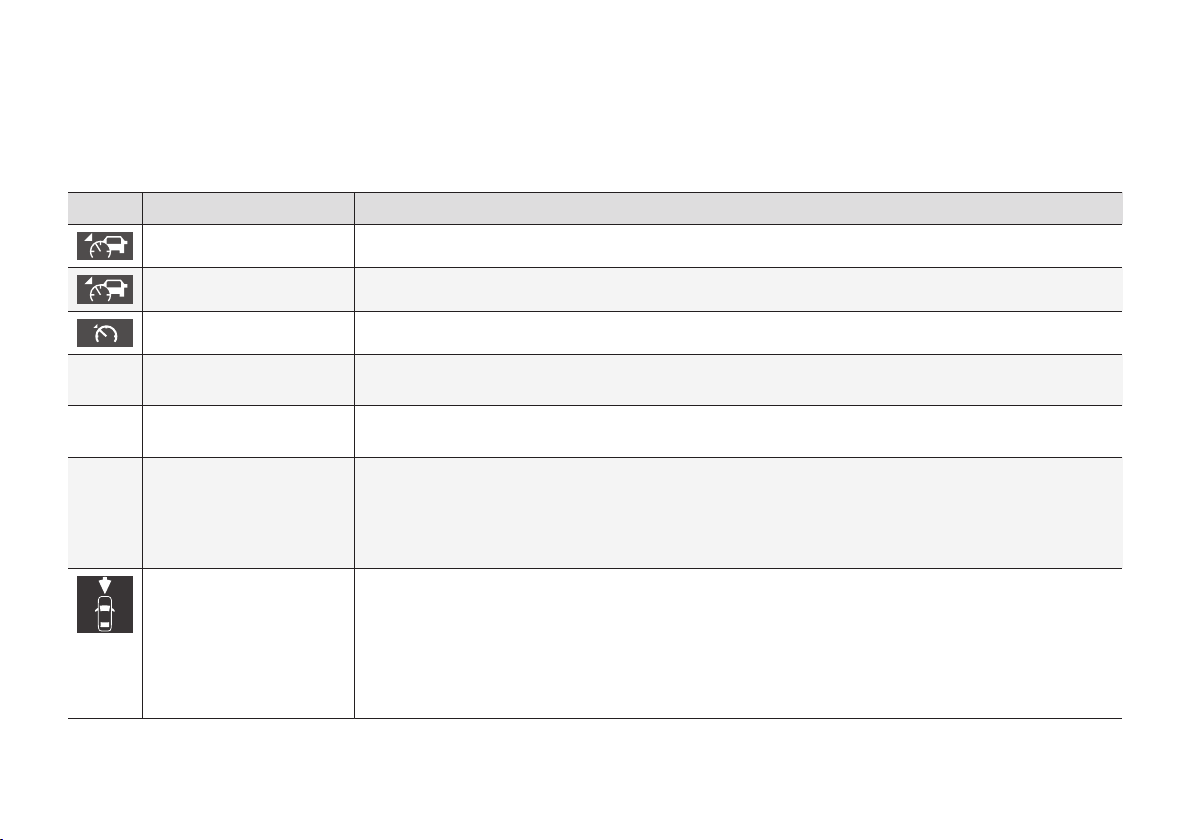
DRIVER SUPPORT
* Option/accessory.
208
Adaptive cruise control* - symbols
and messages
Sometimes the adaptive cruise control may dis-
play a symbol and/or text message. Here are
some examples - follow the recommendation
given if appropriate:
Symbol Message Specification
The symbol is GREEN The car maintains the stored speed.
The symbol is WHITE Adaptive cruise control is set to standby mode.
Standard cruise control is selected manually.
Set ESC to Normal to
enable Cruise
The adaptive cruise control cannot be activated until the Stability system (ESC) (p. 182) has been set in Normal
mode.
Adaptive cruise control
cancelled
The adaptive cruise control has been deactivated - the driver has to regulate the speed himself.
Adaptive cruise control
unavailable
The adaptive cruise control cannot be activated.
This could be due to:
•
brake temperature is high
•
the radar sensor is blocked by e.g. wet snow or rain.
Radar blocked See man-
ual
The adaptive cruise control is temporarily disengaged.
•
The radar sensor is blocked and cannot detect other vehicles. For example, in the event of heavy rain or if
slush has collected in front of the radar sensor.
The driver can then choose to switch to (p. 205) normal Cruise control (CC) - a text message provides informa-
tion on appropriate alternatives.
Read about radar sensor limitations (p. 210).
DRIVER SUPPORT
* Option/accessory.
209
Symbol Message Specification
Adaptive cruise control
Service required
The adaptive cruise control is disengaged.
•
Contact a workshop - an authorised Volvo workshop is recommended.
Press brake to hold vehi-
cle
+ acoustic alarm
A
The car is stationary and the cruise control will release the foot brake to allow the parking brake to take over and
hold the car, but a fault in the parking brake means the car will shortly begin to roll.
•
The driver must brake himself/herself. The message remains and the alarm sounds until the driver depresses
the brake pedal or uses the accelerator pedal.
Below 30 km/h Lead
vehicle required
A
Shown in the event of attempts to activate the adaptive cruise control at speeds below 30 km/h (20 mph) with-
out a vehicle in front within the activation distance.
A
Only with Queue Assist.
Related information
•
Adaptive cruise control - ACC* (p. 196)
•
Adaptive cruise control* - overview (p. 198)
•
Adaptive cruise control* - function (p. 197)

DRIVER SUPPORT
* Option/accessory.
210
Radar sensor
The function of the radar sensor is to detect cars
or larger vehicles in the same direction, in the
same lane.
The radar sensor is used by the following func-
tions:
•
Distance Warning*
•
Adaptive cruise control*
•
Collision Warning System with Auto Brake
and Cyclist and Pedestrian Detection*
IMPORTANT
In the event of visible damage to the car's
grille, or if you suspect that the radar sensor
may be damaged:
•
Contact a workshop - an authorised
Volvo workshop is recommended.
The function may completely or partially dis-
appear - or malfunction - if the grille, the
radar sensor or its bracket is damaged or has
loosened.
Modification of the radar sensor could result in it
being illegal to use.
Related information
•
Radar sensor - limitations (p. 210)
•
Adaptive cruise control - ACC* (p. 196)
•
Collision warning system* (p. 222)
•
Distance Warning* (p. 193)
Radar sensor - limitations
A radar sensor (p. 210) has certain limitations -
due to its limited field of vision for example.
The capacity of the adaptive cruise control to
detect a vehicle in front is significantly reduced if:
•
the speed of vehicles in front is significantly
different from your own speed
•
its radar sensor becomes blocked - e.g. in
heavy rain or slush, or if other objects have
collected in front of the radar sensor.
NOTE
Keep the area in front of the radar sensor
clean - see subheading "Maintenance"
(p. 226).
Field of vision
The radar sensor has a limited field of vision. In
some situations another vehicle is not detected,
or the detection is made later than expected.
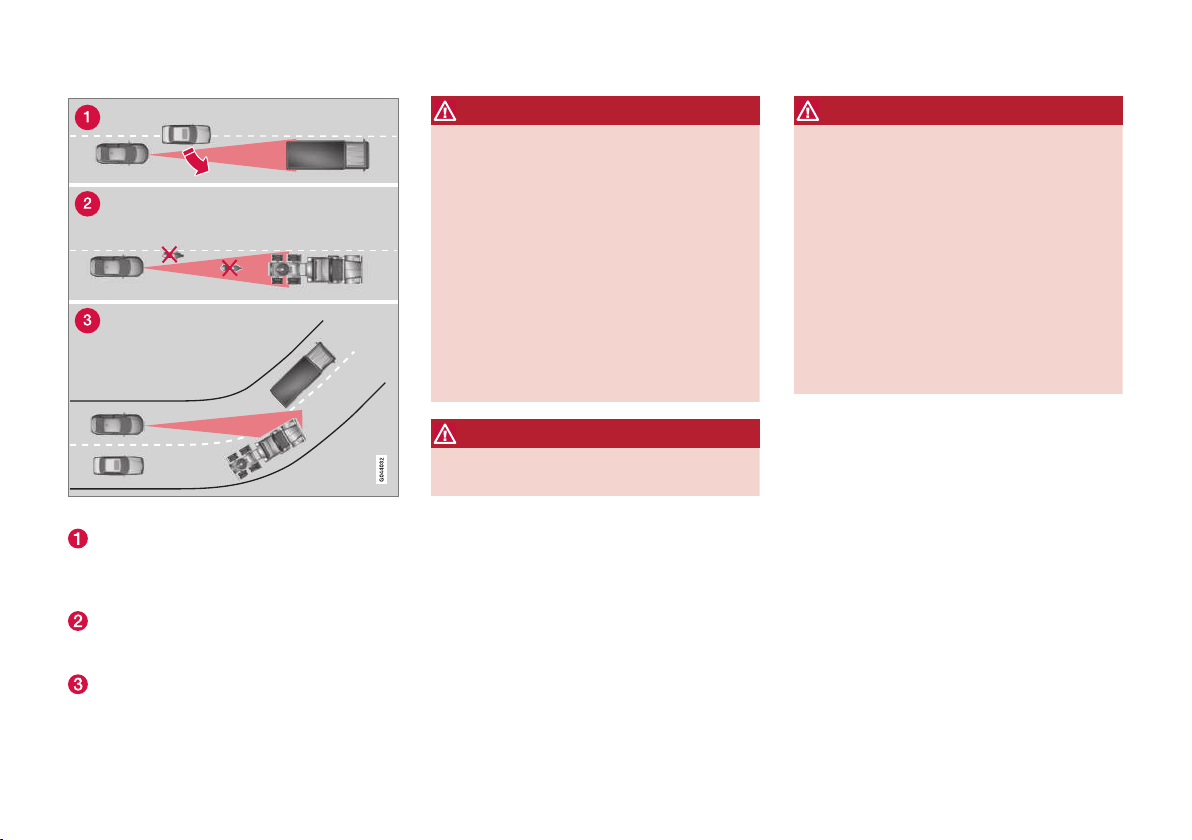
DRIVER SUPPORT
* Option/accessory.
211
ACC field of vision.
Sometimes the radar sensor is late at detect-
ing vehicles at close distances - e.g. a vehicle
that drives in between the car and vehicles in
front.
Small vehicles, such as motorcycles, or vehi-
cles not driving in the centre of the lane can
remain undetected.
In bends the radar sensor may detect the
wrong vehicle or lose a detected vehicle from
view.
WARNING
The driver must always be observant with
regard to the traffic conditions and intervene
when the adaptive cruise control is not main-
taining a suitable speed or suitable distance.
The adaptive cruise control cannot handle all
traffic, weather and road conditions.
Read all the sections about the adaptive
cruise control in the owner's manual in order
to learn about its limitations, of which the
driver should be aware before it is used.
The driver always bears responsibility for
maintaining the correct distance and speed,
even when the adaptive cruise control is
being used.
WARNING
Accessories or other objects such as auxiliary
lamps must not be fitted in front of the grille.
WARNING
Adaptive cruise control is not a collision avoid-
ance system. The driver must intervene if the
system does not detect a vehicle in front.
The adaptive cruise control does not brake for
humans or animals, and not for small vehicles
such as bicycles and motorcycles. Nor for
oncoming, slow or stationary vehicles and
objects.
Do not use the adaptive cruise control, for
example, in city traffic, in dense traffic, at junc-
tions, on slippery surfaces, with a lot of water
or slush on the road, in heavy rain/snow, in
poor visibility, on winding roads or on slip
roads.
Related information
•
Adaptive cruise control - ACC* (p. 196)
•
Collision warning system* (p. 222)
•
Distance Warning* (p. 193)
DRIVER SUPPORT
212
Type approval - radar system
Type approval for the car's radar units can be
seen in the following table.
Market
ACC
A
BLIS
B
Symbol Type approval
Brazil
✓
Este equipamento opera em caráter secundário, isto é, não tem direito à proteção contra
interferência prejudicial, mesmo de estações do mesmo tipo e não pode causar
interferência a sistemas operando em caráter primário.
Modelo: L2C0038TR
1071-10-3451
EAN: 07897843800248
✓
Modelo: L2C0055TR
1500-15-8065
EAN: 07897843840978
Europe
✓ ✓
Hereby, Delphi Electronics & Safety declares that L2C0038TR / L2C0055TR are in
compliance with the essential requirements and other relevant provisions of Directive
1999/5/EC.
The Declaration of Conformity may be consulted at Delphi Electronics & Safety / 2151 E.
Lincoln Road / Kokomo, Indiana 46902 USA
The United Arab Emi-
rates
✓
TRA
REGISTERED No: 0018923/09
DEALER No: DA37380/15
✓
TRA
REGISTERED No: ER37357/15
DEALER No: DA37380/15
DRIVER SUPPORT
}}
213
Market
ACC
A
BLIS
B
Symbol Type approval
Indonesia
✓
14785/POSTEL/2010 1982
✓
38806/SDPPI/2015 4927
Jordan
✓
Type Approval No.: TRC/LPD/2009/87
Equipment type: Low Power Device (LPD)
✓
Type Approval No.: TRC/LPD/2015/3
Equipment Type: Low Power Device (LPD)
Korea
✓
Certification No.
DPH-L2C0038TR
✓
Certification No.
MSIP-CMI-DPH-L2C0055TR
Morocco
✓
AGREE PAR L'ANRT MAROC
Numero d'agrement : MR 4838 ANRT 2009
Date d'agrement : 22/05/2009
✓
AGREE PAR L’ANRT MAROC
NUMÉRO D’AGRÉMENT: MR 9929 ANRT 2014
DATE D’AGRÉMENT: 26/12/2014
Moldavia
✓ ✓
1024

DRIVER SUPPORT
* Option/accessory.
215
City Safety™
City Safety™ is a function for helping the driver
to avoid a collision when driving in queues,
amongst other things, when changes in the traf-
fic ahead, combined with a lapse in attention,
could lead to an incident.
The City Safety™ function is active at speeds
below 50 km/h (30 mph) and it helps the driver
by automatically braking the car in the event of
imminent risk of collision with vehicles in front,
should the driver not react in time by braking
and/or steering away.
City Safety™ is activated in situations where the
driver should have started braking earlier, which
is why it cannot help the driver in every situation.
City Safety™ is designed to be activated as late
as possible in order to avoid unnecessary inter-
vention.
City Safety™ must not be used as an excuse for
the driver to change his/her driving style. If the
driver solely relies on City Safety™ to do the
braking, there might be a risk of a collision
sooner or later.
The driver or passengers normally only notice City
Safety™ if a situation arises where the car is
extremely close to being in a collision.
If the car is also equipped with Collision Warning
with Auto Brake (p. 222)* these two systems
complement each other.
IMPORTANT
Maintenance and replacement of City
Safety™ components must only be per-
formed by a workshop - an authorised Volvo
workshop is recommended.
WARNING
City Safety™ does not engage in all driving
situations or traffic, weather or road condi-
tions.
City Safety™ does not react to vehicles driv-
ing in a different direction from the car, to
small vehicles and motorcycles or to humans
and animals.
City Safety™ can prevent collision at a speed
difference of less than 15 km/h (9 mph) - at
a higher speed difference, it is only possible
to reduce collision speed. In order to obtain
full brake function, the driver must depress
the brake pedal.
Never wait for City Safety™ to engage. The
driver always bears responsibility for maintain-
ing the proper distance and speed.
Related information
•
City Safety™ - limitations (p. 217)
•
City Safety™ - function (p. 216)
•
City Safety™ - operation (p. 216)
•
City Safety™ - laser sensor (p. 219)
•
City Safety™ - symbols and messages
(p. 221)
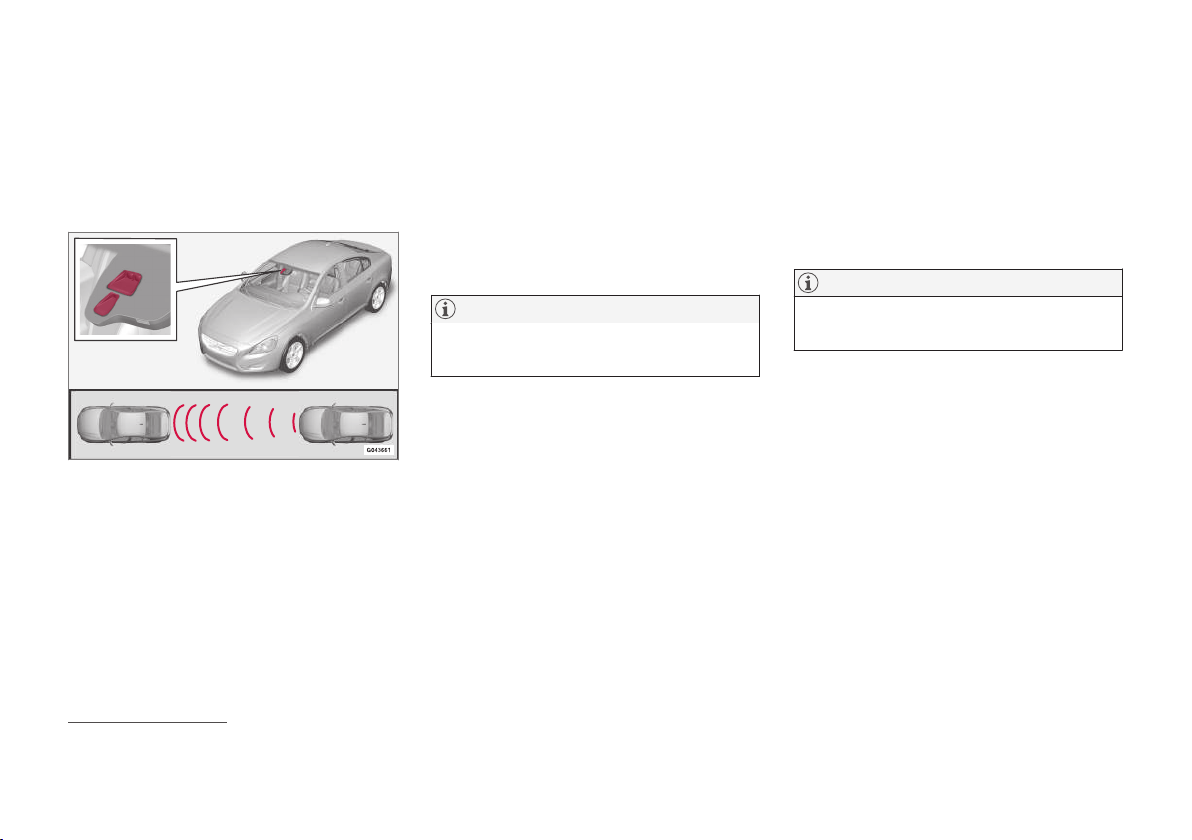
DRIVER SUPPORT
216
City Safety™ - function
City Safety detects the traffic in front of the car
with a laser sensor fitted in the top edge of the
windscreen. If there is an imminent risk of colli-
sion, City Safety will automatically brake the car,
which may be experienced as heavy braking.
Laser sensor transmitter and receiver window
13
.
If the speed difference is 4-15 km/h (3-9 mph)
in relation to the vehicle in front then City Safety
can completely avoid a collision.
City Safety activates a short, sharp braking proce-
dure and stops the car in normal circumstances,
just behind the vehicle in front. For most drivers
this is well outside normal driving style and may
be experienced as being uncomfortable.
If the difference in speed between the vehicles is
greater than 15 km/h (9 mph) then City Safety
may not avoid the collision on its own - to obtain
full brake force, the driver must depress the
brake pedal and this could then make it possible
to avoid a collision, even at speed differences
above 15 km/h (9 mph).
When the function is activated and brakes, the
combined instrument panel shows a text mes-
sage to the effect that the function is/has been
active.
NOTE
When City Safety brakes, the brake lights
come on.
Related information
•
City Safety™ - limitations (p. 217)
•
City Safety™ (p. 215)
•
City Safety™ - operation (p. 216)
•
City Safety™ - laser sensor (p. 219)
•
City Safety™ - symbols and messages
(p. 221)
City Safety™ - operation
City Safety™ is a function for helping the driver
to avoid a collision when driving in queues,
amongst other things, when changes in the traf-
fic ahead, combined with a lapse in attention,
could lead to an incident.
On and Off
NOTE
The City Safety™ function is activated auto-
matically when the engine is started.
In certain situations, it may advisable to disable
City Safety™, e.g. where leafy branches could
sweep over the bonnet and/or windscreen.
City Safety™ handled in the menu system MY
CAR (p. 109) and after starting the engine the
function can be deactivated as follows:
•
Search in MY CAR for
Driver support
system and select the Off option at City
Safety.
However, the function will be enabled the
next time the engine is started, regardless of
whether the system was enabled or disabled
when the engine was switched off.
13
NOTE: The illustration is schematic - details may vary depending on car model.

DRIVER SUPPORT
}}
217
WARNING
The laser sensor also transmits laser light
when City Safety™ is disabled manually.
Related information
•
City Safety™ (p. 215)
•
City Safety™ - limitations (p. 217)
•
City Safety™ - function (p. 216)
•
City Safety™ - laser sensor (p. 219)
•
City Safety™ - symbols and messages
(p. 221)
•
MY CAR (p. 109)
City Safety™ - limitations
The sensor in City Safety is designed to detect
cars and other large vehicles in front of the car
irrespective of whether it is day or night.
However, the function does have some limita-
tions.
The sensor's limitations mean that City Safety
has poorer functionality - or none at all - in e.g.
heavy snowfall or rain, dense fog, dust storms or
white-out situations. Misting, dirt, ice or snow on
the windscreen may also disrupt the function.
Low-hanging objects, e.g. a flag/pennant for pro-
jecting load, or accessories such as auxiliary
lamps and bull bars that are higher than the bon-
net limit the function.
The laser beam from the sensor in City Safety
measures how the light is reflected. The sensor
cannot detect objects with low reflection capacity.
The rear sections of the vehicle generally reflect
the light sufficiently thanks to the number plate
and rear light reflectors.
On slippery road surfaces the braking distance is
extended, which may reduce the capacity of City
Safety to avoid a collision. In such situations the
ABS
14
and ESC
15
systems will provide best pos-
sible braking force with maintained stability.
When your own car is reversing, City Safety is
temporarily deactivated.
City Safety is not activated at low speeds - below
4 km/h (3 mph), which is why the system does
not intervene in situations where a vehicle in front
is being approached very slowly, e.g. when park-
ing.
Driver commands are always prioritised, which is
why City Safety does not intervene in situations
where the driver is steering or accelerating in a
clear manner, even if a collision is unavoidable.
When City Safety has prevented a collision with a
stationary object the car remains stationary for a
maximum of 1.5 seconds. If the car is braked for
a vehicle in front that is moving, then speed is
reduced to the same speed as that maintained by
the vehicle in front.
On a car with manual gearbox the engine stops
when City Safety has stopped the car, unless the
driver manages to depress the clutch pedal
beforehand.
14
(Anti-lock Braking System) - Anti-lock braking system.
15
(Electronic Stability Control) - Stability system.

||
DRIVER SUPPORT
218
NOTE
•
Keep the windscreen surface in front of
the laser sensor free from ice, snow and
dirt (see the illustration for sensor loca-
tion (p. 216)).
•
Do not affix or mount anything on the
windscreen in front of the laser sensor.
•
Remove ice and snow from the bonnet -
snow and ice must not exceed a height
of 5 cm.
Fault tracing and action
If the message Windscreen sensors blocked
See manual is shown in the combined instru-
ment panel it indicates that the laser sensor is
blocked and cannot detect vehicles in front of the
car. This means in turn that City Safety is not
operational.
The
Windscreen sensors blocked See
manual message is not shown for all situations
in which the laser sensor is blocked. The driver
must therefore be diligent about keeping the
windscreen and area in front of the laser sensor
clean.
The following table presents possible causes for
the message being shown, along with sugges-
tions for appropriate action.
Cause Action
The windscreen surface
in front of the laser sen-
sor is dirty or covered
with ice or snow.
Clean the wind-
screen surface in
front of the sensor
from dirt, ice and
snow.
The laser sensor field of
vision is blocked.
Remove the block-
ing object.
IMPORTANT
If there are cracks, scratches or stone chips in
the windscreen in front of either of the laser
sensor's "windows" and they cover a surface
of approx. 0.5 x 3.0 mm (or larger), then a
workshop must be contacted for replacement
of the windscreen (see the illustration for
sensor location (p. 216)) - an authorised
Volvo workshop is recommended.
Failure to take action may result in reduced
performance for City Safety™.
To avoid the risk of failed, deficient or
reduced operation for City Safety™, the fol-
lowing also applies:
•
Volvo recommends that you do not repair
cracks, scratches or stone chips in the
area in front of the laser sensor - instead,
the whole windscreen should be
replaced.
•
Before replacing a windscreen, contact
an authorised Volvo workshop to verify
that the correct windscreen is ordered
and fitted.
•
The same type or Volvo-approved wind-
screen wipers must be fitted during
replacement.
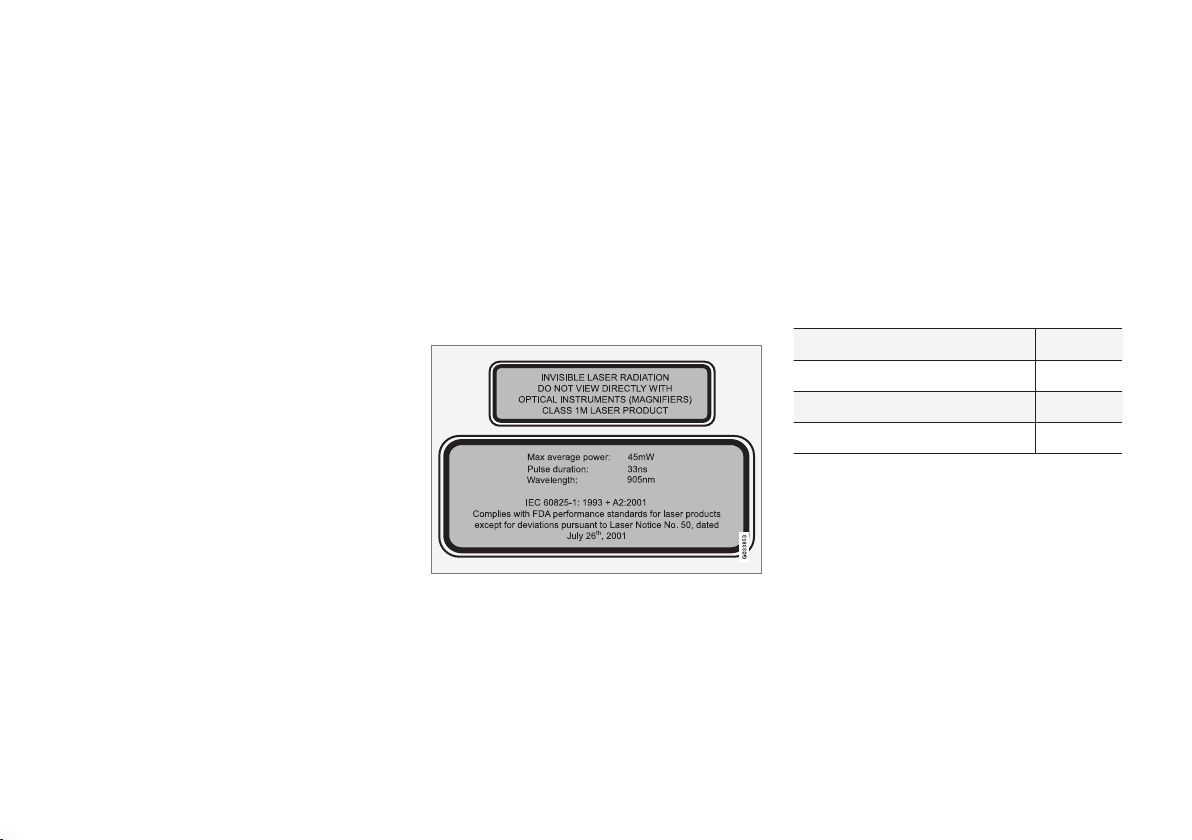
DRIVER SUPPORT
}}
219
Related information
•
City Safety™ (p. 215)
•
City Safety™ - function (p. 216)
•
City Safety™ - operation (p. 216)
City Safety™ - laser sensor
The City Safety™ function includes a sensor
which transmits laser light (see illustration
(p. 216) for sensor location). Contact a qualified
workshop in the event of a fault or if the laser
sensor needs servicing - an authorised Volvo
workshop is recommended. It is absolutely
essential to follow the prescribed instructions
when handling the laser sensor.
The following two labels relate to the laser sen-
sor:
The upper label in the figure describes the laser
beam's classification:
•
Laser radiation - Do not look into the laser
beam with optical instruments - Class 1M
laser product.
The lower label in the figure describes the laser
beam's physical data:
•
IEC 60825-1:1993 + A2:2001. Complies
with FDA (U.S. Food Administration) stand-
ards for laser product design with the excep-
tion of deviations in accordance with "Laser
Notice No. 50" from 26 July 2001.
Radiation data for the laser sensor
The following table specifies the laser sensor's
physical data.
Maximum pulse energy
2.64 µJ
Maximum average output 45 mW
Pulse duration 33 ns
Divergence (horizontal x vertical) 28° × 12°

||
DRIVER SUPPORT
220
WARNING
If any of these instructions are not followed
then there is a risk of eye injury!
•
Never look into the laser sensor (which
emits spreading invisible laser radiation)
at a distance of 100 mm or closer with
magnifying optics such as a magnifying
glass, microscope, lens or similar optical
instruments.
•
Testing, repair, removal, adjustment
and/or replacement of the laser sensor's
spare parts must only be carried out by a
qualified workshop - we recommend an
authorised Volvo workshop.
•
To avoid exposure to harmful radiation, do
not carry out any readjustments or main-
tenance other than those specified here.
•
The repairer must follow specially drawn
up workshop information for the laser
sensor.
•
Do not remove the laser sensor (this
includes removing the lenses). A removed
laser sensor does not fulfil laser class 3B
as per standard IEC 60825-1. Laser
class 3B is not eye-safe and therefore
entails a risk of injury.
•
The laser sensor's connector must be
unplugged before removal from the wind-
screen.
•
The laser sensor must be fitted onto the
windscreen before the sensor's connec-
tor is plugged in.
•
The laser sensor transmits a laser light
when the remote control key is in key
position II (p. 77) even if the engine is
switched off.
Related information
•
City Safety™ (p. 215)
•
City Safety™ - limitations (p. 217)
•
City Safety™ - function (p. 216)
•
City Safety™ - operation (p. 216)
•
City Safety™ - symbols and messages
(p. 221)
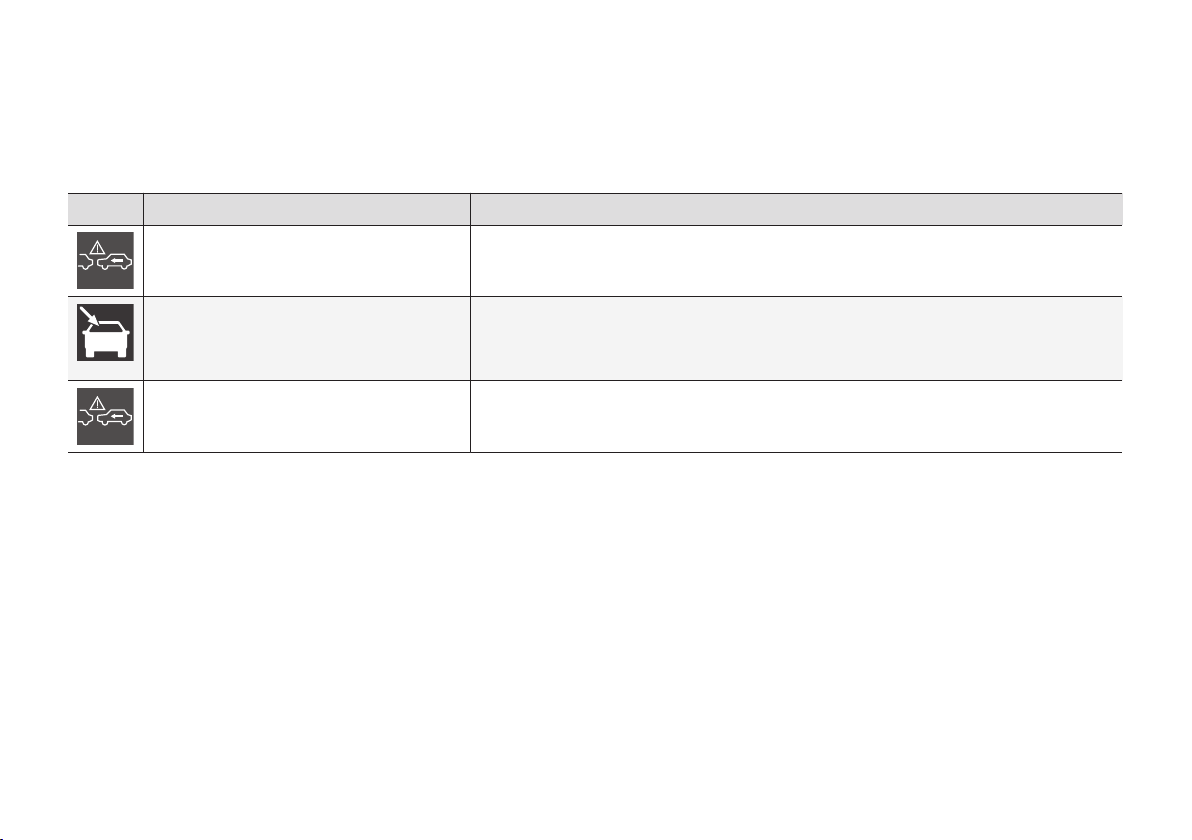
DRIVER SUPPORT
221
City Safety™ - symbols and
messages
In conjunction with automatic braking by the City
Safety™ (p. 215) system, one or more symbols
may illuminate in the combined instrument panel
and a text message may be shown. A text mes-
sage can be acknowledged by briefly pressing
the OK button on the direction indicator stalk.
Symbol Message Meaning/Action
Auto braking by City Safety
City Safety™ is braking or has automatically braked.
Windscreen sensors blocked See manual
The laser sensor is temporarily non-operational because something is blocking it.
•
Remove the object blocking the sensor and/or clean the windscreen in front of the sensor.
Read about laser sensor limitations (p. 217).
City Safety Service required
City Safety™ is not operational.
•
Visit a workshop if the message remains - an authorised Volvo workshop is recommended.
Related information
•
City Safety™ (p. 215)
•
City Safety™ - limitations (p. 217)
•
City Safety™ - function (p. 216)
•
City Safety™ - operation (p. 216)
•
City Safety™ - laser sensor (p. 219)

DRIVER SUPPORT
* Option/accessory.
222
Collision warning system*
"Collision Warning with Auto Brake and Cyclist
and Pedestrian Detection" is an aid to assist the
driver when there is a risk of colliding with a
pedestrian, cyclist or vehicle in front that are sta-
tionary or moving in the same direction.
"Collision Warning with Auto Brake and Cyclist
and Pedestrian Detection" is activated in situa-
tions where the driver should have started brak-
ing earlier, which is why it cannot help the driver
in every situation.
"Collision Warning with Auto Brake and Cyclist
and Pedestrian Detection" is designed to be acti-
vated as late as possible in order to avoid unnec-
essary intervention.
"Collision Warning with Auto Brake and Cyclist
and Pedestrian Detection" can prevent a collision
or reduce collision speed.
"Collision Warning with Auto Brake and Cyclist
and Pedestrian Detection" must not be used as
an excuse for the driver to change his/her driving
style. If the driver solely relies on Collision Warn-
ing with Auto Brake to do the braking, there
might be a risk of a collision sooner or later.
Two system levels
Depending on how the car is equipped, the "Col-
lision Warning with Auto Brake and Cyclist and
Pedestrian Detection" function may appear in
two variants:
Level 1
The driver is merely warned
16
of occurring obsta-
cles by means of visual and acoustic signals - no
automatic braking intervenes, the driver must
himself brake.
Level 2
The driver is warned of occurring obstacles by
means of visual and acoustic signals - the car is
braked automatically if the driver himself does not
act within a reasonable time.
IMPORTANT
Maintenance of the internal components of
the "Collision Warning with Auto Brake and
Cyclist and Pedestrian Detection" must only
be performed at a workshop - an authorised
Volvo workshop is recommended.
Related information
•
Collision warning system* - function (p. 223)
•
Collision warning system* - detection of
pedestrians (p. 225)
•
Collision warning system* - detection of
cyclists (p. 224)
•
Collision warning system* - operation
(p. 226)
•
Collision warning system* - limitations
(p. 228)
•
Collision warning system* - camera sensor
limitations (p. 229)
•
Collision warning system* - symbols and
messages (p. 231)
16
No warning for cyclists with "Level 1".
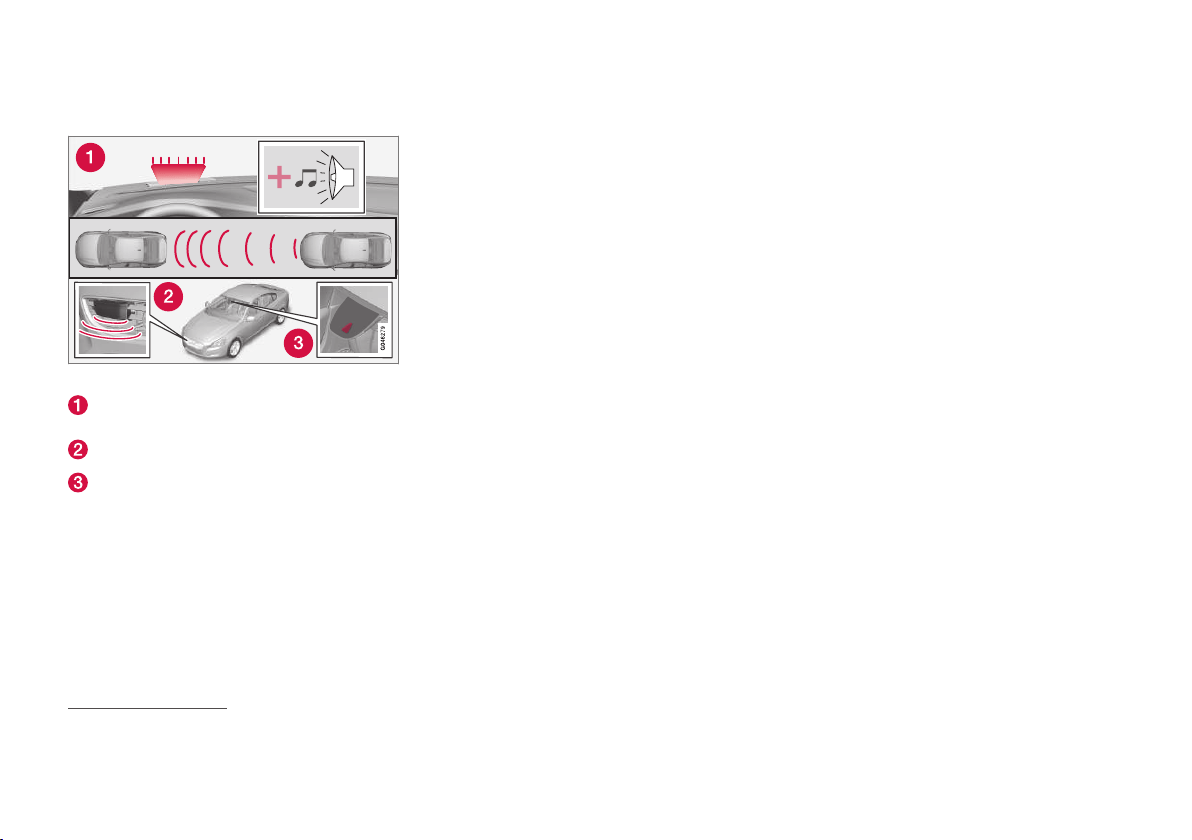
DRIVER SUPPORT
}}
* Option/accessory.
223
Collision warning system* - function
Function overview
17
.
Audio-visual warning signal in the event of a
collision risk.
Radar sensor
18
Camera sensor
Collision Warning with Auto Brake executes
three steps in the following order:
1.
Collision warning
2.
Brake support
18
3.
Auto Brake
18
The collision warning system and City Safety™
(p. 215) complement each other.
1 - Collision warning
The driver is first warned of a potentially immi-
nent collision.
The collision warning system can detect pedes-
trians, cyclists or vehicles that are stationary or
moving in the same direction as your car and are
located in front of you.
If there is a risk of collision with a pedestrian,
cyclist or a vehicle then the driver's attention is
attracted with a flashing red warning signal (1)
and an acoustic signal.
2 - Brake support
18
If the risk of collision has increased further after
the collision warning then the brake support is
activated.
This means that the brake system is prepared for
rapid braking by applying the brakes lightly, which
may feel like a slight jolt.
If the brake pedal is depressed sufficiently
quickly then full brake function is implemented.
Brake support also reinforces the driver's braking
if the system considers that the braking is not
sufficient to avoid a collision.
3 - Auto Brake
18
The automatic brake function is activated last.
If in this situation the driver has not yet started to
take evasive action and the risk of collision is
imminent then the automatic braking function is
deployed - this takes place irrespective of
whether or not the driver brakes. Braking then
takes place with full brake force in order to
reduce collision speed, or with limited brake force
if it is sufficient to avoid a collision. For cyclists,
the warning and full brake intervention may come
very late or simultaneously.
17
NOTE: The illustration is schematic - details may vary depending on car model.
18
With system Level 2 only.
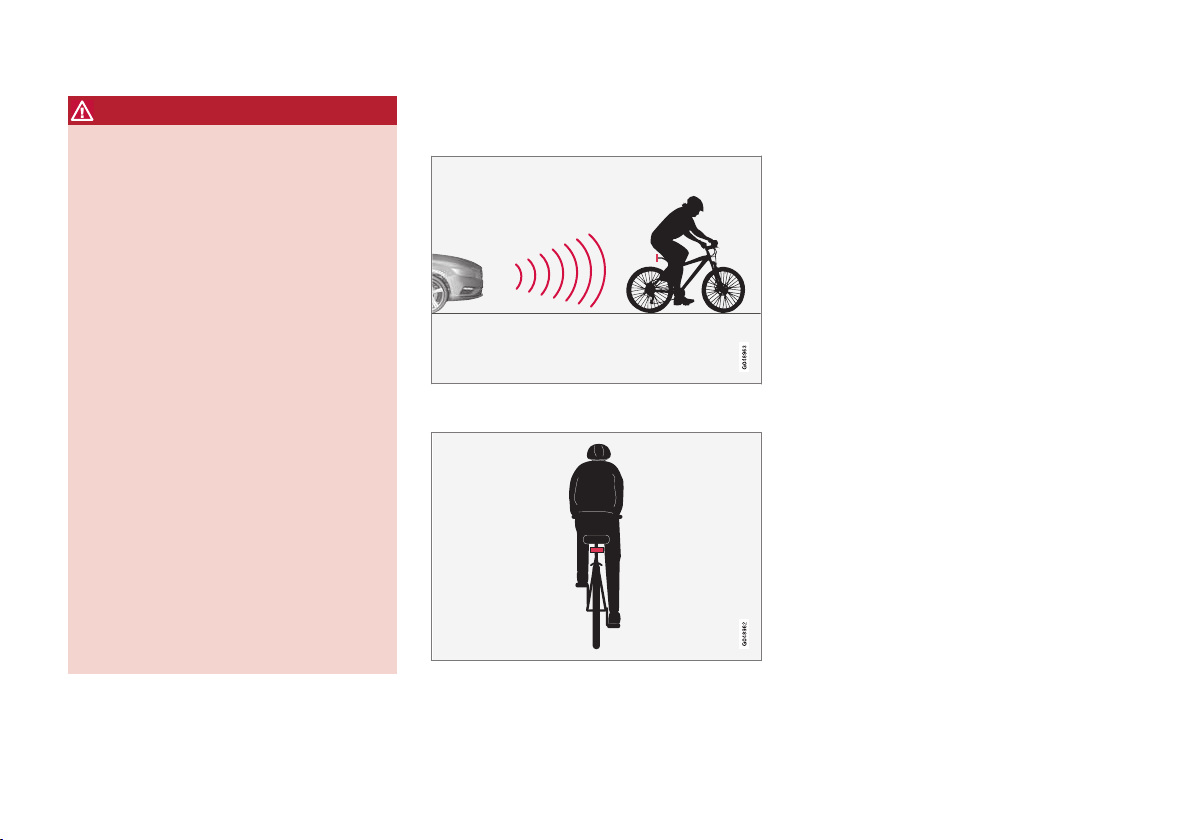
||
DRIVER SUPPORT
* Option/accessory.
224
WARNING
The collision warning system does not
engage in all driving situations or traffic,
weather or road conditions. The collision
warning system does not react to vehicles or
cyclists driving in another direction to the car
or to animals.
Warning only activated in the event of a high
risk for collision. This section "Function" and
the section "Limitations" inform about limita-
tions that the driver must be aware of before
using the Collision Warning system with Auto
Brake.
Warnings and brake interventions for pedes-
trians and cyclists are deactivated at vehicle
speeds above 80 km/h (50 mph).
Warnings and brake interventions for pedes-
trians and cyclists do not work in darkness
and tunnels - not even when streetlights are
lit.
The auto-brake function can prevent a colli-
sion or reduce collision speed. To ensure full
brake performance, the driver should always
depress the brake pedal - even when the car
auto-brakes.
Never wait for a collision warning. The driver is
always responsible that the correct distance
and speed are maintained - even when the
collision warning system with auto-brake is
used.
Related information
•
Collision warning system* (p. 222)
Collision warning system* -
detection of cyclists
The function only "sees" cyclists from behind, who are
travelling in the same direction.
Optimum examples of what the system interprets as a
cyclist - with clear body and bicycle contours, directly
from behind and in the car's centre line.
Optimal performance of the system requires that
the system function that detects a cyclist
receives as unambiguous information as possible
about the body and bicycle contours - this implies
the opportunity to identify the bicycle, head, arms,
shoulders, legs, upper and lower body combined
with a normal human pattern of movement.
If large parts of the cyclist's body or bicycle are
not visible to the function's camera then the sys-
tem cannot detect a cyclist.
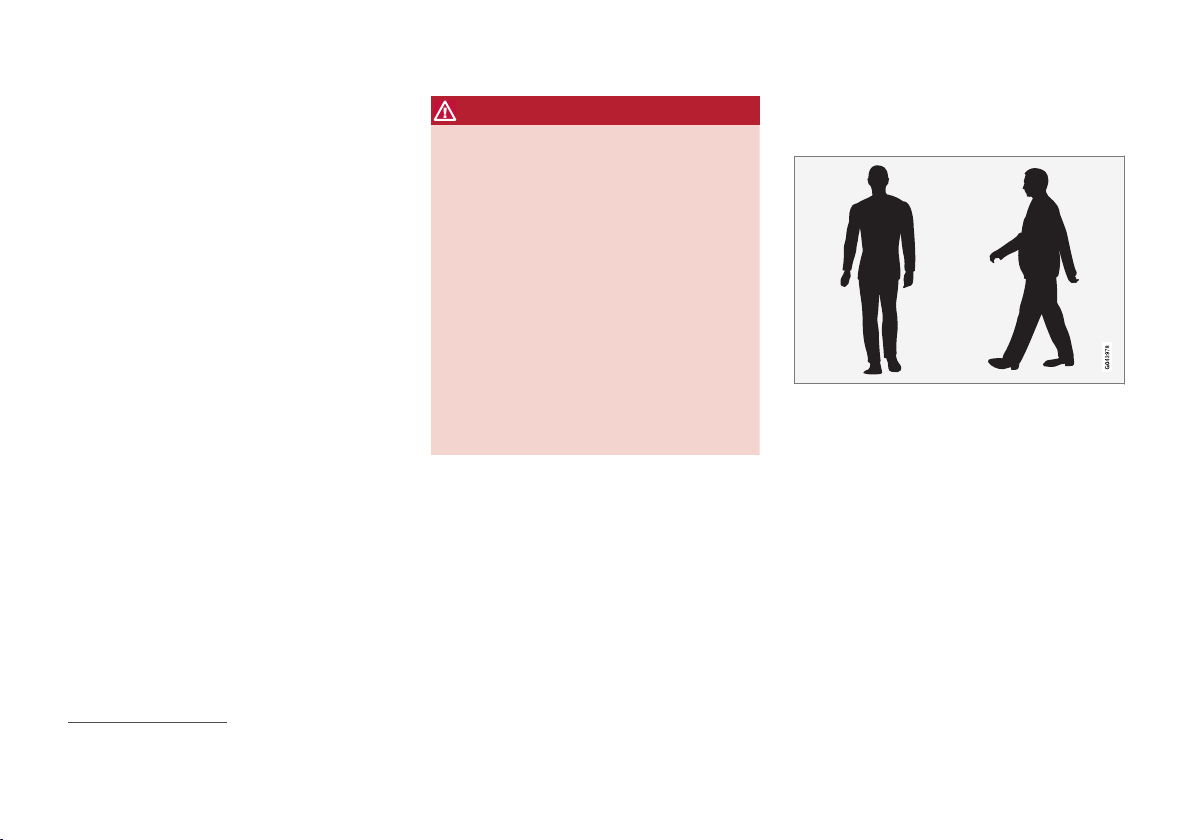
DRIVER SUPPORT
}}
* Option/accessory.
225
•
For the function to be able to detect a cyclist,
he/she must be an adult and riding an "adult
bicycle".
•
The bicycle must be equipped with a highly
visible and approved
19
rearward-facing red
reflector, fitted at least 70 cm above the
roadway.
•
The function can only detect cyclists directly
from behind and who are travelling in the
same direction - not at an angle from behind,
not from the side.
•
Cyclists travelling on the left or right-hand
edge of the car's imagined/extended side
lines may be detected late or not at all.
•
The function's capacity to detect cyclists at
dusk and dawn is limited - just like the
human eye.
•
The function's capacity to detect cyclists is
deactivated when driving in darkness and
tunnels - even when streetlights are lit.
•
For optimum bicycle detection, the City
Safety™ function must be activated, see City
Safety™ (p. 215).
WARNING
Collision Warning with Auto Brake & Cyclist
Detection is a means of assistance.
The function cannot detect:
•
all cyclists in all situations and does not
see partially obscured cyclists, for exam-
ple.
•
cyclists in clothing that obscures the con-
tours of the body or who are approaching
from the side.
•
bicycles that have no rearward-facing red
reflector.
•
bicycles loaded with large objects.
The driver is always responsible that the vehi-
cle is driven properly and with a safety dis-
tance adapted to the speed.
Related information
•
Collision warning system* (p. 222)
Collision warning system* -
detection of pedestrians
Optimal examples of what the system regards as pedes-
trians with clear body contours.
Optimal performance of the system requires that
the system function that detects pedestrians
receives as unambiguous information as possible
about the contours of the body - this implies the
opportunity to identify the head, arms, shoulders,
legs, upper and lower body combined with a nor-
mal human pattern of movement.
If large parts of the body are not visible to the
function's camera then the system cannot detect
a pedestrian.
19
The reflector must fulfil the recommendations and conditions of the traffic authority in the market in question.
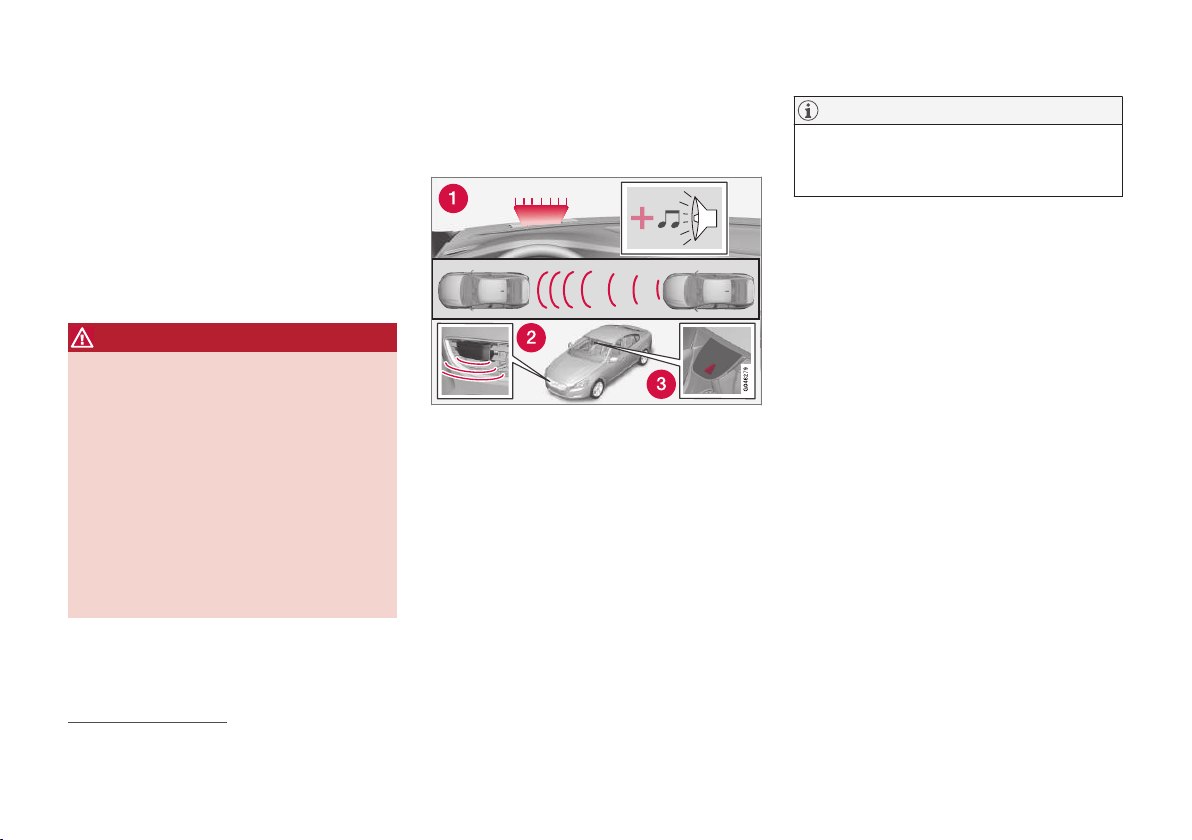
||
DRIVER SUPPORT
* Option/accessory.
226
•
In order for a pedestrian to be detected
he/she must appear full-length and have a
height of at least 80 cm.
•
The camera sensor's ability to see pedes-
trians at dusk and dawn is limited - just like
the human eye.
•
The camera sensor's capacity to detect
pedestrians is deactivated when driving in
darkness and tunnels - even when street-
lights are lit.
WARNING
"Collision Warning with Auto Brake and
Cyclist and Pedestrian Detection" is a means
of assistance. The function cannot detect all
pedestrians in all situations and does not see,
for example:
•
partially obscured pedestrians, people in
clothing that hides their body contour or
pedestrians shorter than 80 cm.
•
pedestrians who are carrying larger
objects.
The driver is always responsible that the vehi-
cle is driven properly and with a safety dis-
tance adapted to the speed.
Related information
•
Collision warning system* (p. 222)
Collision warning system* -
operation
Warning signals On and Off
1. Acoustic and visual warning signal in the event of a
collision risk
20
.
You can select whether the collision warning sys-
tem's acoustic and visual warning signals should
be switched on or off.
When starting the engine, the setting that was
selected when the engine was switched off is
obtained automatically.
NOTE
The Brake Support and Auto Brake functions
are always enabled - they cannot be deacti-
vated.
Settings for the collision warning system are
made via the centre console's screen and the
menu system MY CAR, see (p. 109).
Light and acoustic signals
When the collision warning system's light and
acoustic warnings are activated, the warning lamp
(no. [1] in previous illustration) is tested each
time the engine is started by briefly illuminating
the warning lamp's separate points of light.
After starting the engine, both the light and
acoustic signals can be switched off:
•
Search for
Collision warning in Driver
support system in the menu system MY
CAR (p. 109) - and there select to uncheck
the function.
Acoustic signal
After starting the engine the warning sound can
be activated/deactivated separately:
•
Search for
Warning sound in Collision
warning in the menu system MY CAR
(p. 109) - and there select On or Off.
Following which, the collision warning system is
only indicated with a light signal.
20
The illustration is schematic - car model and details may differ.
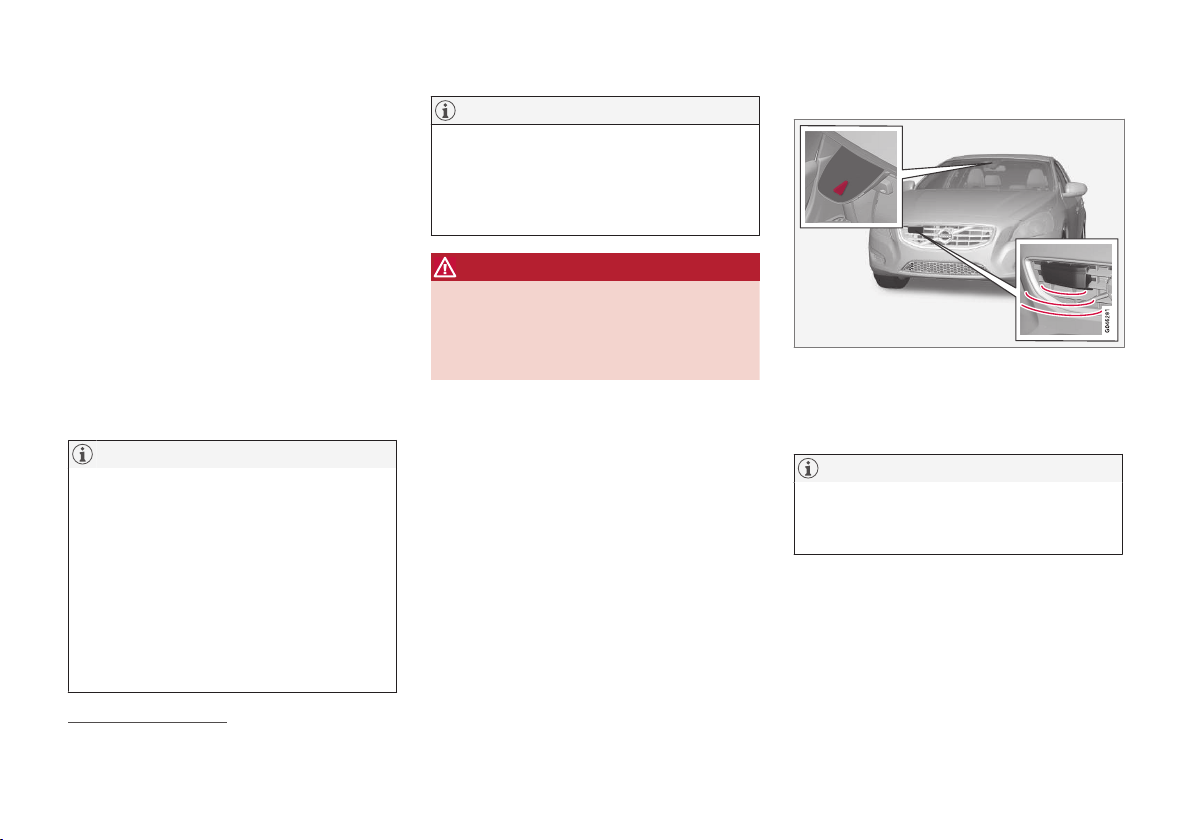
DRIVER SUPPORT
* Option/accessory.
227
Set warning distance
The warning distance regulates the distance at
which the visual and acoustic warnings are
deployed.
•
Search for
Warning distance in Collision
warning in the menu system MY CAR
(p. 109) - and there select Long, Normal or
Short.
The warning distance determines the system's
sensitivity. Warning distance
Long provides an
earlier warning. First test with Long and if this
setting produces too many warnings, which could
be perceived as irritating in certain situations,
then change to warning distance Normal.
Only use warning distance Short in exceptional
cases, e.g. for dynamic driving.
NOTE
When the adaptive cruise control is in use the
warning lamp and warning sound will be used
by the cruise control even if the collision
warning system is switched off.
The collision warning system warns the driver
in the event of a risk of a collision, but the
function cannot shorten driver reaction time.
In order for the collision warning system to be
effective - always drive with Distance Warning
(p. 193) set at time interval 4–5.
NOTE
Even if the warning distance has been set to
Long warnings could be perceived as being
late in certain situations, e.g. when there are
large differences in speed or if vehicles in
front brake heavily.
WARNING
No automatic system can guarantee 100 %
correct function in all situations. Therefore,
never test Collision Warning with Auto Brake
by driving at people or vehicles - this may
cause severe damage and injury and risk lives.
Checking settings
The current settings can be controlled via the
centre console's screen and the menu system
(p. 109) MY CAR.
Maintenance
Camera and radar sensor
21
.
For the sensors to work correctly, they must be
kept clear of dirt, ice and snow, and be cleaned
regularly with water and car shampoo.
NOTE
Dirt, ice and snow covering the sensors will
reduce their function and may prevent meas-
urement.
Related information
•
Collision warning system* (p. 222)
21
NOTE: The illustration is schematic - details may vary depending on car model.

DRIVER SUPPORT
* Option/accessory.
228
Collision warning system* -
limitations
The function has certain limitations - for example,
it is not active until 4 km/h (3 mph).
The collision warning system's visual warning sig-
nal (see (1) in the illustration (p. 223)) may be
difficult to notice in the event of strong sunlight,
reflections, when sunglasses are being worn or if
the driver is not looking straight ahead. The warn-
ing sound should therefore always be activated.
On slippery road surfaces the braking distance is
extended, which may reduce the capacity to avoid
a collision. In such situations the ABS and ESC
(p. 182) systems will provide best possible brak-
ing force with maintained stability.
NOTE
The visual warning signal can be temporarily
disengaged in the event of high passenger
compartment temperature caused by strong
sunlight for example. If this occurs then the
warning sound is activated even if it is deacti-
vated in the menu system.
•
Warnings may not appear if the distance
to the vehicle in front is small or if steer-
ing wheel and pedal movements are
large, e.g. a very active driving style.
WARNING
Warnings and brake interventions could be
implemented late or not at all if the traffic sit-
uation or external influences mean that the
radar or camera sensor cannot detect a
pedestrian, a vehicle or a cyclist in front cor-
rectly.
The sensor system has a limited range for
pedestrians and cyclists
22
- the system can
give effective warnings and brake interven-
tions for them at vehicle speeds up to
50 km/h (30 mph). For stationary or slow-
moving vehicles, warnings and brake interven-
tions are effective at vehicle speeds up to
70 km/h (43 mph).
Warnings for stationary or slow-moving vehi-
cles could be disengaged due to darkness or
poor visibility.
Warnings and brake interventions for pedes-
trians and cyclists are deactivated at vehicle
speeds exceeding 80 km/h (50 mph).
The collision warning system uses the same
radar sensors as the Adaptive cruise control
(p. 196). Read more about radar sensor limita-
tions (p. 210).
If warnings are perceived as being too frequent
or disturbing then the warning distance can be
reduced (p. 226). This would lead to the system
warning at a later stage, which reduces the total
number of warnings.
Collision Warning with Auto Brake is temporarily
deactivated with reverse gear engaged.
Collision Warning with Auto Brake is not acti-
vated at low speeds - below 4 km/h (3 mph),
which is why the system does not intervene in sit-
uations where the car is approaching a vehicle in
front very slowly, e.g. when parking.
In situations where the driver demonstrates
active, aware driving behaviour, a collision warn-
ing may be postponed slightly in order to keep
unnecessary warnings to a minimum.
When Auto Brake has prevented a collision with
a stationary object the car remains stationary for
a maximum of 1.5 seconds. If the car is braked
for a vehicle in front that is moving, then speed is
reduced to the same speed as that maintained by
the vehicle in front.
On a car with manual gearbox the engine stops
when Auto Brake has stopped the car, unless the
driver manages to depress the clutch pedal
beforehand.
Related information
•
Collision warning system* (p. 222)
22
For cyclists, the warning and full brake intervention may come very late or simultaneously.

DRIVER SUPPORT
}}
* Option/accessory.
229
Collision warning system* - camera
sensor limitations
"Collision Warning with Auto Brake and Cyclist
and Pedestrian Detection" is an aid to assist the
driver when there is a risk of colliding with a
pedestrian, bicycle or vehicle in front that are
stationary or moving in the same direction.
The function uses the car's camera sensor,
which has certain limitations.
The car’s camera sensor is also used - as well as
by Collision Warning with Auto Brake - by the
functions:
•
Active main beam (p. 89)
•
Road sign information (p. 237)
•
Driver Alert Control - DAC (p. 242)
•
Lane assistance (p. 245)
NOTE
Keep the windscreen surface in front of the
camera sensor free from ice, snow, mist and
dirt.
Do not stick or attach anything to the wind-
screen in front of the camera sensor as this
may reduce effectiveness or cause one or
more of the systems dependent on the cam-
era to stop working.
The camera sensors have limitations similar to
the human eye, i.e. they "see" worse in darkness,
heavy snowfall or rain and in thick fog for exam-
ple. Under such conditions the functions of cam-
era-dependent systems could be significantly
reduced or temporarily disengaged.
Strong oncoming light, reflections in the carriage-
way, snow or ice on the road surface, dirty road
surfaces or unclear lane markings could also sig-
nificantly reduce camera sensor function when it
is used to scan the carriageway and detect
pedestrians and other vehicles.
The field of vision of the camera sensor is limited,
which is why pedestrians, cyclists and vehicles
cannot be detected in some situations, or they
are detected later than anticipated.
During very high temperatures the camera is
temporarily switched off for about 15 minutes
after the engine is started in order to protect
camera functionality.
Fault tracing and action
If the display shows the message Windscreen
sensors blocked See manual then this means
that the camera sensor is blocked and cannot
detect pedestrians, cyclists, vehicles or road
markings in front of the car.
At the same time, this means that - besides Colli-
sion Warning with Auto Brake - the following
functions will not have full functionality either:
•
Active main beam
•
Driver Alert Control
•
Lane Keeping Aid
•
Road sign information
The following table presents possible causes for
a message being shown along with the appropri-
ate action.
Cause Action
The windscreen sur-
face in front of the
camera is dirty or cov-
ered with ice or snow.
Clean the windscreen
surface in front of the
camera from dirt, ice
and snow.
Thick fog, heavy rain
or snow means that
the camera does not
work sufficiently well.
No action. At times
the camera does not
work during heavy rain
or snowfall.
The windscreen sur-
face in front of the
camera has been
cleaned but the mes-
sage remains.
Wait. It may take sev-
eral minutes for the
camera to measure
the visibility.
Dirt has appeared
between the inside of
the windscreen and
the camera.
Visit a workshop to
have the windscreen
inside the camera
cover cleaned - an
authorised Volvo
workshop is recom-
mended.

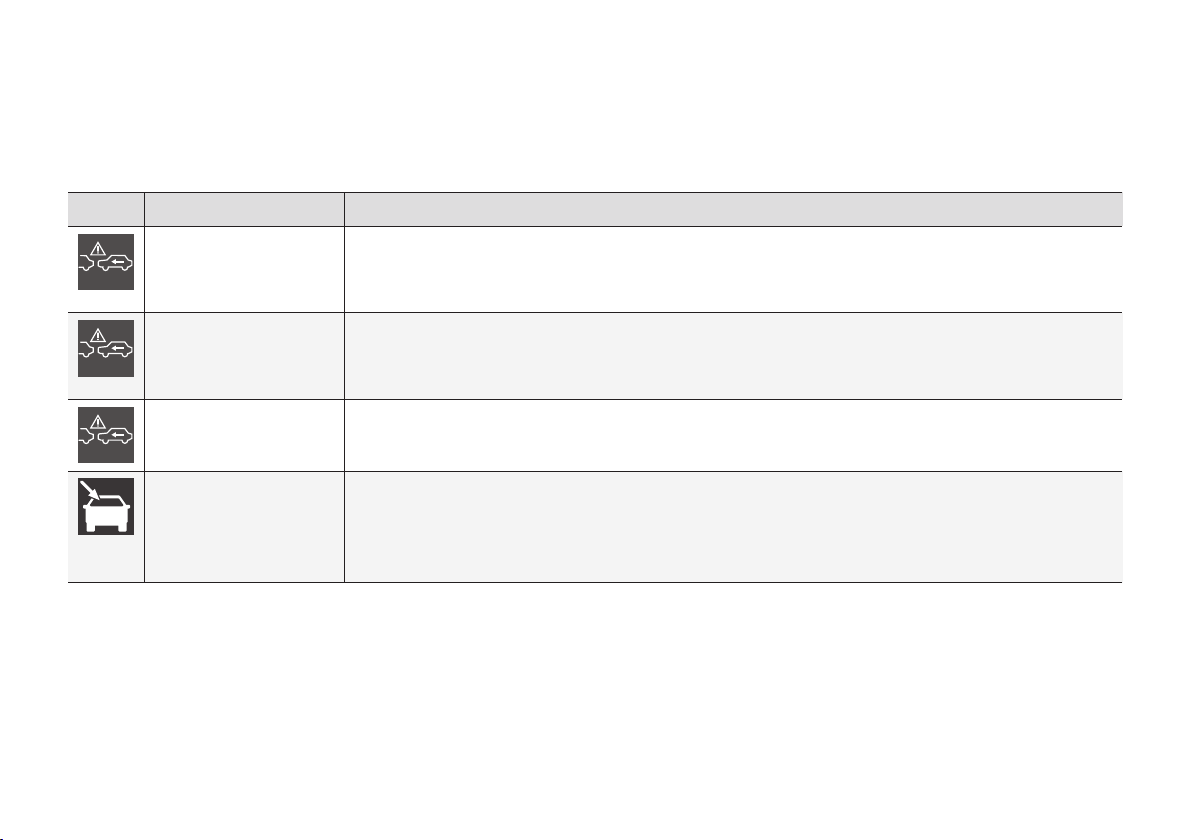
DRIVER SUPPORT
}}
* Option/accessory.
231
Collision warning system* - symbols
and messages
"Collision Warning with Auto Brake and Cyclist
and Pedestrian Detection" is an aid to assist the
driver when there is a risk of colliding with a
pedestrian, bicycle or vehicle in front that are
stationary or moving in the same direction.
Symbol
A
Message Specification
Collision warning sys-
tem OFF
Collision warning system switched off.
Shown when the engine is started.
The message clears after about 5 seconds or after one press of the OK button.
Collision warning sys-
tem Unavailable
The collision warning system cannot be activated.
Shown when the driver attempts to activate the function.
The message clears after about 5 seconds or after one press of the OK button.
Auto Braking was acti-
vated
Auto Brake has been active.
The message clears after one press of the OK button.
Windscreen sensors
blocked See manual
The camera sensor is temporarily disengaged.
Shown in the event of snow, ice or dirt on the windscreen for example.
•
Clean the windscreen surface in front of the camera sensor.
Read about camera sensor limitations (p. 229).
||
DRIVER SUPPORT
* Option/accessory.
232
Symbol
A
Message Specification
Radar blocked See
manual
Collision Warning with Auto Brake is temporarily disengaged.
The radar sensor is blocked and cannot detect other vehicles. For example, in the event of heavy rain or if slush
has collected in front of the radar sensor.
Read about radar sensor limitations (p. 210).
Collision warning Serv-
ice required
Collision Warning with Auto Brake is fully or partially disengaged.
•
Visit a workshop if the message remains - an authorised Volvo workshop is recommended.
A
Symbols are schematic - may vary by market and car model.
Related information
•
Collision warning system* (p. 222)
•
Collision warning system* - function (p. 223)
•
Collision warning system* - detection of
pedestrians (p. 225)
•
Collision warning system* - detection of
cyclists (p. 224)
•
Collision warning system* - operation
(p. 226)
•
Collision warning system* - limitations
(p. 228)
•
Collision warning system* - camera sensor
limitations (p. 229)
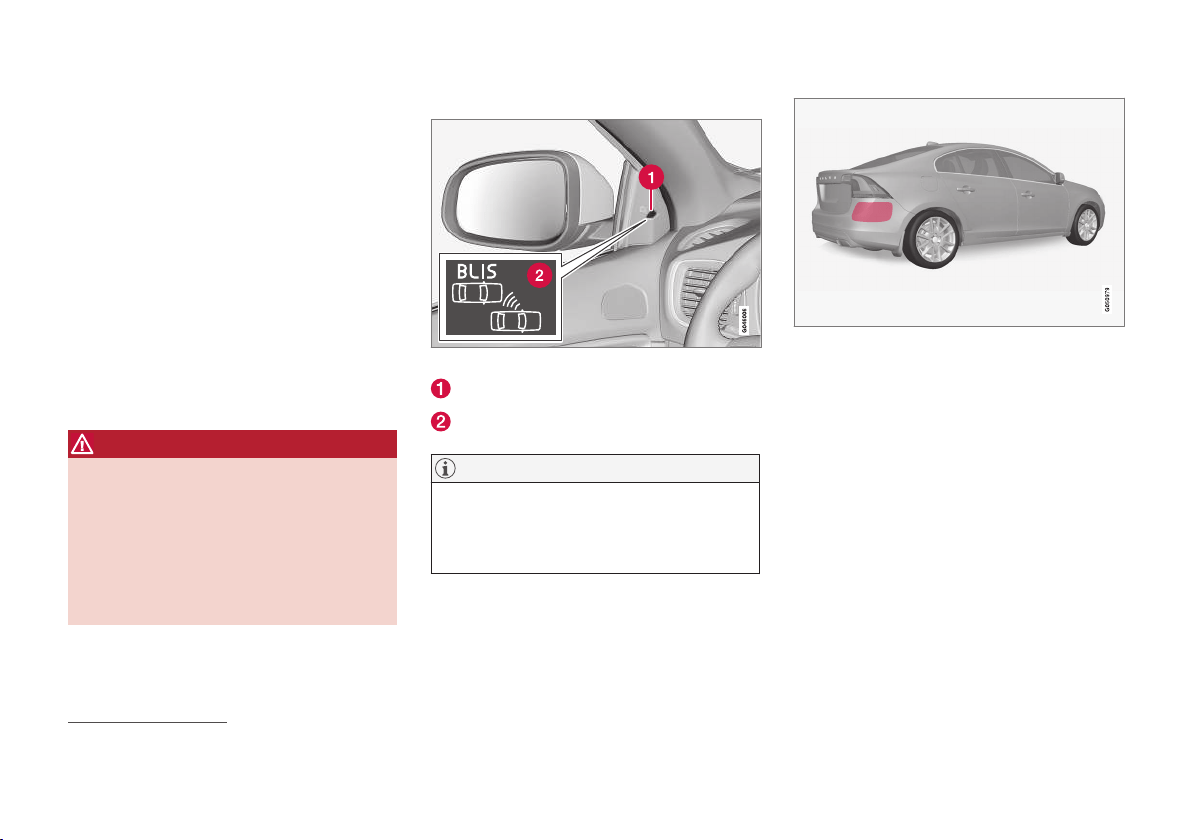
DRIVER SUPPORT
* Option/accessory.
233
BLIS*
BLIS (Blind Spot Information) is a function
designed for providing support for the driver
when driving in dense traffic on roads with sev-
eral lanes in the same direction.
BLIS is a driver's aid intended to provide a warn-
ing about:
•
vehicles in the car's blind spot
•
rapidly approaching vehicles in the left and
right-hand lanes closest to the car.
The BLIS function CTA (p. 235) (Cross Traffic
Alert) is a driver's aid intended to provide a warn-
ing about:
•
crossing traffic when the car is reversed.
WARNING
BLIS is a supplementary aid and does not
work in all situations.
BLIS is no substitute for a safe driving style
and the use of rearview and door mirrors.
BLIS can never replace the driver's responsi-
bility and attention - it is always the driver's
responsibility to change lanes in a safe man-
ner.
Overview
BLIS lamp location
23
.
Indicator lamp
BLIS symbol
NOTE
The lamp illuminates on the side of the car
where the system has detected the vehicle. If
the car is overtaken on both sides at the
same time then both lamps illuminate.
Maintenance
The sensors for the BLIS functions are located
inside the rear wing/bumper on each corner of
the car.
Keep this surface clean - also on the left-hand side.
•
To ensure optimal functionality the areas in
front of the sensors must be kept clean.
Related information
•
BLIS* - operation (p. 234)
•
BLIS - symbols and messages (p. 237)
•
CTA* (p. 235)
23
NOTE: The illustration is schematic - details may vary depending on car model.
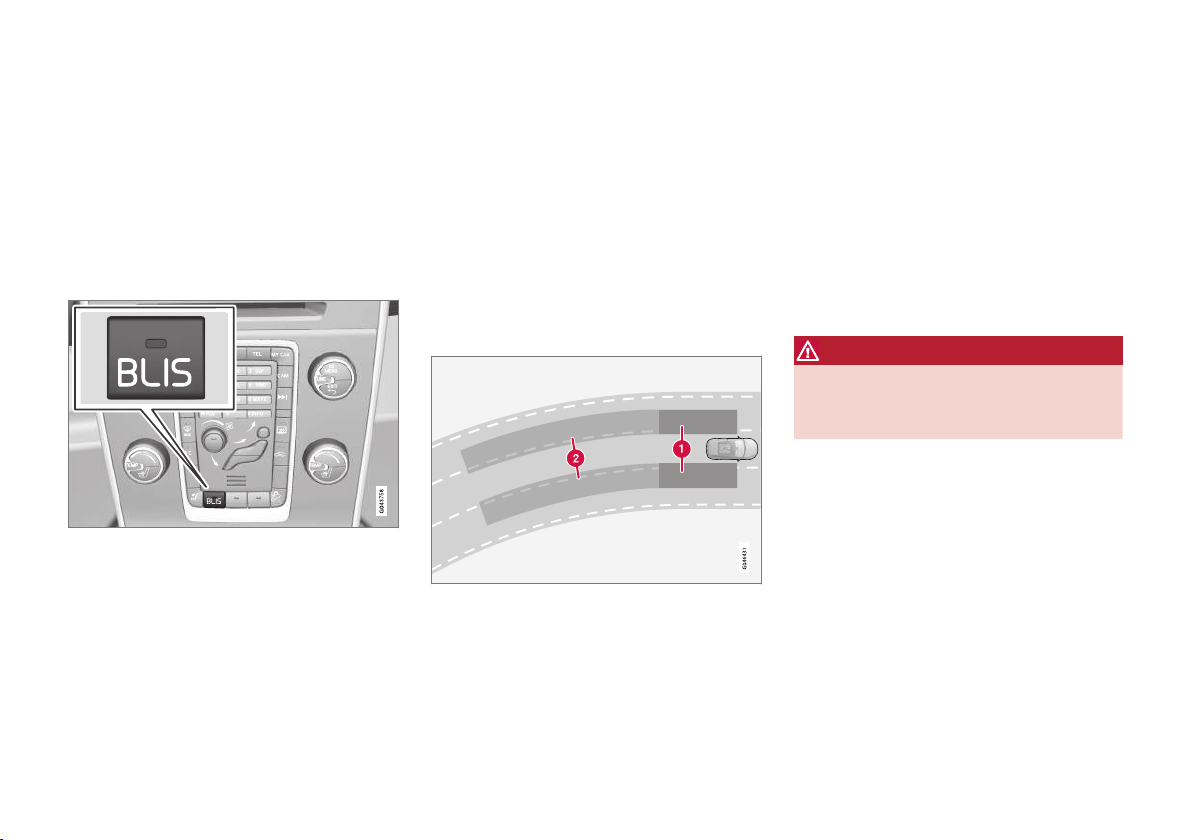
DRIVER SUPPORT
* Option/accessory.
234
BLIS* - operation
BLIS (Blind Spot Information) is a function
designed for providing support for the driver
when driving in dense traffic on roads with sev-
eral lanes in the same direction.
Activate/deactivate BLIS
BLIS is activated when the engine is started. This
is confirmed by the indicator lamps in the door
panels flashing once.
Button for activating/deactivating.
The BLIS function can be deactivated/activated
by pressing the BLIS button on the centre con-
sole.
Some combinations of the selected equipment
leave no vacant space for a button in the centre
console - in which case the function is handled
by the car's menu system MY CAR (p. 109).
When BLIS is deactivated/activated the lamp in
the button extinguishes/illuminates and the com-
bined instrument panel confirms the change with
a text message. The door panel indicator lamps
flash once upon activation.
To extinguish the message:
•
Press the left stalk switch OK button.
or
•
Wait approx. 5 seconds - the message extin-
guishes.
When BLIS operates
Principle for BLIS: 1. Zone in blind spot. 2. Zone for rap-
idly approaching vehicle.
The BLIS function is active at speeds above
10 km/h (6 mph).
The system is designed to react when:
•
the driver's vehicle is overtaken by other
vehicles
•
the driver's vehicle is rapidly caught up by
another vehicle.
When BLIS detects a vehicle in zone 1 or a
quickly approaching vehicle in zone 2, the door
panel BLIS lamp illuminates with a constant glow.
If the driver activates the direction indicator on
the same side as the warning in this situation
then the BLIS lamp will change from a constant
glow to flashing with a more intense light.
WARNING
BLIS does not work in sharp bends.
BLIS does not work when the car is being
reversed.
Limitations
•
Dirt, ice and snow covering sensors can
reduce functionality and make it impossible
to provide warnings. BLIS cannot detect haz-
ards if it is covered.
•
Do not affix any objects, tape or labels in the
area of the sensors.
•
BLIS is deactivated when a trailer is con-
nected to the car's electrical system.
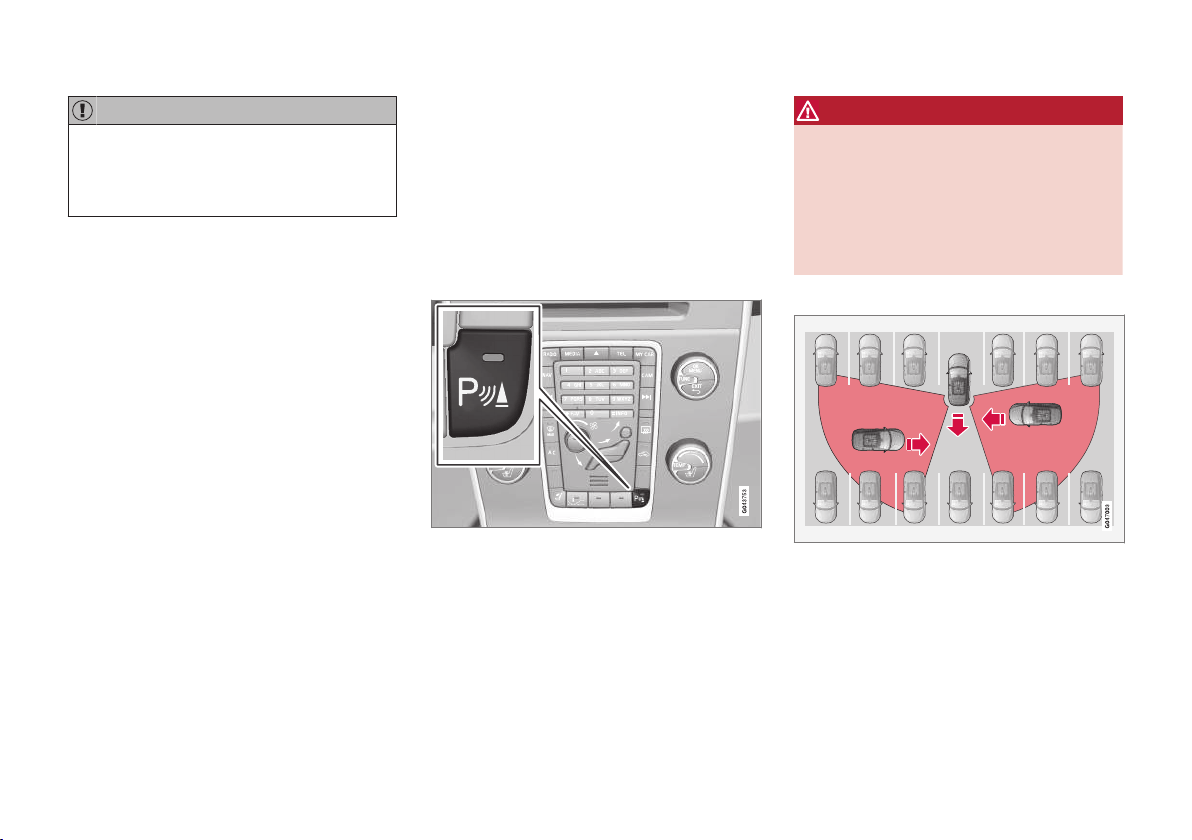
DRIVER SUPPORT
}}
* Option/accessory.
235
IMPORTANT
Repair of the BLIS and CTA functions' com-
ponents or repainting the bumpers must only
be performed by a workshop - an authorised
Volvo workshop is recommended.
Related information
•
BLIS* (p. 233)
•
BLIS - symbols and messages (p. 237)
CTA*
The BLIS function CTA (Cross Traffic Alert) is a
driver aid intended to warn about crossing traffic
when the car is reversing. CTA is a supplement
to BLIS (p. 233).
Activate/deactivate CTA
CTA is activated when the engine is started. This
is confirmed by the indicator lamps for BLIS in
the door panels flashing once.
On/Off for parking assistance and CTA sensors.
The CTA function can be deactivated/activated
separately with the Parking assistance (p. 254)
On/Off button. The BLIS lamps flash once on
reactivation.
However, the BLIS function remains activated
after the CTA has been deactivated.
WARNING
CTA is a supplementary aid and does not
work in all situations.
CTA is no substitute for a safe driving style
and the use of rearview and door mirrors.
CTA can never replace the driver's responsi-
bility and attention - it is always the driver's
responsibility to reverse in a safe manner.
When CTA operates
Principle for CTA.
CTA supplements the BLIS function by being
able to see crossing traffic from the side during
reversing, such as when reversing out of a park-
ing space.
CTA is primarily designed to detect vehicles. In
favourable conditions, it may also be able to
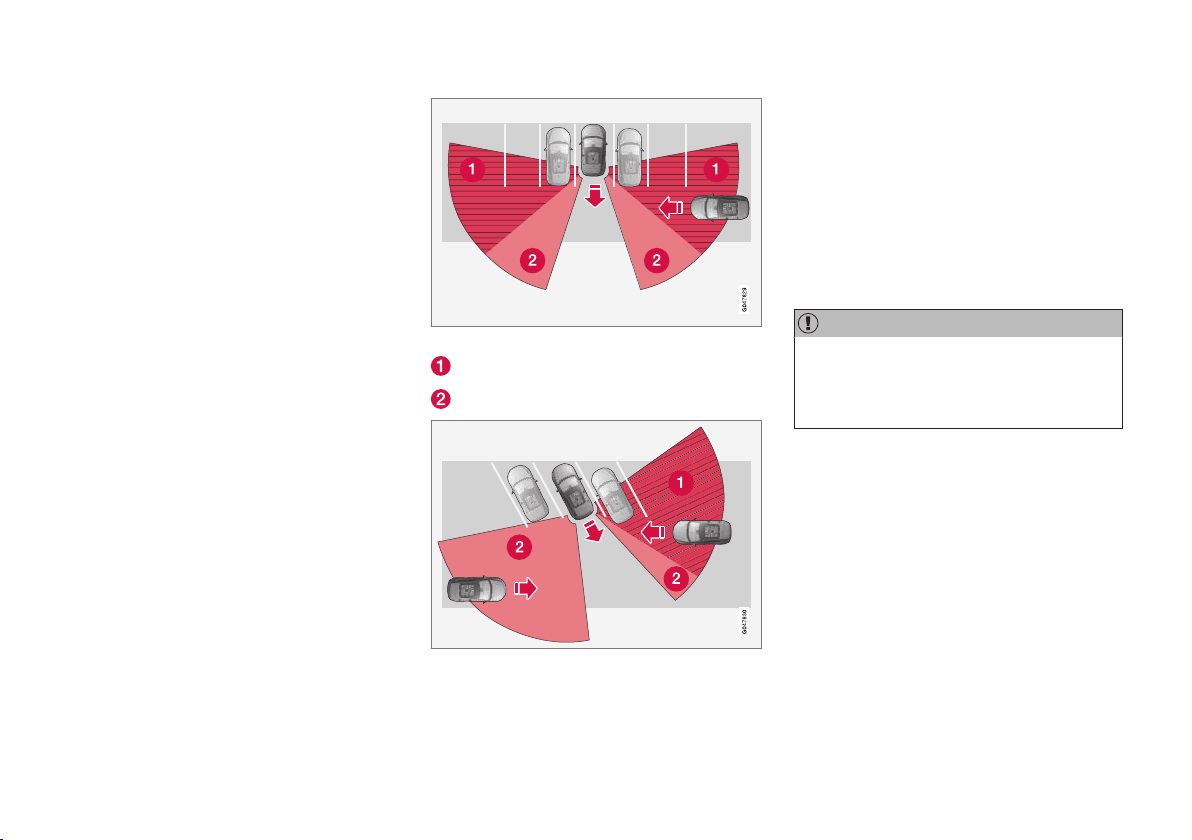
||
DRIVER SUPPORT
236
detect smaller objects, such as cyclists and
pedestrians.
CTA is only active during reversing and is acti-
vated automatically when the gearbox's reverse
position is selected.
•
If CTA detects something approaching from
the side, an acoustic warning signal sounds.
The signal comes from either the left or the
right-hand speaker, depending on the direc-
tion from which the object is approaching.
•
CTA also warns by illuminating the BLIS
lamps.
•
An additional warning is provided in the form
of an illuminated icon in the display screen's
PAS graphics (p. 254).
Limitations
CTA does not perform optimally in all situations,
but has a certain limitation - for example, the CTA
sensors cannot "see" through other parked vehi-
cles or obstructing objects.
Here are some examples of when CTA's "field of
vision" may be limited from the beginning and
approaching vehicles cannot therefore be
detected until they are very close:
The car is parked deep inside a parking slot.
Blind CTA sector.
Sector where CTA can detect/"see".
In an angled parking slot CTA can be completely "blind"
on one side.
However, when the driver is slowly reversing the
car, the angle is changed in relation to the vehi-
cle/object that is blocking, at which the blind
sector rapidly decreases.
Examples of further limitations:
•
Dirt, ice and snow covering sensors can
reduce functionality and make it impossible
to provide warnings. CTA cannot detect haz-
ards if it is covered.
•
CTA is deactivated when a trailer is con-
nected to the car’s electrical system.
IMPORTANT
Repair of the BLIS and CTA functions' com-
ponents or repainting the bumpers must only
be performed by a workshop - an authorised
Volvo workshop is recommended.
Maintenance
The sensors for the BLIS and CTA functions are
located inside the rear wing/bumper on each
corner of the car.
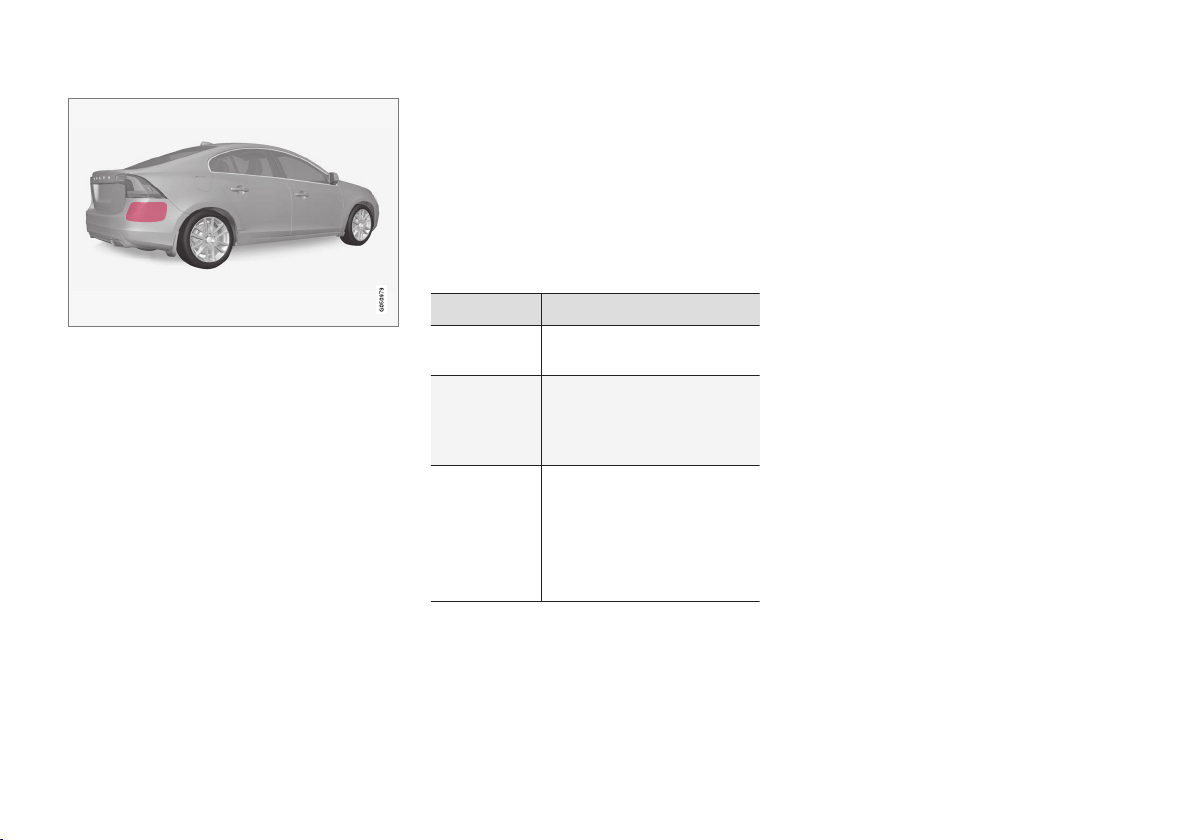
DRIVER SUPPORT
}}
* Option/accessory.
237
Keep this surface clean - also on the left-hand side.
•
To ensure optimal functionality the areas in
front of the sensors must be kept clean.
•
Do not affix any objects, tape or labels in the
area of the sensors.
Related information
•
BLIS* (p. 233)
•
BLIS - symbols and messages (p. 237)
BLIS - symbols and messages
In situations where the BLIS (Blind Spot
Information) (p. 233) and CTA (Cross Traffic
Alert) (p. 235) functions fail or are interrupted,
the combined instrument panel may show a sym-
bol, supplemented by an explanatory message.
Follow any recommendation given.
Message examples:
Message Specification
CTA OFF
CTA is manually switched off -
BLIS is active.
BLIS and
CTA OFF
Trailer
attached
BLIS and CTA are temporarily
non-operational because a
trailer is connected to the
car's electrical system.
BLIS and
CTA Service
required
BLIS and CTA are non-opera-
tional.
•
Visit a workshop if the
message remains - an
authorised Volvo work-
shop is recommended.
A text message can be acknowledged by briefly
pressing the OK button on the direction indicator
stalk.
Related information
•
BLIS* (p. 233)
Road Sign Information (RSI)*
The Road Sign Information function (RSI – Road
Sign Information) helps the driver to remember
which speed-related road signs the car has
passed.
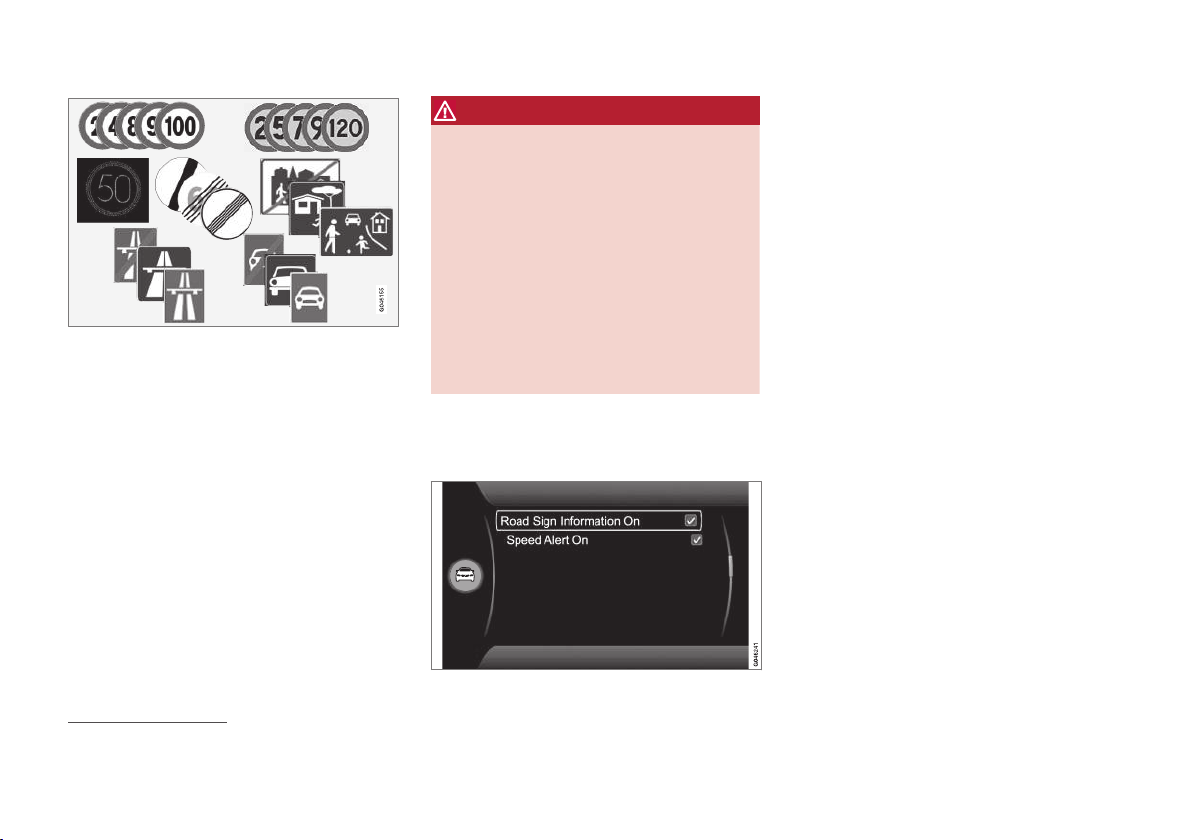
||
DRIVER SUPPORT
* Option/accessory.
238
Examples of readable speed related signs
24
.
The RSI function gives information on current
speed, e.g. that a motorway or road is starting/
ending and when overtaking is prohibited.
If both a sign for motorway/road for motorised
traffic and a sign showing the maximum permit-
ted speed are passed, RSI decides to show the
sign symbol for maximum permitted speed.
WARNING
•
The Road Sign Information function is
supplementary driver support intended to
facilitate driving and make it safer – it
cannot handle all situations in all traffic,
weather and road conditions.
•
Road Sign Information is not a substitute
for the driver's attention and judgement.
The driver is always responsible for
ensuring the car is driven in a safe man-
ner, at the appropriate speed, with an
appropriate distance to other vehicles,
and in accordance with current traffic
rules and regulations.
RSI On/Off
The function for Road Sign Information is select-
able - the driver can select On or Off.
Activate RSI as follows:
1. Search and locate the function in the menu
system MY CAR, see MY CAR (p. 109).
2.
Highlight
Road sign information by press-
ing the OK/MENU button once and go back
out with EXIT.
Related information
•
Road Sign Information (RSI)* - operation
(p. 239)
•
Road Sign Information (RSI)* - limitations
(p. 241)
24
Road signs shown in the combined instrument panel are market-dependent - the illustrations in these instructions only show a few examples.
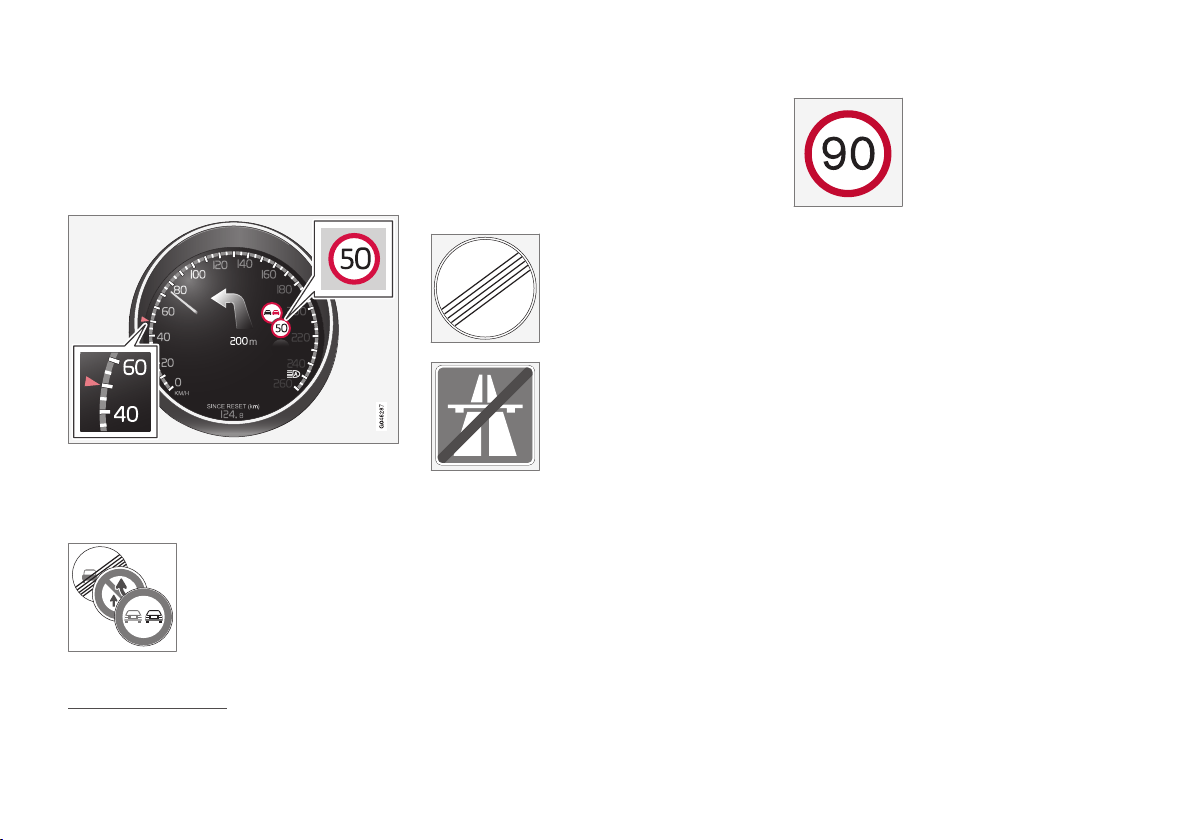
DRIVER SUPPORT
}}
* Option/accessory.
239
Road Sign Information (RSI)* -
operation
The Road Sign Information function (RSI
25
) reg-
isters and shows road signs in different ways
depending on the sign and the situation.
Recorded speed information
26
.
When RSI has recorded a road sign with an
imposed speed, the combined instrument panel
displays the sign as a symbol.
Together with the symbol for
the current speed limit, a sign
26
showing that overtaking is pro-
hibited may also be displayed
where appropriate.
End of speed limit or motorway
When RSI detects an "indirect speed sign" that
means end of current speed limit - e.g. at end of
motorway - a symbol with the corresponding road
sign is shown in the combined instrument panel.
Examples of indirect speed sign
26
are:
End of all restrictions.
End of motorway.
The symbol in the combined instrument panel
extinguishes after 10-30 seconds and remains
extinguished until the next speed-related sign is
passed.
Changed speed limit
On passing a direct speed sign when the speed
limit changes, a symbol with the corresponding
road sign is shown in the combined instrument
panel.
Example of a direct speed
sign
26
.
The symbol in the combined instrument panel
extinguishes after approx. 5 minutes and remains
extinguished until the next speed-related sign is
passed.
Sensus Navigation
If the car is equipped with Sensus Navigation,
speed information is read from the navigation
unit in the following cases:
•
On detection of signs that indirectly indicate
a speed limit, such as motorway, dual car-
riageway and city limit signs.
•
If a previously detected speed sign is
assumed not to apply any longer, but no new
sign has been detected.
25
Road Sign Information
26
Road signs are market-dependent - the illustrations in these instructions only show examples.
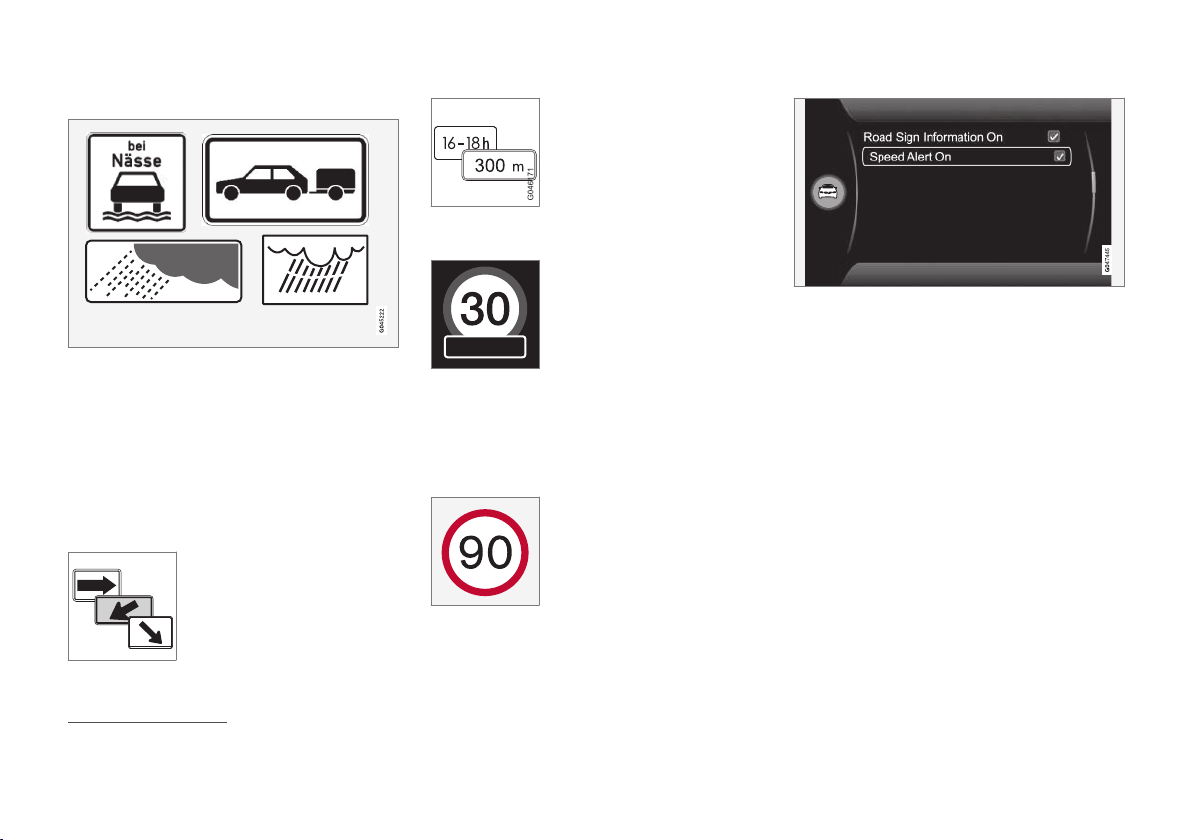
||
DRIVER SUPPORT
* Option/accessory.
240
Additional signs
Examples of additional signs
26
.
Sometimes different speed limits are signposted
for the same road - an additional sign then indi-
cates the circumstances under which the differ-
ent speeds apply. The road section may be par-
ticularly susceptible to accidents in rain and/or
fog, for example.
An additional sign relating to rain is displayed
only if the windscreen wipers are in use.
The speed applicable on an exit
is indicated in certain markets
by means of an additional sign
containing an arrow.
Speed signs linked to this type
of additional sign are displayed
only if the driver is using the direction indicator.
Some speeds are applicable
only after e.g. a specific dis-
tance or at a certain time of
day. The driver's attention is
drawn to the situation by
means of a symbol for an addi-
tional sign under the symbol
showing speed.
A symbol for additional sign in
the form of an empty frame
under the combined instrument
panel's speed symbol
26
means
that RSI has detected an addi-
tional sign with supplementary
information for the current
speed limit.
Speed Alert On/Off
The Speed Limit Warning subfunction for RSI
is selectable - the driver can select On or Off.
The speed warning is given in
the form of the combined
instrument panel's symbol
26
for
maximum permitted speed
temporarily flashing when the
speed is exceeded by 5 km/h
(5 mph) or more.
Activate Speed alert as follows:
1. Search and locate the function in the menu
system MY CAR, see MY CAR (p. 109).
2.
Highlight
Speed alert by pressing the OK/
MENU button once and go back out with
EXIT.
Related information
•
Road Sign Information (RSI)* (p. 237)
•
Road Sign Information (RSI)* - limitations
(p. 241)
•
MY CAR (p. 109)
26
Road signs are market-dependent - the illustrations in these instructions only show examples.

DRIVER SUPPORT
}}
* Option/accessory.
241
Road Sign Information (RSI)* -
limitations
The Road Sign Information (RSI
27
) function may
have limitations in certain situations.
The camera sensor for RSI has limitations just
like the human eye. Find out more about this in
the section on the camera sensor limitations
(p. 229)).
Signs which indirectly provide information on a
prevailing speed limit, e.g. name signs for towns/
districts, are not recorded by RSI.
Examples of factors that can reduce RSI are as
follows:
•
Faded signs
•
Signs positioned on bends
•
Rotated or damaged signs
•
Signs positioned high above the roadway
•
Fully/partially obscured or poorly positioned
signs
•
signs completely or partly covered with frost,
snow and/or dirt
•
digital road maps
28
are out-of-date, inaccu-
rate or have no speed information
29
.
Related information
•
Road Sign Information (RSI)* (p. 237)
•
Road Sign Information (RSI)* - operation
(p. 239)
Driver Alert System*
The Driver Alert System is intended to assist dri-
vers whose driving ability is deteriorating or who
are inadvertently leaving the lane they are driving
on.
The Driver Alert System consists of different
functions which can either be switched on at the
same time or individually:
•
Driver Alert Control - DAC (p. 243).
•
Lane Departure Warning - LDW (p. 245).
or
•
Lane Keeping Aid - LKA (p. 249)
A switched-on function is set in standby mode
and is not activated automatically until speed
exceeds 65 km/h (40 mph).
The function is deactivated again when speed
decreases to below 60 km/h (37 mph).
Both functions use a camera which is dependent
on the lane having side markings painted on
each side.
27
Road Sign Information
28
In cars equipped with Sensus Navigation.
29
Map data with speed information does not exist for all areas.

||
DRIVER SUPPORT
* Option/accessory.
242
WARNING
Driver Alert System does not work in all situa-
tions but is designed merely as a supplemen-
tary aid.
The driver always bears ultimate responsibility
for ensuring that the vehicle is driven safely.
Related information
•
Driver Alert Control (DAC)* (p. 242)
•
Lane Departure Warning (LDW)* (p. 245)
•
Lane Keeping Aid (LKA)* (p. 249)
Driver Alert Control (DAC)*
The DAC function is intended to attract the driv-
er's attention when he/she starts to drive less
consistently, e.g. if he/she becomes distracted
or starts to fall asleep.
The objective for DAC is to detect slowly deterio-
rating driving ability and it is primarily intended for
major roads. The function is not intended for city
traffic.
A camera detects the side markings painted on
the carriageway and compares the section of the
road with the driver's steering wheel movements.
The driver is alerted if the vehicle does not follow
the carriageway evenly.
In some cases driving ability is not affected
despite driver fatigue. In which case there may
not be any warning issued for the driver. For this
reason it is always important to stop and take a
break in the event of any signs of driver fatigue,
irrespective of whether or not DAC issues a
warning.
NOTE
The function must not be used to extend a
period of driving. Always plan breaks at regu-
lar intervals, and make sure you are well
rested.
Limitation
In some cases the system may issue a warning
despite driving ability not deteriorating, for exam-
ple:
•
in strong side winds
•
on rutted road surfaces.
NOTE
The camera sensor has certain limitations
(p. 229).
Related information
•
Driver Alert System* (p. 241)
•
Driver Alert Control (DAC)* - operation
(p. 243)
•
Driver Alert Control (DAC)* - symbols and
messages (p. 244)

DRIVER SUPPORT
* Option/accessory.
243
Driver Alert Control (DAC)* -
operation
Settings are made from the centre console dis-
play screen and its menu system.
On/Off
The Driver Alert function can be set in standby
mode via the menu system MY CAR (p. 109):
•
Checked box - function activated.
•
Unchecked box - the function is deactivated.
Function
Driver Alert is activated when speed exceeds
65 km/h (40 mph) and remains active as long as
the speed is above 60 km/h (37 mph).
If the vehicle is being driven erratically,
the driver is notified by an acoustic sig-
nal plus the text message
Driver Alert
Time for a break - the linked symbol
is illuminated in the combined instrument panel
at the same time. The warning is repeated after a
time if driving ability does not improve.
The warning symbol can go off:
•
Press the left stalk switch OK button.
WARNING
An alarm from Driver Alert Control should be
taken very seriously, as a sleepy driver is often
not aware of his/her own condition.
If the alarm sounds or you feel fatigued:
•
Stop the car safely as soon as possible
and rest.
Studies have shown that it is just as danger-
ous to drive while tired as it is to drive under
the influence of alcohol or other stimulants.
Related information
•
Driver Alert System* (p. 241)
•
Driver Alert Control (DAC)* (p. 242)
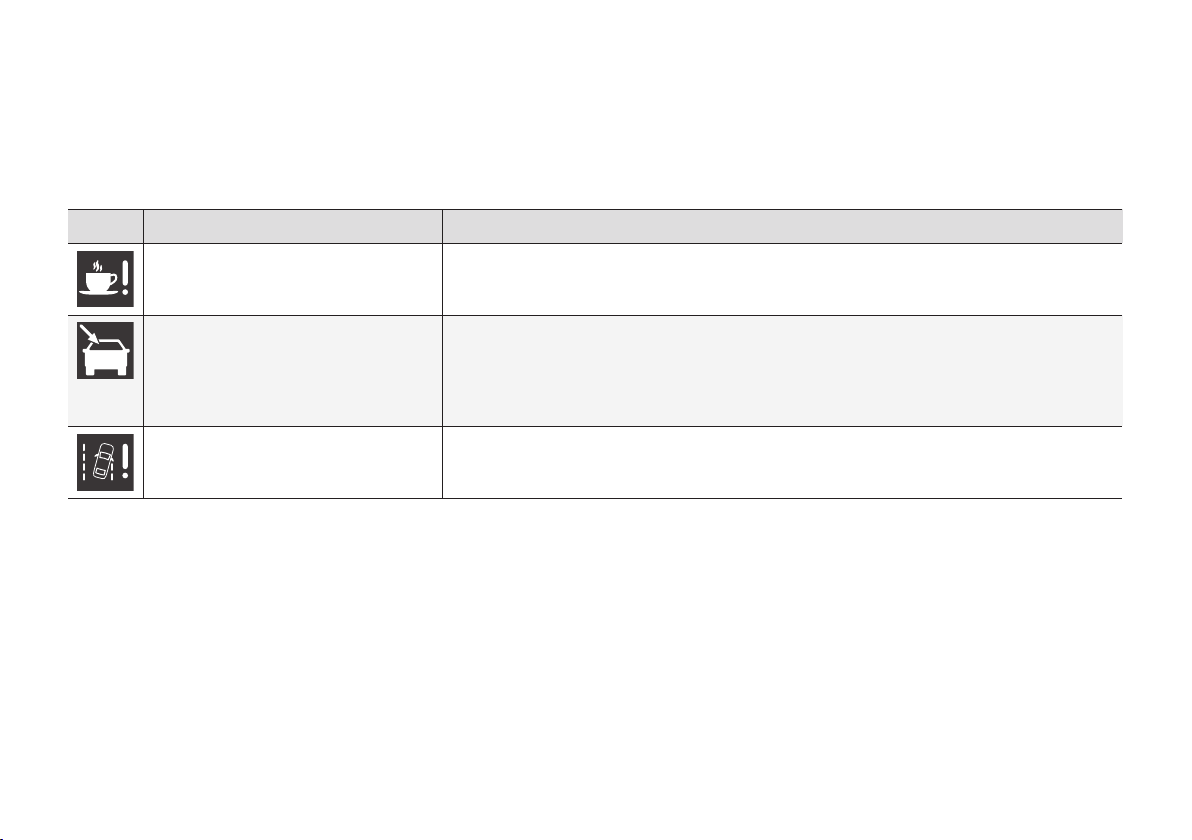
DRIVER SUPPORT
* Option/accessory.
244
Driver Alert Control (DAC)* -
symbols and messages
DAC (p. 242) can show symbols and text mes-
sages on the combined instrument panel or in
the centre console's display screen in different
situations.
Here are some examples:
Symbol
A
Message Specification
Driver Alert Time for a break
The vehicle has been driven inconsistently - the driver is alerted by an acoustic warning signal + text.
Windscreen sensors blocked See
manual
The camera sensor is temporarily disengaged.
Shown in the event of snow, ice or dirt on the windscreen for example.
•
Clean the windscreen surface in front of the camera sensor.
Read about camera sensor limitations (p. 229).
Driver Alert system Service required
The system is disengaged.
•
Visit a workshop if the message remains - an authorised Volvo workshop is recommended.
A
Symbols are schematic - may vary by market and car model.
Related information
•
Driver Alert System* (p. 241)
•
Driver Alert Control (DAC)* (p. 242)
•
Driver Alert Control (DAC)* - operation
(p. 243)

DRIVER SUPPORT
}}
* Option/accessory.
245
Lane Departure Warning (LDW)*
The purpose of Lane Departure Warning (Lane
Departure Warning) is to help the driver to
reduce the risk of the vehicle accidentally leaving
its own lane in certain situations on motorways
and similar major routes.
Lane Departure Warning LDW or LKA
There are two versions of Lane assistance:
•
LDW -
Lane Departure Warning - alerts
the driver with an acoustic signal or vibration
in the steering wheel.
•
LKA -
Lane Keeping Aid
(Lane Keeping Aid) - steers the car back into
its lane and/or alerts the driver with an
acoustic signal or vibration in the steering
wheel.
The car is supplied with one of these two sys-
tems - market and engine alternative determine
which of the systems the car is equipped with.
In the event of uncertainty whether the car has
LDW or LKA:
•
Open the menu system MY CAR and locate
Driver support system - which specifies
Lane Departure Warning if the car has
LDW or Lane Keeping Aid for LKA.
Principle for LDW
(The figure is schematic - not model specific.)
A camera reads the side lines of the road/lane.
Warning with steering wheel vibration
30
.
If the car crosses one of the side lines the driver
is alerted with an acoustic signal or vibration in
the steering wheel. Steering wheel vibration var-
ies - the longer the time for which the car has
crossed the side line, the longer the vibration.
NOTE
The driver is only warned once each time the
wheels cross a line. So there is no acoustic
alarm when there is a line between the car's
wheels.
WARNING
Lane assistance is merely a driver aid and
does not engage in all driving situations or
traffic, weather or road conditions.
The driver always bears ultimate responsibility
for ensuring that the vehicle is driven safely
and that applicable laws and road traffic regu-
lations are followed.
Related information
•
Lane Departure Warning (LDW) - function
(p. 246)
•
Lane Departure Warning (LDW) - operation
(p. 247)
•
Lane Departure Warning (LDW) - limitations
(p. 247)
30
The figure shows 3 vibrations when the side line is crossed.
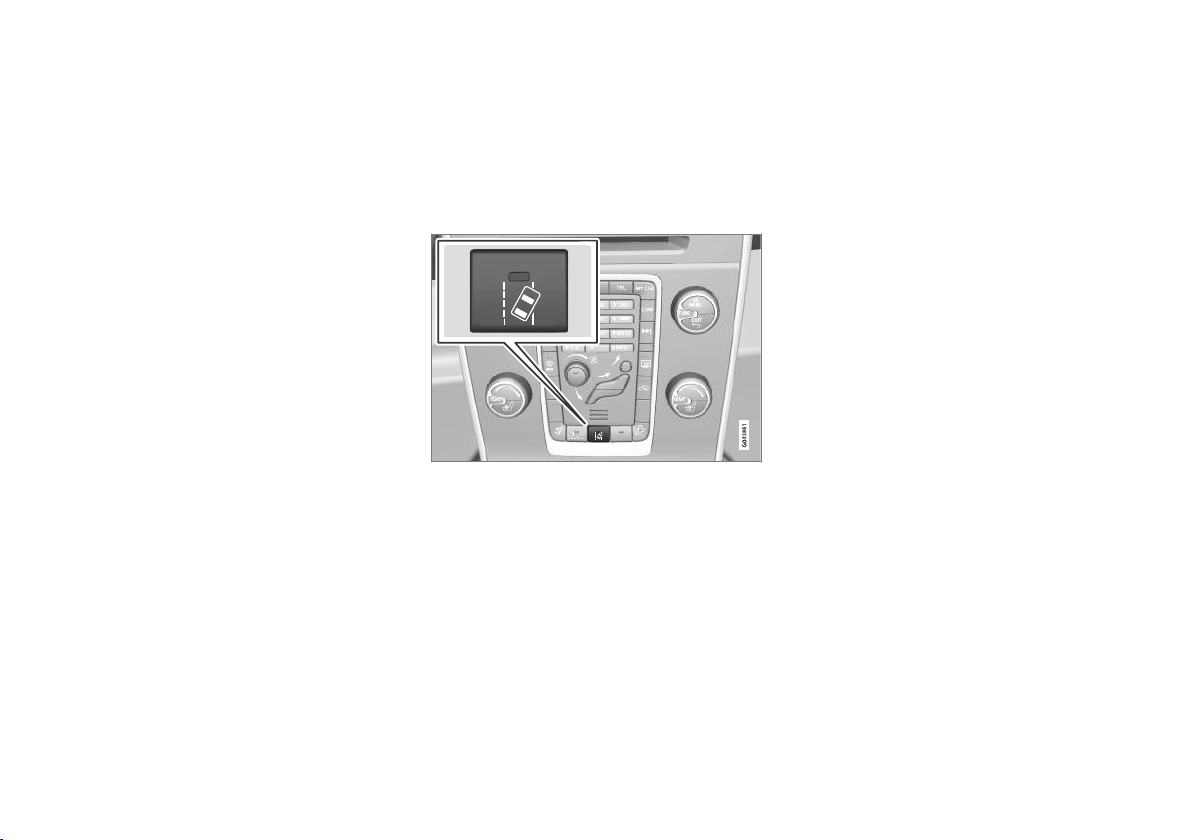
DRIVER SUPPORT
* Option/accessory.
246
•
Lane Departure Warning (LDW) - symbols
and messages (p. 248)
•
Lane Keeping Aid (LKA)* (p. 249)
•
Driver Alert System* (p. 241)
Lane Departure Warning (LDW) -
function
Certain settings can be made for the Lane
Departure Warning (Lane Departure Warning)
function.
Off & On
Press the centre console's button to activate or
deactivate the function. The button's lamp illumi-
nates when the function is switched on.
This function is complemented in the combined
instrument panel with intuitive graphics in differ-
ent situations.
Personal preferences
Settings are made from the centre console's
screen via the menu system in MY CAR. For a
description of the menu system, see MY CAR
(p. 109).
Select from the options:
•
On at startup - The function is set in
standby mode each time the engine is
started. Otherwise the same value as when
the engine was switched off is obtained.
•
Increased sensitivity - The sensitivity
increases, an alarm is triggered earlier and
fewer limitations apply.
Related information
•
Lane Departure Warning (LDW)* (p. 245)
•
Lane Keeping Aid (LKA)* (p. 249)
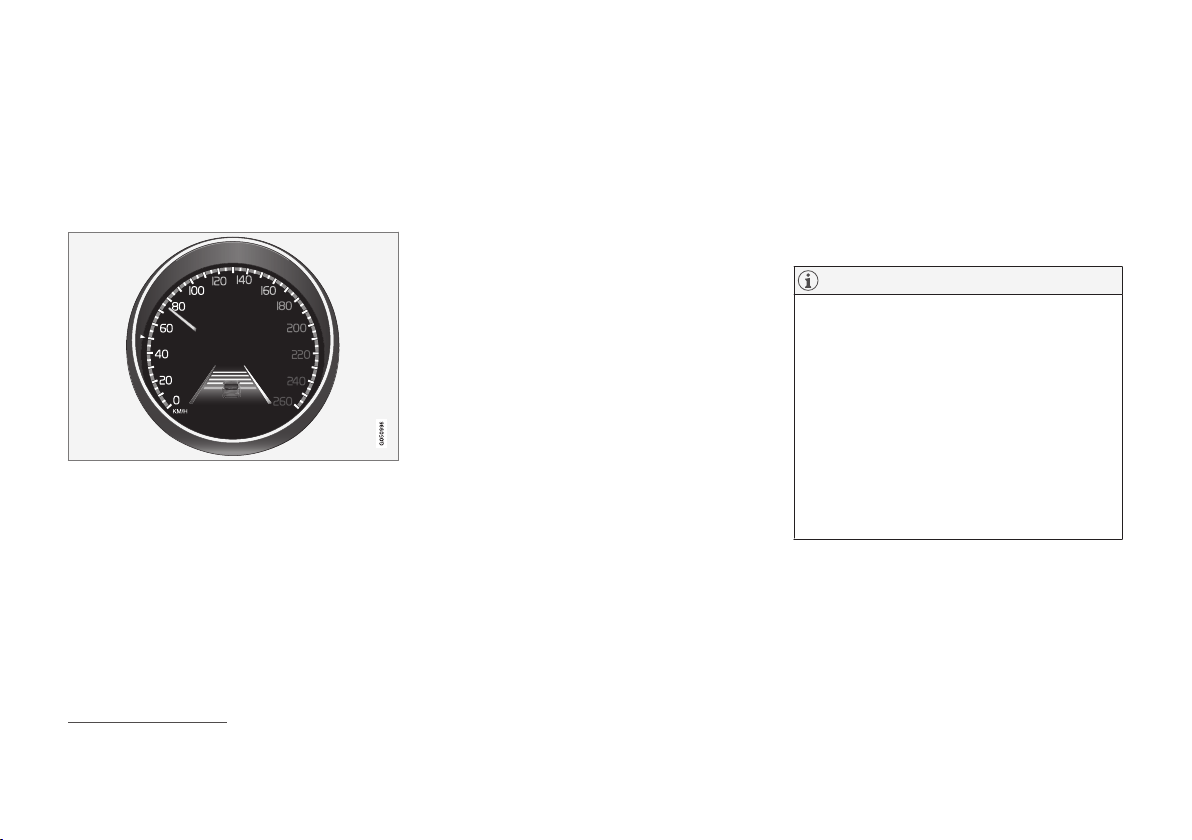
DRIVER SUPPORT
* Option/accessory.
247
Lane Departure Warning (LDW) -
operation
Lane Departure Warning (Lane Departure
Warning) is complemented in the combined
instrument panel with intuitive graphics in differ-
ent situations. Here are some examples:
LDW function side lines.
•
The LDW symbol has WHITE side lines - the
function is active and detects/"sees" one
side line, or both.
•
The LDW symbol has GREY side lines - the
function is active but detects neither left nor
right side line.
or
•
The LDW symbol has GREY side lines - the
function is in standby mode because the
speed is below 65 km/h (40 mph).
•
The LDW symbol has no side lines - the
function is deactivated.
Related information
•
Lane Departure Warning (LDW)* (p. 245)
•
Lane Keeping Aid (LKA)* (p. 249)
Lane Departure Warning (LDW) -
limitations
Lane Departure Warning (Lane Departure
Warning) camera sensor has limitations in a sim-
ilar way to the human eye.
For more information, read about camera sensor
limitations (p. 229).
NOTE
There are some situations where LDW does
not give any warning, such as:
•
Direction indicators are switched on
•
The driver has his/her foot on the brake
pedal
31
•
In the event of rapid depression of the
accelerator pedal
31
•
In the event of rapid steering wheel
movements
31
•
If turning is so sharp that the car rolls.
Related information
•
Lane Departure Warning (LDW)* (p. 245)
•
Lane Keeping Aid (LKA)* (p. 249)
31
When "
Increased sensitivity" is selected a warning is still given, see Lane Departure Warning (LDW) - function (p. 246).
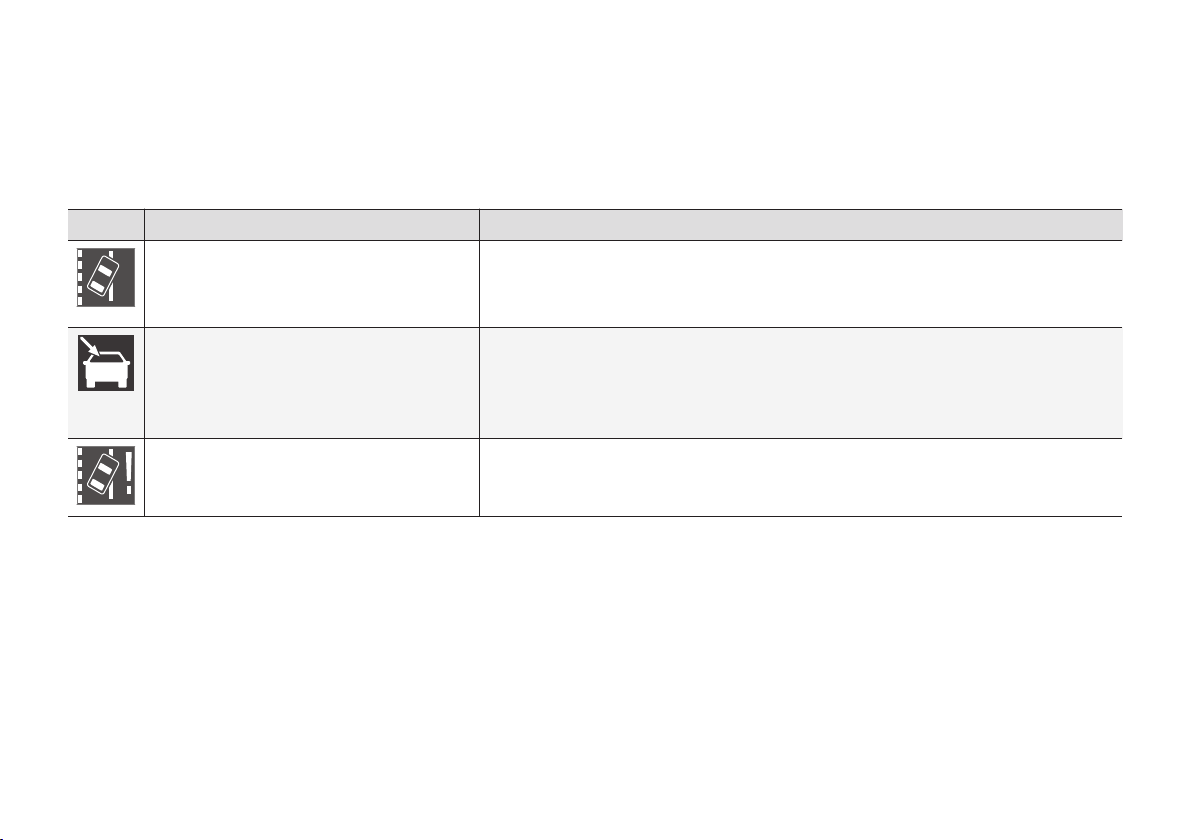
DRIVER SUPPORT
* Option/accessory.
248
Lane Departure Warning (LDW) -
symbols and messages
In situations where there is no Lane assistance
function, a symbol may be shown in the com-
bined instrument panel in combination with an
explanatory message - follow the recommenda-
tion given if appropriate.
Message examples:
Symbol Message Specification
Lane Departure Warning ON/Lane Depar-
ture Warning OFF
The function is switched on/off.
Shown at switch-on/off.
The text disappears after approx. 5 seconds.
Windscreen sensors blocked See manual
The camera sensor is temporarily disengaged.
Shown in the event of snow, ice or dirt on the windscreen for example.
•
Clean the windscreen in front of the camera sensor.
Read about camera sensor limitations (p. 229).
Driver Alert system Service required
The system is disengaged.
•
Visit a workshop if the message remains - an authorised Volvo workshop is recommended.
Related information
•
Lane Departure Warning (LDW)* (p. 245)
•
Lane Keeping Aid (LKA)* (p. 249)
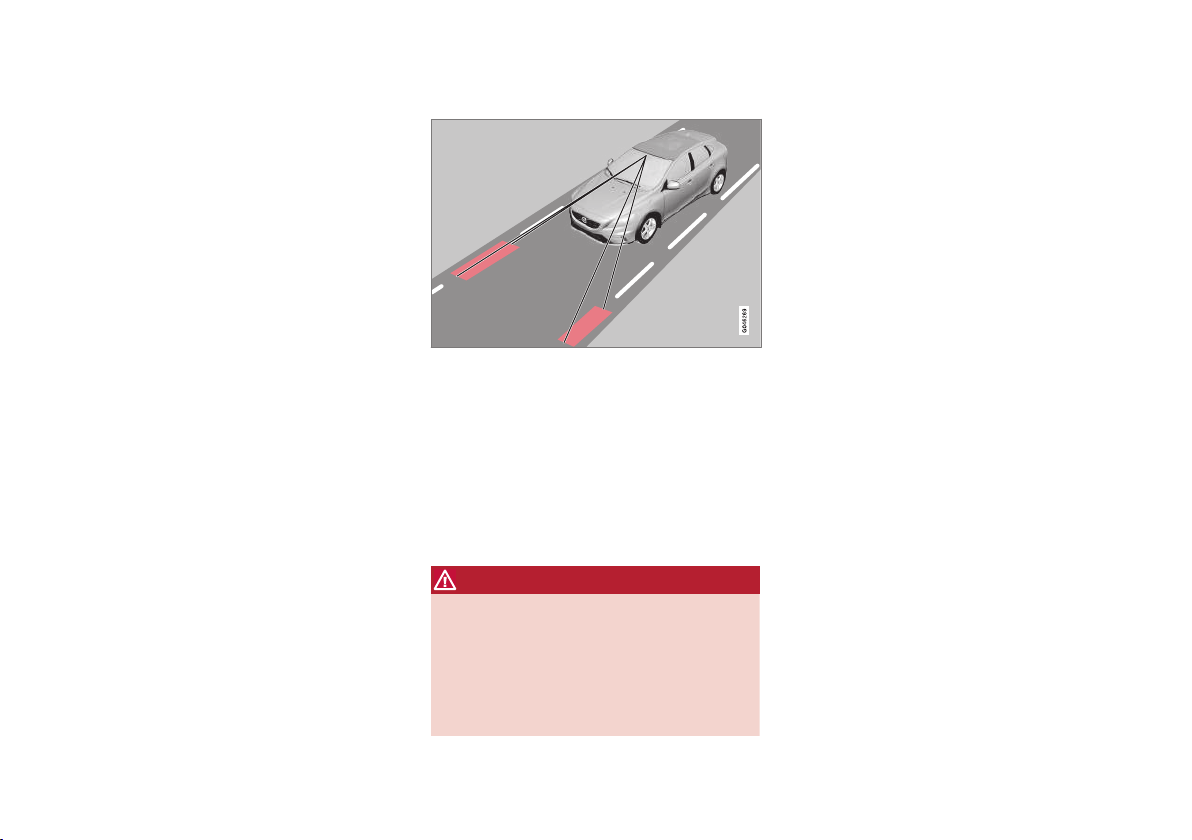
DRIVER SUPPORT
* Option/accessory.
249
Lane Keeping Aid (LKA)*
The purpose of Lane Departure Warning is to
help the driver to reduce the risk of the vehicle
accidentally leaving its own lane in certain situa-
tions on motorways and similar major routes.
Lane Departure Warning LDW or LKA
There are two versions of Lane assistance:
•
LDW -
Lane Departure Warning - alerts
the driver with an acoustic signal or vibration
in the steering wheel.
•
LKA -
Lane Keeping Aid
(Lane Keeping Aid) - steers the car back into
its lane and/or alerts the driver with an
acoustic signal or vibration in the steering
wheel.
The car is supplied with one of these two sys-
tems - market and engine alternative determine
which of the systems the car is equipped with.
In the event of uncertainty whether the car has
LDW or LKA:
•
Open the menu system MY CAR and locate
Driver support system - which specifies
Lane Departure Warning if the car has
LDW or Lane Keeping Aid for LKA.
Principle for LKA
(The figure is schematic - not model specific.)
A camera reads the side lines of the road/lane.
If the car is about to cross a side line then Lane
Keeping Aid will actively steer the car back into
the lane with a slight steering torque in the steer-
ing wheel.
If the car reaches or crosses a side line then
Lane Keeping Aid will also alert the driver with
vibration in the steering wheel.
WARNING
Lane assistance is merely a driver aid and
does not engage in all driving situations or
traffic, weather or road conditions.
The driver always bears ultimate responsibility
for ensuring that the vehicle is driven safely
and that applicable laws and road traffic regu-
lations are followed.
Related information
•
Lane Keeping Aid (LKA) - function (p. 250)
•
Lane Keeping Aid (LKA) - operation (p. 251)
•
Lane Keeping Aid (LKA) - limitations
(p. 252)
•
Lane Keeping Aid (LKA) - symbols and mes-
sages (p. 253)
•
Lane Departure Warning (LDW)* (p. 245)
•
Driver Alert System* (p. 241)
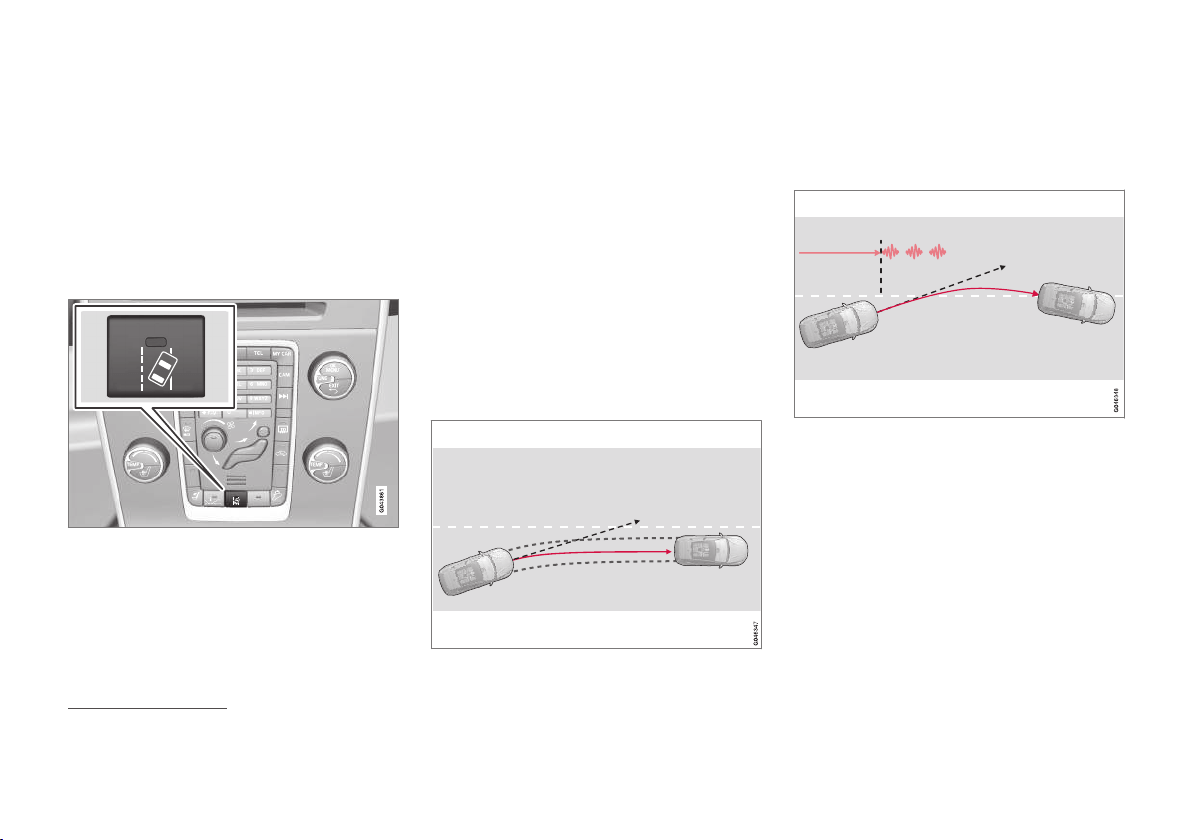
DRIVER SUPPORT
250
Lane Keeping Aid (LKA) - function
Certain settings can be made for the Lane Keep-
ing Aid (Lane Keeping Aid) function.
Off & On
Lane Keeping Aid is active within the speed
range 65-200 km/h (40-125 mph) on roads with
clearly visible side lines. The function is temporar-
ily deactivated on narrow roads with less than 2.6
metres between the lane's side lines.
Press the centre console's button to activate or
deactivate the function. The button's lamp illumi-
nates when the function is switched on.
Some combinations of the selected equipment
leave no vacant space for an On/Off button in
the centre console - in which case the function is
instead handled in the car's menu system MY
CAR. For a description of the menu system, see
MY CAR (p. 109).
In addition, the following selections can be made
in MY CAR:
•
Warning with vibration in the steering wheel:
Vibration only - On or Off.
•
Active steering:
Steering assist only- On or
Off.
•
Both Warning with vibration in the steering
wheel and Active steering:
Full function -
On or Off.
Active steering
Lane Keeping Aid strives to keep the car within
the side lines for the lane.
LKA intervenes and steers away.
If the car approaches the left or right side line of
the lane and the direction indicator is not acti-
vated, the car is steered back into the lane.
Warning with vibration in steering wheel
LKA steers and alerts with steering wheel vibration
32
.
If the car crosses a side line then Lane Keeping
Aid will alert the driver with vibration in the steer-
ing wheel
33
. This occurs regardless of whether
the car is actively steered back by applying a
slight steering torque.
32
The figure shows 3 vibrations when the side line is crossed.
33
Steering wheel vibration varies - the longer the time for which the car has crossed the side line, the more pulses there are.
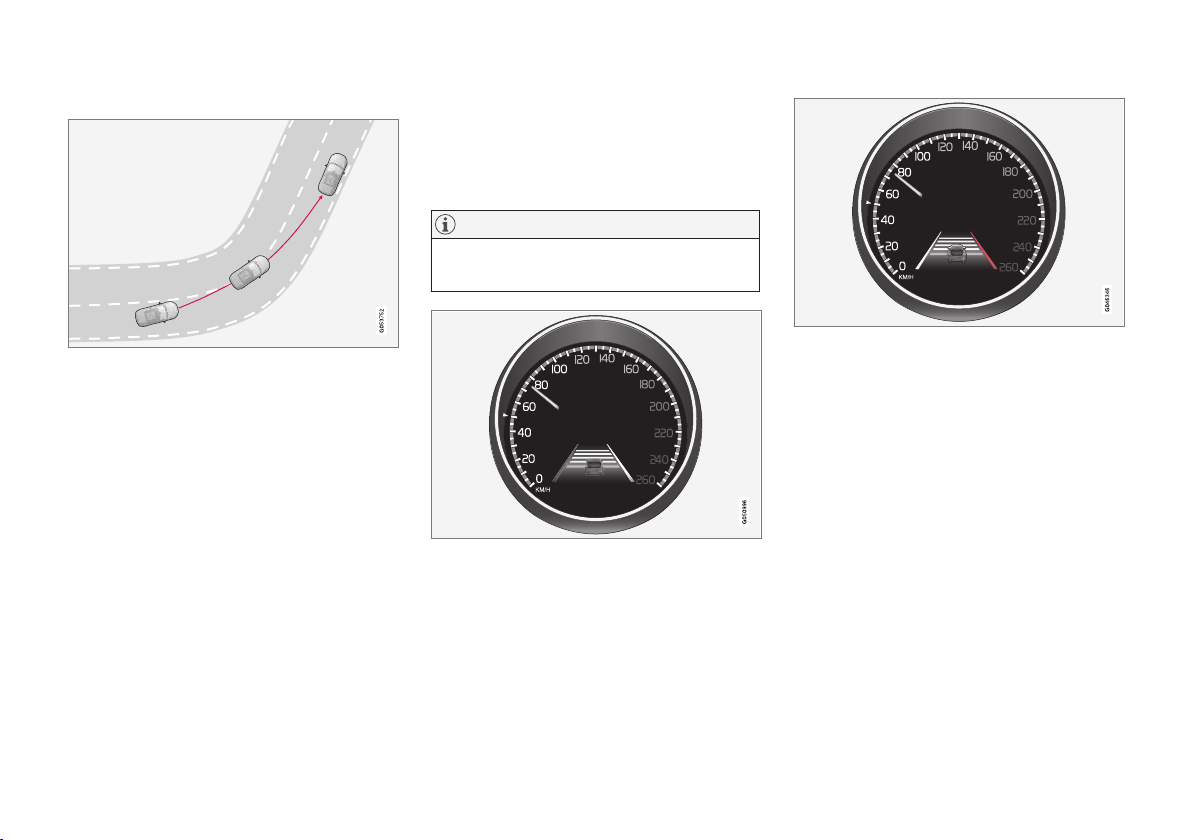
DRIVER SUPPORT
* Option/accessory.
251
Dynamic cornering
LKA does not intervene in sharp inside bends.
In certain cases Lane assistance will allow the
car to cross lane lines without engaging active
steering or activating a warning. Using an adja-
cent lane for cutting a corner when there is a
clear line of vision is an example of this.
Related information
•
Lane Keeping Aid (LKA)* (p. 249)
•
Lane Departure Warning (LDW)* (p. 245)
Lane Keeping Aid (LKA) - operation
Lane Keeping Aid (Lane Keeping Aid) is comple-
mented in the combined instrument panel with
intuitive graphics in different situations. Here are
some examples:
NOTE
LKA is temporarily deactivated for as long as
the direction indicator is switched on.
LKA "sees" and follows the side lines.
If Lane Keeping Aid is active and detects/"sees"
the side lines, the LKA symbol indicates this with
WHITE lines.
•
GREY side line - Lane Keeping Aid does not
see a line on that side of the car.
LKA intervenes on the right-hand side.
Lane Keeping Aid intervenes and steers away
from the side line - this is indicated with:
•
RED line for the side in question.
Related information
•
Lane Keeping Aid (LKA)* (p. 249)
•
Lane Departure Warning (LDW)* (p. 245)

DRIVER SUPPORT
* Option/accessory.
252
Lane Keeping Aid (LKA) - limitations
Lane Keeping Aid (Lane Keeping Aid) camera
sensor has limitations in a similar way to the
human eye.
For more information, read about camera sensor
limitations (p. 229) and see Collision warning
system* - operation (p. 226).
NOTE
In certain demanding situations Lane assis-
tance may have difficulty assisting the driver
in the right way - in which case it is recom-
mended to deactivate the function.
Examples of such situations may be:
•
roadworks
•
winter road conditions
•
poor road surface
•
very sporty driving style
•
poor weather with reduced visibility.
Hands on the steering wheel
In order for Lane Keeping Aid to operate, the
driver must have his/her hands on the steering
wheel. LKA continually monitors this. If hands are
not detected on the steering wheel then a text
message is shown, prompting the driver to
actively steer the car.
If the driver does not follow the request to begin
steering then Lane Keeping Aid goes into
standby mode and will remain in this mode until
the driver begins to steer the car again.
Related information
•
Lane Keeping Aid (LKA)* (p. 249)
•
Lane Departure Warning (LDW)* (p. 245)
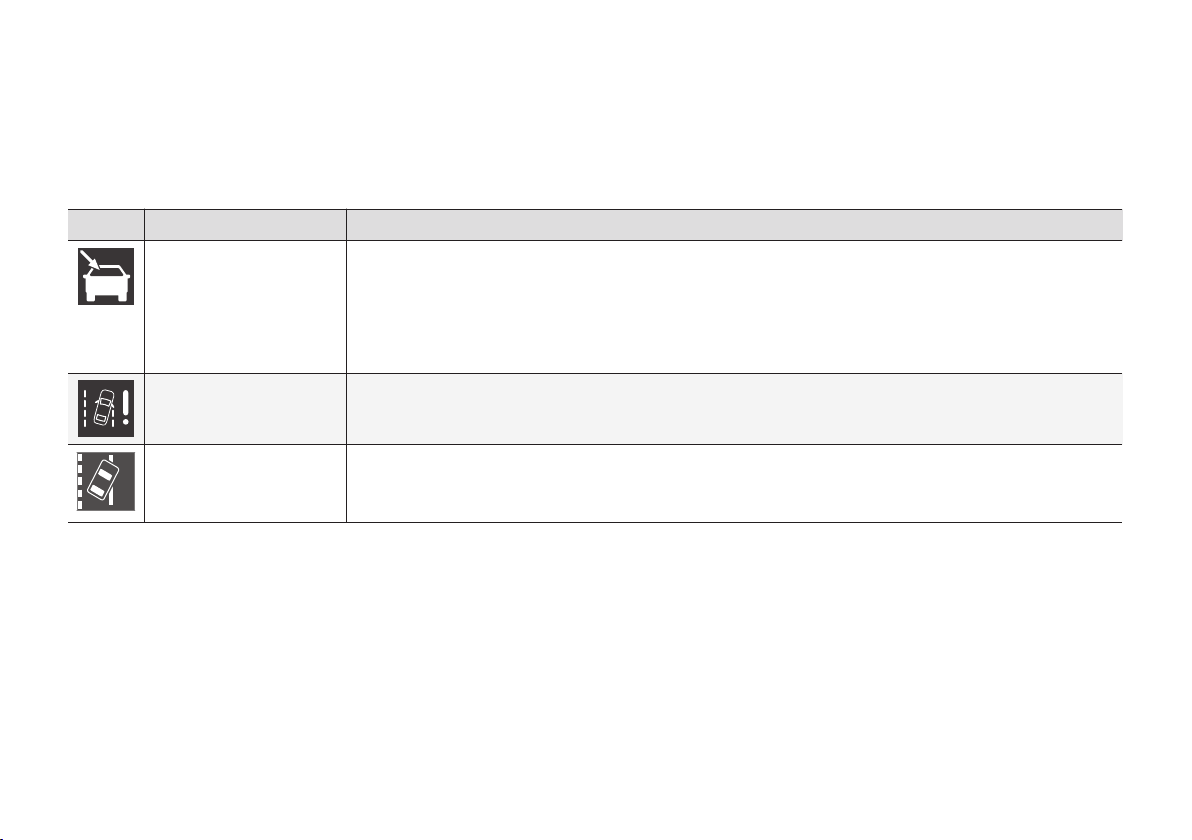
DRIVER SUPPORT
* Option/accessory.
253
Lane Keeping Aid (LKA) - symbols
and messages
In situations where there is no Lane assistance
function, a symbol may be shown in the com-
bined instrument panel in combination with an
explanatory message - follow the recommenda-
tion given if appropriate.
Message examples:
Symbol Message Specification
Windscreen sensors
blocked See manual
The camera sensor is temporarily disengaged.
Shown in the event of snow, ice or dirt on the windscreen for example.
•
Clean the windscreen in front of the camera sensor.
Read about the limitations of the camera sensor, see Collision warning system* - camera sensor limitations
(p. 229) and Collision warning system* - operation (p. 226).
Lane Keeping Aid Serv-
ice required
The system is disengaged.
•
Visit a workshop if the message remains - an authorised Volvo workshop is recommended.
Lane Keeping Aid Inter-
rupted
LKA has been set to standby mode. The lines of the LKA symbol indicate when the function is active again.
Related information
•
Lane Keeping Aid (LKA)* (p. 249)
•
Lane Departure Warning (LDW)* (p. 245)
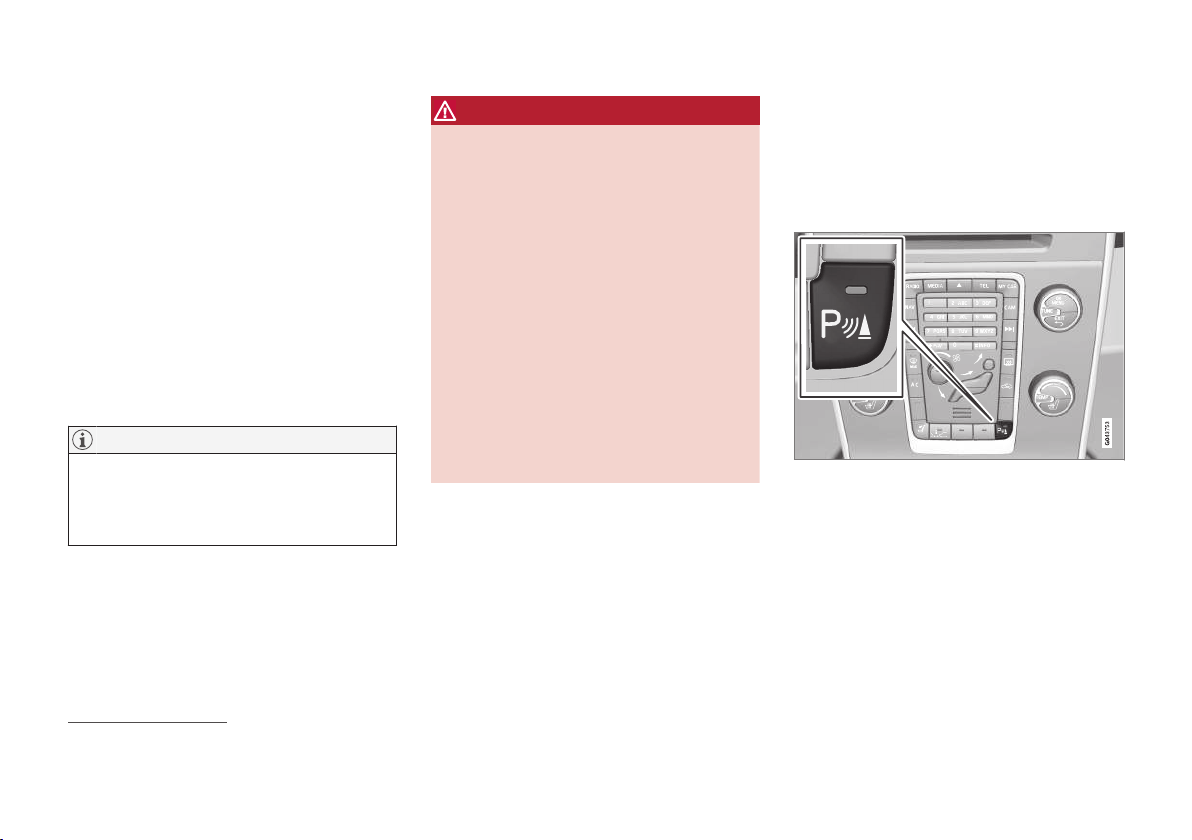
DRIVER SUPPORT
* Option/accessory.
254
Park Assist*
Parking assistance is used as an aid to parking.
An acoustic signal as well as symbols on the
centre console's screen indicate the distance to
the detected obstacle.
Parking assistance sound level can be adjusted
during the ongoing acoustic signal using the cen-
tre console's VOL knob. The sound level can also
be adjusted in the audio settings menu, which is
accessed by pressing SOUND or in the car's
menu system (p. 109) MY CAR
34
.
Parking assistance is available in two variants:
•
Rear only
•
Both front and rear.
NOTE
When a towbar is configured with the car's
electrical system, the protrusion of the towbar
is included when the function measures the
parking space.
WARNING
•
The Park Assist function is supplemen-
tary driver support intended to facilitate
driving and make it safer – it cannot han-
dle all situations in all traffic, weather and
road conditions.
•
The parking sensors have blind spots
where obstacles cannot be detected.
•
Be particularly aware of people and ani-
mals near the car.
•
The Park Assist system is not a substitute
for the driver's attention and judgement.
The driver is always responsible for
ensuring the car is driven in a safe man-
ner, at the appropriate speed, with an
appropriate distance to other vehicles,
and in accordance with current traffic
rules and regulations.
Related information
•
Park assist syst* - function (p. 254)
•
Park assist syst* - forward (p. 256)
•
Park assist syst* - backward (p. 255)
•
Park assist syst* - cleaning the sensors
(p. 257)
•
Park assist syst* - fault indication (p. 257)
•
Park assist camera* (p. 258)
Park assist syst* - function
The parking assistance system is automatically
activated when the engine is started - the
switch's On/Off lamp is illuminated. If parking
assistance is switched off with the button, the
lamp goes out.
On/Off for parking assistance and CTA*.
If the car is equipped with CTA (p. 235) the indi-
cator lamps flash for BLIS (p. 233) once, then
parking assistance is activated using the button.
34
Depending on the audio and media system.
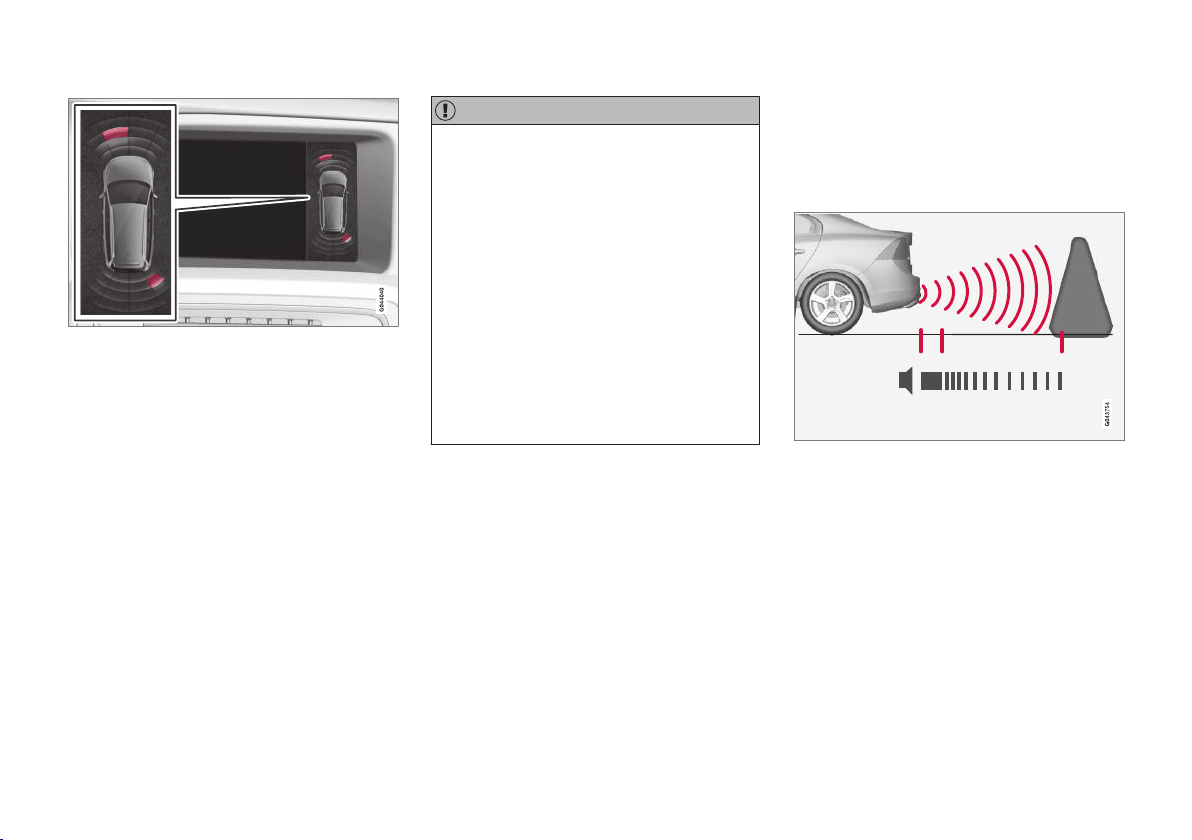
DRIVER SUPPORT
}}
* Option/accessory.
255
Display screen view - showing an obstacle left front and
right rear.
The centre console's display screen shows an
overview of the relationship between the car and
detected obstacle.
Marked sectors show which of the four sensor(s)
detected an obstacle. The closer to the car sym-
bol a selected sector box is, the shorter the dis-
tance between the car and a detected obstacle.
The frequency of the signal increases the shorter
the distance to an obstacle, in front of or behind
the car. Other sound from the audio system is
muted automatically.
When the distance is within 30 cm the tone is
constant and the active sensor's field nearest the
car is filled in. If the detected obstacle is within
the distance for the constant tone both behind
and in front of the car, then the tone sounds
alternately from the loudspeakers.
IMPORTANT
Objects e.g. chains, thin glossy poles or low
barriers may be in the "signal shadow" and
are then temporarily not detected by the sen-
sors - the pulsating tone may then unexpect-
edly stop instead of changing over to the
expected constant tone.
The sensors cannot detect high objects, such
as projecting loading docks.
•
In such situations, pay extra attention and
manoeuvre/reposition the car particularly
slowly or stop the current parking
manoeuvre - there may be a high risk of
damage to vehicles or other objects since
information from the sensors is not
always reliable in such situations.
Related information
•
Park Assist* (p. 254)
•
Park assist syst* - forward (p. 256)
•
Park assist syst* - backward (p. 255)
•
Park assist syst* - cleaning the sensors
(p. 257)
•
Park assist syst* - fault indication (p. 257)
•
Park assist camera* (p. 258)
Park assist syst* - backward
Parking assistance is used as an aid to parking.
An acoustic signal as well as symbols on the
centre console's screen indicate the distance to
the detected obstacle.
The distance covered to the rear of the car is
about 1.5 metres. The acoustic signal for obsta-
cles behind comes from one of the rear loud-
speakers.
Rear parking assistance is activated when
reverse gear is engaged.
When reversing with e.g. a trailer on the towbar,
rear parking assistance is switched off automati-
cally - otherwise the sensors would react to the
trailer.
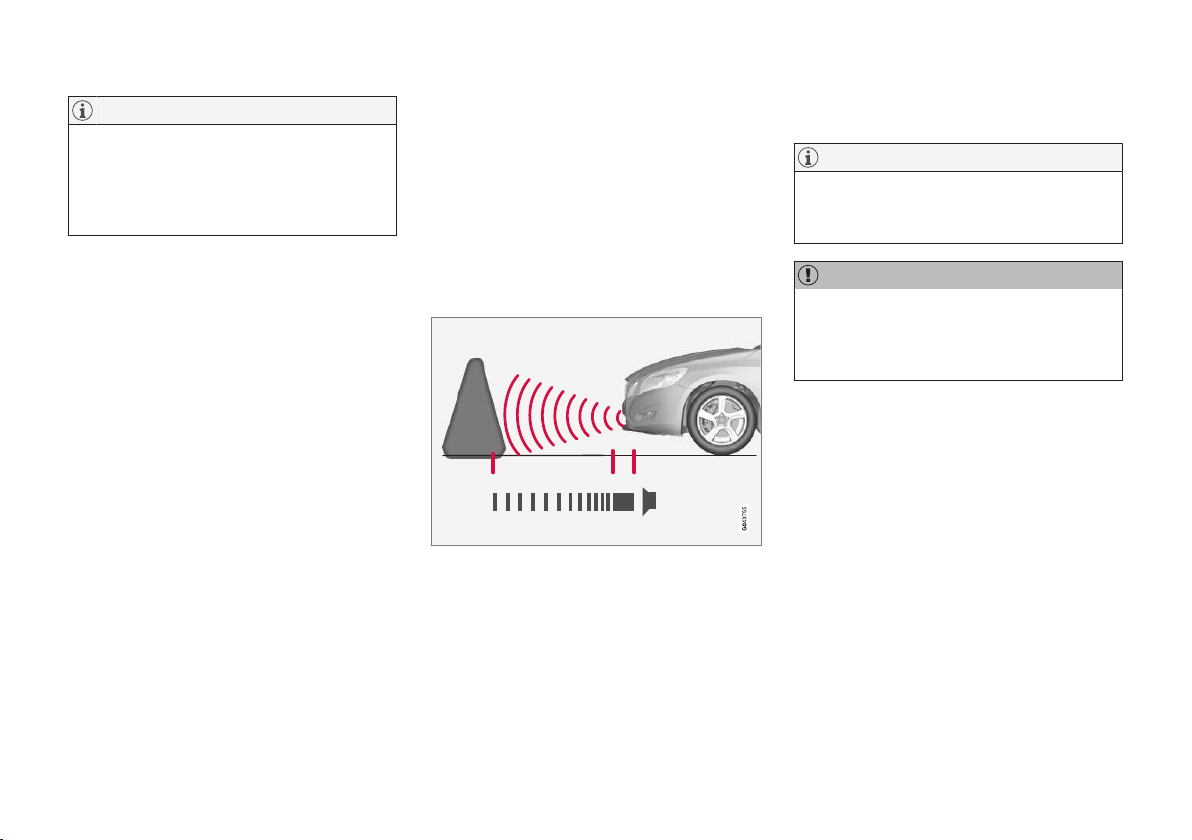
||
DRIVER SUPPORT
* Option/accessory.
256
NOTE
When reversing with e.g. a trailer or bike car-
rier on the towbar - without Volvo genuine
trailer wiring - parking assistance may need to
be switched off manually in order that the
sensors do not react to them.
Related information
•
Park Assist* (p. 254)
•
Park assist syst* - function (p. 254)
•
Park assist syst* - forward (p. 256)
•
Park assist syst* - cleaning the sensors
(p. 257)
•
Park assist syst* - fault indication (p. 257)
•
Park assist camera* (p. 258)
Park assist syst* - forward
Parking assistance is used as an aid to parking.
An acoustic signal as well as symbols on the
centre console's screen indicate distance to
detected obstacles.
The parking assistance system is automatically
activated when the engine is started - the
switch's On/Off lamp is illuminated. If parking
assistance is switched off with the button, the
lamp goes out.
The distance covered in front of the car is about
0.8 metres. The acoustic signal for obstacles in
front comes from one of the front loudspeakers.
The front parking assistance system is active up
to 10 km/h (6 mph).
If the Parking Assistance System is deactivated
because the car is moving too quickly - 11 km/h
(7 mph) or above - the function is reactivated
when the speed falls below 10 km/h (6 mph).
NOTE
Parking assistance is deactivated when the
parking brake is applied or P mode is
selected in a car with an automatic gearbox.
IMPORTANT
When auxiliary lamps are fitted: Remember
that these must not obscure the sensors - the
auxiliary lamps may then be perceived as an
obstacle.
Related information
•
Park Assist* (p. 254)
•
Park assist syst* - function (p. 254)
•
Park assist syst* - backward (p. 255)
•
Park assist syst* - cleaning the sensors
(p. 257)
•
Park assist syst* - fault indication (p. 257)
•
Park assist camera* (p. 258)
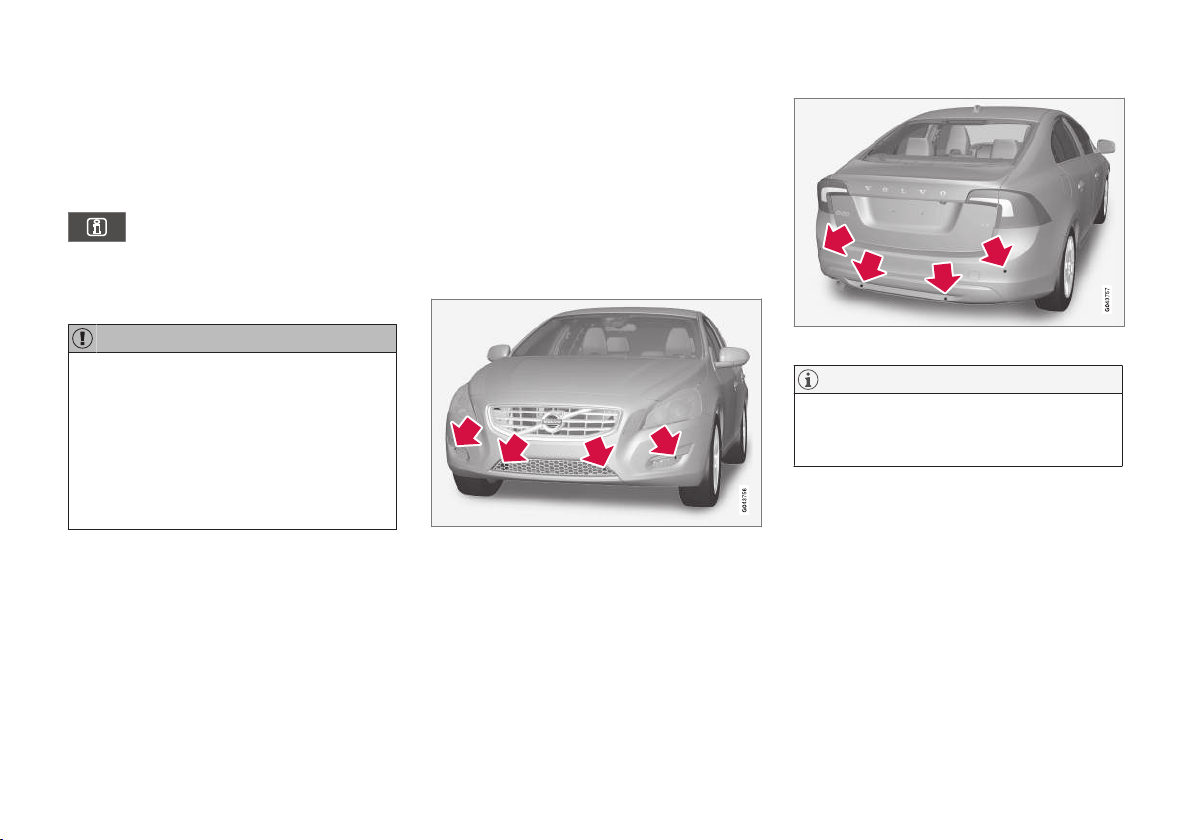
DRIVER SUPPORT
* Option/accessory.
257
Park assist syst* - fault indication
Parking assistance is used as an aid to parking.
An acoustic signal as well as symbols on the
centre console's screen indicate the distance to
the detected obstacle.
If the combined instrument panel's
information symbol illuminates with
constant glow and the text message
Park Assist System Service required is
shown then parking assistance is disengaged.
IMPORTANT
In certain conditions the parking assistance
system may produce incorrect warning sig-
nals that are caused by external sound
sources with the same ultrasonic frequencies
that the system works with.
Examples of such sources include horns, wet
tyres on asphalt, pneumatic brakes, exhaust
noises from motorcycles, etc.
Related information
•
Park Assist* (p. 254)
•
Park assist syst* - cleaning the sensors
(p. 257)
•
Park assist syst* - function (p. 254)
•
Park assist syst* - forward (p. 256)
•
Park assist syst* - backward (p. 255)
•
Park assist camera* (p. 258)
Park assist syst* - cleaning the
sensors
Parking assistance is used as an aid to parking.
An acoustic signal as well as symbols on the
centre console's screen indicate the distance to
the detected obstacle.
The sensors must be cleaned regularly to ensure
that they work properly. Clean them with water
and car shampoo.
Sensor location, front.
Sensor location, rear.
NOTE
Dirt, ice and snow covering the sensors may
cause incorrect warning signals, reduced or
no function.
Related information
•
Park Assist* (p. 254)
•
Park assist syst* - function (p. 254)
•
Park assist syst* - forward (p. 256)
•
Park assist syst* - backward (p. 255)
•
Park assist syst* - fault indication (p. 257)
•
Park assist camera* (p. 258)
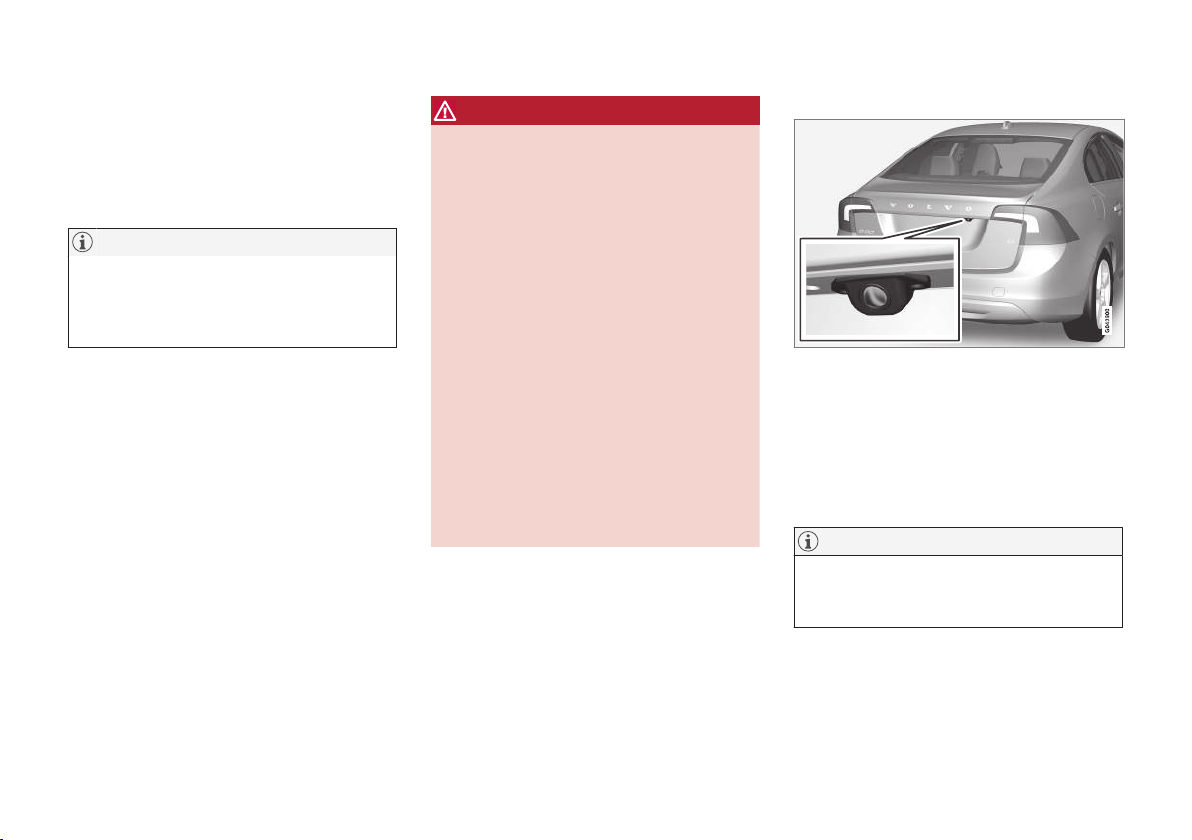
DRIVER SUPPORT
* Option/accessory.
258
Park assist camera*
Parking camera is an auxiliary system, which is
activated when the reverse gear is selected.
The camera image is shown on the centre con-
sole's screen.
NOTE
When a towbar is configured with the car's
electrical system, the protrusion of the towbar
is included when the function measures the
parking space.
WARNING
•
The parking camera function is supple-
mentary driver support intended to facili-
tate driving and make it safer – it cannot
handle all situations in all traffic, weather
and road conditions.
•
The parking cameras have blind spots
where obstacles cannot be detected.
•
Be particularly aware of people and ani-
mals near the car.
•
Objects/obstacles on the display screen
may be closer to the car than they appear
to be on the screen.
•
The parking cameras are not a substitute
for the driver's attention and judgement.
The driver is always responsible for
ensuring the car is driven in a safe man-
ner, at the appropriate speed, with an
appropriate distance to other vehicles,
and in accordance with current traffic
rules and regulations.
Function and operation
Camera location next to the opening handle.
The camera shows what is behind the car and if
something appears from the sides.
The camera shows a wide area behind the car
and part of the bumper and any towbar.
Objects on the screen may appear to tilt slightly -
this is normal.
NOTE
Objects on the display screen may be closer
to the car than they appear to be on the
screen.
If another view is active then the parking camera
system takes over automatically and its camera
image is displayed on the screen.
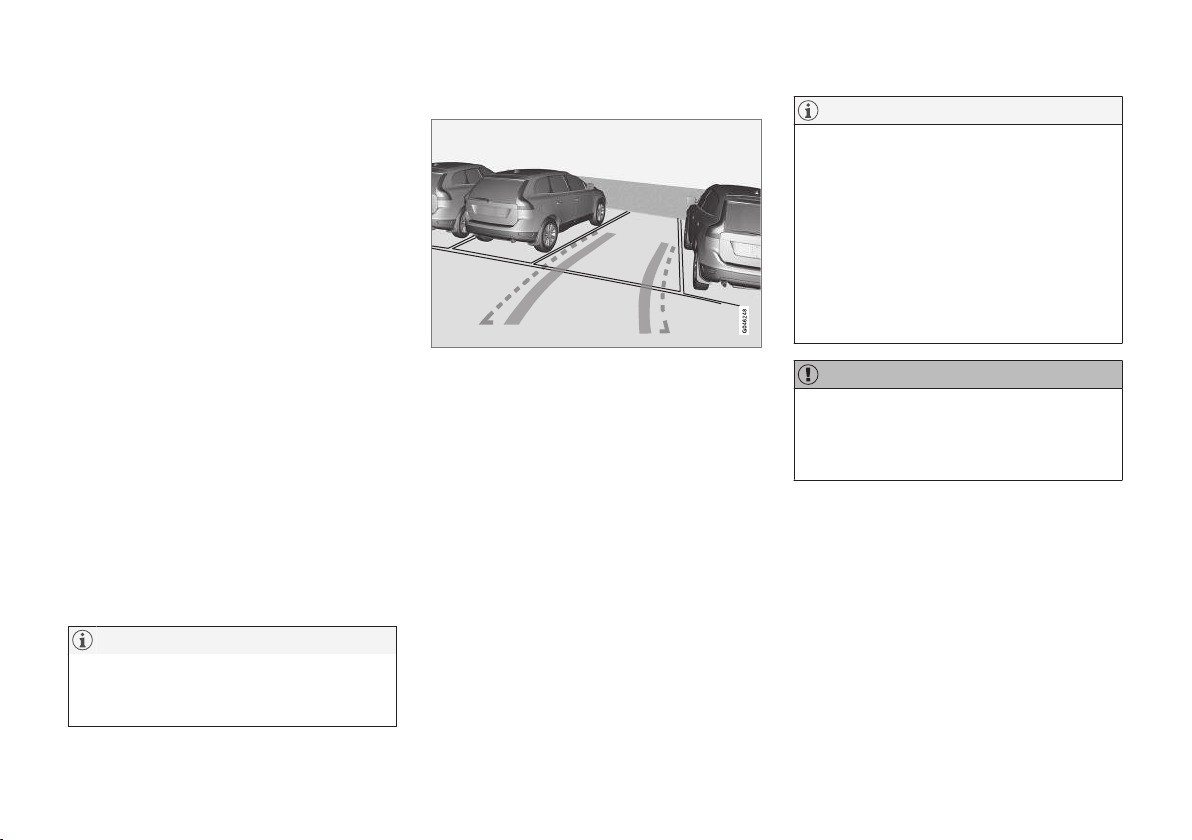
DRIVER SUPPORT
}}
* Option/accessory.
259
When reverse gear is selected, two unbroken
lines are shown graphically which illustrate where
the car's rear wheels will roll with the current
steering wheel angle - this facilitates parallel
parking, reversing into tight spaces and for hitch-
ing a trailer. The car's approximate external
dimensions are illustrated by means of dashed
lines. The park assist lines can be deactivated -
see section Settings (p. 261).
If the car is also equipped with Parking assis-
tance sensors (p. 254)* then their information is
shown graphically as coloured areas in order to
illustrate distances to detected obstacles, see
heading "Cars with reversing sensors" later in the
text.
The camera is active approx. 5 seconds after
reverse gear has been disengaged or until the
car's speed exceeds 10 km/h (6 mph) forward or
35 km/h (22 mph) backward.
Light conditions
The camera image is adjusted automatically
according to prevailing light conditions. Because
of this, the image may vary slightly in brightness
and quality. Poor light conditions can result in a
slightly reduced image quality.
NOTE
Keep the camera lens clear of dirt, snow and
ice to ensure optimum function. This is partic-
ularly important in poor light.
Park assist lines
Examples of how the park assist lines can be displayed
for the driver.
The lines on the screen are projected as if they
were at ground level behind the car and are
directly related to steering wheel movement,
which shows the driver the path the car will then
take - also when the car is turning.
NOTE
•
When reversing with a trailer which is not
connected electrically to the car, the lines
on the display show the route the car will
take - not the trailer.
•
The screen shows no lines when a trailer
is connected electrically to the car's elec-
trical system.
•
The parking camera is deactivated auto-
matically when towing a trailer if a Volvo
genuine trailer cable is used.
IMPORTANT
Remember, that with the rear camera view
selected, the monitor only displays the area
behind the car. Be aware of the sides and
front of the car when manoeuvring in reverse.
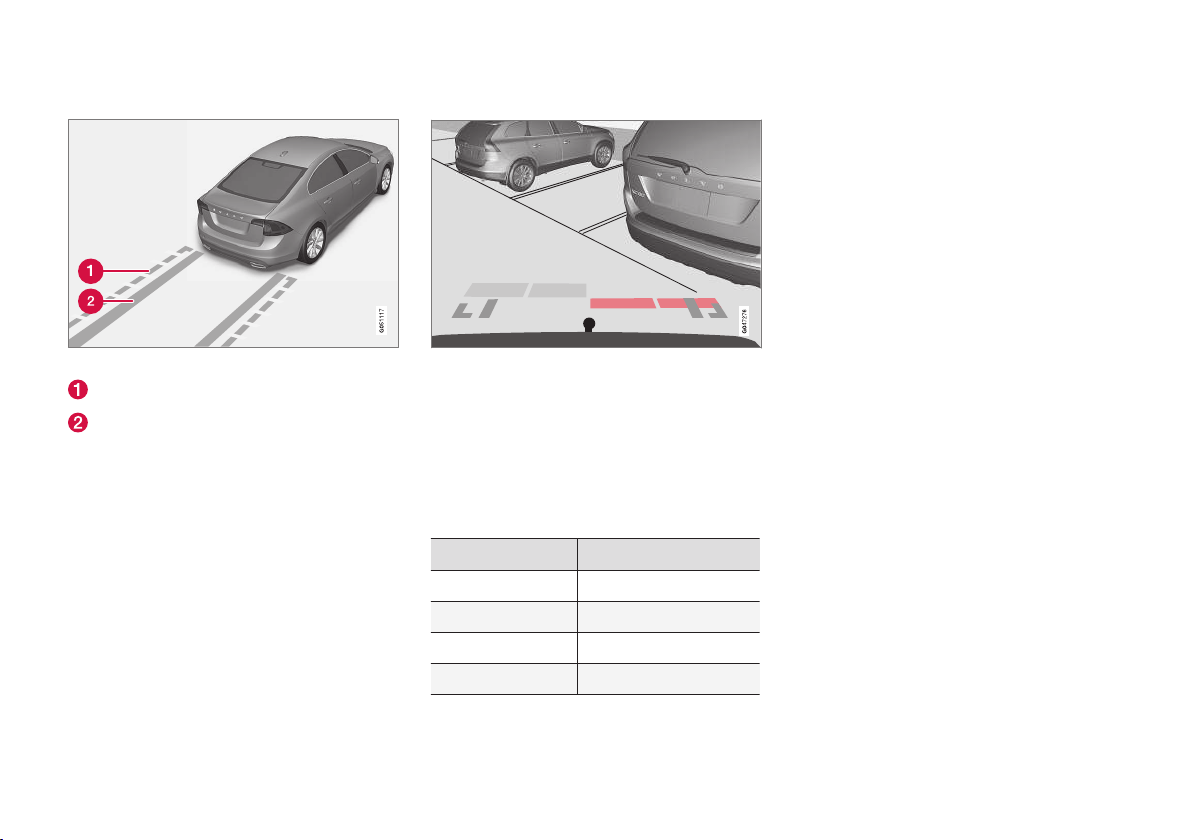
||
DRIVER SUPPORT
* Option/accessory.
260
Boundary lines
The system's different lines.
Boundary line, free reversing zone
"Wheel tracks"
The dashed line (1) frames in a zone up to
about 1.5 m back from the bumper. It is also the
limit of the car's most protruding parts, such as
door mirrors and corners - also when the car is
turning.
The wide "wheel tracks" (2) between the side
lines indicate where the wheels will roll and can
extend about 3.2 m back from the bumper if no
obstacle is in the way.
Cars with reversing sensors*
Coloured fields (one per sensor) show distance.
If the car is also equipped with Parking assis-
tance (p. 254) the distance is shown with col-
oured fields for each sensor that registers an
obstacle.
The colour of the areas changes with decreasing
distance to the obstacle - from light yellow to yel-
low, via orange to red.
Colour / paint Distance (metres)
Light yellow 0,7–1,5
Yellow 0,5–0,7
Orange 0,3–0,5
Red 0–0.3
Related information
•
Park assist camera - settings (p. 261)
•
Park assist camera - limitations (p. 261)
•
Park Assist* (p. 254)
•
Park Assist Pilot (PAP)* (p. 262)
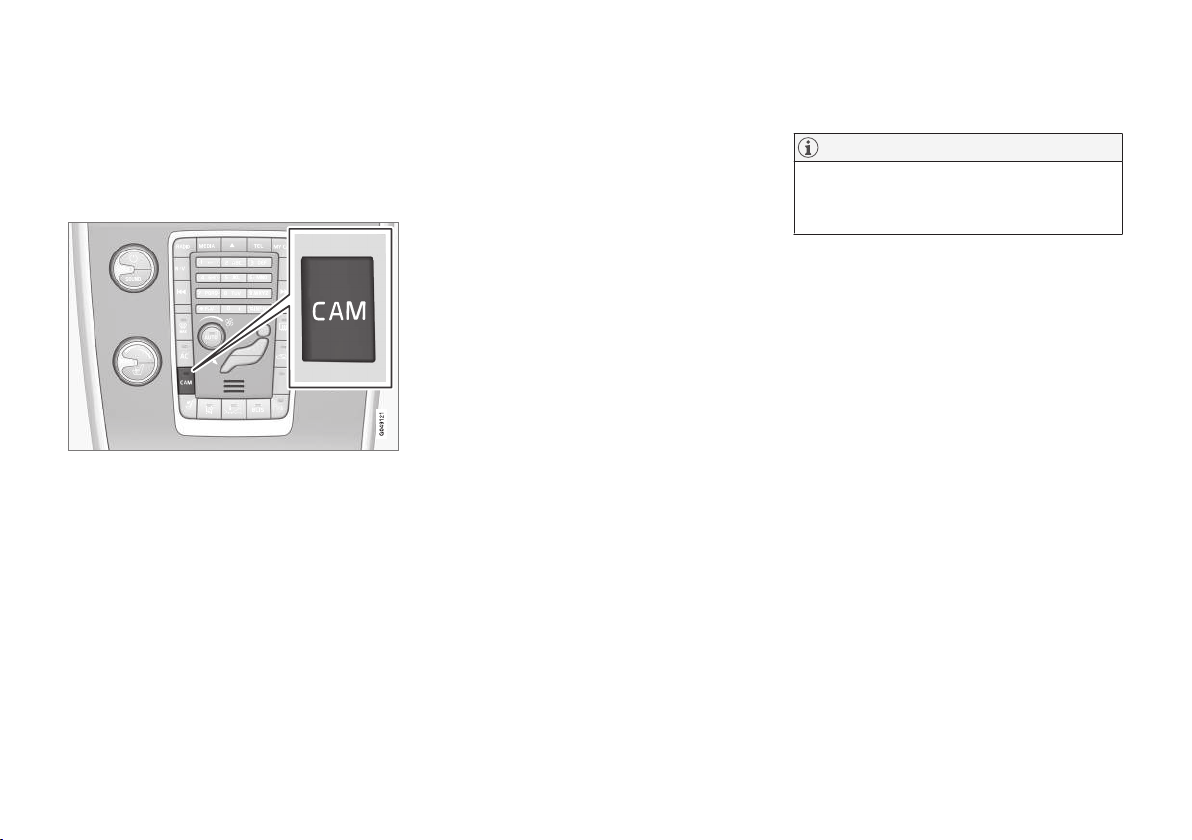
DRIVER SUPPORT
* Option/accessory.
261
Park assist camera - settings
Activate switched-off camera
The camera starts automatically when reverse
gear is selected, but it can also be activated man-
ually as follows:
•
Press CAM - the screen shows the current
camera view.
Change setting
The settings for the parking camera can be
changed when the screen shows a camera view:
1.
Press OK/MENU when a camera view is
shown - the screenchanges to a menu with
various options.
2.
Turn to reach the desired option with TUNE.
3.
Highlight the option by pressing OK/MENU
once and go back out with EXIT.
Towbar
The camera can be used to advantage when
hitching a trailer. A park assist line for the tow-
bar's intended "trajectory" toward the trailer can
be shown on the screen - exactly as for the
"wheel tracks".
A choice can be made between showing the
"wheel tracks" or the towbar's trajectory - both
options cannot be shown simultaneously.
1.
Press OK/MENU when a camera view is
shown.
2.
Turn to reach the
Tow bar trajectory guide
line option with TUNE.
3.
Highlight the option by pressing OK/MENU
once and go back out with EXIT.
Zoom
If precise manoeuvring is required then the cam-
era view can be zoomed in:
•
Press CAM or turn TUNE - repeated press/
turn changes back to the normal view.
If more options are available, they are in a loop
- press/turn until the desired camera view is
shown.
Related information
•
Park assist camera* (p. 258)
•
Park Assist* (p. 254)
•
Park Assist Pilot (PAP)* (p. 262)
Park assist camera - limitations
NOTE
A bike carrier or other accessory mounted on
the rear of the car could obscure the cam-
era's view.
To bear in mind
Pay attention to the possibility that, even if it only
looks like a relatively small part of the image is
obscured, it could be a relatively large sector that
is hidden from view. Obstacles could thereby go
undetected until they are very close to the car.
•
Keep the camera lens free from dirt, ice and
snow.
•
Clean the camera lens regularly with luke-
warm water and car shampoo - take care not
to scratch the lens.
Related information
•
Park assist camera* (p. 258)
•
Park assist camera - settings (p. 261)
•
Park Assist* (p. 254)
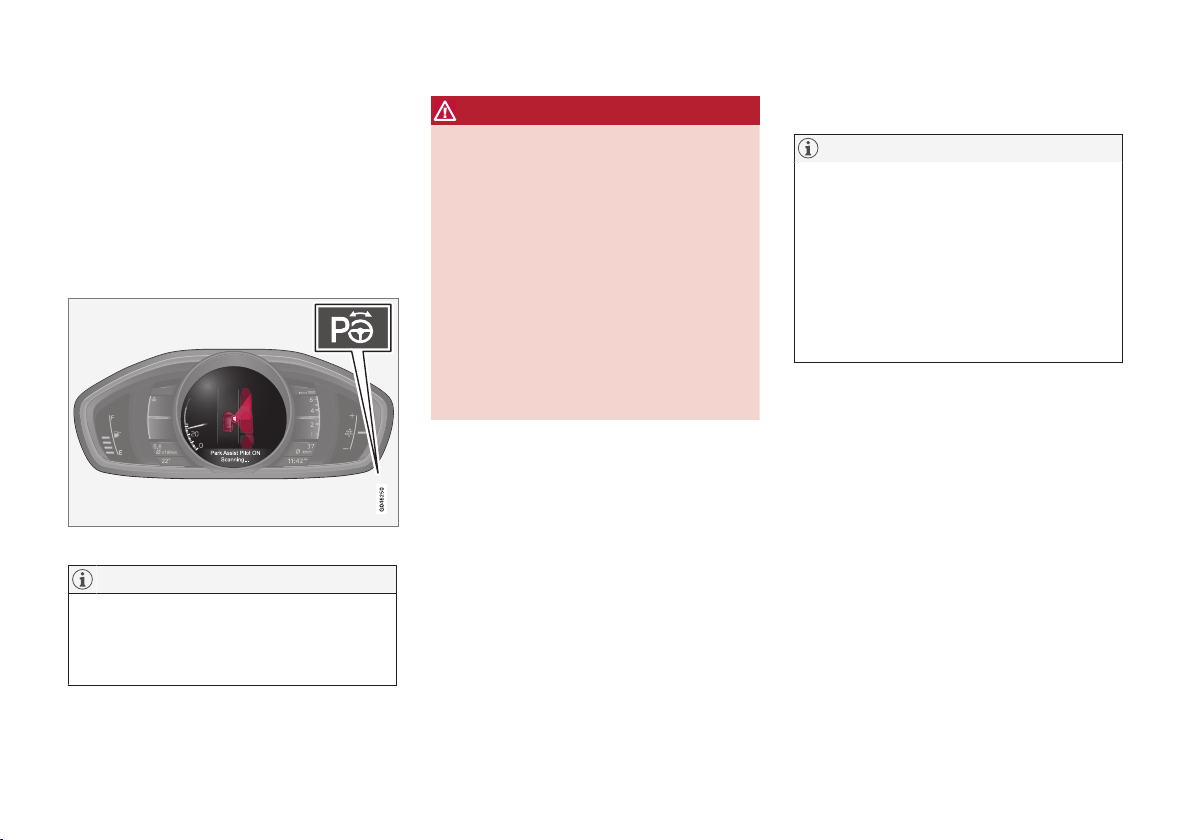
DRIVER SUPPORT
* Option/accessory.
262
Park Assist Pilot (PAP)*
The Park Assist Pilot (PAP – Park Assist Pilot)
helps the driver to park by first checking whether
a space is sufficiently large and then turning the
steering wheel and steering the car into the
space.
The combined instrument panel uses symbols,
graphics and text for when the different steps are
to be carried out.
The On/Off button is on located the centre console.
NOTE
When a towbar is configured with the car's
electrical system, the protrusion of the towbar
is included when the function measures the
parking space.
WARNING
•
The PAP function is supplementary driver
support intended to facilitate driving and
make it safer – it cannot handle all situa-
tions in all traffic, weather and road condi-
tions.
•
Be particularly aware of people and ani-
mals near the car.
•
PAP is not a substitute for the driver's
attention and judgement. The driver is
always responsible for ensuring the car is
driven in a safe manner, at the appropri-
ate speed, with an appropriate distance to
other vehicles, and in accordance with
current traffic rules and regulations.
Related information
•
Park Assist Pilot (PAP)* - symbols and mes-
sages (p. 267)
•
Park Assist Pilot (PAP)* - operation (p. 263)
•
Park Assist Pilot (PAP)* - function (p. 262)
•
Park Assist Pilot (PAP)* - limitations
(p. 265)
•
Park Assist* (p. 254)
•
Park assist camera* (p. 258)
Park Assist Pilot (PAP)* - function
NOTE
The PAP function measures the space and
steers the car - the driver's task is to:
•
keep a close watch around the car
•
follow the instructions in the combined
instrument panel
•
change gear (reverse/forward)
•
control and maintain a safe speed
•
brake and stop.
PAP can be activated if the following criteria are
met once the engine has been started:
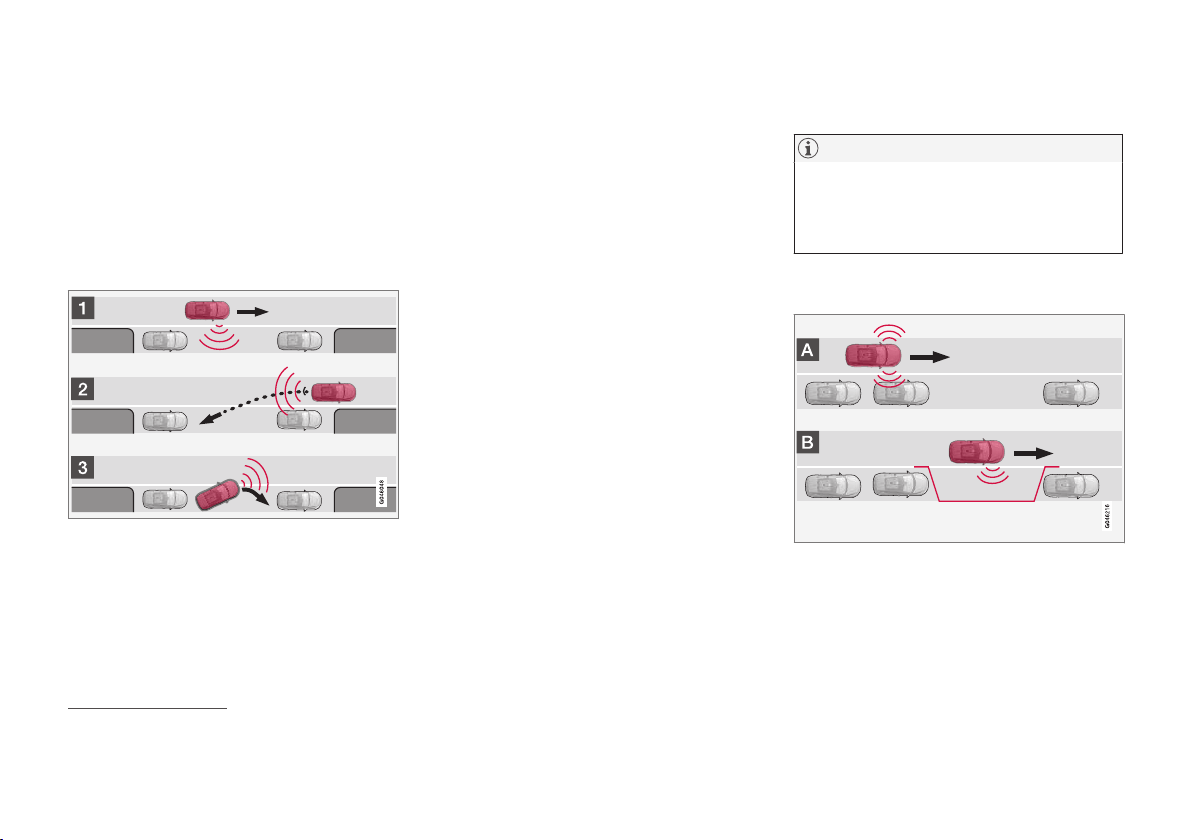
DRIVER SUPPORT
}}
* Option/accessory.
263
•
The functions ABS
35
or ESC
36
must not
intervene when the PAP function is activated
- these can be activated in the event of e.g.
steep and slippery surfaces, see the sections
on Foot brake and Stability system ESC
(p. 182) for more information.
•
A trailer must not be connected to the car.
•
Speed must be lower than 50 km/h
(30 mph).
Principle for PAP.
The PAP function parks the car using the follow-
ing steps:
1. The function searches for a parking space
and measures it - during measurement,
speed must not exceed 30 km/h (20 mph).
2. The car is steered into the space during
reversing.
3. The car is positioned in the space by means
of driving forward/backward.
Related information
•
Park Assist Pilot (PAP)* (p. 262)
•
Park Assist* (p. 254)
•
Park assist camera* (p. 258)
Park Assist Pilot (PAP)* - operation
NOTE
Remember that certain steering wheel posi-
tions may obstruct the combined instrument
panel's instructions when you turn it during
the parking manoeuvre.
1 - Searching and checking
measurements
35
(Anti-lock Braking System) - Anti-lock braking system.
36
(Electronic Stability Control) - Stability system.
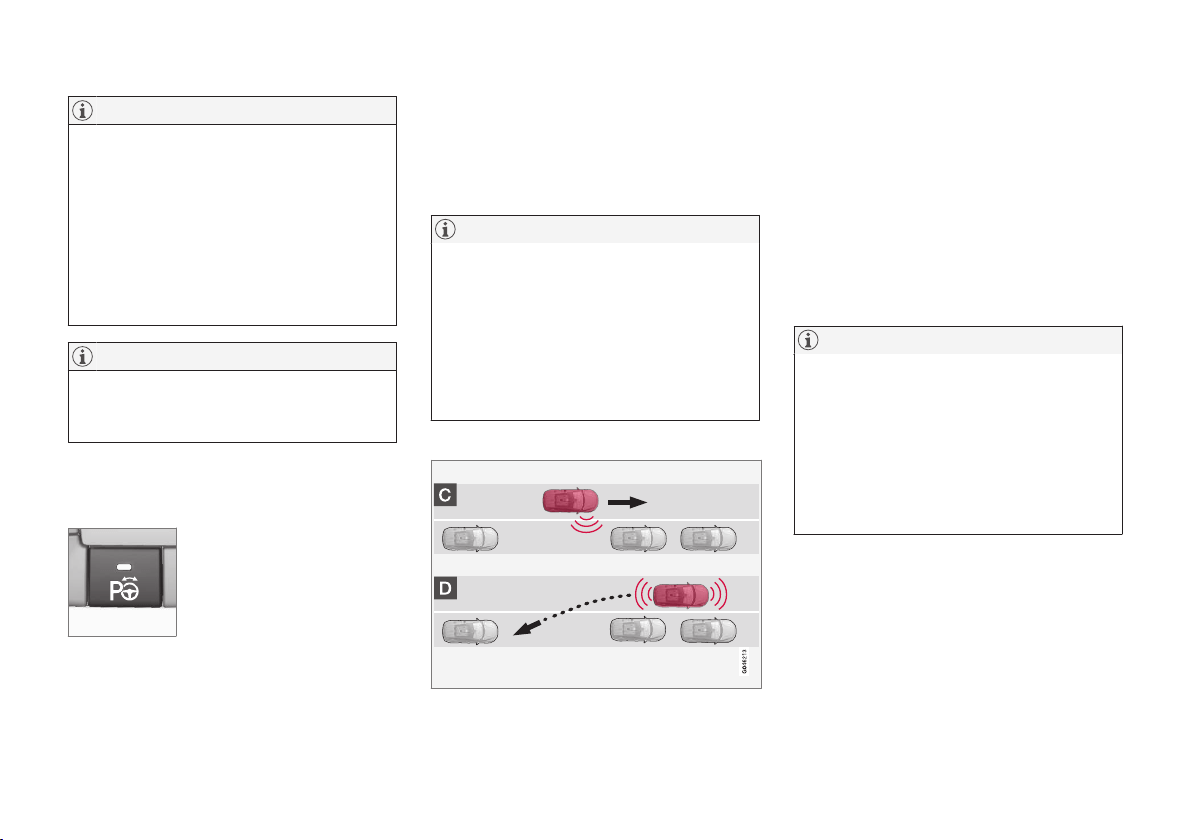
||
DRIVER SUPPORT
264
NOTE
The PAP function measures the space and
steers the car - the driver's task is to:
•
keep a close watch around the car
•
follow the instructions in the combined
instrument panel
•
change gear (reverse/forward)
•
control and maintain a safe speed
•
brake and stop.
NOTE
The distance between the car and parking
spaces should be 0.5-1.5 metres (1.6-5.0 ft)
while PAP is searching for a parking space.
The PAP function searches for a parking space
and checks whether it is big enough. Proceed as
follows:
1. Activate PAP by pressing
this button and do not drive
faster than 30 km/h (20 mph).
2. Keep an eye on the combined instrument
panel and be prepared to stop the car when
the graphics and text so request.
3. Stop the car when the graphics and text so
request.
NOTE
PAP searches the area for parking, displays
instructions and guides the car in on its pas-
senger side. But if required the car can also
be parked on the driver's side of the street:
•
Activate the direction indicator to the
driver's side - then the system searches
for a parking space on that side of the
car instead.
2 - Reversing in
During the Reversing step, PAP will steer the car
into the parking space. Proceed as follows:
1. Check that the area behind the car is clear,
then engage reverse gear.
2. Reverse slowly and carefully without touching
the steering wheel - and no faster than
7 km/h (4 mph).
3. Keep an eye on the combined instrument
panel and be prepared to stop the car when
the graphics and text so request.
NOTE
•
Keep your hands away from the steering
wheel when the PAP function is acti-
vated.
•
Make sure that the steering wheel is not
hindered in any way and can rotate freely.
•
To achieve optimum results - wait until
the steering wheel is fully turned before
starting to drive backward/forward.

DRIVER SUPPORT
}}
* Option/accessory.
265
3 - Positioning
When the car has reversed into the parking
space, it must be straightened up and positioned.
1.
Engage first gear or D position, wait until the
steering wheel has been turned, then drive
slowly forwards.
2. Stop the car when the graphics and text
message so request.
3. Engage reverse gear and drive backwards
slowly until the graphics and text message
tell you to stop.
The function is deactivated automatically and the
graphics and message show that parking is com-
plete. It may be necessary for the driver to correct
the positioning. Only the driver can determine
whether the car is properly parked.
IMPORTANT
The warning distance is shorter when the
sensors are used by PAP compared with
when Park Assist uses the sensors.
Related information
•
Park Assist Pilot (PAP)* - symbols and mes-
sages (p. 267)
•
Park Assist Pilot (PAP)* - function (p. 262)
•
Park Assist Pilot (PAP)* - limitations
(p. 265)
•
Park Assist* (p. 254)
•
Park assist camera* (p. 258)
•
Park Assist Pilot (PAP)* (p. 262)
Park Assist Pilot (PAP)* - limitations
The PAP sequence is stopped:
•
if the car is driven too quickly - above 7 km/h
(4 mph)
•
if the driver touches the steering wheel
•
if the ABS
37
or ESC
38
function is engaged -
e.g. if a wheel loses grip on a slippery road
surface.
A text message indicates where the PAP
sequence was stopped.
NOTE
Dirt, ice and snow covering the sensors will
reduce their function and may prevent meas-
urement.
IMPORTANT
Under certain circumstances, PAP is unable
to find parking spaces - one reason for this
may be the fact that there is interference with
the sensors from external sound sources
which emit the same ultrasound frequencies
as those with which the system works.
Examples of such sources include horns, wet
tyres on asphalt, pneumatic brakes and
exhaust noises from motorcycles etc.
37
(Anti-lock Braking System) - Anti-lock braking system.
38
(Electronic Stability Control) - Electronic stability control.
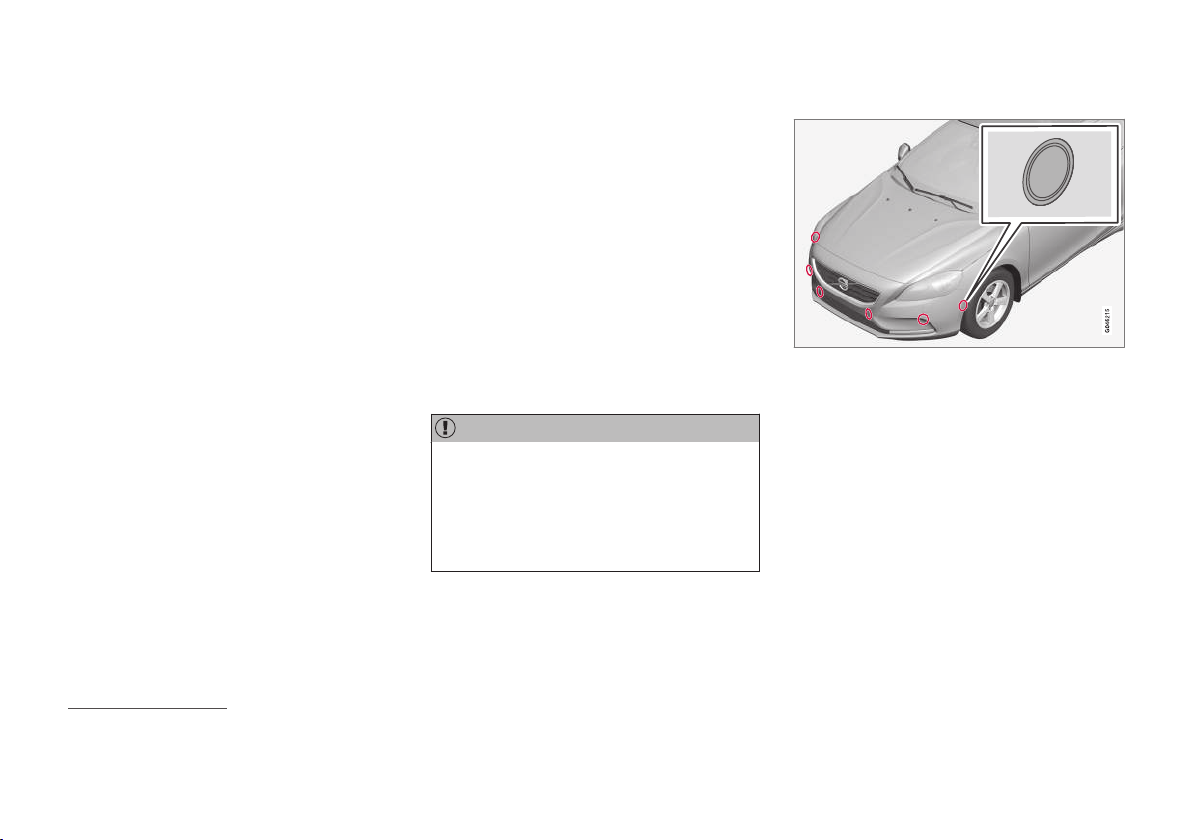
||
DRIVER SUPPORT
* Option/accessory.
266
To bear in mind
The driver should bear in mind that the Park
Assist Pilot is an aid – not an infallible, fully-auto-
matic function. The driver must therefore be pre-
pared to intervene. There are also a few details to
bear in mind while parking, e.g.:
•
PAP starts out from the current location of
the parked vehicles - if they are inappropri-
ately parked then the car's tyres and wheel
rims may be damaged against kerbs.
•
PAP is designed for parking on straight
streets, not sharp curves or bends. For this
reason, make sure the car is parallel to the
parking space when PAP measures the
space.
•
It is not always possible to find parking
spaces on narrow streets since there is not
enough space for manoeuvring. In such park-
ing situations, it helps the system to drive as
close to the side of the road as possible
where you intend to park.
•
Bear in mind that the front of the car may
swing out towards oncoming traffic while
being parked.
•
Objects situated higher than the detection
areas of the sensors are not included when
calculations are made for the parking
manoeuvre. This may cause PAP to swing
into the parking space too early, and hence
such parking spaces should be avoided.
•
The driver is responsible for determining
whether the space selected by PAP is suita-
ble for parking.
•
Use approved tyres
39
with the correct tyre
pressure - this affects PAP's ability to park
the car.
•
Heavy rain or snow may cause the system to
measure the parking space incorrectly.
•
Do not use PAP if snow chains or a spare
wheel are fitted.
•
Do not use PAP if loaded objects are pro-
truding from the car.
IMPORTANT
Changing to another approved wheel rim
and/or tyre dimension may involve a changed
tyre circumference, which means that the
PAP system's parameters may then need to
be updated. Consult a workshop - an author-
ised Volvo workshop is recommended.
Maintenance
The PAP sensors are located in the bumpers
40
- 6 front
and 4 rear.
For the PAP function to work correctly, its sen-
sors must be cleaned regularly with water and car
shampoo.
Related information
•
Park Assist* (p. 254)
•
Park assist camera* (p. 258)
•
Park Assist Pilot (PAP)* (p. 262)
•
Park assist syst* - cleaning the sensors
(p. 257)
39
"Approved tyres" refers to tyres of the same type and make as those fitted new on delivery from the factory.
40
NOTE: The illustration is schematic - details may vary depending on car model.

DRIVER SUPPORT
* Option/accessory.
267
Park Assist Pilot (PAP)* - symbols
and messages
The combined instrument panel uses symbols,
graphics and text for when the different steps are
to be carried out.
The combined instrument panel may display dif-
ferent combinations of symbols and text with
varying meaning - sometimes with self-explana-
tory advice on appropriate action.
If a message indicates that PAP is inoperative
then contact with an authorised Volvo workshop
is recommended.
Related information
•
Park Assist Pilot (PAP)* - operation (p. 263)
•
Park Assist Pilot (PAP)* - function (p. 262)
•
Park Assist Pilot (PAP)* - limitations (p. 265)
•
Park Assist* (p. 254)
•
Park assist camera* (p. 258)
•
Park Assist Pilot (PAP)* (p. 262)


STARTING AND DRIVING
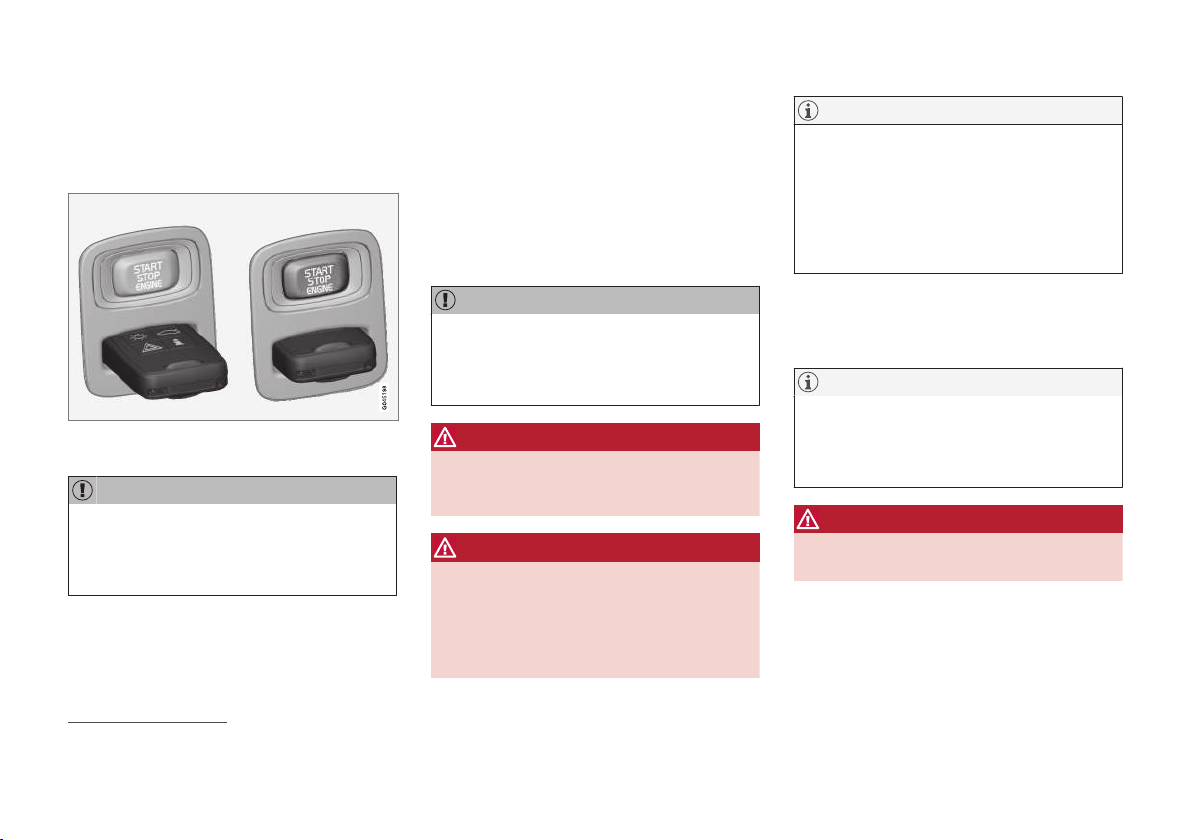
STARTING AND DRIVING
* Option/accessory.
270
Starting the engine
The engine is started and switched off using the
remote control key and the START/STOP
ENGINE button.
Ignition switch with remote control key extracted/
inserted. and START/STOP ENGINE button.
IMPORTANT
Do not press in the remote control key incor-
rectly turned - hold the end with the detacha-
ble key blade, see Detachable key blade -
detaching/attaching (p. 161).
1. Insert the remote control key in the ignition
switch and press it in to its end position.
2.
Hold the clutch pedal fully depressed
1
. (For
cars with automatic gearbox - Depress the
brake pedal.)
3.
Press the START/STOP ENGINE button
and then release it.
When the engine is started the starter motor
works until the engine is started or until its over-
heating protection triggers.
IMPORTANT
If the engine fails to start after 3 attempts -
wait for 3 minutes before making a further
attempt. Starting capacity increases if the bat-
tery is allowed to recover.
WARNING
Never remove the remote control key from the
ignition switch after starting the engine or
when the car is being towed.
WARNING
Always remove the remote control key from
the ignition switch when leaving the car, and
make sure that the key position is 0 - in par-
ticular if there are children in the car. For
information on how this works - see Key posi-
tions (p. 77).
NOTE
The idling speed can be noticeably higher
than normal for certain engine types during
cold starting. This is done in order that the
emissions system can reach normal operating
temperature as quickly as possible, which
minimises exhaust emissions and protects the
environment.
Keyless starting (Keyless drive)*
Follow steps 2-3 for keyless (p. 165) starting of
the engine.
NOTE
A prerequisite for the engine to start is that
one of the car's remote control keys with the
keyless start and lock function is in the pas-
senger compartment or cargo area.
WARNING
Never remove the remote control key from
the car while driving or during towing.
Related information
•
Switching off the engine (p. 271)
1
If the car is moving then it is enough to press the START/STOP ENGINE button to start the engine.

STARTING AND DRIVING
}}
* Option/accessory.
271
Switching off the engine
The engine is switched off using the START/
STOP ENGINE button.
To stop the engine:
•
Press START/STOP ENGINE - the engine
stops.
If the gear selector is not in P position or if the
car is moving:
•
Press twice on START/STOP ENGINE or
hold the button depressed until the engine
stops.
Related information
•
Key positions (p. 77)
Steering lock
The steering lock makes steering difficult if the
car is e.g. taken unlawfully. A mechanical noise
may be noticed when the steering lock unlocks
or locks.
Function
•
The steering lock is activated when the driv-
er's door is opened after the engine has
been switched off.
•
The steering lock is deactivated when the
remote control key is in the ignition switch
2
and the START/STOP ENGINE button is
depressed.
Related information
•
Starting the engine (p. 270)
•
Key positions (p. 77)
•
Steering wheel (p. 83)
Remote start (ERS)*
Remote start (ERS – Engine Remote Start)
means that the car's engine can be started
remotely in order to be able to warm up/cool
down the passenger compartment before depar-
ture. Remote start is activated via key and/or via
Volvo On Call*.
The climate control system starts on automatic
settings. A remote-started engine is activated for
a maximum of 15 minutes; then it is switched off.
After two activations of remote start, the engine
must be started in the normal way before remote
start can be used again.
Engine remote start is only available in cars with
automatic gearbox and cars that have a
bonnet switch
3
installed.
NOTE
The service life of the remote control key's
battery is affected by the remote start func-
tion. In the event of frequent use of remote
start, the battery should therefore be changed
once per year, see Remote control key -
replacing the battery (p. 164).
2
In cars with keyless start and lock system it is enough to have a remote control key inside the passenger compartment.
3
Available in the XC60, cars with alarm, most cars with 4-cylinder engines or if ERS is selected for new construction.
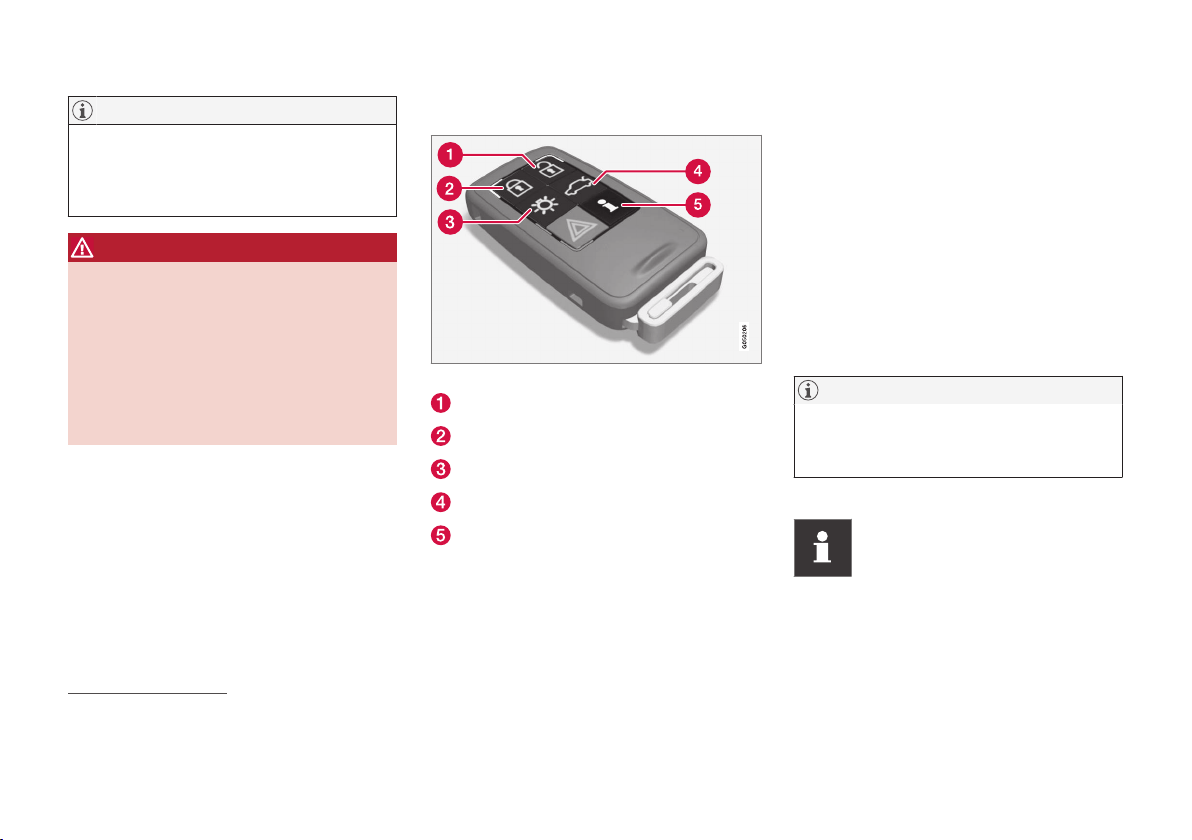
||
STARTING AND DRIVING
* Option/accessory.
272
NOTE
Follow local/national rules/regulations on
idling. Also take into account the local/
national rules/regulations regarding the noise
level when the engine is running.
WARNING
To remote-start the car, the following criteria
must be met:
•
The car must be supervised.
•
There must be no people or animals
inside or around the car.
•
The car must not be parked in a closed,
unventilated area - the exhaust gases
may seriously injure humans and animals.
Related information
•
Remote start (ERS) - operation (p. 272)
•
Remote start (ERS) - symbols and messages
(p. 273)
Remote start (ERS) - operation
The key's buttons for remote start.
Unlocking
Locking
Approach lighting
Unlocking, boot lid
Information
4
Remote starting the engine
To be able to remotely start the engine the car
must be locked and the bonnet closed.
Proceed as follows:
1. Briefly press on the key's button (2).
2. Follow this immediately afterwards with a
long press - at least 2 seconds - on
button (3).
If the conditions for remote start are fulfilled then
the following takes place:
1. The direction indicators flash quickly several
times.
2. The engine starts.
3. The direction indicators illuminate with a con-
stant glow for 3 seconds to verify that the
engine has started.
NOTE
After remote starting, the car continues to be
locked but with deactivated movement detec-
tor*.
With PCC
5
key
The light indication for Approach light-
ing
6
flashes a few times when the but-
ton is pressed and then changes over
to constant glow if all criteria for
remote start have been fulfilled. However, this
does not mean that remote start has started the
engine.
4
Only on PCC key, see Remote control key with PCC* - unique functions (p. 159).
5
For more information on the PCC key, see Remote control key with PCC* - unique functions (p. 159).
6
For more information on Approach lighting, see Remote control key - functions (p. 158) and Approach lighting (p. 96).

STARTING AND DRIVING
}}
* Option/accessory.
273
To check whether remote start has started the
engine, the user can press the button (5) - if the
engine has started, there is a light indication by
the buttons (2) and (3).
Active functions
The following functions are activated with a
remote started engine:
•
Climate control system
•
Audio/video system
•
Approach lighting.
Deactivated functions
The following functions are deactivated with a
remote started engine:
•
headlamps
•
Position lamps
•
Number plate lighting
•
Windscreen wiper.
Remote start is stopped
The following steps switch off a remote-started
engine:
•
The remote control key's button
(1), (2) or (4) is depressed
•
The car is unlocked
•
A door is opened
•
Accelerator pedal or brake pedal is
depressed
•
The gear selector is moved out of P position
•
Active remote start time exceeds 15 minutes.
When a remote-started engine is switched off,
the direction indicators illuminate with a constant
glow for 3 seconds.
Related information
•
Remote start (ERS)* (p. 271)
•
Remote start (ERS) - symbols and messages
(p. 273)
Remote start (ERS) - symbols and
messages
In situations where the ERS function fails or is
interrupted, a symbol is shown in the combined
instrument panel, supplemented by an explana-
tory text message.
ERS function unavailable
Message Specification
No remote
start Too many
tries
ERS unavailable because a
maximum of 2 ERS activa-
tions in succession are
allowed.
No remote
start Low fuel
level
ERS unavailable because
fuel level too low.
No remote
start Gear not
in P
ERS unavailable because
gear selector is not in P
position.
No remote
start Driver in
car
ERS unavailable because
someone is in the passen-
ger compartment.
No remote
start Low bat-
tery
ERS unavailable due to low
battery voltage. Charge the
battery by starting the
engine.

||
STARTING AND DRIVING
* Option/accessory.
274
Message Specification
No remote
start Engine
warning
ERS unavailable due to
warning message from
engine. Contact a work-
shop
A
.
Remote start
off Engine
coolant level
low
ERS unavailable due to
error message from cool-
ing system, see Coolant -
level (p. 357).
No remote
start Door
open
ERS unavailable because a
door/boot lid was not
closed.
No remote
start Bonnet
open
ERS did not activate
because the bonnet was
not closed.
No remote
start Car not
locked
ERS unavailable because
the car was not locked.
No remote star
Key in car
ERS did not activate
because the key was in the
car.
A
An authorised Volvo workshop is recommended.
Interrupted ERS function
Message Specification
Remote start
off Gear not in
P
ERS interrupted because
gear selector is not in P
position.
Remote start
off Driver in car
ERS interrupted because
someone is in the passen-
ger compartment.
Remote start
off Engine
warning
ERS interrupted due to
error message from
engine. Contact a work-
shop
A
.
Remote start
off Engine
coolant level
low
ERS interrupted due to
error message from cool-
ing system.
Remote start
off Bonnet
open
ERS interrupted because
the bonnet is open.
Remote start
off Low battery
ERS interrupted since the
battery voltage is too low.
Remote start
off Low fuel
level
ERS interrupted since the
fuel level is too low.
A
An authorised Volvo workshop is recommended.
Related information
•
Remote start (ERS)* (p. 271)
•
Remote start (ERS) - operation (p. 272)
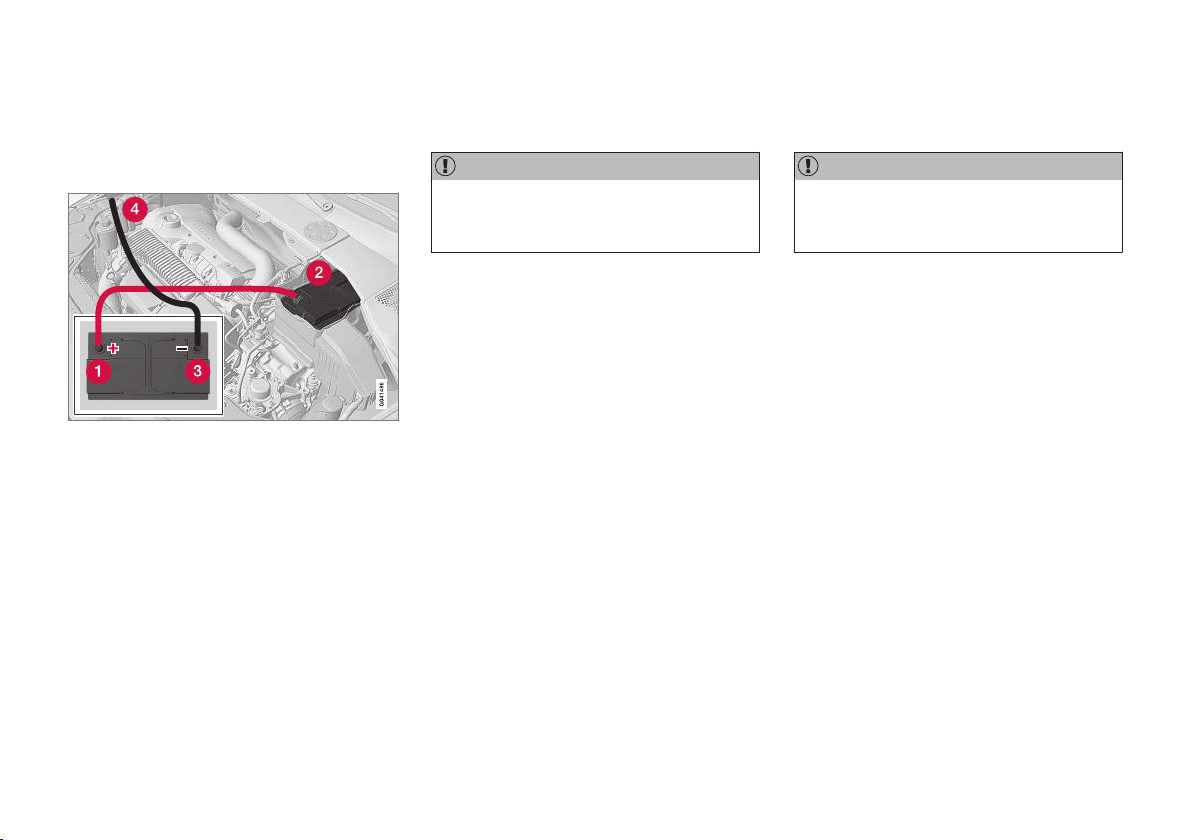
STARTING AND DRIVING
}}
275
Jump starting with another battery
If the starter battery (p. 370) is discharged then
the car can be started with current from another
battery.
When jump starting the car, the following steps
are recommended to avoid short circuits or other
damage:
1. Set the car's electrical system in key position
0, see Key positions - functions at different
levels (p. 77).
2. Check that the donor battery has a voltage of
12 V.
3. If the donor battery is installed in another car
- switch off the donor car's engine and make
sure that the two cars do not touch each
other.
4. Connect one of the red jump lead's clamps
to the donor battery's positive terminal (1).
IMPORTANT
Connect the start cable carefully to avoid
short circuits with other components in the
engine compartment.
5. Open the clips on the front cover of the bat-
tery in your car and remove the cover, see
Starter battery - replacement (p. 372).
6. Connect the red jump lead's other clamp
onto the car's positive terminal (2).
7. Connect one of the black jump lead's clamps
to the donor battery's negative terminal (3).
8. Connect the other clamp to a grounding
point, e.g. right-hand engine mounting at the
top, the outer screw head (4).
9. Check that the jump lead clamps are affixed
securely so that there are no sparks during
the starting attempt.
10. Start the engine of the "donor car" and allow
it to run a few minutes at a speed slightly
higher than idle approx. 1500 rpm.
11. Start the engine in the car with the dis-
charged battery.
IMPORTANT
Do not touch the connections between cable
and car during the starting attempt. There is a
risk of sparks forming.
12. Remove the jump leads in reverse order -
first the black and then the red.
> Make sure that none of the black jump
lead's clamps comes into contact with the
battery's positive terminal or the clamp
connected to the red jump lead.
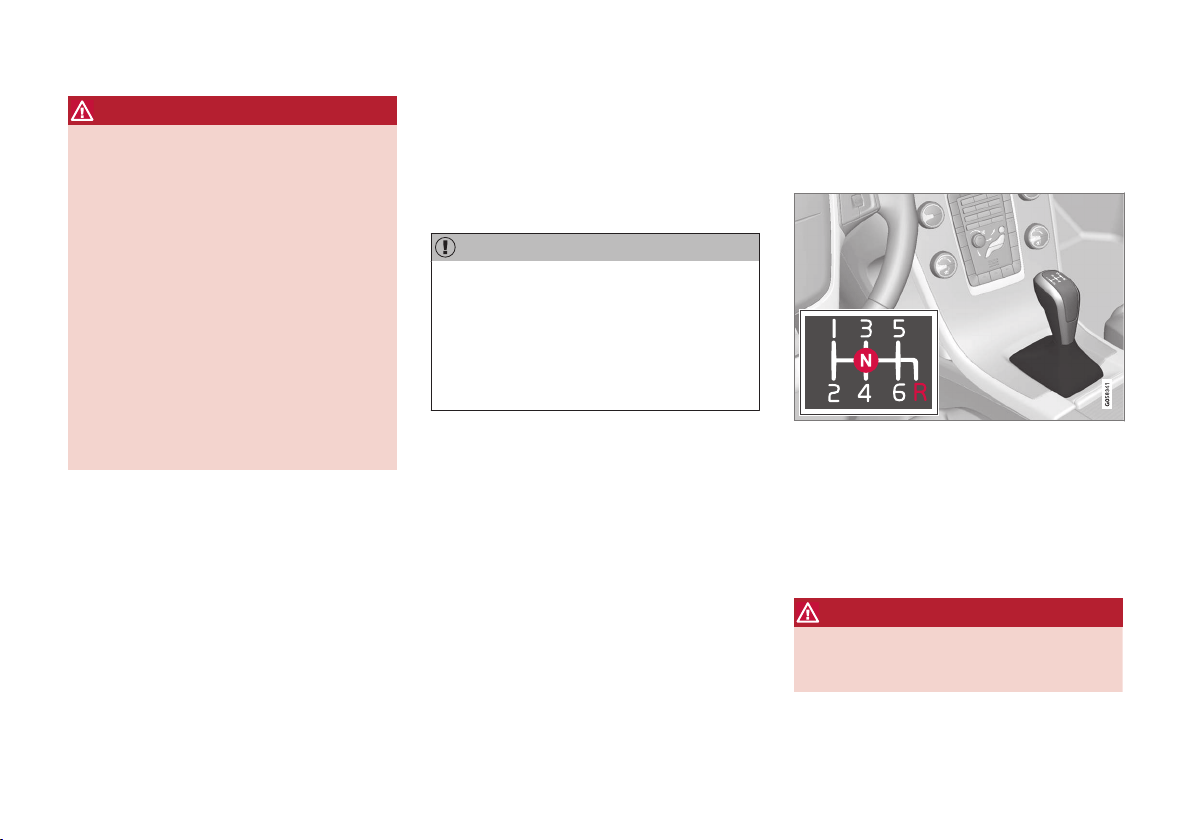
||
STARTING AND DRIVING
* Option/accessory.
276
WARNING
•
The battery can generate oxyhydrogen
gas, which is highly explosive. A spark can
be formed if a jump lead is connected
incorrectly, and this can be enough for
the battery to explode.
•
Do not connect the jump leads to any
fuel system component or any moving
part. Be careful of hot engine parts.
•
The battery contains sulphuric acid, which
can cause serious burns.
•
If sulphuric acid comes into contact with
eyes, skin or clothing, flush with large
quantities of water. If acid splashes into
the eyes - seek medical attention imme-
diately.
•
Never smoke near the battery.
Related information
•
Starting the engine (p. 270)
Gearboxes
There are two main types of gearbox. Manual
gearbox and automatic gearbox.
•
Manual gearbox (p. 276)
•
Automatic gearbox, Geartronic (p. 278)
IMPORTANT
To prevent damage to any drive system com-
ponents, the working temperature of the
gearbox is checked. If there is a risk of over-
heating, a warning symbol is illuminated in the
combined instrument panel in conjunction
with a text message being shown. Follow the
recommendation given in the text message.
Related information
•
Automatic gearbox - Geartronic* (p. 278)
Manual gearbox
The function of the gearbox is to change the
gear ratio depending on speed and power
requirements.
Gearing pattern.
The manual gearbox has 6 gears, the shifting
pattern is imprinted on the gear lever.
•
Depress the clutch pedal fully during each
gear change.
•
Take your foot off the clutch pedal between
gear changes.
WARNING
Always apply the parking brake when parking
on a slope - leaving the car in gear is not suf-
ficient to hold the car in all situations.
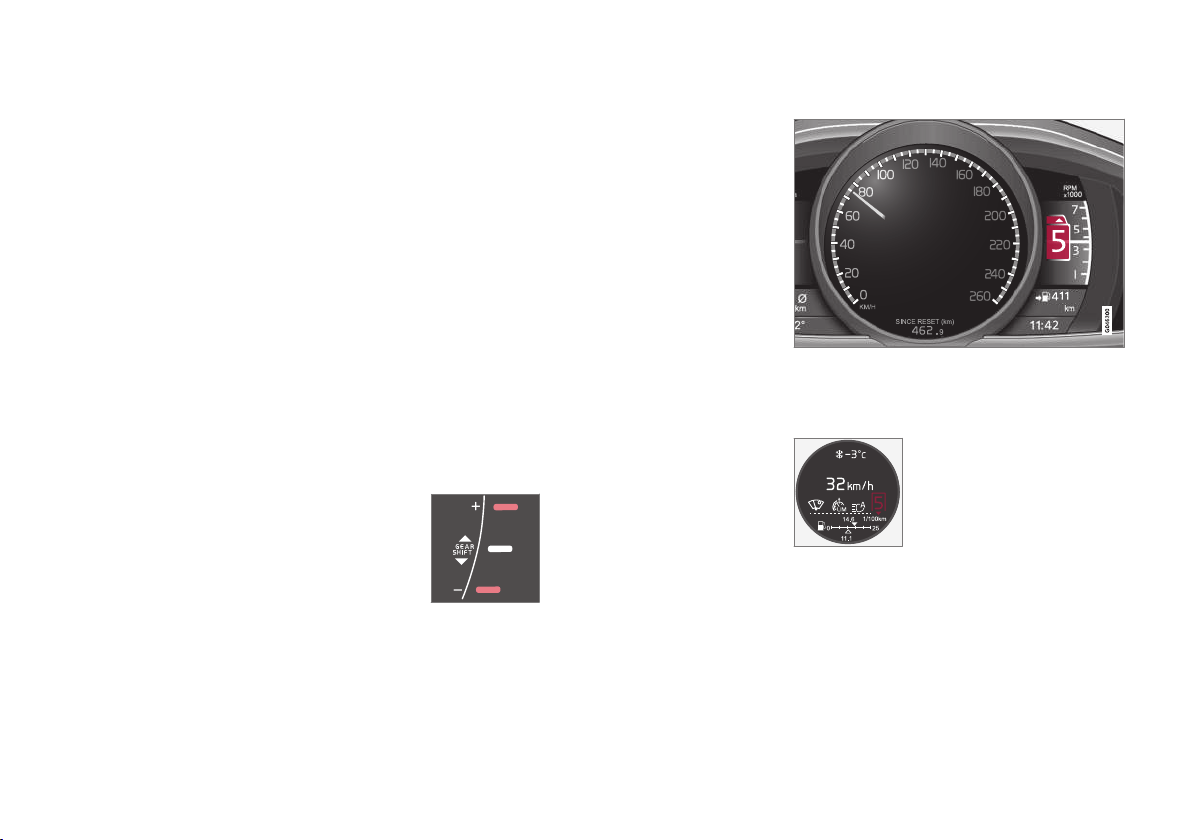
STARTING AND DRIVING
* Option/accessory.
277
Reverse gear inhibitor
The reverse gear inhibitor hinders the possibility
of mistakenly attempting to engage reverse gear
during normal forward travel.
•
Follow the gearing pattern printed on the
gear lever and start from neutral position, N
before moving it to R position.
•
Engage reverse gear only when the car is
stationary.
Related information
•
Gearboxes (p. 276)
•
Transmission fluid - grade and volume
(p. 411)
Gear shift indicator*
The gear shift indicator notifies the driver when it
is appropriate to engage the next higher or lower
gear.
An essential detail in connection with environ-
mental driving is to drive in the right gear and to
change gear in good time.
An indicator is available as an aid on certain vari-
ants - GSI (Gear Shift Indicator) - which notifies
the driver when it is appropriate to engage the
next higher or lower gear in order to obtain the
lowest possible fuel consumption.
However, taking into consideration characteristics
such as performance and vibration-free running,
it may be advantageous to change gear at a
higher engine speed. The framed number indi-
cates the current gear.
Manual gearbox
Gear shift indicator for manual
gearbox. Only one marker is
illuminated at a time - during
normal driving it is only illumi-
nated in the centre.
At the recommended upshift
the cursor illuminates "+", and at the recom-
mended downshift the cursor illuminates "-"
(marked red in the illustration).
Automatic gearbox
Combined instrument panel "Digital" with gear
shift indicator.
The framed number indicates the current gear.
With "Analogue" combined
instrument panel, the gear
positions and indicator arrows
are displayed in its centre.
Related information
•
Manual gearbox (p. 276)
•
Automatic gearbox - Geartronic* (p. 278)
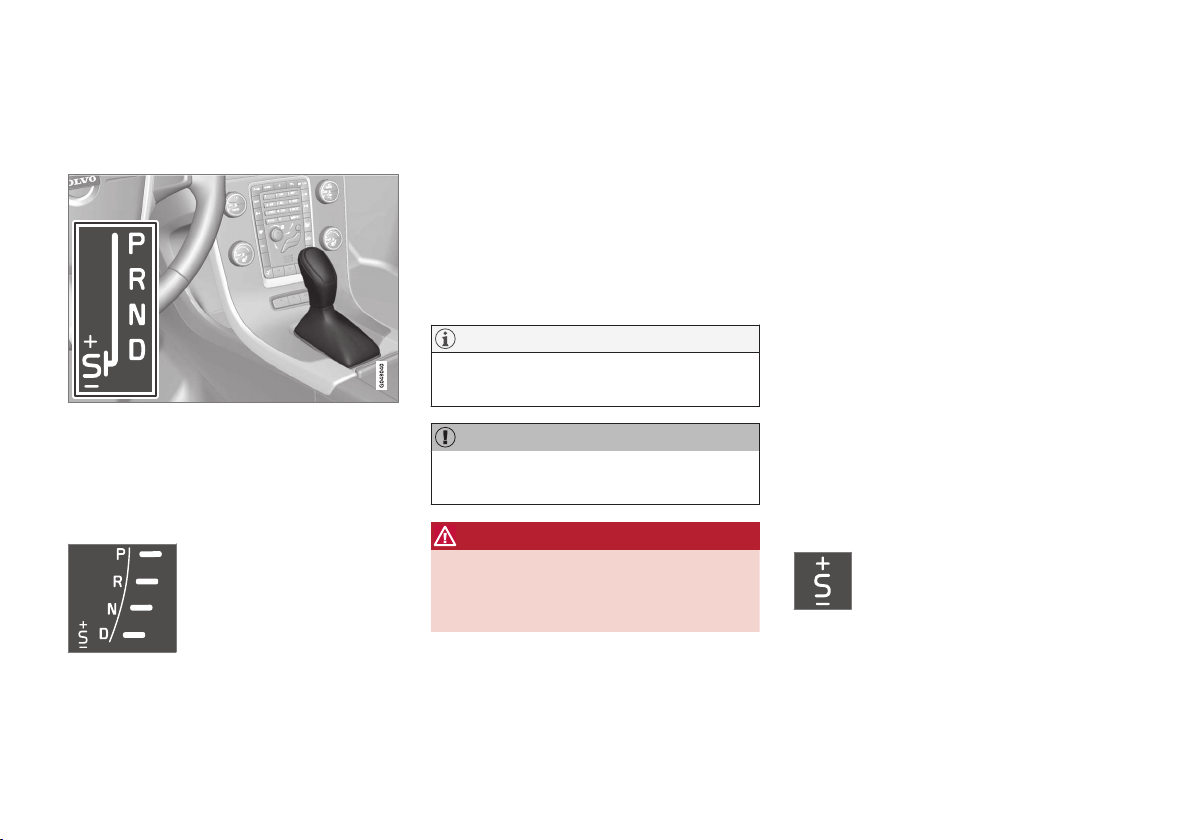
STARTING AND DRIVING
* Option/accessory.
278
Automatic gearbox - Geartronic*
The Geartronic gearbox has two different gear
modes - Automatic and Manual.
D: Automatic gear positions. +/–: Manual gear positions.
S: Sport mode*.
Combined instrument panel (p. 62) shows the
position of the gear selector using the following
indications:
P, R, N, D, S*, 1, 2, 3 etc.
Gear positions
Automatic gear positions are
indicated on the right of the
combined instrument panel.
(Only one marker is illuminated
at a time - the one showing the
current gear selector position.)
Symbol "S" for Sport mode is ORANGE when the
mode is active.
Parking position - P
Select P position when starting the engine or
when the car is parked.
In order to be able to move the gear selector
from the P position, the brake pedal must be
depressed and key position must be II, see Key
positions - functions at different levels (p. 77).
The gearbox is mechanically blocked when the P
position is engaged. Also apply the parking brake
(p. 297) when the car is parked.
NOTE
The gear selector must be in P position to
allow the car to be locked and alarmed.
IMPORTANT
The car must be stationary when position P is
selected.
WARNING
Always apply the parking brake when parking
on a slope - the automatic transmission's P
position is not sufficient to hold the car in all
situation.
Reverse position - R
The car must be stationary when R position is
selected.
Neutral position - N
No gear is engaged and the engine can be
started. Apply the parking brake if the car is sta-
tionary with the gear selector in N position.
In order to be able to move the gear selector
from N to another gear position, the brake pedal
must be depressed and key position must be II,
see Key positions - functions at different levels
(p. 77).
Drive position - D
D is the normal driving position. Shifting up and
down takes place automatically based on the
level of acceleration and speed. The car must be
stationary when the gear selector is moved to D
position from R position.
Geartronic – Manual gear positions
(+S-)
The driver can also change gear manually using
the Geartronic automatic gearbox. The car
engine-brakes when the accelerator pedal is
released.
The manual gear position is reached by
moving the lever to the side from posi-
tion D to the end position at "+S-". The
combined instrument panel's symbol
"+S-" changes colour from WHITE to ORANGE
and the digits
1, 2, 3 etc. are shown in a box, cor-
responding to the gear selected at the time.
•
Move the lever forwards towards "+" (plus) to
change up a gear and release the lever,
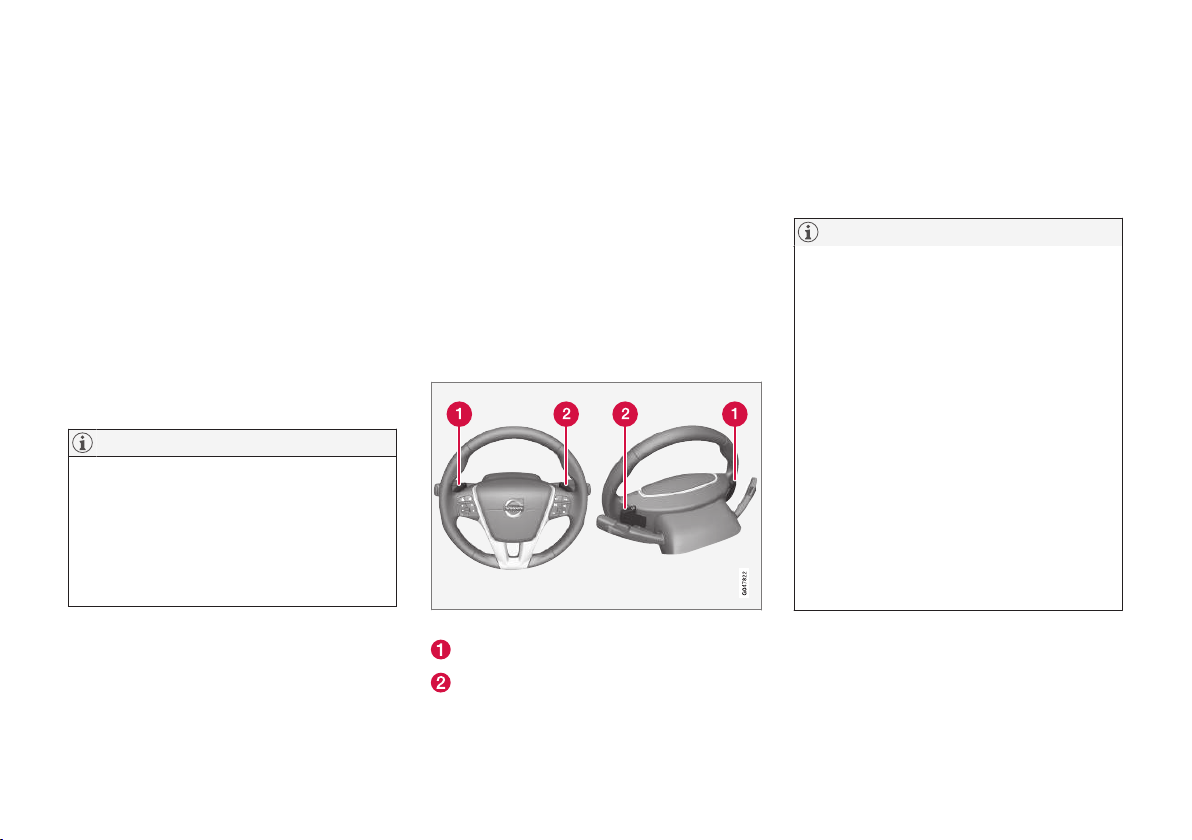
STARTING AND DRIVING
}}
* Option/accessory.
279
which returns to its rest position between +
and –.
or
•
Pull the lever back towards "–" (minus) to
change down a gear and release it.
The manual gearshift mode "+S–" can be
selected at any time while driving.
Geartronic automatically shifts down if the driver
allows the speed to decrease lower than a level
suitable for the selected gear, in order to avoid
jerking and stalling.
To return to automatic driving mode:
•
Move the lever to the side to the end position
at D.
NOTE
If the gearbox has a Sport programme then
the gearbox will only become manual after the
gear selector has been moved forwards or
backwards in its "+S–" position. The com-
bined instrument panel then changes indica-
tion from
S to show which of the gears 1, 2,
3 etc. is engaged.
Paddles*
As a supplement to manual gear changing with
the gear selector there are also controls located
on the steering wheel, so-called "paddles".
To be able to change gear with the steering
wheel paddles they must first be activated. This is
by means of pulling one of the paddles toward
the steering wheel - the combined instrument
panel then changes indication from "D" to a fig-
ure, which indicates the current gear.
To then change gear one step:
•
Pull one of the paddles backwards - towards
the steering wheel - and release.
Both steering wheel "paddles".
"-": Selects the next lower gear.
"+": Selects the next higher gear.
A gear change occurs at each pull of the paddle
provided that the engine speed does not leave
the permitted range.
After each gear change the combined instrument
panel changes figure to show the current gear.
NOTE
Automatic deactivation
If the steering wheel paddles are not used
then they are deactivated after a short time -
this is indicated when the combined instru-
ment panel switches indication, from the fig-
ure for the current gear back to "D".
The exception is during engine braking - then
the paddles are activated as long as engine
braking is in progress.
Manual deactivation
The steering wheel paddle shifters can also
be deactivated manually:
•
Pull both paddles toward the steering
wheel and hold until the combined instru-
ment panel changes character from the
figure for the current gear to "D".
The paddles can also be used with the gear
selector in Sport mode* - then the paddles are
constantly activated without being deactivated.

||
STARTING AND DRIVING
* Option/accessory.
280
Geartronic - Sport mode* (S)
7
The Sport programme provides sportier
characteristics and allows higher
engine speed for the gears. At the
same time it responds more quickly to
acceleration. During active driving, the use of a
lower gear is prioritised, leading to a delayed
upshift.
To activate Sport mode:
•
Move the gear selector to the side from D
position to the end position at "+S–" - the
combined instrument panel changes indica-
tion from
D to S.
Sport mode can be selected at any time while
driving.
Geartronic - Winter mode
It can be easier to pull away on slippery roads if
3rd gear is engaged manually.
1. Depress the brake pedal and move the gear
selector from D position to the end position
at "+S–" - the combined instrument panel
changes indication from
D to the figure 1
8
.
2. Scroll up to gear 3 by pushing the lever for-
ward towards "+" (plus) twice - the display
shifts the indication from 1 to 3.
3. Release the brake and accelerate carefully.
The gearbox "winter mode" means that the car
moves off with a lower engine speed and
reduced engine power on the drive wheels.
Kick-down
When the accelerator pedal is pressed all the
way to the floor (beyond the position normally
regarded as full acceleration) a lower gear is
immediately engaged. This is known as kick-
down.
If the accelerator is released from the kick-down
position, the gearbox automatically changes up.
Kick-down is used when maximum acceleration
is needed, such as for overtaking.
Safety function
To prevent over-revving the engine, the transmis-
sion's control program has a protective downshift
inhibitor, which prevents the kick-down function.
Geartronic does not permit downshifting/kick-
down which would result in an engine speed high
enough to damage the engine. Nothing happens
if the driver still tries to shift down in this way at
high engine speed – the original gear remains
engaged.
When kick-down is activated the car can change
one or more gears at a time depending on
engine speed. The car changes up when the
engine reaches its maximum speed in order to
prevent damage to the engine.
Towing
If the car has to be towed - see important infor-
mation in the section Towing (p. 318).
Related information
•
Transmission fluid - grade and volume
(p. 411)
•
Gearboxes (p. 276)
7
With certain engines only.
8
If the car has Sport mode* then "S" is shown first.
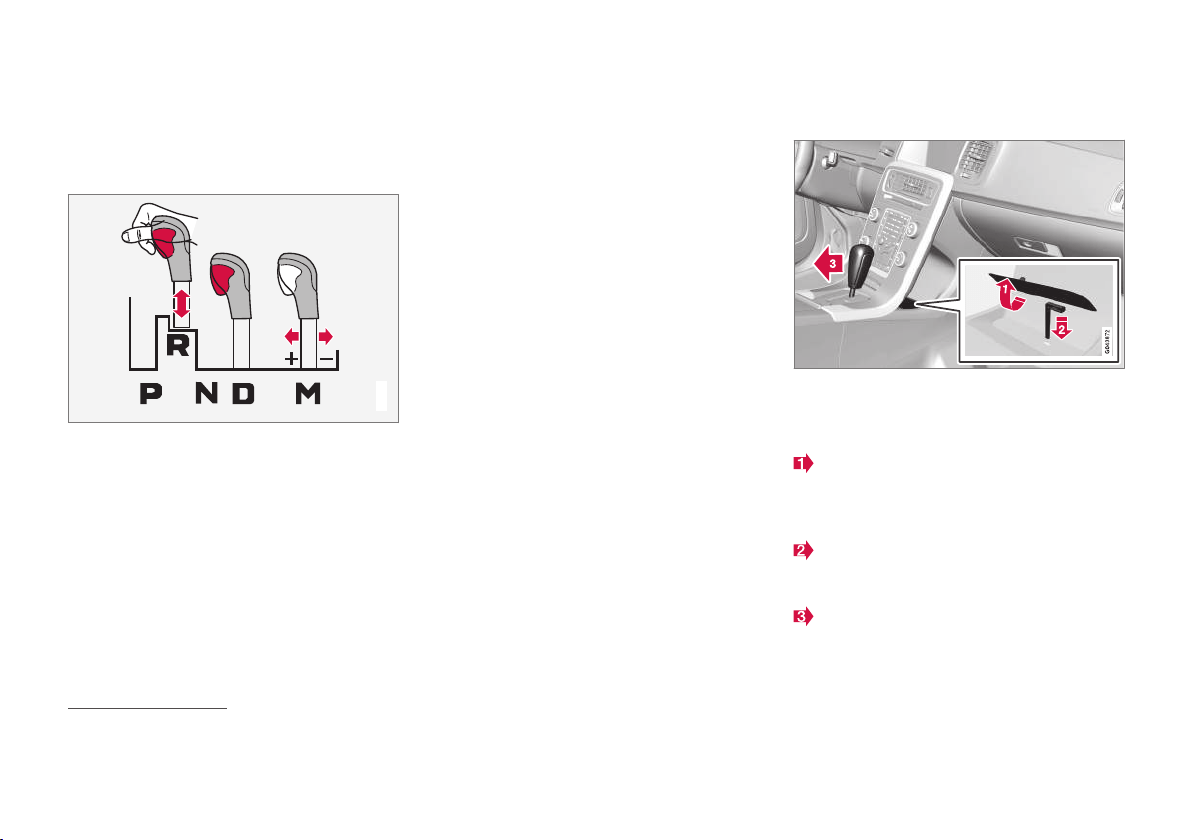
STARTING AND DRIVING
}}
281
Gear selector inhibitor
There are two different types of gear selector
inhibitor - mechanical and automatic.
Mechanical gear selector inhibitor
G021351
M: Manual shifting
9
- "+/-" or "Sport mode".
The gear selector can be moved forward and
back freely between N and D. Other positions are
locked with a latch that is released with the inhib-
itor button on the gear selector.
With the inhibitor button depressed the lever can
be moved forwards or backwards between P, R,
N and D.
Automatic gear selector inhibitor
The automatic gearbox has special safety sys-
tems:
Parking position (P)
Stationary car with engine running:
•
Keep your foot on the brake pedal when
moving the gear selector to another position.
Electric gear inhibitor – Shiftlock Parking
position (P)
In order to be able to move the gear selector
from P to other gear positions, the brake pedal
must be depressed and the key position (p. 77)
must be II.
Shiftlock – Neutral (N)
If the gear selector is in N position and the car
has been stationary for at least 3 seconds (irre-
spective of whether the engine is running) then
the gear selector is locked.
In order to be able to move the gear selector
from the N position to another gear position, the
brake pedal must be depressed and the key posi-
tion (p. 77) must be II.
Deactivate automatic gear selector
inhibitor
If the car cannot be driven, e.g. due to a flat
starter battery, the gear selector must be moved
from the P position so that the car can be moved.
Lift the rubber mat in the compartment
behind the centre console and locate a
hole
10
for the key blade (p. 161) in the bot-
tom of the compartment.
Search for a spring-loaded button down in
the hole with the key blade; depress the but-
ton with the blade and hold.
Move the gear selector from the P position
and pull up the key blade.
4. Set the rubber mat back in place.
9
The illustration is schematic.
10
There may be 2 holes - one for the key blade and one that fixes the rubber mat.
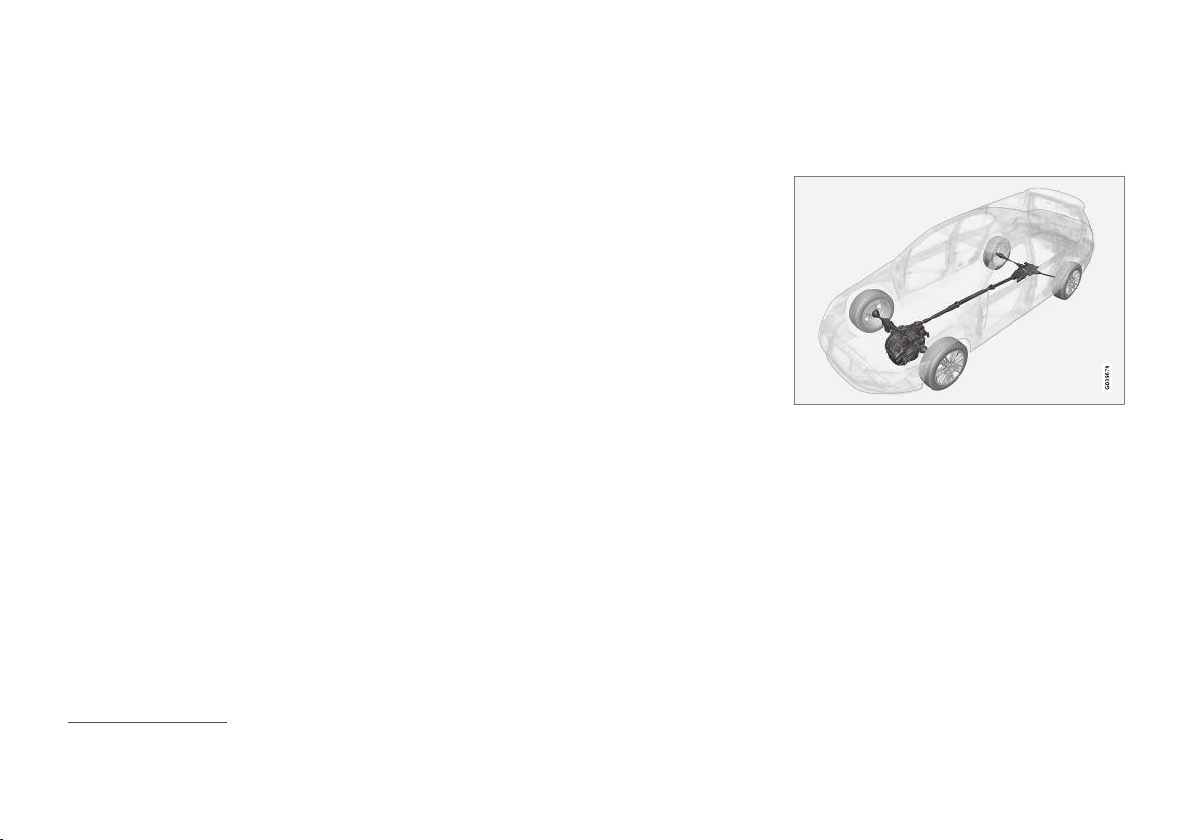
||
STARTING AND DRIVING
* Option/accessory.
282
Related information
•
Automatic gearbox - Geartronic* (p. 278)
Hill start assist (HSA)*
11
The foot brake can be released before setting
off or reversing uphill - the HSA (Hill Start
Assist) function means that the car does not roll
backwards.
The function means that the pedal pressure in
the brake system remains for several seconds
while the driver's foot is moved from brake pedal
to accelerator pedal.
The temporary braking effect releases after sev-
eral seconds or when the driver accelerates.
Related information
•
Starting the engine (p. 270)
All-wheel drive - (AWD)*
Optimal traction is achieved with all-wheel drive.
All Wheel Drive is always available
All Wheel Drive (All Wheel Drive) means that the
car is driving all four wheels at the same time.
The power is automatically distributed between
the front and rear wheels. An electronically con-
trolled clutch system distributes the power to the
wheels that have the best grip on the current
road surface. This provides the best traction and
prevents wheel spin. Under normal driving condi-
tions, the majority of power is transmitted to the
front wheels.
All Wheel Drive improves driving safety in rain,
snow and icy conditions.
11
Depends on engine and gearbox combination. HSA not possible with some combinations.
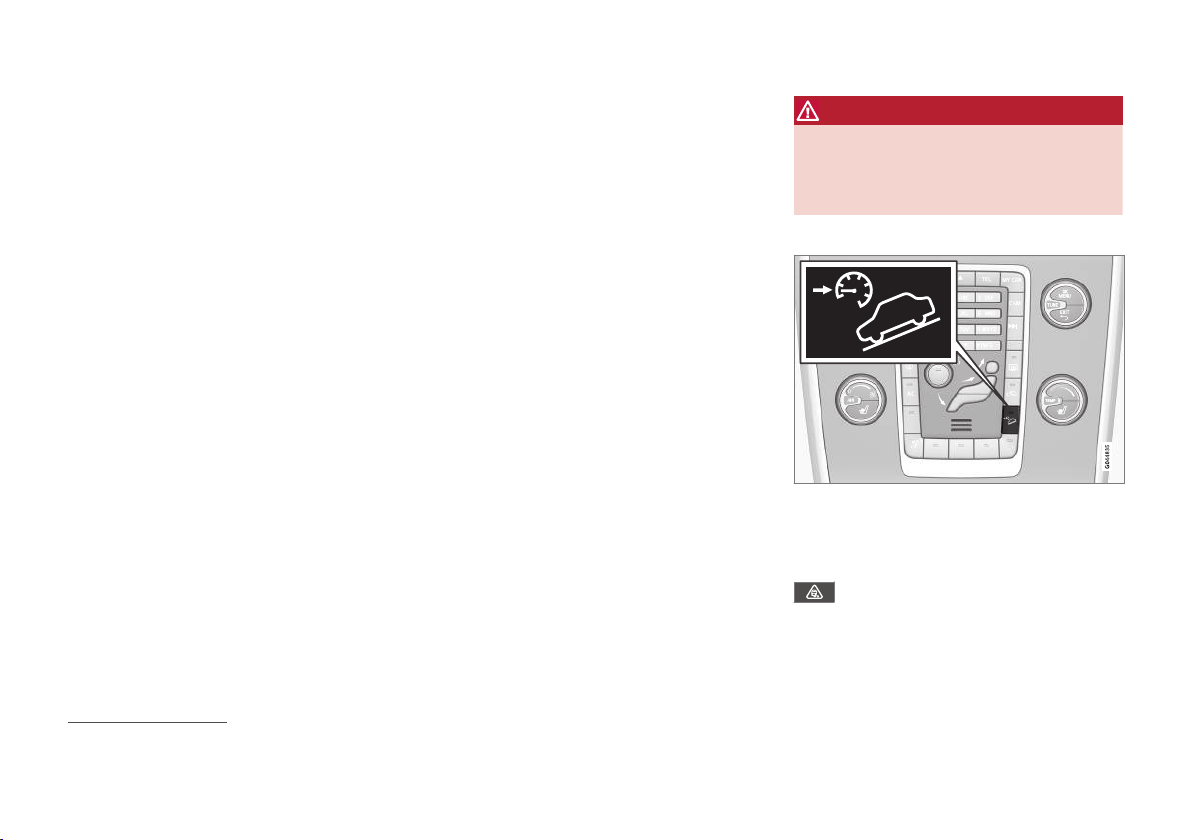
STARTING AND DRIVING
}}
* Option/accessory.
283
Related information
•
Hill Descent Control (HDC)* (p. 283)
Hill Descent Control (HDC)*
12
HDC can be compared to an automatic engine
brake. When you release the accelerator on
downhill gradients the car is normally braked by
means of the engine striving for low engine
idling speeds, so-called engine braking. But the
steeper the roadway and the more load in the
car, the faster the car coasts despite engine
braking - the HDC function compensates for this
with automatic brake intervention.
General information on HDC
HDC makes it possible to increase/reduce speed
on steep downhill gradients, with a foot only on
the accelerator pedal, without using the foot
brake. The sensitivity of the accelerator pedal
decreases and becomes more precise by means
of the full actuation of the pedal being restricted
to adjusting engine speed within a limited range.
The brake system brakes itself and provides the
car with a low and even speed, so allowing the
driver to fully focus on steering.
HDC is particularly helpful on steep gradients
with an uneven road surface and slippery sec-
tions. E.g. when launching a boat on a trailer from
a ramp.
WARNING
HDC does not work in all situations but is
designed merely as a supplementary aid.
The driver always bears ultimate responsibility
for ensuring that the vehicle is driven safely.
Function
HDC On/Off.
HDC is activated or deactivated with one of the
centre console's switches. The lamp within it illu-
minates when the function is activated.
When HDC is operating, the combined
instrument panel's symbol illuminates
combined with the text message
Hill descent
control ON
.
12
Only possible on the S60 Cross Country with AWD.
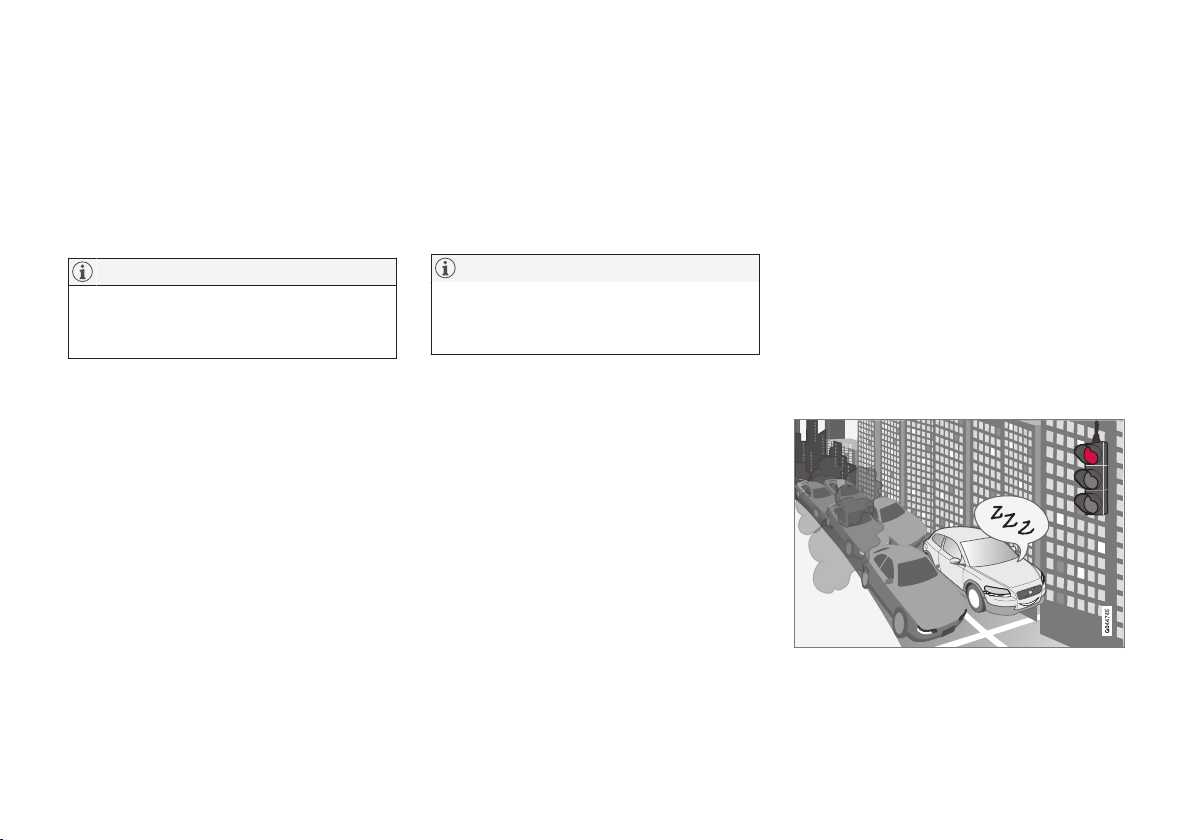
||
STARTING AND DRIVING
* Option/accessory.
284
With manual transmission, the function works
only on first gear and reverse gear.
With automatic transmission, gear 1 must be
selected in manual gearshift mode (+S-), or R
must be selected. This is indicated by the number
1 or R in the combined instrument panel, see
Automatic gearbox - Geartronic* (p. 278).
NOTE
HDC cannot be activated on an automatic
gearbox when the gear selector is in position
D.
Operation
HDC allows the car to roll at a maximum of
10 km/h (6 mph) forwards with engine braking
and 7 km/h (4 mph) backwards. However, any
speed within the gear's speed register can be
selected using the accelerator pedal. When the
accelerator pedal is released, the car is braked
quickly to 10 or 7 km/h (6 or 4 mph) respec-
tively, irrespective of the hill's gradient and with-
out the need for the foot brake.
The brake lights come on automatically when the
function is operating. The driver can brake or stop
the car at any time by using the foot brake.
HDC is deactivated:
•
with the centre console's On/Off button
•
if a gear other than 1 or R is selected on a
manual gearbox
•
if a gear other than 1 or R is selected in
manual gearshift mode on an automatic
gearbox.
The function can be disengaged at any time. If it
takes place on a steep downhill gradient then the
braking effect will not release directly, but slowly
instead.
NOTE
With HDC activated you may experience a
delay between acceleration pedal activation
and engine response.
Related information
•
All-wheel drive - (AWD)* (p. 282)
•
Automatic gearbox - Geartronic* (p. 278)
•
Manual gearbox (p. 276)
Start/Stop*
Some engine and gearbox combinations come
fitted with a Start/Stop function which engages
in the event of e.g. stationary traffic or waiting at
traffic lights - the engine is then switched off
temporarily and restarts automatically when the
journey is due to continue.
Environmental care is one of Volvo Car Corpora-
tion's core values and it influences all of our
operations. This target orientation has resulted in
several separate energy-saving functions of
which Start/Stop is one, all with the collective
task of reducing fuel consumption, which in turn
helps to reduce exhaust emissions.
General information on Start/Stop
The engine is switched off - it becomes quieter and
cleaner.
The Start/Stop function gives the driver the
opportunity for a more active environmentally
STARTING AND DRIVING
}}
* Option/accessory.
285
conscious way of driving the car by means of
being able to allow the engine to stop automati-
cally, whenever appropriate.
The car's MY CAR menu system, under the
DRIVe heading, contains information about Vol-
vo's Start/Stop system, as well as recommenda-
tions for energy-saving driving techniques.
Manual gearbox or automatic gearbox
Note that there are differences in the Start/Stop
function depending on whether the gearbox is
manual or automatic.
Related information
•
Start/Stop* - function and operation (p. 285)
•
Starting the engine (p. 270)
•
Start/Stop* - the engine does not auto-start
(p. 288)
•
Start/Stop* - the engine auto-starts (p. 287)
•
Start/Stop* - the engine does not stop
(p. 286)
•
Start/Stop* - involuntary stop manual gear-
box (p. 289)
•
Start/Stop* - symbols and messages
(p. 290)
•
Battery - Start/Stop (p. 374)
Start/Stop* - function and operation
The Start/Stop function is activated automati-
cally when the engine is started with the key.
The Start/Stop function is acti-
vated automatically when the
engine is started with the key.
The driver is made aware of
this by the function's symbol
illuminating in the combined
instrument panel and the
On/Off button lamp illuminat-
ing.
All of the car's normal systems
such as lighting, radio, etc. work as normal even
with an engine that has stopped automatically,
except that some equipment may have the func-
tion temporarily reduced, e.g. the climate control
system's fan speed or extremely high volume on
the audio system.
Auto-stopping the engine
The following is required for the engine to auto-
stop:
Conditions
M/A
A
Declutch, set the gear lever in neutral
position and release the clutch pedal -
the engine stops automatically.
M
Stop the car with the foot brake and
then keep your foot on the pedal - the
engine stops automatically.
A
A
M = Manual gearbox, A = Automatic gearbox.
If the ECO function is activated
then the engine may auto-stop
before the car is completely
stationary.
For certain engine variants the engine may auto-
stop before the car is stationary regardless of
whether the ECO function is activated.
When the engine is auto-stopped, the
combined instrument panel's symbol
for the Start/Stop function illuminates.
||
STARTING AND DRIVING
* Option/accessory.
286
Auto-starting the engine
Conditions M/A
A
With the gear lever in neutral position:
1. Depress the clutch pedal or press
the accelerator pedal - the engine
starts.
2. Engage a suitable gear and drive.
M
Release the foot pressure on the foot
brake - the engine starts automatically
and the journey can continue.
A
Maintain foot pressure on the foot
brake and depress the accelerator
pedal - the engine auto-starts.
A
The following option is also available on
a downhill gradient:
Release the foot brake and let the car
move off - the engine starts automati-
cally when the speed exceeds normal
walking pace.
M +
A
A
M = Manual gearbox, A = Automatic gearbox.
Deactivating the Start/Stop function
In certain situations, it may
advisable to temporarily switch
off the automatic Start/Stop
function - this is carried out
with a push of this button.
Disengaged function is indicated by
the combined instrument panel's
Start/Stop symbol and the On/Off but-
ton's lamp extinguishing.
The Start/Stop function is disengaged until it is
reactivated with the button or until the next time
the engine is started with the key.
Related information
•
Start/Stop* (p. 284)
•
Starting the engine (p. 270)
•
Start/Stop* - the engine does not auto-start
(p. 288)
•
Start/Stop* - the engine auto-starts (p. 287)
•
Start/Stop* - the engine does not stop
(p. 286)
•
Start/Stop* - involuntary stop manual gear-
box (p. 289)
•
Start/Stop* - symbols and messages
(p. 290)
•
Battery - Start/Stop (p. 374)
Start/Stop* - the engine does not
stop
Although the Start/Stop function is activated, the
engine does not always stop automatically.
The engine does not auto-stop if:
Conditions
M/A
A
the car has not first achieved
approx. 10 km/h (6 mph) after a key
start or the last auto-stop.
M +
A
the driver has opened the seatbelt's
buckle.
M +
A
the capacity of the starter battery is
below the minimum permissible level.
M +
A
the engine does not have normal
operating temperature.
M +
A
ambient temperature is around freez-
ing point or above approx. 30 °C.
M +
A
the windscreen's electric heating is
activated.
M +
A
the environment in the passenger
compartment differs from the preset
values - indicated by the ventilation
fan running at a high speed.
M +
A
the car is reversed. M +
A

STARTING AND DRIVING
}}
* Option/accessory.
287
Conditions
M/A
A
the starter battery temperature is
below the freezing point or is too high.
M +
A
the driver makes greater steering
wheel movements.
M +
A
the exhaust system's particulate filter
is full - the temporarily disengaged
Start/Stop function is reactivated as
soon as an automatic cleaning cycle
has been performed (see Diesel parti-
cle filter (DPF) (p. 308)).
M +
A
the road is very steep. M +
A
a trailer is connected electrically to
the car’s electrical system.
M +
A
the bonnet has been opened
B
.
M +
A
the gearbox does not have normal
operating temperature.
A
the atmospheric air pressure is less
than equivalent to 1500-2500 metres
above sea level - the current air pres-
sure varies with the prevailing weather
conditions.
A
Conditions
M/A
A
adaptive cruise control Queue Assist
is activated.
A
the gear selector is in R, S position
C
or "+/-".
A
A
M = Manual gearbox, A = Automatic gearbox.
B
With certain engines only.
C
Sport mode.
Related information
•
Start/Stop* (p. 284)
•
Start/Stop* - function and operation (p. 285)
•
Starting the engine (p. 270)
•
Start/Stop* - the engine does not auto-start
(p. 288)
•
Start/Stop* - the engine auto-starts (p. 287)
•
Start/Stop* - involuntary stop manual gear-
box (p. 289)
•
Start/Stop* - symbols and messages
(p. 290)
•
Battery - Start/Stop (p. 374)
Start/Stop* - the engine auto-starts
An auto-stopped engine may restart in certain
cases without the driver having decided that the
journey should continue.
In the following cases the engine also starts
automatically if the driver has not depressed the
clutch pedal (manual gearbox) or takes his/her
foot off the brake pedal (automatic gearbox):
Conditions
M/A
A
Misting forms on the windows. M + A
The environment in the passenger
compartment deviates from the preset
values.
M + A
There is a temporarily high current
take-off or starter battery capacity
drops below the lowest permissible
level.
M + A
Repeated pumping of the brake
pedal.
M + A
The bonnet is opened
B
.
M + A
The car starts to roll, or there is a
small increase in speed if the car
auto-stopped without being com-
pletely stationary.
M + A
||
STARTING AND DRIVING
* Option/accessory.
288
Conditions
M/A
A
The driver's seatbelt buckle is opened
with the gear selector in D or N posi-
tion.
A
Steering wheel movements
B
.
A
The gear selector is moved out of the
D position to S position
C
, R or "+/-".
A
The driver's door is opened with the
gear selector in D position - a "ping"
sound and text message inform that
the Start/Stop function is active.
A
A
M = Manual gearbox, A = Automatic gearbox.
B
With certain engines only.
C
Sport mode.
WARNING
Do not open the bonnet when the engine has
stopped automatically - the engine may sud-
denly start automatically. First switch off the
engine as normal using the START/STOP
ENGINE button before opening the bonnet.
Related information
•
Start/Stop* (p. 284)
•
Start/Stop* - function and operation (p. 285)
•
Starting the engine (p. 270)
•
Start/Stop* - the engine does not auto-start
(p. 288)
•
Start/Stop* - the engine does not stop
(p. 286)
•
Start/Stop* - involuntary stop manual gear-
box (p. 289)
•
Start/Stop* - symbols and messages
(p. 290)
•
Battery - Start/Stop (p. 374)
Start/Stop* - the engine does not
auto-start
The engine does not always auto-start after hav-
ing auto-stopped.
In the following cases the engine does not auto-
start after having auto-stopped:
Conditions M/A
A
A gear is engaged without declutching
- a display text prompts the driver to
set the gear lever in neutral position in
order to enable auto-start.
M
The driver is unrestrained. M
The driver is unrestrained, the gear
selector is in P position and the driver’s
door is open - a normal engine start
must take place.
A
A
M = Manual gearbox, A = Automatic gearbox.
Related information
•
Start/Stop* (p. 284)
•
Start/Stop* - function and operation (p. 285)
•
Starting the engine (p. 270)
•
Start/Stop* - the engine auto-starts (p. 287)
•
Start/Stop* - the engine does not stop
(p. 286)

STARTING AND DRIVING
* Option/accessory.
289
•
Start/Stop* - involuntary stop manual gear-
box (p. 289)
•
Start/Stop* - symbols and messages
(p. 290)
•
Battery - Start/Stop (p. 374)
Start/Stop* - involuntary stop
manual gearbox
If a start-up fails and the engine stops, proceed
in accordance with the below:
1. Check that the driver side's seatbelt is locked
in the seatbelt buckle.
2. Depress the clutch pedal again - the engine
starts automatically.
3. In certain cases the gear lever must be set in
neutral position. The combined instrument
panel then shows the text
Put gear in
neutral.
Related information
•
Start/Stop* (p. 284)
•
Start/Stop* - function and operation (p. 285)
•
Starting the engine (p. 270)
•
Start/Stop* - the engine does not auto-start
(p. 288)
•
Start/Stop* - the engine auto-starts (p. 287)
•
Start/Stop* - the engine does not stop
(p. 286)
•
Start/Stop* - symbols and messages
(p. 290)
•
Battery - Start/Stop (p. 374)
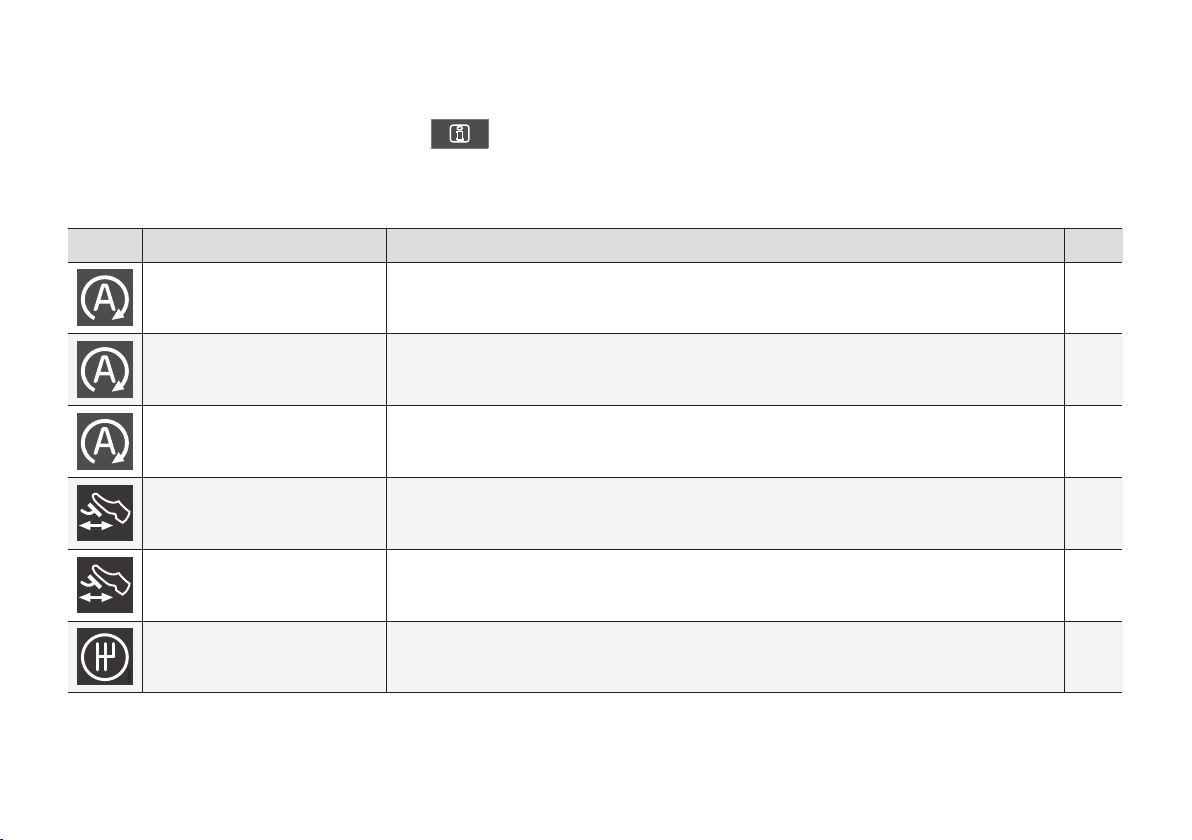
STARTING AND DRIVING
* Option/accessory.
290
Start/Stop* - symbols and
messages
The Start/Stop function can show text messages
in the combined instrument panel.
Text message
In combination with this indicator lamp
the Start/Stop function may show text
messages in the combined instrument
panel for certain situations. For some of them
there is a recommended action that should be
performed. The following table shows some
examples.
Symbol Message Info/Action
M/A
A
Auto Start/Stop Service
required
Start/Stop is not operational. Contact a workshop - an authorised Volvo workshop is recommended. M + A
Autostart Engine running +
acoustic signal
Activated if the driver's door is opened with auto-stopped engine and the gear selector in D posi-
tion.
A
Press start button
The engine will not start automatically - start the engine as normal with the START/STOP ENGINE
button.
M + A
Depress clutch pedal to start
The engine is ready to auto-start - waiting for the clutch pedal to be depressed. M
Depress brake and clutch
pedals to start
The engine is ready to auto-start - waiting for the brake or clutch pedal to be depressed. M
Put gear in neutral to start
Gear is engaged without declutching - disengage and set the gear lever in neutral position. M
STARTING AND DRIVING
* Option/accessory.
291
Symbol Message Info/Action
M/A
A
Select P or N to start
Start/Stop has been deactivated - move the gear selector to N or P position and start the engine as
normal with the START/STOP ENGINE button.
A
Press start button
The engine will not start automatically - start the engine as normal with the START/STOP ENGINE
button and the gear selector in P or N.
A
A
M = Manual gearbox, A = Automatic gearbox.
If a message does not go out following comple-
tion of the action then a workshop should be
contacted - an authorised Volvo workshop is rec-
ommended.
Related information
•
Start/Stop* (p. 284)
•
Start/Stop* - function and operation (p. 285)
•
Starting the engine (p. 270)
•
Start/Stop* - the engine does not auto-start
(p. 288)
•
Start/Stop* - the engine auto-starts (p. 287)
•
Start/Stop* - the engine does not stop
(p. 286)
•
Start/Stop* - involuntary stop manual gear-
box (p. 289)
•
Battery - Start/Stop (p. 374)
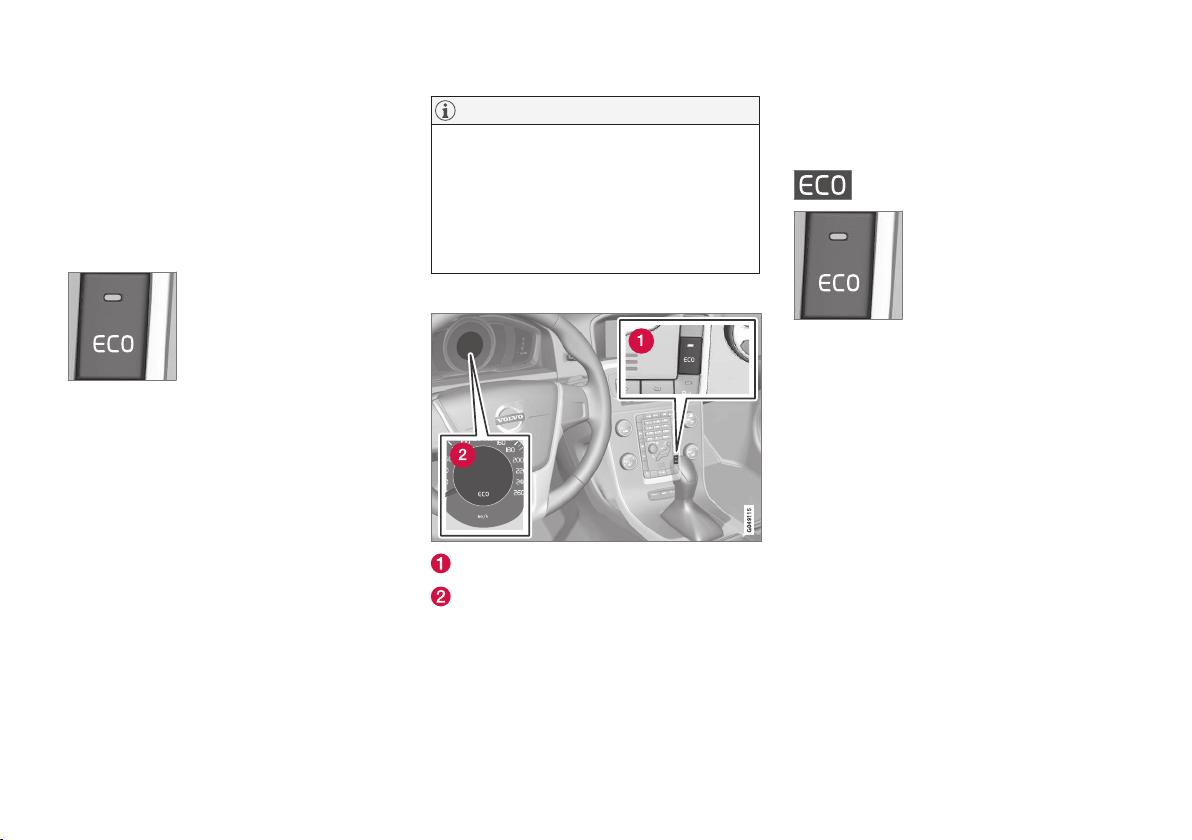
STARTING AND DRIVING
* Option/accessory.
292
Drive mode ECO*
ECO is an innovative Volvo function for auto-
matic-gearbox cars, capable of reducing fuel
consumption by up to 5 %, depending on the
driver's driving style. The function gives the driver
the option of a more active environmentally con-
scious way of driving.
General
The following are changed
upon activation of the ECO
function:
•
Gearbox gearshift points.
•
Engine management and response from the
accelerator pedal.
•
Start/Stop function - the engine can also
auto-stop before the car has stopped down
to being completely stationary.
•
The Eco Coast function is activated - engine
braking ceases.
•
Climate control system settings - some elec-
tricity consumers are deactivated or operate
at reduced power.
NOTE
When the ECO function is activated, several
parameters in the climate control system's
settings are changed, and several electricity
consumer functions are reduced. Certain set-
tings can be reset manually, but full function-
ality is only restored by deactivating the ECO
function.
ECO - Operation
ECO On/Off
ECO symbol
The ECO function is deactivated when the engine
is switched off, and must therefore be activated
after each time the engine is started. There are
exceptions for certain engines. However, it is
easily verified by means of both the combined
instrument panel
ECO symbol and the ECO
button lamp illuminating when the function is
activated.
ECO function On or Off
Disengaged ECO function is
indicated by the combined
instrument panel
ECO symbol
and the ECO button lamp extin-
guishing. The function is then
switched off until it is reactiva-
ted with the ECO button.
Eco Coast - Function
The Eco Coast subfunction means in practice
that engine braking is deactivated, meaning in
turn that the car's kinetic energy is used to coast
for longer distances. When the driver releases
the accelerator pedal the gearbox is automatically
disengaged from the engine whose speed is
reduced to idling speed with minimum consump-
tion.
This function is intended for use in the event of
an anticipated reduction in speed, e.g. to coast
into a zone with a lower speed limit.
Eco Coast enables proactive driving where the
driver can use the so-called "Pulse & Glide"
technique and a minimum of braking.
A combination of Eco Coast and temporarily
deactivated ECO function can also collectively
contribute to reduced consumption. Accordingly:
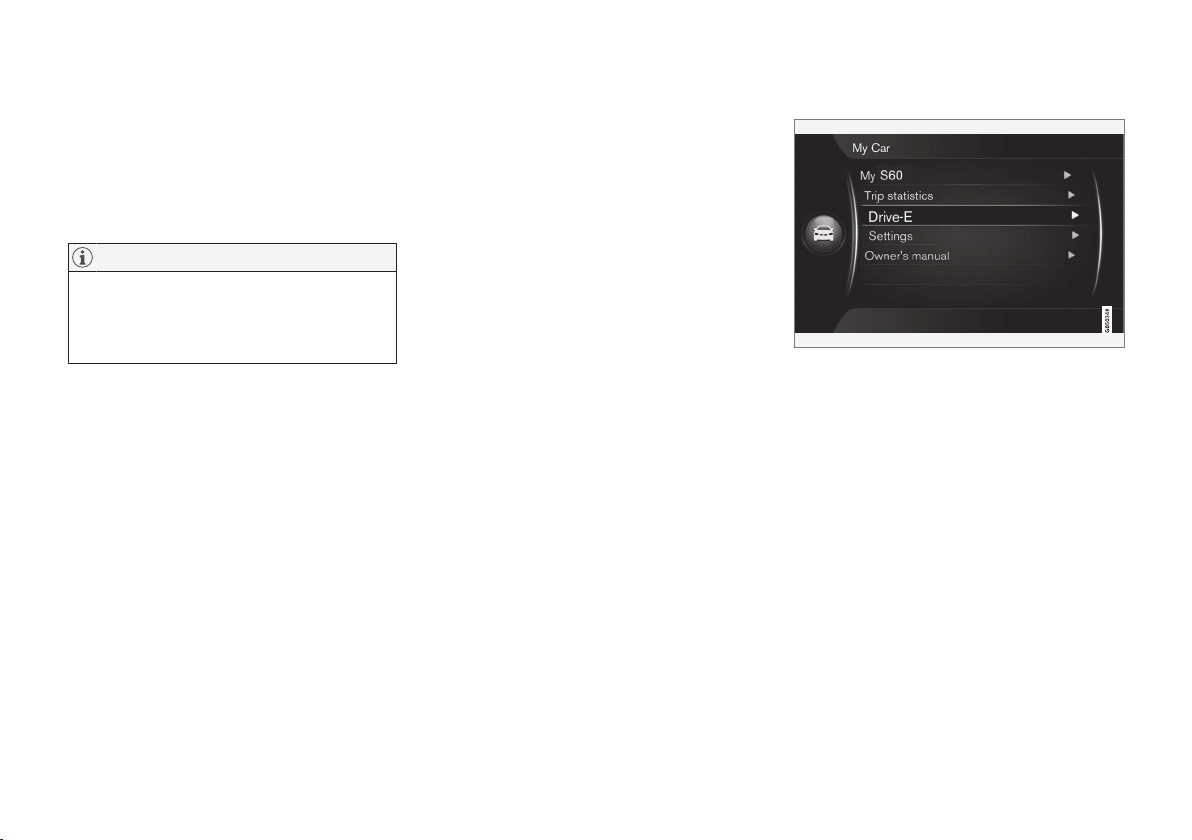
STARTING AND DRIVING
293
•
Active Eco Coast: Long coasting without
engine braking = Low consumption
and
•
Deactivated ECO function: Short coasting
with engine braking = Minimum consump-
tion.
NOTE
However, to achieve optimal low fuel con-
sumption, Eco Coast in combination with
short coasting distances should generally be
avoided.
Activating Eco Coast
The function is activated when the accelerator
pedal is fully released, in combination with the
following parameters:
•
ECO button activated
•
Gear selector in D position
•
Speed within the range of
approx. 65-140 km/h (40-87 mph)
•
The road's downhill gradient is not steeper
than approx. 6%.
Deactivate Eco Coast
In certain situations it may be desirable to deacti-
vate the Eco Coast function. Examples of such
situations include:
•
on steep downhill gradients - to be able to
use engine braking.
•
before an imminent overtaking manoeuvre -
in order to be able to complete it in the saf-
est possible way.
Deactivating Eco Coast and returning to engine
braking can be performed as follows:
•
Press the ECO button.
•
Move the gear lever to manual "S+/-" posi-
tion.
•
Change gear with the steering wheel paddle
shifters.
•
Actuate the accelerator or brake pedal.
Eco Coast - Limitations
The function is not available if:
•
cruise control is activated
•
the road's downhill gradient is steeper than
approx. 6%
•
manual gear changing is performed with the
steering wheel paddle shifters*
•
engine and/or gearbox are not at normal
operating temperature
•
the gear selector is moved from D- to "S+/-"
position
•
speed is outside the range of
approx. 65-140 km/h (40-87 mph)
More information and settings
The car's menu system MY CAR contains further
information on the ECO concept - see the sec-
tion MY CAR (p. 109).
Related information
•
General information on climate control
(p. 120)
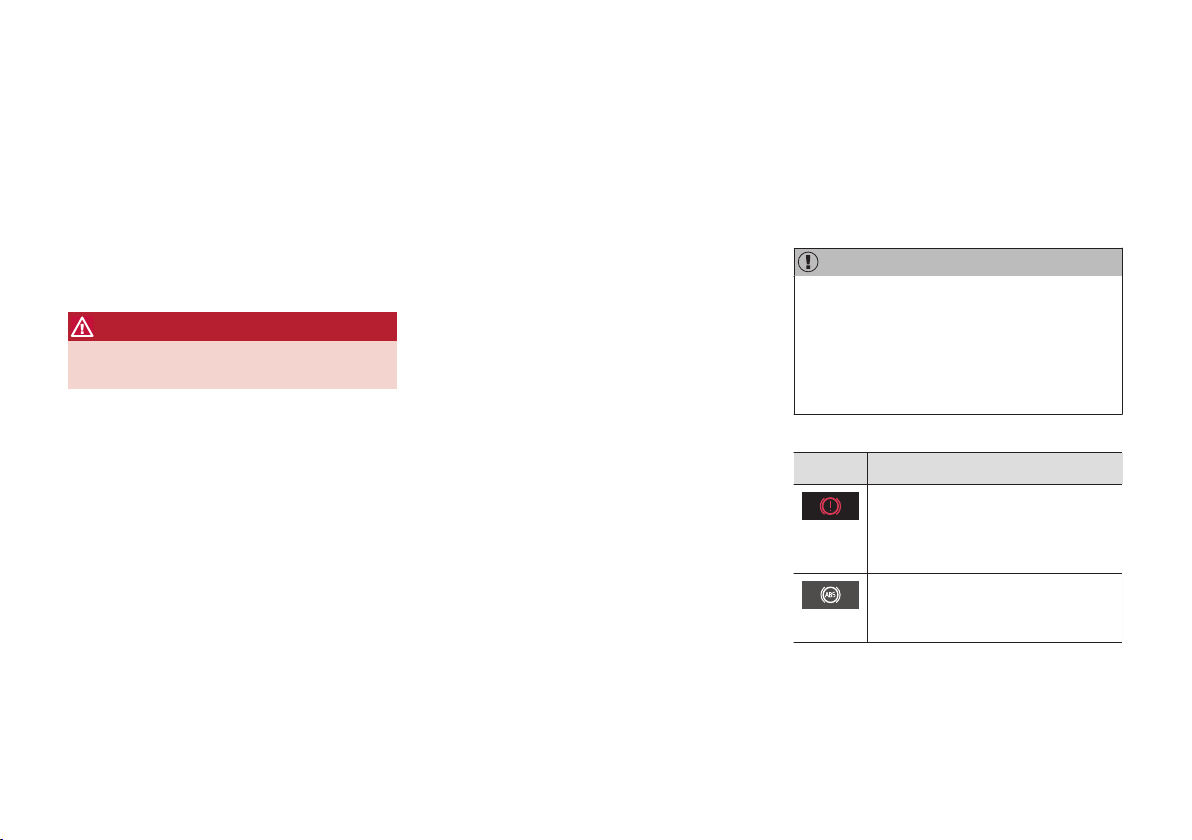
STARTING AND DRIVING
* Option/accessory.
294
Foot brake
The foot brake is part of the brake system.
The car is equipped with two brake circuits for
safety reasons. If a brake circuit is damaged then
the brake pedal will engage deeper and a higher
pressure on the pedal is needed to produce the
normal braking effect.
The driver's brake pedal pressure is assisted by a
brake servo.
WARNING
The brake servo only works when the engine
is running.
If the foot brake is used when the engine is
switched off then the pedal will feel stiff and a
higher pedal pressure must be used to brake the
car.
For cars with the Hill start assist (HSA)* (p. 282)*
function, the pedal returns more slowly than
usual to normal position if the car is parked on a
gradient or on an uneven surface.
In very hilly terrain or when driving with a heavy
load the brakes can be relieved by using engine
braking. Engine braking is most efficiently used if
the same gear is used downhill as up.
For more general information on heavy loads on
the car, see Engine oil - adverse driving condi-
tions (p. 407).
Braking on wet roads
When driving for a long time in heavy rain without
braking, the braking effect may be delayed
slightly when next using the brakes. This may
also be the case after a car wash. It is then nec-
essary to depress the brake harder. For this rea-
son, maintain a greater distance to the traffic
ahead.
Brake the car firmly after driving on wet roads
and after a car wash. The brake discs are then
warmed up, dry more quickly and are protected
against corrosion. Take the prevailing traffic sit-
uation into account when braking.
Braking on salted roads
When driving on salted roads a layer of salt may
form on the brake discs and brake linings. This
may extend braking distance. For this reason,
keep an extra large safety distance to the vehicle
ahead. Also make sure of the following:
•
Brake occasionally to remove any layer of
salt. Make sure that other road users are not
put at risk by the braking.
•
Gently depress the brake pedal when driving
is finished and before the next journey starts.
Maintenance
To keep the car as safe and reliable as possible,
follow the Volvo service intervals as specified in
the Service and Warranty Booklet.
New and replaced brake linings and brake discs
do not provide optimal braking effect until they
have been "worn in" a few hundred kilometres.
Compensate for the reduced braking effect by
depressing the brake pedal harder. Volvo recom-
mends only fitting brake linings that are approved
for your Volvo.
IMPORTANT
The wear on the brake system's components
must be checked regularly.
Contact a workshop for information about the
procedure or engage a workshop to carry out
the inspection - an authorised Volvo work-
shop is recommended.
Symbols and messages
Symbol Specification
Constant glow – Check the brake
fluid level. If the level is low, fill with
brake fluid and check for the cause
of the brake fluid loss.
Constant glow for 2 seconds when
the engine is started - automatic
function check.

STARTING AND DRIVING
295
WARNING
If and illuminate at the same
time, there may be a fault in the brake system.
If the level in the brake fluid reservoir is nor-
mal at this stage, drive carefully to the nearest
workshop and have the brake system checked
- an authorised Volvo workshop is recom-
mended.
If the brake fluid is below the MIN level in the
brake fluid reservoir, do not drive further
before topping up the brake fluid.
The reason for the loss of brake fluid must be
investigated.
Related information
•
Parking brake (p. 297)
•
Foot brake - emergency brake lights and
automatic hazard warning flashers (p. 295)
•
Foot brake - emergency brake assistance
(p. 296)
•
Foot brake - anti-lock braking system
(p. 295)
Foot brake - anti-lock braking
system
The anti-lock braking system, ABS (Anti-lock
Braking System), prevents the wheels from lock-
ing up during braking.
The function allows the steering ability to be
maintained, and it is easier to swerve to avoid a
hazard for example. Vibration may be felt in the
brake pedal when this is engaged and this is nor-
mal.
A short test of the ABS system is made automat-
ically after the engine has been started when the
driver releases the brake pedal. A further auto-
matic test of the ABS system may be made at
low speed. The test may be experienced as pul-
ses in the brake pedal.
Related information
•
Foot brake (p. 294)
•
Parking brake (p. 297)
•
Foot brake - emergency brake lights and
automatic hazard warning flashers (p. 295)
•
Foot brake - emergency brake assistance
(p. 296)
Foot brake - emergency brake lights
and automatic hazard warning
flashers
Emergency brake lights are activated to alert
vehicles behind about heavy braking. The func-
tion means that the brake light flashes instead of
- as in normal braking - shining with a constant
glow.
Emergency brake lights are activated at speeds
above 50 km/h (31 mph) in the event of heavy
braking. After the car's speed has been slowed
down to below 10 km/h (6 mph) the brake light
returns from flashing to the normal constant glow
- while at the same time the car's hazard warning
lights (p. 93) are activated. These flash until the
driver accelerates the car to a higher speed again
or switches off the hazard warning lights.
Related information
•
Foot brake (p. 294)
•
Parking brake (p. 297)
•
Foot brake - emergency brake assistance
(p. 296)
•
Foot brake - anti-lock braking system
(p. 295)

STARTING AND DRIVING
296
Foot brake - emergency brake
assistance
Emergency brake assistance EBA (Emergency
Brake Assist) helps to increase the braking force
and so reduce the braking distance.
EBA detects the driver's braking style and increa-
ses the braking force when necessary. The brake
force can be reinforced up to the level when the
ABS system is engaged. The EBA function is
interrupted when the pressure on the brake pedal
is reduced.
NOTE
When EBA is activated the brake pedal low-
ers slightly more than usual, depress (hold)
the brake pedal as long as necessary. If the
brake pedal is released then all braking
ceases.
Related information
•
Foot brake (p. 294)
•
Parking brake (p. 297)
•
Foot brake - emergency brake lights and
automatic hazard warning flashers (p. 295)
•
Foot brake - anti-lock braking system
(p. 295)
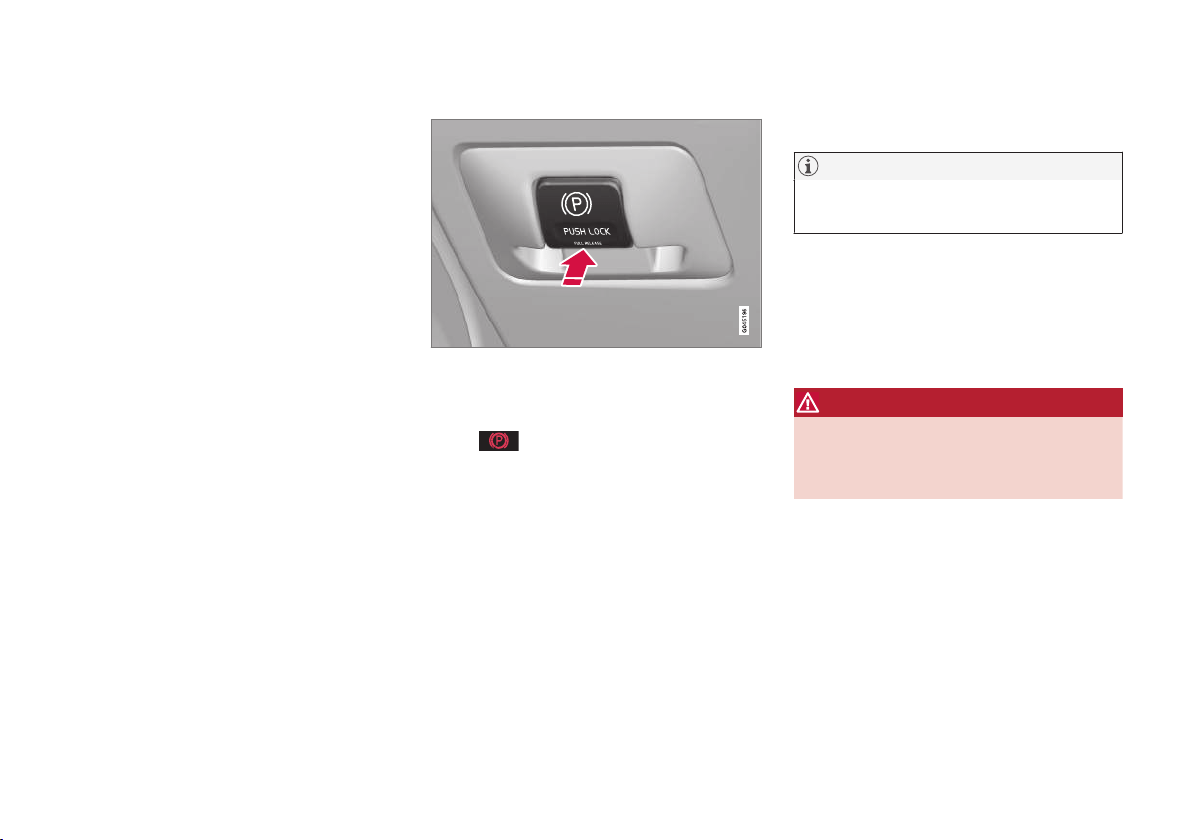
STARTING AND DRIVING
}}
297
Parking brake
The parking brake prevents the car from rolling
away from stationary by means of mechanically
locking/blocking two wheels.
Function
A faint electric motor noise can be heard when
the electrically-controlled parking brake is being
applied. The noise can also be heard during the
automatic function checking of the parking brake.
If the car is stationary when the parking brake is
applied then it only acts on the rear wheels. If it is
applied when the car is moving then the normal
foot brake is used, i.e. the brake acts on all four
wheels. Brake function changes over to the rear
wheels when the car is almost stationary.
Low battery voltage
If the battery voltage is too low then the parking
brake can neither be released nor applied. Con-
nect a donor battery if the battery voltage is too
low, see Jump starting with another battery
(p. 275).
Applying the parking brake
Parking brake control - apply.
1. Depress the foot brake pedal firmly.
2.
Press the parking brake control.
>
The combined instrument panel's
symbol starts flashing - once there is a
constant glow the parking brake is
applied.
3. Release the foot brake pedal and make sure
that the car is at a standstill position.
When parking the vehicle, always engage 1st
gear (for manual gearbox) or put the gear selec-
tor in position P (for automatic gearbox).
Emergency brake
In an emergency the parking brake can be
applied when the vehicle is in motion by pressing
and holding the parking brake control. The brak-
ing procedure is stopped when the control is
released.
NOTE
An acoustic signal sounds while emergency
braking is active at high speeds.
Parking on a hill
If the car is parked facing uphill:
•
Turn the wheels away from the kerb.
If the car is parked facing downhill:
•
Turn the wheels towards the kerb.
WARNING
Always apply the parking brake when parking
on a slope - leaving the car in gear, or in P if it
has automatic transmission, is not sufficient
to hold the car in all situation.
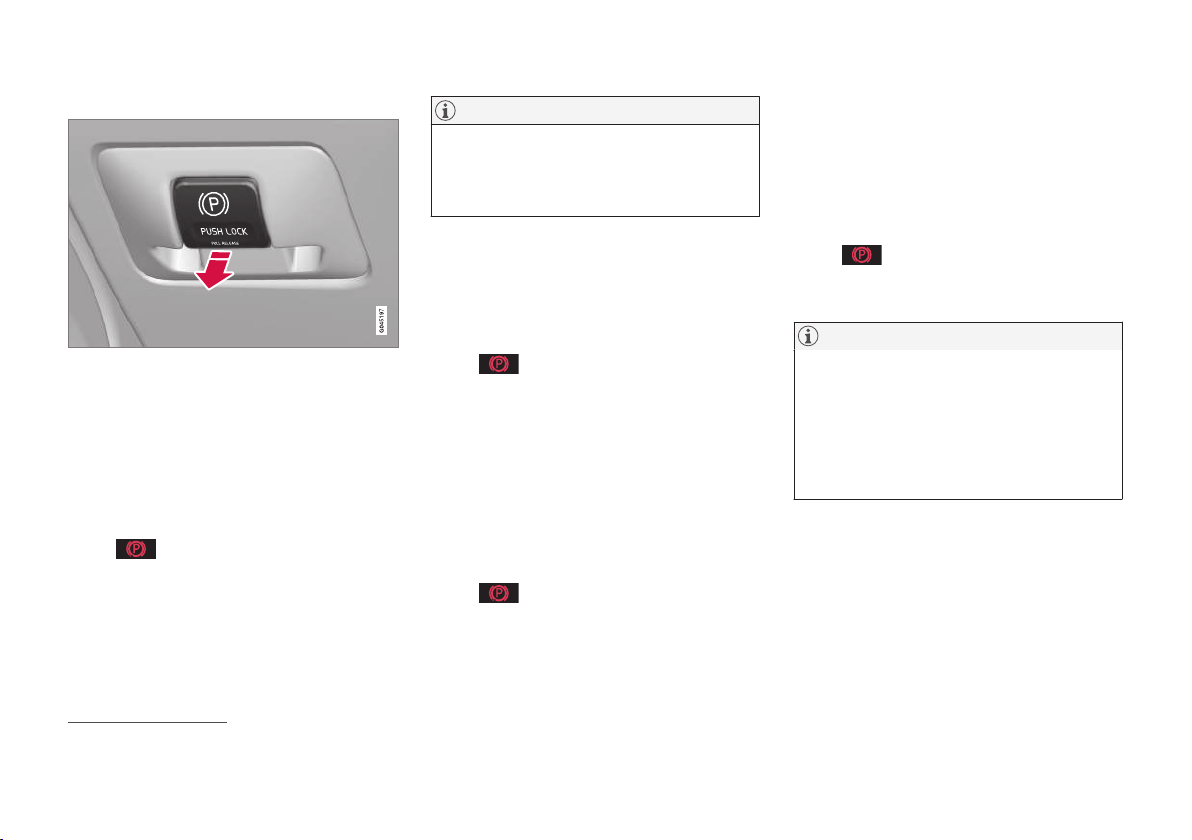
||
STARTING AND DRIVING
298
Disengaging the parking brake
Parking brake control - release.
Cars with manual gearbox
Releasing manually
1. Insert the remote control key in the ignition
switch
13
.
2. Depress the foot brake pedal firmly.
3.
Apply the parking brake control.
>
The parking brake releases and the
combined instrument panel's symbol
extinguishes.
NOTE
The parking brake can also be released man-
ually by depressing the clutch pedal instead
of the brake pedal. Volvo recommends that
the brake pedal is used.
Releasing automatically
1. Start the engine.
2. Engage 1st gear or reverse gear.
3.
Ease up the clutch and depress the acceler-
ator.
>
The parking brake releases and the
combined instrument panel's symbol
extinguishes.
Cars with automatic gearbox
Releasing manually
1. Insert the remote control key in the ignition
switch
13
.
2. Depress the foot brake pedal firmly.
3.
Pull the control.
>
The parking brake releases and the
combined instrument panel's symbol
extinguishes.
Releasing automatically
1. Put the seatbelt on.
2. Start the engine.
3. Depress the foot brake pedal firmly.
4.
Move the gear selector to position D or R
and depress the accelerator.
>
The parking brake releases and the
combined instrument panel's symbol
extinguishes.
NOTE
For safety reasons, the parking brake is only
released automatically if the engine is running
and the driver is wearing a seatbelt. The park-
ing brake is released immediately on cars
with automatic gearbox when the accelerator
pedal is depressed and the gear selector is in
position D or R.
Heavy load uphill
A heavy load, such as a trailer, can cause the car
to roll backward when the parking brake is
released automatically on a steep incline. Avoid
this by depressing the control while driving off.
Release the control when the engine achieves
traction.
13
For cars with keyless start and lock system: Press START/STOP ENGINE.
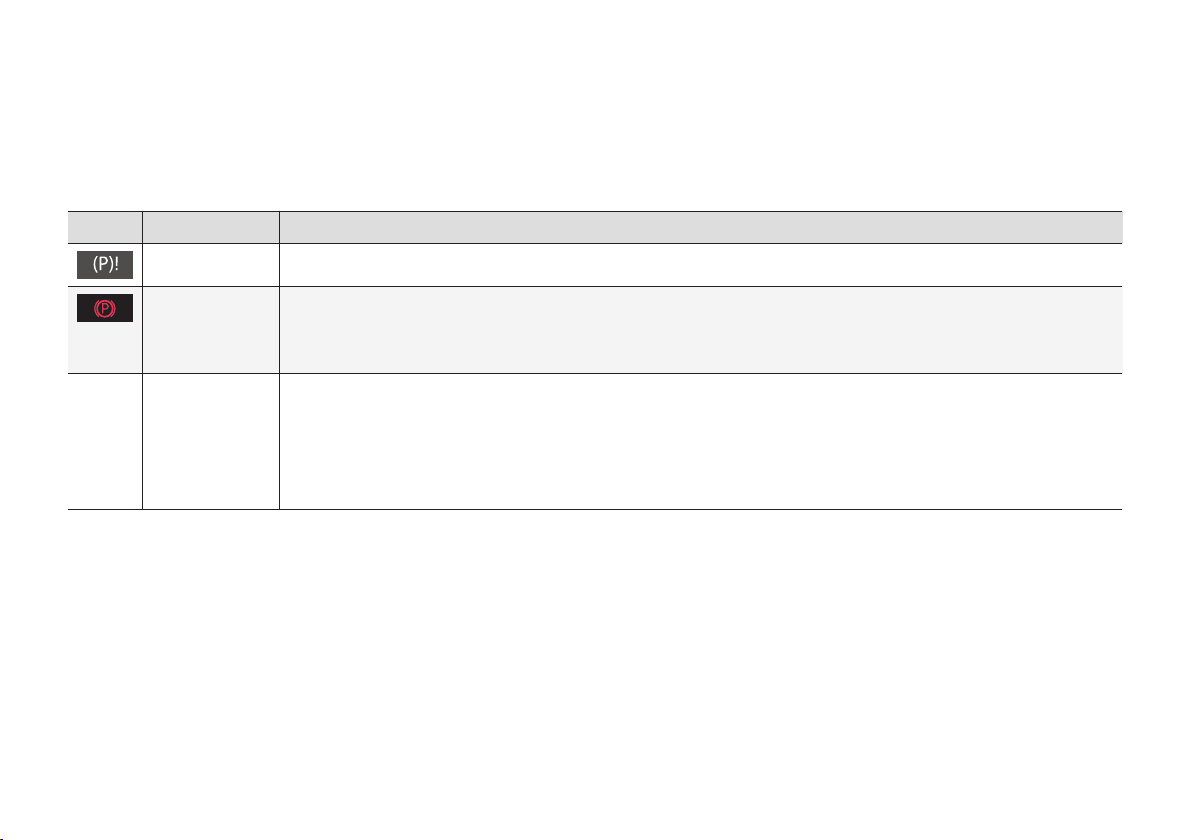
STARTING AND DRIVING
}}
299
Replacing the brake linings
The rear brake linings must be replaced at a
workshop due to the design of the electric park-
ing brake - an authorised Volvo workshop is rec-
ommended.
Symbols and messages
For information on how the combined instrument
panel's text messages can be shown and
deleted, see Messages - handling (p. 109).
Symbol Message Meaning/Action
"Message"
•
Read the combined instrument panel's message.
A flashing symbol indicates that the parking brake is applied.
If the symbol flashes in any other situation then this means that a fault has arisen.
•
Read the combined instrument panel's message.
Handbrake not
fully released
A fault is preventing the parking brake from being released:
•
Try to apply and release the brake.
If the fault persists after a few attempts:
•
Visit a workshop - an authorised Volvo workshop is recommended.
Note: A warning signal sounds if the journey is continued with this error message.
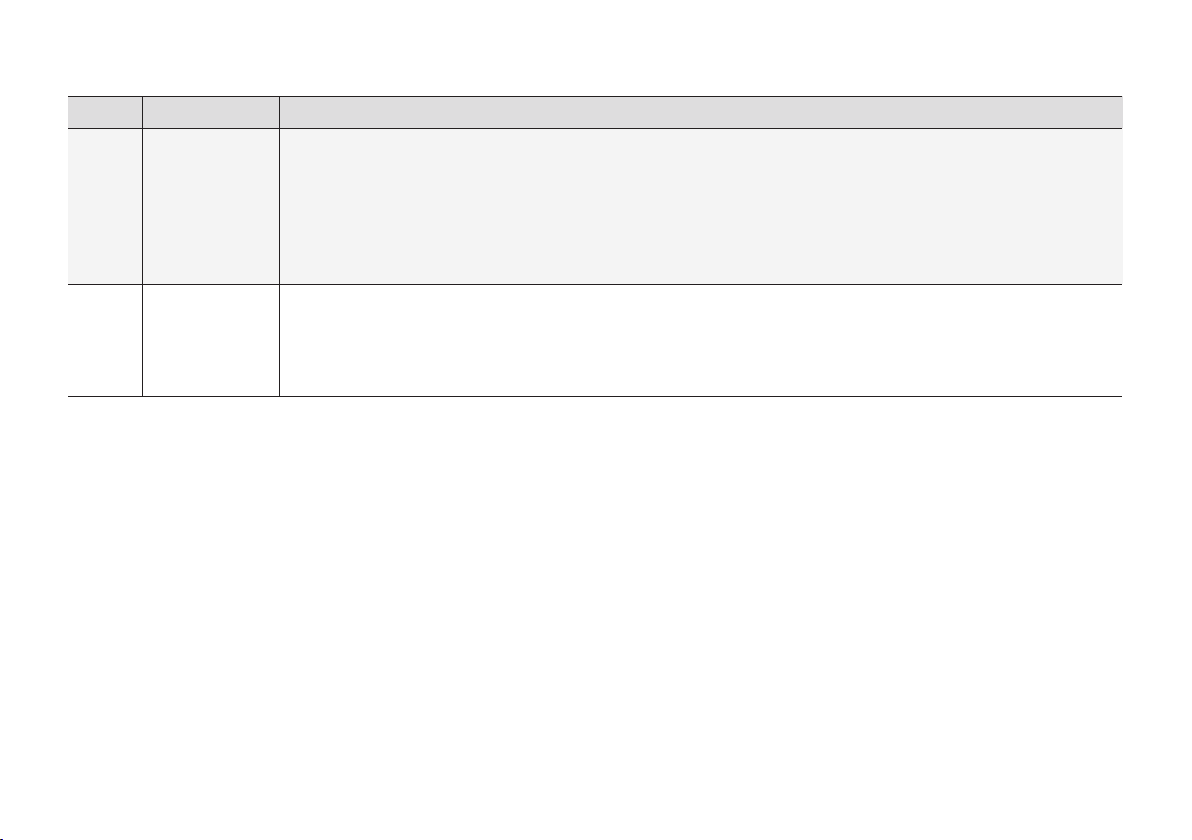
||
STARTING AND DRIVING
300
Symbol Message Meaning/Action
Handbrake not
applied
A fault is preventing the parking brake from being applied:
•
Try to release and apply the brake.
If the fault persists after a few attempts:
•
Visit a workshop - an authorised Volvo workshop is recommended.
The message is also illuminated on cars with manual gearbox when the car is driven at low speed with the door open in
order to alert the driver that the parking brake may have been unintentionally disengaged.
Handbrake
Service
required
A fault has arisen:
•
Try to apply and release the brake.
If the fault persists after a few attempts:
•
Visit a workshop - an authorised Volvo workshop is recommended.
If the car has to be parked before a possible fault
has been rectified, then the wheels must be
turned as if parking on a hill and 1st gear
engaged (manual gearbox) or the gear selector
must be in position P (automatic gearbox).
A text message can be acknowledged by briefly
pressing the OK button on the direction indicator
stalk.
Related information
•
Foot brake (p. 294)

STARTING AND DRIVING
}}
* Option/accessory.
301
Driving in water
Driving in water means that the car is driven
through deep water on a water-covered road-
way. Fording must be carried out with great cau-
tion.
The car can be driven through water at a maxi-
mum depth of 25 cm (30 cm with S60 Cross
Country) at a maximum speed of walking pace.
Extra caution must be exercised when passing
through flowing water.
During driving in water, maintain a low speed and
do not stop the car. When the water has been
passed, depress the brake pedal lightly and
check that full brake function is achieved. Water
and mud for example can make the brake linings
wet resulting in delayed brake function.
•
If necessary, clean the contacts for the elec-
tric heater and trailer coupling after driving in
water and mud.
•
Do not let the car stand with water over the
sills for any long period of time - this could
cause electrical malfunctions.
IMPORTANT
Engine damage can occur if water enters the
air filter.
In depths greater than 25 cm (30 cm with
S60 Cross Country), water could enter the
transmission. This reduces the lubricating
ability of the oils and shortens the service life
of these systems.
Damage to any component, engine, transmis-
sion, turbocharger, differential or its internal
components caused by flooding, hydrostatic
locking or oil shortage, is not covered by the
warranty.
In the event of the engine stalling in water, do
not try restart - tow the car from the water to
a workshop - an authorised Volvo workshop is
recommended. Risk of engine breakdown.
Related information
•
Recovery (p. 320)
•
Towing (p. 318)
Overheating
Under special conditions, for example hard driv-
ing in hilly terrain and hot climate, there is a risk
that the engine and drive system may overheat -
in particular with a heavy load.
For information about overheating when driving
with a trailer, see Driving with a trailer* (p. 311).
•
Remove any auxiliary lamps from in front of
the grille when driving in hot climates.
•
If the temperature in the engine's cooling
system is too high then a warning symbol is
illuminated in the combined instrument pan-
el's information display and a text message
High engine temperature Stop safely is
shown there - stop the car in a safe way and
allow the engine to run at idling speed for
several minutes in order to cool down.
•
If the text message
High engine
temperature Turn off engine or Engine
coolant level low Stop safely is shown
then the engine must be switched off after
stopping the car.
•
In the event of overheating in the gearbox a
built-in protection function is activated which,
amongst other things, illuminates a warning
symbol in the combined instrument panel,
and its display shows the text message
Transmission hot Reduce speed or
Transmission hot Stop safely Wait for
cooling - follow the recommendation given
and lower the speed and stop the car in a
STARTING AND DRIVING
302
safe way and allow the engine to run at idling
speed for a few minutes in order to allow the
gearbox to cool down.
•
If the car overheats, the air conditioning may
be switched off temporarily.
•
Do not turn the engine off immediately you
stop after a hard drive.
NOTE
It is normal for the engine's cooling fan to
operate for a time after the engine has been
switched off.
Driving with open tailgate/boot lid
When driving with the boot lid open, toxic
exhaust fumes can be sucked into the car
through the cargo area.
WARNING
Do not drive with the boot lid open. Toxic
exhaust fumes can be drawn into the car
through the cargo area.
Related information
•
Loading (p. 148)
Overload - starter battery
The electrical functions in the car load the starter
battery (p. 370) to varying degrees. Avoid using
the key position II (p. 77) when the car is
switched off. Instead use position I - which uses
less power.
Also, be aware of different accessories that load
the electrical system. Do not use functions which
use a lot of power when the car is switched off.
Examples of such functions are:
•
ventilation fan
•
headlamps
•
windscreen wiper
•
audio system (high volume).
If the starter battery voltage is low then the com-
bined instrument panel's information display
shows the text
Low battery charge Power
save mode. The energy-saving function then
shuts down certain functions or reduces certain
functions such as the ventilation fan and/or
audio system.
–
In which case, charge the starter battery by
starting the car and then running it for at
least 15 minutes - starter battery charging is
more effective during driving than running
the engine at idling speed while stationary.

STARTING AND DRIVING
303
Before a long journey
Before a long journey, it makes good sense to
go through the following points:
•
Check that the engine is working normally
and that fuel consumption (p. 416) is nor-
mal.
•
Make sure that there are no leaks (fuel, oil or
other fluid).
•
Check all bulbs and tyre tread depths.
•
Carrying a warning triangle (p. 335) is a
legal requirement in certain countries.
Related information
•
Engine oil - checking and filling (p. 354)
•
Changing wheels - removing wheels (p. 331)
•
Lamp replacement - general (p. 360)
Winter driving
For winter driving it is important to perform cer-
tain checks in order to ensure that the car can
be driven safely.
Check the following in particular before the cold
season:
•
The engine coolant (p. 357) must contain
50% glycol. This mixture protects the engine
against frost erosion down to
approximately –35 °C. To avoid health risks,
different types of glycol must not be mixed.
•
The fuel tank must be kept filled to prevent
condensation.
•
Engine oil viscosity is important. Oils with
lower viscosity (thinner oils) facilitate starting
in cold weather and also reduce fuel con-
sumption while the engine is cold. For more
information on suitable oils, see Engine oil -
adverse driving conditions (p. 407).
IMPORTANT
Low viscosity oil must not be used for hard
driving or in hot weather.
•
The condition of the starter battery and
charge level must be inspected. Cold
weather places great demands on the starter
battery and its capacity is reduced by the
cold.
•
Use washer fluid (p. 369) to avoid ice form-
ing in the washer fluid reservoir.
To achieve optimum roadholding Volvo recom-
mends using winter tyres on all wheels if there is
a risk of snow or ice.
NOTE
The use of winter tyres is a legal requirement
in certain countries. Studded tyres are not
permitted in all countries.
Slippery driving conditions
Practise driving on slippery surfaces under con-
trolled conditions to learn how the car reacts.
Related information
•
Winter driving (p. 303)
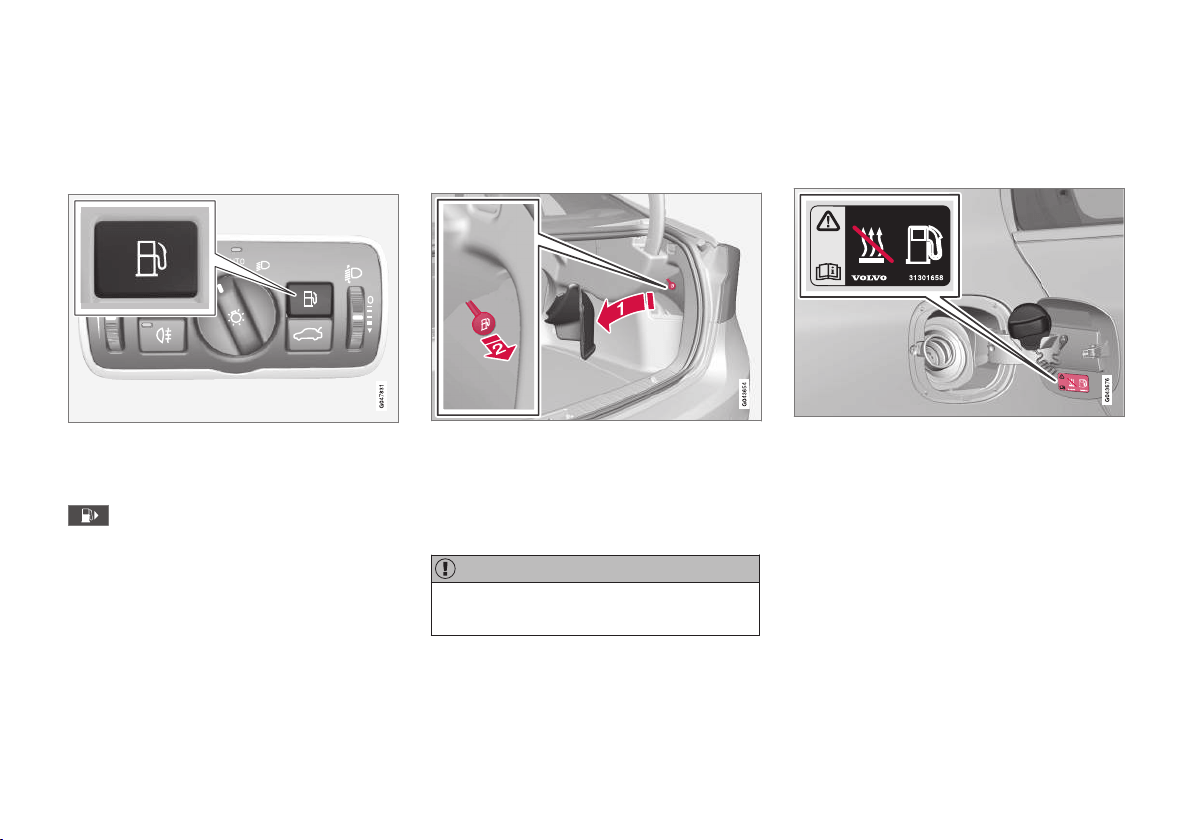
STARTING AND DRIVING
304
Fuel filler flap - Opening/closing
The fuel filler flap can be opened/closed as fol-
lows:
Opening/closing the fuel filler flap
Open the fuel filler flap using the button on the
lighting panel - the flap opens when the button is
released.
In the combined instrument panel's dis-
play the arrow on the symbol indicates
which side of the car the fuel cap is located.
•
Close the fuel filler flap by pressing it in until
a click confirms that it is closed.
Related information
•
Filling up with fuel (p. 304)
Fuel filler flap - manual opening
The fuel filler flap can be opened manually when
electric opening from the passenger compart-
ment is not possible.
1. Open/remove the side hatch in the cargo
area (same side as fuel filler flap) and locate
the green cord with handle.
2. Pull the cord gently straight back until the
fuel filler flap folds out with a "click".
IMPORTANT
Pull the wire gently - minimal force is required
to disengage the hatch lock.
Related information
•
Filling up with fuel (p. 304)
Filling up with fuel
Important things to consider when refuelling.
Opening/closing the fuel cap
The fuel filler cap can be attached onto the flap.
A certain overpressure may arise in the tank in
the event of high outside temperatures. Open the
cap slowly.
•
After refuelling - refit the cap and turn it until
one or more clicking sounds are heard.
STARTING AND DRIVING
305
Filling up with fuel
1. Choose fuel that is approved for use in the
car in accordance with the identifier
14
on the
inside of the fuel filler flap.
See information on approved fuels in the
respective section on petrol (p. 306) and
diesel (p. 307).
2. Do not overfill the tank but stop refuelling
when the pump nozzle cuts out the first time.
NOTE
Overfilled fuel in the tank can overflow in hot
weather.
Filling with a fuel can
15
When filling with a fuel can, use the funnel
located under the floor hatch in the cargo area.
Make sure you insert the funnel's pipe firmly into
the filler pipe. The filler pipe has an openable
cover and the funnel's pipe must be slid past the
cover before filling can begin.
Related information
•
Fuel filler flap - manual opening (p. 304)
•
Fuel - handling (p. 305)
Fuel - handling
Fuel of a lower quality than that recommended
by Volvo must not be used as engine power and
fuel consumption is negatively affected.
WARNING
Always avoid inhaling fuel vapour and getting
fuel splashes in the eyes.
In the event of fuel in the eyes, remove any
contact lenses and rinse the eyes in plenty of
water for at least 15 minutes and seek medi-
cal attention.
Never swallow fuel. Fuels such as petrol, bioe-
thanol and mixtures of them and diesel are
highly toxic and could cause permanent injury
or be fatal if swallowed. Seek medical atten-
tion immediately if fuel has been swallowed.
WARNING
Fuel which spills onto the ground can be igni-
ted.
Switch off the fuel-driven heater before star-
ting to refuel.
Never carry an activated mobile phone when
refuelling. The ring signal could cause spark
build-up and ignite petrol fumes, leading to
fire and injury.
IMPORTANT
Mixtures of various fuel types or use of fuels
which are not recommended will invalidate
Volvo's guarantees and any supplementary
service agreements; this is applicable to all
engines.
NOTE
Extreme weather conditions, driving with a
trailer or driving at high altitudes in combina-
tion with fuel grade are factors that could
affect the car's performance.
Related information
•
Fuel - diesel (p. 307)
•
Diesel particle filter (DPF) (p. 308)
•
Fuel consumption and CO2 emissions
(p. 416)
•
Fuel tank - volume (p. 413)
14
The identifier in accordance with the CEN standard EN16942 is located on the inside of the fuel filler flap, and will be on corresponding fuel pumps and their nozzles at filling stations throughout Europe at the
latest by the end of 2018.
15
Only applies to a car with diesel engine.

STARTING AND DRIVING
306
Fuel - petrol
Petrol is a type of engine fuel that is intended for
cars with a petrol engine.
Only use petrol from well-known producers.
Never use fuel of dubious quality. The petrol must
fulfil the EN 228 standard.
Identifier for petrol
The identifier in accordance with the CEN stand-
ard EN16942 is located on the inside of the fuel
filler flap, and will be on corresponding fuel
pumps and their nozzles at filling stations
throughout Europe at the latest by the end of
2018.
These are the identifiers that apply for current
standard fuels in Europe. Petrol with the following
identifiers may be used in cars with petrol engine:
E5 is a petrol with maximum
2.7 % oxygen and maximum
5 volume % ethanol.
E10 is a petrol with maximum
3.7 % oxygen and maximum
10 volume % ethanol.
IMPORTANT
•
Fuel that contains up to 10 percent by
volume ethanol is permitted.
•
EN 228 E10 petrol (max
10 percent by volume ethanol) is
approved for use.
•
Ethanol higher than E10 (max.
10 percent by volume ethanol) is not per-
mitted, e.g. E85 is not permitted.
Octane rating
•
95 RON can be used for normal driving.
•
98 RON is recommended for optimum per-
formance and minimum fuel consumption.
When driving in temperatures above +38 °C, fuel
with the highest possible octane rating is recom-
mended for optimum performance and fuel econ-
omy.
IMPORTANT
•
Use only unleaded petrol to avoid damag-
ing the catalytic converter.
•
Fuel containing metallic additives must
not be used.
•
Do not use any additives which have not
been recommended by Volvo.
Related information
•
Fuel - handling (p. 305)
•
Economical driving (p. 310)
•
Fuel consumption and CO2 emissions
(p. 416)
•
Fuel tank - volume (p. 413)

STARTING AND DRIVING
}}
307
Fuel - diesel
Diesel is a type of engine fuel that is intended for
cars with a diesel engine.
Only use diesel fuel from well-known producers.
Never use fuel of dubious quality. Diesel fuel
must fulfil the EN 590 or SS 155435 standard.
Diesel engines are sensitive to contaminants in
the fuel, such as excessively high volumes of sul-
phur and metals.
Identifier
The identifier in accordance with the CEN stand-
ard EN16942 is located on the inside of the fuel
filler flap, and will be on corresponding fuel
pumps and their nozzles at filling stations
throughout Europe at the latest by the end of
2018.
This is the identifier that applies for current
standard fuel in Europe. Diesel with the following
identifiers may be used in cars with diesel
engine:
B7 is diesel with maximum
7 volume % fatty acid methyl
ester (FAME).
At low temperatures (lower than 0 °C) a paraffin
precipitate may form in the diesel fuel, which may
lead to ignition problems. The fuel qualities that
are sold must be adapted for season and climate
zone, but in the event of extreme weather condi-
tions, old fuel or moving between climate zones,
paraffin precipitate may occur.
The risk of condensation in the fuel tank is
reduced if the tank is kept well filled. When refu-
elling, check that the area around the fuel filler
pipe is clean. Avoid spilling fuel onto the paint-
work. Wash off any spillage with detergent and
water.
IMPORTANT
Diesel fuel must:
•
fulfil the EN 590 and/or SS 155435
standards
•
have a sulphur content not exceeding
10 mg/kg
•
have a maximum of 7 vol % FAME
16
(B7).
IMPORTANT
Diesel type fuels that must not be used:
•
Special additives
•
Marine diesel fuel
•
Heating oil
•
FAME
17
and vegetable oil.
These fuels do not fulfil the requirements in
accordance with Volvo recommendations and
generate increased wear and engine damage
that is not covered by the Volvo warranty.
Empty tank
Once the engine has stopped due to fuel starva-
tion, the fuel system needs a few moments to
carry out a check. Do this before starting the
engine, once the fuel tank has been filled with
diesel:
1. Insert the remote control key in the ignition
switch and push it in to the end position. For
more information, see Key positions (p. 77).
2.
Press the START button without depressing
the brake and/or clutch pedal.
3. Wait approx. one minute.
4. To start the engine: Depress the brake
and/or clutch pedal and then press the
START button again.
16
Fatty Acid Methyl Ester
17
Diesel fuel with maximum 7 vol % FAME (B7) is permitted.
||
STARTING AND DRIVING
308
NOTE
Before filling with fuel in the event of fuel
shortage:
•
Stop the car on as flat/level ground as
possible - if the car is tilting there is a risk
of air pockets in the fuel supply.
Draining condensation from the fuel
filter
18
The fuel filter separates condensation from the
fuel. Condensation can disrupt engine operation.
For optimum performance, it is important to fol-
low the service intervals for fuel filter change as
well as to use genuine parts developed specifi-
cally for this purpose.
The fuel filter must be drained at the intervals
specified in the Service and Warranty Booklet or
if you suspect that the car has been filled with
contaminated fuel. For more information, see
Volvo service programme (p. 346).
IMPORTANT
Certain special additives remove the water
separation in the fuel filter.
Related information
•
Fuel - handling (p. 305)
•
Diesel particle filter (DPF) (p. 308)
•
Fuel consumption and CO2 emissions
(p. 416)
Diesel particle filter (DPF)
Diesel cars are equipped with a particle filter,
which results in more efficient emission control.
The particles in the exhaust gases are collected
in the filter during normal driving. So-called
"regeneration" is started in order to burn away
the particles and empty the filter. This requires
the engine to have reached normal operating
temperature.
Regeneration of the particle filter is automatic
and normally takes 10-20 minutes. It may take a
little longer at a low average speed. Fuel con-
sumption may increase slightly during regenera-
tion.
Regeneration in cold weather
If the car is frequently driven short distances in
cold weather then the engine does not reach
normal operating temperature. This means that
regeneration of the diesel particle filter does not
take place and the filter is not emptied.
When the filter has become approx. 80% full of
particles, a yellow warning triangle is shown in
the combined instrument panel, and the message
Soot filter full See manual is shown in its
information display.
Start regeneration of the filter by driving the car
until the engine reaches normal operating tem-
perature, preferably on a main road or motorway.
18
Applicable to five-cylinder engines only.
STARTING AND DRIVING
* Option/accessory.
309
The car should then be driven for approximately
20 minutes more.
NOTE
The following may arise during regeneration:
•
a smaller reduction of engine power may
be noticed temporarily
•
fuel consumption may increase temporar-
ily
•
a smell of burning may arise.
When regeneration is complete the warning text
is cleared automatically.
Use the parking heater* in cold weather - the
engine then reaches normal operating tempera-
ture more quickly.
IMPORTANT
If the filter is completely filled with particles, it
may be difficult to start the engine and the fil-
ter is non-functional. Then there is a risk that
the filter will need to be replaced.
Related information
•
Fuel - handling (p. 305)
•
Fuel - diesel (p. 307)
•
Fuel consumption and CO2 emissions
(p. 416)
•
Fuel tank - volume (p. 413)
Catalytic converters
The purpose of the catalytic converters is to
purify exhaust gases. They are located close to
the engine so that operating temperature is
reached quickly.
The catalytic converters consist of a monolith
(ceramic or metal) with channels. The channel
walls are lined with a thin layer of platinum/
rhodium/palladium. These metals act as cata-
lysts, i.e. they participate in and accelerate a
chemical reaction without being used up them-
selves.
Lambda-sond
TM
oxygen sensor
The Lambda-sond is part of a control system
intended to reduce emissions and improve fuel
economy. For more information, see Fuel con-
sumption and CO2 emissions (p. 416).
An oxygen sensor monitors the oxygen content
of the exhaust gases leaving the engine. This
value is fed into an electronic system that contin-
uously controls the injectors. The ratio of fuel to
air directed to the engine is continuously
adjusted. These adjustments create optimal con-
ditions for efficient combustion, and together with
the three-way catalytic converter reduce harmful
emissions (hydrocarbons, carbon monoxide and
nitrous oxides).
Related information
•
Fuel - petrol (p. 306)
•
Fuel - diesel (p. 307)

STARTING AND DRIVING
* Option/accessory.
310
Economical driving
Drive economically and eco-consciously by driv-
ing smoothly, thinking ahead, and adjusting your
driving style and speed to the prevailing condi-
tions.
•
Use the ECO Guide* which indicates how
fuel-efficiently the car is being driven, see
Eco guide & Power guide* (p. 66).
•
For lower fuel consumption, activate Drive
mode ECO
19
.
•
Use the Eco Coast
20
freewheel function -
engine braking will cease and the car's
kinetic energy can be used to freewheel for
longer distances.
•
Drive in the highest gear possible, adapted to
the current traffic situation and road - lower
engine speeds result in lower fuel consump-
tion. Use the gear indicator (p. 277)
21
.
•
Drive at a steady speed and keep a good dis-
tance to other vehicles and objects to mini-
mise braking.
•
High speed results in increased fuel con-
sumption - the wind resistance increases
with speed.
•
Do not run the engine to operating tempera-
ture at idling speed, but rather drive with a
normal load right after starting - a cold
engine consumes more fuel than a warm
one.
•
Drive with the correct air pressure in the
tyres and check this regularly - select ECO
tyre pressure for best results, see Tyres -
approved tyre pressures (p. 421).
•
Choice of tyres can affect fuel consumption -
seek advice on suitable tyres from a dealer.
•
Do not use winter tyres when the winter sea-
son is over.
•
Remove unnecessary items from the car -
the greater the load the higher the fuel con-
sumption.
•
Use engine braking to slow down, when it
can take place without risk to other road
users.
•
A roof load and space box increase air resis-
tance, leading to higher consumption -
remove the load carriers when not in use.
•
Avoid driving with open windows.
For information about Volvo Car Corporation's
environmental philosophy, see Environmental phi-
losophy (p. 22).
For more information about fuel consumption,
see Fuel consumption and CO2 emissions
(p. 416).
WARNING
Never switch off the engine while moving,
such as downhill, this deactivates important
systems such as the power steering and
brake servo.
Related information
•
Fuel - handling (p. 305)
•
Fuel consumption and CO2 emissions
(p. 416)
•
Fuel tank - volume (p. 413)
19
Applies to automatic gearbox.
20
See "Drive mode ECO".
21
Applies to manual gearbox.
STARTING AND DRIVING
}}
* Option/accessory.
311
Driving with a trailer*
When driving with a trailer there are a number of
important points to think about regarding e.g. the
towing bracket, the trailer and how the load is
positioned in the trailer.
Payload depends on the car's kerb weight. The
total of the weight of the passengers and all
accessories, e.g. towbar, reduces the car's pay-
load by a corresponding weight. For more
detailed information, see Weights (p. 404).
If the towing bracket is mounted by Volvo, then
the car is delivered with the necessary equipment
for driving with a trailer.
•
The car's towing bracket must be of an
approved type.
•
If the towbar is retrofitted, check with your
Volvo dealer that the car is fully equipped for
driving with a trailer.
•
Distribute the load on the trailer so that the
weight on the towing bracket complies with
the specified maximum towball load.
•
Increase the tyre pressure to the recom-
mended pressure for a full load. For informa-
tion on the tyre pressure, see Tyres -
approved tyre pressures (p. 421).
•
The engine is loaded more heavily than usual
when driving with a trailer.
•
Do not tow a heavy trailer when the car is
brand new. Wait until it has been driven at
least 1000 km.
•
The brakes are loaded much more than usual
on long and steep downhill slopes. Downshift
to a lower gear and adjust your speed.
•
For safety reasons, the maximum permitted
speed for the car when coupled with a trailer
should not be exceeded. Follow the regula-
tions in force for the permitted speeds and
weights.
•
Maintain a low speed when driving with a
trailer up long, steep ascents.
•
Avoid driving with a trailer on inclines of more
than 12%.
Trailer cable
An adapter is required if the car's towing bracket
has 13 pin electrics and the trailer has 7 pin
electrics. Use an adapter cable approved by
Volvo. Make sure the cable does not drag on the
ground.
Direction indicators and brake lights on
the trailer
If any of the trailer's lamps for direction indicators
are broken, then the combined instrument pan-
el's symbol for direction indicators flashes faster
than normal and the information display shows
the text
Trailer indicator malfunction.
If any of the trailer's lamps for the brake light are
broken then the
Trailer brake light
malfunction text is shown.
Level control*
The rear shock absorbers maintain a constant
height irrespective of the car's load (up to the
maximum permissible weight). When the car is
stationary the rear of the car lowers slightly,
which is normal.
Trailer weights
For information on Volvo's permitted trailer
weights, see Towing capacity and towball load
(p. 405).
NOTE
The stated maximum permitted trailer weights
are those permitted by Volvo. National vehicle
regulations can further limit trailer weights
and speeds. Towbars can be certified for
higher towing weights than the car can
actually tow.
WARNING
Follow the stated recommendations for trailer
weights. Otherwise, the car and trailer may be
difficult to control in the event of sudden
movement and braking.

||
STARTING AND DRIVING
* Option/accessory.
312
Related information
•
Driving with a trailer* - manual gearbox
(p. 312)
•
Driving with a trailer* - automatic gearbox
(p. 312)
•
Towing bracket/Towbar* (p. 313)
•
Lamp replacement - general (p. 360)
Driving with a trailer* - manual
gearbox
When driving with a trailer in hilly terrain in a hot
climate there may be a risk of overheating.
Overheating
When driving with a trailer in hilly terrain in a hot
climate there may be a risk of overheating.
•
Do not run the engine at higher revolutions
than 4500 rpm (diesel engines: 3500 rpm) -
otherwise the oil temperature may become
too high.
Related information
•
Driving with a trailer* (p. 311)
Driving with a trailer* - automatic
gearbox
When driving with a trailer in hilly terrain in a hot
climate there may be a risk of overheating.
•
An automatic gearbox selects the optimum
gear related to load and engine speed.
•
In the event of overheating a warning symbol
is illuminated in the combined instrument
panel with a message that is shown in the
information display - follow the recommenda-
tion given.
Steep inclines
•
Do not lock the automatic transmission in a
higher gear than the engine "can cope with"
- it is not always a good idea to drive at a
high gear with low engine revolutions.
Parking on a hill
1. Depress the foot brake.
2. Activate the parking brake.
3.
Move the gear selector to position P.
4. Release the foot brake.
•
Move the gear selector to park position P
when parking an automatic car with a hitched
trailer. Always use the parking brake.
•
Block the wheels with chocks when parking
a car with hitched trailer on a hill.

STARTING AND DRIVING
* Option/accessory.
313
Starting on a hill
1. Depress the foot brake.
2.
Move the gear selector to driving position D.
3. Release the parking brake.
4. Release the foot brake and start driving off.
Related information
•
Automatic gearbox - Geartronic* (p. 278)
Towing bracket/Towbar*
A towing bracket means that it is possible to e.g.
tow a trailer behind the car.
If the car is equipped with a detachable/remova-
ble towbar, the installation instructions for the
loose section must be followed carefully, see
Detachable towbar* - attachment/removal
(p. 315).
WARNING
If the car is fitted with a Volvo detachable
towbar:
•
Follow the installation instructions care-
fully.
•
The detachable section must be locked
with the key before setting off.
•
Check that the indicator window shows
green.
Important checks
•
The towbar's towball must be cleaned and
greased regularly.
NOTE
When a hitch with a vibration damper is used,
the towball must not be lubricated.
This also applies when fitting a bicycle rack
that is clamped in around the towball.
Related information
•
Driving with a trailer* (p. 311)
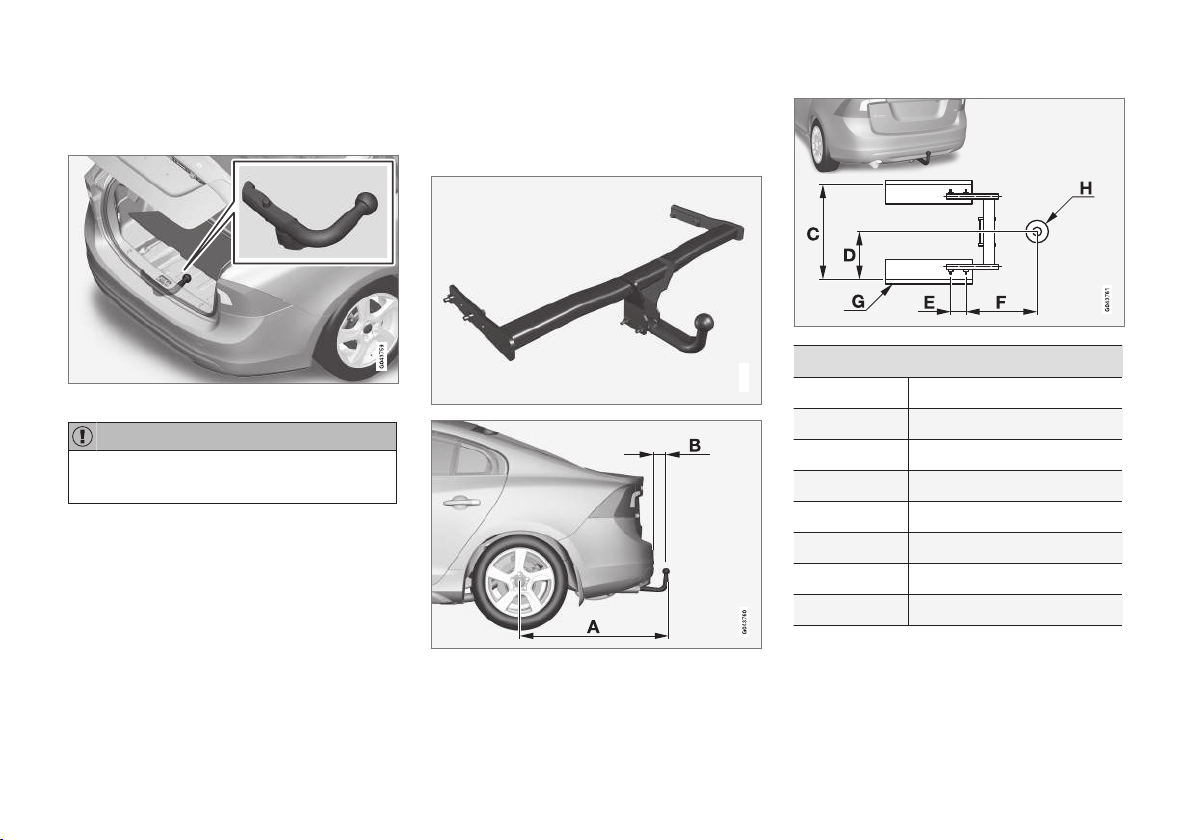
STARTING AND DRIVING
* Option/accessory.
314
Detachable towbar* - storage
Store the detachable towbar in the cargo area.
Towbar storage space.
IMPORTANT
Always remove the towbar after use and store
it in the appointed location in the car.
Related information
•
Detachable towbar* - specifications (p. 314)
•
Detachable towbar* - attachment/removal
(p. 315)
•
Driving with a trailer* (p. 311)
Detachable towbar* - specifications
Specifications for detachable towbar.
Specifications
G021485
Dimensions, mounting points (mm)
A 998
B 81
C 854
D 427
E 109
F 282
G Side member
H Ball centre

STARTING AND DRIVING
}}
* Option/accessory.
315
Related information
•
Detachable towbar* - attachment/removal
(p. 315)
•
Detachable towbar* - storage (p. 314)
•
Driving with a trailer* (p. 311)
Detachable towbar* - attachment/
removal
The attachment/removal of the detachable tow-
bar is performed in the following way:
Attaching
G018928
Remove the protective cover by first pressing
in the catch
and then pulling the cover
straight back
.
G021487
Ensure that the mechanism is in the
unlocked position by turning the key clock-
wise.
G021488
The indicator window must show red.
G021489
Insert the towbar until you hear a click.
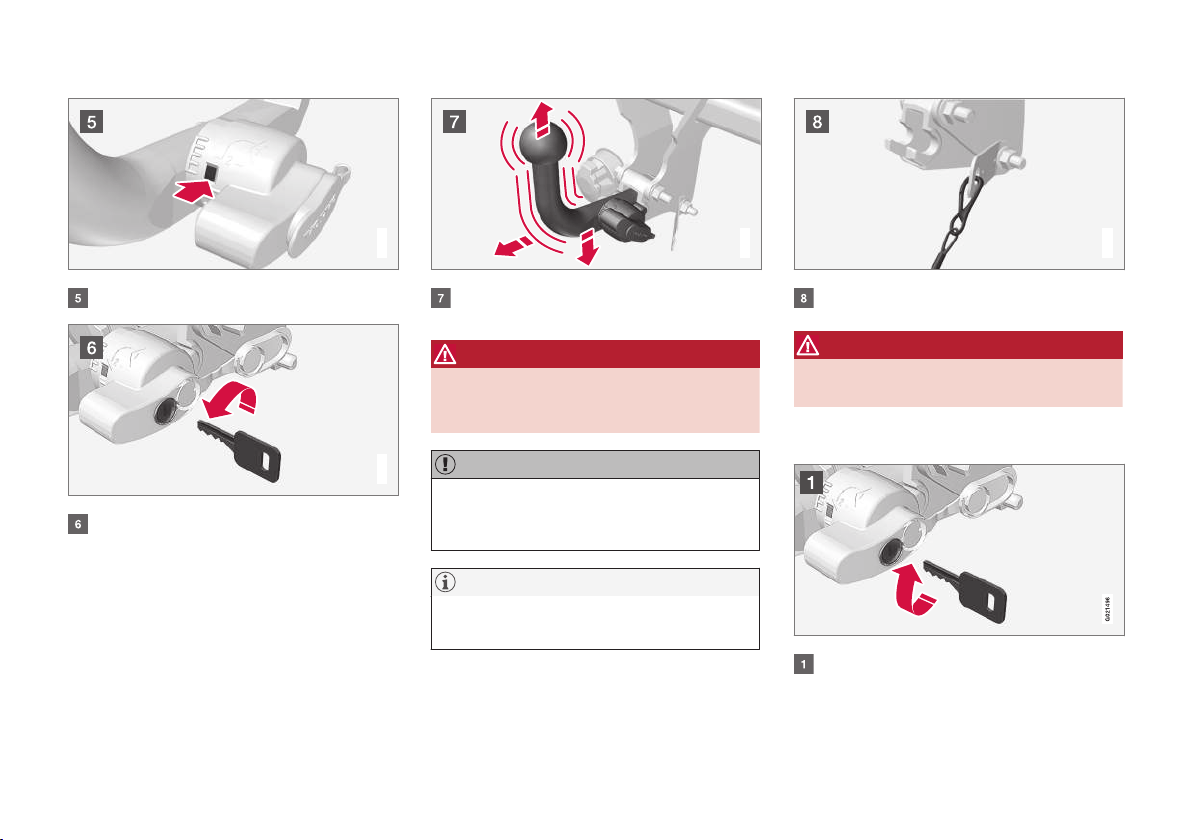
||
STARTING AND DRIVING
316
G021490
The indicator window must show green.
G000000
Turn the key anticlockwise to locked position.
Remove the key from the lock.
G021494
Check that the towbar is secure by pulling it
up, down and back.
WARNING
If the towbar is not fitted correctly then it must
be detached and reattached in accordance
with the previous instructions.
IMPORTANT
Only grease in the ball for the towing hitch,
the remainder of the towbar should be clean
and dry.
NOTE
When a hitch with a vibration damper is used,
the towball must not be lubricated.
G021495
Safety cable.
WARNING
Take care to secure the trailer's safety cable
in the intended bracket.
Removing the towbar
Insert the key and turn it clockwise to the
unlocked position.
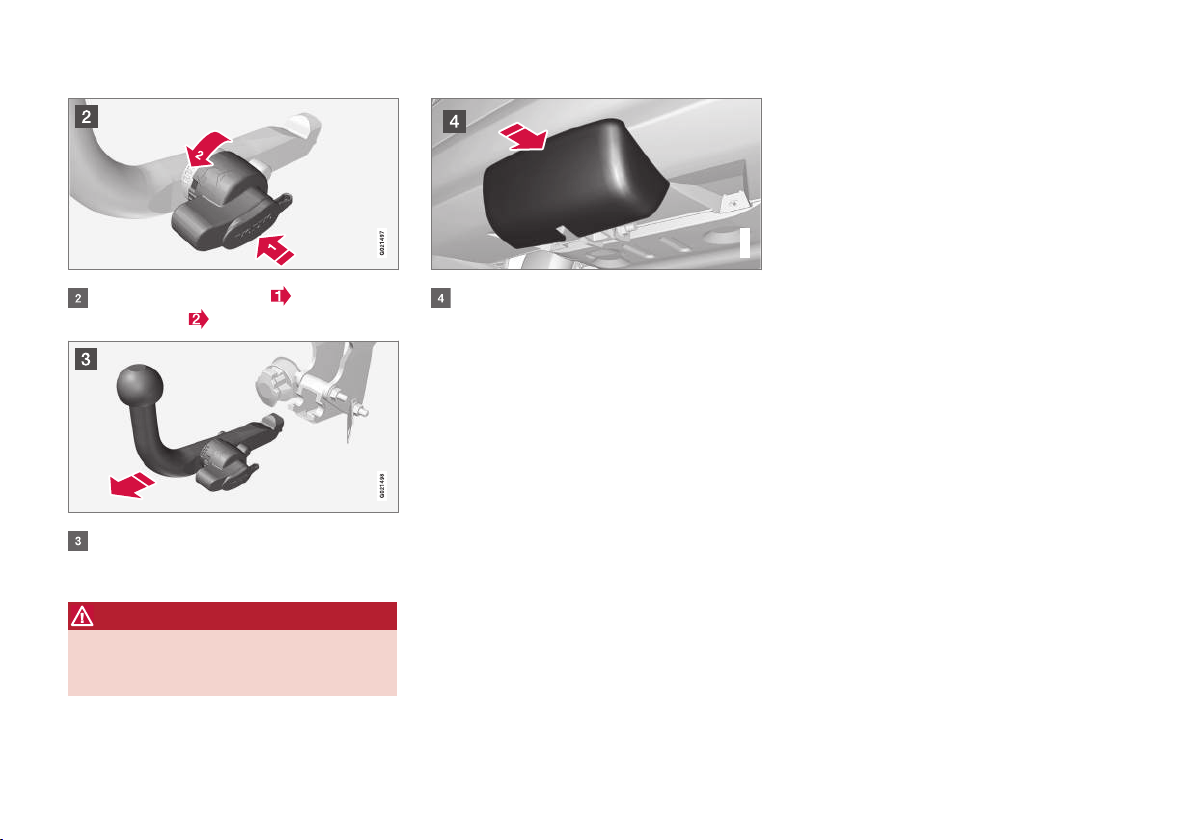
STARTING AND DRIVING
}}
* Option/accessory.
317
Push in the locking wheel and turn it
anticlockwise
until you hear a click.
Turn the locking wheel down fully, until it
comes to a stop. Hold it in this position while
pulling the towbar rearward and upward.
WARNING
Secure the towbar safely if it is stored in the
car, see Detachable towbar* - storage
(p. 314).
G018929
Push the protective cover until it snaps tight.
Related information
•
Detachable towbar* - storage (p. 314)
•
Detachable towbar* - specifications (p. 314)
•
Driving with a trailer* (p. 311)
Trailer Stability Assist - TSA
22
The trailer stability assist TSA (Trailer Stability
Assist) function is designed to stabilise the car
and trailer combination if it begins to snake.
TSA- the function is included in the stability sys-
tem (p. 182) ESC
23
.
Function
The snaking phenomenon can occur with any
car/trailer combination. Snaking normally occurs
at high speeds. But, there is a risk of it occurring
at lower speeds if the trailer is overloaded or the
load is improperly distributed, e.g. too far back.
In order for snaking to occur, there must be a
triggering factor, e.g.:
•
Car with trailer subjected to a sudden and
powerful side wind.
•
Car with trailer drives on an uneven road sur-
face or in a pothole.
•
Sweeping steering wheel movements.
Operation
If snaking has started, it could be difficult or even
impossible to suppress. This makes the car/
trailer combination difficult to control and there is
a risk that you could, for example, end up in the
wrong lane or leave the carriageway.
The trailer stability assist function continually
monitors car movements, particularly lateral
movements. If snaking is detected, the front
||
STARTING AND DRIVING
318
wheels are individually braked. This serves to sta-
bilise the car/trailer combination. This is often
enough to help the driver regain control of the
car.
If snaking is not eliminated the first time the TSA
system comes into action, the car/trailer combi-
nation is braked with all wheels and engine
power is reduced. Once snaking has been gradu-
ally suppressed and the car/trailer combination is
stable once again, the system stops regulating
and the driver once again has full control of the
car. For more information, see Electronic stability
control (ESC) - operation (p. 183).
Miscellaneous
Engagement of TSA may take place at higher
speeds.
NOTE
TSA function is switched off if the driver
selects
Sport mode, see Electronic stability
control (ESC) - general (p. 182).
TSA may fail to engage if the driver uses sudden
steering wheel movements to try to rectify the
snaking because, in such a situation, the system
cannot determine whether it is the trailer or the
driver that is causing the snaking.
The ESC
23
symbol in the combined
instrument panel flashes when the TSA
system is working.
Related information
•
Electronic stability control (ESC) - general
(p. 182)
Towing
During towing, one vehicle is towed by another
vehicle using a tow rope.
Find out the statutory maximum speed limit for
towing before the towing begins.
1. Activate the car's hazard warning flashers.
2. Attach the tow rope in the towing eye.
3. Unlock the steering lock by inserting the
remote control key in the ignition switch and
giving a long press on the START/STOP
ENGINE button - key position II is activated,
see Key positions (p. 77) for more informa-
tion about key positions.
4. The remote control key must remain in the
ignition switch while the car is being towed.
5. Keep the towline taut when the towing vehi-
cle reduces speed by holding your foot gen-
tly pressed on the brake pedal - thereby
avoiding unnecessary jerking.
6. Be prepared to brake to stop.
22
Included in the installation of Volvo genuine towbar.
23
(Electronic Stability Control) - Electronic stability control.
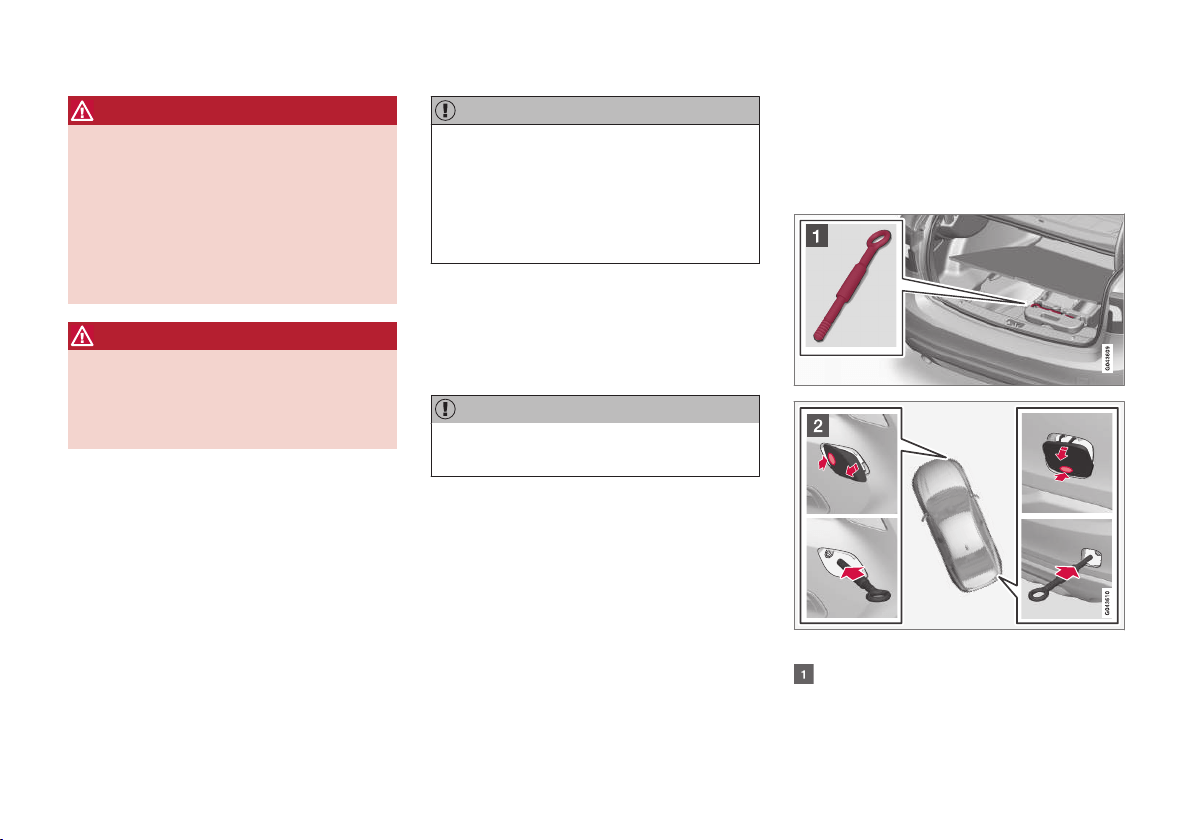
STARTING AND DRIVING
}}
319
WARNING
•
Check that the steering lock is unlocked
before towing.
•
The remote control key must be in key
position II - in position I all airbags are
deactivated.
•
Never remove the remote control key
from the ignition switch when the car is
being towed.
WARNING
The brake servo and power steering do not
work when the engine is switched off - the
brake pedal needs to be depressed
about 5 times more heavily and the steering is
considerably heavier than normal.
Manual gearbox
Prior to towing:
–
Move gear lever into neutral and release the
parking brake.
Automatic gearbox Geartronic
Prior to towing:
–
Move the gear selector to position N and
release the parking brake.
IMPORTANT
Note that the car must always be towed with
the wheels rolling forward.
•
Do not tow cars with automatic transmis-
sion at speeds higher than 80 km/h
(50 mph) or for distances in excess of 80
km.
Jump starting
Do not tow the car to bump start the engine. Use
a donor battery if the starter battery is discharged
and the engine does not start, see Jump starting
with another battery (p. 275).
IMPORTANT
The catalytic converter may be damaged dur-
ing attempts to tow-start the engine.
Related information
•
Hazard warning flashers (p. 93)
•
Towing eye (p. 319)
•
Recovery (p. 320)
Towing eye
The towing eye is screwed into a threaded
socket behind a cover on the right-hand side of
the bumper, front or rear.
Attaching the towing eye
Remove the front and rear covers.
Take out the towing eye that is located under
the floor hatch in the cargo area.
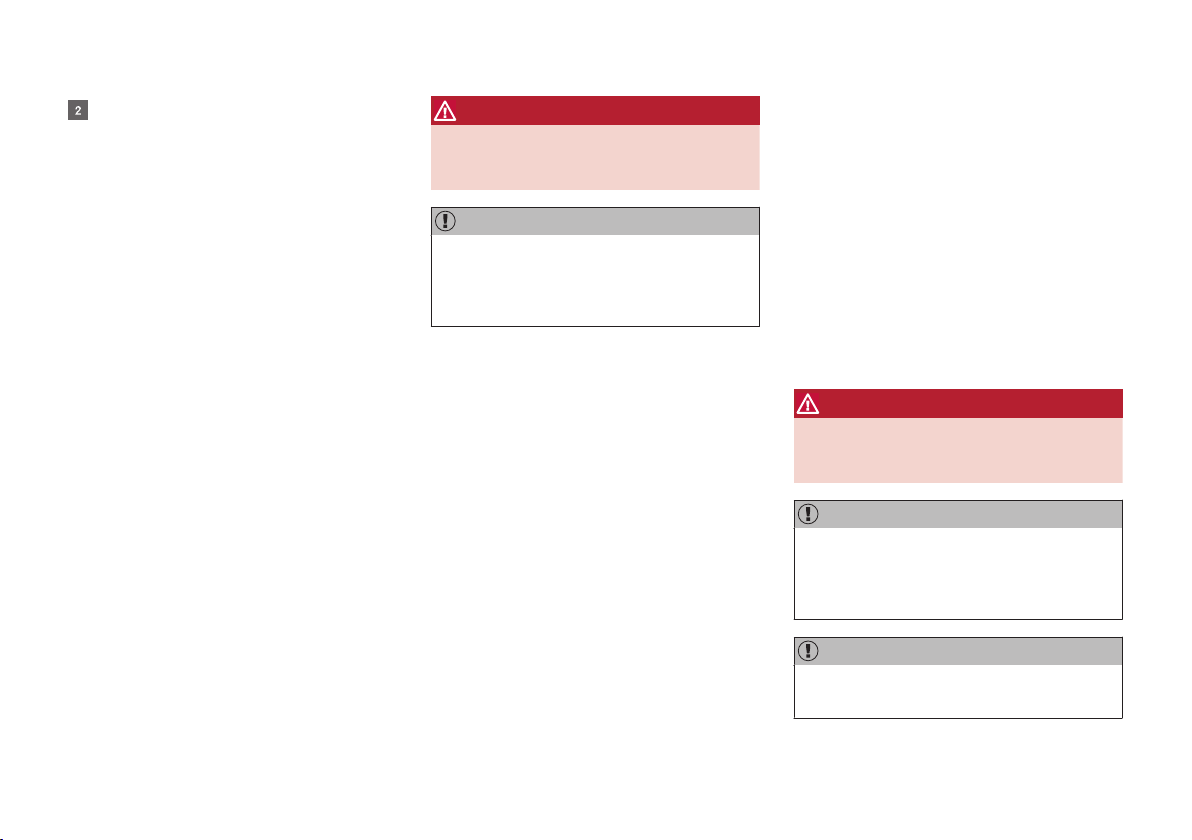
||
STARTING AND DRIVING
320
The cover for the towing eye's attachment
point is available in two variants which must
be opened in different ways:
•
Open the variant with a recess using a
coin or similar inserted in the recess, turn-
ing it outwards. Then turn out the cover
completely and remove it.
•
The second variant has a marking along
one side or in a corner: Press the marking
with a finger and fold out the opposite
side/corner at the same time using a coin
or similar - the cover turns around its axis
and can then be removed.
Screw the towing eye right in up to its flange.
Turn in the towing eye firmly e.g. using the
wheel wrench.
After use, unscrew the towing eye and return
it to its place.
Finish by refitting the cover onto the bumper.
The towing eye may be used to pull the car up
onto a recovery vehicle with a flatbed platform.
The car's position and ground clearance deter-
mine whether it is possible. If the slope of the
recovery vehicle's ramp is too steep, or if the
ground clearance under the car is inadequate,
then the car may be damaged if you try to pull it
up using the towing eye. Raise the car using the
recovery vehicle's lifting device if necessary.
WARNING
No one/nothing is allowed to remain behind
the recovery vehicle while the car pulled up
onto the flatbed platform.
IMPORTANT
The towing eye is only designed for towing on
roads - not for pulling the car unstuck or out
of a ditch. Call a recovery service for recovery
assistance.
Related information
•
Towing (p. 318)
•
Recovery (p. 320)
Recovery
Recovery means that the vehicle is transported
away by means of another vehicle.
Call a recovery service for recovery assistance.
The towing eye may be used to pull the car up
onto a recovery vehicle with a flatbed platform.
The car's position and ground clearance deter-
mine whether it is possible. If the slope of the
recovery vehicle's ramp is too steep, or if the
ground clearance under the car is inadequate,
then the car may be damaged if you try to pull it
up using the towing eye. Raise the car using the
recovery vehicle's lifting device if necessary.
WARNING
No one/nothing is allowed to remain behind
the recovery vehicle while the car pulled up
onto the flatbed platform.
IMPORTANT
The towing eye is only designed for towing on
roads - not for pulling the car unstuck or out
of a ditch. Call a recovery service for recovery
assistance.
IMPORTANT
Note that the car must always be transported
with the wheels rolling forward.



WHEELS AND TYRES
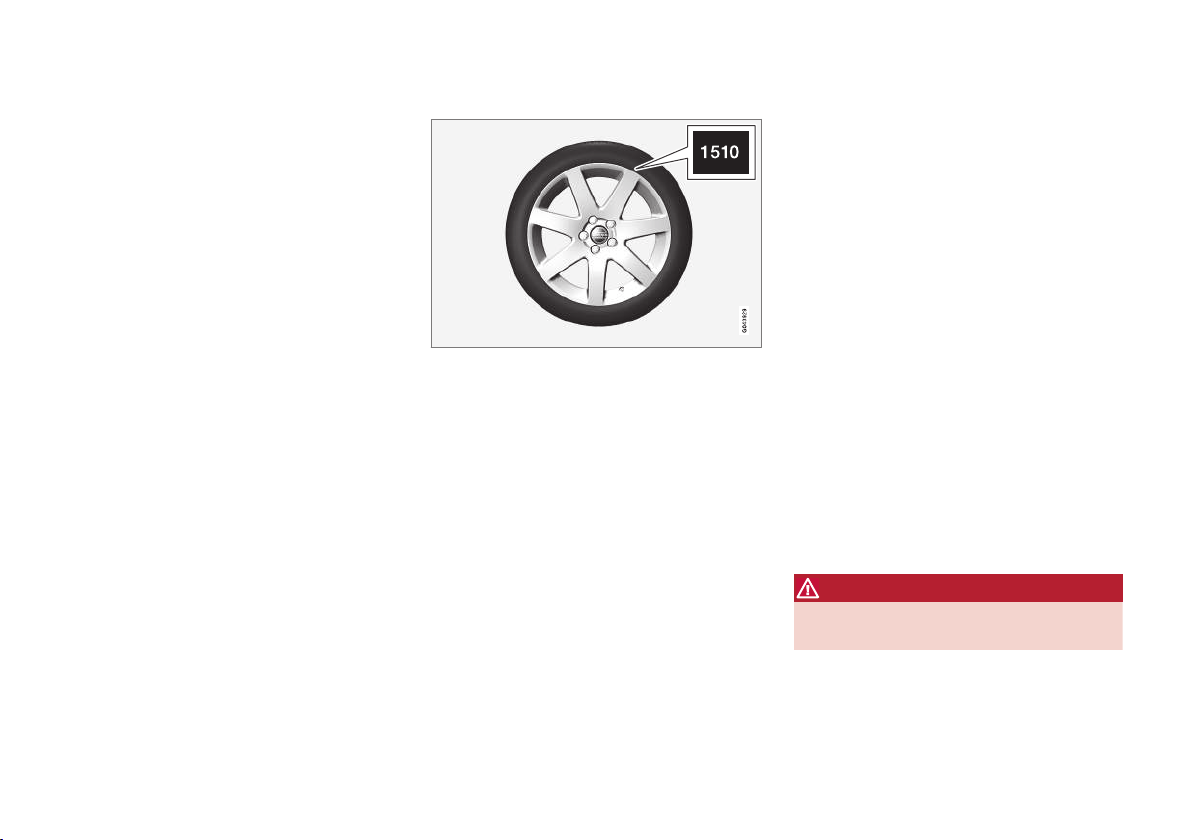
WHEELS AND TYRES
324
Tyres - maintenance
Amongst other things, the function of the tyres is
to carry load, provide grip on the road surface,
dampen vibration and protect the wheel from
wear.
Driving characteristics
Tyres greatly affect the car's driving characteris-
tics. The type of tyre, dimensions, tyre pressure
and speed rating are important for how the car
performs.
Tyre age
All tyres older than 6 years old should be
checked by an expert even if they seem undam-
aged. Tyres age and decompose, even if they are
hardly ever or never used. The function can
therefore be affected. This applies to all tyres that
are stored for future use. Examples of external
signs which indicate that the tyre is unsuitable for
use are cracks or discoloration.
New tyres
Tyres are perishable. After a few years they begin
to harden at the same time as the friction
capacity/characteristics gradually deteriorate. For
this reason, aim to get as fresh tyres as possible
when you replace them. This is especially impor-
tant with regard to winter tyres. The last four dig-
its in the sequence mean the week and year of
manufacture. This is the tyre's DOT marking
(Department of Transportation), and this is stated
with four digits, for example 1510. The tyre in the
figure was manufactured in week 15 of 2010.
Summer and winter wheels
When summer and winter wheels are changed
the wheels should be marked with which side of
the car they were mounted on, for example L for
left and R for right.
Wear and maintenance
Correct tyre pressure (p. 326) results in more
even wear. Driving style, tyre pressure, climate
and road condition affect how quickly your tyres
age and wear.
To avoid differences in tread depth and to pre-
vent wear patterns arising, the front and rear
wheels can be switched with each other. A suita-
ble distance for the first change is approx.
5000 km and then at 10000 km intervals.
Volvo recommends that an authorised Volvo
workshop is contacted for checking if you are
uncertain about tread depth. If significant differ-
ences in wear (> 1 mm difference in tread depth)
between tyres have already occurred, then the
least worn tyres must always be fitted on the rear.
Understeer is normally easier to correct than
oversteer, and leads to the car continuing for-
wards in a straight line rather than having the
rear end skidding to one side, resulting in possi-
ble complete loss of control over the car. This is
why it is important for the rear wheels never to
lose grip before the front wheels.
WARNING
A damaged tyre may lead to loss of control
over the car.
Storage
Wheels with tyres fitted must be stored lying
down or hanging up - never standing up.
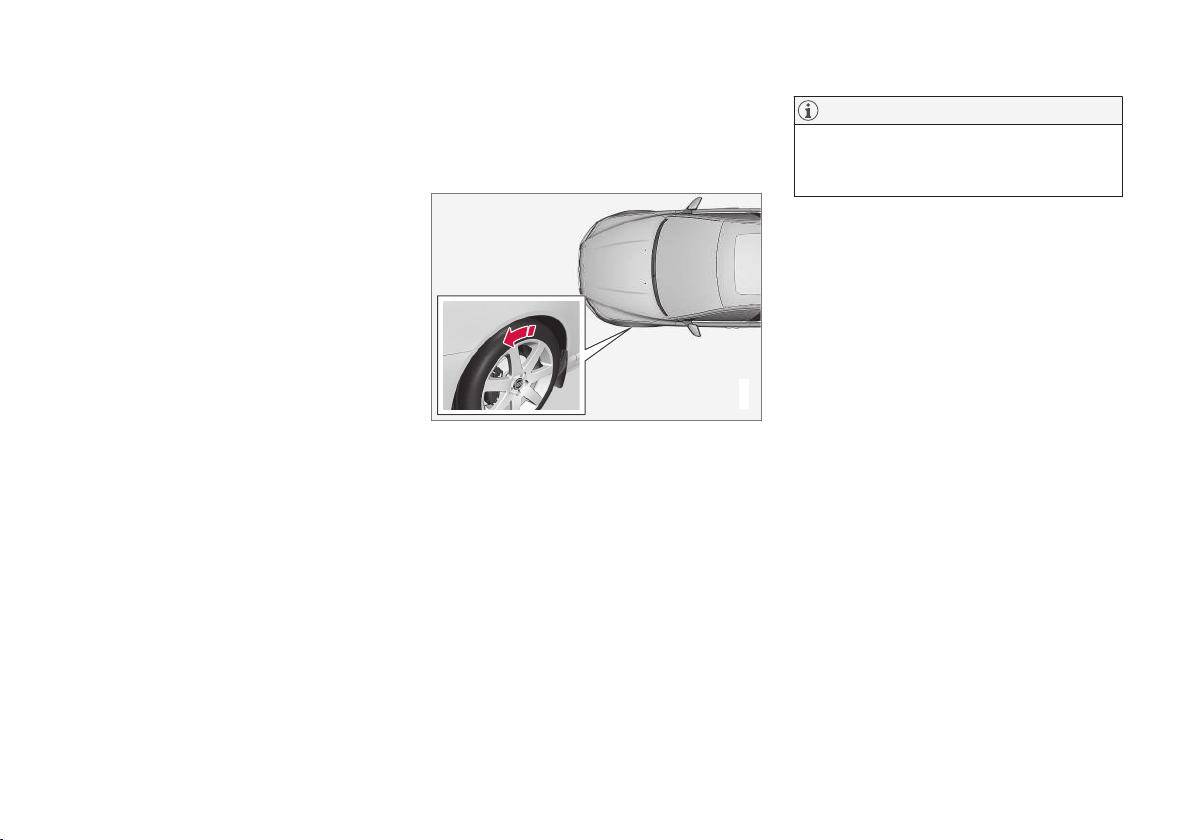
WHEELS AND TYRES
325
Related information
•
Tyres - dimensions (p. 328)
•
Tyres - speed ratings (p. 329)
•
Tyres - load index (p. 329)
•
Tyres - direction of rotation (p. 325)
•
Tyres - tread wear indicators (p. 326)
Tyres - direction of rotation
Tyres with a tread pattern which are designed to
only turn in one direction have the direction of
rotation marked with an arrow.
G021778
The arrow shows the tyre's direction of rotation.
The tyre must always rotate in the same direction
throughout its lifespan. Tyres should only be
switched between front and rear positions, never
between left and right-hand sides, or vice versa. If
the tyres are fitted incorrectly, the car's braking
characteristics and capacity to force rain and
slush out of the way are adversely affected. Tyres
with the greatest tread depth should always be
fitted to the rear of the car (to decrease the risk
of skidding).
NOTE
Make sure that both pairs of wheels have the
same type and dimension, and also the same
make.
Follow the recommended tyre pressures speci-
fied in the tyre pressure table (p. 421).
Related information
•
Tyres - dimensions (p. 328)
•
Tyres - speed ratings (p. 329)
•
Tyres - load index (p. 329)
•
Tyres - maintenance (p. 324)
•
Tyres - tread wear indicators (p. 326)
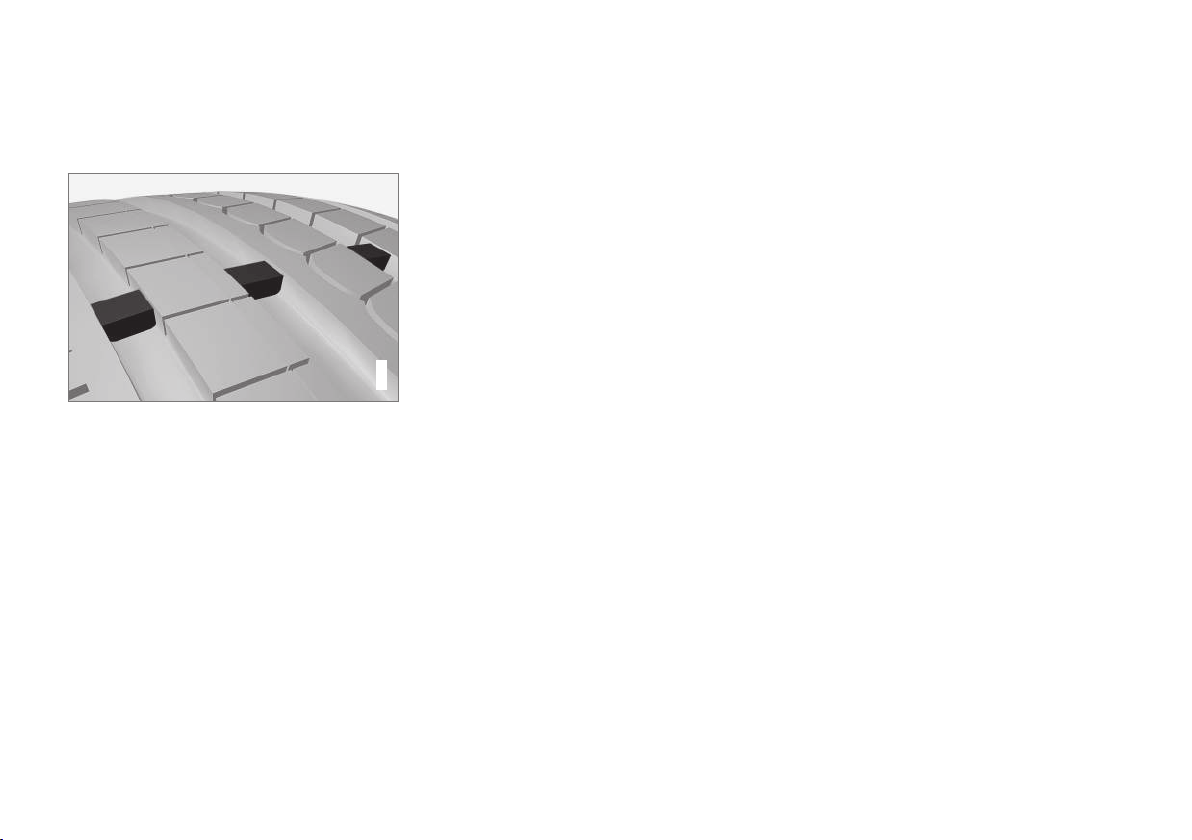
WHEELS AND TYRES
326
Tyres - tread wear indicators
Tread wear indicators show the status of the
tyre's tread depth.
G021829
Tread wear indicators.
A tread wear indicators is a narrow elevation
across the longitudinal grooves of the tyre's tread
pattern. On the side of the tyre are the letters
TWI (Tread Wear Indicator). When the tyre's tread
depth is down to 1.6 mm, the tread will be level in
height with the tread wear indicators. Change to
new tyres as soon as possible. Remember that
tyres with little tread depth provide very poor grip
in rain and snow.
Related information
•
Tyres - dimensions (p. 328)
•
Tyres - speed ratings (p. 329)
•
Tyres - load index (p. 329)
•
Tyres - direction of rotation (p. 325)
•
Tyres - maintenance (p. 324)
Tyres - air pressure
Tyres can have different air pressures which are
measured in bar.
Check the air pressure in the tyres
The tyre pressures must be checked every
month.
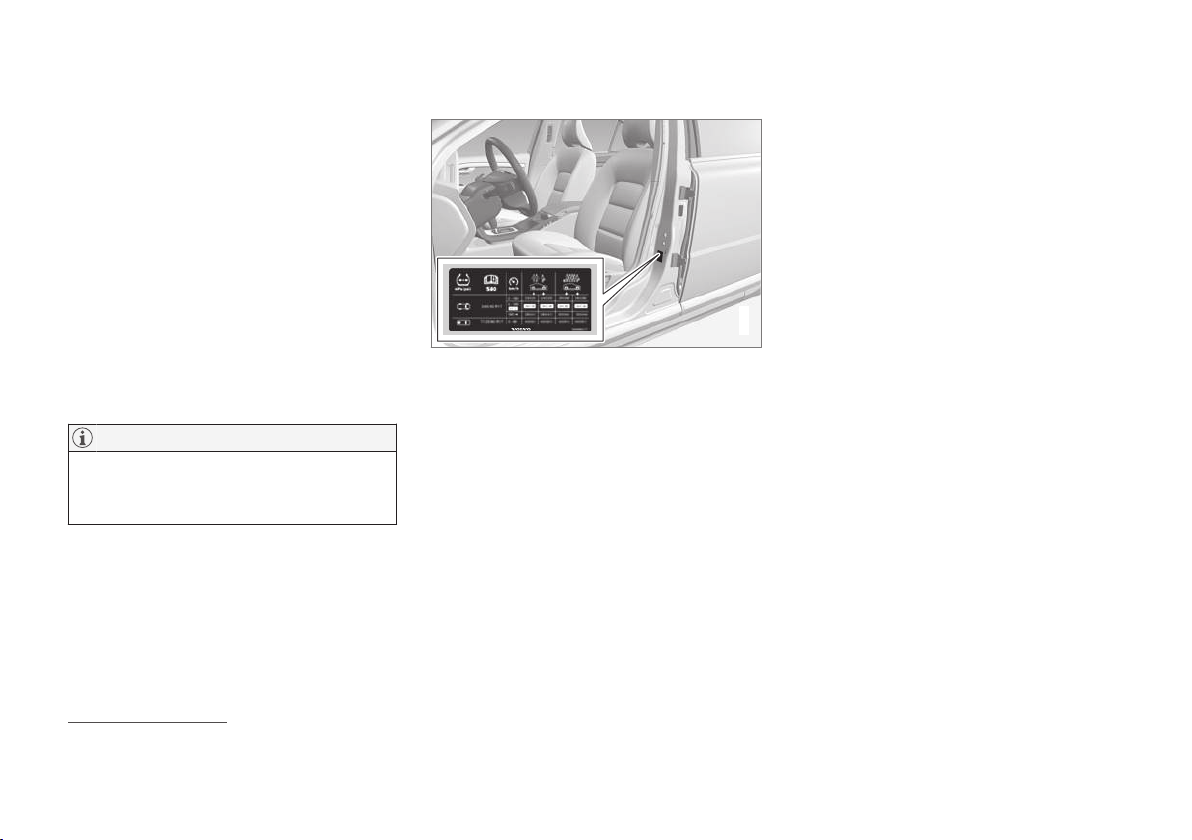
WHEELS AND TYRES
327
•
Tyre pressure for the car's recommended
tyre dimension.
•
ECO pressure
1
.
Check the tyre pressure on cold tyres. "Cold
tyres" means the tyres are the same temperature
as the ambient temperature. After several few kil-
ometres of driving, the tyres warm up and the
pressure increases.
Inadequate tyre pressure increases fuel con-
sumption, shortens tyre lifespan and impairs the
car's driving characteristics. Driving on tyres with
tyre pressure that is too low could result in the
tyres overheating and being damaged. Tyre pres-
sure affects travelling comfort, road noise and
driving characteristics.
NOTE
Tyre pressure decreases over time, this is a
natural phenomenon. Tyre pressure also var-
ies depending on ambient temperature.
Tyre pressure label
G021830
The tyre pressure label on the driver's side door
pillar (between frame and rear door) shows which
pressures the tyres should have at different loads
and speed conditions. This is also specified in the
tyre pressure table, see Tyres - approved tyre
pressures (p. 421).
Fuel economy, ECO pressure
When carrying a light load (max. 3 people) and at
speeds of up to 160 km/h (100 mph), the ECO
pressure can be selected to give the best possi-
ble fuel economy. If the best possible noise and
travelling comfort conditions are sought, the
lower comfort pressures are recommended
instead.
(See approved tyre pressures(p. 421).)
Related information
•
Tyres - dimensions (p. 328)
•
Tyres - speed ratings (p. 329)
•
Tyres - load index (p. 329)
•
Tyres - maintenance (p. 324)
•
Tyres - tread wear indicators (p. 326)
•
Tyres - approved tyre pressures (p. 421)
1
ECO pressure results in improved fuel economy.

WHEELS AND TYRES
328
Wheel and wheel rim dimensions
Wheel and rim dimensions are designated in
accordance with the examples in the table
below.
The car has an approval for the complete vehicle.
This means that certain combinations of wheel
(wheel rim) and tyre are approved.
Wheels (rims) have a designation of dimensions,
for example: 7Jx16x50.
7 Rim width in inches
J Rim flange profile
16 Rim diameter in inches
50 Off-set in mm (distance from wheel cen-
tre to wheel contact surface against the
hub)
Related information
•
Tyres - dimensions (p. 328)
•
Tyres - approved tyre pressures (p. 421)
•
Wheels and tyres - approved dimensions
(p. 419)
Tyres - dimensions
The car's tyres have a certain dimension, see the
examples in the table below.
The dimensions are stated on all car tyres.
Example of designation: 215/55R16 97W.
215 Tyre width (mm)
55 Ratio between tyre wall height and tyre
width (%)
R Radial ply
16 Rim diameter in inches (")
97 Codes for the maximum permitted tyre
load, tyre load index (LI)
W Speed rating for maximum permitted
speed, speed rating (SS). (In this case
270 km/h (168 mph).)
The car has an approval for the complete vehicle
with certain combinations of wheel rims and
tyres.
Related information
•
Tyres - speed ratings (p. 329)
•
Tyres - load index (p. 329)
•
Tyres - direction of rotation (p. 325)
•
Tyres - maintenance (p. 324)
•
Tyres - approved tyre pressures (p. 421)
•
Wheel and wheel rim dimensions (p. 328)
•
Wheels and tyres - approved dimensions
(p. 419)
•
Load index and speed rating (p. 420)
WHEELS AND TYRES
329
Tyres - load index
Load index indicates a tyre's ability to carry a
certain load.
Each tyre has a certain capacity to carry a load, a
load index (LI). The car's weight determines the
load capacity required of the tyres. Lowest per-
missible index is specified in the tyre load index
table, see section "Specifications" in the printed
owner's manual.
Related information
•
Tyres - dimensions (p. 328)
•
Tyres - approved tyre pressures (p. 421)
•
Tyres - speed ratings (p. 329)
•
Tyres - maintenance (p. 324)
•
Wheels and tyres - approved dimensions
(p. 419)
Tyres - speed ratings
Each tyre can withstand a certain maximum
speed and therefore belongs to a particular
speed rating (SS - Speed Symbol).
Tyre speed class must at least correspond with
the car's top speed. The table below indicates the
maximum permitted speed that applies for each
speed rating (SS). The only exception to these
regulations is the winter tyre (p. 330)
2
, where a
lower speed rating may be used. If such a tyre is
chosen, the car must not be driven faster than
the speed rating of the tyre (for example, class Q
can be driven at a maximum of 160 km/h
(100 mph)). Traffic regulations determine how
fast a car can be driven, not the speed rating of
the tyres.
NOTE
The maximum permitted speed is specified in
the table.
Q 160 km/h (100 mph) (only used on win-
ter tyres)
T 190 km/h (118 mph)
H 210 km/h (130 mph)
V 240 km/h (149 mph)
W 270 km/h (168 mph)
Y 300 km/h (186 mph)
WARNING
The car must be fitted with tyres which have
the same or a higher load index (p. 329) (LI)
and speed rating (SS) than specified. If a tyre
with too low a load index or speed rating is
used, it may overheat.
Related information
•
Tyres - dimensions (p. 328)
•
Tyres - load index (p. 329)
•
Tyres - direction of rotation (p. 325)
2
Both those with metal studs and those without.
WHEELS AND TYRES
* Option/accessory.
330
Wheel bolts
Wheel bolts are used to fasten the wheels at the
hubs and are available in different versions.
IMPORTANT
The wheel bolts must be tightened to
140 Nm (103 ft. lbs.). Overtightening or loose
tightening may damage the nuts and the
bolts.
Only use rims that are tested and approved by
Volvo and which are Volvo genuine accessories.
Check the torque with a torque wrench.
Do not use lubricant on the threads of the wheel
bolts.
Locking wheel bolts*
Locking wheel bolts* can be used on both alumi-
nium and steel rims. Under the cargo area floor
there is space for the sleeve for the lockable
wheel bolts.
Related information
•
Wheel and wheel rim dimensions (p. 328)
Winter tyres
Winter tyres are tyres that are adapted for winter
road conditions.
Winter tyres
Volvo recommends winter tyres with particular
dimensions. Tyre dimensions are dependent on
engine variant. When driving on winter tyres, the
correct type of tyres must be fitted to all four
wheels.
NOTE
Volvo recommends that you consult a Volvo
dealer about which wheel rim and tyre types
are most suitable.
Studded tyres
Studded winter tyres should be run in gently for
500-1000 km so the studs settle properly into
the tyres. This gives the tyre, and especially the
studs, a longer service life.
NOTE
The legal provisions for the use of studded
tyres vary from country to country.
Tread depth
Road conditions with ice, slush and low tempera-
tures place considerably higher demands on tyres
than summer conditions. Volvo therefore recom-
mends not to drive on winter tyres that have a
tread depth of less than 4 mm.
Using snow chains
Snow chains may only be used on the front
wheels (also applies to all-wheel drive cars).
Never drive faster than 50 km/h (31 mph) with
snow chains. Avoid driving on bare ground as this
wears out both the snow chains and tyres.
WARNING
Use Volvo genuine snow chains or equivalent
chains designed for the car model, and tyre
and rim dimensions. In the event of uncer-
tainty Volvo recommends that you consult an
authorised Volvo workshop. The wrong snow
chains may cause serious damage to your car
and lead to an accident.
Related information
•
Changing wheels - removing wheels (p. 331)

WHEELS AND TYRES
}}
* Option/accessory.
331
Changing wheels - removing wheels
The car's wheels can be changed for e.g. winter
wheels/winter tyres.
Spare wheel*
Two different versions of the spare wheel can be
supplied, in a bag or beneath the cargo floor.
The following instructions only apply if a
spare wheel has been purchased as an
accessory for the car. If the car is not equipped
with a spare wheel - see information about Emer-
gency puncture repair (TMK) (p. 339).
The spare wheel (Temporary spare) is only
intended for use temporarily and must be
replaced by an ordinary wheel as soon as possi-
ble. The car's handling may be altered by the use
of the spare wheel. The spare wheel is smaller
than the normal wheel. The car's ground clear-
ance is affected accordingly. Pay attention to
high kerbs and do not machine wash the car. If
the spare wheel is fitted on the front axle, you
cannot use snow chains at the same time. On all-
wheel drive cars the drive on the rear axle can be
disconnected. The spare wheel must not be
repaired.
The correct tyre pressure for the spare wheel is
stated in the tyre pressure table (p. 421).
IMPORTANT
•
Never drive faster than 80 km/h
(50 mph) with a spare wheel on the car.
•
The car must never be driven fitted with
more than one "Temporary Spare" wheel.
The spare wheel is located in the spare wheel
well with the outside down. The same bolt runs
through to secure the spare wheel and the foam
block. The foam block contains all the tools nee-
ded to change the wheels.
The spare wheel is supplied in a bag and must be
secured on the cargo area floor using straps.
Cars with two load retaining eyelets.
Turn the handle on the spare wheel bag in
towards the rear seat. Attach the sewn-in ten-
sioning strap hooks in the load retaining eyelets.
Attach the long strap into one of the load retain-
ing eyelets, run the strap around the spare wheel
and through the lower handle. Tighten the short
tensioning strap onto the long one. Attach the
second load retaining eyelet and tighten.
Taking out the spare wheel under the
cargo area floor
1. Fold up the cargo area floor.
2. Undo the retaining screw.
3. Lift out the foam block with its tools.
4. Lift out the spare wheel.
Taking out the spare wheel in the bag
1. Loosen the straps, lift out the spare wheel
from the cargo area and remove it from the
spare wheel bag.
2. Fold up the cargo area floor.
3. Lift the tools and jack out from the foam
block.
Removing
Set up warning triangle (p. 335) if a wheel is
replaced in trafficked location. The car and jack*
must be on a firm horizontal surface.
1. Apply the parking brake, (p. 297) and
engage reverse gear, or position P if the car
has an automatic gearbox.
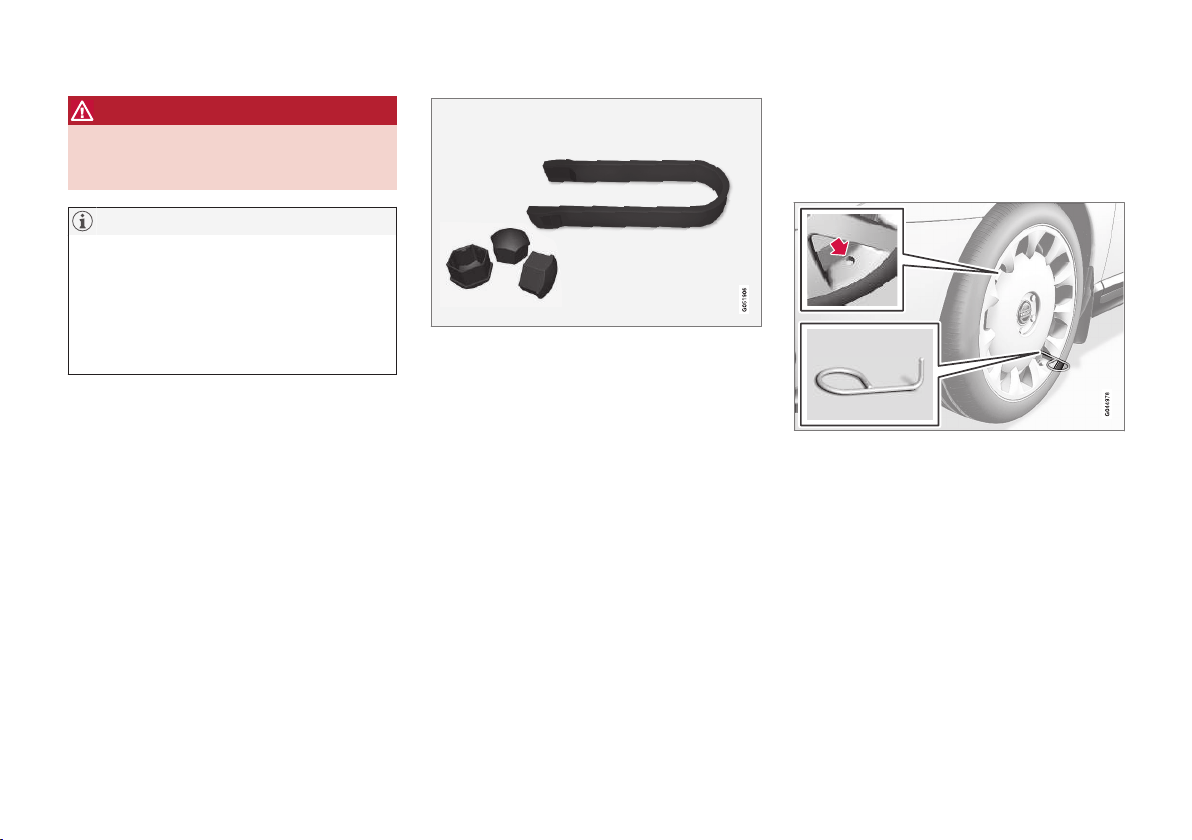
||
WHEELS AND TYRES
* Option/accessory.
332
WARNING
Check that the jack is not damaged, that the
threads are thoroughly lubricated and that it is
free from dirt.
NOTE
Volvo recommends only using the jack* that
belongs to the car model in question, which is
indicated on the jack's label.
The label also indicates the jack's maximum
lift capacity at a specified minimum lifting
height.
2.
Take out the jack*, wheel wrench*, removal
tool for wheel covers* and the plastic wheel
bolt cap removal tool. They will be found in
the foam block. If another jack is selected,
see Raising the car (p. 349).
Tool for removing the plastic caps on the wheel bolts.
3. Place chocks in front of and behind the
wheels which will remain on the ground to
prevent them from rolling. Use heavy wooden
blocks or large stones for example.
4. Cars with steel rims have removable wheel
covers. Use the removal tool to hook in and
pull off any full-wheel wheel covers. Alterna-
tively, the wheel covers can be pulled away by
hand.
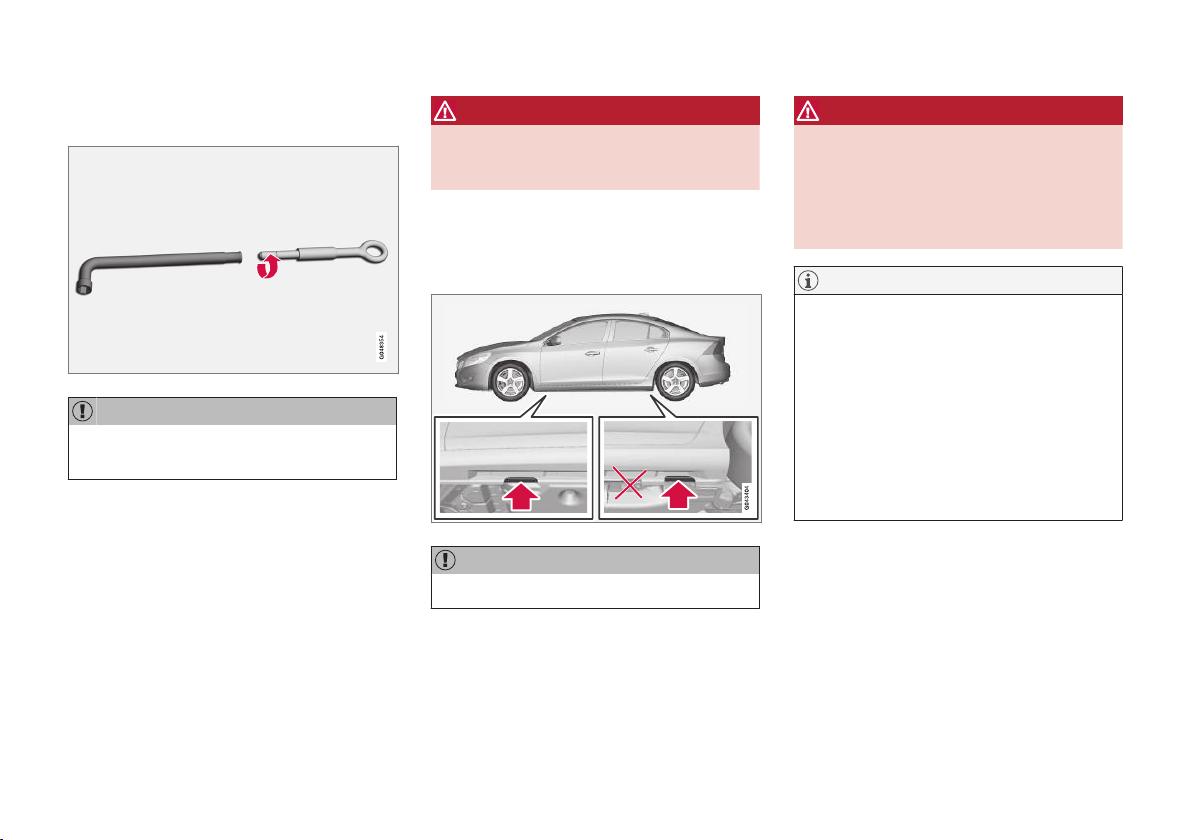
WHEELS AND TYRES
* Option/accessory.
333
5. Screw together the towing eye with the
wheel wrench* to the stop position.
IMPORTANT
The towing eye must be screwed all the way
into the wheel bolt wrench*.
6. Remove the plastic caps from the wheel
bolts with the intended tool.
7. Loosen the wheel bolts ½-1 turn anticlock-
wise with the wheel wrench*.
WARNING
Never position anything between the ground
and the jack, nor between the jack and the
car's jacking point.
8. There are two jacking points on each side of
the car. Wind up the jack* so that the flange
in the bodywork ends up in the notch in the
head of the jack.
IMPORTANT
The ground must be firm, smooth and level.
9. Lift the car so that the wheel is free. Remove
the wheel bolts and lift off the wheel.
WARNING
Never crawl under the car when it is raised on
the jack.
Passengers must leave the car when it is
raised on the jack. If a wheel must be
changed in a trafficked environment, passen-
gers must stand in a safe place.
NOTE
The normal car jack is only designed for occa-
sional, short-term use, such as when chang-
ing a wheel after a puncture, changing to win-
ter/summer wheels, etc. Only the jack for the
specific car model may be used to raise the
car. If the car is to be jacked up more often, or
for a longer time than is required just to
change a wheel, use of a garage jack is rec-
ommended. In this instance, follow the
instructions for use that come with the equip-
ment.
Related information
•
Changing wheels - fitting (p. 334)
•
Jack* (p. 336)
•
Warning triangle (p. 335)
•
Wheel bolts (p. 330)
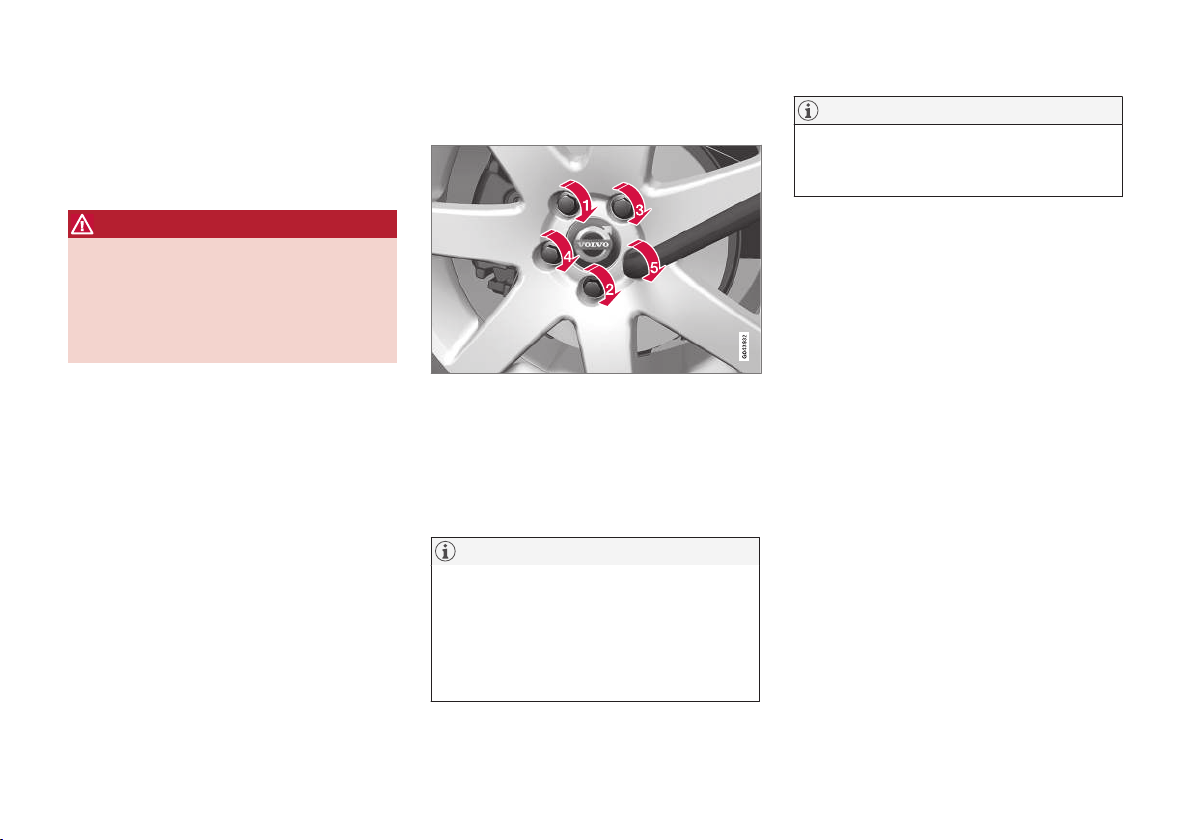
WHEELS AND TYRES
* Option/accessory.
334
Changing wheels - fitting
It is important that the procedure for fitting the
wheel is carried out correctly.
Installation
WARNING
Never crawl under the car when it is raised on
the jack.
Passengers must leave the car when it is
raised on the jack. If a wheel must be
changed in a trafficked environment, passen-
gers must stand in a safe place.
1. Clean the contact surfaces between wheel
and hub.
2. Put on the wheel. Tighten the wheel bolts
thoroughly.
Do not use lubricant on the threads of the
wheel bolts.
3. Lower the car so that the wheels cannot
rotate.
4. Tighten the wheel bolts crosswise. It is
important that the wheel bolts are tightened
properly. Tighten to 140 Nm. Check the tor-
que with a torque wrench.
5. Refit the plastic caps on the wheel bolts.
6. Refit any full wheel covers.
NOTE
•
After a tyre has been inflated, always refit
the dust cap in order to avoid damage to
the valve from gravel, dirt, etc.
•
Only use plastic dust caps. Metal dust
caps can rust and become difficult to
unscrew.
NOTE
The wheel cover outlet for the valve must be
positioned over the valve on the wheel rim
during fitting.
When changing to another tyre
dimension
Contact an authorised Volvo workshop for updat-
ing the software at each change of tyre dimen-
sion. A software download may be necessary
both when changing to larger and smaller dimen-
sions, and also when switching between summer
and winter wheels.
Related information
•
Changing wheels - removing wheels (p. 331)
•
Jack* (p. 336)
•
Warning triangle (p. 335)
•
Wheel bolts (p. 330)
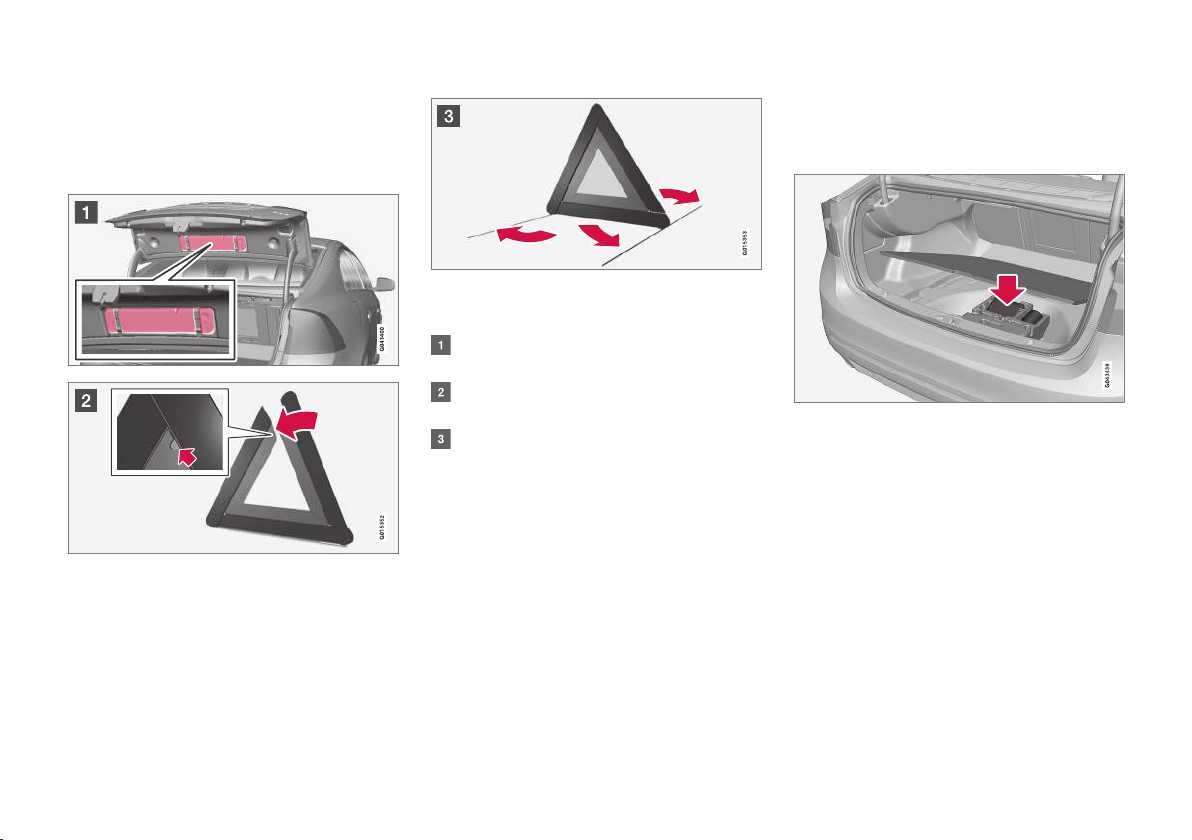
WHEELS AND TYRES
* Option/accessory.
335
Warning triangle
The warning triangle is used to warn other road
users of a stationary vehicle.
Storage and folding up
The warning triangle is fitted on the inside of the
boot lid with two clips.
Detach the warning triangle case by pulling
both of the snap latches outwards.
Take the warning triangle from the case, fold
out and assemble the two loose sides.
Fold out the warning triangle's support legs.
Follow the regulations for the use of a warning
triangle. Position the warning triangle in a suita-
ble place with regard to traffic.
Ensure the warning triangle and its case are
properly secured in the cargo area after use.
Tools
Amongst other things, the car contains towing
eye, jack* and wheel wrench*.
Located under the cargo area floor are the car's
towing eye, jack* and wheel wrench*. There is
also space here for the sleeve for the locking
wheel bolts and tools for the plastic wheel bolt
caps.
Related information
•
Emergency puncture repair (p. 339)
•
Towing eye (p. 319)
•
Changing wheels - removing wheels (p. 331)
•
Wheel bolts (p. 330)
•
Jack* (p. 336)
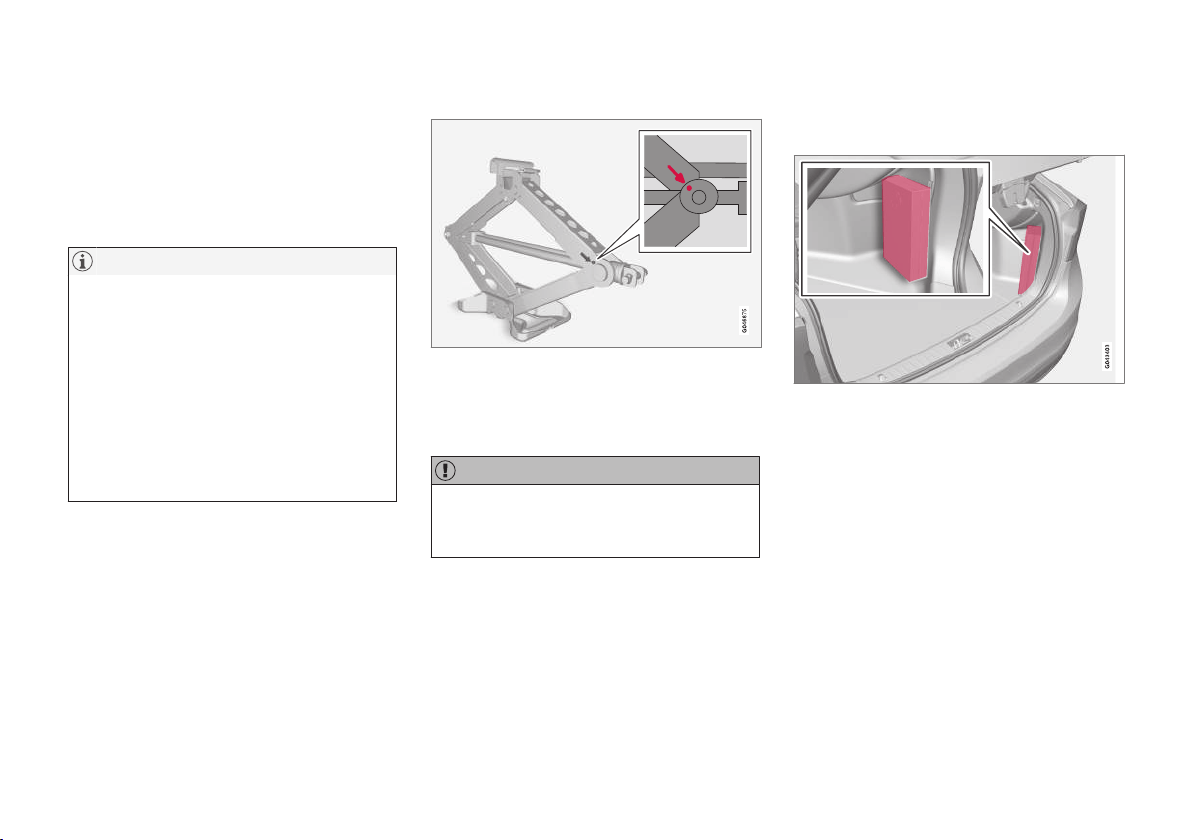
WHEELS AND TYRES
* Option/accessory.
336
Jack*
Use the jack to raise the car when changing a
wheel.
The original jack should only be used for chang-
ing to the spare wheel. The jack's thread must
always be well greased.
NOTE
The normal car jack is only designed for occa-
sional, short-term use, such as when chang-
ing a wheel after a puncture, changing to win-
ter/summer wheels, etc. Only the jack for the
specific car model may be used to raise the
car. If the car is to be jacked up more often, or
for a longer time than is required just to
change a wheel, use of a garage jack is rec-
ommended. In this instance, follow the
instructions for use that come with the equip-
ment.
Tools - returning into place
The tools and jack* must be returned to their cor-
rect places after use. The jack needs to be
cranked together to the correct position in order
to have space.
IMPORTANT
The tools and jack* must be stored in the
intended location in the car's cargo area
when not in use.
Related information
•
Warning triangle (p. 335)
•
Emergency puncture repair (p. 339)
First aid kit*
The first aid box contains first aid equipment.
A case with first aid equipment is located in the
cargo area.

WHEELS AND TYRES
}}
* Option/accessory.
337
Tyre pressure monitoring*
3
The tyre pressure monitoring system warns with
an indicator symbol in the combined instrument
panel when the pressure is too low in one or
more of the car's tyres.
For certain markets the tyre pressure monitoring
is standard in accordance with legal require-
ments. The system does not replace normal tyre
maintenance.
Indicator symbol for tyre pressure monitoring.
Related information
•
Tyre monitoring (TM)* (p. 337)
Tyre monitoring (TM)*
4
The TM (Tyre Monitor) system senses tyre rota-
tion speed in order to determine whether the
tyres have the correct tyre pressure.
System description
If the tyre pressure is too low, the tyre's diameter
is changed and, as a result, so is its rotation
speed. By comparing the tyres with each other
the system can determine whether one or more
tyres have pressure that is too low.
The system does not replace normal tyre mainte-
nance.
Messages
If the tyre pressure is too low then an indicator
symbol (
) illuminates in the combined instru-
ment panel and one of the following messages is
shown:
•
Tyre pressure low Check, adjust and
calibrate
•
Tyre pressure system Service required
•
Tyre pressure system Currently
unavailable
IMPORTANT
If a fault occurs in the TM system the indica-
tor symbol
in the combined instrument
panel will flash for approx. 1 minute and then
illuminate with a constant glow. A message is
also shown in the combined instrument panel.
3
Standard in certain markets.
4
Standard in certain markets.
||
WHEELS AND TYRES
338
Deleting the messages
1. Check the tyre pressure in all tyres with a
tyre pressure gauge.
2. Inflate the tyre/tyres to the correct pressure
in accordance with the tyre pressure label on
the driver's side door pillar (between front
and rear doors).
3.
Recalibrate the TM system in MY CAR.
NOTE
To avoid incorrect tyre pressure, the pressure
should be checked on cold tyres. "Cold tyres"
means the tyres are the same temperature as
the ambient temperature (approx. 3 hours
after the car has been driven). After a few kil-
ometres of driving, the tyres warm up and the
pressure increases.
WARNING
•
Incorrect tyre pressure may lead to tyre
failure, which could result in the driver
losing control of the car.
•
The system cannot indicate sudden tyre
damage in advance.
TM calibration
In order for TM system to work correctly, a refer-
ence value for the tyre pressure must be deter-
mined. This must be done each time the tyres are
changed or the tyre pressure is adjusted by reca-
librating the system in MY CAR.
For example, the tyre pressure should be
adjusted when driving with a heavy load or for
high-speed driving (above 160 km/h (100 mph)).
Following which, the system must be recalibrated.
Recalibration
Settings are made using the centre console's
controls, see MY CAR (p. 109).
1. Stop the engine.
2. Inflate all tyres to the desired pressure in
accordance with the tyre pressure label on
the driver's side door pillar (between front
and rear doors).
Or see the tyre pressure table.
3. Start the engine and let the car stand still.
4.
Open the menu system MY CAR and select
the menu
Tyre monitor.
5.
Select
Start calibration and press OK.
6. Press OK after all tyres have been checked
and adjusted in order to start calibration.
7. Drive the car.
> Calibration is performed when the car is
driven at a speed above 35 km/h
(22 mph). Calibration is interrupted tem-
porarily if the engine is switched off, but is
resumed automatically in the background
when the car is driven again. The system
provides no confirmation when the cali-
bration is complete.
The new reference value applies until steps 1-7
are repeated.
NOTE
Remember that the TM system must be reca-
librated at each tyre change or if the tyre
pressure is adjusted. If new reference values
are not stored then the system cannot func-
tion properly.
NOTE
•
After a tyre has been inflated, always refit
the dust cap in order to avoid damage to
the valve from gravel, dirt, etc.
•
Only use plastic dust caps. Metal dust
caps can rust and become difficult to
unscrew.
WHEELS AND TYRES
339
System and tyre status
The current status of the system and the tyres
can be checked in the centre console's screen.
1.
Open the menu system MY CAR.
2.
Select the
Tyre monitor menu.
> Status for tyre pressures is shown with a
colour code.
The status is colour-coded for each tyre in
accordance with the following:
•
All-green: the system is operating normally
and the tyre pressure in all tyres is slightly
above the recommended level.
•
Yellow wheel: corresponding tyre's pressure
is too low.
•
All wheels yellow: two or more tyres have
pressure that is too low.
•
All wheels grey and the message
Tyre
pressure system Currently unavailable:
the tyre pressure system is temporarily deac-
tivated. It may be necessary to drive the car
for a short time above 35 km/h (22 mph)
before the system becomes active again.
•
All wheels grey and the message
Tyre
pressure system Service required: an
error has occurred in the system. Contact a
Volvo dealer or workshop.
Related information
•
Tyres - air pressure (p. 326)
Emergency puncture repair
The emergency puncture repair kit, Temporary
Mobility Kit (TMK), is used to seal a puncture
and check and adjust the tyre pressure
(p. 421).
The emergency puncture repair kit (p. 340) con-
sists of a compressor and a bottle of sealant. The
sealing works as a temporary repair. The sealing
fluid effectively seals tyres punctured in the tread.
The emergency puncture repair kit has limited
capacity to seal tyres which have punctures in the
wall. Do not seal tyres with the emergency punc-
ture repair kit if they have larger slits, cracks or
similar damage.
NOTE
The emergency puncture repair kit is only
intended for sealing tyres with a puncture in
the tread.
NOTE
The compressor for temporary emergency
puncture repair has been tested and
approved by Volvo.
Related information
•
Emergency puncture repair kit - location
(p. 340)
•
Emergency puncture repair kit - overview
(p. 340)
•
Emergency puncture repair - operation
(p. 341)
•
Tools (p. 335)
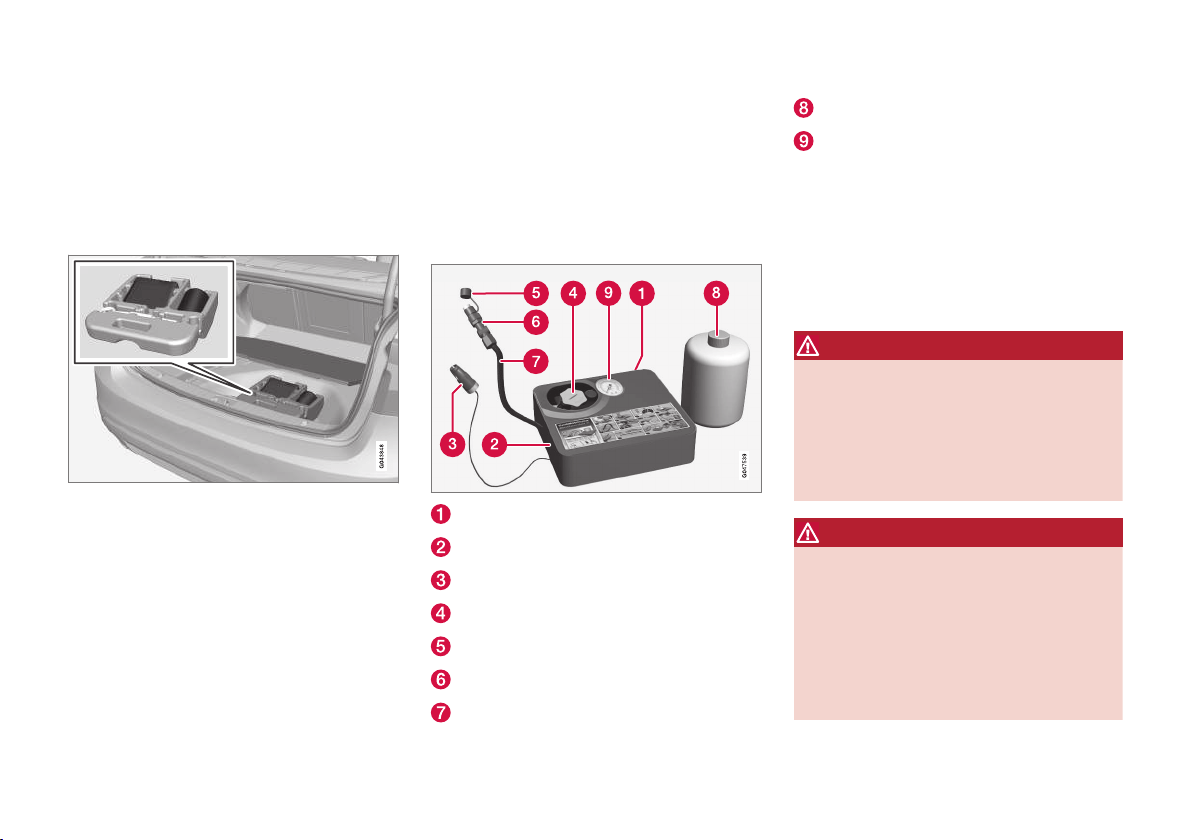
WHEELS AND TYRES
340
Emergency puncture repair kit -
location
The emergency puncture repair kit, Temporary
Mobility Kit (TMK), is used to seal a puncture
and check and adjust the tyre pressure.
Location of the emergency puncture
repair kit
The emergency puncture repair kit is located
under the floor in the cargo area.
Related information
•
Emergency puncture repair kit - overview
(p. 340)
•
Emergency puncture repair (p. 339)
Emergency puncture repair kit -
overview
Overview of the component parts of the emer-
gency puncture repair kit, Temporary Mobility Kit
(TMK).
The parts are stored under the floor in the cargo
area.
Label, maximum permitted speed
Switch
Electrical cable
Bottle holder (orange cap)
Protective cap
Pressure reducing valve
Air hose
Sealing fluid bottle
Pressure gauge
Sealing fluid bottle
Replace the sealing fluid bottle before the expira-
tion date has passed. Treat the old bottle as envi-
ronmentally hazardous waste.
The sealing fluid bottle must be replaced after
use. Volvo recommends that the replacement is
performed by an authorised Volvo workshop.
WARNING
The bottle with sealing fluid contains 1.2-
Ethanol and natural rubber-latex.
Harmful if ingested. Could result in allergic
reaction in the event of skin contact.
Avoid contact with the skin and eyes.
Store out of the reach of children.
WARNING
•
In the event of skin contact with the seal-
ing fluid, it must be washed off immedi-
ately with soap and plenty of water.
•
Sealing fluid that makes contact with an
eye must be rinsed away immediately with
eye wash fluid or with plenty of water. If
the discomfort persists then the eye
should be examined by a doctor.
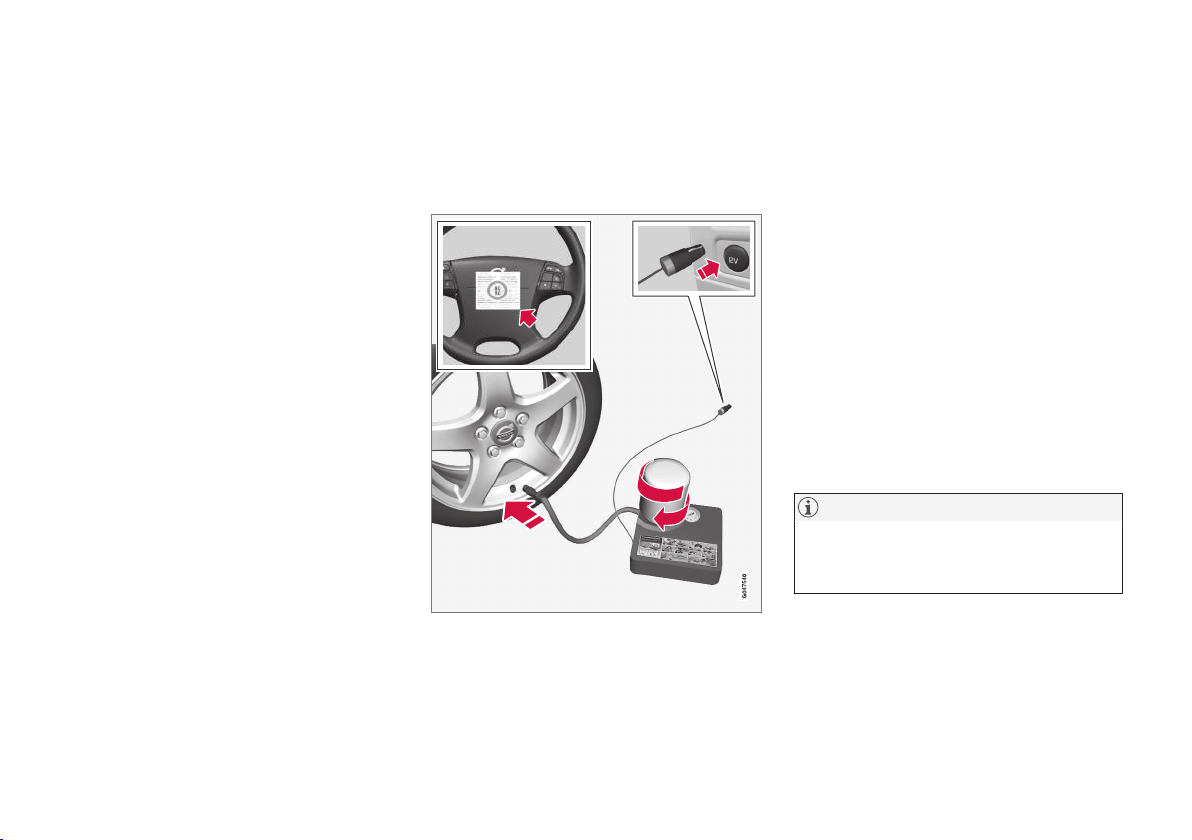
WHEELS AND TYRES
}}
341
Related information
•
Emergency puncture repair kit - location
(p. 340)
•
Emergency puncture repair (p. 339)
Emergency puncture repair -
operation
Sealing a puncture with the emergency puncture
repair kit, Temporary Mobility Kit (TMK).
Emergency puncture repair
For information on the function of the parts, see Emer-
gency puncture repair kit - overview (p. 340).
1. Set up the warning triangle and activate the
hazard warning lights if a tyre is being sealed
in a trafficked location.
If the puncture was caused by a nail or simi-
lar, allow this to remain in the tyre. It helps to
seal the hole.
2. Detach the label for maximum permitted
speed (which is fitted on one side of the
compressor) and affix it to the steering
wheel. You should not drive faster than
80 km/h (50 mph) after the emergency tyre
repair kit has been used.
3.
Check that the switch is in position 0 (Off),
and locate the electrical cable and the air
hose.
4. Unscrew the orange-coloured cap from the
compressor, and unscrew the cork from the
sealing fluid bottle.
NOTE
Do not break the bottle's seal before use. The
seal is broken automatically when the bottle is
screwed in.

||
WHEELS AND TYRES
342
5. Screw in the bottle to the bottom of the bot-
tle holder.
> The bottle and the bottle holder are
equipped with a reverse catch to prevent
sealant leakage. When the bottle is
screwed in it cannot be unscrewed from
the bottle holder again. Bottle removal
must be performed at a workshop, Volvo
recommends an authorised Volvo work-
shop.
WARNING
•
In the event of skin contact with the seal-
ing fluid, it must be washed off immediately
with soap and plenty of water.
•
Sealing fluid that makes contact with an
eye must be rinsed away immediately with
eye wash fluid or with plenty of water. If the
discomfort persists then the eye should be
examined by a doctor.
WARNING
Do not unscrew the bottle, it is equipped with
a reverse catch to prevent leakage.
6. Unscrew the tyre's dust cap.
Check that the pressure reducing valve on
the air hose is fully screwed on, and screw in
the air hose's valve connection to the bottom
of the thread on the tyre's air valve.
7. Plug the electrical cable into the closest
12 V socket and start the car.
NOTE
Make sure that none of the other 12 V sock-
ets is in use when the compressor is operat-
ing.
WARNING
Do not leave children in the car without
supervision when the engine is running.
8. Start the compressor by flicking the switch to
position I (On).
WARNING
Never stand next to the tyre when the com-
pressor is running. If cracks or unevenness
arise then the compressor must be switched
off immediately. The journey should not be
continued. Call roadside assistance for recov-
ery to a tyre centre. Volvo recommends an
authorised tyre centre.
NOTE
When the compressor starts, the pressure
can increase up to 6 bar but the pressure
drops after approximately 30 seconds.
9. Inflate the tyre for 7 minutes.
IMPORTANT
The compressor must not be operated for
longer than 10 minutes - risk of overheating.
10. Switch off the compressor to check the pres-
sure on the pressure gauge. Minimum pres-
sure is 1.8 bar and maximum 3.5 bar.
(Release air with the pressure reducing valve
if the tyre pressure is too high.)
WARNING
If the pressure is below 1.8 bar (22 psi) then
the hole in the tyre is too big. The journey
should not be continued. Call roadside assis-
tance for recovery to a tyre centre. Volvo rec-
ommends an authorised tyre centre.
11. Switch off the compressor and unplug the
electrical cable.
12. Unscrew the air hose from the tyre's air valve
and refit the dust cap on the tyre.
13. Fit the protective cap on the air hose in order
to avoid leakage of the remaining sealing
fluid. Place the equipment in the cargo area.
WHEELS AND TYRES
}}
343
14. As soon as possible, drive at least 3 km at a
maximum speed of 80 km/h (50 mph) so
that the sealing fluid can seal the tyre and
then perform a follow-up check.
NOTE
Sealant will spurt out of the puncture during
the first few rotations of the tyre.
WARNING
Make sure that nobody is standing near the
car and gets the sealing fluid splashed onto
them when the car is driven away. The dis-
tance should be at least 2 metres (7 feet).
15. Follow-up inspection:
Connect the air hose on the tyre's air valve
again and check the tyre pressure with the
pressure gauge, see Emergency puncture
repair - rechecking (p. 343).
Related information
•
Emergency puncture repair (p. 339)
•
Emergency puncture repair - rechecking
(p. 343)
•
Emergency puncture repair kit - overview
(p. 340)
Emergency puncture repair -
rechecking
When a tyre has been sealed with the emer-
gency puncture repair kit, Temporary Mobility Kit
(TMK), a subsequent check must be made after
approx. 3 kilometres of driving.
Check tyre pressure
Take out the tyre sealing equipment. The com-
pressor must be switched off.
1. Unscrew the tyre's dust cap.
Take out the air hose and screw in the
valve connection to the bottom of the thread
on the tyre's air valve.
2. Read the tyre pressure on the pressure
gauge.
•
If the tyre pressure is below 1.3 bar
5
then
the tyre is insufficiently sealed. The jour-
ney should not be continued. Call road-
side assistance for recovery.
•
If the tyre pressure is higher than 1.3 bar
5
,
the tyre must be inflated to the pressure
specified in accordance with the tyre
pressure table, see Tyres - approved tyre
pressures (p. 421).
•
Release air using the pressure reducing
valve if the tyre pressure is too high.
3. If the tyre needs to be inflated:
1. Plug the electrical cable into the closest
12 V socket and start the car.
2. Start the compressor and inflate the tyre
to the pressure specified in accordance
with the tyre pressure table.
3. Switch off the compressor.
4. Remove the tyre sealing equipment.
Fit the protective cap on the air hose in order
to avoid leakage of the remaining sealing
fluid.
WARNING
Do not unscrew the bottle, it is equipped with
a reverse catch to prevent leakage.
5. Refit the dust cap on the tyre.
NOTE
•
After a tyre has been inflated, always refit
the dust cap in order to avoid damage to
the valve from gravel, dirt, etc.
•
Only use plastic dust caps. Metal dust
caps can rust and become difficult to
unscrew.
5
1 bar = 100 kPa.
||
WHEELS AND TYRES
344
NOTE
The sealing fluid bottle and the hose must be
replaced after use. Volvo recommends that
this replacement is performed by an author-
ised Volvo workshop.
WARNING
Check the tyre pressure regularly.
Volvo recommends that the car is driven to the
nearest authorised Volvo workshop for the
replacement/repair of the damaged tyre. Advise
the workshop that the tyre contains sealing fluid.
WARNING
You should not drive faster than 80 km/h
(50 mph) after the emergency tyre repair kit
has been used. Volvo recommends a visit to
an authorised Volvo workshop for inspection
of the sealed tyre (maximum driving distance
is 200 km). The staff there can determine
whether or not the tyre can be repaired or if it
needs to be replaced.
Related information
•
Emergency puncture repair (p. 339)
•
Emergency puncture repair - operation
(p. 341)
•
Emergency puncture repair kit - overview
(p. 340)
Emergency puncture repair kit -
inflating the tyres
The car's original tyres can be inflated using the
compressor in the emergency puncture repair kit
(p. 340).
1. The compressor must be switched off. Make
sure that the switch is in position 0 (Off) and
take out the electrical cable and air hose.
2. Unscrew the tyre's dust cap and screw in the
air hose's valve connection to the bottom of
the thread on the tyre's air valve.
3. Plug the electrical cable into the closest
12 V socket and start the car.
WARNING
Inhaling car exhaust fumes could result in
danger to life. Never leave the engine running
in sealed areas or areas that lack sufficient
ventilation.
WARNING
Do not leave children in the car without
supervision when the engine is running.
4. Start the compressor by flicking the switch to
position I (On).
IMPORTANT
The compressor must not be operated for
longer than 10 minutes - risk of overheating.
5. Inflate the tyre to the pressure specified in
accordance with the tyre pressure table, see
Tyres - approved tyre pressures (p. 421).
Release air using the pressure reducing
valve if the tyre pressure is too high.
6. Switch off the compressor. Detach the air
hose and the electrical cable.
7. Refit the dust cap on the tyre.
Related information
•
Emergency puncture repair (p. 339)
•
Emergency puncture repair kit - overview
(p. 340)
•
Emergency puncture repair - rechecking
(p. 343)

MAINTENANCE AND SERVICE
MAINTENANCE AND SERVICE
* Option/accessory.
346
Volvo service programme
To keep the car as safe and reliable as possible,
follow the Volvo service programme as specified
in the Service and Warranty Booklet.
Volvo recommends engaging an authorised Volvo
workshop to perform the service and mainte-
nance work. Volvo workshops have the personnel,
special tools and service literature to guarantee
the highest quality of service.
IMPORTANT
For the Volvo warranty to apply, check and
follow the instructions in the Service and
Warranty Booklet.
Related information
•
Climate control system - fault tracing and
repair (p. 359)
Book service and repair*
1
Manage service, repair and booking information
directly in your Internet-connected car.
This service
1
provides a convenient way to book a
service and workshop visit directly in the car. Car
information is sent to your dealer, who can pre-
pare the workshop visit. The dealer will contact
you to schedule an appointment time. For certain
markets, the system reminds you of a scheduled
appointment time as it approaches and the navi-
gation system
2
can also guide you to the work-
shop when the time comes.
Before the service can be used
Volvo ID and my profile
•
Register a Volvo ID. For more information
and how to create a Volvo ID, see Volvo ID
(p. 20).
•
Go to www.volvocars.com, log in and proceed
as follows:
1. Check that the car is connected to your pro-
file.
2. Check that your contact information is cor-
rect.
3. Select the Volvo dealer you want to contact
for service and repair.
4. Choose preferred communication channel
(phone). Booking information is always sent
to the car and to you via email.
Prerequisite for booking from car
•
To send and receive booking information
from and to the car, the car must be con-
nected to the Internet, see the Sensus Info-
tainment supplement for information about
how to connect the car to the Internet.
•
Since the booking information is sent over
your private phone subscription, you will be
asked whether you want to send the informa-
tion. The question is asked once and then
applies to the selected connection for a lim-
ited time.
•
For the service to work and for the system to
communicate via the car's screen, notifica-
tions/pop-up messages must be accepted.
In the normal view for the MY CAR source,
press OK/MENU and then
Service & repair
Display notifications.
Using the service
All menus and settings are accessed from the
normal view in MY CAR by pressing OK/MENU
and then
Service & repair.
When it is time for service, and in some cases
when the car is in need of repair, this is notified
1
Applies to certain markets.
2
Applies to Sensus Navigation.
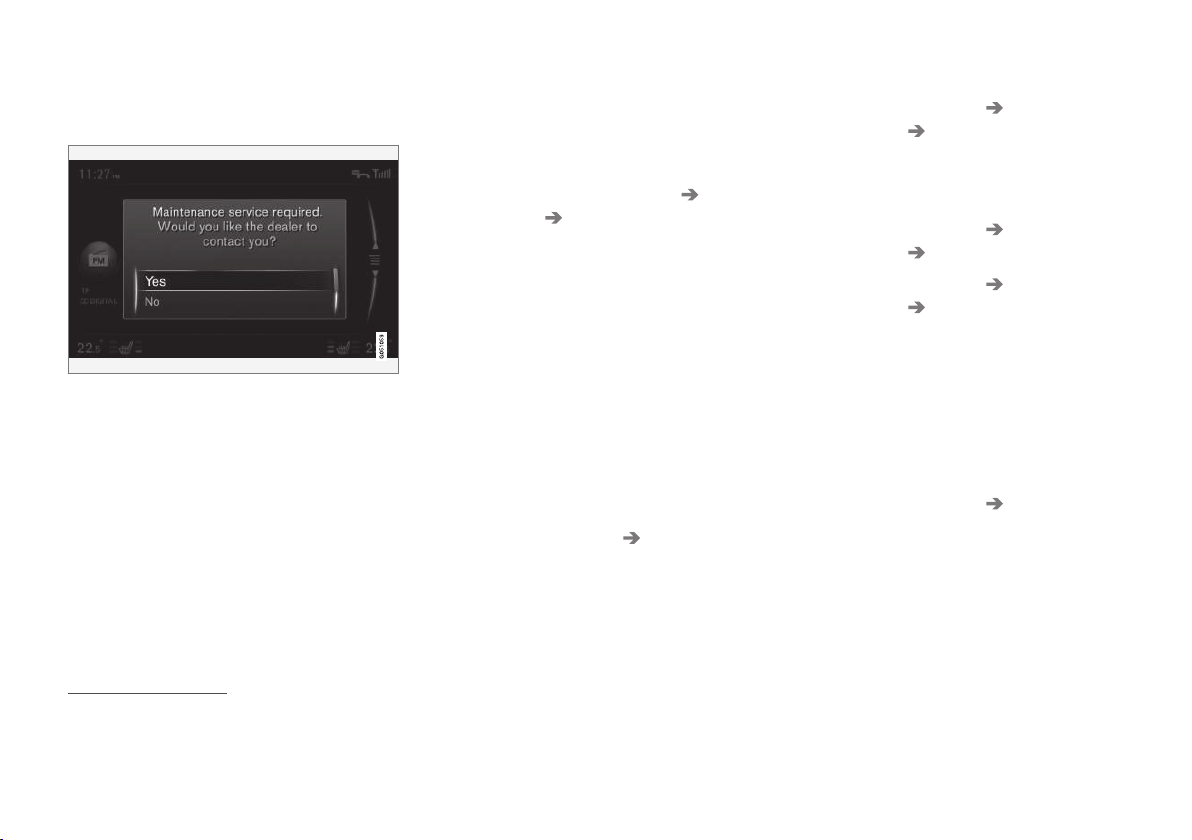
MAINTENANCE AND SERVICE
}}
347
in the combined instrument panel (p. 62) and via
a pop-up menu in the screen.
Service message in the screen.
Meaning of the answer options in the screen's
pop-up menu:
•
Yes - A booking enquiry is sent to your
dealer who then comes back with a booking
proposal. The service lamp and service mes-
sage in the combined instrument panel are
extinguished.
•
No - No more pop-up messages will be
shown in the screen. The message in the
combined instrument panel remains. After
this option has been selected, it is possible
to start the manual booking in the car, see
below.
•
Postpone - The pop-up menu is shown the
next time the car is started.
Book a service or repair manually
1
1.
Press the MY CAR button in the centre con-
sole and select
Service & repair Dealer
information
Request service or repair.
> Vehicle data is sent automatically to your
dealer.
2. The dealer sends a booking proposal to the
car.
3. Accept or request a new booking proposal.
After the booking has been accepted the book-
ing information is stored in the car, see My book-
ings. The car will automatically communicate with
you via the screen by means of reminders about
the booking and guide you to the workshop visit.
My bookings
1
Show booking information in the car's screen.
Accept or request a new booking proposal.
–
Select Service & repair My bookings.
Call the dealer
1
With a phone connected to the car via
Bluetooth
®
, you can call your dealer. For connect-
ing the phone, see the Sensus Infotainment sup-
plement.
–
Select Service & repair Dealer
information
Call dealer.
Using the navigation system
1,
2
Enter your workshop as destination or waypoint
in the navigation system.
–
Select Service & repair Dealer
information
Set single destination.
–
Select Service & repair Dealer
information
Add as waypoint.
Sending vehicle data
1
Vehicle data are sent to a central Volvo database
(not your dealer) from which Volvo dealers can
retrieve vehicle information using the car's identi-
fication number (VIN
3
). The number is printed in
the car's service and warranty booklet, alterna-
tively inside the windscreen's bottom left-hand
corner.
–
Select Service & repair Send car data.
Booking information and vehicle data
When you decide to book a service from your car,
the booking information and vehicle data will be
sent. Vehicle data information consists of infor-
mation within the following areas:
1
Applies to certain markets.
2
Applies to Sensus Navigation.
3
Vehicle Identification Number

MAINTENANCE AND SERVICE
}}
349
Raising the car
When raising the car it is important that the jack
or lifting arms are fitted in the intended points on
the car's underbody.
NOTE
Volvo recommends only using the jack that
belongs to the car model in question. If a jack
is selected other than the one recommended
by Volvo, follow the instructions supplied with
the equipment.
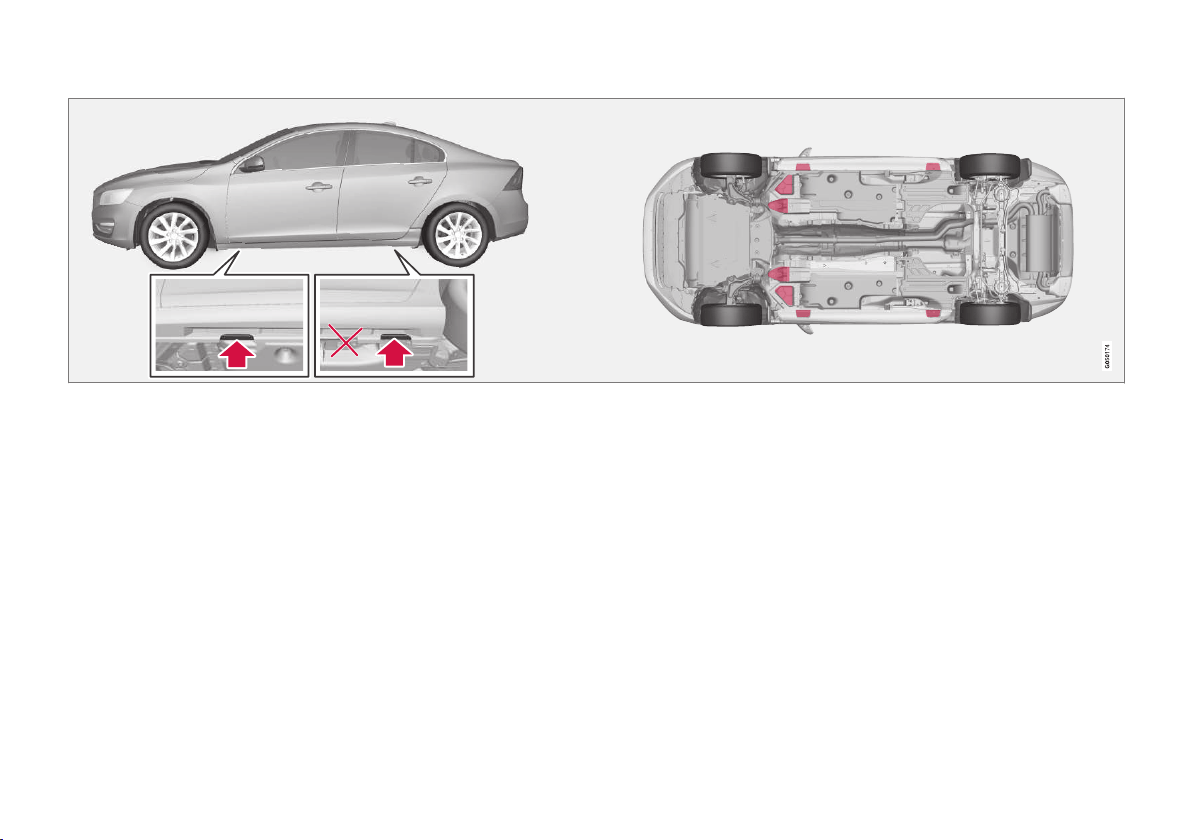
||
MAINTENANCE AND SERVICE
350
Jacking points (arrows) for the jack that belongs to the car and lifting points (marked in red).
If the car is raised with a front workshop jack
then this must be positioned under one of the
four lifting points furthest in under the car. If the
car is raised with a rear workshop jack then it
must be positioned under one of the lifting
points. Ensure that the workshop jack is posi-
tioned so that the car cannot slide off the jack.
Always use axle stands or similar.
If the car is raised with a two-pillar workshop lift
then the front and rear lifting arms can be posi-
tioned under the outer lifting points (jacking
points). Alternatively, the inner lifting points can
be used at the front.
Related information
•
Changing wheels - removing wheels (p. 331)
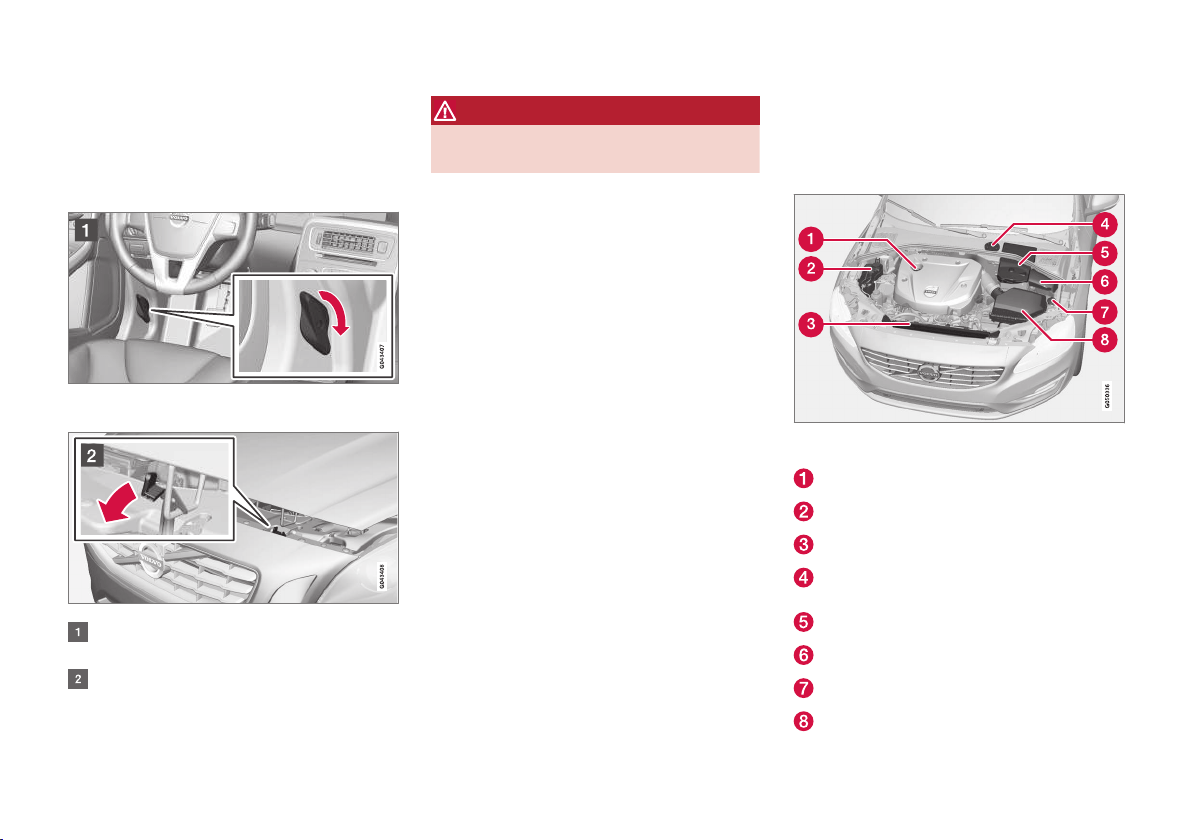
MAINTENANCE AND SERVICE
}}
351
Bonnet - opening and closing
The bonnet can be opened when the handle in
the passenger compartment has been turned
clockwise and the lock by the radiator grille has
been moved to the left.
The handle for bonnet opening is always on the left-
hand side.
Turn the handle about 20-25 degrees clock-
wise. You will hear when the catch releases.
Move the catch to the left and open the bon-
net. (The catch hook is located between the
headlamp and radiator grille, see illustration.)
WARNING
Check that the bonnet locks properly when
closed.
Related information
•
Engine compartment - checking (p. 352)
•
Engine compartment - overview (p. 351)
Engine compartment - overview
The overview shows some service-related com-
ponents.
Engine compartment 4-cyl.
The appearance of the engine compartment may differ
depending on model and engine variant.
Engine oil filler pipe
Coolant expansion tank
Radiator
Reservoir for brake and clutch fluid (located
on the driver's side)
Starter battery
Relay and fuse box
Washer fluid filler pipe
Air filter

||
MAINTENANCE AND SERVICE
352
WARNING
The ignition system has very high voltage and
output. The voltage in the ignition system is
highly dangerous. The car's electrical system
must always be in key position 0 when work is
being performed in the engine compartment;
see Key positions - functions at different lev-
els (p. 77).
Do not touch the spark plugs or ignition coil
when the car's electrical system is in key
position II or when the engine is hot.
Engine compartment 5-cyl. diesel
The appearance of the engine compartment may differ
depending on model and engine variant.
Coolant expansion tank
Power steering fluid reservoir
Engine oil filler pipe
Reservoir for brake and clutch fluid (located
on the driver's side)
Starter battery
Relay and fuse box
Washer fluid filler pipe
WARNING
The car's electrical system must always be in
key position 0 when work is being performed
in the engine compartment; see Key positions
- functions at different levels (p. 77).
Related information
•
Bonnet - opening and closing (p. 351)
•
Engine compartment - checking (p. 352)
Engine compartment - checking
Some oils and fluids should be checked at regu-
lar intervals.
Regular checking
Check the following oils and fluids at regular
intervals, e.g. when refuelling:
•
Coolant
•
Engine oil
•
Power steering fluid (not cars with 4-cyl.
engine)
•
Washer fluid
WARNING
Remember that the radiator fan (located at
the front of the engine compartment, behind
the radiator) may start or continue to operate
automatically for up to approx. 6 minutes after
the engine has been switched off.
Always have the engine cleaned by a work-
shop - an authorised Volvo workshop is rec-
ommended. There is a risk of fire if the engine
is hot.
Related information
•
Bonnet - opening and closing (p. 351)
•
Engine compartment - overview (p. 351)
•
Coolant - level (p. 357)
•
Engine oil - checking and filling (p. 354)
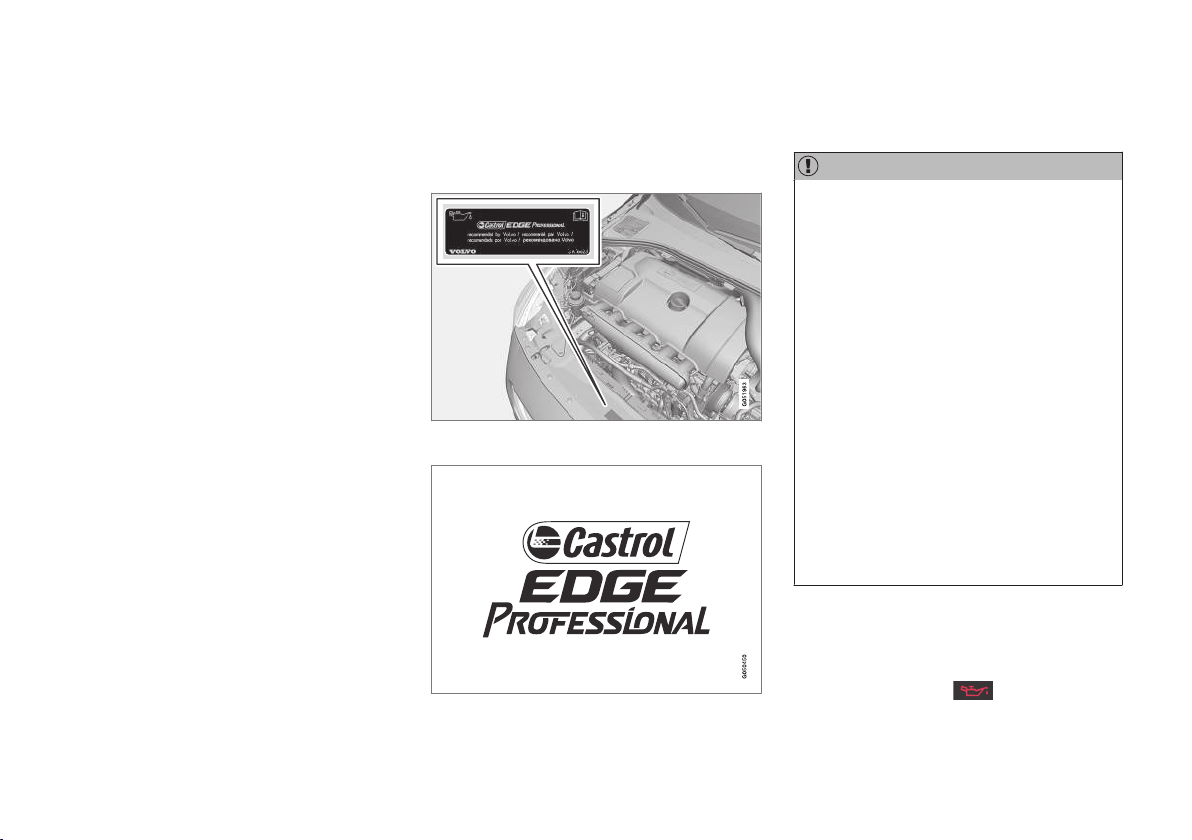
MAINTENANCE AND SERVICE
}}
353
•
Power steering fluid - level (p. 358)
•
Washer fluid - filling (p. 369)
Engine oil - general
An approved engine oil must be used in order
that the recommended service intervals can be
applied.
Volvo recommends:
When driving under adverse conditions, see
Engine oil - adverse driving conditions (p. 407).
IMPORTANT
In order to fulfil the requirements for the
engine's service intervals all engines are filled
with a specially adapted synthetic engine oil
at the factory. The choice of oil has been
made very carefully with regard to service life,
starting characteristics, fuel consumption and
environmental impact.
An approved engine oil must be used in order
that the recommended service intervals can
be applied. Only use a prescribed grade of oil
for both filling and oil change, otherwise you
will risk affecting service life, starting charac-
teristics, fuel consumption and environmental
impact.
Volvo Car Corporation disclaims all warranty
liability if engine oil of the prescribed grade
and viscosity is not used.
Volvo recommends that oil changes are car-
ried out at an authorised Volvo workshop.
Volvo uses different systems for warning of low/
high oil level or low oil pressure. Certain engine
variants have an oil pressure sensor, and then the
combined instrument panel's warning symbol for
low oil pressure is used
. Other variants
have an oil level sensor, when the driver is

||
MAINTENANCE AND SERVICE
354
informed via the instrument's warning symbol
and display texts. Certain variants have
both systems. Contact a Volvo dealer for more
information.
Change the engine oil and oil filter in accordance
with the intervals specified in the Service and
Warranty Booklet.
Using oil of a higher than specified grade is per-
mitted. If the car is driven in adverse conditions,
Volvo recommends using an oil of a higher grade
than the one specified, see Engine oil - adverse
driving conditions (p. 407).
For filling capacities, see Engine oil - grade and
volume (p. 408).
Related information
•
Engine oil - checking and filling (p. 354)
Engine oil - checking and filling
The oil level is detected with the electronic oil
level sensor.
4-cyl.
Filler pipe
4
.
In some cases, oil may need to be topped up
between service intervals.
No action needs to be taken on engine oil level
until a message is shown in the combined instru-
ment panel's display, see the following illustra-
tion.
Message and graphic shown in the display. The left-
hand display is shown in the digital combined instrument
panel and the right-hand in the analogue.
Message
Engine oil level
The oil level is checked using the electronic oil
level gauge with the thumbwheel when the
engine is switched off, see Menu navigation -
combined instrument panel (p. 106).
WARNING
If the message Oil service required is
shown, visit a workshop - an authorised Volvo
workshop is recommended. The oil level may
be too high.
4
Engines with electronic oil level sensor do not have a dipstick.
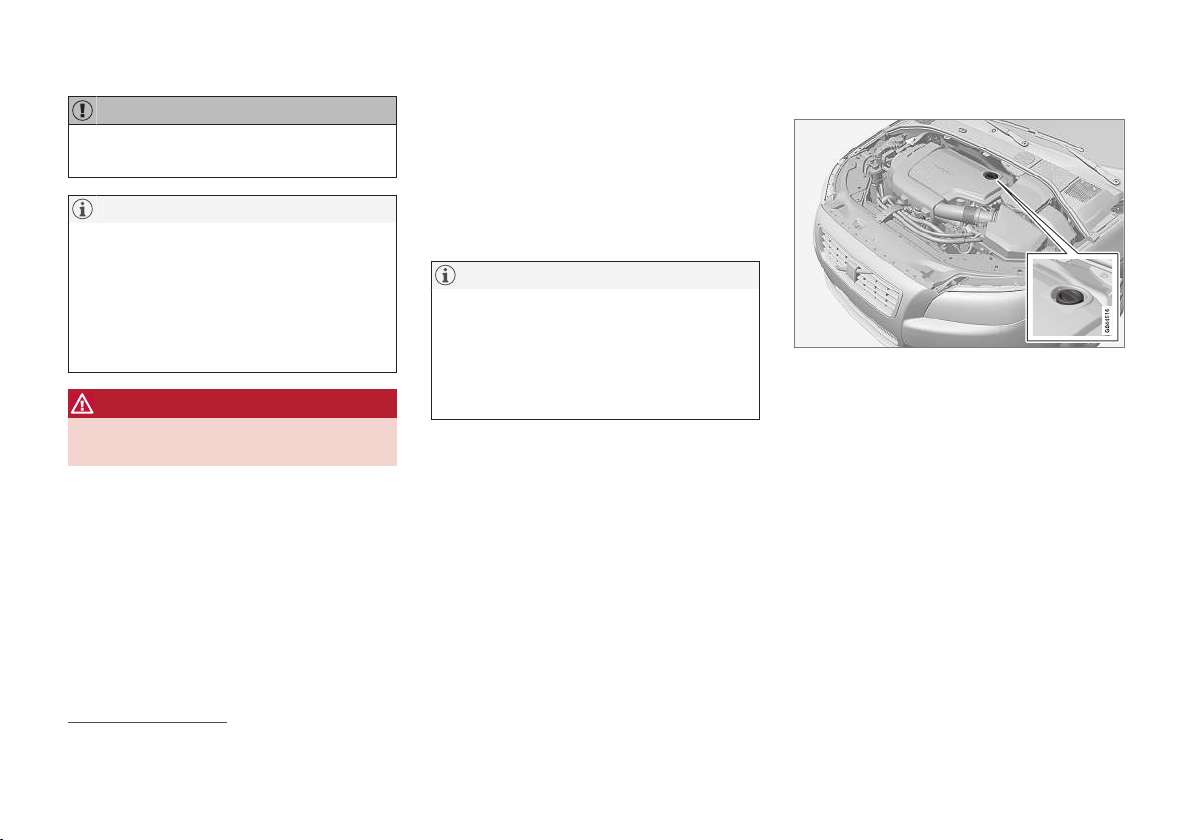
MAINTENANCE AND SERVICE
}}
355
IMPORTANT
If notified of low oil level, only fill with the vol-
ume specified, for example, 0.5 litres.
NOTE
The system cannot directly detect changes
when the oil is filled or drained. The car must
have been driven approx. 30 km (approx.
20 miles) and have been stationary for
5 minutes with the engine switched off and
on level ground before the oil level indication
is correct.
WARNING
Do not spill oil onto the hot exhaust manifold
due to the risk of fire.
Measuring the oil level, 4-cyl.
If the oil level needs to be checked then it should
be carried out in accordance with the following
sequence.
1.
Activate key position II; see Key positions -
functions at different levels (p. 77).
2. Rotate the thumbwheel on the left-hand
stalk switch to position
Oil level.
> You will then see information displayed
about the engine oil level.
For more information on menu navigation,
see Menu navigation - combined instru-
ment panel (p. 106).
NOTE
If the right conditions for measuring the oil
level (time after engine shutdown, the car's
inclination, outside temperature, etc.) are not
met, the message
Not available will be
shown. This does not mean that there is
something wrong in the car's systems.
5-cyl. diesel
Filler pipe
5
.
No action needs to be taken on engine oil level
until a message is shown in the combined instru-
ment panel's display, see the following illustra-
tion.
5
Engines with electronic oil level sensor do not have a dipstick.
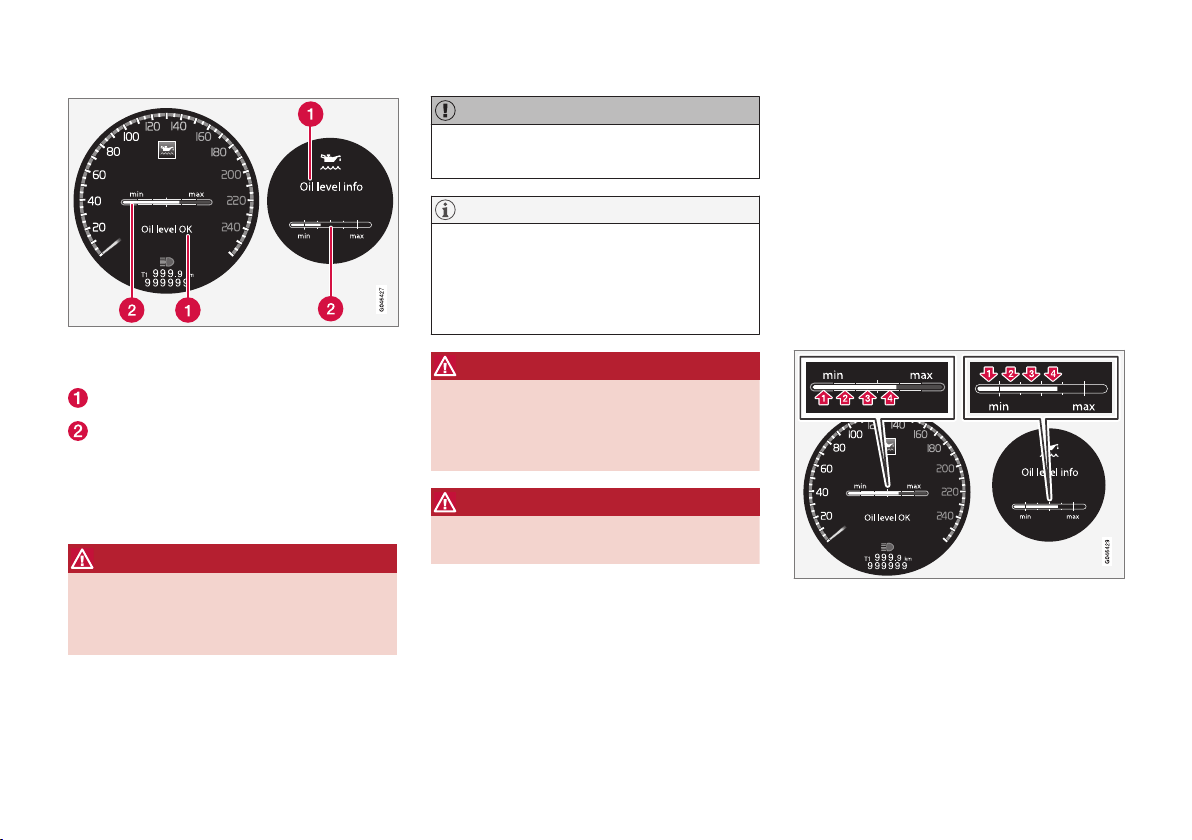
||
MAINTENANCE AND SERVICE
356
Message and graphic shown in the display. The left-
hand display is shown in the digital combined instrument
panel and the right-hand in the analogue.
Message
Engine oil level
The oil level is checked using the electronic oil
level gauge with the thumbwheel when the
engine is switched off, see Menu navigation -
combined instrument panel (p. 106).
WARNING
If the message Oil service required is
shown, visit a workshop - an authorised Volvo
workshop is recommended. The oil level may
be too high.
IMPORTANT
In the event of the message Oil level low
Refill 0.5 litre, only fill with 0.5 litres.
NOTE
The oil level is only detected by the system
during driving. The system cannot directly
detect changes when the oil is filled or
drained. The car must be driven about 30 km
before the oil level display is correct.
WARNING
Do not fill more oil if filling level (3) or (4)
appears as shown in the illustration below.
The level must never be above MAX or below
MIN, as this could lead to engine damage.
WARNING
Do not spill oil onto the hot exhaust manifold
due to the risk of fire.
Measuring the oil level, 5-cyl. diesel
If the oil level needs to be checked then it should
be carried out in accordance with the following
sequence.
1.
Activate key position II; see Key positions -
functions at different levels (p. 77).
2. Rotate the thumbwheel on the left-hand
stalk switch to position
Oil level.
> Information is then displayed on the
engine's oil level; see the following illus-
tration, which shows the message and
graphic in the display. The left-hand dis-
play is shown in the digital combined
instrument panel and the right-hand in the
analogue.
For more information on menu navigation,
see Menu navigation - combined instru-
ment panel (p. 106).
The figures 1-4 represent filling level. Do not fill more oil
if filling level (3) or (4) is shown. Recommended filling
level is 4.
Related information
•
Engine oil - general (p. 353)
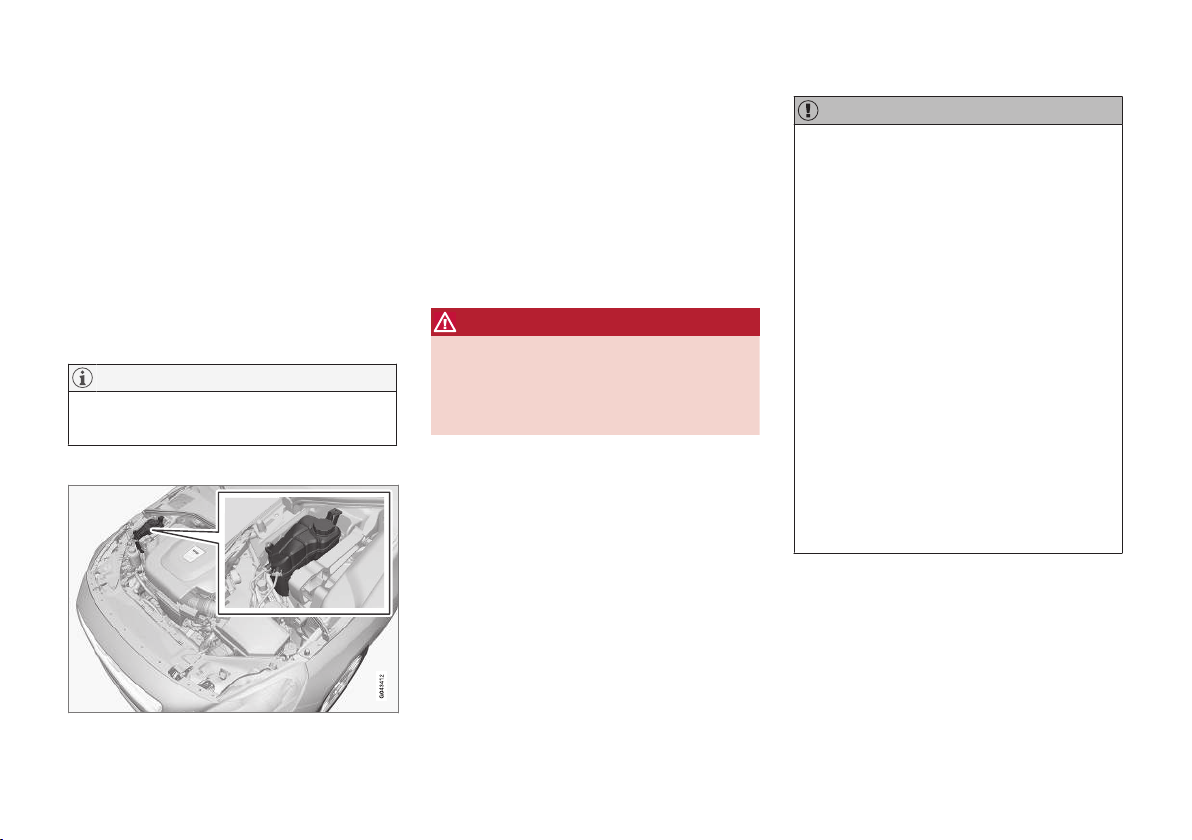
MAINTENANCE AND SERVICE
357
Coolant - level
The coolant cools the internal combustion
engine to the correct operating temperature. The
heat that is transferred from the engine to the
coolant can be used to heat the passenger com-
partment.
Checking the level
The coolant level must lie between the MIN and
MAX marks on the expansion tank. If the cooling
system is not filled sufficiently, excessively high
temperatures could occur, causing a risk of dam-
age to the engine.
NOTE
Check the coolant level regularly when the
engine is cold.
Filling
When topping up the coolant, follow the instruc-
tions on the packaging. Never top up with water
only. The risk of freezing increases with both too
little and too much coolant concentrate.
If there is coolant under the car, if there is cool-
ant smoke, or if more than 2 litres have been
filled, always call for recovery to avoid the risk of
engine damage when starting due to a defective
cooling system.
WARNING
Coolant can be very hot. If the coolant
requires topping up when the engine is at
operating temperature, unscrew the expan-
sion tank cap slowly to gently release the
overpressure.
IMPORTANT
•
A high content of chlorine, chlorides and
other salts may cause corrosion in the
cooling system.
•
Always use coolant with anti-corrosion
agent as recommended by Volvo.
•
Ensure that the coolant mixture is 50%
water and 50% coolant.
•
Mix the coolant with approved quality
water. In the event of any doubt about
water quality, used ready-mixed coolant in
accordance with Volvo recommendations.
•
When changing coolant/replacing cool-
ing system components, flush the cooling
system clean with approved quality water
or flush with ready-mixed coolant.
•
The engine must only be run with a well-
filled cooling system. Otherwise, tempera-
tures that are too high may occur result-
ing in the risk of damage (cracks) in the
cylinder head.
For capacities and for standards regarding water
quality; see Coolant - grade and volume (p. 410).
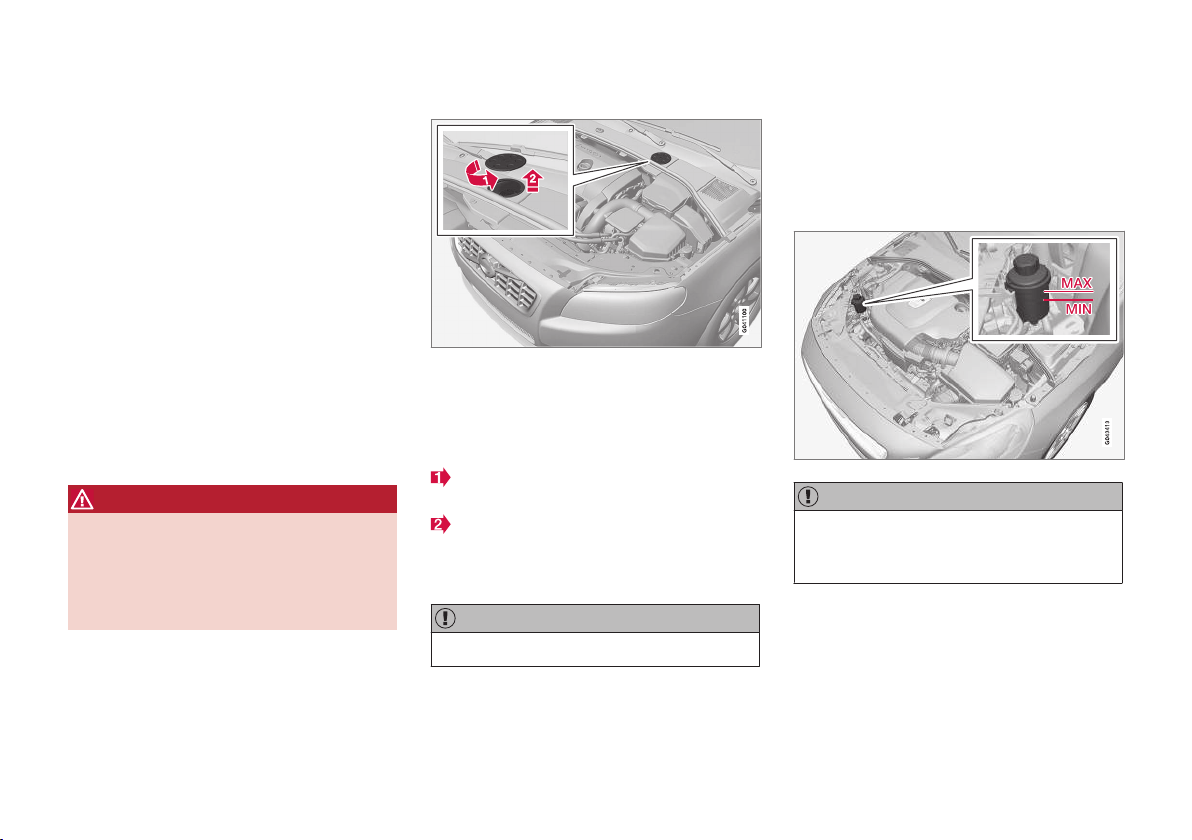
MAINTENANCE AND SERVICE
358
Brake and clutch fluid - level
Brake and clutch fluid level should be between
the reservoir MIN and MAX marks.
Checking the level
Brake and clutch fluid have a common reservoir.
The level must be between the MIN and MAX
marks that are visible inside the reservoir. Check
the level regularly.
Change the brake fluid every other year or at
every other regular service.
The fluid should be changed annually on cars
driven in conditions requiring hard, frequent brak-
ing, such as driving in mountains or tropical cli-
mates with high humidity.
For capacities and recommended brake fluid
grade, see Brake fluid - grade and volume
(p. 412).
WARNING
If the brake fluid is under the MIN level in the
brake fluid reservoir, do not drive further
before topping up the brake fluid. Volvo rec-
ommends that the reason for the loss of
brake fluid is investigated by an authorised
Volvo workshop.
Filling
The fluid reservoir is located on the driver's side.
The fluid reservoir is protected under the cover
over the cold zone in the engine compartment.
The round cover must be removed first before the
reservoir cap can be reached.
Turn and open the cover located on the cov-
ering.
Unscrew the reservoir cap and fill the fluid.
The level must be between the MIN and
MAX marks, which are located on the inside
of the reservoir.
IMPORTANT
Do not forget to refit the cap.
Power steering fluid - level
Cars with 4-cyl. engine do not have power steer-
ing fluid. For cars with another engine, the level
of the power steering fluid must be between the
reservoir's MIN and MAX marks. The fluid does
not need to be changed.
IMPORTANT
Keep the area around the power steering
fluid reservoir clean when checking. The cover
must not be opened.
Check the level frequently. The fluid does not
require changing. The level must be between the
MIN and MAX marks.
For recommended fluid grade, see Power steer-
ing fluid - grade (p. 412).

MAINTENANCE AND SERVICE
359
WARNING
If there is a fault in the power steering system
or if the engine is switched off and the car
has to be towed, the steering is much heavier
than normal. Read about what applies for tow-
ing (p. 318).
Climate control system - fault
tracing and repair
The air conditioning system must only be serv-
iced and repaired by an authorised workshop.
Fault tracing and repair
The air conditioning system contains fluorescent
tracing agents. Ultraviolet light must be used dur-
ing leak detection.
Volvo recommends that you contact an author-
ised Volvo workshop.
Cars with R134a refrigerant
WARNING
The air conditioning system contains pressur-
ised refrigerant R134a. This system must only
be serviced and repaired by an authorised
workshop.
Cars with R1234yf refrigerant
WARNING
The air conditioning system contains pressur-
ised refrigerant R1234yf. In accordance with
SAE J2845 (Technician Training for Safe
Service and Containment of Refrigerants
Used in Mobile A/C System), service and
repair of the refrigerant system must only be
performed by trained and certified technicians
in order to ensure the safety of the system.
Related information
•
Volvo service programme (p. 346)

MAINTENANCE AND SERVICE
360
Lamp replacement - general
Several of the car's bulbs can be replaced by
the driver. For replacement of LED lamps and
xenon lamps, please contact a workshop.
The bulbs are specified (p. 367). The following
list contains locations of bulbs and other light
sources that are specialised, such as LED
6
lamps, or are unsuitable for changing for some
other reason, except at a workshop
7
:
•
active xenon headlamps - ABL (xenon lamps)
•
daytime running lights/position lamps, front
•
cornering lights
•
side direction indicators, door mirrors
•
approach lighting, door mirrors
•
interior lighting apart from Courtesy lighting
front
•
position lamps, rear
•
side marker lamps.
WARNING
On cars with xenon headlamps, the replace-
ment of xenon lamps must be carried out at a
workshop - an authorised Volvo workshop is
recommended. Working with xenon lamps
demands extreme caution because the head-
lamp is equipped with a high voltage unit.
WARNING
The car's electrical system must be in key
position 0 for bulb replacement; see Key posi-
tions - functions at different levels (p. 77).
IMPORTANT
Never touch the glass part of the bulbs with
your fingers. Grease from your fingers is
vaporised by the heat, coating the reflector
and then causing damage.
NOTE
If an error message remains after the broken
bulb has been replaced then we recommend
visiting an authorised Volvo workshop.
NOTE
Outside lighting such as headlamps and rear
lamps may temporarily have condensation on
the inside of the lens. This is normal, all exte-
rior lighting is designed to withstand this.
Condensation is normally vented out of the
lamp housing when the lamp has been
switched on for a time.
Related information
•
Lamp replacement - headlamps (p. 361)
•
Lamp replacement - location of rear lamps
(p. 365)
•
Lamp replacement - vanity mirror lighting
(p. 366)
•
Lamp replacement - lighting in cargo area
(p. 366)
•
Lamp replacement - number plate lighting
(p. 366)
6
LED (Light Emitting Diode)
7
An authorised Volvo workshop is recommended.
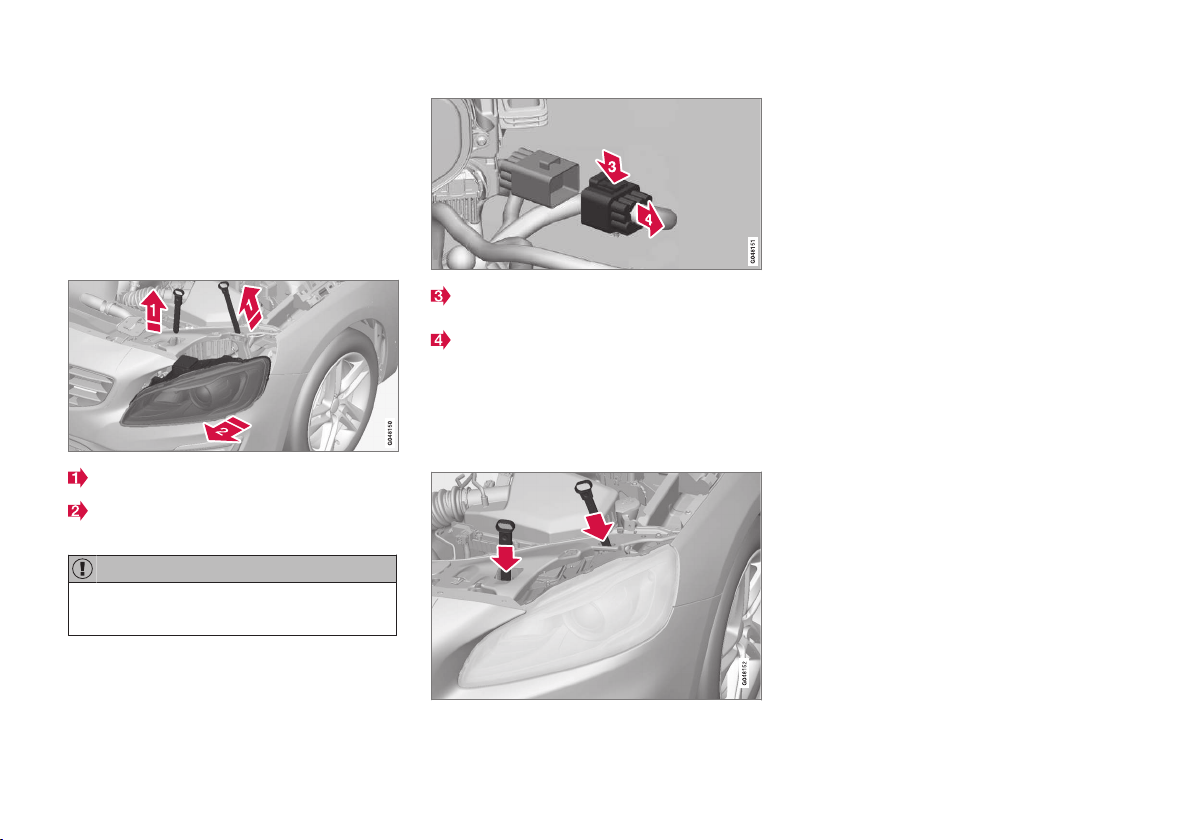
MAINTENANCE AND SERVICE
361
Lamp replacement - headlamps
All of the headlamp bulbs are replaced via the
engine compartment. First loosen and remove
the whole headlamp.
Removing the headlamp
Set the car's electrical system in key position 0,
see Key positions - functions at different levels
(p. 77).
Pull out the headlamp's locking pins.
Release the headlamp by alternately tilting
and pulling it out.
IMPORTANT
Do not pull the electrical cable, only the con-
nector.
Detach the headlamp connector by pressing
down the clip with your thumb.
At the same time, guide out the connector
with your other hand.
5. Lift out the headlamp and place it on a soft
surface to avoid scratching the lens.
6. Replace the bulb in question.
Securing the headlamp
1. Plug in the connector, a clicking sound
should be heard.
2. Reinstall the headlamp and locking pins. The
short pin is fitted closest to the radiator grille.
Check that they are firmly inserted.
3. Check the lighting.
The connector must be plugged in properly and
the headlamp mounted before the lighting is
switched on or the remote control key is inserted
in the ignition switch.
Related information
•
Lamp replacement - general (p. 360)
•
Lamp replacement - cover for main/dipped
beam bulbs (p. 362)
•
Lamps - specifications (p. 367)
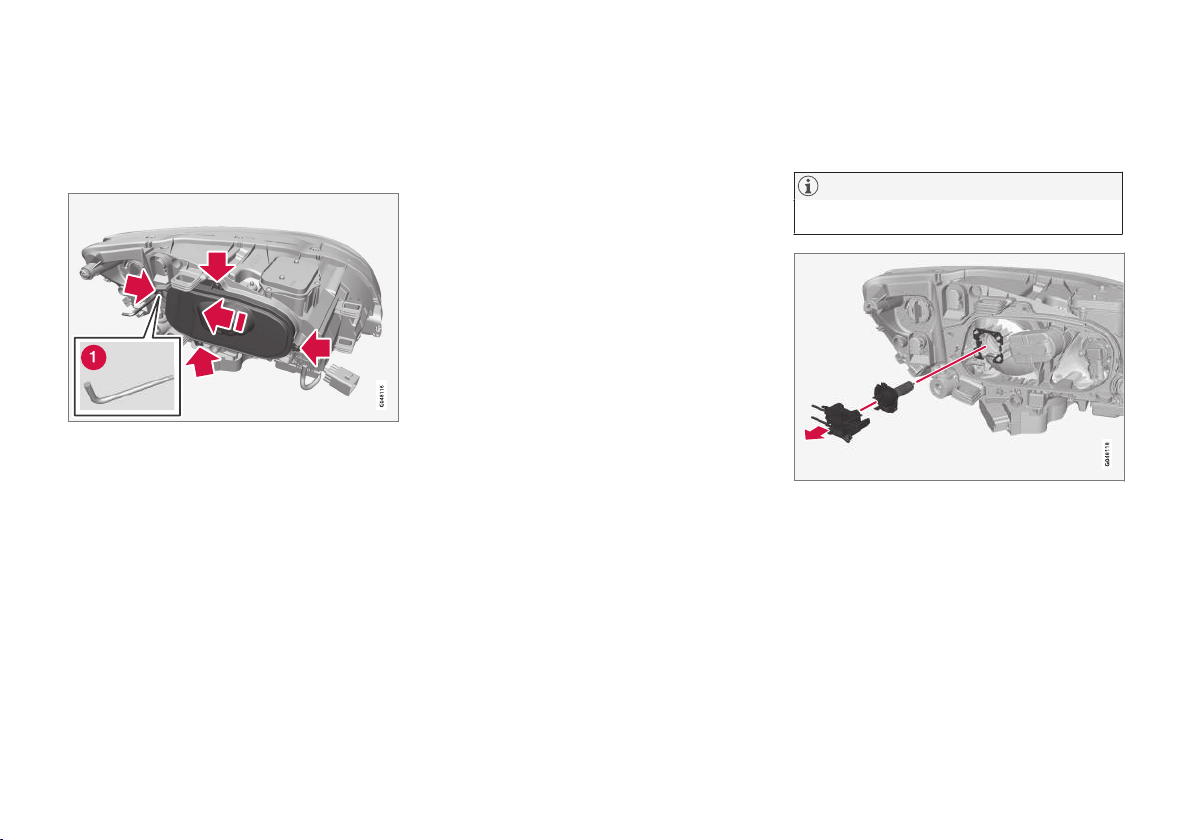
MAINTENANCE AND SERVICE
362
Lamp replacement - cover for main/
dipped beam bulbs
Main/dipped beam bulbs are accessed by
releasing the headlamp's larger cover.
Before starting to replace a bulb, see Lamp
replacement - headlamps (p. 361).
1. Unscrew the cover's four screws using a Torx
tool, size T20 (1). They should not be loos-
ened completely. (3 - 4 turns are sufficient.)
2. Slide the cover to one side.
3. Remove the cover.
Reinstall the cover in reverse order.
Related information
•
Lamp replacement - headlamps (p. 361)
•
Lamp replacement - dipped beam (p. 362)
•
Lamp replacement - main beam (p. 363)
•
Lamp replacement - extra main beam
(p. 364)
Lamp replacement - dipped beam
The dipped beam bulb is fitted inside the head-
lamp's larger cover.
NOTE
Applies to cars with halogen headlamps.
1. Detach the headlamp (p. 361).
2. Remove the cover (p. 362).
3. Unplug the connector from the bulb.
4. Detach the bulb by pulling it straight out.
5. The guide pin on the lamp should be straight
up when it is fitted and a clicking sound
should be heard when it clicks into place.
Reinstall the parts in reverse order.
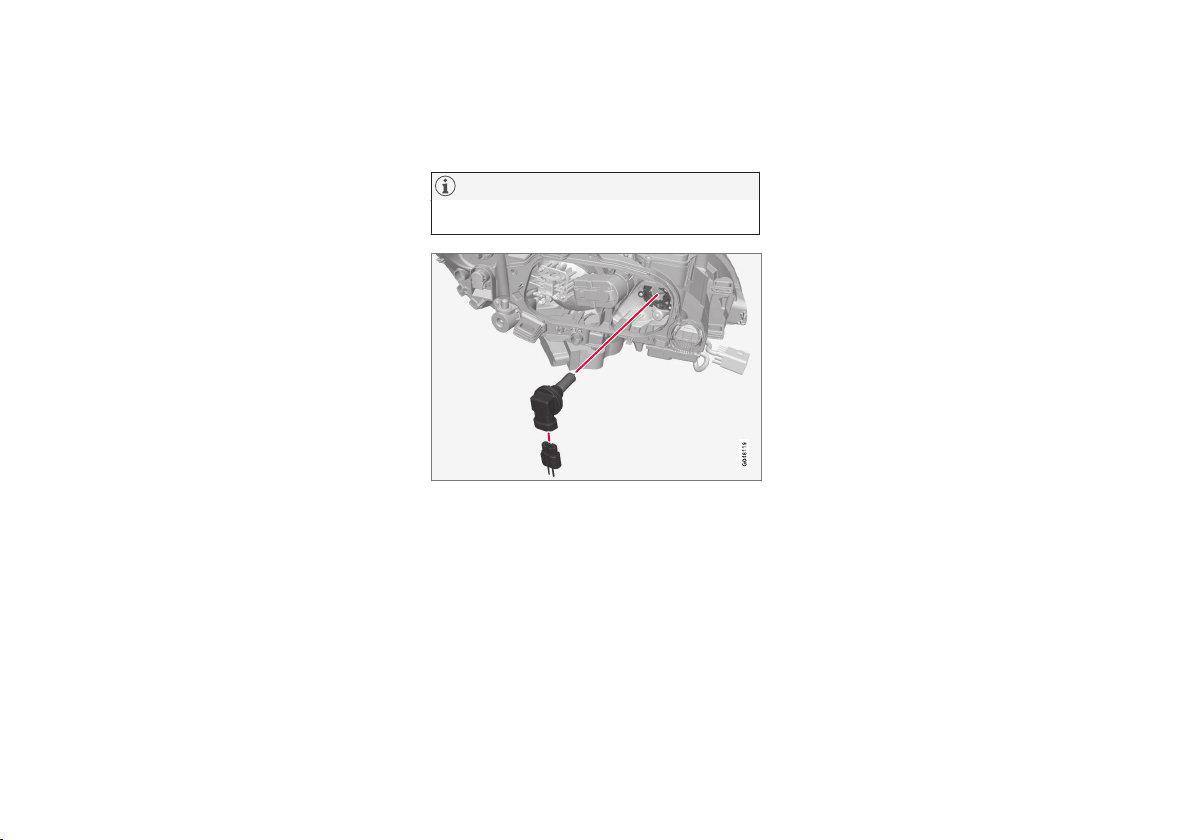
MAINTENANCE AND SERVICE
363
Related information
•
Lamps - specifications (p. 367)
Lamp replacement - main beam
The main beam bulb is fitted inside the head-
lamp's larger cover.
NOTE
Applies to cars with halogen headlamps.
1. Detach the headlamp (p. 361).
2. Remove the cover (p. 362).
3. Detach the bulb by turning anticlockwise and
then pulling straight out.
4. Unplug the connector from the bulb.
5. Replace the bulb and align it in the socket
and turn clockwise in order to secure it. It
can only be secured in one position.
Reinstall the parts in reverse order.
Related information
•
Lamps - specifications (p. 367)
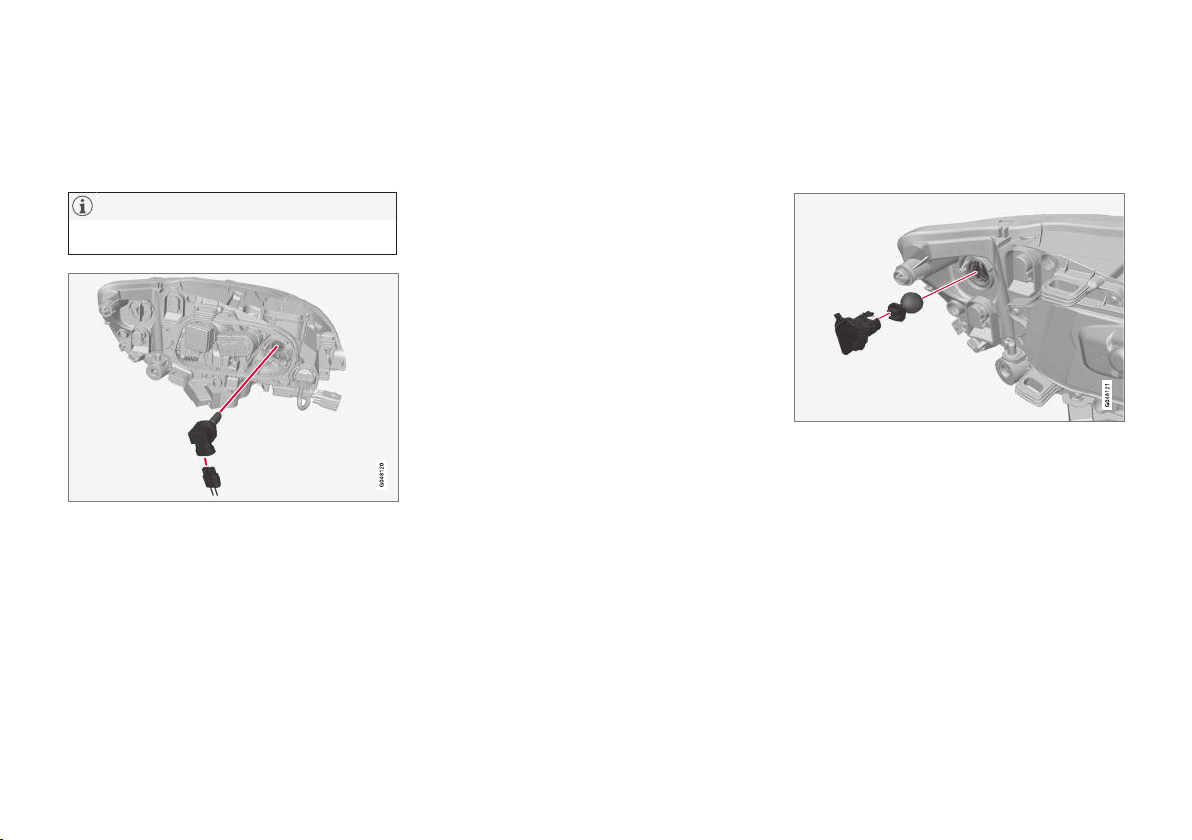
MAINTENANCE AND SERVICE
* Option/accessory.
364
Lamp replacement - extra main
beam
The extra main beam bulb is fitted inside the
headlamp's larger cover.
NOTE
Applies to cars with Xenon headlamps*.
1. Detach the headlamp (p. 361).
2. Remove the cover (p. 362).
3. Detach the bulb by turning anticlockwise and
then pulling straight out.
4. Unplug the connector from the bulb.
5. Replace the bulb and align it in the socket
and turn clockwise in order to secure it. It
can only be secured in one position.
Reinstall the parts in reverse order.
Related information
•
Lamps - specifications (p. 367)
Lamp replacement - direction
indicators front
The direction indicator lamp is fitted inside the
headlamp's smaller cover.
1. Detach the headlamp (p. 361).
2. Detach the cover by pulling it straight out.
3. Pull the bulb holder in order to extract the
bulb.
4. Press and simultaneously turn the bulb anti-
clockwise in order to detach it.
Reinstall the parts in reverse order.
Related information
•
Lamps - specifications (p. 367)
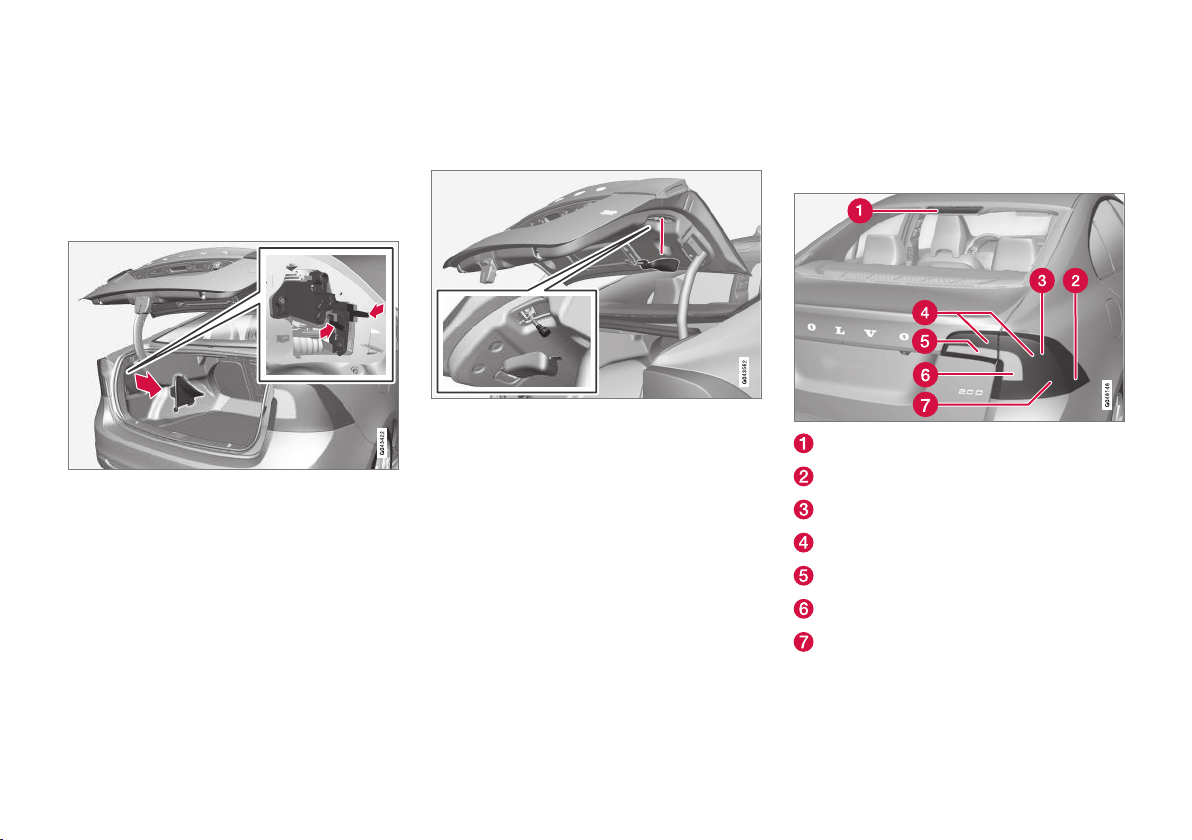
MAINTENANCE AND SERVICE
365
Lamp replacement - rear lamp
Lamps in the rear lamp cluster are replaced from
inside the cargo area.
The bulb for the reversing lamp is located
behind the panel in the boot lid.
Lamp housing, rear
The bulbs in the rear light cluster are replaced
from inside the cargo area (not the LED lamps).
1. Remove the covers in the left/right-hand
panel to access the bulbs. The bulbs are
located in a bulb holder.
2. Press the catches together and pull out the
bulb holder.
3. Remove the blown bulb by pressing it in and
turning anticlockwise.
4. Fit a new bulb, press down and turn clock-
wise.
5. Press the bulb holder into place and refit the
cover.
Reversing lamp
1. Open the panel in the boot lid.
2. Detach the bulb holder by turning it anti-
clockwise.
3. Remove the blown bulb by pressing it in and
turning anticlockwise.
4. Fit a new bulb, press down and turn clock-
wise.
5. Attach the bulb holder by turning it clock-
wise.
Related information
•
Lamp replacement - location of rear lamps
(p. 365)
•
Lamps - specifications (p. 367)
Lamp replacement - location of rear
lamps
The overview shows the location of the lamps at
the rear.
Brake light (LED)
Side marker lamps (LED)
Brake light (p. 365)
Position lamps (LED)
Reversing lamp (p. 365)
Indicator (p. 365)
Fog lamp (p. 365)
Related information
•
Lamp replacement - general (p. 360)
•
Lamps - specifications (p. 367)
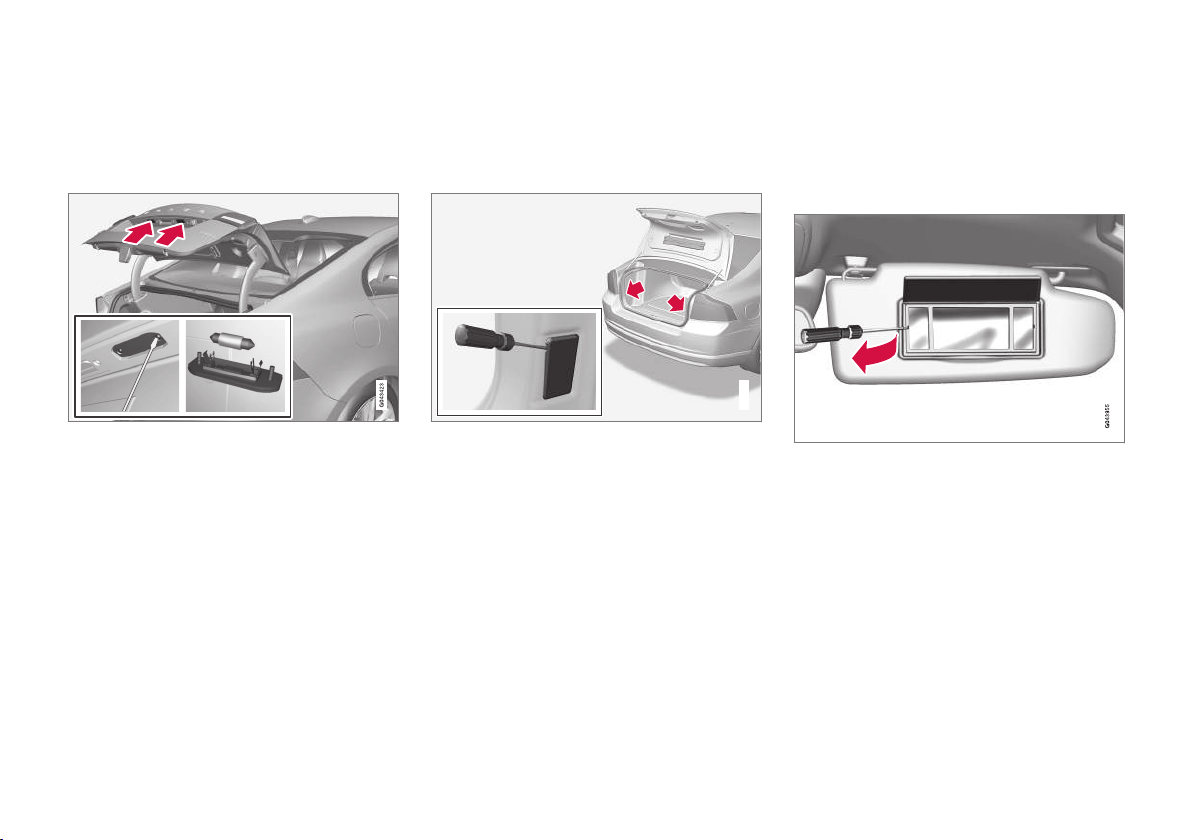
MAINTENANCE AND SERVICE
366
Lamp replacement - number plate
lighting
The number plate lighting is located under the
boot lid handle.
1. Remove the screws with a screwdriver.
2. Carefully detach the whole bulb housing and
withdraw it.
3. Replace the bulb.
4. Refit the whole bulb housing and screw it
into place.
Related information
•
Lamps - specifications (p. 367)
Lamp replacement - lighting in
cargo area
The cargo area lighting is positioned on both
sides of the boot lid opening.
G021758
1. Insert a screwdriver and gently prize so that
the lamp housing comes loose.
2. Replace the bulb.
3. Check that the bulb illuminates and press
back the lamp housing.
Related information
•
Lamps - specifications (p. 367)
Lamp replacement - vanity mirror
lighting
The vanity mirror's lamps are fitted inside the
lamp lenses.
Removal of lamp lens
1. Insert a screwdriver under the lamp lens and
gently prize up the lug on the edge.
2. Carefully detach and lift aside the lamp lens.
3. Use needle-nose pliers to pull the bulb
straight out to the side and replace with a
new one. Note! - Do not squeeze the bulb
too hard with the pliers. Otherwise, the bulb
glass could then break.
Attaching the lamp lens
1. Refit the lamp lens.
2. Press it into place.

MAINTENANCE AND SERVICE
367
Related information
•
Lamps - specifications (p. 367)
Lamps - specifications
The specifications apply to bulbs. For replace-
ment of LED lamps and xenon lamps, please
contact a workshop.
Lighting
W
A
Type
Dipped beam, halo-
gen
55 H7 LL
Main beam, halogen 65 H9
Extra main beam,
ABL
65 H9
Front direction indi-
cators
24 PY24W
Courtesy lighting
front
3 T10 Socket
W2.1x9.5d
Glovebox lighting 5 Socket SV8.5
Length 43 mm
Vanity mirror light-
ing
1.2 T5 Socket
W2x4.6d
Cargo area lighting 10 Socket SV8.5
Length 38 mm
Number plate light-
ing
5 C5W LL
Direction indicators,
rear
21 PY21W LL
Lighting
W
A
Type
Brake light 21 P21W LL
Reversing lamp 21 H21W LL
Rear fog lamp 21 H21W LL
A
Watt
Related information
•
Lamp replacement - general (p. 360)
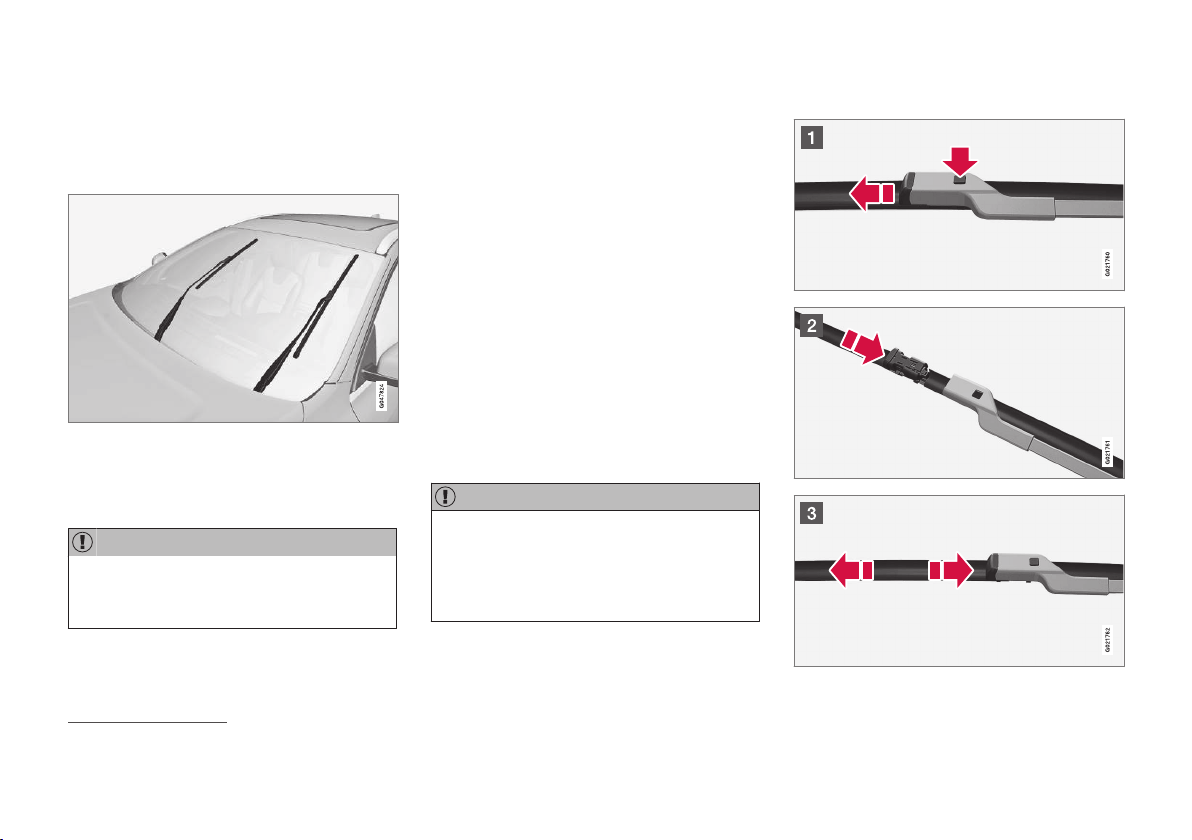
MAINTENANCE AND SERVICE
368
Wiper blades
The windscreen wiper blades must be in service
position when they are to be replaced.
Service position
Wiper blades in service position.
In order to change, clean or lift the wiper blades
(for scraping off ice from the windscreen, for
example) they must be in service position.
IMPORTANT
Before placing the wiper blades in the service
position, make sure that they are not frozen
down.
1. Insert the remote control key in the ignition
switch
8
and briefly press the START/STOP
ENGINE button to set the car's electrical
system to key position I. For detailed infor-
mation on key positions, see Key positions -
functions at different levels (p. 77).
2.
Briefly press the START/STOP ENGINE
button again to set the car’s electrical system
in key position 0.
3. Within 3 seconds, move the right stalk switch
up and hold it in position for
approx. 1 second.
> The wipers then move to standing straight
up.
The wipers return to their starting position when
you briefly press the START/STOP ENGINE
button to set the car’s electrical system to key
position I (or when the car is started).
IMPORTANT
If the wiper arms in service position have
been folded up from the windscreen, they
must be folded back down onto the wind-
screen before the wipers are activated. This is
to avoid scraping the paint on the bonnet.
Replacing the wiper blades
8
Not required in cars with keyless start and lock system.
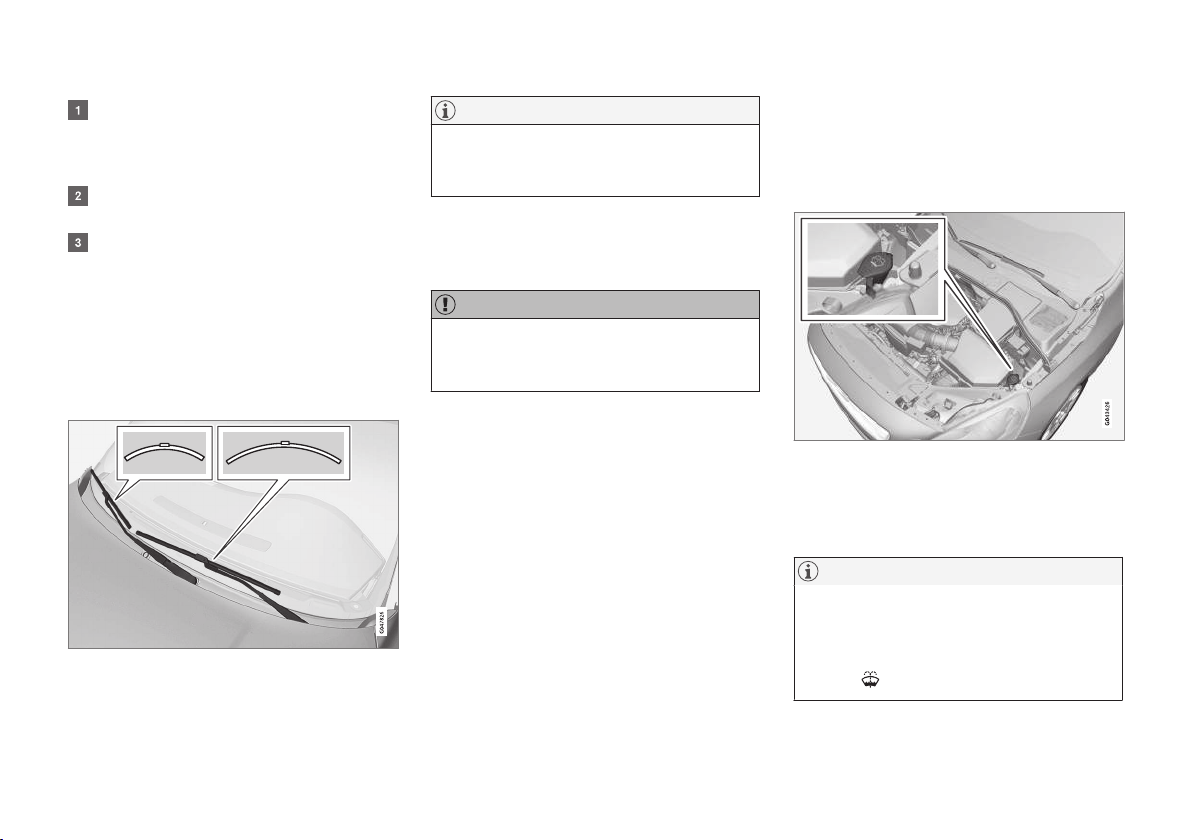
MAINTENANCE AND SERVICE
}}
369
Fold up the wiper arm when it is in service
position. Press the button located on the
wiper blade mounting and pull straight out
parallel with the wiper arm.
Slide in the new wiper blade until a "click" is
heard.
Check that the blade is firmly installed.
4. Fold the wiper arm back towards the wind-
screen.
The wipers return from service position to their
starting position when you briefly press the
START/STOP ENGINE button to set the car’s
electrical system to key position I (or when the
car is started).
NOTE
The wiper blades are different lengths. The
blade on the driver's side is longer than on
the passenger side.
Cleaning
For cleaning wiper blades and windscreen, see
Car wash (p. 391).
IMPORTANT
Check the blades regularly. Neglected main-
tenance shortens the service life of the wiper
blades.
Related information
•
Washer fluid - filling (p. 369)
Washer fluid - filling
Washer fluid is used for cleaning the headlamps
and windows. Washer fluid with antifreeze must
be used when the temperature is below freezing
point.
Topping up the washer fluid takes place by open-
ing the blue cap.
The windscreen and headlamp washers share a
common reservoir.
NOTE
When there is approx. 1 litre of washer fluid
remaining in the reservoir, a message to top
up the washer fluid will be shown in the com-
bined instrument panel, together with the
symbol
.

||
MAINTENANCE AND SERVICE
370
Prescribed grade: Washer fluid recommended
by Volvo - with frost protection during cold
weather and below freezing point.
IMPORTANT
Use Volvo genuine washer fluid or equivalent
with a recommended pH of between 6 and 8,
in working dilution (e.g. 1:1 with neutral
water).
IMPORTANT
Use washer fluid with antifreeze when the
temperature is below freezing to avoid freez-
ing in the pump, reservoir and hoses.
Volume:
•
Cars with headlamp washing: 5.4 litres.
•
Cars without headlamp washing: 4.0 litres.
Related information
•
Wiper blades (p. 368)
•
Wipers and washers (p. 97)
•
Bonnet - opening and closing (p. 351)
Starter battery - general
The starter battery is used to drive the starter
motor and other electrical equipment in the car.
The starter battery is a traditional 12 V battery.
The service life and function of the starter battery
is influenced by factors such as the number of
starts, discharging, driving style, driving condi-
tions, climatic conditions, etc.
•
Never disconnect the battery when the
engine is running.
•
Check that the cables to the battery are cor-
rectly connected and properly tightened.
Voltage (V) 12
Cold start capacity
A
- CCA
B
(A)
720
Size, L×W×H (mm) 278×175×190
Capacity (Ah) 70
A
In accordance with EN standard.
B
Cold Cranking Amperes.
IMPORTANT
When replacing the starter battery in cars
with the Start/Stop function, a battery of
EFB
9
type must be fitted.
IMPORTANT
When replacing the support battery, a battery
of AGM
10
type must be fitted.
IMPORTANT
If the starter battery is replaced, make sure
you replace it with a battery with the same
cold starting capacity and type as the original
battery (see the label on the battery).
NOTE
The starter battery's container size should be
consistent with the original battery's dimen-
sions.
9
Enhanced Flooded Battery.
10
Absorbed Glass Mat.
MAINTENANCE AND SERVICE
371
WARNING
•
The battery can generate oxyhydrogen
gas, which is highly explosive. A spark can
be formed if a jump lead is connected
incorrectly, and this can be enough for
the battery to explode.
•
Do not connect the jump leads to any
fuel system component or any moving
part. Be careful of hot engine parts.
•
The battery contains sulphuric acid, which
can cause serious burns.
•
If sulphuric acid comes into contact with
eyes, skin or clothing, flush with large
quantities of water. If acid splashes into
the eyes - seek medical attention imme-
diately.
•
Never smoke near the battery.
IMPORTANT
When charging the starter battery or the sup-
port battery (p. 374), only use a modern bat-
tery charger with controlled charging voltage.
Fast charging function must not be used
since it may damage the battery.
IMPORTANT
If the following instruction is not observed
then the energy saving function for infotain-
ment system may be temporarily disengaged,
and/or the message in the combined instru-
ment panel's information display about the
starter battery's state of charge may be tem-
porarily inapplicable, following the connection
of an external starter battery or battery
charger:
•
The negative battery terminal on the car's
starter battery must never be used for
connecting an external starter battery or
battery charger - only the car chassis
may be used as the grounding point.
See Jump starting with another battery
(p. 275) for a description of how the cable
clamps must be attached.
NOTE
The life of the battery is shortened if it
becomes discharged repeatedly.
The life of the battery is affected by several
factors, including driving conditions and cli-
mate. Battery starting capacity decreases
gradually with time and therefore needs to be
recharged if the car is not used for a longer
time or when it is only driven short distances.
Extreme cold further limits starting capacity.
To maintain the battery in good condition, at
least 15 minutes of driving/week is recom-
mended or that the battery is connected to a
battery charger with automatic trickle charg-
ing.
A battery that is kept fully charged has a
maximum service life.
Related information
•
Battery - symbols (p. 372)
•
Starter battery - replacement (p. 372)
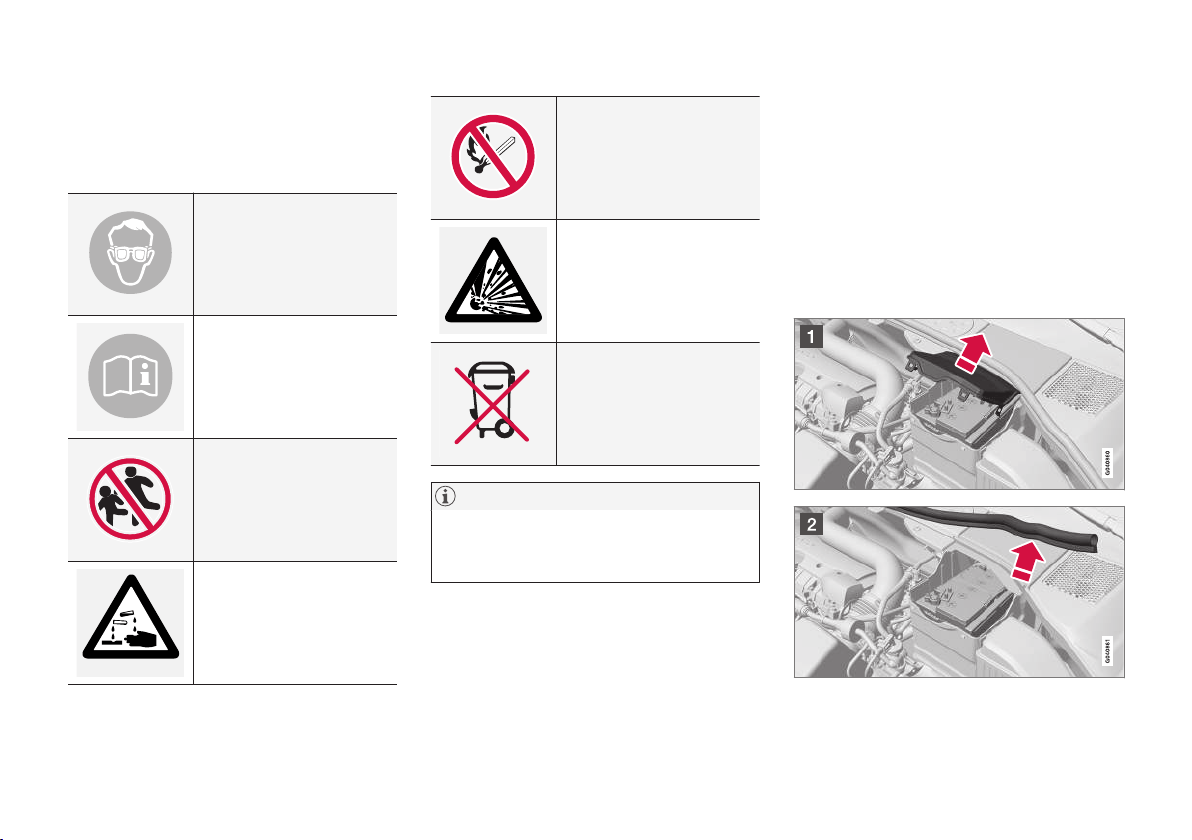
MAINTENANCE AND SERVICE
372
Battery - symbols
There are information and warning symbols on
the batteries.
Symbols on the batteries
Use protective goggles.
Further information in the
owner's manual for the car.
Store the battery out of the
reach of children.
The battery contains corro-
sive acid.
Avoid sparks and naked
flames.
Risk of explosion.
Must be taken for recycling.
NOTE
An expended starter battery or support bat-
tery must be recycled in an environmentally
safe manner since it contains lead.
Related information
•
Starter battery - general (p. 370)
•
Battery - Start/Stop (p. 374)
Starter battery - replacement
The starter battery in the car can be replaced
without the help of a workshop.
Removal
First of all: Take the remote control key from the
ignition switch and wait at least 5 minutes before
any electrical connections are touched - this is
because the car's electrical system needs to
store the necessary information to control mod-
ules.
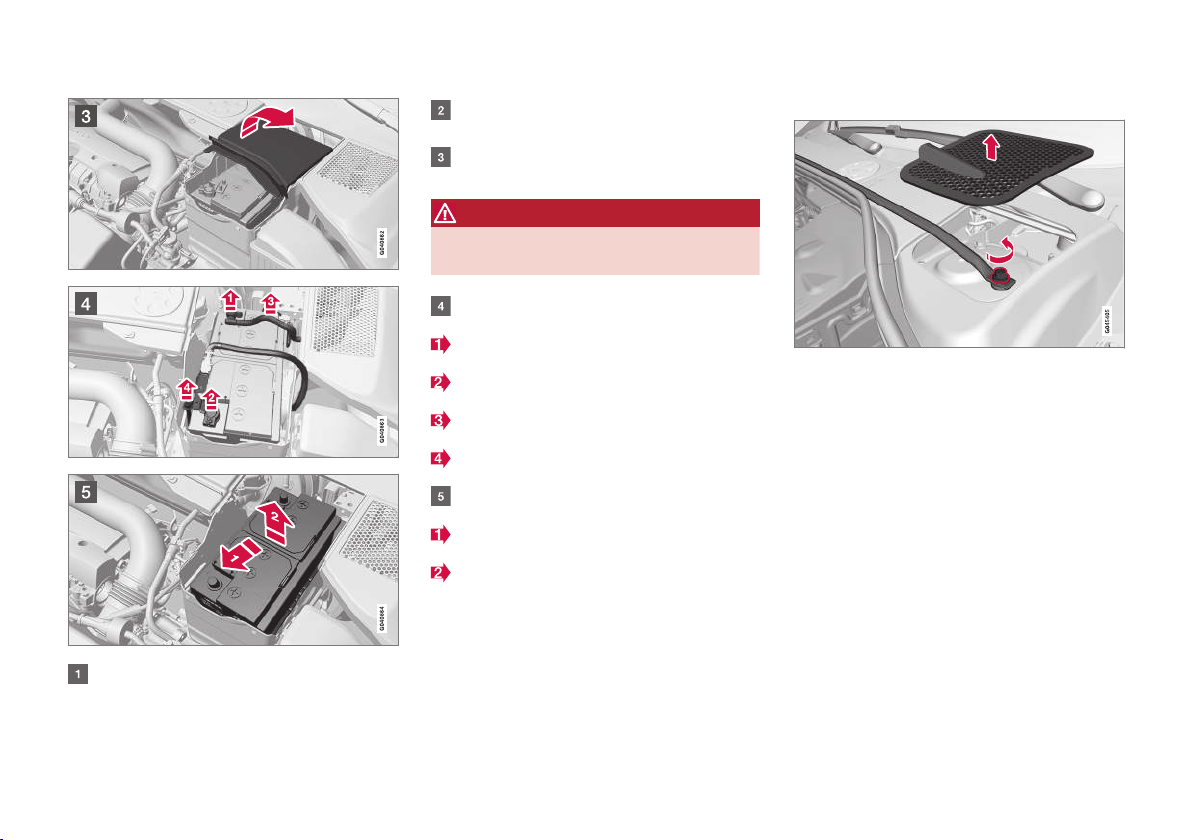
MAINTENANCE AND SERVICE
}}
* Option/accessory.
373
Open the clips on the front cover and remove
the cover.
Release the rubber moulding so that the rear
cover is free.
Remove the rear cover by screwing one
quarter turn and lifting it away.
WARNING
Connect and remove the positive and nega-
tive cables in the correct order.
Detach the black negative cable.
Detach the red positive cable.
Detach the ventilation hose from the battery.
Loosen the screw holding the battery clamp.
Move the battery aside.
Lift it up.
Cross-stay on the R-Design*
Cross-stay and plenum chamber cover.
Cars with R-Design have a cross-stay that must
be removed before the starter battery can be
replaced.
1. Remove the plenum chamber covers on the
right and left-hand sides. Prize carefully with
a plastic knife or similar.
2. Loosen and remove the screws (one on the
right and one on the left-hand side) that hold
the cross-stay.
3. Remove the cross-stay.
> Now the starter battery can be removed in
accordance with the previous section.
•
Fitting the cross-stay takes place in the
reverse order.
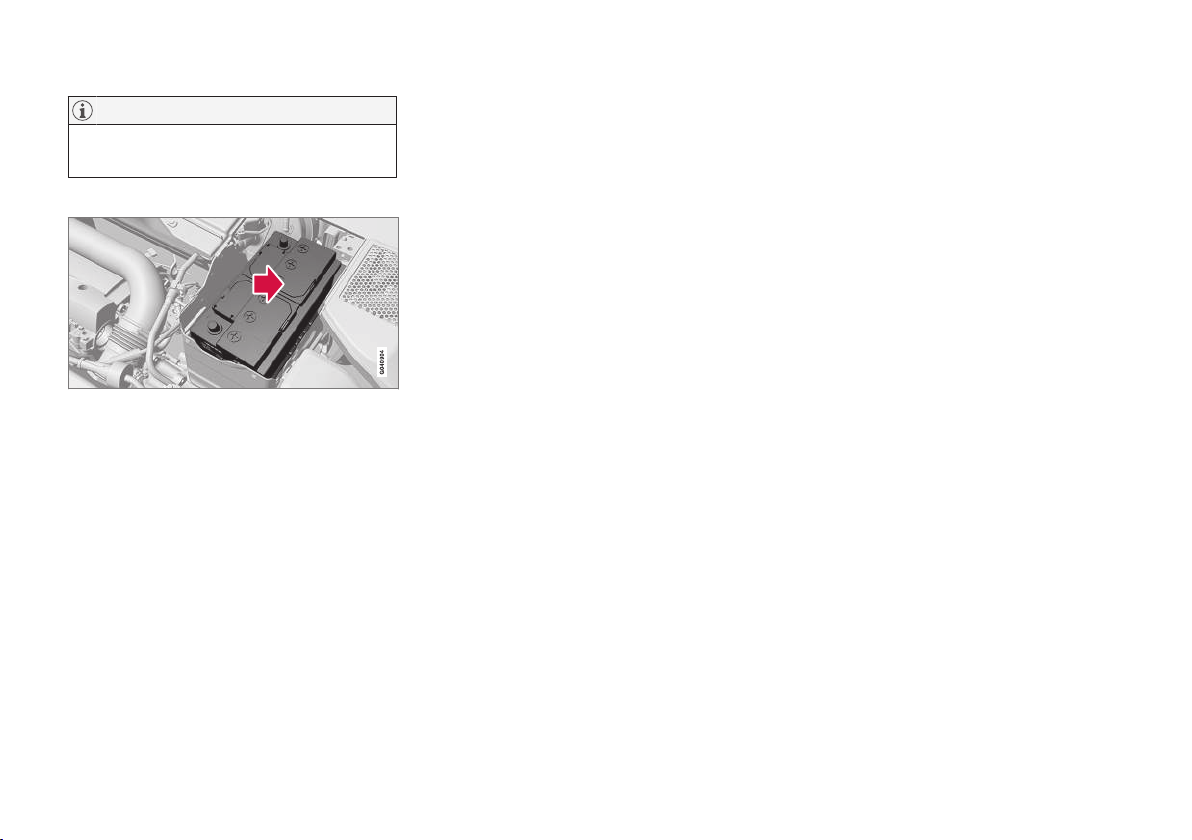
||
MAINTENANCE AND SERVICE
* Option/accessory.
374
NOTE
Tighten the screws to 30 Nm. Check the tor-
que with a torque wrench.
Fitting
1. Lower the battery into the battery box.
2. Move the battery inward and to the side until
it reaches the rear edge of the box.
3. Tighten the clamp that holds the battery.
4. Connect the ventilation hose.
> Check that it is correctly connected to
both battery and outlet in the body.
5. Connect the red positive cable.
6. Connect the black negative cable.
7. Press in the rear cover. (See earlier section
"Removal".)
8. Fit the rubber moulding. (See "Removal".)
9. Align the front cover and secure it with the
clips. (See "Removal".)
For more information on the car's starter battery,
see Starter battery - general (p. 370) and Jump
starting with another battery (p. 275).
Battery - Start/Stop
Cars with the Start/Stop function are equipped
with a support battery in addition to the starter
battery.
Cars with the Start/Stop function are equipped
with two 12 V batteries - one extra powerful bat-
tery for starting and one support battery that
helps during the Start/Stop function's starting
sequence.
For more information on the Start/Stop function,
see Start/Stop* (p. 284).
For more information on the car's starter battery,
see Jump starting with another battery (p. 275).
The following table shows specifications for the
starter battery and support battery respectively in
cars with Start/Stop function.

MAINTENANCE AND SERVICE
}}
375
Battery
Start, 12 V Support, 12 V
Cold
start
capacity
A
- CCA
B
(A)
720
C
760
D
Left-hand drive
car:
120
E
170
F
Right-hand drive
car:
120
Size,
L×W×H
(mm)
278×175×190
Left-hand drive
car:
150×90×106
E
150×90×130
F
Right-hand drive
car:
150×90×106
Battery
Start, 12 V Support, 12 V
Capacity
(Ah)
70
Left-hand drive
car:
8
E
10
F
Right-hand drive
car:
8
A
In accordance with EN standard.
B
Cold Cranking Amperes.
C
Manual gearbox.
D
Automatic gearbox.
E
Manual gearbox in combination with Start/Stop function that
only auto-stops when the car is completely stationary.
F
Others.
IMPORTANT
When replacing the starter battery in cars
with the Start/Stop function, a battery of
EFB
11
type or stronger must be installed.
When replacing the support battery, a battery
of AGM
12
type must be fitted.
NOTE
•
The higher the current take-off in the car,
the more the alternator must be working
and the batteries charging = Increased
fuel consumption.
•
When the capacity of the starter battery
has fallen below the lowest permissible
level then the Start/Stop function is dis-
engaged.
Temporarily reduced Start/Stop function due to
high current take-off means:
•
The engine starts automatically
13
without the
driver depressing the clutch pedal (manual
gearbox).
•
The engine starts automatically without the
driver lifting his/her foot off the foot brake
pedal (automatic gearbox).
11
Enhanced Flooded Battery.
12
Absorbed Glass Mat.
13
Automatic starting can only take place if the gear lever is in neutral position.
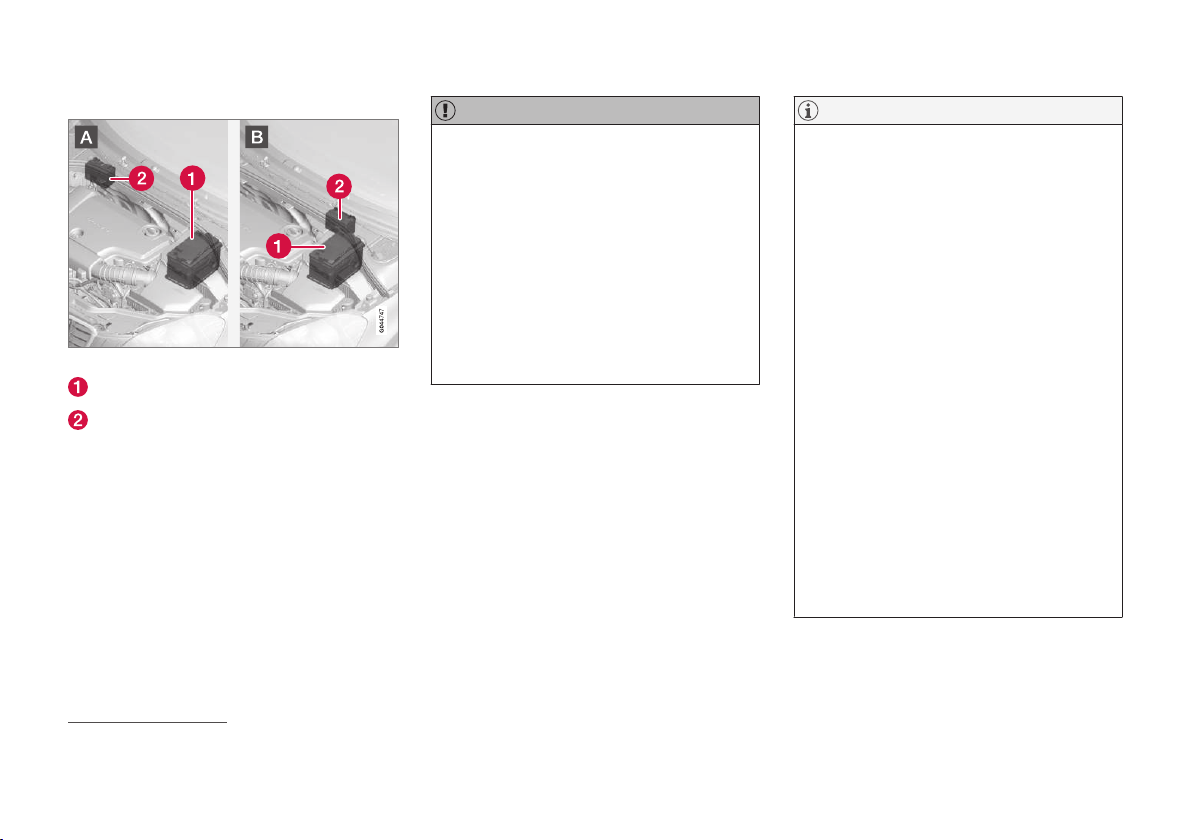
||
MAINTENANCE AND SERVICE
376
Location of the batteries
A: Left-hand drive car. B: Right-hand drive car.
Starter battery
14
Support battery
The support battery normally requires no more
service than the normal battery that is used for
starting. A workshop should be contacted in the
event of questions or problems - an authorised
Volvo workshop is recommended.
IMPORTANT
If the following instruction is not observed
then the Start/Stop function may temporarily
cease to work after the connection of an
external battery or battery charger:
•
The negative battery terminal on the car's
starter battery must never be used for
connecting an external battery or battery
charger - only the car chassis may be
used as the grounding point.
See Jump starting with another battery
(p. 275) for a description of how the cable
clamps must be attached.
NOTE
If the starter battery has been discharged so
much that the car has no normal electrical
functions and the engine is then jump-started
with an external battery or a battery charger,
the Start/Stop function will continue to be
activated. If the Start/Stop function then
auto-stops the engine shortly after, there is a
great risk that engine auto-start will fail due
to insufficient battery capacity, because the
battery has not had the opportunity to
recharge.
If the car has been jump-started, or if there is
insufficient time to charge the battery with a
battery charger, the recommendation is to
temporarily deactivate the Start/Stop function
until the battery has been recharged by the
car. In an outside temperature of +15 °C, the
battery needs to be charged for at least
1 hour by the car. In a lower outside tempera-
ture, the charging time may increase to
3-4 hours. The recommendation is to charge
the battery using an external battery charger.
For more information on charging the starter
battery, see Starter battery - general (p. 370).
Related information
•
Battery - symbols (p. 372)
14
See Starter battery - general (p. 370) for detailed description of the starter battery.
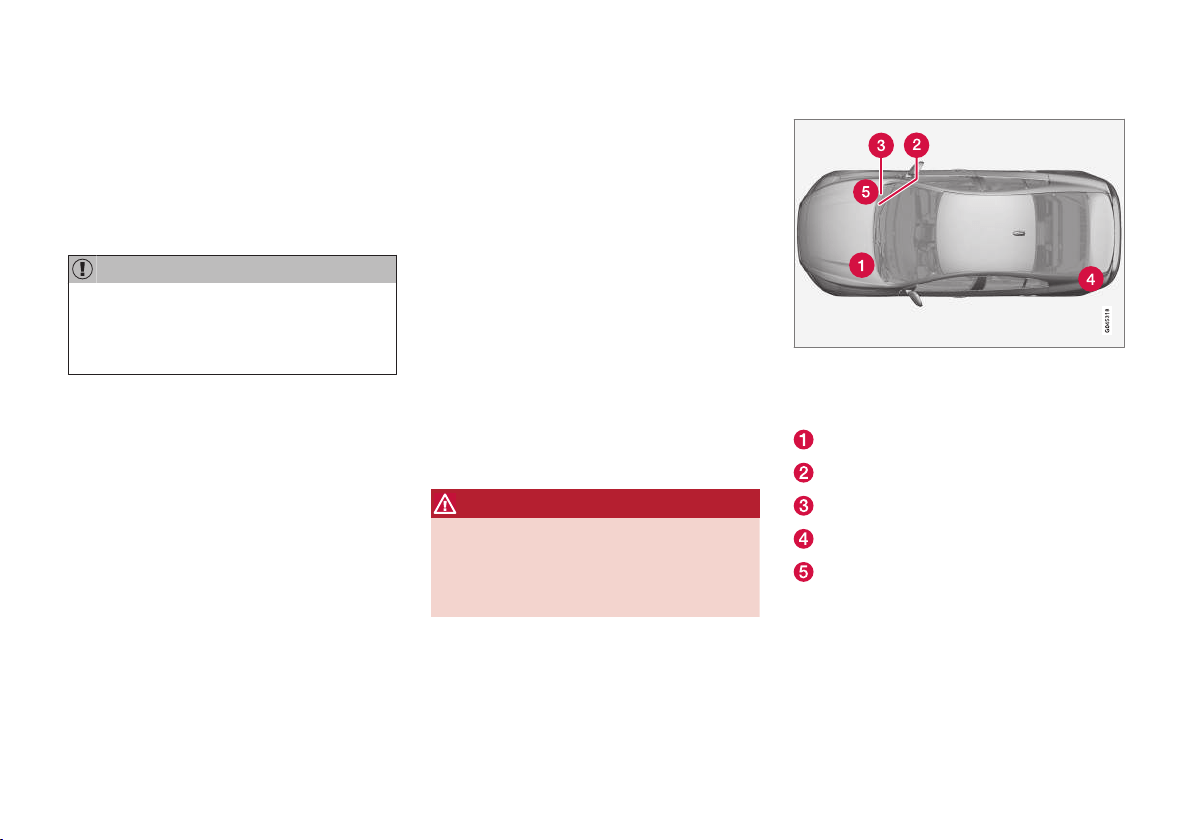
MAINTENANCE AND SERVICE
}}
377
Electrical system
The electrical system is single-pole and uses the
chassis and engine casing as a conductor.
The car has a voltage-regulated AC alternator.
The size, type and performance of the starter bat-
tery depend on the car's equipment and function.
IMPORTANT
If the starter battery is replaced, make sure
you replace it with a battery with the same
cold starting capacity and type as the original
battery (see the label on the battery).
Related information
•
Starter battery - replacement (p. 372)
•
Starter battery - general (p. 370)
Fuses - general
All electrical functions and components are pro-
tected by a number of fuses in order to protect
the car's electrical system from damage by short
circuiting or overloading.
If an electrical component or function does not
work, it may be because the component's fuse
was temporarily overloaded and failed. If the
same fuse fails repeatedly then there is a fault in
the circuit. Volvo recommends that you visit an
authorised Volvo workshop for checking.
Changing
1. Look in the fuse diagram to locate the fuse.
2. Pull out the fuse and check from the side to
see whether the curved wire has blown.
3. If this is the case, replace it with a new fuse
of the same colour and amperage.
WARNING
Never use a foreign object or a fuse with an
amperage higher than that specified when
replacing a fuse. This could cause significant
damage to the electrical system and possibly
lead to fire.
Location of central electrical units
Central electrical unit locations in a left-hand
drive car. In a right-hand drive car the central
electrical units under the glovebox change sides.
Engine compartment
Under the glovebox
Under the glovebox
Cargo area
Engine compartment cold zone (only Start/
Stop)
Related information
•
Fuses - in engine compartment (p. 379)
•
Fuses - under glovebox (p. 383)
•
Fuses - in the control module under the glo-
vebox (p. 385)

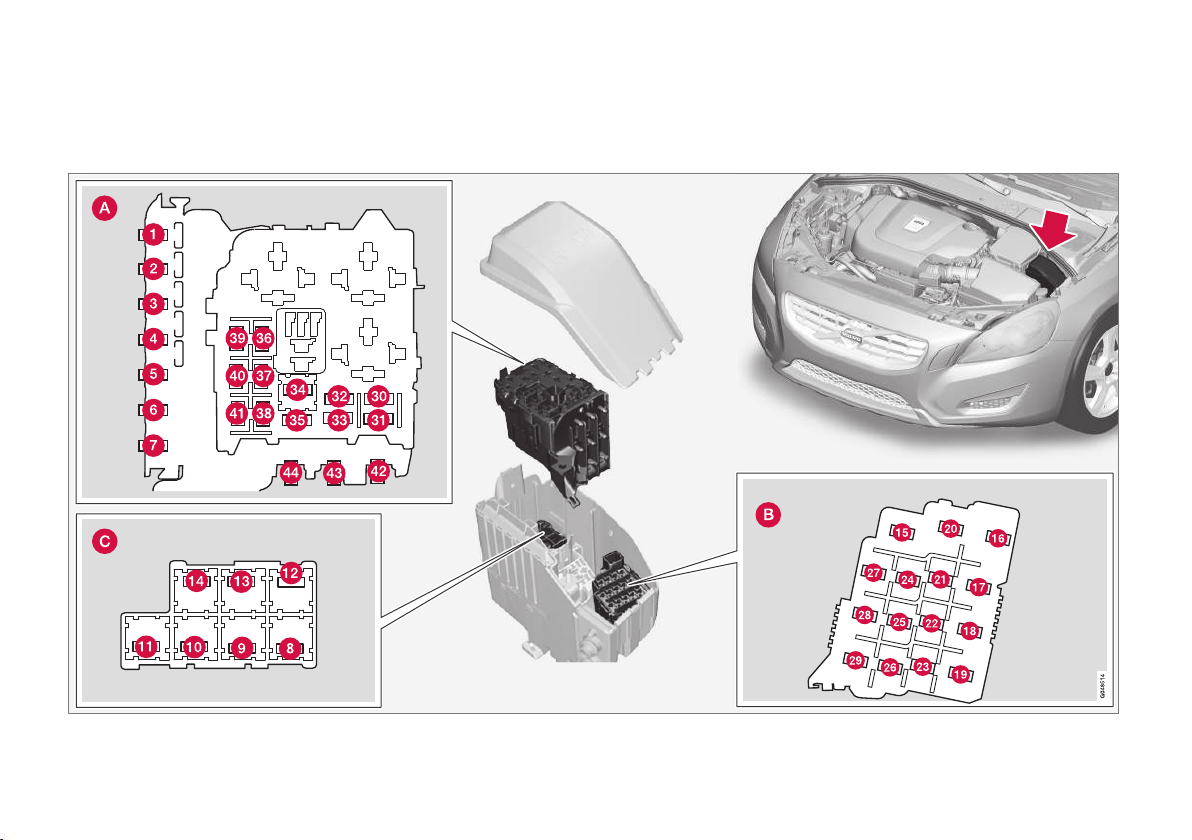
MAINTENANCE AND SERVICE
}}
379
Fuses - in engine compartment
Fuses in the engine compartment protect engine
and brake functions, amongst other things.
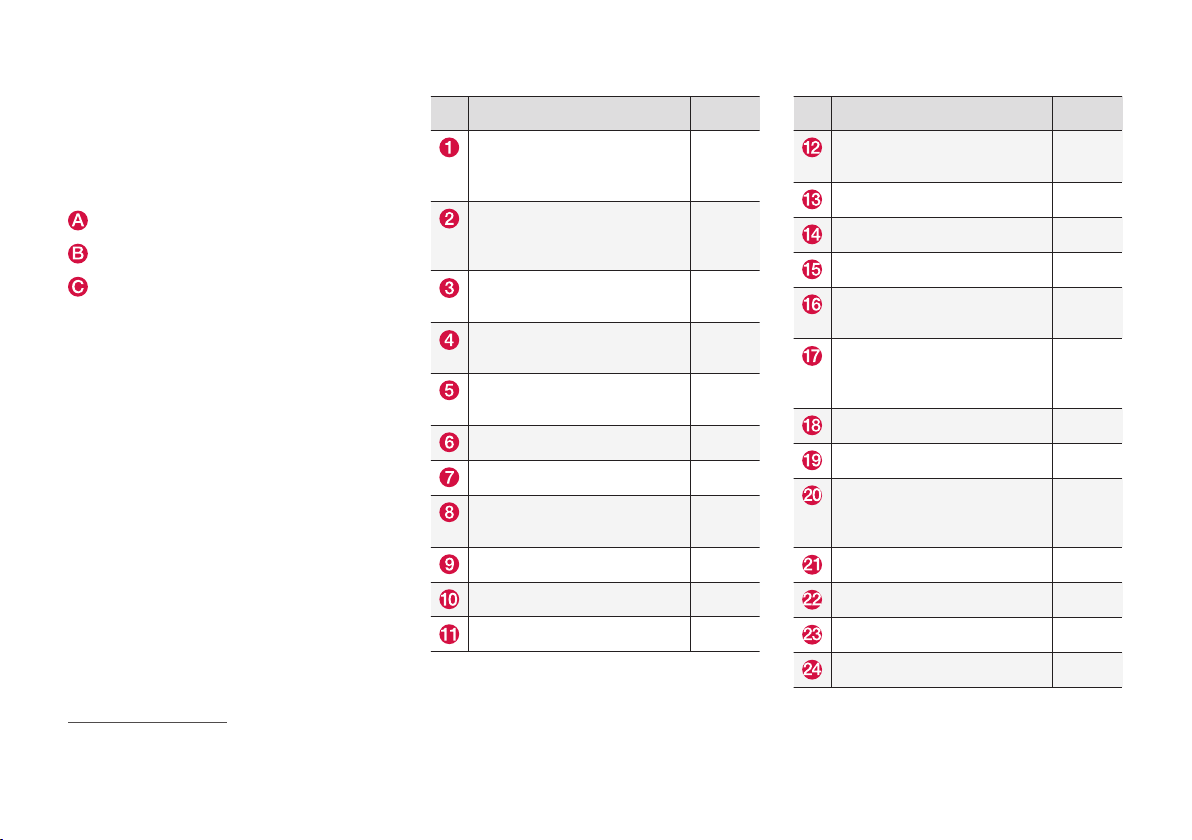
||
MAINTENANCE AND SERVICE
* Option/accessory.
380
General fuses, engine compartment
On the inside of the cover there are tweezers that
facilitate the procedure for the removal and fitting
of fuses.
Positions (see preceding illustration)
Engine compartment, upper
Engine compartment, front
Engine compartment, lower
These fuses are all located in the engine com-
partment box. The fuses in (C) are located under
(A).
On the inside of the cover is a label that shows
the location of the fuses.
•
Fuses 1-7 and 42-44 are of the "Midi Fuse"
type and must only be replaced by a work-
shop
15
.
•
Fuses 8-15 and 34 are of the "JCASE" type
and should be replaced by a workshop
15
.
•
Fuses 16-33 and 35-41 are of the "Mini
Fuse" type.
Function
A
A
Primary fuse for the central
electronic module (CEM)
under the glovebox
B
50
Primary fuse for the central
electronic module (CEM)
under the glovebox
50
Primary fuse for central elec-
trical unit in cargo area
B
60
Primary fuse for relay/fuse
box under the glovebox
60
Primary fuse for relay/fuse
box under the glovebox
B
60
- -
Electric additional heater*
B
100
Heated windscreen*
B
, left-
hand side
40
Windscreen wipers 30
Parking heater*
25
Ventilation fan
C
40
Function
A
A
Heated windscreen*
B
, right-
hand side
40
ABS pump 40
ABS valves 20
Headlamp washers*
20
Headlamp levelling*; Active
Xenon headlamps - ABL*
10
Primary fuse for the central
electronic module (CEM)
under the glovebox
20
ABS 5
Adjustable steering force*
5
Engine control module; Trans-
mission control module; Air-
bags
10
Heated washer nozzles*
10
- -
Headlamp control 5
- -
15
An authorised Volvo workshop is recommended.
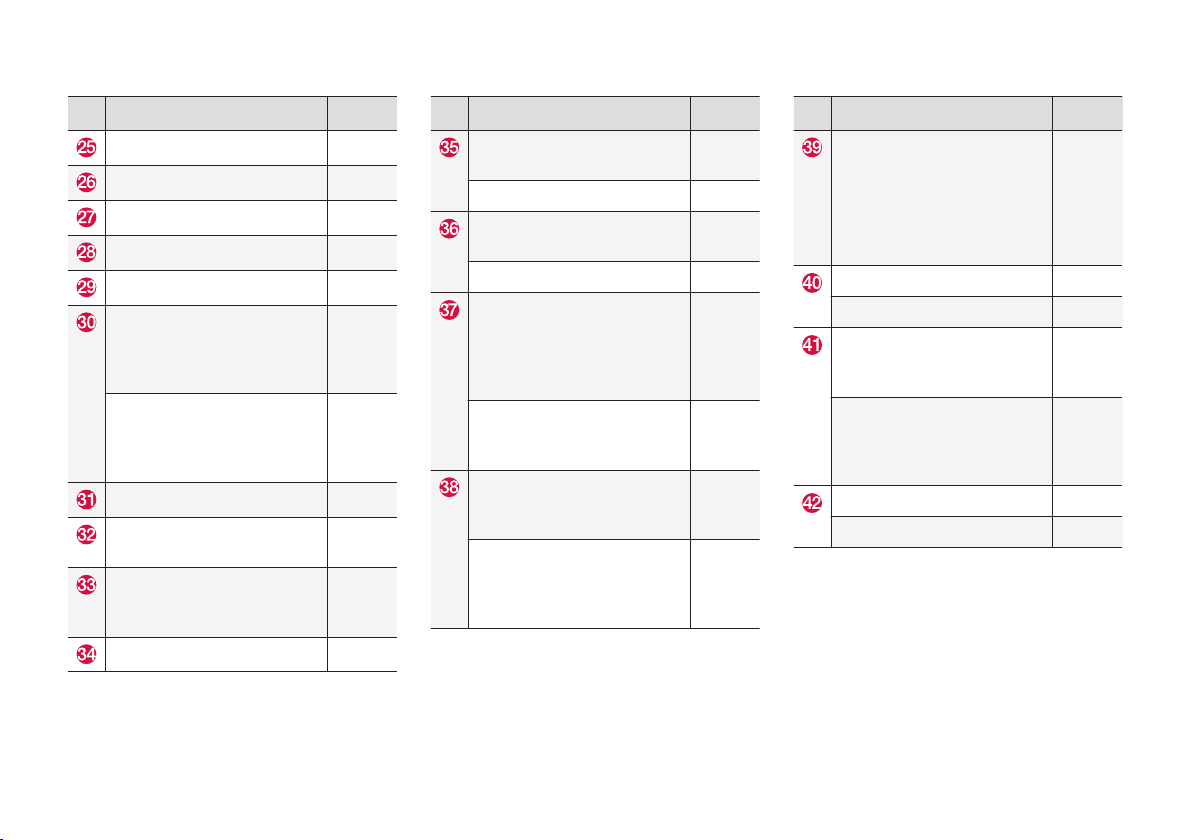
MAINTENANCE AND SERVICE
}}
* Option/accessory.
381
Function
A
A
- -
- -
Relay coils 5
Auxiliary lamps*
20
Horn 15
Relay coil in main relay for
engine management system
(4-cyl.); Engine control module
(4-cyl.)
5
Relay coil in main relay for
engine management system
(5-cyl. diesel); Engine control
module (5-cyl. diesel)
10
Transmission control module 15
Supporting coolant pump (4-
cyl. diesel)
15
Relay coils in central electrical
unit in engine compartment
cold zone Start/Stop
5
- -
Function
A
A
Glow control module (5-cyl.
diesel)
10
Engine control module (4-cyl.) 20
Engine control module (5-cyl.
diesel)
15
Engine control module (4-cyl.) 20
Mass air flow sensor (4-cyl.);
Thermostat(4-cyl. petrol);
EVAP valve (4-cyl. petrol);
Cooling pump for EGR (4-cyl.
diesel)
10
Mass airflow meter (5-cyl. die-
sel); Control valves (5-cyl. die-
sel)
15
Solenoid clutch A/C (5-cyl.
diesel); Valves (5-cyl. diesel);
Oil level sensor
10
Valves (4-cyl.); Oil pump (4-cyl.
petrol); Lambda-sond, centre
(4-cyl. petrol); Lambda-sond,
rear (4-cyl. diesel)
15
Function
A
A
Lambda-sond, front (4-cyl.);
Lambda-sond, rear (4-cyl. pet-
rol)
Lambda-sonds (5-cyl. diesel);
Control module, radiator roller
cover (5-cyl. diesel)
15
Ignition coils (4-cyl. petrol) 15
Diesel filter heater (diesel) 20
Solenoid clutch A/C (4-cyl.);
Glow control module (4-cyl.
diesel); Oil pump (4-cyl. diesel)
7.5
Crankcase ventilation heater
(5-cyl. diesel); Oil pump auto-
matic gearbox (5-cyl. diesel
Start/Stop)
10
Coolant pump (4-cyl. petrol) 50
Glow plugs (diesel) 70
||
MAINTENANCE AND SERVICE
382
Function
A
A
Cooling fan (petrol)
60/80
D
Cooling fan (diesel) 80
Power steering 100
A
Ampere
B
For cars with the Start/Stop function this fuse location is empty
- see instead Fuses - in the engine compartment's cold zone
(p. 389).
C
For cars with the Start/Stop function this fuse location is empty
- see instead Fuses - in the engine compartment's cold zone
(p. 389).
D
Depending on cooling fan variant.
Related information
•
Fuses - under glovebox (p. 383)
•
Fuses - in the control module under the glo-
vebox (p. 385)
•
Fuses - in cargo area (p. 387)
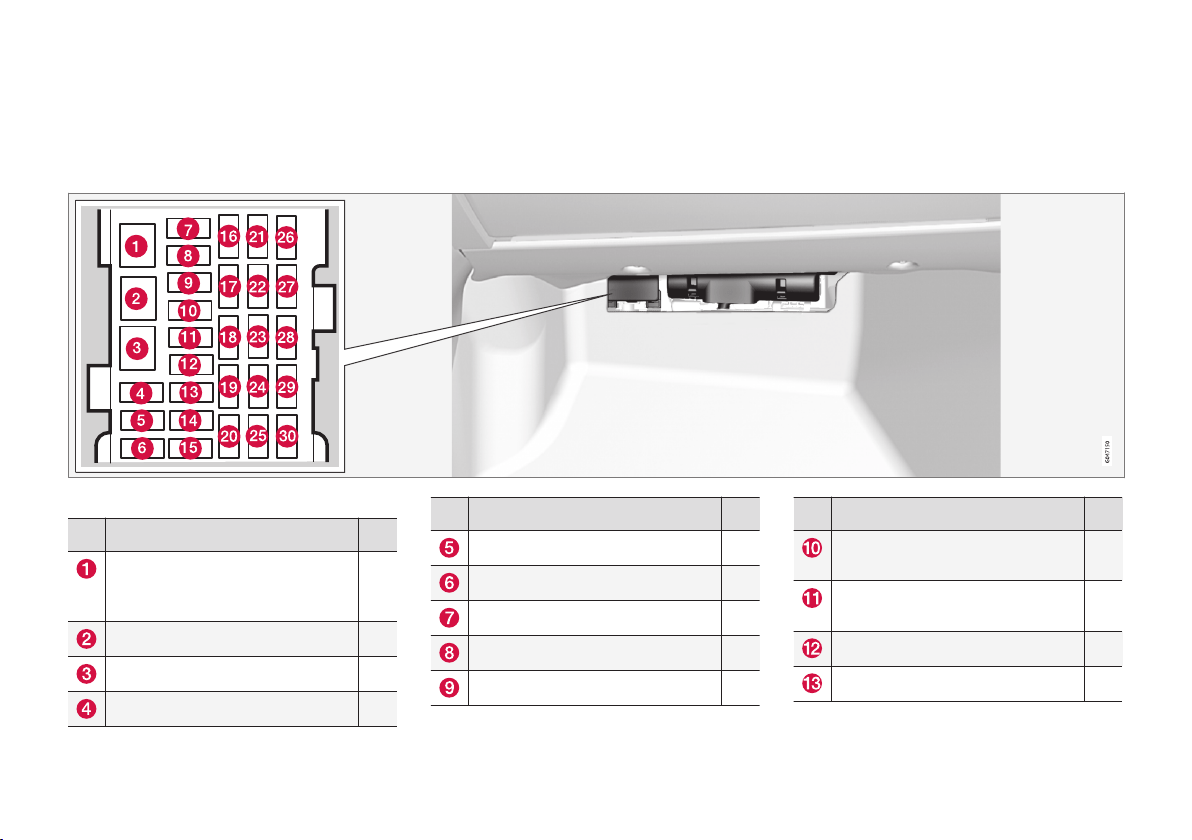
MAINTENANCE AND SERVICE
}}
* Option/accessory.
383
Fuses - under glovebox
Fuses under the glovebox protect the infotain-
ment system and seat functions, amongst other
things.
Positions
Function
A
A
Primary fuse for audio control mod-
ule*; Primary fuse for fuses 16-20:
Infotainment
40
Windscreen washers 25
- -
- -
Function
A
A
- -
Door handles, keyless system*
5
- -
Control panel, driver's door 20
Control panel, front passenger door 20
Function
A
A
Control panel, rear passenger door,
right
20
Control panel, rear passenger door,
left
20
Keyless system*
7.5
Power seat, driver's side*
20
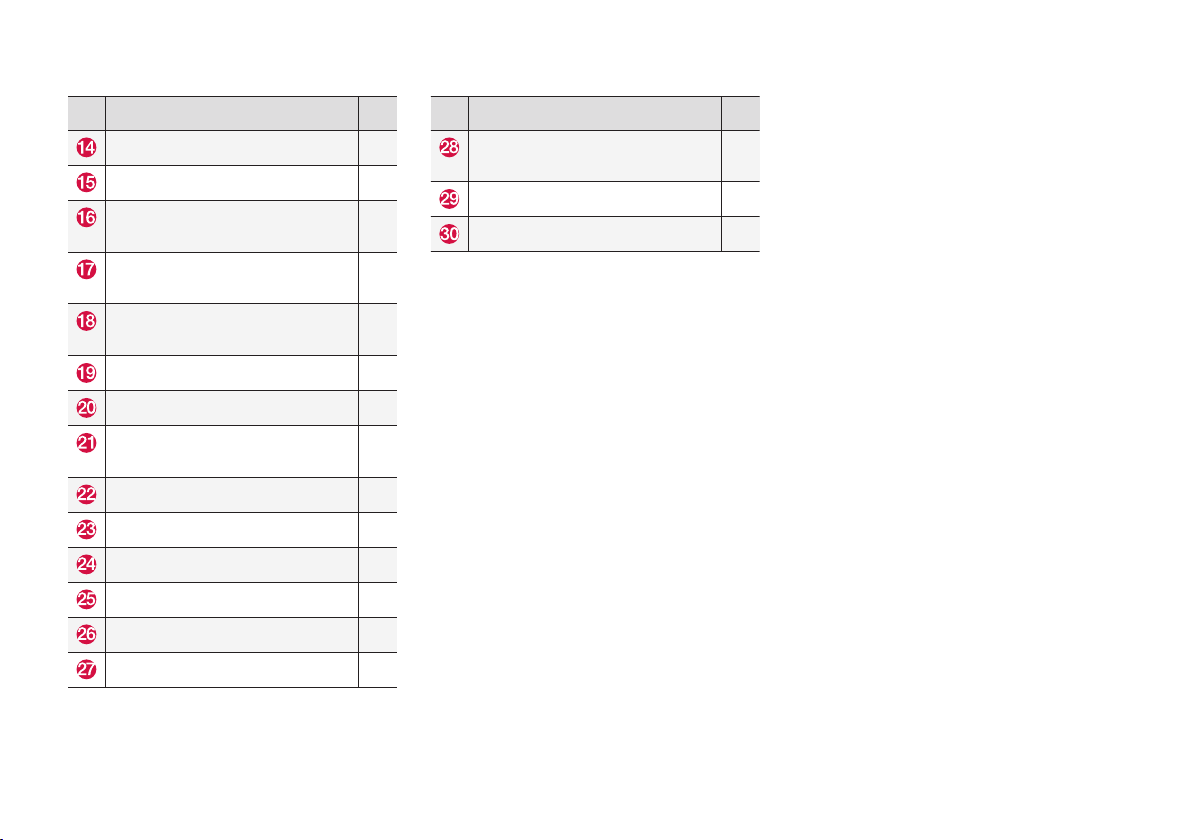
||
MAINTENANCE AND SERVICE
* Option/accessory.
384
Function
A
A
Power seat, passenger side*
20
- -
Infotainment Control Module or
Screen
B
5
Audio control unit (amplifier)*; TV*;
Digital radio*
10
Audio control module or Control
module Sensus
B
15
Telematics*; Bluetooth*
5
- -
Sunroof*; Interior lighting roof; Cli-
mate sensor*
5
12 V socket, tunnel console 15
Seat heating, rear right*
15
Seat heating, rear left*
15
Electric additional heater*
5
Seat heating, front passenger side 15
Seat heating, front driver's side 15
Function
A
A
Parking assistance*; Parking cam-
era*; BLIS*
5
AWD control module*
15
Active chassis Four-C*
10
A
Ampere
B
Certain model variants.
Related information
•
Fuses - in engine compartment (p. 379)
•
Fuses - in the control module under the glo-
vebox (p. 385)
•
Fuses - in cargo area (p. 387)
•
Fuses - in the engine compartment's cold
zone (p. 389)
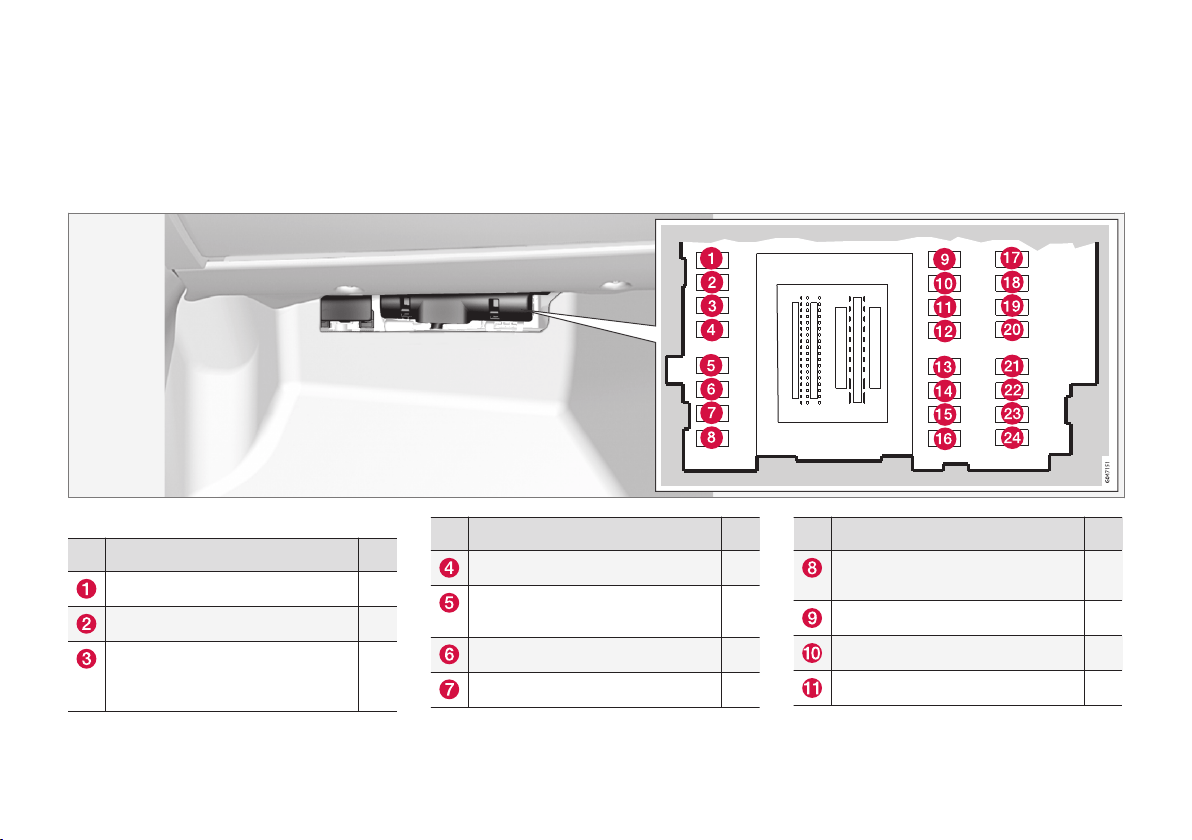
MAINTENANCE AND SERVICE
}}
* Option/accessory.
385
Fuses - in the control module under
the glovebox
Fuses in the control module under the glovebox
protect airbag and collision warning system
functions, amongst other things.
Positions
Function
A
A
- -
- -
Interior lighting; Driver's door con-
trol panel, power windows; Power
seats*
7.5
Function
A
A
Combined instrument panel 5
Adaptive cruise control, ACC*; colli-
sion warning system*
10
Interior lighting; Rain sensor*
7.5
Steering wheel module 7.5
Function
A
A
Central locking system, fuel filler
flap
10
Heated steering wheel*
15
Heated windscreen*
15
Unlocking, boot lid 10

||
MAINTENANCE AND SERVICE
* Option/accessory.
386
Function
A
A
Folding head restraint*
10
Fuel pump 20
Movement detector for alarm*; Cli-
mate panel
5
Steering lock 15
Siren*; Data link connector OBDII
5
- -
Airbags 10
Collision warning system*
5
Accelerator pedal sensor; Dimming
interior rearview mirror*; Seat heat-
ing, rear*
7.5
Infotainment control module (Per-
formance); Audio (Performance)
15
Brake light 5
Sunroof*
20
Immobiliser 5
A
Ampere
Related information
•
Fuses - in engine compartment (p. 379)
•
Fuses - under glovebox (p. 383)
•
Fuses - in cargo area (p. 387)
•
Fuses - in the engine compartment's cold
zone (p. 389)
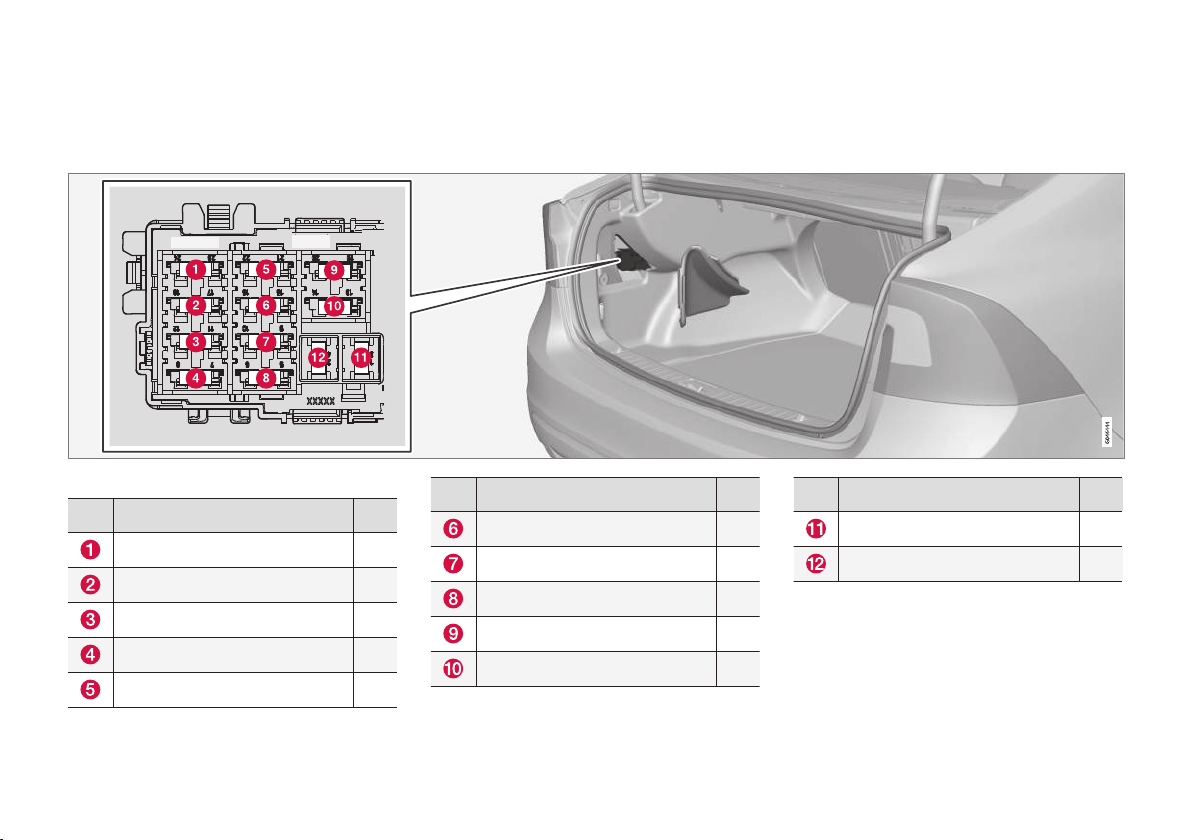
MAINTENANCE AND SERVICE
}}
* Option/accessory.
387
Fuses - in cargo area
Fuses in the cargo area protect the electric park-
ing brake, amongst other things.
Positions
Function
A
A
Electric parking brake, left 30
Electric parking brake, right 30
Rear window defroster 30
Trailer socket 2*
15
- -
Function
A
A
12 V socket, cargo area 15
- -
- -
- -
- -
Function
A
A
Trailer socket 1*
40
- -
A
Ampere
Related information
•
Fuses - in engine compartment (p. 379)
•
Fuses - under glovebox (p. 383)

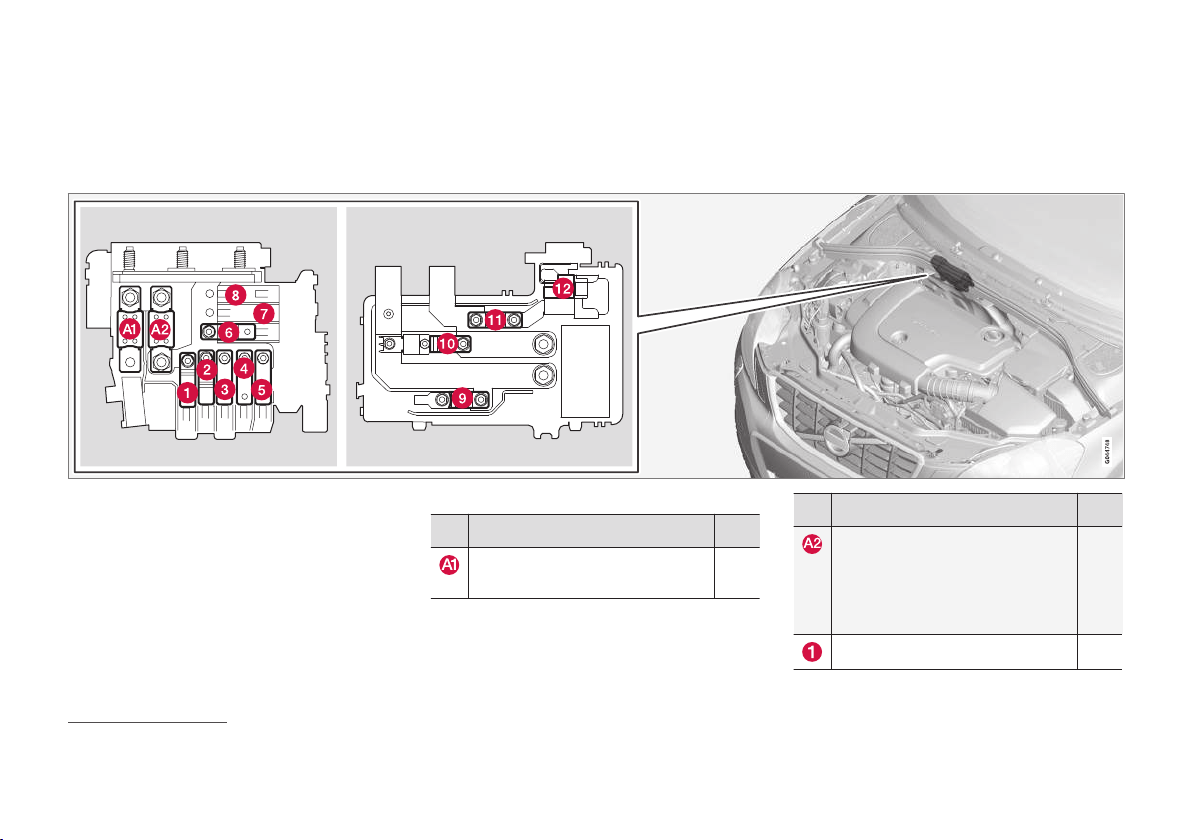
MAINTENANCE AND SERVICE
}}
* Option/accessory.
389
Fuses - in the engine
compartment's cold zone
Fuses in the engine compartment's cold zone
are fitted in cars with the Start/Stop function.
•
Fuses A1 and A2 are of the "MEGA Fuse"
type and must only be replaced by a work-
shop
16
.
•
Fuses 1-11 are of the "Midi Fuse" type and
must only be replaced by a workshop
16
.
•
Fuse 12 is of the "Mini Fuse" type.
For more information on Start/Stop - see Start/
Stop* (p. 284).
Positions
Function
A
A
Main fuse for central electrical
unit in the engine compartment
175
Function
A
A
Main fuse for central electronic
module (CEM) under the glove-
box, relay/fuse box under the glo-
vebox, central electrical unit in
cargo area
175
Electric additional heater*
100
16
An authorised Volvo workshop is recommended.
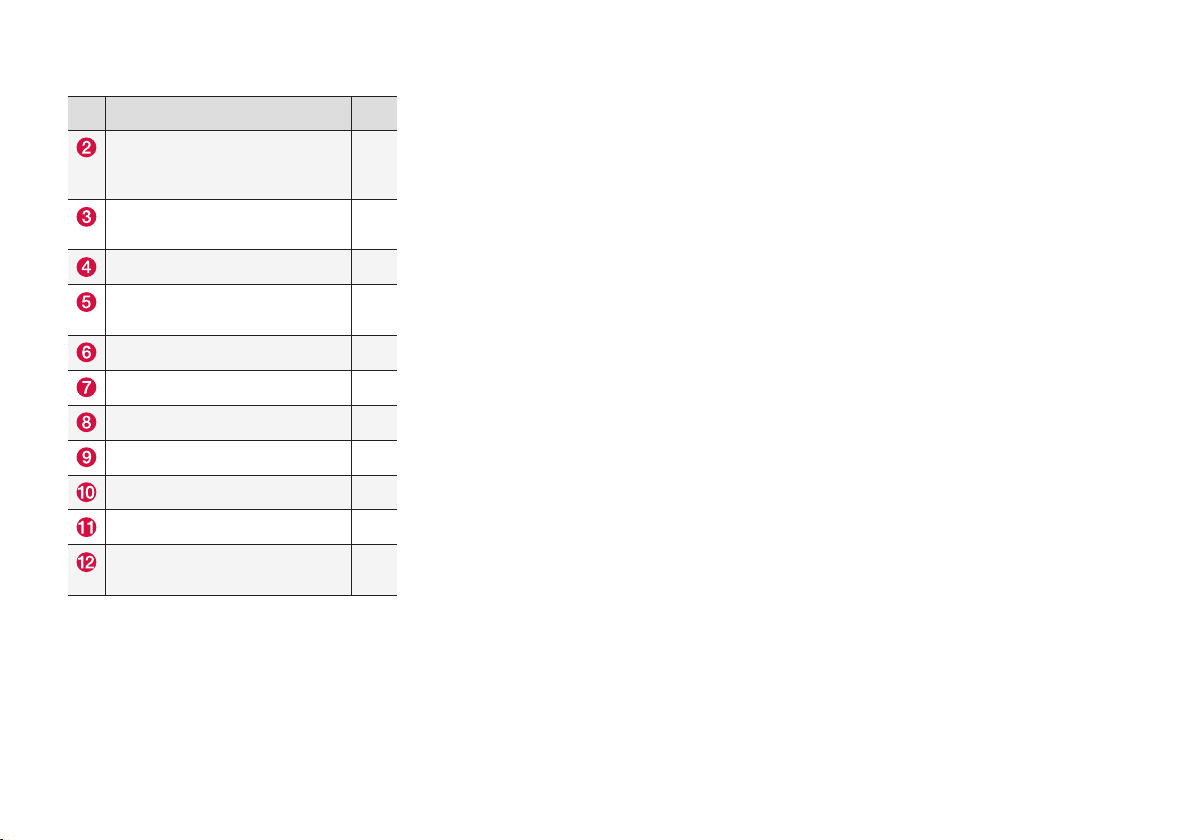
||
MAINTENANCE AND SERVICE
* Option/accessory.
390
Function
A
A
Primary fuse for the central elec-
tronic module (CEM) under the
glovebox
50
Primary fuse for relay/fuse box
under the glovebox
60
Heated windscreen*
60
Primary fuse for central electrical
unit in cargo area
60
Ventilation fan 40
- -
- -
Start relay 30
- -
Support battery 70
Central electronic module (CEM) -
reference voltage support battery
5
A
Ampere
Related information
•
Fuses - in engine compartment (p. 379)
•
Fuses - under glovebox (p. 383)
•
Fuses - in the control module under the glo-
vebox (p. 385)
•
Fuses - in cargo area (p. 387)
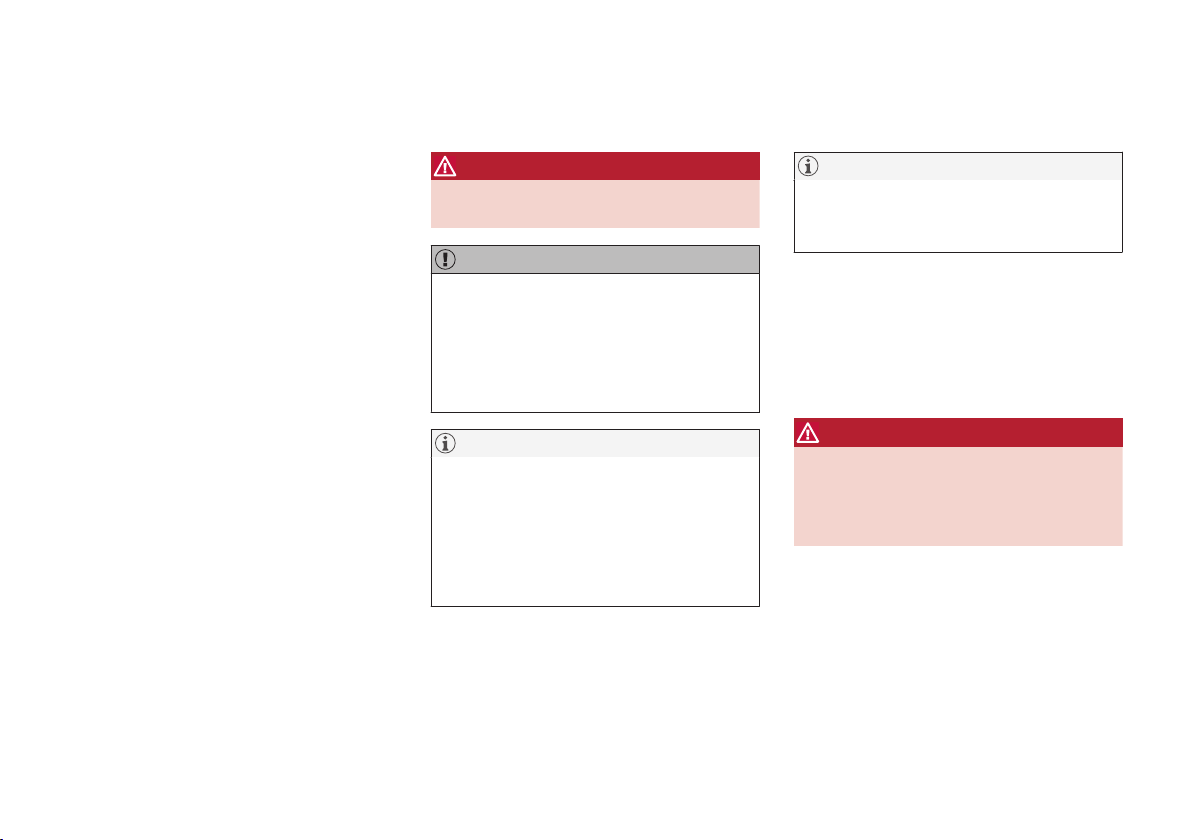
MAINTENANCE AND SERVICE
}}
391
Car wash
The car should be washed as soon as it
becomes dirty. This means that the car is easier
to clean as the dirt does not attach as firmly. It
also reduces the risk of scratches and keeps the
car fresh. Wash the car in a car wash with oil
separator. Use car shampoo.
Handwashing
•
Remove bird droppings from the paintwork
as soon as possible. Bird droppings contain
substances that affect and discolour paint-
work very quickly. For example, use soft
paper or sponge soaked in plenty of water.
An authorised Volvo workshop is recom-
mended for the removal of any discoloration.
•
Hose down the underbody.
•
Rinse the whole car until the loose dirt has
been removed in order to reduce the risk of
scratches from washing. Do not spray directly
onto the locks.
•
If necessary, use cold degreasing agent on
very dirty surfaces. Note that the surfaces
must not then be warmed up by the sun!
•
Wash using a sponge, car shampoo and
plenty of lukewarm water.
•
Clean the wiper blades with a lukewarm soap
solution or car shampoo.
•
Dry the car using a clean, soft chamois or a
water scraper. If you avoid allowing water
droplets to dry in strong sunlight then the
risk of water stains that may need to be pol-
ished away is reduced.
WARNING
Always have the engine cleaned by a work-
shop. There is a risk of fire if the engine is hot.
IMPORTANT
Dirty headlamps have impaired functionality.
Clean them regularly, when refuelling for
example.
Do not use any corrosive cleaning agents but
use water and a non-scratching sponge
instead.
NOTE
Outside lighting such as headlamps and rear
lamps may temporarily have condensation on
the inside of the lens. This is normal, all exte-
rior lighting is designed to withstand this.
Condensation is normally vented out of the
lamp housing when the lamp has been
switched on for a time.
Automatic car washes
An automatic car wash is a simple and quick way
of washing the car, but it cannot reach every-
where. Washing the car by hand is recommended
to achieve a good result, or to supplement auto-
matic car washes with washing by hand.
NOTE
The car must only be washed by hand over
the first few months. This is because the paint
is more delicate when it is new.
High-pressure washing
When using high-pressure washing, use sweep-
ing movements and make sure that the nozzle
does not come closer than 30 cm to the surface
of the car. Do not spray directly onto the locks.
Testing the brakes
WARNING
Always test the brakes after washing the car,
including the parking brake, to ensure that
moisture and corrosion do not attack the
brake linings and reduce braking perform-
ance.
Lightly depress the brake pedal now and then
when driving long distances in rain or slush. The
heat from the friction causes the brake linings to
warm up and dry. Do the same thing after starting
in very damp or cold weather.
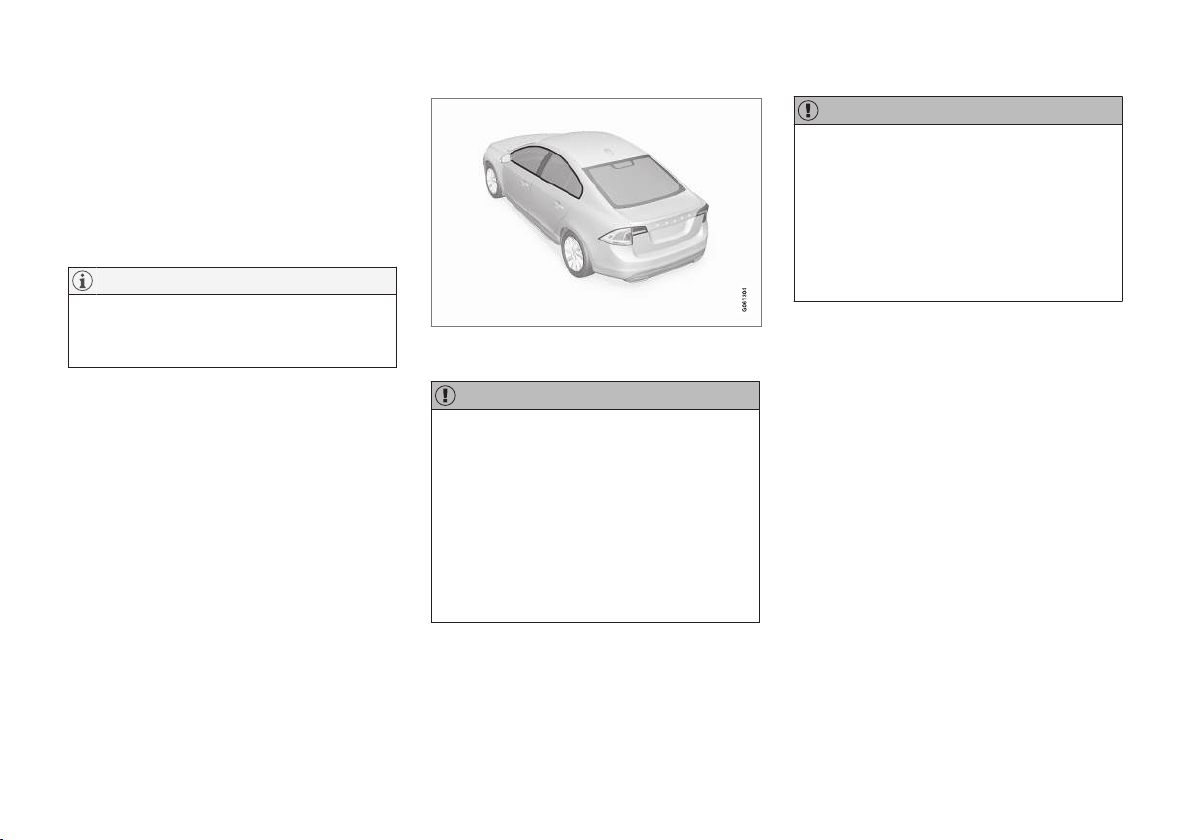
||
MAINTENANCE AND SERVICE
* Option/accessory.
392
Wiper blades
Asphalt, dust and salt residue on wiper blades, as
well as insects, ice etc. on the windscreen, impair
the service life of wiper blades.
For cleaning:
- Set the wiper blades to the service position, see
Wiper blades (p. 368).
NOTE
Wash the wiper blades and windscreen regu-
larly with a lukewarm soap solution or car
shampoo. Do not use any strong solvents.
Exterior plastic, rubber and trim
components
A special cleaning agent available from Volvo
dealers is recommended for the cleaning and
care of coloured plastic parts, rubber and trim
components, such as glossy trim mouldings.
When using such a cleaning agent the instruc-
tions must be followed carefully.
The frames around the side windows, the car's
roof rails and the door frames at the windows*
are produced in anodised aluminium. This means
that they should only be washed using a cleaning
agent with a pH value between 3.5 and 11.5.
This is in order to avoid discolouration.
Parts that should be washed using a cleaning agent with
a pH value between 3.5 and 11.5.
IMPORTANT
Avoid waxing and polishing on plastic and
rubber.
When using degreasant on plastic and rubber,
only rub with light pressure if it is necessary.
Use a soft washing sponge.
Polishing glossy trim mouldings could wear
away or damage the glossy surface layer.
Polishing agent that contains abrasive must
not be used.
IMPORTANT
Avoid washing the car with cleaning agent
with a pH value lower than 3.5 or higher than
11.5. This may result in discolouration of ano-
dised aluminium parts such as roof rack and
around the side windows.
Never use metal polishing agent on anodised
aluminium parts, this can result in discoloura-
tion and destroy the surface treatment.
Rims
Only use rim cleaning agent recommended by
Volvo.
After washing, discolouration at the base of the
spokes may remain due to metal dust from the
brake discs attaching in the wheel rim's paint.
Paint cleaner works in many cases, with very fine
polishing using a soft cloth.
Strong rim cleaning agents can damage the sur-
face and cause stains on chrome-plated alumi-
nium rims.
Related information
•
Polishing and waxing (p. 393)
•
Cleaning the interior (p. 394)
•
Water and dirt-repellent coating (p. 393)

MAINTENANCE AND SERVICE
}}
* Option/accessory.
393
Polishing and waxing
Polish and wax the car if the paintwork is dull or
to give the paintwork extra protection.
The car does not need to be polished until it is
at least one year old. However, the car can be
waxed during this time. Do not polish or wax the
car in direct sunlight.
Wash and dry the car thoroughly before you
begin polishing or waxing. Clean off asphalt and
tar stains using tar remover or white spirit. More
stubborn stains can be removed using fine rub-
bing paste designed for car paintwork.
Polish first with a polish and then wax with liquid
or solid wax. Follow the instructions on the pack-
aging carefully. Many preparations contain both
polish and wax.
IMPORTANT
Avoid waxing and polishing on plastic and
rubber.
When using degreasant on plastic and rubber,
only rub with light pressure if it is necessary.
Use a soft washing sponge.
Polishing glossy trim mouldings could wear
away or damage the glossy surface layer.
Polishing agent that contains abrasive must
not be used.
IMPORTANT
Only paint treatment recommended by Volvo
should be used. Other treatment such as pre-
serving, sealing, protection, lustre sealing or
similar could damage the paintwork. Paint-
work damage caused by such treatments is
not covered by Volvo warranty.
Related information
•
Car wash (p. 391)
Water and dirt-repellent coating
The windows are treated with a surface coating
that improves visibility in difficult weather condi-
tions.
Water and dirt-repellent coating*
There is natural wear of the water-
repellent coating.
Maintenance:
•
Never use products such as car wax,
degreaser or similar on glass surfaces as this
could ruin their water-repellent properties.
•
Take care when cleaning so as not to dam-
age the glass surface.
•
To avoid damaging glass surfaces when
removing ice – only use plastic ice scrapers.
•
Treatment with a special finishing agent
available from Volvo dealers is recommended
in order to maintain the water-repellent prop-
erties on the side windows. This should be
used first after three years and then each
year.
IMPORTANT
Do not use a metal ice scraper to remove ice
from the windows. Use the heating to remove
ice from the door mirrors, see Windows and
rearview and door mirrors - heating (p. 102).

||
MAINTENANCE AND SERVICE
394
Related information
•
Car wash (p. 391)
Rustproofing
The car received a thorough and complete rust-
proofing at the factory. Parts of the body are
made of galvanised sheet metal. The underbody
is protected by a wear-resistant anti-corrosion
compound. A thin, penetrating rustproofing fluid
was sprayed into the exposed members, cavi-
ties, closed sections and side doors.
Inspection and maintenance
The car's anti-corrosion protection does not nor-
mally need to be maintained, but keeping the car
clean always helps to further reduce the risk of
corrosion. Strong alkaline or acidic cleaning solu-
tions must always be avoided on the glossy trim
components. Any stone chips should be rectified
as soon as they are discovered.
Related information
•
Paint damage (p. 396)
Cleaning the interior
Only use cleaning agents and car care products
recommended by Volvo. Clean regularly and
treat stains at once for best results. Vacuuming
is important prior to using cleaning agents.
IMPORTANT
•
Certain items of coloured clothing (e.g.
dark jeans and suede garments) may
stain the upholstery. If this occurs, it is
important to clean and treat these parts
of the upholstery as soon as possible.
•
Never use strong solvents such as
washer fluid, pure petrol or white spirit to
clean the interior, since this may damage
the upholstery as well as other interior
materials.
•
Never spray the cleaning agent directly
onto components that have electrical but-
tons and controls. Wipe them instead
using a moistened cloth containing the
cleaning agent.
•
Sharp objects and Velcro may damage
the fabric upholstery.
Fabric upholstery and ceiling upholstery
Volvo offers a comprehensive fabric care product
for fabric upholstery and ceiling upholstery which,
when used in accordance with the instructions,
preserves the properties of the upholstery. The

MAINTENANCE AND SERVICE
395
fabric care product is available for purchase from
a Volvo dealer.
Leather upholstery
Volvo's leather upholstery is treated to preserve
its original appearance.
Leather upholstery is a natural product that
changes and acquires a beautiful patina over
time. Regular cleaning and treatment are
required in order that the properties and colours
of the leather shall be preserved. Volvo offers a
comprehensive product, Volvo Leather Care Kit/
Wipes, for the cleaning and treatment of leather
upholstery which, when used in accordance with
the instructions, preserves the leather's protective
coating.
To achieve best results, Volvo recommends the
cleaning and application of the protective cream
once to four times per year (or more if required).
The Volvo Leather Care Kit/Wipes is available for
purchase from a Volvo dealer.
Leather steering wheel
Leather needs to breathe. Never cover the
leather steering wheel with protective plastic.
Volvo Leather Care Kit/Wipes is recommended
for cleaning the leather steering wheel.
Interior plastic, metal and wood parts
A fibrillated fibre or microfibre cloth, lightly mois-
tened with water, available from Volvo dealers, is
recommended for cleaning interior parts and sur-
faces.
Do not scrape or rub stains. Never use strong
stain removers. A special cleaning agent available
from Volvo dealers can be used for more difficult
cleaning.
Seatbelts
Use water and a synthetic detergent. A special
textile cleaning agent is available from a Volvo
dealer. Ensure that the seatbelt is dry before
allowing it to retract.
Inlay mats and floor mat
Remove inlaid carpets for separate cleaning of
the floor carpet and the inlaid carpets. Use a vac-
uum cleaner to remove dust and dirt. Each inlay
mat is secured with pins.
Remove the inlay mat by taking hold of the inlay
mat at each pin and lifting the mat straight up.
Fit the inlay mat in place by pressing it in at each
pin.
WARNING
Only use one inlaid mat at each seat, and
check before setting off that the mat by the
driver's seat is firmly affixed and secured in
the pins so that it does not get caught adja-
cent to and under the pedals.
A special textile cleaner is recommended for
stains on the floor mat after vacuuming. Floor
mats must be cleaned with agents recommended
by a Volvo dealer.
Related information
•
Car wash (p. 391)
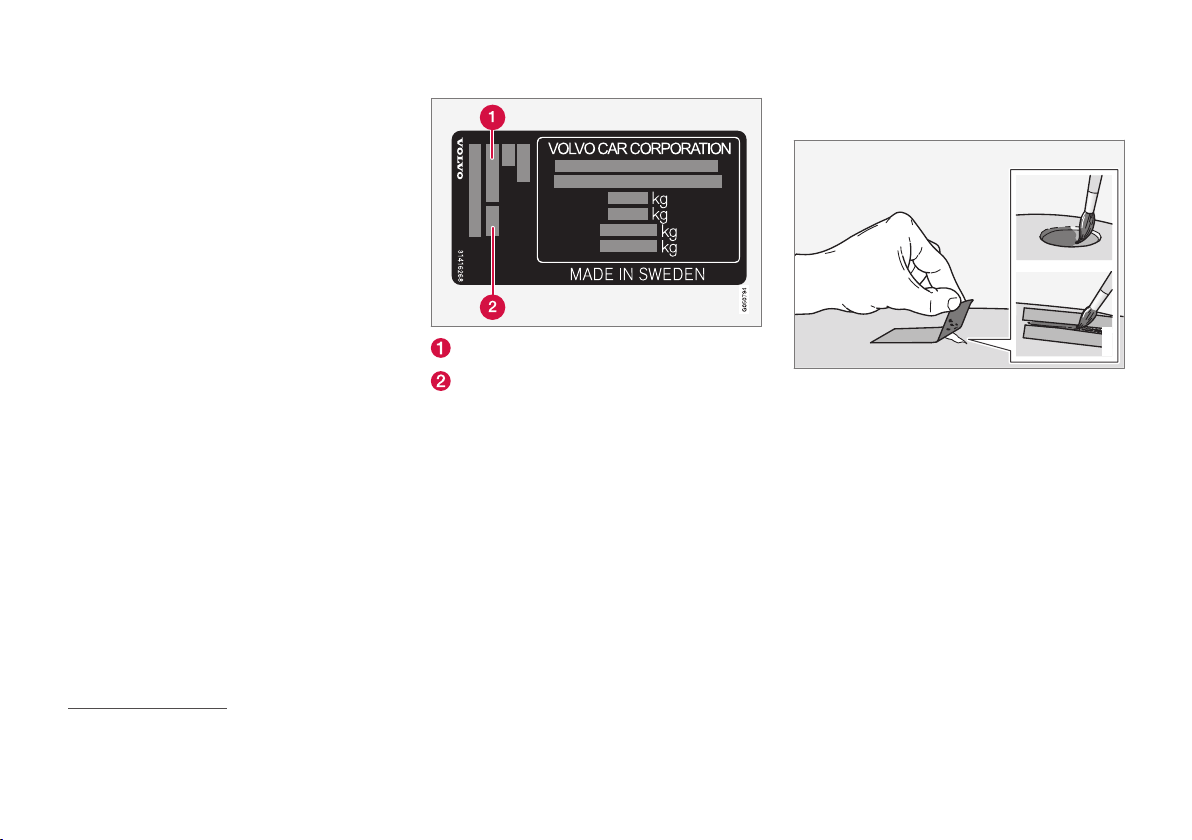
MAINTENANCE AND SERVICE
396
Paint damage
Paint is an important part of the car's rustproof-
ing and should therefore be checked regularly.
The most common types of paintwork damage
are stone chips, scratches, and marks on the
edges of wings, doors and bumpers.
Touching up minor paintwork damage
To avoid the onset of rust, damaged paintwork
should be rectified immediately.
Materials that may be needed
•
Primer
17
- for e.g. bumpers, there are special
adhesive primers available in spray cans.
•
Base coat and clear coat - are available in
spray cans or as touch-up pens/sticks
18
.
•
Masking tape.
•
Fine sand paper
17
.
Colour code
The label for colour code is located on the car's
door pillar and is visible when the right-hand rear
door is opened.
Exterior colour code
Any secondary exterior colour code
It is important that the correct colour is used. For
product label location, see Type designations
(p. 400).
Repairing minor paint damage such as
stone chips and scratches
G021832
Before work is started, the car must be clean and
dry as well as at a temperature above 15 °C.
1. Apply a piece of masking tape over the dam-
aged surface. Then remove the tape to
remove any loose paint.
If the damage has reached down to a metal
surface (sheet steel), it is preferable to use a
primer. In the event of damage to a plastic
surface, an adhesive primer should be used
for better results - spray into the spray can's
cap and brush thinly.
17
If required.
18
Follow the instructions that are included with the package for the touch-up pen/stick.

MAINTENANCE AND SERVICE
397
2. Before painting, gentle polishing using a very
fine polishing agent may be carried out
locally if required (e.g. if there are any uneven
edges). Clean the surface thoroughly and
allow to dry.
3. Stir the primer well and apply using a fine
brush, matchstick or similar. Finish with base
coat and clear coat once the primer has
dried.
4. For scratches, proceed as above, but mask
around the damaged area to protect the
undamaged paintwork.
NOTE
If the stone chip has not penetrated down to
the meal and an undamaged layer of paint
remains in place, fill in with base coat and
clear coat as soon as the surface has been
cleaned.
Related information
•
Rustproofing (p. 394)


SPECIFICATIONS

SPECIFICATIONS
400
Type designations
Type designation, vehicle identification number,
etc., i.e. information unique to the car, can be
read on a label in the car.
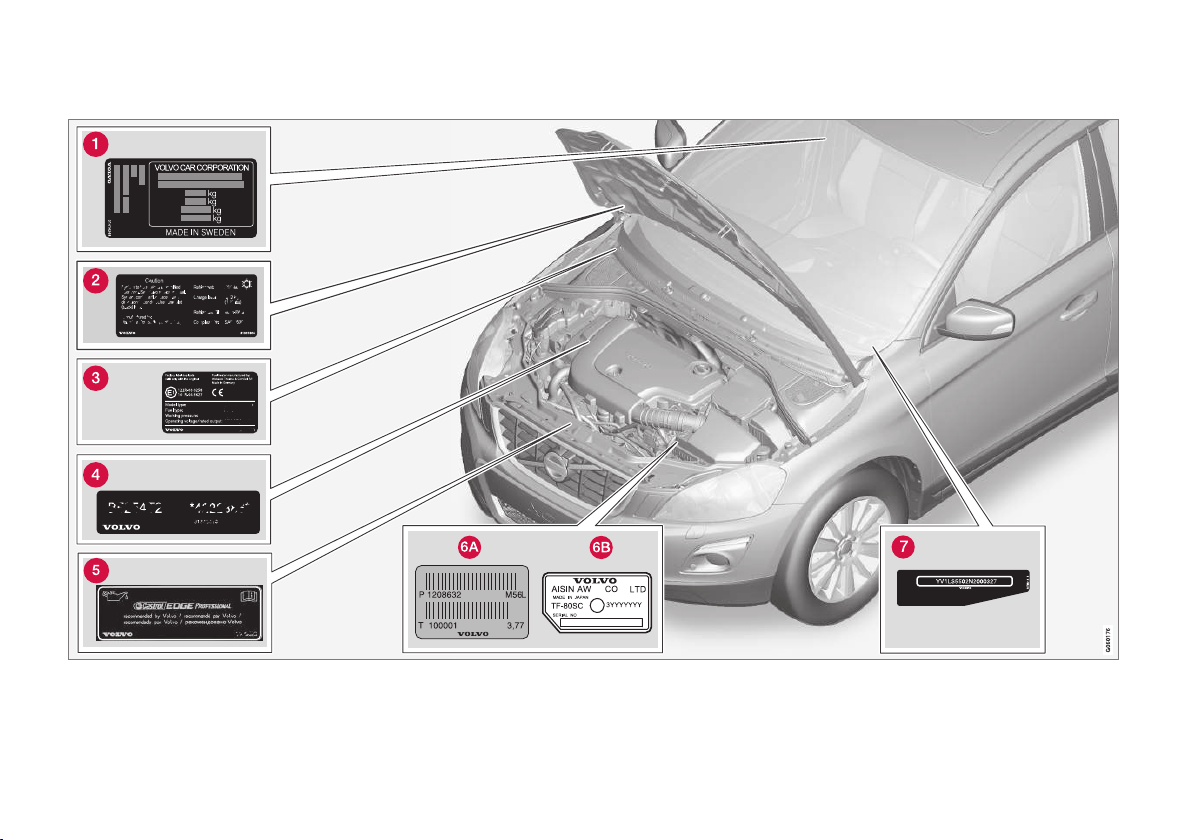
SPECIFICATIONS
}}
401
Label location
The illustration is schematic - details may vary depending on market and model.
Knowing the car's type designation, vehicle iden-
tification and engine numbers can facilitate all

||
SPECIFICATIONS
402
contact with an authorised Volvo dealer regarding
the car and when ordering spare parts and
accessories.
Decal for type designation, vehicle identifica-
tion number, permissible maximum weights
and code designation for exterior colour and
type approval number. The decal is posi-
tioned on the door pillar, and will be visible
when the right-hand rear door is opened.
Label for A/C system.
Label for parking heater.
Decal for engine code and the engine's
serial number.
Label for engine oil.
Decal for gearbox type designation and serial
number.
Manual gearbox
Automatic gearbox
Decal for the car's identification number -
VIN (Vehicle Identification Number).
Further information on the car is presented in the
registration document.
NOTE
It is not intended that the decals illustrated in
the owner's manual should be exact replicas
of those in the car. They are included to show
their approximate appearance and locations
in the car. The information that applies to your
particular car can be found on the decal on
the car.
Related information
•
Weights (p. 404)
•
Engine specifications (p. 406)
•
Specifications for air conditioning (p. 414)
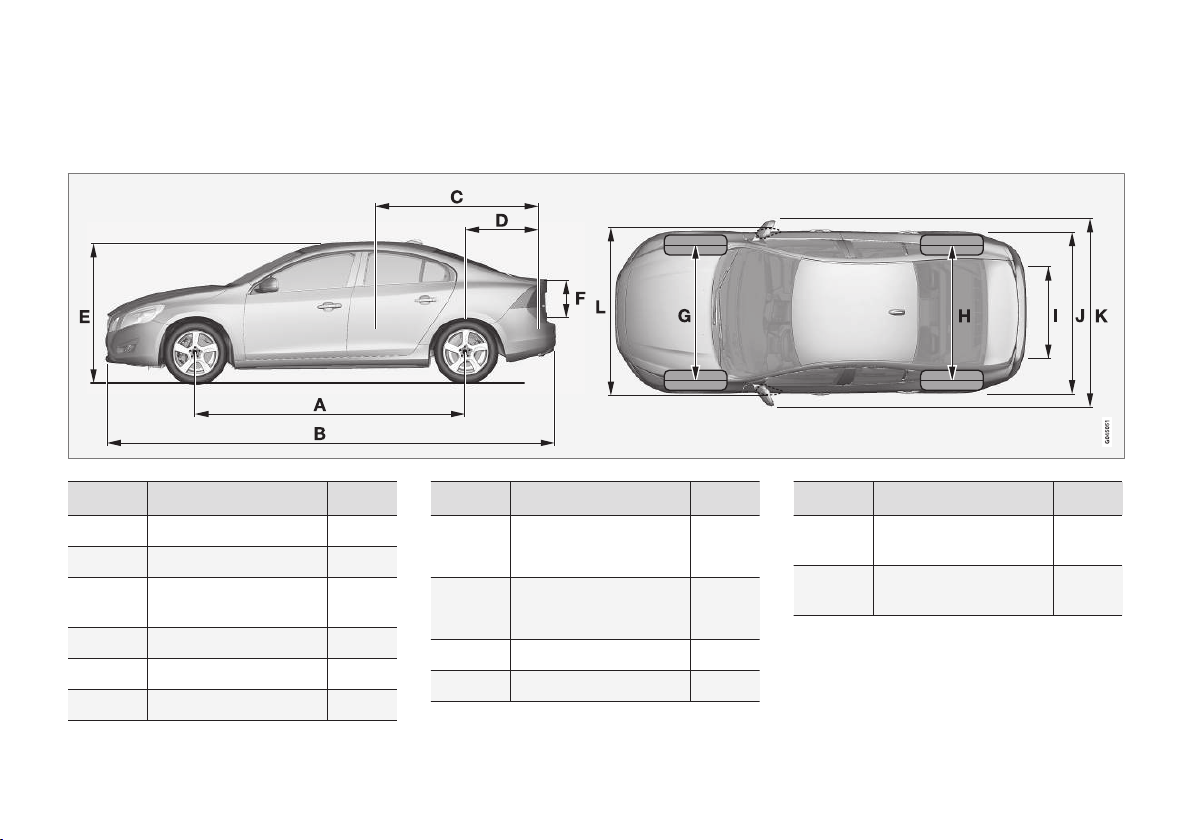
SPECIFICATIONS
403
Dimensions
Measurement of car length, height, etc. can be
read in the table.
S60CC
A
Dimensions mm
A Wheelbase 2774
B Length 4637
C Load length, floor,
folded rear seat 1749
D Load length, floor 965
E Height 1539
F Load height 492
S60CC
A
Dimensions mm
G Front track
1619
B
/
1609
C
H Rear track
1577
B
1567
C
I Load width, floor 919
J Width 1866
S60CC
A
Dimensions mm
K Width including door
mirrors 2097
L Width including folded-
in door mirrors 1899
A
S60 Cross Country
B
Tyre width 215 mm.
C
Tyre width 235 mm.
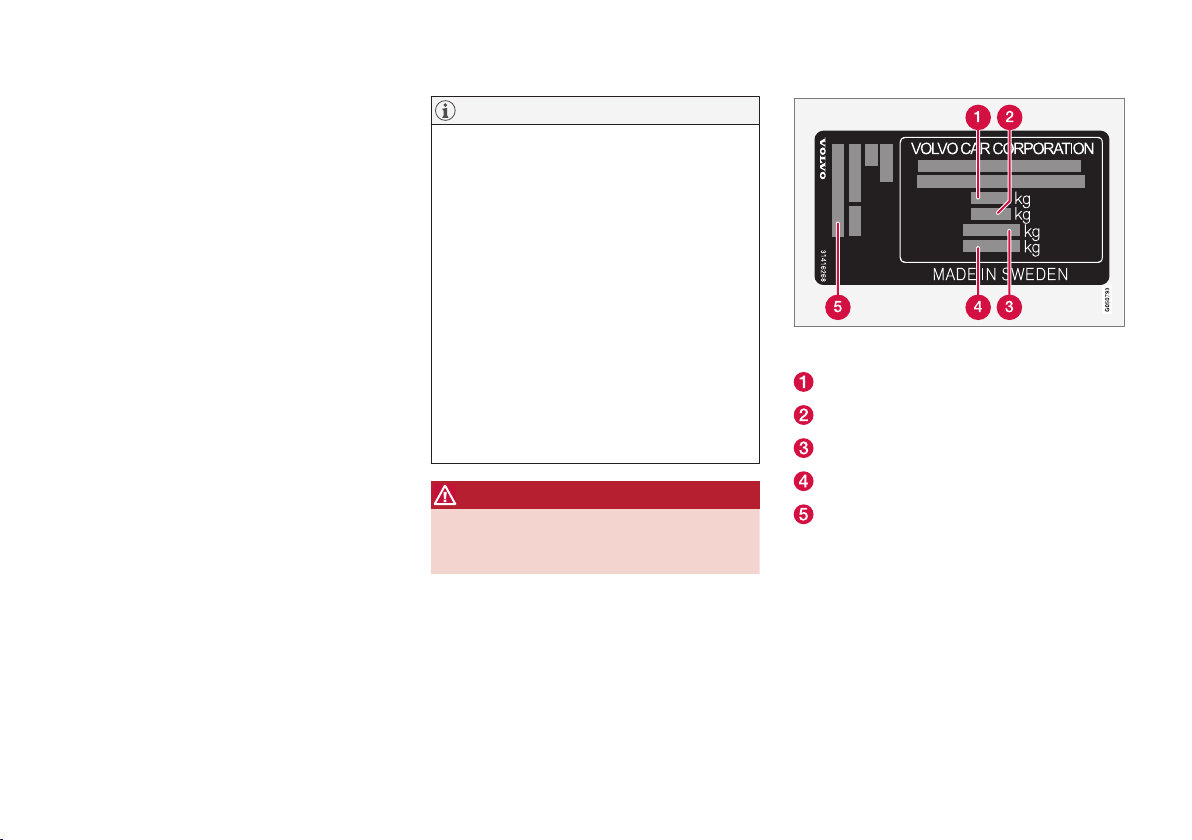
SPECIFICATIONS
404
Weights
Max. gross vehicle weight, etc. can be read on a
label in the car.
Kerb weight includes the driver, the fuel tank
90% full and all fluids.
The weight of passengers and accessories, and
towball load (p. 405) (when a trailer is hitched)
influence the load capacity and are not included
in the kerb weight.
Permitted max. load = Gross vehicle weight -
Kerb weight.
NOTE
The documented kerb weight applies to cars
in the standard version - i.e. a car without
extra equipment or accessories. This means
that for every accessory added the loading
capacity of the car is reduced correspondingly
by the weight of the accessory.
Examples of accessories that reduce load
capacity are the different equipment levels
(e.g. Kinetic, Momentum, Summum), as well
as other accessories such as towbar, load
carrier, space box, audio system, auxiliary
lamps, GPS, fuel-driven heater, safety grille,
carpets, cargo cover, power seats, etc.
Weighing the car is a certain way of ascer-
taining the kerb weight of your own particular
car.
WARNING
The car's driving characteristics change
depending on how heavily it is loaded and
how the load is distributed.
For information on label location, see Type designations
(p. 400).
Max. gross vehicle weight
Max. train weight (car+trailer)
Max. front axle load
Max. rear axle load
Equipment level
Max. load: See registration document.
Max. roof load: 75 kg.
Related information
•
Towing capacity and towball load (p. 405)
•
Fuel consumption and CO2 emissions
(p. 416)
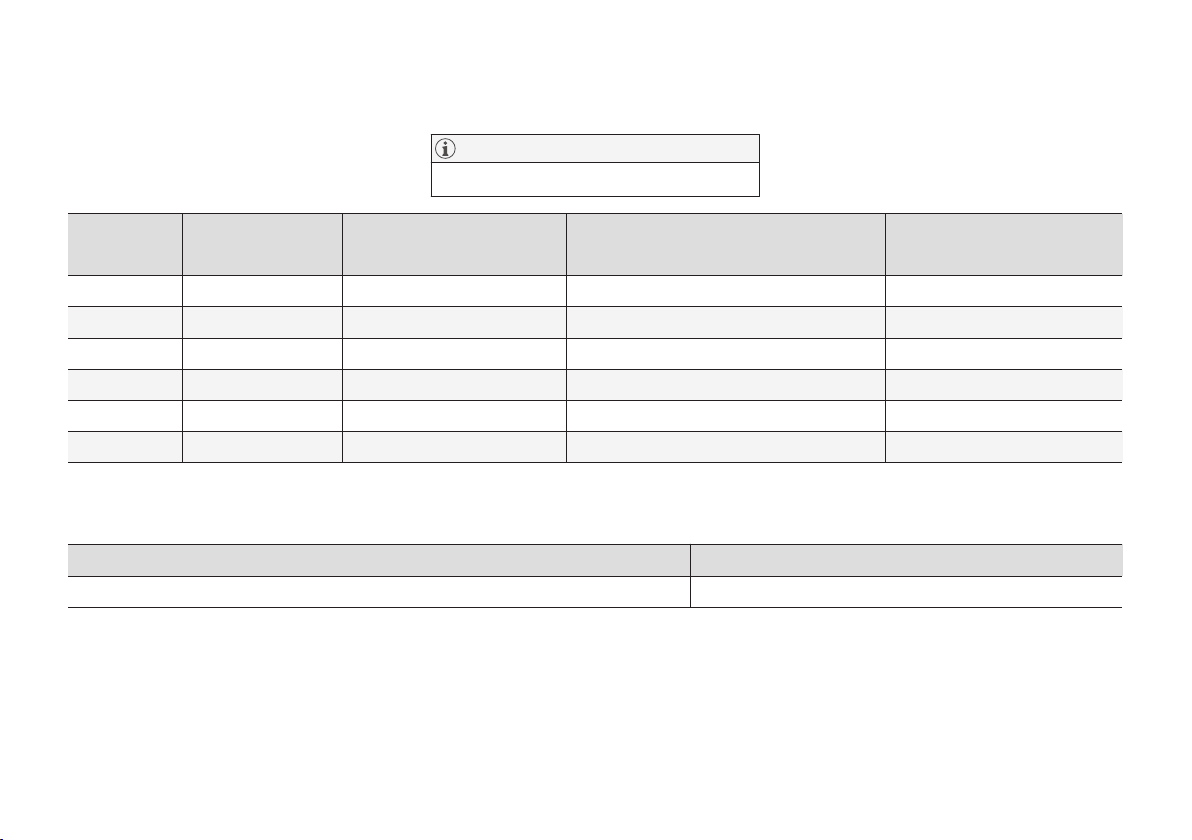
SPECIFICATIONS
* Option/accessory.
405
Towing capacity and towball load
Towing capacity and towball load for driving with
a trailer can be read in the tables.
Max. weight braked trailer
NOTE
Not all engines are available in all markets.
S60CC
A
Engine
Engine code
B
Gearbox Max. weight braked trailer (kg) Max. towball load (kg)
T5 AWD B4204T11 Automatic, TG-81SC 1800 90
D3 D4204T4 Manual, M66 1800 90
D3 D4204T4 Automatic, TG-81SC 1800 90
D4 D4204T14 Manual, M66 1800 90
D4 D4204T14 Automatic, TG-81SC 1800 90
D4 AWD D5244T21 Automatic, TF-80SD 1900 90
A
S60 Cross Country
B
Engine code, component and serial number can be read on the engine; see Type designations (p. 400).
Max. weight unbraked trailer
Max. weight unbraked trailer (kg) Max. towball load (kg)
750 50
Related information
•
Weights (p. 404)
•
Driving with a trailer* (p. 311)
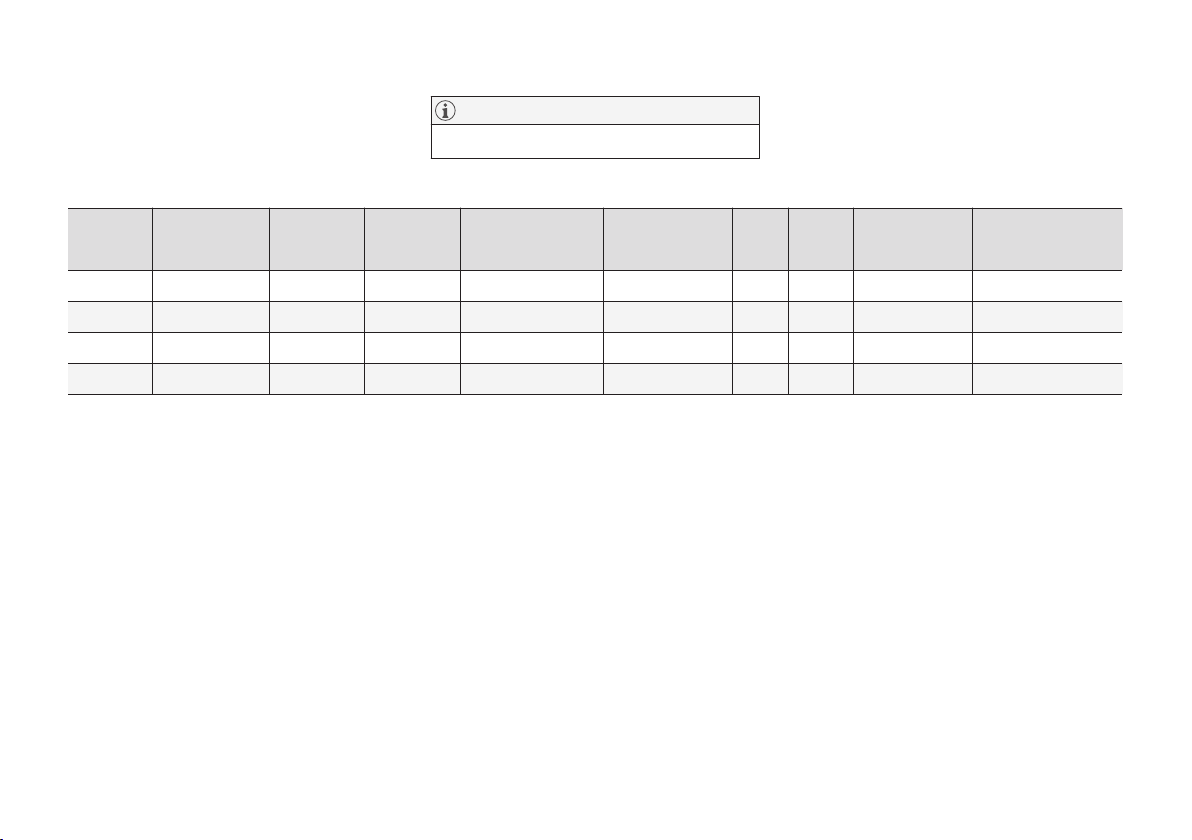
SPECIFICATIONS
406
Engine specifications
Engine specifications (output etc.) for each
respective engine alternative can be read in the
table.
NOTE
Not all engines are available in all markets.
S60CC
A
Engine
Engine code
B
Output
(kW/rpm)
Output
(hp/rpm)
Torque
(Nm/rpm)
No. of cylinders Bore
(mm)
Stroke
(mm)
Swept volume
(litres)
Compression ratio
T5 AWD B4204T11 180/5500 245/5500 350/1500–4800 4 82.0 93.2 1,969 10.8:1
D3 D4204T4 110/4250 150/4250 350/1500-2500 4 82.0 93.2 1,969 15.8:1
D4 D4204T14 140/4250 190/4250 400/1750-2500 4 82.0 93.2 1,969 15.8:1
D4 AWD D5244T21 140/4000 190/4000 440/1500-2750 5 81.0 93.2 2.400 16.5:1
A
S60 Cross Country
B
Engine code, component and serial number can be read on the engine; see Type designations (p. 400).
Related information
•
Coolant - grade and volume (p. 410)
•
Engine oil - grade and volume (p. 408)
SPECIFICATIONS
407
Engine oil - adverse driving
conditions
Adverse driving conditions can lead to abnor-
mally high oil temperature or oil consumption.
Below are some examples of adverse driving
conditions.
Check the oil level (p. 354) more frequently for
long journeys:
•
towing a caravan or trailer
•
in mountainous regions
•
at high speeds
•
in temperatures colder than -30 °C or hotter
than +40 °C.
The above also apply to shorter driving distances
at low temperatures.
Choose a fully synthetic engine oil for adverse
driving conditions. It provides extra protection for
the engine.
Volvo recommends:
IMPORTANT
In order to fulfil the requirements for the
engine's service intervals all engines are filled
with a specially adapted synthetic engine oil
at the factory. The choice of oil has been
made very carefully with regard to service life,
starting characteristics, fuel consumption and
environmental impact.
An approved engine oil must be used in order
that the recommended service intervals can
be applied. Only use a prescribed grade of oil
for both filling and oil change, otherwise you
will risk affecting service life, starting charac-
teristics, fuel consumption and environmental
impact.
Volvo Car Corporation disclaims all warranty
liability if engine oil of the prescribed grade
and viscosity is not used.
Volvo recommends that oil changes are car-
ried out at an authorised Volvo workshop.
Related information
•
Engine oil - grade and volume (p. 408)
•
Engine oil - general (p. 353)
SPECIFICATIONS
408
Engine oil - grade and volume
Engine oil grade and volume for each respective
engine alternative can be read in the table.
Volvo recommends:
NOTE
Not all engines are available in all markets.
S60CC
A
Engine
Engine code
B
Oil grade Volume, incl. oil filter
(litres)
T5 AWD B4204T11 Castrol Edge Professional V 0W-20 or VCC RBS0-2AE 0W-20 approx. 5.6
D3 D4204T4 Castrol Edge Professional V 0W-20 or VCC RBS0-2AE 0W-20 approx 5.2
D4 D4204T14 approx 5.2
D4 AWD D5244T21
Oil grade: ACEA A5/B5
Viscosity: SAE 0W–30
approx. 5.9
A
S60 Cross Country
B
Engine code, component and serial number can be read on the engine; see Type designations (p. 400).

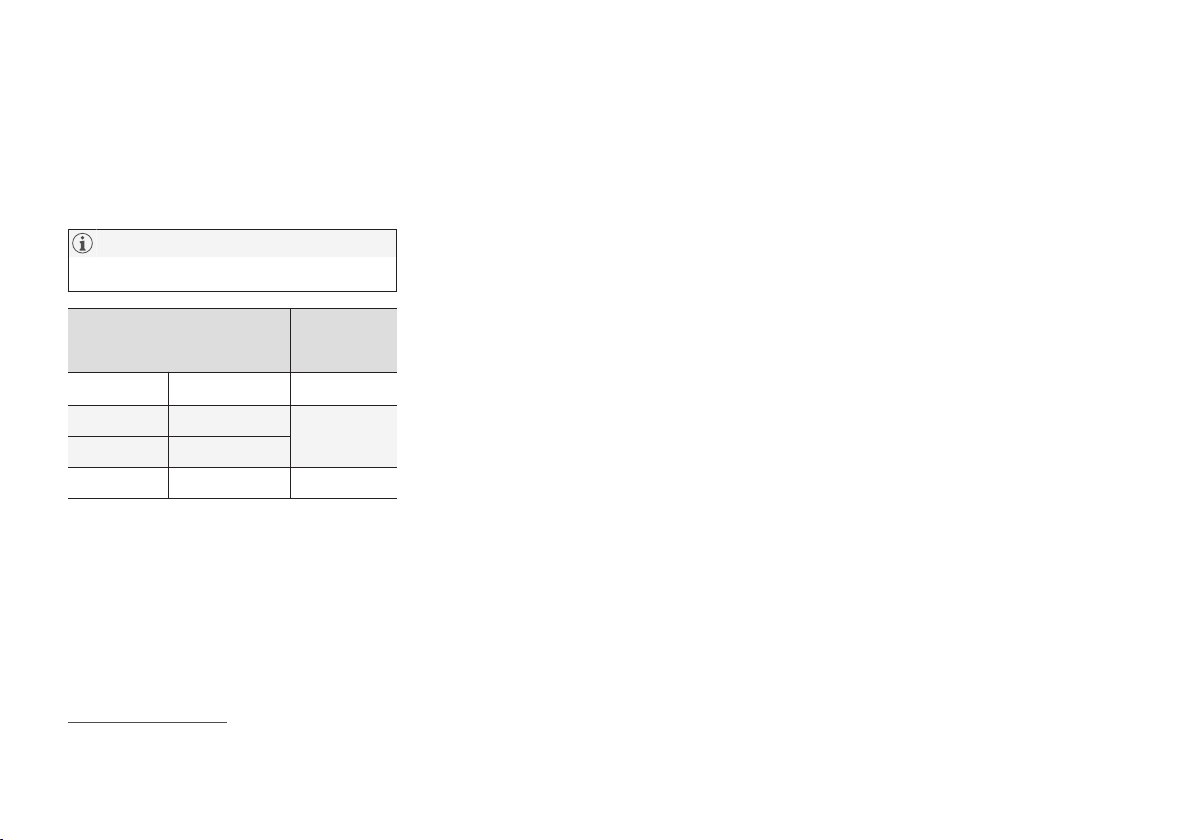
SPECIFICATIONS
410
Coolant - grade and volume
Approved coolant volume for each respective
engine alternative can be read in the table.
Prescribed grade: Coolant recommended by
Volvo mixed with 50% water
1
, see the packaging.
NOTE
Not all engines are available in all markets.
S60CC
A
Engine
B
Volume
(litres)
T5 AWD B4204T11
8,3 (8,7
C
)
D3 D4204T4
8,9 (9,2
C
)
D4 D4204T14
D4 AWD D5244T21 8.9
A
S60 Cross Country
B
Engine code, component and serial number can be read on the
engine; see Type designations (p. 400).
C
Applies to cars with fuel-driven heater.
Related information
•
Coolant - level (p. 357)
1
Water quality must fulfil the standard STD 1285.1.
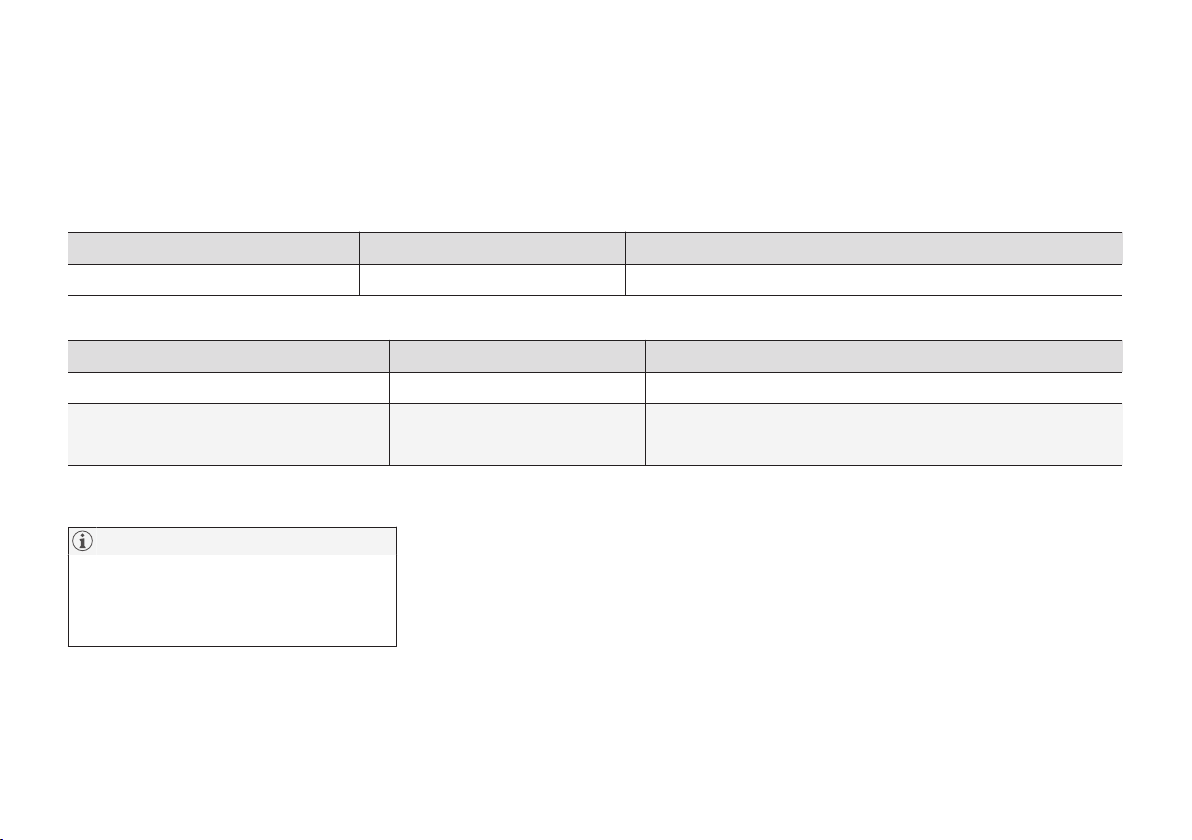
SPECIFICATIONS
411
Transmission fluid - grade and
volume
The prescribed transmission fluid and volume for
each respective gearbox alternative can be read
in the table.
Manual gearbox
Manual gearbox Volume (litres) Prescribed transmission fluid
M66 approx. 1.45 BOT 350M3
Automatic gearbox
Automatic gearbox Volume (litres) Prescribed transmission fluid
TF-80SD approx 7.0 AW1
TG-81SC
approx. 6.6
A
approx. 7.5
B
AW1
A
Petrol engines
B
Diesel engines
NOTE
The transmission fluid does not need to be
changed under normal driving conditions.
However, it may be necessary under adverse
driving conditions.
Related information
•
Engine oil - adverse driving conditions
(p. 407)
•
Type designations (p. 400)

SPECIFICATIONS
412
Brake fluid - grade and volume
Brake fluid is the term for the medium in a
hydraulic brake system that is used to transfer
pressure from the master brake cylinder to the
mechanical brakes.
Prescribed grade: Volvo Original Dot 4 class 6
or equivalent.
Volume: 0.6 litres
Related information
•
Brake and clutch fluid - level (p. 358)
Power steering fluid - grade
Power steering fluid is the denomination of the
medium used in the car's power steering sys-
tem.
Prescribed grade: Power steering fluid recom-
mended by Volvo.
Related information
•
Power steering fluid - level (p. 358)
SPECIFICATIONS
413
Fuel tank - volume
Fuel tank volume for each respective engine
alternative can be read in the table.
Engine Volume (litres) Prescribed grade
Petrol engine approx 67 Fuel - petrol (p. 306)
Diesel engine approx 67 Fuel - diesel (p. 307)
Related information
•
Filling up with fuel (p. 304)
•
Engine specifications (p. 406)
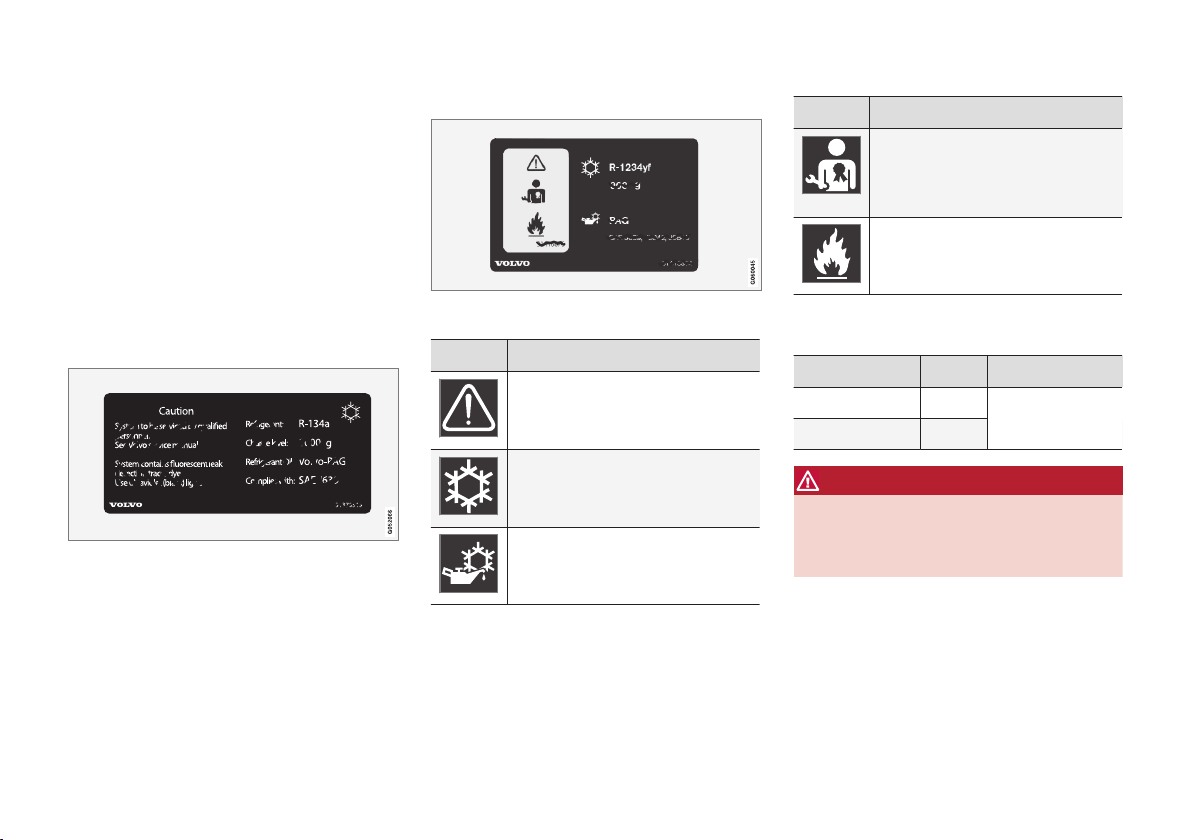
SPECIFICATIONS
414
Specifications for air conditioning
The climate control system in the car uses a
refrigerant, either R1234yf or R134a, depend-
ing on market. Information about which refriger-
ant the car's climate control system uses can be
seen on a decal, located on the inside of the
bonnet.
Prescribed grades and volumes of fluids and
lubricants in the air conditioning system can be
read in the tables below.
A/C decal
Decal for R134a
The label is fitted on the inside of the bonnet.
Decal for R1234yf
The label is fitted on the inside of the bonnet.
Symbol explanation R1234yf
Symbol Meaning
Caution
Mobile air conditioning system
(MAC)
Lubricant type
Symbol Meaning
A trained and certified technician is
required in order to service the
mobile air conditioning system
(MAC)
Flammable refrigerants
Refrigerant
Cars with refrigerant R134a
Engine Weight Prescribed grade
5-cylinder diesel 720 g R134a
other 800 g
WARNING
The air conditioning system contains pressur-
ised refrigerant R134a. This system must only
be serviced and repaired by an authorised
workshop.
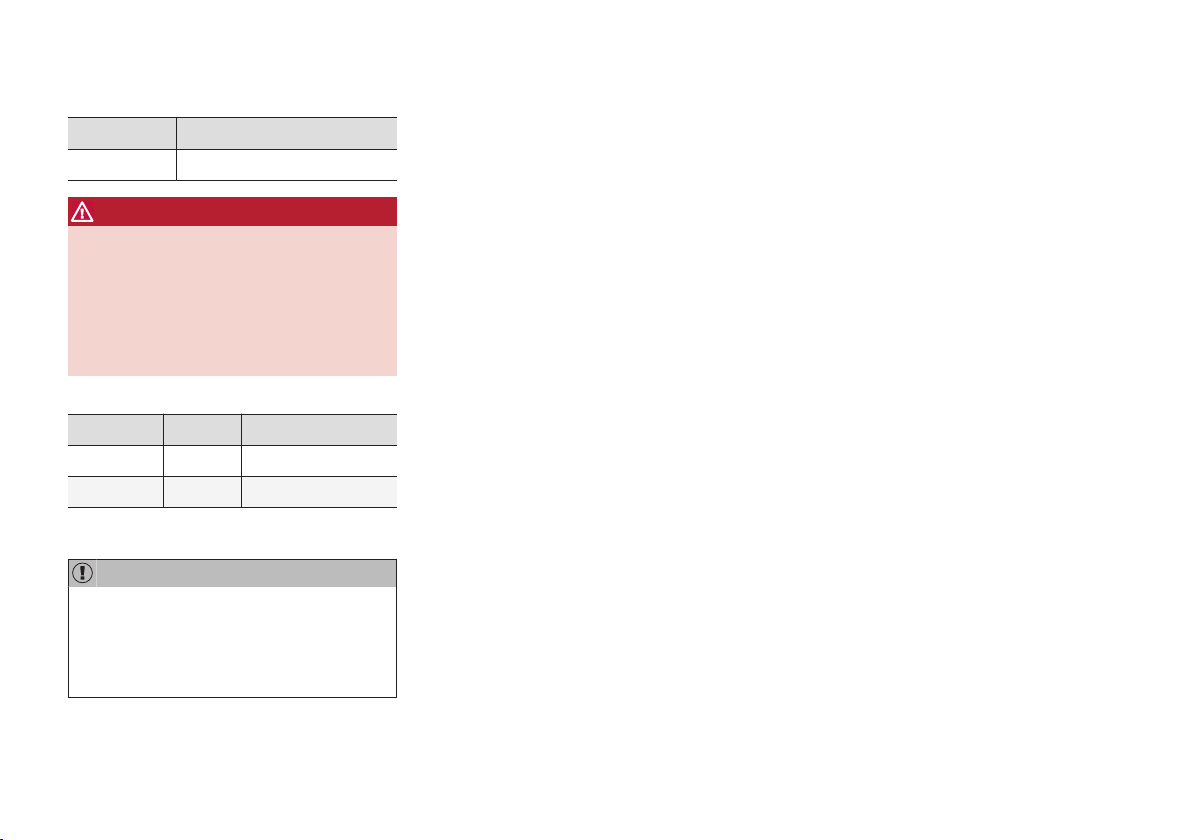
SPECIFICATIONS
415
Cars with refrigerant R1234yf
Weight Prescribed grade
750 g R1234yf
WARNING
The air conditioning system contains pressur-
ised refrigerant R1234yf. In accordance with
SAE J2845 (Technician Training for Safe
Service and Containment of Refrigerants
Used in Mobile A/C System), service and
repair of the refrigerant system must only be
performed by trained and certified technicians
in order to ensure the safety of the system.
Compressor oil
Engine Volume Prescribed grade
4-cylinder 60 ml PAG SP-A2
5-cylinder 110 ml PAG SP-A2
Evaporator
IMPORTANT
The A/C system's evaporator must never be
repaired or replaced with a previously used
evaporator. A new evaporator must be certi-
fied and labelled in accordance with SAE
J2842.
Related information
•
Climate control system - fault tracing and
repair (p. 359)
•
Type designations (p. 400)
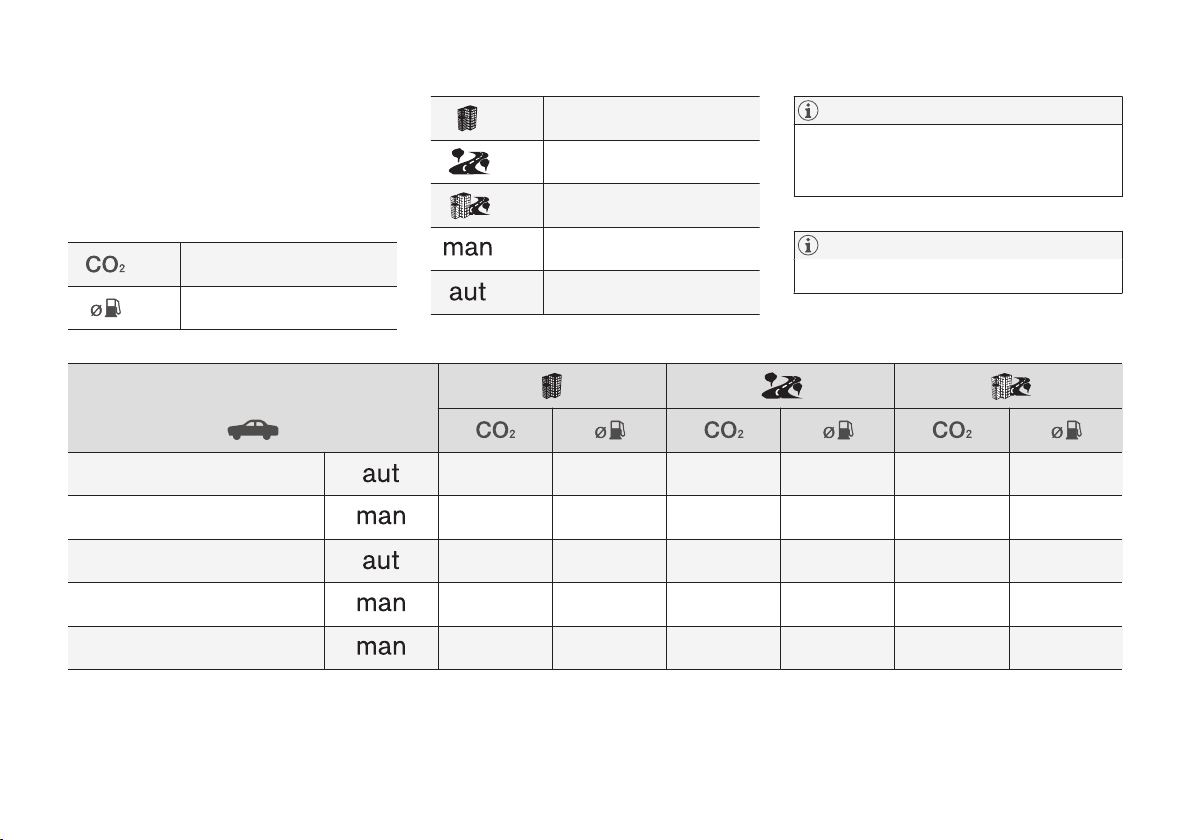
SPECIFICATIONS
416
Fuel consumption and CO2
emissions
Fuel consumption in a vehicle is measured in
litres per 100 km and CO2 emissions in grams
CO2 per km.
Explanation
gram CO
2
/km
litre/100 km
Urban driving
Extra-urban driving
Combined driving
manual gearbox
Automatic gearbox
NOTE
If the consumption and emission data is miss-
ing then it is included in the enclosed supple-
ment.
NOTE
Not all engines are available in all markets.
S60CC
A
T5 AWD (B4204T11) 223 9.8 136 6.0 168 7.4
D3 (D4204T4)
120 4.6 106 4.0 111 4.2
D3 (D4204T4)
137 5.3 110 4.2 120 4.6
D4
B
(D4204T14)
120 4.6 106 4.0 111 4.2
D4
C
(D4204T14)
119 4.6 105 4.0 110 4.2
SPECIFICATIONS
}}
417
S60CC
A
D4 (D4204T14) 137 5.3 110 4.2 120 4.6
D4 AWD (D5244T21)
178 6.8 132 5.1 149 5.7
A
S60 Cross Country
B
Does not apply to the low-emissions variant.
C
This only applies to the low-emissions variant.
Fuel consumption and emission values in the
table above are based on specific EU driving
cycles (see below), that apply to cars with kerb
weight in the basic version and without extra
equipment. The car's weight may increase
depending on equipment. This, as well as how
heavily the car is loaded, increases fuel consump-
tion and carbon dioxide emissions.
There are several reasons for increased fuel con-
sumption compared with the table's values.
Examples of this are:
•
If the car is equipped with extra equipment
that affects the car's weight.
•
The driver's driving style.
•
If the customer chooses wheels other than
those fitted as standard on the model's basic
version then rolling resistance may increase.
•
High speed results in increased wind resis-
tance.
•
Fuel quality, road and traffic conditions,
weather and the condition of the car.
A combination of the above-mentioned examples
can result in significantly increased consumption.
Large deviations in fuel consumption may arise in
a comparison with the EU driving cycles (see
below) which are used in the certification of the
car and on which the consumption figures in the
table are based. For further information, please
refer to the regulations referred to.
NOTE
Extreme weather conditions, driving with a
trailer or driving at high altitudes in combina-
tion with fuel quality are factors that consider-
ably increase the car's fuel consumption.
EU driving cycles
Official fuel consumption figures are based on
two standardised driving cycles in a laboratory
environment ("EU driving cycles") all in accord-
ance with EU Regulation no 692/2008 and
715/2007 (Euro 5 / Euro 6) and UN ECE
Regulation no 101. Since the driving cycles are
also used for quality control, there are significant
requirements for repeatability of the tests. For
this reason the tests are carried out under close
scrutiny and only with the car's basic functions
(e.g. air conditioning, radio, etc. switched off). As
a consequence of this the results from the official
figures are not obviously representative of what
the customer sees during actual usage.
The regulations cover the driving cycles for
"Urban driving" and "Extra-urban driving":

||
SPECIFICATIONS
418
•
Urban driving - the measurement starts with
cold starting the engine. The driving is simu-
lated.
•
Extra-urban driving - the car is accelerated
and braked at speeds between 0-120 km/h
(0-75 mph). The driving is simulated.
Cars with manual gearbox are started in 2nd
gear.
The official value for combined driving, which is
reported in the table, is a combination of the
results from the "Urban driving" and "Extra-urban
driving" driving cycles, in accordance with legal
requirements.
The exhaust gases are collected in order to
extrapolate the carbon dioxide emissions (CO
2
emissions) during the two driving cycles. These
are then analysed and give the value for CO
2
emissions.
Related information
•
Economical driving (p. 310)
•
Weights (p. 404)
SPECIFICATIONS
419
Wheels and tyres - approved
dimensions
In certain countries not all approved dimensions
are indicated by the registration document or
other documents. The following table shows all
approved combinations of wheel rims and tyres.
Information on engine, front-wheel drive (FWD)
or all-wheel drive (AWD) and the type of trans-
mission is needed to read the table. For informa-
tion with respect to these details, see Type des-
ignations (p. 400).
For information on the minimum permitted load
index (LI) and the minimum permitted speed rat-
ing (SS), see Load index and speed rating
(p. 420).
✓ = Approved
S60CC
A
Engine
man/
aut
215/65R16
7Jx16x50
235/55R17
7.5Jx17x55
235/50R18
7.5Jx18x55
235/45R19
8Jx19x55
T5 AWD (B4204T11) aut
✓ ✓ ✓ ✓
D3 (D4204T4) man/aut
✓ ✓ ✓ ✓
D4 (D4204T14) man/aut
✓ ✓ ✓ ✓
D4 AWD (D5244T21) aut
✓ ✓ ✓ ✓
A
S60 Cross Country
Related information
•
Tyres - dimensions (p. 328)
•
Wheel and wheel rim dimensions (p. 328)
SPECIFICATIONS
420
Load index and speed rating
The table below shows the minimum permitted
load index (LI) and speed rating (SS). Informa-
tion on engine, front-wheel drive (FWD) or all-
wheel drive (AWD) and the type of transmission
is needed to read the table. For information with
respect to these details, see Type designations
(p. 400).
S60CC
A
Engine
man/
aut
Minimum permitted load index (LI)
B
Minimum permitted speed rating (SS)
C
T5 AWD B4204T11 aut 95 H
D3 D4204T4 man/aut 95 H
D4 D4204T14 man/aut 95 H
D4 AWD D5244T21 aut 95 H
A
S60 Cross Country
B
The tyre's load index must be at least equal to or greater than indicated in the table.
C
The tyre's speed rating must be at least equal to or greater than indicated in the table.
Related information
•
Wheels and tyres - approved dimensions
(p. 419)
•
Tyres - approved tyre pressures (p. 421)
•
Tyres - dimensions (p. 328)
•
Wheel and wheel rim dimensions (p. 328)
•
Tyres - load index (p. 329)
•
Tyres - speed ratings (p. 329)
SPECIFICATIONS
421
Tyres - approved tyre pressures
Approved tyre pressures for each respective
engine alternative can be read in the table.
NOTE
All engines, tyres or combinations of these
are not always available in all markets.
S60CC
A
Engine
Tyre size Speed
(km/h)
Load, 1-3 persons Max. load
ECO pressure
B
Front
(kPa)
C
Rear
(kPa)
Front
(kPa)
Rear
(kPa)
Front/rear
(kPa)
All engines
215/65 R 16
235/55 R 17
235/50 R 18
235/45 R 19
0 - 160
D
230 230 260 260 260
160+
E
240 240 280 280 -
Temporary Spare Tyre
max. 80
F
420 420 420 420 -
A
S60 Cross Country
B
Economical driving.
C
In certain countries there is the "bar" unit beside the SI unit "Pascal": 1 bar = 100 kPa.
D
0 - 100 mph
E
100+ mph
F
max 50 mph
Related information
•
Wheels and tyres - approved dimensions
(p. 419)
•
Tyres - dimensions (p. 328)
•
Tyres - air pressure (p. 326)
•
Type designations (p. 400)


ALPHABETICAL INDEX
423
A
ACC – Adaptive cruise control 196
Active bending lights 91
Active main beam 89
Active Park Assist 262
function 262
Limitations 265
operation 263
Symbols and messages 267
Active xenon headlamps 91
Active Yaw Control 182
Adaptation of headlamp beam 92
Adapting driving characteristics 182
Adaptive Cruise Control 196
change cruise control functionality 205
deactivate 203
fault tracing 207
function 197
managing speed 200
overtaking 203
overview 198
radar sensor 210
setting the time interval 201
standby mode 202
temporary deactivation 202
Additional heater
electric 140, 141
fuel-driven 140
Adjusting the steering wheel 83
Airbag
activating/deactivating, PACOS 36
driver's side 34
passenger side 34, 36
AIRBAG 34
Airbag system 33
warning symbol 32
Air cleaning
material 123
passenger compartment 121, 122, 123
Air conditioning 130
Air conditioning, fluid
volume and grade 414
Air conditioning system
repair 359
Air distribution 123
Recirculation 131
table 132
Air quality system IAQS 122
Alarm 177, 179
alarm indicator 178
alarm signals 179
automatic re-arming 179
checking the alarm 160
reduced alarm level 180
remote control key not working 179
Allergy and asthma inducing substances. 122
All Wheel Drive, (AWD) 282
All Wheel Drive (AWD) 282
Approach lighting 96, 158
Automatic car washes 391
Automatic gearbox 278
manual gear positions (Geartronic) 278
towing and recovery 319
trailer 312
Automatic relocking 170
AWD, All Wheel Drive 282
B
Backrest 79
front seat, lowering 79
rear seat, folding 81
Bag holder 150
Battery 275, 302, 370
jump starting 275
maintenance 370
overload 302
remote control key/PCC 164
start 370
ALPHABETICAL INDEX

ALPHABETICAL INDEX
424
support 374
symbols on the battery 372
warning symbols 372
BLIS 233, 234
Bonnet, opening 351
Book service and repair 346
Boot lid 173
Locking/unlocking 173
Brake and clutch fluid 358
Brake fluid
grade and volume 412
Brake light 93
Brakes 294, 295
Anti-lock braking system, ABS 295
brake light 93
brake system 294, 295
Emergency Brake Assistance, EBA 296
filling brake fluid 358
handbrake 297
symbols in the combined instrument
panel 294
bulbs, specifications 367
C
Camera sensor 217, 229
Car care 391
Leather upholstery 395
Cargo area
lighting 95
loading 148
load retaining eyelets 150
Car key memory 155
Car upholstery 394
Car washing 391
Catalytic converter 309
Recovery 319
Checking the engine oil level 354
Children
child safety locks 43
child seat and airbag 49
child seats and side airbags 38
location in car 49
safety 43
Child safety locks 176, 177
Child seat
ISOFIX fixture system for child seats 50
Child seats 43
recommended 45
size classes for child seats with ISOFIX
fixture system 51
types 52
upper mounting points for child seats 54
City Safety™ 215
Cleaning
automatic car wash 391
car washing 391
rims 392
seatbelts 395
upholstery 394
Clean Zone Interior Package (CZIP) 122
Climate control
actual temperature 121
auto-regulation 129
general 120
personal preferences 123
sensors 121
temperature control 129
Clock, adjustment 72
CO
2
emissions 416
Collision 41
Collision warning 222, 223
Collision warning system
function 223
general limitations 228
operation 226

ALPHABETICAL INDEX
425
Pedestrian detection 225
Radar sensor 210, 216
Collision Warning System with Auto
Brake 222
Colour code, paint 396
Combined instrument panel 62, 63
Compass 103
calibration 103
Condensation in headlamps 391
Controls lighting 86
Control symbols 63, 65
Coolant
volume and grade 410
Coolant, checking and filling 357
Cooling system 301
overheating 301
Cornering lights 92
Corner Traction Control 183
Crash, see Collision 41
Cruise control 190
deactivate 192
managing speed 191
resume set speed 192
temporary deactivation 191
CTA – Cross Traffic Alert 235
Cyclist detection 224
CZIP (Clear Zone Interior Package) 122
D
Daytime running lights 87
Deadlock 175
deactivation 175
temporary deactivation 175
Defroster 130
Detachable towbar
storage 314
Diesel 307
run out of fuel 307
Diesel particle filter 308
Dimensions 403
Dipstick, electronic 354, 355
Direction indicator 94
Direction indicators 94
direction of rotation 325
Disengaging the gear selector inhibitor 281
Display lighting 86
Distance Warning 193
Limitations 194
Symbols and messages 195
Door mirrors 100
automatic dimming 101
resetting 101
Drive mode ECO 292
Driver Alert Control 242
operation 243
Driver Alert System 241
Driving 303
cooling system 301
with boot lid open 302
Driving in water 301
Driving with a trailer 311
towball load 405
towing capacity 405
E
ECC, electronic climate control 126
Eco Cruise 292
EcoGuide 66
Ecolabelling, FSC, owner's manual 25
ECO mode 292
Economical driving 310
ECO pressure 421
Electrical socket 147
cargo area 151

ALPHABETICAL INDEX
426
Electrical system 377
Electric parking brake
low battery voltage 297
Electronic climate control - ECC 126
Emergency equipment
first aid kit 336
warning triangle 335
Emergency puncture repair 339, 340
action 341
inflating the tyres 344
rechecking 343
Emergency puncture repair kit
location 340
overview 340
Emissions of carbon dioxide 416
Engine
deactivate 271
overheating 301
start 270
Start/Stop 284
Engine and passenger compartment heater
messages 138
timer 136
Engine block heater 134
Engine block heater and passenger com-
partment heater
direct start 135
immediate stop 136
Engine braking, automatic 283
Engine compartment
Brake and clutch fluid 358
Check 352
coolant 357
Engine oil 353
overview 351
power steering fluid 358
Engine drag control 183
Engine oil 353, 407
adverse driving conditions 407
filter 353
grade and volume 408
Engine oil, filling 354
Engine specifications 406
Error messages
Adaptive Cruise Control 208
Driver Alert Control 244
Lane Departure Warning 248
LKA 253
see Messages and symbols 208, 299
Error messages in BLIS 237
ERS - Remote Start 271
Ethanol content
maximum 10 percent by volume 306
exhaust gases, toxic, sucked in 302
External dimensions 403
F
Fan
ECC 128
Fault tracing for the camera sensor 218
First aid 336
First aid kit 336
Fluids, capacities 369, 410, 411, 412,
413, 414
Fluids and oils 410, 411, 412, 414
Fog lamp
rear 92
Foot brake 294, 295
FSC, ecolabelling 25
Fuel 305, 306, 307
fuel consumption 416
fuel economy 326, 327
fuel filter 308
identifier 306, 307
Fuel-driven heater
timer 136
Fuelling
filling 304
fuel cap 304
fuel filler flap 304
fuel filler flap, manual opening 304

ALPHABETICAL INDEX
427
Fuel tank
volume 413
Fuse box 377
Fuses
changing 377
General 377
in cargo area 387
in engine compartment 379
In the control module under the glove-
box 385
in the engine compartment's cold
zone 389
under glovebox 383
G
Gearbox 276
automatic 278
manual 276
Gear selector inhibitor 281
Gear selector inhibitor, mechanical disen-
gagement 281
Gear shift indicator 277
Geartronic 278
Glass
laminated/reinforced 25
Glovebox 146
locking 173
Gross vehicle weight 404
GSI - Gear selector assistance 277
H
Handbrake 297
Hazard warning flashers 93
HDC 283
Headlamp beam
adaptation 92
height adjustment 86
Headlamp control 85
Headlamp levelling of headlamps 86
Headlamp pattern, adjusting 92
Headlamp pattern adjustment 92
Headlamps 361
head restraint
centre seat, rear 81
lowering 82
Heated wiper blades 98
Heating
rearview and door mirrors 102
rear window 102
seats 127, 128
steering wheel 84
windscreen 102
Heat-reflecting windscreen 20
High engine temperature 301
High-pressure headlamp washing 98
Hill Descent Control 283
Hill Start Assist 282
Home safe light duration 96
Horn 84
I
IAQS - Interior Air Quality System 122
Immobiliser 157
Indicator symbols 67
Inflatable curtain 39
Information button, PCC 159, 160
Information display 62, 63
Inlaid mats 146
Instrument lighting 86
Instrument overview
left-hand drive car 56
right-hand drive car 59
Instruments and controls 56, 59

ALPHABETICAL INDEX
428
Interior Air Quality System (IAQS)
Air cleaning 122
Interior lighting 95
Interior rearview mirror 102
automatic dimming 103
Intermittent wiping 97
Internet-connected car
book service and repair 346
J
Jack 336
Journey statistics 118
Jump starting 275
K
Kerb weight 404
Key 154, 156
Key blade 161, 162
Keyless drive 165, 166, 167, 168, 169, 270
Keyless - locking 167
Keyless start (keyless drive) 165, 166,
167, 168, 169, 270
Keyless - unlocking 168
Keypad in the steering wheel 83
Key positions 77
L
Labels
location of 400
Laminated glass 25
Lamps 360
Lane assistance
operation 247, 251, 252
Lane Departure Warning (LDW) 245, 246,
247
Lane Keeping Aid - LKA 249, 250
Laser sensor 219
Leather upholstery, washing instructions 395
Light indications, PCC 160
Lighting
active bending lights 91
active xenon headlamps 91
approach lighting 96, 158
automatic lighting, passenger compart-
ment 95
Automatic main beam 89
bulbs, specifications 367
controls 85, 95
controls lighting 86
cornering lights 92
daytime running lights 87
display lighting 86
headlamp levelling 86
home safe lighting 96
instrument lighting 86
in the passenger compartment 95
main/dipped beam 88
position lamps 86
rear fog lamp 92
tunnel detection 88
Lighting, bulb replacement 360
bulb holder, rear 365
cargo area 366
dipped beam (cars with halogen head-
lamps) 362
direction indicators, front 364
main beam (cars with active xenon
headlamps) 364
main beam (cars with halogen head-
lamps) 363
number plate lighting 366
vanity mirror 366
LKA - Lane Keeping Aid 249, 250
Loading
General 148
load retaining eyelets 150
long load 149
roof load 149

ALPHABETICAL INDEX
429
Lock
locking 170
manual locking 170
unlocking 170, 171
Lockable wheel bolts 330
Lock confirmation 156
Lock indicator 156
Locking/unlocking
glovebox 173
inside 171
M
Main/dipped beam 88
Main beam, automatic activation 89
maintenance
Rustproofing 394
Manual gearbox 276
GSI - Gear selector assistance 277
Towing and recovery 319
trailer 312
Manual gear positions (Geartronic) 278
Max. roof load 404
Memory function in seat 80
Menus
Combined instrument panel 106
menu overview 107
Messages 109
Messages and symbols
Adaptive Cruise Control 208
Collision Warning with Auto
Brake 221, 231
Driver Alert Control 244
Engine block heater and passenger
compartment heater 138
Lane Departure Warning 248
LKA 253
Messages in BLIS 237
Messages in the information display 108
Meters
fuel gauge 62, 64
speedometer 62, 64
tachometer 62, 64
Mileage 110
misting
attending to the windows 120
Misting
condensation in headlamps 391
Mood lighting 96
MY CAR 109
O
Oil, see also Engine oil 407, 408
Oil level low 354
Option/accessory 16
Output 406
outside temperature gauge 71
Overheating 301, 311
Owner's manual, ecolabelling 25
P
PACOS 36
Paddle on the steering wheel 83
Paintwork
colour code 396
damage and touch-up 396
Panic function 158
PAP - Active Park Assist 262
Park Assist 254, 256
backward 255
fault indicator 257
function 254
parking assistance sensors 257
Park assist camera 258
settings 261

ALPHABETICAL INDEX
430
Parking brake 297
Passenger compartment filter 122
Passenger compartment heater 134
Passenger compartment lighting
automatic 95
PCC – Personal Car Communicator
functions 158
range 160, 166
Pedestrian detection 222
Personal Car Communicator 160
Petrol grade 306
Pinch protection, sunroof 106
Pocket park assist - PAP 262
Polishing 393
Position lamp 86
Power guide 66
Power seat 80
Power steering fluid
Checking the level 358
grade 412
Power sunroof 104
Power windows 98
resetting 100
Privacy locking 163
Puncture 339
Q
Queue Assist 203
Queue assistance 203
R
Radar sensor 197
Limitations 210
Rain sensor 97
Raising the car 349
Rear bulbs
location 365
Rear seat
Heating 128
Rearview and door mirrors
compass 103
door 100
electrically retractable 101
heating 102
interior 102
rear window
sun blind 100
Rear window
heating 102
Recommendations during driving 303
Recommended child seats
table 45
Recovery 320
Refrigerant 359
Regeneration 308
Remote control immobiliser 157
Remote control key 154, 155, 156
battery replacement 164
detachable key blade 161, 162
functions 158
loss 154
range 159, 166
Remote control key system, type approval 180
Remote Start - ERS 271
Resetting, trip meter 113, 116
Resetting the door mirrors 101
Resetting the power windows 100
Retractable power door mirrors 101
Reverse gear inhibitor 277
Road sign information 237
Limitations 241
operation 239
Roof load, max. weight 404
Rustproofing 394

ALPHABETICAL INDEX
431
S
Safety lock
children 43
Safety mode 41
moving the car 43
start attempt 42
Seat, see Seats 79
Seatbelt 28
loosen 30
pregnancy 30
putting on 29
rear seat 31
seatbelt reminder 31
seatbelt tensioner 31
Seatbelt reminder 31
Seatbelt tensioner 31
Seats 79
head restraints, rear 81
heating 128
Heating 127
lowering the front backrest 79
lowering the rear backrest 81
power 80
Sensus 76
Service position 368
Service programme 346
Set time interval 193
Side airbag SIPS 38
SIPS airbag 38
Skidding 303
slippery driving conditions 303
Soot filter 308
SOOT FILTER FULL 308
spare wheel 331
installation 334
Speed limiter 187
alarm for speed exceeded 189
deactivation 189
getting started 187, 188
temporary deactivation 188
Speed ratings, tyres 329
Spin control 182
Stability and traction control system 182, 185
operation 183
Stability system 182
Stains 394
Start/Stop 284
function and operation 285
the engine does not stop 286
Starter battery
changing 372
Steering force, speed related 182
Steering force level, see Steering force 182
Steering lock 271
Steering wheel 83
heating 84
keypad 83
paddle 83
steering wheel adjustment 83
Stickers
location of 400
Stone chips and scratches 396
Storage spaces
glovebox 146
tunnel console 146
Storage spaces in the passenger compart-
ment 144
Sun blind
rear window 100
Sunroof
opening and closing 104
pinch protection 106
sunscreen 106
ventilation position 105
Sunscreen, sunroof 106
Support 15
Support battery 374
Switching off the engine 271

ALPHABETICAL INDEX
432
Symbols
indicator symbols 63, 65, 67
warning symbols 63, 65
Symbols and messages
Adaptive Cruise Control 208
Collision Warning with Auto
Brake 221, 231
Driver Alert Control 244
Lane Departure Warning 248
LKA 253
T
Temperature
actual temperature 121
Temperature control 129
Through-load hatch 149
TM - Tyre Monitor 337
Tools 335
Total airing function 120, 172
Towbar
detachable, attachment 315
detachable, removal 316
Towbar, see Towing equipment 313
Towbar - detachable
attachment/removal 315, 316
Towing 318
towing eye 319
Towing bracket 313, 314
specifications 314
Towing capacity and towball load 405
Towing eye 319
TPMS - Tyre Pressure Monitoring 337
Traction control 182
Trailer 311
cable 311
driving with a trailer 311
snaking 317
Trailer stability assist 183
Trailer Stability Assist 317
Transmission 276
Transmission oil
volume and grade 411
Transponder 20
Tread depth 330
Tread wear indicators 326
Trip computer 110, 112, 115, 118
Trip meter 71, 110
Trip meter, resetting 113, 116
Troubleshooting
Adaptive Cruise Control 207
TSA - trailer stability assist 183, 317
Tunnel console 146
12 V socket 147
Tunnel detection 88
Type approval
radar system 212
remote control key system 180
Type designations 400
Tyre dimension 328
Tyre load index 329
Tyre monitoring 337
Tyre pressure label 326
Tyre pressure monitoring 337
Tyres
dimensions 419
direction of rotation 325
maintenance 324
pressure 326, 421
puncture repair 339
specifications 419, 420, 421
tread depth 330
tread wear indicators 326
tyre pressure monitoring 337
winter tyres 330

ALPHABETICAL INDEX
433
U
Unlocking
from the inside 171
from the outside 170
Unlocking with the key blade 168
V
Vanity mirror 147
lighting 95
Ventilation 123
Vibration damper 313
Volvo ID 20
Volvo Sensus 76
W
Warning lamp
Adaptive Cruise Control 197
collision warning system 226
stability and traction control system 182
Warning lamps
Airbags – SRS 69
alternator not charging 69
Fault in brake system 69
Low oil pressure 69
Parking brake applied 69
seatbelt reminder 31, 69
Warning 69
Warning sound
collision warning system 226
Warning symbols 63, 65, 69
Warning triangle 335
Washer fluid 369
Washers
washer fluid, filling 369
windscreen 98
Water and dirt-repellent coating 393
Water-repellent surface, cleaning 393
Waxing 393
Weights
kerb weight 404
Wheel bolts 330
lockable 330
Wheel change 331
Wheel rim, dimensions 328
Wheel rims
cleaning 392
Wheels
installation 334
removal 331
snow chains 330
Wheels and tyres
approved dimensions 419
tyre load index and speed rating 420
Whiplash injury, WHIPS 39
WHIPS
child seat/booster cushion 39
seating position 40
whiplash protection 39
Window
sun blind 100
Windows, rearview and door mirrors 393
Windscreen
heating 102, 130
Windscreen washing 98
Windscreen wiper 97
rain sensor 97
Winter driving 303
Winter tyres 330
Winter wheels 330
Wiper blades 368
changing 368
Cleaning 369
Service position 368
Wiper blades, heated 98
Wipers and washing 97

ALPHABETICAL INDEX
434


TP 23400 (English), AT 1717, MY18, Copyright © 2000-2017 Volvo Car Corporation