Air Conditioners User Manual Hisense
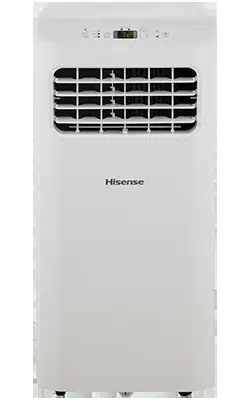
IDENTIFICATION OF PARTS
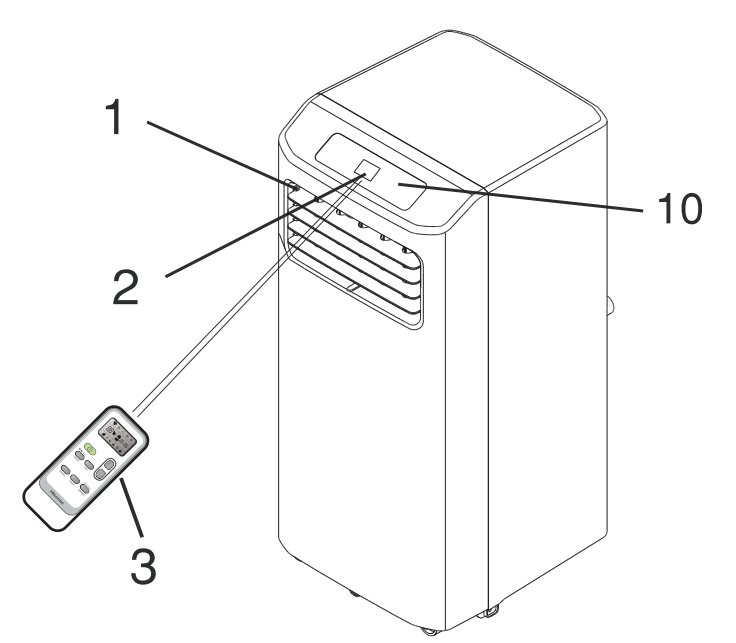
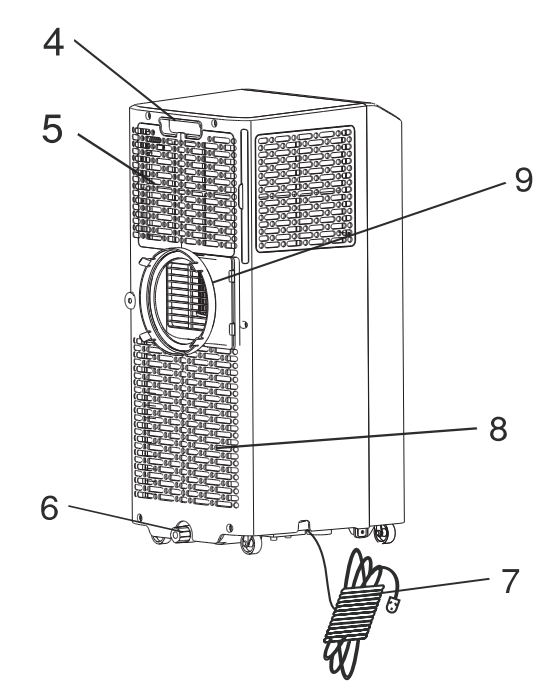
- Cool air outlet
- Signal receptor
- Remote control
- Transport handle
- Evaporator air intake
- Primary drain port
- Power cord
- Condenser air intake
- Air outlet hose coupling
- Control panel
INSTALLATION REQUIREMENTS
Tools and Parts
Gather the required tools and parts before starting installation. Read and follow the instructions provided with any tools listed here. Tools needed Parts supplied Check that all parts are included in parts package.
- Phillips screwdriver
- Scissors
- Pencil
- Cordless drill and ¹⁄₈" bit
A.Foam seal
B.Coupling
C.Flexible exhaust hose
D.Window exhaust adapter 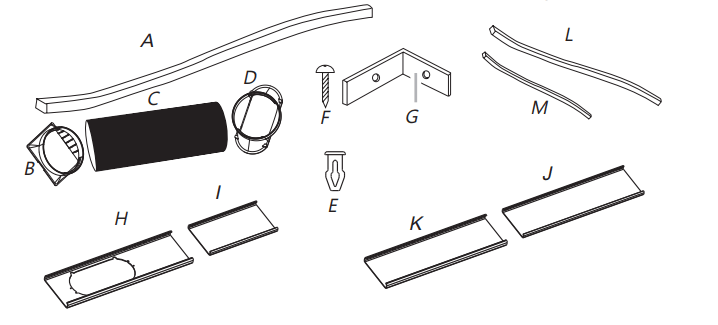
E.Rivets(4) F.Screws(4)
G.Window-lock bracket(2)
H.Outer slider section with vent
I. Inner slider section-short
J.Inner slider section
K.Outer slider section
L.Foam seal-long(2)
M.Foam seal-short(2
Electrical Requirements
Recommended Grounding Method
This portable air conditioner is equipped with a power supply cord with a three-prong grounding plug. The cord must be plugged into a mating, grounded three-prong outlet, grounded in accordance with all local codes and ordinances. If a mating outlet is not available, it is the customer's responsibility to have a properly grounded three-prong outlet installed by a qualified electrical installer. portable air conditioner must be grounded.
Wiring requirement
115 V (103.5 min. to 126.5 max.)
13 A time-delay fuse or circuit breaker
Power Supply Cord
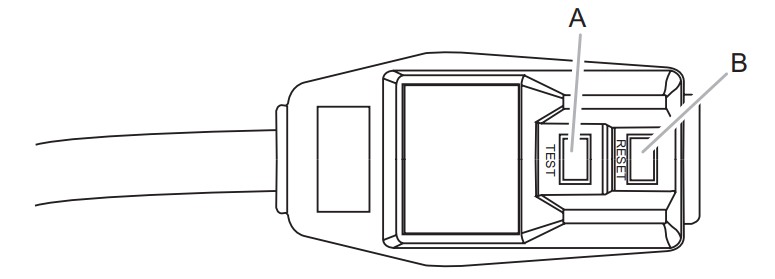
A. Test button
B. Reset button
To test your power supply cord:
- Plug power supply cord into a grounded 3 prong outlet.
- Press RESET (on some devices, a green light will turn on).
- Press TEST (listen for click; Reset button will trip, and on some devices, a green light will turn off).
- Press and release RESET (listen for click; Reset button will latch, and on some devices, a green light will turn on). The power supply cord is ready for operation.
NOTE:
- The Reset button must be pushed in for proper operation.
- The power supply cord must be replaced if it fails to trip when the test button is pressed or fails to reset.
- Do not use the power supply cord as an off/on switch. The power supply cord is designed as a protective device.
- A damaged power supply cord must be replaced with a new power supply cord obtained from the product manufacturer and must not be repaired.
- The power supply cord contains no user serviceable parts. Opening the tamper-resistant case voids all warranty and performance claims
Location Requirements
NOTE:
- The flexible exhaust hose allows placement of the air conditioner at least 20" from window or door.
- Confirm you are using the correct size air conditioner for the space to be cooled, per sizing recommendations, below:
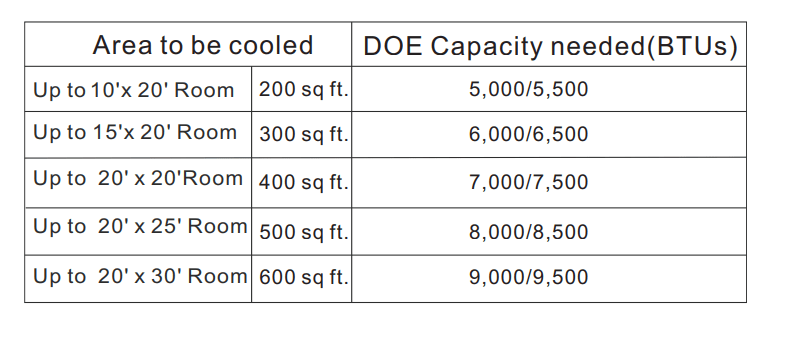
NOTE: Match BTUs to room use and location:
- Shaded room reduce to next smaller size
- Sunny room increase to next larger size
- For kitchens, increase to next larger size
INSTALLATION INSTRUCTIONS
Remove packaging materials
- Remove and recycle packaging materials. Remove tape and glue residue from surfaces before turning on the air conditioner. Rub a small amount of liquid dish soap over the adhesive with your fingers. Wipe with warm water and dry.
- Do not use sharp instruments, rubbing alcohol, flammable fluids, or abrasive cleaners to remove tape or glue. These products can damage the surface of your air conditioner.
- Handle the air conditioner gently.
- Keep unit upright at least 2 hours prior to use
Window Vent Panel And Extensions
The window installation kit allows you to install the air conditioner in most vertical-sliding windows 18'' to 50'' wide, or horizontal sliding windows from 18'' to 50'' high.
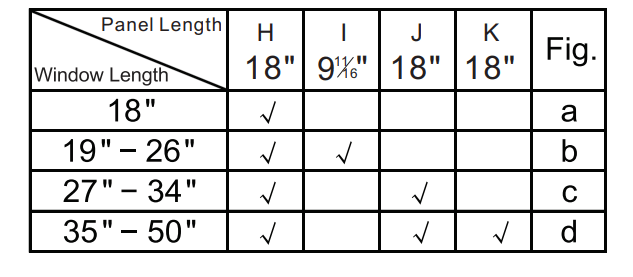
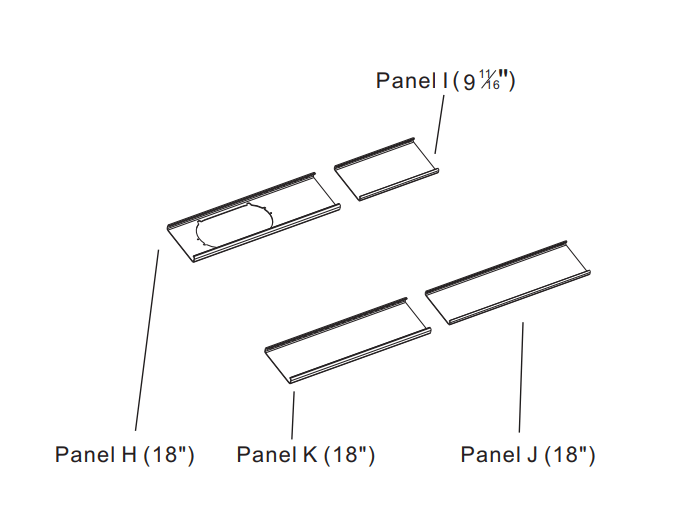
1.Please check your window size and choose the fit from the above table.
2.If your window size requires more than 2 panels, after adjusting the length, please secure the panels with rivets, E.
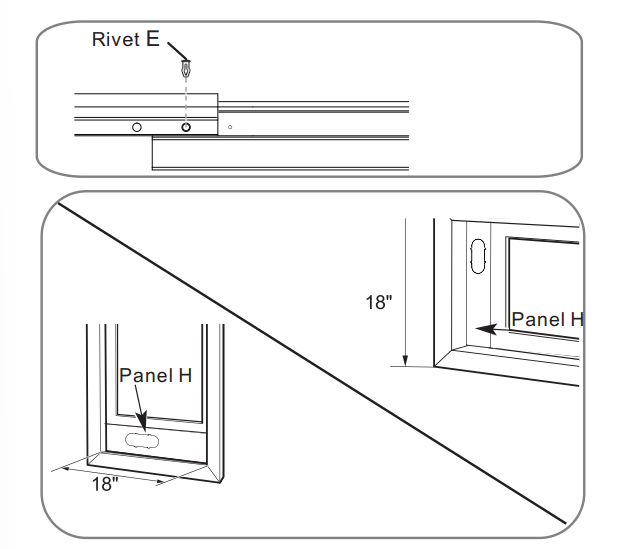
Fig. "a"
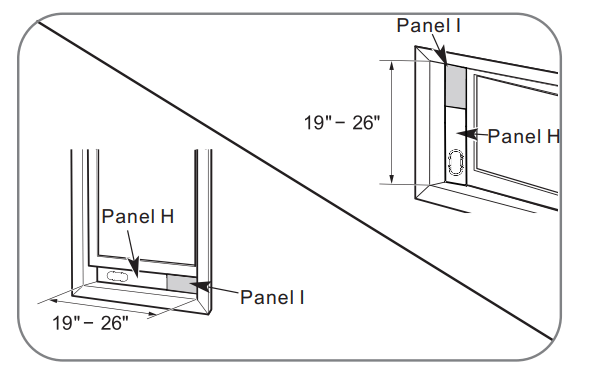
For window openings from 19" to 26", use the window vent panel(Panel H) and a extension panel (Panel I)
Fig. "b"
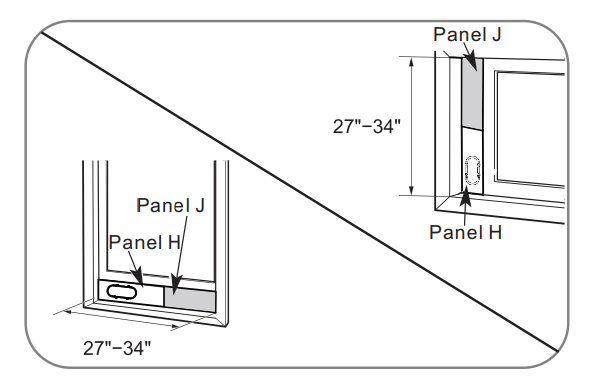
For window openings from 27" to 34", use the window vent panel(Panel H) and a extension panel (Panel J).
Fig. "c"
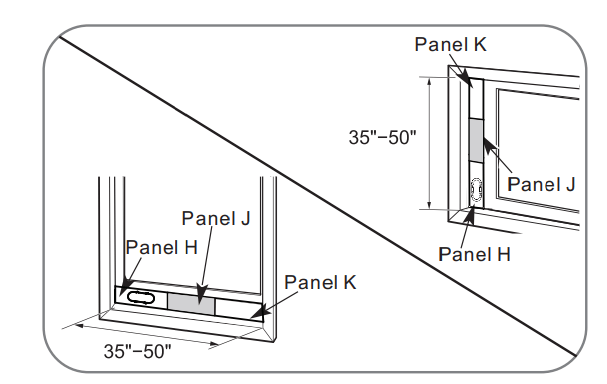
For window openings from 35" to 50", use the window vent panel and two extension panels (Panel K and Panel J).
Fig. "d
Install The Portable Air Conditioner
- Install Exhaust Hose and Adapter
1. Roll the air conditioner to selected location. see “Location Requirements” in page 4.
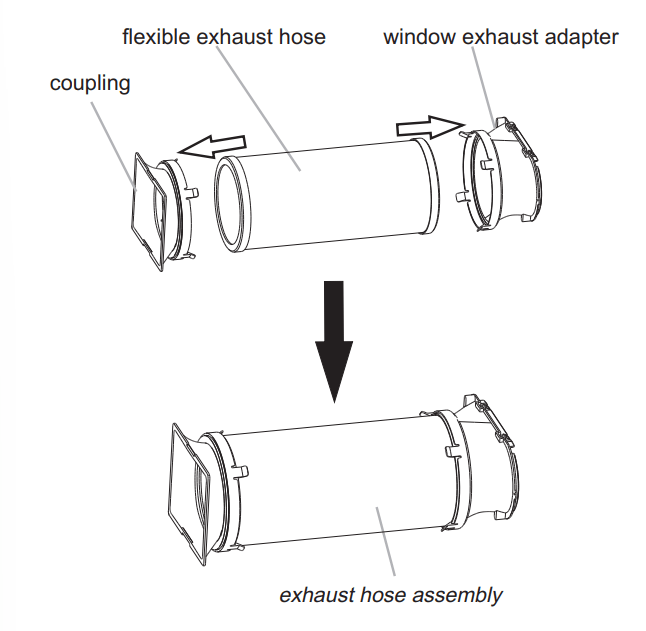
2. Preparing the exhaust hose assembly: Press the flexible exhaust hose into the coupling and the window exhaust adapter, Both the coupling and window exhaust adapter have integral clips that snap onto the hose
3. Insert the coupling into the slot on the back of the air conditioner.
4. Slide down to lock the hose into place.
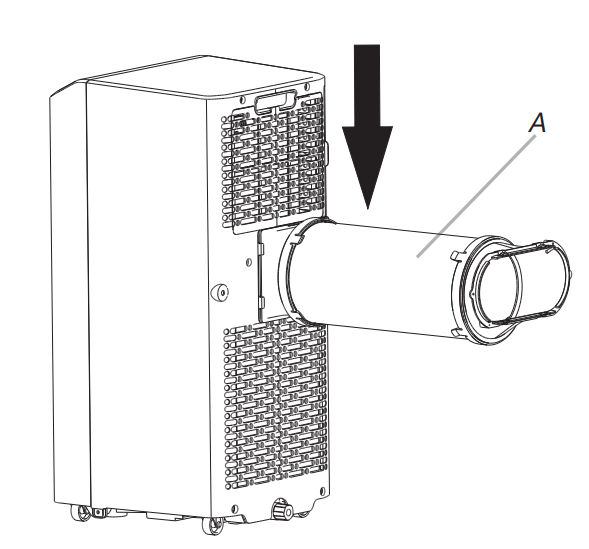
A. Flexible exhaust hose assembly
5. Confirm the hose is locked in place before operating.
Your window installation kit has been designed to fit most
standard vertical and horizontal window applications. Roll the
air conditioner to selected location. see “Location
Requirements” in page 4.
- Attach the window exhaust adapter to the outer slider section (the piece with the large exhaust hole).
NOTE: Product must be used with included Duct Window installation kit for effective cooling.
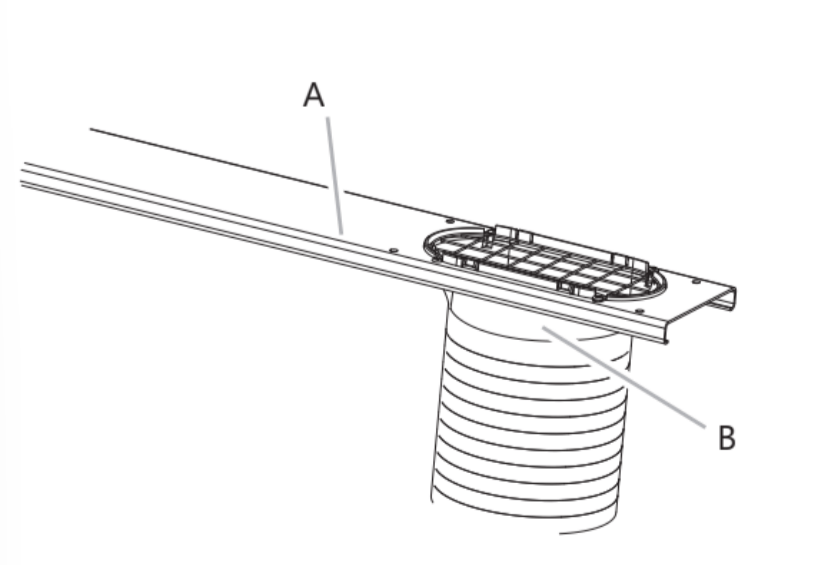
A. Outer slider section
B. Window exhaust adapter
Installation In Vertical Sliding Windows
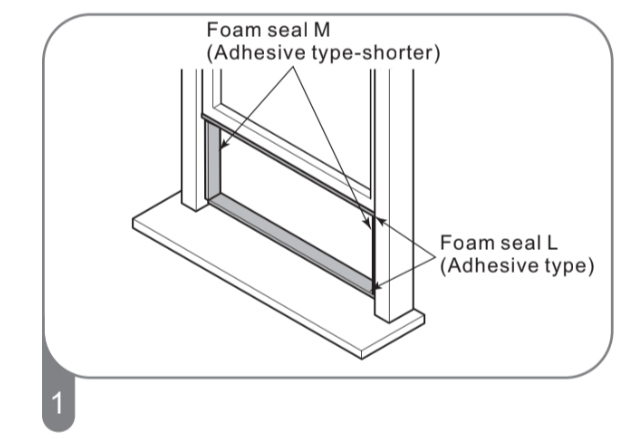
Cut the foam seal L(adhesive type) & M (adhesive type-shorter)to the proper length,and attcah it to the window sash and frame.
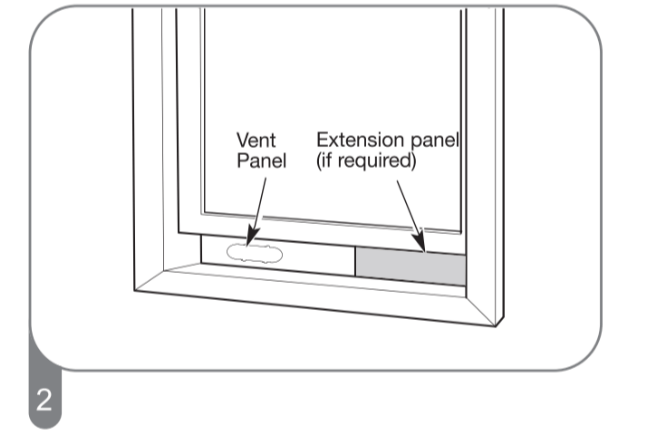
Insert the vent panel assembly, including extension panels, if needed, into the window opening. Extend the extension panels to the window width.
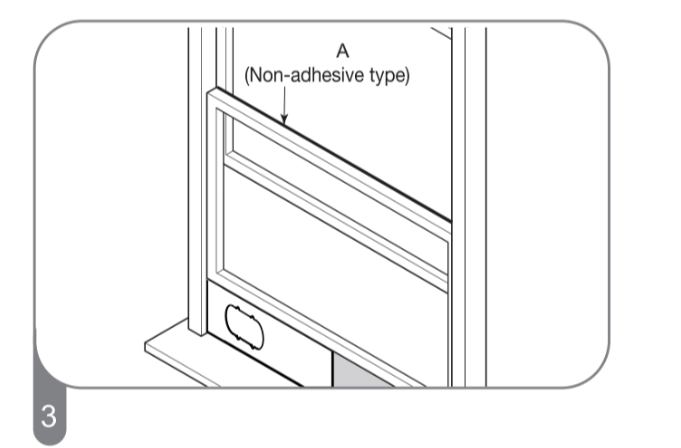
Cut the foam seal A(Non-adhesive type) to the window width. Stuff the foam seal A between the glass and the window to prevent air and foreign objects from getting into the room.
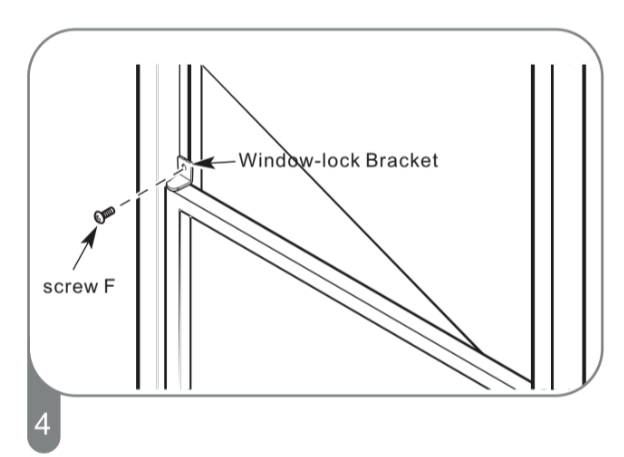
Install the Window-lock bracket with a type F screw as shown if you need.
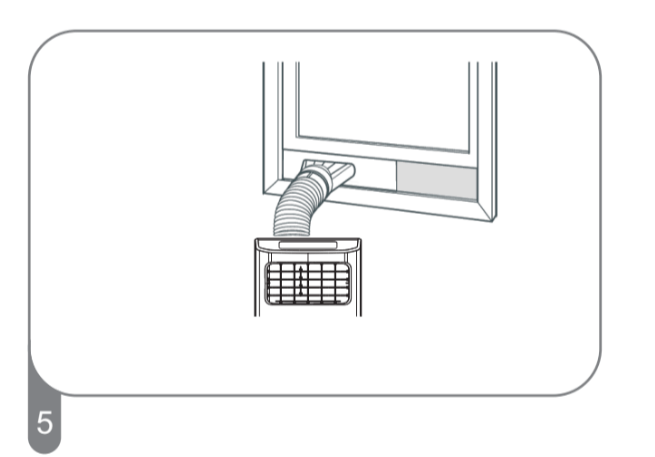
Insert the window exhaust adapter into the opening in the vent panel.
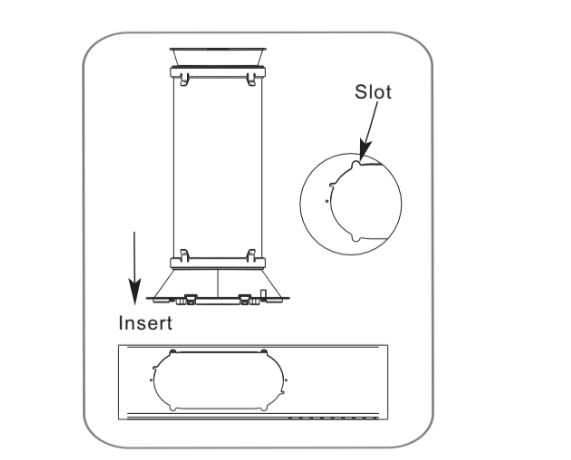
Align the tabs on the window exhaust adapter with the slots in the vent panel. Insert the window exhaust adapter into the opening in the vent panel.
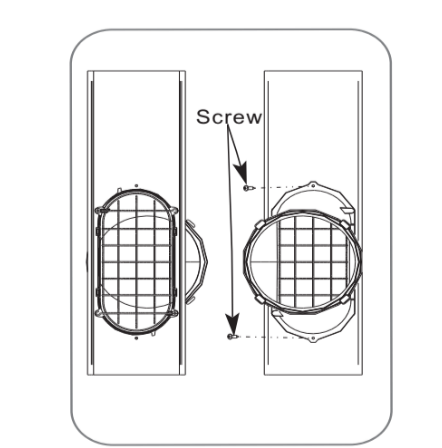
Insert the screw in the hole in the window exhaust adapter to prevent the window exhaust adapter from sliding out of the vent opening
Installation In Horizontal Sliding Windows
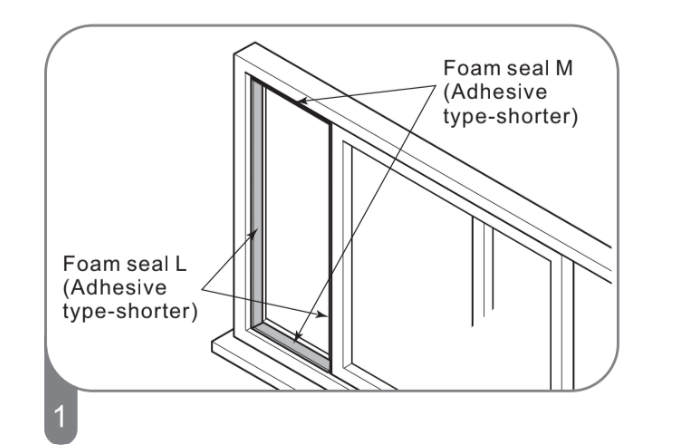
Cut the foam seal L(adhesive type) & M (adhesive type-shorter)to the proper length, and attach it to the window sash and frame.
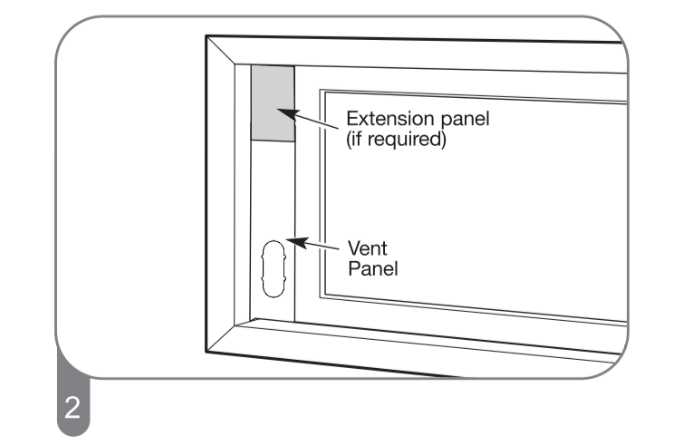
Insert the vent panel assembly, including extension panels, if needed, into the window opening. Extend the extension panels, if used
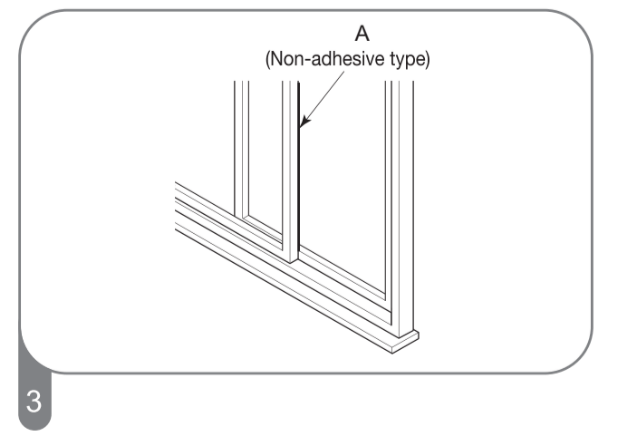
Cut the foam seal A(Non-adhesive type) to the window width. Stuff the foam seal A between the glass and the window to prevent air and foreign objects from getting into the room.
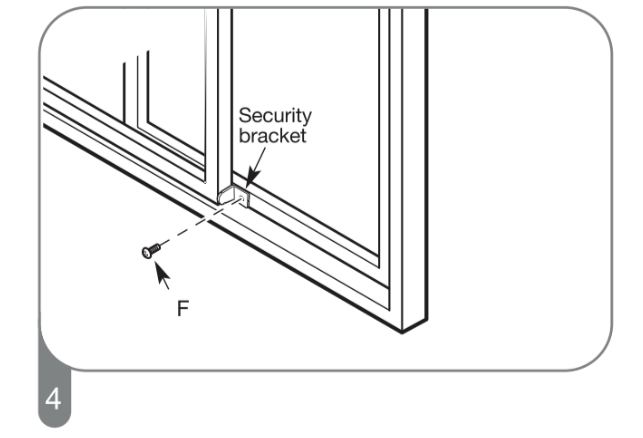
Install the Window-lock bracket with a type F screw as shown if you need.
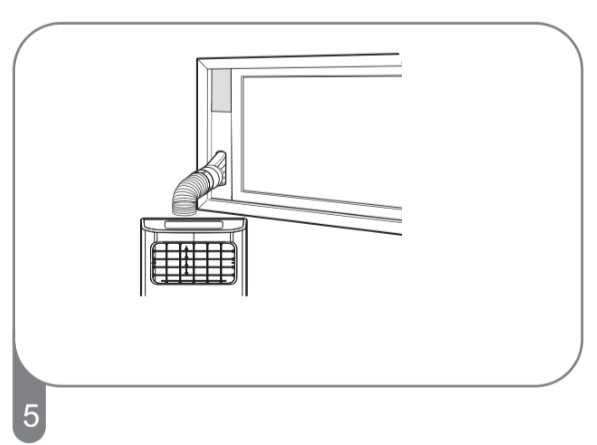
Insert the window exhaust adapter into the opening in the vent panel.
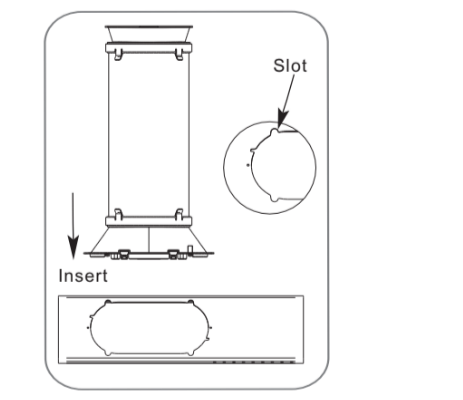
Align the tabs on the window exhaust adapter with the slots in the vent panel. Insert the window exhaust adapter into the opening in the vent panel.
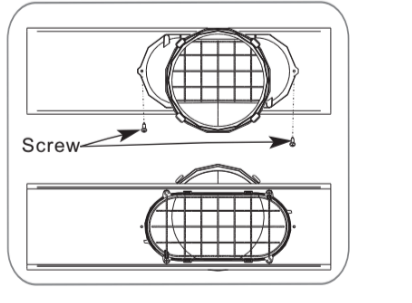
Insert the screw in the hole in the window exhaust adapter to prevent the window exhaust adapter from sliding out of the vent opening.
PORTABLE AIR CONDITIONER USE
IMPORTANT:
- Do not stay in direct airflow from the air conditioner for extended periods of time.
- Never use in tightly enclosed spaces. Always ensure there is sufficient airflow of outside air entering the household especially when used in conjunction with combustible devices such as gas stoves, fireplaces, furnaces, hot water heaters etc. Do not place the power cord or air conditioner near a heater, radiator, stoves or other apparatus(including amplifiers) that produce heat.
- This air conditioner is intended for household use as a residential appliance. Do not use it as a precision climate control for commercial use, or for precision equipment, food, pets, plants, artwork, etc.
- Do not block or obstruct the exhaust vent hose as it may severely affect performance, or cause failure of the air conditioner.
- The air conditioner display shows the current room temperature.
- When changing modes while the air conditioner is in operation, the compressor will stop for 3 to 5 minutes before restarting. If a button is pressed during this time, the compressor will not restart for another 3 to 5 minutes.
- In Cooling or Dry mode, the compressor and condenser fan will stop when the room temperature reaches the set temperature.
- On Dry mode, the humidity level is automatically set, but is not able to be displayed.
NOTE: In the event of a power failure, your air conditioner will operate at the previous settings when the power is restored.
Starting Your Portable Air Conditioner
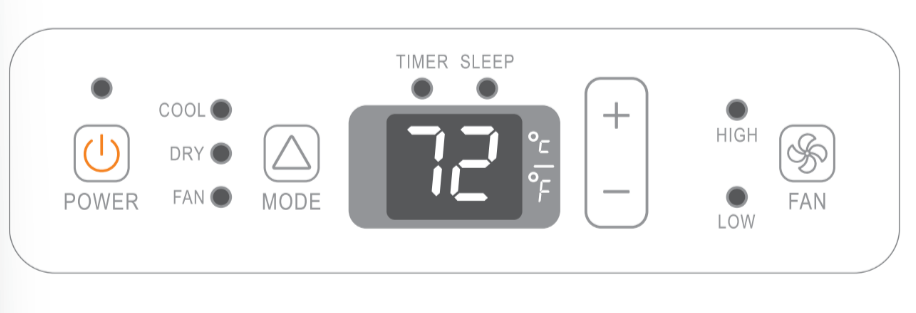
Power On or Off
NOTE:Keep upright at least 2 hours before use to prevent damaging the compressor
At the first time when the air conditioner is plugged in and turned on after your purchase, it will be set in Cool Mode. When the air conditioner is turned on at all other times, it will run according to the previous setting.
Mode
1. Press and release MODE until you see the symbol for the desired setting.
Operating modes:
2. Choose Cool, Dry, or Fan.
Cooling-Cools the room. Press FAN to select High or Low speeds. Press the Plus or Minus button to adjust the temperature.
Dry-Dries the room. The air conditioner automatically selects the temperature. The fan runs on Low speed only. Dehumidification ranges between 2 to 3 pints per hour by model.
NOTE: Dry mode should not be used to cool the room.

Fan Only mode. Press FAN to select High or Low.

Fan Speed
1. Press and release FAN to choose the desired fan speed.
2. Choose High or Low.
High-for maximum fan speed

Low-for minimum fan speed
Temperature
Press the PLUS button to raise the temperature. Press the PLUS button once to increase the set temperature by 1°F (1°C)

Press the MINUS button to lower the temperature. Press the MINUS button once to decrease the set temperature by 1°F (1°C).

NOTE:
- In the Cooling mode, the temperature can be set between 61°F and 86°F (16°C and 30°C).
- In Fan Only mode, the temperature can not be set.
- The unit LED shows the target temperature for 5 seconds and then displays the room temperature.
Change display between °F and °C
To change the temperature display between°F and °C press both the Plus and Minus Adjust buttons at the same time.
Using the Remote Control
1. Remove the battery cover along the arrowed direction.
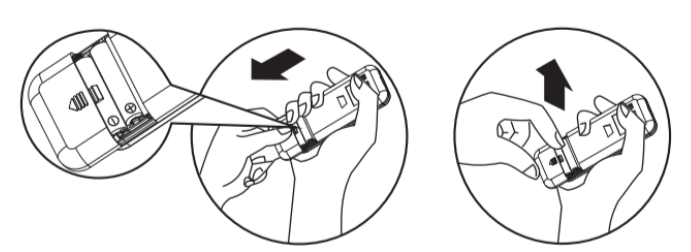
2. Insert new batteries making sure that the (+) and (-) of battery are matched correctly.
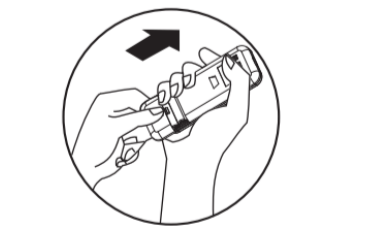
3. Re-attach the cover by sliding it back into position
NOTE:
- Use 2 standard AAA(1.5volt) batteries. Do not use rechargeable Replace batteries with new ones of the same type when the display becomes dim, or after 6 months.
- When replacing batteries, always replace both batteries with new batteries. Do not mix old and new batteries. Do not mix alkaline, standard( carbon-zinc), or rechargeable (ni-cd, ni-mh, etc) batteries. Using the Remote Control Insert the Batteries How to Use Temperature
- If the air conditioner will not be used for an extended period of time, remove the batteries from the remote
How to Use
To operate the room air conditioner, aim the remote control at the signal receptor. The remote control will operate the air conditioner at a distance of up to 23'(7m) when pointing at signal receptor of the air conditioner.
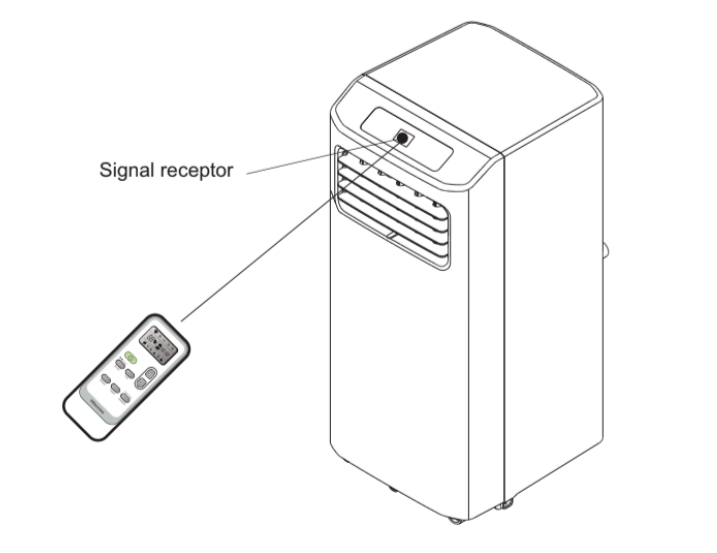
Remote control
NOTE:Remote control may differ in appearance.
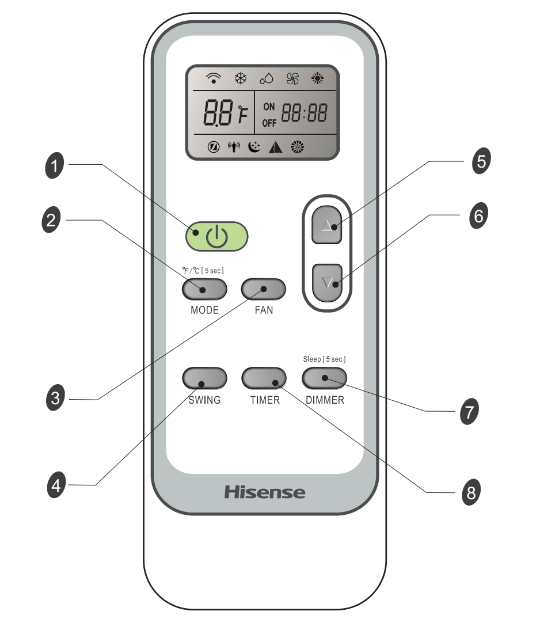
Button and Function
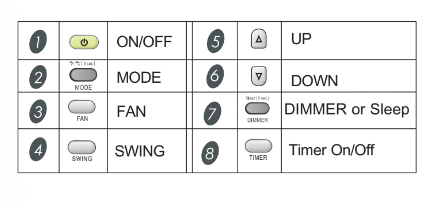
NOTE: Press and hold the MODE button on the remote for 5 seconds to switch the temperature display from degrees Fahrenheit(°F) to degrees Celsius(°C).
Indication symbols
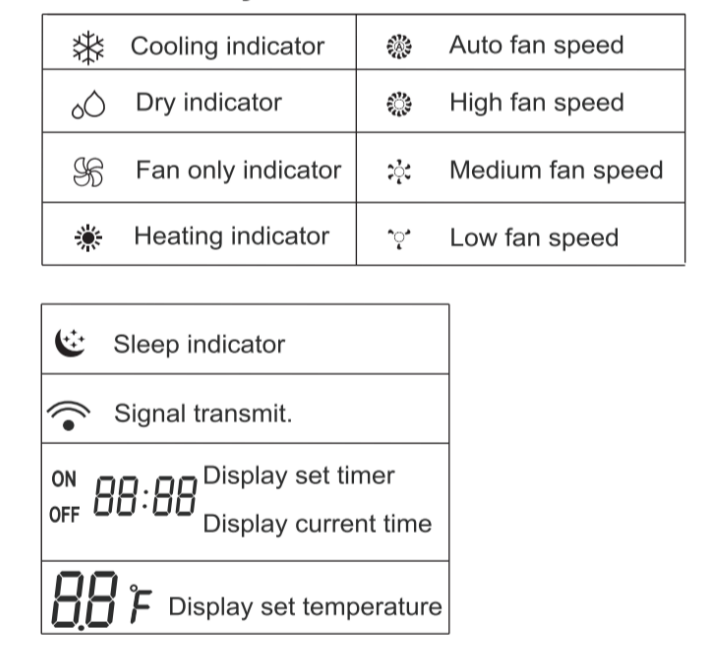
DIMMER
Press the DIMMER button to turn off the control panel display.
NOTE:When in DIMMER mode, new control inputs will return display NOTE: to normal.
Sleep mode
SLEEP mode can only be set in Cooling, Heating or Drying modes. When in sleep mode the unit will utilize lower, quieter fanspeeds and automatic temperature adjustments offering 8 hours of optimal sleeping conditions before shutting off.
NOTE:
- The appliance will stop operation automatically after operating for 8 hours.
- Fan speed is automatically set at low speed.
- In the Cooling mode, if the current room temperature is below 79°F(26°C), the temperature will automatically increase 1°F(1°C) during the first hour after Sleep control is activated, and continue running at that temperature. If the room temperature is 79°F(26°C) or above, set temperature will not change.
- In Heating mode, the set temperature will decrease by 6°F(3°C) at most, during 3 hours, and continues running at that temperature until auto shut off.
1. Press MODE to select COOL, Heating or DRY. NOTE: Sleep control cannot be selected in Fan mode.
2. Press the UP or DOWN button to set the temperature
3 Press and hold the DIMMER button on the remote for 5 seconds to switch the DIMMER mode to the Sleep mode.
4. After 5 seconds, the lights on the control panel display will dim.
NOTE: The temperature and airflow direction may be adjusted during Sleep control. The fan speed is automatically set to Low speed. After 5 seconds, the lights on the control panel display will dim again.
5. To turn off Sleep control, press MODE, FAN, Sleep or wait 8 hours for Sleep control to turn off automatically.
NOTE: The air conditioner will return to previous settings after Sleep mode is turned off.
TIMER
Use the TIMER function to turn the air conditioner ON/OFF automatically
Setting the Air Conditioner to Turn On:
- Plug in the air conditioner and use the remote to power it ON.
- Use the remote to set the d
esired mode, temperature, fan speed, etc.
- Use the remote to power OFF the air conditioner.
- Press TIMER on the remote and use the UP, DOWN buttons to set the desired delay time until the air conditioner turns ON. The delay time can be set from 0 to 24 hours in one-hour increments.
- Press TIMER again to confirm the delay time. The TIMER light on the unit will be on.
Setting the Air Conditioner to Turn OFF:
- Plug in the air conditioner and use the remote to power it ON.
- Use the remote to set the desired mode, temperature, fan speed, etc.
- Press TIMER on the remote and use the UP, DOWN buttons to set the desired delay time until the air conditioner turns OFF. The delay time can be set from 0 to 24 hours in one-hour increments.
- Press TIMER again to confirm the delay time. The TIMER light on the unit will be on
To cancel TIMER :
Press the TIMER button again. Once a "beep" is heard and the indicator disappears, the TIMER mode has been canceled.
NOTE:The TIMER function can only be set by the remote control.
SWING
Press SWING once to change the vertical airflow direction. Press again to hold the louver in a desired position.
NOTE:Swing function is not available on this models.
Normal Sounds
When your air conditioner is operating normally, you may hear sounds such as:
- Air movement from the fan.
- Clicks from the thermostat cycling.
- Vibration or noise due to poor wall or window construction.
- A high-pitched hum or pulsating noise caused by the high-efficiency compressor cycling on and off.
PORTABLE AIR CONDITIONER CARE
Draining the Air Conditioner
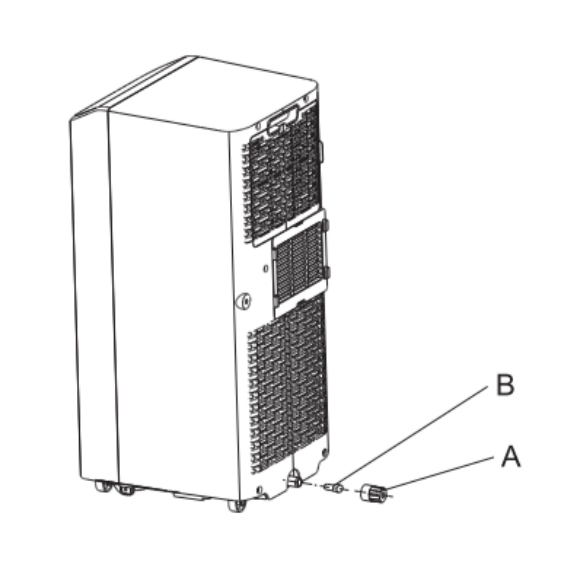
A. Primary drain cover
B. Primary drain plug
1. Unplug the air conditioner or disconnect power.
2. Move the air conditioner to a drain location or outside.
NOTE: To avoid leaking water from the unit, move the air conditioner slowly and keep it level.
3. Remove the primary drain cover and plug.
4. Drain water completely through the drain hole.
NOTE: If the air conditioner will be stored after use, see "Storing After Use".
5. Reinstall the drain plug to the primary drain hole.
6. Reinstall the primary drain cover to the drain hole.
7. Reposition the air conditioner.
8. Plug in the air conditioner or reconnect power.
Cleaning the Air Filter
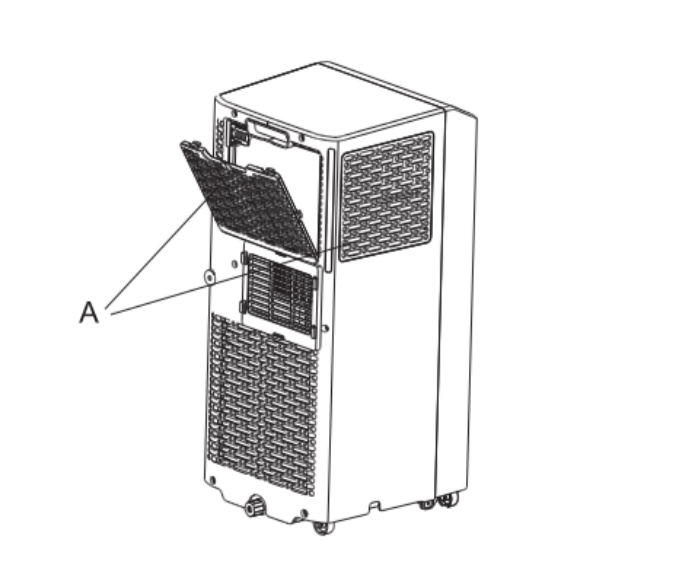
A. Evaporator air intake filter panel door
1. Press ON/OFF to turn off the air conditioner.
2. Open the filter panel door on the back of the air conditioner and remove.
3. Use a vacuum cleaner to clean the filter. If the filter is very dirty, wash the filter in warm water with a mild detergent
NOTE: Do not wash the filter in the dishwasher or use any chemical cleaners.
4. Air dry the filter completely before replacing to ensure maximum efficiency.
5. Reattach the air filter to the filter panel door.
6. Reinstall the filter panel door.
7. Press ON/OFF to start the air conditioner.
Cleaning the Outside
- Press ON/OFF to turn off the air conditioner.
- Unplug the air conditioner or disconnect power.
- Remove the air filter and clean separately. See "cleaning the Air Filter ".
- Wipe the outside of the air conditioner with a soft, damp cloth.
- Plug in the air conditioner or reconnect power.
- Press ON/OFF to start the air conditioner.
Storing After Use
If the air conditioner will not be used for an extended period of time:
- Drain the water completely. See "draining the Air Conditioner ".
- Run the air conditioner set to Fan Only for approximately 12 hours to dry the air conditioner.
- Unplug the air conditioner. \
- Remove the flexible exhaust hose and store with the air conditioner in a clean, dry area. See " installation Instructions ".
- Remove the window kit and store with the air conditioner in a clean, dry area. See " Installation Instructions ".
- Remove the filter and clean. See Cleaning the Air Filter.
- Clean the outside of the air conditioner. See "Cleaning the Outside ".
- Reinstall the filter.
- Remove the batteries and store the remote control with the air conditioner in a clean, dry area.
Before using the air conditioner again
- Make sure the filter and drain cap are in place.
- Check the power cord to make sure it is in good condition, with no cracks or damage.
- Place new batteries in the remote.
- Install the air conditioner. See "Installation Instructions".
TROUBLESHOOTING
Air conditioner will not operate
- The power supply cord is unplugged.
Plug into a grounded 3 prong outlet. See "electrical Electrical Shock Hazard Plug into a grounded 3 prong outlet. Do not remove ground prong. Do not use an adapter. Do not use an extension cord. Failure to follow these instructions can result in death, fire, or electrical shock. WARNING WARNING Requirements."
- Time-delay fuse or circuit breaker of the wrong capacity is being used.
Replace with a time-delay fuse or circuit breaker of the correct capacity. See "electrical Requirements".
- The power supply cord has tripped (Reset button has popped out).
Press and release RESET (listen for click; Reset button will latch and remain in) to resume operation.
- A household fuse has blown, or a circuit breaker has tripped
. Replace the fuse, or reset the circuit breaker. See "Electrical Requirements"
- The On/Off button has not been pressed.
Press ON/OFF
- The local power has failed.
Wait for power to be restored
Air conditioner blows fuses or trips circuit breakers
- Too many appliances are being used on the same circuit. Unplug or relocate appliances that share the same circuit.
- You are trying to restart the air conditioner too soon after turning off air conditioner.
- Wait at least 3 minutes after tunning off air comditioner before trying to restart the air conditioner
Air conditioner power supply cord trips (Reset button pops out)
Disturbances in your electrical current can trip (Reset button will pop out) the power supply cord.
- Press and release RESET (listen for click; Reset button will latch and remain in) to resume operation.
Electrical overloading, overheating, cord pinching or aging can trip (Reset button will pop out) the power supply cord.
- After correcting the problem, press and release RESET
Air conditioner seems to run too much
- Is there a door or window open? Keep doors and windows closed.
The current air conditioner replaced an older model.
The use of more efficient components may cause the air conditioner to run longer than an older model, but the total energy consumption will be less. Newer air conditioners do not emit the "blast" of cold air you may be accustomed to from older units, but this is not an indication of lesser cooling capacity or efficiency. Refer to the efficiency rating (EER) and capacity rating (in Btu/h) marked on the air conditioner.
The air conditioner is in a heavily occupied room, or heat- producing appliances are in use in the room.
Use exhaust vent fans while cooking or bathing and try not to use heat-producing appliances during the hottest part of the day. Portable air conditioners are designed as supplemental cooling to local areas within a room. A higher capacity air conditioner may be required, depending on the size of the room being cooled.
Air conditioner runs for a short time only, but room is not cool
- Set temperature is close to room temperature.
Lower set temperature. See " portable Air Conditioner Use ".
Display error code
- If the unit displays error code E5, the water container is full.
Drain the water, see "Draining the air conditioner". After
draining, the unit can be operated again.
- If the unit display error code E1/E2/E3/E4/E6/E7/EA
please contact customer service.
Air conditioner runs, but does not cool
- The filter is dirty or obstructed by debris.
Clean the filter.
Clear air outlet.
- Set temperature is too high.
Lower set temperature.
Air conditioner cycles on and off too much
- The air conditioner is not properly sized for your room.
Check the cooling capabilities of your portable air conditioner. Portable air conditioners are designed as
supplemental cooling to local areas within a room.
- The filter is dirty or obstructed by debris.
Clean the filter.
- There is excessive heat or moisture, open container cooking, showers,etc. in the room.
Use a fan to exhaust heat or moisture from the room.
Try not to use heat-producing appliances during the the hottest part of the day
Install the air conditioner in a location where the louvers are free from curtains, blinds, furniture, etc.