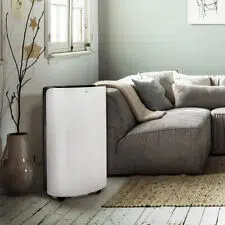
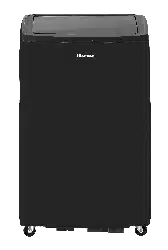
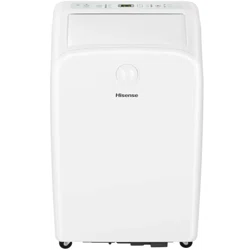
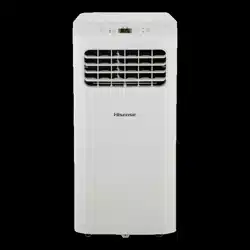
USER MANUAL PORTABLE AIR CONDITIONER
IDENTIFICATION OF PARTS
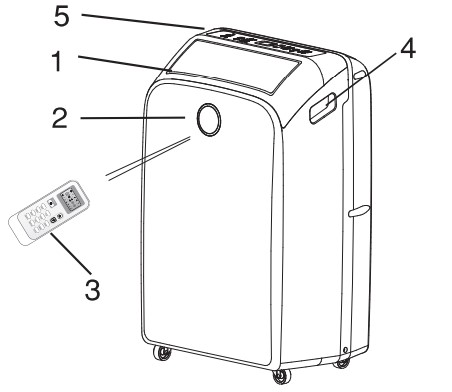
- Cool air outlet
- Signal receptor / Front display
- Remote control
- Transport handle
- Control panel
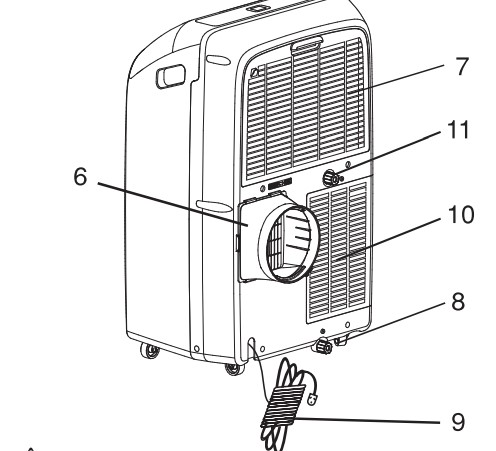
- Air outlet hose coupling
- Evaporator air intake
- Primary drain port
- Power cord
- Condenser air intake
- Secondary drain port
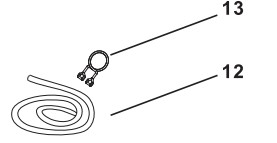
- Drain hose (Heat pump models)
- Drain hose clip (Heat pump models)
INSTALLATION REQUIREMENTS
Tools and Parts
Gather the required tools and parts before starting installation. Read and follow the instructions provided with any tools listed here
Tools needed
- Phillips screwdriver
- Scissors
- Pencil
- Cordless drill and 1/8" bit
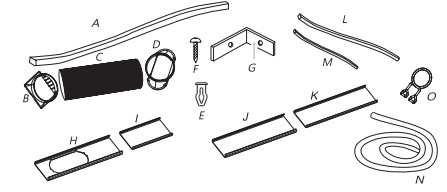
A.Foam seal
B.Coupling
C Flexible exhaust hose
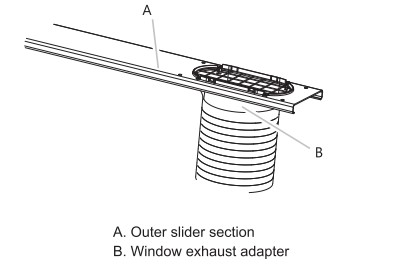
D Window exhaust adapter
E Rivets(2)
F Screws(4)
G Window-lock bracket(2)
H Outer slider section with vent
I Inner slider section-short
J Outer slider section
K Inner slider section
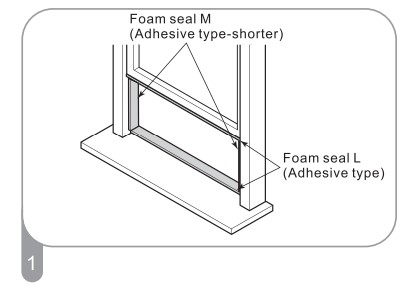
L Foam seal-long(2)
M Foam seal-short(2)
N Drain hose (Heat pump models)
O Drain hose clip(Heat pump models)
Electrical Requirements
Wiring requirement
- 115 V (103.5 min. to 126.5 max.)
- 15 A time-delay fuse or circuit breaker
Power Supply Cord
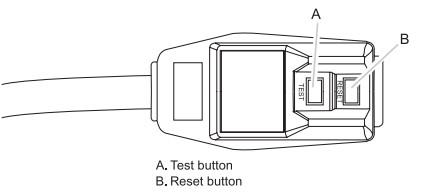
NOTE: Your air conditioner's device may differ from the one shown.
This room air conditioner is equipped with a power supply cord required by UL. This power supply cord contains state-of-the-art electronics that sense leakage current. If the cord is crushed, the electronics detect leakage current and power will be disconnected in a fraction of a second.
To test your power supply cord:
- Plug power supply cord into a grounded 3 prong outlet.
- Press RESET (on some devices. a green light will turn on).
- Press TEST (listen for click; Reset button will trip. and on some devices. a green light will turn off)
- Press and release RESET (listen for click; Reset button will latch. and on some devices. a green light will turn on). The power supply cord is ready for operation.
NOTES
- The Reset button must be pushed in for proper operation
- The power supply cord must be replaced if it fails to trip when the test button is pressed or fails to reset
- Do not use the power supply cord as an off/on switch. The power supply cord is designed as a protective device
- A damaged power supply cord must be replaced with a new power supply cord obtained from the product manufacturer and must not be repaired
- The power supply cord contains no user serviceable parts. Opening the tamper-resistant case voids all warranty and performance claims.
Location Requirements
Vertical Sliding Window
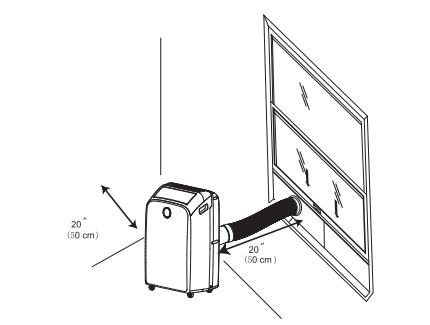
Horizontal Sliding Window
INSTALLATION INSTRUCTIONS
Install Portable Air Conditioner
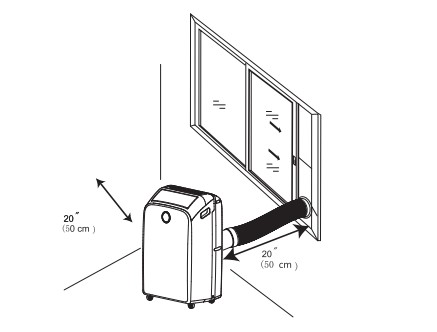
Install Exhaust Hose and Adapter
- 1Roll the air conditioner to selected location.
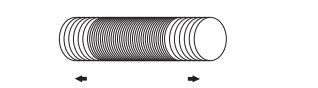
- Pull evenly on the folds to extend both ends of the flexible vent hose.
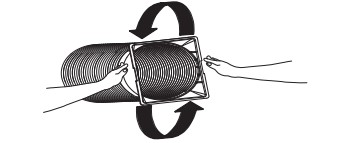
- Attach the coupling to the flexible exhaust hose. Turn counter clockwise until securely locked into place.
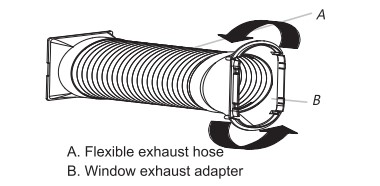
- Attach the window exhaust adapter to the flexible exhaust hose. Turn counter-clockwise until securely locked into place.
- Insert the coupling into the slot on the back of the air conditioner.
- Slide down to lock the hose into place.
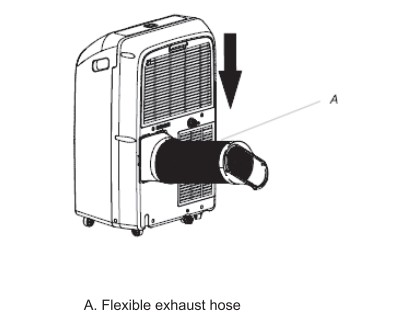
Window Installation
Your window installation kit has been designed to fit most standard vertical and horizontal window applications. Roll the air conditioner to selected location.
- Attach the window exhaust adapter to the outer slider section (the piece with the large exhaust hole).
NOTE: Product must be used with included Duct Window installation kit for effective cooling
Installation In Vertical Sliding Windows
NOTE: The window installation kit can be used with vertical sliding windows between 18" and 50" wide.
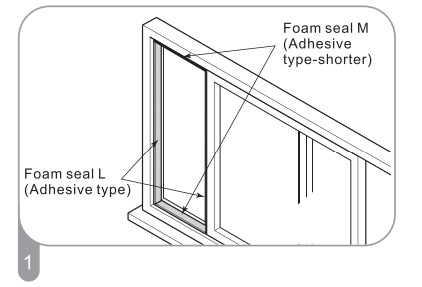
- Cut the foam seal L(adhesive type) & M (adhesive type-shorter)to the proper length. and attach it to the window sash and frame
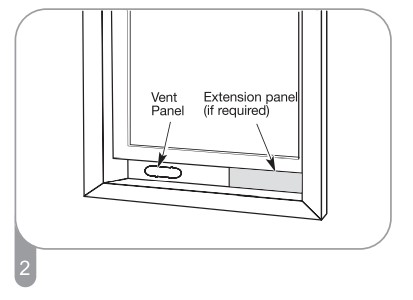
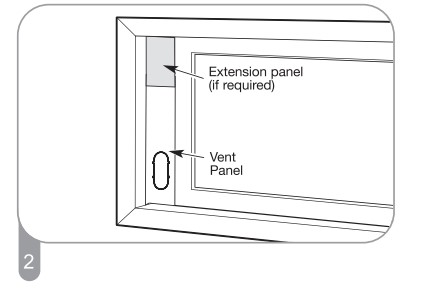
- Insert the vent panel assembly. including extension panels. if needed. into the window opening. Extend the extension panels, if used.
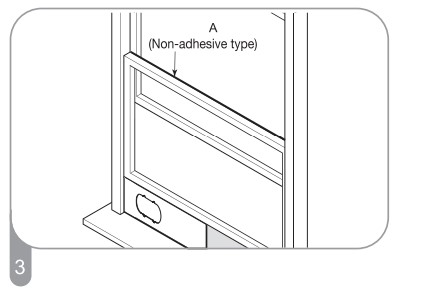
- Cut the foam seal A(Non-adhesive type) to the window width. Stuff the foam seal A between the glass and the window to prevent air and insects from getting into the room
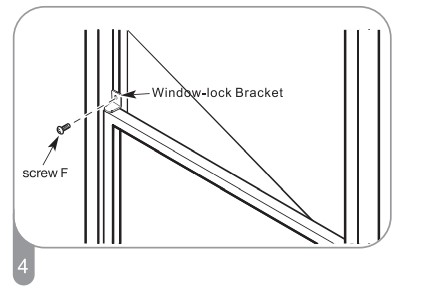
- Install the Window-lock bracket with a type F screw as shown if you need.
Installation In Horizontal Sliding Windows
NOTE: The window installation kit can be used with horizontal sliding windows between 18" and 50"wide.
- Cut the foam seal L(adhesive type) & M (adhesive type-shorter)to the proper length. and attach it to the window sash and frame.
- Insert the vent panel assembly. including extension panels. if needed. into the window opening. Extend the extension panels, if used.
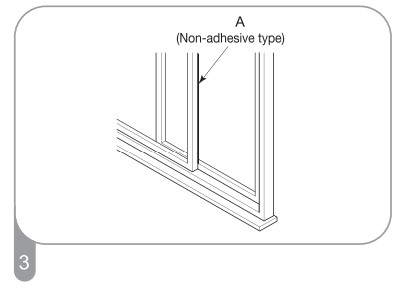
- Cut the foam seal A(Non-adhesive type) to the window width. Stuff the foam seal A between the glass and the window to prevent air and insects from getting into the room.
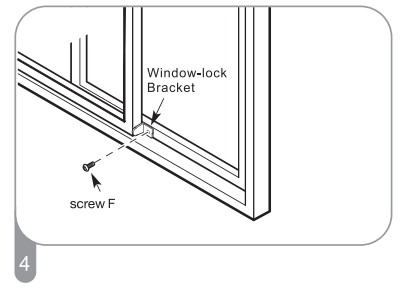
- Install the Window-lock bracket with a type F screw as shown if you need.
PORTABLE AIR CONDITIONER USE
Strating Your Portable Air Conditioner
Control Panel

Front Display

Using The Remote Control
Insert the Batteries
- Remove the battery cover along the arrowed direction.
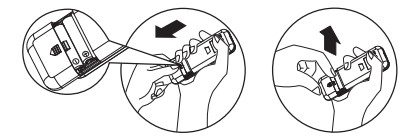
- Insert new batteries making sure that the (+) and (-) of battery are matched correctly.
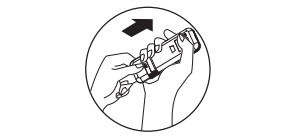
- Re-attach the cover by sliding it back into position.
NOTE:
- Use 2 standard AAA(1.5volt) batteries. Do not use rechargeable batteries. Replace batteries with new ones of the same type when the display becomes dim. or after 6 months.
- If you reload batteries after removing the old ones. previous settings will be lost.
Storage tip
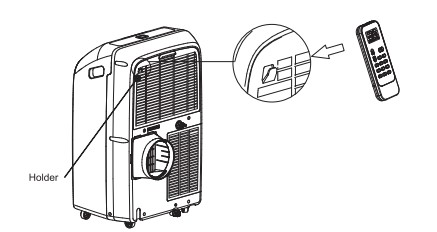
- The clip on the back of the unit can be used to store the remote control.
How to Use
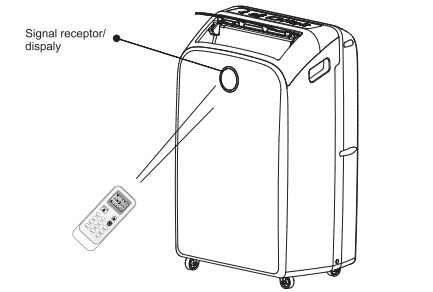
- To operate the room air conditioner. aim the remote controller to the signal receptor. The remote control will operate the air conditioner at a distance of up to 23" (7m) when pointing at signal receptor of the air conditioner.
Remote Control
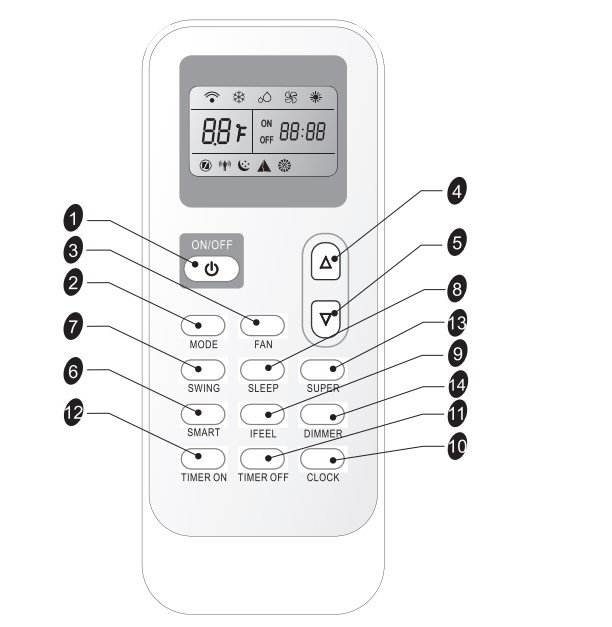
Button and Function
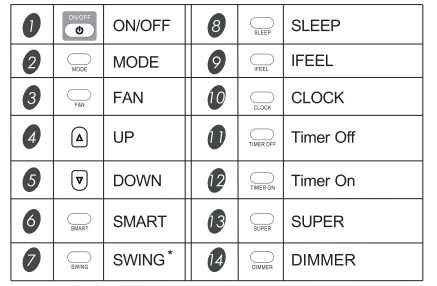
NOTE:Your remote control could change the displaying between fahrenheit and degree centigrade by pressing
MODE and DOWN buttons at the same time.
* This function is not available on all models.
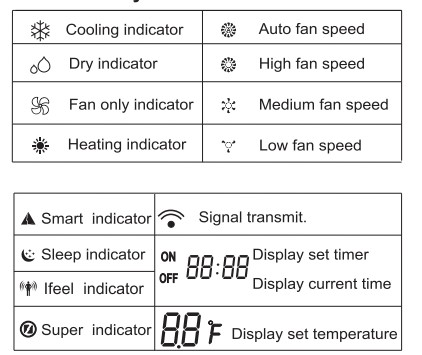
Indication Symbols
Indication Symbols on LCD
TIMER ON
Set the timer with the TIMER ON/OFF buttons.
NOTE: The CLOCK must be set before using the TIMER function.
Using the TIMER
The TIMER ON button can be used to turn on the unit automatically at a preset time .
1. Press TIMER ON. then "On 12:00" flashes on the LCD. 
2. Press the UP or DOWN button to set the time of day to turn on the appliance.
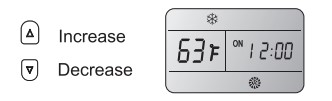
- Press the UP or DOWN button once to increase or decrease the time setting by 1minute.
- Press and hold the UP or DOWN button for 2 seconds to increase or decrease the time setting by 10 minutes.
- Press and hold the UP or DOWN button for a longer time to increase or decrease the time setting by 1 hour.
3. When the desired time is displayed on the LCD. press the TIMER ON button. again. to confirm it. A Beep’ will be heard. and “ON” stops flashing. The TIMER indicator on the appliance lights up indicating the TIMER is set
4. After the preset time is displayed for 5 seconds. the clock will display on the LCD of remote controller instead of the TIMER setting.
To cancel TIMER On
- Press the TIMER ON button again. when a "beep" is heard and the indicator disappears. the TIMER ON mode has been canceled. The TIMER OFF button can be used to turn off the unit automatically at a preset time.
TIMER OFF
- It is similar to set TIMER OFF,you can make the appliance unit switch off automatically at the time you set.

SWING
- Press SWING once to change the vertical airflow direction. Press again to hold the louver in a desired position.

NOTE:
- Airflow is automatically adjusted to a preset direction after turning on the unit.
- The direction of airflow can be adjusted by pressing the SWING button
- Do not turn the airflow louvers manually. to prevent damage. turn off the unit first and cut off the power supply.Then restore power again after adjustment.
Normal Sounds
When your air conditioner is operating normally. you may hear sounds such as:
- Air movement from the fan.
- Clicks from the thermostat cycling.
- Vibration or noise due to poor walll or window construction.
- A high-pitched hum or pulsating noise caused by the high-efficiency compressor cycling on and off.
PORTABLE AIR CONDITIONER CARE
Draining the Air Conditioner
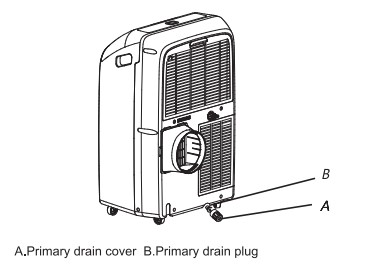
- Unplug the air conditioner or disconnect power.
- Move the air conditioner to a drain location or outside. NOTE: To avoid leaking water from the unit. move the air conditioner slowly and keep it level.
- Remove the primary drain cover and plug.
- Drain water completely through the drain hole. NOTE: If the air conditioner will be stored after use. see “Storing After Use”.
- Reinstall the drain plug to the primary drain hole.
- Reinstall the primary drain cover to the drain hole.
- Reposition the air conditioner.
- Plug in the air conditioner or reconnect power.
Draining the Air Conditioner ( Heating Mode)
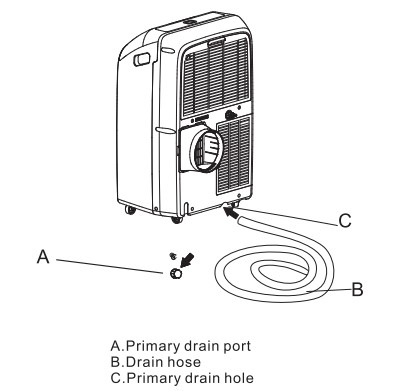
WARNING: Please connect the drain hose on heating mode. or the unit will stop running after the water reaches warning level
- Uncover the primary drain port
- Attach the drain hose to the primary drain hose. Make sure the connector is no water leak.
- Place the other end of drain hose into a outfall. Check to see that the hose lies flat and is in the drain. Make sure the hose end that gose to the drain is on a lower level than the hose end that connects to the unit. The hose should not be kinked or pinched.
Cleaning the Outside
- Press ON/OFF to turn off the air conditioner.
- Unplug the air conditioner or disconnect power.
- Remove the air filter and clean separately. See “cleaning the Air Filter".
- Wipe the outside of the air conditioner with a soft. damp cloth.
- Plug in the air conditioner or reconnect power.
- Press ON/OFF to start the air conditioner.
Cleaning The Air Filter
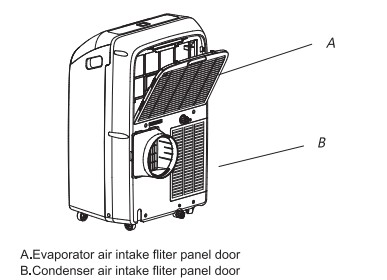
- Press ON/OFF to turn off the air conditioner.
- Open the filter panel door on the back of the air conditioner and remove.
- Remove the tapping screw from the condenser air intake filter panel door and remove.
- Use a vacuum cleaner to clean the filter. If the filter is very dirty. wash the filter in warm water with a mild detergent. NOTE: Do not wash the filter in the dishwasher or use any chemical cleaners.
- Air dry the filter completely before replacing to ensure maximum efficiency.
- Reattach the air filter to the filter panel door.
- Reinstall the filter panel door and tapping screw.
- Press ON/OFF to start the air conditioner.
Storing After Use
- Drain the water completely. See "draining the Air Conditioner *.
- Run the air conditioner set to Fan Only for approximately 12 hours to dry the air conditioner.
- Unplug the air conditioner.
- Remove the flexible exhaust hose and store with the air conditioner in a clean. dry area. See * installation Instructions ".
- Remove the window kit and store with the air conditioner in a clean. dry area. See " Installation Instructions *.
- Remove the filter and clean. See Cleaning the Air Filter.
- Clean the outside of the air conditioner. See " Cleaning the Outside *.
- Reinstall the filter.
- Remove the batteries and store the remote control with the air conditioner in a clean. dry area.
TROUBLESHOOTING
Air Conditioner will not operate
- The power supply cord is unplugged.
- Plug into a grounded 3 prong outlet. See " electrical Requirements.”
- Time-delay fuse or circuit breaker of the wrong capacity is being used.
- Replace with a time-delay fuse or circuit breaker of the correct capacity. See " electrical Requirements”.
- The power supply cord has tripped (Reset button has popped out).
- Press and release RESET (listen for click; Reset button will latch and remain in) to resume operation.
- A household fuse has blown. or a circuit breaker has tripped.
- Replace the fuse. or reset the circuit breaker. See. “Electrical Requirements’.
- The On/Off button has not been pressed.
- The local power has failed.
- Wait for power to be restored.
Air conditioner blows fuses or trips circuit breakers
- Too many appliances are being used on the same circuit.
- Unplug or relocate appliances that share the same circuit
- You are trying to restart the air conditioner too soon after turning off air conditioner.
- Wait at least 3 minutes after turning off air conditioner before trying to restart the air conditioner.
Air conditioner power supply cord trips (Reset button pops out)
- Disturbances in your electrical current can trip (Reset button will pop out) the power supply cord.
- Press and release RESET (listen for click; Reset button will latch and remain in) to resume operation.
- Electrical overloading. overheating. cord pinching or aging can trip (Reset button will pop out) the power supply cord.
- After correcting the problem. press and release RESET (listen for click; Reset button will latch and remain in) to to resume operation. If the power cord fails to reset. contact a service technician.
NOTE: A damaged power supply cord must be replaced with a new power supply cord obtained from the product manufacturer and must not be repaired.
Air conditioner seems to run too much
- Is there a door or window open?
- Keep doors and windows closed.
- The current air conditioner replaced an older model.
- The use of more efficient components may cause the air conditioner to run longer than an older model. but the total energy consumption will be less. Newer air conditioners do not emit the “ blast” of cold air you may be accustomed to from older units. but this is not an indication of lesser cooling capacity or efficiency. Refer to the efficiency rating (EER) and capacity rating (in Blu/h) marked on the air conditioner.
- The air conditioner is in a heavily occupied room. or heat producing appliances are in use in the room.
- Use exhaust vent fans while cooking or bathing and try not to use heat-producing appliances during the hottest part of the day. Portable air conditioners are designed as supplemental cooling to local areas within a room. A higher capacity air conditioner may be required. depending on the size of the room being cooled.
Air conditioner runs for a short time only. but room is not. cool
- Set temperature is close to room temperature.
- Lower set temperature. See " portable Air Conditioner Use "
Display error code
- If the unit displays error code E5. the water container is full. Drain the water. see “Draining the air conditioner”. After draining. the unit can be operated again.
- If the unit display error code E1/E2/ES/E4/E6/ETIEA. please contact customer service.
Air conditioner runs. but does not cool
- The filter is dirty or obstructed by debris.
- Air outlet is blocked.
- Set temperature is too high.
Air conditioner cycles on and off too much
- The air conditioner is not properly sized for your room.
- Check the cooling capabilities of your portable air conditioner. Portable air conditioners are designed as. supplemental cooling to local areas within a room.
- The filter is dirty or obstructed by debris
- There is excessive heat or moisture. open container cooking. showers. etc. in the room.
- Use a fan to exhaust heat or moisture from the room. Try not to use heat-producing appliances during the hottest part of the day.
- The louvers are blocked.
- Install the air conditioner in a location where the louvers are free from curtains. blinds. furniture. etc.