User Manual
\
Electric Freestanding
Oven
\
RU9EIB

Dear Customer, Congratulations on purchasing your new cooker.
The Residentia brand is proudly distributed within
Australia by Residentia Group Pty Ltd.
Please refer to the warranty card at the rear of this
manual for information regarding your product’s
parts and labour warranty, or visit us online at
www.residentiagroup.com.au.
At Residentia Group, we are customer obsessed and
our Support Team are there to ensure you get the most
out of your appliance. Should you want to learn more
about cooking with your oven or most importantly taking
care of your oven when cleaning, our Support Team are
here to help.
You can use our online Support Centre at anytime by
visiting http://support.residentiagroup.com.au, or you
can contact us via phone by dialling 1300 11 HELP (4357).
It is important that you read through the following use
and care manual thoroughly to familiarise yourself with
the installation and operation requirements of your
appliance to ensure optimum performance.
Again, thank you for choosing a Residentia appliance
and we look forward to being of service to you.
Kind Regards,
The Residentia Team
T 1300 11 4357
E info@residentiagroup.com.au
W residentiagroup.com.au
ACN
600 546 656
Residentia Group
PO Box 581
Stanhope Gardens
NSW Australia 2768

This cooker must only be installed in
accordance with the instructions provided
and by a suitably licensed and qualified
installer. Incorrect installation may cause harm
to persons, damage property and void the
product’s warranty.
Important
Please ensure that you read the entire
instructions before beginning the installation
of your cooker.
Please Note
When the oven is first switched on, it may
give o an unpleasant smell. This is due to
the bonding agent used for the insulating
panels within the oven. This is completely
normal, if it does occur, you merely have
wait for the smell to clear before putting
food into the oven.
– The appliance and its accessible parts
become hot during use.
– Care should be taken to avoid touching
heating elements.
– Children less than 8 years of age shall be
kept away unless continuously supervised.
– This appliance can be used by children
aged from 8 years and above and persons
with reduced physical, sensory or mental
capabilities or lack of experience and
knowledge if they have been given
supervision or instruction concerning use of
the appliance in a safe way and understand
the hazards involved. Children shall not
play with the appliance. Cleaning and user
maintenance shall not be made by children
without supervision.
– Do not use harsh abrasive cleaners or sharp
metal scrapers to clean the oven door glass
since they can scratch the surface, which
may result in shattering of the glass.
– The hob surface is of glass-ceramic: if the
surface is cracked, switch o the appliance
to avoid the possibility of electric shock.
– For the models equipped with a facility to
use a temperature 2 sensing probe: Only
use the temperature probe recommended
for this oven.
– During use, the appliance becomes very hot.
– Care should be taken to avoid touching
heating elements inside the oven.
– Do not allow children to go near the oven
when it is operating, especially when the
grill is on.
– Ensure that the appliance is switched o
before replacing the oven lamp to avoid
the possibility of electric shock.
– The means for disconnection must
be incorporated in the fixed wiring in
accordance with the wiring specifications.
– Children should be supervised to ensure
that they do not play with the appliance.
– This appliance is not intended for use by
persons (including children) with reduced
physical, sensory or mental capabilities,
or lack of experience and knowledge,
unless they have been given supervision or
instruction concerning use of the appliance
by person responsible for their safety.
– Accessible parts may become hot during
use. Young children should be kept away.
– Never use steam cleaners to clean your
cooking range
– For models with induction hobs: metallic
objects such as knives, forks, spoons and
lids should not be placed on the hob surface
since they can get hot.
– For models with induction hobs : After use,
switch o the hob element by its control
and do not rely on the pan detector.
– For the models with a lid: any spillage should
be removed from the lid before opening.
The hob surface should be allowed to cool
before closing the lid.
Warning
The appliance must not be used by
people (including children) with or without
experience or their safety.
Young children should be supervised to
ensure they not play with the limited physical,
sensory or mental abilities, expertise, unless
they have received instructions for using it
from those responsible for appliance.
Safety Instructions
\


Contents
\
Page
Safety Precautions
\
06
Before Installing
\
06
Your Cooker
\
06
Installation
\
09
Fitting the Adjustable Feet
\
09
Fitting the Splash Guard
\
10
Positioning & Levelling
\
10
Electrical Connection
\
11
Stability Brackets
\
13
Using Your Cooker
\
14
–
60
Residentia\User Manual

Safety precautions
This manual is valid for several models. Variations
in details for each cooker are possible.
The safe operation of this appliance can only be
guaranteed if it has been professionally assembled
and installed in accordance with these instructions.
The individual who assembled and installed the
appliance is liable for damage or faults resulting
from incorrect assembly or installation.
All installation and adjustment work, must be
undertaken by an authorized expert and carried
out in accordance with the currently applicable
rules and regulations of the local electricity supply
company.
Shut off the supply of electricity before carrying
out any work.
Electrical appliances must always be earthed.
If an extractor hood is to be fitted, it must be
fitted according to the associated assembly
instructions. Ensure that the hood is fitted at
least 650 mm clear of the hob.
Before installing
Appliance
Unpacking
Check the condition of the appliance after
unpacking
it. Do not connect the appliance if it has
been
damaged in transport.
Dispose of packaging in an environmentally-
friendly
manner.
6
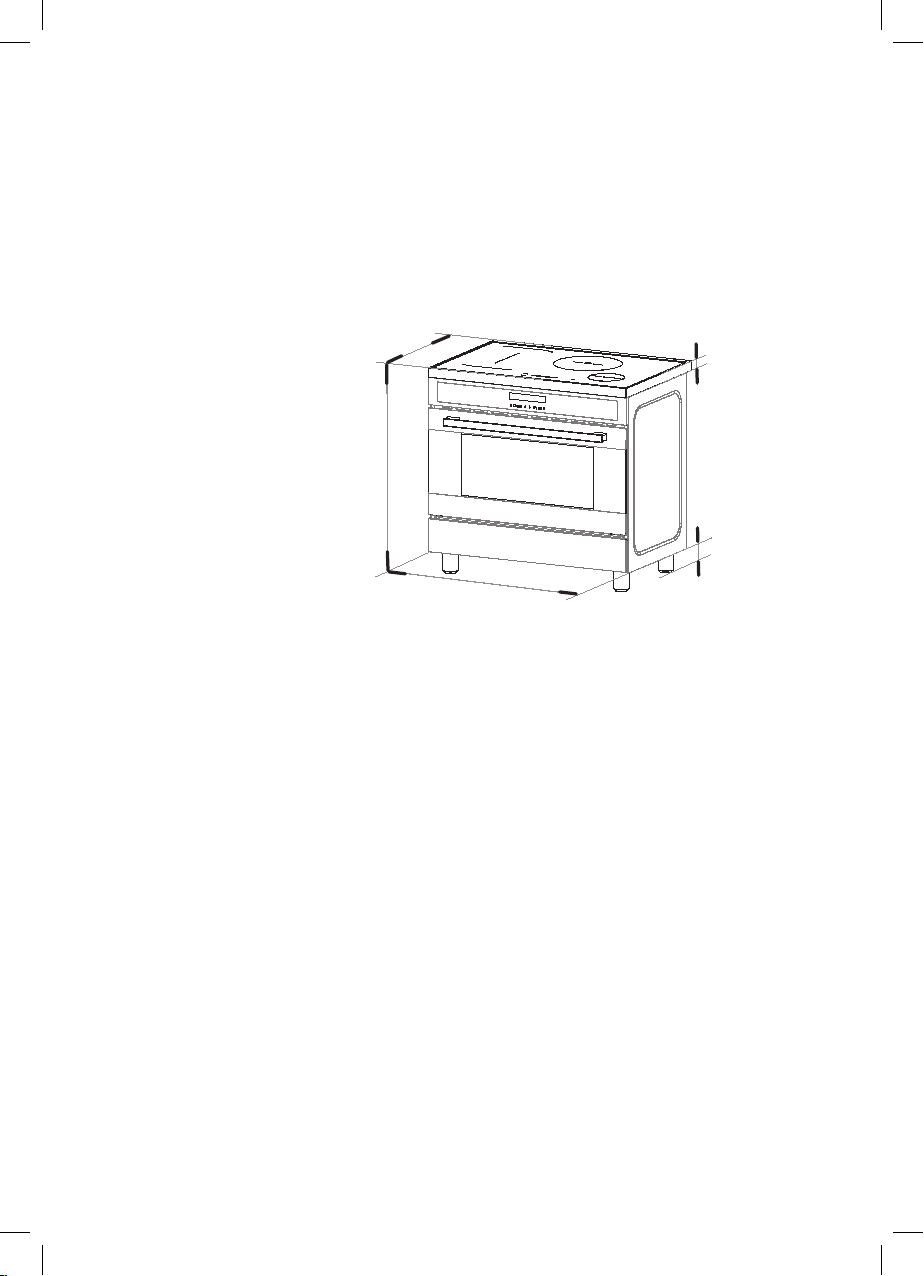
Appliance dimensions Note the specified dimensions.
A=95-160 mm
597 mm
40 mm
A
769 mm
895 mm
All product outward appearance, the color
take the material object as, the picture only
supply the reference.
7
Safety precautions
This manual is valid for several models. Variations
in details for each cooker are possible.
The safe operation of this appliance can only be
guaranteed if it has been professionally assembled
and installed in accordance with these instructions.
The individual who assembled and installed the
appliance is liable for damage or faults resulting
from incorrect assembly or installation.
All installation and adjustment work, must be
undertaken by an authorized expert and carried
out in accordance with the currently applicable
rules and regulations of the local electricity supply
company.
Shut off the supply of electricity before carrying
out any work.
Electrical appliances must always be earthed.
If an extractor hood is to be fitted, it must be
fitted according to the associated assembly
instructions. Ensure that the hood is fitted at
least 650 mm clear of the hob.
Before installing
Appliance
Unpacking
Check the condition of the appliance after
unpacking
it. Do not connect the appliance if it has
been
damaged in transport.
Dispose of packaging in an environmentally-
friendly
manner.
6
Appliance dimensions Note the specified dimensions.
A=95-160 mm
597 mm
40 mm
A
769 mm
895 mm
All product outward appearance, the color
take the material object as, the picture only
supply the reference.
7
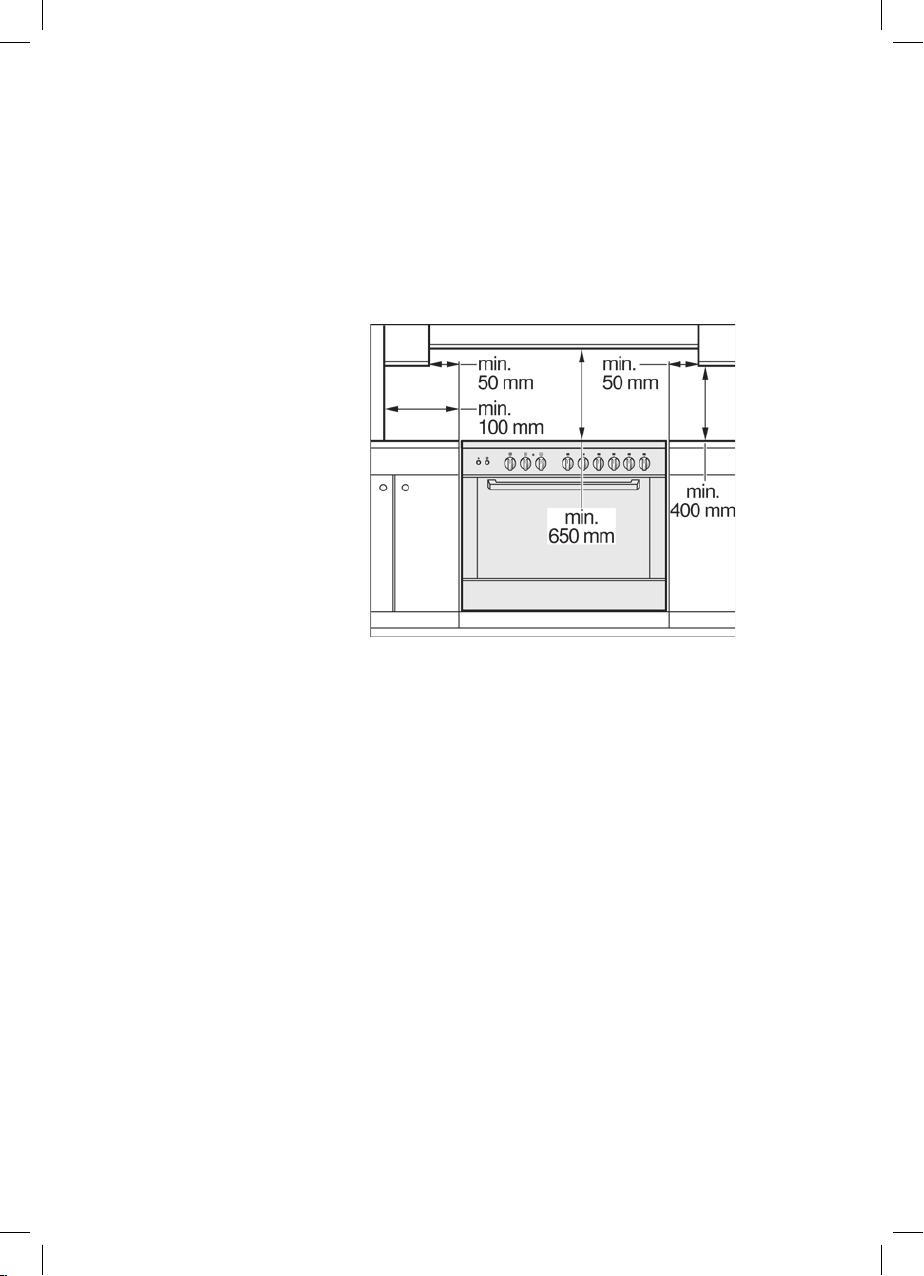
Adjacent units Adjacent units must be made of non-combustible
material. The fronts of adjacent units must be
resistant to temperatures up to at least 90 °C. If the
appliance is fitted close to other units, the minimum
distances specified in the picture must be maintained.
8
Installation
This appliance is always supplied with a set of
a
d
justable feet and, depending on the model, with a
splash guard.
The appliance may also be used without the splash
guard.
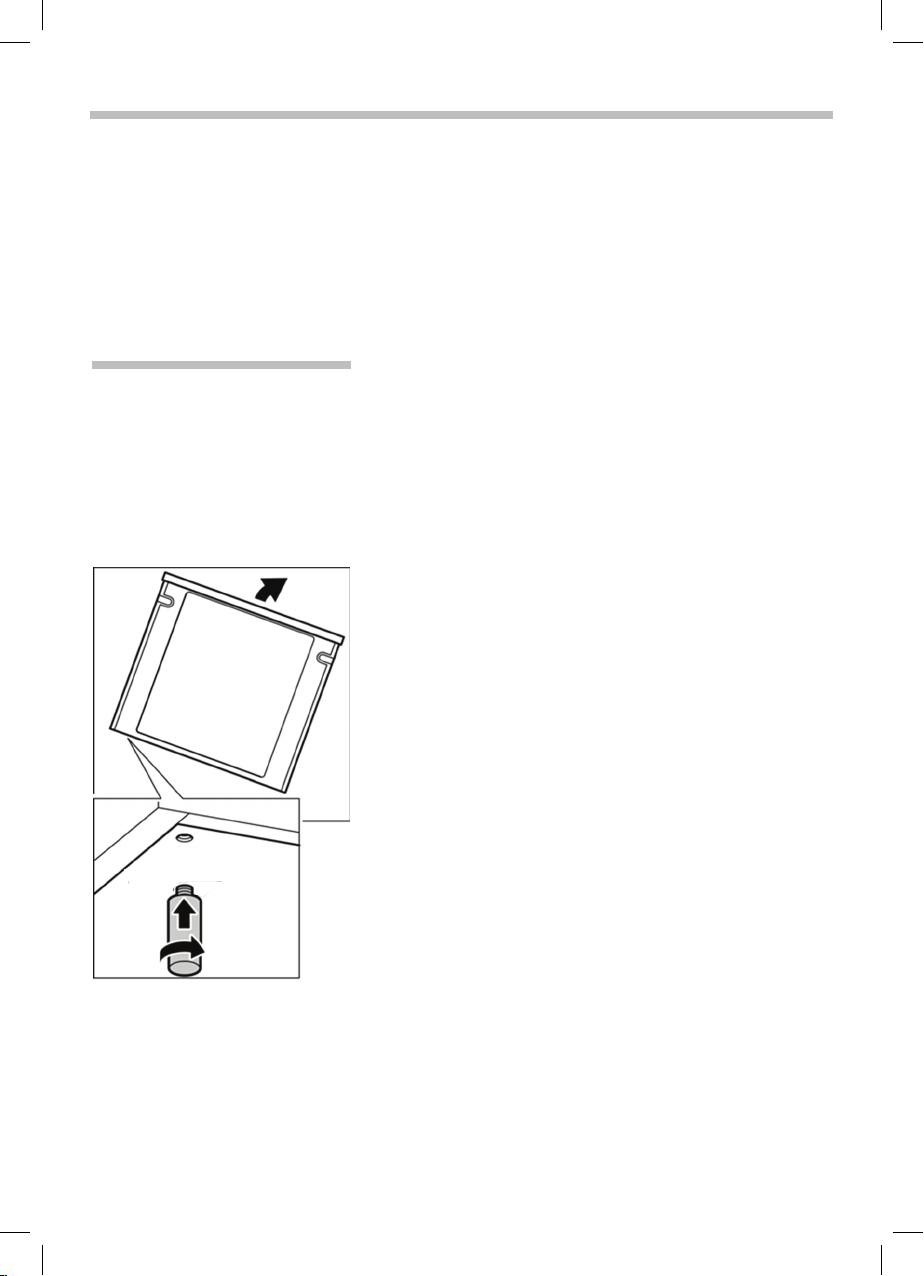
Fitting the adjustable feet
Beforehand:
•
Remove all parts that are not permanently fixed,
especially the pan supports and burners.
•
Remove the accessories from the oven.
Pro
ceed as follows:
•
Tilt the appliance by raising one side slightly from
t
h
e floor.
•
With the plates in position, screw the adjustable
feet into the mounting holes on the underneath of
the appliance.
•
Repeat the process on the other side.
You can make the final adjustments to the feet in
order to level the appliance once the gas and
electricity supply have been connected.
If it is necessary to pull the appliance, screw the
adjustable feet in fully. Make the final settings only
when the other installation tasks have been
completed.
9
Adjacent units Adjacent units must be made of non-combustible
material. The fronts of adjacent units must be
resistant to temperatures up to at least 90 °C. If the
appliance is fitted close to other units, the minimum
distances specified in the picture must be maintained.
8
Installation
This appliance is always supplied with a set of
a
d
justable feet and, depending on the model, with a
splash guard.
The appliance may also be used without the splash
guard.
Fitting the adjustable feet
Beforehand:
•
Remove all parts that are not permanently fixed,
especially the pan supports and burners.
•
Remove the accessories from the oven.
Pro
ceed as follows:
•
Tilt the appliance by raising one side slightly from
t
h
e floor.
•
With the plates in position, screw the adjustable
feet into the mounting holes on the underneath of
the appliance.
•
Repeat the process on the other side.
You can make the final adjustments to the feet in
order to level the appliance once the gas and
electricity supply have been connected.
If it is necessary to pull the appliance, screw the
adjustable feet in fully. Make the final settings only
when the other installation tasks have been
completed.
9
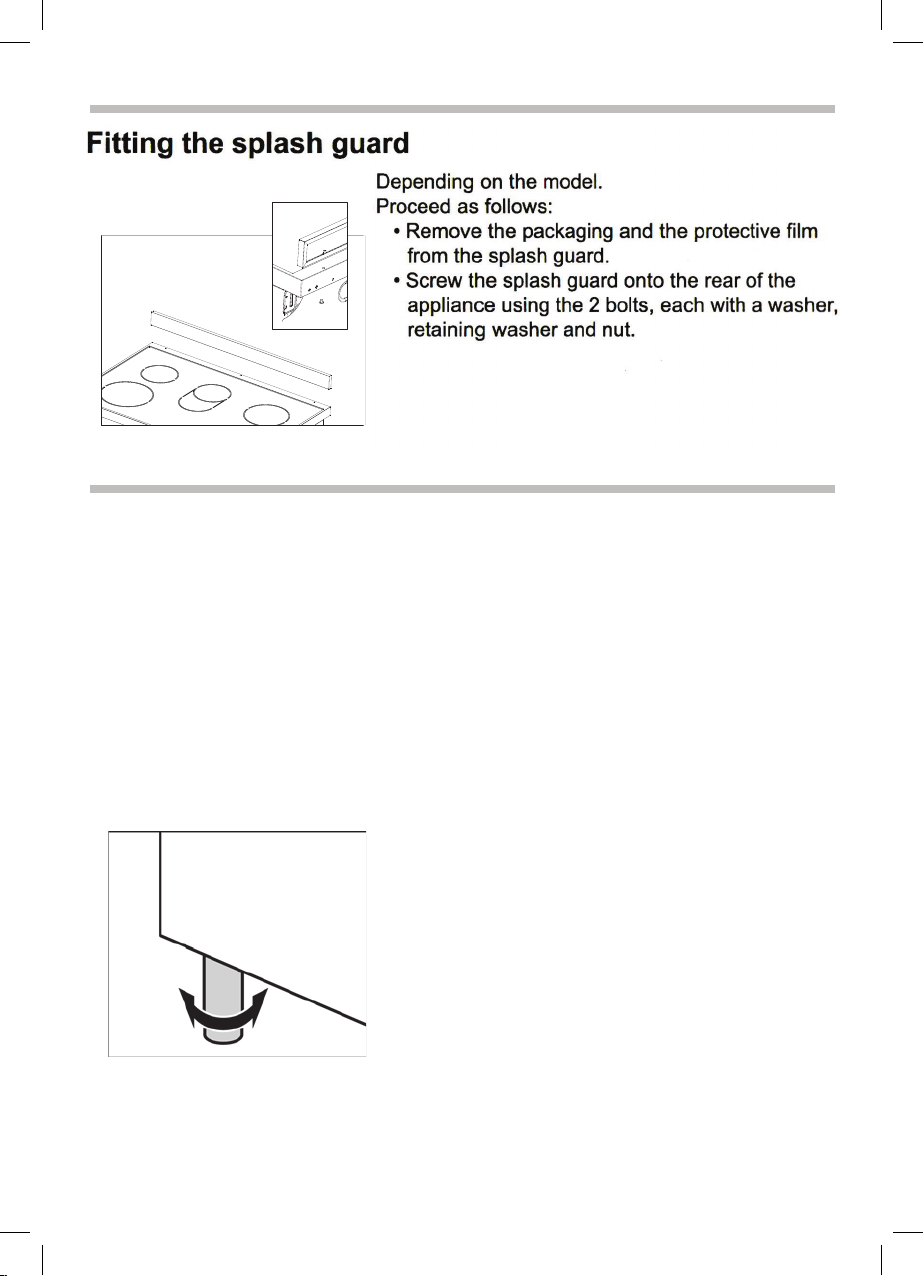
Positioning and levelling
Positioning the appliance
When installing the appliance, make sure that there
is enough space in the final installation location to
pull
the appliance forwards for cleaning and
maintenance
work.
The ground underneath must be hard and stable.
The wall immediately behind the appliance must be
made from non-flammable material, e.g. tiles.
If you need to pull the appliance in order to position
it,
make sure that the adjustable feet are screwed
in
fully.
Levelling the appliance
Level the appliance once all other work has been
completed.
To do this, turn the adjustable feet.
10
Electrical connection
•
This appliance must be earthed by law. Before connecting the appliance to the
electrical supply, check that the earth system in your house is working correctly.
•
Check that unit voltage and power, marked on the rating plate applied on the
appliance, are correct for the supply. It is necessary that the feeding network is
protected by a powerful switch able to disconnect completely the network with a
contacts separation of at least 3 mm. Be sure that the earth wire green/yellow is
not interrupted by the switch.
WARNING: THIS APPLIANCE MUST BE EARTHED
•
In order to avoid hazard, any electrical work performed on this equipment or its
associated wiring should only be done by persons authorised by the manifacture
or similary qualified persons.
Replacement or mounting of the power cord
The mains cable is replaced via the rear backboard.
The mains cable must be of the following type:
380
-
H05
H05
V
H05
H07
-
415V 3N~
RR-F
V
V-F 5×
2
RN-F
RN-F
2
.5mm2
220-240V
H05RR-F
H05VV-F
H05RN-F
H07RN-F
3×4mm2
11
Positioning and levelling
Positioning the appliance
When installing the appliance, make sure that there
is enough space in the final installation location to
pull
the appliance forwards
for cleaning and
maintenance work.
The ground underneath must be hard and stable.
The
wall immediately behind the appliance must be
made
from non-flammable material, e.g. tiles.
If you need to pull the appliance in order to position
it, make sure that
the adjustable feet are screwed
in
fully.
Levelling the appliance
Level the appliance once all other work has been
completed.
To do this, turn the adjustable feet.
10
Electrical connection
•
This appliance must be earthed by law. Before connecting the appliance to the
electrical supply, check that the earth system in your house is working correctly.
•
Check that unit voltage and power, marked on the rating plate applied on the
appliance, are correct for the supply. It is necessary that the feeding network is
protected by a powerful switch able to disconnect completely the network with a
contacts separation of at least 3 mm. Be sure that the earth wire green/yellow is
not interrupted by the switch.
WARNING: THIS APPLIANCE MUST BE EARTHED
•
In order to avoid hazard, any electrical work performed on this equipment or its
associated wiring should only be done by persons authorised by the manifacture
or similary qualified persons.
Replacement or mounting of the power cord
The mains cable is replaced via the rear backboard.
The mains cable must be of the following type:
380
-
H05
H05
V
H05
H07
-
415V 3N~
RR-F
V
V-F 5×
2
RN-F
RN-F
2
.5mm2
220-240V
H05RR-F
H05VV-F
H05RN-F
H07RN-F
3×4mm2
11
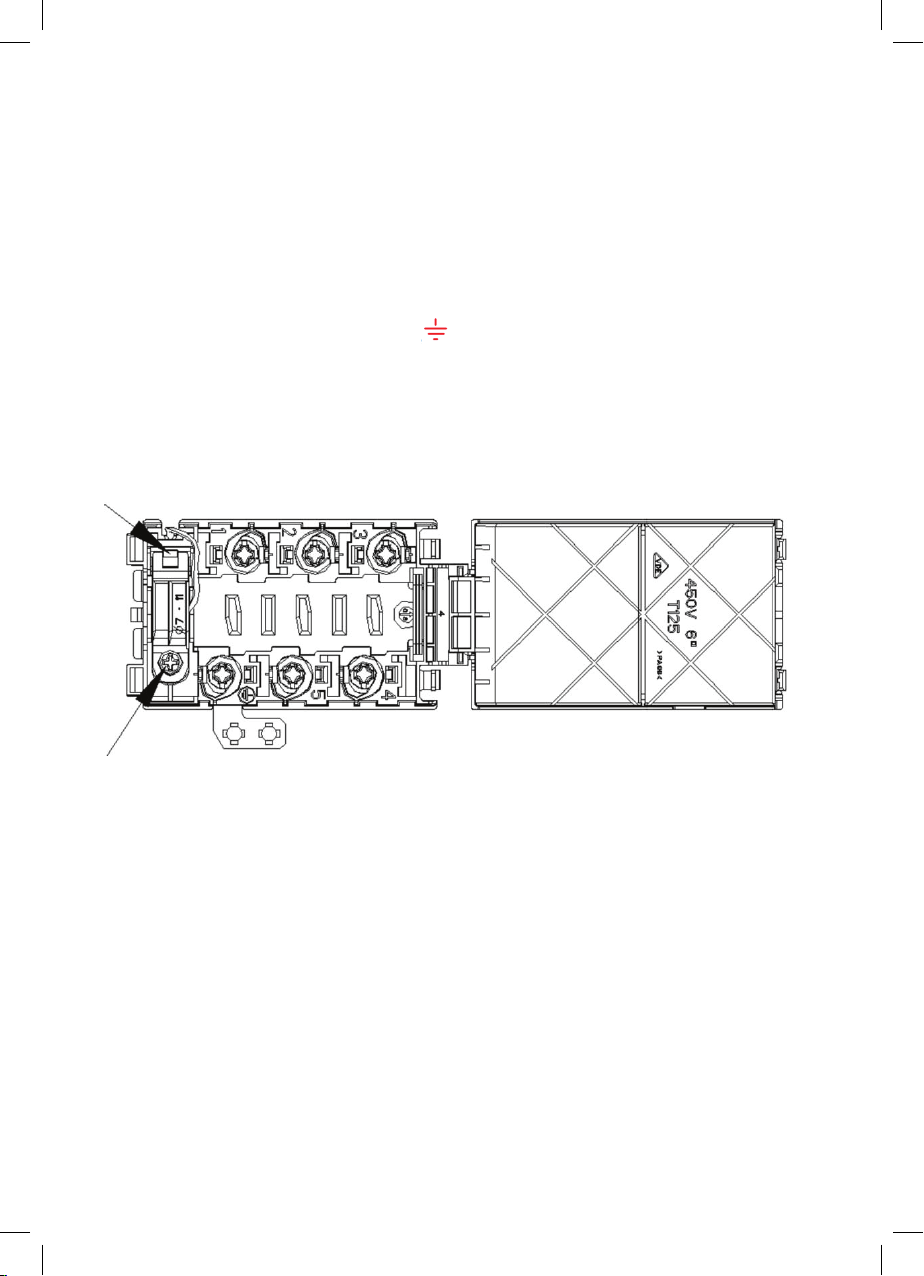
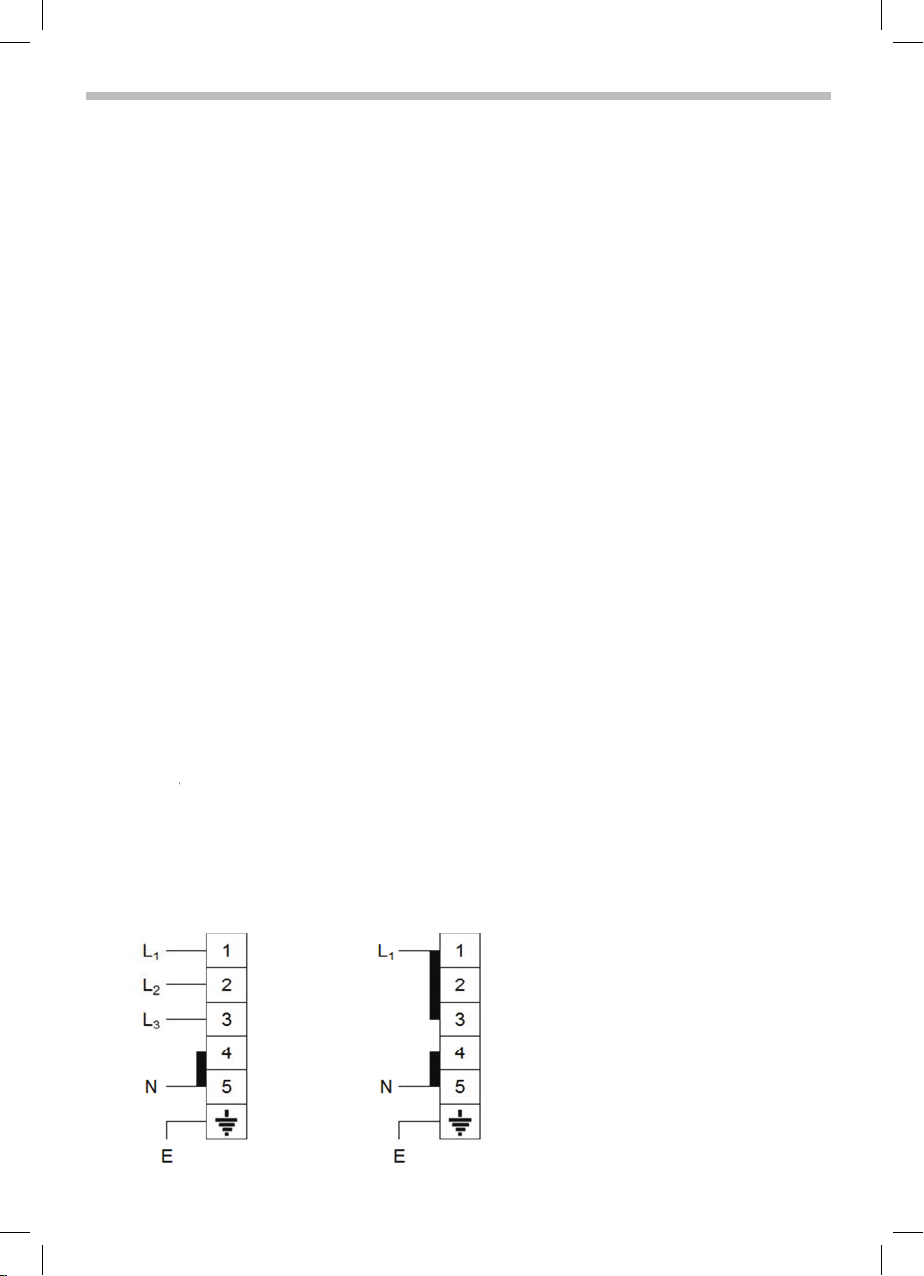
•
C
o
nnect the yellow-green wire to the terminal.
T
h
is wire must be at least 10 mm
longer than the
other wires.
•
C
o
nnect the blue neutral wire to terminal N.
•
Connect the brown power wire to
terminal L.
Leave the mains cable slightly overlong so that you
can pull out the appliance for
cleaning purposes.
Proceed as follows:
•
Remove the rear backboard.
•
Undo the screw on the terminal block that fixes
the cable in place.
•
Loosen the screw contacts and replace the cable
with a new one of the same length.
The cable must comply with the stipulated specifi-
cations.
12
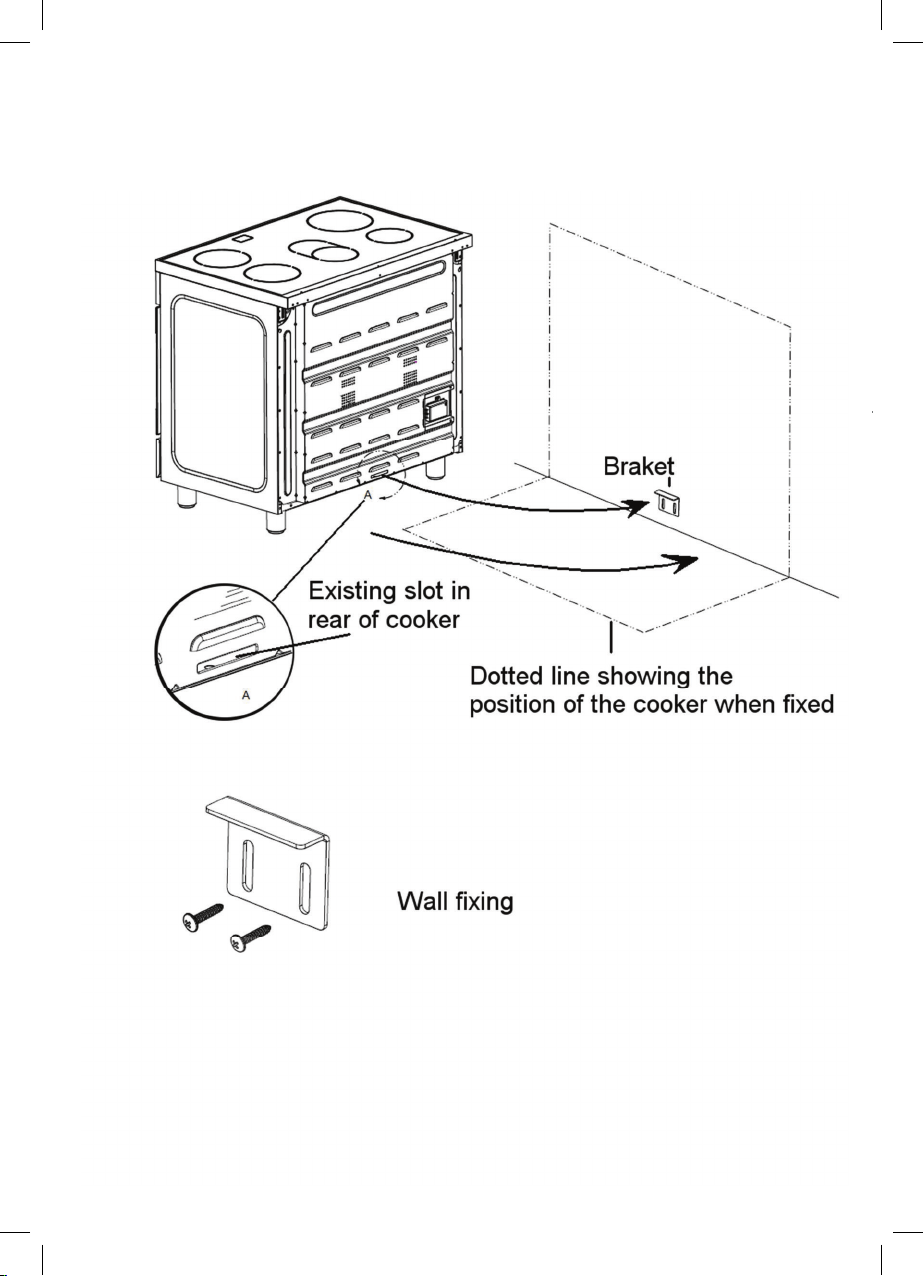
Stability bracket
13
•
C
o
nnect the yellow-green wire to the terminal. T
h
is wire must be at least 10 mm
longer than the
other
wires.
•
C
o
nnect the blue neutral wire to terminal N.
•
Connect the brown power wire to terminal L.
Leave the mains cable slightly overlong so that you can
pull out the appliance for
cleaning purposes.
Proceed as follows:
•
Remove the rear backboard.
•
Undo the screw on the terminal block that fixes the cable in place.
•
Loosen the screw contacts and replace the cable with a new one of the same length.
The cable must comply with the stipulated specifi-
cati
ons.
12
Stability bracket
13

Instructions for use
Important information
Safety precautions
.................................................................................... 16
Property damage
.....................................................................................
18
Your new appliance:
19
The hob
................................................................................................... 20
The oven ..................................................................................................37
The storage compartment
........................................................................ 42
Before using for the first time
43
Baking out the oven
...
..............................................................................
43
U
s
ing the rotary spit
. . ............................................................................... 45
Cleaning and care
Catalytic cooking compartment panels
Using the correct cleaning agent
.
.
............................................................ 49
Removing and fitting the appliance door
. .................................................. 51
Faults and the after-sales service 54
Replacing the oven light bulb
.................................................................... 55
Aftersales service
. .................................................................................... 56
Tips and tricks
Tips for saving energy ............................................................................... 57
Tips for using your appliance ..................................................................... 58
15
48
57
..................................................... 48
Cleanng the interior glass of the oven ...................................................... 50
Removing and inserting the hook-in racks
.
............................................... 53
14
Important information
Read the instructions for use carefully.
This will enable you to operate your appliance
safely
and correctly.
This manual is valid for several models. Variations in
det
ails for each cooker are possible.
Please keep the instruction manual, installation
ins
tructions and the various accessories in a safe
plac
e. Please pass on these manuals and
acces
sories to the new owner if you sell the
appl
iance.
Transport damage
Check the appliance for damage after unpacking
it. Do not connect the appliance if it has been
damaged
in transport.
Environmentally-friendly
disposal
Dispose of packaging in an environmentally-
friendly manner.
This
appliance is labelled in accordance with
European Directive 2012/19/EU on Waste
Electrical and Electronic Equipment
WEEE.
Connections Have a licensed professional carry out the electric
conne
ction .
Assembly instructions are supplied with the
appl
iance.
Any damage caused by the appliance being
i
n
c
orrectly connected is not covered under the
guarantee. We assume no liability for damage and
fau
lts caused by connection and setting errors.
¦
15

Instructions for use
Important information
Safety precautions .................................................................................... 16
Property damage .....................................................................................
18
Your new appliance:
19
The hob ...............................................................
.................................... 20
The oven ..................................................................................................37
The storage compartment
...............................................................
......... 42
Before using for the first time
43
Baking out the oven ................................................................................. 43
U
s
ing the rotary spit
. . ..
............................................................................. 45
Cleaning and care
Catal
ytic cooking compartment panels
Using the correct cleaning agent .
.
..............................
.............................. 49
Removing and fitting the appliance door . ..................
................................ 51
Faults and the after-sales service 54
Replacing the oven light bulb
...............
..................................................... 55
Aftersales service
. ..
.................................................................................. 56
Tips and tricks
Tips for saving energy ............................................................................... 57
Tips for using your appliance..................................................................... 58
15
48
57
...................
.................................. 48
Cleanng the interior glass of the oven ...................................................... 50
Removing and inserting the hook-in racks
.
..................
............................. 53
14
Important information
Read the instructions for use carefully.
This will enable you to operate your appliance
safely
and correctly.
This manual is valid for several models. Variations in
details for each cooker are possible.
Please keep the instruction manual, installation
instructions and the various accessories in a safe
place. Please pass on these manuals and
accessories to the new owner if you sell the
appliance.
Transport damage
Check the appliance for damage after unpacking
it. Do not connect the appliance if it has been
damaged
in transport.
Environmentally-friendly
disposal
Dispose of packaging in an environmentally-
friendly
manner.
This appliance is labelled in accordance with
European Directive 2012/19/EU on Waste
Electrical
and Electronic Equipment WEEE.
Connections Have a licensed professional carry out the electric
connection .
Assembly instructions are supplied with the
appliance.
Any damage caused by the appliance being
i
n
correctly connected is not covered under the
guarantee. We assume no liability for damage and
faults caused by connection and setting errors.
¦
15

Safety precautions
This appliance is intended for domestic use only.
This appliance must only be used for food
preparation.
Adults and children must not operate the appliance
without supervision if:
•
they do not have the physical or mental ability;
•
or they lack the knowledge and experience
required to operate the appliance safely and
correctly.
Never let children play with the appliance.
Never drag, push or move the device once
unpacked.
The appliance should be lifted and
placed in the
position desired in order to prevent
accidental
damage to the floor.
Open the cover plate when the oven is working.
Do not use harsh abrasive cleaners or sharp
metal scrapers to clean the oven door glass
since they can scratch the surface, which may
result in shattering of the glass.
Do not use steam cleaners to clean the appliance.
Hot surfaces Risk of burns.
Never touch the hob plates, the surfaces of the
cooking
co
m
partment, the heating elements or the
oven
steam outlets when they are hot.
Children must be kept at a safe distance from the
appliance at all times.
Open the appliance door carefully. Hot steam may
escape.
If the hob plates are in operation for a prolonged
period,
the areas between them can become hot.
Risk of fire.
Never leave flammable objects on the hob or in
the
storage compartment, or keep them in the
cooking
compartment.
Risk of short-circuit.
Never trap the mains cable of electrical
appliances in
the appliance door when it is hot or
pull the cable over
the
hob plates when they
are hot. The cable insulation may melt.
16
O
v
erheated oil and fat
R isk of fire.
Overheated oil or fat can ignite very quickly.
Never leave fat or oil to heat unattended. Should the
oil ignite, do not try to put it out by pouring water on it.
Cov
er the pan immediately with a lid or plate. Switch
off
the hob plate. Allow the cookware to cool down
on
the hob plate.
High-proof alcohol Be careful with food that is prepared using drinks with
a high alcohol content (e.g. cognac, rum).
Alcohol evaporates at high temperatures. In
unf
avourable circumstances, the alcoholic vapours
coul
d catch fire in the appliance.
Risk of burns.
Only use small quantities of drinks with a high alcohol
cont
ent and open the appliance door carefully.
Repairs Risk of electrocution.
Incorrect repairs are dangerous.
Repairs may only be carried out by one of our
exper
ienced after-sales engineers.
Risk of electrocution.
Never replace a damaged power cable yourself.
Po
w
er
cables may only be replaced by one of our
exper
ienced after-sales engineers.
Switch off the circuit breaker in the fuse box if the
appl
iance is faulty.
17

Safety precautions
This appliance is intended for domestic use only.
Thi
s appliance must only be used for food
prepar
ation.
Adults and children must not operate the appliance
wit
hout supervision if:
•
they do not have the physical or mental ability;
•
or they lack the knowledge and experience
required to operate the appliance safely and
correctly.
Never let children play with the appliance.
Never drag, push or move the device once
unpacked. The appliance should
be lifted and
placed in the position desired in order to prevent
accidental damage to the
floor.
Open the cover plate when the oven is working.
Do not use harsh abrasive cleaners or sharp
metal scrapers to clean the oven door glass
since they can scratch the surface, which may
result in shattering of the glass.
Do not use steam cleaners to clean the appliance.
Hot surfaces Risk of burns.
Never touch the hob plates, the surfaces of the
cooking
co
m
par
tment, the heating elements or the
oven
steam
outlets when they are hot.
Children must be kept at a safe distance from the
appl
iance at all times.
Open the appliance door carefully. Hot steam may
esc
ape.
If the hob plates are in operation for a prolonged
period,
the
areas between them can become hot.
Risk of fire.
Never leave flammable objects on the hob or in
the
storage compartment, or
keep them in the
cooking compartment.
Risk
of short-circuit.
Never trap the mains cable of electrical
appliances in the appliance door
when it is hot or
pull the cable over
the
hob plates when they
are hot. The cable insulation may melt.
16
O
v
erheated oil and fat
Risk of f
i re.
Overheated oil or fat can ignite very quickly.
Never leave fat or oil to heat unattended. Should the
oil ignite, do not try to put it out by pouring water on it.
Cover the pan immediately with a lid or plate. Switch
off the hob plate. Allow the cookware to cool down
on the hob plate.
High-proof alcohol Be careful with food that is prepared using drinks with
a high alcohol content (e.g. cognac, rum).
Alcohol evaporates at high temperatures. In
unfavourable circumstances, the alcoholic vapours
could catch fire in the appliance.
Risk of burns.
Only use small quantities of drinks with a high alcohol
content and open the appliance door carefully.
Repairs Risk of electrocution.
Incorrect repairs are dangerous.
Repairs may only be carried out by one of our
experienced after-sales engineers.
Risk of electrocution.
Never replace a damaged power cable yourself.
Po
w
er cables may only be replaced by one of our
experienced after-sales engineers.
Switch off the circuit breaker in the fuse box if the
appliance is faulty.
17

Prop
erty damage
Damage to the hob Only use the hob plates if cookware is placed on
them.
Do not heat empty pots or pans. This will damage the
pan base.
Do not allow saucepans to boil dry, in particular
enamel and aluminium saucepans.
The pan base must be clean, dry and flat.
With electric hotplates, it is possible that not enough
heat is drawn off and the pans become red hot.
Please follow the manufacturer's instructions when
using special cookware. Aluminium foil and plastic
containers can melt and stick on hot burners.
Do not use a roasting dish which has to be heated
using two burners. This will cause heat to
accumulate. This could damage the appliance.
Please note that appliances with a hob cover may
only be used with the hob cover open.
18
Damage to the oven Never cook meals on the floor of the cooking
compartment. Do not leave the baking tray on the
cook
ing compartment floor. Do not cover it with
alum
inium foil.
Do not place oven or cookware on the oven floor.
Thi
s will cause heat accumulation. The baking and
roas
ting times will no longer be correct and the
enam
el will be damaged.
Never pour water directly into a hot oven. This will
dam
age the enamel.
When making very moist fruit flans, do not put too
muc
h on the baking tray. Fruit juice dripping from the
bak
ing tray leaves stains that cannot be removed.
Do not stand or sit on the open oven door.
Damage to the fronts of
adja
cent units
Only leave the oven to cool down with the door
clos
ed. The fronts of adjacent units may eventually
b
e
c
ome damaged even if you only leave the oven
door
open slightly.
If the oven door seal is very dirty, the appliance door
wil
l no longer close properly during operation. The
front
s of adjacent units will become damaged over
tim
e. Keep the seal clean.
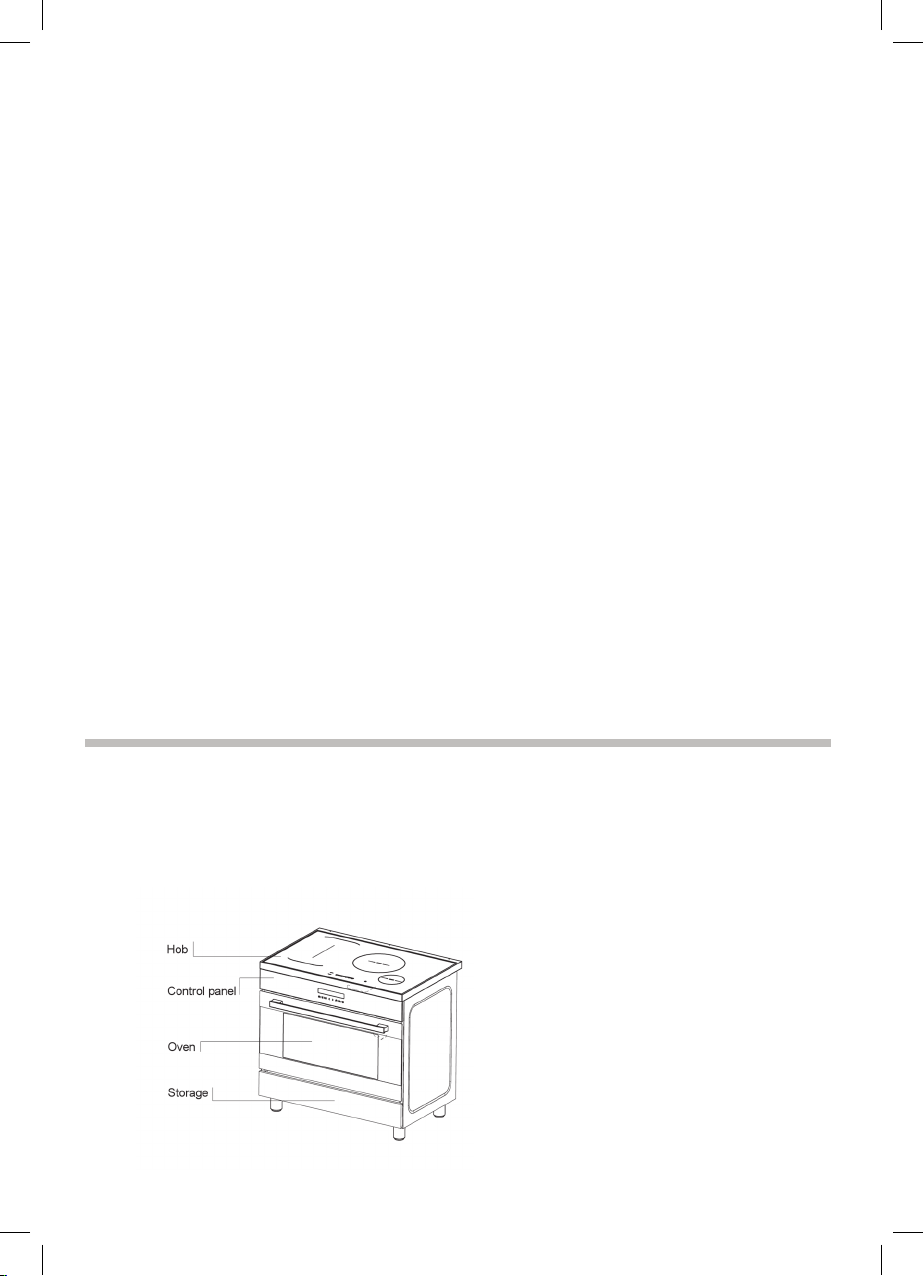
Your new appliance
Get to know your appliance. You will find information about the control panel and
hob, as well as the oven, types of heating
and accessories.
19
Prop
erty damage
Damage to the hob Only use the hob plates if cookware is placed on
them.
Do not heat empty pots or pans. This will damage the
pan
base.
Do not allow saucepans to boil dry, in particular
enamel and aluminium saucepans.
The
pan base must be clean, dry and flat.
With electric hotplates, it is possible that not enough
heat
is drawn off and the pans become red hot.
Please follow the manufacturer's instructions when
usi
ng special cookware. Aluminium foil and plastic
cont
ainers can melt and stick on hot burners.
Do not use a roasting dish which has to be heated
usi
ng two burners. This will cause heat to
accum
ulate. This could damage the appliance.
Please note that appliances with a hob cover may
onl
y be used with the hob cover open.
18
Damage to the oven Never cook meals on the floor of the cooking
compartment. Do not leave the baking tray on the
cooking compartment floor. Do not cover it with
aluminium foil.
Do not place oven or cookware on the oven floor.
This will cause heat accumulation. The baking and
roasting times will no longer be correct and the
enamel will be damaged.
Never pour water directly into a hot oven. This will
damage the enamel.
When making very moist fruit flans, do not put too
much on the baking tray. Fruit juice dripping from the
baking tray leaves stains that cannot be removed.
Do not stand or sit on the open oven door.
Damage to the fronts of
adjacent units
Only leave the oven to cool down with the door
closed. The fronts of adjacent units may eventually
b
e
come damaged even if you only leave the oven
door open slightly.
If the oven door seal is very dirty, the appliance door
will no longer close properly during operation. The
fronts of adjacent units will become damaged over
time. Keep the seal clean.
Your new
appliance
Get to know your appliance. You will find information
about the control panel and
hob, as well as the oven,
types of heating and accessories.
19
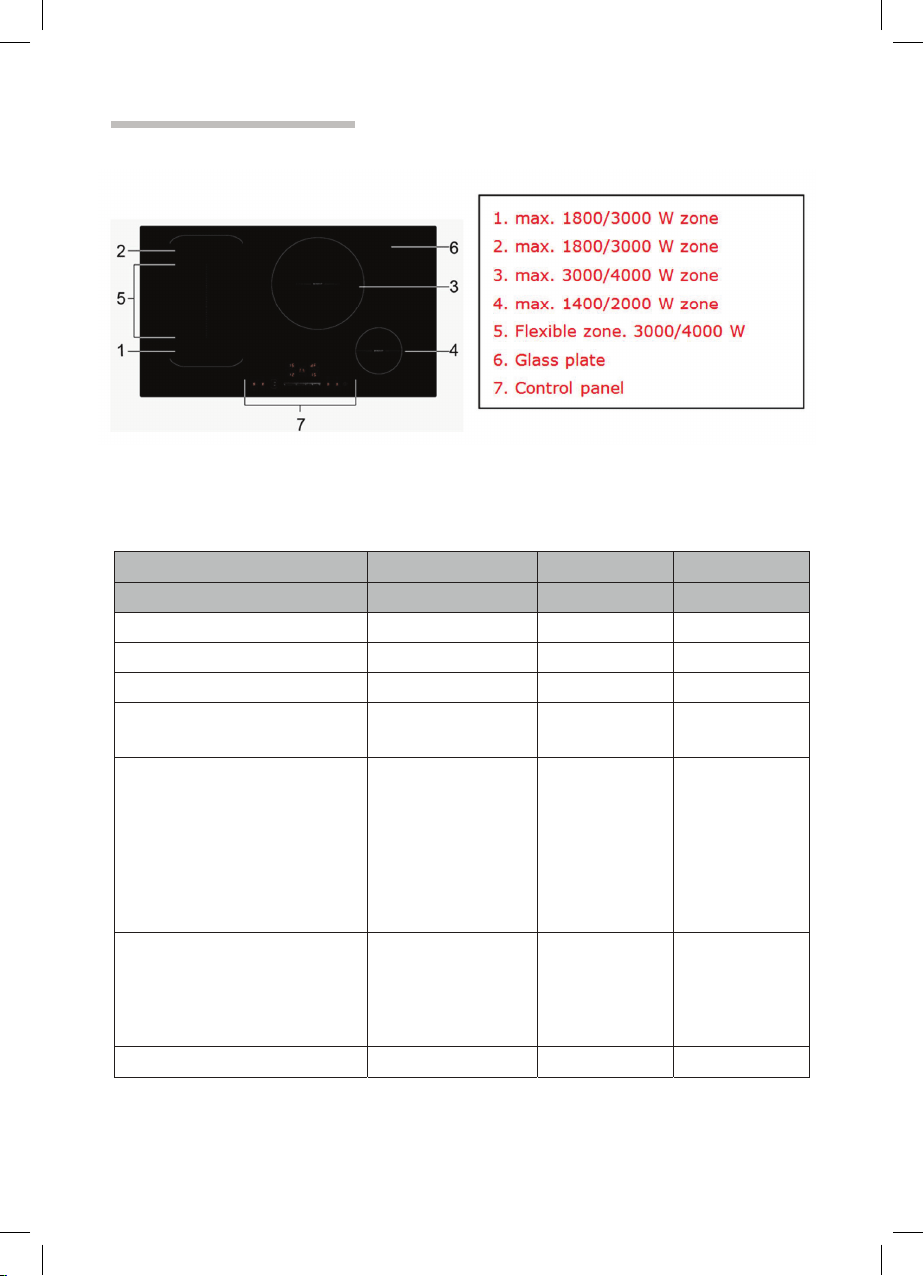
The hob (according to the models )
Induction hob
Table for for domestic electric hob in according to the Delegated
Regulation (UE) n° 65/2014 and Regulation (UE) n° 66/2014 Energy
Consumption calculated according to standard EN 60350-2: 2013-07
Identifica
tionModel
Seeratingplat
e
Typehob Cooktop
Numberofzonesorareasofcooking
5
Typeofheatingsystem Inductionplate
Cookingcircularzones
3=
4=
28,0
15,0
cm
cm
Cookingnotcir
c
ularzones
1 L
W
2 L
W
5L
W
20,0
23,0
20,0
23,0
40,0
23,0
cm
cm
cm
cm
cm
cm
Ener
gyco
nsumptionperarea ECelectriccooking
1=210,4
2=210.4
3=199,7
4=189,8
5=211,7
Wh/kg
Wh/kg
Wh/kg
Wh/kg
Wh/kg
Energyconsumptionofthehob ECelectrichob 204,4 Wh/kg
HOB TOTAL 7.4KW
OVEN TOTAL 2.97KW
Maximum Power 10.37KW
Voltage
220-240V~50/60Hz
380-415V 3N~50/60Hz
20
21

The hob (according to the models )
Induction hob
Table for for domestic electric hob in according to the Delegated
Regulation (UE) n° 65/2014 and Regulation (UE) n° 66/2014 Energy
Consumption calculated according to standard EN 60350-2: 2013-07
MIDEA
Identifica
tion Model
See rating plat
e
Type hob Cooktop
Number of zones or areas of cooking
5
Type of heating system Induction plate
Cooking circular zones
3 =
4 =
28,0
15,0
cm
cm
Cooking not cir
cular zones
1 L
W
2 L
W
5 L
W
20,0
23,0
20,0
23,0
40,0
23,0
cm
cm
cm
cm
cm
cm
Ener
gy co
nsumption per area EC electric cooking
1 = 210,4
2 = 210.4
3 = 199,7
4 = 189,8
5 = 211,7
Wh/kg
Wh/kg
Wh/kg
Wh/kg
Wh/kg
Energy consumption of the hob EC electric hob 204,4 Wh/kg
HOB TOTAL 7.4KW
OVEN TOTAL 2.97KW
Maximum Power 10.37KW
Voltage
220-240V~50/60Hz
380-415V 3N~50/60Hz
20
21
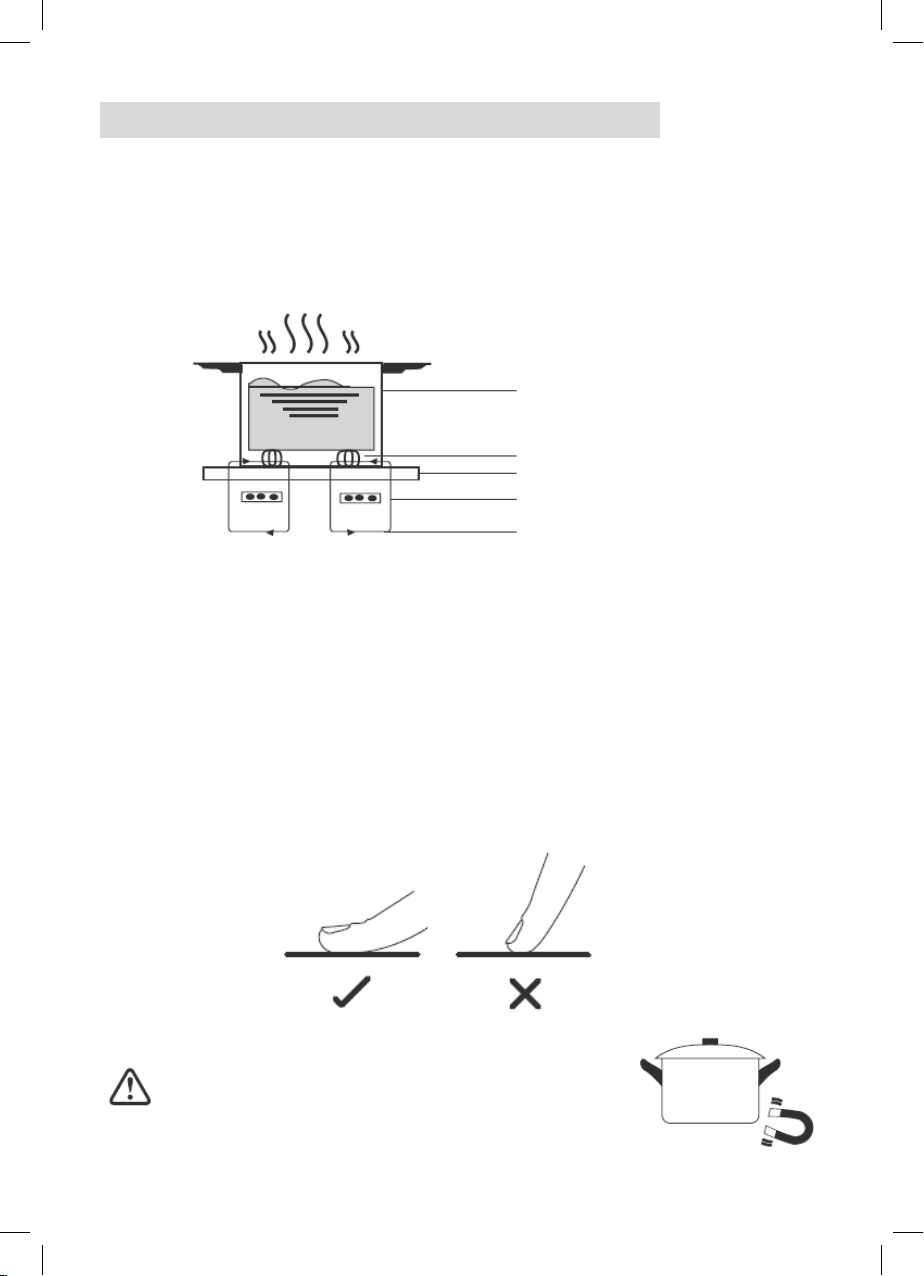
Instruction for use of the induction hob
A Word on Induction Cooking
Induction cooking is a safe, advanced, efficient, and economical cooking
technology. It works by electromagnetic vibrations generating heat directly in
the pan, rather than indirectly through heating the glass surface. The glass
becomes hot only because the pan eventually warms it up.
Before using your New Induction Hob
• Read this guide, taking special note of the ‘Safety Warnings’ section.
• Remove any protective film that may still be on your Induction hob.
Using
the
Touch Controls
• The controls respond to touch, so you don’t need to apply any pressure.
• Use the ball of your finger, not its tip.
• You will hear a beep each time a touch is registered.
• Make sure the controls are always clean, dry, and that there is no object (e.g.a
utensil or a cloth) covering them. Even a thin film of water may make the
control
s difficult to operate.
Choosing the right Cookware
• O
n
ly use cookware with a base suitable for induction
cooking. Look for the induction symbol on the
packaging or on the bottom of the pan.
iron pot
magnetic circuit
ceramic glass plate
induction coil
induced currents
22
• You can check whether your cookware is suitable by carrying out
a magnet test. Move a magnet towards the base of the pan. If it
is attracted, the pan is suitable for induction.
• If you do not have a magnet:
1. Put some water in the pan you want to check.
2. Follow the steps under ‘To start cooking’.
3. If does not flash in the display and the water is heating, the pan is suitable.
• Cookware made from the following materials is not suitable: pure stainless steel, aluminium or
copper without a magnetic base, glass, wood, porcelain, ceramic, and earthenware.
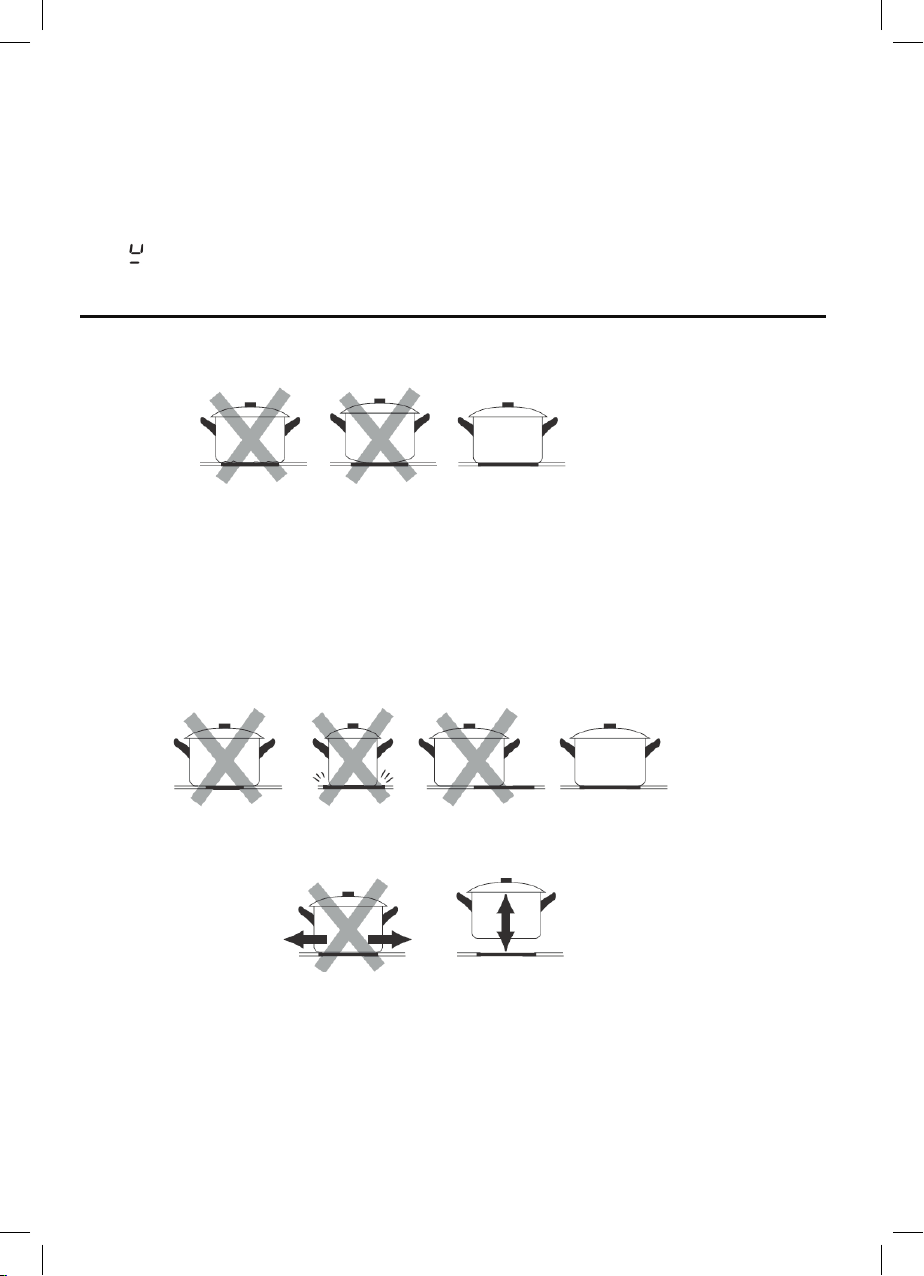
Do not use cookware with jagged edges or a curved base.
Make sure that the base of your pan is smooth, sits flat against the glass, and is
the same size as the cooking zone. Use pans whose diameter is as large as the
graphic of the zone selected. Using a pot a slightly wider energy will be used at
its maximum efficiency. If you use smaller pot efficiency could be less than
expected. Pot less than 140 mm could be undetected by the hob. Always centre
your pan on the cooking zone.
Always lift pans off the Induction hob – do not slide, or they may scratch the glass.
Pan Dimension
The cooking zones are, up to a limit, automatically adapted to the diameter of
the pan. However the bottom of this pan must have a minimum of diameter
according to the corresponding cooking zone. To obtain the best efficiency of
your hob, please place the pan in the centre of the cooking zone.
23
Instruction for use of the induction hob
A Word on Induction Cooking
Induction cooking is a safe, advanced, efficient, and economical cooking
technology. It works by electromagnetic vibrations generating heat directly in
the pan, rather than indirectly through heating the glass surface. The glass
becomes hot only because the pan eventually warms it up.
Before using your New Induction Hob
• Read this guide, taking special note of the ‘Safety Warnings’ section.
• Remove any protective film that may still be on your Induction hob.
Using
the
Touch Controls
• The controls respond to touch, so you don’t need to apply any pressure.
• Use the ball of your finger, not its tip.
• You will hear a beep each time a touch is registered.
• Make sure the controls are always clean, dry, and that there is no object (e.g.a
utensil or a cloth) covering them. Even a thin film of water may make the
controls difficult to operate.
Choosing the right Cookware
• O
n
ly use cookware with a base suitable for induction
cooking. Look for the induction symbol on the
packaging or on the bottom of the pan.
iron pot
magnetic circuit
ceramic glass plate
induction coil
induced currents
22
• You can check whether your cookware is suitable by carrying out
a magnet test. Move a magnet towards the base of the pan. If it
is attracted, the pan is suitable for induction.
• If you do not have a magnet:
1. Put some water in the pan you want to check.
2. Follow the steps under ‘To start cooking’.
3. If does not flash in the display and the water is heating, the pan is suitable.
• Cookware made from the following materials is not suitable: pure stainless steel, aluminium or
copper without a magnetic base, glass, wood, porcelain, ceramic, and earthenware.
Do not use cookware with jagged edges or a curved base.
Make sure that the base of your pan is smooth, sits flat against the glass, and is
the same size as the cooking zone. Use pans whose diameter is as large as the
graphic of the zone selected. Using a pot a slightly wider energy will be used at
its maximum efficiency. If you use smaller pot efficiency could be less than
expected. Pot less than 140 mm could be undetected by the hob. Always centre
your pan on the cooking zone.
Always lift pans off the Induction hob – do not slide, or they may scratch the glass.
Pan Dimension
The cooking zones are, up to a limit, automatically adapted to the diameter of
the pan. However the bottom of this pan must have a minimum of diameter
according to the corresponding cooking zone. To obtain the best efficiency of
your hob, please place the pan in the centre of the cooking zone.
23
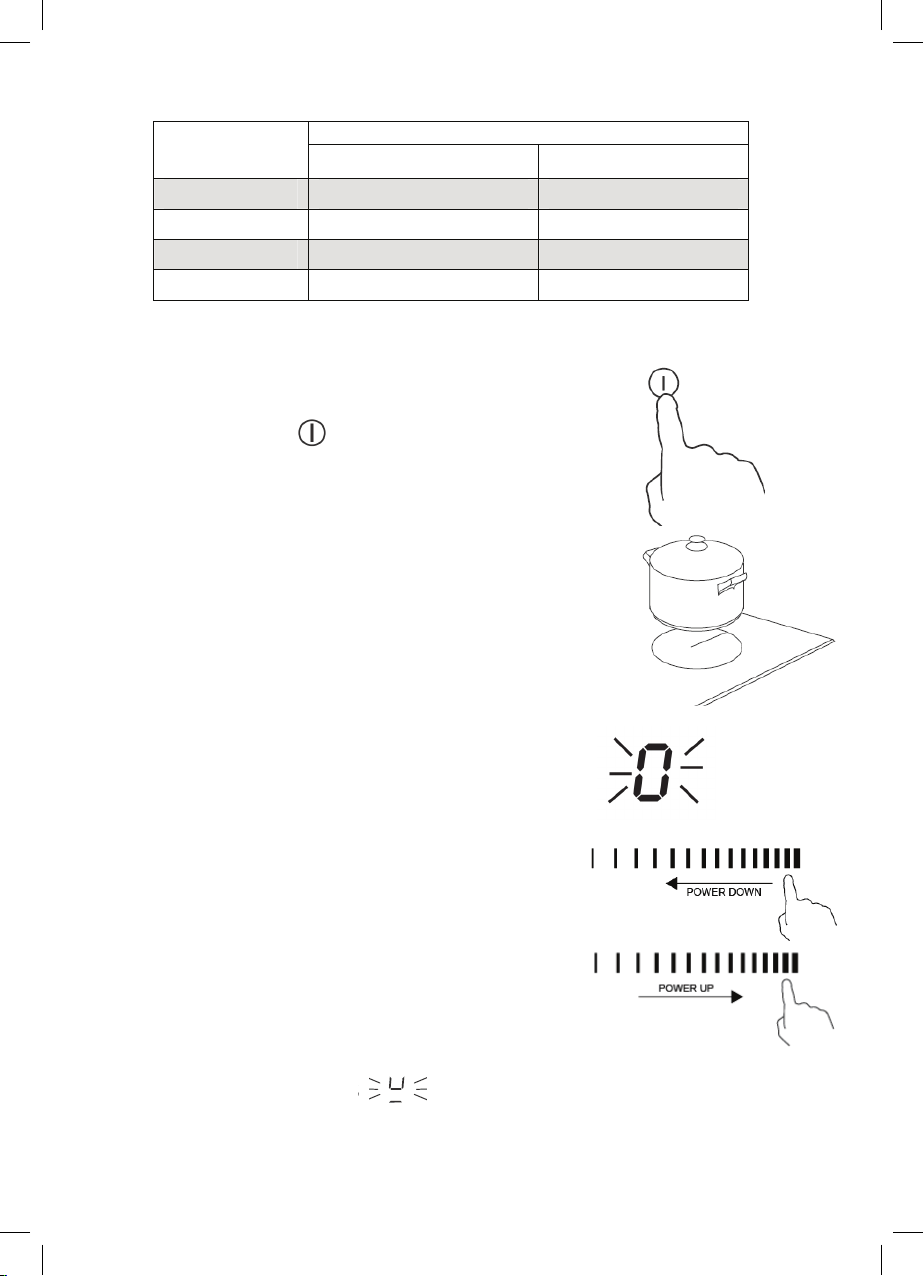
Using your Induction Hob
To start cooking
1.
T
ouch the ON/OFF control.
After power on, the buzzer beeps once, timer control
show “ CL “ ,heating zone selection controls show
“ 00, indicating that the induction hob has entered
the state of standby mode.
2. Place a suitable pan on the cooking zone that
you wish to use.
• Make sure the bottom of the pan and the surface
of the cooking zone are clean and dry.
3.T
ouc
hing the heating zone selection control,
and a indicator where you touched will flash
4. Adjust heat setting by touching the slider control.
• If you don’t choose a heat setting within 1
minute, the Induction hob will automatically
switch off. You will need to start again at step 1.
• You can modify the heat setting at any time
during cooking.
If the display flashes alternately with the heat setting
This means that:
Cooking zone
The base diameter of induction cookware
Minimum (mm)
Maximum (mm)
1,2, 140 220
3
0 300
4 120 160
Flexible zone
220 220x400
22
24
• you have not placed a pan on the correct cooking zone or,
• the pan you’re using is not suitable for induction cooking or,
• the pan is too small or not properly centred on the cooking zone.
No heating takes place unless there is a suitable pan on the cooking zone.
The display will automatically turn off after 1 minute if no suitable pan is
placed on it.
When you have finished cooking
1. Touching the heating zone selection
control that you wish to switch off
2. Turn the cooking zone off by touching the slider
to the left. Make sure the display shows”0”
3. Turn the whole cooktop off by touching the
ON/OFF control.
4.
Beware of hot surfaces
H will show which cooking zone is hot to touch. It will disappear when the
surface has cooled down to a safe temperature. It can also be used as an
energy saving function if you want to heat further pans, use the hotplate
that is still hot.
Using the Boost function
Actived the boost function
1. Touching the heating zone selection control
2. Touching the boost control ,the zone indicator show “b” and the power reach
Max.
25
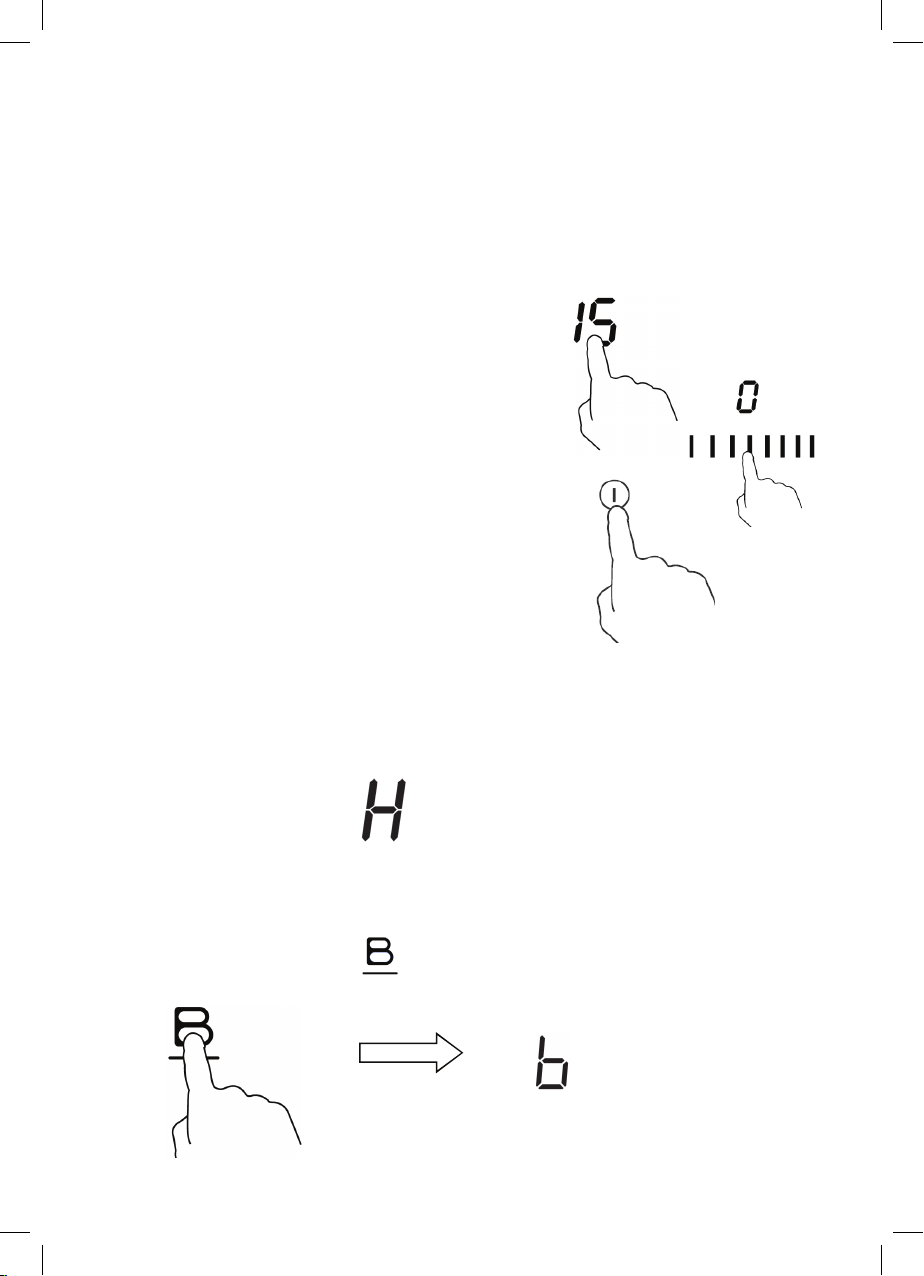
Using your Induction Hob
To start cooking
1.
T
ouch the ON/OFF control.
After power on, the buzzer beeps once, timer control
show “ CL “ ,heating zone selection controls show
“ 00, indicating that the induction hob has entered
the state of standby mode.
2. Place a suitable pan on the cooking zone that
you wish to use.
• Make sure the bottom of the pan and the surface
of the cooking zone are clean and dry.
3.T
ouc
hing the heating zone selection control,
and a indicator where you touched will flash
4. Adjust heat setting by touching the slider control.
• If you don’t choose a heat setting within 1
minute, the Induction hob will automatically
switch off. You will need to start again at step 1.
• You can modify the heat setting at any time
during cooking.
If the display flashes alternately with the heat setting
This means that:
Cooking zone
The base diameter of induction cookware
Minimum (mm)
Maximum (mm)
1,2, 140 220
3
0 300
4 120 160
Flexible zone
220 220x400
22
24
• you have not placed a pan on the correct cooking zone or,
• the pan you’re using is not suitable for induction cooking or,
• the pan is too small or not properly centred on the cooking zone.
No heating takes place unless there is a suitable pan on the cooking zone.
The display will automatically turn off after 1 minute if no suitable pan is
placed on it.
When you have finished cooking
1. Touching the heating zone selection
control that you wish to switch off
2. Turn the cooking zone off by touching the slider
to the left. Make sure the display shows”0”
3. Turn the whole cooktop off by touching the
ON/OFF control.
4.
Beware of hot surfaces
H will show which cooking zone is hot to touch. It will disappear when the
surface has cooled down to a safe temperature. It can also be used as an
energy saving function if you want to heat further pans, use the hotplate
that is still hot.
Using the Boost function
Actived the boost function
1. Touching the heating zone selection control
2. Touching the boost control ,the zone indicator show “b” and the power reach
Max.
25

Cancel the Boost function
1. Touching the heating zone selection control
that you wish to cancel the boost function
2. a: Touching the boost control “ ”, then the cooking zone will revert to its
original setting.
b: Touching the slider control, then the cooking zone will revert to the level
you select.
OR
• T
he
function can work in all cooking zones
• The cooking zone returns to its original setting after 5 minutes.
• As the boost function of 1st cooking zone is activated ,the 2nd cooking zone is
limited under level 2 automatically. vice versa
• If the original heat setting equals 0, it will return to 15 after 5 minutes.
Using the Keep Warm function
Ac
ti
ved the keep warm function
1. Touching the heating zone selection control
2. Touching the keep warm control ,the zone indicator show “
|
” .
Cancel the keep warm function
1. Touching the heating zone selection control
26
2.
a: Touching the slider control, then the cooking zone will revert to the level
you select.
, then the cooking zone will
b: Touching the function control such as or
revert to you select.
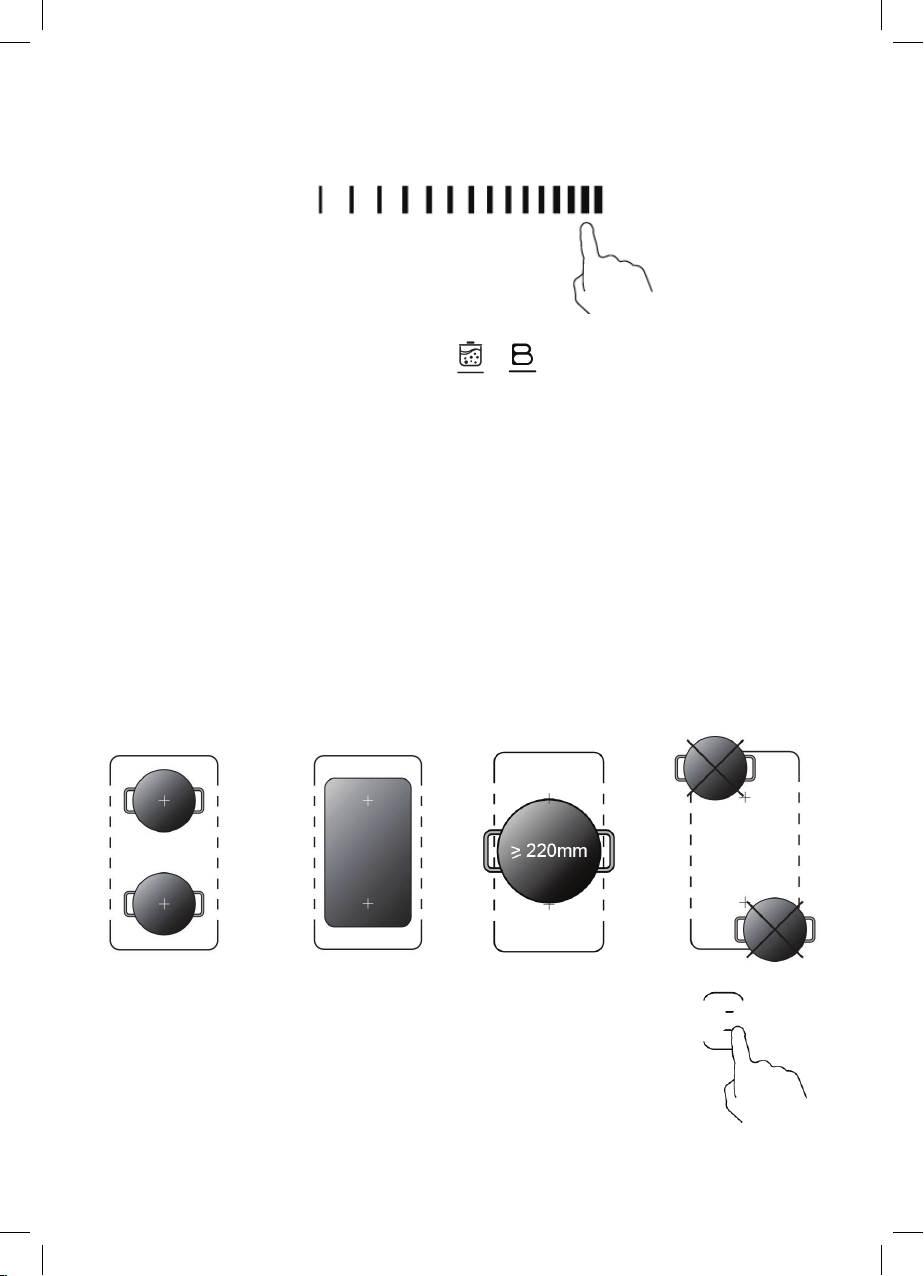
FLEXIBLE AREA
• This area can be used as a single zone or as two different zones, accordingly to
the cooking needs anytime.
• Flexible area is made of two independent inductors that can be controlled
separately. When working as a single zone, a cookware is moved from one zone
to the other one within the flexible area keeping the same power level of the
zone where the cookware originally was placed, and the part that is not
covered by cookware is automatically switched off.
•
Important:Make sure to place the cookwares centered on the single
cooking zone. In case of big pot,oval,rectangular and elongated pans make
sure to place the pans centered on the cooking zone covering both logos.
Examples of good pot placement and bad p
ot placement.
As big zone
1. To activate the flexible area as a single big zone, simply
press the dedicated keys.
2. The power setting works as any other normal area.
3. If the pot is moved from the front to the rear part (or
27
Cancel the Boost function
1. Touching the heating zone selection control
that you wish to cancel the boost function
2. a: Touching the boost control “ ”, then the cooking zone will revert to its
original setting.
b: Touching the slider control, then the cooking zone will revert to the level
you select.
OR
• T
he
function can work in all cooking zones
• The cooking zone returns to its original setting after 5 minutes.
• As the boost function of 1st cooking zone is activated ,the 2nd cooking zone is
limited under level 2 automatically. vice versa
• If the original heat setting equals 0, it will return to 15 after 5 minutes.
Using the Keep Warm function
Ac
ti
ved the keep warm function
1. Touching the heating zone selection control
2. Touching the keep warm control ,the zone indicator show “
|
” .
Cancel the keep warm function
1. Touching the heating zone selection control
26
2.
a: Touching the slider control, then the cooking zone will revert to the level
you select.
, then the cooking zone will
b: Touching the function control such as or
revert to you select.
FLEXIBLE AREA
• This area can be used as a single zone or as two different zones, accordingly to
the cooking needs anytime.
• Flexible area is made of two independent inductors that can be controlled
separately. When working as a single zone, a cookware is moved from one zone
to the other one within the flexible area keeping the same power level of the
zone where the cookware originally was placed, and the part that is not
covered by cookware is automatically switched off.
•
Important:Make sure to place the cookwares centered on the single
cooking zone. In case of big pot,oval,rectangular and elongated pans make
sure to place the pans centered on the cooking zone covering both logos.
Examples of good pot placement and bad p
ot placement.
As big zone
1. To activate the flexible area as a single big zone, simply
press the dedicated keys.
2. The power setting works as any other normal area.
3. If the pot is moved from the front to the rear part (or
27
viceversa),the flexible area detects automatically the new position, keeping
the same power.
4.
To add a further pot, press again the dedicated keys, in order to detect
the cookware.
As two independent zones
To use the flexible area as two different zones with different power settings, press
the dedicated keys.
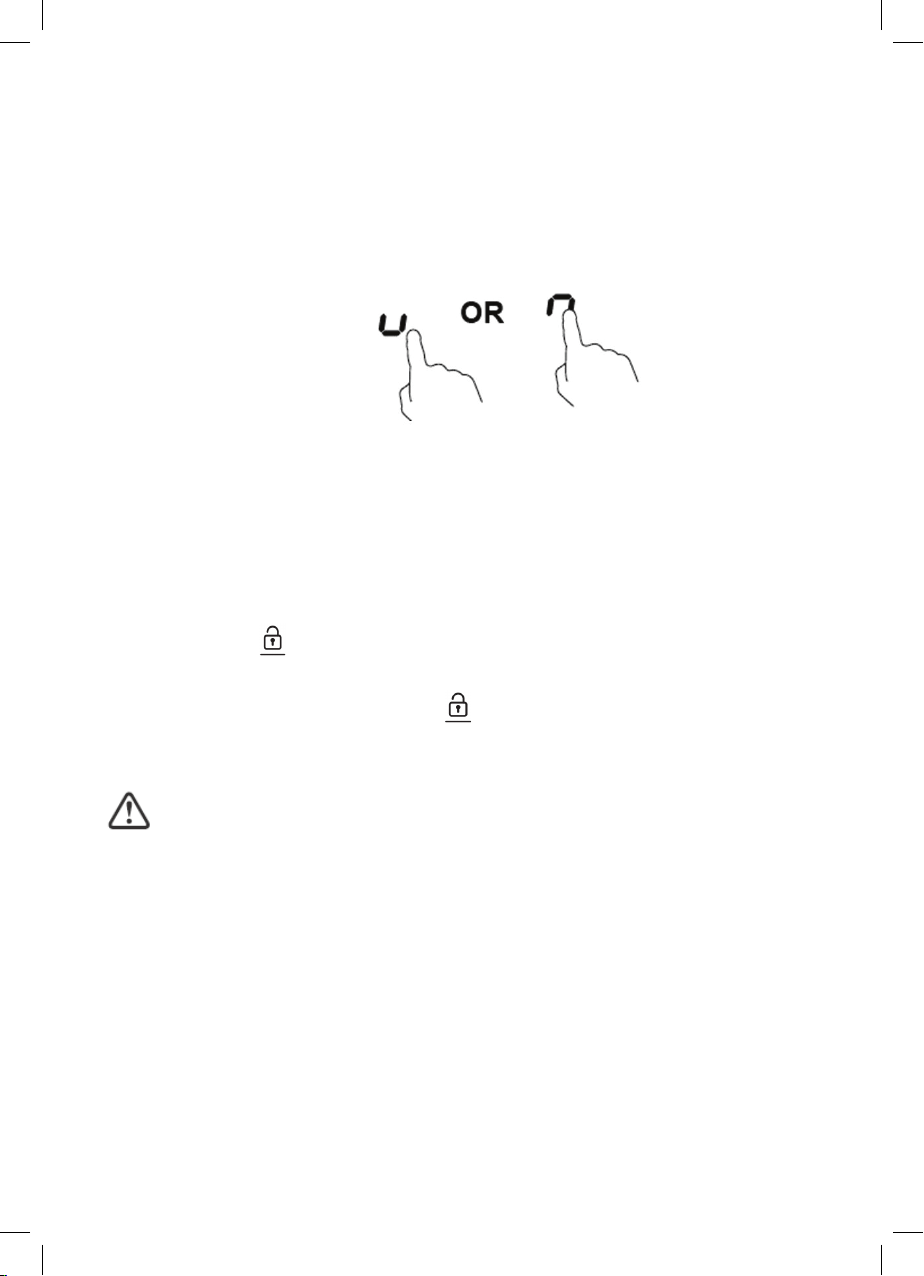
Locking the Controls
• You can lock the controls to prevent unintended use (for example children
accidentally turning the cooking zones on).
• When the controls are locked, all the controls except the ON/OFF control are
disabled.
To lock the controls
Touch the keylock control. The timer indicator will show “Lo “
To unlock the controls
1. Make sure the Induction hob is turned on.
2. Touch and hold the keylock control for a while.
3. You can now start using your Induction hob.
When the hob is in the lock mode, all the controls are disable except the
ON/OFF,
you can always turn the induction hob off with the ON/OFF control
in an emergency, but you shall unlock the hob first in the next operation
Over-Temperature Protection
A temperature sensor equipped can monitor the temperature inside the Induction
hob. When an excessive temperature is monitored, the Induction hob will stop
operation automatically.
Detection of Small Articles
When an unsuitable size or non-magnetic pan (e.g. aluminium), or some other
small item (e.g. knife, fork, key) has been left on the hob, the hob automatically
go on to standby in 1 minute. The fan will keep cooling down the induction hob
for a further 1 minute.
28
Auto Shutdown Protection
Auto shut down is a safety protection function for your induction hob. It shut
down automatically if ever you forget to turn off your cooking. The default
working times for various power levels are shown in the below table: .
Pow
e
r level Keep warm 1~5 6~10 11~14 15
Default working timer (hour) 2 8 4 2 1
When the pot is removed, the induction hob can stop heating immediately and
the hob automatically switch off after 2 minutes.
People with a heart pace maker should consult with their doctor before
using this unit.
Using the Timer
You can use the timer in two different ways:
• You can use it as a minute minder. In this case, the timer will not turn any
cooking zone off when the set time is up.
• You can set it to turn cooking zones off after the set time is up.
• You can set the timer for up to 99 minutes.
Using the Timer as a Minute Minder
If you are not selecting any cooking zone
1. Make sure the cooktop is turned on.
Note: you can use the minute minder even if you’re not selecting any
cooking zone.
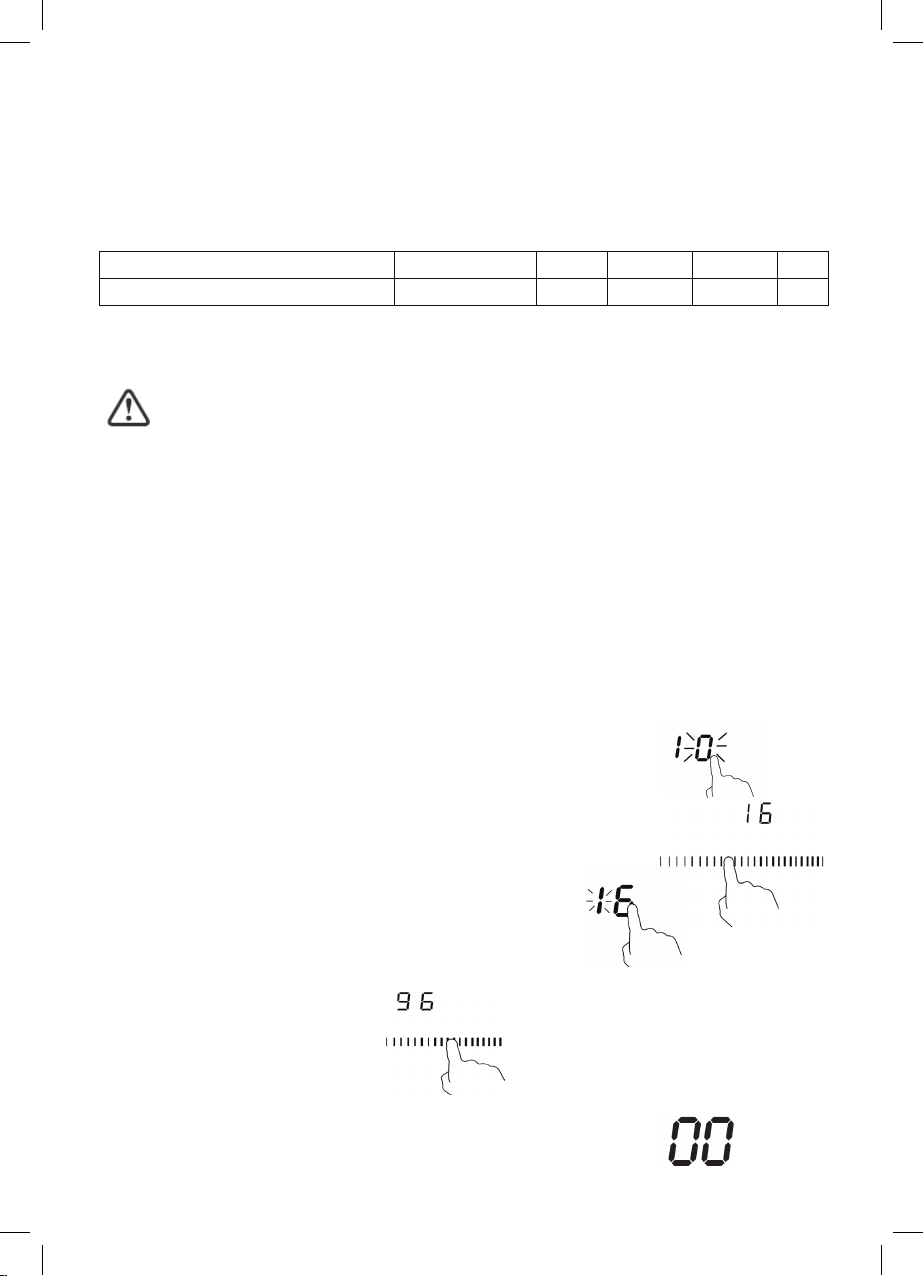
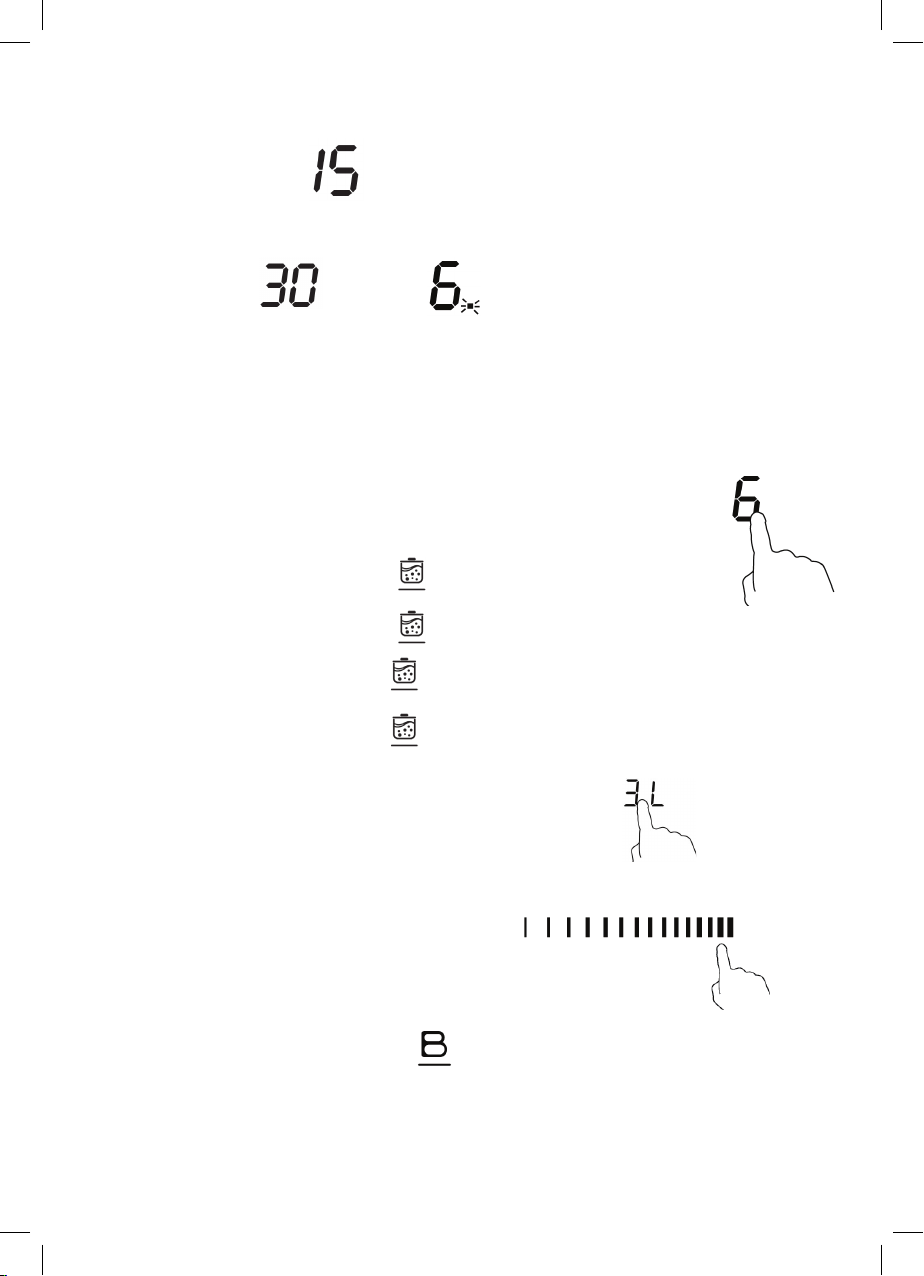
2. Touch timer control , the “10” will show in the
timer display where touched. and the “0” flashes.
3. Set the time by touching the slider control. (e.g. 6)
4. Touch timer control again, the “1” will flash.
5.
set the time by touching the slider control (e.g.9), now the timer you set is
96 minutes.
6. Buzzer will beep for 30 seconds and the timer
29
viceversa),the flexible area detects automatically the new position, keeping
the same power.
4.
To add a further pot, press again the dedicated keys, in order to detect
the cookware.
As two independent zones
To use the flexible area as two different zones with different power settings, press
the dedicated keys.
Locking the Controls
• You can lock the controls to prevent unintended use (for example children
accidentally turning the cooking zones on).
• When the controls are locked, all the controls except the ON/OFF control are
disabled.
To lock the controls
Touch the keylock control. The timer indicator will show “Lo “
To unlock the controls
1. Make sure the Induction hob is turned on.
2. Touch and hold the keylock control for a while.
3. You can now start using your Induction hob.
When the hob is in the lock mode, all the controls are disable except the
ON/OFF,
you can always turn the induction hob off with the ON/OFF control
in an emergency, but you shall unlock the hob first in the next operation
Over-Temperature Protection
A temperature sensor equipped can monitor the temperature inside the Induction
hob. When an excessive temperature is monitored, the Induction hob will stop
operation automatically.
Detection of Small Articles
When an unsuitable size or non-magnetic pan (e.g. aluminium), or some other
small item (e.g. knife, fork, key) has been left on the hob, the hob automatically
go on to standby in 1 minute. The fan will keep cooling down the induction hob
for a further 1 minute.
28
Auto Shutdown Protection
Auto shut down is a safety protection function for your induction hob. It shut
down automatically if ever you forget to turn off your cooking. The default
working times for various power levels are shown in the below table: .
Pow
e
r level Keep warm 1~5 6~10 11~14 15
Default working timer (hour) 2 8 4 2 1
When the pot is removed, the induction hob can stop heating immediately and
the hob automatically switch off after 2 minutes.
People with a heart pace maker should consult with their doctor before
using this unit.
Using the Timer
You can use the timer in two different ways:
• You can use it as a minute minder. In this case, the timer will not turn any
cooking zone off when the set time is up.
• You can set it to turn cooking zones off after the set time is up.
• You can set the timer for up to 99 minutes.
Using the Timer as a Minute Minder
If you are not selecting any cooking zone
1. Make sure the cooktop is turned on.
Note: you can use the minute minder even if you’re not selecting any
cooking zone.
2. Touch timer control , the “10” will show in the
timer display where touched. and the “0” flashes.
3. Set the time by touching the slider control. (e.g. 6)
4. Touch timer control again, the “1” will flash.
5.
set the time by touching the slider control (e.g.9), now the timer you set is
96 minutes.
6. Buzzer will beep for 30 seconds and the timer
29
indicator shows “00 “ when the setting time
finished.
Setting the timer to turn cooking zones off
If the timer is set on one zone:
1. Touching the heating zone selection control
that you want to set the timer for.
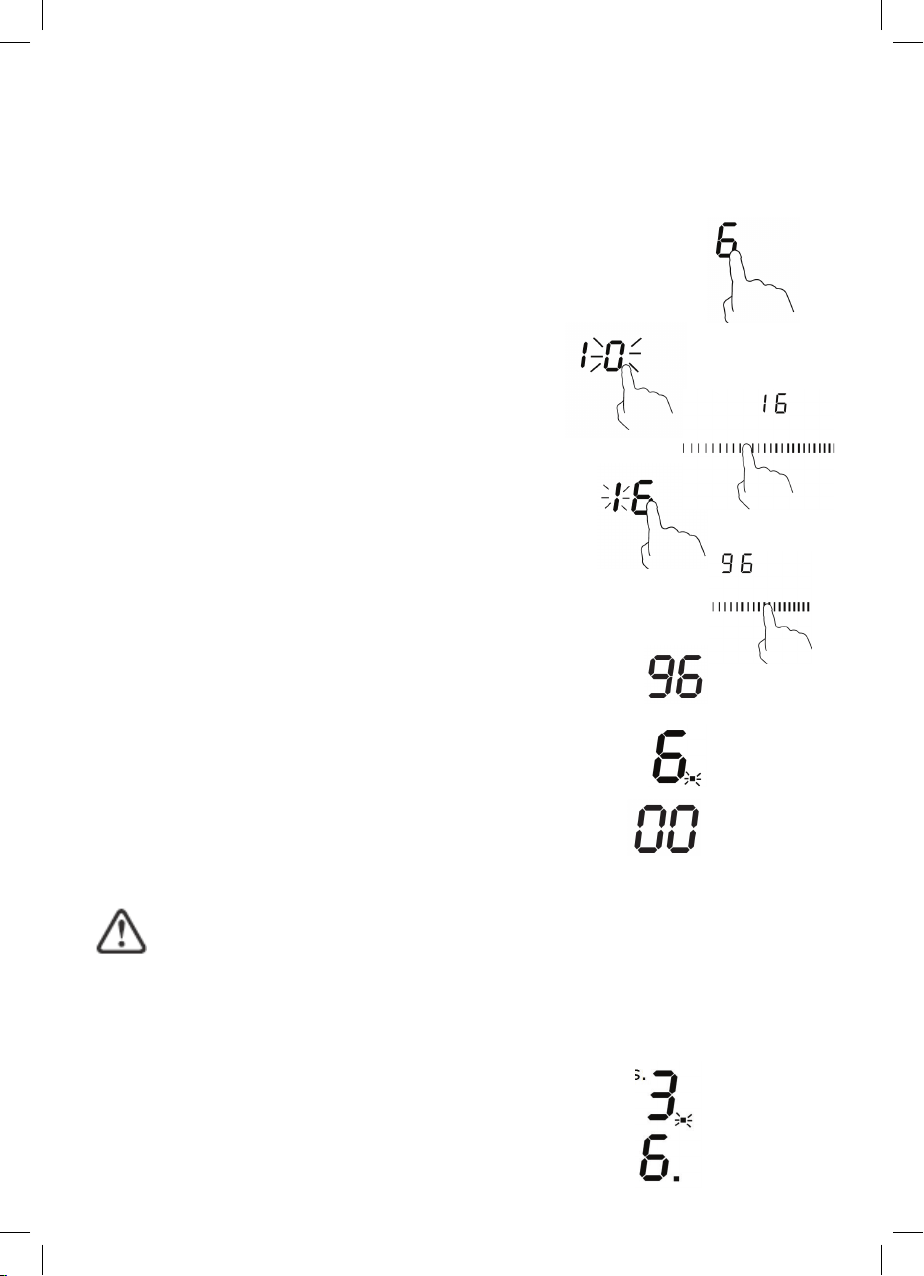
2. Touch timer control , the “10” will show in the
timer display. and the “0” flashes.
3. Set the time by touching the slider control. (e.g. 6)
4. Touch timer control again, the “1” will flash.
5. set the time by touching the slider control (e.g.9),
now the timer you set is 96 minutes.
6. When the time is set, it will begin to count down
immediately. The display will show the remaining
time and the timer indicator flash for 5 seconds.
NOTE: The red dot next to power level indicator
will illuminate indicating that zone is selected.
7. When cooking timer expires, the corresponding
cooking zone will be switch off automatically.
Other cooking zone will keep operating if they are turned on previously.
I
f
the timer is set on more than one zone:
1.
When you set the time for several cooking zones simultaneously, decimal
dots of the relevant cooking zones are on. The minute display shows the
min. timer. The dot of the corresponding zone flashes.
30
(set to 15 minutes)
(set to 45 minutes)
2. Once the countdown timer expires, the corresponding zone will switch off. Then
it will show the new min. timer and the dot of corresponding zone will flash.
• Touch the heating zone selection control, the corresponding timer will be shown in
the timer indicator.
Using the boiling cue control
You can use the function to boil water and it will
r
emind you of the
boiling water.
Actived the boiling cue function
1. Touching the heating zone selection control
2. Touching the boiling
cue control , the zone indicator show “2L” .
Touching the boiling
c
ue
control again, the zone indicator show “3L”.
Touching the boiling
cue control
for the third time
, the zone indicator show “5L”.
Touching the boiling
cue control
for the fourth time
, the zone indicator show “0”.
Cancel the boiling cue function
1. Touching the heating zone selection control
2.
a: Touching the slider control, then the cooking zone will revert to the level
you selec t .
b: Touching the function control , then the cooking zone will revert to you
select.
• It is important that the water temperature is neither too hot nor too cold when
31
indicator shows “00 “ when the setting time
finished.
Setting the timer to turn cooking zones off
If the timer is set on one zone:
1. Touching the heating zone selection control
that you want to set the timer for.
2. Touch timer control , the “10” will show in the
timer display. and the “0” flashes.
3. Set the time by touching the slider control. (e.g. 6)
4. Touch timer control again, the “1” will flash.
5. set the time by touching the slider control (e.g.9),
now the timer you set is 96 minutes.
6. When the time is set, it will begin to count down
immediately. The display will show the remaining
time and the timer indicator flash for 5 seconds.
NOTE: The red dot next to power level indicator
will illuminate indicating that zone is selected.
7. When cooking timer expires, the corresponding
cooking zone will be switch off automatically.
Other cooking zone will keep operating if they are turned on previously.
I
f
the timer is set on more than one zone:
1.
When you set the time for several cooking zones simultaneously, decimal
dots of the relevant cooking zones are on. The minute display shows the
min. timer. The dot of the corresponding zone flashes.
30
(set to 15 minutes)
(set to 45 minutes)
2. Once the countdown timer expires, the corresponding zone will switch off. Then
it will show the new min. timer and the dot of corresponding zone will flash.
• Touch the heating zone selection control, the corresponding timer will be shown in
the timer indicator.
Using the boiling cue control
You can use the function to boil water and it will
r
emind you of the
boiling water.
Actived the boiling cue function
1. Touching the heating zone selection control
2. Touching the boiling
cue control , the zone indicator show “2L” .
Touching the boiling
c
ue
control again, the zone indicator show “3L”.
Touching the boiling
cue control
for the third time
, the zone indicator show “5L”.
Touching the boiling
cue control
for the fourth time
, the zone indicator show “0”.
Cancel the boiling cue function
1. Touching the heating zone selection control
2.
a: Touching the slider control, then the cooking zone will revert to the level
you selec t .
b: Touching the function control , then the cooking zone will revert to you
select.
• It is important that the water temperature is neither too hot nor too cold when
31

cooking begins, as this could affect the final result.
• Once the water has boiled, a series of beeps is heard and the zone indicator
flashes. Then give a short press on the boiling cue control . Power 9 is
displayed by default.
• The function can only work in 3rd cooking zone.
• Use pans whose diameter is as large as the graphic of the zone selected.
• Do not use cast iron cookware.
• Do not use a lid.
• As the boost function of 3rd cooking zone is activated, the 4th cooking zone is
limited.
Cooking Guidelines
Take care when frying as the oil and fat heat up very quickly,
particularly if you’re using PowerBoost. At extremely high temperatures
oil and fat will ignite spontaneously and this presents a serious fire risk.
Cooking Tips
• When food comes to the boil, reduce the temperature setting.
• Using a lid will reduce cooking times and save energy by retaining the heat.
• Minimise the amount of liquid or fat to reduce cooking times.
• Start cooking on a high setting and reduce the setting when the food has heated
through.
Simmering, cooking rice
• Simmering occurs below boiling point, at around 85˚C, when bubbles are just
rising occasionally to the surface of the cooking liquid. It is the key to delicious
soups and tender stews because the flavours develop without overcooking the
food. You should also cook egg-based and flourthickened sauces below boiling
point.
• Some tasks, including cooking rice by the absorption method, may require a
setting higher than the lowest setting to ensure the food is cooked properly in
the time recommended.
Searing steak
To cook juicy flavoursome steaks:
1. Stand the meat at room temperature for about 20 minutes before cooking.
2. Heat up a heavy-based frying pan.
3. Brush both sides of the steak with oil. Drizzle a small amount of oil into the hot
pan and then lower the meat onto the hot pan.
4. Turn the steak only once during cooking. The exact cooking time will depend on
the thickness of the steak and how cooked you want it. Times may vary from
32
about 2 – 8 minutes per side. Press the steak to gauge how cooked it is – the
firmer it feels the more ‘well done’ it will be.
5. Leave the steak to rest on a warm plate for a few minutes to allow it to relax
and become tender before serving.
For stir-frying
1. Choose an induction compatible flat-based wok or a large frying pan.
2. Have all the ingredients and equipment ready. Stir-frying should be quick. If
cooking large quantities, cook the food in several smaller batches.
3. Preheat the pan briefly and add two tablespoons of oil.
4. Cook any meat first, put it aside and keep warm.
5. Stir-fry the vegetables. When they are hot but still crisp, turn the cooking zone
to a lower setting, return the meat to the pan and add your sauce.
6. Stir the ingredients gently to make sure they are heated through.
7. Serve immediately.
Heat Settings
The settings below are guidelines only. The exact setting will depend on several
factors, including your cookware and the amount you are cooking. Experiment with
the induction hob to find the settings that best suit you.
Heat setting
Suit
a
bility
1 -
2
• delicate warming for small amounts of food
• melting chocolate, butter, and foods that burn quickly
• gentle simmering
• slow warming
3 -
5
• reheating
• rapid simmering
• cooking rice
6 -
11
• pancakes
12
-
14
• s
a
utéing
• cooking pasta
15/P
• stir-frying
• searing
• bringing soup to the boil
• boiling water
Care and Cleaning
The settings below are guidelines only. The exact setting will depend on several
33

cooking begins, as this could affect the final result.
• Once the water has boiled, a series of beeps is heard and the zone indicator
flashes. Then give a short press on the boiling cue control . Power 9 is
displayed by default.
• The function can only work in 3rd cooking zone.
• Use pans whose diameter is as large as the graphic of the zone selected.
• Do not use cast iron cookware.
• Do not use a lid.
• As the boost function of 3rd cooking zone is activated, the 4th cooking zone is
limited.
Cooking Guidelines
Take care when frying as the oil and fat heat up very quickly,
particularly if you’re using PowerBoost. At extremely high temperatures
oil and fat will ignite spontaneously and this presents a serious fire risk.
Cooking Tips
• When food comes to the boil, reduce the temperature setting.
• Using a lid will reduce cooking times and save energy by retaining the heat.
• Minimise the amount of liquid or fat to reduce cooking times.
• Start cooking on a high setting and reduce the setting when the food has heated
through.
Simmering, cooking rice
• Simmering occurs below boiling point, at around 85˚C, when bubbles are just
rising occasionally to the surface of the cooking liquid. It is the key to delicious
soups and tender stews because the flavours develop without overcooking the
food. You should also cook egg-based and flourthickened sauces below boiling
point.
• Some tasks, including cooking rice by the absorption method, may require a
setting higher than the lowest setting to ensure the food is cooked properly in
the time recommended.
Searing steak
To cook juicy flavoursome steaks:
1. Stand the meat at room temperature for about 20 minutes before cooking.
2. Heat up a heavy-based frying pan.
3. Brush both sides of the steak with oil. Drizzle a small amount of oil into the hot
pan and then lower the meat onto the hot pan.
4. Turn the steak only once during cooking. The exact cooking time will depend on
the thickness of the steak and how cooked you want it. Times may vary from
32
about 2 – 8 minutes per side. Press the steak to gauge how cooked it is – the
firmer it feels the more ‘well done’ it will be.
5. Leave the steak to rest on a warm plate for a few minutes to allow it to relax
and become tender before serving.
For stir-frying
1. Choose an induction compatible flat-based wok or a large frying pan.
2. Have all the ingredients and equipment ready. Stir-frying should be quick. If
cooking large quantities, cook the food in several smaller batches.
3. Preheat the pan briefly and add two tablespoons of oil.
4. Cook any meat first, put it aside and keep warm.
5. Stir-fry the vegetables. When they are hot but still crisp, turn the cooking zone
to a lower setting, return the meat to the pan and add your sauce.
6. Stir the ingredients gently to make sure they are heated through.
7. Serve immediately.
Heat Settings
The settings below are guidelines only. The exact setting will depend on several
factors, including your cookware and the amount you are cooking. Experiment with
the induction hob to find the settings that best suit you.
Heat setting
Suit
a
bility
1 -
2
• delicate warming for small amounts of food
• melting chocolate, butter, and foods that burn quickly
• gentle simmering
• slow warming
3 -
5
• reheating
• rapid simmering
• cooking rice
6 -
11
• pancakes
12
-
14
• s
a
utéing
• cooking pasta
15/P
• stir-frying
• searing
• bringing soup to the boil
• boiling water
Care and Cleaning
The settings below are guidelines only. The exact setting will depend on several
33

factors, including your cookware and the amount you are cooking. Experiment
with the cooktop to find the settings that best suit you.
What? How? Important!
Everyday soiling on
glass (fingerprints,
marks, stains left by
food or non-sugary
spillovers on the
glass)
1. Switch the power to the
cooktop off.
2. Apply a cooktop cleaner
while the glass is still warm
(but not hot!)
3. Rinse and wipe dry with a
clean cloth or paper towel.
4. Switch the power to the
cooktop back on.
• When the power to the cooktop is
switched off, there will be no ‘hot
surface’ indication but the cooking
zone may still be hot! Take
extreme care.
• Heavy-duty scourers, some nylon
scourers and harsh/abrasive
cleaning agents may scratch the
glass. Always read the label to
check if your cleaner or scourer is
suitable.
• Never leave cleaning residue on
the cooktop: the glass may
become stained.
Boilovers, melts,
and
hot sugary spills on
the glass
Remove these immediately
with a fish slice, palette knife
or razor blade scraper suitable
for Induction glass cooktops,
but beware of hot cooking
zone surfaces:
1. Switch the power to the
cooktop off at the wall.
2. Hold the blade or utensil at
a 30° angle and scrape the
soiling or spill to a cool
area of the cooktop.
3. Clean the soiling or spill up
with a dish cloth or paper
towel.
4. Follow steps 2 to 4 for
‘Everyday soiling on glass’
above.
• Remove stains left by melts and
sugary food or spillovers as soon
as possible. If left to cool on the
glass, they may be difficult to
remove or even permanently
damage the glass surface.
• Cut hazard: when the safety cover
is retracted, the blade in a scraper
is razor-sharp. Use with extreme
care and always store safely and
out of reach of children.
Spillovers on the
touch controls
1. Switch the power to the
cooktop off.
2. Soak up the spill
3. Wipe the touch control area
with a clean damp sponge
or cloth.
4. Wipe the area completely
dry
with a paper towel.
5. Switch the power to the
cooktop back on.
• The cooktop may beep and turn
itself off, and the touch controls
may not function while there is
liquid on them. Make sure you
wipe the touch control area dry
before turning the cooktop back
on.
34
Hints and Tips
Problem
Possible causes
What to do
Th
e
induction hob
cannot be turned on.
No p
ow
er.
Make sure the induction hob is
connected to the power supply
and that it is switched on.
Check whether there is a power
outage in your home or area. If
you’ve checked everything and the
problem persists, call a qualified
technician.
The touch controls
are unresponsive.
The controls are locked.
Unlock the controls. See section
‘Using your induction cooktop’ for
instructions.
The touch controls
are difficult to
operate.
There may be a slight film of
water over the controls or you
may be using the tip of your
finger when touching the
controls.
Make sure the touch control area is
dry and use the ball of your finger
when touching the controls.
The glass is being
scratched.
Rough-edged cookware.
Unsuitable, abrasive scourer or
cleaning products being used.
Use cookware with flat and smooth
bases. See ‘Choosing the right
cookware’.
See ‘Care and cleaning’.
Some pans make
crackling or clicking
noises.
This may be caused by the
construction of your cookware
(layers of different metals
vibrating differently).
This is normal for cookware and
does not indicate a fault.
The induction hob
makes a low
humming noise when
used on
a high heat setting.
This is caused by the
technology
of induction cooking.
This is normal, but the noise should
quieten down or disappear
completely when you decrease the
heat setting.
Fan noise coming
from the induction
hob.
A cooling fan built into your
induction hob has come on to
prevent the electronics from
overheating. It may continue to
run even after you’ve turned
the
induction hob off.
This is normal and needs no action.
Do not switch the power to the
induction hob off at the wall while
the fan is running.
35

factors, including your cookware and the amount you are cooking. Experiment
with the cooktop to find the settings that best suit you.
What? How? Important!
Everyday soiling on
glass (fingerprints,
marks, stains left by
food or non-sugary
spillovers on the
glass)
1. Switch the power to the
cooktop off.
2. Apply a cooktop cleaner
while the glass is still warm
(but not hot!)
3. Rinse and wipe dry with a
clean cloth or paper towel.
4. Switch the power to the
cooktop back on.
• When the power to the cooktop is
switched off, there will be no ‘hot
surface’ indication but the cooking
zone may still be hot! Take
extreme care.
• Heavy-duty scourers, some nylon
scourers and harsh/abrasive
cleaning agents may scratch the
glass. Always read the label to
check if your cleaner or scourer is
suitable.
• Never leave cleaning residue on
the cooktop: the glass may
become stained.
Boilovers, melts,
and
hot sugary spills on
the glass
Remove these immediately
with a fish slice, palette knife
or razor blade scraper suitable
for Induction glass cooktops,
but beware of hot cooking
zone surfaces:
1. Switch the power to the
cooktop off at the wall.
2. Hold the blade or utensil at
a 30° angle and scrape the
soiling or spill to a cool
area of the cooktop.
3. Clean the soiling or spill up
with a dish cloth or paper
towel.
4. Follow steps 2 to 4 for
‘Everyday soiling on glass’
above.
• Remove stains left by melts and
sugary food or spillovers as soon
as possible. If left to cool on the
glass, they may be difficult to
remove or even permanently
damage the glass surface.
• Cut hazard: when the safety cover
is retracted, the blade in a scraper
is razor-sharp. Use with extreme
care and always store safely and
out of reach of children.
Spillovers on the
touch controls
1. Switch the power to the
cooktop off.
2. Soak up the spill
3. Wipe the touch control area
with a clean damp sponge
or cloth.
4. Wipe the area completely
dry
with a paper towel.
5. Switch the power to the
cooktop back on.
• The cooktop may beep and turn
itself off, and the touch controls
may not function while there is
liquid on them. Make sure you
wipe the touch control area dry
before turning the cooktop back
on.
34
Hints and Tips
Problem
Possible causes
What to do
Th
e
induction hob
cannot be turned on.
No p
ow
er.
Make sure the induction hob is
connected to the power supply
and that it is switched on.
Check whether there is a power
outage in your home or area. If
you’ve checked everything and the
problem persists, call a qualified
technician.
The touch controls
are unresponsive.
The controls are locked.
Unlock the controls. See section
‘Using your induction cooktop’ for
instructions.
The touch controls
are difficult to
operate.
There may be a slight film of
water over the controls or you
may be using the tip of your
finger when touching the
controls.
Make sure the touch control area is
dry and use the ball of your finger
when touching the controls.
The glass is being
scratched.
Rough-edged cookware.
Unsuitable, abrasive scourer or
cleaning products being used.
Use cookware with flat and smooth
bases. See ‘Choosing the right
cookware’.
See ‘Care and cleaning’.
Some pans make
crackling or clicking
noises.
This may be caused by the
construction of your cookware
(layers of different metals
vibrating differently).
This is normal for cookware and
does not indicate a fault.
The induction hob
makes a low
humming noise when
used on
a high heat setting.
This is caused by the
technology
of induction cooking.
This is normal, but the noise should
quieten down or disappear
completely when you decrease the
heat setting.
Fan noise coming
from the induction
hob.
A cooling fan built into your
induction hob has come on to
prevent the electronics from
overheating. It may continue to
run even after you’ve turned
the
induction hob off.
This is normal and needs no action.
Do not switch the power to the
induction hob off at the wall while
the fan is running.
35
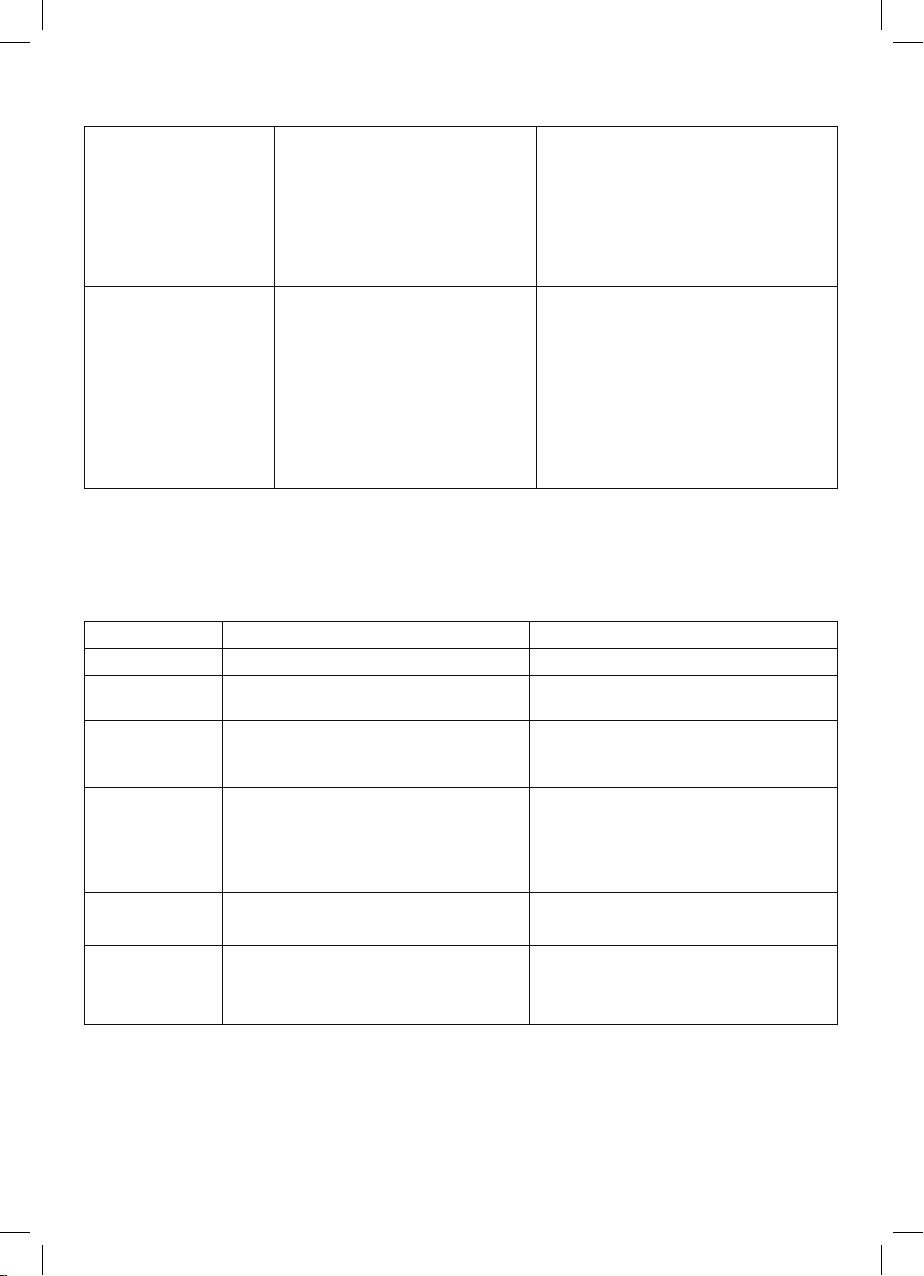
Pans do not become
hot and appears in
the display.
The induction hob cannot
detect the pan because it is not
suitable for induction cooking.
The induction hob cannot
detect the pan because it is too
small for the cooking zone or
not properly centred on it.
Use cookware suitable for induction
cooking. See section ‘Choosing the
right cookware’.
Centre the pan and make sure that
its base matches the size of the
cooking zone.
The induction hob or
a cooking zone has
turned itself off
unexpectedly, a tone
sounds and an error
code is displayed
(typically alternating
with one or two digits
in the cooking timer
display).
Technical fault.
Please note down the error
letters and numbers, switch
the power to the induction hob
off at the wall, and contact a
qualified technician.
Failure Display and Inspection
If an abnormality comes up, the induction hob will enter the protective state
automatically and display corresponding protective codes:
Pr
ob
lem
Pos
s
ible causes
W
h
at to do
F1-F6
Temperature sensor failure
Please contact the supplier.
F9-FA
Temperature sensor of
the
IGBT failure.
Please contact the supplier.
FC
T
he connection
between
the
display board and the main
board is fail
Please contact the supplier.
E1/
E2
Ab
normal supply voltage
Pl
ease inspect whether power
supply is normal.
Power on after the power
supply is normal.
E3/E4
Temperature sensor of the
ceramic glass plate Is high
Please restart after the
induction hob cools down.
E5
Temperature sensor of the
IGBT
Is high
Please restart after the
induction hob cools down.
if there are anyone zone of the flexible area
to be protected,the flexible
area
selection control will not be able to use。
The above are the judgment and inspection of common failures.
36
Please do not disassemble the unit by yourself to avoid any dangers and
damages to the induction hob.
The oven (according to the models )
Always keep small children away from the oven while it is in use.
Before cooking for the first time switch the oven on and allow it to heat up while empty. At this
point you may notice a slightly odour, this is perfectly normal and occurs as the protective
covering which surrounds the insulating panels is gently removed. This covering is designed
for transit purposes only and its removal will not affect the performance of your oven.
Prior to use simply wipe the oven interior with a damp cloth, it is then ready for cooking.
37

Pans do not become
hot and appears in
the display.
The induction hob cannot
detect the pan because it is not
suitable for induction cooking.
The induction hob cannot
detect the pan because it is too
small for the cooking zone or
not properly centred on it.
Use cookware suitable for induction
cooking. See section ‘Choosing the
right cookware’.
Centre the pan and make sure that
its base matches the size of the
cooking zone.
The induction hob or
a cooking zone has
turned itself off
unexpectedly, a tone
sounds and an error
code is displayed
(typically alternating
with one or two digits
in the cooking timer
display).
Technical fault.
Please note down the error
letters and numbers, switch
the power to the induction hob
off at the wall, and contact a
qualified technician.
Failure Display and Inspection
If an abnormality comes up, the induction hob will enter the protective state
automatically and display corresponding protective codes:
Pr
ob
lem
Pos
s
ible causes
W
h
at to do
F1-F6
Temperature sensor failure
Please contact the supplier.
F9-FA
Temperature sensor of
the
IGBT failure.
Please contact the supplier.
FC
T
he connection
between
the
display board and the main
board is fail
Please contact the supplier.
E1/
E2
Ab
normal supply voltage
Pl
ease inspect whether power
supply is normal.
Power on after the power
supply is normal.
E3/E4
Temperature sensor of the
ceramic glass plate Is high
Please restart after the
induction hob cools down.
E5
Temperature sensor of the
IGBT
Is high
Please restart after the
induction hob cools down.
if there are anyone zone of the flexible area
to be protected,the flexible
area
selection control will not be able to use。
The above are the judgment and inspection of common failures.
36
Please do not disassemble the unit by yourself to avoid any dangers and
damages to the induction hob.
The oven (according to the models )
Always keep small children away from the oven while it is in use.
Before cooking for the first time switch the oven on and allow it to heat up while empty. At this
point you may notice a slightly odour, this is perfectly normal and occurs as the protective
covering which surrounds the insulating panels is gently removed. This covering is designed
for transit purposes only and its removal will not affect the performance of your oven.
Prior to use simply wipe the oven interior with a damp cloth, it is then ready for cooking.
37
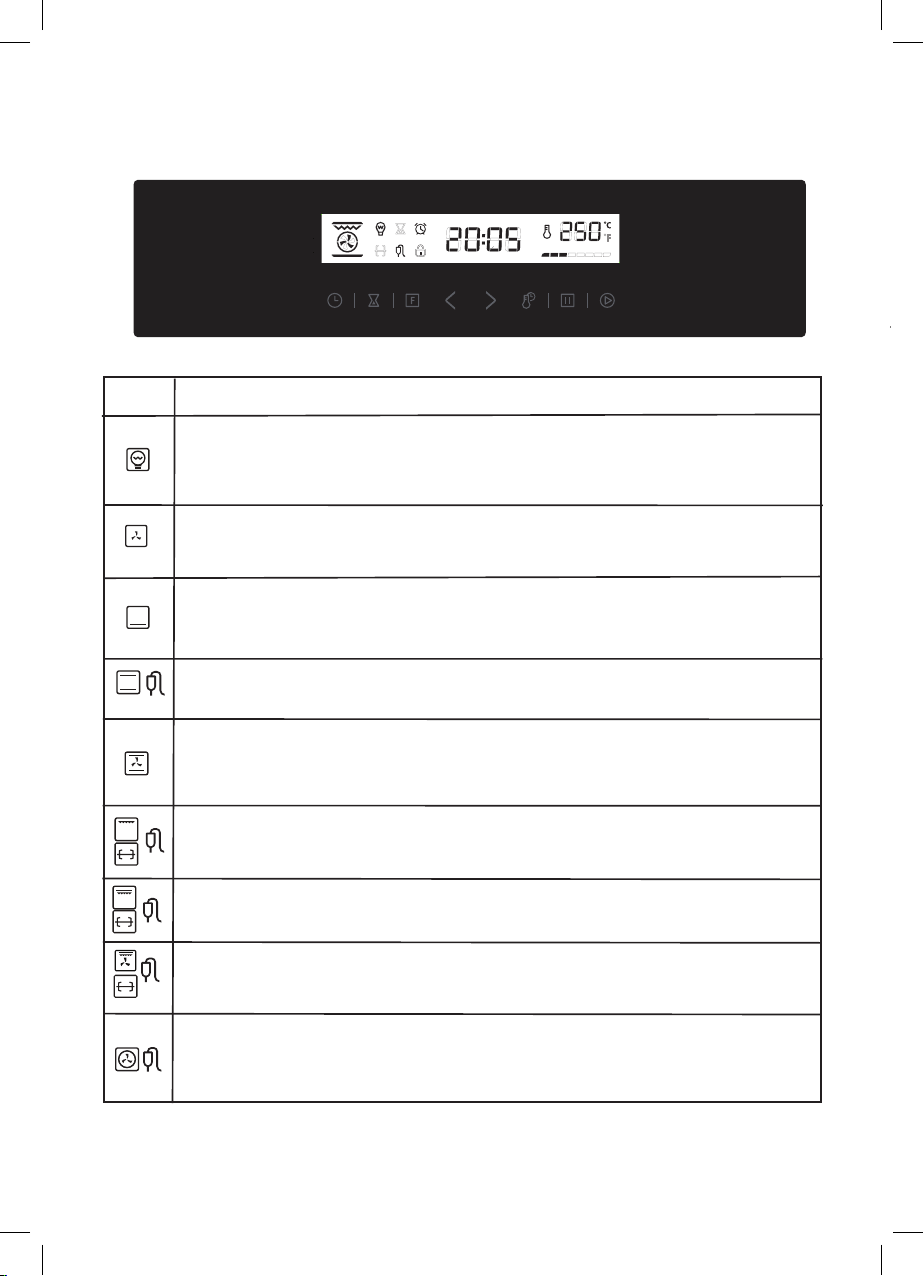
Electronic control
Double grilling: The inside radiant element and top element are working.
The temperature can be set within the range of 180-240
O
C. The default temperature is 210
O
C.
Convention with fan: Combination of the fan and both heating element provides more even
heat penetration,saving up to30-40% of energy. Dishes are lightly browned on the outside
and still moist on the inside. Note:This function is suitable for grilling or roasting big pieces
of meat at a higher temperature. The temperature can be set within the range of 50-250
O
C.
The default temperature is 220
O
C.
Symbol
Function description
Radiant grilling: The inner grill element switches on and off to maintain temperature.
The temperature can be set within the range of 180-240
O
C.The default temperature is 210
O
C.
This is optional function that can be work with rotisserie motor.
Conventional cooking: The top and bottom work together to provide convectional cooking.
The temperature can be set within the range of 50-250
O
C. The default temperature is 220
O
C.
This is optional function that can be work with rotisserie motor
.
Bottom heater: A concealed element in the bottom of the oven provides a more
concentrative heat to the base of food without browing. This is ideal for slow cooking
dishes such as casseroles, stews, pastries and pizzas where a crispy base is desired.
The temperature can be set within the range of 60-120
OC. The default temperature is 60OC.
Defrost: The circulation of air at room temperature enables quicker thawing of frozen food,
(without the use of any heat). It's a gentle but quick way to speed up the defrosting time
and thawing of ready-made dishes and cream filled produce etc.
Convection: An element around the convection fan provides an additional source of heat
for convection style cooking. In convenction mode the fan automatically comes on to
improve air circulation within the oven and creates an even heat for cooking.
The temperature can be set within the range of 50-240
O
C. The default temperature is 180
O
C.
Double grilling with fan: The inside radiant element and top element are working with fan
The temperature can be set within the range of 180-240
O
C. The default temperature is 210
O
C.
This is optional function that can be work with rotisserie motor.
Oven Lamp: Which enables the user to observe the progress of cooking without opening
the door. Oven lamp will light for all cooking functions.
38
Oven Accessories The accessories can be inserted in the oven in 4
different shelf positions.
You can pull the accessories two-thirds of the way out
1
without them tipping. This allows meals to be
2
removed easily.
3
4
Yo
u
can buy accessories from the after-sales service
or from specialist retailers.
Accessory Description
Baking and roasting shelf
For ovenware, cake tins,
roasts, grilling and frozen
meals.
Enamelled baking tray
For moist cakes, pastries,
frozen meals and large
roasts. Can also be
inserted underneath the
wire rack or rotary spit and
used as a drip tray to
collect fat.
Rotary spit
For roasts and large pieces
of poultry. Use only in
combination with the
enamelled baking tray.
Using the electronic oven control
OPERATION INSTRUCTIONS
1. Clock Setting
After connectiong the unit to the power, the symbols "0:00" will be visible on the display.
1> Press " ", the hour figures will flash.
2> Press " " to adjust the hour figures, (time should be within 0--23).
3> Press " ", the minutes will flash.
4> Press " " to adjust the minutes setting, (time should be within 0-- 9).
5> Press " " to finish the clock settings. ":" will flash, and the time will be illuminated.
Note: The clock is 24 hours. After power on, if not set, the clock will show "0:00".
2. Function Setting
1> Press " " to choose the cooking function you require. The related indicator will illuminated .
2> Press "
" to adjust the cooking time and adjust the temperature before press " " to switch .
3> Press " " to confirm the start of cooking.
4> If step 2 is ignored, Press " " to confirm the start of cooking and the default time is 9 hours,
the default temperature will display on the LCD.
39
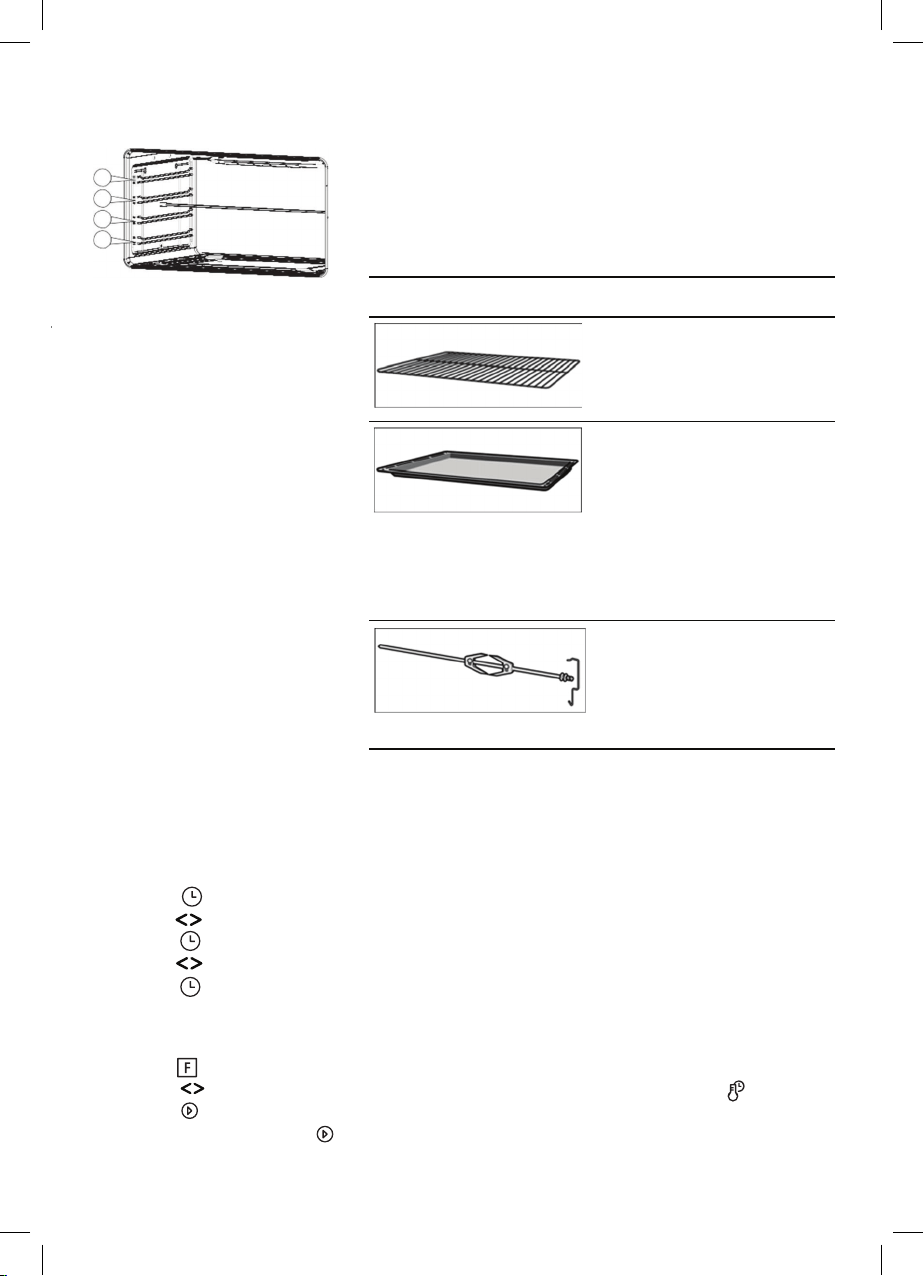
Electronic control
Double grilling: The inside radiant element and top element are working.
The temperature can be set within the range of 180-240
O
C. The default temperature is 210
O
C.
Convention with fan: Combination of the fan and both heating element provides more even
heat penetration,saving up to30-40% of energy. Dishes are lightly browned on the outside
and still moist on the inside. Note:This function is suitable for grilling or roasting big pieces
of meat at a higher temperature. The temperature can be set within the range of 50-250
O
C.
The default temperature is 220
O
C.
Symbol
Function description
Radiant grilling: The inner grill element switches on and off to maintain temperature.
The temperature can be set within the range of 180-240
O
C.The default temperature is 210
O
C.
This is optional function that can be work with rotisserie motor.
Conventional cooking: The top and bottom work together to provide convectional cooking.
The temperature can be set within the range of 50-250
O
C. The default temperature is 220
O
C.
This is optional function that can be work with rotisserie motor
.
Bottom heater: A concealed element in the bottom of the oven provides a more
concentrative heat to the base of food without browing. This is ideal for slow cooking
dishes such as casseroles, stews, pastries and pizzas where a crispy base is desired.
The temperature can be set within the range of 60-120
OC. The default temperature is 60OC.
Defrost: The circulation of air at room temperature enables quicker thawing of frozen food,
(without the use of any heat). It's a gentle but quick way to speed up the defrosting time
and thawing of ready-made dishes and cream filled produce etc.
Convection: An element around the convection fan provides an additional source of heat
for convection style cooking. In convenction mode the fan automatically comes on to
improve air circulation within the oven and creates an even heat for cooking.
The temperature can be set within the range of 50-240
O
C. The default temperature is 180
O
C.
Double grilling with fan: The inside radiant element and top element are working with fan
The temperature can be set within the range of 180-240
O
C. The default temperature is 210
O
C.
This is optional function that can be work with rotisserie motor.
Oven Lamp: Which enables the user to observe the progress of cooking without opening
the door. Oven lamp will light for all cooking functions.
38
Oven Accessories The accessories can be inserted in the oven in 4
different shelf positions.
You can pull the accessories two-thirds of the way out
1
without them tipping. This allows meals to be
2
removed easily.
3
4
Yo
u
can buy accessories from the after-sales service
or from specialist retailers.
Accessory Description
Baking and roasting shelf
For ovenware, cake tins,
roasts, grilling and frozen
meals.
Enamelled baking tray
For moist cakes, pastries,
frozen meals and large
roasts. Can also be
inserted underneath the
wire rack or rotary spit and
used as a drip tray to
collect fat.
Rotary spit
For roasts and large pieces
of poultry. Use only in
combination with the
enamelled baking tray.
Using the electronic oven control
OPERATION INSTRUCTIONS
1. Clock Setting
After connectiong the unit to the power, the symbols "0:00" will be visible on the display.
1> Press " ", the hour figures will flash.
2> Press " " to adjust the hour figures, (time should be within 0--23).
3> Press " ", the minutes will flash.
4> Press " " to adjust the minutes setting, (time should be within 0-- 9).
5> Press " " to finish the clock settings. ":" will flash, and the time will be illuminated.
Note: The clock is 24 hours. After power on, if not set, the clock will show "0:00".
2. Function Setting
1> Press " " to choose the cooking function you require. The related indicator will illuminated .
2> Press "
" to adjust the cooking time and adjust the temperature before press " " to switch .
3> Press " " to confirm the start of cooking.
4> If step 2 is ignored, Press " " to confirm the start of cooking and the default time is 9 hours,
the default temperature will display on the LCD.
39
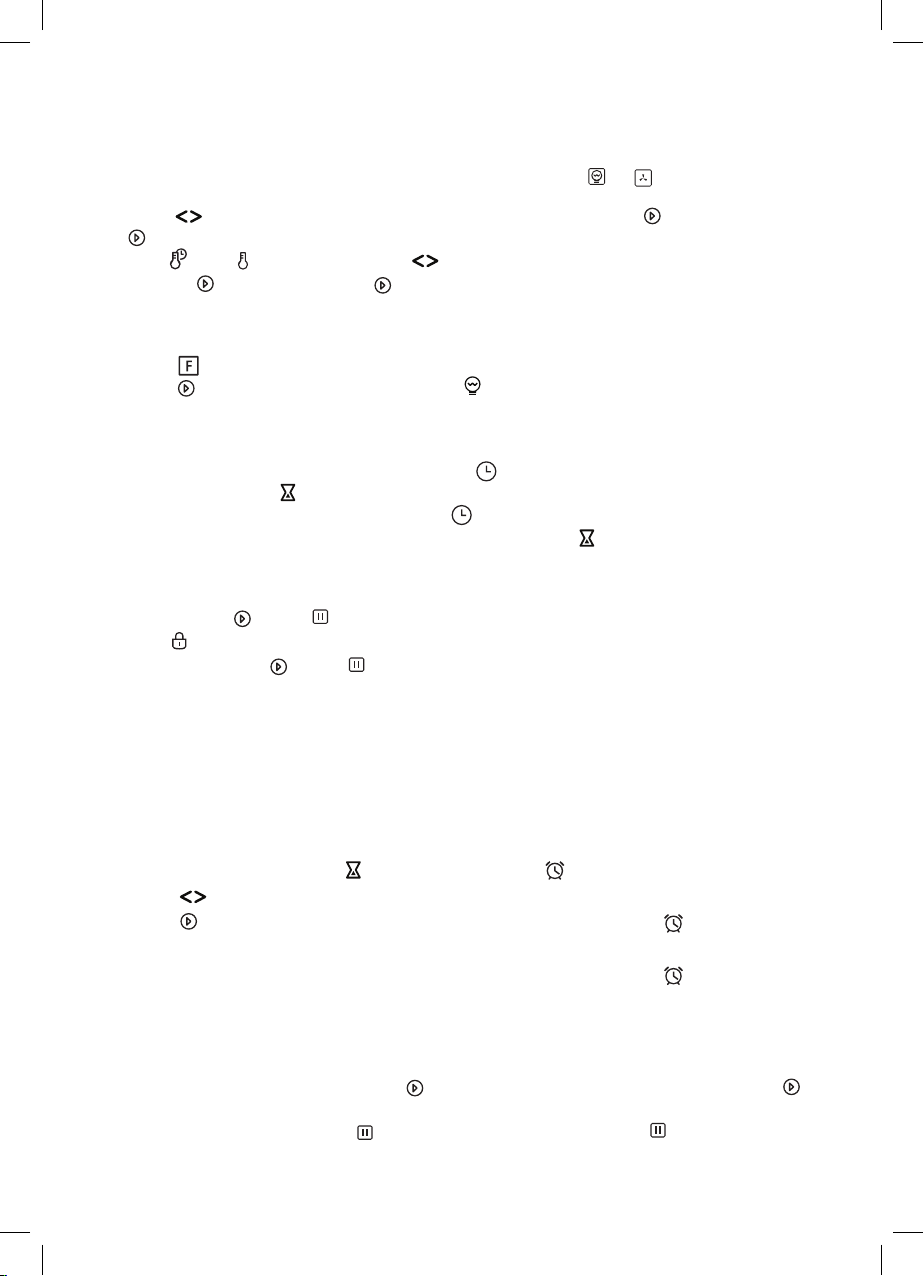
.
3.Lamp Setting
1> Press " " to select the relevant function, then the corresponding icon will be on.
2> Press " " button to start, "0:00" and lamp icon" " will light up, " : " will flash.
4.Inquiring function
NOTE:
1>The step quantities for the adjustment time of the coding switch are as follow:
0--0:30min: step 1 minute 0:30--9:00hour :step 5 minutes
2>The step quantities for the adjustment of temperature is 5
O
C, and " " " "can not adjust the
3>Press " " to adjust the cooking time when cooking begins. Then press " " to confirm.
If " " not pressed within 5 seconds,the oven will revert back to the previous time to continue cooking.
4>Press" " show, then press" " to adjust the temperature when cooking begins.
Then press" " to start cooking. If " " not pressed in seconds, the oven will revert back to the
temperature.
previous temperatrue to continue cooking.
5
, the" " will
In the following states, you can use inquiring function, after 3 seconds return to the current state.
1> During working state, if the clock was set, press " " button to see the current time; if the reminder
function was set, press " " button to see the time of reminder.
2> In reminding state, if the clock was set, press " " button to see the current time.
3> In clock display state, if the reservation function was set, press " " button to see the time of
reservation.
6. Reminder Function:
The oven has 9 hours reminder, this function will help to remind you to start cooking in a certain time
from1 minute to 9 hours. Only when oven in standby mode, the reminder can be set. Follow below to
set the reminder:
1> Press reminder setting button " " and the display shows " " and "AL";
2> Press " " to set the time of reminder.
Note: The oven buzzer will sound for 10 times after the time back to the zero hour . " "symbol disappears
on the screen to remind you to start cooking. You can cancel the reminder during setting by pressing
the stop button; After the reminder has been set, you can cancel it by pressing stop button twice.
will count down.
3> Press " " to confirm setting. ":" will be flash and the indicator for reminder " " will light.The time
5. Child lock function
To Lock : press " " and " " simultaneously for 3 seconds, there will be a long "beeping" sound
and the " " will be illuminated.
Lock quitting : press " " and " " simultaneously for 3 seconds, there will be a long "beeping"
sound indicating the child-lock is released.
Note: During working mode, if you want to stop cooking,press stop button quickly. Do not need to long
pressing on stop button,it is invalid.
1> If the cooking time has been set, press " " to start cooking. If the cooking is paused, press " "
to resume cooking.
2> During cooking process, press " " once to pause the cooking. Press " " twice to cancel the
cooking.
7. Start/Pause/Cancel Function
40
ACCESSORIES
Meat probe : Before using, insert the probe into the center of
the thickest portion of meat or into the inner thigh or breast of
poultry, away from fat or bone. Place food in oven and connect
the meat probe. Keep probe as far away from heat source as
possible. Close oven door.
Only when the clock
has been set, delay function can be used. In standby mode,
1, Press " "2 timers,the display shows " " and “End”.
2, Press
"
<
>
"
to set the hour of the cooking ending time of reserv ation.
3, Press " "button again;
4,Press " "to set the minute of the cooking ending time of reserv ation.
5,Press " " to choose the cooking function you require.
6,After set the cooking time and temperature, press " " to start.
8. Reservation Function
<
>
N ote:
S ubtract the cooking time from the cooking ending time, you will get the time that ov en start to cook.s
11. Note
1> The oven lamp will be on for all functions.
2> Once the cooking programme has been set and the" " button is not pressed within 5 minutes,
the current time will be displayed or turn back to waitting state. The setting program will be invalid.
3> The buzzer will sound once when effectively pressed, if not effectively pressed there will be no response.
4> The buzzer will sound five times to remind you when cooking has finished.
10. Meat probe function:
1> In waiting state, insert the meat probe, the LCD will display " PROB" and the icon " " will light.
2> Press “ ” to choose function you need. The related indicator will illuminated.
Functional sequence diagram: . Press " " to confirm function setting.
3> Press " " to adjust the temperature. Press " " to confirm temperautre probe.
The small LCD display the temperature and the big LCD display " PROB".
4>The buzzer will sound five times when cooking finish. The setting temperature lights when the setting
temperatures arrives. If the meat probe pulled out, it will turn back to waiting state.
Note: A). The range of the temperature is 50-150 degrees. B).During probe function, the cooking
time can not be set. C)
Press stop button again, cancel the current cooking. D)
cancel all the program. E)If the display shows "Er-3" after the programme has been started, it means
that the temperature sensor short circuit.
.Pull out the meat probe from the oven, it will
.During cooking process,press stop button once, it will stop cooking, LED flash;
. Energy-Saving Function
1> In waiting state and reminding state , press " " for three seconds, the LCD display will go
off and set to energy-saving mode.
2> If no operation in10 minutes under waiting state, the LCD display will go off and go into energy-saving mode.
3> Under the energy-saving mode, press any key can quit the energy-saving mode.
9
41
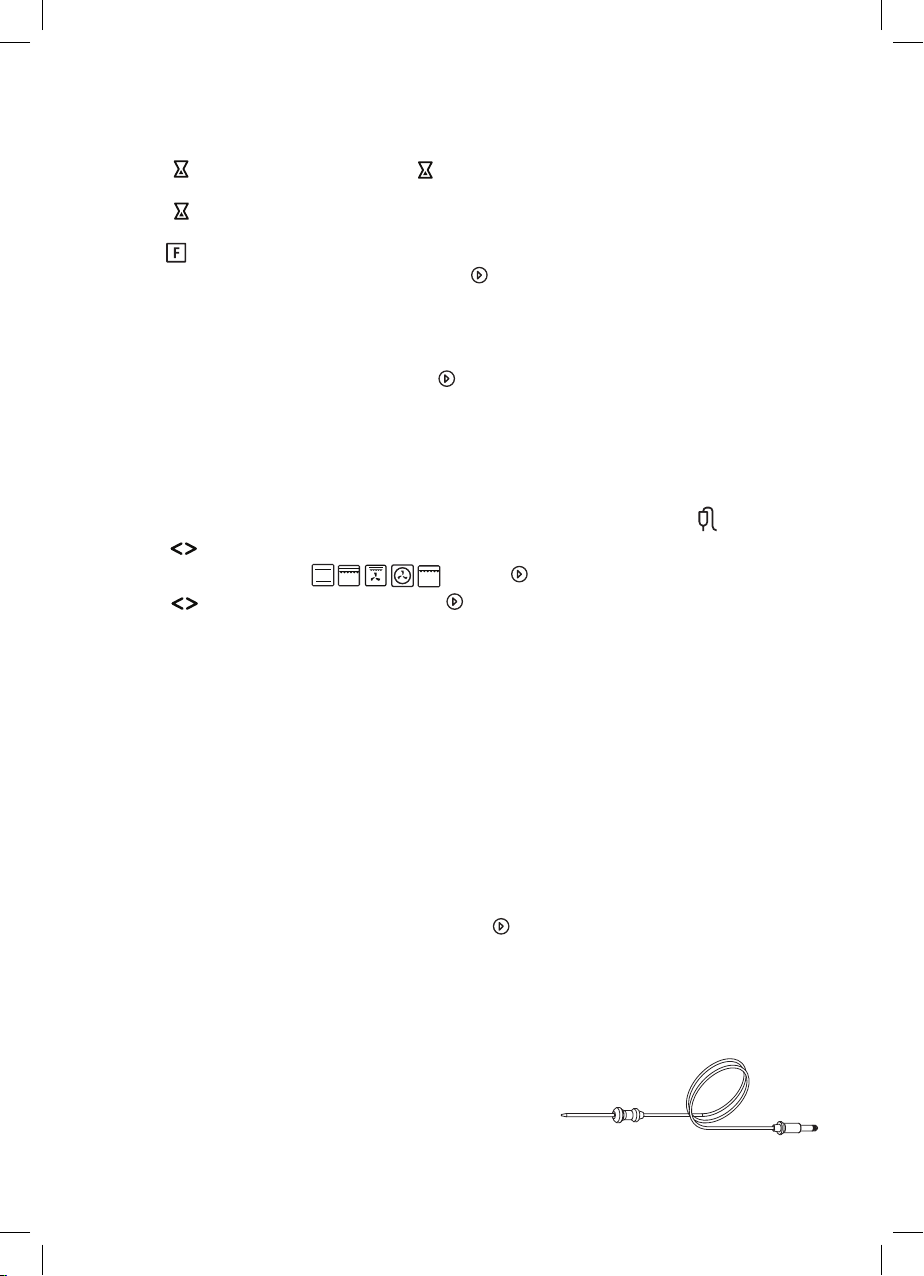
.
3.Lamp Setting
1> Press " " to select the relevant function, then the corresponding icon will be on.
2> Press " " button to start, "0:00" and lamp icon" " will light up, " : " will flash.
4.Inquiring function
NOTE:
1>The step quantities for the adjustment time of the coding switch are as follow:
0--0:30min: step 1 minute 0:30--9:00hour :step 5 minutes
2>The step quantities for the adjustment of temperature is 5
O
C, and " " " "can not adjust the
3>Press " " to adjust the cooking time when cooking begins. Then press " " to confirm.
If " " not pressed within 5 seconds,the oven will revert back to the previous time to continue cooking.
4>Press" " show, then press" " to adjust the temperature when cooking begins.
Then press" " to start cooking. If " " not pressed in seconds, the oven will revert back to the
temperature.
previous temperatrue to continue cooking.
5
, the" " will
In the following states, you can use inquiring function, after 3 seconds return to the current state.
1> During working state, if the clock was set, press " " button to see the current time; if the reminder
function was set, press " " button to see the time of reminder.
2> In reminding state, if the clock was set, press " " button to see the current time.
3> In clock display state, if the reservation function was set, press " " button to see the time of
reservation.
6. Reminder Function:
The oven has 9 hours reminder, this function will help to remind you to start cooking in a certain time
from1 minute to 9 hours. Only when oven in standby mode, the reminder can be set. Follow below to
set the reminder:
1> Press reminder setting button " " and the display shows " " and "AL";
2> Press " " to set the time of reminder.
Note: The oven buzzer will sound for 10 times after the time back to the zero hour . " "symbol disappears
on the screen to remind you to start cooking. You can cancel the reminder during setting by pressing
the stop button; After the reminder has been set, you can cancel it by pressing stop button twice.
will count down.
3> Press " " to confirm setting. ":" will be flash and the indicator for reminder " " will light.The time
5. Child lock function
To Lock : press " " and " " simultaneously for 3 seconds, there will be a long "beeping" sound
and the " " will be illuminated.
Lock quitting : press " " and " " simultaneously for 3 seconds, there will be a long "beeping"
sound indicating the child-lock is released.
Note: During working mode, if you want to stop cooking,press stop button quickly. Do not need to long
pressing on stop button,it is invalid.
1> If the cooking time has been set, press " " to start cooking. If the cooking is paused, press " "
to resume cooking.
2> During cooking process, press " " once to pause the cooking. Press " " twice to cancel the
cooking.
7. Start/Pause/Cancel Function
40
ACCESSORIES
Meat probe : Before using, insert the probe into the center of
the thickest portion of meat or into the inner thigh or breast of
poultry, away from fat or bone. Place food in oven and connect
the meat probe. Keep probe as far away from heat source as
possible. Close oven door.
Only when the clock
has been set, delay function can be used. In standby mode,
1, Press " "2 timers,the display shows " " and “End”.
2, Press
"
<
>
"
to set the hour of the cooking ending time of reserv ation.
3, Press " "button again;
4,Press " "to set the minute of the cooking ending time of reserv ation.
5,Press " " to choose the cooking function you require.
6,After set the cooking time and temperature, press " " to start.
8. Reservation Function
<
>
N ote:
S ubtract the cooking time from the cooking ending time, you will get the time that ov en start to cook.s
11. Note
1> The oven lamp will be on for all functions.
2> Once the cooking programme has been set and the" " button is not pressed within 5 minutes,
the current time will be displayed or turn back to waitting state. The setting program will be invalid.
3> The buzzer will sound once when effectively pressed, if not effectively pressed there will be no response.
4> The buzzer will sound five times to remind you when cooking has finished.
10. Meat probe function:
1> In waiting state, insert the meat probe, the LCD will display " PROB" and the icon " " will light.
2> Press “ ” to choose function you need. The related indicator will illuminated.
Functional sequence diagram: . Press " " to confirm function setting.
3> Press " " to adjust the temperature. Press " " to confirm temperautre probe.
The small LCD display the temperature and the big LCD display " PROB".
4>The buzzer will sound five times when cooking finish. The setting temperature lights when the setting
temperatures arrives. If the meat probe pulled out, it will turn back to waiting state.
Note: A). The range of the temperature is 50-150 degrees. B).During probe function, the cooking
time can not be set. C)
Press stop button again, cancel the current cooking. D)
cancel all the program. E)If the display shows "Er-3" after the programme has been started, it means
that the temperature sensor short circuit.
.Pull out the meat probe from the oven, it will
.During cooking process,press stop button once, it will stop cooking, LED flash;
. Energy-Saving Function
1> In waiting state and reminding state , press " " for three seconds, the LCD display will go
off and set to energy-saving mode.
2> If no operation in10 minutes under waiting state, the LCD display will go off and go into energy-saving mode.
3> Under the energy-saving mode, press any key can quit the energy-saving mode.
9
41
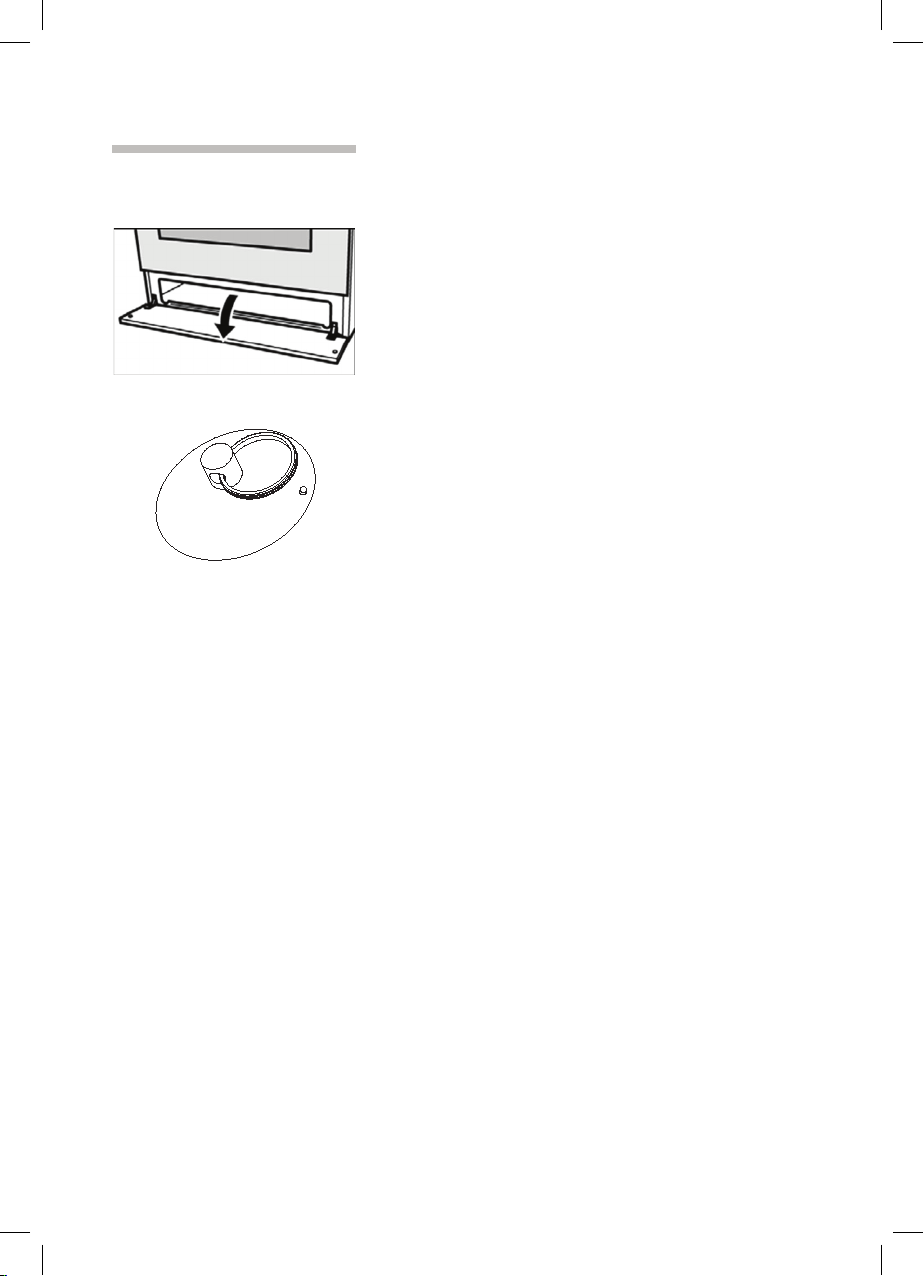
The storage compartment
Open the storage compartment by folding down
the
fascia panel.
This compartment can be used to store hob or
oven
accessories.
There is a plastic sucker in some models can
help you open the drawer.
Risk of fire.
Never leave combustible items in the storage
compartment.
42
Before using for the first time
Please read the following instructions before using
yo
u
r appliance for the first time.
Remove the appliance packaging and dispose of this
appropriately.
Baking out the oven
C
o
oking compartment
initial cleaning
Remove the accessories from the cooking
compartment.
Completely remove any leftover packaging, e.g.
small pieces of polystyrene, from the cooking
compartment.
Some parts are covered with a protective film.
Remove this film.
1.
Clean the outside of the appliance with a soft,
damp cloth.
2.
I
f
the hook-in racks have already been fitted,
unhook and remove them. For information on
removing the racks, see the section “Removing
and refitting hook-in racks.”
3.
Clean the cooking compartment with warm soapy
water.
Heating up the oven
(according to the model)
To remove the new cooker smell, heat up the oven
when it is empty and closed.
1. Put the switch in position conventional
cooking
Set the thermostat to 200 ° C
2. After 25 minutes, switch the oven off by
turning the control knob clockwise to position 0 .
1. Put the switch in position fan assisted
multilevel oven
Set the thermostat to 200 ° C
2. After 25 minutes, switch the oven off by
turning the control knob clockwise to position 0
.
43

The storage compartment
Open the storage compartment by folding down
the
fascia panel.
This compartment can be used to store hob or
oven
accessories.
There is a plastic sucker in some models can
help you open the drawer.
Risk of fire.
Never leave combustible items in the storage
compartment.
42
Before using for the first time
Please read the following instructions before using
yo
u
r appliance for the first time.
Remove the appliance packaging and dispose of this
appropriately.
Baking out the oven
C
o
oking compartment
initial cleaning
Remove the accessories from the cooking
compartment.
Completely remove any leftover packaging, e.g.
small pieces of polystyrene, from the cooking
compartment.
Some parts are covered with a protective film.
Remove this film.
1.
Clean the outside of the appliance with a soft,
damp cloth.
2.
I
f
the hook-in racks have already been fitted,
unhook and remove them. For information on
removing the racks, see the section “Removing
and refitting hook-in racks.”
3.
Clean the cooking compartment with warm soapy
water.
Heating up the oven
(according to the model)
To remove the new cooker smell, heat up the oven
when it is empty and closed.
1. Put the switch in position conventional
cooking
Set the thermostat to 200 ° C
2. After 25 minutes, switch the oven off by
turning the control knob clockwise to position 0 .
1. Put the switch in position fan assisted
multilevel oven
Set the thermostat to 200 ° C
2. After 25 minutes, switch the oven off by
turning the control knob clockwise to position 0
.
43

Heating up the grill
1 Put the switch in position grill
2
After 25 minutes, switch the oven off by turning the control knob clockwise to
position 0 .
.
Rinsing cooking
c
ompartment after initial
cleaning
Clean the cooking compartment with hot soapy
water. Refit the hook-in racks.
gas lighter or a match.
44
Using the rotary spit
The rotary spit can be used to cook joints such as
rolled joints and poultry with excellent results. The
meat is roasted thoroughly and evenly.
The rotary spit function only when the switch
is in position grill.
Preparing joints Place the joint as centrally as possible on the rotary
spit and secure it at both ends with the retaining clips.
You can also truss the joint with string. With poultry,
bind the ends of the wings underneath the back and
the thighs against the body. This will prevent them
from becoming too dark.
Pierce the skin on the underside of the wings to allow
the fat to escape.
45

Heating up the grill
1 Put the switch in position grill
2
After 25 minutes, switch the oven off by turning the control knob clockwise to
position 0 .
.
Rinsing cooking
c
ompartment after initial
cleaning
Clean the cooking compartment with hot soapy
water. Refit the hook-in racks.
gas lighter or a match.
44
Using the rotary spit
The rotary spit can be used to cook joints such as
rolled joints and poultry with excellent results. The
meat is roasted thoroughly and evenly.
The rotary spit function only when the switch
is in position grill.
Preparing joints Place the joint as centrally as possible on the rotary
spit and secure it at both ends with the retaining clips.
You can also truss the joint with string. With poultry,
bind the ends of the wings underneath the back and
the thighs against the body. This will prevent them
from becoming too dark.
Pierce the skin on the underside of the wings to allow
the fat to escape.
45
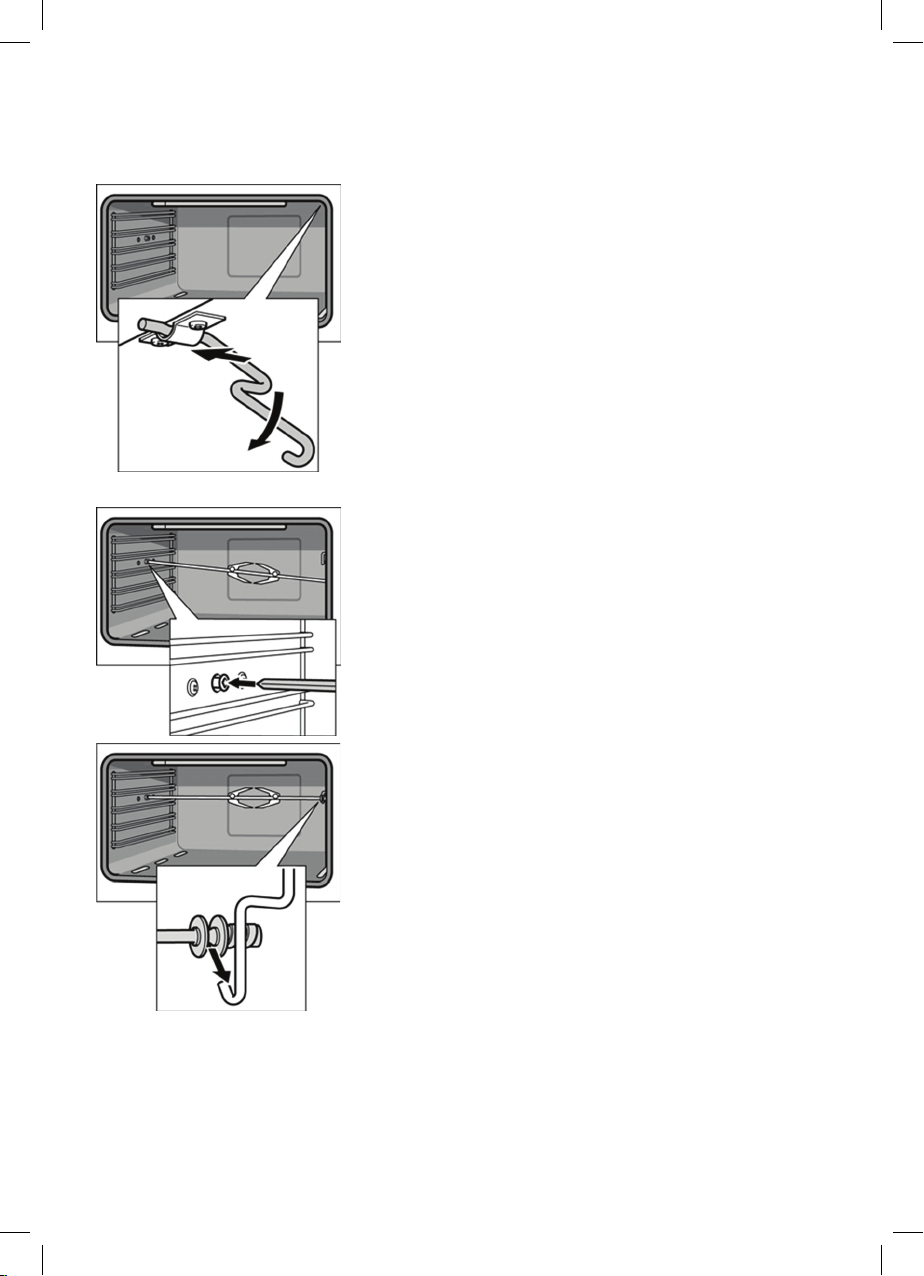
Inserting
the
rotary
spit
Insert
the
rotary
spit
as
follows:
1.
Hook the spit holder into the bracket on the ceiling
of the cooking compartment.
If you require to preheat the oven, hook in the
holder before preheating.
G
Risk of burns
Never touch the hot surfaces of the cooking
compartment or the heating elements.
Children must be kept at a safe distance from the
appliance at all times.
Open the appliance door carefully. Hot steam may
escape.
2.
If the oven has been preheated, only attach the
ro
t
ary spit if you are using an oven cloth or wearing
(thermal) oven gloves. To attach the spit, slide one
end into the recessed adapter in the left-hand side
panel of the cooking compartment.
3. Hook the other end into the holder.
4.
Pour a little bit of water into the baking tray and
slide this into shelf position 1 to collect the run-off
fat.
46
Removing the rotary spit
G
Risk of burns.
Never touch the hot surfaces of the cooking
compartment or the heating elements.
Children must be kept at a safe distance from the
appliance at all times.
Open the appliance door carefully. Hot steam may
escape.
G
Risk of burns.
Never touch the rotary spit or other accessories
directly when they are hot.
Always wear oven gloves or heat-resistant gloves
when handling hot accessories.
Remove the rotary spit as follows:
1.
Carefully open the appliance door. Carefully
re
m
ove the rotary spit from the holder.
2.
Carefully withdraw the rotary spit from the
recessed adapter in the side panel and remove it
from the oven.
3.
Take out the baking tray.
47
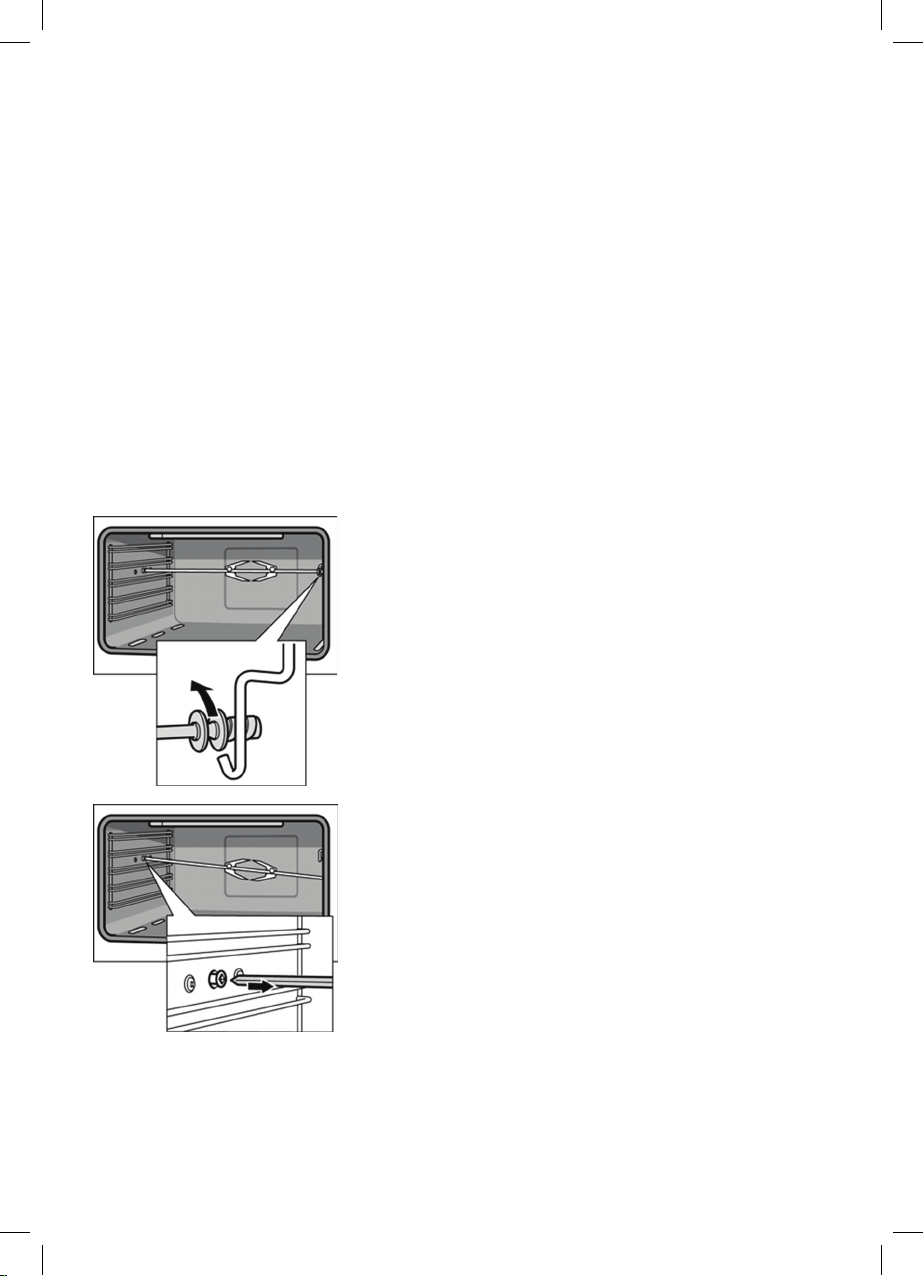
Inserting
the
rotary
spit
Insert
the
rotary
spit
as
follows:
1.
Hook the spit holder into the bracket on the ceiling
of the cooking compartment.
If you require to preheat the oven, hook in the
holder before preheating.
G
Risk of burns
Never touch the hot surfaces of the cooking
compartment or the heating elements.
Children must be kept at a safe distance from the
appliance at all times.
Open the appliance door carefully. Hot steam may
escape.
2.
If the oven has been preheated, only attach the
ro
t
ary spit if you are using an oven cloth or wearing
(thermal) oven gloves. To attach the spit, slide one
end into the recessed adapter in the left-hand side
panel of the cooking compartment.
3. Hook the other end into the holder.
4.
Pour a little bit of water into the baking tray and
slide this into shelf position 1 to collect the run-off
fat.
46
Removing the rotary spit
G
Risk of burns.
Never touch the hot surfaces of the cooking
compartment or the heating elements.
Children must be kept at a safe distance from the
appliance at all times.
Open the appliance door carefully. Hot steam may
escape.
G
Risk of burns.
Never touch the rotary spit or other accessories
directly when they are hot.
Always wear oven gloves or heat-resistant gloves
when handling hot accessories.
Remove the rotary spit as follows:
1.
Carefully open the appliance door. Carefully
re
m
ove the rotary spit from the holder.
2.
Carefully withdraw the rotary spit from the
recessed adapter in the side panel and remove it
from the oven.
3.
Take out the baking tray.
47

Cleaning and care
G
Never use high-pressure cleaners or steam jets. Risk
of short circuit.
Never use caustic or abrasive cleaning agents.
These could damage the surface. If such an agent
gets on the front of the appliance, wipe it off
immediately with water.
Do not clean any surfaces of the appliance while they
are hot.
Switching on the oven
lighting
To make it easier to clean the oven, you can switch
on the oven lighting.
To switch on the lighting, press the function button for
oven lighting until it locks into place.
Ca
t
alytic cooking compartment panels
The catalytic cooking compartment panels are
coated with self-cleaning enamel.
The surfaces clean themselves while the oven is in
operation. Larger splashes will only be removed after
the oven has been used several times.
Se
l
f-cleaning surfaces The rear and side walls are protected with catalytic
panelling.
Never clean these surfaces with oven cleaner.
Slight discolouration of the enamel does not affect
automatic self-cleaning.
48
Using the correct cleaning agent
Do not use cleaning agents that contain abrasive
substances or acids, or cleaning aids such as steel
wool or stainless steel sponges. These could damage
t
h
e surfaces.
Appliance parts Cleaning agent and cleaning aid
Appliance door glass panel
• Use glass cleaner.
Risk of injury.
The lower edge of the door may have sharp edges.
Clean the door and glass panels with care.
• Do not use a glass scraper.
Control panel and knobs
• Wipe with a damp, soft cloth.
Seal
(on the cooking
compartment)
• Use warm soapy water.
Hook-in racks
• Use warm soapy water.
Cooking compartment
Enamelled surfaces
Appliance exterior
Stainless steel surfaces
Glas
s
cover
(in front of the oven lighting)
• Use warm soapy water; Dry off with a soft cloth.
• Use warm soapy water; Dry off with a soft cloth.
• Always remove flecks of limescale, grease, starch
and albumin (e.g. egg white) immediately.
• Special stainless steel cleaners are available from
the after-sales service or specialist shops.
• Use warm soapy water.
Pan support
• Use warm soapy water.
•
D
o not clean the pan supports in the dishwasher.
Appliance parts Cleaning agent and cleaning aid
Accessory
• Soak in hot soapy water. Clean with a brush
or sponge.
49

Cleaning and care
G
Never use high-pressure cleaners or steam jets. Risk
of short circuit.
Never use caustic or abrasive cleaning agents.
These could damage the surface. If such an agent
gets on the front of the appliance, wipe it off
immediately with water.
Do not clean any surfaces of the appliance while they
are hot.
Switching on the oven
lighting
To make it easier to clean the oven, you can switch
on the oven lighting.
To switch on the lighting, press the function button for
oven lighting until it locks into place.
Ca
t
alytic cooking compartment panels
The catalytic cooking compartment panels are
coated with self-cleaning enamel.
The surfaces clean themselves while the oven is in
operation. Larger splashes will only be removed after
the oven has been used several times.
Se
l
f-cleaning surfaces The rear and side walls are protected with catalytic
panelling.
Never clean these surfaces with oven cleaner.
Slight discolouration of the enamel does not affect
automatic self-cleaning.
48
Using the correct cleaning agent
Do not use cleaning agents that contain abrasive
substances or acids, or cleaning aids such as steel
wool or stainless steel sponges. These could damage
t
h
e surfaces.
Appliance parts Cleaning agent and cleaning aid
Appliance door glass panel
• Use glass cleaner.
Risk of injury.
The lower edge of the door may have sharp edges.
Clean the door and glass panels with care.
• Do not use a glass scraper.
Control panel and knobs
• Wipe with a damp, soft cloth.
Seal
(on the cooking
compartment)
• Use warm soapy water.
Hook-in racks
• Use warm soapy water.
Cooking compartment
Enamelled surfaces
Appliance exterior
Stainless steel surfaces
Glas
s
cover
(in front of the oven lighting)
• Use warm soapy water; Dry off with a soft cloth.
• Use warm soapy water; Dry off with a soft cloth.
• Always remove flecks of limescale, grease, starch
and albumin (e.g. egg white) immediately.
• Special stainless steel cleaners are available from
the after-sales service or specialist shops.
• Use warm soapy water.
Pan support
• Use warm soapy water.
•
D
o not clean the pan supports in the dishwasher.
Appliance parts Cleaning agent and cleaning aid
Accessory
• Soak in hot soapy water. Clean with a brush
or sponge.
49
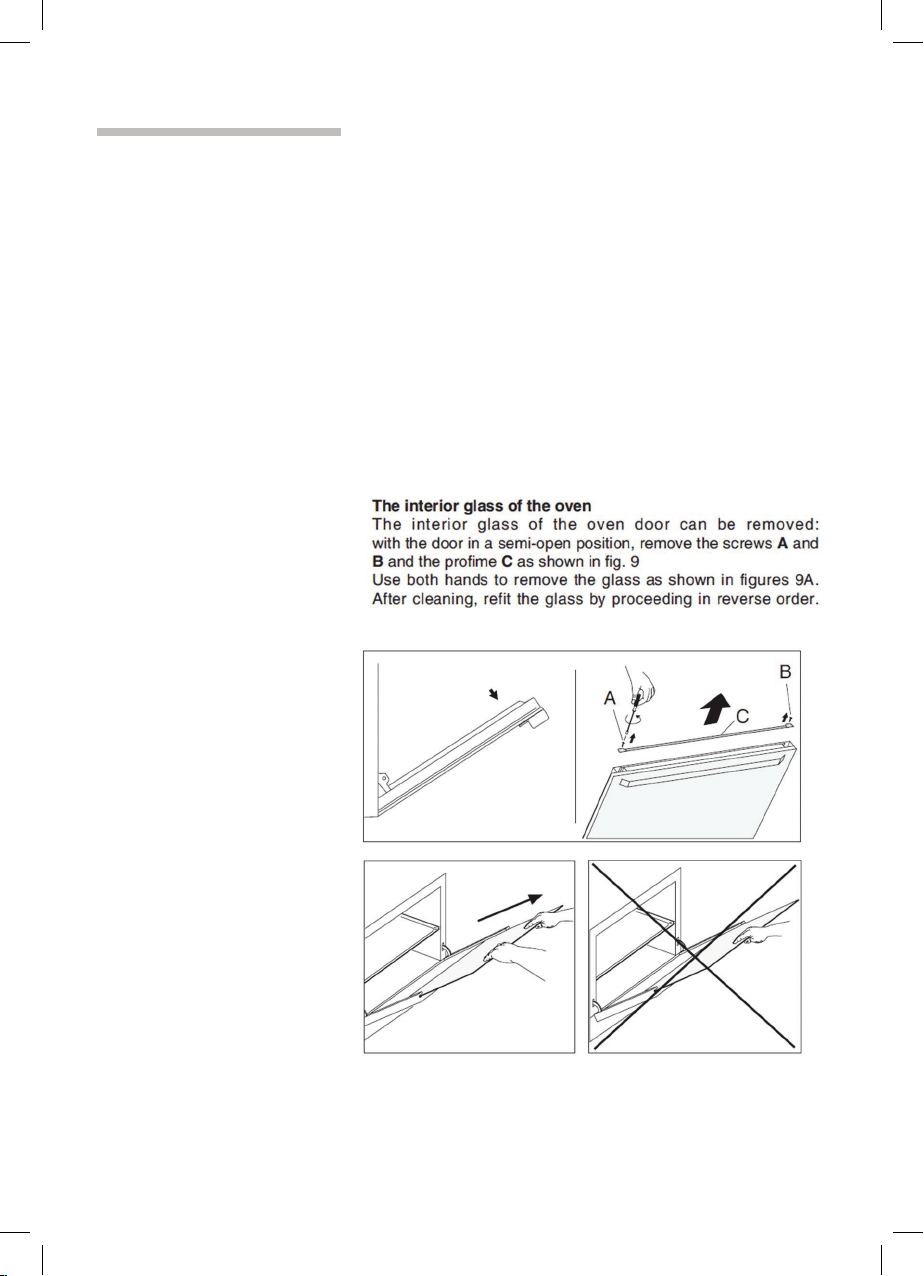
Cleaning the interior glass of the oven
The interior glass of the oven door can be removed:
with the door in the semi-open position, use both
hands to remove the glass .After cleaning, refit the
the glass by proseeding in reverse order.
Note
In some models, the glass is screenprinted.
In this case, when refitting the glass make sure the
screenprinted part is legible when the oven door
is opened.
Fig 9
Fig 9A
50
Removing and fitting the appliance door
You can remove the appliance door for easier
cleaning.
The hinges of the appliance door are each secured
by a locking lever.
When the locking lever is folded in (A), the appliance
d
o
or is secured. It cannot be unhinged.
If the locking lever is open (B), only the hinge is
secured, and you can remove the appliance door.
Risk of injury.
Do not reach inside the hinge.
Removing the appliance
d
o
or
Proceed as follows:
1. Open the appliance door.
2.
Lift up the locking levers on both sides.
3.
Close the appliance door until you feel resistance
at an angle of around 15° (in relation to the closed
appliance door).
4.
Grip the door on either side with both hands.
5.
Close the appliance door a little further.
6. Lift the door upwards and at an angle to remove it.
Do not disassemble the door.
51
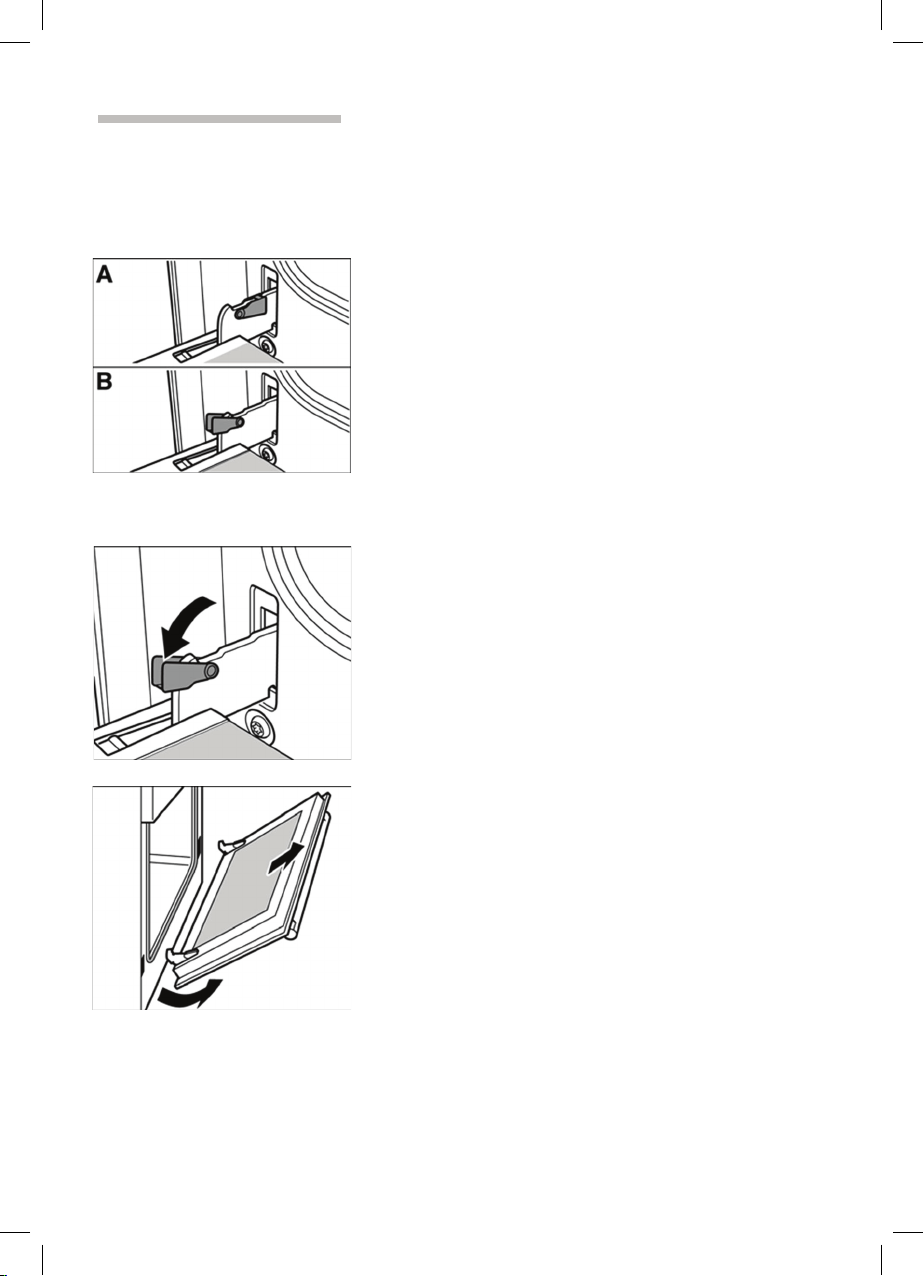
Cleaning the interior glass of the oven
The interior glass of the oven door can be removed:
with the door in the semi-open position, use both
hands to remove the glass .After cleaning, refit the
the glass by proseeding in reverse order.
Note
In some models, the glass is screenprinted.
In this case, when refitting the glass make sure the
screenprinted part is legible when the oven door
is opened.
Fig 9
Fig 9A
50
Removing and fitting the appliance door
You can remove the appliance door for easier
cleaning.
The hinges of the appliance door are each secured
by a locking lever.
When the locking lever is folded in (A), the appliance
d
o
or is secured. It cannot be unhinged.
If the locking lever is open (B), only the hinge is
secured, and you can remove the appliance door.
Risk of injury.
Do not reach inside the hinge.
Removing the appliance
d
o
or
Proceed as follows:
1. Open the appliance door.
2.
Lift up the locking levers on both sides.
3.
Close the appliance door until you feel resistance
at an angle of around 15° (in relation to the closed
appliance door).
4.
Grip the door on either side with both hands.
5.
Close the appliance door a little further.
6. Lift the door upwards and at an angle to remove it.
Do not disassemble the door.
51
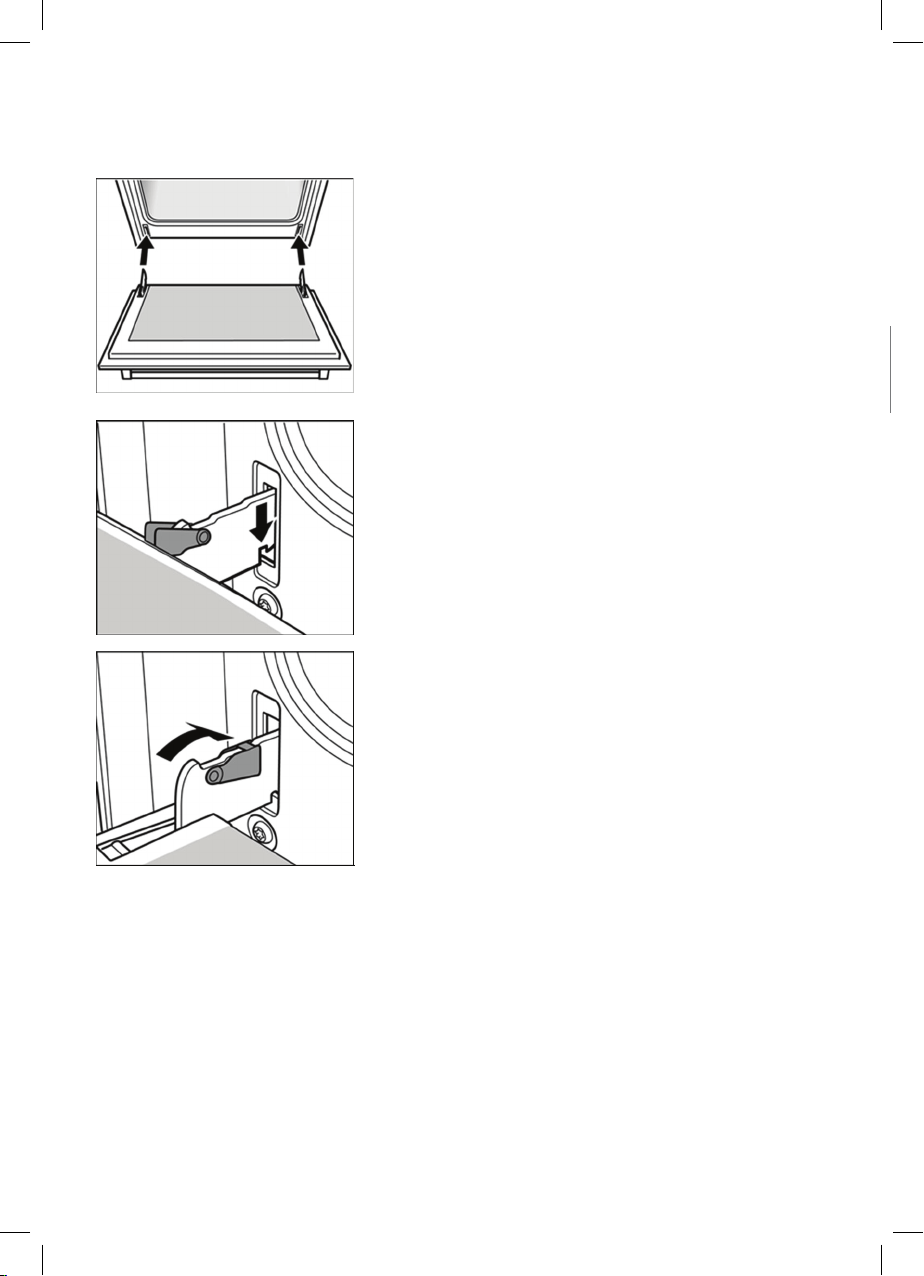
Fitting the appliance door Proceed as follows:
1.
Hold the appliance door at an angle.
2.
Insert both hinges, left and right, into the supports.
3. Position the door so that the hinge grooves
e
n
gage on both sides.
4.
Open the appliance door.
5.
Fold in the locking levers on both sides.
6.
C
l
ose the appliance door.
52
Removing and inserting the hook-in racks
You can remove the hook-in racks in order to clean
them separately.
The hook-in racks are all fixed to the walls of the
cooking compartment at four points.
Removing the hook-in
racks
To remove the hook-in racks, proceed as follows:
1.
Undo the screw on the bottom the hookin rack.
The lower hooks of the hook
-
in rack are released.
2.
Take hold of the top of the hook-in rack and screw
on the screw on the bottom the hook-in rack again.
I
n
serting the hook-in rack To reinsert the hook-in racks, proceed as follows:
1.
Insert the upper hooks into the drill holes in the
side panel.
2.
Pull the hook-in rack slightly downwards and insert
the lower hooks into the drill holes.
53
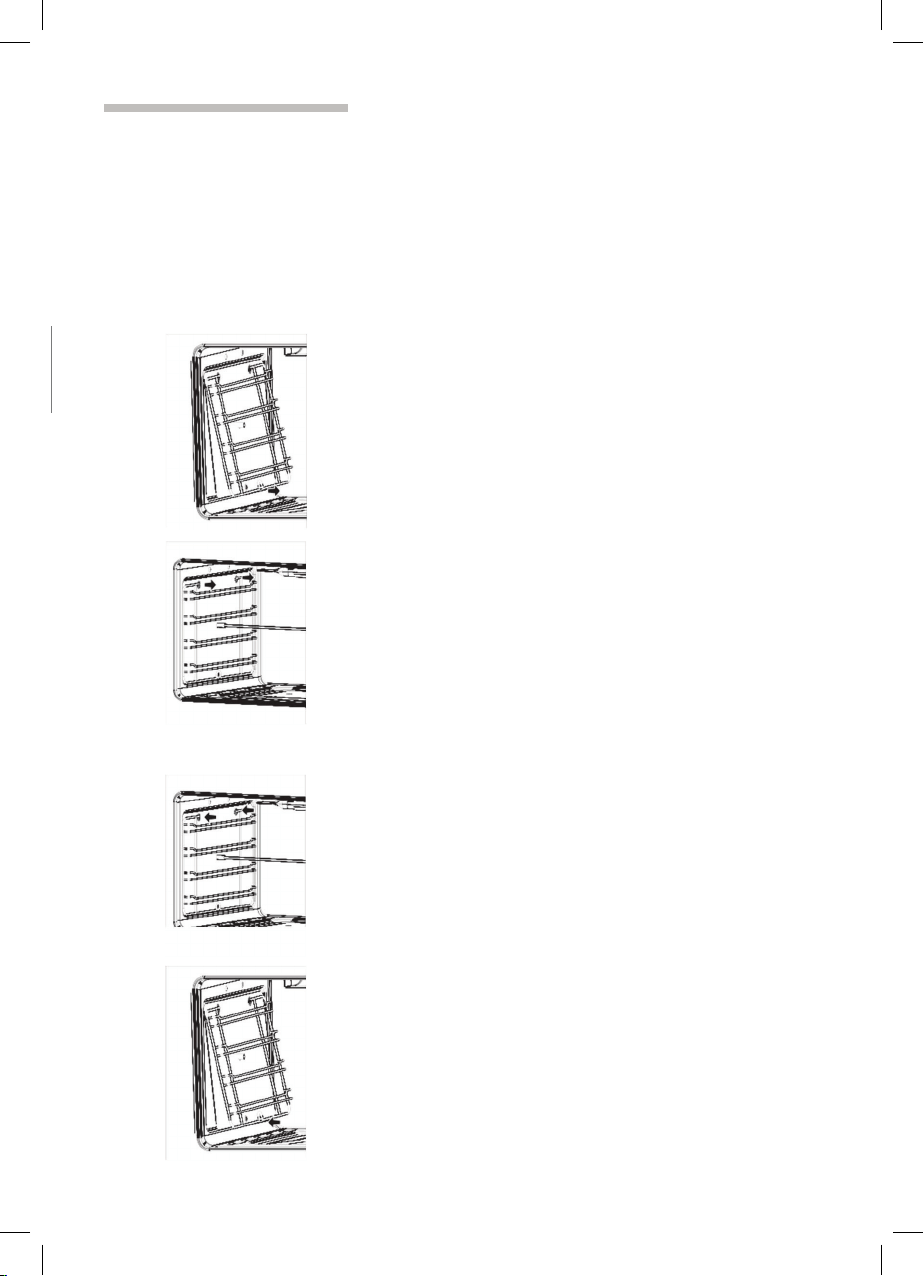
Fitting the appliance door Proceed as follows:
1.
Hold the appliance door at an angle.
2.
Insert both hinges, left and right, into the supports.
3. Position the door so that the hinge grooves
e
n
gage on both sides.
4.
Open the appliance door.
5.
Fold in the locking levers on both sides.
6.
C
l
ose the appliance door.
52
Removing and inserting the hook-in racks
You can remove the hook-in racks in order to clean
them separately.
The hook-in racks are all fixed to the walls of the
cooking compartment at four points.
Removing the hook-in
racks
To remove the hook-in racks, proceed as follows:
1.
Undo the screw on the bottom the hookin rack.
The lower hooks of the hook
-
in rack are released.
2.
Take hold of the top of the hook-in rack and screw
on the screw on the bottom the hook-in rack again.
I
n
serting the hook-in rack To reinsert the hook-in racks, proceed as follows:
1.
Insert the upper hooks into the drill holes in the
side panel.
2.
Pull the hook-in rack slightly downwards and insert
the lower hooks into the drill holes.
53

Faul
t
s and the after-sales service
Malfunctions often have simple explanations.
Please read the following notes before calling the
aftersales service.
Fault Possible cause Remedial action
T
h
e door panel steams up when
the oven is hot.
N
o
rmal occurrence;
caused by the
difference in
temperature.
N
o
t possible; this has no
effect on oven performance.
.
The appliance does not work. Defective circuit
breaker
Look in the fuse box and
check that the circuit breaker
for the appliance is in
working order.
All dishes that are prepared in
the oven become burnt very
quickly.
P
o
wer cut Check whether the kitchen
light works, for example.
Thermostat faulty Call the after-sales service.
The oven lighting has failed. Oven light is faulty Replace the oven light.
(see section "Replacing
oven light")
R
e
pairs may only be carried out by fully trained after-
sales service engineers.
If your appliance is not repaired professionally, you
may be exposing yourself to substantial risks.
54
Replacing the oven light bulb
WARNING: Ensure that the appliance is switched
off before replacing the lamp to avoid the
possibility of electric shock
If the oven light bulb fails, it must be replaced.
Replacement heat-resistant bulbs can be obtained
f
rom the after-sales service or from specialist
retailers. Please specify the SN number
of your appliance. Do not use any other type
of bulb.
Proceed as follows:
1.
Switch off the relevant circuit breaker.
2.
Open the appliance door.
3.
Lay a tea towel in the cooking compartment if it is
cold to prevent damage.
4.
Unscrew the glass cover from the bulb inside the
cooking compartment by turning it anti-clockwise.
5.
Replace the bulb with one of the same type.
Voltage: 230 V
Power: 25 W
Thread: E14
Temperature resistance: 300°C
6.
Screw on the glass cover again.
7.
Remove the tea towel and switch the circuit
breaker back on.
Turn the oven switch or your control panel in
position
in order to check whether the
oven lighting is working properly.
55

Faul
t
s and the after-sales service
Malfunctions often have simple explanations.
Please read the following notes before calling the
aftersales service.
Fault Possible cause Remedial action
T
h
e door panel steams up when
the oven is hot.
N
o
rmal occurrence;
caused by the
difference in
temperature.
N
o
t possible; this has no
effect on oven performance.
.
The appliance does not work. Defective circuit
breaker
Look in the fuse box and
check that the circuit breaker
for the appliance is in
working order.
All dishes that are prepared in
the oven become burnt very
quickly.
P
o
wer cut Check whether the kitchen
light works, for example.
Thermostat faulty Call the after-sales service.
The oven lighting has failed. Oven light is faulty Replace the oven light.
(see section "Replacing
oven light")
R
e
pairs may only be carried out by fully trained after-
sales service engineers.
If your appliance is not repaired professionally, you
may be exposing yourself to substantial risks.
54
Replacing the oven light bulb
WARNING: Ensure that the appliance is switched
off before replacing the lamp to avoid the
possibility of electric shock
If the oven light bulb fails, it must be replaced.
Replacement heat-resistant bulbs can be obtained
f
rom the after-sales service or from specialist
retailers. Please specify the SN number
of your appliance. Do not use any other type
of bulb.
Proceed as follows:
1.
Switch off the relevant circuit breaker.
2.
Open the appliance door.
3.
Lay a tea towel in the cooking compartment if it is
cold to prevent damage.
4.
Unscrew the glass cover from the bulb inside the
cooking compartment by turning it anti-clockwise.
5.
Replace the bulb with one of the same type.
Voltage: 230 V
Power: 25 W
Thread: E14
Temperature resistance: 300°C
6.
Screw on the glass cover again.
7.
Remove the tea towel and switch the circuit
breaker back on.
Turn the oven switch or your control panel in
position
in order to check whether the
oven lighting is working properly.
55

Aftersales service
Our after-sales service is there for you if your
appliance needs to be repaired. You will find the
address and telephone number of your nearest after-
s
a
les service centre in the phone book. The after-
sales service centres listed will also be happy to give
you the details of an after-sales service point near
you.
Please quote the SN number of the appliance when
contacting the after-sales service. These numbers
can be found on the rear backboard.
So you do not have to spend time looking for it if
there is a fault, you can enter the data for your
appliance here now.
SN
no.
After-sales service
SN number
56
T
i
ps and tricks
The following are tips and tricks to help you when
cooking food in your appliance.
Tips for saving energy
Here are a few tips for saving energy when using
the
hob and oven.
Tips on using the hob
Suitable cookware
diameter
Make sure that the diameter of the cookware is
suitable for the diameter of whichever hotplate
you
are using.
You can find an overview of suitable diameters in
the
section entitled “Your new appliance - the
hob”. The flame of the gas burner must not be
larger than
the diameter of the cookware.
Cookware with lids Use cookware with a flat bottom.
If possible, use cookware with lids to save gas.
Less water
To reduce the cooking time for e.g. vegetables
and
potatoes, use less water.
Tips on using the oven
Several cakes
It is best to bake several cakes one after the other.
The oven is still warm. This reduces the baking
time
for the second cake. You can also place two
cake tins
next to each other.
Using residual heat Where longer cooking times are used, you can switch
the oven off 10 minutes before the end of the cooking
time and use the residual heat to finish cooking.
Closing the appliance door Always keep the appliance door closed when it is in
operation. If you need to open the appliance door,
close it again as soon as possible. Otherwise, the
temperature will drop and the oven will need to
heat
itself up again.
57

Aftersales service
Our after-sales service is there for you if your
appliance needs to be repaired. You will find the
address and telephone number of your nearest after-
s
a
les service centre in the phone book. The after-
sales service centres listed will also be happy to give
you the details of an after-sales service point near
you.
Please quote the SN number of the appliance when
contacting the after-sales service. These numbers
can be found on the rear backboard.
So you do not have to spend time looking for it if
there is a fault, you can enter the data for your
appliance here now.
SN
no.
After-sales service
SN number
56
T
i
ps and tricks
The following are tips and tricks to help you when
cooking food in your appliance.
Tips for saving energy
Here are a few tips for saving energy when using
the
hob and oven.
Tips on using the hob
Suitable cookware
diameter
Make sure that the diameter of the cookware is
suitable for the diameter of whichever hotplate
you
are using.
You can find an overview of suitable diameters in
the
section entitled “Your new appliance - the
hob”. The flame of the gas burner must not be
larger than
the diameter of the cookware.
Cookware with lids Use cookware with a flat bottom.
If possible, use cookware with lids to save gas.
Less water
To reduce the cooking time for e.g. vegetables
and
potatoes, use less water.
Tips on using the oven
Several cakes
It is best to bake several cakes one after the other.
The oven is still warm. This reduces the baking
time
for the second cake. You can also place two
cake tins
next to each other.
Using residual heat Where longer cooking times are used, you can switch
the oven off 10 minutes before the end of the cooking
time and use the residual heat to finish cooking.
Closing the appliance door Always keep the appliance door closed when it is in
operation. If you need to open the appliance door,
close it again as soon as possible. Otherwise, the
temperature will drop and the oven will need to
heat
itself up again.
57

T
i
ps for using your appliance
The following tips relate to ovenware and cooking
and explain what to do if something goes wrong.
General tips Since a lower temperature allows more even
browning.
Clean the appliance and accessories after each
use,
once they have cooled down.
Always place baking tins or ovenware in the centre
of
the wire rack.
Always place cookware in the middle of the
hotplate
on the hob.
Boiling and frying
Cookware For dishes which require a lot of liquid, use deep-
sided pots so that they do not boil over.
The pan base must be clean, dry and flat.
58
B
a
king tips
How to confirm whether your
sponge cake is cooked
through.
Approximately 10 minutes before the end of the
baking time stated in the recipe, pierce the highest
point of the cake with a wooden skewer. If no cake
mixture sticks to the wood, the cake is ready.
The cake collapses.
Next time, use less liquid or bake at a slightly lower
temperature. Note the stirring times indicated in the
recipe.
The cake has risen high in the
middle and less around the
edges.
The cake is too dark on the
top.
D
o
not grease the edges of the baking tin. After
baking, carefully loosen the cake using a knife.
Place the cake lower in the oven and bake at a lower
temperature for slightly longer.
The cake is too dry.
Make tiny holes in the finished cake using a cocktail
stick. Then pour fruit juice or an alcoholic drink over
the cake. Next time, bake at a slightly higher
temperature for less time.
The bread or cake looks good
but it is streaked with water
inside.
The pastries are not evenly
browned.
Next time, use less liquid and bake at a lower
temperature for slightly longer. For cakes with a moist
topping: Pre-bake the base first. Sprinkle the base
with almonds and breadcrumbs and then pour the
topping on. Take care to follow recipes and baking
times.
Set the temperature slightly lower. Excess
greaseproof paper can affect the air circulation.
Always cut the greaseproof paper down to the size of
the baking tray.
Tips on using the rotary
spit
Place the joint as centrally as possible on the rotary
spit and secure it at both ends with the retaining clips.
You can also truss the joint with string. With
poultry,
bind the ends of the wings underneath the
back and
the thighs against the body. This will
prevent them
from becoming too dark.
Pierce the skin on the underside of the wings to
allow
the fat to escape.
59

T
i
ps for using your appliance
The following tips relate to ovenware and cooking
and explain what to do if something goes wrong.
General tips Since a lower temperature allows more even
browning.
Clean the appliance and accessories after each
use,
once they have cooled down.
Always place baking tins or ovenware in the centre
of
the wire rack.
Always place cookware in the middle of the
hotplate
on the hob.
Boiling and frying
Cookware For dishes which require a lot of liquid, use deep-
sided pots so that they do not boil over.
The pan base must be clean, dry and flat.
58
B
a
king tips
How to confirm whether your
sponge cake is cooked
through.
Approximately 10 minutes before the end of the
baking time stated in the recipe, pierce the highest
point of the cake with a wooden skewer. If no cake
mixture sticks to the wood, the cake is ready.
The cake collapses.
Next time, use less liquid or bake at a slightly lower
temperature. Note the stirring times indicated in the
recipe.
The cake has risen high in the
middle and less around the
edges.
The cake is too dark on the
top.
D
o
not grease the edges of the baking tin. After
baking, carefully loosen the cake using a knife.
Place the cake lower in the oven and bake at a lower
temperature for slightly longer.
The cake is too dry.
Make tiny holes in the finished cake using a cocktail
stick. Then pour fruit juice or an alcoholic drink over
the cake. Next time, bake at a slightly higher
temperature for less time.
The bread or cake looks good
but it is streaked with water
inside.
The pastries are not evenly
browned.
Next time, use less liquid and bake at a lower
temperature for slightly longer. For cakes with a moist
topping: Pre-bake the base first. Sprinkle the base
with almonds and breadcrumbs and then pour the
topping on. Take care to follow recipes and baking
times.
Set the temperature slightly lower. Excess
greaseproof paper can affect the air circulation.
Always cut the greaseproof paper down to the size of
the baking tray.
Tips on using the rotary
spit
Place the joint as centrally as possible on the rotary
spit and secure it at both ends with the retaining clips.
You can also truss the joint with string. With
poultry,
bind the ends of the wings underneath the
back and
the thighs against the body. This will
prevent them
from becoming too dark.
Pierce the skin on the underside of the wings to
allow
the fat to escape.
59
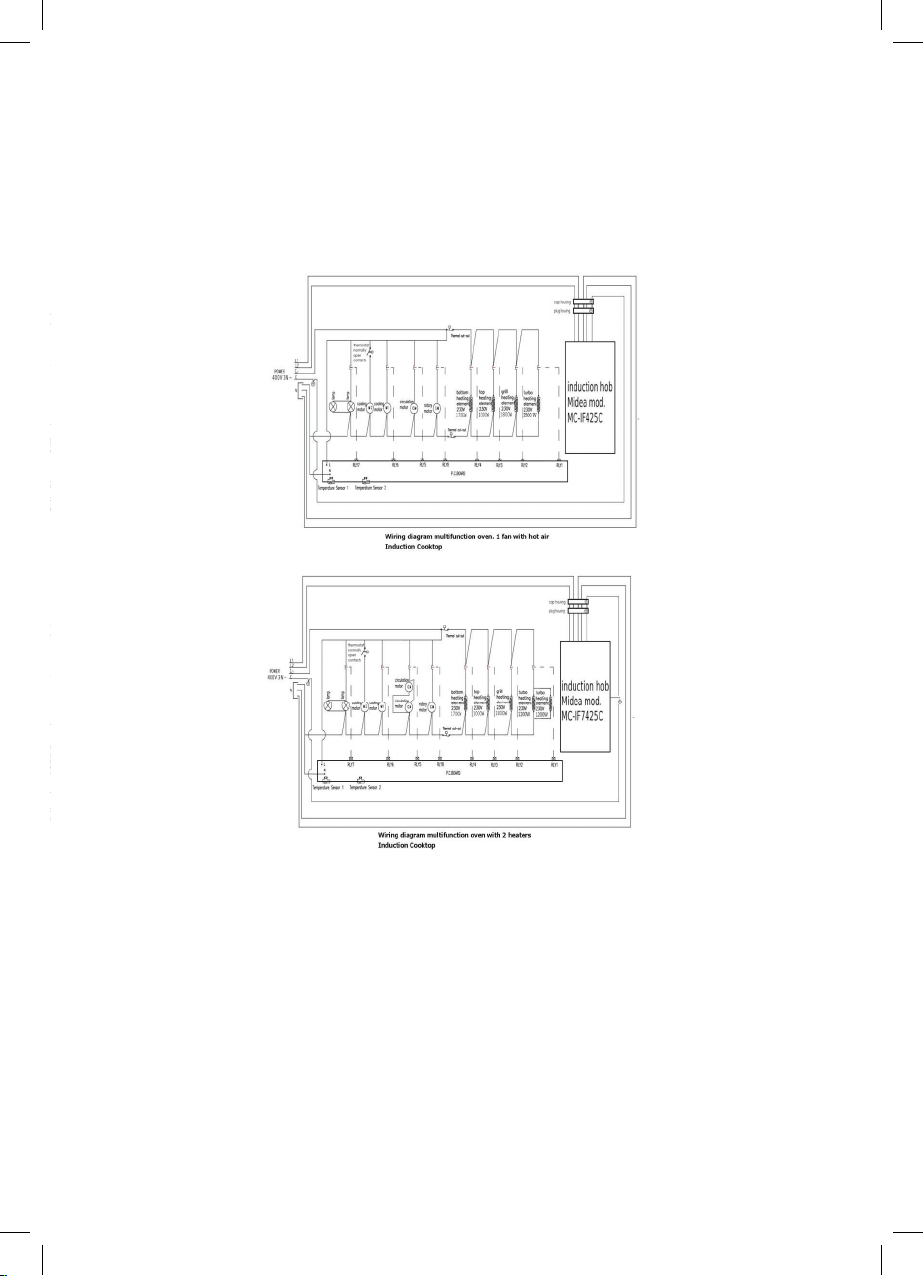
60

60

Warranty terms and conditions:
Cooking appliances (cookers)
This document sets out the terms and conditions of the
product warranties for Residentia Group Appliances. It is
an important document. Please keep it with your proof of
purchase documents in a safe place for future reference
should you require service for your Appliance.
1. In this warranty
(a) ‘acceptable quality’ as referred to in clause
10 of this warranty has the same meaning
referred to in the ACL;
(b) ‘ACL’ means Trade Practices Amendment
(Australian Consumer Law) Act (No.2) 2010;
(c) ‘Appliance’ means any Residentia Group
product purchased by you accompanied by
this document;
(d) ‘ASR’ means Residentia Group authorised
service representative;
(e) ‘Residentia Group’ means Residentia Group
Pty Ltd of 20 Yaltara Avenue, Bundoora
Victoria 3083, ACN 600 546 656 in respect
of Appliances purchased in Australia;
(f) ‘major failure’ as referred to in clause 10 of
this warranty has the same meaning referred
to in the ACL and includes a situation when
an Appliance cannot be repaired or it is
uneconomic for Residentia Group, at its
discretion, to repair an Appliance during the
Warranty Period;
(g) ‘Warranty Period’ means:
(i) where the Appliance is used for
personal, domestic or household
use (i.e. normal single family
use) as set out in the instruction
manual, the Appliance is warranted
against manufacturing defects for
24 months, following the date of
original purchase of the Appliance;
(h) ‘you’ means the purchaser of the Appliance
not having purchased the Appliance for re-
sale, and ‘your’ has a corresponding meaning.
2. This warranty only applies to Appliances purchased
and used in Australia and is in addition to (and does
not exclude, restrict, or modify in any way) any non-
excludable statutory warranties in Australia.
3. During the Warranty Period Residentia Group or
its ASR will, at no extra charge if your Appliance
is readily accessible for service, without special
equipment and subject to these terms and
conditions, repair or replace any parts which it
considers to be defective. Residentia Group or its
ASR may use remanufactured parts to repair your
Appliance. You agree that any replaced Appliances
or parts become the property of Residentia Group.
This warranty does not apply to light globes,
batteries, filters or similar perishable parts.
4. Parts and Appliances not supplied by Residentia
Group are not covered by this warranty.
Warranty
\

5. You will bear the cost of transportation, travel and
delivery of the Appliance to and from Residentia
Group or its ASR. If you reside outside of the
service area, you will bear the cost of:
(a) travel of an authorised representative;
(b) transportation and delivery of the Appliance
to and from Residentia Group or its ASR, in all
instances, unless the Appliance is transported
by Residentia Group or its ASR, the Appliance
is transported at the owner’s cost and risk
while in transit to and from Residentia Group
or its ASR.
6. Proof of purchase is required before you can make
a claim under this warranty.
7. You may not make a claim under this warranty
unless the defect claimed is due to faulty or
defective parts or workmanship. Residentia Group
is not liable in the following situations (which are
not exhaustive):
(a) the Appliance is damaged by:
(i) accident
(ii) misuse or abuse, including failure to
properly maintain or service
(iii) normal wear and tear
(iv) power surges, electrical storm
damage or incorrect power supply
(v) incomplete or improper installation
(vi) incorrect, improper or inappropriate
operation
(vii) insect or vermin infestation
(viii) failure to comply with any additional
instructions supplied with the
Appliance;
(b) the Appliance is modified without authority
from Residentia Group in writing;
(c) the Appliance’s serial number or warranty seal
has been removed or defaced;
(d) the Appliance was serviced or repaired by
anyone other than Residentia Group, an
authorised repairer or ASR.
8. This warranty, the contract to which it relates and
the relationship between you and Residentia Group
are governed by the law applicable where the
Appliance was purchased.
9. To the extent permitted by law, Residentia Group
excludes all warranties and liabilities (other than
as contained in this document) including liability
for any loss or damage whether direct or indirect
arising from your purchase, use or non use of the
Appliance.
10. For Appliances and services provided by
Residentia Group in Australia, the Appliances come
with a guarantee by Residentia Group that cannot
be excluded under the Australian Consumer Law.
You are entitled to a replacement or refund for a
major failure and for compensation for any other
reasonably foreseeable loss or damage. You are
also entitled to have the Appliance repaired or
replaced if the Appliance fails to be of acceptable
quality and the failure does not amount to a major
failure. The benefits to you given by this warranty
are in addition to your other rights and remedies
under a law in relation to the Appliances or services
to which the warranty relates.
11. At all times during the Warranty Period, Residentia
Group shall, at its discretion, determine whether
repair, replacement or refund will apply if an
Appliance has a valid warranty claim applicable to
it.
12. To enquire about claiming under this warranty,
please follow these steps:
(a) carefully check the operating instructions,
user manual and the terms of this warranty;
(b) have the model and serial number of the
Appliance available;
(c) have the proof of purchase (e.g. an invoice)
available;
(d) telephone the numbers shown below.
13. You accept that if you make a warranty claim,
Residentia Group and its ASR may exchange
information in relation to you to enable Residentia
Group to meet its obligations under this warranty.
Our goods come with guarantees that cannot be excluded under the
Australian Consumer Law. You are entitled to a replacement or refund for
a major failure and for compensation for any other reasonably foreseeable
loss or damage. You are also entitled to have the goods repaired or replaced
if the goods fail to be of acceptable quality and the failure does not amount
to a major failure.
Telephone contacts
► Service: Please call 1300 11 HELP (4357)
► Spare Parts: Please call 1300 11 SPARE (7727)
The Australian Consumer Law requires the inclusion of the following
statement with this warranty:
IMPORTANT
Before calling for service, please ensure that the steps
in point 12 have been followed.
Model Code
\
RU9EIB