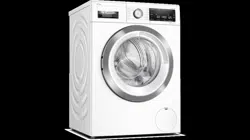
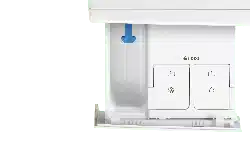
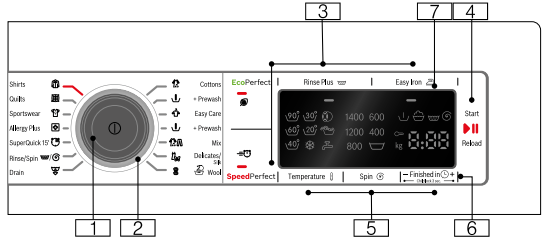
Note: All the buttons are sensitive (except for the main switch) and only need to be pressed lightly
1. Main switch
for switching the washing machine on and off: Press the button.
2. Programme selector
for selecting a programme. Overview of programmes → Page 29
3. Additional programme settings:
→ Page 34
■ EcoPerfect ,
■ SpeedPerfect ,
■ Rinse Plus ,
■ Easy Iron
4. button for:
■ Starting a programme
■ Interrupting a programme, e.g. to add items of laundry → Page 38
■ Cancelling a programme → Page 38
5. Changing the default programme settings: → Page 33
■ Temperature ,
■ Spin speed (Spin ),
■ Finished in time
6. Child lock 3 sec. ()
to prevent the set functions from being changed accidentally: To do so, press Finished in + and - simultaneously for approx. 3 seconds. → Page 37
7. Display panel for settings and information. → Page 26
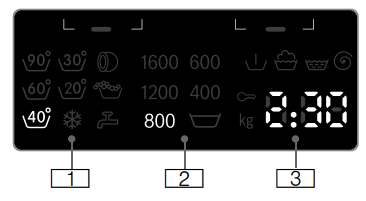
Display panel
Default programme settings:
1. Temperature in °C
- 90 ( = cold)
2. Spin speed in rpm, $ - 1600*;
- 1600*;
* Max. spin speed, depending on the selected programme and model,
= Rinse Stop → Page 33
3. Finished in time
e.g. 2:30; Programme duration depends on the programme selection in h:min (hours:minutes),
■ Preselection of end time
1 - 24 h;
Programme ends after ... h (h = hours)
■ Load recommendation
e.g. kg 8*;
* depending on the selected programme
Laundry
Prepare the laundry
Caution! Damage to the appliance/fabrics
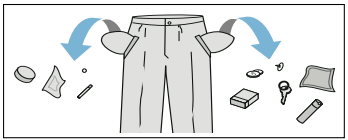
Foreign objects (e.g. coins, paperclips, needles, nails) may damage the laundry or components in the washing machine.
You should therefore note the following tips when preparing your laundry:
■ Empty any pockets.
■ Look out for metal items (paperclips, etc.) and remove them.
■ Wash delicates in a laundry bag (tights, underwired bras, etc.).
■ Close any zips; button up any cover buttons.
■ Brush sand out of pockets and collars.
■ Remove curtain fittings or place curtains in a laundry bag.
Sorting laundry
Sort your laundry according to the care instructions and manufacturer's information on the care labels, depending on:
■ Type of fabric/fibre
■ Colour
Note: Laundry may discolour. Wash white and coloured items separately. Wash new coloured items separately the first time you wash them.
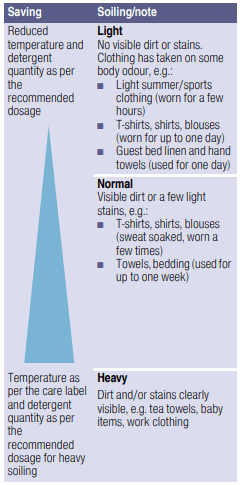
■ Soiling Wash laundry with the same level of soiling together.
Some examples of soiling levels can be found on → Page 28
– Light: Do not prewash, select the SpeedPerfect setting if necessary
– Normal
– Heavy: Load less laundry, select a programme with prewash
– Stains: Remove/pretreat stains while they are fresh. Firstly, dab with soapy water; do not rub. Then wash the items of laundry with the appropriate programme. Stubborn or dried-in stains can sometimes only be removed by washing several times.
■ Symbols on the care labels
Note: The numbers in the symbols indicate the maximum washing temperature that may be used.
Suitable for normal washing process;
e.g. Cottons programme
A gentle washing process is required;
e.g. Easy-Care programme
An especially gentle washing process is required; e.g. Delicate/Silk programme
Suitable for washing by hand; e.g. Woollens programme
Do not machine wash.
Detergent
Correct selection of detergent
The care label is crucial for selecting the correct detergent, temperature and treatment of the laundry.
■ Standard detergent with optical brighteners
Suitable for boil-washable white laundry made from linen or cotton Programme: Cottons/ cold - max. 90 °C
■ Detergent for colours without bleach or optical brighteners
Suitable for coloured laundry made from linen or cotton Programme: Cottons/ cold - max. 60 °C
■ Detergent for colours/delicates without optical brighteners
Suitable for coloured laundry made from easy-care fibres, synthetic fibres Programme: Easy-Care/ cold - max. 60 °C
■ Detergent for delicates
Suitable for delicate, fine fabrics, silk or viscose
Programme: Delicate/Silk/ cold - max. 40 °C
■ Detergent for woollens
Suitable for wool Wool programme/ cold - max. 40 °C
Saving energy and detergent
For light and normal soiling, you can save energy (lower washing temperature) and detergent.
Note: When measuring the amount of all detergents/additives/care products and cleaning agents, please always check the manufacturer's instructions and information. → Page 36
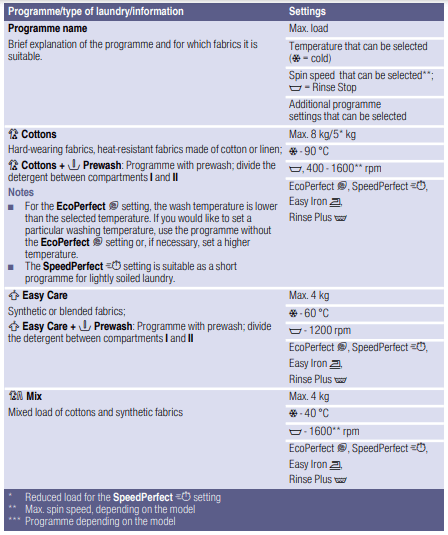
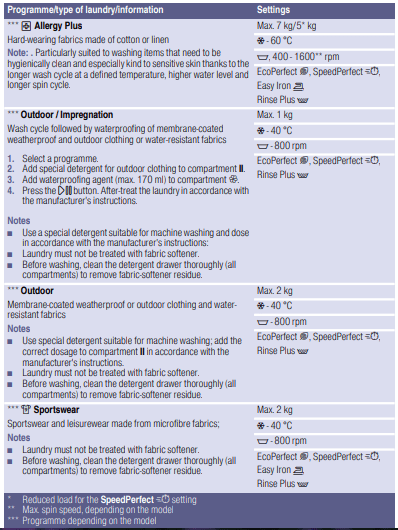
Overview of programmes
Programmes on the programme selector
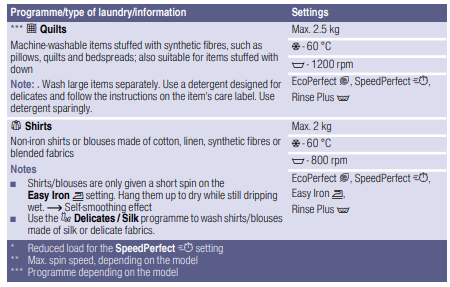
Starching
Note: Laundry should not be treated with fabric softener.
Liquid starch can be used to stiffen fabrics particularly in the Rinse and Cottons programmes. Measure starch into compartment in accordance with the manufacturer's instructions (clean first if necessary).
Dyeing/bleaching
Dye should only be used in normal household quantities. Salt may damage stainless steel. Always follow the dye manufacturer's instructions.
Do not use the washing machine to bleach clothes.
Soaking
1. Switch on the appliance.
2. Select the Cottons 30 °C programme.
3. Pour soaking agent/detergent into compartment in accordance with the manufacturer’s instructions.
4. Press the button. The programme starts.
5. After approx. 10 minutes, press the button to pause the programme.
6. Leave the laundry to soak for as long as required, then either press the button again to continue the programme or change the programme.
Notes
■ Load laundry of the same colour.
■ No additional detergent is required; the soaking solution is used for washing.
Programme default settings
The default programme settings are r displayed in the display panel after selecting the programme.
You can change the default settings.
An overview of all programme settings, which can be selected depending on the programme, can be found from → Page 29.
Temperature
Depending on what stage the programme is in, you can change the set temperature before and during the programme.
The maximum temperature that can be set depends on the programme that has been selected.
Spin speed
(Spin )
Depending on what stage the programme is in, you can change the spin speed (in rpm; revolutions per minute) before and during the programme.
Setting : Rinse Stop = no final spin. The laundry stays in the water after the final rinse.
You can select "Rinse Stop” to prevent creasing if the laundry will not be taken out of the washing machine immediately after the programme has ended.
To continue/end the programme → Page 38
The maximum speed that can be set depends on the model and programme that has been selected.
Finished in
Before starting the programme, you can preselect the programme end ("Ready in" time) in hourly increments (h = hour) up to a maximum of 24 hours.
To do this:
1. Select a programme.
The programme duration is displayed for the selected programme, e.g. 2:30 (hours:minutes).
2. Press the Finished in button repeatedly until the required number of hours is displayed.
Note: The setting values are increased using the Finished in + button, and decreased using the Finished in - button.
3. Press the button.
The programme starts.
The selected number of hours (e.g. 8 h) is shown in the display panel and counts down until the wash programme starts. The duration of the programme is then displayed.
Note: The length of the programme is automatically adjusted when the programme is running. Changes to the default programme settings or programme settings may also change the programme duration.
After starting the programme (if a Finished in time has been selected and the wash programme has not yet started), you can change the preselected number of hours as follows:
1. Press the button.
2. Use the Finished in - or + button to change the number of hours.
3. Press the button.
After starting the programme, you can add or remove laundry if necessary. → Page 38
Additional programme settings
An overview of all additional settings, d which can be selected depending on the programme, can be found from → Page 29.
EcoPerfect
Energy-optimised washing by reducing the temperature while achieving a washing result that is consistent with the selected programme, without the EcoPerfect setting.
SpeedPerfect
Washing in a shorter time while achieving a washing result that is consistent with, but uses more energy than, the selected programme, without the SpeedPerfect setting.
Note: Do not exceed the maximum load.
Overview of programmes → Page 29
Easy Iron
Reduces creasing thanks to a special spin sequence followed by fluffing and reduced spin speed.
Note: The washing's residual moisture is increased.
Rinse Plus
Additional rinse cycle for particularly sensitive skin and/or for areas with very soft water.
Operating the appliance
Preparing the washing rep machine
Note: The washing machine must be correctly installed and connected. From → Page 14.
1. Connect the mains plug.
2. Turn on the tap.
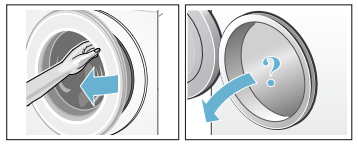
3. Open the door.
4. Check that the drum is completely drained. Drain if necessary.
Switching on the appliance/ selecting a programme
Press the button. The appliance is switched on.
The Cottons programme set at the factory is then always displayed.
You can use this programme or select a different programme. The programme selector can be turned in either direction.
Note: If you have activated the childproof lock, you must deactivate it before you can set a different programme. → Page 37
The indicator lamp on the programme selector lights up and the default programme settings for the selected programme appear in the display panel:
■ Temperature
■ Spin speed and
■ The maximum load and the duration of the programme (alternately)
In appliances with a drum light:
The drum is lit after switching on the appliance, after opening and closing the door and after starting the programme. The light switches off automatically.
Change the programme default settings
You can use or change the default settings for this washing cycle.
To do this, repeatedly press the corresponding button until the required setting is displayed.
Note: Pressing and holding the button automatically runs through the set values to the end. Then press the button once more and you can then change the setting values again.
The settings are activated without needing to be confirmed.
The settings are not saved after switching off the washing machine.
Default programme settings → Page 33
Select additional programme settings
By selecting additional settings, you can better adapt the washing process to your items of laundry.
The settings can be selected or deselected depending on the programme progress.
The button indicator lamps light up if a setting is activated.
The settings are not saved after switching off the washing machine.
Additional programme settings → Page 34
Start the programme
Press the button. The indicator lamp lights up and the programme starts.
The display panel shows the "Ready in" time while the programme is running or the programme length and the programme progress symbols when the washing programme has started. Display panel → Page 26
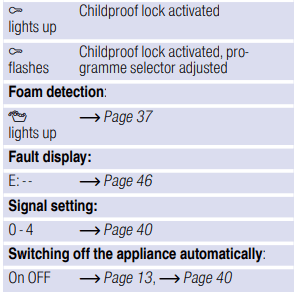
Note: Foam detection
If the symbol also lights up in the display panel, the washing machine has detected too much foam during the wash programme and automatically activated additional rinse cycles to remove the foam.
Add less detergent to the next washing cycle with the same load.
If you want to lock the programme to prevent it from being inadvertently adjusted, you can select the childproof lock as follows.
Child lock 3 sec.
()
You can lock the washing machine to prevent the functions you have set from being changed inadvertently. To do this, activate the childproof lock.
To activate/deactivate, press and hold the Finished in - and + buttons at the same time for approx. three seconds. The symbol is appears in the display panel.
■ lights up: The childproof lock is active.
■ flashes briefly: The childproof lock is active and the programme selector was turned or a button was pressed.
Note: The childproof lock remains active, even once the washing machine has been switched off. Before selecting the next programme, deactivate the childproof lock.
Adding laundry
After starting the programme, you can add or remove laundry if necessary.
Press the button to do this.
The button indicator lamp flashes and the machine checks whether it is possible to add laundry.
If the following appears in the display panel:
■ Both the - P - and symbols light up, it is possible to add laundry.
■ - P - lights up, it is not possible to add laundry.
To continue the programme, press the button. The programme continues automatically.
Notes
■ Do not leave the door open for too long when adding laundry as water from the laundry may leak out.
■ For safety reasons, the door remains locked when the water level or temperature is high, or while the drum is turning, and it is not possible to add laundry during this time.
■ The load display is not active during reloading.
Changing the programme
If you have started the wrong programme by mistake, you can change the programme as follows:
1. Press the button.
2. Select another programme.
3. Press the button. The new programme starts from the beginning.
Cancel the programme
For programmes at high temperatures:
1. Press the button.
2. To cool down laundry: Select Rinse.
3. Press the button.
For programmes at low temperatures:
1. Press the button.
2. Select Spin or Drain.
3. Press the button.
Programme end during rinse hold
In the display panel, flashes, and the preset spin speed and remaining programme length are displayed for the selected programme.
Continue the programme by:
■ Pressing the button or
■ Changing the spin speed, or setting the programme selector to Drain and then pressing the button.
Programme end
- 0 - and appear in the display panel. The button indicator lamp is off.
Removing laundry/switching off the appliance
1. Open the door and remove the laundry.
2. Press the button. The appliance is switched off.
3. Turn off the tap. Note: Not required for Aqua-Stop models.
Notes
■ Do not leave any items of laundry in the drum. They may shrink in the next wash or discolour another item.
■ Remove any foreign objects from the drum and the rubber seal – risk of rusting.
■ Wipe the rubber seal dry.
■ Leave the door and detergent drawer open so that any residual water can evaporate. → Page 42
■ Always wait until the programme ends, as the appliance could still be locked. Then switch the appliance on and wait for it to unlock.
■ If the display panel goes off at the end of a programme, the energysaving mode is active. Press any button to activate the panel.
Cleaning and maintenance
Machine housing/control panel
■ Wipe the housing and the control panel with a soft, damp cloth.
■ Remove the detergent residue immediately.
■ Do not clean with a water jet.
Drum
Use chlorine-free cleaning agents, do not use steel wool.
If there are odours in the washing machine, or to clean the drum, run the Cottons 90 °C programme without laundry. Add washing powder.
Descaling
Descaling should not be necessary if the detergent is measured out correctly. However, if it is required, follow the manufacturer's instructions for the descaling agent. Suitable descalers can be obtained via our website or from customer services. → Page 49
Detergent drawer and housing
If the washing machine contains detergent or fabric softener residues:
1. Pull out the detergent drawer. Press down the insert and fully remove the drawer.
2. To remove the insert: Push the insert upwards from below with your finger.
3. Clean the detergent dispenser tray and insert with water and a brush, and dry it. Clean the inside of the housing as well.
4. Fit the insert and lock it in place (push the cylinder onto the guide pin).
5. Push in the detergent drawer.
Note: Leave the detergent drawer open so that any residual water can evaporate.
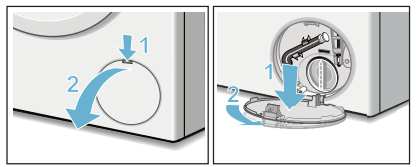
The drain pump is blocked, emergency draining
When you wash at high temperatures, the water gets very hot. If you come into contact with the hot water, you may be scalded.
Allow the water to cool down.
1. Turn off the tap so that no more water can flow in and has to be drained via the drain pump.
2. Switch off the appliance. Pull out the mains plug.
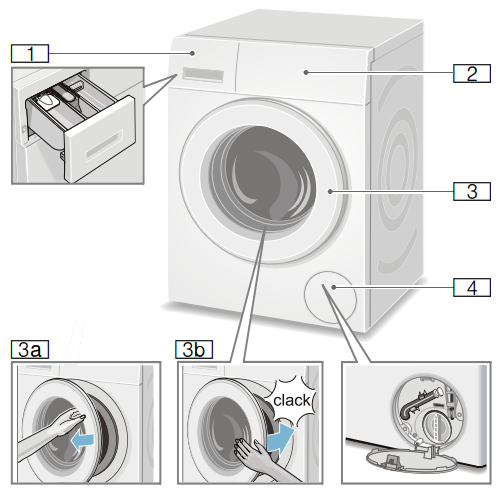
3. Open and remove the service flap.
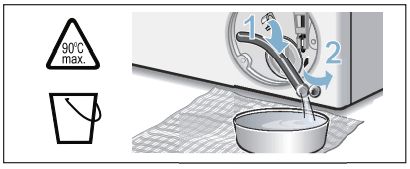
4. Take the drain hose out of the retainer.
Remove the sealing cap and pour the water out into a suitable container.
Replace the sealing cap and place the drain hose back in the retainer.
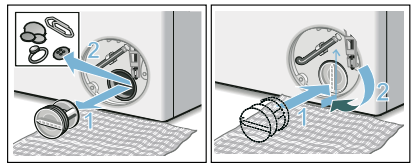
5. Carefully unscrew the pump cover; residual water may leak out.
Clean the interior, pump-cover thread and pump housing. The impeller in the drain pump must be able to rotate.
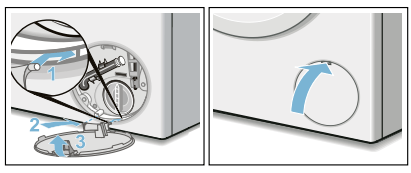
Refit the pump cover and screw it on tightly. The handle must be in a vertical position.
6. Place the service flap back on, lock it into place, and close it.
Note: To prevent unused detergent from flowing straight into the drain during the next wash: Pour 1 litre of water into compartment and start the Drain programme.
The drain hose at the siphon is blocked
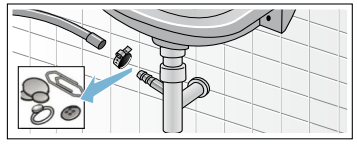
1. Switch off the appliance. Pull out the mains plug.
2. Loosen the hose clamp. Carefully remove the drain hose; residual water may leak out.
3. Clean the drain hose and siphon connecting piece.
4. Re-attach the drain hose and secure the connection point using the hose clamp.
Filter in the water supply blocked
First, reduce the water pressure in the supply hose:
1. Turn off the tap.
2. Select any programme (except Rinse/Spin/Empty).
3. Press the button. Allow the programme to run for approximately 40 seconds.
4. Press the button. The appliance is switched off. 5. Pull out the mains plug.
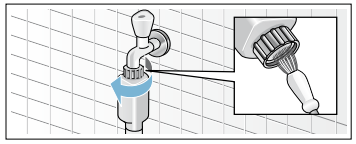
Then clean the filter:
1. Disconnect the hose from the tap. Clean the filter with a small brush.
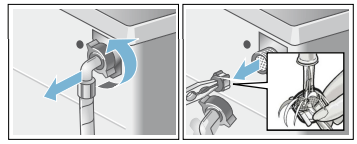
2. For standard and Aqua-Secure models, clean the filter on the rear of the appliance:
Remove the hose from the rear of the appliance.
Use pliers to remove the filter and then clean it.
3. Connect the hose and check for leaks.
Faults and what to do about them.
Emergency release
E.g. in the event of a power cut
The programme continues when the power supply is restored.
However, if the laundry has to be removed, the washing machine door can be opened as follows:
Warning
Risk of scalding!
When you are washing at high temperatures, there is a risk of scalding if you come into contact with hot water and laundry.
If possible, leave it to cool down first.
Warning
Risk of scalding!
You may injure your hands if you reach into the drum while it is turning.
Do not reach into the drum when it is turning.
Wait until the drum has stopped turning.
Caution!
Water damage
Any escaping water may cause water damage.
Do not open the door if water can be seen through the glass.
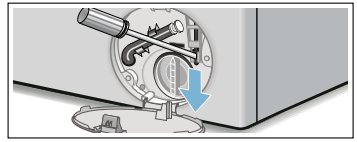
1. Switch off the appliance. Pull out the mains plug.
2. Drain the water. → Page 43
3. Pull the emergency release downwards with a tool and release. The door can then be opened.
Information on the display panel
Faults
Cause/Remedy
Water is leaking from the machine.
■ Attach the drain hose correctly or replace it.
■ Tighten the screw fitting on the supply hose.
The machine is not filling with water.
Detergent is not being dispensed.
■ Have you pressed the button?
■ Is the tap turned on?
■ Could the filter be clogged? Clean the filter. → Page 44
■ Is the supply hose kinked or trapped?
The door cannot be opened.
■ The safety function is activated. Stop the programme? → Page 38
■ Is the childproof lock activated? Deactivate it. → Page 37
■ Is selected (Rinse Stop = no final spin)? → Page 38
■ Can the door only be opened by the emergency release? → Page 45
The programme will not start.
■ Have you pressed the button or selected Finished in time?
■ Is the door closed?
■ Is the childproof lock activated? Deactivate it. → Page 37
The drum briefly jerks or judders after the programme has started.
Not a fault – the internal motor test may cause the drum to jerk or judder briefly when the wash programme starts.
The water is not draining.
■ Is selected (Rinse Stop = no final spin)? → Page 38
■ Clean the drain pump. → Page 43
■ Clean the drain pipe and/or the drain hose.
Water is not visible in the drum.
Not a fault – the water is below the visible area.
The spin result is not satisfactory.
Laundry is wet/too damp.
■ Not a fault – the unbalanced load detection system has interrupted the spin cycle because the laundry is unevenly distributed. Distribute small and large items of laundry evenly in the drum.
■ Is Easy Iron selected (depending on the model)? → Page 34
■ Is the selected speed too low?
The spin cycle runs several times.
Not a fault – the unbalanced load detection system is adjusting an imbalance.
The programme is taking longer than usual.
■ Not a fault – the unbalanced load detection system is adjusting an imbalance by repeatedly distributing the laundry.
■ Not a fault – the foam detection system is active – a rinse cycle has been switched on. → Page 37
The length of the programme changes during the wash cycle.
Not a fault – the programme sequence is optimised for the specific washing process. This may change the length of the programme shown in the display panel.
Residual water in the care-product compartment .
■ Not a fault – the effect of the care product is not affected.
■ Clean the insert if necessary. → Page 43
Odours in the washing machine.
Run the Cottons 90 °C programme without laundry.
Add washing powder or a detergent containing bleach.
Note: . To prevent foaming, only use half of the amount of detergent recommended by the detergent manufacturer. Do not use detergents designed for woollens or delicates.
The symbol lights up in the display panel. Foam may also be leaking from the detergent drawer.
Have you used too much detergent?
Mix one tablespoon of fabric softener with 1/2 litre of water and pour it into compartment (not suitable for outdoor clothing, sportswear or items stuffed with down).
Use less detergent in the next washing cycle.
Loud noises, vibrations and machine "movement" during the spin cycle.
■ Is the appliance aligned? Align the appliance. → Page 20
■ Are the appliance's feet fixed? Secure the appliance's feet. → Page 20
■ Have the transport braces been removed? Remove the transport braces. → Page 16
The display panel/ indicator lamps do not work while the appliance is running.
■ Has there been a power failure?
■ Have the fuses blown? Reset/replace the fuses.
■ If the fault occurs repeatedly, call customer services.
There is detergent residue on the laundry.
■ Some phosphate-free detergents contain water-insoluble residue.
■ Select Rinse or brush the laundry after washing.
- P - appears in the display panel when the cycle is paused.
■ The water level is too high. It is not possible to add laundry. Close the door immediately, if necessary.
■ Press the button to continue the programme.
- P - and appear in the display panel when the cycle is paused.
The door is unlocked. It is possible to add laundry.
If you cannot rectify a fault yourself (after switching the machine off and on again) or a repair is required:
■ Switch off the appliance and pull out the mains plug.
Q: Hello , I just replaced a water pump in my Daughter Bosch waw28441au all went well except I cannot establish where to attach the the early release cable to ?your help will be greatly appreciated Reply
 button.
 ,
, ,
, ,
,
 button for:
 ,
, ),
), time
time )
)
 - 90 (
 - 1600*;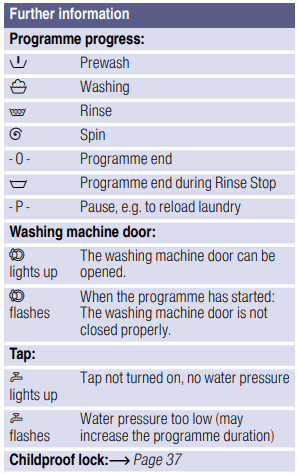


 in accordance with the manufacturer's instructions (clean first if necessary).
 Cottons 30 °C programme.
 in accordance with the manufacturer’s instructions.
 button. The programme starts.
 button. The appliance is switched on.
 Cottons programme set at the factory is then always displayed.
 button. The indicator lamp lights up and the programme starts.
 symbol also lights up in the display panel, the washing machine has detected too much foam during the wash programme and automatically activated additional rinse cycles to remove the foam.
 symbols light up, it is possible to add laundry.
 Rinse.
 Spin or
  Drain.
 flashes, and the preset spin speed and remaining programme length are displayed for the selected programme.
 button. The appliance is switched off.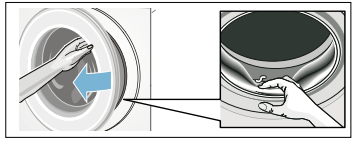
 Cottons 90 °C programme without laundry. Add washing powder.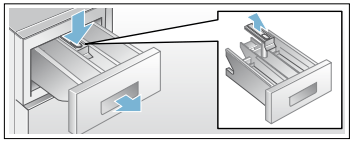
 and start the
  Drain programme.