User Manual Washing Machine
Installation and connection
Unpacking the appliance
Note: Please read the information in the "Safety" → Page 4 and "Preventing material damage" → Page 11 sections to ensure that you use the appliance safely
ATTENTION: Objects remaining in the drum that are not designed for operation with the appliance may cause material damage and damage to the appliance.
- Remove these objects, along with all supplied accessories, from the drum before starting the appliance.
- Remove any packaging and protective covers completely from the appliance. For the environmentally friendly disposal of the packaging materials, observe the information on the topic of → "Disposing of packaging", Page 12.
- Check the appliance for visible damage.
- Open the door. → "Basic operation", Page 36
- Remove the accessory from the drum.
- Close the door.
Contents of package
After unpacking all parts, check for any damage in transit and the completeness of the delivery.
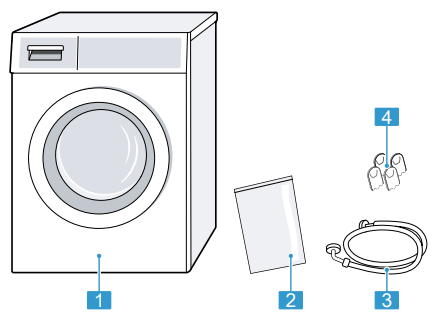
1. Washing machine
2. Accompanying documents
3. Water inlet hose
4. Cover caps
Requirements for the installation location
The appliance may "wander" when it spins. Observe the instructions for the installation location.
Note: Please read the information in the "Safety" → Page 4 and "Preventing material damage" → Page 11 sections to ensure that you use the appliance safely.
Removing the transit bolts
The appliance is secured for transportation using transit bolts on the rear of the appliance.
Notes
- Please read the information in the "Safety" → Page 4 and "Preventing material damage" → Page 11 sections to ensure that you use the appliance safely.
- Keep the transit bolts, screws and sleeves in a safe place for future "transport" → Page 66.
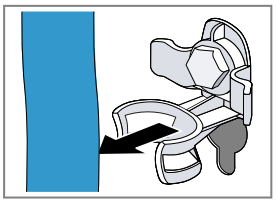
1. Pull the hoses out of the holders
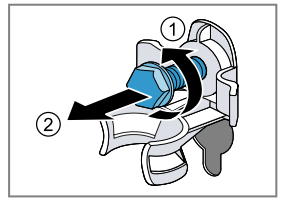
2. Unscrew 1 and remove 2 all four screws for the transit bolts with a WAF 13 wrench.
3. Pull the power cord out of the holder.
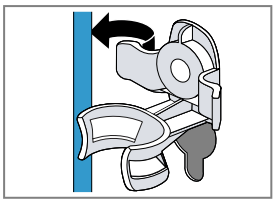
4. Remove the four sleeves.
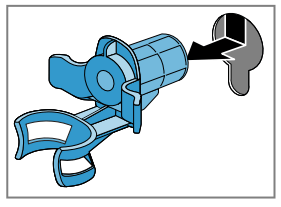
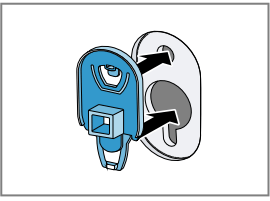
5. Put on the four cover caps.
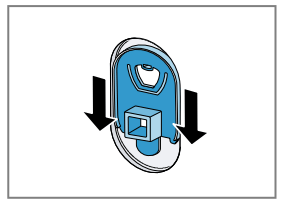
6. Press down on the four cover caps.
Connecting the appliance
Connect your appliance to the power supply, water inlet and water outlet.
Connecting the water inlet hose
Note: Please read the information in the "Safety" → Page 4 and "Preventing material damage" → Page 11 sections to ensure that you use the appliance safely.
1. Connect the water inlet hose
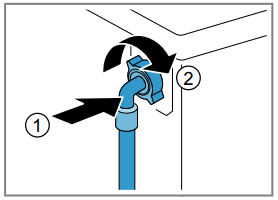
2. Connect the water inlet hose to a tap (26.4 mm = 3/4").
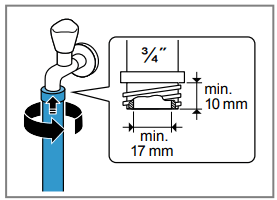
3. Open the water tap carefully and check that the connection points are tight.
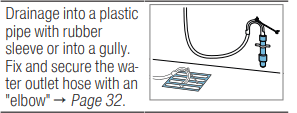
Water outlet connection types
This information is intended to help you to connect this appliance to the water outlet.
Note: Please read the information in the "Safety" → Page 4 and "Preventing material damage" → Page 11 sections to ensure that you use the appliance safely.
ATTENTION : When draining, the water outlet hose is subject to water pressure and may come loose from the installed connection point.
- Secure the water outlet hose against unintentional loosening.
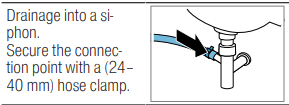
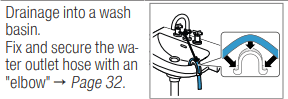
Connecting the appliance to the electricity supply
Note: Please read the information in the "Safety" → Page 4 and "Preventing material damage" → Page 11 sections to ensure that you use the appliance safely.
1. Insert the mains plug of the appliance's power cable in a socket nearby. The connection details of the appliance can be found under "Technical data" → Page 69.
2. Check the mains plug is inserted properly
Aligning the appliance
In order to reduce noise and vibration and to prevent the appliance from moving, align the appliance correctly. Note: Please read the information in the "Safety" → Page 4 and "Preventing material damage" → Page 11 sections to ensure that you use the appliance safely.
1. Loosen the lock nuts using a WAF 17 wrench by turning it in a clockwise direction.
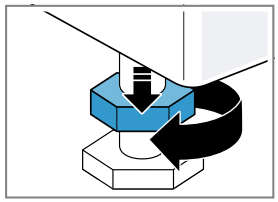
2. To align the appliance, turn the appliance's feet. Check that the appliance is level using a spirit level.
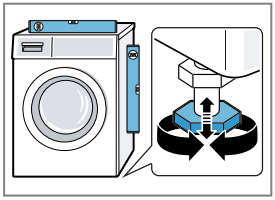
All appliance feet must stand firmly on the ground.
3. Screw the lock nuts tightly against the housing using a WAF 17 wrench.
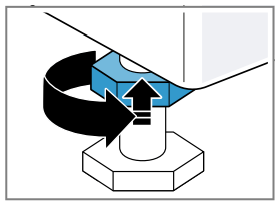
In doing so, hold the foot tight and do not adjust its height.
Familiarising yourself with your appliance.
Appliance
You can find an overview of the parts of your appliance here
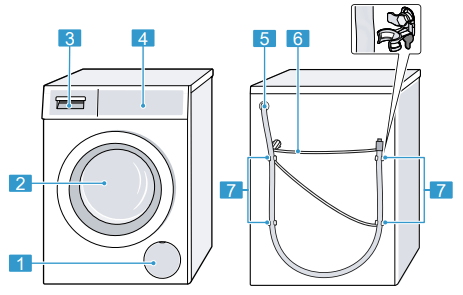
On certain models, specific details such as the color and shape may differ from those pictured.
1 "Maintenance flap for the drain pump" → Page 50
2 Door
3 "Detergent drawer" → Page 20
4 "Controls" → Page 20
5 "Water outlet hose" → Page 17
6 "Power cord" → Page 17
7 "Transit bolts" → Page 15
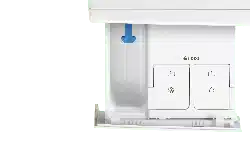
Detergent drawer
Below is an overview of the structure of the detergent drawer.
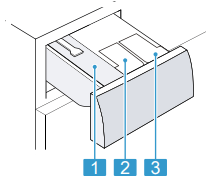
1 Manual dosing compartment
2  Dispenser for fabric softener or detergent
3  : Dispenser for detergent
Controls
The controls are used to configure all functions of your appliance and to obtain information about the operating status.
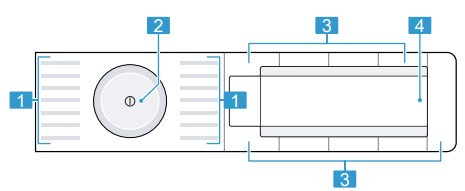
1 "Programmes" → Page 26
2 "Programme selector" → Page 36
3 "Buttons" → Page 24
4 "Display" → Page 21
Display
The display shows the current settings, options or relevant information.
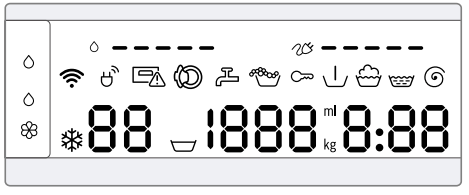
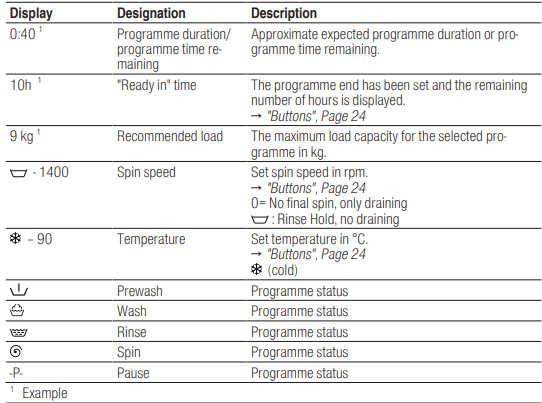
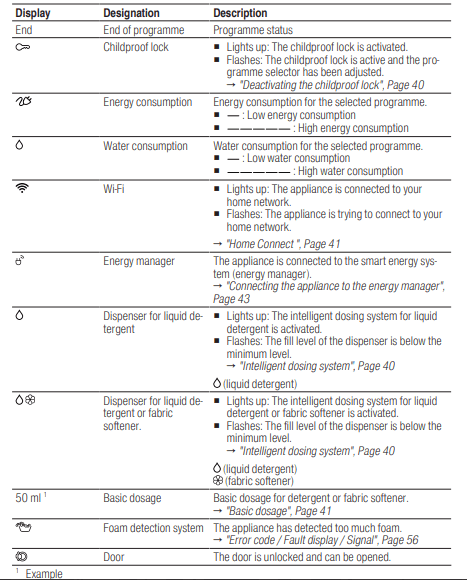
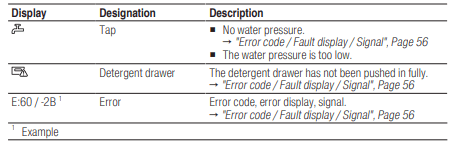
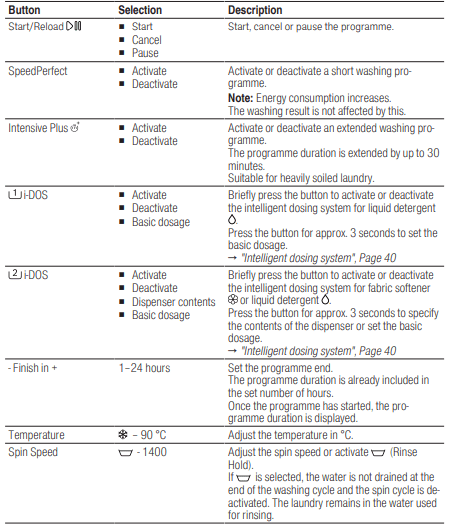
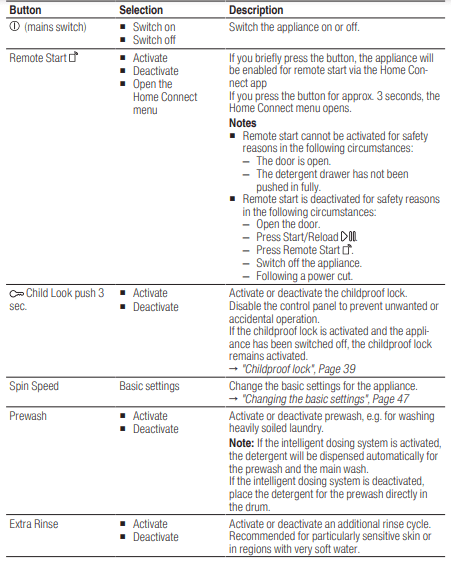
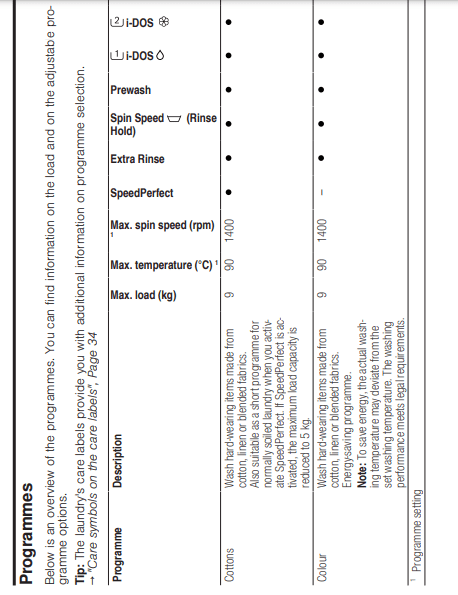
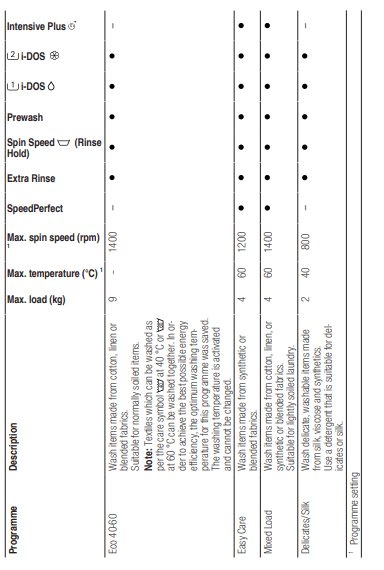
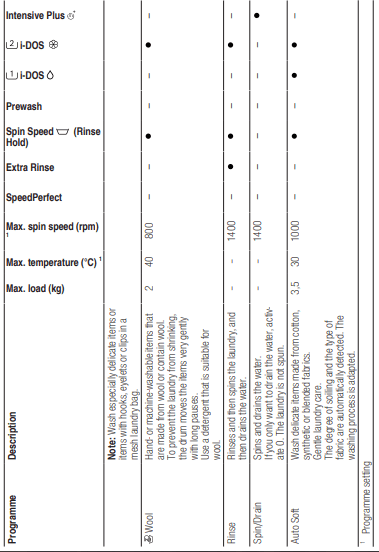
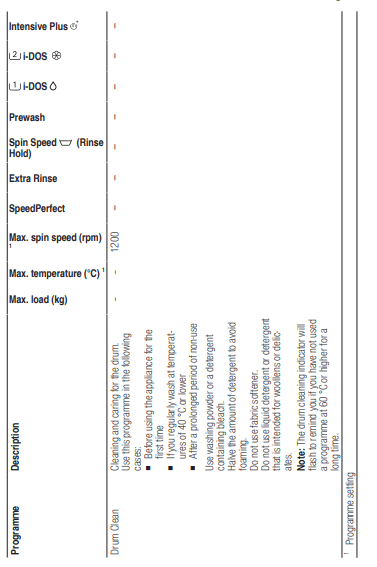
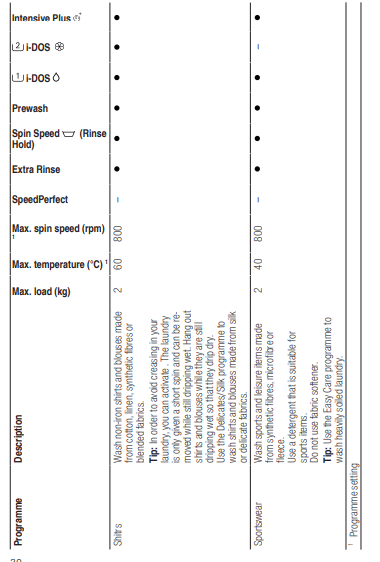
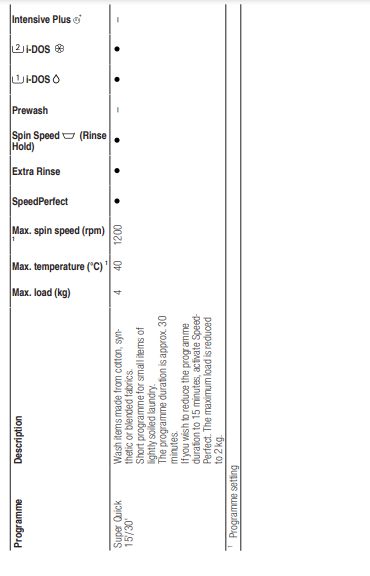
Below is an overview of the buttons and their setting options. The selection of program settings depends on the selected program. You can see the selection options for each program in the overview for → "Programmes", Page 26.
Accessories
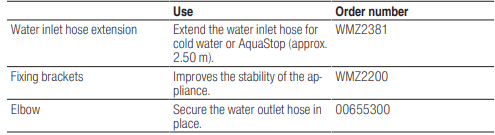
Only use original accessories. These have been made especially for your appliance. Here you can find an overview of your appliance's accessories and how to use them.
Before using for the first time
Starting an empty washing cycle
Your appliance was inspected thoroughly before leaving the factory. To remove any residual water, run the first wash cycle without any laundry.
Note: Please read the information in the "Safety" → Page 4 and "Preventing material damage" → Page 11 sections to ensure that you use the appliance safely.
1. Press .
.
It may take a few seconds for the appliance to switch on.
2. Set the Drum Clean program.
3. Close the door.
4. Pull out the detergent drawer.
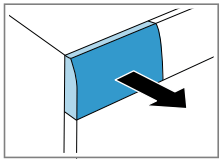
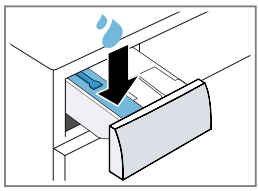
5. Pour approx. 1 liter of water into the manual dosing compartment.
6. Add washing powder to the manual dosing compartment.
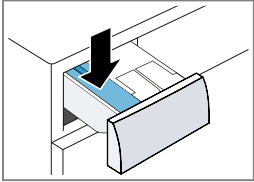
To prevent foaming, use only half of the amount of detergent recommended by the detergent manufacturer for light soiling. Do not use detergent suitable for woolens or delicates.
7. Push in the detergent drawer.
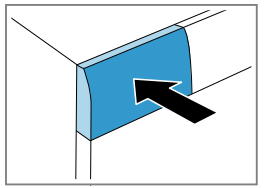
8. Press Start/Reload to start the program.
- The display shows the remaining program duration.
- After the program has ended, the display shows End.
9. Start the first wash cycle or press to switch off the appliance. → "Basic operation", Page 36
Laundry
You can wash all items that the manufacturer has marked as machine washable on the care label and fabrics made from hand-washable wool using your appliance.
Preparing the laundry
ATTENTION : Objects remaining in the laundry may damage the laundry and the drum.
▶ Remove all items from any pockets in your laundry before using the appliance.
▶ To protect your appliance and the laundry, prepare the laundry beforehand.
- Empty all pockets
- Brush sand out of all collars and pockets
- Close bed covers and cushion covers
- Close all zips, Velcro fasteners, hooks and eyes
- Tie cloth belts and apron strings together or use a mesh laundry bag
- Remove curtain hooks and lead strips or use a mesh laundry bag
- Use a mesh laundry bag for small items of laundry such as children's socks
- Separate items of laundry and shake them out
- Wash large and small items of laundry together
- Dab fresh stains with soapy water (do not rub them)
- Some stubborn or dried-in stains can be removed by washing several times
Sorting laundry
Note: Please read the information in the "Safety" → Page 4 and "Preventing material damage" → Page 11 sections to ensure that you use the appliance safely.
▶ To improve washing results and prevent discoloration, sort the laundry according to the following criteria before washing.
- Type of fabric and fiber type
- Whites
- Colors Wash new colored items separately the first time you wash them. – "Soiling" → Page 34
- "Care symbols on the care labels" → Page 34
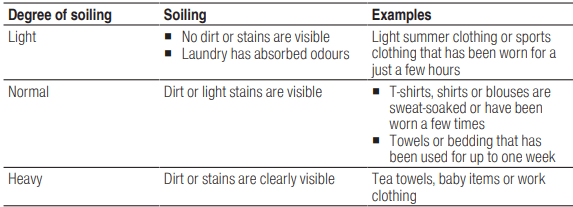
Degrees of soiling
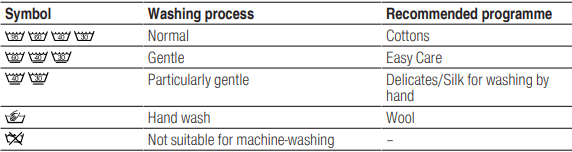
 Care symbols on the care labels
The symbols indicate the recommended program and the numbers in the symbols indicate the maximum recommended washing temperature.
Detergents and care products
You can protect your appliance and your laundry by selecting and using the correct detergents and care products. You can use all detergents and care products which are suitable for domestic washing machines.
Note: Please read the information in the "Safety" → Page 4 and "Preventing material damage" → Page 11 sections to ensure that you use the appliance safely. The manufacturer's instructions for use and dosage can be found on the packaging.
Detergent recommendation
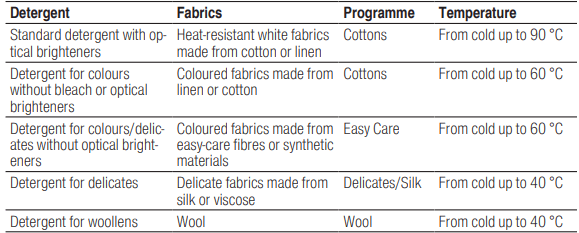
This information helps you to choose the right detergent for your fabrics.
 Detergent dosage
Use the correct detergent dosage to achieve optimal washing results and save resources. The detergent dosage depends on:
- The amount of laundry
- Degree of soiling
- Water hardness You can find out how hard your water is from your local water company or measure it yourself using a water hardness tester.
Water hardness

Example of a manufacturer's instructions for detergent :These example values refer to a standard load of 4–5 kg.

The dosages can be found on the manufacturer's packaging.
- If you are not using manual dosage, adjust the dosage to the actual load.
- If intelligent dosing is activated, do not adjust the dosage to the actual load capacity. The quantity of detergent and fabric softener is automatically calculated via the "basic dosage" → Page 41 and the amount of laundry detected. The basic dosage setting must always comply with the dosage for a load of 4.5 kg.
operation Basic operation
You can find out everything you need to know about operating your appliance here.
Switching on the appliance
▶ Press .
It may take a few seconds for the appliance to switch on.
Setting a program
1. Set the program selector to the required "program" → Page 26.
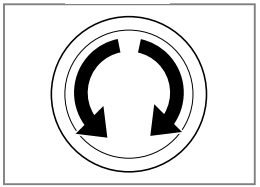
2. If necessary, "adjust the program settings" → Page 37.
Adjusting the program settings
Depending on the program and program progress, you can adjust or activate/deactivate the settings.
Note: Overview of all program settings: → "Buttons", Page 24 Requirement: A program has been set.
▶ Adjust the program settings. The program settings are not saved permanently for the program.
Note: The setting is saved if you activate or deactivate the intelligent dosing system.
Loading laundry
Notes
- Please read the information in the "Safety" → Page 4 and "Preventing material damage" → Page 11 sections to ensure that you use the appliance safely.
- To prevent creasing, take note of the maximum load for the relevant "program" → Page 26.
Requirement: Prepare and sort the laundry. → "Laundry", Page 33
1. Open the door
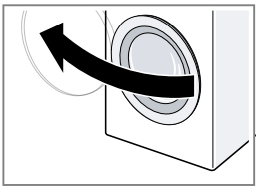
2. Ensure that the drum is empty.
3. Separate the laundry and place it in the drum.
4. Note: Ensure that there is no laundry trapped in the door. Close the door.
Adding detergent and care product
For programs in which intelligent dosing is not possible or desirable, you can add detergent to the manual dosing compartment.
Note: Please read the information in the "Safety" → Page 4 and "Preventing material damage" → Page 11 sections to ensure that you use the appliance safely.
Tip: In addition to intelligent dosing, you can also add additional care products for the laundry, e.g. stain remover, starch or bleach, to the manual dosing compartment. Do not add any additional detergent to the manual dosing compartment to avoid overdosage and/or foaming.
Requirement: Find out the optimum dosage for "detergent and care product." → Page 35
1. Pull out the detergent drawer.
2. Pour in detergent. → "Detergent drawer", Page 20
3. If required, add the care product.
4. Push in the detergent drawer.
Starting the program
Note: If you want to change the time until the program ends, set the "Ready in" time first.
▶ Press Start/Reload .
- The drum rotates and load detection takes place. This can take up to 2 minutes, after which water enters the drum.
- The display shows either the program duration or the "Ready in" time.
- After the program has ended, the display shows End.
Soaking laundry
You can soak the laundry before washing in the appliance by pausing the program.
Note: No additional detergent is required. The washing solution is then used for washing.
1. Start the program.
2. To pause the program, after approx. 10 minutes, press Start/Reload .
3. To resume the program, after the desired soaking time, press Start/Reload .
Adding laundry
Note: Please read the information in the "Safety" → Page 4 and "Preventing material damage" → Page 11 sections to ensure that you use the appliance safely.
1. Press Start/Reload . The appliance is paused and checks whether it is possible to add or remove laundry. Take note of the program status.
2. Add or remove laundry.
3. Close the door.
4. Press Start/Reload .
Canceling the program
Once the program has started, you can cancel it at any time.
Note: Please read the information in the "Safety" → Page 4 and "Preventing material damage" → Page 11 sections to ensure that you use the appliance safely.
1. Press Start/Reload .
2. Open the door.
The appliance door remains locked for safety reasons if the temperature and water levels are high.
– If the temperature is high, start the Rinse program.
– If the water level is high: Start the Spin or Drain programme.
3. Remove the laundry.
Resuming the program when the program status is Rinse Hold
1. Set the Spin or Drain program.
2. Press Start/Reload .
Unloading the laundry
Note: Please read the information in the "Safety" → Page 4 and "Preventing material damage" → Page 11 sections to ensure that you use the appliance safely.
1. Open the door.
2. Remove the laundry.
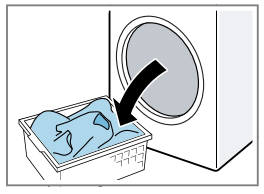
Switching off the appliance
1. Press .
2. Turn off the tap.
3. Wipe the rubber gasket dry and remove any foreign objects.
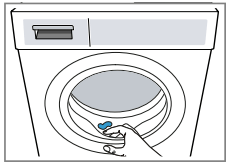
4. Leave the door and detergent drawer open so that residual water can evaporate.
Childproof lock
Childproof lock Secure your appliance against being operated unintentionally using the controls.
Activating the childproof lock
▶ Press and hold the two Child Look push 3 sec. buttons for approx. 3 seconds.
- The display shows .
- The controls are locked.
- The childproof lock remains active even after the appliance has been switched off.
Deactivating the childproof lock
Requirement: To deactivate the childproof lock, the appliance must be switched on.
▶ Press and hold the two Child Look push 3 sec. buttons for approx. 3 seconds. So that the program currently running is not canceled, the program selector must be set to the initial program.
- goes out in the display.
Intelligent dosing system
Your appliance has an intelligent dosing system for liquid detergent and fabric softener. The optimum quantities of liquid detergent and fabric softener are dispensed automatically depending on the program and settings. The intelligent dosing system has been activated at the factory for all the designated "programs" → Page 26 and can be deactivated for each one individually. In all other programs, you can manually add detergent. → "Adding detergent and care product", Page 38
Filling the dispenser
Note : In order to use intelligent dosing, fill the dispenser.
- Fill the dispenser only with suitable "detergent and care products" → Page 35.
- If you change the liquid detergent or fabric softener, empty and clean the dispenser beforehand. → "Cleaning the detergent drawer", Page 48
- If you want to use both dispensers for liquid detergent, adjust the "contents of the dispenser" → Page 41.
Requirement:  flashes.
1. Pull out the detergent drawer.
2. Open the dispenser lid.
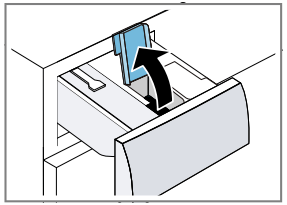
3. Pour liquid detergent and fabric softener into the relevant dispensers. → "Detergent drawer", Page 20
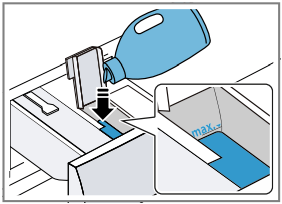
4. Close the dispenser lid.
Note: To prevent the detergent from drying out or drying up, do not leave the dispenser lid open for a long period of time.
5. Push in the detergent drawer.
6. Adjust the "basic dosage" → Page 41.
Dispenser contents
When it leaves the factory, the dispenser is set for fabric softener . Alternatively, you can also use this dispenser for a second liquid detergent
 .
.
Notes
- If you change the content of the dispenser, the basic dosage for this dispenser is reset.
- If you use both dispensers for liquid detergent, you must select a dispenser that is to be used during washing.
Adjusting the dispenser contents
1. Press and hold i-DOS for approx. 3 seconds.
2. To set , press i-DOS. a The display shows .
3. To set , press i-DOS again.
4. To end the setting process, wait briefly.
Basic dosage
You can adjust the preset basic dosages for liquid detergent and fabric softener. The basic dosage depends on the manufacturer's instructions for the detergent, the water hardness and the degree of soiling of the laundry. Always set a basic dosage that corresponds to the dosage for a standard load of 4.5 kg. → "Detergent dosage", Page 36
Adjusting the basic dosage
You can individually adjust the basic dosages for each dispenser.
1. Press and hold i-DOS for approx. 3 seconds.
- The display shows the basic dosage set for .
2. To adjust the setting, press - / +.
3. To end the setting process, wait briefly.
Note: To adjust the basic dosage for , repeat the steps with i-DOS
Home Connect
Home Connect This appliance is network-capable. Connecting your appliance to a mobile device lets you control its functions via the Home Connect app, adjust its basic settings and monitor its operating status. Home Connect services are not available in every country. The availability of the Home Connect function depends on the availability of Home Connect services in your country.
- → "Connecting the appliance to a WLAN home network (Wi-Fi) with WPS function", Page 42
- → "Connecting the appliance to a WLAN home network (Wi-Fi) without WPS function", Page 42
The Home Connect app guides you through the entire login process. Follow the instructions in the Home Connect app to configure the settings.
Tips
- Please consult the documents supplied by Home Connect.
- Please also follow the instructions in the Home Connect app.
Notes
- Please note the safety precautions in this instruction manual and make sure that they are also observed when operating the appliance via the Home Connect app. → "Safety", Page 4
- Operating the appliance on the appliance itself always takes priority. During this time it is not possible to operate the appliance using the Home Connect app.
Home Connect settings
Adapt Home Connect to your needs. You can find the Home Connect settings in the basic settings for your appliance. Which settings the display shows will depend on whether Home Connect has been set up and whether the appliance is connected to your home network.
Connecting the appliance to a WLAN home network (Wi-Fi) with WPS function
Using your router's WPS function is the simplest way to connect the appliance to your home network.
Requirement: If your router has a WPS function, you can connect the appliance to your WLAN home network (Wi-Fi) automatically.
1. Press and hold Remote Start  for approx. 3 seconds.
2. Press Start/Reload .
3. Press the WPS button on the router within the next 2 minutes. Take note of the information in the documents for your router.
 flashes in the display.
- The appliance attempts to connect to your WLAN home network.
- If the display shows con and lights up permanently, the appliance is connected to the home network.
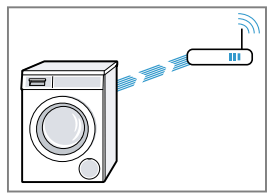
4. If the display shows Err, the appliance is not connected to the home network.
‒ Check whether your appliance is in range of your home network.
‒ Reconnect the appliance to the WLAN home network (Wi-Fi) with WPS function.
5. "Connect your appliance to the Home Connect app." → Page 43
Connecting the appliance to a WLAN home network (Wi-Fi) without WPS function
If your router does not have a WPS function, you can connect the appliance to your WLAN home network (Wi-Fi) manually. The appliance quickly sets up its own Wi-Fi network. You can connect a mobile device to the WLAN network and transfer the network information for the WLAN home network (Wi-Fi) to your appliance.
Requirement: The Home Connect app is open and you have logged on.
1. Press and hold Remote Start for at least 3 seconds.
2. Set the program to position 2.
3. Press Start/Reload .
- flashes in the display.
- The appliance now sets up its own Wi-Fi network with the name (SSID) HomeConnect.
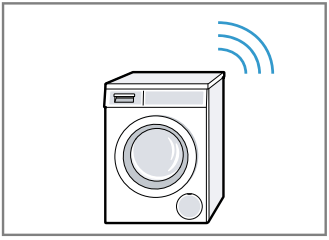
4. Call up the Wi-Fi settings on the mobile device. Connect the mobile device to the Home Connect Wi-Fi network and enter the password (key) HomeConnect.
- Your mobile device now connects to the appliance. The connection process may take up to 60 seconds.
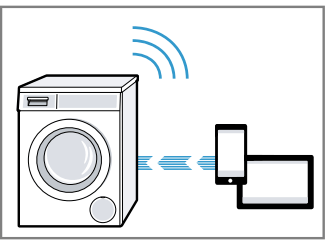
5. Open the Home Connect app on your mobile device and carry out the steps in the app.
6. In the Home Connect app, enter the network name (SSID) and password (key) for your home network.
7. Carry out the steps in the Home Connect app to connect the appliance.
- If the display shows con and lights up permanently, the appliance is connected to the home network.
8. If the display shows Err, the appliance is not connected to the home network.
‒ Check whether your appliance is in range of your home network.
‒ Reconnect the appliance to the WLAN home network (Wi-Fi) with WPS function.
9. "Connect your appliance to the Home Connect app" → Page 43.
Connecting your appliance to the Home Connect app
Requirements
- The appliance is connected to the WLAN home network (Wi-Fi).
- The Home Connect app is open and you have logged on.
1. Set the program to position 3.
2. Press Start/Reload .
- The appliance connects to the Home Connect app.
3. Once your appliance is displayed in the Home Connect app, carry out the last steps in the Home Connect app.
- If the display shows con, the appliance is connected to the Home Connect app.
Connecting the appliance to the energy manager
If you connect the appliance to the smart energy system (energy manager), you will optimize your energy consumption. The appliance starts only when your home photovoltaic system can provide sufficient energy or the energy tariff is good.
Requirements
- The smart energy system (energy manager) must use the EEBus Initiative communications standard.
- You have read about how to connect your appliance to the smart energy system (energy manager) in the instruction manual for the smart energy system (energy manager).
1. Press and hold Remote Start for approx. 3 seconds.
2. Set the program to position 7.
3. Press Start/Reload .
- The appliance is connected to the smart energy system (energy manager).
- If the appliance has connected to the energy manager successfully, the display shows con and
 .
.
4. Activate Flex Start if you want the smart energy system (energy manager) to start up your appliance. → "Activate Flex Start", Page 44
Activate Flex Start
Activate Flex Start to allow your smart energy system (energy manager) to start your appliance once your home photovoltaic system is able to provide sufficient energy or the energy tariff is good.
Requirement: The smart energy system (energy manager) cannot start your appliance until it is connected to the appliance.
1. Set the program you require.
2. Press - Finish in + to set the required time.
3. Press Start/Reload .
4. Press Start/Reload
- The display shows and Flex Start is activated. The appliance waits to be started by the smart energy system (energy manager).
- If the time changes on the display, e.g. to 8 h, the smart energy system (energy manager) has established a time at which your appliance can start.
- If the smart energy system (energy manager) does not start the appliance within the set time, the appliance will start the program itself before the set time period ends. The program ends when the time period ends.
Note : Flex Start is deactivated for safety reasons in the following circumstances:
- Press Start/Reload .
- Open the door.
- Switch off the appliance.
- Power failure.
Activating Wi-Fi on the appliance
Note: When Wi-Fi is activated, the energy consumption increases in comparison to the values specified in the consumption value table.
1. Press and hold Remote Start for approx. 3 seconds.
2. Set the program to position 4.
3. Press Start/Reload repeatedly until the display shows On.
Note: If Wi-Fi is activated, the appliance will not switch itself off automatically.
Deactivating Wi-Fi on the appliance
1. Press and hold Remote Start for at least three seconds.
2. Set the program to position 4.
3. Press Start/Reload repeatedly until the display shows OFF.
Note: If Wi-Fi is switched off and your appliance was previously connected to your home network, this connection will be re-established automatically when Wi-Fi is switched back on.
Software update
Requirement: The display shows Upd.
1. Press and hold Remote Start for approx. 3 seconds.
2. Set the program to position 6.
- UdP appears on the display.
3. Press Start/Reload .
- The software update is installed.
- If End is shown on the display, the software update is installed.
Note: The software update may take several minutes. Do not switch off the appliance while the software update is in progress.
Resetting the appliance network settings
1. Press and hold Remote Start for at least 3 seconds.
2. Set the program to position 5.
3. Press Start/Reload .
4. Press Start/Reload .
- The network settings are reset.
- If End is shown on the display, the network settings are reset.
Tip: If you wish to operate your appliance again via the Home Connect app, you will need to reconnect it to the Wi-Fi and to the Home Connect app.
Remote diagnostics
Customer Service can use Remote Diagnostics to access your appliance if you contact them, have your appliance connected to the Home Connect server and if Remote Diagnostics is available in the country in which you are using the appliance.
Data protection
Please see the information on data protection. The first time your appliance is registered on a home network connected to the Internet, your appliance will transmit the following types of data to the Home Connect server (initial registration):
- Unique appliance identification (consisting of appliance codes as well as the MAC address of the Wi-Fi communication module installed).
- Security certificate of the Wi-Fi communication module (to ensure a secure data connection).
- The current software and hardware version of your appliance.
- Status of any previous reset to factory settings.
This initial registration prepares the Home Connect functions for use and is only required when you want to use the Home Connect functions for the first time
Note: Please note that the Home Connect functions can only be utilized with the Home Connect app. Information on data protection can be retrieved in the Home Connect app.
Declaration of Conformity
Robert Bosch Hausgeräte GmbH hereby declares that the appliance with Home Connect functionality meets the essential requirements and other relevant provisions of Directive 2014/53/EU. A detailed RED Declaration of Conformity can be found online at www.bosch-home.com among the additional documents on the product page for your appliance.

2.4 GHz band: 100 mW max.
5 GHz band: 100 mW max.

Basic settings
Basic settings You can configure the appliance to meet your needs.
Overview of basic settings
Below is an overview of the basic settings on your appliance.
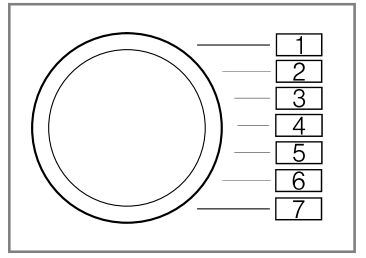
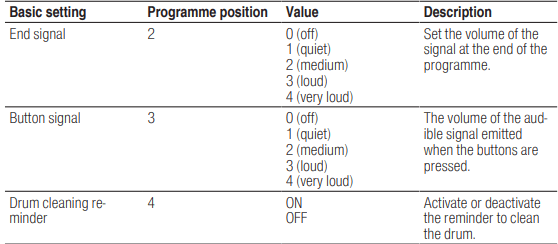
Changing the basic settings
1. Set the program selector to position 1.
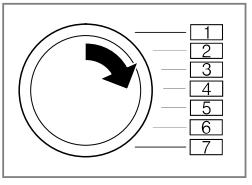
2. Press Spin Speed and, at the same time, turn the program selector to position 2.
- The display shows the current value.
3. Set the program selector to the required position.
4. To change the value, press - / +.
5. To save the changes, switch off the appliance.
Cleaning and servicing
To keep your appliance working efficiently for a long time, it is important to clean and maintain it carefully
Tips on appliance care
Follow the tips for appliance care to ensure your appliance works correctly in the long term.
- Wipe down the housing and the control panel with nothing but water and a damp cloth. The appliance parts remain clean and hygienic.
- Remove all detergent residue, spray residue or other residues immediately. Fresh deposits are easier to remove without leaving any residue.
- Keep the appliance door and detergent drawer open after use. This allows the residual water to dry, reducing odors in the appliance.
Cleaning the drum
If you often wash at a washing temperature of 40 °C and lower or the appliance has not been used for a long period, clean the drum.
Cleaning the detergent drawer
If you change detergent or the detergent drawer is dirty, clean the detergent drawer and the pump unit of the intelligent dosing system.
Note: Please read the information in the "Safety" → Page 4 and "Preventing material damage" → Page 11 sections to ensure that you use the appliance safely.
1. Switch off the appliance.
2. Pull out the detergent drawer.
3. Press down on the insert and remove the detergent drawer.
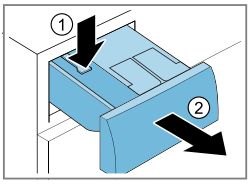
4. Remove the pump unit.
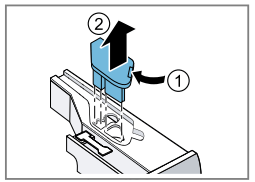
5. Unclip the detergent drawer lid and remove it.
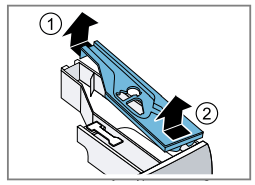
6. Empty the detergent drawer.
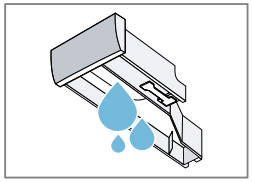
7. ATTENTION: The pump unit contains electrical components.
▶ Do not clean the pump unit in the dishwasher and do not immerse it in water.
▶ Protect the electrical connection on the rear against water, detergent and fabric softener residue. Clean the pump unit with a damp cloth.
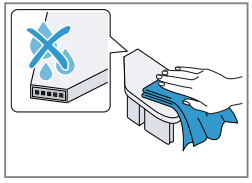
8. Clean the detergent drawer and the lid with a soft, damp cloth or hand shower.
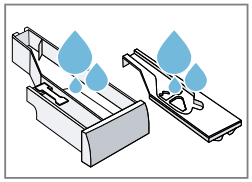
9. Dry the detergent drawer, lid and pump unit and reinsert them.
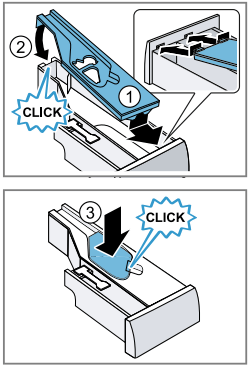
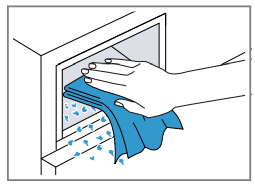
10.Clean the inside of the detergent drawer housing.
11.Push in the detergent drawer
Descaling
If you add detergent correctly, you do not need to descale your appliance. If you still wish to use the descaler, follow the manufacturer's instructions for use.
ATTENTION: The use of unsuitable descaling agents, e.g. for coffee machines, may damage the appliance.
▶ For this appliance, only use descaling agents that are available from the manufacturer's website or our after-sales service.
Cleaning the drain pump
Clean the drain pump in the event of faults, e.g. blockages or rattling noises.
Emptying the drain pump
Note: Please read the information in the "Safety" → Page 4 and "Preventing material damage" → Page 11 sections to ensure that you use the appliance safely.
1. Turn off the water tap.
2. Switch off the device.
3. Disconnect the appliance's mains plug from the power supply.
4. Open the maintenance flap.
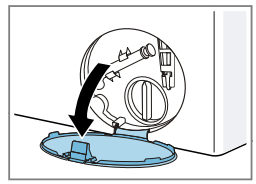
5. Remove the maintenance flap.
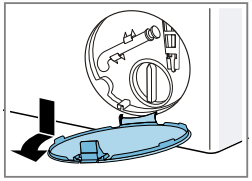
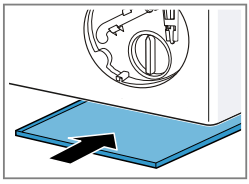
6. Slide a receptacle under the opening
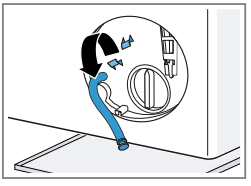
7. Take the drain hose out of the holder.
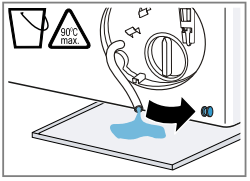
8. CAUTION - Risk of scalding! When you wash at high temperatures, the detergent solution gets hot.
▶ Do not touch the hot detergent solution.
To allow the detergent solution to flow out into the container, remove the sealing cap.
9. Firmly press on the sealing cap.
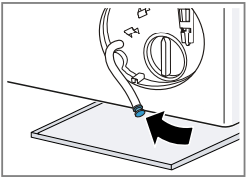
10.Insert the drain hose into the holder.
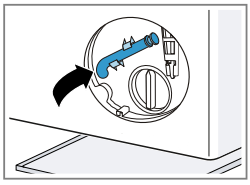
Cleaning the drain pump
Note: Please read the information in the "Safety" → Page 4 and "Preventing material damage" → Page 11 sections to ensure that you use the appliance safely.
Requirement: "The drain pump is empty." → Page 50
1. Since water may remain in the drain pump, remove the pump cap carefully
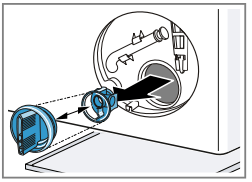
2. Clean the interior, the thread on the pump cap and the pump housing.
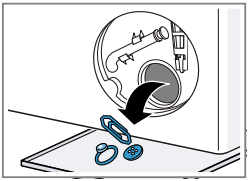
The pump cap is comprised of two parts that can be taken apart for cleaning.
3. Make sure that the impeller in the drain pump can be rotated.
4. Insert the pump cap.
‒ Ensure that the parts of the pump cap are correctly assembled.
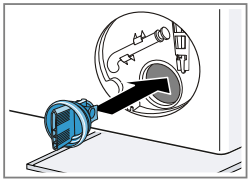
5. Screw on the pump cap.
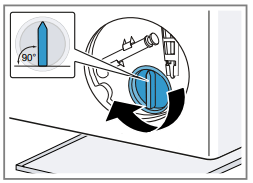
The handle on the pump cap must be in a vertical position.
6. Insert the maintenance flap and lock it into place.
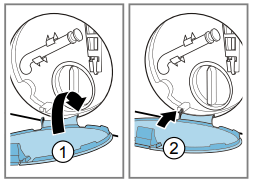
7. Close the maintenance flap.
Before the next wash
To prevent unused detergent from flowing straight into the outlet in the next wash, run the Drain program after you have emptied the drain pump.
1. Turn on the tap.
2. Insert the mains plug.
3. Switch on the appliance.
4. Pour 1 liter of water into the manual dosing compartment.
5. Start the Drain program.
Cleaning the water outlet hose at the siphon
If the water outlet hose at the siphon is dirty or the detergent solution is not being pumped out, you must clean these.
1. Switch off the appliance.
2. Disconnect the appliance's mains plug from the power supply.
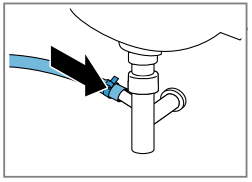
3. Loosen the hose clamp and carefully remove the water outlet hose.
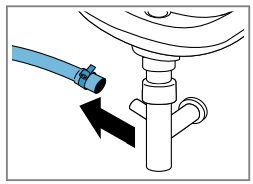
Residual water may leak out.
4. Clean the water outlet hose and siphon connecting piece.
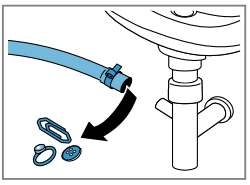
5. Reattach the water outlet hose and secure the connection point using the hose clamp
Clean the water inlet filters.
Clean the filter in the water inlet in the event of blockages or if the water pressure is too low.
Emptying the water inlet hose
1. Turn off the tap.
2. Set the Cottons program.
3. Start the program and leave it to run for approx. 70 seconds.
4. Switch off the appliance.
5. Disconnect the appliance's mains plug from the power supply.
Cleaning the filter on the tap
Note: Please read the information in the "Safety" → Page 4 and "Preventing material damage" → Page 11 sections to ensure that you use the appliance safely.
Requirement: The water inlet hose is empty.
1. Remove the water inlet hose from the tap.
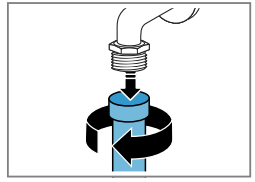
2. Clean the filter with a small brush.
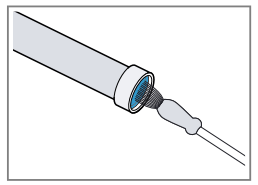
3. Connect the water inlet hose and check for leaks.
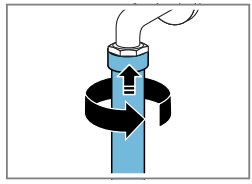
Cleaning the filter on the appliance
Note: Please read the information in the "Safety" → Page 4 and "Preventing material damage" → Page 11 sections to ensure that you use the appliance safely
Requirement: The water inlet hose is empty. → "Emptying the water inlet hose", Page 53
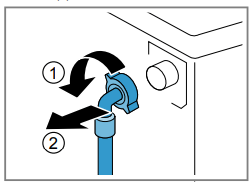
1. Disconnect the hose from the rear of the appliance.
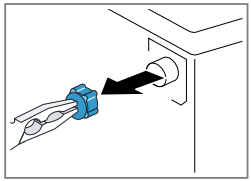
2. Use pliers to remove the filter.
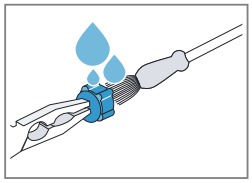
3. Clean the filter with a small brush.
4. Reinsert the filter.
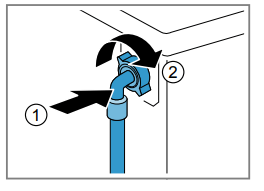
5. Connect the hose and check for leaks.
Troubleshooting
Error code / Fault display / Signal
| Fault |
Cause |
troubleshooting |
| The display goes out and Start/Reload flashes. |
Energy-saving mode is active |
Press any button.
- The symbol lights up again.
|
| "E:30 / -80" |
Drain pipe or water outlet hose is blocked. |
Drain pipe or water outlet hose is blocked. |
| Drain pipe or water drain hose is caught or jammed. |
Ensure that the drain pipe and water drain hose are not kinked or trapped. |
| Drain pump is blocked. |
→ "Cleaning the drain pump", Page 50 |
| The water outlet hose is connected too high. |
Install the water outlet hose at a maximum height of 1 meter. → "Technical specifications", Page 70 |
| Pump cover is not correctly assembled. |
Correctly assemble the pump cover. |
| E:36 / -25 / -26" |
Drain pump is blocked. |
→ "Cleaning the drain pump", Page 50 |
| "E:10 / -00 / -10 / -20" |
The pump for the intelligent dosing system is blocked. |
1. Switch off the appliance.
2. Clean the pump unit. → "Cleaning the detergent drawer", Page 48
3. If this indicator appears again, call our after-sales service. → "Customer Service", Page 68
Note: You can start the washing program if you deactivate the intelligent dosing system and dose manually. → "Buttons", Page 24
|
| E:60 / -2B" |
The unbalanced load detection system has interrupted the spin cycle because the laundry is unevenly distributed. |
Redistribute the laundry in the drum.
Note: Where possible, mix large and small items in the drum. Different-sized items of laundry distribute themselves better during the spin cycle.
|
 |
The water pressure is low. |
No remedial action is possible. |
| The filters in the water inflow are blocked. |
"Clean the filters in the water inflow" → Page 53. |
| The tap is turned off. |
Turn on the tap. |
| The water inlet hose is kinked or jammed. |
Ensure that the water inlet hose is not kinked or jammed |
 |
The detergent drawer has not been pushed in as far as it can go. |
Push the detergent drawer in as far as it will go. |
| The pump unit is not inserted. |
1. Insert the pump unit into the detergent drawer. → "Cleaning the detergent drawer", Page 48
2. Push the detergent drawer in as far as it will go.
|
 |
Detergent dosage is too high. |
- Immediate measure: Mix one tablespoon of fabric softener with 0.5 liters of water and pour the mixture into the compartment for manual dosing (not for outdoor clothing, sportswear or items stuffed with down).
- If intelligent dosing is activated, reduce the "basic dosage" → Page 41.
- If you dose manually, reduce the amount of detergent for the next washing cycle with the same load
|
| All other error codes. |
Malfunction |
Call the after-sales service. → "Customer Service", Page 68 |
Malfunctions
| Fault |
Cause |
troubleshooting |
| The appliance is not working. |
The appliance is not working. |
The appliance is not working. |
| The appliance is not working. |
The appliance is not working. |
| The appliance is not working. |
The appliance is not working. |
| The program does not start. |
The program does not start. |
Press Start/Reload . |
| Door is not closed. |
1. Close the door.
2. Press Start/Reload to start the program.
|
| The childproof lock is activated |
→ "Deactivating the childproof lock", Page 40 |
| - Finish in + is activated. |
Check whether - Finish in + is activated. → "Buttons", Page 24 |
| Laundry is caught in the door. |
1. Open the door again.
2. Remove any trapped laundry.
3. Close the door.
4. Press Start/Reload to start the program.
|
| The program does not start |
The detergent drawer has not been pushed in as far as it can go |
Push the detergent drawer in as far as it will go. |
| The pump for the intelligent dosing system is blocked. |
1. Switch off the appliance.
2. Clean the pump unit. → "Cleaning the detergent drawer", Page 48
3. If this indicator appears again, call our after-sales service. → "Customer Service", Page 68
Note: You can start the washing program if you deactivate the intelligent dosing system and dose manually. → "Buttons", Page 24
|
| The door cannot be opened |
 is activated. is activated. |
Continue the program by selecting Spin or Drain and pressing Start/Reload . → "Resuming the program when the programme status is Rinse Hold", Page 39 |
| The temperature is too high. |
- Wait until the temperature has dropped.
- → "Cancelling the program", Page 38
|
| Water level is too high. |
Start the Drain program. |
| Power failure. |
Open the door using the emergency release. → "Emergency release", Page 66 |
| The water is not draining. |
. Drain pipe or water outlet hose is blocked. |
Clean the drain pipe and the water outlet hose. |
| Drain pipe or water drain hose is caught or jammed |
Ensure that the drain pipe and water drain hose are not kinked or trapped. |
| Drain pump is blocked. |
→ "Cleaning the drain pump", Page 50 |
| is activated. |
Continue the program by selecting Spin or Drain and pressing Start/Reload . |
| The water is not draining. |
|
→ "Resuming the program when the program status is Rinse Hold", Page 39 |
| The water outlet hose is connected too high. |
Install the water outlet hose at a maximum height of 1 meter. → "Technical specifications", Page 70 |
| Pump cover is not correctly assembled. |
Correctly assemble the pump cover |
| Pump cover is not correctly assembled. |
Correctly assemble the pump cover |
| Water is not flowing in. Detergent is not being dispensed. |
You have not pressed Start/ Reload . |
Press Start/Reload . |
| The filters in the water inflow are blocked. |
Clean the filters in the water inflow" → Page 53. |
| The tap is turned off. |
Turn on the tap. |
| The water inlet hose is kinked or jammed. |
Ensure that the water inlet hose is not kinked or jammed |
| The spin cycle runs several times |
The unbalanced load detection system eliminates an imbalance by repeatedly redistributing the laundry |
Not a fault – no action required.
Note: When loading, where possible, place large and small items of laundry together in the drum. Different sized items of laundry distribute themselves better during the spin cycle.
|
| The program duration changes during the wash cycle. |
The program operation is optimised electronically. This may change the program duration. |
Not a fault – no action required. |
| The unbalanced load detection system eliminates an imbalance by repeatedly redistributing the laundry |
Not a fault – no action required.
Note: When loading, where possible, place large and small items of laundry together in the drum. Different sized items of laundry distribute themselves better during the spin cycle.
|
| Foam detection system switches on a rinse cycle if foam build-up is too high |
Not a fault – no action required. |
| No water is visible in the drum |
Water is below the visible area. |
Not a fault – no action required. |
| Drum jerks after the program starts. |
This is caused by an internal motor test. |
Not a fault – no action required. |
| Vibrations and movement of the appliance whilst spinning. |
Appliance is not correctly aligned. |
Aligning the appliance |
| The appliance feet are not fixed |
Secure the appliance feet. Aligning the appliance |
| Transit bolts have not been removed. |
Removing the transit bolts |
| Drum does not turn, water does not flow in |
Load detection is active |
Not a fault – no action required.
Note: The load detection can take up to two minutes
|
| Heavy foam build-up |
Detergent dosage is too high |
- Immediate measure: Mix one tablespoon of fabric softener with 0.5 litres of water and pour the mixture into the compartment for manual dosing (not for outdoor clothing, sportswear or items stuffed with down).
- If intelligent dosing is activated, reduce the "basic dosage" → Page 41.
- If you dose manually, reduce the amount of detergent for the next washing cycle with the same load.
|
 -DOS-DOS cannot be actuated -DOS-DOS cannot be actuated |
Intelligent dosing is not intended for this program |
Not a fault – no action required. |
| Program progress does not allow intelligent dosing. |
No remedial action possible. |
Noise
| Fault |
Cause |
troubleshooting |
| Rushing, hissing noise. |
Water is flushed under pressure into the detergent drawer |
Not a fault – normal operating noise. |
| Longer, whirring noise before the start of the wash cycle or fabric softening |
Intelligent dosing system dispenses detergent or care products. |
Not a fault – normal operating noise |
| Brief whirring noise after switching on the appliance |
Intelligent dosing system carries out a function test. |
Not a fault – normal operating noise. |
| Loud noises during the spin cycle. |
Appliance is not correctly aligned |
Aligning the appliance |
| The appliance feet are not fixed. |
Secure the appliance feet. Aligning the appliance |
| Transit bolts have not been removed. |
Removing the transit bolts |
| Banging noises, rattling in the drain pump. |
Foreign bodies have got into the drain pump. |
→ "Cleaning the drain pump", Page 50 |
| Slurping, rhythmical suction noise |
The drain pump is active, the detergent solution is pumped out. |
Not a fault – normal operating noise. |
Problem with results
| Fault |
Cause |
troubleshooting |
| Creasing |
The spin speed is too high |
The next time you run a wash cycle, set a lower spin speed |
| The load is too large. |
The next time you run a wash cycle, reduce the amount of laundry being loaded. |
| The wrong program is selected for the type of fabric. |
Select the programs that are suitable for the type of fabric. → "Programmes", Page 26 |
| The spin result is not satisfactory. The laundry is too wet/too damp |
A low spin speed is selected |
- The next time you run a wash cycle, set a higher spin speed.
- Start the Spin program
|
| The unbalanced load detection system has interrupted the spin cycle because the laundry is unevenly distributed. |
- Redistribute the laundry in the drum. Note: Where possible, mix large and small items in the drum. Different sized items of laundry distribute themselves better during the spin cycle.
- Start the Spin program
|
| Detergent residue on the damp washing. |
Detergents may contain water-insoluble substances that deposit on the laundry. |
Start the Rinse program |
| Unsuitable detergent added to the dispenser of the intelligent dosing system |
1. Check whether the detergent used is suitable. → "Detergents and care products", Page 35
2. Drain the dispenser. → "Cleaning the detergent drawer", Page 48
3. Clean the dispenser.
4. Refill the dispenser. → "Filling the dispenser", Page 40
|
| Basic dosage is not correctly adjusted |
If intelligent dosing is activated, reduce the "basic dosage" → Page 41. |
| Detergent residue on the dry laundry |
Detergents may contain water-insoluble substances that deposit on the laundry |
Brush out the laundry after washing and drying. |
| Unsuitable detergent added to the dispenser of the intelligent dosing system. |
1. Check whether the detergent used is suitable. → "Detergents and care products", Page 35
2. Drain the dispenser. → "Cleaning the detergent drawer", Page 48
3. Clean the dispenser.
4. Refill the dispenser. → "Filling the dispenser", Page 40
|
| Basic dosage is not correctly adjusted. |
If intelligent dosing is activated, reduce the "basic dosage" → Page 41. |
| Insufficient cleaning. |
Basic dosage is not correctly adjusted |
If intelligent dosing is activated, adjust the "basic dosage" → Page 41 correctly |
| Detergent or care products have congealed in dispensers of the intelligent dosing system. |
1. Check whether the detergent used is suitable. → "Detergents and care products", Page 35
2. Drain the dispenser. → "Cleaning the detergent drawer", Page 48
3. Clean the dispenser.
4. Refill the dispenser. → "Filling the dispenser", Page 40
|
| Unsuitable detergent added to the dispenser of the intelligent dosing system. |
1. Check whether the detergent used is suitable. → "Detergents and care products", Page 35
2. Drain the dispenser. → "Cleaning the detergent drawer", Page 48
3. Clean the dispenser. 4. Refill the dispenser. → "Filling the dispenser", Page 40
|
Home Connect problem
| Fault |
Cause |
troubleshooting |
| HomeConnect is not working correctly. |
Different causes are possible |
Go to www.home-connect.com. |
| No connection to the home network. |
Wi-Fi is switched off. |
→ "Activating Wi-Fi on the appliance", Page 44 |
| |
Wi-Fi is activated but a connection to your home network cannot be established. |
1. Ensure that the home network is available. 2. Reconnect the appliance to the home network. → "Connecting the appliance to a WLAN home network (Wi-Fi) with WPS function", Page 42 → "Connecting the appliance to a WLAN home network (Wi-Fi) without WPS function", Page 42 |
Leakage
| Fault |
Cause |
troubleshooting |
| Water is leaking out at the water inlet hose. |
Water inlet hose is not correctly/securely connected |
1. Connect the water supply hose correctly. Connecting the water inlet hose
2. Tighten the screw connection.
|
| Water is leaking out at the water outlet hose. |
The water outlet hose is damaged. |
Replace the damaged water outlet hose. |
| Water outlet hose is not connected correctly |
Connect the water outlet hose correctly. Water outlet connection types |
Odours
| Fault |
Cause |
troubleshooting |
| Odours have formed in the appliance. |
Humidity and detergent residue may promote the formation of bacteria. |
- → "Cleaning the drum", Page 48
- If you are not using the appliance, leave the door and detergent drawer open so that residual water can evaporate
|
Consumption values
The following information is provided in accordance with the EU Ecodesign Regulation. The values given for programs other than the Eco 40-60 are indicative only and were determined in accordance with the applicable standard EN60456. The automatic dosing function has been deactivated for this purpose. Note on the comparison test: Deactivate the automatic dosing function unless this function is the object of the test.
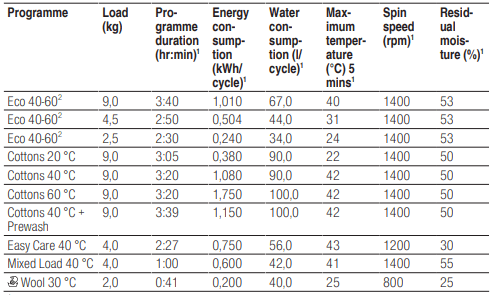
1 Due to the influence of water pressure, hardness and inlet temperature, ambient temperature, type, amount and soiling of laundry, detergent used, fluctuations in the power supply and the selected additional functions, the actual values may deviate from the stated values.
2 Test program in accordance with the EU Ecodesign Directive and the EU Energy Labelling Regulation with cold water (15 °C).
Technical specifications
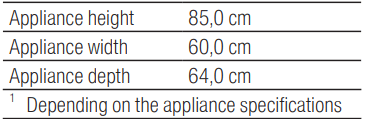
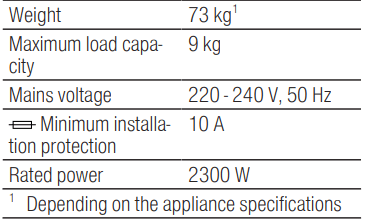
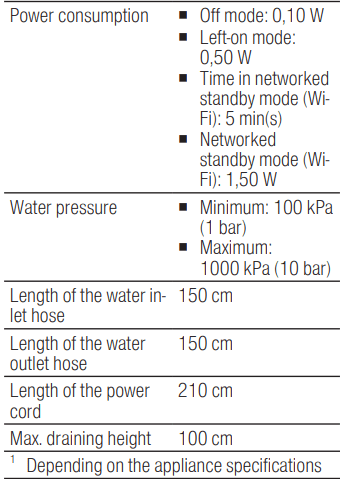
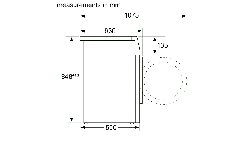
Technical specifications Facts and figures for your appliance can be found here.