152991 79/0
GB
Dishwasher
INSTRUCTION BOOK
Model ESI 600
0/0398

It is most important that this instruction book should be retained with the appliance
for future reference. Should the appliance be sold or transferred to another owner, or
should you move house and leave the appliance, always ensure that the book is left with
the appliance in order that the new owner can get to know the functioning of the
appliance and the relevant safety information.
This information has been provided in the interest of safety. You MUST read it carefully
before installing or using the appliance.
Installation
■ This appliance is heavy. Care should be taken when
moving it.
■ It is dangerous to alter the specifications or attempt
to modify this product in any way.
■ Care must be taken to ensure that the appliance
does not stand on the electrical supply cable.
■ Any electrical work required to install this
appliance should be carried out by a qualified
electrician or competent person.
■ Any plumbing work required to install this
appliance should be carried out by a qualified
plumber or competent person.
Child Safety
■ This appliance is designed to be operated by adults.
Children should not be allowed to tamper with the
controls or play with the product.
■ Keep all packaging well away from children.
■ Keep all detergents in a safe place out of children's
reach.
During Use
■ Items that are contaminated by petrol, paint,steel or
iron debris, corrosive, acidic or alkaline chemicals
must not be washed in this dishwasher.
■ Under no circumstances should you open the door
whilst the appliance is in operation. Always turn off
the appliance before opening the door.
■ Only use detergent specifically designed for use in
dishwashers.
■ Long blades knives stored in an upright position are
a potential hazard.
■ Long and/or sharp items of cutlery such as carving
knives must be positioned horizontally in the upper
basket.
■ When finishing loading or unloading close the
door, as an open door can be a hazard.
■ Do not sit or stand on the open door.
■ Isolate the appliance from the power supply and
turn off the water supply after use.
■ Care should be taken when cleaning the bottom
door seal and hinge area as any exposed metal
edges may cut if care is not taken.
■ This product should be serviced by an authorised
Service engineer, and only genuine spare parts
should be used.
■ Under no circumstances should you attempt to
repair the machine yourself. Repairs carried out by
inexperienced persons may cause injury or serious
malfunctioning. Contact your local Service Force
Centre. Always insist on genuine spare parts.
Conservation
In the interest of the environment:
■ Materials marked with the symbol are
recyclable.
■ Check with your local Council or Environmental
Health Office to see if there are facilities in your
area for re-cycling this appliance.
■ When the appliance is to be scrapped, cut off the
power supply cable and make the door closing
device unusable to prevent young children from
being trapped inside.
■ Help to keep your country tidy - use authorised
disposal sites for your old appliance.
Important safety information
2
PSI01UK

For the user
Important safety information 2
Guide to use the instruction book 3
Description of the appliance 4
The control panel 5
Before use 6
Setting the water softener 6
Rinse aid 8
Use of detergent 9
Using your appliance 10
Loading your appliance 10
Adjusting the height of the upper basket 11
Hints and tips 12
Washing programmes 13
Operating sequence 14
Maintenance and cleaning 15
Internal cleaning 15
Cleaning the central filters 15
Cleaning the large filter 15
External cleaning 16
Prolonged periods of non-operation 16
Frost precautions 16
Moving the machine 16
Something not working 17
Service and spare parts 18
Gurantee Conditions 19
Electrolux Service Force 20
For the installer
Installation instruction 22
Technical specifications 22
Water supply connections 23
Water outlet hose connection 24
Electrical connection 25
Building-in 26
Levelling 26
The furniture door 27
Adjusting the door balance 28
Securing under a counter 28
Kitchen plinth adjustment 29
Contents
3
PCO01UK
Guide to use the instruction book
The following symbols will be found in the text to guide you throughout the instructions:
Safety instructions
Step by step instructions
Hints and tips
Environmental information
☞
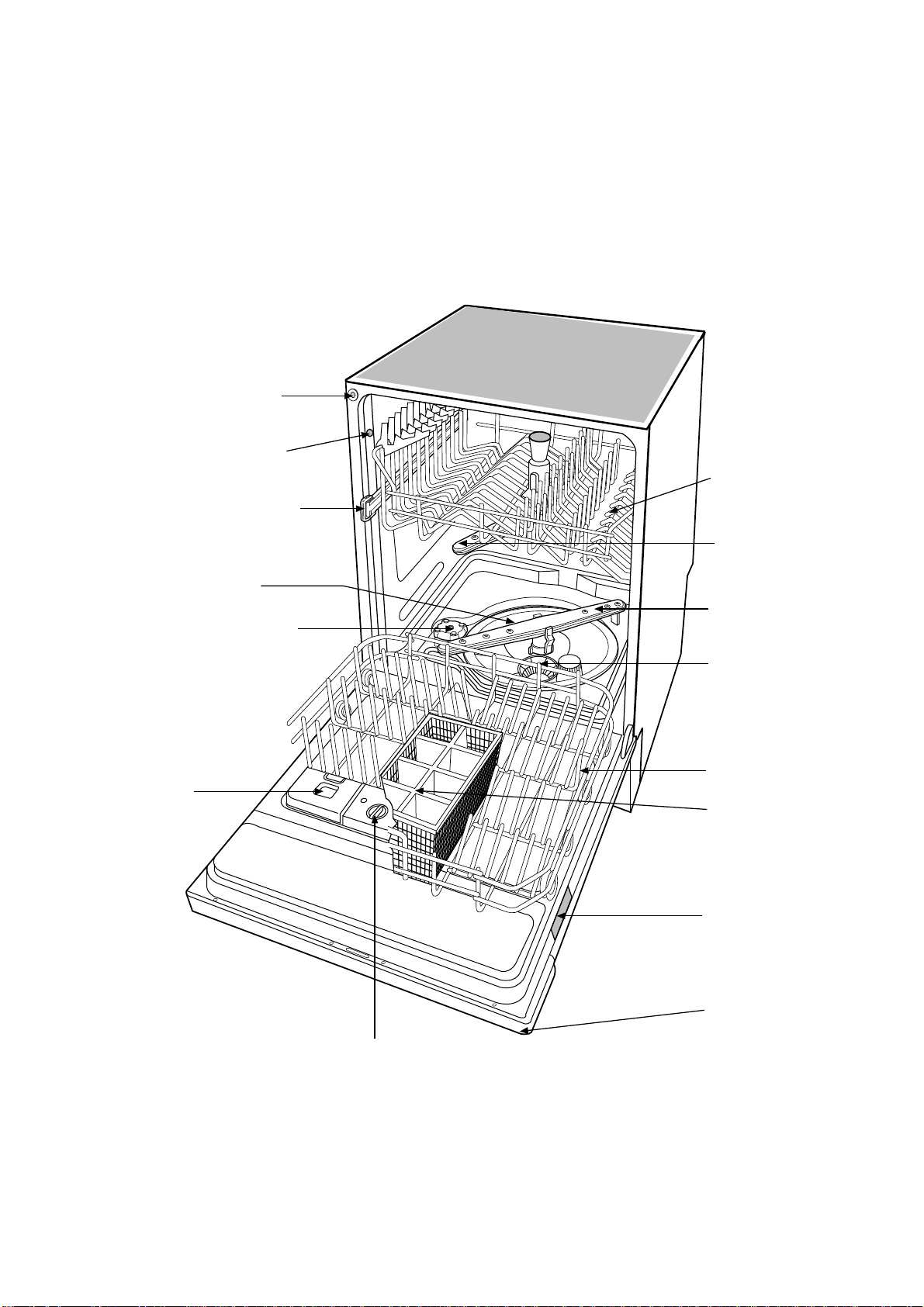
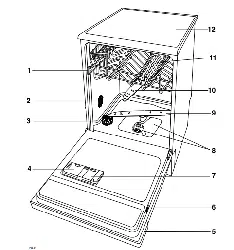
Description of the appliance
4
PDA02UK
Water hardness
adjustment
Upper basket
stop
Large filter
Salt container
Detergent
dispenser
Rinse aid
dispenser
Upper basket
Upper spray
arm
Lower spray
arm
Central
filters
Lower
basket
Cutlery
basket
Rating
plate
Control
panel
Levelling
spacers
IN46
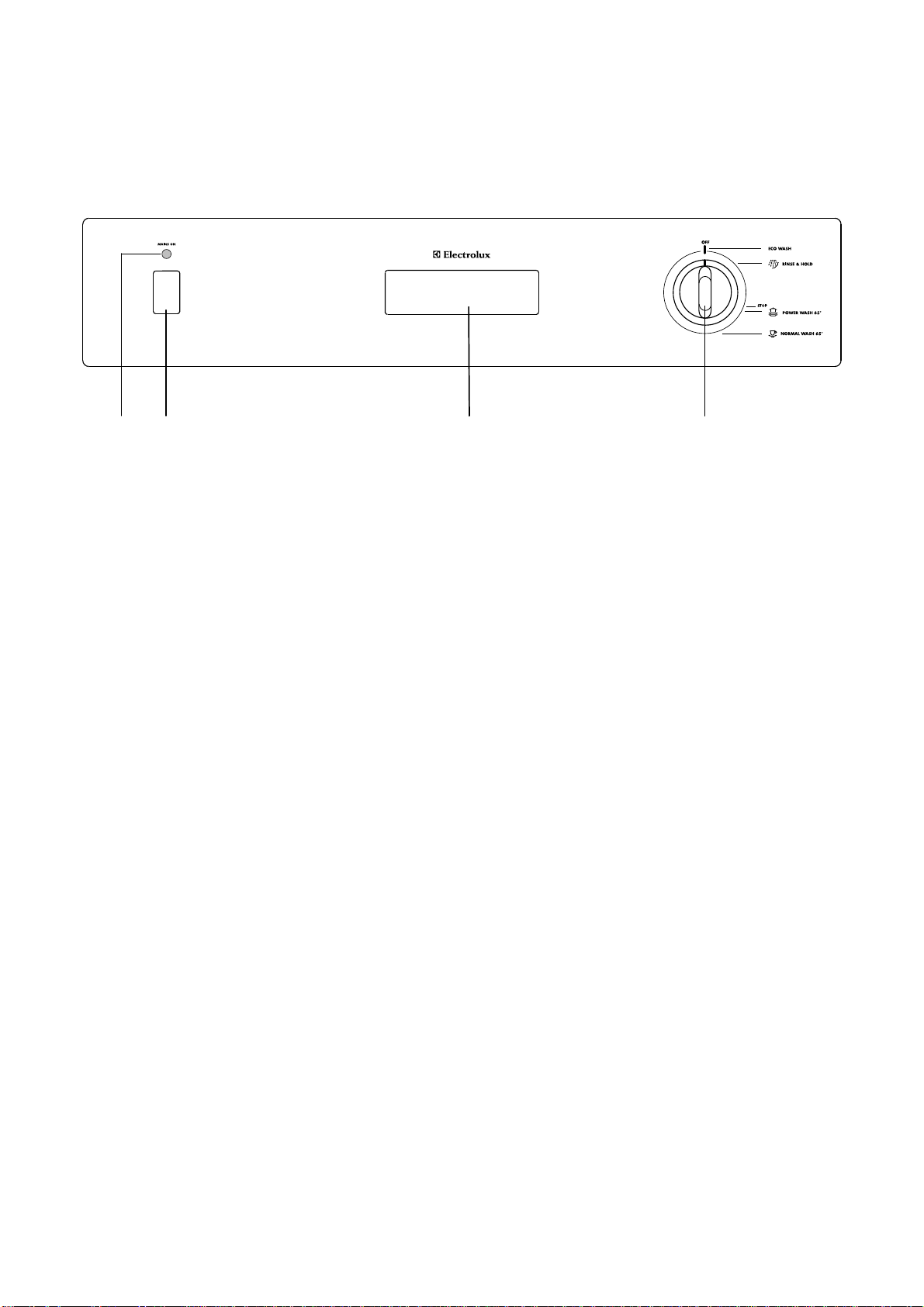
1.On/Off indicator light
2.On/Off pushbutton
On
By depressing this button the machine starts operating
and, at the same time the On/Off indicator light
illuminates.
Off
When the washing programme has finished, the
machine stops automatically and the indicator light
remains on.
To switch the indicator light off or to stop the machine
at any time, press this button.
3.Door handle
To open the door press the catch in the top of the
recess and pull toward you at the same time.
To close the door simply push it.
4.Programme selector dial
To select a programme, turn the programme selector
dial clockwise, making sure that the marker on the
knob corresponds with the programme you wish to
select.
At the end of the programme the machine will stop
automatically and the On/Off indicator light remains
on until the On/Off pushbutton is depressed.
The control panel
5
PCP02UK
12 3 4
Before using your dishwasher for the first time:
ensure that the electrical and water
connections comply with the installation
instructions
remove all packaging from inside the appliance
set the water softener
fill the salt container
fill the rinse aid dispenser.
Setting the water softener
The dishwasher is equipped with a water softener
designed to remove minerals and salts from the water
supply, which would have a detrimental or adverse
effect on the operation of the appliance.
The higher the content of these salts, the harder your
water is.
Water hardness is measured in equivalent scales, Clarke
degrees and French degrees.
The softener should be adjusted according to the
hardness of the water in your area. Your local Water
Authority can advise you on the hardness of the water in
your area.
The dishwasher is factory set at level 2.
If this level is not suitable for your area the softener
should be adjusted.
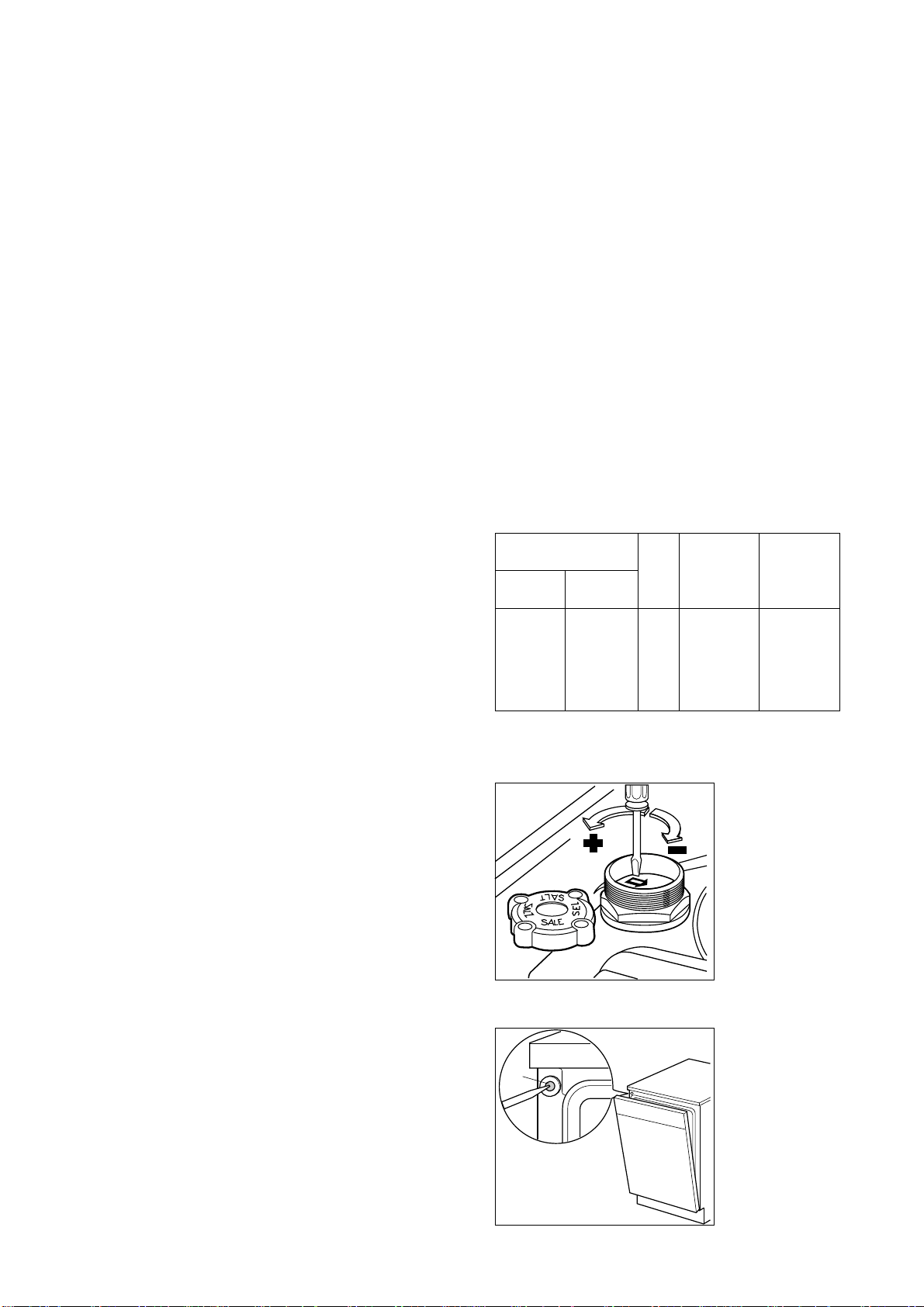
To adjust the water softener:
Level 1
If your water is "level 1" it is already soft and therefore
there is no need to use salt.
Levels 3 and 5
(water softener adjustment)
If your water is level 3 or 5, proceed as follows:
- slide out the lower basket and unscrew the cap of the
salt container;
- turn the two-position selector anticlockwise from
position - to position + with the aid of a knife or
screwdriver.
Levels 4 and 5
(adjustment on the machine)
If your water is level 4 or 5, open the door and drill
membrane (A) on the upper left-hand corner of the
machine.
With a water hardness of level 5 both adjustments must
be made.
☞
☞
☞
☞
☞
☞
Before use
6
PBU02UK
AA02
A
AA04
Level
Adjustment
on the
machine
Water
softener
adjustment
French
degrees
Clarke
degrees
1
*
2
3
4
5
0 - 10
11 - 27
28 - 35
36 - 49
50 - 63
NO
NO
NO
YES
YES
NO
NO
YES
NO
YES
0 - 14
15 - 39
40 - 50
51 - 70
71 - 90
Water
hardness
* factory setting
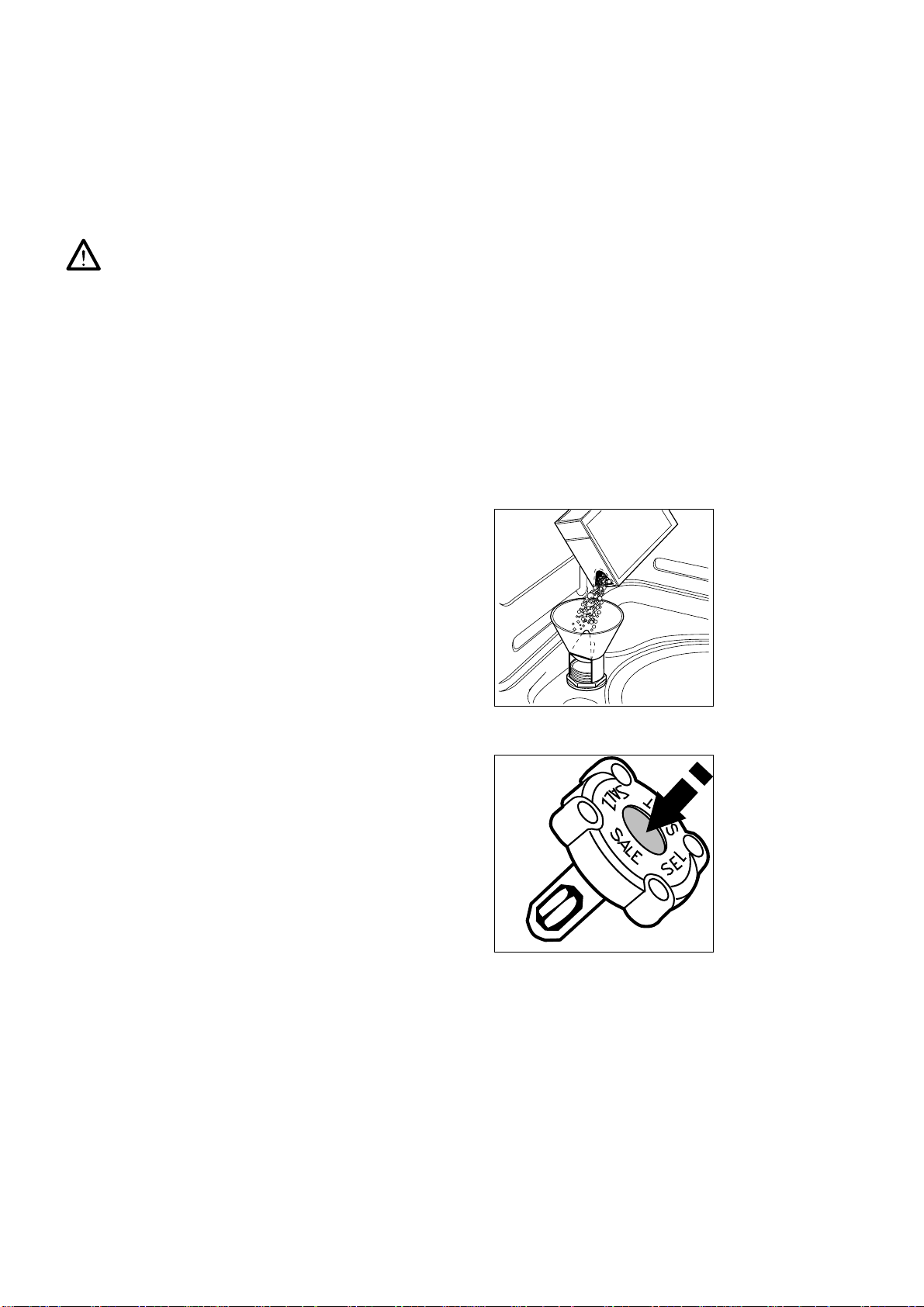
Filling with salt
Salt must be used from level 2 upward.
Only use salt specifically designed for
use in dishwasher.
All other types of salt not specifically
designed for use in dishwasher,
specifically table salt, will damage the
water softener.
Only fill with salt just before starting one of the
complete washing programmes (not the Rinse and Hold
programme). This will prevent any grains of salt or salty
water, which may have been spilled, remaining on the
bottom of the machine for any period of time, which
may cause corrosion.
To fill:
1. To fill with salt, unscrew the cap of the salt
container.
2. Pour about 1 litre of water inside the container,
or until it is full (this is necessary only before
filling with salt for the first time).
3. Then using the funnel provided, pour in the salt
until the container is full (approx. 1.5 - 1.8 kg).
Do not worry if water over flows from the unit
when filling with salt, this is quite normal.
4. Replace the cap making sure that there is no
trace of salt on the screw thread or on the
gasket.
5. Screw on the cap tightly.
The salt container will require topping up periodically.
The salt cap has a refill indicator window in the centre.
A green float is clearly visible when there is salt inside
the container, and almost disappears when the salt has
finished, (ie. every 30 - 50 washes depending on the
setting of the water softener) reminding you to add salt.
☞
7
PFS02UK
SALT
SR07
SR11
Rinse aid
Rinse aid is automatically added during the last rinse,
ensuring thorough rinsing, spot and streak free drying.
The dispenser, which is positioned inside the door, holds
about 110 ml of rinse aid, which is sufficient for 16 - 40
dishwashing programmes, depending upon the dosage
setting.
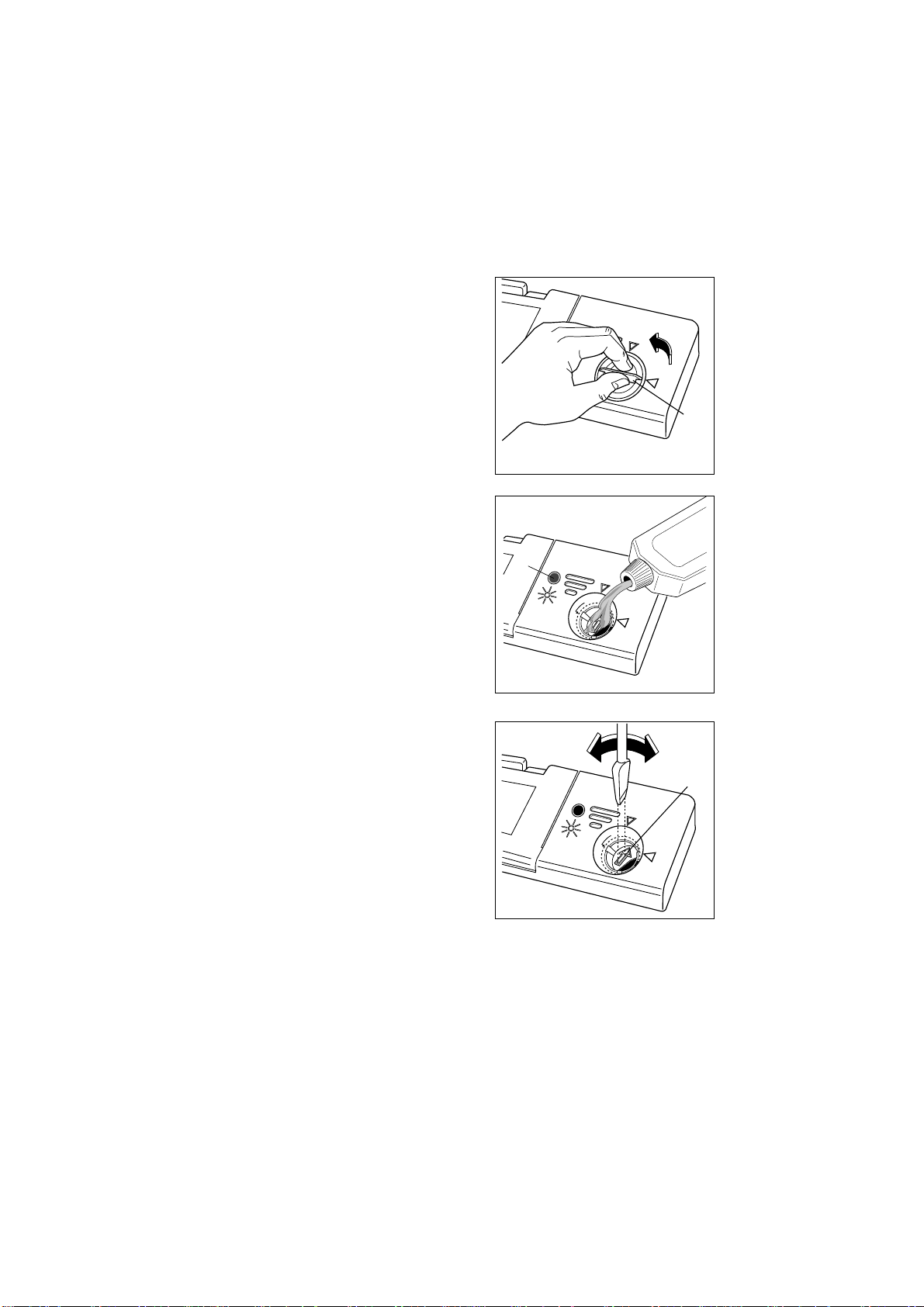
Filling with Rinse Aid:
1. Open the container by turning the lid (A)
anticlockwise.
2. Add the rinse aid until the container is
completely full (approx. 110 ml). The indicator
(B) will be completely dark.
3. Top up the rinse aid when the indicator (B)
becomes clear.
Ensure that the lid is closed after every
refill.
Do not put liquid detergent in the rinse aid department.
Clean up any rinse aid spilt during filling with an
absorbent cloth to avoid excess foaming during the next
wash.
Adjusting the dose
According to the finish and drying results obtained,
adjust the dose of rinse aid by means of the 6 position
selector (C) (position 1 minimum dosage, position 6
maximum dosage). (Start from position 3). Gradually
increase the dose if there are drops of water or lime
spots on the dishes after washing. Reduce it if there are
sticky whitish streaks on the dishes.
8
PFR01UK
BR01
A
m
a
x
6
5
4
3
2
1
B
BR03
BR02
C
m
a
x
6
5
4
3
2
1
Use of detergent
Only use detergents specifically
designed for use in dishwashers.
We recommend the use of Finish detergents which are
available in the following options:
Finish Double Action Tablets. Each tablet has the exact
amount of detergent required, simply place in the
dispenser.
Finish Powder recommended for every day use.
Finish liquid Gel ideal for every day use. As the gel is
extra gentle is it recommended for fine bone china.
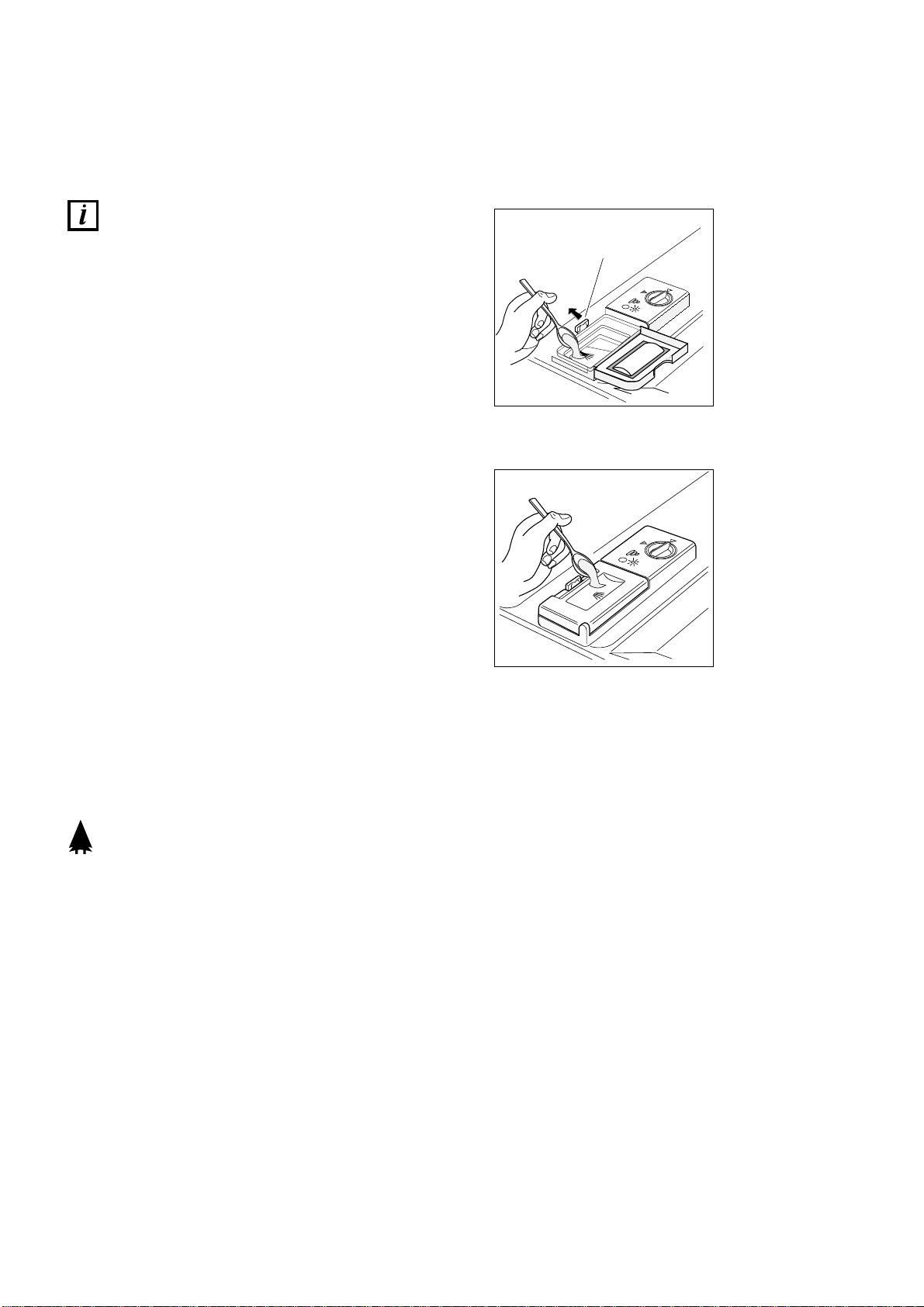
To fill the dishwasher with detergent
proceed as follows:
1. Open the dispenser lid by pulling the catch (D).
2. Add the detergent according to the
recommendations in the programme chart. As
all detergents are not the same, you should
also consult the instructions on the packet.
To help correctly dose the right amount of
detergent, inside the container there are two
reference marks:
- MIN = 15 ml
- MAX = 30 ml
3. Always close the lid.
4. If the programme has a prewash add the
required detergent over the lid of the dispenser.
Insufficient quantities of detergent will produce
poor washing results, whereas an excessive amount
of detergent will not improve washing results and
is also wasteful. Using no more than the correct
amount also contributes to reducing pollution.
9
PUD01UK
D
MIN
MAX
DE07
DE02
Loading your appliance
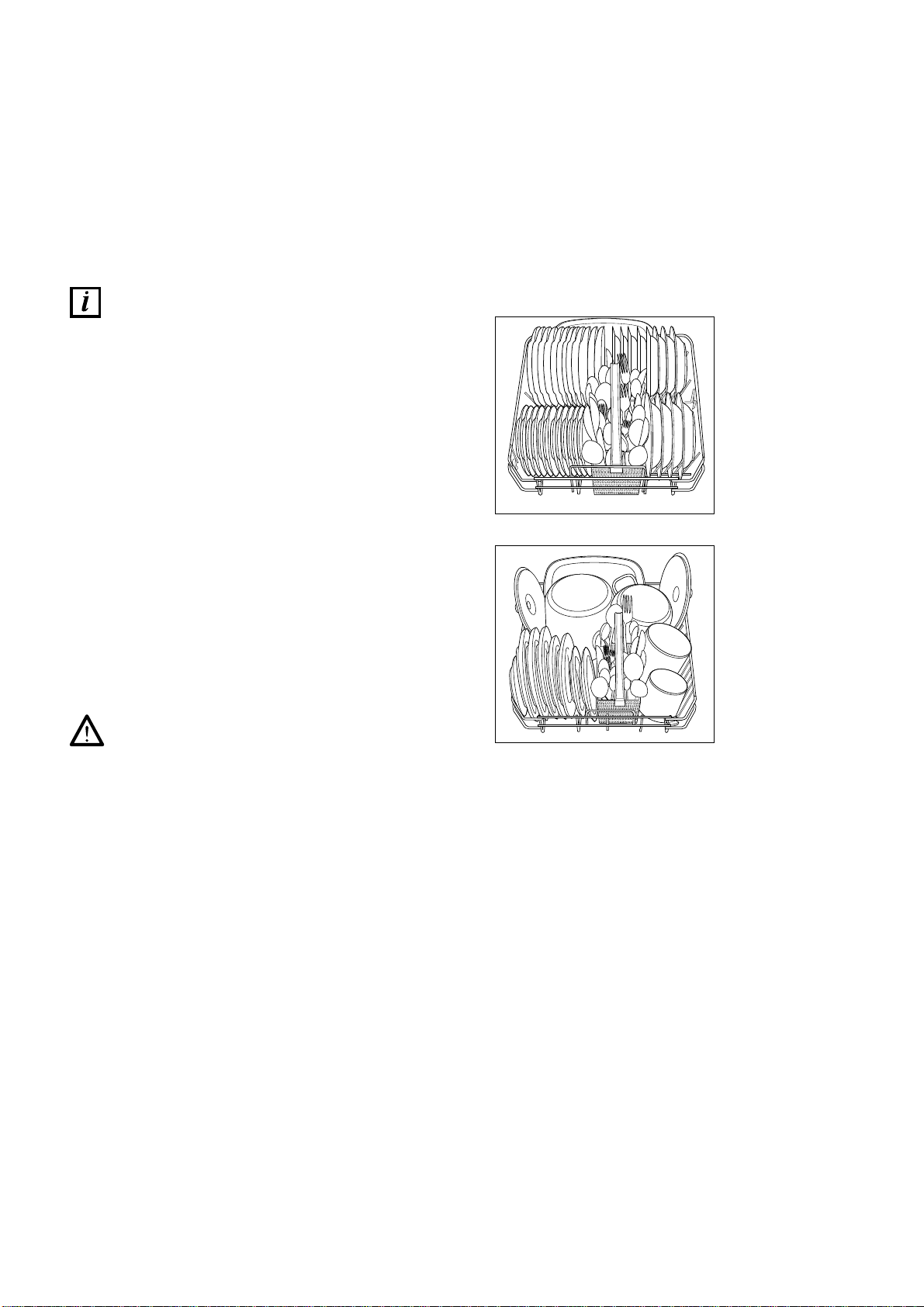
Before placing dishes in the machine, remove any scraps
of food, to avoid clogging the filters and consequently
reducing the performance.
Do not load very small items which
can fall through the baskets.
Open the door and slide out the baskets to load the
dishes.
The lower basket
The lower basket is designed to take saucepans, lids,
plates (up to 27 cm in diameter), salad bowls, cutlery
etc.
Serving dishes and large lids should be arranged around
the edge of the basket, ensuring that the upper spray arm
can turn freely.
The cutlery basket
Long bladed knives stored in an
upright position are a potential
hazard.
Long and/or sharp items of cutlery
such as carvings knives must be
positioned horizontally in the upper
basket.
Take care when loading or unloading
sharp items such as knives.
Cutlery should be placed in the removable cutlery
basket with the handles facing downwards. If the
handles protrude from the bottom of the basket,
obstructing the lower spray arm, load the cutlery with
the handles facing upwards.
Mix spoons with other cutlery to prevent them from
sticking together.
Silver cutlery tends to go black if mixed with steel
cutlery. Place it in the cutlery basket separate from the
others.
Using your appliance
10
PBA03UK
UI33
IEC 436 / DIN 44990
UI19
The upper basket
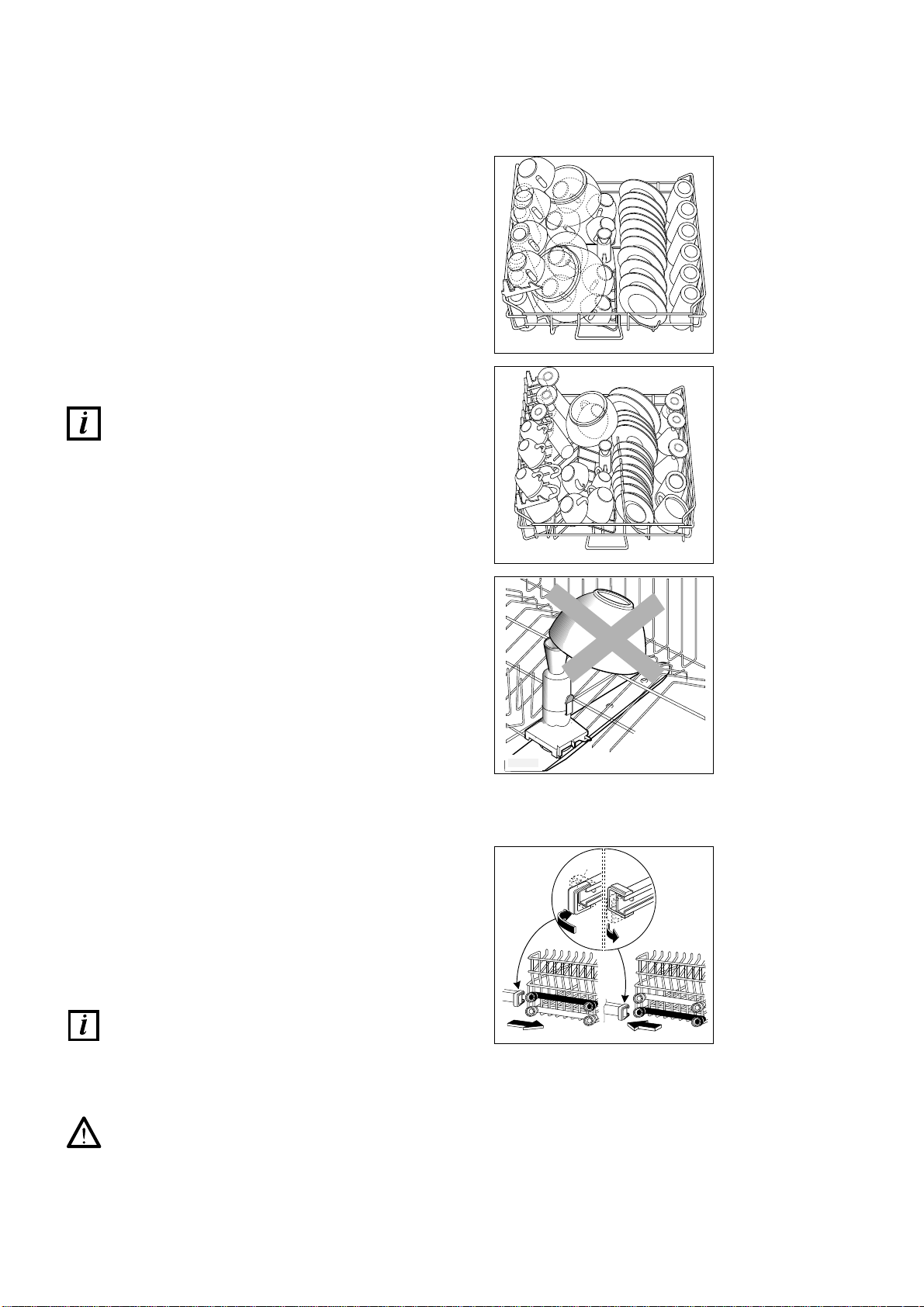
The upper basket is designed for plates (dessert plates,
saucers, dinner plates of up to 24 cm in diameter), salad
bowls, cups and glasses; Glasses with long stems can be
placed upside down in the raised cup racks.
Larger plates (dinner plates up to 24 cm in diameter)
must be loaded in the front part of the upper basket.
Light items (plastic bowls etc.) should be loaded in the
upper basket and arranged so they do not move.
When loading the dishes, ensure that
you do not cover the water inlet
funnel in the middle of the upper
basket.
Before closing the door, ensure that
the spray arms can rotate freely.
Adjusting the height of the
upper basket
If washing very large plates (over 27 cm and up to 31
cm in diameter) you can load them in the lower basket
after moving the upper basket to the higher position.
To move to the higher position proceed as
follows:
1. Move the front runner stops (A) of the upper
basket outward and slide the basket out.
2. Refit the basket in the higher position and
replace the stops (A) in their original position.
When the top basket is in the higher position it
will only take plates up to 20 cm in diameter and
you will not be able to use the raised cup racks.
After loading your machine always
close the door, as an open door can be
a hazard.
11
PBA04UK
US30
IEC 436 / DIN 44990
US02
US16
US16
A
RC01

To save energy
Place dishes in the machine immediately after every
meal and wait until the dishwasher is full before
washing.
If necessary run the Rinse and Hold programme (see
"Washing Programmes" chart on the following page),
so that any food scraps do not become caked on the
dishes while you are waiting to run the complete wash
programme.
Do not prewash dishes under running water.
For best washing results:
Before loading remove all scraps of food and soak
very heavily soiled pots and pans.
Arrange saucepans, cups and glasses etc. upside-
down.
Tilt items with convex or concave surfaces so that the
water drains off easily.
Avoid contact between the dishes as far as possible.
You will improve drying results by leaving the
dishwasher door ajar for at least 15-30 minutes as
soon as the programme finishes.
Wait a few minutes before removing the dishes; in
this way they will be cooler and the drying will be
improved.
Empty the lower basket first and then the upper one;
this will avoid water dripping from the upper basket
onto the dishes in the lower one.
Items not suitable for
dishwashers:
The following items should not be
washed in the dishwasher (unless they
are sold as dishwasher proof):
- Cutlery with wooden or horn handles or
glued parts
- bronze cutlery
- saucepans with wooden handles
- aluminium ware
- crystal ware
- leaded glass
- plastic items
- antique or fine decorated china
Certain types of decoration can discolour when
washed in a dishwasher.
Crystal-ware and plastic objects, if not guaranteed
dishwasher proof should be washed by hand.
Certain types of glass can also become opaque
after being washed several times in a dishwasher.
A chemical reaction can occur between silver cutlery
and stainless steel cutlery. As a precaution, do not
wash together.
Iron and cast iron objects can rust and stain other
items.
Aluminium tends to go black, copper, pewter
and brass tend to stain.
If in doubt check with manufacturer
of the item.
When buying new dishes, ensure
that they are dishwasher proof.
Hints and tips
12
PHT01UK
Washing programmes
13
PWP02UK
Programme
Degree of soil
and
type of load
Heavy soil.
Crockery,
cutlery pots and
pans
Normal soil.
Crockery and
cutlery
Normal soil.
Crockery and
cutlery
Any.
Partial load (to
be completed
later in the day).
Starting
position of the
programmer
Required
pushbuttons
Cycle
description
Recommended quantity
of detergent
in the
dispenser
on the
dispenser lid
*
POWER
WASH
65°C
NORMAL
WASH
65°C
**
ECO
WASH
RINSE AND
HOLD
POWER WASH
65°C
On
Off
On
Off
On
Off
On
Off
25 g 5 g
25 g /
25 g /
//
Cold prewash
Main wash up to 65°C
2 cold rinses
1 hot rinse up to 65°C
Main wash up to 65°C
2 cold rinses
1 cold rinse
Main wash up to 65°C
2 cold rinses
1 hot rinse up to 65°C
*
Testing programme according to IEC 436/DIN 44990
Standard place settings: 12.
Rinse aid selector on position 3.
Recommended quantity of detergent: 25 g in the dispenser
5 g on the dispenser lid.
**
This is a special programme for quick washing (approx. 32 minutes) a full load of lightly soiled crockery etc.
BRILLIANT
FOR A
SHINE
RINSE
CONCENTRATED DISHWASHER DETERGENT
ACTION
NEW
DOUBLE
LIQUID GEL
POWDER
EASY
POURING
PACK
For best results we recommend the use of Finish detergents, rinse aid and salt.
DE15
NORMALWASH
65°C
ECO WASH
RINSE & HOLD

1. Check the filters
Ensure they are clean and properly positioned
(see cleaning instructions).
2. Check that there is rinse
aid and salt
3. Load the dishes
Remove any scraps of food.
Pull the lower basket out and arrange the
saucepans, plates and cutlery in it.
Pull the upper basket out and arrange the plates,
saucers, glasses and cups etc. in it.
Slide the basket back into the machine.
4. Ensure that the spray
arms can rotate freely.
5. Measure out detergent
Add the required amount of detergent into the
dispenser according to the "Washing
programmes" chart and close the lid.
6. Close the detergent
dispenser lid
7. Select the programme
Close the door.
Turn the programme selector dial clockwise
until the marker on the knob corresponds with
the programme you wish to select.
8. Start the programme
Depress the On/Off pushbutton. The On/Off
indicator light comes on and the machine will
start.
9. At the end of the
washing programme
At the end of the washing programme the
dishwasher stops automatically. The On/Off
indicator light remains on until the On/Off
pushbutton is depressed.
10. Switch off the
dishwasher
Switch off the dishwasher by pressing the
On/Off pushbutton.
When the wash programme has
finished, it is recommended that the
dishwasher is unplugged and the
water tap turned off.
In general it is not advisable to open
the door while the machine is
working;if the door is opened
however, a safety device ensures
that the machine stops.
Care must be taken if the door is
opened during the hot phase or
immediately after a programme has
finished, as steam may escape.
Operating sequence
14
POS02UK
Internal cleaning
Ensure that the seals around the door, the detergent and
rinse aid dispensers are cleaned regularly with a damp
cloth.
We recommend the use of Finish Dishwasher Cleaner
every 3 months or run a 65°C wash without dishes using
detergent. Regular use of Finish Dishwasher Cleaner
cleans inaccessible parts, eliminates unpleasant food
odours and helps prevent the build-up of limescale.
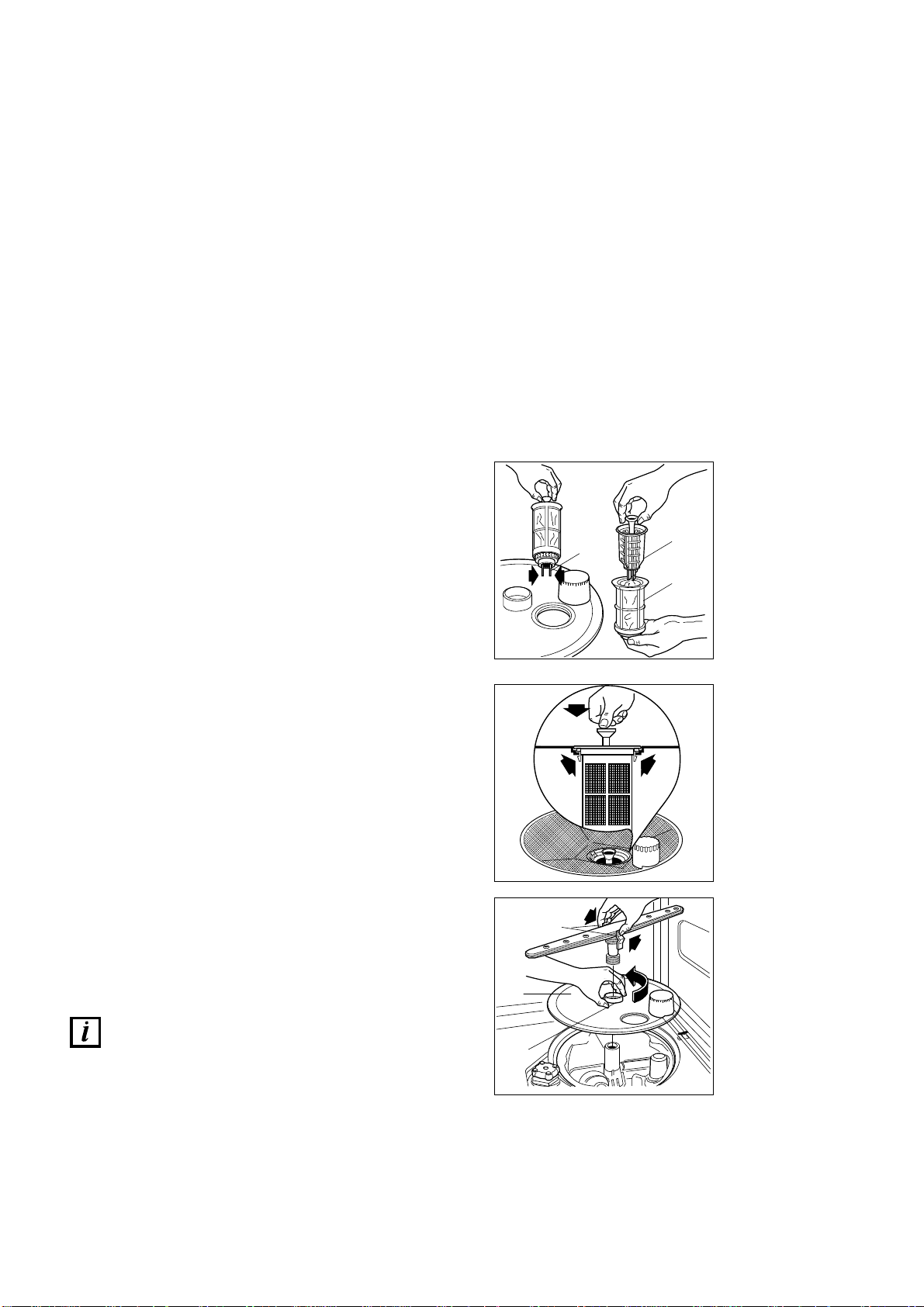
Cleaning the central filters
(After each wash)
Inspect the central filters (B) and (C) and remove any
scraps of food with a brush, under running water.
Filters (B) and (C) are both removed by lifting up the
outer one (B) (pulling the central funnel upwards); the
smaller filter (C) can be removed by pressing the two
tongues (D).
Once cleaned, refit the filters by pressing
them down until they click into place.
Cleaning the large filter
(Once a month)
Clean the large filter (A) on both sides under running
water, using a brush.
To take it out, remove the spray arm by pressing the two
tongues (E), turn the ring (F) anticlockwise and then
slide the whole part out. Refit the filter following the
above instructions in reverse order.
The dishwasher must not be used
without filters.
Incorrect repositioning and fitting of
the filters will produce poor washing
results.
Cleaning the filters is vital to ensure
correct operation of the machine.
Maintenance and cleaning
15
PMC01UK
MA13
B
C
D
MA08
MA01
F
A
E

External cleaning
Clean the external surfaces of the machine and control
panel with a damp soft cloth. If necessary use only
neutral detergents. Never use abrasive products,
scouring pads or solvent (acetone, trichloroethylene
etc....).
Prolonged periods of non-
operation
If you are not using the machine for any
period of time you are advised to:
1. Unplug the appliance and then turn off the
water;
2. Fill the rinse aid dispenser;
3. Leave the door ajar to prevent the formation of
any unpleasant smells;
4. Leave the inside of the machine clean.
Frost precautions
Avoid placing the machine in a location where the
temperature is below 0°C. If this is unavoidable, empty
the machine, close the appliance door, disconnect the
water inlet pipe and empty it.
Moving the machine
If you have to move the machine (moving
house etc....):
1. Unplug it;
2. Turn the water tap off;
3. Remove the water inlet and discharge hoses;
4. Pull the machine out together with the hoses.
Avoid over tilting the machine during transport.
16
PMC02UK
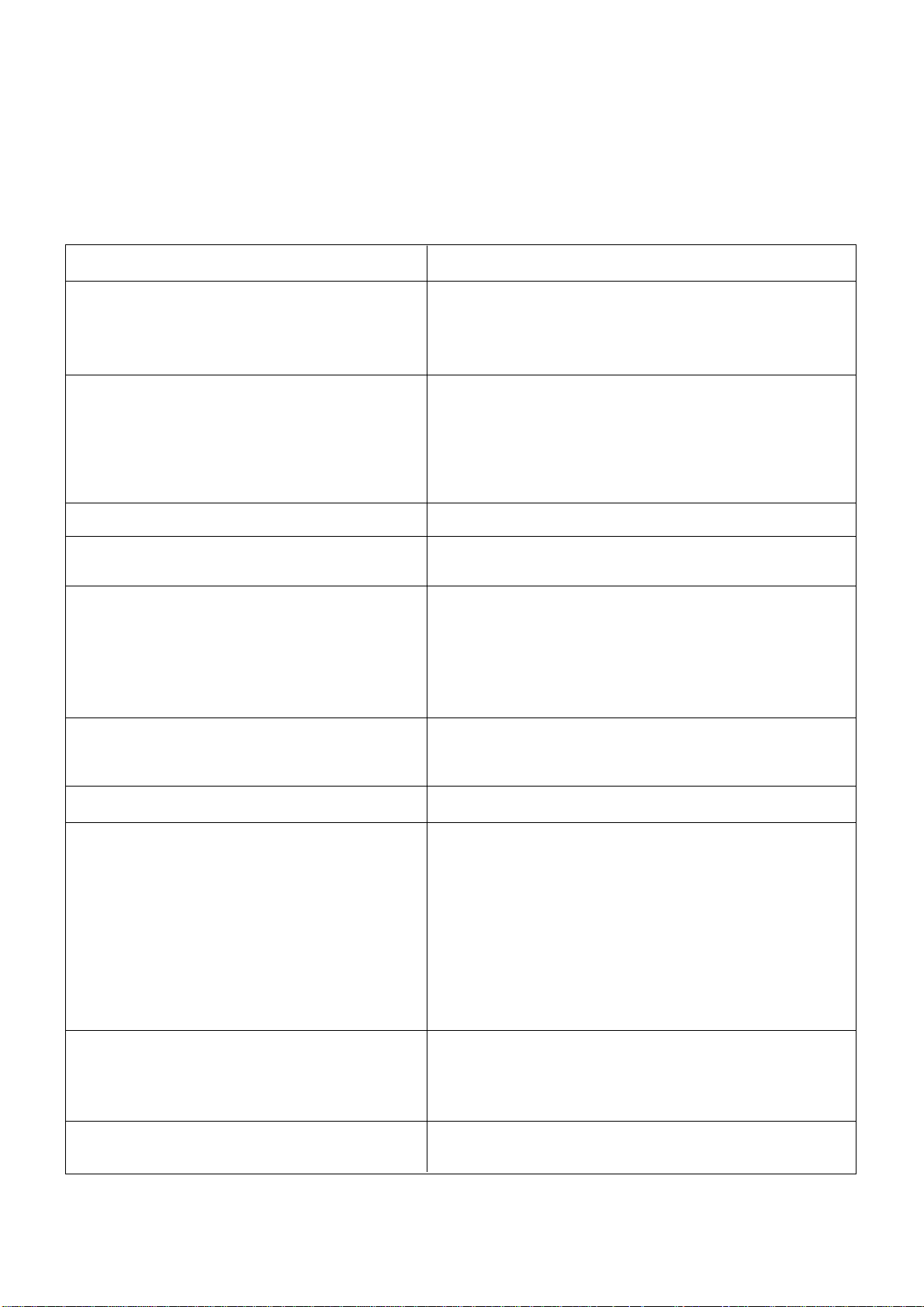
Symptom Solution
The machine will not start ■ The door has not been properly closed.
■ The plug is not properly inserted in the power socket.
■ Check the plug fuse.
■ There is not current at the socket.
The dishwasher does not fill with water ■ Ensure the water tap is open.
■ Ensure the mains water supply has not been cut off.
■ The inlet hose may be squashed or bent.
Reposition the hose.
■ The inlet hose may be blocked.
Switch off the water supply, and clean the filter.
The filters are blocked ■ Clean the filters (refer to “Maintenance and cleaning”).
■ The spray arms are not rotating. Ensure the crockery
is loaded correctly.
The dishwasher will not drain ■ The drain hose may be squashed or bent.
Reposition the hose.
■ The sink may be blocked. Clear any blockages.
■ The drain hose extension is not correct. Follow the
instructions for connecting to the waste.
■ There is no vent in the end of the drain hose.
The machine is noisy ■ Dishes are rattling against each other, (refer to “Loading
your machine”).
■ The spray arms are knocking against the dishes.
The door is difficult to close ■ The dishwasher is not level, or not properly built-in.
The dishes are not clean (poor wash) ■ The baskets are too full.
■ The dishes have not been arranged properly.
■ The spray arms do not rotate.
■ The spray arms are clogged.
■ The filters are clogged.
■ The filters are not in position.
■ Not enough detergent has been used or it is unsuitable.
■ The detergent is old or has gone hard.
■ The salt container cap is not properly closed.
■ The washing programme selected is too gentle.
Visible lime deposits or white film on ■ The rinse aid has run out or too little is being used.
the dishes ■ Check that there is salt and that the salt cap is tight.
■ Ensure the water softener has been adjusted to suit the water
hardness in your area.
The dishes are not quite dry ■ The dishes have been left too long inside the machine.
Something not working
17
PSN01UK
Certain problems are due to lack of simple maintenance or oversights, which can be solved easily without calling
out an engineer. Before contacting your local Service Force Centre, please carry out the checks listed below.

If after all these checks, the problem persists, contact
your local Service Force Centre, quoting the model and
serial number. This information can be found on the
rating plate located on the right hand side of the
dishwasher door (see picture).
Service and spare parts
In the event of your appliance requiring service, or if
you wish to purchase spare parts please contact your
local Electrolux Service Force Centre by telephoning:
0990 929929
Your telephone call will be automatically routed to the
Service Centre covering your post code area. The
addresses are listed on the following pages.
Before calling out an engineer, please ensure you have
read the details under the heading “Something Not
Working” and have the modelnumber and purchase date
to hand.
Please note that it will be necessary to provide proof
of purchase for any in-guarantee service calls. In-
guarantee customers should ensure that the checks
under the heading “Something Not Working” have
been made as the engineer will make a charge if the
fault is not a mechanical or electrical breakdown.
Customer Care Department
For general enquiries concerning your Electrolux
appliance or for further information on Electrolux
products please contact our Customer Care Department
by letter or telephone as follows:
Customer Care Department
Electrolux
Newbury
Berkshire
RG145XL
Tel: 01635 522 799
18
PSN02UK
Prod.No.
........
Ser. No.
.........
Mod.
........
RA01

Standard guarantee conditions
We, Electrolux, undertake that if within 12 months of the date of purchase this Electrolux appliance or any part
thereof is proved to be defective by reason only of faulty workmanship or materials, we will, at our option repair or
replace the same FREE OF CHARGE for labour, materials or carriage on condition that:
• The appliance has been correctly installed and used only on the electricity supply stated on the rating plate.
• The appliance has been used for normal domestic purposes only, and in accordance with the manufacturer’s
instructions.
• The appliance has not been serviced, maintained repaired, taken apart or tampered with by any person not
authoried by us.
• All service work under this guarantee must be undertaken by a Electrolux Service Force Centre.
• Any appliance or defective part replaced shall become the Company’s property.
• This guarantee is in addition to your statutory and other legal rights.
Home visits are made between 8.30am and 5.30pm Monday to Friday. Visits may be available outside these
hours in which case a premium will be charged.
Exclusions
This guarantee does not cover:
• Damage or calls resulting from transportation, improper use or neglect, the replacement of any light bulbs or
removable parts of glass or plastic.
• Costs incurred for calls to put right an appliance which is improperly installed or calls to appliances outside the
United Kingdom.
• Appliances found to be in use within a commercial environment, plus those which are subject to rental
agreements.
• Products of Electrolux manufacture which are not marketed by Electrolux.
European Guarantee
If you should move to another country within Europe then your guarantee moves with you to your new home
subject to the following qualifications:
• The guarantee starts from the date you first purchased your product.
• The guarantee is for the same period and to the same extent for labour and parts as exists in the new country of
use for this brand or range of products.
• This guarantee relates to you and cannot be transferred to another user.
• Your new home is within European Community (EC) or European Free Trade Area.
• The product is installed and used in accordance with our instructions and is only used domestically, i.e. a
normal household.
• The product is installed taking in account regulations in your new country.
Before you move please contact your nearest Customer Care centre, listed below, to give them details of your new
home. They will then ensure that the local Service Organisation is aware of your move and able to look after you
and your appliance.
France Senlis +33 (0) 44 62 22 22
Germany Nurenberg +49 (0) 911 323 2600
Italy Pordenone +39 (0) 1678 47053
Sweden Stockholm +46(0) 20 78 77 50
UK Newbury +44 (0) 1635 522 799
Guarantee Conditions
19
PSN03UK
CHANNEL ISLANDS
GUERNSEY Guernsey Electricity
PO Box 4
Vale, Guernsey
Channel Islands
JERSEY Jersey Electricity
Company
PO Box 45
Queens Road
St Helier
Jersey
Channel Islands
JE4 8NY
SCOTLAND
ABERDEEN 8 Cornhill Arcade
(M5) Cornhill Drive
Aberdeen
AB2 5UT
AUCHTERMUCHY 33A Burnside
(M03) Auchtermuchy
Fife
KY14 7AJ
BLANTYRE Unit 5
(M07) Block 2
Auchenraith Ind Estate
Rosendale Way
Blantyre
G72 0NJ
DUMFRIES 93Irish Street
(M01) Dumfries
Scotland
DG1 2PQ
DUNOON Briar Hill
(M67) 7 Hill Street,
Dunoon
Argyll
PA23 7AL
GLASGOW 20 Cunningham Road
(M04) Clyde Estate
Rutherglen,
Glasgow,
G73 1PP
INVERNESS Unit 3B
(M06) Smithton Indust. Est.
Smithton
Inverness
IV1 AJ
ISLE OF ARRAN Arran Domestics
Unit 4 The Douglas
Centre
Brodick
(OWN SALES) Isle of Arran
KA27 8AJ
ISLE OF BARRA J Zerfah
244 Bruernish
Isle of Barra
(OWN SALES) Western Islands
HS9 5QY
ELECTROLUX SERVICE FORCE
To contact your local Electrolux Service Centre telephone 0990 929929
20
PSN04UK
ISLE OF BUTE Walker Engineering
(M66) Glenmohr
Upper Serpentine Road
Rothesay
Isle of Bute
PA20 9EH
ISLE OF LEWIS ND Macleod
(M69) 16 James Street
Stornoway
Isle of Lewis PA87 2QW
KELSO 2-8 Wood Market
(M08) Kelso
Borders TD5 7AX
ORKNEY Corsie Domestics
(M65) 7 King Street
Kirkwall
Orkney KW15
SHETLAND Tait Electronic System
Ltd.
Holmsgarth Road
Lerwich
(OWN SALES) Shetland ZE1 0PE
SHETLAND Bolts Shetland Ltd
26 North Road
Lerwick
(OWN SALES) Shetland ZE1 0PE
WHALSAY Leask Electrical
Harlsdale
Symbister, Whalsay
(OWN SALES) Shetland ZE2 9AA
NORTHERN IRELAND
BELFAST Owenmore House
(M27) Kilwee Industrial
Estate
Upper Dunmury Lane
Belfast
BT17 0HD
WALES
CARDIFF Guardian Industrial
(M28) Estate
Clydesmuir Road
Tremorfa, Cardiff
CF2 2QS
CLYWD Unit 6-7 Coed- Parc
(M14) Abergele Road
Rhuddlan
Clywd
Wales
LL18 5UG
OSWESTRY Plas Ffynnon Warehouse
(M17) Middleton Road
Oswestry
SY1 2PP
HAVERFORDWEST Cromlech Lodge
(M75) Amerlston
Haverfordwest
SA62 5DS
NORTH EAST
GATESHEAD Unit 356a
(M39) Dukesway Court
Dukesway
Team Valley
Gateshead
NE 11 0BH
GRIMSBY Unit 2
(M42) Cromwell Road
Grimsby
South Humberside
DN31 2BN
HULL Unit 1
(M41) Boulevard Industrial
Estate
Hull HU3 4AY
LEEDS 64-66 G Cross Gates
(M37) Road
Leeds LS15 7NN
NEWTON AYCLIFFE Unit 16
(M45) Gurney Way
Aycliffe Ind Estate
Newton Aycliffe
DL5 6UJ
SHEFFIELD Pennine House
(M38) Roman Ridge Ind.
Roman Ridge Road
Sheffield S9 1GB
NORTH WEST
BIRKENHEAD 1 Kelvin Park
(M11) Dock Road
Birkenhead L41 1LT
CARLISLE Unit 8
(M10) South John Street
Carlisle CA2 5AJ
ISLE OF MAN South Quay Ind Estate
(M64) Douglas
Isle of Man
LIVERPOOL Unit 1
(M15) Honeys Green
Precinct
Honeys Green Lane
Liverpool L12 9JH
MANCHESTER Unit 30, Oakhill
(M09) Trading Estate
Devonshire Road
Worsley Manchester
M28 3PT
PRESTON Unit 250
(M13) Dawson Place
Walton Summit
Bamber Bridge
Preston
Lanashire PR5 8AL
STOCKPORT Unit 20 Haigh Park
(M16) Haigh Avenue
Stockport SK4 1QR
MIDLANDS
BIRMINGHAM 66 Birch Road East,
(M18) Wyrley Road Industrial
Estate
Witton
Birmingham
B6 7DB
BOURNE Manning Road Ind
(M44) Estate
Pinfold Road
Bourne PE10 9HT
BRIDGNORTH 1 Underhill Street
(M72) Bridgnorth
Salop WV16 4BB
GLOUCESTER 101 Rycroft Street
(M23) Gloucester GL1 4NB
HEREFORD Unit 3
(M31) Bank Buildings
Cattle Market
Hereford HE4 9HX
HIGHAM FERRERS The Old Barn
(M51) Westfield Terrace
Higham Ferrers
NN10 8BB
ILKESTON Unit 2
(M43) Furnace Road,
Ilkeston DE7 5EP
LEICESTER Unit 7
(M22) Oaks Indusrtial Estate
Coventry Road
Narborough
Leicestershire
LE0 5GF
LINCOLN Unit 8 Stonefield Park
(M40) Clifton Street
Lincoln LN5 8AA
NEWCASTLE 18-21 Croft Road
UNDER LYME Brampton Industrial
(M12) Estate
Newcastle under Lyme
Staffordshire
ST5 OTW
NUNEATON 19 Ptarmigan Place
(M21) Townsend Drive
Nuneaton CV11 6RX
REDDITCH Heming Road
(M20) Washford
Redditch
Worchestershire
B98 ODH
TAMWORTH Unit 3
(M19) Sterling Park
Claymore
Tamworth B77 5DO
WORCESTER Unit 1
(M73) Northbrook Close
Gregory Mill Ind
Estate
Worcester
WR3 8BP
ELECTROLUX SERVICE FORCE
To contact your local Electrolux Service Centre telephone 0990 929929
21
PSN05UK
SOUTH EAST
ASHFORD Unit 2
(M58) Bridge Road Business
Estate
Bridge Road
Ashford
Kent TN2 1BB
FLEET Unit 1
(M59) Redfields Industrial
Estate
Church Crookham
Fleet
Hampshire GU13 ORD
HAYWARDS HEAT 21-25 Bridge Road
(M55) Haywards Heath
Sussex RH16 1UA
TONBRIDGE Unti 30 Deacon
(M56) Trading Estate
Morley Road
Tonbridge
Kent TN9 1RA
SOUTH WEST
BARNSTAPLE P.O. Box 12
(M30) Barnstaple
North Devon
EX31 2YB
BOURNEMOUTH 63-65 Curzon Road
(M26) Bournemouth
Dorset BH1 4PW
BRIDGEWATER 6 Hamp Industrial
(M35) Estate
Bridgewater
Somerset TA6 3NT
BRISTOL 11 Eldon Way
(M25) Eldonwall Trading
Bristol
Avon BS4 3QQ
EMSWORTH 266 Main Road
(M33) Southbourne
Emsworth PO10 8JL
ISLE OF WIGHT Unit 8
(M34) Enterprise Court
Ryde Business Park
Ryde
Isle of Wight
PO33 1DB
NEWTON ABBOT Unit 2 Zealley
(M29) Industrial Estate
Kingsteignton
Newton Abbot
S. Devon TQ12 3TD
PLYMOUTH 16 Faraday Mill
(M32) Cattledown
Plymouth PL4 OST
REDRUTH Unit 7D
(M36) Pool Industrial Estate
Wilson Way, Redruth,
Cornwall TR15 3QW
LONDON & EAST ANGLIA
CHELMSFORD Hanbury Road
(M47) Widford Ind Estate
Chelmsford
Essex CM12 3AE
COLINDALE Unit 14
(M53) Capital park
Capital Way
Colindale
London NW9 OEQ
ENFIELD 284 Alma Road
(M49) Enflied
London EN3 7BB
GRAVESEND Unit B4,
(M57) Imperial Business
Estate
Gravesend
Kent DA11 ODL
HARPENDEN Unit 4
(M46) Riverside Estate
Coldharbour Lane
Harpened AL5 4UN
LETCHWORTH 16-17 Woodside Ind Est.
(M50) Works Road
Letchworth
Herts SG6 1LA
LONDON 2/4 Royal Lane
(M76) Yiewsley
West Drayton
Middlesex UB7 8DL
MAIDENHEAD Reform Road
(M60) Maidenhead
Berkshire SL6 8BY
MOLESEY 10 Island Farm Avenue
(M61) West Molesey
Surrey KT8 2UZ
NEWBURY PO Box 5627
(M24) Newbury
Berkshire RG14 5GF
IPSWICH Unit 2B
(M48) Elton Park Business
Centre
Hadleigh Road
Ipswich IP2 ODD
NORWICH 2b Trafalgar Street
(M52) Norwich NR1 3HN
SUNBURY Unit 1a
(M63) The Summit
Hanworth Road
Hanworth Ind Estate
Sunbury on Thames
TW16 5D
SYDENHAM Unit 6
(M62) Metro Centre
Kangley Bridge Road
Sydenham SE26
Any electrical work required to install
this appliance should be carried out
by a qualified electrician or
competent person.
Any plumbing work required to install
this appliance should be carried out
by a qualified plumber or competent
person.
Technical specifications
Installation instructions
22
PTS02UK
DIMENSIONS Width 59.6 cm
Height 81.8 - 87.8 cm
Max depth 57.5 cm
Max depth with open door 111.4 cm
ELECTRICAL CONNECTION Voltage 220/240 V - 50 Hz
MOTOR RATING DURING WASH 200 W
POWER OF HEATING ELEMENT 2570 W
OVERALL POWER 2770 W
WATER SUPPLY PRESSURE Minimum 50 kPa (0.5 bar)
Maximum 800 kPa (8 bar)
CAPACITY (STANDARD IEC)
PLACE SETTINGS 12
CONSUMPTION Water 29 l
Electricity 1.6 kW/h
Remove all packaging before positioning
the machine.
If possible, position the machine next to a water tap and
a drain.
Water supply connections
This dishwasher must be plumbed into a cold water
supply.
The water pressure must be within the limits given in
the technical specifications.
Your local Water Authority will advise you on the
average mains pressure in your area.
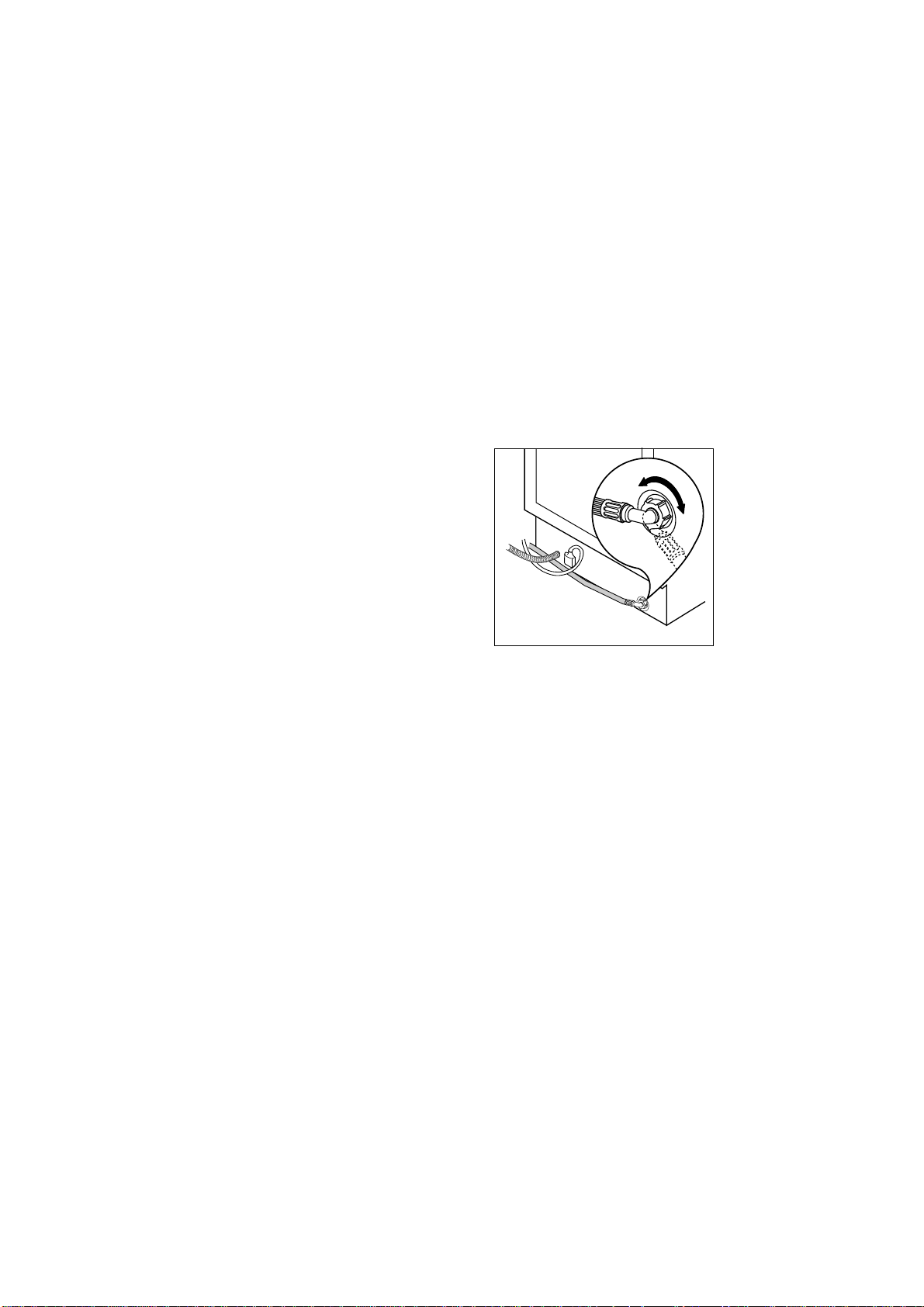
The dishwasher features fill and drain hoses which can
be turned either to the left or the right to suit the
installation.
The locknut must be correctly fitted to
avoid water leaks.
Avoid bends or kinks in the hose which could prevent or
slow down the water supply.
If the machine is connected to new pipes or pipes which
have not been used for a long time, you should run the
water for a few minutes before connecting the inlet
hose. This will prevent deposits of sand or rust clogging
the inlet hose filter.
23
PWA01UK
CA06
Water outlet hose
connection
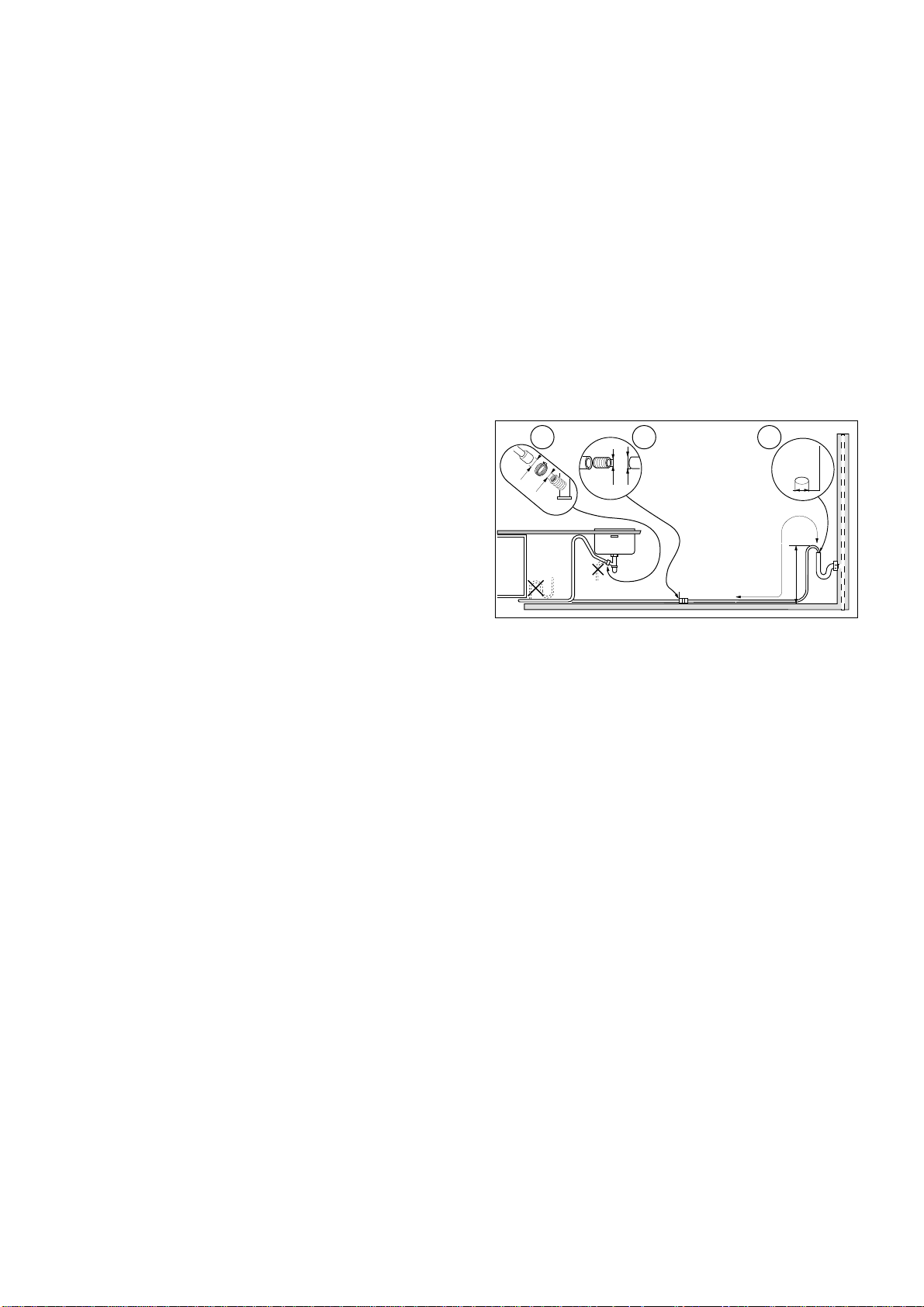
The end of the drain hose can be connected in the
following ways:
A- To the sink outlet siphon, securing it if necessary
with a clip.
B- To a wall outlet provided with a vent-hole, minimum
internal diameter 4 cm.
The waste connection must be at a height of between 30
cm (minimum) and 100 cm (maximum) from the floor.
It makes no difference which way the drain hose faces,
either to the right or left of the dishwasher.
Ensure the hose is not bent or squashed as this could
prevent or slow down the discharge of water.
C-If you use a drain hose extension it must be no longer
than 2 metres and its internal diameter must be no
smaller than the diameter of the hose provided.
Likewise the internal diameter of the couplings used for
connections to the waste outlet must be no smaller than
the diameter of the hose provided.
The sink plug must not be in place when
the machine is draining as this could cause
the water to siphon back into the machine.
24
PWA04UK
CS11
min 30 cm
max 100 cm
+ 2 m max
min 4 cm
Ø 21
Ø 18
Ø 18
Ø 21
A BC
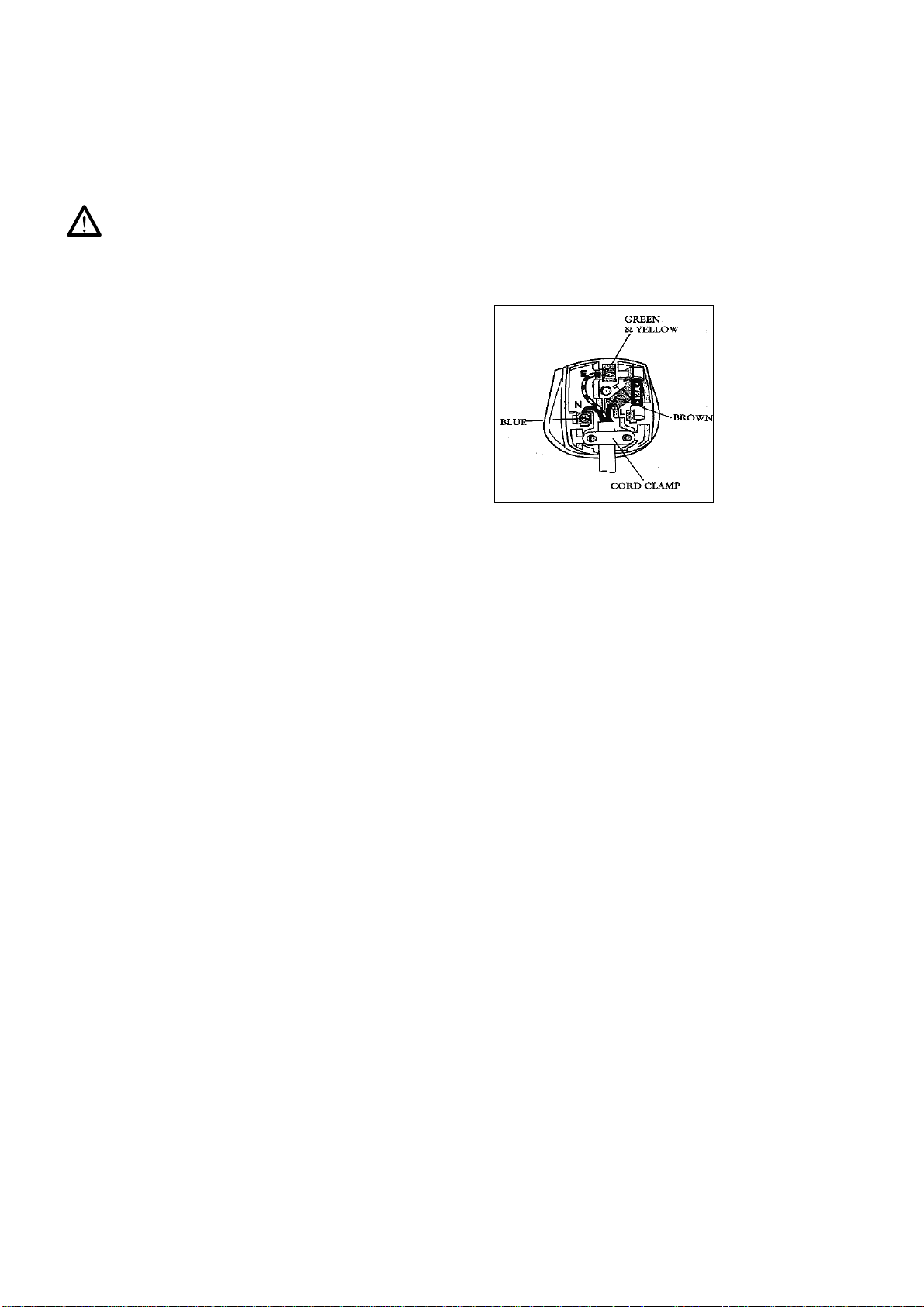
Electrical connection
This appliance must be earthed.
The manufacturer declines any
responsibility should this safety measures
not be observed.
If the plug that is fitted to your appliance is not suitable
for the socket, it must be cut off and the appropriate plug
fitted.
Important
The wires on the mains lead are coloured in accordance
with the following code:
Green and Yellow -Earth
Blue -Neutral
Brown -Live
If you fit your own plug, the colours of the wires in the
mains lead of your appliance may not correspond with
the markings identifying the terminals in your plug.
Proceed as follows:
1. Connect the Green and Yellow (earth) wire to the
terminal in the plug which is marked with the letter
"E" or the earth symbol or coloured green and
yellow.
2. Connect the Blue (neutral) wire to the terminal in the
plug which is marked with the letter "N" or coloured
black.
3. Connect the Brown (live) wire to the terminal in the
plug which is marked with the letter "L" or coloured
red.
The plug moulded onto the lead incorporates a 13amp
BSI362 fuse. Only ASTA or BSI fuses should be used.
The plug must not be used if the fuse cover/carrier is
lost. The cover/carrier is indicated by the coloured insert
at the base of the product.
A replacement cover/carrier must be obtained from your
local Electrolux Service Force Centre.
This appliance complies with the following
E.E.C. Directives:
- 73/23 or 19.2.73 (Low Voltage Directive)
and subsequent modifications;
- 89/336 or 3.5.89 (Electromagnetic
Compatibility Directive) and subsequent
modifications.
25
PWA02UK
CE03
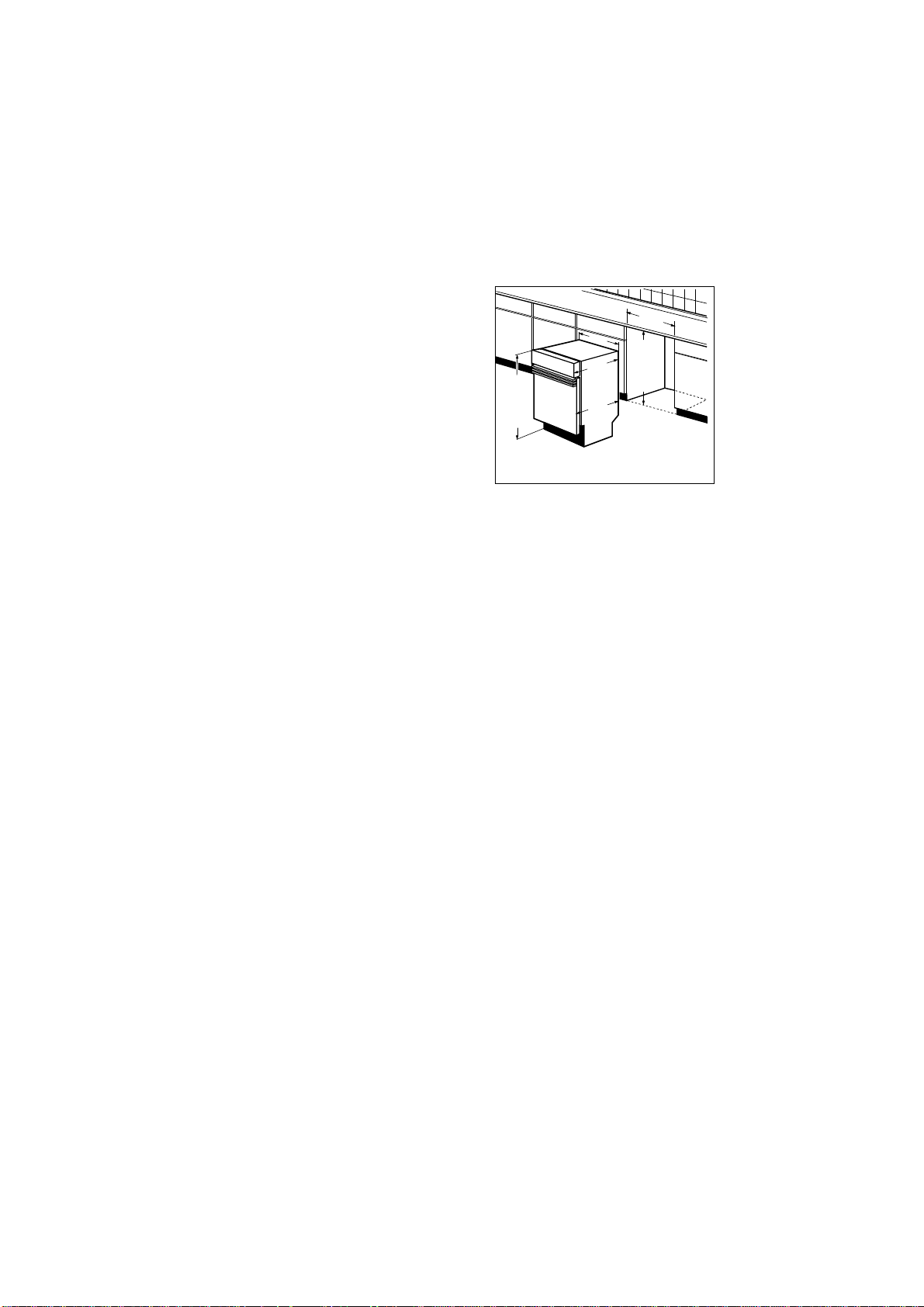
This dishwasher is designed to be fitted under a kitchen
counter or worksurface.
It is essential that the recess dimensions indicated in the
diagram are followed.
No further openings for venting of the dishwasher are
required, but only to let the water fill and drain hose and
power supply cable pass through.
It is absolutely essential that the dishwasher is
disconnected from the electricity supply before gaining
access to any internal component.
Fit the dishwasher into an appropriate housing space and
connect it.
When inserting the machine, ensure that the water inlet
and drain hoses are not kinked or squashed.
The recess height may be anywhere between 820 and
880 mm from the floor since the dishwasher
incorporates adjustable feet (max 60 mm).
A distance of 2 mm should be allowed between the top
of the dishwasher and the counter top.
Levelling
Good levelling is essential for correct closure and
sealing of the door.
When the appliance is correctly levelled, the door will
not catch on the levelling spacers, either side of the
cabinet.
If the door does not close correctly, loosen or tighten the
adjustable feet until the machine is perfectly level.
Building-in
26
PFI04UK
818 ÷ 878
600
820 ÷ 880
II62
596
575
max.
max.
555
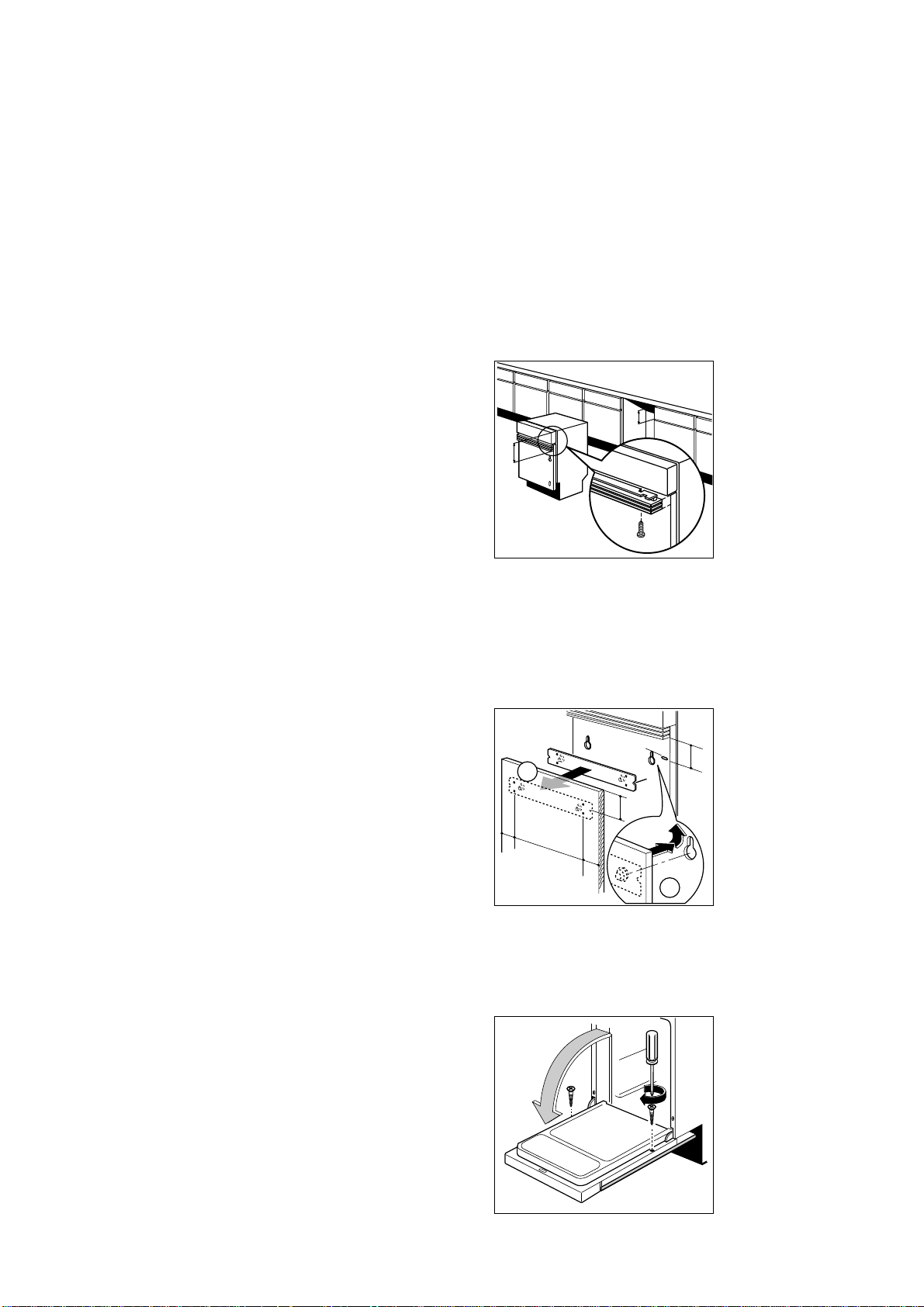
The furniture door
The door on this appliance is designed for the overlay or
a panel having the following dimensions:
Width: 596 mm
Height: 604 mm max
Thickness: 20 mm max
Weight: 2 - 7.5 kg max
The panel height should be no more than indicated,
otherwise complete opening of the door will no longer
be possible as the panel hits against the dishwasher
plinth.
Furthermore, it is possible to line up the control panel to
correspond with the height of the drawers of the
adjacent pieces of furniture, thus perfectly co-ordinating
with style of the rest of the unit furniture in your
kitchen.
Add one or more of the fillets provided until you reach
the desired height.
Secure the fillets as shown in the picture, by means of
two screws 4 x 40 provided therewith.
Prepare the panel as follows:
Measure the distance (B) between the part below the
control panel (or fillets) and the reference notch (X) on
the door.
Measure the same distance (B) on the wooden panel
starting from the upper edge.
At this distance position the supporting cross-bar
provided, in correspondence with the reference (Z).
Keep the same distance between the centre of the
support’s fastening holes and the lateral edges of the
wooden panel.
On the panel sign the seats for the four fastening screws.
Drill the panel with a Ø 2 x 12 bit and fix the supporting
cross-bar onto the wooden panel with the 3.5 x 16
screws provided.
Mount the decor panel by inserting the two pivots of the
cross-bar into the slotted holes of the door.
Lift the decor panel until the perfect alignment with the
facia panel is obtained.
Once the correct position has been found, open the door
and fasten the decor panel on the lower section by
means of the two 4 x 40 screws provided, using the
holes through the inner door.
27
PFI05UK
II04
A
A
B
Z
X
=
=
550
B
2
1
II22
II10
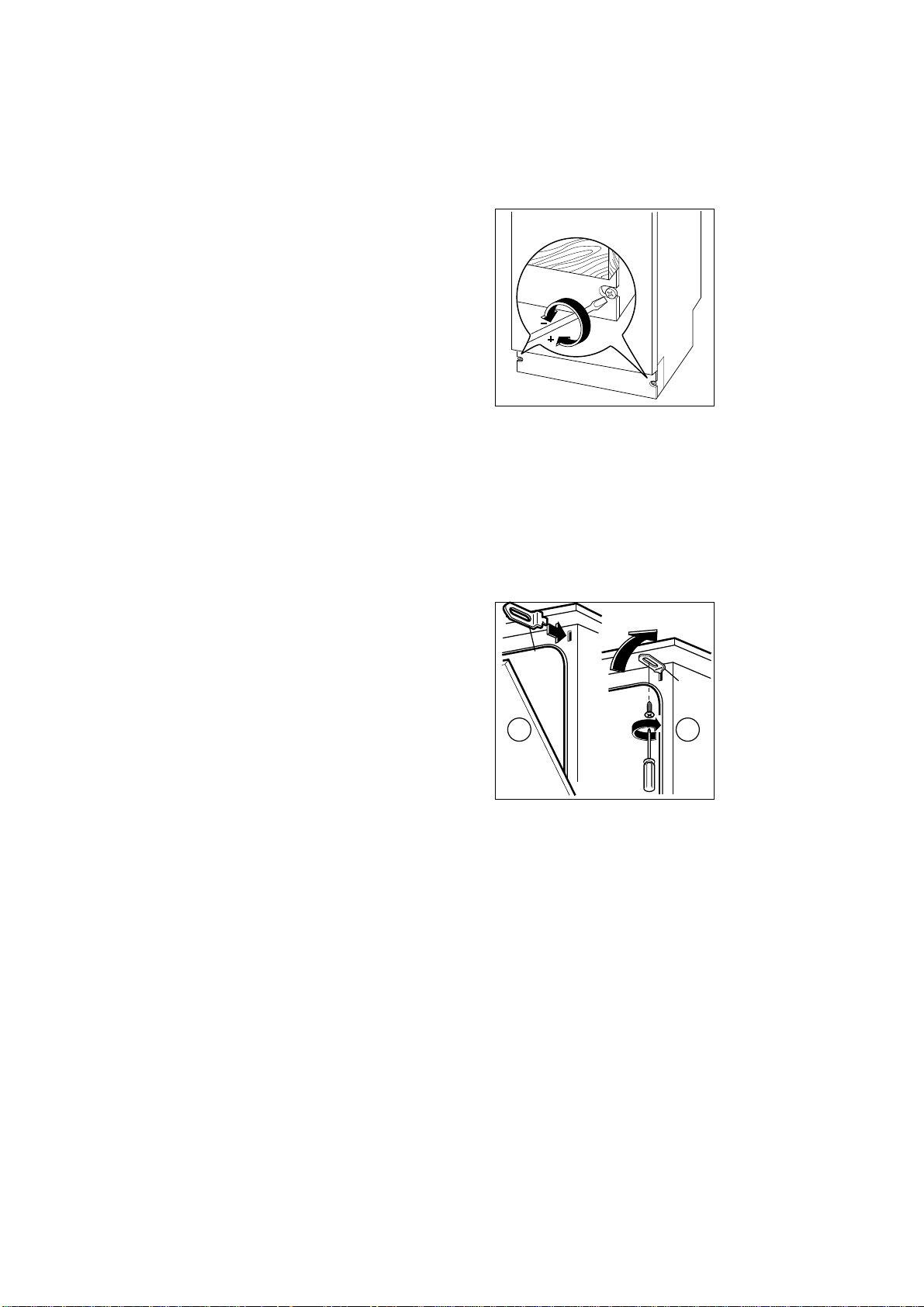
Adjusting the door balance
The door of the dishwasher is balanced when it is open
in any position.
Fitting the decor panel may sometimes affect this
balance. In this case it will be necessary to adjust the
balance as follows:
Half-open the door and regulate the screws located on
the kick plate.
By screwing or unscrewing these screws, the tension of
the door balancing springs is increased or decreased
respectively.
The weight of the panel should be within the limits
given in "The furniture door" otherwise balancing the
door will not be possible.
Securing under a counter
Open the door; vertically insert the two mounting
brackets (A) on the front part of the dishwasher and turn
them 90° (see figure). Secure the brackets to the counter
by means of two 3.5 x 16 screws provided.
Important: the dishwasher must be secured
against tilting. Therefore, make sure that
the counter it is fitted under, is suitably
secured to a fixed structure (adjacent
kitchen cabinets, wall).
28
PFI08UK
II08
1
2
A
90°
II18
A
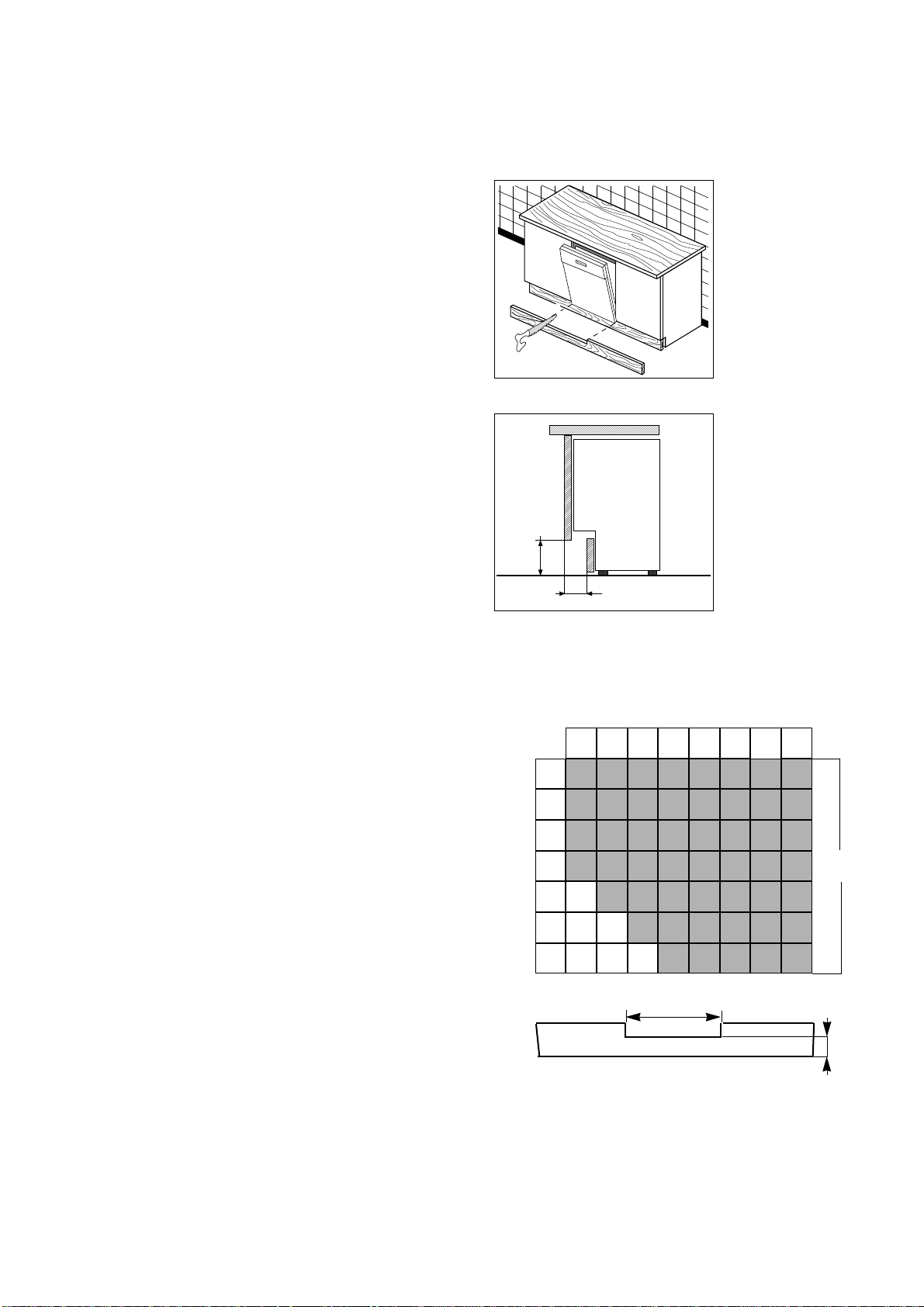
Kitchen plinth adjustment
To allow correct opening of the door it is sometimes
necessary to cut the kitchen plinth. Refer to the cutting
table.
According to dimensions (a) and (b) as shown on the
figure, you will find on the following table the depth (x)
of the cut to be made on the plinth.
The dimensions (a) and (b) of the table are those most
frequently used in the kitchen furnitures.
29
PFI06UK
II59
a
b
II15
170 160 150 140 130 120 110 100
136 131 125 118 110 100 93 85
135 131 125 118 110 102 92 85
137 132 125 118 110 102 94 85
138 134 128 120 110 104 95 85
139 130 124 115 105 98 88
138 129 120 110 100 90
135 125 115 105 95
/
/ /
/
40
50
60
70
80
90
100 / /
Height (a)*
Depth (b)*
X
X
600 mm
minimum
Dimensions of the
cut on the plinth
(*) dimensions in mm




This file has been downloaded from:
www.UsersManualGuide.com
User Manual and User Guide for many equipments like mobile phones, photo cameras, monther board, monitors, software, tv, dvd, and othes..
Manual users, user manuals, user guide manual, owners manual, instruction manual, manual owner, manual owner's, manual guide,
manual operation, operating manual, user's manual, operating instructions, manual operators, manual operator, manual product,
documentation manual, user maintenance, brochure, user reference, pdf manual