Be sure to have your installer follow these instructions closely so that your new dishwasher works properly and that you’re not at risk of injury when washing dishes.
UNPACKING YOUR DISHWASHER
Once your new dishwasher has been delivered to you, carefully unpack it and check for any damage. If the dishwasher has been damaged, make note of it on the waybill and keep a copy. Do not install the dishwasher, and contact Samsung Customer Service at the number listed below.
If there is no damage to the product, you can proceed with the installation. If you are going to install it yourself, make sure to read through the installation guide and follow the directions inside.
After unpacking your dishwasher, keep the packaging out of the reach of children to ensure their safety.
CHECKING PARTS
When your dishwasher has been unpacked, make sure you’ve received all the parts shown below.
If your dishwasher was damaged during shipping, or if you do not have all the parts, contact Samsung Customer Service at 1-800-SAMSUNG (726-7864)
CONTROL PANEL
DW80K7050, DW80K5050 Series
You can select options (Lower Rack, StormWash™, Hi-Temp Wash, Sanitize) before starting a cycle. If you change the cycle after selecting an option, the original cycle is reset.
To prevent the touchpad from losing response sensitivity, follow these instructions:
Touch the center of each keypad using one finger. Do not push.
Clean the touch control’s surface regularly with a soft, damp cloth.
Be careful not to touch more than one touch key pad at a time, except as directed.
When you pause a cycle by opening the door during operation, press the Start button before closing the door to continue the cycle.
Push door firmly closed within 3 seconds of pressing Start button.
If the door is not closed within 3 seconds, the cycle will not start.
CYCLE SELECTOR
DW80K7050, DW80K5050 Series
using your dishwasher
BASIC GUIDELINES
Open the door and load your dishes (see page 14).
Place dishes into the upper and lower racks, unless you have selected Lower Rack.
Remove any food remains from the dishes before placing them in the FlexLoad™ rack(s).
After placing the dishes into the FlexLoad™ racks, rotate the nozzles by hand to check whether any of the dishes will interfere with them.
Make sure the dishes will not prevent the detergent dispenser from opening.
Add detergent to the dispenser (see page 20).
Make sure to use only automatic dishwasher detergent and rinse aid.
Refer to “Using detergent” on page 20 for instructions explaining how to add detergent and rinse aid.
Press the Power button.
When you press the Power button, the entire display turns on and off, and then the indicator of the most recently finished cycle lights up.
If “Low Rinse” ( ) is illuminated, you should refill the rinse aid dispenser to improve washing and drying performance.
Select an appropriate cleaning cycle depending on the soil level of the dishes. (See pages 9 and 25.)
Press the appropriate cycle button.
When you press a cycle button, the cycle indicator lights up.
Press the Start button, and then close the door within 3 seconds.
The dishwasher will start draining after a few seconds, and then start the selected cycle.
Make sure to close the door firmly. If the door is not closed properly, the selected cycle will not start automatically.
When the wash cycle is completed.
The light illuminates and the dishwasher sounds a chime.
The dishwasher powers off automatically.
The door opens automatically 5 ~ 15 minutes before the cycle ends to improve drying performance.
If you want to load more dishes or pause the dishwasher while it is already running, make sure to open the door slowly and carefully as there is a possibility of injury from the hot steam inside the dishwasher.
If the door is opened while the dishwasher is running, a safety mechanism is activated and stops the cycle.
To resume operation, press the Start button, and then close the door within 3 seconds.
Adding dishes several minutes after the dishwasher starts operating may affect its performance.
If you open the door while the dishwasher is running at high temperature, it will drain the hot water automatically to protect you from scalding.
You should use rinse aids for better drying performance. You can further improve drying performance by also selecting the Sanitize option.
After a cycle is complete, the door automatically opens to let steam out. This is normal and not a product malfunction.
Touch controls
Touch controls allow you to operate the dishwasher easily.
They are convenient to operate, requiring only a soft touch.
Have a simple and stylish design.
Are easy to clean.
If you have children or you want to clean the Control Interface, we recommend activating the Control Lock feature to lock the control buttons. See page 8.
Children will not be able to accidently start the dishwasher by touching the controls with this option selected.
If a cycle is running, the buttons will not respond. (except the Power button)
If dishwasher is off, only the Power button responds.
Setting Mode
The Setting Mode lets you change the dishwasher’s Sound, Light indicator, and AutoRelease™ Dry settings. To enter the Setting mode, press the Delay Start + Sanitize buttons for 3 seconds while the dishwasher is on. Press the Sanitize button to select a sub-setting menu and then press the Delay Start button to change a setting.
Sound Setting: Press the Sanitize button until “U1” or “U0” is displayed. To change the setting, press the Delay Start button. “U0” turns the sound off for all cycles. “U1” turns the sound on. The dishwasher maintains the Sound Setting you have selected until you change it.
Light indicator Setting: Press the Sanitize button until “B1“ or “B0” is displayed. To change the setting, press the Delay Start button. “B0” turns the light off for all cycles. “B1” turns the light on.
AutoRelease™ Dry setting: Press the Sanitize button until “A1” or “A0” is displayed. Press the Delay Start button to enable or disable AutoRelease™ Dry. “A0” disables AutoRelease™ Dry. “A1” activates AutoRelease™ Dry.
*Once the door opens in the AutoRelease™ Dry mode, the door cannot be closed manually for the next 2 minutes.
*The AutoRelease™ Dry mode will be disabled for the Rinse only cycle.
The door opens automatically 5 ~ 15 minutes before the cycle ends to improve drying performance.
Changing the “AutoRelease™ Dry” setting can influence drying results. Select “A1” mode for better drying results. (“A1” is the default setting.)
After a cycle is complete, the door automatically opens to let steam out. This is normal and not a product malfunction.
Delay start
When you select the Delay Start option, your dishwasher will:
Start draining to remove remaining water at once (pre-drain).
Your dishwasher will operate the selected cycle when the delay time expires.
When using the dishwasher, try to arrange the dishes properly as described on page 16 to 19.
You should remove food remains such as bones, fruit seeds, etc. and any other waste such as toothpicks, paper, etc. from the dishes as these may cause damage to the dishes, create noise, or cause the dishwasher to malfunction.
Select the appropriate cycle depending on the level of soil and the type of dishes.
Use only the proper amount of detergent and rinsing agent.
Do not wash the following items
Acrylic or Aluminum items: Dishes with printed gold rim decoration may become discolored.
Dishes treated with adhesive: Treated plastics, wood, ivory, copper, and tin may come loose.
Plastics with a temperature tolerance less than 194 ˚F (90 ˚C): Thin plastics wash and dry poorly, and may be damaged due to elevated wash temperatures.
Tin: Tin should be washed by hand and dried immediately as it may rust.
Wooden utensils: Wooden items may crack.
ADJUSTING THE ANGLE OF THE PLATE SUPPORTS
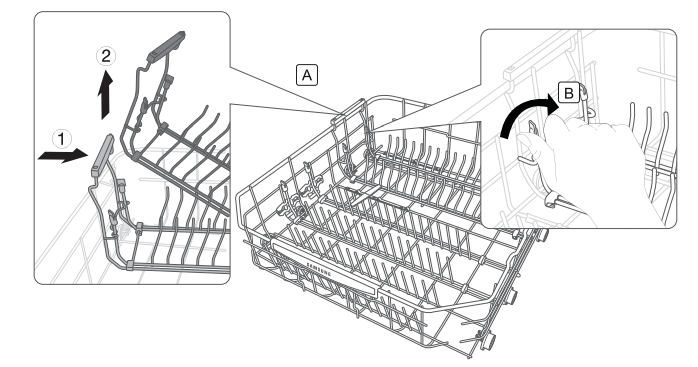
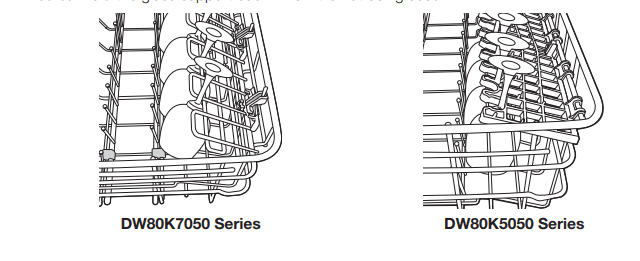
You can adjust the angle of the tines in the upper rack to three different positions to match the size and shape of your dishes. To adjust the tines, grasp the handle at the back of the rack and push it left or right. See the illustration below.
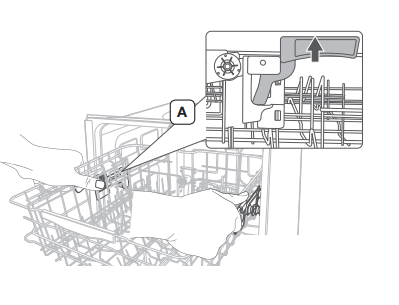
In the lower rack, you can easily remove the plate support to make room for large items such as pots and pans. To remove the plate support, lift up the handles (A). To refit the plate support, align it so it is in place, and then push down on the handles (A). To fold down the fold-down tines on the lower rack, remove the rack from the dishwasher, turn the rack over, grasp the tine (B), and then adjust it backward. See the illustration below.
Upper rack
Lower rack
You can adjust the height of the upper rack in your Samsung dishwasher so that the lower rack can accommodate larger sized dishes. With the upper rack set at the highest position, the lower rack can accommodate plates up to 12 in. (30 cm) in diameter and the upper rack can accommodated plates up to 8 in. (20 cm) in diameter.
DW80K7050, DW80K5050 Series
To lower the upper rack by 2 in. (5 cm), pull the adjustment handles located at the left and right sides of the upper rack and push the upper rack downwards slightly at the same time.
To raise the upper rack, just pull the upper rack upwards. The adjuster handle will latch and the upper rack will move to the high position.
We recommend adjusting the height of the upper rack before loading dishes into the rack. If you adjust the the rack after loading the dishes, you may damage the dishes.
REMOVING THE UPPER RACK
Pull the upper rack towards the front and then remove it by lifting it up slightly and pulling it towards the front. See the illustrations below.
While the upper rack is removable, it must be installed for the dishwasher to operate properly.
If you attempt to operate the dishwasher without the rack, noise will occur and the dishwasher will perform poorly.
LOADING THE LOWER RACK
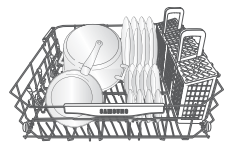
The lower rack has been especially designed for dinner dishes, soup bowls, plates, pots, lids, casserole dishes, and plates.
Load large items such as pans and pots into the dishwasher so their open sides face downwards. We recommend loading cups, stemware, and small plates into the upper rack.
See the recommended loading patterns below.
Loading the large items into the StormWash™ zone
You can load large items such as pots and pans into the StormWash™ Zone - identified by red guide lines - In the lower rack for more effective cleaning. When you select the StormWash™ option, an additional, powerful jet is activated and directed at items in the StormWash™ Zone. Make sure pot handles and other items do not interfere with the rotation of the nozzles.
LOADING THE UPPER RACK
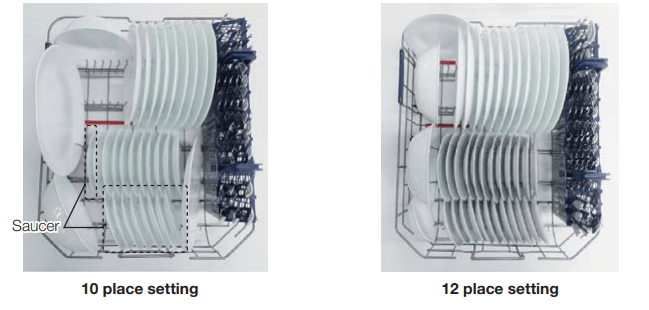
The upper rack has been designed for small plates, mugs, glasses, and plastic items marked “dishwasher safe”. Load your plates into the dishwasher in two half rows, so that the front of each plate faces the back of the plate in front of it, and the open sides of the plates at the center of the dishwasher face each other. See the illustrations below.
Make sure the loaded dishes do not interfere with the rotation of the nozzle which is located at the bottom of the upper rack. (Check this by rotating the nozzle by hand.)
When loading dishes, pull the upper rack out sufficiently so you can load it without striking the counter above.
Using the glass support
You can load cups or glasses onto the glass support. This is also very convenient for washing wine glasses. Hang your wine glasses onto the pegs of the glass support.
You can fold the glass support back when it is not being used.
USING THE CUTLERY RACK
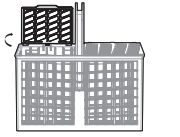
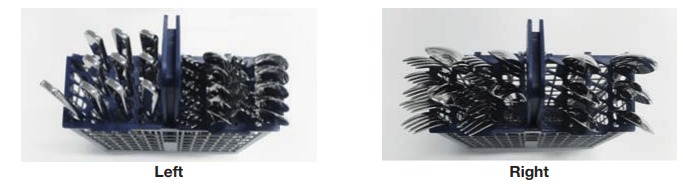
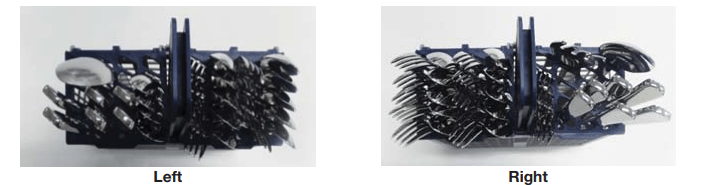
The cutlery rack consists of two compartments.
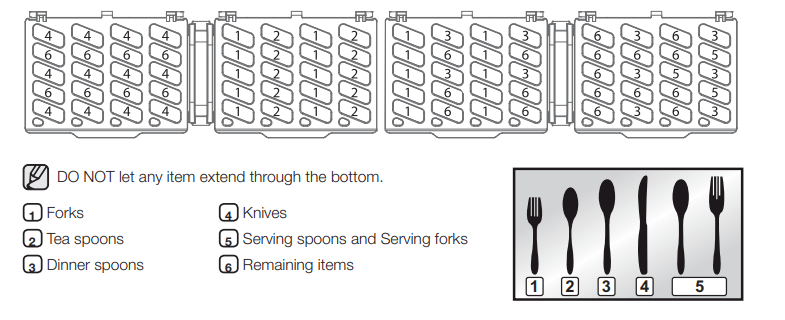
You can place each knife, spoon, or fork separately into the spoon stands in the basket’s covers to prevent chipping and discoloration.
You can use the cutlery rack with the cover open. Refer to the illustration to the right.
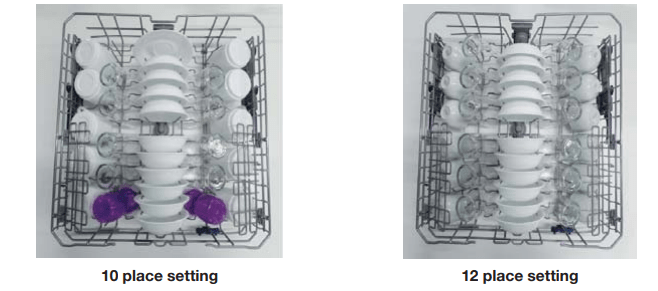
10 place setting
12 place setting
The spoon stands as seen from above with the suggested placement of cutlery items. Match the numbers in the diagram to the numbers in the list of cutlery items below.
Loading the cutlery rack
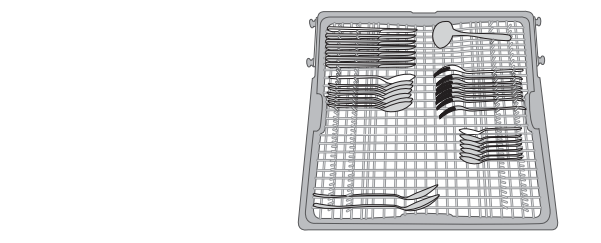
<Place items randomly or regularly.>
In addition to the standard cutlery basket in the lower rack, some models come with a cutlery rack.
The cutlery rack is best suited for flatware and cooking or serving utensils. You can place cutlery and utensils randomly or regularly on the cutlery rack.
Heavily soiled utensils or items with baked on foods should be placed in the lower cutlery basket for the most effective cleaning.
Removing the Cutlery Rack
The entire cutlery rack can be removed if more space is needed on the upper rack for larger items.
*When loading the cutlery and utensils onto the cutlery rack, make sure they do not interfere with the top nozzle of the rack. If they interfere, remove the cutlery pad and try again.
USING DETERGENT
All dishwasher cycles require detergent in the detergent compartment.
Add the correct amount of detergent for the selected cycle to ensure the best performance.
Use dishwasher detergent only. Regular detergent produces too much foam, which may decrease the dishwasher’s performance or cause it to malfunction.
Do not swallow dishwasher detergent. Avoid breathing in the fumes. Dishwasher detergent contains irritants and caustic chemicals that can induce respiratory conditions. If you have swallowed dishwasher detergent or inhaled the fumes, seek medical attention immediately.
Keep dishwasher detergent out of the reach of children.
Filling the detergent dispenser
Open the detergent dispenser flap by pushing the detergent dispenser release catch. The flap is always open at the end of a dishwashing cycle.
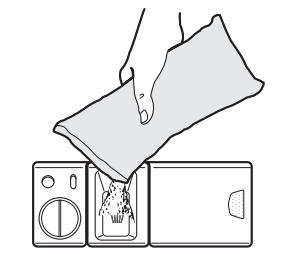
Add the recommended amount of detergent to the main wash detergent compartment.
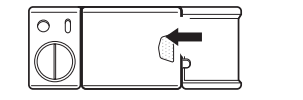
Close the flap by sliding it to the left and then pressing it down.
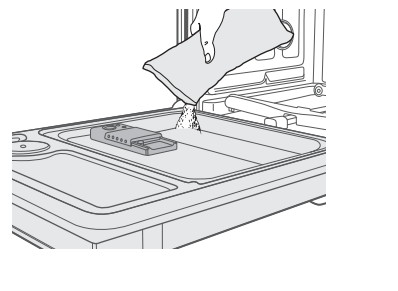
For better cleaning result, especially if you have very dirt items, pour a small amount (about 1/2 of an ounce or 15 g) of detergent onto the door. The additional detergent will activate during the pre-wash phase.
The cover opens automatically to dispense the detergent during the wash.
CYCLE
The numbers inside the dispenser refer to grams.
Filling the rinse aid reservoir
When the Rinse Refill indicator lights up on the control panel, refill the reservoir with rinse aid. Your dishwasher has been designed to use liquid rinse aid only.
Using a powdered rinse aid will clog the reservoir opening and cause the dishwasher to malfunction.
Rinse aid improves the drying performance of the dishwasher.
Do not add regular detergent to the rinse aid reservoir.
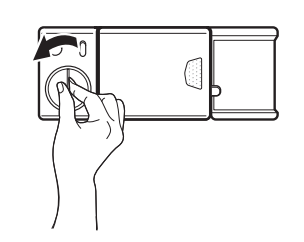
Remove the rinse aid reservoir cap by rotating it counterclockwise.
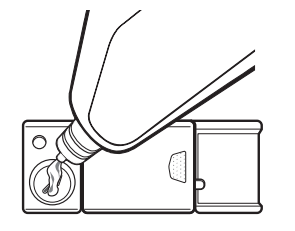
Fill the rinse aid reservoir with rinse aid. Use the viewing port when filling the rinse aid reservoir. Do not fill the reservoir above the full level indicator. Excess rinse aid can overflow during the wash cycle.
Turn the rinse aid indicator dial to a number between 1 and 6. The higher the number, the more rinse aid the dishwasher uses. If you are unable to rotate the rinse aid dial easily, try using a coin.
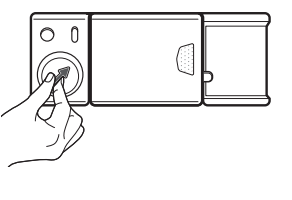
Close the rinse aid reservoir cap by rotating it clockwise.
cleaning and maintaining your dishwasher
Keeping your dishwasher clean improves its performance, reduces unnecessary repairs, and lengthens its life.
CLEANING THE EXTERIOR
It’s best to clean spills on the outside of your dishwasher as they occur. Use a soft, damp cloth on the control panel to gently wipe away spills and dust. Do not use benzene, wax, thinner, chlorine bleach, or alcohol. These materials may discolor the inner walls and cause stains. Do not clean the dishwasher by sprinkling water over it and avoid letting water come into contact with any of the electrical parts.
If your dishwasher has a stainless steel door panel, you can clean it with a stainless steel cleaner for Home Appliances or a similar product using a clean, soft cloth.
CLEANING THE INTERIOR
Clean the interior of your dishwasher periodically to remove any dirt or food particles. Wipe the inside of the dishwasher and the inner part of the door with a wet dishcloth. We recommend filling the detergent dispenser with dish detergent, and then running the dishwasher empty periodically using either the Normal or Express 60 cycle with the sanitize option. This will keep your dishwasher clean.
If white spots and odor are still present in your dishwasher, run the Normal cycle with the dishwasher empty and without detergent until it flushes. Then, interrupt the cycle and put an 8 ounce cup of white vinegar into the lower basket. Close the dishwasher and let the cycle finish.
Do not remove the tub front seal (the long rubber seal enclosing the opening of the dishwasher).
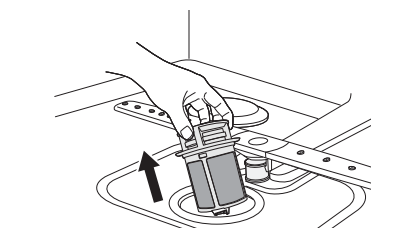
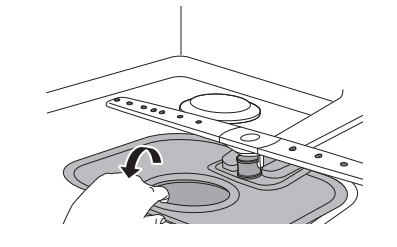
CLEANING THE FILTERS (DW80K7050 SERIES)
Turn off the dishwasher.
Rotate the filter insert counterclockwise to unfasten and then detach the filter insert.
Remove the fine filter (flat, rectangular).
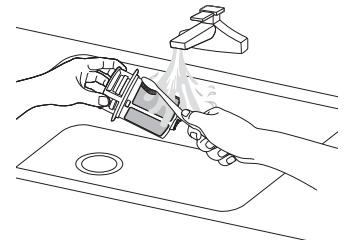
Remove any dirt or other remains from the filters, and then rinse them under running water.
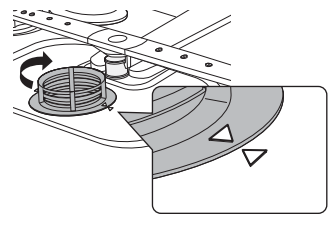
Reassemble the filters in the reverse order of the dissasembly, replace the filter insert, and rotate clockwise to the close arrow.
If the filter insert is not closed properly, its performance will be decreased.
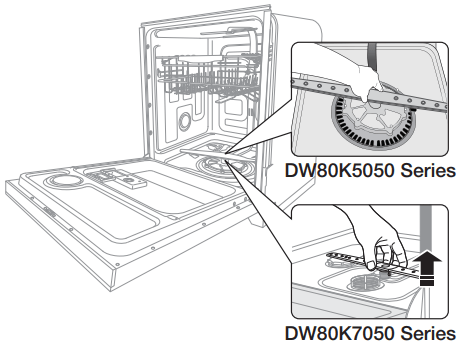
CLEANING THE NOZZLES
If your dishwasher does not seem to be cleaning adequately or the nozzles seem clogged, you can clean each of the nozzles. When removing the nozzles, take care as they may break.
Lower nozzle
Check whether the nozzle holes are clogged by food particles.
If cleaning is needed, remove the nozzle by pulling it upwards.
Clean the nozzle, and then push it back into place.
Check whether the nozzle is engaged
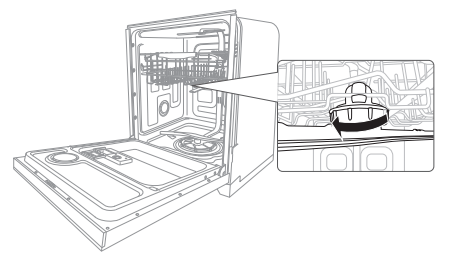
Middle nozzle
Pull the upper rack towards the front and remove it.
Check whether the nozzle holes are clogged by food particles.
If cleaning is needed, remove the nozzle.
To remove the nozzle, unfasten and remove the nut, and then remove the nozzle.
Clean the nozzle, re-insert it, and fasten the nut.
When fastening the nut, turn it firmly by hand.
Check whether the nozzle is engaged correctly by rotating it by hand.
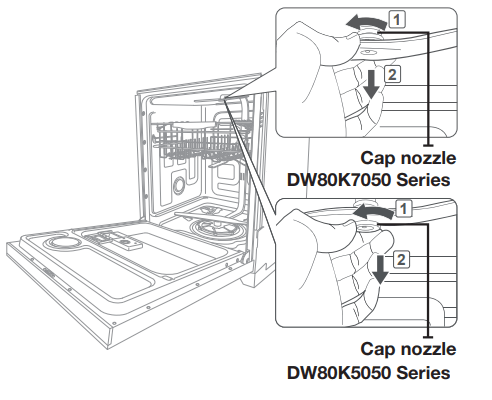
Upper nozzle
Check whether the nozzle holes are clogged by food particles.
If cleaning is needed, remove the nozzle.
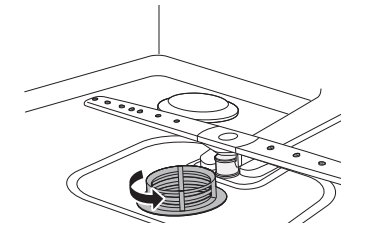
To remove the nozzle, pull out the upper rack first, unfasten the nozzle cap by turning it counterclockwise, and then remove the upper nozzle.
Clean the nozzle, re-insert it, and then fasten the nozzle cap to the nozzle by turning the cap clockwise.
Check whether the nozzle is engaged correctly by rotating it by hand.
STORING YOUR DISHWASHER
If you need to store your dishwasher for an extended period of time, first drain and disconnect it. If you leave water in the hoses and internal components, you can damage the dishwasher.
After draining and disconnecting the dishwasher, be sure to turn off the water supply valve and circuit breaker.
cycles
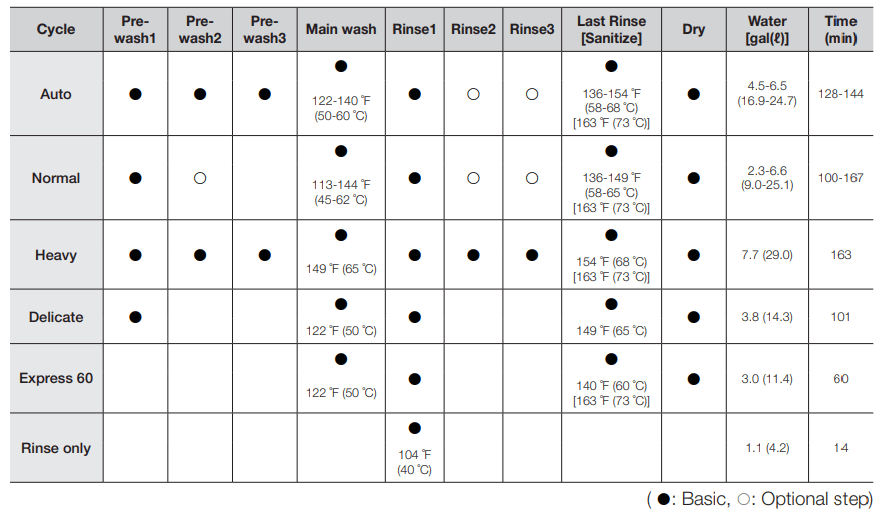
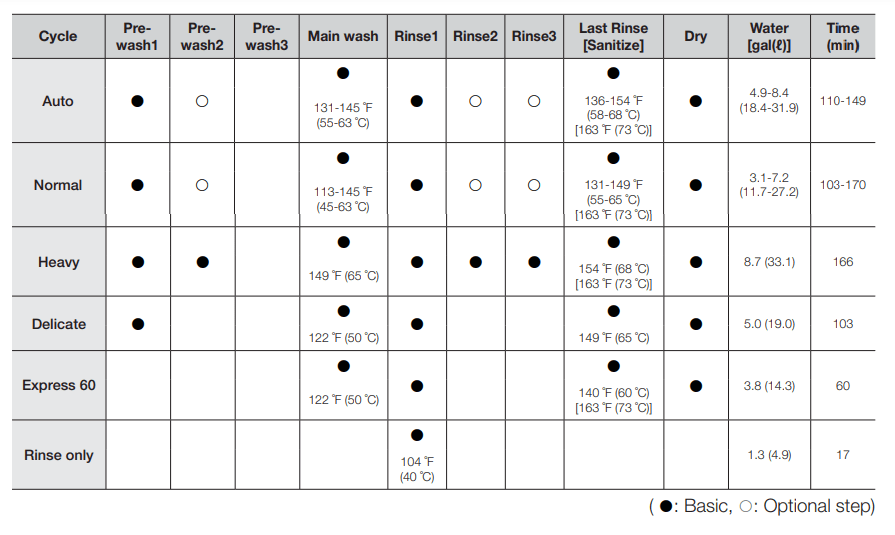
CYCLE CHART
DW80K7050 Series
DW80K5050 Series
The numbers in parentheses in the Last Rinse column represent the temperature when you select Sanitize.
When you select the Auto or Normal cycle, you can eliminate optional steps depending on the soil level of the dishes.
The water consumption and wash time varies depending on the steps or options you add, and on the pressure and temperature of the supplied water.
When you select any options, the cycle time can be changed.
When the Rinse Aid is empty, wash time and Last Rinse temperature will be increased.
Q: I have a model DW80K7050US dishwaser, after starting a cycle it operates normally for 10-12 minutes, then gives a flashing code of LC and continues to recycle in that mode at that point. What is the problem? Reply
Q: Where can u find out what the codes u am getting mean like LC? And diagram of the dishwasher? My dishwasher will start but then I get an error code LC and it co tiniest to try to cycle u til u had to it off at the breaker. It also ciats all the dishes with a white film. Please, help! Reply
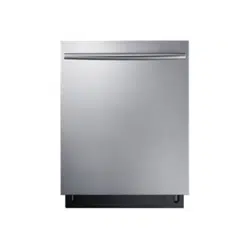


 You can select options (Lower Rack, StormWash™, Hi-Temp Wash, Sanitize) before starting a cycle. If you change the cycle after selecting an option, the original cycle is reset.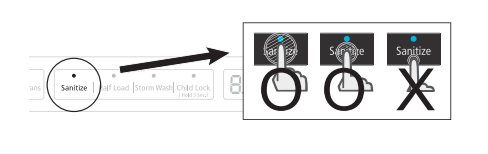

 ) is illuminated, you should refill the rinse aid dispenser to improve washing and drying performance.
 You should use rinse aids for better drying performance. You can further improve drying performance by also selecting the Sanitize option.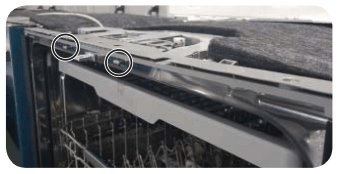
 When using the dishwasher, try to arrange the dishes properly as described on page 16 to 19.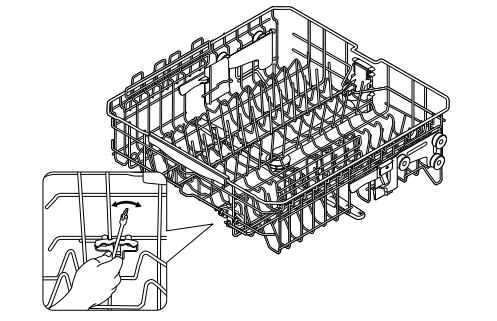
 We recommend adjusting the height of the upper rack before loading dishes into the rack. If you adjust the the rack after loading the dishes, you may damage the dishes.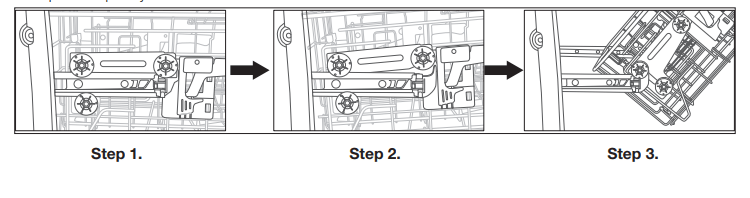
 Use dishwasher detergent only. Regular detergent produces too much foam, which may decrease the dishwasher’s performance or cause it to malfunction.
 Do not swallow dishwasher detergent. Avoid breathing in the fumes. Dishwasher detergent contains irritants and caustic chemicals that can induce respiratory conditions. If you have swallowed dishwasher detergent or inhaled the fumes, seek medical attention immediately.
 The flap is always open at the end of a dishwashing cycle.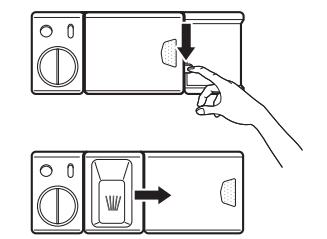
 Do not add regular detergent to the rinse aid reservoir.