Owners' Guide Televisions
INSTALLING THE TV
INSPECTING THE PACKAGE CONTENTS
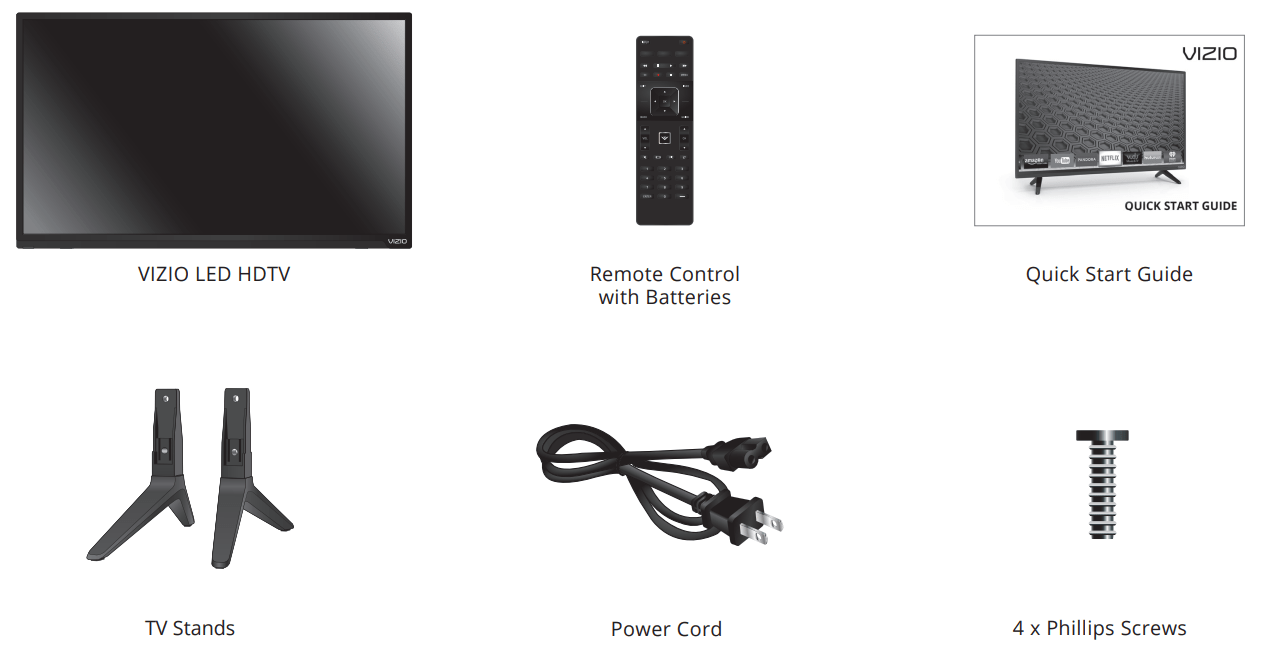
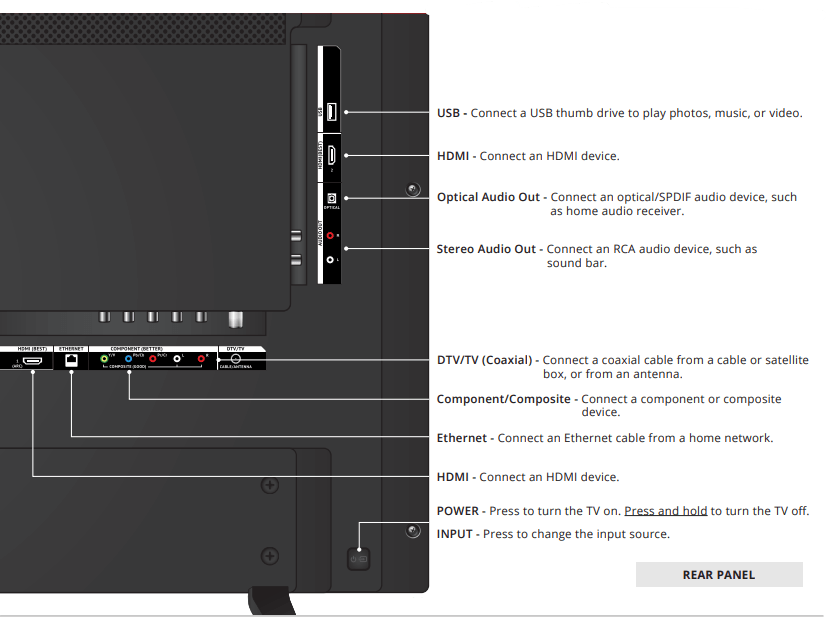
Before installing your new TV, take a moment to inspect the package contents. Use the images below to ensure nothing is missing or damaged.
INSTALLING THE TV
After removing the TV from the box and inspecting the package contents, you can begin installing the TV. Your TV can be installed in two ways:
- On a flat surface, using the included stand
- On a wall, using a VESA-standard wall mount (not included)
Installing the TV Stands
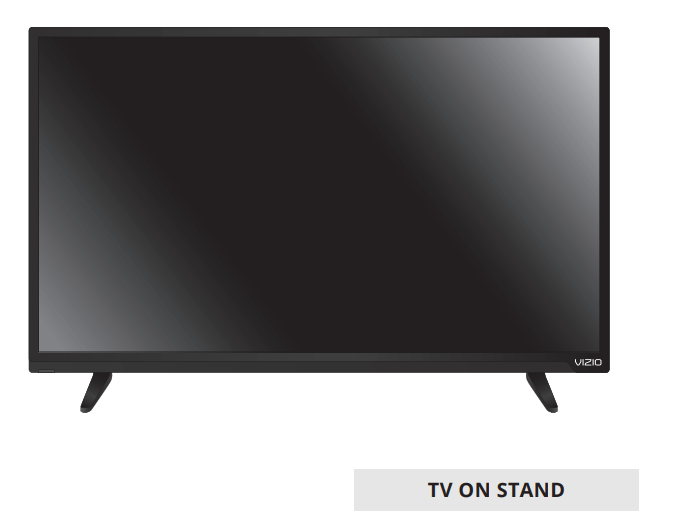
Your TV includes stands designed to support the weight of the TV and keep it from falling over. However, the TV can still fall over if:
- It is placed on an uneven, unstable, or non-level surface
- It is pushed, pulled, or otherwise improperly moved
- If an earthquake occurs and the TV is not properly secured.
To install the stands
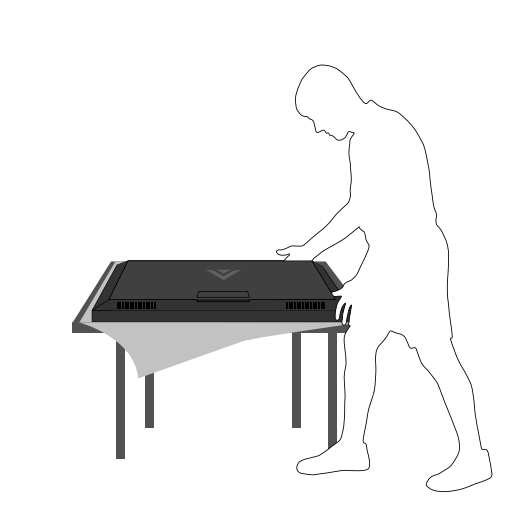
Remove any plastic wrapping from the TV and the stands.
Place the TV screen-down on a clean, flat surface. To prevent scratches or damage to the screen, place the TV on a soft surface such as a blanket and avoid any sharp edges.
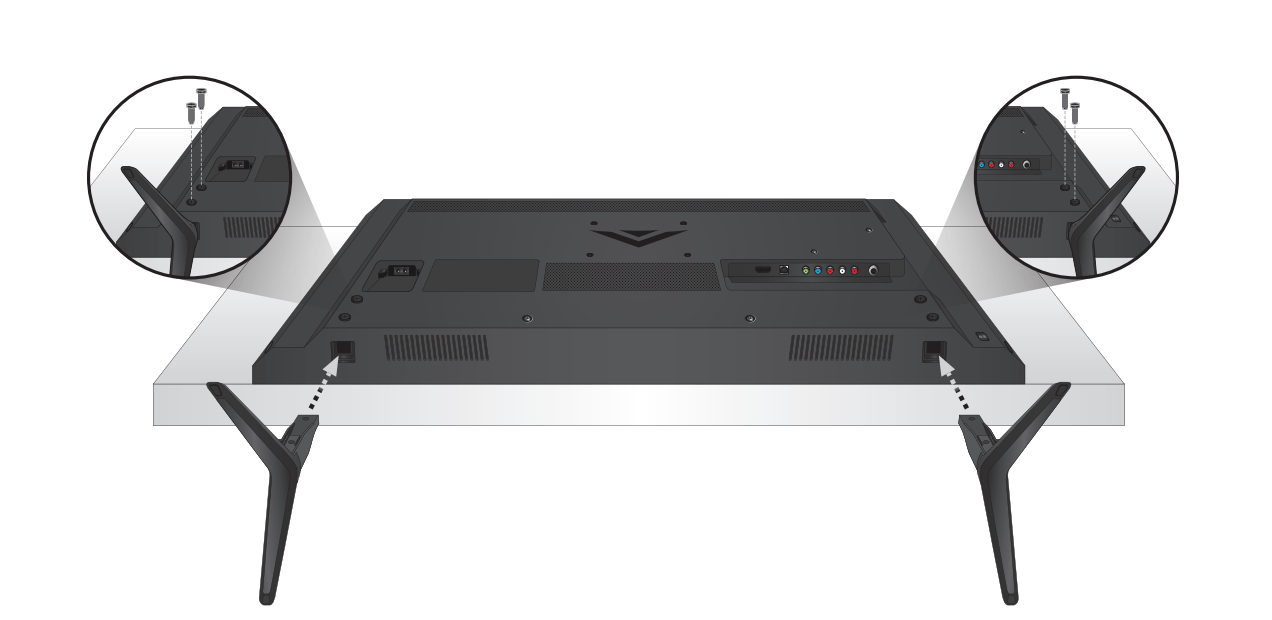
Insert the left and right stands into the base of the TV. (The stands are identical.)
Secure each stand to the TV with two (2) Phillips screws (included). Insert the screws into the back of the TV and tighten them using a Phillips screwdriver.
When you are finished, place the TV on a stable, level surface.
Installing the TV on a Wall
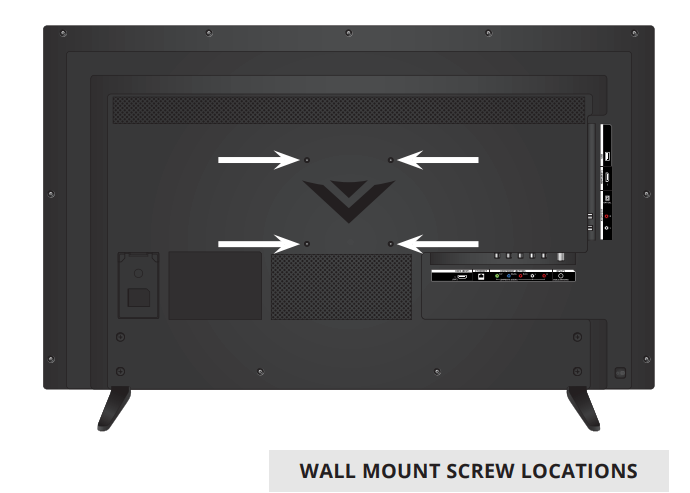
To mount your TV on a wall, you will need a wall mount. Consult the information below to find the appropriate mount for your TV model:
NOTE: Installing a TV on a wall requires lifting. To prevent injury or damage to the TV, ask someone to help you.
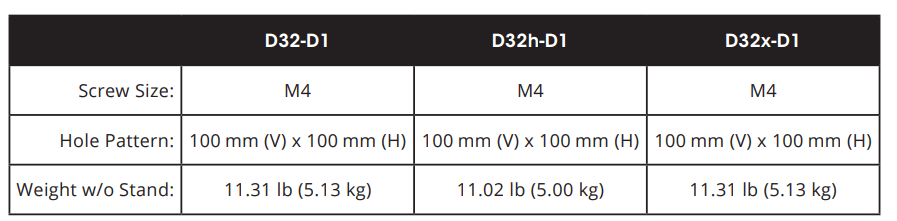
Be sure the mount you choose is capable of supporting the weight of the TV. After you have determined that you have the correct mount for your TV, you can begin the installation.
To install your TV on a wall:
- Disconnect any cables connected to your TV.
- Place the TV face-down on a clean, flat, stable surface. Be sure the surface is clear of debris that can scratch or damage the TV.
- Remove the base by loosening and removing the screws.
- Attach your TV and wall mount to the wall, carefully following the instructions that came with your mount.
Use only with a UL-listed wall mount bracket rated for the weight/load of this TV.
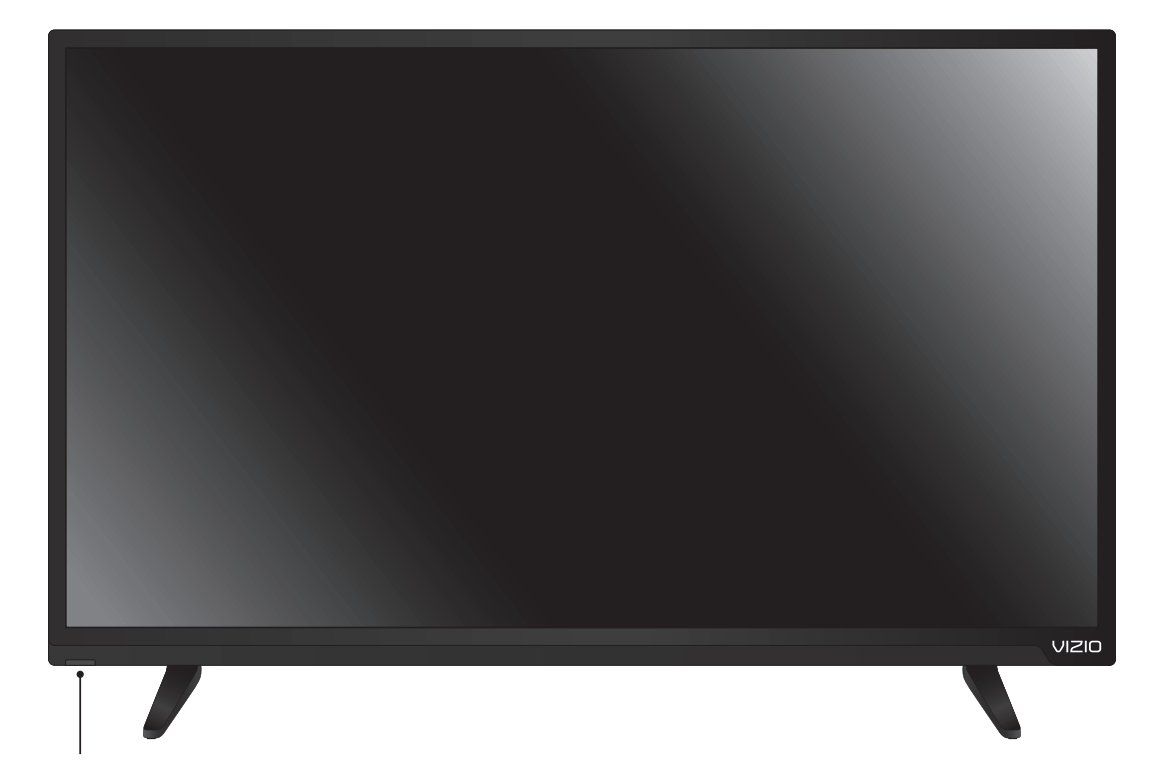
REMOTE SENSOR & POWER INDICATOR
When using the remote, point it directly at this sensor.
The power indicator flashes on when the TV turns on, then goes out after several seconds. To keep the power indicator on as long as the TV is on, see Turning the Power Indicator On or Off on page 56.
Replacing the Batteries
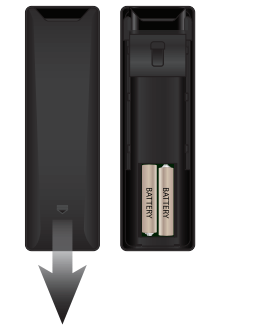
- To remove the battery cover, press on the logo and slide the cover out.
- Insert two batteries into the remote control. Make sure that the (+) and (-) symbols on the batteries match the (+) and (-) symbols inside the battery compartment.
- Replace the battery cover.
Completing the First-Time Setup
The first time you turn on the TV, the Setup App will guide you through each of the steps necessary to get your TV ready for use.
Before you begin the first-time setup:
- Your TV should be installed and the power cord should be connected to an electrical outlet.
- Your devices should be connected.
- If you have a wireless network, have the wireless password ready.
- If you are connecting to your network with an Ethernet cable, connect it to the Ethernet port on the TV.
To complete the first-time setup:
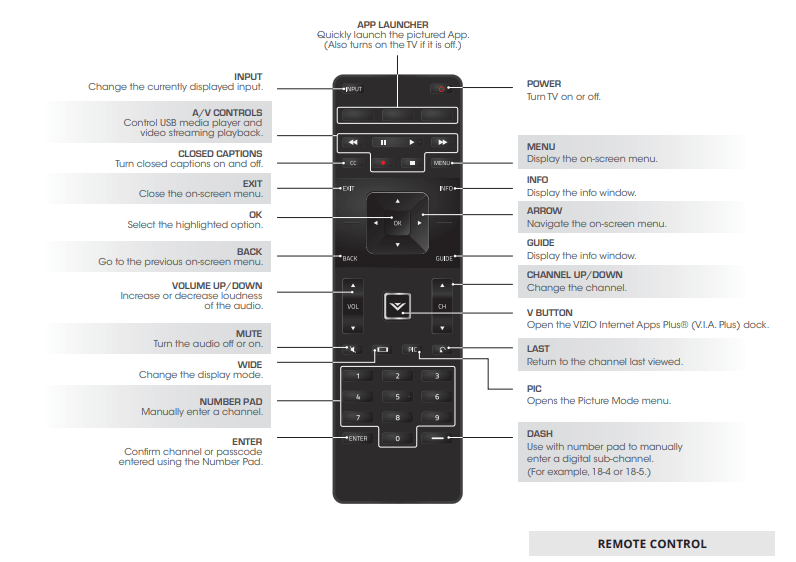
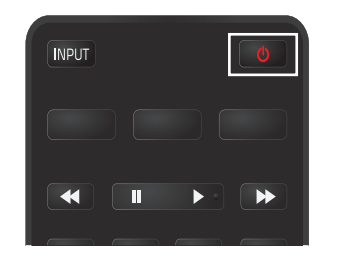
- Press the Power button on the remote. The TV powers on and the Setup App starts.
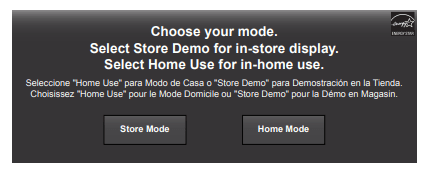
- Use the Arrow buttons on the remote to highlight Home Use and press OK.
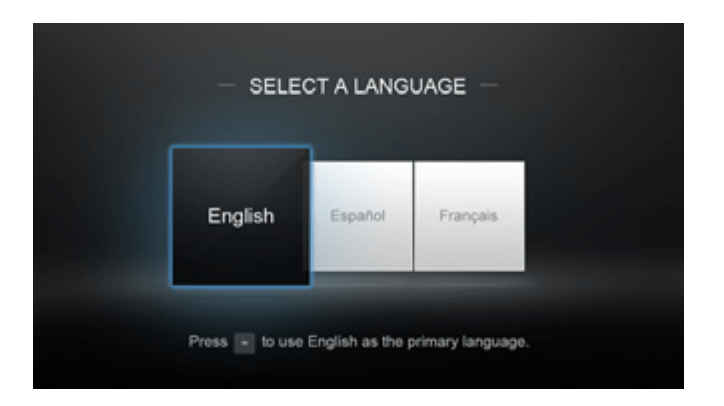
- Use the Arrow buttons on the remote to highlight your preferred language, and then press the OK button.
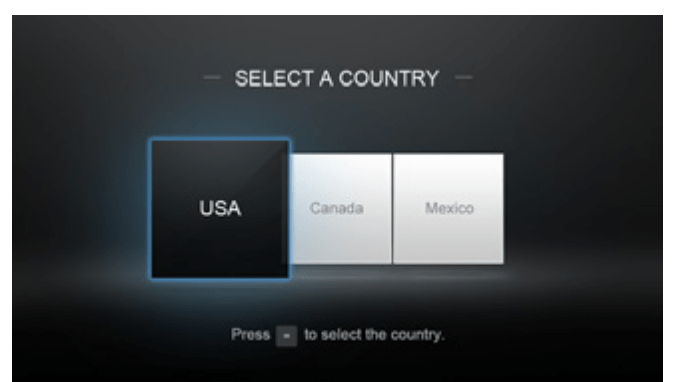
- Use the Arrow buttons on the remote to highlight your country, and then press the OK button.
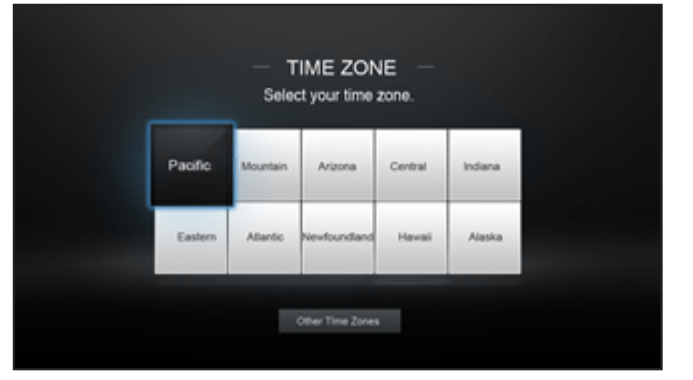
- Use the Arrow buttons on the remote to highlight your Time Zone, and then press the OK button.
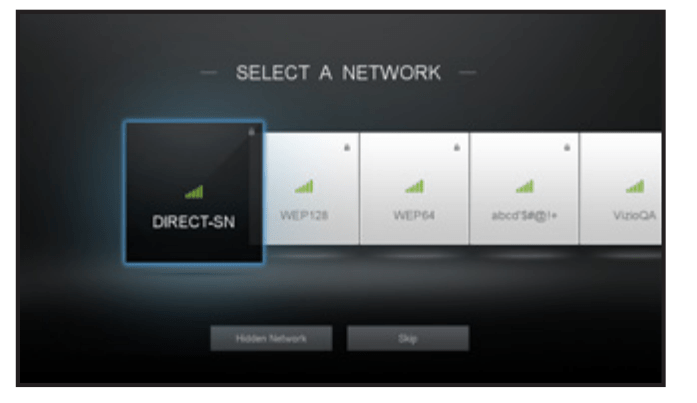
- Use the Arrow buttons on the remote to highlight your wireless network in the list of available networks and press OK. Type the wireless password using the on-screen keyboard, then highlight Connect and press OK.
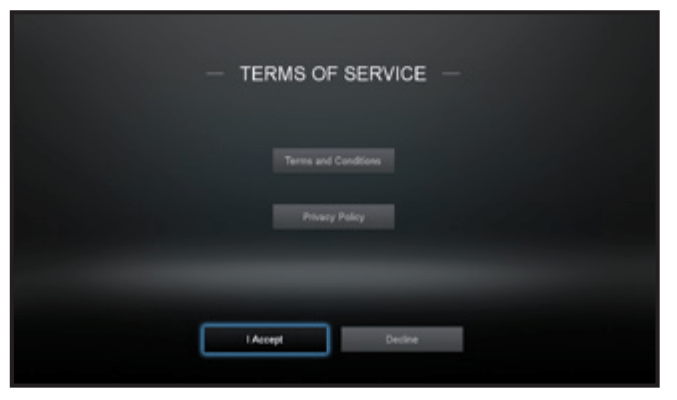
- Use the Arrow and OK buttons on the remote to read and accept the Terms and Conditions and the Privacy Policy. When you are finished, highlight I Accept and press OK.
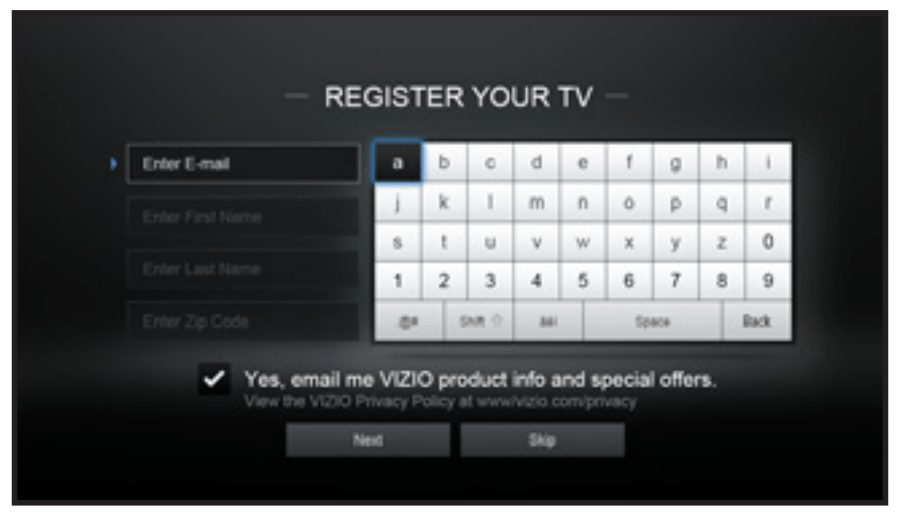
- Type your E-mail Address, First Name, Last Name, Phone Number, and ZIP Code using the on-screen keyboard. Highlight Next and press OK.
- Use the Arrow buttons on the remote to highlight your TV source and press OK
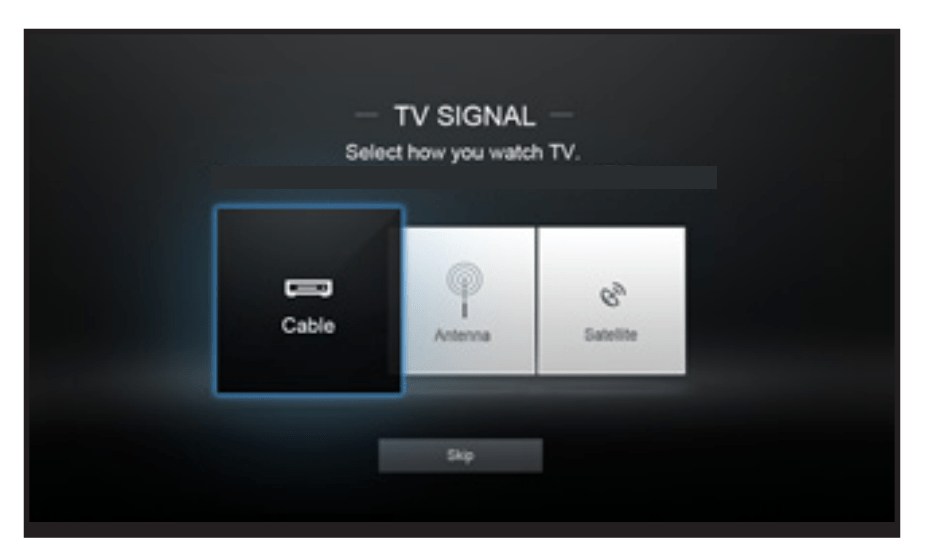
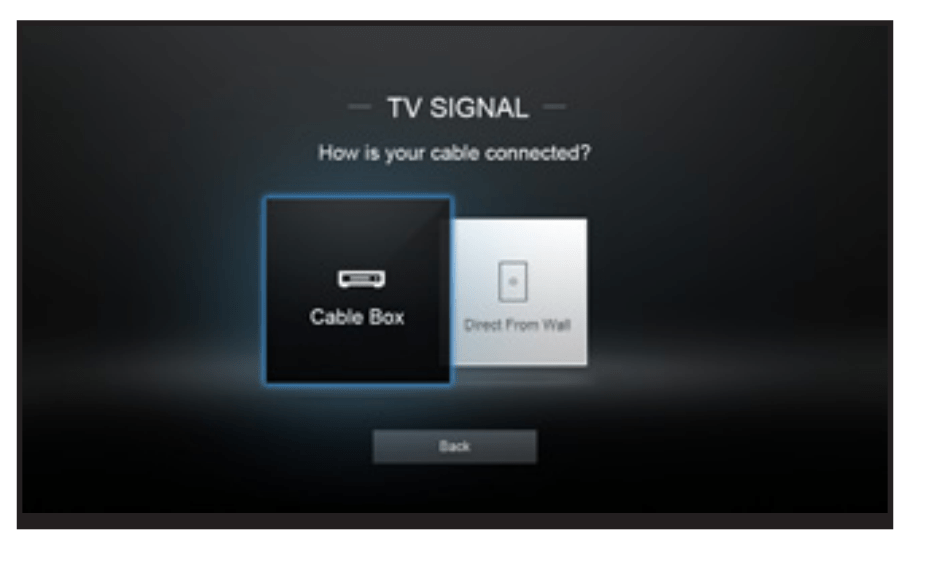
If you have cable TV, select whether you have a cable box or if you connect the TV directly to a cable from the wall.
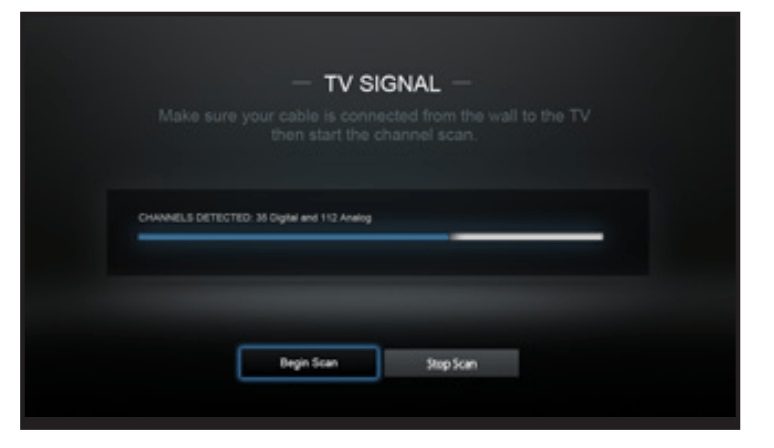
- If the TV Signal screen appears, the TV will need to scan for channels, which takes several minutes. Use the arrow buttons on the remote to highlight Begin Scan and press OK.
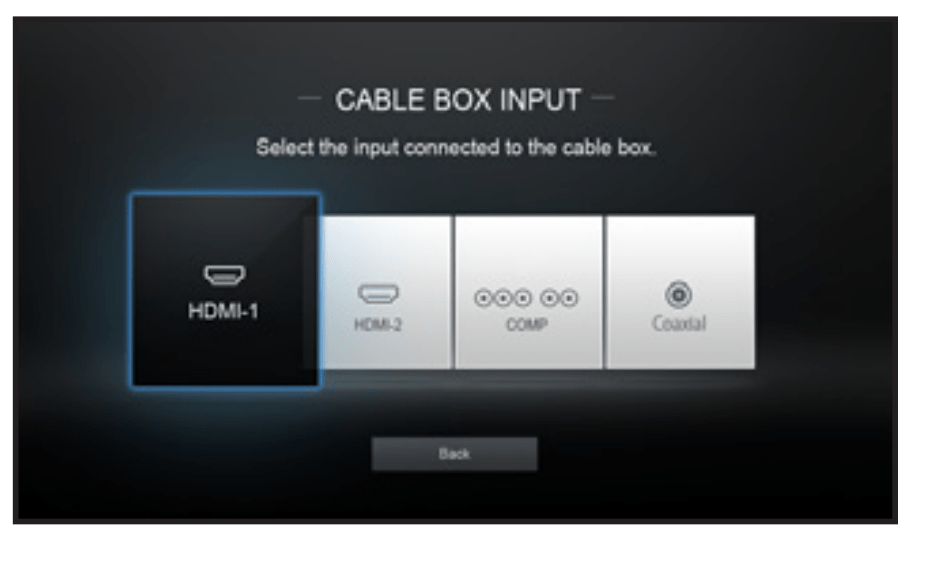
- Use the Arrow and OK buttons on the remote to select the input your TV source is connected to.
Your TV features an easy-to-use on-screen menu.
To open the on-screen menu, press the MENU button on the remote.
From this menu, you can:
- Adjust the Picture settings
- Adjust the Audio settings
- Activate the Sleep Timer
- Adjust the Network settings
- Adjust the Channels
- Set up Closed Captioning
- Name the TV Inputs
- Adjust the TV Settings
- Access the Guided Setup
- Access the User Manual
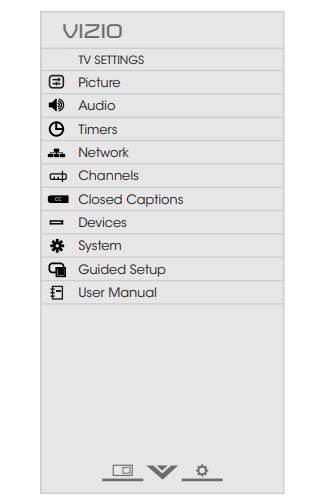
NAVIGATING THE ON-SCREEN MENU
To open the on-screen menu, press the MENU button on the remote.
Use the Arrow buttons to highlight a menu option, and press the OK button to select that option.
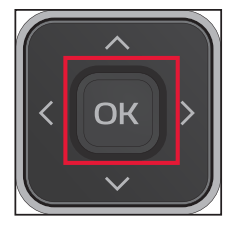
NOTE: While navigating the on-screen menu, you can press the BACK button at any time to return to the previous menu screen. The EXIT button will close the on-screen menu.
ADJUSTING THE PICTURE SETTINGS
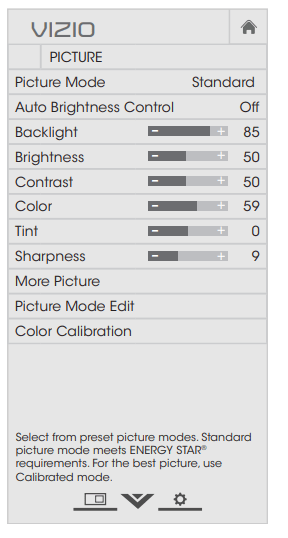
Your TV display can be adjusted to suit your preferences and viewing conditions.
To adjust the picture settings:
- Press the MENU button on the remote. The on-screen menu is displayed.
- Use the Arrow buttons on the remote to highlight Picture and press OK. The PICTURE menu is displayed.
- Use the Arrow buttons on the remote to highlight Auto Brightness Control, then use the Left/Right Arrow buttons to set Auto Brightness Control Low, Medium, High, or Off.
- Use the Arrow buttons on the remote to highlight Picture Mode, then use the Left/Right Arrow buttons to change the picture mode:
• Standard mode sets the various picture settings to values that meet ENERGY STAR® requirements.
• Calibrated mode sets the picture settings to values perfect for watching TV in a brightly-lit room.
• Calibrated Dark mode sets the picture settings to values perfect for watching TV in a dark room.
• Vivid mode sets the picture settings to values that produce a brighter, more vivid picture.
• Game mode reduces throughput delays and optimizes the picture settings for displaying game console output.
• Computer mode optimizes the picture settings for displaying computer output.
- To manually change each of the picture settings, use the Up/ Down Arrow buttons on the remote to highlight that picture setting, then use the Left/Right Arrow buttons to adjust the setting:
• Auto Brightness Control - detects the light levels in the room and automatically adjusts the backlight for best picture. Select Off, Low, Medium, or High.
• Backlight - Adjusts the LED brightness to affect the overall brilliance of the picture. Backlight cannot be adjusted from some picture modes.
• Brightness - Adjusts the black level of the picture. When this setting is too low, the picture may be too dark to distinguish details. When this setting is too high, the picture may appear faded or washed out.
• Contrast - Adjusts the white level of the picture. When this setting is too low, the picture may appear dark. When this setting is too high, the picture may appear faded or washed out. If the setting is too high or too low, detail may be difficult to distinguish in dark or bright areas of the picture.
• Color - Adjusts the intensity of the picture colors.
• Tint - Adjusts the hue of the picture. This setting is useful in adjusting the flesh tones in the picture. If flesh appears too orange, reduce the level of color before adjusting tint.
• Sharpness - Adjusts the edge sharpness of picture elements. It can be used to sharpen non-HD (high definition) content; however, it will not produce detail that does not otherwise exist.
- When you have finished adjusting the picture settings, press the EXIT button on the remote.
Adjusting the More Picture Settings
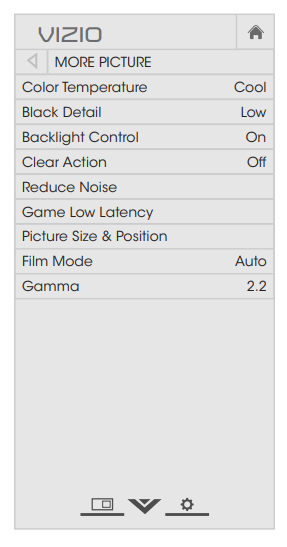
To adjust the More Picture settings:
- From the PICTURE menu, use the Arrow buttons on the remote to highlight More Picture and press OK. The MORE PICTURE menu is displayed.
- Use the Arrow buttons to highlight the setting you wish to adjust, then press Left/Right Arrow buttons to change the setting:
• Color Temperature - See Adjusting the Color Temperature on page 31.
• Black Detail - Adjusts the average brightness of the picture to compensate for large areas of brightness. Select Off, Low, Medium, or High.
• Backlight Control - Dynamically improves the contrast ratio of the picture by adjusting the backlight. Select On or Off.
• Clear Action1 - Reduces blur in scenes with fast action. Some sensitive viewers may notice flicker. Select On or Off.
• Reduce Noise - Opens a sub-menu with two settings:
- Reduce Signal Noise - Reduces background picture noise when viewing analog sources. The function helps to correct "speckle" noise with a slight reduction in sharpness. Select Off, Low, Medium, or High.
- Reduce Block Noise - Reduces pixelation and distortion for mpeg files. Select Off, Low, Medium, or High.
• Game Low Latency - Reduces video delay (lag) when gaming. Select On or Off. This option is not available for devices connected using a coaxial cable.
• Picture Size & Position - Opens a sub-menu with two options:
- Picture Size increases or decreases the vertical and horizontal size of the displayed picture.
- Picture Position adjusts the vertical and horizontal positions of the picture to ensure the image is centered and completely fills the screen. Use the Left/Right Arrow buttons to adjust the horizontal position of the displayed picture. Use the Up/Down Arrow buttons to adjust the vertical position of the displayed picture. Press the OK button when you are finished.
• Film Mode - Optimizes the picture for watching film. Select Auto or Off.
• Gamma - Sets the shape of the gamma curve. Use lower values for bright room conditions and higher values when it is dark. Select 1.8, 2.0, 2.1, 2.2, or 2.4.
- When you have finished adjusting the More Picture Settings, press the EXIT button on the remote.
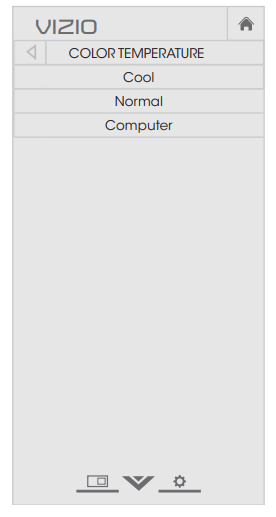
Adjusting the Color Temperature
Adjusting the color temperature changes the white balance of the picture.
To adjust the color temperature:
- From the MORE Picture menu, use the Arrow buttons to highlight Color Temperature, then press OK.
- Use the Arrow buttons on the remote to highlight Color Temperature, then press OK.
- Use the Left/Right Arrow buttons to highlight a color temperature preset and then press OK:
• Cool produces a blue-hued picture.
• Normal is optimized for television viewing.
• Computer optimizes the picture for use as a PC monitor.
- When you have finished adjusting the color temperature, press the EXIT button on the remote.
Adjusting the Picture Mode Edit Settings
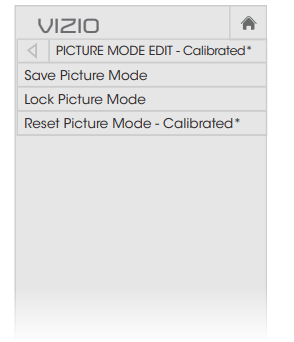
To adjust the Picture Mode Edit settings:
- From the PICTURE menu, use the Arrow buttons to highlight More Picture, and then press the OK button. The MORE PICTURE menu is displayed.
- Highlight Picture Mode Edit, and then press the OK button. The PICTURE MODE EDIT menu is displayed.
- Use the Arrow buttons to highlight the setting you wish to adjust, then press the Left/Right Arrow buttons to change the setting:
• Save Picture Mode- Saves the settings for a custom picture mode.
• Lock Picture Mode / Unlock Picture Mode - Prevents or allows changes to the currently selected custom picture mode. Select On or Off.
• Reset Picture Mode - Resets the settings of the current built-in picture mode to the factory default values.
• Delete Picture Mode - Deletes the current custom picture mode. Any inputs that use the deleted picture mode are switched to the Calibrated picture mode.
- When you have finished adjusting the Picture Mode Edit settings, press BACK to adjust additional settings or EXIT.
Adjusting the Color Calibration Settings
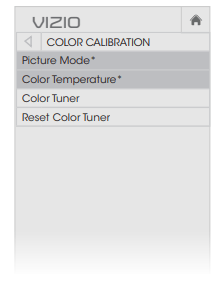
Color Calibration Settings allow you to make precise adjustments to the picture and to create picture modes to save groups of picture settings.
NOTE: The Color Tuner, 11 Point White Balance, and test patterns allow technicians to manually calibrate the TV. Calibration requires specialized training, an input with precisely set colors, and a specialized light meter.
To adjust the color calibration picture settings:
- From the PICTURE menu, use the Arrow buttons to highlight Color Calibration and press the OK button. The COLOR CALIBRATION menu is displayed.
- Use the Arrow buttons to highlight the setting you wish to adjust, then press the OK button to change the setting:
• Picture Mode - Not directly selectable (reference only). Changes to Hue, Saturation, and Brightness are saved here and indicated with an asterisk (*). • Color Temperature - Not directly selectable (reference only). Changes to Offset and Gain are saved here and indicated with an asterisk (*).
• Color Tuner - Adjust the HSB color, RGB offsets, and 11-point white balance, and display calibration test patterns.
• Reset Color Tuner - Prevent/allow changes to the currently selected custom picture mode.
Adjusting the Color Tuner Settings
The Color Tuner settings allow you to adjust the Hue, Saturation, and Brightness (HSB) color and 11 point white balance, turn color channels off for testing, and display color bar, flat, and ramp test patterns.
To adjust the HSB color settings:
- From the PICTURE menu, use the Arrow buttons to highlight Color Calibration and press the OK button. The COLOR CALIBRATION menu is displayed.
- Use the Arrow buttons to highlight Color Tuner, and press the OK button. The Color Tuner menu is displayed.
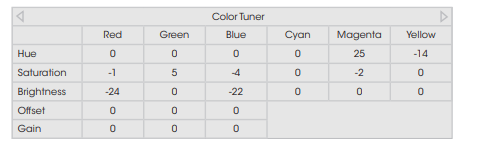
- Use the Arrow buttons on the remote to highlight the Hue, Saturation, Brightness, (these 3 adjust the color) Offset, or Gain (these two adjust the color temperature) of the color you wish to adjust. Press the OK button.
- Use the Left/Right Arrow buttons to adjust the value. When you are finished press the OK button to save the setting.
- When you have finished adjusting the Color Tuner settings, press the BACK button to adjust additional settings or EXIT.
When Hue, Saturation, or Brightness have been changed, an asterisk (*) appears after the name of the Picture Mode.
When Offset or Gain have been changed, an asterisk (*) appears after the name of the Color Temperature.
To turn color channels off and on:
- From the PICTURE menu, use the Arrow buttons to highlight Color Calibration and press the OK button. The COLOR CALIBRATION menu is displayed.
- Use the Arrow buttons to highlight Color Tuner, and then press the OK button. The Color Tuner menu is displayed.
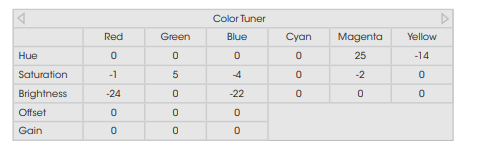
- Use the Arrow buttons on the remote to highlight Red, Green, or Blue.
- Press the OK button to turn the color channel off or on. An X appears over a color channel that has been turned off.
- Use the Arrow buttons to highlight another color channel to turn off or on. Only two color channels can be turned off at the same time.
- When you are finished with the color channels, press the BACK button to adjust additional settings or EXIT.
To adjust the 11 Point White Balance settings:
- From the Color Tuner menu, use the Arrow buttons to highlight Color Tuner, and then press the Left/Right Arrow buttons until the 11 Point White Balance menu is displayed.
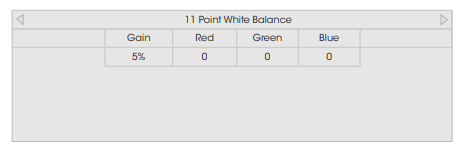
- Use the Arrow buttons on the remote to highlight the Gain and Color values you wish to adjust. Press the OK button and use the Left/Right Arrow buttons to adjust the value. When you are finished press the OK button to save the setting.
- When you are finished, press the BACK button to adjust additional settings or EXIT. All changes here are saved to Color Temperature.
To show or hide the Color Bar Test Pattern:
- Ensure that you are on an input that is displaying active content. From the Color Tuner menu, use the Arrow buttons to highlight Color Tuner, and then press the Left/Right Arrow buttons until the SMPTE Test Pattern menu is displayed.
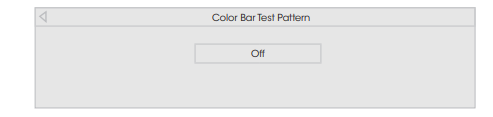
- Use the Arrow buttons on the remote to highlight Off. Use the Left/Right Arrow buttons to highlight On to show the Color Bar. —or— To hide the Color Bar Test Pattern, use the Left/Right Arrow buttons to highlight Off.
- When you are finished, press the BACK button to adjust additional settings or EXIT.
To show or hide the Flat Test Pattern:
- Ensure that you are on an input that is displaying active content. From the Color Tuner menu, use the Arrow buttons to highlight Color Tuner, and then press the Left/Right Arrow buttons until the Flat Test Pattern menu is displayed.
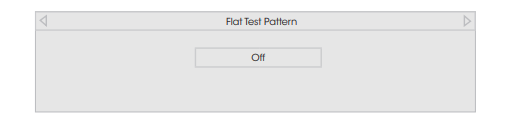
- Use the Arrow buttons on the remote to highlight Off. Use the Left/Right Arrow buttons to select the percentage brightness for the flat test pattern. Selecting a percentage immediately shows the flat pattern at that brightness. —or— To disable the Flat Test Pattern, use the Left/Right Arrow buttons to highlight Off.
- When you are finished, press the BACK button to adjust additional settings or EXIT.
To show or hide the Ramp Test Pattern:
- Ensure that you are on an input that is displaying active content. From the Color Tuner menu, use the Arrow buttons to highlight Color Tuner, and then press the Left/Right Arrow buttons until the Ramp Test Pattern menu is displayed.
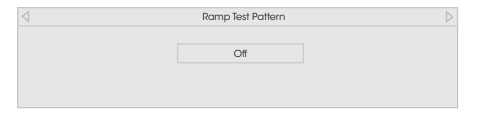
- Use the Arrow buttons on the remote to highlight Off. Use the Left/Right Arrow buttons to select the color for the ramp test pattern. Selecting a color immediately shows that color ramp. —or— To hide the Ramp Test Pattern, use the Left/Right Arrow buttons to highlight Off.
- When you are finished, press the BACK button to adjust additional settings or EXIT.
Creating a Custom Picture Mode
Custom picture modes allow you to save a group of custom settings for various viewing conditions and video sources.
When changes are made while a preset picture mode is selected, an asterisk appears after the name of the picture mode. These settings can be saved as a new custom picture mode and the preset mode can be reset to its default settings.
NOTE: A custom picture mode only applies to the input (HDMI�1, HDMI-2, COMP, AV, etc.) in use when it was created. Each input can have up to six custom picture modes.
To create a custom picture mode:
- Set the Picture Mode to an existing custom setting. See Adjusting the Picture Settings on page 29.
- From the PICTURE menu, use the Arrow buttons to highlight Picture Mode Edit and press OK. The PICTURE MODE EDIT menu is displayed.
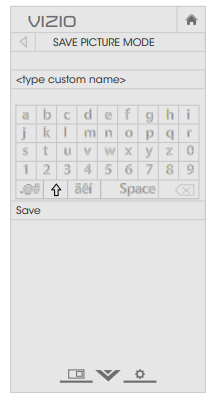
- On the PICTURE MODE EDIT menu, select Save Picture Mode. The SAVE PICTURE MODE menu is displayed.
- Use the Arrow buttons to enter a custom name using the on-screen keyboard.
- Highlight Save and press OK.
- Press the EXIT button to exit the menu screens.
Locking and Unlocking the Custom Picture Modes
Custom picture modes can be locked with a unique PIN to prevent accidental changes to their settings.
To lock all custom picture modes:
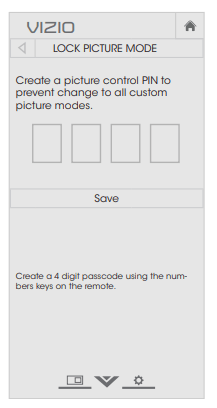
- From the PICTURE menu, use the Arrow buttons to highlight Picture Mode Edit and select Lock or Unlock Picture Mode, then press OK. The LOCK PICTURE MODE menu is displayed.
- Use the Number Pad on your remote to enter a unique 4-digit PIN.
- Highlight Save and then press the OK button.
- Press the EXIT button to exit the menu screens.
To unlock all custom picture modes:
- From the PICTURE menu, use the Arrow buttons to highlight Picture Mode Edit and select Lock or Unlock Picture Mode, then press OK. The LOCK PICTURE MODE menu is displayed.
- Use the Number Pad on your remote to enter your 4-digit PIN.
- Make any desired changes to the picture modes.
- To re-lock picture modes, you must create a new 4-digit PIN.
Deleting a Custom Picture Mode
Custom picture modes that are no longer needed can be deleted.
NOTE: Inputs assigned to a deleted custom picture mode become assigned to the Calibrated picture mode.
To delete a custom picture mode:
- From the PICTURE menu, use the Arrow buttons to highlight Picture Mode Edit and select Picture Mode, then press OK. The DELETE PICTURE MODE window is displayed.
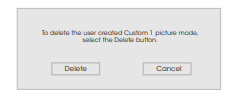
- Use the Left/Right Arrow buttons to highlight DELETE and press OK.
- Press the BACK button to adjust additional settings or EXIT.
SETTING TIMERS
This TV has timers that save energy, can turn off the TV when you go to sleep, and can blank the screen when you stream music.
Setting the Sleep Timer
When activated, the TV’s sleep timer will turn the TV off after a set period of time.
- Press the MENU button on the remote. The on-screen menu is displayed.
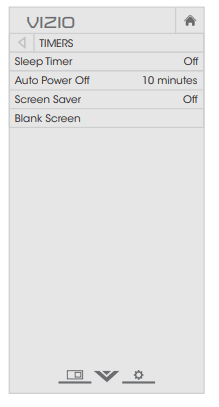
- Use the Arrow buttons on the remote to highlight Timers and press OK. The TIMERS menu is displayed.
- From the TIMERS menu, use the Up/Down Arrow buttons on the remote to highlight Sleep Timer.
- Use the Left/Right Arrow buttons on the remote to highlight the period of time after which you want the TV to go to sleep: 30, 60, 90, 120, or 180 minutes. If you don’t want the sleep timer to activate, change the setting to Off.
- When you have finished setting the sleep timer, press the EXIT button on the remote.
Setting the Auto Power Off Feature
To help save energy, your TV is set by default to turn off after 10 minutes without a video or audio signal. This feature can be deactivated.
To set the Auto Power Off feature:
- From the TIMERS menu, use the Up/Down Arrow buttons on the remote to highlight Auto Power Off.
- Use the Left/Right Arrow buttons on the remote to change whether the TV will turn off. If you don’t want the TV to turn off when there is no signal, change the setting to Off. Otherwise, select 10 minutes.
- When you have finished setting the auto power off time, press the EXIT button on the remote.
Enabling the Screen Saver
If there is no on-screen content or static content when audio is streaming, the backlight is turned off, saving energy. You can set the time before the screen saver begins.
To set the screen saver delay:
- From the TIMERS menu, use the Up/Down Arrow buttons on the remote to highlight Screen Saver.
- Use the Left/Right Arrow buttons on the remote to change the time before the screen saver begins. If you don’t want the screen saver to activate, change the setting to Off. Otherwise, select 2, 10, or 20 minutes.
- When you have finished setting the screen saver delay, press the EXIT button on the remote.
NOTE: Exiting the Screen Saver
Press any button other than the Volume and Mute buttons on the remote to exit the screen saver.
Blanking the Screen
You can blank the screen while there is audio streaming. This feature helps save energy and the life of the screen.
To blank the screen:
- From the TIMERS menu, use the Up/Down Arrow buttons on the remote to highlight Blank Screen, and then press OK.
NOTE: Exiting the Screen Saver
Press any button other than the Volume and Mute buttons on the remote to exit the screen saver.
SETTING UP CHANNELS
You can use the TV’s Tuner menu to:
- Select a channel source
- Find channels
- Perform a partial channel scan
- Manually add channels
- Select channels to skip
- Select language for analog and digital channels.
Selecting a Channel Source
- On the remote control, press Input and use the Arrow button to highlight TV (antenna icon), then press OK.
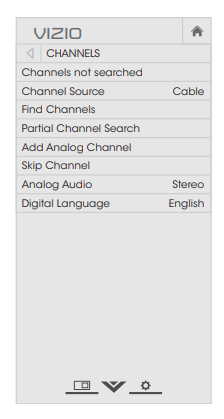
- Press the MENU button, select Channels and press OK. The CHANNELS menu is displayed.
- On the CHANNELS menu, highlight Channel Source and using the left/right Arrow buttons to select either Antenna or Cable.
Finding Channels
Before the TV can detect and display channels and their associated information, you must scan for channels. A channel scan may also be necessary when the TV has been moved to an area where different free-to-air broadcast television channels are available.
To perform an Auto Channel Scan:
- From the CHANNELS menu, highlight Find Channels, and press OK. The channel scan begins.
- Wait until the channel scan is 100% complete. Highlight Done and press OK.
- Press the EXIT button on the remote.
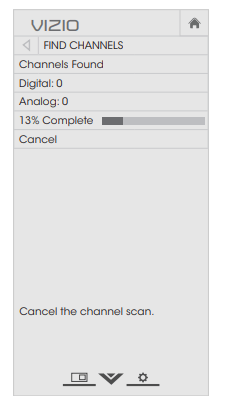
If the channel scan is cancelled, only the channels that were already discovered are saved. A new channel scan clears all saved channels.
Adding New Channels
Occasionally, you may need to add a new range of channels or add a new analog channel. You can do this by using the Partial Channel Search and Add Analog Channel options.
To add a range of new channels:
- From the CHANNELS menu, highlight Partial Channel Search, and press OK. The PARTIAL CHANNEL SEARCH menu is displayed.
- Highlight Scan Mode and select the type of channel you are adding: Analog, Digital, or Analog/Digital.
- Highlight From Channel and enter the channel where you want to begin the scan. (Use the Left Arrow button to backspace. Use the Number Pad on the remote to enter the channel.)
- Highlight To Channel and enter the channel where you want to end the scan. (Use the Left Arrow button to backspace. Use the Number Pad on the remote to enter the channel.)
- Highlight Start and press OK. The partial channel search begins.
- Wait until the partial channel search is 100% complete. Highlight Done and press OK.
- Press the EXIT button on the remote.
To add a single new analog channel:
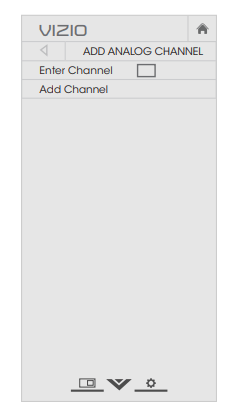
- From the CHANNELS menu, highlight Add Analog Channel and press OK. The ADD ANALOG CHANNEL menu is displayed.
- Highlight Enter Channel and use the Number Pad on the remote to enter the number of the channel you are adding.
- Highlight Add Channel and press OK. The TV scans for the channel.
- When the TV is done scanning for the channel, press the EXIT button on the remote.
Skipping Channels
After a channel scan is completed, you may find that some channels are too weak to watch comfortably. There may also be some channels you do not want to view. You can remove these channels from the TV’s memory with the Skip Channel feature.
Warning: Channels that have been removed with the Skip Channel feature can still be viewed if the channel is entered using the Number Pad. If you wish to completely block a channel from being viewed, use the parental controls. See Locking and Unlocking Channels on page 52.
To remove a channel:
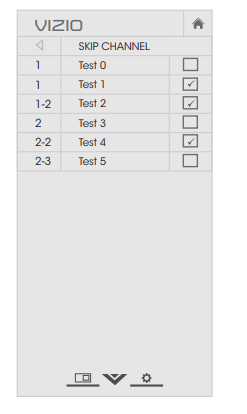
- From the CHANNELS menu, highlight Skip Channel, and press OK. The SKIP CHANNEL menu is displayed.
- For each channel you wish to remove, use the Up/Down Arrow buttons on the remote to highlight the channel and press OK. A P appears to the right of each channel you select.
- When you have selected all of the channels you wish to remove, press the EXIT button on the remote.
Changing the Audio Language
Some free-to-air, cable, and satellite channels broadcast programs in more than one language. The Analog Audio and Digital Language features allow you to listen to audio from Secondary Audio Programming (SAP). SAP allows you to listen to broadcasts in multiple languages.
- Analog Audio works with analog channels.
- Digital Language works with digital channels.
Warning: Not all programs are broadcast in multiple languages. The Analog Audio and Digital Language features only work when the program being viewed is being broadcast in the language you select.
To use the Analog Audio feature:
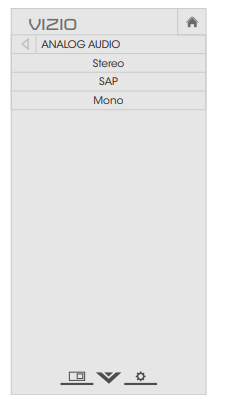
- From the CHANNELS menu, highlight Analog Audio and press OK. The ANALOG AUDIO menu is displayed.
- Select Stereo, SAP (Secondary Audio Programming), or Mono. Press OK.
- Press the EXIT button on the remote.
To use the Digital Language feature:
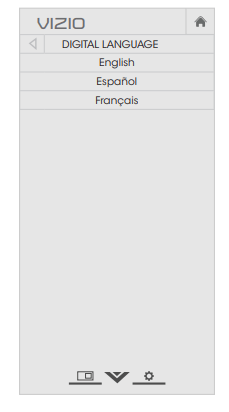
- From the CHANNELS menu, highlight Digital Language and press OK. The DIGITAL LANGUAGE menu is displayed.
- Select your preferred language: English, Español, or Français. Press OK.
- Press the EXIT button on the remote.
CHANGING THE TV SETTINGS
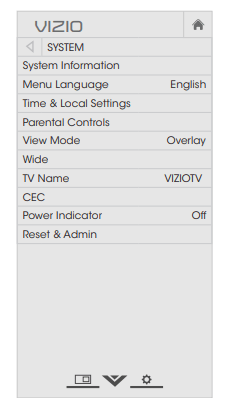
Using the system menu, you can:
- View technical system and networking information
- Change the on-screen menu language
- Set the time zone and local setting
- Set up parental controls
- Open the WIDE menu
- Give the TV a name for it to work with DLNA-enabled devices
- Set up CEC devices to control them with your VIZIO TV remote
- Control when the power indicator light is on
- Reset TV settings and control Smart Interactivity
Viewing System Information
To view technical data and status information about your TV and network connection:
- Press the MENU button on the remote. The on-screen menu is displayed.
- Use the Arrow buttons on the remote to highlight System and press OK. The SYSTEM menu is displayed.
- Highlight System Information and press OK.
- Use the Up/Down Arrow buttons to scroll through the system information.
- When you are finished reviewing the system information, press the EXIT button on the remote.
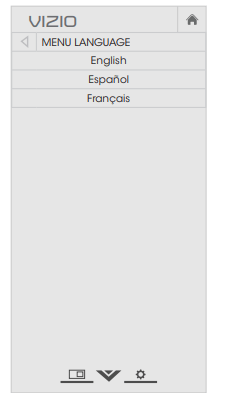
Changing the On-Screen Menu Language
Your TV can display the on-screen menu in different languages.
To change the on-screen menu language:
- Press the MENU button on the remote. The on-screen menu is displayed.
- Use the Arrow buttons on the remote to highlight System and press OK. The SYSTEM menu is displayed.
- Use the Arrow buttons on the remote to highlight Menu Language and press OK. The MENU LANGUAGE menu is displayed.
- Highlight your preferred language (English, Español, or Français) and press OK.
- Press the EXIT button on the remote.
Setting the Time Zone
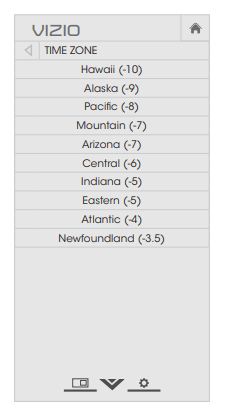
To ensure the correct time is displayed when you press the GUIDE button, set the TV’s time zone:
- Press the MENU button on the remote. The on-screen menu is displayed.
- Use the Arrow buttons on the remote to highlight System and press OK. The SYSTEM menu is displayed.
- Use the Arrow buttons on the remote to highlight Time & Local Settings and press OK. The TIME & LOCAL SETTINGS menu is displayed.
- Highlight Time Zone and press OK. The TIME ZONE menu is displayed.
- Highlight your time zone and press OK.
- Highlight Daylight Saving Time and press OK. The DAYLIGHT SAVING TIME menu is displayed. Choose On if your locale observes daylight saving time, Off if it does not, or Auto to have your TV detect daylight saving automatically.
- If you are in the United States, highlight ZIP Code. Enter your ZIP code using the keypad on the remote, then press OK. ZIP codes are often used by V.I.A. Plus Apps to give you the most accurate location-based information, such as weather or news.
- Highlight Country and press OK. Highlight our country and press OK.
- Press the EXIT button on the remote.
Using the Parental Controls
The TV’s parental controls allow you to prevent the TV from displaying certain channels or programs without a password.
The Parental Controls menu only appears when:
- You are using an the tuner receive your TV signals, such as when you are using an antenna for Over-the-Air signals or when connected to cable TV directly from the wall (no cable box).
- You have a device connected using a composite video cable or a coaxial cable, such as a VCR, satellite or cable box, or DVR.
NOTE: Other devices have their own parental control settings.
Accessing the Parental Controls Menu
To access the Parental Controls menu:
- Press the MENU button on the remote. The on-screen menu is displayed.
- Use the Arrow buttons on the remote to highlight System and press OK. The SYSTEM menu is displayed.
- Use the Arrow buttons on the remote to highlight Parental Controls and press OK.
- Enter your parental passcode. If you have not set a passcode, enter the default, 0000. The PARENTAL CONTROLS menu is displayed.
NOTE: To set a custom parental passcode, see Changing the Parental Control Passcode on page 53.
Enabling or Disabling Program Ratings
To manage program content according to its rating, you must enable the Program Rating feature.
To enable or disable the Program Rating feature:
- From the PARENTAL CONTROLS menu, highlight Locks and press OK. Type the parental passcode. The LOCKS menu is displayed.
- Select On or Off and press OK.
Locking and Unlocking Channels
When a channel is locked, it will be inaccessible. Locking a channel is a good way to prevent children from viewing inappropriate material.
To lock or unlock a channel:
- From the PARENTAL CONTROLS menu, highlight Channel Locks and press OK. The CHANNEL LOCKS menu is displayed.
- Highlight the channel you want to lock or unlock and press OK.
- When a channel is locked, the Lock icon appears locked. The channel is not accessible unless the parental passcode is entered.
- When a channel is unlocked, the Lock icon appears unlocked. The channel is accessible.
Blocking and Unblocking Content by Rating
A channel may sometimes broadcast programs that are meant for children, and at other times broadcast programs that are meant for mature audiences. You may not want to block the channel completely using a channel lock, but you may wish to block certain programs from being viewed.
When this is the case, you can use the TV’s Rating Block feature to block content based on its rating.
NOTE: For a list of content ratings and their definitions, visit www.tvguidelines.org.
To block or unblock content by its rating:
- From the PARENTAL CONTROLS menu, highlight the content type you want to adjust and press OK:
USA - TV - USA television program broadcasts.
USA - Movie - USA movie broadcasts.
Canadian - English - Canadian English television program broadcasts. Canadian - French - Canadian French television program broadcasts.
- For each rating type you want to block or unblock, use the Up/ Down and Left/Right Arrow buttons on the remote to highlight the rating type and press OK.
- When the rating type is blocked, the Lock icon appears locked. Content with this rating and all higher ratings cannot be viewed.
- When the rating type is unblocked, the Lock icon appears unlocked. Content with this rating and all lower ratings can be viewed. If you want to block all unrated content, highlight Block Unrated Shows and use the Arrow buttons on the remote to select On.
- When you are finished adjusting the rating level blocks, press the EXIT button on the remote.
Changing the Parental Control Passcode
If you use the parental controls, you should change the passcode to prevent children from accessing inappropriate material.
To change the parental control passcode:
- From the PARENTAL CONTROLS menu, highlight Change PIN and press OK. The CHANGE PIN menu is displayed.
- In the New PIN field, use the Number Pad on the remote to enter your new 4-digit parental control passcode.
- In the Confirm PIN field, use the Number Pad on the remote to re-enter your new 4-digit parental control passcode.
- Write down your new parental control passcode and save it in a secure location.
- Press the EXIT button on the remote.
Resetting the Content Locks
To reset the content locks to the factory-default settings:
- From the PARENTAL CONTROLS menu, highlight RESET LOCKS and press OK. The TV displays, “Select Reset to restore Parental Controls to factory defaults."
- Highlight Yes and press OK.
Changing the View Mode Settings
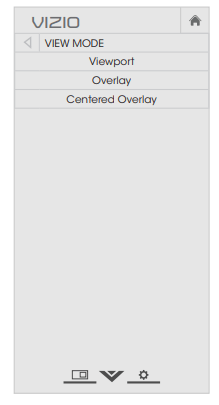
You can resize the video content to fit while the menu is open.
To change the on-screen menu language:
- Press the MENU button on the remote. The on-screen menu is displayed.
- Use the Arrow buttons on the remote to highlight System and press OK. The SYSTEM menu is displayed.
- Use the Arrow buttons on the remote to highlight View Mode and press OK. The VIEW MODE menu is displayed.
- Highlight your Viewport, Overlay, or Centered Overlay and press OK.
• Viewport - The entire picture is visible in the space to the right of the menu. • Overlay - The left-hand portion of the picture covered by the menu.
• Centered Overlay - The picture extends off of the right side of the screen.
- Press the EXIT button on the remote. See Viewing Video with the Menu Open on page 28 for an alternate way of resizing the video content.
Adjusting the Wide Mode (Aspect Ratio)
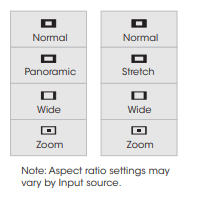
The TV can display images in five different modes: Normal, Stretch, Panoramic, Wide, and Zoom. Each mode displays the picture differently.
To change the screen aspect ratio:
- Press the WIDE button on the remote.
- Use the Arrow buttons to highlight the aspect ratio you wish to view and press OK.
• Normal preserves the content’s original aspect ratio. Since the 4:3 aspect ratio is not large enough to fill the TV’s screen, black bars are added to the left and right of the display image.
• Stretch expands the display image to fill the screen. Images may appear wider than intended. If you are watching widescreen (1.85:1 or 2.35:1) content, black bars will still appear on the top and bottom of the display image. This option is only available when the TV is displaying a 720p/1080i source.
• Panoramic expands the display image to fill the width of the screen. Images may appear wider than intended. If you are watching widescreen (1.85:1 or 2.35:1) content, black bars will still appear on the top and bottom of the display image. This option is only available when the TV is displaying a 480i/480p source.
• Wide stretches a 4:3 aspect ratio picture to the edges of the screen. Since the picture is being stretched, the display image may appear distorted. If the program is already formatted for widescreen viewing (1.85:1 or 2.35:1), then black bars will appear on the top and bottom of the display image.
• Zoom expands images with black bars to fit the screen.
Changing Your TV's DLNA Name
DLNA allows your TV to display content from DLNA-certified computers, cameras, tablets, and smartphones.
To create a custom DLNA name for your TV:
- Press the MENU button on the remote. The on-screen menu is displayed.
- Use the Arrow buttons on the remote to highlight System and press OK. The SYSTEM menu is displayed.
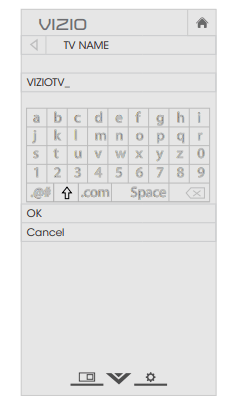
- Use the Arrow buttons on the remote to highlight TV Name and press OK. The TV NAME menu is displayed.
- Use either the onscreen keyboard or keyboard on your remote control to enter a name for your TV (the name can be up to 10 characters long). When you are finished, highlight OK and press the OK button.
- Press the EXIT button on the remote.
Controlling Other Devices with CEC
The CEC function on your TV enables you to control devices connected to the HDMI (ARC) input with the included remote, without any programming. Using CEC, your VIZIO TV remote can control:
Warning: Not all HDMI devices support CEC. See your device’s user manual for details.
To enable, disable, or adjust CEC settings:
- Press the MENU button on the remote. The on-screen menu is displayed.
- Use the Arrow buttons on the remote to highlight System and press OK. The SYSTEM menu is displayed.
- Use the Arrow buttons on the remote to highlight CEC and press OK. The CEC Settings menu is displayed.
- Highlight CEC and press OK. Select a setting and then press OK.
• Enable - All CEC-compatible devices connected to HDMI inputs can be discovered.
• ARC only - VIZIO sound bars and other CEC-compatible audio systems connected to the HDMI (ARC) input are automatically discovered, controlled by the remote, and have audio played through them.
• Disable - Devices are not discovered and the remote does not control CEC devices.
To begin device discovery:
- From the CEC menu, highlight Device Discovery and press OK. Your TV begins looking for CEC devices connected to all of its HDMI inputs. When discovery is complete:
- The CEC-compatible devices are listed below Device Discovery.
- The names of these devices now appear on the Input menu.
- If an audio device was discovered, the TV's speakers are turned off.
- The VIZIO TV remote controls an attached VIZIO sound bar or other audio system.
Turning the Power Indicator On or Off
The Power Indicator on the front of your TV normally does not glow when the TV is on. You can change this setting if you prefer the light to be on.
To turn the Power Indicator Light on or off:
- Press the MENU button on the remote. The on-screen menu is displayed.
- Use the Arrow buttons on the remote to highlight System and press OK. The SYSTEM menu is displayed.
- Highlight Power Indicator and press OK.
- Use the Up/Down Arrow buttons to select On or Off, then press OK.
Restoring the TV to Factory Default Settings
You can use the TV’s Reset & Admin menu to restore the TV to its factory default settings.
All of the on-screen menu settings can be reset to the factory defaults.
Warning: If you restore the TV to the factory default settings, all changes you have made to the settings will be lost!
To restore the TV to its factory default settings:
- Press the MENU button. The on-screen menu is displayed.
- Use the Arrow buttons on the remote to highlight System and press OK. The SYSTEM menu is displayed.
- Highlight Reset & Admin and press OK. The RESET & ADMIN menu is displayed.
- Highlight Reset TV to Factory Defaults and press OK.
- Enter your parental control passcode. If you have not yet set up a parental passcode, enter the default, 0000. The TV displays, "Select Reset to restore all TV settings to factory defaults and clear all account information."
- Highlight Reset and press OK.
- Wait for the TV to turn off. The TV will turn back on shortly afterward and the Setup App will begin.
Enabling and Disabling Smart Interactivity
Your TV can display program-related information as part of a broadcast. To enable or disable Smart Interactivity:
- Press the MENU button. The on-screen menu is displayed.
- Use the Arrow buttons on the remote to highlight System and press OK. The SYSTEM menu is displayed.
- Highlight Reset & Admin and press OK. The RESET & ADMIN menu is displayed.
- Highlight Smart Interactivity and press OK.
- Select On or Off and press OK.
- Press the EXIT button on the remote.
Troubleshooting
The TV displays “No Signal.”
- Press the INPUT button on the remote control to select a different input source.
- If you are using cable TV, satellite, or an antenna connected directly to the TV, scan for channels. See Finding Channels on page 43
There is no power.
- Ensure the TV is plugged into a working electrical outlet.
- Ensure the power cable is securely attached to the TV.
- Press the Power/Standby button on the remote or on the side of the TV to turn the TV on.
The power is on, but there is no image on the screen.
- Ensure all cables are securely attached to the TV.
- Ensure all devices are connected correctly. Devices differ; see your device’s user manual for details.
- Adjust Brightness, Contrast, or Backlight. See Adjusting the Picture Settings on page 29.
- Press the INPUT button on the remote to select a different input source.
There is no sound.
- Press Volume Up on the remote control.
- Press the MUTE button on the remote to ensure mute is off.
- Check the audio settings. See Adjusting the Audio Settings on page 37. Ensure that the speakers are set to On.
- Ensure no headphones are connected to the TV.
- Check the audio connections of external devices (Blu-ray player, game console, cable/satellite box) that are connected to the TV.
- If you are using an antenna, the signal strength of the channel may be low. Ensure your antenna is connected securely to the TV and move the antenna around the room or close to a window for the best signal.
The colors on the TV don’t look right.
- Adjust the Color and Tint settings in the Picture menu. See Adjusting the Picture Settings on page 29.
- Select a pre-set picture mode. See Adjusting the Picture Settings on page 29. VIZIO recommends selecting the Calibrated mode.
- Check all cables to ensure they are securely attached.
The buttons on the remote aren’t working.
- Ensure you are only pressing one button at a time.
- Point the remote directly at the TV when pressing a button.
- Replace the remote batteries with new ones. See Replacing the Batteries on page 16.
The image quality is not good.
- For the best image quality, view high-definition programs using digital sources. Connect your devices with HDMI cables.
- If you are using an antenna, the signal strength of the channel may be low. Ensure your antenna is connected securely to the TV and move the antenna around the room or close to a window for the best signal.
The picture is distorted.
- Nearby electrical devices may be interfering with the TV. Separate the TV from electrical appliances, cars, or fluorescent lights.
- Ensure all cables are securely attached.
The display image does not cover the entire screen.
- If you are using TV, AV, or Component with 480i input, press the WIDE button on the remote to change the screen mode.
The TV has pixels (dots) that are always dark.
- Your HDTV is precision-manufactured using an extremely high level of technology. However, sometimes pixels may not display correctly. These types of occurrences are inherent to this type of product and do not constitute a defective product.
I see “noise” or static on the screen.
- When your TV’s digital capabilities exceed a digital broadcast signal, the signal is up-converted (improved) to match your TV’s display capabilities. This up-converting can sometimes cause irregularities in the image.
- If you are using an antenna, the signal strength of the channel may be low. Ensure your antenna is connected securely to the TV and move the antenna around the room or close to a window for the best signal
When I change input source, the volume changes.
- The TV remembers the volume level on each input source. If the volume level on the new input source is higher or lower than the level on the source you switch from, the difference may be noticeable.
- Use the Volume Up/Down buttons on the remote to adjust the volume. When I change input source, the display image changes size.
When I change input source, the display image changes size.
- The TV remembers the viewing mode on each input source. If the viewing mode on the new input source differs from the one on the input source you switch from, the difference may be noticeable.
- See Changing the Screen Aspect Ratio on page 27..
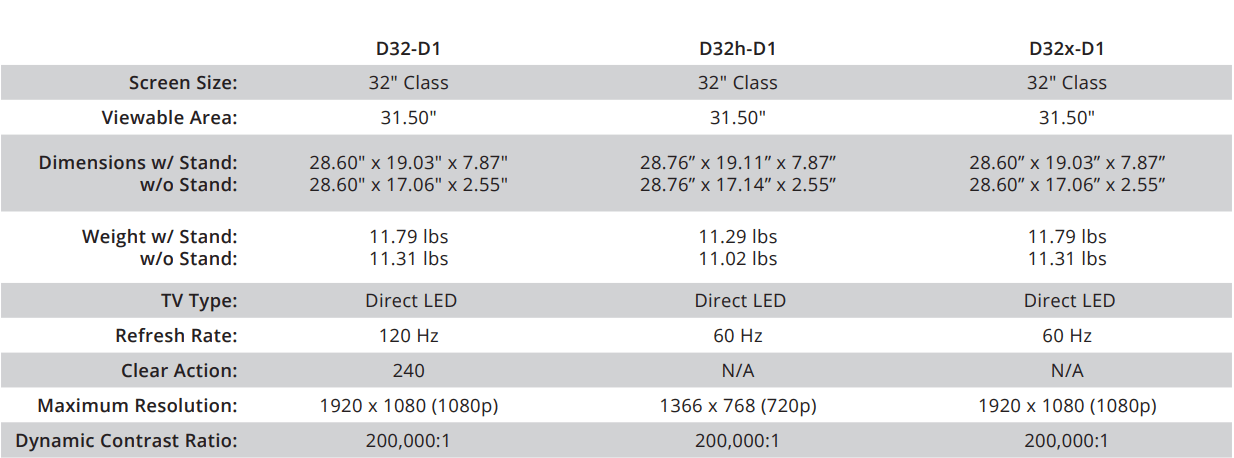
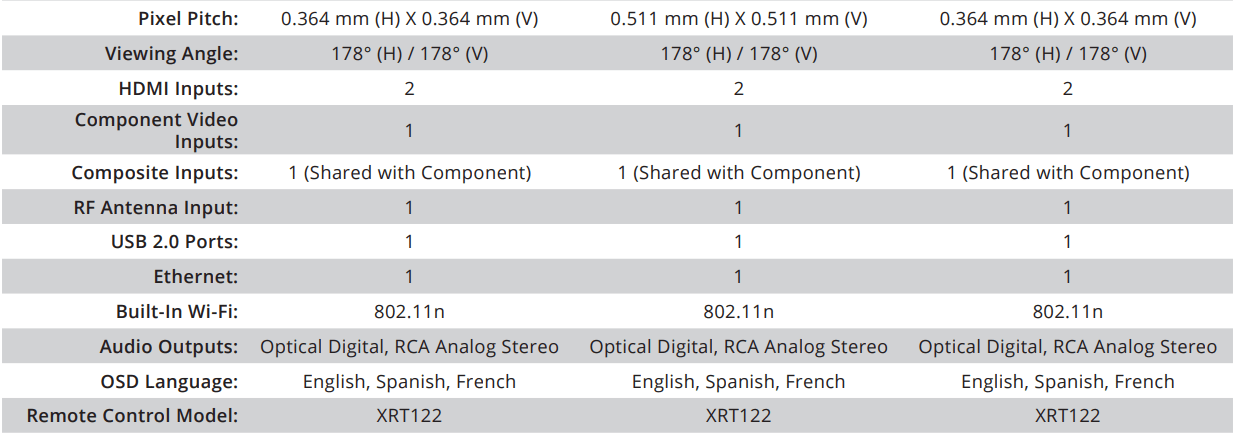
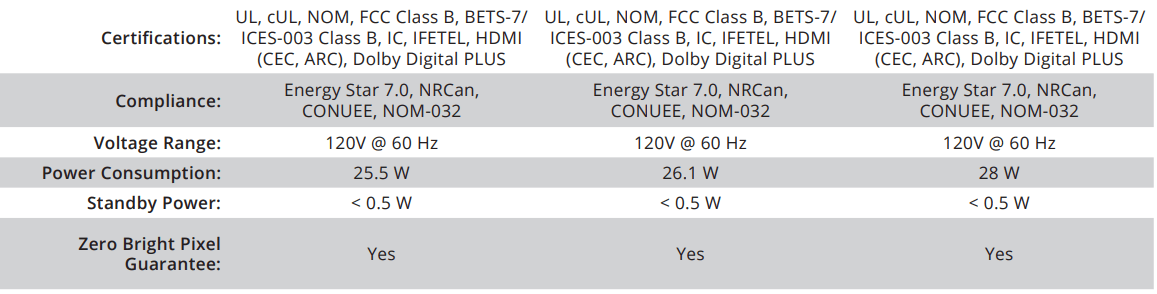
Specifications