COROLLA H/B_U
1
2
3
4
5
6
7
8
9
9
10
Pictorial index
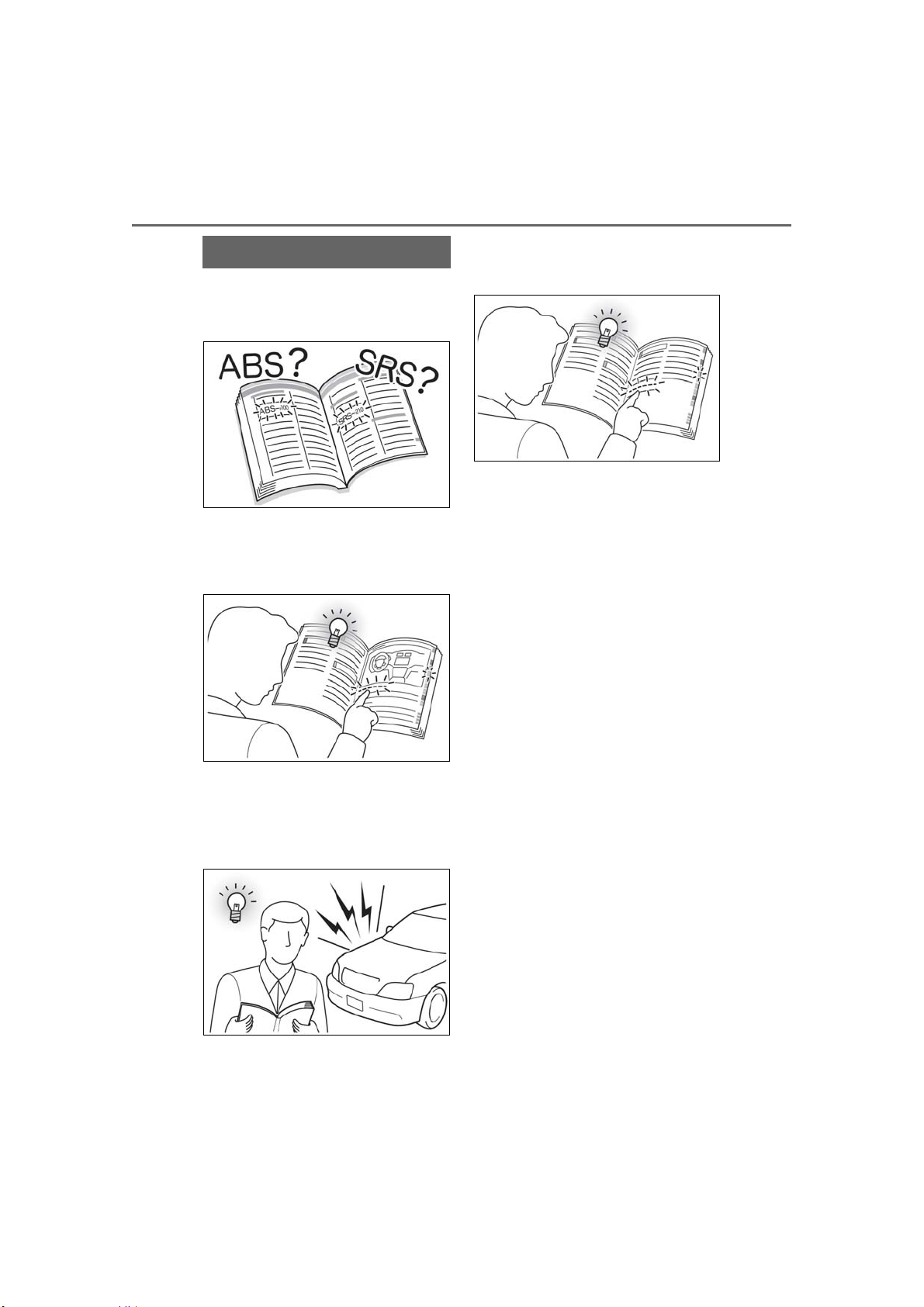
Search by illustration
For safety
and security
Make sure to read through them
(Main topics: Child seat, theft deterrent system)
Vehicle status
information and
indicators
Reading driving-related information
(Main topics: Meters, multi-information display)
Before driving
Opening and closing the doors and windows,
adjustment before driving
(Main topics: Keys, doors, seats)
Driving
Operations and advice which are necessary for
driving
(Main topics: Starting engine, refueling)
Audio
Operating the Audio
(Main topics: Audio/visual, phone)
Interior features
Usage of the interior features
(Main topics: Air conditioner, storage features)
Maintenance
and care
Caring for your vehicle and maintenance
procedures
(Main topics: Interior and exterior, light bulbs)
When trouble
arises
What to do in case of malfunction and emergency
(Main topics: Battery discharge, flat tire)
Vehicle
specifications
Vehicle specifications, customizable features
(Main topics: Fuel, oil, tire inflation pressure)
For owners
Reporting safety defects for U.S. owners, and seat
belt and SRS airbag instructions for Canadian
owners
Index
Search by symptom
Search alphabetically

2
COROLLA H/B_U
TABLE OF CONTENTS
For your information ........................ 6
Reading this manual......................10
How to search................................11
Pictorial index ................................12
1-1. For safe use
Before driving........................22
For safe driving .....................23
Seat belts ..............................25
SRS airbags..........................29
Front passenger occupant clas-
sification system..................38
Exhaust gas precautions.......43
1-2. Child safety
Riding with children...............44
Child restraint systems..........45
1-3. Emergency assistance
Safety Connect .....................58
1-4. Theft deterrent system
Engine immobilizer system ...64
Alarm.....................................66
Theft prevention labels (U.S.A.)
............................................67
2-1. Instrument cluster
Warning lights and indicators
............................................70
Gauges and meters (4.2-inch
display)................................74
Gauges and meters (7-inch dis-
play) ....................................78
Multi-information display .......82
Head-up display ....................89
Fuel consumption information
............................................93
3-1. Key information
Keys ......................................98
3-2. Opening, closing and locking
the doors
Side doors.......................... 101
Back door........................... 105
Smart key system .............. 108
3-3. Adjusting the seats
Front seats ......................... 115
Rear seats.......................... 116
Head restraints................... 118
3-4. Adjust
ing the steering wheel
and mirrors
Ste
ering wheel ................... 121
Inside rear view mirror ....... 122
Outside rear view mirrors... 123
3-5. Opening and closing the win-
dows
Power windows .................. 125
4-1. Before driving
Driving the vehicle.............. 130
Cargo and luggage ............ 138
Vehicle load limits .............. 140
Trailer towing...................... 141
Dinghy towing .................... 141
4-2. Driving procedures
Engine (ignition) switch ...... 142
Continuously variable transmis-
sion .................................. 147
Manual transmission
.......... 151
T
urn signal lever................. 153
Parking brake..................... 154
Brake Hold ......................... 157
1
For safety and security
2
Vehicle status information
and indicators
3
Before driving
4
Driving
3
TABLE OF CONTENTS
COROLLA H/B_U
1
2
3
4
5
6
7
8
9
10
4-3. Operating the lights and wip-
ers
Headlight switch................. 160
Automatic High Beam ........ 163
Fog light switch .................. 166
Windshield wipers and washer
......................................... 166
Rear window wiper and washer
......................................... 168
4-4. Refueling
Opening the fuel tank cap .. 170
4-5. Using the driving support sys-
tems
Toyota Safety Sense 2.0 .... 172
PCS (Pre-Collision System)
......................................... 178
LTA (Lane Tracing Assist)... 186
LDA (Lane Departure Alert with
steering control) ............... 196
Dynamic radar cruise control
with full-speed range........ 204
Dynamic radar cruise control
......................................... 214
RSA (Road Sign Assist) ..... 224
BSM (Blind Spot Monitor)... 227
Rear view monitor system.. 232
Driving mode select switch
......................................... 240
Driving assist systems........ 241
4-6. Driving tips
Winter driving tips............... 246
5-1. Basic function
Buttons overview................ 251
Menu screen ...................... 253
Status icon ......................... 254
“Setup” screen ................... 256
5-2. Basic information before oper-
ation
Initial screen....................... 257
Touch screen...................... 258
Home screen...................... 260
Entering letters and num-
bers/list screen operation
......................................... 261
Screen adjustment ............. 264
Linking multi-information display
and the system ................ 265
5-3. Connectivity settings
Registering/Connecting a Blue-
tooth
®
device ................... 266
Setting Bluetooth
®
details .. 271
Wi-Fi
®
Hotspot ................... 278
Apple CarPlay/Android Auto
......................................... 283
5-4. Other settings
General settings................. 290
Voice settings..................... 294
Vehicle settings .................. 295
5-5. Using the audio/visual system
Quick reference.................. 297
Some basics ...................... 298
5-6. Radio operation
AM/FM/SiriusXM
®
Satellite
Radio ............................... 302
Internet radio...................... 307
5-7. Media operation
USB memory...................... 308
iPod/iPhone (Apple CarPlay)
......................................... 310
Android Auto ...................... 313
Bluetooth
®
audio................ 314
5-8. Audio/visual remote controls
Steering switches............... 318
5-9. Audio settings
Setup.................................. 320
5
Audio

4
TABLE OF CONTENTS
COROLLA H/B_U
5-10.Tips for operating the
audio/visual system
Operating information......... 321
5-11. Voice command system oper-
ation
Voice command system ..... 334
Command list ..................... 337
5-12.Mobile Assistant operation
Mobile Assistant ................. 341
5-13.Phone operation (Hands-free
system for cellular phones)
Quick reference.................. 343
Some basics ...................... 344
Placing a call using the Blue-
tooth
®
hands-free system 348
Receiving a call using the Blue-
tooth
®
hands-free system 351
Talking on the Bluetooth
®
hands-free system ........... 352
Bluetooth
®
phone message
function ............................ 354
5-14.Phone settings
Setup.................................. 359
5-15.What to do if... (Bluetooth
®
)
Troubleshooting ................. 369
5-16.Connected Services Overview
Functional overview ........... 373
Type A: Function achieved by
using a smart phone or DCM
......................................... 374
Type B: Function achieved by
using DCM and the system
......................................... 377
Type C: Function achieved by
using DCM ....................... 378
5-17.Connected Services Opera-
tion
Toyota apps........................ 379
5-18.Toyota apps settings
Setup.................................. 383
6-1. Using the air conditioning
system and defogger
Automatic air conditioning sys-
tem................................... 386
Heated steering wheel/seat
heaters............................. 393
6-2. Using the interior lights
Interior lights list ................. 395
6-3. Using the storage features
List of storage features ...... 397
Luggage compartment features
......................................... 400
6-4. Other interior features
Other interior features ........ 402
7-1. Maintenance and care
Cleaning and protecting the
vehicle exterior................. 414
Cleaning and protecting the
vehicle interior.................. 416
7-2. Maintenance
Maintenance requirements
......................................... 419
General maintenance......... 420
Emission inspection and mainte-
nance (I/M) programs ...... 423
7-3. Do-it-yourself maintenance
Do-it-yourself service precau-
tions ................................. 425
Hood .................................. 427
Positioning a floor jack ....... 428
Engine compartment.......... 429
Tires ................................... 436
Tire inflation pressure......... 445
Wheels ............................... 447
Air conditioning filter........... 449
6
Interior features
7
Maintenance and care
5
TABLE OF CONTENTS
COROLLA H/B_U
1
2
3
4
5
6
7
8
9
10
Electronic key battery......... 450
Checking and replacing fuses
......................................... 452
Light bulbs.......................... 455
8-1. Essential information
Emergency flashers ........... 460
If your vehicle has to be stopped
in an emergency .............. 460
If the vehicle is trapped in rising
water ................................ 461
8-2. Steps to take in an emergency
If your vehicle needs to be towed
......................................... 463
If you think something is wrong
......................................... 466
Fuel pump shut off system
......................................... 467
If a warning light turns on or a
warning buzzer sounds.... 468
If a warning message is dis-
played .............................. 477
If you have a flat tire (vehicles
without spare tire) ............ 479
If you have a flat tire (vehicles
with a spare tire) .............. 490
If the engine will not start ... 498
If you lose your keys .......... 500
If the electronic key does not
operate properly............... 500
If the vehicle battery is dis-
charged............................ 502
If your vehicle overheats .... 506
If the vehicle becomes stuck
......................................... 508
9-1. Specifications
Maintenance data (fuel, oil level,
etc.).................................. 510
Fuel information ................. 518
Tire information .................. 520
9-2. Customization
Customizable features ....... 531
9-3. Initialization
Items to initialize ................ 539
10-1.For owners
Reporting safety defects for U.S.
owners ............................. 542
Seat belt instructions for Cana-
dian owners (in French) ... 542
SRS airbag instructions for
Canadian owners (in French)
......................................... 544
What to do if... (Troubleshooting)
......................................... 552
Alphabetical Index.............. 555
8
When trouble arises
9
Vehicle specifications
10
For owners
Index

6
COROLLA H/B_U
Please note that this manual
applies to all models and
explains all equipment, including
options. Therefore, you may find
some explanations for equip-
ment not installed on your vehi-
cle.
All specifications provided in this
manual are current at the time of
printing. However, because of
the Toyota policy of continual
product improvement, we
reserve the right to make
changes at any time without
notice.
Depending on specifications,
the vehicle shown in the illustra-
tions may differ from your vehi-
cle in terms of equipment.
Approximately five hours after
the engine is turned off, you
may hear sound coming from
under the vehicle for several
minutes. This is the sound of a
fuel evaporation leakage check
and, it does not indicate a mal-
function.
A wide variety of non-genuine
spare parts and accessories for
Toyota vehicles are currently
available in the market. You
should know that Toyota does
not warrant these products and
is not responsible for their per-
formance, repair, or replace-
ment, or for any damage they
may cause to, or adverse effect
they may have on, your Toyota
vehicle.
This vehicle should not be modi-
fied with non-genuine Toyota
products. Modification with
non-genuine Toyota products
could affect its performance,
safety or durability, and may
even violate governmental regu-
lations. In addition, damage or
performance problems resulting
from the modification may not
be covered under warranty.
The installation of a mobile
two-way radio system in your
vehicle could affect electronic
systems such as:
Multiport fuel injection sys-
tem/sequential multiport fuel
injection system
Toyota Safety Sense 2.0
For your information
Main Owner’s Manual
Noise from under vehicle
after turning off the engine
Accessories, spare parts
and modification of your
Toyota
Installation of a mobile
two-way radio system

7
COROLLA H/B_U
Anti-lock brake system
SRS airbag system
Seat belt pretensioner system
Be sure to check with your Toy-
ota dealer for precautionary
measures or special instructions
regarding installation of a mobile
two-way radio system.
The vehicle is equipped with
sophisticated computers that will
record certain data, such as:
• Engine speed/Electric motor
speed (traction motor speed)
• Accelerator status
• Brake status
• Vehicle speed
• Operation status of the driving
assist systems
• Images from the cameras
Your vehicle is equipped with
cameras. Contact your Lexus
dealer for the location of
recording cameras.
The recorded data varies
according to the vehicle grade
level and options with which it is
equipped.
These computers do not record
conversations or sounds, and
only record images outside of
the vehicle in certain situations.
Data Transmission
Your vehicle may transmit the data
recorded in these computers to
Toyota without notification to you.
Data usage
Toyota may use the data recorded
in this computer to diagnose mal-
functions, conduct research and
development, and improve quality.
Toyota will not disclose the
recorded data to a third party
except:
• With the consent of the vehicle
owner or with the consent of the
lessee if the vehicle is leased
• In response to an official request
by the police, a court of law or a
government agency
• For use by Toyota in a lawsuit
• For research purposes where the
data is not tied to a specific vehi-
cle or vehicle owner
Recorded image information
can be erased by your Toyota
dealer.
The image recording function can
be disabled. However, if the func-
tion is disabled, data from when the
system operates will not be avail-
able.
To learn more about the vehi-
cle data collected, used and
shared by Toyota, please visit
www.toyota.com/privacyvts/
.
If your Toyota has Safety Con-
nect and if you have subscribed
to those services, please refer to
the Safety Connect Telematics
Subscription Service Agreement
Vehicle data recording
Usage of data collected
through Safety Connect
(U.S. mainland only)

8
COROLLA H/B_U
for information on data collected
and its usage.
To learn more about the vehicle
data collected, used and shared
by Toyota, please visit
www.toyota.com/privacyvts/
.
This vehicle is equipped with an
event data recorder (EDR). The
main purpose of an EDR is to
record, in certain crash or near
crash-like situations, such as an
air bag deployment or hitting a
road obstacle, data that will
assist in understanding how a
vehicle’s systems performed.
The EDR is designed to record
data related to vehicle dynamics
and safety systems for a short
period of time, typically 30 sec-
onds or less.
The EDR in this vehicle is
designed to record such data
as:
• How various systems in your
vehicle were operating;
• Whether or not the driver and
passenger safety belts were
buckled/fastened;
• How far (if at all) the driver
was depressing the accelera-
tor and/or brake pedal; and,
• How fast the vehicle was trav-
eling.
These data can help provide a
better understanding of the cir-
cumstances in which crashes
and injuries occur.
NOTE: EDR data are recorded
by your vehicle only if a nontriv-
ial crash situation occurs; no
data are recorded by the EDR
under normal driving conditions
and no personal data (e.g.,
name, gender, age, and crash
location) are recorded. How-
ever, other parties, such as law
enforcement, could combine the
EDR data with the type of per-
sonally identifying data rou-
tinely acquired during a crash
investigation.
To read data recorded by an
EDR, special equipment is
required, and access to the
vehicle or the EDR is needed. In
addition to the vehicle manufac-
turer, other parties, such as law
enforcement, that have the spe-
cial equipment, can read the
information if they have access
to the vehicle or the EDR.
Disclosure of the EDR data
Toyota will not disclose the data
recorded in an EDR to a third party
except when:
• An agreement from the vehicle’s
owner (or the lessee for a leased
vehicle) is obtained
• In response to an official request
by the police, a court of law or a
government agency
• For use by Toyota in a lawsuit
However, if necessary, Toyota may:
• Use the data for research on
vehicle safety performance
Event data recorder

9
COROLLA H/B_U
• Disclose the data to a third party
for research purposes without
disclosing information about the
specific vehicle or vehicle owner
The SRS airbag and seat belt
pretensioner devices in your
Toyota contain explosive chemi-
cals. If the vehicle is scrapped
with the airbags and seat belt
pretensioners left as they are,
this may cause an accident such
as fire. Be sure to have the sys-
tems of the SRS airbag and seat
belt pretensioner removed and
disposed of by a qualified ser-
vice shop or by your Toyota
dealer before you scrap your
vehicle.
Special handling may apply, See
www.dtsc.ca.gov/
hazardouswaste/perchlorate.
Your vehicle has components
that may contain perchlorate.
These components may include
the airbags, seat belt preten-
sioners, wireless remote control
batteries, and the batteries in
the tire pressure warning valve
and transmitters.
Scrapping of your Toyota
Perchlorate Material
WARNING
■ General precautions while
driving
Driving under the influence: Never
drive your vehicle when under the
influence of alcohol or drugs that
have impaired your ability to oper-
ate your vehicle. Alcohol and cer-
tain drugs delay reaction time,
impair judgment and reduce coor-
dination, which could lead to an
accident that could result in death
or serious injury.
Defensive driving: Always drive
defensively. Anticipate mistakes
that other drivers or pedestrians
might make and be ready to avoid
accidents.
Driver distraction: Always give
your full attention to driving. Any-
thing that distracts the driver, such
as adjusting controls, talking on a
cellular phone or reading can
result in a collision with resulting
death or serious injury to you,
your occupants or others.
■ General precaution regarding
children’s safety
Never leave children unattended
in the vehicle, and never allow
children to have or use the key.
Children may be able to start the
vehicle or shift the vehicle into
neutral. There is also a danger
that children may injure them-
selves by playing with the win-
dows, or other features of the
vehicle. In addition, heat build-up
or extremely cold temperatures
inside the vehicle can be fatal to
children.
10
COROLLA H/B_U
Reading this manual
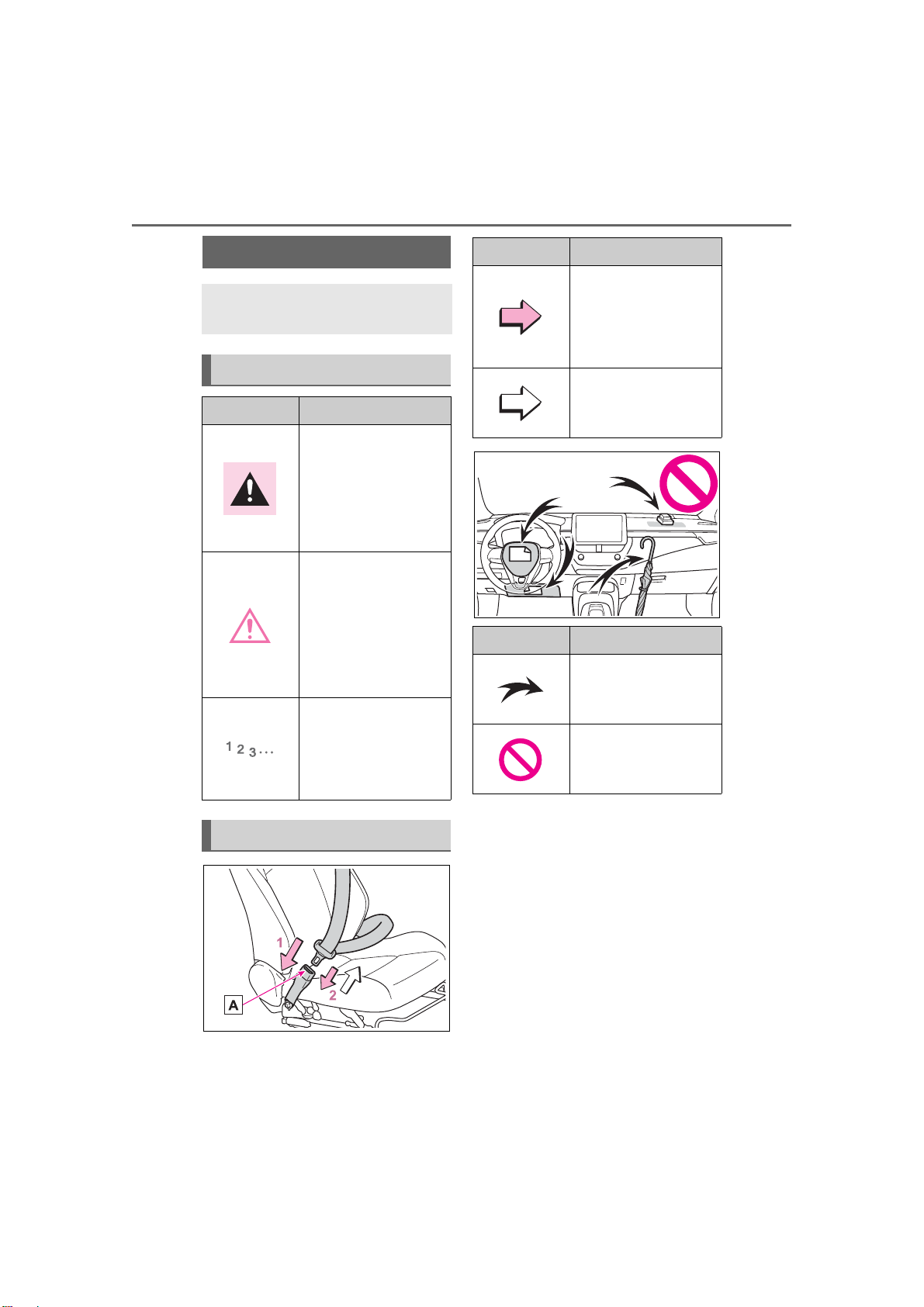
Explains symbols used in
this manual.
Symbols in this manual
Symbols Meanings
WARNING:
Explains something
that, if not obeyed,
could cause death or
serious injury to peo-
ple.
NOTICE:
Explains something
that, if not obeyed,
could cause dam-
age to or a malfunc-
tion in the vehicle or
its equipment.
Indicates operating
or working proce-
dures. Follow the
steps in numerical
order.
Symbols in illustrations
Symbols Meanings
Indicates the action
(pushing, turning,
etc.) used to operate
switches and other
devices.
Indicates the out-
come of an operation
(e.g. a lid opens).
Symbols Meanings
Indicates the compo-
nent or position
being explained.
Means Do not, Do
not do this, or Do
not let this happen.
12
Pictorial index
Pictorial index
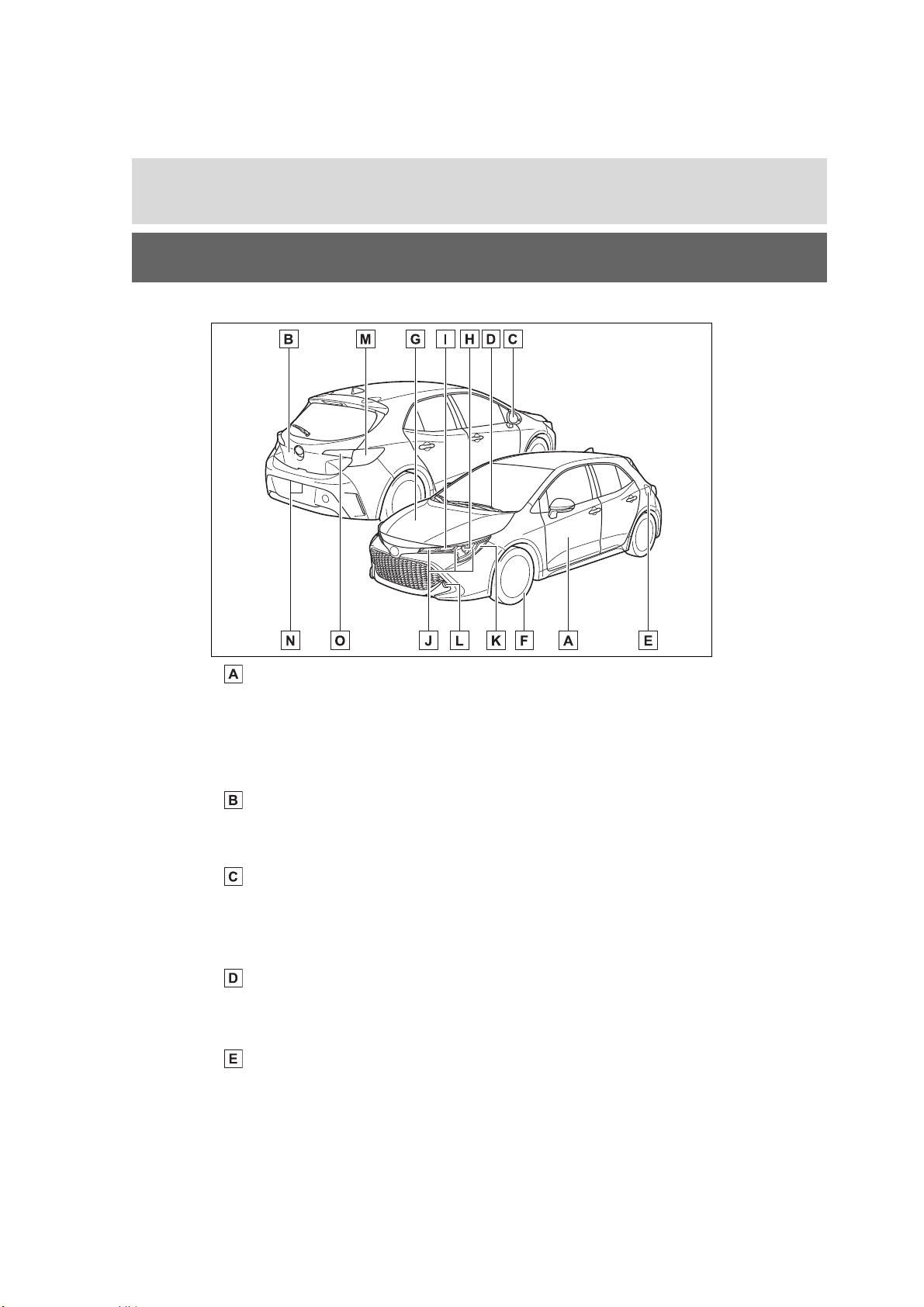
■Exterior
Side doors .......................................................................... P.101
Locking/unlocking ................................................................ P.101
Opening/closing the side windows....................................... P.125
Locking/unlocking by using the mechanical key .................. P.5 00
Warning messages .............................................................. P.104
Back door ........................................................................... P.105
Locking/unlocking ................................................................ P.106
Warning messages .............................................................. P.107
Outside rear view mirrors ................................................. P.123
Adjusting the mirror angle .................................................... P.123
Folding the mirrors ............................................................... P.123
Defogging the mirrors .......................................................... P.389
Windshield wipers.............................................................. P.166
Precautions for winter season.............................................. P.246
To prevent freezing (windshield wiper de-icer)
*
.................... P.391
Fuel filler door .................................................................... P.170
13
Pictorial index
COROLLA H/B_U
Refueling method................................................................. P.171
Fuel type/fuel tank capacity ................................................. P.511
Tires..................................................................................... P.436
Tire size/inflation pressure ................................................... P.515
Winter tires/tire chains ......................................................... P.246
Checking/rotation/tire pressure warning system ..................P.436
Coping with flat tires..................................................... P.479, 490
Hood.................................................................................... P.427
Opening ............................................................................... P.427
Engine oil ............................................................................. P.511
Coping with overheating ...................................................... P.506
Headlights/daytime running lights ................................... P.160
Turn signal lights ............................................................... P.153
Parking lights ..................................................................... P.160
Front side marker lights .................................................... P.160
Fog lights
*
........................................................................... P.166
Stop lights/tail lights/rear side marker lights/
turn signal lights ................................................................ P.160
License plate lights............................................................ P.160
Tail lights............................................................................. P.160
Back-up lights
Shifting the shift position to R ...................................... P.147, 151
*
: If equipped
Light bulbs of the exterior lights for driving
(Replacing method: P.455, Watts: P.516)
14
Pictorial index
COROLLA H/B_U
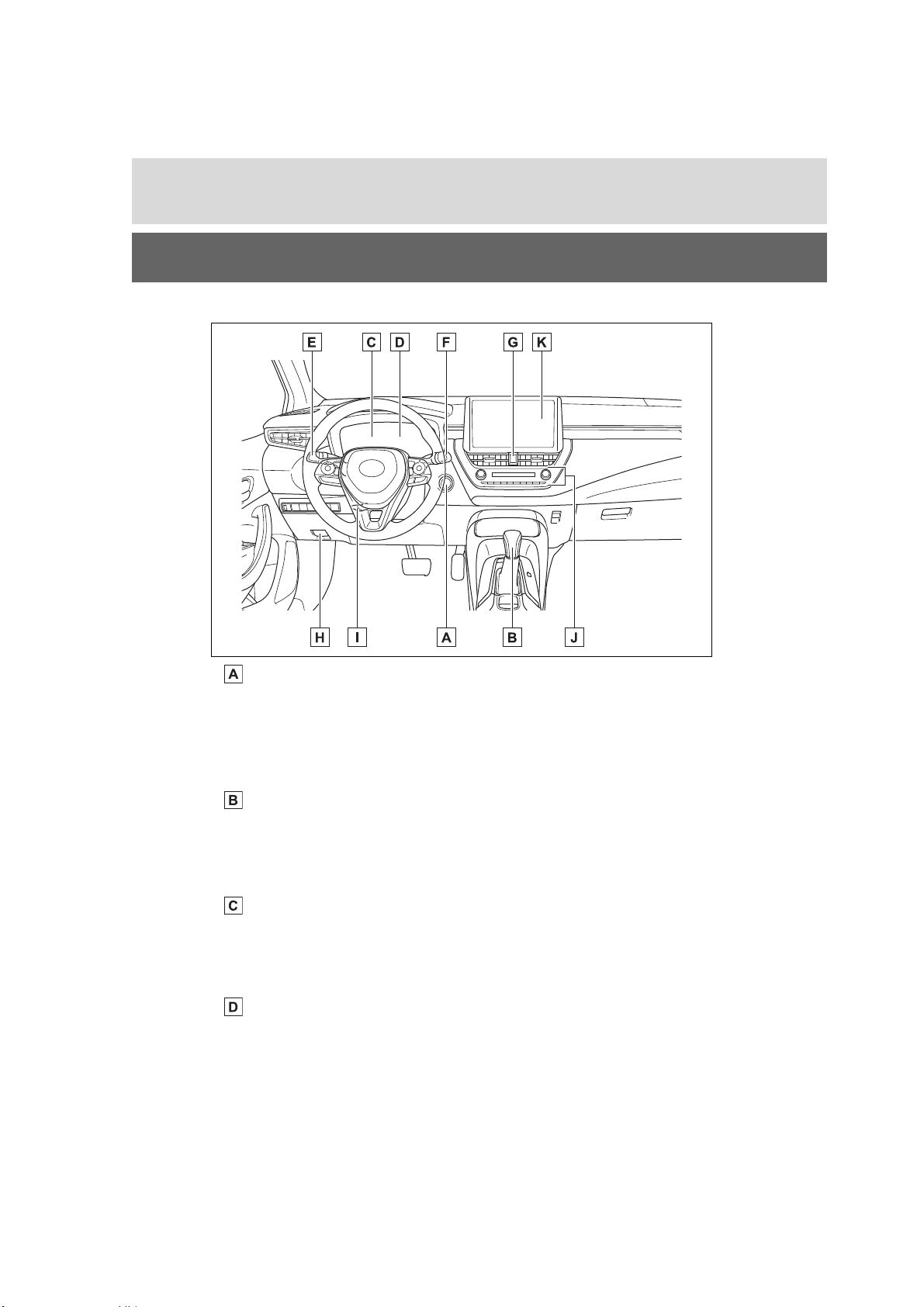
■Instrument panel
Engine switch..................................................................... P.142
Starting the engine/changing the modes ............................. P.142
Emergency stop of the engine ............................................. P.460
When the engine will not start.............................................. P.498
Warning messages .............................................................. P.477
Shift lever.................................................................... P.147, 151
Changing the shift position........................................... P.147, 151
Precautions for towing ......................................................... P.463
When the shift lever does not move
*1
.................................. P.148
Meters ............................................................................. P.74, 78
Reading the meters/adjusting the instrument panel light . P.74, 78
Warning lights/indicator lights ................................................ P.70
When a warning light turns on ............................................. P.468
Multi-information display .................................................... P.82
Display ................................................................................... P.82
When a warning message is displayed................................ P.477

15
Pictorial index
COROLLA H/B_U
Turn signal lever................................................................. P.153
Headlight switch ................................................................ P.160
Headlights/parking lights/tail lights/side marker lights/
daytime running lights .......................................................... P.160
Fog lights
*2
........................................................................... P.166
Windshield wiper and washer switch............................... P.166
Rear window wiper and washer switch ........................... P.168
Usage........................................................................... P.166, 168
Adding washer fluid.............................................................. P.435
Emergency flasher switch................................................. P.460
Hood lock release lever..................................................... P.427
Tilt and telescopic steering lock release lever................ P. 1 21
Air conditioning system .................................................... P.386
Usage................................................................................... P.386
Rear window defogger ......................................................... P.389
Audio
*2
................................................................................ P.251
Audio Plus
*2, 3
Premium Audio
*2, 3
*1
:Vehicles with a continuously variable transmission
*2
:If equipped
*3
:Refer to “NAVIGATION AND MULTIMEDIA SYSTEM OWNER’S MAN-
UAL”.
16
Pictorial index
COROLLA H/B_U
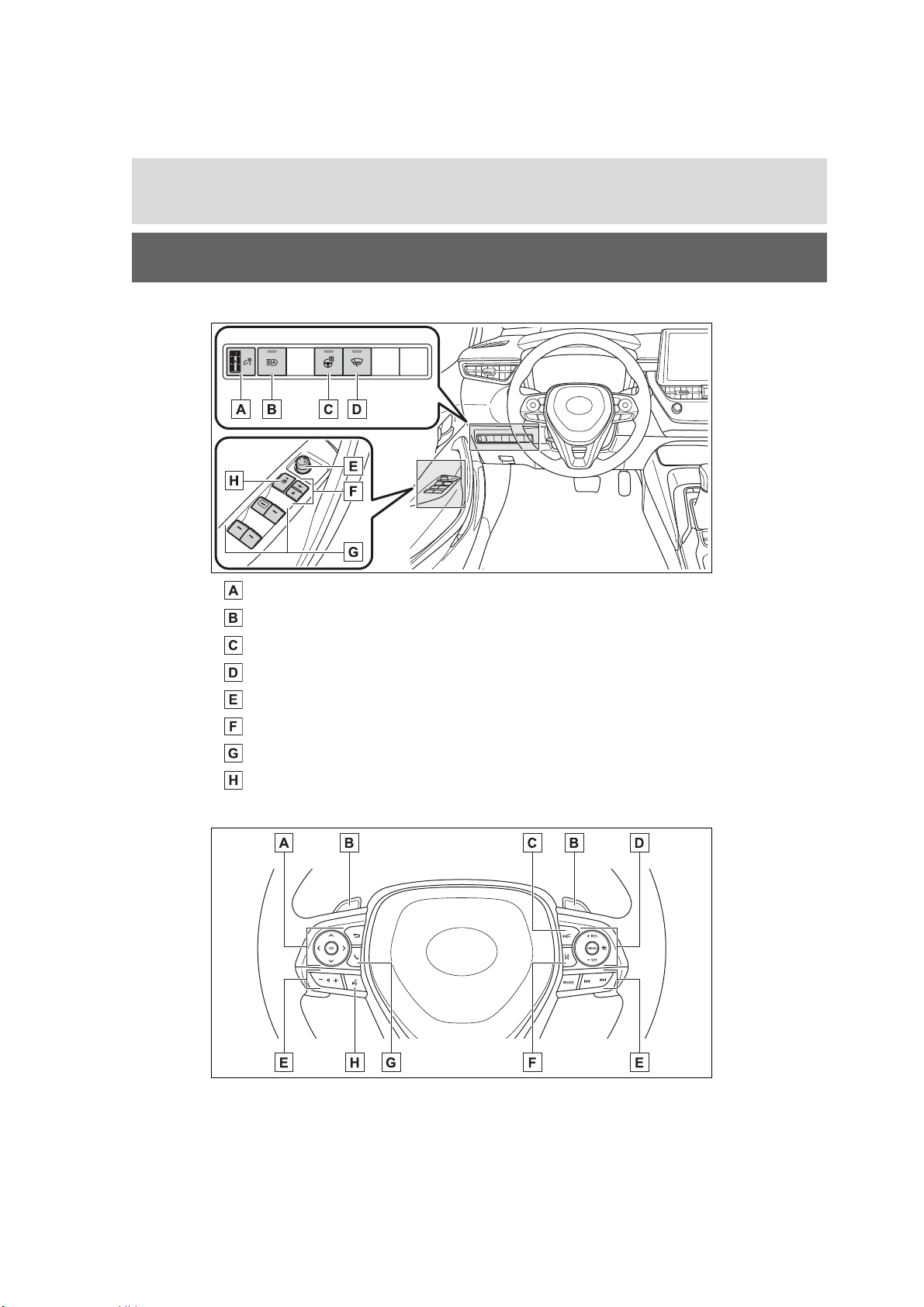
■Switches
Instrument panel light control dial ............................... P.76, 81
Automatic High Beam switch
*
.......................................... P.163
Heated steering wheel switch
*
.......................................... P.393
Windshield wiper de-icer switch
*
..................................... P.391
Outside rear view mirror switch ....................................... P.123
Door lock switches ............................................................ P.103
Power window switches.................................................... P.125
Window lock switch ........................................................... P.127
*
: If equipped
17
Pictorial index
COROLLA H/B_U
Meter control switches ........................................................ P.83
Paddle shift switches
*1
...................................................... P.149
Vehicle-to-vehicle distance switch ........................... P.209, 219
Cruise control switches
Dynamic radar cruise control with full-speed range
*1
.......... P.204
Dynamic radar cruise control
*1
............................................. P.214
Audio remote control switches
*2
...................................... P.318
LTA (Lane Tracing Assist) switch
*1
................................... P.186
LDA (Lane Departure Alert with steering control)
switch
*1
............................................................................... P.196
Phone switch
*2
................................................................... P.346
Talk switch
*2
....................................................................... P.334
*1
:If equipped
*2
:Vehicles with Audio Plus or Premium Audio, refer to “NAVIGATION AND
MULTIMEDIA SYSTEM OWNER’S MANUAL”.
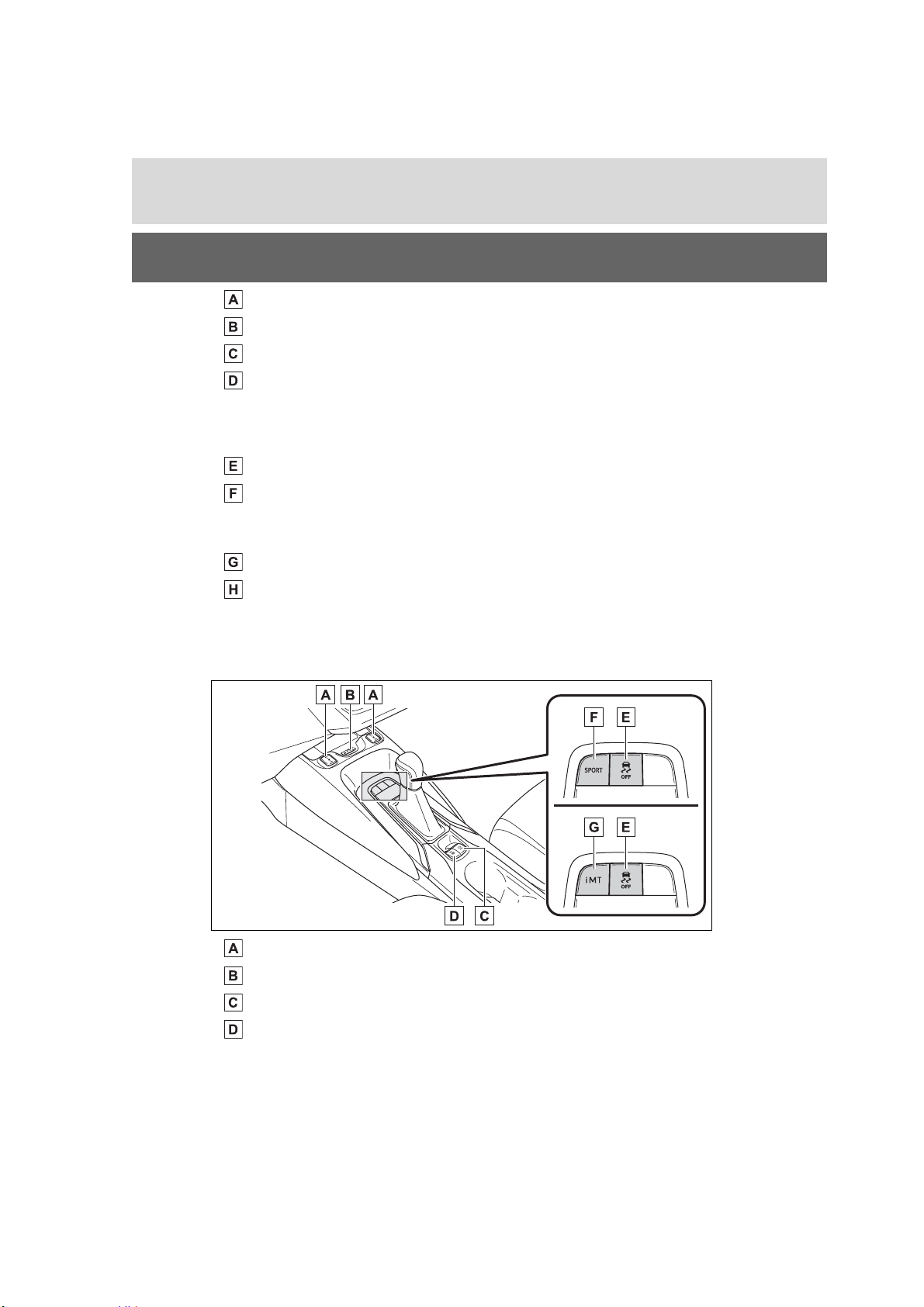
Seat heater switches
*1
....................................................... P.393
Wireless charger switch
*1
................................................. P.403
Brake hold switch .............................................................. P.157
Parking brake switch ......................................................... P.154
Precautions for winter season.............................................. P.247

18
Pictorial index
COROLLA H/B_U
VSC OFF switch ................................................................. P.242
Sport mode switch
*2
.......................................................... P.240
“iMT” (Intelligent Manual Transmission) switch
*3
.......... P.152
*1
:If equipped
*2
:Vehicles with a continuously variable transmission
*3
:Vehicles with a manual transmission
19
Pictorial index
COROLLA H/B_U
■Interior
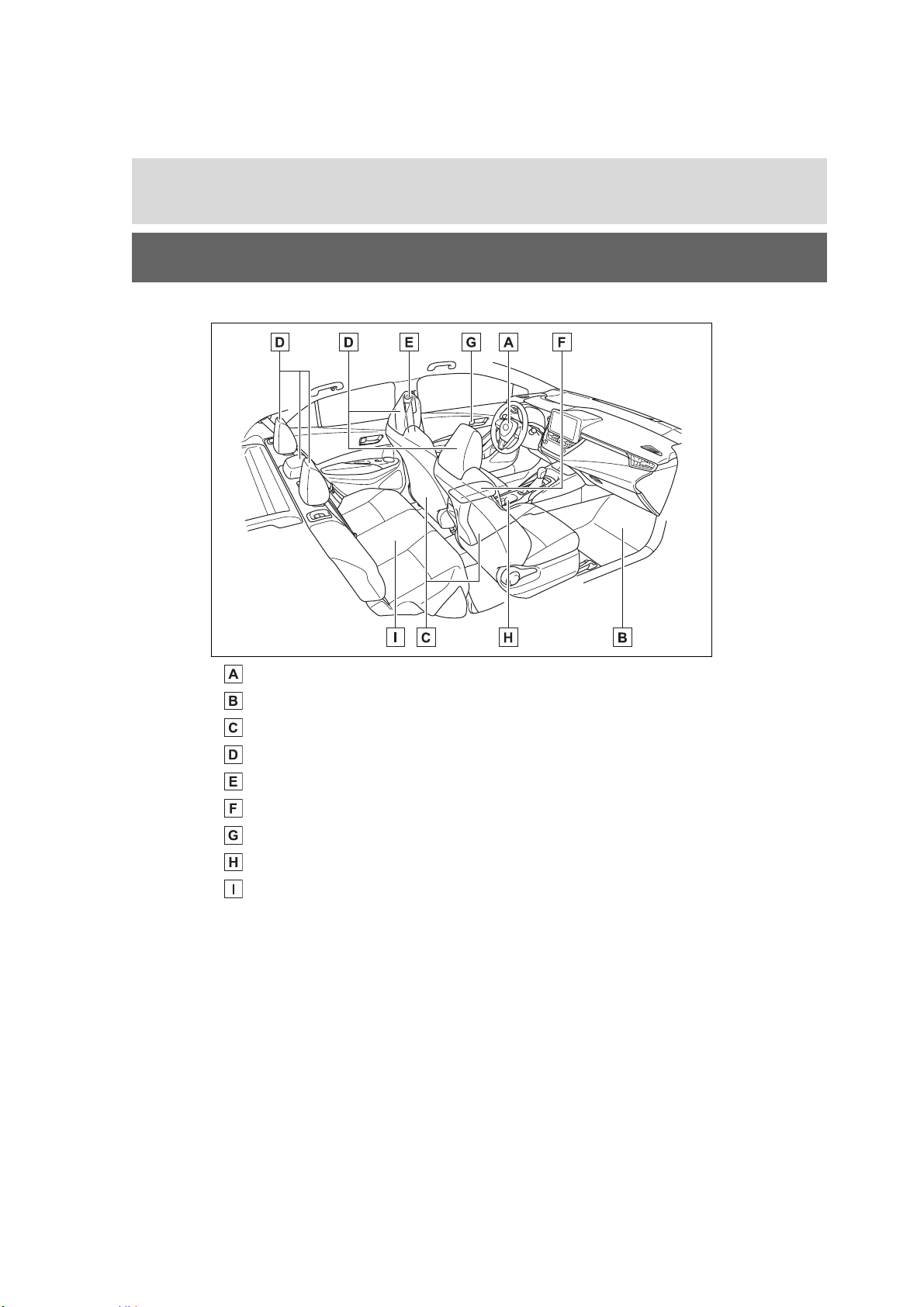
SRS airbags.......................................................................... P.29
Floor mats............................................................................. P.22
Front seats.......................................................................... P.115
Head restraints................................................................... P.118
Seat belts .............................................................................. P.25
Console box ....................................................................... P.399
Inside lock buttons ............................................................ P.103
Cup holders ........................................................................ P.398
Rear seats........................................................................... P.116
20
Pictorial index
COROLLA H/B_U
■Ceiling
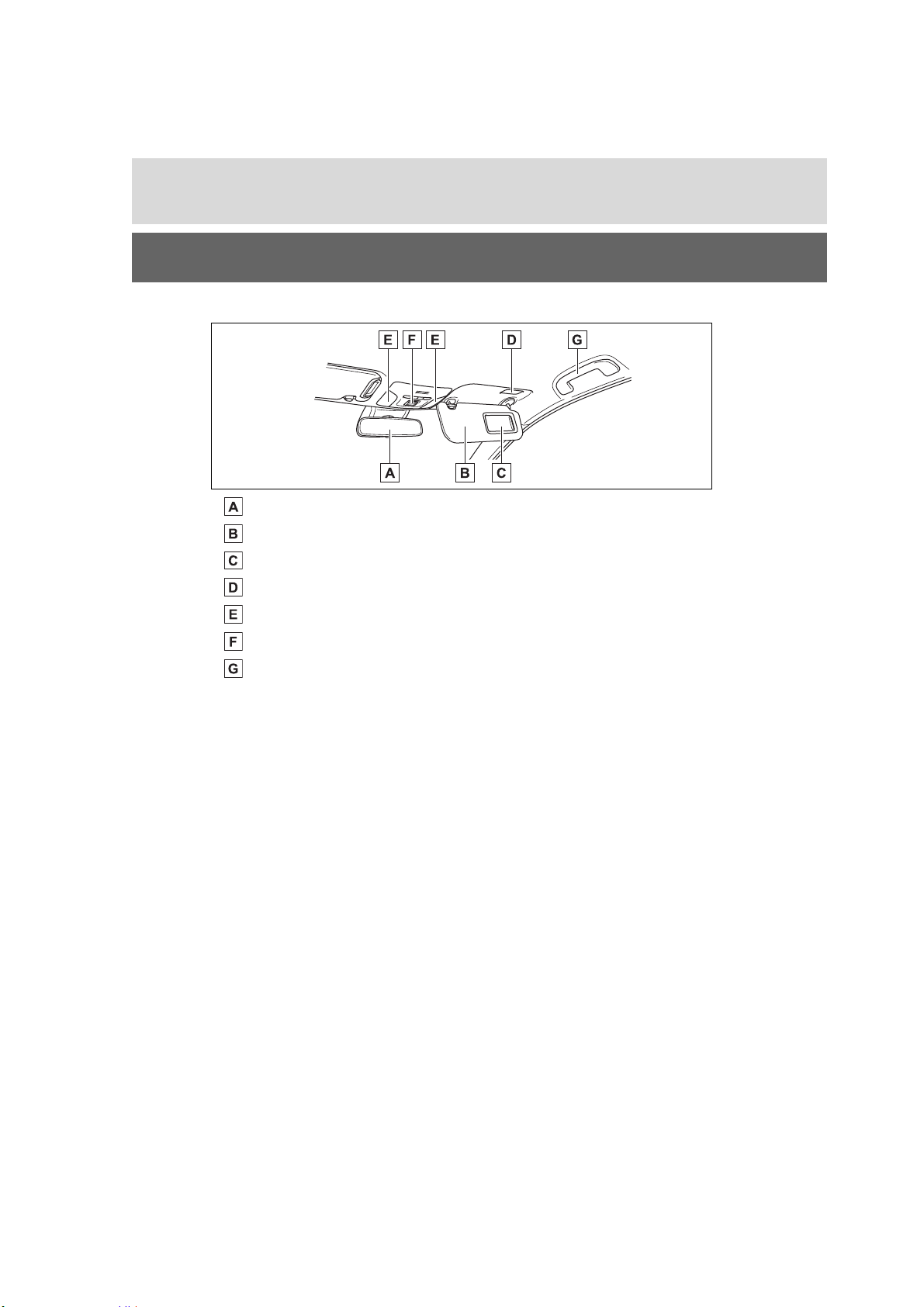
Inside rear view mirror ...................................................... P.122
Sun visors........................................................................... P.410
Vanity mirrors..................................................................... P.410
Vanity lights ........................................................................ P.410
Interior lights/personal lights ........................................... P.395
“SOS” button
*
....................................................................... P.58
Assist grips ........................................................................ P.411
*
: If equipped

21
COROLLA H/B_U
1
1
For safety and security
For safety and security
.
1-1. For safe use
Before driving.................22
For safe driving ..............23
Seat belts.......................25
SRS airbags...................29
Front passenger occupant
classification system ....38
Exhaust gas precautions
.....................................43
1-2. Child safety
Riding with children........44
Child restraint systems...45
1-3. Emergency assistance
Safety Connect ..............58
1-4. Theft deterrent system
Engine immobilizer system
.....................................64
Alarm..............................66
Theft prevention labels
(U.S.A.) ........................67

22
1-1. For safe use
COROLLA H/B_U
1-1.For safe use
Use only floor mats designed
specifically for vehicles of the
same model and model year as
your vehicle. Fix them securely
in place onto the carpet.
1 Insert the retaining hooks
(clips) into the floor mat eye-
lets.
2 Turn the upper knob of each
retaining hook (clip) to secure
the floor mats in place.
Always align the marks .
The shape of the retaining hooks
(clips) may differ from that shown in
the illustration.
Before driving
Observe the following
before starting off in the
vehicle to ensure safety of
driving.
Floor mat
WARNING
Observe the following precau-
tions.
Failure to do so may cause the
driver’s floor mat to slip, possibly
interfering with the pedals while
driving. An unexpectedly high
speed may result or it may
become difficult to stop the vehi-
cle. This could lead to an acci-
dent, resulting in death or serious
injury.
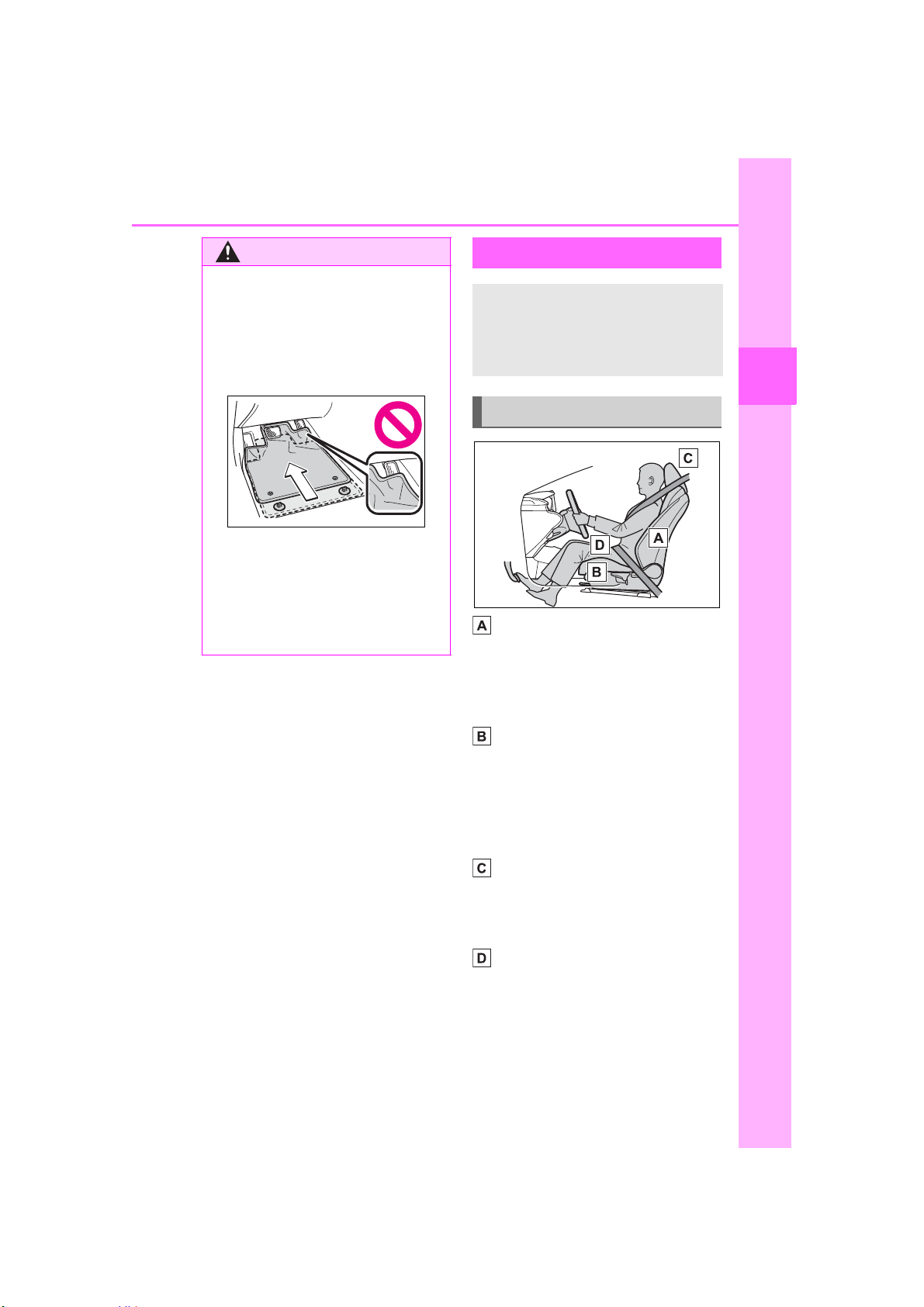
■ When installing the driver’s
floor mat
● Do not use floor mats designed
fo
r other models or differen
t
m
odel year vehicles, even if
they are Toyota Genuine floor
mats.
● Only use floor mats designed
for the driver’s seat.
● Always install the floor mat
secur
ely using the retain
ing
ho
oks (clips) provided.
● Do not use two or more floor
mats on top of each other.
● Do not place the floor mat bot-
tom-side up or upside-down.
23
1-1. For safe use
COROLLA H/B_U
1
For safety and security
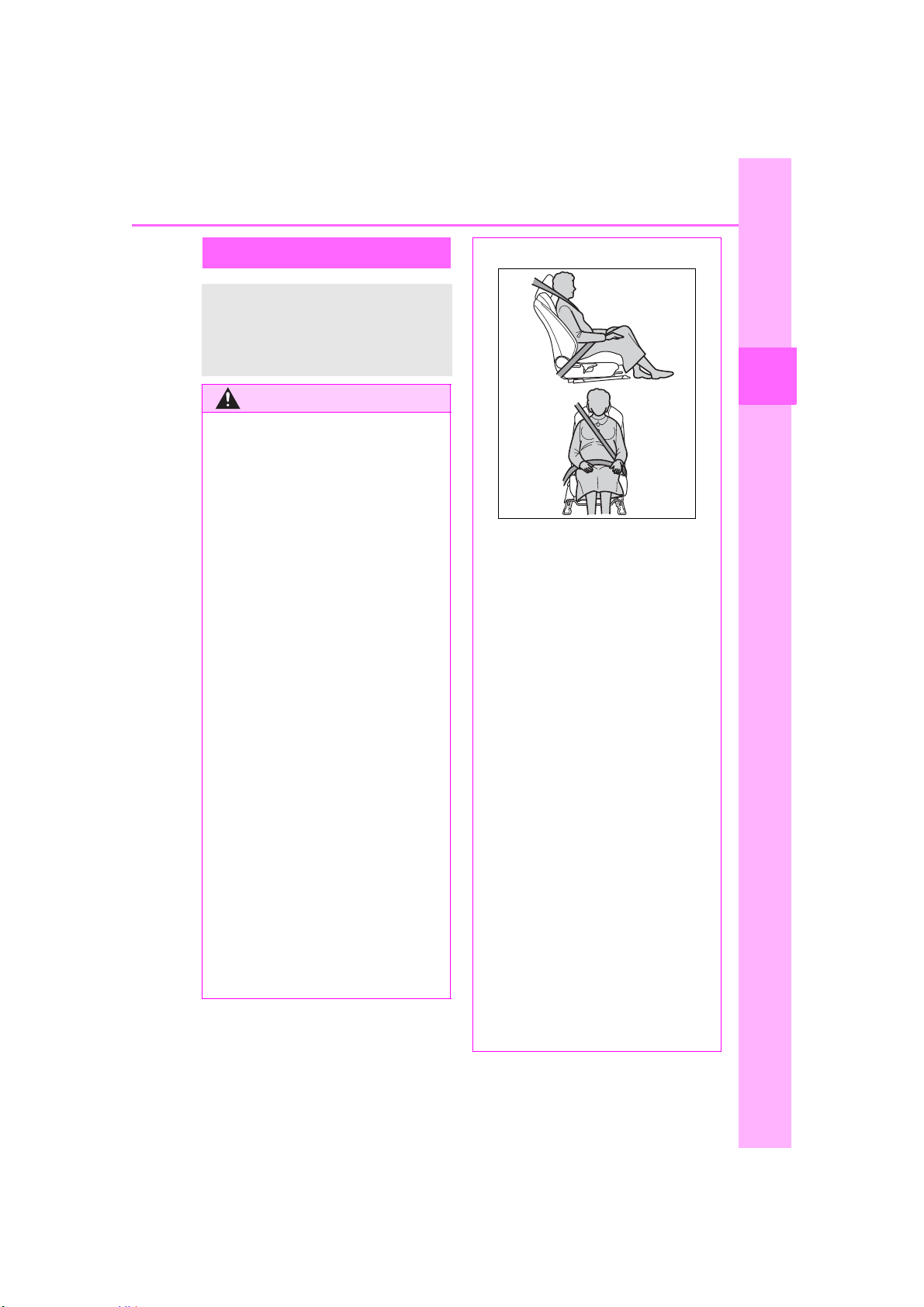
Adjust the angle of the seat-
back so that you are sitting
straight up and so that you do
not have to lean forward to
steer. (P.115)
Adjust the seat so that you
can depress the pedals fully
and so that your arms bend
slightly at the elbow when
gripping the steering wheel.
(P.115)
Lock the head restraint in
place with the center of the
head restraint closest to the
top of your ears. (P.115)
Wear the seat belt correctly.
(P.25)
WARNING
■ Before driving
● Check that the floor mat is
securely fixed in the correct
place with all the provided
retaining hooks (clips). Be espe-
cially careful to perform this
check after cleaning the floor.
● With the engine stopped and
the shift lever in P (continuously
variable transmission) or N
(manual transmission), fully
depress each pedal to the floor
to make sure it does not inter-
fere with the floor mat.
For safe driving
For safe driving, adjust the
seat and mirror to an appro-
priate position before driv-
ing.
Correct driving posture

24
1-1. For safe use
COROLLA H/B_U
Make sure that all occupants are
wearing their seat belts before
driving the vehicle. (P.25)
Use a child restraint system
appropriate for the child until the
child becomes large enough to
properly wear the vehicle’s seat
belt. (P.45)
Make sure that you can see
backward clearly by adjusting
the inside and outside rear view
mirrors properly. (P.122, 123)
WARNING
■ For safe driving
Observe the following precau-
tions.
Failure to do so may result in
death or serious injury.
● Do not adjust the position of the
driver’s seat while driving.
Doing so could cause the driver
to lose control of the vehicle.
● Do not place a cushion between
the driver or passenger and the
seatback.
A cushion may prevent correct
posture from being achieved,
and reduce the effectiveness of
the seat belt and head restraint.
● Do not place anything under the
front seats.
Objects placed under the front
seats may become jammed in
the seat tracks and stop the
seat from locking in place. This
may lead to an accident and the
adjustment mechanism may
also be damaged.
● Always observe the legal speed
limit when driving on public
roads.
● When driving over long dis-
tances, take regular breaks
before you start to feel tired.
Also, if you feel tired or sleepy
while driving, do not force your-
self to continue driving and take
a break immediately.
Correct use of the seat
belts
Adjusting the mirrors
25
1-1. For safe use
COROLLA H/B_U
1
For safety and security
Seat belts
Make sure that all occu-
pants are wearing their seat
belts before driving the
vehicle.
WARNING
Observe the following precautions
to reduce the risk of injury in the
event of sudden braking, sudden
swerving or an accident.
Failure to do so may cause death
or serious injury.
■ Wearing a seat belt
● Ensure that all passengers wear
a seat belt.
● Always wear a seat belt prop-
erly.
● Each seat belt should be used
by one person only. Do not use
a seat belt for more than one
person at once, including chil-
dren.
● Toyota recommends that chil-
dren be seated in the rear seat
and always use a seat belt
and/or an appropriate child
restraint system.
● To achieve a proper seating
position, do not recline the seat
more than necessary. The seat
belt is most effective when the
occupants are sitting up straight
and well back in the seats.
● Do not wear the shoulder belt
under your arm.
● Always wear your seat belt low
and snug across your hips.
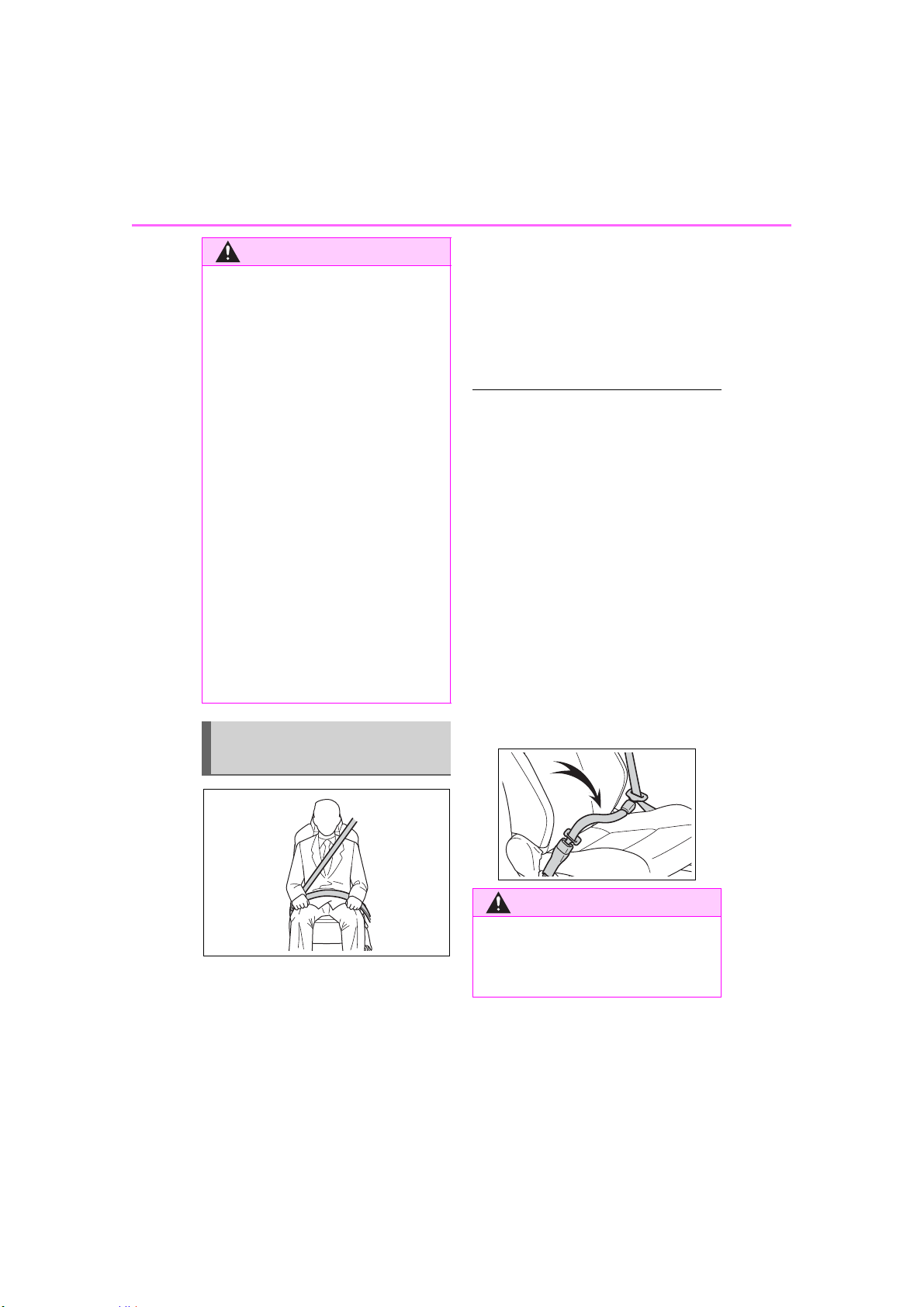
■ Pregnant women
Obtain medical advice and wear
the seat belt in the proper way.
(
P.2 6)
Women who are pregnant should
position the lap belt as low as
possible over the hips in the same
manner as other occupants,
extending the shoulder belt com-
pletely over the shoulder and
avoiding belt contact with the
rounding of the abdominal area.
If the seat belt is not worn prop-
erly, not only the pregnant
woman, but also the fetus could
suffer death or serious injury as a
result of sudden braking or a colli-
sion.
■ People suffering illness
Obtain medical advice and wear
the seat belt in the proper way.
(
P.2 6)
■ When children are in the vehi-
cle
P. 53
■ Seat belt damage and wear
● Do not damage the seat belts
by allowing the belt, plate, or
buckle to be jammed in the
door.
26
1-1. For safe use
COROLLA H/B_U
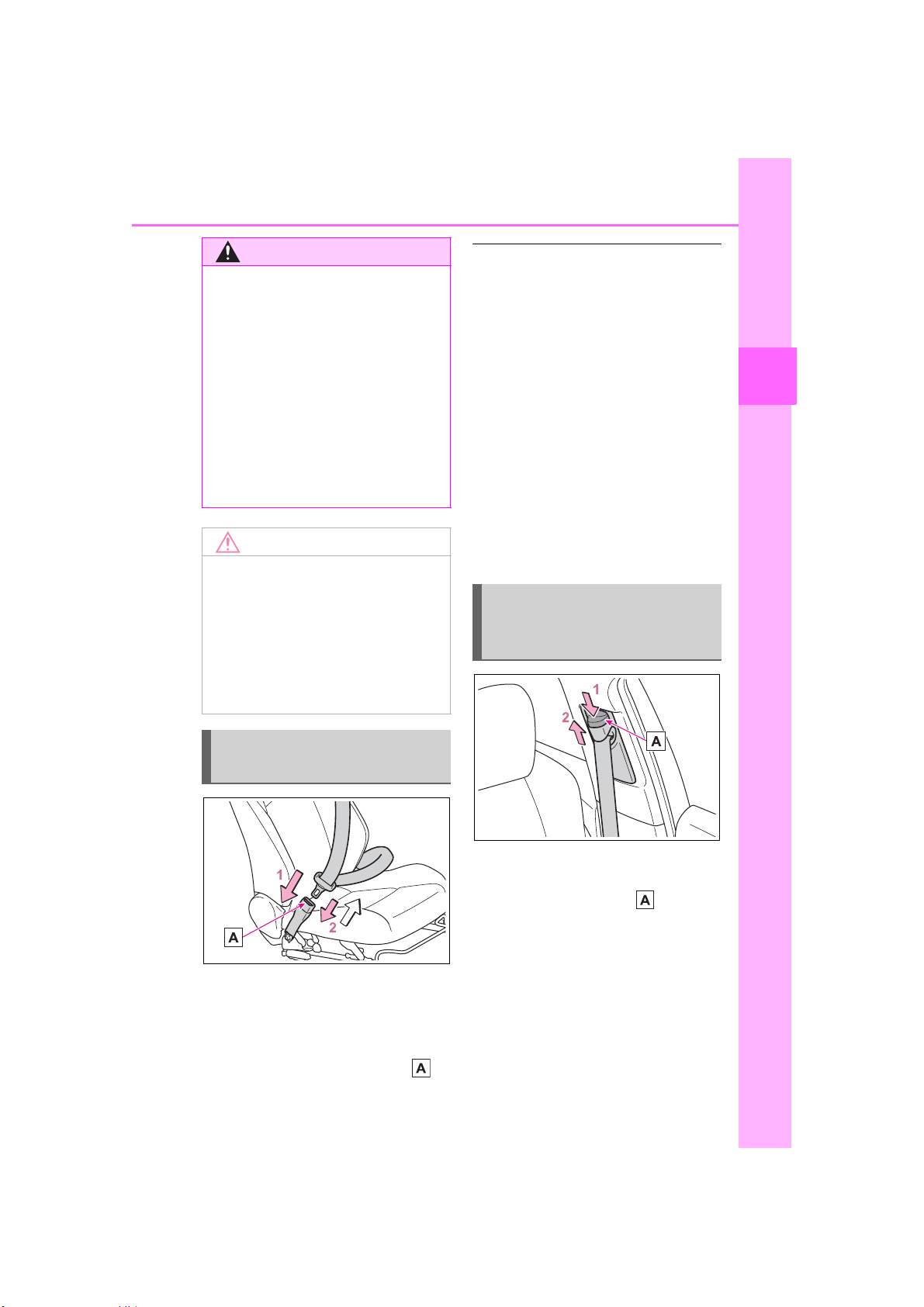
Extend the shoulder belt so
that it comes fully over the
shoulder, but does not come
into contact with the neck or
slide off the shoulder.
Position the lap belt as low as
possible over the hips.
Adjust the position of the
seatback. Sit up straight and
well back in the seat.
Do not twist the seat belt.
■ Child seat belt usage
The seat belts of your vehicle were
principally designed for persons of
adult size.
● Use a child restraint system
appropriate for the child, until the
child becomes large enough to
properly wear the vehicle’s seat
belt. (P. 45)
● When the child becomes large
enough to properly wear the vehi-
cle’s seat belt, follow the instruc-
tions regarding seat belt usage.
(P. 25 )
■ Seat belt extender
If your seat belts cannot be fastened
securely because they are not long
enough, a personalized seat belt
extender is available from your Toy-
ota dealer free of charge.
WARNING
● Inspect the seat belt system
periodically. Check for cuts,
fraying, and loose parts. Do not
use a damaged seat belt until it
is replaced. Damaged seat belts
cannot protect an occupant
from death or serious injury.
● Ensure that the belt and plate
are locked and the belt is not
twisted.
If the seat belt does not function
correctly, immediately contact
your Toyota dealer.
● Replace the seat assembly,
including the belts, if your vehi-
cle has been involved in a seri-
ous accident, even if there is no
obvious damage.
● Do not attempt to install,
remove, modify, disassemble or
dispose of the seat belts. Have
any necessary repairs carried
out by your Toyota dealer. Inap-
propriate handling may lead to
incorrect operation.
Correct use of the seat
belts
WARNING
■ Using a seat belt extender
● Do not wear the seat belt
extender if you can fasten the
seat belt without the extender.
27
1-1. For safe use
COROLLA H/B_U
1
For safety and security
1 To fasten the seat belt, push
the plate into the buckle until
a click sound is heard.
2 To release the seat belt,
press the release button .
■ Emergency locking retractor
(ELR)
The retractor will lock the belt during
a sudden stop or on impact. It may
also lock if you lean forward too
quickly. A slow, easy motion will
allow the belt to extend so that you
can move around fully.
■ Automatic locking retractor
(ALR)
When a passenger’s shoulder belt is
completely extended and then
retracted even slightly, the belt is
locked in that position and cannot
be extended. This feature is used to
hold the child restraint system
(CRS) firmly. To free the belt again,
fully retract the belt and then pull the
belt out once more. (P.45)
1 Push the seat belt shoulder
anchor down while pressing
the release button .
2 Push the seat belt shoulder
anchor up.
Move the height adjuster up and
down as needed until you hear a
click.
WARNING
● Do not use the seat belt
extender when installing a child
restraint system because the
belt will not securely hold the
child restraint system, increas-
ing the risk of death or serious
injury in the event of an acci-
dent.
● The personalized extender may
not be safe on another vehicle,
when used by another person,
or at a different seating position
other than the one originally
intended.
NOTICE
■ When using a seat belt
extender
When releasing the seat belt,
press on the buckle release but-
ton on the extender, not on the
seat belt.
This helps prevent damage to the
vehicle interior and the extender
itself.
Fastening and releasing
the seat belt
Adjusting the seat belt
shoulder anchor height
(front seats)

28
1-1. For safe use
COROLLA H/B_U
The pretensioners help the seat
belts to quickly restrain the
occupants by retracting the seat
belts when the vehicle is sub-
jected to certain types of severe
frontal or side collision or a vehi-
cle rollover.
The pretensioners do not activate
in the event of a minor frontal
impact, a minor side impact or a
rear impact.
■ Replacing the belt after the pre-
tensioner has been activated
If the vehicle is involved in multiple
collisions, the pretensioner will acti-
vate for the first collision, but will not
activate for the second or subse-
quent collisions.
WARNING
■ Adjustable shoulder anchor
Always make sure the shoulder
belt is positioned across the cen-
ter of your shoulder. The belt
should be kept away from your
neck, but not falling off your shoul-
der. Failure to do so could reduce
the amount of protection in an
accident and cause death or seri-
ous injuries in the event of a sud-
den stop, sudden swerve or
accident.
Seat belt pretensioners
(front seats)
WARNING
■ Seat belt pretensioners
● Do not place anything, such as
a cushion, on the front passen-
ger’s seat. Doing so will
disperse the passenger’s
weight, which prevents the sen-
sor from detecting the passen-
ger’s weight properly. As a
result, the seat belt pretensioner
for the front passenger’s seat
may not activate in the event of
a collision.
● If the pretensioner has acti-
vated, the SRS warning light will
come on. In that case, the seat
belt cannot be used again and
must be replaced at your Toyota
dealer.
29
1-1. For safe use
COROLLA H/B_U
1
For safety and security
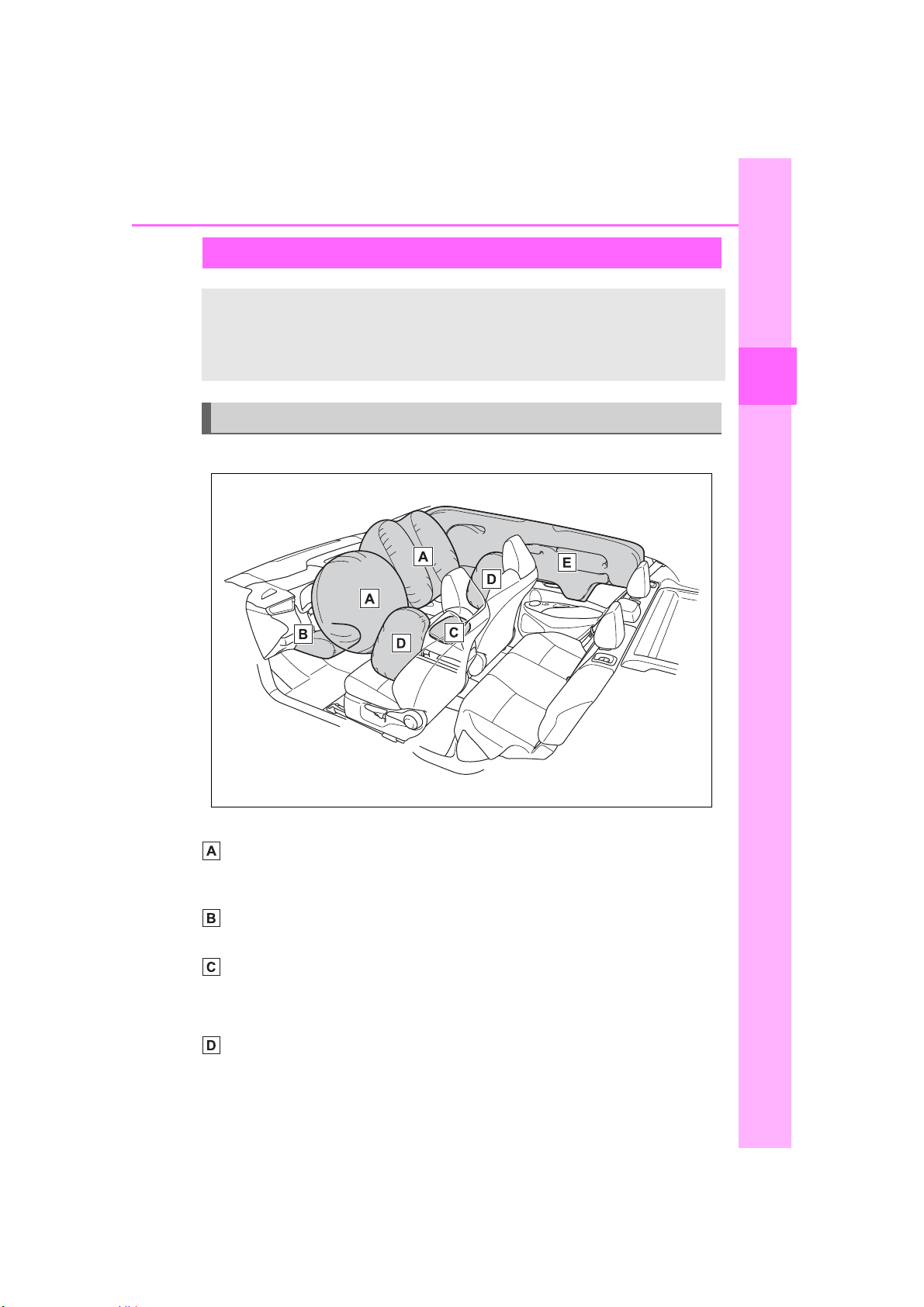
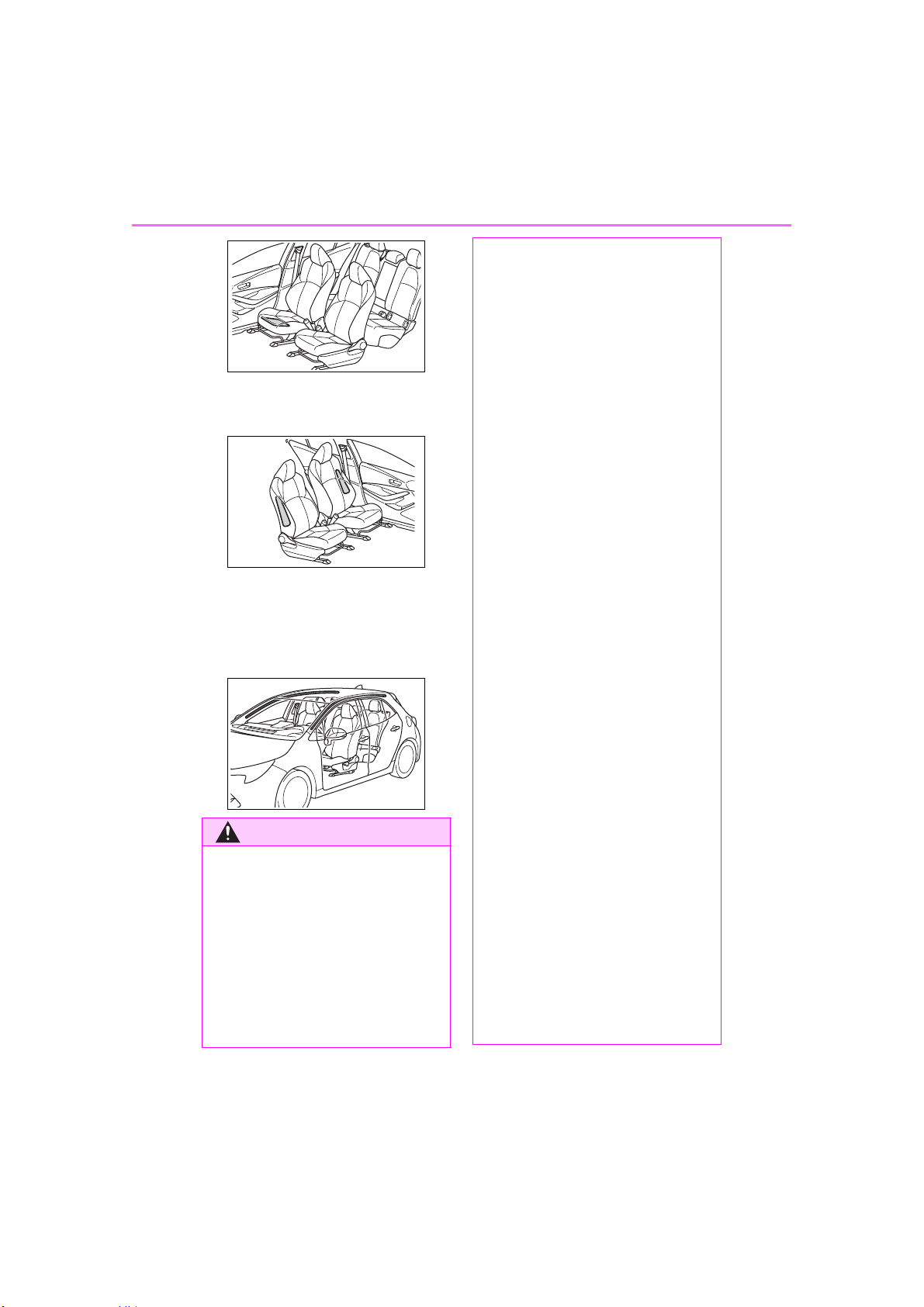
■ Location of the SRS airbags
SRS front airbags
SRS driver airbag/front passenger airbag
Can help protect the head and chest of the driver and front passenger from
impact with interior components
SRS knee airbag
Can help provide driver protection
SRS seat cushion airbag
Can help restrain the front passenger
SRS side and curtain shield airbags
SRS front side airbags
Can help protect the torso of the front seat occupants
SRS airbags
The SRS airbags inflate when the vehicle is subjected to cer-
tain types of severe impacts that may cause significant injury
to the occupants. They work together with the seat belts to
help reduce the risk of death or serious injury.
SRS airbag system
30
1-1. For safe use
COROLLA H/B_U
SRS curtain shield airbags
• Can help protect primarily the head of occupants in the outer seats
• Can help prevent the occupants from being thrown from the vehicle in the
event of vehicle rollover
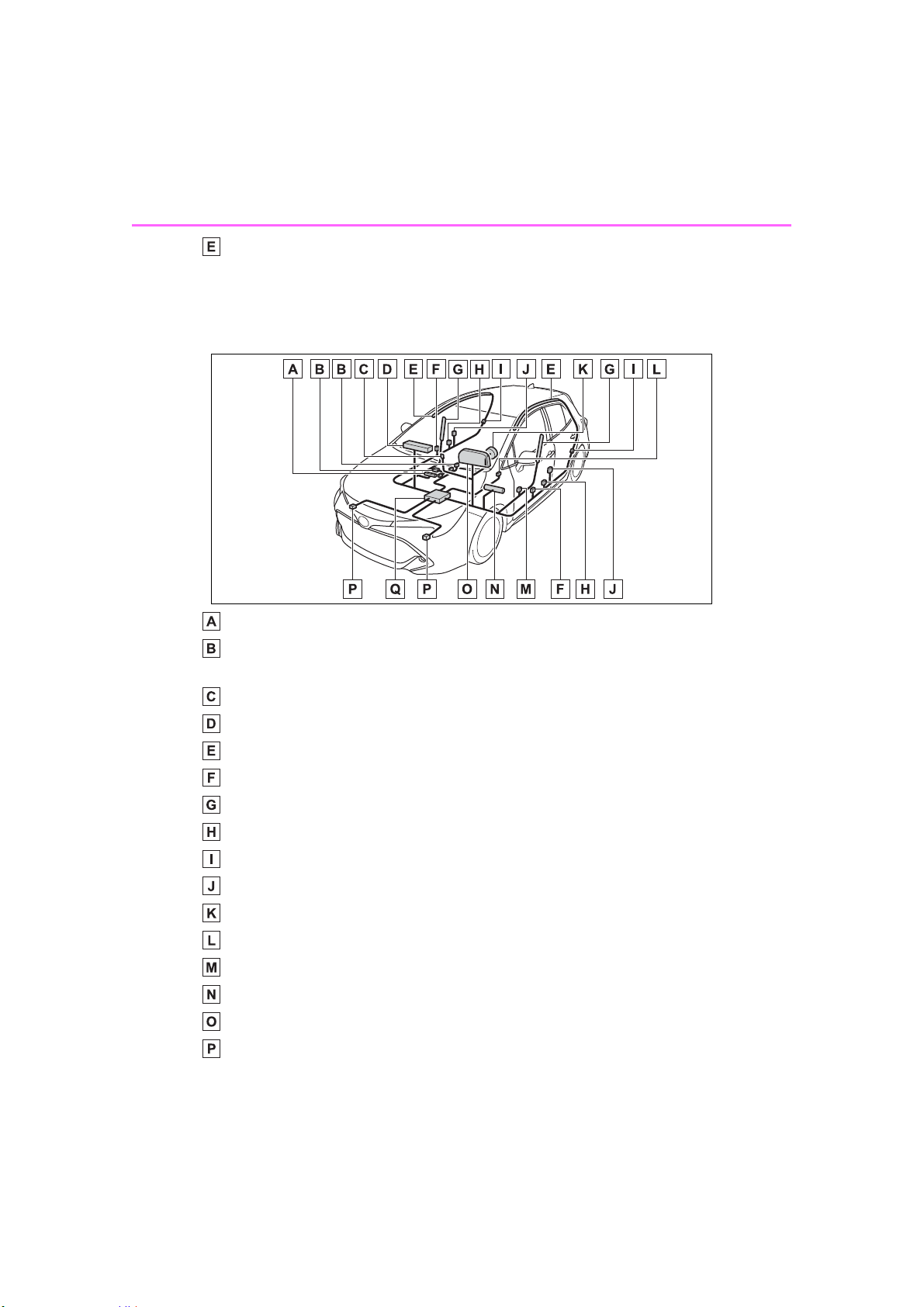
■ SRS airbag system components
Seat cushion airbag
Front passenger occupant classification system (ECU and sen-
sors)
“AIR BAG ON” and “AIR BAG OFF” indicator lights
Front passenger airbag
Curtain shield airbags
Side impact sensors (front doors)
Side airbags
Seat belt pretensioners and force limiters
Side impact sensors (rear)
Side impact sensors (front)
Driver airbag
Driver’s seat belt buckle switch
Driver’s seat position sensor
Driver’s knee airbag
SRS warning light
Front impact sensors

31
1-1. For safe use
COROLLA H/B_U
1
For safety and security
Airbag sensor assembly
Your vehicle is equipped with ADVANCED AIRBAGS designed
based on the US motor vehicle safety standards (FMVSS208). The
airbag sensor assembly (ECU) controls airbag deployment based on
information obtained from the sensors etc. shown in the system
components diagram above. This information includes crash sever-
ity and occupant information. As the airbags deploy, a chemical
reaction in the inflators quickly fills the airbags with non-toxic gas to
help restrain the motion of the occupants.
■ If the SRS airbags deploy
(inflate)
● Slight abrasions, burns, bruising
etc., may be sustained from SRS
airbags, due to the extremely high
speed deployment (inflation) by
hot gases.
● A loud noise and white powder will
be emitted.
● Parts of the airbag module (steer-
ing wheel hub, airbag cover and
inflator) as well as the front seats,
parts of the front and rear pillars,
and roof side rails, may be hot for
several minutes. The airbag itself
may also be hot.
● The windshield may crack.
● The interior lights will turn on auto-
matically. (P.395)
● The emergency flashers will be
turned on automatically. (P.460)
● For Safety Connect subscribers, if
any of the following situations
occur, the system is designed to
send an emergency call to the
response center, notifying them of
the vehicle’s location (without
needing to push the “SOS” button)
and an agent will attempt to speak
with the occupants to ascertain
the level of emergency and assis-
tance required. If the occupants
are unable to communicate, the
agent automatically treats the call
as an emergency and helps to dis-
patch the necessary emergency
services. (P.58)
• An SRS airbag is deployed.
• A seat belt pretensioner is acti-
vated.
• The vehicle is involved in a severe
rear-end collision.
■ SRS airbag deployment condi-
tions (SRS front airbags)
● The SRS front airbags will deploy
in the event of an impact that
exceeds the set threshold level
(the level of force corresponding
to an approximately 12 - 18 mph
[20 - 30 km/h] frontal collision with
a fixed wall that does not move or
deform).
However, this threshold velocity will
be considerably higher in the follow-
ing situations:
• If the vehicle strikes an object,
such as a parked vehicle or sign
pole, which can move or deform
on impact
• If the vehicle is involved in an
underride collision, such as a colli-
sion in which the front of the vehi-
cle “underrides”, or goes under,
the bed of a truck
● Depending on the type of collision,
it is possible that only the seat belt
pretensioners will activate.
● The SRS front airbags for the front
passenger will not activate if there
is no passenger sitting in the front
passenger seat. However, the
SRS front airbags for the front
passenger may deploy if luggage
is put in the seat, even if the seat
is unoccupied.
32
1-1. For safe use
COROLLA H/B_U
● The SRS seat cushion airbag on
the front passenger seat will not
operate if the occupant is not
wearing a seat belt.
■ SRS airbag deployment condi-
tions (SRS side and curtain
shield airbags)
● The SRS side and curtain shield
airbags will deploy in the event of
an impact that exceeds the set
threshold level (the level of force
corresponding to the impact force
produced by an approximately
3300 lb. [1500 kg] vehicle colliding
with the vehicle cabin from a
direction perpendicular to the
vehicle orientation at an approxi-
mate speed of 12 - 18 mph [20 -
30 km/h]).
● Both SRS curtain shield airbags
may deploy in the event of a
severe side collision.
● Both SRS curtain shield airbags
will deploy in the event of vehicle
rollover.
● Both SRS curtain shield airbags
may also deploy in the event of a
severe frontal collision.
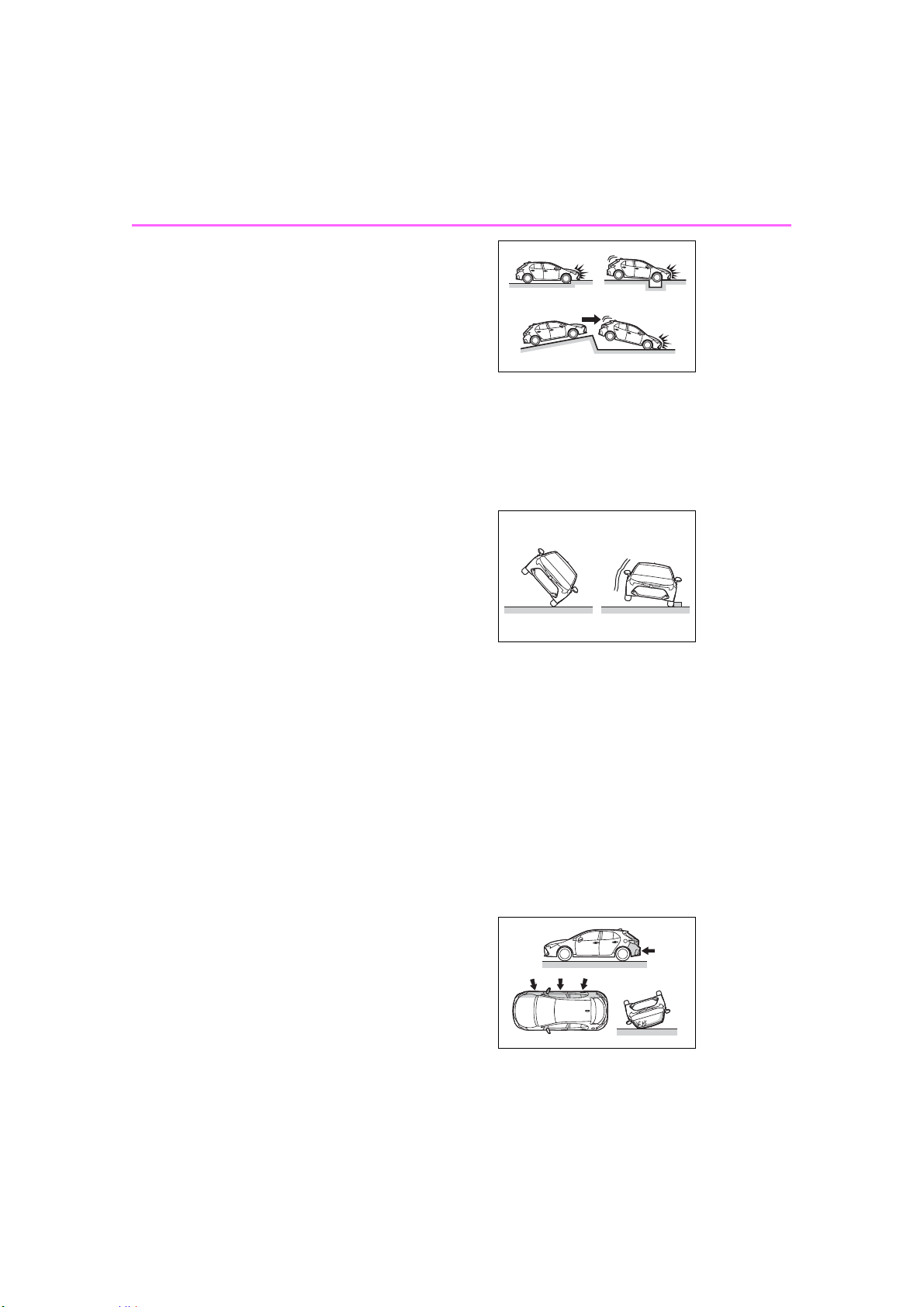
■ Conditions under which the
SRS airbags may deploy
(inflate), other than a collision
The SRS front airbags and SRS
side and curtain shield airbags may
also deploy if a serious impact
occurs to the underside of your vehi-
cle. Some examples are shown in
the illustration.
● Hitting a curb, edge of pavement
or hard surface
● Falling into or jumping over a deep
hole
● Landing hard or falling
The SRS curtain shield airbags may
also deploy under the situations
shown in the illustration.
● The angle of vehicle tip-up is mar-
ginal.
● The vehicle skids and hits a curb
stone.
■ Types of collisions that may not
deploy the SRS airbags (SRS
front airbags)
The SRS front airbags do not gener-
ally inflate if the vehicle is involved
in a side or rear collision, if it rolls
over, or if it is involved in a
low-speed frontal collision. But,
whenever a collision of any type
causes sufficient forward decelera-
tion of the vehicle, deployment of
the SRS front airbags may occur.
● Collision from the side
● Collision from the rear
● Vehicle rollover
33
1-1. For safe use
COROLLA H/B_U
1
For safety and security
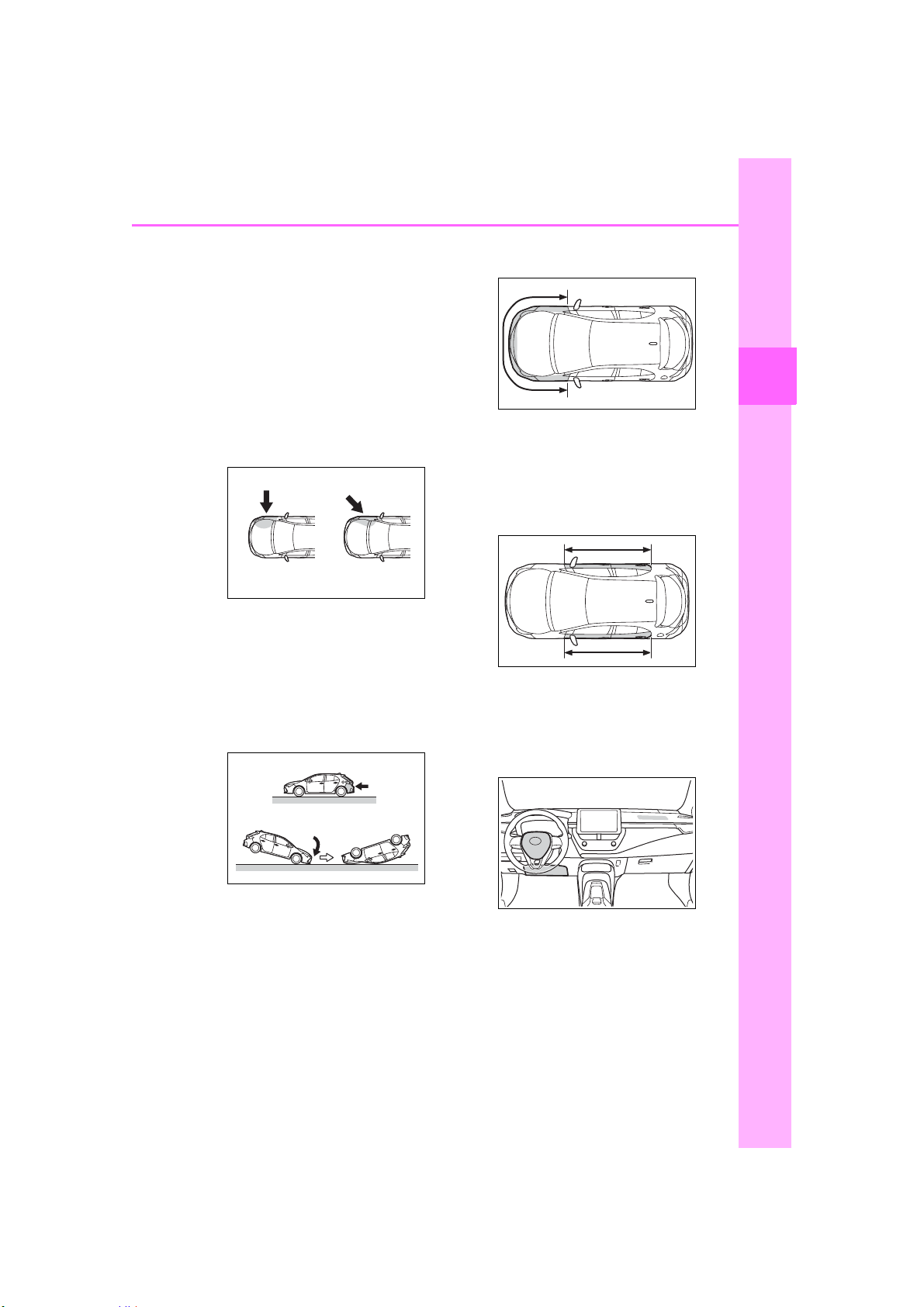
■ Types of collisions that may not
deploy the SRS airbags (SRS
side and curtain shield airbags)
The SRS side and curtain shield air-
bags may not activate if the vehicle
is subjected to a collision from the
side at certain angles, or a collision
to the side of the vehicle body other
than the passenger compartment.
● Collision from the side to the vehi-
cle body other than the passenger
compartment
● Collision from the side at an angle
The SRS curtain shield airbags do
not generally inflate if the vehicle is
involved in a rear collision, if it
pitches end over end, or if it is
involved in a low-speed side or
low-speed frontal collision.
● Collision from the rear
● Pitching end over end
■ When to contact your Toyota
dealer
In the following cases, the vehicle
will require inspection and/or repair.
Contact your Toyota dealer as soon
as possible.
● Any of the SRS airbags have
been inflated.
● The front of the vehicle is dam-
aged or deformed, or was
involved in an accident that was
not severe enough to cause the
SRS front airbags to inflate.
● A portion of a door or its surround-
ing area is damaged, deformed or
has had a hole made in it, or the
vehicle was involved in an acci-
dent that was not severe enough
to cause the SRS side and curtain
shield airbags to inflate.
● The pad section of the steering
wheel, dashboard near the front
passenger airbag or lower portion
of the instrument panel is
scratched, cracked, or otherwise
damaged.
● The seat cushion surface is
scratched, cracked, or otherwise
damaged.
34
1-1. For safe use
COROLLA H/B_U
● The surface of the seats with the
SRS side airbag is scratched,
cracked, or otherwise damaged.
● The portion of the front pillars, rear
pillars or roof side rail garnishes
(padding) containing the SRS cur-
tain shield airbags inside is
scratched, cracked, or otherwise
damaged.
WARNING
■ SRS airbag precautions
Observe the following precautions
regarding the SRS airbags.
Failure to do so may cause death
or serious injury.
● The driver and all passengers in
the vehicle must wear their seat
belts properly.
The SRS airbags are supple-
mental devices to be used with
the seat belts.
● The SRS driver airbag deploys
with considerable force, and
can cause death or serious
injury especially if the driver is
very close to the airbag. The
National Highway Traffic Safety
Administration (NHTSA)
advises:
Since the risk zone for the driver’s
airbag is the first 2 - 3 in. (50 - 75
mm) of inflation, placing yourself
10 in. (250 mm) from your driver
airbag provides you with a clear
margin of safety. This distance is
measured from the center of the
steering wheel to your breast-
bone. If you sit less than 10 in.
(250 mm) away now, you can
change your driving position in
several ways:
• Move your seat to the rear as
far as you can while still reach-
ing the pedals comfortably.
• Slightly recline the back of the
seat.
Although vehicle designs vary,
many drivers can achieve the
10 in. (250 mm) distance, even
with the driver seat all the way
forward, simply by reclining the
back of the seat somewhat. If
reclining the back of your seat
makes it hard to see the road,
raise yourself by using a firm,
non-slippery cushion, or raise
the seat if your vehicle has that
feature.
• If your steering wheel is adjust-
able, tilt it downward. This
points the airbag toward your
chest instead of your head and
neck.
The seat should be adjusted as
recommended by NHTSA above,
while still maintaining control of
the foot pedals, steering wheel,
and your view of the instrument
panel controls.
35
1-1. For safe use
COROLLA H/B_U
1
For safety and security
WARNING
● If the seat belt extender has
been connected to the front
seat belt buckles but the seat
belt extender has not also been
fastened to the latch plate of the
seat belt, the SRS front airbags
will judge that the driver and
front passenger are wearing the
seat belt even though the seat
belt has not been connected. In
this case, the SRS front airbags
may not activate correctly in a
collision, resulting in death or
serious injury in the event of a
collision. Be sure to wear the
seat belt with the seat belt
extender.
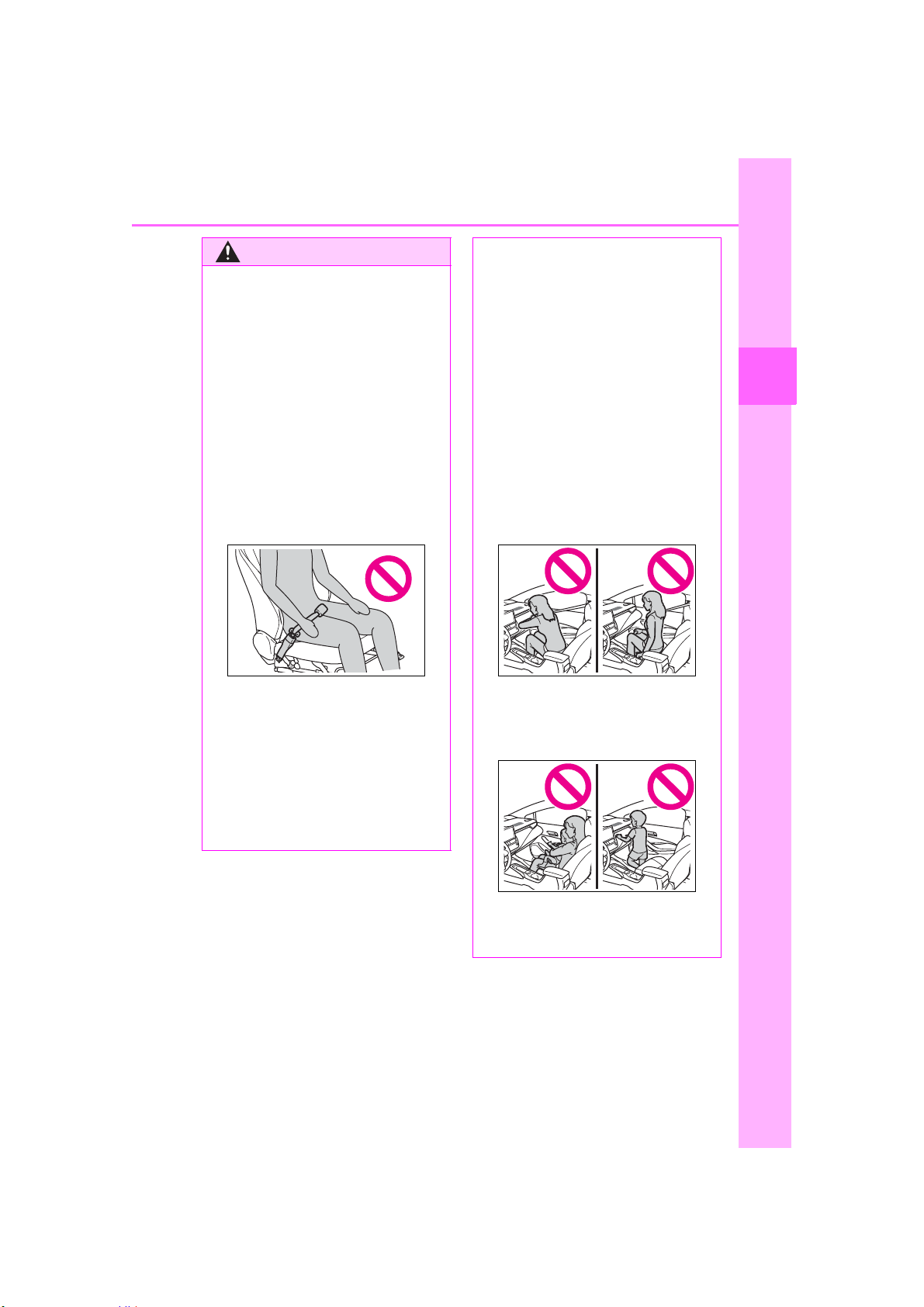
● The SRS front passenger air-
bag also deploys with consider-
able force, and can cause death
or serious injury especially if the
front passenger is very close to
the airbag. The front passenger
seat should be as far from the
airbag as possible with the seat-
back adjusted, so the front pas-
senger sits upright.
● Improperly seated and/or
restrained infants and children
can be killed or seriously injured
by a deploying airbag. An infant
or child who is too small to use
a seat belt should be properly
secured using a child restraint
system. Toyota strongly recom-
mends that all infants and chil-
dren be placed in the rear seats
of the vehicle and properly
restrained. The rear seats are
safer for infants and children
than the front passenger seat.
(
P.45 )
● Do not sit on the edge of the
seat or lean against the dash-
board.
● Do not allow a child to stand in
front of the SRS front passenger
airbag unit or sit on the knees of
a front passenger.
● Do not allow the front seat occu-
pants to hold items on their
knees.
36
1-1. For safe use
COROLLA H/B_U
WARNING
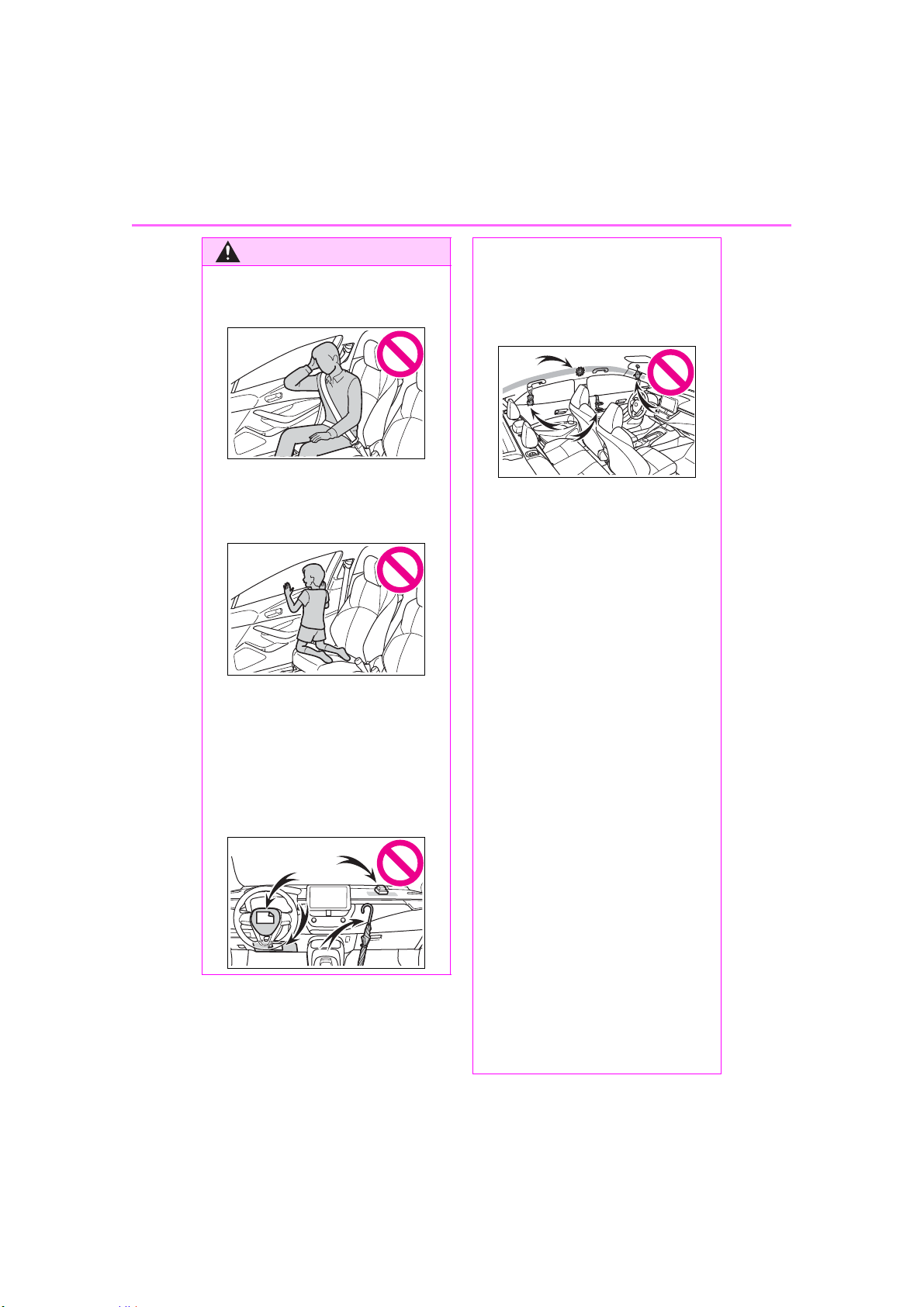
● Do not lean against the door,
the roof side rail or the front,
side and rear pillars.
● Do not allow anyone to kneel on
the passenger seat toward the
door or put their head or hands
outside the vehicle.
● Do not attach anything to or
lean anything against areas
such as the dashboard, steering
wheel pad and lower portion of
the instrument panel.
These items can become pro-
jectiles when the SRS driver,
front passenger and knee air-
bags deploy.
● Do not attach anything to areas
such as a door, windshield, side
windows, front or rear pillar, roof
side rail and assist grip. (Except
for the speed limit label
P.481)
● Do not hang coat hangers or
other hard objects on the coat
hooks. All of these items could
become projectiles and may
cause death or serious injury,
should the SRS curtain shield
airbags deploy.
● If a vinyl cover is put on the area
where the SRS driver’s knee
airbag will deploy, be sure to
remove it.
● Do not use seat accessories
which cover the parts where the
SRS side airbags and SRS seat
cushion airbag inflate as they
may interfere with inflation of
the SRS airbags. Such acces-
sories may prevent the side air-
bags and seat cushion airbag
from activating correctly, disable
the system or cause the side
airbags and seat cushion airbag
to inflate accidentally, resulting
in death or serious injury.
● Do not strike or apply significant
levels of force to the area of the
SRS airbag components or the
front doors.
Doing so can cause the SRS
airbags to malfunction.
● Do not touch any of the compo-
nent parts immediately after the
SRS airbags have deployed
(inflated) as they may be hot.

37
1-1. For safe use
COROLLA H/B_U
1
For safety and security
WARNING
● If breathing becomes difficult
after the SRS airbags have
deployed, open a door or win-
dow to allow fresh air in, or
leave the vehicle if it is safe to
do so. Wash off any residue as
soon as possible to prevent skin
irritation.
● If the areas where the SRS air-
bags are stored, such as the
steering wheel pad and front
and rear pillar garnishes, are
damaged or cracked, have
them replaced by your Toyota
dealer.
● Do not place anything, such as
a cushion, on the front passen-
ger’s seat. Doing so will
disperse the passenger’s
weight, which prevents the sen-
sor from detecting the passen-
ger’s weight properly. As a
result, the SRS front airbags for
the front passenger may not
deploy in the event of a colli-
sion.
■ Modification and disposal of
SRS airbag system compo-
nents
Do not dispose of your vehicle or
perform any of the following modi-
fications without consulting your
Toyota dealer. The SRS airbags
may malfunction or deploy
(inflate) accidentally, causing
death or serious injury.
● Installation, removal, disassem-
bly and repair of the SRS air-
bags
● Repairs, modifications, removal
or replacement of the steering
wheel, instrument panel, dash-
board, seats or seat upholstery,
front, side and rear pillars, roof
side rails, front door panels,
front door trims or front door
speakers
● Modifications to the front door
panel (such as making a hole in
it)
● Repairs or modifications of the
front fender, front bumper, or
side of the occupant compart-
ment
● Installation of a grille guard (bull
bars, kangaroo bar, etc.), snow
plows, winches or roof luggage
carrier
● Modifications to the vehicle’s
suspension system
● Installation of electronic devices
such as mobile two-way radios
and CD players
● Modifications to your vehicle for
a person with a physical disabil-
ity
38
1-1. For safe use
COROLLA H/B_U
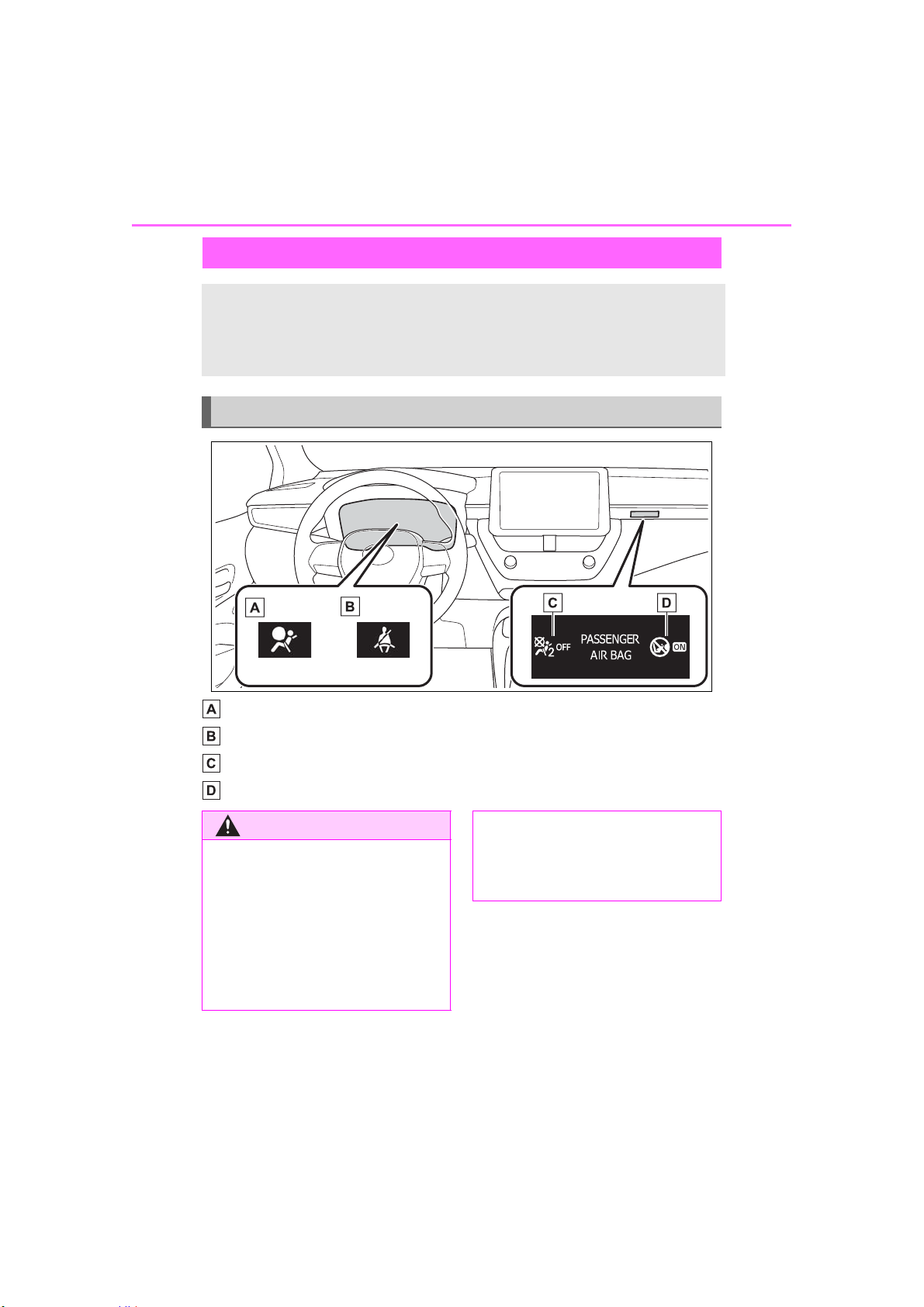
SRS warning light
Front passenger seat belt reminder light
“AIR BAG OFF” indicator light
“AIR BAG ON” indicator light
Front passenger occupant classification system
Your vehicle is equipped with a front passenger occupant
classification system. This system detects the conditions of
the front passenger seat and activates or deactivates the front
passenger airbag and seat cushion airbag.
System components
WARNING
■ Front passenger occupant
classification system precau-
tions
Observe the following precautions
regarding the front passenger
occupant classification system.
Failure to do so may cause death
or serious injury.
● Wear the seat belt properly.
● Make sure the front passenger’s
seat belt plate has not been left
inserted into the buckle before
someone sits in the front pas-
senger seat.

39
1-1. For safe use
COROLLA H/B_U
1
For safety and security
WARNING
● Make sure the “AIR BAG OFF”
indicator light is not illuminated
when using the seat belt
extender for the front passenger
seat. If the “AIR BAG OFF” indi-
cator light is illuminated, discon-
nect the extender tongue from
the seat belt buckle, and recon-
nect the seat belt. Reconnect
the seat belt extender after
making sure the “AIR BAG ON”
indicator light is illuminated. If
you use the seat belt extender
while the “AIR BAG OFF” indi-
cator light is illuminated, the
SRS airbags for the front pas-
senger may not activate, which
could cause death or serious
injury in the event of a collision.
● Do not apply a heavy load to the
front passenger seat or equip-
ment (e.g. seatback pocket).
● Do not put weight on the front
passenger seat by putting your
hands or feet on the front pas-
senger seat seatback from the
rear passenger seat.
● Do not let a rear passenger lift
the front passenger seat with
their feet or press on the seat-
back with their legs.
● Do not put objects under the
front passenger seat.
● Do not recline the front passen-
ger seatback so far that it
touches the rear seat. This may
cause the “AIR BAG OFF” indi-
cator light to be illuminated,
which indicates that the SRS
airbags for the front passenger
will not activate in the event of a
severe accident. If the seatback
touches the rear seat, return the
seatback to a position where it
does not touch the rear seat.
Keep the front passenger seat-
back as upright as possible
when the vehicle is moving.
Reclining the seatback exces-
sively may lessen the effective-
ness of the seat belt system.
● If an adult sits in the front pas-
senger seat, the “AIR BAG ON”
indicator light is illuminated. If
the “AIR BAG OFF” indicator is
illuminated, ask the passenger
to sit up straight, well back in
the seat, feet on the floor, and
with the seat belt worn correctly.
If the “AIR BAG OFF” indicator
still remains illuminated, either
ask the passenger to move to
the rear seat, or if that is not
possible, move the front pas-
senger seat fully rearward.
● When it is unavoidable to install
a forward-facing child restraint
system on the front passenger
seat, install the child restraint
system on the front passenger
seat in the proper order.
(
P.47 )
● Do not modify or remove the
front seats.
● Do not kick the front passenger
seat or subject it to severe
impact. Otherwise, the SRS
warning light may come on to
indicate a malfunction of the
front passenger occupant clas-
sification system. In this case,
contact your Toyota dealer
immediately.
40
1-1. For safe use
COROLLA H/B_U
■ Adult
*1
■ Child
*4
WARNING
● Child restraint systems installed
on the rear seat should not con-
tact the front seatbacks.
● Do not use a seat accessory,
such as a cushion and seat
cover, that covers the seat
cushion surface.
● Do not modify or replace the
upholstery of the front seat.
Condition and operation in the front passenger occupant
classification system
Indicator/warning
light
“AIR BAG ON” and “AIR BAG
OFF” indicator lights
“AIR BAG ON”
SRS warning light Off
Front passenger’s seat belt
reminder light
Off
*2
or flashing
*3
Devices
Front passenger airbag Activated
Front passenger seat cushion air-
bag
Activated
*2
or
deactivated
*3
Indicator/warning
light
“AIR BAG ON” and “AIR BAG
OFF” indicator lights
“AIR BAG OFF” or
“AIR BAG ON”
*4
SRS warning light Off
Front passenger’s seat belt
reminder light
Off
*2
or flashing
*3
Devices
Front passenger airbag
Deactivated or
activated
*4
Front passenger seat cushion air-
bag
Deactivated or
activated
*4, 2
41
1-1. For safe use
COROLLA H/B_U
1
For safety and security
■ Child restraint system with infant
*5
■ Unoccupied
■ There is a malfunction in the system
*1
:The system judges a person of adult size as an adult. When a smaller
adult sits in the front passenger seat, the system may not recognize
him/her as an adult depending on his/her physique and posture.
*2
:In the event the front passenger is wearing a seat belt.
*3
:In the event the front passenger does not wear a seat belt.
*4
:For some children, child in seat, child in booster seat or child in convert-
Indicator/warning
light
“AIR BAG ON” and “AIR BAG
OFF” indicator lights
“AIR BAG OFF”
*6
SRS warning light Off
Front passenger’s seat belt
reminder light
Off
*2
or flashing
*3
Devices
Front passenger airbag
Deactivated
Front passenger seat cushion air-
bag
Indicator/warning
light
“AIR BAG ON” and “AIR BAG
OFF” indicator lights
“AIR BAG OFF”
SRS warning light
Off
Front passenger’s seat belt
reminder light
Devices
Front passenger airbag
Deactivated
Front passenger seat cushion air-
bag
Indicator/warning
light
“AIR BAG ON” and “AIR BAG
OFF” indicator lights
“AIR BAG OFF”
SRS warning light
On
Front passenger’s seat belt
reminder light
Devices
Front passenger airbag
Deactivated
Front passenger seat cushion air-
bag

42
1-1. For safe use
COROLLA H/B_U
ible seat, the system may not recognize him/her as a child. Factors
which may affect this can be the physique or posture.
*5
:Never install a rear-facing child restraint system on the front passenger
seat. A forward-facing child restraint system should only be installed on
the front passenger seat when it is unavoidable. (P.45)
*6
:In case the indicator light is not illuminated, consult this manual on how
to install the child restraint system properly. (P. 45 )

43
1-1. For safe use
COROLLA H/B_U
1
For safety and security
Exhaust gas precau-
tions
Harmful substance to the
human body is included in
exhaust gases if inhaled.
WARNING
Exhaust gases include harmful
carbon monoxide (CO), which is
colorless and odorless. Observe
the following precautions.
Failure to do so may cause
exhaust gases enter the vehicle
and may lead to an accident
caused by light-headedness, or
may lead to death or a serious
health hazard.
■ Important points while driving
● Keep the back door closed.
● If you smell exhaust gases in
the vehicle even when the ba
ck
d
oor is closed, open the win-
dows and have the vehicle
inspected at your Toyota dealer
as soon as possible.
■ When parking
● If the vehicle is in a poorly venti-
lated area or a closed are
a,
s
uch as a garage, stop the
engine.
● Do not leave the vehicle with
the engine on for a long time.
If such a situation cann
ot be
avoide
d, park the vehicle in an
open space and ensure that
exhaust fumes do not enter the
vehicle interior.
● Do not leave the engine running
in an area with snow build-
up,
o
r where it is snowing. If snow-
banks build up around the vehi-
cle while the engine is running
,
exhaust
gases may collect and
enter the vehicle.
■ Exhaust pipe
The exhaust system needs to be
checked periodically. If there is a
hole or crack caused by corro-
sion, damage to a joint or abnor-
mal exhaust noise, be sure to
have the vehicle inspected and
repaired by your Toyota dealer.

44
1-2. Child safety
COROLLA H/B_U
1-2.Child saf ety
Riding with children
Observe the following pre-
cautions when children are
in the vehicle.
Use a child restraint system
appropriate for the child,
until the child becomes
large enough to properly
wear the vehicle’s seat belt.
It is recommended that chil-
dren sit in th
e rear seats to
avoid a
ccidental
contact
with
the shift lever
, wiper
switch, e
tc.
Use the rear door child-pro-
tector lock or the
window
lock switch to avoid children
o
pening the door while driv-
ing or operating the p
ower
wind
ow accidentally
.
(
P.104, 127)
Do not let small
children
ope
rate eq
uipment which
may catch or pinch body
part
s, such as the power
window, hood, back door
,
se
ats, etc.
WARNING
■ When children are in the vehi-
cle
Never leave children unattended
in the vehicle, and never allow
children to have or use the key.
Children may be able to start the
vehicle or shift the vehicle into
neutral. There is also a danger
that children may injure them-
selves by playing with the win-
dows or other features of the
vehicle. In addition, heat build-up
or extremely cold temperatures
inside the vehicle can be fatal to
children.
45
1-2. Child safety
COROLLA H/B_U
1
For safety and security
Points to remember: P.45
Child restraint system: P.47
When using a child restraint sys-
tem: P.47
Child restraint system installa-
tion method
• Fixed with a seat belt: P.49
• Fixed with a child restraint
LATCH anchor: P.54
• Using an anchor bracket (for
top tether strap): P.55
The laws of all 50 states of the
U.S.A. as well as Canada now
require the use of child restraint
systems.
Prioritize and observe the
warnings, as well as the laws
and regulations for child
restraint systems.
Use a child restraint system
until the child becomes large
enough to properly wear the
vehicle’s seat belt.
Choose a child restraint sys-
tem that suits your vehicle
and is appropriate to the age
and size of the child.
Child restraint sys-
tems
Before installing a child
restraint system in the vehi-
cle, there are precautions
that need to be observed,
different types of child
restraint systems, as well as
installation methods, etc.,
written in this manual.
Use a child restraint system
when riding with a small
child that cannot properly
use a seat belt. For the
child’s safety, install the
child restraint system to a
rear seat. Be sure to follow
the installation method that
is in the operation manual
enclosed with the restraint
system.
Table of contents
Points to remember
WARNING
■ When a child is riding
Observe the following precau-
tions.
Failure to do so may result in
death or serious injury.
● For effective protection in auto-
mobile accidents and sudden
stops, a child must be properly
restrained, using a seat belt or
child restraint system which is
correctly installed. For installa-
tion details, refer to the opera-
tion manual enclosed with the
child restraint system. General
installation instruction is pro-
vided in this manual.

46
1-2. Child safety
COROLLA H/B_U
WARNING
● Toyota strongly urges the use of
a proper child restraint system
that conforms to the weight and
size of the child, installed on the
rear seat. According to accident
statistics, the child is safer when
properly restrained in the rear
seat than in the front seat.
● Holding a child in your or some-
one else’s arms is not a substi-
tute for a child restraint system.
In an accident, the child can be
crushed against the windshield
or between the holder and the
interior of the vehicle.
■ Handling the child restraint
system
If the child restraint system is not
properly fixed in place, the child or
other passengers may be seri-
ously injured or even killed in the
event of sudden braking, sudden
swerving, or an accident.
● If the vehicle were to receive a
strong impact from an accident,
etc., it is possible that the child
restraint system has damage
that is not readily visible. In
such cases, do not reuse the
restraint system.
● Make sure you have complied
with all installation instructions
provided with the child restraint
system manufacturer and that
the system is properly secured.
● Keep the child restraint system
properly secured on the seat
even if it is not in use. Do not
store the child restraint system
unsecured in the passenger
compartment.
● If it is necessary to detach the
child restraint system, remove it
from the vehicle or store it
securely in the luggage com-
partment.
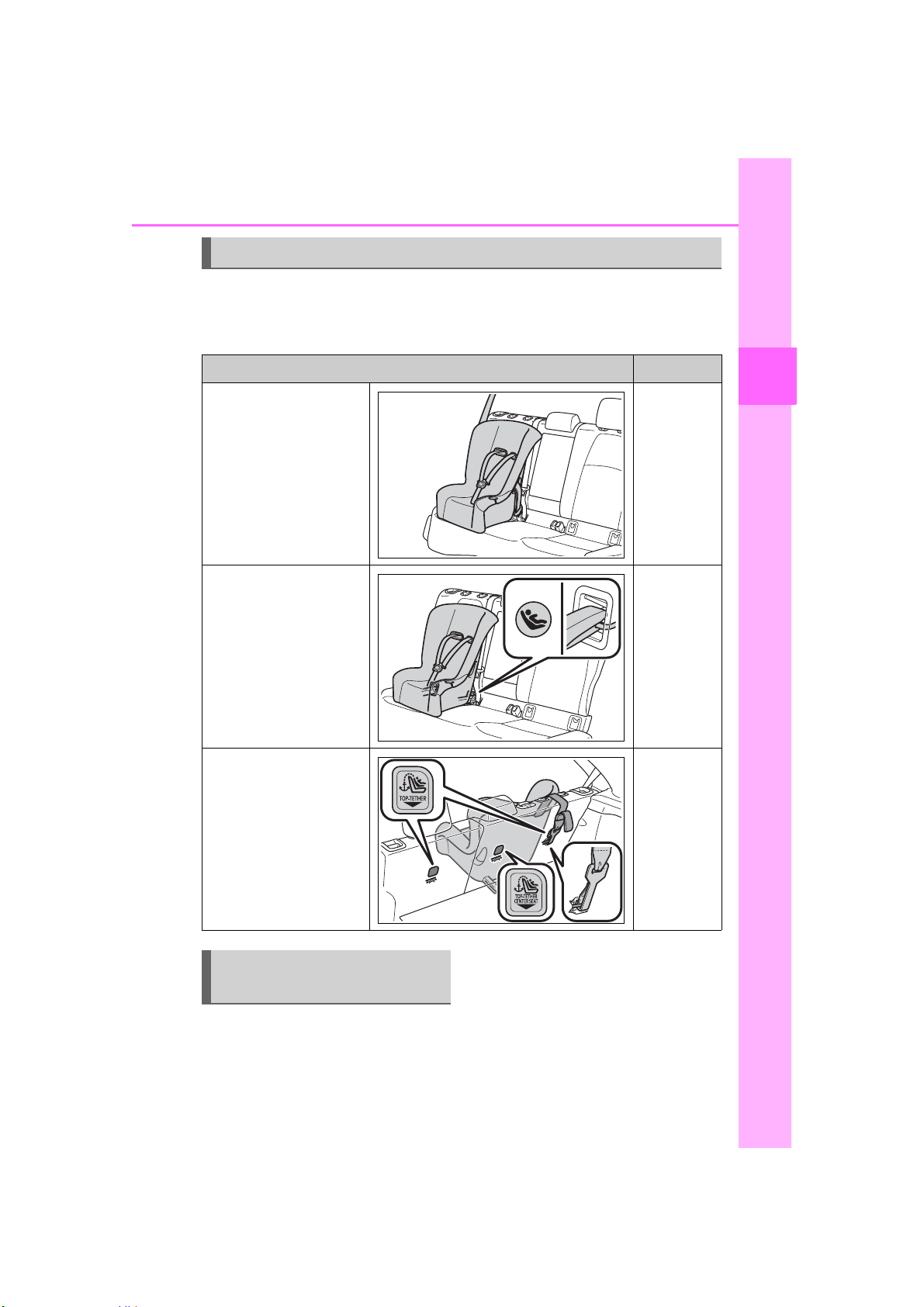
47
1-2. Child safety
COROLLA H/B_U
1
For safety and security
■ Types of child restraint system installation methods
Confirm with the operation manual enclosed with the child restraint
system about the installation of the child restraint system.
■ When installing a child
restraint system to a front
passenger seat
For the safety of a child, install
child restraint systems to a rear
seats. When installing child
restraint system to a front pas-
senger seat is unavoidable,
adjust the seat as follows and
Child restraint system
Installation method Page
Seat belt attachment P.4 9
Child restraint LATCH
anchors attachment
P.5 4
Anchor brackets (for
top tether strap) attach-
ment
P.5 5
When using a child
restraint system
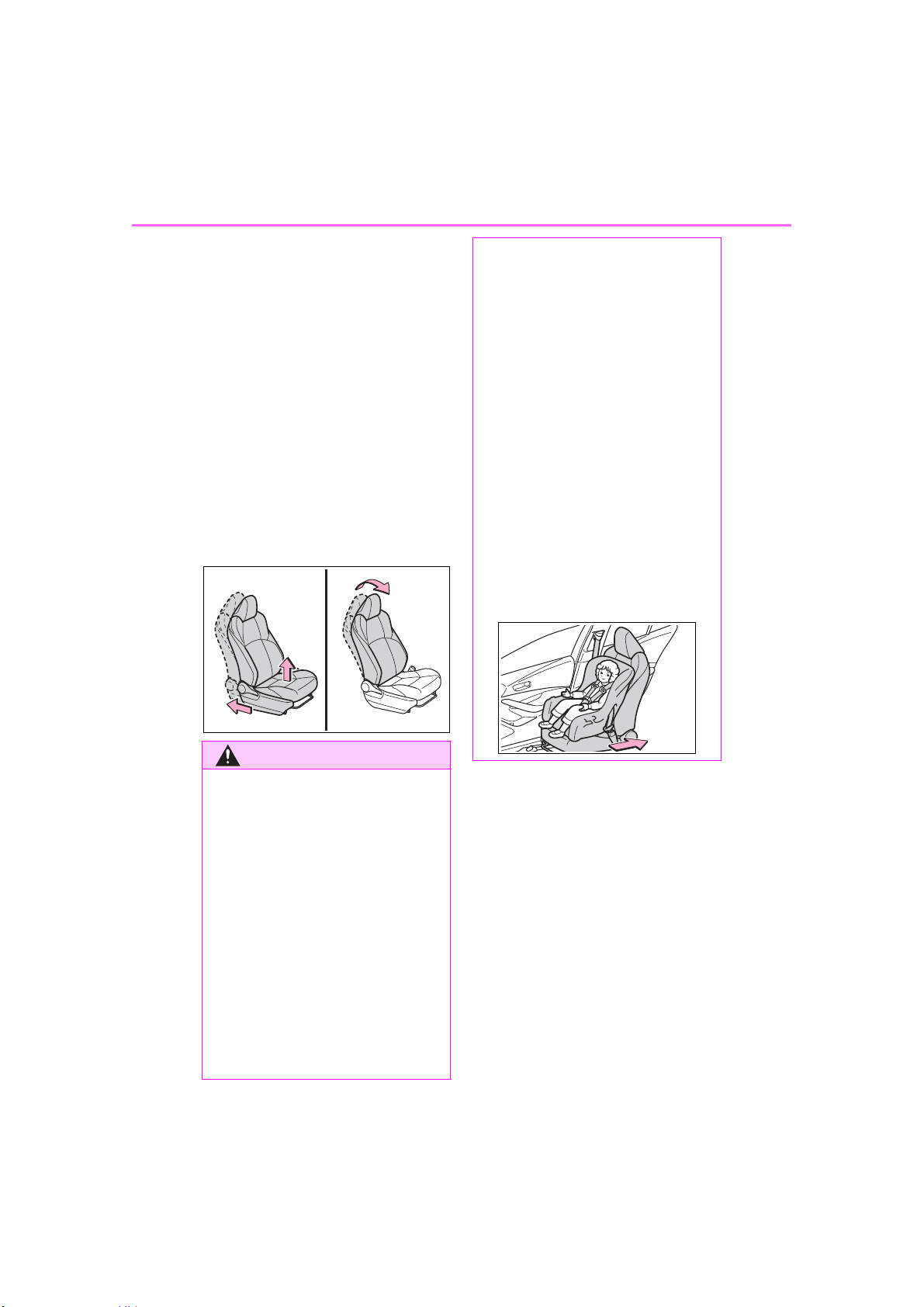
48
1-2. Child safety
COROLLA H/B_U
install the child restraint system:
Move the front seat fully rear-
ward.
Adjust the seat height to the
upper most position.
Adjust the seatback angle to
the most upright position.
If the head restraint interferes
with the child restraint system
installation and the head
restraint can be removed,
remove the head restraint.
Otherwise, put the head restraint in
the upper most position.
WARNING
■ When using a child restraint
system
Observe the following precau-
tions.
Failure to do so may result in
death or serious injury.
● Never install a rear-facing child
restraint system on the front
passenger seat even if the “AIR
BAG OFF” indicator light is illu-
minated. In the event of an acci-
dent, the force of the rapid
inflation of the front passenger
airbag can cause death or seri-
ous injury to the child if the
rear-facing child restraint sys-
tem is installed on the front pas-
senger seat.
● A forward-facing child restraint
system may be installed on the
front passenger seat only when
it is unavoidable. A child
restraint system that requires a
top tether strap should not be
used in the front passenger seat
since there is no top tether strap
anchor for the front passenger
seat.
● A forward-facing child restraint
system may be installed on the
front passenger seat only when
it is unavoidable. When install-
ing a forward-facing child
restraint system on the front
passenger seat, adjust the seat-
back angle to the most upright
position, move the seat to the
rearmost position, and raise the
seat to the upper most position,
even if the “AIR BAG OFF” indi-
cator light is illuminated.
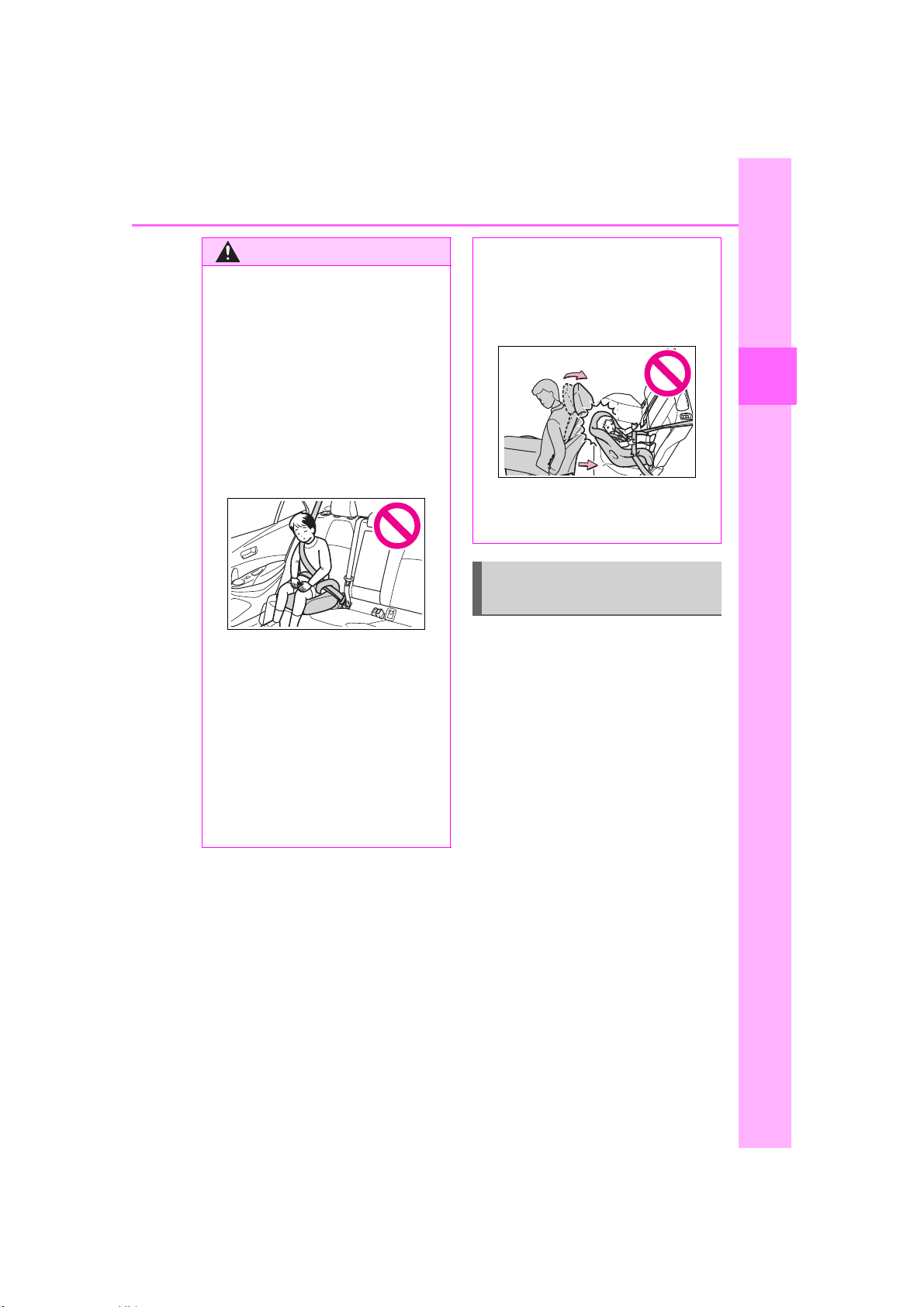
49
1-2. Child safety
COROLLA H/B_U
1
For safety and security
A child restraint system for a
small child or baby must itself be
properly restrained on the seat
with the lap portion of the
lap/shoulder belt.
■ Installing child restraint
system using a seat belt
(child restraint lock func-
tion belt)
Install the child restraint system
in accordance to the operation
manual enclosed with the child
restraint system.
WARNING
● Do not allow the child to lean
his/her head or any part of
his/her body against the door or
the area of the seat, front or rear
pillars, or roof side rails from
which the SRS side airbags or
SRS curtain shield airbags
deploy even if the child is
seated in the child restraint sys-
tem. It is dangerous if the SRS
side and curtain shield airbags
inflate, and the impact could
cause death or serious injury to
the child.
● When a booster seat is
installed, always ensure that the
shoulder belt is positioned
across the center of the child’s
shoulder. The belt should be
kept away from the child’s neck,
but not so that it could fall off the
child’s shoulder.
● Use child restraint system suit-
able to the age and size of the
child and install it to the rear
seat.
● If the driver’s seat interferes
with the child restraint system
and prevents it from being
attached correctly, attach the
child restraint system to the
right-hand rear seat.
● Adjust the front passenger seat
so that it does not interfere with
the child restraint system.
Child restraint system
fixed with a seat belt
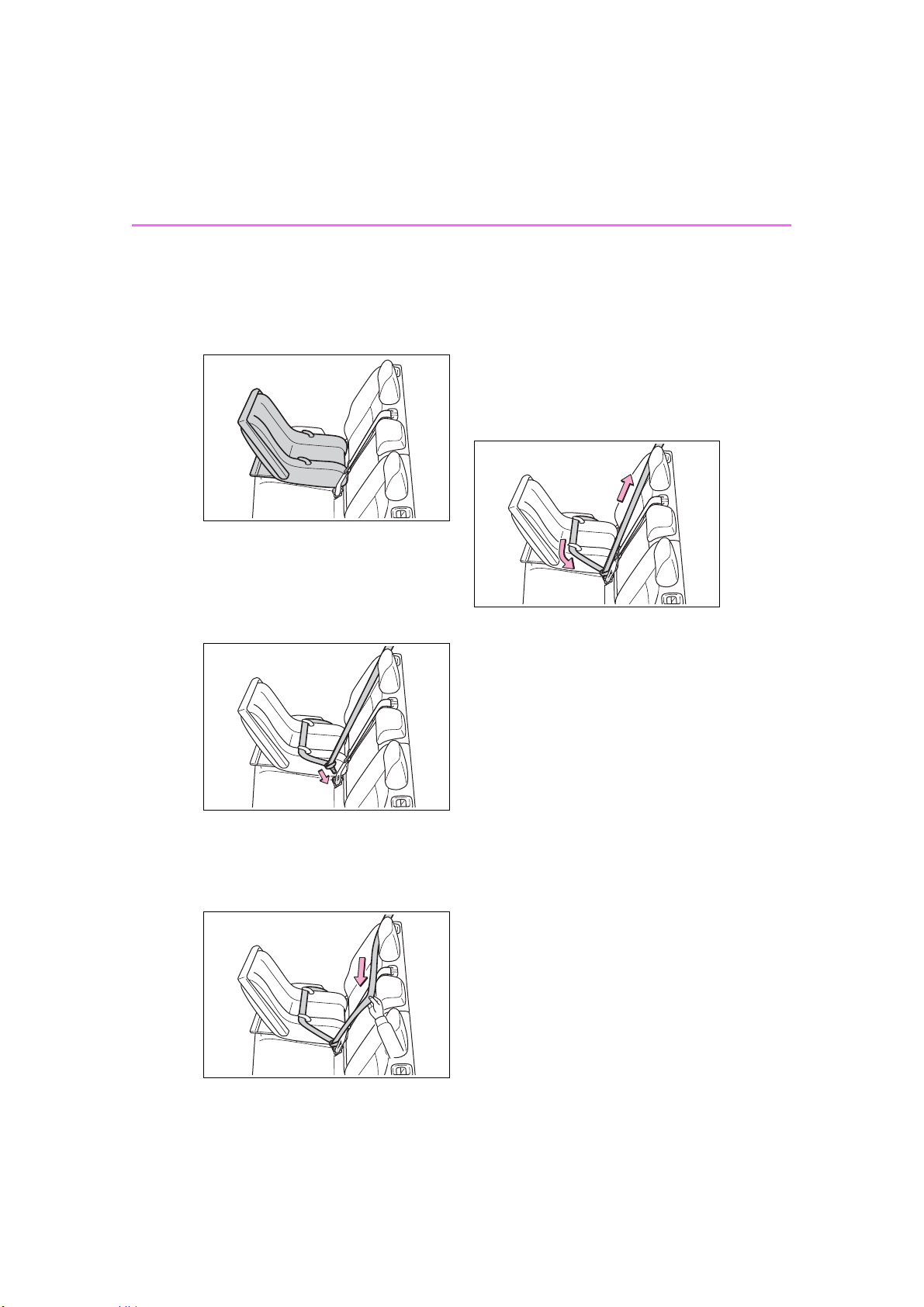
50
1-2. Child safety
COROLLA H/B_U
■ Rear-facing Infant
seat/convertible seat
1 Place the child restraint sys-
tem on the rear seat facing
the rear of the vehicle.
2 Run the seat belt through the
child restraint system and
insert the plate into the
buckle. Make sure that the
belt is not twisted.
3 Fully extend the shoulder belt
and allow it to retract to put it
in lock mode. In lock mode,
the belt cannot be extended.
4 While pushing the child
restraint system down into
the rear seat, allow the shoul-
der belt to retract until the
child restraint system is
securely in place.
After the shoulder belt has
retracted to a point where there is
no slack in the belt, pull the belt to
check that it cannot be extended.
5 After installing the child
restraint system, rock it back
and forth to ensure that it is
installed securely. (P.53)
■ Forward-facing Convert-
ible seat
1 If installing the child restraint
system to the front passen-
ger seat is unavoidable, refer
to P.47for front passenger
seat adjustment.
2 If the head restraint interferes
with your child restraint sys-
tem, and the head restraint
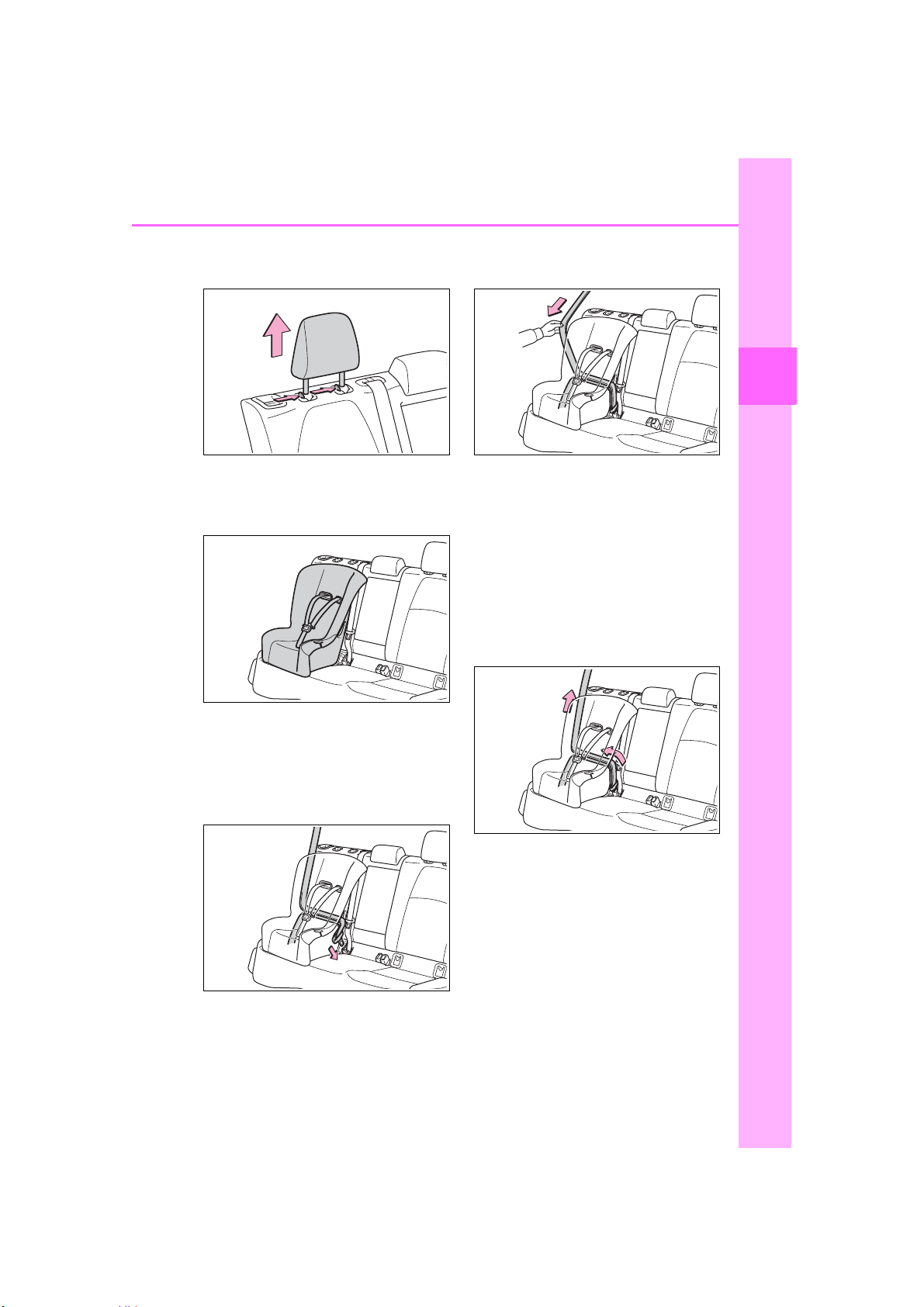
51
1-2. Child safety
COROLLA H/B_U
1
For safety and security
can be removed, remove the
head restraint. (P.118)
3 Place the child restraint sys-
tem on the seat facing the
front of the vehicle.
4 Run the seat belt through the
child restraint system and
insert the plate into the
buckle. Make sure that the
belt is not twisted.
5 Fully extend the shoulder belt
and allow it to retract to put it
in lock mode. In lock mode,
the belt cannot be extended.
6 While pushing the child
restraint system into the rear
seat, allow the shoulder belt
to retract until the child
restraint system is securely in
place.
After the shoulder belt has
retracted to a point where there is
no slack in the belt, pull the belt to
check that it cannot be extended.
7 If the child restraint has a top
tether strap, follow the child
restraint manufacturer’s
operation manual regarding
the installation, using the top
tether strap to latch onto the
top tether strap anchor.
(P.55)
8 After installing the child
restraint system, rock it back
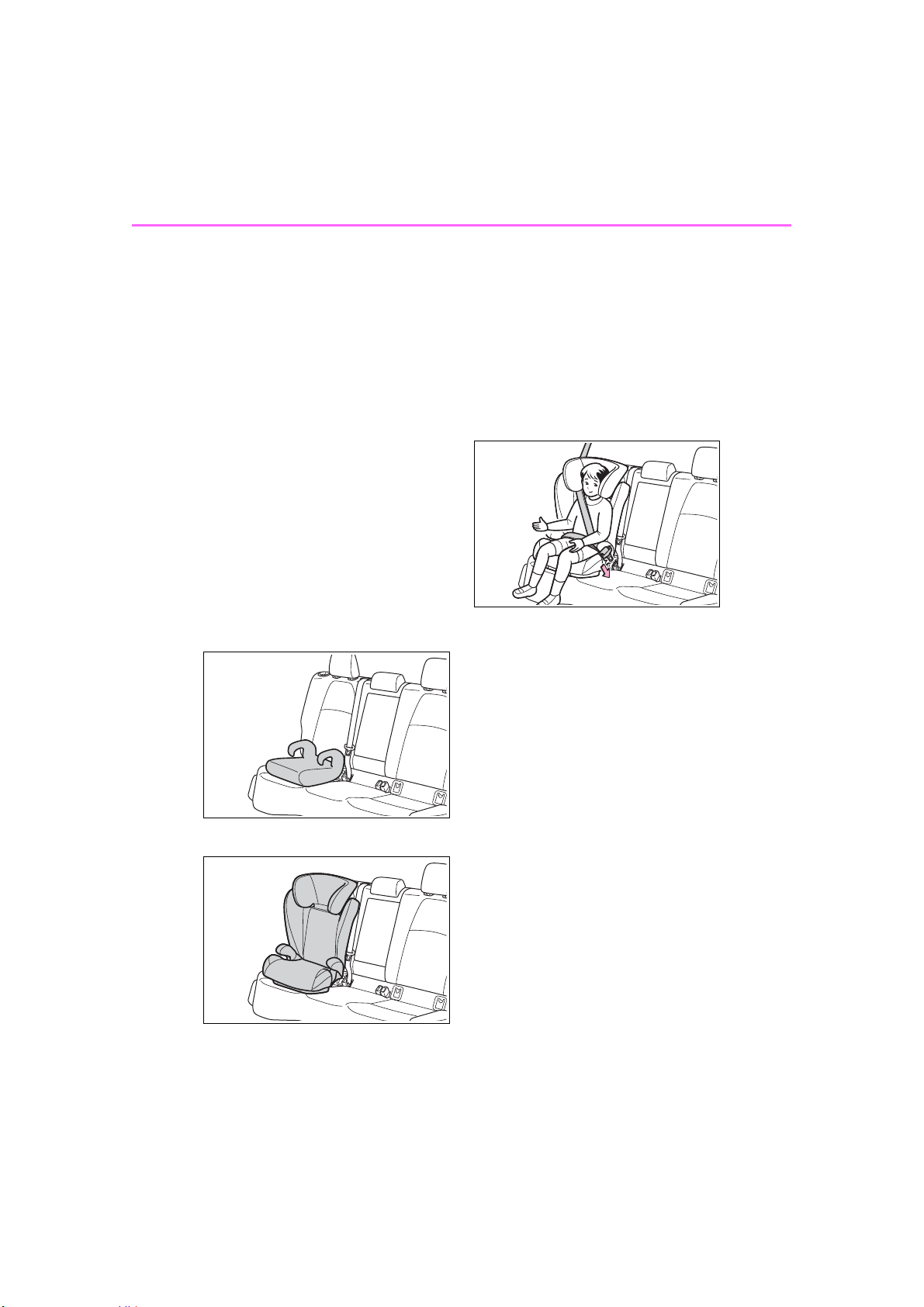
52
1-2. Child safety
COROLLA H/B_U
and forth to ensure that it is
installed securely. (P.53)
■ Booster seat
1 If installing the child restraint
system to the front passen-
ger seat is unavoidable, refer
to P.47for front passenger
seat adjustment.
2 High back type: If the head
restraint interferes with your
child restraint system, and
the head restraint can be
removed, remove the head
restraint. (P.118)
3 Place the child restraint sys-
tem on the seat facing the
front of the vehicle.
Booster type
High back type
4 Sit the child in the child
restraint system. Fit the seat
belt to the child restraint sys-
tem according to the manu-
facturer’s instructions and
insert the plate into the
buckle. Make sure that the
belt is not twisted.
Check that the shoulder belt is cor-
rectly positioned over the child’s
shoulder and that the lap belt is as
low as possible. (P. 25 )
■ Removing a child restraint
system installed with a seat
belt
Press the buckle release button
and fully retract the seat belt.
When releasing the buckle, the
child restraint system may spring
up due to the rebound of the seat
cushion. Release the buckle while
holding down the child restraint
system.
Since the seat belt automatically
reels itself, slowly return it to the
stowing position.
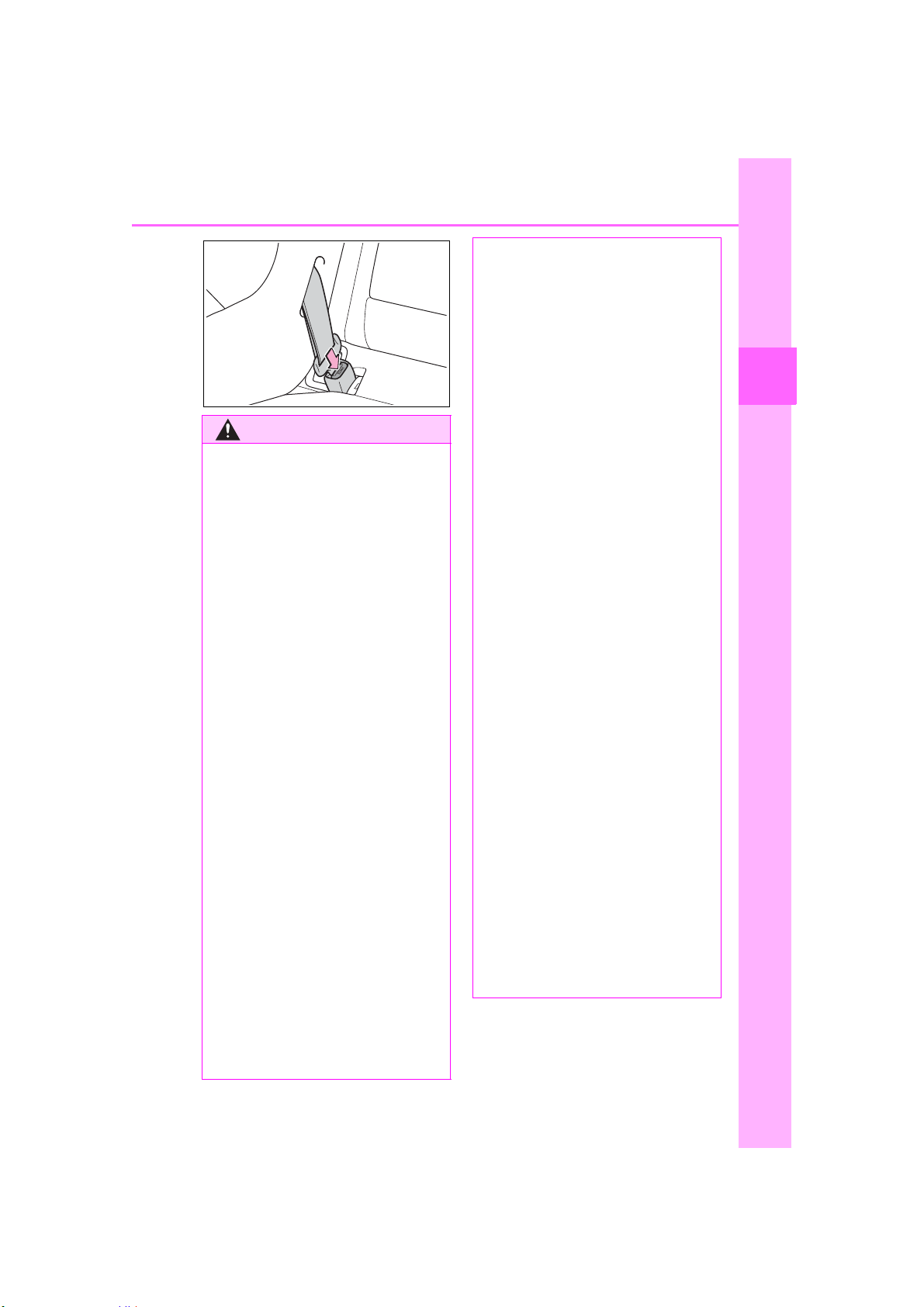
53
1-2. Child safety
COROLLA H/B_U
1
For safety and security
WARNING
■ When installing a child
restraint system
Observe the following precau-
tions.
Failure to do so may result in
death or serious injury.
● Do not allow children to play
with the seat belt. If the seat belt
becomes twisted around a
child’s neck, it may lead to
choking or other serious injuries
that could result in death.
If this occurs and the buckle
cannot be unfastened, scissors
should be used to cut the belt.
● Ensure that the belt and plate
are securely locked and the
seat belt is not twisted.
● Shake the child restraint system
left and right, and forward and
backward to ensure that it has
been securely installed.
● After securing a child restraint
system, never adjust the seat.
● When a booster seat is
installed, always ensure that the
shoulder belt is positioned
across the center of the child’s
shoulder. The belt should be
kept away from the child’s neck,
but not so that it could fall off the
child’s shoulder.
● Follow all installation instruc-
tions provided by the child
restraint system manufacturer.
● When securing some types of
child restraint systems in rear
seats, it may not be possible to
properly use the seat belts in
positions next to the child
restraint without interfering with
it or affecting seat belt effective-
ness. Be sure your seat belt fits
snugly across your shoulder
and low on your hips. If it does
not, or if it interferes with the
child restraint, move to a differ-
ent position. Failure to do so
may result in death or serious
injury.
● When installing a child restraint
system in the rear center seat,
adjust both seat cushions to the
same position and align both
seatbacks at the same angle.
Otherwise, the child restraint
system cannot be securely
restrained and this may cause
death or serious injuries in the
event of sudden braking, sud-
den swerving or an accident.
■ When installing a booster
seat
To prevent the belt from going into
ALR lock mode, do not fully
extend the shoulder belt. ALR
mode causes the belt to tighten
only. This could cause injury or
discomfort to the child. (P. 27)
■ Do not use a seat belt
extender
If a seat belt extender is used
when installing a child restraint
system, the seat belt will not
securely hold the child restraint
system, which could cause death
or serious injury to the child or
other passengers in the event of
sudden braking, sudden swerv-
ing or an accident.
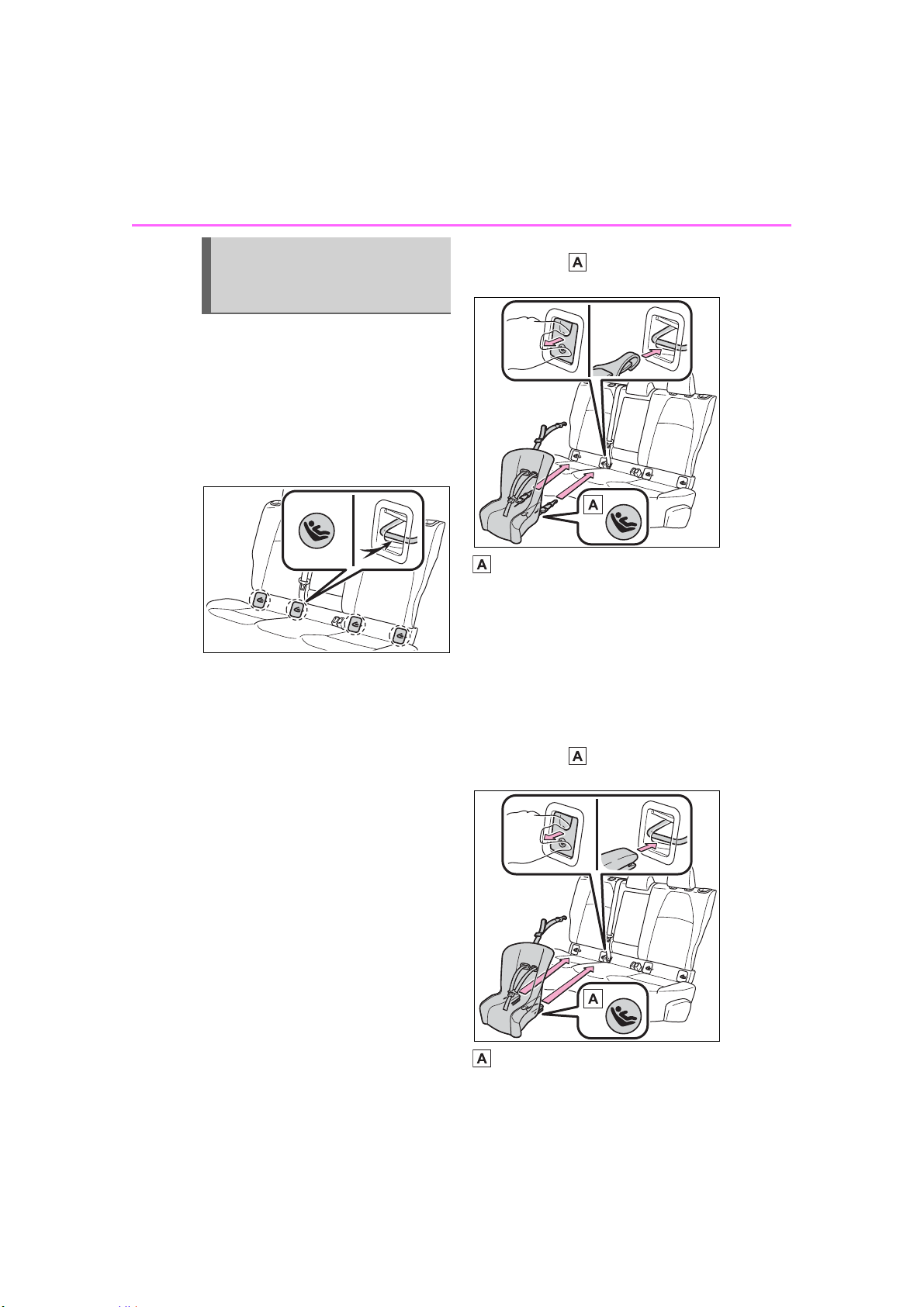
54
1-2. Child safety
COROLLA H/B_U
■ Child restraint LATCH
anchors
LATCH anchors are provided for
the outboard rear seat. (Marks
displaying the location of the
anchors are attached to the
seats.)
■ When installing in the rear
outboard seats
Install the child restraint system
in accordance to the operation
manual enclosed with the child
restraint system.
1 If the head restraint interferes
with your child restraint sys-
tem, and the head restraint
can be removed, remove the
head restraint. (P.118)
With flexible lower attach-
ments
2 Remove the anchor covers,
and install the child restraint
system to the seat.
The bars are installed behind the
anchor covers.
For owners in Canada:
The symbol on a child restraint sys-
tem indicates the presence of a
lower connector system.
Canada only
With rigid lower attachments
2 Remove the anchor covers,
and install the child restraint
system to the seat.
The bars are installed behind the
anchor covers.
For owners in Canada:
The symbol on a child restraint sys-
tem indicates the presence of a
lower connector system.
Canada only
Child restraint system
fixed with a child restraint
LATCH anchor
55
1-2. Child safety
COROLLA H/B_U
1
For safety and security
3 If the child restraint has a top
tether strap, follow the child
restraint manufacturer’s
operation manual regarding
the installation, using the top
tether strap to latch onto the
top tether strap anchor.
(P.55)
4 After installing the child
restraint system, rock it back
and forth to ensure that it is
installed securely. (P.53)
■ When installing in the rear
center seat
There are no LATCH anchors
behind the rear center seat.
However, the inboard LATCH
anchors of the outboard seats,
which are 15.6 in. (396 mm)
apart, can be used if the child
restraint system manufacturer’s
instructions permit use of those
anchors with the anchor spacing
stated.
Child restraint systems with rigid
lower attachments cannot be
installed in the center seat. This
type of child restraint system
can only be installed in the out-
board seat.
■ Laws and regulations pertain-
ing to anchors
The LATCH system conforms to
FMVSS225 or CMVSS210.2.
Child restraint systems conforming
to FMVSS213 or CMVSS213 speci-
fications can be used.
This vehicle is designed to conform
to SAE J1819.
■ Anchor brackets (for top
tether strap)
Anchor brackets are provided
for each rear seat.
Use anchor brackets when fix-
ing the top tether strap.
WARNING
■ When installing a child
restraint system
Observe the following precau-
tions.
Failure to do so may result in
death or serious injury.
● When using the LATCH
anchors, be sure that there are
no foreign objects around the
anchors and that the seat belt is
not caught behind the child
restraint system.
● Follow all installation instruc-
tions provided by the child
restraint system manufacturer.
● When securing some types of
child restraint systems in rear
seats, it may not be possible to
properly use the seat belts in
positions next to the child
restraint without interfering with
it or affecting seat belt effective-
ness. Be sure your seat belt fits
snugly across your shoulder
and low on your hips. If it does
not, or if it interferes with the
child restraint, move to a differ-
ent position. Failure to do so
may result in death or serious
injury.
● If the seat is adjusted, reconfirm
the security of the child restraint
system.
Using an anchor bracket
(for top tether strap)
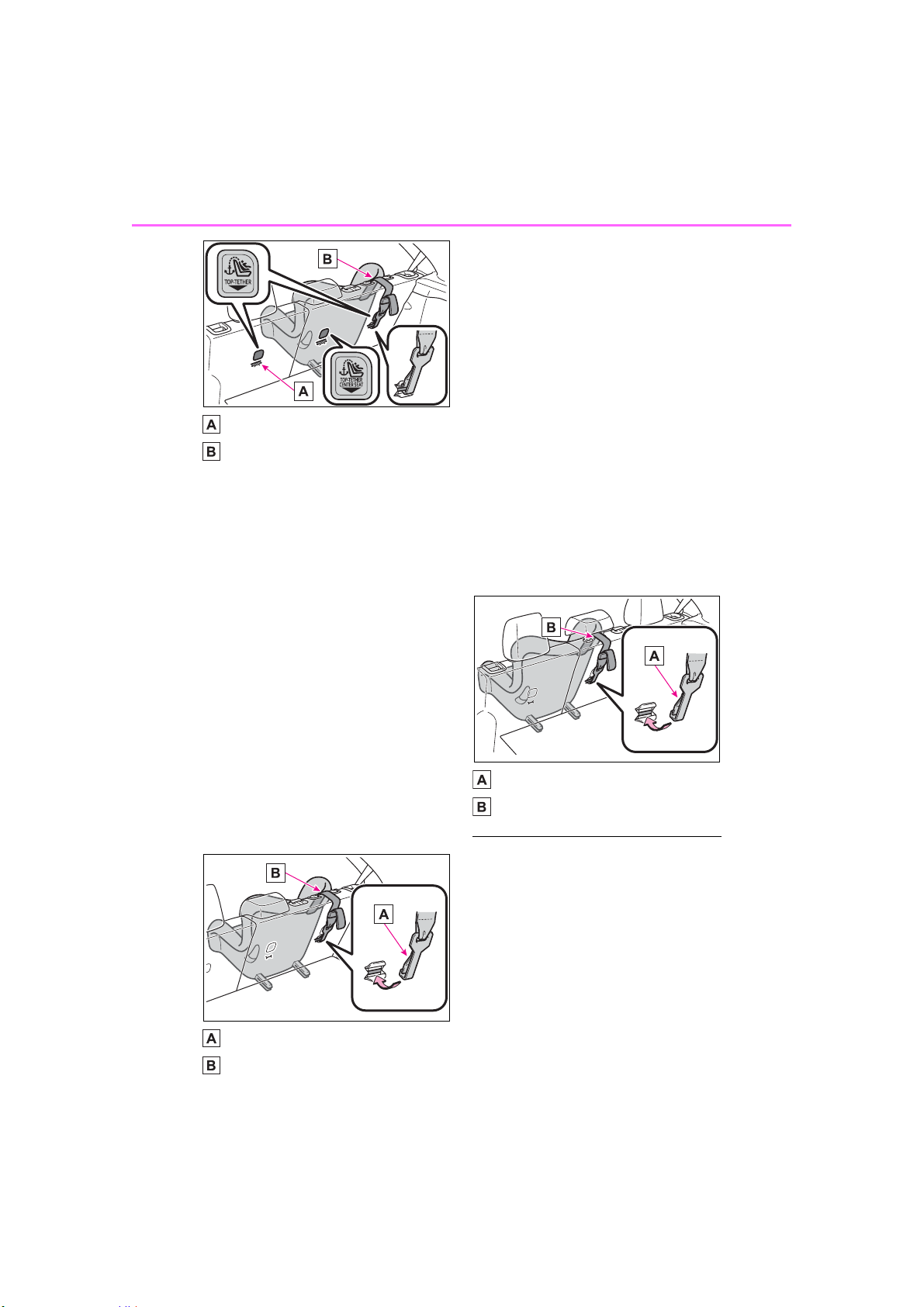
56
1-2. Child safety
COROLLA H/B_U
Anchor brackets
Top tether strap
■ Fixing the top tether strap
to the anchor bracket
Install the child restraint system
in accordance to the operation
manual enclosed with the child
restraint system.
Rear outboard seats
1 Remove the head restraint.
(P.118)
2 Latch the hook onto the
anchor bracket and tighten
the top tether strap.
Make sure the top tether strap is
securely latched. (P. 53 )
If the head restraint does not inter-
fere with the child restraint system
installation, install the head
restraint.
Hook
Top tether strap
Rear center seat
1 Adjust the head restraint to
the upmost position.
If the head restraint interferes with
the child restraint system or top
tether strap installation and the
head restraint can be removed,
remove the head restraint.
(P. 11 8)
2 Latch the hook onto the
anchor bracket and tighten
the top tether strap.
Make sure the top tether strap is
securely latched. (P.53)
When installing the child restraint
system with the head restraint
being raised, be sure to have the
top tether strap pass underneath
the head restraint.
Hook
Top tether strap
■ Laws and regulations pertain-
ing to anchors
The LATCH system conforms to
FMVSS225 or CMVSS210.2.
Child restraint systems conforming
to FMVSS213 or CMVSS213 speci-
fications can be used.
This vehicle is designed to conform
to SAE J1819.

57
1-2. Child safety
COROLLA H/B_U
1
For safety and security
WARNING
■ When installing a child
restraint system
Ob
serve the following precau-
tions.
Failure to do so may result in
death or serious injury.
● Firmly attach the top tether
s
trap and make sure that the
belt is not twisted.
● Do not attach the top tether
s
trap to anything other than the
anchor bracket.
● After securing a child restraint
s
ystem, never adjust the seat.
● Follow all installation instruc-
tions provided by the ch
ild
restraint s
ystem manufacturer.
● When installing the child
restraint s
ystem with the
head
restraint being rais
ed, aft
er the
hea
d restraint has been raised
and then the anchor bracket ha
s
bee
n fixed, do not lower th
e
hea
d restraint.
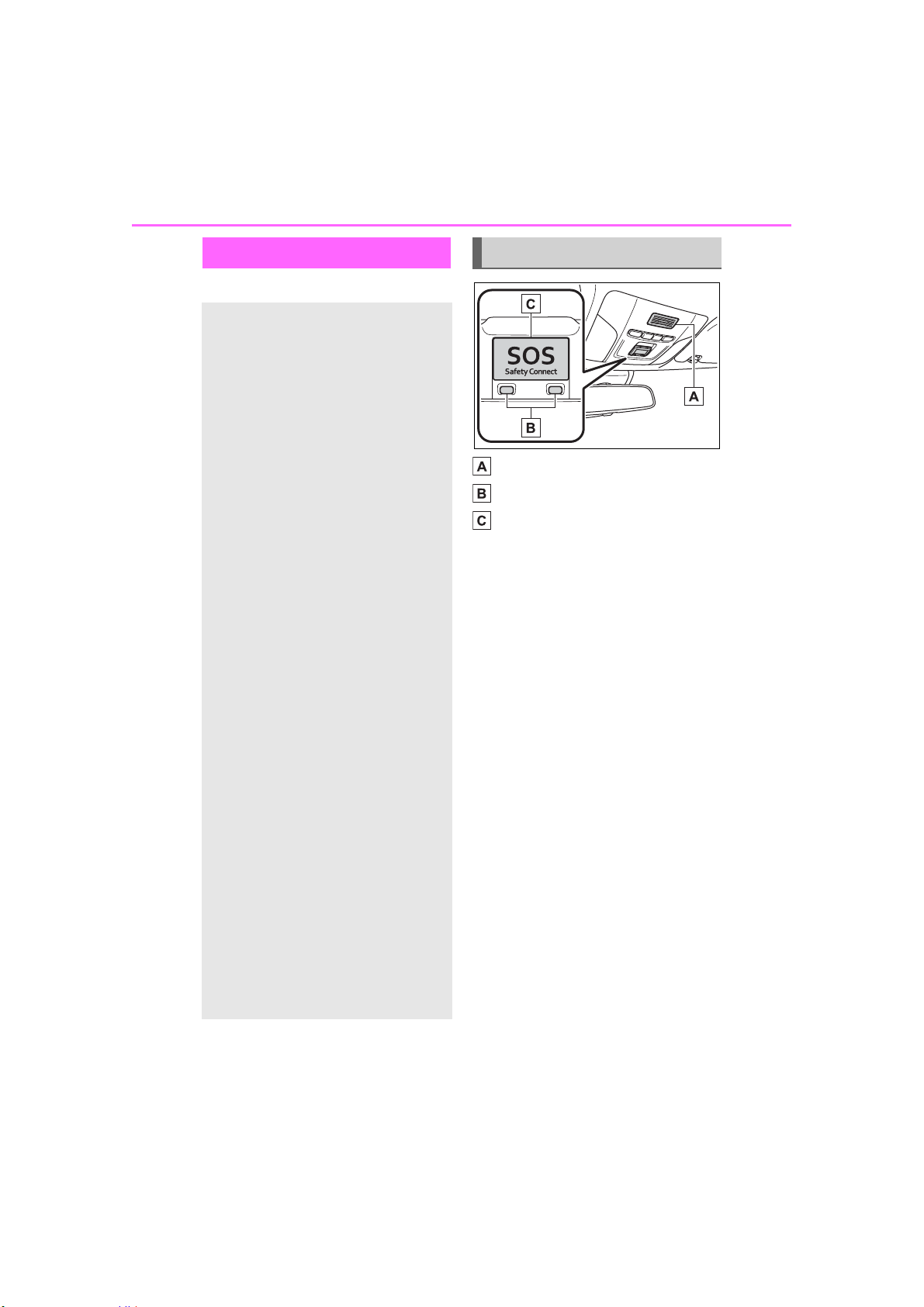
58
1-3. Emergency assistance
COROLLA H/B_U
1-3.Emer gency as sistance
*
: If equipped
Microphone
LED light indicators
“SOS” button
Safety Connect
*
Safety Connect is a sub-
scription-based telematics
service that uses Global
Positioning System (GPS)
data and embedded cellular
technology to provide
safety and security features
to subscribers. Safety Con-
nect is supported by Toy-
ota’s designated response
center, which operates 24
hours per day, 7 days per
week.
Safety Connect service is
available by subscription on
select, telematics hard-
ware-equipped vehicles.
By using the Safety Connect
service, you are agreeing to
be bound by the Telematics
Subscription Service Agree-
ment and its Terms and
Conditions, as in effect and
amended from time to time,
a current copy of which is
available at Toyota.com in
the United States, Toy-
otapr.com in Puerto Rico
and Toyota.ca in Canada. All
use of the Safety Connect
service is subject to such
then-applicable Terms and
Conditions.
System components
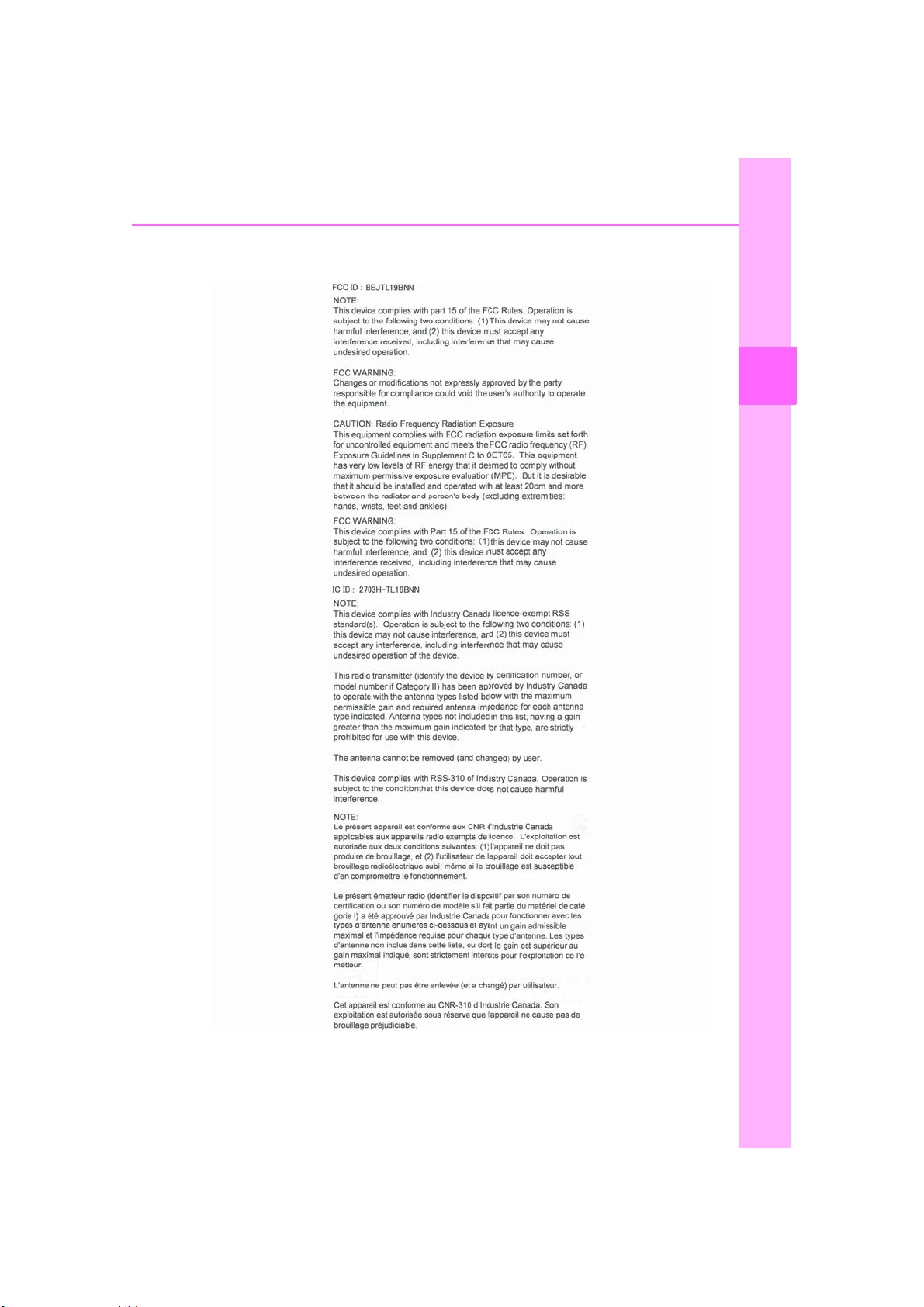
59
1-3. Emergency assistance
COROLLA H/B_U
1
For safety and security
■ Certification

60
1-3. Emergency assistance
COROLLA H/B_U
Subscribers have the following
Safety Connect services avail-
able:
Automatic Collision Notifica-
tion
*
Helps drivers receive necessary
response from emergency service
providers. (P.6 1)
*
: U.S. Patent No. 7,508,298 B2
Stolen Vehicle Location
Helps drivers in the event of vehicle
theft. (P.6 1)
Emergency Assistance Button
(“SOS”)
Connects drivers to response-cen-
ter support. (P.6 2)
Enhanced Roadside Assis-
tance
Provides drivers various on-road
assistance. (P.6 2)
After you have signed the
Telematics Subscription Service
Agreement and are enrolled,
you can begin receiving ser-
vices.
A variety of subscription terms
are available for purchase. Con-
tact your Toyota dealer, call the
following appropriate Customer
Experience Center or push the
“SOS” button in your vehicle for
further subscription details.
• The United States
1-800-331-4331
• Canada
1-888-869-6828
• Puerto Rico
1-877-855-8377
■ Safety Connect Services Infor-
mation
● Phone calls using the vehicle’s
Bluetooth
®
technology will not be
possible when Safety Connect is
active and in use.
● Safety Connect is available begin-
ning Fall 2009 on select Toyota
models (in the contiguous United
States only). Contact with the
Safety Connect response center
is dependent upon the telematics
device being in operative condi-
tion, cellular connection availabil-
ity, and GPS satellite signal
reception, which can limit the abil-
ity to reach the response center or
receive emergency service sup-
port. Enrollment and Telematics
Subscription Service Agreement
are required. A variety of subscrip-
tion terms are available; charges
vary by subscription term selected
and location.
● Automatic Collision Notification,
Emergency Assistance and Stolen
Vehicle Location are available in
the United States, including
Hawaii and Alaska, Puerto Rico
and Canada, and Enhanced
Roadside Assistance are avail-
able in the United States, Puerto
Rico and Canada.
● Automatic Collision Notification,
Emergency Assistance, Stolen
Vehicle and Enhanced Road
Assistance are not available in the
U.S. Virgin Islands.
For vehicles first sold in the U.S.
Virgin Islands, no Safety Connect
services will function in or outside
the U.S. Virgin Islands.
● Safety Connect services are not
Services
Subscription
61
1-3. Emergency assistance
COROLLA H/B_U
1
For safety and security
subject to section 255 of the Tele-
communications Act and the
device is not TTY compatible.
■ Languages
The Safety Connect response cen-
ter will offer support in multiple lan-
guages.
The Safety Connect system will
offer voice prompts in English,
Spanish, and French. Please indi-
cate your language of choice when
enrolling.
■ When contacting the response
center
You may be unable to contact the
response center if the network is
busy.
When the engine switch is
turned to ON, the red indicator
light comes on for 2 seconds
then turns off. Afterward, the
green indicator light comes on,
indicating that the service is
active.
The following indicator light pat-
terns indicate specific system
usage conditions:
Green indicator light on =
Active service
Green indicator light flashing
= Safety Connect call in pro-
cess
Red indicator light (except at
vehicle start-up) = System
malfunction (contact your Toy-
ota dealer)
No indicator light (off) =
Safety Connect service not
active
■ Automatic Collision Notifi-
cation
In case of either airbag deploy-
ment or severe rear-end colli-
sion, the system is designed to
automatically call the response
center. The responding agent
receives the vehicle’s location
and attempts to speak with the
vehicle occupants to assess the
level of emergency. If the occu-
pants are unable to communi-
cate, the agent automatically
treats the call as an emergency,
contacts the nearest emer-
gency services provider to
describe the situation, and
requests that assistance be sent
to the location.
■ Stolen Vehicle Location
If your vehicle is stolen, Safety
Connect can work with local
authorities to assist them in
locating and recovering the
vehicle. After filing a police
report, call the Customer Experi-
ence Center at 1-800-331-4331
in the Unites States,
1-877-855-8377 in Puerto Rico
or 1- 888-869-6828 in Canada,
and follow the prompts for
Safety Connect to initiate this
service.
In addition to assisting law
enforcement with recovery of a
Safety Connect LED light
Indicators
Safety Connect services

62
1-3. Emergency assistance
COROLLA H/B_U
stolen vehicle, Safety-Con-
nect-equipped vehicle location
data may, under certain circum-
stances, be shared with third
parties to locate your vehicle.
Further information is available
at Toyota.com in the United
States, Toyotapr.com in Puerto
Rico and Toyota.ca in Canada.
■ Emergency Assistance But-
ton (“SOS”)
In the event of an emergency on
the road, push the “SOS” button
to reach the Safety Connect
response center. The answer-
ing agent will determine your
vehicle’s location, assess the
emergency, and dispatch the
necessary assistance required.
If you accidentally press the “SOS”
button, tell the response-center
agent that you are not experiencing
an emergency.
■ Enhanced Roadside Assis-
tance
Enhanced Roadside Assistance
adds GPS data to the already
included warranty-based Toyota
roadside service.
Subscribers can press the
“SOS” button to reach a Safety
Connect response-center agent,
who can help with a wide range
of needs, such as: towing, flat
tire, fuel delivery, etc. For a
description of the Enhanced
Roadside Assistance services
and their limitations, please see
the Safety Connect Terms and
Conditions, which are available
at Toyota.com in the United
States, Toyotapr.com in Puerto
Rico and Toyota.ca in Canada.
Important! Read this informa-
tion before using Safety Con-
nect.
■ Exposure to radio fre-
quency signals
The Safety Connect system
installed in your vehicle is a
low-power radio transmitter and
receiver. It receives and also
sends out radio frequency (RF)
signals.
In August 1996, the Federal
Communications Commission
(FCC) adopted RF exposure
guidelines with safety levels for
mobile wireless phones. Those
guidelines are consistent with
the safety standards previously
set by the following U.S. and
international standards bodies.
ANSI (American National
Standards Institute) C95.1
[1992]
NCRP (National Council on
Radiation Protection and
Measurement) Report 86
[1986]
ICNIRP (International Com-
mission on Non-Ionizing Radi-
ation Protection) [1996]
Safety information for
Safety Connect

63
1-3. Emergency assistance
COROLLA H/B_U
1
For safety and security
Those standards were based on
comprehensive and periodic
evaluations of the relevant sci-
entific literature. Over 120 scien-
tists, engineers, and physicians
from universities, and govern-
ment health agencies and
industries reviewed the avail-
able body of research to
develop the ANSI Standard
(C95.1).
The design of Safety Connect
complies with the FCC guide-
lines in addition to those stan-
dards.
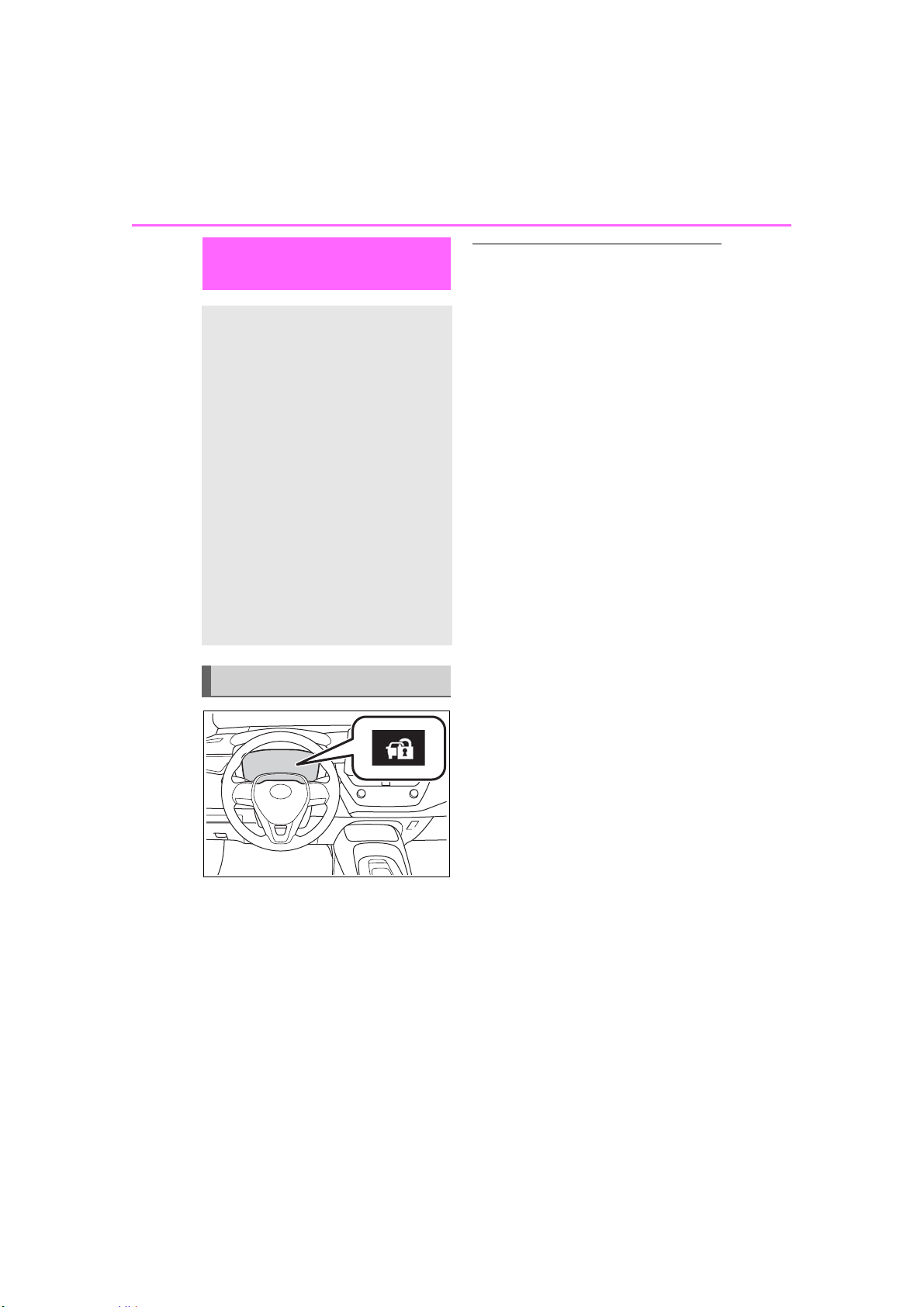
64
1-4. Theft deterrent system
COROLLA H/B_U
1-4.Theft deterrent system
The indicator light flashes after
the engine switch has been
turned off to indicate that the
system is operating.
The indicator light stops flashing
after the engine switch has been
turned to ACC or ON to indicate
that the system has been can-
celed.
■ System maintenance
The vehicle has a mainte-
nance-free type engine immobilizer
system.
■ Conditions that may cause the
s
ystem to malfunction
● If the grip portion of the key is in
contac
t with a metallic object
● If the key is in close proximity to or
touc
hing a key to the security sys-
tem (key with a built-in transpon-
der chip) of another vehicle
Engine immobilizer
system
The vehicle’s keys have
built-in transponder chips
that prevent the engine from
starting if a key has not
been previously registered
in the vehicle’s on-board
computer.
Never leave the keys inside
the vehicle when you leave
the vehicle.
This system is designed to
help prevent vehicle theft
but does not guarantee
absolute security against all
vehicle thefts.
Operating the system
65
1-4. Theft deterrent system
COROLLA H/B_U
1
For safety and security
■ Certifications for the engine immobilizer system
For vehicles sold in the U.S.A., Hawaii, Guam and Puerto Rico
For vehicles sold in Canada
NOTICE
■ To ensure the system oper-
ates correctly
Do not modify or remove the sys-
tem. If modified or removed, the
proper operation of the system
cannot be guaranteed.

66
1-4. Theft deterrent system
COROLLA H/B_U
*
: If equipped
■ Items to check before lock-
ing the vehicle
To prevent unexpected trigger-
ing of the alarm and vehicle
theft, make sure of the following:
Nobody is in the vehicle.
The windows are closed
before the alarm is set.
No valuables or other per-
sonal items are left in the
vehicle.
■ Setting
Close the doors, back door and
hood, and lock all the doors.
The system will set automati-
cally after 30 seconds.
The indicator light changes from
being on to flashing when the sys-
tem is set.
■ Deactivating or stopping
Do one of the following to deac-
tivate or stop the alarms:
Unlock the doors.
Turn the engine switch to
ACC or ON, or start the
engine. (The alarm will be
deactivated or stopped after a
few seconds.)
■ System maintenance
The vehicle has a mainte-
nance-free type alarm system.
■ Triggering of the alarm
The alarm may be triggered in the
following situations:
(Stopping the alarm deactivates the
alarm system.)
● A person inside the vehicle opens
a door, back door or hood, or
unlocks the vehicle.
● A person inside the vehicle
Alarm
*
The alarm uses light and
sound to give an alert when
an intrusion is detected.
The alarm is triggered in the
following situations when
the alarm is set:
A locked door or back door
is unlocked or opened in
any way other than using
the entry function, wireless
remote control or mechani-
cal key. (The doors will lock
again automatically.)
The hood is opened.
Setting/deactivating/stop-
ping the alarm system
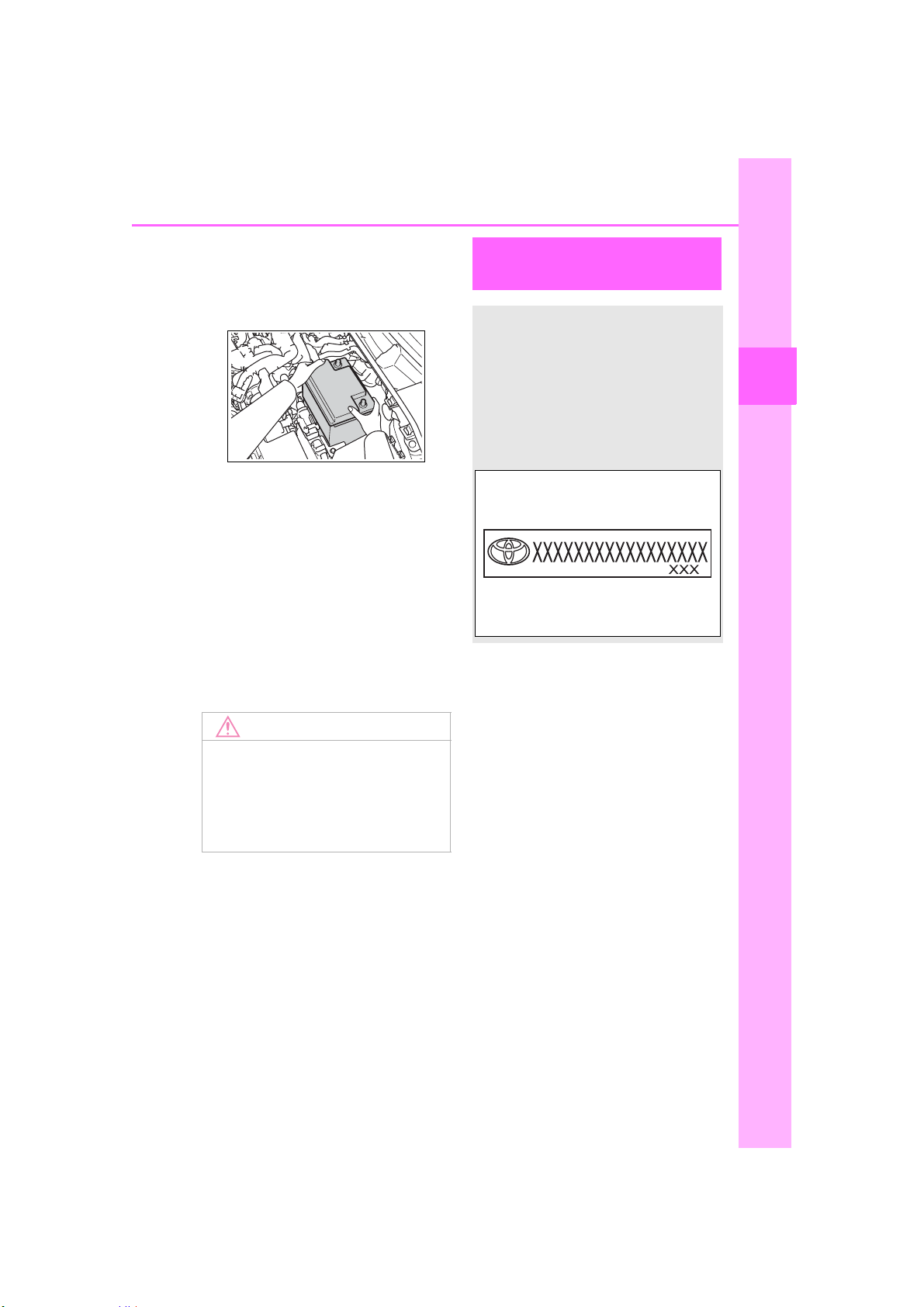
67
1-4. Theft deterrent system
COROLLA H/B_U
1
For safety and security
unlocks the door using the inside
lock buttons.
● The battery is recharged or
replaced when the vehicle is
locked. (P.504)
■ Alarm-operated door lock
In the following cases, depending
on the situation, the door may auto-
matically lock to prevent improper
entry into the vehicle:
● When a person remaining in the
vehicle unlocks the door and the
alarm is activated.
● While the alarm is activated, a
person remaining in the vehicle
unlocks the door.
● When recharging or replacing the
battery
NOTICE
■ To ensure the system oper-
ates correctly
Do not modify or remove the sys-
tem. If modified or removed, the
proper operation of the system
cannot be guaranteed.
Theft prevention
labels (U.S.A.)
These labels are attached to
the vehicle to reduce vehi-
cle theft by facilitating the
tracing and recovery of
parts from stolen vehicles.
Do not remove under the
penalty of law.

68
1-4. Theft deterrent system
COROLLA H/B_U

69
COROLLA H/B_U
2
2
Vehicle status information and indicators
Vehicle status information
and indicators
.
2-1. Instrument cluster
Warning lights and indica-
tors ...............................70
Gauges and meters
(4.2-inch display)..........74
Gauges and meters (7-inch
display).........................78
Multi-information display
.....................................82
Head-up display .............89
Fuel consumption informa-
tion ...............................93
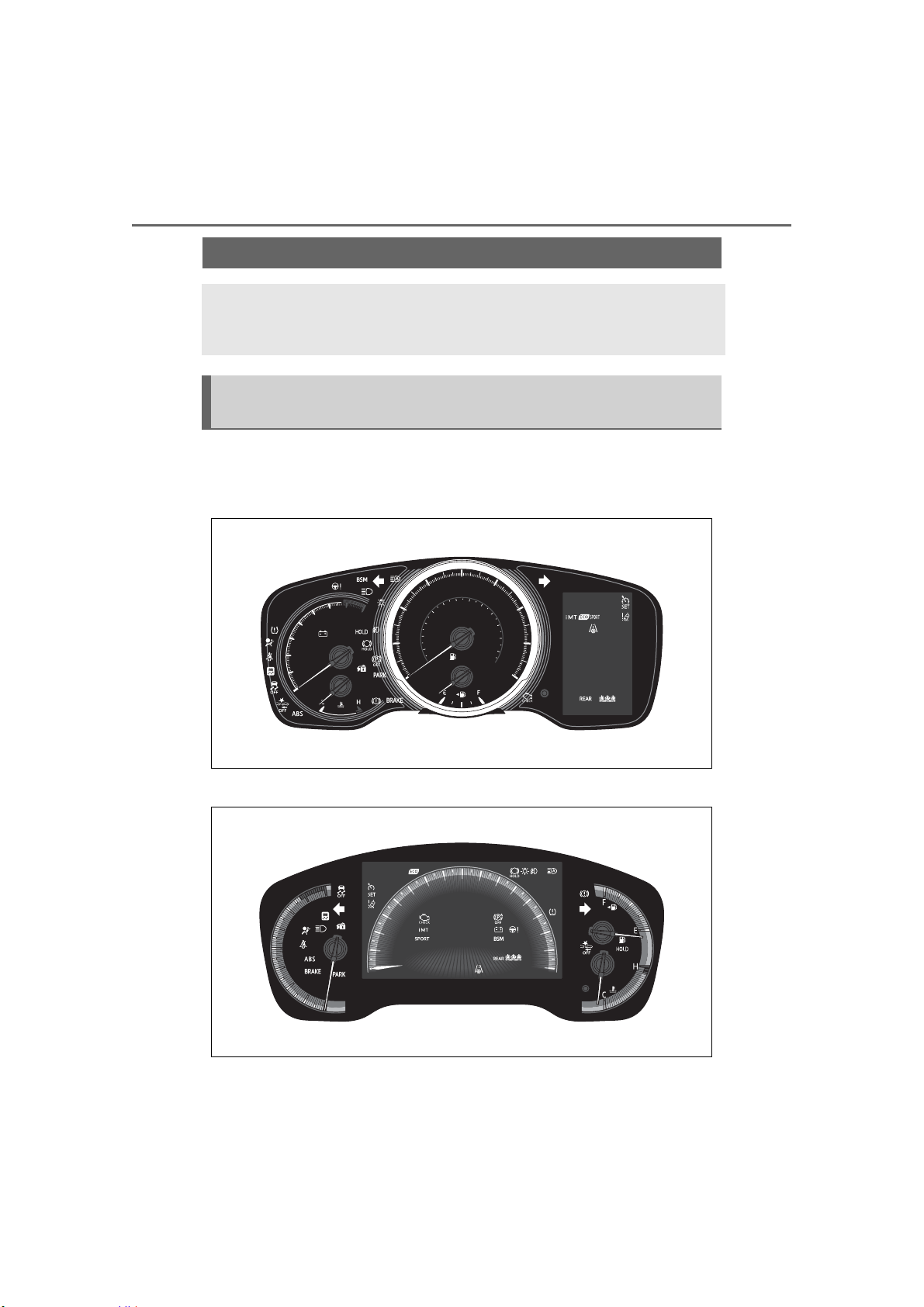
70
2-1. Instrument cluster
COROLLA H/B_U
2-1.Instrument cluster
For the purpose of explanation, the following illustrations display all
warning lights and indicators illuminated.
4.2-inch display
7-inch display (when analog speedometer is displayed)
Warning lights and indicators
The warning lights and indicators on the instrument cluster,
center panel and outside rear view mirrors inform the driver of
the status of the vehicle’s various systems.
Warning lights and indicators displayed on the instru-
ment cluster
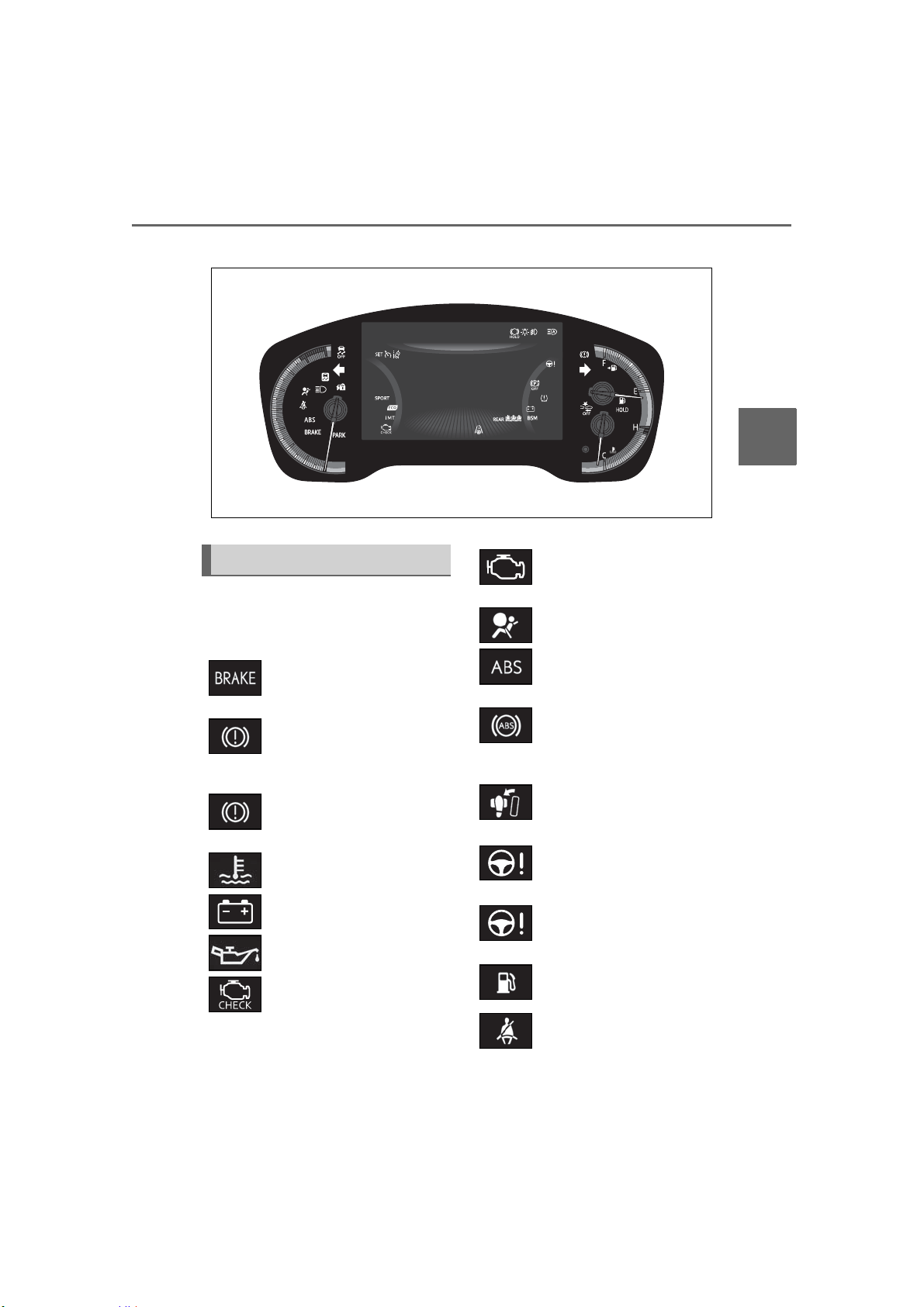
71
2-1. Instrument cluster
COROLLA H/B_U
2
Vehicle status information and indicators
7-inch display (when digital speedometer is displayed)
Warning lights inform the driver
of malfunctions in the indicated
vehicle’s systems.
Warning lights
(U.S.A.)
Brake system warning
light
*1
(P.468)
(Red)
(Canada)
Brake system warning
light
*1
(P.468)
(Yellow)
Brake system warning
light
*1
(P.468)
High coolant temperature
warning light
*2
(P.468)
Charging system warning
light
*1
(P.469)
Low engine oil pressure
warning light
*2
(P.469)
(U.S.A.)
Malfunction indicator
lamp
*1
(P.469)
(Canada)
Malfunction indicator
lamp
*1
(P.469)
SRS warning light
*1
(P.469)
(U.S.A.)
ABS warning light
*1
(P.470)
(Canada)
ABS warning light
*1
(P.470)
Brake Override System
warning light/Drive-Start
Control warning light
*2
(P.470)
(Red)
Electric power steering
system warning light
*1
(P.471)
(Yellow)
Electric power steering
system warning light
*1
(P.471)
Low fuel level warning
light (P.471)
Driver’s and front passen-
ger’s seat belt reminder
light (P.471)
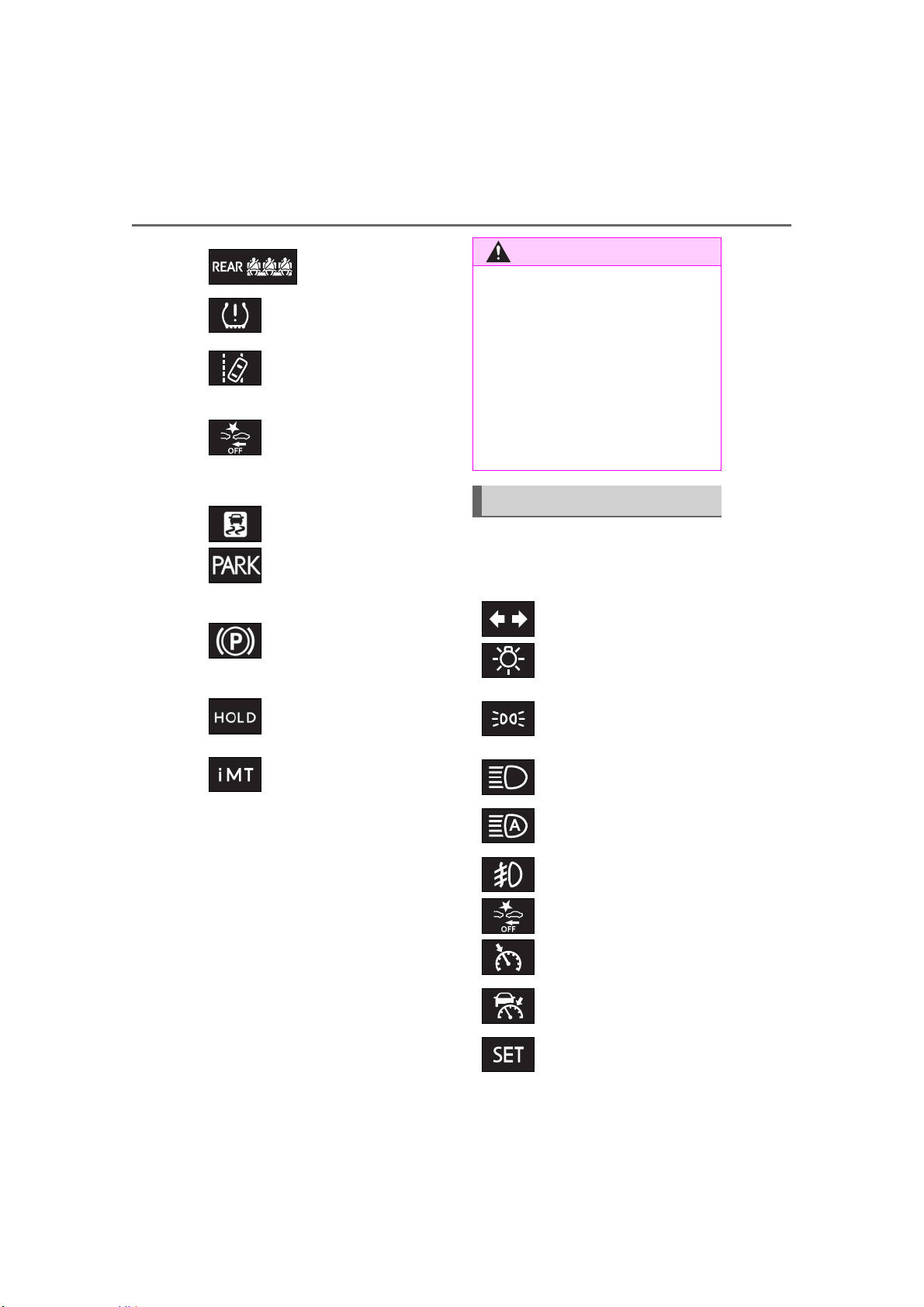
72
2-1. Instrument cluster
COROLLA H/B_U
*1
:These lights come on when the
engine switch is turned to ON to
indicate that a system check is
being performed. They will turn
off after the engine is started, or
after a few seconds. There may
be a malfunction in a system if
the lights do not come on, or turn
off. Have the vehicle inspected
by your Toyota dealer.
*2
:This light illuminates on the
multi-information display.
The indicators inform the driver
of the operating state of the
vehicle’s various systems.
Rear passengers’
seat belt reminder
lights (P.472)
Tire pressure warning
light
*1
(P.472)
(Orange)
LTA indicator (if equipped)
(P.472)
LDA indicator (if equipped)
(P.472)
(Flashes
or illumi-
nates)
PCS warning light
*1
(P.473)
Slip indicator
*1
(P.473)
(Flashes)
(U.S.A.)
Parking brake indicator
(P.473)
(Flashes)
(Canada)
Parking brake indicator
(P.473)
(Flashes)
Brake hold operated indi-
cator
*1
(P.474)
(Orange)
iMT indicator
*1
(if
equipped) (P.474)
WARNING
■ If a safety system warning
light does not come on
Should a safety system light such
as the ABS and SRS warning light
not come on when you start the
engine, this could mean that
these systems are not available to
help protect you in an accident,
which could result in death or seri-
ous injury. Have the vehicle
inspected by your Toyota dealer
immediately if this occurs.
Indicators
Turn signal indicator
(P.153)
(U.S.A.)
Headlight indicator
(P.160)
(Canada)
Tail light indicator
(P.160)
Headlight high beam indi-
cator (P.162)
Automatic High Beam
indicator (if equipped)
(P.162)
Front fog light indicator (if
equipped) (P.166)
PCS warning light
*1, 2
(P.180)
Cruise control indicator
(P.204, 214)
Dynamic radar cruise con-
trol indicator (P.204,
214)
Cruise control “SET” indi-
cator (P.204, 214)
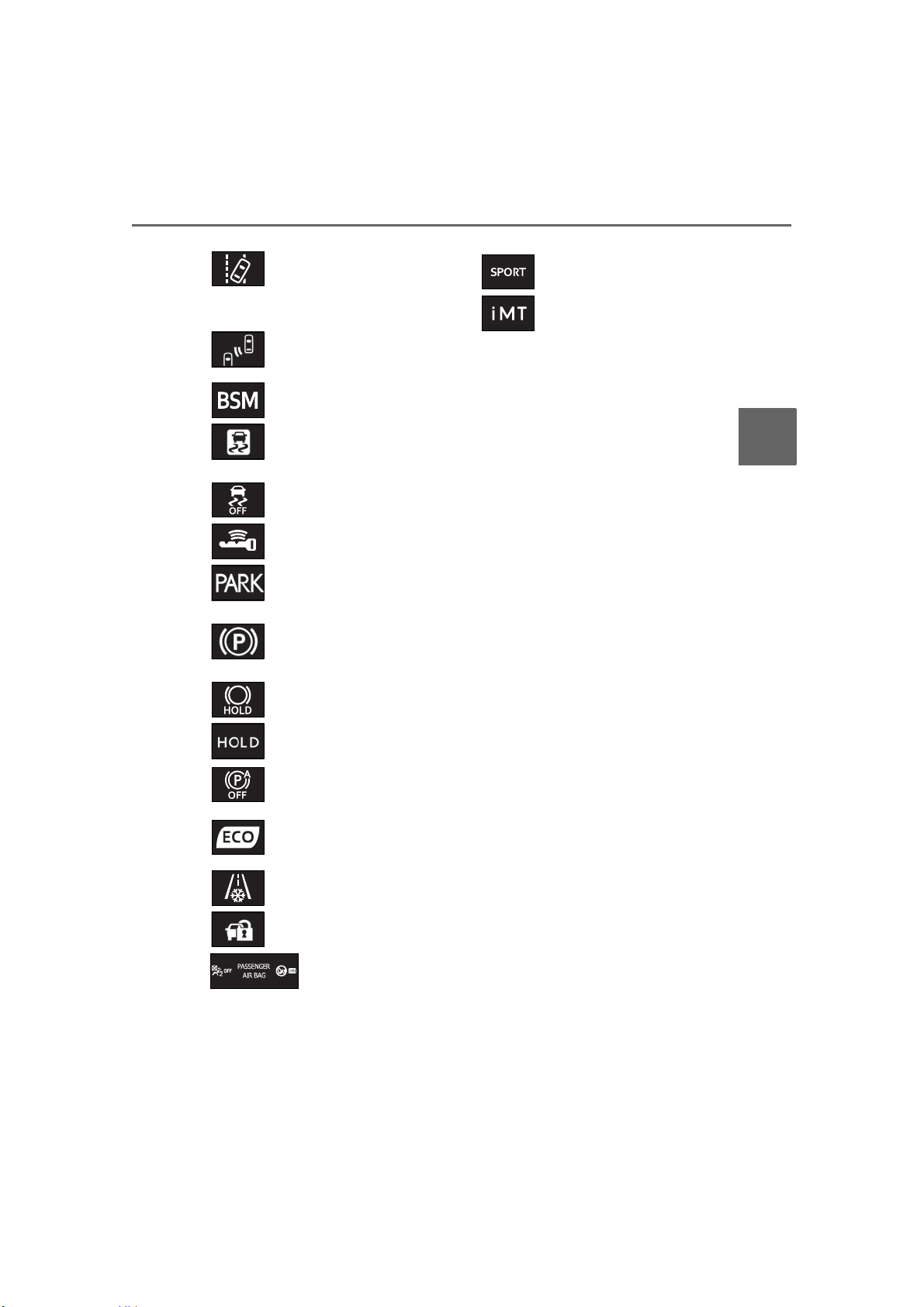
73
2-1. Instrument cluster
COROLLA H/B_U
2
Vehicle status information and indicators
*1
:These lights come on when the
engine switch is turned to ON to
indicate that a system check is
being performed. They will turn
off after the engine is started, or
after a few seconds. There may
be a malfunction in a system if
the lights do not come on, or turn
off. Have the vehicle inspected
by your Toyota dealer.
*2
:This light comes on when the
system is turned off.
*3
:Depending on the operating con-
dition, the color and illuminat-
ing/flashing state of the light
change.
*4
:This light illuminates on the out-
side rear view mirrors.
*5
:This light illuminates on the
multi-information display.
*6
:When the outside temperature is
approximately 37°F (3°C) or
lower, this indicator will flash for
approximately 10 seconds, then
stay on.
*7
:This light illuminates on the cen-
ter panel.
*3
LTA indicator (if equipped)
(P.191)
LDA indicator (if
equipped) (P.200)
BSM outside rear view
mirror indicators
*1, 4
(if
equipped) (P.227)
BSM indicator (if
equipped) (P.227)
(Flashes)
Slip indicator
*1
(P.242)
VSC OFF indicator
*1, 2
(P.242)
Smart key system indica-
tor
*5
(P.142)
(U.S.A.)
Parking brake indicator
(P.154)
(Canada)
Parking brake indicator
(P.154)
Brake hold standby indi-
cator
*1
(P.157)
Brake hold operated indi-
cator
*1
(P.157)
Auto EPB OFF indicator
*1,
2
(if equipped) (P.154)
Eco Driving Indicator
Light
*1
(if equipped)
(P.85)
Low outside temperature
indicator
*6
(P.74, 78)
Security indicator (P.64,
66)
“AIR BAG ON/OFF”
indicator
*1, 7
(P. 38)
Sport mode indicator (if
equipped) (P.240)
(Green)
iMT indicator (if equipped)
(P.152)
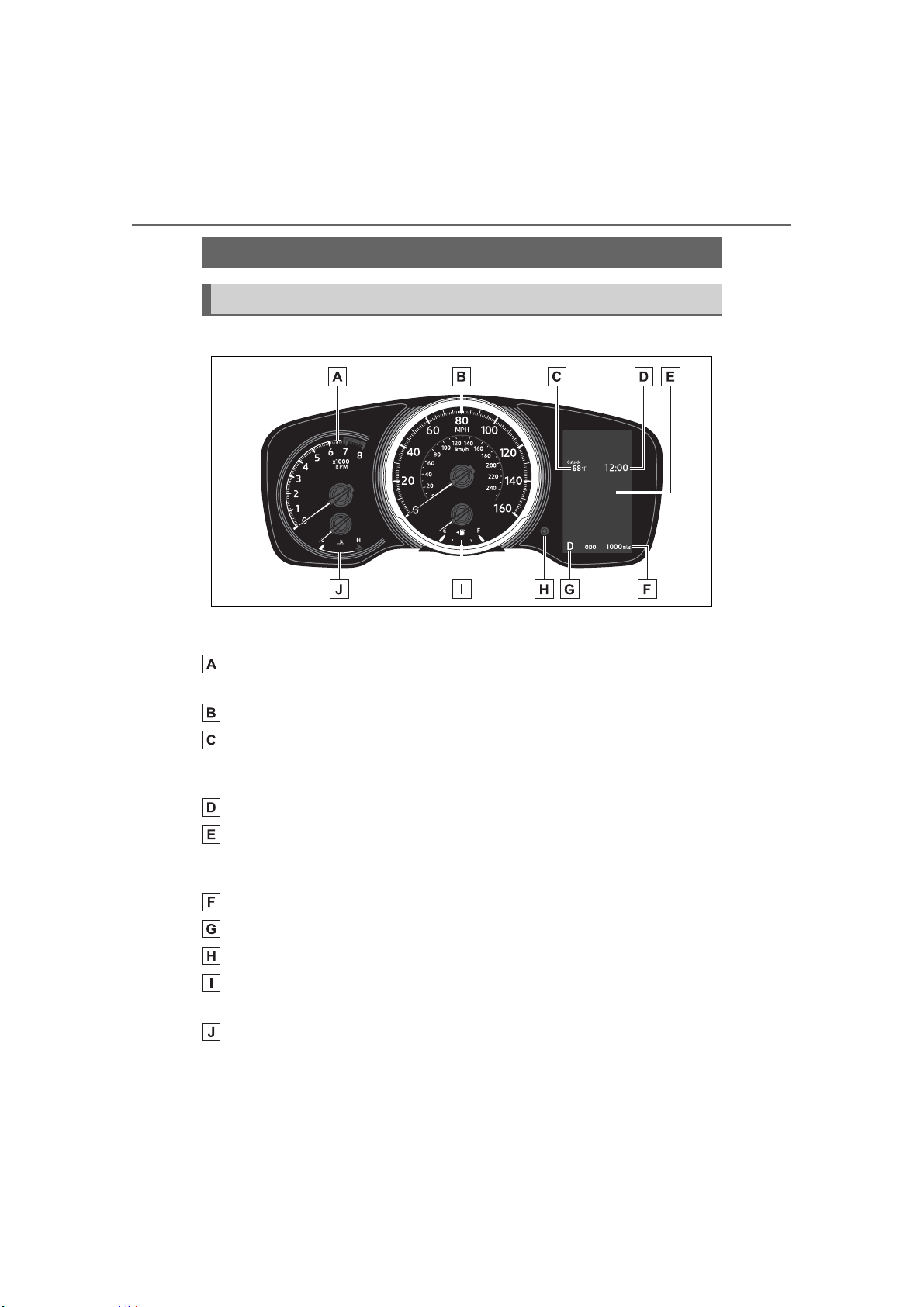
74
2-1. Instrument cluster
COROLLA H/B_U
■ Locations of gauges and meters
The units of measure may differ depending on the intended destination of
the vehicle.
Tachometer
Displays the engine speed in revolutions per minute
Speedometer
Outside temperature
Displays the outside temperature within the range of -40°F (-40°C) to 122°F
(50°C)
Clock (P. 76 )
Multi-information display
Presents the driver with a variety of vehicle data (P.82)
Displays warning messages if a malfunction occurs (P.477)
Odometer and trip meter display (P.75)
Shift position indicator (P.147)
Display change button (P.75)
Fuel gauge
Displays the quantity of fuel remaining in the tank
Engine coolant temperature gauge
Displays the engine coolant temperature
Gauges and meters (4.2-inch display)
Meter display
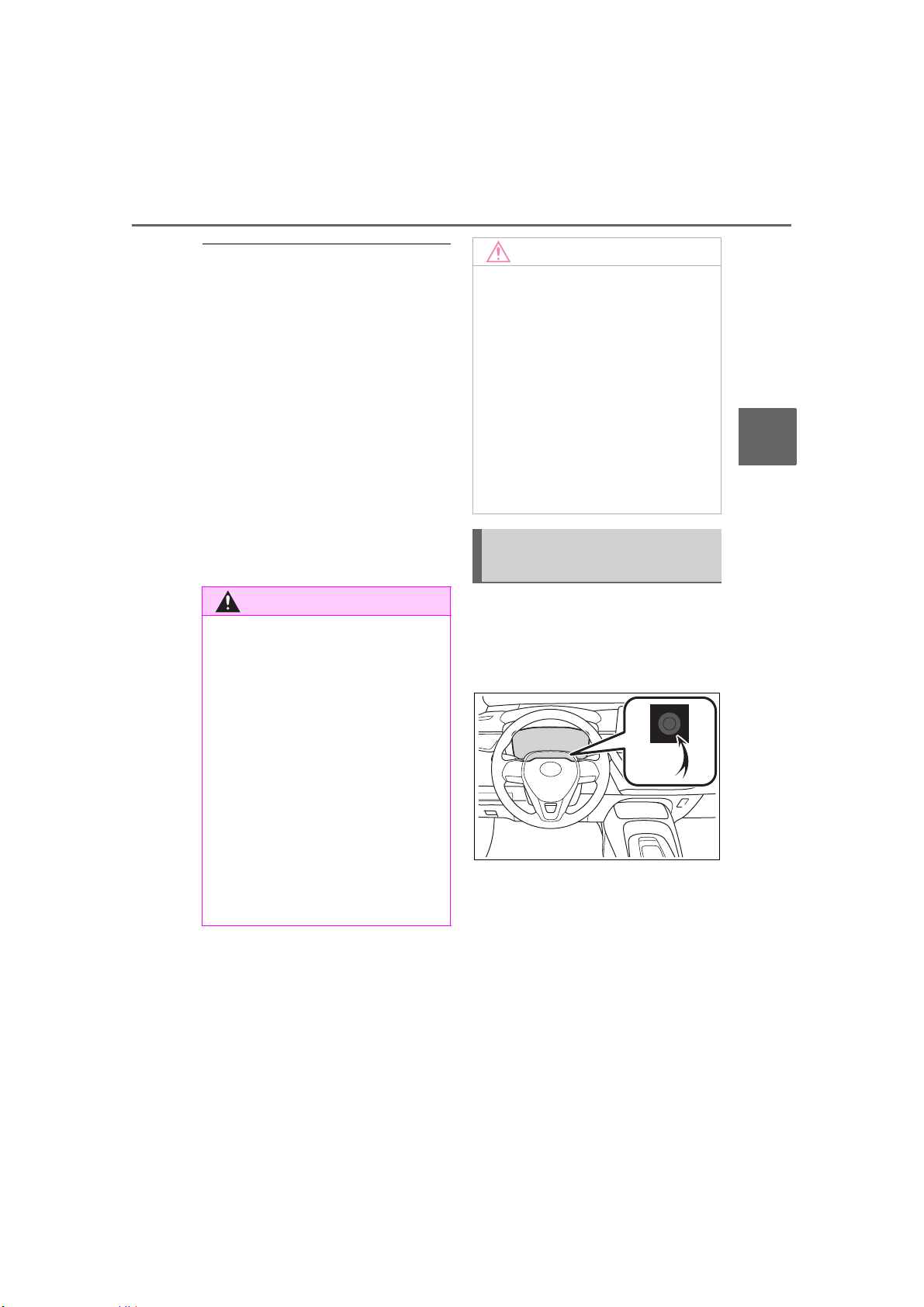
75
2-1. Instrument cluster
COROLLA H/B_U
2
Vehicle status information and indicators
■ Outside temperature display
● In the following situations, the cor-
rect outside temperature may not
be displayed, or the display may
take longer than normal to
change:
• When stopped, or driving at low
speeds (less than 16 mph [25
km/h])
• When the outside temperature
has changed suddenly (at the
entrance/exit of a garage, tunnel,
etc.)
● When “--” or “E” is displayed, the
system may be malfunctioning.
Take your vehicle to your Toyota
dealer.
■ Liquid crystal display
P. 83
■ Changing the display
Press the display change button
until the desired item is dis-
played.
■ Display items
Odometer
Displays the total distance the vehi-
cle has been driven.
Trip meter A/Trip meter B
Displays the distance the vehicle
has been driven since the meter
was last reset. Trip meters A and B
can be used to record and display
WARNING
■ The information display at
low temperatures
Allow the interior of the vehicle to
warm up before using the liquid
crystal information display. At
extremely low temperatures, the
information display monitor may
respond slowly, and display
changes may be delayed.
For example, there is a lag
between the driver’s shifting and
the new gear number appearing
on the display. This lag could
cause the driver to downshift
again, causing rapid and exces-
sive engine braking and possibly
an accident resulting in death or
injury.
NOTICE
■ To prevent damage to the
engine and its components
● Do not let the indicator needle
of the tachometer enter the red
zone, which indicates the maxi-
mum engine speed.
● The engine may be overheating
if the engine coolant tempera-
ture gauge is in the red zone
(H). In this case, immediately
stop the vehicle in a safe place,
and check the engine after it
has cooled completely.
(P.506)
Odometer and trip meter
display
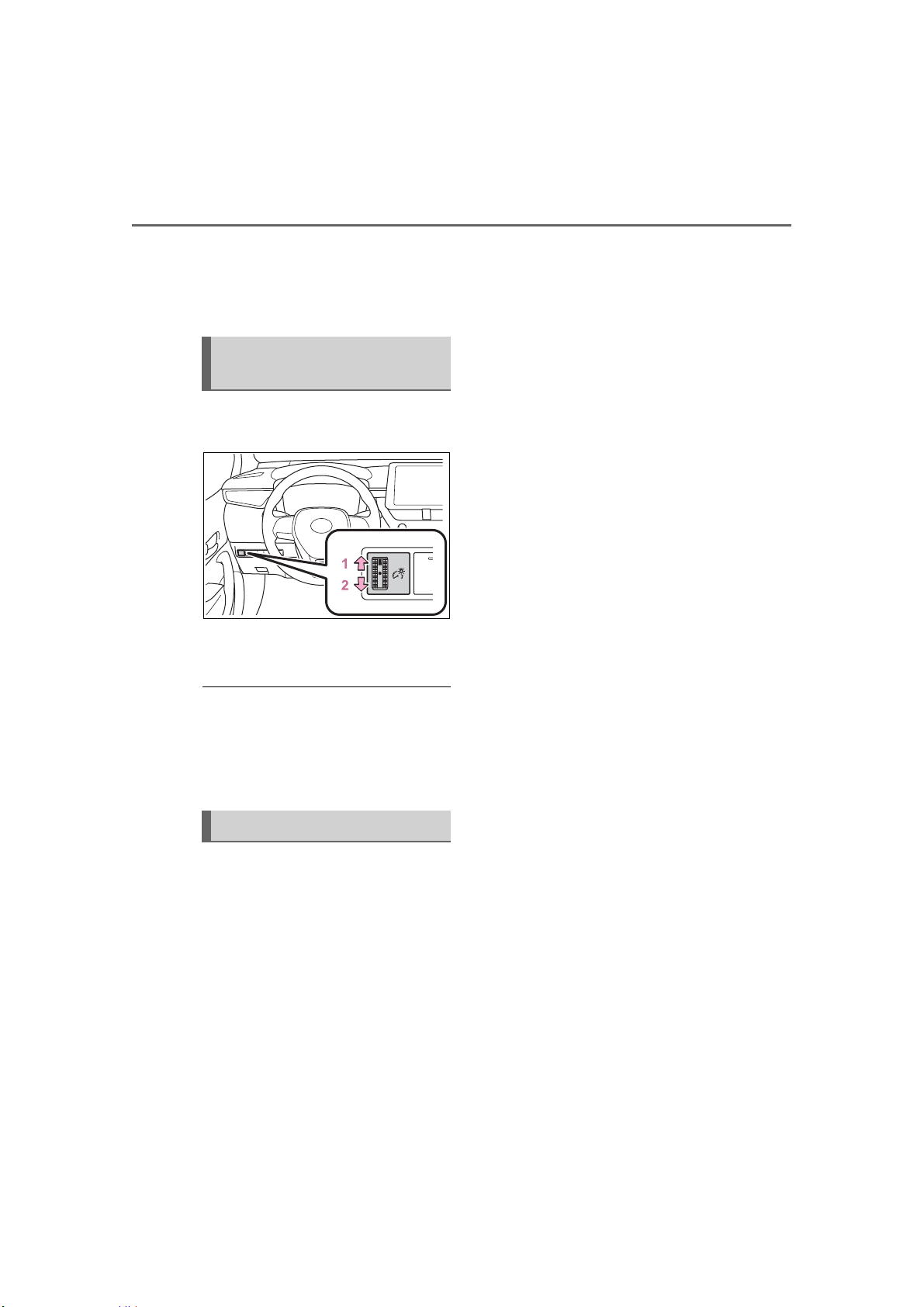
76
2-1. Instrument cluster
COROLLA H/B_U
different distances independently.
To reset, display the desired trip
meter and press and hold the dis-
play change button.
The brightness of the instrument
panel lights can be adjusted.
1 Brighter
2 Darker
■ Instrument panel light bright-
ness adjustment
The brightness of the instrument
panel lights can be adjusted sepa-
rately for when the tail lights are on
and off.
■ Clock adjustment
The clocks on the following can
be adjusted on the audio system
screen.
Multi-information display
Audio system screen
■ Setting the clock to be
adjusted automatically by
GPS
1 Press the “MENU” button.
2 Select “Setup” on the “Menu”
screen.
3 Select “General” on the
“Setup” screen.
4 Select “Clock”.
5 Select “Auto Adjust by GPS”
to set to on.
■ Adjusting the clock manu-
ally
1 Press the “MENU” button.
2 Select “Setup” on the “Menu”
screen.
3 Select “General” on the
“Setup” screen.
4 Select “Clock”.
5 Select “Auto Adjust by GPS”
to set to off.
6 Adjust the displayed time.
Hour: Select “-” or “+” of
“Hours” to adjust the hour.
Minute: Select “-” or “+” of
“Minutes” to adjust the min-
ute.
“:00”: Select to set the clock to
the beginning of the nearest
hour.
e.g.
1:00 to 1:29 1:00
1:30 to 1:59 2:00
■ Setting the time zone
1 Press the “MENU” button.
Changing the instrument
panel light brightness
Adjusting the clock

77
2-1. Instrument cluster
COROLLA H/B_U
2
Vehicle status information and indicators
2 Select “Setup” on the “Menu”
screen.
3 Select “General” on the
“Setup” screen.
4 Select “Clock”.
5 Select “Time Zone”.
Select the desired time zone.
Premium Audio only:
If “Auto” is selected, the time zone
is selected automatically by current
vehicle position.
■ Setting daylight saving time
1 Press the “MENU” button.
2 Select “Setup” on the “Menu”
screen.
3 Select “General” on the
“Setup” screen.
4 Select “Clock”.
5 Select “Daylight Saving
Time” then on/off/auto
*
.
*
: Premium Audio only
■ Changing the clock
between 12-hour/24-hour
format
1 Press the “MENU” button.
2 Select “Setup” on the “Menu”
screen.
3 Select “General” on the
“Setup” screen.
4 Select “Clock”.
5 Select “24-Hour Time For-
mat” and then on/off.
When set to off, the clock is dis-
played in 12 hour time format.
■ Clock settings screen
If “Clock : 00” is displayed when
is selected on the multi-information
display, the system may be malfunc-
tioning. Have the vehicle inspected
by your Toyota dealer.
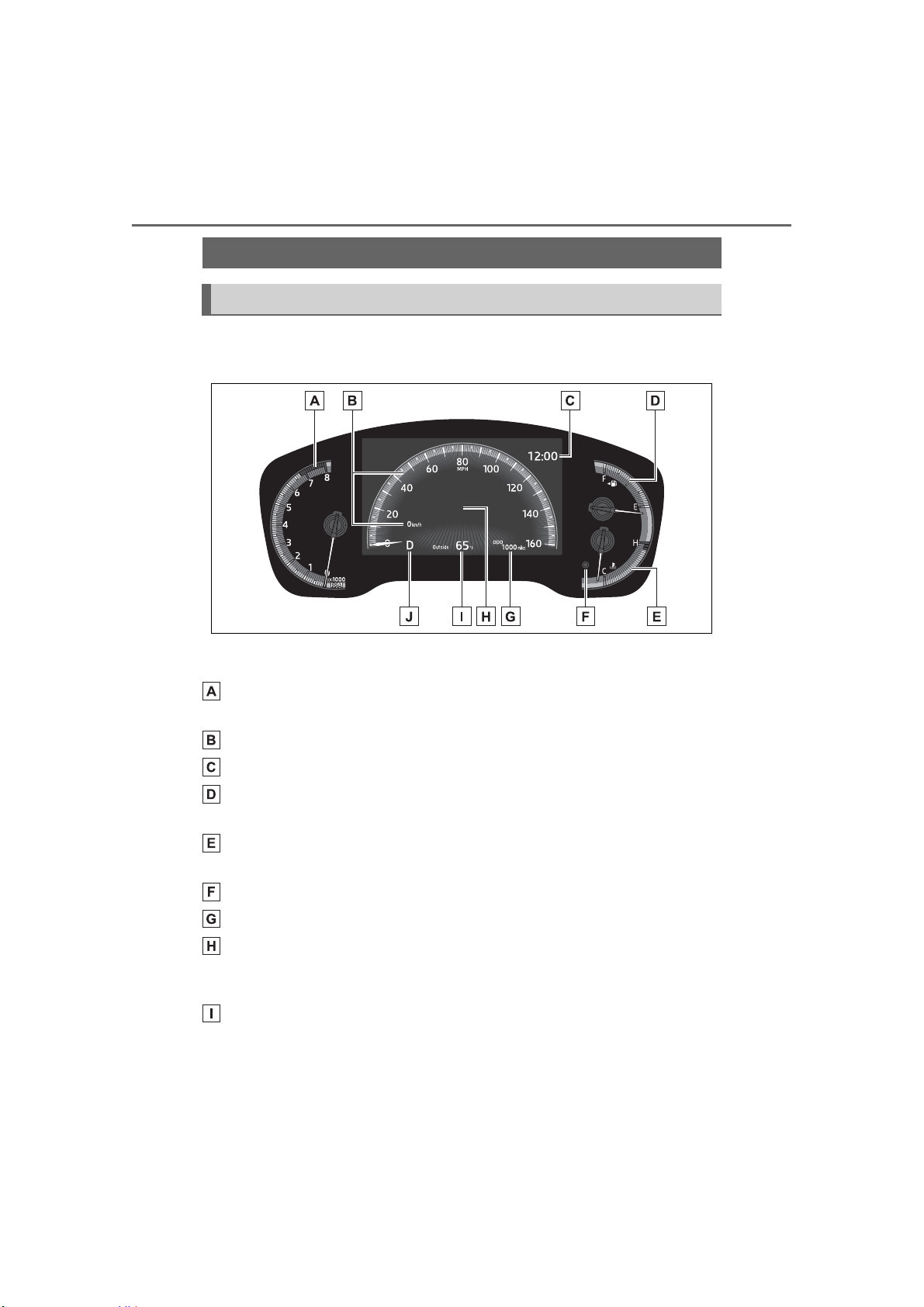
78
2-1. Instrument cluster
COROLLA H/B_U
■ Locations of gauges and meters
Analog speedometer
The units of measure may differ depending on the intended destination of
the vehicle.
Tachometer
Displays the engine speed in revolutions per minute
Speedometer
Clock (P. 81 )
Fuel gauge
Displays the quantity of fuel remaining in the tank
Engine coolant temperature gauge
Displays the engine coolant temperature
Display change button (P.80)
Odometer and trip meter display (P.80)
Multi-information display
Presents the driver with a variety of vehicle data (P.82)
Displays warning messages if a malfunction occurs (P.477)
Outside temperature
Displays the outside temperature within the range of -40°F (-40°C) to 122°F
(50°C)
Gauges and meters (7-inch display)
Meter display
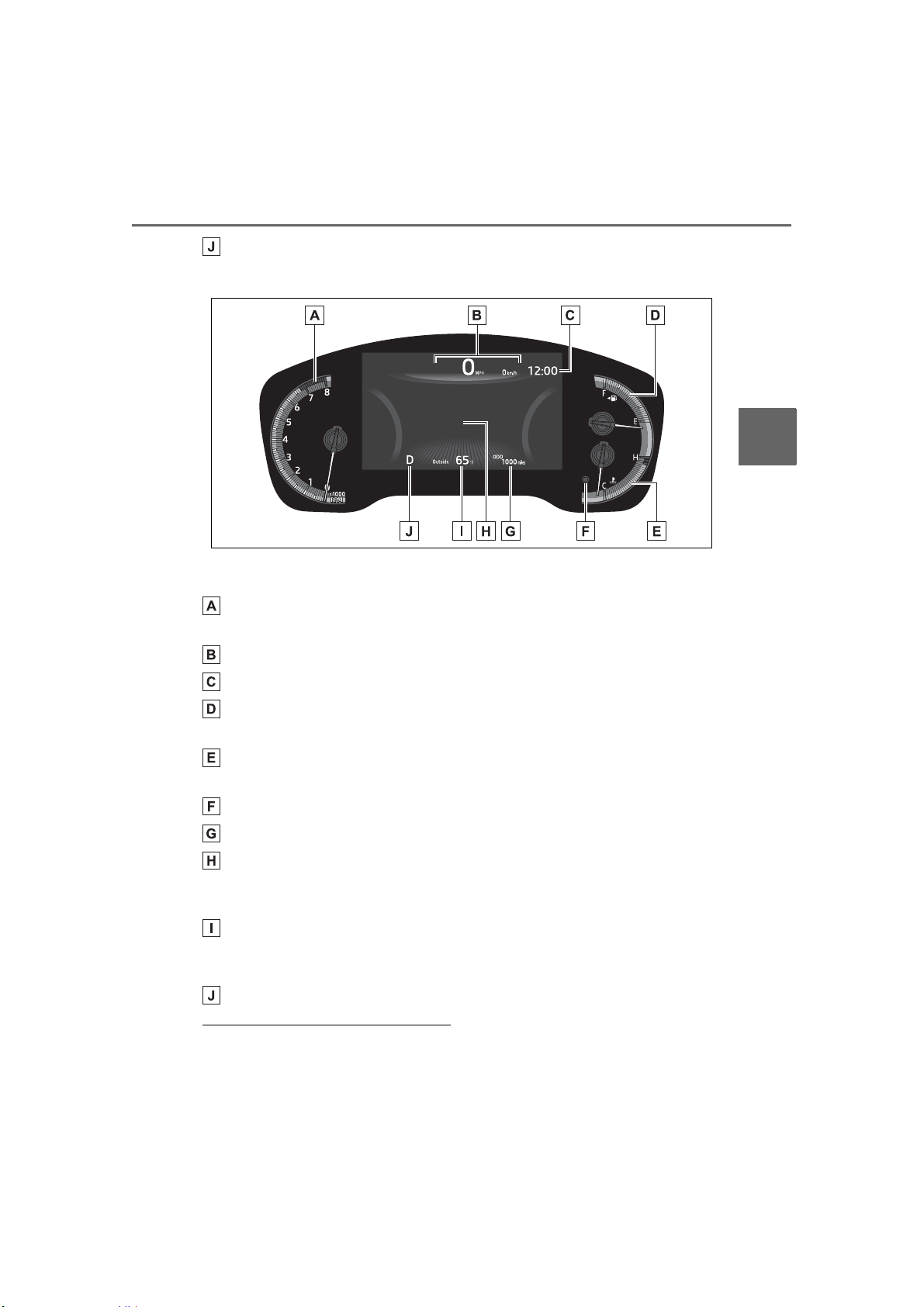
79
2-1. Instrument cluster
COROLLA H/B_U
2
Vehicle status information and indicators
Shift position indicator (P.147)
Digital speedometer
The units of measure may differ depending on the intended destination of
the vehicle.
Tachometer
Displays the engine speed in revolutions per minute
Speedometer
Clock (P. 81 )
Fuel gauge
Displays the quantity of fuel remaining in the tank
Engine coolant temperature gauge
Displays the engine coolant temperature
Display change button (P.80)
Odometer and trip meter display (P.80)
Multi-information display
Presents the driver with a variety of vehicle data (P.82)
Displays warning messages if a malfunction occurs (P.477)
Outside temperature
Displays the outside temperature within the range of -40°F (-40°C) to 122°F
(50°C)
Shift position indicator (P.147)
■ Outside temperature display
● In the following situations, the cor-
rect outside temperature may not
be displayed, or the display may
take longer than normal to
change:
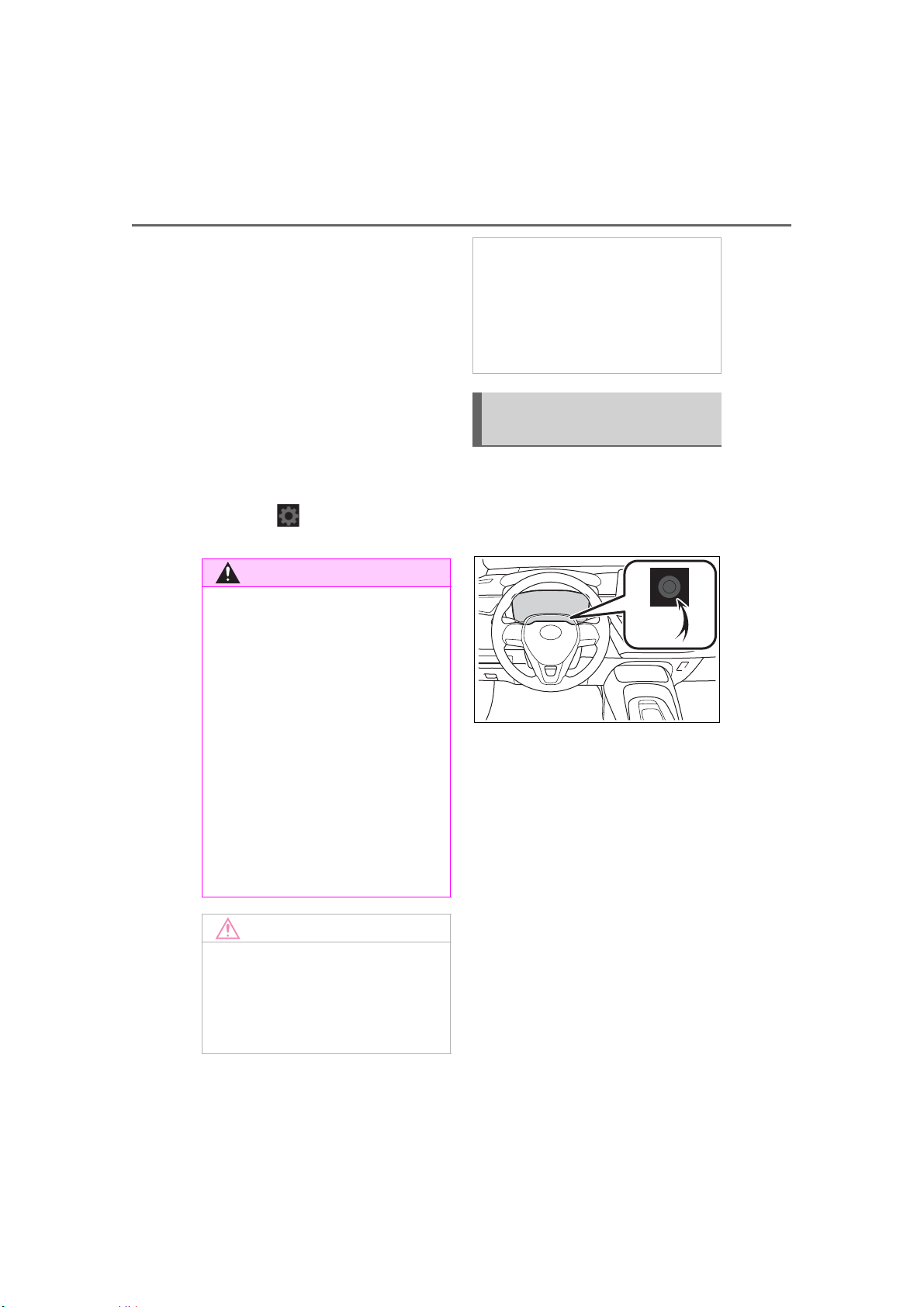
80
2-1. Instrument cluster
COROLLA H/B_U
• When stopped, or driving at low
speeds (less than 16 mph [25
km/h])
• When the outside temperature
has changed suddenly (at the
entrance/exit of a garage, tunnel,
etc.)
● When “--” or “E” is displayed, the
system may be malfunctioning.
Take your vehicle to your Toyota
dealer.
■ Liquid crystal display
P. 83
■ Customization
The gauges and meters can be cus-
tomized in of the multi-informa-
tion display. (P.87 )
■ Changing the display
Press the display change button
until the desired item is dis-
played.
■ Display items
Odometer
Displays the total distance the vehi-
cle has been driven.
Trip meter A/Trip meter B
Displays the distance the vehicle
has been driven since the meter
was last reset. Trip meters A and B
can be used to record and display
different distances independently.
To reset, display the desired trip
meter and press and hold the dis-
play change button.
WARNING
■ The information display at
low temperatures
Allow the interior of the vehicle to
warm up before using the liquid
crystal information display. At
extremely low temperatures, the
information display monitor may
respond slowly, and display
changes may be delayed.
For example, there is a lag
between the driver’s shifting and
the new gear number appearing
on the display. This lag could
cause the driver to downshift
again, causing rapid and exces-
sive engine braking and possibly
an accident resulting in death or
injury.
NOTICE
■ To prevent damage to the
engine and its components
● Do not let the indicator needle
of the tachometer enter the red
zone, which indicates the maxi-
mum engine speed.
● The engine may be overheating
if the engine coolant tempera-
ture gauge is in the red zone
(H). In this case, immediately
stop the vehicle in a safe place,
and check the engine after it
has cooled completely.
(P.506)
Odometer and trip meter
display
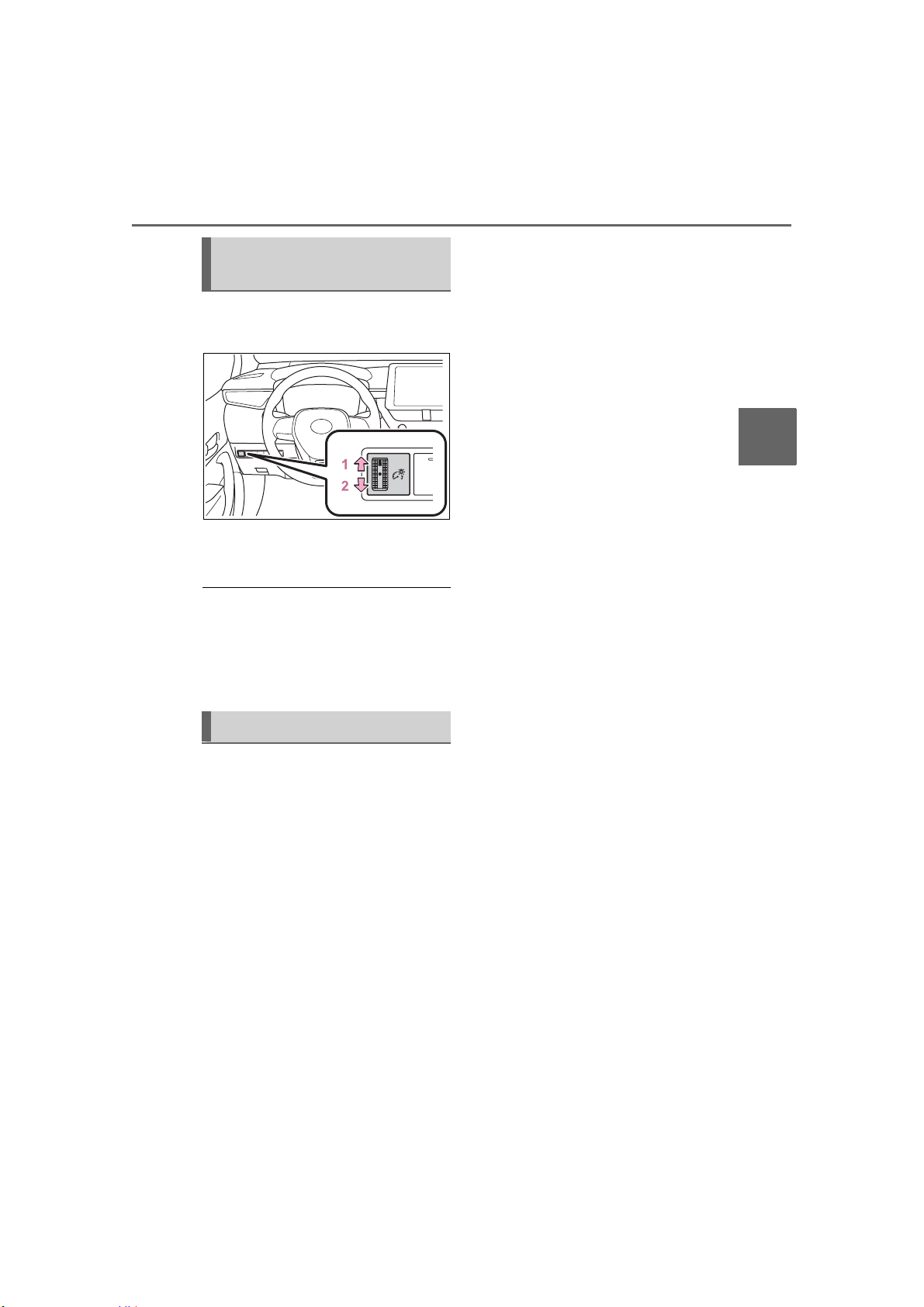
81
2-1. Instrument cluster
COROLLA H/B_U
2
Vehicle status information and indicators
The brightness of the instrument
panel lights can be adjusted.
1 Brighter
2 Darker
■ Instrument panel light bright-
ness adjustment
The brightness of the instrument
panel lights can be adjusted sepa-
rately for when the tail lights are on
and off.
■ Clock adjustment
The clocks on the following can
be adjusted on the audio system
screen.
Multi-information display
Audio system screen
■ Setting the clock to be
adjusted automatically by
GPS
1 Press the “MENU” button.
2 Select “Setup” on the “Menu”
screen.
3 Select “General” on the
“Setup” screen.
4 Select “Clock”.
5 Select “Auto Adjust by GPS”
to set to on.
■ Adjusting the clock manu-
ally
1 Press the “MENU” button.
2 Select “Setup” on the “Menu”
screen.
3 Select “General” on the
“Setup” screen.
4 Select “Clock”.
5 Select “Auto Adjust by GPS”
to set to off.
6 Adjust the displayed time.
Hour: Select “-” or “+” of
“Hours” to adjust the hour.
Minute: Select “-” or “+” of
“Minutes” to adjust the min-
ute.
“:00”: Select to set the clock to
the beginning of the nearest
hour.
e.g.
1:00 to 1:29 1:00
1:30 to 1:59 2:00
■ Setting the time zone
1 Press the “MENU” button.
2 Select “Setup” on the “Menu”
screen.
3 Select “General” on the
“Setup” screen.
4 Select “Clock”.
Changing the instrument
panel light brightness
Adjusting the clock
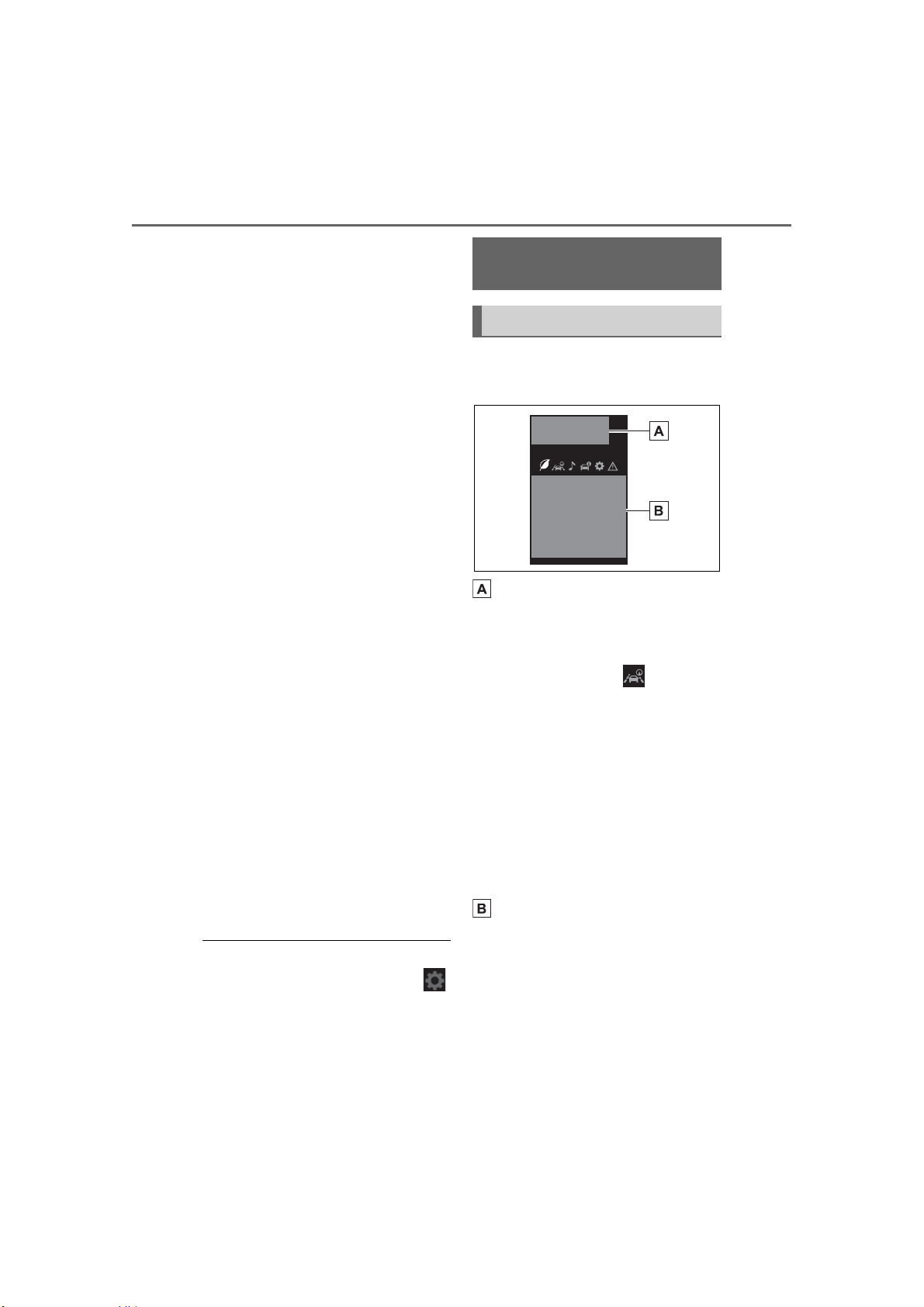
82
2-1. Instrument cluster
COROLLA H/B_U
5 Select “Time Zone”.
Select the desired time zone.
Premium Audio only:
If “Auto” is selected, the time zone
is selected automatically by current
vehicle position.
■ Setting daylight saving time
1 Press the “MENU” button.
2 Select “Setup” on the “Menu”
screen.
3 Select “General” on the
“Setup” screen.
4 Select “Clock”.
5 Select “Daylight Saving
Time” then on/off/auto
*
.
*
: Premium Audio only
■ Changing the clock
between 12-hour/24-hour
format
1 Press the “MENU” button.
2 Select “Setup” on the “Menu”
screen.
3 Select “General” on the
“Setup” screen.
4 Select “Clock”.
5 Select “24-Hour Time For-
mat” and then on/off.
When set to off, the clock is dis-
played in 12 hour time format.
■ Clock settings screen
If “Clock : 00” is displayed when
is selected on the multi-information
display, the system may be malfunc-
tioning. Have the vehicle inspected
by your Toyota dealer.
■ Display
4.2-inch display
Driving assist system status
display area
Displays an image when the follow-
ing systems are operating and a
menu icon other than is
selected:
• LTA (Lane Tracing Assist) (if
equipped)
• LDA (Lane Departure Alert with
steering control) (if equipped)
• Dynamic radar cruise control (if
equipped)
• Dynamic radar cruise control with
full-speed range (if equipped)
• RSA (Road Sign Assist) (if
equipped) (P.224)
Content display area
By selecting menu icons on the
multi-information display, a variety
of driving-related information can
be displayed. The multi-information
display can also be used to change
display settings and other vehicle
settings.
Warning or advice pop-up displays
Multi-information dis-
play
Display and menu icons
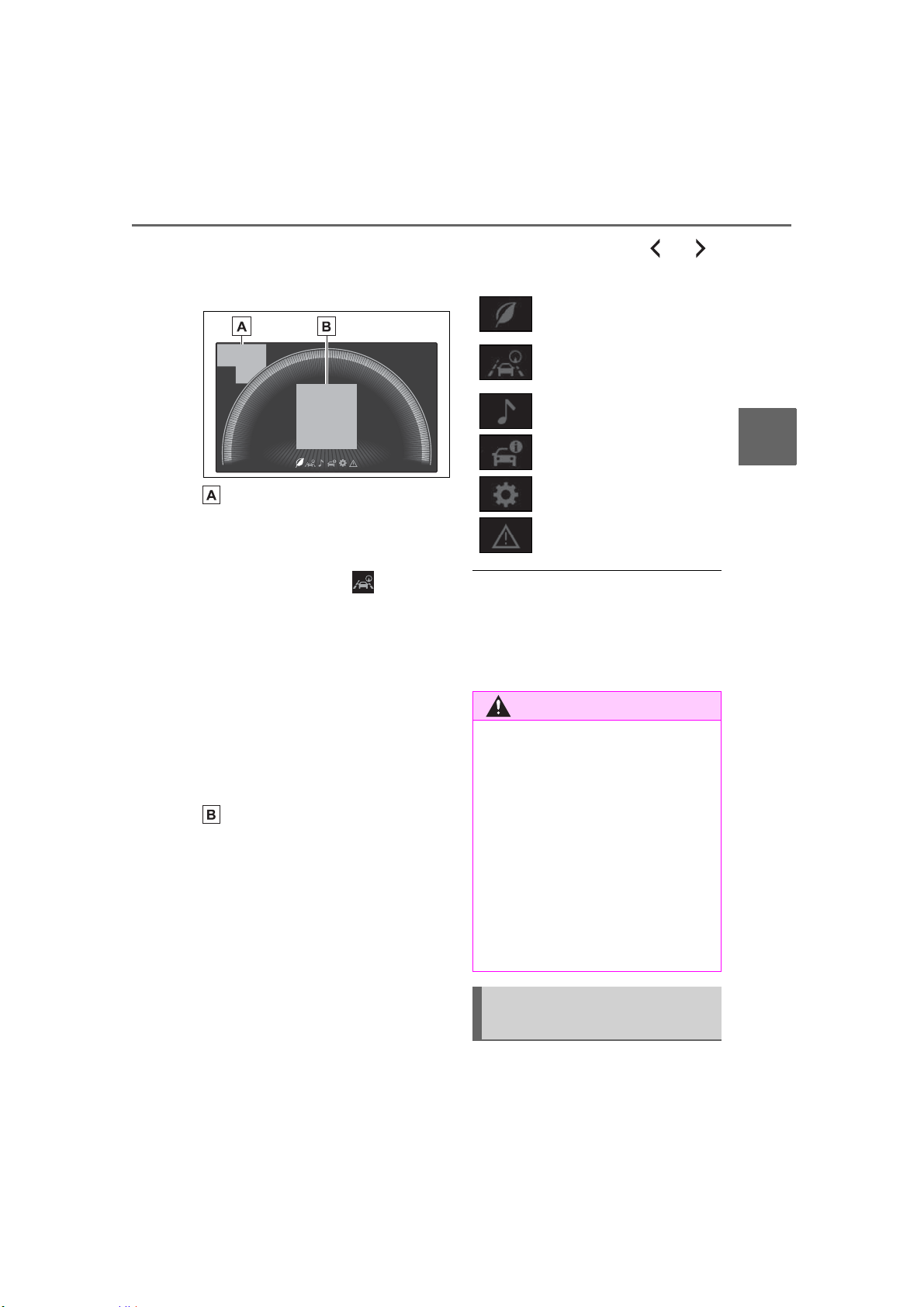
83
2-1. Instrument cluster
COROLLA H/B_U
2
Vehicle status information and indicators
are also displayed in certain situa-
tions.
7-inch display
Driving assist system status
display area
Displays an image when the follow-
ing systems are operating and a
menu icon other than is
selected:
• LTA (Lane Tracing Assist) (if
equipped)
• LDA (Lane Departure Alert with
steering control) (if equipped)
• Dynamic radar cruise control (if
equipped)
• Dynamic radar cruise control with
full-speed range (if equipped)
• RSA (Road Sign Assist) (if
equipped) (P.224)
Content display area
By selecting menu icons on the
multi-information display, a variety
of driving-related information can
be displayed. The multi-information
display can also be used to change
display settings and other vehicle
settings.
Warning or advice pop-up displays
are also displayed in certain situa-
tions.
■ Menu icons
The menu icons will be dis-
played by pressing the or
meter control switch.
■ Liquid crystal display
Small spots or light spots may
appear on the display. This phenom-
enon is characteristic of liquid crys-
tal displays, and there is no problem
continuing to use the display.
The multi-information display is
Driving information display
(P. 84 )
Driving support system
information display
(P. 86 )
Audio system-linked dis-
play (P. 86)
Vehicle information dis-
play (P. 86)
Settings display (P.87)
Warning message display
(P.477)
WARNING
■ Caution for use while driving
● When operating the multi-infor-
mation display while driving,
pay extra attention to the safety
of the area around the vehicle.
● Do not look continuously at the
multi-information display while
driving as you may fail to see
pedestrians, objects on the
road, etc. ahead of the vehicle.
■ The information display at
low temperatures
P.75, 80
Changing the meter dis-
play
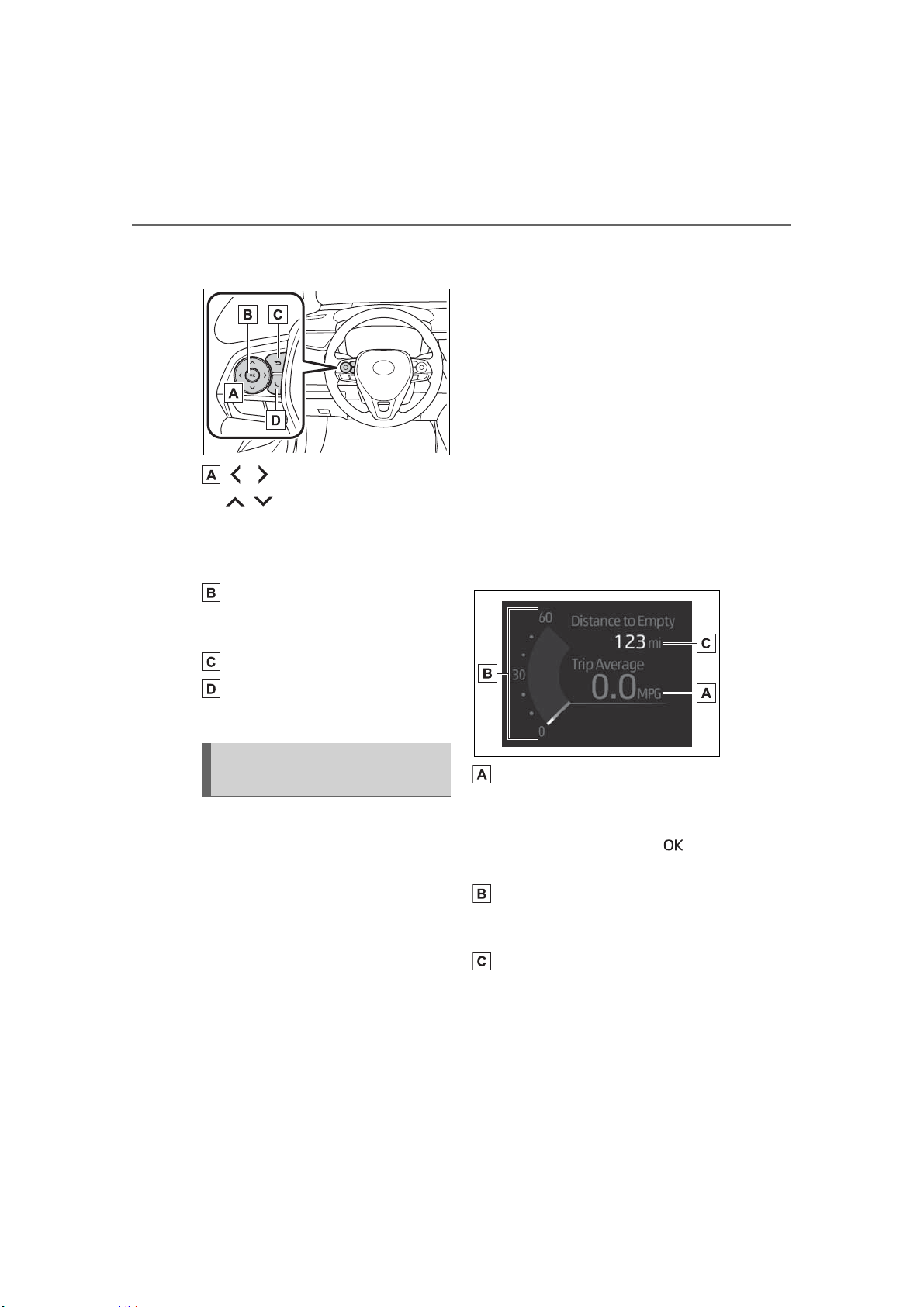
84
2-1. Instrument cluster
COROLLA H/B_U
operated using the meter control
switches.
/ : Select menu icons
/ : Change displayed
content, scroll up/down the
screen and move the cursor
up/down
Press: Enter/Set
Press and hold: Reset/Dis-
play customizable items
Return to the previous screen
Call sending/receiving and
history display
■ Display items
Speedometer display/Driving
range (4.2-inch display)
Fuel economy
Eco Driving Indicator/Driving
range (if equipped)
■ Speedometer display/Driv-
ing range (4.2-inch display)
Speedometer display
Driving range
Displays driving range with remain-
ing fuel. Use the displayed values
as a reference only.
This distance is computed based
on your average fuel consumption.
As a result, the actual distance that
can be driven may differ from that
displayed.
When only a small amount of fuel is
added to the tank, the display may
not be updated.
When refueling, turn the engine
switch off. If the vehicle is refueled
without turning the engine switch
off, the display may not be updated.
■ Fuel economy
Use the displayed values as a ref-
erence only.
Average fuel economy (after
reset)
To reset the average fuel economy
display, press and hold the
meter control switch.
Current fuel consumption
Displays instantaneous current fuel
consumption.
Driving range
Displays driving range with remain-
ing fuel.
This distance is computed based
on your average fuel consumption.
As a result, the actual distance that
Content of driving infor-
mation
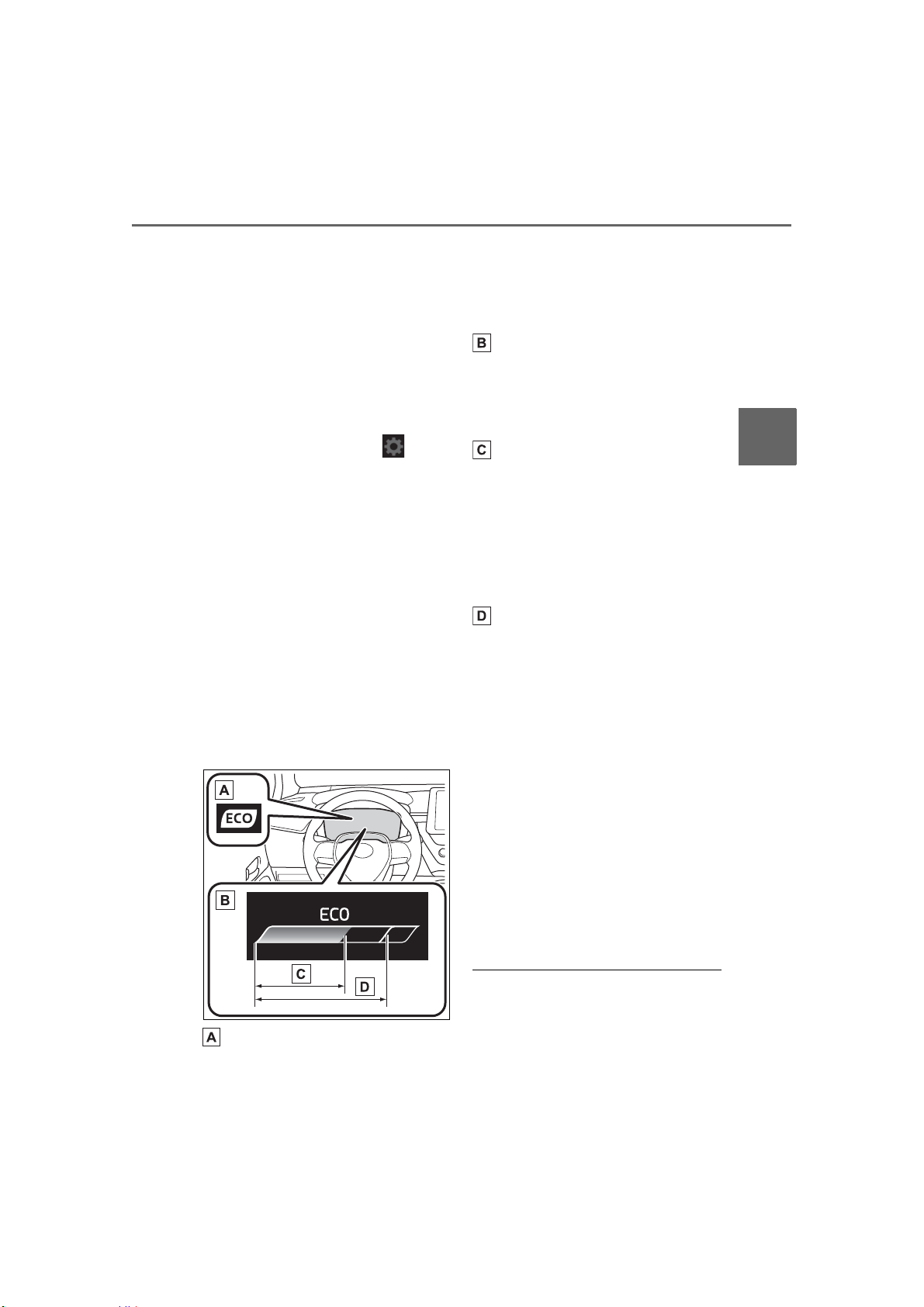
85
2-1. Instrument cluster
COROLLA H/B_U
2
Vehicle status information and indicators
can be driven may differ from that
displayed.
When only a small amount of fuel is
added to the tank, the display may
not be updated.
When refueling, turn the engine
switch off. If the vehicle is refueled
without turning the engine switch
off, the display may not be updated.
The average fuel economy dis-
play can be changed in .
(P.87)
Average fuel economy (after
start)
Displays the average fuel con-
sumption since engine start.
Average fuel economy (after
refuel)
Displays the average fuel con-
sumption since the vehicle was
refueled.
■ Eco Driving Indicator/Driv-
ing range (if equipped)
Eco Driving Indicator
Eco Driving Indicator Light
During Eco-friendly acceleration
(Eco driving), the Eco Driving Indi-
cator Light will turn on. When the
acceleration exceeds the Zone of
Eco driving, or when the vehicle is
stopped, the light turns off.
Eco Driving Indicator Zone
Display
Suggests the Zone of Eco driving
with current Eco driving ratio based
on acceleration.
Eco driving ratio based on
acceleration
If the acceleration exceeds the
Zone of Eco driving, the right side
of the Eco Driving Indicator Zone
Display will illuminate.
At this time, the Eco Driving Indica-
tor Light will turn off.
Zone of Eco driving
Driving range
Displays driving range with remain-
ing fuel. Use the displayed values
as a reference only.
This distance is computed based
on your average fuel consumption.
As a result, the actual distance that
can be driven may differ from that
displayed.
When only a small amount of fuel is
added to the tank, the display may
not be updated.
When refueling, turn the engine
switch off. If the vehicle is refueled
without turning the engine switch
off, the display may not be updated.
■ Eco Driving Indicator
Eco Driving Indicator will not oper-
ate under the following conditions:
● The shift lever is in any position
other than D.
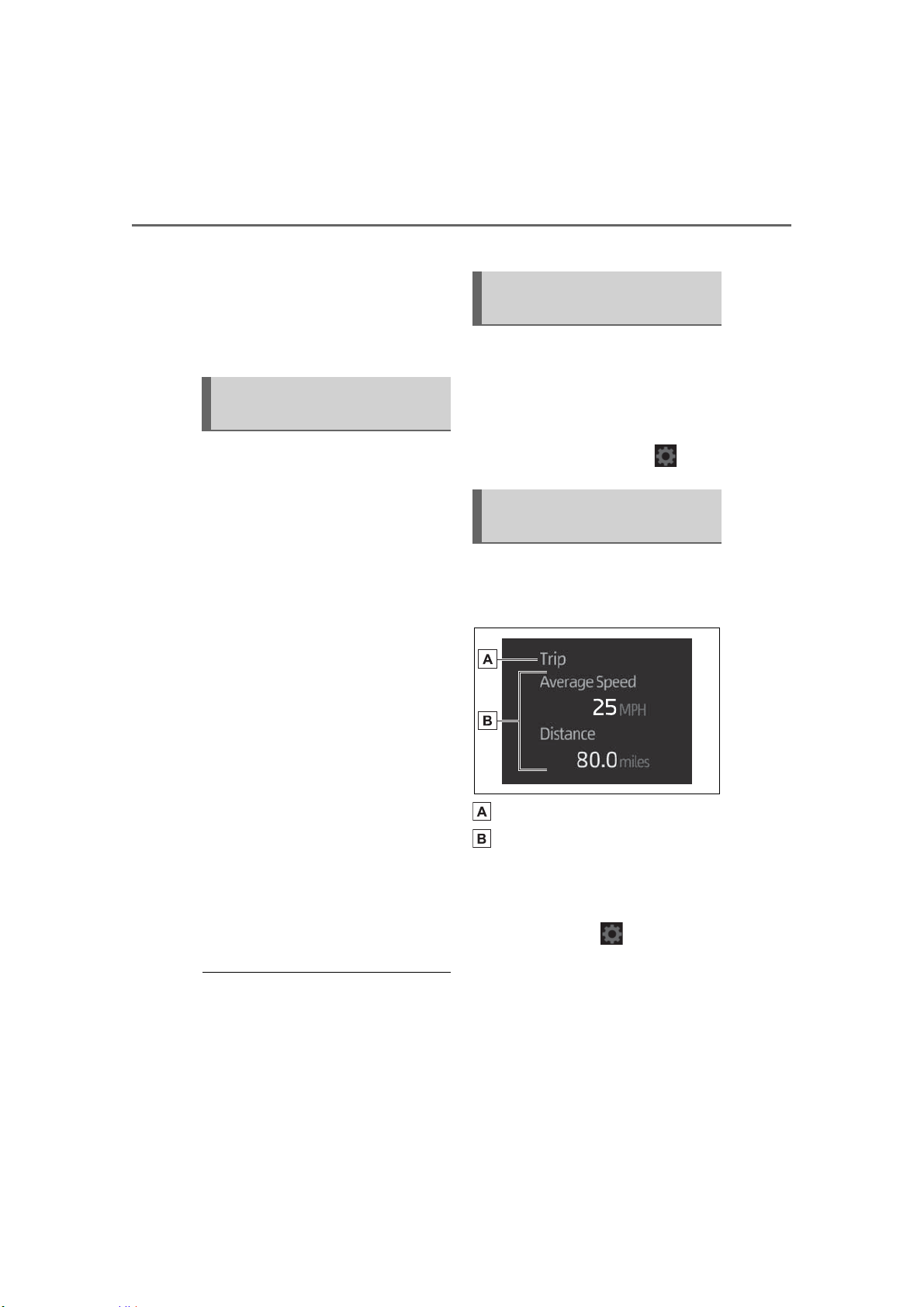
86
2-1. Instrument cluster
COROLLA H/B_U
● A paddle shift switch is operated.
(If equipped)
● The driving mode is set to sport
mode.
● The vehicle speed is approxi-
mately 80 mph (130 km/h) or
higher.
■ Driving support system
information
Select to display the operational
status of the following systems:
LTA (Lane Tracing Assist) (if
equipped) (P.186)
LDA (Lane Departure Alert
with steering control) (if
equipped) (P.196)
Dynamic radar cruise control
(if equipped) (P.214)
Dynamic radar cruise control
with full-speed range (if
equipped) (P.204)
■ Navigation system-linked
display (if equipped)
Select to display the following
navigation system-linked infor-
mation:
Route guidance to destination
Compass display (head-
ing-up display)
■ Route guidance to destination
display
When the route guidance to destina-
tion display is enabled on the
head-up display, it will not be dis-
played on the multi-information dis-
play. (P. 9 0 )
Select to enable selection of an
audio source or track on the
meter using the meter control
switches.
This menu icon can be set to be
displayed/not displayed in .
■ Drive information
Displays drive information such as
the following:
Drive information type
Drive information items
Displays the following depend-
ing on which drive information
type and drive information items
were selected in . (P.87)
After start
• Distance: Displays the distance
driven since engine start
• Elapsed time: Displays the
elapsed time since engine start
Driving support system
information display
Audio system-linked dis-
play
Vehicle information dis-
play
87
2-1. Instrument cluster
COROLLA H/B_U
2
Vehicle status information and indicators
• Average vehicle speed: Displays
the average vehicle speed since
engine start
After reset
• Distance: Displays the distance
driven since the display was
reset
*
• Elapsed time: Displays the
elapsed time since the display
was reset
*
• Average vehicle speed: Displays
the average vehicle speed since
the display was reset
*
*
: To reset, display the desired item
and press and hold the
meter control switch.
■ Meter display settings that
can be changed
Language
Select to change the language dis-
played.
Units
Select to change the units of mea-
sure displayed.
Speedometer display (7-inch
display)
Select to set the display of the
speedometer to analog/digital.
Eco Driving Indicator Light (if
equipped)
Select to enable/disable the Eco
Driving Indicator Light.
• Fuel economy display
Select to change the average fuel
consumption display between after
start/after reset. (P. 8 4 )
Select to display/not display the
audio system linked display.
Select to change the displayed con-
tent of the following:
• Drive information type
Select to change the drive informa-
tion type display between after
start/after reset.
• Drive information items
Select to set the first and second
items of the drive information dis-
play to any of the following: aver-
age vehicle
speed/distance/elapsed time.
Pop-up display
Select to enable/disable pop-up
displays for each relevant system.
Multi-information display off
Select to turn the multi-information
display off.
To turn the multi-information display
on again, press any of the following
meter control switches
//// /.
Default setting
Select to reset the meter display
settings to the default setting.
■ Vehicle functions and set-
tings that can be changed
P.531
Settings display
88
2-1. Instrument cluster
COROLLA H/B_U
■ Suspension of the settings dis-
play
● Some settings cannot be changed
while driving. When changing set-
tings, park the vehicle in a safe
place.
● If a warning message is displayed,
operation of the settings display
will be suspended.
WARNING
■ Cautions during setting up
the display
If the engine is running when
changing the display settings,
ensure that the vehicle is parked
in a place with adequate ventila-
tion. In a closed area such as a
garage, exhaust gases including
harmful carbon monoxide (CO)
may collect and enter the vehicle.
This may lead to death or a seri-
ous health hazard.
NOTICE
■ During setting up the display
To prevent battery discharge,
ensure that the engine is running
while setting up the display fea-
tures.
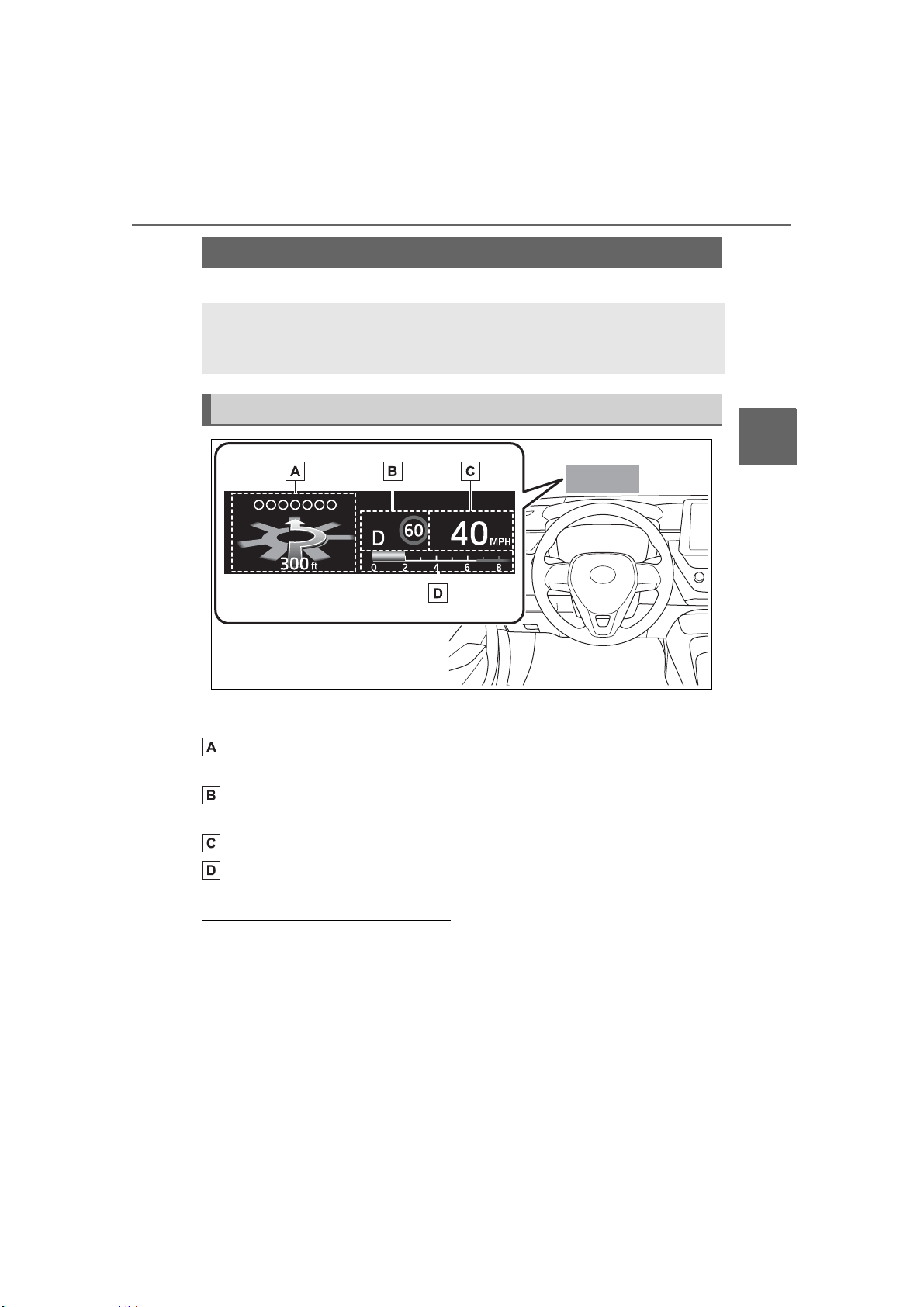
89
2-1. Instrument cluster
COROLLA H/B_U
2
Vehicle status information and indicators
*
: If equipped
Illustrations used in this text are intended as examples, and may differ from
the image that is actually displayed by the head-up display.
Driving assist system status/navigation system-linked display
area (if equipped) (P.9 1)
Shift position display (continuously variable transmission)/RSA
(Road Sign Assist) display area (if equipped) (P.147, 224)
Vehicle speed display
Tachometer/Eco Driving Indicator (if equipped)/Outside tempera-
ture display area (P.92)
■ Head-up display will operate
when
The engine switch is in ON.
■ When using the head-up dis-
play
The head-up display may seem
dark or hard to see when viewed
through sunglasses, especially
polarized sunglasses. Adjust the
brightness of the head-up display or
remove your sunglasses.
■ Street name display (vehicles
with a navigation system)
Only street names which are
included in the map data will be dis-
played.
Head-up display
*
The head-up display projects a variety of driving-related infor-
mation and the operating state of the driving support systems
on the windshield.
System components

90
2-1. Instrument cluster
COROLLA H/B_U
Select on the multi-informa-
tion display (P.87) and then
“HUD Main”.
■ Enabling/disabling the
head-up display
Press the meter control
switch to enable/disable the
head-up display.
■ Changing the head-up dis-
play settings
Press and hold the meter
control switch to change the fol-
lowing settings:
Brightness and vertical posi-
tion of the head-up display
Select to adjust the brightness or
vertical position of the head-up dis-
play.
Display content
Select to change the display
between the following:
• No content
• Eco Driving Indicator (if
equipped)
• Tachometer
Select to enable/disable the follow-
ing items:
• Route guidance to destination (if
equipped)
• Driving support system display
• Compass (heading-up display) (if
equipped)
• Audio system operation status (if
equipped)
WARNING
■ When using the head-up dis-
play
● Check that the position and
brightness of the head-up dis-
play image does not interfere
with safe driving. Incorrect
adjustment of the image’s posi-
tion or brightness may obstruct
the driver’s view and lead to an
accident, resulting in death or
serious injury.
● Do not continuously look at the
head-up display while driving as
you may fail to see pedestrians,
objects on the road, etc. ahead
of the vehicle.
NOTICE
■ Head-up display projector
● Do not place any drinks near
the head-up display projector. If
the projector gets wet, electrical
malfunctions may result.
● Do not place anything on or put
stickers onto the head-up dis-
play projector.
Doing so could interrupt
head-up display indications.
● Do not touch the inside of the
head-up display projector or
thrust sharp edges or the like
into the projector.
Doing so could cause mechani-
cal malfunctions.
Using the head-up display
91
2-1. Instrument cluster
COROLLA H/B_U
2
Vehicle status information and indicators
Display angle
Select to adjust the angle of the
head-up display.
■ Enabling/disabling of the
head-up display
If the head-up display is disabled, it
will remain disabled when the
engine switch is turned off then back
to ON.
■ Display brightness
The brightness of the head-up dis-
play can be adjusted on of the
multi-information display. Also, it is
automatically adjusted according to
the ambient brightness.
■ Driving assist system sta-
tus display
Displays the operational status
of the following systems:
Dynamic radar cruise control
with full-speed range (if
equipped) (P.204)
Dynamic radar cruise control
(if equipped) (P.214)
LTA (Lane Tracing Assist) (if
equipped) (P.186)
LDA (Lane Departure Alert
with steering control) (if
equipped) (P.196)
Details of content displayed on the
head-up display may differ from
that displayed on the multi-informa-
tion display. For details, refer to the
explanation of each system.
■ Navigation system-linked
display area (if equipped)
Displays the following items
which are linked to the naviga-
tion system:
Street name
Route guidance to destination
Compass (heading-up dis-
play)
Pop-up displays for the following
WARNING
■ Caution for changing settings
of the head-up display
If the engine is running when
changing the display
settings, ensure that the vehicle
is parked in a place with adequate
ventilation. In a closed area such
as a garage, exhaust gases
including harmful carbon monox-
ide (CO) may collect and enter
the vehicle. This may lead to
death or a serious health hazard.
NOTICE
■ When changing the settings
of the head-up display
To prevent battery discharge,
ensure that the engine is running
while changing the settings of the
head-up display.
Driving assist system sta-
tus/navigation sys-
tem-linked display area (if
equipped)
Pop-up display
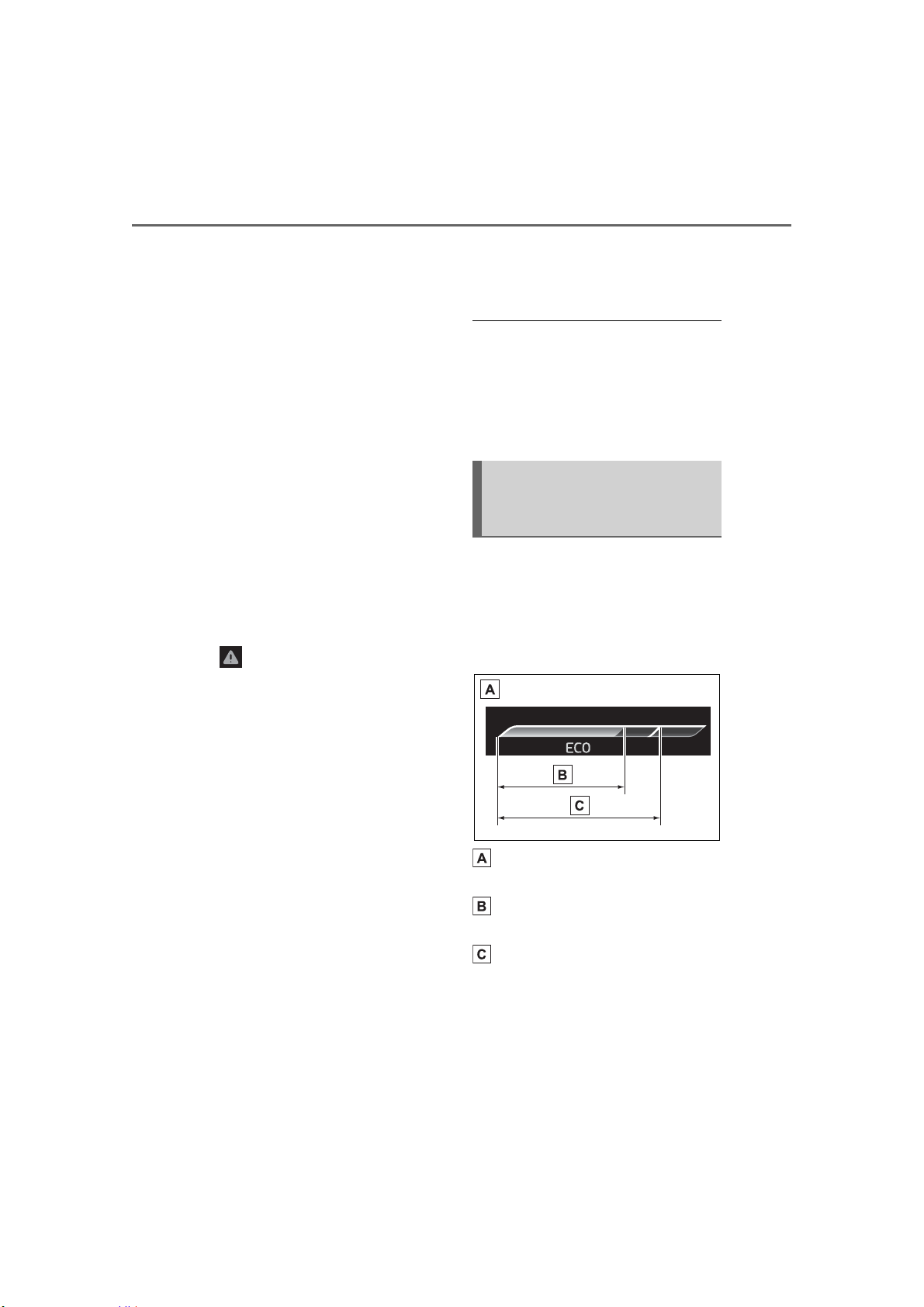
92
2-1. Instrument cluster
COROLLA H/B_U
systems will be displayed when
necessary:
■ Driving support systems
Displays a warning/sugges-
tion/advice message or the
operating state of a relevant
system.
PCS (Pre-Collision System)
(P.178)
Brake Override System
(P.131)
Drive-Start Control (if
equipped) (P.132)
Details of content displayed on the
head-up display may differ from
that displayed on the multi-informa-
tion display. For details, refer to the
explanation of each system.
■ icon
Displayed when a warning mes-
sage is displayed on the
multi-information display.
(P.477)
■ Warning message
Some warning messages are
displayed when necessary,
according to certain conditions.
Details of content displayed on the
head-up display may differ from
that displayed on the multi-informa-
tion display.
■ Audio system operation
status (if equipped)
Displayed when an audio
remote control switch on the
steering wheel is operated.
■ Hands-free system status
Displayed when the hands-free
system is operated.
■ When a pop-up display is dis-
played
When a pop-up display is displayed,
a current display may no longer be
displayed. In this case, the display
will return after the pop-up display
disappears.
■ Tachometer
Displays the engine speed in
revolutions per minute.
■ Eco Driving Indicator (if
equipped)
Eco Driving Indicator Zone
Display
Eco driving ratio based on
acceleration
Zone of Eco driving
Displayed content is the same as
that displayed on the multi-informa-
tion display (Eco Driving Indicator).
For details, refer to P.85.
Tachometer/Eco Driving
Indicator/Outside tem-
perature display
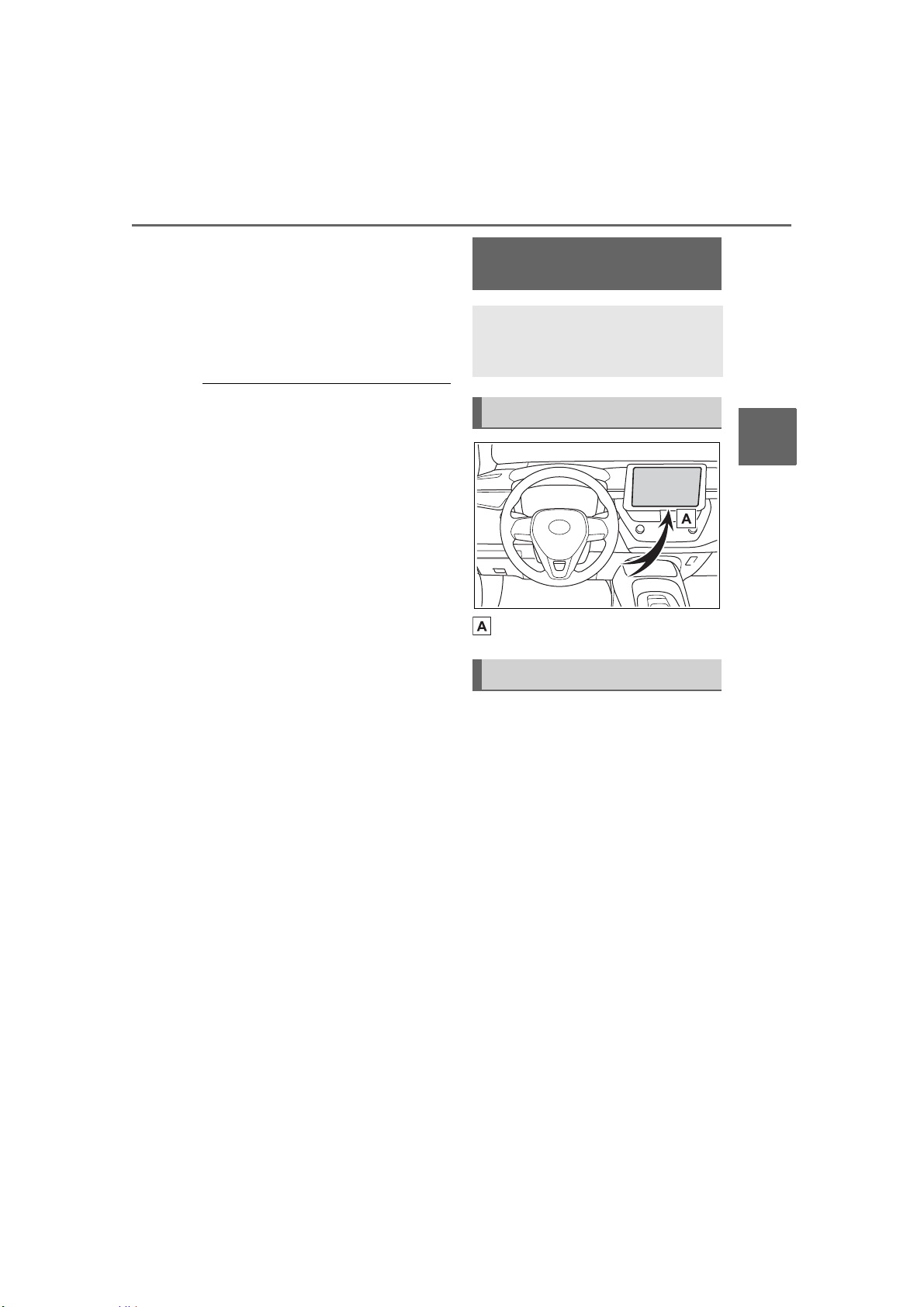
93
2-1. Instrument cluster
COROLLA H/B_U
2
Vehicle status information and indicators
■ Outside temperature dis-
play
Displayed when the engine
switch is turned to ON or when
the low outside temperature
indicator is flashing.
■ Outside temperature display
● When the ambient temperature is
approximately 37°F (3°C) or
lower, the low outside temperature
indicator will flash for approxi-
mately 10 seconds and the out-
side temperature display will turn
off. In this case, the display will be
displayed again when the outside
temperature becomes approxi-
mately 41°F (5°C) or higher.
● In the following situations, the cor-
rect outside temperature may not
be displayed, or the display may
take longer than normal to
change:
• When stopped, or driving at low
speeds (less than 16 mph [25
km/h])
• When the outside temperature
has changed suddenly (at the
entrance/exit of a garage, tunnel,
etc.)
● When “--” or “E” is displayed, the
system may be malfunctioning.
Take your vehicle to your Toyota
dealer.
Audio system screen
■ Trip information
Audio without DCM/Audio
Plus without DCM
1 Press the “MENU” button.
2 Select “Info” on the “Menu”
screen.
If a screen other than “Trip Informa-
tion” is displayed, select “Trip Infor-
mation”.
Audio with DCM/Audio Plus
with DCM or Premium Audio
1 Press the “MENU” button.
2 Select “Info” on the “Menu”
screen.
3 Select “ECO” on the “Infor-
mation” screen.
Fuel consumption
information
Fuel consumption informa-
tion can be displayed on the
audio system screen.
System components
Consumption
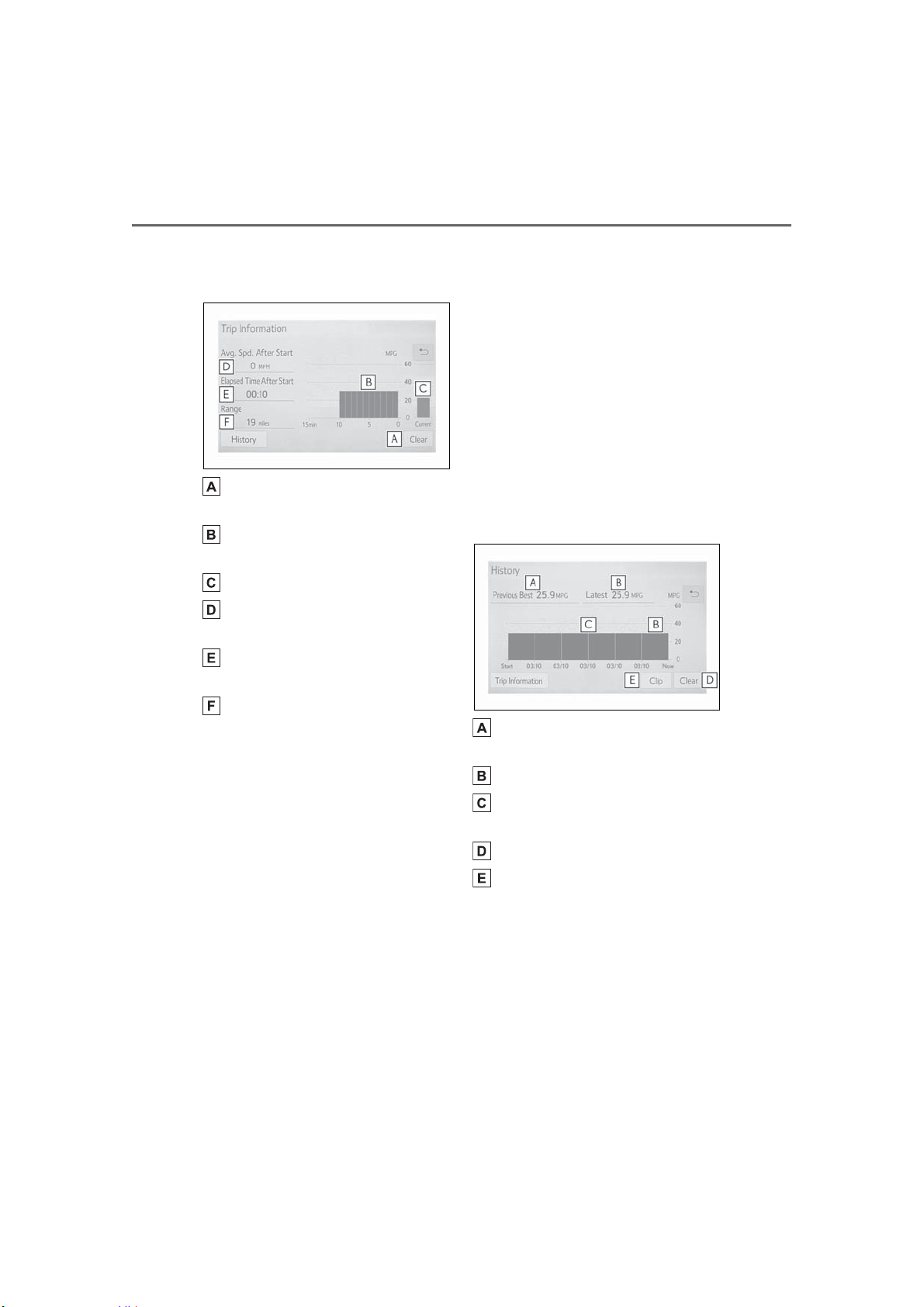
94
2-1. Instrument cluster
COROLLA H/B_U
If a screen other than “Trip Informa-
tion” is displayed, select “Trip Infor-
mation”.
Resetting the consumption
data
Fuel consumption in the past
15 minutes
Current fuel consumption
Average vehicle speed since
the engine was started.
Elapsed time since the
engine was started.
Cruising range
Average fuel consumption for
the past 15 minutes is divided
by color into past averages and
averages attained since the
engine switch was last turned to
ON. Use the displayed average
fuel consumption as a refer-
ence.
The image is an example only, and
may vary slightly from actual condi-
tions.
■ History
Audio without DCM/Audio
Plus without DCM
1 Press the “MENU” button.
2 Select “Info” on the “Menu”
screen.
If a screen other than “History” is
displayed, select “History”.
Audio with DCM/Audio Plus
with DCM or Premium Audio
1 Press the “MENU” button.
2 Select “Info” on the “Menu”
screen.
3 Select “ECO” on the “Infor-
mation” screen.
If a screen other than “History” is
displayed, select “History”.
Best recorded fuel consump-
tion
Latest fuel consumption
Previous fuel consumption
record
Resetting the history data
Updating the latest fuel con-
sumption data
The average fuel consumption
history is divided by color into
past averages and the average
fuel consumption since the last
updated. Use the displayed
average fuel consumption as a
reference.

95
2-1. Instrument cluster
COROLLA H/B_U
2
Vehicle status information and indicators
The image is an example only, and
may vary slightly from actual condi-
tions.
■ Updating the history data
Update the latest fuel consumption
by selecting “Clip” to measure the
current fuel consumption again.
■ Resetting the data
The fuel consumption data can be
deleted by selecting “Clear”.
■ Cruising range
Displays the estimated maximum
distance that can be driven with the
quantity of fuel remaining.
This distance is computed based on
your average fuel consumption.
As a result, the actual distance that
can be driven may differ from that
displayed.

96
2-1. Instrument cluster
COROLLA H/B_U

97
COROLLA H/B_U
3
3
Before driving
Before driving
.
3-1. Key information
Keys ...............................98
3-2. Opening, closing and
locking the doors
Side doors................... 101
Back door.................... 105
Smart key system ....... 108
3-3. Adjusting the seats
Front seats .................. 115
Rear seats................... 116
Head restraints............ 118
3-4. Adjusting the steering
wheel and mirrors
Steering wheel ............ 121
Inside rear view mirror
.................................. 122
Outside rear view mirrors
.................................. 123
3-5. Opening and closing the
windows
Power windows ........... 125
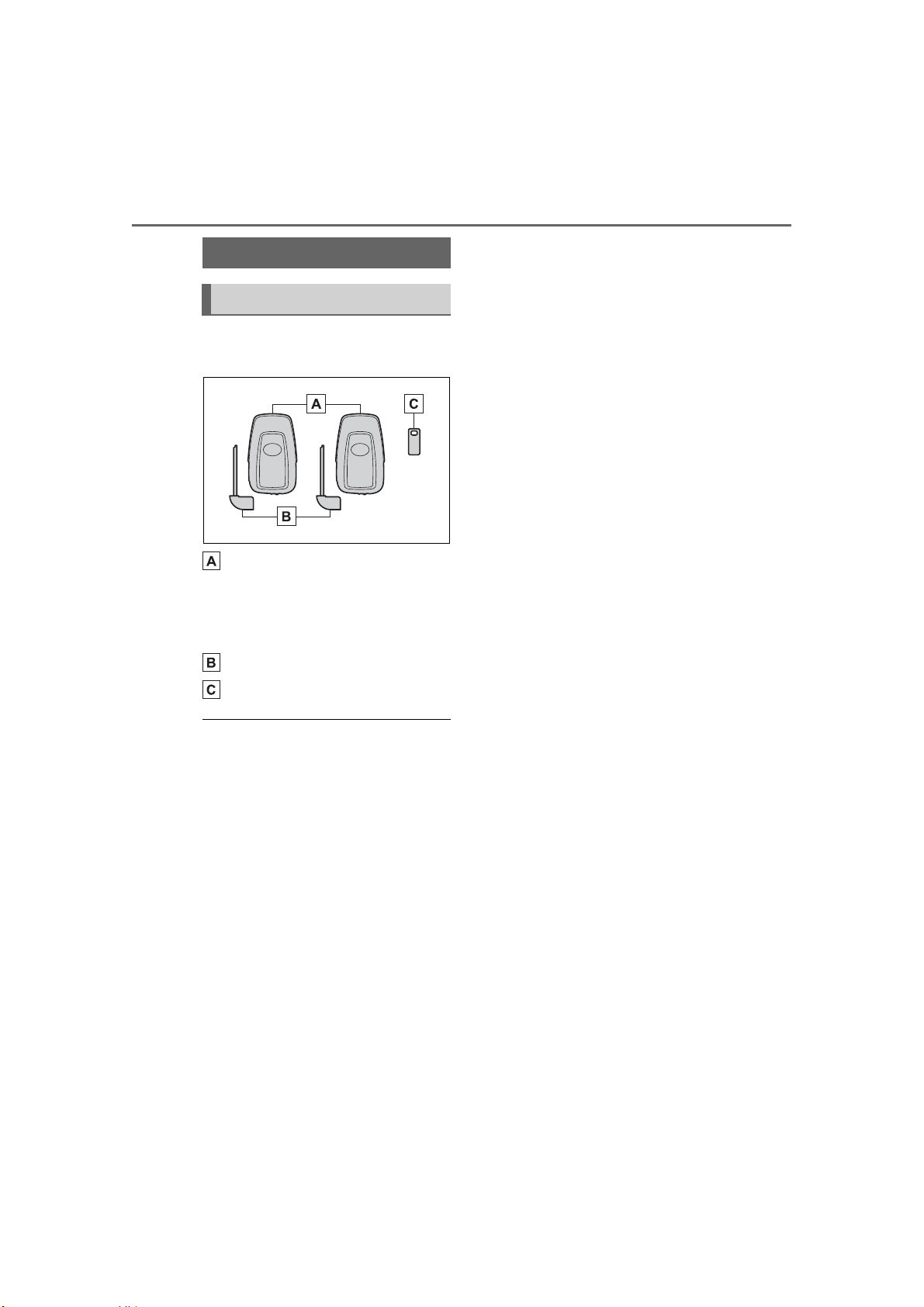
98
3-1. Key information
COROLLA H/B_U
3-1.Key information
The following keys are provided
with the vehicle.
Electronic keys
• Operating the smart key system
(P.108)
• Operating the wireless remote
control function (P.9 9)
Mechanical keys
Key number plate
■ When riding in an aircraft
When bringing an electronic key
onto an aircraft, make sure you do
not press any buttons on the elec-
tronic key while inside the aircraft
cabin. If you are carrying an elec-
tronic key in your bag, etc., ensure
that the buttons are not likely to be
pressed accidentally. Pressing a
button may cause the electronic key
to emit radio waves that could inter-
fere with the operation of the air-
craft.
■ Electronic key battery depletion
● The standard battery life is 1 to 2
year
s.
● If the battery becomes low, an
alarm
will sound in the cabin and
a
message w
ill be s
hown on the
multi-information displa
y when t
he
en
gine is stopped.
● To reduce key battery depletion
wh
en the electronic key is to no
t
be used for
long periods of t
ime,
set t
he electronic key to the bat-
tery-saving mode. (P.109)
● As the electronic key always
receives radio waves,
the battery
will become depleted
even if the
e
lectronic key is not used. The fol-
lowing symptoms indicate that the
electronic key battery may
be
de
pleted. Replace the battery
when necessary. (P.450)
• The smart key system or the wire-
less remote control does not oper-
ate.
• The detection area become
s
smaller
.
• The LED indicator on the key sur-
face does not turn on.
● To avoid serious deterioration, do
not leave the electronic key within
3
ft. (1 m) of the following electri-
cal appliances that pro
duce a
ma
gnetic field:
•TVs
• Personal computers
• Cellular phones, cordless phone
s
and battery chargers
• Recharging cellular phon
es or
cor
dless phones
• Table lamps
• Induction cookers
● If the electronic key is near the
veh
icle for longer than necessary,
even if the smart key system is n
ot
o
perated, the key battery may
become depleted faster than nor-
mal.
■ Replacing the battery
P.450
■ If “A New Key has been Regis-
tered Contact Your Dealer for
Details”
is shown on t
he
mul
ti-information display
This message will be displayed
each time the driver’s door is
opened when the doors are
unlocked from the outside for
approximately 10 days after a new
electronic key has been registered.
Keys
The keys
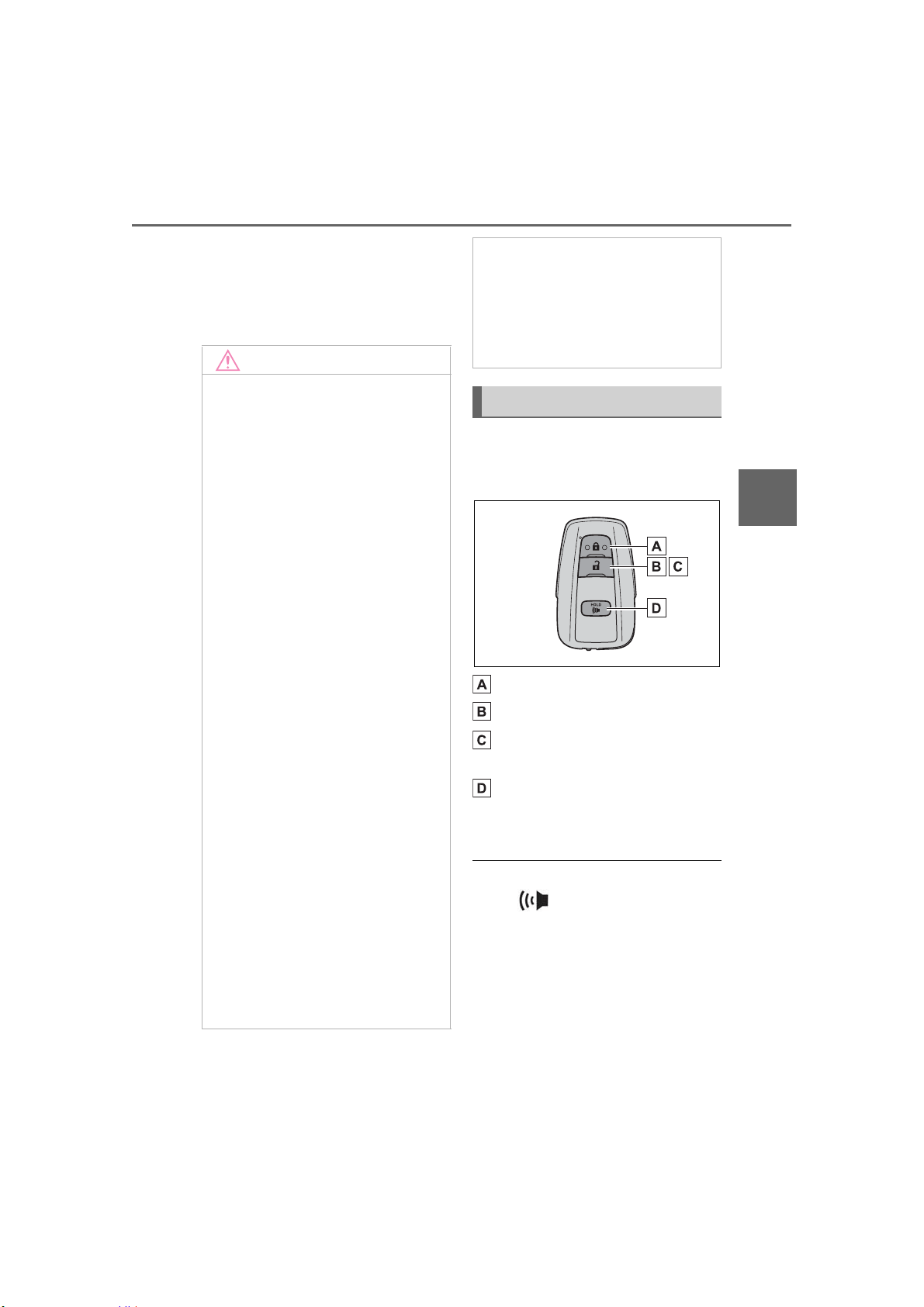
99
3-1. Key information
COROLLA H/B_U
3
Before driving
If this message is displayed but you
have not had a new electronic key
registered, ask your Toyota dealer to
check if an unknown electronic key
(other than those in your posses-
sion) has been registered.
The keys are equipped with the
following wireless remote con-
trol:
Locks the doors (P.101)
Unlocks the doors (P.101)
Opens the windows
*
(P.101)
Sounds the alarm
*
: This setting must be customized
at your Toyota dealer.
■ Panic mode
When is pressed for longer
than about one second, an alarm
will sound intermittently and the
vehicle lights will flash to deter any
person from trying to break into or
damage your vehicle.
To stop the alarm, press any button
on the wireless remote control.
NOTICE
■ To prevent key damage
● Do not drop the keys, subject
them to strong shocks or bend
them.
● Do not expose the keys to high
temperatures for long periods of
time.
● Do not get the keys wet or wash
them in an ultrasonic washer
etc.
● Do not attach metallic or mag-
netic materials to the keys or
place the keys close to such
materials.
● Do not disassemble the keys.
● Do not attach a sticker or any-
thing else to the surface of the
key.
● Do not place the keys near
objects that produce magnetic
fields, such as TVs, audio sys-
tems and induction cookers, or
medical electrical equipment,
such as low-frequency therapy
equipment.
■ Carrying the electronic key
on your person
Carry the electronic key 3.9 in.
(10 cm) or more away from elec-
tric appliances that are turned on.
Radio waves emitted from electric
appliances within 3.9 in. (10 cm)
of the electronic key may interfere
with the key, causing the key to
not function properly.
■ In case of a smart key system
malfunction or other
key-related problems
P. 500
■ When an electronic key is lost
P. 500
Wireless remote control
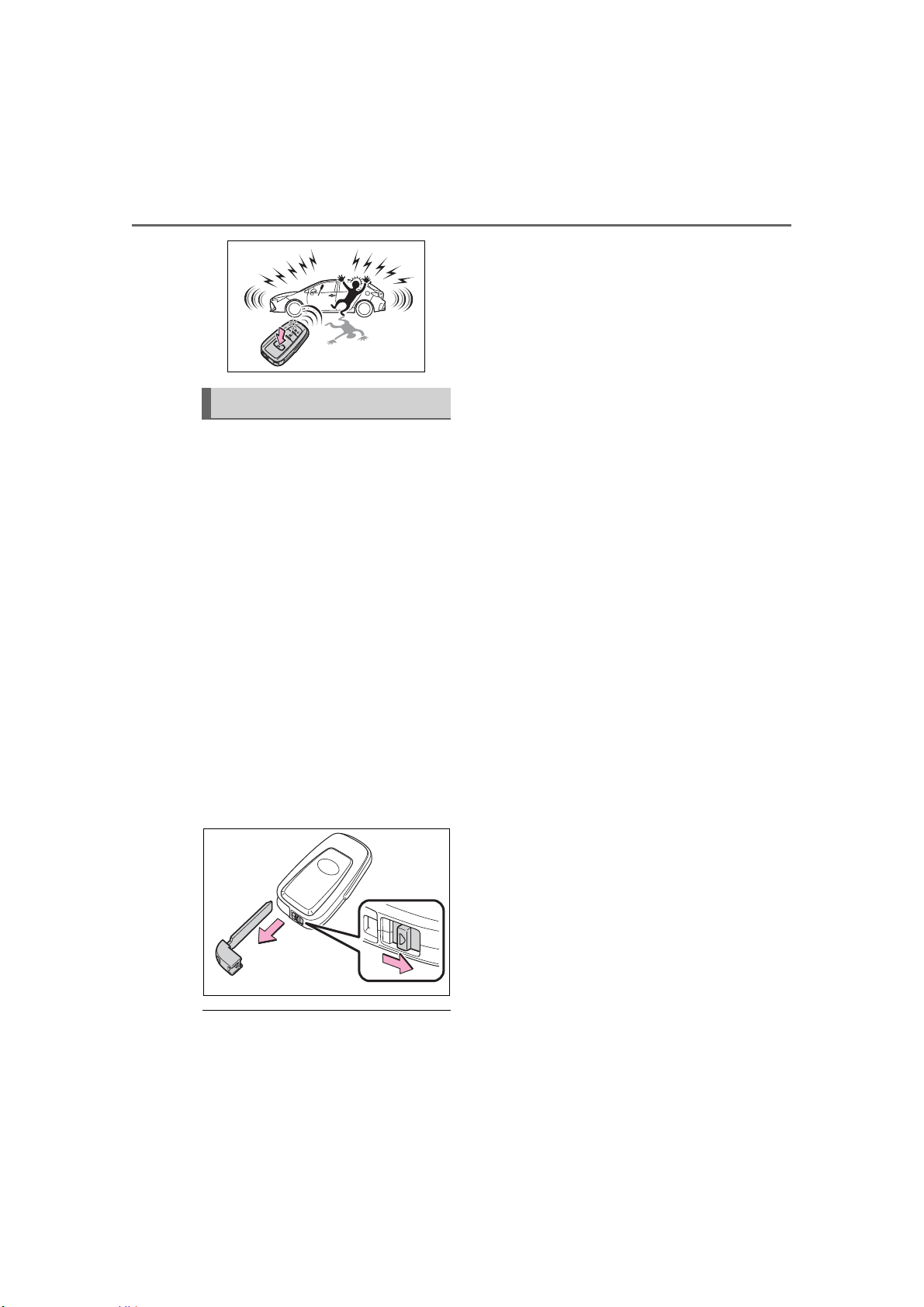
100
3-1. Key information
COROLLA H/B_U
To take out the mechanical key,
push the release button and
take the key out.
The mechanical key can only be
inserted in one direction, as the
key only has grooves on one
side. If the key cannot be
inserted in a lock cylinder, turn it
over and re-attempt to insert it.
After using the mechanical key,
store it in the electronic key.
Carry the mechanical key
together with the electronic key.
If the electronic key battery is
depleted or the entry function
does not operate properly, you
will need the mechanical key.
(P.500)
■ If you lose your mechanical
ke
ys
P. 5 00
■ If a wrong key is used
The key cylinder rotates freely, iso-
lated from the internal mechanism.
Using the mechanical key
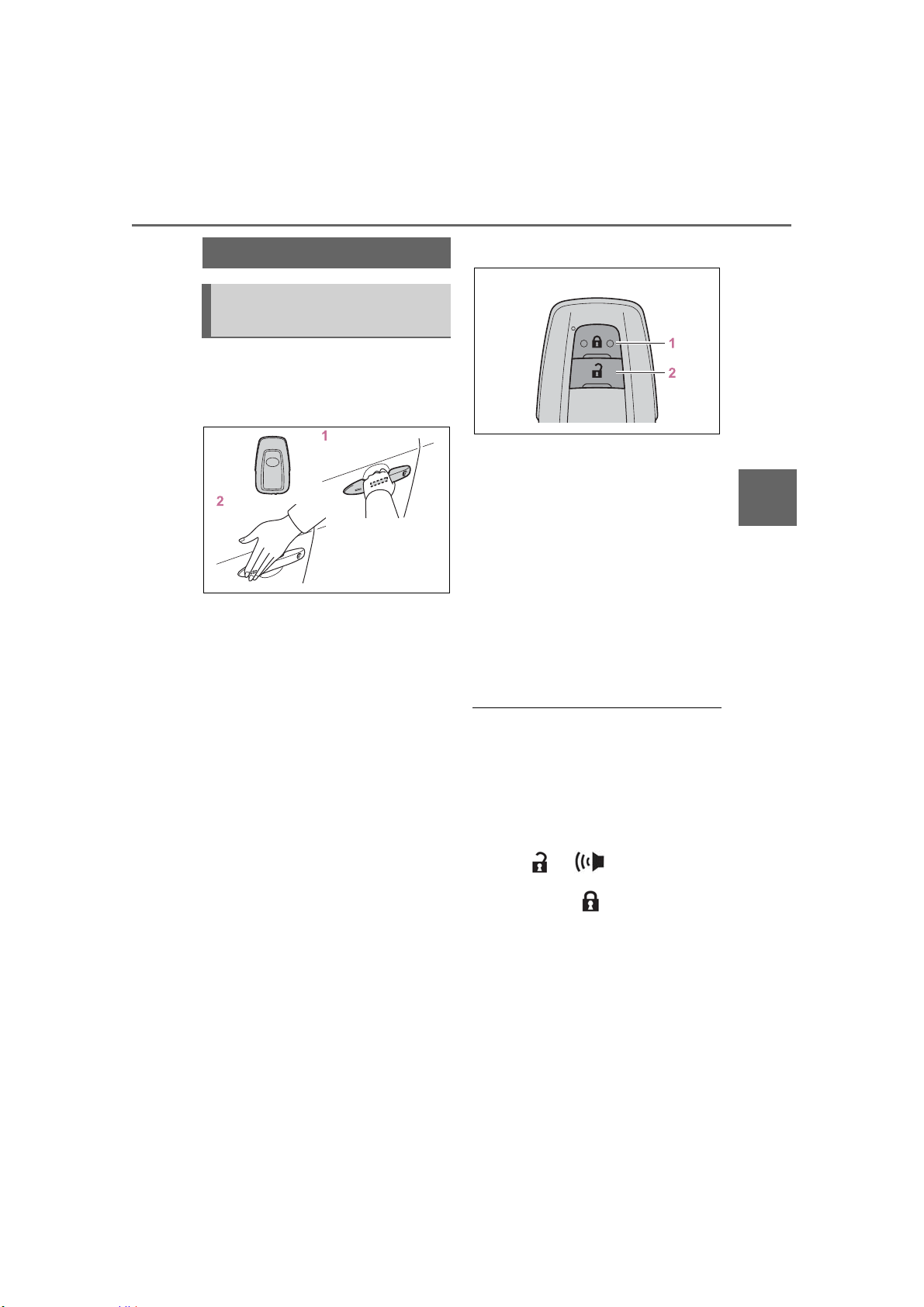
101
3-2. Opening, closing and locking the doors
COROLLA H/B_U
3
Before driving
3-2.Opening, closing and locking the do ors
■ Smart key system
Carry the electronic key to
enable this function.
1 Grip the driver’s door handle
to unlock the door. Holding
the driver’s door handle for
approximately 2 seconds
unlocks all the doors. Grip
the front passenger’s door
handle to unlock all the
doors.
*
Make sure to touch the sensor on
the back of the handle.
The doors cannot be unlocked for 3
seconds after the doors are locked.
*
: The door unlock settings can be
changed. (P.101, 531)
2 Touch the lock sensor (the
indentation on the side of the
front door handle) to lock all
the doors.
Check that the door is securely
locked.
■ Wireless remote control
1 Locks all the doors
Check that the door is securely
locked.
2 Unlocks all the doors
Pressing the button unlocks the
driver’s door. Pressing the button
again within 5 seconds unlocks the
other doors.
Press and hold to open the win-
dows.
*
*
: This setting must be customized
at your Toyota dealer.
■ Switching the door unlock func-
tion
It is possible to set which doors the
entry function unlocks using the
wireless remote control.
1 Turn the engine switch off.
2 When the indicator light on the
key surface is not on, press and
hold or for approxi-
mately 5 seconds while pressing
and holding .
The setting changes each time an
operation is performed, as shown
below. (When changing the setting
continuously, release the buttons,
wait for at least 5 seconds, and
repeat step 2.)
Side doors
Unlocking and locking the
doors from the outside
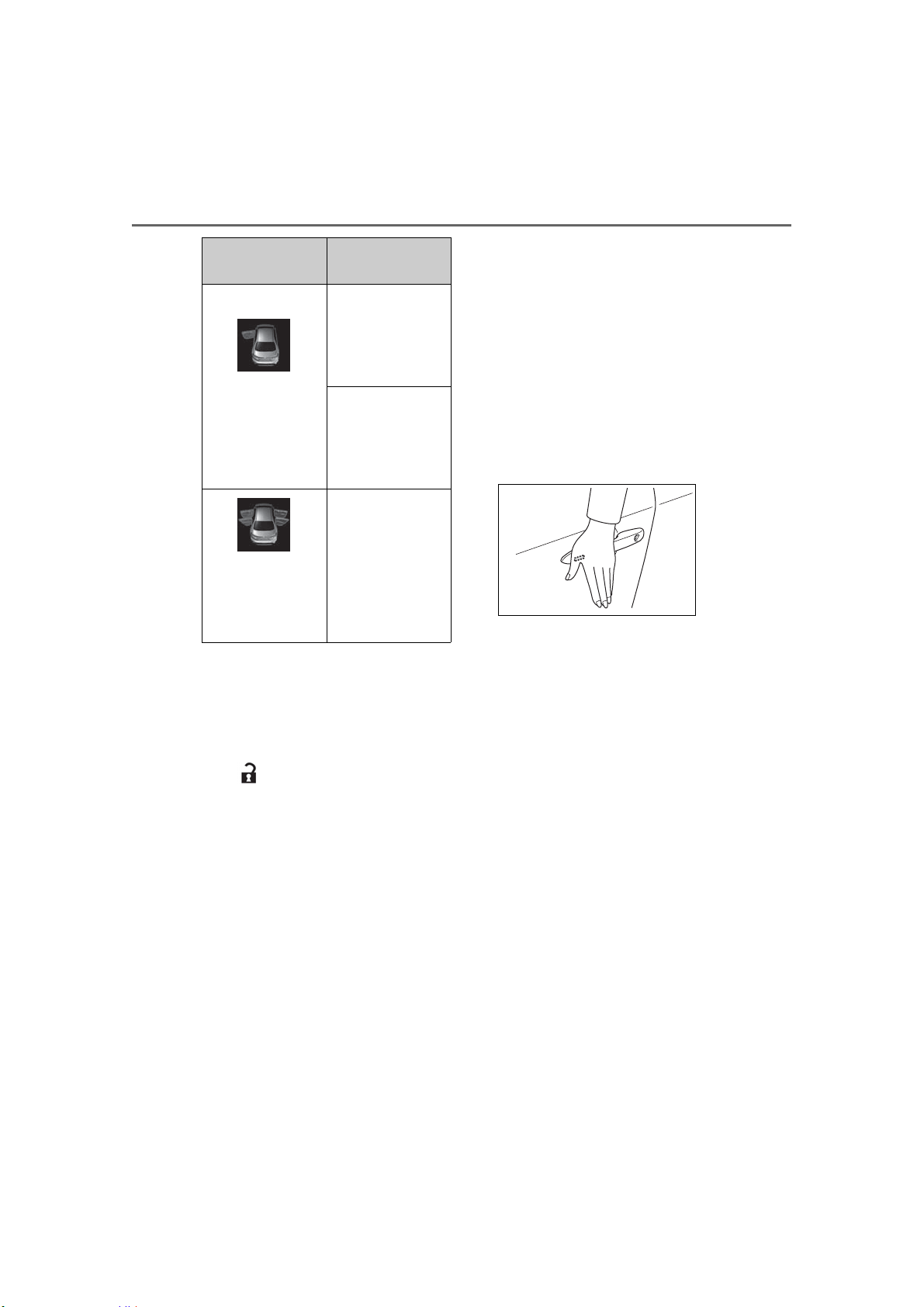
102
3-2. Opening, closing and locking the doors
COROLLA H/B_U
For vehicles with an alarm: To pre-
vent unintended triggering of the
alarm, unlock the doors using the
wireless remote control and open
and close a door once after the set-
tings have been changed. (If a door
is not opened within 60 seconds
after is pressed, the doors will
be locked again and the alarm will
automatically be set.)
In case that the alarm is triggered,
immediately stop the alarm. (P.6 6)
■ Operation signals
A buzzer sounds and the emer-
gency flashers flash to indicate that
the doors have been
locked/unlocked using the entry
function or wireless remote control.
(Locked: Once; Unlocked: Twice)
A buzzer sounds to indicate that the
windows are operating.
■ Security feature
If a door is not opened within
approximately 60 seconds after the
vehicle is unlocked using the entry
function or wireless remote control,
the security feature automatically
locks the vehicle again.
■ When the door cannot be
locked by the lock sensor on
the surface of the front door
handle
If the doors cannot be locked by
touching the lock sensor with a fin-
ger, touch the lock sensor with the
palm of your hand.
If you are wearing gloves, remove
them.
■ Door lock buzzer
If an attempt to lock the doors using
the entry function or wireless remote
control is made when a door is not
fully closed, a buzzer will sound
continuously for 5 seconds. Fully
close the door to stop the buzzer,
and lock the doors again.
■ Alarm (if equipped)
Locking the doors will set the alarm
system. (P. 66 )
■ Conditions affecting the opera-
tion of the smart key system or
wireless remote control
P.109
■ If the smart key system or the
wireless remote control does
not operate properly
Use the mechanical key to lock and
unlock the doors. (P.500)
Replace the key battery with a new
one if it is depleted. (P.450)
■ If the battery is discharged
The doors cannot be locked and
unlocked using the smart key sys-
Multi-informa-
tion display/Beep
Unlocking func-
tion
Exterior: Beeps 3
times
Interior: Pings
once
Holding the
driver’s door
handle unlocks
only the driver’s
door.
Holding the front
passenger’s
door handle
unlocks all the
doors.
Exterior: Beeps
twice
Interior: Pings
once
Holding either
front door handle
unlocks all the
doors.
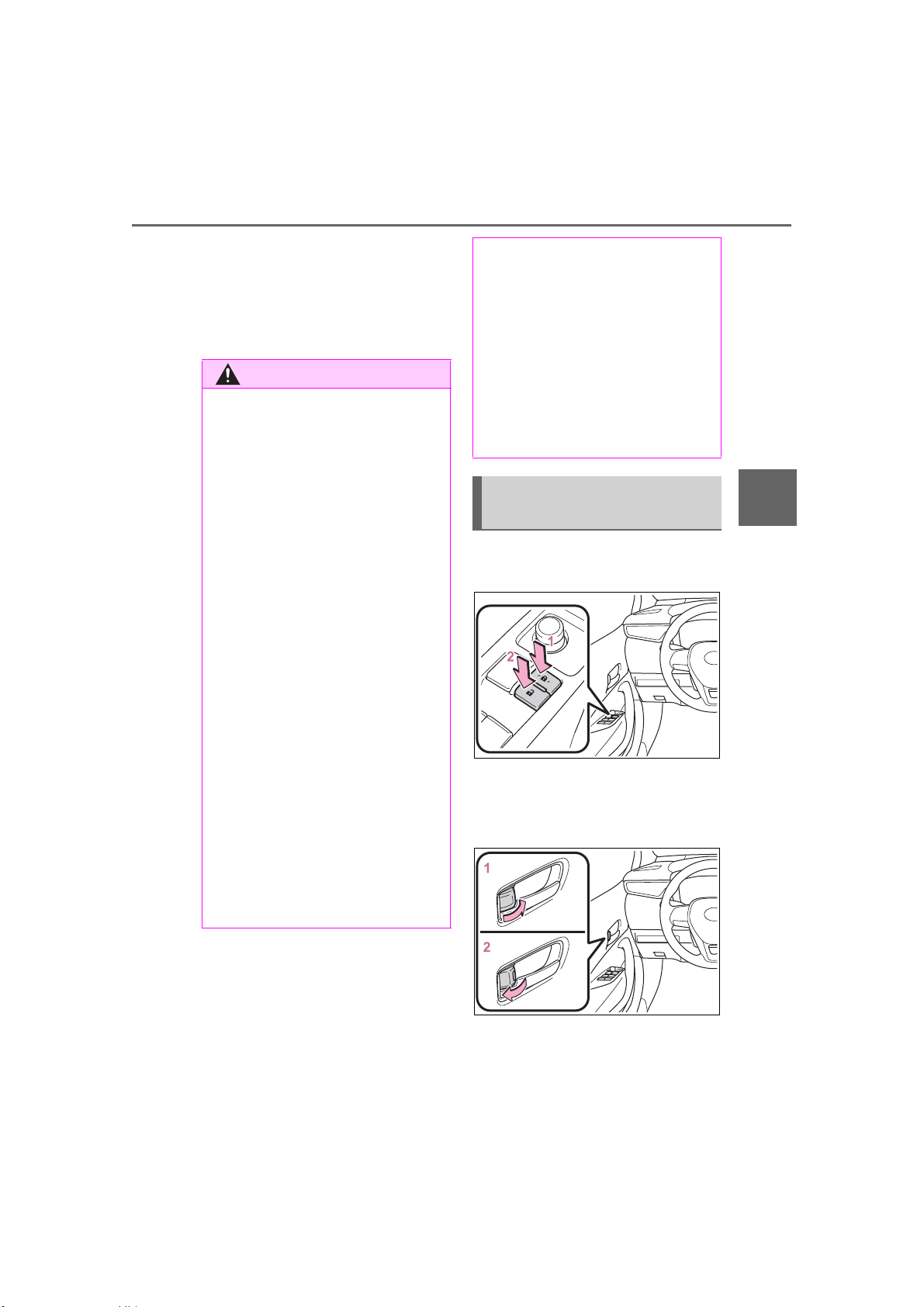
103
3-2. Opening, closing and locking the doors
COROLLA H/B_U
3
Before driving
tem or wireless remote control. Lock
or unlock the doors using the
mechanical key. (P.500)
■ Customization
Some functions can be customized.
(P.531)
■ Door lock switches (to
lock/unlock)
1 Locks all the doors
2 Unlocks all the doors
■ Inside lock buttons
1 Locks the door
2 Unlocks the door
WARNING
■ To prevent an accident
Observe the following precautions
while driving the vehicle.
Failure to do so may result in a
door opening and an occupant
being thrown out of the vehicle,
resulting in death or serious injury.
● Ensure that all doors are prop-
erly closed and locked.
● Do not pull the inside door han-
dle while driving.
Be especially careful of the front
doors, as the doors may be
opened even if the inside lock
buttons are in the locked posi-
tion.
● Set the rear door child-protector
locks when children are seated
in the rear seats.
■ When opening or closing a
door
Check the surroundings of the
vehicle such as whether the vehi-
cle is on an incline, whether there
is enough space for a door to
open and whether a strong wind
is blowing. When opening or clos-
ing the door, hold the door handle
tightly to prepare for any unpre-
dictable movement.
■ When using the wireless
remote control and operating
the power windows
Operate the power windows after
checking to make sure that there
is no possibility of any passenger
having any of their body parts
caught in the windows. Also, do
not allow children to operate the
wireless remote control. It is pos-
sible for children and other pas-
sengers to get caught in the
power windows.
Unlocking and locking the
doors from the inside
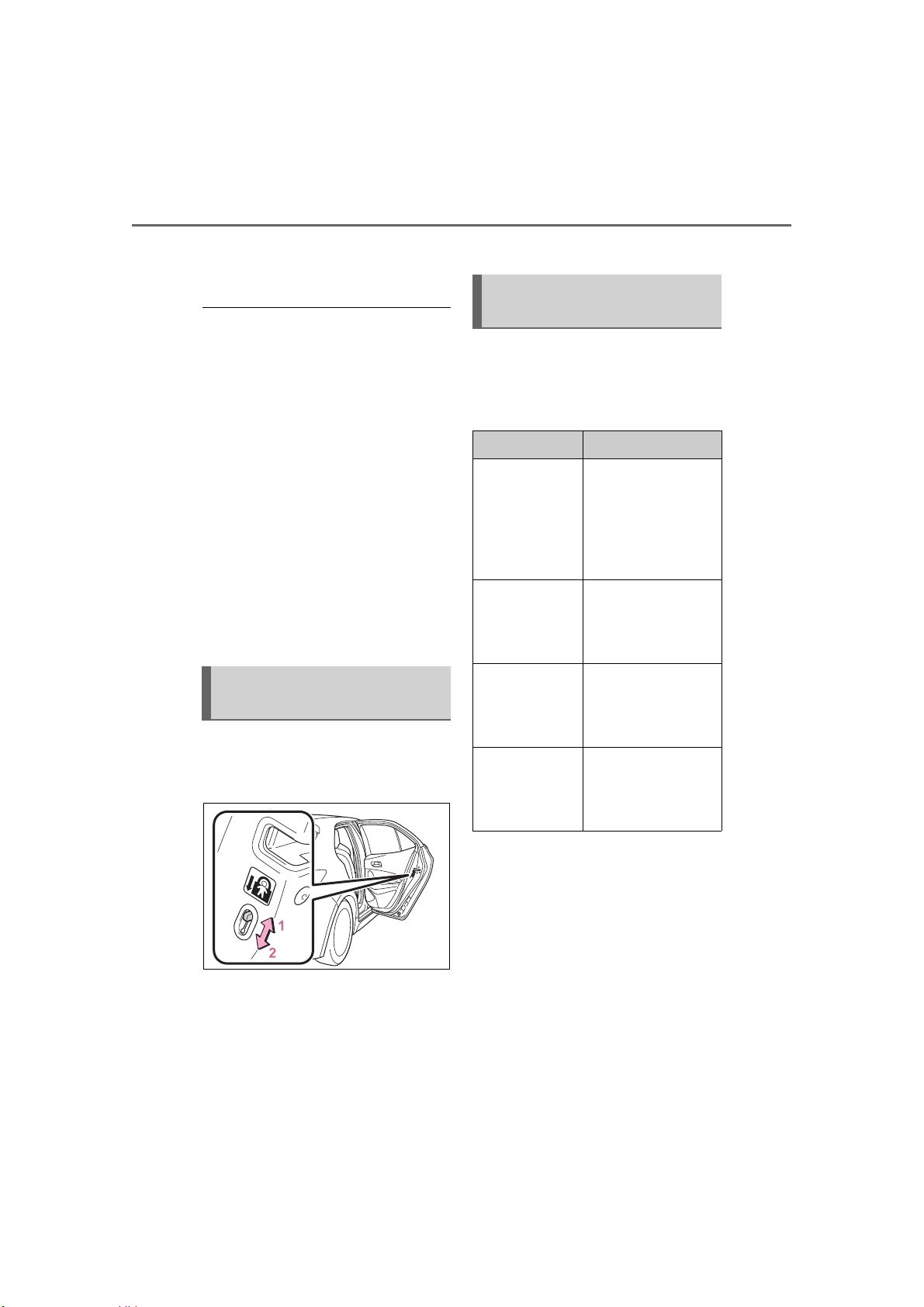
104
3-2. Opening, closing and locking the doors
COROLLA H/B_U
The front doors can be opened by
pulling the inside handle even if the
lock buttons are in the lock position.
■ Locking the front doors from
the outside without a key
1 Move the inside lock button to
the lock position.
2 Close the door.
The door cannot be locked if the
engine switch is in ACC or ON, or
the electronic key is left inside the
vehicle.
The key may not be detected cor-
rectly and the door may be locked.
■ Open door warning buzzer
If a door or the back door is not fully
closed, a buzzer will sound when
the vehicle speed reaches 3 mph (5
km/h).
The open door(s) or back door is
indicated on the multi-information
display.
The door cannot be opened
from inside the vehicle when
lock is set.
1 Unlock
2 Lock
These locks can be set to prevent
children from opening the rear
doors. Push down on each rear
door switch to lock both rear doors.
The following functions can be
set or canceled:
For instructions on customizing,
refer to P.531.
Rear door child-protector
lock
Automatic door locking
and unlocking systems
Function Operation
Speed linked
door locking
function
All doors are auto-
matically locked
when vehicle
speed is approxi-
mately 12 mph (20
km/h) or higher.
Shift position
linked door
locking func-
tion
All doors are auto-
matically locked
when shifting the
shift lever out of P.
Shift position
linked door
unlocking
function
All doors are auto-
matically unlocked
when shifting the
shift lever to P.
Driver’s door
linked door
unlocking
function
All doors are auto-
matically unlocked
when driver’s door
is opened.
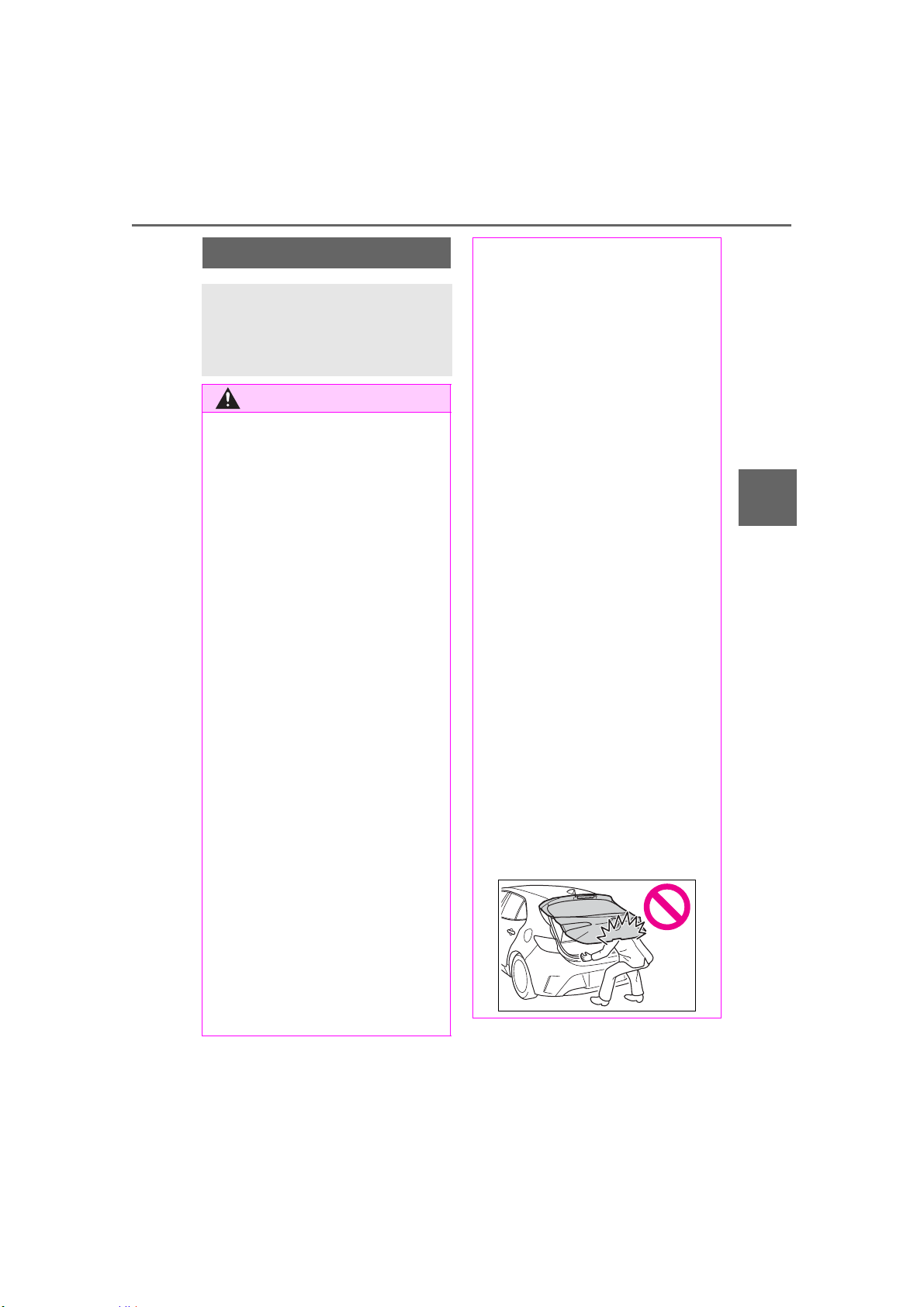
105
3-2. Opening, closing and locking the doors
COROLLA H/B_U
3
Before driving
Back door
The back door can be
locked/unlocked and
opened by the following
procedures.
WARNING
Observe the following precau-
tions.
Failure to do so may result in
death or serious injury.
■ Caution while driving
● Keep the back door closed
while driving. If the back door is
left open, it may hit near-by
objects while driving or luggage
may be unexpectedly thrown
out, causing an accident.
In addition, exhaust gases may
enter the vehicle, causing death
or a serious health hazard.
Make sure to close the back
door before driving.
● Before driving the vehicle, make
sure that the back door is fully
closed. If the back door is not
fully closed, it may open unex-
pectedly while driving, causing
an accident.
● Never let anyone sit in the lug-
gage compartment. In the event
of sudden braking or a collision,
they are susceptible to death or
serious injury.
■ When children are in the vehi-
cle
● Do not allow children to play in
the luggage compartment.
If a child is accidentally locked
in the luggage compartment,
they could have heat exhaus-
tion or other injuries.
● Do not allow a child to open or
close the back door.
Doing so may cause the back
door to move unexpectedly, or
cause the child’s hands, head,
or neck to be caught by the
closing back door.
■ Operating the back door
● Remove any heavy loads, such
as snow and ice, from the back
door before opening it. Failure
to do so may cause the back
door to suddenly shut again
after it is opened.
● When opening or closing the
back door, thoroughly check to
make sure the surrounding area
is safe.
● If anyone is in the vicinity, make
sure they are safe and let them
know that the back door is
about to open or close.
● Use caution when opening or
closing the back door in windy
weather as it may move
abruptly in strong wind.
● The back door may suddenly
shut if it is not opened fully. It is
more difficult to open or close
the back door on an incline than
on a level surface, so beware of
the back door unexpectedly
opening or closing by itself.
Make sure that the back door is
fully open and secure before
using the luggage compartment.
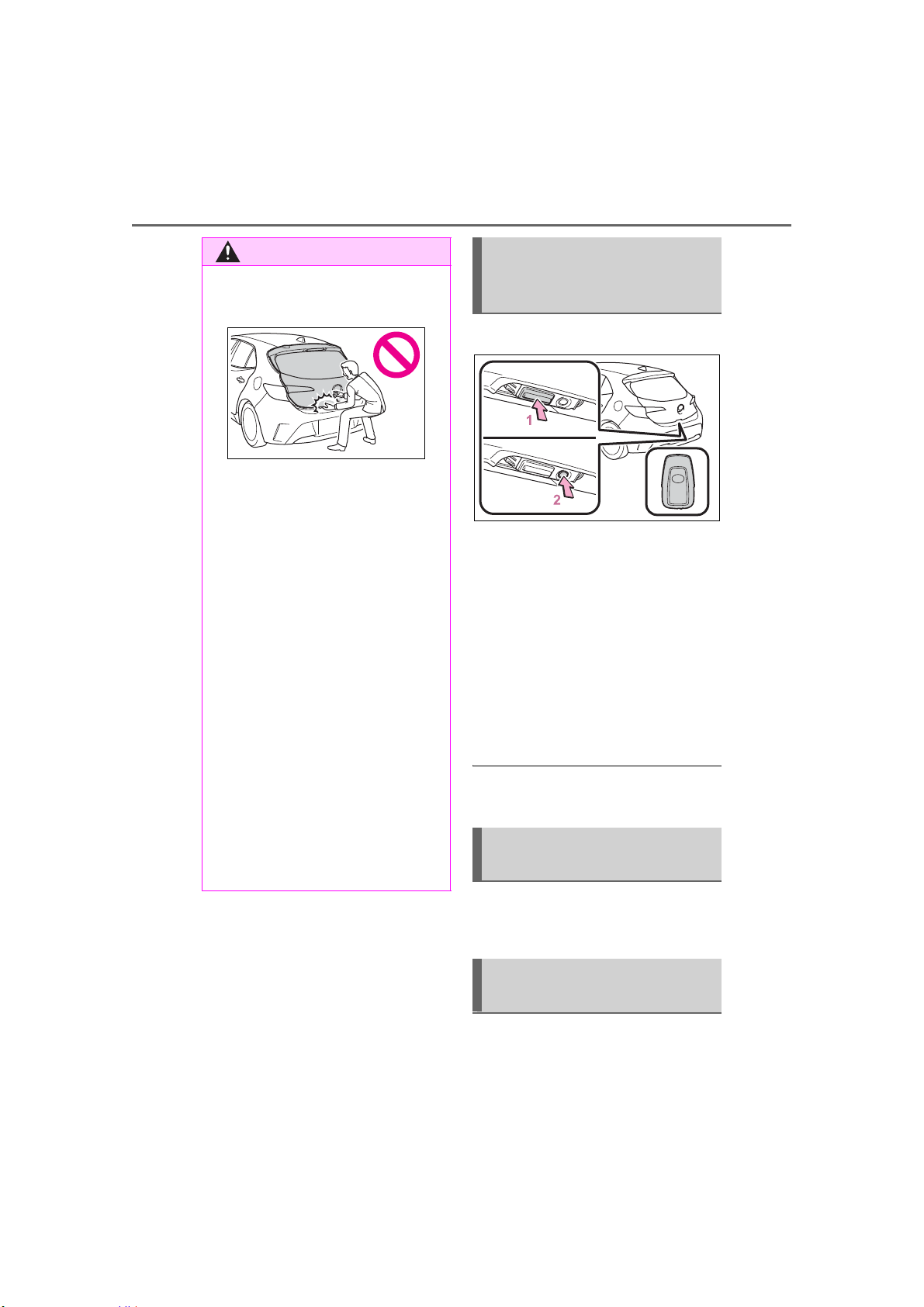
106
3-2. Opening, closing and locking the doors
COROLLA H/B_U
■ Entry function
1 Press the button to unlock
the back door.
The door cannot be unlocked for 3
seconds after the door is locked.
2 Press the button to lock the
back door.
Check that the door is securely
locked.
■ Wireless remote control
P.101
■ Operation signals
P.102
■ Door lock switches
P.103
■ Open
Raise the back door while push-
WARNING
● When closing the back door,
take extra care to prevent your
fingers etc. from being caught.
● When closing the back door,
make sure to press it lightly on
its outer surface. If the back
door handle is used to fully
close the back door, it may
result in hands or arms being
caught.
● Do not pull on the back door
damper stay to close the back
door, and do not hang on the
back door damper stay. Doing
so may cause hands to be
caught or the back door damper
stay to break, causing an acci-
dent.
● If a bicycle carrier or similar
heavy object is attached to the
back door, it may suddenly shut
again after being opened, caus-
ing someone’s hands, head or
neck to be caught and injured.
When installing an accessory
part to the back door, using a
genuine Toyota part is recom-
mended.
Unlocking and locking the
back door from the out-
side
Unlocking and locking the
back door from the inside
Opening/closing the back
door
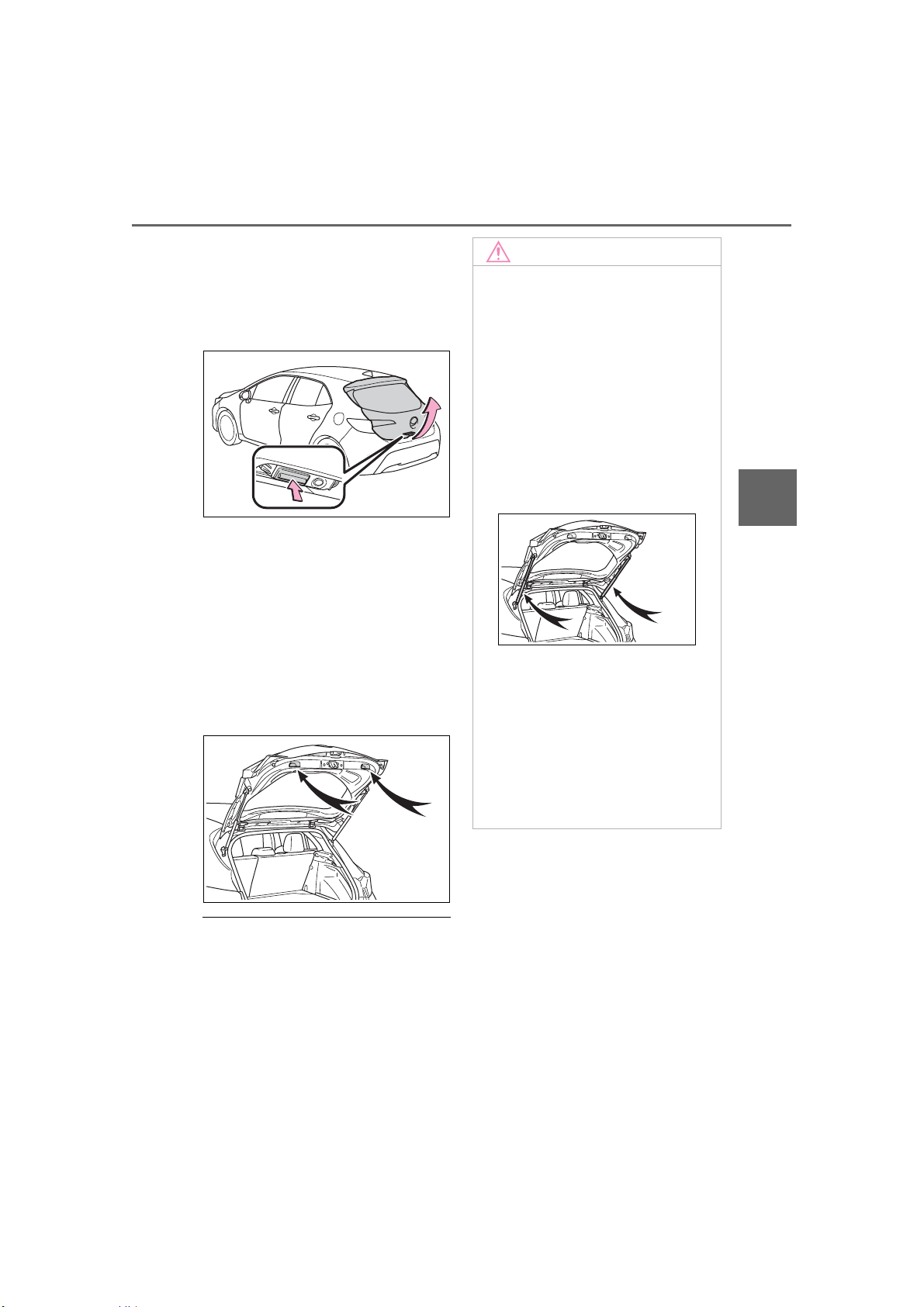
107
3-2. Opening, closing and locking the doors
COROLLA H/B_U
3
Before driving
ing up the back door opener
switch.
The back door cannot be closed
immediately after the back door
opener switch is pushed.
■ Close
Lower the back door using the
back door handle, and make
sure to push the back door
down from the outside to close
it.
Be careful not to pull the back
door sideways when closing the
back door with the handle.
■ Open door warning buzzer
P. 104
■ Luggage compartment light
The luggage compartment light
turns on when the back door is
opened.
NOTICE
■ Back door damper stays
The back door is equipped with
damper stays that hold the back
door in place.
Observe the following precau-
tions.
Failure to do so may cause dam-
age to the back door damper stay,
resulting in malfunction.
● Do not attach any foreign
objects, such as stickers, plastic
sheets, or adhesives to the
damper stay rod.
● Do not touch the damper stay
rod with gloves or other fabric
items.
● Do not attach any accessories
other than genuine Toyota parts
to the back door.
● Do not place your hand on the
damper stay or apply lateral
forces to it.
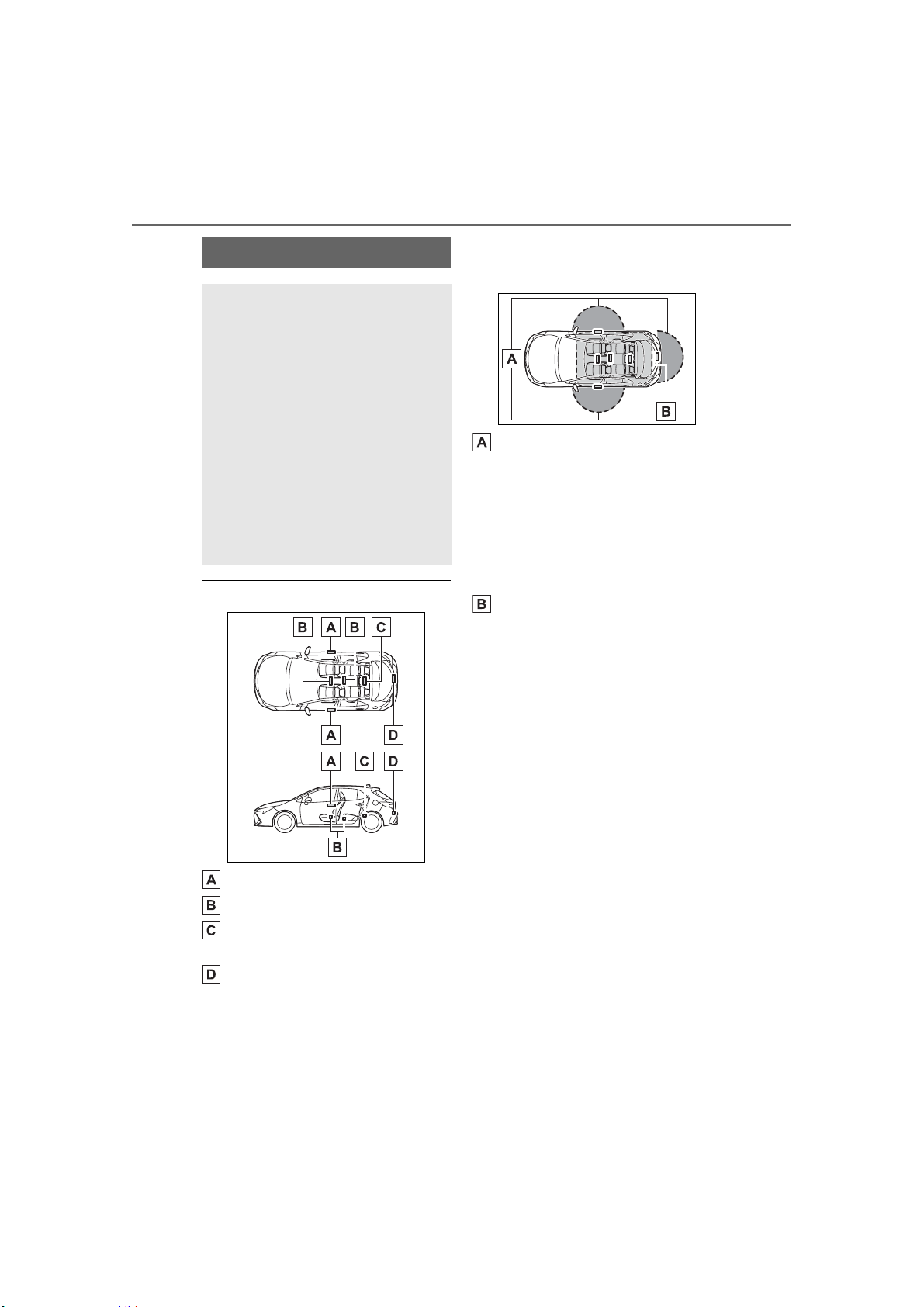
108
3-2. Opening, closing and locking the doors
COROLLA H/B_U
■ Antenna location
Antennas outside the cabin
Antennas inside the cabin
Antenna inside the luggage
compartment
Antenna outside the luggage
compartment
■ Effective range (areas within
which the electronic key is
detected)
When locking or unlocking the
doors
The system can be operated when
the electronic key is within about 2.3
ft. (0.7 m) of an outside front door
handle and back door. (Only the
doors detecting the key can be
operated.)
When starting the engine or
changing engine switch modes
The system can be operated when
the electronic key is inside the vehi-
cle.
■ Alarms and warning messages
A combination of exterior and inte-
rior buzzers as well as warning mes-
sages shown on the
multi-information display are used to
prevent theft of the vehicle and acci-
dents resulting from erroneous
operation. Take appropriate mea-
sures based on the displayed mes-
sage. (P.477)
When only an alarm sounds, cir-
cumstances and correction proce-
dures are as follows.
● Exterior buzzer sounds once for 5
seconds
Smart key system
The following operations
can be performed simply by
carrying the electronic key
on your person, for example
in your pocket. The driver
should always carry the
electronic key.
Locks and unlocks the
doors (P.101)
Locks and unlocks the back
door (P.106)
Starts the engine (P.142)
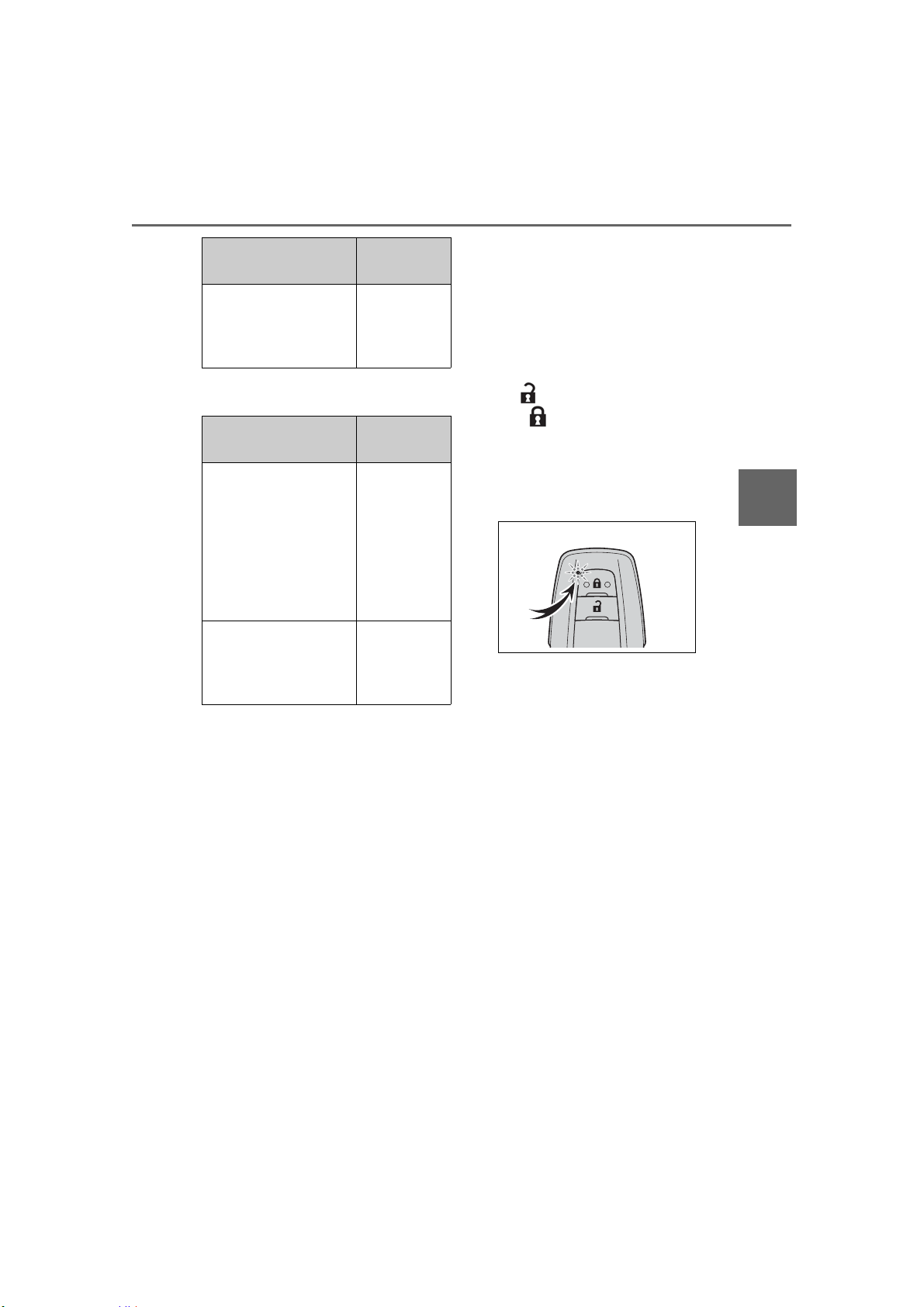
109
3-2. Opening, closing and locking the doors
COROLLA H/B_U
3
Before driving
● Interior buzzer sounds continu-
ously
■ Battery-saving function
The battery-saving function will be
activated in order to prevent the
electronic key battery and the vehi-
cle battery from being discharged
while the vehicle is not operated for
a long time.
● In the following situations, the
smart key system may take some
time to unlock the doors.
• The electronic key has been left
within approximately 11 ft. (3.5 m)
of the outside of the vehicle for 2
minutes or longer.
• The smart key system has not
been used for 5 days or longer.
● If the smart key system has not
been used for 14 days or longer,
the doors cannot be unlocked
from any door except the driver’s
door. In this case, hold the driver’s
door handle, or use the wireless
remote control or mechanical key
to unlock the doors.
■ Electronic key battery-saving
function
When battery-saving mode is set,
battery depletion is minimized by
stopping the electronic key from
receiving radio waves.
Press twice while pressing and
holding . Confirm that the elec-
tronic key indicator flashes 4 times.
While the battery-saving mode is
set, the smart key system cannot be
used. To cancel the function, press
any of the electronic key buttons.
■ Conditions affecting operation
The smart key system uses weak
radio waves. In the following situa-
tions, the communication between
the electronic key and the vehicle
may be affected, preventing the
smart key system, wireless remote
control and engine immobilizer sys-
tem from operating properly.
● When the electronic key battery is
depleted
● Near a TV tower, electric power
plant, gas station, radio station,
large display, airport or other facil-
ity that generates strong radio
waves or electrical noise
● When carrying a portable radio,
cellular phone, cordless phone or
other wireless communication
device
● When the electronic key is in con-
tact with, or is covered by the fol-
lowing metallic objects
• Cards to which aluminum foil is
attached
Situation
Correction
procedure
An attempt was
made to lock the
vehicle while a door
was open.
Close all of
the doors
and lock the
doors again.
Situation
Correction
procedure
The engine switch
was turned to ACC
while the driver’s
door was open (or
the driver’s door was
opened while the
engine switch was in
ACC).
Turn the
engine
switch off
and close
the driver’s
door.
The engine switch
was turned to off
while the driver’s
door was open.
Close the
driver’s door

110
3-2. Opening, closing and locking the doors
COROLLA H/B_U
• Cigarette boxes that have alumi-
num foil inside
• Metallic wallets or bags
• Coins
• Hand warmers made of metal
• Media such as CDs and DVDs
● When other wireless keys (that
emit radio waves) are being used
nearby
● When carrying the electronic key
together with the following devices
that emit radio waves
• Another vehicle’s electronic key or
a wireless key that emits radio
waves
• Personal computers or personal
digital assistants (PDAs)
• Digital audio players
• Portable game systems
● If window tint with a metallic con-
tent or metallic objects are
attached to the rear window
● When the electronic key is placed
near a battery charger or elec-
tronic devices
● When the vehicle is parked in a
pay parking spot where radio
waves are emitted
If the doors cannot be
locked/unlocked using the smart key
system, lock/unlock the doors by
performing any of the following:
● Bring the electronic key close to
either front door handle and oper-
ate the entry function.
● Operate the wireless remote con-
trol.
If the doors cannot be
locked/unlocked using the above
methods, use the mechanical key.
(P.500)
If the engine cannot be started using
the smart key system, refer to
P.501.
■ Note for the entry function
● Even when the electronic key is
within the effective range (detec-
tion areas), the system may not
operate properly in the following
cases:
• The electronic key is too close to
the window or outside door han-
dle, near the ground, or in a high
place when the doors are locked
or unlocked.
• The electronic key is on the instru-
ment panel, luggage cover or
floor, or in the door pockets or
glove box when the engine is
started or engine switch modes
are changed.
● Do not leave the electronic key on
top of the instrument panel or near
the door pockets when exiting the
vehicle. Depending on the radio
wave reception conditions, it may
be detected by the antenna out-
side the cabin and the door will
become lockable from the outside,
possibly trapping the electronic
key inside the vehicle.
● As long as the electronic key is
within the effective range, the
doors may be locked or unlocked
by anyone. However, only the
doors detecting the electronic key
can be used to unlock the vehicle.
● Even if the electronic key is not
inside the vehicle, it may be possi-
ble to start the engine if the elec-
tronic key is near the window.
● The doors may unlock or lock if a
large amount of water splashes on
the door handle, such as in the
rain or in a car wash when the
electronic key is within the effec-
tive range. (The doors will auto-
matically be locked after
approximately 60 seconds if the
doors are not opened and closed.)
● If the wireless remote control is
used to lock the doors when the
electronic key is near the vehicle,
there is a possibility that the door
may not be unlocked by the entry
function. (Use the wireless remote
control to unlock the doors.)
● Touching the door lock or unlock
sensor while wearing gloves may
prevent lock or unlock operation.

111
3-2. Opening, closing and locking the doors
COROLLA H/B_U
3
Before driving
● When the lock operation is per-
formed using the lock sensor, rec-
ognition signals will be shown up
to two consecutive times. After
this, no recognition signals will be
given.
● If the door handle becomes wet
while the electronic key is within
the effective range, the door may
lock and unlock repeatedly. In that
case, follow the following correc-
tion procedures to wash the vehi-
cle:
• Place the electronic key in a loca-
tion 6 ft. (2 m) or more away from
the vehicle. (Take care to ensure
that the key is not stolen.)
• Set the electronic key to bat-
tery-saving mode to disable the
smart key system. (P.109)
● If the electronic key is inside the
vehicle and a door handle
becomes wet during a car wash, a
message may be shown on the
multi-information display and a
buzzer will sound outside the vehi-
cle. To turn off the alarm, lock all
the doors.
● The lock sensor may not work
properly if it comes into contact
with ice, snow, mud, etc. Clean
the lock sensor and attempt to
operate it again.
● A sudden handle operation or a
handle operation immediately
after entering the effective range
may prevent the doors from being
unlocked. Touch the door unlock
sensor and check that the doors
are unlocked before pulling the
door handle again.
● If there is another electronic key in
the detection area, it may take
slightly longer to unlock the doors
after the door handle is gripped.
■ When the vehicle is not driven
for extended periods
● To prevent theft of the vehicle, do
not leave the electronic key within
6 ft. (2 m) of the vehicle.
● The smart key system can be
deactivated in advance. (P.531)
● Setting the electronic key to bat-
tery-saving mode helps to reduce
key battery depletion. (P.109)
■ To operate the system properly
Make sure to carry the electronic
key when operating the system. Do
not get the electronic key too close
to the vehicle when operating the
system from the outside of the vehi-
cle.
Depending on the position and hold-
ing condition of the electronic key,
the key may not be detected cor-
rectly and the system may not oper-
ate properly. (The alarm may go off
accidentally, or the door lock pre-
vention function may not operate.)
■ If the smart key system does
not operate properly
● Locking and unlocking the doors:
P.5 00
● Starting the engine: P.5 01
■ Customization
Some functions can be customized.
(P.531)
■ If the smart key system has
been deactivated in a custom-
ized setting
● Locking and unlocking the doors:
Use the wireless remote control or
mechanical key. (P.101, 500)
● Starting the engine and changing
engine switch modes: P.5 01
● Stopping the engine: P.1 4 3
112
3-2. Opening, closing and locking the doors
COROLLA H/B_U
■ Certification for the smart key system
For vehicles sold in the U.S.A., Hawaii, Guam and Puerto Rico
113
3-2. Opening, closing and locking the doors
COROLLA H/B_U
3
Before driving
For vehicles sold in Canada
114
3-2. Opening, closing and locking the doors
COROLLA H/B_U
WARNING
■ Caution regarding interfer-
ence with electronic devices
● People with implantable car-
diac pacemakers, cardiac
resynchroniz
ation ther-
apy-pacemakers or implantable
cardioverter defibrillators s
hould
k
eep away from the smart ke
y
syste
m antennas. (P.108)
The radio waves may affect the
operation of such devices. If
necessary, the entry fu
nction
ca
n be disabled. Ask your Toy-
ota dealer for details, suc
h as
th
e frequency of rad
io waves
and
timing of the emitted radio
waves. Then, consult your doc-
tor to see if you should disable
th
e entry function.
● Users of any electrical medical
de
vice other than implantabl
e
car
diac pacemakers, car
diac
r
esynchronization ther-
apy-pacemakers or implantabl
e
cardioverter
defibrillators s
hould
consul
t the manufacturer of the
device for information about its
operation under the influence of
ra
dio waves.
Radio waves could have unex-
pected effects on the operation
of such medical devices.
Ask your Toyota dealer for details
on disabling the entry function.
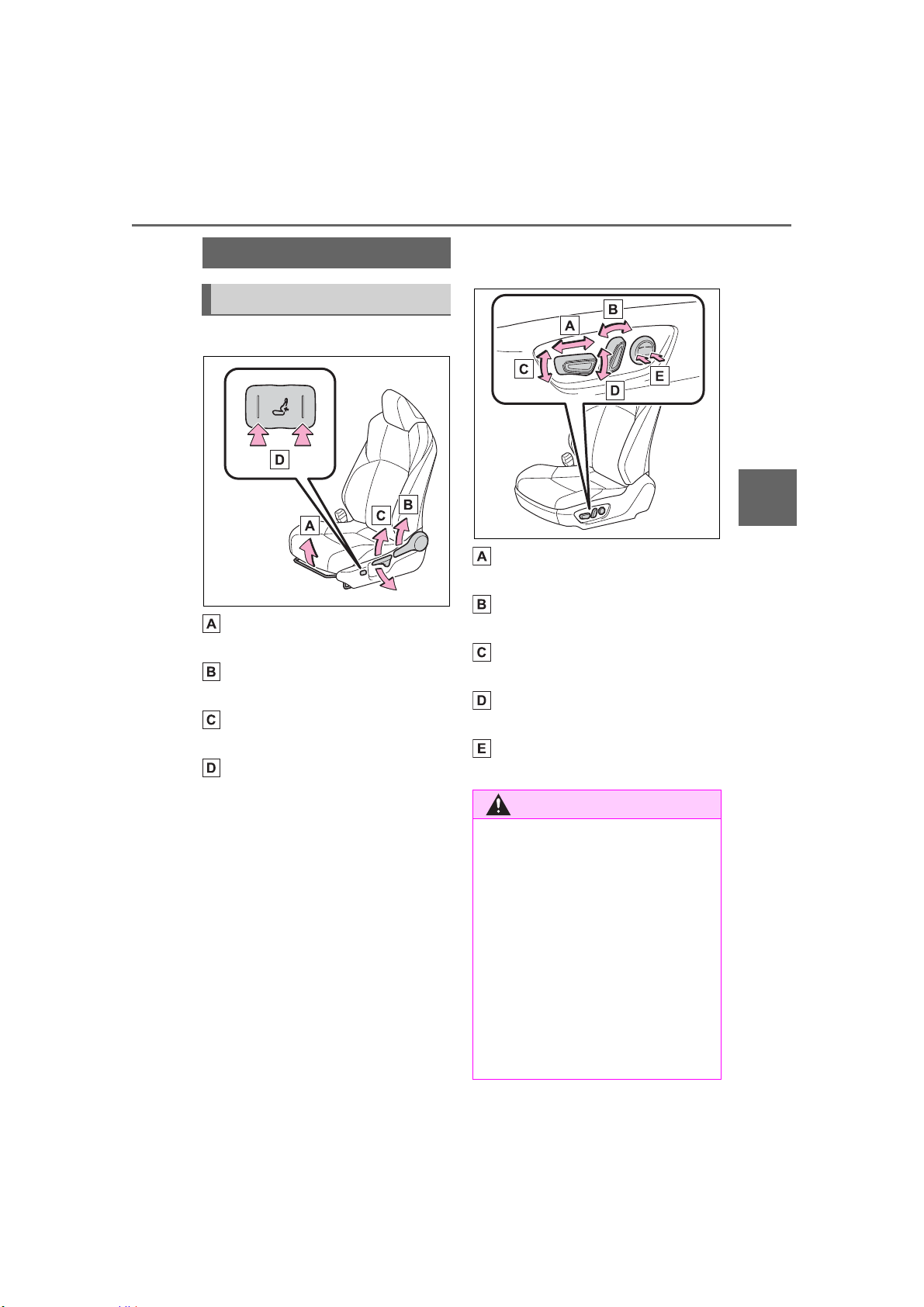
115
3-3. Adjusting the seats
COROLLA H/B_U
3
Before driving
3-3.Adjusting the seats
Manual seat
Seat position adjustment
lever
Seatback angle adjustment
lever
Vertical height adjustment
lever (driver’s side only)
Lumbar support adjustment
switch
*
(driver’s side only)
*
: If equipped
Power seat (driver’s side
only)
Seat po
sition adjustment
switch
Seatback angle adjustment
switch
Seat cushion (front) angle
adjustment switch
Vertical height adjustment
switch
Lumbar support adjustment
switch
Front seats
Adjustment procedure
WARNING
■ When adjusting the seat posi-
tion
● Take care when adjusting the
seat position to ensure that
othe
r passengers are
not
inju
red by the moving seat.
● Do not put your hands under the
seat or near the moving parts to
avoid injury.
Fingers or hands may become
jammed in the seat mechanism.
● Make sure to leave enough
space around the feet so they
do not get stuck.
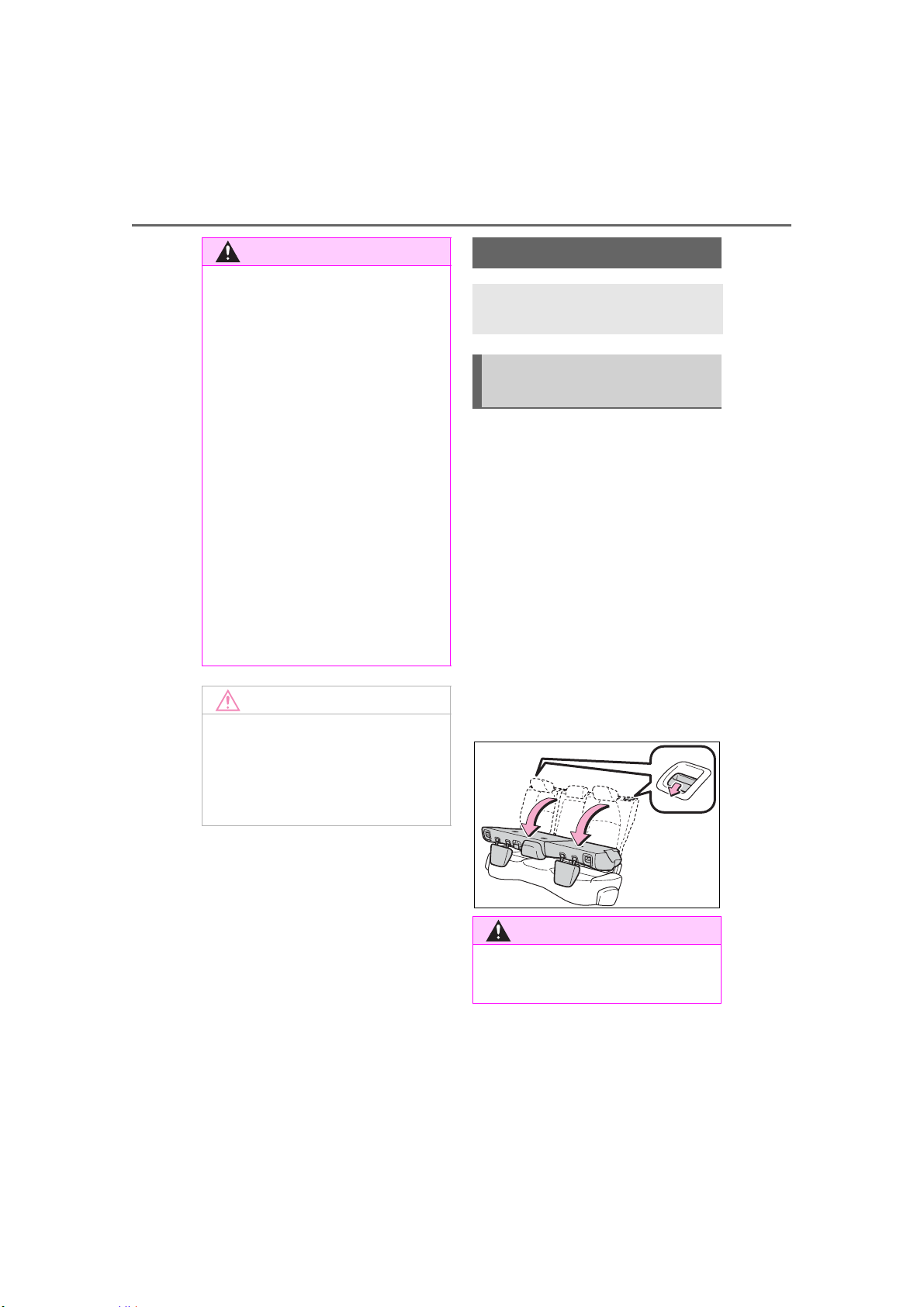
116
3-3. Adjusting the seats
COROLLA H/B_U
1 Move the front seats forward.
(P.115)
2 Stow the rear armrest.
(P.411)
3 Lower the rear center seat
head restraint to the lowest
position. (P.118)
4 Fold the rear outside seat
head restraints. (P.118)
5 Pull the seatback lock
release lever and fold the
seatback down.
Each seatback may be folded sep-
arately.
WARNING
■ Seat adjustment
● Be careful that the seat does
not hit passengers or luggage.
● To reduce the risk of sliding
under the lap belt during a colli-
sion, do not recline the seat
more than necessary.
If the seat is too reclined, the lap
belt may slide past the hips and
apply restraint forces directly to
the abdomen, or your neck may
contact the shoulder belt,
increasing the risk of death or
serious injury in the event of an
accident.
Adjustments should not be
made while driving as the seat
may unexpectedly move and
cause the driver to lose control
of the vehicle.
● Manual seat only: After adjust-
ing the seat, make sure that the
seat is locked in position.
NOTICE
■ When adjusting a front seat
When adjusting a front seat, make
sure that the head restraint does
not contact the headliner. Other-
wise, the head restraint and head-
liner may be damaged.
Rear seats
The seatbacks of the rear
seats can be folded down.
Folding down the rear
seatbacks
WARNING
Observe the following precau-
tions. Failure to do so may result
in death or serious injury.
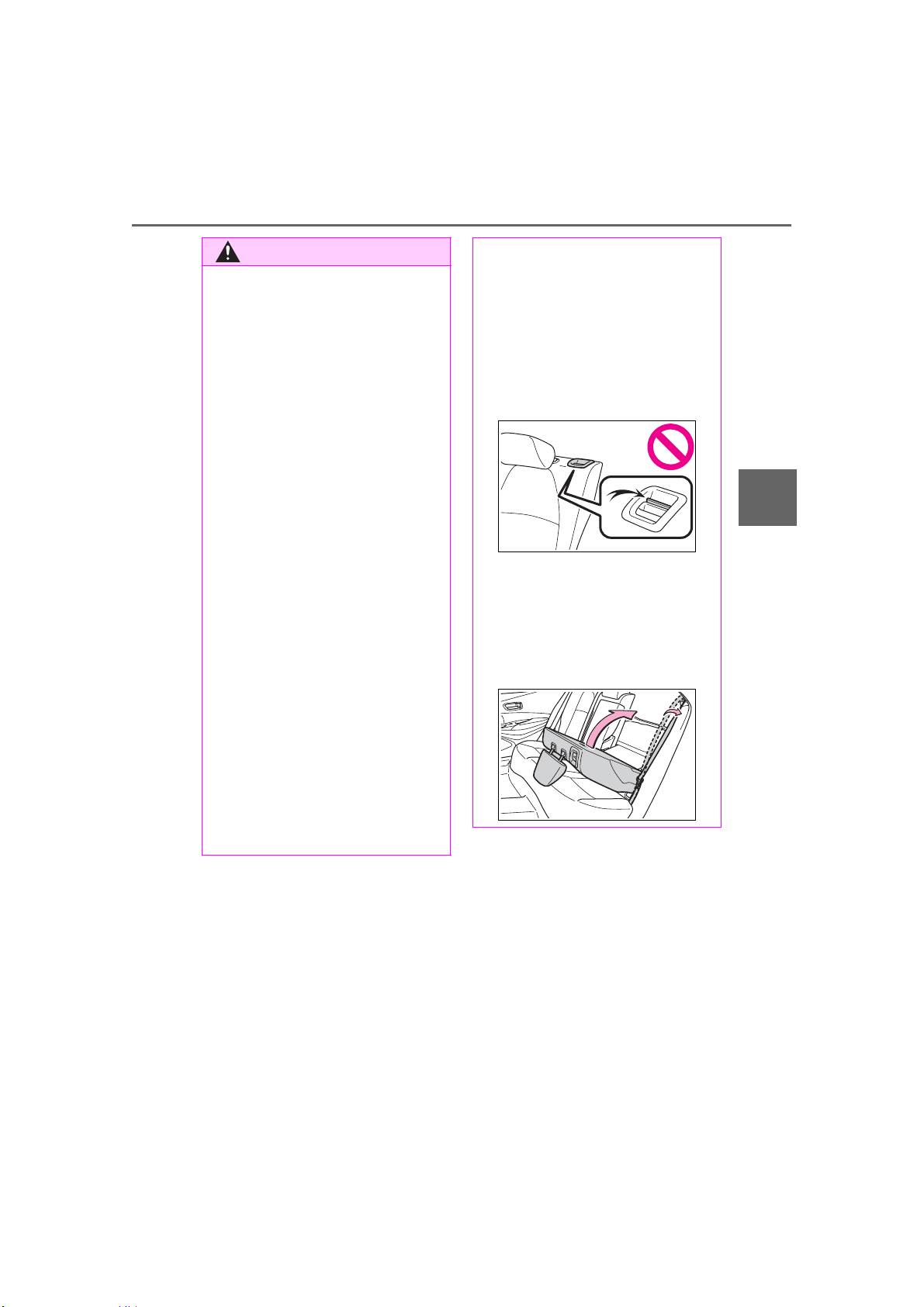
117
3-3. Adjusting the seats
COROLLA H/B_U
3
Before driving
WARNING
■ When folding the rear seat-
backs down
● Do not fold the seatbacks down
while driving.
● Stop the vehicle on level
ground, set the parking brake
and shift the shift lever to P
(continuously variable transmis-
sion) or N (manual transmis-
sion).
● Do not allow anyone to sit on a
folded seatback or in the lug-
gage compartment while driv-
ing.
● Do not allow children to enter
the luggage compartment.
● Do not allow anyone to sit on
the rear center seat if the rear
right seat is folded down, as the
seat belt buckle for the rear cen-
ter seat belt is then concealed
under the folded seat and can-
not be used.
● Be careful not to get your hand
caught when folding the rear
seatbacks.
● Adjust the position of the front
seats before folding down the
rear seatbacks so that the front
seats do not interfere with the
rear seatbacks when folding
down the rear seatbacks.
■ After returning the rear seat-
back to the upright position
● Make sure that the seatback is
securely locked in position by
lightly pushing it back and forth.
If the seatback is not securely
locked, the red marking will be
visible on the seatback lock
release lever. Make sure that the
red marking is not visible.
● Check that the seat belts are
not twisted or caught in the
seatback.
If the seat belt gets caught
between the seatback’s securing
hook and latch, it may damage
the seat belt.
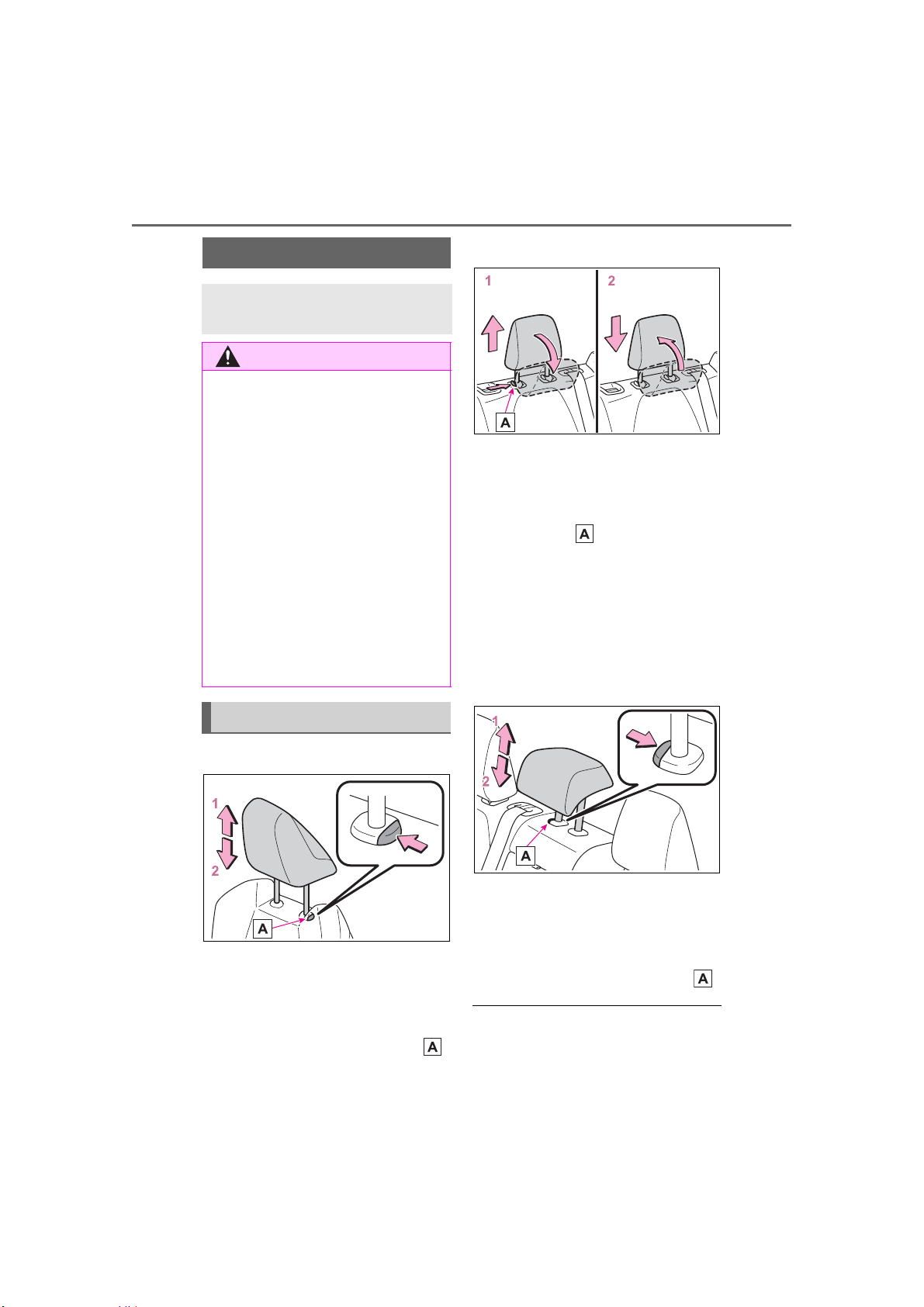
118
3-3. Adjusting the seats
COROLLA H/B_U
■ Front seats
1 Up
Pull the head restraints up.
2 Down
Push the head restraint down while
pressing the lock release button .
■ Rear outside seats
1 Folding the rear outside seat
head restraints
Pull the head restraint up while
pressing only the right-side lock
release button and then fold it
forward.
2 Setting up the rear outside
seat head restraints
Fold back the head restraint and
then push it down to the lock posi-
tion.
■ Rear center seat
1 Up
Pull the head restraint up.
2 Down
Push the head restraint down while
pressing the lock release button .
■ Adjusting the height of the head
restraints (front seats)
Make sure that the head restraints
are adjusted so that the center of
Head restraints
Head restraints are provided
for all seats.
WARNING
■ Head restraint precautions
Observe the following precautions
regarding the head restraints.
Failure to do so may result in
death or serious injury.
● Use the head restraints
designed for each respective
seat.
● Adjust the head restraints to the
correct position at all times.
● After adjusting the head
restraints, push down on them
and make sure they are locked
in position.
● Do not drive with the head
restraints removed.
Adjusting a head restraint
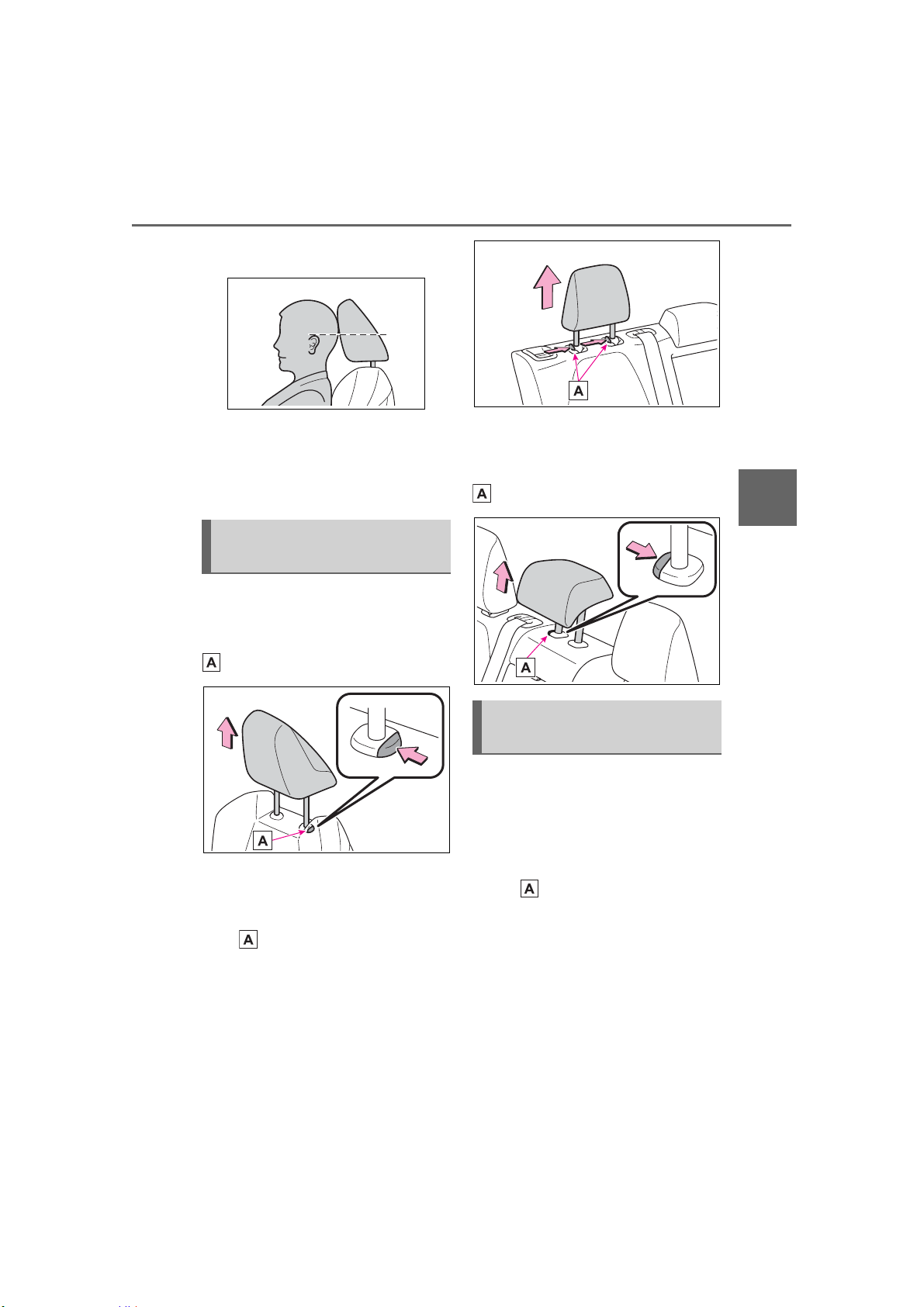
119
3-3. Adjusting the seats
COROLLA H/B_U
3
Before driving
the head restraint is closest to the
top of your ears.
■ Adjusting the rear center seat
head restraint
Always raise the head restraint one
level from the stowed position when
using.
■ Front seats
Pull the head restraint up while
pressing the lock release button
.
■ Rear outside seats
Pull the head restraint up while
pressing the lock release but-
tons .
■ Rear center seat
Pull the head restraint up while
pressing the lock release button
.
■ Front seats
Align the head restraint with the
installation holes and push it
down to the lock position.
Press and hold the lock release
button when lowering the head
restraint.
Removing the head
restraints
Installing the head
restraints
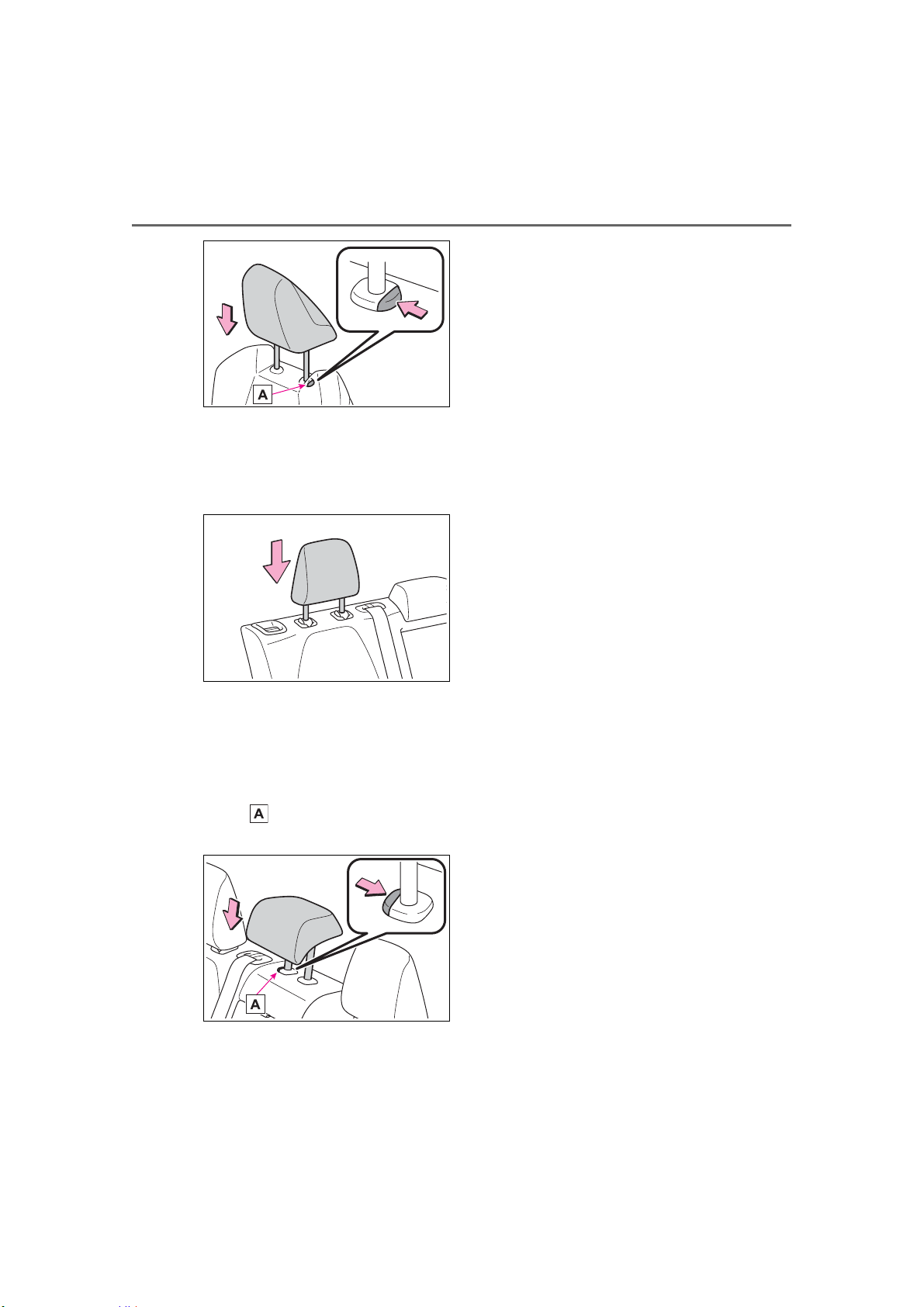
120
3-3. Adjusting the seats
COROLLA H/B_U
■ Rear outside seats
Align the head restraint with the
installation holes and push it
down to the lock position.
■ Rear center seat
Align the head restraint with the
installation holes and push it
down to the lock position.
Press and hold the lock release
button when lowering the head
restraint.
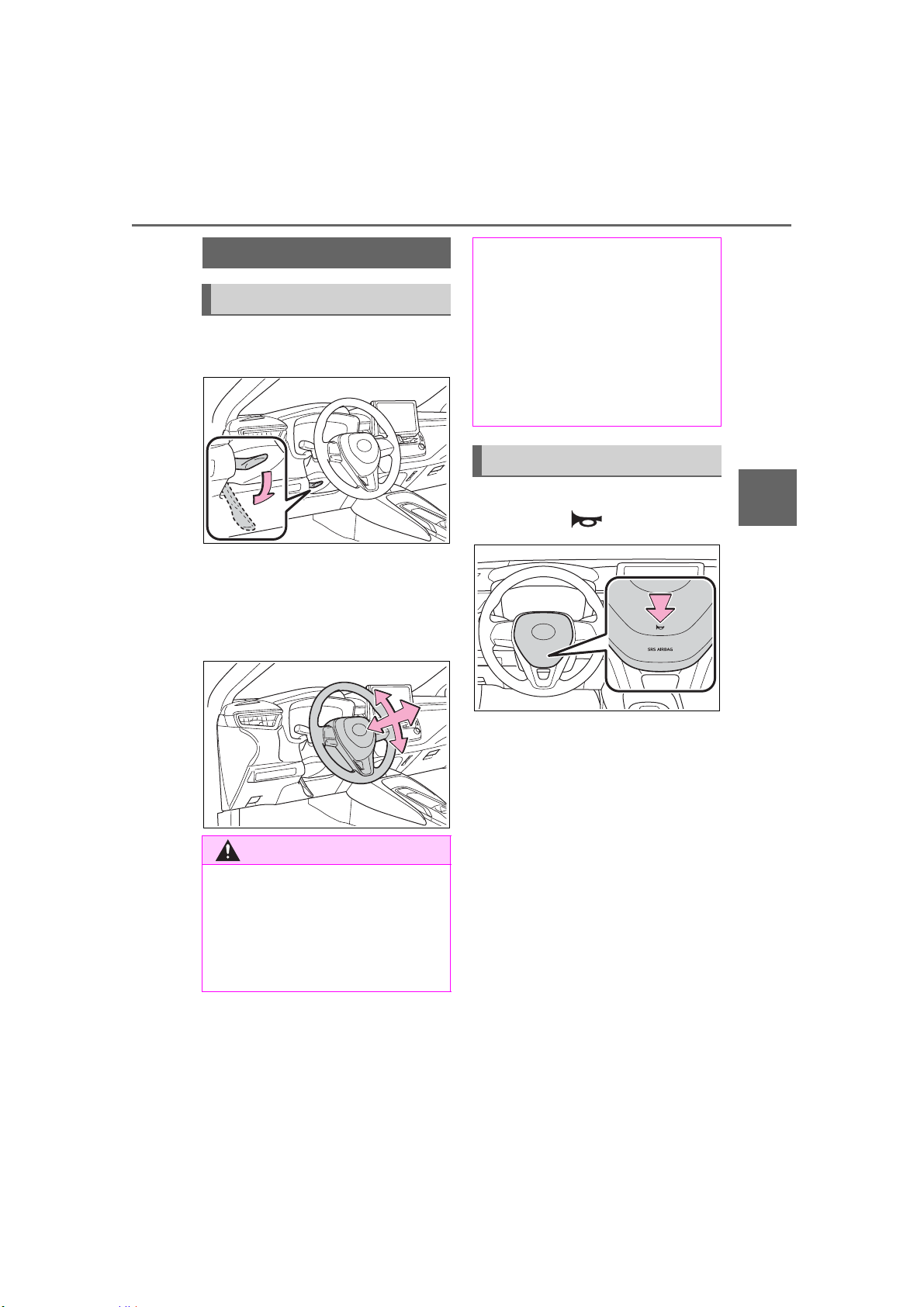
121
3-4. Adjusting the steering wheel and mirrors
COROLLA H/B_U
3
Before driving
3-4.Adjusting the steering wheel and mirrors
1 Hold the steering wheel and
push the lever down.
2 Adjust to the ideal position by
moving the steering wheel
horizontally and vertically.
After adjustment, pull the lever up
to secure the steering wheel.
To sound the horn, press on or
close to the mark.
Steering wheel
Adjustment procedure
WARNING
■ Caution while driving
Do not adjust the steering wheel
while driving.
Doing so may cause the driver to
mishandle the vehicle and cause
an accident, resulting in death or
serious injury.
■ After adjusting the steering
wheel
Make sure that the steering wheel
is securely locked.
Otherwise, the steering wheel
may move suddenly, possibly
causing an accident, and resulting
in death or serious injury. Also,
the horn may not sound if the
steering wheel is not securely
locked.
Horn
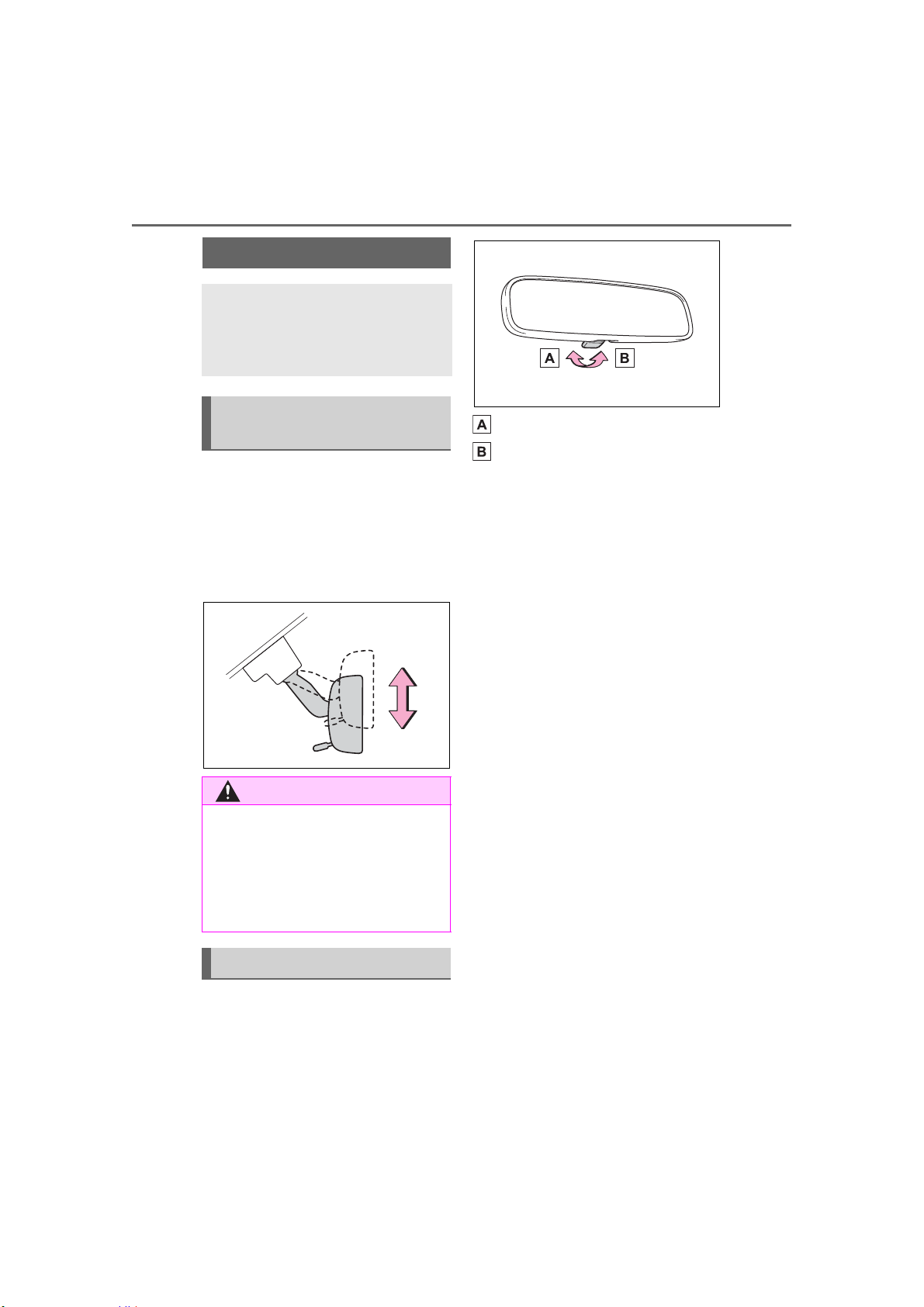
122
3-4. Adjusting the steering wheel and mirrors
COROLLA H/B_U
The height of the rear view mir-
ror can be adjusted to suit your
driving posture.
Adjust the height of the rear
view mirror by moving it up and
down.
Reflected light from the head-
lights of vehicles behind can be
reduced by operating the lever.
Normal position
Anti-glare position
Inside rear view mirror
The rear view mirror’s posi-
tion can be adjusted to
enable sufficient confirma-
tion of the rear view.
Adjusting the height of
rear view mirror
WARNING
■ Caution while driving
Do not adjust the position of the
mirror while driving.
Doing so may lead to mishandling
of the vehicle and cause an acci-
dent, resulting in death or serious
injury.
Anti-glare function
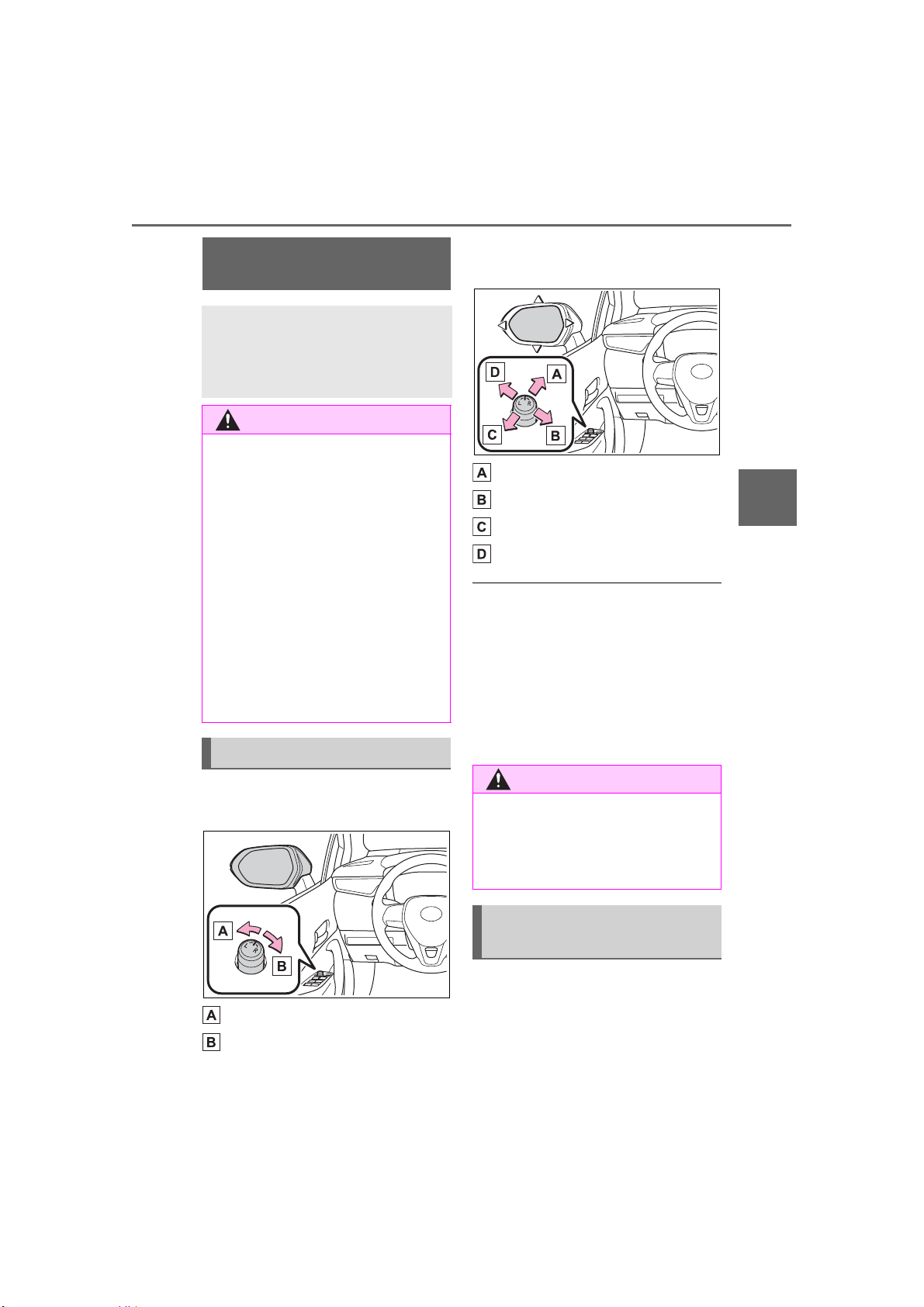
123
3-4. Adjusting the steering wheel and mirrors
COROLLA H/B_U
3
Before driving
1 To select a mirror to adjust,
turn the switch.
Left
Right
2 To adjust the mirror, operate
the switch.
Up
Right
Down
Left
■ Mirror angle can be adjusted
when
The engine switch is in ACC or ON.
■ When the mirrors are fogged up
The outside rear view mirrors can
be cleared using the mirror defog-
gers. Turn on the rear window
defogger to turn on the outside rear
view mirror defoggers. (P.389)
Push the mirror back in the
direction of the vehicle’s rear.
Outside rear view mir-
rors
The rear view mirror’s posi-
tion can be adjusted to
enable sufficient confirma-
tion of the rear view.
WARNING
■ Important points while driving
Observe the following precautions
while driving.
Failure to do so may result in loss
of control of the vehicle and cause
an accident, resulting in death or
serious injury.
● Do not adjust the mirrors while
driving.
● Do not drive with the mirrors
folded.
● Both the driver and passenger
side mirrors must be extended
and properly adjusted before
driving.
Adjustment procedure
WARNING
■ When the mirror defoggers
are operating
Do not touch the rear view mirror
surfaces, as they can become
very hot and burn you.
Folding and extending the
mirrors

124
3-4. Adjusting the steering wheel and mirrors
COROLLA H/B_U
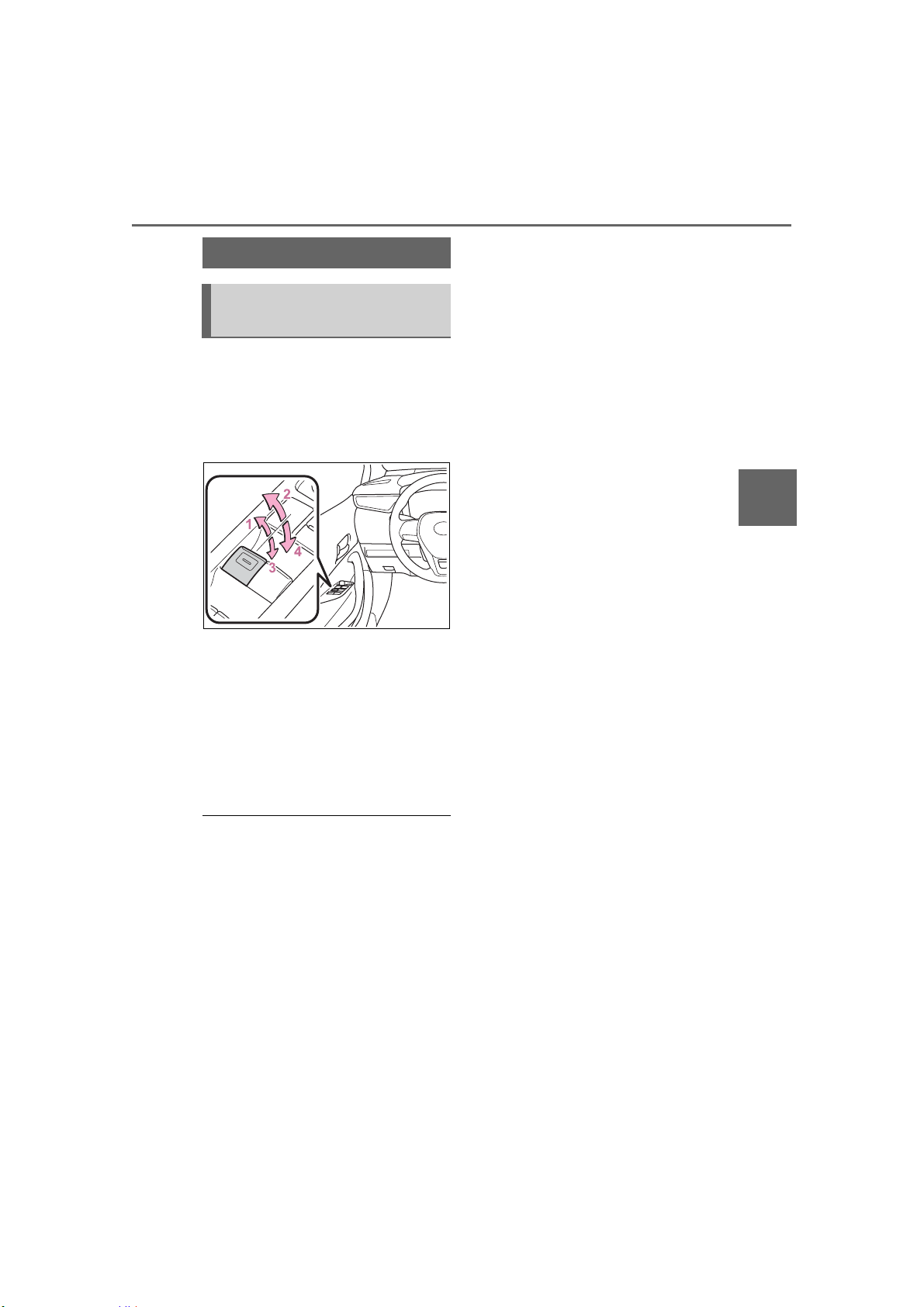
125
3-5. Opening and closing the windows
COROLLA H/B_U
3
Before driving
3-5.Opening a nd closing the windows
The power windows can be
opened and closed using the
switches.
Operating the switch moves the
windows as follows:
1 Closing
2 One-touch closing
*
3 Opening
4 One-touch opening
*
*
: To stop the window partway,
operate the switch in the opposite
direction.
■ The power windows can be
ope
rated when
The engine switch is in ON.
■ Operating the power windows
af
ter turning the engine off
The power windows can be oper-
ated for approximately 45 seconds
after the engine switch is turned to
ACC or OFF. They cannot, however,
be operated once either front door is
opened.
■ Jam protection function
If an object becomes jammed
between the window and the win-
dow frame while the window is clos-
ing, window movement is stopped
and the window is opened slightly.
■ Catch protection function
If an object becomes caught
between the door and window while
the window is opening, window
movement is stopped.
■ When the window cannot be
opened or closed
When the jam protection function or
catch protection function operates
unusually and the door window can-
not be opened or closed, perform
the following operations with the
power window switch of that door.
● Stop the vehicle. With the engine
switch in ON, within 4 second
s of
the
jam protection function o
r
catch pr
otection function activat-
ing, continuously oper
ate the
power window s
witch
in the
o
ne-touch closing direction
or
one-touch opening direction so
tha
t the door window can be
opened and closed.
● If the door window cannot be
opened and closed even when
performing the above operations
,
perform the follow
ing procedure
for function initialization.
1 Turn the engine switch to ON.
2 Pull and hold the power window
switch in the one-touch closing
direction and completely close
the door window.
3 Release the power window
switch for a moment, resume
pulling the switch in the
one-touch closing direction, and
hold it there for approximately 6
seconds or more.
4 Press and hold the power win-
dow switch in the one-touch
opening direction. After the door
window is completely opened,
continue holding the switch for
an additional 1 second or more.
5 Release the power window
switch for a moment, resume
Power windows
Opening and closing the
power windows
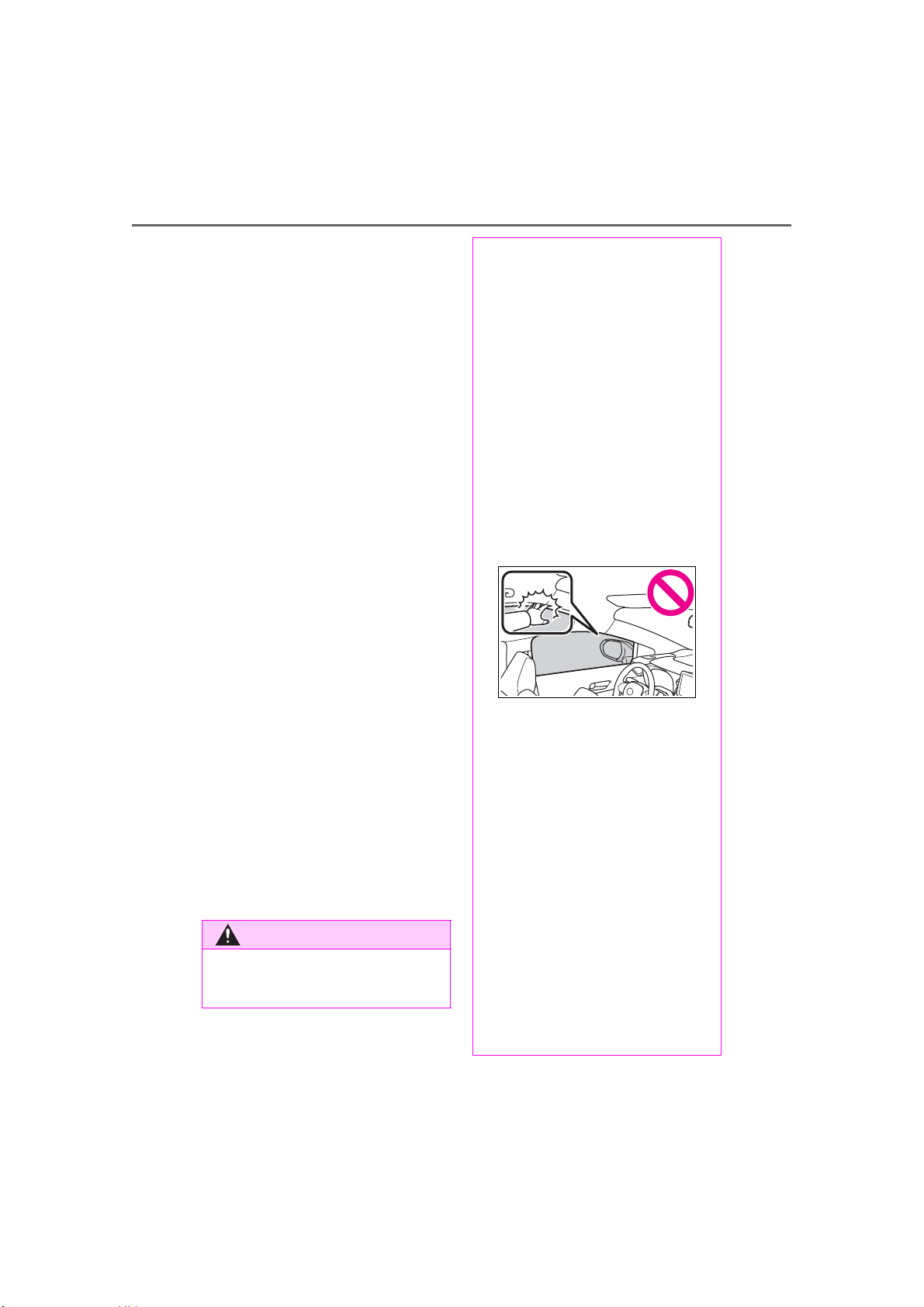
126
3-5. Opening and closing the windows
COROLLA H/B_U
pushing the switch in the
one-touch opening direction, and
hold it there for approximately 4
seconds or more.
6 Pull and hold the power window
switch in the one-touch closing
direction again. After the door
window is completely closed,
continue holding the switch for a
further 1 second or more.
If you release the switch while the
window is moving, start again from
the beginning.
If the window reverses and cannot
be fully closed or opened, have the
vehicle inspected by your Toyota
dealer.
■ Door lock linked window opera-
tion
● The power windows can be
opened and closed using the
mechanical key.
*
(P.501)
● The power windows can be
opened using the wireless remote
control.
*
(P.101)
*
: These settings must be custom-
ized at your Toyota dealer.
■ Power windows open warning
buzzer
A buzzer sounds and a message is
shown on the multi-information dis-
play in the instrument cluster when
the engine switch is turned off and
the driver’s door is opened with the
power windows open.
■ Customization
Some functions can be customized.
(P.531)
WARNING
Observe the following precau-
tions. Failure to do so may result
in death or serious injury.
■ Closing the windows
● The driver is responsible for all
the power window operations,
including the operation for the
passengers. In order to prevent
accidental operation, especially
by a child, do not let a child
operate the power windows. It is
possible for children and other
passengers to have body parts
caught in the power window.
Also, when riding with a child, it
is recommended to use the win-
dow lock switch. (
P.127)
● Check to make sure that all pas-
sengers do not have any part of
their body in a position where it
could be caught when a window
is being operated.
● When using the wireless remote
control or mechanical key and
operating the power windows,
operate the power window after
checking to make sure that
there is no possibility of any
passenger having any of their
body parts caught in the win-
dow. Also do not let a child
operate window by the wireless
remote control or mechanical
key. It is possible for children
and other passengers to get
caught in the power window.
● When exiting the vehicle, turn
the engine switch off, carry the
key and exit the vehicle along
with the child. There may be
accidental operation, due to
mischief, etc., that may possibly
lead to an accident.

127
3-5. Opening and closing the windows
COROLLA H/B_U
3
Before driving
This function can be used to
prevent children from acciden-
tally opening or closing a pas-
senger window.
Press the switch.
The indicator will come on and
the passenger windows will be
locked.
The passenger windows can still be
opened and closed using the
driver’s switch even if the lock
switch is on.
■ The power windows can be
operated when
The engine switch is in ON.
■ When the battery is discon-
nected
The window lock switch is disabled.
If necessary, press the window lock
switch after reconnecting the bat-
tery.
WARNING
■ Jam protection function
● Never use any part of your body
to intentionally activate the jam
protection function.
● The jam protection function may
not work if something gets
jammed just before the window
is fully closed. Be careful not to
get any part of your body
jammed in the window.
■ Catch protection function
● Never use any part of your body
or clothing to intentionally acti-
vate the catch protection func-
tion.
● The catch protection function
may not work if something gets
caught just before the window is
fully opened. Be careful not to
get any part of your body or
clothing caught in the window.
Preventing accidental
operation (window lock
switch)

128
3-5. Opening and closing the windows
COROLLA H/B_U

129
COROLLA H/B_U
4
4
Driving
Driving
.
4-1. Before driving
Driving the vehicle....... 130
Cargo and luggage ..... 138
Vehicle load limits ....... 140
Trailer towing............... 141
Dinghy towing ............. 141
4-2. Driving procedures
Engine (ignition) switch
.................................. 142
Continuously variable trans-
mission...................... 147
Manual transmission ... 151
Turn signal lever.......... 153
Parking brake.............. 154
Brake Hold .................. 157
4-3. Operating the lights and
wipers
Headlight switch.......... 160
Automatic High Beam . 163
Fog light switch ........... 166
Windshield wipers and
washer....................... 166
Rear window wiper and
washer....................... 168
4-4. Refueling
Opening the fuel tank cap
.................................. 170
4-5. Using the driving support
systems
Toyota Safety Sense 2.0
.................................. 172
PCS (Pre-Collision System)
.................................. 178
LTA (Lane Tracing Assist)
.................................. 186
LDA (Lane Departure Alert
with steering control) . 196
Dynamic radar cruise con-
trol with full-speed range
.................................. 204
Dynamic radar cruise con-
trol ............................. 214
RSA (Road Sign Assist)
.................................. 224
BSM (Blind Spot Monitor)
.................................. 227
Rear view monitor system
.................................. 232
Driving mode select switch
.................................. 240
Driving assist systems
.................................. 241
4-6. Driving tips
Winter driving tips........ 246

130
4-1. Before driving
COROLLA H/B_U
4-1.Before driving
■ Starting the engine
P.142
■ Driving
Continuously variable trans-
mission
1 With the brake pedal
depressed, shift the shift
lever to D. (P.147)
2 If the parking brake is in man-
ual mode, release the park-
ing brake. (P.154)
3 Gradually release the brake
pedal and gently depress the
accelerator pedal to acceler-
ate the vehicle.
Manual transmission
1 While depressing the clutch
pedal, shift the shift lever to
1
. (P
.151)
2 If the parking brake is in man-
ual mode, release the park-
ing brake. (P.154)
3 Gradually release the clutch
pedal. At the same time, gen-
tly depress the accelerator
pedal to accelerate the vehi-
cle.
■ Stopping
Continuously variable trans-
mission
1 With the shift lever in D,
depress the brake pedal.
2 If necessary, set the parking
brake.
If the vehicle is to be stopped for an
extended period of time, shift the
shift lever to P. (P.147)
Manual transmission
1 While depressing the clutch
pedal, dep
ress the brake
pedal.
2 If necessary, set the parking
brake.
If the vehicle is to be stopped for an
extended period of time, shift the
shift lever to N. (P.151)
■ Parking the vehicle
Continuously variable trans-
mission
1 With the shift lever in D,
depress the brake pedal to
stop the vehicle completely.
2 Set the parking brake
(P.154), shift the shift leve
r
to P. (P.147)
Check the parking brake indicator
is illuminated.
3 Press the engine switch to
stop the engine.
4 Slowly release the brake
pedal.
5 Lock the door, making sure
that you have the key on your
person.
If parking on a hill, block the wheels
Driving the vehicle
The following procedures
should be observed to
ensure safe driving:
Driving procedure

131
4-1. Before driving
COROLLA H/B_U
4
Driving
as needed.
Manual transmission
1 While depressing the clutch
pedal, depress the brake
pedal.
2 If the parking brake is in man-
ual mode, set the parking
brake. (P.154)
Check that the parking brake indi-
cator is illuminated.
3 Shift the shift lever to N.
(P.151)
If parking on a hill, shift the shift
lever to 1 or R and block the wheels
as needed.
4 Press the engine switch to
stop the engine.
5 Slowly release the brake
pedal.
6 Lock the door, making sure
that you have the key on your
person.
■ Starting off on a steep
uphill
Continuously variable trans-
mission
1 Make sure that the parking
brake is set and shift the shift
lever to D.
2 Gently depress the accelera-
tor pedal.
3 Release the parking brake.
Manual transmission
1 Make sure that the parking
brake is set and shift the shift
lever to 1.
2 Lightly depress the accelera-
tor pedal at the same time as
gradually releasing the clutch
pedal.
3 Release the parking brake.
■ Driving in the rain
● Drive carefully when it is raining,
because visibility will be reduced,
the windows may become
fogged-up, and the road will be
slippery.
● Drive carefully when it starts to
rain, because the road surface will
be especially slippery.
● Refrain from high speeds when
driving on an expressway in the
rain, because there may be a
layer of water between the tires
and the road surface, preventing
the steering and brakes from
operating properly.
■ Engine speed while driving
(vehicles with a continuously
variable transmission)
In the following conditions, the
engine speed may become high
while driving. This is due to auto-
matic up-shifting control or
down-shifting implementation to
meet driving conditions. It does not
indicate sudden acceleration.
● The vehicle is judged to be driving
uphill or downhill
● When the accelerator pedal is
released
● When the brake pedal is
depressed while sport mode is
selected
■ Restraining the engine output
(Brake Override System)
● When the accelerator and brake
pedals are depressed at the same
time, the engine output may be
restrained.
● A warning message is displayed
on the multi-information display

132
4-1. Before driving
COROLLA H/B_U
while the system is operating.
■ Restraining sudden start
(Drive-Start Control [vehicles
with a continuously variable
transmission])
● When the following unusual oper-
ation is performed, the engine out-
put may be restrained.
• When the shift lever is shifted from
R to D, D to R, N to R, P to D, or P
to R (D includes M) with the accel-
erator pedal depressed, a warning
message appears on the
multi-information display. If a
warning message is shown on the
multi-information display, read the
message and follow the instruc-
tion.
• When the accelerator pedal is
depressed too much while the
vehicle is in reverse.
● While Drive-Start Control is being
activated, your vehicle may have
trouble escaping from the mud or
fresh snow. In such case, deacti-
vate TRAC (P.242) to cancel
Drive-Start Control so that the
vehicle may become able to
escape from the mud or fresh
snow.
■ Breaking in your new Toyota
To extend the life of the vehicle,
observing the following precautions
is recommended:
● For the first 186 miles (300 km):
Avoid sudden stops.
● For the first 621 miles (1000 km):
• Do not drive at extremely high
speeds.
• Avoid sudden acceleration.
• Do not drive continuously in low
gears.
• Do not drive at a constant speed
for extended periods.
■ Operating your vehicle in a for-
eign country
Comply with the relevant vehicle
registration laws and confirm the
availability of the correct fuel.
(P.511)
WARNING
Observe the following precau-
tions.
Failure to do so may result in
death or serious injury.
■ When starting the vehicle
(vehicles with a continuously
variable transmission)
Always keep your foot on the
brake pedal while stopped with
the engine running. This prevents
the vehicle from creeping.
■ When driving the vehicle
● Do not drive if you are unfamil-
iar with the location of the brake
and accelerator pedals to avoid
depressing the wrong pedal.
• Accidentally depressing the
accelerator pedal instead of the
brake pedal will result in sudden
acceleration that may lead to an
accident.
• When backing up, you may twist
your body around, leading to a
difficulty in operating the pedals.
Make sure to operate the pedals
properly.
• Make sure to keep a correct
driving posture even when mov-
ing the vehicle only slightly. This
allows you to depress the brake
and accelerator pedals properly.
• Depress the brake pedal using
your right foot. Depressing the
brake pedal using your left foot
may delay response in an emer-
gency, resulting in an accident.

133
4-1. Before driving
COROLLA H/B_U
4
Driving
WARNING
● Do not drive the vehicle over or
stop the vehicle near flammable
materials.
The exhaust system and
exhaust gases can be
extremely hot. These hot parts
may cause a fire if there is any
flammable material nearby.
● During normal driving, do not
turn off the engine. Turning the
engine off while driving will not
cause loss of steering or brak-
ing control, but the power assist
to these systems will be lost.
This will make it more difficult to
steer and brake, so you should
pull over and stop the vehicle as
soon as it is safe to do so.
However, in the event of an
emergency, such as if it
becomes impossible to stop the
vehicle in the normal way:
P. 46 0
● Use engine braking (downshift)
to maintain a safe speed when
driving down a steep hill.
Using the brakes continuously
may cause the brakes to over-
heat and lose effectiveness.
(
P.147, 151)
● Do not adjust the positions of
the steering wheel, the seat, or
the inside or outside rear view
mirrors while driving.
Doing so may result in a loss of
vehicle control.
● Always check that all passen-
gers’ arms, heads or other parts
of their body are not outside the
vehicle.
● Do not drive in excess of the
speed limit. Even if the legal
speed limit permits it, do not
drive over 85 mph (140 km/h)
unless your vehicle has
high-speed capability tires. Driv-
ing over 85 mph (140 km/h)
may result in tire failure, loss of
control and possible injury. Be
sure to consult a tire dealer to
determine whether the tires on
your vehicle are high-speed
capability tires or not before
driving at such speeds.
■ When driving on slippery
road surfaces
● Sudden braking, acceleration
and steering may cause tire
slippage and reduce your ability
to control the vehicle.
● Sudden acceleration, engine
braking due to shifting, or
changes in engine speed could
cause the vehicle to skid.
● After driving through a puddle,
lightly depress the brake pedal
to make sure that the brakes
are functioning properly. Wet
brake pads may prevent the
brakes from functioning prop-
erly. If the brakes on only one
side are wet and not functioning
properly, steering control may
be affected.
■ When shifting the shift lever
● Vehicles with a continuously
variable transmission: Do not let
the vehicle roll backward while a
forward driving position is
selected, or roll forward while
the shift lever is in R.
Doing so may cause the engine
to stall or lead to poor brake and
steering performance, resulting
in an accident or damage to the
vehicle.

134
4-1. Before driving
COROLLA H/B_U
WARNING
● Vehicles with a continuously
variable transmission: Do not
shift the shift lever to P while the
vehicle is moving.
Doing so can damage the trans-
mission and may result in a loss
of vehicle control.
● Do not shift the shift lever to R
while the vehicle is moving for-
ward.
Doing so can damage the trans-
mission and may result in a loss
of vehicle control.
● Do not shift the shift lever to a
driving position while the vehicle
is moving backward.
Doing so can damage the trans-
mission and may result in a loss
of vehicle control.
● Moving the shift lever to N while
the vehicle is moving will disen-
gage the engine from the trans-
mission. Engine braking is not
available when N is selected.
● Vehicles with a continuously
variable transmission: Be care-
ful not to shift the shift lever with
the accelerator pedal
depressed. Shifting the shift
lever to any positions other than
P or N may lead to unexpected
rapid acceleration of the vehicle
that may cause an accident and
result in death or serious injury.
■ If you hear a squealing or
scraping noise (brake pad
wear indicators)
Have the brake pads checked and
replaced by your Toyota dealer as
soon as possible.
Rotor damage may result if the
pads are not replaced when
needed.
It is dangerous to drive the vehicle
when the wear limits of the brake
pads and/or those of the brake
discs are exceeded.
■ When the vehicle is stopped
● Do not race the engine.
If the vehicle is in any gear other
than P (continuously variable
transmission) or N, the vehicle
may accelerate suddenly and
unexpectedly, causing an acci-
dent.
● Vehicles with a continuously
variable transmission: In order
to prevent accidents due to the
vehicle rolling away, always
keep depressing the brake
pedal while the engine is run-
ning, and apply the parking
brake as necessary.
● If the vehicle is stopped on an
incline, in order to prevent acci-
dents caused by the vehicle roll-
ing forward or backward, always
depress the brake pedal and
securely apply the parking
brake as needed.
● Avoid revving or racing the
engine.
Running the engine at high
speed while the vehicle is
stopped may cause the exhaust
system to overheat, which could
result in a fire if combustible
material is nearby.
■ When the vehicle is parked
● Do not leave glasses, cigarette
lighters, spray cans, or soft
drink cans in the vehicle when it
is in the sun.
Doing so may result in the fol-
lowing:
• Gas may leak from a cigarette
lighter or spray can, and may
lead to a fire.

135
4-1. Before driving
COROLLA H/B_U
4
Driving
WARNING
• The temperature inside the
vehicle may cause the plastic
lenses and plastic material of
glasses to deform or crack.
• Soft drink cans may fracture,
causing the contents to spray
over the interior of the vehicle,
and may also cause a short cir-
cuit in the vehicle’s electrical
components.
● Do not leave cigarette lighters in
the vehicle. If a cigarette lighter
is in a place such as the glove
box or on the floor, it may be lit
accidentally when luggage is
loaded or the seat is adjusted,
causing a fire.
● Do not attach adhesive discs to
the windshield or windows. Do
not place containers such as air
fresheners on the instrument
panel or dashboard. Adhesive
discs or containers may act as
lenses, causing a fire in the
vehicle.
● Do not leave a door or window
open if the curved glass is
coated with a metallized film
such as a silver-colored one.
Reflected sunlight may cause
the glass to act as a lens, caus-
ing a fire.
● Always apply the parking brake,
shift the shift lever to P (vehicles
with a continuously variable
transmission), stop the engine
and lock the vehicle.
Do not leave the vehicle unat-
tended while the engine is run-
ning.
If the vehicle is parked with the
shift lever in P but the parking
brake is not set, the vehicle may
start to move, possibly leading
to an accident.
● Do not touch the exhaust pipes
while the engine is running or
immediately after turning the
engine off.
Doing so may cause burns.
■ When taking a nap in the vehi-
cle
Always turn the engine off. Other-
wise, if you accidentally move the
shift lever or depress the acceler-
ator pedal, this could cause an
accident or fire due to engine
overheating. Additionally, if the
vehicle is parked in a poorly venti-
lated area, exhaust gases may
collect and enter the vehicle, lead-
ing to death or a serious health
hazard.
■ When braking
● When the brakes are wet, drive
more cautiously.
Braking distance increases
when the brakes are wet, and
this may cause one side of the
vehicle to brake differently than
the other side. Also, the parking
brake may not securely hold the
vehicle.
● If the brake booster device does
not operate, do not follow other
vehicles closely and avoid hills
or sharp turns that require brak-
ing.
In this case, braking is still pos-
sible, but the brake pedal
should be depressed more
firmly than usual. Also, the brak-
ing distance will increase. Have
your brakes fixed immediately.
● Do not pump the brake pedal if
the engine stalls.
Each push on the brake pedal
uses up the reserve for the
power-assisted brakes.
136
4-1. Before driving
COROLLA H/B_U
WARNING
● The brake system consists of 2
individual hydraulic systems; if
one of the systems fails, the
other will still operate. In this
case, the brake pedal should be
depressed more firmly than
usual and the braking distance
will increase. Have your brakes
fixed immediately.
■ If the vehicle becomes stuck
Do not spin the wheels exces-
sively when a driven wheel is up
in the air, or the vehicle is stuck in
sand, mud, etc. This may damage
the driveline components or pro-
pel the vehicle forward or back-
ward, causing an accident.
NOTICE
■ When driving the vehicle
(vehicles with a continuously
variable transmission)
● Do not depress the accelerator
and brake pedals at the same
time during driving, as this may
restrain the engine output.
● Do not use the accelerator
pedal or depress the accelera-
tor and brake pedals at the
same time to hold the vehicle on
a hill.
■ When driving the vehicle
(vehicles with a manual trans-
mission)
● Do not depress the accelerator
and brake pedals at the same
time during driving, as this may
restrain the engine output.
● Do not shift gears unless the
clutch pedal is fully depressed.
After shifting, do not release the
clutch pedal abruptly. Doing so
may damage the clutch, trans-
mission and gears.
● Observe the following precau-
tions.
Failure to do so may cause
excessive premature wear or
damage to the clutch, eventu-
ally making it difficult to acceler-
ate and start off from a stop.
Have the vehicle inspected by
your Toyota dealer.
• Do not rest your foot on the
clutch pedal or depress it any
time other than when shifting.
Doing so may cause clutch trou-
ble.
• Do not use any gear other than
the 1st gear when starting off
and moving forward.
Doing so may damage the
clutch.
• Do not use the clutch pedal to
adjust vehicle speed.
Doing so may damage the
clutch.
• When stopping the vehicle with
the shift lever in a position other
than N, make sure to fully
depress the clutch pedal and
stop the vehicle using the
brakes.
● Do not shift the shift lever to R
without the vehicle completely
stopped.
Doing so may damage the
clutch, transmission and gears.
■ When parking the vehicle
(vehicles with a continuously
variable transmission)
Always set the parking brake and
shift the shift lever to P. Failure to
do so may cause the vehicle to
move or the vehicle may acceler-
ate suddenly if the accelerator
pedal is accidentally depressed.

137
4-1. Before driving
COROLLA H/B_U
4
Driving
NOTICE
■ Avoiding damage to vehicle
parts
● Do not turn the steering wheel
fully in either direction and hold
it there for an extended period
of time.
Doing so may damage the
power steering motor.
● When driving over bumps in the
road, drive as slowly as possible
to avoid damaging the wheels,
underside of the vehicle, etc.
■ If you get a flat tire while driv-
ing
A flat or damaged tire may cause
the following situations. Hold the
steering wheel firmly and gradu-
ally depress the brake pedal to
slow down the vehicle.
● It may be difficult to control your
vehicle.
● The vehicle will make abnormal
sounds or vibrations.
● The vehicle will lean abnor-
mally.
Information on what to do in case
of a flat tire (
P.479,490)
■ When encountering flooded
roads
Do not drive on a road that has
flooded after heavy rain etc.
Doing so may cause the following
serious damage to the vehicle:
● Engine stalling
● Short in electrical components
● Engine damage caused by
water immersion
In the event that you drive on a
flooded road and the vehicle
becomes flooded or stuck in mud
or sand, be sure to have your Toy-
ota dealer check the following:
● Brake function
● Changes in the quantity and
quality of the engine oil, tran-
saxle fluid, clutch fluid, differen-
tial oil, etc.
● Lubricant condition for the bear-
ings and suspension joints
(where possible), and the func-
tion of all joints, bearings, etc.
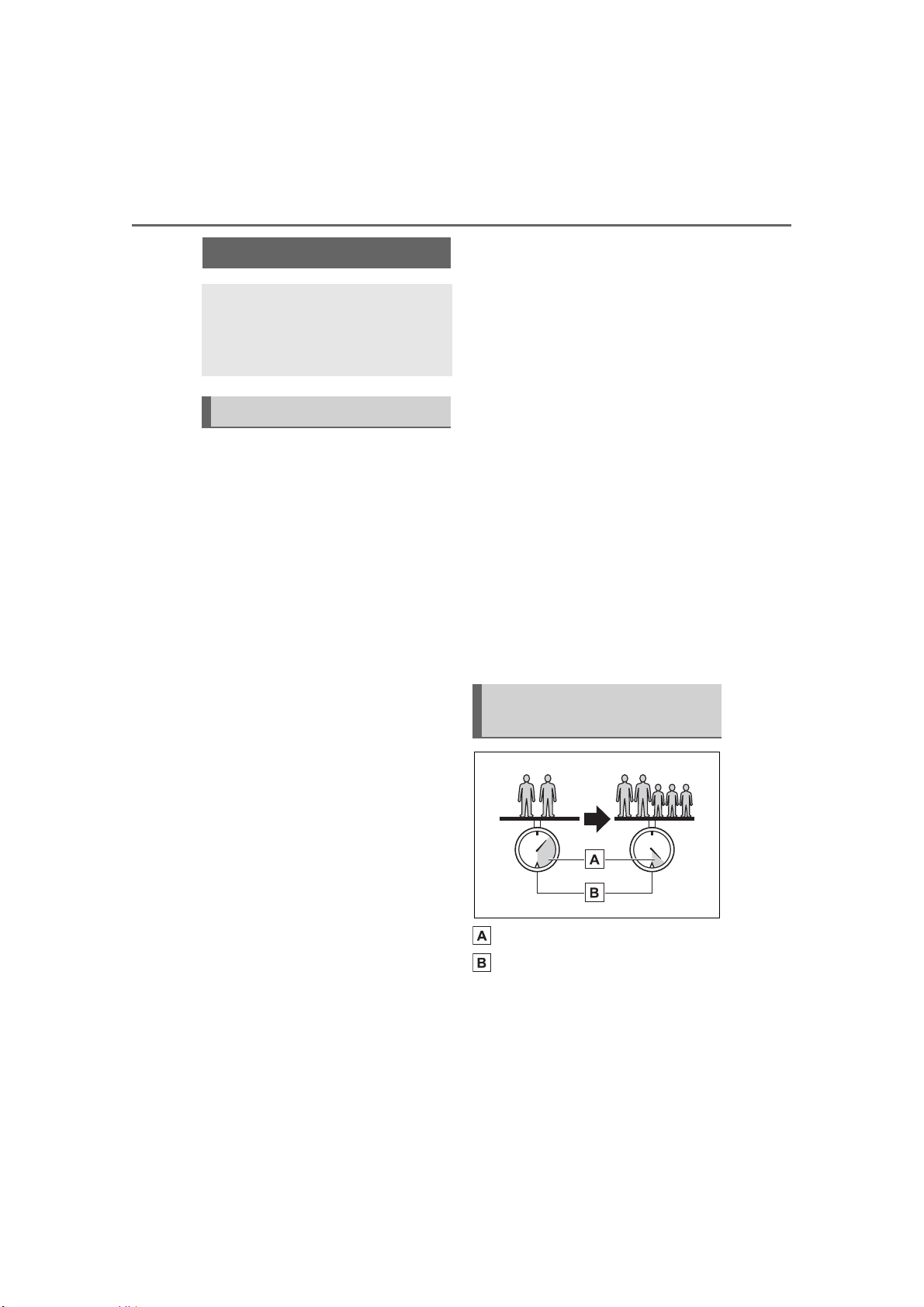
138
4-1. Before driving
COROLLA H/B_U
Cargo capacity depends on the
total weight of the occupants.
(Cargo capacity) = (Total load
capacity) — (Total weight of
occupants)
Steps for Determining Correct
Load Limit —
(1) Locate the statement “The
combined weight of occupants
and cargo should never exceed
XXX kg or XXX lbs.” on your
vehicle’s placard.
(2) Determine the combined
weight of the driver and passen-
gers that will be riding in your
vehicle.
(3) Subtract the combined
weight of the driver and passen-
gers from XXX kg or XXX lbs.
(4) The resulting figure equals
the available amount of cargo
and luggage load capacity.
For example, if the “XXX”
amount equals 1400 lbs. and
there will be five 150 lb passen-
gers in your vehicle, the amount
of available cargo and luggage
load capacity is 650 lbs. (1400 −
750 (5 150) = 650 lbs.)
(5) Determine the combined
weight of luggage and cargo
being loaded on the vehicle.
That weight may not safely
exceed the available cargo and
luggage load capacity calcu-
lated in Step 4.
(6) If your vehicle will be towing
a trailer, load from your trailer
will be transferred to your vehi-
cle. Consult this manual to
determine how this reduces the
available cargo and luggage
load capacity of your vehicle.
(P.510)
Toyota does not recommend towing
a trailer with your vehicle. Your
vehicle is not designed for trailer
towing.
Cargo capacity
Total load capacity (vehicle
capacity weight) (P.510)
When 2 people with the com-
bined weight of A lb. (kg) are rid-
ing in your vehicle, which has a
Cargo and luggage
Take notice of the following
information about storage
precautions, cargo capacity
and load:
Capacity and distribution
Calculation formula for
your vehicle

139
4-1. Before driving
COROLLA H/B_U
4
Driving
total load capacity (vehicle
capacity weight) of B lb. (kg),
the available amount of cargo
and luggage load capacity will
be C lb. (kg) as follows:
B
*2
lb. (kg) - A
*1
lb. (kg) = C
*3
lb.
(kg)
*1
:A =Weight of people
*2
:B =Total load capacity
*3
:C =Available cargo and luggage
load
In this condition, if 3 more passen-
gers with the combined weight of D
lb. (kg) get on, the available cargo
and luggage load will be reduced E
lb. (kg) as follows:
C lb. (kg) - D
*4
lb. (kg) = E
*5
lb.
(kg)
*4
:D =Additional weight of people
*5
:E =Available cargo and luggage
load
As shown in the example above,
if the number of occupants
increases, the cargo and lug-
gage load will be reduced by an
amount that equals the
increased weight due to the
additional occupants. In other
words, if an increase in the num-
ber of occupants causes an
excess of the total load capacity
(combined weight of occupants
plus cargo and luggage load),
you must reduce the cargo and
luggage on your vehicle.
WARNING
■ Things that must not be car-
ried in the luggage compart-
ment
The following things may cause a
fire if loaded in the luggage com-
partment:
● Receptacles containing gaso-
line
● Aerosol cans
■ Storage precautions
Observe the following precau-
tions.
Failure to do so may prevent the
pedals from being depressed
properly, may block the driver’s
vision, or may result in items hit-
ting the driver or passengers, pos-
sibly causing an accident.
● Stow cargo and luggage in the
luggage compartment when-
ever possible.
● Do not place cargo or luggage
in or on the following locations.
• At the feet of the driver
• On the front passenger or rear
seats (when stacking items)
• On the luggage cover
• On the instrument panel
• On the dashboard
● Secure all items in the occupant
compartment.
■ Capacity and distribution
● Do not exceed the maximum
axle weight rating or the total
vehicle weight rating.

140
4-1. Before driving
COROLLA H/B_U
■ Total load capacity and seating
capacity
These details are also described on
the tire and loading information
label. (P.445)
WARNING
● Even if the total load of occu-
pant’s weight and the cargo
load is less than the total load
capacity, do not apply the load
unevenly. Improper loading may
cause deterioration of steering
or braking control which may
cause death or serious injury.
Vehicle load limits
Vehicle load limits include
total load capacity, seating
capacity, towing capacity
and cargo capacity.
Total load capacity (vehicle
capacity weight): P.510
Total load capacity means the
combined weight of occupants,
cargo and luggage.
Seating capacity: 5 occu-
pants (Front 2, Rear 3)
Seating capacity means the max-
imum number of occupants
whose estimated average weight
is 150 lb. (68 kg) per person.
Towing capacity
Toyota does not recommend tow-
ing a trailer with your vehicle.
Cargo capacity
Cargo capacity may increase or
decrease depending on the
weight and the number of occu-
pants.
WARNING
■ Overloading the vehicle
Do not overload the vehicle.
It may not only cause damage to
the tires, but also degrade steer-
ing and braking ability, resulting in
an accident.
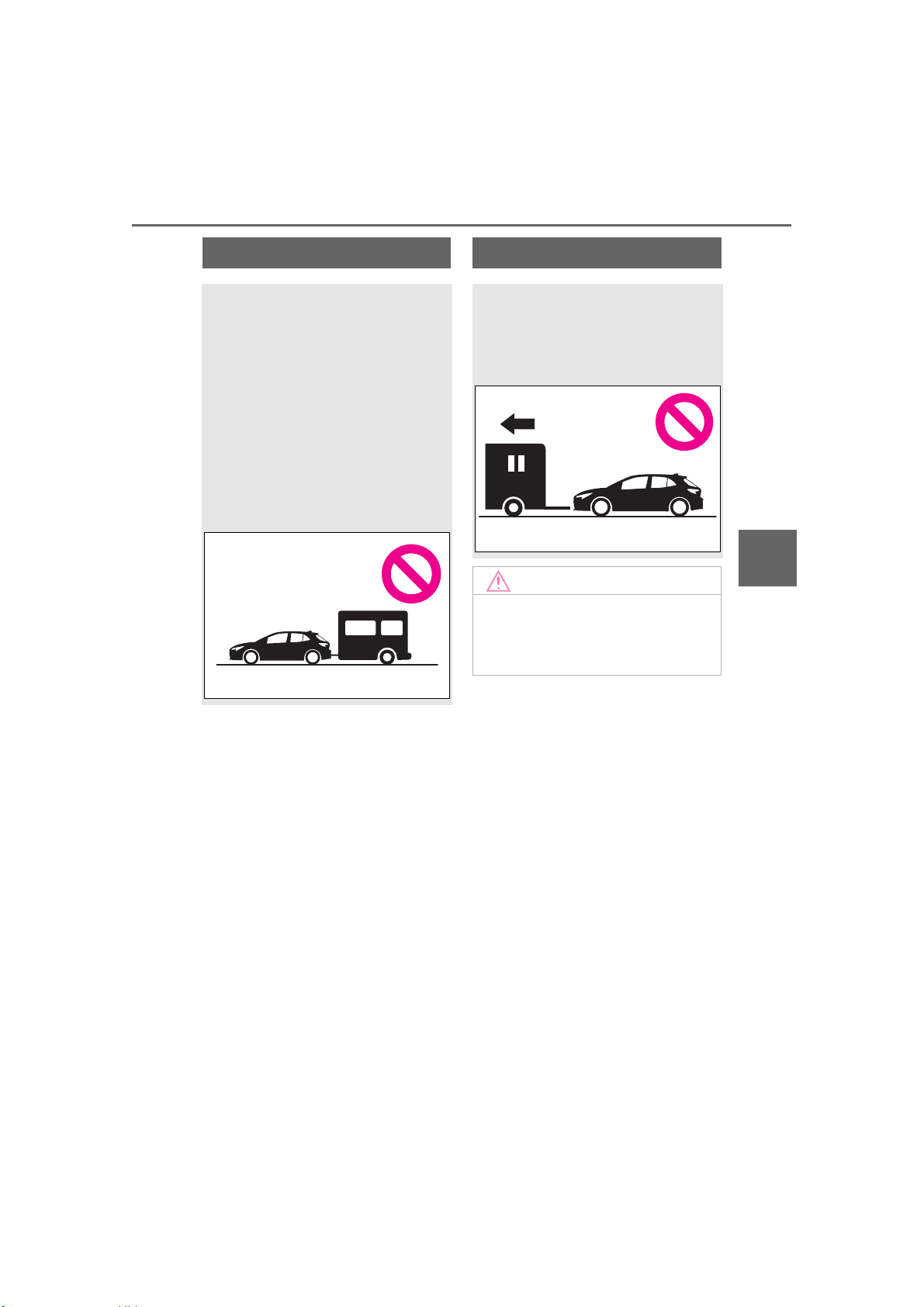
141
4-1. Before driving
COROLLA H/B_U
4
Driving
Trailer towing
Toyota does not recom-
mend towing a trailer with
your vehicle. Toyota also
does not recommend the
installation of a tow hitch or
the use of a tow hitch carrier
for a wheelchair, scooter,
bicycle, etc. Your vehicle is
not designed for trailer tow-
ing or for the use of tow
hitch mounted carriers.
Dinghy towing
Your vehicle is not designed
to be dinghy towed (with 4
wheels on the ground)
behind a motor home.
NOTICE
■ To avoid serious damage to
your vehicle
Do not tow your vehicle with the
four wheels on the ground.
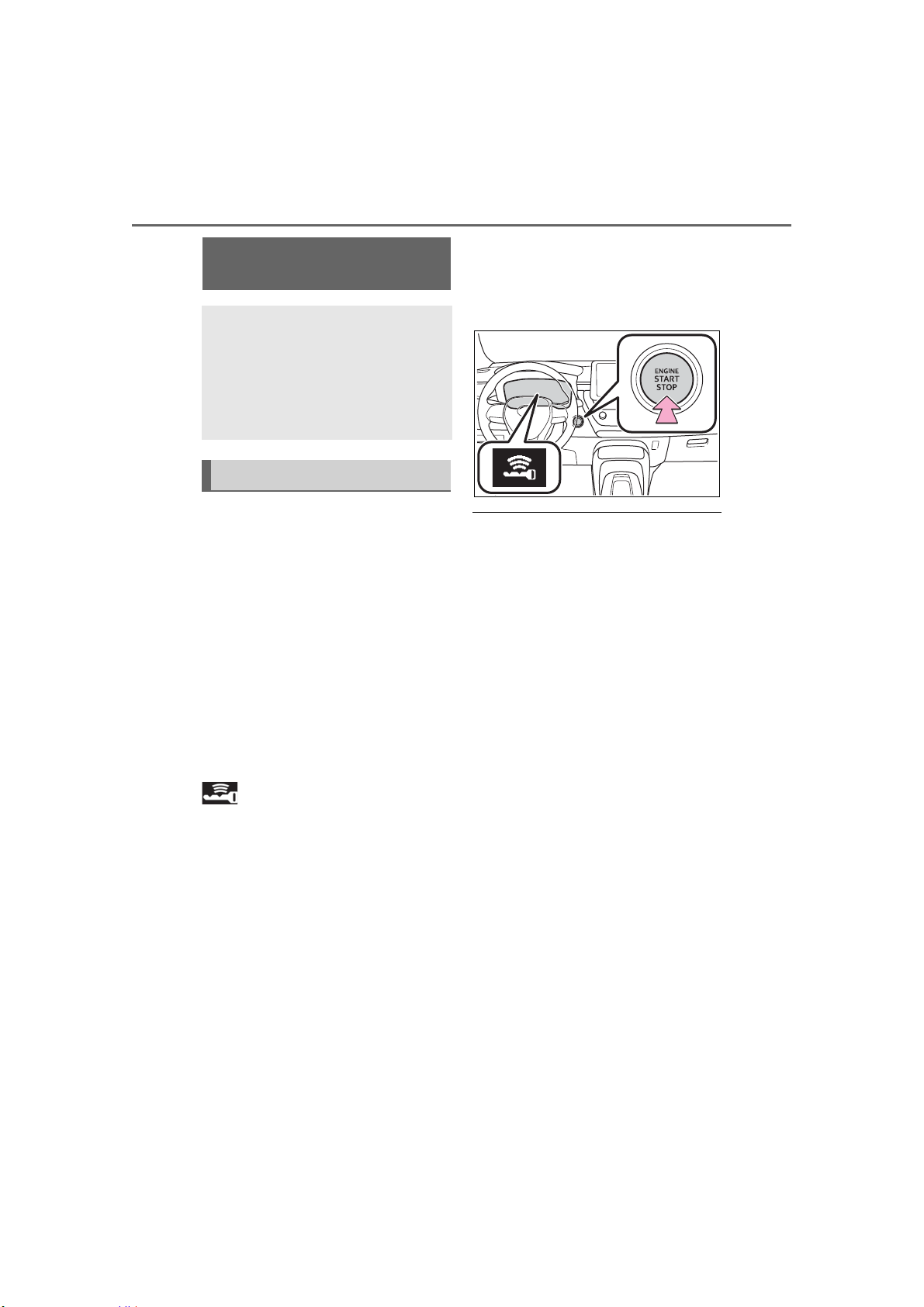
142
4-2. Driving procedures
COROLLA H/B_U
4-2.Driving procedures
1 Pull the parking brake switch
to check that the parking
brake is set. (P.154)
The parking brake indicator will
come on.
2 Check that the shift lever is
set in P (continuously vari-
able transmission) or N
(manual transmission).
3 Firmly depress the brake
pedal (continuously variable
transmission) or clutch pedal
(manual transmission).
and a message will be dis-
played on the multi-information dis-
play.
If it is not displayed, the engine
cannot be started.
4 Press the engine switch
shortly and firmly.
When operating the engine switch,
one short, firm press is enough. It is
not necessary to press and hold the
switch.
The engine will crank until it starts
or for up to 30 seconds, whichever
is less.
Continue depressing the brake
pedal (continuously variable trans-
mission) or clutch pedal (manual
transmission) until the engine is
completely started.
The engine can be started from any
engine switch mode.
■ If the engine does not start
● The engine immobilizer system
may not have been deactivated.
(P.
6 4)
Contact your Toyota dealer.
● If a message related to start-up is
sh
own on the multi-information
display, read the message and fol-
low the instructions.
■ If the battery is discharged
The engine cannot be started using
the smart key system. Refer to
P.502to restart the engine.
■ Electronic key battery depletion
P. 98
■ Conditions affecting operation
P.109
■ Notes for the entry function
P. 11 0
■ Steering lock function
● After turning the engine switch off
and opening and closing the
doors, the steeri
ng wheel will be
lo
cked due to the steering lo
ck
fun
ction. Operating the eng
ine
switch again automatically
can-
cels the steering lock.
● When the steering lock cannot be
released, “Push Engine Switch
while Turning Steering Wheel in
Engine (ignition)
switch
Performing the following
operations when carrying
the electronic key on your
person starts the engine or
changes engine switch
modes.
Starting the engine
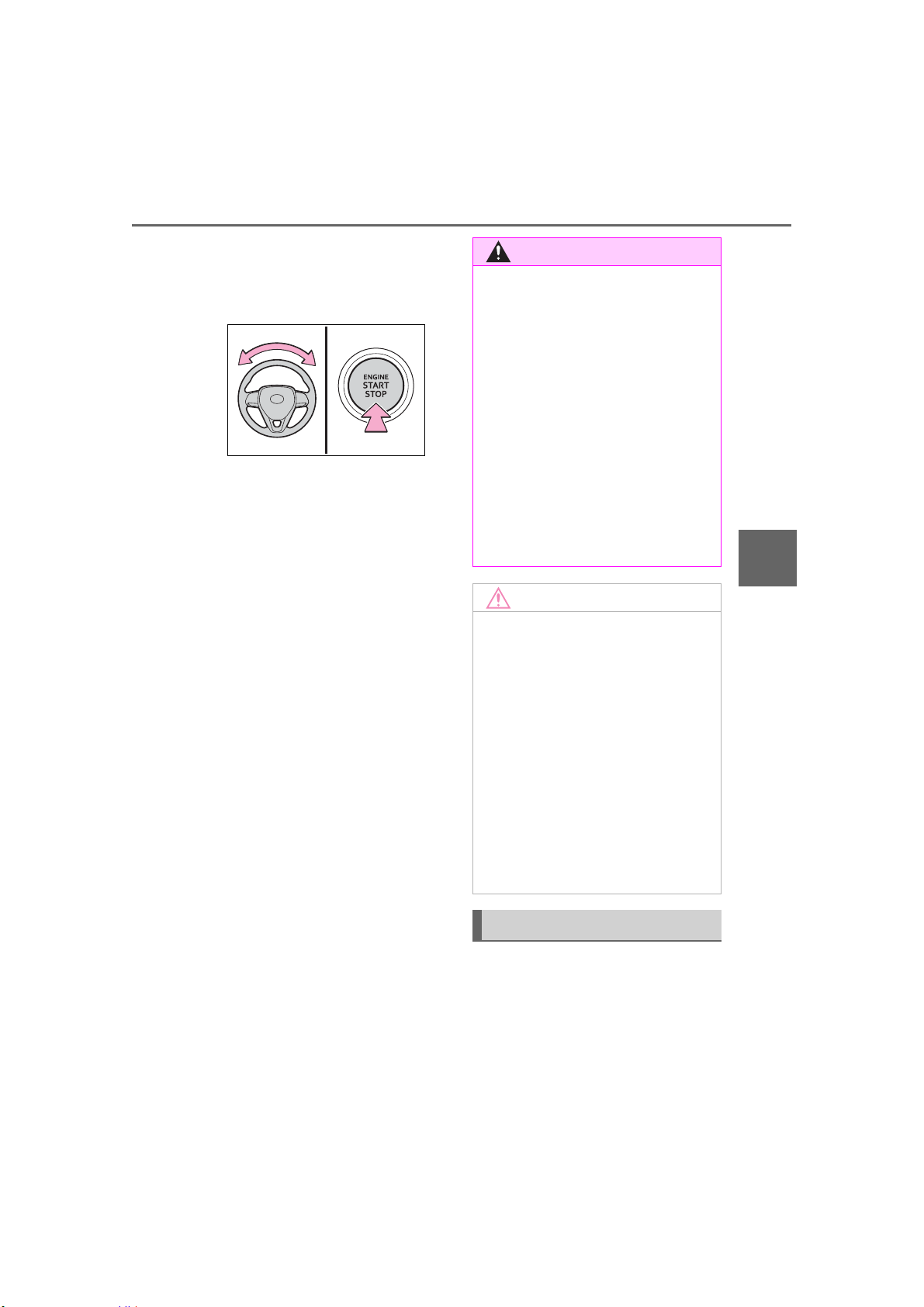
143
4-2. Driving procedures
COROLLA H/B_U
4
Driving
Either Direction” will be displayed
on the multi-information display.
Press the engine switch shortly
and firmly while turning the steer-
ing wheel left and right.
● To prevent the steering lock motor
from overheating, operation of the
motor may be suspended if the
engine is turned on and off repeat-
edly in a short period of time. In
this case, refrain from operating
the engine switch. After about 10
seconds, the steering lock motor
will resume functioning.
■ Electronic key battery
P. 450
■ Operation of the engine switch
● If the switch is not pressed shortly
and firmly, the engine switch
mode may not change or the
engine may not start.
● If attempting to restart the engine
immediately after turning the
engine switch off, the engine may
not start in some cases. After turn-
ing the engine switch off, please
wait a few seconds before restart-
ing the engine.
■ Customization
If the smart key system has been
deactivated in a customized setting,
refer to P.500.
Continuously variable trans-
mission
1 Stop the vehicle completely.
WARNING
■ When starting the engine
Always start the engine while sit-
ting in the driver’s seat. Do not
depress the accelerator pedal
while starting the engine under
any circumstances.
Doing so may cause an accident
resulting in death or serious injury.
■ Caution while driving
If engine failure occurs while the
vehicle is moving, do not lock or
open the doors until the vehicle
reaches a safe and complete
stop. Activation of the steering
lock in this circumstance may lead
to an accident, resulting in death
or serious injury.
NOTICE
■ When starting the engine
● Do not race a cold engine.
● If the engine becomes difficult to
start or stalls frequently, have
your vehicle checked by your
Toyota dealer immediately.
■ Symptoms indicating a mal-
function with the engine
switch
If the engine switch seems to be
operating somewhat differently
than usual, such as the switch
sticking slightly, there may be a
malfunction. Contact your Toyota
dealer immediately.
Stopping the engine

144
4-2. Driving procedures
COROLLA H/B_U
2 Set the parking brake
(P.154), and shift the shift
lever to P.
Check the parking brake indicator
is illuminated.
3 Press the engine switch.
The engine will stop, and the meter
display will be extinguished.
4 Release the brake pedal and
check that “ACCESSORY” or
“IGNITION ON” is not shown
on the multi-information dis-
play.
Manual transmission
1 Stop the vehicle completely.
2 If the parking brake is in man-
ual mode, set the parking
brake. (P.154)
Check the parking brake indicator
is illuminated.
3 Shift the shift lever to N.
(P.151)
4 Press the engine switch.
The engine will stop, and the meter
display will be extinguished.
5 Release the brake pedal and
check that “ACCESSORY” or
“IGNITION ON” is not shown
on the multi-information dis-
play.
■ Automatic engine shut off fea-
ture
● The vehicle is equipped with a
feature that automatically shuts off
the engine when the shift lever is
in P (continuously variable trans-
mission) or the parking brake is
set (manual transmission) with the
engine running for an extended
period.
● The engine will automatically shut
off after approximately 1 hour if it
has been left running while the
shift lever is in P (continuously
variable transmission) or the park-
ing brake is set (manual transmis-
sion).
● The timer for the automatic engine
shut off feature will reset if the
brake pedal (continuously variable
transmission) or the clutch pedal
(manual transmission) is
depressed, or if the shift lever is in
a position other than P (continu-
ously variable transmission) or the
parking brake is released (man-
ual transmission).
● After the vehicle is parked, if the
door is locked with the door lock
switch (P.103) from the inside or
the mechanical key (P.500) from
the outside, the automatic engine
shut off feature will be disabled.
The timer for the automatic engine
shut off feature will be re-enabled
if the driver’s door is opened.
WARNING
■ Stopping the engine in an
emergency
● If you want to stop the engine in
an emergency while driving the
vehicle, press and hold the
engine switch for more than 2
seconds, or press it briefly 3
times or more in succession.
(P.460)
However, do not touch the
engine switch while driving
except in an emergency. Turn-
ing the engine off while driving
will not cause loss of steering or
braking control, but the power
assist to these systems will be
lost. This will make it more diffi-
cult to steer and brake, so you
should pull over and stop the
vehicle as soon as it is safe to
do so.
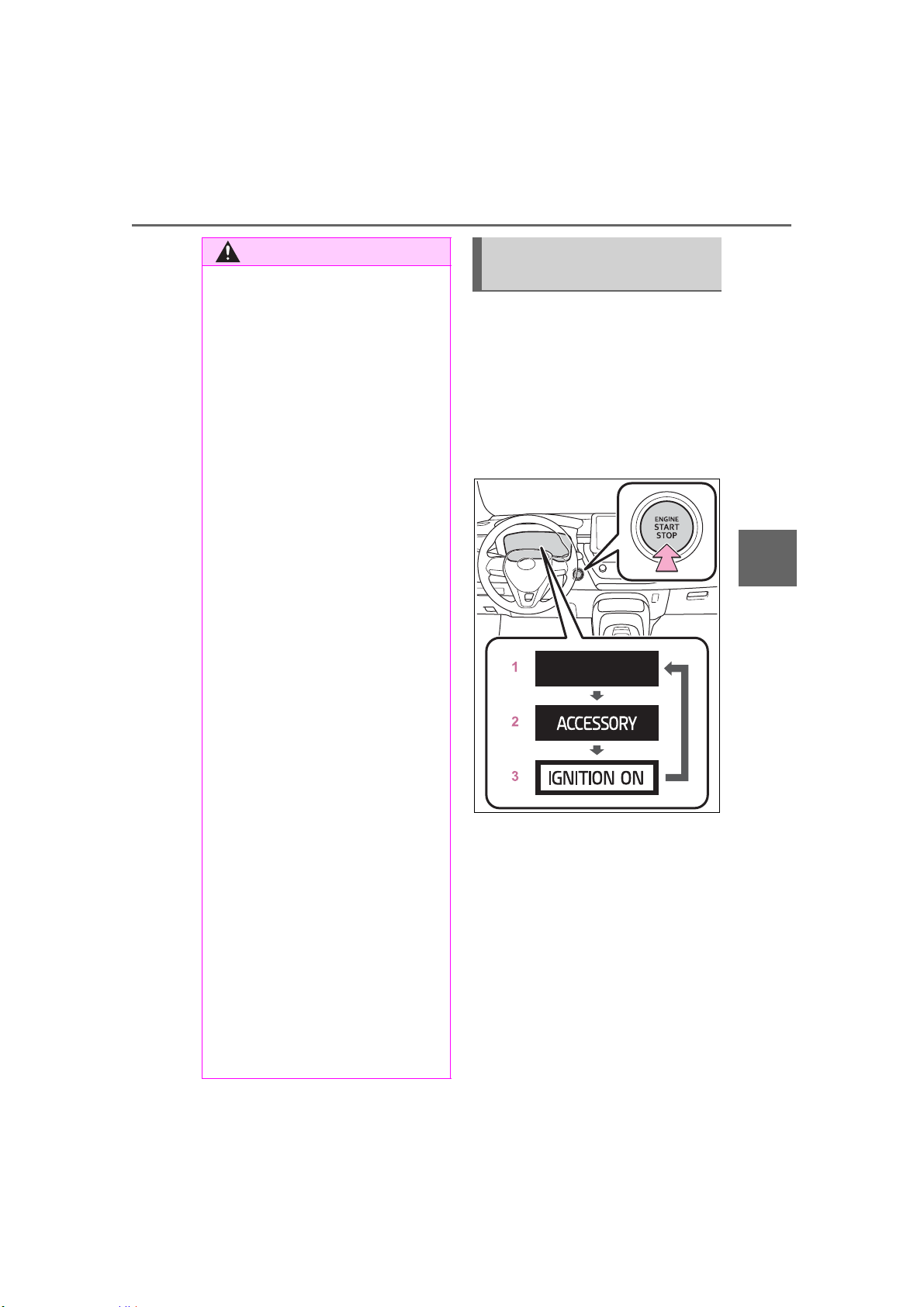
145
4-2. Driving procedures
COROLLA H/B_U
4
Driving
Modes can be changed by
pressing the engine switch with
brake pedal (continuously vari-
able transmission) or clutch
pedal (manual transmission)
released. (The mode changes
each time the switch is
pressed.)
1 OFF
*
The emergency flashers can be
used.
2 ACC
Some electrical components such
as the audio system can be used.
“ACCESSORY” will be displayed
on the multi-information display.
3 ON
All electrical components can be
used.
“IGNITION ON” will be displayed on
WARNING
● If the engine switch is operated
while the vehicle is running, a
warning message will be shown
on the multi-information display
and a buzzer sounds.
● Vehicles with a continuously
variable transmission: To restart
the engine after performing an
emergency shutdown, shift the
shift lever to N and then press
the engine switch.
● Vehicles with a manual trans-
mission: To restart the engine
after performing an emergency
shutdown, depress the clutch
pedal and then press the engine
switch.
■ When parking
Exhaust gases include harmful
carbon monoxide (CO), which is
colorless and odorless. Observe
the following precautions.
Failure to do so may cause
exhaust gases to enter the vehicle
and may lead to an accident
caused by light-headedness, or
may lead to death or a serious
health hazard.
● If the vehicle is in a poorly venti-
lated area or a closed area,
such as a garage, stop the
engine.
● Do not leave the vehicle with
the engine running for a long
time. If such a situation cannot
be avoided, park the vehicle in
an open space and ensure that
exhaust fumes do not enter the
vehicle interior.
● Do not leave the engine running
in an area with snow build-up,
or where it is snowing. If snow-
banks build up around the vehi-
cle while the engine is running,
exhaust gases may collect and
enter the vehicle.
Changing engine switch
modes
146
4-2. Driving procedures
COROLLA H/B_U
the multi-information display.
*
: Vehicles with a continuously vari-
able transmission: If the shift
lever is in a position other than P
when turning off the engine, the
engine switch will be turned to
ACC, not to off.
■ Auto power off function
Continuously variable transmission:
If the vehicle is left in ACC for more
than 20 minutes or ON (the engine
is not running) for more than an
hour with the shift lever in P, the
engine switch will automatically turn
off. However, this function cannot
entirely prevent battery discharge.
Do not leave the vehicle with the
engine switch in ACC or ON for long
periods of time when the engine is
not running.
Manual transmission: If the vehicle
is left in ACC for more than 20 min-
utes or ON (the engine is not run-
ning) for more than an hour, the
engine switch will automatically turn
off. However, this function cannot
entirely prevent battery discharge.
Do not leave the vehicle with the
engine switch in ACC or ON for long
periods of time when the engine is
not running.
If the engine is stopped with the
shift lever in a position other
than P, the engine switch will not
be turned off but instead be
turned to ACC. Perform the fol-
lowing procedure to turn the
switch off:
1 Check that the parking brake
is set.
2 Shift the shift lever to P.
3 Check that “ACCESSORY” is
displayed on the multi-infor-
mation display and press the
engine switch shortly and
firmly.
4 Check that “ACCESSORY”
or “IGNITION ON” on the
multi-information display are
off.
NOTICE
■ To prevent battery discharge
● Do not leave the engine switch
in ACC or ON for long periods of
time without the engine running.
● If “ACCESSORY” or “IGNITION
ON” is displayed on the
multi-information display, the
engine switch is not off. Exit the
vehicle after turning the engine
switch off.
When stopping the engine
with the shift lever in a
position other than P
(vehicles with a continu-
ously variable transmis-
sion)
NOTICE
■ To prevent battery discharge
Do not stop the engine when the
shift lever is in a position other
than P. If the engine is stopped in
another shift lever position, the
engine switch will not be turned
off but instead be turned to ACC
mode. If the vehicle is left in ACC,
battery discharge may occur.
147
4-2. Driving procedures
COROLLA H/B_U
4
Driving
*
: If equipped
*
: To improve fuel efficiency and
reduce noise, shift the shift lever
to D for normal driving.
■ To protect the continuously
variable transmission
If the continuously variable trans-
mission fluid temperature is high,
“Transmission Oil Temp. High Stop
in a safe place and See owner’s
manual” will be displayed on the
multi-information display and the
vehicle will go into transmission pro-
tection mode automatically. Have
the vehicle inspected by your Toyota
dealer.
■ When driving with dynamic
radar cruise control with
full-speed range activated
Even when switching the driving
mode to sport mode with the intent
of enabling engine braking, engine
braking will not occur because
dynamic radar cruise control with
full-speed range will not be can-
celed. (P.240)
■ Restraining sudden start
(Drive-Start Control)
P.132
■ G AI-SHIFT
G AI-SHIFT automatically selects a
suitable gear for sporty driving
according to driver’s input and driv-
ing conditions. G AI-SHIFT operates
automatically when the shift lever is
in D and sport mode is selected for
the driving mode. (Selecting normal
mode or shifting the shift lever to the
M position cancels this function.)
■ After recharging/reconnecting
the battery
P.504
Continuously variable
transmission
*
Select the shift position
depending on your purpose
and situation.
Shift position purpose
and functions
Shift posi-
tion
Objective or function
P
Parking the vehi-
cle/starting the engine
R Reversing
N
Neutral
(Condition in which the
power is not transmit-
ted)
D
Normal driving
*
M
10-speed sport sequen-
tial shiftmatic mode
driving (P.150)
WARNING
■ When driving on slippery
road surfaces
Do not accelerate or shift the shift
gears suddenly.
Sudden changes in engine brak-
ing may cause the vehicle to spin
or skid, resulting in an accident.
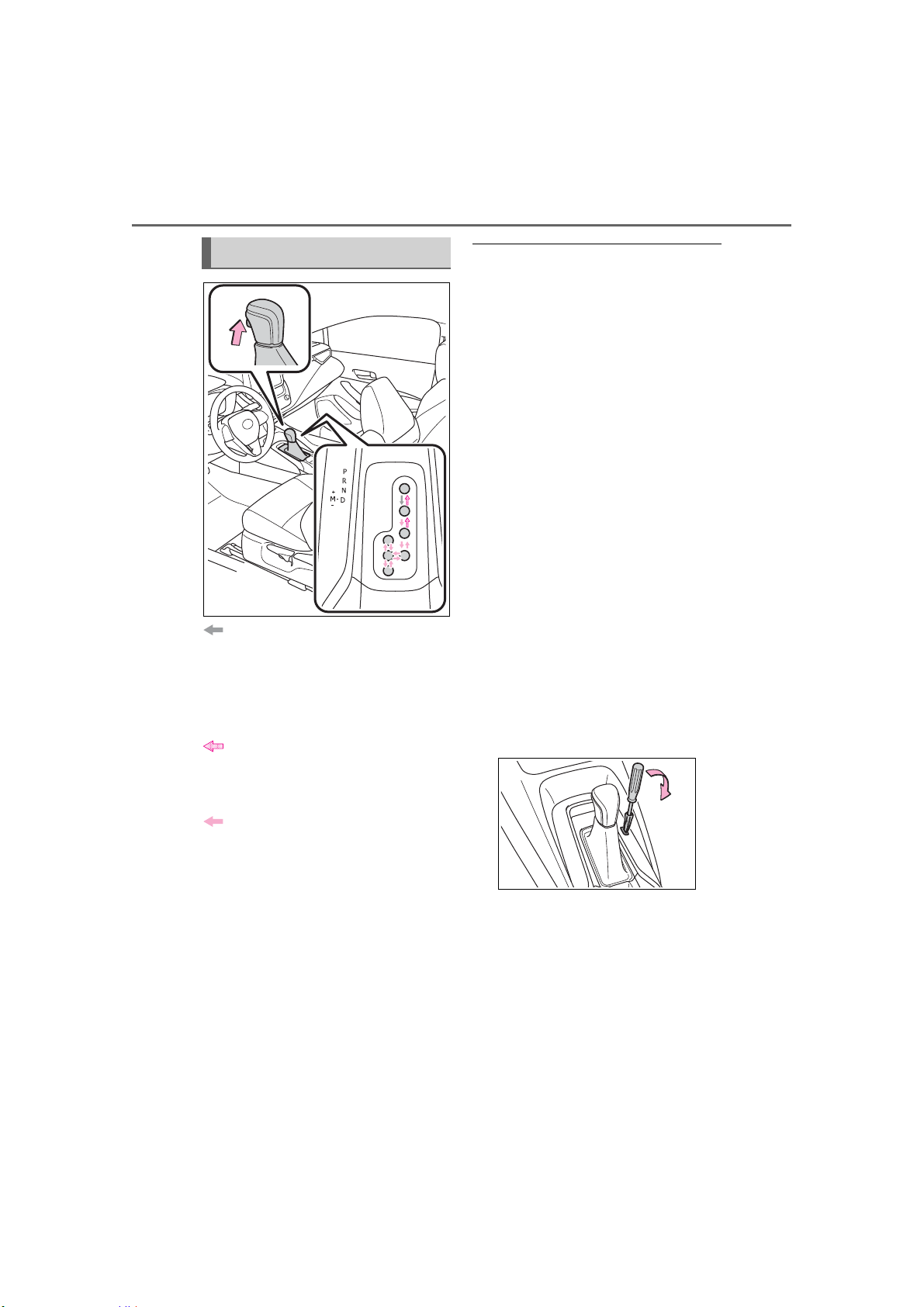
148
4-2. Driving procedures
COROLLA H/B_U
:While the engine switch is in
ON and the brake pedal
depressed
*
, shift the shift lever
while pushing the shift release
button on the shift knob.
:Shift the shift lever while
pushing the shift release button
on the shift knob.
:Shift the shift lever normally.
When shifting the shift lever
between P and D, make sure that
the vehicle is completely stopped
and the brake pedal is depressed.
*
: For the vehicle be able to be
shifted from P, the brake pedal
must be depressed before the
shift release button is pushed. If
the shift release button is pushed
first, the shift lock will not be
released.
■ Shift lock system
The shift lock system is a system to
prevent accidental operation of the
shift lever in starting.
The shift lever can be shifted from P
only when the engine switch is in
ON and the brake pedal is being
depressed.
■ If the shift lever cannot be
shifted from P
First, check whether the brake pedal
is being depressed.
If the shift lever cannot be shifted
with your foot on the brake pedal,
there may be a problem with the
shift lock system. Have the vehicle
inspected by your Toyota dealer
immediately.
The following steps may be used as
an emergency measure to ensure
that the shift lever can be shifted.
Releasing the shift lock:
1 Set the parking brake.
2 Turn the engine switch off.
3 Depress the brake pedal.
4 Ply the cover up with a flathead
screwdriver or equivalent tool.
To prevent damaging the cover,
wrap the tip of the flathead
screwdriver with a tape.
5 Press and hold the shift lock
override button and then push
the button on the shift knob.
The shift lever can be shifted while
Shifting the shift lever
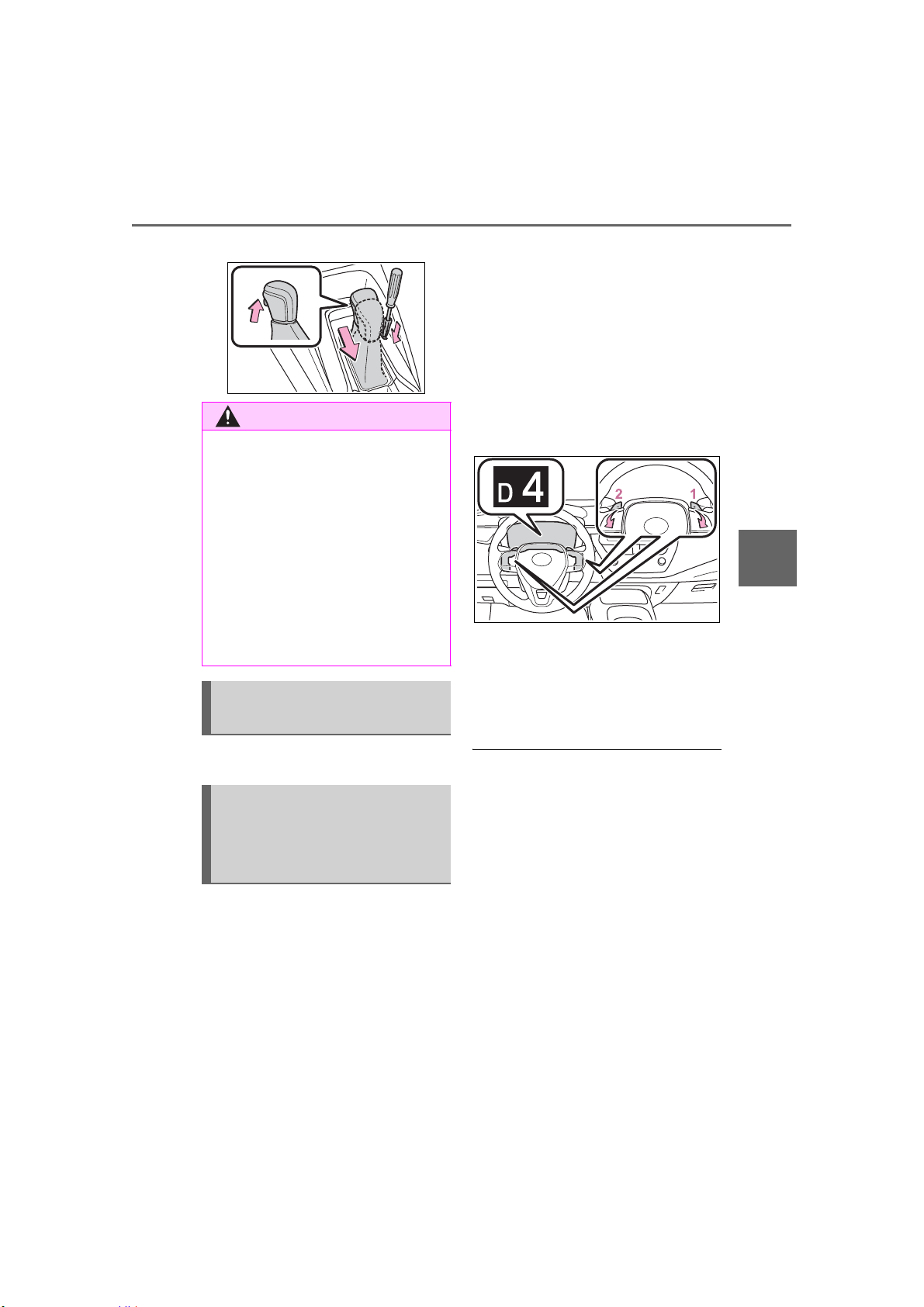
149
4-2. Driving procedures
COROLLA H/B_U
4
Driving
the button is pressed.
P.240
To drive using temporary shift
range selection, operate the “-”
or “+” paddle shift switch.
When the “-” paddle shift switch
is operated, the shift range
switches to a range that enables
engine braking force that is suit-
able to driving conditions. When
the “+” paddle shift switch is
operated, the shift range
switches to a range that is one
range higher than the current
range.
Changing the shift range allows
restriction of the highest gear,
preventing unnecessary upshift-
ing and enabling the level of
engine braking force to be
selected.
1 Upshifting
2 Downshifting
The selected shift range, from D1 to
D10, will be displayed on the
multi-information display.
■ Gear step functions
● You can choose from 10 levels of
engine braking force.
● A lower gear step will provide
greater engine braking force than
a higher gear step, and the engine
speed will also increase.
■ Deactivation of temporary
10-speed Sport Sequential
Shiftmatic mode (vehicles with
paddle shift switches)
In the following situations, tempo-
rary 10-speed Sport Sequential
Shiftmatic mode will be deactivated:
● When the vehicle is stopped
● If the accelerator pedal is
depressed continuously for more
than a certain amount of time
WARNING
■ To prevent an accident when
releasing the shift lock
Before pressing the shift lock
override button, make sure to set
the parking brake and depress the
brake pedal.
If the accelerator pedal is acci-
dentally depressed instead of the
brake pedal when the shift lock
override button is pressed and the
shift lever is shifted out of P, the
vehicle may suddenly start, possi-
bly leading to an accident result-
ing in death or serious injury.
Selecting the driving
mode
Selecting shift ranges in
the D position (vehicles
with paddle shift
switches)
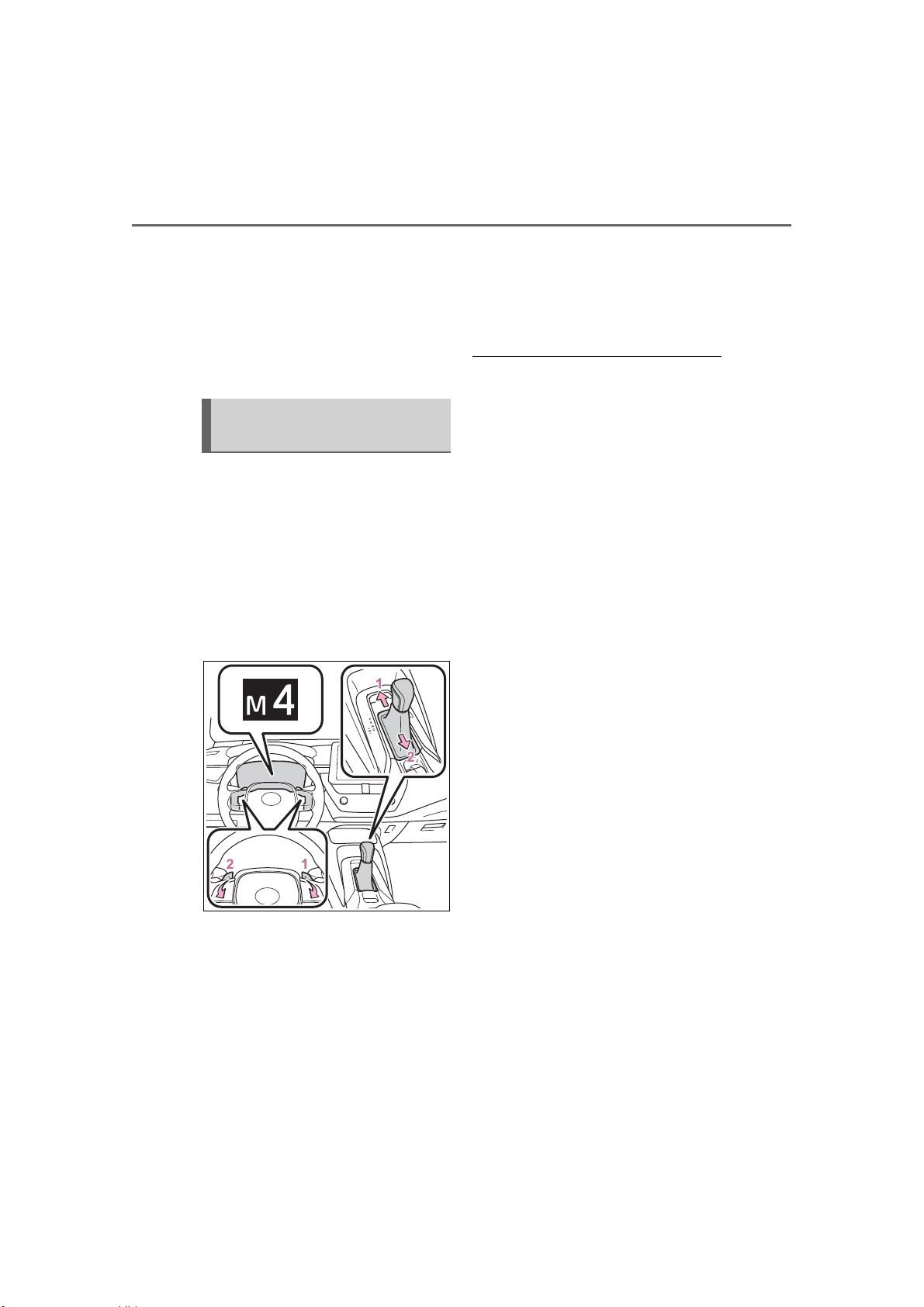
150
4-2. Driving procedures
COROLLA H/B_U
while in one gear range
● If the accelerator pedal is
depressed abruptly and heavily
● When the shift lever is shifted to a
position other than D
● When the “+” paddle shift switch is
operated for a certain amount of
time continuously
To enter 10-speed sport
sequential shiftmatic mode, shift
the shift lever to M position.
Gear steps can then be selected
by operating the shift lever or
paddle shift switches (if
equipped), allowing you to drive
in the gear step of your choos-
ing.
1 Upshifting
2 Downshifting
The gear changes once every time
the shift lever or paddle shift switch
is operated.
The selected gear step, from M1 to
M10, will be displayed on the
multi-information display.
However, even when in the M
position, the gear steps will be
automatically changed if the
engine speed is too high, or too
low.
■ Gear step functions
● You can choose from 10 levels of
engine braking force.
● A lower gear step will provide
greater engine braking force than
a higher gear step, and the engine
speed will also increase.
■ When the vehicle comes to a
stop with the shift lever in the M
position
● The transmission will automati-
cally downshift to M1 once the
vehicle is stopped.
● After a stop, the vehicle will start
off in M1.
● When the vehicle is stopped, the
transmission is set at M1.
■ Downshifting restriction warn-
ing buzzer
To help ensure safety and driving
performance, downshifting opera-
tion may sometimes be restricted. In
some circumstances, downshifting
may not be possible even when the
shift lever or paddle shift switch (if
equipped) is operated. (A buzzer
will sound twice.)
■ If the 10-speed sport sequential
shiftmatic mode indicator does
not come on even after shifting
the shift lever to M
This may indicate a malfunction in
the continuously variable transmis-
sion system. Have the vehicle
inspected by your Toyota dealer
immediately.
(In this situation, the transmission
will operate in the same manner as
when the shift lever is in D.)
Changing gears in the M
position
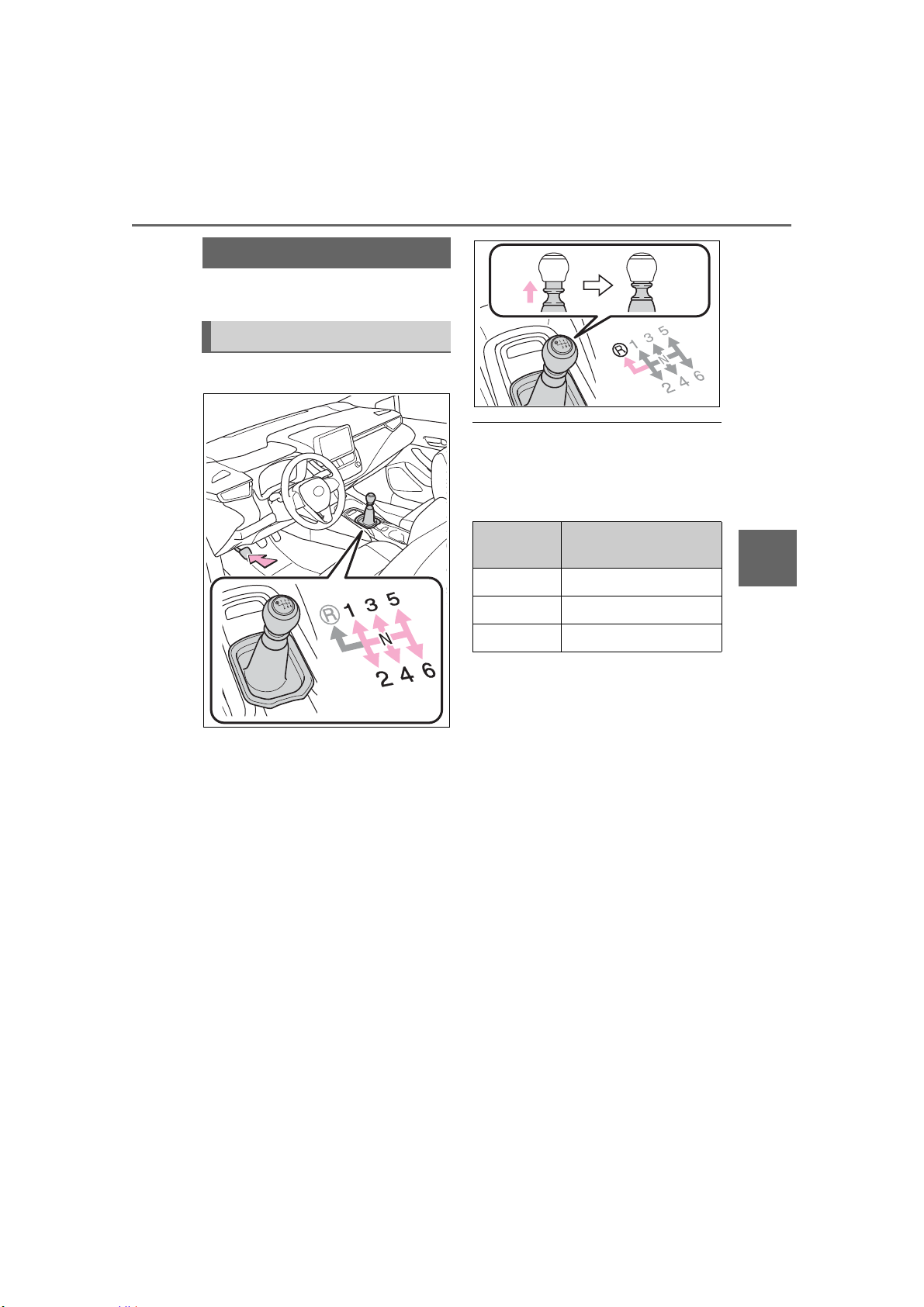
151
4-2. Driving procedures
COROLLA H/B_U
4
Driving
*
: If equipped
■ Shifting the shift lever
1 Depress the clutch pedal
firmly.
2 Shift the shift lever to the
desired gear.
Make sure to only shift gears
sequentially.
3 Gradually release the clutch
pedal.
■ Shifting the shift lever to R
Shift the shift lever to R while lift-
ing up the ring section.
■ Maximum allowable speeds
Observe the following maximum
allowable speeds in each gear when
maximum acceleration is necessary.
Manual transmission
*
Operating instructions
Shift posi-
tion
Maximum speed
mph (km/h)
1 34 (56)
2 60 (96)
3 89 (144)
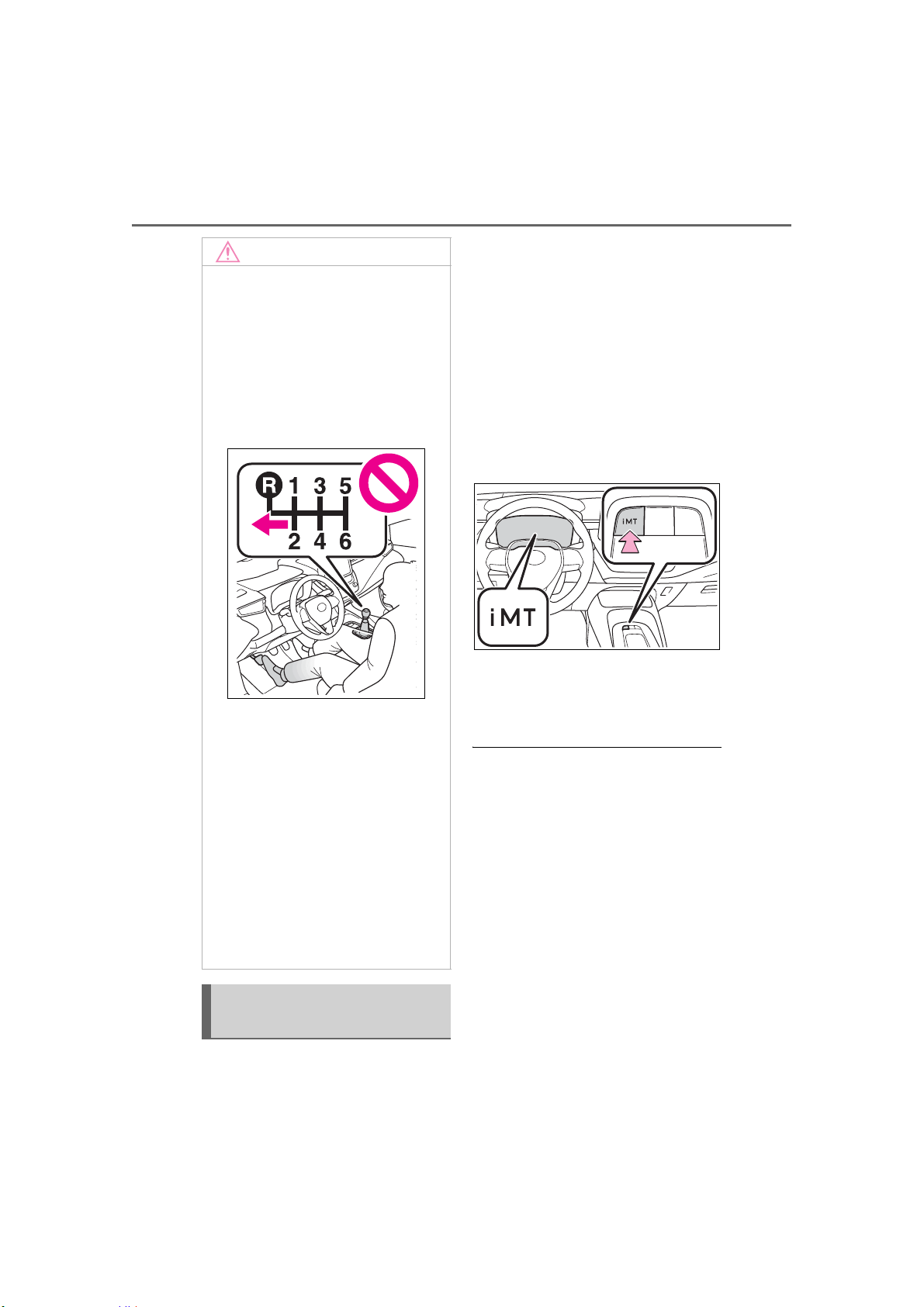
152
4-2. Driving procedures
COROLLA H/B_U
The iMT optimally controls the
engine speed to suit the driver’s
operation of the clutch pedal
and shift lever, helping the driver
to shift gears more smoothly.
Additionally, when the clutch
pedal is operated, the iMT helps
reduce shift shock, allowing for
lighter shift operations when
driving on a winding road or
incline.
Press the “iMT” switch.
The “iMT” indicator will illuminate in
green.
Press the switch again to cancel
iMT.
■ The iMT may not operate when
In the following situations, iMT may
not operate. However, this does not
indicate a malfunction.
● The clutch pedal is not fully
depressed
● The clutch pedal is not fully
released, such as if a foot is rest-
ing on the clutch pedal
*
● Shift operation is performed after
the vehicle has been coasting with
the shift lever in N
● The shift lever is not operated for
a long time after the clutch pedal
is depressed
*
: After the shift lever is moved,
unless your foot is completely
removed from the clutch pedal,
NOTICE
■ To prevent damage to the
vehicle
When shifting gears, observe the
following precautions. Failure to
do so may cause damage to the
engine, manual transmission,
and/or clutch.
● Do not shift the shift lever to R
without depressing the clutch
pedal.
● Do not lift up the ring section
except when shifting the lever to
R.
● Shift the shift lever to R only
when the vehicle is stationary.
● Do not rest your hand on or hold
the shift lever any time other
than when shifting.
● In order to not cause the engine
to overrev, make sure to only
shift gears sequentially.
● Do not release the clutch pedal
suddenly.
iMT (Intelligent Manual
Transmission)
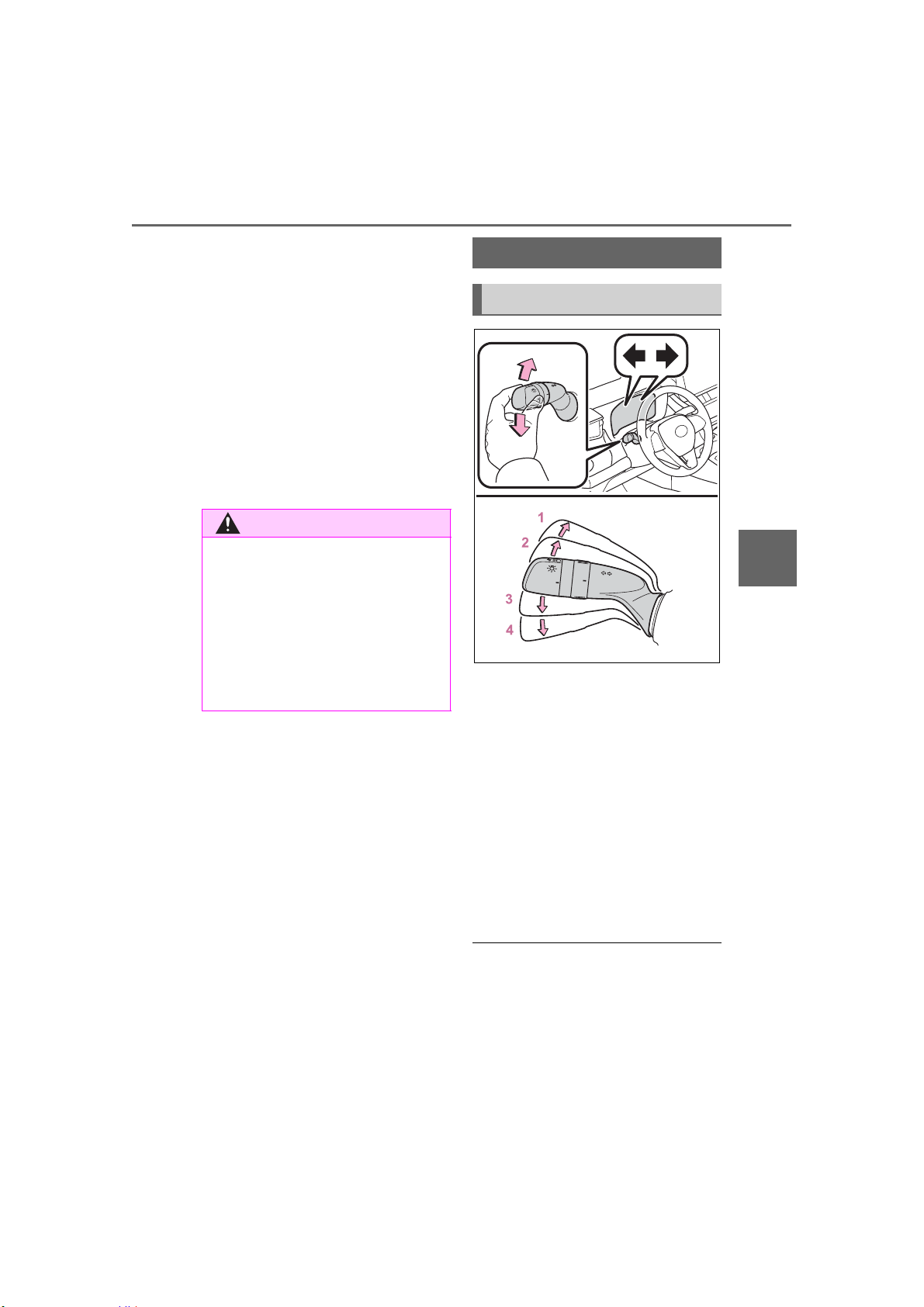
153
4-2. Driving procedures
COROLLA H/B_U
4
Driving
the iMT may not operate and the
engine speed may not be con-
trolled optimally for the next gear
change.
To enable the iMT, release the
clutch pedal completely and then
depress it again before operating
the shift lever.
■ If the “iMT” indicator illumi-
nates in amber
The iMT may be temporarily
unavailable or malfunctioning. Have
the vehicle inspected at your Toyota
dealer.
1 Right turn
2 Lane change to the right
(move the lever partway and
release it)
The right hand signals will flash 3
times.
3 Lane change to the left
(move the lever partway and
release it)
The left hand signals will flash 3
times.
4 Left turn
■ Turn signals can be operated
when
The engine switch is in ON.
■ If the indicator flashes faster
than usual
Check that a light bulb in the front or
rear turn signal lights has not
WARNING
■ Limitations of the iMT
iMT is not a system that prevents
shift lever operation error or
engine overrevving.
Depending on the situation, iMT
may not operate normally and the
shift position may not be changed
smoothly. Overly relying on iMT
may cause an unexpected acci-
dent.
Turn signal lever
Operating instructions
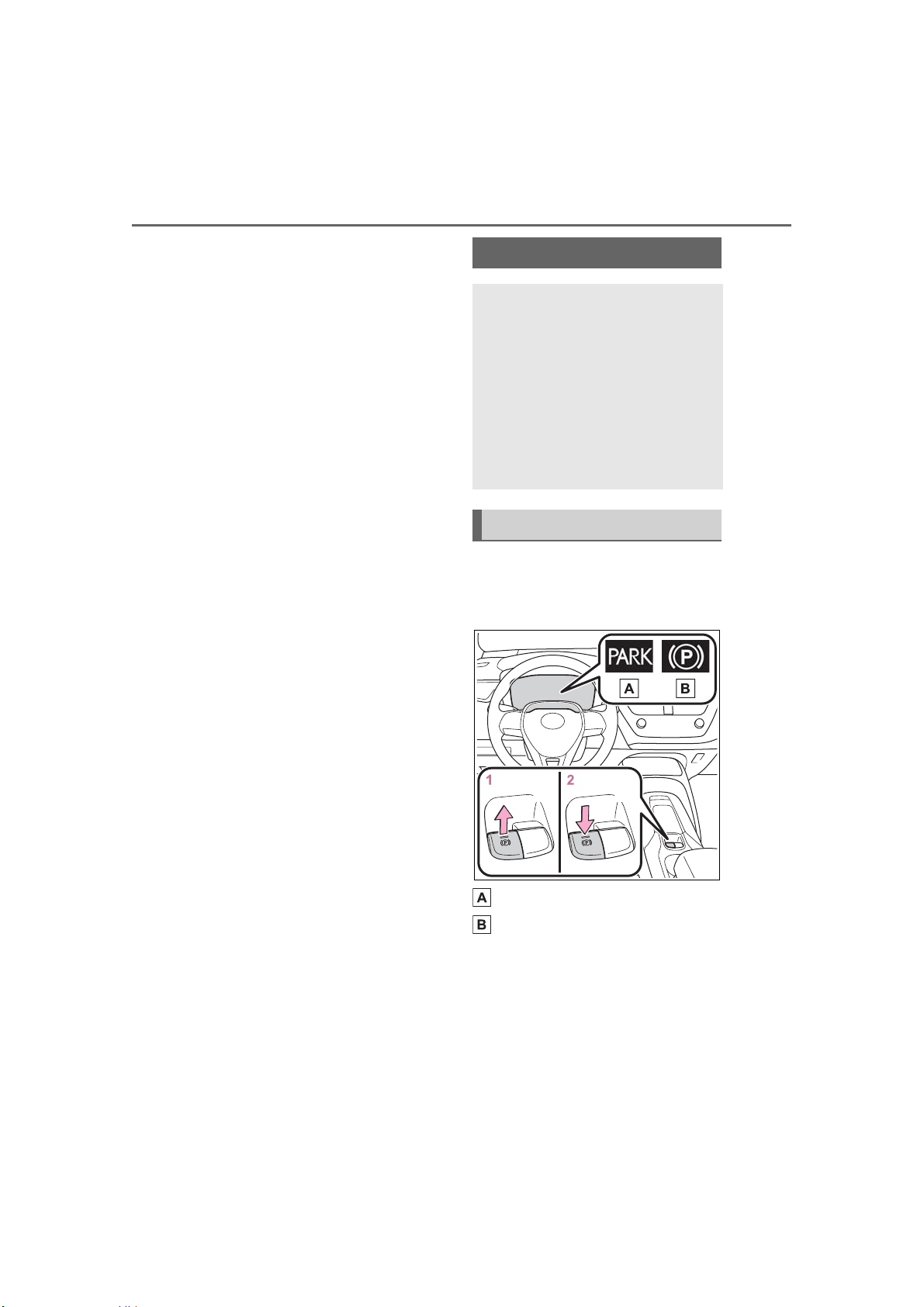
154
4-2. Driving procedures
COROLLA H/B_U
burned out.
■ Customization
Some functions can be customized.
(P.531)
■ Using the manual mode
The parking brake can be set
and released manually.
U.S.A.
Canada
1 Pull the switch to set the
parking brake
The parking brake indicator light
and parking brake light will turn on.
Pull and hold the parking brake
switch if an emergency occurs and
it is necessary to operate the park-
Parking brake
The parking brake can be
set or released automati-
cally or manually.
In automatic mode, the
parking brake can be set or
released automatically.
Also, even in automatic
mode, the parking brake can
be set or released manually.
Operating instructions
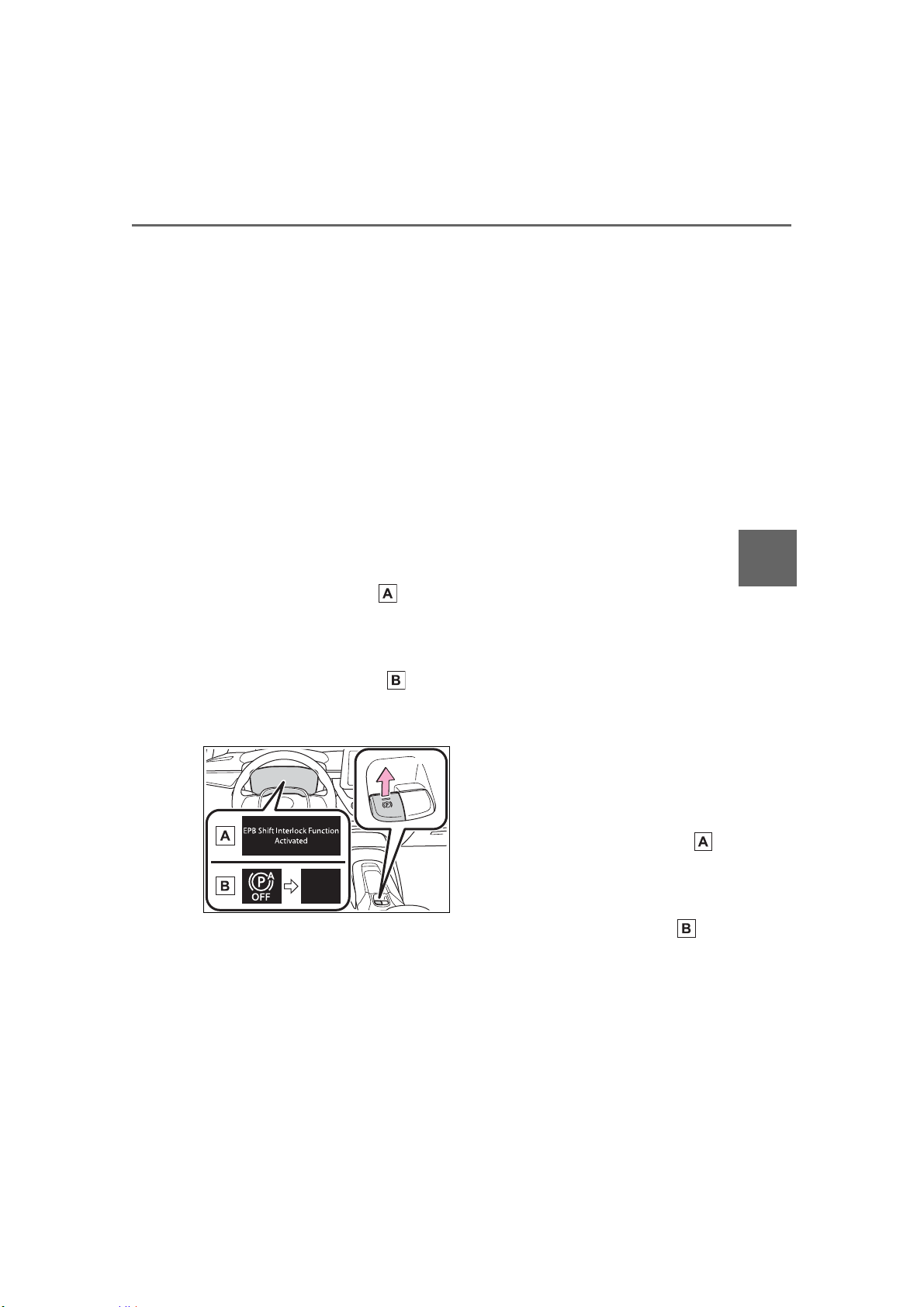
155
4-2. Driving procedures
COROLLA H/B_U
4
Driving
ing brake while driving.
2 Push the switch to release
the parking brake
• Operate the parking brake switch
while depressing the brake pedal.
• Using the parking brake auto-
matic release function, the park-
ing brake can be released by
depressing the accelerator pedal.
When using this function, slowly
depress the accelerator pedal.
Make sure that the parking brake
indicator light and parking brake
light turn off.
■ Turning automatic mode on
While the vehicle is stopped,
pull and hold the parking brake
switch until a message is
shown on the multi-information
display (vehicles with a continu-
ously variable transmission) or
auto EPB OFF indicator turn
off (vehicles with a manual
transmission)
When the automatic mode is
turned on, the parking brake
operates as follows.
Vehicles with a continuously
variable transmission
When the shift lever is moved
out of P, the parking brake will
be released, and the parking
brake indicator light and park-
ing brake light will turn off.
When the shift lever is moved
into P, the parking brake will
be set, and the parking brake
indicator light and parking
brake light will turn on.
Operate the shift lever with the
vehicle stopped and the brake
pedal depressed.
The parking brake may not operate
automatically if the shift lever is
moved quickly.
In this case, it is necessary to oper-
ate the parking brake switch.
(P.154)
Vehicles with a manual trans-
mission
When the engine is off, the park-
ing brake will be set, and the
parking brake indicator light and
parking brake light turn on.
■ Turning automatic mode off
While the vehicle is stopped and
depressing the brake pedal,
press and hold the parking
brake switch until a message
is shown on the multi-informa-
tion display (vehicles with a con-
tinuously variable transmission)
or auto EPB OFF indicator
comes on (vehicles with a man-
ual transmission)
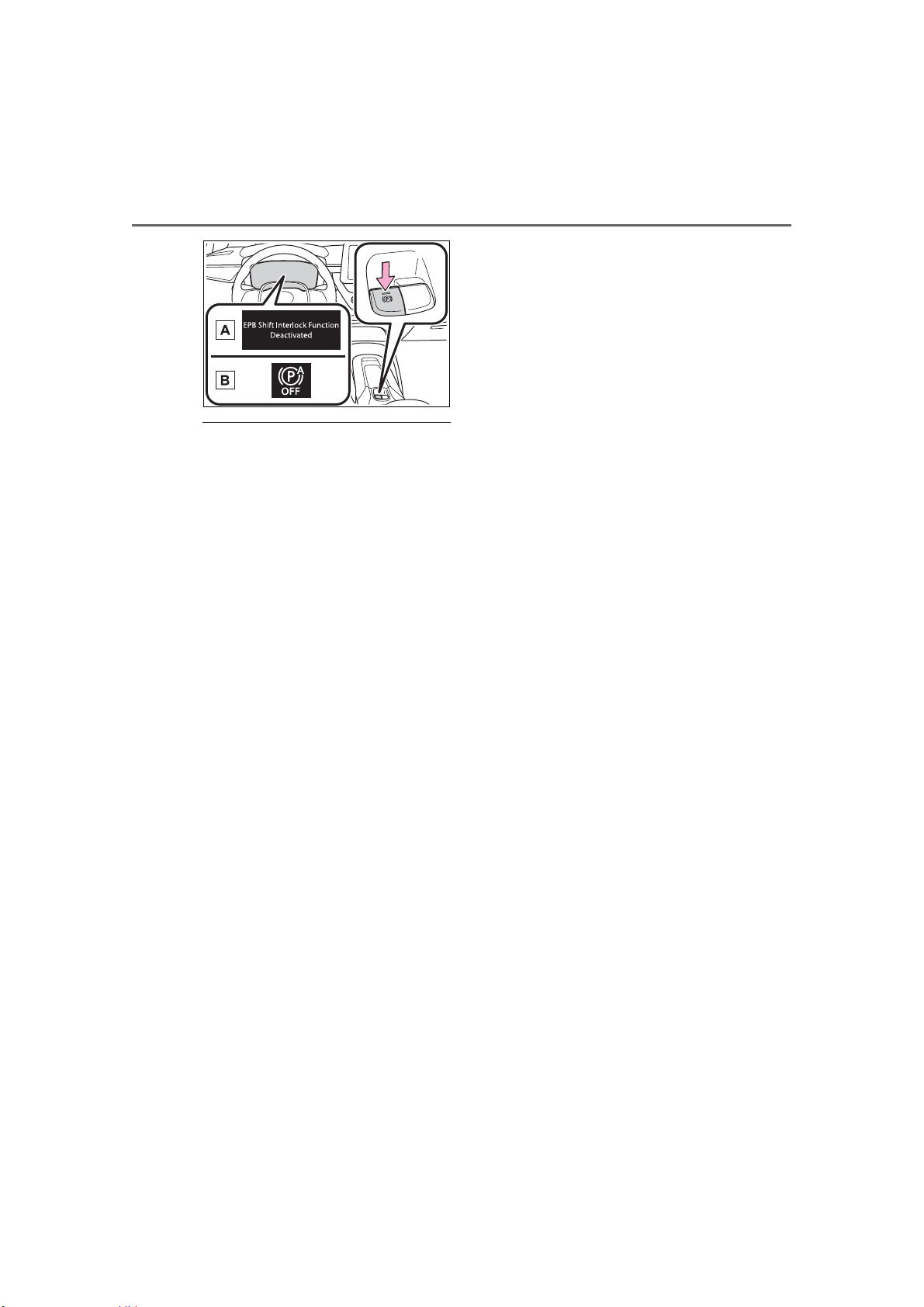
156
4-2. Driving procedures
COROLLA H/B_U
■ Parking brake operation
● When the engine switch is not in
ON, the parking brake cannot be
released using the parking brake
switch.
● When the engine switch is not in
ON, automatic mode (automatic
brake setting and releasing [vehi-
cles with a continuously variable
transmission]) is not available.
■ Parking brake automatic
release function
The parking brake is automatically
released when slowly depress the
accelerator pedal.
The parking brake will be released
automatically under the following
conditions:
● The driver’s door is closed
● The driver is wearing the seat belt
● The shift lever is a forward or
reverse position.
● The malfunction indicator light or
brake system warning light is not
illuminated.
If the automatic release function
does not operate, manually release
the parking brake.
■ If “Parking Brake Temporarily
Unavailable” is displayed on
the multi-information display
If the parking brake is operated
repeatedly over a short period of
time, the system may restrict opera-
tion to prevent overheating. If this
happens, refrain from operating the
parking brake. Normal operation will
return after about 1 minute.
■ If “Parking Brake Unavailable”
is displayed on the multi-infor-
mation display
Operate the parking brake switch. If
the message does not disappear
after operating the switch several
times, the system may be malfunc-
tioning. Have the vehicle inspected
by your Toyota dealer.
■ Parking brake operation sound
When the parking brake operates, a
motor sound (whirring sound) may
be heard. This does not indicate a
malfunction.
■ Parking brake operation
● Depending on the engine switch
mode, the parking brake indicator
light and parking brake light will
turn on and stay on as described
below:
ON: Comes on until the parking
brake is released.
Not in ON: Stays on for approxi-
mately 15 seconds.
● When the engine switch is turned
off with the parking brake set, the
parking brake indicator light and
parking brake light will stay on for
about 15 seconds. This does not
indicate a malfunction.
■ When the parking brake switch
malfunctions
Automatic mode (automatic brake
setting and releasing) will be turned
on automatically.
■ Parking the vehicle
P.130
■ Parking brake engaged warning
buzzer
A buzzer will sound if the vehicle is
driven with the parking brake
engaged. “Parking Brake ON” is dis-
played on the multi-information dis-
play.
157
4-2. Driving procedures
COROLLA H/B_U
4
Driving
■ If the brake system warning
light comes on
P. 468
■ Usage in winter time
P. 246
Turn the brake hold system on
The brake hold standby indicator
(green) comes on. While the
system is holding the brake, the
brake hold operated indicator (yel-
low) comes on.
WARNING
■ When parking the vehicle
Do not leave a child in the vehicle
alone. The parking brake may be
released unintentionally and there
is the danger of the vehicle mov-
ing that may lead to an accident
resulting in death or serious injury.
■ Parking brake switch
Do not set any objects near the
parking brake switch.
Objects may interfere with the
switch and may lead the parking
brake to unexpectedly operate.
NOTICE
■ When parking the vehicle
Before you leave the vehicle, set
the parking brake, shift the shift
lever to P (continuously variable
transmission) or N (manual trans-
mission) and make sure that the
vehicle does not move.
■ When the system malfunc-
tions
Stop the vehicle in a safe place
and check the warning messages.
■ When the parking brake can-
not be released due to a mal-
function
Driving the vehicle with the park-
ing brake set will lead to brake
components overheating, which
may affect braking performance
and increase brake wear.
Have the vehicle inspected by
your Toyota dealer immediately if
this occurs.
Brake Hold
Continuously variable trans-
mission
The brake hold system keeps the
brake applied when the shift lever
is in D, M or N with the system on
and the brake pedal has been
depressed to stop the vehicle.
The system releases the brake
when the accelerator pedal is
depressed with the shift lever in
D or M to allow smooth start off.
Manual transmission
The brake hold system keeps the
brake applied when the shift lever
is in a forward driving position or
N with the system on and the
brake pedal has been depressed
to stop the vehicle. The system
releases the brake when the
accelerator pedal is depressed
with the shift lever in a forward
driving position to allow smooth
start off.
Enabling the system
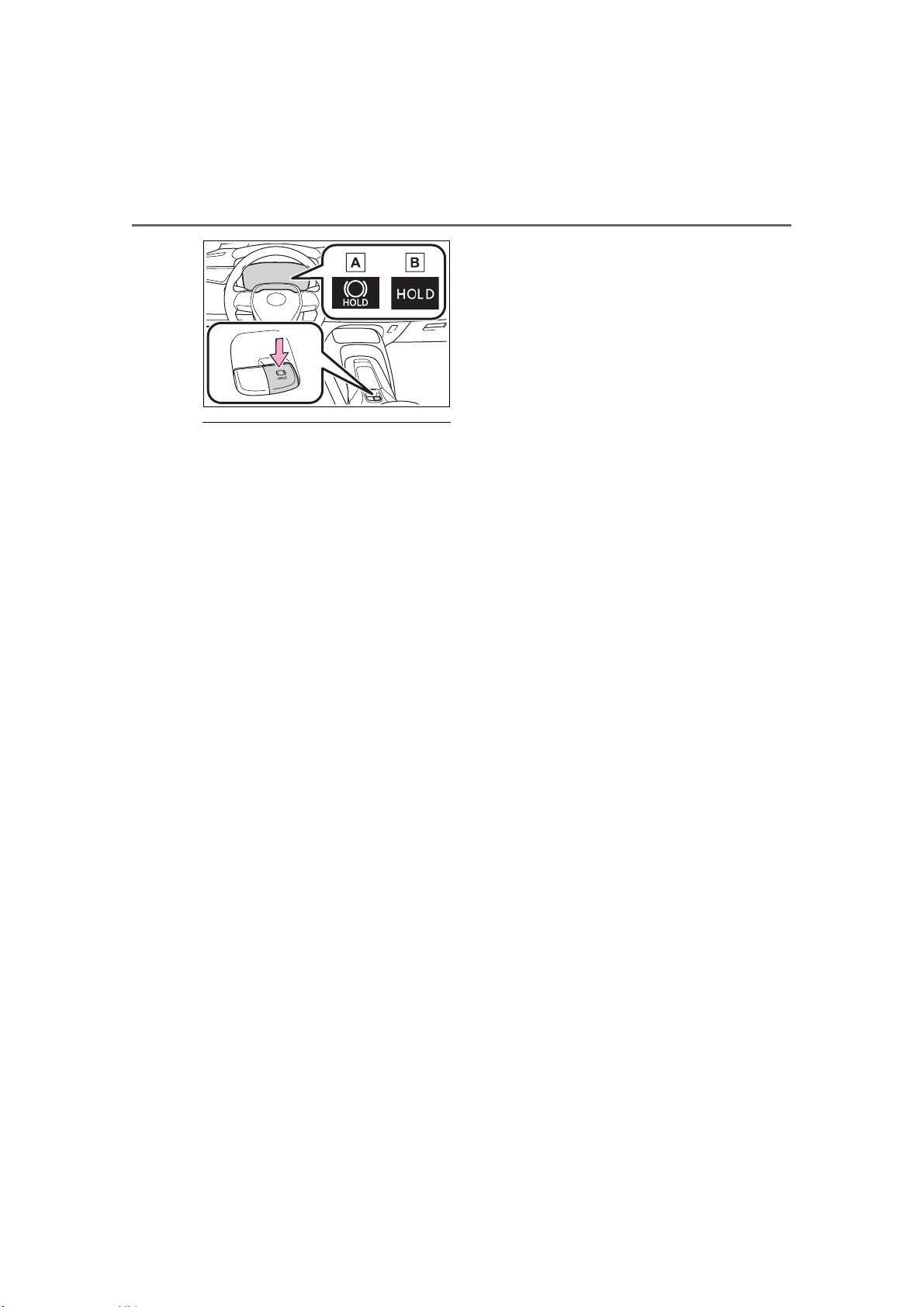
158
4-2. Driving procedures
COROLLA H/B_U
■ Brake hold system operating
conditions
The brake hold system cannot be
turned on in the following condi-
tions:
● The driver’s door is not closed.
● The driver is not wearing the seat
belt.
If any of the conditions above are
detected when the brake hold sys-
tem is enabled, the system will turn
off and the brake hold standby indi-
cator light will go off. In addition, if
any of the conditions are detected
while the system is holding the
brake, a warning buzzer will sound
and a message will be shown on the
multi-information display. The park-
ing brake will then be set automati-
cally.
■ Brake hold function
● If the brake pedal is left released
for a period of about 3 minutes
after the system has started hold-
ing the brake, the parking brake
will be set automatically. In this
case, a warning buzzer sounds
and a message is shown on the
multi-information display.
● To turn the system off while the
system is holding the brake, firmly
depress the brake pedal and
press the button again.
● The brake hold function may not
hold the vehicle when the vehicle
is on a steep incline. In this situa-
tion, it may be necessary for the
driver to apply the brakes. A warn-
ing buzzer will sound and the
multi-information display will
inform the driver of this situation. If
a warning message is shown on
the multi-information display, read
the message and follow the
instructions.
■ When the parking brake is set
automatically while the system
is holding the brakes
Perform any of the following opera-
tions to release the parking brake.
● Depress the accelerator pedal.
(The parking brake will not be
released automatically if the seat
belt is not fastened.)
● Operate the parking brake switch
with the brake pedal depressed.
Make sure that the parking brake
indicator light goes off. (P.154)
■ When an inspection at your
Toyota dealer is necessary
When the brake hold standby indi-
cator (green) does not illuminate
even when the brake hold switch is
pressed with the brake hold system
operating conditions met, the sys-
tem may be malfunctioning. Have
the vehicle inspected at your Toyota
dealer.
■ If “Brake Hold Malfunction
Press Brake to Deactivate Visit
Your Dealer” or “Brake Hold
Malfunction Visit Your Dealer”
is displayed on the multi-infor-
mation display
The system may be malfunctioning.
Have the vehicle inspected by your
Toyota dealer.
■ Warning messages and buzzers
Warning messages and buzzers are
used to indicate a system malfunc-
tion or to inform the driver of the
need for caution. If a warning mes-
sage is shown on the multi-informa-
tion display, read the message and
follow the instructions.
159
4-2. Driving procedures
COROLLA H/B_U
4
Driving
■ If the brake hold operated indi-
cator flashes
P. 474
WARNING
■ When the vehicle is on a
steep incline
When using the brake hold sys-
tem on a steep incline exercise
caution. The brake hold function
may not hold the vehicle in such a
situation.
■ When stopped on a slippery
road
The system cannot stop the vehi-
cle when the gripping ability of the
tires has been exceeded. Do not
use the system when stopped on
a slippery road.
NOTICE
■ When parking the vehicle
The brake hold system is not
designed for use when parking
the vehicle for a long period of
time. Turning the engine switch off
while the system is holding the
brake may release the brake,
which would cause the vehicle to
move. When operating the engine
switch, depress the brake pedal,
shift the shift lever to P (continu-
ously variable transmission) or N
(manual transmission) and set the
parking brake.
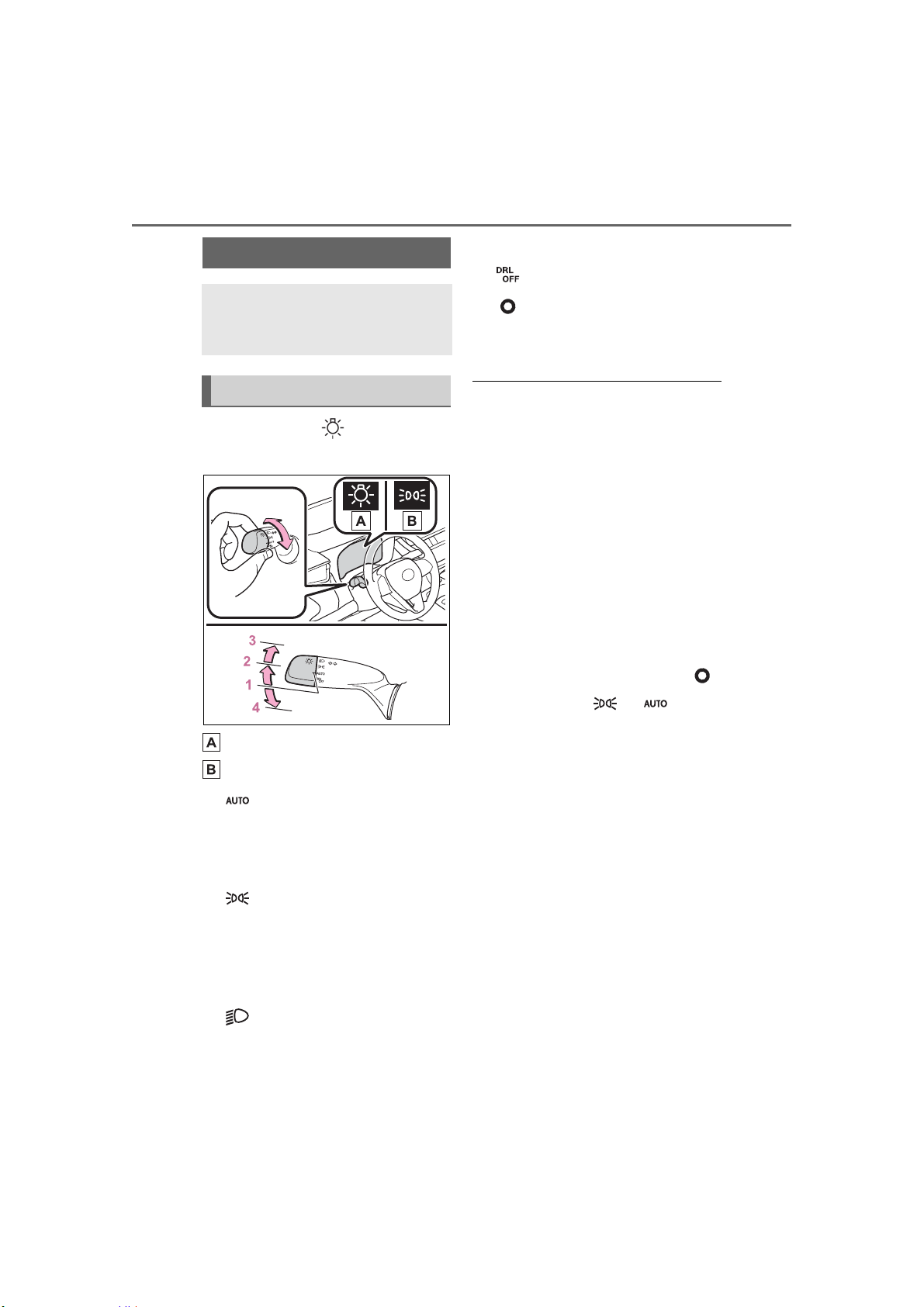
160
4-3. Operating the lights and wipers
COROLLA H/B_U
4-3.Operati ng the lights an d wipers
Operating the switch
turns on the lights as follows:
U.S.A.
Canada
1 The headlights, daytime
running lights (P.160) and
all the lights listed above turn
on and off automatically.
2 The side marker, park-
ing, tail, license plate, instru-
ment panel lights, and
daytime running lights
(P.160) turn on.
3 The headlights and a
ll
lights listed
above (except
daytime running lights) turn
on.
4 (U.S.A.) Off
(Canada) The daytime
running lights turn on.
(P.160)
■ AUTO mode can be used when
The engine switch is in ON.
■ Daytime running light system
● The daytime running lights illumi-
nate using the same lights as the
headlights and illu
minate darker
than t
he headlights.
● To make your vehicle more visible
to other drivers during daytime
dr
iving, the daytime running light
s
turn on
automatically
when all of
the following conditions are met.
(
The daytime running lights ar
e
no
t designed for use at night.)
• The engine is running
• The parking brake is released
• The headlight switch is in t
he
(
Canada only), or
*
posi-
tion
*
: When the surroundings are bright
The daytime running lights remain
on after they illuminate, even if the
parking brake is set again.
● For the U.S.A.: Daytime running
lights can be turned off by operat-
ing the switch.
● Compared to turning on the head-
lights, the daytime running
light
sys
tem of
fers greater durability
a
nd consumes less electricity, so
it can help improve fuel economy.
Headlight switch
The headlights can be oper-
ated manually or automati-
cally.
Operating instructions
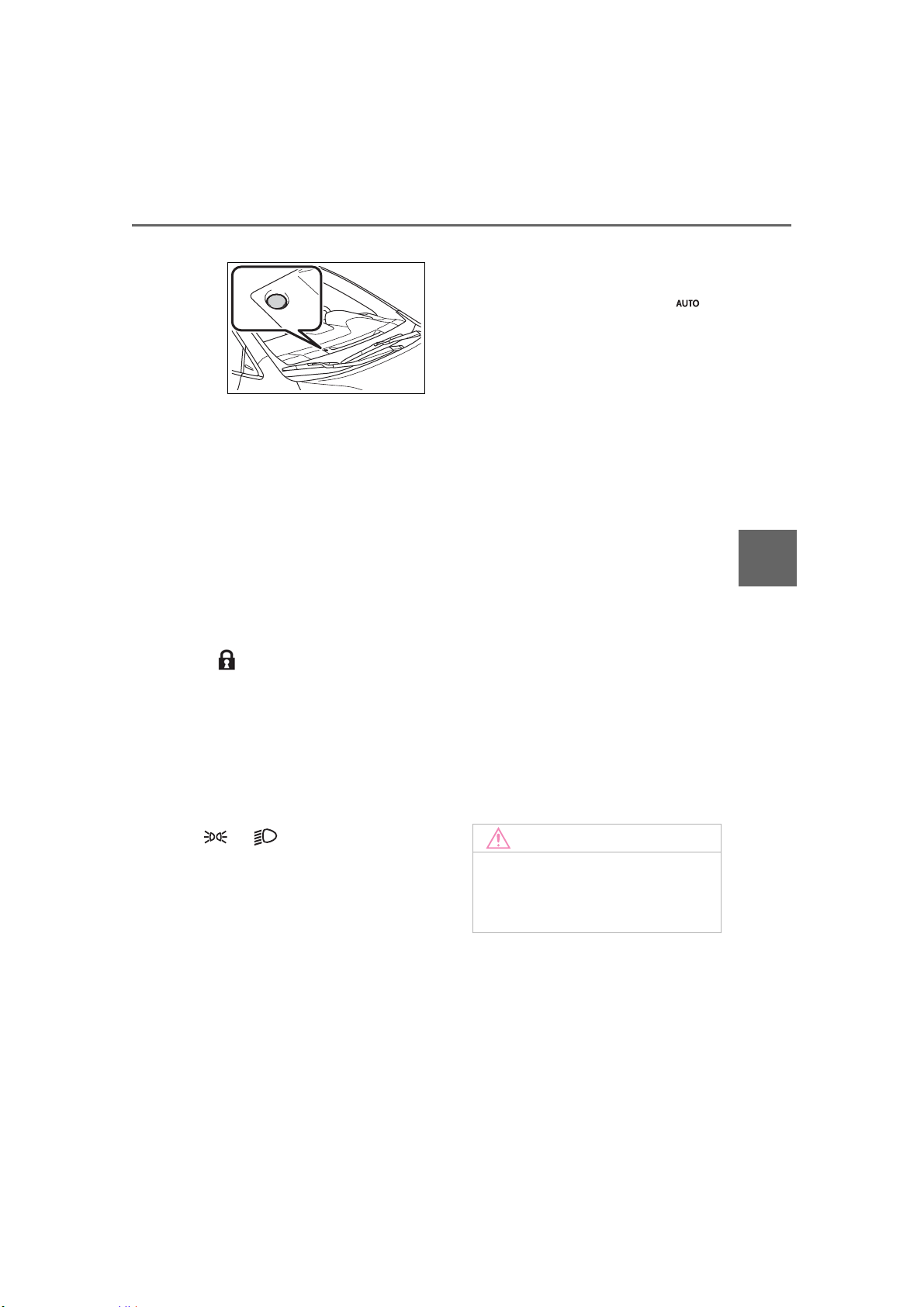
161
4-3. Operating the lights and wipers
COROLLA H/B_U
4
Driving
■ Headlight control sensor
The sensor may not function prop-
erly if an object is placed on the sen-
sor, or anything that blocks the
sensor is affixed to the windshield.
Doing so interferes with the sensor
detecting the level of ambient light
and may cause the automatic head-
light system to malfunction.
■ Automatic light off system
● When the headlights are on: The
headlights and tail lights turn off
30 seconds after the driver’s door
is opened and closed if the engine
switch is turned to ACC or OFF.
(The lights turn off immediately if
on the key is pressed after all
the doors are closed.)
● When only the tail lights are on:
The tail lights turn off automati-
cally if the engine switch is turned
to ACC or OFF and the driver’s
door is opened.
To turn the lights on again, turn the
engine switch to ON, or turn the light
switch off once and then back to
or .
■ Light reminder buzzer
A buzzer sounds when the engine
switch is turned to OFF or ACC and
the driver’s door is opened while the
lights are turned on.
■ Automatic headlight leveling
system (if equipped)
The level of the headlights is auto-
matically adjusted according to the
number of passengers and the load-
ing condition of the vehicle to
ensure that the headlights do not
interfere with other road users.
■ Windshield wiper linked head-
light illumination
When driving during daytime with
the headlight switch turned to , if
the windshield wipers are used, the
headlights will turn on automatically
after several seconds to help
enhance the visibility of your vehi-
cle.
■ Battery-saving function
In order to prevent the battery of the
vehicle from discharging, if the
headlights and/or tail lights are on
when the engine switch is turned off
the battery saving function will oper-
ate and automatically turn off all the
lights after approximately 20 min-
utes. When the engine switch is
turned to ON, the battery-saving
function will be disabled.
When any of the following are per-
formed, the battery-saving function
is canceled once and then reacti-
vated. All the lights will turn off auto-
matically 20 minutes after the
Battery- saving function has been
reactivated:
● When the headlight switch is oper-
ated
● When a door is opened or closed
■ Customization
Some functions can be customized.
(P.531)
NOTICE
■ To prevent battery discharge
Do not leave the lights on longer
than necessary when the engine
is not running.
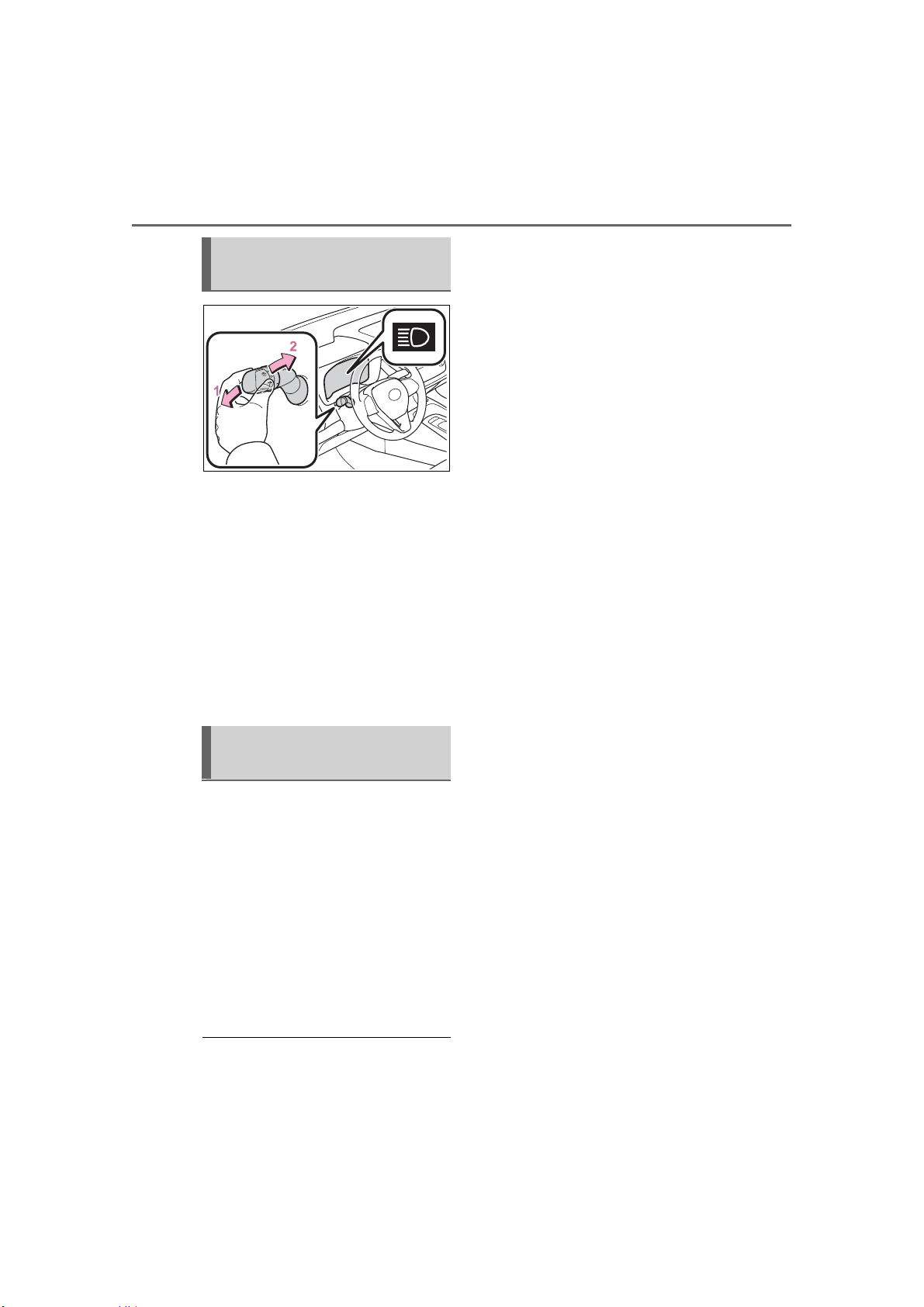
162
4-3. Operating the lights and wipers
COROLLA H/B_U
1 With the headlights on, push
the lever away from you to
turn on the high beams.
Pull the lever toward you to the
center position to turn the high
beams off.
2 Pull the lever toward you and
release it to flash the high
beams once.
You can flash the high beams with
the headlights on or off.
AFS (Adaptive Front-lighting
System) secures excellent visi-
bility at intersections and on
curves by automatically adjust-
ing the direction of the light axis
of the headlights according to
vehicle speed and the degree of
the tire’s angle as controlled by
steering input.
AFS operates at speeds of approxi-
mately 6 mph (10 km/h) or higher.
■ Customization
Some functions can be customized.
(P.531)
Turning on the high beam
headlights
AFS (Adaptive Front-light-
ing System) (if equipped)
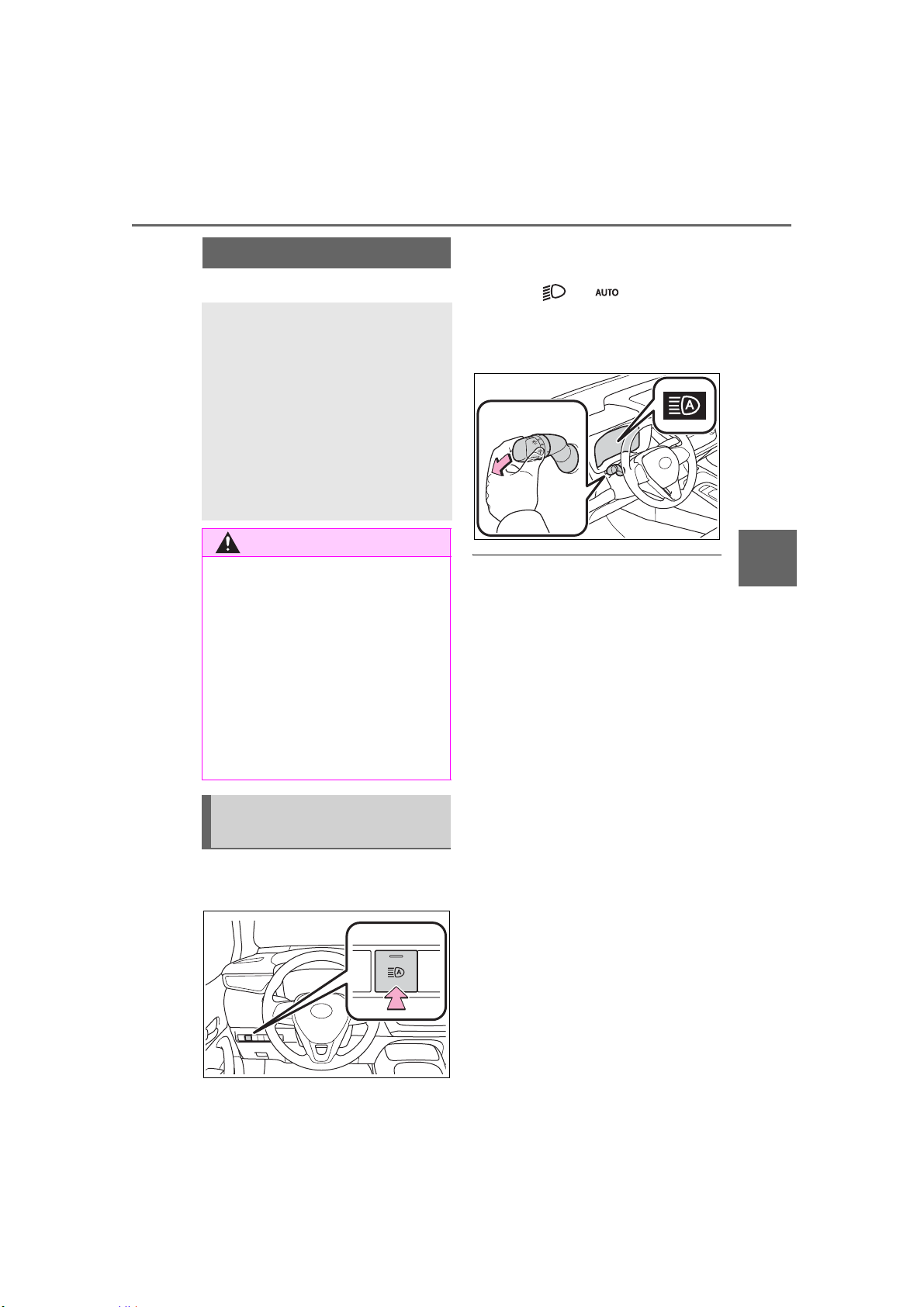
163
4-3. Operating the lights and wipers
COROLLA H/B_U
4
Driving
*
: If equipped
1 Press the Automatic High
Beam switch.
2 Push the lever away from
you with the headlight switch
in the or position.
The Automatic High Beam indicator
will come on when the system is
operating.
■ Conditions to turn the high
beams on/off automatically
● When all of the following condi-
tions are met, the high beams will
be turned on automatically (after
approximately 1 second):
• The vehicle speed is approxi-
mately 21 mph (34 km/h) or more.
• The area ahead of the vehicle is
dark.
• There are no vehicles ahead with
headlights or tail lights turned on.
• There are few streetlights on the
road ahead.
● If any of the following conditions
are met, the high beams will turn
off automatically:
• The vehicle speed is below
approximately 17 mph (27 km/h).
• The area ahead of the vehicle is
not dark.
• Vehicles ahead have their head-
lights or tail lights turned on.
• There are many streetlights on the
road ahead.
■ Camera sensor detection infor-
mation
● The high beams may not be auto-
matically turned off in the following
situations:
• When a vehicle suddenly appears
Automatic High Beam
*
The Automatic High Beam
uses a camera sensor
located behind the upper
portion of the windshield to
assess the brightness of the
lights of vehicles ahead,
streetlights, etc., and auto-
matically turns the high
beams on or off as neces-
sary.
WARNING
■ Limitations of the Automatic
High Beam
Do not overly rely on the Auto-
matic High Beam. Always drive
safely, taking care to observe your
surroundings and turning the high
beams on or off manually if nec-
essary.
■ To prevent incorrect opera-
tion of the Automatic High
Beam system
Do not overload the vehicle.
Activating the Automatic
High Beam

164
4-3. Operating the lights and wipers
COROLLA H/B_U
from around a curve
• When the vehicle is cut in front of
by another vehicle
• When vehicles ahead cannot be
detected due to repeated curves,
road dividers or roadside trees
• When vehicles ahead appear in a
faraway lane on a wide road
• When the lights of vehicles ahead
are not on
● The high beams may be turned off
if a vehicle ahead that is using fog
lights without its headlights turned
on is detected.
● House lights, street lights, traffic
signals, and illuminated billboards
or signs and other reflective
objects may cause the high
beams to change to the low
beams, or the low beams to
remain on.
● The following factors may affect
the amount of time taken for the
high beams to turn on or off:
• The brightness of the headlights,
fog lights, and tail lights of vehi-
cles ahead
• The movement and direction of
vehicles ahead
• When a vehicle ahead only has
operational lights on one side
• When a vehicle ahead is a
two-wheeled vehicle
• The condition of the road (gradi-
ent, curve, condition of the road
surface, etc.)
• The number of passengers and
amount of luggage in the vehicle
● The high beams may turn on or off
unexpectedly.
● Bicycles or similar vehicles may
not be detected.
● In the following situations the sys-
tem may not be able to correctly
detect the surrounding brightness
level. This may cause the low
beams to remain on or the high
beams to flash or dazzle pedestri-
ans or vehicles ahead. In such a
case, it is necessary to manually
switch between the high and low
beams.
• When driving in inclement weather
(heavy rain, snow, fog, sand-
storms, etc.)
• When the windshield is obscured
by fog, mist, ice, dirt, etc.
• When the windshield is cracked or
damaged
• When the camera sensor is
deformed or dirty
• When the temperature of the cam-
era sensor is extremely high
• When the surrounding brightness
level is equal to that of headlights,
tail lights or fog lights
• When headlights or tail lights of
vehicles ahead are turned off,
dirty, changing color, or not aimed
properly
• When the vehicle is hit by water,
snow, dust, etc. from a preceding
vehicle
• When driving through an area of
intermittently changing brightness
and darkness
• When frequently and repeatedly
driving ascending/descending
roads, or roads with rough, bumpy
or uneven surfaces (such as
stone-paved roads, gravel roads,
etc.)
• When frequently and repeatedly
taking curves or driving on a wind-
ing road
• When there is a highly reflective
object ahead of the vehicle, such
as a sign or mirror
• When the back of a preceding
vehicle is highly reflective, such as
a container on a truck
• When the vehicle’s headlights are
damaged or dirty, or are not aimed
properly
• When the vehicle is listing or titling
due to a flat tire, a trailer being
towed, etc.
• When the headlights are changed
between the high beams and low
beams repeatedly in an abnormal
manner
• When the driver believes that the
high beams may be flashing or
dazzling pedestrians or other driv-
ers
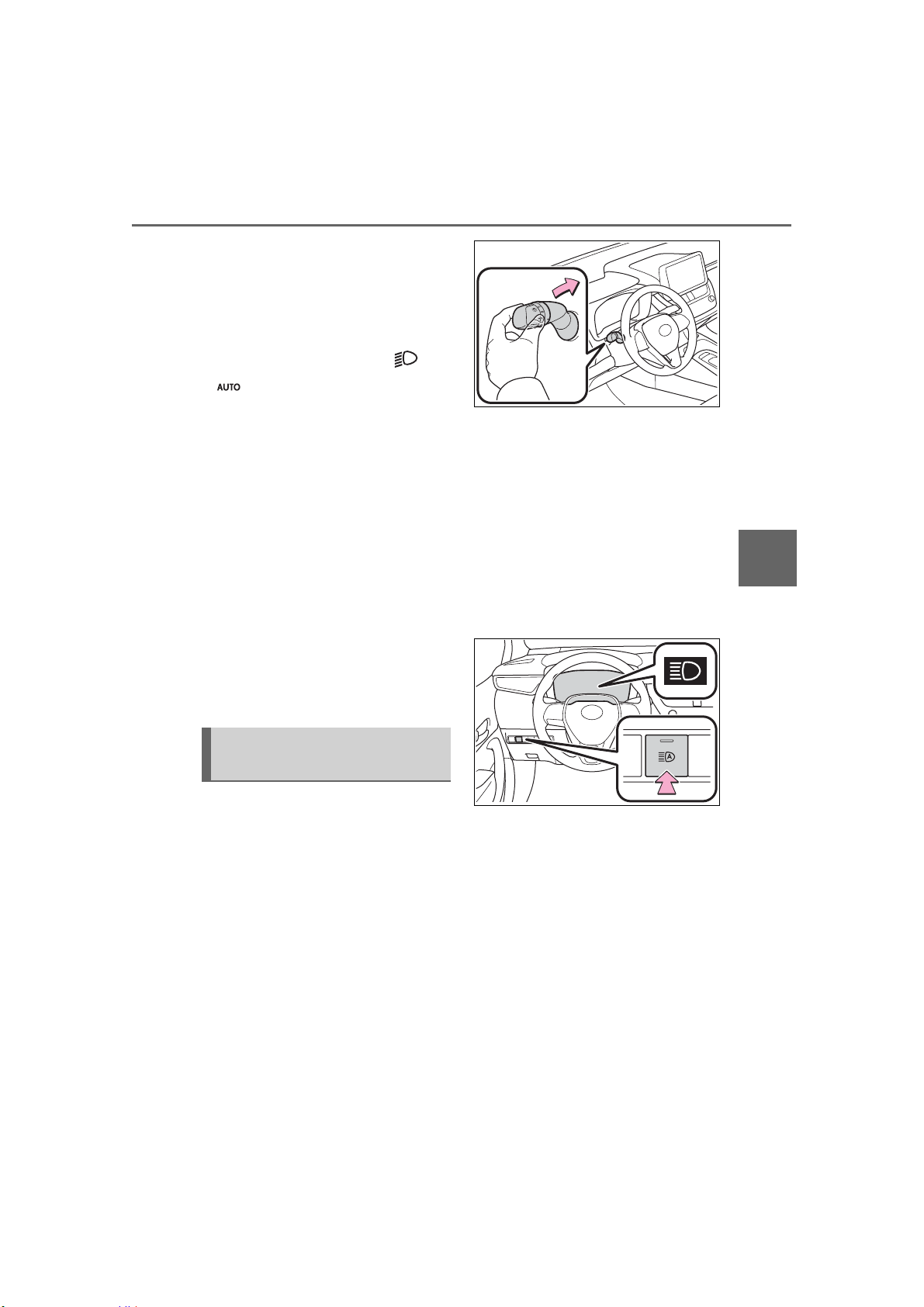
165
4-3. Operating the lights and wipers
COROLLA H/B_U
4
Driving
■ Temporarily lowering sensor
sensitivity
The sensitivity of the sensor can be
temporarily lowered.
1 Turn the engine switch off while
the following conditions are met.
● The headlight switch is in or
.
● The headlight switch lever is in
high beam position.
● Automatic High Beam switch is
on.
2 Turn the engine switch to ON.
3 Within 30 seconds after step 2,
repeat pulling the headlight
switch lever to the original posi-
tion then pushing it to the high
beam position quickly 10 times,
then leave the lever in high beam
position.
4 If the sensitivity is changed, the
Automatic High Beam indicator
is turn on and off 3 times.
Automatic High Beam (headlights)
may turn on even when the vehicle
is stopped.
■ Switching to the low beams
Pull the lever to its original posi-
tion.
The Automatic High Beam indicator
will turn off.
Push the lever away from you to
activate the Automatic High Beam
system again.
■ Switching to the high
beams
Press the Automatic High Beam
switch.
The Automatic High Beam indicator
will turn off and the high beam indi-
cator will turn on.
Press the switch to activate the
Automatic High Beam system
again.
Turning the high beams
on/off manually
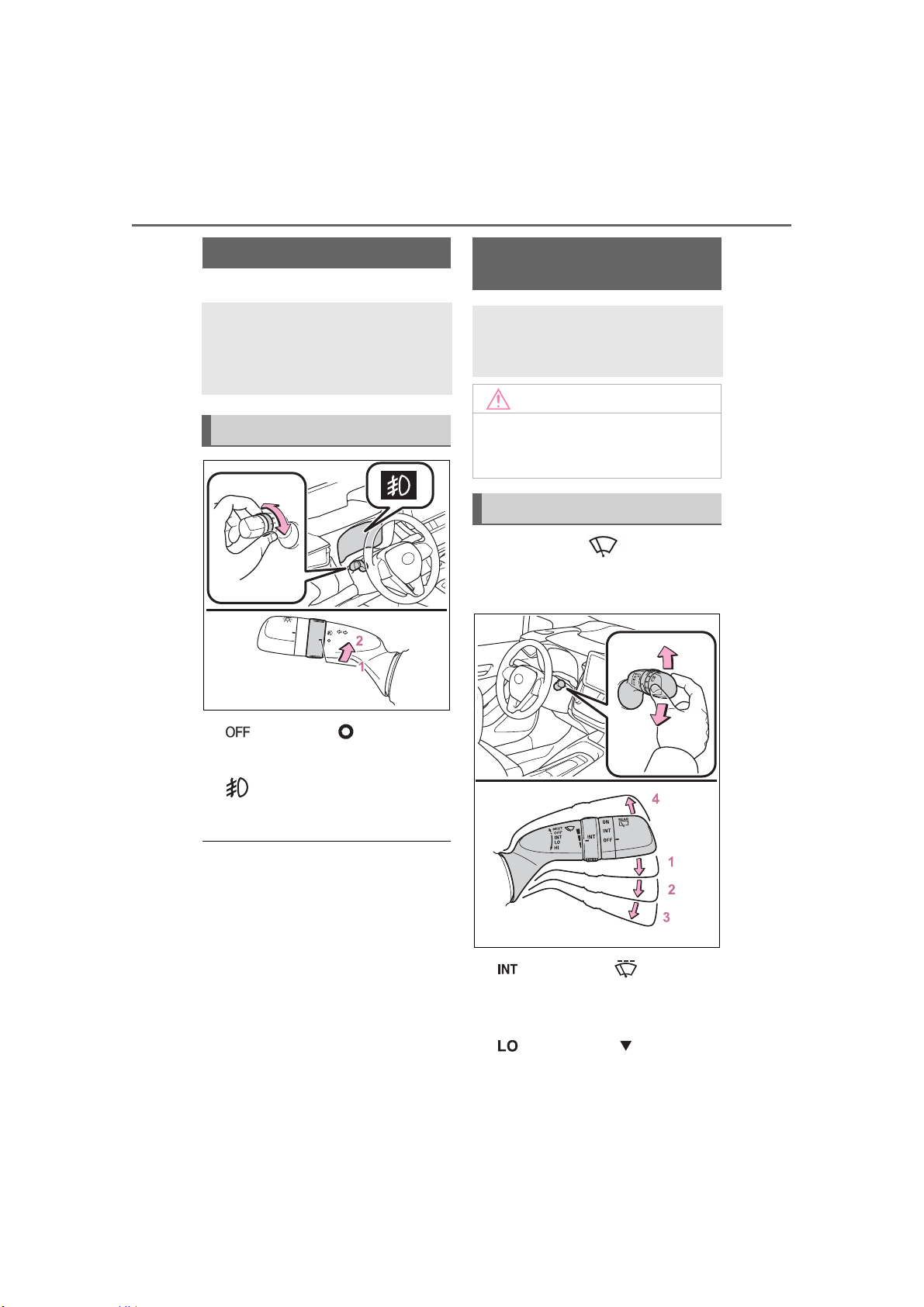
166
4-3. Operating the lights and wipers
COROLLA H/B_U
*
: If equipped
1 (U.S.A) or (Canada)
Turns the front fog lights off
2 Turns the front fog lights
on
■ Fog lights can be used when
The headlights are on in low beam.
Operating the lever oper-
ates the wipers or washer as fol-
lows.
1 (U.S.A.) or (Canada)
Intermittent windshield wiper
operation
2 (U.S.A.) or (Canada)
Low speed windshield wiper
Fog light switch
*
The fog lights secure excel-
lent visibility in difficult driv-
ing conditions, such as in
rain and fog.
Operating instructions
Windshield wipers and
washer
Operating the lever can use
the windshield wipers or the
washer.
NOTICE
■ When the windshield is dry
Do not use the wipers, as they
may damage the windshield.
Operating the wiper lever
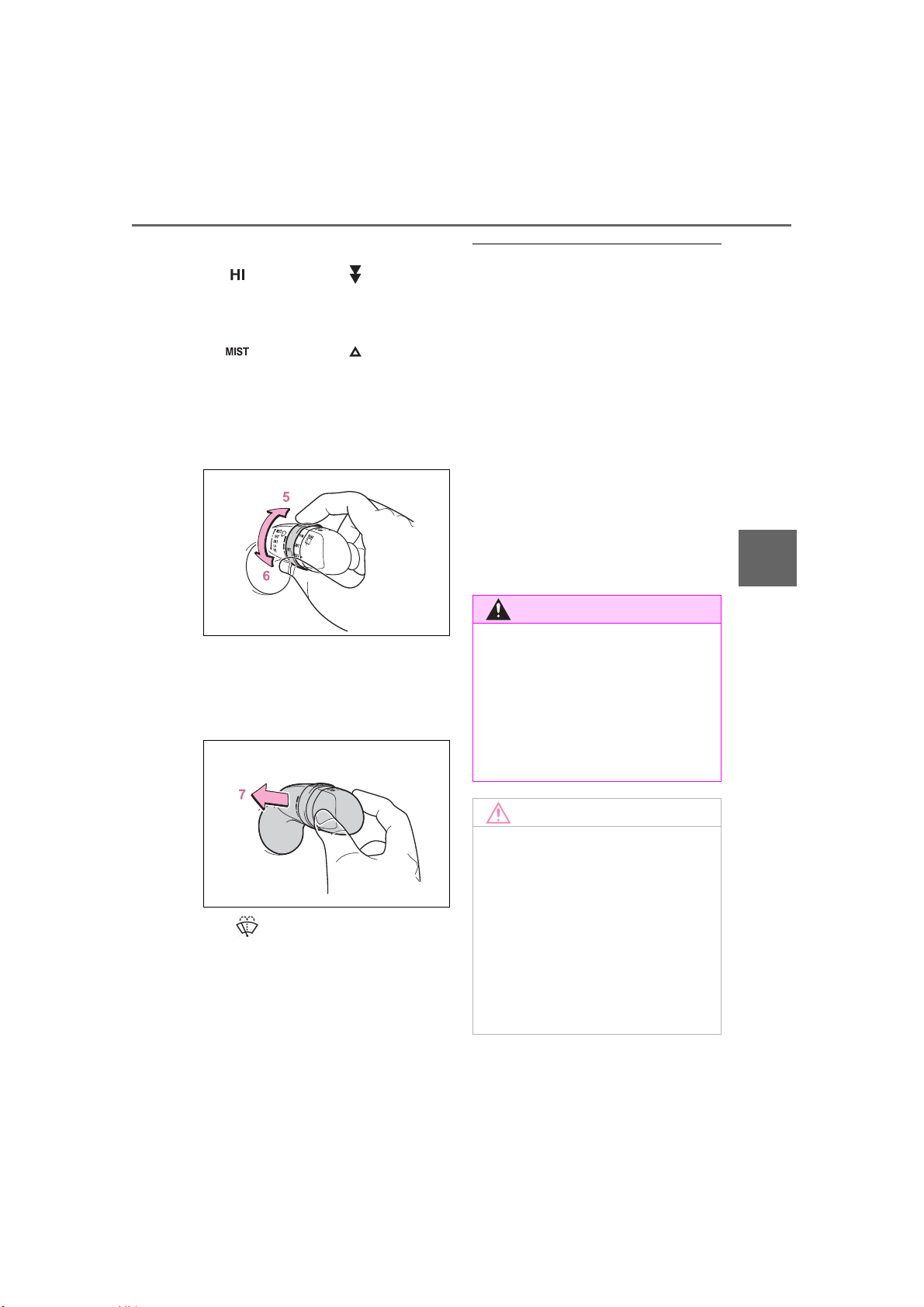
167
4-3. Operating the lights and wipers
COROLLA H/B_U
4
Driving
operation
3 (U.S.A.) or (Canada)
High speed windshield wiper
operation
4 (U.S.A.) or (Canada)
Temporary operation
Wiper intervals can be adjusted
when intermittent operation is
selected.
5 Increases the intermittent
windshield wiper frequency
6 Decreases the intermittent
windshield wiper frequency
7 Washer/wiper dual
operation
Pulling the lever operates the wip-
ers and washer.
Wipers will automatically operate a
couple of times after the washer
squirts.
■ The windshield wiper and
washer can be operated when
The engine switch is in ON.
■ If no windshield washer fluid
sprays
Check that the washer nozzles are
not blocked if there is washer fluid in
the windshield washer fluid reser-
voir.
■ When stopping the engine in an
emergency while driving
If the windshield wipers are operat-
ing when the engine is stopped, the
windshield wipers will operate in
high speed operation. After the vehi-
cle is stopped, operation will return
to normal when the engine switch is
turned to ON, or operation will stop
when the driver’s door is opened.
WARNING
■ Caution regarding the use of
washer fluid
When it is cold, do not use the
washer fluid until the windshield
becomes warm. The fluid may
freeze on the windshield and
cause low visibility. This may lead
to an accident, resulting in death
or serious injury.
NOTICE
■ When the washer fluid tank is
empty
Do not operate the switch continu-
ally as the washer fluid pump may
overheat.
■ When a nozzle becomes
blocked
In this case, contact your Toyota
dealer. Do not try to clear it with a
pin or other object. The nozzle will
be damaged.
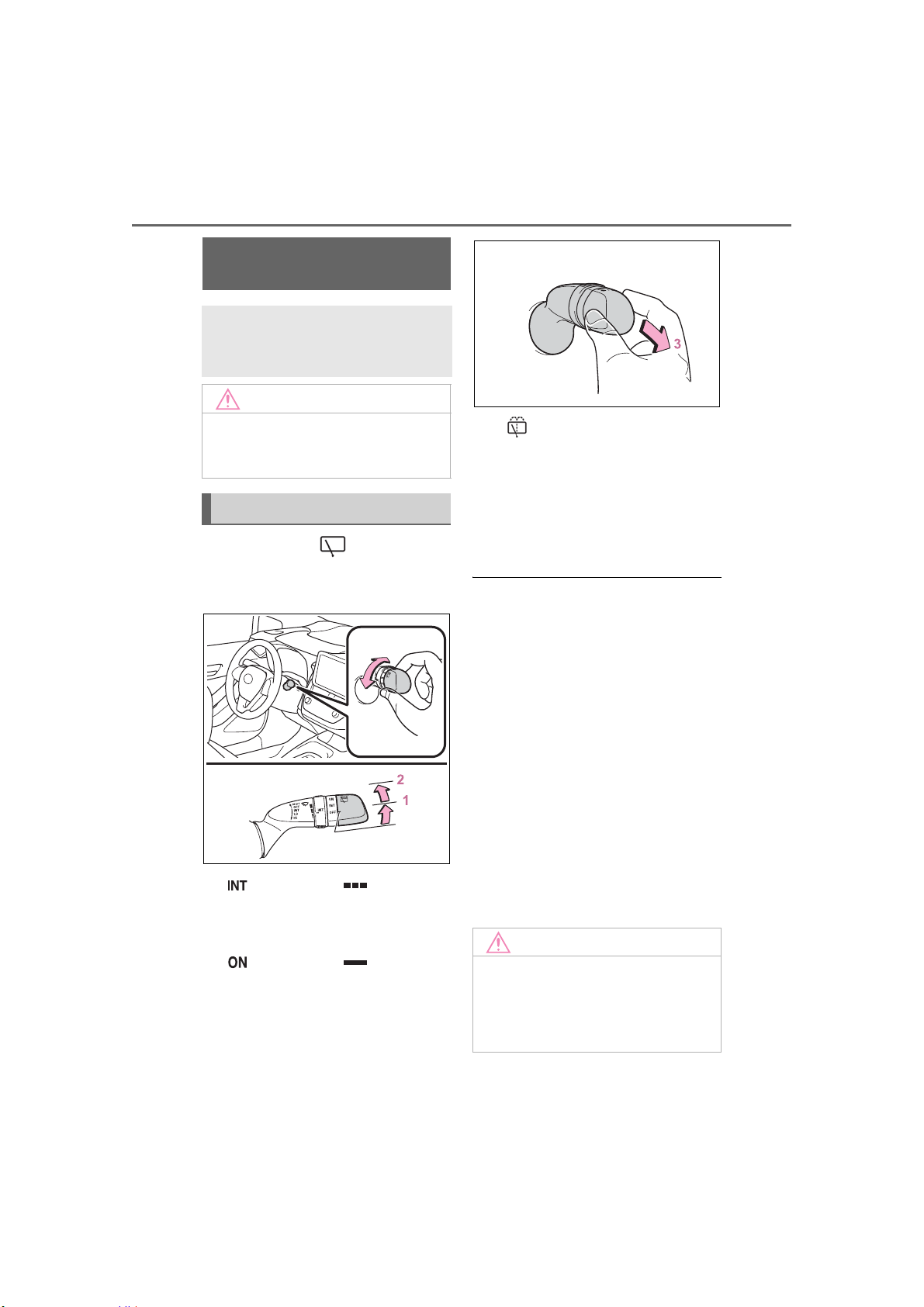
168
4-3. Operating the lights and wipers
COROLLA H/B_U
Operating the switch
operates the rear wiper as fol-
lows:
1 (U.S.A.) or (Canada)
Intermittent window wiper
operation
2 (U.S.A.) or (Canada)
Normal window wiper opera-
tion
3 Washer/wiper dual
operation
Pushing the lever operates the
wiper and washer.
The wiper will automatically operate
a couple of times after the washer
squirts.
■ The rear window wiper and
washer can be operated when
The engine switch is in ON.
■ If no windshield washer fluid
sprays
Check that the washer nozzle is not
blocked if there is washer fluid in the
windshield washer fluid reservoir.
■ Back door opening linked rear
window wiper stop function
When the rear window wiper are
operating, if a back door is opened
while the vehicle is stopped, opera-
tion of the rear window wiper will be
stopped to prevent anyone near the
vehicle from being sprayed by water
from the wiper. When the back door
is closed, wiper operation will
resume.
Rear window wiper
and washer
Operating the lever can use
the rear window wiper or the
washer.
NOTICE
■ When the rear window is dry
Do not use the wiper, as it may
damage the rear window.
Operating instructions
NOTICE
■ When the washer fluid tank is
empty
Do not operate the switch continu-
ally as the washer fluid pump may
overheat.

169
4-3. Operating the lights and wipers
COROLLA H/B_U
4
Driving
NOTICE
■ When a nozzle becomes
blocked
In this case, contact your Toyota
dealer.
Do not try to clear it with a pin or
other object. The nozzle will be
damaged.
170
4-4. Refueling
COROLLA H/B_U
4-4.Refueling
Turn the engine switch off and
ensu
re that all the doors an
d
windows are closed.
Co
nfirm the type of fuel.
■ Fuel types
P. 518
■ Fuel tank opening for unleaded
gas
oline
To help prevent incorrect fueling,
your vehicle has a fuel tank opening
that only accommodates the spe-
cial nozzle on unleaded fuel pumps.
■ If the malfunction indicator
l
amp illuminates
The malfunction indicator lamp may
illuminate erroneously if refueling is
performed repeatedly when the fuel
tank is nearly full.
Opening the fuel tank
cap
Perform the following steps
to open the fuel tank cap:
Before refueling the vehi-
cle
WARNING
■ When refueling the vehicle
Observe the following precautions
while refueling the vehicle. Failure
to do so may result in death or
serious injury.
● After exiting the vehicle and
before opening the fuel door,
touch an unpainted metal sur-
face to discharge an
y static
elec
tricity. It is important to dis-
charge static electricity before
refueling because sparks result-
ing from static electricity
can
cause fuel vapors to ignite while
refueling.
● Always hold the grips on the
fuel tank cap and turn it slowly
to remove it.
A
whooshing sound may be
heard when the fuel tank cap
is
lo
osened. Wait until the sound
cannot be heard before fully
removing the cap. In ho
t
weather, pressurized fuel may
spray out the filler neck
and
cause in
jury.
● Do not allow anyone that has
no
t discharged static electri
city
fro
m their body to come close
to
an
open fuel tank.
● Do not inhale vaporized fuel.
Fuel contains substances that
are harmful if inhaled.
● Do not smoke while refueling
the vehicle.
Doing so may cause the f
uel to
ign
ite and cause a fire.
● Do not return to the vehicle or
touch any person or object that
is statically charged.
Th
is may cause static electri
city
to build
up, resulting in a possi-
ble ignition hazard.
■ When refueling
Observe the following precautions
to prevent fuel overflowing from
the fuel tank:
● Securely insert the fuel nozzle
into the fuel filler nec
k.
● Stop filling the tank after the fuel
nozzle automatically clicks off.
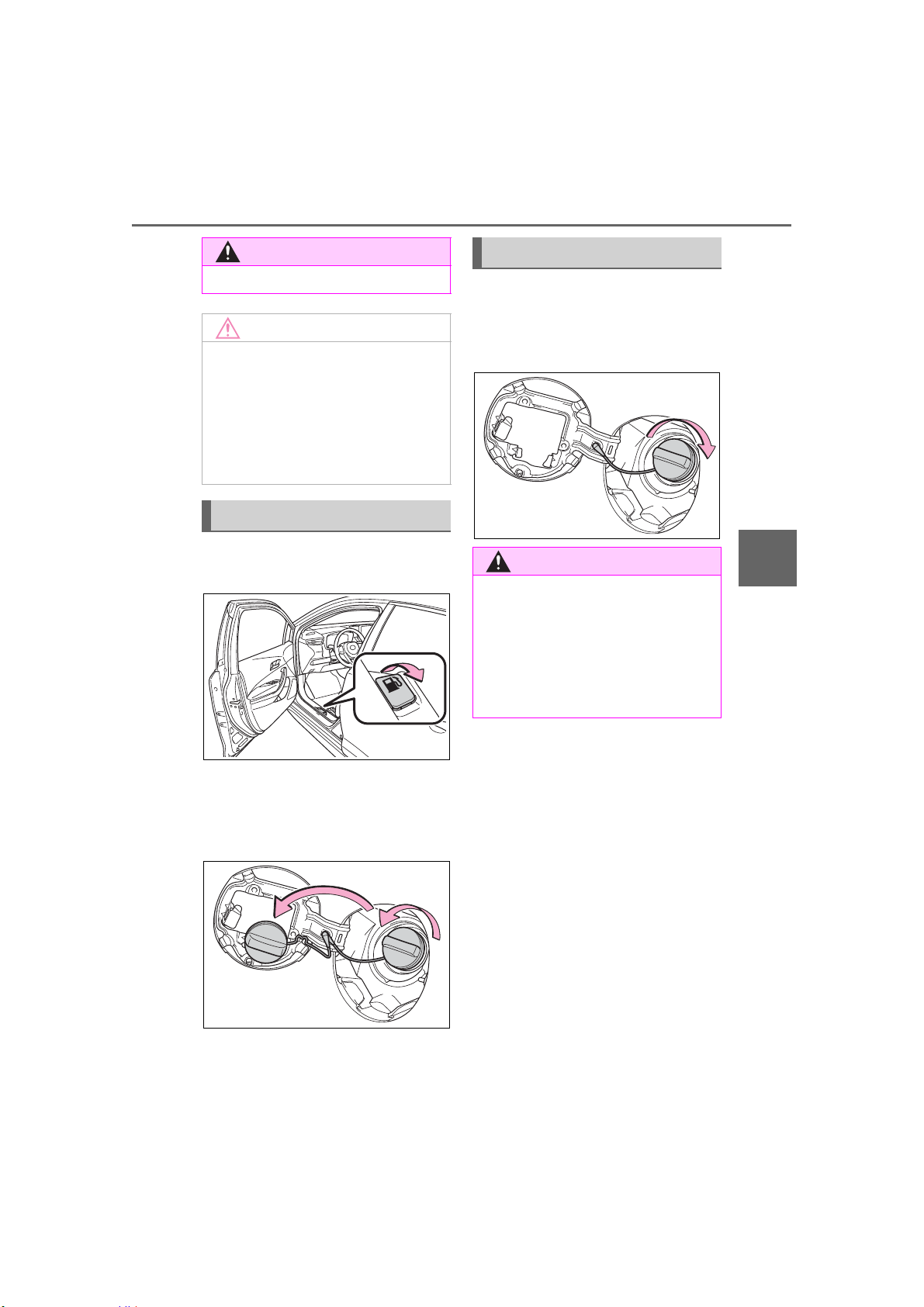
171
4-4. Refueling
COROLLA H/B_U
4
Driving
1 Pull up the opener to open
the fuel filler door.
2 Turn the fuel tank cap slowly
and remove it, then hang it
on the back of the fuel filler
door.
After refueling, turn the fuel tank
cap until you hear a click. Once
the cap is released, it will turn
slightly in the opposite direction.
WARNING
● Do not top off the fuel tank.
NOTICE
■ Refueling
Do not spill fuel during refueling.
Doing so may damage the vehi-
cle, such as causing the emission
control system to operate abnor-
mally or damaging fuel system
components or the vehicle’s
painted surface.
Opening the fuel tank cap
Closing the fuel tank cap
WARNING
■ When replacing the fuel tank
c
ap
Do not use anything but a genu-
ine Toyota fuel tank cap designed
for your vehicle. Doing so may
cause a fire or other incident
which may result in death or seri-
ous injury.
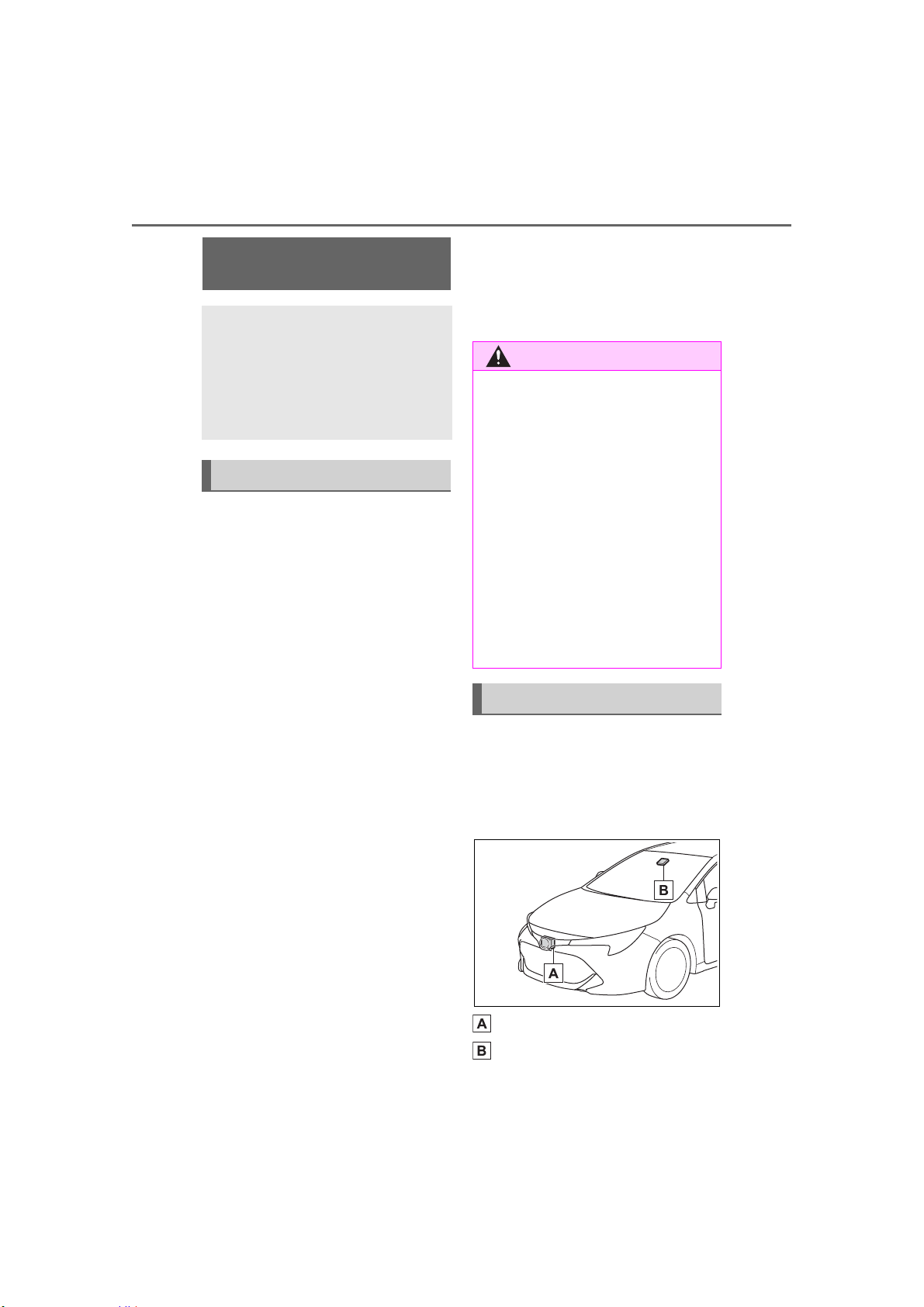
172
4-5. Using the driving support systems
COROLLA H/B_U
4-5.Using the driving suppor t systems
■ PCS (Pre-Collision System)
P.178
■ LTA (Lane Tracing Assist)
*
P.186
*
: If equipped
■ LDA (Lane Departure Alert
w
ith steering control)
*
P.196
*
: If equipped
■ AHB (Automatic High
Be
am)
*
P.163
*
: If equipped
■ RSA (Road Sign Assist)
*
P.224
*
: If equipped
■ Dynamic radar cruise con-
trol with full-speed range
*
P.204
*
: If equipped
■ Dynamic radar cruise con-
trol
*
P.214
*
: If equipped
Two types of sensors, located
behind the front grille and wind-
shield, detect information neces-
sary to operate the drive assist
systems.
Radar sensor
Front camera
Toyota Safety Sense
2.0
The Toyota Safety Sense 2.0
consists of the following
drive assist systems and
contributes to a safe and
comfortable driving experi-
ence:
Driving assist system
WARNING
■ Toyota Safety Sense 2.0
The Toyota Safety Sense 2.0 is
designed to operate under the
assumption that the driver will
drive safely, and is designed to
help reduce the impact to the
occupants and the vehicle in the
case of a collision or assist the
driver in normal driving condi-
tions.
As there is a limit to the degree of
recognition accuracy and control
performance that this system can
provide, do not overly rely on this
system. The driver is always
responsible for paying attention to
the vehicle’s surroundings and
driving safely.
Sensors
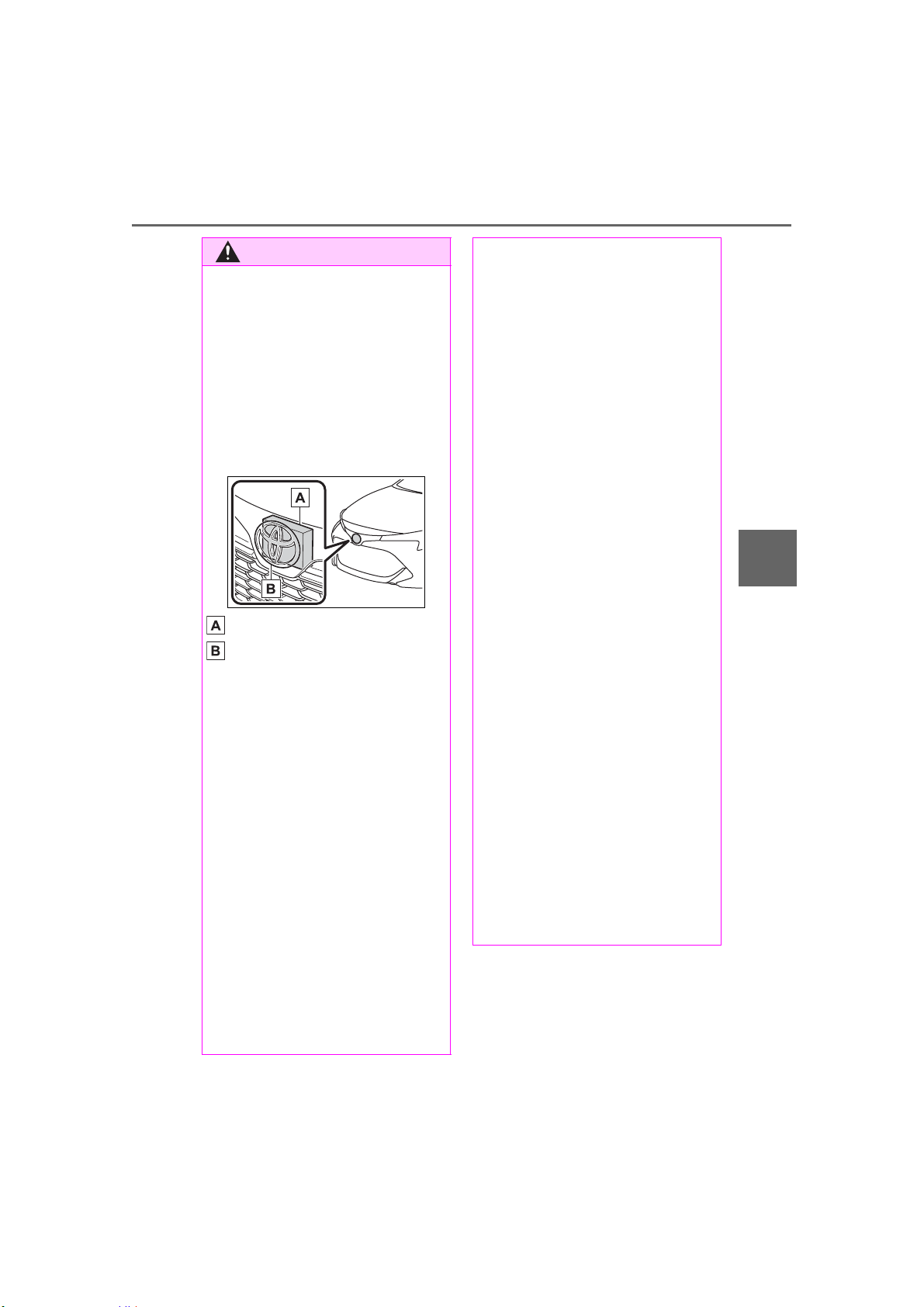
173
4-5. Using the driving support systems
COROLLA H/B_U
4
Driving
WARNING
■ To avoid malfunction of the
radar sensor
Observe the following precau-
tions.
Otherwise, the radar sensor may
not operate properly, possibly
leading to an accident resulting in
death or serious injury.
● Keep the radar sensor and the
radar sensor cover clean at all
times.
Radar sensor
Radar sensor cover
If the front of the radar sensor or
the front or back of the radar sen-
sor cover is dirty or covered with
water droplets, snow, etc., clean
it.
Clean the radar sensor and radar
sensor cover with a soft cloth to
avoid damaging them.
● Do not attach accessories,
stickers (including transparent
stickers) or other items to the
radar sensor, radar sensor
cover or surrounding area.
● Do not subject the radar sensor
or its surrounding area to a
strong impact.
If the radar sensor, front grille,
or front bumper has been sub-
jected to a strong impact, have
the vehicle inspected by your
Toyota dealer.
● Do not disassemble the radar
sensor.
● Do not modify or paint the radar
sensor or radar sensor cover.
● In the following cases, the radar
sensor must be recalibrated.
Contact your Toyota dealer for
details.
• When the radar sensor or front
grille are removed and installed,
or replaced
• When the front bumper is
replaced
■ To avoid malfunction of the
front camera
Observe the following precau-
tions.
Otherwise, the front camera may
not operate properly, possibly
leading to an accident resulting in
death or serious injury.
● Keep the windshield clean at all
times.
• If the windshield is dirty or cov-
ered with an oily film, water
droplets, snow, etc., clean the
windshield.
• If a glass coating agent is
applied to the windshield, it will
still be necessary to use the
windshield wipers to remove
water droplets, etc. from the
area of the windshield in front of
the front camera.
• If the inner side of the wind-
shield where the front camera is
installed is dirty, contact your
Toyota dealer.
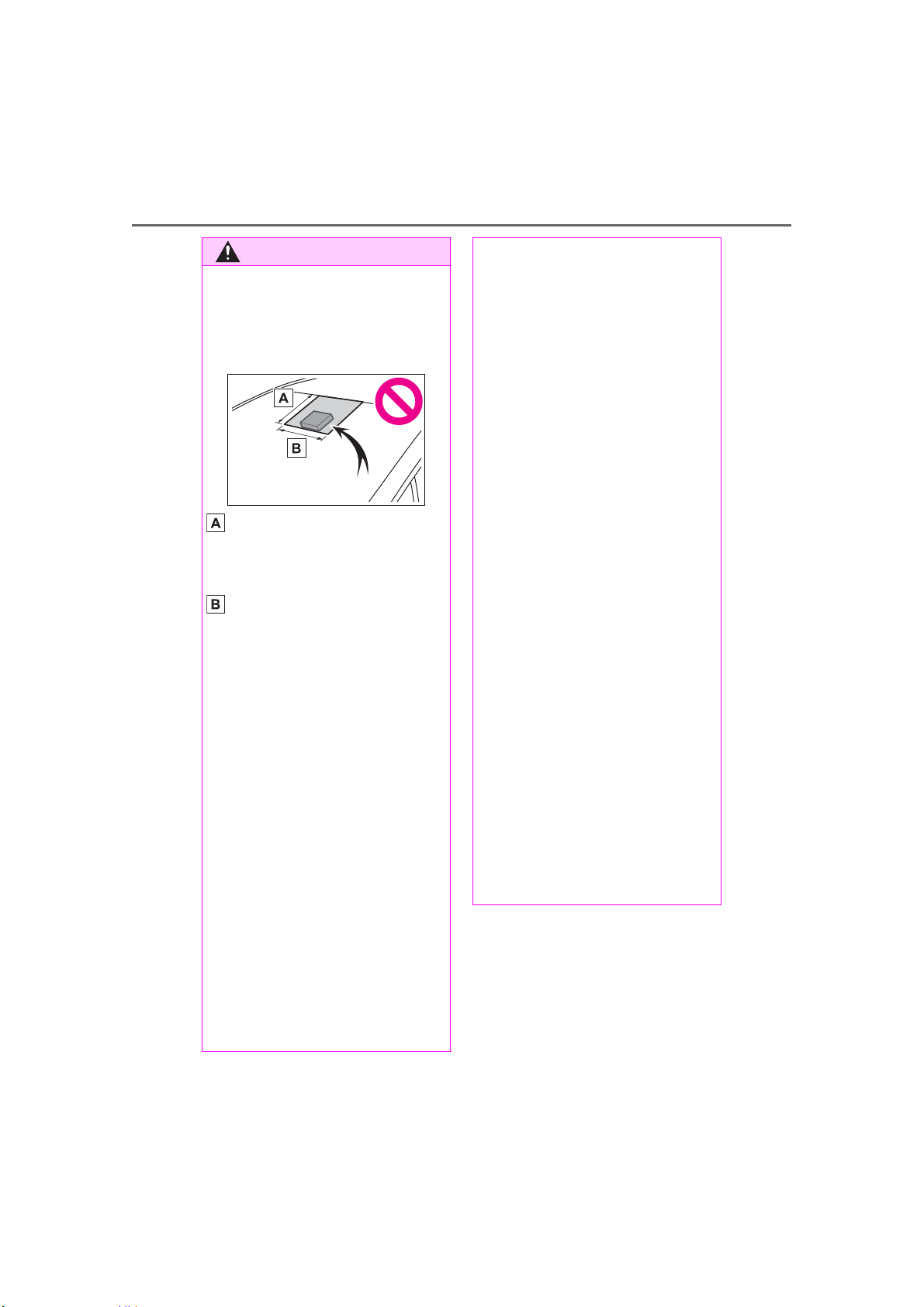
174
4-5. Using the driving support systems
COROLLA H/B_U
WARNING
● Do not attach objects, such as
stickers, transparent stickers,
etc., to the outer side of the
windshield in front of the front
camera (shaded area in the
illustration).
From the top of the windshield
to approximately 0.4 in. (1 cm)
below the bottom of the front
camera
Approximately 7.9 in. (20 cm)
(Approximately 4.0 in. [10 cm]
to the right and left from the
center of the front camera)
● If the part of the windshield in
front of the front camera is
fogged up or covered with con-
densation, or ice, use the wind-
shield defogger to remove the
fog, condensation, or ice.
(
P.388)
● If water droplets cannot be
properly removed from the area
of the windshield in front of the
front camera by the windshield
wipers, replace the wiper insert
or wiper blade.
● Do not attach window tint to the
windshield.
● Replace the windshield if it is
damaged or cracked.
After replacing the windshield,
the front camera must be recali-
brated. Contact your Toyota
dealer for details.
● Do not allow liquids to contact
the front camera.
● Do not allow bright lights to
shine into the front camera.
● Do not dirty or damage the front
camera.
When cleaning the inside of the
windshield, do not allow glass
cleaner to contact the lens of
the front camera. Also, do not
touch the lens.
If the lens is dirty or damaged,
contact your Toyota dealer.
● Do not subject the front camera
to a strong impact.
● Do not change the installation
position or direction of the front
camera or remove it.
● Do not disassemble the front
camera.
● Do not modify any components
of the vehicle around the front
camera (inside rear view mirror,
etc.) or ceiling.
● Do not attach any accessories
to the hood, front grille or front
bumper that may obstruct the
front camera. Contact your Toy-
ota dealer for details.
● If a surfboard or other long
object is to be mounted on the
roof, make sure that it will not
obstruct the front camera.
● Do not modify the headlights or
other lights.
175
4-5. Using the driving support systems
COROLLA H/B_U
4
Driving
■ Certification
For vehicles sold in the U.S.A., Hawaii, Guam and Puerto Rico
For vehicles sold in Canada
176
4-5. Using the driving support systems
COROLLA H/B_U
■ If a warning message is displayed on the multi-information display
A system may be temporarily unavailable or there may be a malfunction in
the system.
● In the following situations, perform the actions specified in the table. When
the normal operating conditions are detected, the message will disappear
and the system will become operational.
If the message does not disappear, contact your Toyota dealer.
Situation Actions
When the area around a sensor is
covered with dirt, moisture (fogged
up, covered with condensation, ice,
etc.), or other foreign matter
To clean the part of the windshield in
front of the front camera , use the
windshield wipers or the windshield
defogger of the air conditioning sys-
tem (P.388).

177
4-5. Using the driving support systems
COROLLA H/B_U
4
Driving
● In the following situations, if the situation has changed (or the vehicle has
been driven for some time) and the normal operating conditions are
detected, the message will disappear and the system will become opera-
tional.
If the message does not disappear, contact your Toyota dealer.
• When the temperature around the radar sensor is outside of the opera-
tional range, such as when the vehicle is in the sun or in an extremely cold
environment
• When the front camera cannot detect objects in front of the vehicle, such
as when driving in the dark, snow, or fog, or when bright lights are shining
into the front camera
When the temperature around the
front camera is outside of the opera-
tional range, such as when the vehi-
cle is in the sun or in an extremely
cold environment
If the front camera is hot, such as
after the vehicle had been parked in
the sun, use the air conditioning sys-
tem to decrease the temperature
around the front camera.
If a sunshade was used when the
vehicle was parked, depending on its
type, the sunlight reflected from the
surface of the sunshade may cause
the temperature of the front camera
to become excessively high.
If the front camera is cold, such after
the vehicle is parked in an extremely
cold environment, use the air condi-
tioning system to increase the tem-
perature around the front camera.
The area in front of the front camera
is obstructed, such as when the
hood is open or a sticker is attached
to the part of the windshield in front
of the front camera.
Close the hood, remove the sticker,
etc. to clear the obstruction.
Situation Actions
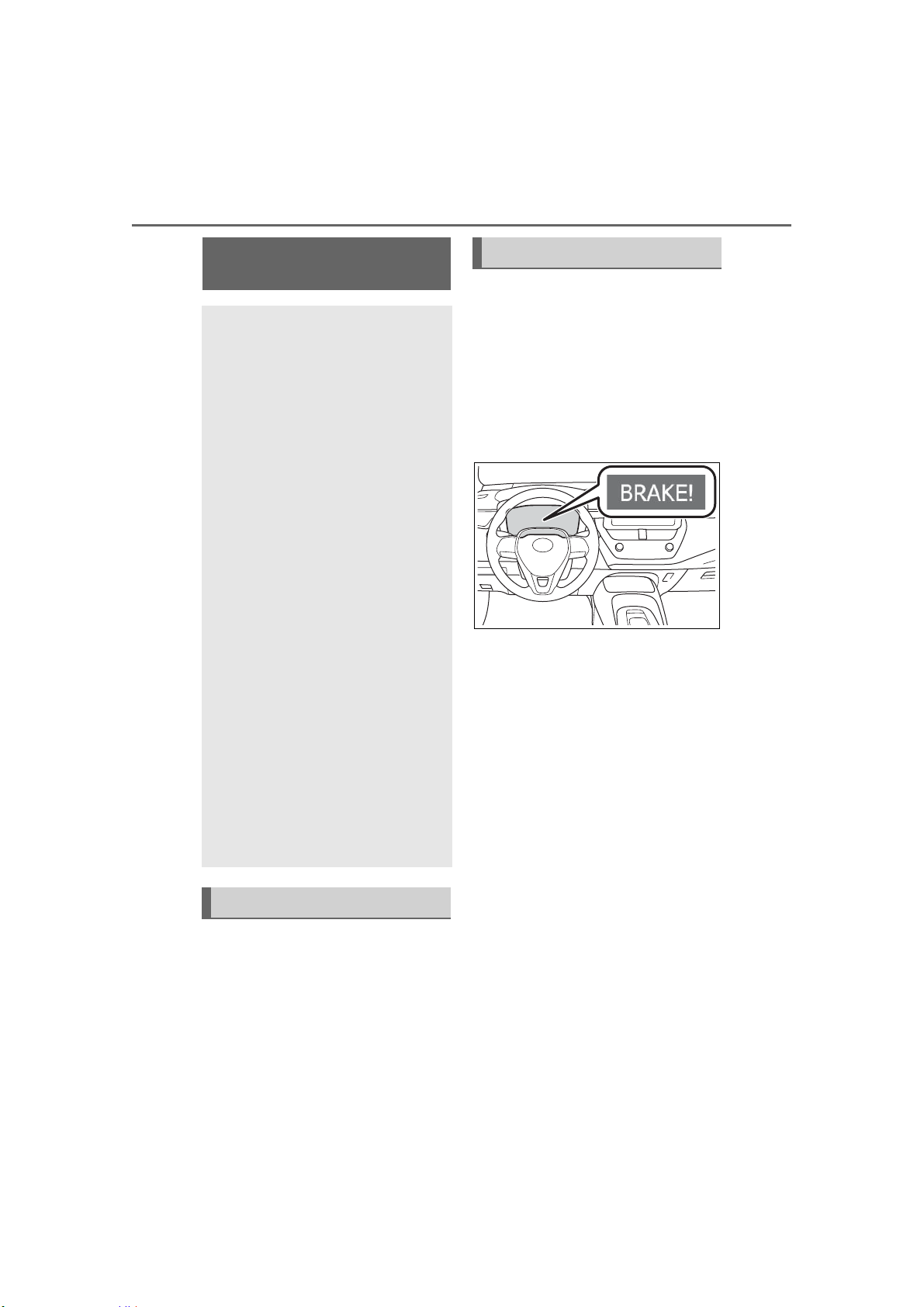
178
4-5. Using the driving support systems
COROLLA H/B_U
The system can detect the fol-
lowing:
Vehicles
Bicyclists
Pedestrians
■ Pre-collision warning
When the system determines
that the possibility of a frontal
collision is high, a buzzer will
sound and a warning message
will be displayed on the
multi-information display to urge
the driver to take evasive action.
■ Pre-collision brake assist
When the system determines
that the possibility of a frontal
collision is high, the system
applies greater braking force in
relation to how strongly the
brake pedal is depressed.
■ Pre-collision braking
If the system determines that
the possibility of a frontal colli-
sion is extremely high, the
brakes are automatically applied
to help avoid the collision or
reduce the impact of the colli-
sion.
PCS (Pre-Collision Sys-
tem)
The pre-collision system
uses a radar sensor and
front camera to detect
objects (P.178) in front of
the vehicle. When the sys-
tem determines that the
possibility of a frontal colli-
sion with an object is high, a
warning operates to urge
the driver to take evasive
action and the potential
brake pressure is increased
to help the driver avoid the
collision. If the system
determines that the possi-
bility of a frontal collision
with an object is extremely
high, the brakes are auto-
matically applied to help
avoid the collision or help
reduce the impact of the col-
lision.
The pre-collision system
can be disabled/enabled
and the warning timing can
be changed. (P.180)
Detectable objects
System functions

179
4-5. Using the driving support systems
COROLLA H/B_U
4
Driving
WARNING
■ Limitations of the pre-colli-
sion system
● The driver is solely responsible
for safe driving. Always drive
safely, taking care to observe
your surroundings.
Do not use the pre-collision sys-
tem instead of normal braking
operations under any circum-
stances. This system will not
prevent collisions or lessen col-
lision damage or injury in every
situation. Do not overly rely on
this system. Failure to do so
may lead to an accident, result-
ing in death or serious injury.
● Although this system is
designed to help avoid a colli-
sion or help reduce the impact
of the collision, its effectiveness
may change according to vari-
ous conditions, therefore the
system may not always be able
to achieve the same level of
performance.
Read the following conditions
carefully. Do not overly rely on
this system and always drive
carefully.
• Conditions under which the sys-
tem may operate even if there is
no possibility of a collision:
P. 18 2
• Conditions under which the sys-
tem may not operate prop-
erly:
P.183
● Do not attempt to test the oper-
ation of the pre-collision system
yourself.
Depending on the objects used
for testing (dummies, card-
board objects imitating detect-
able objects, etc.), the system
may not operate properly, possi-
bly leading to an accident.
■ Pre-collision braking
● When the pre-collision braking
function is operating, a large
amount of braking force will be
applied.
● If the vehicle is stopped by the
operation of the pre-collision
braking function, the pre-colli-
sion braking function operation
will be canceled after approxi-
mately 2 seconds. Depress the
brake pedal as necessary.
● The pre-collision braking func-
tion may not operate if certain
operations are performed by the
driver. If the accelerator pedal is
being depressed strongly or the
steering wheel is being turned,
the system may determine that
the driver is taking evasive
action and possibly prevent the
pre-collision braking function
from operating.
● In some situations, while the
pre-collision braking function is
operating, operation of the func-
tion may be canceled if the
accelerator pedal is depressed
strongly or the steering wheel is
turned and the system deter-
mines that the driver is taking
evasive action.
● If the brake pedal is being
depressed, the system may
determine that the driver is tak-
ing evasive action and possibly
delay the operation timing of the
pre-collision braking function.
■ When to disable the pre-colli-
sion system
In the following situations, disable
the system, as it may not operate
properly, possibly leading to an
accident resulting in death or seri-
ous injury:
● When the vehicle is being towed
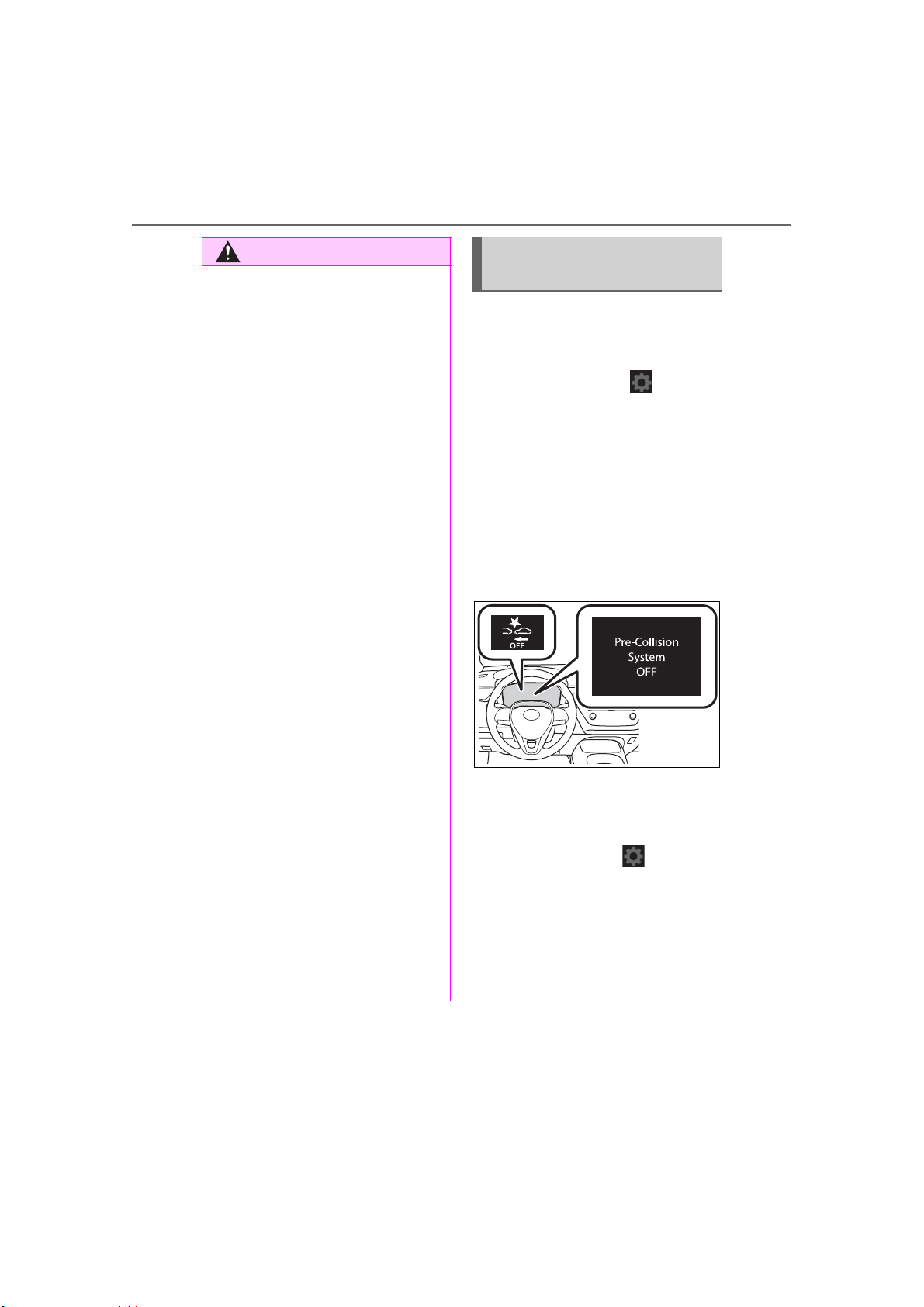
180
4-5. Using the driving support systems
COROLLA H/B_U
■ Enabling/disabling the
pre-collision system
The pre-collision system can be
enabled/disabled on
(P.531) of the multi-informa-
tion display.
The system is automatically
enabled each time the engine
switch is turned to ON.
If the system is disabled, the
PCS warning light will turn on
and a message will be displayed
on the multi-information display.
■ Changing the pre-collision
warning timing
The pre-collision warning timing
can be changed on
(P.531) of the multi-informa-
tion display.
The warning timing setting is
retained when the engine switch is
turned off. However, if the pre-colli-
sion system is disabled and
re-enabled, the operation timing will
return to the default setting (mid-
dle).
WARNING
● When your vehicle is towing
another vehicle
● When transporting the vehicle
via truck, boat, train or similar
means of transportation
● When the vehicle is raised on a
lift with the engine running and
the tires are allowed to rotate
freely
● When inspecting the vehicle
using a drum tester such as a
chassis dynamometer or speed-
ometer tester, or when using an
on vehicle wheel balancer
● When a strong impact is applied
to the front bumper or front
grille, due to an accident or
other reasons
● If the vehicle cannot be driven in
a stable manner, such as when
the vehicle has been in an acci-
dent or is malfunctioning
● When the vehicle is driven in a
sporty manner or off-road
● When the tires are not properly
inflated
● When the tires are very worn
● When tires of a size other than
specified are installed
● When tire chains are installed
● When a compact spare tire or
an emergency tire puncture
repair kit is used
● If equipment (snow plow, etc.)
that may obstruct the radar sen-
sor or front camera is temporar-
ily installed to the vehicle
Changing settings of the
pre-collision system
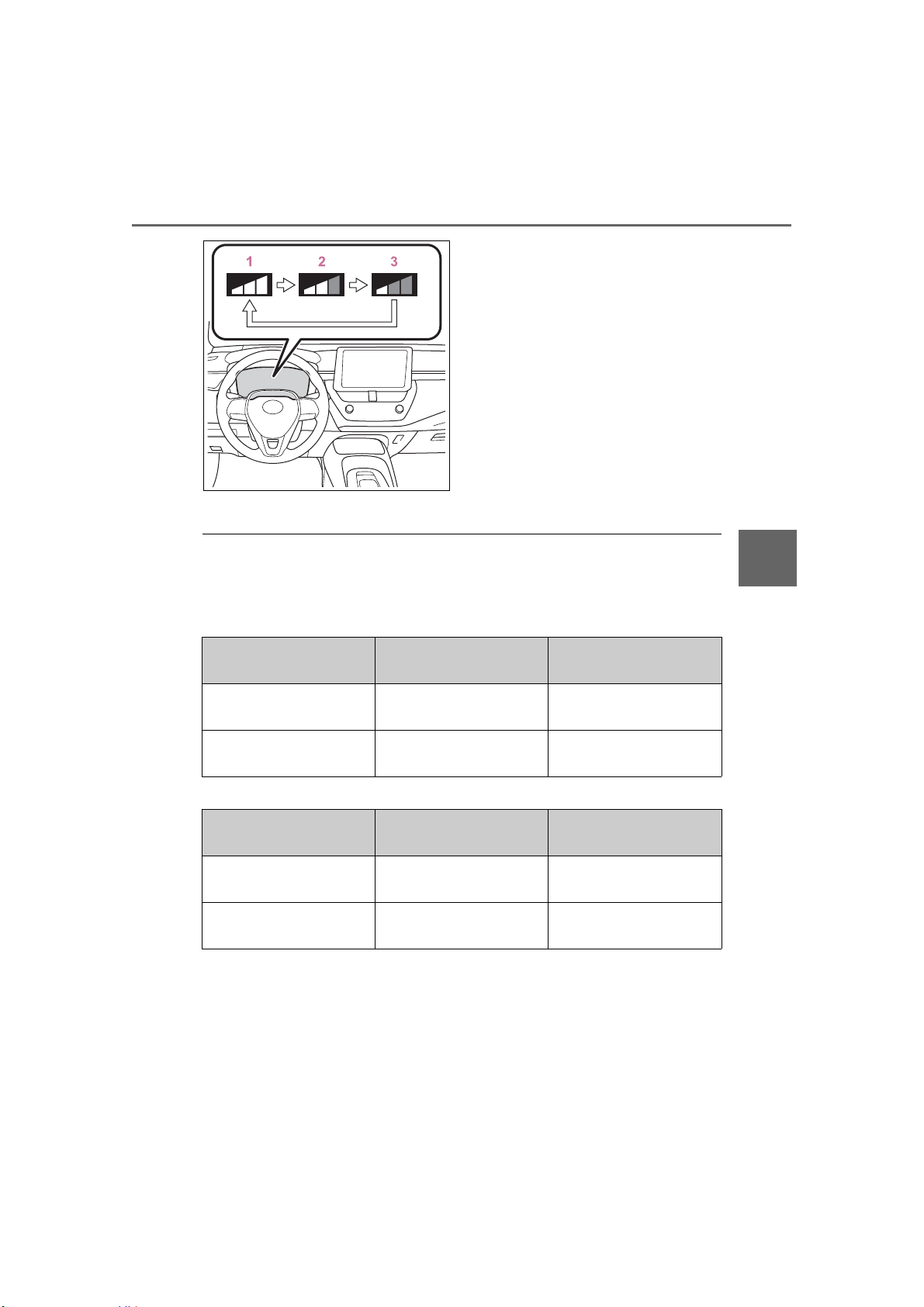
181
4-5. Using the driving support systems
COROLLA H/B_U
4
Driving
1 Early
2 Middle
This is the default setting.
3 Late
■ Operational conditions
The pre-collision system is enabled and the system determines that the pos-
sibility of a frontal collision with a detected object is high.
Each function is operational at the following speed:
● Pre-collision warning
● Pre-collision brake assist
● Pre-collision braking
Detectable objects Vehicle speed
Relative speed between
your vehicle and object
Vehicles
Approx. 7 to 110 mph
(10 to 180 km/h)
Approx. 7 to 110 mph
(10 to 180 km/h)
Bicyclists and pedestri-
ans
Approx. 7 to 50 mph (10
to 80 km/h)
Approx. 7 to 50 mph (10
to 80 km/h)
Detectable objects Vehicle speed
Relative speed between
your vehicle and object
Vehicles
Approx. 20 to 110 mph
(30 to 180 km/h)
Approx. 20 to 110 mph
(30 to 180 km/h)
Bicyclists and pedestri-
ans
Approx. 20 to 50 mph
(30 to 80 km/h)
Approx. 20 to 50 mph
(30 to 80 km/h)
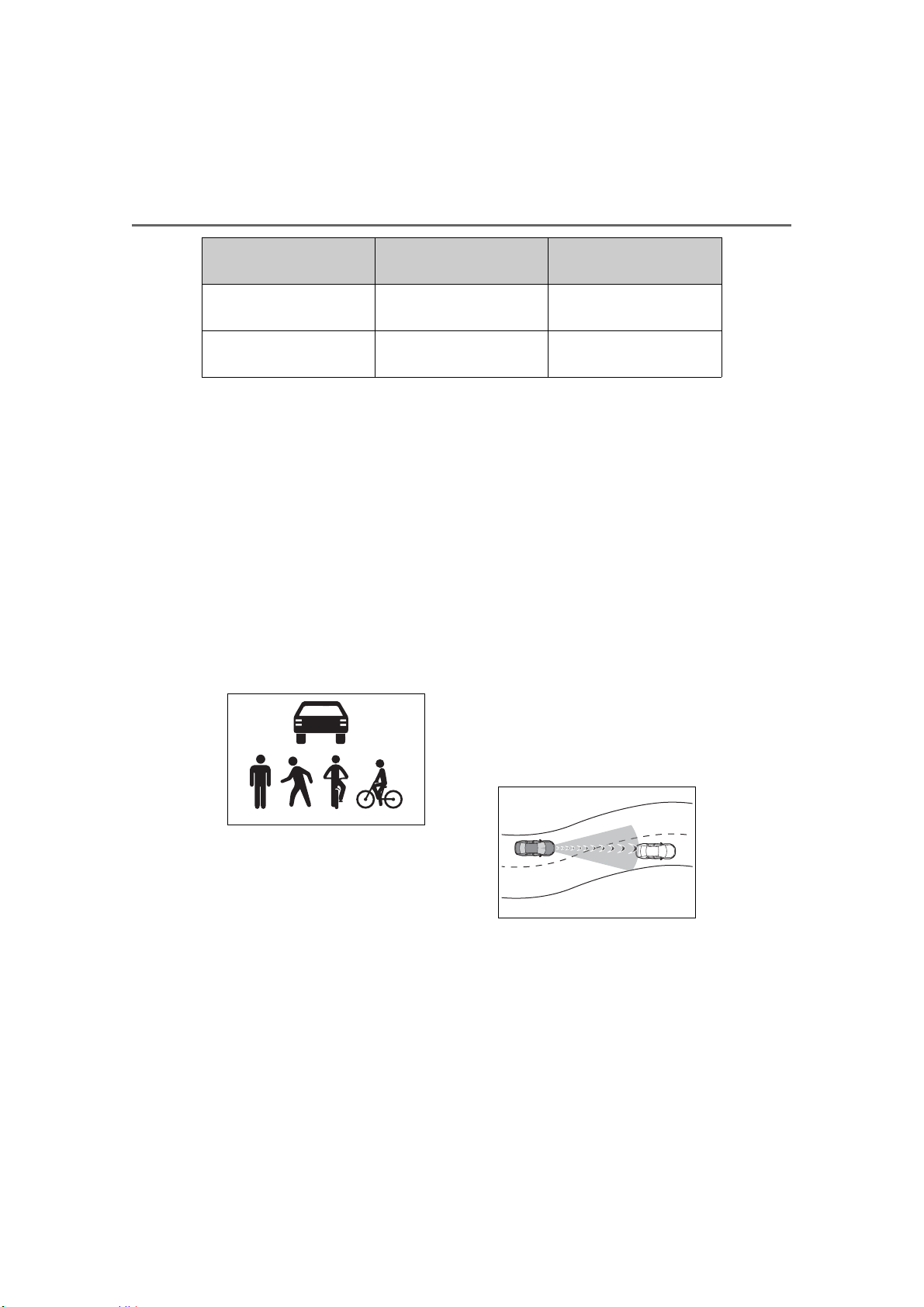
182
4-5. Using the driving support systems
COROLLA H/B_U
The system may not operate in the following situations:
● If a battery terminal has been disconnected and reconnected and then the
vehicle has not been driven for a certain amount of time
● If the shift lever is in R
● When the VSC OFF indicator is illuminated (only the pre-collision warning
function will be operational)
■ Object detection function
The system detects objects based
on their size, profile, motion, etc.
However, an object may not be
detected depending on the sur-
rounding brightness and the motion,
posture, and angle of the detected
object, preventing the system from
operating properly. (P.183)
The illustration shows an image of
detectable objects.
■ Cancelation of the pre-collision
braking
If either of the following occur while
the pre-collision braking function is
operating, it will be canceled:
● The accelerator pedal is
depressed strongly.
● The steering wheel is turned
sharply or abruptly.
■ Conditions under which the
system may operate even if
there is no possibility of a colli-
sion
● In some situations such as the fol-
lowing, the system may determine
that there is a possibility of a fron-
tal collision and operate.
• When passing a detectable object,
etc.
• When changing lanes while over-
taking a detectable object, etc.
• When approaching a detectable
object in an adjacent lane or on
the roadside, such as when
changing the course of travel or
driving on a winding road
• When rapidly closing on a detect-
able object, etc.
• When approaching objects on the
roadside, such as detectable
objects, guardrails, utility poles,
trees, or walls
• When there is a detectable object
or other object by the roadside at
the entrance of a curve
Detectable objects Vehicle speed
Relative speed between
your vehicle and object
Vehicles
Approx. 7 to 110 mph
(10 to 180 km/h)
Approx. 7 to 110 mph
(10 to 180 km/h)
Bicyclists and pedestri-
ans
Approx. 7 to 50 mph (10
to 80 km/h)
Approx. 7 to 50 mph (10
to 80 km/h)
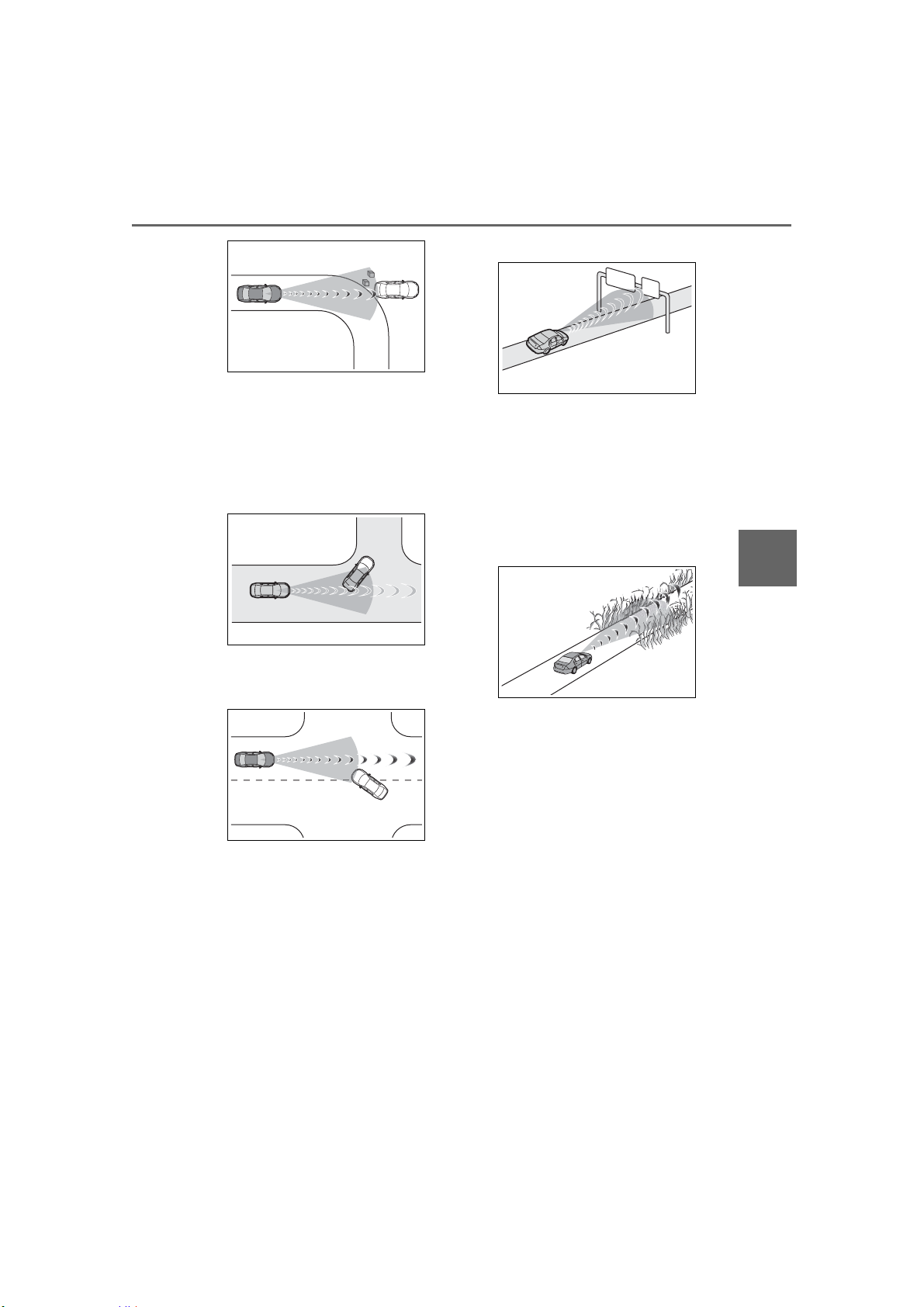
183
4-5. Using the driving support systems
COROLLA H/B_U
4
Driving
• When there are patterns or paint
in front of your vehicle that may be
mistaken for a detectable object
• When the front of your vehicle is
hit by water, snow, dust, etc.
• When overtaking a detectable
object that is changing lanes or
making a right/left turn
• When passing a detectable object
in an oncoming lane that is
stopped to make a right/left turn
• When a detectable object
approaches very close and then
stops before entering the path of
your vehicle
• If the front of your vehicle is raised
or lowered, such as when on an
uneven or undulating road surface
• When driving on a road sur-
rounded by a structure, such as in
a tunnel or on an iron bridge
• When there is a metal object
(manhole cover, steel plate, etc.),
steps, or a protrusion in front of
your vehicle
• When passing under an object
(road sign, billboard, etc.)
• When approaching an electric toll
gate barrier, parking area barrier,
or other barrier that opens and
closes
• When using an automatic car
wash
• When driving through or under
objects that may contact your
vehicle, such as thick grass, tree
branches, or a banner
• When driving through steam or
smoke
• When driving near an object that
reflects radio waves, such as a
large truck or guardrail
• When driving near a TV tower,
broadcasting station, electric
power plant, or other location
where strong radio waves or elec-
trical noise may be present
■ Situations in which the system
may not operate properly
● In some situations such as the fol-
lowing, an object may not be
detected by the radar sensor and
front camera, preventing the sys-
tem from operating properly:
• When a detectable object is
approaching your vehicle
• When your vehicle or a detectable
object is wobbling
• If a detectable object makes an
abrupt maneuver (such as sudden
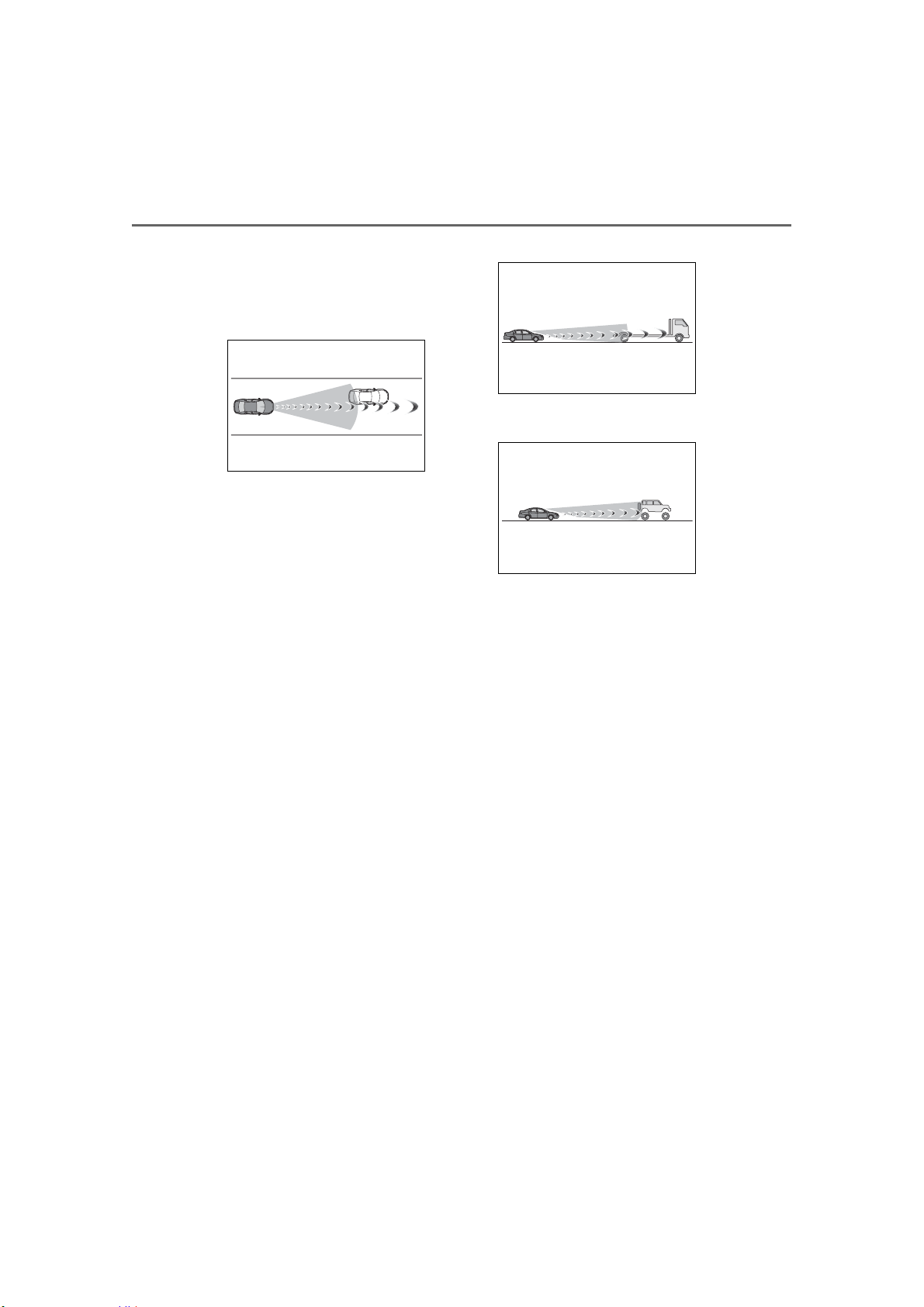
184
4-5. Using the driving support systems
COROLLA H/B_U
swerving, acceleration or deceler-
ation)
• When your vehicle approaches a
detectable object rapidly
• When a detectable object is not
directly in front of your vehicle
• When a detectable object is near
a wall, fence, guardrail, manhole
cover, vehicle, steel plate on the
road, etc.
• When a detectable object is under
a structure
• When part of a detectable object
is hidden by an object, such as
large baggage, an umbrella, or
guardrail
• When multiple detectable objects
are close together
• If the sun or other light is shining
directly on a detectable object
• When a detectable object is a
shade of white and looks
extremely bright
• When a detectable object appears
to be nearly the same color or
brightness as its surroundings
• If a detectable object cuts or sud-
denly emerges in front of your
vehicle
• When the front of your vehicle is
hit by water, snow, dust, etc.
• When a very bright light ahead,
such as the sun or the headlights
of oncoming traffic, shines directly
into the front camera
• When approaching the side or
front of a vehicle ahead
• If a vehicle ahead is a motorcycle
• If a vehicle ahead is narrow, such
as a personal mobility vehicle
• If a preceding vehicle has a small
rear end, such as an unloaded
truck
• If a preceding vehicle has a low
rear end, such as a low bed trailer
• If a vehicle ahead has extremely
high ground clearance
• If a vehicle ahead is carrying a
load which protrudes past its rear
bumper
• If a vehicle ahead is irregularly
shaped, such as a tractor or side
car
• If a vehicle ahead is a child sized
bicycle, a bicycle that is carrying a
large load, a bicycle ridden by
more than one person, or a
uniquely shaped bicycle (bicycle
with a child seat, tandem bicycle,
etc.)
• If a pedestrian/or the riding height
of a bicyclist ahead is shorter than
approximately 3.2 ft. (1 m) or taller
than approximately 6.5 ft. (2 m)
• If a pedestrian/bicyclist is wearing
oversized clothing (a rain coat,
long skirt, etc.), making their sil-
houette obscure
• If a pedestrian is bending forward
or squatting or bicyclist is bending
forward
• If a pedestrian/bicyclist is moving
fast
• If a pedestrian is pushing a
stroller, wheelchair, bicycle or
other vehicle
• When driving in inclement weather
such as heavy rain, fog, snow or a
sandstorm
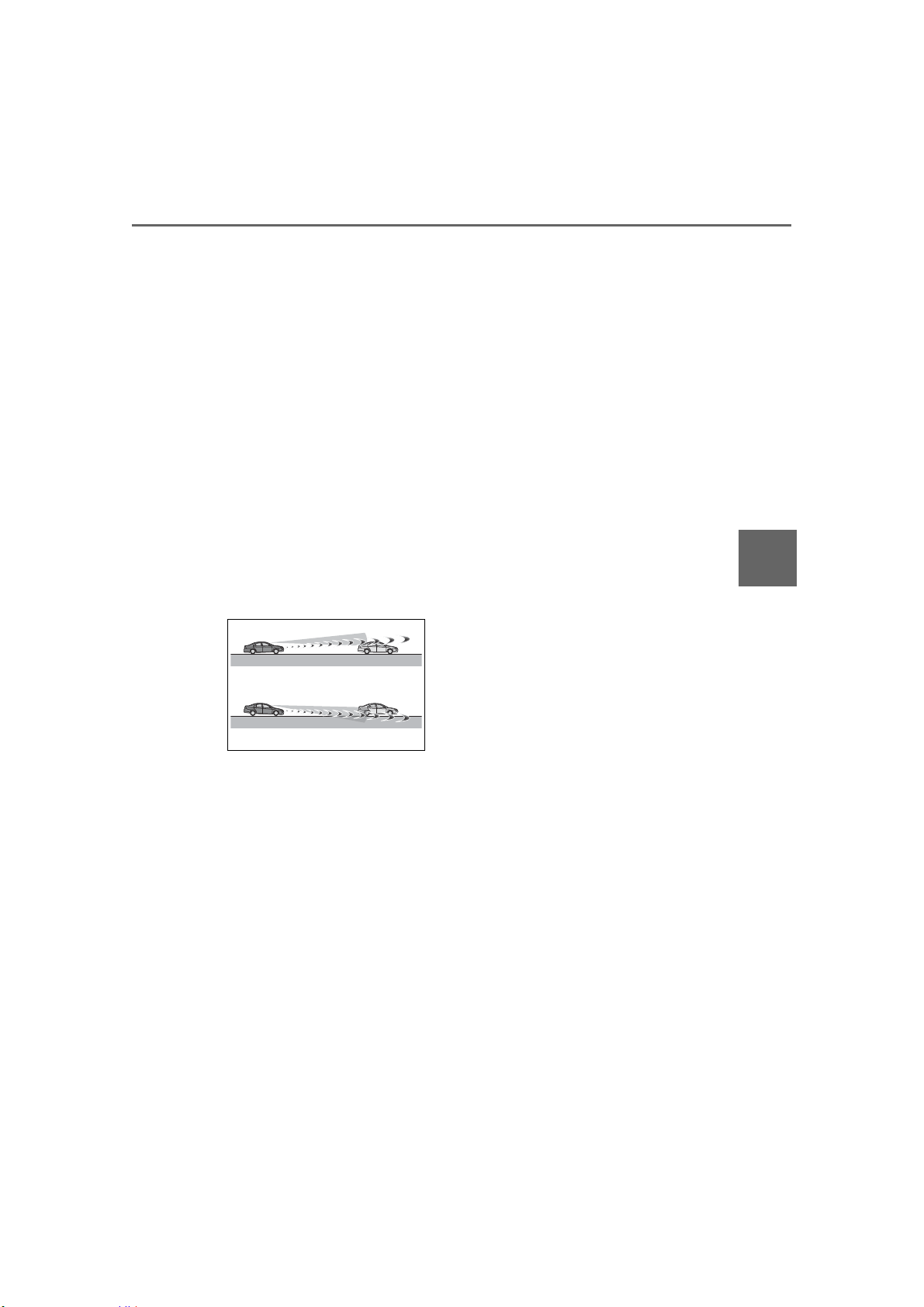
185
4-5. Using the driving support systems
COROLLA H/B_U
4
Driving
• When driving through steam or
smoke
• When the surrounding area is dim,
such as at dawn or dusk, or while
at night or in a tunnel, making a
detectable object appear to be
nearly the same color as its sur-
roundings
• When driving in a place where the
surrounding brightness changes
suddenly, such as at the entrance
or exit of a tunnel
• After the engine has started the
vehicle has not been driven for a
certain amount of time
• While making a left/right turn and
for a few seconds after making a
left/right turn
• While driving on a curve and for a
few seconds after driving on a
curve
• If your vehicle is skidding
• If the front of the vehicle is raised
or lowered
• If the wheels are misaligned
• If a wiper blade is blocking the
front camera
• The vehicle is being driven at
extremely high speeds.
• When driving on a hill
• If the radar sensor or front camera
is misaligned
● In some situations such as the fol-
lowing, sufficient braking force
may not be obtained, preventing
the system from performing prop-
erly:
• If the braking functions cannot
operate to their full extent, such as
when the brake parts are
extremely cold, extremely hot, or
wet
• If the vehicle is not properly main-
tained (brakes or tires are exces-
sively worn, improper tire inflation
pressure, etc.)
• When the vehicle is being driven
on a gravel road or other slippery
surface
■ If VSC is disabled
● If VSC is disabled (P.242), the
pre-collision brake assist and
pre-collision braking functions are
also disabled.
● The PCS warning light will turn on
and “VSC Turned OFF Pre-Colli-
sion Brake System Unavailable”
will be displayed on the
multi-information display.
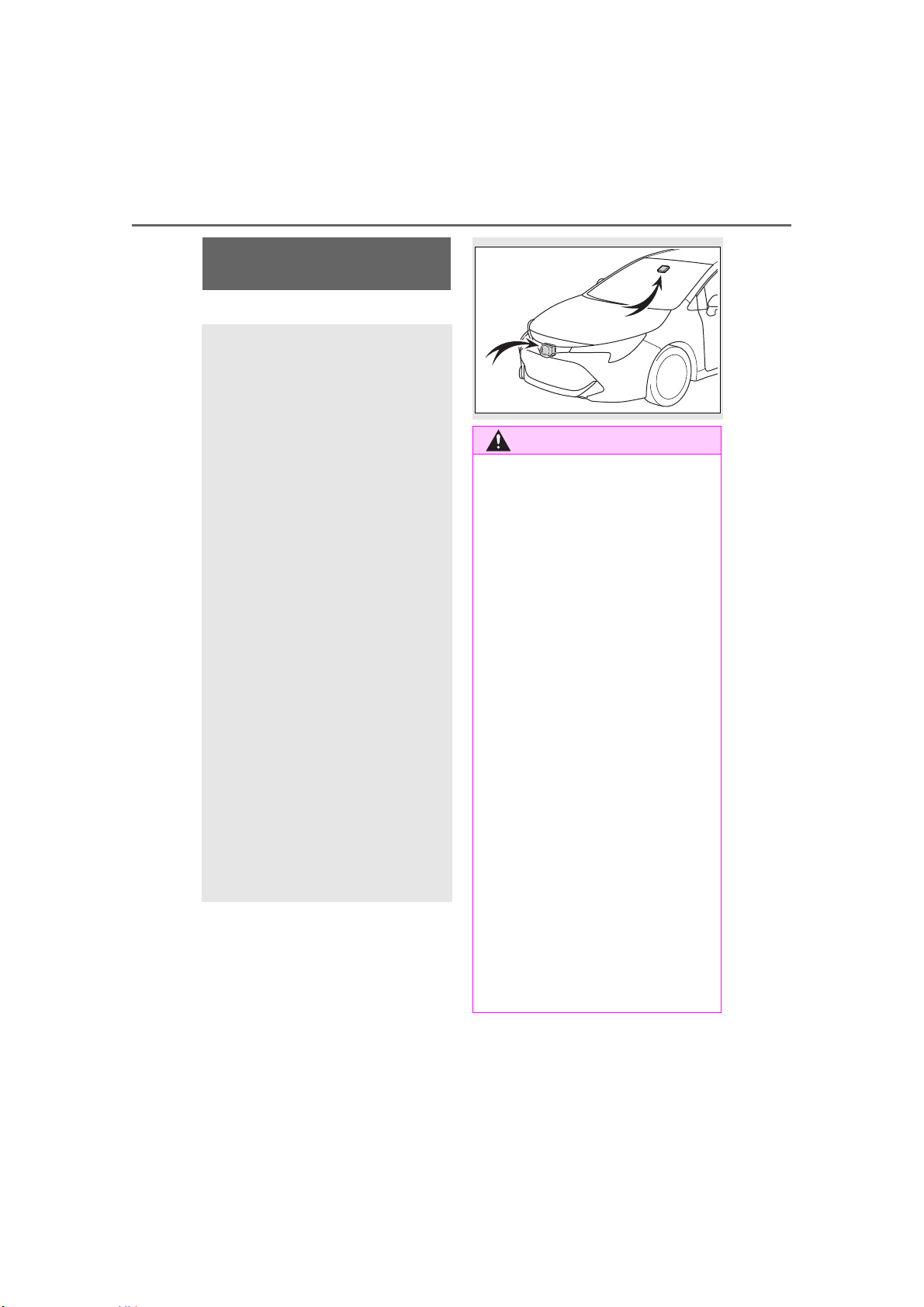
186
4-5. Using the driving support systems
COROLLA H/B_U
*
: If equipped
LTA (Lane Tracing
Assist)
*
When driving on highways
and freeways with white
(yellow) lane lines, this
function alerts the driver
when the vehicle might
depart from its lane or
course
*
and provides assis-
tance by operating the
steering wheel to keep the
vehicle in its lane or
course
*
. Furthermore, the
system provides steering
assistance when dynamic
radar cruise control with
full-speed range is operat-
ing to keep the vehicle in its
lane.
The LTA system recognizes
white (yellow) lane lines or a
course
*
using the front cam-
era. Additionally, it detects
preceding vehicles using
the front camera and radar.
*
: Boundary between asphalt and
the side of the road, such as
grass, soil, or a curb
WARNING
■ Before using LTA system
● Do not rely solely upon the LTA
system. The LTA system does
not automatically drive the vehi-
cle or reduce the amount of
attention that must be paid to
the area in front of the vehicle.
The driver must always assume
full responsibility for driving
safely by paying careful atten-
tion to the surrounding condi-
tions and operating the steering
wheel to correct the path of the
vehicle. Also, the driver must
take adequate breaks when
fatigued, such as from driving
for a long period of time.
● Failure to perform appropriate
driving operations and pay care-
ful attention may lead to an
accident, resulting in death or
serious injury.
● When not using the LTA system,
use the LTA switch to turn the
system off.
■ Situations unsuitable for LTA
system
In the following situations, use the
LTA switch to turn the system off.
Failure to do so may lead to an
accident, resulting in death or
serious injury.
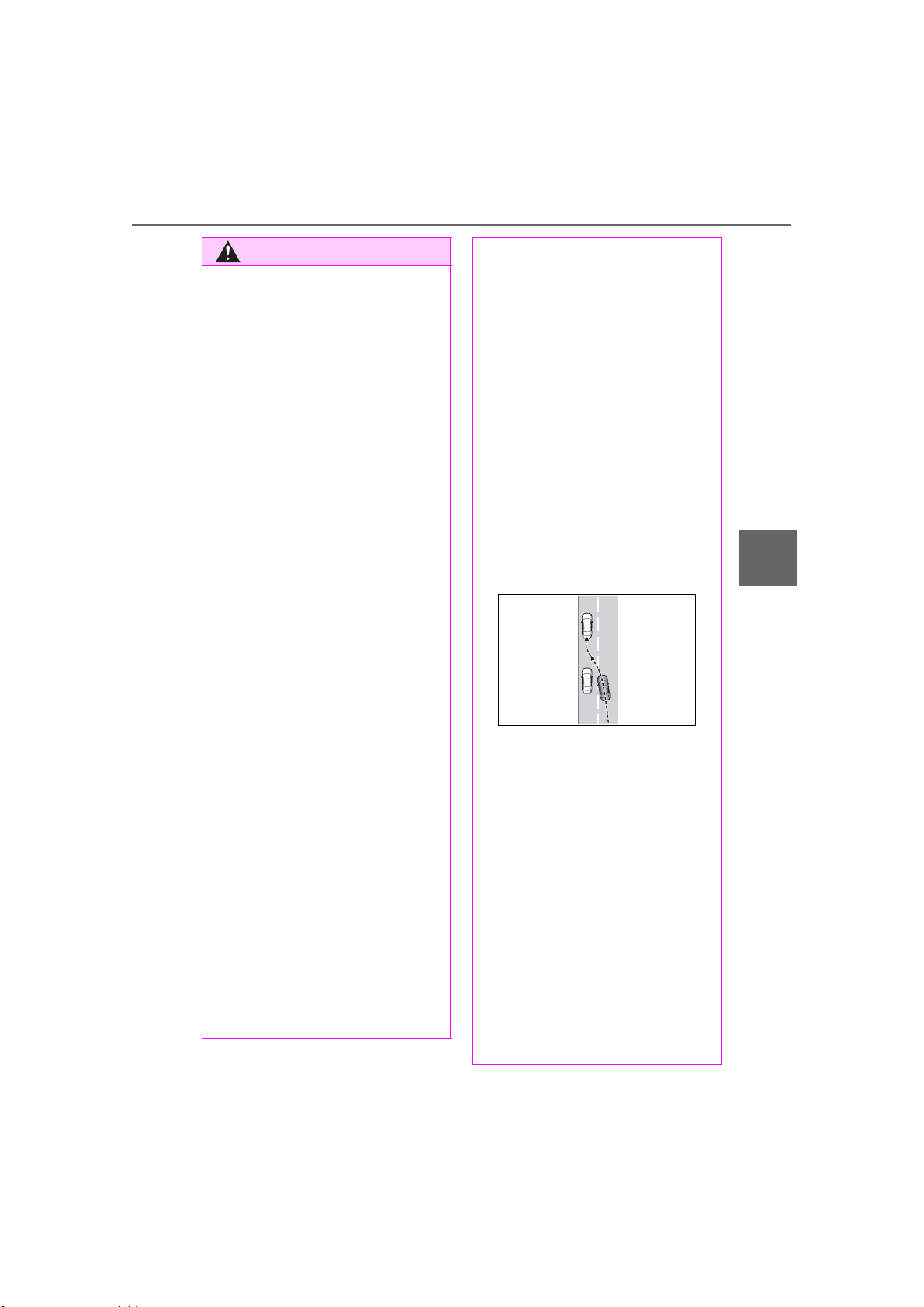
187
4-5. Using the driving support systems
COROLLA H/B_U
4
Driving
WARNING
● Vehicle is driven on a road sur-
face which is slippery due to
rainy weather, fallen snow,
freezing, etc.
● Vehicle is driven on a snow-cov-
ered road.
● White (yellow) lines are difficult
to see due to rain, snow, fog,
dust, etc.
● Vehicle is driven in a temporary
lane or restricted lane due to
construction work.
● Vehicle is driven in a construc-
tion zone.
● A spare tire, tire chains, etc. are
equipped.
● When the tires have been
excessively worn, or when the
tire inflation pressure is low.
● When tires of a size other than
specified are installed.
● Vehicle is driven in traffic lanes
other than that highways and
freeways.
● During emergency towing.
■ Preventing LTA system mal-
functions and operations per-
formed by mistake
● Do not modify the headlights or
place stickers, etc. on the sur-
face of the lights.
● Do not modify the suspension
etc. If the suspension etc. needs
to be replaced, contact your
Toyota dealer.
● Do not install or place anything
on the hood or grille. Also, do
not install a grille guard (bull
bars, kangaroo bar, etc.).
● If your windshield needs
repairs, contact your Toyota
dealer.
■ Conditions in which functions
may not operate properly
In the following situations, the
functions may not operate prop-
erly and the vehicle may depart
from its lane. Drive safely by
always paying careful attention to
your surroundings and operate
the steering wheel to correct the
path of the vehicle without relying
solely on the functions.
● When the follow-up cruising dis-
play is displayed (
P.192) and
the preceding vehicle changes
lanes. (Your vehicle may follow
the preceding vehicle and also
change lanes.)
● When the follow-up cruising dis-
play is displayed (
P.192) and
the preceding vehicle is sway-
ing. (Your vehicle may sway
accordingly and depart from the
lane.)
● When the follow-up cruising dis-
play is displayed (
P.192) and
the preceding vehicle departs
from its lane. (Your vehicle may
follow the preceding vehicle and
depart from the lane.)
● When the follow-up cruising dis-
play is displayed (
P.192) and
the preceding vehicle is being
driven extremely close to the
left/right lane line. (Your vehicle
may follow the preceding vehi-
cle and depart from the lane.)
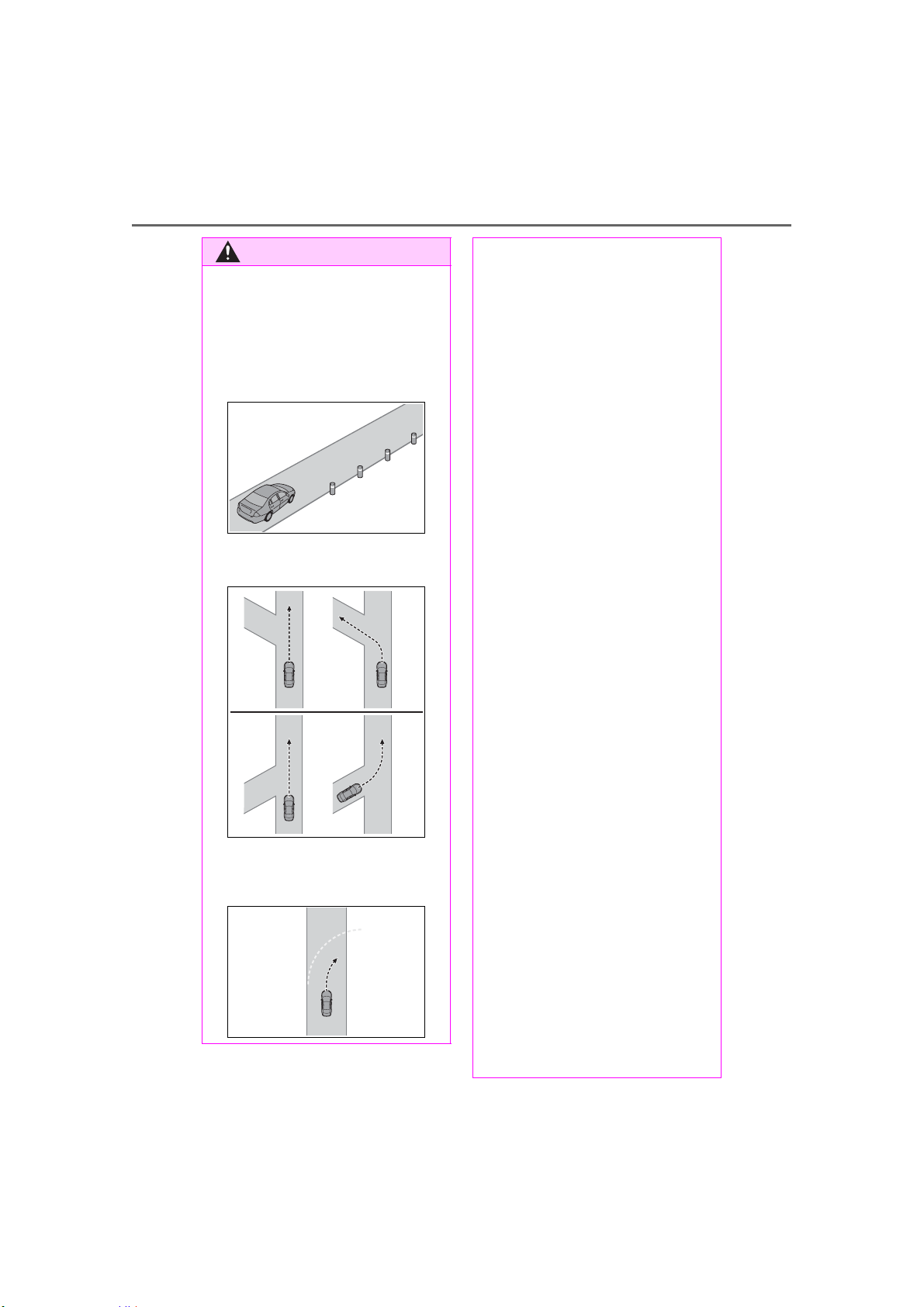
188
4-5. Using the driving support systems
COROLLA H/B_U
WARNING
● Vehicle is being driven around a
sharp curve.
● Objects or patterns that could
be mistaken for white (yellow)
lines are present on the side of
the road (guardrails, reflective
poles, etc.).
● Vehicle is driven where the road
diverges, merges, etc.
● Repair marks of asphalt, white
(yellow) lines, etc. are present
due to road repair.
● There are shadows on the road
that run parallel with, or cover,
the white (yellow) lines.
● The vehicle is driven in an area
without white (yellow) lines,
such as in front of a tollgate or
checkpoint, or at an intersec-
tion, etc.
● The white (yellow) lines are
cracked, “Botts’ dots”, “Raised
pavement marker” or stones are
present.
● The white (yellow) lines cannot
be seen or are difficult to see
due to sand, etc.
● The vehicle is driven on a road
surface that is wet due to rain,
puddles, etc.
● The traffic lines are yellow
(which may be more difficult to
recognize than lines that are
white).
● The white (yellow) lines cross
over a curb, etc.
● The vehicle is driven on a bright
surface, such as concrete.
● If the edge of the road is not
clear or straight.
● The vehicle is driven on a sur-
face that is bright due to
reflected light, etc.
● The vehicle is driven in an area
where the brightness changes
suddenly, such as at the
entrances and exits of tunnels,
etc.
● Light from the headlights of an
oncoming vehicle, the sun, etc.
enters the camera.
● The vehicle is driven on a slope.
● The vehicle is driven on a road
which tilts left or right, or a wind-
ing road.
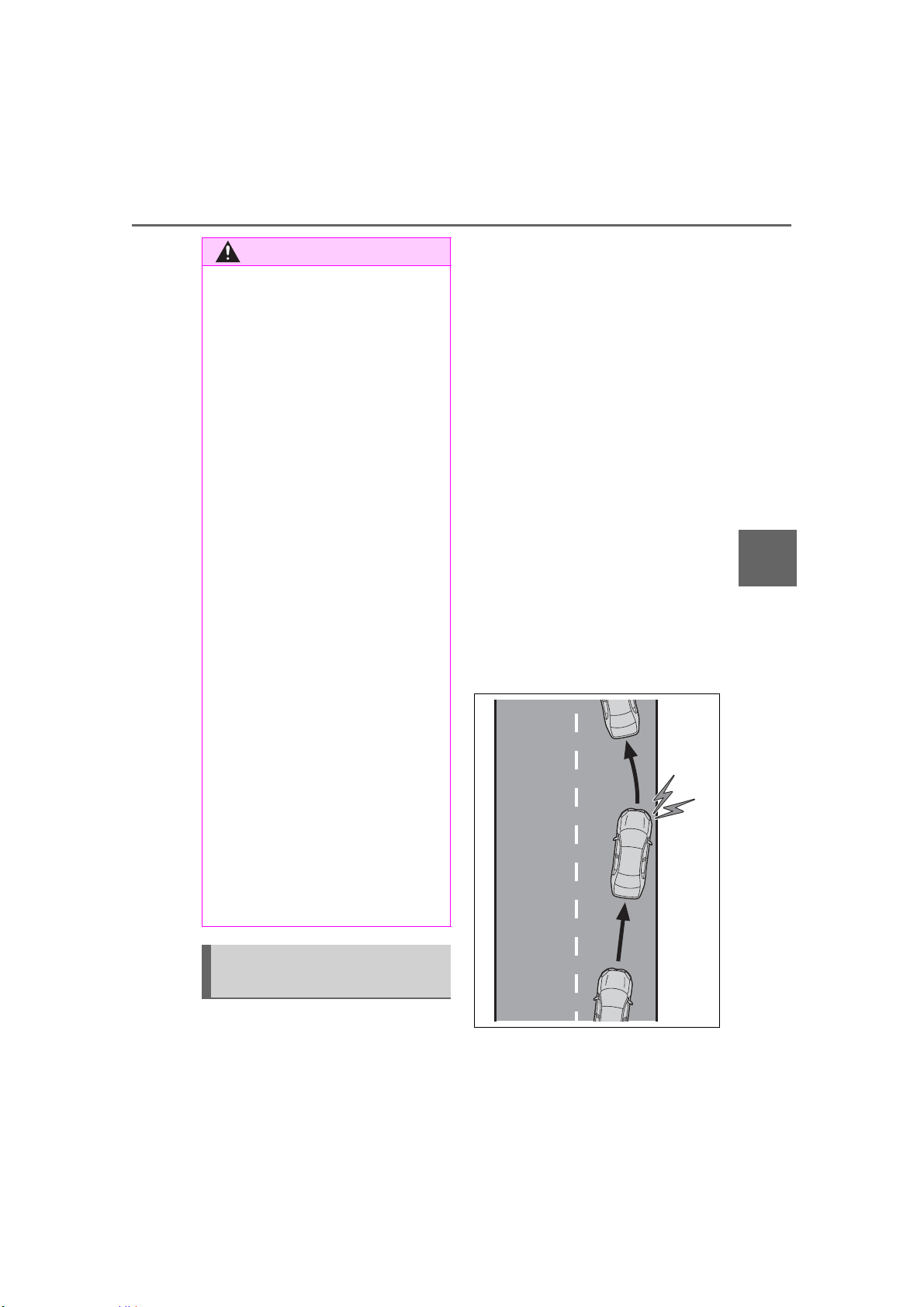
189
4-5. Using the driving support systems
COROLLA H/B_U
4
Driving
■ Lane departure alert func-
tion
When the system determines
that the vehicle might depart
from its lane or course
*
, a warn-
ing is displayed on the
multi-information display, and a
warning buzzer will sound to
alert the driver.
When the warning buzzer sounds,
check the area around your vehicle
and carefully operate the steering
wheel to move the vehicle back to
the center of the lane.
Vehicles with a BSM: When the
system determines that the vehicle
might depart from its lane and that
the possibility of a collision with an
overtaking vehicle in the adjacent
lane is high, the lane departure
alert will operate even if the turn
signals are operating.
*
: Boundary between asphalt and
the side of the road, such as
grass, soil, or a curb
■ Steering assist function
When the system determines
WARNING
● The vehicle is driven on an
unpaved or rough road.
● The traffic lane is excessively
narrow or wide.
● The vehicle is extremely tilted
due to carrying heavy luggage
or having improper tire pres-
sure.
● The distance to the preceding
vehicle is extremely short.
● The vehicle is moving up and
down a large amount due to
road conditions during driving
(poor roads or road seams).
● When driving in a tunnel or at
night with the headlights off or
when a headlight is dim due to
its lens being dirty or it being
misaligned.
● The vehicle is struck by a cross-
wind.
● The vehicle is affected by wind
from a vehicle driven in a
nearby lane.
● The vehicle has just changed
lanes or crossed an intersec-
tion.
● Tires which differ by structure,
manufacturer, brand or tread
pattern are used.
● Snow tires, etc. are equipped.
● The vehicle is being driven at
extremely high speeds.
Functions included in LTA
system

190
4-5. Using the driving support systems
COROLLA H/B_U
that the vehicle might depart
from its lane or course
*
, the sys-
tem provides assistance as nec-
essary by operating the steering
wheel in small amounts for a
short period of time to keep the
vehicle in its lane.
If the system detects that the steer-
ing wheel has not been operated
for a fixed amount of time or the
steering wheel is not being firmly
gripped, a warning is displayed on
the multi-information display and
the function is temporarily can-
celed.
Vehicles with a BSM: When the
system determines that the vehicle
might depart from its lane and that
the possibility of a collision with an
overtaking vehicle in the adjacent
lane is high, the steering assist
function will operate even if the turn
signals are operating.
*
: Boundary between asphalt and
the side of the road, such as
grass, soil, or a curb
■ Vehicle sway warning func-
tion
When the vehicle is swaying
within a lane, the warning
buzzer will sound and a mes-
sage will be displayed on the
multi-information display to alert
the driver.
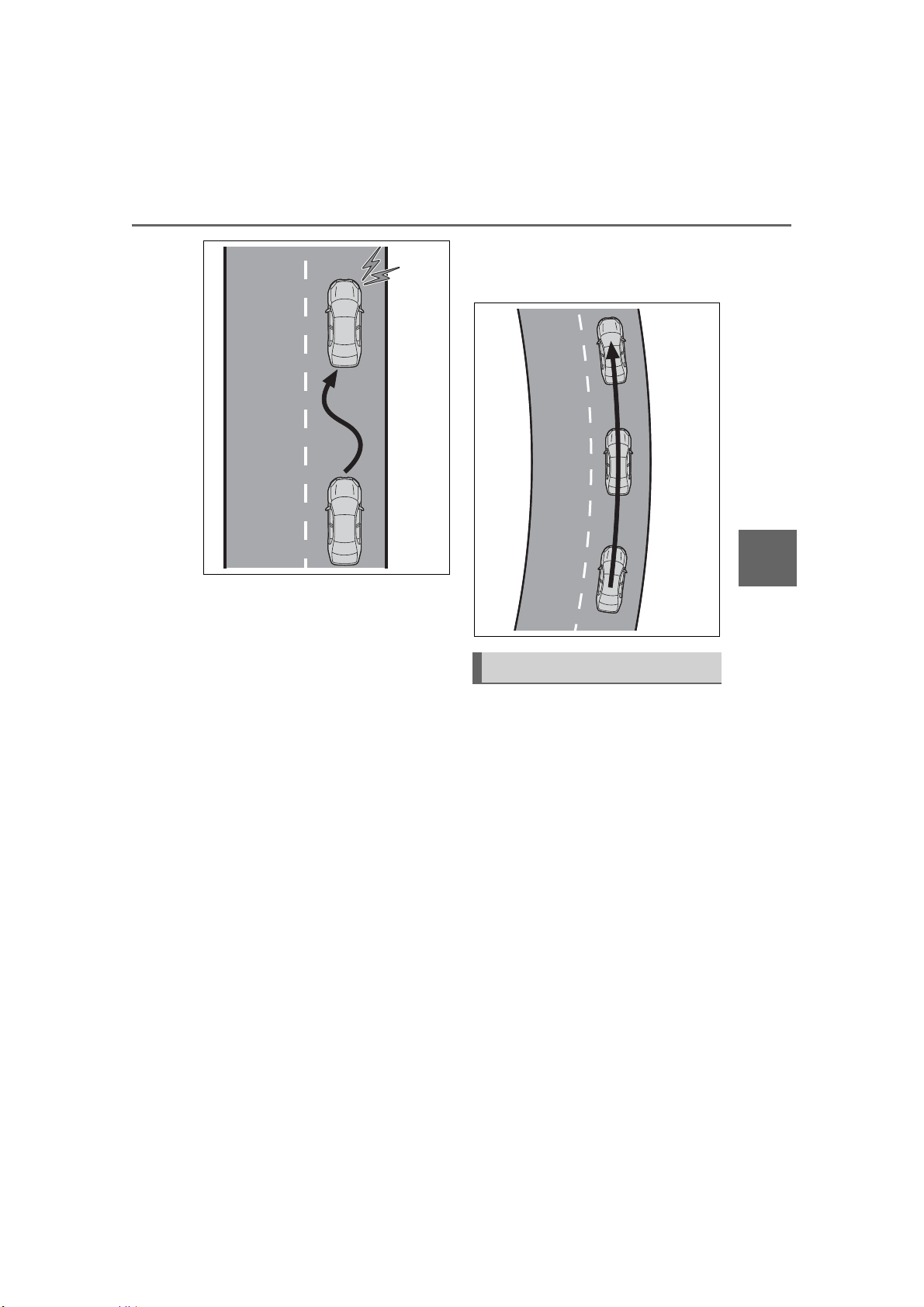
191
4-5. Using the driving support systems
COROLLA H/B_U
4
Driving
■ Lane centering function
This function is linked with
dynamic radar cruise control
with full-speed range and pro-
vides the required assistance by
operating the steering wheel to
keep the vehicle in its current
lane.
When dynamic radar cruise control
with full-speed range is not operat-
ing, the lane centering function
does not operate.
In situations where the white (yel-
low) lane lines are difficult to see or
are not visible, such as when in a
traffic jam, this function will operate
to help follow a preceding vehicle
by monitoring the position of the
preceding vehicle.
If the system detects that the steer-
ing wheel has not been operated
for a fixed amount of time or the
steering wheel is not being firmly
gripped, a warning is displayed on
the multi-information display and
the function is temporarily can-
celed.
Press the LTA switch to turn the
LTA system on.
The LTA indicator illuminates and a
message is displayed on the
multi-information display.
Press the LTA switch again to turn
the LTA system off.
When the LTA system is turned on
or off, operation of the LTA system
continues in the same condition the
next time the engine is started.
Turning LTA system on
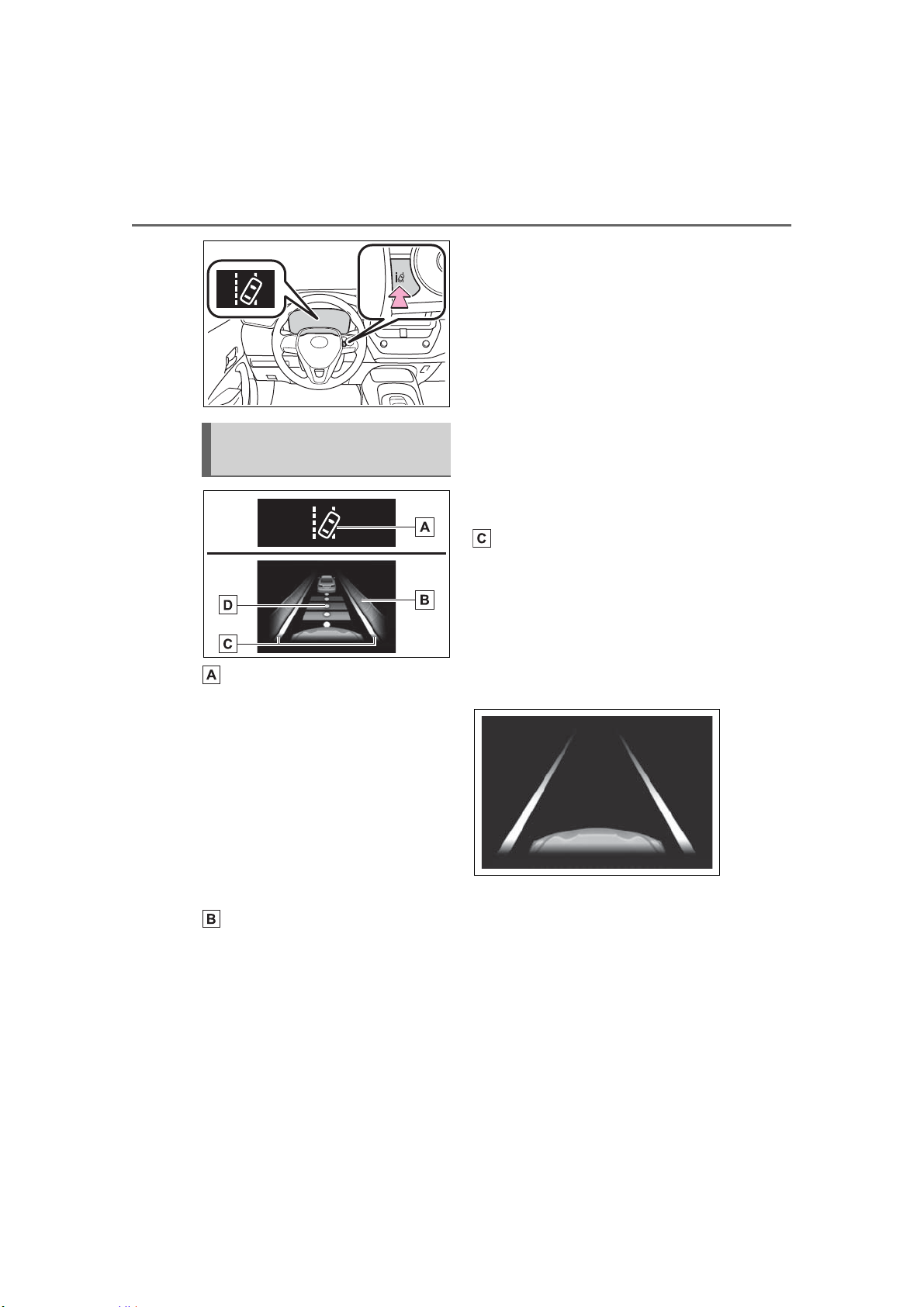
192
4-5. Using the driving support systems
COROLLA H/B_U
LTA indicator
The illumination condition of the
indicator informs the driver of the
system operation status.
Illuminated in white: LTA system is
operating.
Illuminated in green: Steering wheel
assistance of the steering assist
function or lane centering function
is operating.
Flashing in orange: Lane departure
alert function is operating.
Operation display of steering
wheel operation support
Displayed when the multi-informa-
tion display is switched to the driv-
ing assist system information
screen.
Indicates that steering wheel assis-
tance of the steering assist function
or lane centering function is operat-
ing.
Both outer sides of the lane are dis-
played: Indicates that steering
wheel assist of the lane centering
function is operating.
One outer side of the lane is dis-
played: Indicates that steering
wheel assist of the steering assist
function is operating.
Both outer sides of the lane are
flashing: Alerts the driver that their
input is necessary to stay in the
center of the lane (lane centering
function).
Lane departure alert function
display
Displayed when the multi-informa-
tion display is switched to the driv-
ing assist system information
screen.
Inside of displayed lines is
white
Indicates that the system is rec-
ognizing white (yellow) lines or a
course
*
. When the vehicle
departs from its lane, the white
line displayed on the side the
vehicle departs from flashes
orange.
Indications on multi-infor-
mation display
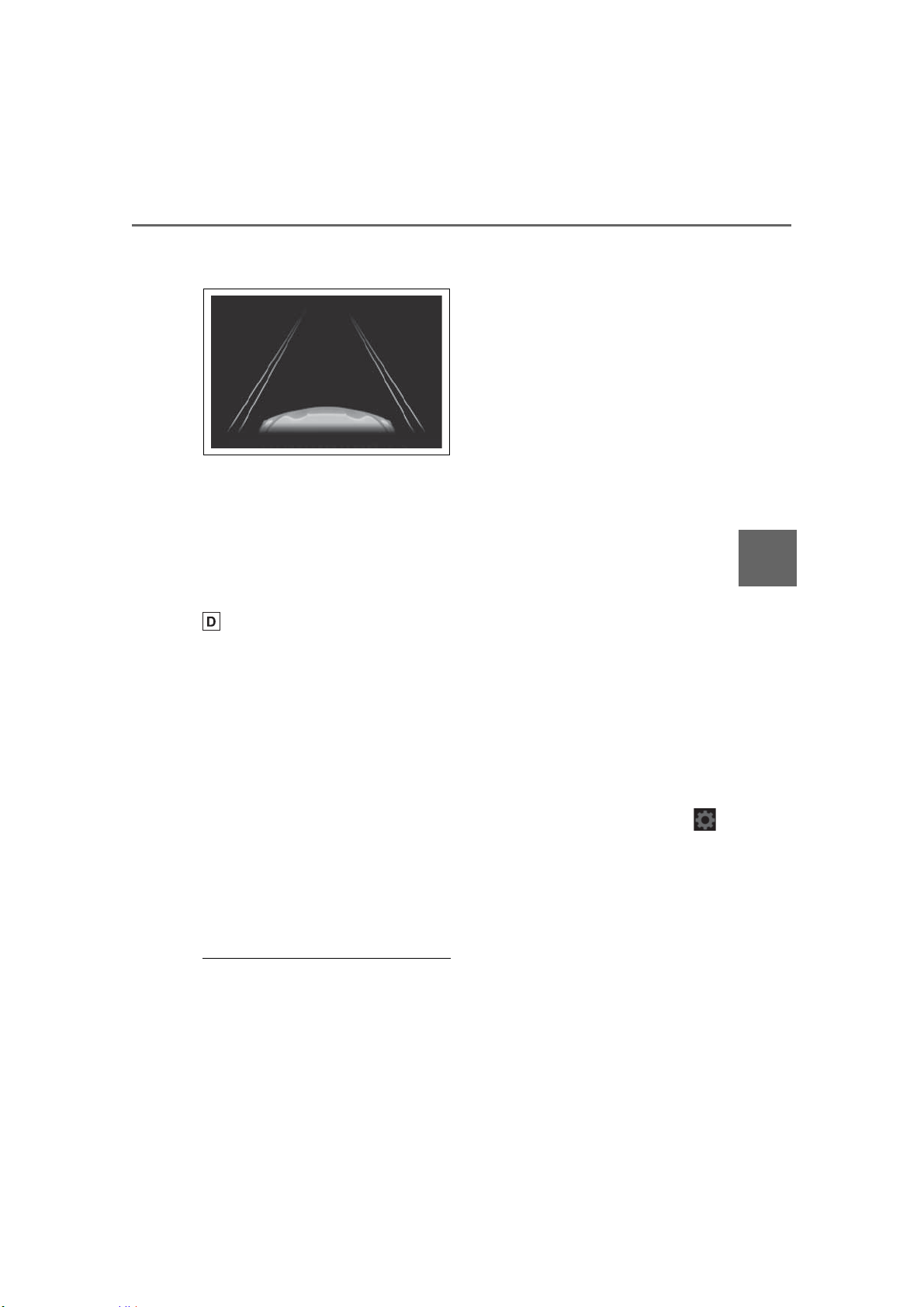
193
4-5. Using the driving support systems
COROLLA H/B_U
4
Driving
Inside of displayed lines is
black
Indicates that the system is not
able to recognize white (yellow)
lines or a course* or is tempo-
rarily canceled.
*
: Boundary between asphalt and
the side of the road, such as
grass, soil, or a curb
Follow-up cruising display
Displayed when the multi-informa-
tion display is switched to the driv-
ing assist system information
screen.
Indicates that steering assist of the
lane centering function is operating
by monitoring the position of a pre-
ceding vehicle.
When the follow-up cruising display
is displayed, if the preceding vehi-
cle moves, your vehicle may move
in the same way. Always pay care-
ful attention to your surroundings
and operate the steering wheel as
necessary to correct the path of the
vehicle and ensure safety.
■ Operation conditions of each
function
● Lane departure alert function
This function operates when all of
the following conditions are met.
• LTA is turned on.
• Vehicle speed is approximately 32
mph (50 km/h) or more.
*1
• System recognizes white (yellow)
lane lines or a course
*2
. (When a
white [yellow] line or course
*2
is
recognized on only one side, the
system will operate only for the
recognized side.)
• Width of traffic lane is approxi-
mately 9.8 ft. (3 m) or more.
• Turn signal lever is not operated.
(Vehicle with BSM: Except when
another vehicle is in the lane on
the side where the turn signal was
operated)
• Vehicle is not being driven around
a sharp curve.
• No system malfunctions are
detected. (P.195)
*1
:The function operates even if the
vehicle speed is less than
approximately 32 mph (50 km/h)
when the lane centering function
is operating.
*2
:Boundary between asphalt and
the side of the road, such as
grass, soil, or a curb
● Steering assist function
This function operates when all of
the following conditions are met in
addition to the operation conditions
for the lane departure alert function.
• Setting for “Steering Assist” in
of the multi-information display is
set to “ON”. (P.531)
• Vehicle is not accelerated or
decelerated by a fixed amount or
more.
• Steering wheel is not operated
with a steering force level suitable
for changing lanes.
• ABS, VSC, TRAC and PCS are
not operating.
• TRAC or VSC is not turned off.
• Hands off steering wheel warning
is not displayed. (P.195)
● Vehicle sway warning function
This function operates when all of

194
4-5. Using the driving support systems
COROLLA H/B_U
the following conditions are met.
• Setting for “Sway Warning” in
of the multi-information display is
set to “ON”. (P.531)
• Vehicle speed is approximately 32
mph (50 km/h) or more.
• Width of traffic lane is approxi-
mately 9.8 ft. (3 m) or more.
• No system malfunctions are
detected. (P.195)
● Lane centering function
This function operates when all of
the following conditions are met.
• LTA is turned on.
• Setting for “Steering Assist” and
“Lane Center” in of the
multi-information display are set to
“ON” (P.531)
• This function recognizes white
(yellow) lane lines or the position
of a preceding vehicle (except
when the preceding vehicle is
small, such as a motorcycle).
• The dynamic radar cruise control
with full-speed range is operating
in vehicle-to-vehicle distance con-
trol mode.
• Width of traffic lane is approxi-
mately 10 to 13 ft. (3 to 4 m).
• Turn signal lever is not operated.
• Vehicle is not being driven around
a sharp curve.
• No system malfunctions are
detected. (P.195)
• Vehicle does not accelerate or
decelerate by a fixed amount or
more.
• Steering wheel is not operated
with a steering force level suitable
for changing lanes.
• ABS, VSC, TRAC and PCS are
not operating.
• TRAC or VSC is not turned off.
• Hands off steering wheel warning
is not displayed. (P.195)
• The vehicle is being driven in the
center of a lane.
• Steering assist function is not
operating.
■ Temporary cancellation of func-
tions
● When operation conditions are no
longer met, a function may be
temporarily canceled. However,
when the operation conditions are
met again, operation of the func-
tion is automatically restored.
(P.193)
● If the operation conditions
(P.193) are no longer met while
the lane centering function is
operating, the buzzer may sound
to indicate that the function has
been temporarily canceled.
■ Steering assist function/lane
centering function
● Depending on the vehicle speed,
lane departure situation, road con-
ditions, etc., the driver may not
feel the function is operating or
the function may not operate at
all.
● The steering control of the func-
tion is overridden by the driver’s
steering wheel operation.
● Do not attempt to test the opera-
tion of the steering assist function.
■ Lane departure alert function
● The warning buzzer may be diffi-
cult to hear due to external noise,
audio playback, etc.
● If the edge of the course
*
is not
clear or straight, the lane depar-
ture alert function may not oper-
ate.
● Vehicle with BSM: It may not be
possible for the system to deter-
mine if there is a danger of a colli-
sion with a vehicle in an adjacent
lane.
● Do not attempt to test the opera-
tion of the lane departure alert
function.
*
: Boundary between asphalt and
the side of the road, such as
grass, soil, or a curb
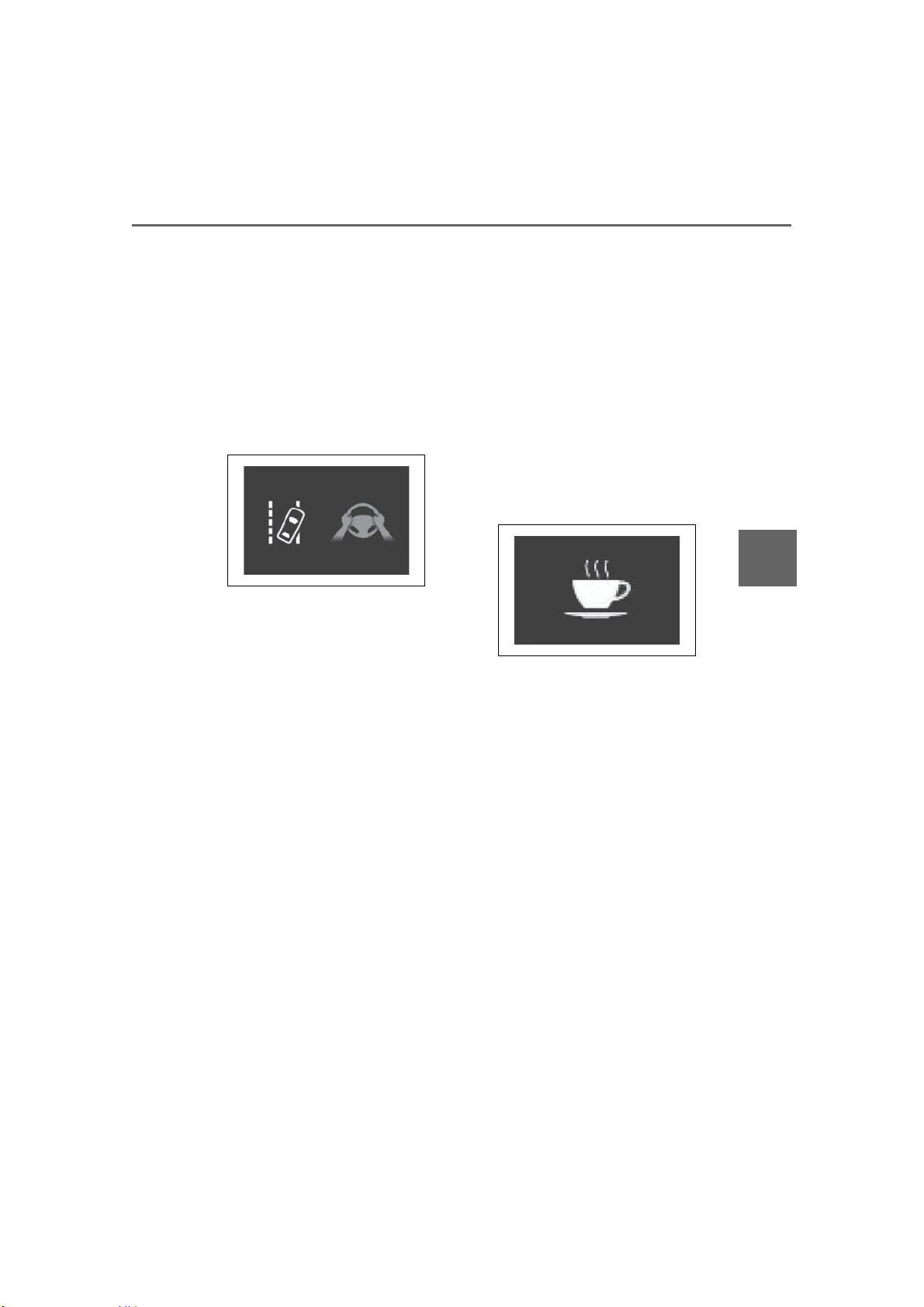
195
4-5. Using the driving support systems
COROLLA H/B_U
4
Driving
■ Hands off steering wheel warn-
ing
In the following situations, a warning
message urging the driver to hold
the steering wheel and the symbol
shown in the illustration are dis-
played on the multi-information dis-
play to warn the driver. The warning
stops when the system determines
that the driver holds the steering
wheel. Always keep your hands on
the steering wheel when using this
system, regardless of warnings.
● When the system determines that
the driver is driving without hold-
ing the steering wheel while the
system is operating
If the driver continues to keep their
hands off of the steering wheel, the
buzzer sounds, the driver is warned
and the function is temporarily can-
celed. This warning also operates in
the same way when the driver con-
tinuously operates the steering
wheel only a small amount.
● When the system determines that
the vehicle may not turn and
instead depart from its lane while
driving around a curve
Depending on the vehicle condition
and road conditions, the warning
may not operate. Also, if the system
determines that the vehicle is driv-
ing around a curve, warnings will
occur earlier than during
straight-lane driving.
● When the system determines that
the driver is driving without hold-
ing the steering wheel while the
steering wheel assist of the steer-
ing assist function is operating.
If the driver continues to keep their
hands off of the steering wheel and
the steering wheel assist is operat-
ing, the buzzer sounds and the
driver is warned. Each time the
buzzer sounds, the continuing time
of the buzzer becomes longer.
■ Vehicle sway warning function
When the system determines that
the vehicle is swaying while the
vehicle sway warning function is
operating, a buzzer sounds and a
warning message urging the driver
to rest and the symbol shown in the
illustration are simultaneously dis-
played on the multi-information dis-
play.
Depending on the vehicle and road
conditions, the warning may not
operate.
■ Warning message
If the following warning message is
displayed on the multi-information
display and the LTA indicator illumi-
nates in orange, follow the appropri-
ate troubleshooting procedure. Also,
if a different warning message is
displayed, follow the instructions
displayed on the screen.
● “LTA Malfunction Visit Your
Dealer”
The system may not be operating
properly. Have the vehicle inspected
by your Toyota dealer.
● “LTA Unavailable”
The system is temporarily canceled
due to a malfunction in a sensor
other than the front camera. Turn
the LTA system off, wait for a little
while, and then turn the LTA system
back on.
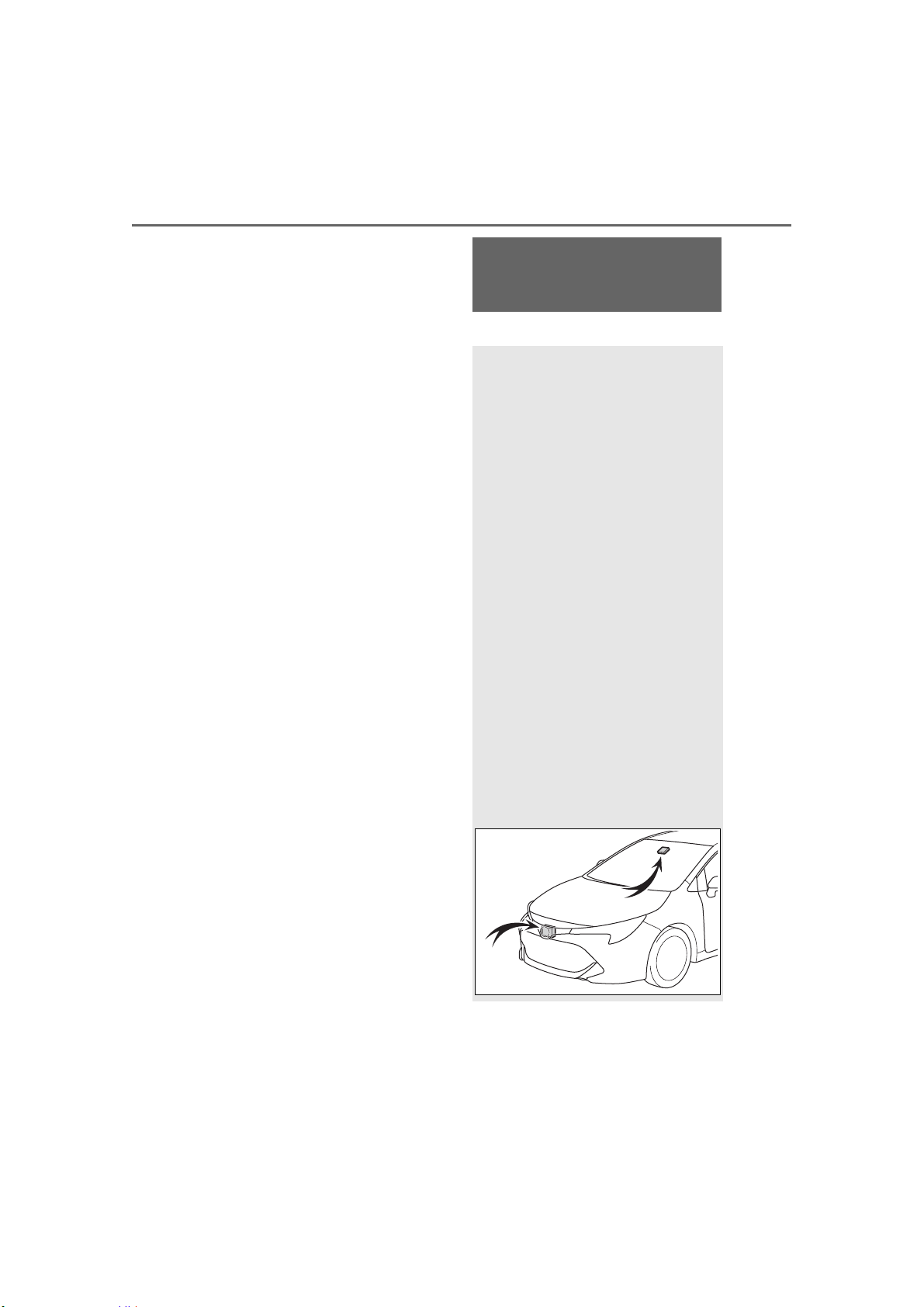
196
4-5. Using the driving support systems
COROLLA H/B_U
● “LTA Unavailable at Current
Speed”
The function cannot be used as the
vehicle speed exceeds the LTA
operation range. Drive slower.
■ Customization
Function settings can be changed.
(Customizable features: P.531)
*
: If equipped
LDA (Lane Departure
Alert with steering
control)
*
When driving on highways
and freeways with white
(yellow) lane lines, this
function alerts the driver
when the vehicle might
depart from its lane or
course
*
and provides assis-
tance by operating the
steering wheel to keep the
vehicle in its lane or
course
*
.
The LDA system recog-
nizes white (yellow) lane
lines or a course
*
using the
front camera. Additionally, it
detects preceding vehicles
using the front camera and
radar.
*
: Boundary between asphalt and
the side of the road, such as
grass, soil, or a curb

197
4-5. Using the driving support systems
COROLLA H/B_U
4
Driving
WARNING
■ Before using LDA system
● Do not rely solely upon the LDA
system. The LDA system does
not automatically drive the vehi-
cle or reduce the amount of
attention that must be paid to
the area in front of the vehicle.
The driver must always assume
full responsibility for driving
safely by paying careful atten-
tion to the surrounding condi-
tions and operating the steering
wheel to correct the path of the
vehicle. Also, the driver must
take adequate breaks when
fatigued, such as from driving
for a long period of time.
● Failure to perform appropriate
driving operations and pay care-
ful attention may lead to an
accident, resulting in death or
serious injury.
● When not using the LDA sys-
tem, use the LDA switch to turn
the system off.
■ Situations unsuitable for LDA
system
In the following situations, use the
LDA switch to turn the system off.
Failure to do so may lead to an
accident, resulting in death or
serious injury.
● Vehicle is driven on a road sur-
face which is slippery due to
rainy weather, fallen snow,
freezing, etc.
● Vehicle is driven on a snow-cov-
ered road.
● White (yellow) lines are difficult
to see due to rain, snow, fog,
dust, etc.
● A spare tire, tire chains, etc. are
equipped.
● When the tires have been
excessively worn, or when the
tire inflation pressure is low.
● When tires of a size other than
specified are installed.
● Vehicle is driven in traffic lanes
other than that highways and
freeways.
● During emergency towing.
■ Preventing LDA system mal-
functions and operations per-
formed by mistake
● Do not modify the headlights or
place stickers, etc. on the sur-
face of the lights.
● Do not modify the suspension
etc. If the suspension etc. needs
to be replaced, contact your
Toyota dealer.
● Do not install or place anything
on the hood or grille. Also, do
not install a grille guard (bull
bars, kangaroo bar, etc.).
● If your windshield needs
repairs, contact your Toyota
dealer.
■ Conditions in which functions
may not operate properly
In the following situations, the
functions may not operate prop-
erly and the vehicle may depart
from its lane. Drive safely by
always paying careful attention to
your surroundings and operate
the steering wheel to correct the
path of the vehicle without relying
solely on the functions.
● Vehicle is being driven around a
sharp curve.
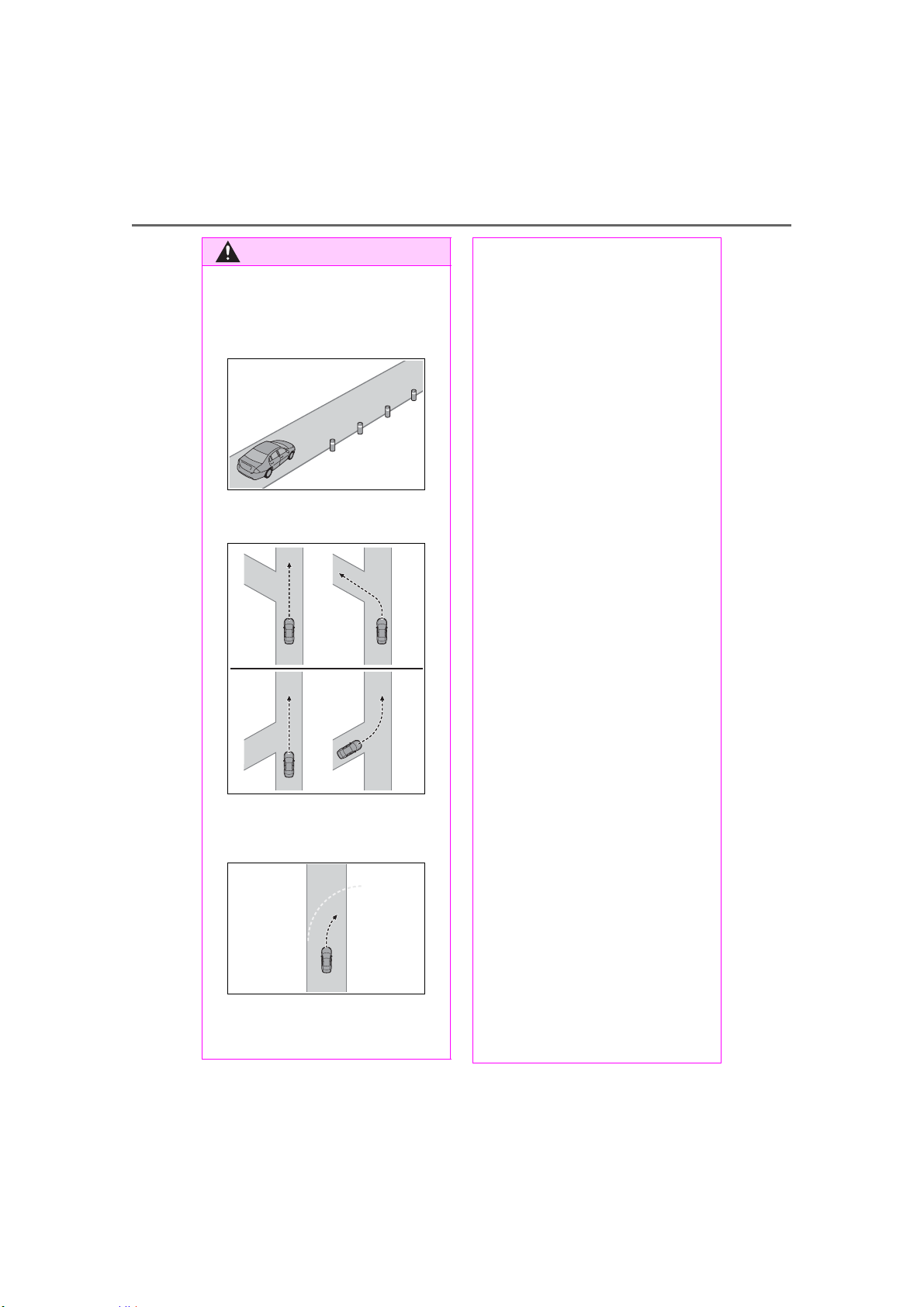
198
4-5. Using the driving support systems
COROLLA H/B_U
WARNING
● Objects or patterns that could
be mistaken for white (yellow)
lines are present on the side of
the road (guardrails, reflective
poles, etc.).
● Vehicle is driven where the road
diverges, merges, etc.
● Repair marks of asphalt, white
(yellow) lines, etc. are present
due to road repair.
● There are shadows on the road
that run parallel with, or cover,
the white (yellow) lines.
● The vehicle is driven in an area
without white (yellow) lines,
such as in front of a tollgate or
checkpoint, or at an intersec-
tion, etc.
● The white (yellow) lines are
cracked, “Botts’ dots”, “Raised
pavement marker” or stones are
present.
● The white (yellow) lines cannot
be seen or are difficult to see
due to sand, etc.
● The vehicle is driven on a road
surface that is wet due to rain,
puddles, etc.
● The traffic lines are yellow
(which may be more difficult to
recognize than lines that are
white).
● The white (yellow) lines cross
over a curb, etc.
● The vehicle is driven on a bright
surface, such as concrete.
● If the edge of the road is not
clear or straight.
● The vehicle is driven on a sur-
face that is bright due to
reflected light, etc.
● The vehicle is driven in an area
where the brightness changes
suddenly, such as at the
entrances and exits of tunnels,
etc.
● Light from the headlights of an
oncoming vehicle, the sun, etc.
enters the camera.
● The vehicle is driven on a slope.
● The vehicle is driven on a road
which tilts left or right, or a wind-
ing road.
● The vehicle is driven on an
unpaved or rough road.
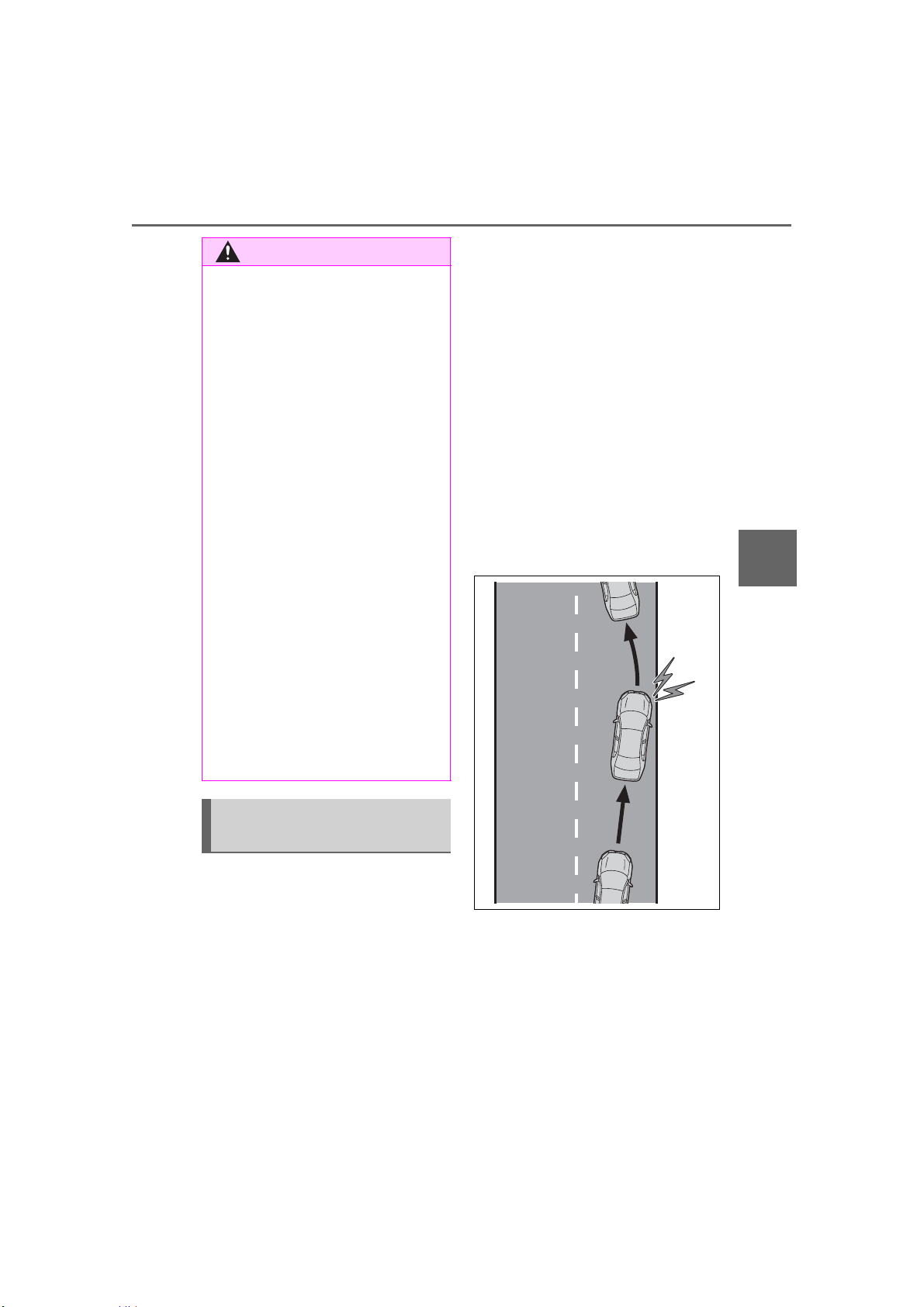
199
4-5. Using the driving support systems
COROLLA H/B_U
4
Driving
■ Lane departure alert func-
tion
When the system determines
that the vehicle might depart
from its lane or course
*
, a warn-
ing is displayed on the
multi-information display, and
either a warning buzzer will
sound to alert the driver.
When the warning buzzer sounds,
check the area around your vehicle
and carefully operate the steering
wheel to move the vehicle back to
the center of the lane.
Vehicles with a BSM: When the
system determines that the vehicle
might depart from its lane and that
the possibility of a collision with an
overtaking vehicle in the adjacent
lane is high, the lane departure
alert will operate even if the turn
signals are operating.
*
: Boundary between asphalt and
the side of the road, such as
grass, soil, or a curb
■ Steering assist function
When the system determines
that the vehicle might depart
from its lane or course
*
, the sys-
tem provides assistance as nec-
essary by operating the steering
wheel in small amounts for a
WARNING
● The traffic lane is excessively
narrow or wide.
● The vehicle is extremely tilted
due to carrying heavy luggage
or having improper tire pres-
sure.
● The distance to the preceding
vehicle is extremely short.
● The vehicle is moving up and
down a large amount due to
road conditions during driving
(poor roads or road seams).
● When driving in a tunnel or at
night with the headlights off or
when a headlight is dim due to
its lens being dirty or it being
misaligned.
● The vehicle is struck by a cross-
wind.
● The vehicle has just changed
lanes or crossed an intersec-
tion.
● Tires which differ by structure,
manufacturer, brand or tread
pattern are used.
● Snow tires, etc. are equipped.
Functions included in
LDA system
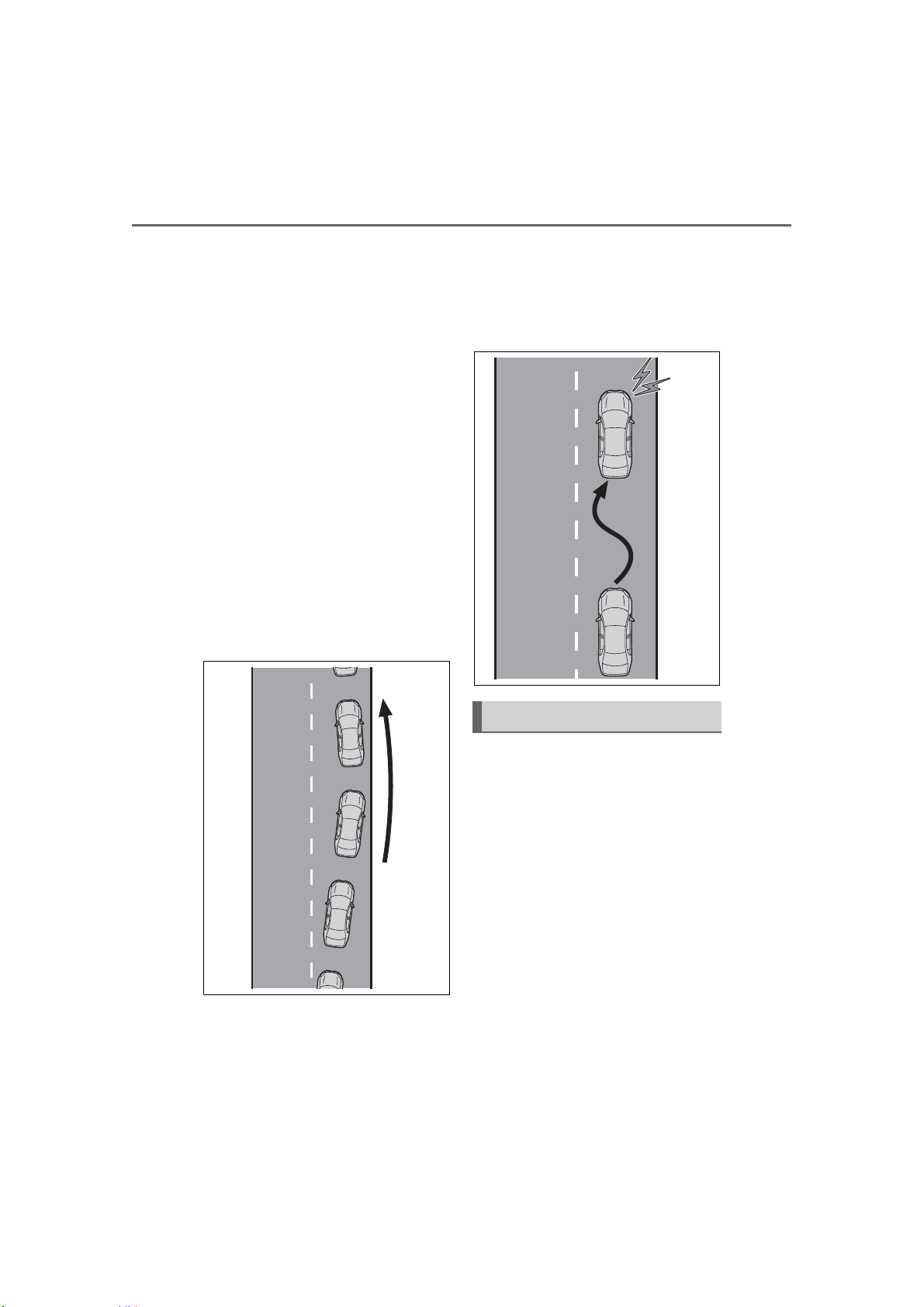
200
4-5. Using the driving support systems
COROLLA H/B_U
short period of time to keep the
vehicle in its lane.
If the system detects that the steer-
ing wheel has not been operated
for a fixed amount of time or the
steering wheel is not being firmly
gripped, a warning is displayed on
the multi-information display and
the function is temporarily can-
celed.
Vehicles with a BSM: When the
system determines that the vehicle
might depart from its lane and that
the possibility of a collision with an
overtaking vehicle in the adjacent
lane is high, the steering assist
function will operate even if the turn
signals are operating.
*
: Boundary between asphalt and
the side of the road, such as
grass, soil, or a curb
■ Vehicle sway warning func-
tion
When the vehicle is swaying
within a lane, the warning
buzzer will sound and a mes-
sage will be displayed on the
multi-information display to alert
the driver.
Press the LDA switch to turn the
LDA system on.
The LDA indicator illuminates and a
message is displayed on the
multi-information display.
Press the LDA switch again to turn
the LDA system off.
When the LDA system is turned on
or off, operation of the LDA system
continues in the same condition the
next time the engine is started.
Turning LDA system on
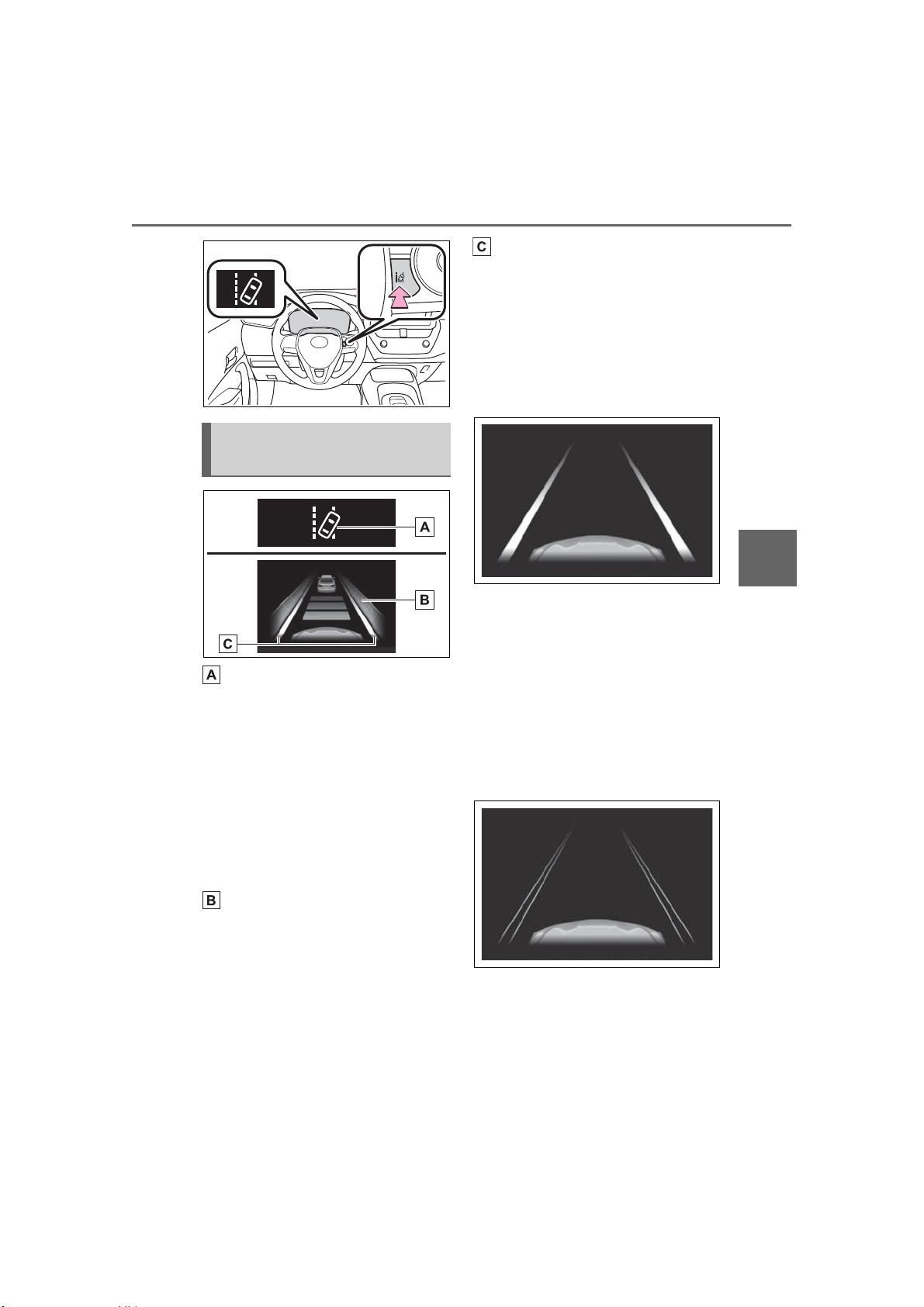
201
4-5. Using the driving support systems
COROLLA H/B_U
4
Driving
LDA indicator
The illumination condition of the
indicator informs the driver of the
system operation status.
Illuminated in white: LDA system is
operating.
Illuminated in green: Steering wheel
assistance of the steering assist
function is operating.
Flashing in orange: Lane departure
alert function is operating.
Operation display of steering
wheel operation support
Displayed when the multi-informa-
tion display is switched to the driv-
ing assist system information
screen.
Indicates that steering wheel assis-
tance of the steering assist function
is operating.
Lane departure alert function
display
Displayed when the multi-informa-
tion display is switched to the driv-
ing assist system information
screen.
Inside of displayed lines is
white
Indicates that the system is rec-
ognizing white (yellow) lines or a
course
*
. When the vehicle
departs from its lane, the white
line displayed on the side the
vehicle departs from flashes
orange.
Inside of displayed lines is
black
Indicates that the system is not
able to recognize white (yellow)
lines or a course
*
or is temporar-
ily canceled.
Indications on multi-infor-
mation display

202
4-5. Using the driving support systems
COROLLA H/B_U
*
: Boundary between asphalt and
the side of the road, such as
grass, soil, or a curb
■ Operation conditions of each
function
● Lane departure alert function
This function operates when all of
the following conditions are met.
• LDA is turned on.
• Vehicle speed is approximately 32
mph (50 km/h) or more.
• System recognizes white (yellow)
lane lines or a course*. (When a
white [yellow] line or course
*
is
recognized on only one side, the
system will operate only for the
recognized side.)
• Width of traffic lane is approxi-
mately 9.8 ft. (3 m) or more.
• Turn signal lever is not operated.
(Vehicle with BSM: Except when
another vehicle is in the lane on
the side where the turn signal was
operated)
• Vehicle is not being driven around
a sharp curve.
• No system malfunctions are
detected. (P.203)
*
: Boundary between asphalt and
the side of the road, such as
grass, soil, or a curb
● Steering assist function
This function operates when all of
the following conditions are met in
addition to the operation conditions
for the lane departure alert function.
• Setting for “Steering Assist” in
of the multi-information display is
set to “ON”. (P.531)
• Vehicle is not accelerated or
decelerated by a fixed amount or
more.
• Steering wheel is not operated
with a steering force level suitable
for changing lanes.
• ABS, VSC, TRAC and PCS are
not operating.
• TRAC or VSC is not turned off.
• Hands off steering wheel warning
is not displayed. (P.203)
● Vehicle sway warning function
This function operates when all of
the following conditions are met.
• Setting for “Sway Warning” in
of the multi-information display is
set to “ON”. (P.531)
• Vehicle speed is approximately 32
mph (50 km/h) or more.
• Width of traffic lane is approxi-
mately 9.8 ft. (3 m) or more.
• No system malfunctions are
detected. (P.203)
■ Temporary cancellation of func-
tions
● When operation conditions are no
longer met, a function may be
temporarily canceled. However,
when the operation conditions are
met again, operation of the func-
tion is automatically restored.
(P.202)
■ Steering assist function
● Depending on the vehicle speed,
lane departure situation, road con-
ditions, etc., the driver may not
feel the function is operating or
the function may not operate at
all.
● The steering control of the func-
tion is overridden by the driver’s
steering wheel operation.
● Do not attempt to test the opera-
tion of the steering assist function.
■ Lane departure alert function
● The warning buzzer may be diffi-
cult to hear due to external noise,
audio playback, etc.
● If the edge of the course
*
is not
clear or straight, the lane depar-
ture alert function may not oper-
ate.
● Vehicle with BSM: It may not be
possible for the system to deter-
mine if there is a danger of a colli-
sion with a vehicle in an adjacent
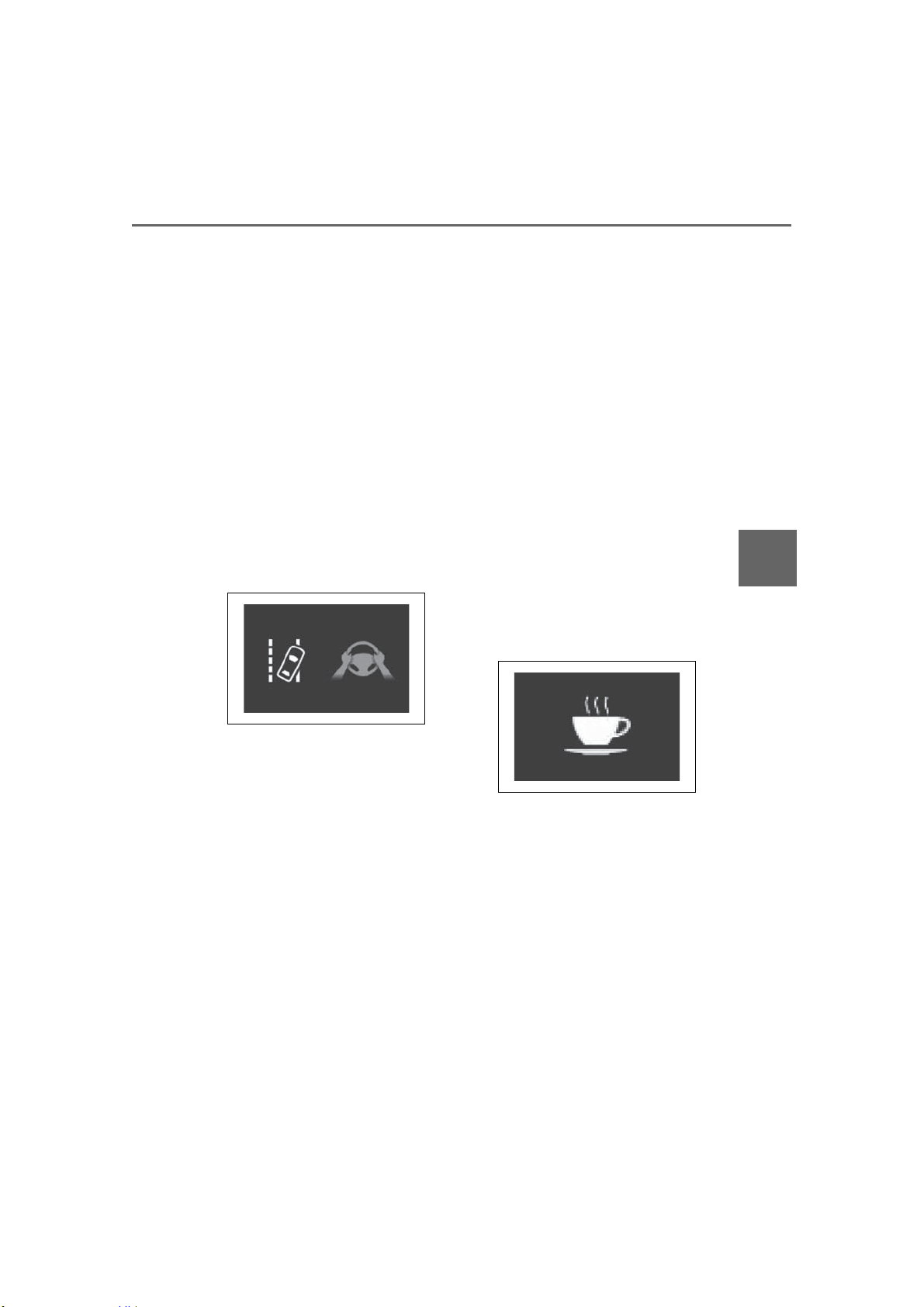
203
4-5. Using the driving support systems
COROLLA H/B_U
4
Driving
lane.
● Do not attempt to test the opera-
tion of the lane departure alert
function.
*
: Boundary between asphalt and
the side of the road, such as
grass, soil, or a curb
■ Hands off steering wheel warn-
ing
In the following situations, a warning
message urging the driver to hold
the steering wheel and the symbol
shown in the illustration are dis-
played on the multi-information dis-
play to warn the driver.The warning
stops when the system determines
that the driver holds the steering
wheel. Always keep your hands on
the steering wheel when using this
system, regardless of warnings.
● When the system determines that
the driver is driving without hold-
ing the steering wheel while the
system is operating
If the driver continues to keep their
hands off of the steering wheel, the
buzzer sounds, the driver is warned
and the function is temporarily can-
celed. This warning also operates in
the same way when the driver con-
tinuously operates the steering
wheel only a small amount.
● When the system determines that
the vehicle may not turn and
instead depart from its lane while
driving around a curve
Depending on the vehicle and road
conditions, the warning may not
operate. Also, if the system deter-
mines that the vehicle is driving
around a curve, warnings will occur
earlier than during straight-line driv-
ing.
● When the system determines that
the driver is driving without hold-
ing the steering wheel while the
steering wheel assist of the steer-
ing assist function is operating.
If the driver continues to keep their
hands off of the steering wheel and
the steering wheel assist is operat-
ing, the buzzer sounds and the
driver is warned. Each time the
buzzer sounds, the continuing time
of the buzzer becomes longer.
■ Vehicle sway warning function
When the system determines that
the vehicle is swaying while the
vehicle sway warning function is
operating, a buzzer sounds and a
warning message urging the driver
to rest and the symbol shown in the
illustration are simultaneously dis-
played on the multi-information dis-
play.
Depending on the vehicle and road
conditions, the warning may not
operate.
■ Warning message
If the following warning message is
displayed on the multi-information
display and the LDA indicator illumi-
nates in orange, follow the appropri-
ate troubleshooting procedure. Also,
if a different warning message is
displayed, follow the instructions
displayed on the screen.
● “LDA Malfunction Visit Your
Dealer”
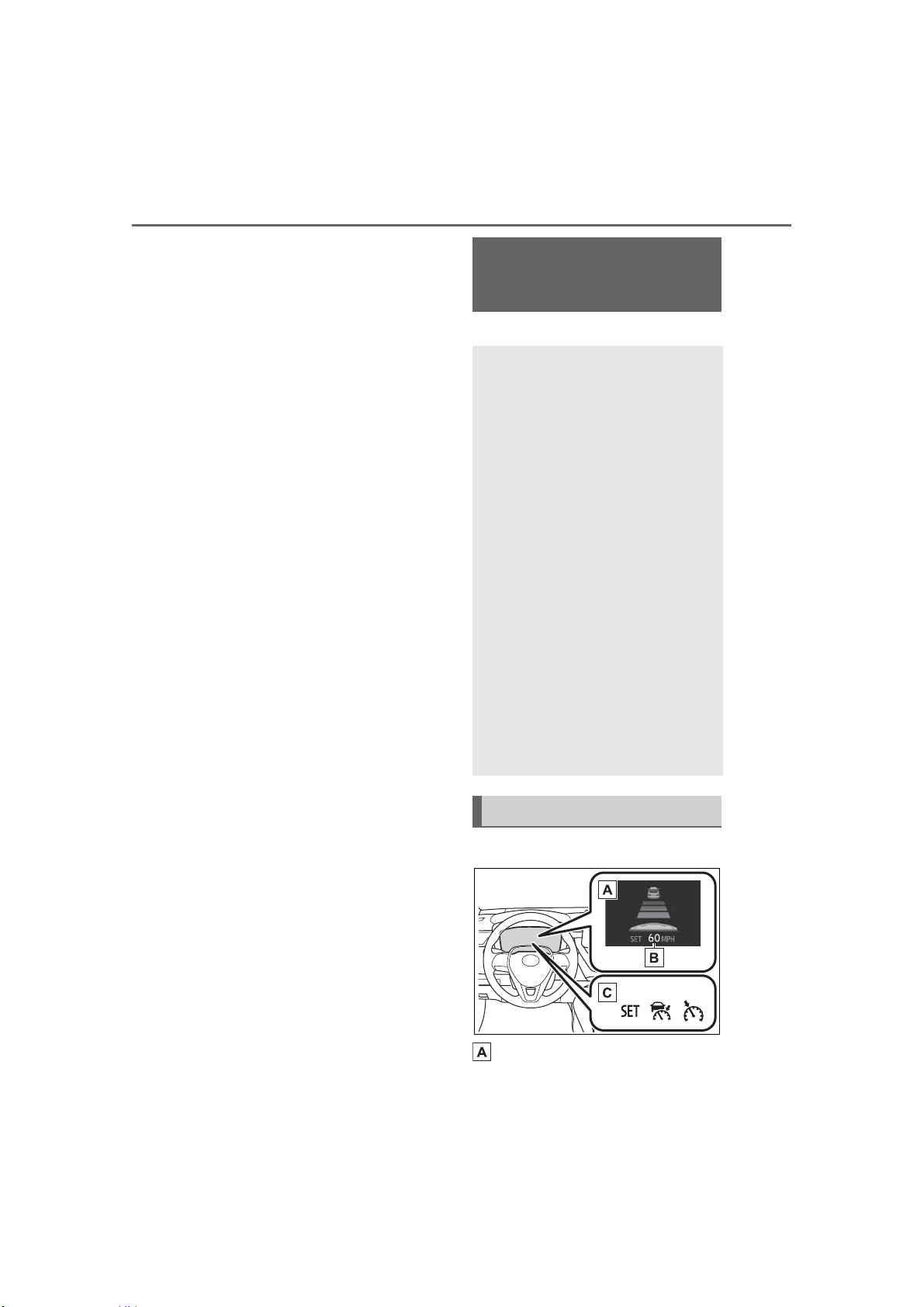
204
4-5. Using the driving support systems
COROLLA H/B_U
The system may not be operating
properly. Have the vehicle inspected
by your Toyota dealer.
● “LDA Unavailable”
The system is temporarily canceled
due to a malfunction in a sensor
other than the front camera. Turn
the LDA system off, wait for a little
while, and then turn the LDA system
back on.
● “LDA Unavailable at Current
Speed”
The function cannot be used as the
vehicle speed exceeds the LDA
operation range. Drive slower.
● “LDA Unavailable Below Approx.
32MPH”
The LDA system cannot be used as
the vehicle speed is less than
approximately 32 mph (50 km/h).
Drive the vehicle at approximately
32 mph (50 km/h) or more.
■ Customization
Function settings can be changed.
(Customizable features: P.531)
*
: If equipped
■ Meter display
Multi-information display
Dynamic radar cruise
control with full-speed
range
*
In vehicle-to-vehicle dis-
tance control mode, the
vehicle automatically accel-
erates, decelerates and
stops to match the speed
changes of the preceding
vehicle even if the accelera-
tor pedal is not depressed.
In constant speed control
mode, the vehicle runs at a
fixed speed.
Use the dynamic radar
cruise control with
full-speed range on free-
ways and highways.
Vehicle-to-vehicle distance
control mode (P.207)
Constant speed control
mode (P.211)
System Components
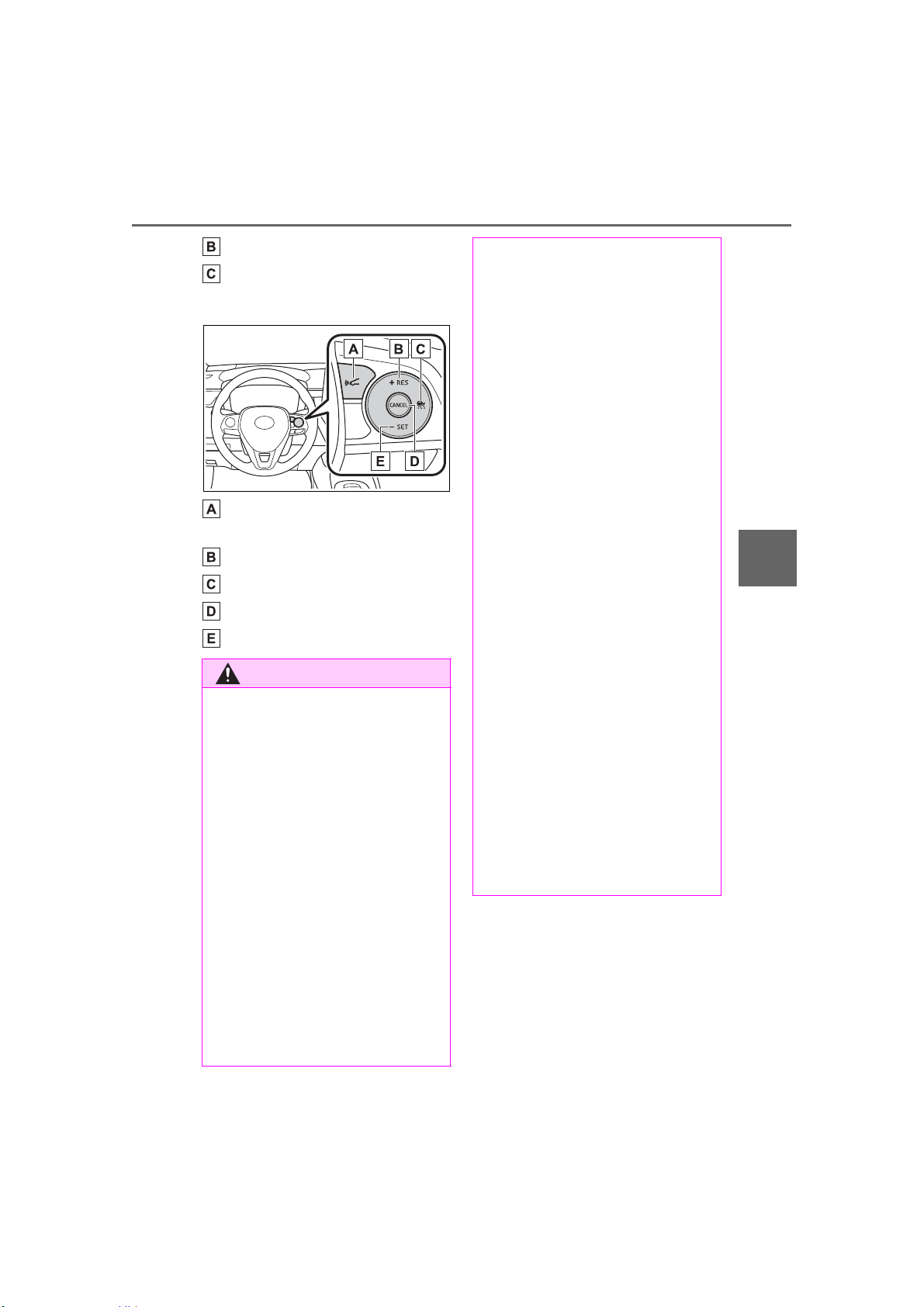
205
4-5. Using the driving support systems
COROLLA H/B_U
4
Driving
Set speed
Indicators
■ Operation switches
Vehicle-to-vehicle distance
switch
“+RES” switch
Cruise control main switch
Cancel switch
“-SET” switch
WARNING
■ Before using dynamic radar
cruise control with full-speed
range
● Driving safely is the sole
responsibility of the driver. Do
not rely solely on the system,
and drive safely by always pay-
ing careful attention to your sur-
roundings.
● The dynamic radar cruise con-
trol with full-speed range pro-
vides driving assistance to
reduce the driver’s burden.
However, there are limitations to
the assistance provided.
Read the following conditions
carefully. Do not overly rely on
this system and always drive
carefully.
• When the sensor may not be
correctly detecting the vehicle
ahead:
P.213
• Conditions under which the
vehicle-to-vehicle distance con-
trol mode may not function cor-
rectly:
P.2 13
● Set the speed appropriately
depending on the speed limit,
traffic flow, road conditions,
weather conditions, etc. The
driver is responsible for check-
ing the set speed.
● Even when the system is func-
tioning normally, the condition of
the preceding vehicle as
detected by the system may dif-
fer from the condition observed
by the driver. Therefore, the
driver must always remain alert,
assess the danger of each situ-
ation and drive safely. Relying
solely on this system or assum-
ing the system ensures safety
while driving can lead to an
accident, resulting in death or
serious injury.
● Switch the dynamic radar cruise
control with full-speed range
setting to off, using the cruise
control main switch when not in
use.
■ Cautions regarding the driv-
ing assist systems
Observe the following precau-
tions, as there are limitations to
the assistance provided by the
system.
Failure to do so may cause an
accident resulting in death or seri-
ous injury.

206
4-5. Using the driving support systems
COROLLA H/B_U
WARNING
● Assisting the driver to measure
following distance
The dynamic radar cruise control
with full-speed range is only
intended to help the driver in
determining the following distance
between the driver’s own vehicle
and a designated vehicle traveling
ahead. It is not a mechanism that
allows careless or inattentive driv-
ing, and it is not a system that can
assist the driver in low-visibility
conditions.
It is still necessary for driver to
pay close attention to the vehi-
cle’s surroundings.
● Assisting the driver to judge
proper following distance
The dynamic radar cruise control
with full-speed range determines
whether the following distance
between the driver’s own vehicle
and a designated vehicle traveling
ahead is within a set range. It is
not capable of making any other
type of judgement. Therefore, it is
absolutely necessary for the
driver to remain vigilant and to
determine whether or not there is
a possibility of danger in any
given situation.
● Assisting the driver to operate
the vehicle
The dynamic radar cruise control
with full-speed range does not
include functions which will pre-
vent or avoid collisions with vehi-
cles ahead of your vehicle.
Therefore, if there is ever any
possibility of danger, the driver
must take immediate and direct
control of the vehicle and act
appropriately in order to ensure
the safety of all involved.
■ Situations unsuitable for
dynamic radar cruise control
with full-speed range
Do not use dynamic radar cruise
control with full-speed range in
any of the following situations.
Doing so may result in inappropri-
ate speed control and could
cause an accident resulting in
death or serious injury.
● Roads where there are pedes-
trians, cyclists, etc.
● In heavy traffic
● On roads with sharp bends
● On winding roads
● On slippery roads, such as
those covered with rain, ice or
snow
● On steep downhills, or where
there are sudden changes
between sharp up and down
gradients
Vehicle speed may exceed the
set speed when driving down a
steep hill.
● At entrances to freeways and
highways
● When weather conditions are
bad enough that they may pre-
vent the sensors from detecting
correctly (fog, snow, sand-
storm, heavy rain, etc.)
● When there is rain, snow, etc.
on the front surface of the radar
or front camera
● In traffic conditions that require
frequent repeated acceleration
and deceleration
● During emergency towing
● When an approach warning
buzzer is heard often
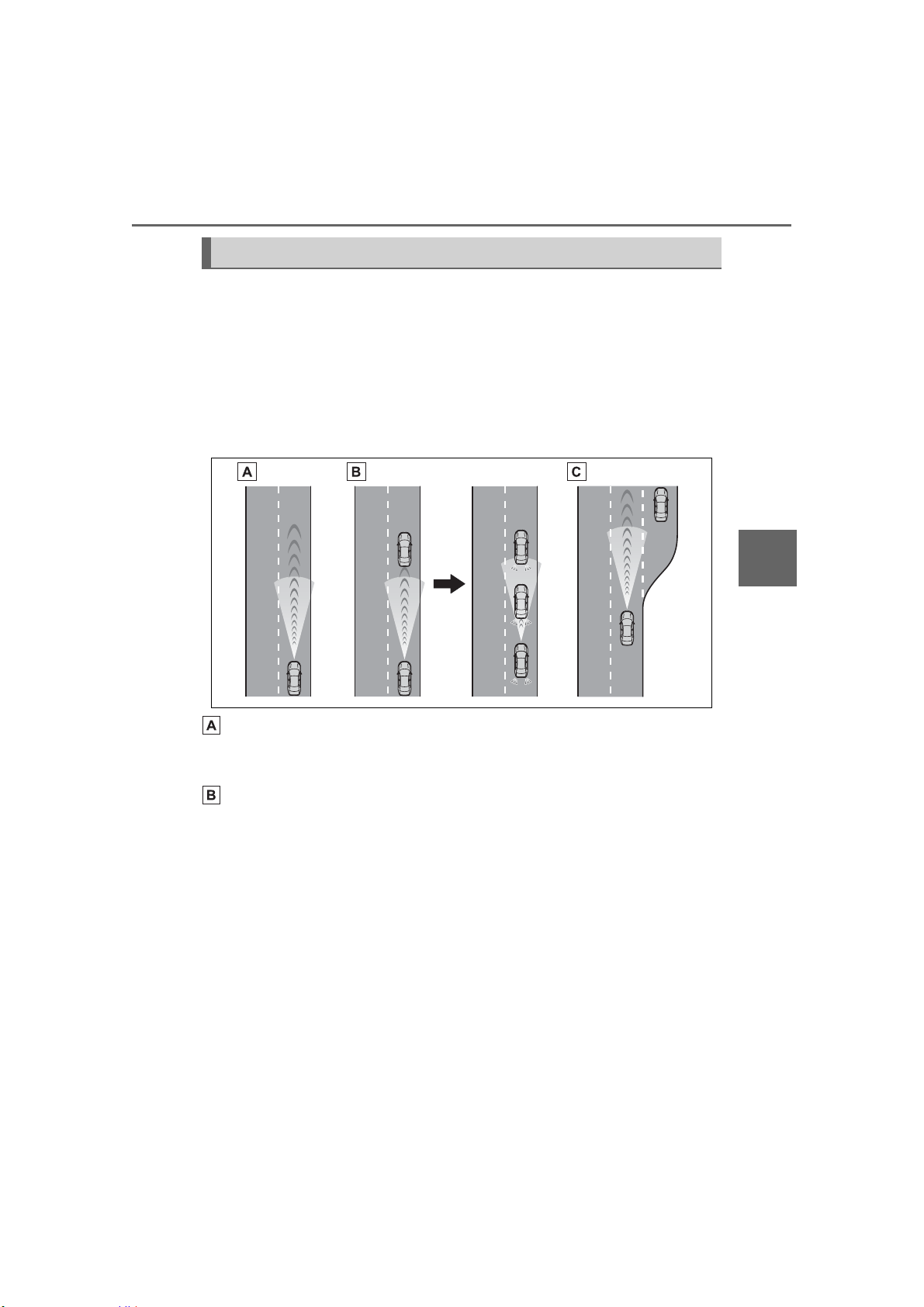
207
4-5. Using the driving support systems
COROLLA H/B_U
4
Driving
This mode employs a radar to detect the presence of vehicles up to
approximately 328 ft. (100 m) ahead, determines the current vehi-
cle-to-vehicle following distance, and operates to maintain a suitable
following distance from the vehicle ahead. The desired vehi-
cle-to-vehicle distance can also be set by operating the vehi-
cle-to-vehicle distance switch.
When driving on downhill slopes, the vehicle-to-vehicle distance may
become shorter.
Example of constant speed cruising
When there are no vehicles ahead
The vehicle travels at the speed set by the driver.
Example of deceleration cruising and follow-up cruising
When a preceding vehicle driving slower than the set speed
appears
When a vehicle is detected running ahead of you, the system automatically
decelerates your vehicle. When a greater reduction in vehicle speed is nec-
essary, the system applies the brakes (the stop lights will come on at this
time). The system will respond to changes in the speed of the vehicle
ahead in order to maintain the vehicle-to-vehicle distance set by the driver.
Approach warning warns you when the system cannot decelerate suffi-
ciently to prevent your vehicle from closing in on the vehicle ahead.
When the vehicle ahead of you stops, your vehicle will also stop (vehicle is
stopped by system control). After the vehicle ahead starts off, pressing the
“+RES” switch or depressing the accelerator pedal (start-off operation) will
resume follow-up cruising. If the start-off operation is not performed, system
control continues to keep your vehicle stopped.
Driving in vehicle-to-vehicle distance control mode
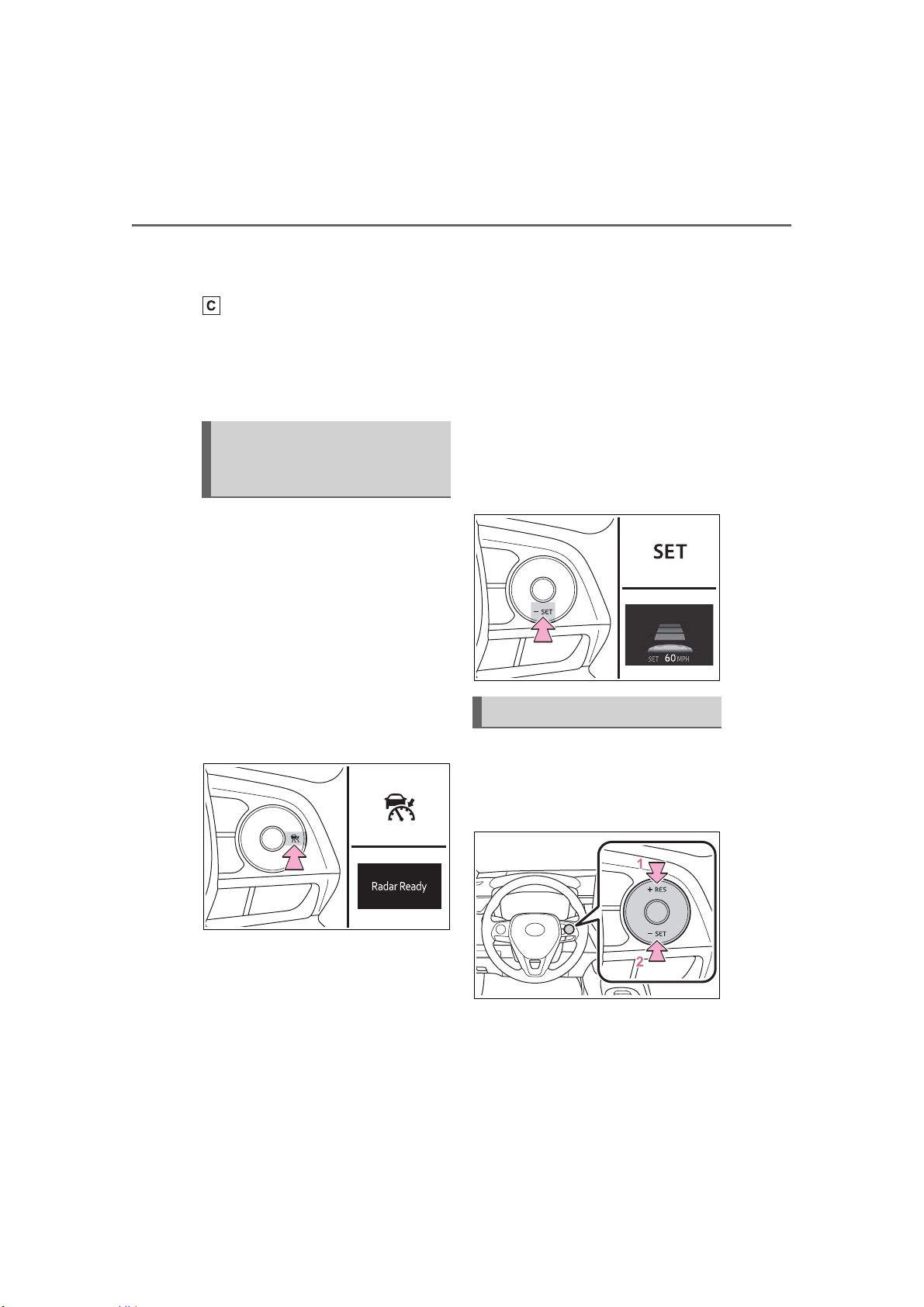
208
4-5. Using the driving support systems
COROLLA H/B_U
When the turn signal lever is operated and your vehicle moves to a left lane
while driving at 50 mph (80 km/h) or more, the vehicle will quickly acceler-
ate to help to overtake a passing vehicle.
Example of acceleration
When there are no longer any preceding vehicles driving slower
than the set speed
The system accelerates until the set speed is reached. The system then
returns to constant speed cruising.
1 Press the cruise control main
switch to activate the cruise
control.
Dynamic radar cruise control indi-
cator will come on and a message
will be displayed on the multi-infor-
mation display. Press the switch
again to deactivate the cruise con-
trol.
If the cruise control main switch is
pressed and held for 1.5 seconds
or more, the system turns on in
constant speed control mode.
(P.211)
2 Accelerate or decelerate,
with accelerator pedal opera-
tion, to the desired vehicle
speed (at or above approxi-
mately 20 mph [30 km/h])
and press the “-SET” switch
to set the speed.
Cruise control “SET” indicator will
come on.
The vehicle speed at the moment
the switch is released becomes the
set speed.
To change the set speed, press
the “+RES” or “-SET” switch
until the desired set speed is
displayed.
1 Increases the speed (Except
when the vehicle has been
stopped by system control in
Setting the vehicle speed
(vehicle-to-vehicle dis-
tance control mode)
Adjusting the set speed

209
4-5. Using the driving support systems
COROLLA H/B_U
4
Driving
vehicle-to-vehicle distance
control mode)
2 Decreases the speed
Fine adjustment: Press the switch.
Large adjustment: Press and hold
the switch to change the speed,
and release when the desired
speed is reached.
In the vehicle-to-vehicle dis-
tance control mode, the set
speed will be increased or
decreased as follows:
For the U.S. mainland, Hawaii
Fine adjustment: By 1 mph (1.6
km/h)
*1
or 1 km/h (0.6 mph)
*2
each
time the switch is pressed
Large adjustment: Increases or
decreases in 1 mph (1.6 km/h)
*1
or
1 km/h (0.6 mph)
*2
increments for
as long as the switch is held
For Canada, Guam and
Puerto Rico
Fine adjustment: By 1 mph (1.6
km/h)
*1
or 1 km/h (0.6 mph)
*2
each
time the switch is pressed
Large adjustment: Increases or
decreases in 5 mph (8 km/h)
*1
or 5
km/h (3.1 mph)
*2
increments for as
long as the switch is held
In the constant speed control
mode (P.211), the set speed
will be increased or decreased
as follows:
Fine adjustment: By 1 mph (1.6
km/h)
*1
or 1 km/h (0.6 mph)
*2
each
time the switch is pressed
Large adjustment: The speed will
continue to change while the switch
is held.
*1
:When the set speed is shown in
“MPH”
*2
:When the set speed is shown in
“km/h”
Pressing the switch changes the
vehicle-to-vehicle distance as
follows:
1 Long
2 Medium
3 Short
The vehicle-to-vehicle distance is
set automatically to long mode
when the engine switch is turned to
ON.
If a vehicle is running ahead of you,
the preceding vehicle mark will
also be displayed.
Select a distance from the table
Changing the vehi-
cle-to-vehicle distance
(vehicle-to-vehicle dis-
tance control mode)
Vehicle-to-vehicle dis-
tance settings (vehi-
cle-to-vehicle distance
control mode)
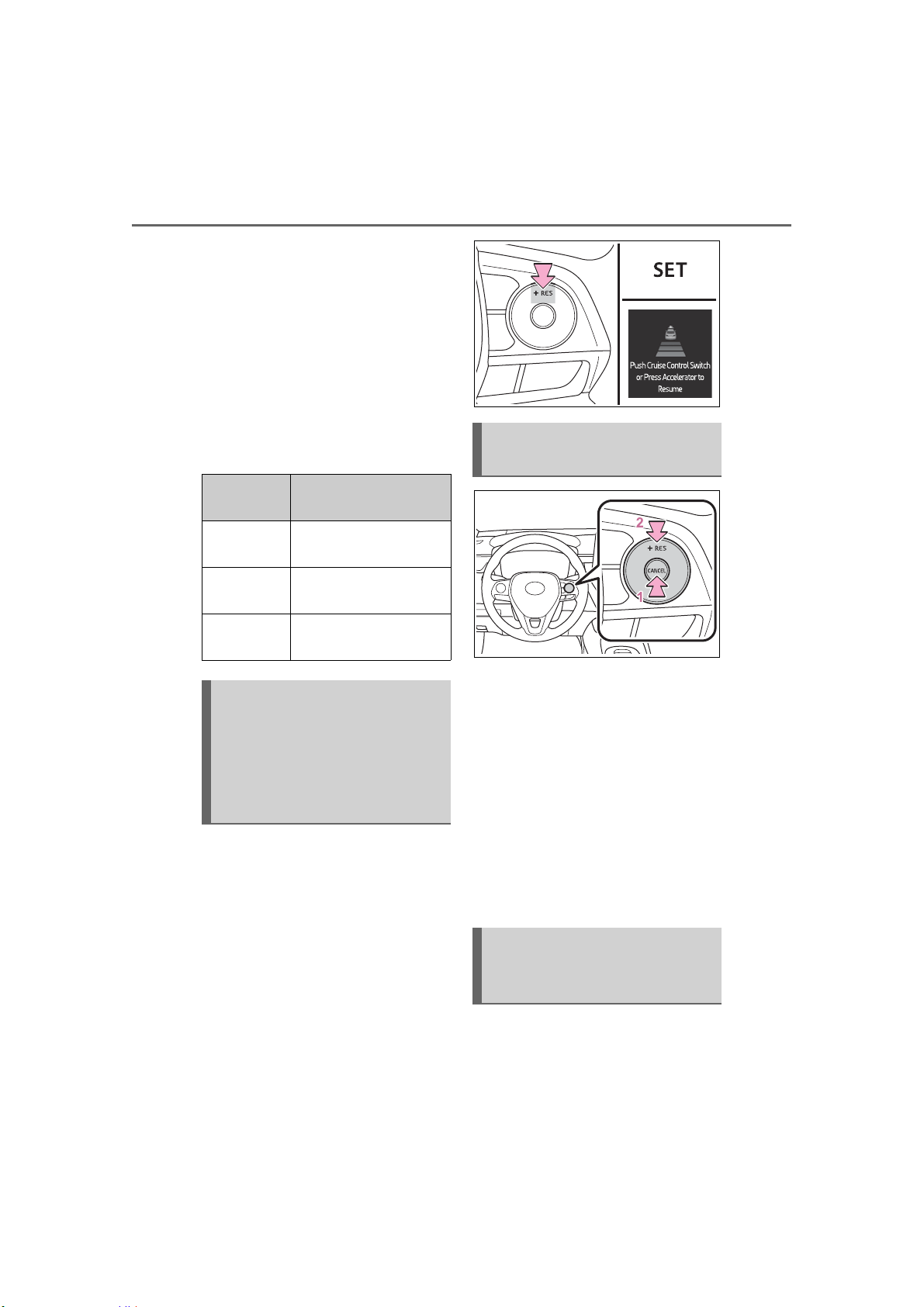
210
4-5. Using the driving support systems
COROLLA H/B_U
below. Note that the distances
shown correspond to a vehicle
speed of 50 mph (80 km/h).
Vehicle-to-vehicle distance
increases/decreases in accor-
dance with vehicle speed. When
the vehicle is stopped by system
control, the vehicle stops at a
certain vehicle-to-vehicle dis-
tance depending on the situa-
tion.
After the vehicle ahead of you
starts off, press the “+RES”
switch.
Your vehicle will also resume
follow-up cruising if the acceler-
ator pedal is depressed after the
vehicle ahead of you starts off.
1 Pressing the cancel switch
cancels the speed control.
The speed control is also canceled
when the brake pedal is depressed.
(When the vehicle has been
stopped by system control,
depressing the brake pedal does
not cancel the setting.)
2 Pressing the “+RES” switch
resumes the cruise control
and returns vehicle speed to
the set speed.
When your vehicle is too close
to a vehicle ahead, and suffi-
cient automatic deceleration via
Distance
options
Vehicle-to-vehicle dis-
tance
Long
Approximately 160 ft.
(50 m)
Medium
Approximately 130 ft.
(40 m)
Short
Approximately 100 ft.
(30 m)
Resuming follow-up
cruising when the vehicle
has been stopped by sys-
tem control (vehi-
cle-to-vehicle distance
control mode)
Canceling and resuming
the speed control
Approach warning (vehi-
cle-to-vehicle distance
control mode)
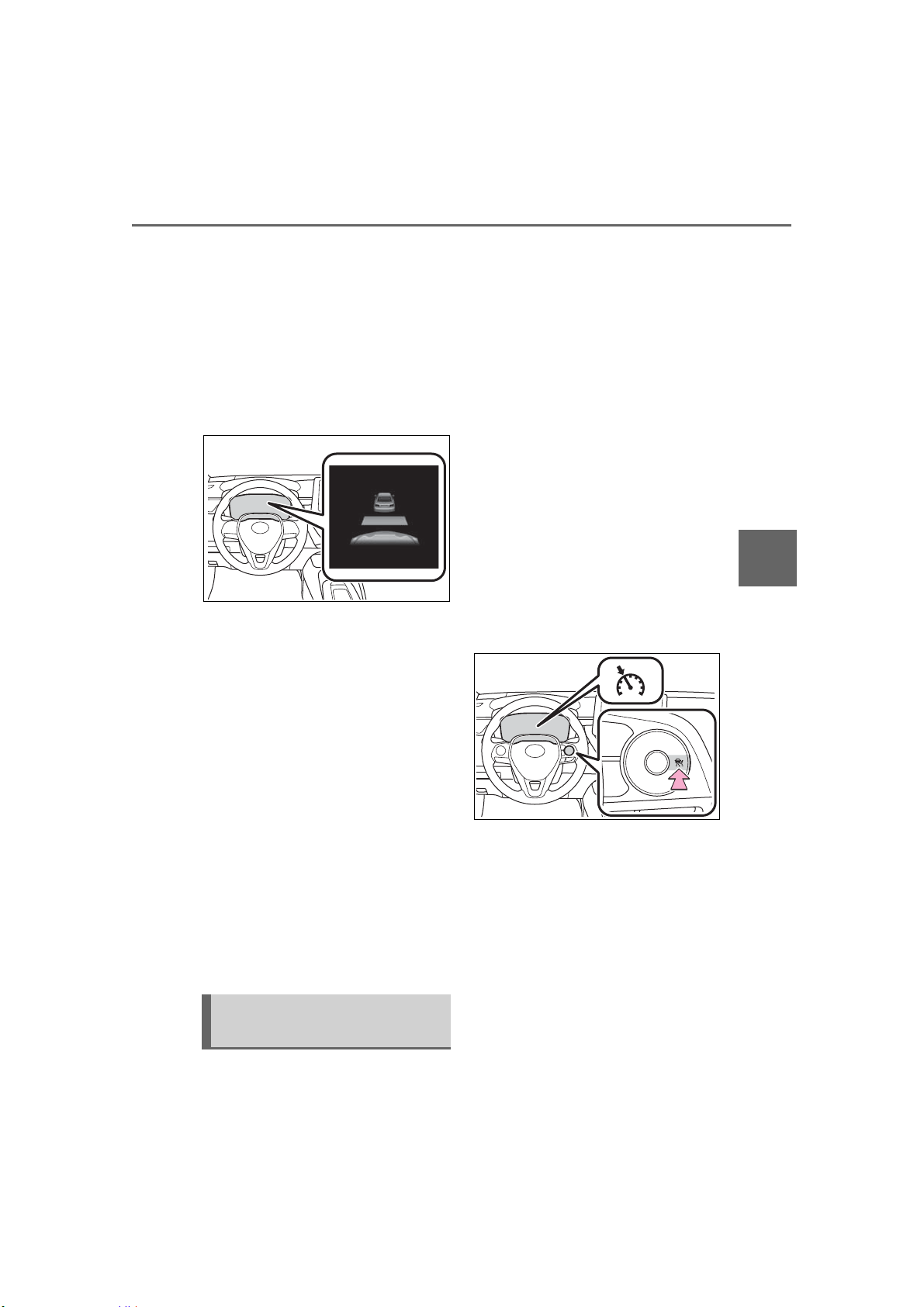
211
4-5. Using the driving support systems
COROLLA H/B_U
4
Driving
the cruise control is not possi-
ble, the display will flash and the
buzzer will sound to alert the
driver. An example of this would
be if another driver cuts in front
of you while you are following a
vehicle. Depress the brake
pedal to ensure an appropriate
vehicle-to-vehicle distance.
■ Warnings may not occur
when
In the following instances, warn-
ings may not occur even when
the vehicle-to-vehicle distance is
small.
When the speed of the pre-
ceding vehicle matches or
exceeds your vehicle speed
When the preceding vehicle is
traveling at an extremely slow
speed
Immediately after the cruise
control speed was set
When depressing the acceler-
ator pedal
When constant speed control
mode is selected, your vehicle
will maintain a set speed without
controlling the vehicle-to-vehi-
cle distance. Select this mode
only when vehicle-to-vehicle dis-
tance control mode does not
function correctly due to a dirty
radar, etc.
1 With the cruise control off,
press and hold the cruise
control main switch for 1.5
seconds or more.
Immediately after the switch is
pressed, the dynamic radar cruise
control indicator will come on. After-
wards, it switches to the cruise con-
trol indicator.
Switching to constant speed control
mode is only possible when operat-
ing the switch with the cruise con-
trol off.
2 Accelerate or decelerate,
with accelerator pedal opera-
tion, to the desired vehicle
speed (at or above approxi-
mately 20 mph [30 km/h])
and press the “-SET” switch
to set the speed.
Cruise control “SET” indicator will
come on.
The vehicle speed at the moment
the switch is released becomes the
set speed.
Selecting constant speed
control mode
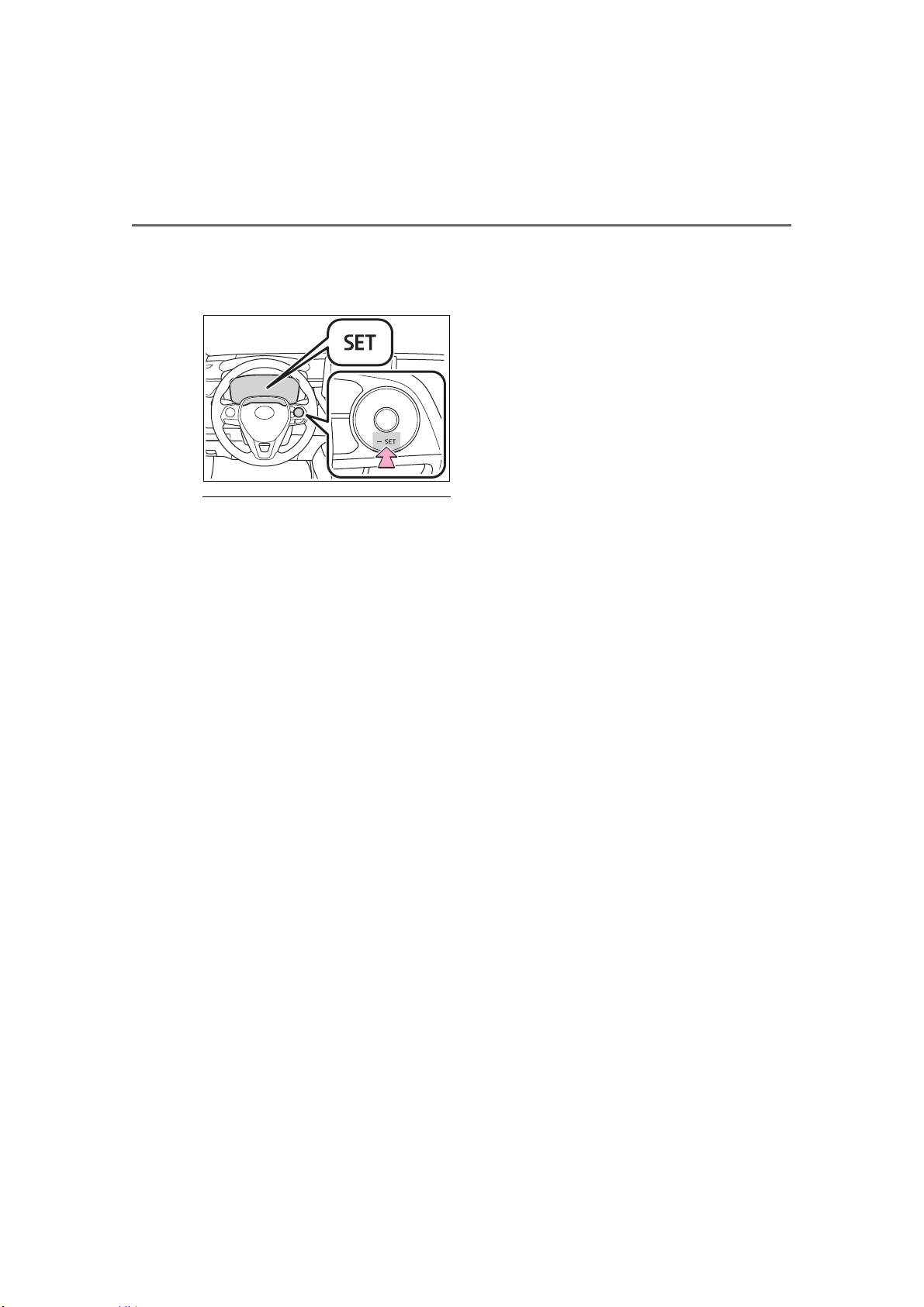
212
4-5. Using the driving support systems
COROLLA H/B_U
Adjusting the speed setting:
P. 2 08
Canceling and resuming the speed
setting: P.2 10
■ Dynamic radar cruise control
with full-speed range can be set
when
● The shift lever is in D.
● The desired set speed can be set
when the vehicle speed is approx-
imately 20 mph (30 km/h) or more.
(However, when the vehicle speed
is set while driving at below
approximately 20 mph [30 km/h],
the set speed will be set to
approximately 20 mph [30 km/h].)
■ Accelerating after setting the
vehicle speed
The vehicle can accelerate by oper-
ating the accelerator pedal. After
accelerating, the set speed
resumes. However, during vehi-
cle-to-vehicle distance control
mode, the vehicle speed may
decrease below the set speed in
order to maintain the distance to the
preceding vehicle.
■ When the vehicle stops while
follow-up cruising
● Pressing the “+RES” switch while
the vehicle ahead stops will
resume follow-up cruising if the
vehicle ahead starts off within
approximately 3 seconds after the
switch is pressed.
● If the vehicle ahead starts off
within 3 seconds after your vehicle
stops, follow-up cruising will be
resumed.
■ Automatic cancelation of vehi-
cle-to-vehicle distance control
mode
Vehicle-to-vehicle distance control
mode is automatically canceled in
the following situations.
● VSC is activated.
● TRAC is activated for a period of
time.
● When the VSC or TRAC system is
turned off.
● The sensor cannot detect cor-
rectly because it is covered in
some way.
● Pre-collision braking is activated.
● The parking brake is operated.
● The vehicle is stopped by system
control on a steep incline.
● The following are detected when
the vehicle has been stopped by
system control:
• The driver is not wearing a seat
belt.
• The driver’s door is opened.
• The vehicle has been stopped for
about 3 minutes
If vehicle-to-vehicle distance control
mode is automatically canceled for
any reasons other than the above,
there may be a malfunction in the
system. Contact your Toyota dealer.
■ Automatic cancelation of con-
stant speed control mode
Constant speed control mode is
automatically canceled in the follow-
ing situations:
● Actual vehicle speed is more than
approximately 10 mph (16 km/h)
below the set vehicle speed.
● Actual vehicle speed falls below
approximately 20 mph (30 km/h).
● VSC is activated.
● TRAC is activated for a period of
time.
● When the VSC or TRAC system is
turned off.
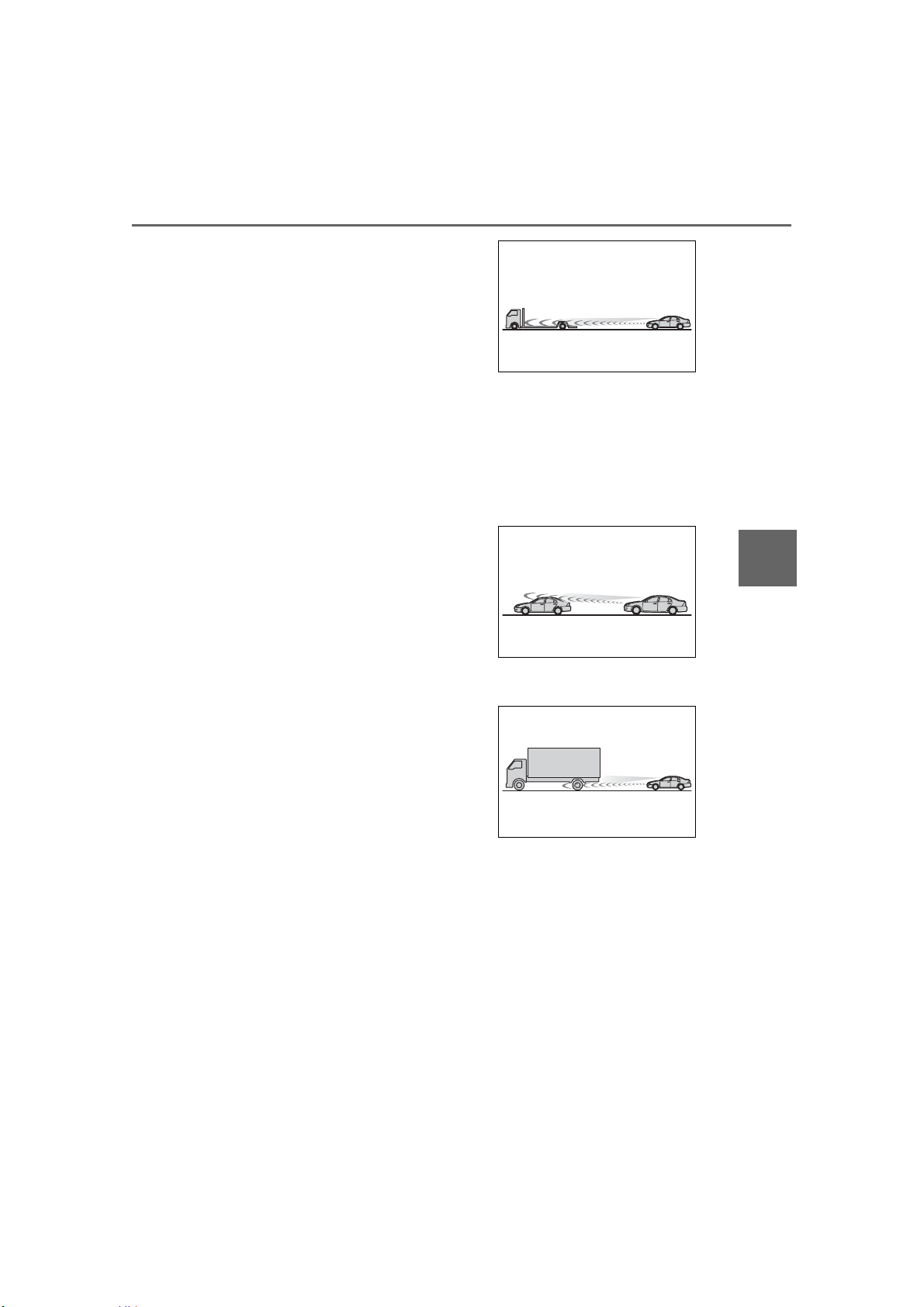
213
4-5. Using the driving support systems
COROLLA H/B_U
4
Driving
● Pre-collision braking is activated.
If constant speed control mode is
automatically canceled for any rea-
sons other than the above, there
may be a malfunction in the system.
Contact your Toyota dealer.
■ Brake operation
A brake operation sound may be
heard and the brake pedal response
may change, but these are not mal-
functions.
■ Warning messages and buzzers
for dynamic radar cruise con-
trol with full-speed range
Warning messages and buzzers are
used to indicate a system malfunc-
tion or to inform the driver of the
need for caution while driving. If a
warning message is shown on the
multi-information display, read the
message and follow the instructions.
(P.172, 477)
■ When the sensor may not be
correctly detecting the vehicle
ahead
In the case of the following and
depending on the conditions, oper-
ate the brake pedal when decelera-
tion of the system is insufficient or
operate the accelerator pedal when
acceleration is required.
As the sensor may not be able to
correctly detect these types of vehi-
cles, the approach warning
(P.210) may not be activated.
● Vehicles that cut in suddenly
● Vehicles traveling at low speeds
● Vehicles that are not moving in the
same lane
● Vehicles with small rear ends
(trailers with no load on board,
etc.)
● Motorcycles traveling in the same
lane
● When water or snow thrown up by
the surrounding vehicles hinders
the detecting of the sensor
● When your vehicle is pointing
upwards (caused by a heavy load
in the luggage compartment, etc.)
● Preceding vehicle has an
extremely high ground clearance
■ Conditions under which the
vehicle-to-vehicle distance con-
trol mode may not function cor-
rectly
In the case of the following condi-
tions, operate the brake pedal (or
accelerator pedal, depending on the
situation) as necessary.
As the sensor may not be able to
correctly detect vehicles ahead, the
system may not operate properly.
● When the road curves or when the
lanes are narrow
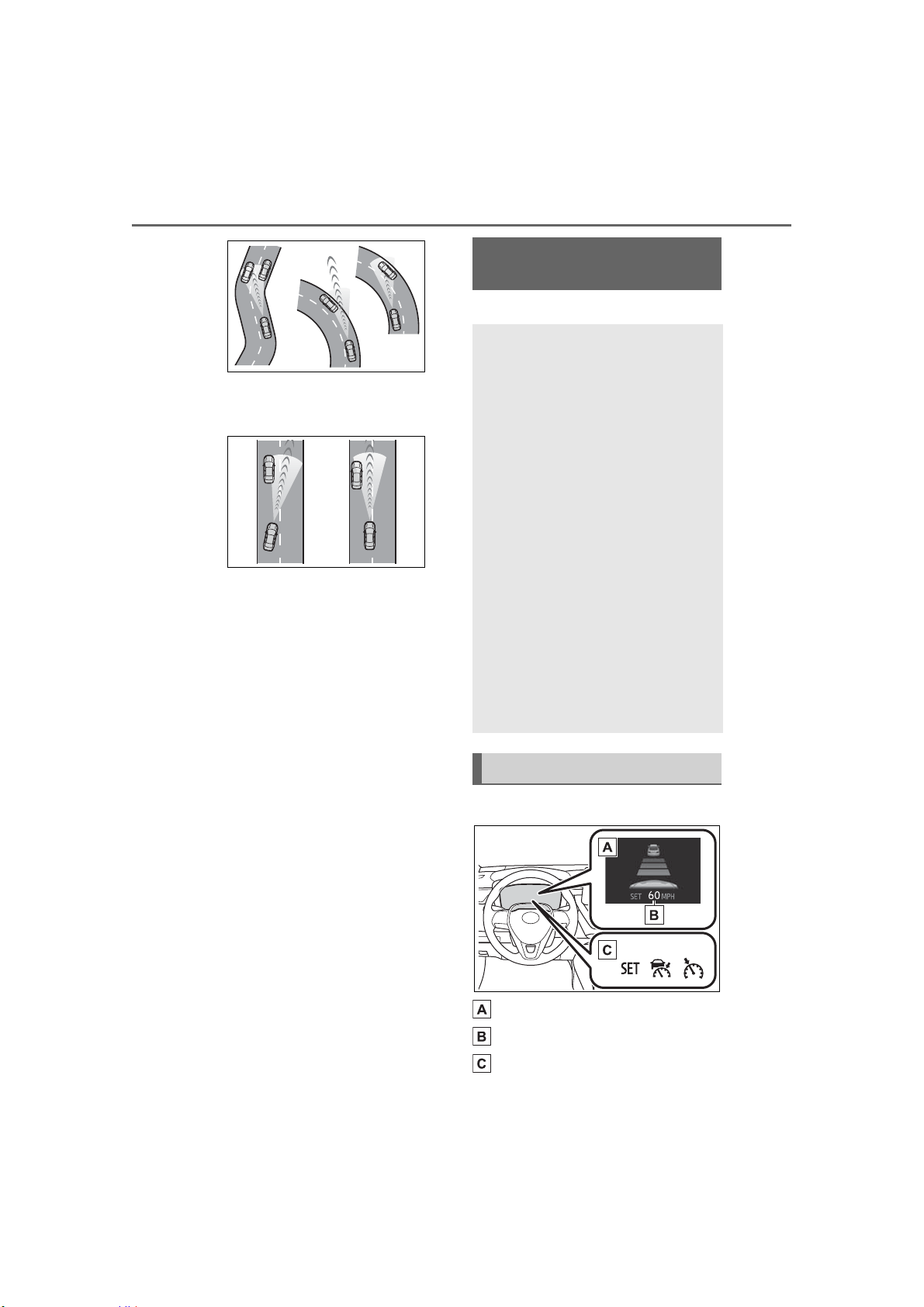
214
4-5. Using the driving support systems
COROLLA H/B_U
● When steering wheel operation or
your position in the lane is unsta-
ble
● When the vehicle ahead of you
decelerates suddenly
● When driving on a road sur-
rounded by a structure, such as in
a tunnel or on a bridge
● While the vehicle speed is
decreasing to the set speed after
the vehicle accelerates by
depressing the accelerator pedal
*
: If equipped
■ Meter display
Multi-information display
Set speed
Indicators
Dynamic radar cruise
control
*
In vehicle-to-vehicle dis-
tance control mode, the
vehicle automatically accel-
erates and decelerates to
match the speed changes of
the preceding vehicle even
if the accelerator pedal is
not depressed. In constant
speed control mode, the
vehicle runs at a fixed
speed.
Use the dynamic radar
cruise control on freeways
and highways.
Vehicle-to-vehicle distance
control mode (P.217)
Constant speed control
mode (P.221)
System Components
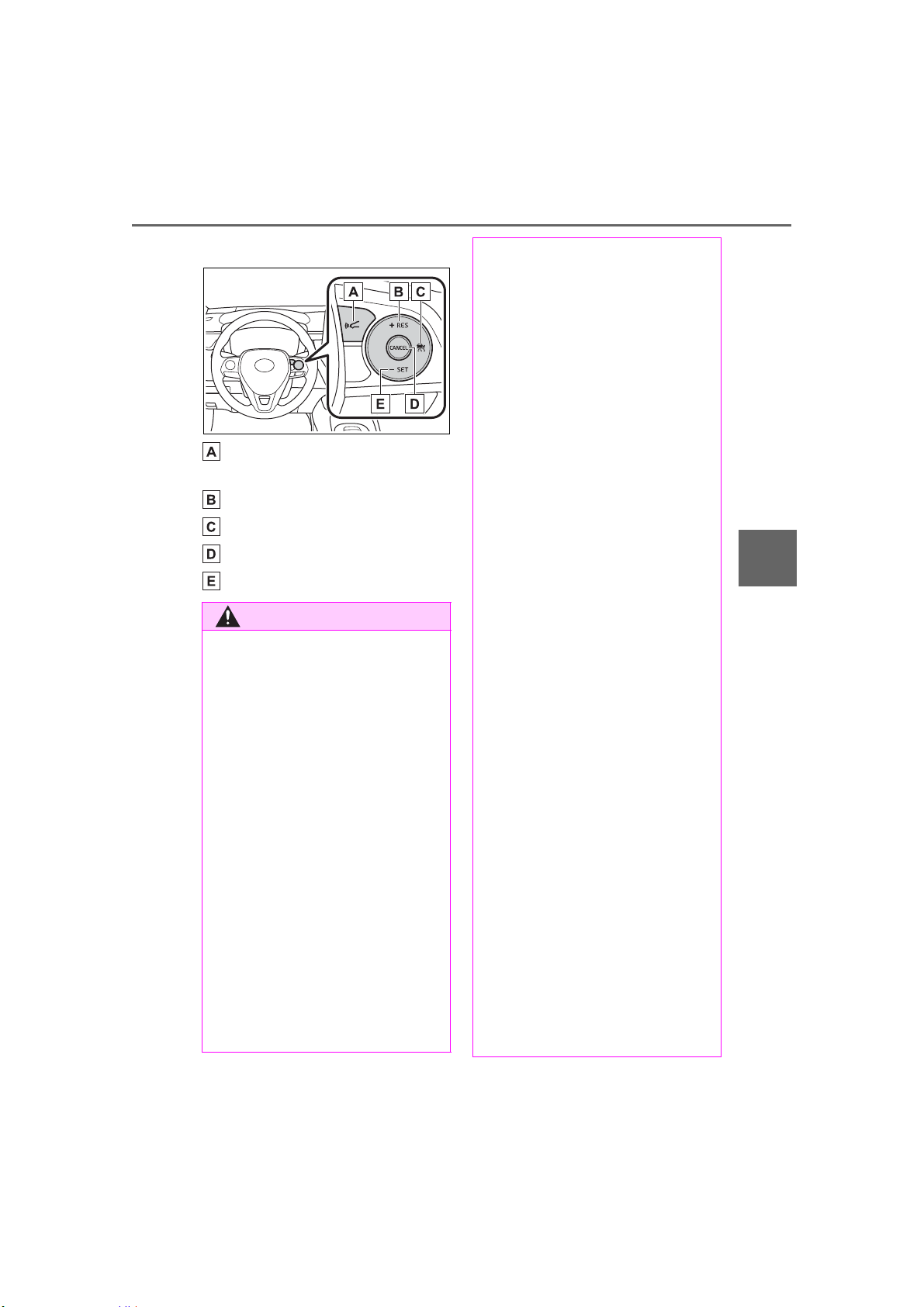
215
4-5. Using the driving support systems
COROLLA H/B_U
4
Driving
■ Operation switches
Vehicle-to-vehicle distance
switch
“+RES” switch
Cruise control main switch
Cancel switch
“-SET” switch
WARNING
■ Before using dynamic radar
cruise control
● Driving safely is the sole
responsibility of the driver. Do
not rely solely on the system,
and drive safely by always pay-
ing careful attention to your sur-
roundings.
● The dynamic radar cruise con-
trol provides driving assistance
to reduce the driver’s burden.
However, there are limitations to
the assistance provided.
Read the following conditions
carefully. Do not overly rely on
this system and always drive
carefully.
• When the sensor may not be
correctly detecting the vehicle
ahead:
P.222
• Conditions under which the
vehicle-to-vehicle distance con-
trol mode may not function cor-
rectly:
P.2 23
● Set the speed appropriately
depending on the speed limit,
traffic flow, road conditions,
weather conditions, etc. The
driver is responsible for check-
ing the set speed.
● Even when the system is func-
tioning normally, the condition of
the preceding vehicle as
detected by the system may dif-
fer from the condition observed
by the driver. Therefore, the
driver must always remain alert,
assess the danger of each situ-
ation and drive safely. Relying
solely on this system or assum-
ing the system ensures safety
while driving can lead to an
accident, resulting in death or
serious injury.
● Switch the dynamic radar cruise
control setting to off, using the
cruise control main switch when
not in use.
■ Cautions regarding the driv-
ing assist systems
Observe the following precau-
tions, as there are limitations to
the assistance provided by the
system.
Failure to do so may cause an
accident resulting in death or seri-
ous injury.
● Assisting the driver to measure
following distance
The dynamic radar cruise control
is only intended to help the driver
in determining the following dis-
tance between the driver’s own
vehicle and a designated vehicle
traveling ahead. It is not a mecha-
nism that allows careless or inat-
tentive driving, and it is not a
system that can assist the driver
in low-visibility conditions.
It is still necessary for driver to
pay close attention to the vehi-
cle’s surroundings.

216
4-5. Using the driving support systems
COROLLA H/B_U
WARNING
● Assisting the driver to judge
proper following distance
The dynamic radar cruise control
determines whether the following
distance between the driver’s own
vehicle and a designated vehicle
traveling ahead is within a set
range. It is not capable of making
any other type of judgement.
Therefore, it is absolutely neces-
sary for the driver to remain vigi-
lant and to determine whether or
not there is a possibility of danger
in any given situation.
● Assisting the driver to operate
the vehicle
The dynamic radar cruise control
does not include functions which
will prevent or avoid collisions
with vehicles ahead of your vehi-
cle. Therefore, if there is ever any
possibility of danger, the driver
must take immediate and direct
control of the vehicle and act
appropriately in order to ensure
the safety of all involved.
■ Situations unsuitable for
dynamic radar cruise control
Do not use dynamic radar cruise
control in any of the following situ-
ations.
Doing so may result in inappropri-
ate speed control and could
cause an accident resulting in
death or serious injury.
● Roads where there are pedes-
trians, cyclists, etc.
● In heavy traffic
● On roads with sharp bends
● On winding roads
● On slippery roads, such as
those covered with rain, ice or
snow
● On steep downhills, or where
there are sudden changes
between sharp up and down
gradients
Vehicle speed may exceed the
set speed when driving down a
steep hill.
● At entrances to freeways and
highways
● When weather conditions are
bad enough that they may pre-
vent the sensors from detecting
correctly (fog, snow, sand-
storm, heavy rain, etc.)
● When there is rain, snow, etc.
on the front surface of the radar
or front camera
● In traffic conditions that require
frequent repeated acceleration
and deceleration
● During emergency towing
● When an approach warning
buzzer is heard often
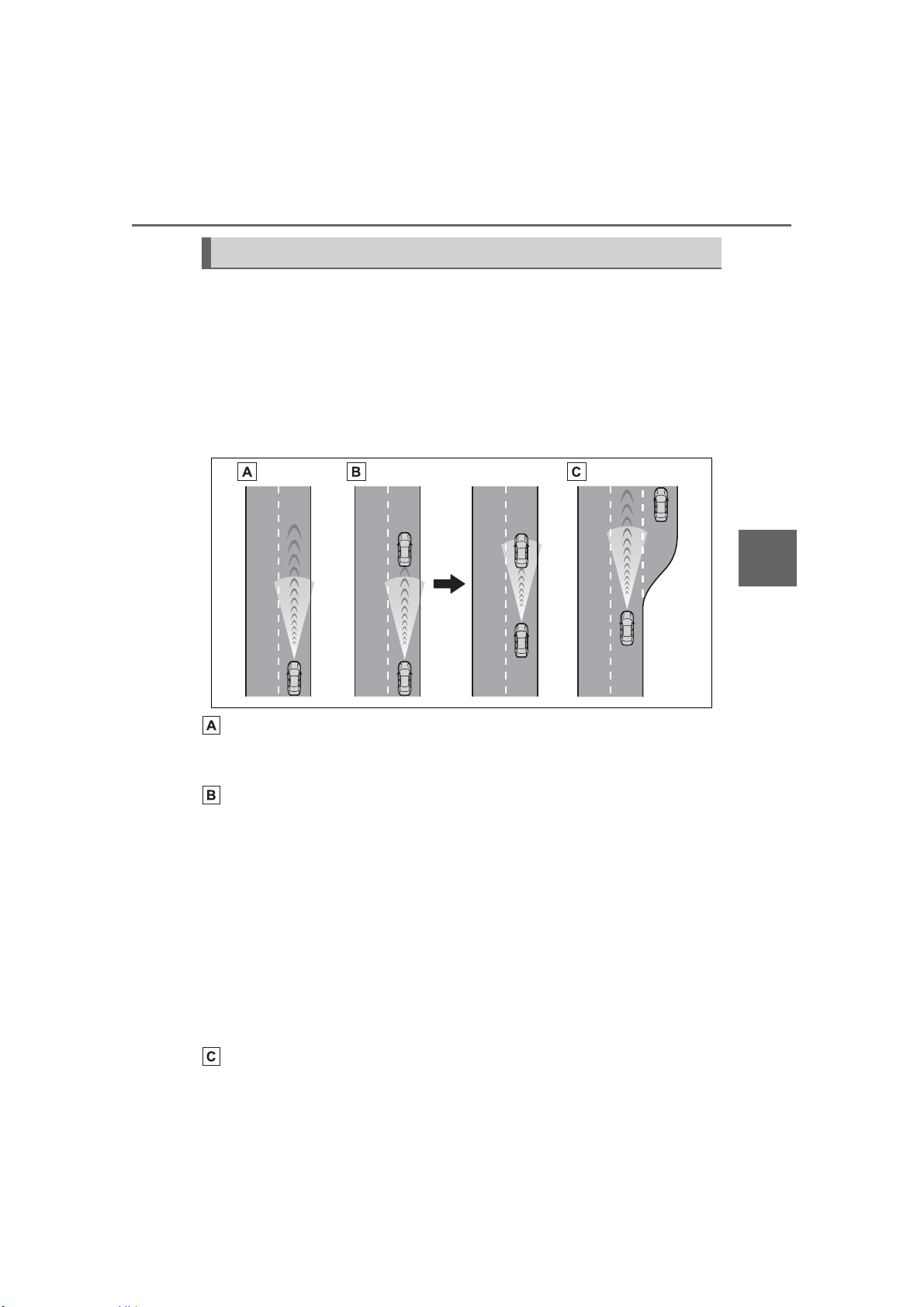
217
4-5. Using the driving support systems
COROLLA H/B_U
4
Driving
This mode employs a radar to detect the presence of vehicles up to
approximately 328 ft. (100 m) ahead, determines the current vehi-
cle-to-vehicle following distance, and operates to maintain a suitable
following distance from the vehicle ahead. The desired vehi-
cle-to-vehicle distance can also be set by operating the vehi-
cle-to-vehicle distance switch.
When driving on downhill slopes, the vehicle-to-vehicle distance may
become shorter.
Example of constant speed cruising
When there are no vehicles ahead
The vehicle travels at the speed set by the driver.
Example of deceleration cruising and follow-up cruising
When a preceding vehicle driving slower than the set speed
appears
When a vehicle is detected running ahead of you, the system automatically
decelerates your vehicle. When a greater reduction in vehicle speed is nec-
essary, the system applies the brakes (the stop lights will come on at this
time). The system will respond to changes in the speed of the vehicle
ahead in order to maintain the vehicle-to-vehicle distance set by the driver.
Approach warning warns you when the system cannot decelerate suffi-
ciently to prevent your vehicle from closing in on the vehicle ahead.
When the turn signal lever is operated and your vehicle moves to a left lane
while driving at 50 mph (80 km/h) or more, the vehicle will quickly acceler-
ate to help to overtake a passing vehicle.
Example of acceleration
Driving in vehicle-to-vehicle distance control mode
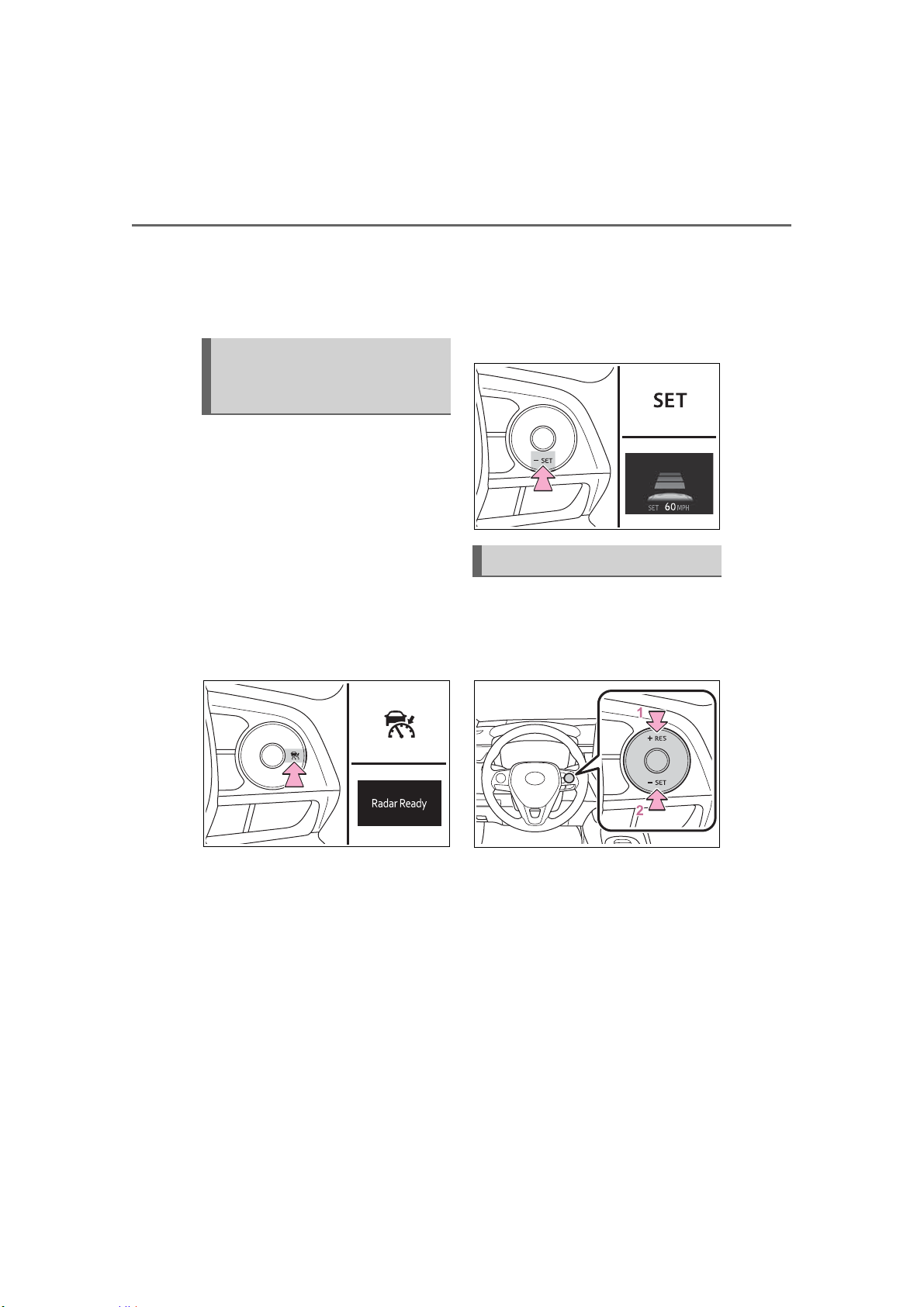
218
4-5. Using the driving support systems
COROLLA H/B_U
When there are no longer any preceding vehicles driving slower
than the set speed
The system accelerates until the set speed is reached. The system then
returns to constant speed cruising.
1 Press the cruise control main
switch to activate the cruise
control.
Dynamic radar cruise control indi-
cator will come on and a message
will be displayed on the multi-infor-
mation display. Press the switch
again to deactivate the cruise con-
trol.
If the cruise control main switch is
pressed and held for 1.5 seconds
or more, the system turns on in
constant speed control mode.
(P.221)
2 Accelerate or decelerate,
with accelerator pedal opera-
tion, to the desired vehicle
speed (at or above approxi-
mately 20 mph [30 km/h])
and press the “-SET” switch
to set the speed.
Cruise control “SET” indicator will
come on.
The vehicle speed at the moment
the switch is released becomes the
set speed.
To change the set speed, press
the “+RES” or “-SET” switch
until the desired set speed is
displayed.
1 Increases the speed
2 Decreases the speed
Fine adjustment: Press the switch.
Large adjustment: Press and hold
the switch to change the speed,
and release when the desired
speed is reached.
In the vehicle-to-vehicle dis-
tance control mode, the set
speed will be increased or
Setting the vehicle speed
(vehicle-to-vehicle dis-
tance control mode)
Adjusting the set speed
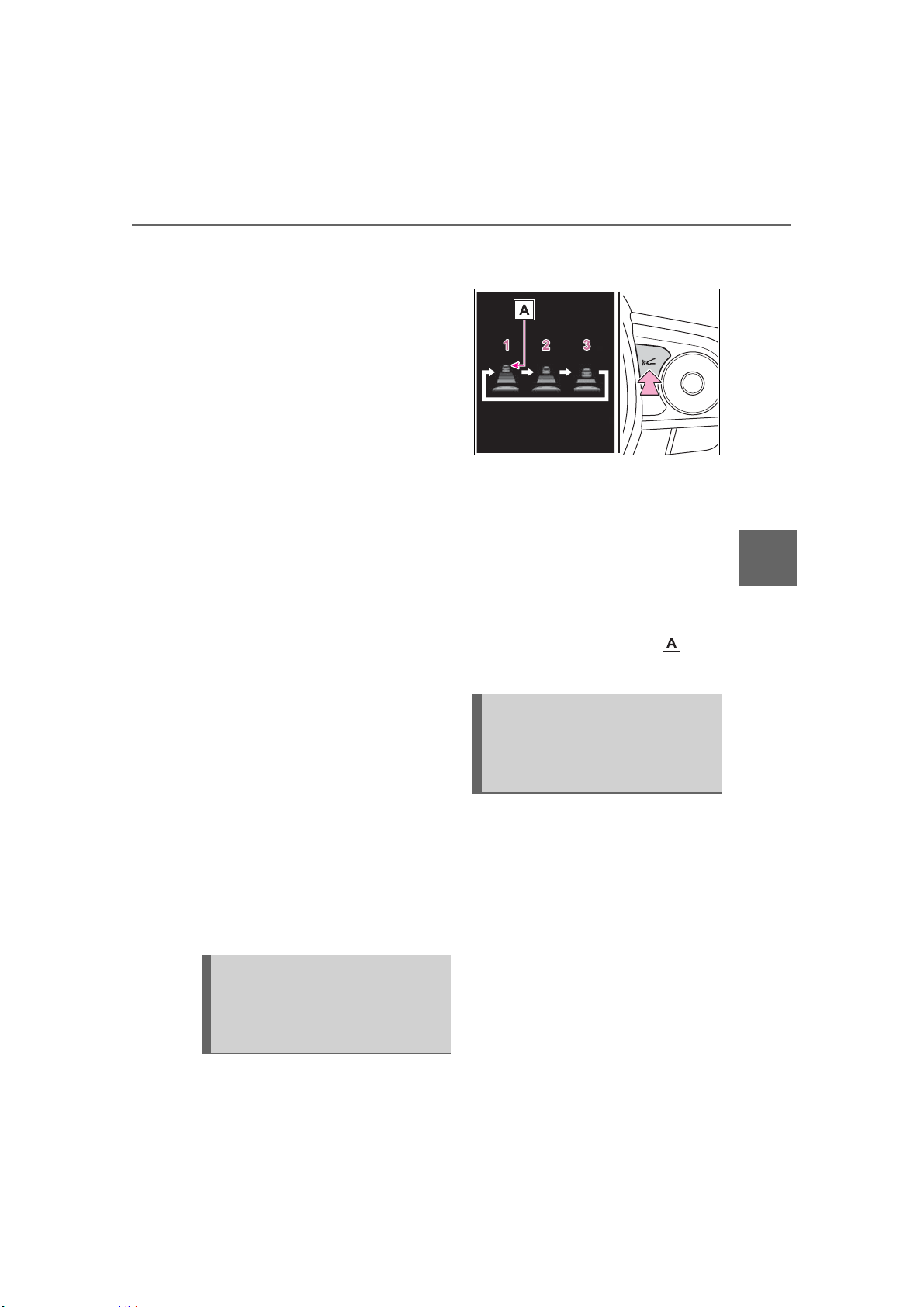
219
4-5. Using the driving support systems
COROLLA H/B_U
4
Driving
decreased as follows:
For the U.S. mainland, Hawaii
Fine adjustment: By 1 mph (1.6
km/h)
*1
or 1 km/h (0.6 mph)
*2
each
time the switch is pressed
Large adjustment: Increases or
decreases in 1 mph (1.6 km/h)
*1
or
1 km/h (0.6 mph)
*2
increments for
as long as the switch is held
For Canada, Guam and
Puerto Rico
Fine adjustment: By 1 mph (1.6
km/h)
*1
or 1 km/h (0.6 mph)
*2
each
time the switch is pressed
Large adjustment: Increases or
decreases in 5 mph (8 km/h)
*1
or 5
km/h (3.1 mph)
*2
increments for as
long as the switch is held
In the constant speed control
mode (P.221), the set speed
will be increased or decreased
as follows:
Fine adjustment: By 1 mph (1.6
km/h)
*1
or 1 km/h (0.6 mph)
*2
each
time the switch is pressed
Large adjustment: The speed will
continue to change while the switch
is held.
*1
:When the set speed is shown in
“MPH”
*2
:When the set speed is shown in
“km/h”
Pressing the switch changes the
vehicle-to-vehicle distance as
follows:
1 Long
2 Medium
3 Short
The vehicle-to-vehicle distance is
set automatically to long mode
when the engine switch is turned to
ON.
If a vehicle is running ahead of you,
the preceding vehicle mark will
also be displayed.
Select a distance from the table
below. Note that the distances
shown correspond to a vehicle
speed of 50 mph (80 km/h).
Vehicle-to-vehicle distance
increases/decreases in accor-
dance with vehicle speed.
Changing the vehi-
cle-to-vehicle distance
(vehicle-to-vehicle dis-
tance control mode)
Vehicle-to-vehicle dis-
tance settings (vehi-
cle-to-vehicle distance
control mode)
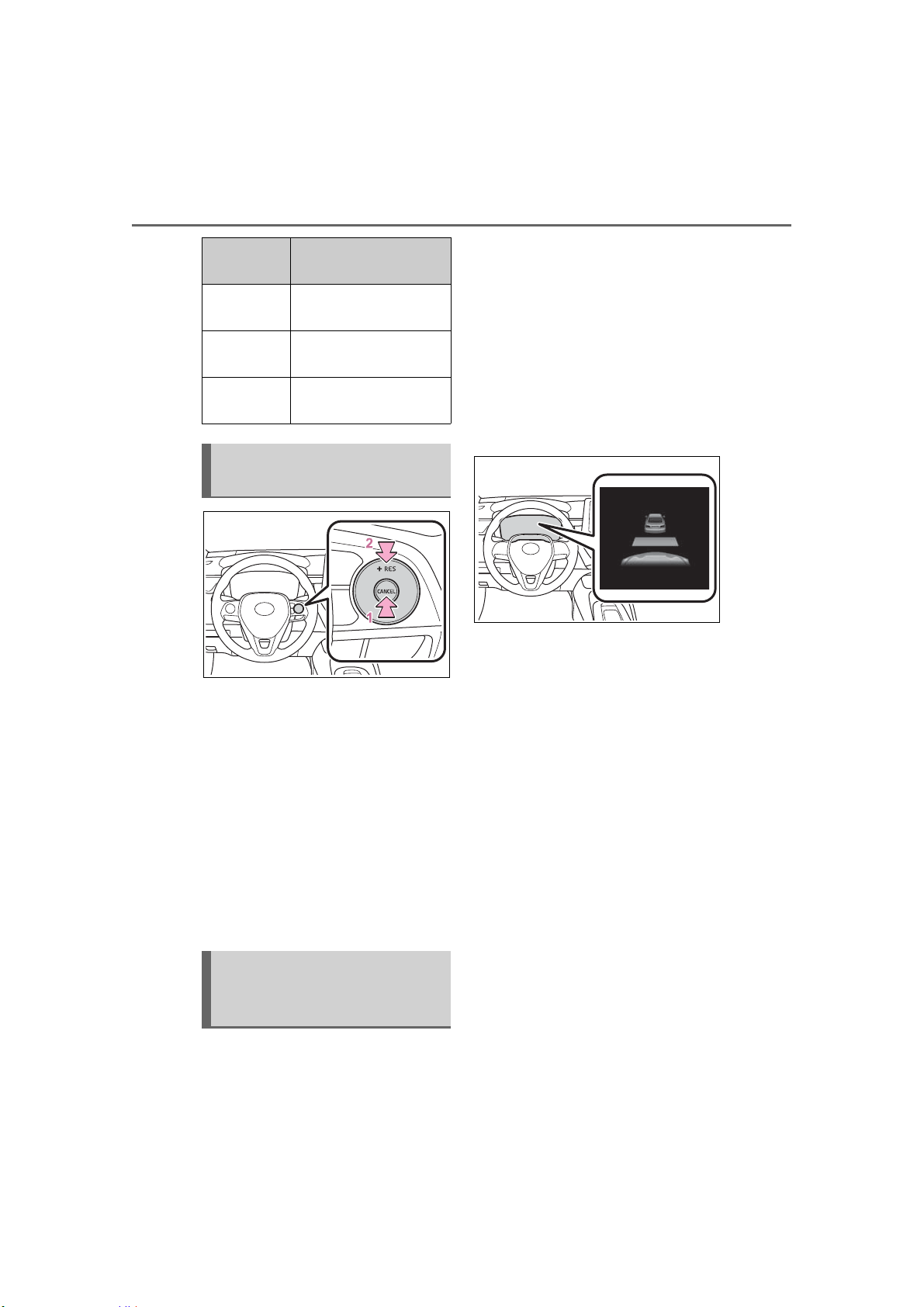
220
4-5. Using the driving support systems
COROLLA H/B_U
1 Pressing the cancel switch
cancels the speed control.
The speed control is also canceled
when the brake pedal is depressed.
2 Pressing the “+RES” switch
resumes the cruise control
and returns vehicle speed to
the set speed.
However, cruise control does not
resume when the vehicle speed is
approximately 16 mph (25 km/h) or
less.
When your vehicle is too close
to a vehicle ahead, and suffi-
cient automatic deceleration via
the cruise control is not possi-
ble, the display will flash and the
buzzer will sound to alert the
driver. An example of this would
be if another driver cuts in front
of you while you are following a
vehicle. Depress the brake
pedal to ensure an appropriate
vehicle-to-vehicle distance.
■ Warnings may not occur
when
In the following instances, warn-
ings may not occur even when
the vehicle-to-vehicle distance is
small.
When the speed of the pre-
ceding vehicle matches or
exceeds your vehicle speed
When the preceding vehicle is
traveling at an extremely slow
speed
Immediately after the cruise
control speed was set
When depressing the acceler-
ator pedal
Distance
options
Vehicle-to-vehicle dis-
tance
Long
Approximately 160 ft.
(50 m)
Medium
Approximately 130 ft.
(40 m)
Short
Approximately 100 ft.
(30 m)
Canceling and resuming
the speed control
Approach warning (vehi-
cle-to-vehicle distance
control mode)
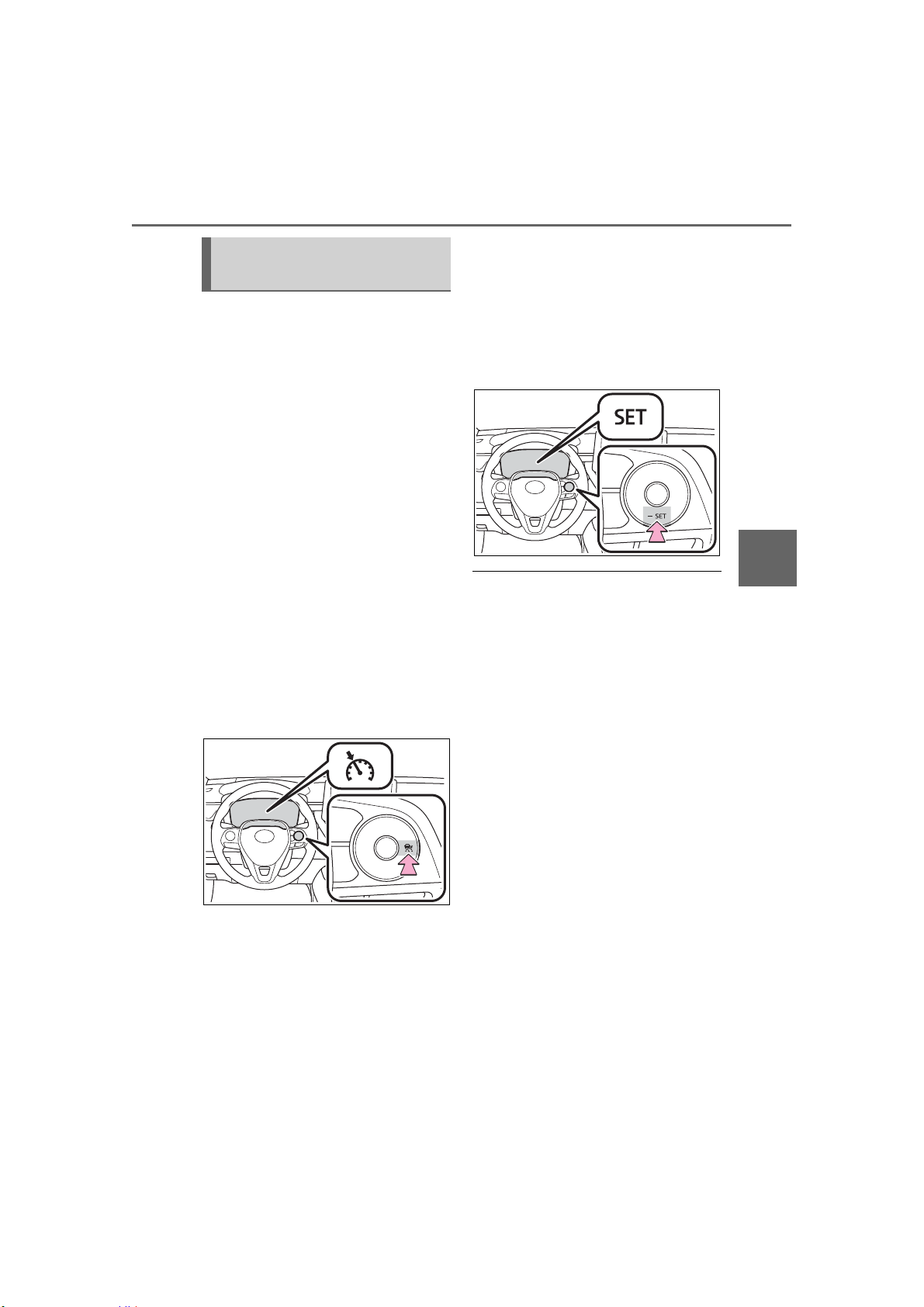
221
4-5. Using the driving support systems
COROLLA H/B_U
4
Driving
When constant speed control
mode is selected, your vehicle
will maintain a set speed without
controlling the vehicle-to-vehi-
cle distance. Select this mode
only when vehicle-to-vehicle dis-
tance control mode does not
function correctly due to a dirty
radar, etc.
1 With the cruise control off,
press and hold the cruise
control main switch for 1.5
seconds or more.
Immediately after the switch is
pressed, the dynamic radar cruise
control indicator will come on. After-
wards, it switches to the cruise con-
trol indicator.
Switching to constant speed control
mode is only possible when operat-
ing the switch with the cruise con-
trol off.
2 Accelerate or decelerate,
with accelerator pedal opera-
tion, to the desired vehicle
speed (at or above approxi-
mately 20 mph [30 km/h])
and press the “-SET” switch
to set the speed.
Cruise control “SET” indicator will
come on.
The vehicle speed at the moment
the switch is released becomes the
set speed.
Adjusting the speed setting:
P.218
Canceling and resuming the speed
setting: P. 2 20
■ Dynamic radar cruise control
can be set when
● The shift lever is in range 2nd or
higher.
● Depending on the control mode,
this item can be set at the follow-
ing speeds.
• Vehicle-to-vehicle distance con-
trol mode: Approximately 20 mph
(30 km/h) or more
• Constant speed control mode:
Approximately 20 mph (30 km/h)
or more
■ Accelerating after setting the
vehicle speed
The vehicle can accelerate by oper-
ating the accelerator pedal. After
accelerating, the set speed
resumes. However, during vehi-
cle-to-vehicle distance control
mode, the vehicle speed may
decrease below the set speed in
order to maintain the distance to the
preceding vehicle.
■ Shift position selection
Select a shift position according to
the vehicle speed. If the engine
speed is too high or too low, control
may be automatically canceled.
Selecting constant speed
control mode
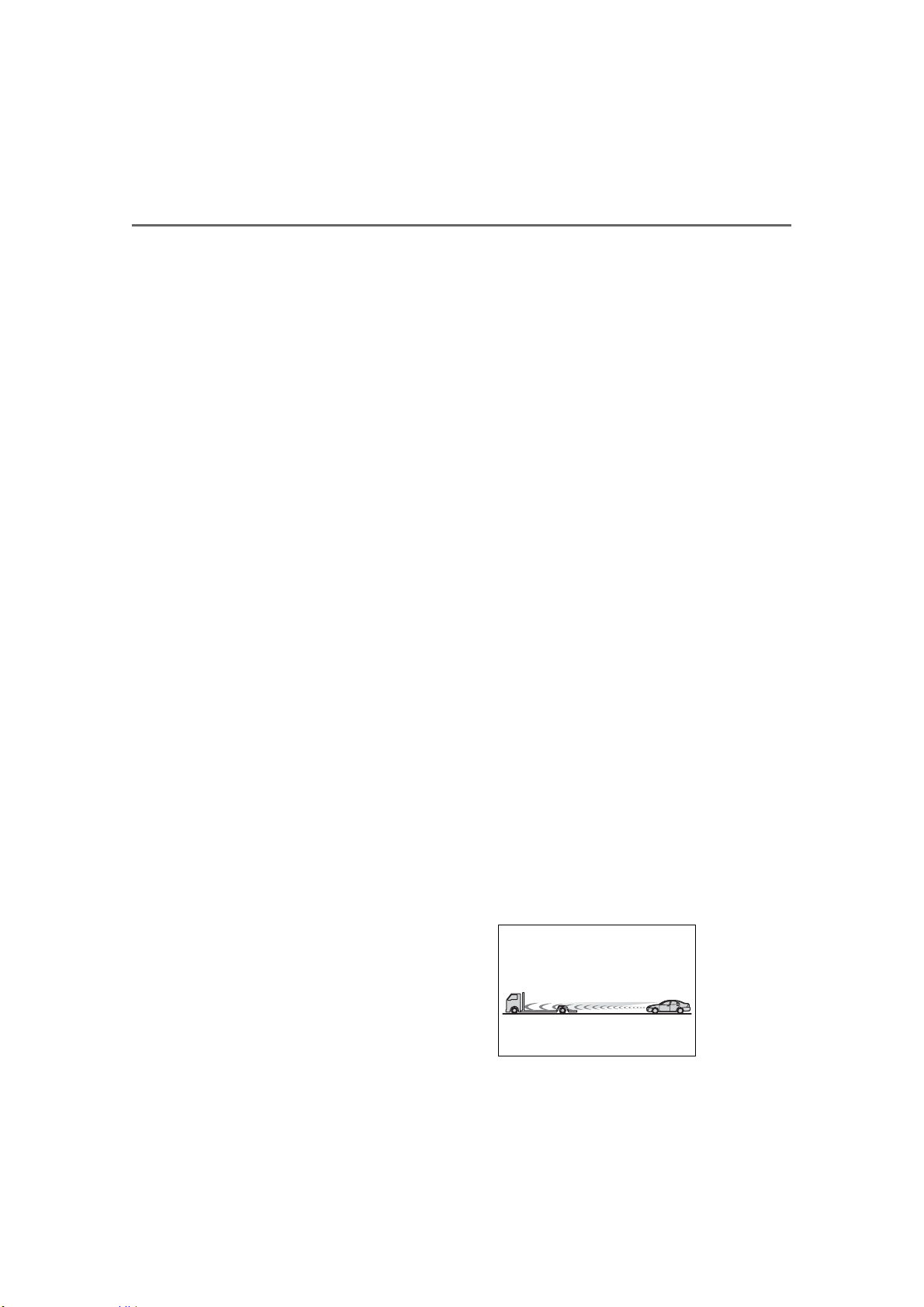
222
4-5. Using the driving support systems
COROLLA H/B_U
■ Automatic cancelation of vehi-
cle-to-vehicle distance control
mode
Vehicle-to-vehicle distance control
mode is automatically canceled in
the following situations.
● Actual vehicle speed falls below
approximately 16 mph (25 km/h).
● VSC is activated.
● TRAC is activated for a period of
time.
● When the VSC or TRAC system is
turned off.
● The sensor cannot detect cor-
rectly because it is covered in
some way.
● Pre-collision braking is activated.
● When the shift lever is in N or the
clutch pedal is depressed for a
certain amount of time or more.
If vehicle-to-vehicle distance control
mode is automatically canceled for
any reasons other than the above,
there may be a malfunction in the
system. Contact your Toyota dealer.
■ Automatic cancelation of con-
stant speed control mode
Constant speed control mode is
automatically canceled in the follow-
ing situations:
● Actual vehicle speed is more than
approximately 10 mph (16 km/h)
below the set vehicle speed.
● Actual vehicle speed falls below
approximately 20 mph (30 km/h).
● VSC is activated.
● TRAC is activated for a period of
time.
● When the VSC or TRAC system is
turned off.
● Pre-collision braking is activated.
● When the shift lever is in N or the
clutch pedal is depressed for a
certain amount of time or more.
If constant speed control mode is
automatically canceled for any rea-
sons other than the above, there
may be a malfunction in the system.
Contact your Toyota dealer.
■ Brake operation
A brake operation sound may be
heard and the brake pedal response
may change, but these are not mal-
functions.
■ Warning messages and buzzers
for dynamic radar cruise con-
trol
Warning messages and buzzers are
used to indicate a system malfunc-
tion or to inform the driver of the
need for caution while driving. If a
warning message is shown on the
multi-information display, read the
message and follow the instructions.
(P.172, 477)
■ When the sensor may not be
correctly detecting the vehicle
ahead
In the case of the following and
depending on the conditions, oper-
ate the brake pedal when decelera-
tion of the system is insufficient or
operate the accelerator pedal when
acceleration is required.
As the sensor may not be able to
correctly detect these types of vehi-
cles, the approach warning
(P.220) may not be activated.
● Vehicles that cut in suddenly
● Vehicles traveling at low speeds
● Vehicles that are not moving in the
same lane
● Vehicles with small rear ends
(trailers with no load on board,
etc.)
● Motorcycles traveling in the same
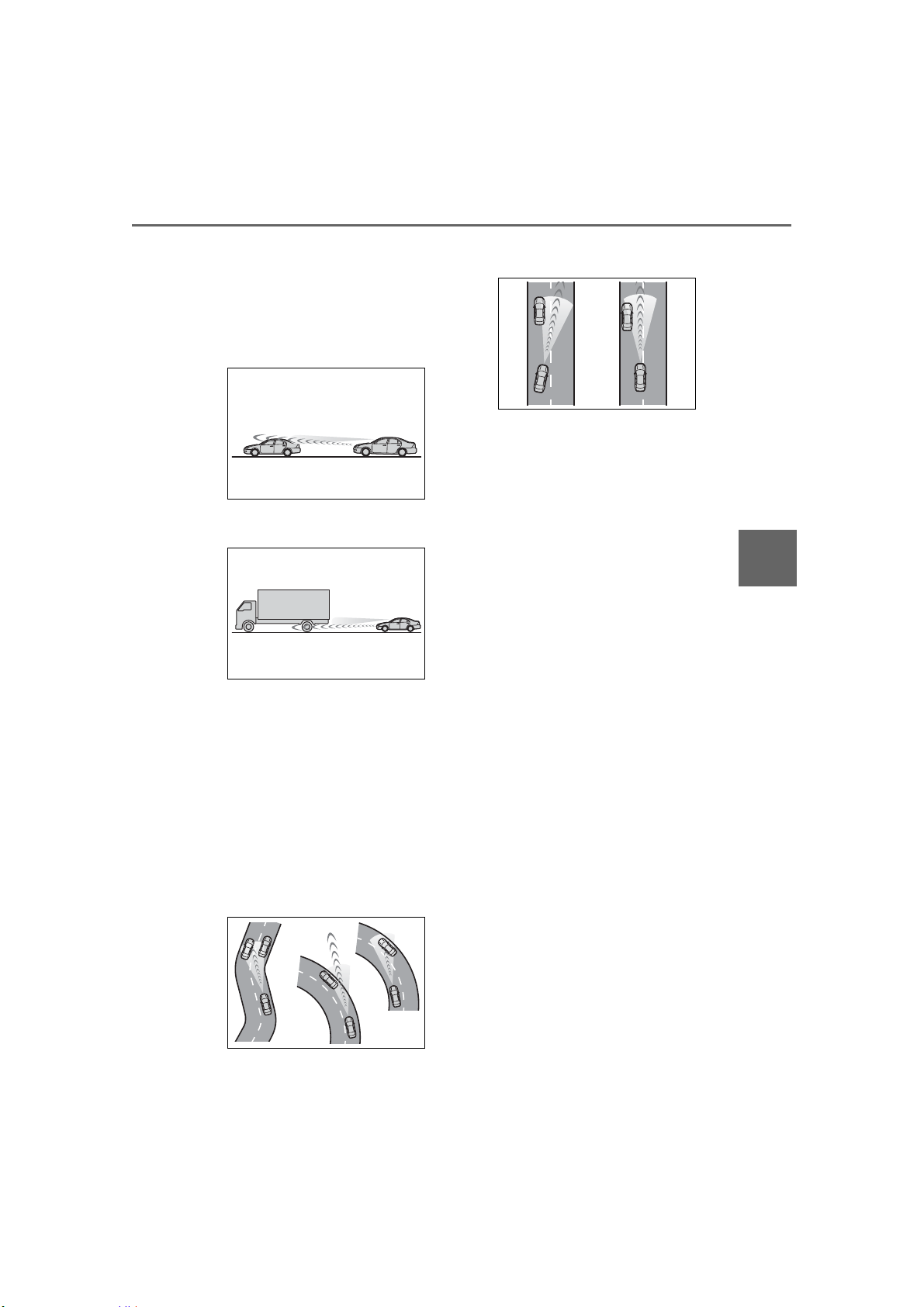
223
4-5. Using the driving support systems
COROLLA H/B_U
4
Driving
lane
● When water or snow thrown up by
the surrounding vehicles hinders
the detecting of the sensor
● When your vehicle is pointing
upwards (caused by a heavy load
in the luggage compartment, etc.)
● Preceding vehicle has an
extremely high ground clearance
■ Conditions under which the
vehicle-to-vehicle distance con-
trol mode may not function cor-
rectly
In the case of the following condi-
tions, operate the brake pedal (or
accelerator pedal, depending on the
situation) as necessary.
As the sensor may not be able to
correctly detect vehicles ahead, the
system may not operate properly.
● When the road curves or when the
lanes are narrow
● When steering wheel operation or
your position in the lane is unsta-
ble
● When the vehicle ahead of you
decelerates suddenly
● When driving on a road sur-
rounded by a structure, such as in
a tunnel or on a bridge
● While the vehicle speed is
decreasing to the set speed after
the vehicle accelerates by
depressing the accelerator pedal
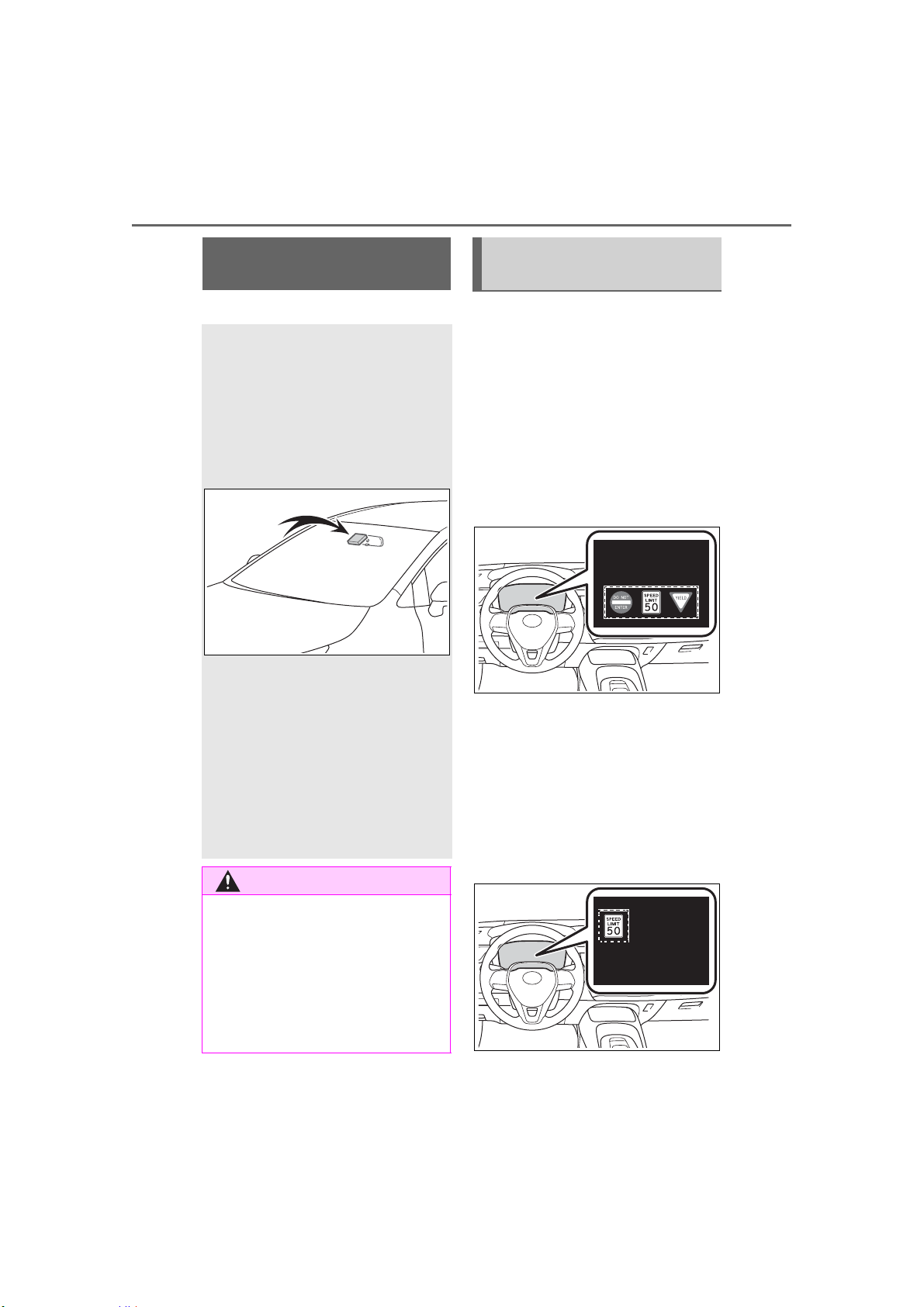
224
4-5. Using the driving support systems
COROLLA H/B_U
*
: If equipped
When the front camera recog-
nizes a sign and/or information
of a sign is available from the
navigation system, the sign will
be displayed on the multi-infor-
mation display.
When the driving support sys-
tem information is selected, a
maximum of 3 signs can be
displayed. (P.82)
When a tab other than the
driving support system infor-
mation is selected, the follow-
ing types of road signs will be
displayed. (P.82)
• Speed limit sign
• Do Not Enter sign (when notifica-
tion is necessary)
If signs other than speed limit signs
RSA (Road Sign
Assist)
*
The RSA system recognizes
specific road signs using
the front camera and/or nav-
igation system (when speed
limit information is avail-
able) to provide information
to the driver via the display.
If the system judges that the
vehicle is being driven over
the speed limit, performing
prohibited actions, etc. in
relation to the recognized
road signs, it notifies the
driver using a notification
display and notification
buzzer.
WARNING
■ Before using the RSA
Do not rely solely upon the RSA
system. RSA is a system which
supports the driver by providing
information, but it is not a replace-
ment for a driver’s own vision and
awareness. Drive safely by
always paying careful attention to
the traffic rules.
Indication on the
multi-information display
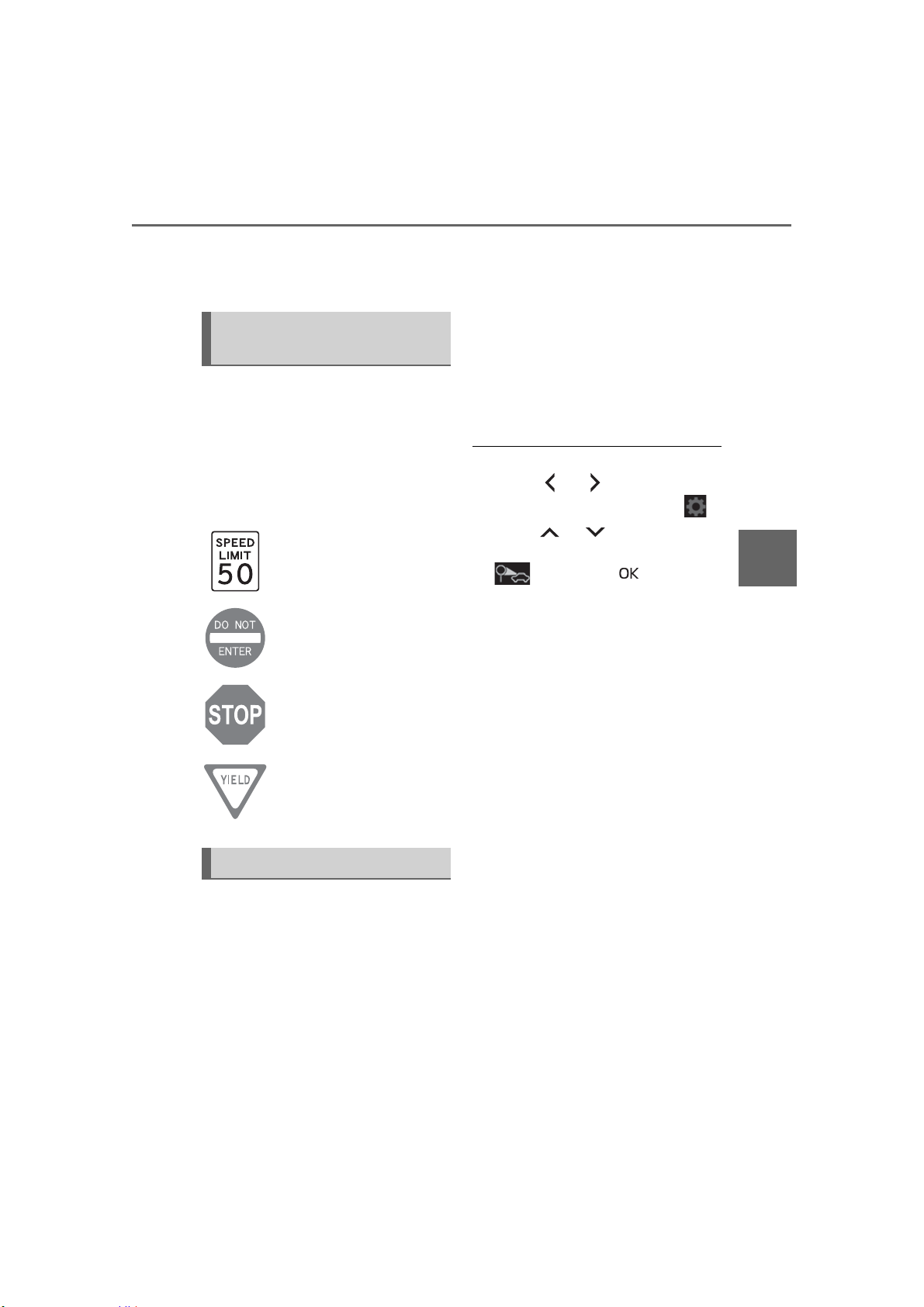
225
4-5. Using the driving support systems
COROLLA H/B_U
4
Driving
are recognized, they will be dis-
played in an overlapping stack
under the current speed limit sign.
The following types of road
signs, including electronic signs
and blinking signs, are recog-
nized.
A non-official or a recently intro-
duced traffic sign may not be recog-
nized.
Speed limit
Do Not Enter
Stop
Yield
In the following situations, the
RSA system will notify the
driver.
When the vehicle speed
exceeds the speed notifica-
tion threshold of the speed
limit sign displayed, the sign
display will be emphasized
and a buzzer will sound.
When the RSA system recog-
nizes a do not enter sign and
determines that your vehicle
has entered a no-entry area,
the displayed sign will flash
and a buzzer will sound.
Depending on the situation, a
notification function may not
operate properly.
■ Setting procedure
1 Press or of the meter
control switches and select
2 Press or of the meter
control switches and select
, then press
■ Automatic turn-off of RSA sign
display
In the following situations, displayed
speed limit and do not enter signs
will stop being displayed automati-
cally:
● A new sign is not recognized for a
certain distance.
● The road changes due to a left or
right turn, etc.
In the following situations, stop and
yield signs will stop being displayed
automatically:
● The system determines that your
vehicle has passed the sign.
● The road changes due to a left or
right turn, etc.
■ Conditions in which the func-
tion may not operate or detect
correctly
In the following situations, RSA
does not operate normally and may
not recognize signs, display the
incorrect sign, etc. However, this
does not indicate a malfunction.
● The front camera is misaligned
due to a strong impact being
Supported types of road
signs
Notification function

226
4-5. Using the driving support systems
COROLLA H/B_U
applied to the sensor, etc.
● Dirt, snow, stickers, etc. are on the
windshield near the front camera.
● In inclement weather such as
heavy rain, fog, snow or sand
storms
● Light from an oncoming vehicle,
the sun, etc. enters the front cam-
era.
● The sign is dirty, faded, tilted or
bent.
● The contrast of electronic sign is
low.
● All or part of the sign is hidden by
the leaves of a tree, a pole, etc.
● The sign is only visible to the front
camera for a short amount of time.
● The driving scene (turning, lane
change, etc.) is judged incorrectly.
● Even if it is a sign not appropriate
for the currently traveled lane,
such a sign exists directly after a
freeway branches, or in an adja-
cent lane just before merging.
● Stickers are attached to the rear of
the preceding vehicle.
● A sign resembling a system com-
patible sign is recognized.
● Side road speed signs may be
detected and displayed (if posi-
tioned in sight of the front camera)
while the vehicle is traveling on
the main road.
● Roundabout exit road speed signs
may be detected and displayed (if
positioned in sight of the front
camera) while traveling on a
roundabout.
● The front of the vehicle is raised or
lowered due to the carried load.
● The surrounding brightness is not
sufficient or changes suddenly.
● When a sign intended for trucks,
etc. is recognized.
● The speed information displayed
on the meter and that displayed
on the navigation system may be
different due to the navigation sys-
tem using map data.
■ Speed limit sign display
If the engine switch was last turned
off while a speed limit sign was dis-
played on the multi-information dis-
play, the same sign displays again
when the engine switch is turned to
ON.
■ If “RSA Malfunction Visit Your
Dealer” is shown
The system may be malfunctioning.
Have the vehicle inspected by your
Toyota dealer.
■ Customization
Some functions can be customized.
(Customizable features:P.531)
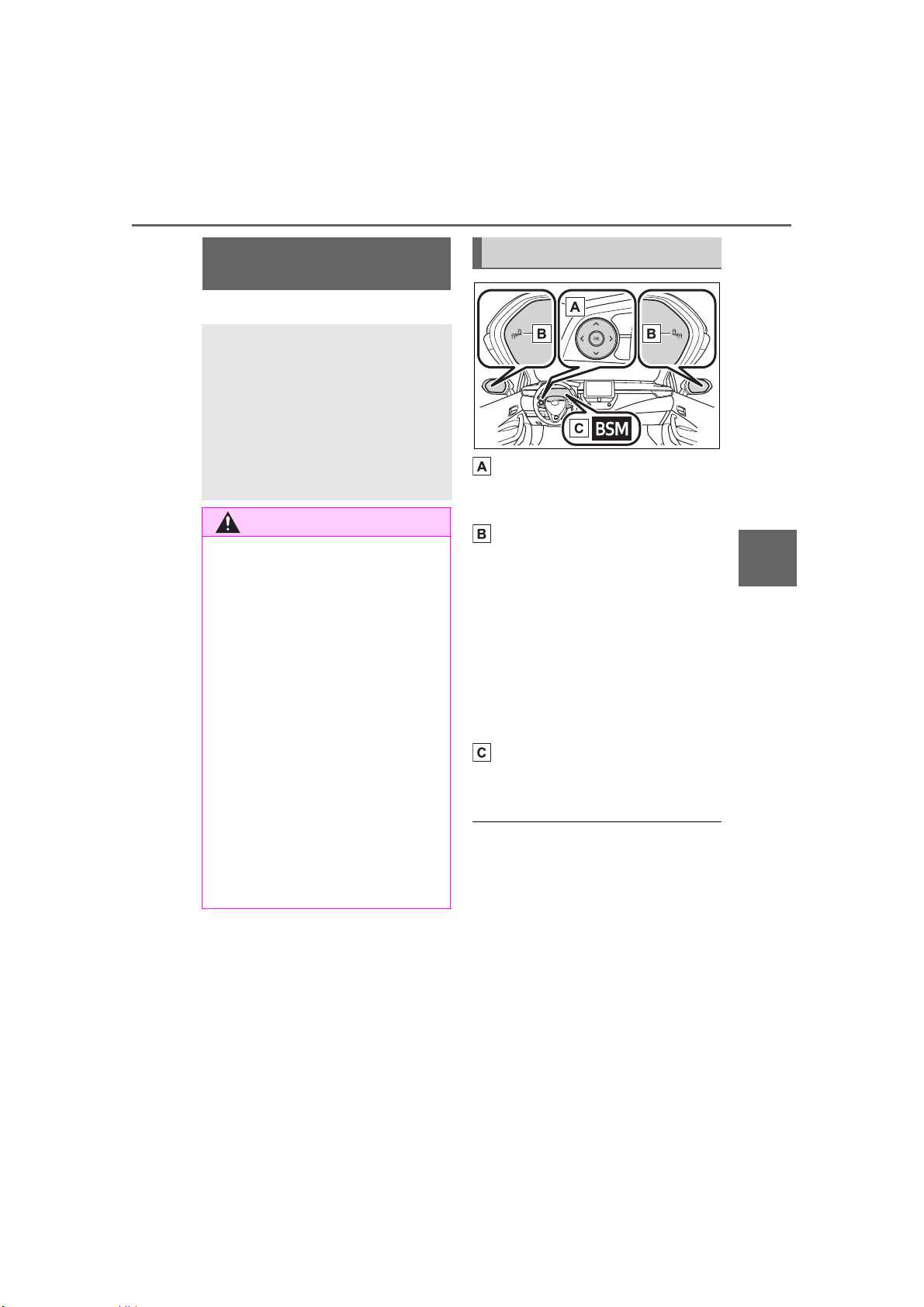
227
4-5. Using the driving support systems
COROLLA H/B_U
4
Driving
*
: If equipped
Meter control switches
Turning the Blind Spot Monitor
on/off.
Outside rear view mirror indi-
cators
When a vehicle is detected in a
blind spot of the outside rear view
mirrors or approaching rapidly from
behind into a blind spot, the outside
rear view mirror indicator on the
detected side will illuminate. If the
turn signal lever is operated toward
the detected side, the outside rear
view mirror indicator flashes.
BSM indicator
Illuminates when the Blind Spot
Monitor is enabled
■ Outside rear view mirror indica-
tor visibility
In strong sunlight, the outside rear
view mirror indicator may be difficult
to see.
■ When “Blind Spot Monitor
Unavailable” is shown on the
multi-information display
Ice, snow, mud, etc., may be
attached to the rear bumper around
the sensors. (P.229) The system
should return to normal operation
after removing the ice, snow, mud,
etc. from the rear bumper. Addition-
ally, the sensors may not operate
BSM (Blind Spot Moni-
tor)
*
The Blind Spot Monitor is a
system that uses rear side
radar sensors installed on
the inner side of the rear
bumper on the left and right
side to assist the driver in
confirming safety when
changing lanes.
WARNING
■ Cautions regarding the use of
the system
The driver is solely responsible for
safe driving. Always drive safely,
taking care to observe your sur-
roundings.
The Blind Spot Monitor is a sup-
plementary function which alerts
the driver that a vehicle is in a
blind spot of the outside rear view
mirrors or is approaching rapidly
from behind into a blind spot. Do
not overly rely on the Blind Spot
Monitor. As the function cannot
judge if it is safe to change lanes,
over reliance could lead to an
accident resulting in death or seri-
ous injury.
As the system may not function
correctly under certain condi-
tions, the driver’s own visual con-
firmation of safety is necessary.
System components
228
4-5. Using the driving support systems
COROLLA H/B_U
normally when driving in extremely
hot or cold environments.
■ When “Blind Spot Monitor Mal-
function Visit Your Dealer” is
shown on the multi-information
display
There may be a sensor malfunction
of misaligned. Have the vehicle
inspected by your Toyota dealer.
■ Customization
Some functions can be customized.
(P.531)
■ Certification
For vehicles sold in the U.S.A., Hawaii, Guam and Puerto Rico
For vehicles sold in Canada

229
4-5. Using the driving support systems
COROLLA H/B_U
4
Driving
Use the meter control switches
to turn on/off the function.
1 Press or to select .
2 Press or to select
and then press .
WARNING
■ Handling the rear side radar
sensor
Blind Spot Monitor sensors are
installed behind the left and right
sides of the rear bumper respec-
tively. Observe the following to
ensure the Blind Spot Monitor can
operate correctly.
● Keep the sensors and the sur-
rounding areas on the rear
bumper clean at all times.
If a sensor or its surrounding area
on the rear bumper is dirty or cov-
ered with snow, the Blind Spot
Monitor may not operate and a
warning message (P.227) will
be displayed. In this situation,
clear off the dirt or snow and drive
the vehicle with the operation con-
ditions of the BSM function
(P.231) satisfied for approxi-
mately 10 minutes. If the warning
message does not disappear,
have the vehicle inspected by
your Toyota dealer.
● Do not attach accessories,
stickers (including transparent
stickers), aluminum tape, etc. to
a sensor or its surrounding area
on the rear bumper.
● Do not subject a sensor or its
surrounding area on the rear
bumper to a strong impact.
If a sensor is moved even
slightly off position, the system
may malfunction and vehicles
may not be detected correctly.
In the following situations, have
your vehicle inspected by your
Toyota dealer.
• A sensor or its surrounding area
is subject to a strong impact.
• If the surrounding area of a sen-
sor is scratched or dented, or
part of them has become dis-
connected.
● Do not disassemble the sensor.
● Do not modify the sensor or sur-
rounding area on the rear
bumper.
● If a sensor or the rear bumper
needs to be removed/installed
or replaced, contact your Toyota
dealer.
● Do not paint the rear bumper
any color other than an official
Toyota color.
Turning the Blind Spot
Monitor on/off
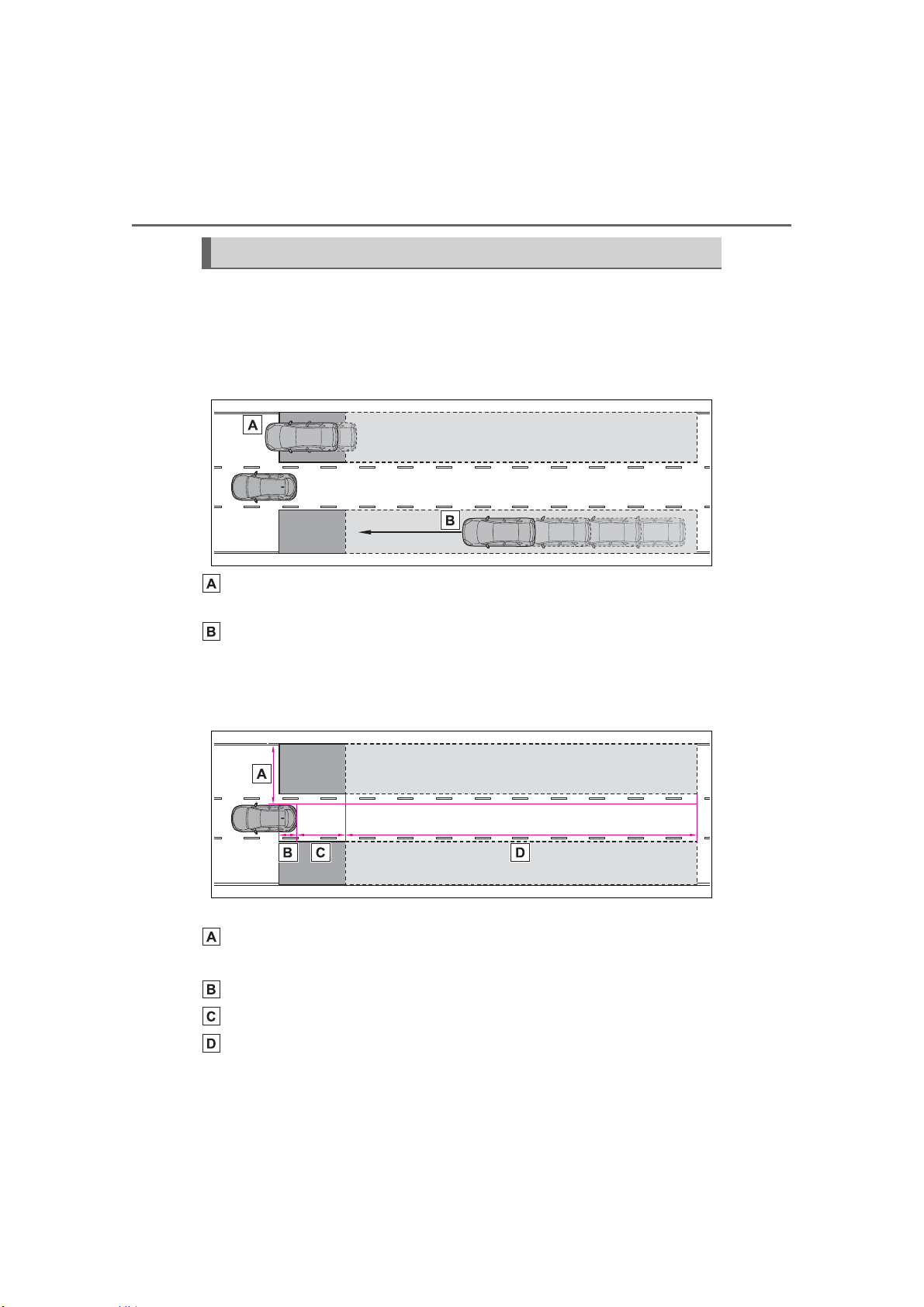
230
4-5. Using the driving support systems
COROLLA H/B_U
■ Vehicles that can be detected by the Blind Spot Monitor
The Blind Spot Monitor uses rear side radar sensors to detect the fol-
lowing vehicles traveling in adjacent lanes and advises the driver of
the presence of such vehicles via the indicators on the outside rear
view mirrors.
Vehicles that are traveling in areas that are not visible using the
outside rear view mirrors (the blind spots)
Vehicles that are approaching rapidly from behind in areas that
are not visible using the outside rear view mirrors (the blind spots)
■ The Blind Spot Monitor detection areas
The areas that vehicles can be detected in are outlined below.
The range of each detection area is:
Approximately 1.6 ft. (0.5 m) to 11.5 ft. (3.5 m) from either side of
the vehicle
*1
Approximately 3.3 ft. (1 m) forward of the rear bumper
Approximately 9.8 ft. (3 m) from the rear bumper
Approximately 9.8 ft. (3 m) to 197 ft. (60 m) from the rear
bumper
*2
Blind Spot Monitor operation

231
4-5. Using the driving support systems
COROLLA H/B_U
4
Driving
*1
:The area between the side of the vehicle and 1.6 ft. (0.5 m) from the side
of the vehicle cannot be detected.
*2
:The greater the difference in speed between your vehicle and the
detected vehicle is, the farther away the vehicle will be detected, causing
the outside rear view mirror indicator to illuminate or flash.
■ The Blind Spot Monitor is oper-
ational when
The Blind Spot Monitor is opera-
tional when all of the following con-
ditions are met:
● The Blind Spot Monitor is on.
● The shift lever is in a position
other than R.
● The vehicle speed is greater than
approximately 10 mph (16 km/h).
■ The Blind Spot Monitor will
detect a vehicle when
The Blind Spot Monitor will detect a
vehicle present in the detection area
in the following situations:
● A vehicle in an adjacent lane over-
takes your vehicle.
● You overtake a vehicle in adjacent
lane slowly.
● Another vehicle enters the detec-
tion area when it changes lanes.
■ Conditions under which the
Blind Spot Monitor will not
detect a vehicle
The Blind Spot Monitor is not
designed to detect the following
types of vehicles and/or objects:
● Small motorcycles, bicycles,
pedestrians, etc.
*
● Vehicles traveling in the opposite
direction
● Guardrails, walls, signs, parked
vehicles and similar stationary
objects
*
● Following vehicles that are in the
same lane
*
● Vehicles traveling 2 lanes away
from your vehicle
*
● Vehicles which are being over-
taken rapidly by your vehicle
*
*
: Depending on the conditions,
detection of a vehicle and/or
object may occur.
■ Conditions under which the
Blind Spot Monitor may not
function correctly
● The Blind Spot Monitor may not
detect vehicles correctly in the fol-
lowing situations:
• When the sensor is misaligned
due to a strong impact to the sen-
sor or its surrounding area
• When mud, snow, ice, a sticker,
etc. is covering the sensor or sur-
rounding area on the rear bumper
• When driving on a road surface
that is wet with standing water
during bad weather, such as
heavy rain, snow, or fog
• When multiple vehicles are
approaching with only a small gap
between each vehicle
• When the distance between your
vehicle and a following vehicle is
short
• When there is a significant differ-
ence in speed between your vehi-
cle and the vehicle that enters the
detection area
• When the difference in speed
between your vehicle and another
vehicle is changing
• When a vehicle enters a detection
area traveling at about the same
speed as your vehicle
• As your vehicle starts from a stop,
a vehicle remains in the detection
area
• When driving up and down con-
secutive steep inclines, such as
hills, dips in the road, etc.
• When driving on roads with sharp
bends, consecutive curves, or

232
4-5. Using the driving support systems
COROLLA H/B_U
uneven surfaces
• When vehicle lanes are wide, or
when driving on the edge of a
lane, and the vehicle in an adja-
cent lane is far away from your
vehicle
• When an accessory (such as a
bicycle carrier) is installed to the
rear of the vehicle
• When there is a significant differ-
ence in height between your vehi-
cle and the vehicle that enters the
detection area
• Immediately after the Blind Spot
Monitor is turned on
● Instances of the Blind Spot Moni-
tor unnecessarily detecting a vehi-
cle and/or object may increase in
the following situations:
• When the sensor is misaligned
due to a strong impact to the sen-
sor or its surrounding area
• When the distance between your
vehicle and a guardrail, wall, etc.
that enters the detection area is
short
• When driving up and down con-
secutive steep inclines, such as
hills, dips in the road, etc.
• When vehicle lanes are narrow, or
when driving on the edge of a
lane, and a vehicle traveling in a
lane other than the adjacent lanes
enters the detection area
• When driving on roads with sharp
bends, consecutive curves, or
uneven surfaces
• When the tires are slipping or
spinning
• When the distance between your
vehicle and a following vehicle is
short
• When an accessory (such as a
bicycle carrier) is installed to the
rear of the vehicle
The rear view image is dis-
played when the shift lever is in
R and the engine switch is in
ON.
Rear view monitor sys-
tem
Audio
The rear view monitor sys-
tem assists the driver by
displaying an image of the
view behind the vehicle with
fixed guide lines on the
screen while backing up, for
example while parking.
The screen illustrations
used in this text are
intended as examples, and
may differ from the image
that is actually displayed on
the screen.
Audio Plus or Premium
Audio
Owners of models equipped
with a navigation/multime-
dia system should refer to
the “NAVIGATION AND
MULTIMEDIA SYSTEM
OWNER’S MANUAL”.
System overview
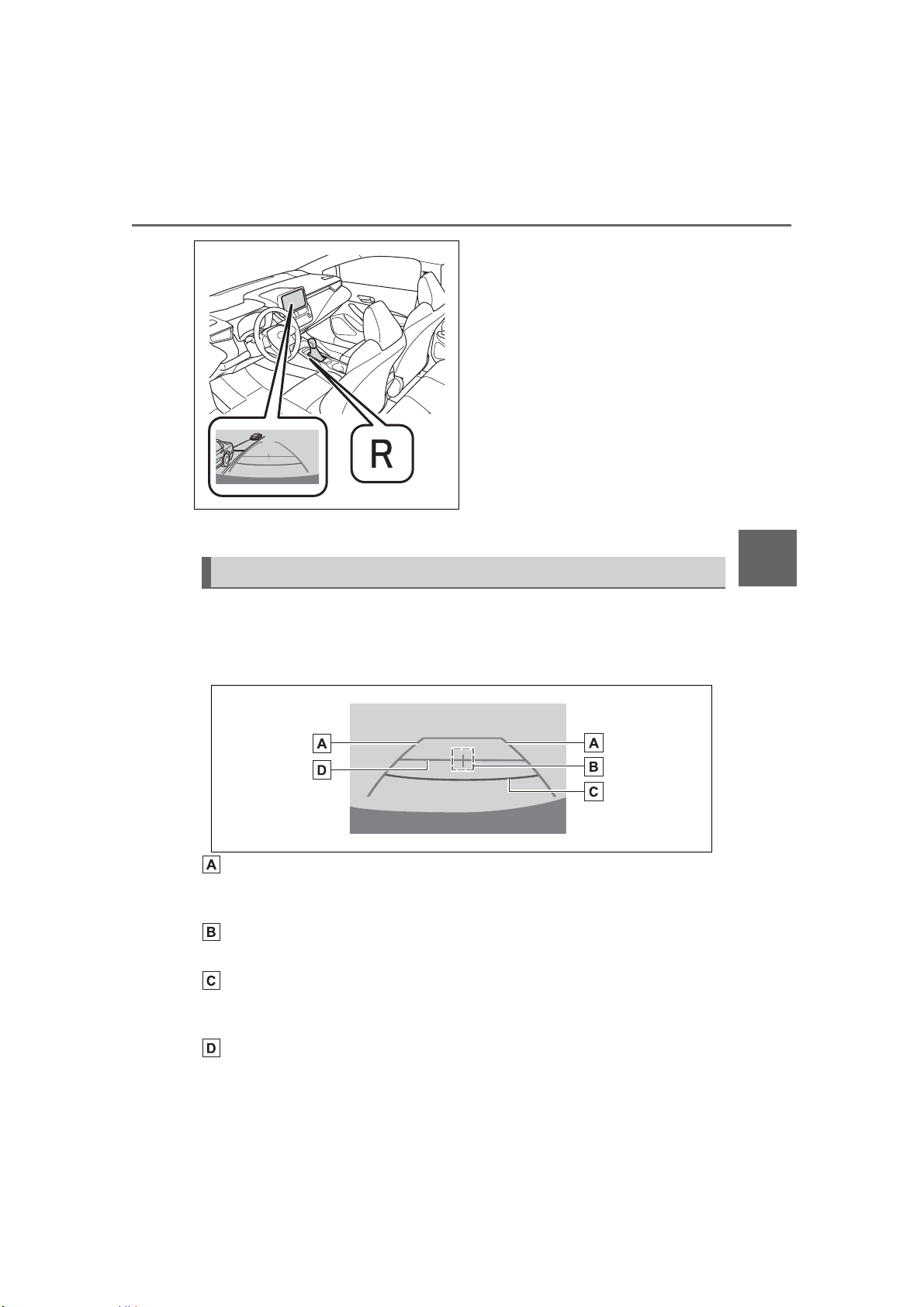
233
4-5. Using the driving support systems
COROLLA H/B_U
4
Driving
The rear view monitor system
will be deactivated when the
shift lever is shifted to any posi-
tion other than R.
■ Screen description
The rear view monitor system screen will be displayed if the shift
lever is shifted to R while the engine switch is in ON.
Vehicle width extension guide line
Displays a guide path when the vehicle is being backed straight up. The
displayed width is wider than the actual vehicle width.
Vehicle center guide line
This line indicates the estimated vehicle center on the ground.
Distance guide line
Displays a point approximately 1.5 ft. (0.5 m) (red) from the edge of the
bumper.
Distance guide line
Displays a point approximately 3 ft. (1 m) (blue) from the edge of the
Using the rear view monitor system
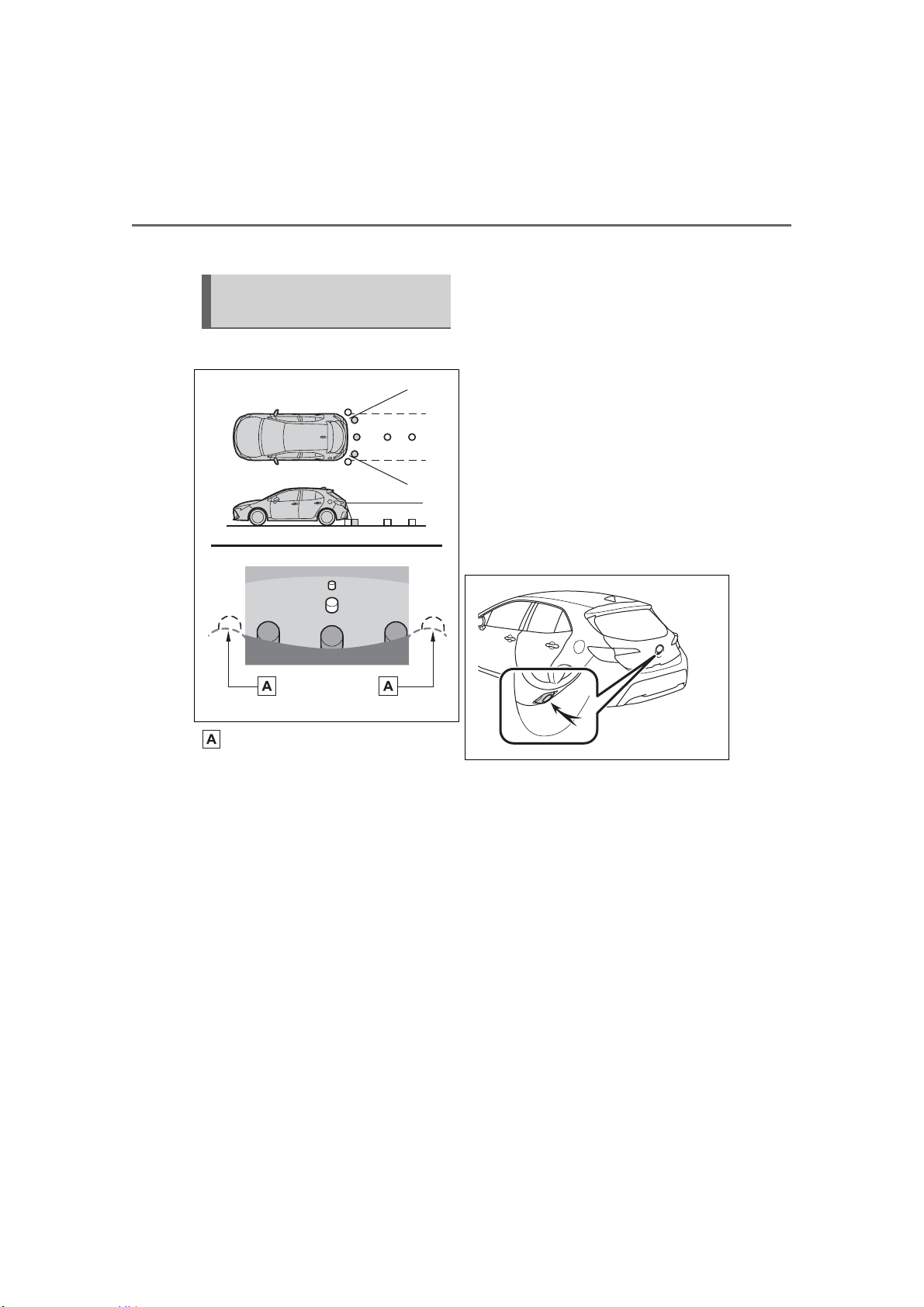
234
4-5. Using the driving support systems
COROLLA H/B_U
bumper.
■ Area displayed on screen
Corners of bumper
The rear view monitor system
displays an image of the view
from the bumper of the rear area
of the vehicle.
The image adjustment proce-
dure for the rear view monitor
system screen is the same as
the procedure for adjusting the
screen. (P.264)
The area displayed on the
screen may vary according to
vehicle orientation conditions.
Objects which are close to
either corner of the bumper or
under the bumper cannot be
displayed.
The camera uses a special
lens. The distance of the
image that appears on the
screen differs from the actual
distance.
Items which are located
higher than the camera may
not be displayed on the moni-
tor.
■ Rear view monitor system
camera
The camera for the rear view
monitor system is located as
shown in the illustration.
Using the camera
If dirt or foreign matter (such as
water droplets, snow, mud etc.) is
adhering to the camera, it cannot
transmit a clear image. In this case,
flush it with a large quantity of water
and wipe the camera lens clean
with a soft and wet cloth.
■ Differences between the
screen and the actual road
The distance guide lines and the
Rear view monitor system
precautions
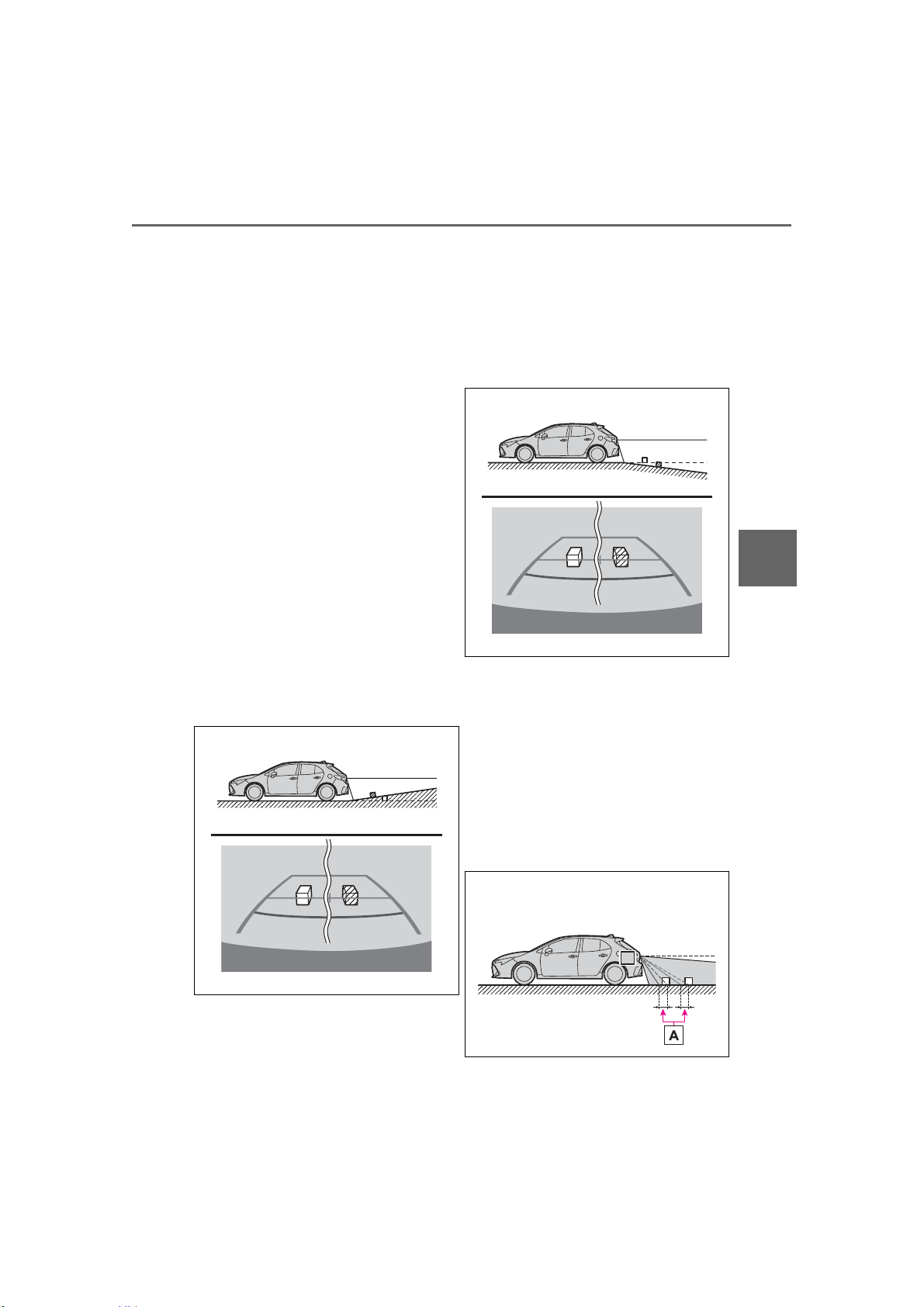
235
4-5. Using the driving support systems
COROLLA H/B_U
4
Driving
vehicle width guide lines may
not actually be parallel with the
dividing lines of the parking
space, even when they appear
to be so. Be sure to check visu-
ally.
The distances between the vehi-
cle width guide lines and the left
and right dividing lines of the
parking space may not be equal,
even when they appear to be
so. Be sure to check visually.
The distance guide lines give a
distance guide for flat road sur-
faces. In any of the following sit-
uations, there is a margin of
error between the fixed guide
lines on the screen and the
actual distance/course on the
road.
When the ground behind the
vehicle slopes up sharply
The distance guide lines will appear
to be closer to the vehicle than the
actual distance. Because of this,
objects will appear to be farther
away than they actually are. In the
same way, there will be a margin of
error between the guide lines and
the actual distance/course on the
road.
When the ground behind the
vehicle slopes down sharply
The distance guide lines will appear
to be further from the vehicle than
the actual distance. Because of
this, objects will appear to be closer
than they actually are. In the same
way, there will be a margin of error
between the guide lines and the
actual distance/course on the road.
When any part of the vehicle
sags
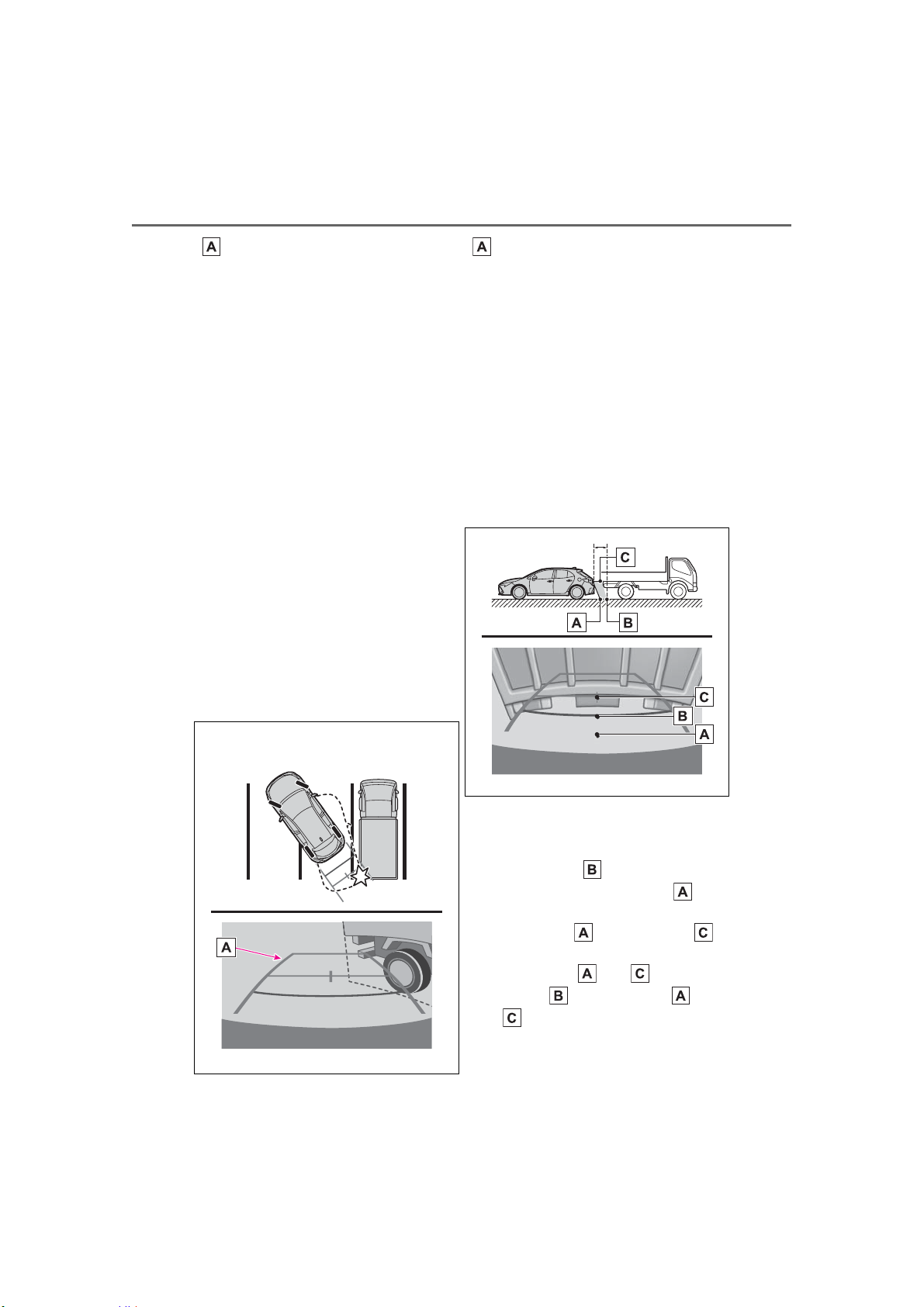
236
4-5. Using the driving support systems
COROLLA H/B_U
A margin of error
When any part of the vehicle sags
due to the number of passengers or
the distribution of the load, there is
a margin of error between the fixed
guide lines on the screen and the
actual distance/course on the road.
■ When approaching
three-dimensional objects
The distance guide lines are dis-
played according to flat surfaced
objects (such as the road). It is
not possible to determine the
position of three-dimensional
objects (such as vehicles) using
the distance guide lines. When
approaching a three-dimen-
sional object that extends out-
ward (such as the flatbed of a
truck), be careful of the follow-
ing.
Vehicle width guide lines
Vehicle width guide lines
Visually check the surroundings
and the area behind the vehicle. In
the case shown below, the truck
appears to be outside of the vehicle
width guide lines and the vehicle
does not look as if it hits the truck.
However, the rear body of the truck
may actually cross over the vehicle
width guide lines. In reality if you
back up as guided by the vehicle
width guide lines, the vehicle may
hit the truck.
Distance guide lines
Visually check the surroundings
and the area behind the vehicle. On
the screen, it appears that a truck is
parking at point . However, in
reality if you back up to point ,
you will hit the truck. On the screen,
it appears that is closest and
is farthest away. However, in reality,
the distance to and is the
same, and is farther than
and .
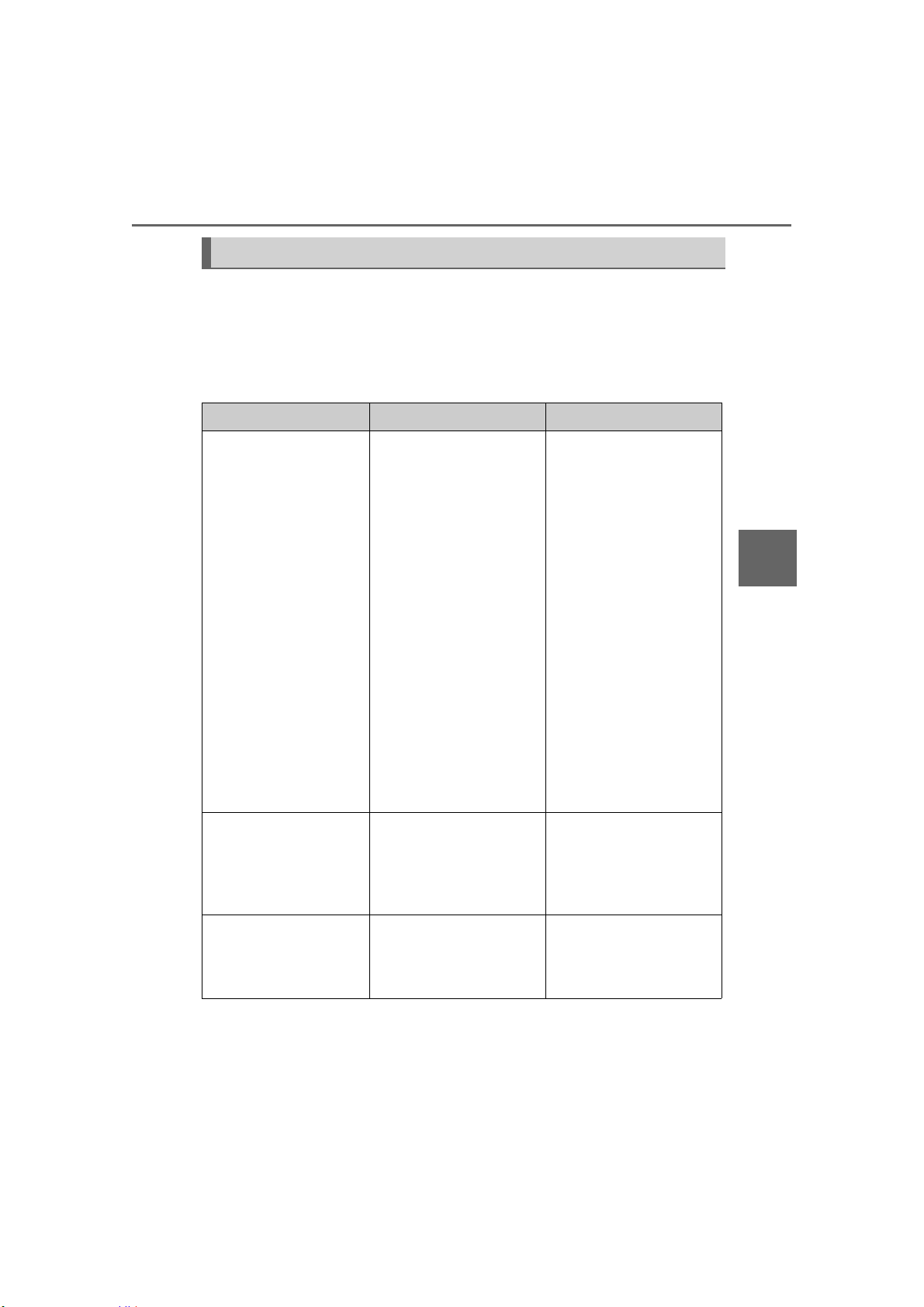
237
4-5. Using the driving support systems
COROLLA H/B_U
4
Driving
■ If you notice any symptoms
If you notice any of the following symptoms, refer to the likely cause
and the solution, and re-check.
If the symptom is not resolved by the solution, have the vehicle
inspected by your Toyota dealer.
Things you should know
Symptom Likely cause Solution
The image is difficult to
see
The vehicle is in a dark
area
The temperature
around the lens is
either high or low
The outside tempera-
ture is low
There are water drop-
lets on the camera
It is raining or humid
Foreign matter (mud
etc.) is adhering to the
camera
Sunlight or headlights
are shining directly
into the camera
The vehicle is under
fluorescent lights,
sodium lights, mer-
cury lights etc.
If this happens due to
these causes, it does
not indicate a malfunc-
tion. Back up while visu-
ally checking the
vehicle’s surroundings.
(Use the monitor again
once conditions have
been improved.) The
procedure for adjusting
the picture quality of the
rear view monitor sys-
tem is the same as the
procedure for adjusting
the screen. (P.264)
The image is blurry
Dirt or foreign matter
(such as water droplets,
snow, mud etc.) is
adhering to the camera.
Flush the camera with a
large quantity of water
and wipe the camera
lens clean with a soft
and wet cloth.
The image is out of
alignment
The camera or sur-
rounding area has
received a strong
impact.
Have the vehicle
inspected by your Toy-
ota dealer.
238
4-5. Using the driving support systems
COROLLA H/B_U
The fixed guide lines
are very far out of
alignment
The camera position is
out of alignment.
Have the vehicle
inspected by your Toy-
ota dealer.
The vehicle is tilted
(there is a heavy load
on the vehicle, tire
pressure is low due to
a tire puncture, etc.)
The vehicle is used on
an incline.
If this happens due to
these causes, it does
not indicate a malfunc-
tion.
Back up while visually
checking the vehicle’s
surroundings.
Symptom Likely cause Solution
WARNING
■ When using the rear view
monitor system
The rear view monitor system is a
supplemental device intended to
assist the driver when backing up.
When backing up, be sure to visu-
ally check all around the vehicle
both directly and using the mirrors
before proceeding. Observe the
following precautions to avoid an
accident that could result in death
or serious injuries.
● Never depend on the rear view
monitor system entirely when
backing up. The image and the
position of the guide lines dis-
played on the screen may differ
from the actual state. Use cau-
tion, just as you would when
backing up any vehicle.
● Be sure to back up slowly,
depressing the brake pedal to
control vehicle speed.
● The instructions given are only
guide lines. When and how
much to turn the steering wheel
will vary according to traffic con-
ditions, road surface condi-
tions, vehicle condition, etc.
when parking. It is necessary to
be fully aware of this before
using the rear view monitor sys-
tem.
● When parking, be sure to check
that the parking space will
accommodate your vehicle
before maneuvering into it.
● Do not use the rear view moni-
tor system in the following
cases:
• On icy or slick road surfaces, or
in snow
• When using tire chains or emer-
gency tires
• When the back door is not
closed completely
• On roads that are not flat or
straight, such as curves or
slopes
● In low temperatures, the screen
may darken or the image may
become faint. The image could
distort when the vehicle is mov-
ing, or you may become unable
to see the image on the screen.
Be sure to visually check all
around the vehicle both directly
and using the mirrors before
proceeding.
● If the tire sizes are changed, the
position of the fixed guide lines
displayed on the screen may
change.
239
4-5. Using the driving support systems
COROLLA H/B_U
4
Driving
WARNING
● The camera uses a special lens.
The distances between objects
and pedestrians that appear in
the image displayed on the
screen will differ from the actual
distances. (P.234)
NOTICE
■ How to use the camera
● The rear view monitor system
may not operate properly in the
following cases.
• If the back of the vehicle is hit,
the position and mounting angle
of the camera may change.
• As the camera has a water
proof construction, do not
detach, disassemble or modify
it. This may cause incorrect
operation.
• When cleaning the camera lens,
flush the camera with a large
quantity of water and wipe it
with a soft and wet cloth.
Strongly rubbing the camera
lens may cause the camera lens
to be scratched and unable to
transmit a clear image.
• Do not allow organic solvent,
car wax, window cleaner or
glass coating to adhere to the
camera. If this happens, wipe it
off as soon as possible.
• If the temperature changes rap-
idly, such as when hot water is
poured on the vehicle in cold
weather, the system may not
operate normally.
• When washing the vehicle, do
not apply intensive bursts of
water to the camera or camera
area. Doing so may result in the
camera malfunctioning.
● Do not expose the camera to
strong impact as this could
cause a malfunction. If this hap-
pens, have the vehicle
inspected by your Toyota dealer
as soon as possible.
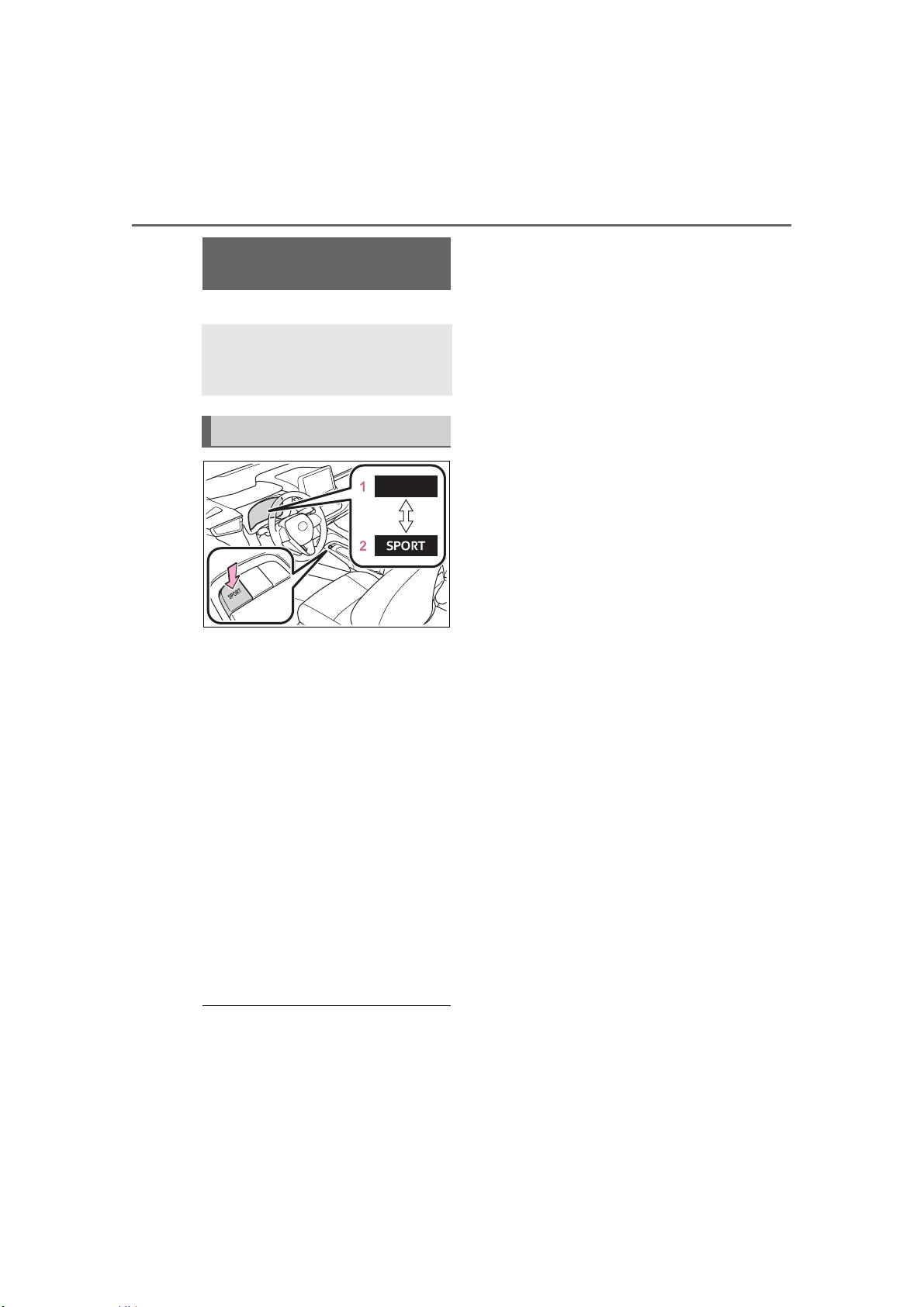
240
4-5. Using the driving support systems
COROLLA H/B_U
*
: If equipped
Each time the switch is pressed, the
system changes between sport
mode and normal mode.
1 Normal mode
Provides an optimal balance of fuel
economy, quietness, and dynamic
performance. Suitable for normal
driving.
2 Sport mode
Controls the transmission and
engine to provide quick, powerful
acceleration. This mode also
changes the steering feel, making it
suitable for when agile driving
response is desired, such as when
driving on roads with many curves.
When the sport mode is selected,
sport mode indicator comes on.
■ Automatic deactivation of sport
mode
If the engine switch is turned off
after driving in sport mode, the drive
mode will be changed to normal
mode.
Driving mode select
switch
*
The driving modes can be
selected to suit driving con-
dition.
Selecting a drive mode

241
4-5. Using the driving support systems
COROLLA H/B_U
4
Driving
■ ABS (Anti-lock Brake Sys-
tem)
Helps to prevent wheel lock
when the brakes are applied
suddenly, or if the brakes are
applied while driving on a slip-
pery road surface
■ Brake assist
Generates an increased level of
braking force after the brake
pedal is depressed when the
system detects a panic stop sit-
uation
■ VSC (Vehicle Stability Con-
trol)
Helps the driver to control skid-
ding when swerving suddenly or
turning on slippery road sur-
faces.
■ Enhanced VSC (Enhanced
Vehicle Stability Control)
Provides cooperative control of
the ABS, TRAC, VSC and EPS.
Helps to maintain directional
stability when swerving on slip-
pery road surfaces by con-
trolling steering performance.
■ Secondary Collision Brake
When the airbag sensor detects
a collision, the brakes and stop
lights are automatically con-
trolled to reduce the vehicle
speed and that helps reduce the
possibility of further damage
due to a secondary collision.
■ TRAC (Traction Control)
Helps to maintain drive power
and prevent the drive wheels
from spinning when starting the
vehicle or accelerating on slip-
pery roads
■ Active Cornering Assist
(ACA)
Helps to prevent the vehicle
from drifting to the outer side by
performing inner wheel brake
control when attempting to
accelerate while turning
■ Hill-start assist control
Helps to reduce the backward
movement of the vehicle when
starting on an uphill
■ EPS (Electric Power Steer-
ing)
Employs an electric motor to
reduce the amount of effort
Driving assist systems
To keep driving safety and
performance, the following
systems operate automati-
cally in response to various
driving situations. Be
aware, however, that these
systems are supplementary
and should not be relied
upon too heavily when oper-
ating the vehicle.
Summary of the driving
assist systems
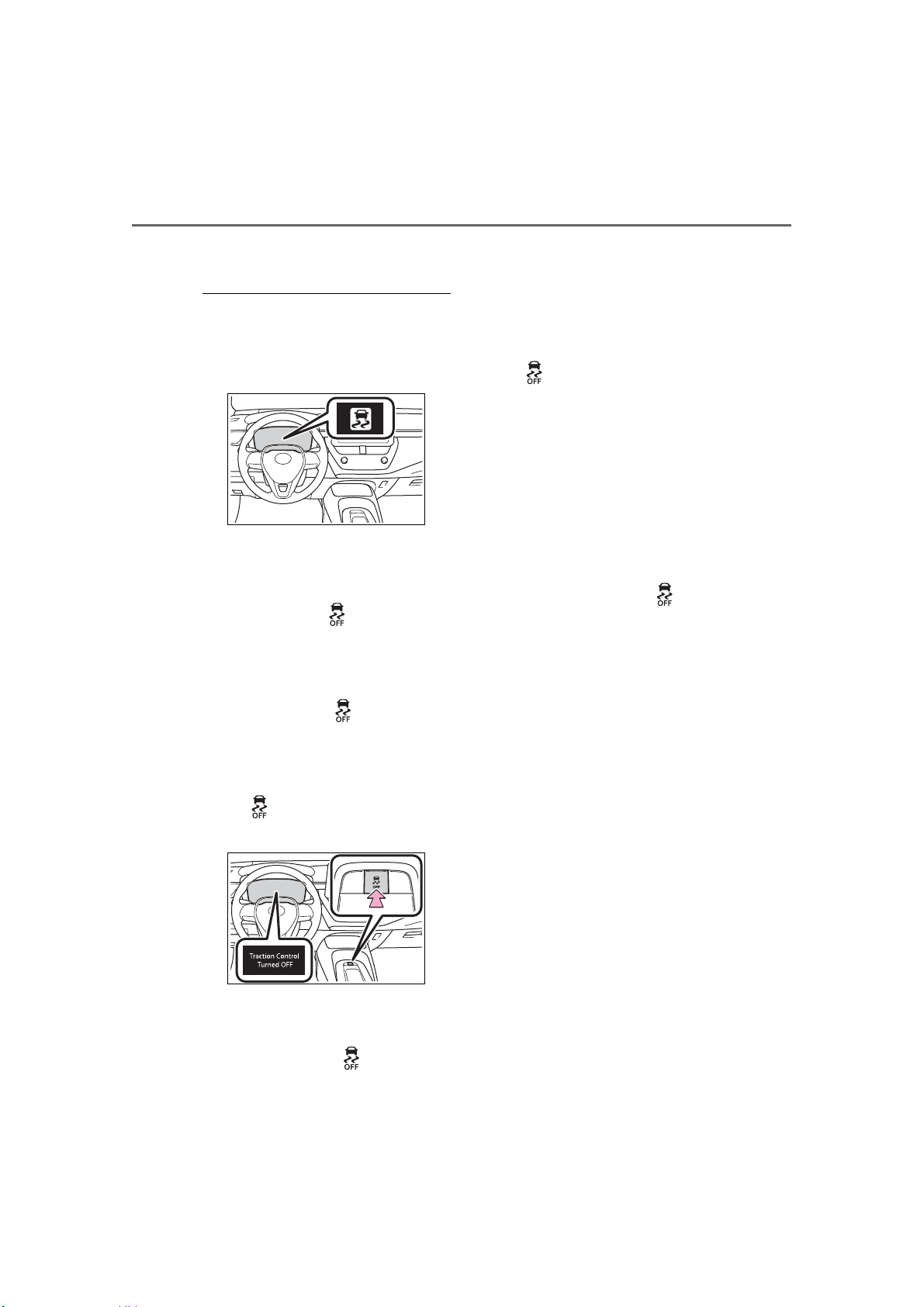
242
4-5. Using the driving support systems
COROLLA H/B_U
needed to turn the steering
wheel.
■ When the TRAC/VSC systems
are operating
The slip indicator light will flash
while the TRAC/VSC systems are
operating.
■ Disabling the TRAC system
If the vehicle gets stuck in mud, dirt
or snow, the TRAC system may
reduce power from the engine to the
wheels. Pressing to turn the
system off may make it easier for
you to rock the vehicle in order to
free it.
To turn the TRAC system off, quickly
press and release .
The “Traction Control Turned OFF”
will be shown on the multi-informa-
tion display.
Press again to turn the system
back on.
■ Turning off both TRAC and VSC
systems
To turn the TRAC and VSC systems
off, press and hold for more
than 3 seconds while the vehicle is
stopped.
The VSC OFF indicator light will
come on and the “Traction Control
Turned OFF” will be shown on the
multi-information display.
*
Press again to turn the system
back on.
*
: PCS will also be disabled (only
Pre-Collision warning is avail-
able). The PCS warning light will
come on and a message will be
displayed on the multi-information
display. (P.185)
■ When the message is dis-
played on the multi-information
display showing that TRAC has
been disabled even if has
not been pressed
TRAC is temporary deactivated. If
the information continues to show,
contact your Toyota dealer.
■ Operating conditions of
hill-start assist control
When the following four conditions
are met, the hill-start assist control
will operate:
● Vehicles with a continuously vari-
able transmission: The shift lever
is in a position other than P or N
(when starting off forward/back-
ward on an upward incline).
● Vehicles with a manual transmis-
sion: The shift lever is in a position
other than R when starting off for-
ward on an upward incline, or the
shift lever is in R when starting off
backward on an upward incline.
● The vehicle is stopped
● The accelerator pedal is not
depressed
● The parking brake is not engaged

243
4-5. Using the driving support systems
COROLLA H/B_U
4
Driving
■ Automatic system cancelation
of hill-start assist control
The hill-start assist control will turn
off in any of the following situations:
● Vehicles with a continuously vari-
able transmission: The shift lever
is shifted to P or N.
● Vehicles with a manual transmis-
sion: The shift lever is shifted to R
when starting off forward on an
upward incline, or the shift lever is
shifted to other than R when start-
ing off backward on an upward
incline.
● The accelerator pedal is
depressed
● The parking brake is engaged
● 2 seconds at maximum elapsed
after the brake pedal is released
■ Sounds and vibrations caused
by the ABS, brake assist, VSC,
TRAC and hill-start assist con-
trol systems
● A sound may be heard from the
engine compartment when the
brake pedal is depressed repeat-
edly, when the engine is started or
just after the vehicle begins to
move. This sound does not indi-
cate that a malfunction has
occurred in any of these systems.
● Any of the following conditions
may occur when the above sys-
tems are operating. None of these
indicates that a malfunction has
occurred.
• Vibrations may be felt through the
vehicle body and steering.
• A motor sound may be heard also
after the vehicle comes to a stop.
• The brake pedal may pulsate
slightly after the ABS is activated.
• The brake pedal may move down
slightly after the ABS is activated.
■ Active Cornering Assist opera-
tion sounds and vibrations
When the Active Cornering Assist is
operated, operation sounds and
vibrations may be generated from
the brake system, but this is not a
malfunction.
■ EPS operation sound
When the steering wheel is oper-
ated, a motor sound (whirring
sound) may be heard. This does not
indicate a malfunction.
■ Automatic reactivation of TRAC
and VSC systems
After turning the TRAC and VSC
systems off, the systems will be
automatically re-enabled in the fol-
lowing situations:
● When the engine switch is turned
off
● If only the TRAC system is turned
off, the TRAC will turn on when
vehicle speed increases
If both the TRAC and VSC sys-
tems are turned off, automatic
re-enabling will not occur when
vehicle speed increases.
■ Operating conditions of Active
Cornering Assist
The system operates when the fol-
lowing occurs.
● TRAC/VSC can operate
● The driver is attempting to accel-
erate while turning
● The system detects that the vehi-
cle is drifting to the outer side
● The brake pedal is released
■ Reduced effectiveness of the
EPS system
The effectiveness of the EPS sys-
tem is reduced to prevent the sys-
tem from overheating when there is
frequent steering input over an
extended period of time. The steer-
ing wheel may feel heavy as a
result. Should this occur, refrain
from excessive steering input or
stop the vehicle and turn the engine
off. The EPS system should return
to normal within 10 minutes.

244
4-5. Using the driving support systems
COROLLA H/B_U
■ Secondary Collision Brake
operating conditions
The vehicle speed is approximately
6 mph (10 km/h) or more and the
airbag sensor detects a collision.
(The Secondary Collision Brake will
not operate when the vehicle speed
is below approximately 6 mph [10
km/h].)
■ Secondary Collision Brake
automatic cancellation
The Secondary Collision Brake is
automatically canceled in the follow-
ing situations:
● The vehicle speed drops below
approximately 6 mph (10 km/h)
● A certain amount of time elapses
during operation
● The accelerator pedal is
depressed a large amount
WARNING
■ The ABS does not operate
effectively when
● The limits of tire gripping perfor-
mance have been exceeded
(such as excessively worn tires
on a snow covered road).
● The vehicle hydroplanes while
driving at high speed on wet or
slick roads.
■ Stopping distance when the
ABS is operating may exceed
that of normal conditions
The ABS is not designed to
shorten the vehicle’s stopping dis-
tance. Always maintain a safe dis-
tance from the vehicle in front of
you, especially in the following sit-
uations:
● When driving on dirt, gravel or
snow-covered roads
● When driving with tire chains
● When driving over bumps in the
road
● When driving over roads with
potholes or uneven surfaces
■ TRAC/VSC may not operate
effectively when
Directional control and power may
not be achievable while driving on
slippery road surfaces, even if the
TRAC/VSC system is operating.
Drive the vehicle carefully in con-
ditions where stability and power
may be lost.
■ Active Cornering Assist does
not operate effectively when
● Do not overly rely on Active
Cornering Assist. Active Corner-
ing Assist may not operate
effectively when accelerating
down slopes or driving on slip-
pery road surfaces.
● When Active Cornering Assist
frequently operates, Active Cor-
nering Assist may temporarily
stop operating to ensure proper
operation of the brakes, TRAC
and VSC.
■ Hill-start assist control does
not operate effectively when
● Do not overly rely on hill-start
assist control. Hill-start assist
control may not operate effec-
tively on steep inclines and
roads covered with ice.
● Unlike the parking brake,
hill-start assist control is not
intended to hold the vehicle sta-
tionary for an extended period
of time. Do not attempt to use
hill-start assist control to hold
the vehicle on an incline, as
doing so may lead to an acci-
dent.

245
4-5. Using the driving support systems
COROLLA H/B_U
4
Driving
WARNING
■ When the TRAC/VSC is acti-
vated
The slip indicator light flashes.
Always drive carefully. Reckless
driving may cause an accident.
Exercise particular care when the
indicator light flashes.
■ When the TRAC/VSC systems
are turned off
Be especially careful and drive at
a speed appropriate to the road
conditions. As these are the sys-
tems to help ensure vehicle stabil-
ity and driving force, do not turn
the TRAC/VSC systems off
unless necessary.
■ Secondary Collision Brake
Do not overly rely on the Second-
ary Collision Brake. This system
is designed to help reduce the
possibility of further damage due
to a secondary collision, however,
that effect changes according to
various conditions. Overly relying
on the system may result in death
or serious injury.
■ Replacing tires
Make sure that all tires are of the
specified size, brand, tread pat-
tern and total load capacity. In
addition, make sure that the tires
are inflated to the recommended
tire inflation pressure level.
The ABS, TRAC and VSC sys-
tems will not function correctly if
different tires are installed on the
vehicle.
Contact your Toyota dealer for fur-
ther information when replacing
tires or wheels.
■ Handling of tires and the sus-
pension
Using tires with any kind of prob-
lem or modifying the suspension
will affect the driving assist sys-
tems, and may cause a system to
malfunction.
246
4-6. Driving tips
COROLLA H/B_U
4-6.Driving tips
Use fluids that are appropriate
to the prevailing outside tem-
peratures.
• Engine oil
• Engine coolant
• Washer fluid
Have a service technician
inspect
the condition o
f the
battery
.
Have the vehicle fitted with
four snow tires or purchase a
set of tire chains for the fro
nt
tires.
Ensure that all tires are the same
size and brand, and that chains
match the size of the tires.
Winter driving tips
Carry out the necessary
preparations and inspec-
tions before driving the
vehicle in winter. Always
drive the vehicle in a man-
ner appropriate to the pre-
vailing weather conditions.
Pre-winter preparations
WARNING
■ Driving with snow tires
Observe the following precautions
to reduce the risk of accidents.
Failure to do so may result in a
loss of vehicle control and cause
death or serious injury.
● Use tires of the size specified.
● Maintain the recommended
level of air pressure.
● Do not drive in excess of 75
mph (120 km/h), regardless of
the ty
pe of snow t
ires being
used
.
● Use snow tires on all, not just
some wheels.
■ Driving with tire chains
Observe the following precautions
to reduce the risk of accidents.
Failure to do so may result in the
vehicle being unable to be driven
safely, and may cause death or
serious injury.
● Do not drive in excess of the
spee
d limit specified for the
tire
chain
s being used, or 30 mph
(50 km/h), whichever is lower.
● Avoid driving on bumpy road
surfaces or over potholes.
● Avoid sudden acceleration,
abrupt steering, sudden brak-
ing and shifting operations that
cause sudden engine braking.
● Slow down sufficiently before
entering a curve to ensure that
vehicle
control is maintained.
● Do not use LTA (Lane Tracing
Assist) system. (if equipped)
● Do not use LDA (Lane Depar-
ture Alert with steering control)
system. (if equipped)
NOTICE
■ Repairing or replacing snow
tires
Request repairs or replacement of
snow tires from Toyota dealers or
legitimate tire retailers.
This is because the removal and
attachment of snow tires affects
the operation of the tire pressure
warning valves and transmitters.

247
4-6. Driving tips
COROLLA H/B_U
4
Driving
Perform the following according
to the driving conditions:
Do not try to forcibly open a
window or move a wiper that
is frozen. Pour warm water
over the frozen area to melt
the ice. Wipe away the water
immediately to prevent it from
freezing.
To ensure proper operation of
the climate control system
fan, remove any snow that
has accumulated on the air
inlet vents in front of the wind-
shield.
Check for and remove any
excess ice or snow that may
have accumulated on the
exterior lights, vehicle’s roof,
chassis, around the tires or on
the brakes.
Remove any snow or mud
from the bottom of your shoes
before getting in the vehicle.
Accelerate the vehicle slowly,
keep a safe distance between
you and the vehicle ahead, and
drive at a reduced speed suit-
able to road conditions.
Park the vehicle and shift the
shift lever to P (continuously
variable transmission), or 1 or
R (manual transmission)
without setting the parking
brake. The parking brake may
freeze up, preventing it from
being released. If the vehicle
is parked without setting the
parking brake, make sure to
block the wheels.
Failure to do so may be dan-
gerous because it may cause
the vehicle to move unexpect-
edly, possibly leading to an
accident.
Vehicles with a continuously
variable transmission: If the
vehicle is parked without set-
ting the parking brake, con-
firm that the shift lever cannot
be moved out of P
*
.
*
: The shift lever will be locked if it is
attempted to be shifted from P to
any other position without
depressing the brake pedal. If the
shift lever can be shifted from P,
there may be a problem with the
shift lock system. Have the vehi-
cle inspected by your Toyota
dealer immediately.
Use the correct tire chain size
when mounting the tire chains.
Chain size is regulated for each
tire size.
Before driving the vehicle
When driving the vehicle
When parking the vehicle
Selecting tire chains
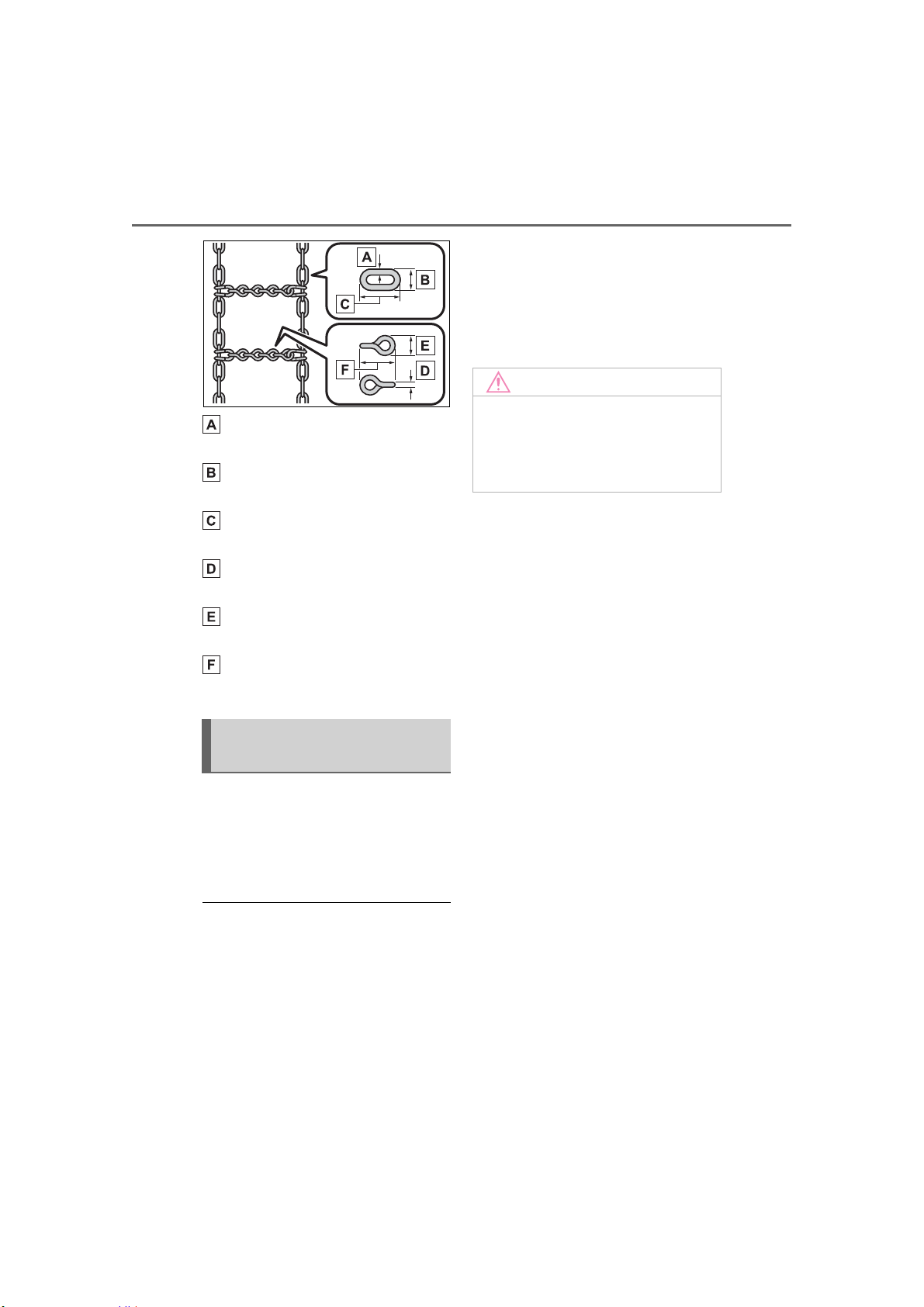
248
4-6. Driving tips
COROLLA H/B_U
Side chain (0.12 in. [3 mm] in
diameter)
Side chain (0.39 in. [10 mm]
in width)
Side chain (1.18 in. [30 mm]
in length)
Cross chain (0.16 in. [4 mm]
in diameter)
Cross chain (0.55 in. [14 mm]
in width)
Cross chain (0.98 in. [25 mm]
in length)
Regulations regarding the use
of tire chains vary depending on
location and type of road.
Always check local regulations
before installing chains.
■ Tire chain installation
Observe the following precautions
when installing and removing
chains:
● Install and remove tire chains in a
safe location.
● Install tire chains on the front tires
only
. Do not install tire chains
on
th
e rear tires.
● Install tire chains on the front tires
as
tightly as possible. Ret
ighten
chains
after driving 1/41/2 mile
(0.51.0 km).
● Install tire chains following the
ins
tructions provided
with the tire
chains.
Regulations on the use of
tire chains
NOTICE
■ Fitting tire chains
The tire pressure warning valves
and transmitters may not function
correctly when tire chains are fit-
ted.

249
COROLLA H/B_U
5
5
Audio
Audio
.
5-1. Basic function
Buttons overview......... 251
Menu screen ............... 253
Status icon .................. 254
“Setup” screen ............ 256
5-2. Basic information before
operation
Initial screen................ 257
Touch screen............... 258
Home screen............... 260
Entering letters and num-
bers/list screen operation
.................................. 261
Screen adjustment ...... 264
Linking multi-information
display and the system
.................................. 265
5-3. Connectivity settings
Registering/Connecting a
Bluetooth
®
device ..... 266
Setting Bluetooth
®
details
.................................. 271
Wi-Fi
®
Hotspot ............ 278
Apple CarPlay/Android Auto
.................................. 283
5-4. Other settings
General settings.......... 290
Voice settings.............. 294
Vehicle settings ........... 295
5-5. Using the audio/visual
system
Quick reference........... 297
Some basics................ 298
5-6. Radio operation
AM/FM/SiriusXM
®
Satellite
Radio......................... 302
Internet radio ............... 307
5-7. Media operation
USB memory............... 308
iPod/iPhone (Apple Car-
Play) .......................... 310
Android Auto................ 313
Bluetooth
®
audio ......... 314
5-8. Audio/visual remote con-
trols
Steering switches ........ 318
5-9. Audio settings
Setup........................... 320
5-10.Tips for operating the
audio/visual system
Operating information.. 321
5-11.Voice command system
operation
Voice command system
.................................. 334
Command list .............. 337
5-12.Mobile Assistant opera-
tion
Mobile Assistant .......... 341

250
COROLLA H/B_U
5-13.Phone operation
(Hands-free system for
cellular phones)
Quick reference........... 343
Some basics ............... 344
Placing a call using the
Bluetooth
®
hands-free sys-
tem ............................ 348
Receiving a call using the
Bluetooth
®
hands-free sys-
tem ............................ 351
Talking on the Bluetooth
®
hands-free system..... 352
Bluetooth
®
phone message
function...................... 354
5-14.Phone settings
Setup........................... 359
5-15.What to do if... (Blue-
tooth
®
)
Troubleshooting .......... 369
5-16.Connected Services Over-
view
Functional overview .... 373
Type A: Function achieved
by using a smart phone or
DCM.......................... 374
Type B: Function achieved
by using DCM and the sys-
tem ............................ 377
Type C: Function achieved
by using DCM............ 378
5-17.Connected Services
Operation
Toyota apps................. 379
5-18.Toyota apps settings
Setup........................... 383
5
Audio
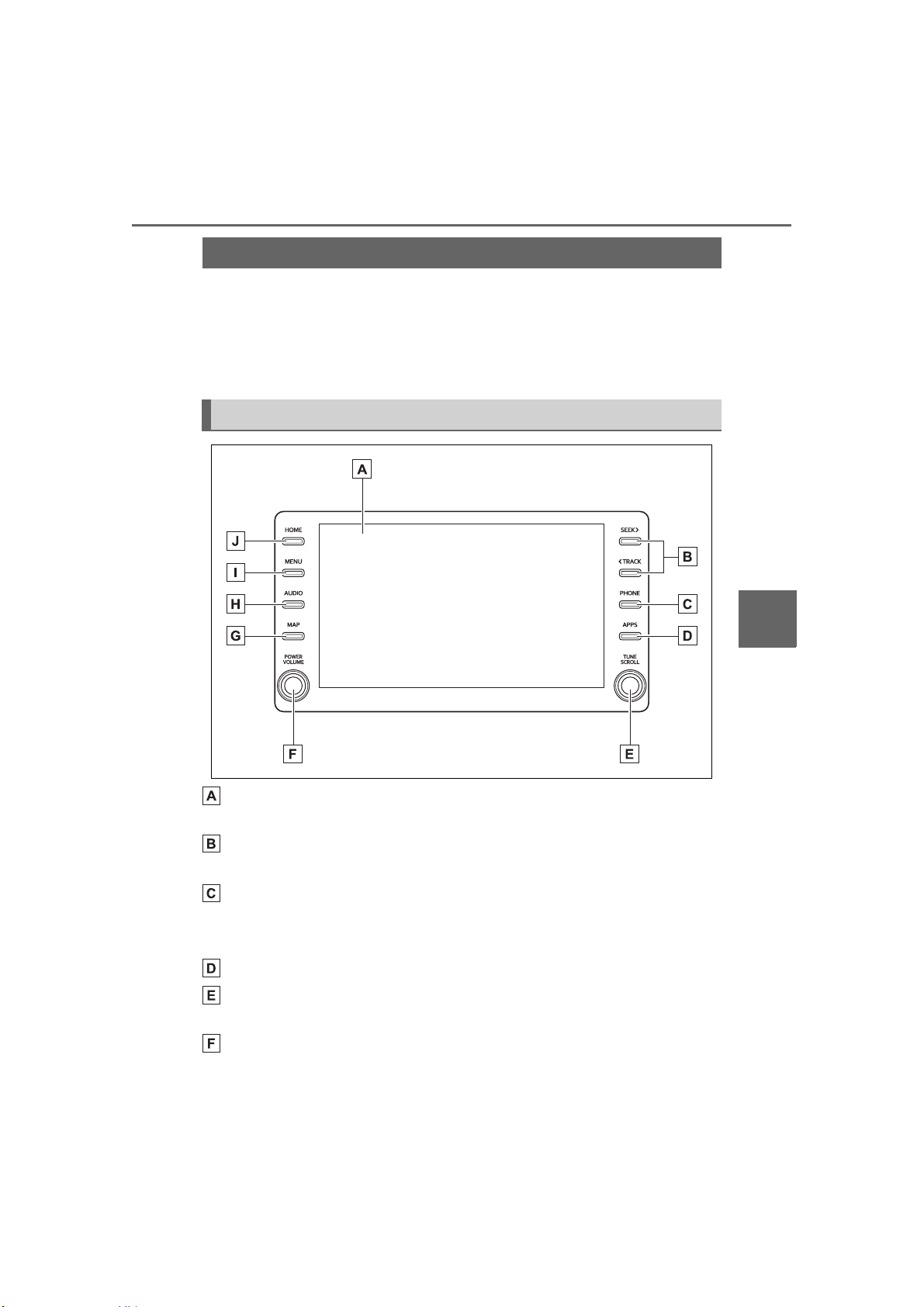
251
5-1. Basic function
COROLLA H/B_U
5
Audio
5-1.Basic function
*
: If equipped
Audio Plus/Premium Audio
Owners of this system should refer to the “NAVIGATION AND MUL-
TIMEDIA SYSTEM OWNER’S MANUAL”.
By touching the screen with your finger, you can control the
selected functions. (P.258, 258)
Press to seek up or down for a radio station or to access a
desired track/file. (P.302, 308, 310, 314)
Press to access the Bluetooth
®
hands-free system. (P.343)
When an Apple CarPlay connection is established, press to dis-
play the Phone app screen.
*1, 2
Press to display the Toyota apps screen.
*2, 3
(P.379)
Turn to change the radio station or skip to the next or previous
track/file. (P.302, 308, 310, 314)
Press to turn the audio/visual system on and off, and turn it to
adjust the volume. Press and hold to restart the system.
Buttons overview
*
Operations of each part
252
5-1. Basic function
COROLLA H/B_U
(P.257, 298)
When an Apple CarPlay/Android Auto connection is established,
press to display the Maps app screen.
*1, 2
Press to display the audio/visual system screen. (P.297, 298)
Press to display the “Menu” screen. (P.253)
Press to display the home screen. (P.260)
*1
:For details about Apple CarPlay/Android Auto: P.2 83
*2
:This function is not made available in some countries or areas.
*3
:When an Apple CarPlay/Android Auto connection is established, this
function will be unavailable.
● The screen shots in this document
and the actual screens of the sys-
tem differ depending on whether
the functions and/or a contract
existed.
WARNING
● For safety, the driver should not
operate the system while
he/she is driving. Insufficient
attention to the road and traffic
may cause an accident.
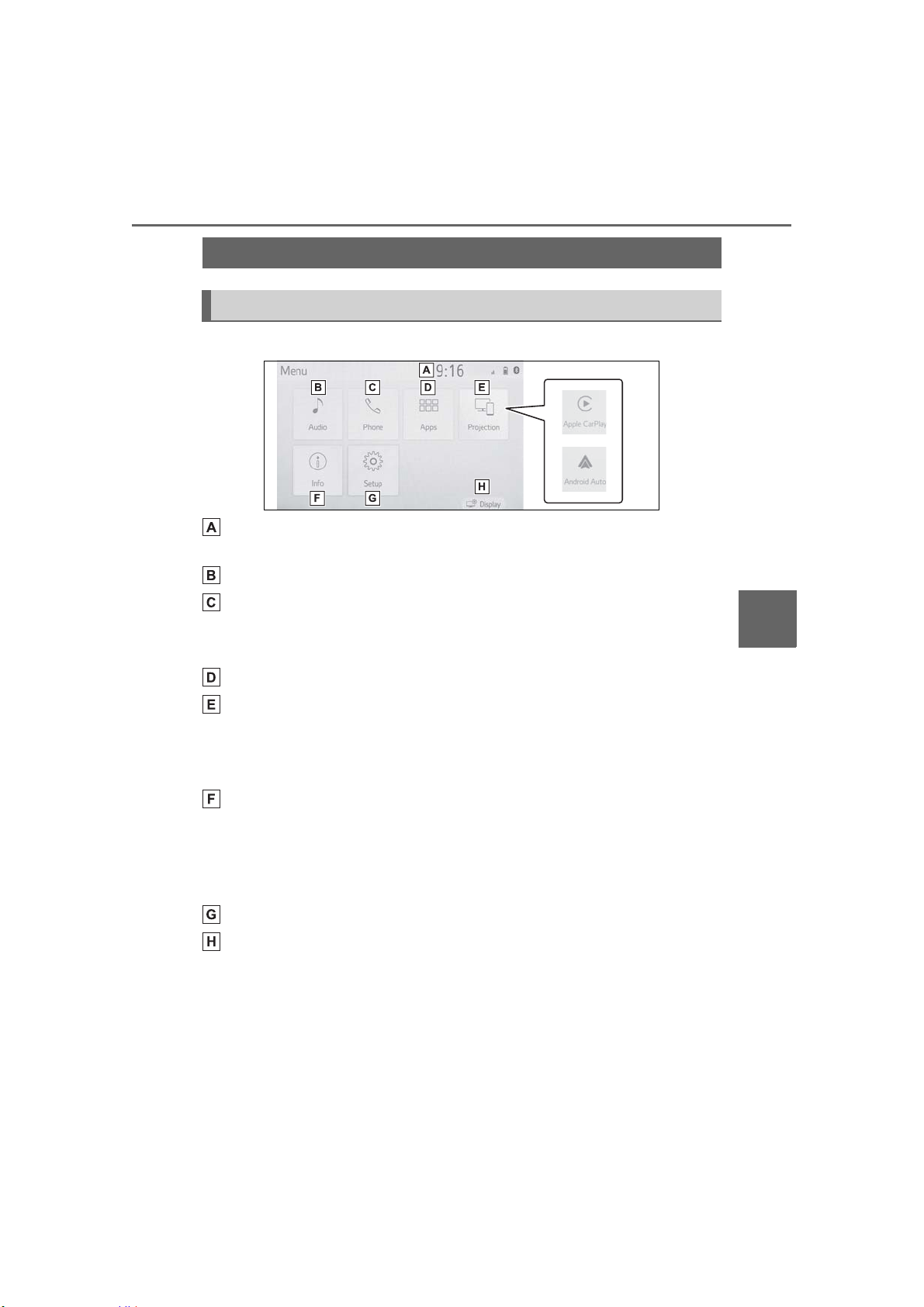
253
5-1. Basic function
COROLLA H/B_U
5
Audio
Press the “MENU” button to display the “Menu” screen.
Displays the clock. Select to display the clock settings screen.
(P.291)
Select to display the audio control screen. (P.297)
Select to display the hands-free operation screen. (P.343)
When an Apple CarPlay connection is established, select to dis-
play the Phone app screen.
*
Select to display the application screen.
*1, 2
(P.379)
When an Apple CarPlay/Android Auto connection is established
and this button displays “Apple CarPlay”/“Android Auto”, select to
display the home screen of Apple CarPlay/Android Auto.
*1
(P.283)
Vehicles without DCM: Select to display the fuel consumption
screen. (P.93)
Vehicles with DCM: Select to display the information screen.
Select “ECO” to display the fuel consumption screen. (P.93)
The “Vehicle Alert History” shown on the information screen.
*
Select to display the “Setup” screen. (P.256)
Select to adjust the contrast, brightness, etc. of the display.
(P.264)
*1
:This function is not made available in some countries or areas.
*2
:When an Apple CarPlay/Android Auto connection is established, this
function will be unavailable.
Menu screen
Menu screen operation
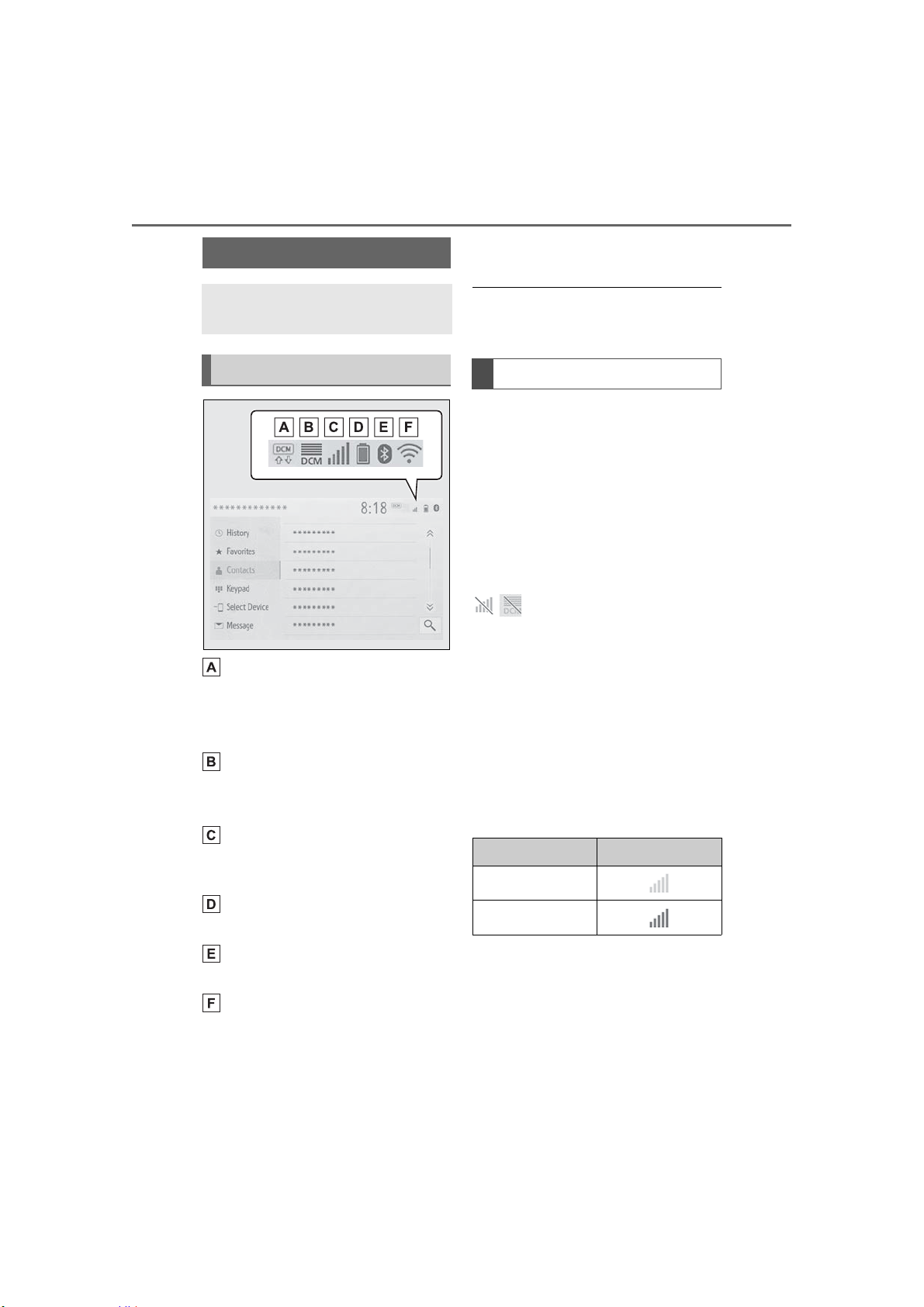
254
5-1. Basic function
COROLLA H/B_U
Indicate during data commu-
nication performed via Data
Communication Module
(DCM)
*1
The reception level of Data
Communication Module
(DCM) display
*1
(P.254)
The reception level of the
connected phone display
(P.254)
Remaining battery charge
display (P.255)
Bluetooth
®
phone connection
condition display (P.255)
Wi-Fi
®
connection condition
display
*1, 2
(P.278)
*1
:Vehicles with DCM
*2
:This function is not made avail-
able in some countries or areas.
● The number of status icons that
can be displayed differs depend-
ing on the displayed screen.
The level of reception does not
always correspond with the level
displayed on the cellular phone.
The level of reception may not
be displayed depending on the
phone you have.
When the cellular phone is out
of the service area or in a place
inaccessible by radio waves,
/ is displayed.
“Rm” is displayed when receiv-
ing in a roaming area. While
roaming, display “Rm” top-left
on the icon.
The receiving area may not be
displayed depending on the type
of Bluetooth
®
phone you have.
While connected with cellular
phone
Status icon
Status icons are displayed
at the top of the screen.
Status icon explanation
Reception level display
Level Indicators
Poor
Excellent
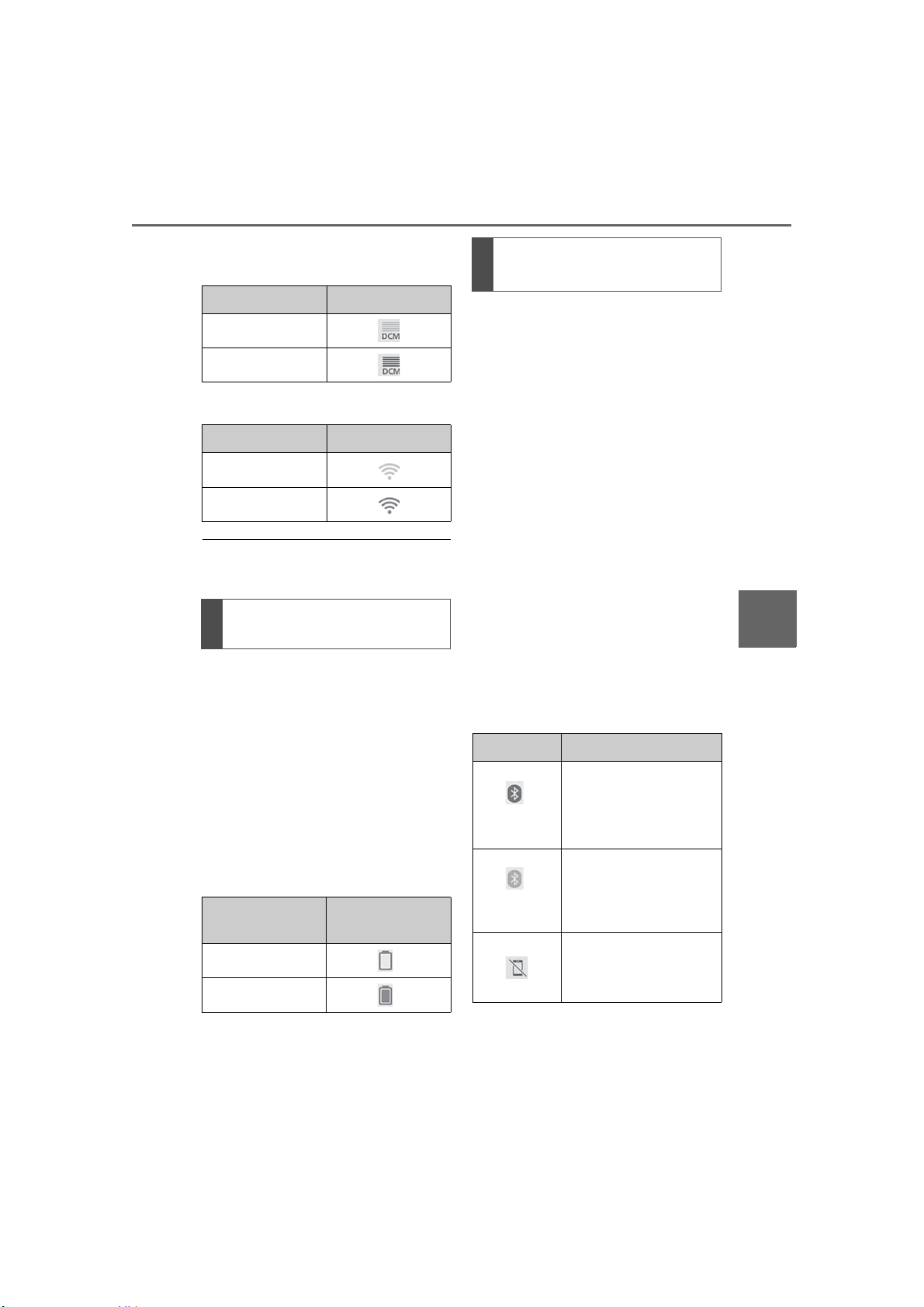
255
5-1. Basic function
COROLLA H/B_U
5
Audio
While using Data Communi-
cation Module (DCM)
While using Wi-Fi
®
Hotspot
● When Wi-Fi
®
Hotspot is off, no
item is displayed.
The amount displayed does not
always correspond with the
amount displayed on the Blue-
tooth
®
device.
The amount of battery charge
left may not be displayed
depending on the type of the
Bluetooth
®
device connected.
This system does not have a
charging function.
An antenna for the Bluetooth
®
connection is built into the
instrument panel.
The condition of the Bluetooth
®
connection may deteriorate and
the system may not function
when a Bluetooth
®
phone is
used in the following conditions
and/or places:
The cellular phone is obstructed
by certain objects (such as
when it is behind the seat or in
the glove box or console box).
The cellular phone is touching or
is covered with metal materials.
Leave the Bluetooth
®
phone in a
place where the condition of the
Bluetooth
®
connection is good.
Level Indicators
Poor
Excellent
Level Indicators
No connection
Connected
Remaining battery charge
display
Remaining
charge
Indicators
Empty
Full
Bluetooth
®
connection
condition display
Indicators Conditions
(Blue)
Indicates that the con-
dition of the Blue-
tooth
®
connection is
good.
(Gray)
While in this condition,
sound quality during
phone calls may dete-
riorate.
Indicates that the cel-
lular phone is not con-
nected via Bluetooth
®
.
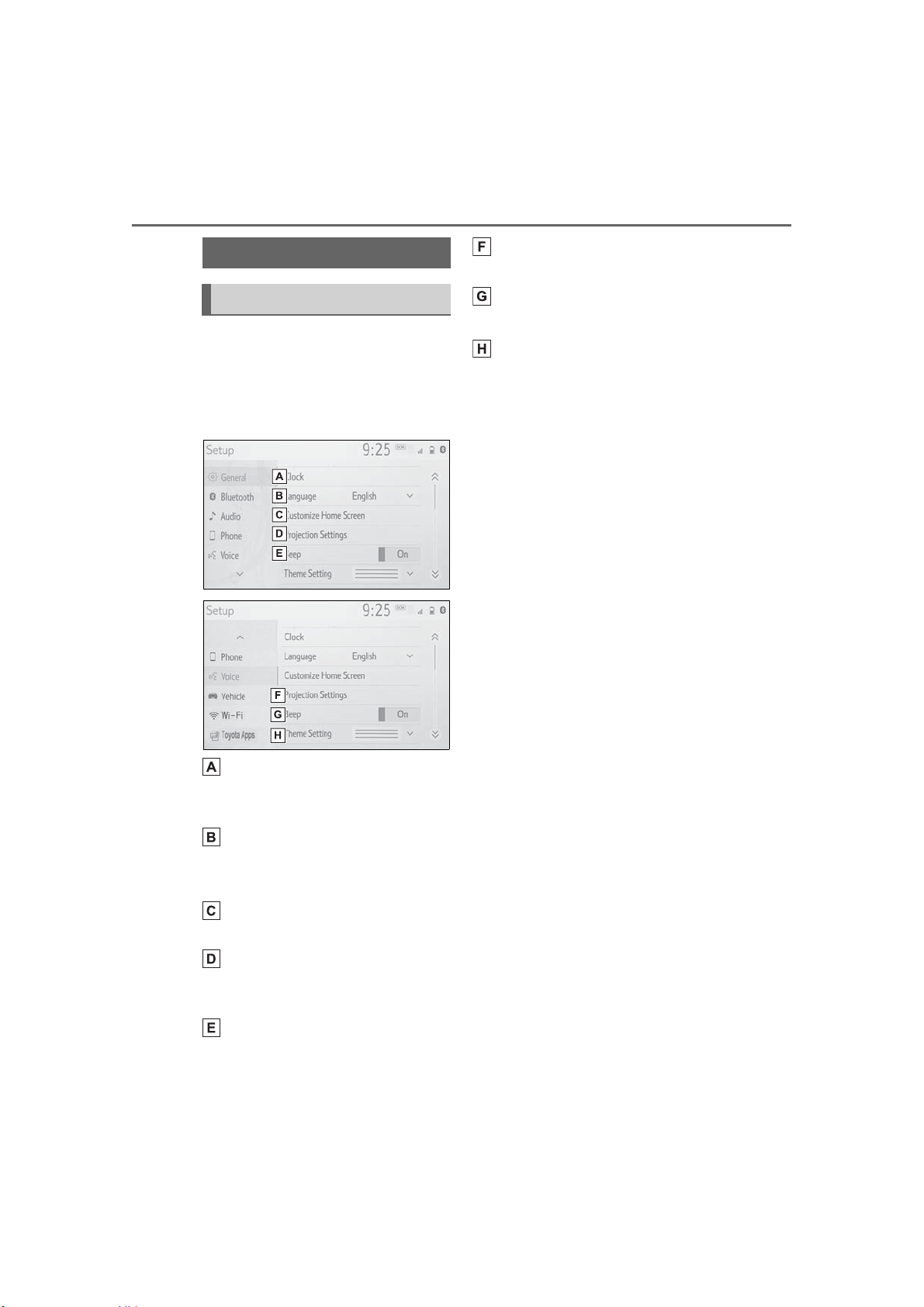
256
5-1. Basic function
COROLLA H/B_U
Press the “MENU” button, then
select “Setup” to display the
“Setup” screen. The items
shown on the “Setup” screen
can be set.
Select to change the selected
language, operation sound
settings, etc. (P.290)
Select to set Bluetooth
®
device and Bluetooth
®
sys-
tem settings. (P.271)
Select to set audio settings.
(P.320)
Select to set the phone
sound, contacts, message
settings, etc. (P.359)
Select to set the voice set-
tings. (P.294)
Select to set vehicle informa-
tion. (P.295)
Select to set Wi-Fi
®
connec-
tion settings.
*1, 2
(P.279)
Select to set Toyota apps set-
tings.
*2
(P.383)
*1
:Vehicles with DCM
*2
:This function is not made avail-
able in some countries or areas.
“Setup” screen
“Setup” screen
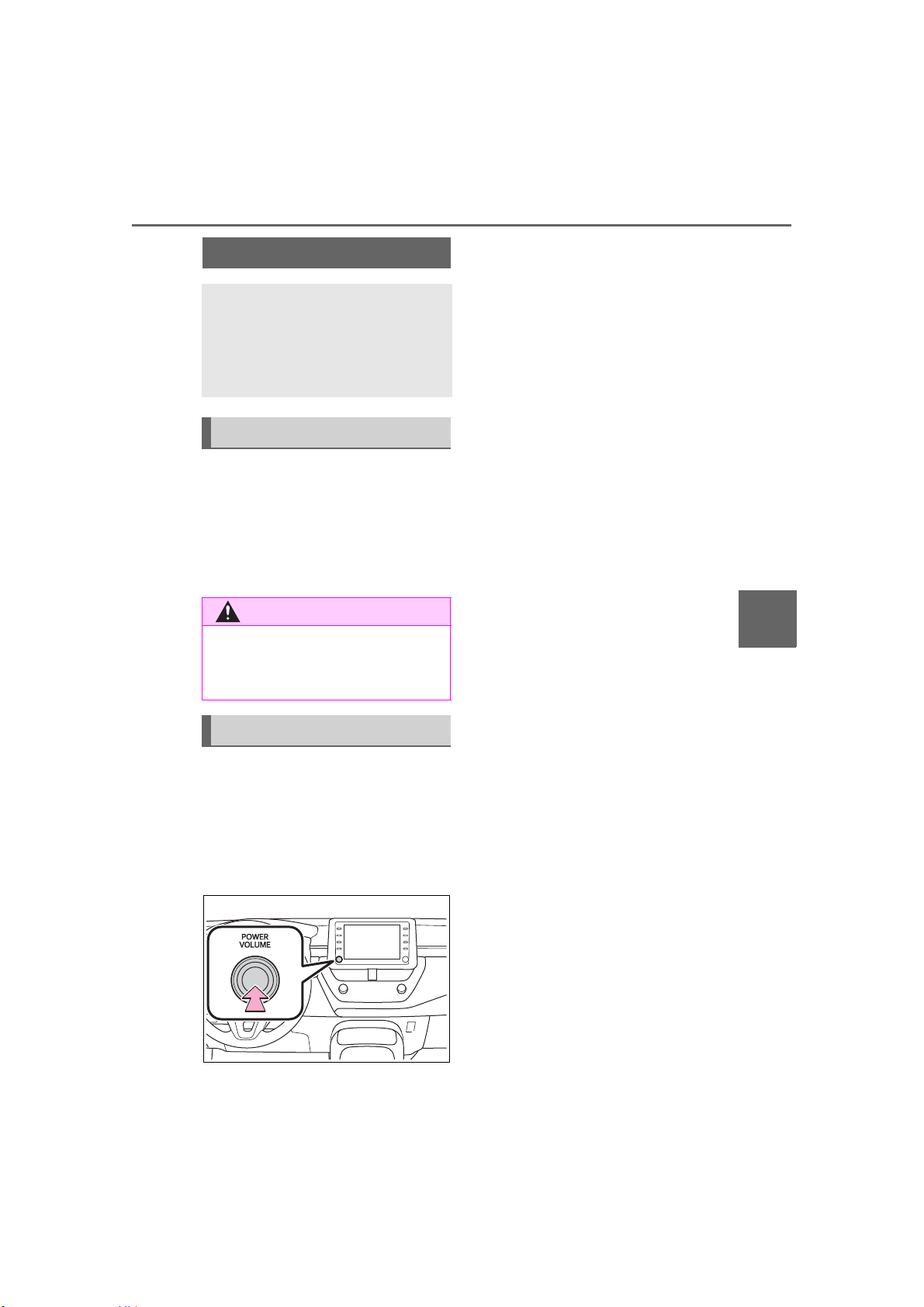
257
5-2. Basic information before operation
COROLLA H/B_U
5
Audio
5-2.Basic in formation befor e operation
After a few seconds, the caution
screen will be displayed.
After about 5 seconds or select-
ing “Continue”, the caution
screen automatically switches to
the next screen.
When system response is
extremely slow, the system can
be restarted.
1 Press and hold the “POWER
VOLUME” knob for 3 sec-
onds or more.
Initial screen
When the engine switch is
turned to ACC or ON, the
initial screen will be dis-
played and the system will
begin operating.
Caution screen
WARNING
● When the vehicle is stopped
with the engine running, always
apply the parking brake for
safety.
Restarting the system
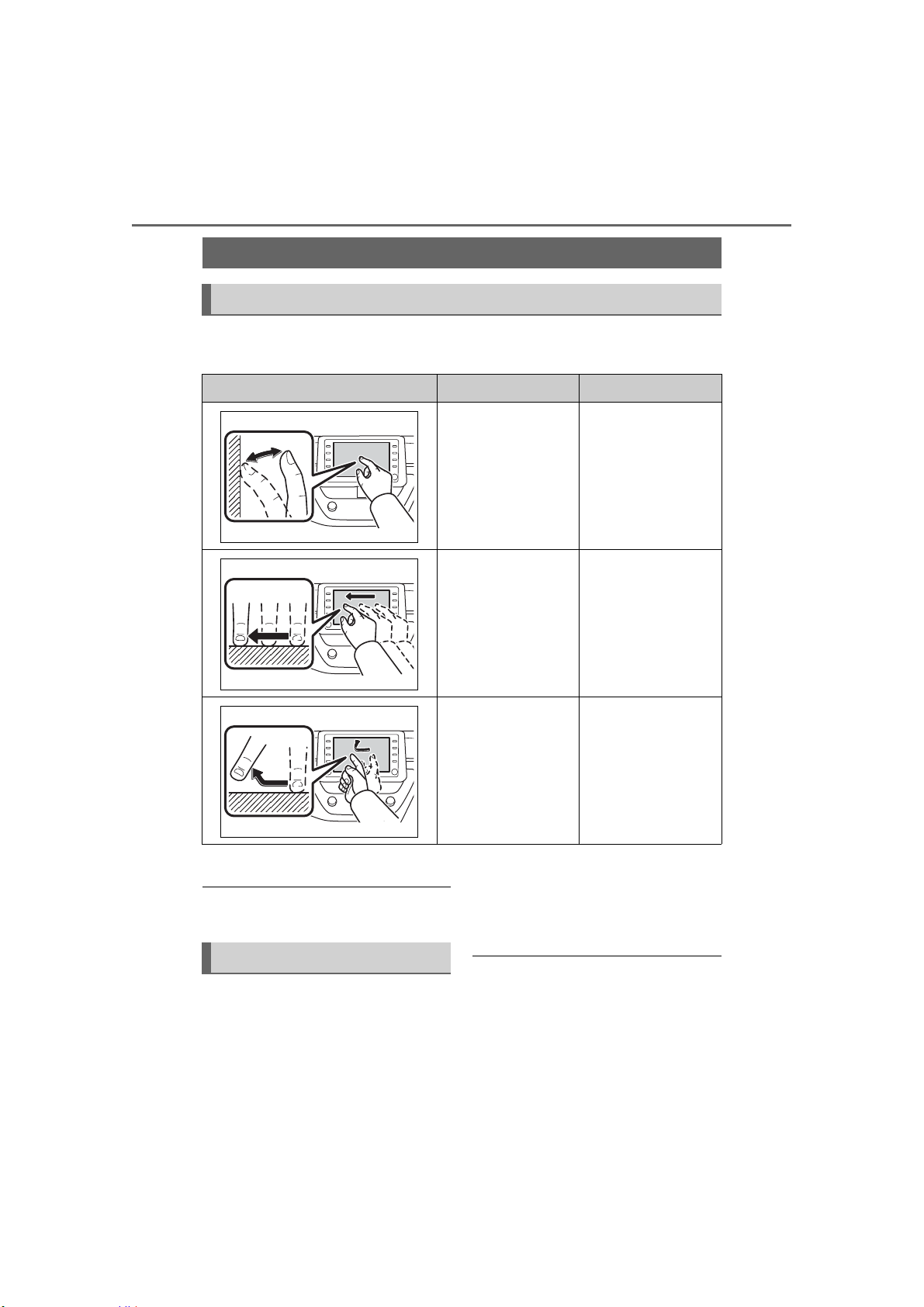
258
5-2. Basic information before operation
COROLLA H/B_U
Operations are performed by touching the touch screen directly with
your finger.
*
: The above operations may not be performed on all screens.
● Flick operations may not be per-
formed smoothly at high altitudes.
This system is operated mainly
by the buttons on the screen.
(Referred to as screen buttons
in this manual.)
When a screen button is
touched, a beep sounds. (To set
the beep sound: P.290)
● If the system does not respond to
touching a screen button, move
your finger away from the screen
and then touch it again.
● Dimmed screen buttons cannot be
operated.
Touch screen
Touch screen gestures
Operation method Outline Main use
Touch
Quickly touch and
release once.
Selecting an item
on the screen
Drag
*
Touch the screen
with your finger,
and move the
screen to the
desired position.
Scrolling the lists
Flick
*
Quickly move the
screen by flicking
with your finger.
Scrolling the main
screen page
Touch screen operation
259
5-2. Basic information before operation
COROLLA H/B_U
5
Audio
● The displayed image may become
darker and moving images may
be slightly distorted when the
screen is cold.
● In extremely cold conditions, the
screen may not be displayed and
the data input by a user may be
deleted. Also, the screen buttons
may be harder than usual to
depress.
● When you look at the screen
through polarized material such as
polarized sunglasses, the screen
may be dark and hard to see. If
so, look at the screen from differ-
ent angles, adjust the screen set-
tings on the display settings
screen or take off your sun-
glasses.
● When is displayed on the
screen, select to return to
the previous screen.
The operable areas of the
capacitive touch screen buttons
use capacitive touch sensors
and may not operate properly in
the following situations:
If the screen is dirty or wet
If a source of strong electro-
magnetic waves is brought
near the screen
If a glove is worn during oper-
ation
If the screen is touched by a
fingernail
If a stylus is used to operate
the buttons
If your palm touches the oper-
able area of another button
during operation
If a button is touched quickly
If the operable part of a
capacitive touch screen but-
ton is touched by or covered
with a metal object, such as
the following, it may not oper-
ate properly:
• Magnetic isolation cards
• Metallic foil, such as the inner
packaging of a cigarette box
• Metallic wallets or bags
• Coins
• Discs, such as a CD or DVD
If the operable part of a
capacitive touch screen but-
ton is wiped, it may operate
unintentionally.
If the capacitive touch screen
button is being touched when
the engine switch is changed
to ACC or ON, the button may
not operate properly. In this
case, remove anything touch-
ing the button, turn the engine
switch off and then turn it to
ACC or ON, or restart the sys-
NOTICE
● To prevent damaging the
screen, lightly touch the screen
buttons with your finger.
● Do not use objects other than
your finger to touch the screen.
● Wipe off fingerprints using a
glass cleaning cloth. Do not use
chemical cleaners to clean the
screen, as they may damage
the touch screen.
Capacitive touch screen
buttons
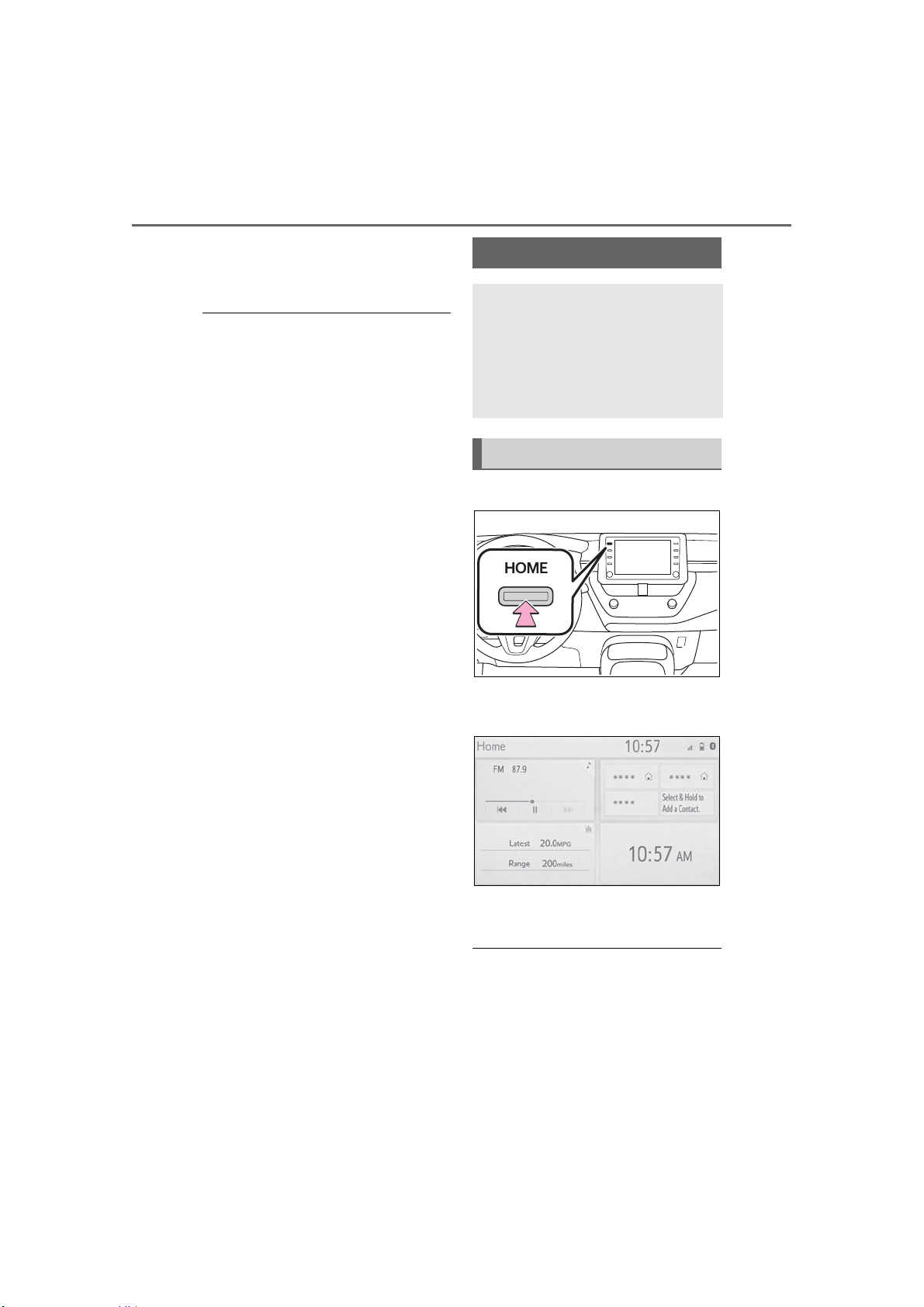
260
5-2. Basic information before operation
COROLLA H/B_U
tem by press and hold the
“POWER VOLUME” knob for
3 seconds or more.
● Capacitive touch screen button
sensor sensitivity can be adjusted.
(P.290)
1 Press the “HOME” button.
2 Check that the home screen
is displayed.
Selecting a screen will display
it full screen.
● The display information and area
on the home screen can be cus-
tomize.
● The home screen can be set to
several types of split layouts
Home screen
On the home screen, multi-
ple screens, such as the
audio/visual system screen,
hands-free screen and clock
screen, can be displayed
simultaneously.
Home screen operation
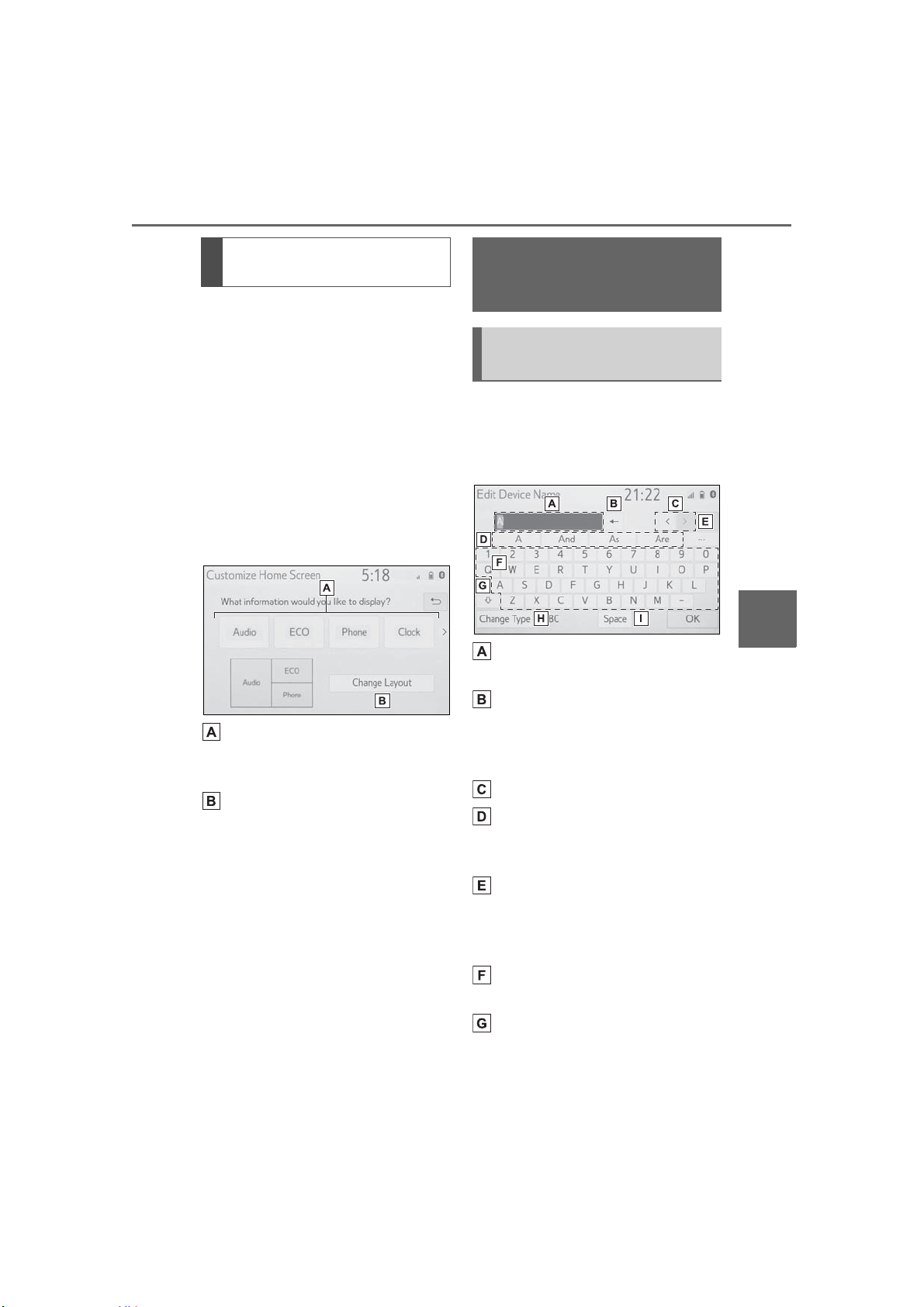
261
5-2. Basic information before operation
COROLLA H/B_U
5
Audio
The display information/area on
the home screen and the home
screen layout can be changed.
1 Press the “MENU” button.
2 Select “Setup”.
If the general settings screen
is not displayed, select “Gen-
eral”.
3 Select “Customize Home
Screen”.
4 Select the items to be set.
Select to change the display
information and area on the
home screen.
Select to change the home
screen layout.
When searching by a name or
entering data, letters and num-
bers can be entered via the
screen.
Text field. Entered charac-
ter(s) will be displayed.
Select to erase one charac-
ter.
Select and hold to continue
erasing characters.
Select to move the cursor.
Select to choose predictive
text candidate for entered
text. (P.262)
Select to display a list of pre-
dictive text candidates when
there is more than one.
(P.262)
Select to enter desired char-
acters.
Select to enter characters in
lower case or in upper case.
Customizing the home
screen
Entering letters and
numbers/list screen
operation
Entering letters and num-
bers
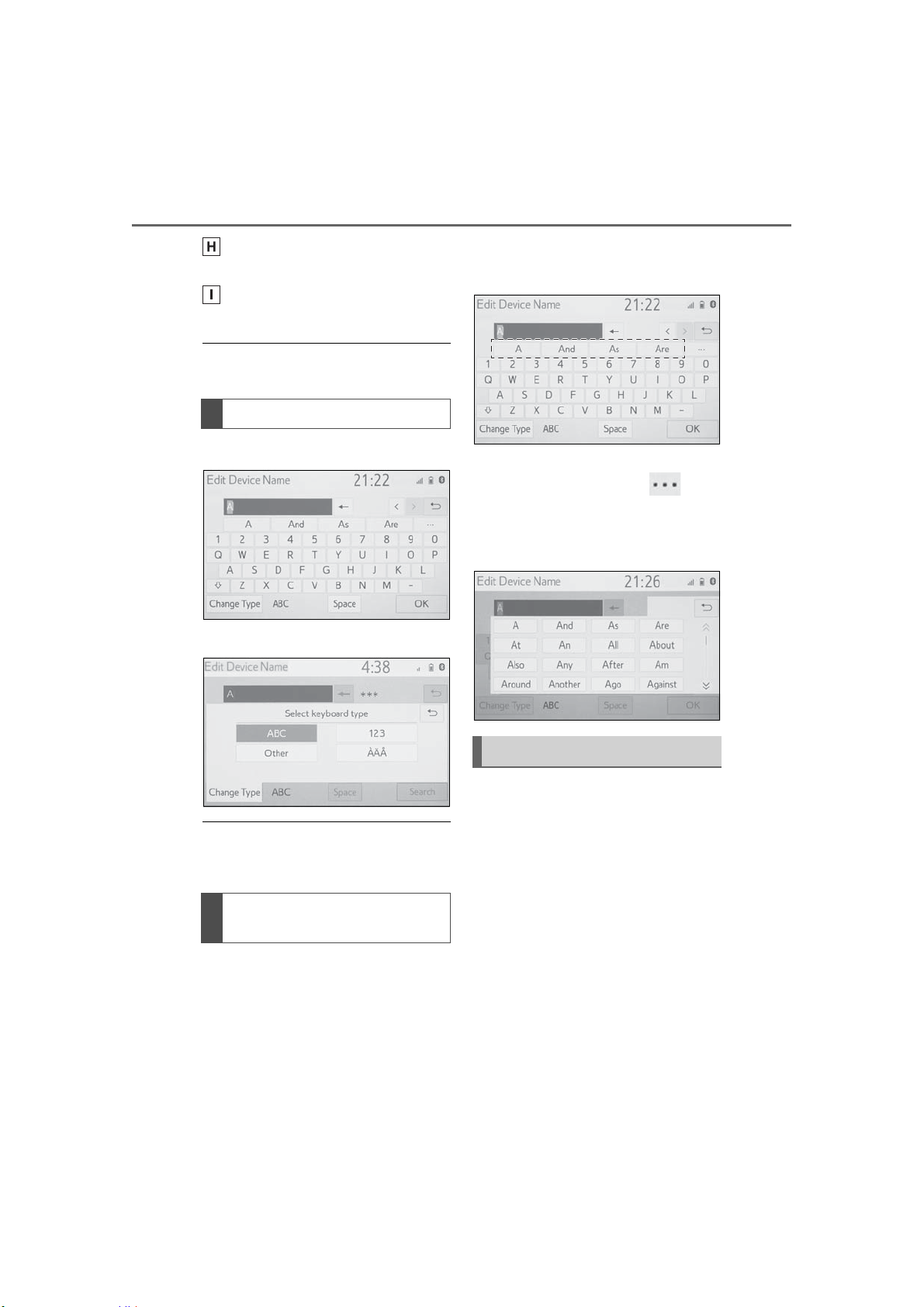
262
5-2. Basic information before operation
COROLLA H/B_U
Select to change character
types. (P.262)
Select to make a space on
cursor.
● Keyboard layout can be changed.
(P.290)
1 Select “Change Type”.
2 Select the desired character.
● Depending on the screen being
displayed, it may not possible to
change keyboard characters.
When text is input, the system
predicts the text that may com-
plete the currently unconfirmed
text and displays predictive
replacement candidates that
match the beginning of the text.
1 Input text.
2 Select the desired candidate.
To select a candidate that is
not displayed, select ,
and then select the desired
predictive replacement candi-
date.
The list screen may be dis-
played after entering characters.
When a list is displayed, use the
appropriate screen button to
scroll through the list.
Changing character type
Displaying predictive text
candidates
List screen

263
5-2. Basic information before operation
COROLLA H/B_U
5
Audio
To scroll up/down the list,
flick the list up/down.
Select to skip to the next or
previous page. Select and
hold or to scroll
through the displayed list.
Indicates the position of the
displayed entries in the entire
list.
To scroll up/down pages,
drag the bar.
● If appears to the right of an
item name, the complete name is
too long to display.
• Select to scroll to the end of
the name.
• Select to move to the begin-
ning of the name.
Items are displayed in the list
with the most similar results of
the search at the top.
1 Select .
2 Input text.
3 Select “Search”.
4 The list is displayed.
Scrolling list screen
Searching a list
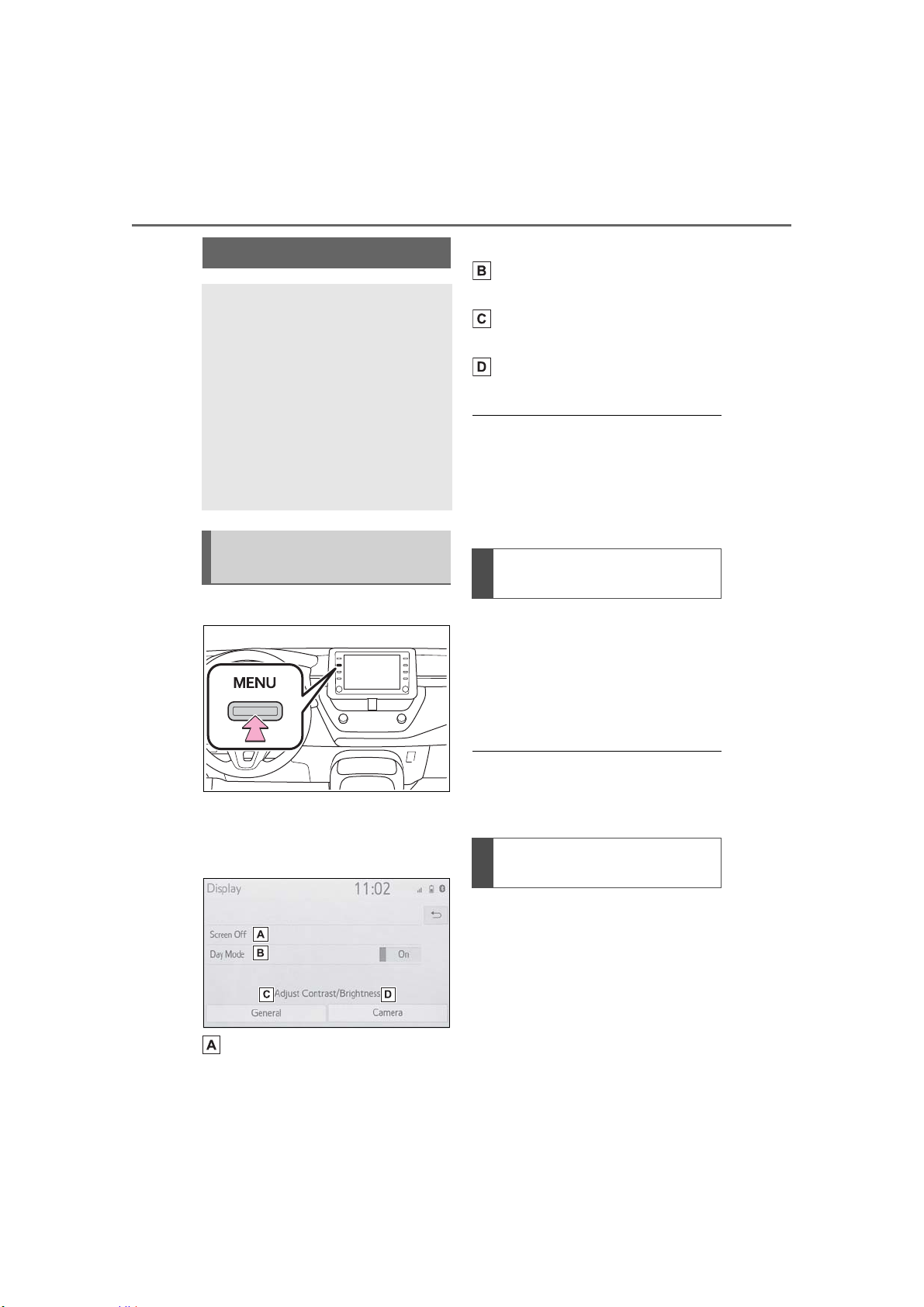
264
5-2. Basic information before operation
COROLLA H/B_U
1 Press the “MENU” button.
2 Select “Display”.
3 Select the desired items to
be set.
Select to turn the screen off.
To turn it on, press any but-
ton.
Select to turn day mode
on/off. (P.264)
Select to adjust the screen
display. (P.264)
Select to adjust the camera
display.
● When the screen is viewed
through polarized sunglasses, a
rainbow pattern may appear on
the screen due to optical charac-
teristics of the screen. If this is dis-
turbing, please operate the screen
without polarized sunglasses.
Depending on the position of the
headlight switch, the screen
changes to day or night mode.
This feature is available when
the headlight is switched on.
1 Select “Day Mode”.
● If the screen is set to day mode
with the headlight switch turned
on, this condition is memorized
even with the engine turned off.
The contrast and brightness of
the screen can be adjusted
according to the brightness of
your surroundings.
1 Select “General” or “Cam-
era”.
2 Select the desired item.
“Display (General)” screen
Screen adjustment
The contrast and brightness
of the screen display and
the image of the camera dis-
play can be adjusted. The
screen can also be turned
off, and/or changed to either
day or night mode.
(For information regarding
audio/visual screen adjust-
ment: P.300)
Displaying the screen
adjustment screen
Changing between day
and night mode
Adjusting the con-
trast/brightness

265
5-2. Basic information before operation
COROLLA H/B_U
5
Audio
only: Select “<” or “>” to select
the desired display.
• “Contrast”
“+”: Select to strengthen the con-
trast of the screen.
“-”: Select to weaken the contrast of
the screen.
• “Brightness”
“+”: Select to brighten the screen.
“-”: Select to darken the screen.
Linking multi-informa-
tion display and the
system
The following functions of
the system are linked with
the multi-information dis-
play in the instrument clus-
ter:
Audio
Phone
*
etc.
These functions can be
operated using multi-infor-
mation display control
switches on the steering
wheel. (P.83)
*
: When an Apple CarPlay con-
nection is established, this
function will be unavailable.
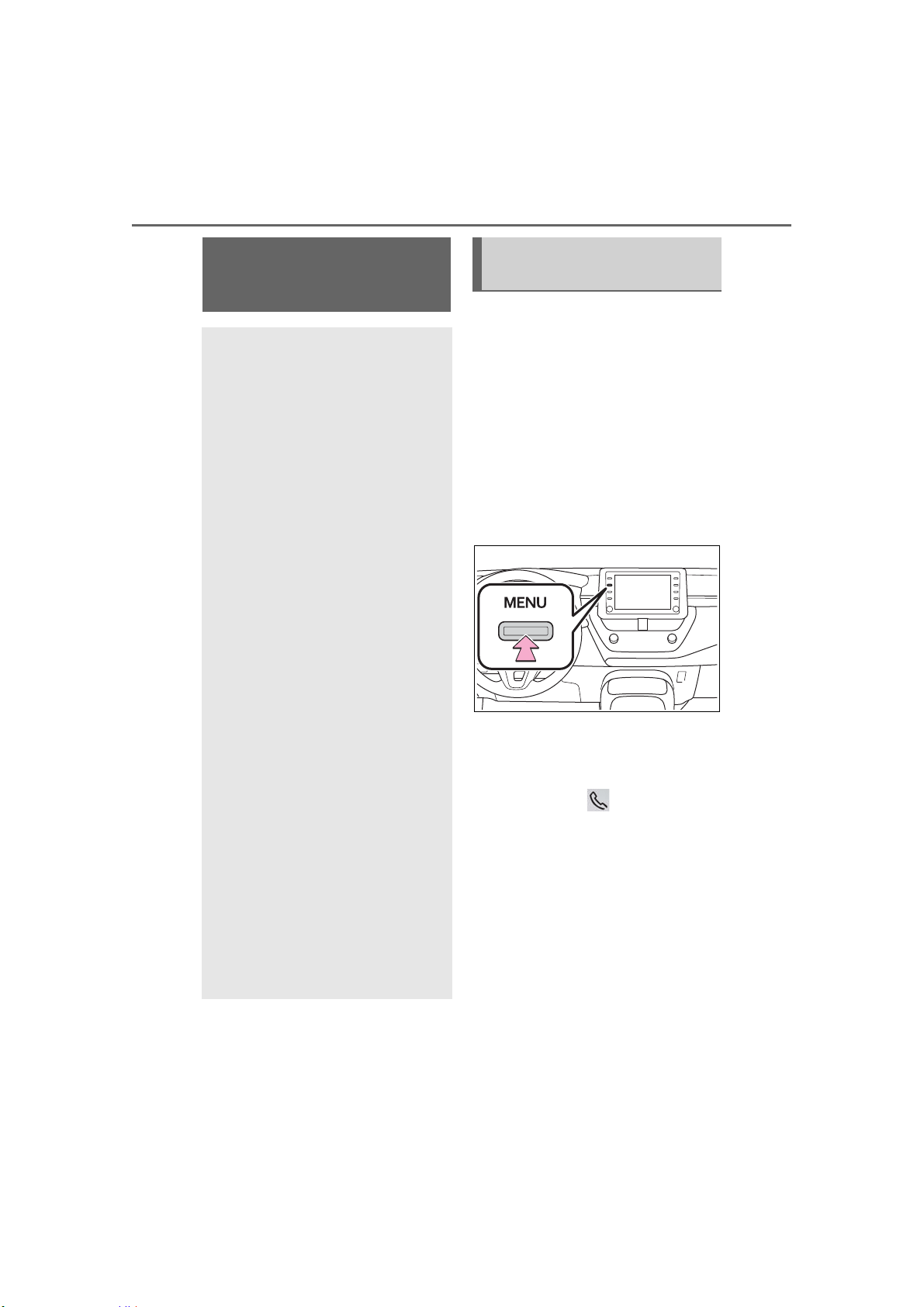
266
5-3. Connectivity settings
COROLLA H/B_U
5-3.Connectivity settings
■ Registering from the sys-
tem
1 Turn the Bluetooth
®
connec-
tion setting of your cellular
phone on.
This function is not available
when Bluetooth
®
connection
setting of your cellular phone
is set to off.
2 Press the “MENU” button.
3 Select “Phone”.
Operations up to this point
can also be performed by
pressing the switch on the
steering wheel or the
“PHONE” button on the instru-
ment panel.
Registering/Connect-
ing a Bluetooth
®
device
To use the hands-free sys-
tem, it is necessary to regis-
ter a Bluetooth
®
phone with
the system.
Once the phone has been
registered, it is possible to
use the hands-free system.
This operation cannot be
performed while driving.
When an Apple CarPlay
connection is established,
Bluetooth
®
functions of the
system will become unavail-
able and any connected
Bluetooth
®
devices will be
disconnected.
When connecting to
Android Auto, a Bluetooth
®
connection will be made
automatically.
*
When an Android Auto con-
nection is established,
some Bluetooth
®
functions
other than hands-free sys-
tem cannot be used.
*
*
: This function is not made avail-
able in some countries or
areas.
Registering a Bluetooth
®
phone for the first time
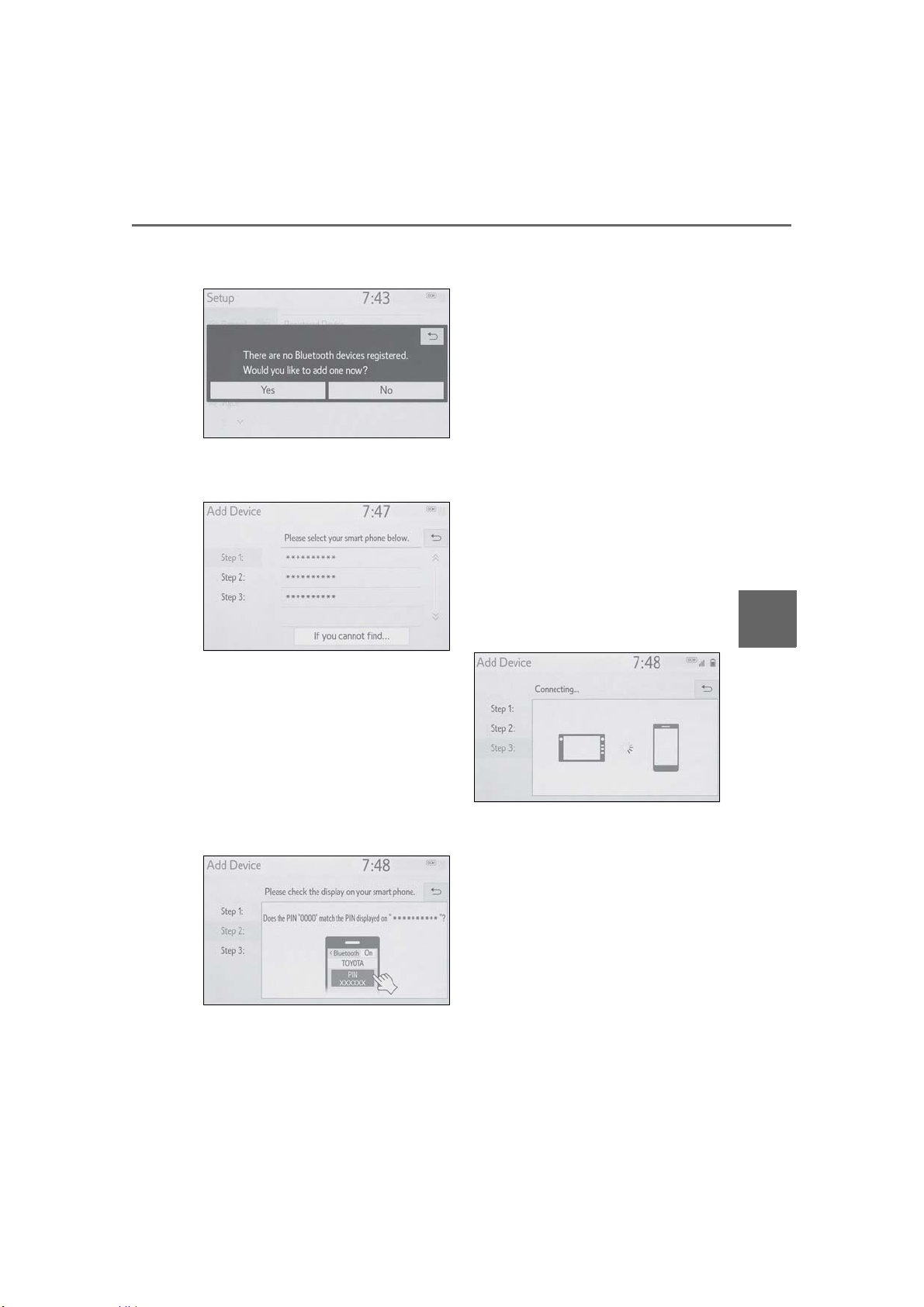
267
5-3. Connectivity settings
COROLLA H/B_U
5
Audio
4 Select “Yes” to register a
phone.
5 Select the desired Bluetooth
®
device.
If the desired Bluetooth
®
phone is not on the list, select
“If you cannot find...” and fol-
low the guidance on the
screen. (P.268)
6 Register the Bluetooth
®
device using your Blue-
tooth
®
device.
For details about operating
the Bluetooth
®
device, see
the manual that comes with it.
A PIN code is not required for
SSP (Secure Simple Pairing)
compatible Bluetooth
®
devices. Depending on the
type of Bluetooth
®
device
being connected, a message
confirming registration may
be displayed on the Blue-
tooth
®
device’s screen.
Respond and operate the
Bluetooth
®
device according
to the confirmation message.
7 Check that the following
screen is displayed, indicat-
ing pairing was successful (a
Bluetooth
®
link has been
established but registration is
not yet complete).
The system is connecting to
the registered device.
At this stage, the Bluetooth
®
functions are not yet avail-
able.
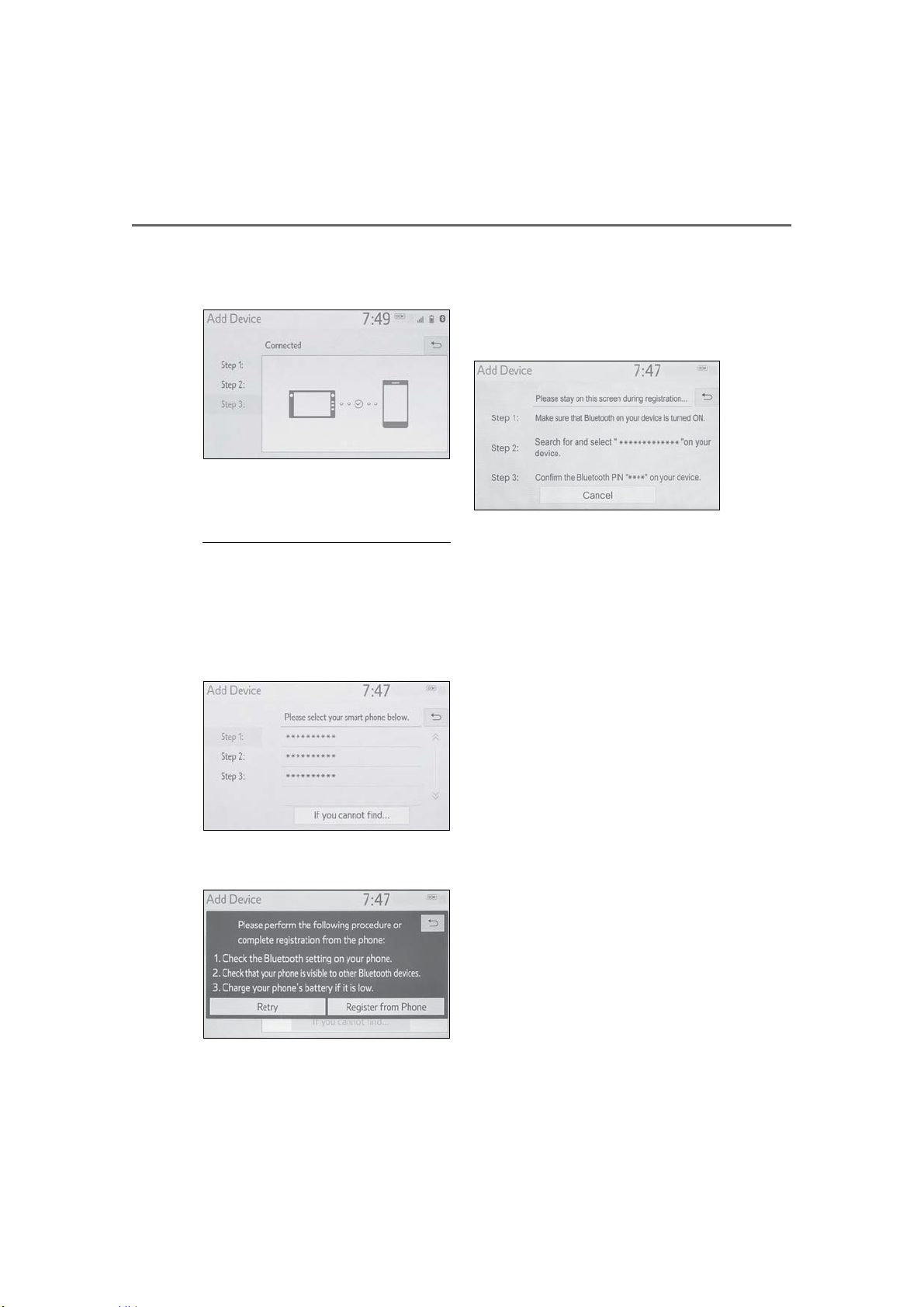
268
5-3. Connectivity settings
COROLLA H/B_U
8 Check that “Connected” is
displayed and registration is
complete.
If an error message is dis-
played, follow the guidance
on the screen to try again.
● If a cellular phone does not oper-
ate properly after being con-
nected, turn the cellular phone off
and on and then connect it again.
■ Registering from phone
1 Select “If you cannot find…”.
2 Select “Register from
Phone”.
3 Check that the following
screen is displayed, and reg-
ister the Bluetooth
®
device
using your Bluetooth
®
device.
For details about operating
the Bluetooth
®
device, see
the manual that comes with it.
A PIN code is not required for
SSP (Secure Simple Pairing)
compatible Bluetooth
®
devices. Depending on the
type of Bluetooth
®
device
being connected, a message
confirming registration may
be displayed on the Blue-
tooth
®
device’s screen.
Respond and operate the
Bluetooth
®
device according
to the confirmation message.
4 Follow the steps in “Register-
ing a Bluetooth
®
phone for
the first time” from step 7.
(P.266)
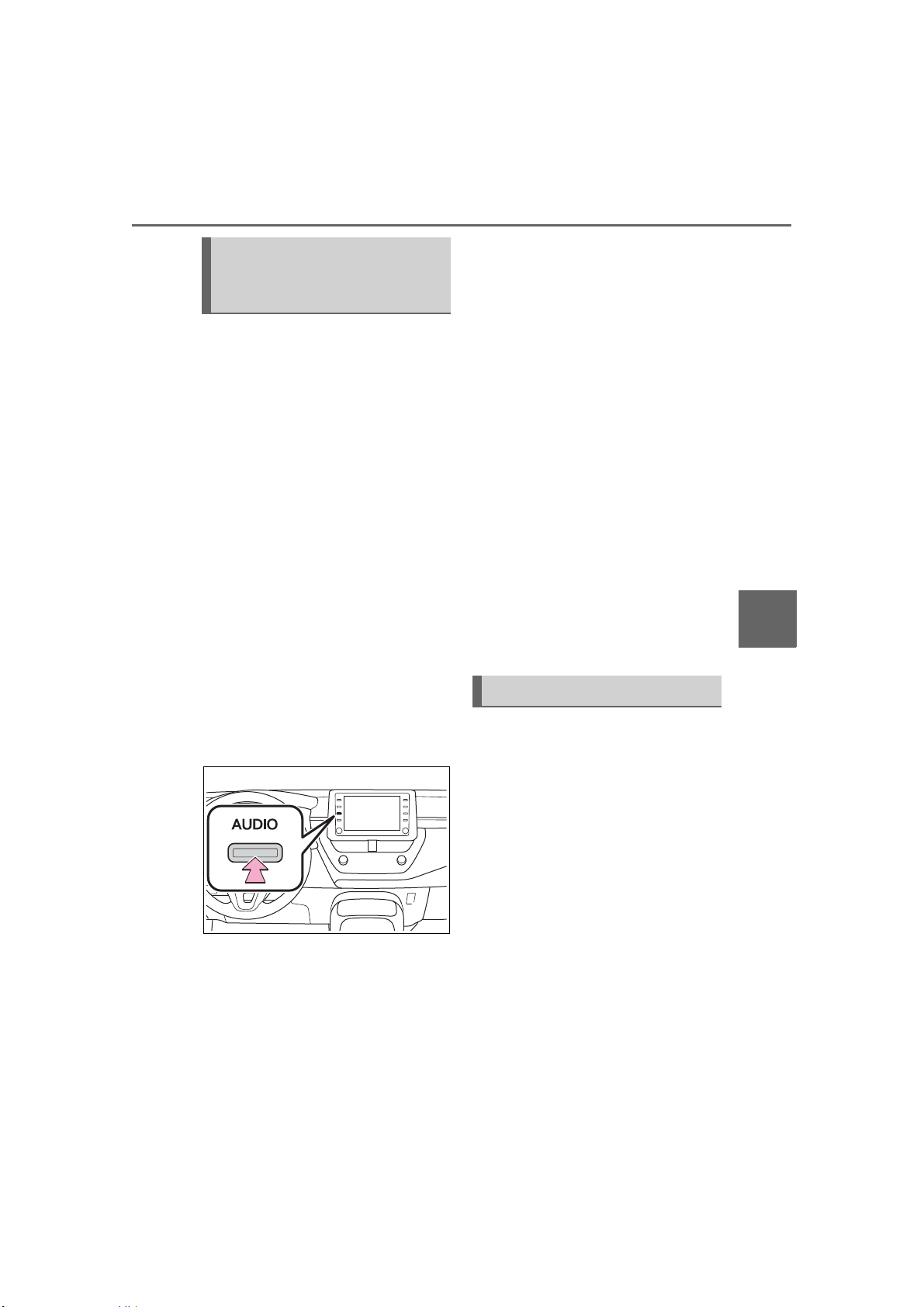
269
5-3. Connectivity settings
COROLLA H/B_U
5
Audio
To use the Bluetooth
®
audio, it is
necessary to register an audio
player with the system.
Once the player has been regis-
tered, it is possible to use the
Bluetooth
®
audio.
This operation cannot be per-
formed while driving.
For details about registering a
Bluetooth
®
device: P.26 6
When an Apple CarPlay con-
nection is established, Blue-
tooth
®
functions of the system
will become unavailable and any
connected Bluetooth
®
devices
will be disconnected.
When an Android Auto connec-
tion is established, some Blue-
tooth® functions other than
hands-free system cannot be
used.
*
*
: This function is not made available in some countries or areas.
1 Turn the Bluetooth
®
connec-
tion setting of your audio
player on.
This function is not available
when the Bluetooth
®
connec-
tion setting of your audio
player is set to off.
2 Press the “AUDIO” button.
3 Select “Source” on the audio
screen or press “AUDIO” but-
ton again.
4 Select “Bluetooth”.
5 Select “Yes” to register an
audio player.
6 Follow the steps in “Register-
ing a Bluetooth
®
phone for
the first time” from step 5.
(P.266)
This system supports the follow-
ing services.
■ Bluetooth
®
Core Specifica-
tion
Ver. 2.0 (Recommended: Ver.
4.1 +EDR)
■ Profiles
HFP (Hands Free Profile) Ver.
1.0 (Recommended: Ver. 1.7)
• This is a profile to allow
hands-free phone calls using a
cellular phone or head set. It has
outgoing and incoming call func-
tions.
OPP (Object Push Profile)
Ver. 1.1 (Recommended: Ver.
Registering a Bluetooth
®
audio player for the first
time
Profiles
270
5-3. Connectivity settings
COROLLA H/B_U
1.2)
• This is a profile to transfer con-
tacts data.
PBAP (Phone Book Access
Profile) Ver. 1.0 (Recom-
mended: Ver. 1.2)
• This is a profile to transfer phone-
book data.
MAP (Message Access Pro-
file) Ver. 1.0 (Recommended:
Ver. 1.2)
• This is a profile to use phone
message functions.
SPP (Serial Port Profile) Rec-
ommended: Ver. 1.2
• This is a profile to use the Toyota
audio multimedia function.
A2DP (Advanced Audio Dis-
tribution Profile) Ver. 1.0 (Rec-
ommended: Ver. 1.3)
• This is a profile to transmit stereo
audio or high quality sound to the
audio system.
AVRCP (Audio/Video Remote
Control Profile) Ver. 1.0 (Rec-
ommended: Ver. 1.6)
• This is a profile to allow remote
control the A/V equipment.
● This system is not guaranteed to
operate with all Bluetooth
®
devices.
● If your cellular phone does not
support HFP, registering the Blue-
tooth
®
phone or using OPP,
PBAP, MAP or SPP profiles indi-
vidually will not be possible.
● If the connected Bluetooth
®
device version is older than rec-
ommended or incompatible, the
Bluetooth
®
device function may
not work properly.
● Refer to https://www.toy-
ota.com/audio multimedia in the
United States,
https://www.toyota.ca/connected
in Canada, and
http://www.toyotapr.com/audio
multimedia in Puerto Rico, to find
approved Bluetooth
®
phones for
this system.
● Certification
Bluetooth is a registered trademark
of Bluetooth SIG, Inc.
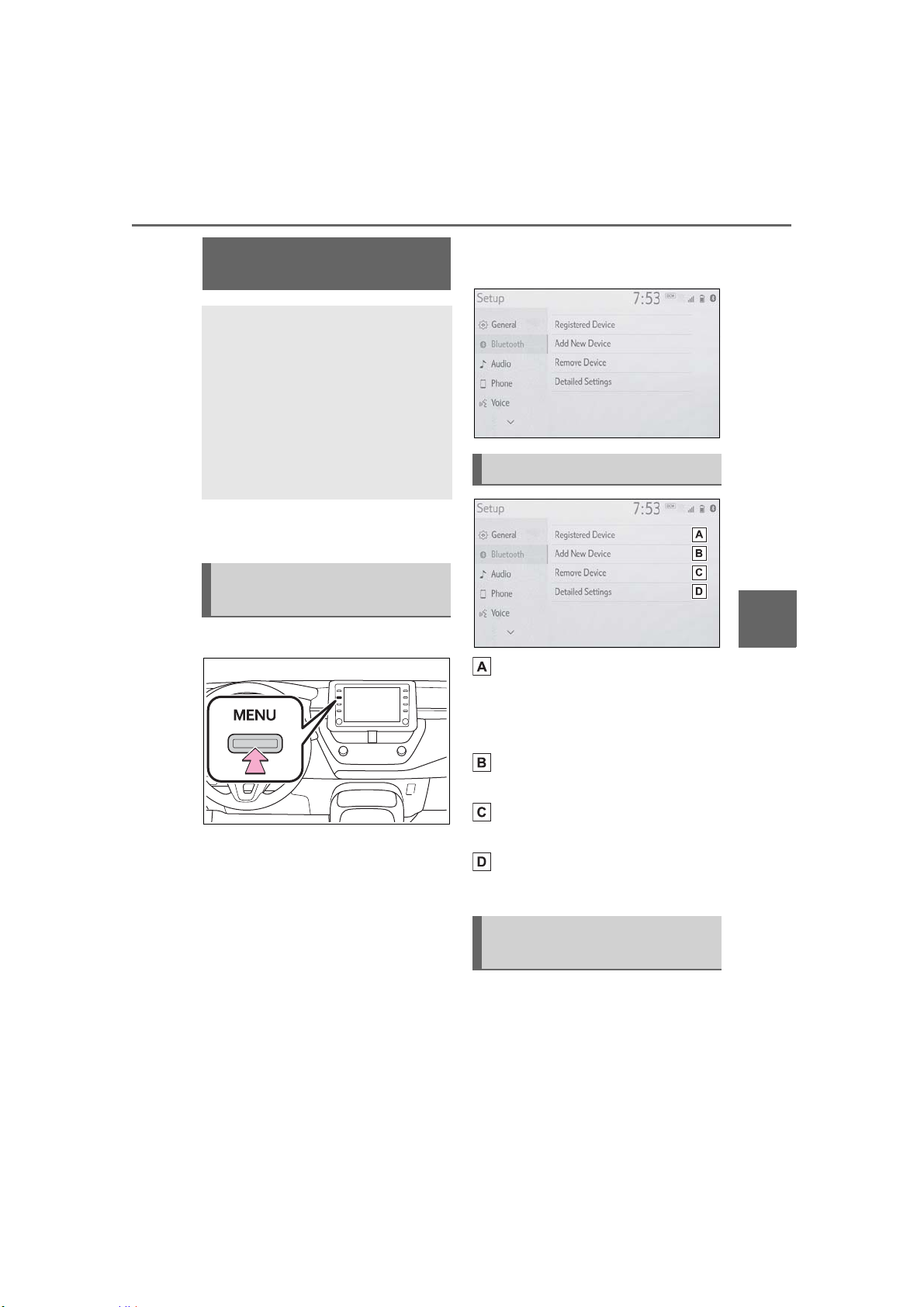
271
5-3. Connectivity settings
COROLLA H/B_U
5
Audio
*
: This function is not made avail-
able in some countries or areas.
1 Press the “MENU” button.
2 Select “Setup”.
3 Select “Bluetooth”.
4 Select the desired item to be
set.
Connecting a Bluetooth
®
device and editing the Blue-
tooth
®
device information
(P.271, 274)
Registering a Bluetooth
®
device (P.273)
Deleting a Bluetooth
®
device
(P.274)
Setting the Bluetooth
®
sys-
tem (P.276)
Up to 5 Bluetooth
®
devices
(Phones (HFP) and audio play-
ers (AVP)) can be registered.
If more than 1 Bluetooth
®
device
Setting Bluetooth
®
details
When an Apple CarPlay
connection is established,
this function will be unavail-
able.
*
When an Android Auto con-
nection is established,
some functions will be
unavailable.
*
Displaying the Blue-
tooth
®
setup screen
Bluetooth
®
setup screen
Connecting a Bluetooth
®
device
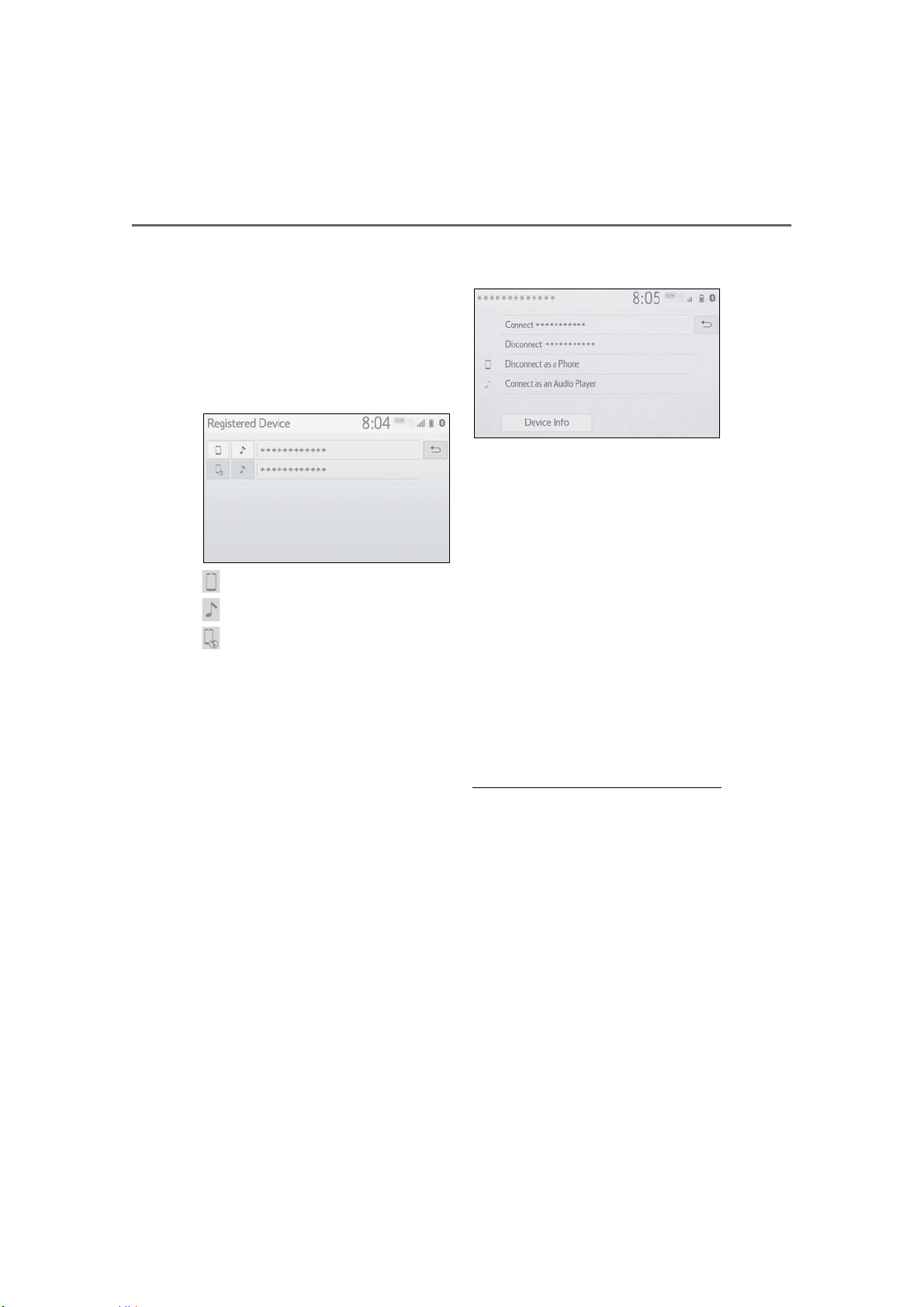
272
5-3. Connectivity settings
COROLLA H/B_U
has been registered, select
which device to connect to.
1 Display the Bluetooth
®
set-
tings screen. (P.271)
2 Select “Registered Device”.
3 Select the device to be con-
nected.
: Phone
: Audio player
: Phone/Toyota apps services
The profile icon for a currently
connected device will be dis-
played in color.
Selecting a profile icon which
is not currently connected will
switch the connection to the
function.
If the desired Bluetooth
®
device is not on the list, select
“Add New Device” to register
the device. (P.273)
4 Select the desired connec-
tion.
“Device Info”: Select to con-
firm and change the Blue-
tooth
®
device information.
(P.274)
When another Bluetooth
®
device is connected
To disconnect the Bluetooth
®
device, select “Yes”.
5 Check that a confirmation
screen is displayed when the
connection is complete.
If an error message is dis-
played, follow the guidance
on the screen to try again.
● It may take time if the device con-
nection is carried out during Blue-
tooth
®
audio playback.
● Depending on the type of Blue-
tooth
®
device being connected, it
may be necessary to perform
additional steps on the device.
● When disconnecting a Bluetooth
®
device, it is recommended to dis-
connect using the system.
■ Connecting a Bluetooth
®
device in a different way
(from phone top screen)
P.345

273
5-3. Connectivity settings
COROLLA H/B_U
5
Audio
■ Connecting a Bluetooth
®
device in a different way
(from phone setup screen)
P.359
■ Connecting a Bluetooth
®
device in a different way
(from Bluetooth
®
audio
screen)
P.316
■ Auto connection mode
To turn auto connection mode
on, set “Bluetooth Power” to on.
(P.276) Leave the Bluetooth
®
device in a location where the
connection can be established.
When the engine switch is in
ACC or ON, the system
searches for a nearby regis-
tered device.
The system will connect with
the registered device that was
last connected, if it is nearby.
When automatic connection
priority is set to on and there
is more than one registered
Bluetooth
®
phone available,
the system will automatically
connect to the Bluetooth
®
phone with the highest prior-
ity. (P.276)
■ Connecting manually
When the auto connection has
failed or “Bluetooth Power” is
turned off, it is necessary to con-
nect the Bluetooth
®
device man-
ually.
1 Display the Bluetooth
®
set-
tings screen. (P.271)
2 Follow the steps in “Connect-
ing a Bluetooth
®
device” from
step 2. (P.271)
■ Reconnecting the Blue-
tooth
®
phone
If a Bluetooth
®
phone is discon-
nected due to poor reception
from the Bluetooth
®
network
when the engine switch is in
ACC or ON, the system auto-
matically reconnects the Blue-
tooth
®
phone.
Up to 5 Bluetooth
®
devices can
be registered.
Bluetooth
®
compatible phones
(HFP) and audio players (AVP)
can be registered simultane-
ously.
This operation cannot be per-
formed while driving.
1 Display the Bluetooth
®
set-
tings screen. (P.271)
2 Select “Add New Device”.
When another Bluetooth
®
device is connected
To disconnect the Bluetooth
®
device, select “Yes”.
Registering a Bluetooth
®
device
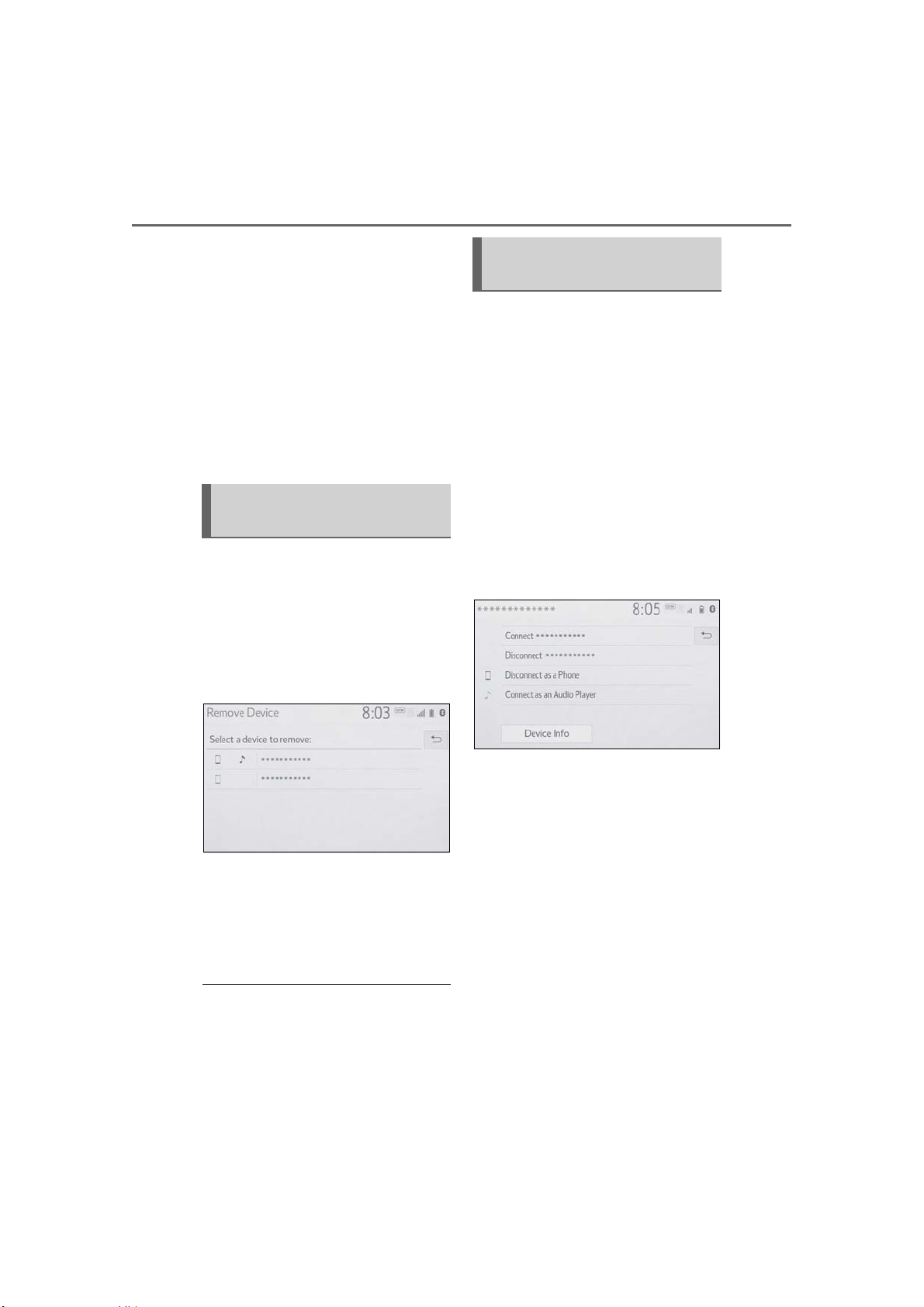
274
5-3. Connectivity settings
COROLLA H/B_U
When 5 Bluetooth
®
devices
have already been registered
A registered device needs to
be replaced. Select “Yes”, and
select the device to be
replaced.
3 Follow the steps in “Register-
ing a Bluetooth
®
phone for
the first time” from step 5.
(P.266)
This operation cannot be per-
formed while driving.
1 Display the Bluetooth
®
set-
tings screen. (P.271)
2 Select “Remove Device”.
3 Select the desired device.
4 Select “Yes” when the confir-
mation screen appears.
5 Check that a confirmation
screen is displayed when the
operation is complete.
● When deleting a Bluetooth
®
phone, the contact data will be
deleted at the same time.
The Bluetooth
®
device’s infor-
mation can be displayed on the
screen. The displayed informa-
tion can be edited.
This operation cannot be per-
formed while driving.
1 Display the Bluetooth
®
set-
tings screen. (P.271)
2 Select “Registered Device”.
3 Select the desired device to
be edited.
4 Select “Device Info”.
Deleting a Bluetooth
®
device
Editing the Bluetooth
®
device information
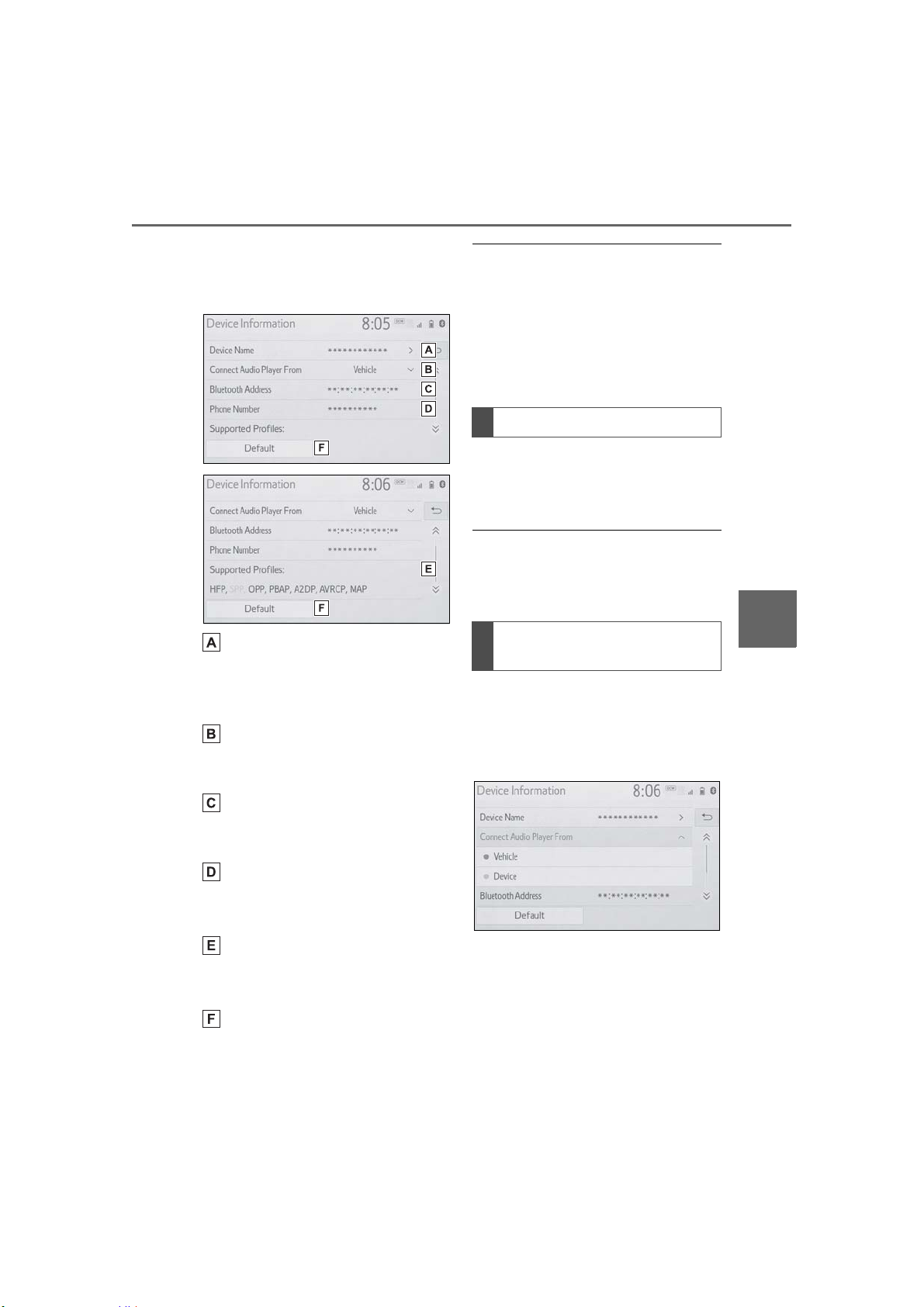
275
5-3. Connectivity settings
COROLLA H/B_U
5
Audio
5 Confirm and change the
Bluetooth
®
device informa-
tion.
The name of the Bluetooth
®
device is displayed. It can be
changed to a desired name.
(P.275)
Select to set the Bluetooth
®
audio player connection
method. (P.275)
Device address is unique to
the device and cannot be
changed.
Phone number is unique to
the Bluetooth
®
phone and
cannot be changed.
Compatibility profile is unique
to the Bluetooth
®
device and
cannot be changed.
Select to reset all setup
items.
● If 2 Bluetooth
®
devices have been
registered with the same device
name, the devices can be distin-
guished referring to the device’s
address.
● Depending on the type of Blue-
tooth
®
phone, some information
may not be displayed.
1 Select “Device Name”.
2 Enter the name and select
“OK”.
● Even if the device name is
changed, the name registered in
your Bluetooth
®
device does not
change.
1 Select “Connect Audio Player
From”.
2 Select the desired connec-
tion method.
“Vehicle”: Select to connect the
audio player from the vehicle’s
audio/visual system.
“Device”: Select to connect the
vehicle’s audio/visual system from
the audio player.
Depending on the audio
Changing a device name
Setting audio player con-
nection method
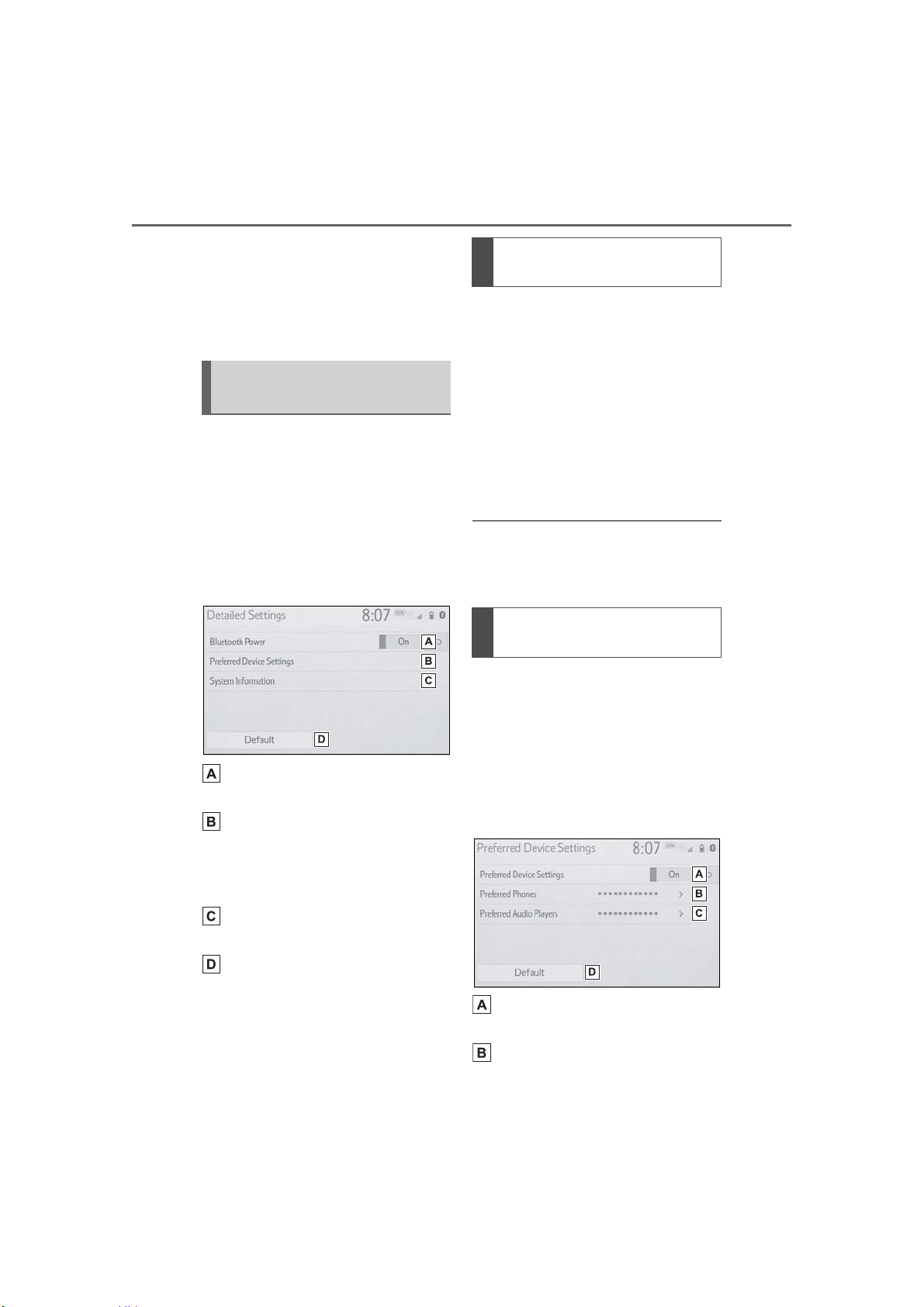
276
5-3. Connectivity settings
COROLLA H/B_U
player, the “Vehicle” or
“Device” connection method
may be best. As such, refer to
the manual that comes with
the audio player.
The Bluetooth
®
settings can be
confirmed and changed.
1 Display the Bluetooth
®
set-
tings screen. (P.271)
2 Select “Detailed Settings”.
3 Select the desired item to be
set.
Select to set Bluetooth
®
con-
nection on/off. (P.276)
Select to change the auto-
matic connection priority of
the registered Bluetooth
®
devices. (P.276)
Select to edit the system
information. (P.277)
Select to reset all setup
items.
1 Select “Bluetooth Power”.
When “Bluetooth Power” is on:
The Bluetooth
®
device is auto-
matically connected when the
engine switch is in ACC or ON.
When “Bluetooth Power” is off:
The Bluetooth
®
device is dis-
connected, and the system will
not connect to it next time.
● While driving, the auto connection
state can be changed from off to
on, but cannot be changed from
on to off.
The automatic connection prior-
ity of the registered Bluetooth
®
devices can be changed.
1 Select “Preferred Device Set-
tings”.
2 Select the desired item to be
set.
Select to set automatic con-
nection priority on/off.
Select to change the auto-
“Detailed Settings”
screen
Changing “Bluetooth
Power”
Setting automatic connec-
tion priority
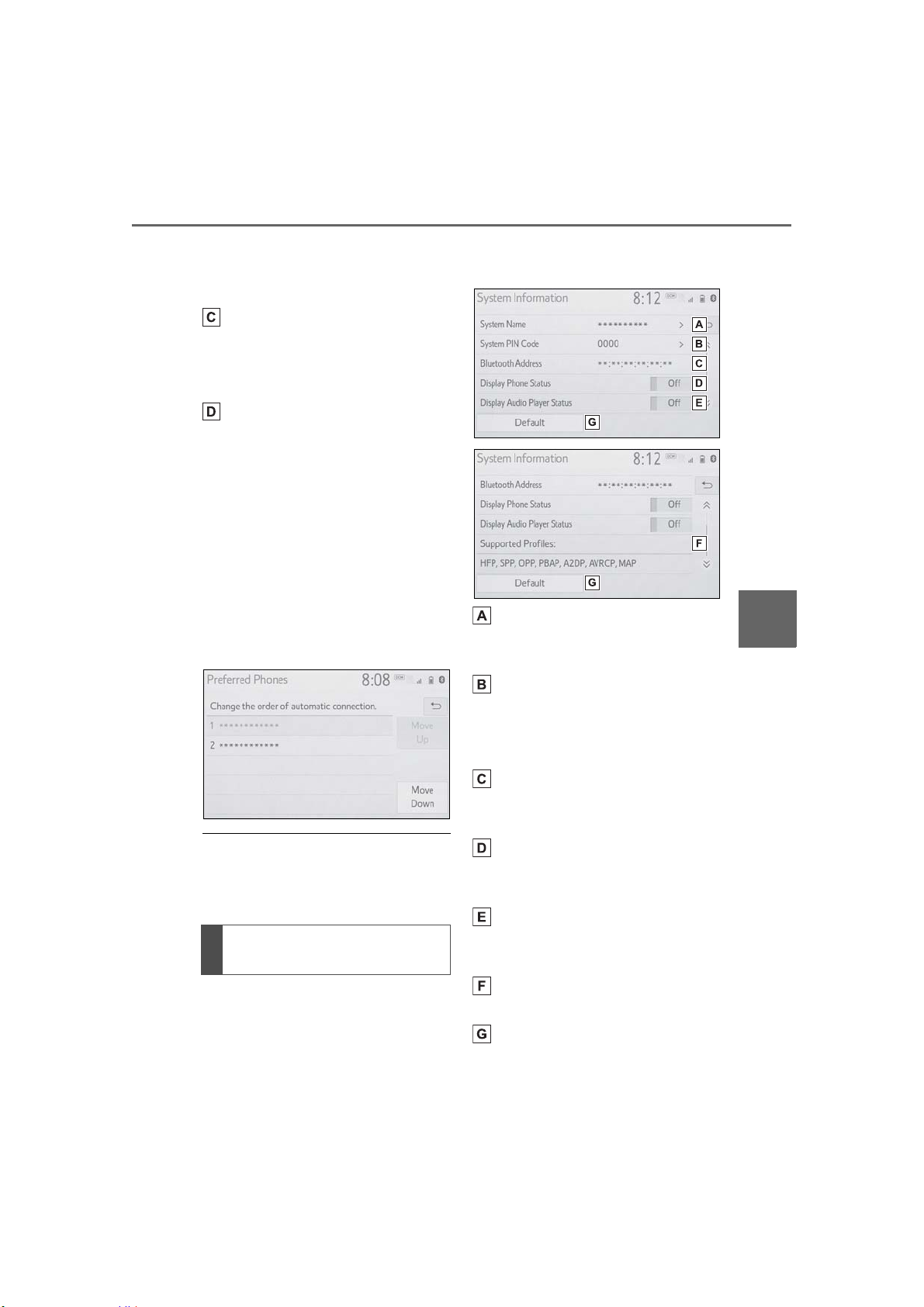
277
5-3. Connectivity settings
COROLLA H/B_U
5
Audio
matic connection priority of
the registered Bluetooth
®
phones. (P.277)
Select to change the auto-
matic connection priority of
the registered Bluetooth
®
audio players. (P.277)
Select to reset all setup
items.
■ Changing Bluetooth
®
device automatic connec-
tion priority
1 Select “Preferred Phones” or
“Preferred Audio Players”.
2 Select the desired Bluetooth
®
device and select “Move Up”
or “Move Down” to change
the preferred order.
● A newly registered Bluetooth
®
device will automatically be given
the highest automatic connection
priority.
1 Select “System Information”.
2 Select the desired item to be
set.
Displays system name. Can
be changed to a desired
name. (P.278)
PIN code used when the
Bluetooth
®
device was regis-
tered. Can be changed to a
desired code. (P.278)
Device address is unique to
the device and cannot be
changed.
Select to set the connection
status display of the phone
on/off.
Select to set the connection
status display of the audio
player on/off.
Compatibility profile of the
system
Select to reset all setup
items.
Editing the system infor-
mation

278
5-3. Connectivity settings
COROLLA H/B_U
■ Editing the system name
1 Select “System Name”.
2 Enter a name and select
“OK”.
■ Editing the PIN code
1 Select “System PIN Code”.
2 Enter a PIN code and select
“OK”.
*
: If equipped
1 Enable the Wi-Fi
®
Hotspot
function. (P.279)
2 Disable the “Hide Access
Point” function. (P.279)
3 Search for the vehicle access
point using the device you
wish to connect.
For details about operating
the device, refer to the docu-
mentation which came with it.
Wi-Fi
®
Hotspot
*
By connecting a device to
the vehicle via Wi-Fi
®
, it can
access the internet through
the DCM.
To use this function, a
Wi-Fi
®
Hotspot service sub-
scription from Verizon Wire-
less is required. Contact
your Toyota dealer for
details.
This function is not made
available in some countries
or areas.
Connecting a device to
the in-vehicle access
point
Searching for and con-
necting a device to the
vehicle access point
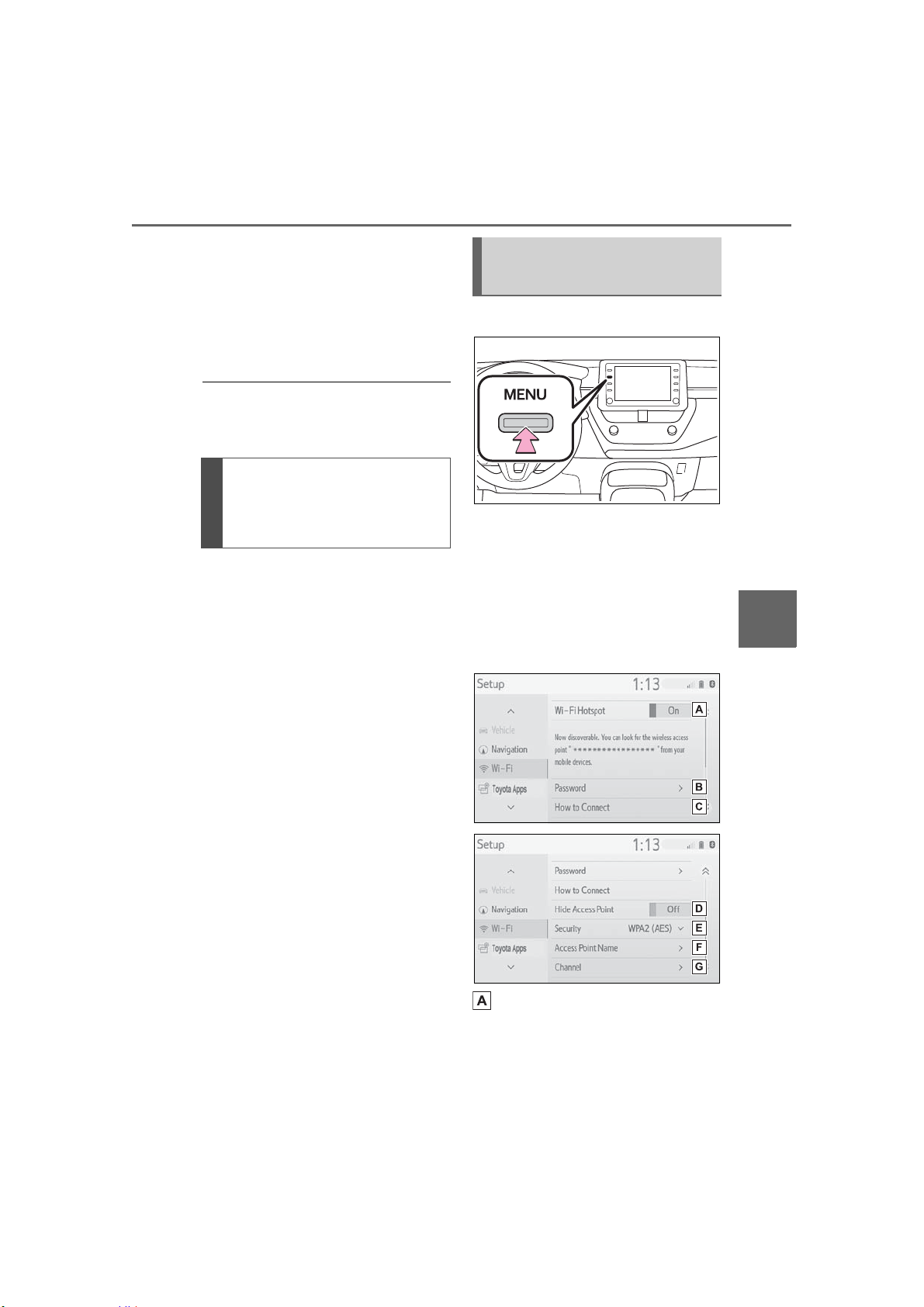
279
5-3. Connectivity settings
COROLLA H/B_U
5
Audio
4 Operate the device to con-
nect it to the vehicle access
point.
To check the vehicle access
point password, check “Pass-
word”. (P.279)
● Hints for connecting to the vehicle
via Wi-Fi
®
can be displayed.
(P.279)
1 Enable the Wi-Fi
®
Hotspot
function. (P.279)
2 Enable the “Hide Access
Point” function. (P.278)
3 Enter the access point name
(SSID) into the device you
wish to connect and connect
it.
To check the vehicle access
point password, check “Pass-
word”. (P.279)
The security settings on the
device must be the same as
that displayed for “Security”.
(P.279)
For details about operating
the device, refer to the docu-
mentation which came with it.
1 Press the “MENU” button.
2 Select “Setup”.
3 Select “Wi-Fi
*
”.
*
:Wi-Fi
®
is a registered trademark
of Wi-Fi Alliance
®
.
4 Select the desired item to be
set.
Select to enable/disable the
Wi-Fi
®
Hotspot function.
(P.280)
Connecting a device to the
in-vehicle access point
using the access point
name (SSID)
Changing the Wi-Fi
®
set-
tings
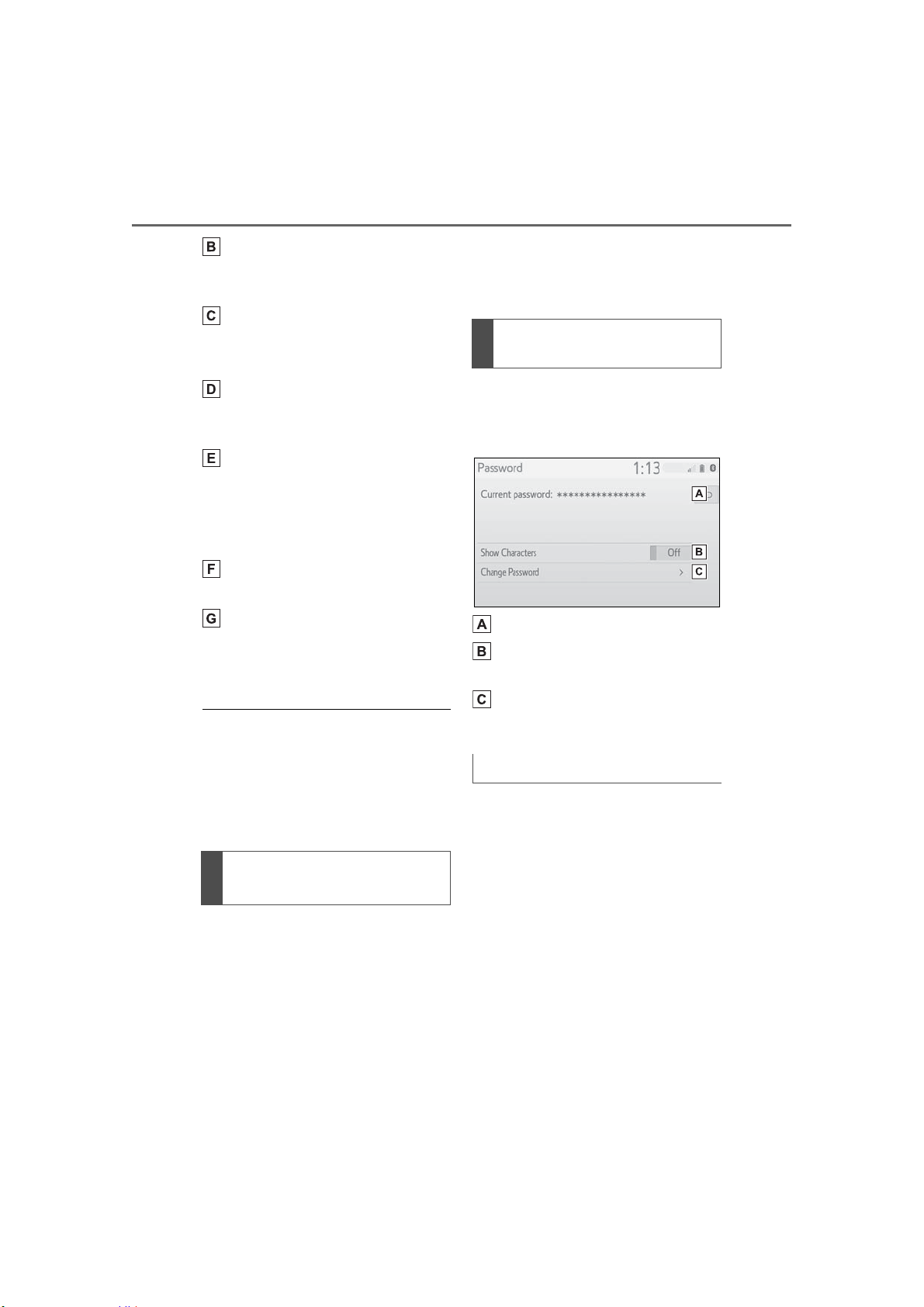
280
5-3. Connectivity settings
COROLLA H/B_U
Select to check/change the
access point password.
(P.280)
Select to display hints for
connecting to the vehicle via
Wi-Fi
®
.
Select to make the access
point searchable/unsearch-
able.
Select to check/change the
security protocol of the
access point (for authentica-
tion and encryption).
(P.281)
Select to change the access
point name (SSID). (P.281)
Select to change the Wi-Fi
®
connection channel (within
the 2.4GHz frequency band).
(P.281)
● If any settings have been
changed, it will be necessary to
reset the Wi-Fi
®
system to com-
plete the changes. To reset the
Wi-Fi
®
system, select “Yes” on the
pop-up displayed after changing
the settings.
When the Wi-Fi
®
Hotspot func-
tion is enabled, the system
checks for a valid Hotspot ser-
vice subscription.
If a hotspot service subscription
has not been started, connect
your device to the in-vehicle
access point to start your sub-
scription. A trial subscription
may be available.
1 Select “Password”.
2 Check that the following
screen is displayed.
Displays the password
Select to display/hide the
entered password.
Select to change the pass-
word.
1 Select “Change Password”.
2 Enter the desired password
and select “OK”.
When setting/changing a
password, observe the follow-
ing guidelines to help prevent
the password from being
cracked by a third party:
• Use an 8-character or longer
password consisting of letters
and numbers. (Non-ASCII char-
acters will not be recognized by
the system.)
Enabling/disabling the
Wi-Fi
®
Hotspot function
Checking/changing the
password
Changing the password
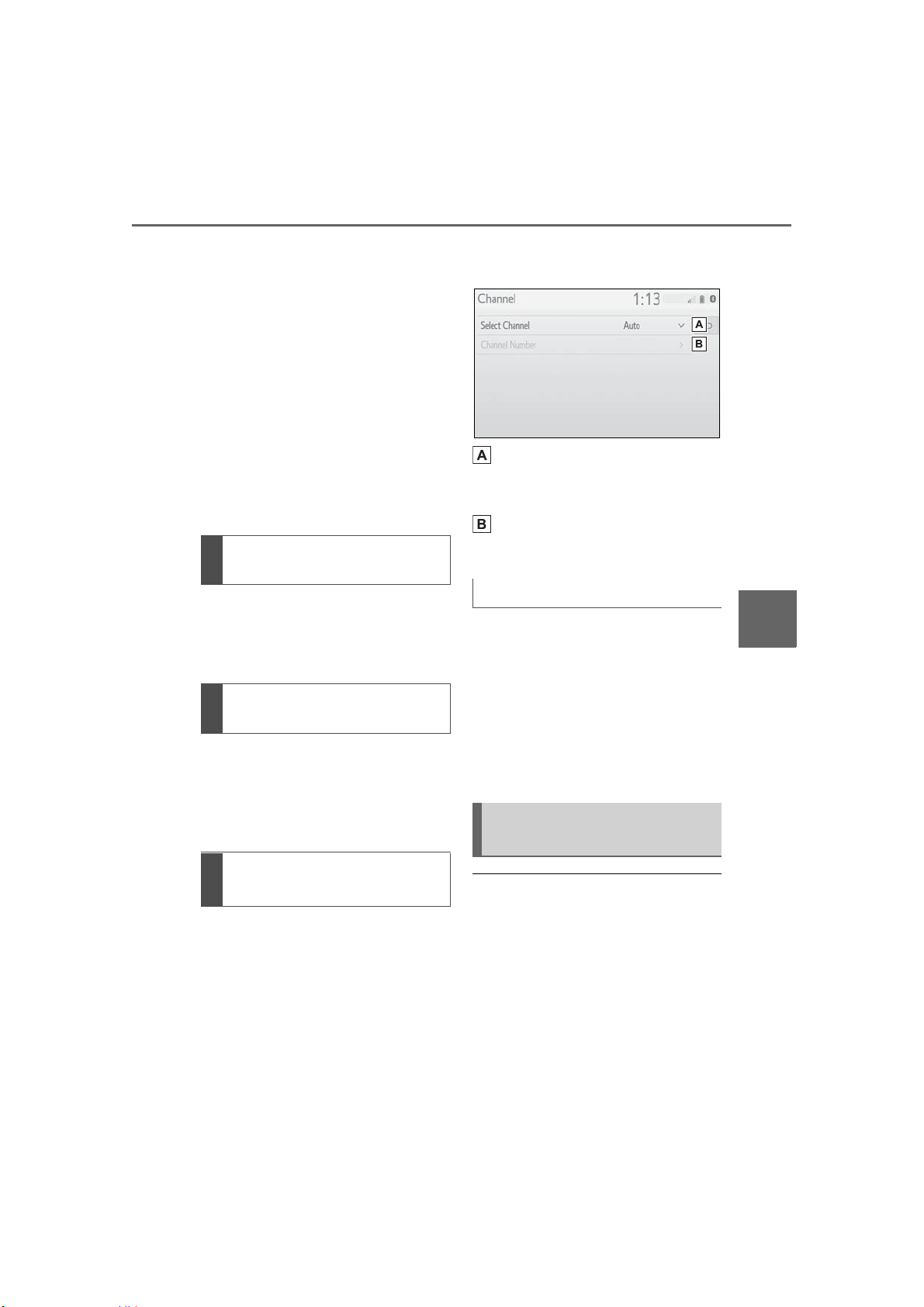
281
5-3. Connectivity settings
COROLLA H/B_U
5
Audio
• Change the password regularly.
• If you write the password down,
do not leave it somewhere where
it would be visible.
• Do not use the same or a similar
password to that for other
accounts.
• Avoid using easy to identify
words, such as your vehicle’s
model name or license plate
number, simple dictionary words,
or words with simple obfuscation,
such as c@t (for cat), as your
password.
1 Select “Security”.
2 Select the desired security
protocol.
1 Select “Access Point Name”.
2 Enter the desired access
point name (SSID) and select
“OK”.
1 Select “Channel”.
2 Check that the following
screen is displayed.
Select to change the chan-
nel selection to auto-
matic/manual.
When “Manual” is selected,
select to change the channel.
1 Set “Select Channel” to
“Manual”.
2 Select “Channel Number”.
3 Enter the desired channel
number and select “OK”.
Channels 1 through 11 can be
selected.
● If a connected device is taken out
of the Wi-Fi
®
connection area, the
connection will be severed.
● If the vehicle is driven out of the
cellular communication coverage
area, connecting to the internet
via the Wi-Fi
®
Hotspot will not be
possible.
● If a Bluetooth
®
device is used
while a device is connected using
the Wi-Fi
®
Hotspot function, the
Changing the security pro-
tocol
Changing the access point
name (SSID)
Selecting a Wi-Fi
®
connec-
tion channel
Changing the channel
Wi-Fi
®
function operating
hints
282
5-3. Connectivity settings
COROLLA H/B_U
communication speed may
decrease.
● If the vehicle is near a radio
antenna, radio station or other
source of strong radio waves and
electrical noise, communication
may be slow or impossible.
The condition of Wi-Fi
®
connec-
tion appears on the right upper
side of the screen. (P.254)
Communication standards
IEEE 802.11b
IEEE 802.11g
IEEE 802.11n (2.4GHz)
Security
WPA™
WPA2™
• WPA™ and WPA2™ are trade-
marks of Wi-Fi Alliance
®
.
WARNING
● Use Wi-Fi
®
devices only when
safe and legal to do so.
● Your audio unit is fitted with
Wi-Fi
®
antennas. People with
implantable cardiac pacemak-
ers, cardiac resynchronization
therapy-pacemakers or implant-
able cardioverter defibrillators
should maintain a reasonable
distance between themselves
and the Wi-Fi
®
antennas.
The radio waves may affect the
operation of such devices.
● Before using Wi-Fi
®
devices,
users of any electrical medical
device other than implantable
cardiac pacemakers, cardiac
resynchronization ther-
apy-pacemakers or implantable
cardioverter defibrillators should
consult the manufacturer of the
device for information about its
operation under the influence of
radio waves.
Radio waves could have unex-
pected effects on the operation
of such medical devices.
Conditions displayed with
Wi-Fi
®
icon
Specifications

283
5-3. Connectivity settings
COROLLA H/B_U
5
Audio
*
: This function is not made avail-
able in some countries or areas.
*
: This function is not made avail-
able in some countries or areas.
1 Enable Siri on the device to
be connected.
2 Connect the device to the
USB port. (P.299)
3 Select “Always Enable” or
“Enable Once”.
If “Do Not Enable” is selected,
an Apple CarPlay connection
will not be established. In this
case, the device can be oper-
ated as a normal Apple
device, such as an iPod.
Depending on the device con-
nected, it may take approxi-
mately 3 to 6 seconds before
an Apple CarPlay connection
is established.
4 Press the “MENU” button.
Apple Car-
Play/Android Auto
*
Apple CarPlay allows some
applications, such as Map,
Phone, and Music, to be
used on the system.
When an Apple CarPlay
connection is established,
Apple CarPlay compatible
applications will be dis-
played on the system dis-
play.
Compatible device
Apple iPhone (iOS Ver. 9.3 or
later) that supports Apple Car-
Play. For details, refer to
https://www.apple.com/ios/car
play/.
Android devices with Android OS
ver 5.0 or higher which support
Android Auto and have the
Android Auto application
installed.
For details, refer to
https://www.android.com/auto/
.
*
Establishing an Apple
CarPlay connection
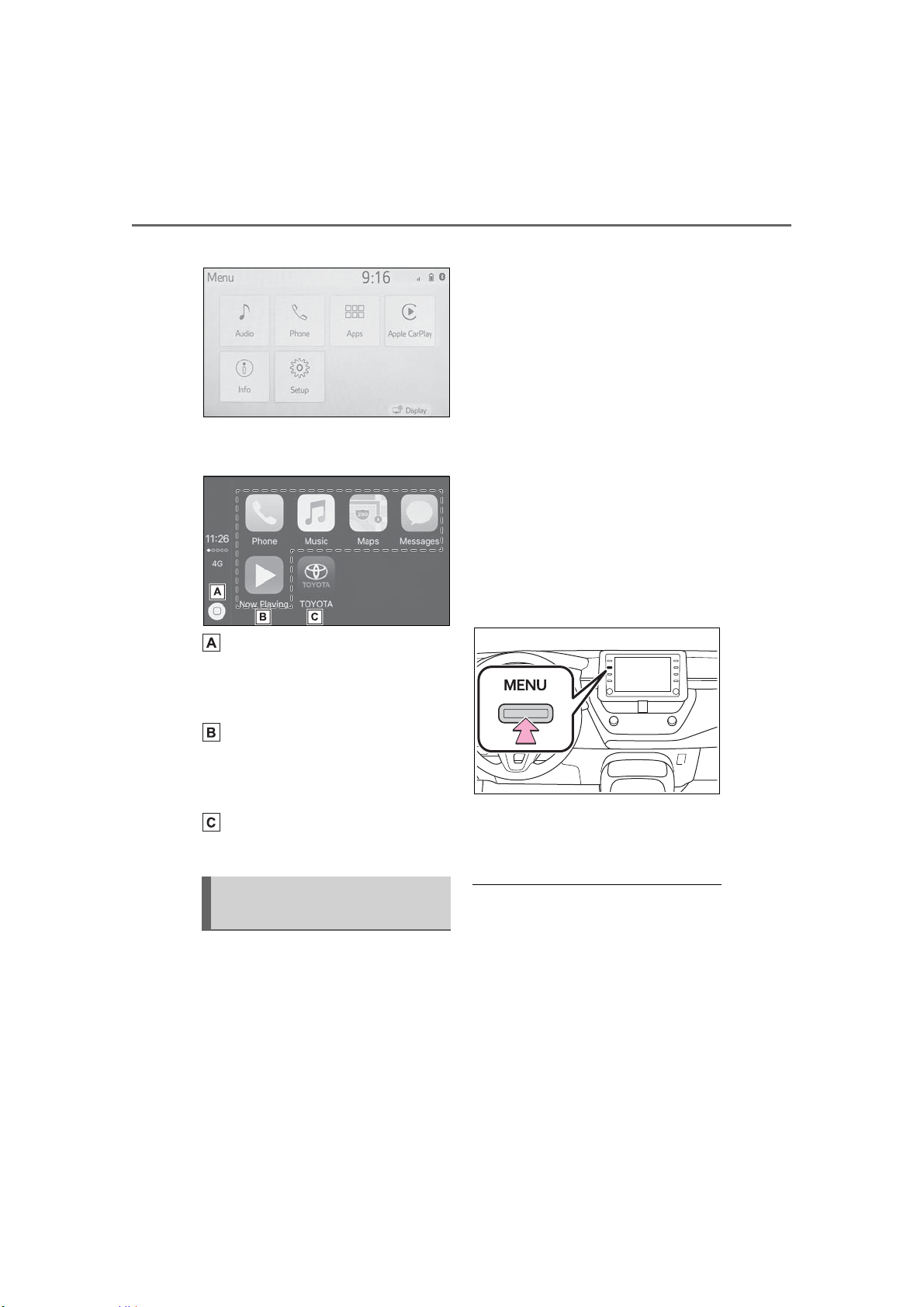
284
5-3. Connectivity settings
COROLLA H/B_U
5 Select the “Apple CarPlay”.
6 Check that home screen of
Apple CarPlay is displayed.
Select to display the home
screen of Apple CarPlay.
Touch and hold to activate
Siri.
Select to start the application.
User can use any iPhone
application supported by
Apple CarPlay.
Select to display the system
screen.
1 Check that the Android Auto
application is installed to the
device to be connected.
2 Connect the device to the
USB port. (P.299)
3 Select “On” to enable the
function.
“Off”: Select to not enable
Android Auto. Android Auto
will remain off until “Android
Auto” of “Projection Settings”
on the general settings screen
is turned on.
Depending on the device con-
nected, it may take approxi-
mately 3 to 6 seconds before
the system returns to previous
screen.
The screen may change to
“step 6” depending on the
system.
4 Press the “MENU” button.
5 Select “Android Auto”.
6 Check that home screen of
Android Auto is displayed.
● When an Apple CarPlay/Android
Auto connection is established,
the function of some system but-
tons will change.
● When an Apple CarPlay/Android
Auto connection is established,
some system functions, such as
the following, will be replaced by
similar Apple CarPlay/Android
Auto functions or will become
unavailable:
Establishing an Android
Auto connection
285
5-3. Connectivity settings
COROLLA H/B_U
5
Audio
• iPod (Audio Playback)
• Hands-free Phone
• USB audio/USB video
• Bluetooth
®
audio
• Bluetooth
®
phone (Apple CarPlay
only)
• Toyota apps
● The guidance volume can be
changed on the voice settings
screen. (P.294)
● To disable Apple CarPlay while a
device is connected, set “Apple
CarPlay” on the general settings
screen to off. (P.290)
● Apple CarPlay/Android Auto is an
application developed by Apple
Inc/Google LLC. Its functions and
services may be terminated or
changed without notice depending
on the connected device’s opera-
tion system, hardware and soft-
ware, or due to changes in Apple
CarPlay/Android Auto specifica-
tions.
● For a list of the apps supported by
Apple CarPlay or Android Auto,
refer to their respective website.
● While using these functions, vehi-
cle and user information, such as
location and vehicle speed, will be
shared with the respective appli-
cation publisher and the cellular
service provider.
● By downloading and using each
application, you agree to their
terms of use.
● Data for these functions is trans-
mitted using the internet and may
incur charges.
For information about data trans-
mission fees, contact your cellular
service provider.
● Depending on the application, cer-
tain functions, such as music play-
back, may be restricted.
● As the applications for each func-
tion are provided by a third-party,
they may be subject to change or
discontinuation without notice.
For details, refer to the website of
the function.
● If the USB cable is disconnected,
operation of Apple Car-
Play/Android Auto will end.
At this time, sound output will stop
and change to the system screen.
● Use of the Apple CarPlay logo
means that a vehicle user inter-
face meets Apple performance
standards. Apple is not responsi-
ble for the operation of this vehicle
or its compliance with safety and
regulatory standards. Please note
that the use of this product with
iPhone or iPod may affect wire-
less performance.
● CarPlay, iPhone, iPod, iPod nano,
iPod touch, and Lightning are
trademarks of Apple Inc., regis-
tered in the U.S. and other coun-
tries. Apple CarPlay is a
trademark of Apple Inc.
● Android and Android Auto are
trademarks of Google LLC.
WARNING
● Do not connect iPhone or oper-
ate the controls while driving.
286
5-3. Connectivity settings
COROLLA H/B_U
If you are experiencing difficulties with Apple CarPlay/Android Auto,
check the following table.
NOTICE
● Do not leave your iPhone in the
vehicle. In particular, high tem-
peratures inside the vehicle
may damage the iPhone.
● Do not push down on or apply
unnecessary pressure to the
iPhone while it is connected as
this may damage the iPhone or
its terminal.
● Do not insert foreign objects into
the port as this may damage the
iPhone or its terminal.
Troubleshooting
Symptom Solution
An Apple Car-
Play/Android Auto con-
nection cannot be
established.
Check if the device supports Apple Car-
Play/Android Auto.
Check if Apple CarPlay/Android Auto is
enabled on the connected device.
Check if that the Android Auto application is
installed to the device to be connected.
For details, refer to
Apple CarPlay: https://www.apple.com/ios/car-
play/.
Android Auto: https://www.android.com/auto/
.
Check if “Apple CarPlay”/“Android Auto” of
“Projection Settings” on the general settings
screen is set to on. (P.290)
Check if the USB cable being used is securely
connected to the device and USB port.
Check that the device is connected directly to
the USB port of the system and not connected
to a USB hub.
For Apple CarPlay: Check if the Lightning cable
being used is certified by Apple. Check if Siri is
enabled.
After checking all of the above, try to establish
an Apple CarPlay/Android Auto connection.
(P.283, 284)
287
5-3. Connectivity settings
COROLLA H/B_U
5
Audio
When an Apple Car-
Play/Android Auto con-
nection is established and
a video is being played,
the video is not displayed,
but audio is output
through the system.
As the system is not designed to play video
through Apple CarPlay/Android Auto, this is not
a malfunction.
Although an Apple Car-
Play/Android Auto con-
nection is established,
audio is not output
through the system.
The system may muted or the volume may be
low. Increase the system volume.
The Apple Car-
Play/Android Auto screen
has artifacts and/or audio
from Apple Car-
Play/Android Auto has
noise.
Check if the USB cable being used to connect
the device to the system is damaged.
To check if the USB cable is damaged inter-
nally, connect the device to another system,
such as a PC, and check if the device is recog-
nized by the connected system. (The device
should begin charging when connected.)
After checking all of the above, try to establish
an Apple CarPlay/Android Auto connection.
(P.283, 284)
The map display of the
Apple CarPlay Maps app
cannot be enlarged or
contracted with pinch
multi-touch gestures.
As the Apple CarPlay Maps app is not compati-
ble with pinch multi-touch gestures, this is not a
malfunction.
Symptom Solution

288
5-3. Connectivity settings
COROLLA H/B_U
During Apple CarPlay
music application (Apple
Music, Spotify, etc.) play-
back, if the iPhone is
operated to start and play
audio from an application
that is not compatible with
Apple CarPlay* and the
onboard device volume is
changed, the audio of the
incompatible application
stops and the system
resumes playback of the
original music application.
This operation is performed according to the
specification of the onboard device, this is not a
malfunction.
After interrupt audio (such
as navigation route guid-
ance) is played from an
application that is not
compatible with Apple
CarPlay while the onboard
device is playing audio,
the system does not
resume playback of the
original audio.
This operation is performed according to the
specification of the onboard device, this is not a
malfunction.
Manually change the audio source by yourself.
Or, do not use applications that are not compat-
ible with Apple CarPlay.
*
Due to some naviga-
tion applications are compatible from iOS 12,
update to the latest iOS and application ver-
sions.
When using Apple Car-
Play, route guidance
arrows and turn by turn
navigation are not dis-
played on the multi-infor-
mation display and
system display.
When using Android Auto,
turn by turn navigation is
not displayed on the
multi-information display
and system display.
This is not a malfunction as display of these
items is not possible with this function.
Symptom Solution

289
5-3. Connectivity settings
COROLLA H/B_U
5
Audio
*
: Applications not compatible with Apple CarPlay are applications installed
on the iPhone that are not displayed on the Apple CarPlay screen appli-
cation list. (such as visual voicemail)
When using Android Auto,
hands-free call audio can-
not be heard from the
vehicle’s speakers.
Disconnect the phone from the USB cable and
check if hands-free call audio can be heard
using the hands-free system.
Connect the phone to the system using Android
Auto, turn up the volume on the system and
check if hands-free call audio can be heard.
Check if other sounds can be heard from the
vehicle’s speakers.
Symptom Solution
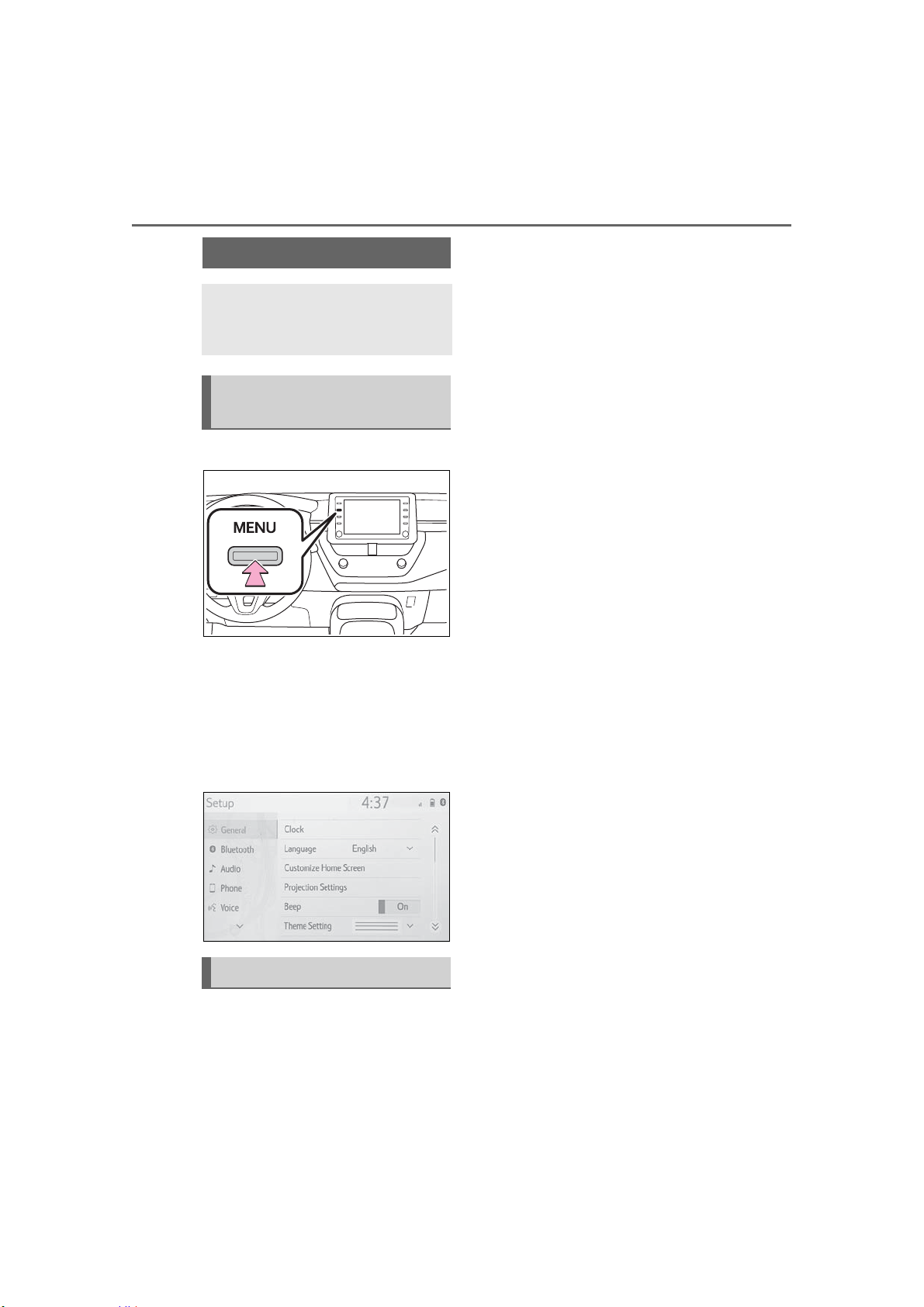
290
5-4. Other settings
COROLLA H/B_U
5-4.Other settings
1 Press the “MENU” button.
2 Select “Setup”.
If the general settings screen
is not displayed, select “Gen-
eral”.
3 Select the desired items to
be set.
“Clock”
Select to change the time zone and
select “On” or “Off” for daylight sav-
ing time, automatic adjustment of
the clock, etc. (P.291)
“Language”
Select to change the language. The
language setting of Apple Car-
Play/Android Auto can only be
changed on the connected device.
“Customize Home Screen”
Select to change the display infor-
mation/area on the home screen
and the home screen layout.
(P.260)
“Theme Setting”
Select to change the screen theme
setting.
“Beep”
Select to turn the beep sound
on/off.
“Units of Measurement”
Select to change the unit of mea-
sure for distance/fuel consumption.
“Keyboard Layout”
Select to change the keyboard lay-
out.
“Delete Keyboard History”
Select to delete the keyboard his-
tory.
“Memorize Keyboard History”
Select to set the memorize key-
board history on/off.
“Animation”
Select to turn the animations on/off.
“Projection Settings”
*1
Select to set automatic Apple Car-
Play/Android Auto connection
establishment on/off. (P.292)
“Driver Setting”
General settings
Settings are available for
clock, operation sounds,
etc.
Displaying the general
settings screen
General settings screen
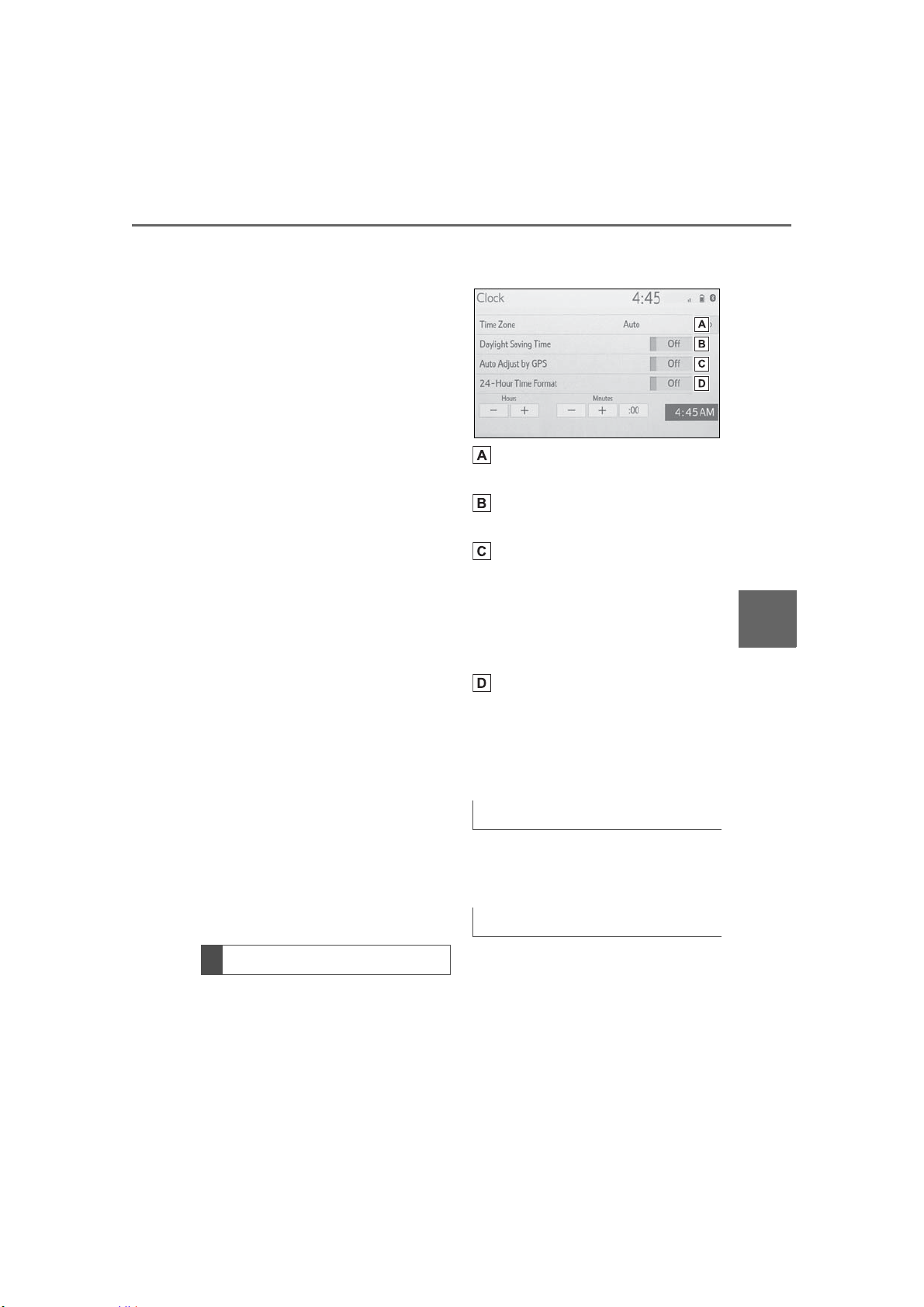
291
5-4. Other settings
COROLLA H/B_U
5
Audio
Select to change the driver set-
tings. (P.292)
“Delete Personal Data”
Select to delete personal data.
(P.293)
“Software Update”
Select to update software versions.
For details, contact your Toyota
dealer.
“Software Update Setting”
*2
Select to set software update set-
ting. (P.293)
“Gracenote Database
Update”
Select to update Gracenote
®
data-
base versions. For details, contact
your Toyota dealer.
“Software Information”
Select to display the software infor-
mation. Notices related to third
party software used in this product
are enlisted. (This includes instruc-
tions for obtaining such software,
where applicable.)
“SW Sensitivity Level”
Select to change the capacitive
touch screen button sensitivity to 1
(low), 2 (medium), or 3 (high).
*1
:This function is not made avail-
able in some countries or areas.
*2
:If equipped
1 Display the general settings
screen. (P.290)
2 Select “Clock”.
3 Select the desired items to
be set.
Select to change the time
zone. (P.291)
Select to set daylight saving
time on/off.
Select to set automatic
adjustment of the clock by
GPS on/off.
When set to off, the clock can
be manually adjusted.
(P.291)
Select to set the 24 hour time
format on/off.
When set to off, the clock is
displayed in 12 hour time for-
mat.
1 Select “Time Zone”.
2 Select the desired time zone.
When “Auto Adjust by GPS” is
turned off, the clock can be
manually adjusted.
1 Select “Auto Adjust by GPS”
to set to off.
Clock settings
Setting the time zone
Manual clock setting
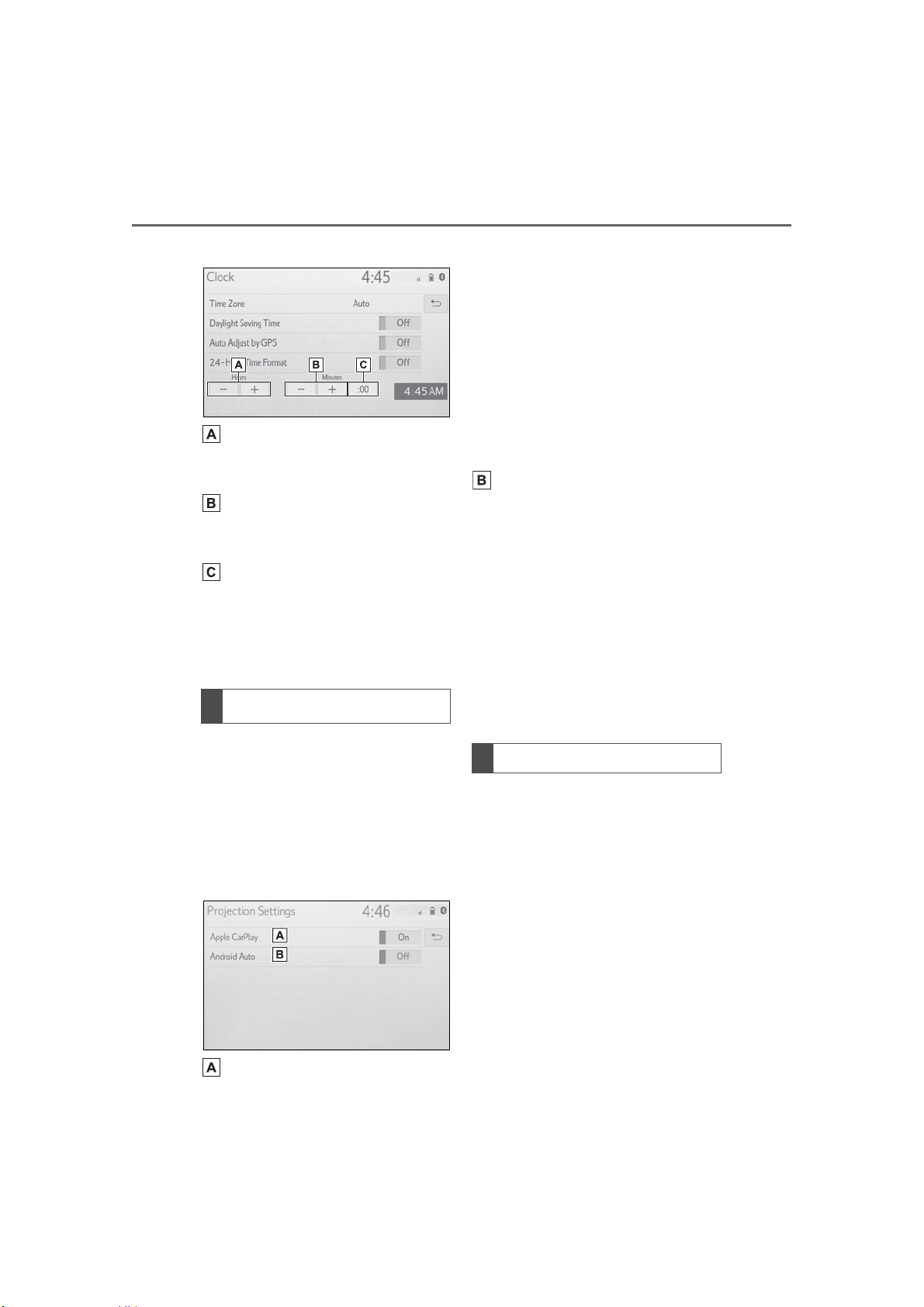
292
5-4. Other settings
COROLLA H/B_U
2 Adjust the clock manually.
Select “+” to set the time for-
ward one hour and “-” to set
the time back one hour.
Select “+” to set the time for-
ward one minute and “-” to
set the time back one minute.
Select to round to the nearest
hour.
e.g.
1:00 to 1:29 1:00
1:30 to 1:59 2:00
*
: This function is not made avail-
able in some countries or areas.
1 Display the general settings
screen. (P.290)
2 Select “Projection Settings”.
3 Select the desired items to
be set.
Select to turn Apple CarPlay
connection establishment
on/off when a compatible
iPhone is connected to the
system via USB. (P.283)
Depending on the system,
this setting cannot be
changed when a device is
connected to the system via
USB. Disconnect the device
before attempting to change
the setting.
Select to turn Android Auto
connection establishment
on/off when a compatible
device is connected to the
system via USB. (P.284)
Depending on the system,
this setting cannot be
changed when a device is
connected to the system via
USB. Disconnect the device
before attempting to change
the setting.
The driver settings feature will
allow the system to link some
preferences (such as audio pre-
sets, screen theme, language,
etc.) to a paired Bluetooth
®
phone.
1 Display the general settings
screen. (P.290)
2 Select “Driver Setting”.
Projection settings
*
Driver settings
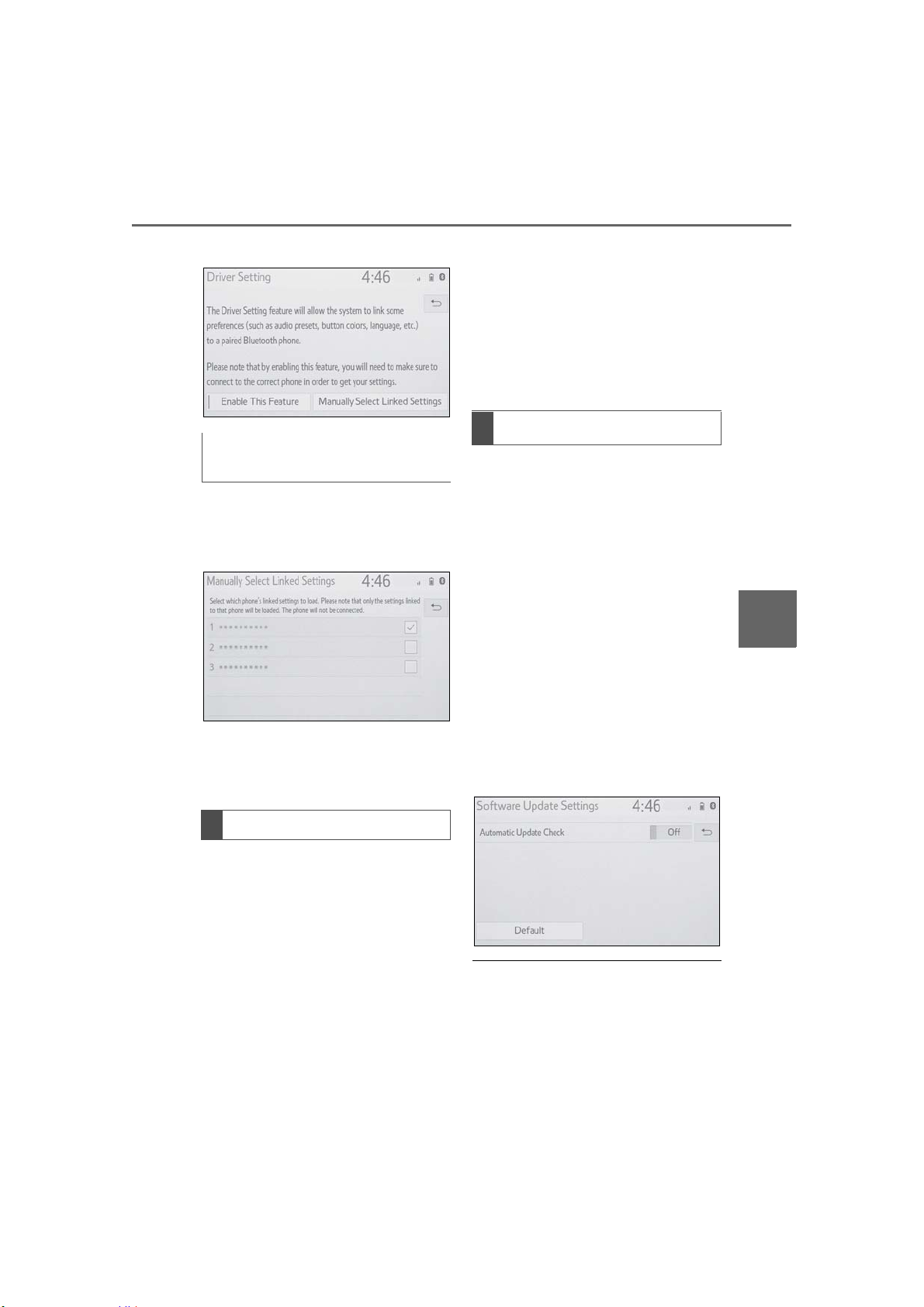
293
5-4. Other settings
COROLLA H/B_U
5
Audio
3 Select “Enable This Feature”.
1 Select “Manually Select
Linked Settings”.
2 Select the desired phone.
After a few seconds, loaded
screen automatically switches
to the home screen.
Registered or changed per-
sonal settings will be deleted or
returned to their default condi-
tions.
1 Display the general settings
screen. (P.290)
2 Select “Delete Personal
Data”.
3 Select “Delete”.
4 Select “Yes” when the confir-
mation screen appears.
Examples of settings that can be
returned to their default conditions:
Audio settings
Phone settings
etc.
*
: This function is not made avail-
able in some countries or areas.
When the automatic update
check function is enabled, if a
software update is available
from the Toyota response cen-
ter, a message will be displayed.
1 Display the general settings
screen. (P.290)
2 Select “Software Update Set-
ting”.
3 Select “Automatic Update
Check” to enable/disable the
automatic update check func-
tion.
● When software update information
is displayed, contact your Toyota
dealer.
Manually select linked set-
tings
Deleting personal data
Software update settings
*
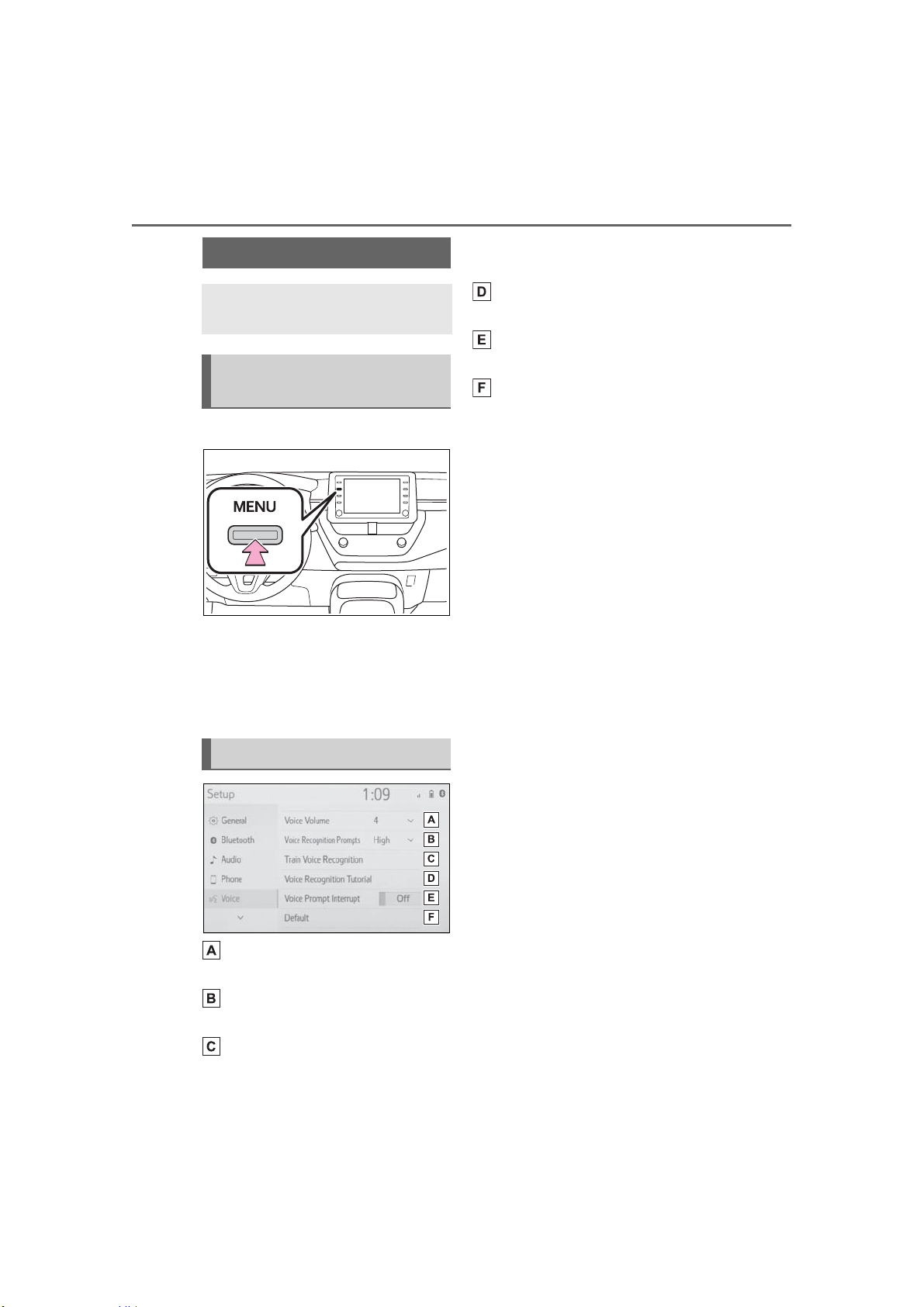
294
5-4. Other settings
COROLLA H/B_U
1 Press the “MENU” button.
2 Select “Setup”.
3 Select “Voice”.
4 Select the desired items to
be set.
Select to adjust the volume of
voice guidance.
Select to set the voice recog-
nition prompts.
Select to train voice recogni-
tion.
The voice command system
adapts the user accent.
Select to start the voice rec-
ognition tutorial.
Select to set the voice
prompt interrupt on/off.
Select to reset all setup
items.
Voice settings
Voice volume, etc. can be
set.
Displaying the voice set-
tings screen
Voice settings screen
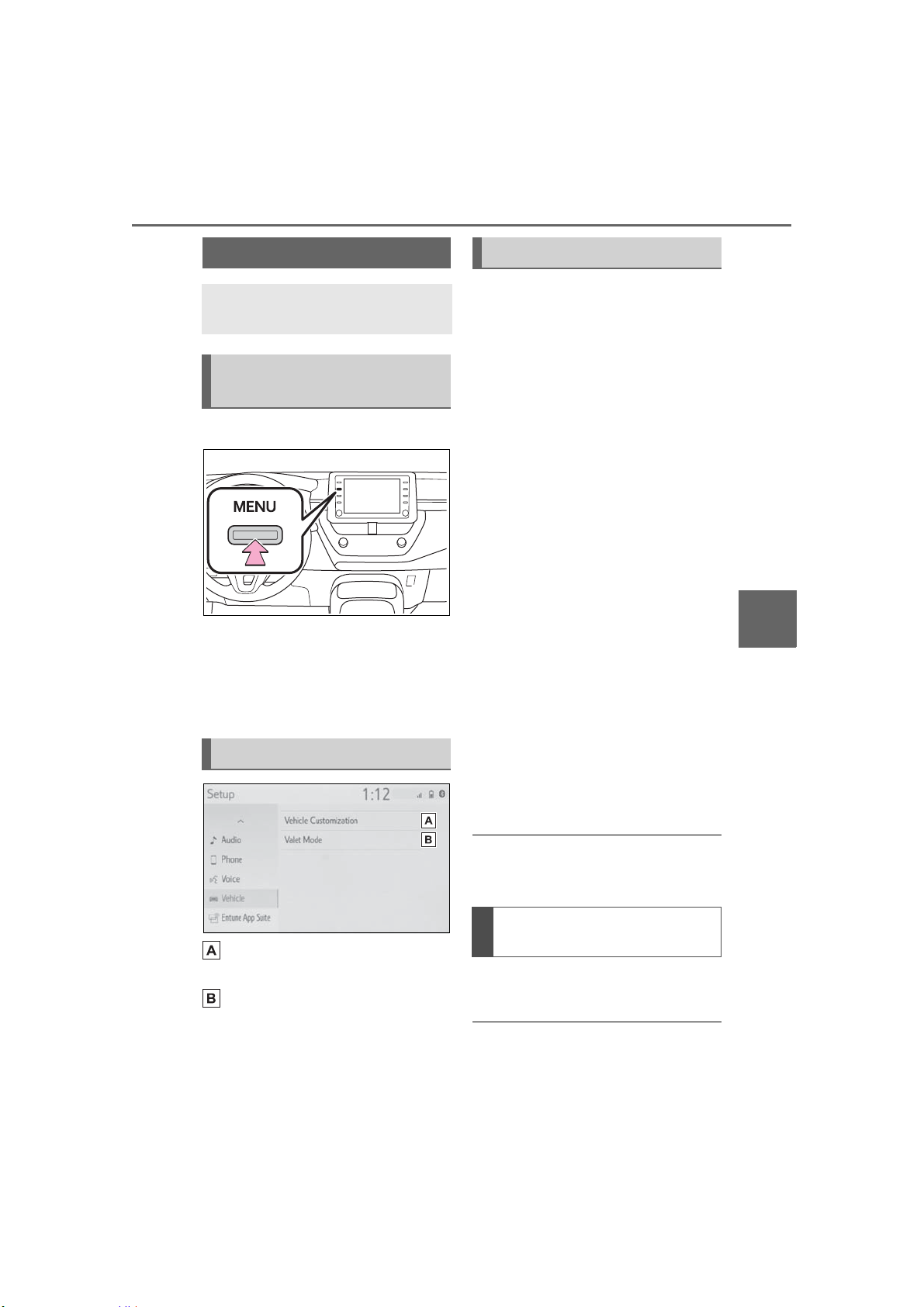
295
5-4. Other settings
COROLLA H/B_U
5
Audio
1 Press the “MENU” button.
2 Select “Setup”.
3 Select “Vehicle”.
4 Select the desired items to
be set.
Select to set vehicle customi-
zation. (P.531)
Select to set valet mode.
(P.295)
The security system can be set
to on by entering a security code
(4-digit number).
When set to on, the system will
become inoperative once the
electrical power source is dis-
connected until the security
code is entered.
1 Display the vehicle settings
screen. (P.295)
2 Select “Valet Mode”.
3 Enter the 4-digit personal
code and select “OK”.
4 Enter the same 4-digit per-
sonal code again and select
“OK”.
The system will request that
you input the security code
again to confirm that you
remember it correctly.
When valet mode activates,
the system stops and a secu-
rity code (4-digit number)
standby screen is displayed.
● If the 4-digit personal code is for-
gotten, please contact your Toyota
dealer.
1 Enter the 4-digit personal
code and select “OK”.
● If an incorrect security code
(4-digit number) is entered 6
times, the system will not accept
Vehicle settings
Settings are available for
vehicle customization, etc.
Displaying the vehicle
settings screen
Vehicle settings screen
Setting the valet mode
If the valet mode has been
activated

296
5-4. Other settings
COROLLA H/B_U
another security code (4-digit
number) for 10 minutes.
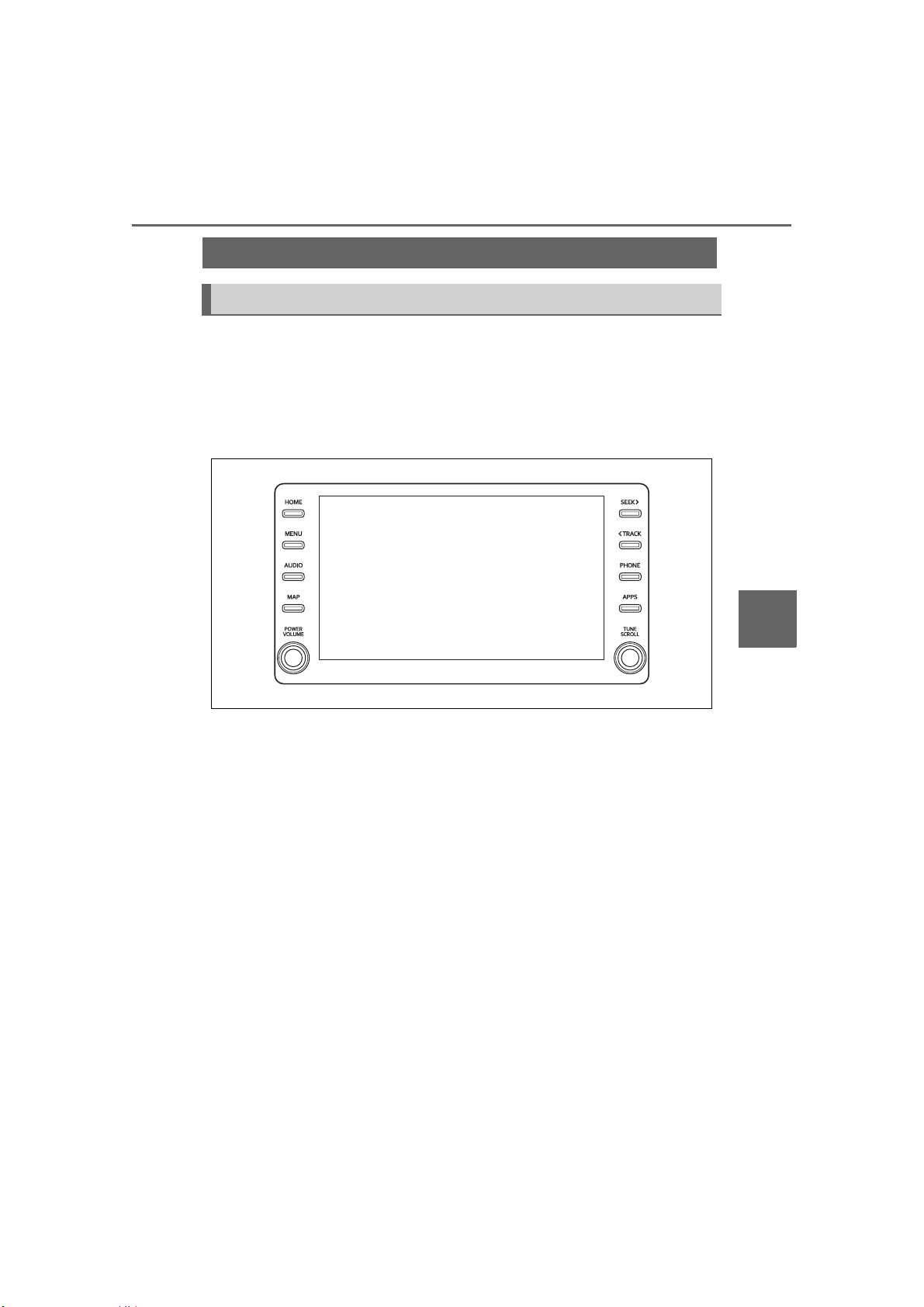
297
5-5. Using the audio/visual system
COROLLA H/B_U
5
Audio
5-5.Using the audio/visual system
The audio control screen can be reached by the following methods:
From the “AUDIO” button
1 Press the “AUDIO” button.
From the “MENU” button
1 Press the “MENU” button, then select “Audio”.
• Using the radio (P.302)
• Playing a USB memory (P.308)
• Playing an iPod/iPhone (Apple CarPlay
*
) (P.310)
• Using the Android Auto
*
(P.313)
• Playing a Bluetooth
®
device (P.314)
• Using the steering wheel audio switches (P.318)
• Audio system settings (P.320)
*
: This function is not made available in some countries or areas.
Quick reference
Functional overview
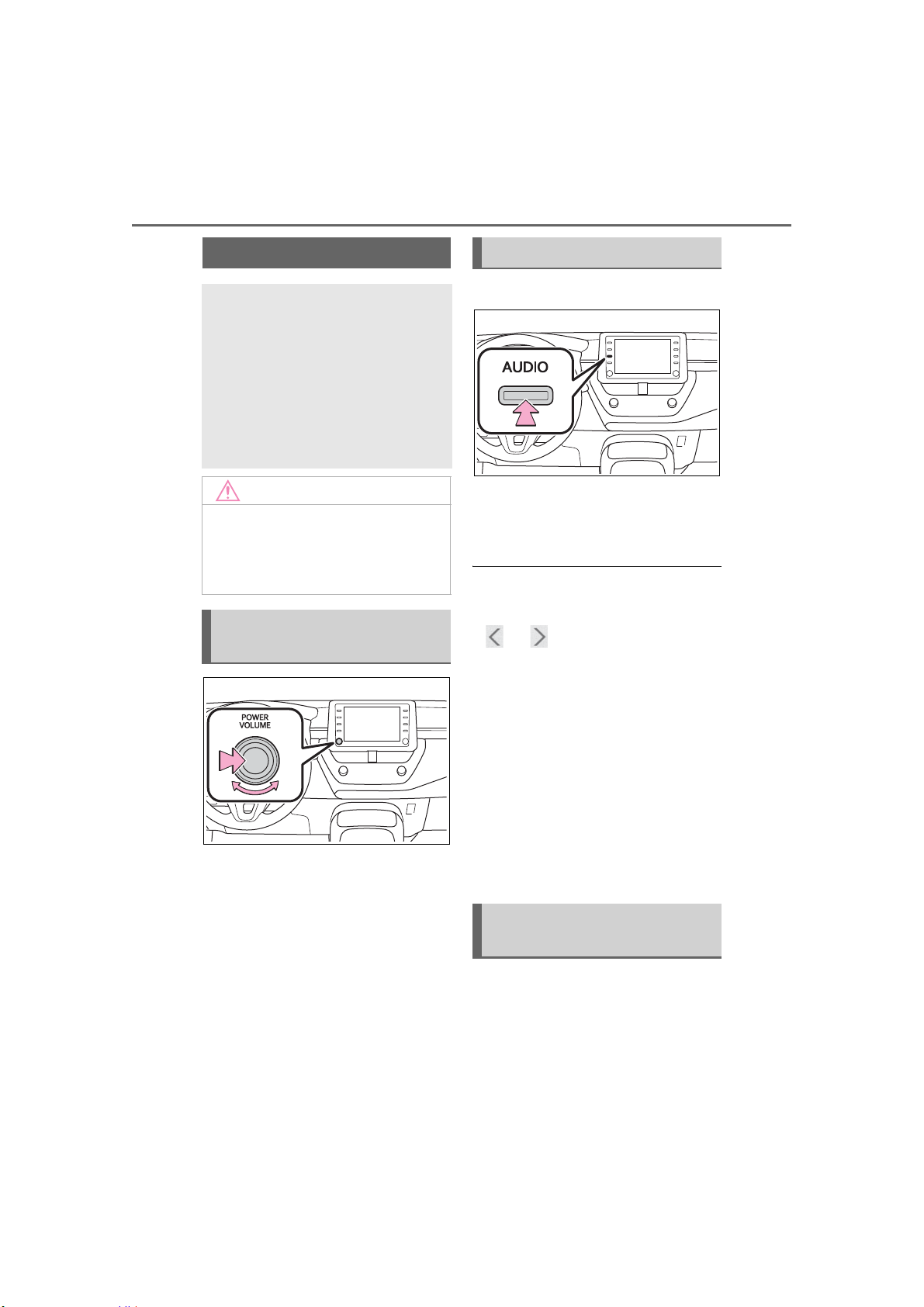
298
5-5. Using the audio/visual system
COROLLA H/B_U
“POWER VOLUME” knob:
Press to turn the audio/visual
system on and off. The system
turns on in the last mode used.
Turn this knob to adjust the vol-
ume.
1 Press the “AUDIO” button.
2 Select “Source” or press
“AUDIO” button again.
3 Select the desired source.
● Dimmed screen buttons cannot be
operated.
● When there are two pages, select
or to change the page.
● When an Apple CarPlay/Android
Auto connection is established,
some system functions, such as
the following, will be replaced by
similar Apple CarPlay/Android
Auto function or will become
unavailable
*
:
• iPod (Audio Playback)
• USB audio/USB video
• Bluetooth
®
audio
• Toyota apps
*
: This function is not made avail-
able in some countries or areas.
1 Display the audio source
selection screen. (P.298)
2 Select “Reorder”.
Some basics
This section describes
some of the basic features
of the audio/visual system.
Some information may not
pertain to your system.
Your audio/visual system
works when the engine
switch is in ACC or ON.
NOTICE
● To prevent the battery from
being discharged, do not leave
the audio/visual system on lon-
ger than necessary when the
engine is not running.
Turning the system on
and off
Selecting an audio source
Reordering the audio
source
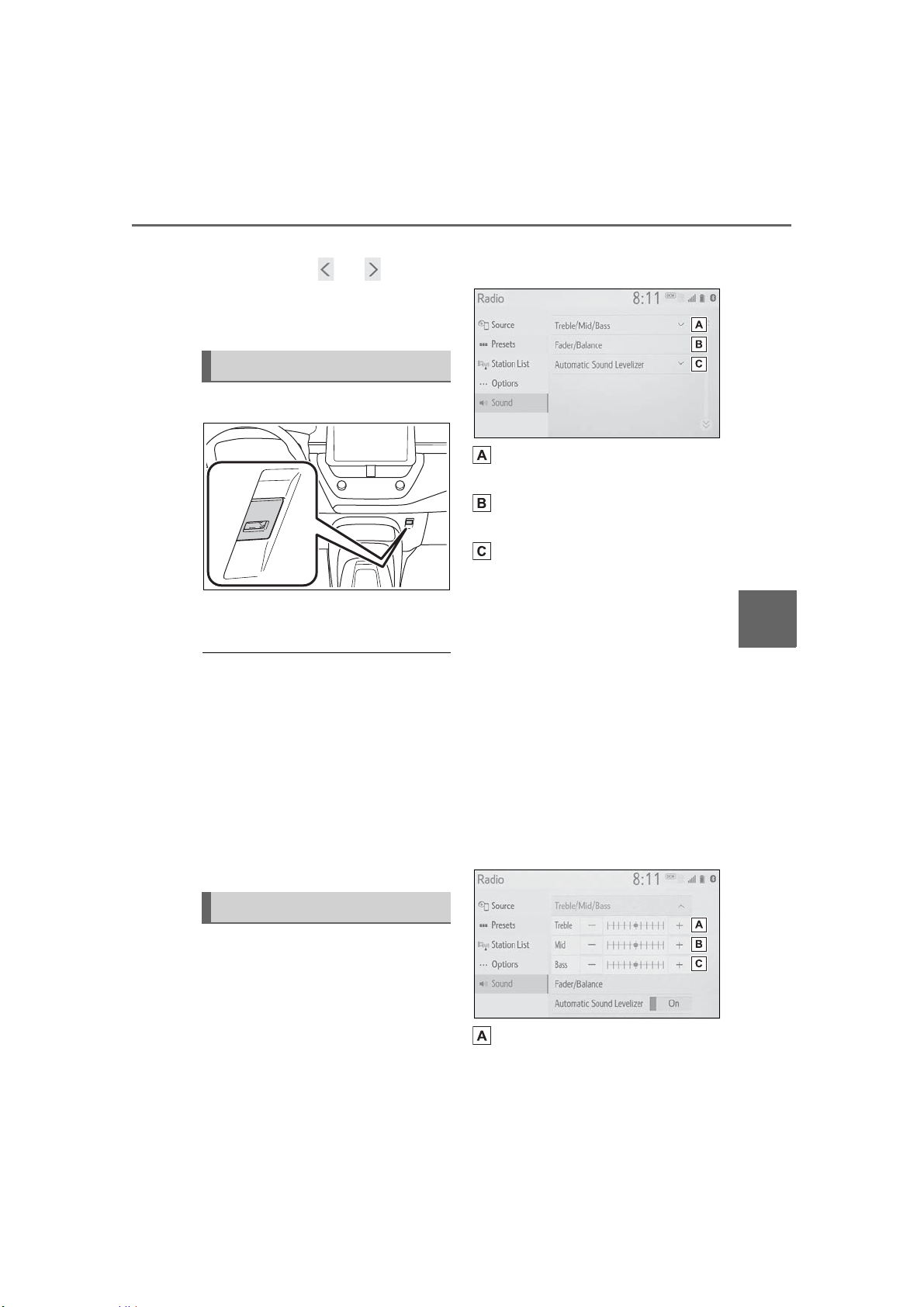
299
5-5. Using the audio/visual system
COROLLA H/B_U
5
Audio
3 Select the desired audio
source then or to reor-
der.
4 Select “OK”.
1 Connect a device.
Turn on the power of the
device if it is not turned on.
● If a USB hub is plugged-in, two
devices can be connected at a
time.
● Even if a USB hub is used to con-
nect more than two USB devices,
only the first two connected
devices will be recognized.
● If a USB hub that has more than
two ports is connected to the USB
port, devices connected to the
USB hub may not charge or be
operable, as the supply of current
may be insufficient.
1 Display the audio control
screen. (P.298)
2 Select “Sound”.
3 Select the desired item to be
set.
Select to set the tre-
ble/mid/bass. (P.299)
Select to set the fader/bal-
ance. (P.300)
Select to set the Automatic
Sound Levelizer. (P.300)
■ Treble/Mid/Bass
How good an audio program
sounds is largely determined by
the mix of the treble, mid and
bass levels. In fact, different
kinds of music and vocal pro-
grams usually sound better with
different mixes of treble, mid
and bass.
1 Select “Treble/Mid/Bass”.
2 Select the desired screen
button.
Select “+” or “-” to adjust
high-pitched tones.
USB port
Sound settings
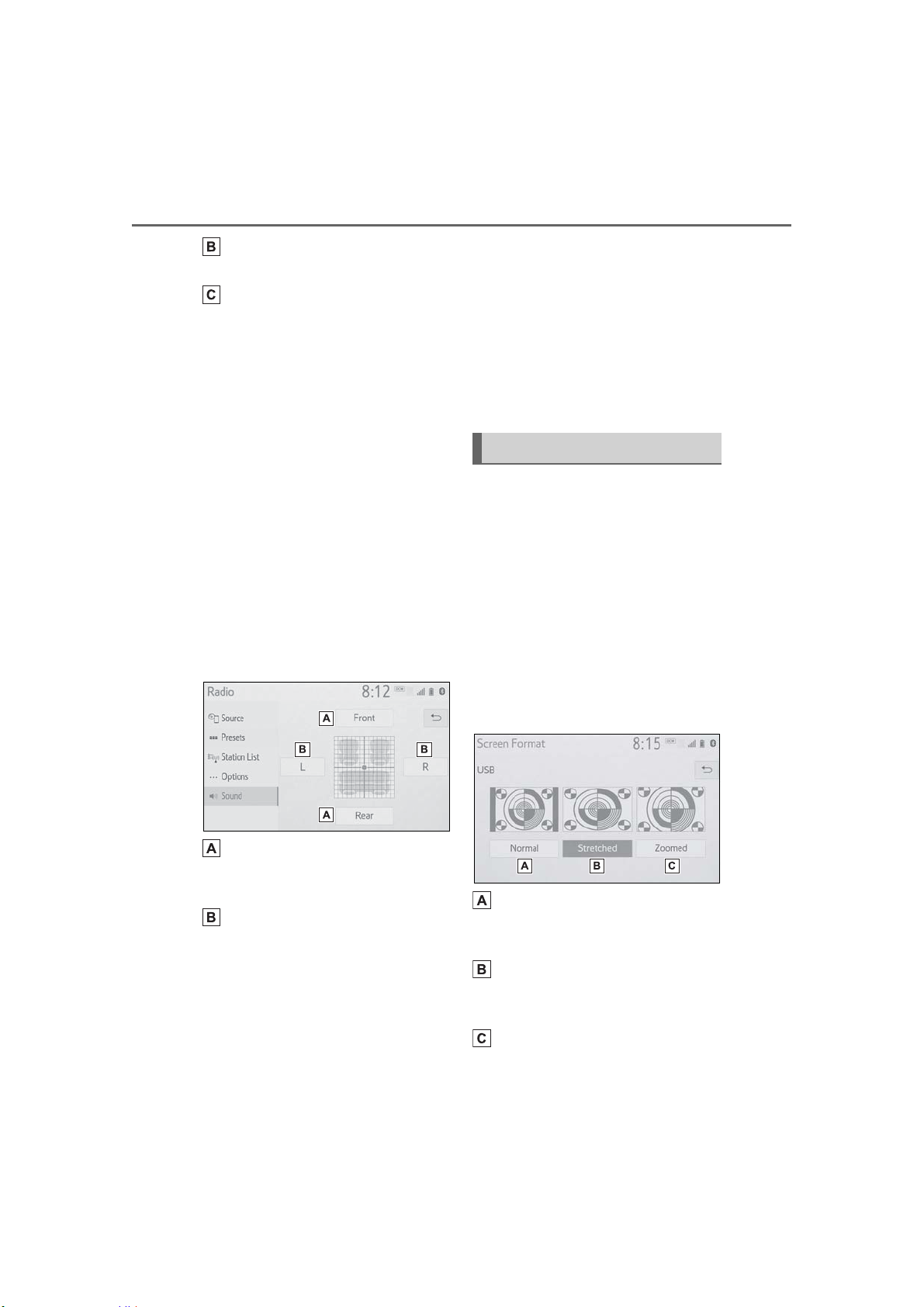
300
5-5. Using the audio/visual system
COROLLA H/B_U
Select “+” or “-” to adjust
mid-pitched tones.
Select “+” or “-” to adjust
low-pitched tones.
■ Fader/Balance
A good balance of the left and
right stereo channels and of the
front and rear sound levels is
also important.
Keep in mind that when listening
to a stereo recording or broad-
cast, changing the right/left bal-
ance will increase the volume of
1 group of sounds while
decreasing the volume of
another.
1 Select “Fader/Balance”.
2 Select the desired screen
button.
Select to adjust the sound
balance between the front
and rear speakers.
Select to adjust the sound
balance between the left and
right speakers.
■ Automatic sound levelizer
(ASL)
The system adjusts to the opti-
mum volume and tone quality
according to vehicle speed to
compensate for increased road
noise, wind noise, or other
noises while driving.
1 Select “Automatic Sound
Levelizer”.
2 Select “High”, “Mid”, “Low” or
“Off”.
■ Screen format settings
The screen format can be
selected for USB video.
1 Press the “MENU” button.
2 Select “Setup”.
3 Select “Audio”.
4 Select “Common”.
5 Select “Screen Format”.
6 Select the desired item to be
adjusted.
Select to display a 4 : 3
screen, with either side in
black.
Select to enlarge the image
horizontally and vertically to
full screen.
Select to enlarge the image
by the same ratio horizontally
Audio screen adjustment
301
5-5. Using the audio/visual system
COROLLA H/B_U
5
Audio
and vertically.
■ Contrast and brightness
adjustment
The contrast and brightness of
the screen can be adjusted.
1 Press the “MENU” button.
2 Select “Setup”.
3 Select “Audio”.
4 Select “Common”.
5 Select “Display”.
6 Select the desired item to be
adjusted.
“Contrast”
“+”: Select to strengthen the con-
trast of the screen.
“-”: Select to weaken the contrast of
the screen.
“Brightness”
“+”: Select to brighten the screen.
“-”: Select to darken the screen.
● Depending on the audio source,
some functions may not be avail-
able.
1 Press this switch to operate
the voice command system.
The voice command system
and its list of commands can
be operated. (P.334)
Voice command system
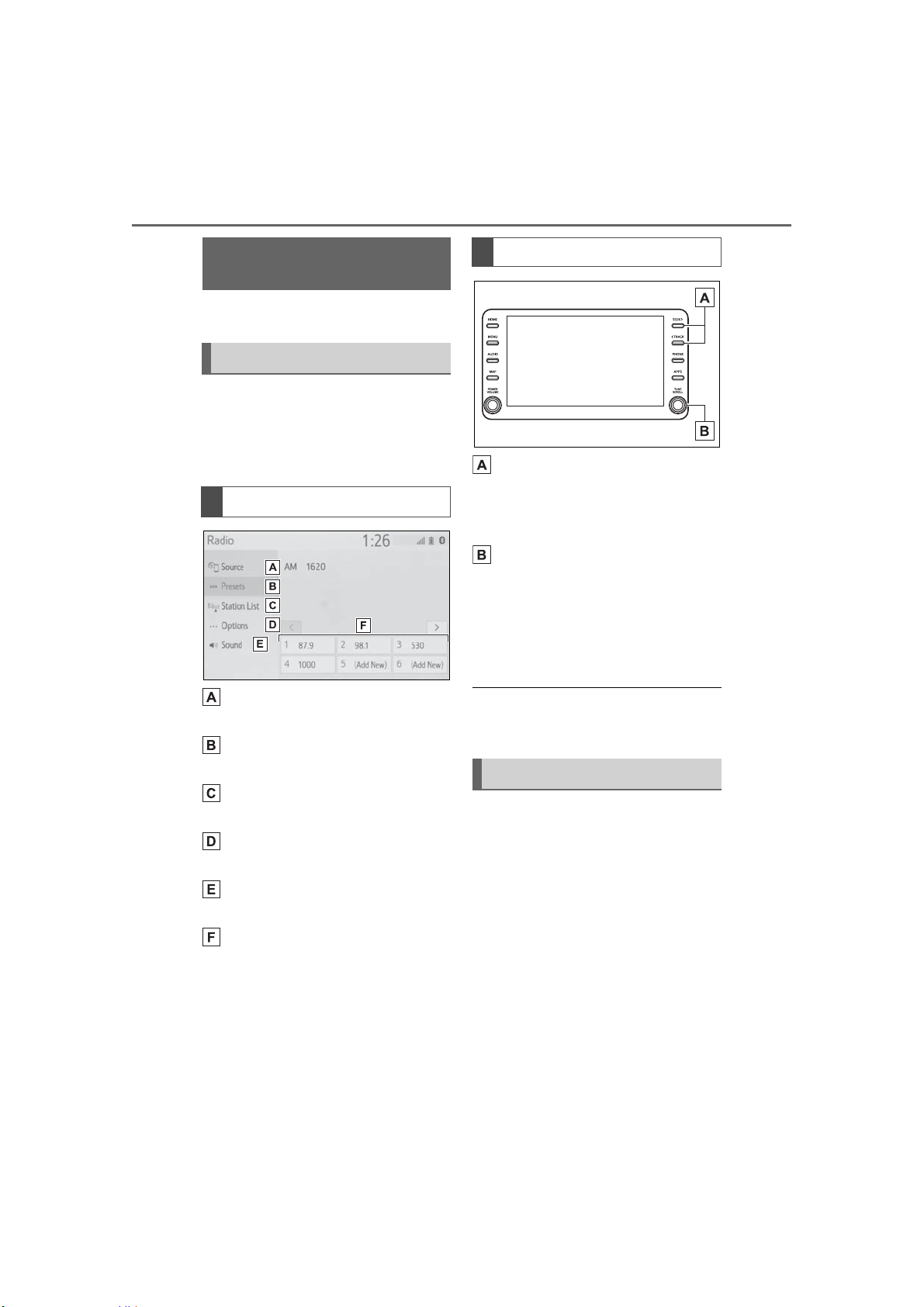
302
5-6. Radio operation
COROLLA H/B_U
5-6.Radio ope ration
*
: If equipped
The radio operation screen can
be reached by the following
methods:
P.298
Select to display the audio
source selection screen.
Select to display the preset
stations screen. (P.302)
Select to display a list of
receivable stations. (P.303)
Select to display the radio
options screen. (P.303)
Select to display the sound
setting screen. (P.299)
Select to tune to preset sta-
tions/channels. (P.302)
Press to seek for stations in
the relevant program type.
Press and hold for continu-
ous seek.
Turn to step up/down fre-
quencies.
Turn to move up/down the
station. Also, the knob can be
used to enter selections on
the list screens by pressing it.
● The radio automatically changes
to stereo reception when a stereo
broadcast is received.
Radio mode has a mix preset
function, which can store up to
36 stations (6 stations per page
x 6 pages) from any of the AM,
FM or SXM bands.
1 Tune in the desired station.
AM/FM/SiriusXM
®
Sat-
ellite Radio
*
Overview
Control screen
Control panel
Presetting a station
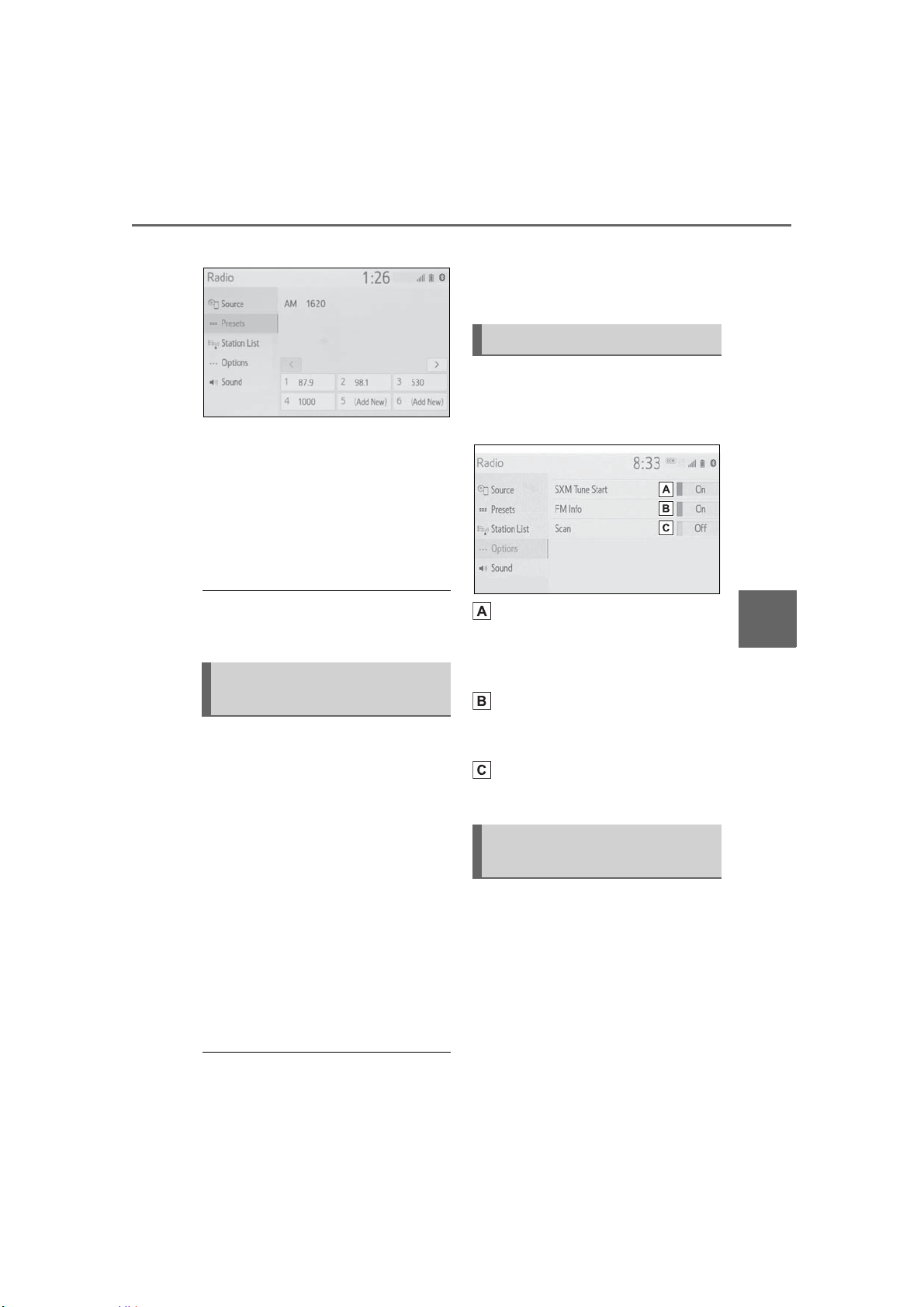
303
5-6. Radio operation
COROLLA H/B_U
5
Audio
2 Select and hold “(Add New)”.
When “(Add New)” is
selected, a confirmation mes-
sage appears. Select “Yes”
and select “OK”.
To change the preset station
to a different one, select and
hold the preset station.
● The number of preset radio sta-
tions displayed on the screen can
be changed. (P.320)
1 Select “Station List”.
2 Select “AM”, “FM” or “SXM”.
Select the desired program
genre when the genre selec-
tion screen is displayed.
3 Select the desired station.
■ Refreshing the station list
1 Select “Refresh”.
“Cancel Refresh”: Select to can-
cel the refresh.
“Source”: Select to change to
another audio source while
refreshing.
● The audio/visual system sound is
muted during refresh operation.
● In some situations, it may take
some time to update the station
list.
1 Select “Options”.
2 Select the desired item to be
set.
When “SXM Tune Start” is
turned on, the current song is
played from the beginning
when you select the channel.
Analog FM only: Select to
display RBDS text mes-
sages.
Select to scan for receivable
stations.
This audio/visual system is
equipped with Radio Broadcast
Data Systems (RBDS). RBDS
mode allows text messages to
be received from radio stations
that utilize RBDS transmitters.
When RBDS is on, the radio can
do the following functions.
• Only selecting stations of a
Selecting a station from
the list
Radio options
Radio broadcast data sys-
tem
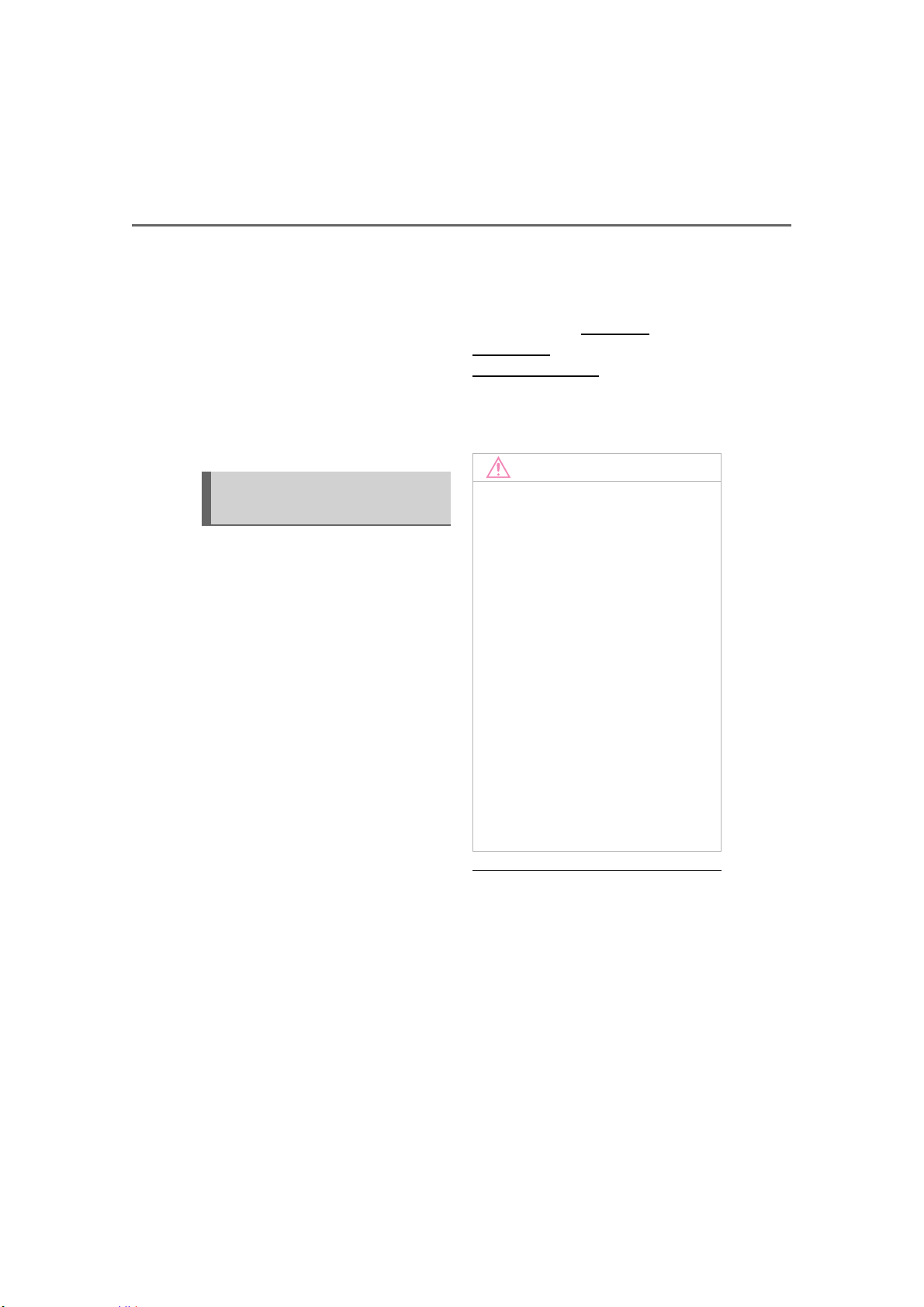
304
5-6. Radio operation
COROLLA H/B_U
particular program type
• Displaying messages from
radio stations
• Searching for a stronger sig-
nal station
RBDS features are available
only when listening to an FM
station that broadcasts RBDS
information and the “FM Info”
function is on. (P.303)
All SiriusXM services, including
satellite radio and data services,
plus streaming services, require
a subscription, sold separately
or as a package by Sirius XM
Radio Inc. (U.S.A.) or Sirius XM
Canada Inc. (Canada), after any
trial subscription which may be
included with your vehicle pur-
chase or lease. To subscribe
after your trial subscription, call
1-877-447-0011 (U.S.A.) or
1-877-438-9677 (Canada).
■ Important information
about your subscription
Your SiriusXM services will
automatically stop at the end of
your trial unless you decide to
subscribe. If you decide to con-
tinue service, the paid subscrip-
tion plan you choose will
automatically renew and you will
be charged the rate in effect at
that time and according to your
chosen payment method. Fees
and taxes apply. You may can-
cel at any time by calling
1-866-635-2349. See SiriusXM
Customer Agreement for com-
plete terms at www.siri-
usxm.com (U.S.A.) or
www.siriusxm.ca
(Canada). All
fees and programming subject
to change. Traffic information
not available in all markets.
● About SiriusXM Services
• Most in-car trials today include
SiriusXM’s best package — All
Access. It includes every channel
available on your radio, plus
streaming.
● SiriusXM All Access Subscription
• Listen everywhere with All
Access. You get every channel
available in your ride, plus you can
listen on the app and online — so
you can enjoy the best SiriusXM
How to subscribe to Siri-
usXM Radio Services
NOTICE
● It is prohibited to copy, decom-
pile, disassemble, reverse engi-
neer, hack, manipulate, or
otherwise make available any
technology or software incorpo-
rated in receivers compatible
with the SiriusXM Satellite
Radio System or that support
the SiriusXM website, the
streaming service or any of its
content. Furthermore, the
AMBE
®
voice compression soft-
ware included in this product is
protected by intellectual prop-
erty rights including patent
rights, copyrights, and trade
secrets of Digital Voice Sys-
tems, Inc.
● Note: this applies to SiriusXM
Satellite Radio receivers only
and not SiriusXM Ready
devices.
305
5-6. Radio operation
COROLLA H/B_U
5
Audio
has to offer, anywhere life takes
you. It’s the only package that
gives you all of our premium pro-
gramming, including Howard
Stern, every NFL, MLB
®
and NBA
game, every NASCAR
®
race,
NHL
®
games, 24/7 talk channels
dedicated to the biggest leagues,
and more. You get all kinds of
commercial-free music, including
artist-dedicated channels and
more, plus sports, news, talk and
entertainment.
● Radio operation
• Look for the Sirius, XM, SiriusXM,
Band, SAT, AUX, Radio or Source
button and you’re in. If you can’t
hear us, it’s easy to get started:
U.S.A.:
Locate your Radio ID by turning to
Channel 0. If you don’t see your
number there, go to siri-
usxm.com/activationhelp to find it.
Visit siriusxm.com/refresh or call
1-855-MYREFRESH (697-3373)
to send a refresh signal to your
radio.
Canada:
Locate your Radio ID by turning to
Channel 0.
Visit siriusxm.ca/refresh
to send a
refresh signal to your radio or call
1-888-539-7474 for service.
Each SiriusXM tuner is identified
with a unique radio ID. The radio
ID is required when activating
an SiriusXM service or when
reporting a problem.
If “Ch 000” is selected using
the “TUNE SCROLL” knob,
the ID code, which is 8 alpha-
numeric characters, will be
displayed. If another channel
is selected, the ID code will no
longer be displayed. The
channel (000) alternates
between displaying the radio
ID and the specific radio
code.
When problems occur with the SiriusXM tuner, a message will
appear on the screen. Referring to the table below to identify the
problem, take the suggested corrective action.
Displaying the radio ID
Refer to the table below to identify the problem and take
the suggested corrective action
Message Explanation
“Check
Antenna”
The SiriusXM antenna is not connected. Check whether the
SiriusXM antenna cable is attached securely. Contact your
Toyota dealer for assistance.
A short circuit occurs in the antenna or the surrounding
antenna cable. Contact your Toyota dealer for assistance.
“No Signal”
The SiriusXM signal is too weak at the current location. Wait
until your vehicle reaches a location with a stronger signal.
306
5-6. Radio operation
COROLLA H/B_U
“Chan
Unavailable”
The channel you selected is not broadcasting any program-
ming. Select another channel.
“Ch Unsub-
scribed”
The channel you selected is no longer available. Wait for
about 2 seconds until the radio returns to the previous chan-
nel or “Ch 001”. If it does not change automatically, select
another channel.
Message Explanation

307
5-6. Radio operation
COROLLA H/B_U
5
Audio
1 Display the audio source
selection screen. (P.298)
2 Select the desired application
screen button.
The internet radio application
screen is displayed.
Perform operations accord-
ing to the displayed applica-
tion screen.
For the instrument panel
operation method: P.298
If a compatible phone is
already registered, it will be
connected automatically.
● Other applications can be acti-
vated while listening to internet
radio.
● Some parts of applications can be
adjusted using the switches on the
steering wheel.
● For additional information, refer to
https://www.toy-
ota.com/audio-multimedia or call
1-800-331-4331 in the United
States,
https://www.toyota.ca/connected
or call
1-888-869-6828 in Canada, and
http://www.toy-
otapr.com/audio-multimedia or call
1-877-855-8377 in Puerto Rico.
Internet radio
One of Toyota apps Connect
features is the ability to lis-
ten to internet radio. In
order to use this service, a
compatible phone and the
system needs to be set up.
For details: P.379
Listening to internet radio
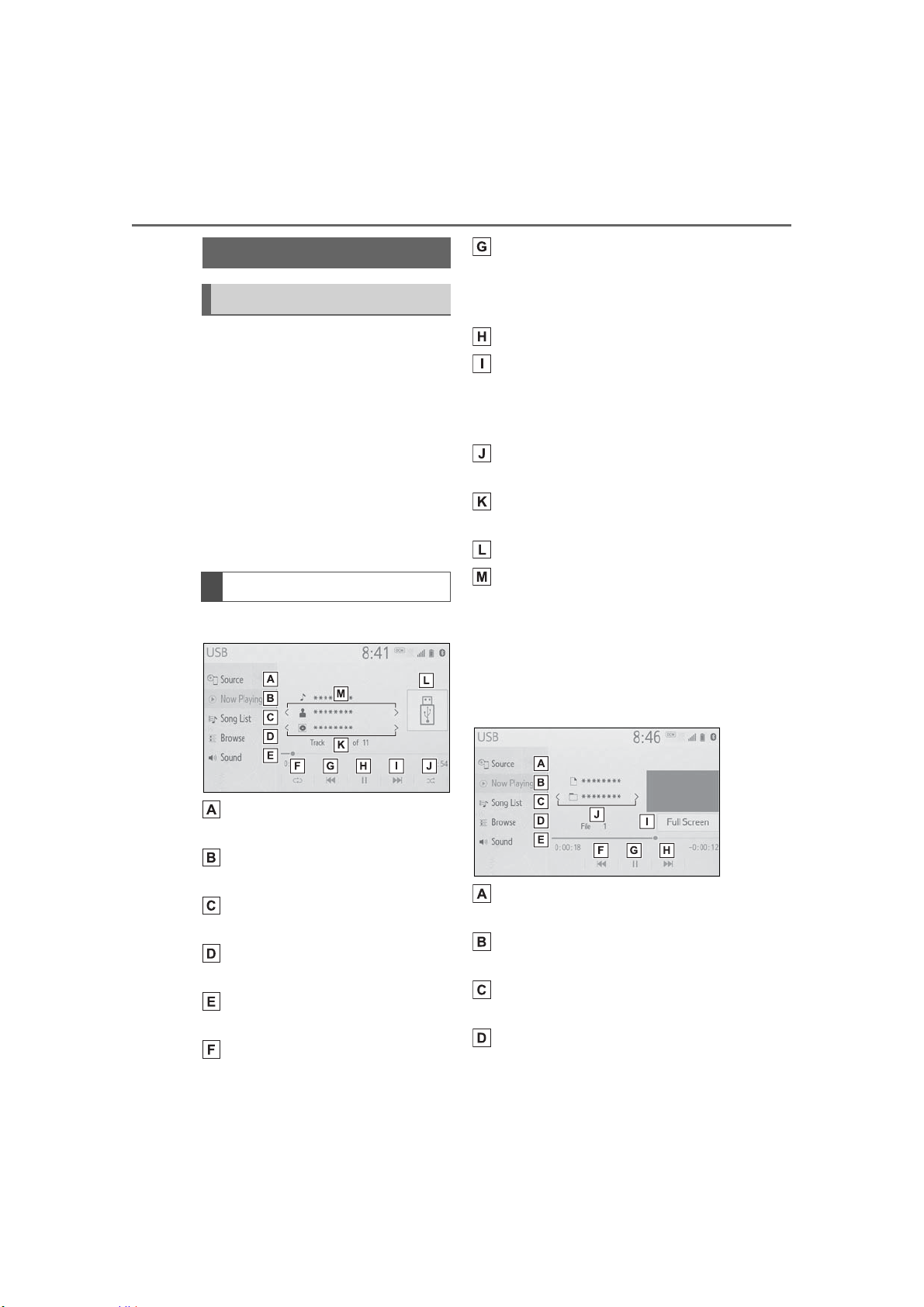
308
5-7. Media operation
COROLLA H/B_U
5-7.Media ope ration
The USB memory operation
screen can be reached by the
following methods: P.29 8
Connecting a USB memory
(P.299)
When an Apple CarPlay/Android
Auto connection is established,
this function will be unavailable.
*
*
: This function is not made avail-
able in some countries or areas.
USB audio
Select to display the audio
source selection screen.
Select to return to the top
screen.
Select to display a song list
screen.
Select to display the play
mode selection screen.
Select to display the sound
setting screen. (P.299)
Select to set repeat playback.
(P.309)
Select to change the
file/track.
Select and hold to fast
rewind.
Select to play/pause.
Select to change the
file/track.
Select and hold to fast for-
ward.
Select to set random play-
back. (P.309)
Select to change the
folder/album.
Displays cover art
Select to change the artist.
USB video
1 Select “Browse”.
2 Select “Videos”.
3 Select the desired folder and
file.
Select to display the audio
source selection screen.
Select to return to the top
screen.
Select to display a song list
screen.
Select to display the play
mode selection screen.
USB memory
Overview
Control screen
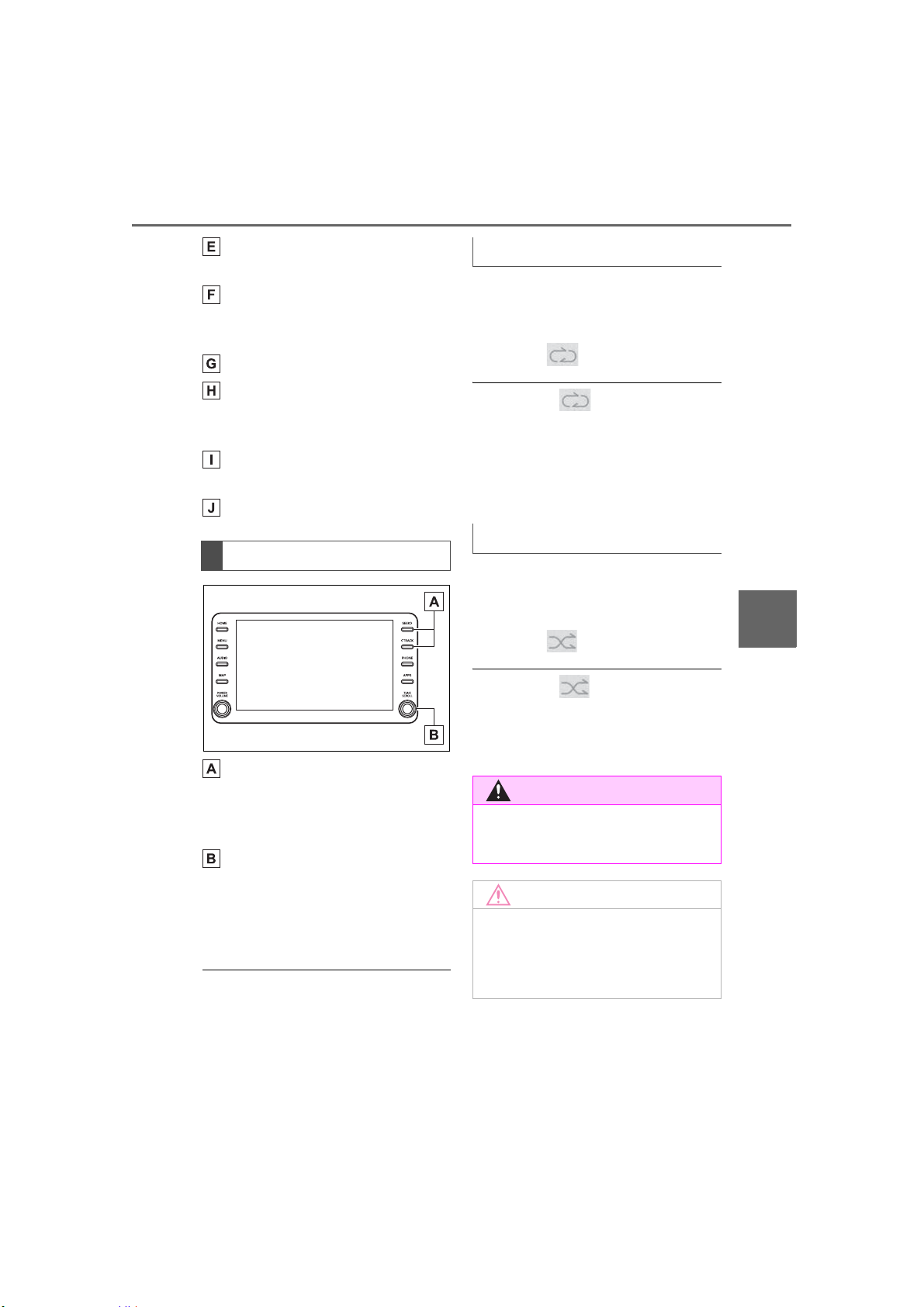
309
5-7. Media operation
COROLLA H/B_U
5
Audio
Select to display the sound
setting screen. (P.299)
Select to change the file.
Select and hold to fast
rewind.
Select to play/pause.
Select to change the file.
Select and hold to fast for-
ward.
Select to display a full screen
image.
Select to change the folder.
Press to change the
file/track.
Press and hold to fast for-
ward/rewind.
Turn to change the file/track.
Turn to move up/down the
list. Also, the knob can be
used to enter selections on
the list screens by pressing it.
● While the vehicle is being driven,
this function can only output
sound.
● If tag information exists, the
file/folder names will be changed
to track/album names.
The file/track or folder/album
currently being listened to can
be repeated.
1 Select .
● Each time is selected, the
mode changes as follows:
When random playback is off
• file/track repeat folder/album
repeat off
When random playback is on
• file/track repeat off
Files/tracks or folders/albums
can be automatically and ran-
domly selected.
1 Select .
● Each time is selected, the
mode changes as follows:
• random (1 folder/album random)
folder/album random (all
folder/album random) off
Control panel
Repeating
Random order
WARNING
● Do not operate the player’s con-
trols or connect the USB mem-
ory while driving.
NOTICE
● Do not leave your portable
player in the car. In particular,
high temperatures inside the
vehicle may damage the porta-
ble player.
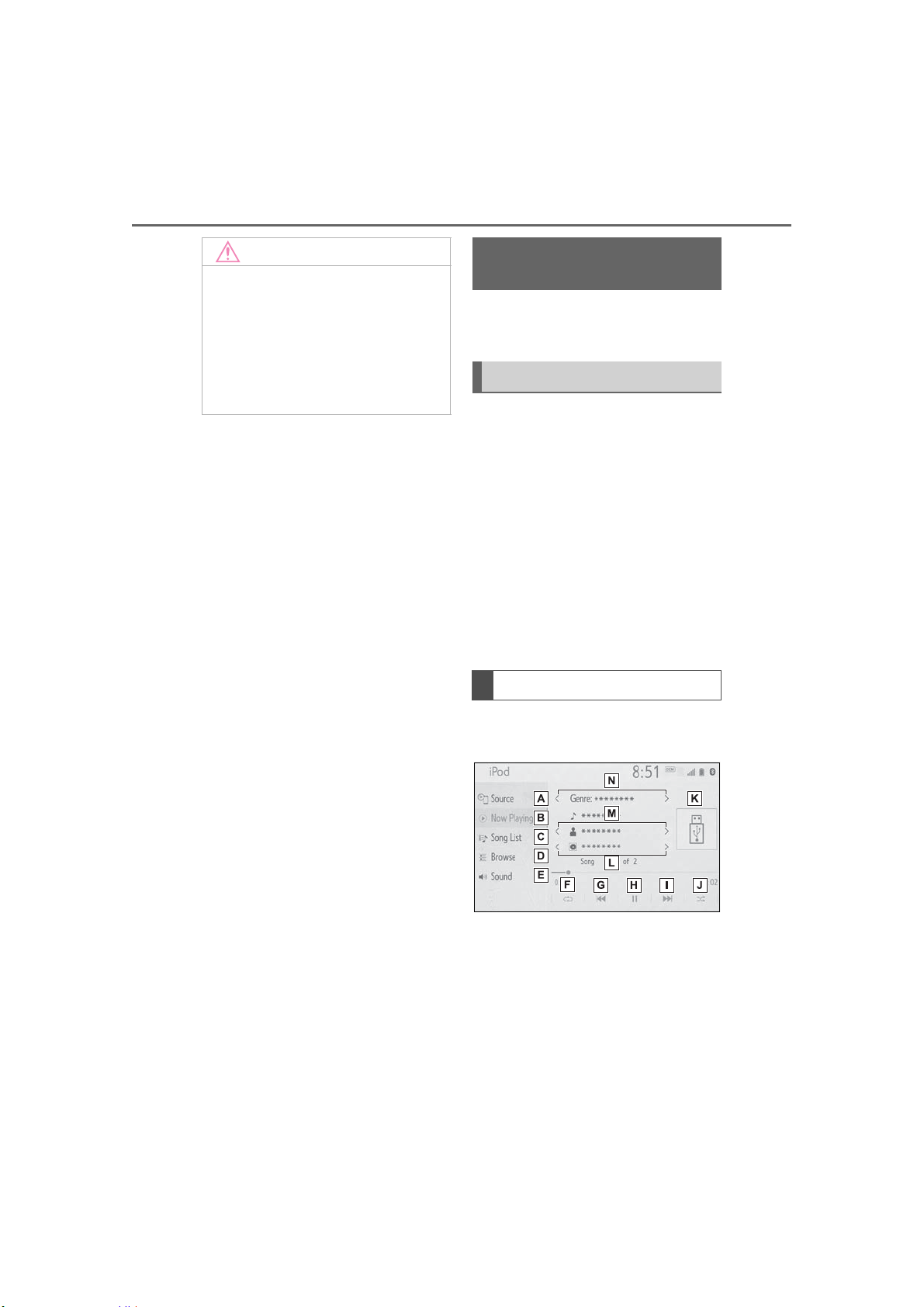
310
5-7. Media operation
COROLLA H/B_U
*
: This function is not made avail-
able in some countries or areas.
The iPod/iPhone(Apple Car-
Play) operation screen can be
reached by the following meth-
ods: P.298
Connecting an iPod/iPhone
(P.283, 299)
When an Android Auto connec-
tion is established, this function
will be unavailable.
*
*
: This function is not made avail-
able in some countries or areas.
An Apple CarPlay connection
is not established
NOTICE
● Do not push down on or apply
unnecessary pressure to the
portable player while it is con-
nected as this may damage the
portable player or its terminal.
● Do not insert foreign objects into
the port as this may damage the
portable player or its terminal.
iPod/iPhone (Apple
CarPlay
*
)
Overview
Control screen
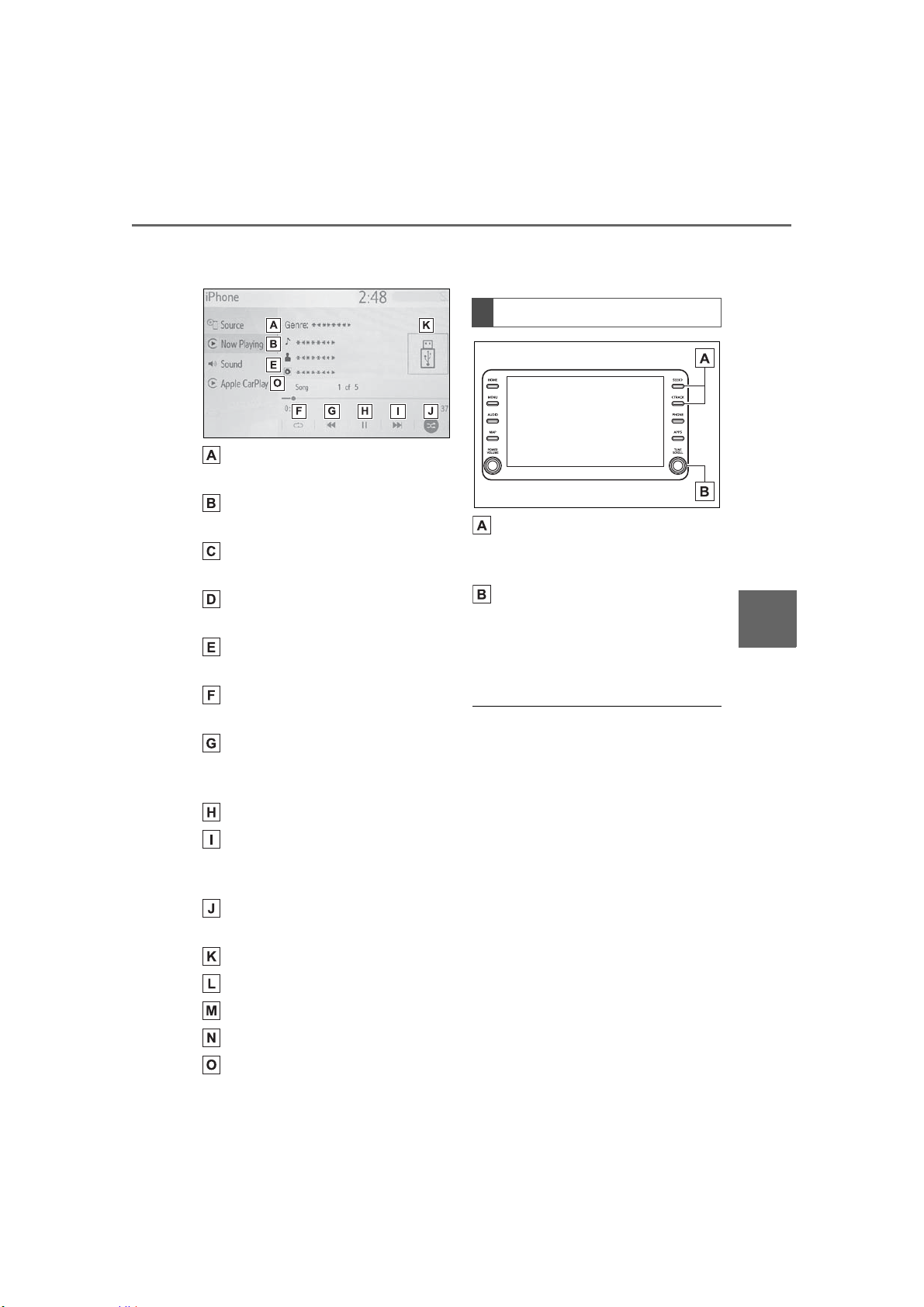
311
5-7. Media operation
COROLLA H/B_U
5
Audio
An Apple CarPlay connection
is established
Select to display the audio
source selection screen.
Select to return to the top
screen.
Select to display a song list
screen.
Select to display the play
mode selection screen.
Select to display the sound
setting screen. (P.299)
Select to set repeat playback.
(P.312)
Select to change the track.
Select and hold to fast
rewind.
Select to play/pause.
Select to change the track.
Select and hold to fast for-
ward.
Select to set random play-
back. (P.312)
Displays cover art
Select to change the album.
Select to change the artist.
Select to change the playlist.
Select to display the audio
control screen of Apple Car-
Play.
Press to change the track.
Press and hold to fast for-
ward/rewind.
Turn to change the track.
Turn to move up/down the
list. Also, the knob can be
used to enter selections on
the list screens by pressing it.
● Some functions may not be avail-
able depending on the type of
model.
● When an iPod/iPhone is con-
nected using a genuine
iPod/iPhone cable, the
iPod/iPhone starts charging its
battery.
● Depending on the iPod/iPhone,
the video sound may not be able
to be heard.
● Depending on the iPod/iPhone
and the songs in the iPod/iPhone,
a cover art may be displayed. This
function can be changed to “On”
or “Off”. (P.320) It may take time
to display the cover art, and the
iPod/iPhone may not be operated
while the cover art display is in
process.
● When an iPod/iPhone is con-
nected and the audio source is
Control panel
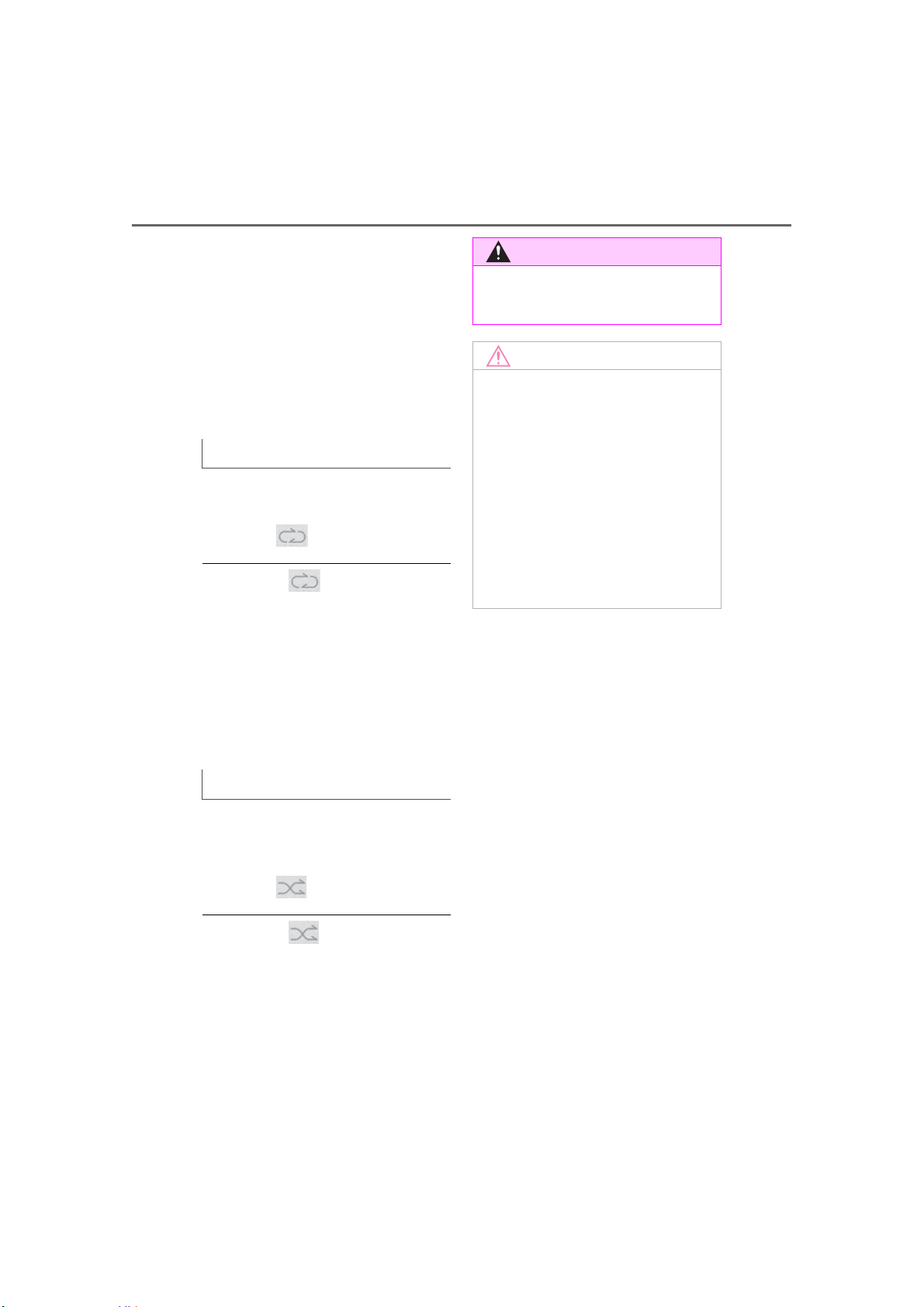
312
5-7. Media operation
COROLLA H/B_U
changed to iPod/iPhone mode,
the iPod/iPhone will resume play-
ing from the same point it was last
used.
● Tracks selected by operating a
connected iPod/iPhone may not
be recognized or displayed prop-
erly.
● The system may not function
properly if a conversion adapter is
used to connect a device.
The track currently being lis-
tened to can be repeated.
1 Select .
● Each time is selected, the
mode changes as follows:
When shuffle is off (iPhone 5 or
later)
• track repeat album repeat off
When shuffle is off (iPhone 4s or
earlier)
• track repeat off
When shuffle is on
• track repeat off
Tracks or albums can be auto-
matically and randomly
selected.
1 Select .
● Each time is selected, the
mode changes as follows:
• shuffle (1 album shuffle) album
shuffle (all album shuffle) off
Repeating
Random order
WARNING
● Do not operate the player’s con-
trols or connect the iPod/iPhone
while driving.
NOTICE
● Do not leave your portable
player in the vehicle. In particu-
lar, high temperatures inside the
vehicle may damage the porta-
ble player.
● Do not push down on or apply
unnecessary pressure to the
portable player while it is con-
nected as this may damage the
portable player or its terminal.
● Do not insert foreign objects into
the port as this may damage the
portable player or its terminal.
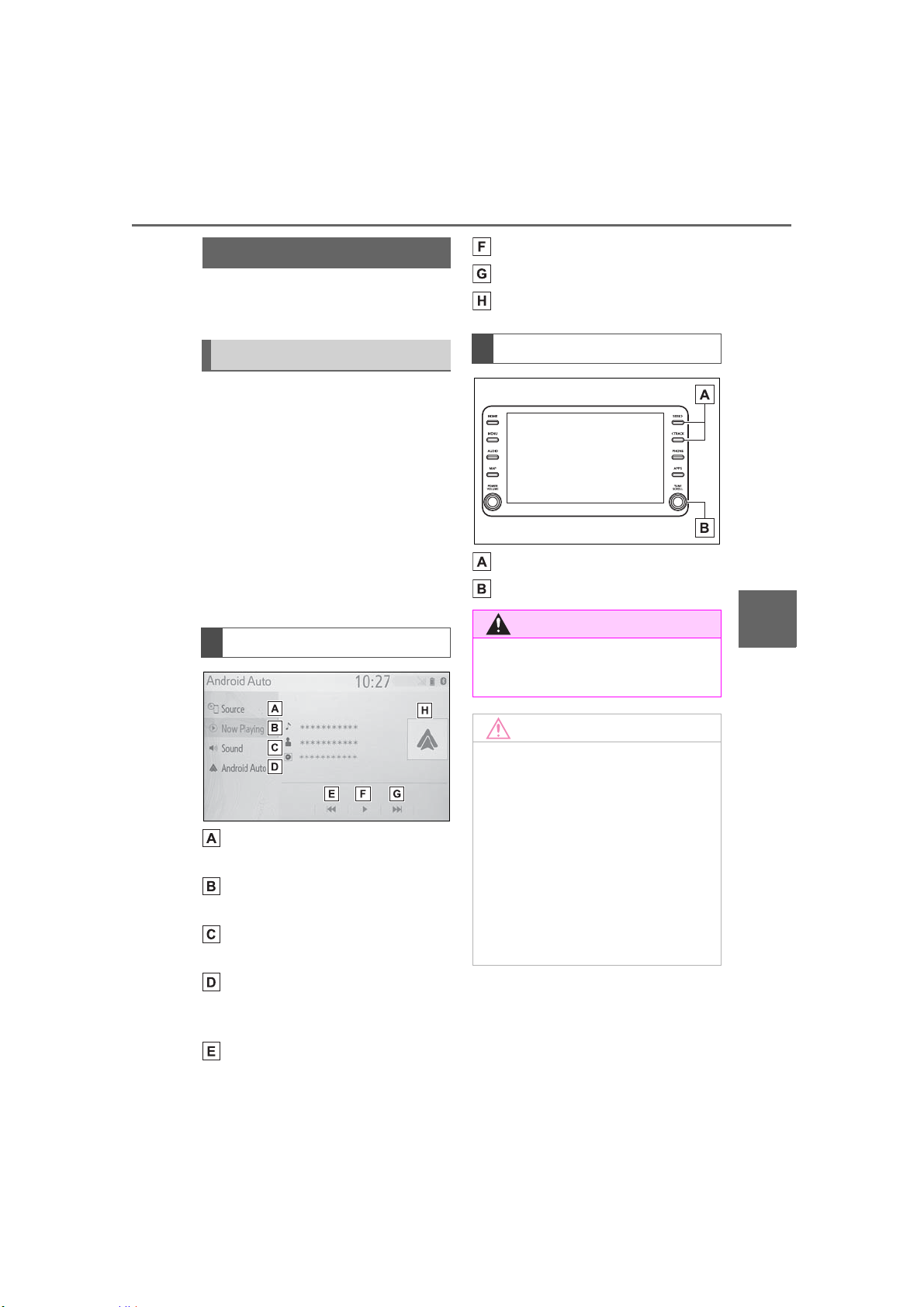
313
5-7. Media operation
COROLLA H/B_U
5
Audio
*
: This function is not made avail-
able in some countries or areas.
The Android Auto operation
screen can be reached by the
following methods: P.298
Connecting an Android device
(P.283, 284)
When an Apple CarPlay con-
nection is established, this func-
tion will be unavailable.
*
*
: This function is not made avail-
able in some countries or areas.
Select to display the audio
source selection screen.
Select to return to the top
screen.
Select to display the sound
setting screen. (P.299)
Select to display the audio
control screen of Android
Auto.
Select to change the track.
Select to play/pause.
Select to change the track.
Displays cover art
Press to change the track.
Turn to change the track.
Android Auto
*
Overview
Control screen
Control panel
WARNING
● Do not connect smartphone or
operate the controls while driv-
ing.
NOTICE
● Do not leave your smartphone
in the vehicle. In particular, high
temperatures inside the vehicle
may damage the smartphone.
● Do not push down on or apply
unnecessary pressure to the
smartphone while it is con-
nected as this may damage the
smartphone or its terminal.
● Do not insert foreign objects into
the port as this may damage the
smartphone or its terminal.
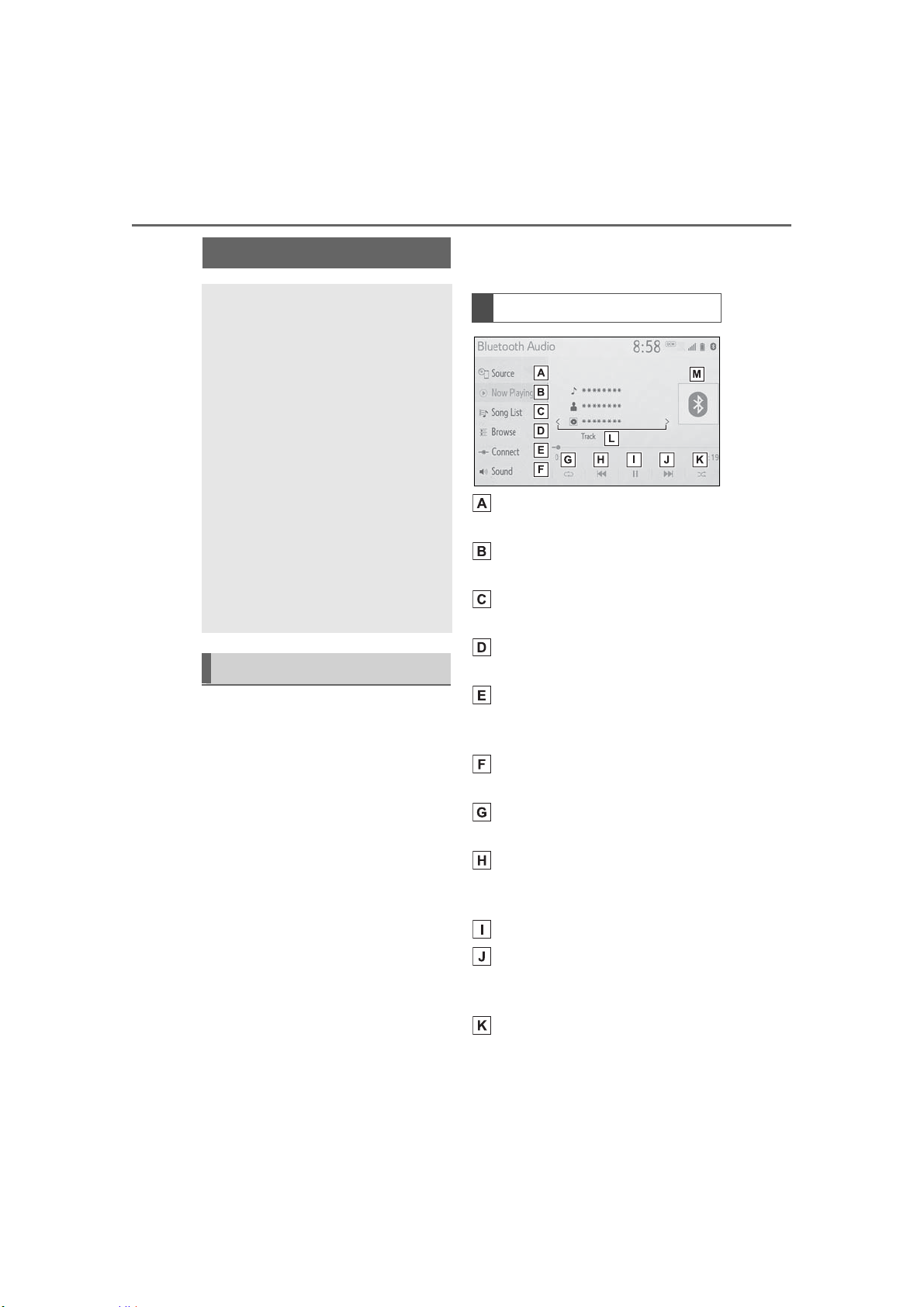
314
5-7. Media operation
COROLLA H/B_U
The Bluetooth
®
audio operation
screen can be reached by the
following methods: P.29 8
Connecting a Bluetooth
®
audio device (P.316)
Depending on the type of porta-
ble player connected, some
functions may not be available
and/or the screen may look dif-
ferently than shown in this man-
ual.
When an Apple CarPlay/Android
Auto connection is established,
Bluetooth
®
audio will be sus-
pended and become unavail-
able.
*
*
: This function is not made avail-
able in some countries or areas.
Select to display the audio
source selection screen.
Select to return to the top
screen.
Select to display a song list
screen.
Select to display the play
mode selection screen.
Select to display the portable
device connection screen.
(P.316)
Select to display the sound
setting screen. (P.299)
Select to set repeat playback.
(P.315)
Select to change the track.
Select and hold to fast
rewind.
Select to play/pause.
Select to change the track.
Select and hold to fast for-
ward.
Select to set random play-
back. (P.315)
Bluetooth
®
audio
The Bluetooth
®
audio sys-
tem enables users to enjoy
listening to music that is
played on a portable player
on the vehicle speakers via
wireless communication.
This audio/visual system
supports Bluetooth
®
, a wire-
less data system capable of
playing portable audio
music without cables. If
your device does not sup-
port Bluetooth
®
, the Blue-
tooth
®
audio system will not
function.
Overview
Control screen
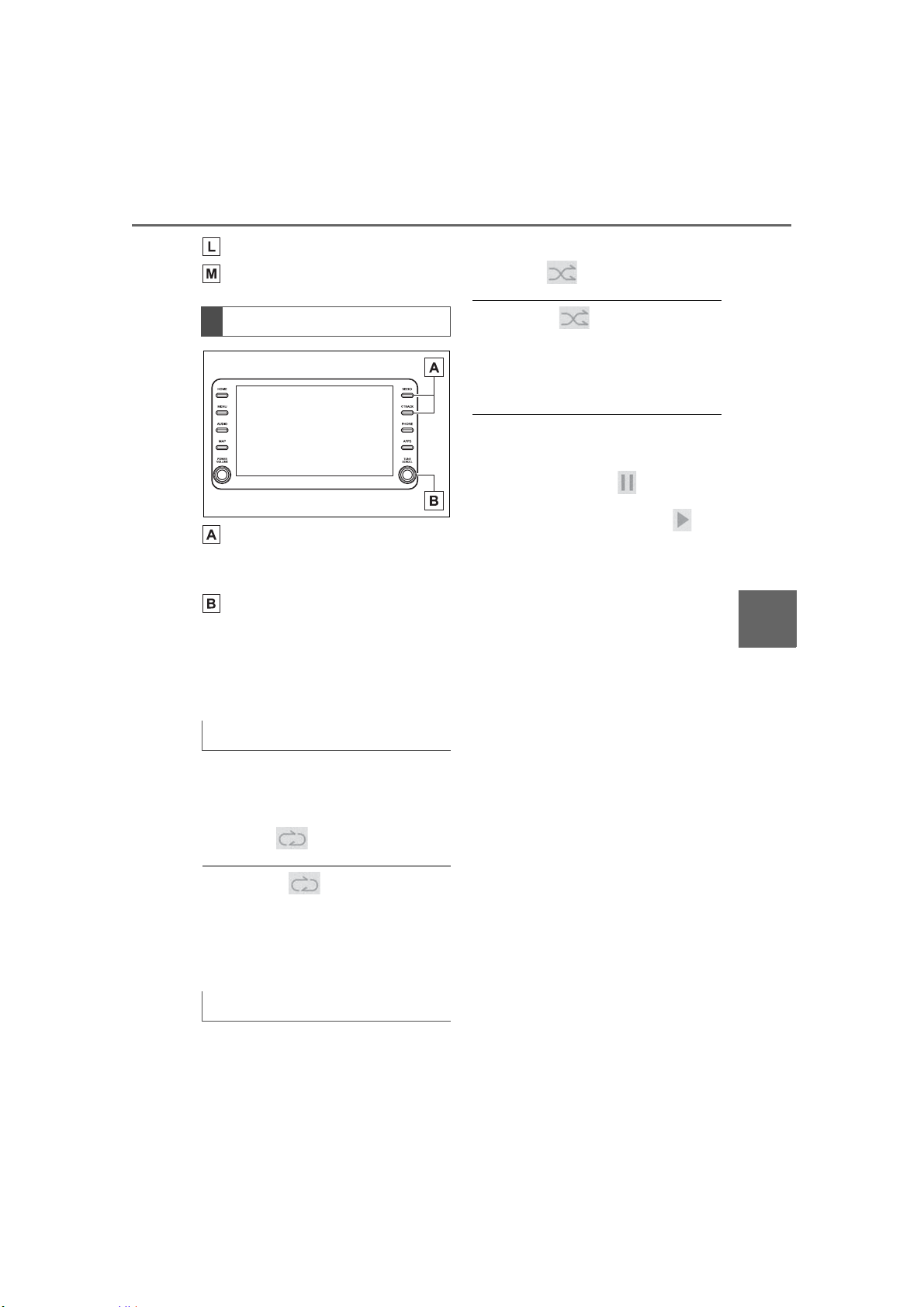
315
5-7. Media operation
COROLLA H/B_U
5
Audio
Select to change the album.
Displays cover art
Press to change the track.
Press and hold to fast for-
ward/rewind.
Turn to change the track.
Turn to move up/down the
list. Also, the knob can be
used to enter selections on
the list screens by pressing it.
The track or album currently
being listened to can be
repeated.
1 Select .
● Each time is selected, the
mode changes as follows:
When random playback is off
• track repeat album repeat off
When random playback is on
• track repeat off
Tracks or albums can be auto-
matically and randomly
selected.
1 Select .
● Each time is selected, the
mode changes as follows:
• random (1 album random)
album random (all album random)
off
● Depending on the Bluetooth
®
device that is connected to the
system, the music may start play-
ing when selecting while it is
paused. Conversely, the music
may pause when selecting
while it is playing.
● In the following conditions, the
system may not function:
• The Bluetooth
®
device is turned
off.
• The Bluetooth
®
device is not con-
nected.
• The Bluetooth
®
device has a low
battery.
● When using the Bluetooth
®
audio
and Wi-Fi
®
Hotspot functions at
the same time, the following prob-
lems may occur:
• It may take longer than normal to
connect to the Bluetooth
®
device.
• The sound may cut out.
● It may take time to connect the
phone when Bluetooth
®
audio is
being played.
● For operating the portable player,
see the instruction manual that
comes with it.
● If the Bluetooth
®
device is discon-
nected due to poor reception from
the Bluetooth
®
network when the
engine switch is in ACC or ON,
the system automatically recon-
nects the portable player.
● If the Bluetooth
®
device is discon-
nected on purpose, such as it was
Control panel
Repeating
Random order
316
5-7. Media operation
COROLLA H/B_U
turned off, this does not happen.
Reconnect the portable player
manually.
● Bluetooth
®
device information is
registered when the Bluetooth
®
device is connected to the Blue-
tooth
®
audio system. When selling
or disposing of the vehicle,
remove the Bluetooth
®
audio
information from the system.
(P.293)
● In some situations, sound output
via the Bluetooth
®
audio system
may be out of sync with the con-
nected device or output intermit-
tently.
To use the Bluetooth
®
audio
system, it is necessary to regis-
ter a Bluetooth
®
device with the
system.
Registering an additional
device
1 Display the Bluetooth
®
audio
control screen. (P.314)
2 Select “Connect”.
3 Select “Add Device”.
When another Bluetooth
®
device is connected, a confir-
mation screen will be dis-
played. To disconnect the
Bluetooth
®
device, select
“Yes”.
4 Follow the steps in “Register-
ing a Bluetooth
®
phone for
the first time” from step 5.
(P.266)
Selecting a registered device
1 Display the Bluetooth
®
audio
control screen. (P.314)
2 Select “Connect”.
3 Select the desired device to
be connected.
WARNING
● Do not operate the player’s con-
trols or connect to the Blue-
tooth
®
audio system while
driving.
● Your audio unit is fitted with
Bluetooth
®
antennas. People
with implantable cardiac pace-
makers, cardiac resynchroniza-
tion therapy-pacemakers or
implantable cardioverter defibril-
lators should maintain a reason-
able distance between
themselves and the Bluetooth
®
antennas. The radio waves may
affect the operation of such
devices.
● Before using Bluetooth
®
devices, users of any electrical
medical device other than
implantable cardiac pacemak-
ers, cardiac resynchronization
therapy-pacemakers or implant-
able cardioverter defibrillators
should consult the manufacturer
of the device for information
about its operation under the
influence of radio waves. Radio
waves could have unexpected
effects on the operation of such
medical devices.
NOTICE
● Do not leave your portable
player in the vehicle. In particu-
lar, high temperatures inside the
vehicle may damage the porta-
ble player.
Registering/Connecting a
Bluetooth
®
device

317
5-7. Media operation
COROLLA H/B_U
5
Audio
4 Check that a confirmation
screen is displayed when the
connection is complete.
If an error message is dis-
played, follow the guidance
on the screen to try again.
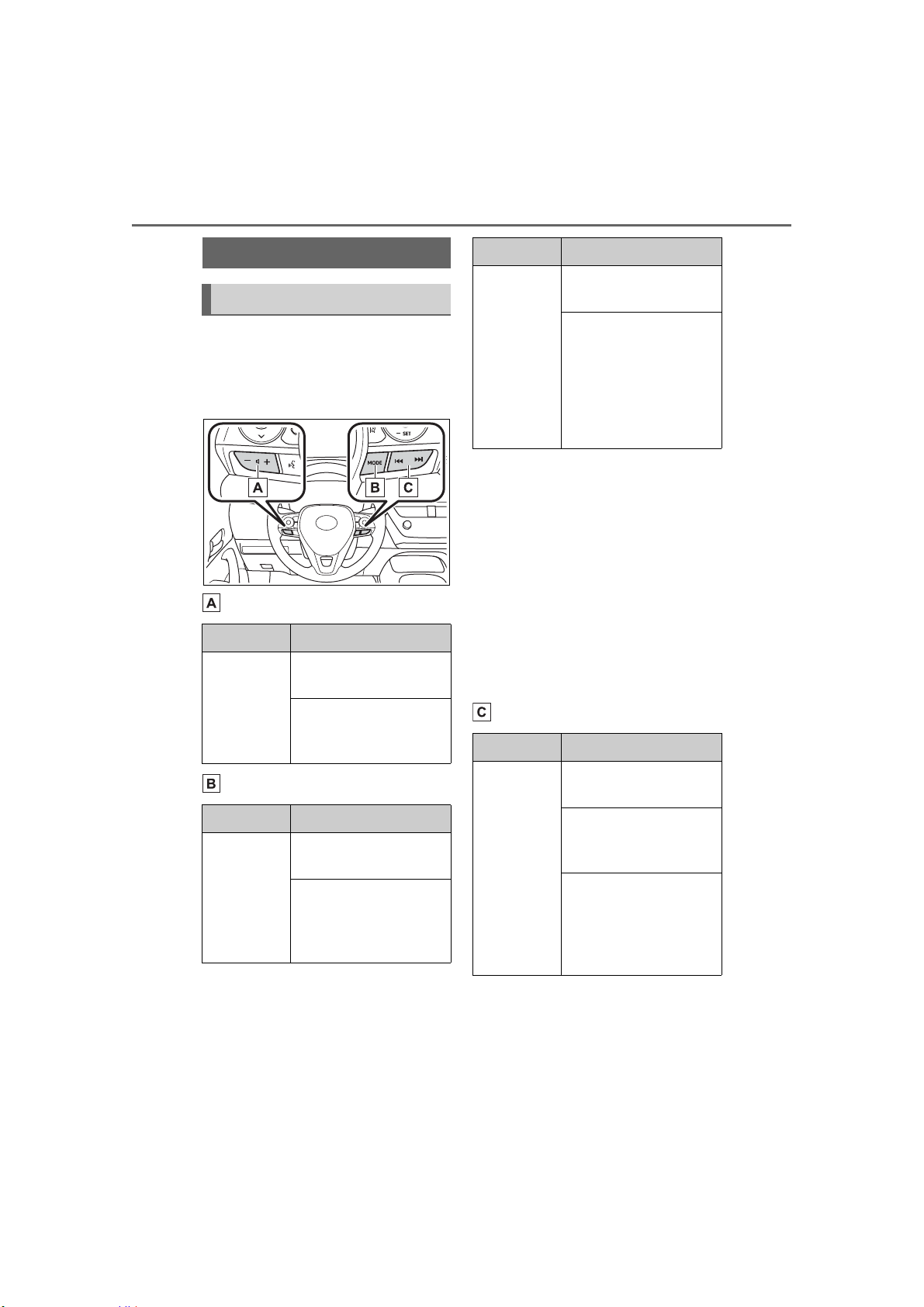
318
5-8. Audio/visual remote controls
COROLLA H/B_U
5-8.Audio/visual remote controls
Some parts of the audio/visual
system can be adjusted using
the switches on the steering
wheel.
Volume control switch
“MODE” switch
*1
:If equipped
*2
:If cached radio is enabled, press-
ing and holding the “MODE”
switch pauses the broadcast.
(Press and hold again to play
back the cached radio program.)
*3
:When an Apple CarPlay is estab-
lished, this function will be
unavailable.
*4
:When an Android Auto is estab-
lished, this function will be
unavailable.
Seek switch
Steering switches
Steering switch operation
Mode Operation/function
All
Press: Volume
up/down
Press and hold (0.8
sec. or more): Volume
up/down continuously
Mode Operation/function
AM/FM/
SXM
*1
Press: Change audio
modes
Press and hold (0.8
sec. or more): Mute
(Press and hold again
to resume the sound.)
USB
*3, 4
,
iPod/iPhon
e
*4
,
Android
Auto
*3
,
Bluetooth
®
audio
*3, 4
,
APPS
*3, 4
Press: Change audio
modes
Press and hold (0.8
sec. or more): Pause
(Press and hold again
to resume the play
mode.)
Mode Operation/function
AM/FM
Press: Preset chan-
nel up/down
Press and hold (0.8
sec. or more): Seek
up/down
Press and hold (1.5
sec. or more): Seek
up/down continuously
while the switch is
being pressed
Mode Operation/function
319
5-8. Audio/visual remote controls
COROLLA H/B_U
5
Audio
*1
:If equipped
*2
:When an Apple CarPlay is estab-
lished, this function will be
unavailable.
*3
:When an Android Auto is estab-
lished, this function will be
unavailable.
● In the APPS mode, some opera-
tion may be done on the screen
depend on the selected APPS.
SXM
*1
Press: Preset chan-
nel up/down
Press and hold (0.8
sec. or more): Seek
for stations in the rele-
vant program
type/channel category
Press and hold (1.5
sec. or more): Fast
channel up/down
USB
*2, 3
,
iPod/iPhon
e
*3
, Blue-
tooth
®
audio
*2, 3
Press: Track/file
up/down
Press and hold (0.8
sec. or more): Fast
forward/rewind
Android
Auto
*2
Press: Track up/down
Mode Operation/function
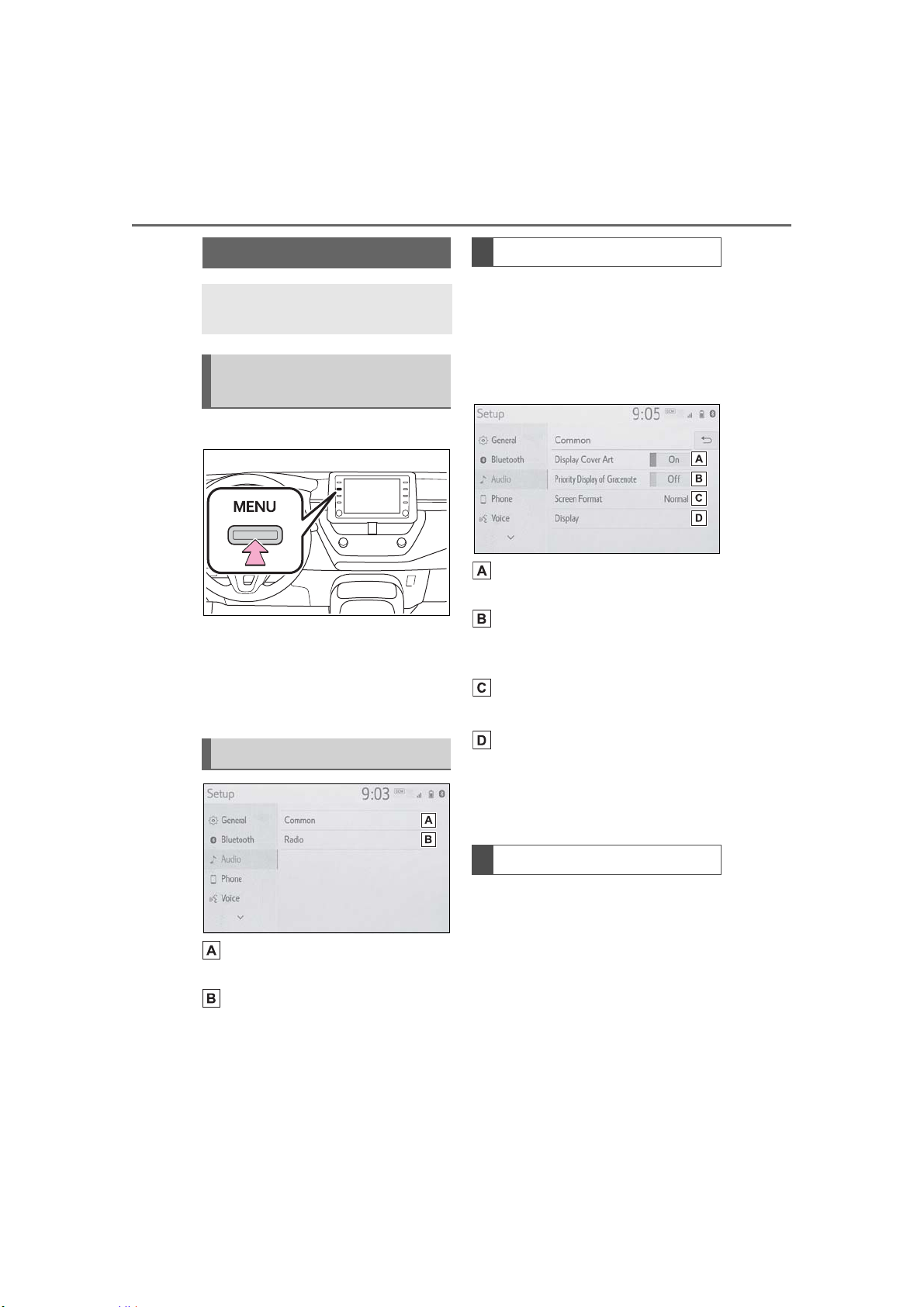
320
5-9. Audio settings
COROLLA H/B_U
5-9.Audio settings
1 Press the “MENU” button.
2 Select “Setup”.
3 Select “Audio”.
4 Select the desired items to
be set.
Select to set the common
settings. (P.320)
Select to set the radio set-
tings. (P.320)
1 Display the audio settings
screen. (P.320)
2 Select “Common”.
3 Select the desired items to
be set.
Select to set the cover art
display on/off.
Select to prioritize the display
of information from the Gra-
cenote database.
Select to change the screen
size.
*
(P.300)
Select to display the image
quality adjustment screen.
*
(P.301)
*
: Only in USB video mode
1 Display the audio settings
screen. (P.320)
2 Select “Radio”.
3 Select the desired number of
preset radio stations dis-
played on the screen.
Setup
Detailed audio settings can
be programmed.
Displaying the audio set-
tings screen
Audio settings screen
Common settings
Radio settings
321
5-10. Tips for operating the audio/visual system
COROLLA H/B_U
5
Audio
5-10.Tips for o perating the aud io/visual syst em
● The use of a cellular phone inside
or near the vehicle may cause a
noise from the speakers of the
audio/visual system which you are
listening to. However, this does
not indicate a malfunction.
Usually, a problem with radio
reception does not mean there
is a problem with the radio it
is just the normal result of condi-
tions outside the vehicle.
For example, nearby buildings
and terrain can interfere with FM
reception. Power lines or phone
wires can interfere with AM sig-
nals. And of course, radio sig-
nals have a limited range. The
farther the vehicle is from a sta-
tion, the weaker its signal will
be. In addition, reception condi-
tions change constantly as the
vehicle moves.
Here, some common reception
problems that probably do not
indicate a problem with the radio
are described.
■ FM
Fading and drifting stations:
Generally, the effective range of
FM is about 25 miles (40 km).
Once outside this range, you
may notice fading and drifting,
which increase with the distance
from the radio transmitter. They
are often accompanied by dis-
tortion.
Multi-path: FM signals are
reflective, making it possible for
2 signals to reach the vehicle’s
antenna at the same time. If this
happens, the signals will cancel
each other out, causing a
momentary flutter or loss of
reception.
Static and fluttering: These
occur when signals are blocked
by buildings, trees or other large
objects. Increasing the bass
level may reduce static and flut-
tering.
Station swapping: If the FM sig-
nal being listened to is inter-
rupted or weakened, and there
is another strong station nearby
on the FM band, the radio may
tune in the second station until
the original signal can be picked
up again.
■ AM
Fading: AM broadcasts are
reflected by the upper atmo-
sphere especially at night.
These reflected signals can
interfere with those received
directly from the radio station,
causing the radio station to
sound alternately strong and
weak.
Operating information
NOTICE
● To avoid damage to the
audio/visual system:
• Be careful not to spill beverages
over the audio/visual system.
Radio
322
5-10. Tips for operating the audio/visual system
COROLLA H/B_U
Station interference: When a
reflected signal and a signal
received directly from a radio
station are very nearly the same
frequency, they can interfere
with each other, making it diffi-
cult to hear the broadcast.
Static: AM is easily affected by
external sources of electrical
noise, such as high tension
power lines, lightening or electri-
cal motors. This results in static.
■ SiriusXM
Cargo loaded on the roof lug-
gage carrier, especially metal
objects, may adversely affect
the reception of SiriusXM Sat-
ellite Radio.
Alternation or modifications
carried out without appropri-
ate authorization may invali-
date the user’s right to
operate the equipment.
■ Certification
For vehicles sold in the
U.S.A., Guam and Puerto
Rico
For vehicles sold in Canada
Use of the Made for Apple
badge means that an acces-
sory has been designed to
connect specifically to the
Apple product(s) identified in
the badge, and has been cer-
tified by the developer to meet
Apple performance stan-
dards. Apple is not responsi-
ble for the operation of this
device or its compliance with
safety and regulatory stan-
dards. Please note that the
use of this accessory with an
Apple product may affect
wireless performance.
iPhone
®
, iPod
®
, iPod clas-
sic
®
, iPod nano
®
, iPod
touch
®
, and Lightning are
trademarks of Apple Inc., reg-
istered in the U.S. and other
countries.
The Lightning connector
works with iPhone 7, iPhone 7
Plus, iPhone SE, iPhone 6s,
iPhone 6s Plus, iPhone 6,
iPhone 6 Plus, iPhone 5s,
iPhone 5c, iPhone 5, iPod
touch (5th and 6th genera-
tion), and iPod nano (7th gen-
eration).
iPod

323
5-10. Tips for operating the audio/visual system
COROLLA H/B_U
5
Audio
The 30-pin connector works
with iPhone 4s, iPhone 4,
iPhone 3GS, iPhone 3G,
iPhone, iPod touch (1st
through 4th generation), iPod
classic, and iPod nano (1st
through 6th generation).
USB works with iPhone 7,
iPhone 7 Plus, iPhone SE,
iPhone 6s, iPhone 6s Plus,
iPhone 6, iPhone 6 Plus,
iPhone 5s, iPhone 5c, iPhone
5, iPhone 4s, iPhone 4,
iPhone 3GS, iPhone 3G,
iPhone, iPod touch (1st
through 6th generation), iPod
classic, and iPod nano (1st
through 7th generation).
Bluetooth
®
technology works
with iPhone 7, iPhone 7 Plus,
iPhone SE, iPhone 6s, iPhone
6s Plus, iPhone 6, iPhone 6
Plus, iPhone 5s, iPhone 5c,
iPhone 5, iPhone 4s, iPhone
4, iPhone 3GS, iPhone 3G,
iPhone, iPod touch (2nd
through 6th generation) and
iPod nano (7th generation).
■ Compatible models
The following iPod nano
®
, iPod
touch
®
and iPhone
®
devices
can be used with this system.
Made for
• iPhone X
• iPhone 8
• iPhone 8 Plus
• iPhone 7
• iPhone 7 Plus
• iPhone SE
• iPhone 6s
• iPhone 6s Plus
• iPhone 6
• iPhone 6 Plus
• iPhone 5s
• iPhone 5c
• iPhone 5
• iPod touch (6th generation)
• iPod touch (5th generation)
● This system only supports audio
playback.
● Depending on difference between
models or software versions etc.,
some models might be incompati-
ble with this system.
This device supports high-reso-
lution sound sources.
The definition of high-resolution
is based on the standards of
groups such as the CTA (Con-
sumer Technology Association).
Supported formats and play-
able media are as follows.
■ Supported formats
WAV, FLAC, ALAC
■ Playable media
USB memory
High-resolution sound
source
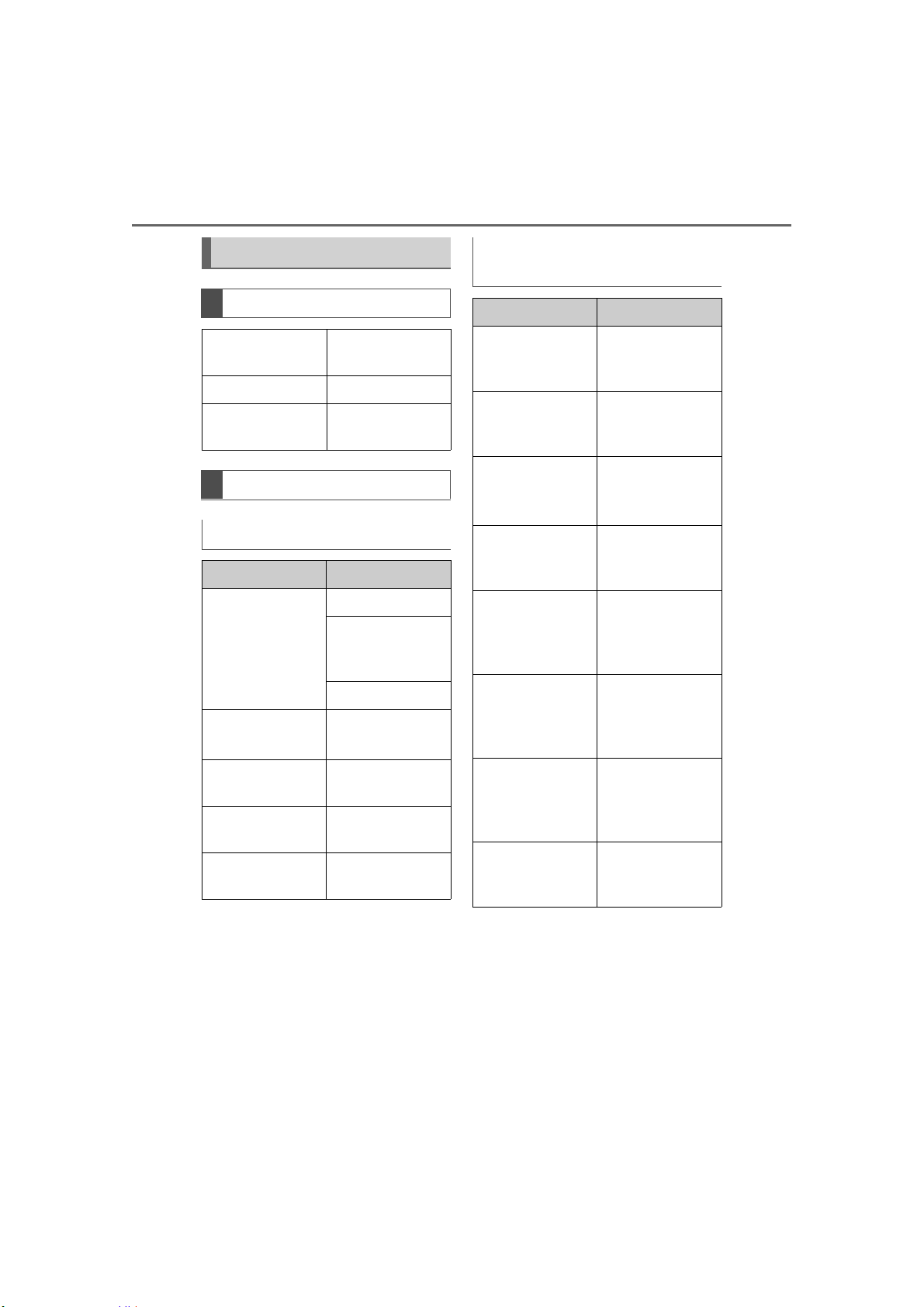
324
5-10. Tips for operating the audio/visual system
COROLLA H/B_U
*
: USB video only
*1
:Only compatible with Windows
Media Audio Standard
*2
:Sound source of 48kHz or more
is down-converted to
48kHz/24bit.
File information
Compatible USB devices
USB communi-
cation formats
USB 2.0 HS (480
Mbps)
File formats FAT 16/32
Correspon-
dence class
Mass storage
class
Compatible audio format
Compatible compressed files
Item USB
Compatible file
format
MP3/WMA/AAC
WAV(LPCM)/FL
AC/ALAC/OGG
Vorbis
MP4/AVI/WMV
Compatible file
format (video)
*
MP4/AVI/WMV
Folders in the
device
Maximum
3000
Files in the
device
Maximum
9999
Files per folder
Maximum
255
Corresponding sampling fre-
quency
File type Frequency (kHz)
MP3 files:
MPEG 1 LAYER
3
32/44.1/48
MP3 files:
MPEG 2 LSF
LAYER 3
16/22.05/24
WMA files:
Ver. 7, 8, 9
*1
(9.1/9.2)
32/44.1/48
AAC files:
MPEG4/AAC-LC
11.025/12/16/
22.05/24/32/
44.1/48
WAV (LPCM)
files
*2
8/11.025/12/16/
22.05/24/32/
44.1/48/88.2/
96/176.4/192
FLAC
*2
8/11.025/12/16/
22.05/24/32/
44.1/48/88.2/
96/176.4/192
ALAC
*2
8/11.025/12/16/
22.05/24/32/
44.1/48/64/
88.2/96
OGG Vorbis
*2
8/11.025/16/
22.05/32/44.1/
48
325
5-10. Tips for operating the audio/visual system
COROLLA H/B_U
5
Audio
*1
:Variable Bit Rate (VBR) compati-
ble
*2
:Only compatible with Windows
Media Audio Standard
MP3 (MPEG Audio Layer 3),
WMA (Windows Media Audio)
and AAC (Advanced Audio
Coding) are audio compres-
sion standards.
This system can play
MP3/WMA/AAC files on USB
memory.
MP4, WMV and AVI files can
use the following resolutions:
128x96, 160x120, 176x144
(QCIF), 320x240 (QVGA),
352x240 (SIF), 352x288
(CIF), 640x480 (VGA),
720x480 (NTSC), 720x576
(PAL)
When naming an
MP3/WMA/AAC file, add an
appropriate file extension
(.mp3/.wma/.m4a).
This system plays back files
with .mp3/.wma/.m4a file
extensions as
MP3/WMA/AAC files respec-
tively. To prevent noise and
playback errors, use the
appropriate file extension.
MP3 files are compatible with
the ID3 Tag Ver. 1.0, Ver. 1.1,
Ver. 2.2 and Ver. 2.3 formats.
This system cannot display
Corresponding bit rates
*1
File type Bit rate (kbps)
MP3 files:
MPEG 1 LAYER
3
32 - 320
MP3 files:
MPEG 2 LSF
LAYER 3
8 - 160
WMA files: Ver.
7, 8
CBR 48 - 192
WMA files:
Ver. 9
*2
(9.1/9.2)
CBR 48 - 320
AAC files:
MPEG4/AAC-LC
8 - 320
OGG Vorbis 32-500
File type
Quantization bit
rate (bit)
WAV (LPCM)
files
16/24
FLAC
ALAC
Compatible channel modes
File type Channel mode
MP3 files
Stereo, joint ste-
reo, dual chan-
nel and
monaural
WMA files 2ch
AAC files
1ch, 2ch (Dual
channel is not
supported)
WAV (LPCM)/
FLAC/ALAC/
OGG Vorbis
2ch
File type Channel mode
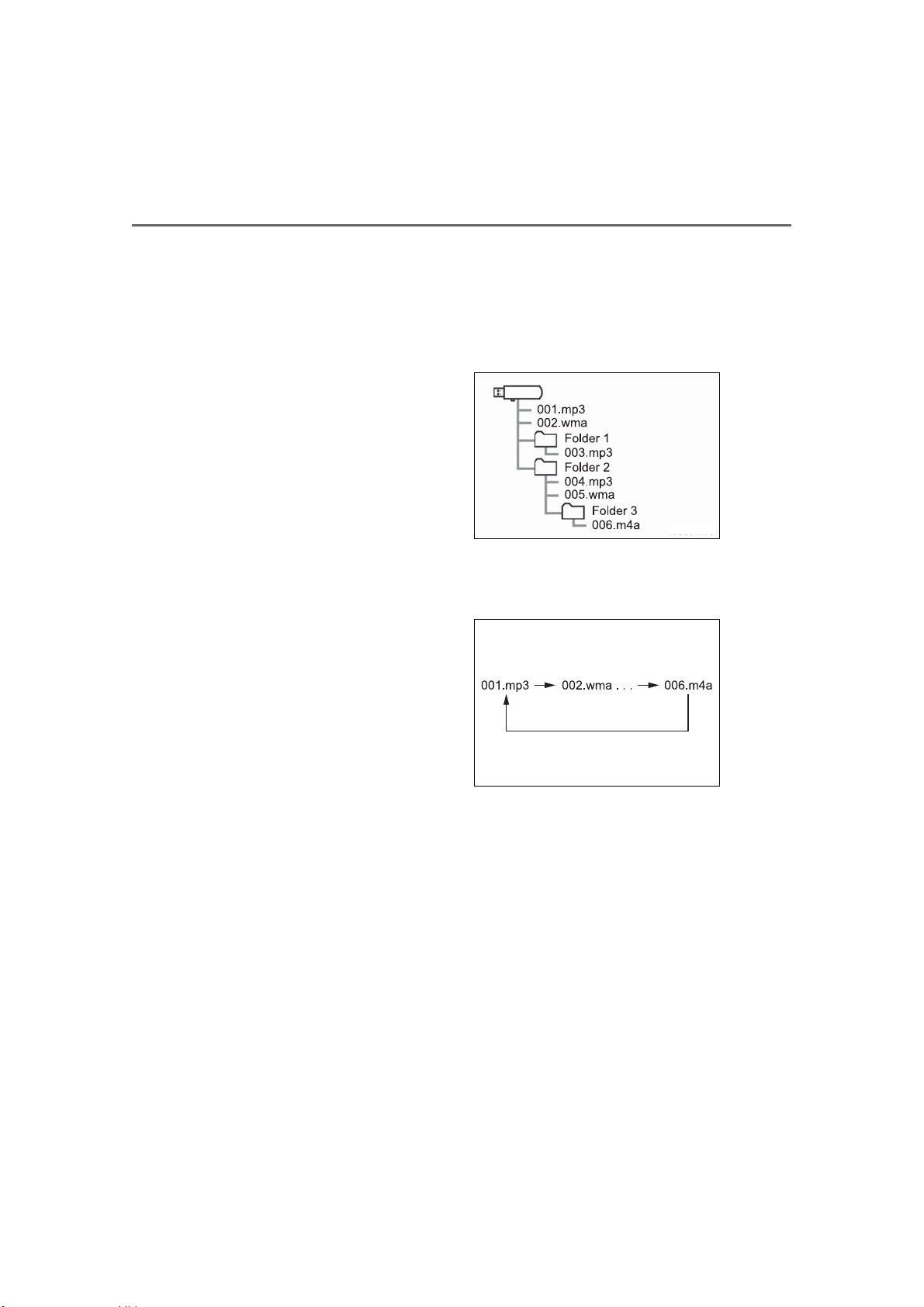
326
5-10. Tips for operating the audio/visual system
COROLLA H/B_U
disc title, track title and artist
name in other formats.
WMA/AAC files can contain a
WMA/AAC tag that is used in
the same way as an ID3 tag.
WMA/AAC tags carry infor-
mation such as track title and
artist name.
The emphasis function is
available only when playing
MP3 files.
This system can play back
AAC files encoded by iTunes.
The sound quality of
MP3/WMA files generally
improves with higher bit rates.
m3u playlists are not compati-
ble with the audio player.
MP3i (MP3 interactive) and
MP3PRO formats are not
compatible with the audio
player.
The player is compatible with
VBR (Variable Bit Rate).
When playing back files
recorded as VBR (Variable Bit
Rate) files, the play time will
not be correctly displayed if
the fast forward or reverse
operations are used.
It is not possible to check fold-
ers that do not include
MP3/WMA/AAC files.
MP3/WMA/AAC files in fold-
ers up to 8 levels deep can be
played. However, the start of
playback may be delayed
when using USB memory
containing numerous levels of
folders. For this reason, we
recommend creating USB
memory with no more than 2
levels of folders.
The play order of the USB
memory with the structure
shown above is as follows:
The order changes depending
on the personal computer and
MP3/WMA/AAC encoding
software you use.
327
5-10. Tips for operating the audio/visual system
COROLLA H/B_U
5
Audio
■ ID3 tag
This is a method of embed-
Compatible video format
Format Codec
MPEG-4
Video codec:
H.264/MPEG-4
AVC
MPEG4
Audio codec:
AAC
MP3
Corresponding
screen size:
MAX
19201080
Corresponding
frame rate:
MAX 60i/30p
AVI Container
Video codec:
H.264/MPEG-4
AVC
MPEG4
WMV9
WMV9
Advanced pro-
file
Audio codec:
AAC
MP3
WMA9.2
(7,8,9.1,9.2)
Corresponding
screen size:
MAX
19201080
Corresponding
frame rate:
MAX 60i/30p
Windows Media
Video
Video codec:
WMV9
WMV9
Advanced pro-
file
Audio codec:
WMA9.2
(7,8,9.1,9.2)
Corresponding
screen size:
MAX
19201080
Corresponding
frame rate:
MAX 60i/30p
Terms
Format Codec
328
5-10. Tips for operating the audio/visual system
COROLLA H/B_U
ding track-related information
in an MP3 file. This embed-
ded information can include
the track number, track title,
the artist’s name, the album
title, the music genre, the year
of production, comments,
cover art and other data. The
contents can be freely edited
using software with ID3 tag
editing functions. Although
the tags are restricted to a
number of characters, the
information can be viewed
when the track is played back.
■ WMA tag
WMA files can contain a
WMA tag that is used in the
same way as an ID3 tag.
WMA tags carry information
such as track title and artist
name.
■ MP3
MP3 is an audio compression
standard determined by a
working group (MPEG) of the
ISO (International Standard
Organization). MP3 com-
presses audio data to about
1/10 the size of that on con-
ventional discs.
■ WMA
WMA (Windows Media Audio)
is an audio compression for-
mat developed by Microsoft
®
.
It compresses files into a size
smaller than that of MP3 files.
The decoding formats for
WMA files are Ver. 7, 8 and 9.
Trademark Acknowledgement
Windows Media is either a
registered trademark or trade-
mark of Microsoft Corpora-
tion in the United States
and/or other countries.
This product includes technol-
ogy owned by Microsoft Cor-
poration and cannot be used
or distributed without a
license from Microsoft Licens-
ing, Inc.
■ AAC
AAC is short for Advanced
Audio Coding and refers to an
audio compression technol-
ogy standard used with
MPEG2 and MPEG4.
■ USB
Error messages
Message Explanation
“USB Error”
This indicates a
problem in the
USB memory or
its connection.
“No music files
found.”
This indicates
that no
MP3/WMA/AAC
files are included
in the USB mem-
ory.
“No video files
found.”
This indicates
that no video
files are included
in the USB mem-
ory.
329
5-10. Tips for operating the audio/visual system
COROLLA H/B_U
5
Audio
■ iPod
■ Bluetooth
®
audio
● If the malfunction is not rectified:
Take your vehicle to your Toyota
dealer.
Message Explanation
“iPod Error.”
This indicates a
problem in the
iPod or its con-
nection.
“No music files
found.”
This indicates
that there is no
music data in the
iPod.
“Please check
the iPod firm-
ware version.”
This indicates
that the software
version is not
compatible. Per-
form the iPod
firmware
updates and try
again.
“Unable to
authorize the
iPod.”
This indicates
that it failed to
authorize the
iPod.
Please check
your iPod.
Message Explanation
“Music tracks not
supported.
Please check
your portable
player.”
This indicates a
problem in the
Bluetooth
®
device.
330
5-10. Tips for operating the audio/visual system
COROLLA H/B_U
■ For vehicles sold in the U.S.A., Hawaii and Puerto Rico
Certification
331
5-10. Tips for operating the audio/visual system
COROLLA H/B_U
5
Audio
■ For vehicles sold in Canada
332
5-10. Tips for operating the audio/visual system
COROLLA H/B_U
■ Gracenote
■ For U.S. owners
333
5-10. Tips for operating the audio/visual system
COROLLA H/B_U
5
Audio
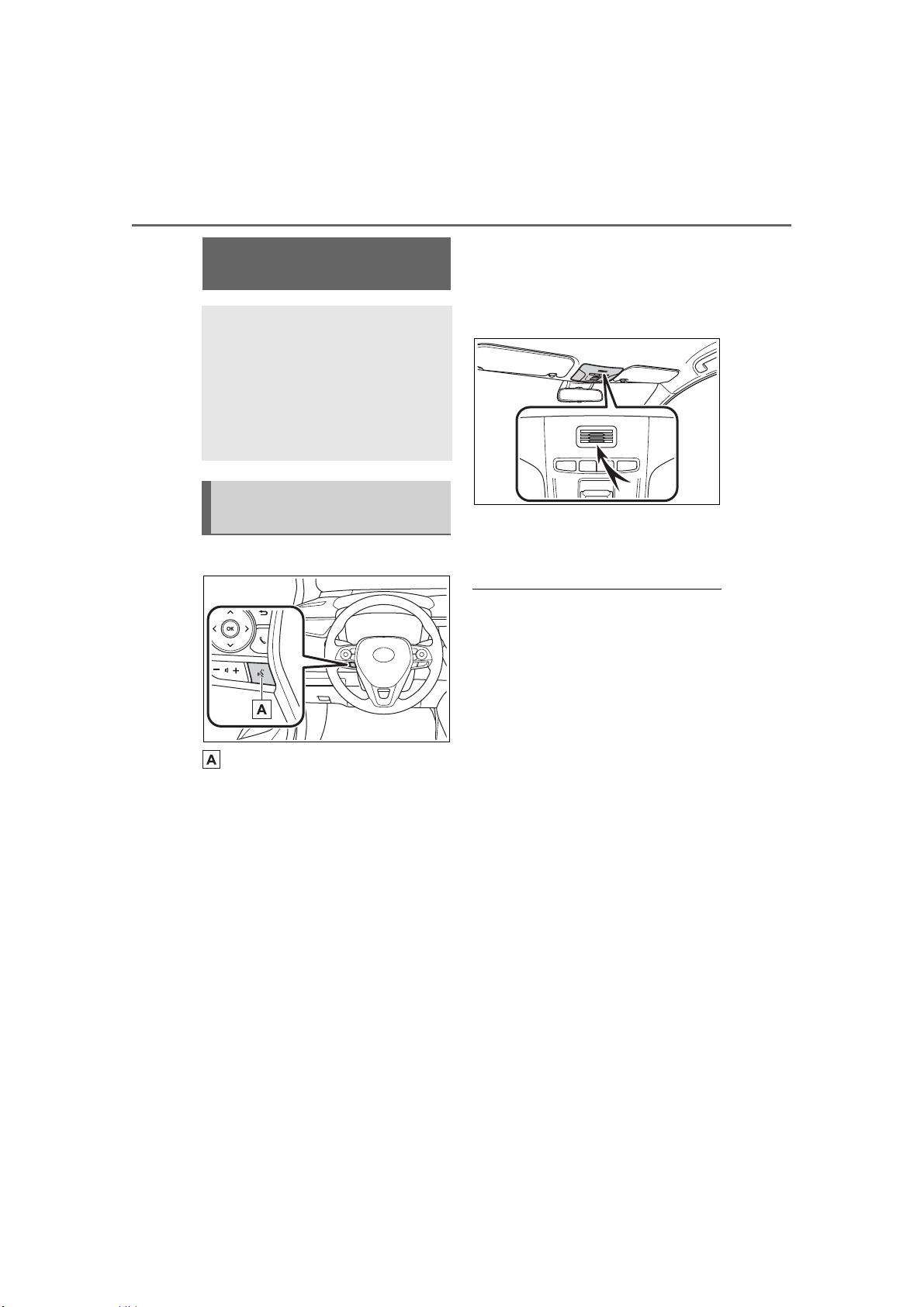
334
5-11. Voice command system operation
COROLLA H/B_U
5-11.Voice command syst em operation
■ Steering switch
Talk switch
Voice command system
Press the talk switch to start
the voice command system.
To cancel voice command,
press and hold the talk switch.
When an Apple Car-
Play/Android Auto connec-
tion is established:
*
Press and hold the talk switch
to start Siri/Google Assistant.
To cancel Siri/Google Assis-
tant, press the talk switch.
Press the talk switch to start
the voice command system.
*
: This function is not made avail-
able in some countries or areas.
■ Microphone
It is unnecessary to speak
directly into the microphone
when giving a command.
● Voice commands may not be rec-
ognized if:
• Spoken too quickly.
• Spoken at a low or high volume.
• The windows are open.
• Passengers are talking while
voice commands are spoken.
• The fan speed of the air condition-
ing system is set at high.
• The air conditioning vents are
turned towards the microphone.
● In the following conditions, the
system may not recognize the
command properly and using
voice commands may not be pos-
sible:
• The command is incorrect or
unclear. Note that certain words,
accents or speech patterns may
be difficult for the system to recog-
nize.
• There is excessive background
noise, such as wind noise.
● Normally, it is necessary to wait
for a beep before saying a com-
mand. To enable the ability to talk
over prompts and say commands
before the beep, enable the voice
prompt interrupt function.
(P.294)
Voice command sys-
tem
The voice command sys-
tem enables the radio,
phone dialing, etc. to be
operated using voice com-
mands. Refer to the com-
mand list for samples of
voice commands. (P.337)
Using the voice command
system
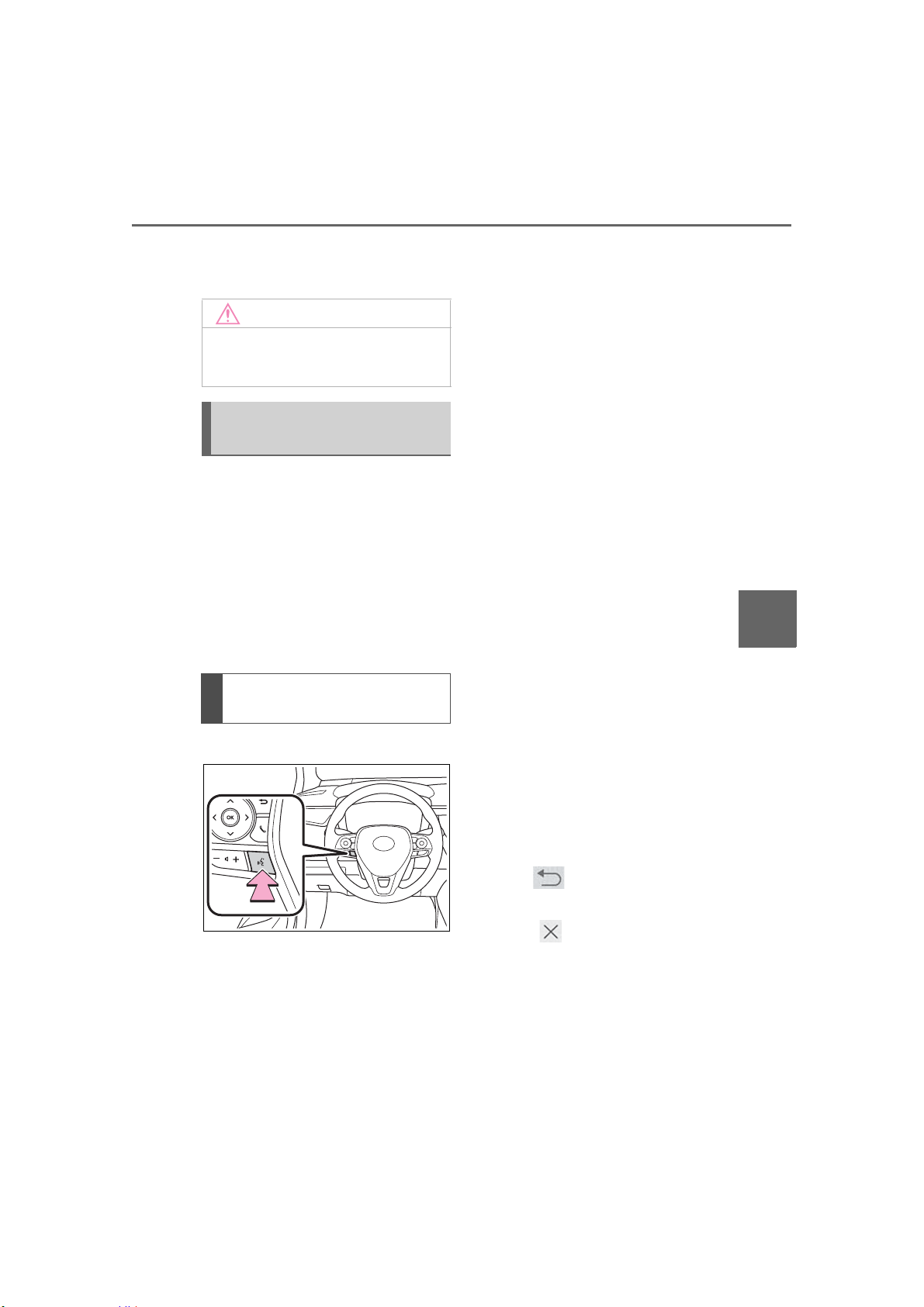
335
5-11. Voice command system operation
COROLLA H/B_U
5
Audio
● This system may not operate
immediately after the engine
switch is in ACC or ON.
The voice command system is
operated by saying commands
which correspond to a sup-
ported function. To display
examples of commands for sup-
ported functions, select a func-
tion button on the screen after
starting the voice command sys-
tem.
1 Press the talk switch.
Voice guidance for the voice
command system can be
skipped by pressing the talk
switch.
2 If “Getting Started with Voice”
screen is displayed, select
“OK” or press the talk switch.
(P.336)
3 After hearing a beep, say a
supported command.
To display sample commands
of the desired function, say
the desired function or select
the desired function button. To
display more commands,
select “More Commands”.
Selecting “Help” or saying
“Help” prompts the voice com-
mand system to offer exam-
ples of commands and
operation methods.
Registered POIs, registered
names in the contacts list etc.,
can be said in the place of the
“<>” next to the commands.
(P.337)
For example: Say “Find a restau-
rant”, “Call John Smith” etc.
If a desired outcome is not
shown, or if no selections are
available, perform one of the
following to return to the pre-
vious screen:
• Say “Go back”.
• Select .
To cancel voice recognition,
select , say “Cancel”, or
press and hold the talk switch.
To perform the voice com-
mand operation again, select
“Start Over” or say “Start
over”.
To suspend voice command
NOTICE
● Do not touch and put a sharp
object to the microphone. It may
cause failure.
Voice command system
operation
Operation from the main
menu

336
5-11. Voice command system operation
COROLLA H/B_U
operation, select “Pause” or
say “Pause”. To resume the
voice command operation,
select “Resume” or press the
talk switch.
● If the system does not respond or
the confirmation screen does not
disappear, press the talk switch
and try again.
● If a voice command cannot be rec-
ognized, voice guidance will say
“Sorry, could you repeat that?”
and voice command reception will
restart.
● If a voice command cannot be rec-
ognized 3 consecutive times,
voice recognition will be canceled.
● The amount of spoken feedback
received from the system while
using the voice command system
(voice recognition prompts) can
be changed on the voice settings
screen. (P.294)
● Some voice guidance can be can-
celed by setting voice prompts to
off. Use this setting when it is
desirable to say a command
immediately after pressing the talk
switch and hearing a beep.
To increase voice recognition
performance, use the “Tutori-
als” and “Voice Training” func-
tions on the “Getting Started
with Voice” screen. These func-
tions are only available when
the vehicle is not moving.
The “Tutorials” and “Voice Train-
ing” functions can also be
started on the voice settings
screen. (P.294)
1 Press the talk switch.
2 Select the desired item to be
set.
Select to display the voice
command tutorials.
Select to train the voice com-
mand system.
The user will be asked to say 10
sample phrases. This will help the
voice command system adapt to
the user’s accent.
Select to prevent the screen
from being displayed again.
Select to proceed to the
voice command screen.
Increasing the voice rec-
ognition performance
337
5-11. Voice command system operation
COROLLA H/B_U
5
Audio
Recognizable voice commands
and their actions are shown
below.
Frequently used commands
are listed in the following
tables.
For devices that are not
installed to the vehicle, com-
mands relating to that device
may not be displayed on the
screen. Also, depending on
other conditions, such as
compatibility, some com-
mands may not be displayed
on the screen.
The functions available may
vary according to the system
installed.
When an Apple Car-
Play/Android Auto connec-
tion is established, some
commands will become
unavailable.
Voice recognition language
can be changed. (P.290)
■ Common
■ Top menu
*
: Vehicle must be parked
Command list
Command list overview
Command list
Command Action
“Help”
Displays exam-
ples of some of
the available
commands
“Go back”
Returns to the
previous screen
“Cancel”
Cancels the
voice command
system
“Start over”
Returns to top
menu screen
“Pause”
Temporarily
pauses a voice
session until it is
resumed by
pressing the talk
switch again.
Command Action
“Show com-
mand examples
for <menu>”
Displays the
command list of
the selected
menu
“More com-
mands”
Displays more
commonly used
commands
“Voice settings”
Displays Voice
Setting screen
“Train my voice”
Displays Train
Voice Recogni-
tion screen
*
338
5-11. Voice command system operation
COROLLA H/B_U
■ Phone
*
: If the system does not recognize
the name of a contact, create a
voice tag. (P.361) The name of
a contact can also be recognized
by adding a voice tag.
■ While in a phone call
■ While incoming message
notification is displayed
*
*
: Full screen message notification
must be turned on within the
phone settings (P.359)
Command Action
“Call <contact>”
*
Places a call to
the specified
contact from the
phone book
“Call <contact>
<phone type>”
*
Places a call to
the specified
phone type of
the contact from
the phone book
“Dial <phone
number>”
Places a call to
the specified
phone number
“Redial”
Places a call to
the phone num-
ber of the latest
outgoing call
“Call back”
Places a call to
the phone num-
ber of latest
incoming call
“Show recent
calls”
Displays the call
history screen
“Send a mes-
sage to <con-
tact>”
Sends a text
message to
specified con-
tact from the
phone book
Command Action
“Send <digits>”
Sends DTMF
tones has speci-
fied
“Mute”
Mutes the micro-
phone (far side
cannot hear the
conversation)
“Unmute”
Unmutes the
microphone
Command Action
“Read message”
Reads the
incoming mes-
sage over the
vehicle speakers
“Ignore”
Ignores the
incoming mes-
sage notification
“Reply”
Initiates sending
a reply to the
incoming mes-
sage
“Call”
Places a call to
the phone num-
ber of incoming
message
339
5-11. Voice command system operation
COROLLA H/B_U
5
Audio
■ Radio
*1
:A station list must be built first
using the radio screen (P.302)
*2
:Requires a satellite radio sub-
scription
■ Audio
*
*
: The audio device must be con-
nected via a USB cable to use the
functionality in this section
Command Action
“Tune to <fre-
quency> AM”
Changes the
radio to the
specified AM fre-
quency
“Tune to <fre-
quency> FM”
Changes the
radio to the
specified FM fre-
quency
“Play a <genre>
station”
Changes the
radio to an FM
station of the
specified genre
“Tune to preset
<1-36>”
Changes the
radio to the
specified preset
radio station
“Tune to a
<genre> satel-
lite station”
Changes the
radio to a satel-
lite radio channel
of the specified
genre
*2
“Tune to <satel-
lite channel
name>”
Changes the
radio to the sat-
ellite radio chan-
nel with the
specified name
*2
“Tune to chan-
nel <number> on
XM”
Changes the
radio to a satel-
lite radio channel
of the specified
number
*2
Command Action
“Play Playlist
<name>”
Plays tracks
from the
selected playlist
“Play Artist
<name>”
Plays tracks
from the
selected artist
“Play Song
<name>”
Plays the
selected track
“Play Album
<name>”
Plays tracks
from the
selected album
“Play Genre
<name>”
Plays tracks
from the
selected genre
“Play Composer
<name>”
Plays tracks
from the
selected com-
poser
“Play Podcast
<name>”
Plays tracks
from the
selected podcast
“Play Audiobook
<name>”
Plays tracks
from the
selected audio-
book
“Audio On”
Turns the audio
system on
“Audio Off”
Turns the audio
system off
“Change the
audio source to
<source name>”
Sets the source
to the specified
audio mode

340
5-11. Voice command system operation
COROLLA H/B_U
■ Toyota apps
*
: When an application is opened
and is in full screen mode, press-
ing the talk switch will start the
voice command system and com-
mands for the currently displayed
application will be available
● Commands relating to operation
of the audio/visual system can
only be performed when the
audio/visual system is turned on.
Command Action
“Launch <appli-
cation name>”
*
Activates the
Toyota apps
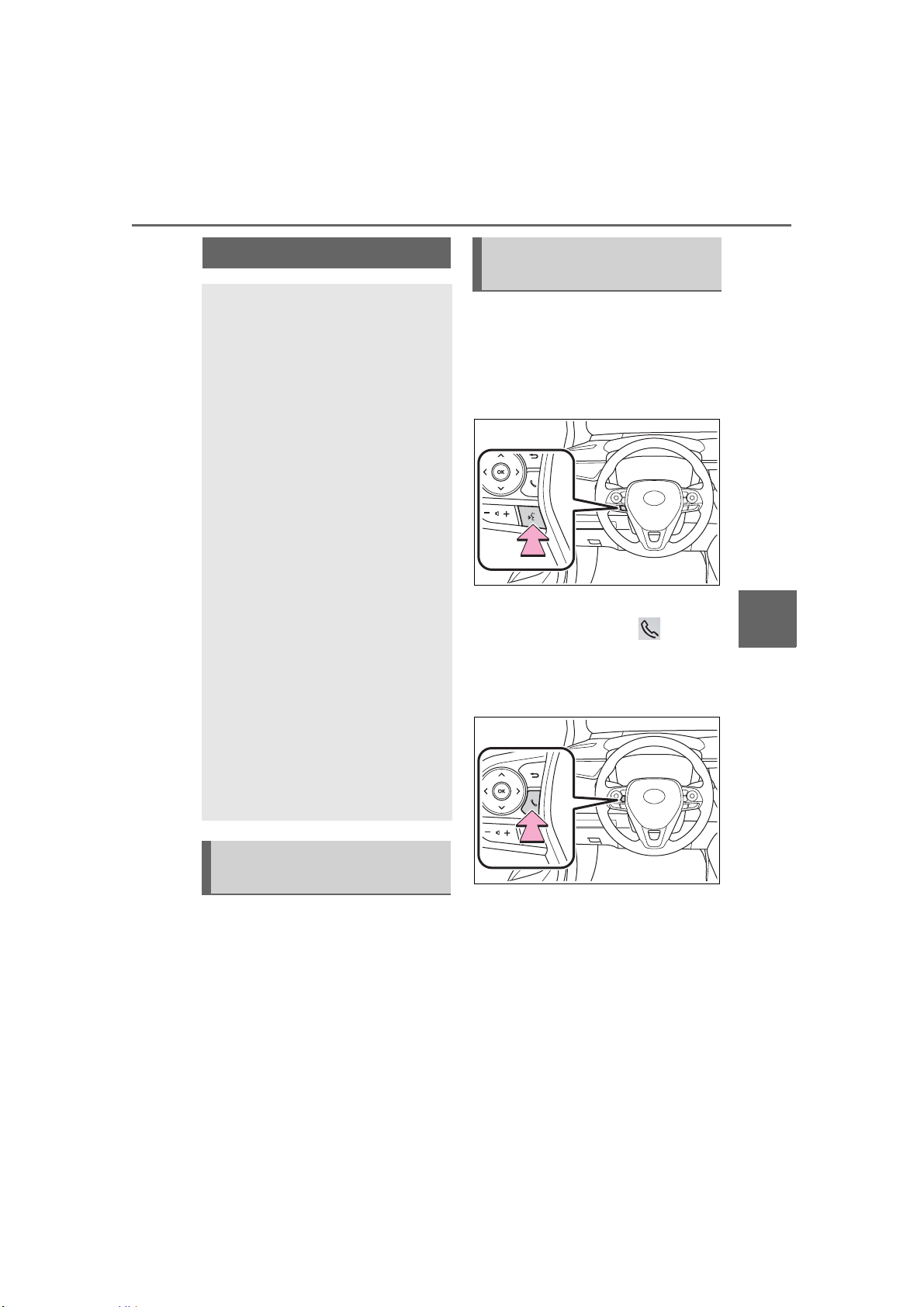
341
5-12. Mobile Assistant operation
COROLLA H/B_U
5
Audio
5-12.Mobile As sistant operatio n
Mobile Assist supports the Siri
Eyes Free Mode and Google
App. The available features and
functions may vary based on the
iOS/Android version installed on
the connected device.
Type A
1 Press and hold the talk
switch on the steering wheel
until Mobile Assistant screen
is displayed.
Type B
1 Press and hold the switch
on the steering wheel until
Mobile Assistant screen is
displayed.
Mobile Assistant
The Mobile Assistant func-
tion is a voice input assist
function. Mobile Assist sup-
ports the Siri Eyes Free
Mode and Google App.
(Google App can be used
only the corresponding
device.) Instructions can be
spoken into the vehicle
microphone as if speaking a
command to the phone. The
content of the request is
then interpreted by the
phone and the result is out-
put from the vehicle speak-
ers. To operate the Mobile
Assistant, a compatible
device must be registered
and connected to this sys-
tem via Bluetooth
®
.
(P.266)
When an Apple CarPlay
connection is established,
this function will be unavail-
able.
Connectable devices and
available functions
Mobile Assistant opera-
tion

342
5-12. Mobile Assistant operation
COROLLA H/B_U
2 The Mobile Assistant can be
used only when the following
screen is displayed.
Type A: To cancel the Mobile
Assistant, select “Cancel” or
press and hold the talk switch
on the steering wheel.
Type B: To cancel the Mobile
Assistant, select “Cancel” or
press and hold the switch
on the steering wheel.
Type A: To restart the Mobile
Assistant for additional com-
mands, press the talk switch
on the steering wheel.
Type B: To restart the Mobile
Assistant for additional com-
mands, press the switch
on the steering wheel.
• Mobile Assistant can only be
restarted after the system
responds to a voice command.
• After some phone and music
commands, the Mobile Assistant
feature will automatically end to
complete the requested action.
The volume of the Mobile
Assistant can be adjusted
using the “POWER VOLUME”
knob or steering wheel vol-
ume control switches. The
Mobile Assistant and phone
call volumes are synchro-
nized.
● While a phone call is active, the
Mobile Assistant cannot be used.
● If using the navigation feature of
the cellular phone, ensure the
active audio source is Bluetooth
®
audio or iPod in order to hear turn
by turn direction prompts.
● Wait for the listening beeps before
using the Mobile Assistant.
● The Mobile Assistant may not rec-
ognize commands in the following
situations:
• Spoken too quickly.
• Spoken at a low or high volume.
• The windows are open.
• Passengers are talking while the
Mobile Assistant is being used.
• The fan speed of the air condition-
ing system is set at high.
• The air conditioning vents are
turned toward the microphone.
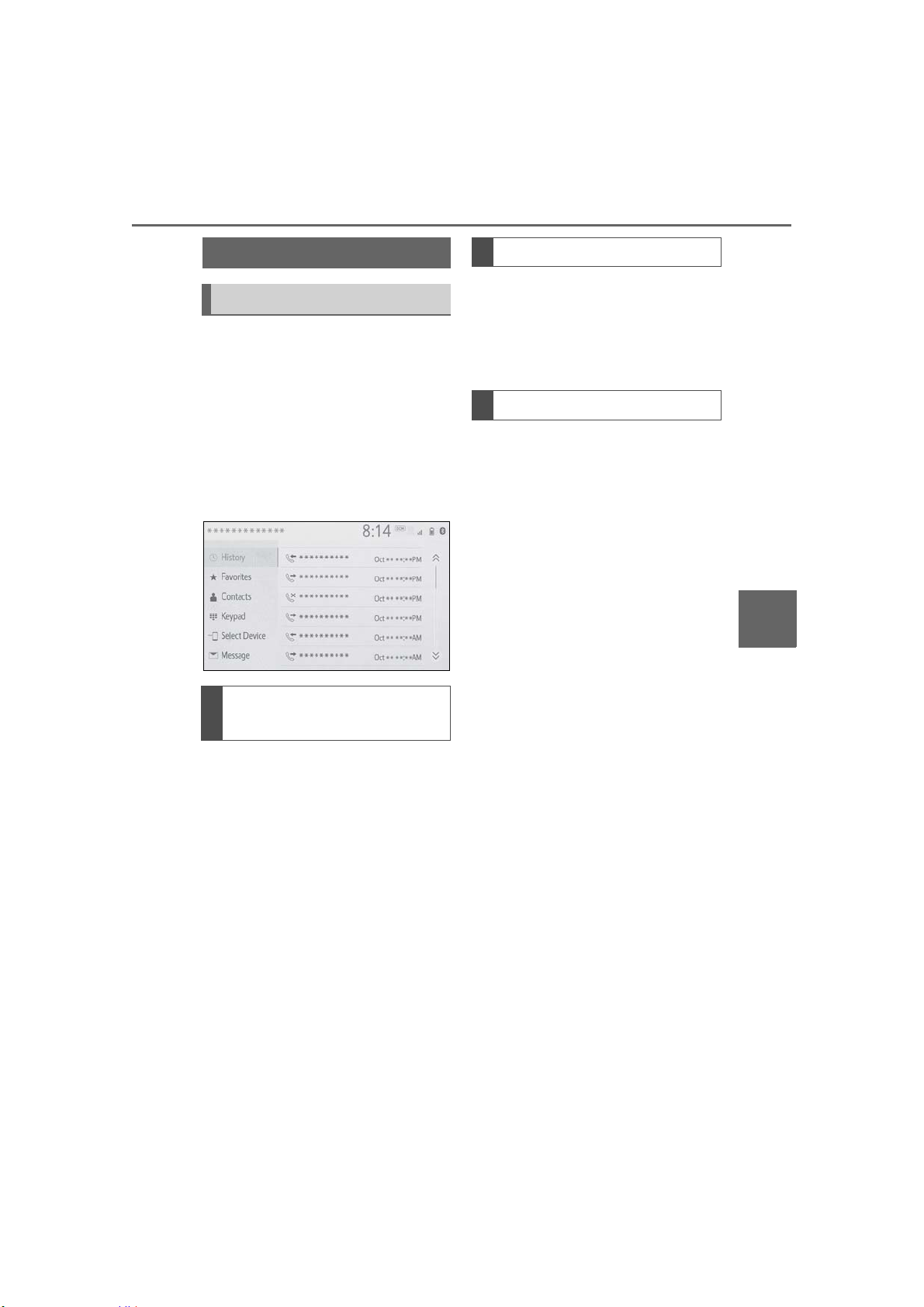
343
5-13. Phone operation (Hands-free system for cellular phones)
COROLLA H/B_U
5
Audio
5-13.Phone o peration (Han ds-free system for cellular phones)
The phone screen can be
reached by the following meth-
ods:
From the “PHONE” button
1 Press the “PHONE” button.
From the “MENU” button
1 Press the “MENU” button,
then select “Phone”.
The following functions can be
used on phone operation:
Registering/connecting a
Bluetooth
®
device (P.266)
Placing a call using the Blue-
tooth
®
hands-free system
(P.348)
Receiving a call using the
Bluetooth
®
hands-free system
(P.351)
Talking on the Bluetooth
®
hands-free system (P.352)
The following function can be
used on message function:
Using the Bluetooth
®
phone
message function (P.354)
The following functions can be
made in the system:
Phone settings (P.359)
Bluetooth
®
settings (P.271)
Quick reference
Phone screen operation
Bluetooth
®
hands-free
system operation
Message function
Setting up a phone

344
5-13. Phone operation (Hands-free system for cellular phones)
COROLLA H/B_U
● This system is not guaranteed to
operate with all Bluetooth
®
devices.
● If your cellular phone does not
support Bluetooth
®
, this system
cannot function.
● In the following conditions, the
system may not function:
• The cellular phone is turned off.
• The current position is outside the
communication area.
• The cellular phone is not con-
nected.
• The cellular phone has a low bat-
tery.
● Depending on the type of Blue-
tooth
®
phone, some function is
not available.
● When using the hands-free sys-
tem or Bluetooth
®
audio and
Wi-Fi
®
Hotspot functions at the
same time, the following problems
may occur:
• The Bluetooth
®
connection may
be cut.
• Noise may be heard on the Blue-
tooth
®
audio playback.
• A noise may be heard during
phone calls.
● Bluetooth
®
uses the 2.4 GHz fre-
quency band. If both a Wi-Fi
®
con-
nection and Bluetooth
®
connection are being used simul-
taneously, each connection may
be affected.
● If a Bluetooth
®
device is attempt-
ing to connect to the vehicle while
another device is connected as a
Bluetooth
®
audio device or con-
nected using the hands-free sys-
tem or Wi-Fi
®
Hotspot function,
the communication speed may
decrease or malfunctions may
occur, such as image distortion or
audio skipping. If a Bluetooth
®
device is connected to the system,
the interference it may cause will
be reduced. When carrying a
device with its Bluetooth
®
connec-
tion enabled, make sure to regis-
ter it to the system and connect it
or disable its Bluetooth
®
function.
● When a device is connected via
Bluetooth
®
, the Bluetooth
®
icon
on the status bar will be displayed
in blue. (P.254)
Some basics
The hands-free system
enables calls to be made
and received without having
to take your hands off the
steering wheel.
This system supports Blue-
tooth
®
. Bluetooth
®
is a wire-
less data system that
enables cellular phones to
be used without being con-
nected by a cable or placed
in a cradle.
The operating procedure of
the phone is explained here.
When an Apple CarPlay
connection is established,
phone functions will be per-
formed by Apple CarPlay
instead of the hands-free
system.
WARNING
● While driving, do not operate a
cellular phone.
345
5-13. Phone operation (Hands-free system for cellular phones)
COROLLA H/B_U
5
Audio
To use the hands-free system
for cellular phones, it is neces-
sary to register a cellular phone
with the system. (P.266)
■ Connecting a Bluetooth
®
device
Registering an additional
device
1 Display the phone top
screen. (P.343)
2 Select “Select Device”.
3 Select “Add Device”.
When another Bluetooth
®
device is connected, a confir-
mation screen will be dis-
played. To disconnect the
Bluetooth
®
device, select
“Yes”.
4 Follow the steps in “Register-
ing a Bluetooth
®
phone for
the first time” from step 5.
(P.266)
Selecting a registered device
1 Display the phone top
screen. (P.343)
2 Select “Select Device”.
3 Select the desired device to
be connected.
4 Check that a confirmation
screen is displayed when the
connection is complete.
If an error message is dis-
played, follow the guidance
on the screen to try again.
■ Bluetooth
®
phone condition
display
The condition of the Bluetooth
®
phone appears on the upper
right side of the screen.
WARNING
● Your audio unit is fitted with
Bluetooth
®
antennas. People
with implantable cardiac pace-
makers, cardiac resynchroniza-
tion therapy-pacemakers or
implantable cardioverter defibril-
lators should maintain a reason-
able distance between
themselves and the Bluetooth
®
antennas. The radio waves may
affect the operation of such
devices.
● Before using Bluetooth
®
devices, users of any electrical
medical device other than
implantable cardiac pacemak-
ers, cardiac resynchronization
therapy-pacemakers or implant-
able cardioverter defibrillators
should consult the manufacturer
of the device for information
about its operation under the
influence of radio waves. Radio
waves could have unexpected
effects on the operation of such
medical devices.
NOTICE
● Do not leave your cellular phone
in the vehicle. The temperature
inside may rise to a level that
could damage the phone.
Registering/Connecting a
Bluetooth
®
phone
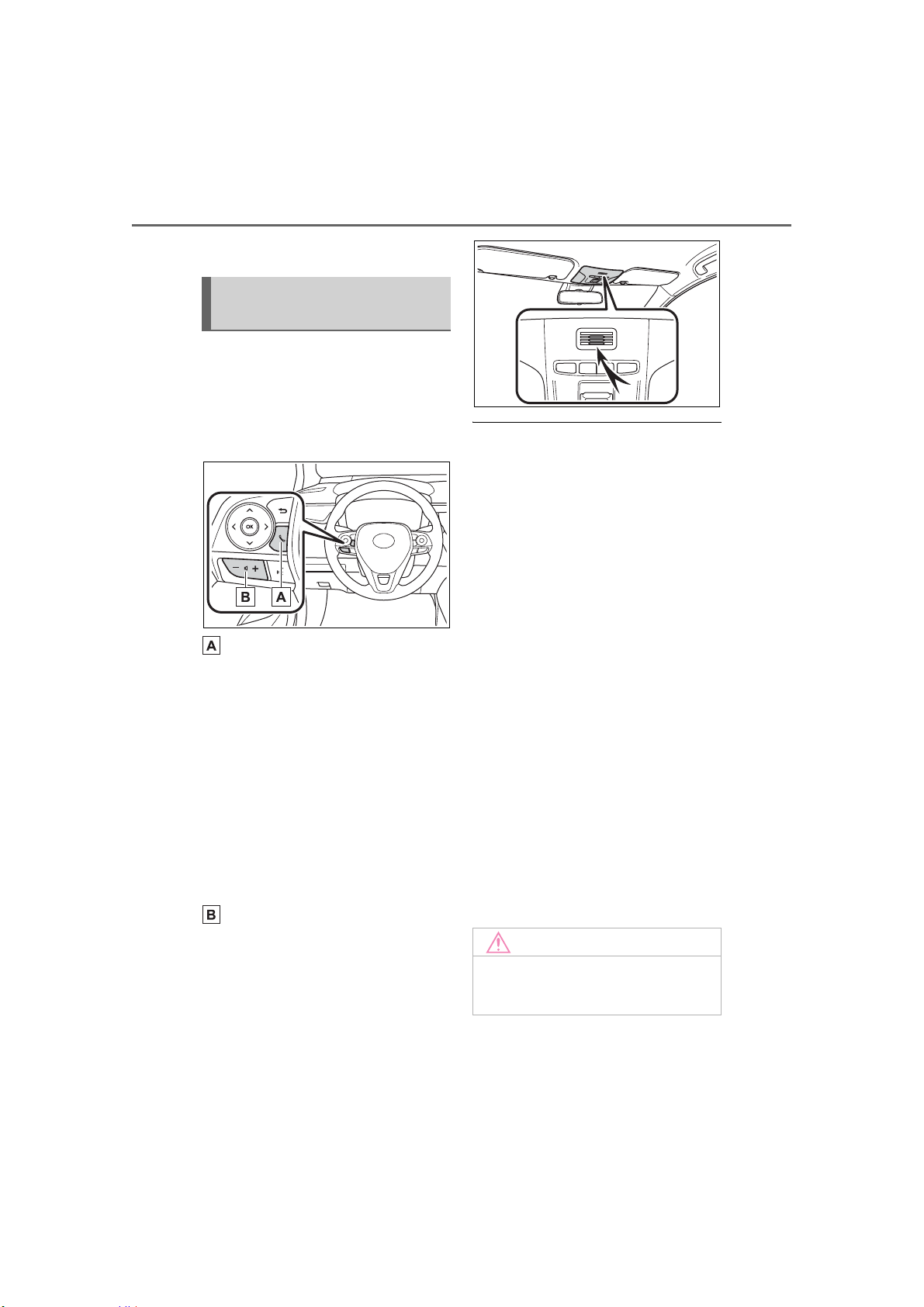
346
5-13. Phone operation (Hands-free system for cellular phones)
COROLLA H/B_U
(P.255)
■ Steering switch
By pressing the phone switch, a
call can be received or ended
without taking your hands off the
steering wheel.
Phone switch
• If the switch is pressed during a
call, the call will end.
• If the switch is pressed when an
incoming call is received, the call
will be answered.
• If the switch is pressed when a
call waiting call is received, the
waiting call will be answered.
• If the switch is pressed when an
Apple CarPlay connection is
established, the Apple CarPlay
phone application will be dis-
played on the system screen.
Volume control switch
• Press the “+” side to increase the
volume.
• Press the “-” side to decrease the
volume.
■ Microphone
The microphone is used when
talking on the phone.
● The other party’s voice will be
heard from the front speakers.
The audio/visual system will be
muted during phone calls or when
hands-free voice commands are
used.
● Talk alternately with the other
party on the phone. If both parties
speak at the same time, the other
party may not hear what has been
said. (This is not a malfunction.)
● Keep call volume down. Other-
wise, the other party’s voice may
be audible outside the vehicle and
voice echo may increase. When
talking on the phone, speak
clearly towards the microphone.
● The other party may not hear you
clearly when:
• Driving on an unpaved road.
(Making excessive traffic noise.)
• Driving at high speeds.
• The windows are open.
• The air conditioning vents are
pointed towards the microphone.
• The sound of the air conditioning
fan is loud.
• There is a negative effect on
sound quality due to the phone
and/or network being used.
Using the phone
switch/microphone
NOTICE
● Do not touch and put a sharp
object to the microphone. It may
cause failure.
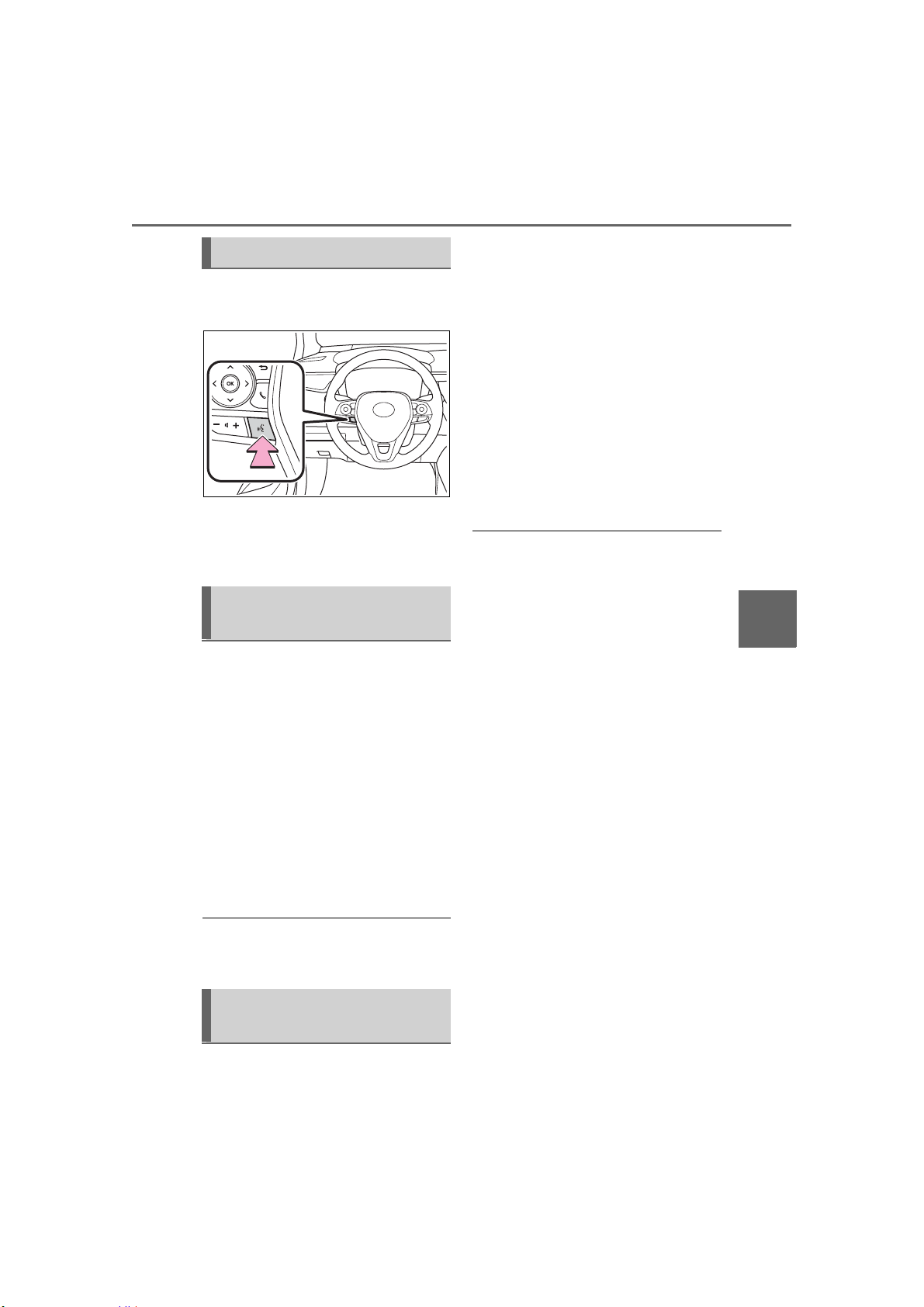
347
5-13. Phone operation (Hands-free system for cellular phones)
COROLLA H/B_U
5
Audio
Press this switch to operate the
voice command system.
The voice command system
and its list of commands can
be operated. (P.334)
The following data is stored
for every registered phone.
When another phone is con-
nected, the following regis-
tered data cannot be read:
• Contact data
• Call history data
• Favorites data
• Image data
• All phone settings
• Message settings
● When a phone’s registration is
deleted, the above-mentioned
data is also deleted.
A lot of personal data is regis-
tered when the hands-free sys-
tem is used. When selling or
disposing of the vehicle, initial-
ize the data. (P.293)
The following data in the sys-
tem can be initialized:
• Contact data
• Call history data
• Favorites data
• Image data
• All phone settings
• Message settings
● Once initialized, the data and set-
tings will be erased. Pay much
attention when initializing the data.
Voice command system
About the contacts in the
contact list
When selling or disposing
of the vehicle

348
5-13. Phone operation (Hands-free system for cellular phones)
COROLLA H/B_U
1 Display the phone top
screen. (P.343)
2 Select the desired method to
call from.
■ Calling methods from
phone screen
By call history (P.348)
By favorites (P.349)
By contacts (P.349)
By keypad
*
(P.350)
By message (P.357)
■ Also the following lists are
available from each func-
tion’s screen
By voice command system
(P.335)
By home screen (P.351)
*
: The operation cannot be per-
formed while driving.
Up to 30 of the latest call history
items (missed, incoming and
outgoing) can be selected.
1 Display the phone top
screen. (P.343)
2 Select “History” and select
the desired contact.
If the contact which is not reg-
istered on the contact list is
selected, the name is dis-
played as “Unknown Con-
tact”. In this case, select the
number to make a call prop-
erly.
3 Check that the dialing screen
is displayed.
● The icons of call type are dis-
played.
: Missed call
: Incoming call
: Outgoing call
● When making a call to the same
number continuously, only the
most recent call is listed in call his-
tory.
● When a phone number registered
in the contact list is received, the
name is displayed.
● Number-withheld calls are also
memorized in the system.
● International phone calls may not
be made depending on the type of
Bluetooth
®
phone you have.
● The list should group together
consecutive entries with the same
phone number and same call
type. For example, two calls from
John’s mobile would be displayed
Placing a call using
the Bluetooth
®
hands-free system
After a Bluetooth
®
phone
has been registered, a call
can be made using the
hands-free system. There
are several methods by
which a call can be made, as
described below.
Calling methods on the
Bluetooth
®
phone
By call history
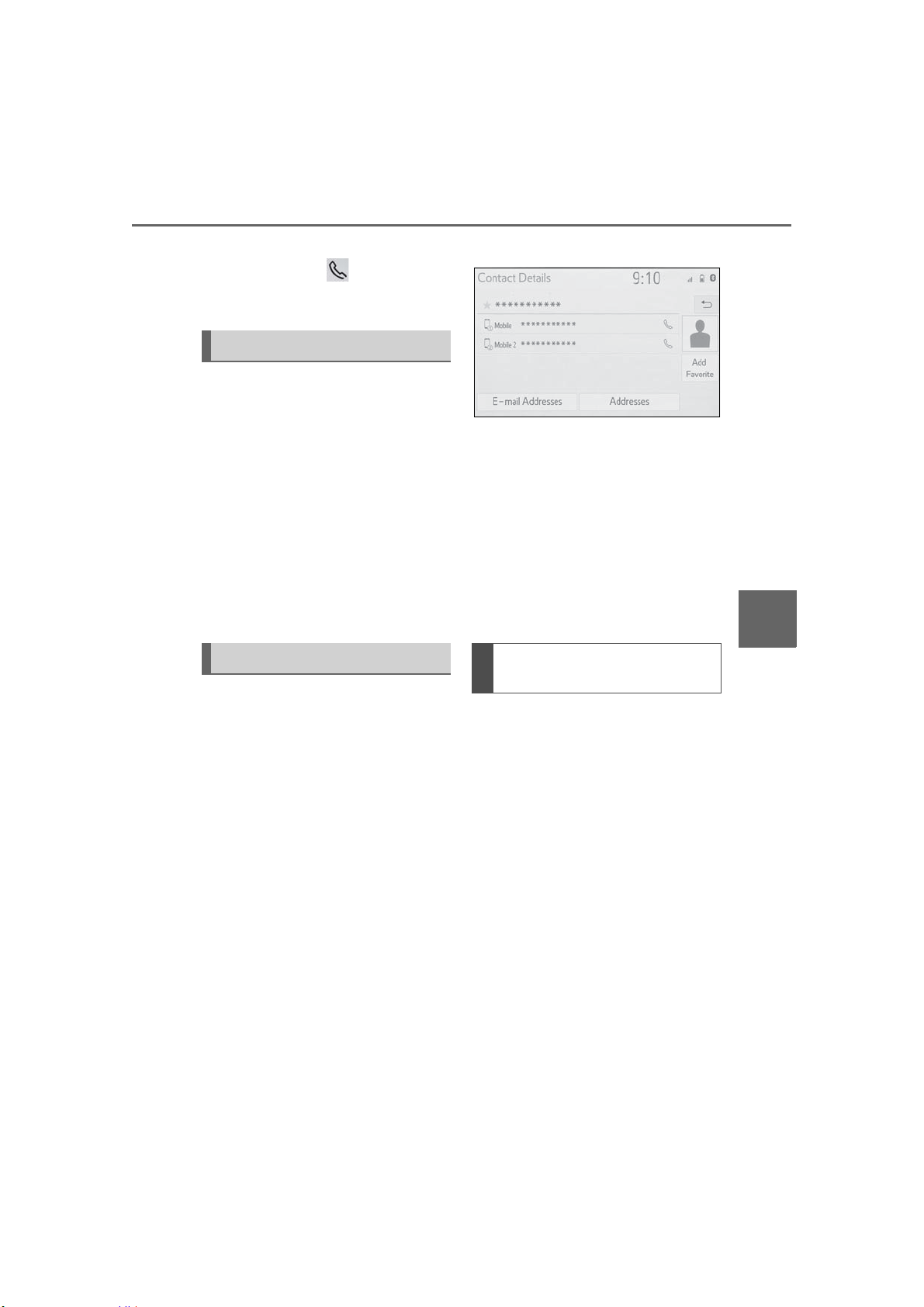
349
5-13. Phone operation (Hands-free system for cellular phones)
COROLLA H/B_U
5
Audio
as follows: John (2)
● By pressing the switch on the
steering wheel, a call to the latest
history item can be made.
Calls can be made using regis-
tered contacts which can be
selected from a contact list.
(P.349)
1 Display the phone top
screen. (P.343)
2 Select “Favorites” and select
the desired contact.
3 Select the desired number.
4 Check that the dialing screen
is displayed.
Calls can be made by using
contact data which is transferred
from a registered cellular phone.
(P.361)
Up to 5000 contacts (maximum
of 4 phone numbers, e-mail
addresses and addresses per
contact) can be registered in the
contact list.
1 Display the phone top
screen. (P.343)
2 Select “Contacts” and select
the desired contact.
3 Select the desired number.
“Add Favorite”/“Remove Favorite”:
Select to register/remove the con-
tact in the favorites list. (P.365)
“E-mail Addresses”: Select to dis-
play all registered e-mail addresses
for the contact.
“Addresses”: Select to display all
registered addresses for the con-
tact.
4 Check that the dialing screen
is displayed.
■ For PBAP compatible Blue-
tooth
®
phones when “Auto-
matic Transfer” is set to on
(P.361)
Contacts are transferred auto-
matically.
By favorites list
By contacts list
When the contact list is
empty
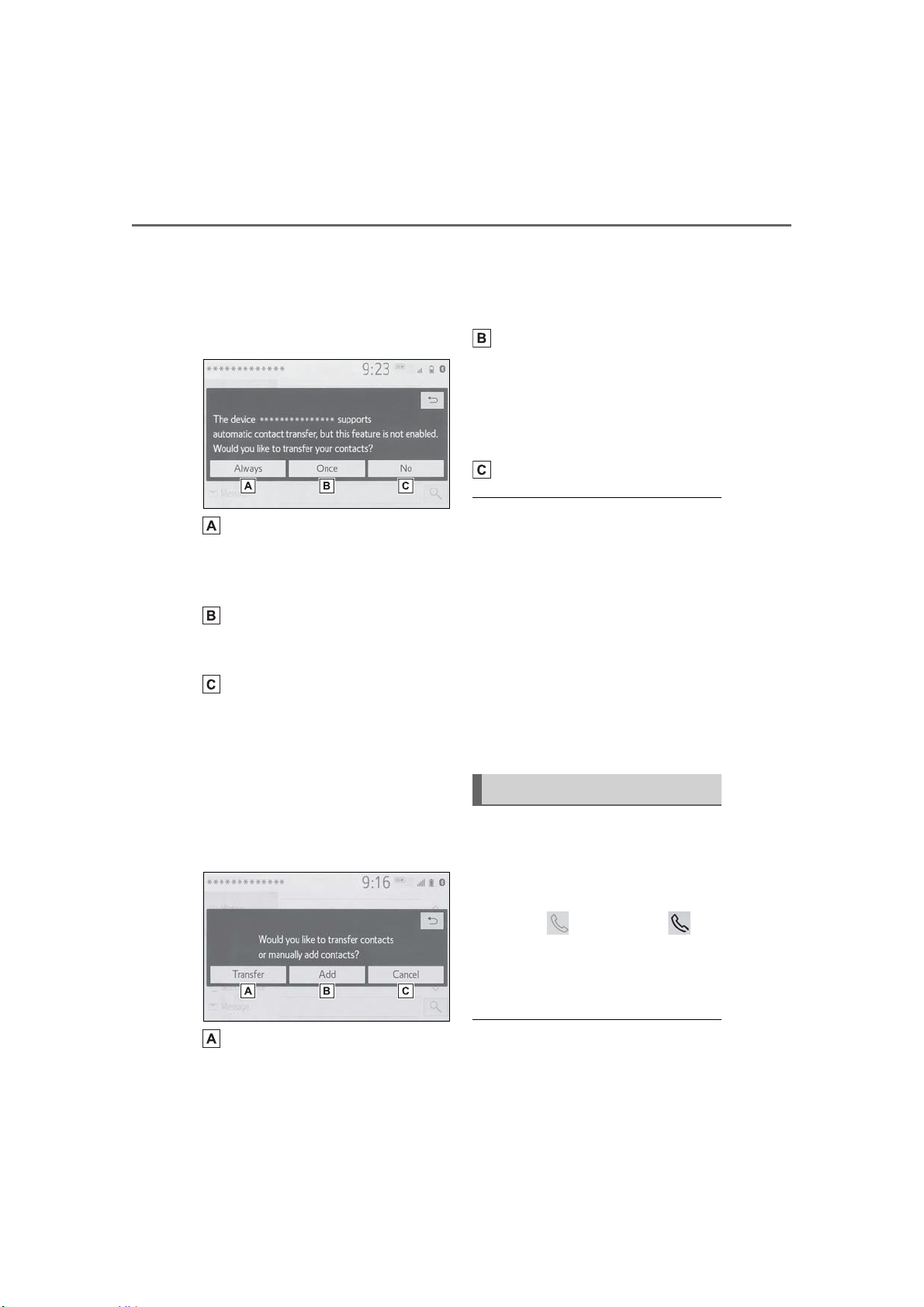
350
5-13. Phone operation (Hands-free system for cellular phones)
COROLLA H/B_U
■ For PBAP compatible Blue-
tooth
®
phones when “Auto-
matic Transfer” is set to off
(P.361)
1 Select the desired item.
Select to always transfer all
the contacts from a con-
nected cellular phone auto-
matically.
Select to transfer all the con-
tacts from a connected cellu-
lar phone only once.
Select to cancel transferring.
2 Check that a confirmation
screen is displayed when the
operation is complete.
■ For PBAP incompatible but
OPP compatible Blue-
tooth
®
phones
1 Select the desired item.
Select to transfer the con-
tacts from the connected cel-
lular phone.
Transfer the contact data to
the system using a Blue-
tooth
®
phone.
Select to add a new contact
manually.
Follow the steps in “Register-
ing a new contact to the con-
tacts list” from step 2.
(P.364)
Select to cancel transferring.
● If your cellular phone is neither
PBAP nor OPP compatible, the
contacts cannot be transferred
using Bluetooth
®
. But the contacts
can be transferred from USB
device. (P.364)
● Depending on the type of Blue-
tooth
®
phone:
• It may be necessary to perform
additional steps on the phone
when transferring contact data.
• The registered image in the con-
tact list may not transfer depend-
ing on the type of Bluetooth
®
phone connected.
1 Display the phone top
screen. (P.343)
2 Select “Keypad” and enter
the phone number.
3 Select or press the
switch on the steering wheel.
4 Check that the dialing screen
is displayed.
● Depending on the type of Blue-
tooth
®
phone being connected, it
may be necessary to perform
By keypad
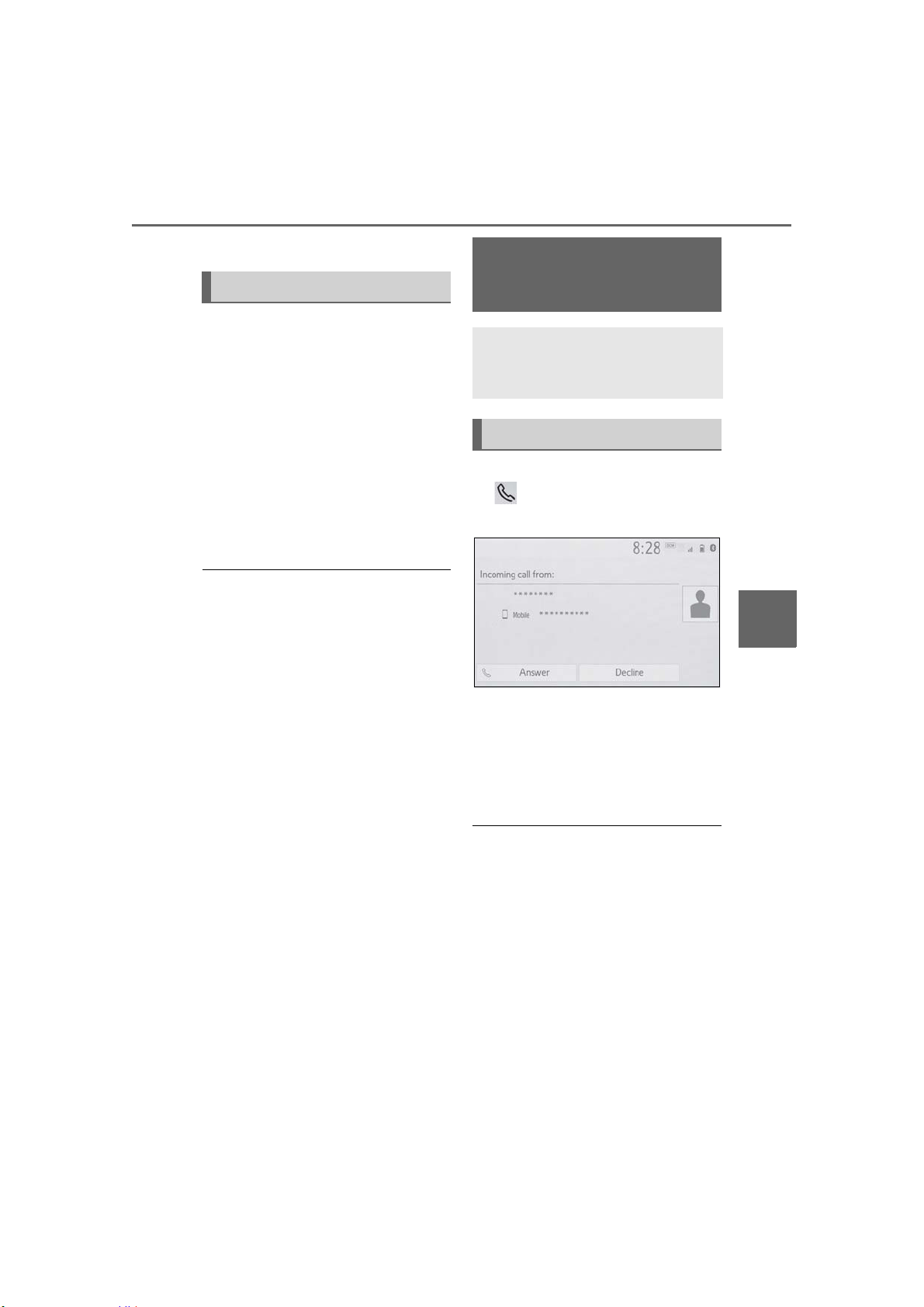
351
5-13. Phone operation (Hands-free system for cellular phones)
COROLLA H/B_U
5
Audio
additional steps on the phone.
1 Display the home screen.
(P.260)
2 Select the desired contact.
3 Check that the dialing screen
is displayed.
■ Registering a new contact
1 Select and hold the screen
button to add a contact.
2 Select the desired contact.
3 Select the desired number.
● If there is no contact in the con-
tacts list, the contacts cannot be
registered at the home screen.
● The contact cannot be registered
at the home screen while driving.
1 Select “Answer” or press the
switch on the steering
wheel to talk on the phone.
“Decline”: Select to refuse to
receive the call.
To adjust the volume of a received
call: Turn the “POWER VOLUME”
knob, or use the volume control
switch on the steering wheel.
● The contact image picture can be
displayed only when the vehicle is
not moving.
● During international phone calls,
the other party’s name or number
may not be displayed correctly
depending on the type of Blue-
tooth
®
phone you have.
● The incoming call display mode
can be set. (P.360)
● The ringtone that has been set in
the sound settings screen can be
heard when there is an incoming
call. Depending on the type of
By home screen
Receiving a call using
the Bluetooth
®
hands-free system
When a call is received, the
following screen is dis-
played with a sound.
Incoming calls
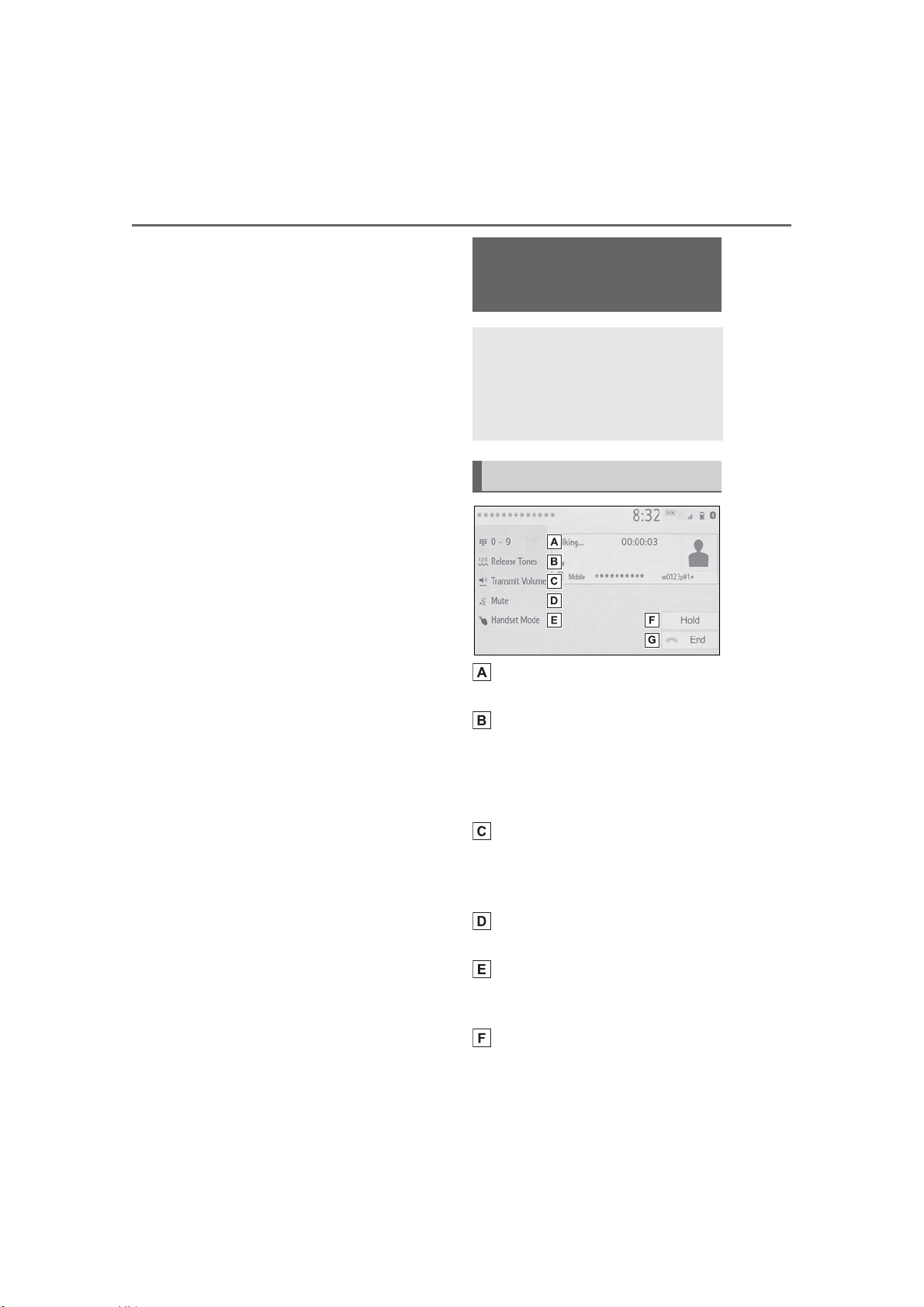
352
5-13. Phone operation (Hands-free system for cellular phones)
COROLLA H/B_U
Bluetooth
®
phone, both the sys-
tem and Bluetooth
®
phone may
ring simultaneously when there is
an incoming call. (P.359)
Select to display the keypad
to send tones. (P.353)
Select to send tones. This
button only appears when a
number that contains a (w) is
dialed in hands-free mode.
(P.353)
Select to adjust your voice
volume that the other party
hears from their speaker.
(P.353)
Select to mute your voice to
the other party.
Select to change handset
modes between hands-free
and cellular phone.
Select to put a call on hold.
To cancel this function, select
Talking on the Blue-
tooth
®
hands-free sys-
tem
While talking on the phone,
the following screen is dis-
played. The operations out-
lined below can be
performed on this screen.
Call screen operation
353
5-13. Phone operation (Hands-free system for cellular phones)
COROLLA H/B_U
5
Audio
“Activate”.
Select to hang up the phone.
● Changing from hands-free call to
cellular phone call is not possible
while driving.
● Only when the vehicle is not mov-
ing, the contact image can be dis-
played.
● When cellular phone call is
changed to hands-free call, the
hands-free screen will be dis-
played and its functions can be
operated on the screen.
● Changing between cellular phone
call and hands-free call can be
performed by operating the cellu-
lar phone directly.
● Transferring methods and opera-
tions will be different depending
on the type of cellular phone you
have.
● For the operation of the cellular
phone, see the manual that
comes with it.
■ By keypad
This operation cannot be per-
formed while driving.
1 Select “0-9”.
2 Enter the desired number.
■ By selecting “Release
Tones”
“Release Tones” appear when a
continuous tone signal (s) con-
taining a (w) is registered in the
contact list.
This operation can be per-
formed while driving.
1 Select “Release Tones”.
● A continuous tone signal is a char-
acter string that consists of num-
bers and the characters “p” or “w”.
(e.g. 056133w0123p#1)
● When the “p” pause tone is used,
the tone data up until the next
pause tone will be automatically
sent after 2 seconds have
elapsed. When the “w” pause tone
is used, the tone data up until the
next pause tone will be automati-
cally sent after a user operation is
performed.
● Release tones can be used when
automated operation of a phone
based service such as an answer-
ing machine or bank phone ser-
vice is desired. A phone number
with continuous tone signals can
be registered in the contact list.
● Tone data after a “w” pause tone
can be operated by voice com-
mand during a call.
1 Select “Transmit Volume”.
2 Select the desired level for
the transmit volume.
3 Press the button to dis-
play previous screen.
● The sound quality of the voice
heard from the other party’s
speaker may be negatively
impacted.
● “Transmit Volume” is dimmed
when mute is on.
When there are no calls on
hold during a call: “Hold” is
displayed. When selected, the
Sending tones
Transmit volume setting
Switching calls while a
call is in progress
354
5-13. Phone operation (Hands-free system for cellular phones)
COROLLA H/B_U
current call is placed on hold.
When there is no current call,
but there is a call on hold:
“Activate” is displayed. When
selected, the system switches
to the call that was on hold.
When there is another call on
hold during a call: “Swap
Calls” is displayed. When
selected, the current call is
placed on hold, and the sys-
tem switches to the call that
was on hold.
● This function may not be available
depending on the type of cellular
phone.
When a call is interrupted by a
third party while talking, the
incoming screen is displayed.
1 Select “Answer” or press the
switch on the steering
wheel to start talking with the
other party.
To refuse to receive the call:
Select “Decline”.
Each time “Swap Calls” is
selected, the party who is on
hold will be switched.
● This function may not be available
depending on the type of Blue-
tooth
®
phone.
1 Display the phone top
screen. (P.343)
2 Select “Message”.
A confirmation message
appears when the “Automatic
Message Transfer” function is
set to off (P.367), select
“Yes”.
3 Check that the message
screen is displayed.
“Phone”: Select to change to phone
mode.
The account name is dis-
played on the left side of
Incoming call waiting
Bluetooth
®
phone
message function
Received messages can be
forwarded from the con-
nected Bluetooth
®
phone,
enabling checking and
replying using the system.
Depending on the type of
Bluetooth
®
phone con-
nected, received messages
may not be transferred to
the system.
If the phone does not sup-
port the message function,
this function cannot be
used. Even when the sup-
ported phone is used, reply
function may not be used.
Displaying the message
screen
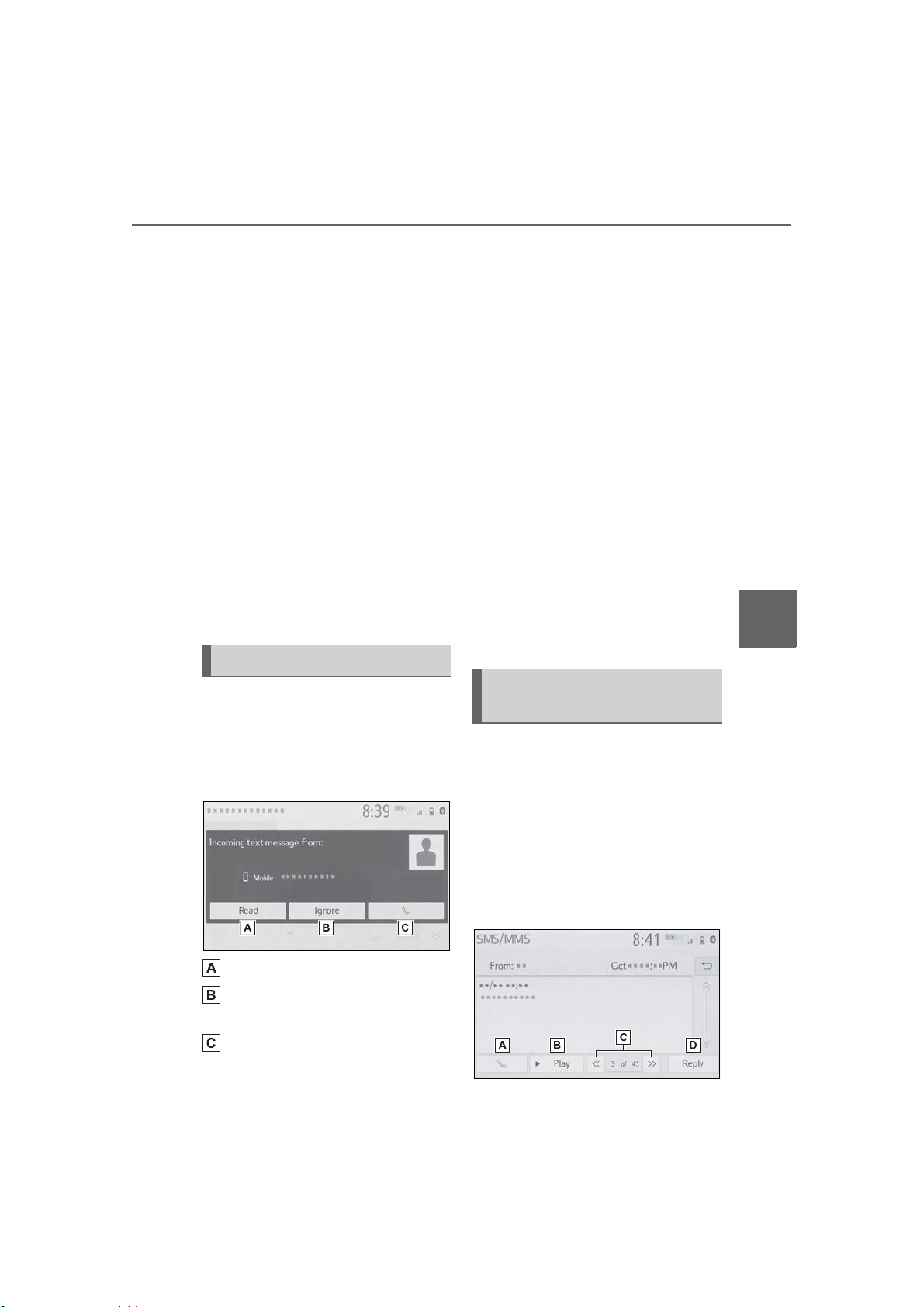
355
5-13. Phone operation (Hands-free system for cellular phones)
COROLLA H/B_U
5
Audio
screen.
Account names are the
names of the accounts that
exist on the currently con-
nected phone.
The following functions can
be used on message function:
• Receiving a message
(P.355)
• Checking messages
(P.355)
• Replying to a message (dicta-
tion reply) (P.356)
• Replying to a message (quick
reply) (P.357)
• Calling the message sender
(P.357)
• Message settings (P.367)
When an e-mail/SMS/MMS is
received, the incoming message
screen pops up with sound and
is ready to be operated on the
screen.
Select to check the message.
Select to not open the mes-
sage.
Select to call the message
sender.
● Depending on the type of Blue-
tooth
®
phone used for receiving
messages, or its registration sta-
tus with the system, some infor-
mation may not be displayed.
● The pop-up screen is separately
available for incoming e-mail and
SMS/MMS messages under the
following conditions:
E-mail:
• “Incoming E-mail Display” is set to
“Full Screen”. (P.360)
• “E-mail Notification Pop-up” is set
to on. (P.360)
SMS/MMS:
• “Incoming SMS/MMS Display” is
set to “Full Screen”. (P.360)
• “SMS/MMS Notification Pop-up” is
set to on. (P.360)
● Depending on the type of Blue-
tooth
®
phone being connected,
E-Mail function cannot be used via
Bluetooth
®
.
1 Display the message screen.
(P.354)
2 Select a desired account
name.
3 Select the desired message
from the list.
4 Check that the message is
displayed.
Receiving a message
Checking received mes-
sages
356
5-13. Phone operation (Hands-free system for cellular phones)
COROLLA H/B_U
Select to call the message
sender.
Select to have messages
read out.
To cancel this function, select
“Stop”.
When “Automatic Message
Readout” is set to on, mes-
sages will be automatically
read out. (P.367)
Select to display the previous
or next message.
This function can be chosen
the method to reply mes-
sage with “Dictation” or
“Quick Message”.
● Reading a text message is not
available while driving.
● Depending on the type of Blue-
tooth
®
phone being connected,
this function cannot be used.
● Depending on the type of Blue-
tooth
®
phone being connected, it
may be necessary to perform
additional steps on the phone.
● Messages are displayed in the
appropriate connected Blue-
tooth
®
phone’s registered mail
address folder. Select the desired
folder to be displayed.
● Only received messages on the
connected Bluetooth
®
phone can
be displayed.
● The text of the message is not dis-
played while driving.
● Turn the “POWER VOLUME”
knob, or use the volume control
switch on the steering wheel to
adjust the message read out vol-
ume.
● “Subject:” field is not shown on
SMS case.
● E-mail only: Select “Mark Unread”
or “Mark Read” to mark mail
unread or read on the message
screen.
This function is available when
“Update Message Read Status on
Phone” is set to on. (P.367)
*
: If equipped
1 Display the message screen.
(P.354)
2 Select the desired message
from the list.
3 Select “Reply”.
4 Select “Dictation”.
5 When the “Say Your Mes-
sage” screen is displayed,
speak message that you
want to send.
6 Select “Send” to send mes-
sage.
“Cancel”: Select to cancel sending
the message.
“Retry”: Select to retry speaking
message that you want to send.
While the message is being
sent, a sending message
screen is displayed.
7 Check that a confirmation
screen is displayed when the
operation is complete.
If an error message is dis-
played, follow the guidance
on the screen to try again.
Replying to a message
(dictation reply)
*

357
5-13. Phone operation (Hands-free system for cellular phones)
COROLLA H/B_U
5
Audio
15 messages have already
been stored.
1 Display the message screen.
(P.354)
2 Select the desired message
from the list.
3 Select “Reply”.
4 Select “Quick Message”.
5 Select the desired message.
: Select to edit the message.
(P.357)
6 Select “Send”.
“Cancel”: Select to cancel sending
the message.
While the message is being
sent, a sending message
screen is displayed.
7 Check that a confirmation
screen is displayed when the
operation is complete.
If an error message is dis-
played, follow the guidance
on the screen to try again.
● Depending on the type of Blue-
tooth
®
phone, reply function is not
available.
■ Editing quick reply mes-
sages
This operation cannot be per-
formed while driving.
1 Select corresponding to
the desired message to edit.
2 Select “OK” when editing is
completed.
● To reset the edited quick reply
messages, select “Default”.
Calls can be made to an
e-mail/SMS/MMS message
sender’s phone number.
This operation can be per-
formed while driving.
■ Calling from
e-mail/SMS/MMS message
display
1 Display the message screen.
(P.354)
2 Select the desired message.
3 Select , or press the
switch on the steering wheel.
If there are 2 or more phone
numbers, select the desired
number.
4 Check that the dialing screen
is displayed.
■ Calling from a number
within a message
Calls can be made to a number
identified in a message’s text
area.
This operation cannot be per-
formed while driving.
1 Display the message screen.
(P.354)
2 Select the desired message.
Replying to a message
(quick reply)
Calling the message
sender
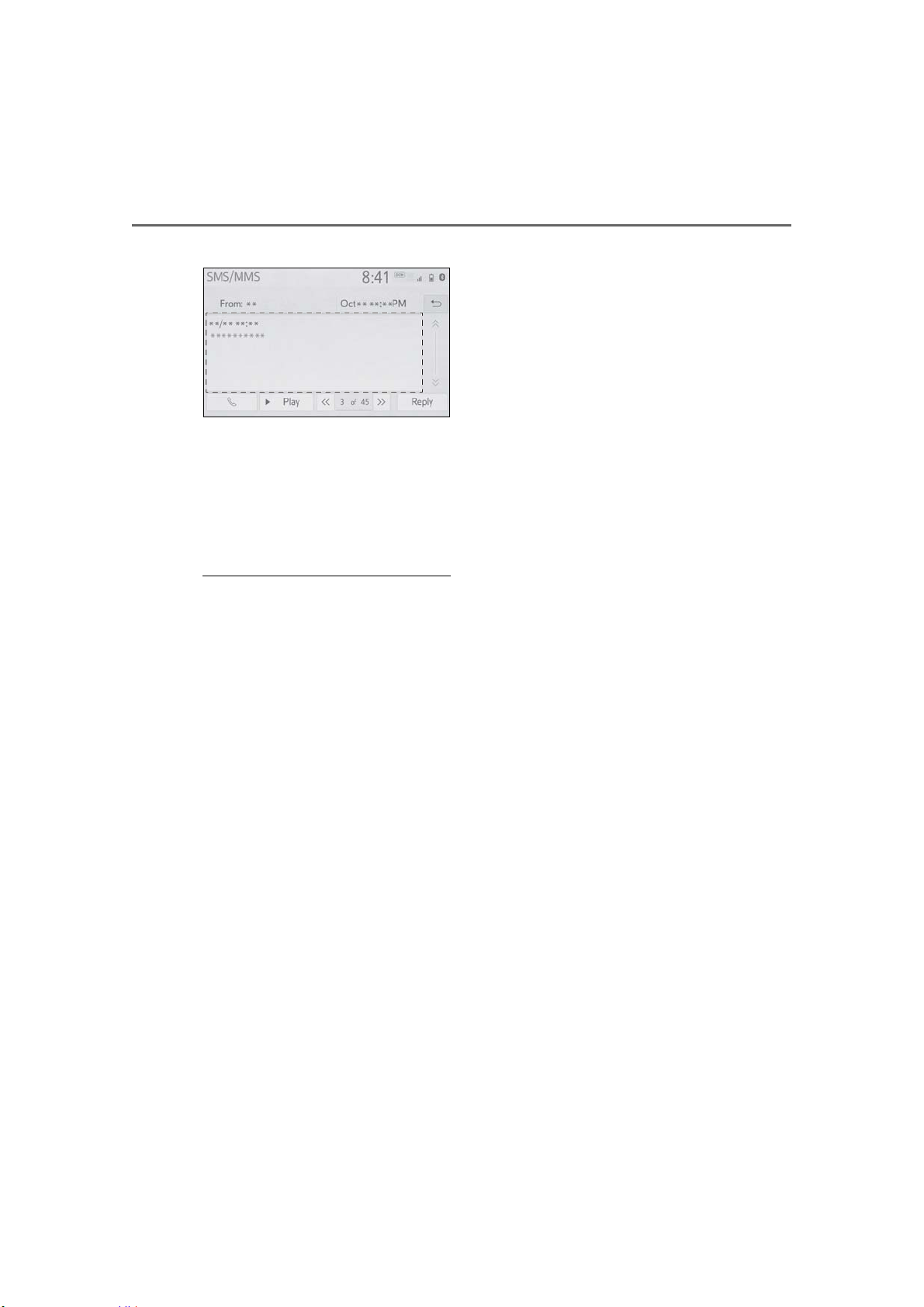
358
5-13. Phone operation (Hands-free system for cellular phones)
COROLLA H/B_U
3 Select the text area.
Identified phone numbers
contained in the message are
displayed in blue text.
4 Select the desired number.
5 Check that the dialing screen
is displayed.
● A series of numbers may be rec-
ognized as a phone number. Addi-
tionally, some phone numbers
may not be recognized, such as
those for other countries.
■ Calling from the incoming
message screen
For detail, refer to “Receiving a
message”. (P.355)
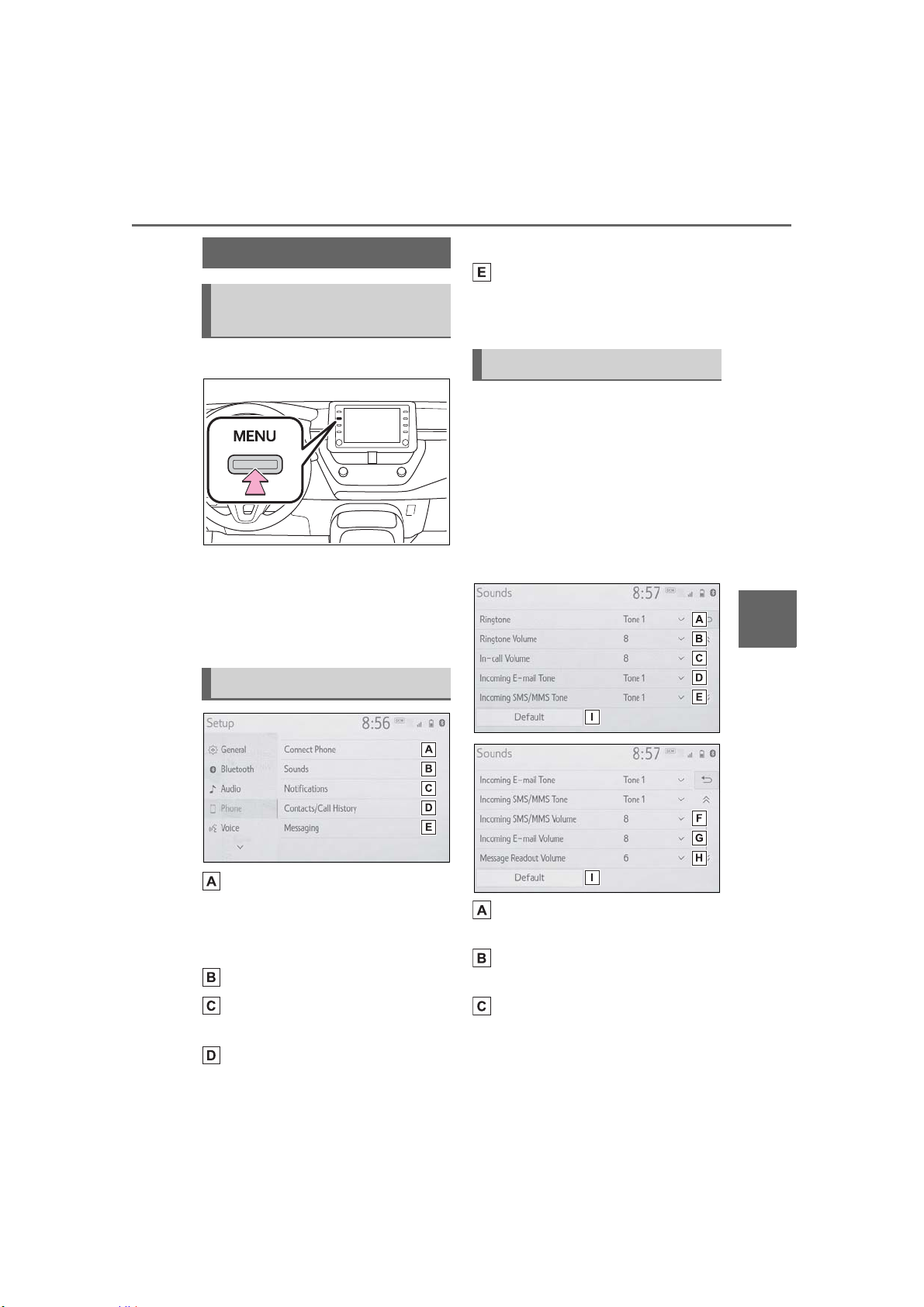
359
5-14. Phone settings
COROLLA H/B_U
5
Audio
5-14.Phone settings
1 Press the “MENU” button.
2 Select “Setup”.
3 Select “Phone”.
4 Select the desired item to be
set.
Connecting a Bluetooth
®
device and editing the Blue-
tooth
®
device information
(P.271, 274)
Sound settings
*
(P.359)
Notification settings
*
(P.360)
Contact/call history settings
*
(P.361)
Message settings
*
(P.367)
*
: This operation cannot be per-
formed while driving.
The call and ringtone volume
can be adjusted. A ringtone can
be selected.
1 Display the phone settings
screen. (P.359)
2 Select “Sounds”.
3 Select the desired item to be
set.
Select to set the desired ring-
tone.
Select “-” or “+” to adjust the
ringtone volume.
Select “-” or “+” to adjust the
default volume of the other
party’s voice.
Setup
Displaying the phone set-
tings screen
Phone settings screen
Sounds settings screen
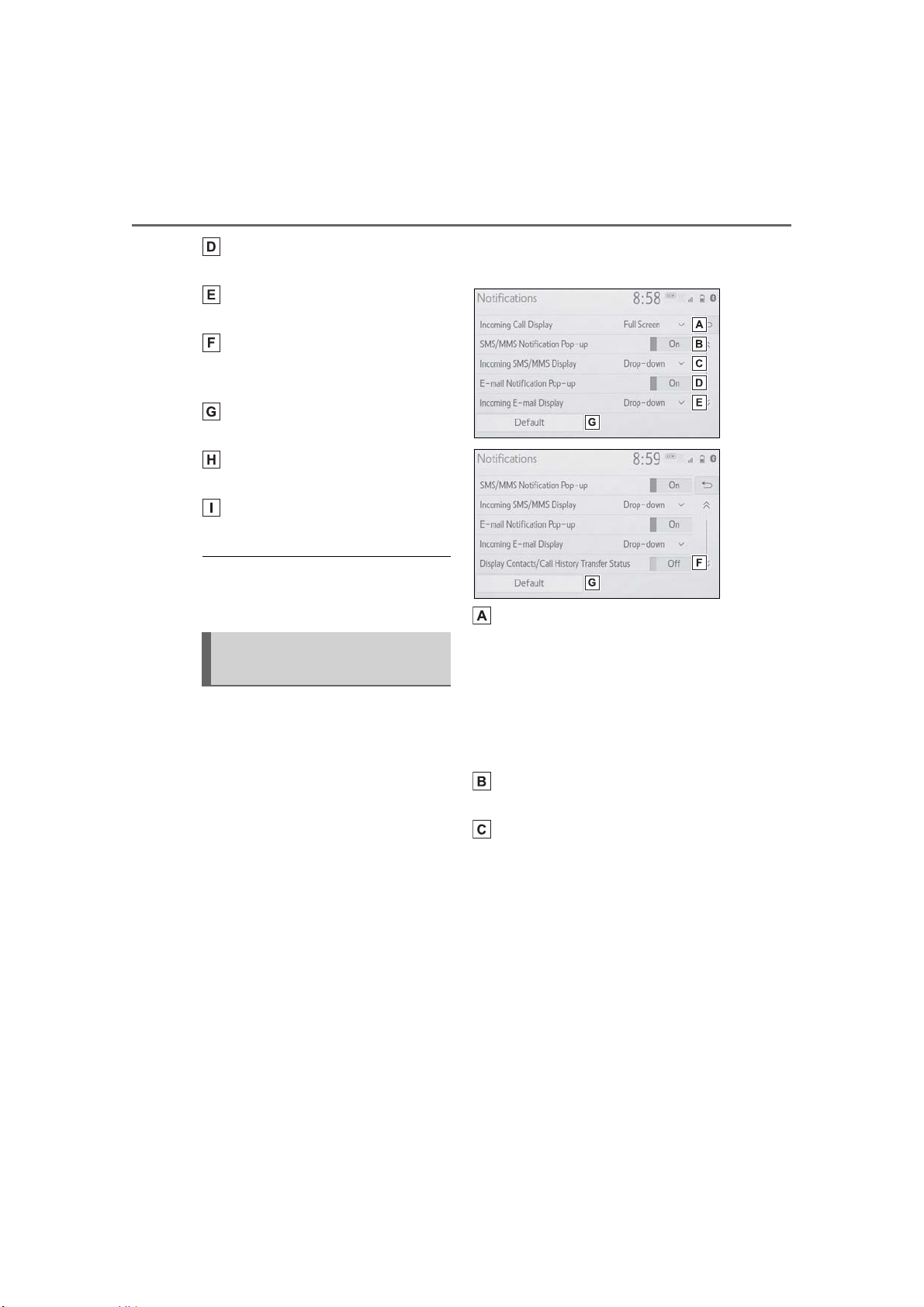
360
5-14. Phone settings
COROLLA H/B_U
Select to set the desired
incoming e-mail tone.
Select to set the desired
incoming SMS/MMS tone.
Select “-” or “+” to adjust the
incoming SMS/MMS tone
volume.
Select “-” or “+” to adjust the
incoming e-mail tone volume.
Select “-” or “+” to adjust the
message readout volume.
Select to reset all setup
items.
● Depending on the type of Blue-
tooth
®
phone, certain functions
may not be available.
1 Display the phone settings
screen. (P.359)
2 Select “Notifications”.
3 Select the desired item to be
set.
Select to change the incom-
ing call display.
“Full Screen”: When a call is
received, the incoming call screen
is displayed and can be operated
on the screen.
“Drop-down”: A message is dis-
played at the top of the screen.
Select to set the SMS/MMS
notification pop-up on/off.
Select to change the incom-
ing SMS/MMS display.
“Full Screen”: When an
SMS/MMS message is
received, the incoming
SMS/MMS display screen is
displayed and can be oper-
ated on the screen.
“Drop-down”: When an
SMS/MMS message is
received, a message is dis-
played at the top of the
Notifications settings
screen
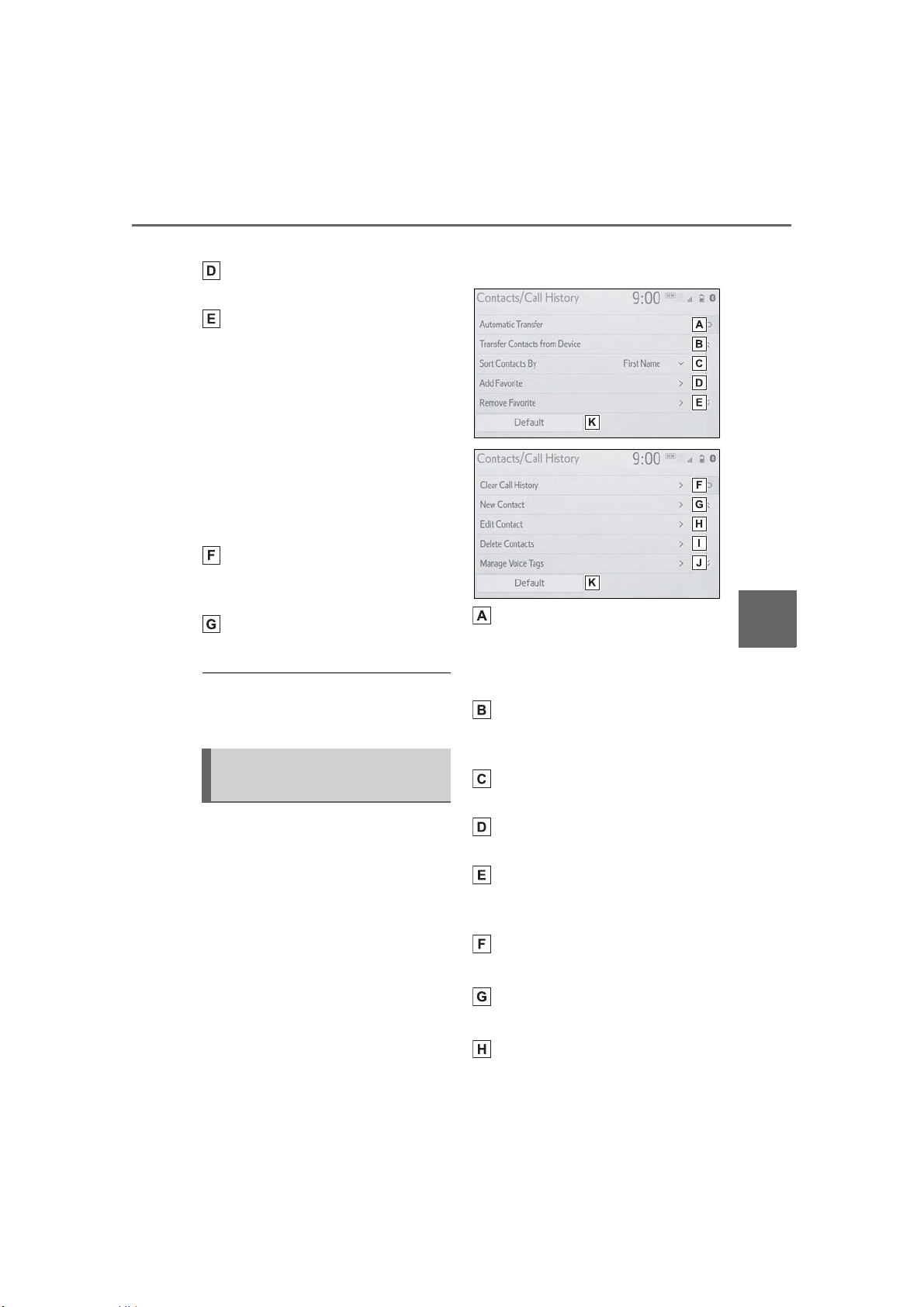
361
5-14. Phone settings
COROLLA H/B_U
5
Audio
screen.
Select to set the e-mail notifi-
cation pop-up on/off.
Select to change the incom-
ing e-mail display.
“Full Screen”: When an
e-mail is received, the incom-
ing e-mail display screen is
displayed and can be oper-
ated on the screen.
“Drop-down”: When an
e-mail is received, a mes-
sage is displayed at the top
of the screen.
Select to set display of the
contact/history transfer com-
pletion message on/off.
Select to reset all setup
items.
● Depending on the type of Blue-
tooth
®
phone, these functions
may not be available.
Contacts can be transferred
from a Bluetooth
®
phone to this
system. Contacts and favorites
can be added, edited and
deleted. Also, the call history
can be deleted.
1 Display the phone settings
screen. (P.359)
2 Select “Contacts/Call His-
tory”.
3 Select the desired item to be
set.
For PBAP compatible Blue-
tooth
®
phones: Select to
change the contact/history
transfer settings. (P.362)
Select to update contacts
from the connected device.
(P.362)
Select to sort contacts by the
first name or last name field.
Select to add contacts to the
favorites list. (P.365)
Select to delete contacts
from the favorites list.
(P.365)
Select to clear the call his-
tory.
*
Select to add new contacts to
the contact list.
*
(P.364)
Select to edit contacts in the
Contacts/Call history set-
tings screen
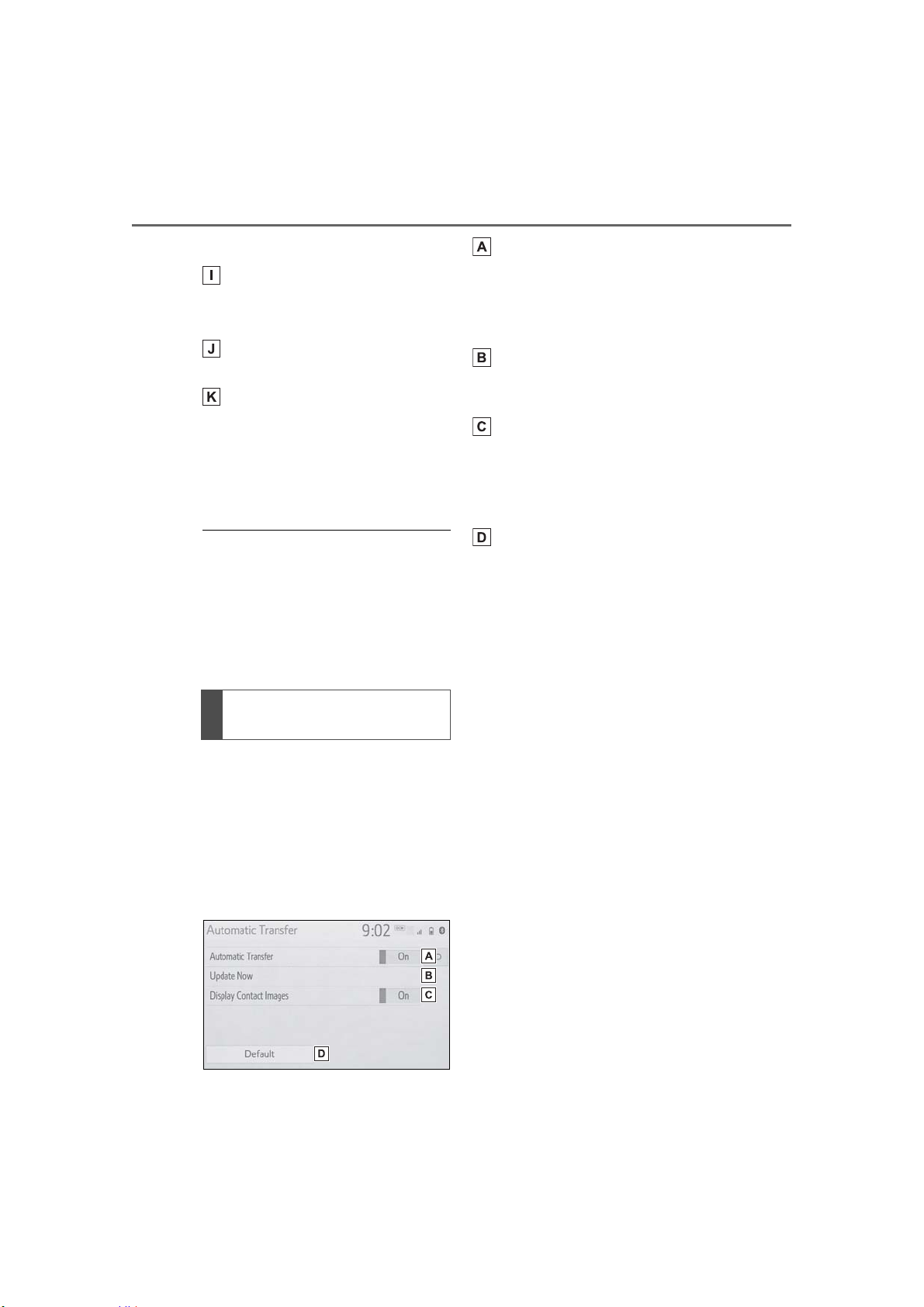
362
5-14. Phone settings
COROLLA H/B_U
contact list.
*
(P.365)
Select to delete contacts
from the contact list.
*
(P.365)
Select to set the voice tags.
(P.366)
Select to reset all setup
items.
*
: For PBAP compatible Bluetooth
®
phones, this function is available
when “Automatic Transfer” is set
to off. (P.362)
● Depending on the type of Blue-
tooth
®
phone, certain functions
may not be available.
● Contact data is managed inde-
pendently for every registered
phone. When one phone is con-
nected, another phone’s regis-
tered data cannot be read.
The automatic contact/history
function is available for PBAP
compatible Bluetooth
®
phones
only.
1 Select “Automatic Transfer”.
2 Select the desired item to be
set.
Select to set automatic con-
tact/history transfer on/off.
When set to on, the phone’s
contact data and history are
automatically transferred.
Select to update contacts
from the connected phone.
(P.362)
Select to set the transferred
contact image display on/off.
Only when the vehicle is not
moving, the contact image
can be displayed.
Select to reset all setup
items.
■ Updating contacts from
phone
1 Select “Update Now”.
Contacts are transferred auto-
matically.
2 Check that a confirmation
screen is displayed when the
operation is complete.
This operation may be unnec-
essary depending on the type
of Bluetooth
®
phone.
If another Bluetooth
®
device
is connected when transfer-
ring contact data, depending
on the phone, the connected
Bluetooth
®
device may need
to be disconnected.
Depending on the type of
Bluetooth
®
phone being con-
nected, it may be necessary
to perform additional steps on
Setting automatic con-
tact/history transfer

363
5-14. Phone settings
COROLLA H/B_U
5
Audio
the phone.
■ Updating the contacts in a
different way (from the call
history screen)
*
1 Display the phone top
screen. (P.343)
2 Select “History” and select a
contact not yet registered in
the contact list.
3 Select “Update Contact”.
4 Select the desired contact.
5 Select a phone type for the
phone number.
*
: For PBAP compatible Bluetooth
®
phones, this function is available
when “Automatic Transfer” is set
to off. (P.361)
When an Android Auto connec-
tion is established, this function
will be unavailable.
*
*
: This function is not made avail-
able in some countries or areas.
When the contact is not regis-
tered
1 Select “Transfer Contacts
from Device”.
2 Select “From Phone (Blue-
tooth)”.
3 Transfer the contact data to
the system using a Blue-
tooth
®
phone.
This operation may be unnec-
essary depending on the type
of Bluetooth
®
phone.
To cancel this function, select
“Cancel”.
4 Check that a confirmation
screen is displayed when the
operation is complete.
When the contact is regis-
tered
1 Select “Transfer Contacts
from Device”.
2 Select “From Phone (Blue-
tooth)”.
3 Select “Replace Contacts” or
“Add Contact”.
“Replace Contacts”: Select to trans-
fer the contact from the connected
cellular phone and replace the cur-
rent one.
“Add Contact”: Select to transfer
the desired contact data from the
connected cellular phone to add to
the current one.
4 Transfer the contact data to
the system using a Blue-
tooth
®
phone.
This operation may be unnec-
essary depending on the type
of Bluetooth
®
phone.
To cancel this function, select
“Cancel”.
5 Check that a confirmation
screen is displayed when the
operation is complete.
Transfer contacts from
device
From phone (OPP compati-
ble Bluetooth
®
phones only)

364
5-14. Phone settings
COROLLA H/B_U
Backed-up contact data
(“vCard” formatted) can be
transferred from USB device or
Bluetooth
®
phone to this sys-
tem.
1 Connect a USB device.
(P.299)
2 Select “Transfer Contacts
from Device”.
3 Select “From USB”.
4 Select “USB 1” or “USB 2”
when the multiple USB
devices are connected. If a
USB device is connected,
skip this procedure.
5 Select “Replace Contacts” or
“Add Contact”. If the contact
is already registered, skip
this procedure.
“Replace Contacts”: Select to trans-
fer the contact from the connected
USB device or Bluetooth
®
phone
and replace the current one.
“Add Contact”: Select to transfer
the desired contact data from the
connected USB device or Blue-
tooth
®
phone to add to the current
one.
6 Select a desired file from
vCard file list.
7 Check that a confirmation
screen is displayed when the
operation is complete.
● Depending on the type of Blue-
tooth
®
phone used and number of
files, it may take time to display
vCard file lists and download con-
tacts.
● Downloading may not complete
correctly in the following cases:
• If the engine switch is turned off
during downloading.
• If the USB device or Bluetooth
®
phone is removed before down-
loading is complete.
New contact data can be regis-
tered.
Up to 4 numbers per person can
be registered. For PBAP com-
patible Bluetooth
®
phones, this
function is available when “Auto-
matic Transfer” is set to off.
(P.361)
1 Select “New Contact”.
2 Enter the name and select
“OK”.
3 Enter the phone number and
select “OK”.
4 Select the phone type for the
phone number.
5 To add another number to
this contact, select “Yes”.
■ Registering a new contact
in a different way (from the
call history screen)
1 Display the phone top
screen. (P.343)
2 Select “History” and select a
contact not yet registered in
the contact list.
3 Select “Add to Contacts”.
From USB device
Registering a new contact
to the contacts list
365
5-14. Phone settings
COROLLA H/B_U
5
Audio
4 Follow the steps in “Register-
ing a new contact to the con-
tacts list” from step 2.
(P.364)
For PBAP compatible Blue-
tooth
®
phones, this function is
available when “Automatic
Transfer” is set to off. (P.361)
1 Select “Edit Contact”.
2 Select the desired contact.
3 Select next to the name
or desired number.
4 Enter the name or the phone
number and select “OK”.
For PBAP compatible Blue-
tooth
®
phones, this function is
available when “Automatic
Transfer” is set to off. (P.361)
1 Select “Delete Contacts”.
2 Select the desired contact
and select “Delete”.
3 Select “Yes” when the confir-
mation screen appears.
● Multiple data can be selected and
deleted at the same time.
● When a Bluetooth
®
phone is
deleted, the contact data will be
deleted at the same time.
Up to 15 contacts (maximum of
4 numbers per contact) can be
registered in the favorites list.
■ Registering the contacts in
the favorites list
1 Select “Add Favorite”.
2 Select the desired contact to
add to the favorites list.
Dimmed contacts are already
stored as a favorite.
3 Check that a confirmation
screen is displayed when the
operation is complete.
When 15 contacts have
already been registered to the
favorites list
1 When 15 contacts have
already been registered to
the favorites list, a registered
contact needs to be replaced.
Select “Yes” when the confir-
mation screen appears to
replace a contact.
2 Select the contact to be
replaced.
3 Check that a confirmation
screen is displayed when the
operation is complete.
■ Registering contacts in the
favorites list in a different
way (from the contact
details screen)
1 Display the phone top
screen. (P.343)
2 Select “Contacts” and select
the desired contact.
3 Select “Add Favorite”.
Editing the contact data
Deleting the contact data
Favorites list setting

366
5-14. Phone settings
COROLLA H/B_U
4 Check that a confirmation
screen is displayed when the
operation is complete.
■ Deleting the contacts in the
favorites list
1 Select “Remove Favorite”.
2 Select the desired contacts
and select “Remove”.
3 Select “Yes” when the confir-
mation screen appears.
4 Check that a confirmation
screen is displayed when the
operation is complete.
■ Deleting contacts in the
favorites list in a different
way (from the contact
details screen)
1 Display the phone top
screen. (P.343)
2 Select “Favorites” or “Con-
tacts” and select the desired
contact to delete.
3 Select “Remove Favorite”.
4 Select “Yes” when the confir-
mation screen appears.
5 Check that a confirmation
screen is displayed when the
operation is complete.
Calls can be made by saying the
voice tag of a registered contact
in the contact list. (P.334)
1 Select “Manage Voice Tags”.
2 Select the desired item to be
set.
Select to register a new voice
tag. (P.366)
Select to edit a voice tag.
(P.366)
Select to delete a voice tag.
(P.367)
■ Registering a voice tag
Up to 50 voice tags can be reg-
istered.
1 Select “New”.
2 Select the desired contact to
register a voice tag for.
3 Select “Rec” and record a
voice tag.
When recording a voice tag,
do so in a quiet area.
“Play”: Select to play the voice tag.
4 Select “OK” when voice tag
registration is complete.
■ Editing a voice tag
1 Select “Edit”.
2 Select the desired contact to
edit.
3 Follow the steps in “Register-
ing a voice tag” from step 3.
(P.366)
Setting voice tags
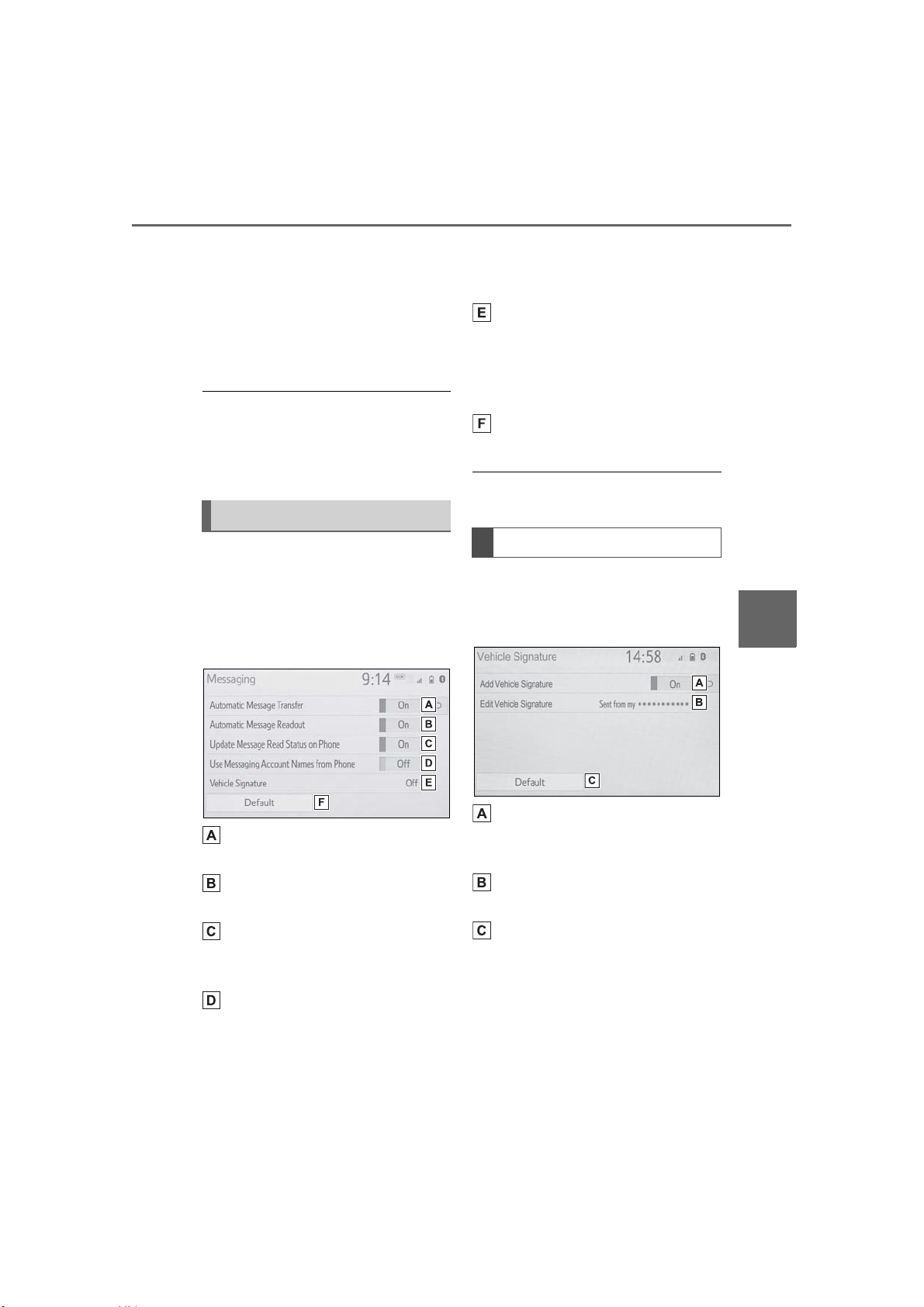
367
5-14. Phone settings
COROLLA H/B_U
5
Audio
■ Deleting the voice tag
1 Select “Delete”.
2 Select the desired contact
and select “Delete”.
3 Select “Yes” when the confir-
mation screen appears.
● Multiple data can be selected and
deleted at the same time.
● Voice tags are deleted when the
set language of the system is
changed. (P.290)
1 Display the phone settings
screen. (P.359)
2 Select “Messaging”.
3 Select the desired item to be
set.
Select to set automatic mes-
sage transfer on/off.
Select to set automatic mes-
sage readout on/off.
Select to set updating mes-
sage read status on phone
on/off.
Select to set display of mes-
saging account names on the
message screen on/off.
When set to on, messaging
account names used on the
cellular phone will be dis-
played.
Select to set adding the vehi-
cle signature to outgoing
messages on/off.
The vehicle signature can be
edited. (P.367)
Select to reset all setup
items.
● Depending on the phone, these
functions may not be available.
1 Select “Vehicle Signature”.
2 Select the desired item to be
set.
Select to set adding the vehi-
cle signature to outgoing
messages on/off.
Select to edit the vehicle sig-
nature. (P.367)
Select to reset all setup
items.
■ Editing vehicle signature
1 Select “Edit Vehicle Signa-
ture”.
Message settings screen
Vehicle signature settings

368
5-14. Phone settings
COROLLA H/B_U
2 Enter desired signature with
using keyboard.
3 Select “OK”.
4 Select “OK” on the confirma-
tion screen, or select “Edit
Again” when it needs to
amend.
369
5-15. What to do if... (Bluetooth
®
)
COROLLA H/B_U
5
Audio
5-15.What to do if... (Bluet ooth
®
)
■ The connected device may
not be a compatible Blue-
tooth
®
cellular phone.
For a list of specific devices
which operation has been con-
firmed on this system, check
with your Toyota dealer or the
following website:
https://www.toy-
ota.com/audio-multimedia in the
United States,
https://www.toyota.ca/con-
nected in
Canada, and
http://www.toy-
otapr.com/audio-multimedia in
Puerto Rico
■ The Bluetooth
®
version of
the connected cellular
phone may be older than
the specified version.
Use a cellular phone with Blue-
tooth
®
version 2.0 or higher
(recommended: Ver. 4.1 +EDR
or higher). (P.269)
■ An incorrect passcode was
entered on the cellular
phone.
Enter the correct passcode on
the cellular phone.
■ The registration operation
has not been completed on
the cellular phone side.
Complete the registration opera-
tion on the cellular phone
(approve registration on the
phone).
■ Old registration informa-
tion remains on either this
system or the cellular
phone.
Delete the existing registration
information from both this sys-
tem and the cellular phone, then
register the cellular phone you
wish to connect to this system.
(P.273)
Troubleshooting
If there is a problem with the
hands-free system or a
Bluetooth
®
device, first
check the table below.
Troubleshooting
When using the
hands-free system with a
Bluetooth
®
device
The hands-free system or
Bluetooth
®
device does not
work.
When registering/connect-
ing a cellular phone
A cellular phone cannot be
registered.
370
5-15. What to do if... (Bluetooth
®
)
COROLLA H/B_U
■ Another Bluetooth
®
device
is already connected.
Manually connect the cellular
phone you wish to use to this
system. (P.271)
■ Bluetooth
®
function is not
enabled on the cellular
phone.
Enable the Bluetooth
®
function
on the cellular phone.
■ Automatic Bluetooth
®
con-
nection on this system is
set to off.
Set automatic Bluetooth
®
con-
nection on this system to on
when the engine switch is in
ACC or ON mode. (P.275)
■ Preferred device settings
function on this system is
set to on.
Set preferred device settings
function on this system to off.
(P.276)
Set the desired cellular phone to
the highest automatic connec-
tion priority. (P.276)
■ Bluetooth
®
function is not
enabled on the cellular
phone.
Enable the Bluetooth
®
function
on the cellular phone.
■ Old registration informa-
tion remains on either this
system or the cellular
phone.
Delete the existing registration
information from both this sys-
tem and the cellular phone, then
register the cellular phone you
wish to connect to this system.
(P.274)
■ Your vehicle is in a area.
Move to where no longer
appears on the display.
A Bluetooth
®
connection
cannot be made.
A cellular phone cannot be
connected.
When making/receiving a
call
A call cannot be
made/received.
371
5-15. What to do if... (Bluetooth
®
)
COROLLA H/B_U
5
Audio
■ The profile version of the
connected cellular phone
may not be compatible with
transferring phonebook
data.
For a list of specific devices
which operation has been con-
firmed on this system, check
with your Toyota dealer or the
following website:
https://www.toy-
ota.com/audio-multimedia in the
United States,
https://www.toyota.ca/con-
nected in
Canada, and
http://www.toy-
otapr.com/audio-multimedia in
Puerto Rico
■ Automatic contact transfer
function on this system is
set to off.
Set automatic contact transfer
function on this system to on.
(P.362)
■ Passcode has not been
entered on the cellular
phone.
Enter the passcode on the cellu-
lar phone if requested (default
passcode: 1234).
■ Transfer operation on the
cellular phone has not com-
pleted.
Complete transfer operation on
the cellular phone (approve
transfer operation on the
phone).
■ Automatic contact transfer
function on this system is
set to on.
Set automatic contact transfer
function on this system to off.
(P.362)
■ Message transfer is not
enabled on the cellular
phone.
Enable message transfer on the
cellular phone (approve mes-
sage transfer on the phone).
■ Automatic transfer func-
tion on this system is set to
off.
Set automatic transfer function
on this system to on. (P.362)
When using the phone-
book
Phonebook data cannot be
transferred manually/auto-
matically.
Phonebook data cannot be
edited.
When using the Blue-
tooth
®
message function
Messages cannot be viewed.

372
5-15. What to do if... (Bluetooth
®
)
COROLLA H/B_U
■ Notification of
SMS/MMS/E-mail reception
on this system is set to off.
Set notification of
SMS/MMS/E-mail reception on
this system to on. (P.360)
■ Automatic message trans-
fer function is not enabled
on the cellular phone.
Enable automatic transfer func-
tion on the cellular phone.
■ Connection confirmation
display on this system is
set to on.
To turn off the display, set con-
nection confirmation display on
this system to off. (P.276)
*
: The engine switch is in ACC or
ON mode.
■ The cellular phone is not
close enough to this sys-
tem.
Bring the cellular phone closer
to this system.
■ Radio interference has
occurred.
Turn off Wi-Fi
®
devices or other
devices that may emit radio
waves.
■ The cellular phone is the
most likely cause of the
symptom.
Turn the cellular phone off,
remove and reinstall the battery
pack, and then restart the cellu-
lar phone.
Enable the cellular phone’s
Bluetooth
®
connection.
Disable the Wi-Fi
®
connection of
the cellular phone.
Stop the cellular phone’s secu-
rity software and close all appli-
cations.
Before using an application
installed on the cellular phone,
carefully check its source and
how its operation might affect
this system.
● For details, refer to the owner’s
manual that came with the cellular
phone.
New message notifications
are not displayed.
In other situations
The Bluetooth
®
connection
status is displayed at the top
of the screen each time the
system is activated
*
.
Even though all conceivable
measures have been taken,
the symptom status does not
change.
373
5-16. Connected Services Overview
COROLLA H/B_U
5
Audio
5-16.Connected Services Overview
Audio Plus/Premium Audio
Owners of this system should
refer to the “NAVIGATION AND
MULTIMEDIA SYSTEM
OWNER’S MANUAL”.
The functions included are
classified into the following
three types.
• Type A: Function achieved by
using a smart phone or an
embedded cellular device in the
vehicle (DCM: Data Communica-
tion Module) and the system
• Type B: Function achieved by
using DCM and the system
• Type C: Function achieved by
using DCM
● Each function is available in the
following areas:
• Toyota apps is available in the
contiguous United States, Wash-
ington D.C., Alaska, Hawaii,
Puerto Rico and Canada.
• Toyota apps is not available in the
United States Virgin Islands.
•Wi-Fi
®
Hotspot is available in the
contiguous United States, Wash-
ington D.C.,Alaska and Hawaii.
•Wi-Fi
®
Hotspot is not available in
Puerto Rico, Canada, and in the
United States Virgin Islands.
• Safety Connect features include:
Automatic Collision Notification,
Emergency Assistance, S.O.S,
Stolen Vehicle Location (available
in the contiguous United States,
Washington D.C., Hawaii, Alaska,
Puerto Rico and Canada) and
Enhanced Roadside Assistance
(available in the contiguous
United States, Washington D.C.,
Alaska, Puerto Rico and Canada).
• Safety Connect is not available in
the United States Virgin Islands.
● Connected services functionality
is dependent upon network recep-
tion level and signal strength.
Functional overview
Toyota Connected hotspot
includes Toyota apps,
Wi-Fi
®
Hotspot and Safety
Connect.
Functional overview
Function Type
Toyota apps Type A
Wi-Fi
®
Hotspot
Type B
Safety Connect Type C
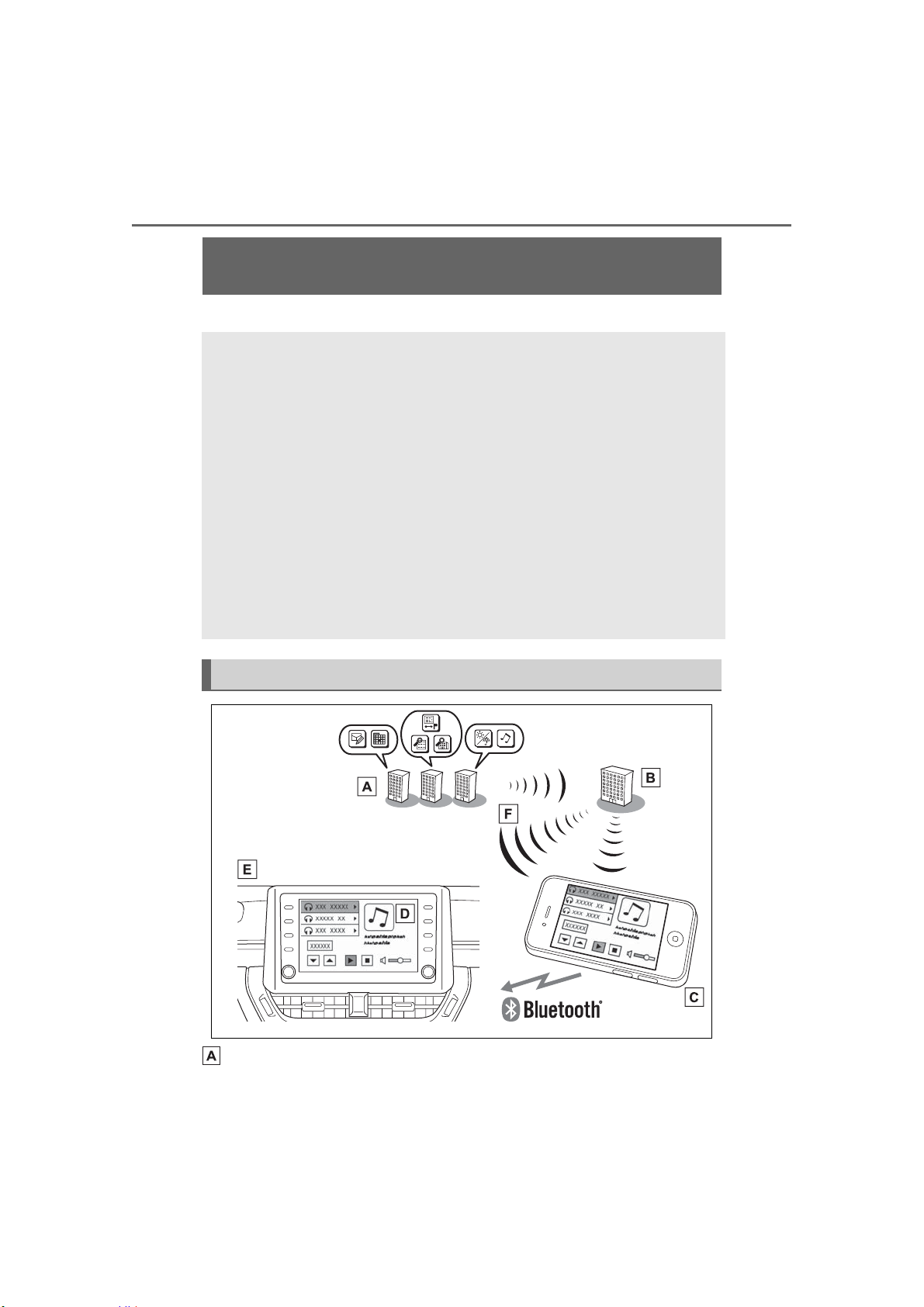
374
5-16. Connected Services Overview
COROLLA H/B_U
*
: If equipped
Content provider
Type A: Function achieved by using a smart
phone or DCM
*
Of the functions included with Connected Services, the Toyota
apps relies on the use of a smart phone or DCM.
Using a smart phone
• Toyota audio multimedia system enables applicable apps
installed on a smart phone to be displayed on and operated from
the screen via a Bluetooth
®
.
Via DCM
• Toyota audio multimedia system enables applicable apps
installed on the system to be displayed on and operated from the
screen.
A few settings must be performed before Toyota apps can be
used. (P.379)
By using a smart phone or DCM
375
5-16. Connected Services Overview
COROLLA H/B_U
5
Audio
Provides contents to the application server.
Application server
Provides applications to the system or a smart phone.
Smart phone
*
Using the Toyota mobile application, communication is relayed
between the system, application server and contents provider.
The smart phone cannot be operated while communicating.
Applications
Display usable content from the content providers on the screen
using the data connection of the connected smart phone or DCM.
System
Content received, via a smart phone or DCM, from content pro-
vider servers is displayed on the screen. The system is equipped
with an application player to run applications.
Via DCM
*
: For known compatible phones, refer to
https://www.toyota.com/connected-services
in the United States,
https://www.toyota.ca/connected
in Canada, and
http://www.toyotapr.com/connected-services
in Puerto Rico.
The required operations to acti-
vate applications and connect a
smart phone to the system, and
the registration steps for the
connected services are
explained in this section.
■ Subscription
User registration is required to
start using the Toyota apps
function. (P.376)
Toyota apps does not require
an activation fee or monthly
recurring fees.
Services requiring a separate
contract can also be used.
*
*
: For details, refer to
https://www.toyota.com/con-
nected-services
or call 1-800-331-4331 in the
United States,
https://www.toyota.ca/connected
or call 1-888-869-6828 in Can-
ada, and
http://www.toyotapr.com/con-
nected-services
or call 1-877-855-8377 in Puerto
Rico.
■ Availability of function
Toyota apps is available in the
contiguous United States,
Washington D.C., Alaska,
Hawaii, Puerto Rico and Can-
ada.
Toyota apps is not available in
Before using the function

376
5-16. Connected Services Overview
COROLLA H/B_U
the United States Virgin
Islands.
● Data usage fees may apply while
using Toyota apps function. Con-
firm data usage fees before using
this function.
● For details regarding operation of
the Toyota apps, refer to
https://www.toyota.com/con-
nected-services
in the United States,
https://www.toyota.ca/connected
in Canada, and
http://www.toyotapr.com/con-
nected-services
in Puerto Rico.
● These functions are not made
available in some countries or
areas. Availability of functions of
the Toyota apps is dependent on
network reception level.
■ Initializing personal data
The personal data used in appli-
cations can be reset. (P.293)
The following personal data
can be deleted and returned
to their default settings:
• Downloaded contents
• Radio stations that were listened
to
● Once initialized, the data and set-
tings will be erased. Pay much
attention when initializing the data.
■ Settings required to use
Toyota mobile application
Perform the settings in the fol-
lowing order.
1 Download the Toyota mobile
application to your smart
phone or the system.
2 Register the smart phone
with the system.
In order to use Toyota mobile appli-
cation, the following must first be
performed:
Download the Toyota mobile
application onto your smart
phone or the system, and
login to the application.
(P.376)
Register the smart phone, on
which the Toyota mobile appli-
cation was installed, with the
system. (P.376)
Register a Bluetooth
®
phone
with the hands-free system.
(P.376)
■ Registering the Toyota
mobile application applica-
tion
Registration is optional.
1 Download the Toyota mobile
application to your smart
phone or the system.
2 Run the Toyota mobile appli-
cation on your smart phone
or the system.
3 Enter the information
required into the Toyota
mobile application. Login to
the application.
● Applications can only be used
when the Toyota mobile applica-
tion has been downloaded to your
smart phone or the system, and
Preparation before using
Toyota mobile application

377
5-16. Connected Services Overview
COROLLA H/B_U
5
Audio
the application is running.
● Toyota mobile application opera-
tional procedures can also be con-
firmed by visiting
https://www.toyota.com/con-
nected-services
in the United States,
https://www.toyota.ca/connected
in Canada, and
http://www.toyotapr.com/con-
nected-services
in Puerto Rico.
● If a Toyota mobile application is
used while iPod audio/video is
being played back, system opera-
tion may become unstable.
*
: If equipped
■ Subscription
After you have signed the
Telematics Subscription Ser-
vice Agreement and are
enrolled, you can begin
receiving services. A variety
of subscription terms are
available. Contact your Toyota
dealer, or call 1-800-331-4331
in the United States,
1-888-869-6828 in Canada,
and 1-877-855-8377 in Puerto
Rico, for further subscription
details. (P.375)
■ Availability of functions
Wi-Fi
®
Hotspot is available in
the contiguous United States,
Washington D.C., Alaska and
Type B: Function
achieved by using
DCM and the system
*
The functionality of Wi-Fi
®
Hotspot is made possible
through the shared work of
the DCM and the system.
This service is available by
subscription and supported
by the Toyota response cen-
ter, which operates 24 hours
a day, 7 days a week.
For details about Wi-Fi
®
Hotspot:P.278
Before using the function

378
5-16. Connected Services Overview
COROLLA H/B_U
Hawaii.
Wi-Fi
®
Hotspot is not avail-
able in Puerto Rico, Canada,
and in the United States Vir-
gin Islands.
*
: If equipped
Type C: Function
achieved by using
DCM
*
The functionality of Safety
Connect is made possible
by the use of a DCM.
For details, (P.5 8)
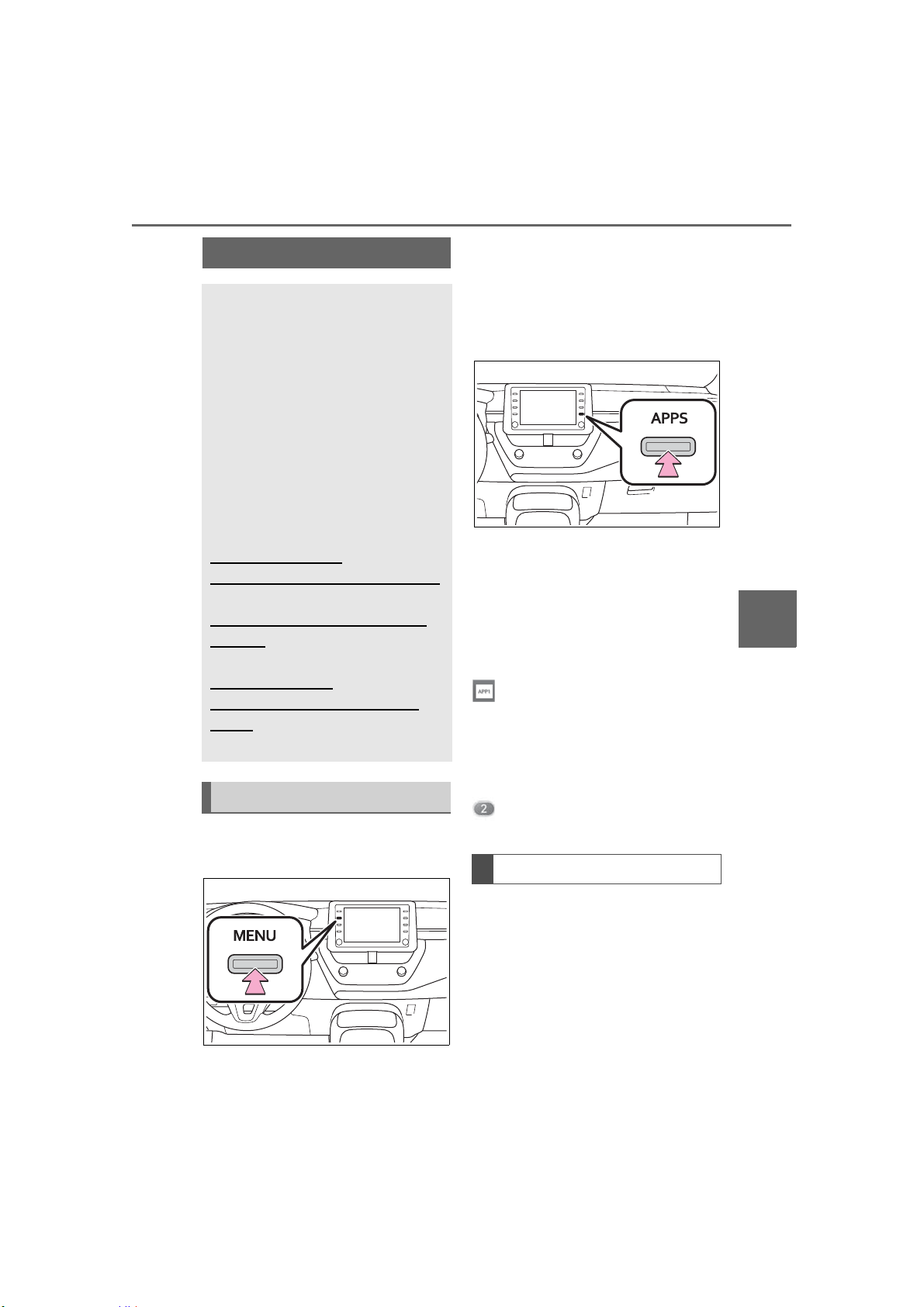
379
5-17. Connected Services Operation
COROLLA H/B_U
5
Audio
5-17.Connected Services Operation
From the “MENU” button
1 Press the “MENU” button.
2 Select “Apps”.
3 Follow the steps in “From the
“APPS” button” from step 3.
(P.379)
From the “APPS” button
1 Press the “APPS” button.
2 Select “Apps”.
If a specific application screen
is displayed, select “Apps”
again.
3 Select the desired application
screen button.
: Select to activate an applica-
tion.
“Update”: Select to update the
applications. (P.379)
“App Catalog”: Select to change the
order of the applications. (P.380)
: Displays the number of new
notifications for the application
When the App Suite is activated,
an application may need to be
updated. To update an applica-
tion, it is necessary to download
update data and install it.
■ Downloading update
If an update is available,
“Update” can be selected.
Toyota apps
Toyota apps is a function
that enables certain apps
installed on a smart phone
or the system to be dis-
played on and operated
from the system screen.
Before the Toyota apps can
be used, some setup needs
to be performed. (P.376)
For details about the func-
tions and services provided
by each application, refer to
https://www.toy-
ota.com/connected-services
in the United States,
https://www.toyota.ca/con-
nected
in Canada, and
http://www.toy-
otapr.com/connected-ser-
vices
in Puerto Rico.
Using Toyota apps
Updating an application

380
5-17. Connected Services Operation
COROLLA H/B_U
1 Select “Update” on the appli-
cation screen. (P.379)
2 Check that downloading
starts.
“Download in Background”: Select
to operate other functions while
downloading.
“Cancel”: Select to cancel updating.
3 Check that downloading is
complete.
“Later”: Select to install later. When
this screen button is selected, the
screen will return to the last dis-
played screen. To install the update
data: (P.380)
“See Detail”: Select to display
detailed information on the update
data.
“Install”: Select to install the update
data. Follow the steps “Installing
the update data” from step 2.
(P.380)
■ Installing the update data
After the downloading is com-
plete, “Update” will be changed
to “Install”.
1 Select “Install” on the appli-
cation screen. (P.379)
2 Select “Continue”.
“Later”: Select to postpone the
installation of the update data and
go back to the previous screen.
3 Check that installing is
started.
“Install in Background”: Select to
operate other functions while
installing.
4 Select “OK” after the install-
ing is complete.
● The Toyota apps cannot be oper-
ated while installing.
Order of the applications can be
changed.
1 Display the application
screen. (P.379)
2 Select “App Catalog”.
3 Select the desired application
to be moved.
4 Select “<<” or “>>” to move
the application, and then
select the done button.
When problems occur with start-
ing the application player, a
message will appear on the
screen. Referring to the follow-
ing items, identify the problem
and take the suggested correc-
tive action.
“When it is safe and legal to
do so, please ensure your
mobile application is running
and logged in on your phone.”
The Toyota mobile application can-
not be connected to Bluetooth
®
SPP.
Refer to
https://www.toyota.com/con-
nected-services
in the United States,
https://www.toyota.ca/connected
in Canada, and
http://www.toyotapr.com/con-
nected-services
in Puerto Rico, to confirm if the
Reordering the applica-
tions
If a message appears on
the screen

381
5-17. Connected Services Operation
COROLLA H/B_U
5
Audio
phone is Bluetooth
®
SPP compati-
ble or not, and then activate the
Toyota mobile application.
“Installation failed, please try
again”
Installation can be attempted again
by changing to the application
screen and pressing the “Install”
switch.
“Application download error.
Please try again later.”
Downloading can be attempted
again by checking the communica-
tion status, changing to the applica-
tion screen and pressing the
“Download” switch again.
“Download error, some mobile
application functions may not
work as expected. Please
reinitiate the download pro-
cess.”
The Toyota mobile application can-
not be connected to Bluetooth
®
SPP.
Refer to
https://www.toyota.com/con-
nected-services
in the United States,
https://www.toyota.ca/connected
in Canada, and
http://www.toyotapr.com/con-
nected-services
in Puerto Rico, to confirm if the
phone is Bluetooth
®
SPP compati-
ble or not, and then activate the
Toyota mobile application.
Please ensure your Toyota mobile
application is running and logged in
on your phone while vehicle is not
moving.
“To use the services, mobile
application needs to be run-
ning on your phone. For more
information, please visit toy-
ota.com or call
1-800-331-4331 in the United
States, 1-888-869-6828 in
Canada, and 1-877-855-8377
in Puerto Rico.”
The Toyota mobile application can-
not be connected to Bluetooth
®
SPP.
Refer to
https://www.toyota.com/con-
nected-services
in the United States,
https://www.toyota.ca/connected
in Canada, and
http://www.toyotapr.com/con-
nected-services
in Puerto Rico, to confirm if the
phone is Bluetooth
®
SPP compati-
ble or not, and then activate the
Toyota mobile application.
“Communication unsuccess-
ful. Please try again.”
Communication was disconnected.
After a few moments, retry the
operation.
A keyword can be entered to an
application by the software key-
board or voice recognition func-
tion. For details about the
functions and services provided
by each application, refer to
https://www.toyota.com/con-
Entering keyword opera-
tion
382
5-17. Connected Services Operation
COROLLA H/B_U
nected-services
in the United States,
https://www.toyota.ca/connected
in Canada, and
http://www.toyotapr.com/con-
nected-services
in Puerto Rico.
The keyboard layout can be
changed. (P.290)
1 Display the application
screen. (P.379)
2 Select the desired application
screen button.
3 Select the character entering
space.
4 Enter a search term, and
then select “OK”.
5 Entering characters will be
reflected on the character
entering space.
For details on operating the
keyboard: P.26 1
1 Display the application
screen. (P.379)
2 Select the desired application
screen button.
3 Press the talk switch.
(P.334)
4 Say the desired keyword.
Completion of the keyword
will be detected automatically.
5 Search results will be dis-
played on the screen.
Entering a keyword using
the software keyboard
Entering a keyword using
the voice recognition func-
tion
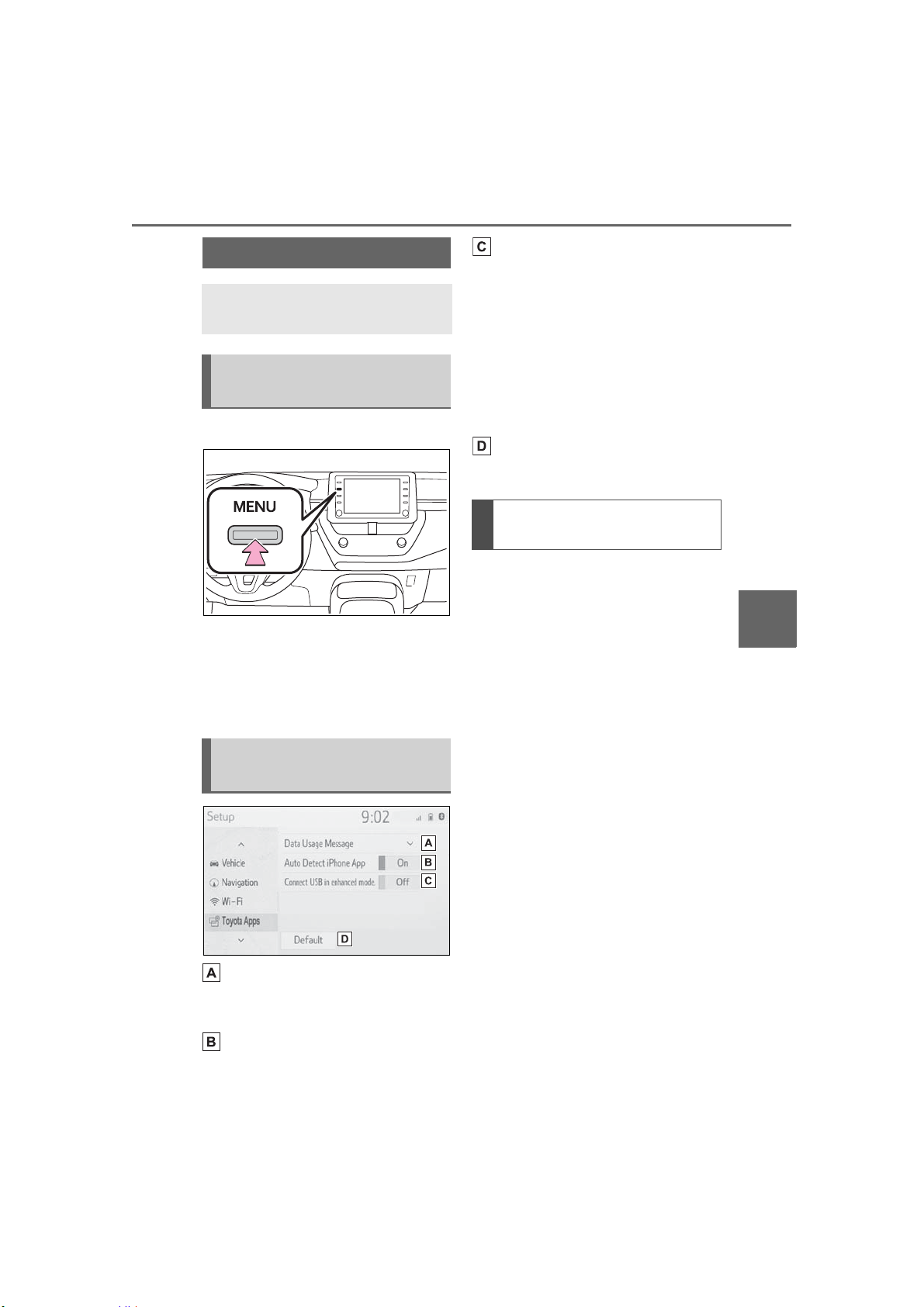
383
5-18. Toyota apps settings
COROLLA H/B_U
5
Audio
5-18.Toyota apps settings
1 Press the “MENU” button.
2 Select “Setup”.
3 Select “Toyota Apps”.
4 Select the desired items to
be set.
Select to set the pop up
reminder for smart phone
data usage. (P.381)
Select to detect iPhone app
automatically on/off.
Select to set the enhanced
mode with connecting USB
device on/off.
• When an iPhone is connected
while this setting is set to “On”,
communication with devices con-
nected to other USB ports may
not be possible. Also, depending
on the device, charging may not
be possible.
Select to reset all setup
items.
The data use notification
pop-up, which indicates that the
system will use an internet con-
nection, can be enabled/dis-
abled.
1 Display the Toyota apps set-
tings screen. (P.383)
2 Select “Data Usage Mes-
sage”.
3 Change the setting as
desired.
Setup
The settings of Toyota apps
can be changed.
Displaying the Toyota
apps settings screen
Toyota apps settings
screen
Data use notification
pop-up settings

384
5-18. Toyota apps settings
COROLLA H/B_U

385
COROLLA H/B_U
6
6
Interior features
Interior features
.
6-1. Using the air conditioning
system and defogger
Automatic air conditioning
system....................... 386
Heated steering wheel/seat
heaters ...................... 393
6-2. Using the interior lights
Interior lights list .......... 395
6-3. Using the storage features
List of storage features
.................................. 397
Luggage compartment fea-
tures .......................... 400
6-4. Other interior features
Other interior features . 402
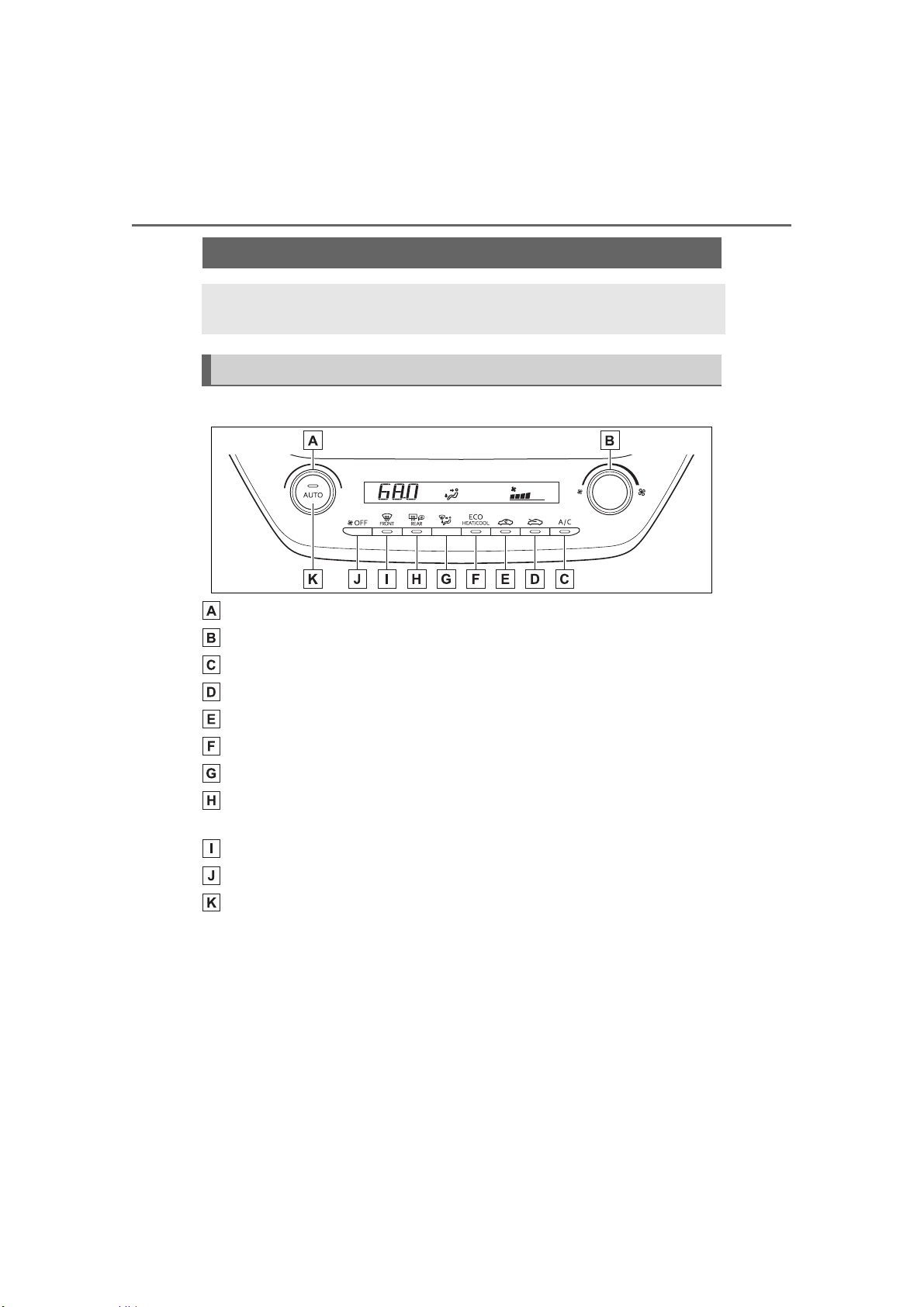
386
6-1. Using the air conditioning system and defogger
COROLLA H/B_U
6-1.Using the air condition ing system a nd defogger
Vehicles without DUAL mode air conditioning system
Temperature control switch
Fan speed control switch
“A/C” switch
Outside air mode switch
Recirculated air mode switch
Eco air conditioning mode switch
Airflow mode control switch
Rear window defogger and outside rear view mirror defoggers
switch
Windshield defogger switch
Off switch
Automatic mode switch
Automatic air conditioning system
Air outlets are automatically selected and fan speed is auto-
matically adjusted according to the set temperature setting.
Air conditioning controls
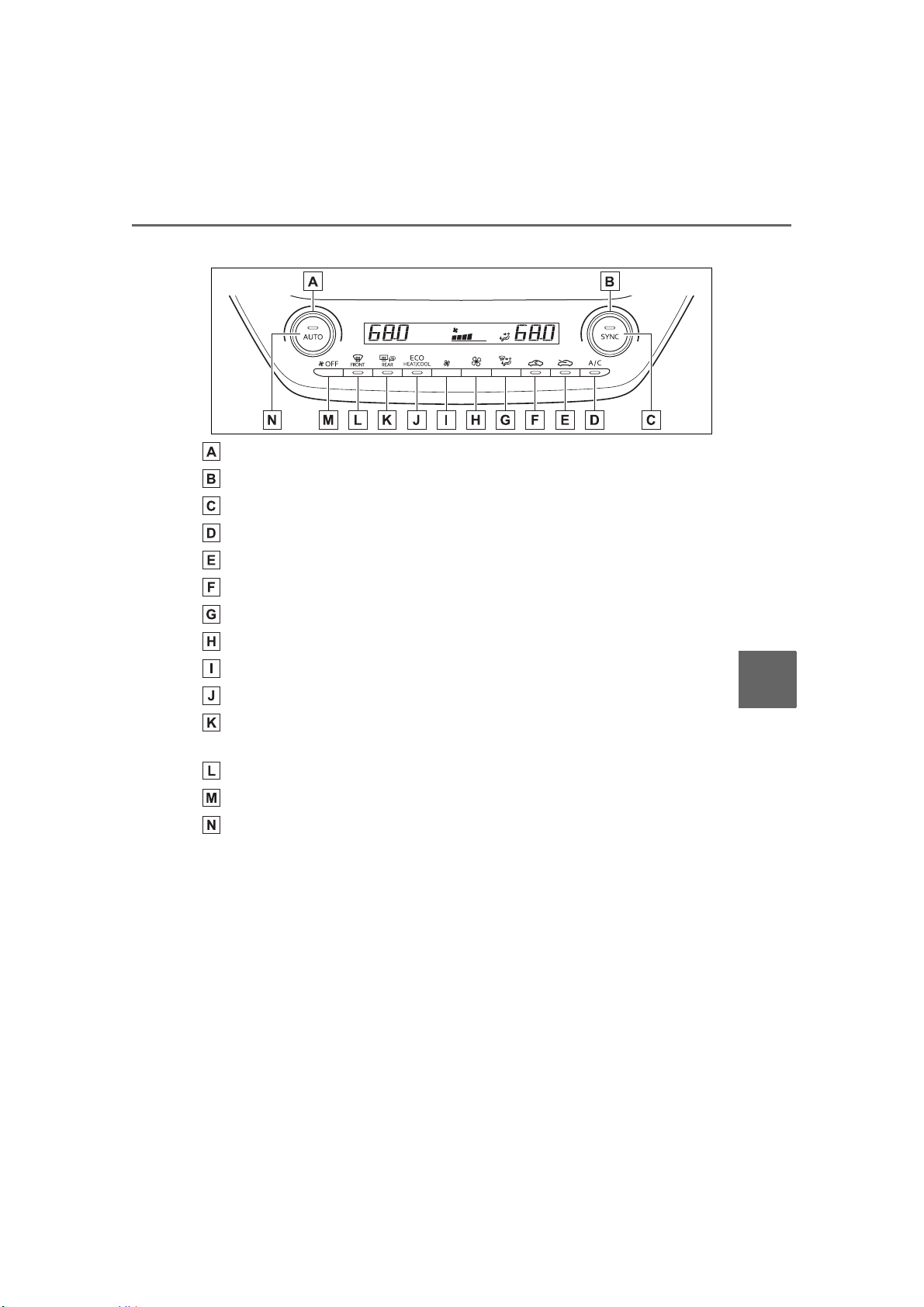
387
6-1. Using the air conditioning system and defogger
COROLLA H/B_U
6
Interior features
Vehicles with DUAL mode air conditioning system
Left-hand side temperature control switch
Right-hand side temperature control switch
“SYNC” switch
“A/C” switch
Outside air mode switch
Recirculated air mode switch
Airflow mode control switch
Fan speed increases switch
Fan speed decreases switch
Eco air conditioning mode switch
Rear window defogger and outside rear view mirror defoggers
switch
Windshield defogger switch
Off switch
Automatic mode switch
■ Adjusting the temperature
setting
To adjust the temperature set-
ting, turn the temperature con-
trol switch clockwise (warm) or
counterclockwise (cool).
If “A/C” switch is not pressed, the
system will blow ambient tempera-
ture air or heated air.
The air conditioning system
switches between individual and
synchronized modes each time
“SYNC” switch is pressed.
Synchronized modes (indicator on):
The left-hand side temperature
control switch can be used to adjust
the temperature for the driver’s and
front passenger’s side. At this time,
operate the right-hand side tem-
perature control switch to enter
individual mode.
Individual modes (indicator off):
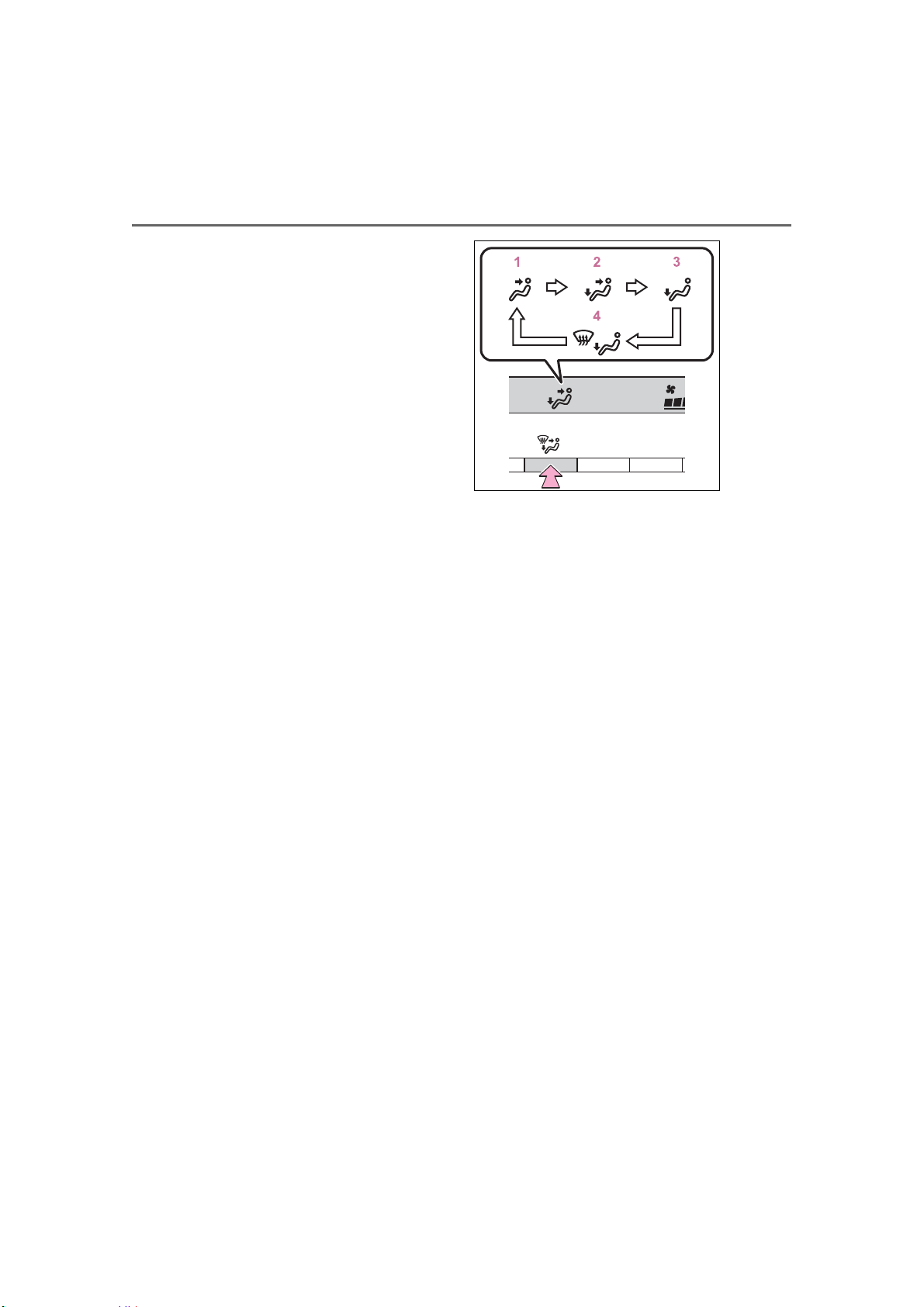
388
6-1. Using the air conditioning system and defogger
COROLLA H/B_U
The temperature for the driver’s
and front passenger’s side can be
adjusted separately.
■ Setting the fan speed
Vehicles without DUAL mode
air conditioning system
To adjust the fan speed, turn the
fan speed control switch clock-
wise (increase) or counterclock-
wise (decrease).
Pressing the off switch to turns off
the fan.
Vehicles with DUAL mode air
conditioning system
Operate the fan speed
increases switch to increase the
fan speed and the fan speed
decrease switch to decrease the
fan speed.
Pressing the off switch to turns off
the fan.
■ Change the airflow mode
Press the airflow mode control
switch.
The airflow mode changes as fol-
lows each time the switch is
pressed.
1 Upper body
2 Upper body and feet
3 Feet
4 Feet and the windshield
defogger operates
■ Switching between outside
air and recirculated air
modes
To change to recirculated air
mode, press the recirculated
air mode switch.
The indicator illuminates on the
recirculated air mode switch.
To change to outside air
mode, press the outside air
mode switch.
The indicator illuminates on the out-
side air mode switch.
■ Set cooling and dehumidifi-
cation function
Press the “A/C” switch.
When the function is on, the indica-
tor illuminates on the “A/C” switch.
■ Defogging the windshield
Defoggers are used to defog the

389
6-1. Using the air conditioning system and defogger
COROLLA H/B_U
6
Interior features
windshield and front side win-
dows.
Press the windshield defogger
switch.
Set the outside/recirculated air
mode switch to outside air mode if
the recirculated air mode is used. (It
may switch automatically.)
To defog the windshield and the
side windows quickly, turn the air
flow and temperature up.
To return to the previous mode,
press the windshield defogger
switch again when the windshield is
defogged.
When the windshield defogger
switch is on, the indicator illumi-
nates on the windshield defogger
switch.
■ Defogging the rear window
and outside rear view mir-
rors
Defoggers are used to defog the
rear window, and to remove
raindrops, dew and frost from
the outside rear view mirrors.
Press the rear window and out-
side rear view mirror defoggers
switch.
The defoggers will automatically
turn off after a while.
When the rear window and outside
rear view mirror defoggers switch is
on, the indicator illuminates on the
rear window and outside rear view
mirror defoggers switch.
■ Eco air conditioning mode
The air conditioning is controlled
with low fuel consumption priori-
tized such as reducing fan
speed, etc.
Press the eco air conditioning
mode switch.
When the eco air conditioning
mode is on, the indicator illumi-
nates on the eco air conditioning
mode switch.
■ When the outside temperature
exceeds 75°F (24°C) and the air
conditioning system is on
● In order to reduce the air condi-
tioning power consumption, the air
conditioning system may switch to
recirculated air mode automati-
cally. This may also reduce fuel
consumption.
● Recirculated air mode is selected
as a default mode when the
engine switch is turned to ON.
● It is possible to switch to outside
air mode at any time by pressing
the outside air mode switch.
■ Fogging up of the windows
● The windows will easily fog up
when the humidity in the vehicle is
high. Turning “A/C” on will dehu-
midify the air from the outlets and
defog the windshield effectively.
● If you turn “A/C” off, the windows
may fog up more easily.
● The windows may fog up if the
recirculated air mode is used.
■ When driving on dusty roads
Close all windows. If dust thrown up
by the vehicle is still drawn into the
vehicle after closing the windows, it
is recommended that the air intake
mode be set to outside air mode and
the fan speed to any setting except
off.
■ Outside/recirculated air mode
● Setting to the recirculated air
mode temporarily is recom-
mended in preventing dirty air
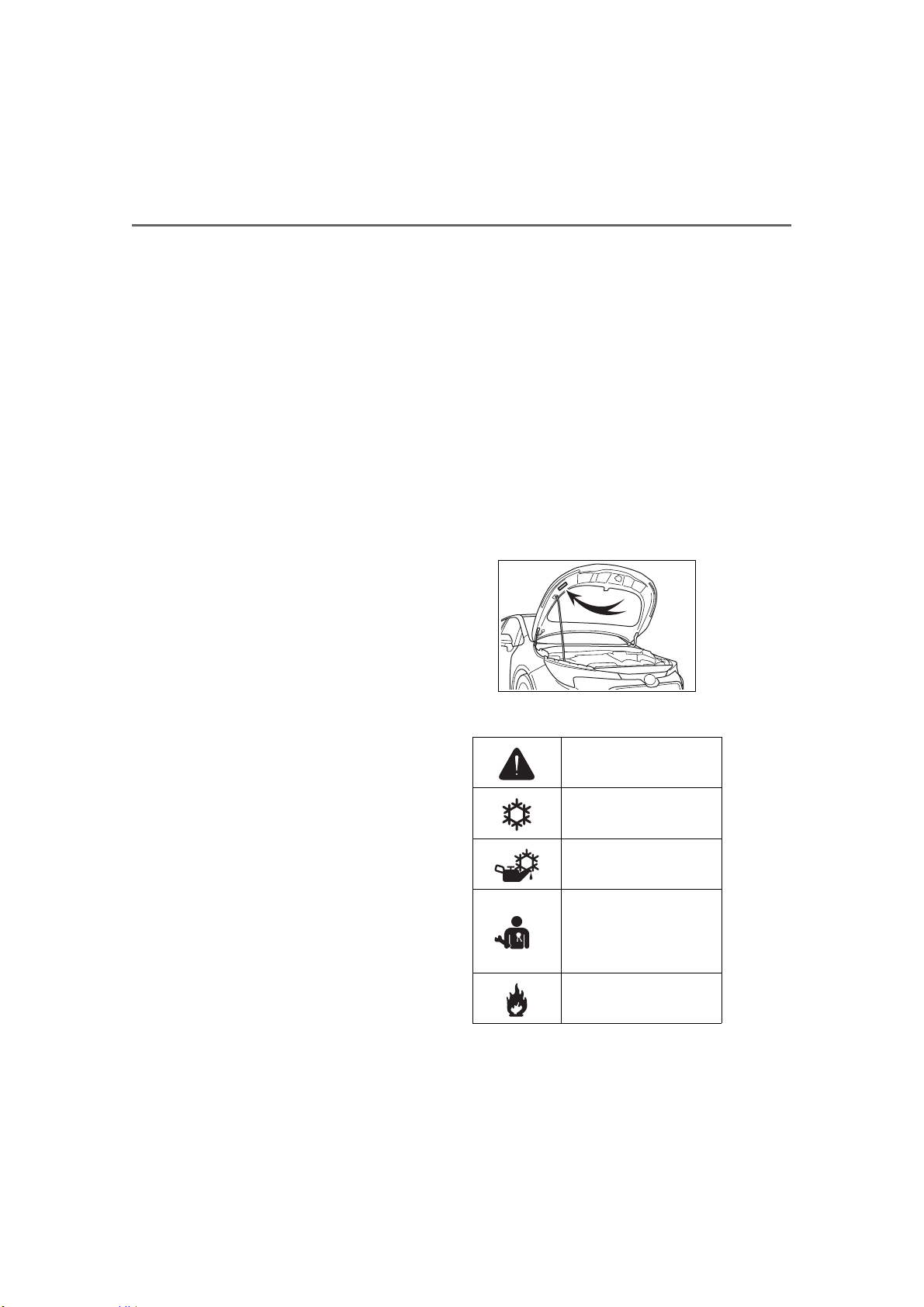
390
6-1. Using the air conditioning system and defogger
COROLLA H/B_U
from entering the vehicle interior
and helping to cool the vehicle
when the outside air temperature
is high.
● Outside/recirculated air mode may
automatically switch depending on
the temperature setting or the
inside temperature.
■ Operation of the air condition-
ing system in Eco air condition-
ing mode
● In Eco air conditioning mode, the
air conditioning system is con-
trolled as follows to prioritize fuel
efficiency:
• Heater and compressor operation
controlled to restrict heating/cool-
ing capacity
• Fan speed restricted when auto-
matic mode is selected
● To improve air conditioning perfor-
mance, perform the following
operations:
• Turn off eco air conditioning mode
(P.389)
• Adjust the fan speed
■ When the outside temperature
falls to nearly 32°F (0°C)
The dehumidification function may
not operate even when “A/C” switch
is pressed.
■ Ventilation and air conditioning
odors
● To let fresh air in, set the air condi-
tioning system to the outside air
mode.
● During use, various odors from
inside and outside the vehicle may
enter into and accumulate in the
air conditioning system. This may
then cause odor to be emitted
from the vents.
● To reduce potential odors from
occurring:
• It is recommended that the air
conditioning system be set to out-
side air mode prior to turning the
vehicle off.
• The start timing of the blower may
be delayed for a short period of
time immediately after the air con-
ditioning system is started in auto-
matic mode.
● When parking, the system auto-
matically switches to outside air
mode to encourage better air cir-
culation throughout the vehicle,
helping to reduce odors that occur
when starting the vehicle.
■ Air conditioning filter
P.449
■ Air conditioning system refrig-
erant
● A label regarding the refrigerant of
the air conditioning system is
attached to the hood at the loca-
tion shown in the following illustra-
tion.
● The meaning of each symbol on
the label are as follows:
■ Customization
Some functions can be customized.
Caution
Air conditioning sys-
tem
Air conditioning sys-
tem lubricant type
Requires registered
technician to service
air conditioning sys-
tem
Flammable refrigerant
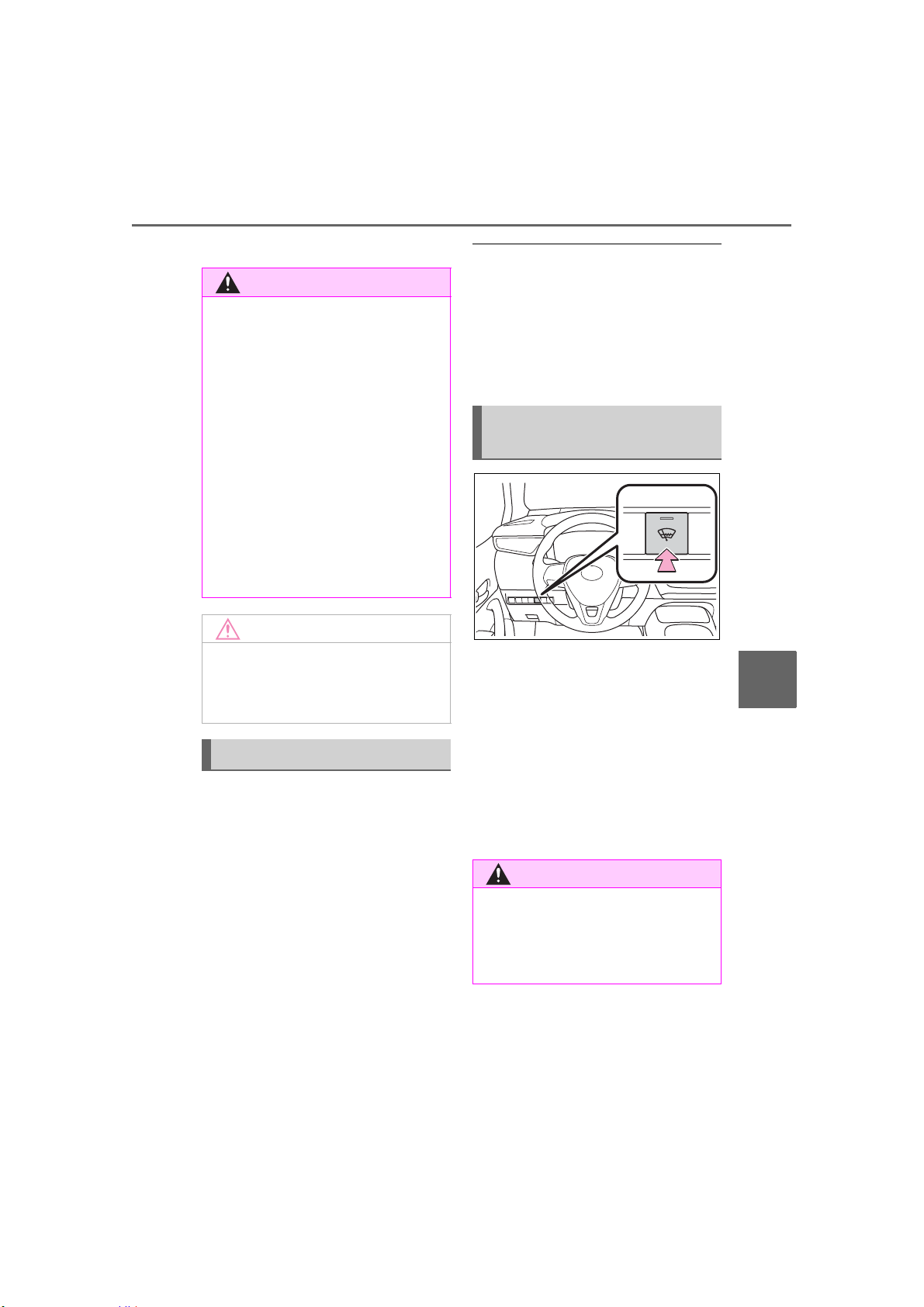
391
6-1. Using the air conditioning system and defogger
COROLLA H/B_U
6
Interior features
(P.531)
1 Press the automatic mode
switch.
2 Adjust the temperature set-
ting.
3 To stop the operation, press
the off switch.
If the fan speed setting or air
flow modes are operated, the
automatic mode indicator goes
off. However, automatic mode
for functions other than that
operated is maintained.
■ Using automatic mode
Fan speed is adjusted automati-
cally according to the temperature
setting and the ambient conditions.
Therefore, the fan may stop for a
while until warm or cool air is ready
to flow immediately after the auto-
matic mode switch pressed.
Prevent ice from building up on
the windshield and wiper
blades.
When the windshield wiper de-icer
switch is on, the indicator illumi-
nates on the windshield wiper
de-icer switch.
The windshield wiper de-icer will
automatically turn off after a period
of time.
WARNING
■ To prevent the windshield
from fogging up
Do not use the windshield defog-
ger switch during cool air opera-
tion in extremely humid weather.
The difference between the tem-
perature of the outside air and
that of the windshield can cause
the outer surface of the wind-
shield to fog up, blocking your
vision.
■ When the outside rear view
mirror defoggers are operat-
ing
Do not touch the outside rear view
mirror surfaces, as they can
become very hot and burn you.
NOTICE
■ To prevent battery discharge
Do not leave the air conditioning
system on longer than necessary
when the engine is off.
Using automatic mode
Windshield wiper de-icer
(if equipped)
WARNING
■ To prevent burns
Do not touch the glass at lower
part of the windshield or to the
side of the front pillars when the
windshield wiper de-icer is on.
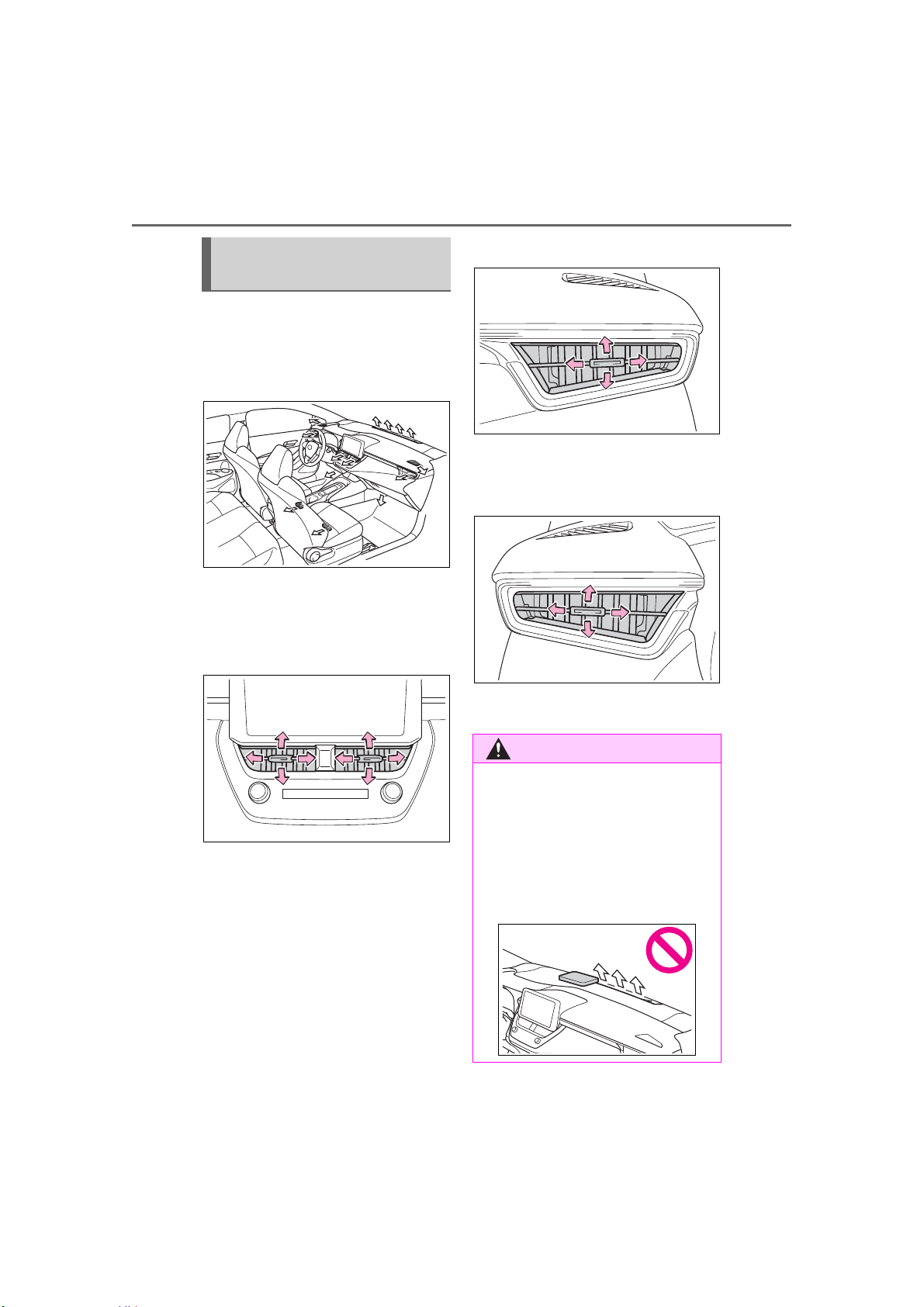
392
6-1. Using the air conditioning system and defogger
COROLLA H/B_U
■ Location of air outlets
The air outlets and air volume
changes according to the
selected air flow mode.
■ Adjusting the position of
and opening and closing
the air outlets
Front center
Direct air flow to the left or right, up
or down
Front right-hand side
Direct air flow to the left or right, up
or down
Front left-hand side
Direct air flow to the left or right, up
or down
Air outlet layout and oper-
ations
WARNING
■ To prevent the windshield
defogger from operating
improperly
Do not place anything on the
instrument panel which may cover
the air outlets. Otherwise, air flow
may be obstructed, preventing the
windshield defoggers from defog-
ging.
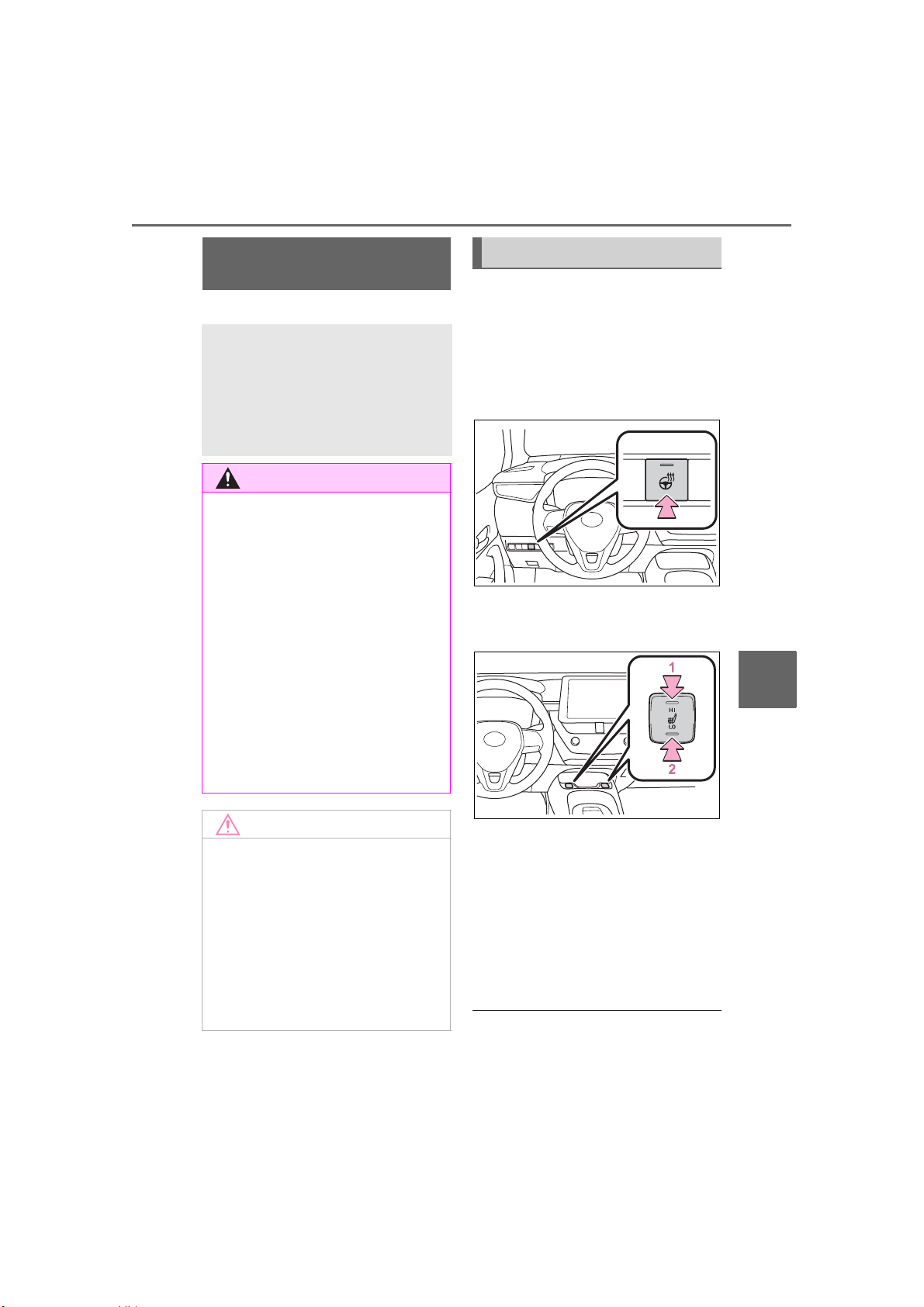
393
6-1. Using the air conditioning system and defogger
COROLLA H/B_U
6
Interior features
*
: If equipped
■ Heated steering wheel
Turns heated steering wheel
on/off
When the heated steering wheel is
on, the indicator illuminates on the
heated steering wheel switch.
■ Seat heaters
Turns seat heaters on/off
1 High temperature
2 Low temperature
When the seat heater is on, the
indicator illuminates on the seat
heater switch.
When not in use, put the switch in
the neutral position. The indicator
will turn off.
■ The heated steering wheel and
seat heaters can be used when
The engine switch is in ON.
Heated steering
wheel
*
/seat heaters
*
Heated steering wheel
Warms up the grip of the
steering wheel
Seat heaters
Warm up the seat upholstery
WARNING
■ To prevent minor burn inju-
ries
Care should be taken if anyone in
the following categories comes in
contact with the steering wheel or
seats when the heater is on:
● Babies, small children, the
elderly, the sick and the physi-
cally challenged
● Persons with sensitive skin
● Persons who are fatigued
● Persons who have taken alco-
hol or drugs that induce sleep
(sleeping drugs, cold remedies,
etc.)
NOTICE
■ To prevent damage to the
seat heaters
Do not put heavy objects that
have an uneven surface on the
seat and do not stick sharp
objects (needles, nails, etc.) into
the seat.
■ To prevent battery discharge
Do not use the functions when the
engine is off.
Operation instructions

394
6-1. Using the air conditioning system and defogger
COROLLA H/B_U
WARNING
■ To prevent overheating and
minor burn injuries
Observe the following precautions
when using the seat heaters.
● Do not cover the seat with a
blanket or cushion when using
the seat heater.
● Do not use seat heater more
than necessary.
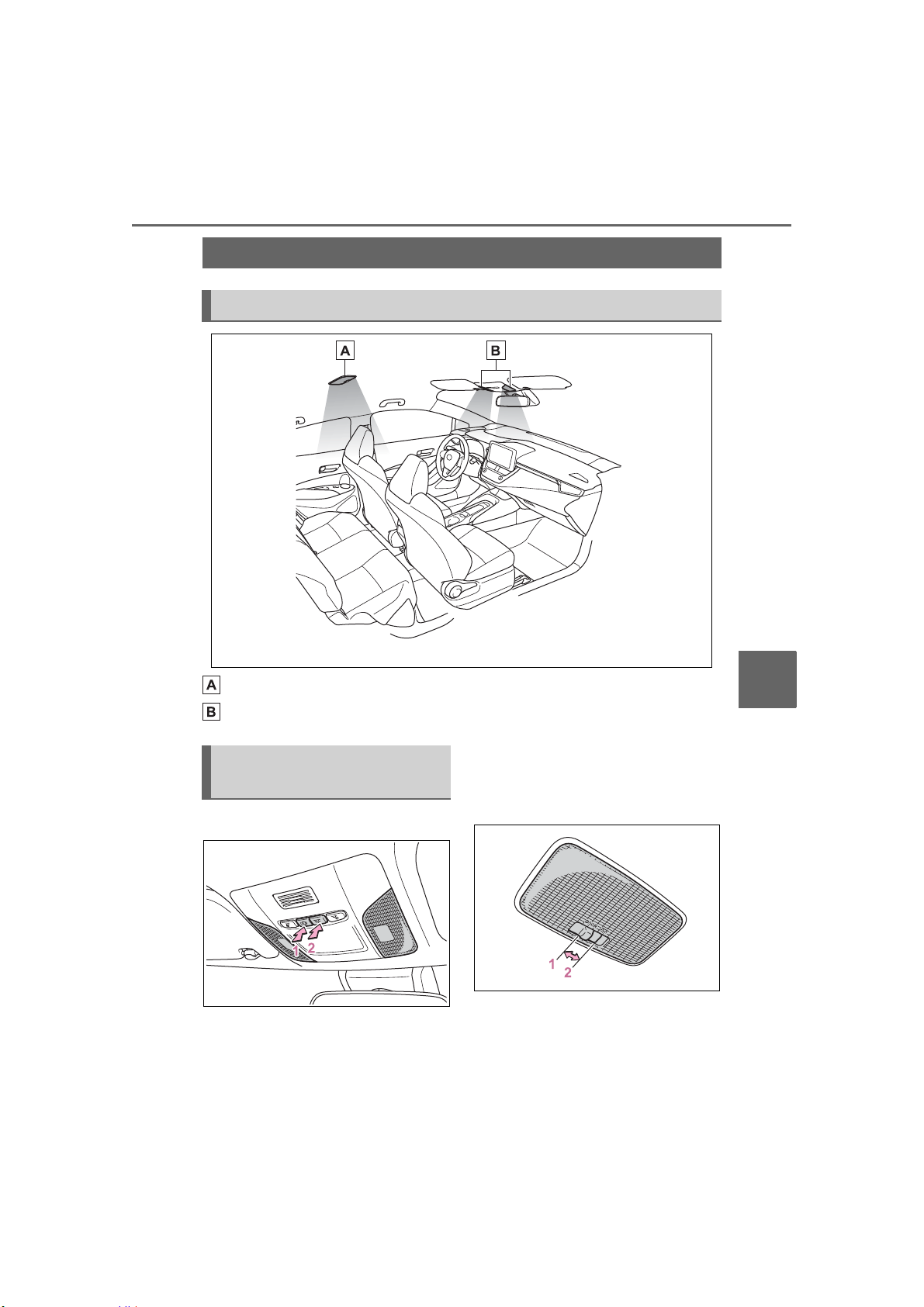
395
6-2. Using the interior lights
COROLLA H/B_U
6
Interior features
6-2.Using the interior lights
Rear interior light (P.395)
Front interior/personal lights (P.395)
■ Front
1 Turns the door position on/off
When a door is opened while the
door position is on, the lights turn
on.
2 Turns the lights on/off
■ Rear
1 Turns the door position on
The rear interior light turns on/off
together the front interior lights.
When a door is opened while the
Interior lights list
Location of the interior lights
Operating the interior
lights
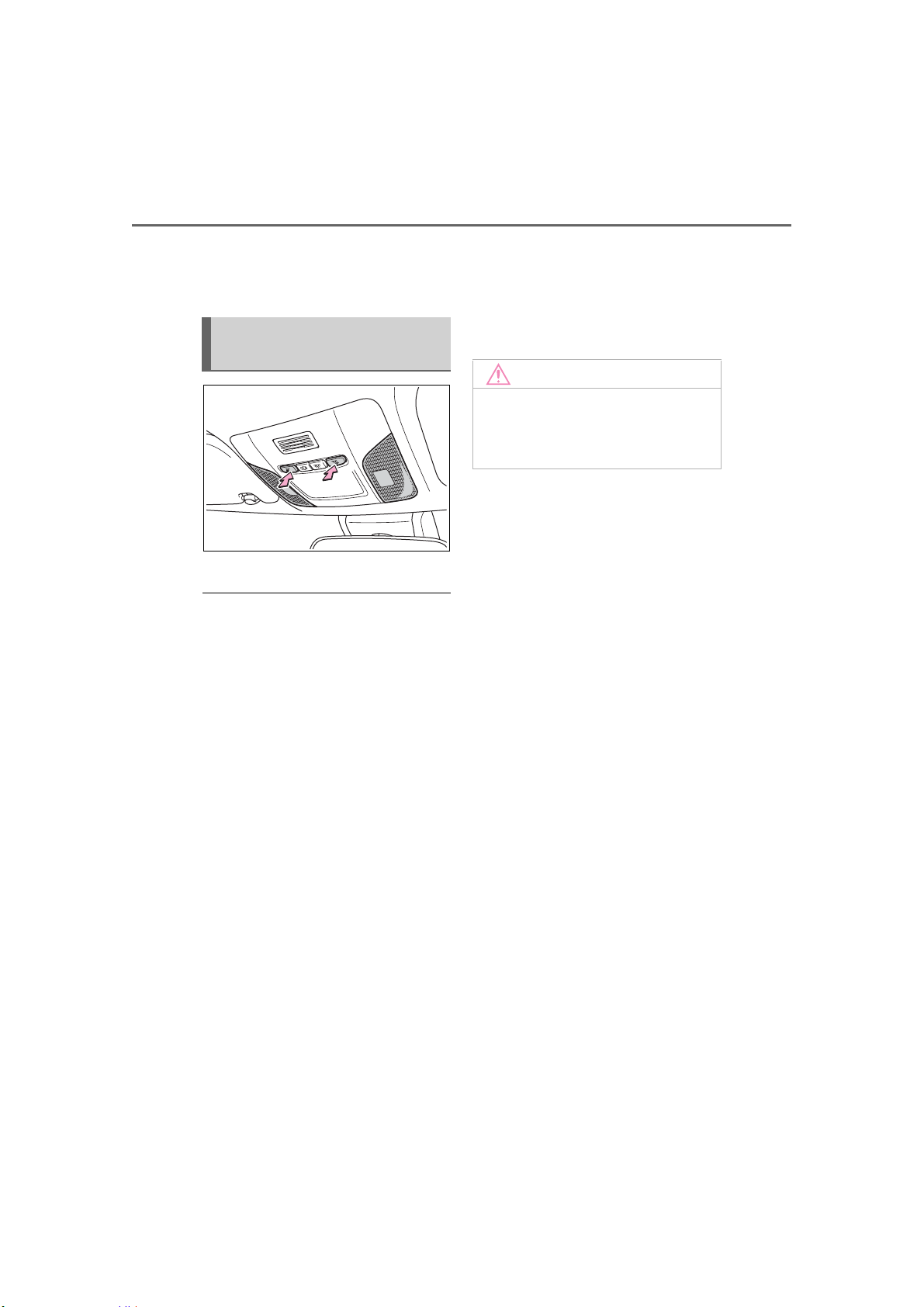
396
6-2. Using the interior lights
COROLLA H/B_U
front and rear interior light door
position is on, the lights turn on.
2 Turns the light on
Turns the lights on/off
■ Illuminated entry system
The lights automatically turn on/off
according to the engine switch
mode, the presence of the elec-
tronic key, whether the doors are
locked/unlocked, and whether the
doors are opened/closed.
■ To prevent the battery from
being discharged
If the interior lights remain on when
the engine switch is turned off, the
lights will go off automatically after
20 minutes.
■ If the SRS airbags deploy
(inflate)
If any of the SRS airbags deploy
(inflate) or in the event of a strong
rear impact, the interior lights will
turn on automatically.
The interior lights will turn off auto-
matically after approximately 20
minutes.
The interior lights can be turned off
manually. However, in order to help
prevent further collisions, it is rec-
ommended that they be left on until
safety can be ensured.
(The interior lights may not turn on
automatically depending on the
force of the impact and conditions of
the collision.)
■ Customization
Some functions can be customized.
(P.531)
Operating the personal
lights
NOTICE
■ To prevent battery discharge
Do not leave the lights on longer
than necessary when the engine
is not running.
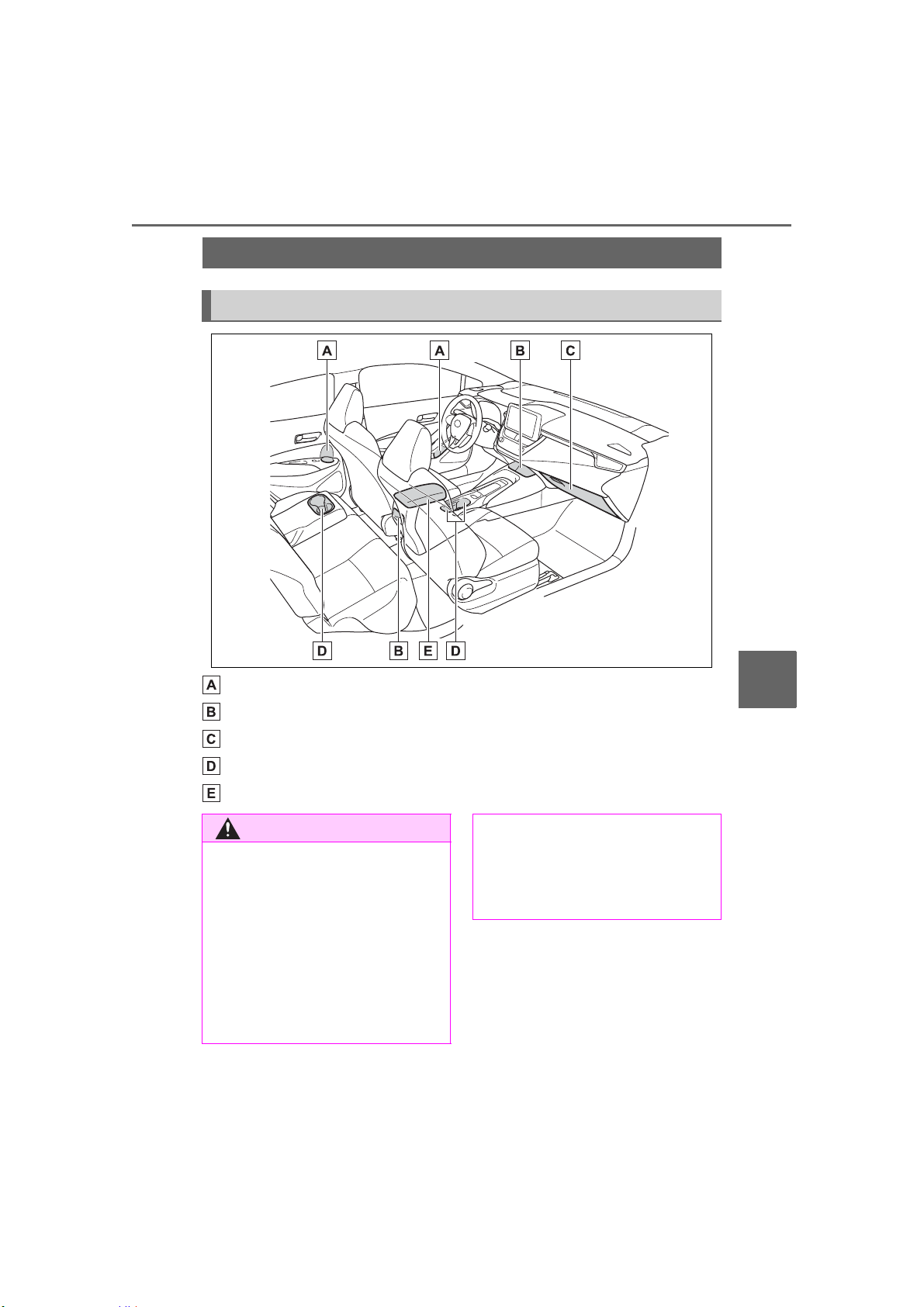
397
6-3. Using the storage features
COROLLA H/B_U
6
Interior features
6-3.Using the storage featur es
Bottle holders (P.398)
Open trays (P.399)
Glove box (P.398)
Cup holders (P.398)
Console box (P.399)
List of storage features
Location of the storage features
WARNING
■ Items that should not be left
in the storage spaces
Do not leave glasses, lighters or
spray cans in the storage spaces,
as this may cause the following
when cabin temperature becomes
high:
● Glasses may be deformed by
heat or cracked if they come
into contact with other stored
items.
● Lighters or spray cans may
explode. If they come into con-
tact with other stored items, the
lighter may catch fire or the
spray can may release gas,
causing a fire hazard.
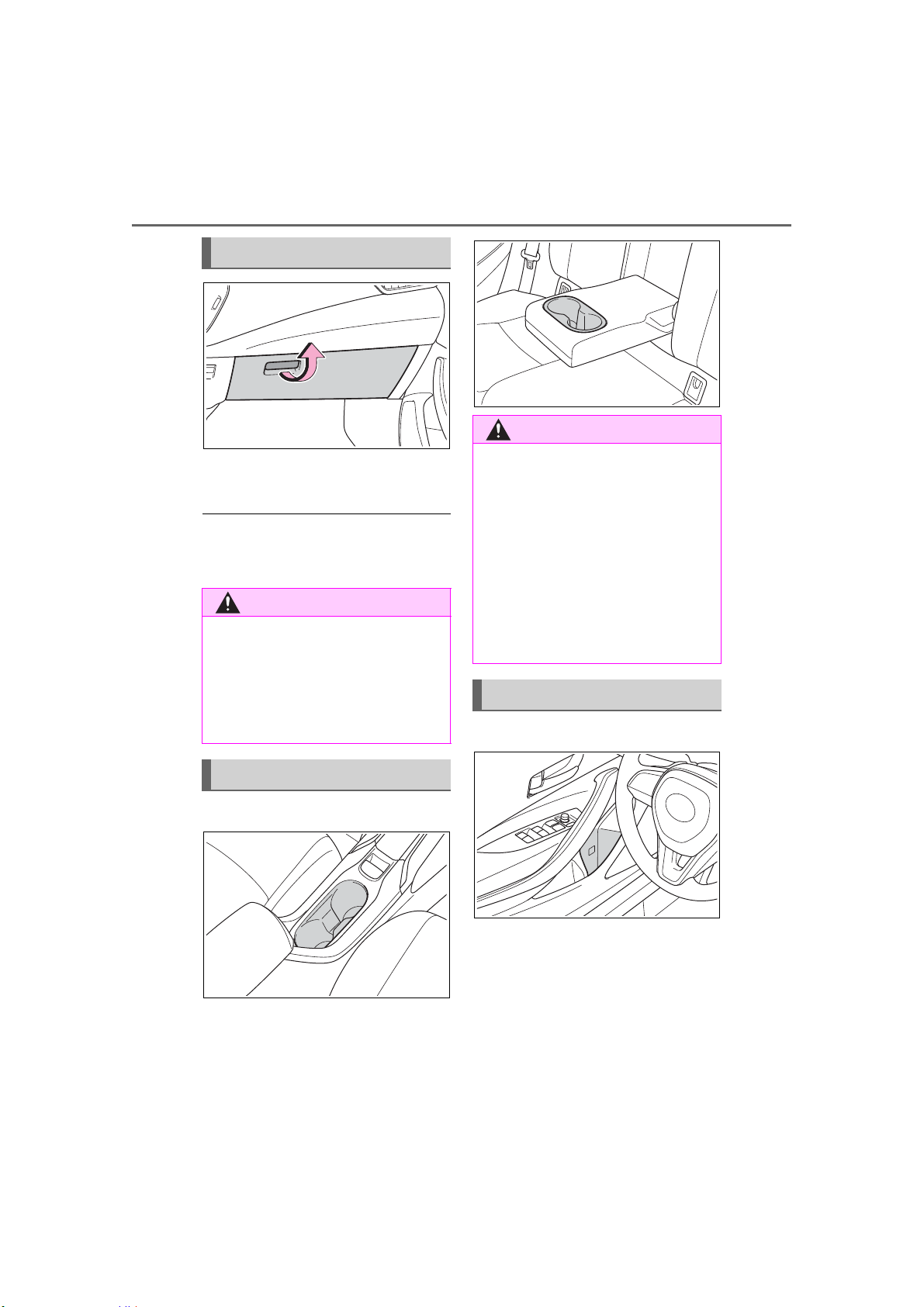
398
6-3. Using the storage features
COROLLA H/B_U
Pull up the lever to open the
glove box.
■ Glove box light
The glove box light turns on when
the tail lights are on.
Front
Rear
Pull the armrest down.
Front
Glove box
WARNING
■ Caution while driving
Keep the glove box closed. In the
event of sudden braking or sud-
den swerving, an accident may
occur due to an occupant being
struck by the open glove box or
the items stored inside.
Cup holders
WARNING
■ Items unsuitable for the cup
holder
Do not place anything other than
cups or beverage cans in the cup
holders.
Inappropriate items must not be
stored in the cup holders even if
the lid is closed.
Other items may be thrown out of
the holders in the event of an
accident or sudden braking and
cause injury. If possible, cover hot
drinks to prevent burns.
Bottle holders
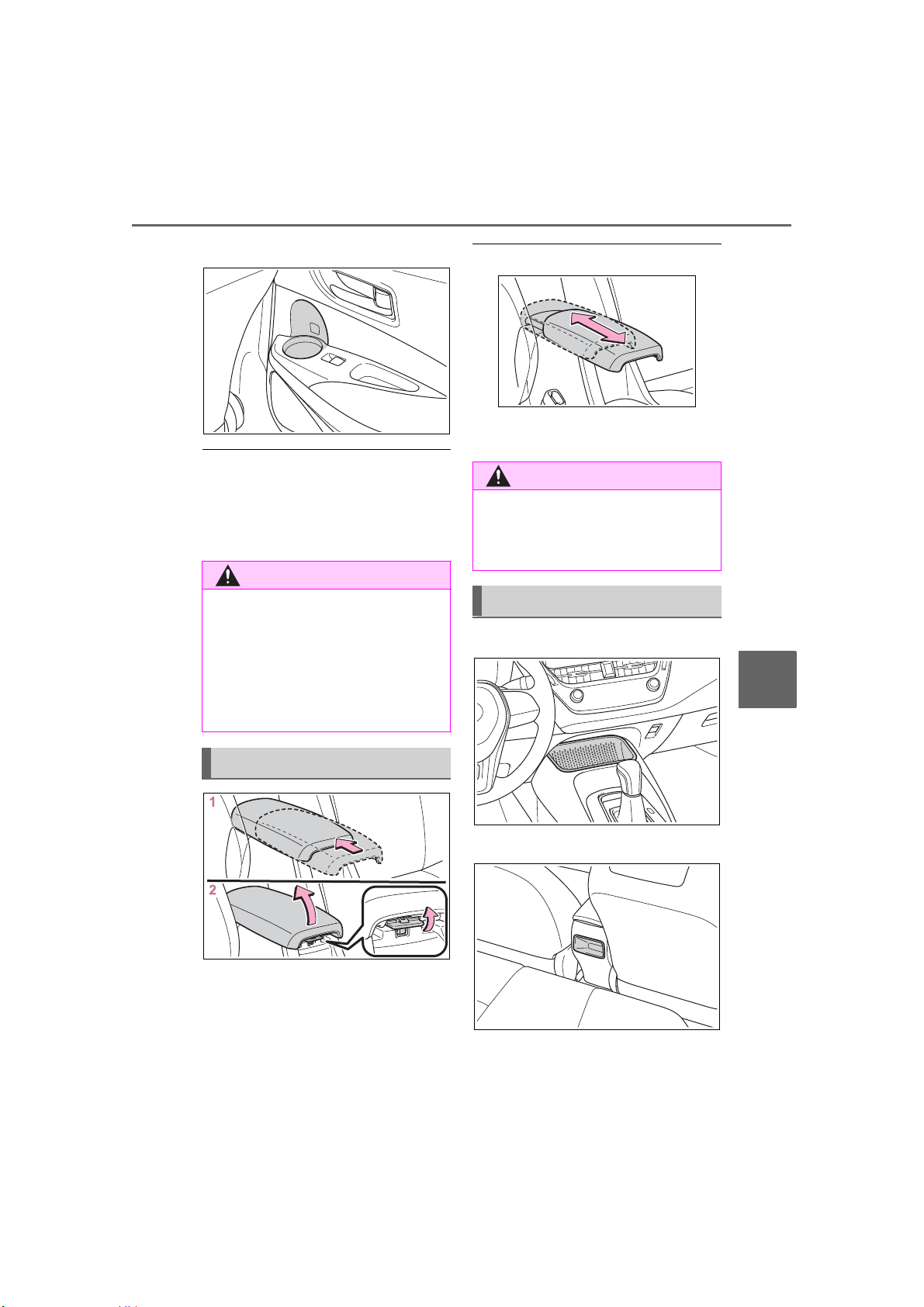
399
6-3. Using the storage features
COROLLA H/B_U
6
Interior features
Rear
■ Bottle holders
● When storing a bottle, close the
cap.
● The bottle may not be stored
depending on its size or shape.
1 Slide the lid to the rear most
position. (vehicles with a
slide function)
2 Lift the lid while pulling up the
knob.
■ Slide function (if equipped)
The console box lid can be slid for-
ward or backward.
Front (if equipped)
Rear
WARNING
■ Items unsuitable for the bottle
holders
Do not place anything other than
a bottle in the bottle holders.
Other items may be thrown out of
the holders in the event of an
accident or sudden braking and
cause injury.
Console box
WARNING
■ Caution while driving
Keep the console box closed.
Injuries may result in the event of
an accident or sudden braking.
Open tray

400
6-3. Using the storage features
COROLLA H/B_U
The cargo hooks are provided
for securing loose items.
WARNING
■ Caution while driving
Observe the following precautions
when putting items in the open
tray. Failure to do so may cause
items to be thrown out of the tray
in the event of sudden braking or
steering. In these cases, the items
may interfere with pedal operation
or cause driver distraction, result-
ing in an accident.
● Do not store items in the tray
that can easily shift or roll out.
● Do not stack items in the tray
higher than the tray’s edge.
● Do not put items in the tray that
may protrude over the tray’s
edge.
Luggage compart-
ment features
Cargo hooks
WARNING
■ When cargo hooks are not in
use
To avoid injury, always return the
hooks to their stowed positions
when not in use.
Grocery bag hooks
WARNING
■ To prevent damage to the gro-
cery bag hooks
Do not hang any object heavier
than 4.4 lb. (2 kg) on the grocery
bag hooks.
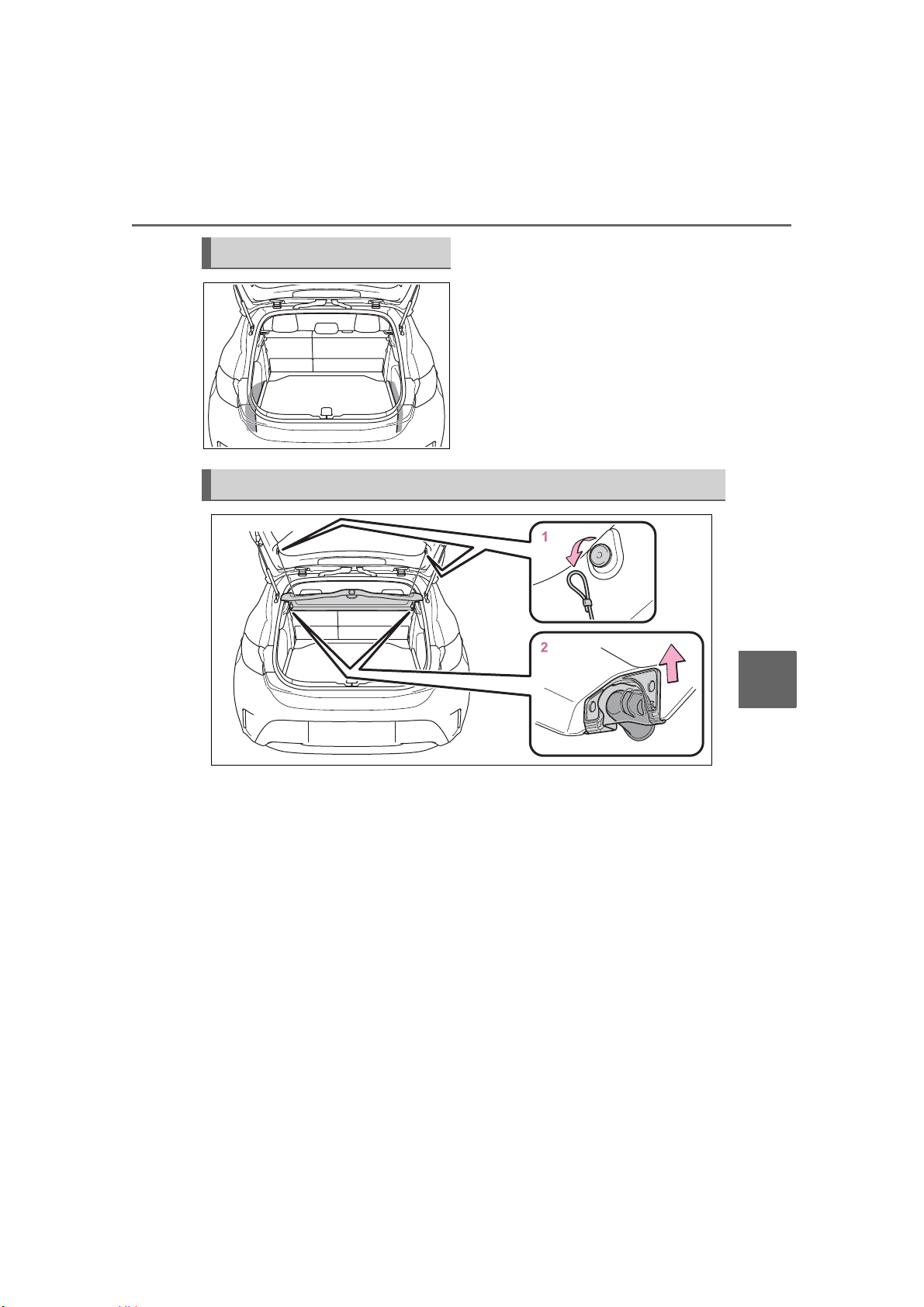
401
6-3. Using the storage features
COROLLA H/B_U
6
Interior features
1 Unhook the cords.
2 Remove the cover from the anchors.
Side tray (if equipped)
Removing the luggage cover
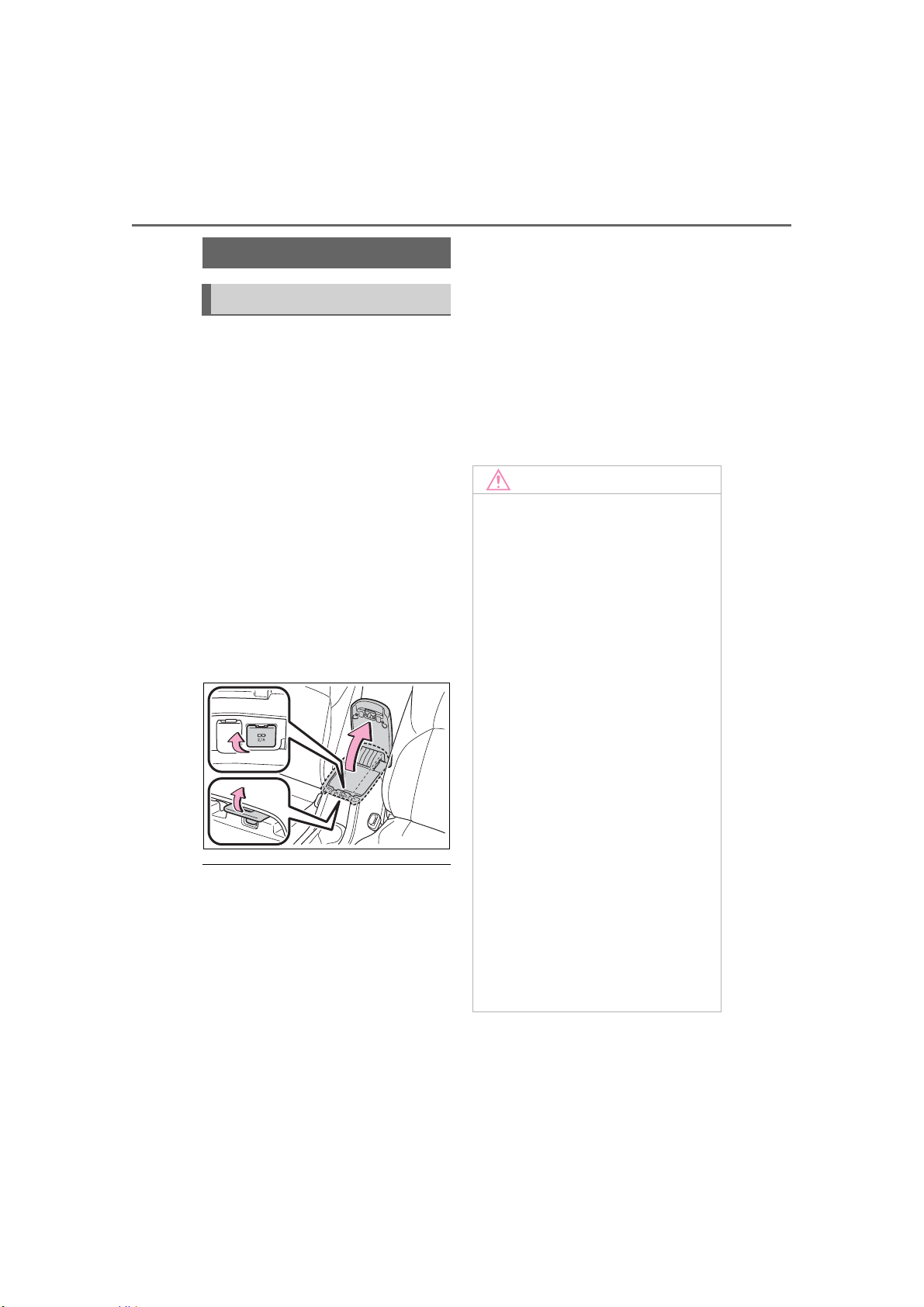
402
6-4. Other interior features
COROLLA H/B_U
6-4.Other in terior features
The USB charging port are used
to supply 2.1 A of electricity at 5
V to external devices.
The USB charging port are for
charging only. They are not
designed for data transfer or
other purposes.
Depending on the external
device, it may not charge prop-
erly. Refer to the manual
included with the device before
using a USB charging port.
■ Using the USB charging
port
Open the console box lid and
open the lid.
■ The USB charging port can be
used when
The engine switch is in ACC or ON.
■ Situations in which the USB
charging port may not operate
correctly
● If a device which consumes more
than 2.1 A at 5 V is connected
● If a device designed to communi-
cate with a personal computer,
such as a USB memory device, is
connected
● If the connected external device is
turned off (depending on device)
● If the temperature inside the vehi-
cle is high, such as after the vehi-
cle has been parked in the sun
■ About connected external
device
Depending on the connected exter-
nal device, charging may occasion-
ally be suspended and then start
again. This is not a malfunction.
Other interior features
USB charging port
NOTICE
■ To prevent damage to the
USB charging port
● Do not insert foreign objects into
the port.
● Do not spill water or other liq-
uids into the port.
● When the USB charging port
are not in use, close the lids. If a
foreign object or liquid enters a
port may cause a short circuit.
● Do not apply excessive force to
or impact the USB charging
port.
● Do not disassemble or modify
the USB charging port.
■ To prevent damage to exter-
nal devices
● Do not leave external devices in
the vehicle. The temperature
inside the vehicle may become
high, resulting in damage to an
external device.
● Do not push down on or apply
unnecessary force to an exter-
nal device or the cable of an
external device while it is con-
nected.
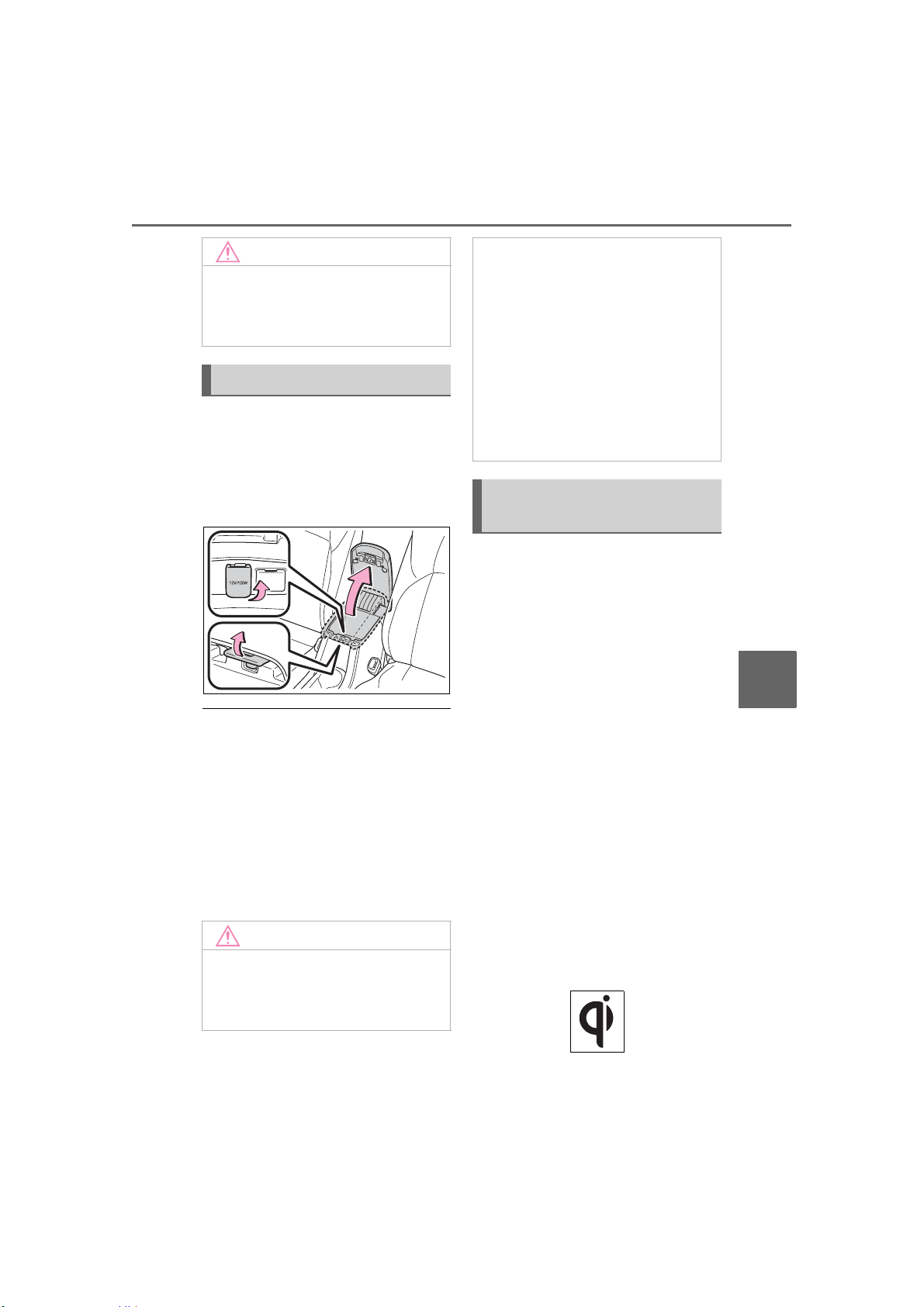
403
6-4. Other interior features
COROLLA H/B_U
6
Interior features
The power outlet can be used
for 12 V accessories that run on
less than 10 A.
Open the console box lid and
open the lid.
■ The power outlet can be used
when
The engine switch is in ACC or ON.
■ When turning the engine switch
off
Disconnect electrical devices with
charging functions, such as mobile
battery packs.
If such devices are left connected,
the engine switch may not be turned
off normally.
A portable device, such as a
smartphone or mobile battery,
can be charged by just placing it
on the charging area, provided
the device is compatible with the
Qi wireless charging standard
created by the Wireless Power
Consortium.
The wireless charger cannot be
used with a portable device that
is larger than the charging area.
Additionally, depending on the
portable device, the wireless
charger may not operate prop-
erly. Refer to the operation man-
ual of the portable device.
■ The “Qi” symbol
The “Qi” symbol is a trademark
of the Wireless Power Consor-
tium.
NOTICE
■ To prevent battery discharge
Do not use the USB charging port
for a long period of time with the
engine stopped.
Power outlets
NOTICE
■ To prevent the fuse from
being blown
Do not use an accessory that
uses more than 12 V 10 A.
■ To avoid damaging the power
outlet
Close the power outlet lid when
the power outlet is not in use.
Foreign objects or liquids that
enter the power outlet may cause
a short circuit.
■ To prevent the battery from
being discharged
Do not use the power outlet lon-
ger than necessary when the
engine is not running.
Wireless charger (if
equipped)
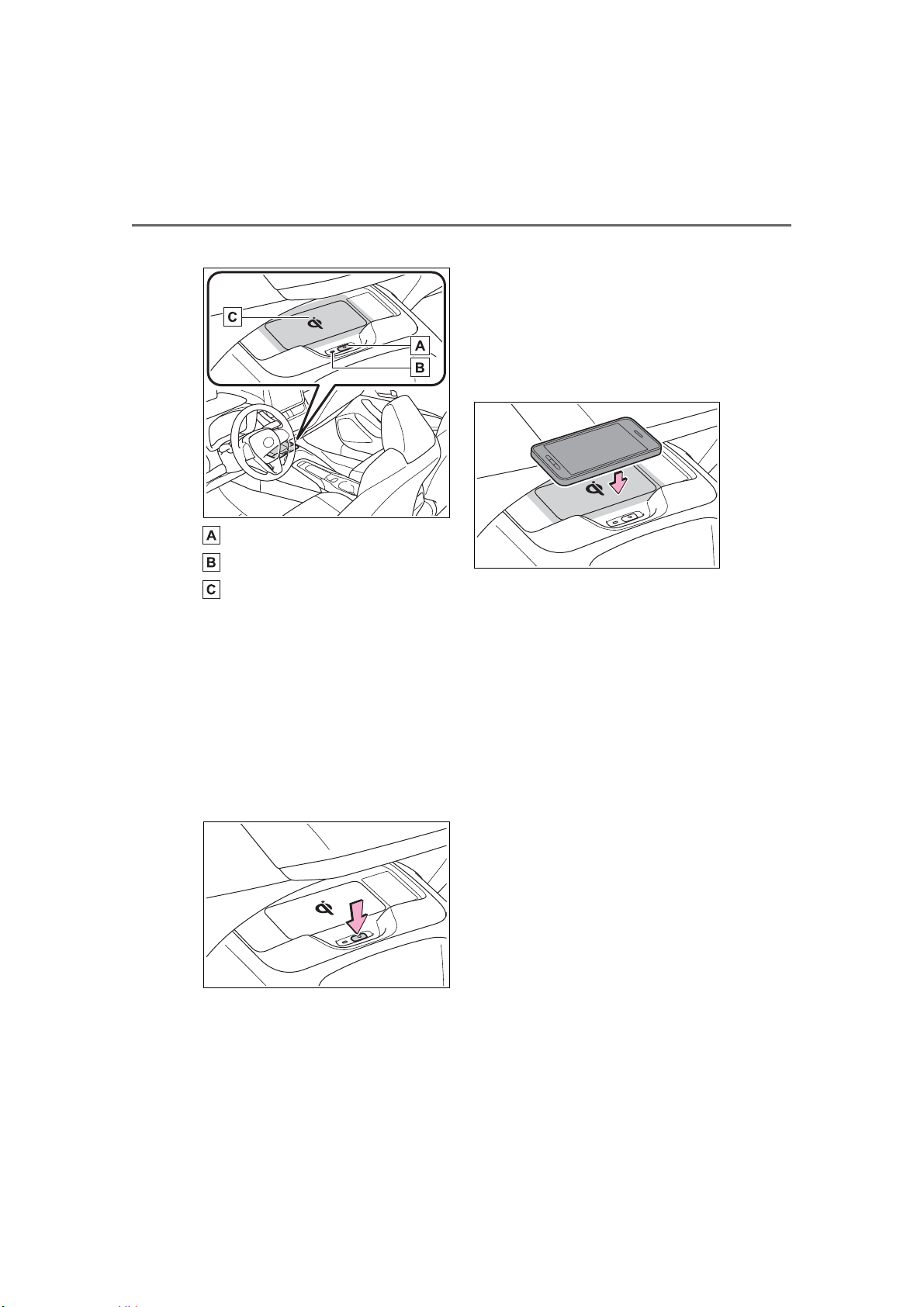
404
6-4. Other interior features
COROLLA H/B_U
■ Name for all parts
Power supply switch
Operation indicator light
Charge area
■ Using the wireless charger
1 Press the power supply
switch of the wireless char-
ger.
Pressing the switch again turns the
wireless charger off.
When turned on, the operation indi-
cator light (green) comes on.
When the engine switch is turned
off, the on/off state of the wireless
charger will be memorized.
2 Place a portable device on
the charging area with its
charging surface facing
down.
While charging, the operation indi-
cator light (orange) will be illumi-
nated.
If charging does not begin, move
the portable device as close to the
center of the charging area as pos-
sible.
When charging is complete, the
operation indicator light (green) will
illuminate.
■ Recharging function
If a certain amount of time has
elapsed since charging com-
pleted and the portable device
has not been moved, the
wireless charger will restart
charging.
If the portable device is
moved within the charging
area, charging will stop tem-
porarily then restart.
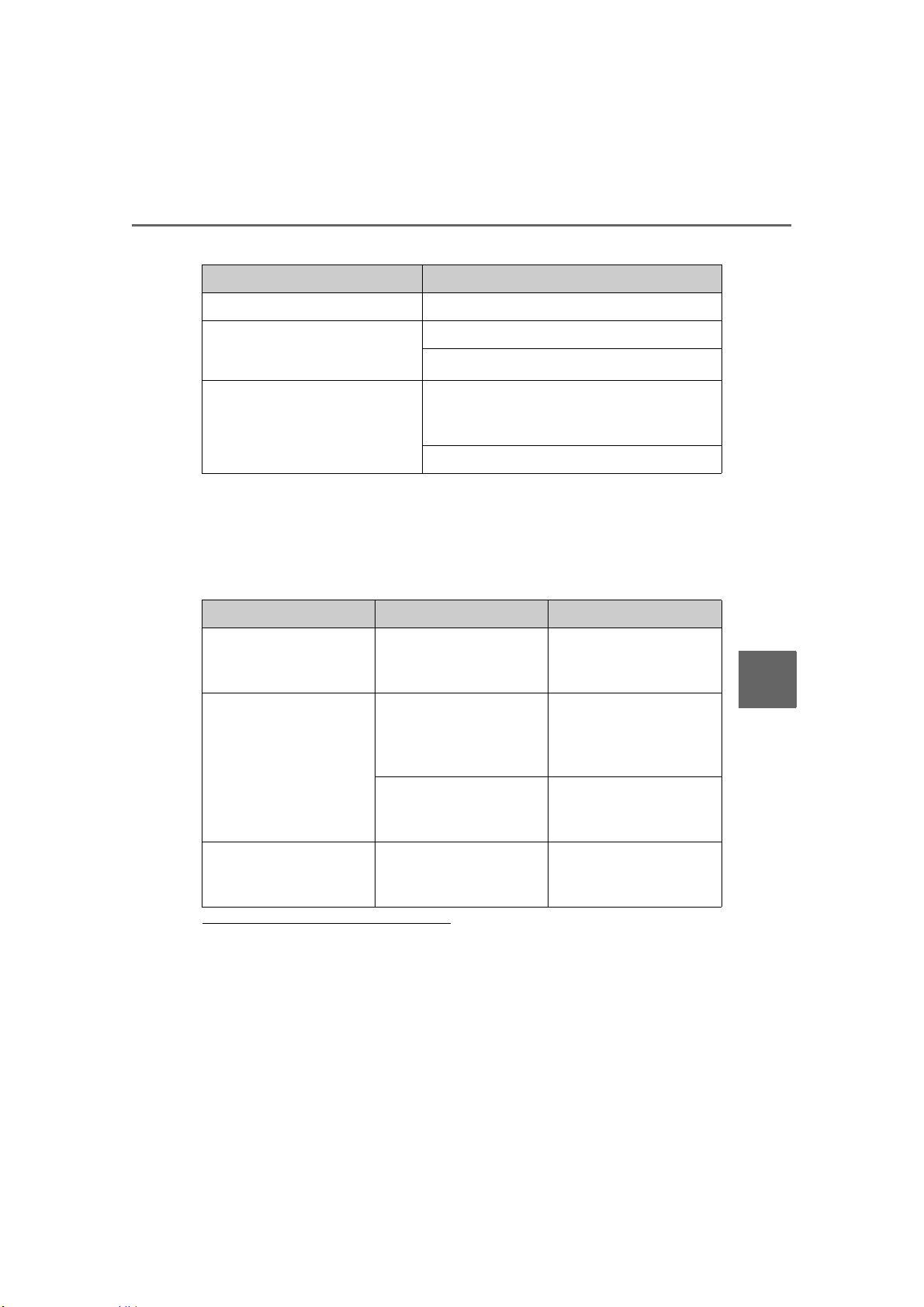
405
6-4. Other interior features
COROLLA H/B_U
6
Interior features
■ Operation indicator light status
*
: Depending on the portable device, the operation indicator light may stay
illuminated (orange) after charging has completed.
If the operation indicator light blinks
If an error is detected, the operation indicator light will blink (orange). Take
the appropriate measures according to the table below.
■ The wireless charger can be
operated when
The engine switch is in ACC or ON.
■ Portable devices that can be
charged
● Portable devices compatible with
the Qi wireless charging standard
can be charged by the wireless
charger. However, compatibility
with all devices which meet the Qi
wireless charging standard is not
guaranteed.
● The wireless charger is designed
to supply low power electricity (5
W or less) to a cellular phone,
smartphone, or other portable
device.
Operation indicator light State
Off The Wireless charger is off
Green (illuminated)
Standby (charging is possible)
Charging is complete
*
Orange (illuminated)
A portable device has been placed on the
charging area (identifying the portable
device)
Charging in progress
Operation indicator light Suspected cause Measure
Blinks (orange) at a one
second interval continu-
ously
Vehicle to charger com-
munication failure.
Contact your Toyota
dealer.
Blinks (orange) 3 times
repeatedly
A foreign object exists
between the portable
device and charging
area.
Remove the foreign
object.
Portable device is not
positioned properly on
the charging area.
Move the portable
device toward the cen-
ter of the charging area.
Blinks (orange) 4 times
repeatedly
The temperature of the
wireless charger is
excessively high.
Stop charging immedi-
ately and continue
charging after a while.
406
6-4. Other interior features
COROLLA H/B_U
■ If a cover or accessory is
attached to the portable device
Do not charge a portable device if a
cover or accessory which is not Qi
compatible is attached. Depending
on the type of cover and/or acces-
sory attached, it may not be possi-
ble to charge the portable device. If
the portable device is placed on the
charging area and does not charge,
remove the cover and/or accesso-
ries.
■ If interference is heard in AM
radio broadcasts while
charging
Turn off the wireless charger and
check if the noise is reduced. If
noise is reduced, press and hold the
power supply switch of the wireless
charger for 2 seconds. The fre-
quency of the wireless charger is
changed and noise may be
reduced. When the frequency is
changed, the operation indicator
light will blink (orange) 2 times.
■ Charging precautions
● If the electronic key cannot be
detected in the cabin, charging
cannot be performed. When a
door is opened and closed,
charging may be temporarily sus-
pended.
● While charging, the wireless char-
ger and the portable device will
become warm.
This is not a malfunction.If a porta-
ble device becomes warm while
charging and charging stops due
to the protection function of the
portable device, wait until the por-
table device cools down and
charge it again.
■ Sound generated during opera-
tion
When the power supply switch is
turned on or while a portable device
is being identified, operation sounds
may be heard. This is not a malfunc-
tion.
■ Cleaning the wireless charger
P.417
■ Certification for the wireless charger
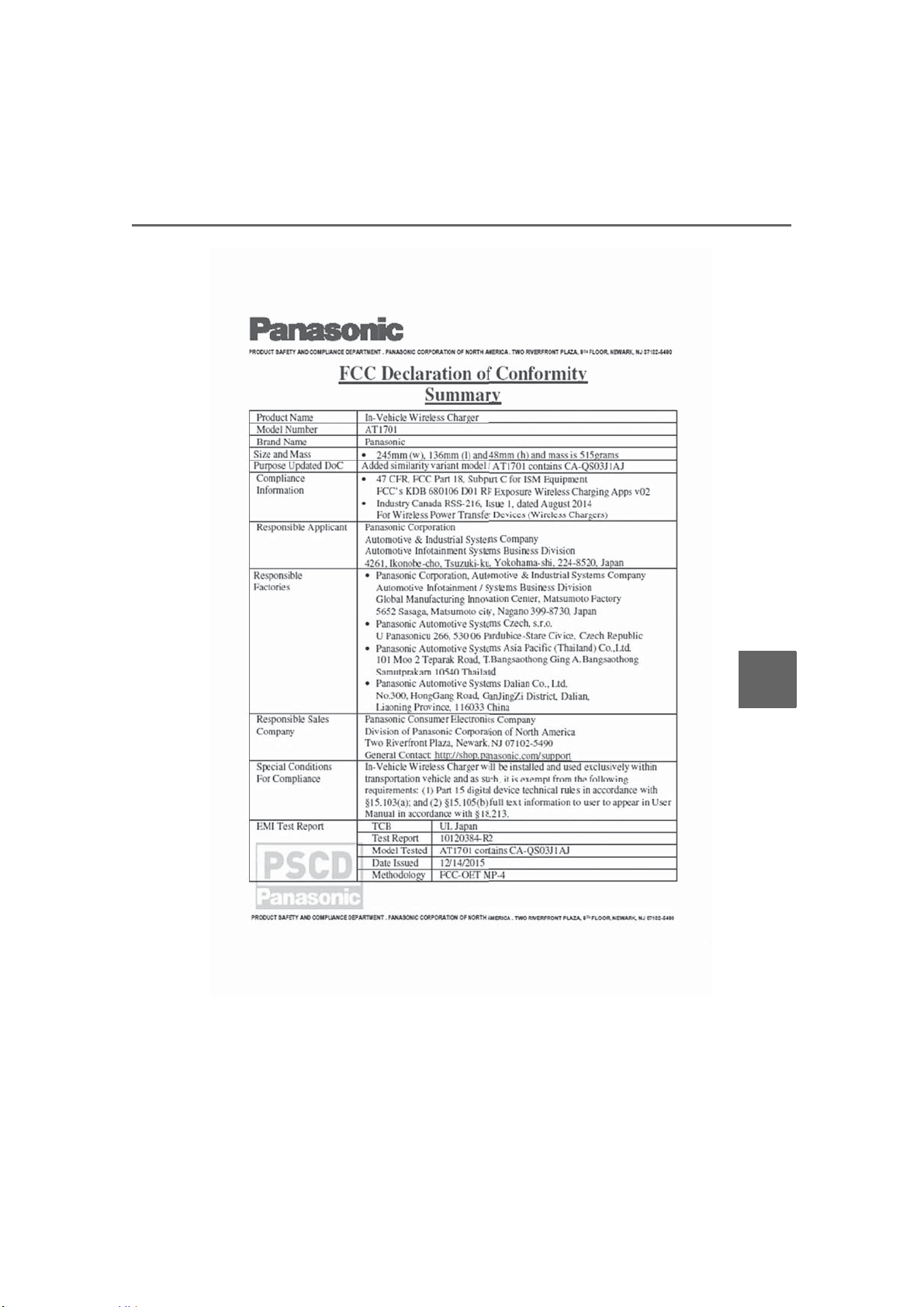
407
6-4. Other interior features
COROLLA H/B_U
6
Interior features
408
6-4. Other interior features
COROLLA H/B_U

409
6-4. Other interior features
COROLLA H/B_U
6
Interior features
WARNING
■ Caution while driving
When charging a portable device
while driving, for safety reasons,
the driver should not operate the
portable device.
■ Caution regarding interfer-
ence with electronic devices
People with implantable cardiac
pacemakers, cardiac resynchroni-
zation therapy pacemakers or
implantable cardioverter defibrilla-
tors, as well as any other electri-
cal medical device, should consult
their physician about the usage of
the wireless charger.
Operations of the wireless char-
ger may have an affect on medi-
cal devices.
■ To prevent damage or burns
Observe the following precau-
tions.
Failure to do so may result in the
possibility of fire, equipment fail-
ure or damage, or burns due to
heat.
● Do not put any metallic objects
between the charging area and
the portable device while
charging.
● Do not attach metallic objects,
such as aluminum stickers, to
the charging area.
● Do not cover the wireless char-
ger with a cloth or other object
while charging.
● Do not attempt to charge porta-
ble devices which are not com-
patible with the Qi wireless
charging standard.
● Do not disassemble, modify or
remove the wireless charger.
● Do not apply force or impact to
the wireless charger.
NOTICE
■ Conditions in which the wire-
less charger may not operate
correctly
In the following situations, the
wireless charger may not operate
correctly:
● When a portable device is fully
charged
● When there is a foreign object
between the charging area and
portable device
● When a portable device
becomes hot while charging
● When a portable device is
placed on the wireless area with
its charging surface facing up
● When a portable device is not
centered on the charging area
● When the vehicle is near a TV
tower, electric power plant, gas
station, radio station, large dis-
play, airport or other facility that
generates strong radio waves or
electrical noise
● When the portable device is in
contact with, or is covered by
any of the following metallic
objects:
• Cards to which aluminum foil is
attached
• Cigarette boxes that have alu-
minum foil inside
• Metallic wallets or bags
• Coins
• Metal hand warmers
• Media such as CDs and DVDs
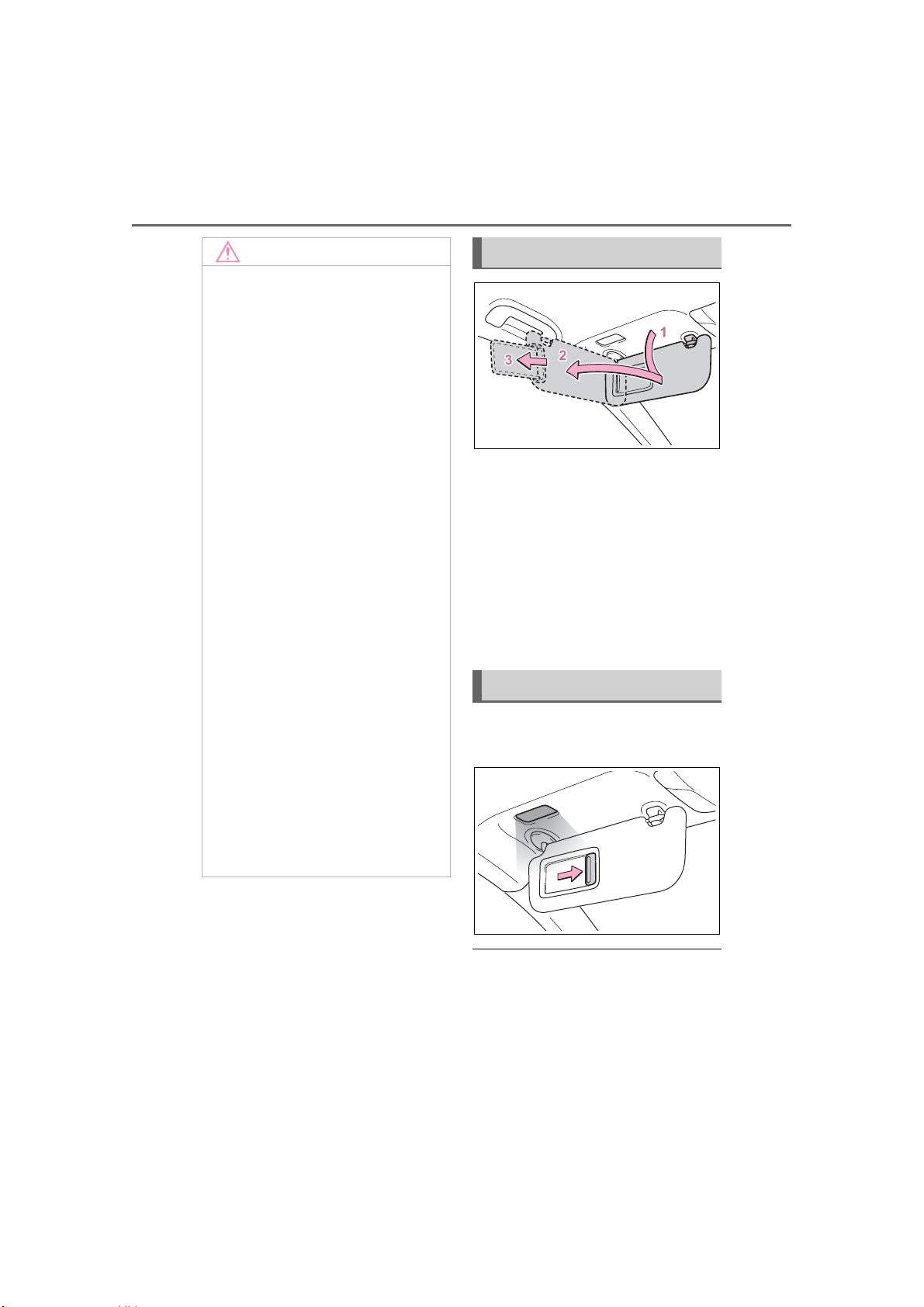
410
6-4. Other interior features
COROLLA H/B_U
1 To set the visor in the forward
position, flip it down.
2 To set the visor in the side
position, flip down, unhook,
and swing it to the side.
3 To use the side extender,
place the visor in the side
position, then slide it back-
ward.
Slide the cover to open.
The vanity light turns on.
■ To prevent battery discharge
If the vanity lights remain on when
the engine switch is OFF, the lights
will go off automatically after 20 min-
utes.
NOTICE
● When wireless keys (that emit
radio waves) other than those of
your vehicle are being used
nearby.
If in situations other than above
the wireless charger does not
operate properly or the operation
indicator light is blinking, the wire-
less charger may be malfunction-
ing. Contact your Toyota dealer.
■ To prevent failure or damage
to data
● Do not bring magnetic cards,
such as a credit card, or mag-
netic recording media, close to
the wireless charger while
charging. Otherwise, data may
be erased due to the influence
of magnetism.
Additionally, do not bring preci-
sion instruments such as wrist
watches, close to the wireless
charger, as such objects may
malfunction.
● Do not leave portable devices in
the cabin. The temperature
inside the cabin may become
high when parked in the sun,
and cause damage to the
device.
■ To prevent battery discharge
Do not use the wireless charger
for a long period of time with the
engine stopped.
Sun visors
Vanity mirrors
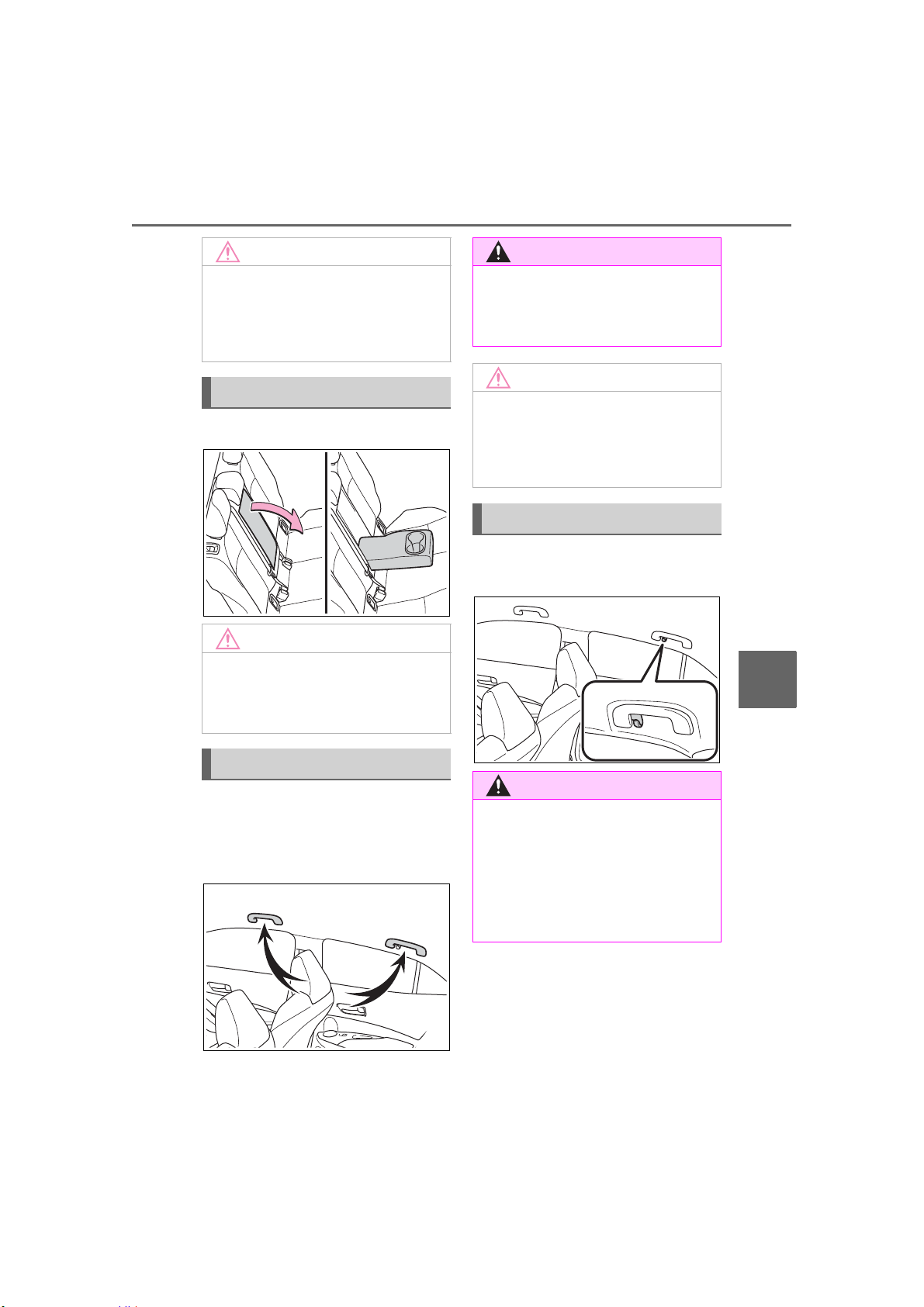
411
6-4. Other interior features
COROLLA H/B_U
6
Interior features
Fold down the armrest for use.
An assist grip installed on the
ceiling can be used to support
your body while sitting on the
seat.
The coat hooks are provided
with the rear assist grips.
NOTICE
■ To prevent the battery from
being discharged
Do not leave the vanity lights on
for extended periods while the
engine is stopped.
Armrest
NOTICE
■ To prevent damage to the
armrest
Do not apply too much load on the
armrest.
Assist grips
WARNING
■ Assist grip
Do not use the assist grip when
getting in or out of the vehicle or
rising from your seat.
NOTICE
■ To prevent damage to the
assist grip
Do not hang any heavy object or
put a heavy load on the assist
grip.
Coat hooks
WARNING
■ Items that cannot be hung on
the coat hook
Do not hang coat hangers or
other hard or sharp objects on the
hook. If the SRS curtain shield air-
bags deploy, these items may
become projectiles, causing death
or serious injury.

412
6-4. Other interior features
COROLLA H/B_U

413
COROLLA H/B_U
7
7
Maintenance and care
Maintenance and care
.
7-1. Maintenance and care
Cleaning and protecting the
vehicle exterior.......... 414
Cleaning and protecting the
vehicle interior........... 416
7-2. Maintenance
Maintenance requirements
.................................. 419
General maintenance.. 420
Emission inspection and
maintenance (I/M) pro-
grams ........................ 423
7-3. Do-it-yourself mainte-
nance
Do-it-yourself service pre-
cautions..................... 425
Hood ........................... 427
Positioning a floor jack
.................................. 428
Engine compartment... 429
Tires ............................ 436
Tire inflation pressure.. 445
Wheels ........................ 447
Air conditioning filter.... 449
Electronic key battery.. 450
Checking and replacing
fuses.......................... 452
Light bulbs................... 455

414
7-1. Maintenance and care
COROLLA H/B_U
7-1.Maintenance and care
Working from top to bottom,
liberally apply water to the
vehicle body, wheel wells and
underside of the vehicle to
remove any dirt and dust.
Wash the vehicle body using
a sponge or soft cloth, such
as a chamois.
For hard-to-remove marks,
use car wash soap and rinse
thoroughly with water.
Wipe away any water.
Wax the vehicle when the
waterproof coating deterio-
rates.
If water does not bead on a clean
surface, apply wax when the vehi-
cle body is cool.
■ Automatic car washes
● Fold the mirrors before washing
the vehicle. Start washing from the
front of the vehicle. Make sure to
extend the mirrors before driving.
● Brushes used in automatic car
washes may scratch the vehicle
surface and harm your vehicle’s
paint.
● In certain automatic car washes,
the rear spoiler may interfere with
machine operation. This may pre-
vent the vehicle from being
cleaned properly or result in dam-
age to the rear spoiler.
■ High pressure car washes
As water may enter the cabin, do
not bring the nozzle tip near the
gaps around the doors or perimeter
of the windows, or spray these
areas continuously.
■ When using a car wash
If the door handle becomes wet
while the electronic key is within the
effective range, the door may lock
and unlock repeatedly. In that case,
follow the following correction pro-
cedures to wash the vehicle:
● Place the key in a position 6 ft. (2
m) or more separate from the
vehicle while the vehicle is being
washed. (Take care to ensure that
the key is not stolen.)
● Set the electronic key to bat-
tery-saving mode to disable the
smart key system. (P.109)
■ Aluminum wheels (if equipped)
● Remove any dirt immediately by
using a neutral detergent.
● Wash detergent off with water
immediately after use.
● To protect the paint from damage,
make sure to observe the follow-
ing precautions.
• Do not use acidic, alkaline or
abrasive detergent
• Do not use hard brushes
• Do not use detergent on the
wheels when they are hot, such
as after driving or parking in hot
weather
■ Bumpers
Do not scrub with abrasive cleaners.
■ Plated portions
If dirt cannot be removed, clean the
parts as follows:
● Use a soft cloth dampened with an
approximately 5% solution of neu-
Cleaning and protect-
ing the vehicle exte-
rior
Perform cleaning in a man-
ner appropriate to each
component and its material.
Cleaning instructions
415
7-1. Maintenance and care
COROLLA H/B_U
7
Maintenance and care
tral detergent and water to clean
the dirt off.
● Wipe the surface with a dry, soft
cloth to remove any remaining
moisture.
● To remove oily deposits, use alco-
hol wet wipes or a similar product.
WARNING
■ When washing the vehicle
Do not apply water to the inside of
the engine compartment. Doing
so may cause the electrical com-
ponents, etc. to catch fire.
■ Precautions regarding the
exhaust pipe
Exhaust gasses cause the
exhaust pipe to become quite hot.
When washing the vehicle, be
careful not to touch the pipe until it
has cooled sufficiently, as touch-
ing a hot exhaust pipe can cause
burns.
■ Precaution regarding the rear
bumper with Blind Spot Moni-
tor (if equipped)
If the paint of the rear bumper is
chipped or scratched, the system
may malfunction. If this occurs,
consult your Toyota dealer.
NOTICE
■ To prevent paint deteriora-
tion and corrosion on the
body and components (alumi-
num wheels, etc.)
● Wash the vehicle immediately in
the following cases:
• After driving near the sea coast
• After driving on salted roads
• If coal tar or tree sap is present
on the paint surface
• If dead insects, insect droppings
or bird droppings are present on
the paint surface
• After driving in an area contami-
nated with soot, oily smoke,
mine dust, iron powder or chem-
ical substances
• If the vehicle becomes heavily
soiled with dust or mud
• If liquids such as benzene and
gasoline are spilled on the paint
surface
● If the paint is chipped or
scratched, have it repaired
immediately.
● To prevent the wheels from cor-
roding, remove any dirt and
store in a place with low humid-
ity when storing the wheels.
■ Cleaning the exterior lights
● Wash carefully. Do not use
organic substances or scrub
with a hard brush.
This may damage the surfaces
of the lights.
● Do not apply wax to the sur-
faces of the lights.
Wax may cause damage to the
lenses.
■ When using a high pressure
car wash
● When washing the vehicle, do
not spray the camera or its sur-
rounding area directly with a
high pressure washer. Shock
applied from high pressure
water may cause the device to
not operate normally.
416
7-1. Maintenance and care
COROLLA H/B_U
Remove dirt and dust using a
vacuum cleaner. Wipe dirty
surfaces with a cloth damp-
ened with lukewarm water.
If dirt cannot be removed,
wipe it off with a soft cloth
dampened with neutral deter-
gent diluted to approximately
1%.
Wring out any excess water
from the cloth and thoroughly
wipe off remaining traces of
detergent and water.
■ Shampooing the carpets
There are several commercial foam-
ing-type cleaners available. Use a
sponge or brush to apply the foam.
Rub in overlapping circles. Do not
use water. Wipe dirty surfaces and
let them dry. Excellent results are
obtained by keeping the carpet as
dry as possible.
■ Handling the seat belts
Clean with mild soap and lukewarm
water using a cloth or sponge. Also
check the belts periodically for
excessive wear, fraying or cuts.
NOTICE
● Do not bring the nozzle tip close
to boots (rubber or resin manu-
factured cover), connectors or
the following parts. The parts
may be damaged if they come
into contact with high-pressure
water.
• Traction related parts
• Steering parts
• Suspension parts
• Brake parts
● Keep the cleaning nozzle at
least 11.9 in. (30 cm) away from
the vehicles body. Otherwise
resin section, such as moldings
and bumpers, may be deformed
and damaged. Also, do not con-
tinuously hold the nozzle in the
same place.
● Do not spray the lower part of
the windshield continuously. If
water enters the air conditioning
system intake located near the
lower part of the windshield, the
air conditioning system may not
operate correctly.
Cleaning and protect-
ing the vehicle interior
Perform cleaning in a man-
ner appropriate to each
component and its material.
Protecting the vehicle
interior

417
7-1. Maintenance and care
COROLLA H/B_U
7
Maintenance and care
WARNING
■ Water in the vehicle
● Do not splash or spill liquid in
the vehicle.
Doing so may cause electrical
components, etc. to malfunc-
tion or catch fire.
● Do not get any of the SRS com-
ponents or wiring in the vehicle
interior wet.
(P.29)
An electrical malfunction may
cause the airbags to deploy or
not function properly, resulting
in death or serious injury.
● Vehicles with wireless charger:
Do not let the wireless charger
(P.403) get wet. Failure to do
so may cause the charger to
become hot and cause burns or
could cause electric shock
resulting in death or serious
injury.
■ Cleaning the interior (espe-
cially instrument panel)
Do not use polish wax or polish
cleaner. The instrument panel
may reflect off the windshield,
obstructing the driver’s view and
leading to an accident, resulting in
death or serious injury.
NOTICE
■ Cleaning detergents
● Do not use the following types
of detergent, as they may dis-
color the vehicle interior or
cause streaks or damage to
painted surfaces:
• Non-seat portions: Organic sub-
stances such as benzene or
gasoline, alkaline or acidic solu-
tions, dye, and bleach
• Seats: Alkaline or acidic solu-
tions, such as thinner, benzene,
and alcohol
● Do not use polish wax or polish
cleaner. The instrument panel’s
or other interior part’s painted
surface may be damaged.
■ Preventing damage to leather
surfaces
Observe the following precautions
to avoid damage to and deteriora-
tion of leather surfaces:
● Remove any dust or dirt from
leather surfaces immediately.
● Do not expose the vehicle to
direct sunlight for extended peri-
ods of time. Park the vehicle in
the shade, especially during
summer.
● Do not place items made of
vinyl, plastic, or containing wax
on the upholstery, as they may
stick to the leather surface if the
vehicle interior heats up signifi-
cantly.
■ Water on the floor
Do not wash the vehicle floor with
water.
Vehicle systems such as the
audio system may be damaged if
water comes into contact with
electrical components such as the
audio system above or under the
floor of the vehicle. Water may
also cause the body to rust.
■ When cleaning the inside of
the windshield
Do not allow glass cleaner to con-
tact the lens. Also, do not touch
the lens. (P.172)
418
7-1. Maintenance and care
COROLLA H/B_U
Remove dirt using a
water-dampened soft cloth or
synthetic chamois.
Wipe the surface with a dry,
soft cloth to remove any
remaining moisture.
■ Cleaning the areas with
satin-finish metal accents
The metal areas use a layer of real
metal for the surface. It is necessary
to clean them regularly. If dirty areas
are left uncleaned for long periods
of time, they may be difficult to
clean.
Remove dirt and dust using a
vacuum cleaner.
Wipe off any excess dirt and
dust with a soft cloth damp-
ened with diluted detergent.
Use a diluted water solution of
approximately 5% neutral wool
detergent.
Wring out any excess water
from the cloth and thoroughly
wipe off all remaining traces
of detergent.
Wipe the surface with a dry,
soft cloth to remove any
remaining moisture. Allow the
leather to dry in a shaded and
ventilated area.
■ Caring for leather areas
Toyota recommends cleaning the
interior of the vehicle at least twice a
year to maintain the quality of the
vehicle’s interior.
Remove dirt and dust using a
vacuum cleaner.
Wipe it off with a soft cloth
dampened with neutral deter-
gent diluted to approximately
1%.
Wring out any excess water
from the cloth and thoroughly
wipe off remaining traces of
detergent and water.
NOTICE
■ Cleaning the inside of the rear
window
● Do not use glass cleaner to
clean the rear window, as this
may cause damage to the rear
window defogger heater wires
or antenna. Use a cloth damp-
ened with lukewarm water to
gently wipe the window clean.
Wipe the window in strokes run-
ning parallel to the heater wires
or antenna.
● Be careful not to scratch or
damage the heater wires or
antenna.
Cleaning the areas with
satin-finish metal accents
Cleaning the leather areas
Cleaning the synthetic
leather areas

419
7-2. Maintenance
COROLLA H/B_U
7
Maintenance and care
7-2.Main tenance
■ Repair and replacement
It is recommended that genuine
Toyota parts be used for repairs to
ensure performance of each sys-
tem. If non-Toyota parts are used in
replacement or if a repair shop other
than a Toyota dealer performs
repairs, confirm the warranty cover-
age.
■ Allow inspection and repairs to
be performed by a Toyota
dealer
● Toyota technicians are
well-trained specialists and are
kept up to date with the latest ser-
vice information. They are well
informed about the operation of all
systems on your vehicle.
● Keep a copy of the repair order. It
proves that the maintenance that
has been performed is under war-
ranty coverage. If any problem
should arise while your vehicle is
under warranty, your Toyota
dealer will promptly take care of it.
General maintenance should be
performed on a daily basis. This
can be done by yourself or by a
Toyota dealer.
Scheduled maintenance should
be performed at specified inter-
vals according to the mainte-
nance schedule.
For details about maintenance
items and schedules, refer to the
“Scheduled Maintenance Guide” or
“Owner’s Manual Supplement”.
Maintenance require-
ments
To ensure safe and econom-
ical driving, day-to-day care
and regular maintenance
are essential. It is the
owner’s responsibility to
perform regular checks.
Toyota recommends the
maintenance below.
WARNING
■ If your vehicle is not properly
maintained
Improper maintenance could
result in serious damage to the
vehicle and possible death or seri-
ous injury.
■ Handling of the battery
● Engine exhaust, some of its
constituents, and a wide variety
of automobile components con-
tain or emit chemicals known to
the State of California to cause
cancer and birth defects and
other reproductive harm. Work
in a well ventilated area.
● Oils, fuels and fluids contained
in vehicles as well as waste pro-
duced by component wear con-
tain or emit chemicals known to
the State of California to cause
cancer and birth defects or
other reproductive harm. Avoid
exposure and wash any
affected area immediately.
● Battery posts, terminals and
related accessories contain lead
and lead compounds which are
known to cause brain damage.
Wash your hands after han-
dling. (P.433)
General maintenance
Scheduled maintenance
420
7-2. Maintenance
COROLLA H/B_U
■ Resetting the message indicat-
ing maintenance is required
After the required maintenance is
performed according to the mainte-
nance schedule, please reset the
message.
To reset the message, follow the
procedure described below:
1 Press or of the meter
control switch to select .
2 Press or to select “Vehi-
cle Settings” and then press and
hold .
3 Press or to select
“Scheduled Maintenance” and
then press .
4 Press or to select “Yes”
and then press .
A message will be displayed on the
multi-information display when the
reset procedure has been com-
pleted.
You can perform some mainte-
nance procedures by yourself.
Please be aware that do-it-your-
self maintenance may affect
warranty coverage.
The use of Toyota repair manuals is
recommended.
For details about warranty cover-
age, refer to the separate “Owner’s
Warranty Information Booklet” or
“Owner’s Manual Supplement”.
Do-it-yourself mainte-
nance
General maintenance
Listed below are the general
maintenance items that
should be performed at the
intervals specified in the
“Owner’s Warranty Informa-
tion Booklet” or “Owner’s
Manual Supplement/Sched-
uled Maintenance Guide”. It
is recommended that any
problem you notice should
be brought to the attention
of your Toyota dealer or
qualified service shop for
advice.
WARNING
■ If the engine is running
Turn the engine off and ensure
that there is adequate ventilation
before performing maintenance
checks.
Engine compartment
Items Check points
Battery
Check the connec-
tions. (P.433)
Brake fluid
Is the brake fluid at
the correct level?
(P.432)
Engine coolant
Is the engine cool-
ant at the correct
level? (P.431)
Engine oil
Is the engine oil at
the correct level?
(P.429)
421
7-2. Maintenance
COROLLA H/B_U
7
Maintenance and care
Exhaust sys-
tem
There should not
be any fumes or
strange sounds.
Radiator/con-
denser
The radiator and
condenser should
be free from for-
eign objects.
(P.432)
Washer fluid
Is there sufficient
washer fluid?
(P.435)
Vehicle interior
Items Check points
Accelerator
pedal
• The accelerator
pedal should
move smoothly
(without uneven
pedal effort or
catching).
Continuously
variable trans-
mission “Park”
mechanism
• When parked on
a slope and the
shift lever is in P,
is the vehicle
securely
stopped?
Items Check points
Brake pedal
• Does the brake
pedal move
smoothly?
• Does the brake
pedal have
appropriate
clearance from
the floor?
(P.514)
• Does the brake
pedal have the
correct amount
of free play?
(P.514)
Clutch pedal
• Does the clutch
pedal move
smoothly?
• Does the clutch
pedal have
appropriate
clearance from
the floor?
(P.514)
• Does the clutch
pedal have the
correct amount
of free play?
(P.514)
Items Check points

422
7-2. Maintenance
COROLLA H/B_U
Brakes
• The vehicle
should not pull to
one side when
the brakes are
applied.
• The brakes
should work
effectively.
• The brake pedal
should not feel
spongy.
• The brake pedal
should not get
too close to the
floor when the
brakes are
applied.
Head
restraints
• Do the head
restraints move
smoothly and
lock securely?
Indica-
tors/buzzers
• Do the indica-
tors and buzzers
function prop-
erly?
Lights
• Do all the lights
come on?
Parking brake
• Does the park-
ing brake oper-
ate normally?
• When parked on
a slope and the
parking brake is
on, is the vehicle
securely
stopped?
Items Check points
Seat belts
• Do the seat belts
operate
smoothly?
• The seat belts
should not be
damaged.
Seats
• Do the seat con-
trols operate
properly?
Steering wheel
• Does the steer-
ing wheel rotate
smoothly?
• Does the steer-
ing wheel have
the correct
amount of free
play?
• There should not
be any strange
sounds coming
from the steer-
ing wheel.
Vehicle exterior
Items Check points
Doors
• Do the doors
operate
smoothly?
Engine hood
• Does the engine
hood lock system
work properly?
Fluid leaks
• There should not
be any signs of
fluid leakage
after the vehicle
has been parked.
Items Check points
423
7-2. Maintenance
COROLLA H/B_U
7
Maintenance and care
The OBD system determines
that a problem exists some-
where in the emission control
system. Your vehicle may not
pass the I/M test and may need
to be repaired. Contact your
Toyota dealer to service the
vehicle.
When the battery is discon-
nected or discharged
Readiness codes that are set
during ordinary driving are erased.
Also, depending on your driving
habits, the readiness codes may
not be completely set.
When the fuel tank cap is
loose
Tires
• Is the tire infla-
tion pressure
correct?
• The tires should
not be damaged
or excessively
worn.
• Have the tires
been rotated
according to the
maintenance
schedule?
• The wheel nuts
should not be
loose.
Windshield
wipers/rear
window wiper
• The wiper blades
should not show
any signs of
cracking, split-
ting, wear, con-
tamination or
deformation.
• The wiper blades
should clear the
windshield/rear
window without
streaking or skip-
ping.
Items Check points
Emission inspection
and maintenance (I/M)
programs
Some states have vehicle
emission inspection pro-
grams which include OBD
(On Board Diagnostics)
checks. The OBD system
monitors the operation of
the emission control sys-
tem.
If the malfunction indica-
tor lamp comes on
Your vehicle may not pass
the I/M test in the follow-
ing situations:

424
7-2. Maintenance
COROLLA H/B_U
The malfunction indicator lamp
comes on indicating a temporary
malfunction and your vehicle may
not pass the I/M test.
The error code in the OBD sys-
tem will not be cleared unless
the vehicle is driven 40 or more
times.
Contact your Toyota dealer to
prepare the vehicle for re-test-
ing.
When the malfunction
indicator lamp still
remains on after several
driving trips
If your vehicle does not
pass the I/M test
425
7-3. Do-it-yourself maintenance
COROLLA H/B_U
7
Maintenance and care
7-3.Do-it-yourself maintenance
Do-it-yourself service
precautions
If you perform maintenance
by yourself, be sure to fol-
low the correct procedure
as given in these sections.
Maintenance
Items Parts and tools
Battery
condition
(P.433)
•Warm water
• Baking soda
•Grease
• Conventional
wrench (for terminal
clamp bolts)
Brake fluid
level
(P.432)
• FMVSS No.116
DOT 3 or SAE
J1703 brake fluid
• Rag or paper towel
• Funnel (used only
for adding brake
fluid)
Engine
coolant
level
(P.431)
• “Toyota Super Long
Life Coolant” or a
similar high quality
ethylene gly-
col-based non-sili-
cate, non-amine,
non-nitrite and
non-borate coolant
with long-life hybrid
organic acid tech-
nology
For the U.S.A.:
“Toyota Super Long
Life Coolant” is
pre-mixed with 50%
coolant and 50%
deionized water.
For Canada:
“Toyota Super Long
Life Coolant” is
pre-mixed with 55%
coolant and 45%
deionized water.
• Funnel (used only
for adding coolant)
Engine oil
level
(P.429)
• “Toyota Genuine
Motor Oil” or equiva-
lent
• Rag or paper towel
• Funnel (used only
for adding engine
oil)
Fuses
(P.452)
• Fuse with same
amperage rating as
original
Light bulbs
(P.455)
• Bulb with same
number and wattage
rating as original
• Flathead screw-
driver
•Wrench
Items Parts and tools
426
7-3. Do-it-yourself maintenance
COROLLA H/B_U
Radiator
and con-
denser
(P.432)
Tire infla-
tion pres-
sure
(P.445)
• Tire pressure gauge
• Compressed air
source
Washer
fluid
(P.435)
• Water or washer
fluid containing anti-
freeze (for winter
use)
• Funnel (used only
for adding water or
washer fluid)
WARNING
The engine compartment contains
many mechanisms and fluids that
may move suddenly, become hot,
or become electrically energized.
To avoid death or serious injury,
observe the following precautions.
■ When working on the engine
compartment
● Keep hands, clothing and tools
away from the moving fan and
engine drive belt.
● Be careful not to touch the
engine, radiator, exhaust mani-
fold, etc. right after driving as
they may be hot. Oil and other
fluids may also be hot.
● Do not leave anything that may
burn easily, such as paper and
rags, in the engine compart-
ment.
● Do not smoke, cause sparks or
expose an open flame to fuel.
Fuel fumes are flammable.
Items Parts and tools ● Be extremely cautious when
working on the battery. It con-
tains poisonous and corrosive
sulfuric acid.
■ When working near the elec-
tric cooling fan or radiator
grille
Be sure the engine switch is off.
With the engine switch in ON, the
electric cooling fan may automati-
cally start to run if the air condi-
tioning is on and/or the coolant
temperature is high. (P.432)
■ Safety glasses
Wear safety glasses to prevent
flying or falling material, fluid
spray, etc. from getting in your
eyes.
NOTICE
■ If you remove the air cleaner
filter
Driving with the air cleaner filter
removed may cause excessive
engine wear due to dirt in the air.

427
7-3. Do-it-yourself maintenance
COROLLA H/B_U
7
Maintenance and care
1 Pull the hood lock release
lever.
The hood will pop up slightly.
2 Pull the auxiliary catch lever
to the left and lift the hood.
3 Hold the hood open by insert-
ing the support rod into the
slot.
Hood
Opening the hood
WARNING
■ Pre-driving check
Check that the hood is fully closed
and locked.
If the hood is not locked properly,
it may open while the vehicle is in
motion and cause an accident,
which may result in death or seri-
ous injury.
■ After installing the support
rod into the slot
Make sure the rod supports the
hood securely preventing it from
falling down onto your head or
body.
NOTICE
■ When closing the hood
Be sure to return the support rod
to its clip before closing the hood.
Closing the hood with the support
rod not clipped could cause the
hood to bend.
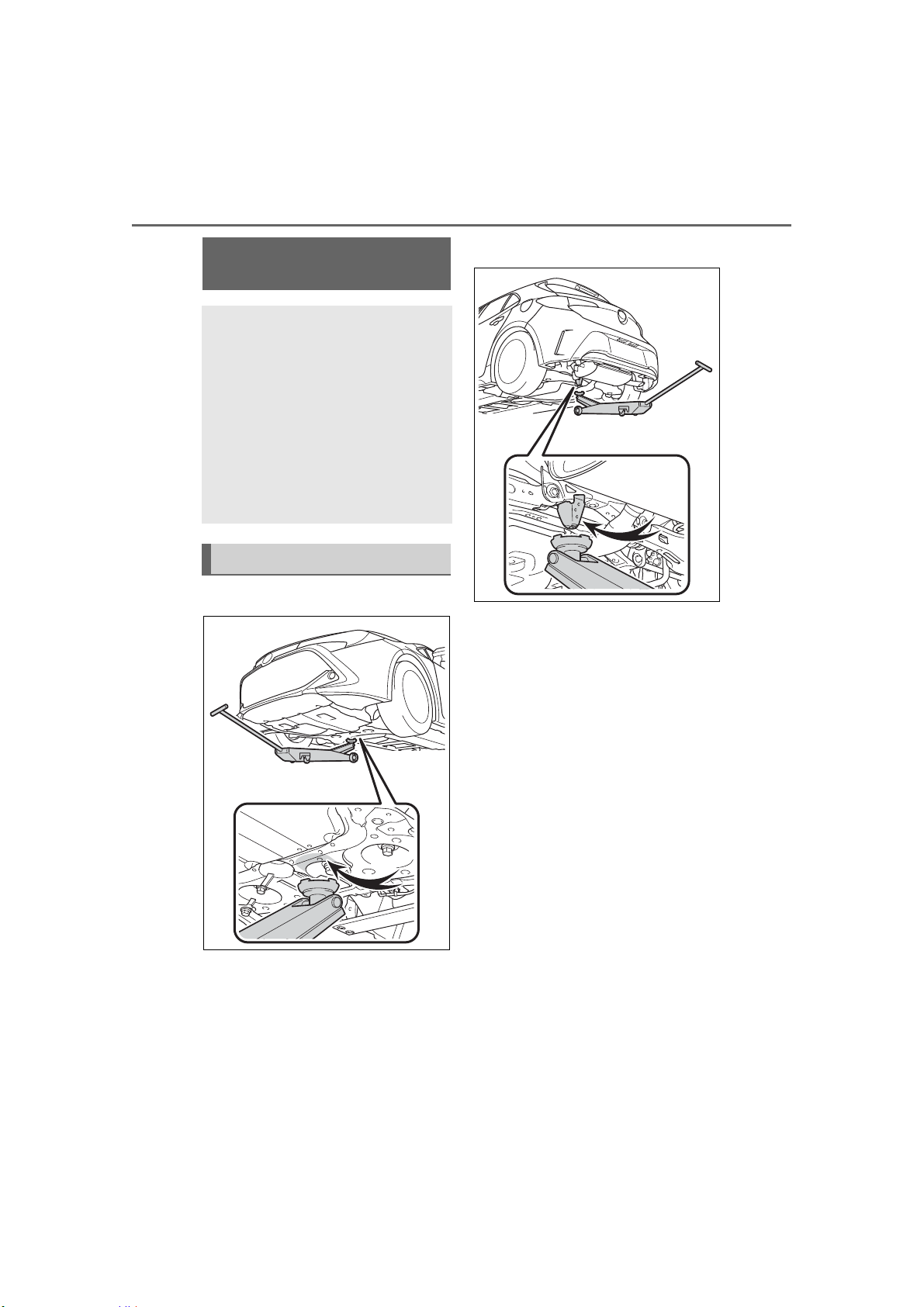
428
7-3. Do-it-yourself maintenance
COROLLA H/B_U
■ Front
■ Rear
Positioning a floor
jack
When using a floor jack, fol-
low the instructions in the
manual provided with the
jack and perform the opera-
tion safely.
When raising your vehicle
with a floor jack, position
the jack correctly. Improper
placement may damage
your vehicle or cause injury.
Location of the jack point
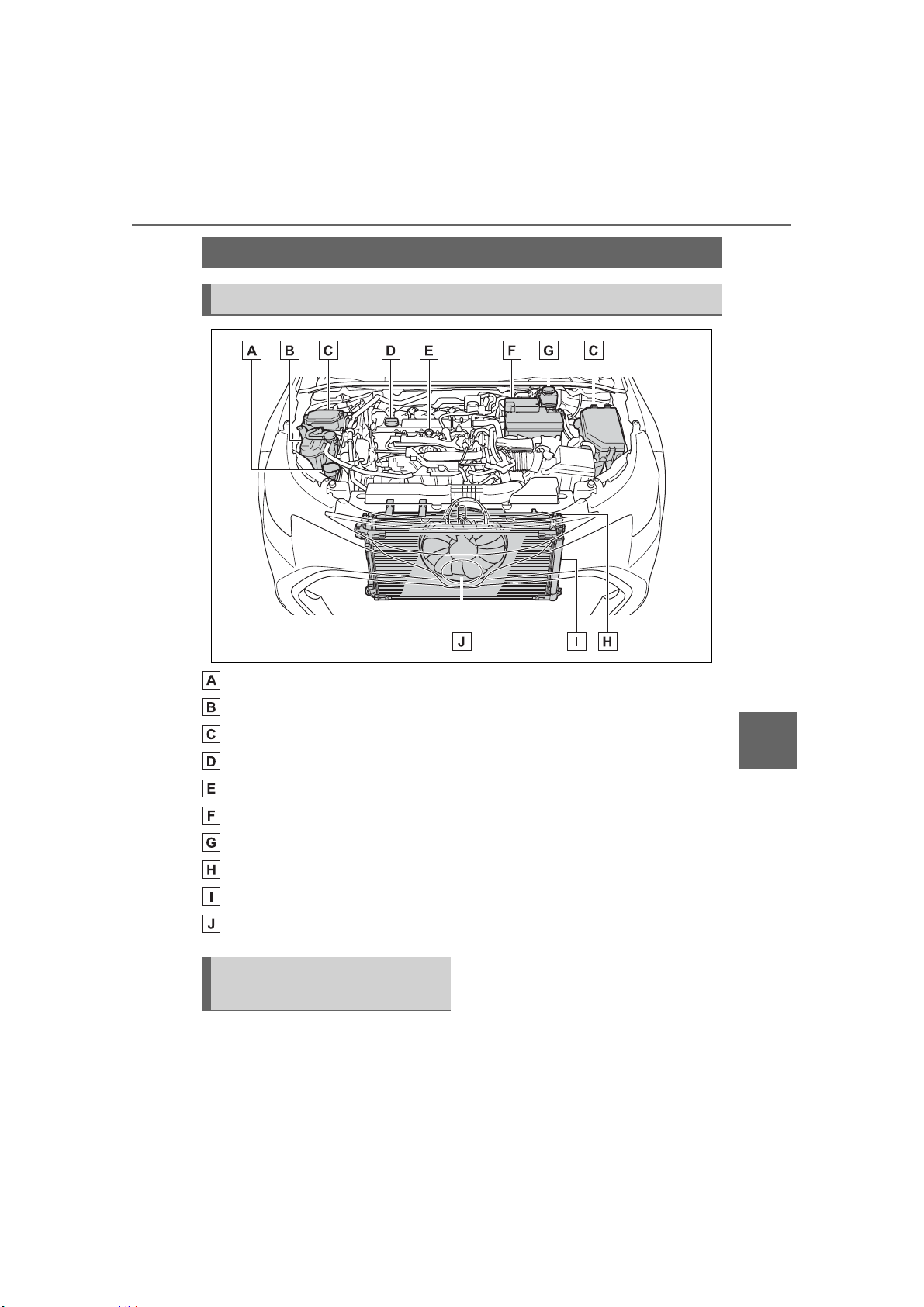
429
7-3. Do-it-yourself maintenance
COROLLA H/B_U
7
Maintenance and care
Washer fluid tank (P.435)
Engine coolant reservoir (P.429)
Fuse boxes (P.452)
Engine oil filler cap (P.430)
Engine oil level dipstick (P.429)
Battery (P.433)
Brake fluid reservoir (P.432)
Radiator (P.432)
Condenser (P.432)
Electric cooling fan
With the engine at operating
temperature and turned off,
check the oil level on the dip-
stick.
■ Checking the engine oil
1 Park the vehicle on level
ground. After warming up the
engine and turning it off, wait
Engine compartment
Components
Checking and adding the
engine oil
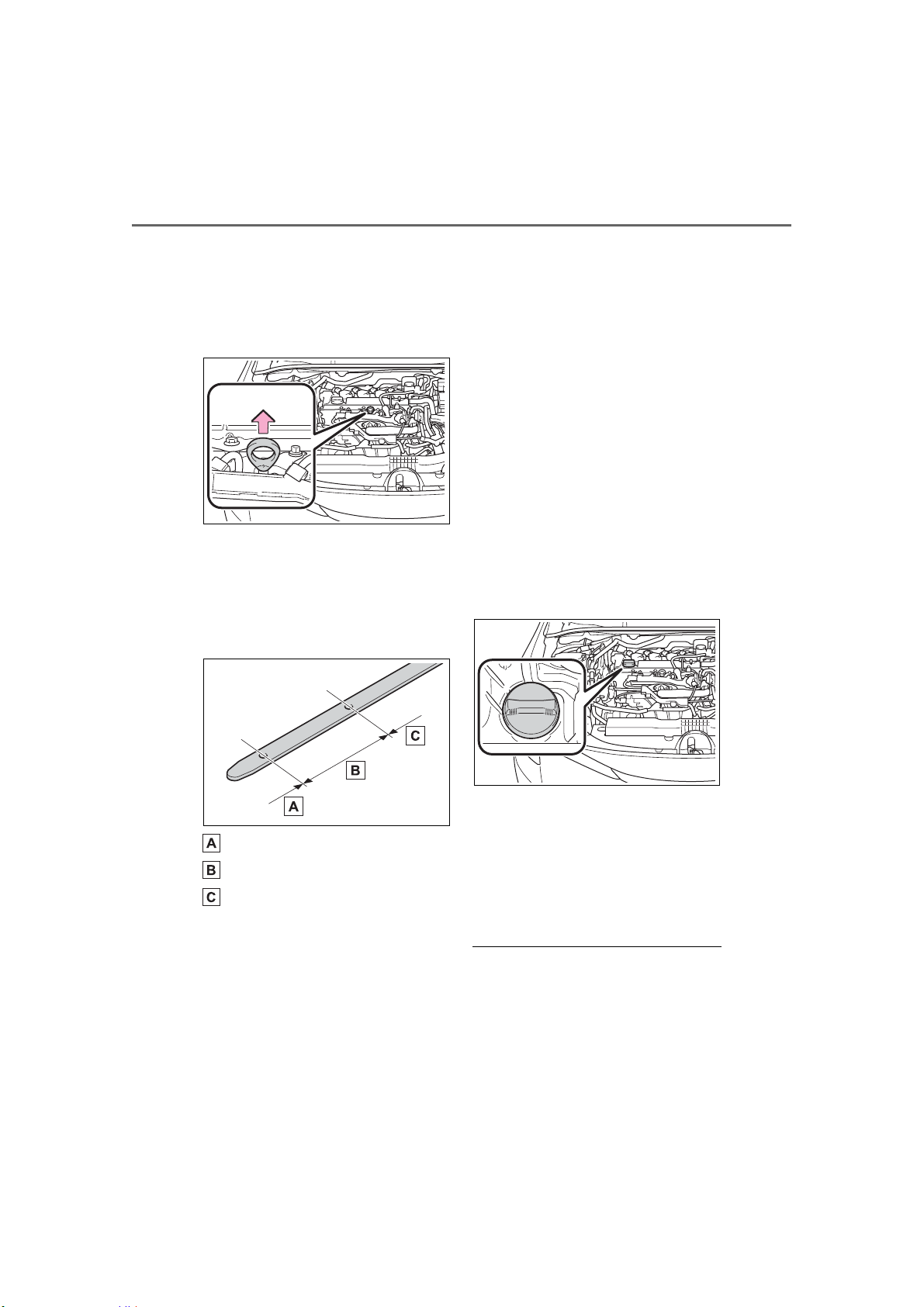
430
7-3. Do-it-yourself maintenance
COROLLA H/B_U
more than 5 minutes for the
oil to drain back into the bot-
tom of the engine.
2 Holding a rag under the end,
pull the dipstick out.
3 Wipe the dipstick clean.
4 Reinsert the dipstick fully.
5 Holding a rag under the end,
pull the dipstick out and
check the oil level.
Low
Normal
Excessive
The shape of the dipstick may differ
depending on the type of vehicle or
engine.
6 Wipe the dipstick and reinsert
it fully.
■ Checking the oil type and
preparing the item needed
Make sure to check the oil type
and prepare the items needed
before adding oil.
Engine oil selection
P. 511
Oil quantity (Low Full)
1.6 qt. (1.5 L, 1.3 Imp. qt.)
Item
Clean funnel
■ Adding engine oil
If the oil level is below or near
the low level mark, add engine
oil of the same type as that
already in the engine.
1 Remove the oil filler cap by
turning it counterclockwise.
2 Add engine oil slowly, check-
ing the dipstick.
3 Install the oil filler cap by
turning it clockwise.
■ Engine oil consumption
A certain amount of engine oil will
be consumed while driving. In the
following situations, oil consump-
tion may increase, and engine oil
may need to be refilled in between
oil maintenance intervals.
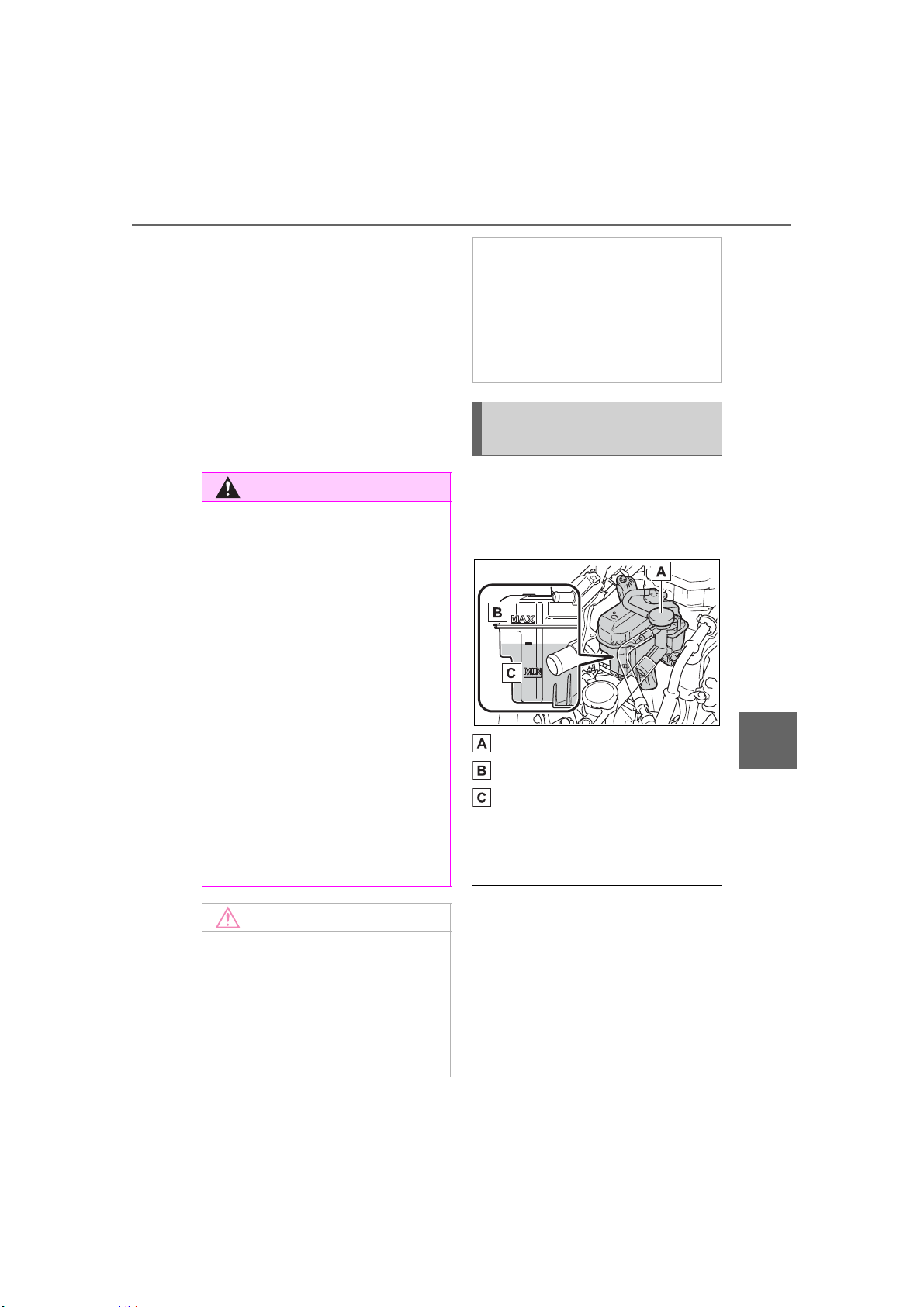
431
7-3. Do-it-yourself maintenance
COROLLA H/B_U
7
Maintenance and care
● When the engine is new, for
example directly after purchasing
the vehicle or after replacing the
engine
● If low quality oil or oil of an inap-
propriate viscosity is used
● When driving at high engine
speeds or with a heavy load, or
when driving while accelerating or
decelerating frequently
● When leaving the engine idling for
a long time, or when driving fre-
quently through heavy traffic
The coolant level is satisfactory
if it is between the “MAX” and
“MIN” lines on the reservoir
when the engine is cold.
Reservoir cap
“MAX” line
“MIN” line
If the level is on or below the “MIN”
line, add coolant up to the “MAX”
line. (P.506)
■ Coolant selection
Only use “Toyota Super Long Life
Coolant” or a similar high quality
ethylene glycol based non-silicate,
non-amine, non-nitrite, and
non-borate coolant with long-life
hybrid organic acid technology.
U.S.A.:
“Toyota Super Long Life Coolant” is
a mixture of 50% coolant and 50%
deionized water. (Minimum tem-
WARNING
■ Used engine oil
● Used engine oil contains poten-
tially harmful contaminants
which may cause skin disorders
such as inflammation and skin
cancer, so care should be taken
to avoid prolonged and
repeated contact. To remove
used engine oil from your skin,
wash thoroughly with soap and
water.
● Dispose of used oil and filters
only in a safe and acceptable
manner. Do not dispose of used
oil and filters in household trash,
in sewers or onto the ground.
Call your Toyota dealer, service
station or auto parts store for
information concerning recy-
cling or disposal.
● Do not leave used engine oil
within the reach of children.
NOTICE
■ To prevent serious engine
damage
Check the oil level on a regular
basis.
■ When replacing the engine oil
● Be careful not to spill engine oil
on the vehicle components.
● Avoid overfilling, or the engine
could be damaged.
● Check the oil level on the dip-
stick every time you refill the
vehicle.
● Be sure the engine oil filler cap
is properly tightened.
Checking the engine cool-
ant
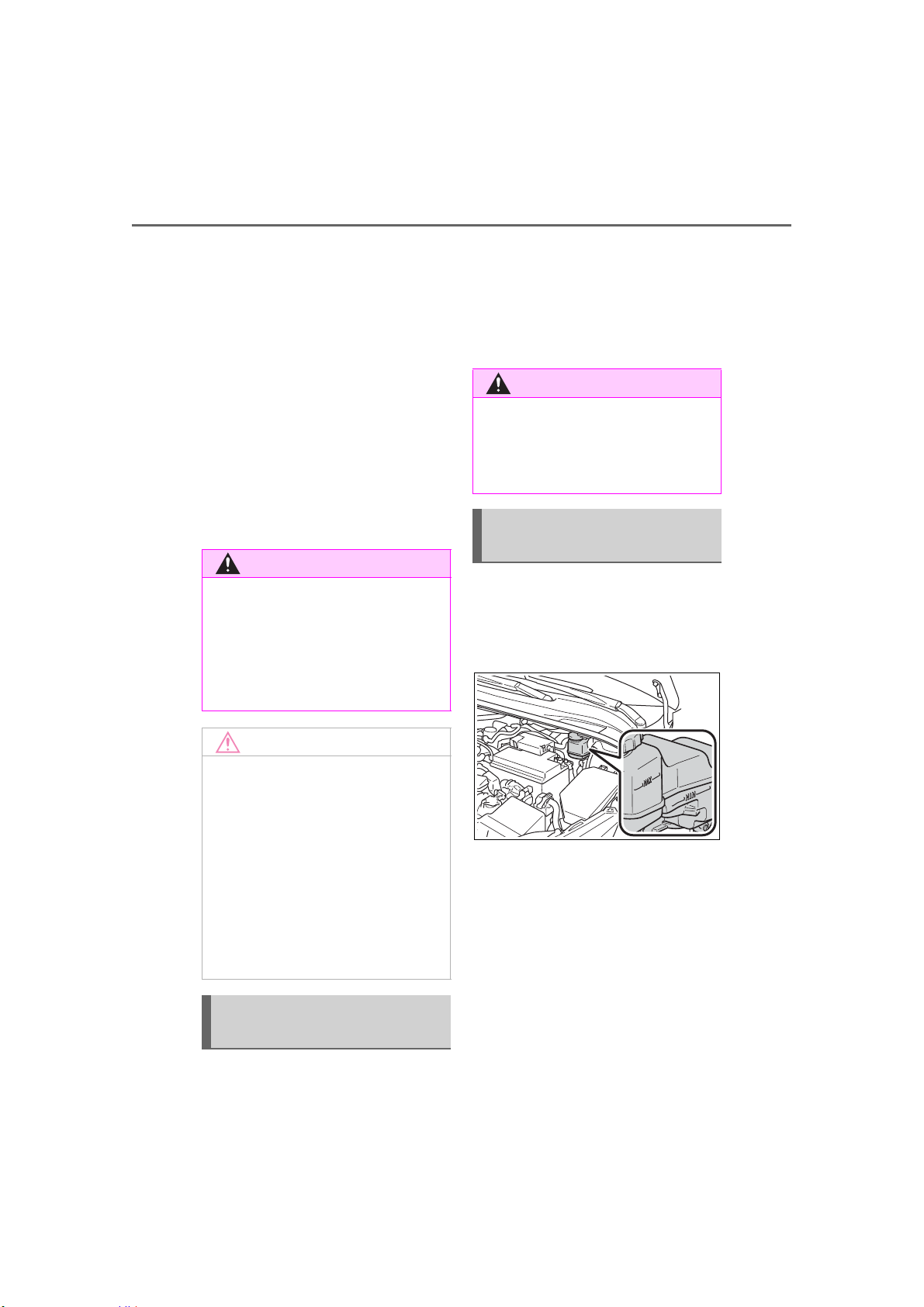
432
7-3. Do-it-yourself maintenance
COROLLA H/B_U
perature: -31°F [-35°C])
Canada:
“Toyota Super Long Life Coolant” is
a mixture of 55% coolant and 45%
deionized water. (Minimum tem-
perature: -44°F [-42°C])
For more details about coolant, con-
tact your Toyota dealer.
■ If the coolant level drops within
a short time of replenishing
Visually check the radiator, hoses,
engine coolant reservoir caps, drain
cock and water pump.
If you cannot find a leak, have your
Toyota dealer test the cap and
check for leaks in the cooling sys-
tem.
Check the radiator and con-
denser and clear away any for-
eign objects. If either of the
above parts is extremely dirty or
you are not sure of their condi-
tion, have your vehicle
inspected by your Toyota dealer.
■ Checking fluid level
The brake fluid level should be
between the “MAX” and “MIN”
lines on the tank.
WARNING
■ When the engine is hot
Do not remove the engine coolant
reservoir cap. (P.507)
The cooling system may be under
pressure and may spray hot cool-
ant if the cap is removed, causing
serious injuries, such as burns.
NOTICE
■ When adding coolant
Coolant is neither plain water nor
straight antifreeze. The correct
mixture of water and antifreeze
must be used to provide proper
lubrication, corrosion protection
and cooling. Be sure to read the
antifreeze or coolant label.
■ If you spill coolant
Be sure to wash it off with water to
prevent it from damaging parts or
paint.
Checking the radiator and
condenser
WARNING
■ When the engine is hot
Do not touch the radiator or con-
denser as they may be hot and
cause serious injuries, such as
burns.
Checking and adding the
brake fluid
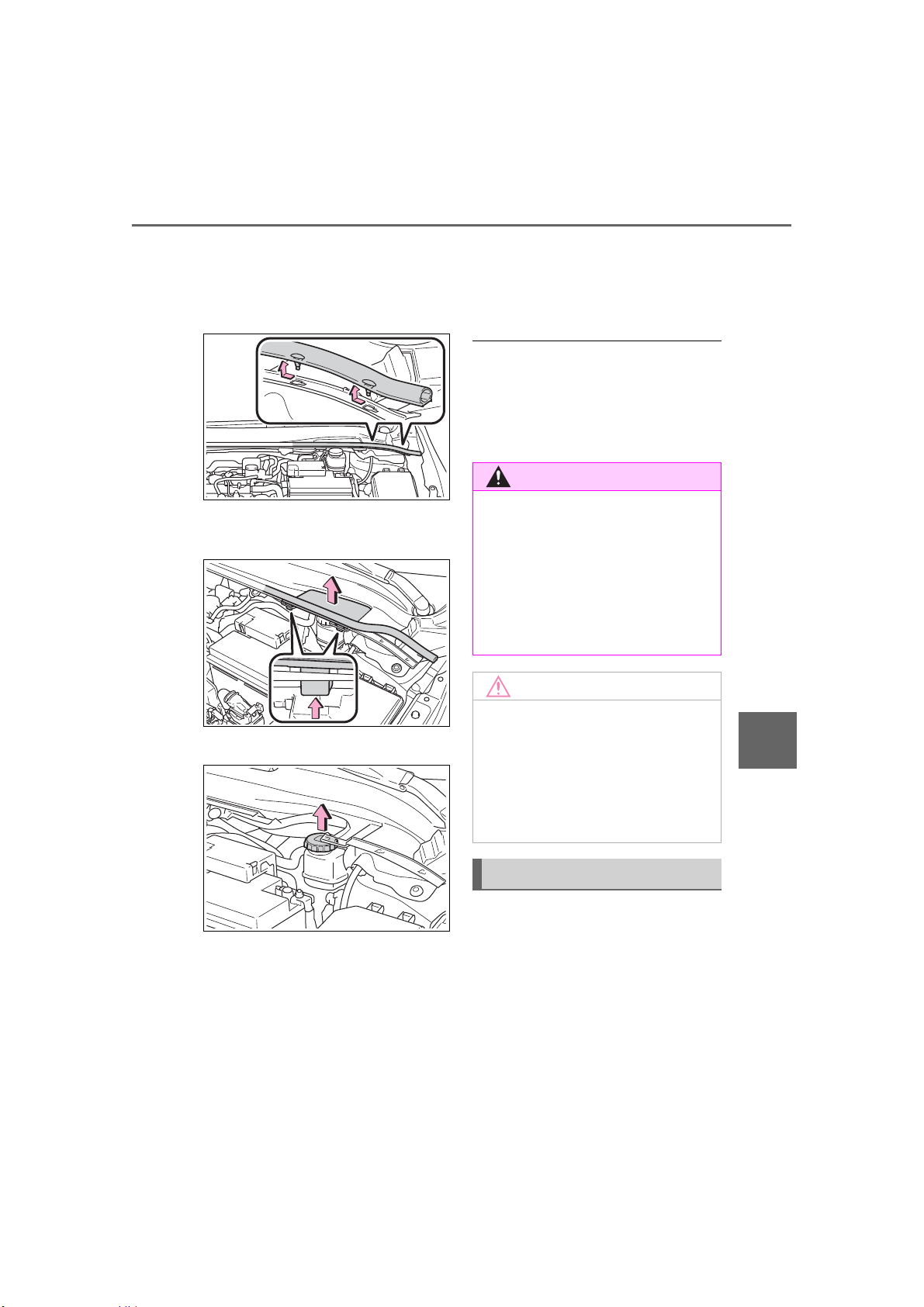
433
7-3. Do-it-yourself maintenance
COROLLA H/B_U
7
Maintenance and care
■ Adding fluid
1 Slide and lift up the rubber
strip to partly remove it as
shown.
2 Disconnect the claws and
remove the service cover.
3 Remove the reservoir cap.
4 Add brake fluid slowly while
checking the fluid level.
Make sure to check the fluid
type and prepare the necessary
item.
Fluid type
FMVSS No.116 DOT 3 or SAE
J1703 brake fluid
Item
Clean funnel
■ Brake fluid can absorb moisture
from the air
Excess moisture in the brake fluid
can cause a dangerous loss of brak-
ing efficiency. Use only newly
opened brake fluid.
Check the battery as follows.
■ Battery exterior
Make sure that the battery termi-
nals are not corroded and that
there are no loose connections,
cracks, or loose clamps.
WARNING
■ When filling the reservoir
Take care as brake fluid can harm
your hands and eyes and damage
painted surfaces.
If fluid gets on your hands or in
your eyes, flush the affected area
with clean water immediately.
If you still experience discomfort,
see a doctor.
NOTICE
■ If the fluid level is low or high
It is normal for the brake fluid level
to go down slightly as the brake
pads wear out or when the fluid
level in the accumulator is high.
If the reservoir needs frequent
refilling, there may be a serious
problem.
Battery
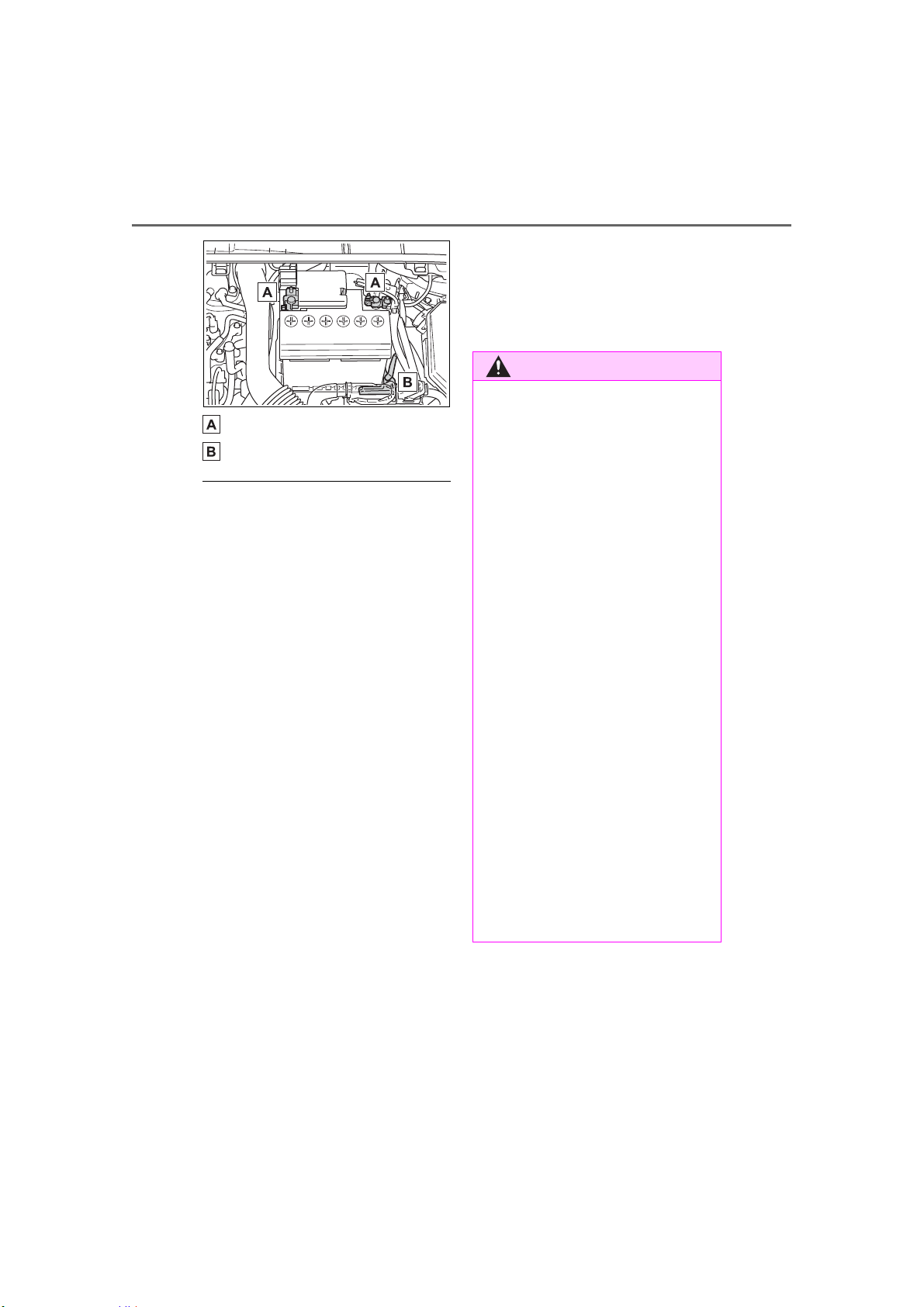
434
7-3. Do-it-yourself maintenance
COROLLA H/B_U
Terminals
Hold-down clamp
■ Before recharging
When recharging, the battery pro-
duces hydrogen gas which is flam-
mable and explosive. Therefore,
observe the following precautions
before recharging:
● If recharging with the battery
installed on the vehicle, be sure to
disconnect the ground cable.
● Make sure the charger is off when
connecting and disconnecting the
charger cables to the battery.
■ After recharging/reconnecting
the battery
● Unlocking the doors using the
smart key system may not be pos-
sible immediately after reconnect-
ing the battery. If this happens,
use the wireless remote control or
the mechanical key to lock/unlock
the doors.
● Start the engine with the engine
switch in ACC. The engine may
not start with the engine switch
turned off. However, the engine
will operate normally from the sec-
ond attempt.
● The engine switch mode is
recorded by the vehicle. If the bat-
tery is reconnected, the vehicle
will return the engine switch mode
to the status it was in before the
battery was disconnected. Make
sure to turn off the engine before
disconnecting the battery. Take
extra care when connecting the
battery if the engine switch mode
prior to discharge is unknown.
If the system will not start even after
multiple attempts, contact your Toy-
ota dealer.
WARNING
■ Chemicals in the battery
The battery contains poisonous
and corrosive sulfuric acid and
may produce hydrogen gas which
is flammable and explosive. To
reduce the risk of death or serious
injury, take the following precau-
tions while working on or near the
battery:
● Do not cause sparks by touch-
ing the battery terminals with
tools.
● Do not smoke or light a match
near the battery.
● Avoid contact with eyes, skin
and clothes.
● Never inhale or swallow electro-
lyte.
● Wear protective safety glasses
when working near the battery.
● Keep children away from the
battery.
■ Where to safely charge the
battery
Always charge the battery in an
open area. Do not charge the bat-
tery in a garage or closed room
where there is insufficient ventila-
tion.
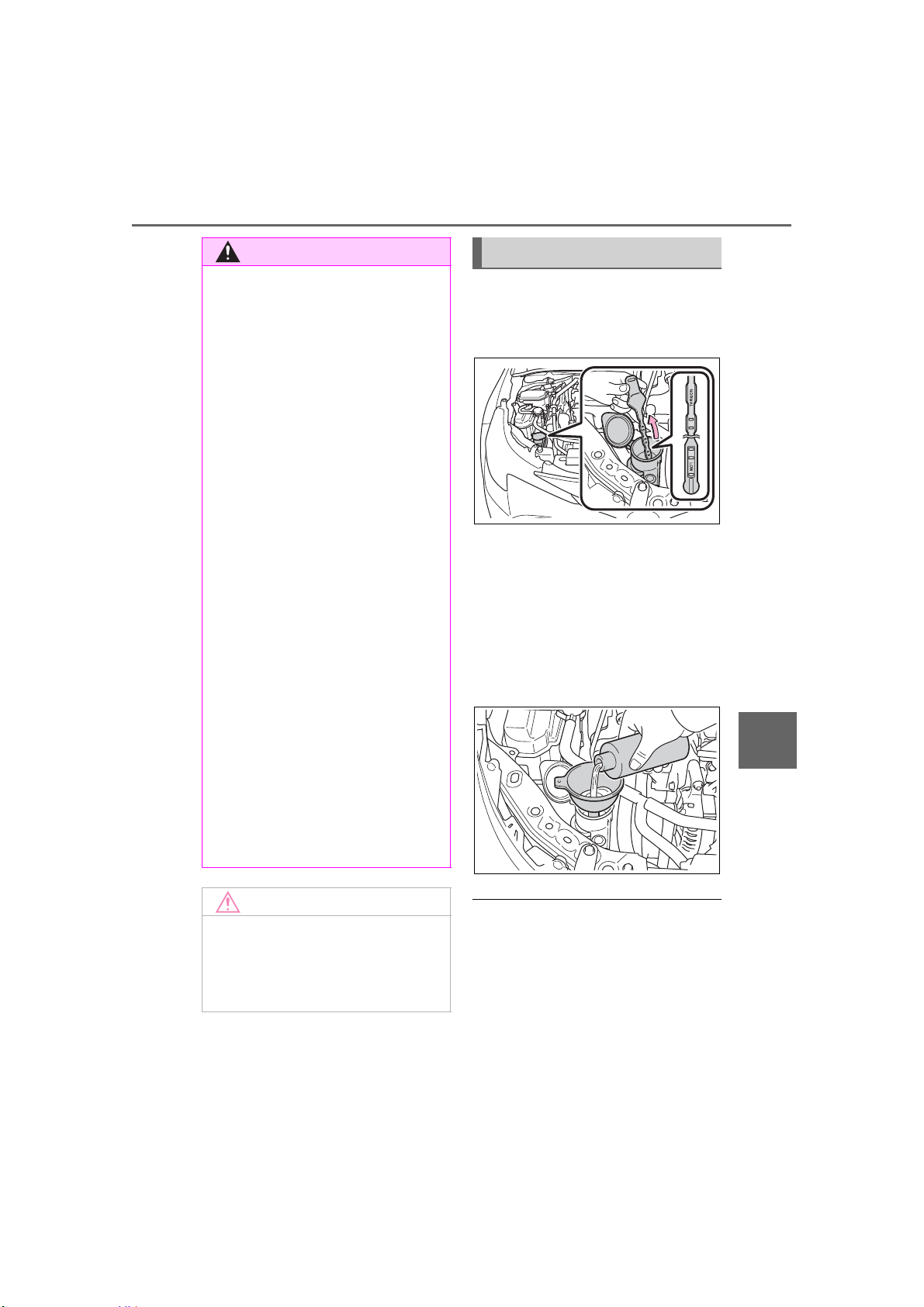
435
7-3. Do-it-yourself maintenance
COROLLA H/B_U
7
Maintenance and care
Except for Canada
If the washer fluid level is at
“LOW”, add washer fluid.
For Canada
Add washer fluid in the following
situations:
A washer does not work.
The warning message
appears on the multi-informa-
tion display.
■ Using the gauge (Except for
Canada)
The washer fluid level can be
checked by observing the position
of the level on the liquid-covered
holes in the gauge.
If the level falls below the second
hole from the bottom (the “LOW”
position), refill the washer fluid.
WARNING
■ Emergency measures regard-
ing electrolyte
● If electrolyte gets in your eyes
Flush your eyes with clean
water for at least 15 minutes
and get immediate medical
attention. If possible, continue
to apply water with a sponge or
cloth while traveling to the near-
est medical facility.
● If electrolyte gets on your skin
Wash the affected area thor-
oughly. If you feel pain or burn-
ing, get medical attention
immediately.
● If electrolyte gets on your
clothes
It can soak through clothing on
to your skin. Immediately take
off the clothing and follow the
procedure above if necessary.
● If you accidentally swallow elec-
trolyte
Drink a large quantity of water
or milk. Get emergency medical
attention immediately.
■ When disconnecting the bat-
tery
Do not disconnect the negative (-)
terminal on the body side. The
disconnected negative (-) terminal
may touch the positive (+) termi-
nal, which may cause a short and
result in death or serious injury.
NOTICE
■ When recharging the battery
Never recharge the battery while
the engine is running. Also, be
sure all accessories are turned
off.
Adding the washer fluid
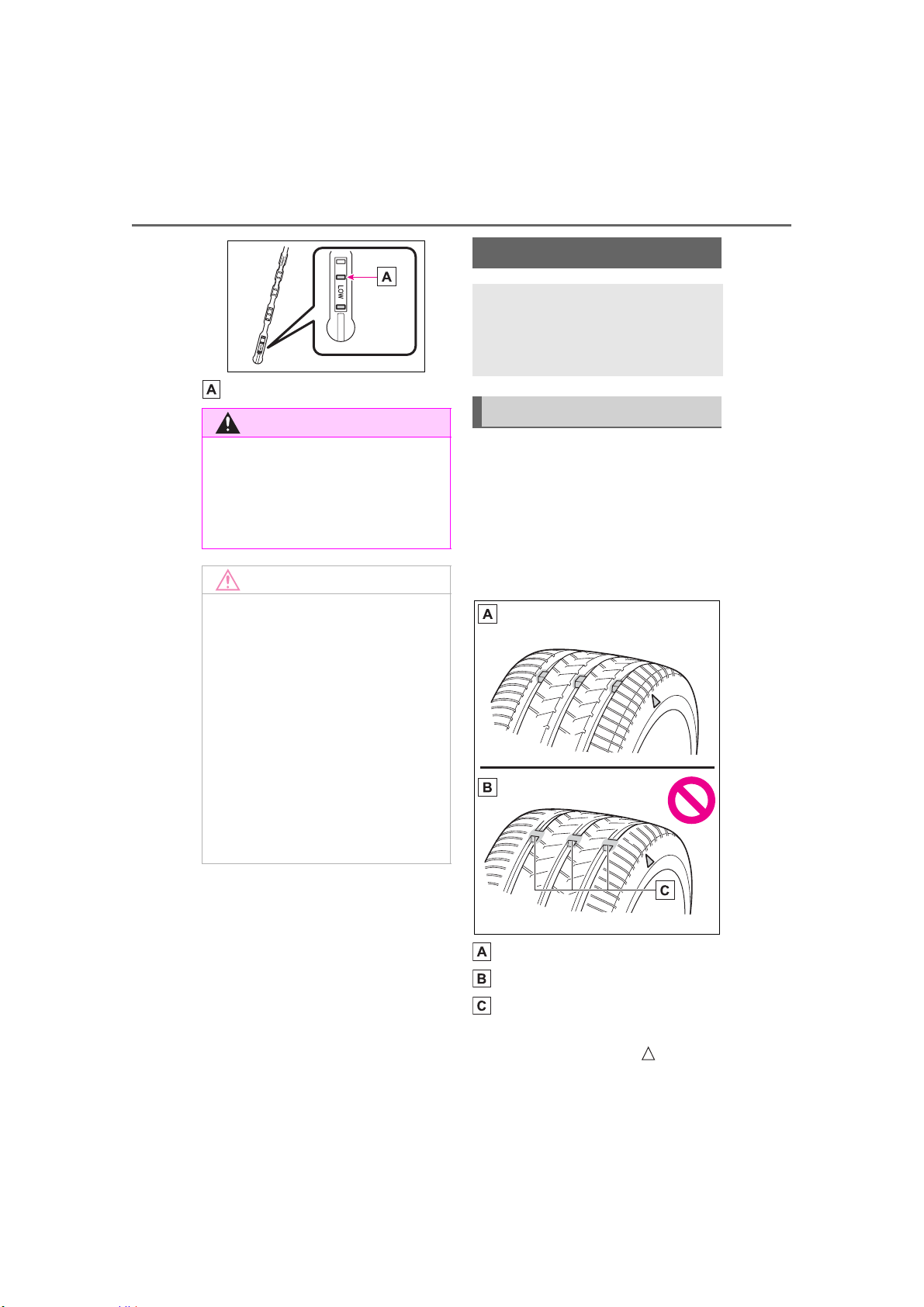
436
7-3. Do-it-yourself maintenance
COROLLA H/B_U
Current fluid level
Check if the treadwear indica-
tors are showing on the tires.
Also check the tires for uneven
wear, such as excessive wear
on one side of the tread.
Check the spare tire condition
and pressure if not rotated.
New tread
Worn tread
Treadwear indicator
The location of treadwear indicators
is shown by a “TWI” or “ ” mark,
WARNING
■ When adding washer fluid
Do not add washer fluid when the
engine is hot or running as
washer fluid contains alcohol and
may catch fire if spilled on the
engine, etc.
NOTICE
■ Do not use any fluid other
than washer fluid
Do not use soapy water or engine
antifreeze instead of washer fluid.
Doing so may cause streaking on
the vehicle’s painted surfaces, as
well as damaging the pump lead-
ing to problems of the washer
fluid not spraying.
■ Diluting washer fluid
Dilute washer fluid with water as
necessary.
Refer to the freezing tempera-
tures listed on the label of the
washer fluid bottle.
Tires
Replace or rotate tires in
accordance with mainte-
nance schedules and tread-
wear.
Checking tires

437
7-3. Do-it-yourself maintenance
COROLLA H/B_U
7
Maintenance and care
etc., molded into the sidewall of
each tire.
Replace the tires if the treadwear
indicators are showing on a tire.
■ When to replace your vehicle’s
tires
Tires should be replaced if:
● The treadwear indicators are
showing on a tire.
● You have tire damage such as
cuts, splits, cracks deep enough
to expose the fabric, and bulges
indicating internal damage
● A tire goes flat repeatedly or can-
not be properly repaired due to the
size or location of a cut or other
damage
If you are not sure, consult with your
Toyota dealer.
■ Tire life
Any tire over 6 years old must be
checked by a qualified technician
even if it has seldom or never been
used or damage is not obvious.
■ Low profile tires (18-inch tires)
Generally, low profile tires will wear
more rapidly and tire grip perfor-
mance will be reduced on snowy
and/or icy roads when compared to
standard tires. Be sure to use snow
tires or tire chains on snowy and/or
icy roads and drive carefully at a
speed appropriate for road and
weather conditions.
■ Maximum load of tire
Check that the maximum load of the
replacement tire is greater than 1/2
of the Gross Axle Weight Ratings
(GAWR) of either the front axle or
the rear axle, whichever is greater.
For the GAWR, see the Certification
Label.
For the maximum load of the tire,
see the load limit at maximum cold
tire inflation pressure mentioned on
the sidewall of the tire. (P.520)
■ Tire types
● Summer tires
Summer tires are high-speed perfor-
mance tires best suited to highway
driving under dry conditions. Since
summer tires do not have the same
traction performance as snow tires,
summer tires are inadequate for
driving on snow-covered or icy
roads. For driving on snow-covered
roads or icy roads, the use of snow
tires is recommended. When install-
ing snow tires, be sure to replace all
four tires.
● All season tires
All season tires are designed to pro-
vide better traction in snow and to
be adequate for driving in most win-
ter conditions as well as for use
year-round. All season tires, how-
ever, do not have adequate traction
performance compared with snow
tires in heavy or loose snow. Also,
all season tires fall short in accelera-
tion and handling performance com-
pared with summer tires in highway
driving.
● Snow tires
For driving on snow-covered roads
or icy roads, we recommend using
snow tires. If you need snow tires,
select tires of the same size, con-
struction and load capacity as the
originally installed tires. Since your
vehicle has radial tires as original
equipment, make sure your snow
438
7-3. Do-it-yourself maintenance
COROLLA H/B_U
tires also have radial construction.
Do not install studded tires without
first checking local regulations for
possible restrictions. Snow tires
should be installed on all wheels.
(P.246)
■ If the tread on snow tires wears
down below 0.16 in. (4 mm)
The effectiveness of the tires as
snow tires is lost.
■ Checking the tire valves
When replacing the tires, check the
tire valves for deformation, cracks,
and other damage.
Rotate the tires in the order
shown.
WARNING
■ When inspecting or replacing
tires
Observe the following precautions
to prevent accidents.
Failure to do so may cause dam-
age to parts of the drive train as
well as dangerous handling char-
acteristics, which may lead to an
accident resulting in death or seri-
ous injury.
● Do not mix tires of different
makes, models or tread pat-
terns.
Also, do not mix tires of remark-
ably different treadwear.
● Do not use tire sizes other than
those recommended by Toyota.
● Do not mix differently con-
structed tires (radial, bias-belted
or bias-ply tires).
● Do not mix summer, all season
and snow tires.
● Do not use tires that have been
used on another vehicle.
Do not use tires if you do not
know how they were used previ-
ously.
NOTICE
■ Low profile tires (18-inch
tires)
Low profile tires may cause
greater damage than usual to the
tire wheel when sustaining impact
from the road surface. Therefore,
pay attention to the following:
● Be sure to use proper tire infla-
tion pressure. If tires are
under-inflated, they may be
damaged more severely.
● Avoid potholes, uneven pave-
ment, curbs and other road haz-
ards. Failure to do so may lead
to severe tire and wheel dam-
age.
■ If tire inflation pressure of
each tire becomes low while
driving
Do not continue driving, or your
tires and/or wheels may be
ruined.
■ Driving on rough roads
Take particular care when driving
on roads with loose surfaces or
potholes.
These conditions may cause
losses in tire inflation pressure,
reducing the cushioning ability of
the tires. In addition, driving on
rough roads may cause damage
to the tires themselves, as well as
the vehicle’s wheels and body.
Tire rotation
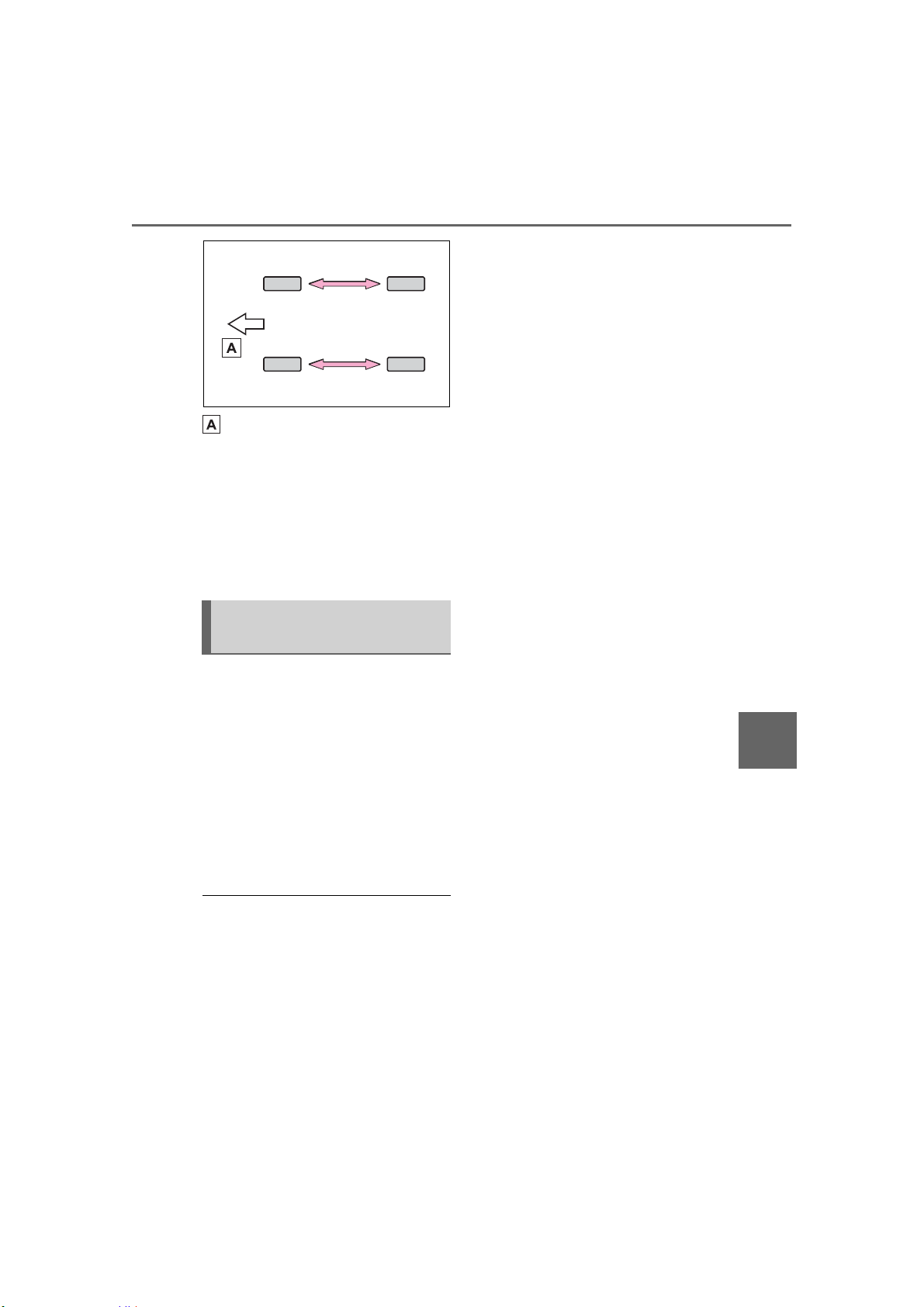
439
7-3. Do-it-yourself maintenance
COROLLA H/B_U
7
Maintenance and care
Front
To equalize tire wear and extend
tire life, Toyota recommends that
tire rotation is carried out at the
same interval as tire inspection.
Do not fail to initialize the tire pres-
sure warning system after tire rota-
tion.
Your vehicle is equipped with a
tire pressure warning system
that uses tire pressure warning
valves and transmitters to detect
low tire inflation pressure before
serious problems arise.
If the tire pressure drops below
a predetermined level, the driver
is warned by a warning light.
(P.472)
■ Routine tire inflation pressure
checks
The tire pressure warning system
does not replace routine tire inflation
pressure checks. Make sure to
check tire inflation pressure as part
of your routine of daily vehicle
checks.
■ Situations in which the tire
pressure warning system may
not operate properly
● In the following cases, the tire
pressure warning system may not
operate properly.
• If non-genuine Toyota wheels are
used.
• A tire has been replaced with a
tire that is not an OE (Original
Equipment) tire.
• A tire has been replaced with a
tire that is not of the specified size.
• Tire chains, etc. are equipped.
• An auxiliary-supported run-flat tire
is equipped.
• If a window tint that affects the
radio wave signals is installed.
• If there is a lot of snow or ice on
the vehicle, particularly around the
wheels or wheel housings.
• If the tire inflation pressure is
extremely higher than the speci-
fied level.
• If tires not equipped with tire pres-
sure warning valves and transmit-
ters are used.
• If the ID code on the tire pressure
warning valves and transmitters is
not registered in the tire pressure
warning computer.
● Performance may be affected in
the following situations.
• Near a TV tower, electric power
plant, gas station, radio station,
large display, airport or other facil-
ity that generates strong radio
waves or electrical noise.
• When carrying a portable radio,
cellular phone, cordless phone or
other wireless communication
device.
● When the vehicle is parked, the
time taken for the warning to start
or go off could be extended.
● When tire inflation pressure
declines rapidly for example when
a tire has burst, the warning may
not function.
Tire pressure warning
system
440
7-3. Do-it-yourself maintenance
COROLLA H/B_U
■ Warning performance of the tire
pressure warning system
The warning of the tire pressure
warning system will change in
accordance with driving conditions.
For this reason, the system may
give a warning even if the tire pres-
sure does not reach a low enough
level, or if the pressure is higher
than the pressure that was adjusted
to when the system was initialized.
■ Tire pressure warning system certification
For vehicles sold in the U.S.A., Hawaii, Guam and Puerto Rico
441
7-3. Do-it-yourself maintenance
COROLLA H/B_U
7
Maintenance and care
For vehicles sold in Canada
When replacing tires or wheels,
tire pressure warning valves and
transmitters must also be
installed.
When new tire pressure warning
valves and transmitters are
installed, new ID codes must be
registered in the tire pressure
warning computer and the tire
pressure warning system must
be initialized. Have tire pressure
warning valves and transmitter
ID codes registered by your Toy-
ota dealer. (P.443)
■ Replacing tires and wheels
If the ID code of the tire pressure
warning valve and transmitter is not
registered, the tire pressure warning
system will not work properly. After
driving for about 20 minutes, the tire
pressure warning light blinks for 1
minute and stays on to indicate a
system malfunction.
Installing tire pressure
warning valves and trans-
mitters
NOTICE
■ Repairing or replacing tires,
wheels, tire pressure warn-
ing valves, transmitters and
tire valve caps
● When removing or fitting the
wheels, tires or the tire pressure
warning valves and transmit-
ters, contact your Toyota dealer
as the tire pressure warning
valves and transmitters may be
damaged if not handled cor-
rectly.
442
7-3. Do-it-yourself maintenance
COROLLA H/B_U
■ The tire pressure warning
system must be initialized
in the following circum-
stances:
When rotating front and rear
tires which have different tire
inflation pressures.
When changing the tire size.
When the tire inflation pres-
sure is changed such as
when changing traveling
speed or load weight.
When changing between two
registered wheel sets.
When the tire pressure warning
system is initialized, the current
tire inflation pressure is set as
the benchmark pressure.
■ How to initialize the tire
pressure warning system
1 Park the vehicle in a safe
place and turn the engine
switch off.
Initialization cannot be performed
while the vehicle is moving.
2 Adjust the tire inflation pres-
sure to the specified cold tire
inflation pressure level.
(P.515)
Make sure to adjust the tire pres-
sure to the specified cold tire infla-
tion pressure level. The tire
pressure warning system will oper-
ate based on this pressure level.
3 Turn the engine switch to
ON.
4 Press or of the meter
control switch to select .
5 Press or to select
“Vehicle Settings” and then
press and hold .
6 Press or to select
“TPWS” and then press .
7 Press or to select “Set
Pressure”. Then press and
hold until the tire pres-
NOTICE
● Make sure to install the tire
valve caps. If the tire valve caps
are not installed, water could
enter the tire pressure warning
valves and the tire pressure
warning valves could be bound.
● When replacing tire valve caps,
do not use tire valve caps other
than those specified. The cap
may become stuck.
■ To avoid damage to the tire
pressure warning valves and
transmitters
When a tire is repaired with liquid
sealants, the tire pressure warn-
ing valve and transmitter may not
operate properly. If a liquid seal-
ant is used, contact your Toyota
dealer or other qualified service
shop as soon as possible. Make
sure to replace the tire pressure
warning valve and transmitter
when replacing the tire. (
P.441)
Initializing the tire pres-
sure warning system
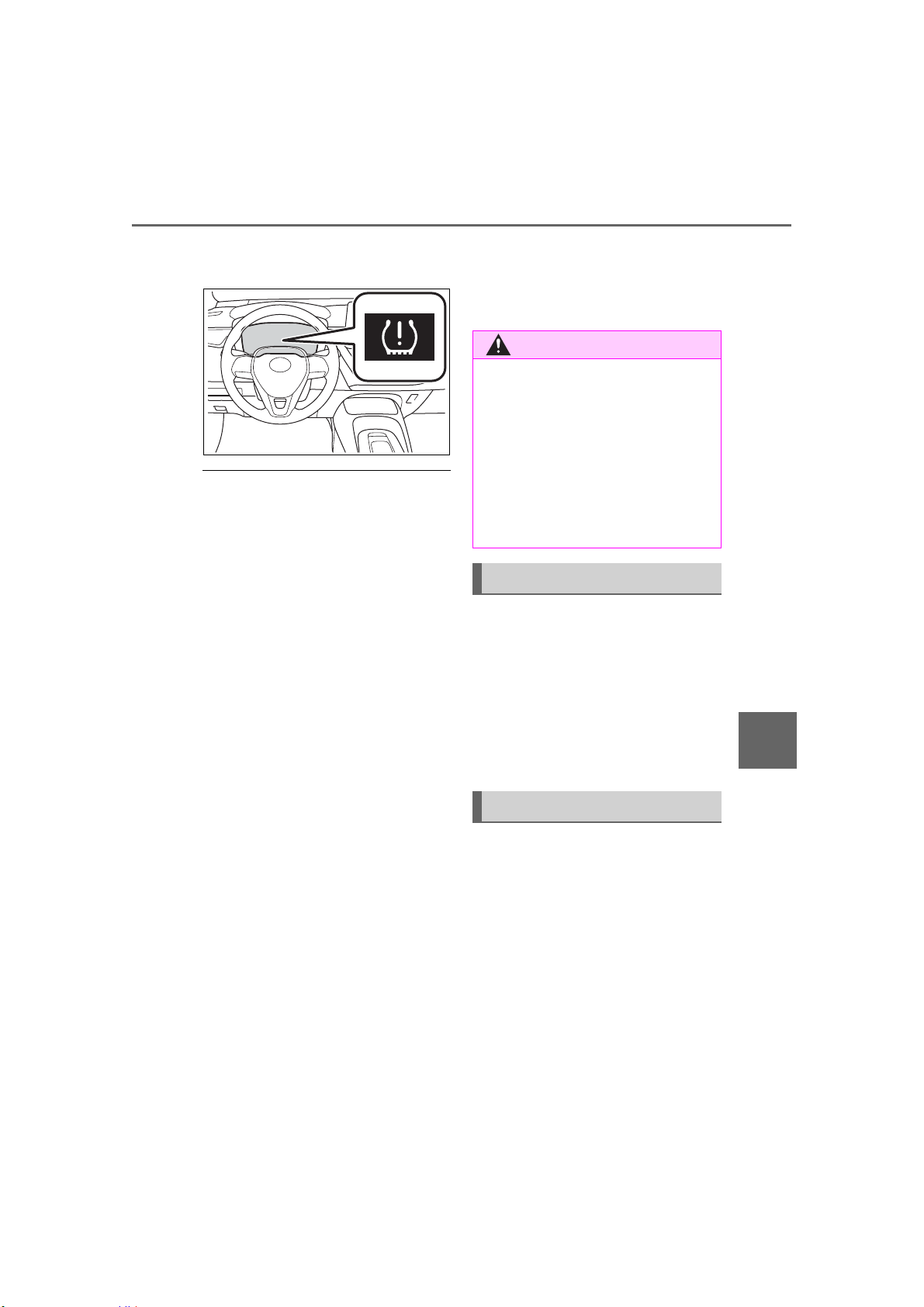
443
7-3. Do-it-yourself maintenance
COROLLA H/B_U
7
Maintenance and care
sure warning light blinks 3
times.
■ Initialization procedure
● Make sure to carry out initializa-
tion after adjusting the tire inflation
pressure.
Also, make sure the tires are cold
before carrying out initialization or
tire inflation pressure adjustment.
● If you have accidentally turned the
engine switch off during initializa-
tion, it is not necessary to press
the reset switch again as initializa-
tion will restart automatically when
the engine switch to ON for the
next time.
● If you accidentally press the reset
switch when initialization is not
necessary, adjust the tire inflation
pressure to the specified level
when the tires are cold, and con-
duct initialization again.
■ When initialization of the tire
pressure warning system has
failed
Initialization can be completed in a
few minutes. However, in the follow-
ing cases, the settings have not
been recorded and the system will
not operate properly. If repeated
attempts to record tire inflation pres-
sure settings are unsuccessful,
have the vehicle inspected by your
Toyota dealer.
● When operating the tire pressure
warning reset switch, the tire pres-
sure warning light does not blink 3
times.
● After driving for a certain period of
time since the initialization has
been completed, the warning light
comes on after blinking for 1 min-
ute.
The tire pressure warning valve
and transmitter is equipped with
a unique ID code. When replac-
ing a tire pressure warning valve
and transmitter, it is necessary
to register the ID code. Have the
ID code registered by your Toy-
ota dealer.
Your vehicle is equipped with
tire pressure warning system
with the function to have ID
codes registered for a second
wheel set, for example a winter
set, by Toyota dealer.
After registration of a second
wheel set, either of these two
wheel sets can be selected for
usage with the tire pressure
warning system.
WARNING
■ When initializing the tire pres-
sure warning system
Do not operate the tire pressure
warning reset switch without first
adjusting the tire inflation pres-
sure to the specified level. Other-
wise, the tire pressure warning
light may not come on even if the
tire inflation pressure is low, or it
may come on when the tire infla-
tion pressure is actually normal.
Registering ID codes
Selecting wheel set
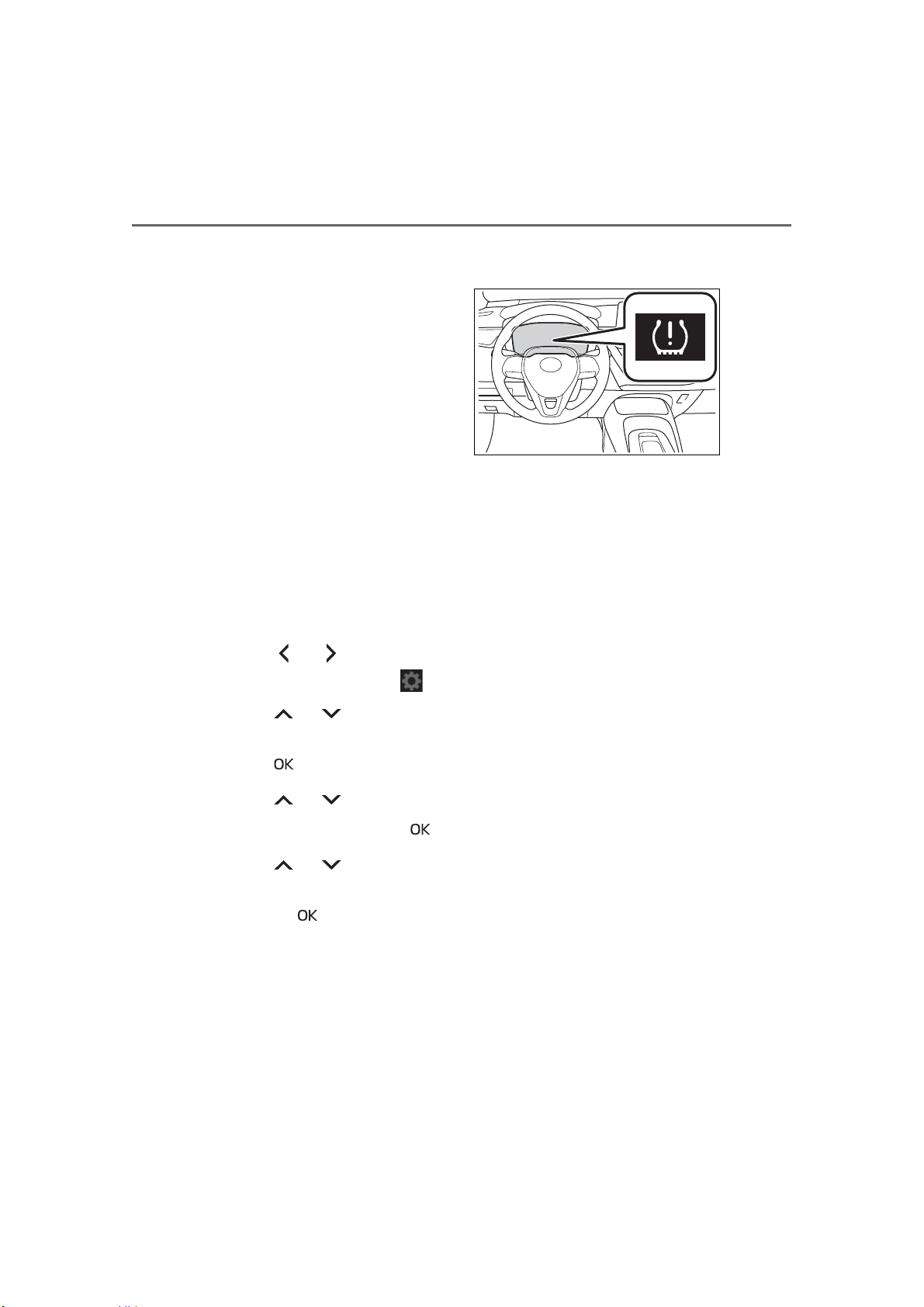
444
7-3. Do-it-yourself maintenance
COROLLA H/B_U
■ Operating conditions for
the function
This function will perform the
change of wheel set only if a
second wheel set has been
registered. If no second wheel
set has been registered, no
change will be made when
selecting this function in the
menu.
Only a change between both
registered wheel set is possi-
ble, mixing between these
wheel sets is not supported.
■ How to change between
wheel sets
1 Have the vehicle fitted with
the preferred wheel set.
2 Press or of the meter
control switch to select .
3 Press or to select
“Vehicle Settings” and then
press .
4 Press or to select
“TPWS” and then press .
5 Press or to select
“Change Wheel”. Then press
and hold until the tire
pressure warning light blinks
slowly 3 times.
6 Initialize the tire pressure
warning system. (P.442)

445
7-3. Do-it-yourself maintenance
COROLLA H/B_U
7
Maintenance and care
The recommended cold tire
inflation pressure and tire size
are displayed on the tire and
loading information label.
(P.515)
Tire valve
Tire pressure gauge
1 Remove the tire valve cap.
2 Press the tip of the tire pres-
sure gauge onto the tire
valve.
3 Read the pressure using the
gauge gradations.
4 If the tire inflation pressure is
not at the recommended
level, adjust the pressure.
If you add too much air, press
the center of the valve to
deflate.
5 After completing the tire infla-
tion pressure measurement
and adjustment, apply soapy
water to the valve and check
for leakage.
6 Put the tire valve cap back
on.
■ Tire inflation pressure check
interval
You should check tire inflation pres-
sure every two weeks, or at least
once a month. Do not forget to
check the spare.
■ Effects of incorrect tire inflation
pressure
Driving with incorrect tire inflation
pressure may result in the following:
● Reduced fuel economy
● Reduced driving comfort and poor
handling
● Reduced tire life due to wear
● Reduced safety
● Damage to the drive train
If a tire needs frequent inflating,
have it checked by your Toyota
dealer.
Tire inflation pressure
Checking the specified
tire inflation pressure
Inspection and adjust-
ment procedure
446
7-3. Do-it-yourself maintenance
COROLLA H/B_U
■ Instructions for checking tire
inflation pressure
When checking tire inflation pres-
sure, observe the following:
● Check only when the tires are
cold.
If your vehicle has been parked for
at least 3 hours or has not been
driven for more than 1 mile or 1.5
km, you will get an accurate cold
tire inflation pressure reading.
● Always use a tire pressure gauge.
It is difficult to judge if a tire is
properly inflated based only on its
appearance.
● It is normal for the tire inflation
pressure to be higher after driving
as heat is generated in the tire. Do
not reduce tire inflation pressure
after driving.
● Never exceed the vehicle capacity
weight.
Passengers and luggage weight
should be placed so that the vehi-
cle is balanced.
WARNING
■ Proper inflation is critical to
save tire performance
Keep your tires properly inflated.
If the tires are not properly
inflated, the following conditions
may occur which could lead to an
accident resulting in death or seri-
ous injury:
● Excessive wear
● Uneven wear
● Poor handling
● Possibility of blowouts resulting
from overheated tires
● Air leaking from between tire
and wheel
● Wheel deformation and/or tire
damage
● Greater possibility of tire dam-
age while driving (due to road
hazards, expansion joints,
sharp edges on the road, etc.)
NOTICE
■ When inspecting and adjust-
ing tire inflation pressure
Be sure to put the tire valve caps
back on.
If a valve cap is not installed, dirt
or moisture may get into the valve
and cause an air leak, resulting in
decreased tire inflation pressure.
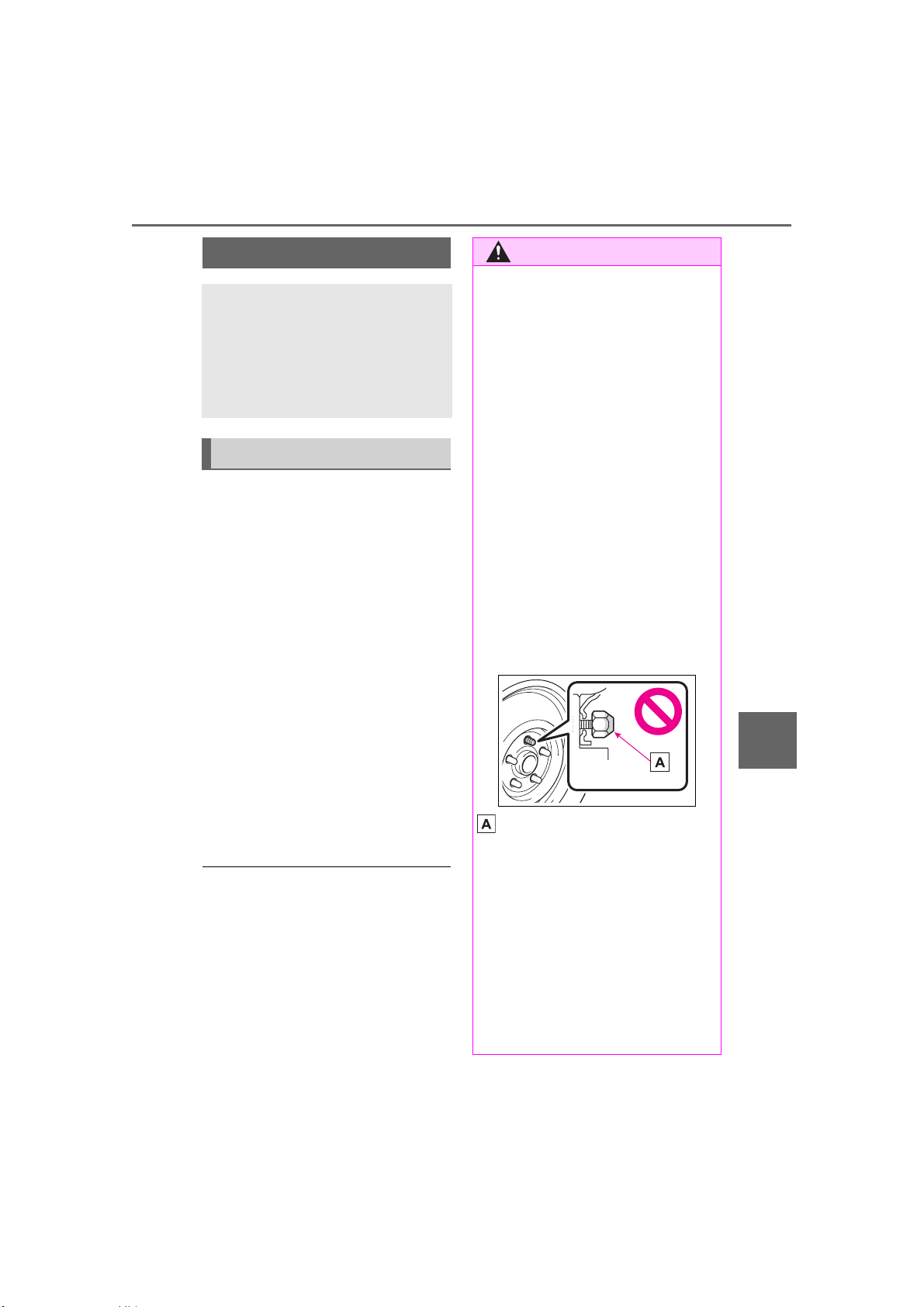
447
7-3. Do-it-yourself maintenance
COROLLA H/B_U
7
Maintenance and care
When replacing wheels, care
should be taken to ensure that
they are equivalent to those
removed in load capacity, diam-
eter, rim width and inset
*
.
Replacement wheels are avail-
able at your Toyota dealer.
*
: Conventionally referred to as off-
set.
Toyota does not recommend
using the following:
Wheels of different sizes or
types
Used wheels
Bent wheels that have been
straightened
■ When replacing wheels
The wheels of your vehicle are
equipped with tire pressure warning
valves and transmitters that allow
the tire pressure warning system to
provide advance warning in the
event of a loss in tire inflation pres-
sure. Whenever wheels are
replaced, the tire pressure warning
valves and transmitters must be
installed. (P.441)
Wheels
If a wheel is bent, cracked or
heavily corroded, it should
be replaced. Otherwise, the
tire may separate from the
wheel or cause a loss of
handling control.
Wheel selection
WARNING
■ When replacing wheels
● Do not use wheels that are a dif-
ferent size from those recom-
mended in the Owner’s Manual,
as this may result in a loss of
handling control.
● Never use an inner tube in a
leaking wheel which is designed
for a tubeless tire.
Doing so may result in an acci-
dent, causing death or serious
injury.
■ When installing the wheel
nuts
● Be sure to install the wheel nuts
with the tapered ends facing
inward. Installing the nuts with
the tapered ends facing outward
can cause the wheel to break
and eventually cause the wheel
to come off while driving, which
could lead to an accident result-
ing in death or serious injury.
Tapered portion
● Never use oil or grease on the
wheel bolts or wheel nuts.
Oil and grease may cause the
wheel nuts to be excessively
tightened, leading to bolt or disc
wheel damage. In addition, the
oil or grease can cause the
wheel nuts to loosen and the
wheel may fall off, causing an
accident and resulting in death
or serious injury. Remove any
oil or grease from the wheel
bolts or wheel nuts.
448
7-3. Do-it-yourself maintenance
COROLLA H/B_U
Use only Toyota wheel nuts
and wheel nut wrenches
designed for use with your
aluminum wheels.
When rotating, repairing or
changing your tires, check
that the wheel nuts are still
tight after driving 1000 miles
(1600 km).
Be careful not to damage the
aluminum wheels when using
tire chains.
Use only Toyota genuine bal-
ance weights or equivalent
and a plastic or rubber ham-
mer when balancing your
wheels.
WARNING
■ Use of defective wheels pro-
hibited
Do not use cracked or deformed
wheels. Doing so could cause the
tire to leak air during driving, pos-
sibly causing an accident.
NOTICE
■ Replacing tire pressure warn-
ing valves and transmitters
● Because tire repair or replace-
ment may affect the tire pres-
sure warning valves and
transmitters, make sure to have
tires serviced by your Toyota
dealer or other qualified service
shop. In addition, make sure to
purchase your tire pressure
warning valves and transmit-
ters at your Toyota dealer.
● Ensure that only genuine Toyota
wheels are used on your vehi-
cle.
Tire pressure warning valves
and transmitters may not work
properly with non-genuine
wheels.
Aluminum wheel precau-
tions
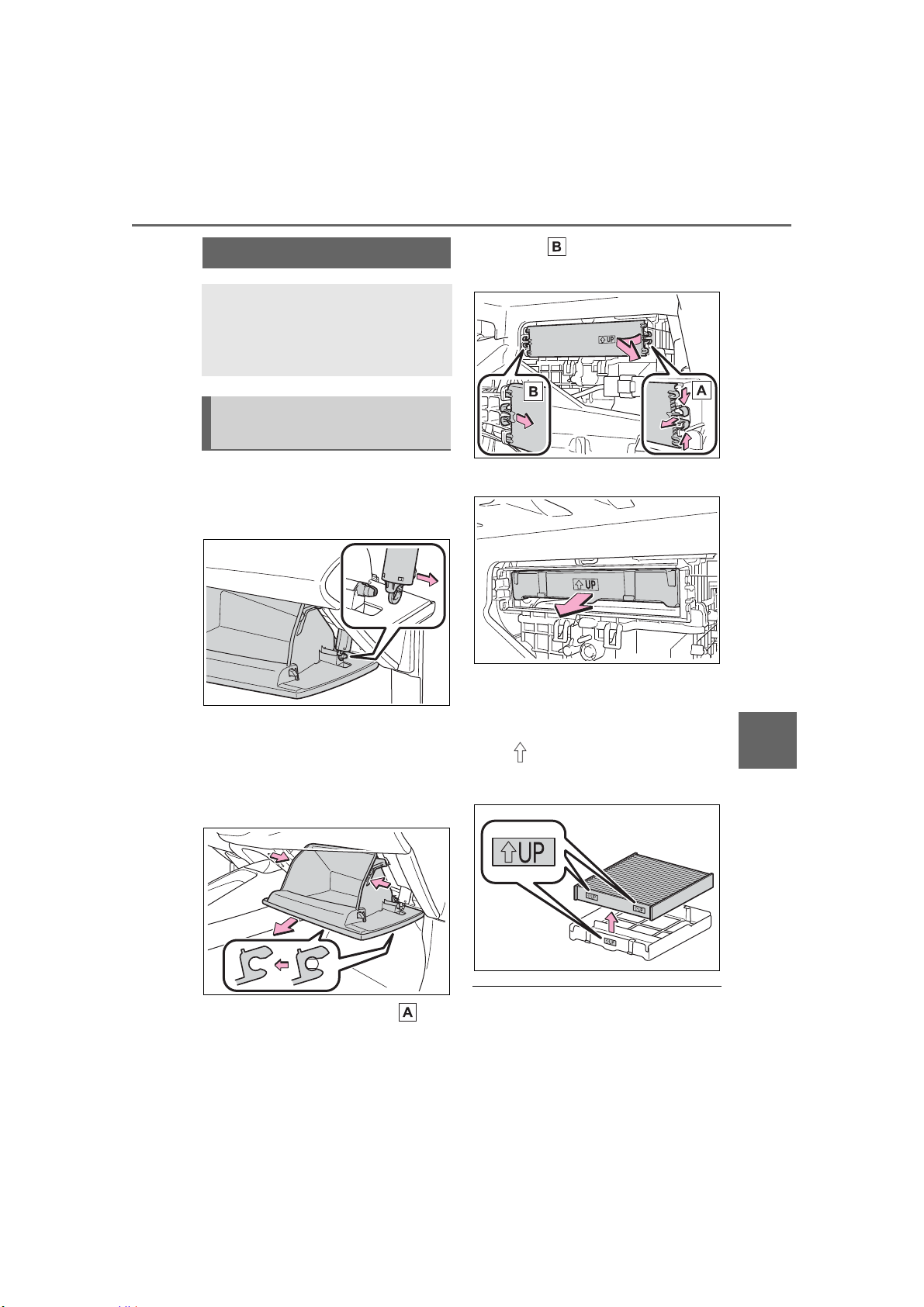
449
7-3. Do-it-yourself maintenance
COROLLA H/B_U
7
Maintenance and care
1 Turn the engine switch off.
2 Open the glove box. Slide off
the damper.
3 Push in the glove box on the
vehicle’s outer side to discon-
nect the claws. Then pull out
the glove box and disconnect
the lower claws.
4 Unlock the filter cover ( ),
pull the filter cover out of the
claws ( ), and remove the
filter cover.
5 Remove the filter case.
6 Remove the air conditioning
filter from the filter case and
replace it with a new one.
The “ UP” marks shown on the
filter and the filter case should be
pointing up.
■ Checking interval
Inspect and replace the air condi-
tioning filter according to the mainte-
nance schedule. In dusty areas or
areas with heavy traffic flow, more
Air conditioning filter
The air conditioning filter
must be changed regularly
to maintain air conditioning
efficiency.
Removing the air condi-
tioning filter
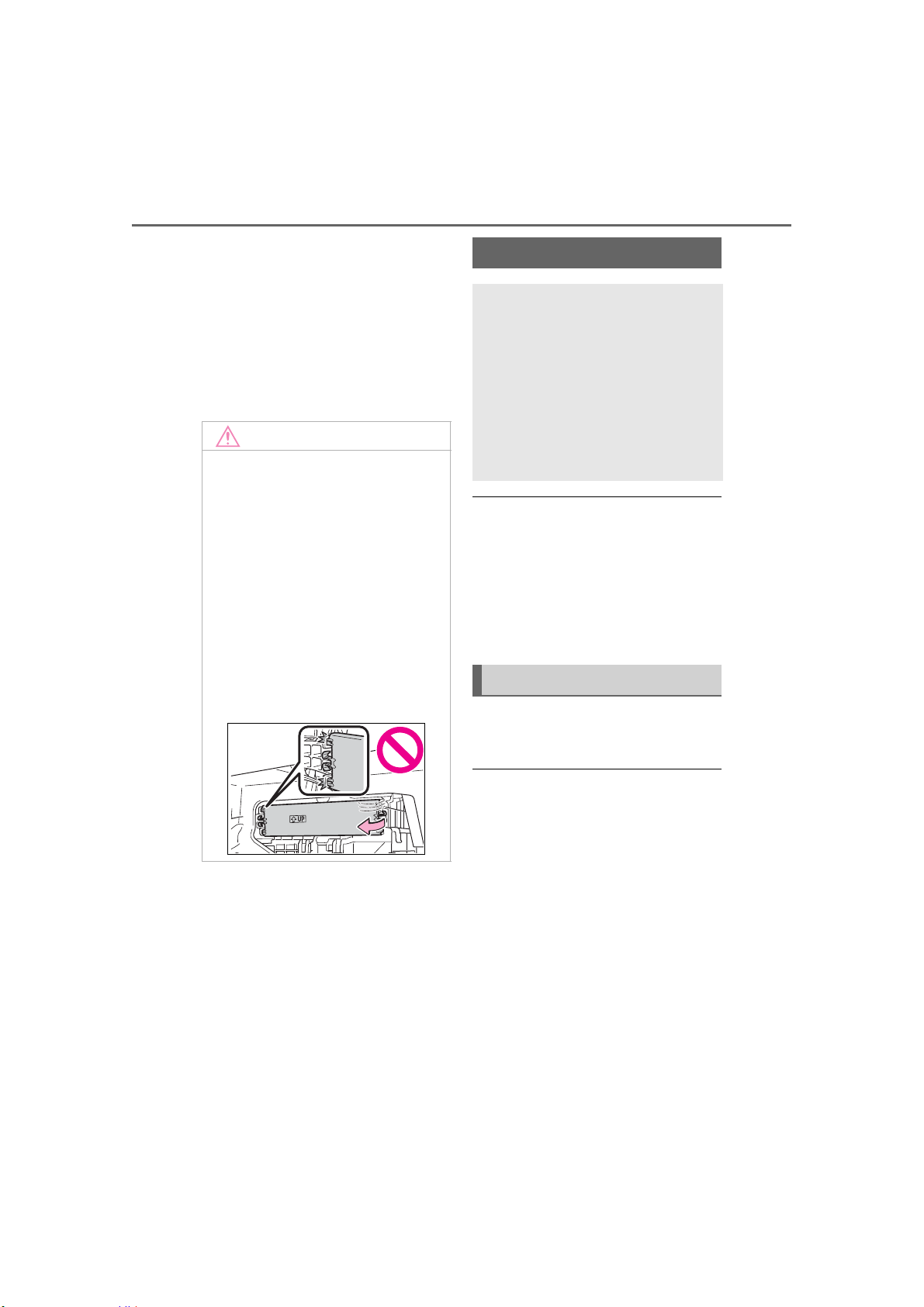
450
7-3. Do-it-yourself maintenance
COROLLA H/B_U
frequent cleaning or early replace-
ment may be required. (For sched-
uled maintenance information,
please refer to the “Scheduled
Maintenance Guide” or “Owner’s
Manual Supplement”.)
■ If air flow from the vents
decreases dramatically
The filter may be clogged. Check
the filter and replace if necessary.
■ If the electronic key battery is
depleted
The following symptoms may occur:
● The smart key system and wire-
less remote control will not func-
tion properly.
● The operational range will be
reduced.
Flathead screwdriver
Lithium battery CR2032
■ Use a CR2032 lithium battery
● Batteries can be purchased at
your Toyota dealer, local electrical
appliance shops or camera stores.
● Replace only with the same or
equivalent type recommended by
the manufacturer.
● Dispose of used batteries accord-
ing to local laws.
NOTICE
■ When using the air condition-
ing system
Make sure that a filter is always
installed.
Using the air conditioning system
without a filter may cause damage
to the system.
■ To prevent damage to the fil-
ter cover
When moving the filter cover in
the direction of arrow to release
the fitting, pay attention not to
apply excessive force to the
claws. Otherwise, the claws may
be damaged.
Electronic key battery
Replace the battery with a
new one if it is depleted.
As the key may be damaged
if the following procedure is
not performed properly, it is
recommended that key bat-
tery replacement be per-
formed by your Toyota
dealer.
Items to prepare
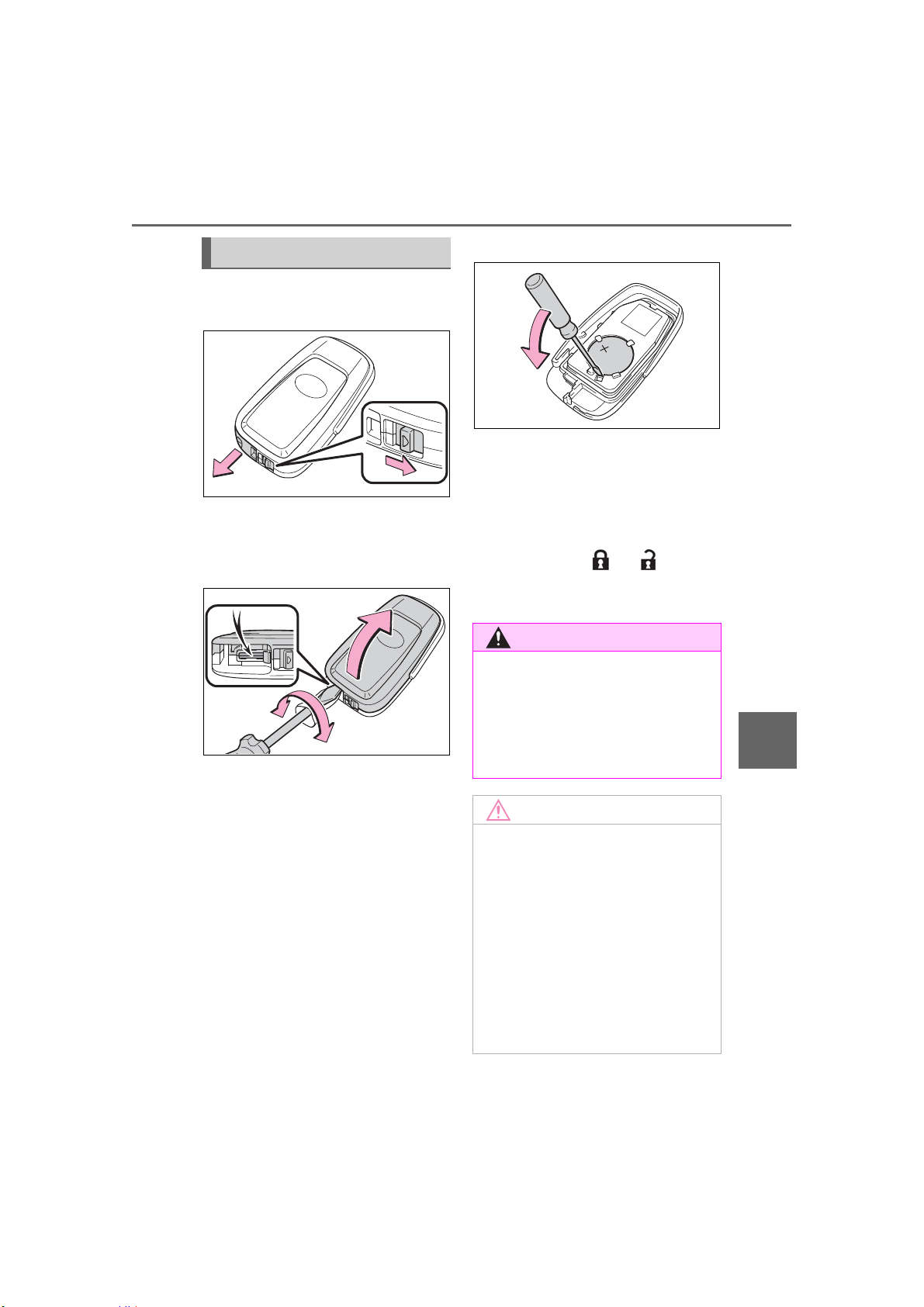
451
7-3. Do-it-yourself maintenance
COROLLA H/B_U
7
Maintenance and care
1 Release the lock and remove
the mechanical key.
2 Remove the key cover.
To prevent damage to the key,
cover the tip of the flathead screw-
driver with a rag.
3 Remove the depleted battery
using a small flathead screw-
driver.
When removing the cover, the elec-
tronic key module may stick to the
cover and the battery may not be
visible. In this case, remove the
electronic key module in order to
remove the battery.
Insert a new battery with the “+” ter-
minal facing up.
4 When installing the key cover
and mechanical key, install
by conducting step 2 and
step 1 with the directions
reversed.
5 Operate the or switch
and check that the doors can
be locked/unlocked.
Replacing the battery
WARNING
■ Removed battery and other
parts
These parts are small and if swal-
lowed by a child, they can cause
choking. Keep away from chil-
dren. Failure to do so could result
in death or serious injury.
NOTICE
■ When replacing the battery
Use a flathead screwdriver of
appropriate size. Applying exces-
sive force may deform or damage
the cover.
■ For normal operation after
replacing the battery
Observe the following precautions
to prevent accidents:
● Always work with dry hands.
Moisture may cause the battery
to rust.
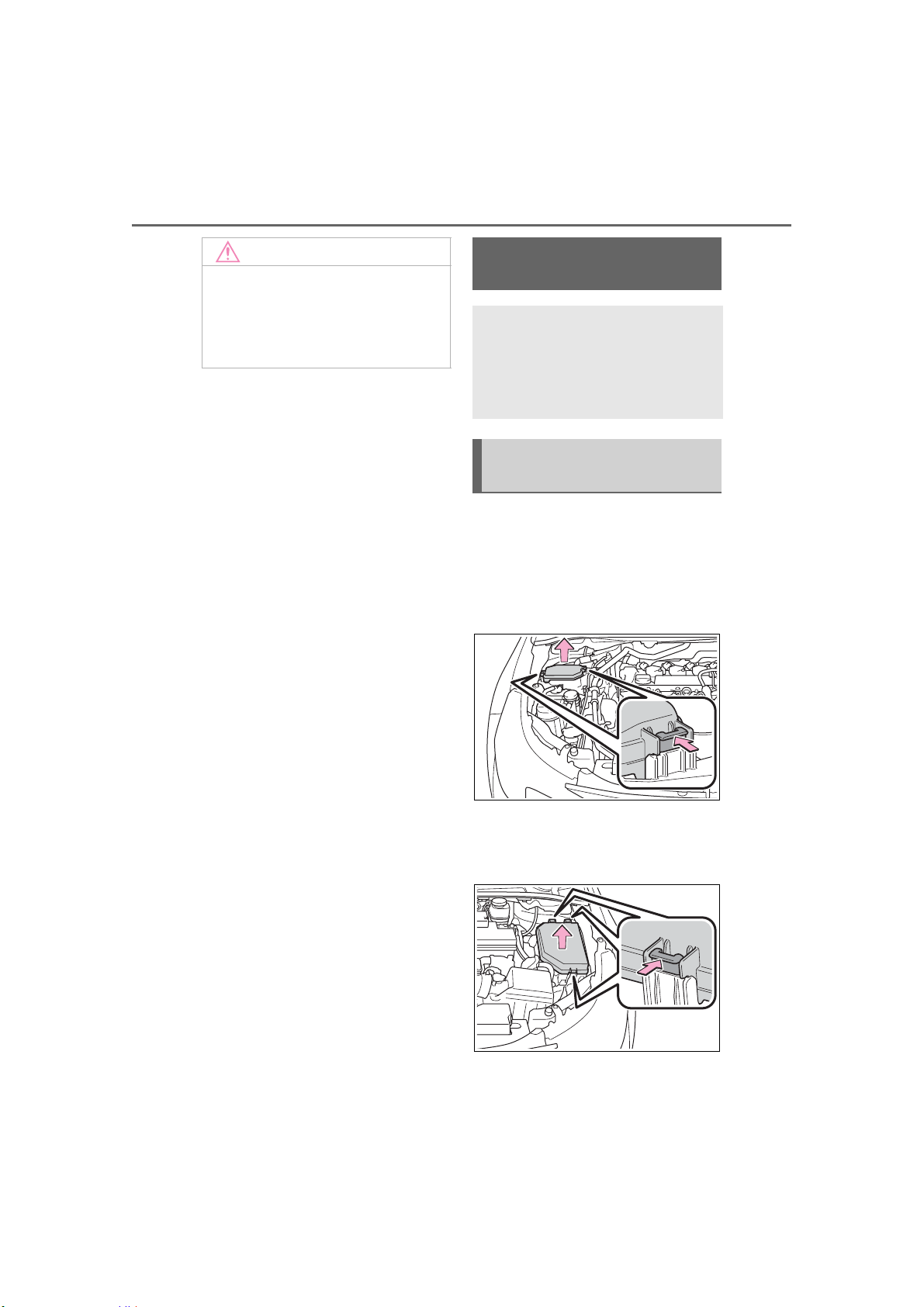
452
7-3. Do-it-yourself maintenance
COROLLA H/B_U
1 Turn the engine switch off.
2 Open the fuse box cover.
Engine compartment: type A
fuse box
Push the tabs in and lift the lid off.
Engine compartment: type B
fuse box
Push the tabs in and lift the lid off.
NOTICE
● Do not touch or move any other
component inside the remote
control.
● Do not bend either of the battery
terminals.
Checking and replac-
ing fuses
If any of the electrical com-
ponents do not operate, a
fuse may have blown. If this
happens, check and replace
the fuses as necessary.
Checking and replacing
fuses
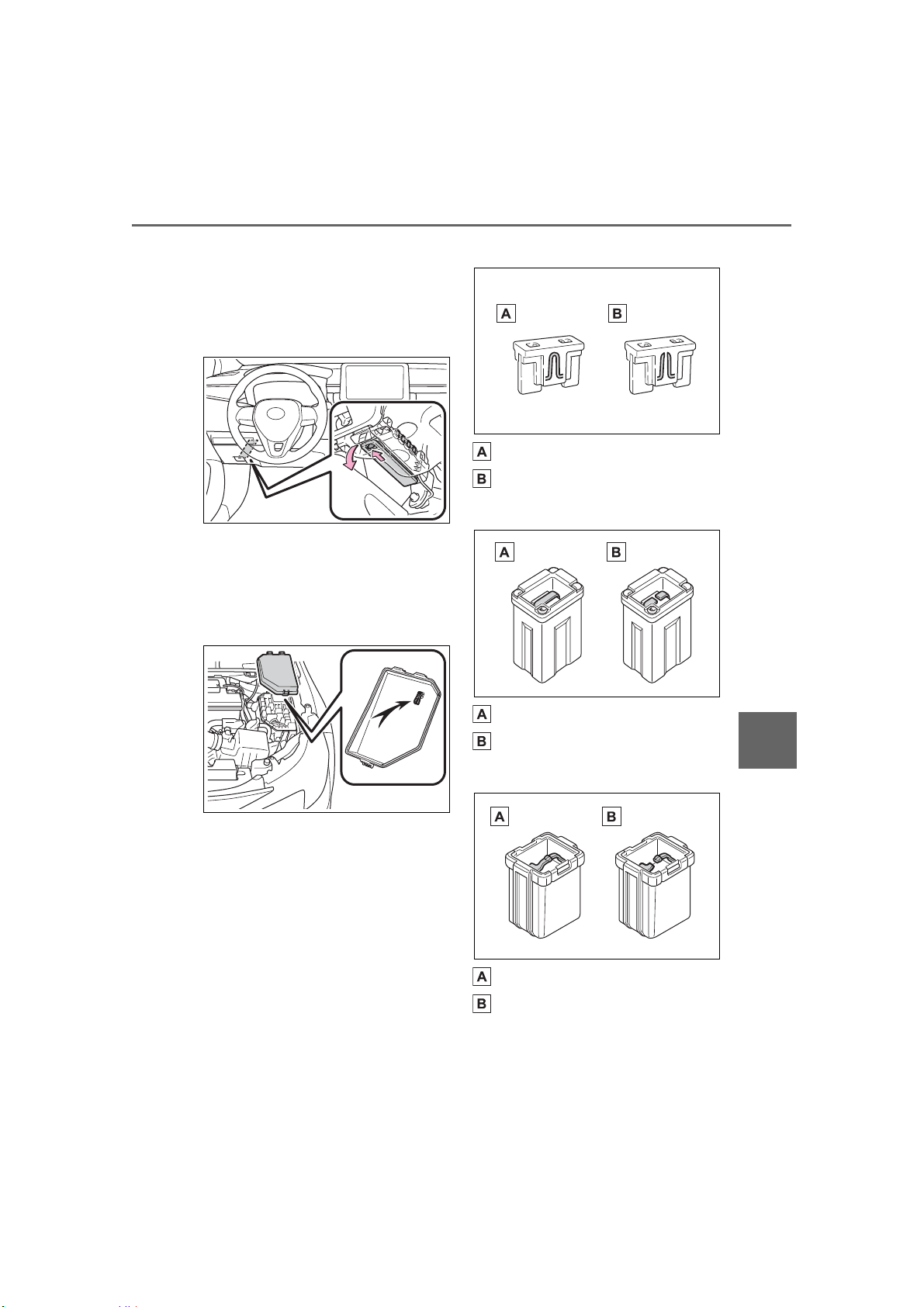
453
7-3. Do-it-yourself maintenance
COROLLA H/B_U
7
Maintenance and care
Under the driver’s side instru-
ment panel
Remove the lid.
Make sure to push the claw when
removing/installing the lid.
3 Remove the fuse with the
pullout tool.
Only type A fuse can be
removed using the pullout
tool.
4 Check if the fuse is blown.
Replace the blown fuse with a new
fuse of an appropriate amperage
rating. The amperage rating can be
found on the fuse box lid.
Type A
Normal fuse
Blown fuse
Type B
Normal fuse
Blown fuse
Type C
Normal fuse
Blown fuse
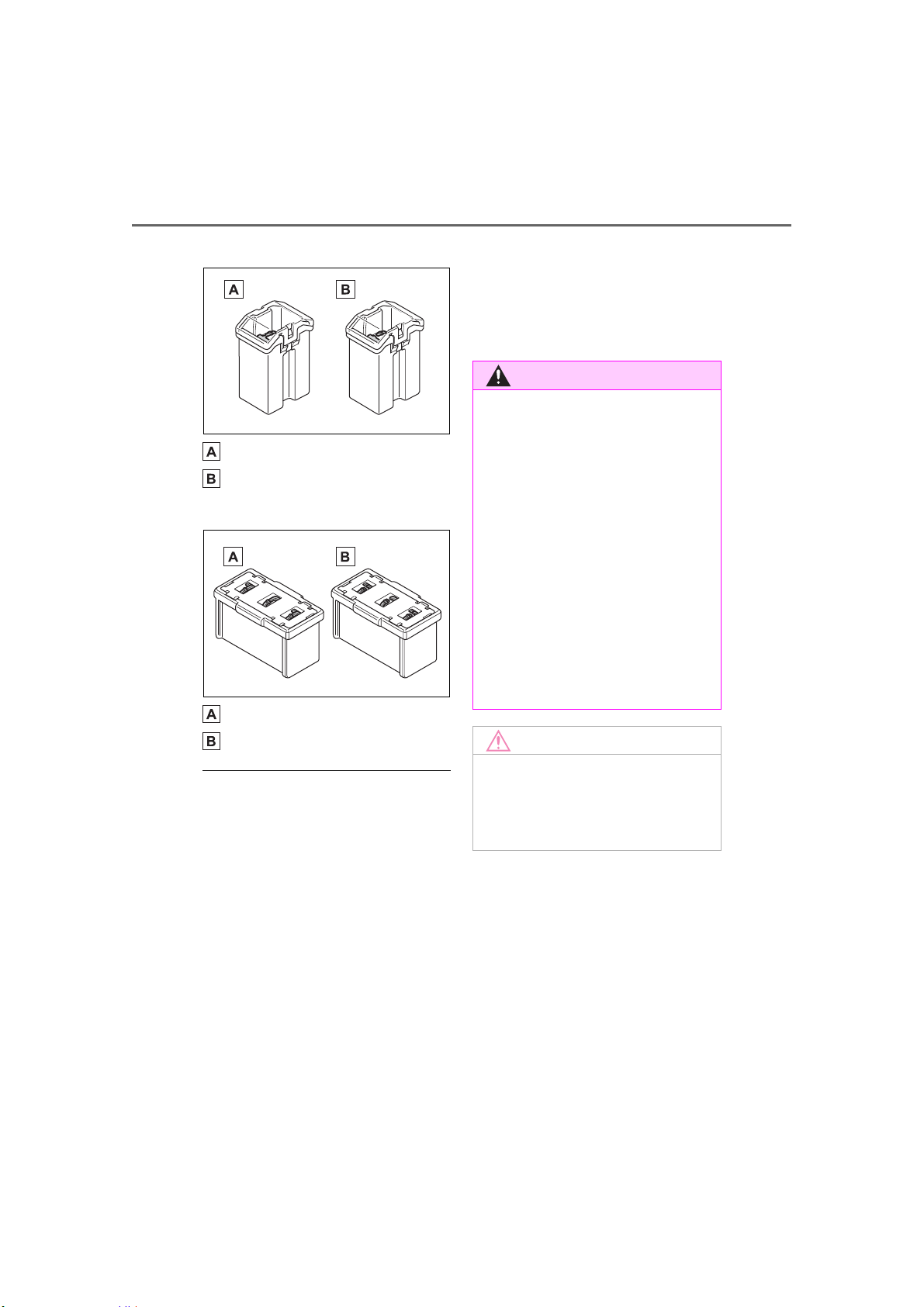
454
7-3. Do-it-yourself maintenance
COROLLA H/B_U
Type D
Normal fuse
Blown fuse
Type E
Normal fuse
Blown fuse
■ After a fuse is replaced
● When installing the lid, make sure
that the tab is installed securely.
● If the lights do not turn on even
after the fuse has been replaced,
a bulb may need replacement.
● If the replaced fuse blows again,
have the vehicle inspected by
your Toyota dealer.
■ If there is an overload in a cir-
cuit
The fuses are designed to blow, pro-
tecting the wiring harness from
damage.
■ When replacing light bulbs
Toyota recommends that you use
genuine Toyota products designed
for this vehicle.
Because certain bulbs are con-
nected to circuits designed to pre-
vent overload, non-genuine parts of
parts not designed for this vehicle
may be unusable.
WARNING
■ To prevent system break-
downs and vehicle fire
Observe the following precau-
tions.
Failure to do so may cause dam-
age to the vehicle, and possibly a
fire or injury.
● Never use a fuse of a higher
amperage rating than that indi-
cated, or use any other object in
place of a fuse.
● Always use a genuine Toyota
fuse or equivalent.
Never replace a fuse with a
wire, even as a temporary fix.
● Do not modify the fuses or fuse
boxes.
NOTICE
■ Before replacing fuses
Have the cause of electrical over-
load determined and repaired by
your Toyota dealer as soon as
possible.
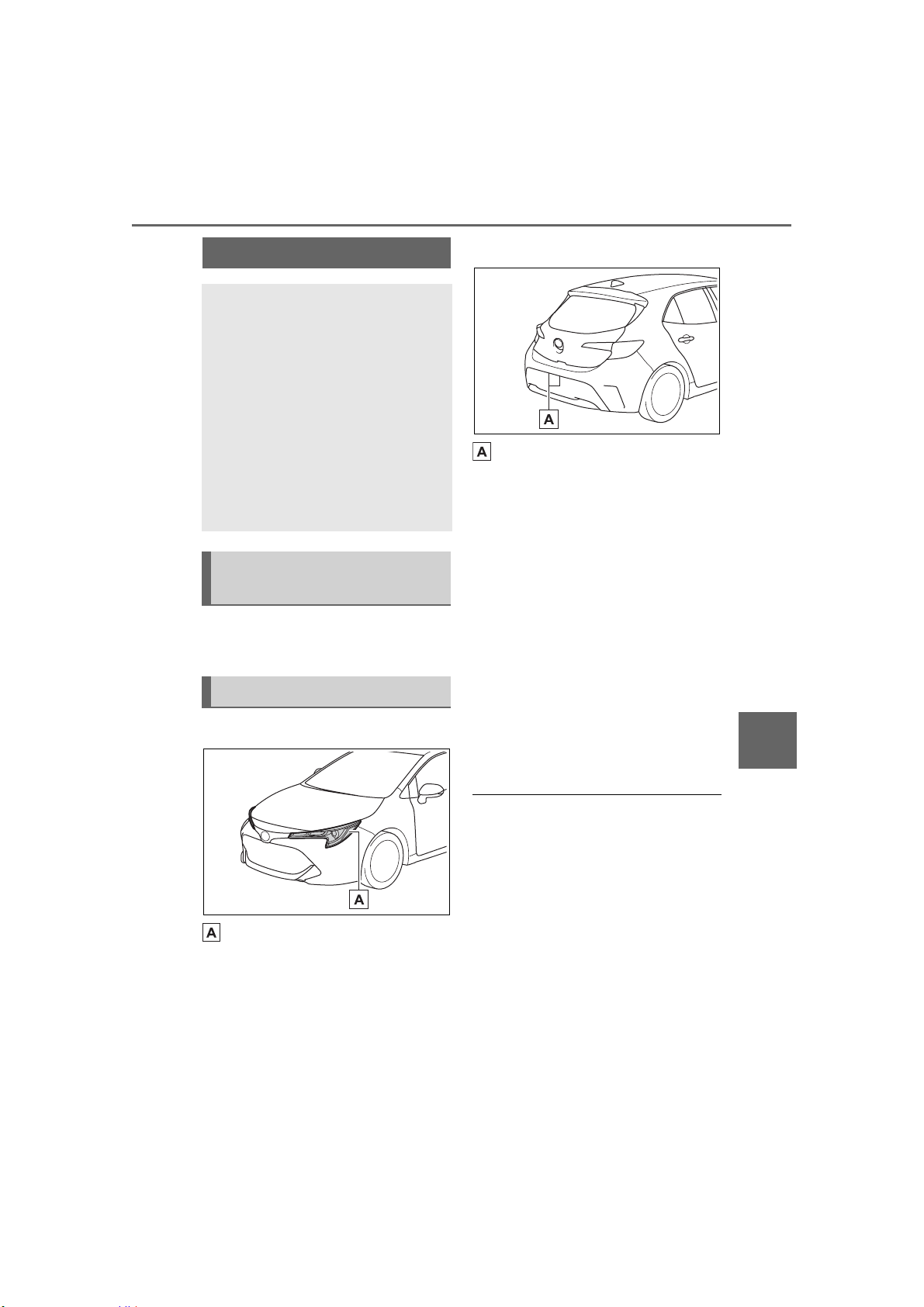
455
7-3. Do-it-yourself maintenance
COROLLA H/B_U
7
Maintenance and care
Check the wattage of the light
bulb to be replaced. (P.516)
■ Front
Front side marker lights
■ Rear
License plate lights
■ Bulbs that need to be
replaced by your Toyota
dealer
Headlights
Parking lights
Daytime running lights
Turn signal lights
Front fog lights (if equipped)
Tail lights
Stop lights
Back-up light
High mounted stoplight
■ LED light bulbs
The lights other than the front side
marker lights and license plate lights
consist of a number of LEDs. If any
of the LEDs burn out, take your
vehicle to your Toyota dealer to
have the light replaced.
■ Condensation build-up on the
inside of the lens
Temporary condensation build-up
on the inside of the headlight lens
does not indicate a malfunction.
Contact your Toyota dealer for more
information in the following situa-
tions:
● Large drops of water have built up
Light bulbs
You may replace the follow-
ing bulbs yourself. The diffi-
culty level of replacement
varies depending on the
bulb. If necessary bulb
replacement seems difficult
to perform, contact your
Toyota dealer.
For more information about
replacing other light bulbs,
contact your Toyota dealer.
Preparing for light bulb
replacement
Bulb locations
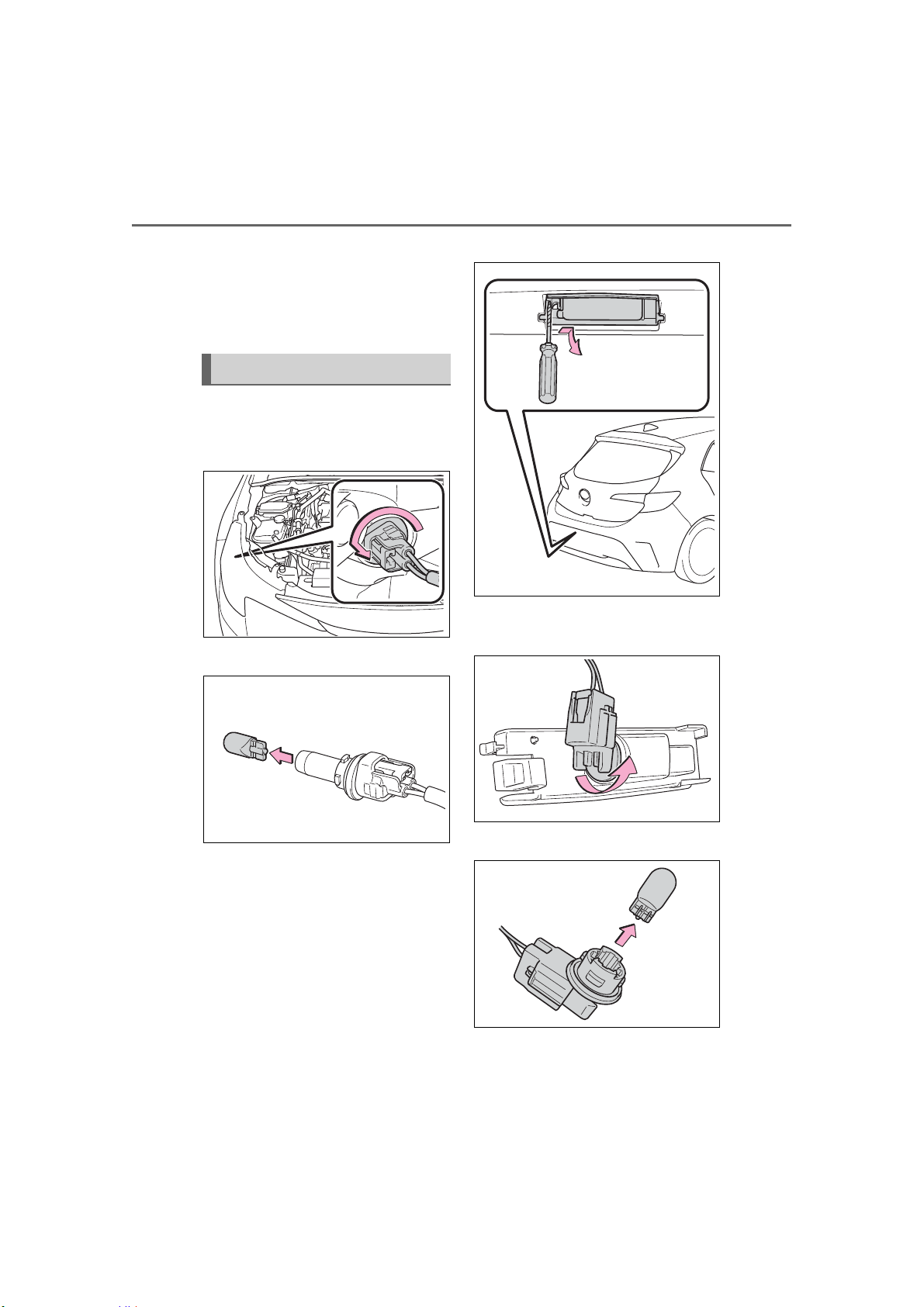
456
7-3. Do-it-yourself maintenance
COROLLA H/B_U
on the inside of the lens.
● Water has built up inside the
headlight.
■ When replacing light bulbs
P. 4 54
■ Front side marker lights
1 Turn the bulb base counter-
clockwise.
2 Remove the light bulb.
3 When installing, reverse the
steps listed.
■ License plate lights
1 Remove the light unit.
Insert a flathead screwdriver or
similar into the hole next to the light
and remove it as shown in the illus-
tration.
To prevent damaging the vehicle,
wrap the flathead screwdriver with
a tape.
2 Turn the bulb base counter-
clockwise and remove it.
3 Remove the light bulb.
4 When installing, reverse the
steps listed.
Replacing light bulbs

457
7-3. Do-it-yourself maintenance
COROLLA H/B_U
7
Maintenance and care
WARNING
■ Replacing light bulbs
● Turn off the lights. Do not
attempt to replace the bulb
immediately after turning off the
lights. The bulbs become very
hot and may cause burns.
● Do not touch the glass portion
of the light bulb with bare
hands. When it is unavoidable
to hold the glass portion, use
and hold with a clean dry cloth
to avoid getting moisture and
oils on the bulb. Also, if the bulb
is scratched or dropped, it may
blow out or crack.
● Fully install light bulbs and any
parts used to secure them. Fail-
ure to do so may result in heat
damage, fire, or water entering
the light unit. This may damage
the lights or cause condensa-
tion to build up on the lens.
■ To prevent damage or fire
Make sure bulbs are fully seated
and locked.

458
7-3. Do-it-yourself maintenance
COROLLA H/B_U

459
COROLLA H/B_U
8
8
When trouble arises
When trouble arises
.
8-1. Essential information
Emergency flashers .... 460
If your vehicle has to be
stopped in an emergency
.................................. 460
If the vehicle is trapped in
rising water................ 461
8-2. Steps to take in an emer-
gency
If your vehicle needs to be
towed......................... 463
If you think something is
wrong ........................ 466
Fuel pump shut off system
.................................. 467
If a warning light turns on or
a warning buzzer sounds
.................................. 468
If a warning message is dis-
played........................ 477
If you have a flat tire (vehi-
cles without spare tire)
.................................. 479
If you have a flat tire (vehi-
cles with a spare tire)
.................................. 490
If the engine will not start
.................................. 498
If you lose your keys ... 500
If the electronic key does
not operate properly.. 500
If the vehicle battery is dis-
charged ..................... 502
If your vehicle overheats
.................................. 506
If the vehicle becomes stuck
.................................. 508
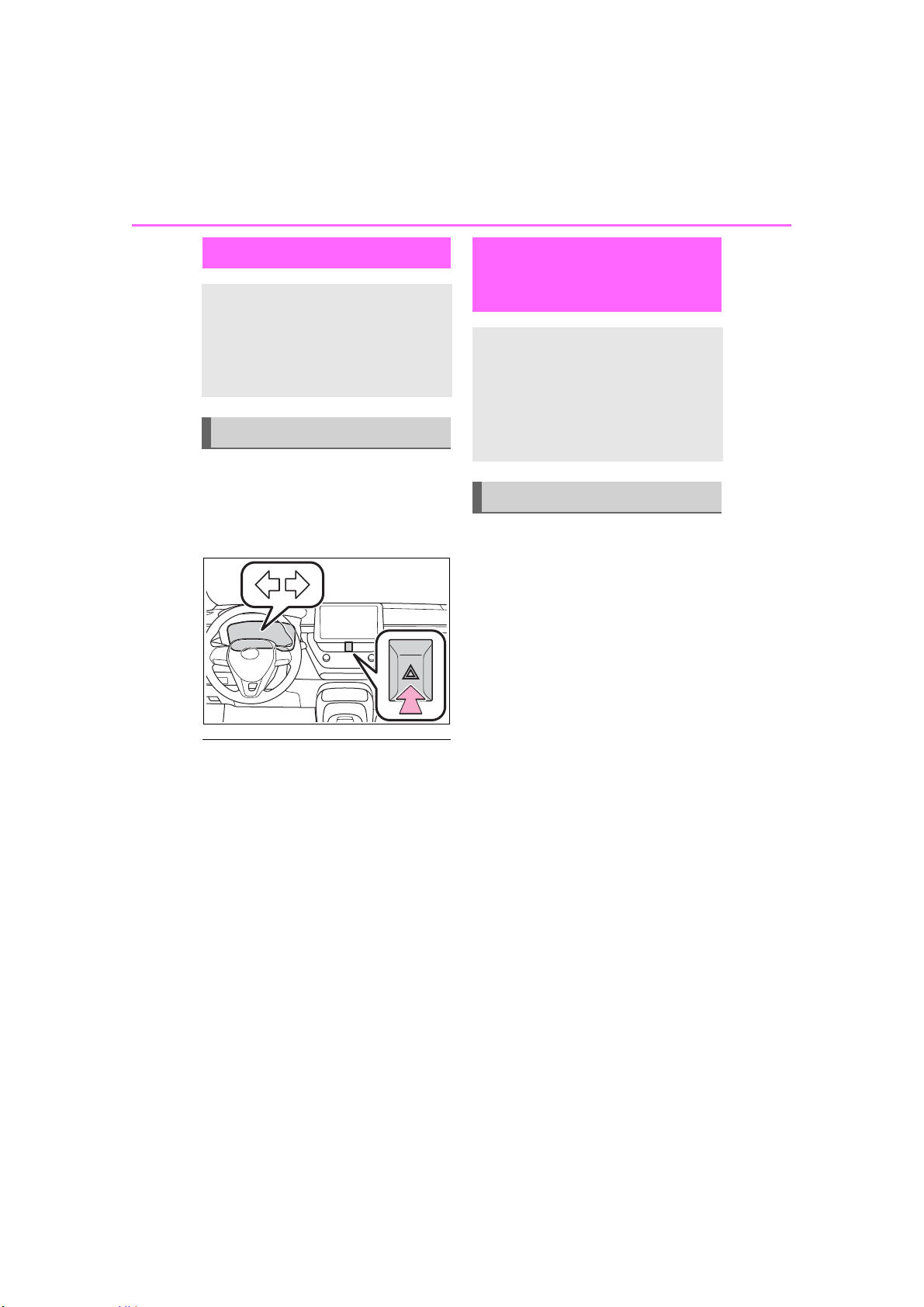
460
8-1. Essential information
COROLLA H/B_U
8-1.Essential i nformation
Press the switch.
All the turn signal lights will flash.
To turn them off, press the switch
once again.
■ Emergency flashers
● If the emergency flashers are
used for a long time while the
engine is not operating, the bat-
tery may discharge.
● If any of the SRS airbags deploy
(inflate) or in the event of a strong
rear impact, the emergency flash-
ers will turn on automatically.
The emergency flashers will turn
off automatically after operating
for approximately 20 minutes. To
manually turn the emergency
flashers off, press the switch
twice.
(The emergency flashers may not
turn on automatically depending
on the force of the impact and
conditions of the collision.)
1 Steadily step on the brake
pedal with both feet and
firmly depress it.
Do not pump the brake pedal
repeatedly as this will increase the
effort required to slow the vehicle.
2 Shift the shift lever to N.
If the shift lever is shifted to N
3 After slowing down, stop the
vehicle in a safe place by the
road.
4 Stop the engine.
If the shift lever cannot be
shifted to N
3 Keep depressing the brake
pedal with both feet to reduce
vehicle speed as much as
possible.
4 To stop the engine, press and
hold the engine switch for 2
consecutive seconds or
Emergency flashers
The emergency flashers are
used to warn other drivers
when the vehicle has to be
stopped on the road due to
a breakdown, etc.
Operating instructions
If your vehicle has to
be stopped in an emer-
gency
Only in an emergency, such
as if it becomes impossible
to stop the vehicle in the
normal way, stop the vehicle
using the following proce-
dure:
Stopping the vehicle
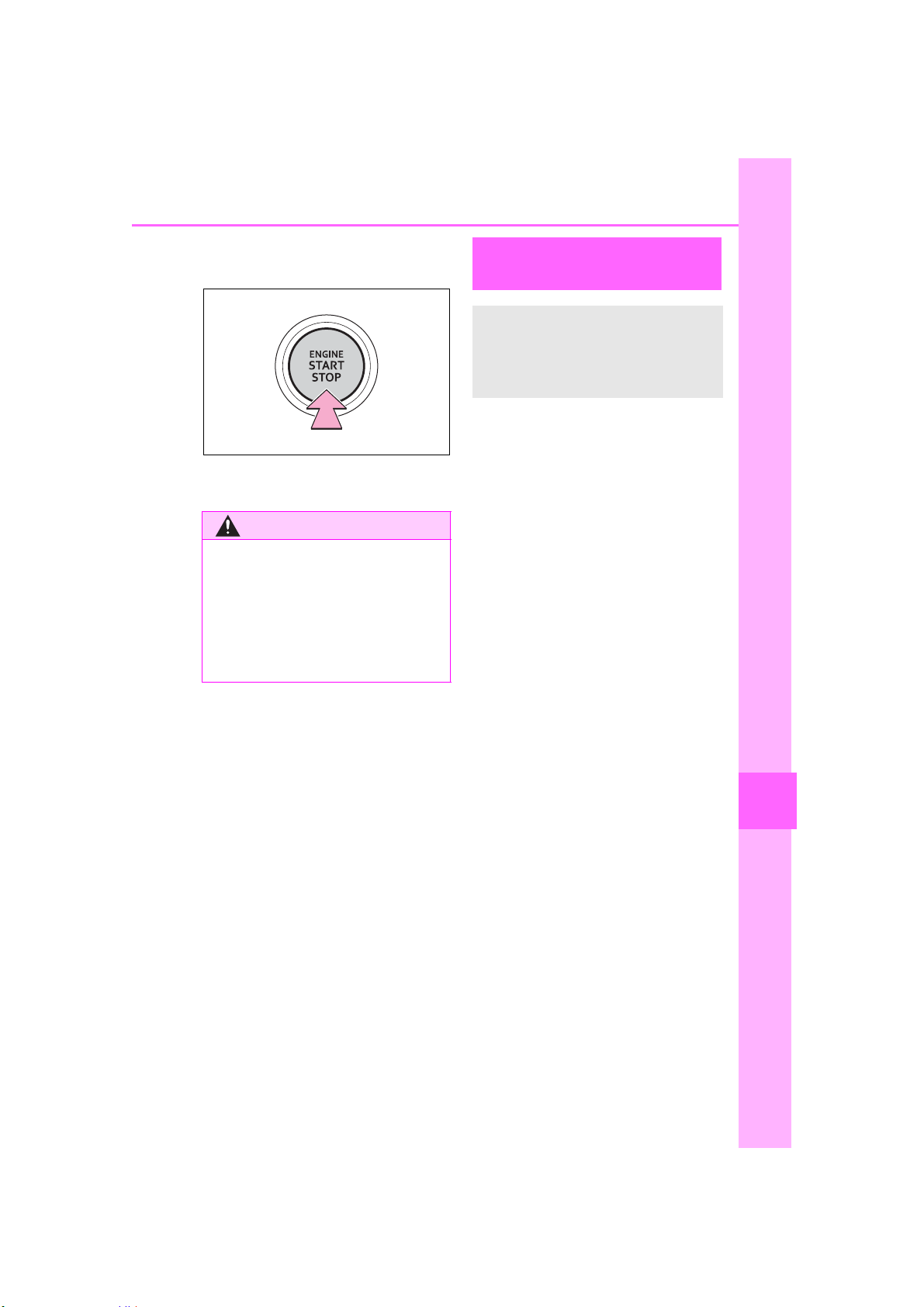
461
8-1. Essential information
COROLLA H/B_U
8
When trouble arises
more, or press it briefly 3
times or more in succession.
5 Stop the vehicle in a safe
place by the road.
Remove the seat belt first.
If the door can be opened,
open the door and exit the
vehicle.
If the door can not be opened,
open the window using the
power window switch and exit
the vehicle through the win-
dow.
If the window can not be
opened using the power win-
dow switch, remain calm, wait
until the water level inside the
vehicle rises to the point that
the water pressure inside of
the vehicle equals the water
pressure outside of the vehi-
cle, and then open the door
and exit the vehicle.
WARNING
■ If the engine has to be turned
off while driving
Power assist for the brakes and
steering wheel will be lost, making
the brake pedal harder to depress
and the steering wheel heavier to
turn. Decelerate as much as pos-
sible before turning off the engine.
If the vehicle is
trapped in rising water
In the event the vehicle is
submerged in water, remain
calm and perform the fol-
lowing.

462
8-1. Essential information
COROLLA H/B_U
WARNING
■ Using an emergency hammer
*
for emergency escape
The front side windows and rear
side windows, as well as the rear
window can be shattered with an
emergency hammer
*
used for
emergency escape. However, an
emergency hammer
*
can not
shatter the windshield as it is lam-
inated glass.
*
: Contact your Toyota dealer or
aftermarket accessory manu-
facturer for further information
about an emergency hammer.
■ Escaping the vehicle from the
window
There are cases where escaping
the vehicle from the window is not
possible due to seating position,
passenger body type, etc.
When using an emergency ham-
mer, consider your seat location
and the size of the window open-
ing to ensure that the opening is
accessible and large enough to
escape.
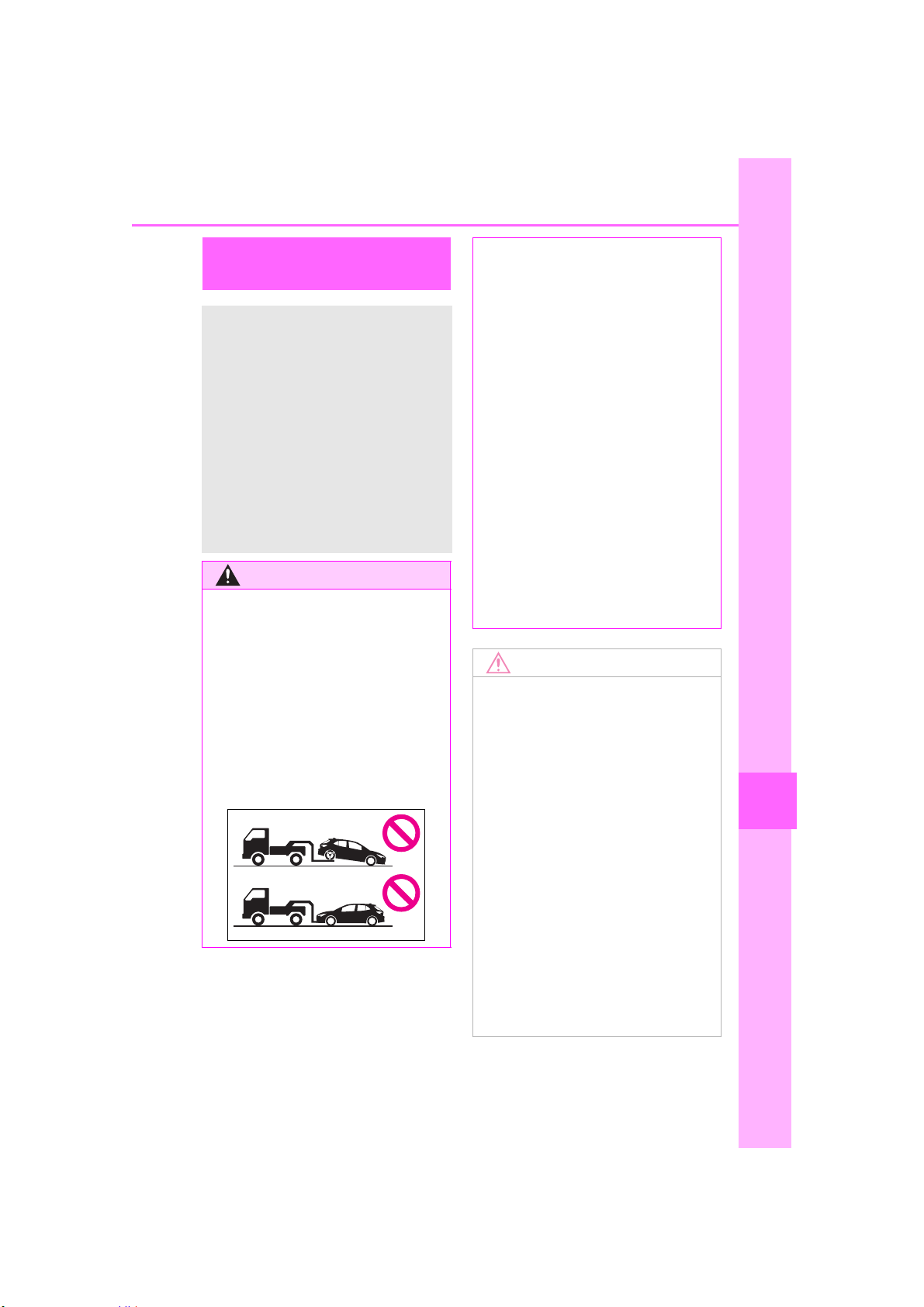
463
8-2. Steps to take in an emergency
COROLLA H/B_U
8
When trouble arises
8-2.Steps to take in an emerge ncy
If your vehicle needs
to be towed
If towing is necessary, we
recommend having your
vehicle towed by your Toy-
ota dealer or commercial
towing service, using a
wheel-lift type truck or flat-
bed truck.
Use a safety chain system
for all towing, and abide by
all state/provincial and local
laws.
WARNING
Observe the following precau-
tions.
Failure to do so may result in
death or serious injury.
■ When towing the vehicle
Be sure to transport the vehicle
with the front wheels raised or
with all four wheels raised off the
ground. If the vehicle is towed
with the front wheels contacting
the ground, the drivetrain and
related parts may be damaged.
■ While towing
● When towing using cables or
chains, avoid sudden starts, etc.
which place excessive stress on
the towing eyelets, cables or
chains. The towing eyelets,
cables or chains may become
damaged, broken debris may hit
people, and cause serious dam-
age.
● Do not turn the engine switch
off.
There is a possibility that the
steering wheel is locked and
cannot be operated.
■ Installing towing eyelets to
the vehicle
Make sure that towing eyelets are
installed securely.
If not securely installed, towing
eyelets may come loose during
towing.
NOTICE
■ To prevent damage to the
vehicle when towing using a
wheel-lift type truck
● Do not tow the vehicle from the
rear when the engine switch is
off. The steering lock mecha-
nism is not strong enough to
hold the front wheels straight.
● When raising the vehicle,
ensure adequate ground clear-
ance for towing at the opposite
end of the raised vehicle. With-
out adequate clearance, the
vehicle could be damaged while
being towed.
■ To prevent damage to the
vehicle when towing with a
sling-type truck
Do not tow with a sling-type truck,
either from the front or rear.
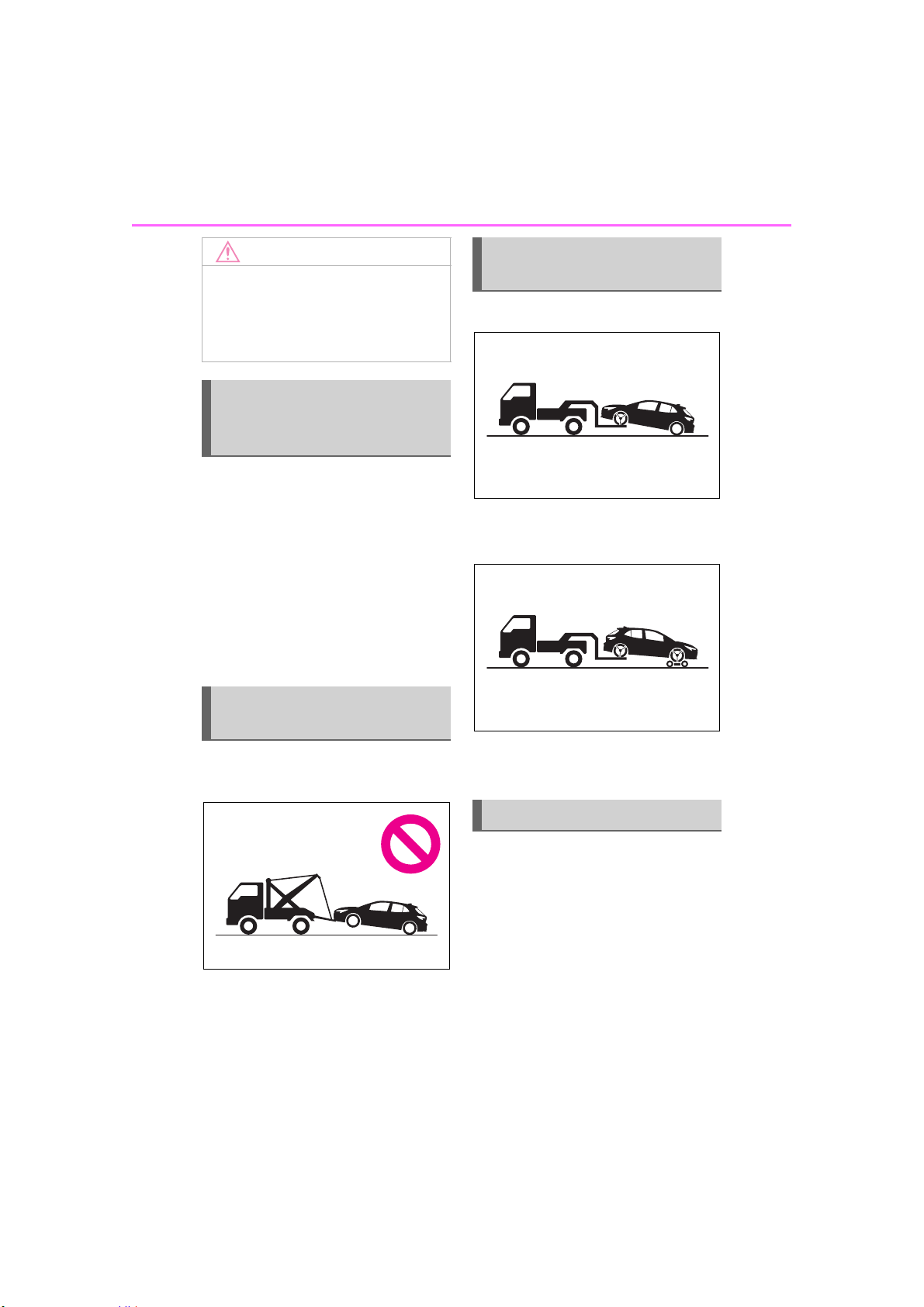
464
8-2. Steps to take in an emergency
COROLLA H/B_U
The following may indicate a
problem with your transmission.
Contact your Toyota dealer or
commercial towing service
before towing.
The engine is running but the
vehicle does not move.
The vehicle makes an abnor-
mal sound.
Do not tow with a sling-type
truck to prevent body damage.
From the front
Release the parking brake.
From the rear
Use a towing dolly under the
front wheels.
If your vehicle is transported by
a flatbed truck, it should be tied
down at the locations shown in
the illustration.
NOTICE
■ To prevent damage to the
vehicle during emergency
towing
Do not secure cables or chains to
the suspension components.
Situations when it is nec-
essary to contact dealers
before towing
Towing with a sling-type
truck
Towing with a wheel-lift
type truck
Using a flatbed truck
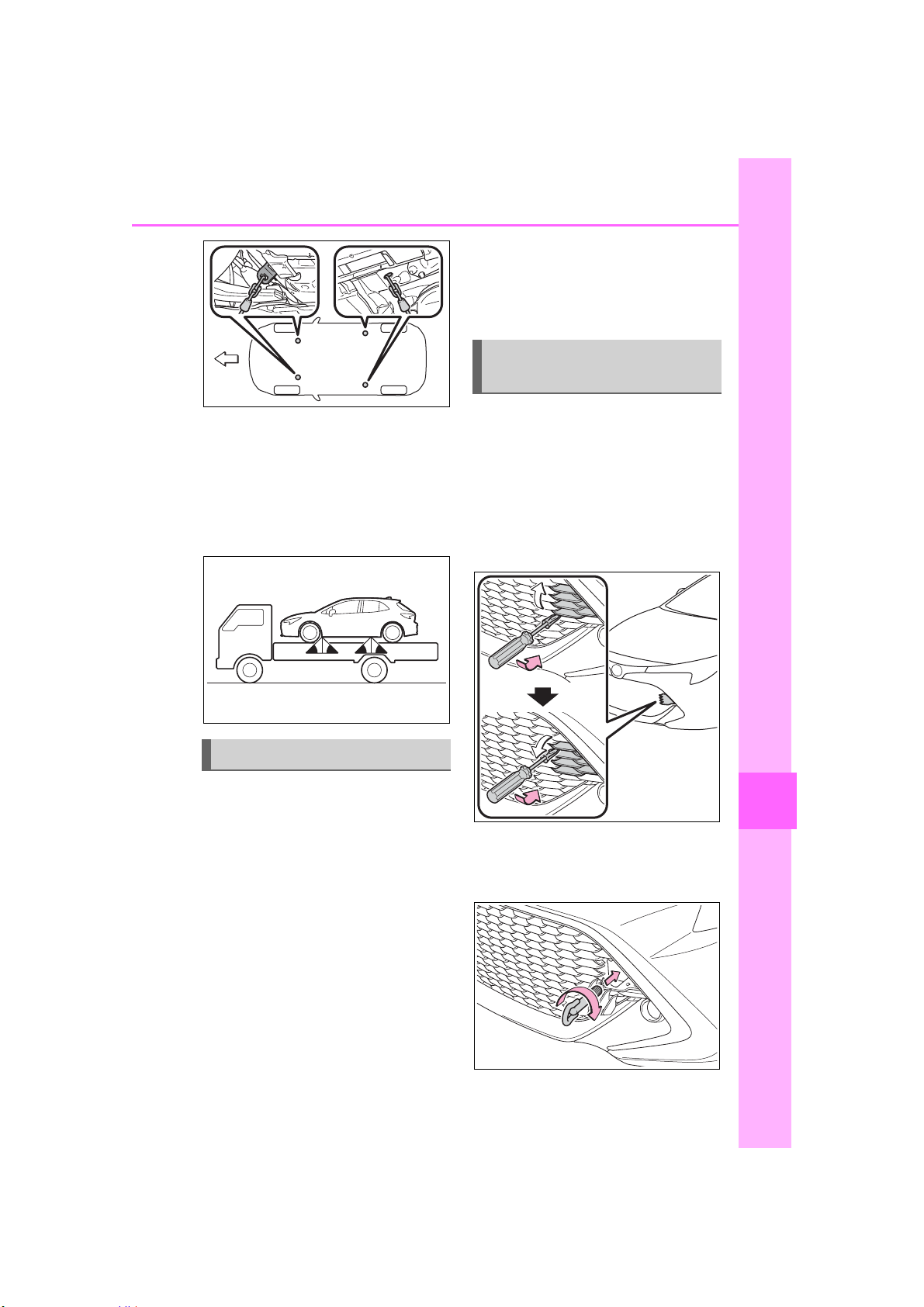
465
8-2. Steps to take in an emergency
COROLLA H/B_U
8
When trouble arises
If you use chains or cables to tie
down your vehicle, the angles
shaded in black must be 45°.
Do not overly tighten the tie
downs or the vehicle may be
damaged.
If a tow truck is not available in
an emergency, your vehicle may
be temporarily towed using
cables or chains secured to the
emergency towing eyelets. This
should only be attempted on
hard surfaced roads for at most
50 miles (80 km) at under 18
mph (30 km/h).
A driver must be in the vehicle to
steer and operate the brakes.
The vehicle’s wheels, drive train,
axles, steering and brakes must
be in good condition.
For vehicles with a continuously
variable transmission, only the
front towing eyelets may be
used.
1 Take out the towing eyelet.
(P.481, 491)
2 Remove the eyelet cover
using a flathead screwdriver.
To protect the bodywork, place a
rag between the screwdriver and
the vehicle body as shown in the
illustration.
3 Insert the towing eyelet into
the hole and tighten partially
by hand.
Emergency towing
Emergency towing proce-
dure
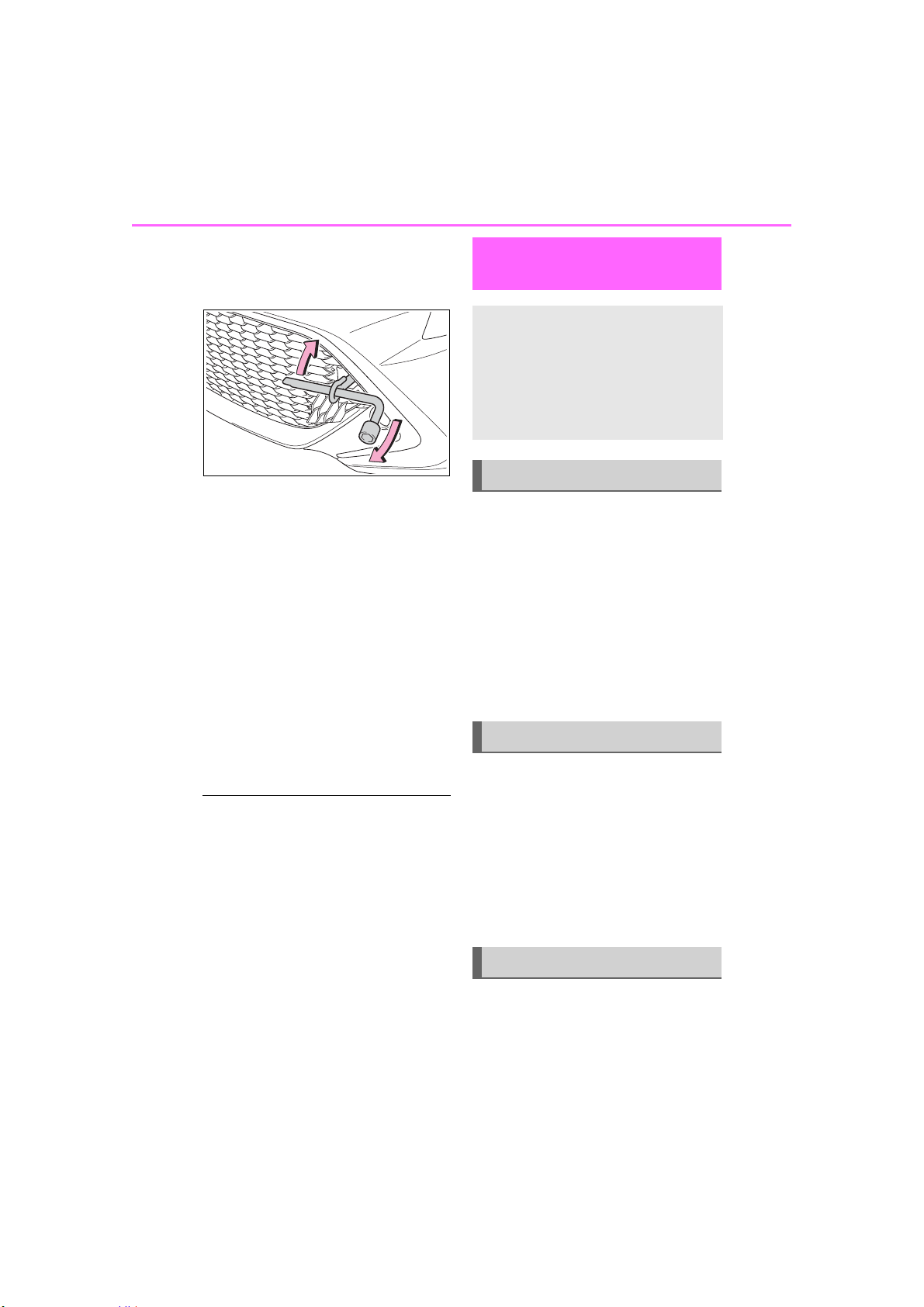
466
8-2. Steps to take in an emergency
COROLLA H/B_U
4 Tighten down the towing eye-
let securely using a wheel nut
wrench or hard metal bar.
5 Securely attach cables or
chains to the towing eyelet.
Take care not to damage the vehi-
cle body.
6 Enter the vehicle being towed
and start the engine.
If the engine does not start, turn the
engine switch to ON.
7 Shift the shift lever to N and
release the parking brake.
Vehicles with a continuously
variable transmission: When
the shift lever cannot be
shifted: P.148
■ While towing
If the engine is not running, the
power assist for the brakes and
steering will not function, making
steering and braking more difficult.
■ Wheel nut wrench
Wheel nut wrench is installed in lug-
gage compartment. (P.481, 491)
Fluid leaks under the vehicle.
(Water dripping from the air
conditioning after use is nor-
mal.)
Flat-looking tires or uneven
tire wear
Engine coolant temperature
gauge needle continually
points higher than normal.
Changes in exhaust sound
Excessive tire squeal when
cornering
Strange noises related to the
suspension system
Pinging or other noises
related to the engine
Engine missing, stumbling or
running roughly
Appreciable loss of power
Vehicle pulls heavily to one
If you think something
is wrong
If you notice any of the fol-
lowing symptoms, your
vehicle probably needs
adjustment or repair. Con-
tact your Toyota dealer as
soon as possible.
Visible symptoms
Audible symptoms
Operational symptoms
467
8-2. Steps to take in an emergency
COROLLA H/B_U
8
When trouble arises
side when braking
Vehicle pulls heavily to one
side when driving on a level
road
Loss of brake effectiveness,
spongy feeling, pedal almost
touches the floor
Follow the procedure below to
restart the engine after the sys-
tem is activated.
1 Turn the engine switch to
ACC or OFF.
2 Restart the engine.
Fuel pump shut off
system
To minimize the risk of fuel
leakage when the engine
stalls or when an airbag
inflates upon collision, the
fuel pump shut off system
stops the supply of fuel to
the engine.
Restarting the engine
NOTICE
■ Before starting the engine
Inspect the ground under the
vehicle.
If you find that fuel has leaked
onto the ground, the fuel system
has been damaged and is in need
of repair. Do not restart the
engine.
468
8-2. Steps to take in an emergency
COROLLA H/B_U
■ Brake system warning light (warning buzzer)
■ Brake system warning light
■ High coolant temperature warning light
*
(warning buzzer)
*
: This light illuminates on the multi-information display.
If a warning light turns on or a warning buzzer
sounds
Calmly perform the following actions if any of the warning
lights comes on or flashes. If a light comes on or flashes, but
then goes off, this does not necessarily indicate a malfunction
in the system. However, if this continues to occur, have the
vehicle inspected by your Toyota dealer.
Actions to the warning lights or warning buzzers
Warning light Details/Actions
(U.S.A.)
or
(Red)
(Canada)
Indicates that:
The brake fluid level is low; or
The brake system is malfunctioning
Immediately stop the vehicle in a safe place and con-
tact your Toyota dealer. Continuing to drive the vehi-
cle may be dangerous.
Warning light Details/Actions
(Yellow)
Indicates a malfunction in the parking brake system
Have the vehicle inspected by your Toyota dealer
immediately.
Warning light Details/Actions
Indicates that the engine coolant temperature is exces-
sively high
Immediately stop the vehicle in a safe place.
Handling method (P.506)
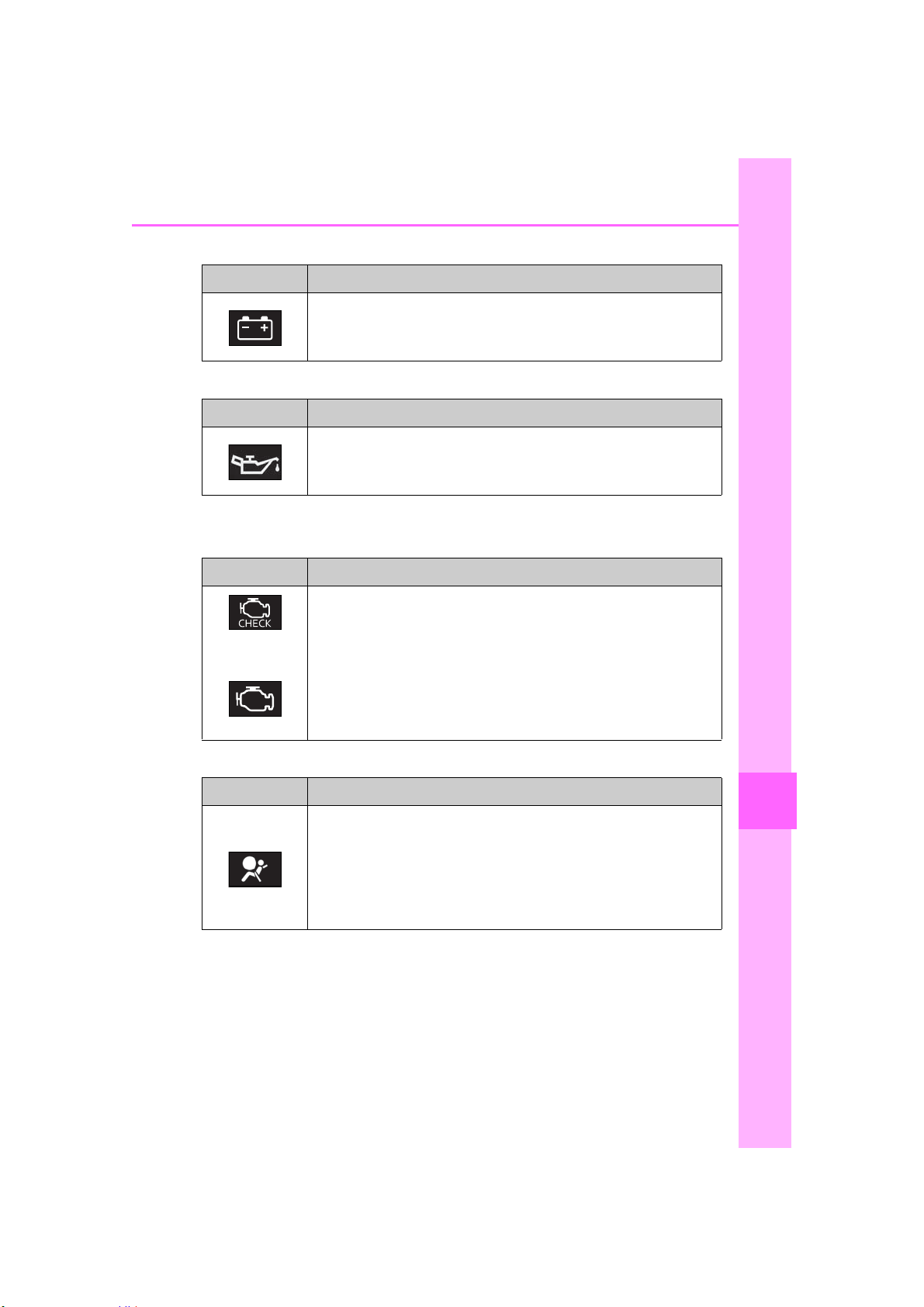
469
8-2. Steps to take in an emergency
COROLLA H/B_U
8
When trouble arises
■ Charging system warning light
■ Low engine oil pressure warning light
*
(warning buzzer)
*
: This light illuminates on the multi-information display.
■ Malfunction indicator lamp (warning buzzer)
■ SRS warning light (warning buzzer)
Warning light Details/Actions
Indicates a malfunction in the vehicle’s charging system
Immediately stop the vehicle in a safe place and con-
tact your Toyota dealer.
Warning light Details/Actions
Indicates that the engine oil pressure is excessively low
Immediately stop the vehicle in a safe place and con-
tact your Toyota dealer.
Warning light Details/Actions
(U.S.A.)
or
(Canada)
Indicates a malfunction in:
The electronic engine control system;
The electronic throttle control system; or
The electronic continuously variable transmission (if
equipped) control system
Immediately stop the vehicle in a safe place and con-
tact your Toyota dealer.
Warning light Details/Actions
Indicates a malfunction in:
The SRS airbag system;
The front passenger occupant classification system; or
The seat belt pretensioner system
Have the vehicle inspected by your Toyota dealer
immediately.
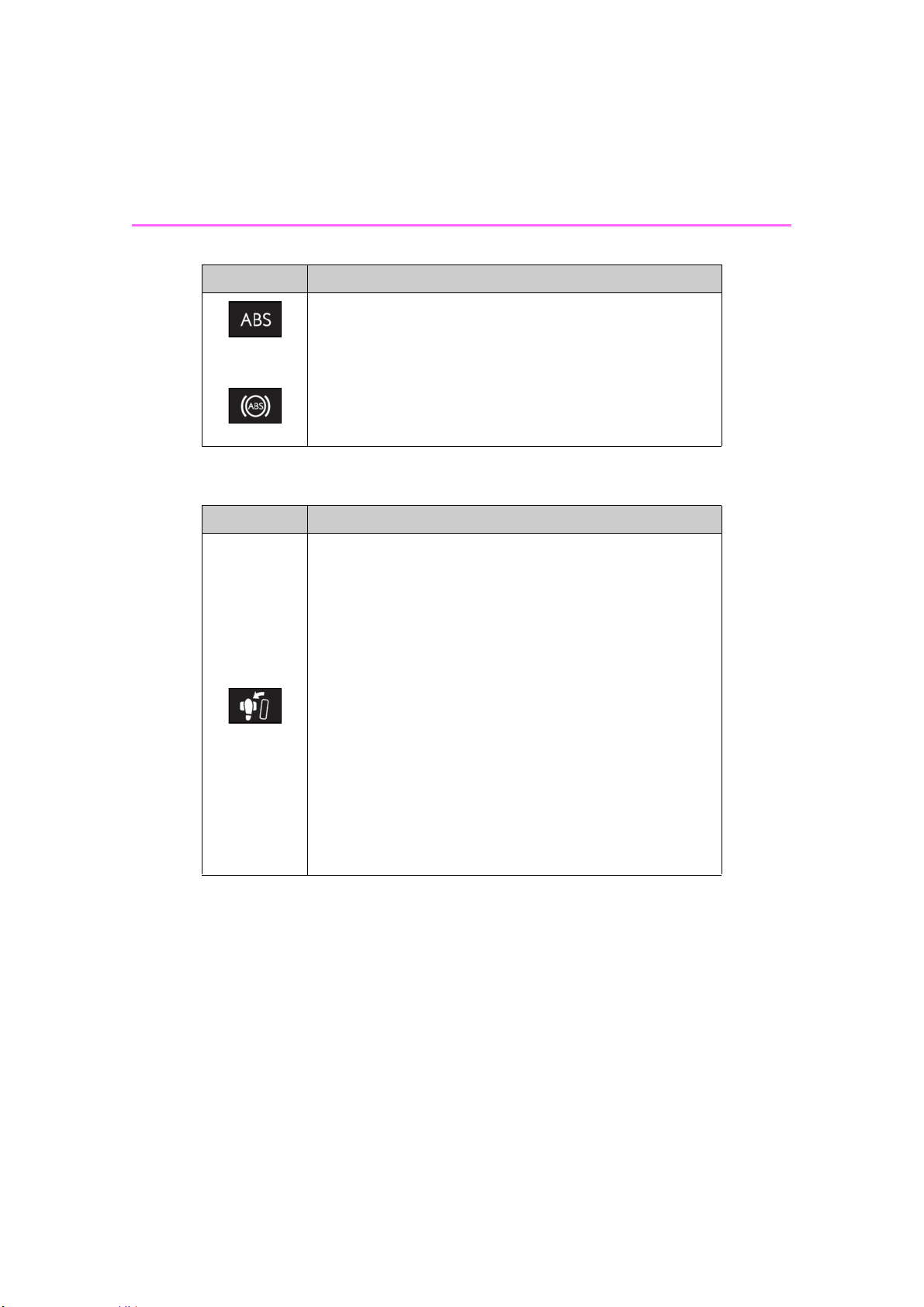
470
8-2. Steps to take in an emergency
COROLLA H/B_U
■ ABS warning light
■ Brake Override System warning light/Drive-Start Control
warning light
*
(warning buzzer)
*
: This light illuminates on the multi-information display.
Warning light Details/Actions
(U.S.A.)
or
(Canada)
Indicates a malfunction in:
The ABS; or
The brake assist system
Have the vehicle inspected by your Toyota dealer
immediately.
Warning light Details/Actions
When a buzzer sounds:
Indicates a malfunction in:
The Brake Override System
The Drive-Start Control system (if equipped)
Have the vehicle inspected by your Toyota dealer
immediately.
Indicates that the shift position was changed and
Drive-Start Control (if equipped) was operated while
depressing the accelerator pedal.
Momentarily release the accelerator pedal.
When a buzzer does not sound:
Indicates that the accelerator and brake pedals are being
depressed simultaneously, and the Brake Override System
is operating.
Release the accelerator pedal and depress the brake
pedal.
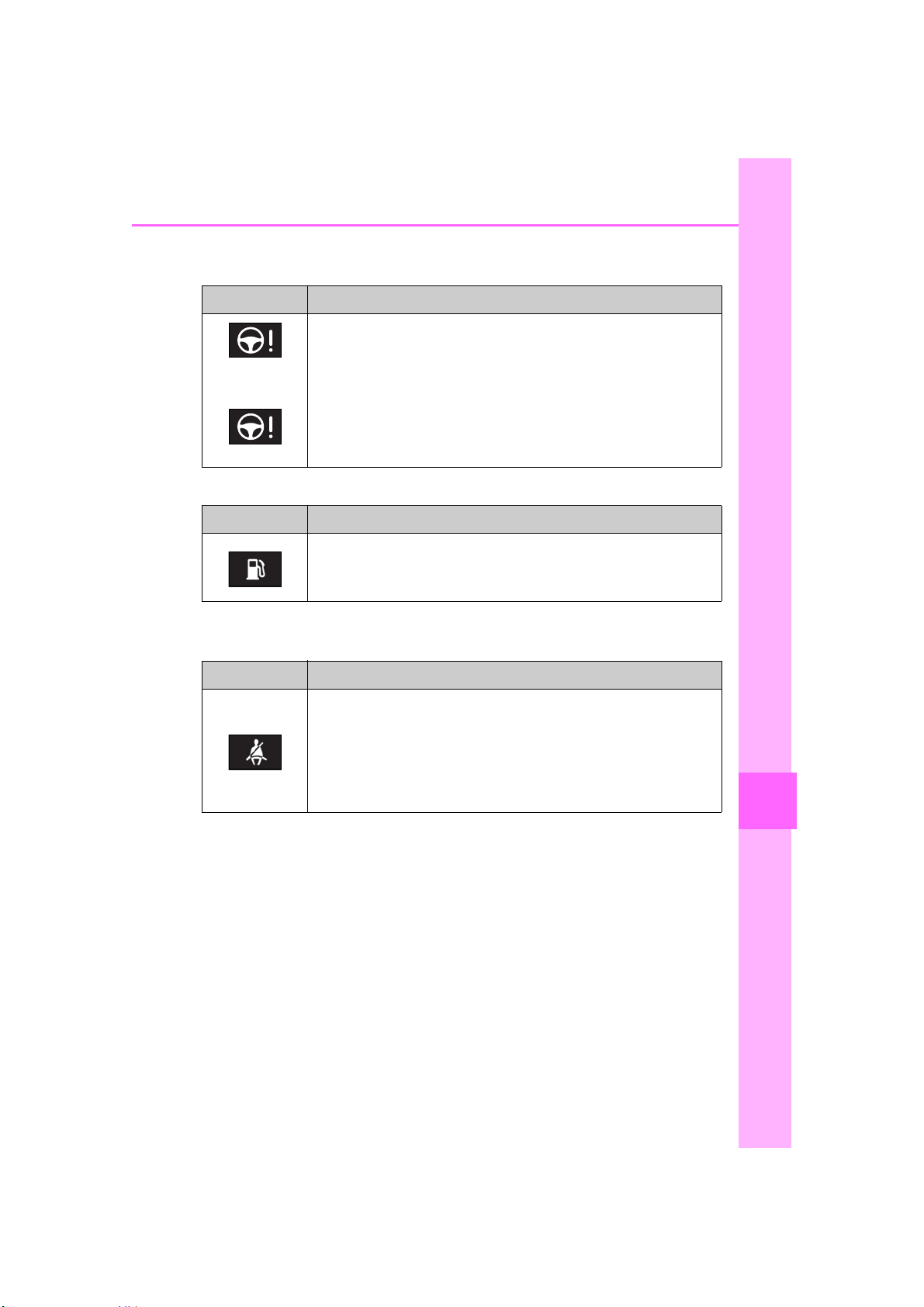
471
8-2. Steps to take in an emergency
COROLLA H/B_U
8
When trouble arises
■ Electric power steering system warning light (warning
buzzer)
■ Low fuel level warning light
■ Driver’s and front passenger’s seat belt reminder light (warn-
ing buzzer)
*
*
: Driver’s seat belt warning buzzer:
The driver’s seat belt warning buzzer sounds to alert the driver that his or
her seat belt is not fastened. Once the engine switch is turned to ON, the
buzzer sounds. If the seat belt is still unfastened, the buzzer sounds inter-
mittently for a certain period of time after the vehicle reaches a certain
speed.
Front passenger’s seat belt warning buzzer:
The front passenger’s seat belt warning buzzer sounds to alert the front
passenger that his or her seat belt is not fastened. If the seat belt is unfas-
tened, the buzzer sounds intermittently for a certain period of time after the
vehicle reaches a certain speed.
Warning light Details/Actions
(Red)
or
(Yellow)
Indicates a malfunction in the EPS (Electric Power Steer-
ing) system
Have the vehicle inspected by your Toyota dealer
immediately.
Warning light Details/Actions
Indicates that remaining fuel is approximately 2 gal. (7.5 L,
1.6 Imp. gal.) or less
Refuel the vehicle.
Warning light Details/Actions
Warns the driver and/or front passenger to fasten their seat
belts
Fasten the seat belt.
If the front passenger’s seat is occupied, the front
passenger’s seat belt also needs to be fastened to
make the warning light (warning buzzer) turn off.
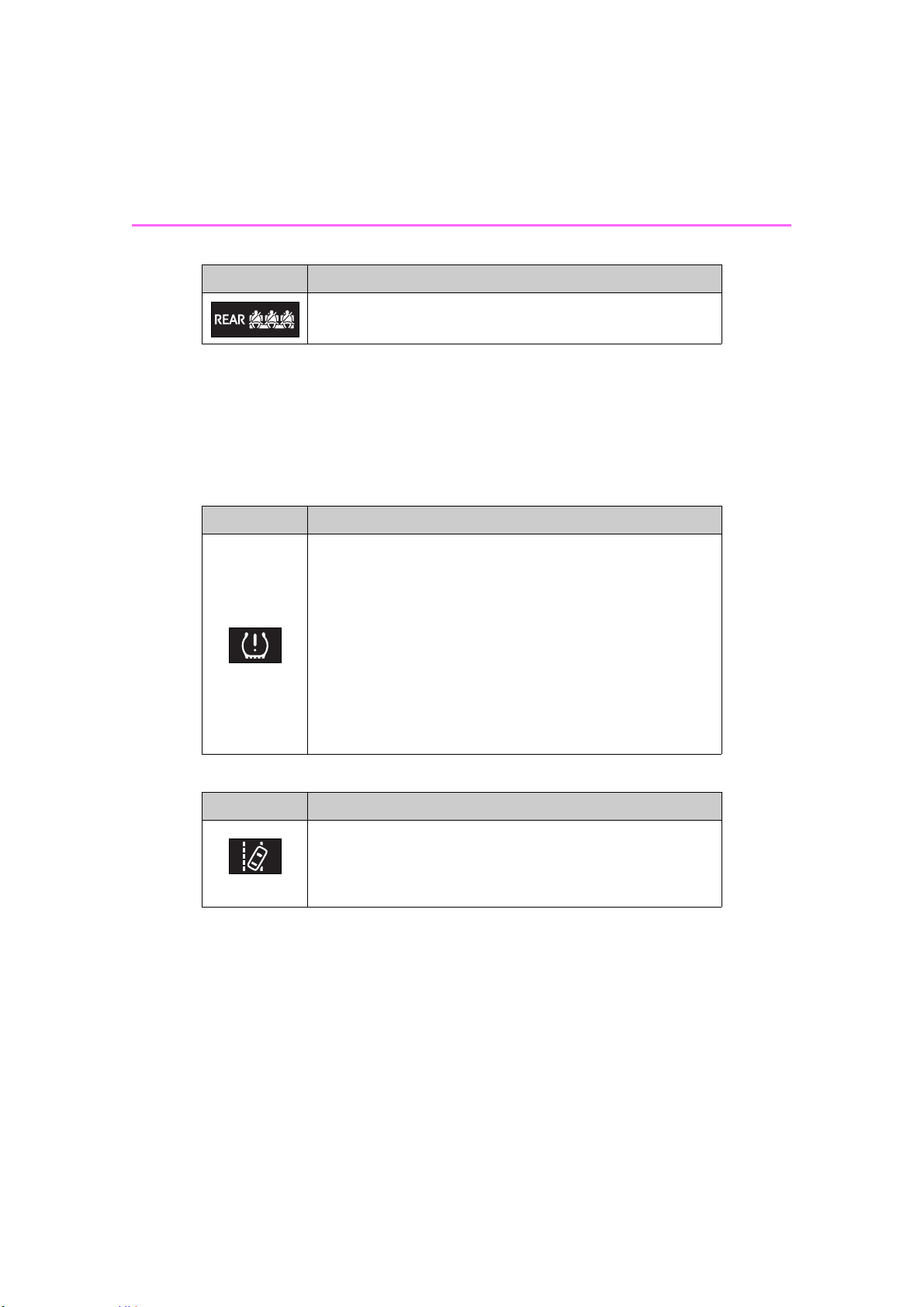
472
8-2. Steps to take in an emergency
COROLLA H/B_U
■ Rear passengers’ seat belt reminder lights (warning buzzer)
*
*
: Rear passengers’ seat belt warning buzzer:
The rear passengers’ seat belt warning buzzer sounds to alert the rear pas-
sengers that his or her seat belt is not fastened. If the seat belt is unfas-
tened, the buzzer sounds intermittently for a certain period of time, after the
seat belt is fastened and unfastened and the vehicle reaches a certain
speed.
■ Tire pressure warning light
■ LTA indicator/LDA indicator (warning buzzer)
Warning light Details/Actions
Warns the rear passengers to fasten their seat belts
Fasten the seat belt.
Warning light Details/Actions
When the light comes on after blinking for approximately 1
minute:
Malfunction in the tire pressure warning system
Have the system checked by your Toyota dealer.
When the light comes on:
Low tire inflation pressure such as
Natural causes
Flat tire
Immediately stop the vehicle in a safe place.
Handling method (P.474)
Warning light Details/Actions
(Orange)
Indicates a malfunction in the LTA (Lane Tracing Assist) or
LDA (Lane Departure Alert with steering control)
Follow the instructions displayed on the multi-infor-
mation display. (P.195, 203)
473
8-2. Steps to take in an emergency
COROLLA H/B_U
8
When trouble arises
■ PCS warning light
■ Slip indicator
■ Parking brake indicator
Warning light Details/Actions
(Flashes or illu-
minates)
If a buzzer sounds simultaneously:
A malfunction has occurred in the PCS (Pre-Collision Sys-
tem).
Have the vehicle inspected by your Toyota dealer
immediately.
If a buzzer does not sound:
The PCS (Pre-Collision System) has become temporarily
unavailable, corrective action may be necessary.
Possible causes and corrective actions (P.176,
477)
If the PCS (Pre-Collision System) or VSC (Vehicle Stability
Control) system is disabled, the PCS warning light will illu-
minate.
P. 1 85
Warning light Details/Actions
Indicates a malfunction in:
The VSC system;
The TRAC system; or
The hill-start assist control system
Have the vehicle inspected by your Toyota dealer
immediately.
Warning light Details/Actions
(Flashes)
(U.S.A.)
or
(Flashes)
(Canada)
It is possible that the parking brake is not fully engaged or
released
Operate the parking brake switch once again.
This light comes on when the parking brake is not released.
If the light turns off after the parking brake is fully released,
the system is operating normally.

474
8-2. Steps to take in an emergency
COROLLA H/B_U
■ Brake hold operated indicator
■ iMT indicator
■ Warning buzzer
In some cases, the buzzer may not
be heard due to being in a noisy
location or audio sound.
■ Front passenger detection sen-
sor, seat belt reminder and
warning buzzer
● If luggage is placed on the front
passenger seat, the front passen-
ger detection sensor may cause
the warning light to flash and the
warning buzzer to sound even if a
passenger is not sitting in the
seat.
● If a cushion is placed on the seat,
the sensor may not detect a pas-
senger, and the warning light may
not operate properly.
■ SRS warning light
This warning light system monitors
the airbag sensor assembly, front
impact sensors, side impact sensors
(front door), side impact sensors
(front), side impact sensors (rear),
driver’s seat position sensor,
driver’s seat belt buckle switch, front
passenger occupant classification
system (ECU and sensors), “AIR
BAG ON” indicator light, “AIR BAG
OFF” indicator light, seat belt pre-
tensioners, airbags, interconnecting
wiring and power sources. (P.29)
■ If the malfunction indicator
lamp comes on while driving
First check the following:
● Is the fuel tank empty?
If it is, fill the fuel tank immediately.
● Is the fuel tank cap loose?
If it is, tighten it securely.
The light will go off after several
driving trips.
If the light does not go off even after
several trips, contact your Toyota
dealer as soon as possible.
■ Electric power steering system
warning light (warning buzzer)
When the battery charge becomes
insufficient or the voltage temporar-
ily drops, the electric power steering
system warning light may come on
and the warning buzzer may sound.
■ When the tire pressure warning
light comes on
Inspect the tires to check if a tire is
punctured.
If a tire is punctured: P.479, 490
If none of the tires are punctured:
Turn the engine switch off then turn
it to ON. Check if the tire pressure
warning light comes on or blinks.
Warning light Details/Actions
(Flashes)
Indicates a malfunction in the brake hold system
Have the vehicle inspected by your Toyota dealer
immediately.
Warning light Details/Actions
(Orange)
(if equipped)
Indicates a malfunction in the iMT
Have the vehicle inspected by your Toyota dealer
immediately.
475
8-2. Steps to take in an emergency
COROLLA H/B_U
8
When trouble arises
If the tire pressure warning light
blinks for approximately 1 minute
then stays on
There may be a malfunction in the
tire pressure warning system. Have
the vehicle inspected by your Toyota
dealer immediately.
If the tire pressure warning light
comes on
1 After the temperature of the tires
has lowered sufficiently, check
the inflation pressure of each tire
and adjust them to the specified
level.
2 If the warning light does not turn
off even after several minutes
have elapsed, check that the
inflation pressure of each tire is
at the specified level and perform
initialization. (P.442)
■ The tire pressure warning light
may come on due to natural
causes
The tire pressure warning light may
come on due to natural causes such
as natural air leaks and tire inflation
pressure changes caused by tem-
perature. In this case, adjusting the
tire inflation pressure will turn off the
warning light (after a few minutes).
■ When a tire is replaced with a
spare tire (vehicles with a com-
pact spare tire)
The compact spare tire is not
equipped with a tire pressure warn-
ing valve and transmitter. If a tire
goes flat, the tire pressure warning
light will not turn off even though the
flat tire has been replaced with the
spare tire. Replace the spare tire
with the repaired tire and adjust the
tire inflation pressure. The tire pres-
sure warning light will go off after a
few minutes.
■ Conditions that the tire pres-
sure warning system may not
function properly
P. 439
WARNING
■ If both the ABS and the brake
system warning lights remain
on
Stop your vehicle in a safe place
immediately and contact your Toy-
ota dealer.
The vehicle will become
extremely unstable during brak-
ing, and the ABS system may fail,
which could cause an accident
resulting in death or serious injury.
■ When the electric power
steering system warning light
comes on
When the light comes on yellow,
the assist to the power steering is
restricted. When the light comes
on red, the assist to the power
steering is lost and handling oper-
ations of the steering wheel
become extremely heavy.
When steering wheel operations
are heavier than usual, grip the
steering wheel firmly and operate
it using more force than usual.
■ If the tire pressure warning
light comes on
Be sure to observe the following
precautions.
Failure to do so could cause a
loss of vehicle control and result
in death or serious injury.
● Stop your vehicle in a safe place
as soon as possible. Adjust the
tire inflation pressure immedi-
ately.
● Vehicles with a compact spare
tire: If the tire pressure warning
light comes on even after tire
inflation pressure adjustment, it
is probable that you have a flat
tire. Check the tires. If a tire is
flat, change it with the spare tire
and have the flat tire repaired by
the nearest Toyota dealer.

476
8-2. Steps to take in an emergency
COROLLA H/B_U
WARNING
● Vehicles with emergency tire
puncture repair kit: If the tire
pressure warning light comes
on even after tire inflation pres-
sure adjustment, it is probable
that you have a flat tire. Check
the tires. If a tire is flat, repair
the flat tire by using emergency
tire puncture repair kit.
● Avoid abrupt maneuvering and
braking.
If the vehicle tires deteriorate,
you could lose control of the
steering wheel or the brakes.
■ If a blowout or sudden air
leakage should occur
The tire pressure warning system
may not activate immediately.
■ Maintenance of the tires
Each tire, including the spare (if
provided), should be checked
monthly when cold and inflated to
the inflation pressure recom-
mended by the vehicle manufac-
turer on the vehicle placard or tire
inflation pressure label (tire and
load information label). (If your
vehicle has tires of a different size
than the size indicated on the
vehicle placard or tire inflation
pressure label [tire and load infor-
mation label], you should deter-
mine the proper tire inflation
pressure for those tires.)
As an added safety feature, your
vehicle has been equipped with a
tire pressure monitoring system
(TPMS-tire pressure warning sys-
tem) that illuminates a low tire
pressure telltale (tire pressure
warning light) when one or more
of your tires is significantly
under-inflated. Accordingly, when
the low tire pressure telltale (tire
pressure warning light) illumi-
nates, you should stop and check
your tires as soon as possible,
and inflate them to the proper
pressure. Driving on a signifi-
cantly under-inflated tire causes
the tire to overheat and can lead
to tire failure. Under-inflation also
reduces fuel efficiency and tire
tread life, and may affect the vehi-
cle’s handling and stopping ability.
Please note that the TPMS (tire
pressure warning system) is not a
substitute for proper tire mainte-
nance, and it is the driver’s
responsibility to maintain correct
tire pressure, even if under-infla-
tion has not reached the level to
trigger illumination of the TPMS
low tire pressure telltale (tire pres-
sure warning light).
Your vehicle has also been
equipped with a TPMS (tire pres-
sure warning system) malfunc-
tion indicator to indicate when the
system is not operating properly.
The TPMS (tire pressure warning
system) malfunction indicator is
combined with the low tire pres-
sure telltale (tire pressure warning
light). When the system detects a
malfunction, the telltale will flash
for approximately one minute and
then remain continuously illumi-
nated. This sequence will con-
tinue upon subsequent vehicle
start-ups as long as the malfunc-
tion exists. When the malfunction
indicator is illuminated, the sys-
tem may not be able to detect or
signal low tire pressure as
intended.
477
8-2. Steps to take in an emergency
COROLLA H/B_U
8
When trouble arises
■ Warning messages
The warning messages explained
below may differ from the actual
messages according to operation
conditions and vehicle specifica-
tions.
■ Warning buzzer
A buzzer may sound when a mes-
sage is displayed.
The buzzer may not be audible if the
vehicle is in a noisy location or if the
audio system volume is high.
■ If “Engine Oil Level Low Add or
Replace” is displayed
The engine oil level is low. Check
the level of the engine oil, and add if
WARNING
TPMS (tire pressure warning sys-
tem) malfunctions may occur for a
variety of reasons, including the
installation of replacement or
alternate tires or wheels on the
vehicle that prevent the TPMS
(tire pressure warning system)
from functioning properly. Always
check the TPMS (tire pressure
warning system) malfunction tell-
tale after replacing one or more
tires or wheels on your vehicle to
ensure that the replacement or
alternate tires and wheels allow
the TPMS (tire pressure warning
system) to continue to function
properly.
NOTICE
■ To ensure the tire pressure
warning system operates
properly
Do not install tires with different
specifications or makers, as the
tire pressure warning system may
not operate properly.
If a warning message
is displayed
The multi-information dis-
play shows warnings for
system malfunctions and
incorrectly performed oper-
ations, and messages that
indicate a need for mainte-
nance. When a message is
displayed, perform the
appropriate corrective
action for the message.
If a warning message is dis-
played again after the
appropriate actions have
been performed, contact
your Toyota dealer.
Additionally, if a warning
light comes on or flashes at
the same time that a warn-
ing message is displayed,
take the appropriate correc-
tive action for the warning
light. (P.468)

478
8-2. Steps to take in an emergency
COROLLA H/B_U
necessary.
This message may appear if the
vehicle is stopped on a slope. Move
the vehicle to a level surface and
check to see if the message disap-
pears.
■ If “Engine Stopped Steering
Power Low” is displayed
This message is displayed if the
engine is stopped while driving.
When steering wheel operations are
heavier than usual, grip the steering
wheel firmly and operate it using
more force than usual.
■ If “Auto Power OFF to Conserve
Battery” is displayed
Power was cut off due to the auto-
matic power off function. Next time
when starting the engine, increase
the engine speed slightly and main-
tain that level for approximately 5
minutes to recharge the battery.
■ If “Headlight System Malfunc-
tion Visit Your Dealer” is dis-
played
The following systems may be mal-
functioning. Have the vehicle
inspected by your Toyota dealer
immediately.
● The LED headlight system
● AFS (Adaptive Front-lighting Sys-
tem) (if equipped)
● The automatic headlight leveling
system (if equipped)
● Automatic High Beam (if
equipped)
■ If “Front Camera Unavailable”
or “Front Camera Unavailable
See Owner’s Manual” is dis-
played
The following systems may be sus-
pended until the problem shown in
the message is resolved. (P.176,
468)
● PCS (Pre-Collision system)
● LTA (Lane Tracing Assist) (if
equipped)
● LDA (Lane Departure Alert with
steering control) (if equipped)
● Automatic High Beam (if
equipped)
● RSA (Road Sign Assist) (if
equipped)
● Dynamic radar cruise control with
full-speed range (if equipped)
● Dynamic radar cruise control (if
equipped)
■ If “Radar Cruise Control
Unavailable” is displayed
The dynamic radar cruise control
with full-speed range system or
dynamic radar cruise control system
cannot be used temporarily. Use the
system when it becomes available
again.
■ If “Maintenance Required
Soon” is displayed
Indicates that all maintenance
according to the driven distance on
the maintenance schedule
*
should
be performed soon.
Comes on approximately 4500
miles (7200 km) after the message
has been reset. If necessary, per-
form maintenance. Please reset the
message after the maintenance is
performed. (P.420)
*
: Refer to the separate “Scheduled
Maintenance” or “Owner’s Man-
ual Supplement” for the mainte-
nance interval applicable to your
vehicle.
■ If “Maintenance Required Visit
Your Dealer” is displayed
Indicates that all maintenance is
required to correspond to the driven
distance on the maintenance sched-
ule
*
.
Comes on approximately 5000
miles (8000 km) after the message
has been reset. (The indicator will
not work properly unless the mes-
sage has been reset.) Perform the
necessary maintenance. Please
479
8-2. Steps to take in an emergency
COROLLA H/B_U
8
When trouble arises
reset the message after the mainte-
nance is performed. (P.420)
*
: Refer to the separate “Scheduled
Maintenance” or “Owner’s Man-
ual Supplement” for the mainte-
nance interval applicable to your
vehicle.
■ If a message that indicates the
need for visiting your Toyota
dealer is displayed
The system or part shown on the
multi-information display is malfunc-
tioning. Have the vehicle inspected
by your Toyota dealer immediately.
■ If a message that indicates the
need for referring to Owner’s
Manual is displayed
● If “Engine Coolant Temp High” is
displayed, follow the instructions
accordingly. (P.506)
● If any of the following messages
are displayed on the multi-infor-
mation display, it may indicate a
malfunction. Have the vehicle
inspected by your Toyota dealer
immediately.
• “Smart Key System Malfunction”
● If any of the following messages
are displayed on the multi-infor-
mation display, it may indicate a
malfunction. Immediately stop the
vehicle and contact your Toyota
dealer.
• “Braking Power Low”
• “Charging System Malfunction”
• “Oil Pressure Low”
Stop the vehicle in a safe
place on a hard, flat surface.
Set the parking brake.
Shift the shift lever to P (con-
NOTICE
■ If “High Power Consumption
Partial Limit on AC/Heater
Operation” is displayed fre-
quently
There is a possible malfunction
relating to the charging system or
the battery may be deteriorating.
Have the vehicle inspected by
your Toyota dealer.
If you have a flat tire
(vehicles without
spare tire)
Your vehicle is not equipped
with a spare tire, but instead
is equipped with an emer-
gency tire puncture repair
kit.
A puncture caused by a nail
or screw passing through
the tire tread can be
repaired temporarily using
the emergency tire puncture
repair kit. (The kit contains a
bottle of sealant. The seal-
ant can be used only once
to temporarily repair one
tire without removing the
nail or screw from the tire.)
After temporarily repairing
the tire with the kit, have the
tire repaired or replaced by
your Toyota dealer.
WARNING
■ If you have a flat tire
Do not continue driving with a flat
tire.
Driving even a short distance with
a flat tire can damage the tire and
the wheel beyond repair, which
could result in an accident.
Before repairing the tire
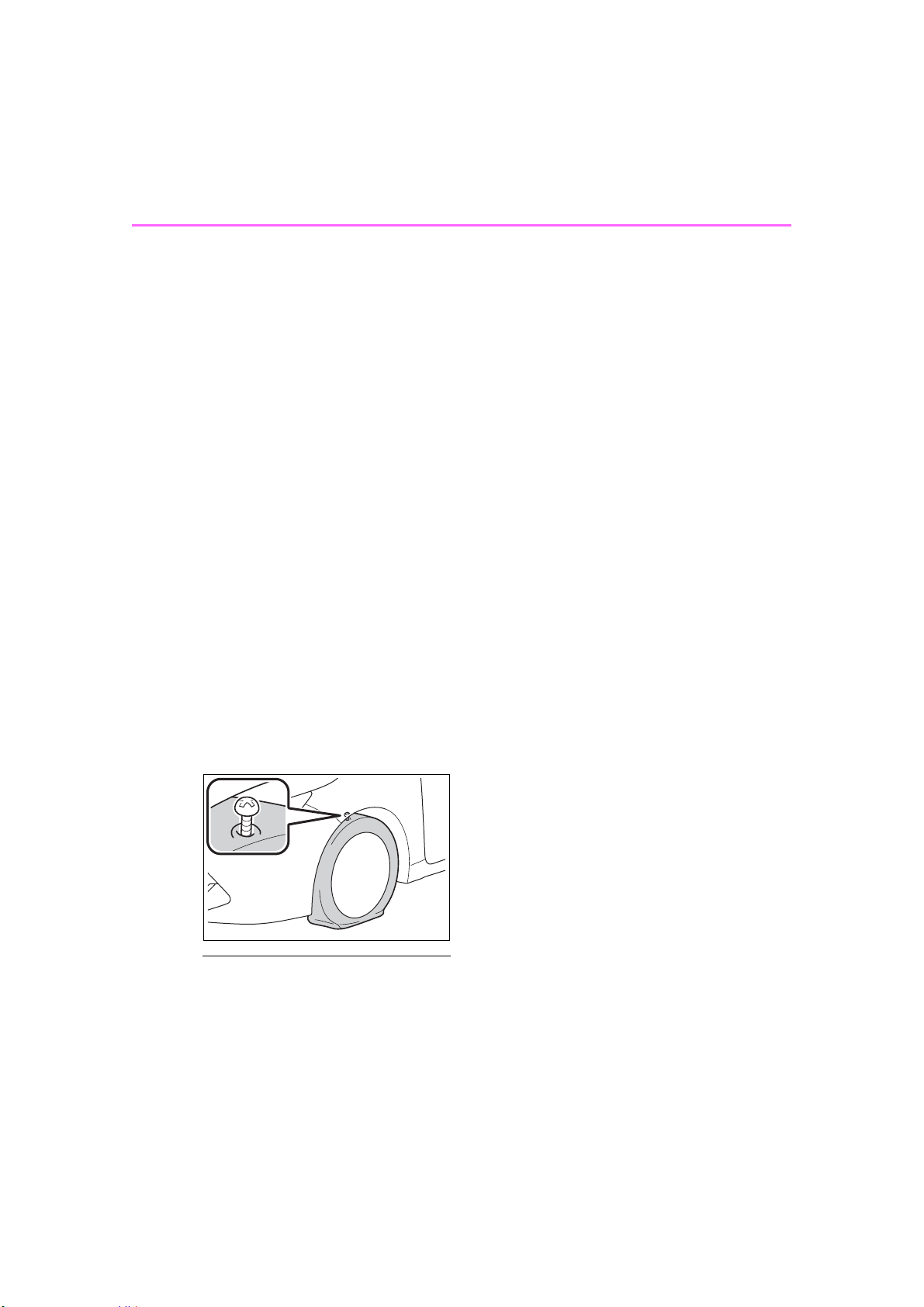
480
8-2. Steps to take in an emergency
COROLLA H/B_U
tinuously variable transmis-
sion) or N (manual
transmission).
Stop the engine.
Turn on the emergency flash-
ers.
Check the degree of the tire
damage.
A tire should only be repaired
with the emergency tire punc-
ture repair kit if the damage is
caused by a nail or screw pass-
ing through the tire tread.
• Do not remove the nail or
screw from the tire. Removing
the object may widen the
opening and make emer-
gency repair with the repair kit
impossible.
• To avoid sealant leakage,
move the vehicle until the
area of the puncture, if
known, is positioned at the
top of the tire.
■ A flat tire that cannot be
repaired with the emergency
tire puncture repair kit
In the following cases, the tire can-
not be repaired with the emergency
tire puncture repair kit. Contact your
Toyota dealer.
● When the tire is damaged due to
driving without sufficient air pres-
sure
● When there are any cracks or
damage at any location on the
tire, such as on the side wall,
except the tread
● When the tire is visibly separated
from the wheel
● When the cut or damage to the
tread is 0.16 in. (4 mm) long or
more
● When the wheel is damaged
● When two or more tires have been
punctured
● When more than 2 sharp objects
such as nails or screws have
passed through the tread on a sin-
gle tire
● When the sealant has expired
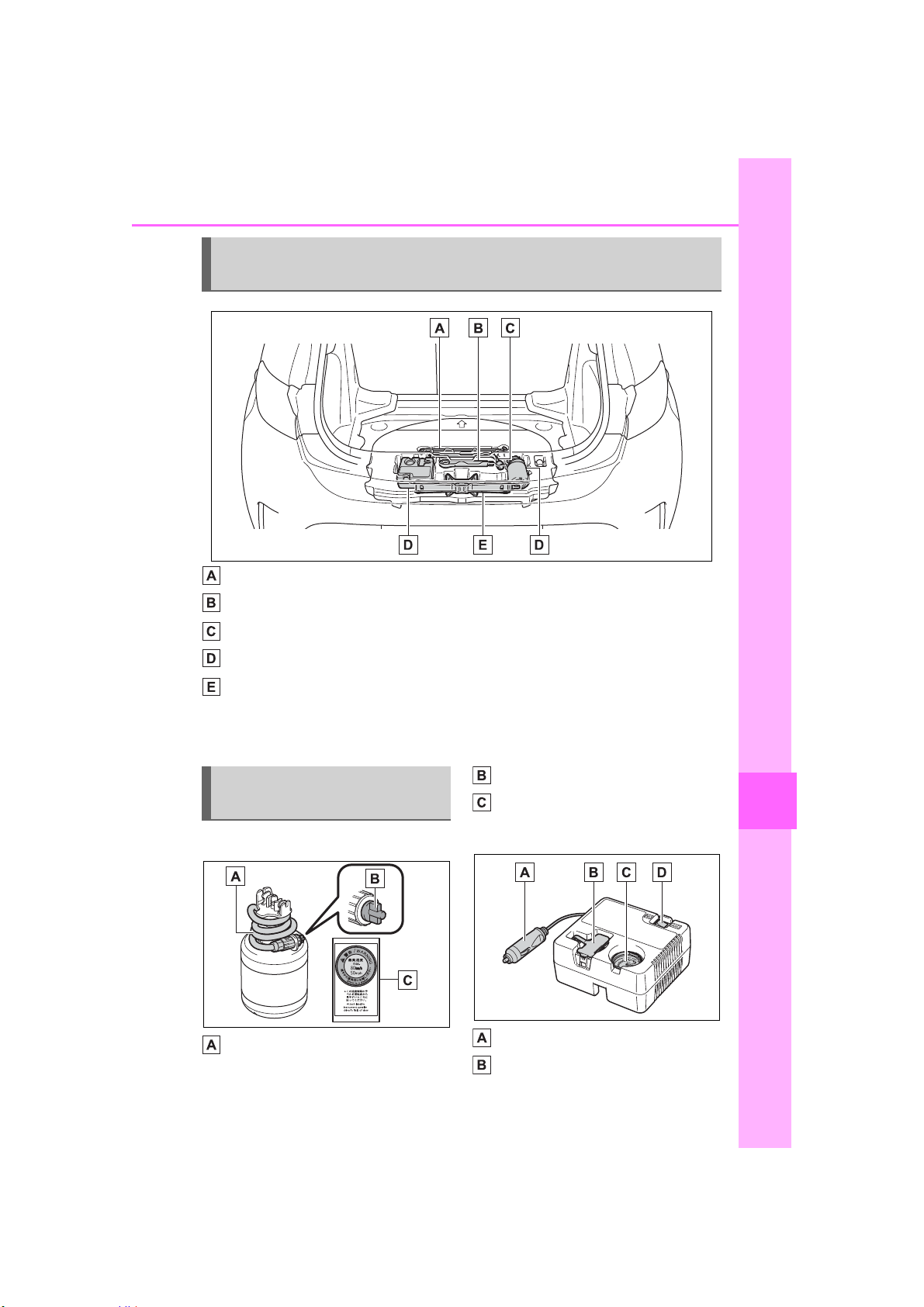
481
8-2. Steps to take in an emergency
COROLLA H/B_U
8
When trouble arises
Jack handle
*
Towing eyelet
Wheel nut wrench
*
Emergency tire puncture repair kit
Jack
*
(Use of the jack: P.493)
*
: If equipped
Bottle
Hose
Air release cap
Sticker
Compressor
Power plug
Rubber stopper
Location of the emergency tire puncture repair kit and
tools
Emergency tire puncture
repair kit components

482
8-2. Steps to take in an emergency
COROLLA H/B_U
Air pressure gauge
Compressor switch
■ Note for checking the emer-
gency tire puncture repair kit
Check the sealant expiry date occa-
sionally.
The expiry date is shown on the bot-
tle. Do not use sealant whose expiry
date has already passed. Other-
wise, repairs conducted using the
emergency tire puncture repair kit
may not be performed properly.
■ Emergency tire puncture repair
kit
● The emergency tire puncture
repair kit is for filling the car tire
with air.
● The sealant has a limited life
span. The expiry date is marked
on the bottle. The sealant should
be replaced before the expiry
date. Contact your Toyota dealer
for replacement.
● The sealant stored in the emer-
gency tire puncture repair kit can
be used only once to temporarily
repair a single tire. If the sealant in
the bottle and other parts of the kit
have been used and need to be
replaced, contact your Toyota
dealer.
● The compressor can be used
repeatedly.
● The sealant can be used when the
outside temperature is from -40°F
(-40°C) to 140°F (60°C).
● The kit is exclusively designed for
size and type of tires originally
installed on your vehicle. Do not
use it for tires that a different size
than the original ones, or for any
other purposes.
● If the sealant gets on your clothes,
it may stain.
● If the sealant adheres to a wheel
or the surface of the vehicle body,
the stain may not be removable if
it is not cleaned at once. Immedi-
ately wipe away the sealant with a
wet cloth.
● During operation of the repair kit,
a loud operation noise is pro-
duced. This does not indicate a
malfunction.
● Do not use to check or to adjust
the tire pressure.
WARNING
■ Caution while driving
● Store the repair kit in the lug-
gage compartment.
Injuries may result in the event
of an accident or sudden brak-
ing.
● The repair kit is exclusively only
for your vehicle.
Do not use repair kit on other
vehicles, which could lead to an
accident causing death or seri-
ous injury.
● Do not use repair kit for tires
that are different size than the
original ones, or for any other
purpose. If the tires have not
been completely repaired, it
could lead to an accident caus-
ing death or serious injury.
■ Precautions for use of the
sealant
● Ingesting the sealant is hazard-
ous to your health. If you ingest
sealant, consume as much
water as possible, and then
immediately consult a doctor.
● If sealant gets in eyes or
adheres to skin, immediately
wash it off with water. If discom-
fort persists, consult a doctor.
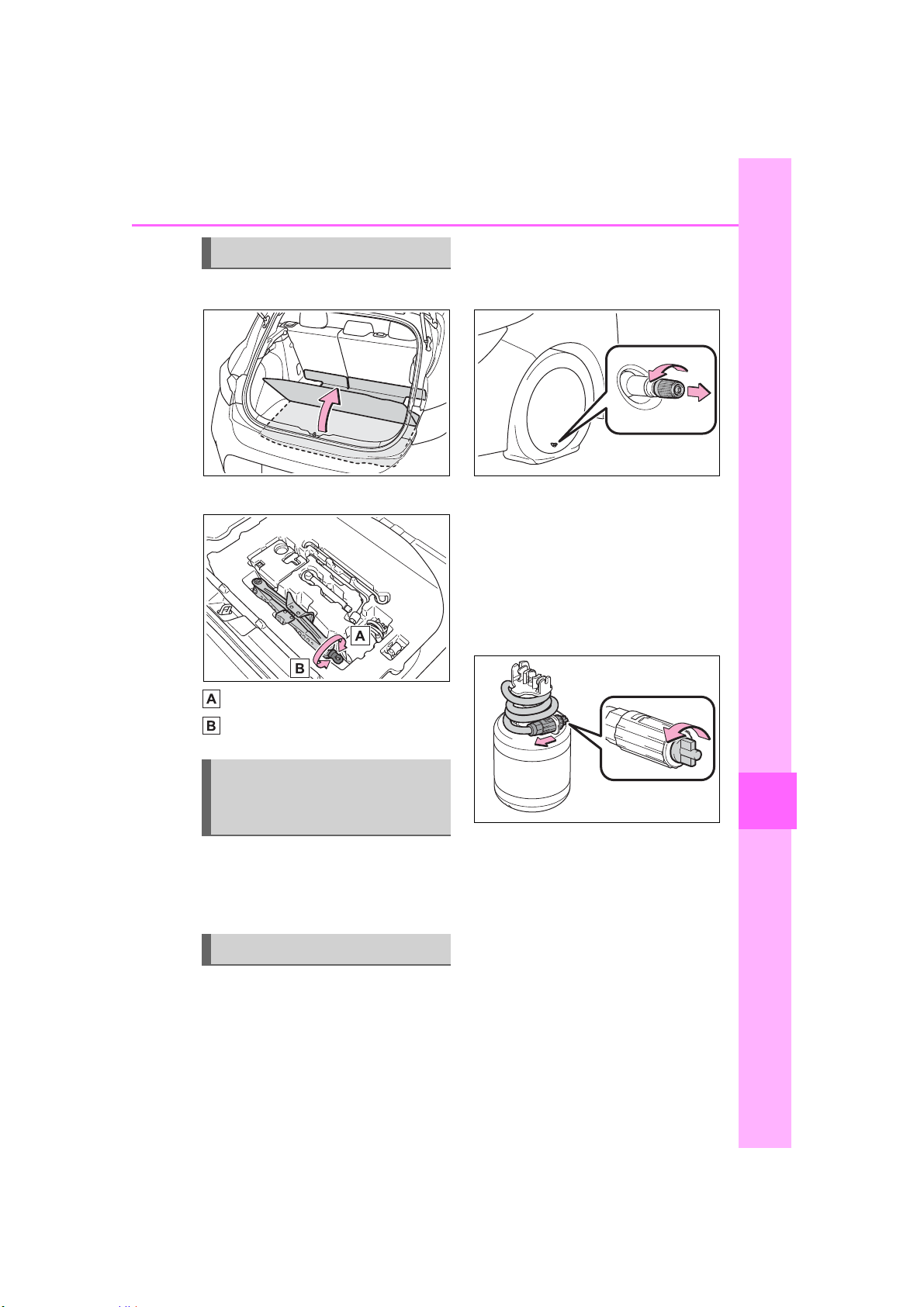
483
8-2. Steps to take in an emergency
COROLLA H/B_U
8
When trouble arises
1 Lift the deck mat.
2 Take out the jack.
For tightening
For loosening
1 Lift the deck mat. (P.483)
2 Take out the emergency tire
puncture repair kit. (P.481)
1 Take out the repair kit from
the plastic bag.
2 Remove the valve cap from
the valve of the punctured
tire.
3 Extend the hose. Remove
the air release cap from the
hose.
Attach the sticker enclosed with the
bottle on the specified locations.
(See step 10.)
You will use the air release cap
again. Therefore keep it in a safe
place.
4 Connect the hose to the
valve.
Screw the end of the hose clock-
Taking out the jack
Taking out the emer-
gency tire puncture repair
kit
Emergency repair method
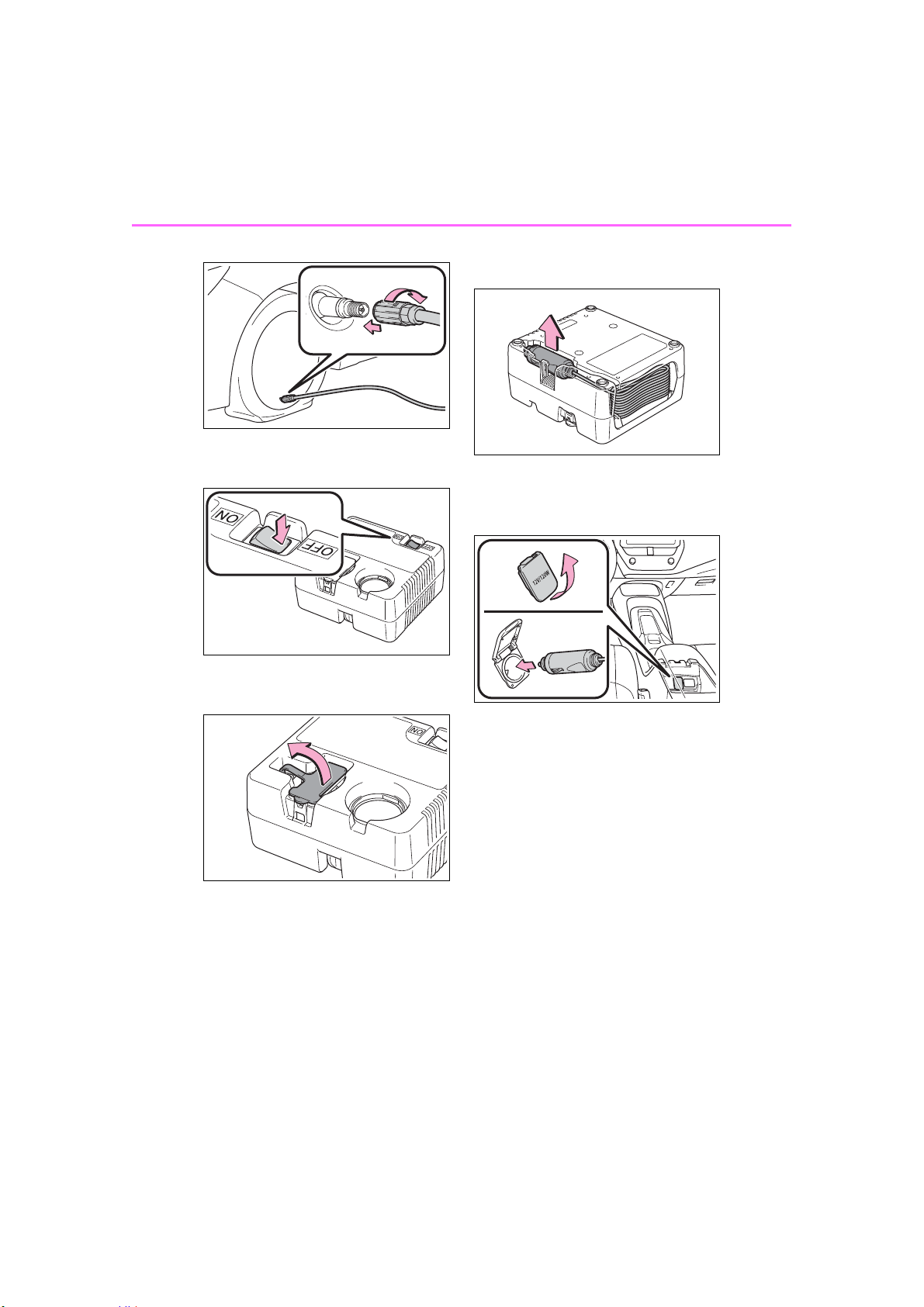
484
8-2. Steps to take in an emergency
COROLLA H/B_U
wise as far as possible.
5 Make sure that the compres-
sor switch is off.
6 Lift the rubber stopper on the
compressor.
7 Remove the power plug from
the compressor.
8 Connect the power plug to
the power outlet socket.
(P.403)
9 Connect the bottle to the
compressor.
As shown in the illustration, insert
the bottle securely into the com-
pressor until the upper side of the
mark on the bottle is aligned with
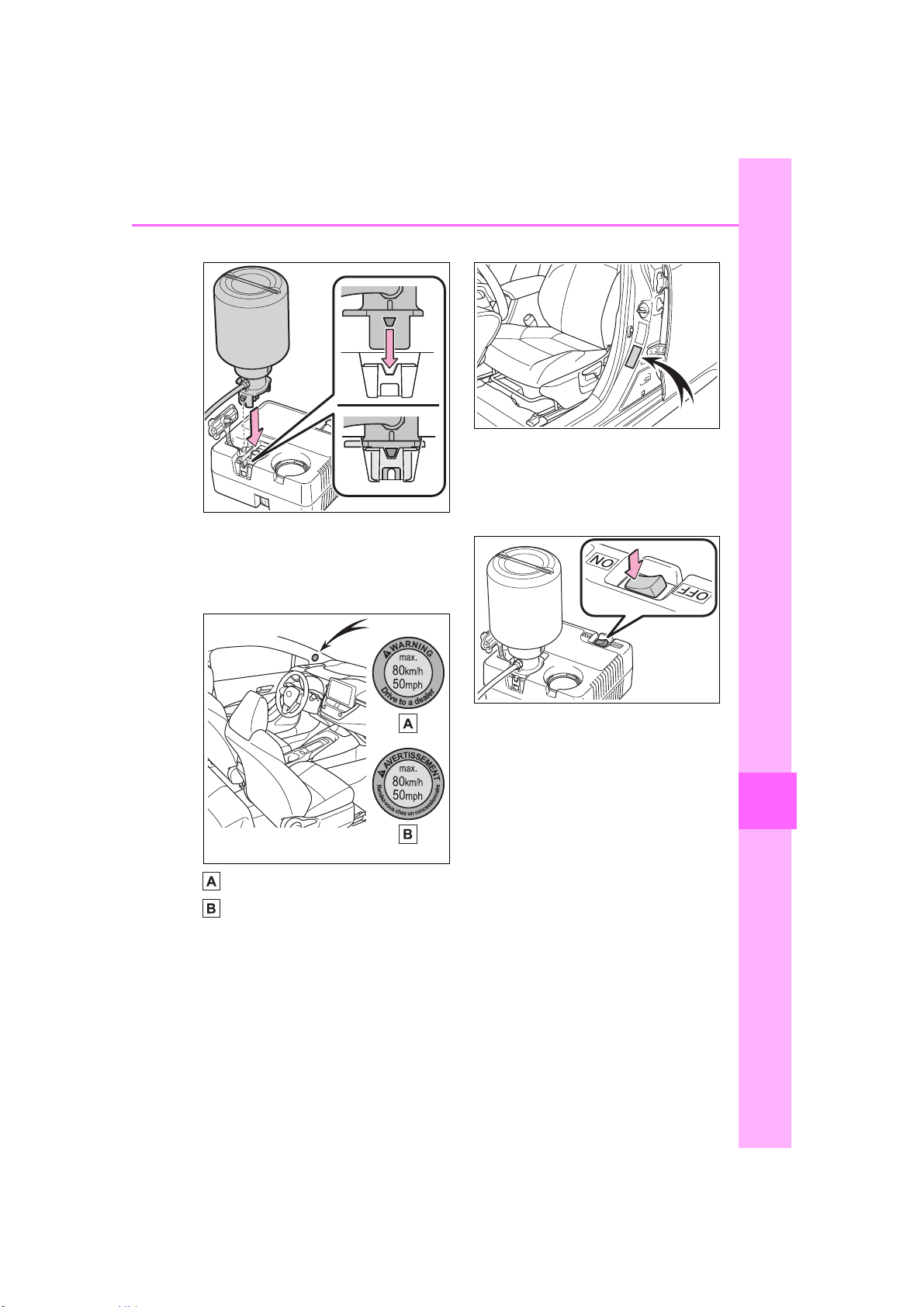
485
8-2. Steps to take in an emergency
COROLLA H/B_U
8
When trouble arises
the upper end of the notch.
10Attach the sticker provided
with the tire puncture repair
kit to a position easily seen
from the driver’s seat.
U.S.A
Canada
11Check the specified tire infla-
tion pressure.
Tire inflation pressure is specified
on the label on the driver’s side pil-
lar as shown. (P.515)
12Start the engine.
13To inject the sealant and
inflate the tire, turn the com-
pressor switch on.
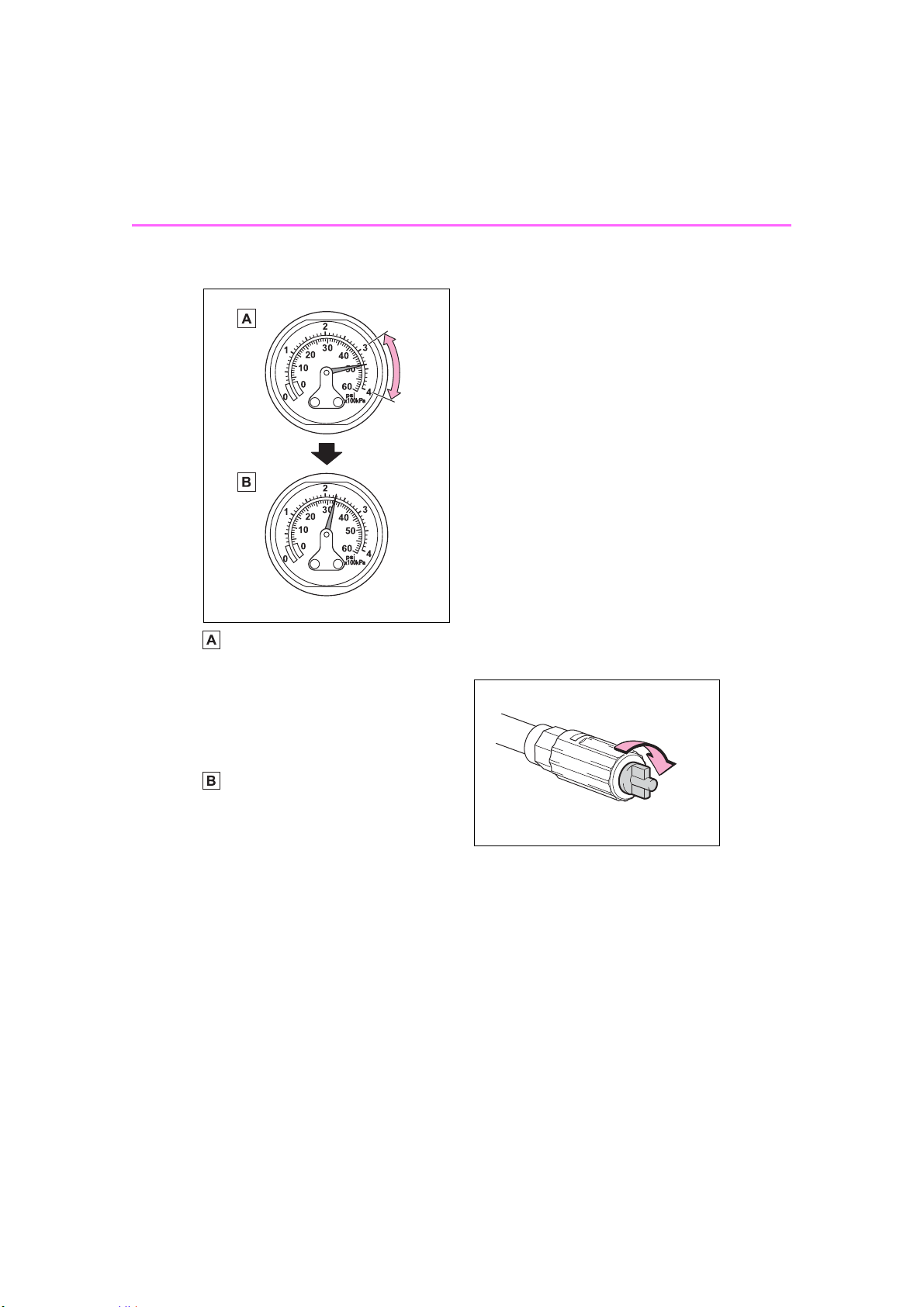
486
8-2. Steps to take in an emergency
COROLLA H/B_U
14Inflate the tire until the speci-
fied air pressure is reached.
The sealant will be injected
and the pressure will spike to
between 44 psi (300 kPa, 3.0
kgf/cm
2
or bar) and 58 psi
(400 kPa, 4.0 kgf/cm
2
or bar),
then gradually decrease.
The air pressure gauge will
display the actual tire inflation
pressure about 1 to 5 min-
utes after the switch is turned
on.
Turn the compressor switch off and
then check the tire inflation pres-
sure. Being careful not to over
inflate, check and repeat the infla-
tion procedure until the specified
tire inflation pressure is reached.
The tire can be inflated for about 5
to 20 minutes (depending on the
outside temperature). If the tire
inflation pressure is still lower than
the specified point after inflation for
25 minutes, the tire is too damaged
to be repaired. Turn the compres-
sor switch off and contact your Toy-
ota dealer.
If the tire inflation pressure exceeds
the specified air pressure, let out
some air to adjust the tire inflation
pressure. (P.488, 515)
15With the compressor switch
off, disconnect the hose from
the valve on the tire and then
pull out the power plug from
the power outlet socket.
Some sealant may leak when the
hose is removed.
16Install the valve cap onto the
valve of the emergency
repaired tire.
17Attach the air release cap to
the end of the hose.
If the air release cap is not
attached, the sealant may leak and
the vehicle may get dirty.
18Temporarily store the bottle
in the luggage compartment
while it is connected to the
compressor.
19To spread the liquid sealant
evenly within the tire, imme-
diately drive safely for about
3 miles (5 km) below 50 mph
(80 km/h).
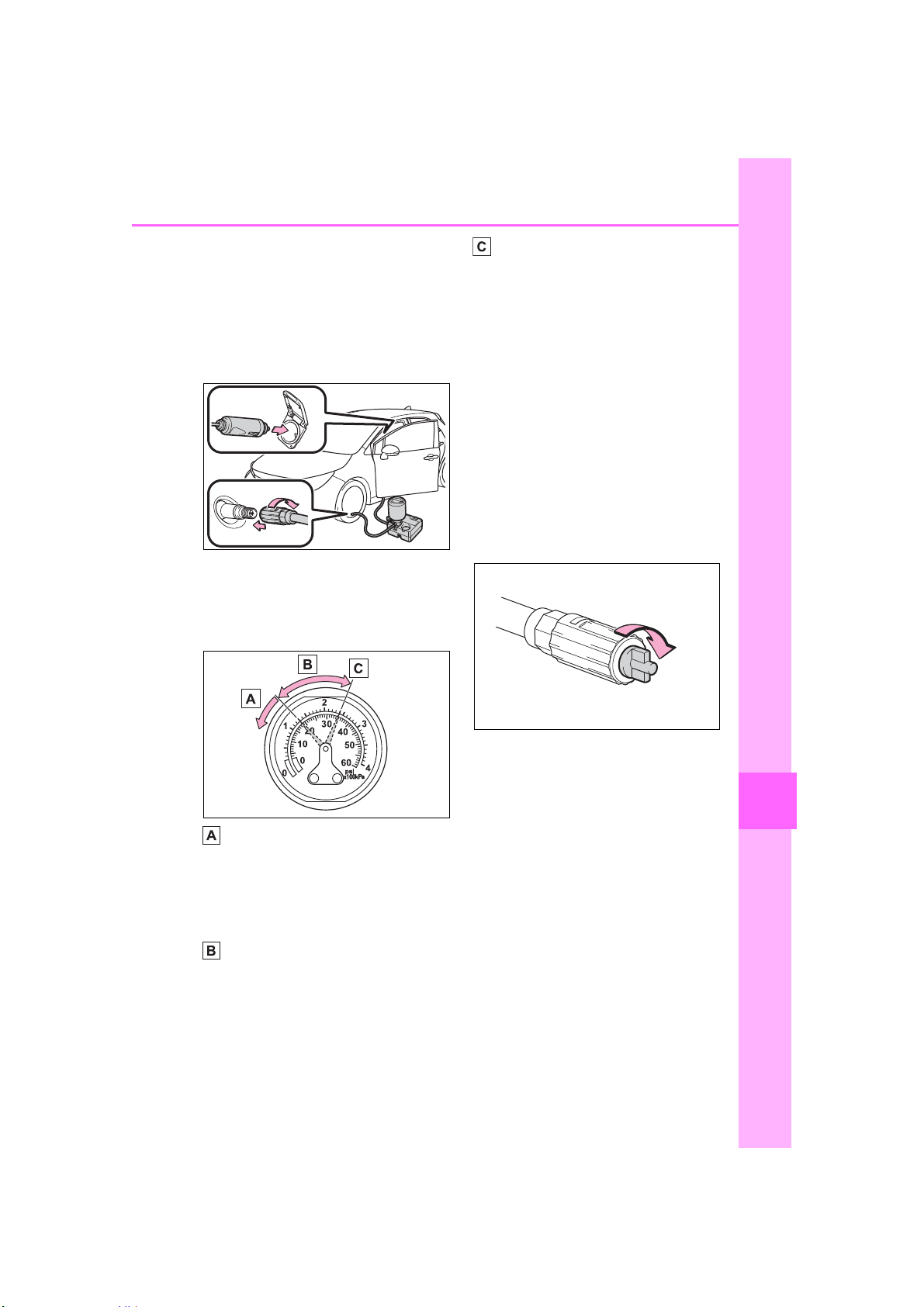
487
8-2. Steps to take in an emergency
COROLLA H/B_U
8
When trouble arises
20After driving, stop your vehi-
cle in a safe place on a hard,
flat surface and reconnect
the repair kit.
Remove the air release cap from
the hose before reconnecting the
hose.
21Turn the compressor switch
on and wait for several sec-
onds, then turn it off. Check
the tire inflation pressure.
If the tire inflation pressure is
under 19 psi (130 kPa, 1.3
kgf/cm
2
or bar): The puncture
cannot be repaired. Contact
your Toyota dealer.
If the tire inflation pressure is
19 psi (130 kPa, 1.3
kgf/cm
2
or bar) or higher, but
less than the specified air
pressure: Proceed to step
22.
If the tire inflation pressure is
the specified air pressure
(P.515): Proceed to step
23.
22Turn the compressor switch
on to inflate the tire until the
specified air pressure is
reached. Drive for about 3
miles (5 km) and then per-
form step 20.
23Attach the air release cap to
the end of the hose.
If the air release cap is not
attached, the sealant may leak and
the vehicle may get dirty.
24Store the bottle in the lug-
gage compartment while it is
connected to the compres-
sor.
25Taking precautions to avoid
sudden braking, sudden
acceleration and sharp turns,
drive carefully at under 50
mph (80 km/h) to the nearest
Toyota dealer that is less
than 62 miles (100 km) away
for tire repair or replacement.
When having the tire repaired or
replaced, make sure to tell the Toy-
ota dealer that the sealant is
injected.
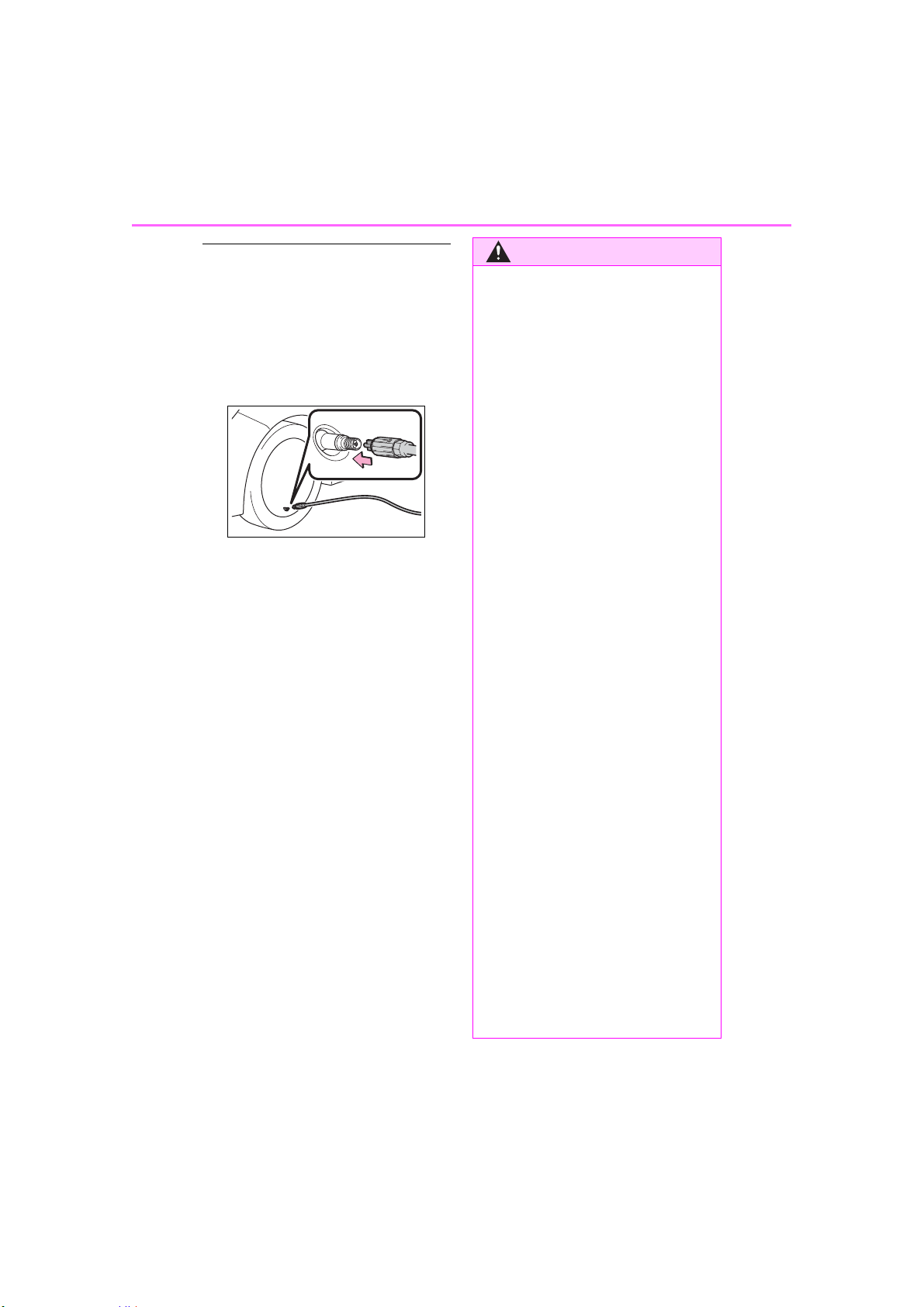
488
8-2. Steps to take in an emergency
COROLLA H/B_U
■ If the tire is inflated to more
than the specified air pressure
1 Disconnect the hose from the
valve.
2 Install the air release cap to the
end of the hose and push the
protrusion on the air release cap
into the tire valve to let some air
out.
3 Disconnect the hose from the
valve, remove the air release cap
from the hose and then recon-
nect the hose.
4 Turn the compressor switch on
and wait for several seconds,
and then turn it off. Check that
the air pressure indicator shows
the specified air pressure.
(P.515)
If the air pressure is under the des-
ignated pressure, turn the compres-
sor switch on again and repeat the
inflation procedure until the speci-
fied air pressure is reached.
■ After a tire is repaired with the
emergency tire puncture repair
kit
● The tire pressure warning valve
and transmitter should be
replaced.
● Even if the tire inflation pressure is
at the recommended level, the tire
pressure warning light may come
on/flash.
WARNING
■ Do not drive the vehicle with
a flat tire
Do not continue driving with a flat
tire.
Driving even a short distance with
a flat tire can damage the tire and
the wheel beyond repair.
Driving with a flat tire may cause a
circumferential groove on the side
wall. In such a case, the tire may
explode when using a repair kit.
■ When fixing the flat tire
● Stop your vehicle in a safe and
flat area.
● Do not touch the wheels or the
area around the brakes immedi-
ately after the vehicle has been
driven.
After the vehicle has been
driven, the wheels and the area
around the brakes may be
extremely hot. Touching these
areas with hands, feet or other
body parts may result in burns.
● Connect the valve and hose
securely with the tire installed
on the vehicle. If the hose is not
properly connected to the valve,
air leakage may occur as seal-
ant may be sprayed out.
● If the hose comes off the valve
while inflating the tire, there is a
risk that the hose will move
abruptly due to air pressure.
● After inflation of the tire has
completed, the sealant may
splatter when the hose is dis-
connected or some air is let out
of the tire.
● Follow the operation procedure
to repair the tire. If the proce-
dures not followed, the sealant
may spray out.
489
8-2. Steps to take in an emergency
COROLLA H/B_U
8
When trouble arises
WARNING
● Keep back from the tire while it
is being repaired, as there is a
chance of it bursting while the
repair operation is being per-
formed. If you notice any cracks
or deformation of the tire, turn
off the compressor switch and
stop the repair operation imme-
diately.
● The repair kit may overheat if
operated for a long period of
time. Do not operate the repair
kit continuously for more than
40 minutes.
● Parts of the repair kit become
hot during operation. Be careful
handling the repair kit during
and after operation. Do not
touch the metal part connecting
the bottle and the compressor. It
will be extremely hot.
● Do not attach the vehicle speed
warning sticker to an area other
than the one indicated. If the
sticker is attached to an area
where an SRS airbag is located,
such as the pad of the steering
wheel, it may prevent the SRS
airbag from operating properly.
■ Driving to spread the liquid
sealant evenly
Observe the following precautions
to reduce the risk of accidents.
Failing to do so may result in a
loss of vehicle control and cause
death or serious injury.
● Drive the vehicle carefully at a
low speed. Be especially careful
when turning and cornering.
● If the vehicle does not drive
straight or you feel a pull
through the steering wheel, stop
the vehicle and check the fol-
lowing.
• Tire condition. The tire may
have separated from the wheel.
• Tire inflation pressure. If the tire
inflation pressure is 19 psi (130
kPa, 1.3 kgf/cm
2
or bar) or less,
the tire may be severely dam-
aged.
NOTICE
■ When performing an emer-
gency repair
● A tire should only be repaired
with the emergency tire punc-
ture repair kit if the damage is
caused by a sharp object such
as nail or screw passing through
the tire tread.
Do not remove the sharp object
from the tire. Removing the
object may widen the opening
and disenable emergency repair
with the repair kit.
● The repair kit is not waterproof.
Make sure that the repair kit is
not exposed to water, such as
when it is being used in the rain.
● Do not put the repair kit directly
onto dusty ground such as sand
at the side of the road. If the
repair kit vacuums up dust etc.,
a malfunction may occur.
■ Precautions for the emer-
gency tire puncture repair kit
● The repair kit power source
should be 12 V DC suitable for
vehicle use. Do not connect the
repair kit to any other source.
● If fuel splatters on the repair kit,
the repair kit may deteriorate.
Take care not to allow fuel to
contact it.
● Place the repair kit in a storage
to prevent it from being exposed
to dirt or water.
● Store the repair kit in the lug-
gage compartment out of reach
of children.
490
8-2. Steps to take in an emergency
COROLLA H/B_U
Stop the vehicle in a safe
place on a hard, flat surface.
Set the parking brake.
Shift the shift lever to P (con-
tinuously variable transmis-
sion) or R (manual
transmission).
Stop the engine.
Turn on the emergency flash-
ers.
NOTICE
● Do not disassemble or modify
the repair kit. Do not subject
parts such as the air pressure
indicator to impacts. This may
cause a malfunction.
■ To avoid damage to the tire
pressure warning valves and
transmitters
When a tire is repaired with liquid
sealants, the tire pressure warn-
ing valve and transmitter may not
operate properly. If a liquid seal-
ant is used, contact your Toyota
dealer or other qualified service
shop as soon as possible. After
use of liquid sealant, make sure to
replace the tire pressure warning
valve and transmitter when repair-
ing or replacing the tire. (
P.439)
If you have a flat tire
(vehicles with a spare
tire)
Your vehicle is equipped
with a spare tire. The flat tire
can be replaced with the
spare tire.
For details about tires:
P.436
WARNING
■ If you have a flat tire
Do not continue driving with a flat
tire. Driving even a short distance
with a flat tire can damage the tire
and the wheel beyond repair,
which could result in an accident.
Before jacking up the
vehicle
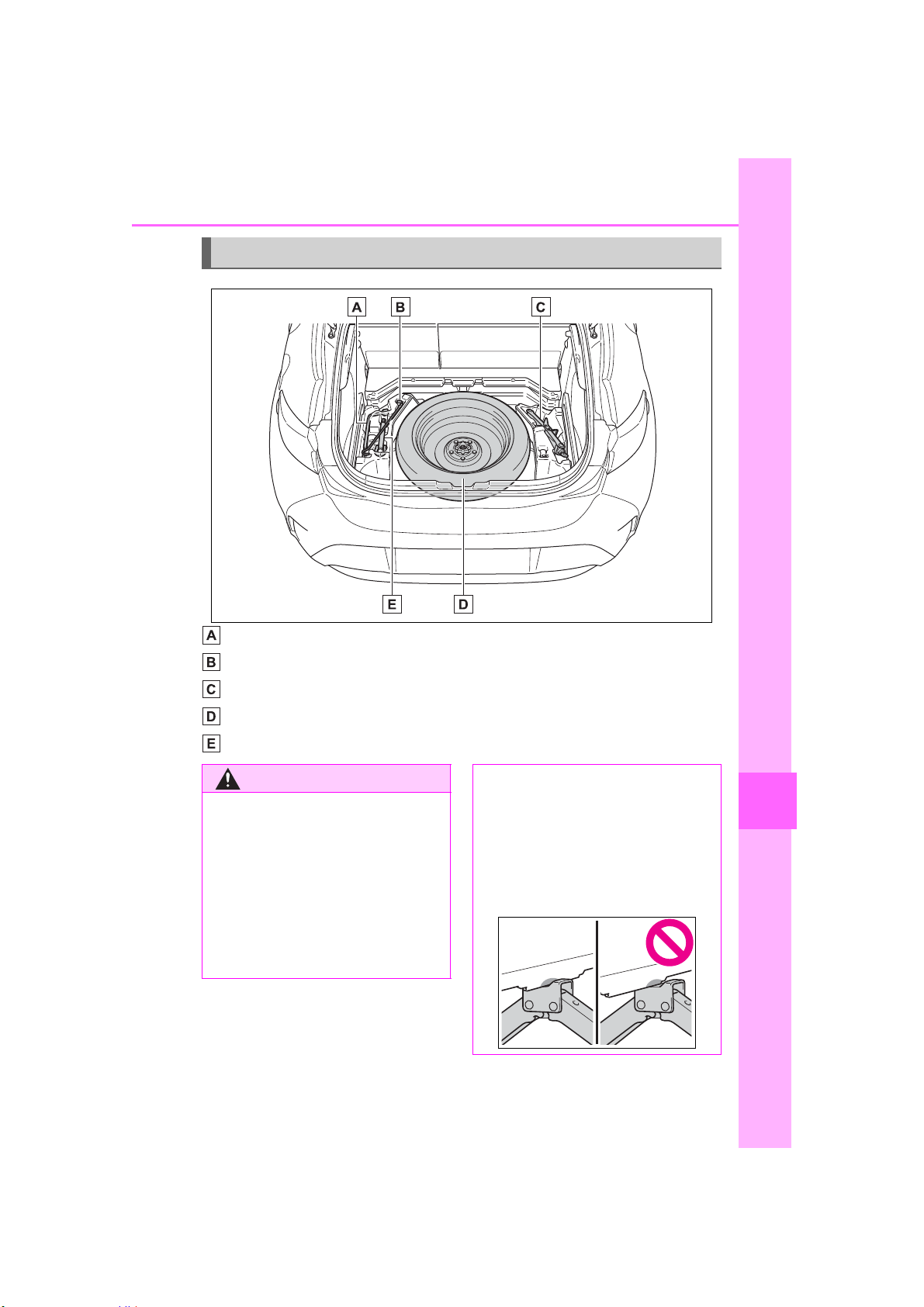
491
8-2. Steps to take in an emergency
COROLLA H/B_U
8
When trouble arises
Wheel nut wrench
Jack handle
Jack
Spare tire
Towing eyelet
Location of the spare tire, jack and tools
WARNING
■ Using the tire jack
Observe the following precau-
tions. Improper use of the tire jack
may cause the vehicle to sud-
denly fall off the jack, leading to
death or serious injury.
● Do not use the tire jack for any
purpose other than replacing
tires or installing and removing
tire chains.
● Only use the tire jack that
comes with this vehicle for
replacing a flat tire. Do not use it
on other vehicles, and do not
use other tire jacks for replacing
tires on this vehicle.
● Put the jack properly in its jack
point.
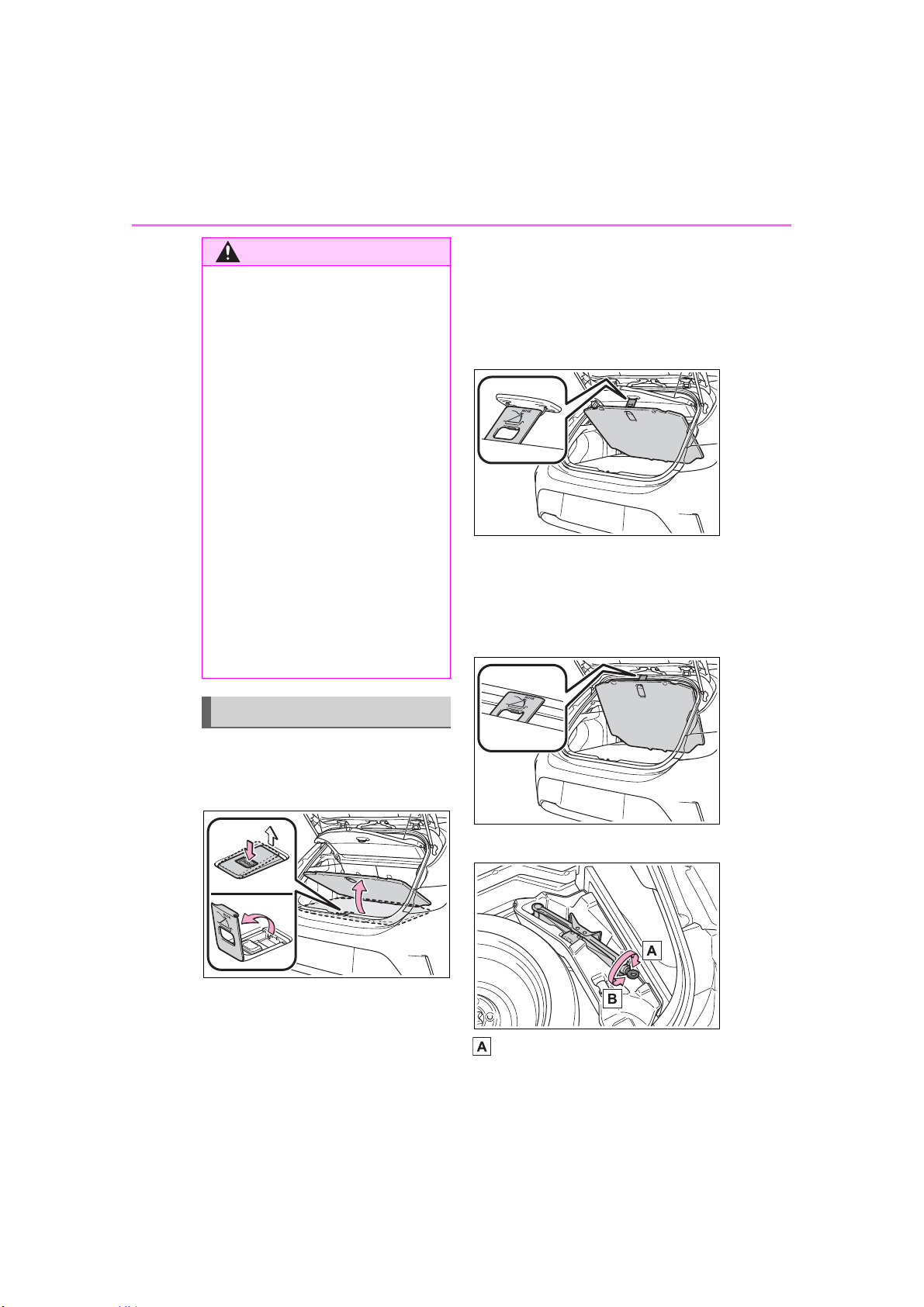
492
8-2. Steps to take in an emergency
COROLLA H/B_U
1 Press the button to raise the
deck board handle and then
lift the deck board.
2 Secure the deck board.
When the luggage cover is
installed
Hook the deck board handle onto
the underside of the luggage cover
as shown in the illustration, to
secure the deck board.
When the luggage cover is
not installed
Hook the deck board handle onto
the upper edge of the back door
opening as shown in the illustration.
3 Take out the jack.
For tightening
WARNING
● Do not put any part of your body
under the vehicle while it is sup-
ported by the jack.
● Do not start the engine or drive
the vehicle while the vehicle is
supported by the jack.
● Do not raise the vehicle while
someone is inside.
● When raising the vehicle, do not
put an object on or under the
jack.
● Do not raise the vehicle to a
height greater than that required
to replace the tire.
● Use a jack stand if it is neces-
sary to get under the vehicle.
● When lowering the vehicle,
make sure that there is no-one
near the vehicle. If there are
people nearby, warn them
vocally before lowering.
Taking out the jack
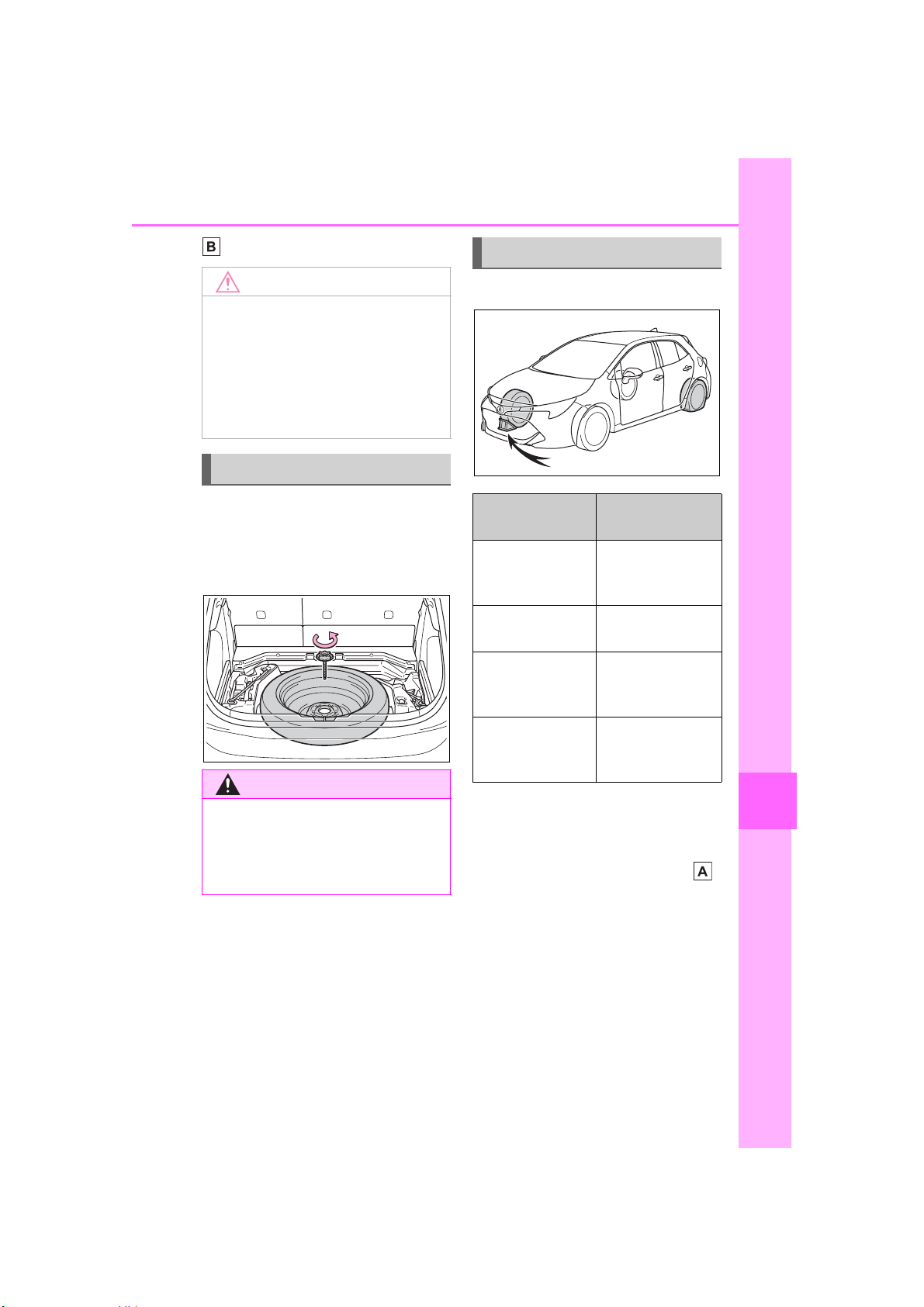
493
8-2. Steps to take in an emergency
COROLLA H/B_U
8
When trouble arises
For loosening
1 Secure the deck board.
(P.492)
2 Loosen the center fastener
that secures the spare tire.
1 Chock the tires.
2 Vehicles with a steel wheel:
Remove the wheel ornament
using the wrench.
Insert the wrench into the notch
on the wheel cap.
To protect the wheel ornament,
place a rag between the wrench
NOTICE
■ When the deck board is
secured
Make sure not to close the back
door when the deck board is
hooked onto the luggage cover or
the back door opening. Doing so
may lead to damage to interior
parts.
Taking out the spare tire
WARNING
■ When storing the spare tire
Be careful not to catch fingers or
other body parts between the
spare tire and the body of the
vehicle.
Replacing a flat tire
Flat tire
Wheel chock
positions
Front left-hand
side
Behind the rear
right-hand side
tire
Front right-hand
side
Behind the rear
left-hand side tire
Rear left-hand
side
In front of the
front right-hand
side tire
Rear right-hand
side
In front of the
front left-hand
side tire
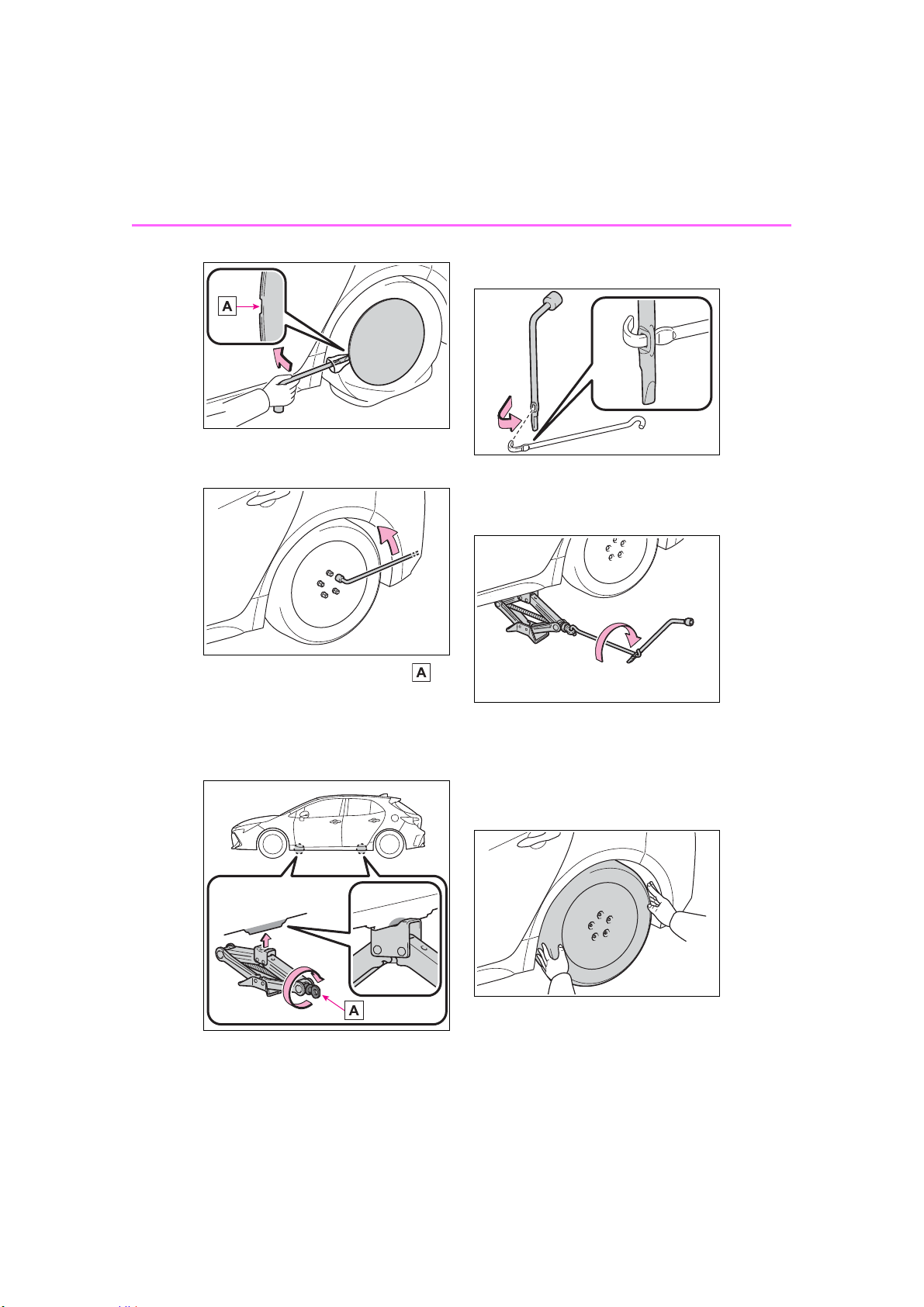
494
8-2. Steps to take in an emergency
COROLLA H/B_U
and the wheel ornament.
3 Slightly loosen the wheel
nuts (one turn).
4 Turn the tire jack portion
by hand until the center of the
recessed portion of the jack
is in contact with the center of
the jack point.
5 Assemble the jack handle
extension.
6 Raise the vehicle until the tire
is slightly raised off the
ground.
7 Remove all the wheel nuts
and the tire.
When resting the tire on the
ground, place the tire so that the
wheel design faces up to avoid
scratching the wheel surface.
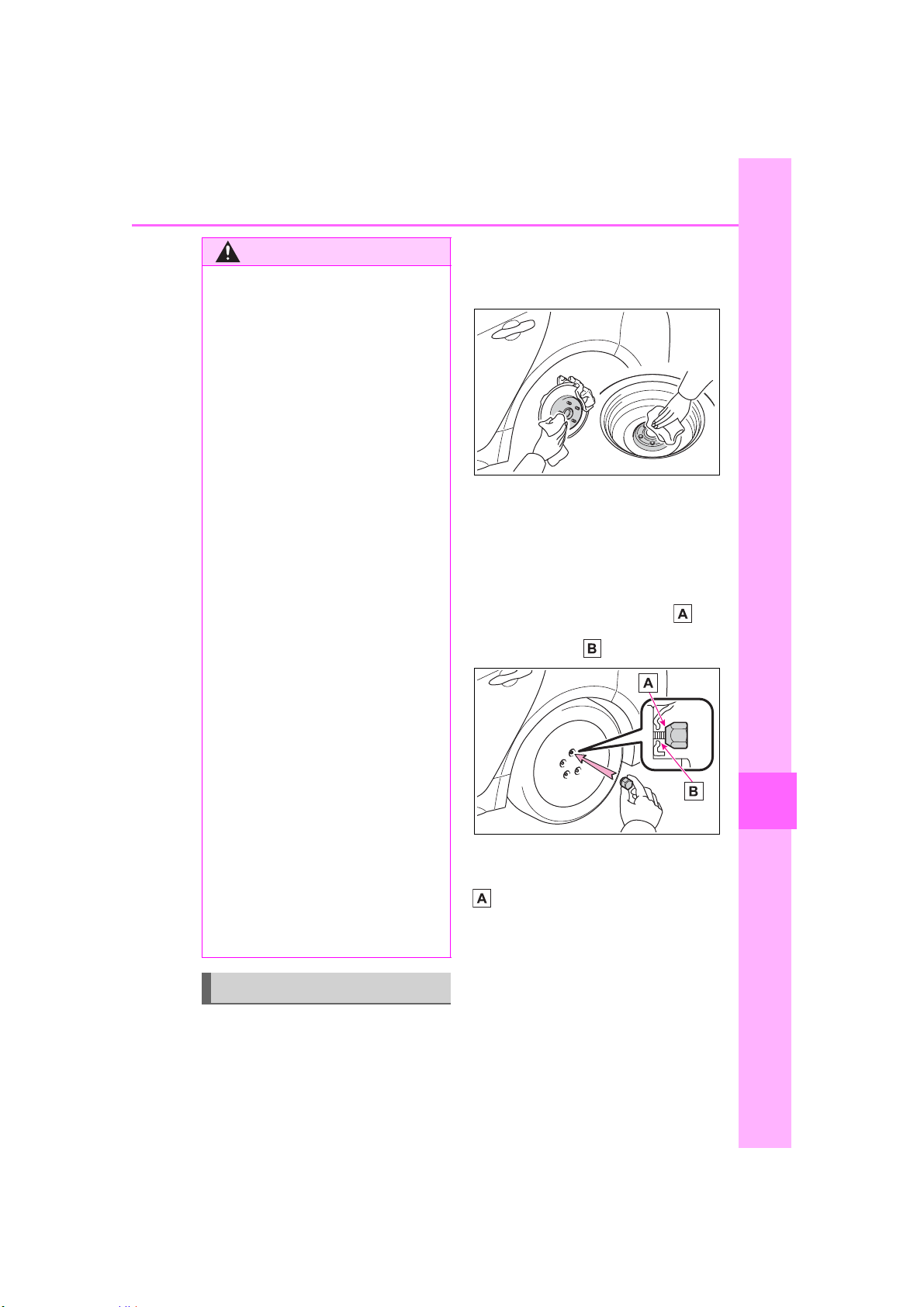
495
8-2. Steps to take in an emergency
COROLLA H/B_U
8
When trouble arises
1 Remove any dirt or foreign
matter from the wheel con-
tact surface.
If foreign matter is on the wheel
contact surface, the wheel nuts
may loosen while the vehicle is in
motion, causing the tire to come off.
2 Install the tire and loosely
tighten each wheel nut by
hand by approximately the
same amount.
When replacing a steel wheel with
a steel wheel, tighten the wheel
nuts until the tapered portion
comes into loose contact with the
disc wheel seat .
When replacing an aluminum wheel
with a steel wheel, tighten the
wheel nuts until the tapered portion
comes into loose contact with
WARNING
■ Replacing a flat tire
● Do not touch the disc wheels or
the area around the brakes
immediately after the vehicle
has been driven. After the vehi-
cle has been driven the disc
wheels and the area around the
brakes will be extremely hot.
Touching these areas with
hands, feet or other body parts
while changing a tire, etc. may
result in burns.
● Failure to follow these precau-
tions could cause the wheel
nuts to loosen and the tire to fall
off, resulting in death or serious
injury.
• Have the wheel nuts tightened
with a torque wrench to 76 ft•lbf
(103 N•m, 10.5 kgf•m) as soon
as possible after changing
wheels.
• Do not attach a heavily dam-
aged wheel ornament, as it may
fly off the wheel while the vehi-
cle is moving.
• When installing a tire, only use
wheel nuts that have been spe-
cifically designed for that wheel.
• If there are any cracks or defor-
mations in the bolt screws, nut
threads or bolt holes of the
wheel, have the vehicle
inspected by your Toyota
dealer.
• When installing the wheel nuts,
be sure to install them with the
tapered ends facing inward.
(P.447)
Installing the spare tire
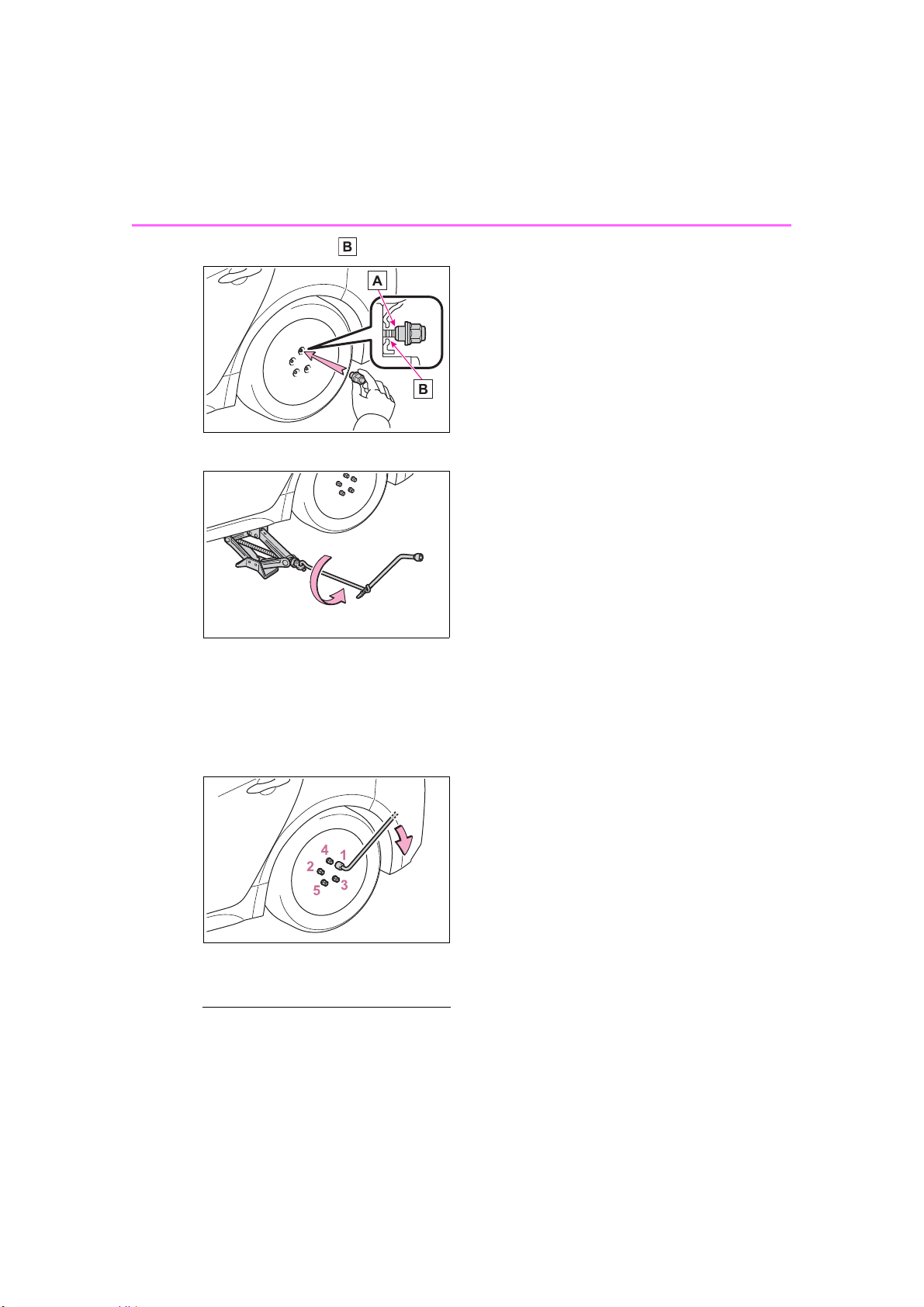
496
8-2. Steps to take in an emergency
COROLLA H/B_U
the disc wheel seat .
3 Lower the vehicle.
4 Firmly tighten each wheel nut
two or three times in the
order shown in the illustra-
tion.
Tightening torque:
76 ft•lbf (103 N•m, 10.5 kgf•m)
5 Stow the flat tire, tire jack and
all tools.
■ The compact spare tire
● The compact spare tire is identi-
fied by the label “TEMPORARY
USE ONLY” on the tire sidewall.
Use the compact spare tire tempo-
rarily, and only in an emergency.
● Make sure to check the tire infla-
tion pressure of the compact
spare tire. (P.515)
■ When the compact spare tire is
equipped
The vehicle becomes lower when
driving with the compact spare tire
compared to when driving with stan-
dard tires.
■ After completing the tire
change
The tire pressure warning system
must be reset. (P.442)
■ When using the compact spare
tire
As the compact spare tire is not
equipped with a tire pressure warn-
ing valve and transmitter, low infla-
tion pressure of the spare tire will
not be indicated by the tire pressure
warning system. Also, if you replace
the compact spare tire after the tire
pressure warning light comes on,
the light remains on.
■ If you have a flat front tire on a
road covered with snow or ice
(vehicles with a compact spare
tire)
Install the compact spare tire on one
of the rear wheels of the vehicle.
Perform the following steps and fit
tire chains to the front tires:
1 Replace a rear tire with the com-
pact spare tire.
2 Replace the flat front tire with the
tire removed from the rear of the
vehicle.
3 Fit tire chains to the front tires.
■ When reinstalling the wheel
ornament (steel wheels except
compact spare tire)
Align the cutout of the wheel orna-
ment with the valve stem as shown
in the illustration.
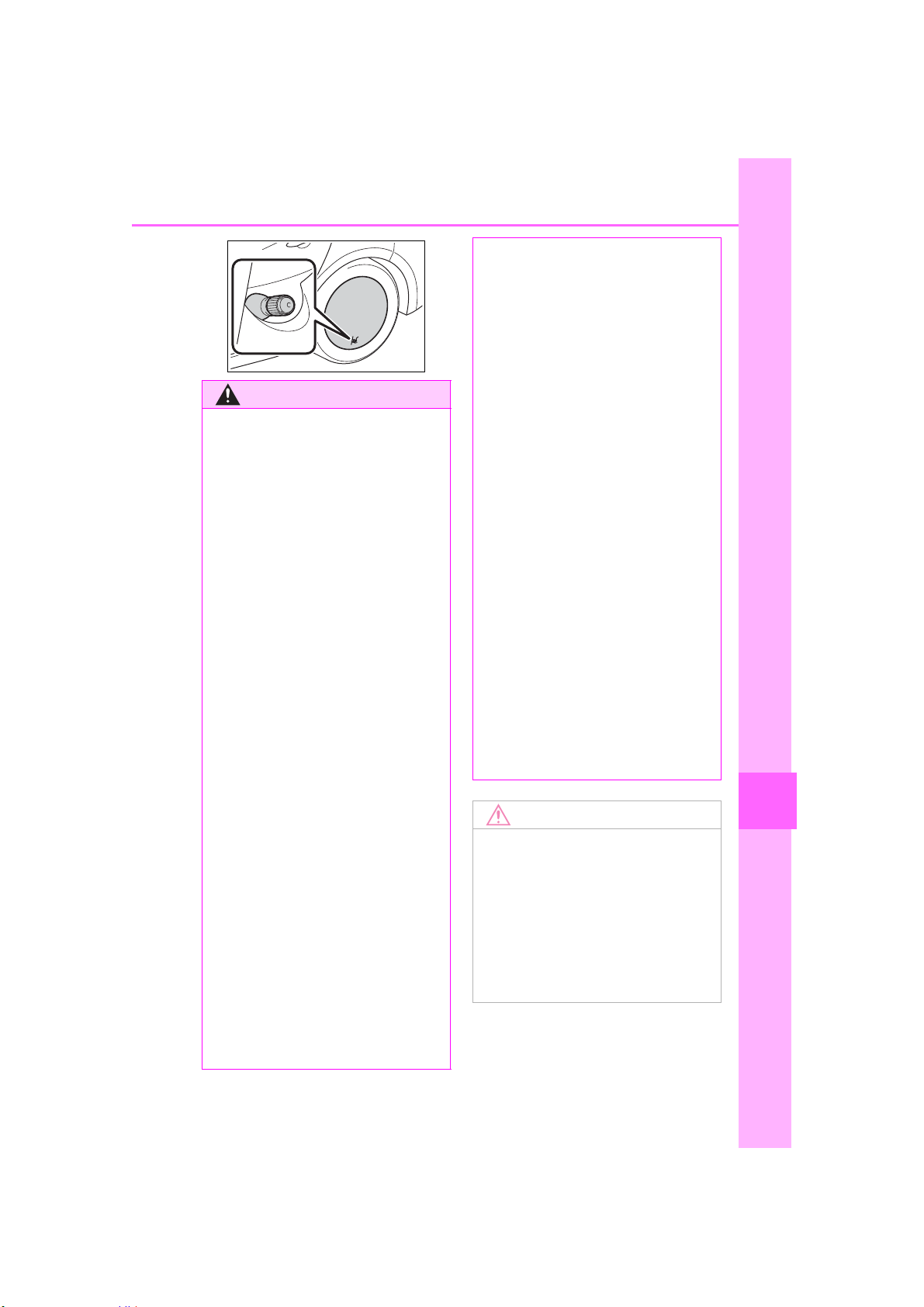
497
8-2. Steps to take in an emergency
COROLLA H/B_U
8
When trouble arises
WARNING
■ When using the compact
spare tire
● Remember that the compact
spare tire provided is specifi-
cally designed for use with your
vehicle. Do not use your com-
pact spare tire on another vehi-
cle.
● Do not use more than one com-
pact spare tires simultaneously.
● Replace the compact spare tire
with a standard tire as soon as
possible.
● Avoid sudden acceleration,
abrupt steering, sudden brak-
ing and shifting operations that
cause sudden engine braking.
■ When the compact spare tire
is attached
The vehicle speed may not be
correctly detected, and the follow-
ing systems may not operate cor-
rectly:
• ABS & Brake assist
• VSC
• TRAC
• Automatic High Beam (if
equipped)
• Dynamic radar cruise control
with full-speed range (if
equipped)
• Dynamic radar cruise control (if
equipped)
• EPS
• PCS (Pre-Collision System)
• LDA (Lane Departure Alert with
steering control) (if equipped)
• LTA (Lane Tracing Assist) (if
equipped)
• Tire pressure warning system
• Navigation system
■ Speed limit when using the
compact spare tire
Do not drive at speeds in excess
of 50 mph (80 km/h) when a com-
pact spare tire is installed on the
vehicle.
The compact spare tire is not
designed for driving at high
speeds. Failure to observe this
precaution may lead to an acci-
dent causing death or serious
injury.
■ After using the tools and jack
Before driving, make sure all the
tools and jack are securely in
place in their storage location to
reduce the possibility of personal
injury during a collision or sudden
braking.
NOTICE
■ Be careful when driving over
bumps with the compact
spare tire installed on the
vehicle.
The vehicle becomes lower when
driving with the compact spare tire
compared to when driving with
standard tires. Be careful when
driving over uneven road sur-
faces.
498
8-2. Steps to take in an emergency
COROLLA H/B_U
One of the following may be the
cause of the problem:
There may not be sufficient
fuel in the vehicle’s tank.
Refuel the vehicle.
The engine may be flooded.
Try to restart the engine again
following correct starting pro-
cedures. (P.142)
There may be a malfunction
in the engine immobilizer sys-
tem. (P.64)
One of the following may be the
cause of the problem:
The battery may be dis-
charged. (P.502)
NOTICE
■ Driving with tire chains and
the compact spare tire
Do not fit tire chains to the com-
pact spare tire. Tire chains may
damage the vehicle body and
adversely affect driving perfor-
mance.
■ When replacing the tires
When removing or fitting the
wheels, tires or the tire pressure
warning valve and transmitter,
contact your Toyota dealer as the
tire pressure warning valve and
transmitter may be damaged if not
handled correctly.
If the engine will not
start
If the engine will not start
even though correct starting
procedures are being fol-
lowed (P.142), consider
each of the following points:
The engine will not start
even though the starter
motor operates normally.
The starter motor turns
over slowly, the interior
lights and headlights are
dim, or the horn does not
sound or sounds at a low
volume.

499
8-2. Steps to take in an emergency
COROLLA H/B_U
8
When trouble arises
The battery terminal connec-
tions may be loose or cor-
roded. (P.433)
The engine starting system may
be malfunctioning due to an
electrical problem such as elec-
tronic key battery depletion or a
blown fuse. However, an interim
measure is available to start the
engine. (P.499)
One of the following may be the
cause of the problem:
The battery may be dis-
charged. (P.502)
One or both of the battery ter-
minals may be disconnected.
(P.433)
There may be a malfunction
in the steering lock system.
Contact your Toyota dealer if the
problem cannot be repaired, or if
repair procedures are unknown.
When the engine does not start,
the following steps can be used
as an interim measure to start
the engine if the engine switch is
functioning normally.
Do not use this starting proce-
dure except in case of emer-
gency.
1 Pull the parking brake switch
to check that the parking
brake is set. (P.154)
Parking brake indicator will come
on.
2 Check that the shift lever is
set in P (continuously vari-
able transmission) or N
(manual transmission).
3 Turn the engine switch to
ACC.
4 Press and hold the engine
switch for about 15 seconds
while depressing the brake
pedal (continuously variable
transmission) or clutch pedal
(manual transmission) firmly.
Even if the engine can be started
using the above steps, the system
may be malfunctioning. Have the
vehicle inspected by your Toyota
dealer.
The starter motor does
not turn over
The starter motor does
not turn over, the interior
lights and headlights do
not turn on, or the horn
does not sound.
Emergency start function

500
8-2. Steps to take in an emergency
COROLLA H/B_U
■ When the electronic key does
not work properly
● Make sure that the smart key sys-
tem has not been deactivated in
the customization setting. If it is
off, turn the function on. (Custom-
izable features P.531)
● Check if battery-saving mode is
set. If it is set, cancel the function.
(P.109)
Use the mechanical key
(P.100) in order to perform the
following operations:
If you lose your keys
New genuine mechanical
keys can be made by your
Toyota dealer using another
mechanical key and the key
number stamped on your
key number plate.
Keep the plate in a safe
place such as your wallet,
not in the vehicle.
NOTICE
■ When an electronic key is lost
If the electronic key remains lost,
the risk of vehicle theft increases
significantly. Visit your Toyota
dealer immediately with all
remaining electronic keys that
were provided with your vehicle.
If the electronic key
does not operate prop-
erly
If communication between
the electronic key and vehi-
cle is interrupted (P.109)
or the electronic key cannot
be used because the battery
is depleted, the smart key
system and wireless remote
control cannot be used. In
such cases, the doors can
be opened and the engine
can be started by following
the procedure below.
NOTICE
■ In case of a smart key system
malfunction or other
key-related problems
Take your vehicle with all the elec-
tronic keys provided with your
vehicle to your Toyota dealer.
Locking and unlocking
the doors
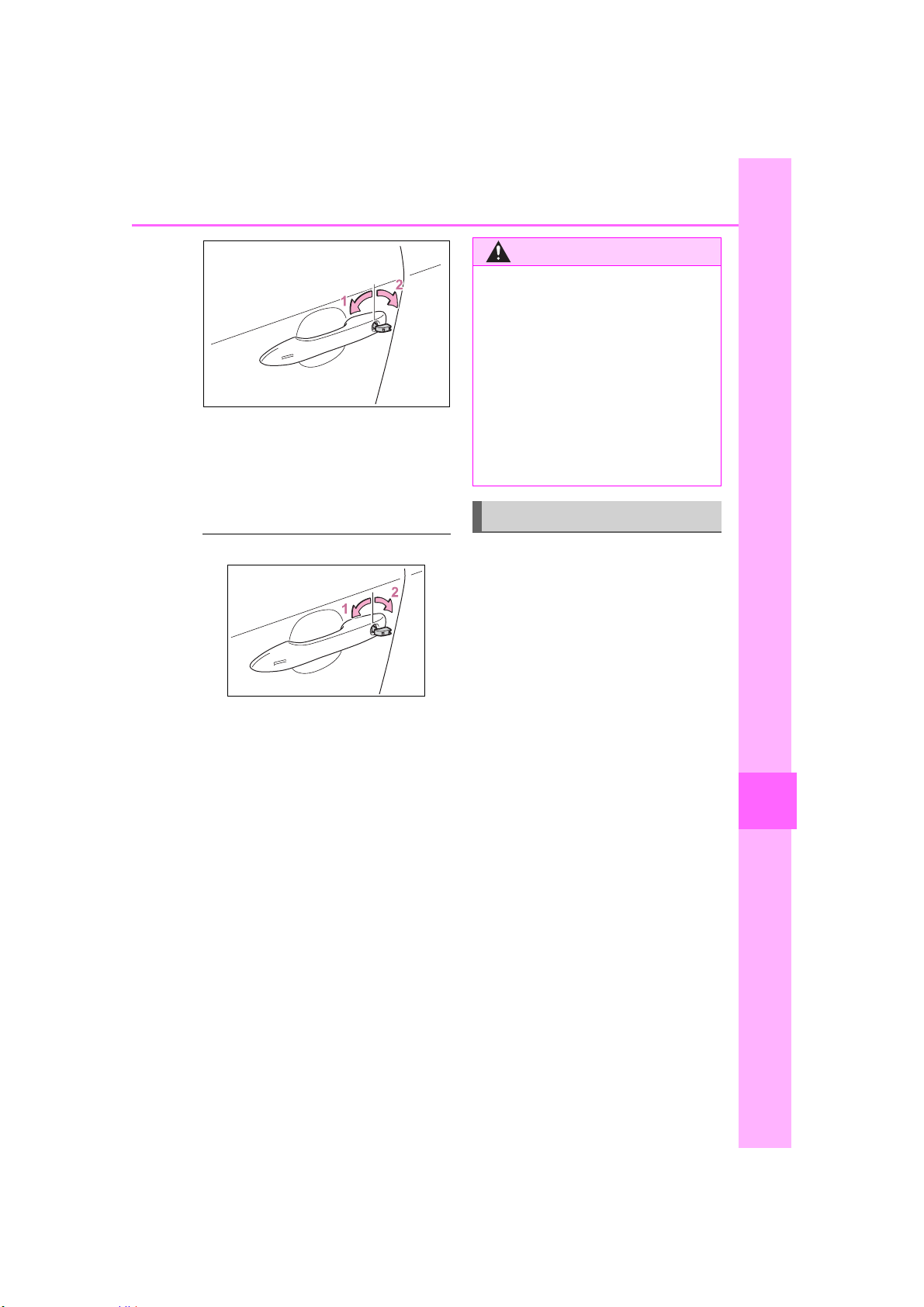
501
8-2. Steps to take in an emergency
COROLLA H/B_U
8
When trouble arises
1 Locks all the doors
2 Unlocks all the doors
Turning the key unlocks the driver’s
door. Turning the key again unlocks
the other doors.
■ Key linked functions
1 Closes the windows (turn and
hold)
*
2 Opens the windows (turn and
hold)
*
*
: This setting must be customized
at your Toyota dealer.
1 Vehicles with a continuously
variable transmission:
Ensure that the shift lever is
in P and depress the brake
pedal.
Vehicles with a manual trans-
mission: Shift the shift lever
to N and depress the clutch
pedal.
2 Touch the Toyota emblem
side of the electronic key to
the engine switch.
When the electronic key is
detected, a buzzer sounds and the
engine switch will turn to ON.
When the smart key system is
deactivated in customization set-
ting, the engine switch will turn to
WARNING
■ When using the mechanical
key and operating the power
windows
Operate the power window after
checking to make sure that there
is no possibility of any passenger
having any of their body parts
caught in the window.
Also, do not allow children to
operate the mechanical key. It is
possible for children and other
passengers to get caught in the
power window.
Starting the engine
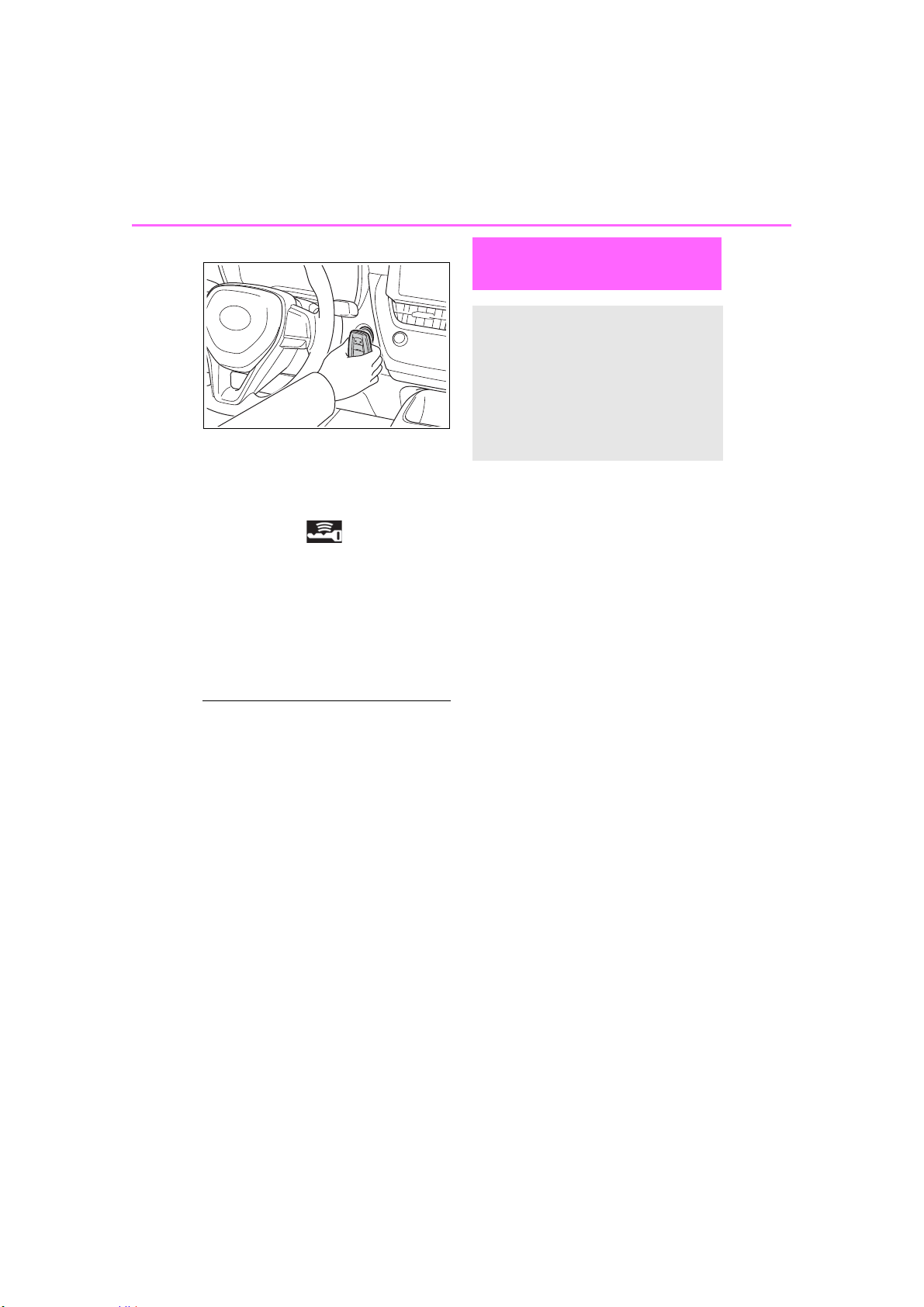
502
8-2. Steps to take in an emergency
COROLLA H/B_U
ACC.
3 Firmly depress the brake
pedal (continuously variable
transmission) or clutch pedal
(manual transmission) and
check that is shown on
the multi-information display.
4 Press the engine switch
shortly and firmly.
In the event that the engine still
cannot be started, contact your
Toyota dealer.
■ Stopping the engine
Shift the shift lever to P (continu-
ously variable transmission) or N
(manual transmission) and press
the engine switch as you normally
do when stopping the engine.
■ Electronic key battery
As the above procedure is a tempo-
rary measure, it is recommended
that the electronic key battery be
replaced immediately when the bat-
tery is depleted. (P.450)
■ Changing engine switch modes
Release the brake pedal (continu-
ously variable transmission) or
clutch pedal (manual transmission)
and press the engine switch in step
3 above.
The engine does not start and
modes will be changed each time
the switch is pressed. (P.145)
If the vehicle battery
is discharged
The following procedures
may be used to start the
engine if the vehicle’s bat-
tery is discharged.
You can also call your Toy-
ota dealer or a qualified
repair shop.
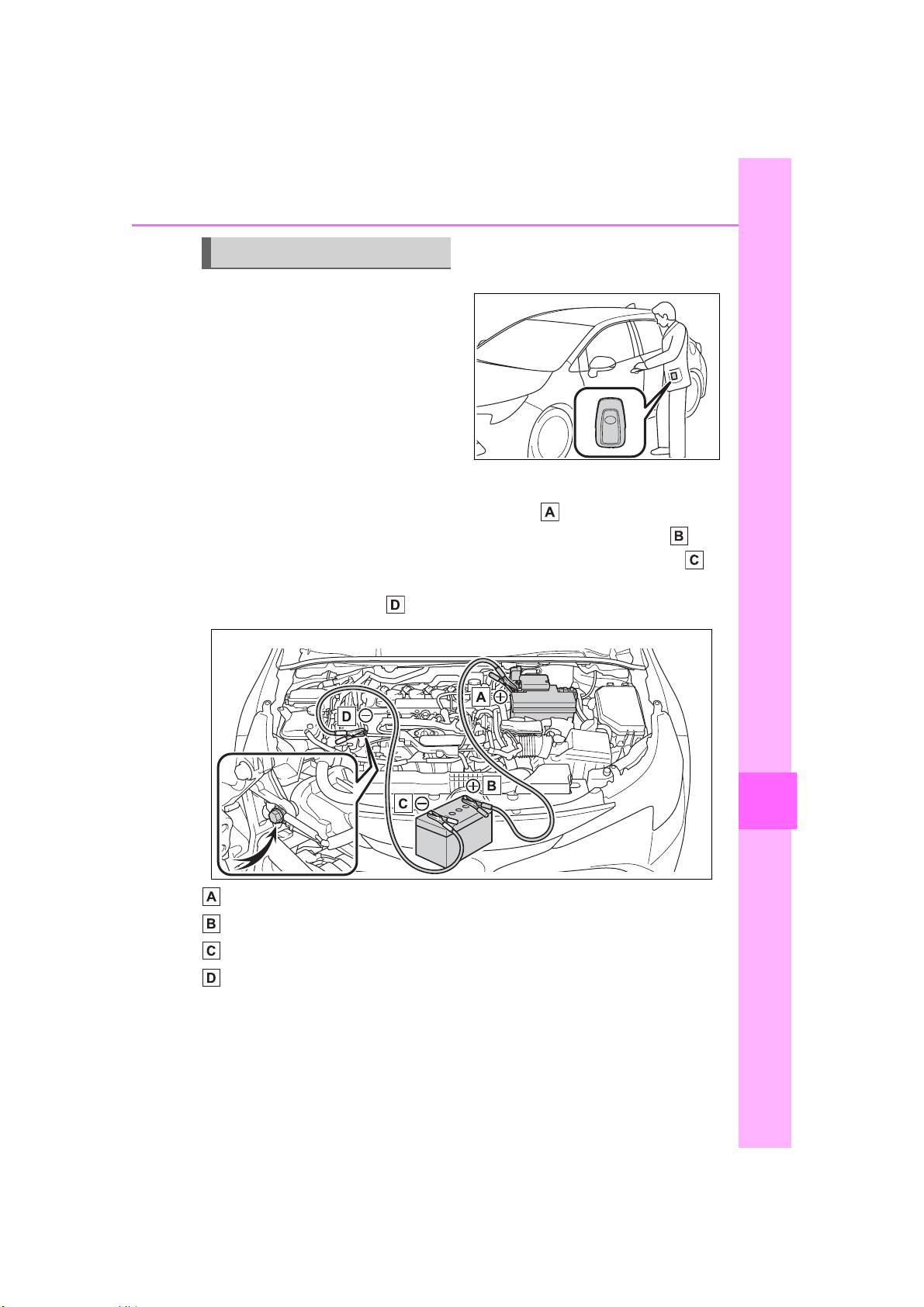
503
8-2. Steps to take in an emergency
COROLLA H/B_U
8
When trouble arises
If you have a set of jumper (or
booster) cables and a second
vehicle with a 12-volt battery,
you can jump start your vehicle
by following the steps below.
1 Vehicles with an alarm
(P.66): Confirm that the
electronic key is being car-
ried.
When connecting the jumper (or
booster) cables, depending on the
situation, the alarm may activate
and doors locked. (P.6 7)
2 Open the hood. (P.427)
3 Connect a positive jumper cable clamp to on your vehicle and
connect the clamp on the other end of the positive cable to on
the second vehicle. Then, connect a negative cable clamp to
on the second vehicle and connect the clamp at the other end of
the negative cable to .
Positive (+) battery terminal (your vehicle)
Positive (+) battery terminal (second vehicle)
Negative (-) battery terminal (second vehicle)
Solid, stationary, unpainted metallic point away from the battery
and any moving parts as shown in the illustration
4 Start the engine of the sec-
ond vehicle. Increase the
engine speed slightly and
maintain at that level for
approximately 5 minutes to
Restarting the engine

504
8-2. Steps to take in an emergency
COROLLA H/B_U
recharge the battery of your
vehicle.
5 Open and close any of the
doors of your vehicle with the
engine switch OFF.
6 Maintain the engine speed of
the second vehicle and start
the engine of your vehicle by
turning the engine switch to
ON.
7 Once the vehicle’s engine
has started, remove the
jumper cables in the exact
reverse order from which
they were connected.
Once the engine starts, have the
vehicle inspected at your Toyota
dealer as soon as possible.
■ Starting the engine when the
battery is discharged
The engine cannot be started by
push-starting.
■ To prevent battery discharge
● Turn off the headlights and the
audio system while the engine is
off.
● Turn off any unnecessary electri-
cal components when the vehicle
is running at a low speed for an
extended period, such as in heavy
traffic.
■ When the battery is removed or
discharged
● Information stored in the ECU is
cleared. When the battery is
depleted, have the vehicle
inspected at your Toyota dealer.
● Some systems may require initial-
ization. (P.539)
■ When removing the battery ter-
minals
When the battery terminals are
removed, the information stored in
the ECU is cleared. Before remov-
ing the battery terminals, contact
your Toyota dealer.
■ Charging the battery
The electricity stored in the battery
will discharge gradually even when
the vehicle is not in use, due to nat-
ural discharge and the draining
effects of certain electrical appli-
ances. If the vehicle is left for a long
time, the battery may discharge,
and the engine may be unable to
start. (The battery recharges auto-
matically during driving.)
■ When recharging or replacing
the battery
● In some cases, it may not be pos-
sible to unlock the doors using the
smart key system when the bat-
tery is discharged. Use the wire-
less remote control or the
mechanical key to lock or unlock
the doors.
● The engine may not start on the
first attempt after the battery has
recharged but will start normally
after the second attempt. This is
not a malfunction.
● The engine switch mode is memo-
rized by the vehicle. When the
battery is reconnected, the system
will return to the mode it was in
before the battery was dis-
charged. Before disconnecting the
battery, turn the engine switch off.
If you are unsure what mode the
engine switch was in before the
battery discharged, be especially
careful when reconnecting the
battery.
■ When replacing the battery
● Use a battery that conforms to
European regulations.
● Use a battery that the case size is
same as the previous one (LN2),
20 hour rate capacity (20HR) is
505
8-2. Steps to take in an emergency
COROLLA H/B_U
8
When trouble arises
equivalent (60Ah) or greater, and
performance rating (CCA) is
equivalent (360A) or greater.
• If the sizes differ, the battery can-
not be properly secured.
• If the 20 hour rate capacity is low,
even if the time period where the
vehicle is not used is a short time,
the battery may discharge and the
engine may not be able to start.
● For details, consult your Toyota
dealer.
WARNING
■ When removing the battery
terminals
Always remove the negative (-)
terminal first. If the positive (+) ter-
minal contacts any metal in the
surrounding area when the posi-
tive (+) terminal is removed, a
spark may occur, leading to a fire
in addition to electrical shocks
and death or serious injury.
■ Avoiding battery fires or
explosions
Observe the following precautions
to prevent accidentally igniting the
flammable gas that may be emit-
ted from the battery:
● Make sure each jumper cable is
connected to the correct termi-
nal and that it is not unintention-
ally in contact with any other
than the intended terminal.
● Do not allow the other end of
the jumper cable connected to
the “+” terminal to come into
contact with any other parts or
metal surfaces in the area, such
as brackets or unpainted metal.
● Do not allow the + and - clamps
of the jumper cables to come
into contact with each other.
● Do not smoke, use matches,
cigarette lighters or allow open
flame near the battery.
■ Battery precautions
The battery contains poisonous
and corrosive acidic electrolyte,
while related parts contain lead
and lead compounds. Observe
the following precautions when
handling the battery:
● When working with the battery,
always wear safety glasses and
take care not to allow any bat-
tery fluids (acid) to come into
contact with skin, clothing or the
vehicle body.
● Do not lean over the battery.
● In the event that battery fluid
comes into contact with the skin
or eyes, immediately wash the
affected area with water and
seek medical attention. Place a
wet sponge or cloth over the
affected area until medical
attention can be received.
● Always wash your hands after
handling the battery support,
terminals, and other bat-
tery-related parts.
● Do not allow children near the
battery.
NOTICE
■ When handling jumper cables
When connecting the jumper
cables, ensure that they do not
become entangled in the cooling
fan or engine drive belt.
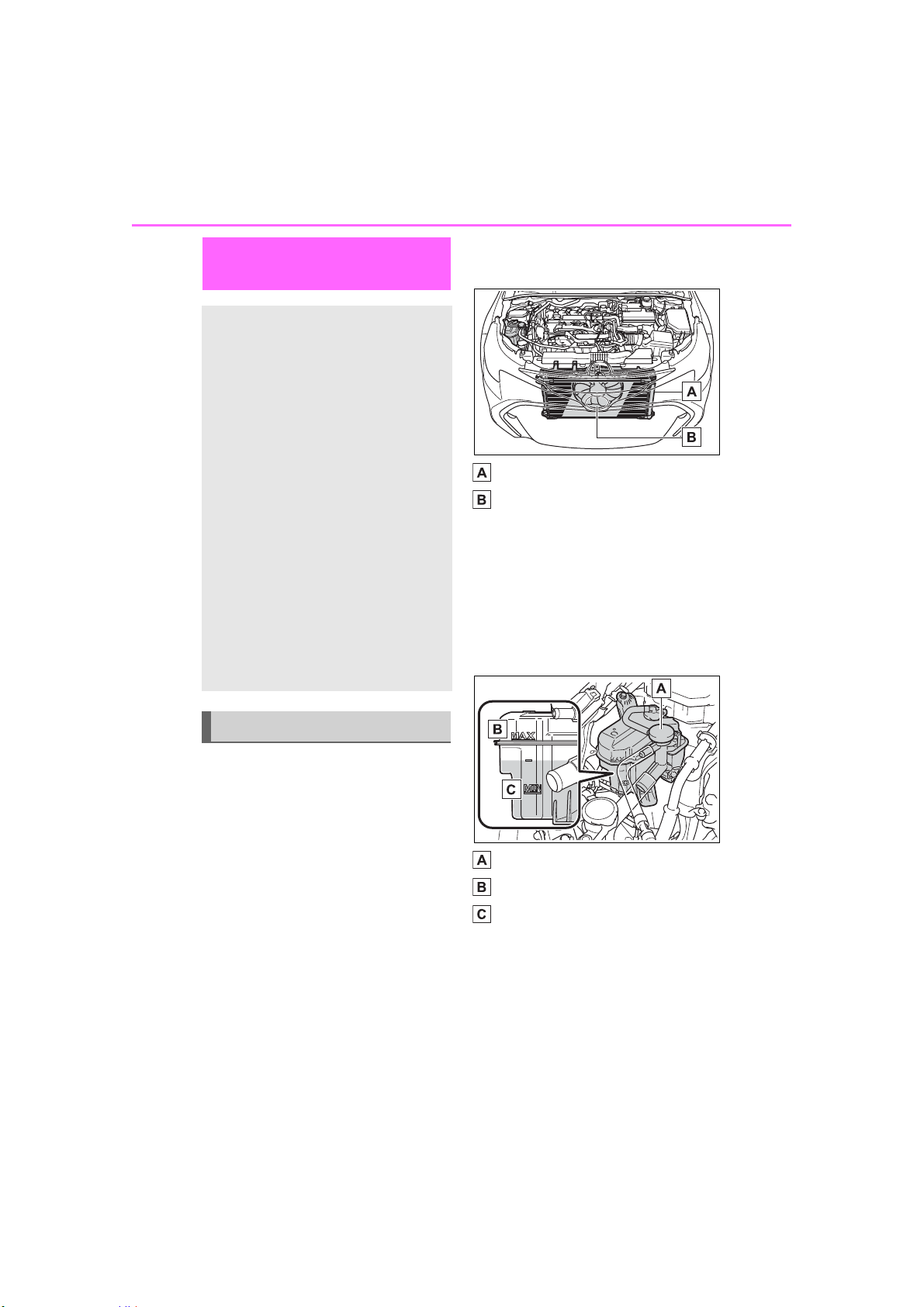
506
8-2. Steps to take in an emergency
COROLLA H/B_U
1 Stop the vehicle in a safe
place and turn off the air con-
ditioning system, and then
stop the engine.
2 If you see steam:
Carefully lift the hood after
the steam subsides.
If you do not see steam:
Carefully lift the hood.
3 After the engine has cooled
down sufficiently, inspect the
hoses and radiator core (radi-
ator) for any leaks.
Radiator
Cooling fan
If a large amount of coolant leaks,
immediately contact your Toyota
dealer.
4 The coolant level is satisfac-
tory if it is between the “MAX”
and “MIN” lines on the reser-
voir.
Reservoir
“MAX” line
“MIN” line
5 Add engine coolant if neces-
sary.
Water can be used in an emer-
gency if engine coolant is unavail-
If your vehicle over-
heats
The following may indicate
that your vehicle is over-
heating.
The engine coolant tem-
perature gauge (P.74, 78)
is in the red zone or a loss
of engine power is experi-
enced. (For example, the
vehicle speed does not
increase.)
“Engine Coolant Temp High
Stop in a Safe Place See
Owner’s Manual” is shown
on the multi-information dis-
play.
Steam comes out from
under the hood.
Correction procedures
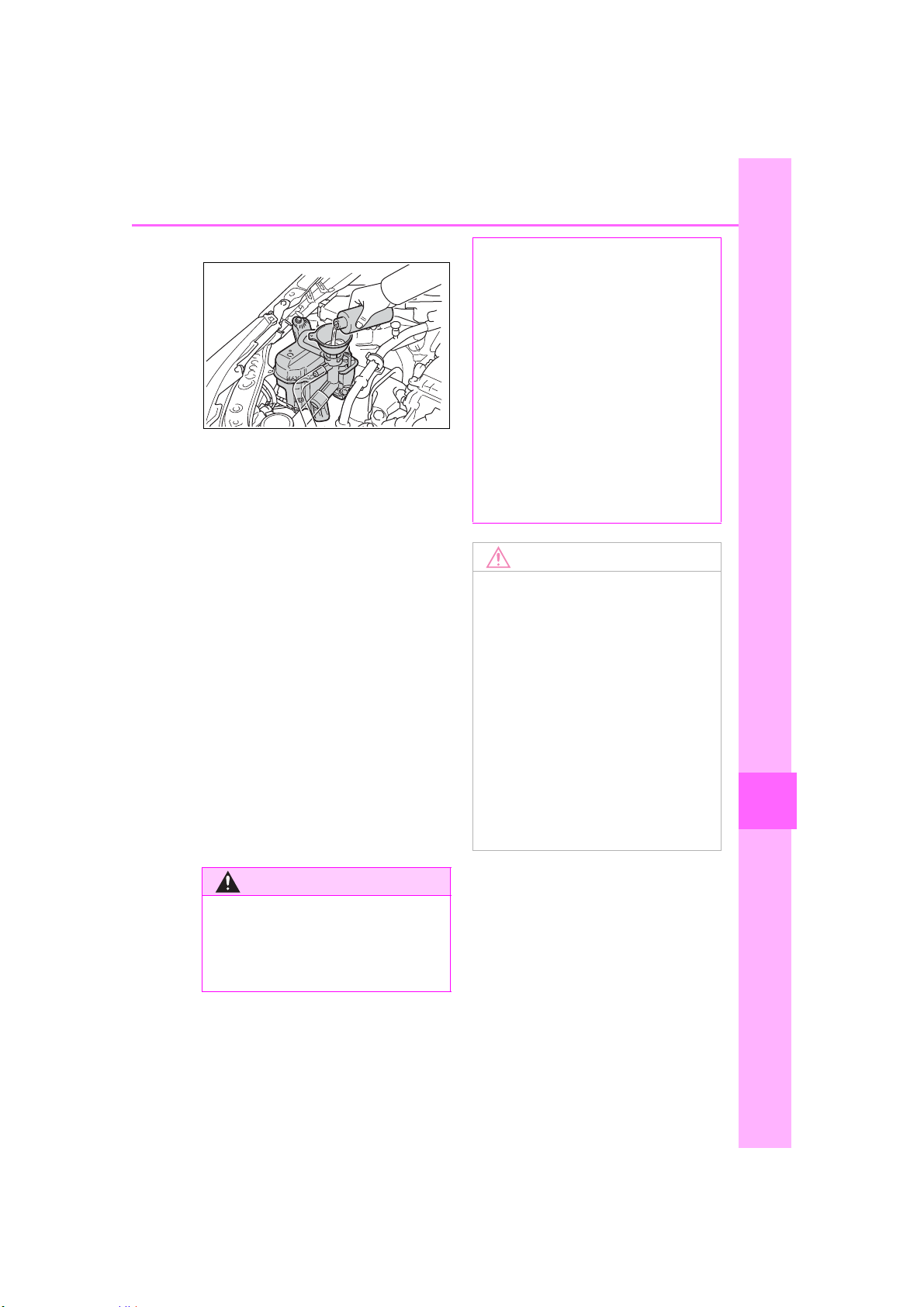
507
8-2. Steps to take in an emergency
COROLLA H/B_U
8
When trouble arises
able.
6 Start the engine and turn the
air conditioning system on to
check that the radiator cool-
ing fan operates and to check
for coolant leaks from the
radiator or hoses.
The fan operates when the air con-
ditioning system is turned on imme-
diately after a cold start. Confirm
that the fan is operating by check-
ing the fan sound and air flow. If it is
difficult to check these, turn the air
conditioning system on and off
repeatedly. (The fan may not oper-
ate in freezing temperatures.)
7 If the fan is not operating:
Stop the engine immediately
and contact your Toyota
dealer.
If the fan is operating:
Have the vehicle inspected at
the nearest Toyota dealer.
WARNING
■ When inspecting under the
hood of your vehicle
Observe the following precau-
tions. Failure to do so may result
in serious injury such as burns.
● If steam is seen coming from
under the hood, do not open the
hood until the steam has sub-
sided. The engine compart-
ment may be very hot.
● Keep hands and clothing (espe-
cially a tie, a scarf or a muffler)
away from the fan and belts.
Failure to do so may cause the
hands or clothing to be caught,
resulting in serious injury.
● Do not loosen the coolant reser-
voir caps while the engine and
radiator are hot.
High temperature steam or
coolant could spray out.
NOTICE
■ When adding engine coolant
Add coolant slowly after the
engine has cooled down suffi-
ciently. Adding cool coolant to a
hot engine too quickly can cause
damage to the engine.
■ To prevent damage to the
cooling system
Observe the following precau-
tions:
● Avoid contaminating the coolant
with foreign matter (such as
sand or dust etc.).
● Do not use any coolant additive.
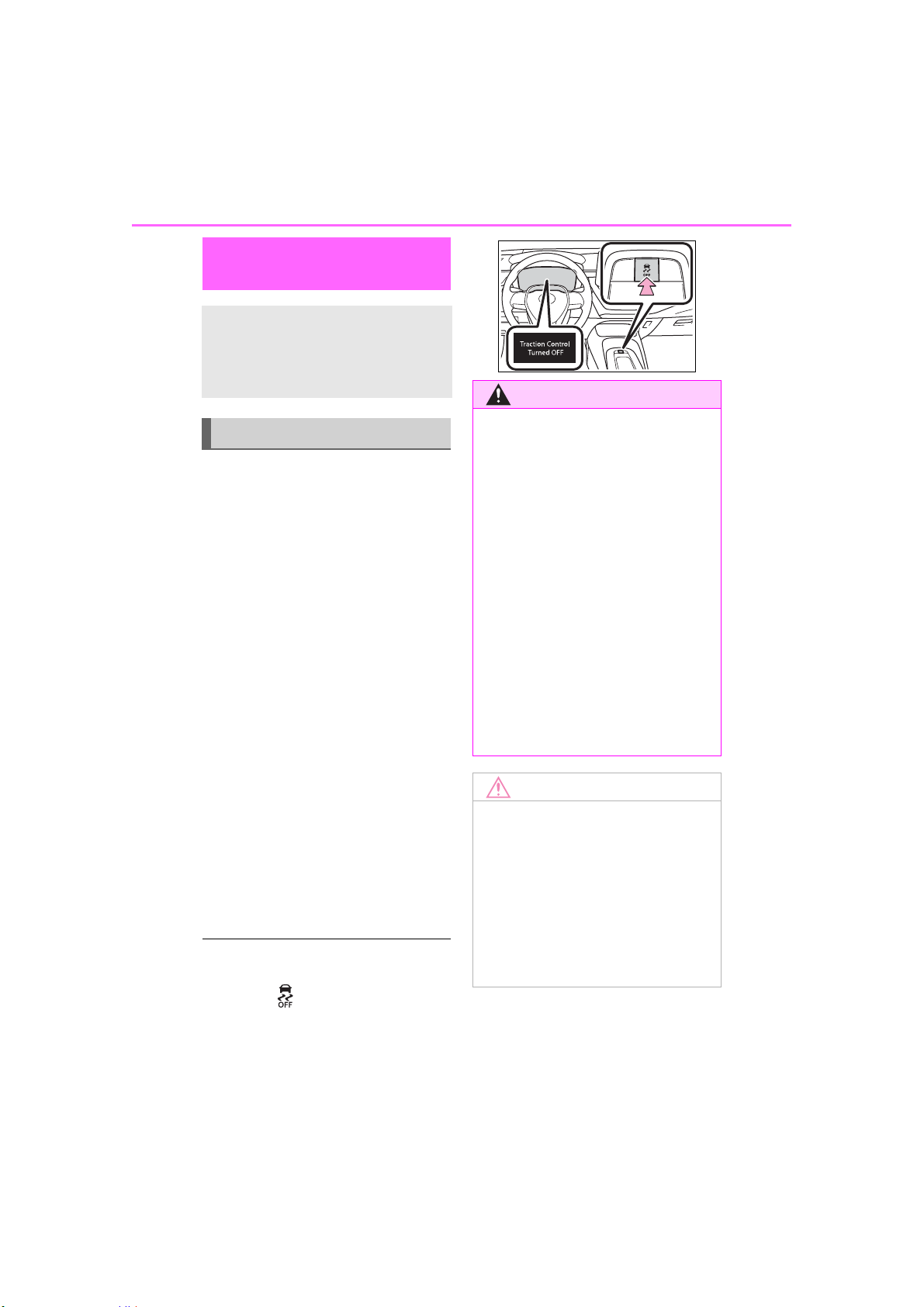
508
8-2. Steps to take in an emergency
COROLLA H/B_U
1 Stop the engine. Set the
parking brake and shift the
shift lever to P (continuously
variable transmission) or N
(manual transmission).
2 Remove the mud, snow or
sand from around the front
wheels.
3 Place wood, stones or some
other material under the front
wheels to help provide trac-
tion.
4 Restart the engine.
5 Shift the shift lever to D or R
(continuously variable trans-
mission) or 1 or R (manual
transmission) and release
the parking brake. Then,
while exercising caution,
depress the accelerator
pedal.
■ When it is difficult to free the
vehicle
Press the switch to turn off
TRAC.
If the vehicle becomes
stuck
Carry out the following pro-
cedures if the tires spin or
the vehicle becomes stuck
in mud, dirt or snow:
Recovering procedure
WARNING
■ When attempting to free a
stuck vehicle
If you choose to push the vehicle
back and forth to free it, make
sure the surrounding area is clear
to avoid striking other vehicles,
objects or people. The vehicle
may also lunge forward or lunge
back suddenly as it becomes free.
Use extreme caution.
■ When shifting the shift lever
(vehicles with a continuously
variable transmission)
Be careful not to shift the shift
lever with the accelerator pedal
depressed.
This may lead to unexpected
rapid acceleration of the vehicle
that may cause an accident
resulting in death or serious injury.
NOTICE
■ To avoid damaging the trans-
mission and other compo-
nents
● Avoid spinning the front wheels
and depressing the accelerator
pedal more than necessary.
● If the vehicle remains stuck
even after these procedures are
performed, the vehicle may
require towing to be freed.

509
COROLLA H/B_U
9
9
Vehicle specifications
Vehicle specifications
.
9-1. Specifications
Maintenance data (fuel, oil
level, etc.).................. 510
Fuel information .......... 518
Tire information ........... 520
9-2. Customization
Customizable features
.................................. 531
9-3. Initialization
Items to initialize ......... 539
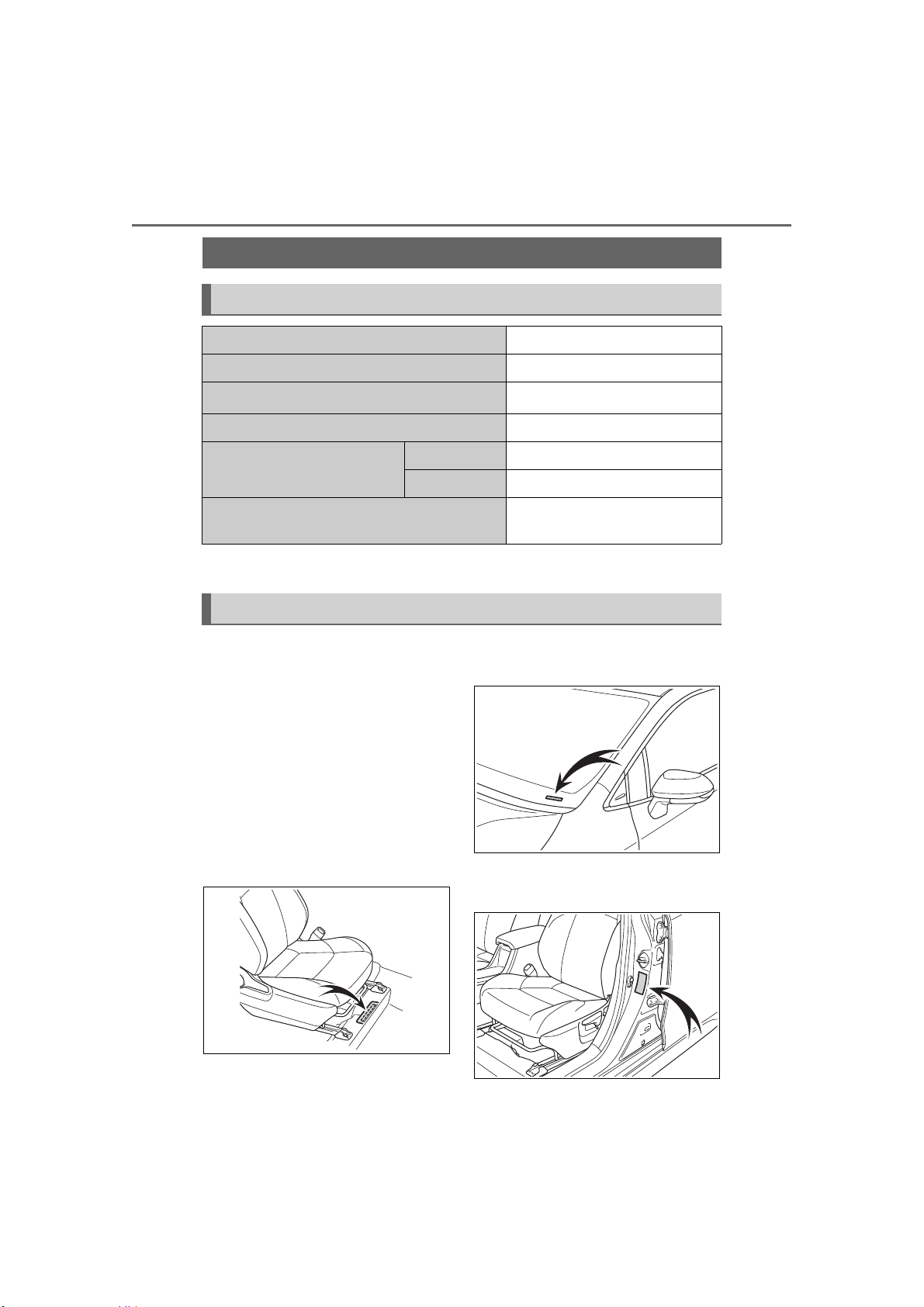
510
9-1. Specifications
COROLLA H/B_U
9-1.Specifications
*
: Unladen vehicles
■ Vehicle identification num-
ber
The vehicle identification num-
ber (VIN) is the legal identifier
for your vehicle. This is the pri-
mary identification number for
your Toyota. It is used in regis-
tering the ownership of your
vehicle.
This number is stamped under
the right-hand front seat.
This number is also stamped on
the top left of the instrument
panel.
This number is also on the Certi-
fication Label.
Maintenance data (fuel, oil level, etc.)
Dimensions and weight
Overall length 172.0 in. (4370 mm)
Overall width 70.5 in. (1790 mm)
Overall height
*
56.5 in. (1435 mm)
Wheelbase 103.9 in. (2640 mm)
Tread
Front 60.2 in. (1530 mm)
Rear 60.2 in. (1530 mm)
Vehicle capacity weight
(Occupants + luggage)
860 lb. (390 kg)
Vehicle identification
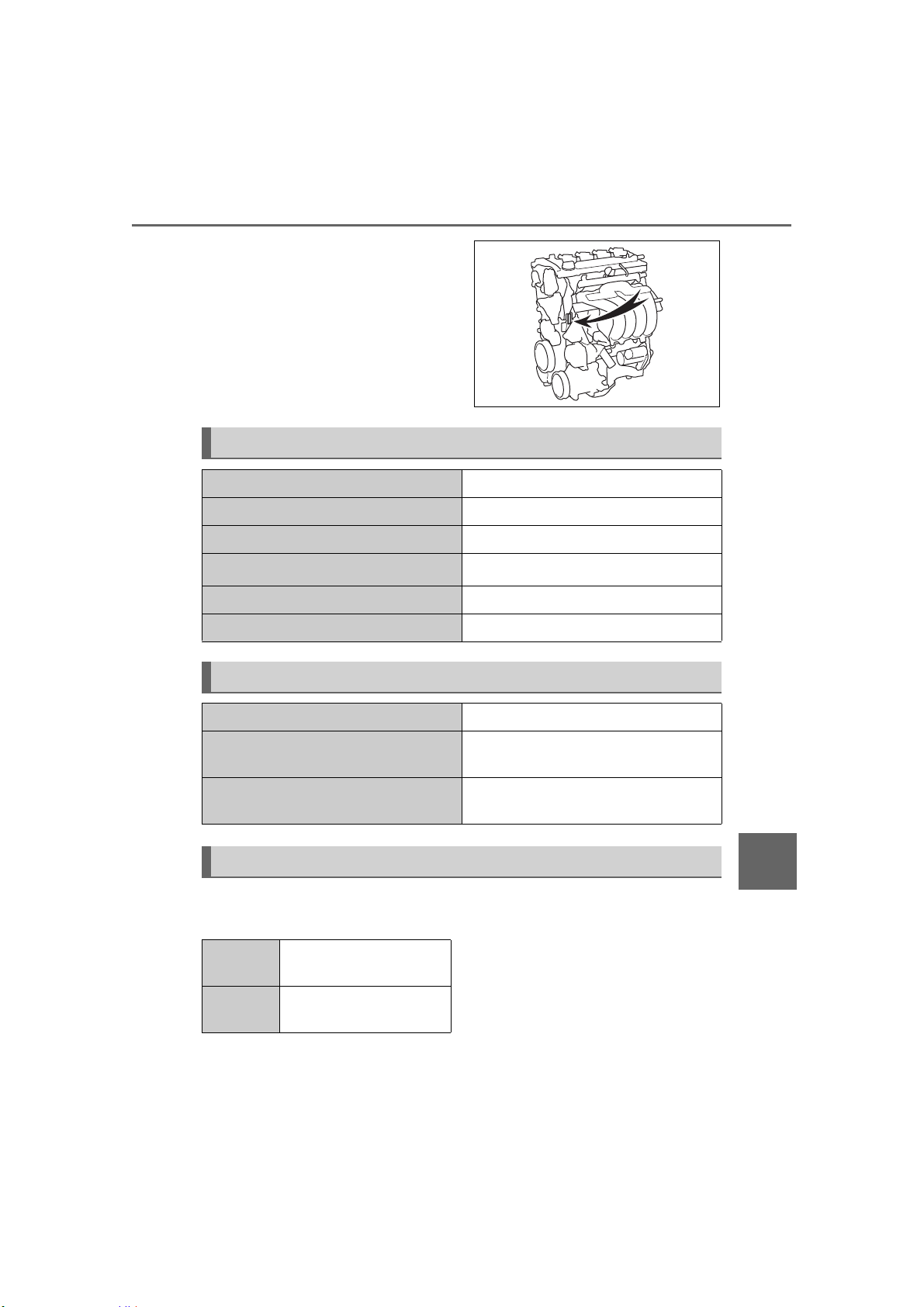
511
9-1. Specifications
COROLLA H/B_U
9
Vehicle specifications
■ Engine number
The engine number is stamped
on the engine block as shown.
■ Oil capacity (Drain and refill
[Reference
*
])
*
: The engine oil capacity is a refer-
ence quantity to be used when
changing the engine oil. Warm up
and turn off the engine, wait more
than 5 minutes, and check the oil
level on the dipstick.
■ Engine oil selection
“Toyota Genuine Motor Oil” is
used in your Toyota vehicle. Use
Toyota approved “Toyota Genu-
ine Motor Oil” or equivalent to
Engine
Model 2.0 L 4-cylinder (M20A-FKS)
Type 4-cylinder in line, 4-cycle, gasoline
Bore and stroke 3.17 3.84 in. (80.5 97.6 mm)
Displacement
121.3 cu. in. (1987 cm
3
)
Valve clearance Automatic adjustment
Drive belt tension Automatic adjustment
Fuel
Fuel type Unleaded gasoline only
Octane Rating
87 (Research Octane Number 91) or
higher
Fuel tank capacity
(Reference)
13.2 gal. (50.0 L, 11.0 Imp. gal.)
Lubrication system
With filter
4.9 qt. (4.6 L, 4.0 Imp.
qt.)
Without
filter
4.5 qt. (4.3 L, 3.8 Imp.
qt.)
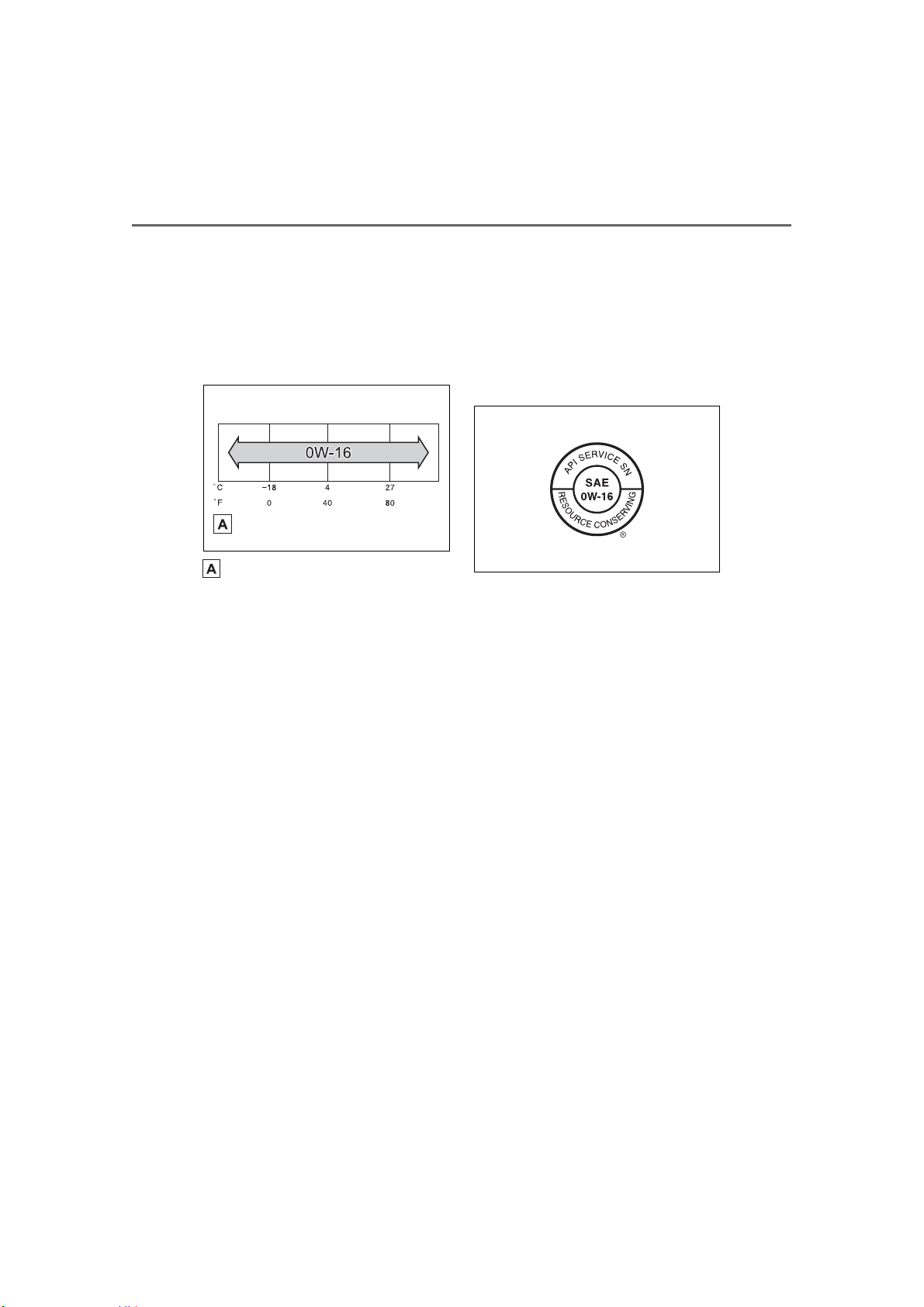
512
9-1. Specifications
COROLLA H/B_U
satisfy the following grade and
viscosity.
Oil grade: API SN/RC multi-
grade engine oil
Recommended viscosity: SAE
0W-16
Outside temperature
SAE 0W-16 is the best choice
for good fuel economy and good
starting in cold weather.
If SAE 0W-16 is not available,
SAE 0W-20 oil may be used.
However, it must be replaced
with SAE 0W-16 at the next oil
change.
Oil viscosity (0W-16 is explained
here as an example):
• The 0W in 0W-16 indicates
the characteristic of the oil
which allows cold startability.
Oils with a lower value before
the W allow for easier starting
of the engine in cold weather.
• The 16 in 0W-16 indicates the
viscosity characteristic of the
oil when the oil is at high tem-
perature. An oil with a higher
viscosity (one with a higher
value) may be better suited if
the vehicle is operated at high
speeds, or under extreme
load conditions.
How to read oil container label:
API registered marks is added
to some oil containers to help
you select the oil you should
use.
513
9-1. Specifications
COROLLA H/B_U
9
Vehicle specifications
Cooling system
Capacity (Reference)
Vehicles with a continuously variable transmis-
sion
6.8 qt. (6.4 L, 5.6 Imp. qt.)
Vehicles with a manual transmission
6.4 qt. (6.1 L, 5.4 Imp. qt.)
Coolant type
Use either of the following:
“Toyota Super Long Life Coolant”
Similar high-quality ethylene glycol-based
non-silicate, non-amine, non-nitrite, and
non-borate coolant with long-life hybrid organic
acid technology
Do not use plain water alone.
Ignition system (spark plug)
Make DENSO FC20HR-Q8
Gap 0.032 in. (0.8 mm)
NOTICE
■ Iridium-tipped spark plugs
Use only iridium-tipped spark plugs. Do not adjust the spark plug gap.
Electrical system (battery)
Open voltage at 68°F (20°C):
12.3 V or higher
(Turn the engine switch off and turn on the
high beam headlights for 30 seconds.)
Charging rates
Quick charge
Slow charge
15 A max.
5 A max.
Continuously variable transmission
Fluid capacity
*
9.0 qt. (8.5 L, 7.5 Imp. qt.)
Fluid type Toyota Genuine CVT Fluid FE
514
9-1. Specifications
COROLLA H/B_U
*
: The fluid capacity is a reference quantity.
If replacement is necessary, contact your Toyota dealer.
NOTICE
■ Continuously variable transmission fluid type
Using continuously variable transmission fluid other than the above type
may cause abnormal noise or vibration, or damage the continuously vari-
able transmission of your vehicle.
Manual transmission
Gear oil capacity (Reference) 1.6 qt. (1.5 L, 1.3 Imp. qt.)
Gear oil type
“TOYOTA Genuine Manual Transmission
Gear Oil LV GL-4 75W” or equivalent
NOTICE
■ Manual transmission gear oil
● Please be aware that depending on the particular characteristics of the
gear oil used or the operating conditions, idle sound, shift feeling and/or
fuel efficiency may be different or affected and, in the worst case, dam-
age to the vehicle’s transmission.
Toyota recommends to use “TOYOTA Genuine Manual Transmission
Gear Oil LV GL-4 75W” to achieve optimal performance.
● Your Toyota vehicle is filled with “TOYOTA Genuine Manual Transmis-
sion Gear Oil LV GL-4 75W” at the factory.
Use Toyota approved “TOYOTA Genuine Manual Transmission Gear Oil
LV GL-4 75W” or an equivalent oil of matching quality that satisfies the
above specifications.
Please contact your Toyota dealer for further details.
Clutch
Pedal free play 0.1 0.6 in. (3 15 mm)
Fluid type FMVSS No.116 DOT 3 or SAE J1703
Brakes
Pedal clearance
*1
4.1 in. (105 mm) Min.
Pedal free play 0.04 0.24 in. (1 6 mm)
Brake pad wear limit 0.04 in. (1 mm)
515
9-1. Specifications
COROLLA H/B_U
9
Vehicle specifications
*1
:Minimum pedal clearance when depressed with a force of 67.4 lbf (300
N, 30.6 kgf) while the engine is running.
When performing the brake pedal inspection, also be sure to check that
the brake system warning light is not illuminated when the engine is run-
ning. (If the brake system warning light is illuminated, refer to P.468.)
*2
:Make sure to confirm that the brake warning light (yellow) does not illumi-
nate. (If the brake warning light illuminates, refer to P.468.)
15-inch tires
16-inch tires
Parking brake indicator
*2
When pulling the parking brake switch for
1 to 2 seconds: comes on
When pushing the parking brake switch for
1 to 2 seconds: turns off
Fluid type FMVSS No.116 DOT 3 or SAE J1703
Steering
Free play Less than 1.2 in. (30 mm)
Tires and wheels
Tire size 195/65R15 91S
Tire inflation pressure
(Recommended cold tire
inflation pressure)
Front tire
38 psi (260 kPa, 2.6 kgf/cm
2
or bar)
Rear tire
36 psi (250 kPa, 2.5 kgf/cm
2
or bar)
Wheel size 15 6 1/2J
Wheel nut torque 76 ft•lbf (103 N•m, 10.5 kgf•m)
Tire size 205/55R16 91H
Tire inflation pressure
(Recommended cold tire
inflation pressure)
Front tire
35 psi (240 kPa, 2.4 kgf/cm
2
or bar)
Rear tire
33 psi (230 kPa, 2.3 kgf/cm
2
or bar)
516
9-1. Specifications
COROLLA H/B_U
18-inch tires
Compact spare tire (if equipped)
Wheel size 16 7J
Wheel nut torque 76 ft•lbf (103 N•m, 10.5 kgf•m)
Tire size 225/40R18 88V
Tire inflation pressure
(Recommended cold tire
inflation pressure)
Driving under normal conditions
Front tire
33 psi (230 kPa, 2.3 kgf/cm
2
or bar)
Rear tire
30 psi (210 kPa, 2.1 kgf/cm
2
or bar)
Driving at high speeds (above 100 mph [160
km/h]) (in countries where such speeds are per-
mitted by law)
Add 5 psi (30 kPa, 0.3 kgf/cm
2
or bar) to the front
tires and rear tires. Never exceed the maximum
cold tire inflation pressure indicated on the tire
sidewall.
Wheel size 18 8J
Wheel nut torque 76 ft•lbf (103 N•m, 10.5 kgf•m)
Tire size T125/70D17 98M
Tire inflation pressure
(Recommended cold tire
inflation pressure)
60 psi (420 kPa, 4.2 kgf/cm
2
or bar)
Wheel size 17 4T
Wheel nut torque 76 ft•lbf (103 N•m, 10.5 kgf•m)
Light bulbs
Light bulbs Bulb No. W Type
Exterior
Front side marker lights — 5 A
License plate lights — 5 A
517
9-1. Specifications
COROLLA H/B_U
9
Vehicle specifications
A: Wedge base bulbs (clear)
B: Double end bulbs
Interior
Front interior lights/personal
lights
— 5 A
Vanity lights — 8 A
Rear interior light — 8 B
Luggage compartment light — 5 A
Light bulbs Bulb No. W Type
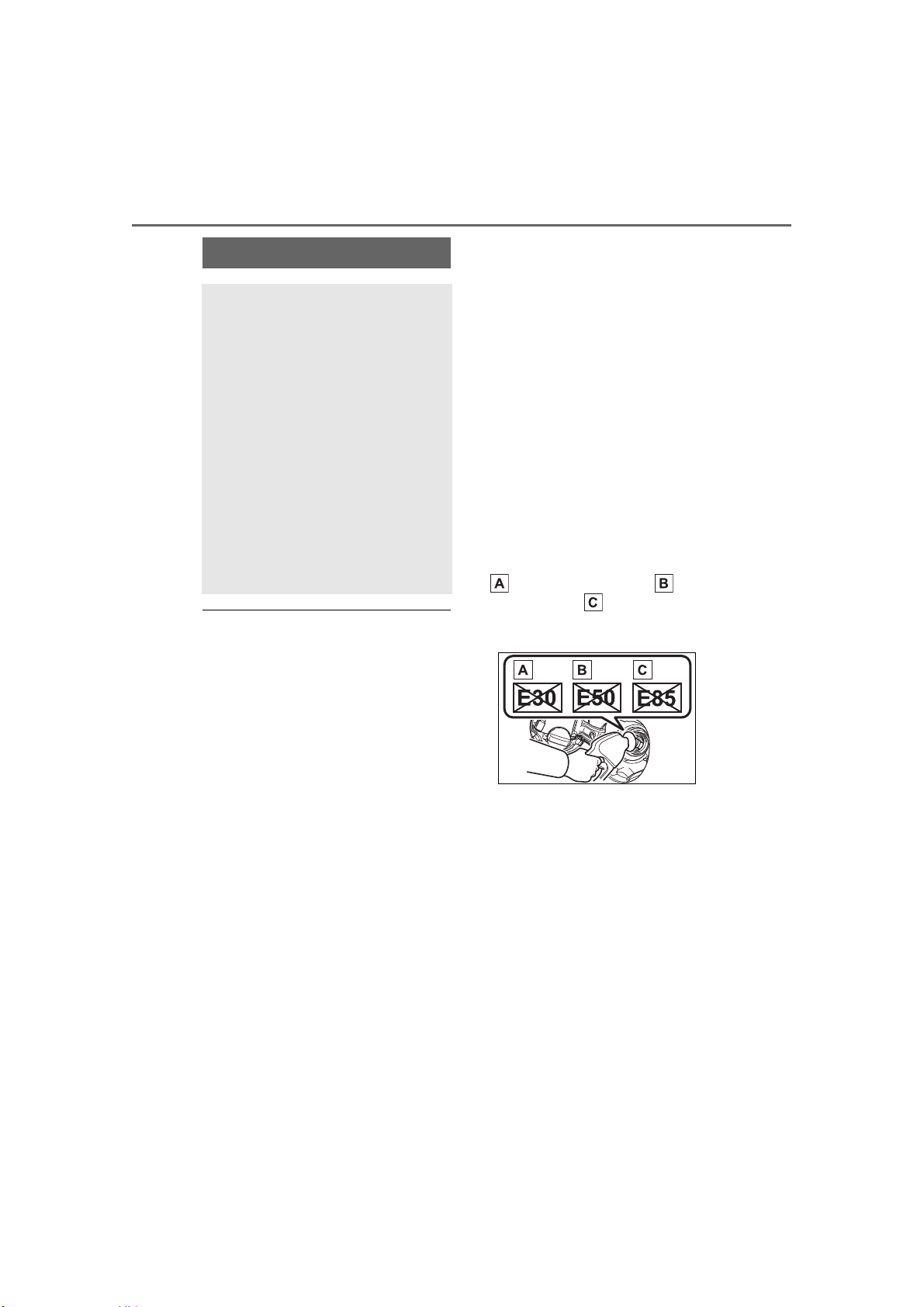
518
9-1. Specifications
COROLLA H/B_U
■ Gasoline quality
In very few cases, driveability prob-
lems may be caused by the brand of
gasoline you are using. If driveability
problems persist, try changing the
brand of gasoline. If this does not
correct the problem, consult your
Toyota dealer.
■ Recommendation of the use of
gasoline containing detergent
additives
● Toyota recommends the use of
gasoline that contains detergent
additives to avoid the build-up of
engine deposits.
● All gasoline sold in the U.S.A. con-
tains minimum detergent additives
to clean and/or keep clean intake
systems, per EPA’s lowest addi-
tives concentration program.
● Toyota strongly recommends the
use of Top Tier Detergent Gaso-
line. For more information on Top
Tier Detergent Gasoline and a list
of marketers, please go to the offi-
cial website www.toptiergas.com.
■ Recommendation of the use of
low emissions gasoline
Gasolines containing oxygenates
such as ethers and ethanol, as well
as reformulated gasolines, are avail-
able in some cities. These fuels are
typically acceptable for use, provid-
ing they meet other fuel require-
ments.
Toyota recommends these fuels,
since the formulations allow for
reduced vehicle emissions.
■ Non-recommendation of the
use of blended gasoline
● Use only gasoline containing up to
15% ethanol.
DO NOT use any flex-fuel or gas-
oline that could contain more than
15% ethanol, including from any
pump labeled E30 (30% ethanol
[ ]), E50 (50% ethanol [ ]), E85
(85% ethanol [ ]) (which are only
some examples of fuel containing
more than 15% ethanol).
● If you use gasohol in your vehicle,
be sure that it has an octane rat-
ing no lower than 87.
● Toyota does not recommend the
use of gasoline containing metha-
nol.
■ Non-recommendation of the
use of gasoline containing MMT
Some gasoline contains an octane
enhancing additive called MMT
(Methylcyclopentadienyl Manga-
nese Tricarbonyl).
Toyota does not recommend the use
of gasoline that contains MMT. If
fuel containing MMT is used, your
emission control system may be
Fuel information
You must only use unleaded
gasoline.
Select octane rating of 87
(Research Octane Number
91) or higher. Use of
unleaded gasoline with an
octane rating lower than 87
may result in engine knock-
ing. Persistent knocking
can lead to engine damage.
At minimum, the gasoline you
use should meet the specifica-
tions of ASTM D4814 in the
U.S.A.
519
9-1. Specifications
COROLLA H/B_U
9
Vehicle specifications
adversely affected.
The malfunction indicator lamp on
the instrument cluster may come on.
If this happens, contact your Toyota
dealer for service.
■ If your engine knocks
● Consult your Toyota dealer.
● You may occasionally notice light
knocking for a short time while
accelerating or driving uphill. This
is normal and there is no need for
concern.
NOTICE
■ Notice on fuel quality
● Do not use improper fuels. If
improper fuels are used, the
engine will be damaged.
● Do not use leaded gasoline.
Leaded gasoline can cause
damage to your vehicle’s
three-way catalytic converters
causing the emission control
system to malfunction.
● Do not use gasohol other than
the type previously stated.
Other gasohol may cause fuel
system damage or vehicle per-
formance problems.
● Using unleaded gasoline with
an octane number or rating
lower than the level previously
stated will cause persistent
heavy knocking.
At worst, this will lead to engine
damage.
■ Fuel-related poor driveability
If poor driveability (poor hot start-
ing, vaporization, engine knock-
ing, etc.) is encountered after
using a different type of fuel, dis-
continue the use of that type of
fuel.
■ When refueling with gasohol
Take care not to spill gasohol. It
can damage your vehicle’s paint.
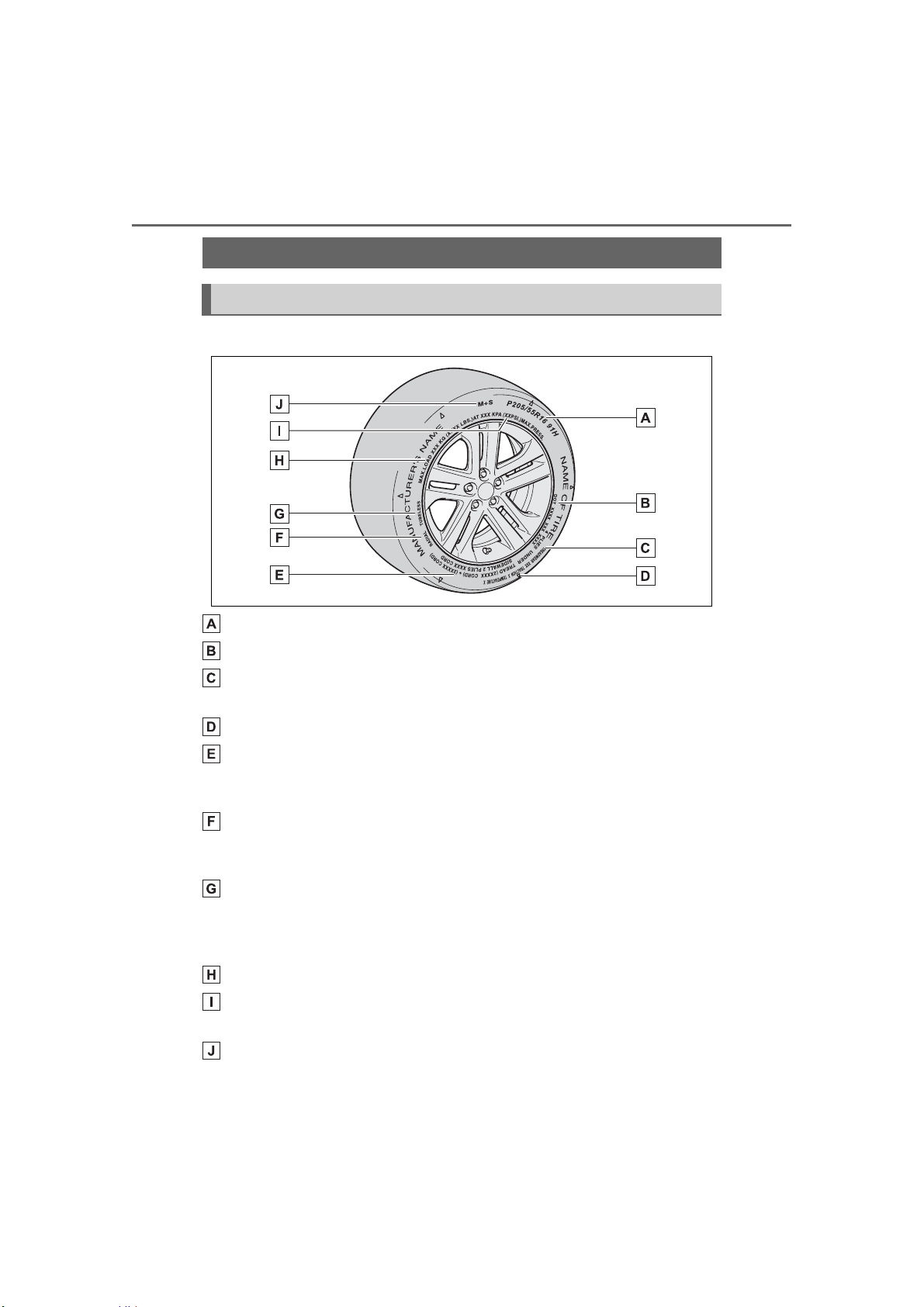
520
9-1. Specifications
COROLLA H/B_U
Full-size tire
Tire size (P.522)
DOT and Tire Identification Number (TIN) (P.522)
Uniform tire quality grading
For details, see “Uniform Tire Quality Grading” that follows.
Location of treadwear indicators (P.436)
Tire ply composition and materials
Plies are layers of rubber-coated parallel cords. Cords are the strands
which form the plies in a tire.
Radial tires or bias-ply tires
A radial tire has “RADIAL” on the sidewall. A tire not marked “RADIAL” is a
bias-ply tire.
TUBELESS or TUBE TYPE
A tubeless tire does not have a tube and air is directly put into the tire. A
tube type tire has a tube inside the tire and the tube maintains the air pres-
sure.
Load limit at maximum cold tire inflation pressure (P.437)
Maximum cold tire inflation pressure (P.515)
This means the pressure to which a tire may be inflated.
Summer tires or all season tires (P.437)
Tire information
Typical tire symbols
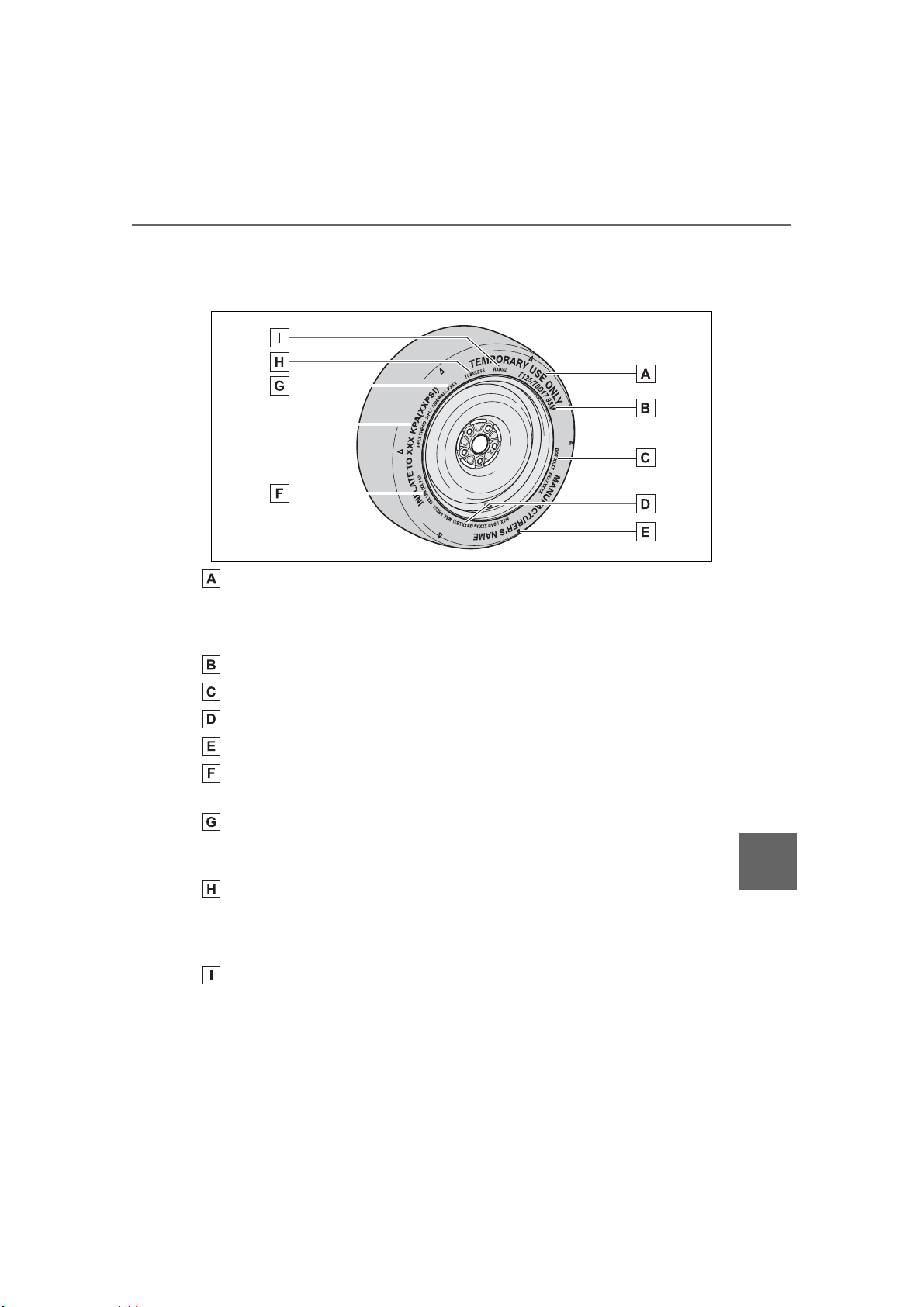
521
9-1. Specifications
COROLLA H/B_U
9
Vehicle specifications
An all season tire has “M+S” on the sidewall. A tire not marked “M+S” is a
summer tire.
Compact spare tire
“TEMPORARY USE ONLY”
A compact spare tire is identified by the phrase “TEMPORARY USE ONLY”
molded on its sidewall. This tire is designed for temporary emergency use
only.
Tire size (P.522)
DOT and Tire Identification Number (TIN) (P.522)
Load limit at maximum cold tire inflation pressure (P.437)
Location of treadwear indicators (P.436)
Maximum cold tire inflation pressure (P.515)
This means the pressure to which a tire may be inflated.
Tire ply composition and materials
Plies are layers of rubber-coated parallel cords. Cords are the strands
which form the plies in a tire.
TUBELESS or TUBE TYPE
A tubeless tire does not have a tube and air is directly put into the tire. A
tube type tire has a tube inside the tire and the tube maintains the air pres-
sure.
Radial tires or bias-ply tires
A radial tire has “RADIAL” on the sidewall. A tire not marked “RADIAL” is a
bias-ply tire.
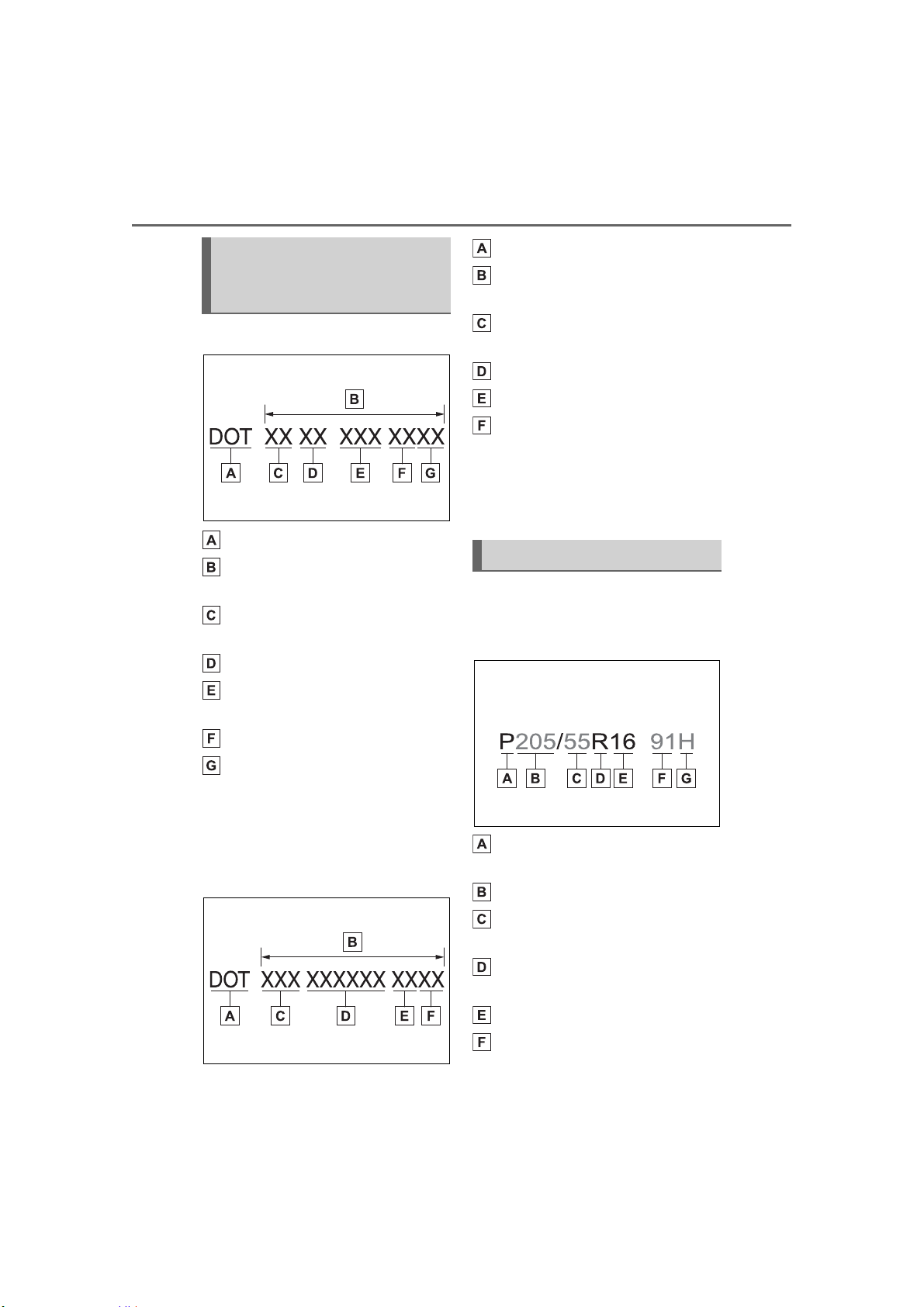
522
9-1. Specifications
COROLLA H/B_U
Type A
DOT symbol
*
Tire Identification Number
(TIN)
Tire manufacturer’s identifi-
cation mark
Tire size code
Manufacturer’s optional tire
type code (3 or 4 letters)
Manufacturing week
Manufacturing year
*
: The DOT symbol certifies that the
tire conforms to applicable Fed-
eral Motor Vehicle Safety Stan-
dards.
Type B
DOT symbol
*
Tire Identification Number
(TIN)
Tire manufacturer’s identifi-
cation mark
Manufacturer’s code
Manufacturing week
Manufacturing year
*
: The DOT symbol certifies that the
tire conforms to applicable Fed-
eral Motor Vehicle Safety Stan-
dards.
■ Typical tire size information
The illustration indicates typical
tire size.
Tire use (P = Passenger car,
T = Temporary use)
Section width (millimeters)
Aspect ratio (tire height to
section width)
Tire construction code (R =
Radial, D = Diagonal)
Wheel diameter (inches)
Load index (2 digits or 3 dig-
its)
Typical DOT and Tire
Identification Number
(TIN)
Tire size
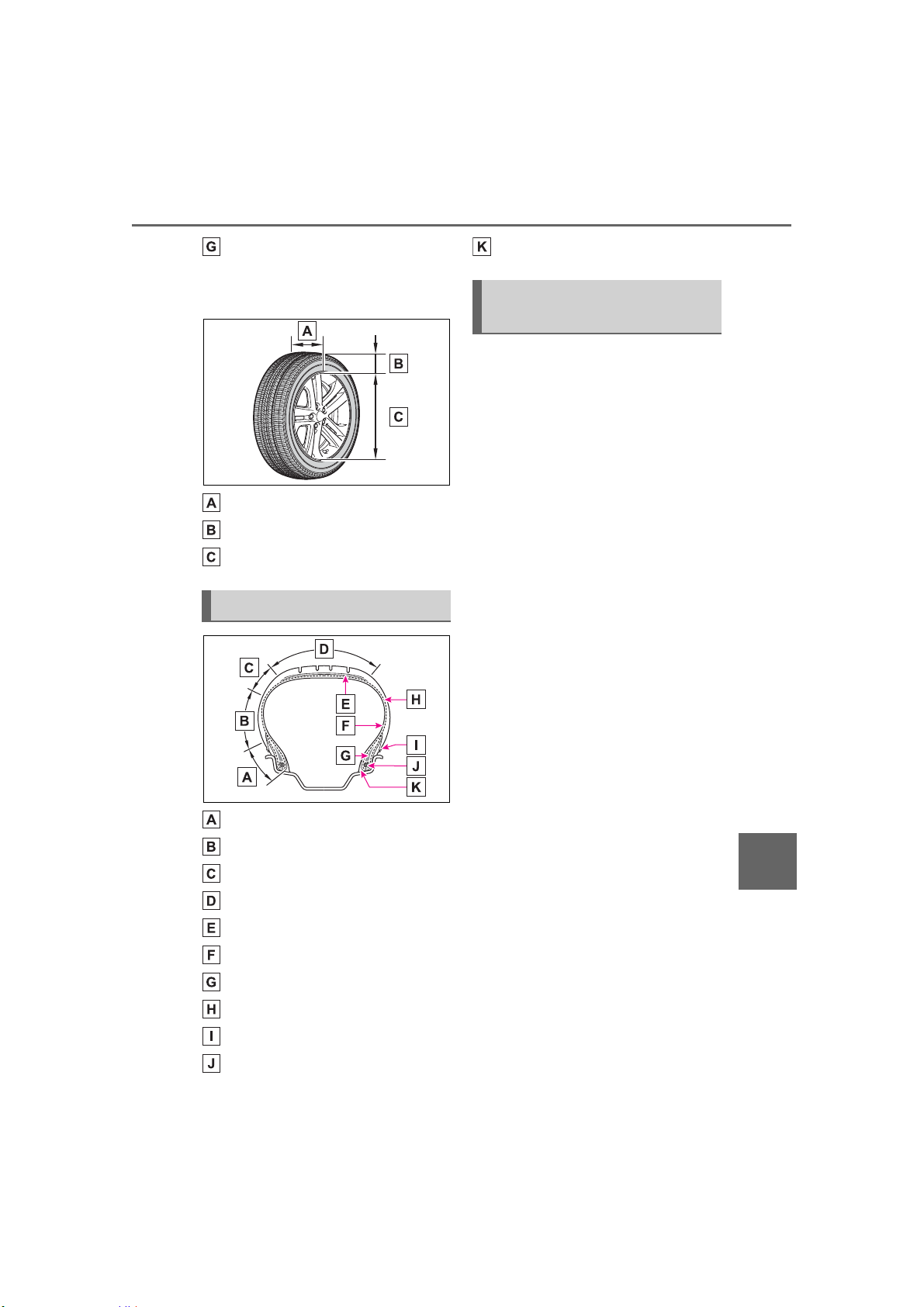
523
9-1. Specifications
COROLLA H/B_U
9
Vehicle specifications
Speed symbol (alphabet with
one letter)
■ Tire dimensions
Section width
Tire height
Wheel diameter
Bead
Sidewall
Shoulder
Tread
Belt
Inner liner
Reinforcing rubber
Carcass
Rim lines
Bead wires
Chafer
This information has been pre-
pared in accordance with regu-
lations issued by the National
Highway Traffic Safety Adminis-
tration of the U.S. Department of
Transportation.
It provides the purchasers
and/or prospective purchasers
of Toyota vehicles with informa-
tion on uniform tire quality grad-
ing.
Your Toyota dealer will help answer
any questions you may have as you
read this information.
■ DOT quality grades
All passenger vehicle tires must
conform to Federal Safety
Requirements in addition to
these grades. Quality grades
can be found where applicable
on the tire sidewall between
tread shoulder and maximum
section width.
For example: Treadwear 200 Trac-
tion AA Temperature A
■ Treadwear
The treadwear grade is a com-
parative rating based on the
wear rate of the tire when tested
under controlled conditions on a
specified government test
course.
For example, a tire graded 150
Tire section names
Uniform Tire Quality
Grading
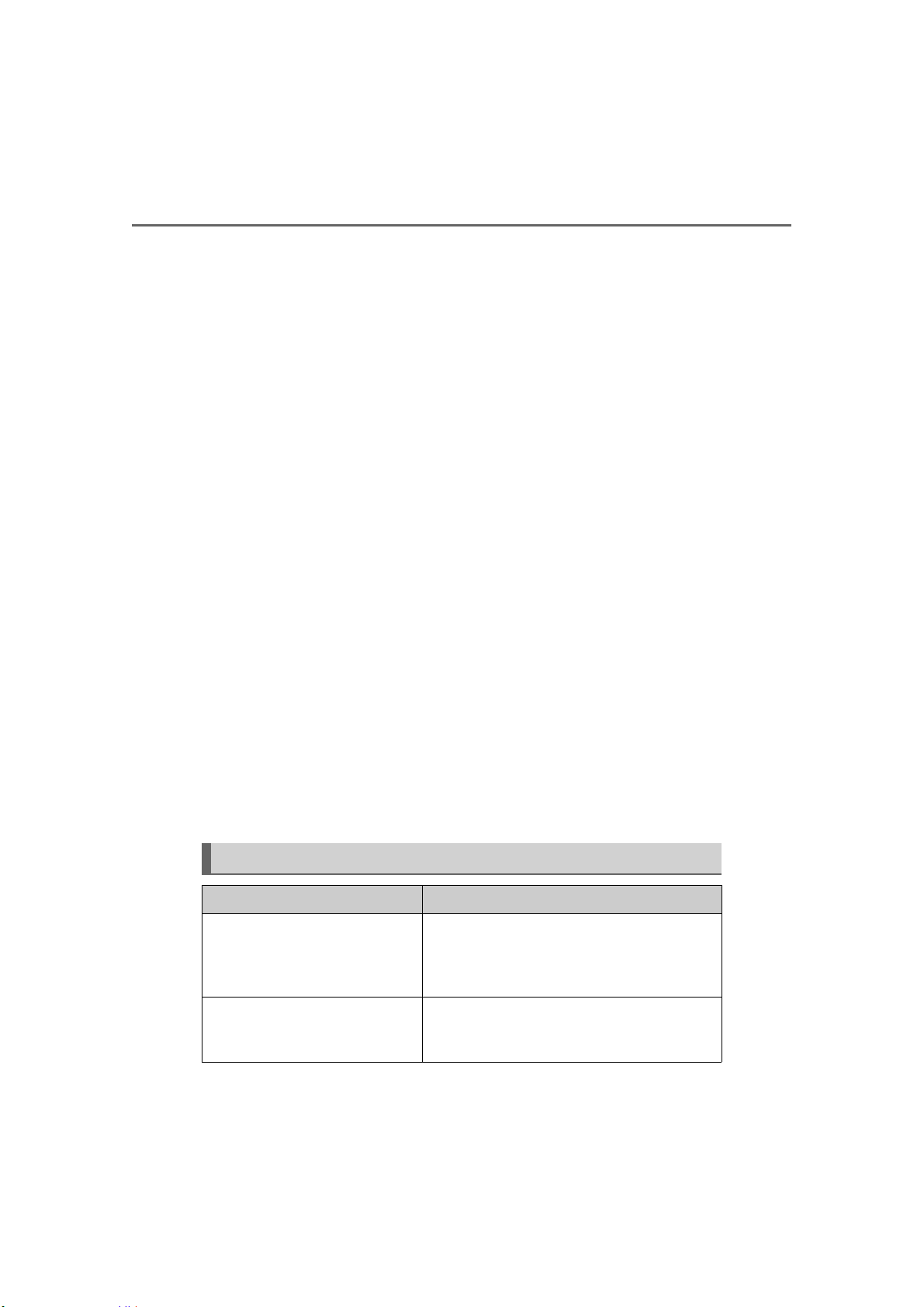
524
9-1. Specifications
COROLLA H/B_U
would wear one and a half (1 - 1/2)
times as well on the government
course as a tire graded 100.
The relative performance of tires
depends upon the actual conditions
of their use. Performance may differ
significantly from the norm due to
variations in driving habits, service
practices and differences in road
characteristics and climate.
■ Traction AA, A, B, C
The traction grades, from high-
est to lowest, are AA, A, B and
C, and they represent the tire’s
ability to stop on wet pavement
as measured under controlled
conditions on specified govern-
ment test surfaces of asphalt
and concrete.
A tire marked C may have poor
traction performance.
Warning: The traction grade
assigned to this tire is based on
braking (straight ahead) traction
tests and does not include corner-
ing (turning) traction.
■ Temperature A, B, C
The temperature grades are A
(the highest), B, and C, repre-
senting the tire’s resistance to
the generation of heat and its
ability to dissipate heat when
tested under controlled condi-
tions on a specified indoor labo-
ratory test wheel.
Sustained high temperature can
cause the material of the tire to
degenerate and reduce tire life, and
excessive temperature can lead to
sudden tire failure.
Grade C corresponds to a level of
performance which all passenger
car tires must meet under the Fed-
eral Motor Vehicle Safety Standard
No. 109.
Grades B and A represent higher
levels of performance on the labo-
ratory test wheel than the minimum
required by law.
Warning: The temperature grades
of a tire assume that it is properly
inflated and not overloaded.
Excessive speed, underinflation, or
excessive loading, either sepa-
rately or in combination, can cause
heat buildup and possible tire fail-
ure.
Glossary of tire terminology
Tire related term Meaning
Cold tire inflation pressure
Tire pressure when the vehicle has been
parked for three hours or more, or has not
been driven more than 1 mile or 1.5 km
under that condition
Maximum inflation pressure
The maximum cold inflated pressure to
which a tire may be inflated, shown on the
sidewall of the tire
525
9-1. Specifications
COROLLA H/B_U
9
Vehicle specifications
Recommended inflation pres-
sure
Cold tire inflation pressure recommended
by a manufacturer
Accessory weight
The combined weight (in excess of those
standard items which may be replaced) of
automatic transmission, power steering,
power brakes, power windows, power
seats, radio and heater, to the extent that
these items are available as fac-
tory-installed equipment (whether installed
or not)
Curb weight
The weight of a motor vehicle with stan-
dard equipment, including the maximum
capacity of fuel, oil and coolant, and if so
equipped, air conditioning and additional
weight optional engine
Maximum loaded vehicle
weight
The sum of:
(a) Curb weight
(b) Accessory weight
(c) Vehicle capacity weight
(d) Production options weight
Normal occupant weight
150 lb. (68 kg) times the number of occu-
pants specified in the second column of
Table 1
*
that follows
Occupant distribution
Distribution of occupants in a vehicle as
specified in the third column of Table 1
*
below
Production options weight
The combined weight of installed regular
production options weighing over 5 lb. (2.3
kg) in excess of the standard items which
they replace, not previously considered in
curb weight or accessory weight, including
heavy duty brakes, ride levelers, roof rack,
heavy duty battery, and special trim
Rim
A metal support for a tire or a tire and tube
assembly upon which the tire beads are
seated
Tire related term Meaning
526
9-1. Specifications
COROLLA H/B_U
Rim diameter (Wheel diame-
ter)
Nominal diameter of the bead seat
Rim size designation Rim diameter and width
Rim type designation
The industry manufacturer’s designation
for a rim by style or code
Rim width Nominal distance between rim flanges
Vehicle capacity weight (Total
load capacity)
The rated cargo and luggage load plus 150
lb. (68 kg) times the vehicle’s designated
seating capacity
Vehicle maximum load on the
tire
The load on an individual tire that is deter-
mined by distributing to each axle its share
of the maximum loaded vehicle weight,
and dividing by two
Vehicle normal load on the tire
The load on an individual tire that is deter-
mined by distributing to each axle its share
of curb weight, accessory weight, and nor-
mal occupant weight (distributed in accor-
dance with Table 1
*
below), and dividing by
two
Weather side
The surface area of the rim not covered by
the inflated tire
Bead
The part of the tire that is made of steel
wires, wrapped or reinforced by ply cords
and that is shaped to fit the rim
Bead separation
A breakdown of the bond between compo-
nents in the bead
Bias ply tire
A pneumatic tire in which the ply cords that
extend to the beads are laid at alternate
angles substantially less than 90 degrees
to the centerline of the tread
Carcass
The tire structure, except tread and side-
wall rubber which, when inflated, bears the
load
Chunking
The breaking away of pieces of the tread
or sidewall
Cord The strands forming the plies in the tire
Tire related term Meaning
527
9-1. Specifications
COROLLA H/B_U
9
Vehicle specifications
Cord separation
The parting of cords from adjacent rubber
compounds
Cracking
Any parting within the tread, sidewall, or
innerliner of the tire extending to cord
material
CT
A pneumatic tire with an inverted flange
tire and rim system in which the rim is
designed with rim flanges pointed radially
inward and the tire is designed to fit on the
underside of the rim in a manner that
encloses the rim flanges inside the air cav-
ity of the tire
Extra load tire
A tire designed to operate at higher loads
and at higher inflation pressures than the
corresponding standard tire
Groove The space between two adjacent tread ribs
Innerliner
The layer(s) forming the inside surface of a
tubeless tire that contains the inflating
medium within the tire
Innerliner separation
The parting of the innerliner from cord
material in the carcass
Intended outboard sidewall
(a) The sidewall that contains a whitewall,
bears white lettering, or bears manufac-
turer, brand, and/or model name molding
that is higher or deeper than the same
molding on the other sidewall of the tire, or
(b) The outward facing sidewall of an
asymmetrical tire that has a particular side
that must always face outward when
mounted on a vehicle
Light truck (LT) tire
A tire designated by its manufacturer as
primarily intended for use on lightweight
trucks or multipurpose passenger vehicles
Load rating
The maximum load that a tire is rated to
carry for a given inflation pressure
Maximum load rating
The load rating for a tire at the maximum
permissible inflation pressure for that tire
Tire related term Meaning
528
9-1. Specifications
COROLLA H/B_U
Maximum permissible inflation
pressure
The maximum cold inflation pressure to
which a tire may be inflated
Measuring rim
The rim on which a tire is fitted for physical
dimension requirements
Open splice
Any parting at any junction of tread, side-
wall, or innerliner that extends to cord
material
Outer diameter The overall diameter of an inflated new tire
Overall width
The linear distance between the exteriors
of the sidewalls of an inflated tire, including
elevations due to labeling, decorations, or
protective bands or ribs
Passenger car tire
A tire intended for use on passenger cars,
multipurpose passenger vehicles, and
trucks, that have a gross vehicle weight
rating (GVWR) of 10,000 lb. or less.
Ply A layer of rubber-coated parallel cords
Ply separation
A parting of rubber compound between
adjacent plies
Pneumatic tire
A mechanical device made of rubber,
chemicals, fabric and steel or other materi-
als, that, when mounted on an automotive
wheel, provides the traction and contains
the gas or fluid that sustains the load
Radial ply tire
A pneumatic tire in which the ply cords that
extend to the beads are laid at substan-
tially 90 degrees to the centerline of the
tread
Reinforced tire
A tire designed to operate at higher loads
and at higher inflation pressures than the
corresponding standard tire
Section width
The linear distance between the exteriors
of the sidewalls of an inflated tire, exclud-
ing elevations due to labeling, decoration,
or protective bands
Sidewall
That portion of a tire between the tread
and bead
Tire related term Meaning
529
9-1. Specifications
COROLLA H/B_U
9
Vehicle specifications
*
: Table 1 -Occupant loading and distribution for vehicle normal load for var-
ious designated seating capacities
Sidewall separation
The parting of the rubber compound from
the cord material in the sidewall
Snow tire
A tire that attains a traction index equal to
or greater than 110, compared to the
ASTM E-1136 Standard Reference Test
Tire, when using the snow traction test as
described in ASTM F-1805-00, Standard
Test Method for Single Wheel Driving Trac-
tion in a Straight Line on Snow-and
Ice-Covered Surfaces, and which is
marked with an Alpine Symbol ( ) on at
least one sidewall
Test rim
The rim on which a tire is fitted for testing,
and may be any rim listed as appropriate
for use with that tire
Tread
That portion of a tire that comes into con-
tact with the road
Tread rib
A tread section running circumferentially
around a tire
Tread separation
Pulling away of the tread from the tire car-
cass
Treadwear indicators (TWI)
The projections within the principal
grooves designed to give a visual indica-
tion of the degrees of wear of the tread
Wheel-holding fixture
The fixture used to hold the wheel and tire
assembly securely during testing
Tire related term Meaning
Designated seating
capacity, Number of
occupants
Vehicle normal load,
Number of occupants
Occupant distribution in
a normally loaded vehi-
cle
2 through 4 2 2 in front
5 through 10 3
2 in front, 1 in second
seat
530
9-1. Specifications
COROLLA H/B_U
11 through 15 5
2 in front, 1 in second
seat, 1 in third seat, 1 in
fourth seat
16 through 20 7
2 in front, 2 in second
seat, 2 in third seat, 1 in
fourth seat
Designated seating
capacity, Number of
occupants
Vehicle normal load,
Number of occupants
Occupant distribution in
a normally loaded vehi-
cle
531
9-2. Customization
COROLLA H/B_U
9
Vehicle specifications
9-2.Customiz ation
■ Changing by using the navi-
gation/multimedia system
1 Press the “MENU” button.
2 Select “Setup” on the “Menu”
screen.
3 Select “General” or “Vehicle”
on the “Setup” screen.
Various setting can be changed.
Refer to the list of settings that can
be changed for details.
■ Changing by using the
meter control switches
1 Press or of the meter
control switch to select .
2 Press or of the meter
control switch to select the
desired item to be custom-
ized.
3 Press or press and hold .
The available settings will differ
depending on if is pressed or
pressed and held. Follow the
instructions on the display.
Some function settings are changed simultaneously with other func-
tions being customized. Contact your Toyota dealer for further
details.
Settings that can be changed using the navigation or multimedia
system screen (vehicles with a navigation or multimedia system)
Customizable features
Your vehicle includes a vari-
ety of electronic features
that can be personalized to
suit your preferences. The
settings of these features
can be changed using the
multi-information display,
the navigation/multimedia
system, or at your Toyota
dealer.
Customizing vehicle fea-
tures
WARNING
■ During customization
As the engine needs to be run-
ning during customization, ensure
that the vehicle is parked in a
place with adequate ventilation. In
a closed area such as a garage,
exhaust gases including harmful
carbon monoxide (CO) may col-
lect and enter the vehicle. This
may lead to death or a serious
health hazard.
NOTICE
■ During customization
To prevent battery discharge,
ensure that the engine is running
while customizing features.
Customizable features
532
9-2. Customization
COROLLA H/B_U
Settings that can be changed using the meter control switches
Settings that can be changed by your Toyota dealer
Definition of symbols: O = Available, — = Not available
■ Gauges, meters and multi-information display (P.70, 74, 78,
82)
*1
:For details about each function: P.8 7
Function
*1
Default setting Customized setting
Language English
French
O O —
Spanish
Units
*2
miles (MPG)
km (km/L)
— O —
km (L/100 km)
miles (MPG Impe-
rial)
Speedometer display
*3
Analog Digital — O —
Eco Driving Indicator
Light
*4
On Off — O —
Fuel economy display
Total average
(Average fuel
consumption
[after reset])
Trip average (Aver-
age fuel consump-
tion [after start])
— O —
Tank average
(Average fuel con-
sumption [after
refuel])
Audio system linked dis-
play
On Off — O —
Drive information type After start After reset — O —
Drive information items
(First item)
Distance
Average vehicle
speed
— O —
Elapsed time
Drive information items
(Second item)
Elapsed time
Average vehicle
speed
— O —
Distance
Pop-up display On Off — O —
533
9-2. Customization
COROLLA H/B_U
9
Vehicle specifications
*2
:The default setting varies according to country.
*3
:7-inch display
*4
:If equipped
■ Head-up display
*
(P. 8 9)
*
: If equipped
■ Door lock (P.101, 105, 500)
Function Default setting Customized setting
Head-up display On Off — O —
Gauge information Tachometer
Eco Driving Indica-
tor
*
— O —
No content
Route guidance to desti-
nation/street name
*
On Off — O —
Driving support system
display
On Off — O —
Compass
*
On Off — O —
Audio system operation
status
*
On Off — O —
Function Default setting Customized setting
Unlocking using a
mechanical key
Driver’s door
unlocked in
one step, all
doors
unlocked in
two step
All doors unlocked
in one step
— — O
Automatic door locking
function
Shift position
linked door
locking opera-
tion
Off
O — O
Speed linked door
locking operation
Automatic door unlock-
ing function
Shift position
linked door
unlocking
operation
Off
O — O
Driver’s door linked
door unlocking
operation
534
9-2. Customization
COROLLA H/B_U
■ Smart key system and wireless remote control (P.101, 108)
■ Smart key system (P.101, 108)
■ Wireless remote control (P.99, 101, 105)
Function Default setting Customized setting
Operating signal (Buzz-
ers)
5
Off
O — O
1 to 7
Operation signal (Emer-
gency flashers)
On Off O — O
Time elapsed before
automatic door lock
function is activated if
door is not opened after
being unlocked
60 seconds
Off
O — O
30 seconds
120 seconds
Open door warning
buzzer
On Off — — O
Function Default setting Customized setting
Smart key system On Off — — O
Smart door unlocking Driver’s door All the doors O — O
Time elapsed before
unlocking all the door
when gripping and hold-
ing the driver’s door
handle
2.0 seconds
Off
— — O
1.5 seconds
2.5 seconds
Number of consecutive
door lock operations
2 times
As many as
desired
— — O
Function Default setting Customized setting
Wireless remote control On Off — — O
Unlocking operation
Driver’s door
unlocked in
one step, all
doors
unlocked in
two step
All doors unlocked
in one step
O — O
535
9-2. Customization
COROLLA H/B_U
9
Vehicle specifications
■ Power windows (P.125)
■ Automatic light control system (P.160)
■ Lights (P.160)
Theft deterrent panic
mode
On Off — — O
Locking operation when
door opened
On Off O — O
Function Default setting Customized setting
Mechanical key linked
operation
Off On — — O
Wireless remote control
linked operation
Off On (open only) — — O
Wireless remote control
linked operation signal
(buzzer)
On Off — — O
Function Default setting Customized setting
Light sensor sensitivity Standard -2 to 2 O — O
Time elapsed before
headlights automatically
turn off after doors are
closed
30 seconds
Off
O — O60 seconds
90 seconds
Windshield wiper linked
headlight illumination
On Off — — O
Function Default setting Customized setting
Daytime running light
system
On Off O — O
Function Default setting Customized setting
536
9-2. Customization
COROLLA H/B_U
■ PCS (Pre-Collision System) (P.178)
■ LTA (Lane Tracing Assist)
*
/LDA (Lane Departure Alert with
steering control)
*
(P.186, 196)
*
: If equipped
■ RSA (Road Sign Assist)
*
(P.224)
*
: If equipped
Function Default setting Customized setting
PCS (Pre-Collision Sys-
tem)
On Off — O —
Adjust alert timing Middle
Far
— O —
Near
Function Default setting Customized setting
Lane centering function
*
On Off — O —
Steering assist function On Off — O —
Alert sensitivity High Standard — O —
Vehicle sway warning
function
On Off — O —
Vehicle sway warning
sensitivity
Standard
High
— O —
Low
Function Default setting Customized setting
RSA (Road Sign Assist) On Off — O —
Excess speed notifica-
tion method
Display only
No notification
— O —
Display and buzzer
Excess speed notifica-
tion level
1 mph (2 km/h)
3 mph (5 km/h)
— O —
5 mph (10 km/h)
Other notifications
method (Do not enter
notification)
Display only
No notification
— O —
Display and buzzer
537
9-2. Customization
COROLLA H/B_U
9
Vehicle specifications
■ BSM (Blind Spot Monitor)
*
(P.227)
*
: If equipped
■ Automatic air conditioning system (P.386)
■ Illumination (P.395)
■ Vehicle customization
● When the smart key system is off,
Smart door unlocking cannot be
customized.
● When the doors remain closed
Function Default setting Customized setting
BSM (Blind Spot Moni-
tor)
On Off — O —
Outside rear view mirror
indicator brightness
Bright Dim — O —
Alert timing for pres-
ence of approaching
vehicle (sensitivity)
Intermediate
Early
— O —
Late
Only when vehicle
detected in blind
spot
Function Default setting Customized setting
A/C auto switch opera-
tion
On Off O — O
Function Default setting Customized setting
Time elapsed before the
interior lights turn off
15 seconds
Off
O — O7.5 seconds
30 seconds
Operation after the
engine switch is turned
off
On Off — — O
Operation when the
doors are unlocked
On Off — — O
Operation when you
approach the vehicle
with the electronic key
on your person
On Off — — O

538
9-2. Customization
COROLLA H/B_U
after unlocking the doors and the
automatic door lock function is
activated, the signals will be gen-
erated in accordance with the
operation signal (buzzer) and the
operation signal (emergency
flashers) settings.
■ In the following situations, cus-
tomize mode in which the set-
tings can be changed through
the multi-information display
will automatically be turned off
● A warning message appears after
the customize mode screen is dis-
played
● The engine switch is turned off.
● The vehicle begins to move while
the customize mode screen is dis-
played.
539
9-3. Initialization
COROLLA H/B_U
9
Vehicle specifications
9-3.Initializ ation
Items to initialize
The following items must be initialized for normal system
operation after such cases as the battery being reconnected,
or maintenance being performed on the vehicle:
List of items to initialize
Item When to initialize Reference
Message indicat-
ing maintenance is
required
• After maintenance is performed P.4 20
Tire pressure warn-
ing system
• When rotating the tires.
• When the tire inflation pressure
is changed, such as when the
tire size is changed.
• When the tire inflation pressure
is changed, such as when
changing traveling speed.
• When changing between two
registered wheel sets
P.4 42

540
9-3. Initialization
COROLLA H/B_U


542
10-1. For owners
COROLLA H/B_U
10-1.For owners
Déroulez la sangle diagonale
de telle sorte qu'elle passe
bien sur l'épaule, sans pour
autant être en contact avec le
cou ou glisser de l'épaule.
Placez la sangle abdominale
le plus bas possible sur les
hanches.
Réglez la position du dossier
de siège. Asseyez-vous le
dos droit et calez-vous bien
dans le siège.
Ne vrillez pas la ceinture de
Reporting safety
defects for U.S. own-
ers
If you believe that your vehicle
has a defect which could
cause a crash or could cause
injury or death, you should
immediately inform the
National Highway Traffic
Safety Administration
(NHTSA) in addition to notify-
ing Toyota Motor Sales,
U.S.A., Inc. (Toll-free:
1-800-331-4331).
If NHTSA receives similar
complaints, it may open an
investigation, and if it finds
that a safety defect exists in a
group of vehicles, it may order
a recall and remedy cam-
paign. However, NHTSA can-
not become involved in
individual problems between
you, your dealer, or Toyota
Motor Sales, U.S.A., Inc.
To contact NHTSA, you may
call the Vehicle Safety Hotline
toll-free at 1-888-327-4236
(TTY: 1-800-424-9153); go to
http://www.safercar.gov ; or
write to: Administrator,
NHTSA, 1200 New Jersey
Ave, S.E., Washington, DC
20590. You can also obtain
other information about motor
vehicle safety from
http://www.safercar.gov.
Seat belt instructions
for Canadian owners
(in French)
The following is a French
explanation of seat belt
instructions extracted from
the seat belt section in this
manual.
See the seat belt section for
more detailed seat belt
instructions in English.
Utilisation correcte des
ceintures de sécurité
543
10-1. For owners
COROLLA H/B_U
10
For owners
sécurité.
■ Traitement des ceintures de
sécurité
Nettoyez avec un chiffon ou une
éponge humidifiés avec de l'eau
savonneuse tiède. Vérifiez
régulièrement que les ceintures
ne sont pas usées, effilochées
ou entaillées excessivement.
Entretien et soin
WARNING
■ Détérioration et usure des
ceintures de sécurité
Inspectez le système de ceintures
de sécurité régulièrement. Con-
trôlez l'absence de coupures,
d'effilochages et de pièces
desserrées. N'utilisez pas une
ceinture de sécurité endommagée
avant qu'elle ne soit remplacée.
Une ceinture de sécurité endom-
magée ne permet pas de protéger
un occupant de blessures graves
ou mortelles.
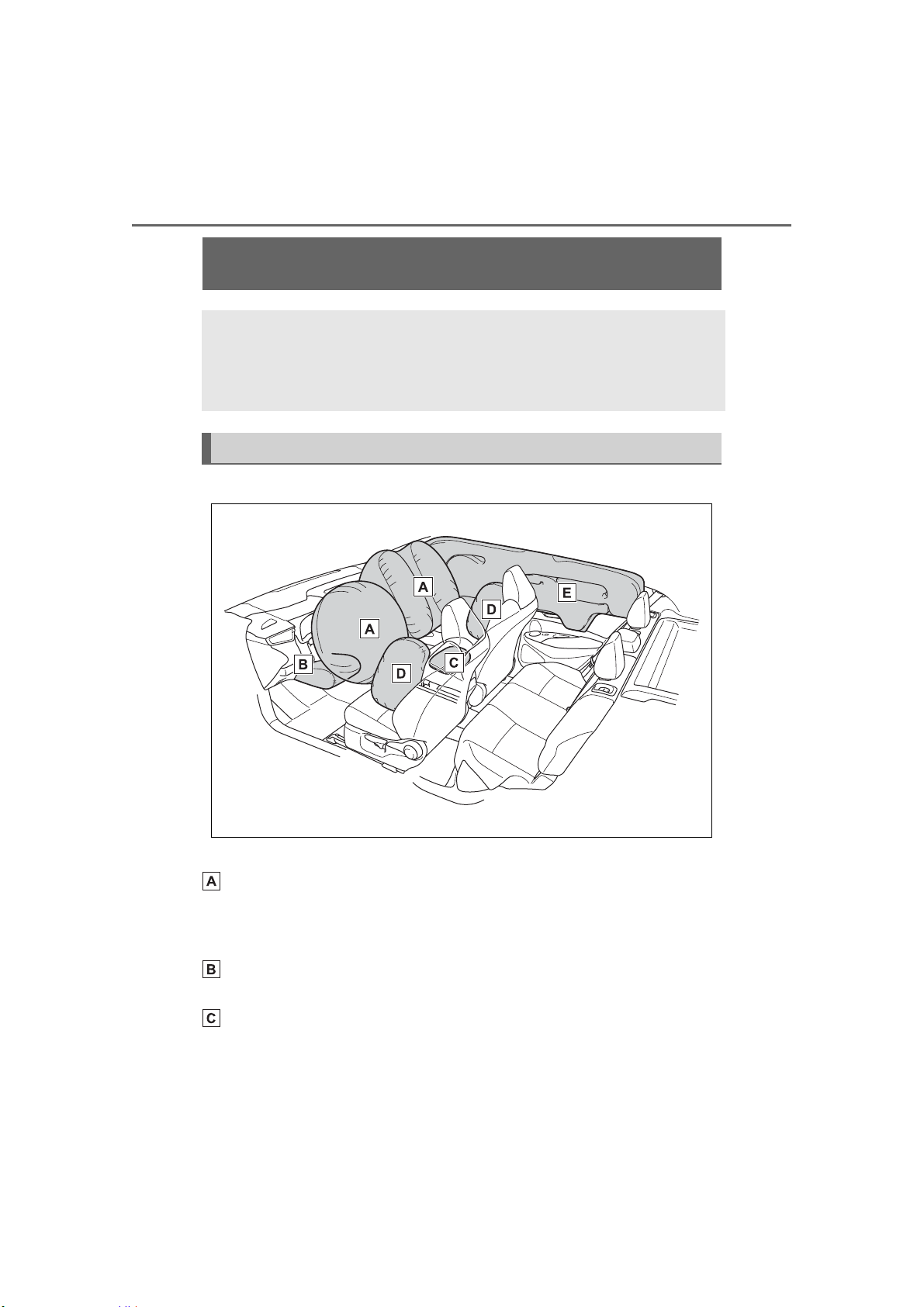
544
10-1. For owners
COROLLA H/B_U
■ Emplacement des coussins gonflables SRS
Coussins gonflables frontaux SRS
Coussin gonflable conducteur/coussin gonflable du passager
avant SRS
Participe à la protection de la tête et du thorax du conducteur et du pas-
sager avant contre les chocs contre les éléments de l'habitacle
Coussin gonflable de genoux SRS
Participe à la protection du conducteur
Coussin gonflable de coussin de siège SRS
Contribue à retenir le passager avant
SRS airbag instructions for Canadian owners (in
French)
The following is a French explanation of SRS airbag instruc-
tions extracted from the SRS airbag section in this manual.
See the SRS airbag section for more detailed SRS airbag instruc-
tions in English.
Système de coussins gonflables SRS
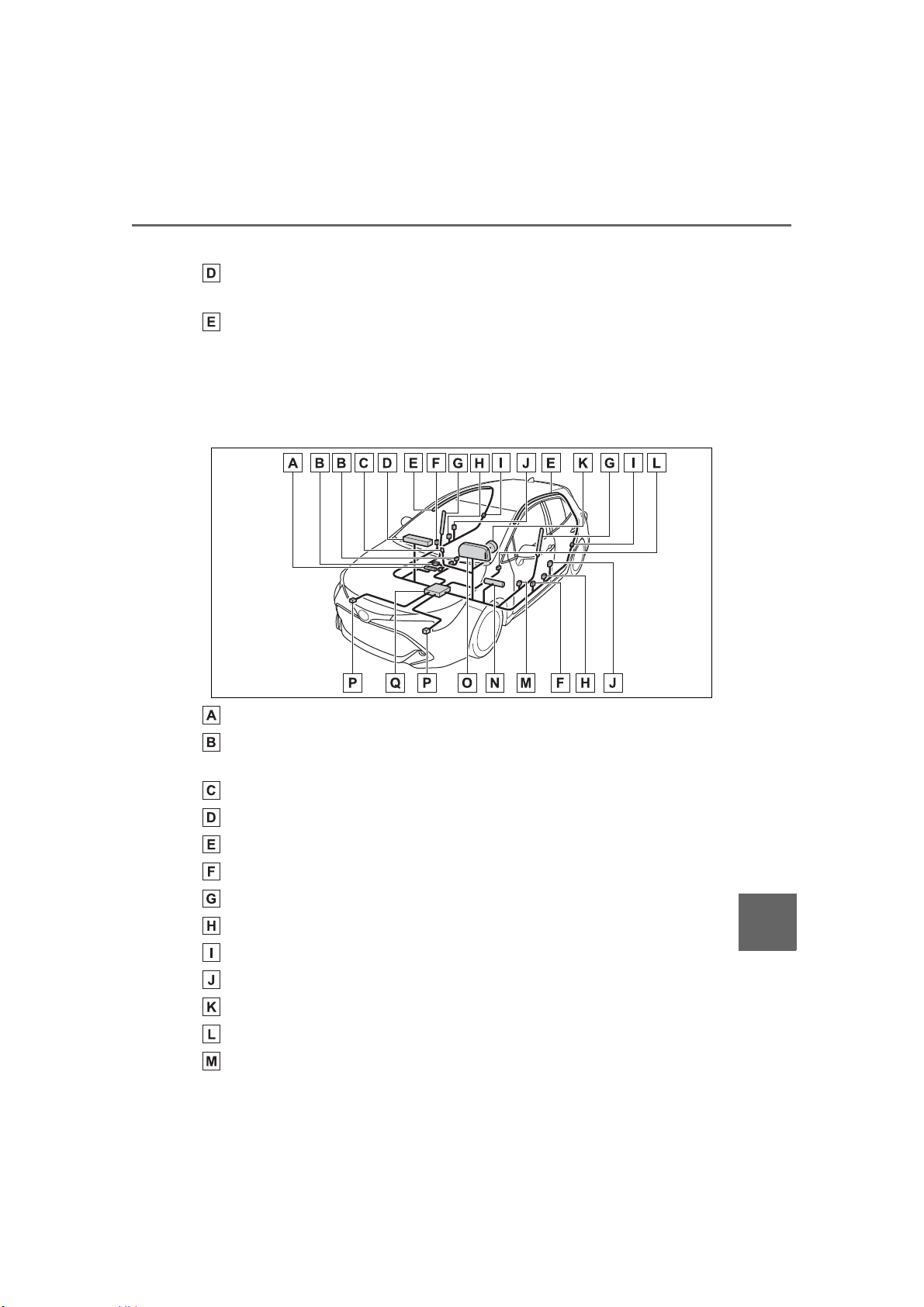
545
10-1. For owners
COROLLA H/B_U
10
For owners
Coussins gonflables latéraux et rideaux SRS
Coussins gonflables latéraux avant SRS
Participent à la protection du torse des occupants de siège avant
Coussins gonflables rideaux SRS
• Participent principalement à la protection de la tête des occupants des
sièges latéraux
• Peut contribuer à empêcher les occupants d’être éjectés du véhicule en
cas de tonneau
■ Composants du système de coussins gonflables SRS
Coussin gonflable de coussin de siège
Système de classification de l'occupant du siège passager avant
(ECU et capteurs)
Témoins indicateurs “AIR BAG ON” et “AIR BAG OFF”
Coussin gonflable passager avant
Coussins gonflables rideaux
Capteurs d'impact latéral (portes avant)
Coussins gonflables latéraux
Prétensionneurs de ceintures de sécurité et limiteurs de force
Capteurs d'impact latéral (arrière)
Capteurs d'impact latéral (avant)
Coussin gonflable conducteur
Contact de boucle de ceinture de sécurité conducteur
Capteur de position du siège conducteur
546
10-1. For owners
COROLLA H/B_U
Coussin gonflable de genoux du conducteur
Témoin d'avertissement SRS
Capteurs d'impact avant
Ensemble de capteurs de coussins gonflables
Votre véhicule est équipé de COUSSINS GONFLABLES INTELLI-
GENTS conçus selon les normes de sécurité américaines applica-
bles aux véhicules à moteur (FMVSS208). L'ensemble de capteurs
de coussins gonflables (ECU) régule le déploiement des coussins
gonflables sur la base des informations qu'il reçoit des capteurs,
etc., indiqués ci-dessus dans le schéma illustrant les composants du
système. Parmi ces informations figurent la gravité du choc et l'occu-
pation du véhicule par les passagers. Le déploiement rapide des
coussins gonflables est obtenu au moyen d'une réaction chimique
dans les dispositifs pyrotechniques, qui produit un gaz inoffensif per-
mettant d'amortir le mouvement des occupants.
WARNING
■ Précautions relatives aux
coussins gonflables SRS
Respectez les précautions suiva-
ntes concernant les coussins gon-
flables SRS.
Le non-respect de ces précau-
tions peut occasionner des bless-
ures graves, voire mortelles.
● Le conducteur et tous les pas-
sagers du véhicule doivent por-
ter correctement leur ceinture
de sécurité.
Les coussins gonflables SRS
sont des dispositifs supplémen-
taires à utiliser avec les cein-
tures de sécurité.
● Le coussin gonflable conduc-
teur SRS se déploie avec une
force considérable, pouvant
occasionner des blessures
graves, voire mortelles, si le
conducteur se trouve très près
du coussin gonflable. L'autorité
fédérale chargée de la sécurité
routière aux États-Unis
(NHTSA) conseille:
La zone à risque du coussin gon-
flable conducteur se situant dans
les premiers 2 à 3 in. (50 à 75
mm) de déploiement, vous placer
à 10 in. (250 mm) de votre cous-
sin gonflable conducteur vous
garantit une marge de sécurité
suffisante. Cette distance est à
mesurer entre le centre du volant
et le sternum. Si vous êtes assis à
moins de 10 in. (250 mm), vous
pouvez changer votre position de
conduite de plusieurs façons:
• Reculez votre siège le plus pos-
sible, de manière à pouvoir
encore atteindre confortable-
ment les pédales.

547
10-1. For owners
COROLLA H/B_U
10
For owners
WARNING
• Inclinez légèrement le dossier
du siège.
Bien que les véhicules aient une
conception différente, un grand
nombre de conducteurs peu-
vent s'asseoir à une distance de
10 in. (250 mm), même avec le
siège conducteur complètement
avancé, simplement en inclinant
un peu le dossier de siège. Si
vous avez des difficultés à voir
la route après avoir incliné le
dossier de votre siège, utilisez
un coussin ferme et antidéra-
pant pour vous rehausser ou
remontez le siège si votre
véhicule est équipé de cette
fonction.
• Si votre volant est réglable,
inclinez-le vers le bas. Cela a
pour effet d'orienter le coussin
gonflable en direction de votre
poitrine plutôt que de votre tête
et de votre cou.
Réglez votre siège selon les
recommandations de la NHTSA
ci-dessus, tout en conservant le
contrôle des pédales, du volant et
la vue des commandes du tab-
leau de bord.
● Si vous attachez une rallonge
de ceinture de sécurité aux bou-
cles de ceinture de sécurité
avant, sans l'attacher au pêne
de la ceinture de sécurité, les
coussins gonflables frontaux
SRS déterminent que le con-
ducteur et le passager avant ont
attaché leur ceinture de sécu-
rité, bien que la ceinture de
sécurité ne soit pas attachée.
Dans ce cas, les coussins gon-
flables frontaux SRS peuvent
ne pas se déployer correcte-
ment en cas de collision, pou-
vant occasionner des blessures
graves, voire mortelles. Veillez
à porter la rallonge de ceinture
de sécurité.
● Le coussin gonflable passager
avant SRS se déploie égale-
ment avec une force con-
sidérable, pouvant occasionner
des blessures graves, voire
mortelles, si le passager avant
se trouve très près du coussin
gonflable. Le siège du passager
avant doit être éloigné le plus
possible du coussin gonflable
en réglant le dossier de siège
de façon à ce que le passager
avant soit assis bien droit dans
le siège.
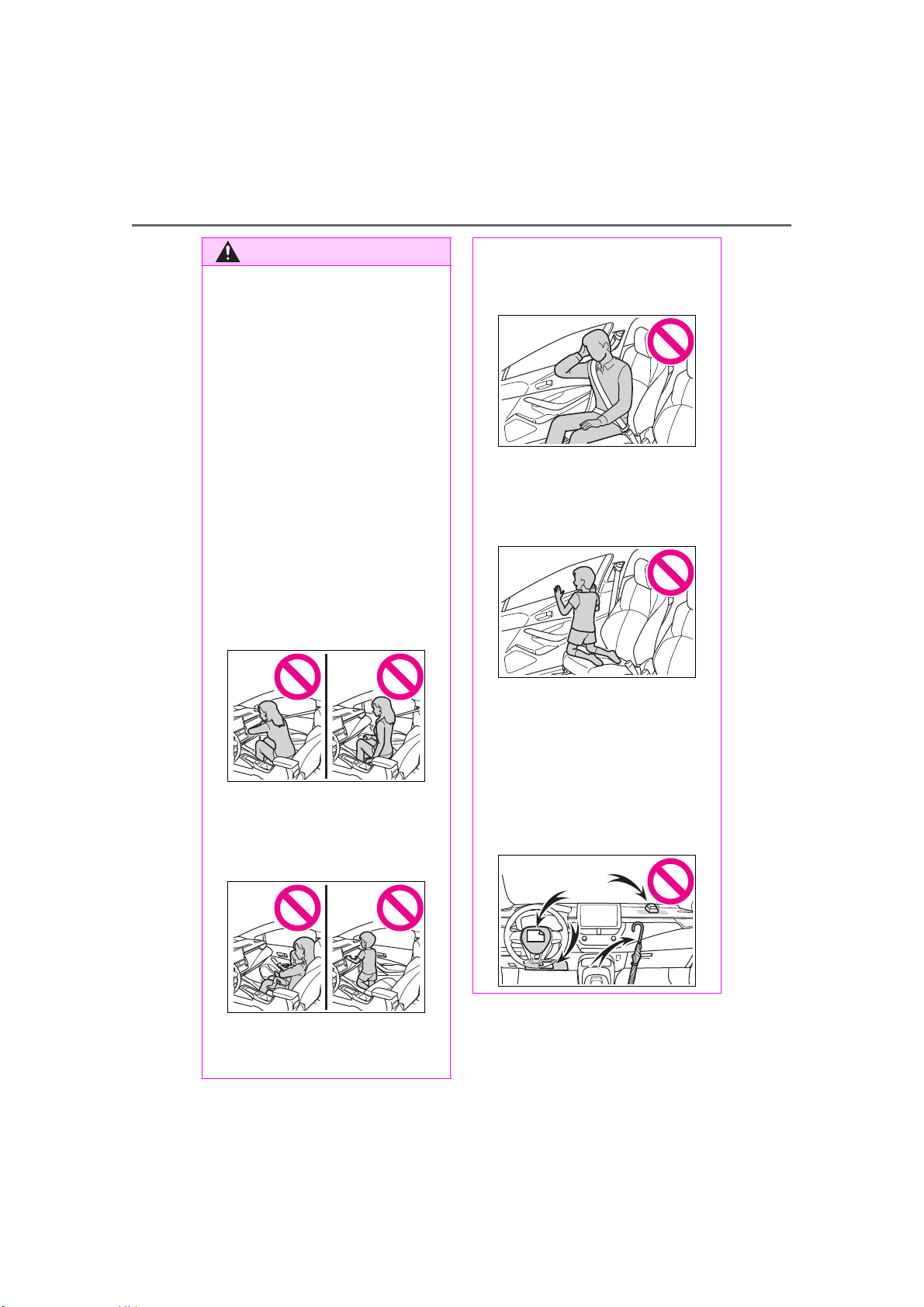
548
10-1. For owners
COROLLA H/B_U
WARNING
● Les nourrissons et les enfants
qui ne sont pas correctement
assis et/ou attachés peuvent
être grièvement blessés ou tués
par le déploiement d'un coussin
gonflable. Un nourrisson ou un
enfant trop petit pour utiliser une
ceinture de sécurité doit être
correctement attaché au moyen
d'un siège de sécurité enfant.
Toyota recommande vivement
d'installer tous les nourrissons
et enfants sur les sièges arrière
du véhicule et de prévoir pour
eux des systèmes de retenue
adaptés. Les sièges arrière sont
plus sûrs pour les nourrissons
et les enfants que le siège du
passager avant.
● Ne vous asseyez pas sur le
bord du siège et ne vous
appuyez pas contre la planche
de bord.
● Ne laissez pas un enfant rester
debout devant le coussin gon-
flable passager avant SRS ou
s'asseoir sur les genoux du pas-
sager avant.
● Ne laissez pas les occupants
des sièges avant voyager avec
un objet sur les genoux.
● Ne vous appuyez pas contre la
porte, le rail latéral de toit ou les
montants avant, latéraux et
arrière.
● Ne laissez personne s'age-
nouiller sur le siège passager
en appui contre la porte ou sor-
tir la tête ou les mains à
l'extérieur du véhicule.
● Ne fixez rien et ne posez rien
sur des emplacements tels que
la planche de bord, la garniture
du volant et la partie inférieure
du tableau de bord.
Ces éléments peuvent se trans-
former en projectiles lorsque les
coussins gonflables conducteur,
passager avant et genoux SRS
se déploient.
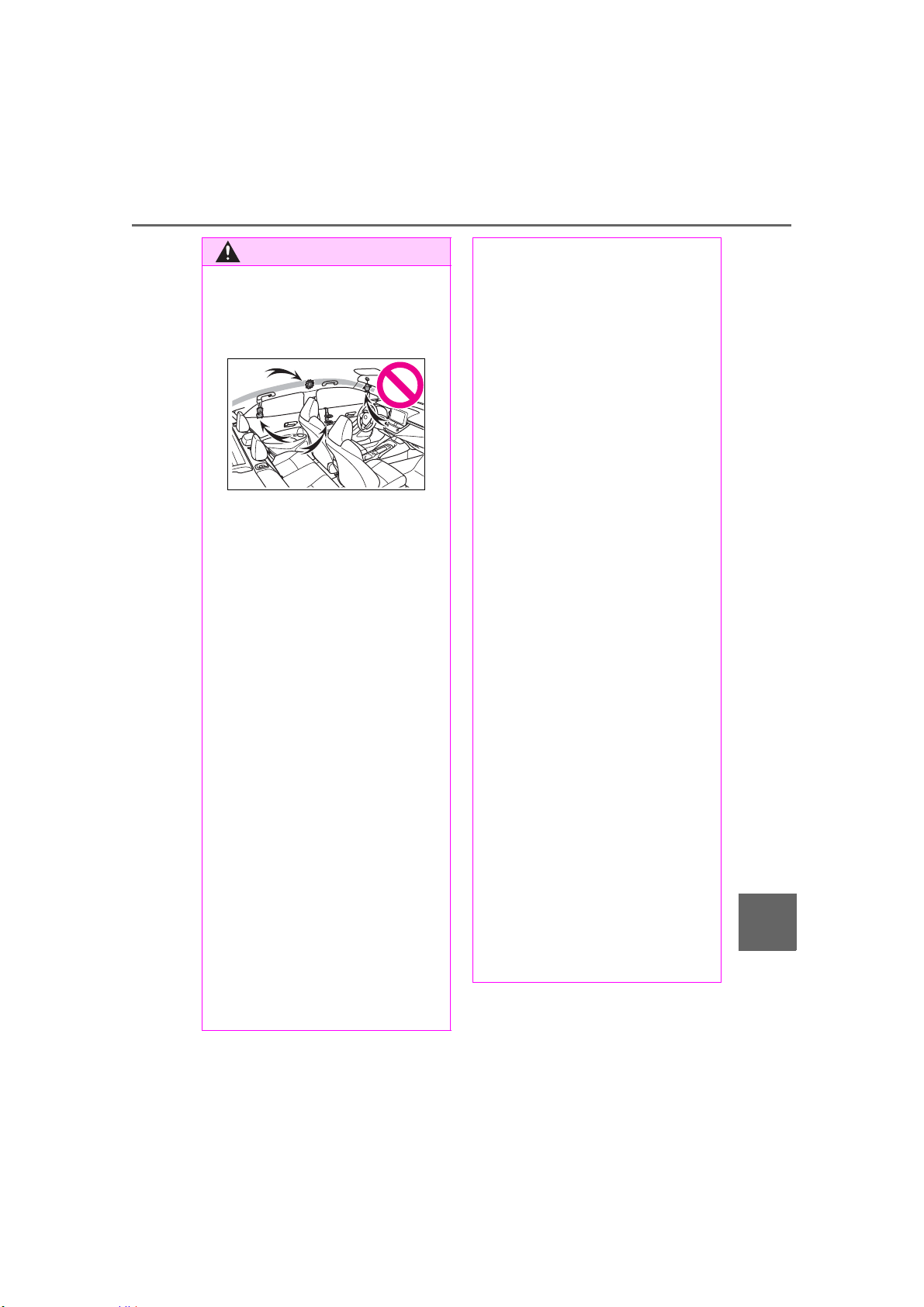
549
10-1. For owners
COROLLA H/B_U
10
For owners
WARNING
● Ne fixez rien aux portes, à la
vitre du pare-brise, aux vitres
latérales, aux montants avant et
arrière, au rail latéral de toit et à
la poignée de maintien.
● Ne suspendez aucun cintre ou
objet dur aux crochets à vête-
ments. Tous ces objets pour-
raient se transformer en
projectiles et causer des bless-
ures graves, voire mortelles en
cas de déploiement des couss-
ins gonflables rideaux SRS.
● Si un cache en vinyle est placé
sur la zone où le coussin gon-
flable de genoux du conducteur
SRS se déploie, assurez-vous
de le retirer.
● N'utilisez aucun accessoire de
siège recouvrant les zones de
déploiement des coussins gon-
flables latéraux SRS et du cous-
sin gonflable de coussin de
siège SRS, car il risque de
gêner le déploiement des cous-
sins gonflables SRS. De tels
accessoires peuvent empêcher
les coussins gonflables latéraux
et le coussin gonflable de cous-
sin de siège de s'activer cor-
rectement, désactiver le
système ou entraîner le déploie-
ment accidentel des coussins
gonflables latéraux et du cous-
sin gonflable de coussin de
siège, occasionnant des bless-
ures graves, voire mortelles.
● Évitez de faire subir des chocs
ou des pressions excessives
aux parties renfermant les com-
posants de coussins gonflables
SRS ou aux portes avant.
En effet, cela pourrait entraîner
un dysfonctionnement des
coussins gonflables SRS.
● Ne touchez aucun composant
immédiatement après le
déploiement (gonflage) des
coussins gonflables SRS, car ils
peuvent être chauds.
● Si vous avez des difficultés à
respirer après le déploiement
des coussins gonflables SRS,
ouvrez une porte ou une vitre
pour faire entrer de l'air frais, ou
bien descendez du véhicule si
cela ne présente pas de danger.
Essuyez tout résidu dès que
possible afin d'éviter d'éventu-
elles irritations de la peau.
● Si les parties renfermant les
coussins gonflables SRS,
comme les garnitures du volant
et des montants avant et
arrière, sont endommagées ou
craquelées, faites-les remplacer
par votre concessionnaire Toy-
ota.
● Ne placez rien sur le siège du
passager avant, comme un
coussin par exemple. Cela a
pour conséquence de répartir le
poids du passager sur toute la
surface du siège, ce qui
empêche le capteur de détecter
correctement le poids du pas-
sager. En conséquence, les
coussins gonflables frontaux
SRS du passager avant ris-
quent de ne pas se déployer en
cas de collision.

550
10-1. For owners
COROLLA H/B_U
WARNING
■ Modification et mise au rebut
des composants du système
de coussins gonflables SRS
Ne mettez pas votre véhicule au
rebut et ne procédez à aucune
des modifications suivantes sans
consulter votre concessionnaire
Toyota. Les coussins gonflables
SRS peuvent ne pas fonctionner
correctement ou se déployer (se
gonfler) accidentellement, provo-
quant la mort ou de graves bless-
ures.
● Installation, dépose, démon-
tage et réparation des coussins
gonflables SRS
● Réparations, modifications,
démontage ou remplacement
du volant, du tableau de bord,
de la planche de bord, des
sièges ou de leur garnissage,
des montants avant, latéraux et
arrière, des rails latéraux de toit,
des panneaux de porte avant,
des garnitures de porte avant
ou des haut-parleurs de porte
avant
● Modifications du panneau de
porte avant (par exemple,
perçage d'un trou dans le pan-
neau)
● Réparations ou modifications
des ailes avant, du pare-chocs
avant ou des flancs de l'habita-
cle
● Installation d'un protège-calan-
dre (pare-buffle, pare-kangou-
rou, etc.), de chasse-neige, de
treuils ou d'un porte-bagages de
toit
● Modifications du système de
suspension du véhicule
● Installation d'appareils électro-
niques tels que les émet-
teurs/récepteurs radios mobiles
et les lecteurs CD
● Modifications de votre véhicule
pour une personne atteinte d'un
handicap physique

552
What to do if... (Troubleshooting)
COROLLA H/B_U
1-1.What to d o if... (Troubleshooting)
What to do if... (Troubleshooting)
If you lose your mechanical
keys, new genuine mechani-
cal keys can be made by your
Toyota dealer. (P.500)
If you lose your electronic
keys, the risk of vehicle theft
increases significantly. Con-
tact your Toyota dealer imme-
diately. (P.500)
Is the electronic key battery
weak or depleted? (P.450)
Is the engine switch in ON?
When locking the doors, turn the
engine switch off. (P.143)
Is the electronic key left inside
the vehicle?
When locking the doors, make sure
that you have the electronic key on
your person.
The function may not operate
properly due to the condition
of the radio wave. (P.109)
Is the child-protector lock set?
The rear door cannot be opened
from inside the vehicle when the
lock is set. Open the rear door from
outside and then unlock the
child-protector lock. (P.104)
Vehicles with a continuously
variable transmission: Did you
press the engine switch while
firmly depressing the brake
pedal? (P.142)
Vehicles with a manual trans-
mission: Did you press the
engine switch while firmly
depressing the clutch pedal?
(P.142)
Vehicles with a continuously
variable transmission: Is the
shift lever in P? (P.142)
Is the electronic key any-
where detectable inside the
vehicle? (P.108)
Is the steering wheel
unlocked? (P.142)
If you have a problem,
check the following before
contacting your Toyota
dealer.
The doors cannot be
locked, unlocked, opened
or closed
You lose your keys
The doors cannot be
locked or unlocked
The rear door cannot be
opened
If you think something is
wrong
The engine does not start
553
What to do if... (Troubleshooting)
COROLLA H/B_U
Is the electronic key battery
weak or depleted?
In this case, the engine can be
started in a temporary way.
(P.501)
Is the battery discharged?
(P.502)
Is the engine switch in ON?
If you cannot release the shift lever
by depressing the brake pedal with
the engine switch in ON. (P.148)
It is locked automatically to
prevent theft of the vehicle.
(P.142)
Is the window lock switch
pressed?
The power window except for the
one at the driver’s seat cannot be
operated if the window lock switch
is pressed. (P.127)
The auto power off function
will be operated if the vehicle
is left in ACC or ON mode
(the engine is not running) for
a period of time. (P.146)
The seat belt reminder light is
flashing
Are the driver and the front passen-
ger wearing the seat belts?
(P.471)
The parking brake indicator is
on
Is the parking brake released?
(P.154)
Depending on the situation,
other types of warning buzzer
may also sound. (P.468, 477)
Did anyone inside the vehicle
open a door during setting the
alarm?
The sensor detects it and the alarm
sounds. (P. 66 )
Do one of the following to deac-
tivate or stop the alarms:
Unlock the doors.
Turn the engine switch to
ACC or ON, or start the
engine. (The alarm will be
deactivated or stopped after a
few seconds.)
The shift lever cannot be
shifted from P even if you
depress the brake pedal
(vehicles with a continu-
ously variable transmis-
sion)
The steering wheel can-
not be turned after the
engine is stopped
The windows do not open
or close by operating the
power window switches
The engine switch is
turned off automatically
A warning buzzer sounds
during driving
An alarm is activated and
the horn sounds (vehicles
with an alarm)
554
What to do if... (Troubleshooting)
COROLLA H/B_U
Is the electronic key left inside
the vehicle?
Check the message on the
multi-information display. (P.477)
When a warning light turns on
or a warning message is dis-
played, refer to P.468, 477.
Vehicles with an emergency
tire puncture repair kit: Stop
the vehicle in a safe place and
repair the flat tire temporarily
with the emergency tire punc-
ture repair kit. (P.479)
Vehicles with spare tire: Stop
the vehicle in a safe place and
replace the flat tire with the
spare tire. (P.490)
Try the procedure for when
the vehicle becomes stuck in
mud, dirt, or snow. (P.508)
A warning buzzer sounds
when leaving the vehicle
A warning light turns on
or a warning message is
displayed
When a problem has
occurred
If you have a flat tire
The vehicle becomes
stuck

555
Alphabetical Index
COROLLA H/B_U
Alphabetical Index
A
A/C
Air conditioning filter.............449
Automatic air conditioning sys-
tem .....................................386
ABS (Anti-lock Brake System)
...............................................241
Warning light ........................470
ACA (Active Cornering Assist)
...............................................241
Active Cornering Assist (ACA)
...............................................241
Adaptive Front-lighting System
(AFS)......................................162
AFS (Adaptive Front-lighting
System) .................................162
Air conditioning filter .............449
Air conditioning system
Air conditioning filter.............449
Automatic air conditioning sys-
tem .....................................386
Airbags
Airbag operating conditions....31
Airbag precautions for your child
.............................................34
Correct driving posture...........23
Curtain shield airbag operating
conditions.............................32
Curtain shield airbag precautions
.............................................34
Front passenger occupant clas-
sification system...................38
General airbag precautions....34
Locations of airbags ...............29
Modification and disposal of air-
bags .....................................37
Side airbag operating conditions
.............................................32
Side airbag precautions .........34
Side and curtain shield airbags
operating conditions.............32
Side and curtain shield airbags
precautions...........................34
SRS airbags ...........................29
SRS warning light.................469
Alarm
Alarm ......................................66
Warning buzzer ....................468
AM ............................................302
Anchor brackets .................47, 55
Android Auto...........................313
Antennas (smart key system)108
Anti-lock Brake System (ABS)
...............................................241
Warning light.........................470
Apple CarPlay .........................283
Approach warning ..........210, 220
Apps button (Menu screen)...253
Armrest....................................411
Assist grips .............................411
Audio .......................................297
Audio source ........................298
Operating information...........321
Reordering the audio source 298
Screen adjustment ...............300
Some basics.........................298
Sound settings......................299
Turning the system on and off
...........................................298
USB/AUX port ......................299
Voice command system .......301
AUDIO button..........................251
Audio button (Menu screen)..253
Audio buttons overview.........251
Audio settings.........................320
Common settings .................320
Radio settings.......................320
Audio source...........................298
Audio system-linked display ...86
Automatic air conditioning sys-
tem .........................................386
Automatic headlight leveling
system ...................................161

556
Alphabetical Index
COROLLA H/B_U
Automatic High Beam ............163
Automatic light control system
...............................................161
Average fuel economy .............84
Average vehicle speed.............86
B
Back door................................ 105
Back-up light
Replacing light bulbs ............455
Battery
Battery checking...................433
If the battery is discharged ...502
Preparing and checking before
winter..................................246
Replacing .............................504
Warning light ........................469
Blind Spot Monitor (BSM)......227
Bluetooth
®
audio....................314
Registering/Connecting a Blue-
tooth
®
device......................316
Bluetooth
®
button (Setup
screen) ..................................256
Bluetooth
®
details settings ... 271
Bluetooth
®
setup screen ......271
Connecting a Bluetooth
®
device
...........................................271
Deleting a Bluetooth
®
device274
Detailed settings screen.......276
Displaying the Bluetooth
®
setup
screen ................................271
Editing the Bluetooth
®
device
information .........................274
Registering a Bluetooth
®
device
...........................................273
Bluetooth
®
device information
...............................................274
Bluetooth
®
hands-free system
...............................................343
Bluetooth
®
phone message func-
tion.........................................354
Calling the message sender.357
Checking received messages
...........................................355
Displaying the message screen
...........................................354
Receiving a message ...........355
Replying to a message (dicta-
tion reply)............................356
Replying to a message (quick
reply) ..................................357
Bottle holders .........................398
Brake
Brake hold ............................157
Fluid..............................432, 514
Parking brake .......................154
Warning light.........................468
Brake assist ............................241
Break-in tips............................132
Brightness control
Instrument panel light control76,
81
BSM (Blind Spot Monitor)......227
C
Care
Aluminum wheels .................414
Exterior .................................414
Interior ..................................416
Seat belts .............................416
Cargo capacity........................140
Cargo hooks............................400
Chains......................................247
Child restraint system
Fixed with a LATCH system ...54
Fixed with a seat belt..............49
Front passenger occupant clas-
sification system ...................38
Points to remember ................45
Riding with children ................44
Types of child restraint system
installation method ...............47
Using an anchor bracket ........55

557
Alphabetical Index
COROLLA H/B_U
Child safety
Airbag precautions .................34
Battery precautions ......434, 505
Child restraint system.............47
Heated steering wheel and seat
heater precautions .............393
How your child should wear the
seat belt................................26
Power window lock switch....127
Power window precautions ..126
Rear door child-protectors....104
Removed electronic key battery
precautions.........................451
Seat belt extender precautions
.............................................26
Seat belt precautions .............44
Child-protectors ..................... 104
Cleaning
Aluminum wheels .................414
Exterior.................................414
Interior ..................................416
Radar sensor........................173
Seat belts .............................416
Clock ...............74, 76, 78, 81, 291
Coat hooks.............................. 411
Command list .........................337
Condenser ..............................432
Console box............................399
Consumption screen................93
Continuously variable transmis-
sion........................................147
If the shift lever cannot be shifted
from P.................................148
M mode ................................150
Paddle shift switches....149, 150
Cooling system ......................431
Engine overheating .............506
Cruise control
Dynamic radar cruise control214
Dynamic radar cruise control
with full-speed range..........204
Cup holders ............................398
Current fuel consumption........84
Curtain shield airbags..............29
Customizable features ...........531
D
Daytime running light system160
DCM .................................377, 378
Defogger
Outside rear view mirrors .....389
Rear window.........................389
Windshield............................388
Dimensions .............................510
Dinghy towing.........................141
Display
Dynamic radar cruise control214
Dynamic radar cruise control
with full-speed range ..........204
Head-up display .....................89
LDA (Lane Departure Alert with
steering control)..................201
LTA (Lane-Tracing Assist).....192
Multi-information display.........82
Warning message.................477
Display change button .......75, 80
Distance until next engine oil
change.....................................80
Do-it-yourself maintenance ...420
Door lock
Back door .............................105
Side doors ............................101
Smart key system.................108
Wireless remote control..........99
Doors
Automatic door locking and
unlocking system................104
Back door .............................105
Door glasses ........................125
Door lock ......................101, 105
Open door warning buzzer .102,
104
Outside rear view mirrors .....123
Rear door child-protectors....104

558
Alphabetical Index
COROLLA H/B_U
Side doors ............................101
Drive distance...........................86
Drive information .....................86
Drive-start control .................. 132
Driving
Break-in tips .........................132
Correct driving posture...........23
Driving mode select switch...240
Procedures...........................130
Winter drive tips ...................246
Driving information display..... 84
Driving range ......................84, 85
Driving support system informa-
tion display .............................86
Dynamic radar cruise control214
Warning message ................222
Dynamic radar cruise control
with full-speed range ...........204
Warning message ................213
E
Eco Driving Indicator .........85, 92
Eco Driving Indicator Light .....85
EDR (Event data recorder).........8
Elapsed time .............................86
Electric Power Steering (EPS)
...............................................241
Warning light ........................471
Electronic key ...........................98
Battery-saving function.........109
If the electronic key does not
operate properly.................500
Replacing the battery ...........450
Emergency flashers ...............460
Emergency tire puncture repair
kit ...........................................479
Emergency, in case of
If a warning buzzer sounds ..468
If a warning light turns on.....468
If a warning message is dis-
played.................................477
If the battery is discharged ...502
If the electronic key does not
operate properly .................500
If the engine will not start......498
If the vehicle is trapped in rising
water...................................461
If you have a flat tire .............479
If you lose your keys.............500
If you think something is wrong
...........................................466
If your vehicle becomes stuck
...........................................508
If your vehicle has to be stopped
in an emergency.................460
If your vehicle needs to be towed
...........................................463
If your vehicle overheats ......506
Engine
ACCESSORY mode .............145
Compartment........................429
Engine switch .......................142
Fuel pump shut off system ...467
Hood.....................................427
How to start the engine ........142
Identification number ............511
If the engine will not start......498
If your vehicle has to be stopped
in an emergency.................460
Ignition switch (engine switch)
...........................................142
Overheating .........................506
Tachometer.......................74, 78
Engine coolant
Capacity ...............................513
Checking ..............................431
Preparing and checking before
winter..................................246
Engine coolant temperature
gauge.................................74, 78
Engine immobilizer system .....64
Engine oil
Capacity ...............................511
Checking ..............................429

559
Alphabetical Index
COROLLA H/B_U
Preparing and checking before
winter..................................246
Warning light ........................469
Engine switch .........................142
Auto power off function ........146
Changing the engine switch
modes ................................145
If your vehicle has to be stopped
in an emergency.................460
Enhanced VSC........................241
Entering letters and num-
bers/list screen operation ...261
Entering letters and numbers261
List screen............................262
EPS (Electric Power Steering)
...............................................241
Warning light ........................471
Establishing an Android Auto
connection ............................ 284
Establishing an Apple CarPlay
connection ............................ 283
Event data recorder (EDR).........8
F
Flat tire
Tire pressure warning system
...........................................439
Vehicles without a spare tire 479
Floor mats .................................22
Fluid
Brake....................................514
Clutch ...................................514
Continuously variable transmis-
sion.....................................513
Manual transmission ............514
Washer.................................435
FM ............................................302
Fog lights ................................166
Replacing light bulbs ............455
Switch...................................166
Front fog lights
Replacing light bulbs ............455
Switch...................................166
Front passenger occupant clas-
sification system ....................38
Front seats
Adjustment ...........................115
Cleaning ...............................416
Correct driving posture ...........23
Head restraints .....................118
Seat heaters .........................393
Front side marker lights
Light switch...........................160
Replacing light bulbs ............456
Front turn signal lights
Replacing light bulbs ............455
Turn signal lever...................153
Fuel
Capacity ...............................511
Fuel gauge .......................74, 78
Fuel pump shut off system ...467
Information ...........................518
Refueling ..............................170
Type......................................511
Warning light.........................471
Fuel consumption
Average fuel economy............84
Current fuel consumption .......84
Fuel economy ...........................84
Fuel filler door
Refueling ..............................170
Fuel gauge...........................74, 78
Fuel pump shut off system....467
Functional overview ...............373
Fuses .......................................452
G
Gauges ................................74, 78
General button (Setup screen)
.......................................256, 290
General settings .....................290
Displaying the general settings
screen.................................290
General settings screen .......290

560
Alphabetical Index
COROLLA H/B_U
Glove box ................................398
Glove box light .......................398
Grocery bag hooks ................400
H
Hands-free system .................343
Head restraints ....................... 118
Headlights
Adaptive Front-lighting System
(AFS)..................................162
Automatic High Beam system
...........................................163
Light switch ..........................160
Replacing light bulbs ............455
Head-up display .......................89
Driving information display area
.............................................89
Driving support system display
area......................................91
Eco Driving Indicator ..............92
Navigation system-linked display
.............................................89
Pop-up display .......................91
Settings ..................................90
Heated steering wheel ...........393
Heaters
Automatic air conditioning sys-
tem .....................................386
Heated steering wheel .........393
Outside rear view mirrors .....389
Seat heaters.........................393
High mounted stoplight
Replacing light bulbs ............455
Hill-start assist control ..........241
HOME button ..........................260
Home screen........................... 260
Hood
Open ....................................427
Hooks
Cargo hooks.........................400
Coat hooks ........................... 411
Grocery bag hooks...............400
Retaining hooks (floor mat) ....22
Horn .........................................121
I
I/M test .....................................423
Identification
Engine ..................................511
Vehicle..................................510
Ignition switch (engine switch)
...............................................142
Auto power off function.........146
Changing the engine switch
modes.................................145
If your vehicle has to be stopped
in an emergency.................460
Illuminated entry system .......396
Indicators ..................................72
Info button (Menu screen) .....253
Initial screen............................257
Caution screen .....................257
Restarting the system...........257
Initialization
Items to initialize...................539
Maintenance.........................420
Power windows ....................125
Tire pressure warning system
...........................................442
Inside rear view mirror ...........122
Instrument panel light control76,
81
Intercooler coolant
Capacity ...............................513
Interior lights...........................395
Front interior light .................395
Rear interior light ..................395
Internet radio...........................307
iPod/iPhone(Apple Carplay ...310
J
Jack
Positioning a floor jack .........428

561
Alphabetical Index
COROLLA H/B_U
Vehicle-equipped jack ..481, 491
Jack handle.....................481, 491
Jam protection function
Power windows ....................125
K
Keyless entry
Smart key system.................108
Wireless remote control .........99
Keys
Battery-saving function.........109
Electronic key.........................98
Engine switch .......................142
If the electronic key does not
operate properly.................500
If you lose your keys ............500
Key number plate ...................98
Keyless entry........101, 106, 108
Mechanical key ......................98
Replacing the battery ...........450
Warning buzzer ....................108
Wireless remote control .........99
Knee airbags.............................29
L
Lane Departure Alert with steer-
ing control (LDA)
Operation .............................196
Warning messages...............203
Lane Tracing Assist (LTA)
Operation .............................186
Warning messages...............195
Language (multi-information dis-
play).........................................87
LATCH anchors ........................54
LDA (Lane Departure Alert with
steering control)
Operation .............................196
Warning messages...............203
LDA (Lane Departure Alert with
steering control) switch.......200
Lever
Auxiliary catch lever .............427
Hood lock release lever........427
Shift lever .....................147, 151
Turn signal lever...................153
Wiper lever ...........................166
License plate lights
Light switch...........................160
Replacing light bulbs ............456
Wattage ................................516
Light
Wattage ................................516
Light bulbs
Replacing .............................455
Lights
Automatic High Beam system
...........................................163
Front interior lights................395
Headlight switch ...................160
Interior lights.........................395
Interior lights list ...................395
Luggage compartment light..107
Personal lights......................396
Rear interior lights ................395
Replacing light bulbs ............455
Turn signal lever...................153
Vanity lights ..........................410
Wattage ................................516
Linking multi-information display
and the system .....................265
Lock steering column ............142
LTA (Lane Tracing Assist)
Operation..............................186
Warning messages...............195
Luggage compartment features
...............................................400
Luggage compartment light
Wattage ................................516
Luggage cover ........................401

562
Alphabetical Index
COROLLA H/B_U
M
Maintenance
Do-it-yourself maintenance ..425
General maintenance...........420
Maintenance data.................510
Maintenance requirements...419
Malfunction indicator lamp....469
Manual transmission .............151
Media button (Menu screen)..253
Menu icons ...............................83
Menu screen ...........................253
Menu screen operation ........253
Meter
Clock ................................74, 78
Indicators................................72
Instrument panel light control76,
81
Meter control switches ...........83
Meters ..............................74, 78
Multi-information display ........82
Settings ..................................87
Warning lights.......................468
Warning message ................477
Microphone.............................346
Mirrors
Inside rear view mirror..........122
Outside rear view mirror defog-
gers ....................................389
Outside rear view mirrors .....123
Vanity mirrors .......................410
Mobile Assistant .....................341
Connectable devices and avail-
able functions.....................341
Mobile Assistant operation ...341
Multi-information display
Audio system-linked display...86
Clock ................................76, 81
Driving information display .....84
Driving support system informa-
tion display ...........................86
Dynamic radar cruise control214
Dynamic radar cruise control
with full-speed range ..........204
Eco Driving Indicator ..............85
Fuel economy.........................84
LDA (Lane Departure Alert with
steering control)..................201
LTA (Lane-Tracing Assist).....192
Menu icons .............................83
Meter control switches............83
Navigation system-linked display
.............................................86
Settings ..................................87
Tire pressure ........................439
Vehicle information display.....86
Warning message.................477
N
Navigation system-linked display
...........................................86, 89
Noise from under vehicle...........6
O
Odometer.............................75, 80
Odometer and trip meter display
Display change button......75, 80
Display items ....................75, 80
Oil
Engine oil..............................511
Open tray.................................399
Opener
Back door .............................106
Fuel filler door.......................170
Hood.....................................427
Outside rear view mirrors
Adjustment ...........................123
BSM (Blind Spot Monitor).....227
Folding..................................123
Outside rear view mirror defog-
gers ....................................389
Outside temperature ..........74, 78
Overheating.............................506

563
Alphabetical Index
COROLLA H/B_U
P
Paddle shift switches.....149, 150
Panic mode ...............................99
Parking brake
Operation .............................154
Parking brake engaged warning
buzzer ................................156
Warning light ........................473
Warning message ................156
Parking lights
Light switch ..........................160
Replacing light bulbs ............455
PCS (Pre-Collision System)
Function ...............................178
PCS OFF switch...................180
Warning light ........................473
Personal lights .......................395
Wattage................................516
Phone ......................................343
About the contacts in the contact
list.......................................347
Phone screen operation .......343
Registering/Connecting a Blue-
tooth
®
phone ......................345
Some basics.........................344
Troubleshooting....................369
Voice command system .......347
When selling or disposing of the
vehicle ................................347
Phone button ..........................343
Phone button (Menu screen).253
Phone button (Setup screen) 256
Phone settings .......................359
Contacts/Call history settings361
Message settings .................367
Notifications settings ............360
Sounds settings....................359
Placing a call using the Blue-
tooth
®
hands-free system ...348
By call history .......................348
By contacts list .....................349
By favorites list .....................349
By home screen ...................351
By keypad.............................350
Power outlets ..........................403
Power steering (Electric power
steering system)...................241
Warning light.........................471
POWER VOLUME knob ..........298
Power windows
Door lock linked window opera-
tion......................................126
Jam protection function ........125
Operation..............................125
Window lock switch ..............127
Pre-Collision System (PCS)
Function................................178
PCS OFF switch...................180
Warning light.........................473
R
Radar cruise control...............214
Radar cruise control (dynamic
radar cruise control with
full-speed range)...................204
Radiator ...................................432
Radio........................................302
Displaying the radio ID .........305
How to subscribe to SiriusXM
Satellite Radio ....................304
Presetting a station...............302
Radio broadcast data system303
Refer to the table below to iden-
tify the problem and take the
suggested corrective action305
Rear seats ...............................116
Head restraints .....................118
Rear side marker lights
Light switch...........................160
Rear turn signal lights
Replacing light bulbs ............455
Turn signal lever...................153

564
Alphabetical Index
COROLLA H/B_U
Rear view mirror
Inside rear view mirror..........122
Outside rear view mirrors .....123
Rear view monitor system.....232
If you notice any symptoms..237
Rear window defogger...........389
Rear window wiper.................168
Receiving a call using the Blue-
tooth
®
hands-free system ...351
Refueling
Capacity ............................... 511
Fuel types............................. 511
Opening the fuel tank cap ....170
Registering/Connecting a Blue-
tooth
®
device ........................266
Profiles .................................269
Registering a Bluetooth
®
audio
player for the first time........269
Registering a Bluetooth
®
phone
for the first time ..................266
Replacing
Electronic key battery...........450
Fuses ...................................452
Light bulbs............................455
Reporting safety defects for U.S.
owners...................................542
Resetting the message indicat-
ing maintenance is required420
Road Sign Assist.................... 224
RSA (Road Sign Assist) .........224
S
Safety Connect .........................58
Screen adjustment .................264
Seat belt reminder light .471, 472
Seat belts .................................. 25
Automatic Locking Retractor ..27
Child restraint system installation
.............................................47
Cleaning and maintaining the
seat belt..............................416
Emergency Locking Retractor 27
How to wear your seat belt.....26
How your child should wear the
seat belt................................26
Pregnant women, proper seat
belt use.................................25
Reminder light and buzzer .471,
472
Seat belt extender ..................26
Seat belt pretensioners ..........28
SRS warning light.................469
Seat heaters ............................393
Seating capacity .....................140
Seats
Adjustment ...........................115
Adjustment precautions........115
Child seats/child restraint system
installation ............................45
Cleaning ...............................416
Head restraints .....................118
Properly sitting in the seat ......23
Seat heaters .........................393
Secondary Collision Brake....241
Sensor
Automatic headlight system .161
Automatic High Beam system
...........................................163
BSM (Blind Spot Monitor).....227
LDA (Lane Departure Alert with
steering control)..................196
LTA (Lane Tracing Assist) .....186
Radar sensor................172, 229
Service reminder message....420
Setup button (Menu screen) 253,
256
Setup screen ...........................256
Shift lever
Continuously variable transmis-
sion.....................................147
Manual transmission ............151
Side airbags ..............................29
Side marker lights
Light switch...........................160

565
Alphabetical Index
COROLLA H/B_U
Wattage................................516
Side mirrors
Adjustment ...........................123
BSM (Blind Spot Monitor).....227
Folding .................................123
Side turn signal lights
Replacing light bulbs ............455
Turn signal lever...................153
Side windows .........................125
SiriusXM (SXM).......................302
Smart key system
Antenna location ..................108
Entry functions .............101, 106
Starting the engine ...............142
Snow tires ...............................246
Spare tire
Inflation pressure..................515
Storage location ...................491
Spark plug...............................513
Specifications ......................... 510
Speedometer ......................74, 78
Status icon..............................254
Status icon explanation ........254
Steering lock
Column lock release.............142
Steering lock system warning
message.............................142
Steering switch............... 318, 334
Audio switch .........................318
Talk switch............................334
Steering wheel
Adjustment ...........................121
Heated steering wheel .........393
Meter control switches ...........83
Stop lights
Replacing light bulbs ............455
Storage features .....................397
Stuck
If the vehicle becomes stuck 508
Sun visors...............................410
Switches
Automatic High Beam system
...........................................163
Brake Hold switch.................157
Display change button......75, 80
Door lock switches ...............103
Driving mode select switch...240
Dynamic radar cruise control
switch .................................215
Dynamic radar cruise control
with full-speed range switch205
Emergency flashers switch...460
Engine switch .......................142
Heated steering wheel switch
...........................................393
Ignition switch.......................142
Instrument panel light control
switches..........................76, 81
Light switches.......................160
LTA (Lane-Tracing Assist) switch
...........................................191
Meter control switches............83
Outside rear view mirror
switches..............................123
Paddle shift switches....149, 150
Parking brake switch ............154
PCS OFF switch...................180
Power door lock switch.........103
Power window switches .......125
Rear window and outside rear
view mirror defoggers switch
...........................................386
Seat heater switches ............393
“SOS” button ..........................58
Tire pressure warning reset
switch .................................442
Vehicle-to-vehicle distance
switch .........................205, 215
VSC OFF switch...................242
Window lock switch ..............127
Windshield wiper and washer
switch .................................166

566
Alphabetical Index
COROLLA H/B_U
SXM (SiriusXM).......................302
T
Tachometer .........................74, 78
Tail lights
Light switch ..........................160
Replacing light bulbs ............455
Talking on the Bluetooth
®
hands-free system ...............352
Call screen operation ...........352
Incoming call waiting ............354
Sending tones ......................353
Transmit volume setting .......353
Theft deterrent system
Alarm......................................66
Engine immobilizer system ....64
Tire inflation pressure............445
Maintenance data.................515
Warning light ........................472
Tire information ......................520
Glossary ...............................524
Size ......................................522
Tire identification number.....522
Uniform Tire Quality Grading 523
Tire pressure display .............439
Tire pressure warning system
Function ...............................439
Initializing .............................442
Installing tire pressure warning
valves and transmitters ......441
Registering ID codes............443
Warning light ........................472
Tires
Chains ..................................247
Checking ..............................436
Emergency tire puncture repair
kit........................................479
If you have a flat tire.............479
Inflation pressure..................445
Information ...........................520
Rotating tires ........................438
Size ......................................515
Snow tires.............................246
Tire pressure warning system
...........................................439
Warning light.........................472
Tools ................................481, 491
Top tether strap ........................55
Total load capacity .................510
Touch screen ..........................258
Touch screen gestures .........258
Touch screen operation........258
Towing
Dinghy towing.......................141
Emergency towing................463
Towing eyelet........................465
Trailer towing........................141
Toyota apps.............................379
Toyota apps
Entering keyword..................381
Toyota apps button (Setup
screen)...................................256
Toyota apps settings..............383
Toyota Safety Sense
Automatic High Beam...........163
Dynamic radar cruise control214
Dynamic radar cruise control
with full-speed range ..........204
LDA (Lane Departure Alert with
steering control)..................196
LTA (Lane Tracing Assist) .....186
PCS (Pre-Collision System) .178
RSA (Road Sign Assist)........224
Toyota Safety Sense 2.0.........172
TRAC (Traction Control) ........241
Traction Control (TRAC) ........241
Trailer towing ..........................141
Transmission
Continuously variable transmis-
sion.....................................147
Driving mode select switch...240
M mode ................................150
Manual transmission ............151
Paddle shift switches....149, 150

567
Alphabetical Index
COROLLA H/B_U
Trip meters ..........................75, 80
Turn signal lights
Replacing light bulbs ............455
Turn signal lever...................153
U
USB charging port..................402
USB memory...........................308
USB/AUX port .........................299
V
Vanity lights ............................410
Wattage................................516
Vanity mirrors ......................... 410
Vehicle button (Setup screen)
.......................................256, 295
Vehicle data recording ...............7
Vehicle identification number510
Vehicle information display.....86
Vehicle settings ......................295
Displaying the vehicle settings
screen ................................295
Valet mode setting................295
Vehicle settings screen ........295
Vehicle Stability Control (VSC)
...............................................241
Voice button (Setup screen) 256,
294
Voice command system.........334
Using the voice command sys-
tem .....................................334
Voice command system opera-
tion .....................................335
Voice settings .........................294
Displaying the voice settings
screen ................................294
Voice settings screen ...........294
VSC (Vehicle Stability Control)
...............................................241
W
Warning buzzers
ABS ......................................470
Airbags .................................469
Approach warning ........210, 220
Brake hold ............................474
Brake Override System ........470
Brake system........................468
Charging system ..................469
Downshifting.........................150
Drive-Start Control................470
Electric power steering .........471
Engine ..................................469
High coolant temperature .....468
LDA (Lane Departure Alert with
steering control)..........196, 472
Low engine oil pressure .......469
LTA (Lane Tracing Assist) ...186,
472
Open door ....................102, 104
Open window........................126
Seat belt .......................471, 472
Warning lights.........................468
ABS ......................................470
Brake hold operated indicator
...........................................474
Brake Override System ........470
Brake system........................468
Charging system ..................469
Drive-Start Control................470
Electric power steering .........471
High coolant temperature .....468
iMT indicator.........................474
LDA indicator ........................472
Low engine oil pressure .......469
Low fuel level........................471
LTA indicator.........................472
Malfunction indicator lamp....469
Parking brake indicator.........473
Pre-collision system .............473
Seat belt reminder light 471, 472

568
Alphabetical Index
COROLLA H/B_U
Slip indicator.........................473
SRS......................................469
Tire pressure ........................472
Warning messages.................477
Washer
Checking ..............................435
Preparing and checking before
winter..................................246
Switch...................................166
Washing and waxing..............414
Weight
Cargo capacity .....................140
Load limits ............................140
Weight ..................................510
Wheels.....................................447
Replacing .............................447
Size ......................................515
Wi-Fi
®
......................................278
Connecting a device to the
in-vehicle access point.......278
Operating hints.....................281
Wi-Fi
®
button (Setup screen) 256
Wi-Fi
®
Hotspot........................278
Window lock switch ...............127
Windows
Power windows ....................125
Rear window defogger .........389
Washer.................................166
Windshield wipers..................166
Winter driving tips..................246
Wireless charger .................... 403
Wireless remote control
Battery-Saving Function.......109
Locking/Unlocking ..................99
Replacing the battery ...........450
For vehicles with Audio
Plus or Premium Audio,
refer to “NAVIGATION
AND MULTIMEDIA SYS-
TEM OWNER’S MANUAL”
for information regarding
the equipment listed
below.
· Navigation system
· Audio/visual system
· Rear view monitor system

569
Alphabetical Index
COROLLA H/B_U

570
Alphabetical Index
COROLLA H/B_U

571
Alphabetical Index
COROLLA H/B_U
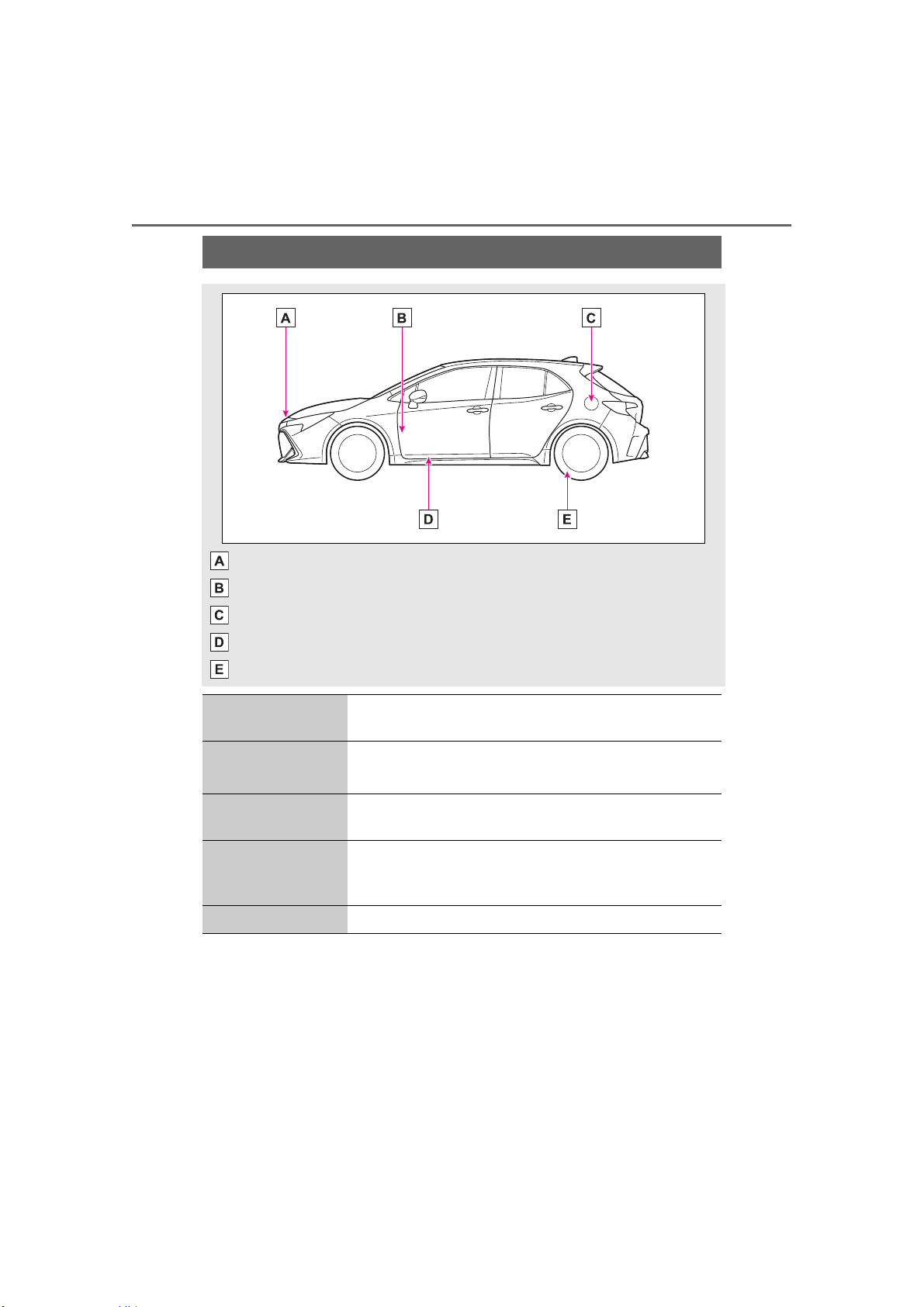
572
COROLLA H/B_U
GAS STATION INFORMATION
Auxiliary catch lever (P.427)
Hood lock release lever (P.427)
Fuel filler door (P.171)
Fuel filler door opener (P.171)
Tire inflation pressure (P.515)
Fuel tank capacity
(Reference)
13.2 gal. (50.0 L, 11.0 Imp. gal.)
Fuel type Unleaded gasoline only
P. 511
P.518
Cold tire inflation
pressure
P.515
Engine oil capacity
(Drain and refill
reference)
P. 511
Engine oil type “Toyota Genuine Motor Oil” or equivalent P. 511