Table of contents
1
2
3
4
5
6
7
8
9
10
11
12
Overview
Quick index
General information/Charging
Seat and restraint systems
Features and controls
Driving safety
Comfort controls
For emergencies
Vehicle care and maintenance
Customer assistance/Reporting Safety Defects
Specifications
Alphabetical index
BK0220401US.book 1 ページ 2015年6月3日 水曜日 午前7時42分
Instruments and controls (Driver’s area)
1-1
1
Overview
N00100202632
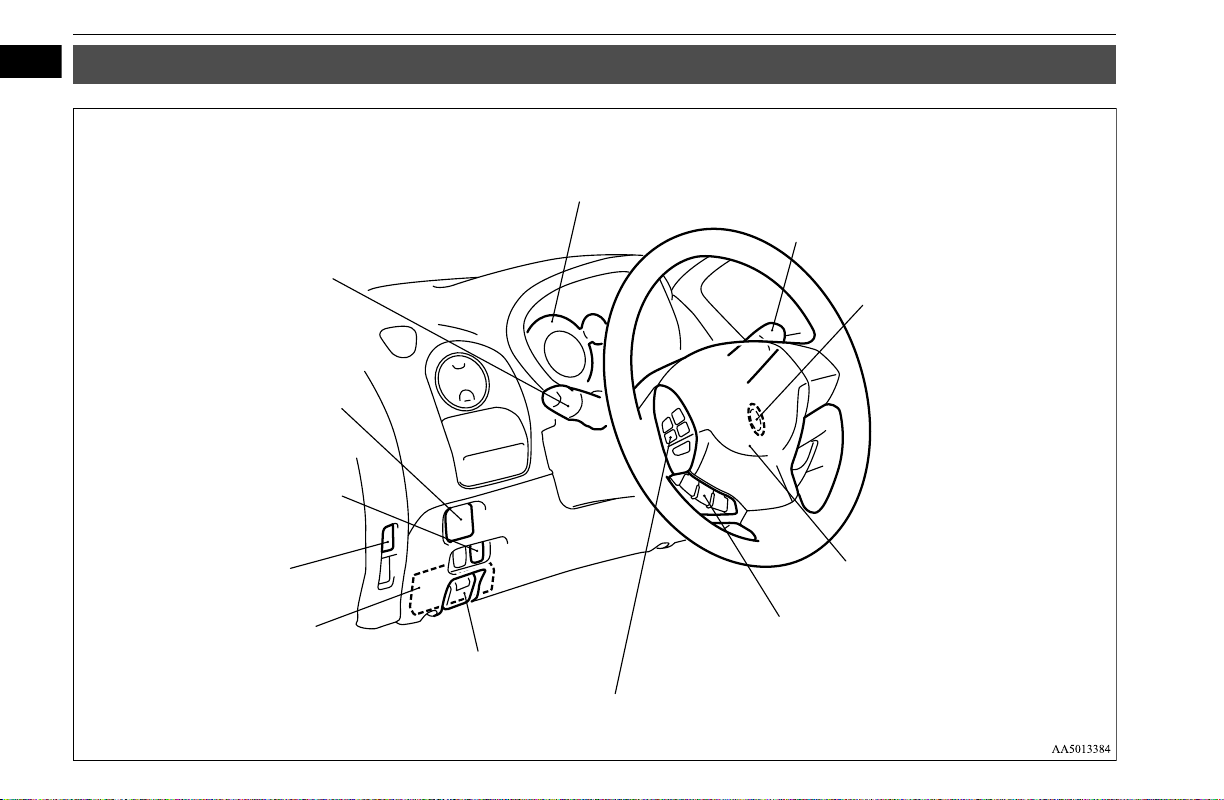
Instruments and controls (Driver’s area)
Wiper and washer switch P.5-50
Rear window wiper and washer switch P.5-51
Instrument cluster P.5-36
Combination headlights and dimmer switch
P.5-46
Turn signal lever P.5-49
Front fog light switch P.5-50
Electric motor switch P.5-18
Electric remote-controlled outside mirror
switch P.5-17
Active Stability Control (ASC)
OFF switch P.5-29
Supplemental restraint system (SRS) -
airbag (for driver’s seat) P.4-20, 4-26
Horn switch P.5-53
Heated driver’s seat switch
P. 4- 4
Fuses P.9-18
Regular charging lid opener
P.3-18
Steering control switches for Bluetooth
®
2.0 interface
(if so equipped) p.5-55
Steering wheel audio remote control switches
(if so equipped) p.7-22
BK0220401US.book 1 ページ 2015年6月3日 水曜日 午前7時42分
Instruments and controls (Instrument panel)
Overview 1-2
1
N00100202645
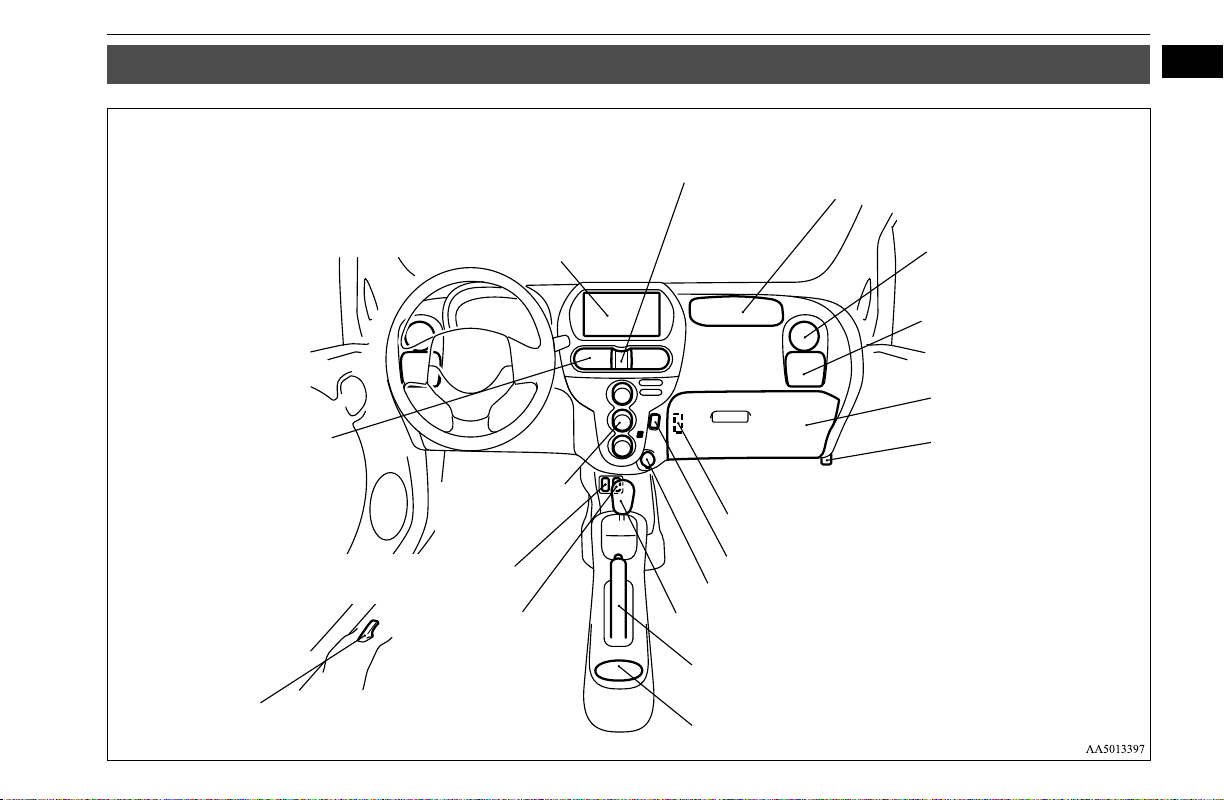
Instruments and controls (Instrument panel)
Hazard warning flasher switch
P.5-49
Supplemental restraint system (SRS) - airbag
(for front passenger’s seat) P.4-20
Side vents P.7-2
Cup holder P.5-80
Glove compartment P.5-80
Center vents P.7-2
Hood release lever
P. 9- 3
Air conditioning
P. 7-4
Card holder P.5-80
Electric rear window defogger switch P.5-52
12 V power outlet P.5-76
Selector lever P.5-21
Heated front passenger’s
seat switch
P.4 -4
Parking brake lever P.5-16
Quick charging lid opener P.3-27
Cup holder P.5-80
USB input terminal (if so equipped)
P.5-73
Audio (if so equipped) P.7-11
Mitsubishi Multi-Communication System (if so equipped)
Refer to the separate “Mitsubishi Multi-Communication System owner’s
manual”
BK0220401US.book 2 ページ 2015年6月3日 水曜日 午前7時42分
Interior
1-3 Overview
1
N00100302369
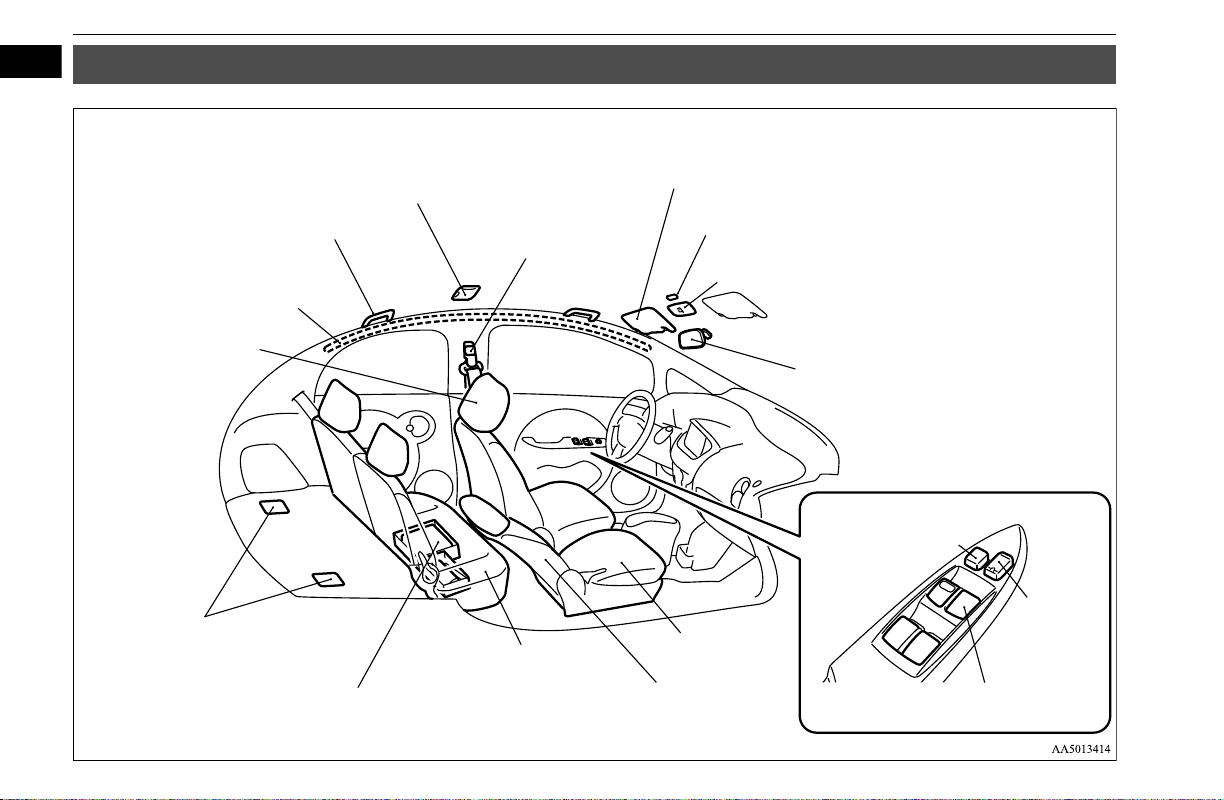
Interior
Sun visors P.5-76
Vanity mirror P.5-76
Card holder P.5-76
Dome light (rear) P.5-78
Assist grip P.5-81
Seat belts P.4-8
Supplemental restraint system (SRS) -
curtain airbags P.4-31
Dome light (front)/Reading lights P.5-77
Head restraints
P. 4- 6
Inside rearview mirror P.5-16
Window lock switch
P.5-15
Power door
lock switch
P.5- 9
Tether anchors for child restraint system
P.4-16
Front seat
P. 4-3
Rear seat P.4-5
Power window switch P.5-14
Supplemental restraint system (SRS) -
side airbag (for front seats) P.4-30
Tire repair kit P.8-5
Hands-free microphone (if so equipped) P.5-55
BK0220401US.book 3 ページ 2015年6月3日 水曜日 午前7時42分
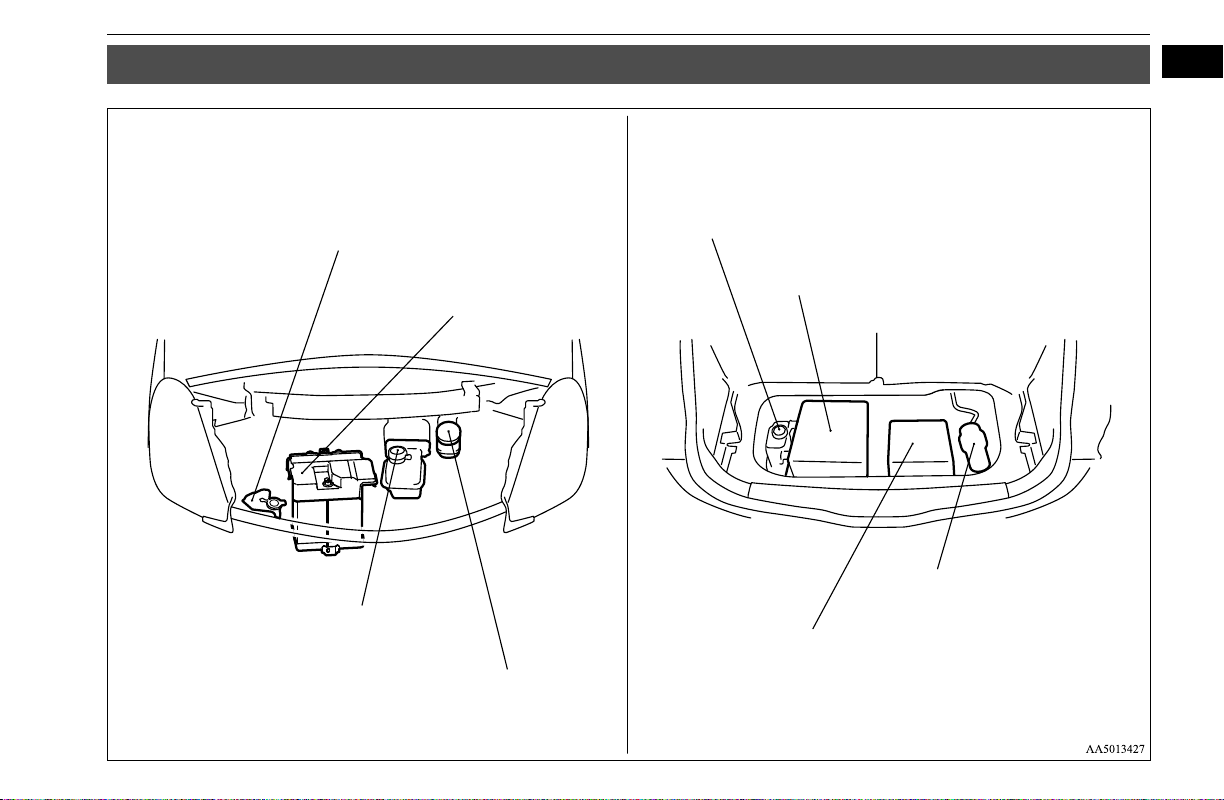
Under the hood/Electric motor unit room
Overview 1-4
1
N00100800041
Under the hood/Electric motor unit room
Under the hood Electric motor unit room
Coolant reservoir
P. 9- 4
Windshield washer fluid reservoir
P.9 -7
On board charger/DC-DC converter
P.9 -2
12V starter battery
P. 9- 7
Brake electric vacuum pump
P.5-24
Hot water heater reservoir
P.9 -4
Inverter P.3-35
Brake fluid reservoir
P. 9-7
BK0220401US.book 4 ページ 2015年6月3日 水曜日 午前7時42分
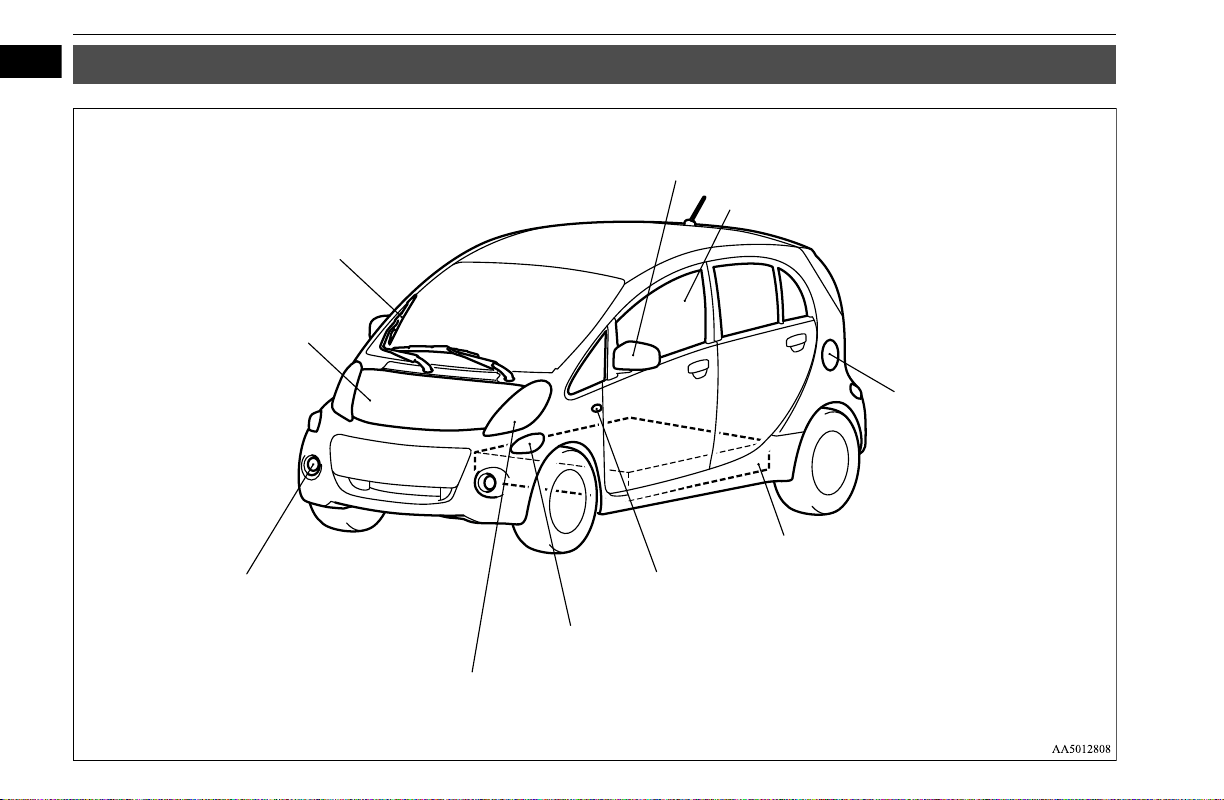
Outside (Front)
1-5 Overview
1
N00100602450
Outside (Front)
Outside rearview mirrors P.5-17
Power window P.5-14
Windshield wipers P.5-50
Hood P.9-3
Quick charging lid
P.3-27
Main drive lithium-ion battery P.9-2
Front side-marker lights
P.5-46, 9-22, 9-23
Front fog lights P.5-50, 9-22, 9-24
Daytime running lights
P.5-46, 9-22, 9-24
Front turn signal lights P.5-49, 9-22, 9-24
Headlights P.5-46, 9-22
Parking lights P.5-46, 9-22
BK0220401US.book 5 ページ 2015年6月3日 水曜日 午前7時42分
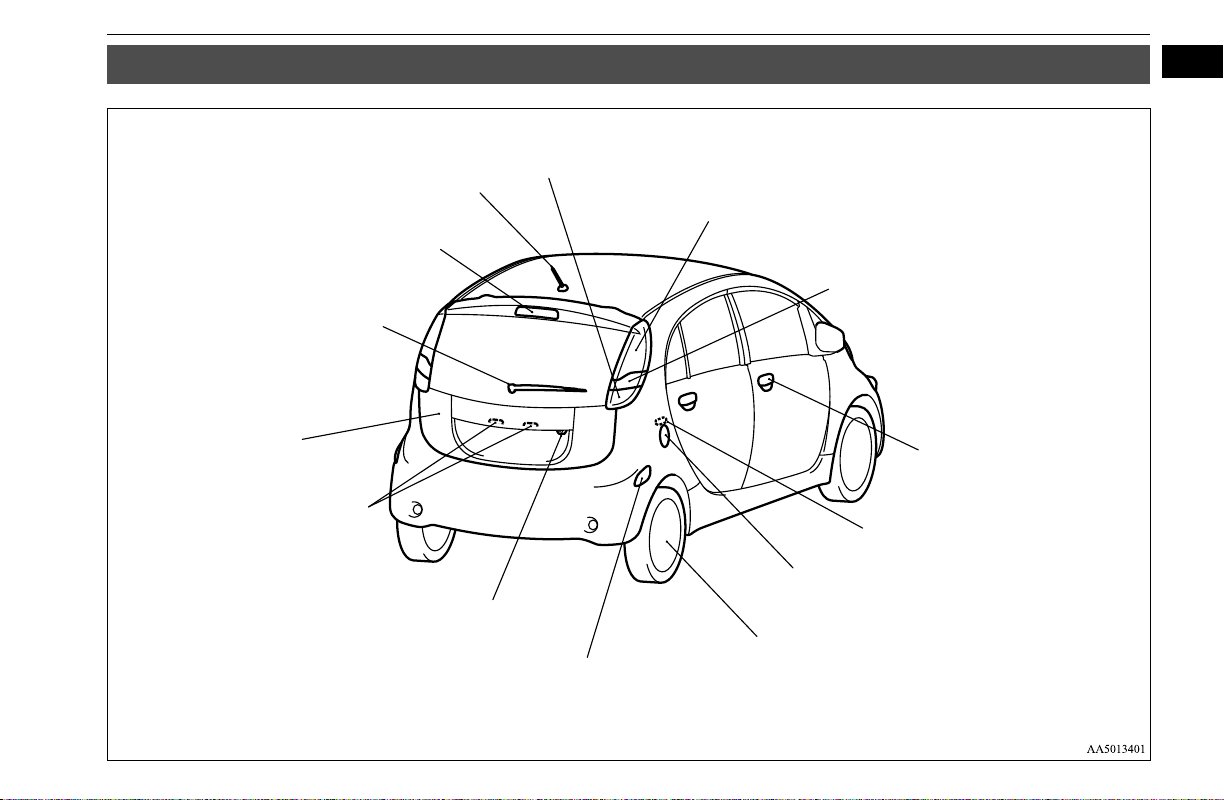
Outside (Rear)
Overview 1-6
1
N00100601352
Outside (Rear)
Back-up light P.9-22, 9-25
Antenna P.7-27
Tail and stop lights P.5-46, 9-22, 9-25
High-mounted stop light
P.9-22, 9-26
Rear turn signal lights P.5-49, 9-22, 9-25
Rear window wiper
P.5-51
Keyless entry system
P.5 -5
Locking and unlocking
P.5 -8
Liftgate P.5-11
License plate lights
P.5-46, 9-22, 9-27
Regular charge port light
P.3-17, 9-22
Regular charging lid P.3-18
Tire pressure monitoring system P.5-30
Size of tires and wheels P.11-6
Tire inflation pressure P.9-13
Tire rotation P.9-15
Tire chains P.9-16
Rear-view camera
(if so equipped) P.5-34
Rear side-marker lights P.5-46, 9-22, 9-26
BK0220401US.book 6 ページ 2015年6月3日 水曜日 午前7時42分

BK0220401US.book 7 ページ 2015年6月3日 水曜日 午前7時42分
2-1
2
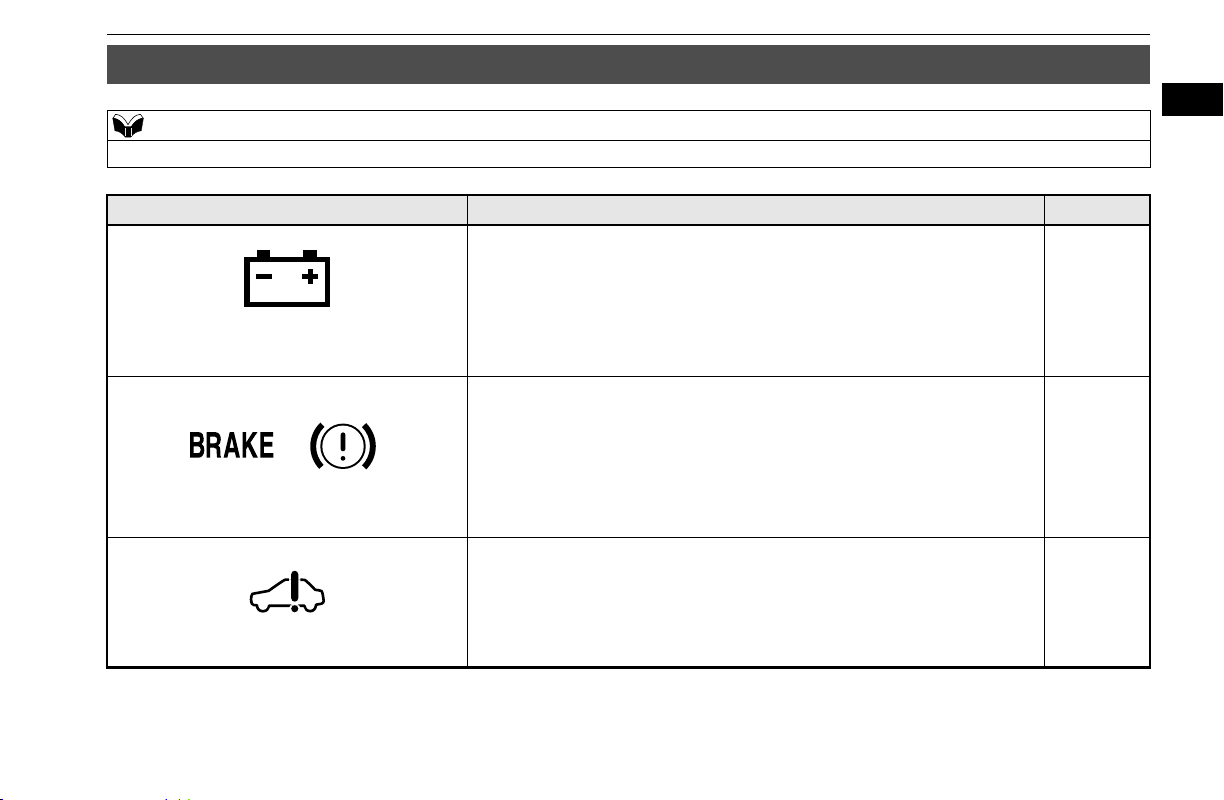
If this warning light comes on or flashes while you’re driving...
Quick index
N00200702221
If this warning light comes on or flashes while you’re driving...
NOTE
These warning lights will come on for a few seconds for a bulb check when the electric motor switch is first turned to “ON”.
Warning light Do this Ref. page
12V starter battery charging system warning
light
Park your vehicle in a safe place and turn off the electric motor unit.
Contact a certified i-MiEV dealer for assistance.
P.5-45
or
Brake warning light
If this light comes on while driving, check to see that the parking brake is
fully released.
If this light stays on after releasing the parking brake, stop and check the
brake fluid level.
If the brake fluid level is correct, there may be a system malfunction. Avoid
hard braking and high speeds, and contact a certified i-MiEV dealer for
assistance.
P.5-44
Electric motor unit warning light
Park your vehicle in a safe place and contact a certified i-MiEV dealer for
assistance.
P.5-45
BK0220401US.book 1 ページ 2015年6月3日 水曜日 午前7時42分
If this warning light comes on or flashes while you’re driving...
2-2 Quick index
2
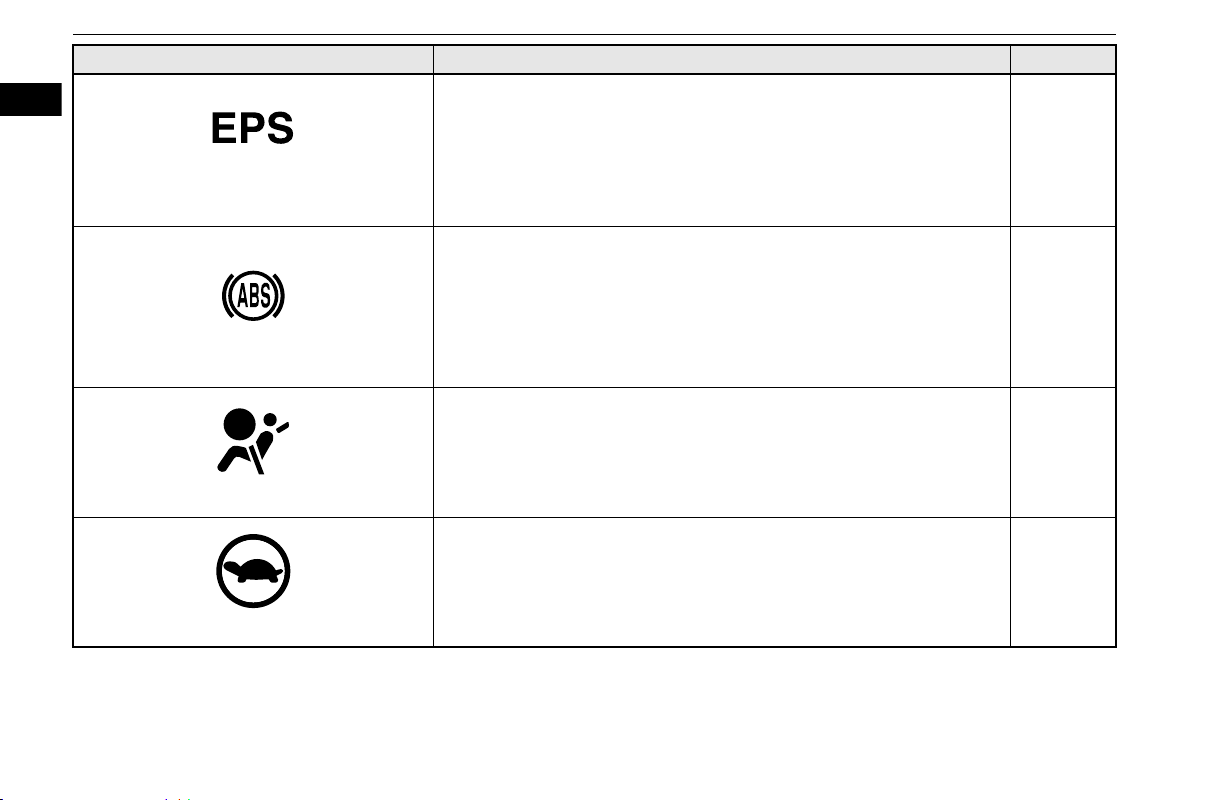
Electric power steering system (EPS) warning
light
If this light comes on while the electric motor unit is running, it may
become harder to turn the steering wheel. Have your vehicle inspected at a
certified i-MiEV dealer as soon as possible.
P.5 -2 8
Anti-lock braking system warning light
When this light comes on, the anti-lock braking system is not functioning
and only the ordinary braking system is functioning.
Park your vehicle in a safe place and stop the electric motor unit.
Test the system as described on page 5-27.
If the light does not go out after the test, or if it comes on again, we recom-
mend that you have the system checked at a certified i-MiEV dealer as
soon as possible.
P.5-26,
5-27
SRS warning light
Immediately have the airbag and the seat belt pre-tensioner system checked
at a certified i-MiEV dealer.
P.4-13,
4-26
Power down warning light
If this light comes on while driving, avoid sudden acceleration and sudden
starting.
When the remaining power in the main drive lithium-ion battery is low,
recharge the main drive lithium-ion battery as soon as possible.
P.5 -4 6
Warning light Do this Ref. page
BK0220401US.book 2 ページ 2015年6月3日 水曜日 午前7時42分
If this warning light comes on or flashes while you’re driving...
Quick index 2-3
2
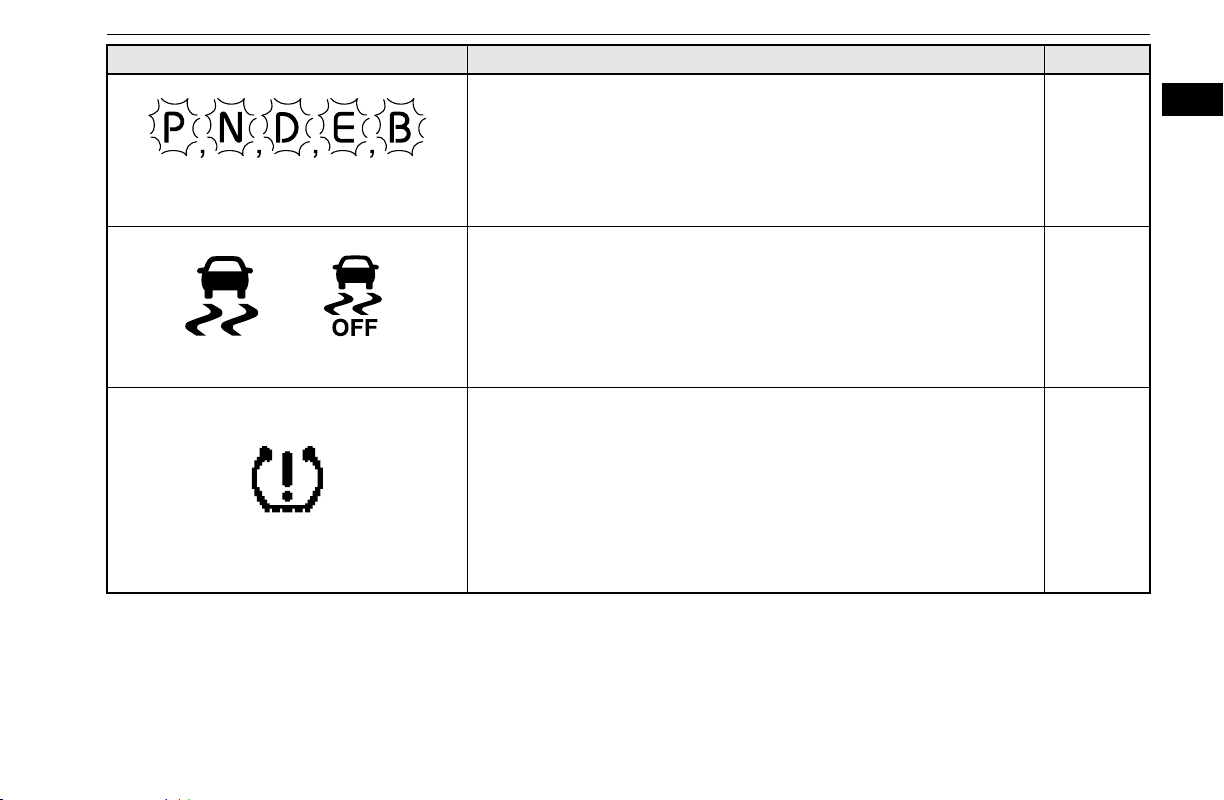
Selector lever position indicator in the instru-
ment cluster flashes slowly
Have the transmission checked at a certified i-MiEV dealer as soon as pos-
sible.
P.5-21
and
ASC indicator and ASC OFF indicator
Park your vehicle in a safe place and turn off the electric motor unit.
Restart the electric motor unit and check to see if the indicator comes on
again.
If the indicator does not go out, or if it comes on again, have your vehicle
inspected at a certified i-MiEV dealer as soon as possible.
When this indicator comes on, the active stability control is not functioning
and normal operation of the vehicle will not be affected.
P.5-30
Tire pressure monitoring system warning light
If the warning light comes on, you should stop and adjust the tires to the
proper inflation pressure as soon as possible.
(See “Tire inflation pressures” on page 9-13.)
Once adjustments have been made, the warning light will go off after a few
minutes of driving.
If the warning light blinks for approximately 1 minute and then remains
continuously illuminated, the system is not operating properly. If the sys-
tem returns to normal, the warning light will go off. If the warning light
does not go off, have the vehicle inspected at a certified i-MiEV dealer.
P.5-31, 5-32
Warning light Do this Ref. page
BK0220401US.book 3 ページ 2015年6月3日 水曜日 午前7時42分
If this problem occurs...
2-4 Quick index
2
N00200901923
If this problem occurs...
Problem Do this Ref. Page
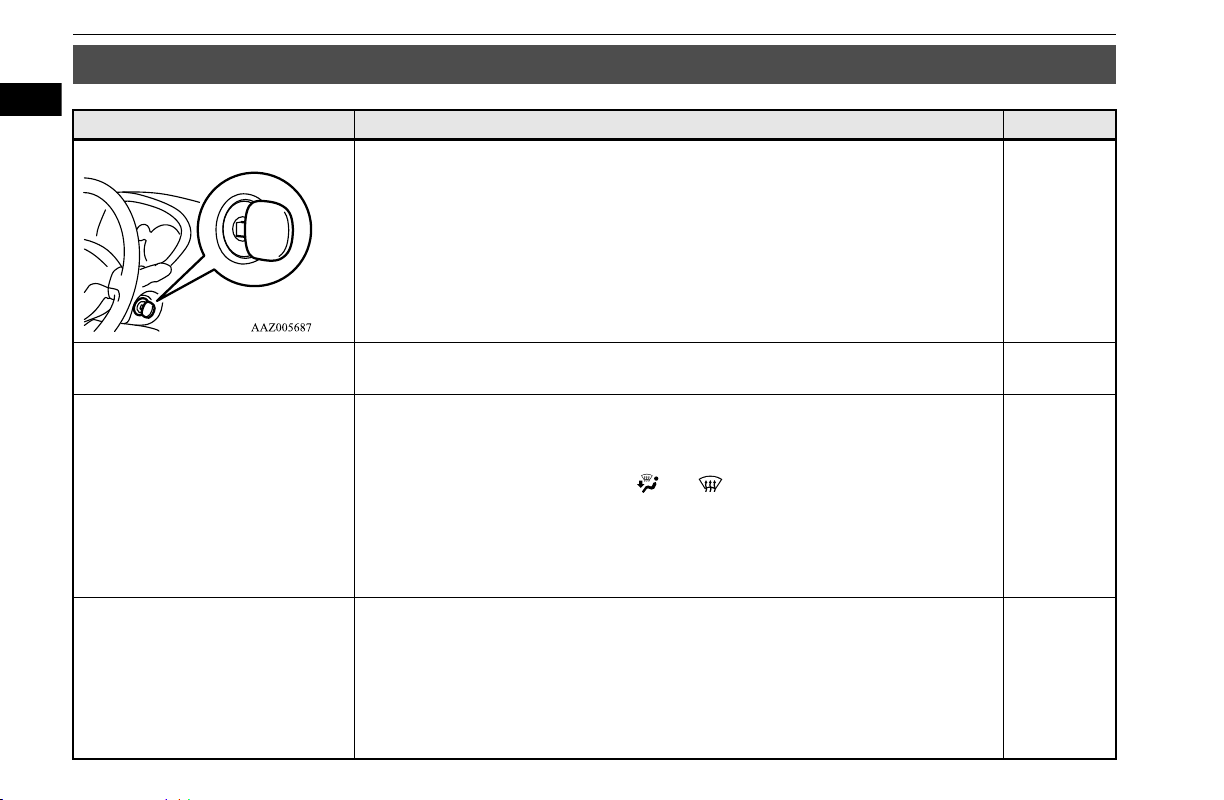
Cannot turn the key. From “LOCK” to “ACC”.
Turn the key while turning the steering wheel in either direction.
P.5-19,
5-20
From “ACC” to “LOCK”.
Check the position of the selector lever.
The key cannot be removed unless the selector lever is set to the “P” (PARK) position.
Cannot shift the selector lever from
the “P” (PARK) position.
Shift the selector lever while pressing the brake pedal.
Check that the electric motor switch is in the “ON” position.
P.5-21
The windows are fogged up.
1. Set the mode selection dial to the “ ” or “ ” position.
2. Turn on the blower.
P.7-9
The electric motor unit does not start.
The lights do not come on.
The lights are dim.
The horn does not honk.
The horn sound is weak.
Cannot charge the main drive lith-
ium-ion battery.
Have the 12V starter battery checked. Recharge or replace as needed.
P.8-2,
9-7
BK0220401US.book 4 ページ 2015年6月3日 水曜日 午前7時42分
If this problem occurs...
Quick index 2-5
2
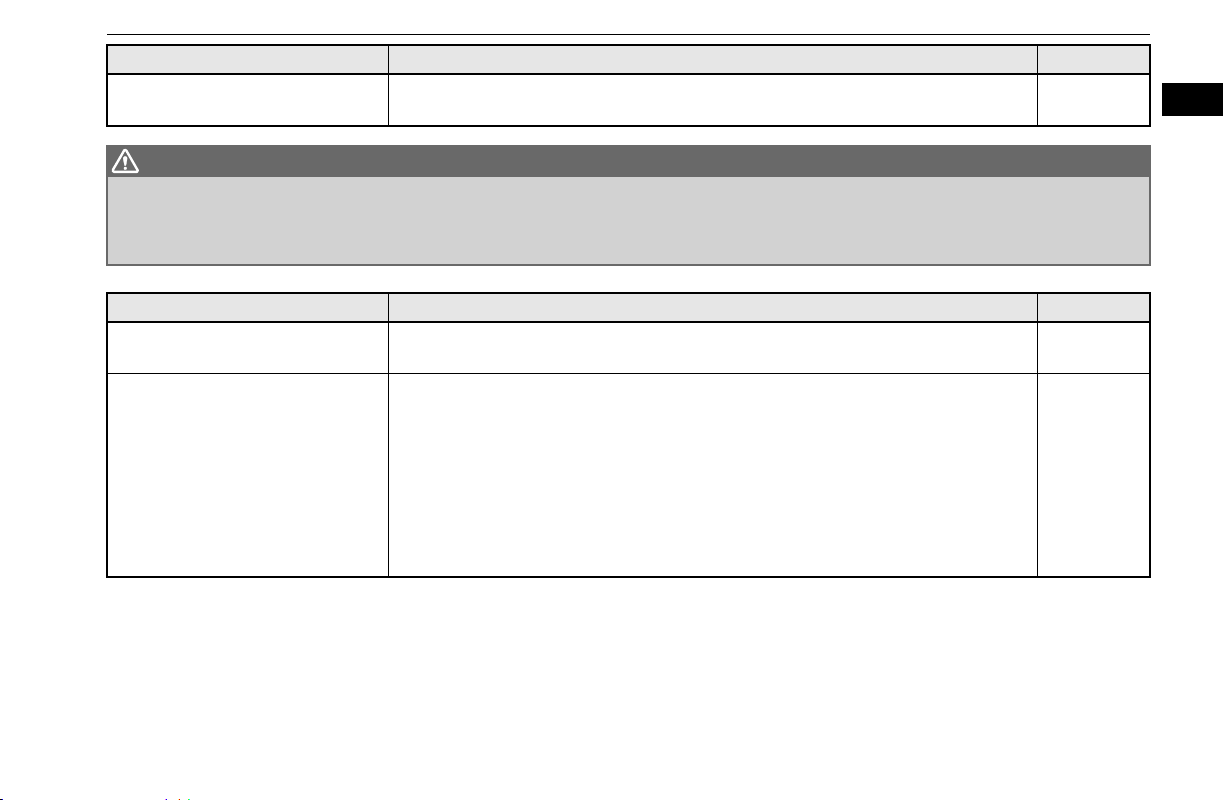
The vehicle is stuck in sand, mud, or
snow.
Rock your vehicle back and forth to free it. P.8-13
WARNING
When attempting to rock your vehicle out of a stuck position, be sure that no one is near the vehicle. The rocking motion may cause the vehicle to
suddenly lurch forward or backward, possibly injuring bystanders.
Avoid spinning the wheels. Prolonged efforts to free a stuck vehicle may result in transmission failure.
If the vehicle remains stuck after several rocking attempts, have a towing service pull the vehicle out.
Problem Do this Ref. page
The brakes are not functioning prop-
erly after driving through water.
Dry out the brakes by driving slowly while lightly pressing the brake pedal. P.6-5
A tire is punctured.
1. Park the vehicle in a safe place where the surface is flat and level.
2. Repair the flat tire with tire repair kit.
P.8-5
Problem Do this Ref. Page
BK0220401US.book 5 ページ 2015年6月3日 水曜日 午前7時42分

BK0220401US.book 6 ページ 2015年6月3日 水曜日 午前7時42分

3
General information/Charging
Familiarizing yourself with i-MiEV ................................................3-2
Modifications to and racing of your vehicle ....................................3-6
Mitsubishi Motors genuine parts .....................................................3-8
California Perchlorate Materials Requirements ...............................3-8
Cautions and actions to deal with intense heat ................................3-8
Cautions and actions to deal with intense cold ..............................3-10
Charging ........................................................................................3-13
Precautions during Charging the
Main Drive Lithium-ion Battery ................................................3-15
Regular charging
(charging method with rated AC 120 V outlet) .........................3-16
EV charging cable ..........................................................................3-23
Regular charging
(using 240 V Electric Vehicle Supply Equipment) ....................3-26
Quick charging
(charging method with quick charger) .......................................3-27
Charging troubleshooting guide ....................................................3-31
High-Voltage components ..............................................................3-34
MiEV Remote System ...................................................................3-36
BK0220401US.book 1 ページ 2015年6月3日 水曜日 午前7時42分
Familiarizing yourself with i-MiEV
3-2 General information/Charging
3
N01200100013
i-MiEV is a pure electric vehicle. Some of the
vehicle systems operate differently from and
have different characteristics than ordinary
vehicles equipped with an internal combus-
tion engine. For this reason, it is very impor-
tant to read carefully this entire owner’s
manual.
N01200200027
i-MiEV is powered only by electricity.
This vehicle does not emit exhaust gases,
such as carbon dioxide and nitrogen
oxide.
The i-MiEV uses electricity stored in the
lithium ion battery. The lithium-ion bat-
tery is called the main drive lithium-ion
battery. This vehicle does not have an
internal combustion engine and does not
require gasoline or diesel fuel.
The main drive lithium-ion battery must
be charged with electricity to drive the
vehicle. As the vehicle operates, the main
drive lithium-ion battery gradually dis-
charges. If the main drive lithium-ion bat-
tery becomes completely discharged, the
vehicle will not operate until it is re-
charged. The charging process can take up
to 23 hours as described more precisely in
this manual.
This vehicle uses two types of batteries.
One is 12V starter battery that is the same
type of the battery used in ordinary vehi-
cles. It is called the 12V starter battery.
The other battery which propels the vehi-
cle is called the main drive lithium-ion
battery.
The 12V starter battery provides power to
the vehicle systems and features such as
the audio system, supplemental restraint
systems, headlights and windshield wiper.
The main drive lithium-ion battery pro-
vides power to the electric motor that pro-
pels the vehicle and charges the 12V
starter battery.
Through a process called regenerative
braking, the main drive lithium-ion bat-
tery is automatically charged, while the
vehicle is decelerating or being driven
downhill.
Familiarizing yourself with
i-MiEV
Main features
NOTE
If the 12V starter battery is discharge, the
electric motor unit cannot be started. And
also the main drive lithium-ion battery can-
not be charged.
WARNING
Pay special attention to pedestrians.
Because there is no engine noise, pedestri-
ans may not know the vehicle is approach-
ing and may step into the path of vehicle
travel. Refer to “Acoustic vehicle alerting
system (AVAS)” on page 5-23.
When leaving the vehicle, always turn off
the electric motor switch. Refer to “Elec-
tric motor switch” on page 5-18.
When parking, to avoid unintended vehi-
cle movement, always move the selector
lever to “P” (PARK) position and apply
the parking brake because the vehicle can
move when the ready indicator light is
ON. When the ready indicator light is ON,
do not leave the selector lever in a position
other than the “P” (PARK) position. For
the ready indicator, refer to “Indicator
and warning light package” on page 5-43.
BK0220401US.book 2 ページ 2015年6月3日 水曜日 午前7時42分
Familiarizing yourself with i-MiEV
General information/Charging 3-3
3
N01205601036
Motion energy is converted into electric
energy using the motor as a power generator.
While decelerating, electric energy will be
created and used to charge to the main drive
lithium-ion battery.
If you lift your foot off the accelerator
pedal while driving, a braking force that
equivalent to the engine braking of a gas-
oline or diesel powered vehicle engine
vehicle will be generate.
For increased regenerative braking, set the
selector lever to “B” (REGENERATIVE
BRAKE MODE) or “ECO” (ECO
MODE) as follows:
• “B”: Strong regenerative braking (For
downhill driving)
• “ECO”: Moderate regenerative braking
(For economical driving or gentle down-
hill driving)
As greater brake force is applied by
depressing the brake pedal, increased
regenerative braking occurs.
When regenerative braking produces
strong brake force, the stop lights will
illuminate, even if the brake pedal is not
depressed.
N01200300015
Keep the brake pedal depressed until you
are ready to drive. When the vehicle is in
the “D” (DRIVE), “ECO” (ECO MODE),
“B” (REGENERATIVE BRAKE MODE)
or “R” (REVERSE) position, if you
release the brake pedal and even if you do
not depress accelerator, the vehicle will
creep and may move slowly.
Regenerative braking
WARNING
NOTE
When the main drive lithium-ion battery
level is full or nearly full, or the main drive
lithium-ion battery temperature is too high or
too low, the regenerative braking force may
be reduced and stronger service brake effort
may be required to operate the brakes. When
the main drive lithium-ion battery level is no
longer full or near full, or the main drive lith-
ium-ion battery temperature has returned to a
normal range, the regenerative brake force
will resume.
If a problem occurs in the electric motor unit,
or if the ABS and/or the ASC have been acti-
vated, the regenerative braking will be
restricted. The service brakes will still oper-
ate.
Main drive lithium-ion battery
WARNING
The main drive lithium-ion battery is a
sealed high voltage battery and has no
user serviceable parts.
• To avoid severe burns and/or electrical
shock that may result in serious injury or
death, never attempt to detach the main
drive lithium-ion battery from the vehi-
cle or try to disassemble it.
• Never attempt to dispose or recycle the
main drive lithium-ion battery by your-
self. Consult with a certified i-MiEV
dealer, when the main drive lithium-ion
battery is disposed or recycled.
• Never attempt to use the main drive lith-
ium-ion battery for any other purpose.
CAUTION
To help prevent damage to the main drive
lithium-ion battery, follow the instructions
described below. Failure to do so can result
in damage to the main drive lithium-ion bat-
tery that will not be covered by the main
drive lithium-ion battery warranty.
• Do not leave your vehicle with the energy
level gauge (Refer to “Energy level gauge”
on page 5-41) showing 0 bars.
BK0220401US.book 3 ページ 2015年6月3日 水曜日 午前7時42分
Familiarizing yourself with i-MiEV
3-4 General information/Charging
3
N01205500012
The capacity of the lithium-ion battery
used as the main drive lithium-ion battery
on your i-MiEV, like other commonly
used lithium ion batteries, will decrease
according to time and usage. This type of
decrease in battery capacity is normal, and
is not indicative of any defect or failure in
your main drive lithium-ion battery. As
the main drive lithium-ion battery capac-
ity decreases, the initial cruising range of
the vehicle will similarly decrease.
Mitsubishi Motors estimates that after 5
years, the capacity of the main drive lith-
ium-ion battery provided with your vehi-
cle will be approximately 80% of the
original capacity. After 10 years, the
capacity should be approximately 70% of
the original capacity. These are only esti-
mates, and the actual capacity of your
vehicle battery over time will depend on a
variety of factors including how your
vehicle is used, stored and charged. Fac-
tors that can adversely affect battery
capacity over time include frequent driv-
ing using aggressive acceleration/deceler-
ation, repeated frequent use of the quick
charger, and operation/storage in extreme
temperature environments.
The main drive lithium-ion battery has a
limited service life, and when its charging
capacity falls, owners should bring their
vehicle to a certified i-MiEV dealer for
inspection and possible battery replace-
ment.
For details regarding the warranty cover-
age for the main drive lithium-ion battery,
refer to the Warranty and Maintenance
Manual.
N01200400016
The distance you can drive the vehicle (cruis-
ing range) depends on a number of factors
including available charge, weather, tempera-
ture, usage, battery age, topography, and driv-
ing style. When the main drive lithium-ion
battery is new, the estimated cruising range
with a fully charged main drive lithium-ion
battery is 62 miles (100 km) based on the
EPA laboratory test commonly called the
combined range. Your actual range can vary,
either initially or as the battery ages and with
use over time.
As the main drive lithium-ion battery capac-
ity decreases, the cruising range of the vehi-
cle will similarly decrease. Refer to
“Decrease of battery capacity” on page 3-4.
• Repeatedly performing quick charging can
reduce battery capacity. Regular charging is
recommended unless quick charging is nec-
essary.
Do not store your vehicle at ambient temper-
atures above 131 °F (55 °C) for over 24
hours, or below
-13 °F (-25 °C) for over 7 days. The tempera-
tures may damage the main drive lithium-ion
battery.
NOTE
It is recommended that your vehicle be
stored at temperatures below 77 °F (25 °C)
to help maximize the life of the main drive
lithium-ion battery.
Decrease of battery capacity
CAUTION
NOTE
To help maintain the capacity of the main
drive lithium-ion battery, the following are
recommended:
• Fully charge the vehicle by regular charg-
ing every 2 weeks.
• Do not repeat charging when the main drive
lithium-ion battery is at or near full charge.
Cruising range
NOTE
Since cooling or heating consumes power
from the main drive lithium-ion battery,
operation of these functions will reduce the
cruising range.
NOTE
BK0220401US.book 4 ページ 2015年6月3日 水曜日 午前7時42分
Familiarizing yourself with i-MiEV
General information/Charging 3-5
3
N01205900016
Put the selector lever in the “B” (REGEN-
ERATIVE BRAKE MODE) or “Eco” (ECO
MODE) position according to the road con-
dition. Using appropriate regenerative brak-
ing can help increase the cruising range.
Refer to “Regenerative braking” on page
3-3.
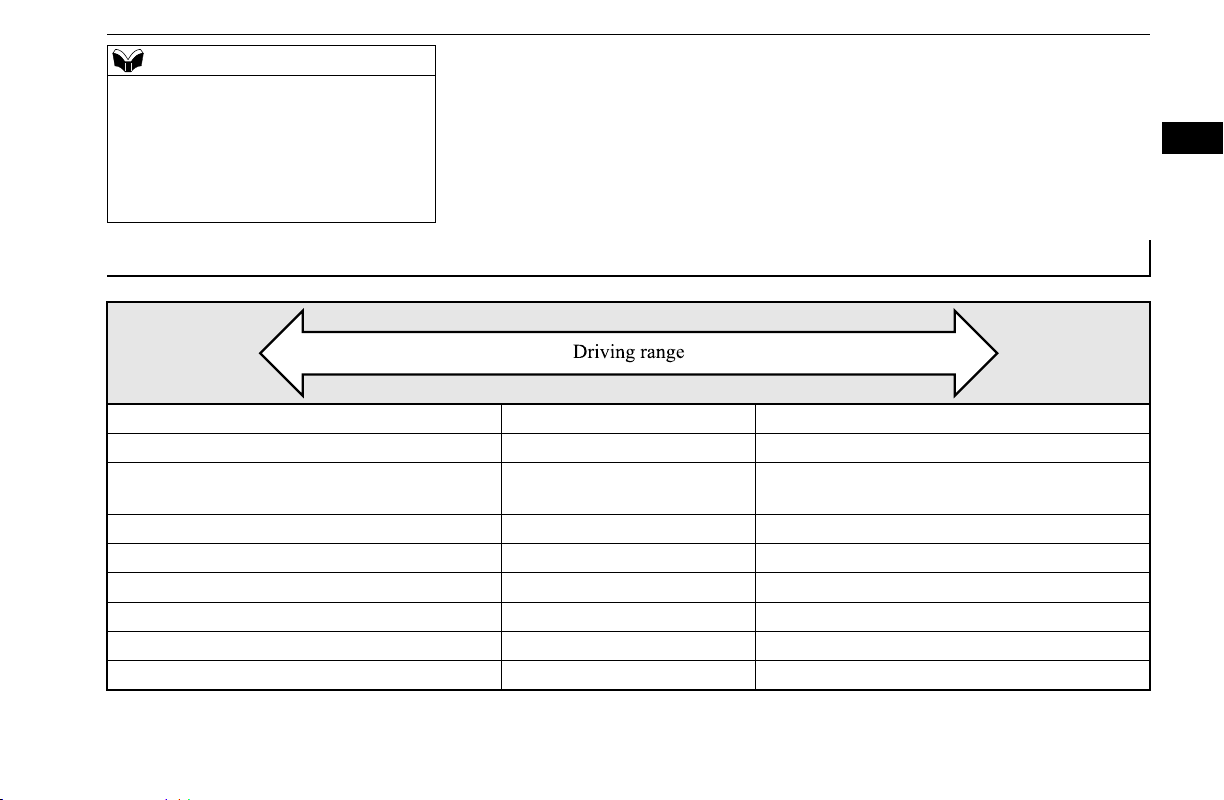
NOTE
Range-Driving conditions
Shorten
driving
range
Lengthen
driving
range
Range Reducing Condition Range Extending
High acceleration, speed Driving style Low acceleration, speed
Heater on Heater usage
Heater off
(or use seat heater)
A/C on A/C usage A/C off
Highway City/Highway City
Heavy payload Payload Light payload
Windy, wet Weather Calm, dry
Uphill, rough Road conditions Flat/Downhill, smooth
D-mode Drive mode (Eco or B mode)
BK0220401US.book 5 ページ 2015年6月3日 水曜日 午前7時42分
Modifications to and racing of your vehicle
3-6 General information/Charging
3
N01206300020
While charging, even if the electric motor
switch is in the “LOCK” position, you may
hear operating sounds such as sounds from
the cooling fan and air conditioning compres-
sor when operating the main drive lithium-ion
battery cooling system or Remote Climate
Control.
This is normal.
Refer to “Remote Climate Control” on page
3-36, 3-47.
N01206400021
N01200500017
This vehicle should not be modified with
non-Mitsubishi Motors genuine parts.
Mitsubishi Motors designs and manufactures
Operating sound under charg-
ing or Remote Climate Control
For persons with electro-medi-
cal apparatus such as implant-
able cardiac pacemaker or
implantable cardiovascular
defibrillator
WARNING
Before charging, read the instructions
described below carefully and follow
them. Also read and follow the instruc-
tions for “Regular charging (charging
method with rated AC 120 V outlet)” on
page 3-16, “Regular charging (using 240 V
Electric Vehicle Supply Equipment)” on
page 3-26, and “Quick charging (charging
method with quick charger)” on page
3-27.
Before charging, individuals using an elec-
tro-medical apparatus such as implant-
able pacemakers and implantable
cardiovascular-defibrillators should check
with the manufacturer of the apparatus to
confirm the effect of the electromagnetic
waves from charging. The electromagnetic
waves may affect the operations of the
electro-medical apparatus.
When performing regular charging, keep
your electro-medical apparatus, such as
implantable cardiac pacemaker or
implantable cardiovascular defibrillator,
away from the charge connector, EV
charging cable, control box or regular
charging station.
Do not perform quick charging and keep
away from a quick charger. Electromag-
netic waves produced by a quick charger
may affect the operation of your electric-
medical apparatus. If you have acciden-
tally approached a quick charger, walk
away from the quick charger immediately.
If quick charging is necessary, ask some-
one for help.
While charging;
• Do not stay inside the vehicle.
• Do not go inside the vehicle, for example
to remove or place an item in the passen-
ger compartment.
• Do not open the liftgate, for example to
remove or place an item in the cargo
area.
Modifications to and racing
of your vehicle
WARNING
BK0220401US.book 6 ページ 2015年6月3日 水曜日 午前7時42分
Modifications to and racing of your vehicle
General information/Charging 3-7
3
high quality vehicles with an emphasis on
safety and durability. Modifications using
non-Mitsubishi Motors genuine parts may
affect the performance, safety and/or durabil-
ity of your vehicle, and may violate applica-
ble state and/or federal regulations.
DAMAGE OR PERFORMANCE PROB-
LEMS RESULTING FROM MODIFICA-
TIONS TO OR RACING OF YOUR
VEHICLE ARE NOT COVERED
UNDER WARRANTY.
Examples of modifications to your vehicle
that can cause damage or performance prob-
lems include the following:
Failure to use Mitsubishi Motors genuine
parts
Failure to use required fluids (refer to
“Refill capacities” on page 11-7)
Failure to use proper size tires and wheels
Modification of the suspension, electric
motor, drive train, batteries (main drive
lithium-ion battery and 12V starter bat-
tery), charging systems or electrical wir-
ing systems
Modification of any onboard com-
puter/control module, including repro-
gramming, or replacing/adding chips to
any onboard computer/control module
Review the Warranty and Maintenance Man-
ual for further details regarding warranty cov-
erage.
N01200600018
The installation of accessories, optional
parts, etc., should only be carried out
within the limits prescribed by law in the
driving area and in accordance with the
guidelines and warnings contained within
the documents accompanying this vehicle.
Only Mitsubishi Motors approved acces-
sories should be fitted to your vehicle.
Improper installation of electrical parts
could cause fire. Refer to the “Modifica-
tion/alterations to the electrical systems”
section within this owner’s manual.
Tires and wheels which do not meet spec-
ifications must not be used.
Refer to the “Specifications” section for
information regarding wheel and tire
sizes.
Due to the large number of accessory and
replacement parts provided by different man-
ufacturers in the market, it is not always pos-
sible for a certified i-MiEV dealer to check
whether the attachment or installation of non-
Mitsubishi Motors genuine parts will affect
the driving safety of your Mitsubishi-vehicle.
N01200700019
Mitsubishi Motors manufactures high quality
vehicles with an emphasis on safety. It is
important to consult a certified i-MiEV dealer
before installation of any accessory which
Installation of accessories
CAUTION
Before any electrical or electronic accesso-
ries are installed, consult a certified i-MiEV
dealer.
WARNING
If you choose to use a cellular phone while
driving, you must not allow that usage to
distract you in the safe operation of your
vehicle. Anything, including cellular
phone usage, that distracts you from the
safe operation of your vehicle increases
your risk of an accident.
Refer to and follow all local laws in your
area regarding cellular phone usage while
driving.
Important point!
Modification/alterations to the
electrical systems
BK0220401US.book 7 ページ 2015年6月3日 水曜日 午前7時42分
Mitsubishi Motors genuine parts
3-8 General information/Charging
3
may involve modification of the electrical
systems.
N01200800010
Mitsubishi Motors Genuine Parts are
designed and manufactured to meet high stan-
dards of performance, and are recommended
for all of your maintenance needs. Also avail-
able from a certified i-MiEV dealer are a
wide variety of accessories to personalize
your new vehicle. Each Mitsubishi vehicle
has a selection of Mitsubishi Motors autho-
rized accessories to choose from to tailor your
new vehicle to your own personal preference.
A certified i-MiEV dealer’s Parts Manager
has information on various audio systems,
protection items, as well as interior and exte-
rior accessories available for your specific
model.
N01200900011
Certain components of this vehicle, such as
airbag modules, seat belt pretensioners, and
button cell batteries, may contain perchlorate
materials.
Special handling may apply. For additional
information, see www.dtsc.ca.gov/hazardous-
waste/perchlorate.
N01201001045
When the vehicle is driven in a high ambient temperature, its air-conditioner performance can be insufficient. Also, using the air conditioner
will reduce the vehicle’s cruising range.
When the ambient temperature is approximately 104 °F (40 °C) or higher, the phenomena described below may occur. Please take the
described actions.
Even if the ambient temperature is approximately 104 °F (40 °C) or lower, when performing quick charging, driving at high-speed and uphill
repeatedly, the phenomena described below may occur. Please take the described actions.
CAUTION
Please consult a certified i-MiEV dealer con-
cerning any such accessory fitment or modi-
fication.
If the wires interfere with the vehicle body or
improper installation methods are used (pro-
tective fuses not included, etc.), electronic
devices may be adversely affected, resulting
in a fire, vehicle damage, or other accident.
Mitsubishi Motors genuine
parts
California Perchlorate
Materials Requirements
Cautions and actions to deal with intense heat
BK0220401US.book 8 ページ 2015年6月3日 水曜日 午前7時42分

Cautions and actions to deal with intense heat
General information/Charging 3-9
3
Approx. ambi-
ent temperature
Phenomena Corrective action
Approx. 104 °F
(40 °C) or higher
Startup and driving •
•
During quick charging, repeated high-speed driving, or
repeated uphill driving, the power down warning light* comes
on and the motor output is restricted to protect the main drive
lithium-ion battery or motor (electric motor unit).
Regenerative braking performance may decrease. When brak-
ing, depress the brake pedal more strongly.
• Stop the vehicle in a safe place
for a while, avoid quick charg-
ing, and wait for the power
down warning light* to go off.
• If you continue driving after the power down warning light*
comes on, the vehicle may stop after you have driven a few
miles/kilometres.
Charging and battery • During quick charging, charging times get longer.
Approx.113 °F
(45 °C) or higher
Startup and driving •
•
During quick charging, repeated high-speed driving, or
repeated uphill driving, the power down warning light* comes
on and the motor output is restricted to protect the main drive
lithium-ion battery and/or motor (electric motor unit).
Regenerative braking performance may decrease. When brak-
ing, depress the brake pedal more strongly.
• Stop the vehicle in a safe place
for a while, avoid quick charg-
ing, and wait for the power
down warning light* to go off.
• If you continue driving after the power down warning light*
comes on, the vehicle may stop after you have driven a few
miles/kilometres.
Charging and battery •
•
The EV charging cable (regular charging cable) cannot be
used.
During quick charging, charging times get longer.
• Park in a safe, well-ventilated
and shady place.
• The main drive lithium-ion battery capacity is decreased more
quickly, and the cruising range is decreased.
BK0220401US.book 9 ページ 2015年6月3日 水曜日 午前7時42分
Cautions and actions to deal with intense cold
3-10 General information/Charging
3
N01201101033
When the vehicle is driven in a low ambient temperatures, its heater performance can be insufficient. Also, using the heater can reduce the
vehicle’s cruising range.
When the ambient temperature is approximately 5 °F (-15 °C) or lower, the phenomena described below may occur. Please take the corrective
actions described below.
Approx. 140 °F
(60 °C) or higher
Startup and driving • The power down warning light* comes on, and the vehicle
may stop.
• Park in a safe, well-ventilated
and shady place, avoid quick
charging, and wait for the
power down warning light* to
go off.
Charging and battery •
•
The EV charging cable (regular charging cable) cannot be
used.
Quick charging may become impossible.
• Park in a safe, well-ventilated
and shady place.
NOTE
*: Refer to “Power down warning light” on page 5-46. Illumination of the power down warning light does not indicate a malfunction.
Cautions and actions to deal with intense cold
Approx. ambi-
ent temperature
Phenomena Corrective action
BK0220401US.book 10 ページ 2015年6月3日 水曜日 午前7時42分

Cautions and actions to deal with intense cold
General information/Charging 3-11
3
Approx. ambi-
ent tempera-
ture
Phenomena Corrective action
Approx.5 °F
(-15 °C) or
lower
Startup and
driving
• Motor output is restricted, and the power down warning
light*
1
may come on.
<Reference: When the main drive lithium-ion battery tem-
perature is 5 °F (-15 °C) or lower and the main drive lithium-
ion battery’s remaining power is 50 %, the driving perfor-
mance may decrease by approximately 30 %>
• Keep driving if you can drive at a safe
speed.
If you cannot drive at a safe speed,
stop the vehicle in a safe place and
charge the main drive lithium-ion bat-
tery.
• Regenerative braking performance may decrease. • When braking, depress the brake
pedal more strongly.
Charging and
battery
•
•
Charging times get longer.
Complete charging may not be possible.
• When you have finished driving,
charge the main drive lithium-ion bat-
tery before battery temperature falls.
Approx.-13 °F
(-25 °C) or
lower
Startup and
driving
• Motor output is restricted, and the power down warning
light*
1
may come on.
<Reference: When the main drive lithium-ion battery tem-
perature is -13 °F (-25 °C) or lower and the main drive lith-
ium-ion battery’s remaining power is 50 %, the driving
performance may decrease by approximately 50 %>
• Keep driving if you can drive at the
same speed as surrounding vehicles.
If you cannot drive the same speed as
surrounding vehicles, stop the vehicle
in a safe place and charge the main
drive lithium-ion battery.
• Regenerative braking performance may decrease or be elimi-
nated.
• When braking, depress the brake
pedal more strongly.
Charging and
battery
• Charging may become impossible. • When you have finished driving,
charge the main drive lithium-ion bat-
tery before battery temperature falls.
BK0220401US.book 11 ページ 2015年6月3日 水曜日 午前7時42分
Cautions and actions to deal with intense cold
3-12 General information/Charging
3
Approx. -22 °F
(-30 °C) or
lower
Startup and
driving
•
•
The ready indicator*
2
does not come on, and startup may not
be possible.
In the worst-case scenario, the vehicle may become undriv-
able (with the energy level gauge and cruising range indica-
tions still shown).
• In the daytime, wait for the tempera-
ture to rise. When the temperature in
the vicinity of the main drive lithium-
ion battery has risen, start up.
• Regenerative braking performance may decrease or be elimi-
nated.
• When braking, depress the brake
pedal more strongly
Charging and
battery
• Charging may become impossible • In the daytime, wait for the tempera-
ture to rise. When the temperature in
the vicinity of the main drive lithium-
ion battery has risen, begin charging.
NOTE
*
1
: Refer to “Power down warning light” on page 5-46. Illumination of the power down warning light does not indicate a malfunction.
*
2
: Refer to “Ready indicator” on page 5-44.
Approx. ambi-
ent tempera-
ture
Phenomena Corrective action
BK0220401US.book 12 ページ 2015年6月3日 水曜日 午前7時42分
Charging
General information/Charging 3-13
3
N01201201047
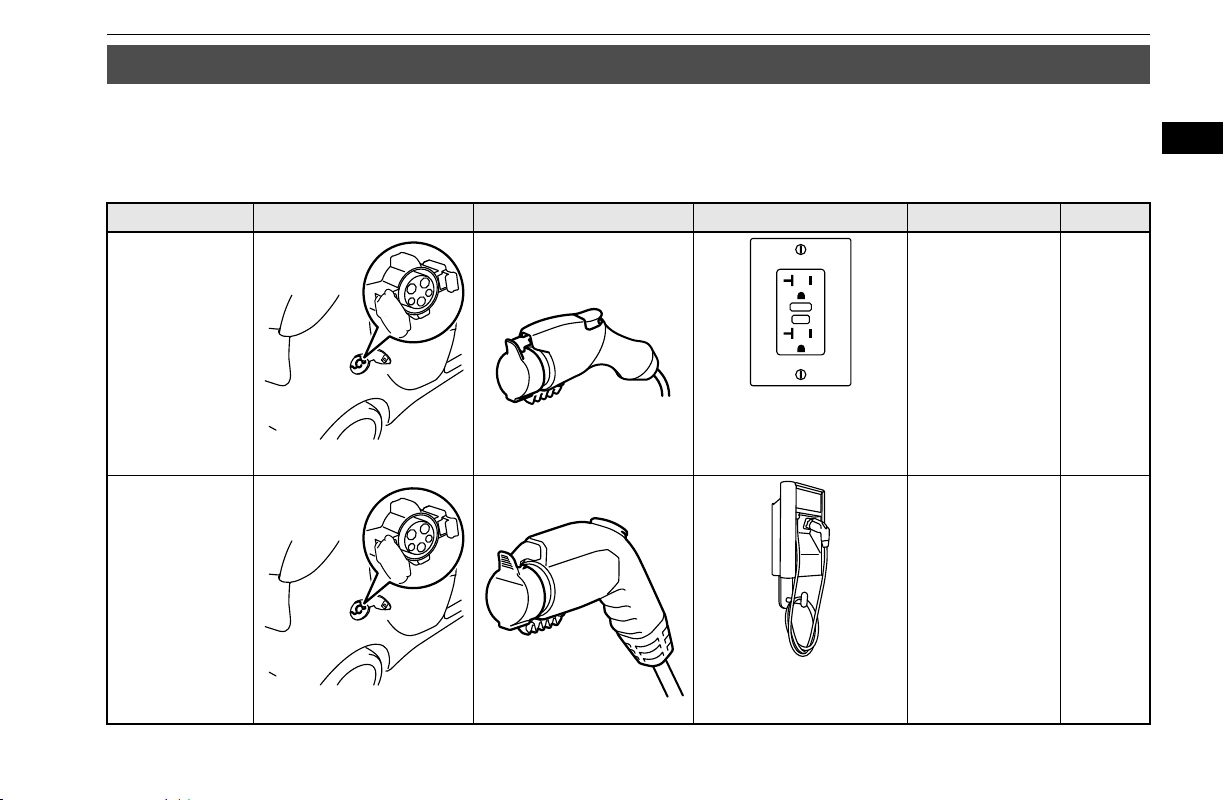
Your vehicle comes standard with a charge port and charging cable (EV charging cable) that uses a household outlet (AC 110-120V) as a charging
source. You may also charge your vehicle using an i-MiEV compatible 220-240V charging device (EVSE*
1
- available separately). Your vehicle
comes equipped with an additional quick charge port to be used with a CHAdeMO*
2
quick charger.
Charging
Category Charge port Charge connector Charging Source Charging time Reference
Level 1
Regular charging
110-120V
(Attached EV
charging cable)
passenger side of vehicle
110-120V household outlet
(15 amp dedicated circuit
required)
120V/8A: Approx-
imately 22-25
hours
120V/12A:
Approximately 14-
16 hours
P.3 -1 6
Level 2
Regular charging
220-240V
(Primary Home
EVSE*
1
Dock-
Available sepa-
rately)
passenger side of vehicle
Home or public charging
device
Approximately 6-7
hours
P.3-16,
3-26
BK0220401US.book 13 ページ 2015年6月3日 水曜日 午前7時42分
Charging
3-14 General information/Charging
3
Charging time will vary depending on battery condition, air temperature and condition of power source (such as specification of the quick char-
ger).
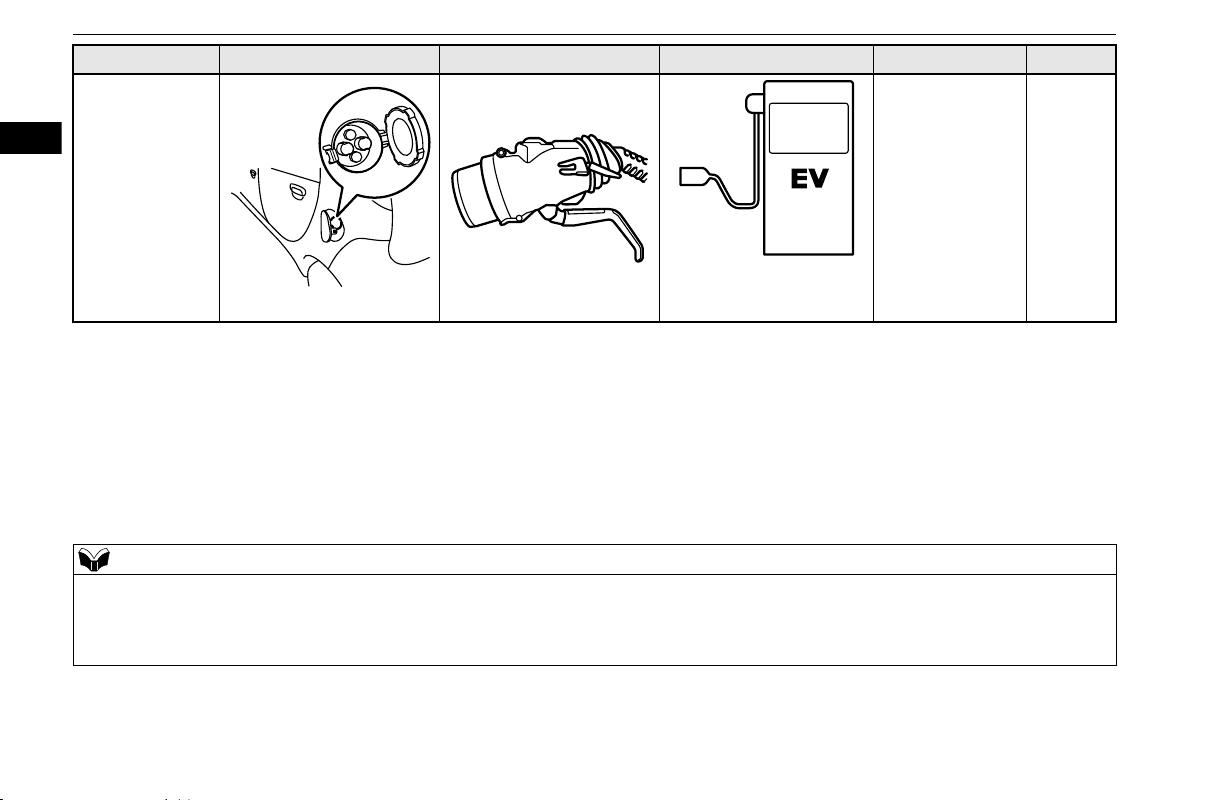
A vehicle equipped with a quick charge port is compatible with most CHAdeMO connectors on charging stations. Charging stations using the
CHAdeMO standard are UL certified and safe to use in the US.
Quick charging
(charging method
with quick char-
ger)
driver side of vehicle
Public charging stations
where available
Approximately 30
minutes for 80 %
charge
P.3-27
*
1
:
EVSE = Electric Vehicle Supply Equipment
*
2
:
CHAdeMO is a standard for quick charging of electric vehicle originally started in Japan, and the contents have also become international
standard.
NOTE
The 12V starter battery will be automatically charged during charging and also while the ready indicator is illuminated. Refer to “Ready indicator” on page
5-44.
Repeatedly performing only quick charging can reduce battery capacity. Regular charging is recommended unless quick charging is necessary.
If the 12V starter battery is discharged, the main drive lithium-ion battery cannot be charged. Refer to “Jump-starting” on page 8-2.
Category Charge port Charge connector Charging Source Charging time Reference
BK0220401US.book 14 ページ 2015年6月3日 水曜日 午前7時42分
Precautions during Charging the Main Drive Lithium-ion Battery
General information/Charging 3-15
3
N01202601051
Precautions during Charg-
ing the Main Drive Lithium-
ion Battery
WARNING
Improper charging can result in a fire,
property damage, and serious injury or
death.
Read the instructions described below
carefully and follow them. Also read and
follow the instructions for “Regular
charging (charging method with rated AC
120V outlet)” on page 3-16, Regular
charging (using 240V Electric Vehicle
Supply Equipment) on page 3-26 and
“Quick charging (charging method with
quick charger)” on page 3-27 before using
the charging device.
• Do not touch regular charge port, regu-
lar charge connector, plug and outlet
with wet hands.
• Keep away from water when connecting
the regular charge port, regular charge
connector, plug and outlet.
• Do not perform charging outdoors in
adverse weather, such as heavy rain,
heavy snow or strong winds, or when
adverse weather is expected.
• Never charge or touch the vehicle when
lightning or thunder is observed or
expected. A lightning strike may back
feed into the regular charger causing
damage and possible personal injury or
death. If lightning or thunder begins
during regular charging, do not touch
the vehicle or the EV charging cable and
turn off the breaker.
• Make sure there is no water or foreign
materials in the charge port, charge con-
nector or plug, and that they are not
damaged or affected by rust or corro-
sion. If any of these conditions are notice-
able, do not charge the main drive
lithium-ion battery.
• Never touch the metal contacts of the
charge port, charge connector or plug.
• Never disassemble or modify the charge
port or charging cable.
• If you notice unusual odor or smoke
coming from the vehicle, charging cable
or plug, or if the charging cable or plug
becomes hot to the touch, stop charging
immediately.
Keep away from the cooling fan under the
hood during charging. During charging,
the cooling fan may automatically be
operated even if the electric motor switch
is in the “LOCK” position.
WARNING
Some public regular chargers may not be
compatible with your vehicle. If necessary,
consult an administrator or the maker of
the regular charger to determine whether
the charger is compatible with your vehi-
cle before using it. Also be sure to use the
regular charger according to operating
procedures indicated on the body of the
regular charger.
CAUTION
Do not place the selector lever in any posi-
tion other than the “P” (PARK) position
while the regular charger is connected. If the
selector lever is placed in a position other
than the “P” position, the vehicle could acci-
dentally move resulting in damage to the reg-
ular charge connector. If the selector lever is
placed in any position other than “P” posi-
tion while the regular charge connector is
still connected and the electric motor switch
is the “ON” position, a warning buzzer will
sound.
To prevent damage to the charging equip-
ment:
• Do not close the charge port lid without
closing the cap.
• Do not subject the charging equipment to
impact.
• Do not pull or twist the charge cable.
• Do not drag the charge cable.
WARNING
BK0220401US.book 15 ページ 2015年6月3日 水曜日 午前7時42分
Regular charging (charging method with rated AC 120 V outlet)
3-16 General information/Charging
3
N01203101040
Carefully read instructions regarding “Pre-
cautions during charging the main drive lith-
ium-ion battery” on page 3-15 and described
in this section and also instructions on “EV
charging cable” on page 3-23 or instructions
for a charging device you use, and follow
them.
• Do not store charging equipment in loca-
tions where the temperature is above 185 °F
(85 °C) or below -40 °F (-40 °C).
• Do not place the charging equipment close
to a heater or other heat source.
Make sure the inner cap is closed on the
charge port when charging is finished. If the
charge port lid is closed when the cap is
opened, water or foreign materials may enter
the charge port.
Do not charge when a vehicle body cover is
in use.
This may cause damage to the charge con-
nector.
Do not attempt to perform a jump start on the
12V starter battery at the same time that the
main drive lithium-ion battery is being
charged. Doing so may damage the vehicle
or charging cable and could cause an injury.
See “Jump-starting” in the “6. For emer-
gency” section.
Forcing the charge connector to connect may
cause damage to the charging equipment and
vehicle.
NOTE
Repeatedly performing only quick charging
can reduce the battery capacity. Regular
charging is recommended unless quick
charging is necessary.
CAUTION
To help maintain the capacity of the main
drive lithium-ion battery, the following is
recommended:
• If you repeatedly perform only the quick
charging, fully charge the vehicle by regu-
lar charging every 2 weeks.
• Do not repeat charging when the main drive
lithium-ion battery is at or near the full
charge.
Both of the regular charging and quick
charge cannot be performed at the same time.
The quick charging is given priority.
While charging, even if the electric motor
switch is in the “LOCK” position, you may
hear operating sounds such as sounds from
the cooling fan and air conditioning com-
pressor when operating the main drive lith-
ium-ion battery cooling system or Remote
Climate Control. This is normal.
Refer to “Remote Climate Control” on page
3-36, 3-47.
It is recommended that you perform regular
charging from 2 bars or less on the energy
level gauge to full at least once every three
months. This allows the energy level gauge
to adjust to decreased battery capacity and
correctly display the remaining energy in the
main drive lithium-ion battery.
A certified i-MiEV dealer can also adjust the
energy level gauge for you when requested.
NOTE
Regular charging (charging
method with rated AC 120 V
outlet)
WARNING
Improper charging can result in a fire,
property damage, and serious injury or
death.
Always use a grounded outlet protected by
a ground-fault circuit interrupter, rated
AC 120V and rated for 15A or more con-
nected to a dedicated branch circuit. If the
outlet is not grounded, the risk of electri-
cal shock will increase in the event of an
insulation failure in the EV charging
cable.
If the circuit is shared, and another elec-
trical device is being used at the same time
the vehicle is charging, the circuit may
heat abnormally, the breaker may trip
and the circuit may cause adverse inter-
ference on household electrical appliances
such as televisions and audio systems.
BK0220401US.book 16 ページ 2015年6月3日 水曜日 午前7時42分
Regular charging (charging method with rated AC 120 V outlet)
General information/Charging 3-17
3
N01216200019
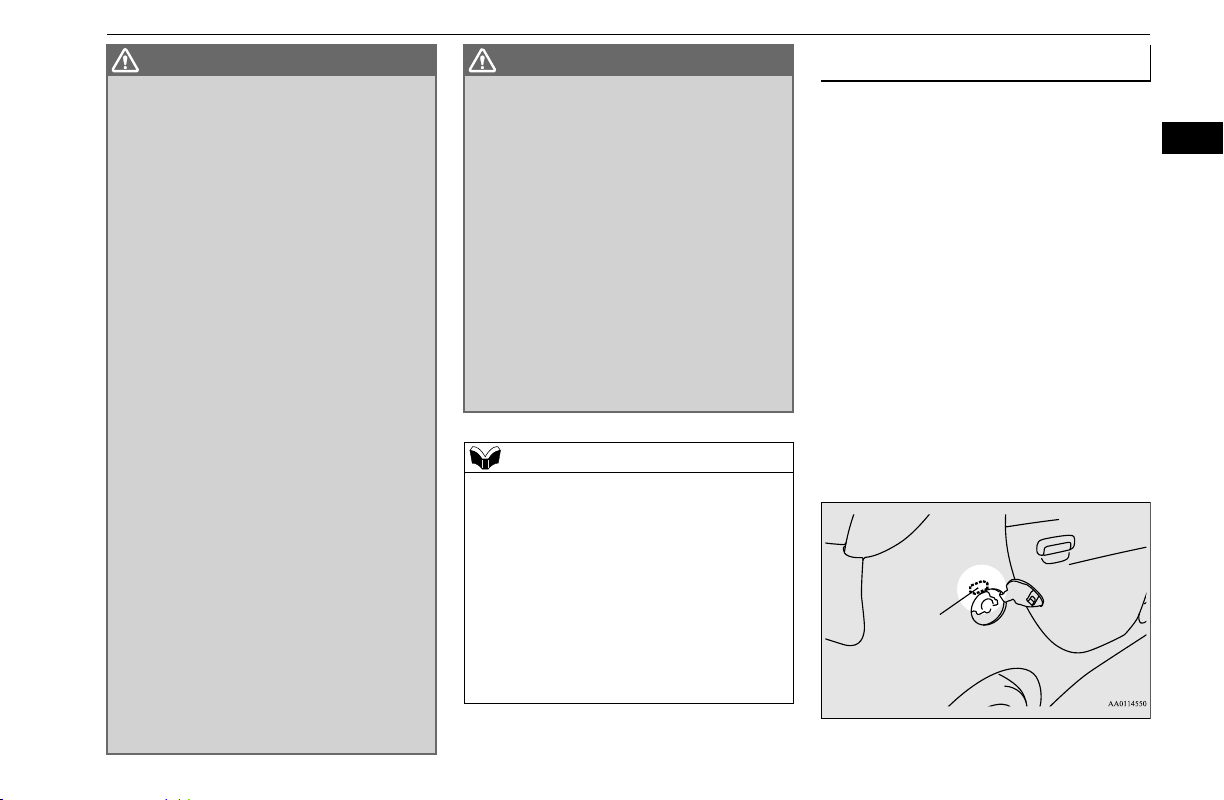
Regular charge port light (A) comes on when
the UNLOCK button on the remote control
transmitter is pressed, or when any door or
the liftgate is opened. The regular charge port
light and the dome lights (with the dome light
switch in the “DOOR” position) will come on
simultaneously. However, the regular charge
port light will not come on when you press
the dome light (front) lens or slide the dome
light (rear) switch to the “ON” position.
For details, refer to “Keyless entry system”
on page 5-5, “Dome light (Front)/Reading
lights” on page 5-77 and “Dome light (Rear)”
on page 5-78.
To turn on the charge port light again, press
the UNLOCK button on the remote control
transmitter, or open any door or the liftgate.
Individuals using an electro-medical
apparatus such as implantable pacemak-
ers and implantable cardiovascular-defi-
brillators should check with the
manufacturer of the apparatus to confirm
the effect of the electromagnetic waves
from charging. The electromagnetic waves
may affect the operations of the electro-
medical apparatus.
If you use an electro-medical apparatus,
such as an implantable cardiac pacemaker
or an implantable cardiovascular defibril-
lator, observe the following precautions
before charging;
• Keep your electro-medical apparatus
away from the charge connector, EV
charging cable, control box and regular
charging station.
• While regular charging;
· Do not stay inside the vehicle.
· Do not go inside the vehicle, for exam-
ple to remove or place an item in the
passenger compartment.
· Do not open the liftgate, for example to
remove or place an item in the cargo
area.
To reduce the risk of electric shock, con-
nect only to a properly grounded and
waterproofed outlet.
Never use an extension cable, multi-plug
adapter or conversion adapter.
Using them may cause overheating result-
ing in fire.
WARNING
Never force the connection if the charging
cable or plug shows damage or is not eas-
ily connected due to foreign material
entering the plug or the outlet.
Never use an outlet that is worn, damaged,
or will not hold the plug firmly.
Make sure that the plug is inserted all the
way into the outlet before use.
While it is normal for the plug and charg-
ing cable to become warm during charg-
ing, discontinue use immediately if the
plug or charging cable becomes too hot to
touch.
Never pull the cable to remove the plug.
Never connect or disconnect the plug with
a wet hand.
NOTE
Your vehicle is equipped with an EV charg-
ing cable for regular charging. Refer to “EV
charging cable” on page 3-23.
When connecting or disconnecting the regu-
lar charge connector, insert/pull out the con-
nector straight.
Also, do not incline or twist the connector.
Doing so could cause a bad connection or
malfunction.
Make sure to lock the doors to prevent theft,
etc. during charging.
WARNING
Regular charge port light
A
BK0220401US.book 17 ページ 2015年6月3日 水曜日 午前7時42分
Regular charging (charging method with rated AC 120 V outlet)
3-18 General information/Charging
3
N01203201041
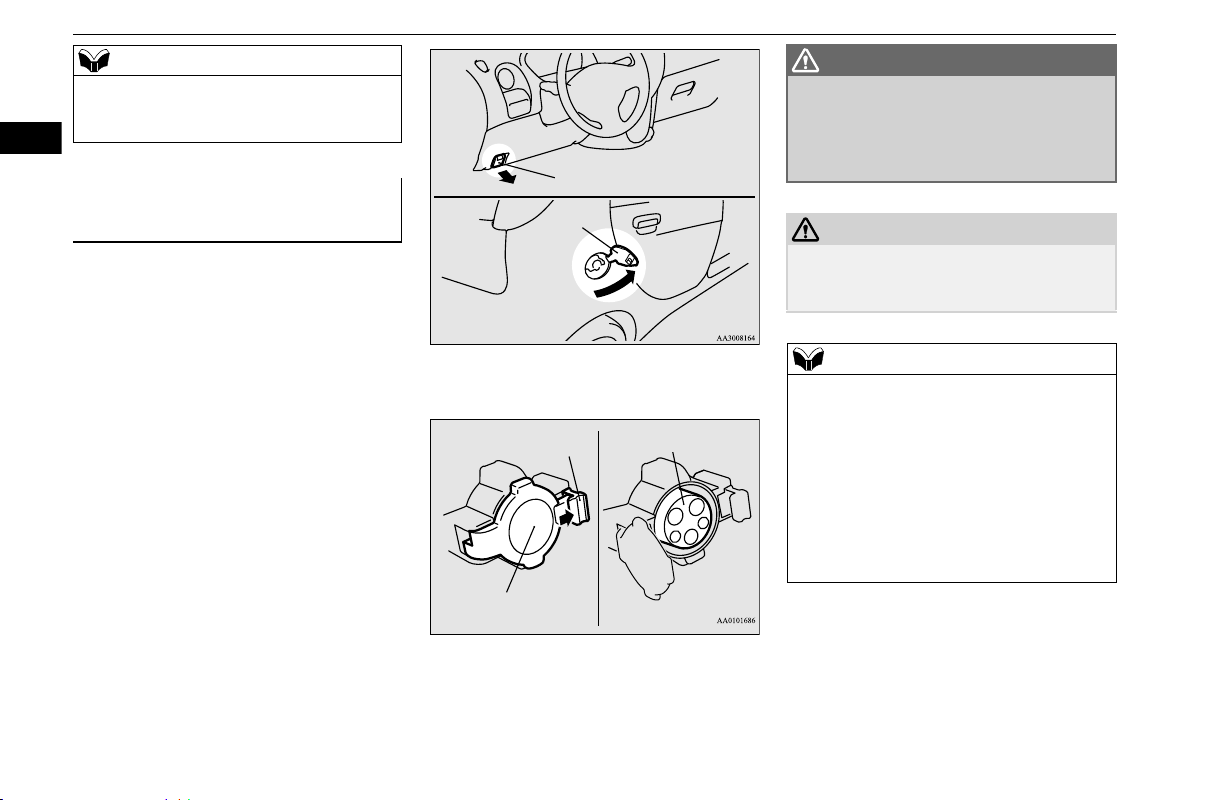
1. Fully apply the parking brake and place
the selector lever to the “P” (PARK) posi-
tion.
2. Stop the electric devices such as lamps
and turn the electric motor switch to the
“LOCK” position.
3. Pull the regular charging opener (B) at the
bottom left of the instrument panel to
open the regular charging lid (C) at the
right rear side of the vehicle.
4. Remove key and lock the vehicle.
5. Press the tab (D) to open the inner lid (E).
6. Insert the charging cable plug into an out-
let.
NOTE
The time until the light goes off can be
adjusted. See a certified i-MiEV dealer for
details.
Charging from rated AC 120 V
outlet
B
C
F
D
E
WARNING
Do not touch the metal terminal of the
charge port (F) and the regular charge
connector.
Doing so could cause an electric shock
and/or malfunction.
CAUTION
To help keeping foreign material out of the
charge port, do not leave the inner lid open
without connecting the charge connector.
NOTE
There is a hole on the charge port for water
drainage. If this hole is blocked and water
gets trapped in the charge port, do not
charge. Contact a certified i-MiEV dealer.
If the charge port becomes frozen, use a hair
dryer to defrost and dry the regular charge
port before charging. Forcing the charging
connector to connect with the regular charge
port while it is frozen can damage the regular
charge port and/or prevent charging.
BK0220401US.book 18 ページ 2015年6月3日 水曜日 午前7時42分
Regular charging (charging method with rated AC 120 V outlet)
General information/Charging 3-19
3
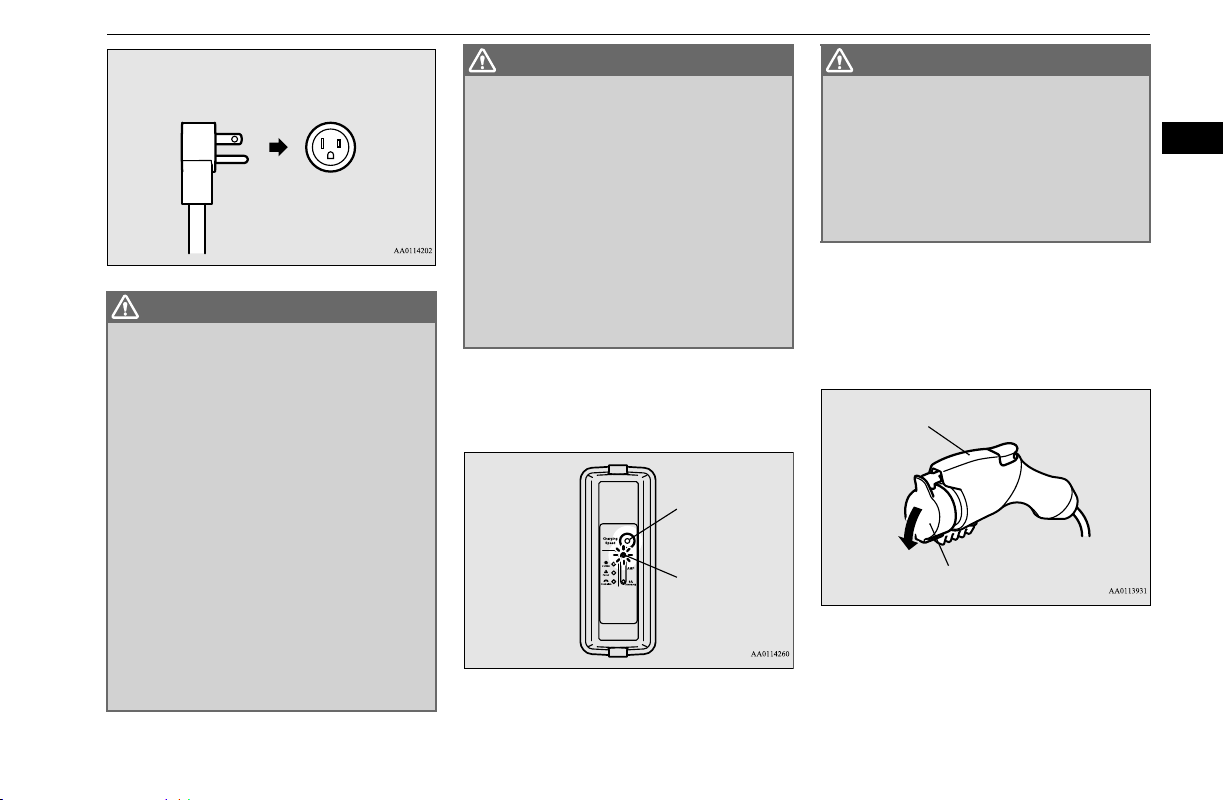
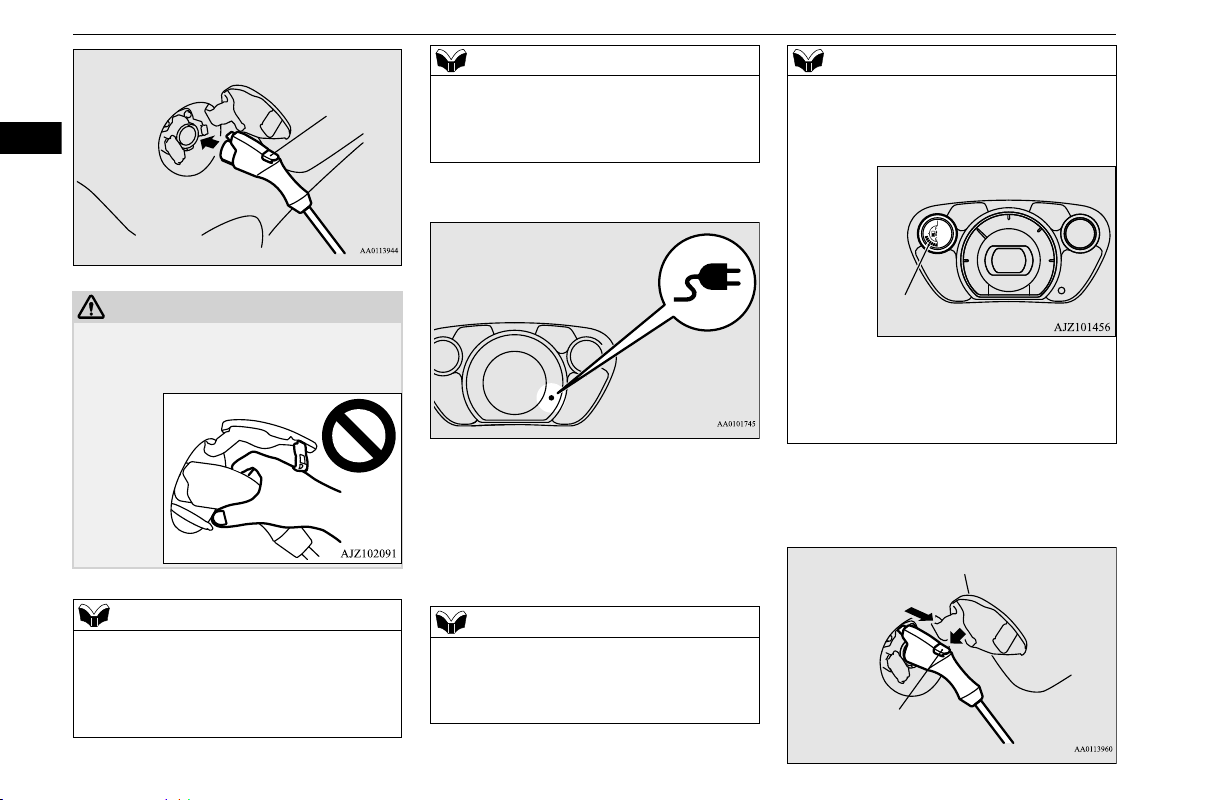
7. Press the 8A/12A manual selection button
(G) on the control box to charge quickly
when needed. If selected, the 12A indica-
tor (H) will illuminated.
8. Open the cap (I) on the regular charge
connector (J) and make sure that there is
no foreign matter such as dust at the end
of the regular charge connector and the
regular charge port.
9. Connect the regular charge connector
until a click is heard without pressing the
button (K).
WARNING
Make sure that the plug is inserted all the
way into the outlet before use.
To reduce the risk of electric shock or fire
due to electric leak, always use a grounded
outlet protected by a ground-fault circuit
interrupter, rated AC 120V and rated for
15A or more, that is connected to a dedi-
cated branch circuit. If the outlet is not
grounded, the risk of electrical shock will
increase in the event of an insulation fail-
ure in the EV charging cable.
If the circuit is shared, and another elec-
trical device is being used at the same time
the vehicle is charging, the circuit may
heat abnormally, the breaker may trip
and the circuit may cause adverse inter-
ference on the household electrical appli-
ances such as televisions and audio
systems.
Never use an extension cable, multi-plug
adapter or conversion adapter. Using
them may cause overheating resulting in
fire.
To prevent an electrical shock or fire, do
not use a multi type outlet. The grounded
line may not work properly and it is not a
dedicated type outlet.
To reduce the risk of electric shock, con-
nect only to a properly grounded and
waterproofed outlet.
Always use an AC 120V outlet rated for
15A or more.
WARNING
G
H
WARNING
If the selected electrical current level
exceeds the electrical current capacity of
the electrical circuit or outlet being used
for charging, the circuit and outlet can
overheat resulting in fire.
If the capacity of an outlet and its electri-
cal circuit are unknown, do not use the
outlet for charging the vehicle.
J
I
BK0220401US.book 19 ページ 2015年6月3日 水曜日 午前7時42分
Regular charging (charging method with rated AC 120 V outlet)
3-20 General information/Charging
3
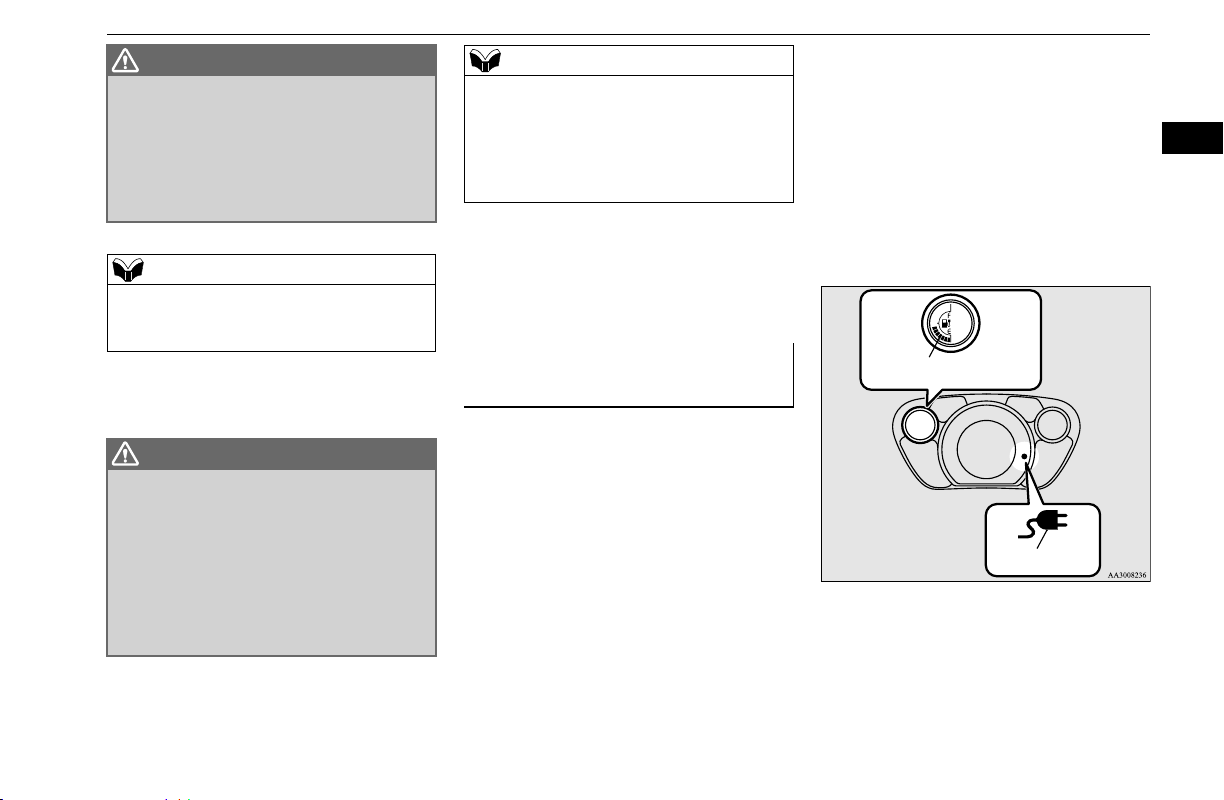
10. Make sure that the charging indicator on
the instrument cluster is illuminated.
If the charging indicator is not illumi-
nated, charging will not start.
Make sure that the regular charge port, the
plug and the connector are correctly con-
nected, and perform charging from Step 5
again.
11. Charging is complete when the charging
indicator turns off. Pull out the regular
charge connector while pressing the but-
ton (M).
CAUTION
Do not clasp the top of regular charge con-
nector. It could cause injury to from the pro-
trusion on the lid.
NOTE
If the electric motor switch is turned to the
“START” position with the regular charge
connector connected to the regular charge
port, the electric motor unit cannot be
started.
K
Do not connect or disconnect the regular
charge connector repeatedly in a short time
period. You may experience difficulty charg-
ing your vehicle.
NOTE
When the regular charge connector is con-
nected to the regular charge port, the charg-
ing indicator is blinking. When charging is
started, the charging indicator is illuminated.
NOTE
The charge level for main drive lithium-ion
battery can be checked with the energy level
gauge (L) on the instrument cluster.
Refer to “Energy level gauge” on page 5-41.
You may hear operating sounds from the
main drive lithium-ion battery cooling sys-
tem, such as sounds from the cooling fan and
air conditioning compressor, during regular
charging. This is normal.
NOTE
L
M
BK0220401US.book 20 ページ 2015年6月3日 水曜日 午前7時42分
Regular charging (charging method with rated AC 120 V outlet)
General information/Charging 3-21
3
12. Close the inner lid and close the regular
charging lid.
13. Remove the charging cable plug from the
outlet.
14. Install the cap on the regular charge con-
nector.
N01202501047
You cannot charge the main drive lithium-ion
battery when the main drive lithium-ion bat-
tery temperature is -13 °F (-25 °C) or lower.
The air conditioning will automatically oper-
ate and the main drive lithium-ion battery
will be heated when all the following condi-
tions are met.
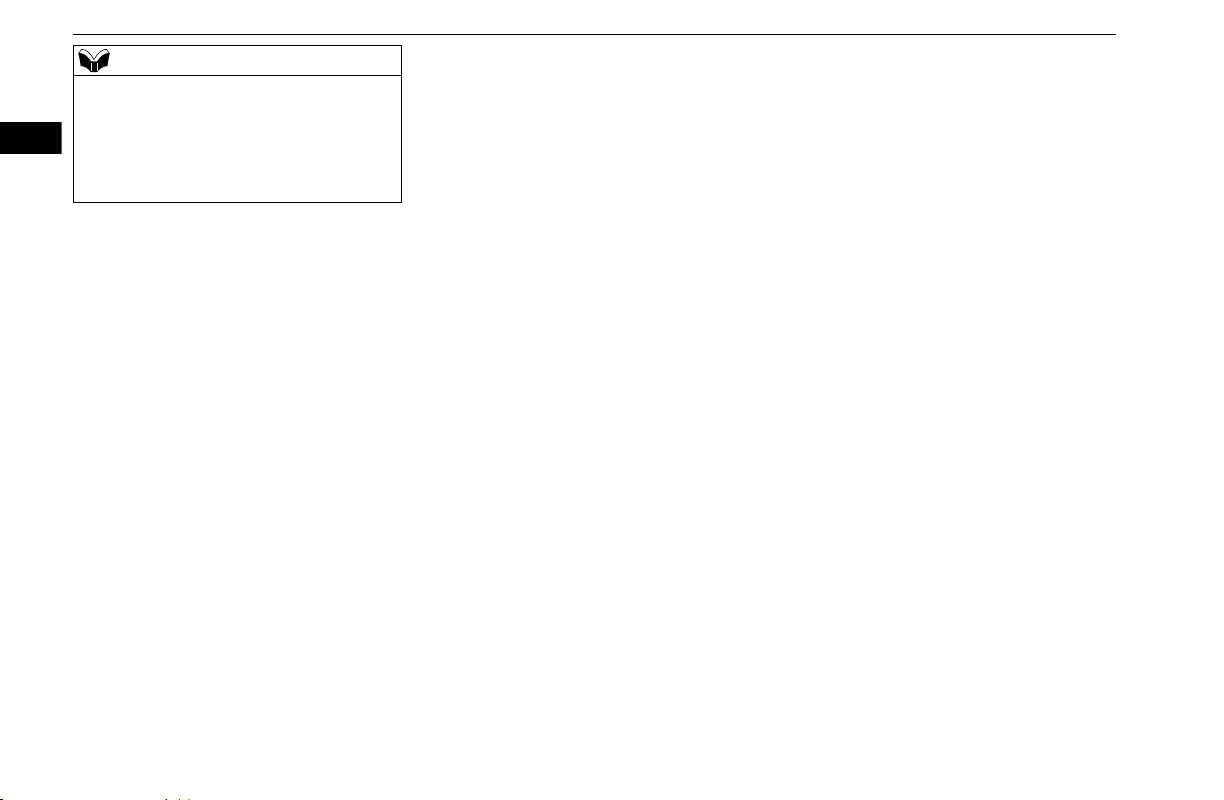
The energy level gauge (A) in the instrument
cluster and charging indicator (B) illuminate
while the main drive lithium-ion battery
warming system is operating.
The main drive lithium-ion battery warming
system will automatically stop when the main
drive lithium-ion battery temperature is -4°F
(-20°C) or higher.
WARNING
After charging, disconnect the charge con-
nector completely from the regular charge
port. If the charge connector remains par-
tially engaged with the latch unlocked, the
electric motor switch can be turned to the
“START” position and the vehicle can be
moved.
NOTE
Charging can be stopped half way. In this
case, pull out the regular charge connector
while pressing the button.
WARNING
After charging, be sure to close the inner
lid and the regular charging lid com-
pletely.
Be careful that water or dust does not
enter in the regular charge port inner lid
and regular charge connector.
Entry of water or dust could cause electric
leakage, resulting in a fire or electric
shock.
NOTE
Make sure that the inner lid is completely
closed before closing the regular charging
lid.
If the regular charging lid is forcibly closed
without completely closing the inner lid, the
hinge on the inner lid may be broken.
Main drive lithium-ion battery
warming system
• The main drive lithium-ion battery tem-
perature is between -22 °F (-30 °C) and
-13 °F (-25 °C).
• The energy level gauge shows 4 bars or
more of full charge.
• The electric motor switch is in the
“LOCK” position.
• The regular charge connector is con-
nected to the regular charge port.
A
B
BK0220401US.book 21 ページ 2015年6月3日 水曜日 午前7時42分
Regular charging (charging method with rated AC 120 V outlet)
3-22 General information/Charging
3
NOTE
When the main drive lithium-ion battery
warming system operates while the remote
climate control is operating, the remote cli-
mate control stops. When the main drive lith-
ium-ion battery warming system stops, the
remote climate control operates again.
BK0220401US.book 22 ページ 2015年6月3日 水曜日 午前7時42分
EV charging cable
General information/Charging 3-23
3
N01202801053
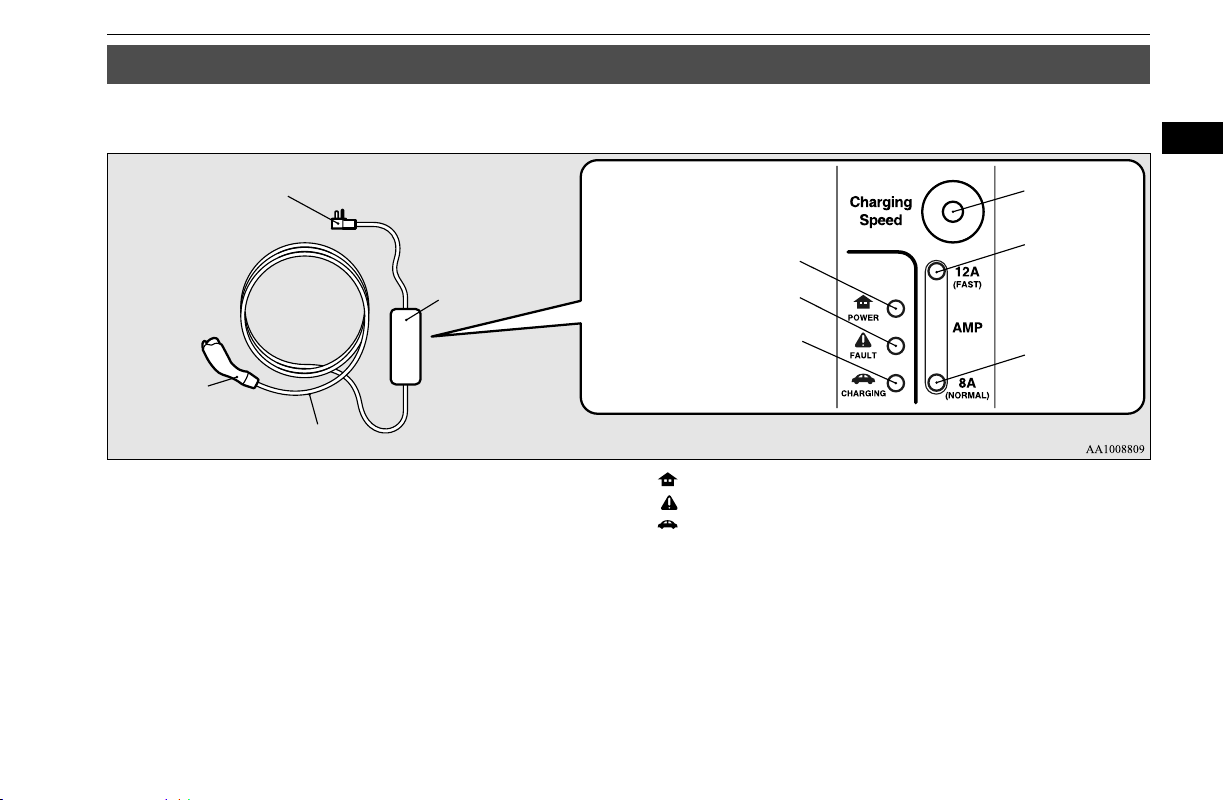
Your vehicle is equipped with an EV charging cable that consists of a cable (A), control box (B), plug (C), and regular charge connector (D).
For a quicker charge, press the 8A/12A manual selection button (E) and confirm that the 12A indicator (F) is illuminated. Each time you press the
button, either the 12A indicator or the 8A indicator (G) will illuminate.
POWER (H), FAULT (I) and CHARGING (J) indicators located on the control box will illuminate/blink in response to the following conditions:
EV charging cable
E- 8A/12A manual selection button
H ( )-
POWER indicator
F- 12A indicator
I ( )-
FAULT indicator
G- 8A indicator J ( )- CHARGING indicator
Indicator (LED) and button
E
C
F
H
BI
J
G
D
A
BK0220401US.book 23 ページ 2015年6月3日 水曜日 午前7時42分
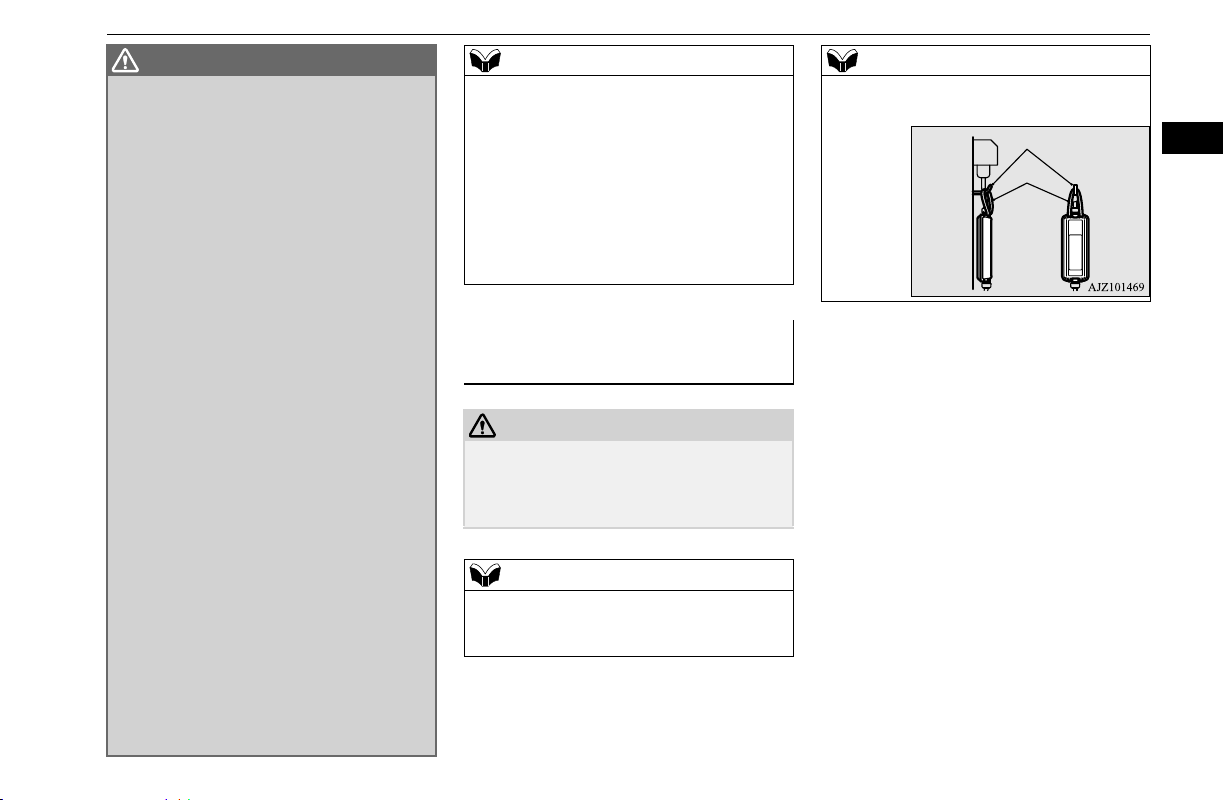
EV charging cable
3-24 General information/Charging
3
: Illuminates : Blinking : Not illuminated
POWER
FAULT
CHARGING
Operating condition
Every time the charging cable plug (C) is connected to an outlet, all indicator lights illuminate
for 1/2 second, then go out.
After initial processing is completed, when the regular charge connector is not connected to the
regular charge port, or the regular charge connector is connected to the regular charge port but
charging is not being performed.
While the main drive lithium-ion battery is being charged
When the ground cable is disconnected
Check the grounding of the outlet being used. If the outlet is properly grounded, contact a certi-
fied i-MiEV dealer.
When charging is completed.
POWER
FAULT
CHARGING
Abnormal operating condition and corrective action
When an electric leakage occurs or the EV charging cable malfunctions.
Stop use immediately and contact a certified i-MiEV dealer.
When the EV charging cable malfunctions.
Stop use immediately and contact a certified i-MiEV dealer.
If the control box indicator light does not illuminate after connecting the charging cable plug to
the outlet, check the circuit breaker for the outlet. If the breaker has tripped, the circuit may not
be suitable for use with EV charging cable. You should have a licensed electrician inspect and
repair the electrical circuit. If the breaker is not tripped, stop using the EV charging cable and
contact a certified i-MiEV dealer.
BK0220401US.book 24 ページ 2015年6月3日 水曜日 午前7時42分
EV charging cable
General information/Charging 3-25
3
N01202901041
FCC Notice: This equipment has been tested
and found to comply with the limits for a
Class B digital device, pursuant to part 15 of
the FCC Rules. These limits are designed to
provide reasonable protection against harmful
interference in a residential installation.
This equipment generates, uses and can radi-
ate radio frequency energy and, if not
installed and used in accordance with the
instructions, may cause harmful interference
to radio communications.
However, there is no guarantee that interfer-
ence will not occur in a particular installation.
If this equipment does cause harmful interfer-
ence to radio or television reception, which
can be determined by turning the equipment
off and on, the user is encouraged to try to
correct the interference by one or more of the
following measures:
WARNING
Improper use of the EV charging cable
can result in a fire, property damage, and
serious injury or death.
Carefully read instructions regarding
“Precautions during charging the main
drive lithium-ion battery” on page 3-15
and on “Regular charging (charging
method with rated AC 120 V outlet)” on
page 3-16 and described in this section
and follow them.
Always use an outlet protected by a
ground-fault circuit interrupter, rated for
15A or more, and that is connected to a
dedicated branch circuit.
Never use an extension cable or conver-
sion adapter.
When using a non-waterproof outlet, take
care to avoid contact with rainwater dur-
ing charging.
Never connect or disconnect the plug with
a wet hand.
Make sure that the plug is inserted all the
way into the socket before use. Continued
charging with a plug not completely
inserted or pulled halfway out of the
socket may result in a risk of overheating
or fire.
If the indictors show the EV charging
cable malfunctions as described below,
stop using the EV charging cable and con-
tact a certified i-MiEV dealer.
Never disassemble the EV charging cable
or attempt to open the control box.
NOTE
All indicators are illuminated momentarily
for confirming operation when the charging
cable plug is inserted into an outlet. After
that, the POWER indicator is continuously
illuminated and the CHARGING indicator is
continuously blinking.
The CHARGING indicator will start to blink
when charging is completed. The POWER
indicator is continuously illuminated while
charging cable plug is inserted into an outlet.
Handling and storing the con-
trol box
CAUTION
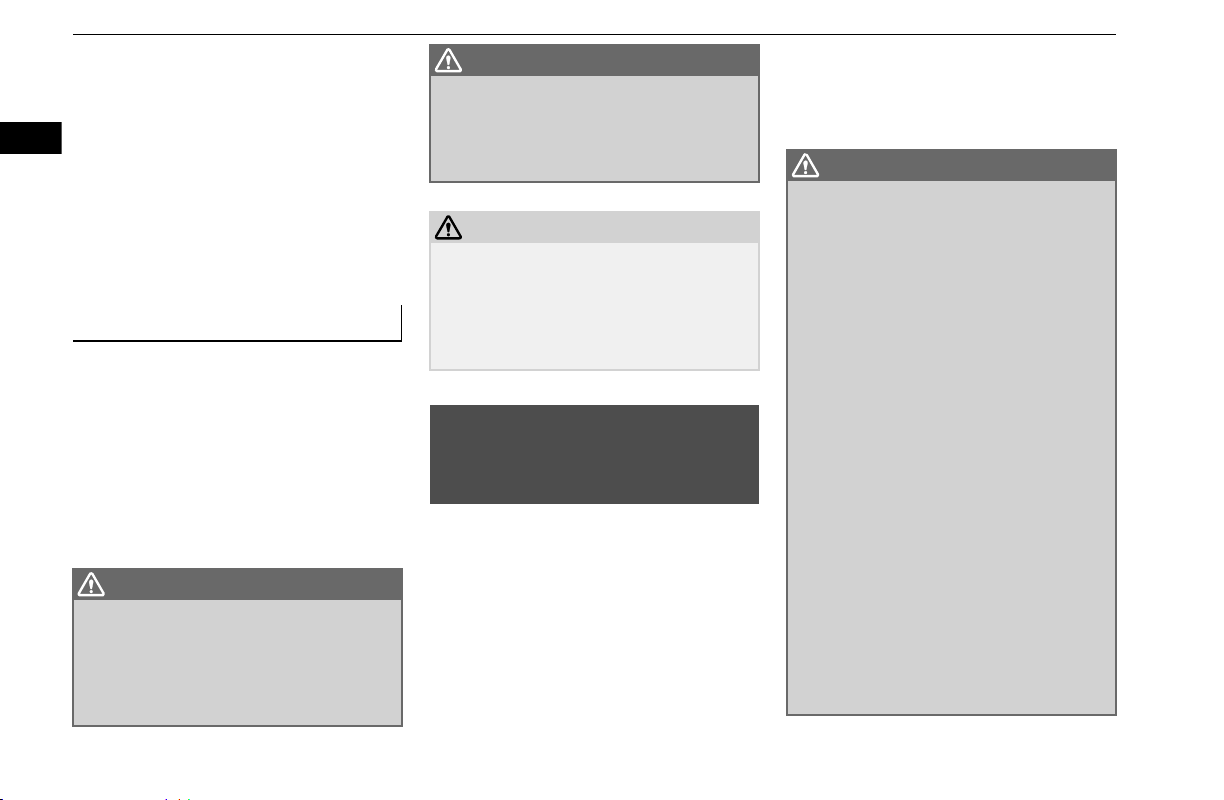
Use the method shown below to help secure
the control box and to prevent the plug from
being pulled halfway out of the socket during
charging.
NOTE
Use hook (A) and a rope (B) that can support
the weight of the EV charging cable, 8.8 lbs
(4 kg) as shown in the figure below.
Make sure that the rope has no damage
before use.
NOTE
A
B
BK0220401US.book 25 ページ 2015年6月3日 水曜日 午前7時42分
Regular charging (using 240 V Electric Vehicle Supply Equipment)
3-26 General information/Charging
3
Reorient or relocate the receiving antenna.
Increase the separation between the
equipment and receiver.
Connect the equipment into an outlet on a
circuit different from that to which the
receiver is connected.
Consult the dealer or an experienced
radio/TV technician for help.
ICES Notice: This Class B digital apparatus
complies with Canadian ICES-003.
N01203000013
1. Gently wipe outside surface of the EV
charging cable with gauze or a similar soft
cloth soaked with a mild soap and water
solution.
2. Wipe off all detergent with a soft cloth
dipped in fresh water and thoroughly
wrung out.
3. Wipe all moisture off and dry in a shaded,
well-ventilated area.
N01216101028
You can charge your vehicle through the reg-
ular charge port using 240V Electric Vehicle
Supply Equipment (EVSE) compatible with
i-MiEV.
Carefully read instructions on “Precautions
during charging the main drive lithium-ion
battery” on page 3-15, described in this sec-
tion.
For connecting/disconnecting the charging
connector to/from the vehicle, follow instruc-
tions for the regular charging (charging
method with rated AC 120V outlet) on page
3-16. Also follow instructions provided with
the 240V EVSE.
Cleaning the EV charging cable
WARNING
Before cleaning, be sure to remove the
charging cable plug from the socket and
the regular charging plug from the vehi-
cle. Do not connect or disconnect the plug
with a wet hand. Doing so can cause an
electric shock.
Never expose the metal terminal of the
regular charge connector or the charging
cable plug to water or neutral detergent.
Water or detergent entering into the plugs
can cause a fire or an electric shock.
CAUTION
Never use benzine, petrol, organic solvents,
acid, or alkaline solvents to clean the charg-
ing cable. Doing so could cause deformation,
discolour, or malfunction. Also, these sub-
stances may be present in various cleaners,
so check carefully before use.
Regular charging (using 240
V Electric Vehicle Supply
Equipment)
WARNING
WARNING
Individuals using an electro-medical
apparatus such as implantable pacemak-
ers and implantable cardiovascular-defi-
brillators should check with the
manufacturer of the apparatus to confirm
the effect of the electromagnetic waves
from charging. The electromagnetic waves
may affect the operations of the electro-
medical apparatus.
If you use an electro-medical apparatus,
such as an implantable cardiac pacemaker
or an implantable cardiovascular defibril-
lator, observe the following precautions
before charging;
• Keep your electro-medical apparatus
away from the charge connector, EV
charging cable, control box and regular
charging station.
• While regular charging;
· Do not stay inside the vehicle.
· Do not go inside the vehicle, for exam-
ple to remove or place an item in the
passenger compartment.
· Do not open the liftgate, for example to
remove or place an item in the cargo
area.
BK0220401US.book 26 ページ 2015年6月3日 水曜日 午前7時42分
Quick charging (charging method with quick charger)
General information/Charging 3-27
3
N01203301039
Your vehicle is equipped with a quick charge
port. The quick charge port is compatible
with most CHAdeMO* connectors on charg-
ing stations.
*: CHAdeMO is a standard for quick charg-
ing of electric vehicle originally started in
Japan, and the contents have become an inter-
national standard. Charging stations using
this standard are UL certified and safe to use
in the US.
Improper charging can result in a fire, prop-
erty damage, and serious injury or death.
Carefully read and follow instructions on
“Precautions during charging the main drive
lithium-ion battery” on page 3-15, instruc-
tions described in this section and also
instructions for the quick charger you use.
CAUTION
Be sure to use a 240V EVSE compatible
with i-MiEV. Use of a non-compatible 240V
EVSE may not charge the main drive lith-
ium-ion battery correctly or may damage the
main drive lithium-ion battery.
NOTE
The 240V EVSE compatible with i-MiEV is
available separately. Contact a certified i-
MiEV dealer.
Quick charging (charging
method with quick charger)
WARNING
Be sure to use a quick charger compatible
with i-MiEV. Use of a non-compatible
quick charger may cause a fire or mal-
function.
For the quick charger compatible with i-
MiEV, consult an certified i-MiEV dealer.
For operation of a quick charger, follow
instructions for each quick charger.
If you use an electro-medical apparatus,
such as implantable cardiac pacemaker or
an implantable cardiovascular defibrilla-
tor, follow the precautions described
below. Quick charging may affect the
operation of electric medical devices.
• Do not perform quick charging and keep
away from a quick charger. Electromag-
netic waves produced by a quick charger
may affect the operation of your electric-
medical apparatus.
• If you have accidentally approached a
quick charger, walk away from the quick
charger immediately.
• If quick charging is necessary, ask some-
one for help.
• While quick charging;
· Do not stay inside the vehicle.
· Do not go inside the vehicle, for exam-
ple to remove or place an item in the
passenger compartment.
· Do not open the liftgate, for example to
remove or place an item in the cargo
area.
Never connect or disconnect the charger
with a wet hand.
Never pull the cable to disconnect the
charger.
During charging, the cooling fans under
the hood may automatically be operated
even if the electric motor switch is in the
“LOCK” position. Keep your hands away
from the cooling fan during charging.
As the quick charge connector is heavier
in comparison to the regular charge con-
nector, allowing it to drop could cause
damage to the vehicle or charge connector
or personal injury.
CAUTION
If the charge connector cannot easily be con-
nected to the quick charge port, do not force
the connection. Foreign material may be in
the charge connector or quick charge port, or
the charging device may not be compatible
with your vehicle. Contact a certified i-
MiEV dealer.
WARNING
BK0220401US.book 27 ページ 2015年6月3日 水曜日 午前7時42分
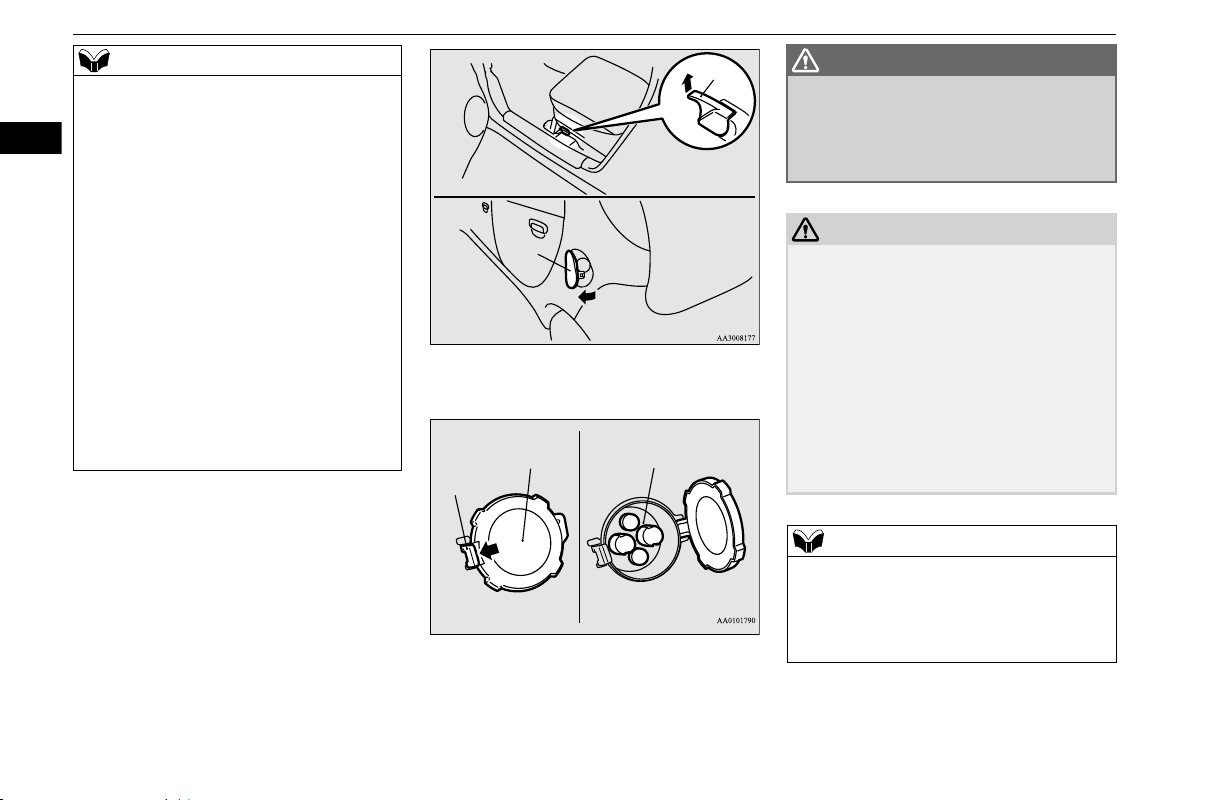
Quick charging (charging method with quick charger)
3-28 General information/Charging
3
1. Fully apply the parking brake and move
the selector lever to the “P” (PARK) posi-
tion.
2. Stop the electric devices such as lamps,
air conditioning, etc. and turn the electric
motor switch to the “LOCK” position.
3. Pull the quick charging lid opener (A) at
the bottom left of the driver’s seat to open
the quick charging lid (B) at the left rear
side of the vehicle.
4. Remove key and lock the vehicle.
5. Press the tab (C) to open the inner lid (D).
NOTE
Repeatedly performing only quick charging
can reduce the battery capacity. Regular
charging is recommended unless quick
charging is necessary.
Before using a publicly available quick char-
ger, confirm that the charger is suitable for
your vehicle.
Make sure to lock the doors to prevent theft,
etc. during charging.
Do not turn the electric motor switch to the
“ON” position during quick charging; doing
so will stop quick charging.
When using a quick charger, make sure that
the time available is enough so that the quick
charging can be finished in the time avail-
able.
If the power supply of the quick charger is
shut off during quick charging, it could lead
to a vehicle failure.
A
B
E
D
C
WARNING
Do not touch the metal terminal of the
quick charge port (E) and the quick
charge connector.
Doing so could cause an electric shock
and/or malfunction.
CAUTION
Be sure to insert the quick charge connector
straight into the quick charge port all the way
to the base.
Failure to do so may result in the main drive
lithium-ion battery not charging or cause
damage to the charging equipment.
Do not leave the inner lid open for any sig-
nificant period of time without the charge
connector inserted. Foreign material, if
allowed to enter the quick charge port, can
damage the quick charge port and/or prevent
charging.
NOTE
There is a hole on the quick charge port for
water drainage. If this hole is blocked and
water gets trapped in the quick charge port,
do not charge. Contact a certified i-MiEV
dealer.
BK0220401US.book 28 ページ 2015年6月3日 水曜日 午前7時42分
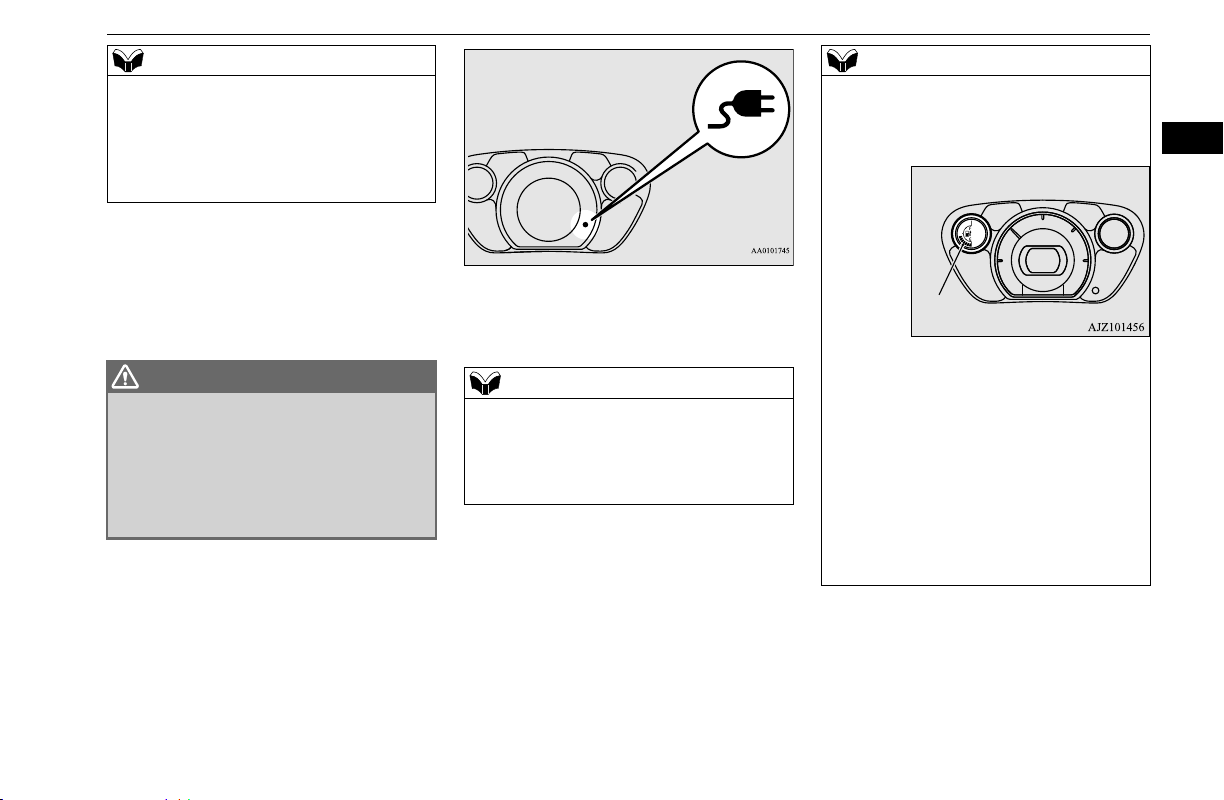
Quick charging (charging method with quick charger)
General information/Charging 3-29
3
6. Insert the quick charge connector com-
pletely into the quick charge port to begin
charging.
For connecting and disconnecting, follow
the instruction manual for each quick
charger.
7. Make sure that the charging indicator on
the instrument cluster is illuminated.
If the charging indicator is not illumi-
nated, charging has not started.
Refer to the quick charger user manual.
8. Charging is complete when the charging
indicator turns off.
Disconnect the quick charge connector
according to the manual of the quick char-
ger.
If the quick charge port becomes frozen, use
a hair dryer to defrost and dry it before
charging. Forcing the charging connector
into the quick charge port while it is frozen
can damage the quick charge port, and it may
prevent charging.
WARNING
Be sure to insert the charge connector
completely into the quick charge port.
If the charge connector is only partially
inserted and the connector latch is not
locked, the electric motor switch could be
turned to the “START” position and the
vehicle could start moving
NOTE
NOTE
When the quick charging plug is connected
to the charging connection, the charging
indicator will blink. Once charging has
started, the charging indicator will illumi-
nate.
The charge level for the main drive lithium-
ion battery can be checked with the energy
level gauge (F) on the instrument cluster.
Refer to “Energy level gauge” on page 5-41.
You may hear operating sounds from the
main drive lithium-ion battery cooling sys-
tem, such as sounds from the cooling fan and
air conditioning compressor, during quick
charging. This is normal.
Since the main drive lithium-ion battery
cooling system uses cool air from the air
conditioning system, the air conditioning
will automatically be operated.
After quick charging, you may find dehu-
midified water from the air conditioning sys-
tem under the vehicle. This is normal.
NOTE
F
BK0220401US.book 29 ページ 2015年6月3日 水曜日 午前7時42分
Quick charging (charging method with quick charger)
3-30 General information/Charging
3
9. Close the inner lid and close the quick
charging lid.
CAUTION
Do not leave the quick charge connected to
the quick charge port after charging.
Someone might stumble on the charger or
the quick charge port might get damaged.
NOTE
Although it is possible to start the electric
motor unit if quick charging has not finished
normally, the charging indicator is continu-
ously blinking. In such a situation, perform
quick charging again and finish it normally
or contact a certified i-MiEV dealer.
WARNING
After charging, be sure to close the inner
lid and the quick charging lid completely.
Be careful that water or dust does not
enter in the quick charge port, inner lid
and quick charge connector.
Entry of water or dust could cause a fire,
electric shock or short circuit.
NOTE
If the electric motor switch is turned to the
“START” position with the quick charge
connector connected to the quick charge
port, the electric motor unit cannot be
started.
Be sure to disconnect the quick charge con-
nector before starting the electric motor unit.
Charging may stop before full charge. This is
a control for efficient charge and not a mal-
function.
To achieve full charge, repeat charging from
Step 5 again.
Make sure that the inner lid is completely
closed before closing the quick charging lid.
If the quick charging lid is forcibly closed
without first completely closing inner lid, the
hinge on the inner lid may be broken.
BK0220401US.book 30 ページ 2015年6月3日 水曜日 午前7時42分
Charging troubleshooting guide
General information/Charging 3-31
3
N01202301032
Charging troubleshooting guide
Symptom Possible cause Possible solution
Charging cannot be started. The electric motor switch is in the
ON position.
Before charging, place the electric motor switch in the “LOCK” position.
The main drive lithium-ion battery is
already fully charged.
Charging cannot be performed if the main drive lithium-ion battery is
already fully charged. Charging automatically turns off if the main drive
lithium-ion battery is fully charged.
The temperature of the main drive
lithium-ion battery is too high or too
low to charge.
Confirm the main drive lithium-ion battery temperature.
Refer to “Cautions and actions to deal with intense heat” on page 3-8 and
“Cautions and actions to deal with intense cold” on page 3-10.
The 12V starter battery is discharged. The main drive lithium-ion battery can be charged if the vehicle electrical
systems cannot be turned on. If the battery is discharged, charge or jump
start the 12V starter battery. Refer to “Jump-starting” on page 8-2.
The vehicle or the charging cable has
a malfunction.
The vehicle or the charging cable may have a malfunction. Confirm if the
warning light on the meter is illuminated. Confirm if the indicator on the
charger is indicating a malfunction. If a warning is displayed, stop charg-
ing and contact a certified i-MiEV dealer.
The fuse has blown. Confirm if the fuse of the interior lights (dome lights) in the fuse block in
the passenger compartment located in front of the driver’s seat has blown.
Refer to “Fuses” on page 9-18.
BK0220401US.book 31 ページ 2015年6月3日 水曜日 午前7時42分
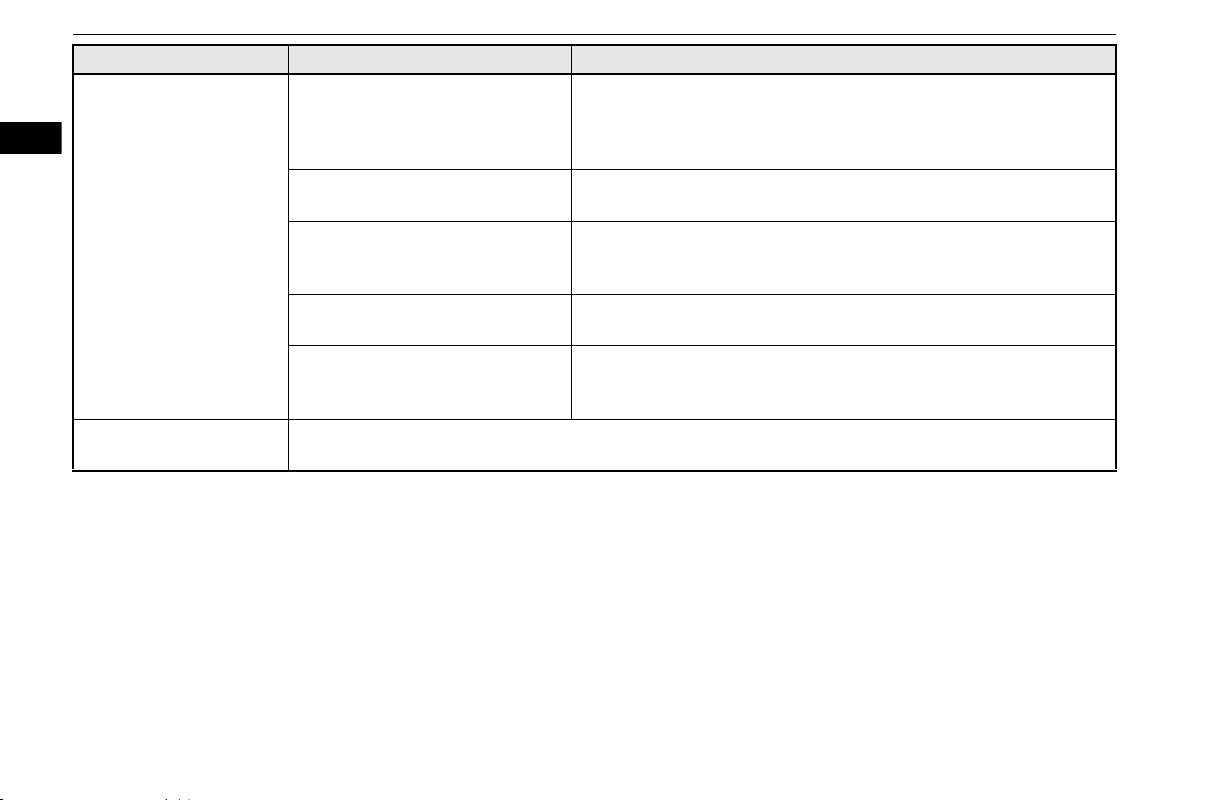
Charging troubleshooting guide
3-32 General information/Charging
3
Regular charging cannot be
started.
There is no electrical power coming
from the outlet.
Confirm that there has not been a power failure. Make sure the breaker is
on. If an outlet with a timer device installed is used, power will only be
available at the time set by the timer.
Confirm if the POWER indicator on the control box is illuminated.
The charge connector is not con-
nected correctly.
Confirm the charge connector is connected correctly.
The charge connector was connected
and disconnected repeatedly in a
short time.
Disconnect the charge connector, wait for a while, then start charging pro-
cedure again from the beginning.
A charging cable for other vehicle is
used.
Use the EV charging cable only for your vehicle.
The regular charger may not be com-
patible with your vehicle.
Ask an administrator or the manufacturer of the regular charger whether
the charger is compatible with your vehicle. Always follow the instruc-
tions shown on the regular charger.
Charging Timer by MiEV
remote cannot be started.
Refer to “Action to be taken when the MiEV Remote system does not operate correctly” on page 3-52.
Symptom Possible cause Possible solution
BK0220401US.book 32 ページ 2015年6月3日 水曜日 午前7時42分

Charging troubleshooting guide
General information/Charging 3-33
3
Regular charging is discon-
tinued.
There is no power coming from the
outlet.
There may have been a electrical power failure, or the breaker may have
failed.Charging will resume when the power source is reset.
The EV charging cable has been dis-
connected.
Check that the EV charging cable has not been disconnected.
The button on the regular charge con-
nector has been pressed.
If the charge connector button is pressed for a long period of time, charg-
ing will be stopped. Start the charging procedure again.
The temperature of the main drive
lithium-ion battery is too hot or too
cold to charge.
Confirm the main drive lithium-ion battery temperature.
Refer to “Cautions and actions to deal with intense heat” on page 3-8 and
“Cautions and actions to deal with intense cold” on page 3-10.
Charging is stopped by the regular
charge timer.
Charging will stop depending on the timer function setting of the regular
charge device. If you need to charge the main drive lithium-ion battery
more, start the charging procedure again.
Quick charging cannot be
started.
The charge connector is not con-
nected correctly and/or not locked.
Check that the charge connector is connected correctly and that it is
locked.
The self-diagnostic function of the
quick charge device returns a nega-
tive result.
There is a possibility that the vehicle has a malfunction. Stop charging and
contact a certified i-MiEV dealer.
The power switch of the quick char-
ger is off.
Check the power switch of the quick charger.
Consult an administrator or a maker of the quick charger.
Quick charge is discontin-
ued.
Charging is stopped by the quick
charge timer.
Charging will stop depending on the timer function setting of the quick
charge device.If you need to charge the main drive lithium-ion battery
more, start the charging procedure again.
Charging stops at 80% capacity. Charging is designed to stop when the main drive lithium-ion battery
capacity reaches 80%. If you need to charge the main drive lithium-ion
battery more than 80%, start the charging procedure again.
The power supply for the quick char-
ger is off.
Check whether the power supply for the quick charger is off.
Consult an administrator or a maker of the quick charger.
Symptom Possible cause Possible solution
BK0220401US.book 33 ページ 2015年6月3日 水曜日 午前7時42分
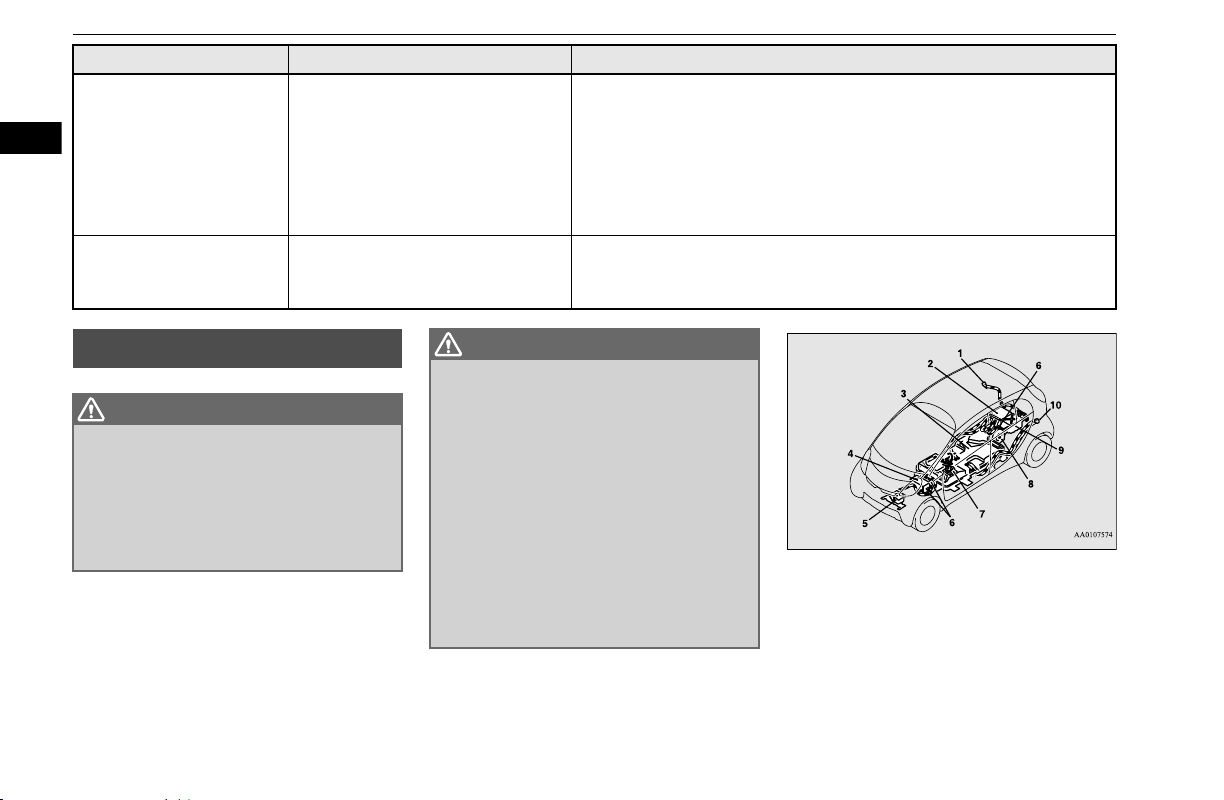
High-Voltage components
3-34 General information/Charging
3
N01205700027
High voltage components and wiring cables
are located as shown in the figure below.
The charging indicator is
continuously blinking even
if the quick charge connec-
tor is not connected into the
quick charge port when you
start the electric motor unit
after quick charging.
Quick charging has not finished nor-
mally.
Perform quick charging again and finish it normally or contact a certified
i-MiEV dealer.
EV (Electric Vehicle) sys-
tem does not start after
quick charging.
The vehicle has a malfunction. Contact a certified i-MiEV dealer.
If you need to push the vehicle, turn the electric motor switch to the “ON”
position and move the selector lever to the “N”(NEUTRAL) position.
Symptom Possible cause Possible solution
High-Voltage components
WARNING
The EV (Electric Vehicle) system uses high
voltage up to DC 330 volt. The system can
be hot during and after starting and when
the vehicle is shut off. Be careful of both
the high voltage and the high temperature.
Follow the warning labels that are
attached to the vehicle.
Never touch, disassemble, remove or
replace high-voltage parts, exposed elec-
trical components, cables or connectors.
Failure to follow this instruction can
result in severe burns or electric shock
causing serious injury or death. High-volt-
age cables are colored orange. The vehicle
high voltage system has no user service-
able parts. Take your vehicle to a Certified
i-MiEV dealer for any necessary mainte-
nance.
Always assume the high voltage battery
and associated components are energized
and fully charged.
WARNING
1- Regular charge port
2- MCU
3- Main drive lithium-ion battery
4- Heater
5- Air conditioner compressor
6- High voltage connector
7- Service plug
8- Electric motor (Electric motor unit)
9- On board charger/DC-DC converter
BK0220401US.book 34 ページ 2015年6月3日 水曜日 午前7時42分
High-Voltage components
General information/Charging 3-35
3
N01205800031
A crash or impact significant enough to
require an emergency response for conven-
tional vehicles would also require the same
response for electric vehicles.
Also follow the instructions described below
to avoid severe burns and electrical shock that
may result in serious injury or death.
10- Quick charge port
In case of a collision
WARNING
If your vehicle is drivable, pull your vehi-
cle off the road to a safe, nearby location
and remain on the scene.
Also, if possible, do the following opera-
tions and stay out of the way of any
oncoming traffic while awaiting the
arrival of emergency responders.
• Apply chocks to the wheels.
• Move the selector lever to the “P”
(PARK) position.
• Apply the parking brake.
• Open the windows, doors and liftgate.
• Turn the electric motor switch to the
“LOCK” position.
• Turn on the hazard warning flashers.
• Move the key away from the vehicle to
prevent unintended start-up of the sys-
tem by inadvertent contact with a switch
or impact from the crash.
Never touch high-voltage wiring, connec-
tors, and other high-voltage parts, such as
the inverter unit and main drive lithium-
ion battery. An electric shock may occur if
exposed electric wires are visible when
viewed from inside or outside of your
vehicle. For their locations, see “High-
voltage components” on page 3-34.
If the vehicle receives a strong impact to
the floor while driving, stop the vehicle in
a safe place and check the floor.
Leaks or damage to the main drive lith-
ium-ion battery may result in a fire. If you
discover them, contact emergency services
immediately. Since the fluid leak may be
lithium manganite from the Lithium-ion
battery, never touch any fluid leaking
from the inside or outside of the vehicle. If
the fluid contacts your skin or eyes, wash
it off immediately with a large amount of
water and receive immediate medical
attention to help avoid serious injury.
If you are unable to safely assess the vehi-
cle due to vehicle damage, do not touch
the vehicle. Leave the vehicle and contact
emergency services. Advise emergency
responders that this is an electric vehicle.
WARNING
If a fire occurs in this vehicle, leave the
vehicle as soon as possible and contact
emergency services. Do not attempt to
extinguish a fire by yourself. If the fire
involves a lithium-ion battery, it will
require large, sustained volumes of water
for extinguishment. Using a small amount
of water or the incorrect fire extinguisher
can result in serious injury or death from
electrical shock.
When you leave the vehicle, if possible,
open the windows, doors and liftgate to
prevent accumulation of poisonous/com-
bustible gasses. This will also assist in the
rescue and fire fighting process.
As with any vehicle fire, the byproducts of
combustion can be toxic. Do not inhale
smoke, vapors, or gas from the vehicle.
Move to a safe distance upwind and uphill
from the vehicle fire and out of the way of
any oncoming traffic while awaiting the
arrival of emergency responders.
If you detect leaking fluids, sparks, smoke,
flames, gurgling, popping or hissing noises
originating from the high voltage battery
compartment, contact emergency services
immediately. This may result in a fire.
Physical damage to the vehicle or high
voltage battery may result in immediate or
delayed release of toxic and/or flammable
gases and fire.
WARNING
BK0220401US.book 35 ページ 2015年6月3日 水曜日 午前7時42分
MiEV Remote System
3-36 General information/Charging
3
N01203401056
The MiEV Remote System has the following
three functions.
Charging Timer P.3-41
When the EV charging cable (regular
charger) (Level 1 or Level 2) is con-
nected, the batteries will only charge
during the pre-set time period selected
using the MiEV Remote.
Remote Climate Control P.3-47
When the EV charging cable (regular
charger) (Level 1 or Level 2) is con-
nected, the air-conditioner or heater can
be activated for up to 30 minutes prior
to vehicle usage. This feature can be
used to cool or heat the car and to acti-
vate the front and rear window
defroster.
Main Drive Lithium-ion Battery Level
Indicator P.3-50
The charge remaining in the Main
Drive Lithium-ion Battery can be con-
firmed through the MiEV Remote.
For your quick reference, refer to “Basic
operation of the MiEV Remote” on page
3-40.
If your vehicle needs to be towed, trans-
port the vehicle on a flatbed truck or tow
the vehicle either with all wheels or the
rear wheels (drive wheels) off the ground.
If the rear wheels are on the ground when
towing, this may cause damage to the elec-
tric motors. This may also cause a fire, if
wiring in the electric motor unit room
becomes damaged. Refer to “Towing” on
page 8-11.
Do not attempt to repair a damaged elec-
tric vehicle yourself. Please contact a cer-
tified i-MiEV dealer for service.
In the event of an accident that requires
body repair and painting, the vehicle
should be delivered to a Certified i-MiEV
dealer to have the main drive lithium-ion
battery and high voltage parts such as the
inverter, including the attached wiring
harness, removed prior to painting. If
exposed to heat in the paint booth, the
main drive lithium-ion battery will experi-
ence battery capacity loss.
A damaged main drive lithium-ion battery
can also pose safety risks to untrained
mechanics and repair personnel.
NOTE
The emergency shut-off system will be acti-
vated and the high-voltage system will auto-
matically turn off under the following
conditions:
WARNING
• Certain front, side or rear collisions.
• Certain EV (Electric Vehicle) system mal-
functions.
When the emergency shut-off system is acti-
vated, the ready indicator is turned off. Refer
to “Indicator and warning light package” on
page 5-43.
If the emergency shut-off system activates,
contact a Certified i-MiEV dealer.
MiEV Remote System
NOTE
COOL:Operates in cooling mode intended
for exclusive use with Remote Cli-
mate Control (Pre-Cooling Mode).
HEAT:Operates in heating mode intended
for exclusive use with Remote Cli-
mate Control (Pre-Heating Mode).
The heated seats can be used while
the Remote Climate Control is acti-
vated.
:
Operates in defroster mode intended
for exclusive use with Remote Cli-
mate Control (Pre-Defroster Mode).
The electric rear window defogger is
activated automatically when the
Remote Climate Control is activated
in Pre-Defroster Mode.
BK0220401US.book 36 ページ 2015年6月3日 水曜日 午前7時42分
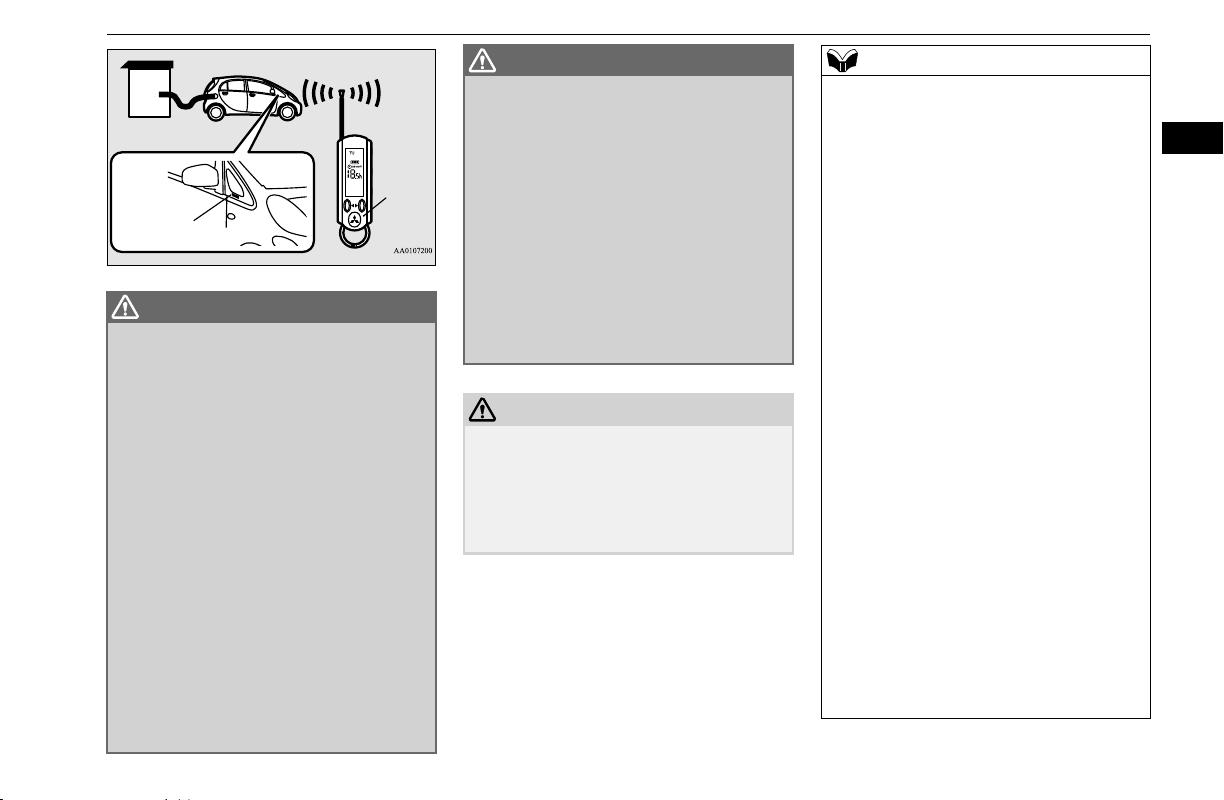
MiEV Remote System
General information/Charging 3-37
3
WARNING
Individuals who use implantable pace-
makers or implantable cardiovascular-
defibrillators should keep away from the
external and internal transmitters. The
electromagnetic waves used in the MiEV
Remote System may affect the operation
of implantable pacemakers and implant-
able cardiovascular-defibrillators.
Individuals using other electro-medical
apparatus besides implantable pacemak-
ers and implantable cardiovascular-defi-
brillators should check with the
manufacturer of the apparatus to confirm
the effect of the electromagnetic waves
used by the MiEV Remote System. The
electromagnetic waves may affect the
operations of the electro-medical appara-
tus.
Never use the MiEV Remote near medical
equipment. Electromagnetic waves could
adversely affect the medical equipment.
MiEV
Remote
Glass antenna
Keep the MiEV Remote in the place where
children will not touch or play with the
remote.
When bringing the MiEV Remote on
flights, do not press any switches on the
MiEV Remote while on the plane. If a
switch is pressed on the plane, the MiEV
Remote emits electromagnetic waves
which like cell phones and other wireless
devices, could interfere with systems on
the airplane.
When carrying the MiEV Remote in a
bag, be careful that no switches on the
MiEV Remote can be pressed by mistake.
CAUTION
Never disassemble or modify the MiEV
Remote. No user serviceable parts are inside
except batteries.
Disassembling or modifying the MiEV
Remote or removing a label from the MiEV
Remote may violate regulations.
WARNING
NOTE
The MiEV Remote system uses radio waves.
The MiEV Remote can operate within
approximately 328 feet (100 m) from the
vehicle.
In the following environments or situations,
the MiEV Remote may not transmit and
receive radio waves correctly. As a result,
the remote may not operate properly.
• When the vehicle and the MiEV Remote
are separated by a concrete wall.
• When there is a metal wall between the
vehicle and the MiEV Remote.
• When the vehicle is surrounded by other
tall vehicles.
• When the vehicle and/or the MiEV Remote
is near a facility emitting strong radio
waves, such as a television tower, a trans-
former substation, a broadcasting station or
an airport.
• When other electrical equipment such as
computers or cell-phones are placed near
the MiEV Remote.
• When the MiEV Remote touches some-
thing metallic, or is covered by a metal
object.
• When batteries for the MiEV Remote are
weak.
Melody and buzzer from the MiEV Remote
can be turned on or off.
Refer to “To turn on/off melody and buzzer”
on page 3-49.
BK0220401US.book 37 ページ 2015年6月3日 水曜日 午前7時42分
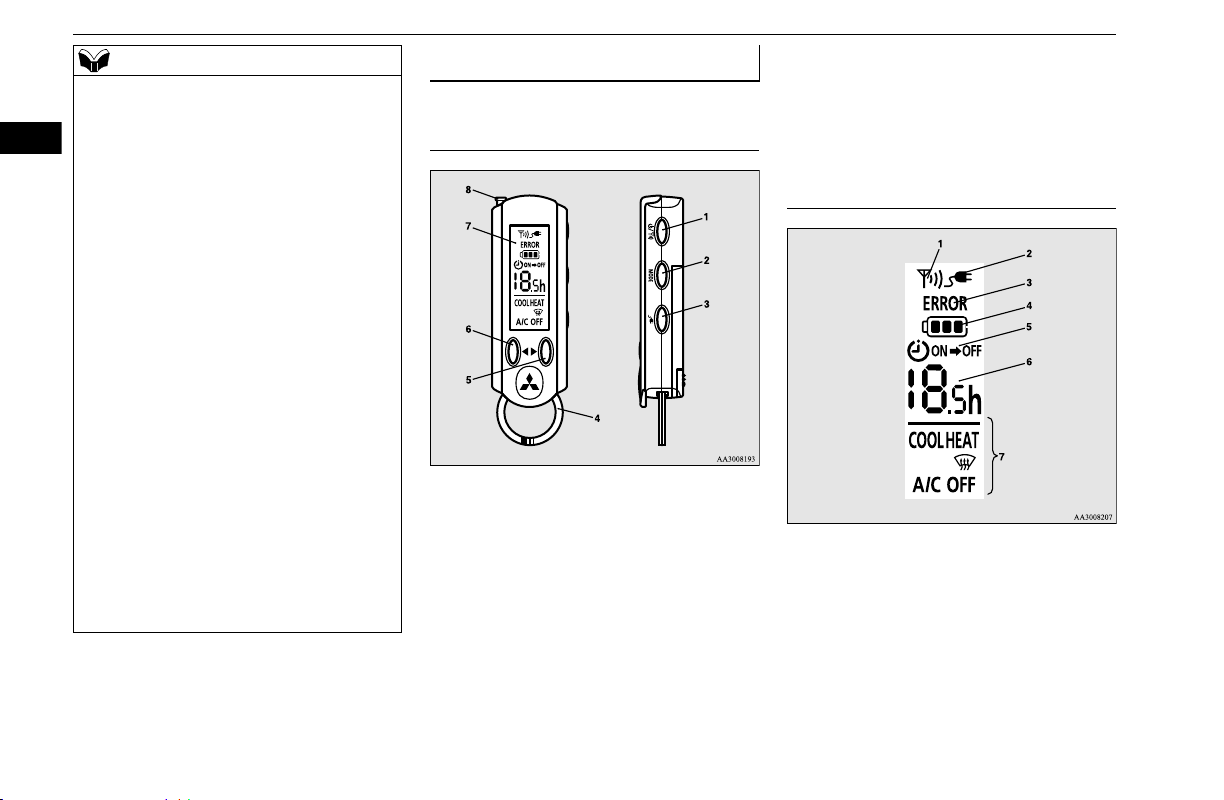
MiEV Remote System
3-38 General information/Charging
3
N01203501044
The transmitter signal will reach further
when the antenna of the MiEV Remote is
fully extended and held upright.
The onboard antenna is printed on the right
side delta glass of the vehicle.
When the MiEV Remote is not used for more
than 30 seconds, the MiEV Remote will
automatically turn off.
Some charge facilities have a timer function
which turns the power supply on and off
automatically. When using a charge facility
with this timer function, please adjust the
charging time set by the MiEV Remote to be
consistent with the timer used by the charg-
ing facility.
When you need additional MiEV Remotes,
please contact a certified i-MiEV dealer. Up
to four MiEV Remotes can be used per vehi-
cle.
You may hear operating sounds such as
sounds from the cooling fan and air condi-
tioning compressor when the Remote Cli-
mate Control is activated even if the electric
motor switch is in “LOCK” position during
timer charging. This is normal.
Refer to “Remote Climate Control” on page
3-47.
NOTE
MiEV Remote
Switches
1- Power/communication switch - Press
and hold to turn remote on. Press
quickly to transmit command to vehi-
cle.
2- MODE switch - The display of the
MiEV Remote is changed in order of
“ON timer”, “OFF timer” and “Remote
Climate Control” by pressing this
switch.
3- Manual charge switch (this can also
cancel the timers and Remote Climate
Control).
4- Ring
5- UP switch - scrolls up the display items
6- DOWN switch - scrolls down the dis-
play items
7- Display
8- Antenna
Display (LCD monitor)
1- Blinks when communicating with vehi-
cle, and when error occurs.
2- The indicator lights up during charging.
The indicator blinks when the manual
charging button is pressed. The indica-
tor will rapidly blink, if EV charging
cable (regular charger) is not connected
when the timer charging or Remote
Climate Control is set.
BK0220401US.book 38 ページ 2015年6月3日 水曜日 午前7時42分
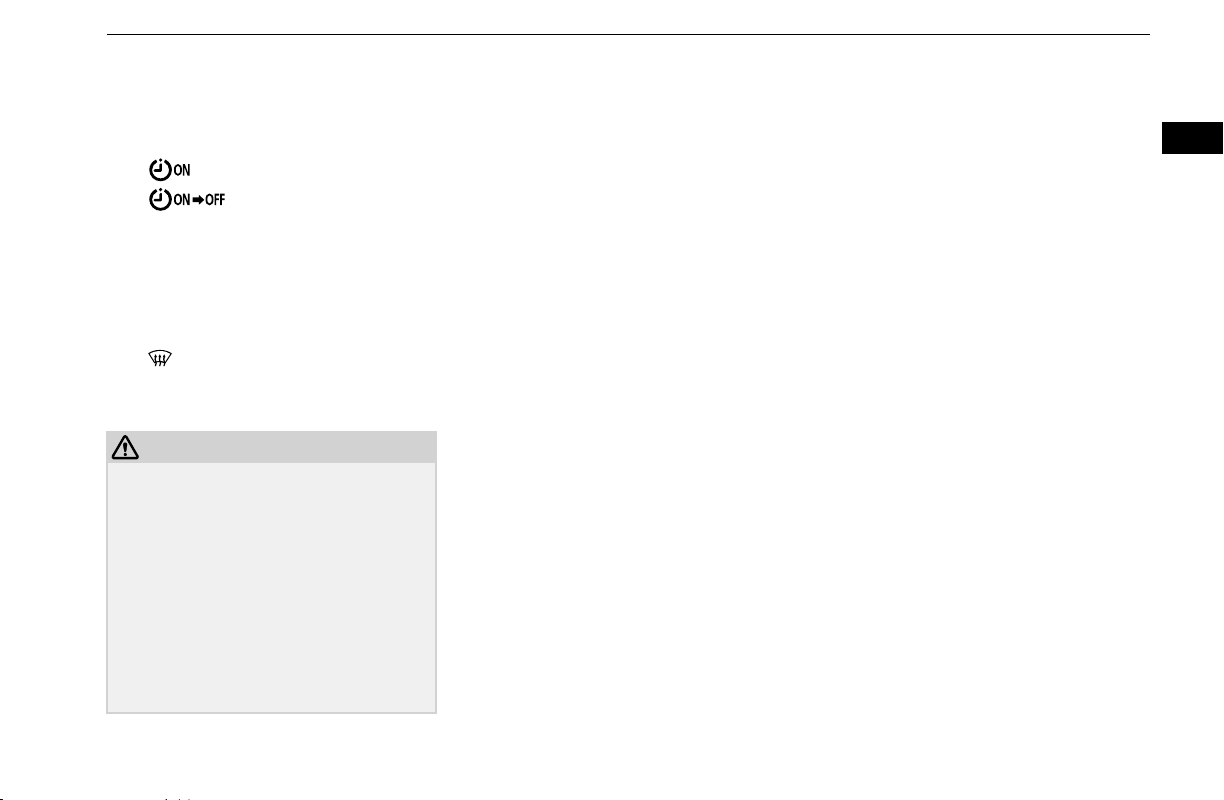
MiEV Remote System
General information/Charging 3-39
3
3- Blinks if there is an operation or com-
munication error.
4- Shows remaining charge of the Main
Drive Lithium-ion Battery. Blinks if
battery has less than 20% charge.
5-
: Indicates ON timer is set
: Indicates OFF timer is set
6- Indicates amount of time until Charg-
ing Timer is complete.
7- When Remote Climate Control is set,
displays mode set to operate:
COOL: Pre-Cooling Mode
HEAT: Pre-Heating Mode
: Pre-Defroster Mode
A/C OFF: Remote Climate Control
OFF
CAUTION
Never leave the MiEV Remote in a place
where it will be subject to high temperatures,
such as in direct sunlight, or subject to
extreme low temperatures.
The MiEV Remote can be damaged and may
not properly operate.
Never drop or hit the MiEV Remote. Do not
apply force to bend the antenna. These can
cause damage to or failure of the remote.
If the MiEV Remote gets wet, please wipe
water off immediately. Water entering the
MiEV Remote can cause a failure.
BK0220401US.book 39 ページ 2015年6月3日 水曜日 午前7時42分
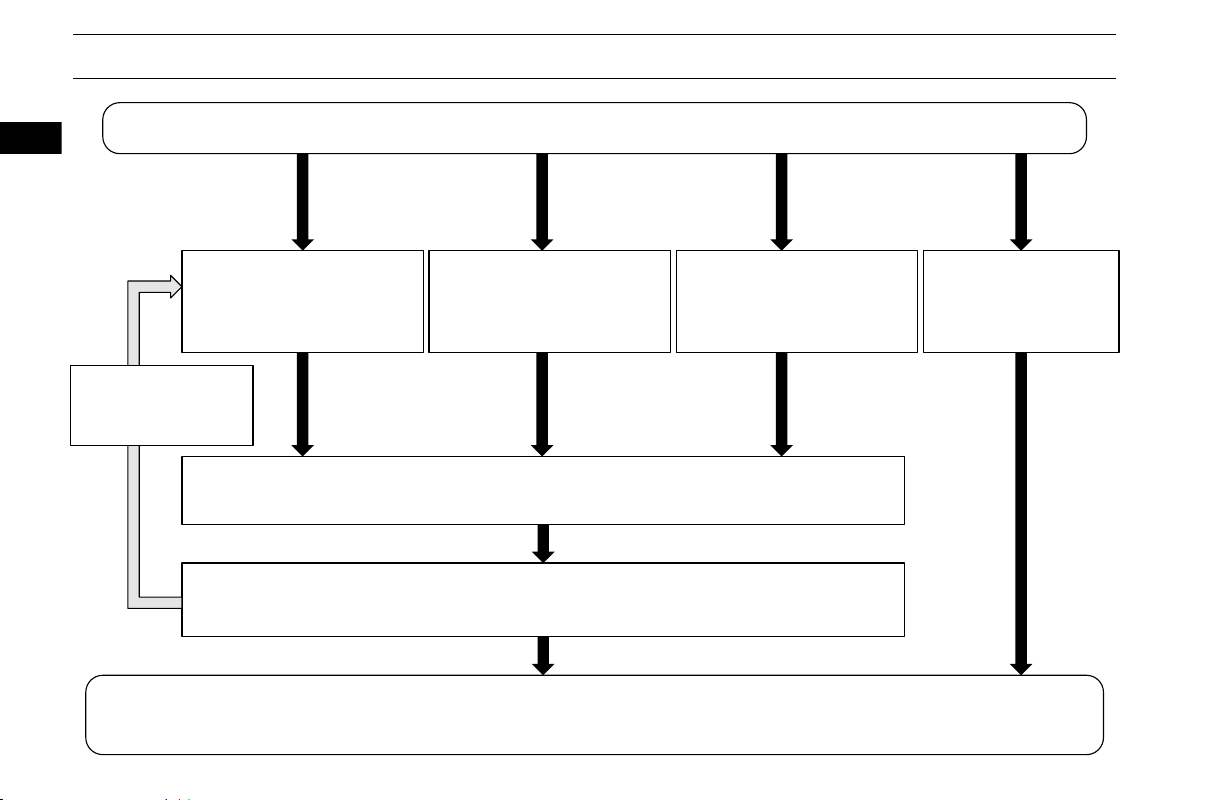
MiEV Remote System
3-40 General information/Charging
3
N01206100015
Basic operation of the MiEV Remote
Press the power/communication switch for 1 second or more to turn the MiEV Remote on.
ON timer OFF timer Remote Climate
Control
Main Drive Lithium-ion Bat-
tery Level Indicator
Press the MODE switch to show
the ON timer display.
Press the MODE switch to show
the OFF timer display.
Press the MODE switch to show
the Remote Climate Control dis-
play.
Main Drive Lithium-ion
Battery Level Indicator
Repeat these steps to set
other MODE.
Press the UP switch or DOWN switch to select desired setting.
Press the power/communication switch to send the data to the vehicle.
Press the power/communication switch for 3 seconds or more to turn the MiEV Remote off or the MiEV Remote will automatically turn off 30 min-
utes after it has been sent the data to the vehicle.
BK0220401US.book 40 ページ 2015年6月3日 水曜日 午前7時42分
MiEV Remote System
General information/Charging 3-41
3
N01203701020
The Charging Timer can be set as follows.
ON timer: Time from the present to when
charging will begin.
OFF timer: Time from the start of charg-
ing to the end of charging
To set the timer, the following conditions
must be met.
Selector lever: “P” (PARK) position
Electric motor switch: “LOCK”position
EV charging cable (regular charger): Con-
nected
Charging Timer
WARNING
Improper charging can result in a fire,
property damage, and serious injury or
death.
Before Charging Timer, carefully read
and follow the instructions in “Precaution
on Charging the Main Drive Lithium-ion
Battery” on page 3-15 and “Regular
charging (charging method with rated AC
120 V outlet)” on page 3-16.
NOTE
Charging Timer cannot be used with a quick
charging system.
BK0220401US.book 41 ページ 2015年6月3日 水曜日 午前7時42分
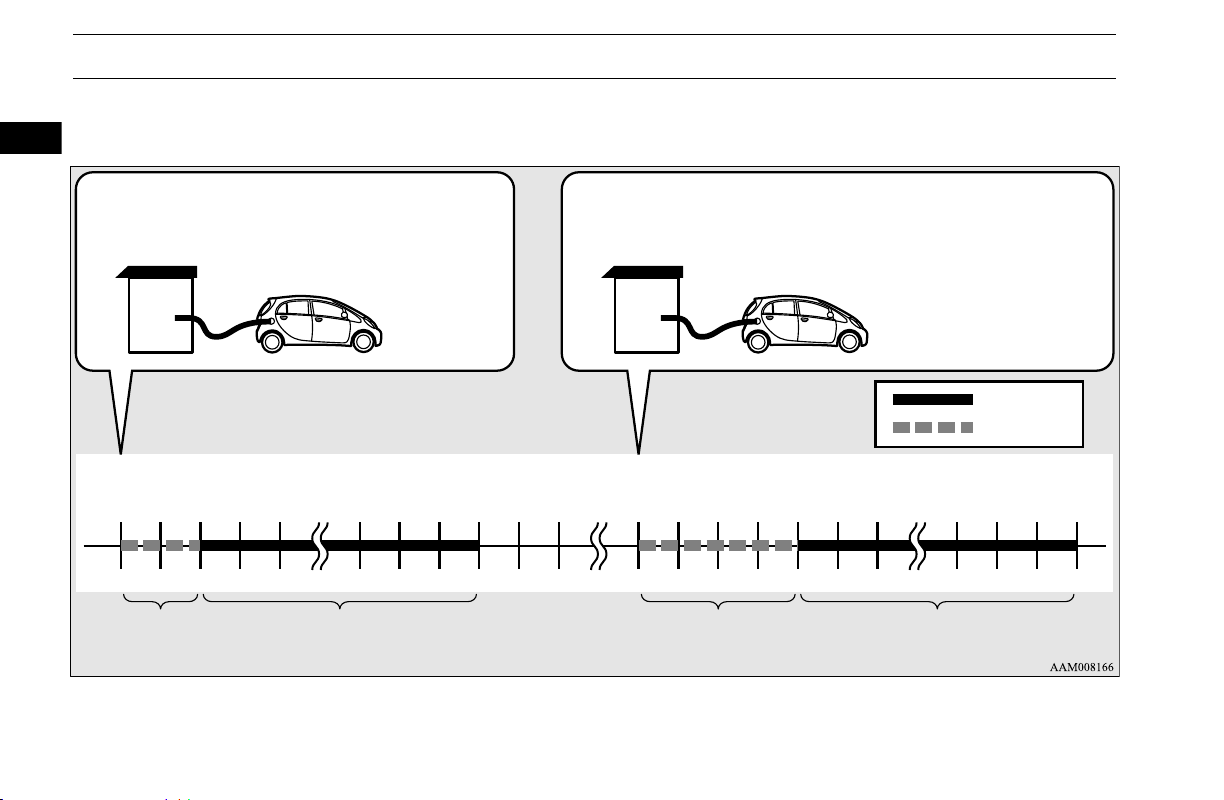
MiEV Remote System
3-42 General information/Charging
3
N01205001030
1. In case you set the timer at 9:00 PM so that charging starts at 11:00 PM and stops at 7:00 AM of the following day (for 8 hours).
2. In case you set the timer at 7:00 PM so that charging starts and stops at the same time the last time.
Example of Charging Timer
9:00
PM
7:00
PM
7:00
AM
11:00
PM
11:00
PM
7:00
AM
1. Setting of ON Timer = 2h, OFF Timer = 8h 2. When Charging timers are set up, initially 4h for ON-Timer and 8h for OFF-
Timer are displayed.
Charging
Waiting
ON Timer = 2h OFF Timer = 8h ON-Timer initial display
= 4h
OFF-Timer initial dis-
play = 8h
BK0220401US.book 42 ページ 2015年6月3日 水曜日 午前7時42分
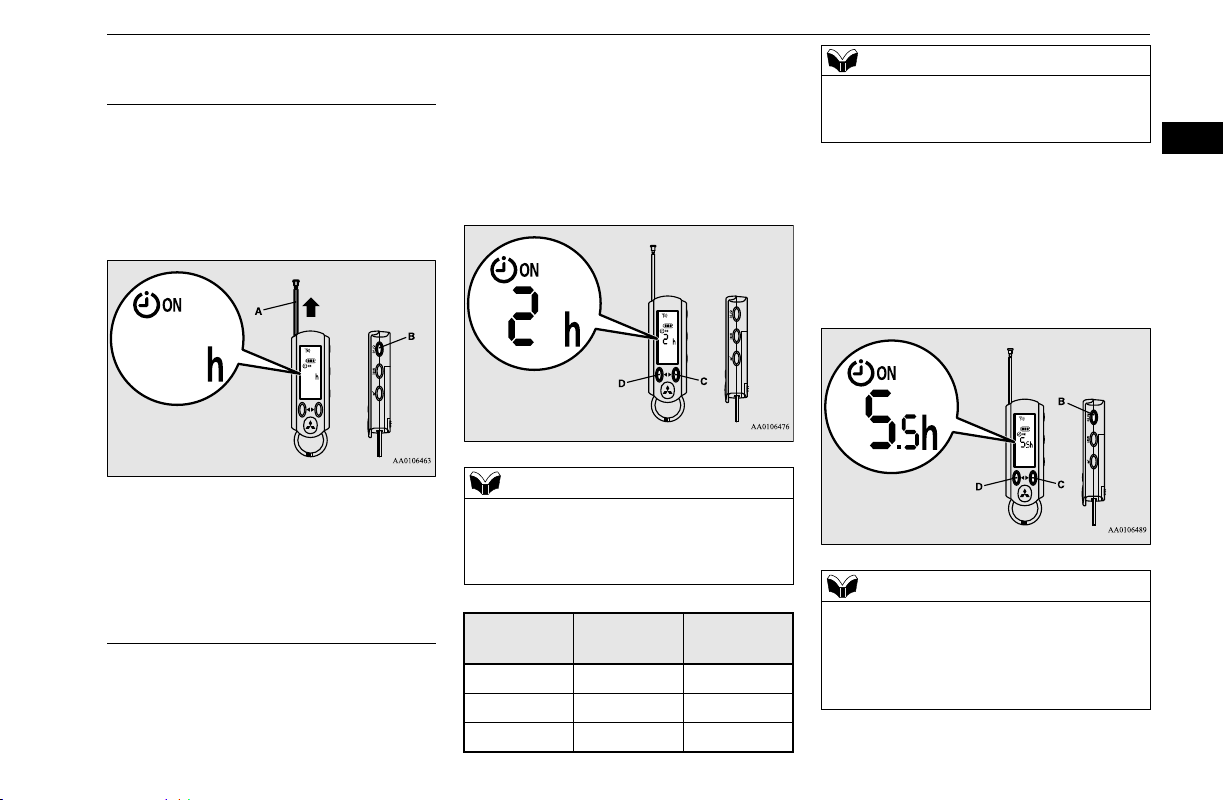
MiEV Remote System
General information/Charging 3-43
3
N01205100018
1. Extend the antenna (A) and press the
power/communication switch (B) for 1
second or more to turn the MiEV Remote
on. When it communicates with the vehi-
cle properly, the vehicle information will
be displayed on the screen.
2. To turn the MiEV Remote off, press the
power/communication switch (B) for 3
seconds or more and store the antenna
(A).
N01205201029
1. Start the regular charging. Refer to “Reg-
ular charging (charging method with rated
AC 120 V outlet)” on page 3-16.
2. Turn on the MiEV Remote. Refer to “To
turn the MiEV Remote ON/OFF” on page
3-43.
3. Press the UP switch (C) or the DOWN
switch (D) once. The time remaining from
the present to the time that was previously
set for the ON timer will be displayed and
blink.
4. If you need to change the remaining time
for the ON timer, press the UP switch (C)
or the DOWN switch (D) to change the
remaining time.
The remaining time can be changed
within the range from 0 to 19.5 hours in
half hour increments.
To turn the MiEV Remote
ON/OFF
To set the ON timer
NOTE
The remaining time for the last charging is
displayed with blinking as follows.
Example: If you set the charging starting
time to 11:00 PM of the day before:
Present time
Remaining
time
Display
9:00 PM 2:00 2h
9:10 PM 1:50 2h
9:40 PM 1:20 1.5h
NOTE
If the MiEV Remote cannot communicate
with the vehicle, the remaining time will not
be displayed.
NOTE
When you want to start the charging at the
same time as the last time, changing the
remaining time is unnecessary.
When the remaining time is set to 0h, the
charging starts immediately after step 5.
BK0220401US.book 43 ページ 2015年6月3日 水曜日 午前7時42分
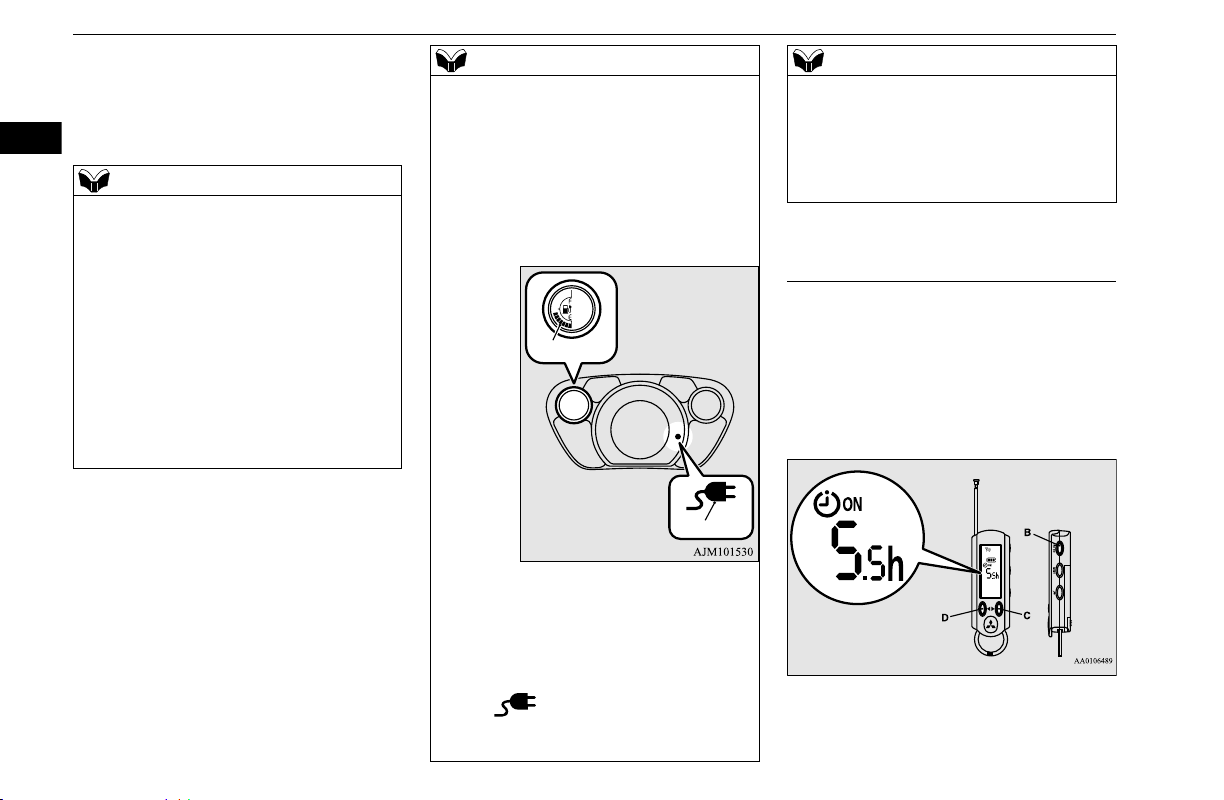
MiEV Remote System
3-44 General information/Charging
3
5. Press the power/communication switch
(B) for less than 1 second to send the set-
ting data to the vehicle.
The MiEV Remote will sound melodies
on transmission and reception.
6. To turn off the MiEV Remote, refer to
“To turn the MiEV Remote ON/OFF” on
page 3-43.
N01206000014
1. Turn on the MiEV Remote. Refer to “To
turn the MiEV Remote ON/OFF” on page
3-43.
2. Press the UP switch (C) or the DOWN
switch (D) once, and the remaining time
from the present to the time set for the ON
timer will be displayed and blink.
3. Change the remaining time to 0h by press-
ing the UP switch (C) or the DOWN
switch (D).
NOTE
The melodies can be turned off. Refer to “To
turn on/off melody and buzzer” on page
3-49.
If a communication error occurs or the MiEV
Remote System is not functioning properly,
the buzzer will sound. Refer to “Display of
MiEV Remote during communicating with
vehicle” on page 3-46.
If the OFF Timer is unset when setting the
ON timer, the OFF timer will be automati-
cally set with “fully charged”.
To set OFF Timer, refer to “To set OFF
Timer” on page 3-45.
NOTE
The energy level gauge (E) in the instrument
panel on the vehicle will illuminate and the
charging indicator (F) will blink approxi-
mately 30 seconds after the vehicle has
received the setting for the ON timer.
After approximately 30 seconds, the energy
level gauge and the charging indicator will
go off, and the vehicle will be prepared for
the Charging Timer.
Turning the electric motor switch to the
“ON” position or the “ACC” position will
cancel the Charging Timer.
If the MODE switch is pressed while chang-
ing the ON timer setting, the change will be
canceled.
The symbol on the MiEV Remote
will be illuminated while the vehicle is
charging.
E
F
If the charge connector is disconnected
before the time set by the ON timer, the
Charging Timer is not canceled. If the charge
connector is re-connected again before start-
ing the charge or setting the charge timers,
the Charging Timer will resume.
To start the charging immediately
after the ON timer has been set
NOTE
BK0220401US.book 44 ページ 2015年6月3日 水曜日 午前7時42分
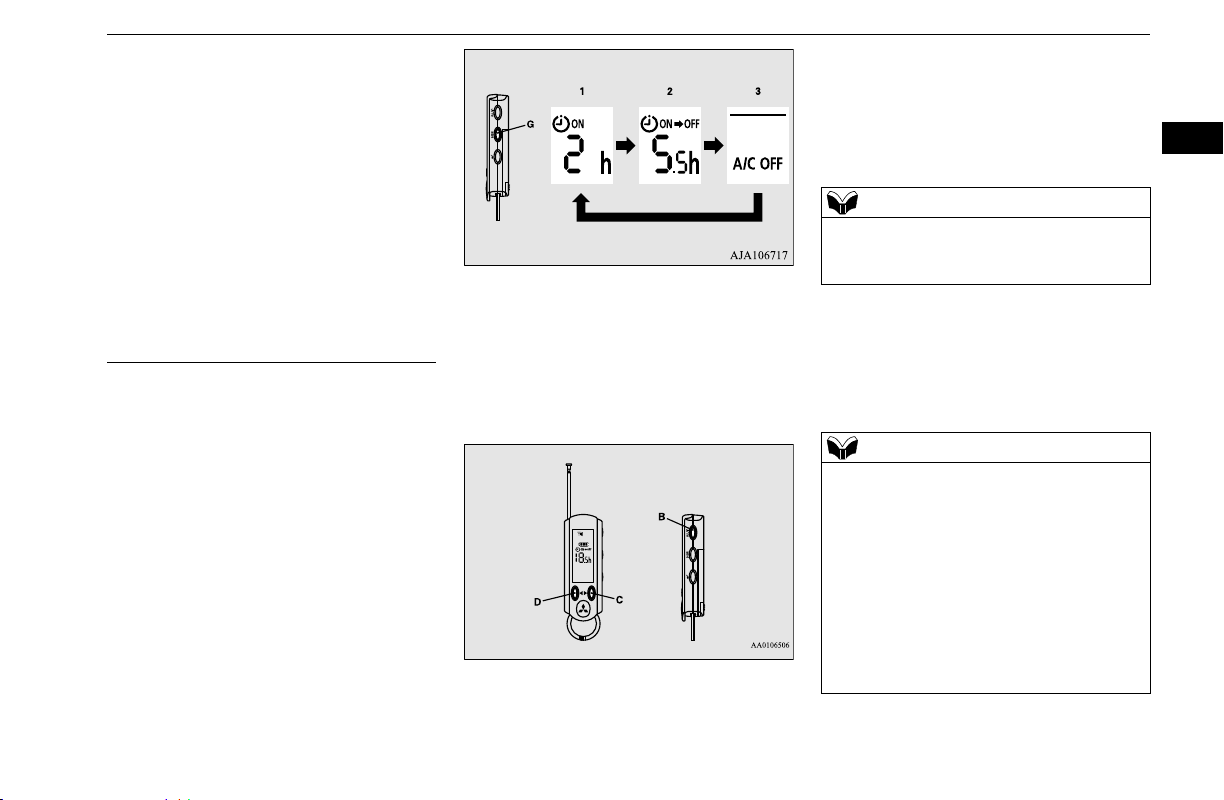
MiEV Remote System
General information/Charging 3-45
3
4. Press the power/communication switch
(B) for less than 1 second to send the set-
ting data to the vehicle. The MiEV
Remote will sound melodies on transmis-
sion and reception. The charging will
start.
Refer to “Regular charging (charging
method with rated AC 120 V outlet)” on
page 3-16.
5. Turn off the MiEV Remote. Refer to “To
turn the MiEV Remote ON/OFF” on page
3-43.
N01205301033
The OFF timer can be set during the regular
charging or after setting the ON timer.
1. When the power of MiEV Remote is off,
turn the power on. Refer to “To turn the
MiEV Remote ON/OFF” on page 3-43.
2. Press the MODE switch (G) to change the
display to the OFF timer (2).
3. Press the UP switch (C) or the DOWN
switch (D) once. The time set last time for
the OFF timer will be displayed and blink.
4. If you need to change the time for the
OFF timer, press the UP switch (C) or the
DOWN switch (D) to change the time.
• The time can be changed within the
range from 0.5h to 19.5h by half hour
and can be changed to “-h”.
• When “-h” is displayed, the charging
will end when Main Drive Lithium-ion
Battery is fully charged.
5. Press the power/communication switch
(B) for less than 1 second to send the set-
ting data to the vehicle.
The MiEV Remote will sound melodies
on transmission and reception.
To set OFF Timer
1_ Shown the ON timer
2_ Shown the OFF timer
3_ Shown the Remote Climate Control
NOTE
To display “-h”, press the UP switch (C)
when 19.5h is displayed or press DOWN
switch (D) when 0.5h is displayed.
NOTE
The melodies can be turned off. Refer to “To
turn on/off melody and buzzer” on page
3-49.
If a communication error occurs or the MiEV
Remote System is not functioning properly,
the buzzer will sound. Refer to “Display of
MiEV Remote during communicating with
vehicle” on page 3-46.
If the ON timer is unset when setting the
OFF timer, the ON timer will be automati-
cally set with “0h”.
BK0220401US.book 45 ページ 2015年6月3日 水曜日 午前7時42分
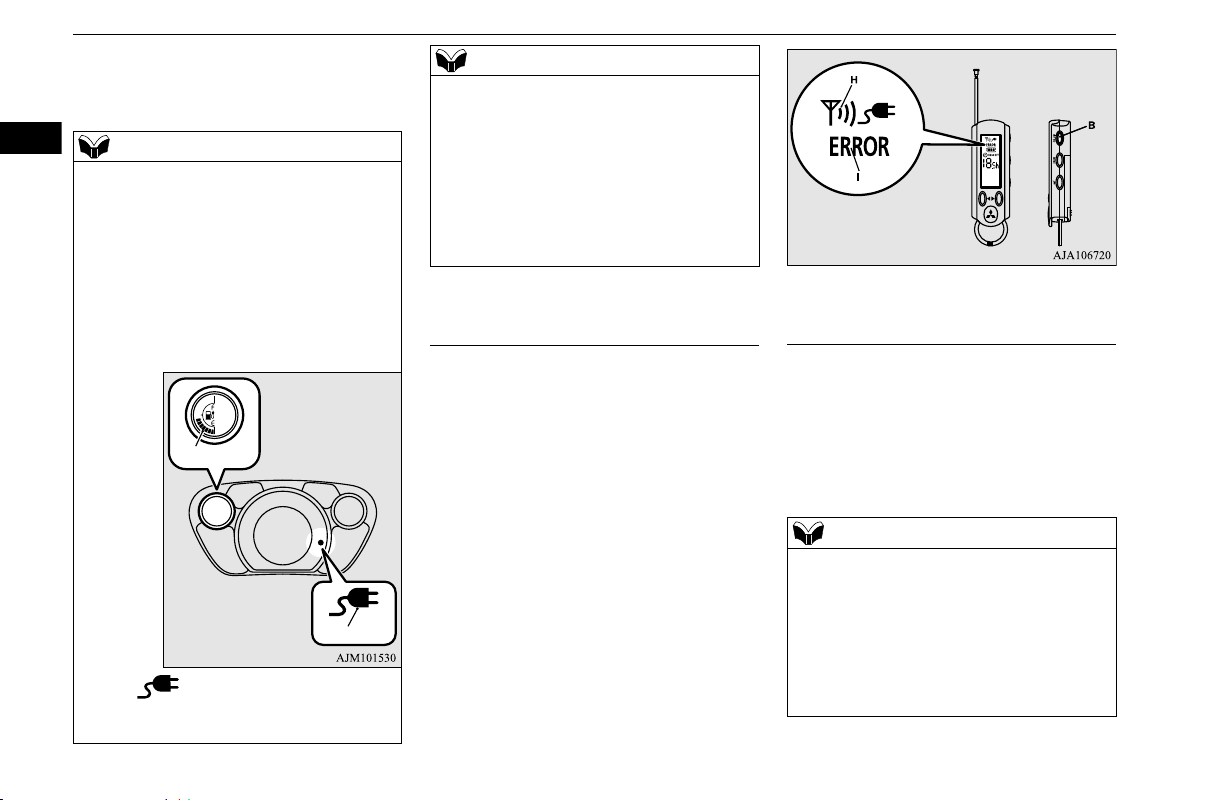
MiEV Remote System
3-46 General information/Charging
3
6. Turn off the MiEV Remote. Refer to “To
turn the MiEV Remote ON/OFF” on page
3-43.
N01203801021
It communicates with the vehicle when the
power of the MiEV Remote is turned on with
pressing the power supply/communication
switch (B) for 1 second or more and if the
power supply/communication switch (B) is
pressed for less than 1 second while the
power of the MiEV Remote is on.
If the normal reception melody sounds after
the transmitting melody, it is set completion.
Communication symbol (H) blinks while
communicating with the vehicle.
If the buzzer sounds with ERROR symbol (I)
blinks, a problem is detected. Refer to
“Actions to be taken when the MiEV Remote
system does not operate correctly” on page
3-52.
N01203901022
There are two methods to cancel Charging
Timer.
By using the MiEV Remote
By operating the electric motor switch on
the vehicle
NOTE
The energy level gauge (E) in the instrument
panel will illuminate and the charging indi-
cator (F) will blink approximately 30 sec-
onds after the vehicle has received the
setting for the OFF timer.
After approximately 30 seconds, the energy
level gauge and the charging indicator will
then go off, and the vehicle will be prepared
for Charging Timer in accordance with the
ON/OFF setting.
The symbol on the MiEV Remote
illuminates while the Main Drive Lithium-
ion Battery is charging.
E
F
The Charging Timer will be cancelled if the
electric motor switch is turned to the “ON”
or “ACC” position.
Once the Main Drive Lithium-ion Battery is
fully charged, the charging will end even if
before the time set by the OFF timer.
If the charge connector is disconnected dur-
ing charging, the OFF charging timer will be
canceled.
Display of MiEV Remote during
communicating with vehicle
NOTE
To cancel Charging Timer
NOTE
If the Charging Timer is canceled during
charging, the charging will continue until the
Main Drive Lithium-ion Battery is fully
charged.
If the Charging Timer is canceled before
charging starts, charging will start immedi-
ately and continue until the Main Drive Lith-
ium-ion Battery is fully charged.
BK0220401US.book 46 ページ 2015年6月3日 水曜日 午前7時42分
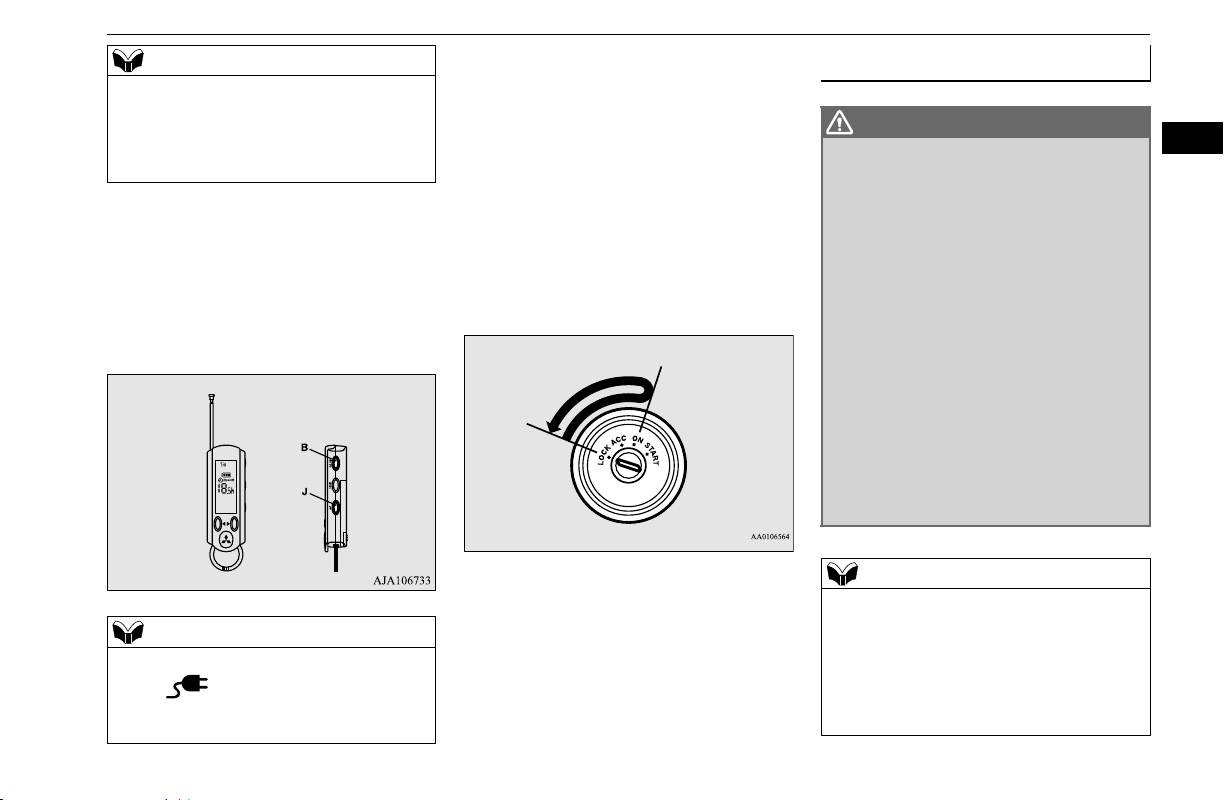
MiEV Remote System
General information/Charging 3-47
3
A. By using the MiEV Remote
1. When the power of MiEV Remote is
off, turn the power ON. Refer to “To
turn the MiEV Remote ON/OFF” on
page 3-43.
2. Press the manual charging switch (J),
then press the power/communication
switch (B) for less than 1 second.
3. Canceling Charging Timer is com-
plete, and the MiEV Remote will
sound two different melodies.
4. Turn off the MiEV Remote. Refer to
“To turn the MiEV Remote ON/OFF”
on page 3-43.
B. By operating the electric motor switch on
the vehicle
Turn the electric motor switch to the
“ACC” or “ON” position, then turn back
to the “LOCK” position.
Canceling the Charging Timer is now
complete.
N01204201035
Charging Timer cannot be canceled by dis-
connecting the charge connector before the
time set by the ON timer. The Charging
Timer will resume when the charging con-
nector is again connected to the vehicle.
NOTE
If the manual charging switch (J) is pressed,
the symbol of MiEV Remote will
blink. Remote Climate Control is also
stopped.
NOTE
Remote Climate Control
WARNING
The Remote Climate Control, even when
set, cannot be relied upon to maintain safe
vehicle cabin temperatures while the vehi-
cle is stopped or parked. Never leave chil-
dren or persons requiring
supervision/nursing unattended inside the
vehicle. Temperature inside the vehicle
could become extremely high or low
resulting in a risk of heat stroke or hyper-
thermia that could result in death.
In addition, children can activate switches
and controls, resulting in an injury or
fatal accident.
While the Remote Climate Control is acti-
vated, keep away from the cooling fan
under the front hood, since the cooling fan
may automatically operate even if the
electric motor switch is in the “LOCK”
position.
NOTE
The Remote Climate Control works regard-
less the position of the air conditioning
switch or dial on the vehicle. While the
Remote Climate Control is activated, the air
conditioning switch or dial on the vehicle
will not affect operation of the cooler, heater
or defroster.
BK0220401US.book 47 ページ 2015年6月3日 水曜日 午前7時42分
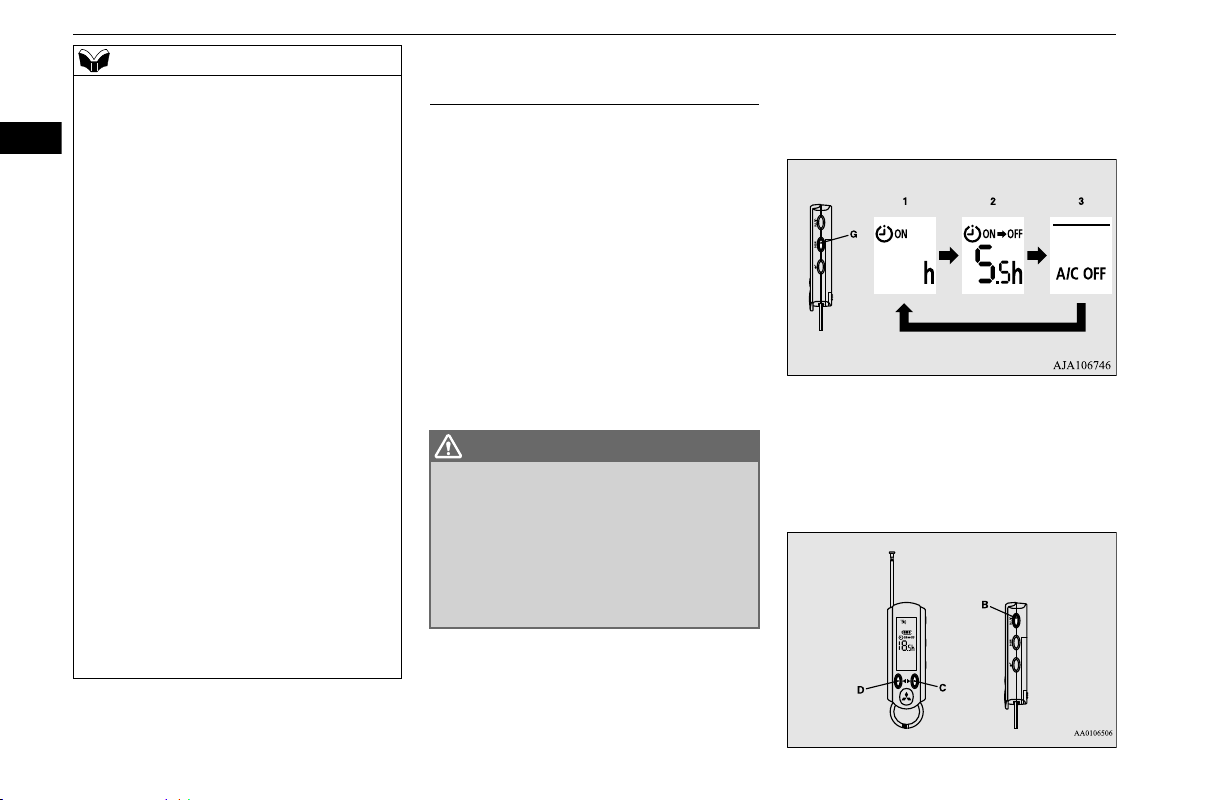
MiEV Remote System
3-48 General information/Charging
3
N01204301036
The following conditions must be met to
operate the Remote Climate Control.
Selector lever: P (PARK) position.
Electric motor switch: LOCK position.
EV charging cable (regular charger): Con-
nected.
Quick charging: Not used.
Main Drive Lithium-ion Battery Level
Indicator: Shows one bar or more. Refer
to “Main Drive Lithium-ion Battery Level
Indicator” on page 3-50.
All doors and the liftgate: Closed.
1. Start charging. Refer to “Regular charging
(charging method with rated AC 120 V
outlet)” on page 3-16.
2. Turn on the MiEV Remote. Refer to “To
turn the MiEV Remote ON/OFF” on page
3-43.
3. Press the MODE switch (G) to change the
mode to Remote Climate Control (3).
4. Select a desired mode by pressing UP
switch (C) or DOWN switch (D).
The Remote Climate Control will automati-
cally stop 30 minutes after the Remote Cli-
mate Control has been set.
The Remote Climate Control is operated by
electric power supplied through the EV
charging cable (regular charger).
Under the following conditions, the effect of
the Remote Climate Control can be
decreased.
• When the outside temperature is very high.
• When the sunlight is strong.
• When the outside temperature is very low.
When Remote Climate Control is activated
while charging the Main Drive Lithium-ion
Battery, the time required to fully charge the
Main Drive Lithium-ion Battery will become
longer or the amount of charge may decrease
if the OFF timer has been set.
If the Main Drive Lithium-ion Battery
Warming System is operated while the
Remote Climate Control is activated, the
Remote Climate Control will stop. When the
Main Drive Lithium-ion Battery Warming
System stops, the Remote Climate Control
will resume. Refer to “Main Drive Lithium-
ion Battery Warming System” on page 3-21.
While the Remote Climate Control is acti-
vated, if a heated seat switch is ON, the
heated seat will operate.
NOTE
To operate the Remote Climate
Control
WARNING
Improper charging can result in a fire,
property damage, and serious injury or
death.
Carefully read and follow instructions in
“Precaution during Charging the Main
Drive Lithium-ion Battery” on page 3-15
and “Regular charging (charging method
with rated AC 120 V outlet)” on page 3-16.
1_ Shown the ON timer
2_ Shown the OFF timer
3_ Shown the Remote Climate Control
BK0220401US.book 48 ページ 2015年6月3日 水曜日 午前7時42分
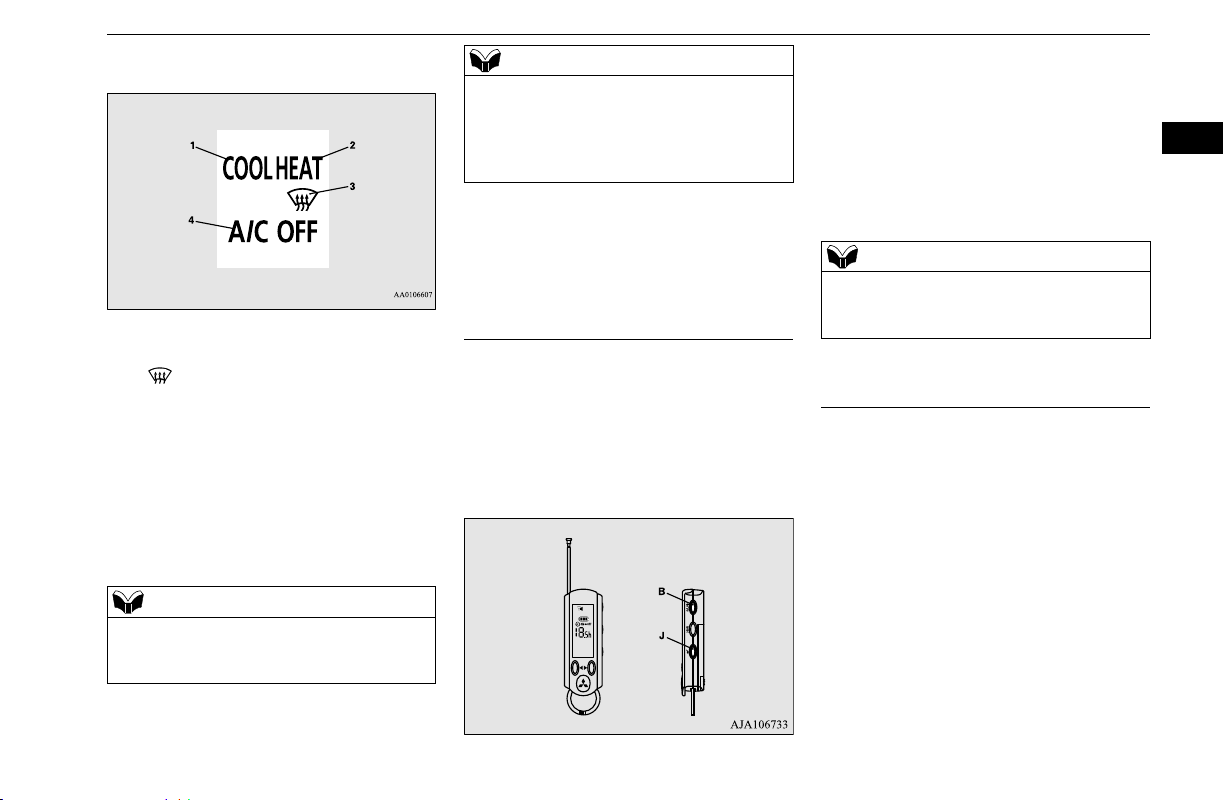
MiEV Remote System
General information/Charging 3-49
3
The modes will be changed in the order
from 1 to 4 by pushing the UP switch.
5. Press the power/communication switch
(B) for less than 1 second to send the set-
ting to the vehicle. The MiEV Remote
will sound melodies on transmission and
reception.
6. Turn off the MiEV Remote. Refer to “To
turn the MiEV Remote ON/OFF” on page
3-43.
N01204401024
The Remote Climate Control can be stopped
by either of the following methods.
A. By using the MiEV Remote, after press-
ing the manual charging switch (J), press
the power/communication switch (B) for
less than 1 second.
B. By using the MiEV Remote, select the
A/C OFF mode and send the setting.
Refer to “To operate the Remote Climate
Control” on page 3-48.
C. Turn the electric motor switch to the
“ACC” or the “ON” position.
D. Disconnect the regular charge connector
from the vehicle.
N01204100024
1. Turn on the MiEV Remote. Refer to “To
turn the MiEV Remote ON/OFF” on page
3-43.
• To turn off the sounds, press the UP
switch (C) while pressing MODE switch
(G).
• To turn on the sounds, press the DOWN
switch (D) while pressing MODE switch
(G).
1_ COOL: Pre-Cooling Mode
2_ HEAT: Pre-Heating Mode
3_
: Pre-Defroster Mode
4_ A/C OFF: Remote Climate Control
OFF
NOTE
The melodies can be turned off. Refer to “To
turn on/off melody and buzzer” on page
3-49.
If a communication error occurs or the MiEV
Remote System is not functioning properly,
the buzzer will sound. Refer to “Display of
MiEV Remote during communicating with
vehicle” on page 3-46.
To stop the Remote Climate Con-
trol
NOTE
NOTE
The Remote Climate Control will not stop if
the doors or liftgate are opened after the
Remote Climate Control has started.
To turn on/off melody and buzzer
BK0220401US.book 49 ページ 2015年6月3日 水曜日 午前7時42分
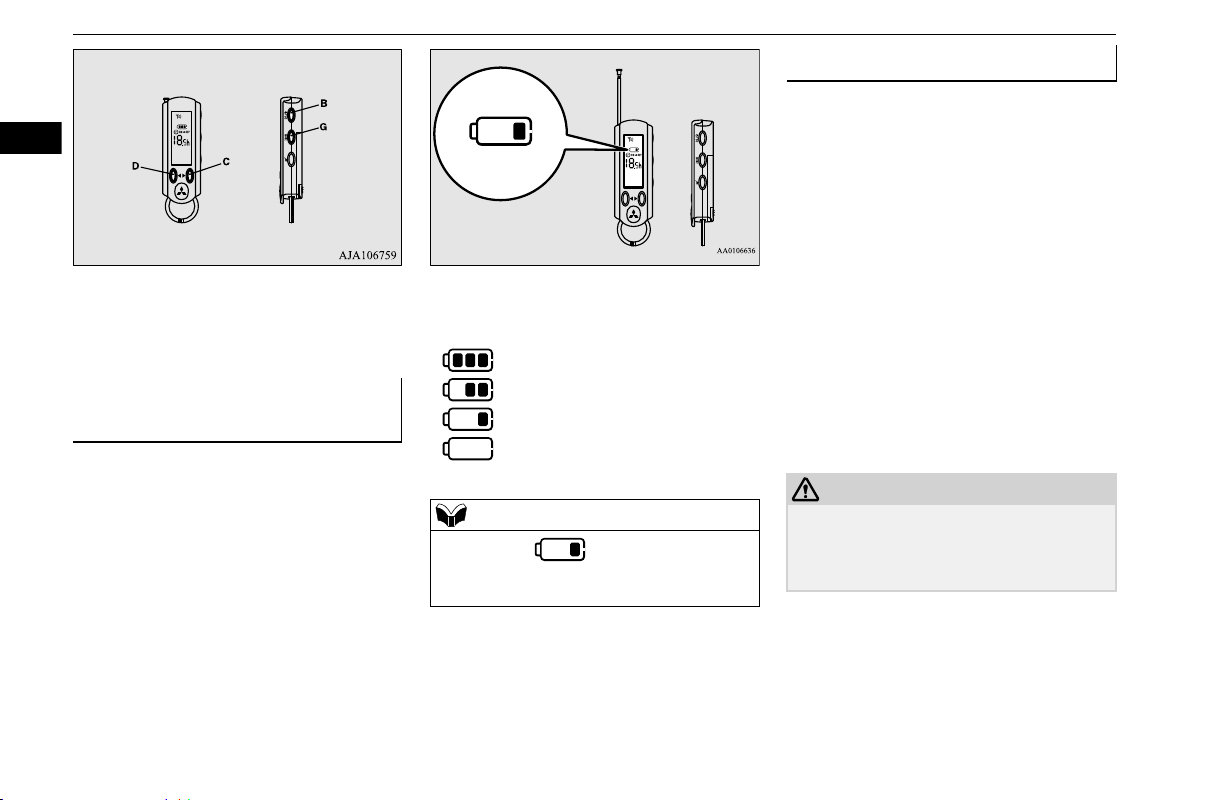
MiEV Remote System
3-50 General information/Charging
3
2. Turn off the MiEV Remote. Refer to “To
turn the MiEV Remote ON/OFF” on page
3-43.
N01204500015
The remaining energy in the Main Drive Lith-
ium-ion Battery can be checked using the
MiEV Remote.
1. If the MiEV Remote has been turned off,
turn on the MiEV Remote. Refer to “To
turn the MiEV Remote ON/OFF” on page
3-43.
2. Current remaining energy in the Main
Drive Lithium-ion Battery is shown on
the display while the MiEV Remote is
ON.
The remening energy is shown by the
number of segments displayed.
3. Turn off the MiEV Remote. Refer to “To
turn the MiEV Remote ON/OFF” on page
3-43.
N01205400011
Your MiEV Remote System operates on a
radio frequency subject to Federal Communi-
cations Commission (FCC) Rules (For vehi-
cles sold in U.S.A.) and Industry Canada
Rules (For vehicles sold in Canada). This
device complies with Part 15 of the FCC
Rules and RSS-Gen of the Industry Canada
Rules.
Operation is subject to the following two con-
ditions.
This device may not cause harmful inter-
ference.
This device must accept any interference
received, including interference that may
cause undesired operation.
Main Drive Lithium-ion Bat-
tery Level Indicator
:
3 segments: Full or near full
:
2 segments: Moderate
:
1 segment: Low
:
0 segments: Empty or near empty
NOTE
More than remained quantity in the
Main Drive Lithium-ion Battery is necessary
to operate the Remote Climate Control.
General information
CAUTION
Changes or modifications not expressly
approved by the manufacturer for compli-
ance could void the user’s authority to oper-
ate the equipment.
BK0220401US.book 50 ページ 2015年6月3日 水曜日 午前7時42分
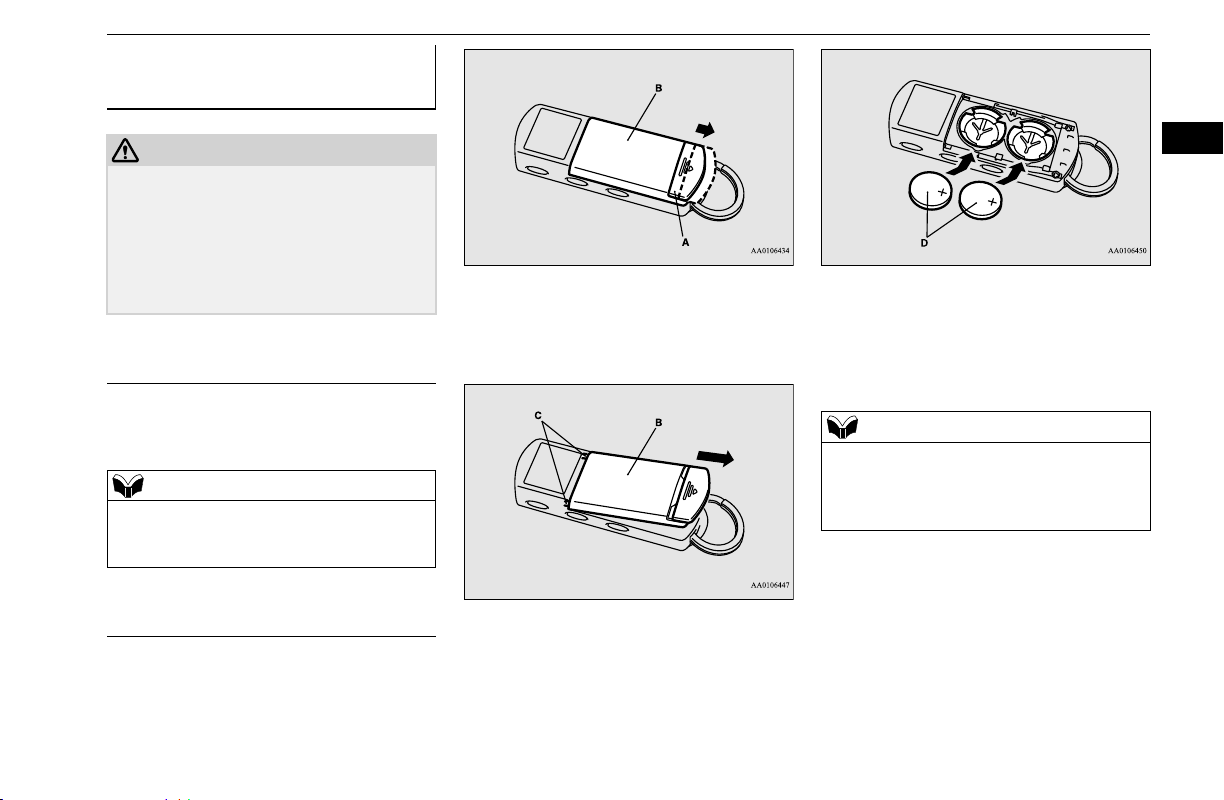
MiEV Remote System
General information/Charging 3-51
3
N01204600016
N01204700017
Two coin type batteries are used. Replace as
necessary to assure proper operation.
N01204800021
1. Before replacing the batteries, remove
static electricity from your body by touch-
ing a metal grounded object.
2. Battery cover (B) lifts when the slide por-
tion (A) is moved to the arrow direction.
3. By moving the battery cover (B) in the
arrow direction, tabs (C) on the battery
cover will come out and the battery cover
can be removed.
4. Remove the old batteries.
5. Install two new coin type CR2032 batter-
ies (D) with the “+” side up.
6. Attach the battery cover (A) in the reverse
order from the way you have detached it.
7. Confirm the MiEV Remote can be turned
ON. Refer to “To turn the MiEV Remote
ON/OFF” on page 3-43.
Replacement of batteries for
the MiEV Remote
CAUTION
MiEV Remote is a precision electronic
device with a built-in signal transmitter. Do
not disassemble or touch an internal parts.
Keep away from water or dust.
Be careful not to break the tab on the battery
cover when removing or installing the bat-
tery cover.
About battery
NOTE
Standard battery life on the MiEV Remote is
about 1 year. Battery life can vary depending
on environmental and usage conditions.
To replace the batteries
NOTE
Replace both batteries with new ones at the
same time.
A certified i-MiEV dealer can replace the
batteries for you if you prefer.
Coin type batteries
CR2032
BK0220401US.book 51 ページ 2015年6月3日 水曜日 午前7時42分
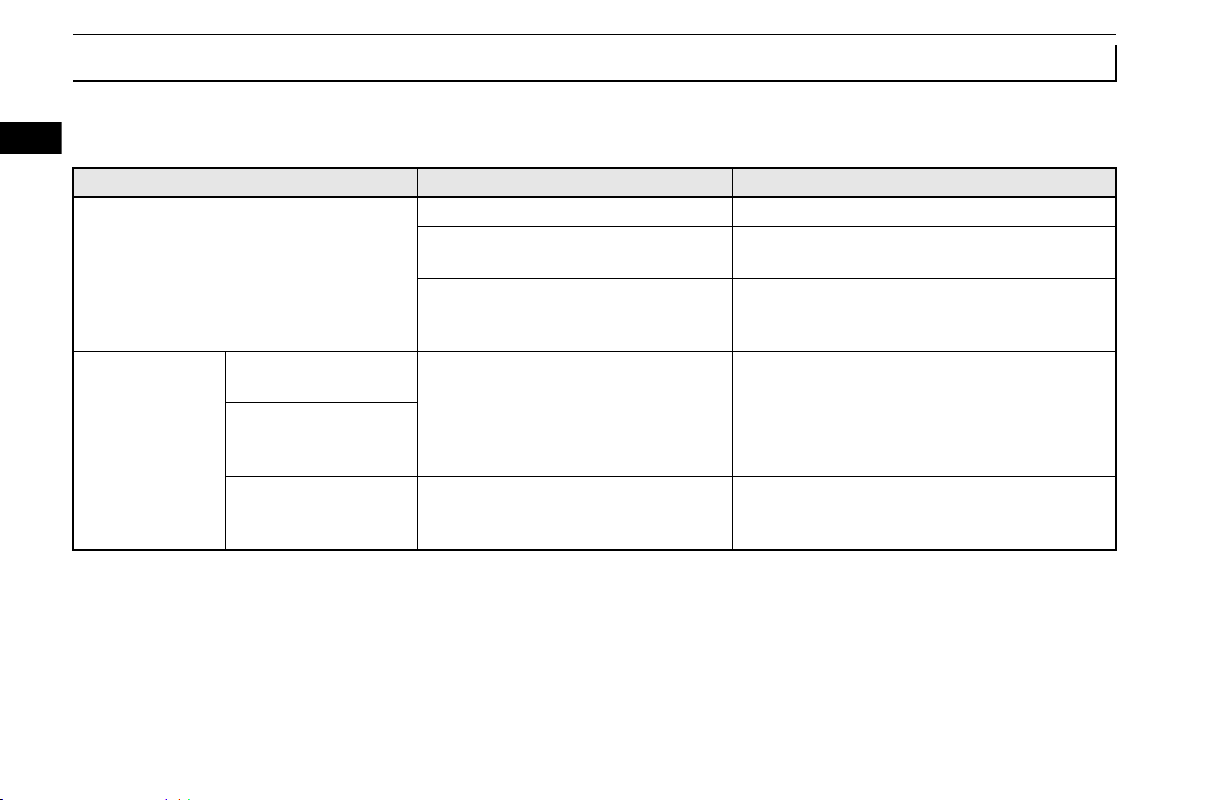
MiEV Remote System
3-52 General information/Charging
3
N01204901032
Take the following actions when the system does not operate correctly. If the system still does not operate correctly after the action(s) have been
taken, a system component may not be working properly. Please consult with a certified i-MiEV dealer to check it.
Actions to be taken when the MiEV Remote system does not operate correctly
Phenomena Cause Remedy
Charging does not start when regular charge
connector is inserted.
“ON” timer has been set. Cancel the “ON” timer.
The regular charge connector is not
locked completely.
Lock the regular charge connector securely.
A household electrical outlet, which the
EV charging cable is connected to, is shut
down.(e.g. disconnected plug)
Turn on the household electrical outlet and make
sure the plug is securely connected.
MiEV Remote
does not operate
normally.
MiEV Remote is not
powered on.
Batteries in the MiEV Remote are defec-
tive or the batteries are discharged.
Replace the batteries in the MiEV Remote.
Refer to “Replacement of batteries for the MiEV
Remote” on page 3-51.
No indicator lights come
on when the remote is
turned on.
Melody or buzzer does
not sound.
Melody or buzzer has been disabled. Enable the melody or buzzer.
Refer to “To turn on/off melody and buzzer” on
page 3-49.
BK0220401US.book 52 ページ 2015年6月3日 水曜日 午前7時42分
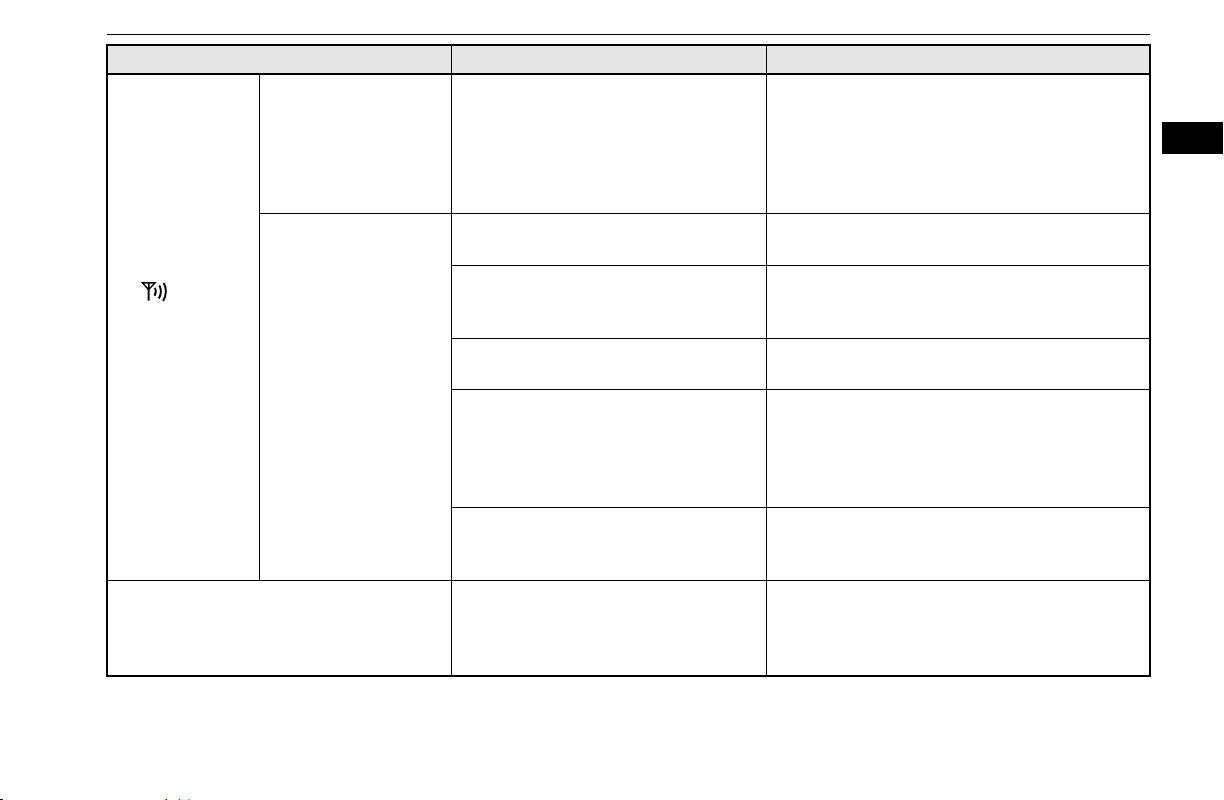
MiEV Remote System
General information/Charging 3-53
3
The following
symbol blinks
when the power
supply/communi-
cation switch on
the MiEV Remote
is pressed.
ERROR sym-
bol
symbol
Blinks after about 1 sec-
ond.
Electrical noise source is present in the
vicinity of the MiEV Remote. (e.g.
personal computer)
Electrical noise source is present
between the vehicle and the MiEV
Remote.
Move away from the noise source.
Blinks after about 10
seconds.
The MiEV Remote antenna is not
extended.
Extend the MiEV Remote antenna to communicate.
Out of effective communication range.
(e.g. too far away from the vehicle, or
radio signal is interfered)
Move to the location where the system reaches the
effective communication range.
The electric motor switch is at the position
other than “LOCK” position.
Turn the electric motor switch to the “LOCK” posi-
tion.
Electrical noise source is present in the
vicinity of the vehicle.
Electrical noise source is present
between the vehicle and the MiEV
Remote.
Move away from the noise source.
12V starter battery is discharged. Charge or replace the 12V starter battery.
Refer to “Jump-starting” on page 8-2, “12V starter
battery” on page 11-6.
The below symbol blinks about 10 seconds
after the power/communication switch on the
MiEV Remote is pressed.
ERROR symbol
Some errors occur while the system is in
processing.
Press the power/communication switch again.
Phenomena Cause Remedy
BK0220401US.book 53 ページ 2015年6月3日 水曜日 午前7時42分
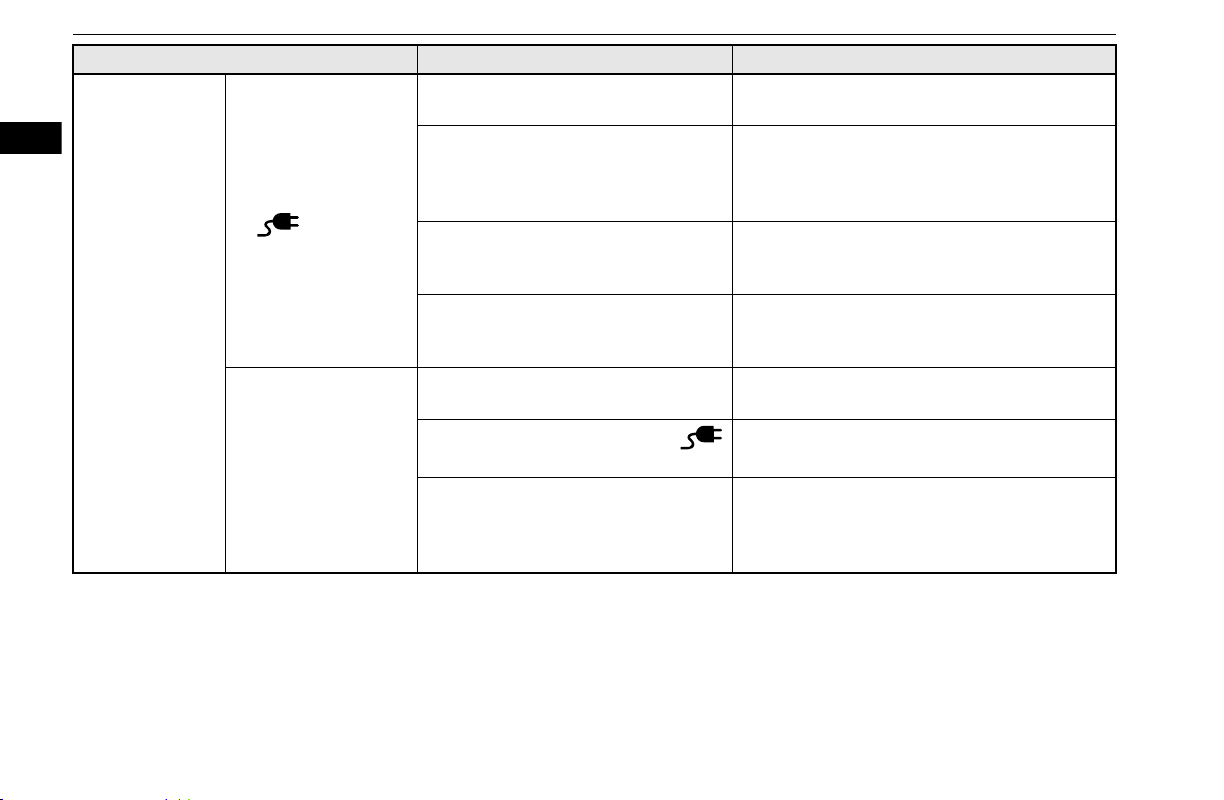
MiEV Remote System
3-54 General information/Charging
3
Charging Timer is
not possible.
After the power/commu-
nication switch is
pressed, the following
symbol blinks in several
seconds.
ERROR symbol
symbol
Regular charge connector is not inserted
or not locked completely.
Lock the regular charge connector securely.
A household electrical outlet, which the
EV charging cable (regular charger) is
connected to, is shut down.(e.g. discon-
nected plug)
Turn on the household electrical outlet which the
EV charging cable (regular charger) is connected
to.
Ground fault at the household electrical
outlet. Otherwise, the power supply at the
household electrical outlet is cut off.
Check the ground fault and confirm the plug is con-
nected.
If the charging unit is equipped with the
timer function, the power supply to the
unit has been cut off.
Preset the Charging Timer while the charging unit
with timer function is powered on.
After the power/commu-
nication switch is
pressed, the following
symbol blinks in several
seconds.
ERROR symbol
The selector lever is at a position other
than P (PARK).
Place the selector lever to P (PARK) position.
Quick charging is in progress. (The
symbol illuminates.)
Terminate the quick charging, or wait until the
quick charging completes.
The temperature of the Main Drive Lith-
ium-ion Battery has exceeded about
140 °F (60 °C).
Allow the temperature of the Main Drive Lithium-
ion Battery to reach normal operating temperature.
Refer to “Cautions and action to deal with intense
heat” on page 3-8.
Phenomena Cause Remedy
BK0220401US.book 54 ページ 2015年6月3日 水曜日 午前7時42分

MiEV Remote System
General information/Charging 3-55
3
Charging Timer is
not possible.
The system is charged
although the ON timer is
being set.
Backup charging for the Main Drive Lith-
ium-ion Battery Warming System has
been operated.
This is not a malfunction.Charging will be termi-
nated when the system has been charged enough for
the Main Drive Lithium-ion Battery Warming Sys-
tem.
Charging is preset, but
the specified charging
level is not satisfied.
The charging level is
not expected amount.
Is not charged.
Is not charged at the
preset time.
The timer is cancelled or the preset time is
changed by using another MiEV Remote.
Check whether another person has operated his or
her MiEV Remote.
The electric motor switch has been oper-
ated before the system is charged.
Check whether the electric motor switch has been
operated before the system is charged.
The temperature of the Main Drive Lith-
ium-ion Battery has exceeded about
140 °F (60 °C).
Allow the temperature of the Main Drive Lithium-
ion Battery to reach normal operating temperature.
Refer to “Cautions and action to deal with intense
heat” on page 3-8.
Charging Timer is not preset correctly. Preset the timed charging again.
Although the charging is
preset, too much time is
needed to charge the sys-
tem fully.
The Remote Climate Control has been
activated.
Check whether the Remote Climate Control has
been activated.
The Main Drive Lithium-ion Battery
Warming System has been operated.
Move the vehicle to a warmer location.
Temperature of the Main Drive Lithium-
ion Battery is low.
Refer to “Cautions and action to deal with intense
cold” on page 3-10.
Charging Timer is
not possible.
It is not fully charged. If the charging unit is equipped with the
timer function, the power supply to the
unit has been cut off.
Preset the Charging Timer while the charging unit
with timer function is powered on.
Phenomena Cause Remedy
BK0220401US.book 55 ページ 2015年6月3日 水曜日 午前7時42分
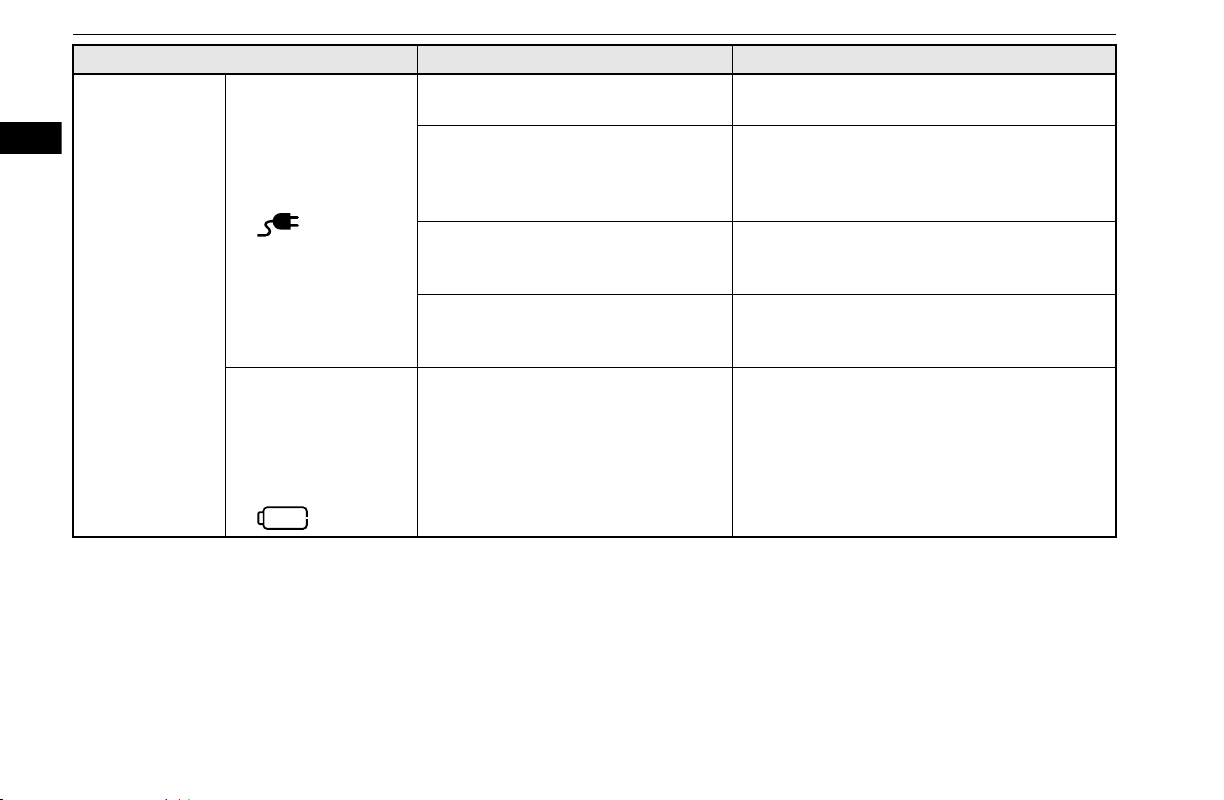
MiEV Remote System
3-56 General information/Charging
3
The Remote Cli-
mate Control can-
not be activated.
After the power/commu-
nication switch is
pressed, the following
symbol blinks in several
seconds.
ERROR symbol
symbol
The regular charge connector is not
inserted or it is not locked completely.
Lock the regular charge connector securely.
A household electrical outlet, which the
EV charging cable (regular charge) is con-
nected to, is shut down.(e.g. disconnected
plug)
Turn on the household electrical outlet which the
EV charging cable (regular charge) is connected to.
Ground fault at the household electrical
outlet. Otherwise, the power supply at the
household electrical outlet is cut off.
Check the ground fault and confirm the plug is con-
nected.
If the charging unit is equipped with the
timer function, the power supply to the
unit has been cut off.
Preset the Charging Timer while the charging unit
with timer function is powered on.
After the power/commu-
nication switch is
pressed, the following
symbol blinks in several
seconds.
ERROR symbol
symbol
The Main Drive Lithium-ion Battery
charging level is low.
Charge the Main Drive Lithium-ion Battery until
the MiEV Remote illuminates the battery charging
level by at least 1 segment.
Phenomena Cause Remedy
BK0220401US.book 56 ページ 2015年6月3日 水曜日 午前7時42分
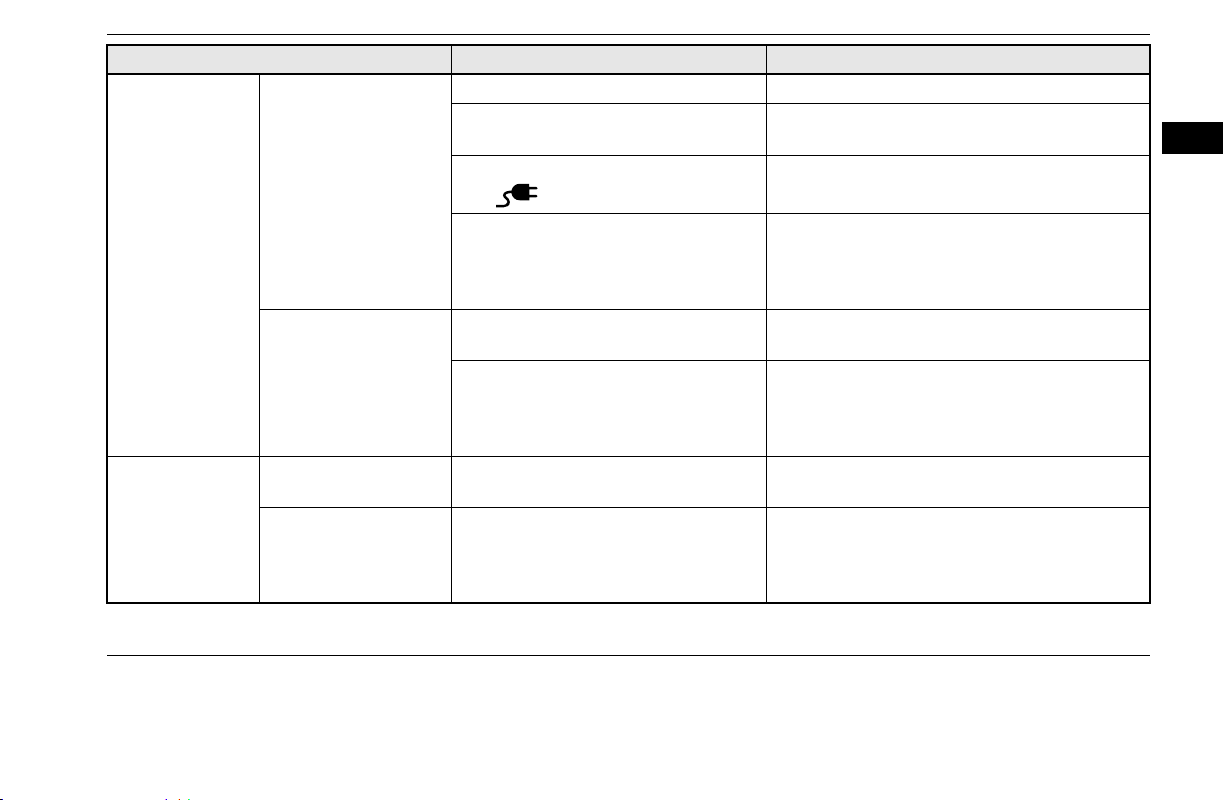
MiEV Remote System
General information/Charging 3-57
3
N01203600019
1. Gently wipe with gauze or another soft cloth soaked with a mild soap and water solution.
2. Wipe off all the detergent with a soft cloth dipped in fresh water and thoroughly wrung out.
3. Wipe all moisture off and dry in a shaded, well-ventilated area.
The Remote Cli-
mate Control can-
not be activated.
After the power/commu-
nication switch is
pressed, the following
symbol blinks in several
seconds.
ERROR symbol
Any of the door or liftgate is open. Close all the doors and liftgate.
The selector lever is at the position other
than P (PARK).
Place the selector lever to P (PARK) position.
Quick charging is in progress.
(The symbol will illuminate.)
Terminate the quick charging, or wait until the
quick charging completes.
The temperature of the Main Drive Lith-
ium-ion Battery has exceeded about
140 °F (60 °C).
Allow the temperature of the Main Drive Lithium-
ion Battery to reach normal operating temperature.
Refer to “Cautions and action to deal with intense
heat” on page 3-8.
The Remote Climate
Control is not activated.
The electric motor switch has been oper-
ated before the system is charged.
Check whether the electric motor switch has been
operated before the system is charged.
The temperature of the Main Drive Lith-
ium-ion Battery has exceeded about
140 °F (60 °C).
Allow the temperature of the Main Drive Lithium-
ion Battery to reach normal operating temperature.
Refer to “Cautions and action to deal with intense
heat” on page 3-8.
The Remote Cli-
mate Control can-
not be activated.
The heated seat is not
powered on.
The heated seat switch is turned off. Turn on the heated seat switch.
The heated seat becomes
hot while the air condi-
tioning (cooling) is acti-
vated.
The heated seat switch is turned on. Turn off the heated seat switch.
Cleaning the MiEV Remote
Phenomena Cause Remedy
BK0220401US.book 57 ページ 2015年6月3日 水曜日 午前7時42分
MiEV Remote System
3-58 General information/Charging
3
CAUTION
Never use benzine, petrol, or other organic solvents, or acid or alkaline solvents. Doing so could cause deformation, discolor, or malfunction. Also, these
substances may be present in various cleaners, so check carefully before use.
BK0220401US.book 58 ページ 2015年6月3日 水曜日 午前7時42分

4
Seat and restraint systems
Seats .................................................................................................4-2
Seats and restraint systems ..............................................................4-2
Front seats ........................................................................................4-3
Rear seats .........................................................................................4-5
Head restraints .................................................................................4-6
Seat belts ..........................................................................................4-8
Seat belt use during pregnancy ......................................................4-12
Seat belt pre-tensioner and force limiter systems ..........................4-12
Child restraint systems ...................................................................4-13
Maintenance and inspection of seat belts ......................................4-20
Supplemental Restraint System (SRS) - airbag .............................4-20
BK0220401US.book 1 ページ 2015年6月3日 水曜日 午前7時42分
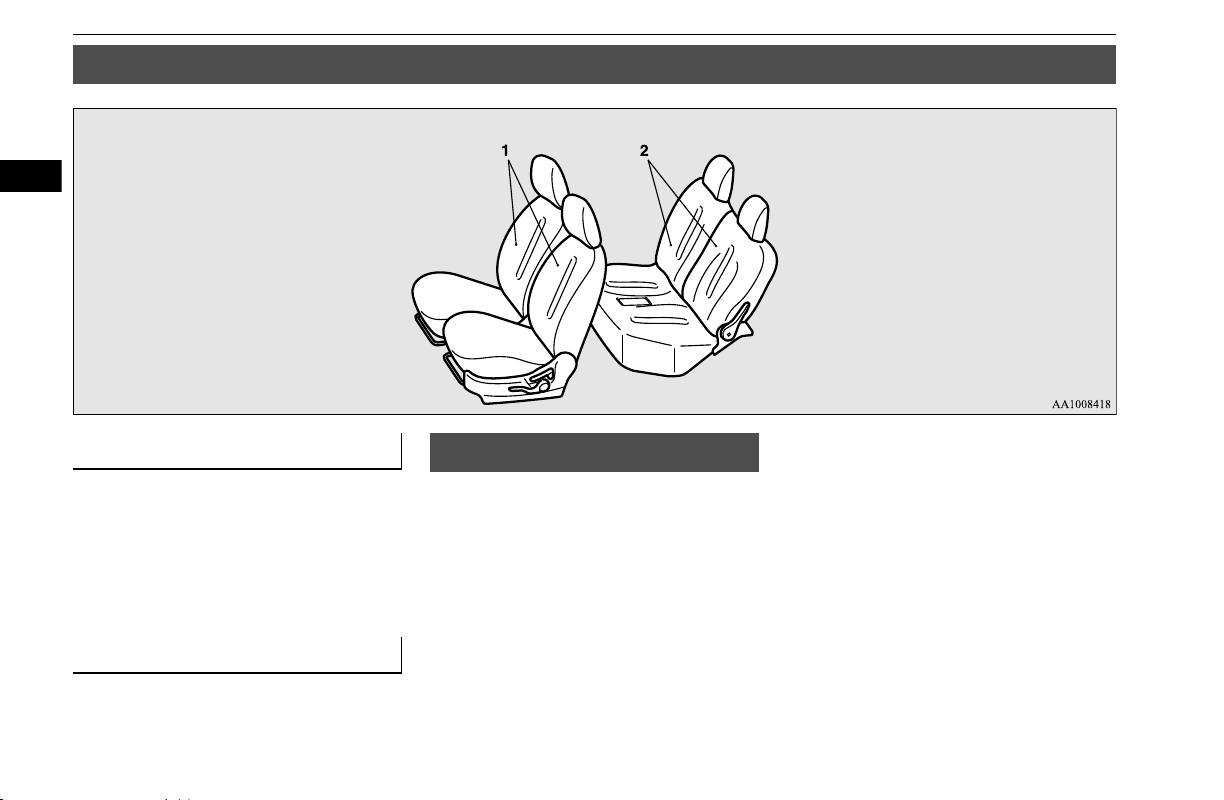
Seats
4-2 Seat and restraint systems
4
N00408400495
To adjust the seat forward or backward
P.4-3
To adjust the seatback P.4-3
To adjust the seat height (Driver’s side
only) P.4-4
Heated seats P.4- 4
To adjust the seatback P.4-5
Folding the seatbacks forward P.4-6
N00401600209
Your vehicle has seat belts and other features
that help protect you and your passengers in
an accident.
Seat belts are the most important safety
device. When worn properly, seat belts can
reduce the chance of serious injury or death
in various types of crashes. For added protec-
tion during a severe frontal collision, your
vehicle has a Supplemental Restraint System
(SRS) with airbags for the driver and passen-
gers. The seats, head restraints, and door
locks are also safety equipment, which must
be used correctly.
Always check the following before you drive:
That everyone in your vehicle is properly
wearing their seat belt.
That infants and small children are prop-
erly secured in appropriate child restraint
systems in the rear seat.
That all doors are fully closed and locked.
That seatbacks are upright, with head
restraints properly adjusted.
Seats
1 - Front seats
2 - Rear seats
Seats and restraint systems
BK0220401US.book 2 ページ 2015年6月3日 水曜日 午前7時42分
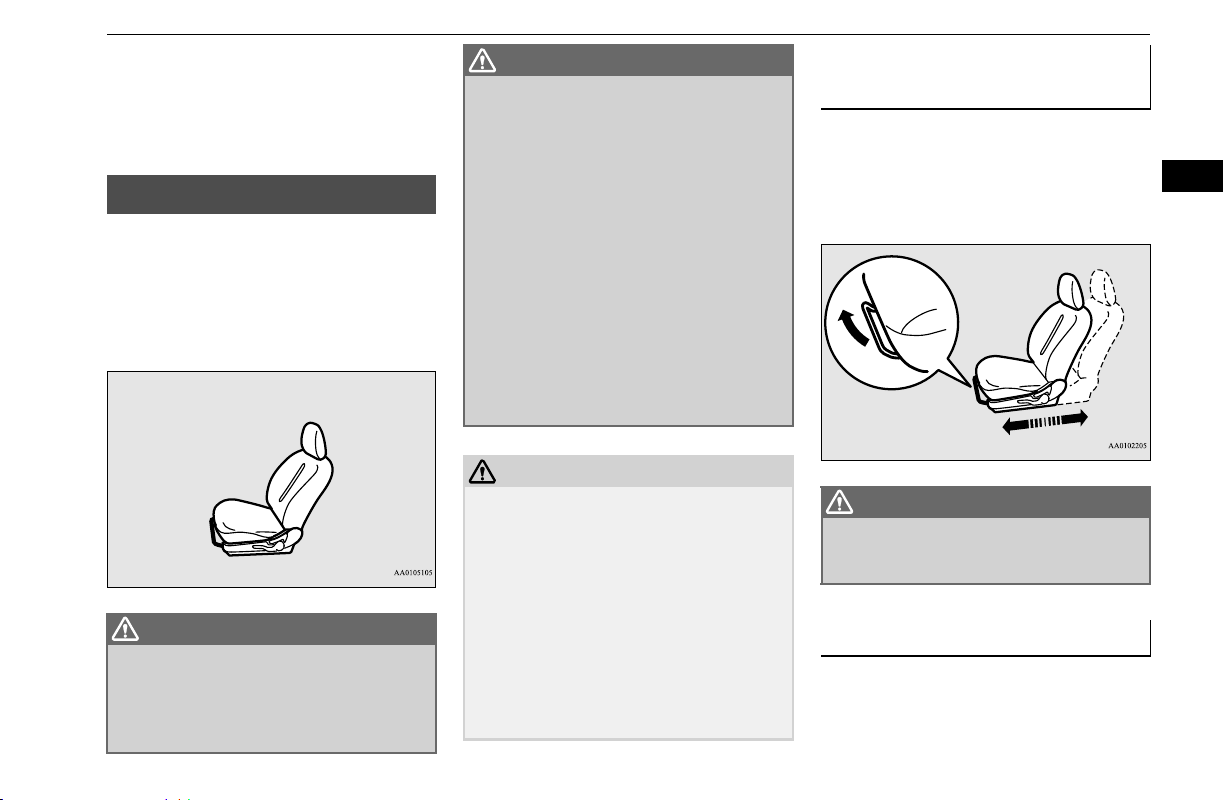
Front seats
Seat and restraint systems 4-3
4
Safety equipment cannot prevent injury or
death in all motor vehicle accidents. You can
help reduce the risk of injury or death, how-
ever, by following the instructions in this
manual.
N00401800386
Position the driver’s seat as far back as possi-
ble while maintaining a position that still
enables you to fully apply the pedals, easily
control the steering wheel and safely operate
the vehicle.
N00401900303
Pull the seat adjusting lever up and slide the
seat forward or backward to the desired posi-
tion. Release the adjusting lever to lock the
seat in place.
N00402000356
To adjust the seatback, lean forward slightly,
gently pull the seatback lock lever up, then
lean backward to a comfortable position and
Front seats
WARNING
Do not attempt to adjust the seat while
driving. This can cause loss of vehicle con-
trol and result in an accident.
After adjusting the seat, make sure that
the seat is securely locked into position.
To reduce the risk to the driver of serious
injury or death during deployment of the
driver’s airbag, always properly wear the
seat belt and adjust the driver’s seat as far
back as possible while maintaining a posi-
tion that still enables you to fully apply the
pedals, easily control the steering wheel,
and safely operate the vehicle.
To reduce the risk to the front passenger
of serious injury or death during deploy-
ment of the passenger’s airbag, always
properly wear the seat belt and adjust the
front passenger’s seat as far back as possi-
ble.
Always place children 12 years old and
under in the rear seat and use appropriate
child restraint systems.
CAUTION
Make sure that the seat is adjusted by an
adult. If it is adjusted by a child, an unex-
pected accident might occur.
Do not place a cushion or the like between
your back and the seatback while driving.
The effectiveness of the head restraints will
be reduced in the event of an accident.
When sliding the seats, be careful not to
catch your hand or leg.
When sliding or reclining the seat rearward,
pay careful attention to the rear seat passen-
gers.
WARNING
To adjust the seat forward or
backward
WARNING
To make sure that the seat is securely
locked, try to move it forward or back-
ward without using the adjusting lever.
To adjust the seatback
BK0220401US.book 3 ページ 2015年6月3日 水曜日 午前7時42分
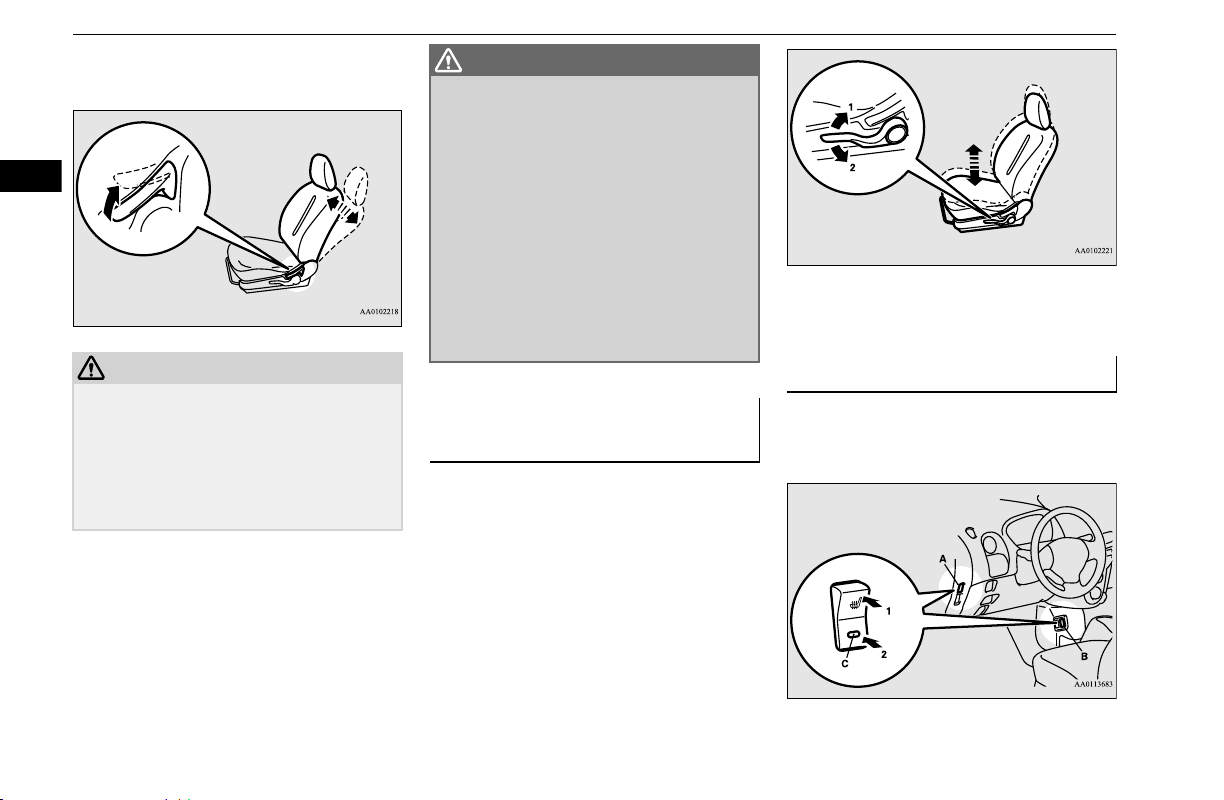
Front seats
4-4 Seat and restraint systems
4
release the lever. The seatback will lock in
place.
N00402100230
Operate the lever repeatedly to raise or lower
the seat.
N00435601434
The heated seats can be operated when the
electric motor switch is in the “ON” position.
CAUTION
The reclining mechanism used in the seat-
back is spring loaded, and will cause the
seatback to return quickly to the vertical
position when the lock lever is operated.
When pulling the lever, sit close to the seat-
back or hold the seatback with your hand to
control its return motion.
WARNING
To reduce the risk of serious injury or
death in the event of an accident or sud-
den stop, all seatbacks should be kept in
the upright position while the vehicle is in
motion.
Seat belt performance during an accident
can be adversely affected if the seatbacks
are reclined. The more a seatback is
reclined, the more likely seat belt perfor-
mance will be adversely affected. If the
seat belt is not properly positioned against
the body during an accident, there is
increased risk you will slide under the belt
and receive serious injury or death.
To adjust the seat height
(Driver’s side only)
1- Raise
2- Lower
Heated seats
A- For the driver’s seat
B- For the front passenger’s seat
BK0220401US.book 4 ページ 2015年6月3日 水曜日 午前7時42分
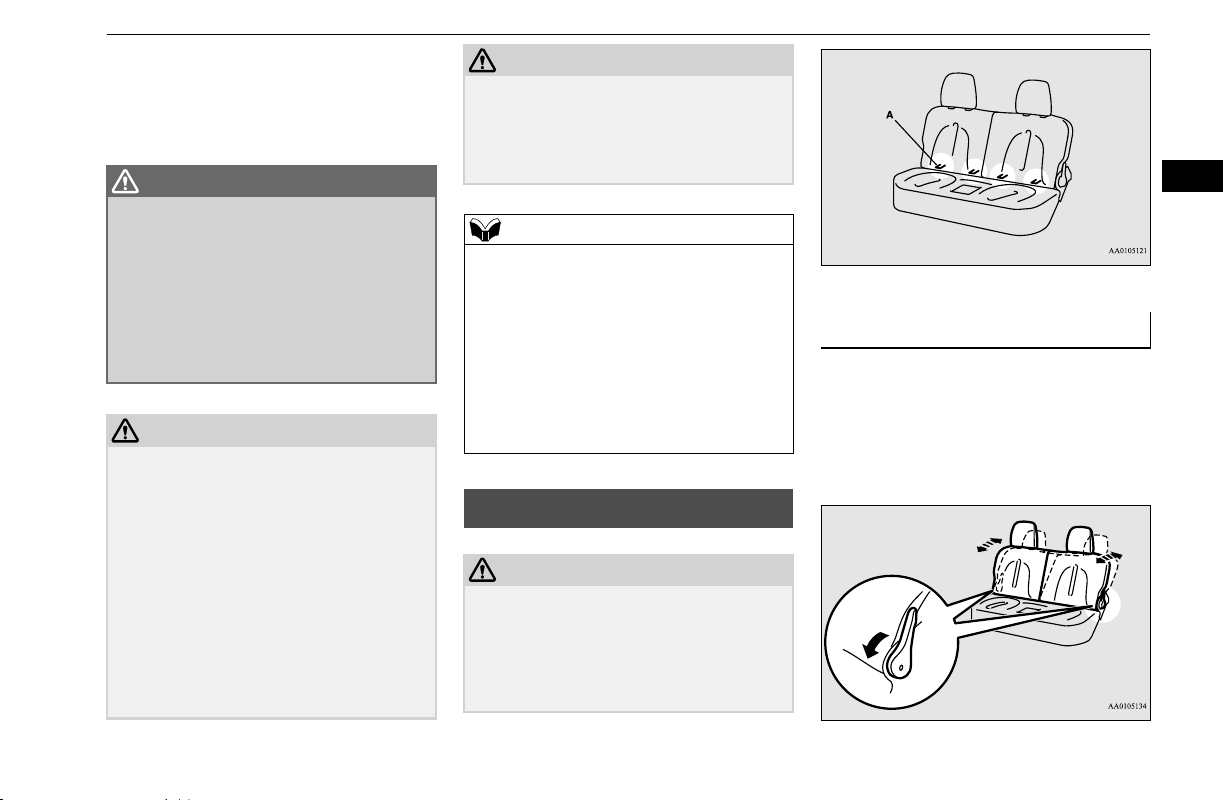
Rear seats
Seat and restraint systems 4-5
4
The indicator light (C) will illuminate while
the heater is on.
N00402500218
N00402800022
To adjust the seatback, lean forward slightly,
gently pull the seatback lock lever, then lean
backward to a comfortable position and
release the lever. The seatback will lock in
place.
1- Heater on.
2- Heater off
WARNING
Persons who are unable to feel tempera-
ture change or skin pain due to age, ill-
ness, injury, medication, alcohol use,
fatigue or other physical conditions or
who have sensitive skin may suffer burns
when using the heated seat even at low
temperatures. To reduce the risk of burns,
people with such conditions must use care
when using the heated seat.
CAUTION
Switch off the seat heater when not in use.
Do not place heavy objects on the seat or
stick pins, needles, or other pointed objects
into the seat.
Do not place a blanket, cushion, or other
insulating material on the seat while using
the heater; doing so can cause the heater ele-
ment to overheat.
When cleaning the seat, do not use benzine,
kerosene, gasoline, alcohol, or other organic
solvents; doing so can cause damage not
only to the surface of the seat, but also to the
heater.
If water or any other liquid is spilled on the
seat, allow it to dry thoroughly before
attempting to use the heater.
Turn the heater off immediately if it appears
to be malfunctioning during use.
NOTE
Do not turn the electric motor switch to the
“ON” position; doing so will stop quick
charging.
You can use the heated seats while the
Remote Climate Control is activated.
Refer to “Remote Climate Control” on page
3-36, 3-47 and “For persons with electro-
medical apparatus such as implantable car-
diac pacemaker or implantable cardiovascu-
lar defibrillator” on page 3-6.
Rear seats
CAUTION
Child restraint lower anchorages (A) are pro-
vided between the seat cushion and the seat-
back.
Be careful that the lower anchorages may be
hot due to heat of the electric motor unit
room.
CAUTION
To adjust the seatback
BK0220401US.book 5 ページ 2015年6月3日 水曜日 午前7時42分
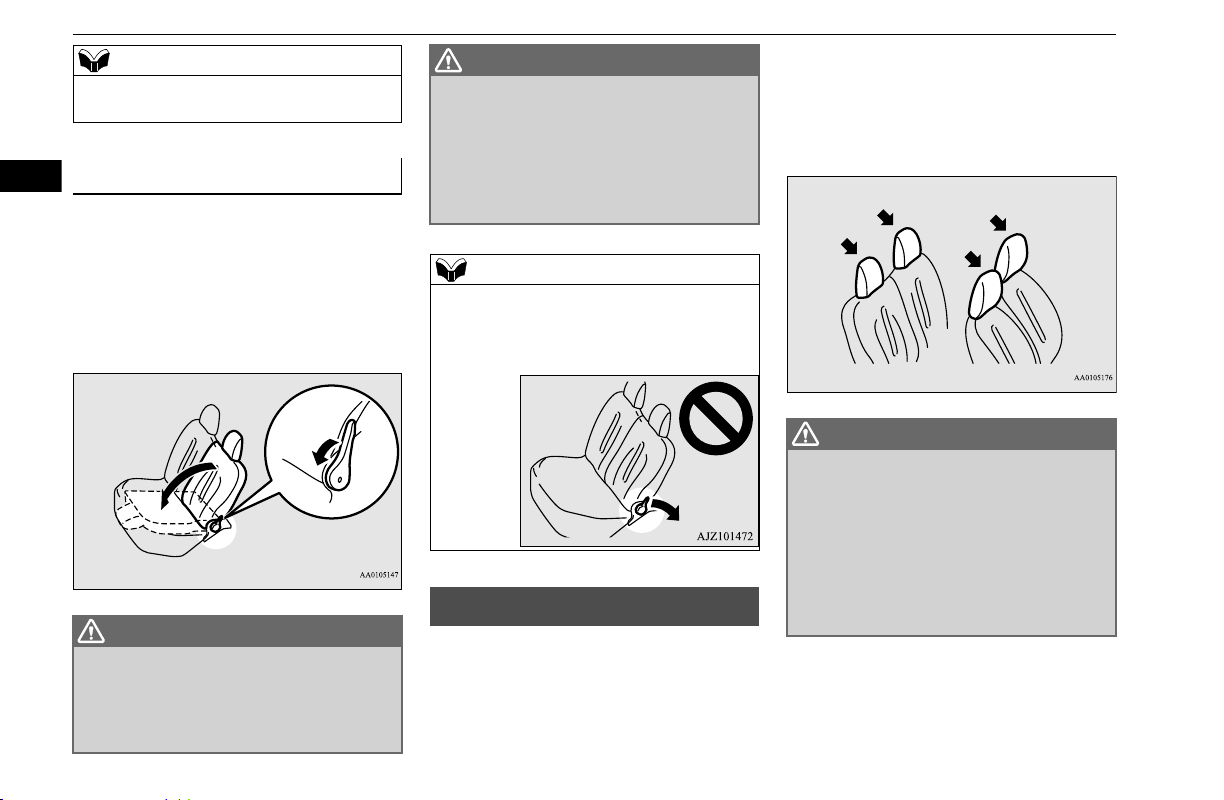
Head restraints
4-6 Seat and restraint systems
4
N00402901219
The rear seatbacks can be folded forward to
provide additional luggage compartment
space.
Pull the lever, and fold the rear seatbacks for-
ward. Confirm that the seatback locks
securely when it is returned.
N00404300571
Padded head restraints for the seats can
reduce the risk of a whiplash injury if your
vehicle is hit from the rear.
The head restraints are equipped in the illus-
trated position.
To maximize the effectiveness of your head
restraint, seatback to the upright position, and
the head restraint to the proper position. Sit
back against the seatback with your head
close to the head restraint.
NOTE
It is possible to adjust the seatback angle
independently on each side.
Folding the seatbacks forward
WARNING
Do not allow anyone to ride in the center
of rear seat or in the luggage compartment
vehicle is in motion. People who are not
properly seated and restrained can be
seriously injured or killed in an accident.
To avoid reducing rearward vision, do not
load cargo or luggage higher than the top
of the seatback.
Firmly secure cargo and luggage. Unse-
cured cargo and luggage can move during
braking or in an accident, causing serious
injury or death.
NOTE
Do not push the lever toward the rear of the
vehicle. Doing so could damage the lever
and make it impossible to operate the seat-
back.
Head restraints
WARNING
WARNING
In order to minimize the risk of a neck
injury due to a rear impact, the head
restraint must be adjusted to the proper
position before vehicle operation. For the
driver and front passenger, the seatbacks
must be adjusted to the upright position
before adjusting the head restraints. The
driver should never adjust the seat while
the vehicle is in motion.
BK0220401US.book 6 ページ 2015年6月3日 水曜日 午前7時42分
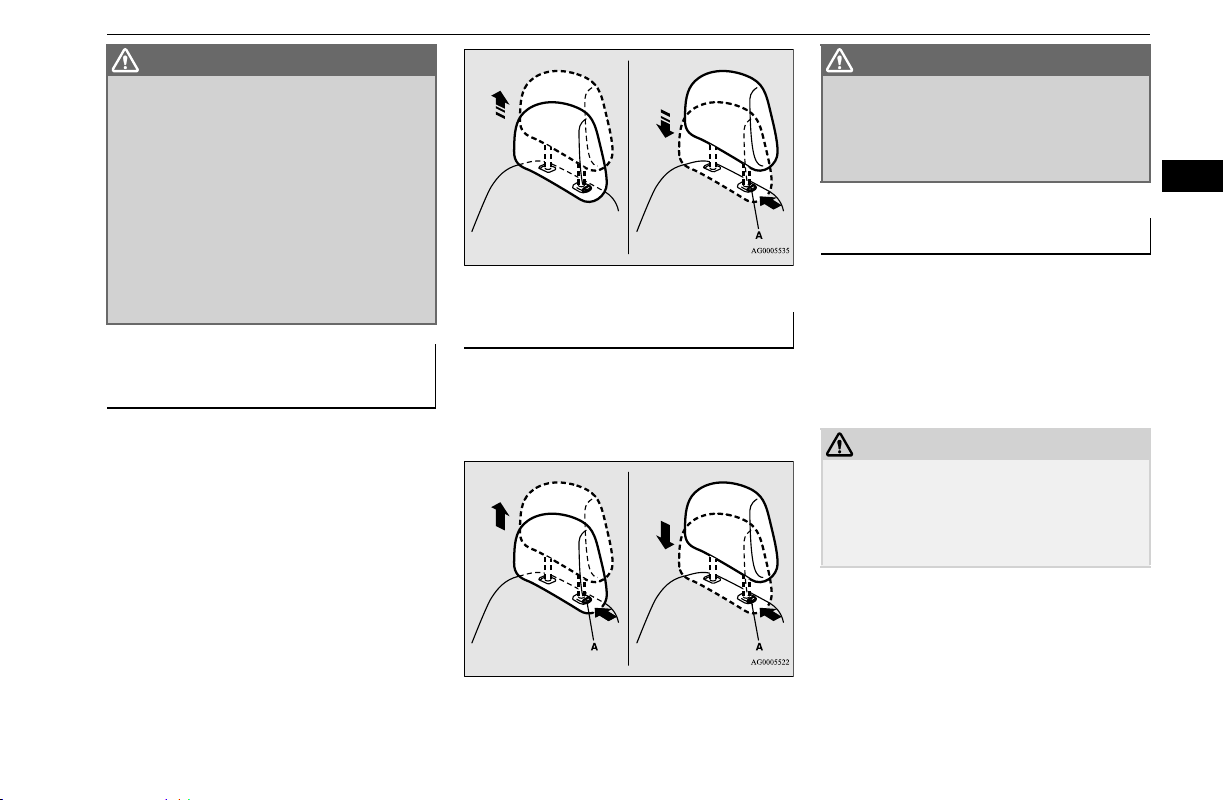
Head restraints
Seat and restraint systems 4-7
4
To reduce the risk of injury in an accident,
adjust the head restraint height so that the
center of the restraint is at your eye level
when seated. Any person too tall for the
restraint to reach their eye level when seated
should raise the restraint to the highest locked
position.
To raise the restraint, pull it straight up.
To lower the restraint, push down on it
while pressing the lock knob (A) in the
direction shown by the arrow.
After adjusting the height, push down on
the restraint to make sure it is locked in
position.
Press the lock knob (A) in the direction
shown by the arrows. Then pull the head
restraint up and out of the seatback.
First check that the head restraint is facing in
the right direction as shown in the previous
illustration, and then insert it into the seat-
back. Push the head restraint down while
pressing the lock knob (A) until the restraint
locks into place.
Driving without the head restraints in
place can cause you and your passengers
serious injury or death in an accident. To
reduce the risk of injury in an accident,
always make sure the head restraints are
installed and properly positioned when
the seat is occupied.
Never place a cushion or similar device on
the seatback. This can adversely affect
head restraint performance by increasing
the distance between your head and the
restraint.
Adjustment of the head
restraint height
WARNING
To remove
WARNING
To help minimize the risk of neck injury in
the event of an accident, the head
restraints must be properly installed and
positioned to proper height before vehicle
operation.
To install
CAUTION
Check that the lock knob (A) is extended out
as shown in the illustration. Then pull the
head restraint up to make sure that it is
locked in place and will not come out of the
seatback.
BK0220401US.book 7 ページ 2015年6月3日 水曜日 午前7時42分
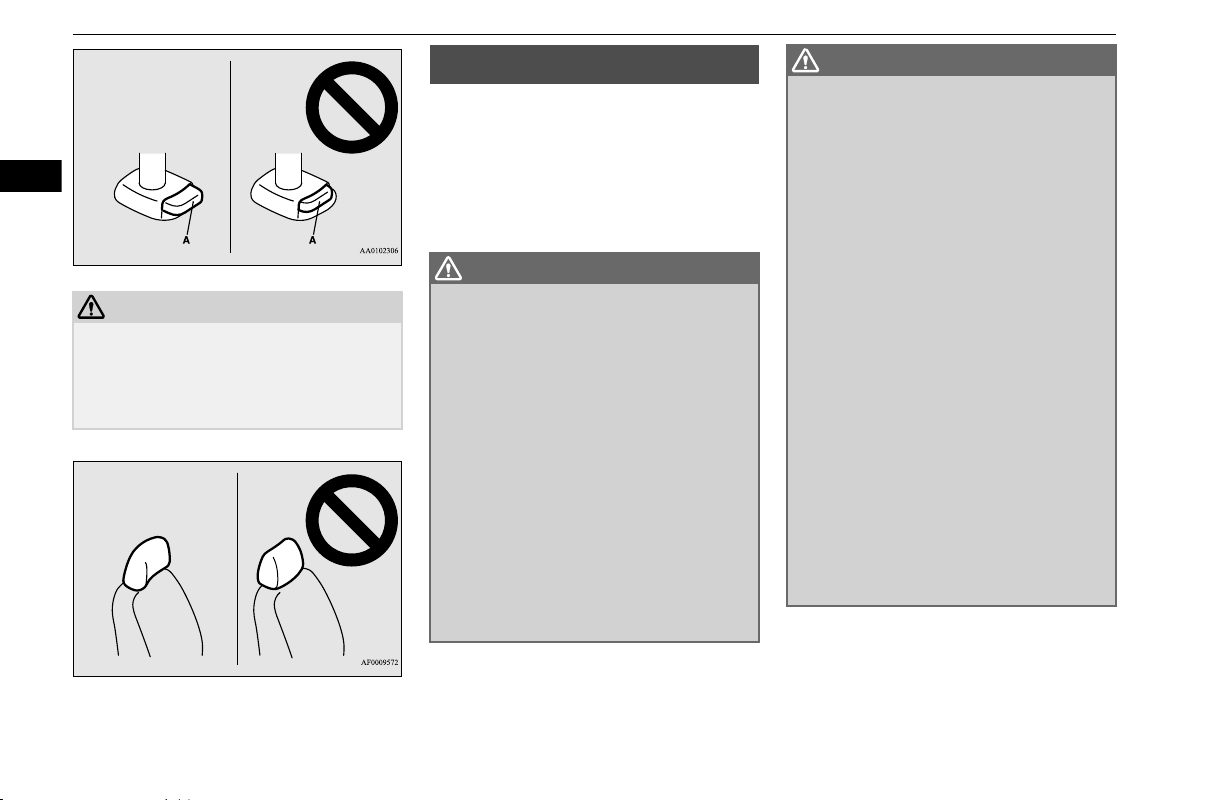
Seat belts
4-8 Seat and restraint systems
4
N00406001494
Seat belts are installed in your vehicle to help
reduce the risk of injury to the driver and pas-
senger in the event of an accident. Always
use the provided seat belts.
Carefully review the following information
for proper seat belt usage.
CAUTION
The shape and size of the head restraint dif-
fers according to the seat. Always use the
correct head restraint provided for the seat
and do not install the head restraint in the
wrong direction.
Seat belts
WARNING
To help reduce the risk of injury or death
in an accident, seat belts and child
restraint systems must always be used.
Refer to “Child restraint systems” on page
4-13 for additional information.
Never use one seat belt for more than one
person.
Never carry more people in your vehicle
than there are seat belts.
Always adjust the seat belt for a snug fit.
Always place the shoulder belt over your
shoulder and across your chest. Never put
it behind you or under your arm.
Always wear the lap belt as low as possible
across your hips, not around your waist.
Never modify or alter the seat belts in
your vehicle.
To reduce the risk to the driver of serious
injury or death during deployment of the
driver’s airbag, always properly wear the
seat belt and adjust the driver’s seat as far
back as possible while maintaining a posi-
tion that still enables you to fully apply the
pedals, easily control the steering wheel,
and safely operate the vehicle.
To reduce the risk to a front seat passen-
ger of serious injury or death from a
deploying airbag, make sure the passenger
always wears the seat belt properly,
remains seated all the way back and
upright in their seat, and moves the seat as
far back as possible. Refer to “Supplemen-
tal Restraint System (SRS) - airbag” on
page 4-20 for additional information.
Never hold an infant or child in your arms
or on your lap when riding in this vehicle
even when you are wearing your seat belt.
Never place any part of the seat belt you
are wearing around an infant or child.
Failure to follow these simple instructions
creates a risk of serious injury or death to
your child in the event of an accident or
sudden stop.
WARNING
BK0220401US.book 8 ページ 2015年6月3日 水曜日 午前7時42分
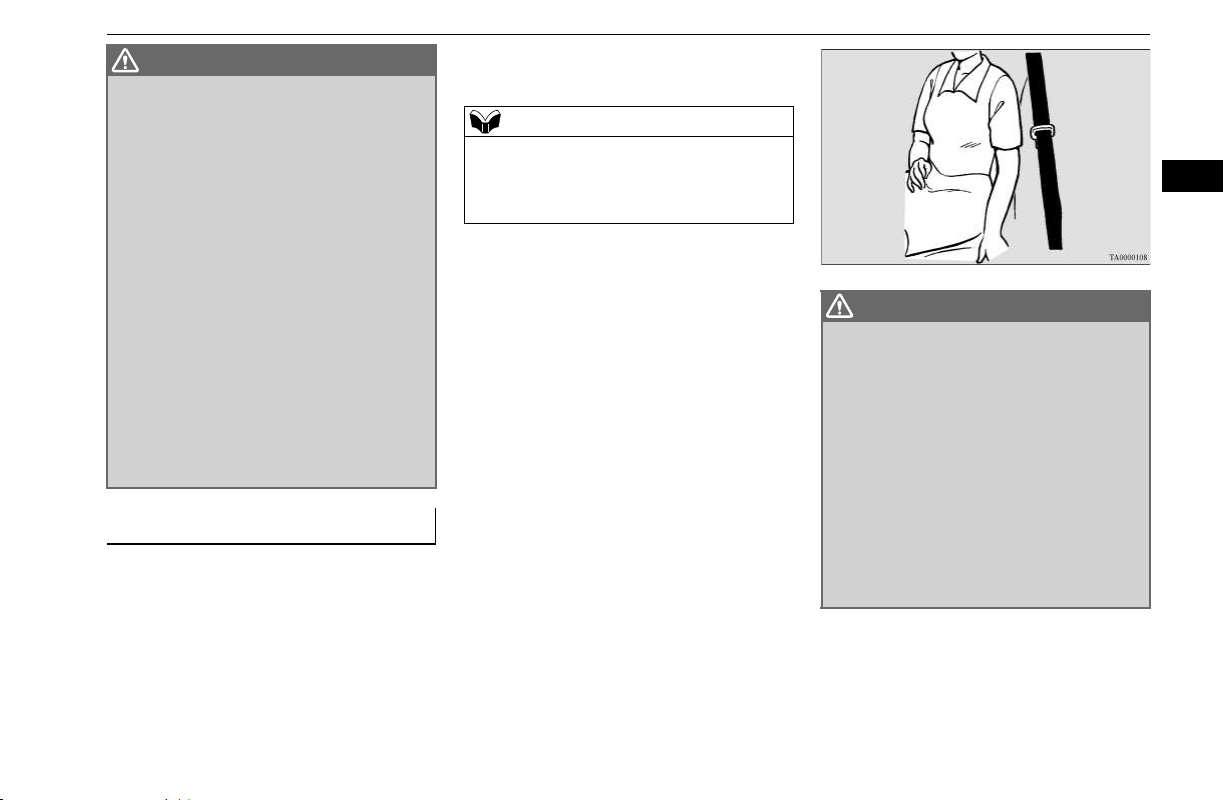
Seat belts
Seat and restraint systems 4-9
4
N00406200457
All seats are equipped with a seat belt which
uses one combined lap-and-shoulder belt with
an emergency locking retractor.
This system is designed to provide both com-
fort and safety. It permits full extension and
automatic retraction of the belts during nor-
mal vehicle operation. A sensing device
inside the belt retractor is designed to lock the
retractor in the event of a sudden change in
the vehicle’s motion.
1. Occupants should always sit back in their
seats with their backs against the upright
seatback. To reduce the risk of serious
injury or death during deployment of the
airbag, adjust the driver’s seat as far back
as possible while maintaining a position
that still enables you to fully apply the
pedals, easily control the steering wheel,
and safely operate the vehicle. The front
passenger seat should also be moved as
far back as possible. Refer to “Supple-
mental Restraint System (SRS) - airbag”
on page 4-20. Also refer to “To adjust the
seat forward or backward” on page 4-3.
2. Grasp the latch plate and slide it up the
webbing so that it easily pulls across your
body.
Children 12 years old and under should
always ride in the rear seat and be prop-
erly restrained. This reduces their risk of
serious injury or death in an accident,
especially due to a deploying front passen-
ger’s airbag. Refer to “Child restraint sys-
tems” on page 4-13 for additional
information.
Any child who is too small to properly
wear a seat belt must be properly
restrained in an appropriate child
restraint system.
Infants MUST be placed in a rear-facing
child safety seat and positioned in the rear
seat.
In the event of an accident, all seat belt
assemblies, including retractors and
attachment hardware, should be inspected
by a certified i-MiEV dealer to determine
whether replacement is necessary.
Seat belt instructions
WARNING
NOTE
For instructions on installing a child restraint
system using a seat belt, refer to “Installing a
child restraint system using the seat belt” on
page 4-18.
WARNING
To reduce the risk of serious injury or
death in the event of an accident or sud-
den stop, all seatbacks should be kept in
the upright position while the vehicle is in
motion.
Seat belt performance during an accident
can be adversely affected if the seatbacks
are reclined. The more a seatback is
reclined, the more likely seat belt perfor-
mance will be adversely affected. If the
seat belt is not properly positioned against
the body during an accident, there is
increased risk you will slide under the belt
and receive serious injury or death.
BK0220401US.book 9 ページ 2015年6月3日 水曜日 午前7時42分
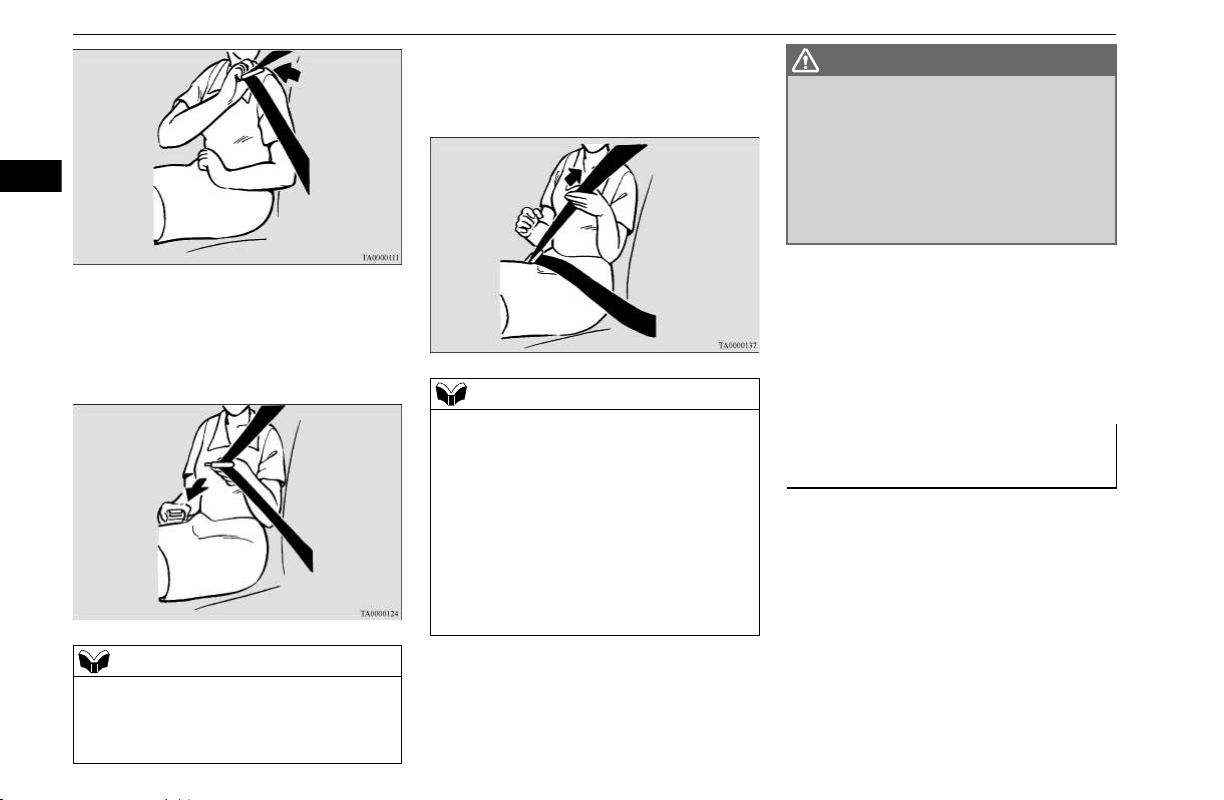
Seat belts
4-10 Seat and restraint systems
4
3. Pull the seat belt out slowly while holding
the latch plate. Push the latch plate into
the buckle until you hear a “click”. Pull
up on the belt to be sure the latch plate is
locked securely in the buckle.
4. The lap part of the belt must always be
worn low and snug across the hips. Pull
up on the shoulder portion of the belt to
take up any slack in the lap belt.
5. To release the belt, press the button on the
buckle and allow the belt to retract.
If the belt does not retract smoothly, pull it
out and check for kinks or twists in the
webbing. Then make sure it remains
untwisted as it retracts.
N00418400371
A tone and warning light are used to remind
the driver to fasten the seat belt.
NOTE
If the seat belt locks up and cannot be pulled
out, pull it once with force and let it retract
all the way.
Then, pull the belt out slowly once again.
NOTE
With the exception of the seat belt for the
driver, the seat belts in all other seating posi-
tions are equipped with an Automatic Lock-
ing Retractor (ALR) function. If you pull the
seat belt fully out of the retractor, the retrac-
tor will switch to its ALR child restraint
installation function (see page 4-18).
When the ALR function has been activated,
the seat belt will only retract. If this happens,
let the belt fully retract, then pull the seat
belt back out, repeating steps 1 through 4.
WARNING
Be sure the lap belt portion fits snugly and
is worn as low as possible across the hips,
not around the waist. Failure to follow this
instruction will increase the risk of serious
injury or death in the event of an accident.
Be sure the seat belt webbing is not
twisted when worn. Twisted webbing may
adversely affect seat belt performance.
Driver’s seat belt
reminder/warning light
BK0220401US.book 10 ページ 2015年6月3日 水曜日 午前7時42分
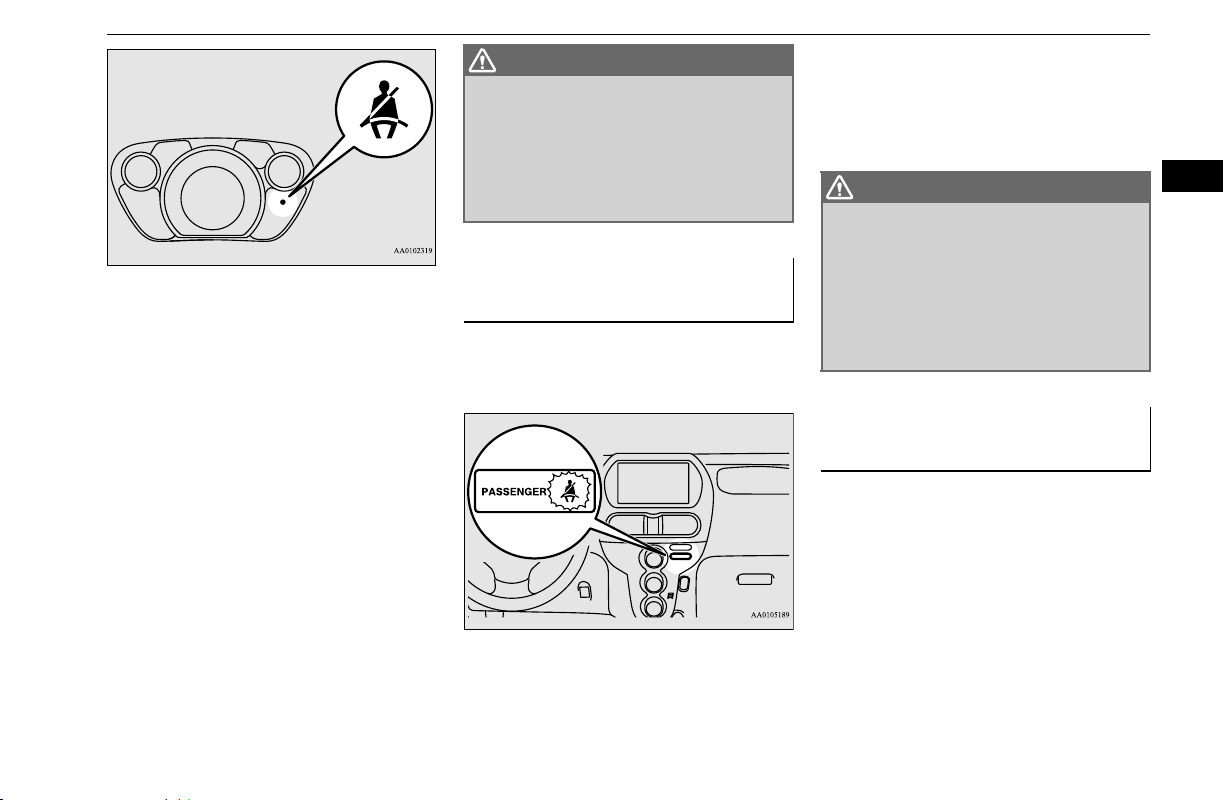
Seat belts
Seat and restraint systems 4-11
4
If the electric motor switch is turned to the
“ON” position without the driver’s seat belt
being fastened, a warning light will come on,
and a tone will sound for approximately 6
seconds to remind you to fasten your seat
belt.
If the seat belt remains unfastened approxi-
mately 1 minute later, the warning light will
flash and the tone will sound intermittently
for approximately 90 seconds when the vehi-
cle is driven.
If the seat belt subsequently remains unfas-
tened, the warning light and tone will issue
further warnings each time the vehicle starts
moving from a stop. And if the driver unfas-
tens the seat belt while driving, the warning
will operate in the same way. When the seat
belt is fastened, the warnings will stop.
N00418300224
The front passenger seat belt warning light is
located in the instrument panel.
When the electric motor switch is turned to
the “ON” position, this indicator normally
comes on and goes off a few seconds later.
The light comes on when a person sits on the
front passenger seat but does not fasten the
seat belt.
It goes off when the seat belt is subsequently
fastened.
N00406300328
The seat belt anchor height can be adjusted.
To move the anchor, pull the lock knob (A)
and slide the anchor to the desired position.
Release the lock knob to lock the anchor into
position.
WARNING
In order to reduce the risk of serious
injury or death in an accident, always
wear your own seat belt. Do not allow any-
one to ride in your vehicle unless he or she
is also seated and wearing a seat belt.
Children should additionally be restrained
in a secure child restraint system.
Front passenger seat belt warn-
ing light
WARNING
When a child booster seat is used on the
front passenger seat, the front passenger
seat belt warning light will not come on, if
the seat belt is not fastened when the
booster seat is used. Confirm that the
child is wearing the seat belt properly.
Do not install any accessory or sticker that
makes the light difficult to see.
Adjustable seat belt shoulder
anchor (front seats)
BK0220401US.book 11 ページ 2015年6月3日 水曜日 午前7時42分
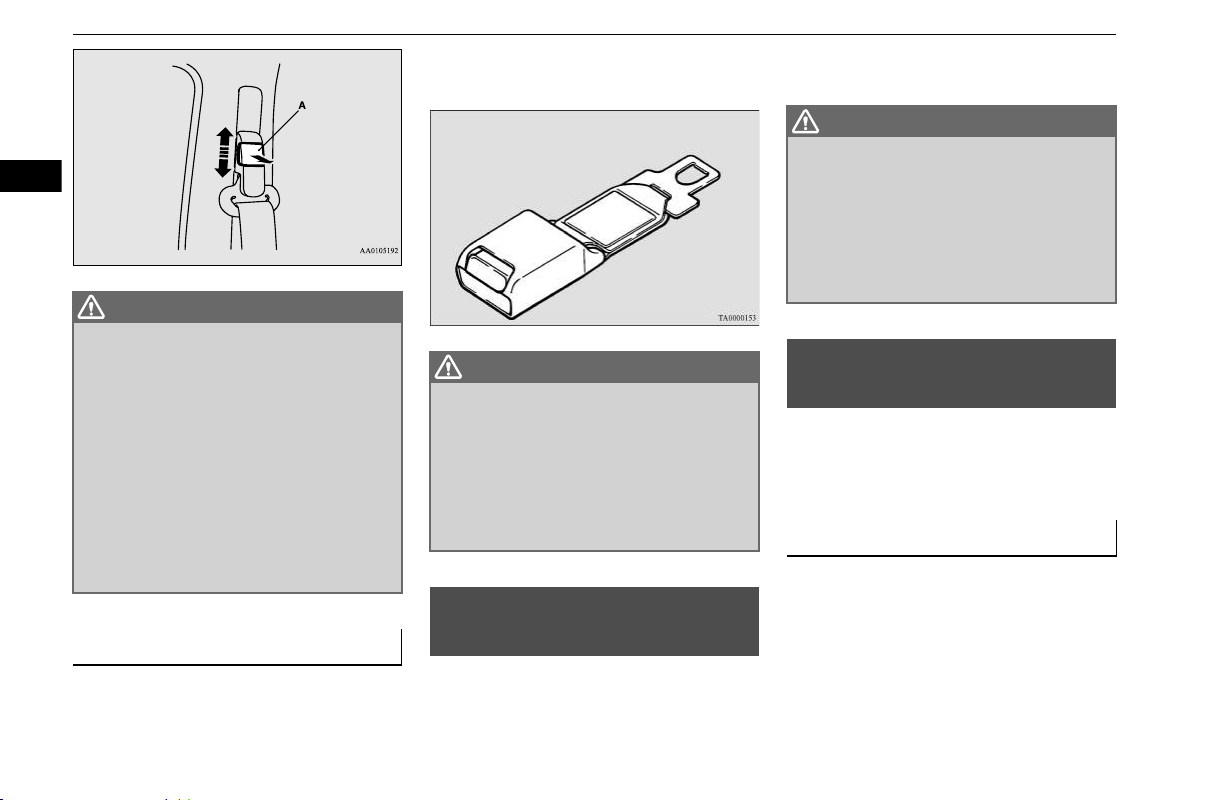
Seat belt use during pregnancy
4-12 Seat and restraint systems
4
N00406700087
When your seat belt, even fully extended, is
not long enough, a seat belt extender must be
obtained. The extender may be used for either
of the front seats.
N00406800121
Seat belts work for everyone, including preg-
nant women. Like all occupants, pregnant
women are more likely to be seriously injured
or killed in an accident if they do not wear
seat belts.
N00417701736
The driver’s and front passenger’s seats each
have a seat belt equipped with a pre-tensioner
system and force limiter system.
The driver and front passenger seat belts are
equipped with a seat belt pre-tensioner sys-
tem. In moderate-to-severe front or side colli-
sions, this system operates simultaneously
with the deployment of the front airbags, side
airbags or curtain airbags.
The seat belt pre-tensioners are located within
the seat belt retractors (A). When activated,
WARNING
Always adjust the shoulder belt anchor so
that the shoulder belt is positioned across
the center of your shoulder without touch-
ing your neck. The shoulder belt should
not be able to fall off your shoulder. Fail-
ure to follow this instruction can adversely
affect seat belt performance and increase
the risk of serious injury or death in the
event of an accident.
Adjust the shoulder belt anchor only when
the vehicle is not in motion.
Make sure the anchor is securely locked in
position after adjusting it.
Seat belt extender
WARNING
The extender should only be used if the
existing belt is not long enough. Anyone
who can use the standard seat belt should
not use an extender. Unnecessary use of an
extender can adversely affect seat belt
performance in an accident.
When not required, the extender must be
removed and stowed.
Seat belt use during preg-
nancy
WARNING
To reduce the risk of serious injury or
death to pregnant women and unborn
children in an accident, pregnant women
should always wear a seat belt. The lap
portion of the seat belt should be worn
snug and low across the hips and below
the rounding. Consult your doctor if you
have any additional questions or concerns.
Seat belt pre-tensioner and
force limiter systems
Pre-tensioner system
BK0220401US.book 12 ページ 2015年6月3日 水曜日 午前7時42分
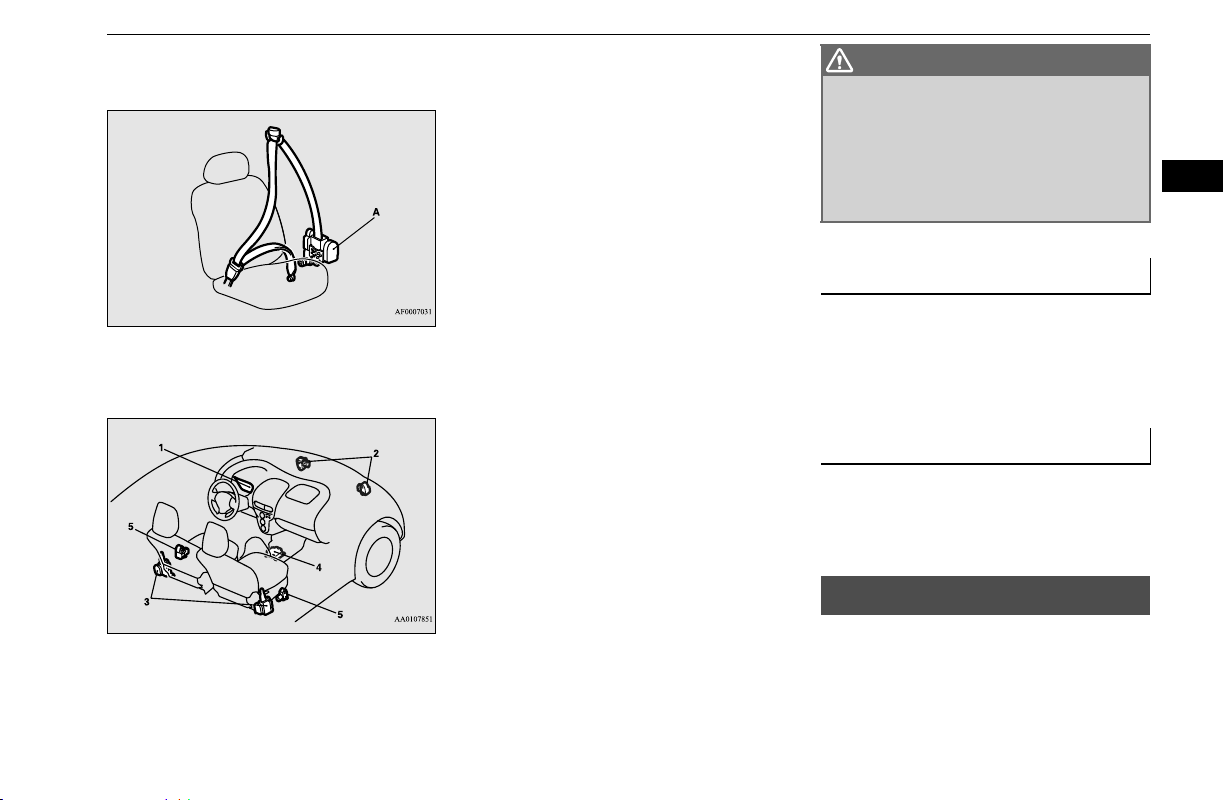
Child restraint systems
Seat and restraint systems 4-13
4
the pre-tensioners quickly draw back seat belt
webbing and increase seat belt performance.
The seat belt pre-tensioner system includes
the following components:
The airbag control unit monitors the readiness
of the electronic parts of the system whenever
the electric motor switch is in the “ON” or
“START” position. These include all of the
items listed above and all related wiring.
The pre-tensioner seat belt system will oper-
ate only when the electric motor switch is in
the “ON” or “START” position.
When the seat belt pre-tensioners activate,
some smoke is released and a loud noise will
be heard. The smoke is not harmful, but care
should be taken not to intentionally inhale it,
as it may cause some temporary irritation to
people with respiratory problems.
The pre-tensioners activate in the event of a
moderate-to-severe front or side impact, even
if the seat belt is not being worn. The seat belt
pre-tensioners may not activate in certain
frontal collisions, even though the vehicle
may appear to be severely damaged. Such
non-activation does not mean something is
wrong with the seat belt pre-tensioner system,
but rather that the collision forces were not
severe enough or not of the type to activate
the system.
N00408700124
This warning light tells you if there is a prob-
lem involving the SRS airbags and/or the pre-
tensioner seat belts. Refer to “SRS warning
light” on page 4-26.
N00408900113
In the event of an accident, the seat belt force
limiter system will help reduce the force
applied to the driver and front seat passenger.
N00407101795
When transporting infants or small children
in your vehicle, an appropriate child restraint
system must always be used. This is required
by law in the U.S. and Canada.
1- SRS warning light
2- Front impact sensors
3- Seat belt pre-tensioners
4- Airbag control unit
5- Side impact sensors
WARNING
The seat belt pre-tensioner system is
designed to work only once. After the seat
belt pre-tensioners have been activated,
they will not work again. They must
promptly be replaced and the entire seat
belt pre-tensioner system inspected by a
certified i-MiEV dealer.
SRS warning light
Force limiter system
Child restraint systems
BK0220401US.book 13 ページ 2015年6月3日 水曜日 午前7時42分
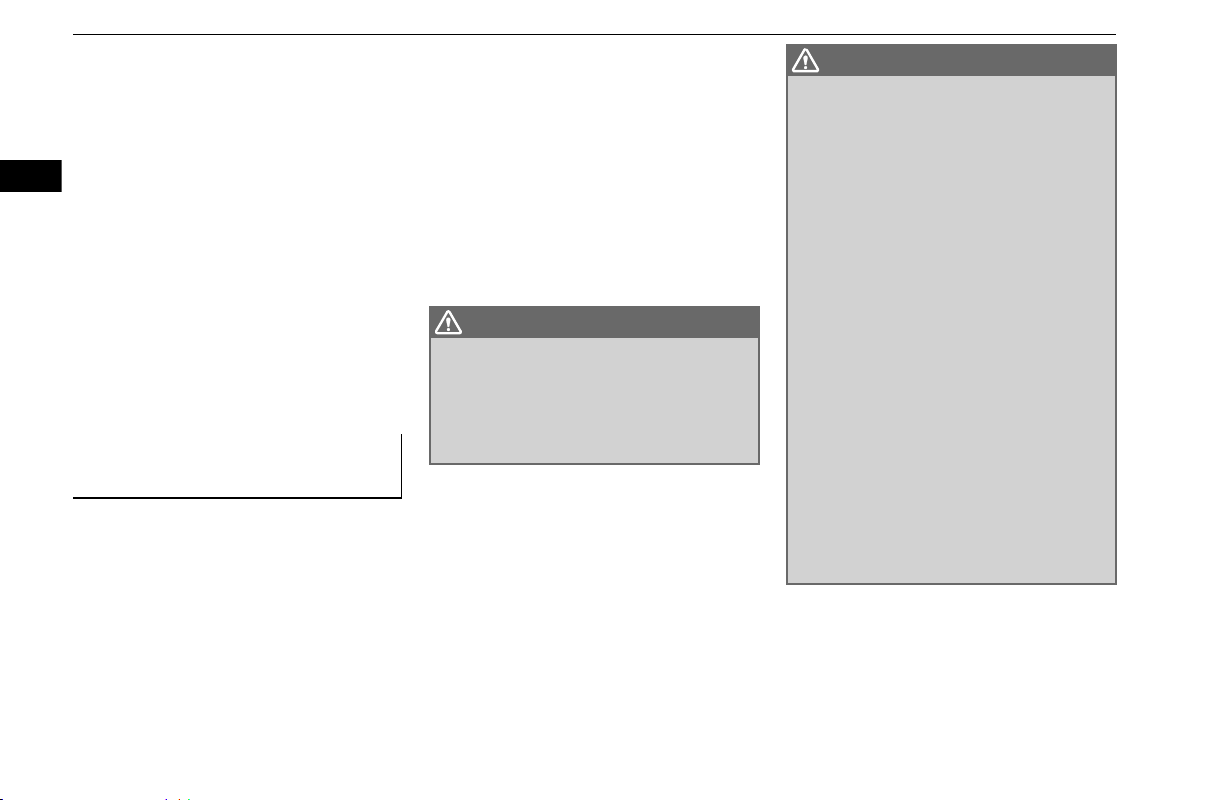
Child restraint systems
4-14 Seat and restraint systems
4
Child restraint systems specifically designed
for infants and small children are offered by
several manufacturers. Choose only a child
restraint system with a label certifying that it
complies with Federal Motor Vehicle Safety
Standard 213 (FMVSS 213) or Motor Vehicle
Restraint Systems and Booster Seats Safety
Regulations (RSSR). Look for the manufac-
turer’s statement of compliance on the box
and child restraint system itself.
The child restraint system should be appropri-
ate for your child’s weight and height, and
should properly fit your vehicle’s seat.
For detail information, refer to the instruction
manual accompanying the child restraint sys-
tem.
All children should be properly restrained in
a restraint device that offers the maximum
protection for their size and age.
Be sure to check local, state, or provincial
requirements for child size and age that may
vary from the recommendations listed below.
Children less than 1 year old and who
weigh 22 pounds (10 kg) or less MUST
ride in a rear-facing child safety seat that
MUST ONLY be used in the rear seat.
Children older than 1 year of age and who
weigh less than 40 pounds (18 kg) or who
are less than 40 inches (100 cm) tall must
be in a forward-facing restraint used only
in the rear seat.
Children who weigh more than 40 pounds
(18 kg) or who are more than 40 inches
(100 cm) tall, regardless of age, should
use a suitable child seat or a booster seat
in the rear seat until the vehicle’s
lap/shoulder belt fits them properly.
Guidelines for child restraint
system selection
WARNING
All children must be seated in the rear
seat, and properly restrained.
Accident statistics show that children of
all sizes and ages are safer when properly
restrained in the rear seat, rather than in
the front seat.
Any child who is too large to use a child
restraint system should ride in the rear
seat and wear the lap and shoulder belt
properly. The shoulder belt must be posi-
tioned over the shoulder and across the
chest, not across their neck, and with the
lap belt positioned low on the child’s hips,
not across their stomach. If necessary, a
booster seat should be used to help achieve
a proper seat belt fit. Follow the booster
seat manufacturer’s instructions. Only use
a booster seat that is certified as comply-
ing with Federal Motor Vehicle Safety
Standards or Motor Vehicle Restraint Sys-
tems and Booster Seats Safety Regula-
tions.
Never hold an infant or child in your arms
or on your lap when riding in this vehicle,
even when you are wearing your seat belt.
Never place any part of the seat belt you
are wearing around an infant or child.
Failure to follow these simple instructions
creates a risk of serious injury or death to
your child in the event of an accident or
sudden stop.
WARNING
BK0220401US.book 14 ページ 2015年6月3日 水曜日 午前7時42分
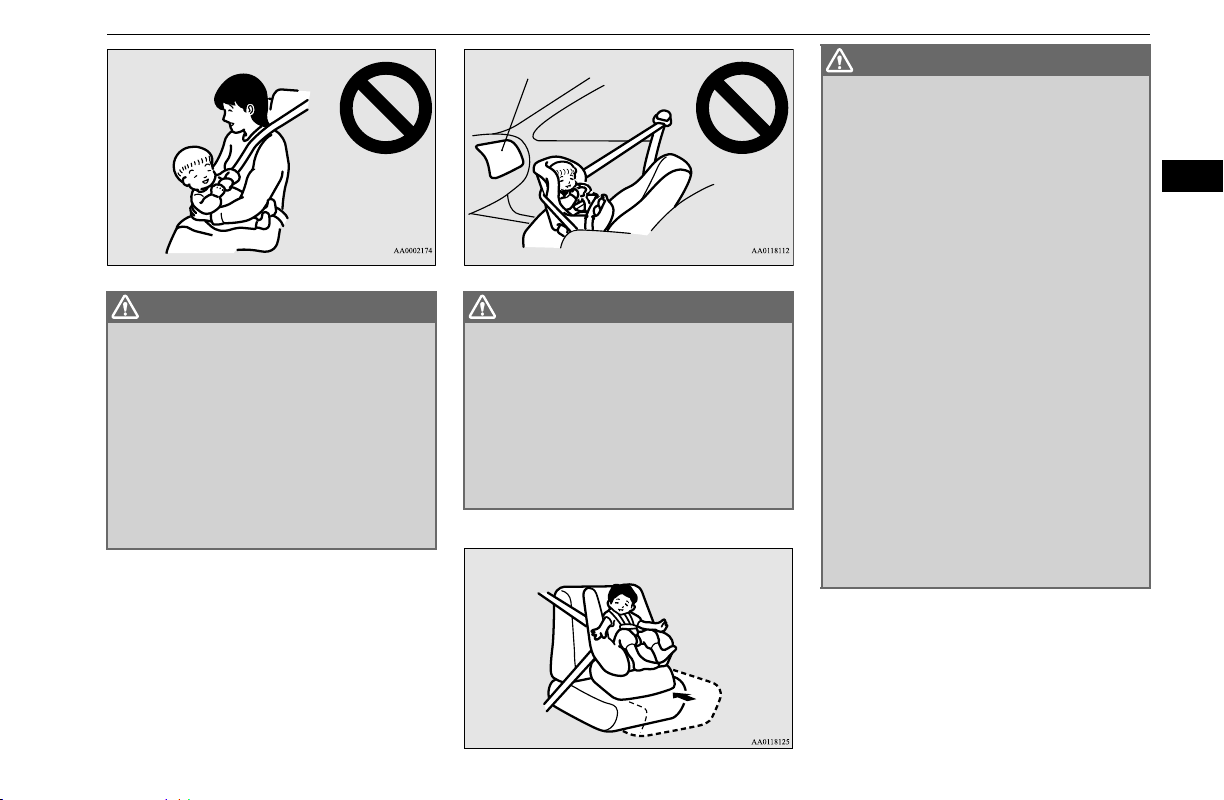
Child restraint systems
Seat and restraint systems 4-15
4
WARNING
Your vehicle is also equipped with a front
passenger’s airbag.
Never put REAR-FACING CHILD
RESTRAINT SYSTEMS or INFANT
RESTRAINT SYSTEMS in the front pas-
senger seat. This places the infant too
close to the passenger’s airbag. During
deployment of the airbag, the infant can
be seriously injured or killed. Rear-facing
child restraint systems or infant restraint
systems must only be used in the rear seat.
WARNING
FRONT-FACING CHILD RESTRAINT
SYSTEMS should be used in the rear seat
whenever possible. If they must be used in
the front passenger seat, move the seat to
the most rearward position and make sure
the child stays in the child restraint sys-
tem, properly restrained. Failure to follow
these instructions could result in serious
injury or death to the child.
Airbag
WARNING
It is important to use an approved rear-
facing infant restraint until the infant is
one year old (unless the infant outgrows
the seat sooner). This allows the infant’s
neck and spine to develop enough to sup-
port the weight of their head in the event
of an accident.
When installing a child restraint system,
follow the instructions provided by the
manufacturer and follow the directions in
this manual. Failure to do so can result in
serious injury or death to your child in an
accident or sudden stop.
After installation, push and pull the child
restraint system back and forth, and side
to side, to see that it is firmly secured. If
the child restraint system is not installed
securely, it may cause injury to the child
or other occupants in the event of an acci-
dent or sudden stop.
When not in use, keep your child restraint
system secured with the seat belt, or
remove it from the vehicle, in order to pre-
vent it from being thrown around inside
the vehicle during an accident.
BK0220401US.book 15 ページ 2015年6月3日 水曜日 午前7時42分
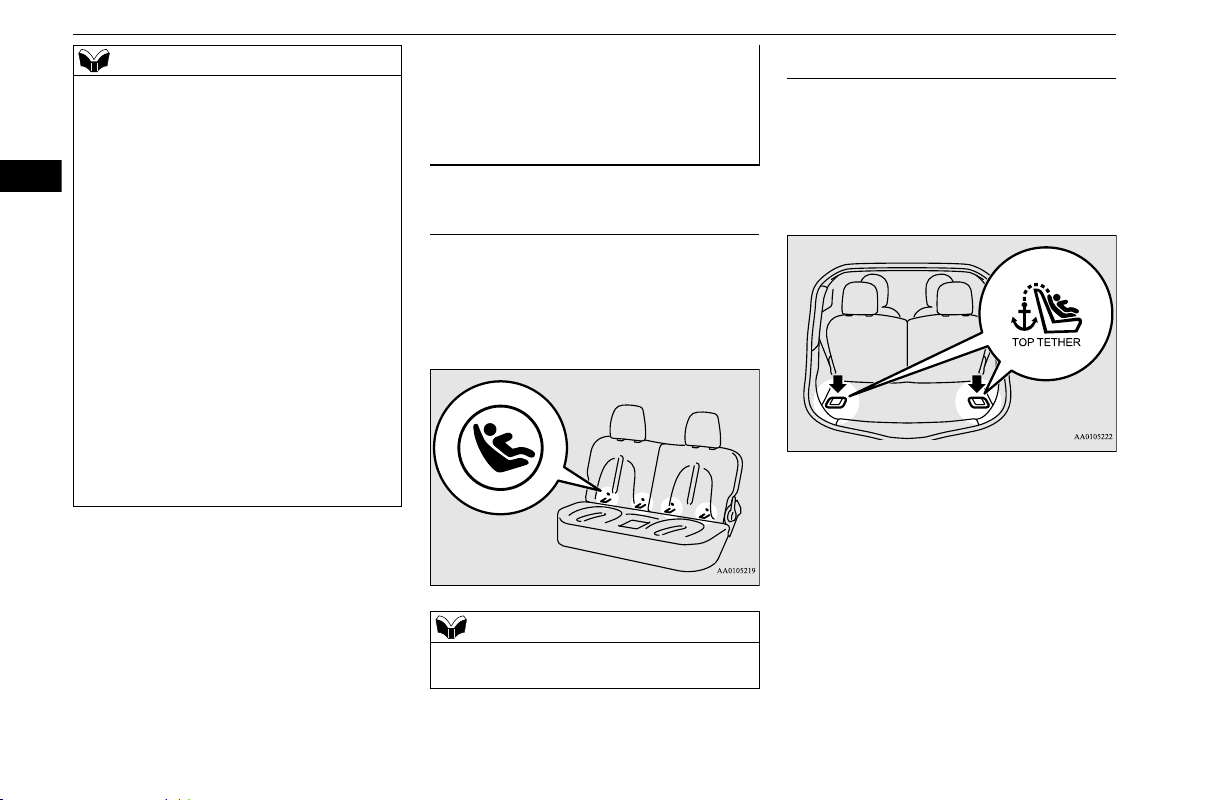
Child restraint systems
4-16 Seat and restraint systems
4
N00418800144
The seating positions in the rear seat of your
vehicle are equipped with lower anchors for
attaching child restraint systems compatible
with the LATCH system.
N00418900187
Your vehicle has 2 attachment points on the
floor of the luggage compartment. These are
for securing a child restraint system tether
strap to each of the 2 rear seating positions in
your vehicle.
NOTE
Before purchasing a child restraint system,
try installing it in the rear seat to make sure
there is a good fit. Because of the location of
the seat belt buckles and the shape of the seat
cushion, it may be difficult to securely install
some manufacturer’s child restraint systems.
If the child restraint system can be pulled
forward or to either side easily on the seat
cushion after the seat belt has been tightened,
choose another manufacturer’s child restraint
system.
Depending on the seating position in the
vehicle and the child restraint system that
you have, the child restraint system can be
attached using one of the following two
methods:
• To the lower anchorage in the rear seat
ONLY if the child restraint system is com-
patible with the LATCH system (See page
4-16).
• To the seat belt (See page 4-18).
Installing a child restraint sys-
tem using the LATCH (Lower
Anchors and Tethers for chil-
dren) system
Lower anchor locations
NOTE
The symbols on the seatback show the loca-
tion of the lower anchor points.
Tether anchor locations
BK0220401US.book 16 ページ 2015年6月3日 水曜日 午前7時42分
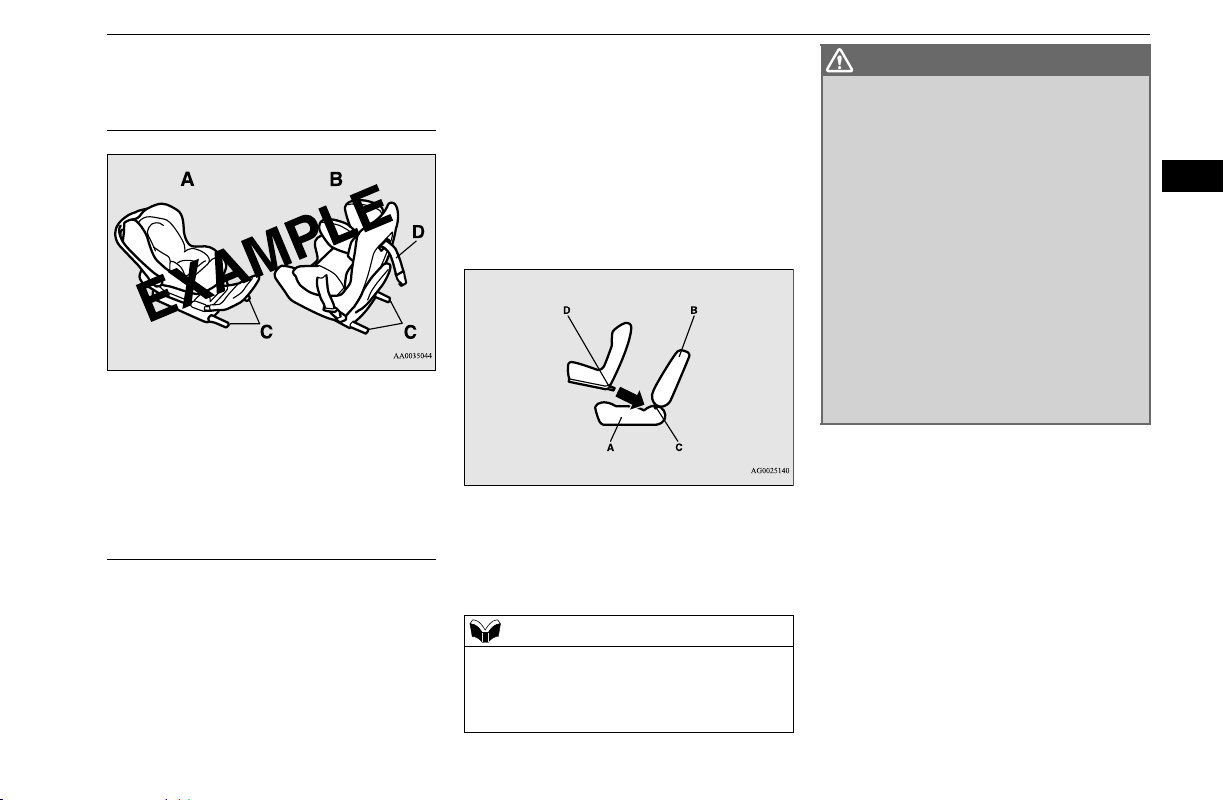
Child restraint systems
Seat and restraint systems 4-17
4
N00419000185
N00419100229
1. In order to securely fasten the tether strap,
remove the head restraint from the loca-
tion where you wish to install the child
restraint system.
2. Open the gap a little between the seat
cushion (A) and the seatback (B) with
your hand to locate the lower anchorages
(C).
3. Push the anchor connectors (D) on the
child restraint system into the lower
anchors (C) in accordance with the
instructions provided by the child restraint
system manufacturer. Remember, the
lower anchors provided with your vehicle
are designed to secure suitable child
restraint systems compatible with the
LATCH system in the outboard positions
of the rear seat only.
4. Open the cover (E) for the tether anchor
by pulling it back with your hand as illus-
trated below (4).
5. Latch the tether strap hook (F) of the child
restraint system to the anchor (G) as illus-
trated below (5) and tighten the top tether
strap so it is securely fastened.
Examples of child restraint sys-
tems compatible with the LATCH
system
A- Rear-facing child restraint system
B- Front-facing child restraint system
C- Child restraint system lower anchor
connectors
D- Tether strap (These are only examples.)
Using the LATCH system
A- Vehicle seat cushion
B- Vehicle seatback
C- Lower anchor
D- Connector
NOTE
In order to secure a child restraint system
compatible with the LATCH system, use the
lower anchor points in the rear seat. It is not
necessary to use the vehicle’s seat belt.
WARNING
If there is any foreign material in or
around the lower anchors, remove it
before installing the child restraint sys-
tem. Also, make sure the seat belt is away
from, not looped through or otherwise
interfering with, the child restraint sys-
tem. If foreign matter is not removed
and/or the seat belt interferes with the
child restraint system, the child restraint
system will not be secured properly, could
detach and move forward in the event of
sudden braking or an accident, and could
result in injury to the child or other vehi-
cle occupants.
When the vehicle is moving, do not adjust
the seat where the child restraint system is
installed.
BK0220401US.book 17 ページ 2015年6月3日 水曜日 午前7時42分
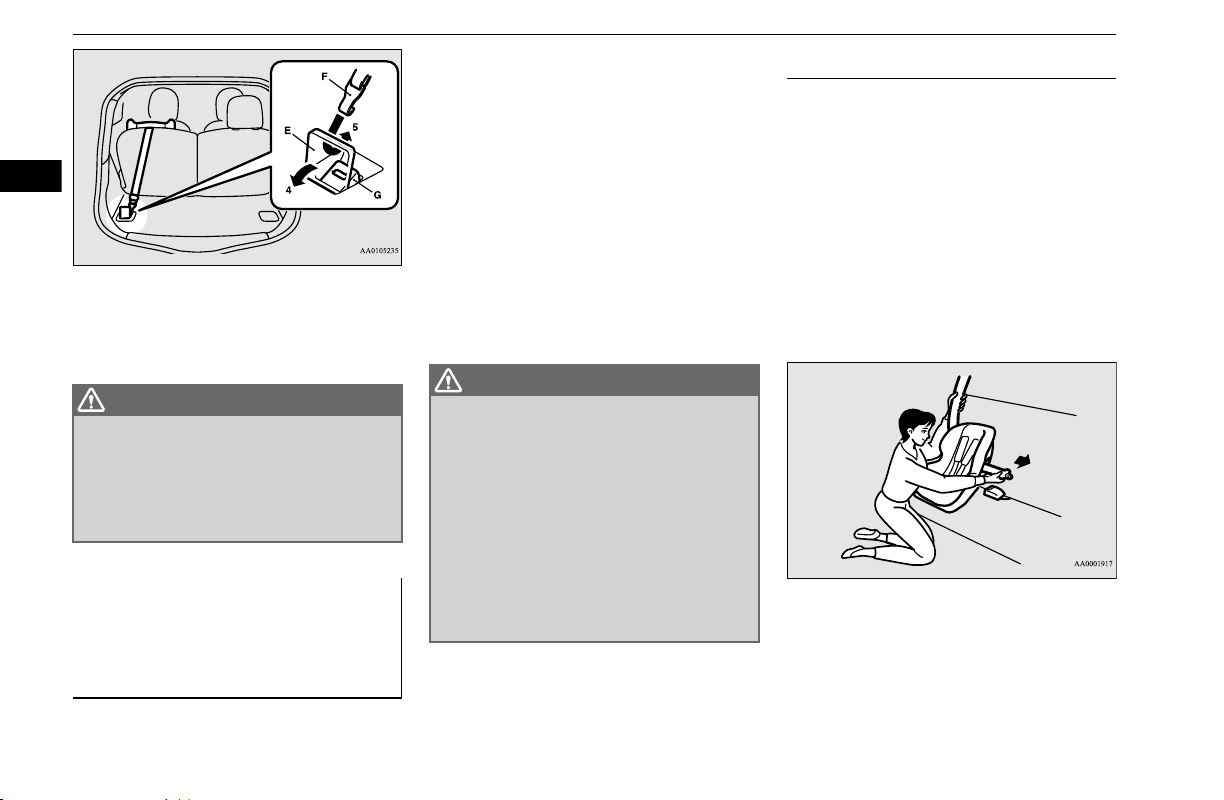
Child restraint systems
4-18 Seat and restraint systems
4
6. Push and pull the child restraint system in
all directions to be sure it is firmly
secured.
N00407301481
With the exception of the driver, the seat belt
in all other seating positions can be converted
from normal Emergency Locking Retractor
(ELR) mode to Automatic Locking Retractor
(ALR) mode. This means that when you pull
the seat belt fully out of the retractor, the
retractor will switch to its ALR child restraint
installation function. Always use the ALR
child restraint installation function when you
install a child restraint system using the seat
belt.
Children 12 years old and under should
always be restrained in the rear seat, when-
ever possible, although the front passenger
seat belt can also be converted to ALR mode.
1. Place the child restraint system on the seat
where you wish to install it.
To help assure proper fitting of the child
restraint system, always remove the head
restraint.
2. Route the seat belt through the child
restraint system according to the instruc-
tions provided by the child restraint sys-
tem manufacturer. Then insert the seat
belt latch plate into the buckle. Make sure
you hear a “click” when you insert the
latch plate into the buckle.
3. To activate the ALR child restraint instal-
lation function, slowly pull the shoulder
part of the belt all the way out of the
retractor until it stops. Then let the belt
feed back into the retractor.
WARNING
Child restraint system tether anchors are
designed only to withstand loads from cor-
rectly fitted child restraint systems. Under
no circumstances are they to be used for
adult seat belts, harnesses, for attaching
other items, or equipment to the vehicle.
Installing a child restraint sys-
tem using the seat belt (with
emergency/automatic locking
mechanism)
WARNING
When you install a child restraint system
using the seat belt, always make sure the
retractor has been switched to the ALR
child restraint installation function. The
ALR function will keep the child restraint
system tightly secured to the seat.
Failure to convert the retractor to the
ALR function may allow the child
restraint system to move forward during
sudden braking or an accident, resulting
in serious injury or death to the child or
other occupants.
Installation
BK0220401US.book 18 ページ 2015年6月3日 水曜日 午前7時42分
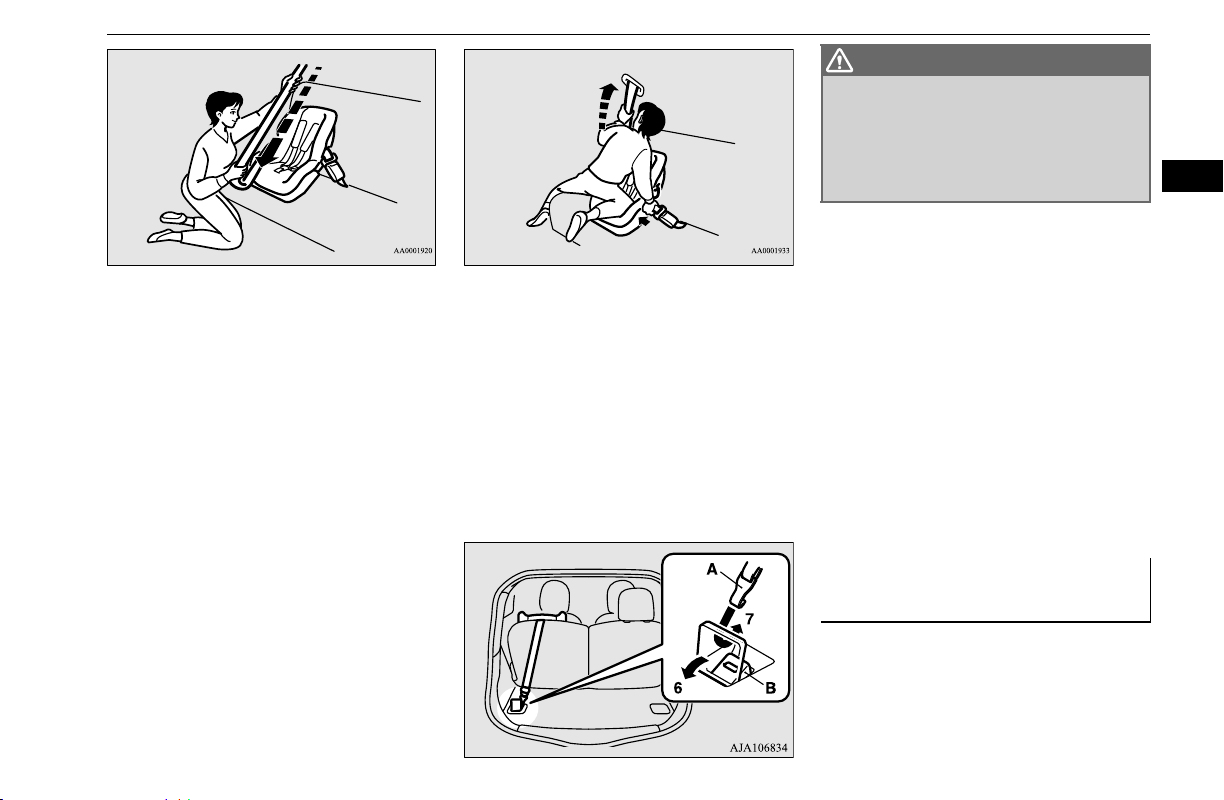
Child restraint systems
Seat and restraint systems 4-19
4
4. After the belt has retracted, tug on it. If
the belt is in the ALR function, you will
not be able to pull it out. If the webbing
can be pulled out from retractor, the ALR
function has not been activated and you
will need to repeat steps 3 and 4.
5. After confirming that the belt is locked,
grab the shoulder part of the belt near the
buckle and pull up to remove any slack
from the lap part of the belt allowing the
slack to feed into the retractor. Remember,
if the lap belt portion is not tight, the child
restraint system will not be secure. It may
help to put your weight on the child
restraint system and/or push on its seat-
back while pulling up on the belt (see
illustration).
6. Open the cover from the tether anchor
installation point by pulling it back with
your hand as illustrated below (6).
7. Latch the tether strap hook (A) of the
child restraint system to the tether anchor
(B) as illustrated below (7) and tighten the
top tether strap so it is securely fastened.
8. Before putting your child in the restraint,
push and pull the restraint in all directions
to be sure it is firmly secured. Do this
before each use. If the child restraint sys-
tem is not firmly secure, repeat steps 1
through 7.
9. To remove a child restraint system from
the vehicle and deactivate the ALR mode,
remove the child from the restraint.
Unlatch the buckle. Then remove the belt
from the restraint and let the belt fully
retract.
10. Reinstall the head restraint.
Refer to “Head restraints” on page 4-6.
N00407601615
Children who have outgrown a child restraint
system should be seated in the rear seat and
wear the seat belt. If the shoulder belt crosses
their face or neck, and/or the lap belt crosses
their stomach, a commercially available
If your child restraint system requires the use
of a tether strap, fasten the tether strap in
accordance with the following procedures.
WARNING
Child restraint system tether anchors are
designed only to withstand loads from cor-
rectly fitted child restraint systems. Under
no circumstances are they to be used for
adult seat belts, harnesses, for attaching
other items, or equipment to the vehicle.
Children who have outgrown
child restraint systems
BK0220401US.book 19 ページ 2015年6月3日 水曜日 午前7時42分
Maintenance and inspection of seat belts
4-20 Seat and restraint systems
4
booster seat must be used, to raise the child so
that the shoulder belt crosses their shoulder
and the lap belt remains positioned low
across their hips. The booster seat should fit
the vehicle seat and have a label certifying
compliance with Federal Motor Vehicle
Safety Standards or Motor Vehicle Restraint
Systems and Booster Seats Safety Regula-
tions.
N00407000351
The seat belt webbing may be cleaned with
mild soap or detergent solution. Do not use an
organic solvent. Allow the belts to dry in the
shade. Do not allow them to retract until com-
pletely dry. Do not attempt to bleach or re-
dye the belts. The color may rub off and the
webbing strength may be affected.
Regularly check your seat belt buckles and
their release mechanisms for positive engage-
ment and release of the latch plate. Check the
retractors for automatic locking when in the
Automatic Locking Retractor function.
The entire seat belt assembly should be
replaced if the webbing shows any obvious
cuts, tears, increase in thickness in any sec-
tion of the webbing from broken fibers, or
severe fading from sunlight. All of these con-
ditions indicate a weakening of the belt,
which may adversely affect seat belt perfor-
mance in an accident.
N00407701834
This vehicle is equipped with a Supplemental
Restraint System (SRS), which includes air-
bags for the driver and passengers.
The SRS front airbags are designed to supple-
ment the primary protection of the driver and
front passenger seat belt systems by provid-
ing those occupants with protection against
head and chest injuries in certain moderate to
severe frontal collisions.
The SRS front airbags, together with sensors
at the front of the vehicle and sensors
attached to the front seats, form an advanced
airbag system.
The SRS side airbags and the curtain airbags
are also designed to supplement the seat belts.
The SRS side airbags provide the driver and
front passenger with protection against chest,
WARNING
Any child who is too small to properly
wear a seat belt must be properly
restrained in an appropriate child
restraint system, to reduce their risk of
serious injury or death in an accident.
A child should never be left unattended in,
or unsupervised, around your vehicle.
When you leave the vehicle always take
the child out as well.
Children can die from heat stroke if left or
trapped inside the vehicle, especially on
hot days.
Keep your vehicle locked when not in use.
Keep your vehicle keys away from chil-
dren.
Maintenance and inspection
of seat belts
WARNING
Do not attempt to repair or replace any
part of the seat belt assemblies. This work
should be done by a certified i-MiEV
dealer. Failure to have a certified i-MiEV
dealer perform the work could reduce the
effectiveness of the belts and could result
in a serious injury or death in an accident.
Supplemental Restraint Sys-
tem (SRS) - airbag
BK0220401US.book 20 ページ 2015年6月3日 水曜日 午前7時42分
Supplemental Restraint System (SRS) - airbag
Seat and restraint systems 4-21
4
abdomen and hip injuries by deploying the
bag on the side impacted in moderate to
severe side impact collisions. The SRS cur-
tain airbags provide the driver and passengers
on the front seat and rear seat with protection
against head injuries by deploying a bag on
the side impacted in moderate to severe side
impact collisions.
The SRS airbags are NOT a substitute for use
of the seat belts. For maximum protection in
all types of accidents, seat belts must
ALWAYS be worn by everyone who drives or
rides in this vehicle (with infants and small
children in an appropriate child restraint sys-
tem in the rear seat, and older children buck-
led in the rear seat). Refer to “Child restraint
systems” on page 4-13.
WARNING
IT IS VERY IMPORTANT TO ALWAYS
WEAR YOUR SEAT BELT PROPERLY
EVEN WITH AN AIRBAG.
• Seat belts help keep the driver and pas-
sengers properly positioned. This
reduces the risk of injury in all collisions,
and reduces the risk of serious injuries or
death when the airbags inflate.
During sudden braking just before a col-
lision, an unrestrained or improperly
restrained driver or passengers can move
forward into direct contact with, or
within close proximity to, the airbag
when it begins to inflate.
The beginning stage of airbag inflation is
the most forceful and can cause serious
injuries or death if the occupant comes in
contact with the airbag at this time.
• Seat belts reduce the risk of injury in
rollovers, rear impact collisions, and in
lower-speed frontal collisions, because
the airbags are not designed to inflate in
those situations.
• Seat belts reduce the risk of being
thrown from your vehicle in a collision or
rollover.
IT IS VERY IMPORTANT TO BE PROP-
ERLY SEATED.
• A driver or front passenger sitting too
close to the steering wheel or instrument
panel during airbag deployment can be
seriously injured or killed.
WARNING
• Airbags inflate very quickly and with
great force. If the driver and front pas-
senger are not properly seated and
restrained, the airbag may not provide
the proper protection and can cause seri-
ous injuries or death when it inflates.
• To reduce the risk to the driver of serious
injury or death due to a deploying
driver’s airbag, always properly wear
your seat belt and adjust the driver’s seat
as far back as possible, maintaining a
position that still allows the driver to
have good control of the steering wheel,
brake, accelerator, and other vehicle con-
trols.
• To reduce the risk to the front passenger
of serious injury or death from a deploy-
ing passenger’s airbag, make sure the
passenger always wears the seat belt
properly, remains seated upright and all
the way back in the seat, and positions
the seat as far back as possible.
• Seat all infants and children in the rear
seat, properly restrained in an appropri-
ate child restraint system.
Airbags inflate very quickly and with
great force. Do not sit on the edge of the
seat or lean your head or chest close to the
steering wheel or the instrument panel.
Do not put your feet or legs on or against
the instrument panel.
WARNING
BK0220401US.book 21 ページ 2015年6月3日 水曜日 午前7時42分
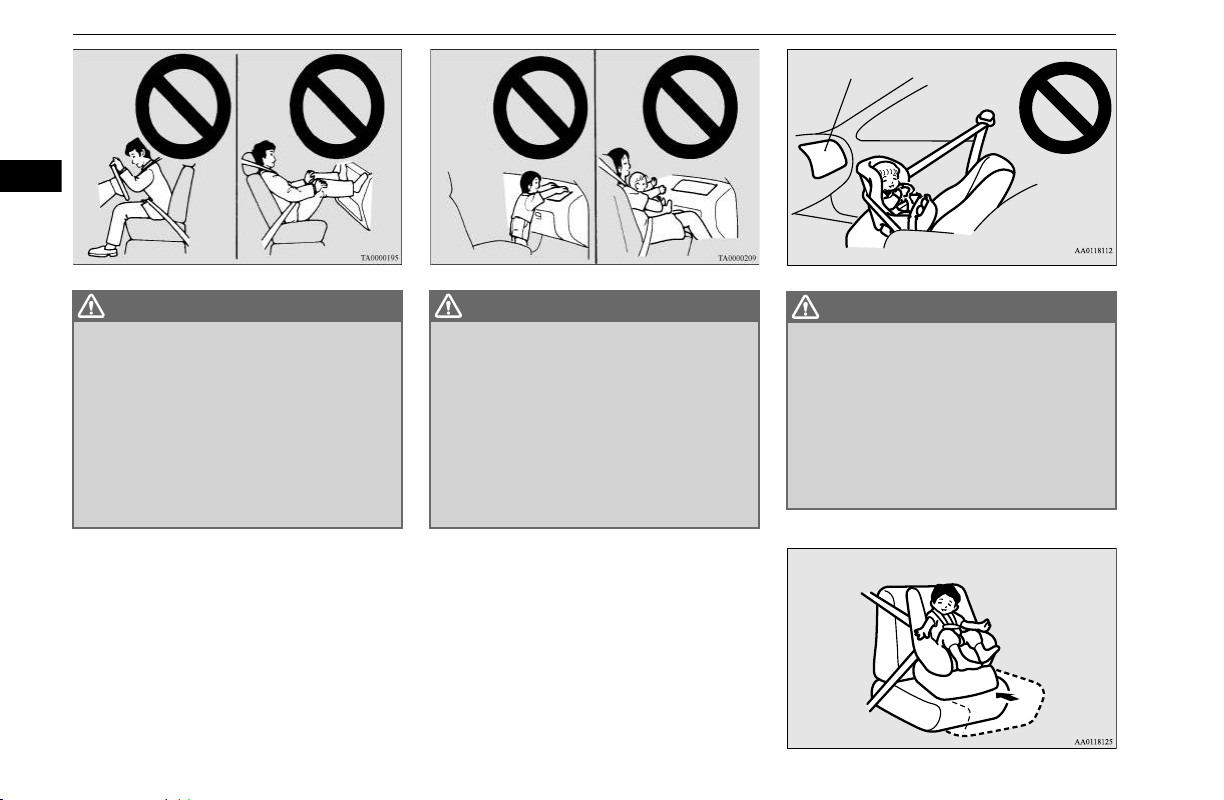
Supplemental Restraint System (SRS) - airbag
4-22 Seat and restraint systems
4
WARNING
Infants and small children should never
ride unrestrained, or lean against the
instrument panel. They should never ride
held in your arms or on your lap. They
can be seriously injured or killed in an
accident, especially when the airbags
inflate. Infants and children should be
properly seated in the rear seat in an
appropriate child restraint system. Refer
to “Child restraint systems” on page 4-13.
WARNING
NEVER put REAR-FACING CHILD
RESTRAINT SYSTEMS or INFANT
RESTRAINT SYSTEMS in the front pas-
senger seat. This places the infant too
close to the passenger’s airbag. During
deployment of the airbag, the infant can
be seriously injured or killed.
Rear-facing child restraint systems or
infant restraint systems must only be used
in the rear seat.
WARNING
FRONT-FACING CHILD RESTRAINT
SYSTEMS should be used in the rear seat
whenever possible. If they must be used in
the front passenger seat, move the seat to
the most rearward position and make sure
the child stays in the child restraint sys-
tem, properly restrained. Failure to follow
these instructions could result in serious
injury or death to the child.
Airbag
BK0220401US.book 22 ページ 2015年6月3日 水曜日 午前7時42分
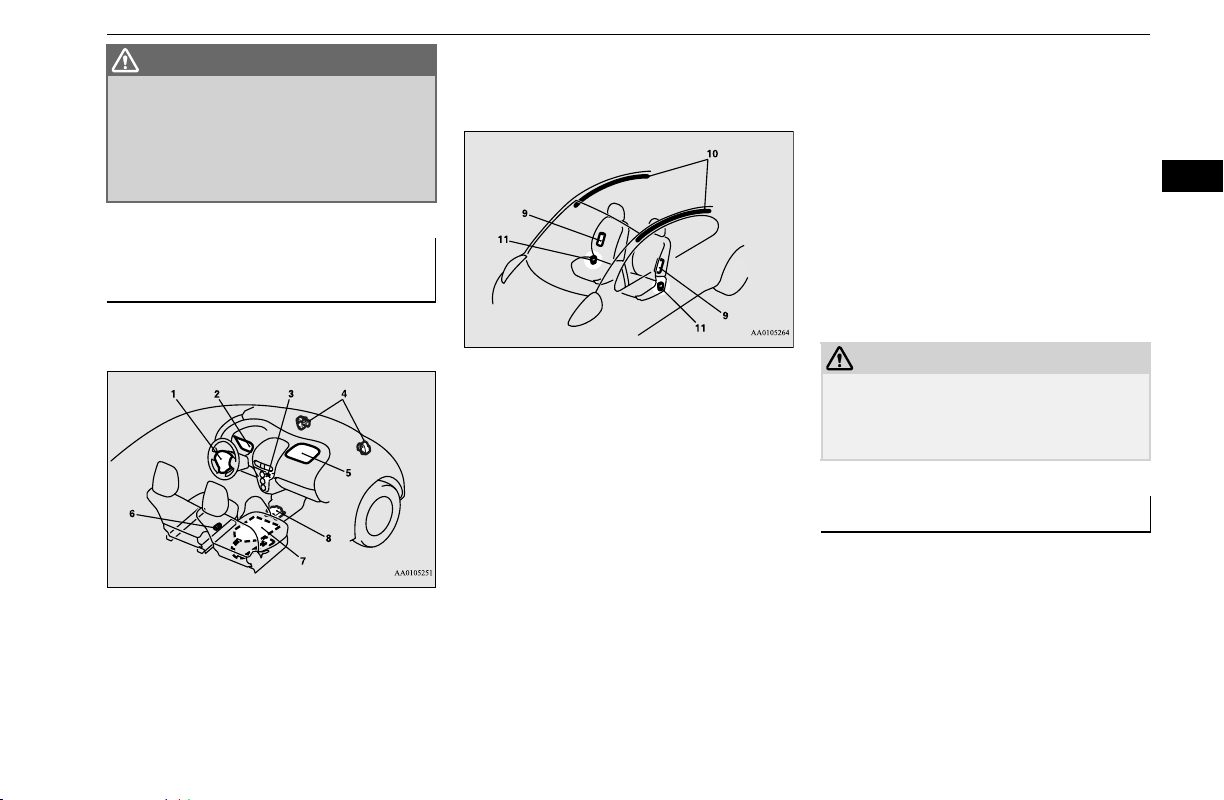
Supplemental Restraint System (SRS) - airbag
Seat and restraint systems 4-23
4
N00407800489
The SRS includes the following components:
The airbag control unit monitors the readiness
of the electronic parts of the system whenever
the electric motor switch is in the “ON” or
“START” position. These include all of the
items listed above and all related wiring.
The airbags will operate only when the elec-
tric motor switch is in the “ON” or “START”
position.
When the impact sensors detect a sufficient
front or side impact to deploy the airbag(s),
the appropriate airbag(s) will be deployed.
When airbags deploy, some smoke is released
accompanied by a loud noise. The smoke is
not harmful, but do not intentionally inhale
the smoke as it may cause temporary irrita-
tion to people with respiratory problems.
After deployment, the airbags will quickly
deflate, so quickly that some people may not
even realize the airbags inflated.
Airbag inflation does not prevent the driver
from seeing or being able to steer the vehicle,
and does not prevent people from leaving the
vehicle.
N00418600227
This vehicle is equipped with an event data
recorder (EDR).
The main purpose of an EDR is to record, in
certain crash or near crash-like situations,
such as an airbag deployment or hitting a
road obstacle, data that will assist in under-
standing how a vehicle’s systems performed.
The EDR is designed to record data related to
vehicle dynamics and safety systems for a
WARNING
Older children should be seated in the
rear seat with their seat belt properly
worn, and with an appropriate booster
seat if needed.
Refer to “Children who have outgrown
child restraint systems” on page 4-19.
How the Supplemental
Restraint System works
1- Driver’s airbag
2- SRS warning light
3- Passenger’s airbag off indicator
4- Front impact sensors
5- Passenger’s front airbag
6- Driver’s seat position sensor
7- Passenger’s seat occupant classifica-
tion sensor system
8- Airbag control unit
9- Side airbag modules
10- Curtain airbag modules
11- Side impact sensors
CAUTION
Airbags inflate very quickly and with great
force. In certain situations, contact with an
inflating airbag may cause small cuts, abra-
sions, and bruises.
Event Data Recording
BK0220401US.book 23 ページ 2015年6月3日 水曜日 午前7時42分
Supplemental Restraint System (SRS) - airbag
4-24 Seat and restraint systems
4
short period of time, typically 30 seconds or
less.
The EDR in this vehicle is designed to record
such data as:
How various systems in your vehicle were
operating;
Whether or not the driver safety belt was
buckled/fastened;
How far (if at all) the driver was depress-
ing the accelerator and/or brake pedal;
and,
How fast the vehicle was traveling.
These data can help provide a better under-
standing of the circumstances in which
crashes and injuries occur.
To read data recorded by an EDR, special
equipment is required, and access to the vehi-
cle or the EDR is needed. In addition to the
vehicle manufacturer, other parties, such as
law enforcement, that have the special equip-
ment, can read the information if they have
access to the vehicle or the EDR.
N00417900210
The driver’s seat position sensor is attached
to the seat rail and provides the airbag control
unit with information on the seat’s fore-aft
position. The airbag control unit controls
deployment of the driver’s front airbag in
accordance with the information it receives
from this sensor.
If there is a problem involving the driver’s
seat position sensor, the SRS warning light in
the instrument panel will come on. Refer to
“SRS warning light” on page 4-26.
N00418000351
The passenger’s seat occupant classification
sensor system is attached to the front passen-
ger seat cushion and provides the airbag con-
trol unit with information regarding the
occupant on the front passenger seat. The air-
bag control unit controls deployment of the
passenger’s front airbag in accordance with
the information it receives from this system.
The passenger’s front airbag will not deploy
in an impact when the system senses no occu-
pant on the front passenger’s seat or a child in
a child restraint system. In this case, the pas-
senger’s airbag off indicator will come on.
Refer to “Passenger’s airbag off indicator” on
page 4-25.
If there is a problem involving the passen-
ger’s seat occupant classification sensor sys-
tem, the SRS warning light in the instrument
panel will come on. Refer to “SRS warning
light” page 4-26.
NOTE
EDR data are recorded by your vehicle only
if a non-trivial crash situation occurs; no data
are recorded by the EDR under normal driv-
ing conditions and no personal data (e.g.,
name, gender, age, and crash location) are
recorded. However, other parties, such as
law enforcement, could combine the EDR
data with the type of personally identifying
data routinely acquired during a crash inves-
tigation.
Driver’s seat position sensor
WARNING
If the SRS warning light comes on, have
the vehicle inspected by a certified i-MiEV
dealer as soon as possible.
Please observe the following instructions
to ensure that the driver’s seat position
sensor can operate correctly.
• Adjust the seat to the correct position,
and sit well back against the seatback.
Refer to “Front seats” on page 4-3.
• Do not recline the seatback more than
necessary when driving.
• Do not place metallic objects or luggage
under the front seat.
If the vehicle is involved in a severe
impact, have the SRS sensor inspected by
a certified i-MiEV dealer as soon as possi-
ble.
Passenger’s seat occupant clas-
sification sensor system
WARNING
BK0220401US.book 24 ページ 2015年6月3日 水曜日 午前7時42分
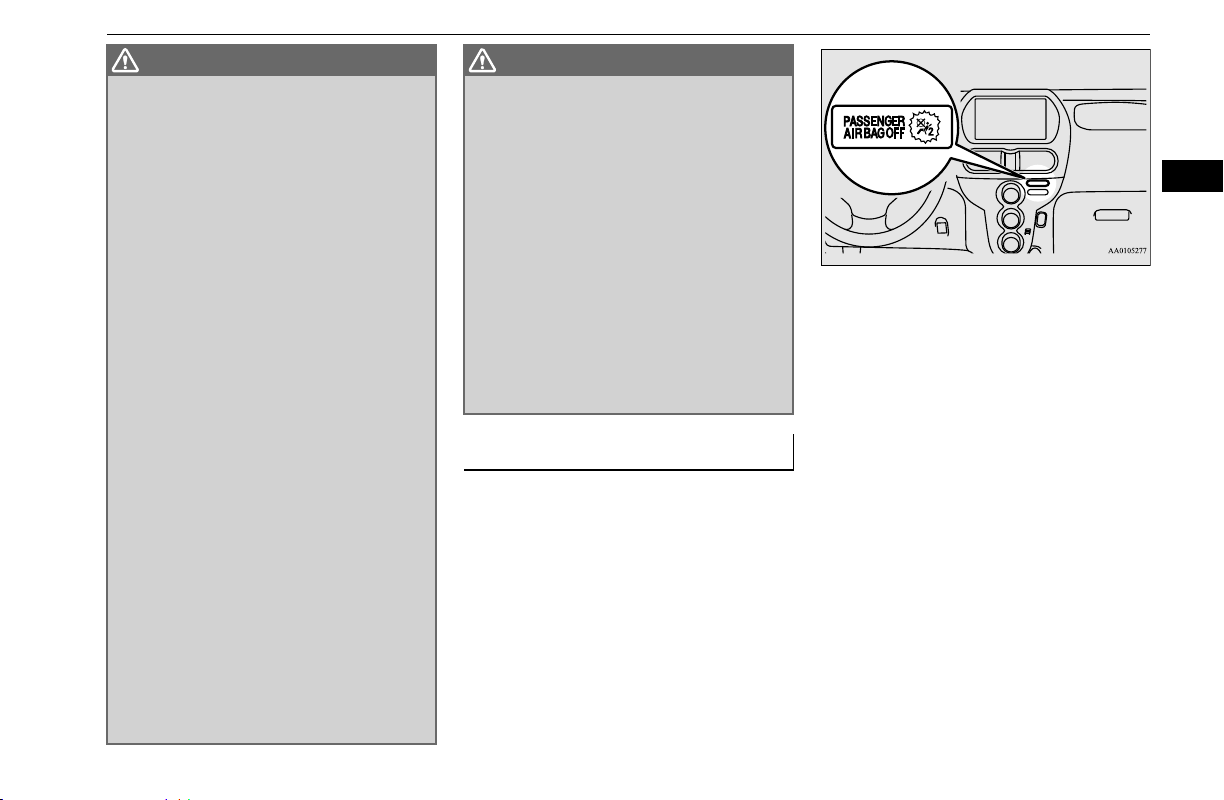
Supplemental Restraint System (SRS) - airbag
Seat and restraint systems 4-25
4
N00418100310
The passenger’s airbag off indicator is
located in the instrument panel.
The indicator normally comes on when the
electric motor switch is turned to the “ON”
position and goes out a few seconds later.
In the following situations, the indicator will
stay on to show that the passenger’s front air-
bag is not operational.
The front passenger’s seat is not occupied.
The system senses that a child is in the
child restraint system on the front passen-
ger’s seat.
When the passenger’s seat occupant classifi-
cation sensor system senses there is a person
seated in the front passenger’s seat, the indi-
cator goes out to show that the passenger’s
front airbag is operational.
WARNING
If any of the following conditions occur,
you should immediately have your vehicle
inspected by a certified i-MiEV dealer as
soon as possible:
• The SRS warning light does not initially
come on when the electric motor switch
is turned to the “ON” or “START” posi-
tion.
• The SRS warning light does not go out
after several seconds.
• The SRS warning light comes on while
you are driving.
To ensure that the passenger’s seat occu-
pant classification sensor system can sense
correctly, observe the following instruc-
tions. Failure to follow these instructions
can adversely affect the performance of
the passenger’s airbag system.
• Adjust the seat to the correct position,
and sit well back against the seatback.
Refer to “Front seats” on page 4-3.
• Do not recline the seatback more than
necessary.
• Never have more than one person (adult
or child) sitting on the seat.
• Do not place anything between the seat
and the floor console.
• When attaching a child restraint system,
secure it firmly.
• Do not place luggage or other objects on
the seat.
• Do not use a seat cover or a cushion.
• Do not modify or replace the seat and
seat belt.
• Do not place luggage or other objects
under the seat.
• Do not place and use an electronic device
such as a computer on the seat.
• Do not place heavy objects on the seat or
stick pins, needles, or other objects into
it.
• Do not remove the seat cushion skin.
• If any liquid is spilled on the seat, wipe it
and dry the seat immediately.
If the vehicle is involved in a severe
impact, have the SRS sensors inspected by
a certified i-MiEV dealer as soon as possi-
ble.
Passenger’s airbag off indicator
WARNING
BK0220401US.book 25 ページ 2015年6月3日 水曜日 午前7時42分
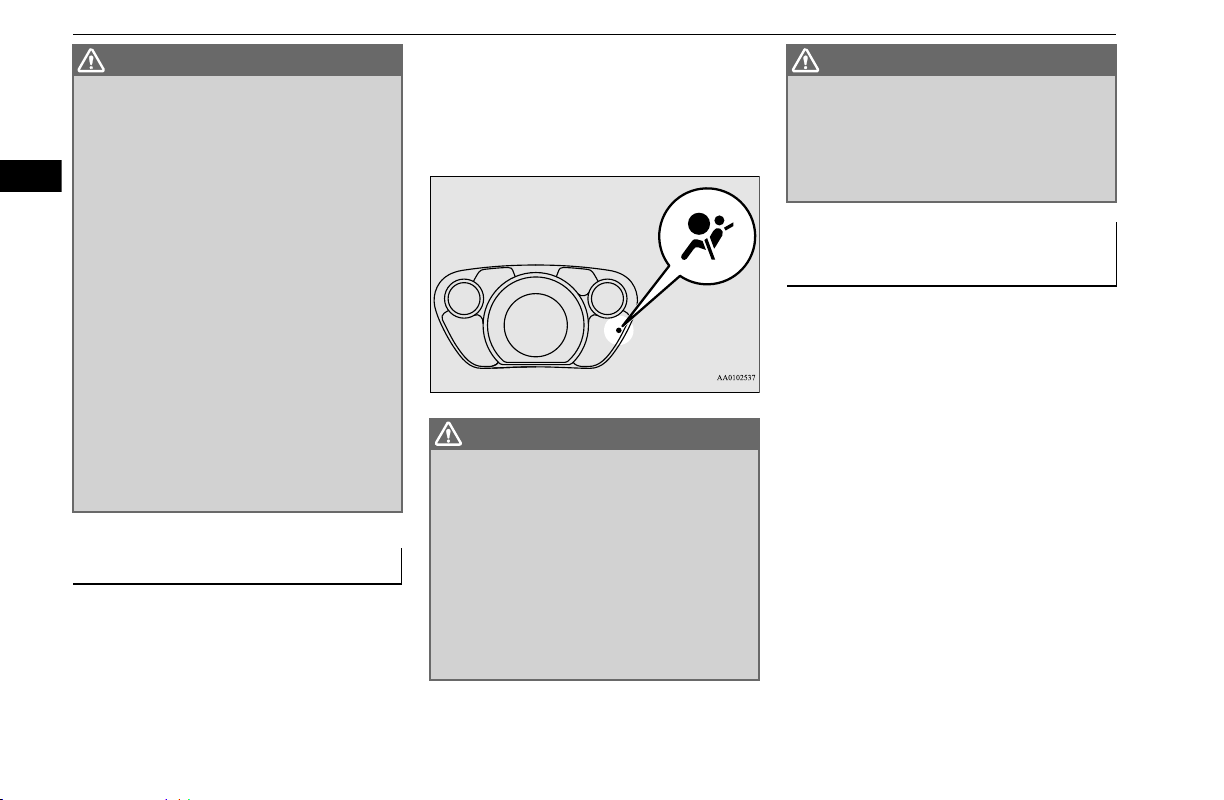
Supplemental Restraint System (SRS) - airbag
4-26 Seat and restraint systems
4
N00408301606
There is a Supplemental Restraint System
(SRS) warning light on the instrument panel.
The system checks itself every time the elec-
tric motor switch is turned on. The SRS warn-
ing light will come on for several seconds and
then go out. This is normal and means the
system is working properly. If there is a prob-
lem involving one or more of the SRS com-
ponents, the warning light will come on and
stay on. The SRS warning light is shared by
the SRS airbag and the seat belt pre-tensioner
system.
N00407900321
The driver’s airbag is located under the pad-
ded cover in the middle of the steering wheel.
The front passenger’s airbag is contained in
the instrument panel above the glove com-
partment. The driver’s airbag and the front
passenger’s airbag are designed to deploy at
the same time. However, the front passen-
ger’s airbag does not deploy when the front
passenger seat is not occupied or when the
system senses that a child is in the child
restraint system.
WARNING
If any of the following conditions occur,
you should immediately have the airbag
system in your vehicle inspected by a cer-
tified i-MiEV dealer as soon as possible:
• The passenger’s airbag off indicator
comes on when an adult is sitting on the
front passenger seat.
• The passenger’s airbag off indicator does
not come on when the front passenger’s
seat is not occupied.
• The passenger’s airbag off indicator does
not come on when the electric motor
switch is turned to the “ON” position.
• The passenger’s airbag off indicator
comes on and goes out repeatedly.
Do not attach any accessory to your vehi-
cle that makes the passenger’s airbag off
indicator difficult or impossible to see.
You must be able to see the passenger’s
airbag off indicator and verify the status
of the passenger’s airbag system.
SRS warning light
WARNING
If any of the following conditions occur,
there may be a problem with the SRS air-
bags and/or seat belt pre-tensioners, and
they may not function properly in a colli-
sion or may suddenly activate without a
collision:
• Even when the electric motor switch is in
“ON” position, the SRS warning light
does not come on or it remains on.
• The SRS warning light comes on while
driving.
The SRS airbags and seat belt pre-ten-
sioners are designed to help reduce the
risk of serious injury or death in certain
collisions. If either of the above conditions
occurs, immediately have your vehicle
checked by a certified i-MiEV dealer.
Driver’s and passenger’s front
airbag system
WARNING
BK0220401US.book 26 ページ 2015年6月3日 水曜日 午前7時42分
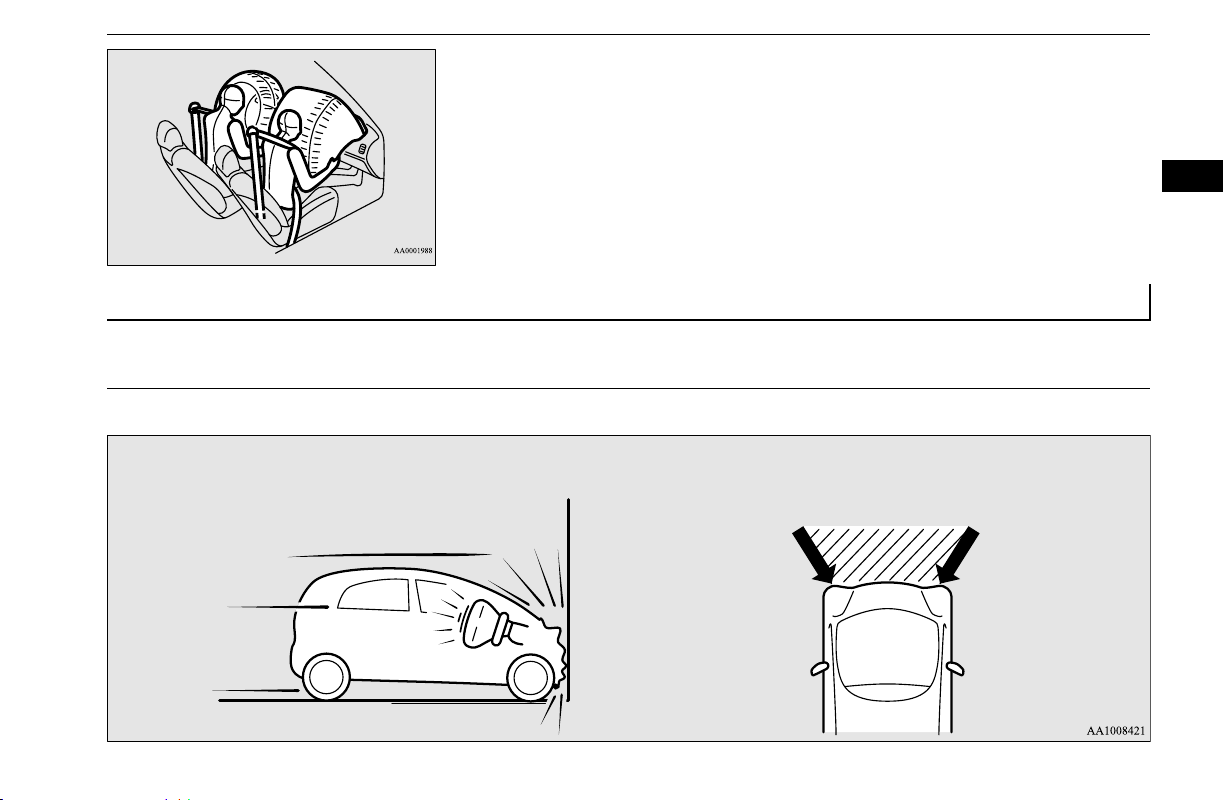
Supplemental Restraint System (SRS) - airbag
Seat and restraint systems 4-27
4
N00408000589
Driver
Front passenger
Deployment of front airbags
The front airbags ARE DESIGNED TO DEPLOY when…
Head-on collision with a solid wall at speeds of
approx. 15 mph (25 km/h) or higher
Moderate to severe frontal impact within the shaded area
between the arrows
BK0220401US.book 27 ページ 2015年6月3日 水曜日 午前7時42分
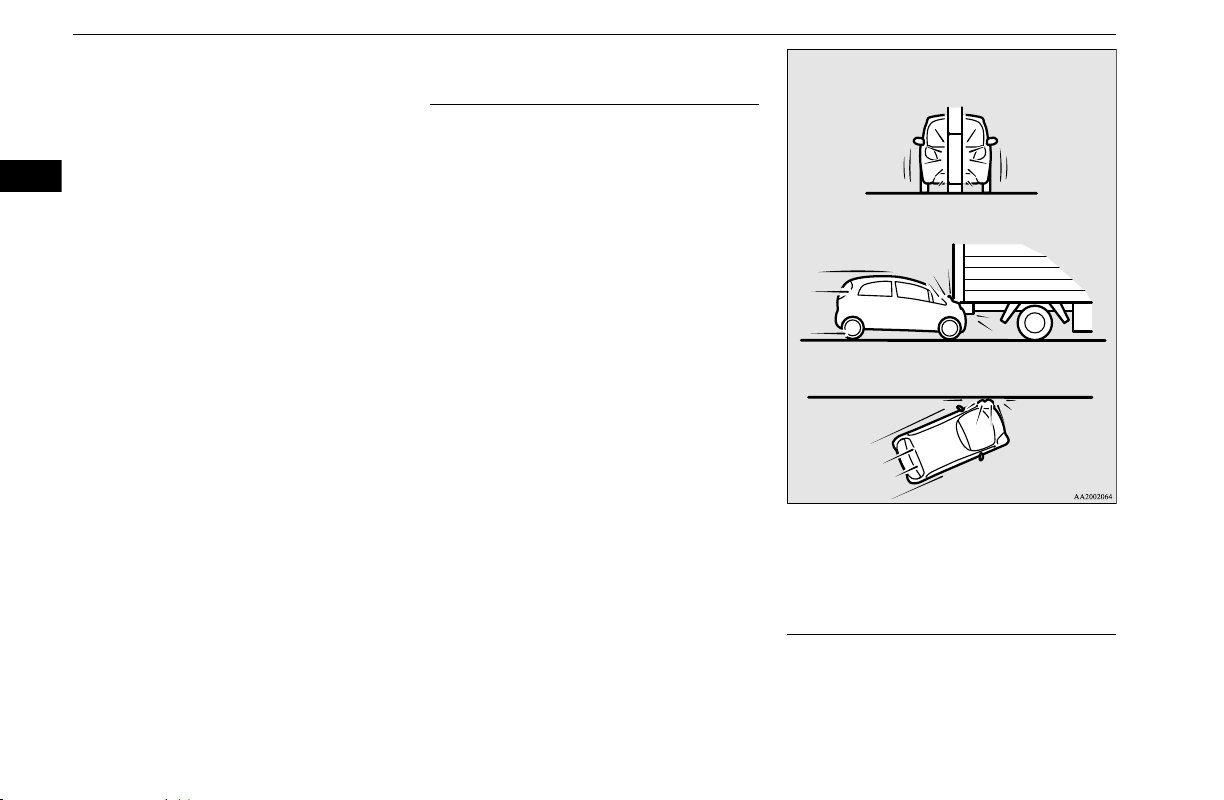
Supplemental Restraint System (SRS) - airbag
4-28 Seat and restraint systems
4
The front airbags are designed to deploy
when the vehicle suffers a moderate to severe
frontal impact. A typical condition is shown
in the illustration to the left.
The front airbags are designed to deploy only
in certain moderate to severe frontal colli-
sions within the shaded area between the
arrows in the illustration to the right.
The front airbags will deploy if the impact to
the vehicle’s main structure is above a spe-
cific threshold level. The threshold level is
approximately 15 mph (25 km/h) for a frontal
collision straight into a solid flat wall that
does not bend or deform. If the impact to the
vehicle’s main structure is below this thresh-
old level, the front airbags may not deploy.
This threshold level may also be higher if the
vehicle hits something that absorbs the
impact, either by bending or moving (for
example, another stationary vehicle, a pole or
a guard rail).
The beginning stage of airbag inflation is the
most forceful, and can cause serious injuries
or death if you are too close to the deploying
airbag. Accordingly, it is important that you
always wear the available seat belt.
In certain types of front collisions, the front
airbags may not deploy, even if the deforma-
tion of the body seems to be large, because
the vehicle’s body structure is designed to
absorb the impact and deform in order to help
protect the occupants. Some typical situations
where the front airbags may not deploy are
shown in the illustrations.
Because the front airbags do not protect the
occupant in all types of frontal collisions, be
sure to always wear your seat belts properly.
The front airbags are not designed to deploy
in situations where they cannot provide pro-
tection to the occupants.
The front airbags MAY NOT
DEPLOY when …
The front airbags ARE NOT
DESIGNED TO DEPLOY when
…
Collision with a utility pole, tree or other narrow
objects
Collision where the vehicle slides under the rear
body of a truck
Oblique frontal impact
BK0220401US.book 28 ページ 2015年6月3日 水曜日 午前7時42分
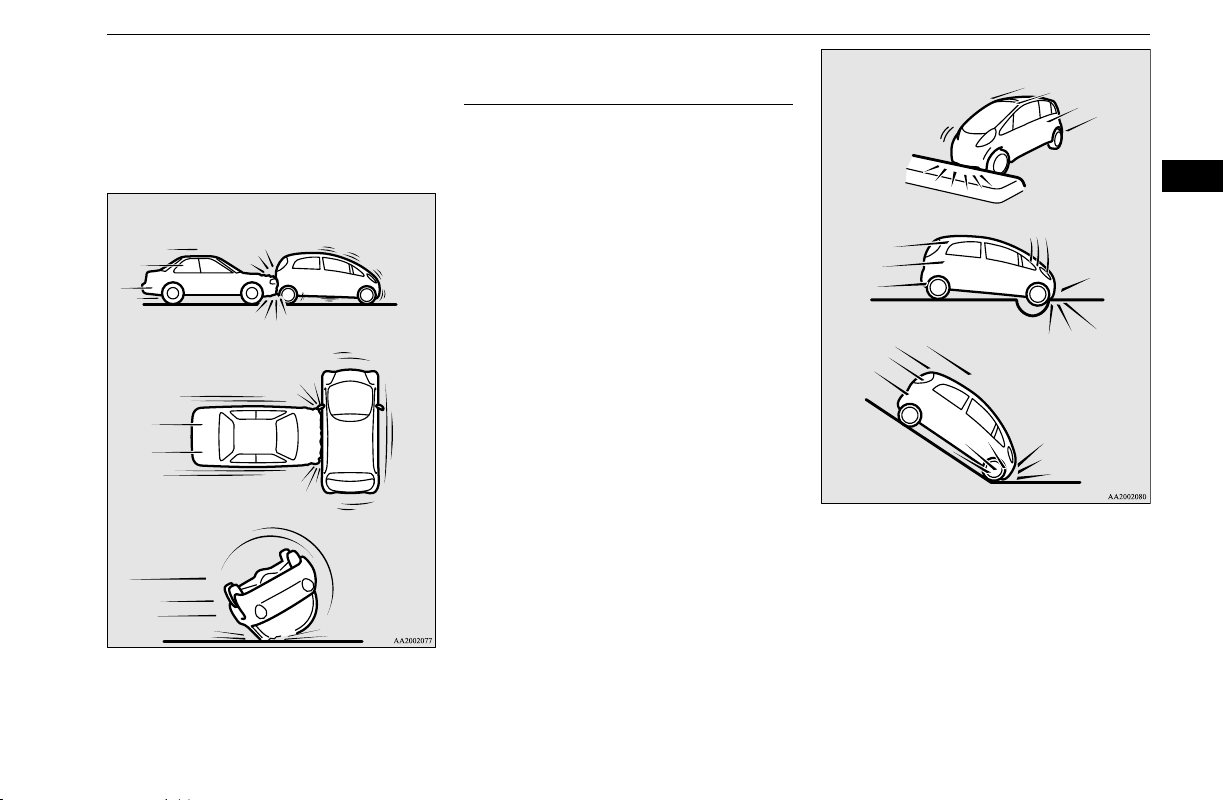
Supplemental Restraint System (SRS) - airbag
Seat and restraint systems 4-29
4
Some typical situations are shown in the
illustrations.
Because the front airbags do not protect the
occupants in all types of collisions, be sure to
always wear your seat belts properly.
The front airbags may deploy if the underside
of the vehicle suffers a moderate to severe
impact (undercarriage impact). Some typical
situations are shown in the illustrations.
Because the front airbags may deploy in cer-
tain types of unexpected impacts, as shown in
the illustrations, and these unexpected
impacts can move you out of position, it is
important to always wear your seat belts
properly. When worn properly, seat belts can
help maintain your distance from the airbags
when they begin to inflate. The beginning
stage of airbag inflation is the most forceful
and can cause serious injury or death if you
are close to the deploying airbag.
Rear end collision to your vehicle
Side collision to your vehicle
Vehicle rolls onto
its side or roof
The front airbags MAY DEPLOY
when …
Collision with an elevated median/island or curb
Vehicle travels over a deep hole/pothole
Vehicle drives down a
steep slope and hits the
ground
BK0220401US.book 29 ページ 2015年6月3日 水曜日 午前7時42分
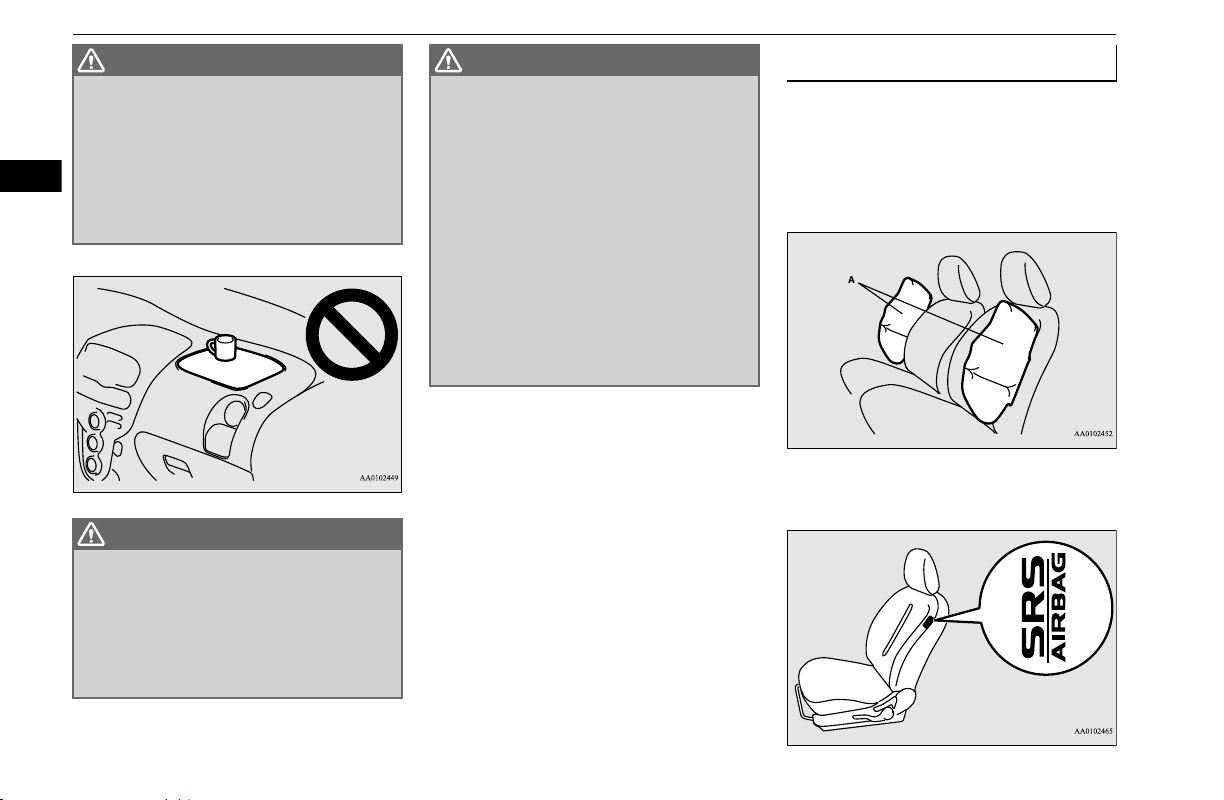
Supplemental Restraint System (SRS) - airbag
4-30 Seat and restraint systems
4
N00408100418
The side airbags (A) are contained in the
driver and front passenger seatbacks.
The side airbag is designed to inflate only on
the side of the vehicle that is impacted, even
with no passenger in the front seat.
A label is attached to the seatbacks in vehi-
cles with side airbags.
WARNING
Do not attach anything to the steering
wheel’s padded cover, such as trim mate-
rial, badges, etc. These could strike and
injure an occupant if the airbag inflates.
Do not set anything on, or attach anything
to, the instrument panel above the glove
compartment. Such items could strike and
injure an occupant if the airbag inflates.
WARNING
Do not attach accessories to, or put them
in front of, the windshield. They could
restrict the airbag inflation, or strike and
injure an occupant, when the airbag
inflates.
Do not attempt to remove, install, disas-
semble or repair the SRS airbags.
Do not place objects, such as packages or
pets, between the airbags and the driver
or the front passenger. Such objects can
adversely affect airbag performance, or
cause serious injury or death when the
airbag deploys.
Immediately after airbag inflation, some
parts of the airbag system will be hot. Do
not touch them. You could be burned.
The airbag system is designed to work
only once. After the airbags deploy, they
will not work again. They must promptly
be replaced and the entire airbag system
must be inspected by a certified i-MiEV
dealer.
WARNING
Side airbag system
BK0220401US.book 30 ページ 2015年6月3日 水曜日 午前7時42分
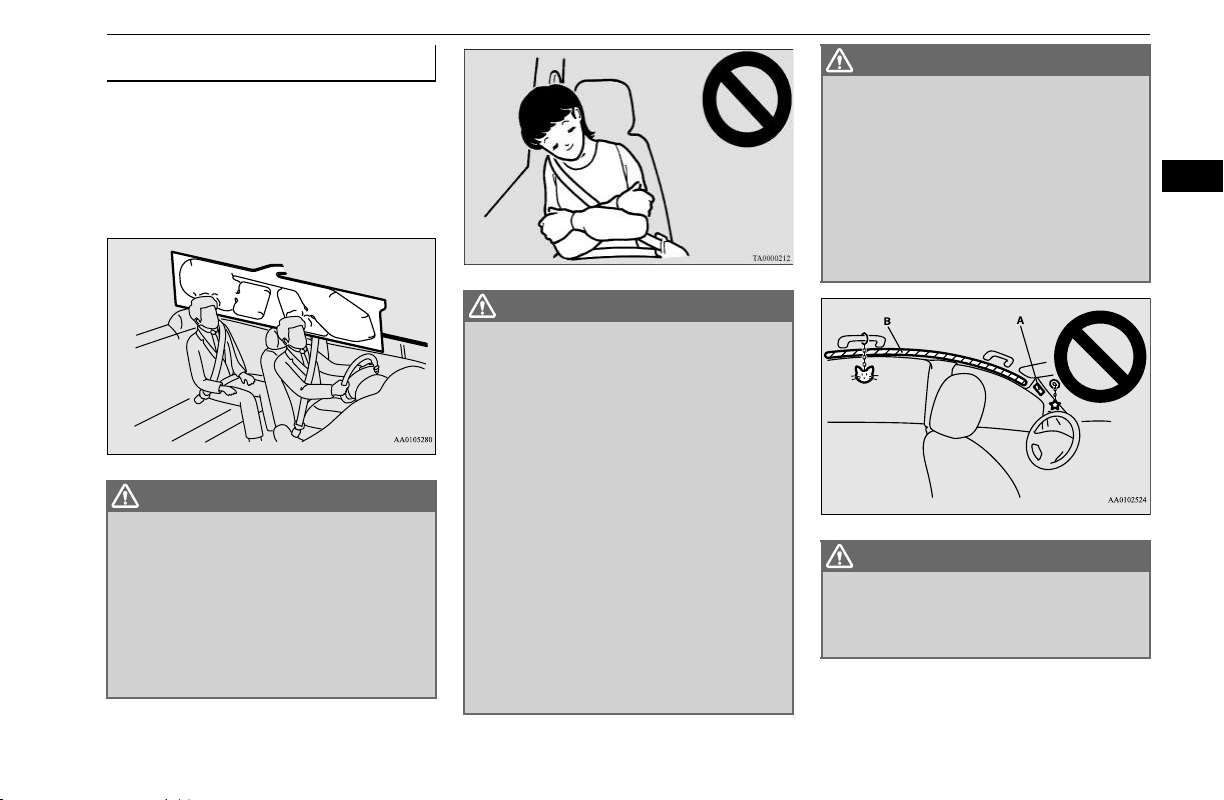
Supplemental Restraint System (SRS) - airbag
Seat and restraint systems 4-31
4
N00419200204
The curtain airbags are contained in the front
pillars and roof side rail. The curtain airbag is
designed to inflate only on the side of the
vehicle that is impacted, even with no passen-
ger in the front seat.
Curtain airbag system
WARNING
The side airbag and curtain airbag can
cause serious injury or death to anyone
too close to the airbag when it deploys. To
reduce the risk of injury from a deploying
side airbag and curtain airbags, all occu-
pants must be properly restrained and
seated well back, upright, and in the mid-
dle of the seat. Do not lean against the
door.
WARNING
In order to reduce the risk of injury from
a deploying side airbag, do not allow any
rear seat passengers to hold onto the back
of either front seat. Special care should be
taken with children.
Do not place any objects near or around
the front of either front seatback. Such
objects can interfere with proper side air-
bag deployment and cause injury during
deployment of the side airbag.
Do not place stickers, labels or additional
trim on the back of either front seat. They
can interfere with proper side airbag
deployment.
Do not install seat covers or re-cover seats
that have side airbags. Covers can inter-
fere with proper side airbag deployment
and adversely affect side airbag perfor-
mance.
Do not attach a microphone (A) or any
other object around the part where the
curtain airbag (B) deploys, such as on the
windshield, side door glass or front and
rear pillars and roof side rail. When the
curtain airbag inflate, the microphone or
other object may be hurled with great
force or the curtain airbag may not inflate
correctly, resulting in death or serious
injury.
WARNING
Never install a rear-facing child restraint
system in the front passenger seat. Rear-
facing child restraint systems MUST
ONLY be used in the rear seat.
WARNING
BK0220401US.book 31 ページ 2015年6月3日 水曜日 午前7時42分
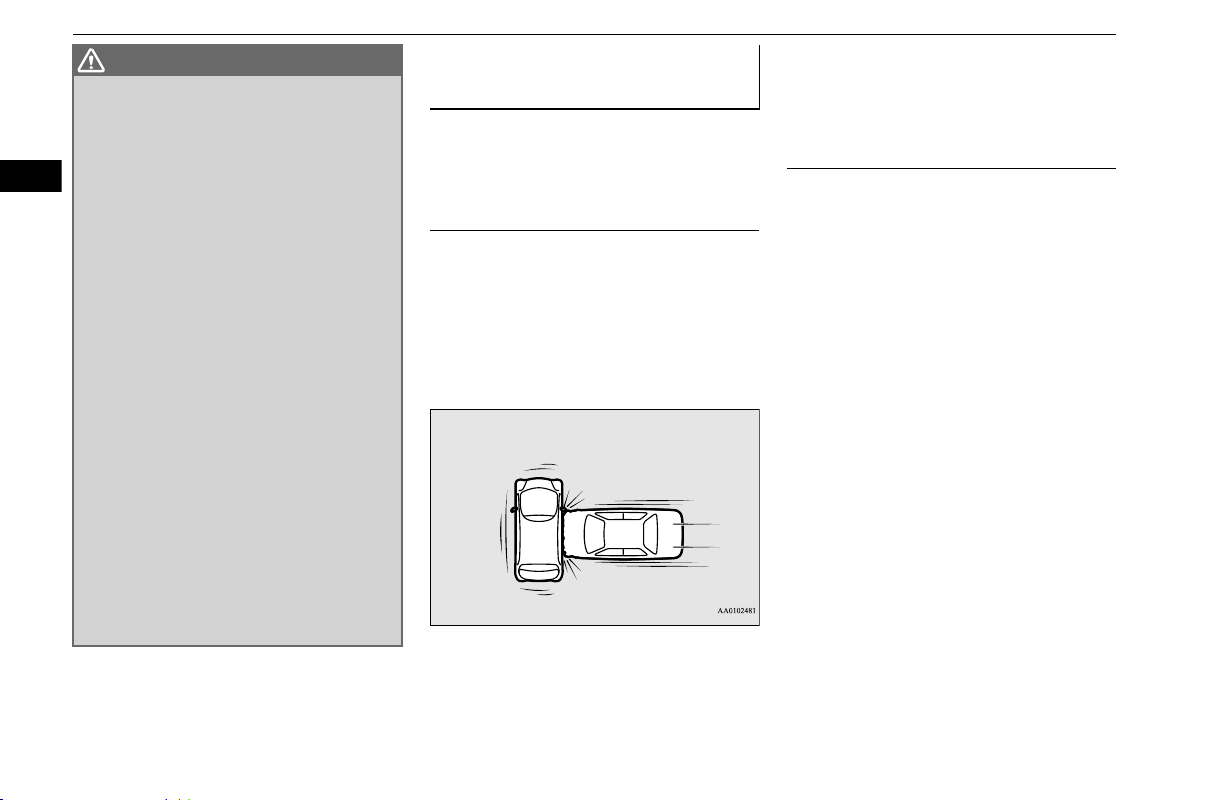
Supplemental Restraint System (SRS) - airbag
4-32 Seat and restraint systems
4
N00408200523
A side airbag and curtain airbag are designed
to deploy when the vehicle suffers a moderate
to severe side impact to the middle of the pas-
senger compartment.
The typical situation is shown in the illustra-
tion.
The seat belts in your vehicle are your pri-
mary means of protection in an accident. The
SRS side airbags and curtain airbags are
designed to provide additional protection.
Therefore, for your safety and the safety of all
occupants, be sure to always wear your seat
belts properly.
In certain types of side collisions, the side air-
bag and curtain airbag may not deploy, even
if the deformation of the body seems to be
large, because the vehicle’s body structure is
designed to absorb the impact and to deform
in order to help protect the occupants. Some
typical situations where the side airbag and
curtain airbag may not deploy are shown in
the illustrations.
Because the side airbags and curtain airbags
do not protect the occupant in all types of side
collisions, be sure to always wear your seat
belts properly.
Front-facing child restraint systems
should also be used ONLY in the rear seat.
If a front-facing child restraint system
must be used in the front passenger seat,
move the seat as far back as possible, and
make sure that the child stays in the child
restraint system, properly restrained and
away from the door.
Do not allow a child to lean against or sit
close to the passenger door, even if the
child is seated in a child restraint system.
The child’s head should also not lean
against or be close to the section of the
seatback where the side airbag and cur-
tain airbag are located. It is dangerous if
the side airbag and curtain airbag
deploys. Failure to follow all of these
instructions could lead to serious injury or
death to the child.
Work done on or in the vicinity of the side
airbag and curtain airbag system compo-
nents should be done only by a certified i-
MiEV dealer. Improper work methods can
cause accidental side airbag and curtain
airbag deployment, or render a side air-
bag and curtain airbag inoperable. Either
of these situations can result in serious
injury or death.
WARNING
Deployment of side airbag and
curtain airbag
The side airbag and curtain airbag
ARE DESIGNED TO DEPLOY
when …
Moderate to severe impact to the middle of the
vehicle body’s side structure
The side airbag and curtain airbag
MAY NOT DEPLOY when …
BK0220401US.book 32 ページ 2015年6月3日 水曜日 午前7時42分
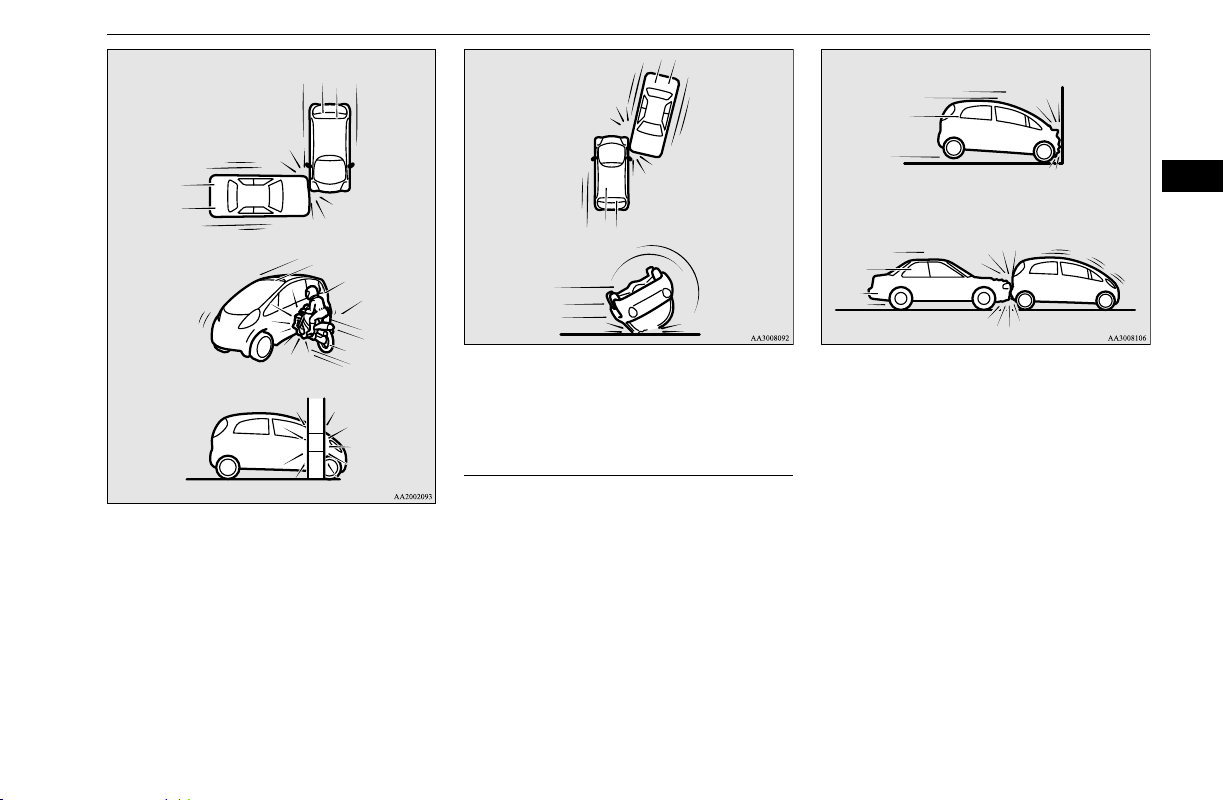
Supplemental Restraint System (SRS) - airbag
Seat and restraint systems 4-33
4
The side airbag and curtain airbag are not
designed to deploy in situations where they
cannot provide protection to the occupants.
Some typical situations are shown in the
illustrations.
Because the side airbags and curtain airbags
do not protect the occupants in all types of
collisions, be sure to always wear your seat
belts properly.
Side impact in an area away from the passenger com-
partment
Motorcycle or other similar small vehicle collision with
the side of vehicle
Collision with a utility pole, tree or other narrow object
The side airbag and curtain airbag
ARE NOT DESIGNED TO
DEPLOY when …
Oblique side impact
Vehicle rolls onto
its side or roof
Head-on collision
Rear end collision
BK0220401US.book 33 ページ 2015年6月3日 水曜日 午前7時42分
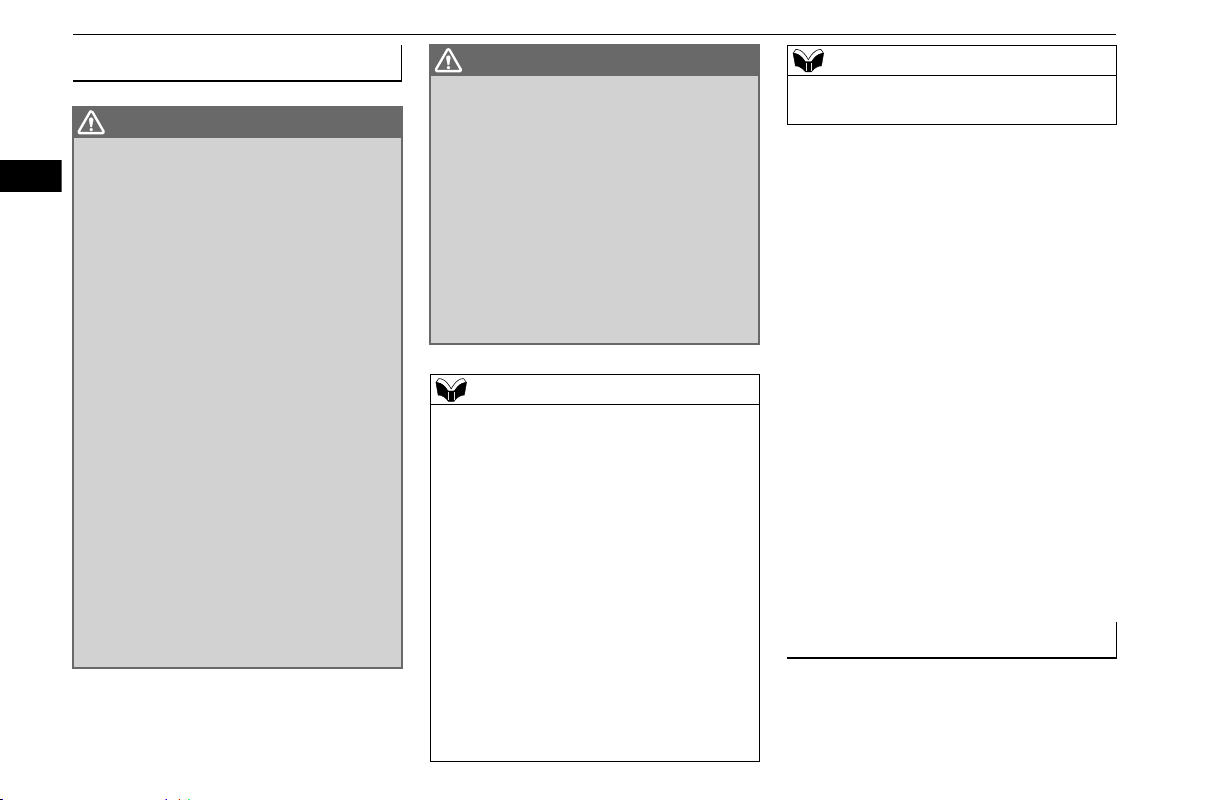
Supplemental Restraint System (SRS) - airbag
4-34 Seat and restraint systems
4
N00408500715
N00408600370
Occupant restraint warning labels for the SRS
are located in the vehicle as shown in the
illustration.
SRS servicing
WARNING
Any maintenance performed on or near
the components of the SRS should be per-
formed only by a certified i-MiEV dealer.
Do not permit anyone else to do any ser-
vice, inspection, maintenance or repair on
any SRS components or wiring. Similarly,
no part of the SRS should ever be handled,
removed or disposed by anyone except a
certified i-MiEV dealer.
Improper work methods on the SRS com-
ponents or wiring could result in an acci-
dental airbag deployment or could make
the SRS inoperable. Either of these situa-
tions could result in serious injury or
death.
Do not modify your steering wheel or any
other SRS component or related vehicle
part. For example, replacement of the
steering wheel, or modifications to the
front bumper or body structure can
adversely affect SRS performance and
may lead to injury.
If your vehicle has received any damage,
you should have the SRS inspected by a
certified i-MiEV dealer to make sure it is
in proper working order.
Do not modify your front seats, center pil-
lar or center console. Such modifications
can adversely affect SRS performance and
may lead to injury.
Also, if you discover any tear or open
seam in the seat fabric near the side air-
bag, have the seat inspected by a certified
i-MiEV dealer.
If you find a crack in or damage to the
front pillar, rear pillar, or roof side rail
where the curtain airbag is located, have
the SRS inspected by a certified i-MiEV
dealer.
NOTE
When you transfer ownership of the vehicle
to another person, we urge you to alert the
new owner that it is equipped with the SRS
and refer that owner to the applicable sec-
tions in this owner’s manual.
If you decide to junk or scrap your vehicle,
we urge you to first take it to a certified i-
MiEV dealer so that the SRS can be made
safe for disposal.
If any of the following parts needs to be
modified for use by a handicapped person,
the advanced airbag system will be greatly
affected. Please consult a certified i-MiEV
dealer for assistance.
•Driver’s seat
• Front passenger seat
• Front seat belt
WARNING
• Steering wheel
• Instrument panel
[For vehicles sold in U.S.A.]
To contact Mitsubishi Motors North
America, Inc.
call 1-888-648-7820 or write to:
Mitsubishi Motors North America,
Inc.
Customer Relations Department
P. O. Box 6400
Cypress, CA 90630-0064
[For vehicles sold in Canada]
To contact Mitsubishi Motor Sales of
Canada, Inc.
call 1-888-576-4878 or write to:
Mitsubishi Motor Sales of Canada,
Inc.
Customer Relations Department
P.O. Box 41009
4141 Dixie Road
Mississauga, ON L4W 5C9
Warning labels
NOTE
BK0220401US.book 34 ページ 2015年6月3日 水曜日 午前7時42分
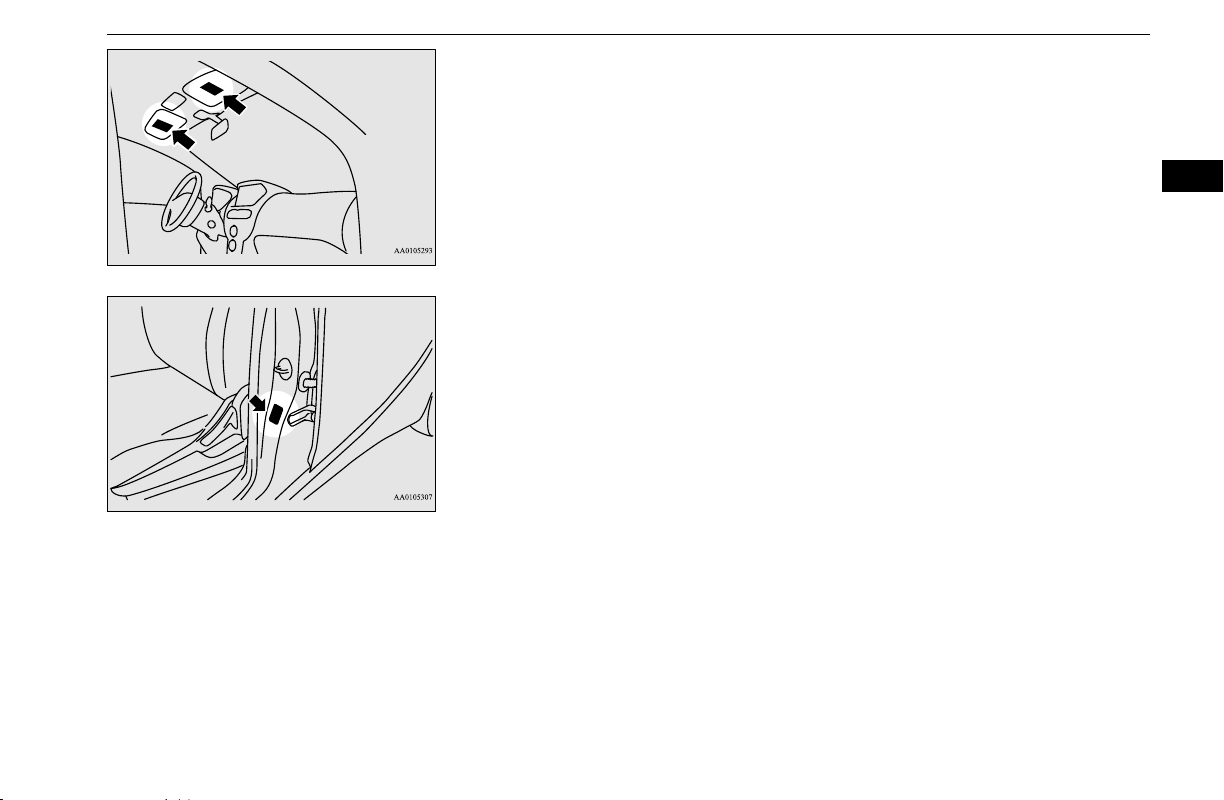
Supplemental Restraint System (SRS) - airbag
Seat and restraint systems 4-35
4
Located in the passenger’s side as well.
BK0220401US.book 35 ページ 2015年6月3日 水曜日 午前7時42分

BK0220401US.book 36 ページ 2015年6月3日 水曜日 午前7時42分
5
Features and controls
Break-in recommendations ..............................................................5-2
Keys .................................................................................................5-2
Electronic immobilizer (Anti-theft starting system) ........................5-2
Keyless entry system .......................................................................5-5
Door locks ........................................................................................5-8
Power door locks .............................................................................5-9
Child safety locks for rear door .....................................................5-10
Liftgate ...........................................................................................5-11
Theft-alarm system ........................................................................5-12
Power window control ...................................................................5-14
Parking brake .................................................................................5-16
Inside rearview mirror ...................................................................5-16
Outside rearview mirrors ...............................................................5-17
Electric motor switch .....................................................................5-18
Steering wheel lock ........................................................................5-20
Starting the electric motor unit ......................................................5-20
Selector lever .................................................................................5-21
Acoustic vehicle alerting system (AVAS) ......................................5-23
Service brake .................................................................................5-24
Brake assist system ........................................................................5-25
Anti-lock braking system ...............................................................5-25
Electric power steering system (EPS) ............................................5-27
Active stability control (ASC) .......................................................5-28
Tire pressure monitoring system ....................................................5-30
Rear-view camera (if so equipped).................................................5-34
Instrument cluster ..........................................................................5-36
Indicator and warning light package ..............................................5-43
Indicators .......................................................................................5-44
Warning lights ................................................................................ 5-44
Combination headlights and dimmer switch ................................. 5-46
Turn signal lever ............................................................................5-49
Hazard warning flasher switch ......................................................5-49
Front fog light switch ....................................................................5-50
Wiper and washer switch ............................................................... 5-50
Electric rear window defogger switch ...........................................5-52
Horn switch ...................................................................................5-53
Link System (if so equipped) ......................................................... 5-53
Bluetooth
®
2.0 interface (if so equipped).......................................5-53
USB input terminal (if so equipped) ..............................................5-73
Sun visors ...................................................................................... 5-76
12 V power outlet ..........................................................................5-76
Interior lights ................................................................................. 5-77
Storage spaces ................................................................................5-79
Cup holder ..................................................................................... 5-80
Assist grip ......................................................................................5-81
BK0220401US.book 1 ページ 2015年6月3日 水曜日 午前7時42分
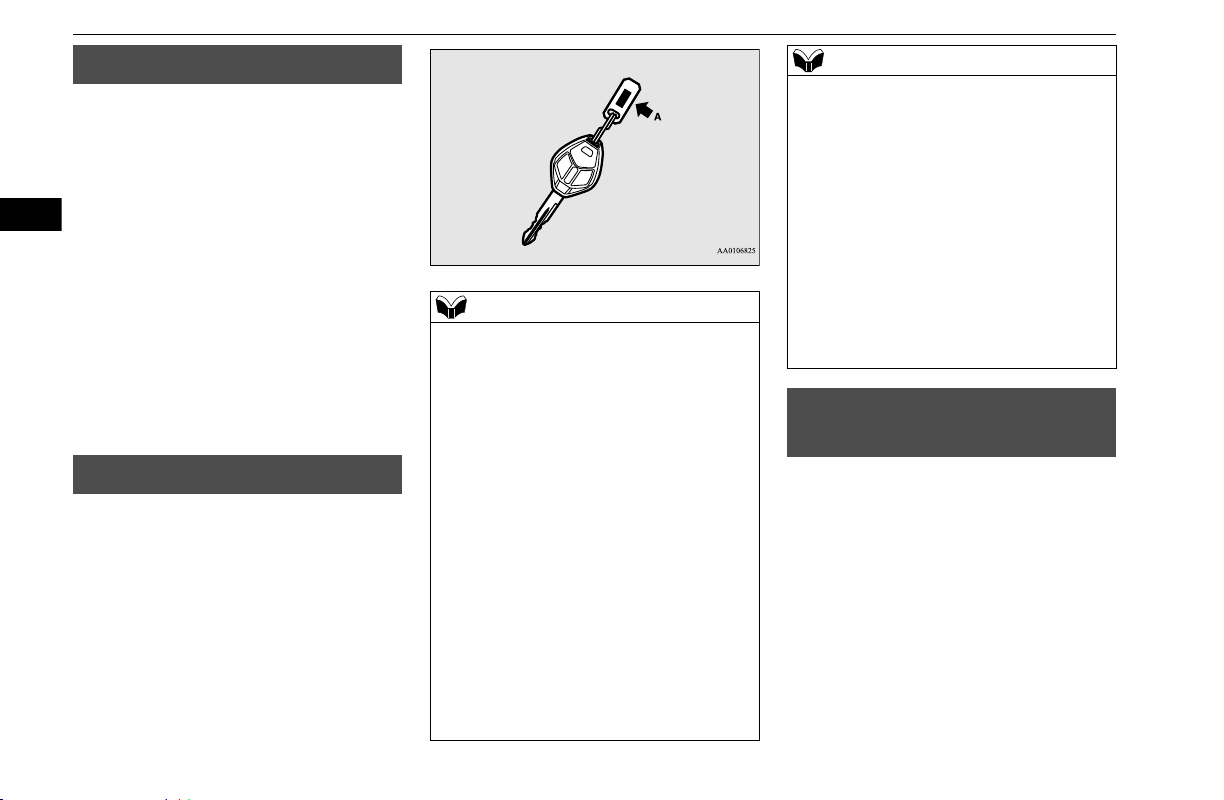
Break-in recommendations
5-2 Features and controls
5
N00508700343
Advanced automobile manufacturing tech-
niques permit you to operate your new vehi-
cle without requiring a long break-in period
of low-speed driving.
However, you can add to the future perfor-
mance and economy of your vehicle by
observing the following precautions during
the first 300 miles (500 km).
Drive your vehicle at moderate speeds during
the break-in period.
Do not overload the vehicle. Observe the
seating capacity (See “Cargo load precau-
tions” on page 6-10).
Do not use this vehicle for trailer towing.
N00508800618
Two keys are provided.
The keys fit all locks. Keep one in a safe
place as a spare key.
N00509101846
The electronic immobilizer is designed to sig-
nificantly reduce the possibility of vehicle
theft. The purpose of the system is to immo-
bilize the vehicle if an invalid start is
attempted. A valid start attempt can only be
achieved (subject to certain conditions), using
a key “registered” to the immobilizer system.
All of the keys provided with your new vehi-
cle have been programmed to the vehicle’s
electronics.
Break-in recommendations
Keys
NOTE
The key number (A) is stamped on the key
number plate as shown in the illustration.
Make a record of the key number and store
the key and key number plate in separate
places, so that you can order a key from a
certified i-MiEV dealer if the original keys
are lost.
The key is a precision electronic device with
a built-in signal transmitter. Please observe
the following in order to prevent damage.
• Do not leave where it may be exposed to
heat caused by direct sunlight, such as on
top of the dashboard.
• Do not take the remote control transmitter
apart.
• Do not excessively bend the key or subject
it to strong impacts.
• Keep the remote control transmitter dry.
• Keep away from magnetic objects such as
key holders.
• Keep away from devices that produce mag-
netism, such as audio systems, computers
and televisions.
• Do not clean with ultrasonic cleaners.
• Do not leave the key where it may be
exposed to high temperature or high humid-
ity.
As your vehicle is equipped with an elec-
tronic immobilizer, the electric motor unit is
designed so that it will not start if the ID
code registered in the immobilizer computer
and the key’s ID code do not match. Refer to
the section entitled “Electronic immobilizer”
for details and key usage.
Electronic immobilizer
(Anti-theft starting system)
NOTE
BK0220401US.book 2 ページ 2015年6月3日 水曜日 午前7時42分
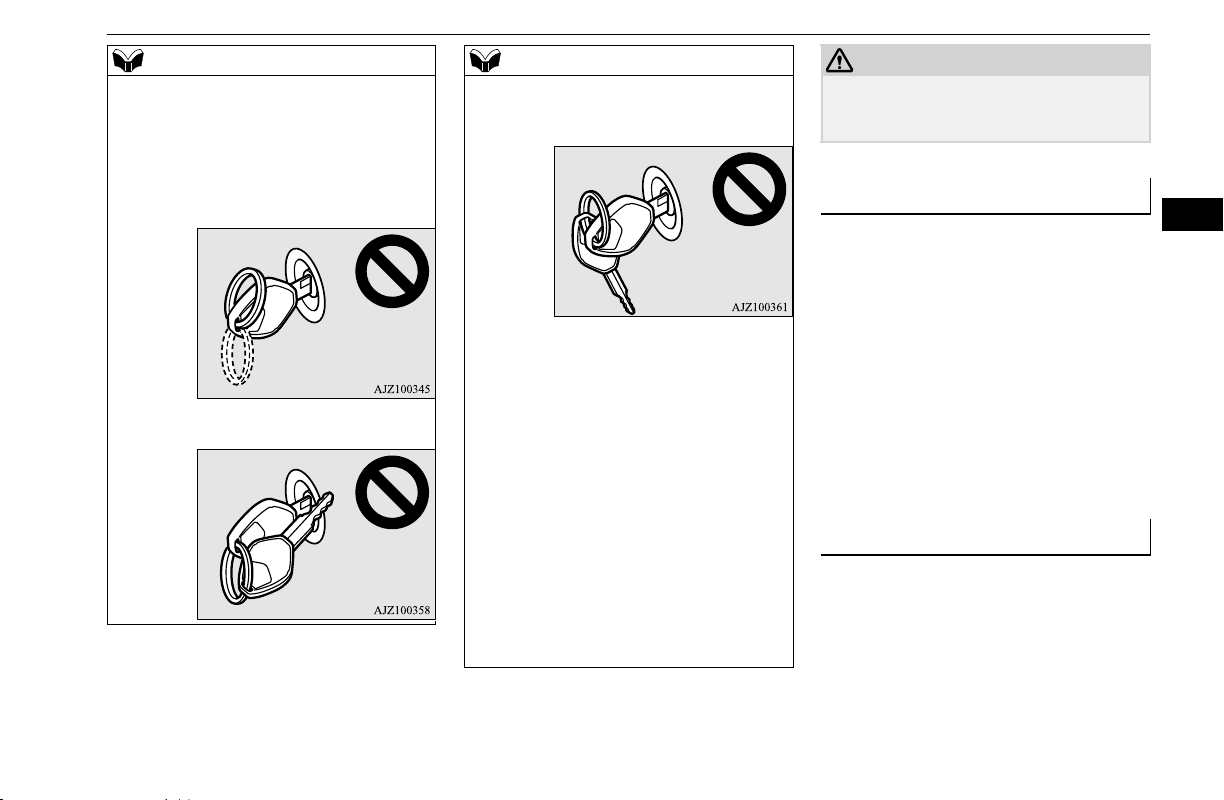
Electronic immobilizer (Anti-theft starting system)
Features and controls 5-3
5
Only keys that have been programmed to the
vehicle electronics can be used to start the
vehicle.
If you lose a key, you can order a key from a
certified i-MiEV dealer by referring to the
key number.
To prevent vehicle theft, the ID code for the
vehicle keys must be changed.
Take your vehicle and all remaining keys to a
certified i-MiEV dealer to have your ID code
changed.
To add a key, you need to register the ID code
to the vehicle.
Registering the ID code can be done by a cer-
tified i-MiEV dealer. Or it can be done by
yourself (except for vehicles sold in Canada).
To register the ID code yourself, follow the
“Customer key programming” procedure
below.
NOTE
In the following cases, the vehicle may not
be able to recognize the registered ID code
from the key. This means the electric motor
unit will not start even when the registered
key is turned to the “START” position.
• When the key contacts a key ring or other
metallic or magnetic object
• When the key grip contacts metal of
another key
• When the key contacts or is close to other
immobilizing keys (including keys of other
vehicles)
In cases like the above, move the offending
object(s) away from the key and turn the key
back to the “ACC” or “LOCK” position.
Then try to start the electric motor unit again.
If the electric motor unit does not start, con-
tact a certified i-MiEV dealer.
Electronic immobilizer is not compatible
with commercially available remote starting
systems. Use of commercially available
remote starting systems may result in vehicle
starting problems and a loss of security pro-
tection.
A system failure is suspected when the elec-
tric motor switch is turned to the “START”
position, and the electric motor unit does not
start. In such a case, contact a certified i-
MiEV dealer.
NOTE
CAUTION
Do not make any alterations or additions to
the immobilizer system. Alterations or addi-
tions could cause failure of the immobilizer.
Replacement keys
Additional keys
BK0220401US.book 3 ページ 2015年6月3日 水曜日 午前7時42分
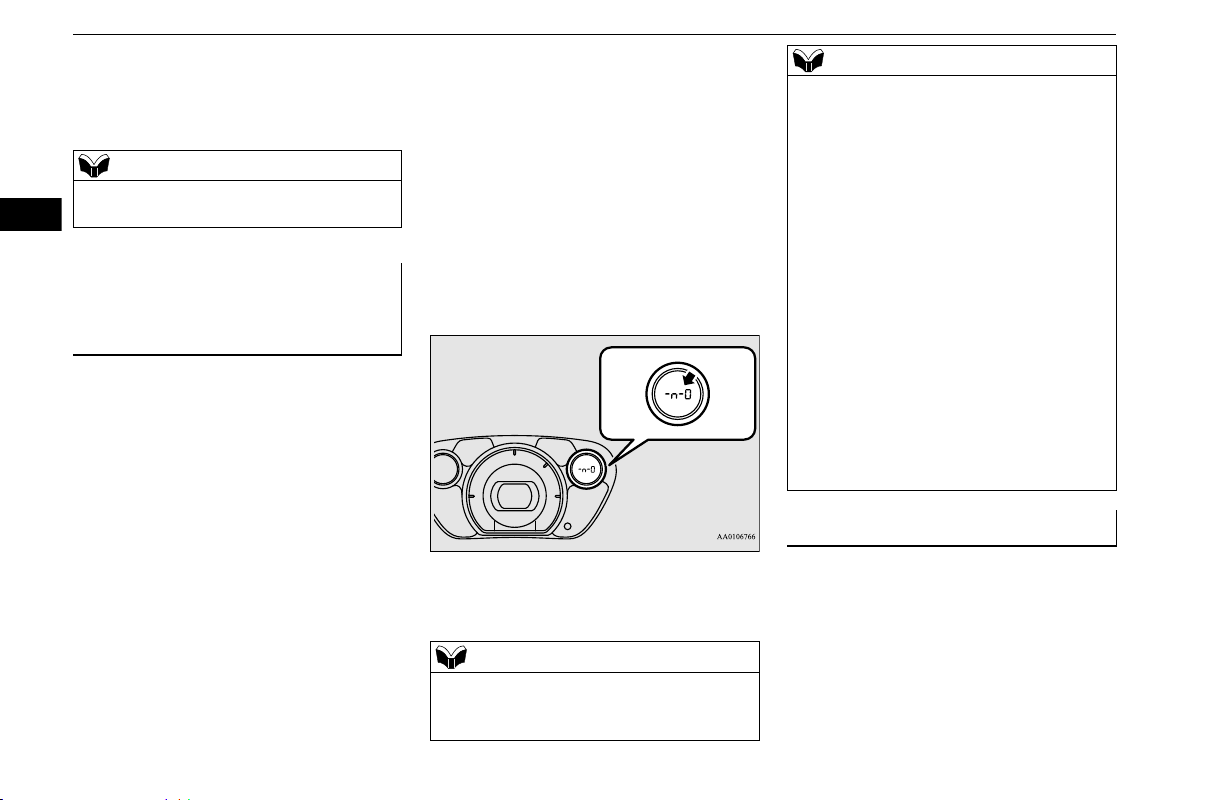
Electronic immobilizer (Anti-theft starting system)
5-4 Features and controls
5
If you choose to have a certified i-MiEV
dealer register the ID code, take your vehicle
and any remaining keys to a certified i-MiEV
dealer.
N00562200113
You can program new keys to the system if
you have two valid (already registered) keys
and blank (not registered) immobilizer key
(specially cut for your vehicle at a certified i-
MiEV dealer) by doing the following:
1. Insert the first valid key into the ignition
and turn the ignition to the “ON” position
for 5 seconds.
2. Turn the ignition to the “LOCK” position
and remove the first key.
3. Within 30 seconds of turning the first key
to the “LOCK” position, insert the second
valid key into the ignition and turn it to
the “ON” position. About 10 seconds
later, the immobilizer indicator will start
blinking.
4. When the immobilizer indicator starts
blinking, turn the second valid key to the
“LOCK” position and remove it. Within
30 seconds after doing so, insert a blank
immobilizer key into the ignition and turn
it to the “ON” position. Perform this oper-
ation no more than 30 seconds after the
immobilizer indicator starts blinking.
When registration of the ID code is com-
plete, the immobilizer indicator will come
on for 3 seconds then go off. If an error
occurs, the immobilizer indicator will go
off during the procedure.
5. If you wish to register another key, per-
form the process again from step 1.
N00562300084
Your electronic immobilizer operates on a
radio frequency subject to Federal Communi-
cations Commission (FCC) Rules (For vehi-
cles sold in U.S.A.) and Industry Canada
Rules (For vehicles sold in Canada). This
device complies with Part 15 of the FCC
Rules and RSS-Gen of the Industry Canada
NOTE
You are provided with 2 keys, but you may
add up to 6 more keys.
Customer key programming
(Except for vehicles sold in
Canada)
NOTE
It is not possible to register a key if:
• the immobilizer indicator goes off during
the procedure
• the immobilizer indicator does not come on
for 3 seconds after turning the ignition to
the “ON” position with a blank immobilizer
key
The procedure will be terminated automati-
cally if:
• a period of 30 seconds or longer elapses
from the moment when the first key is
turned to the “LOCK” position to the
moment when the second key is turned to
the “ON” position
• a period of 30 seconds or longer elapses
from the moment when the second key is
turned to the “LOCK” position to the
moment when the blank immobilizer key
(specially cut for your vehicle at a certified
i-MiEV dealer) is turned to the “ON” posi-
tion
• more than 20 seconds elapse after the
immobilizer indicator starts blinking
General information
NOTE
BK0220401US.book 4 ページ 2015年6月3日 水曜日 午前7時42分
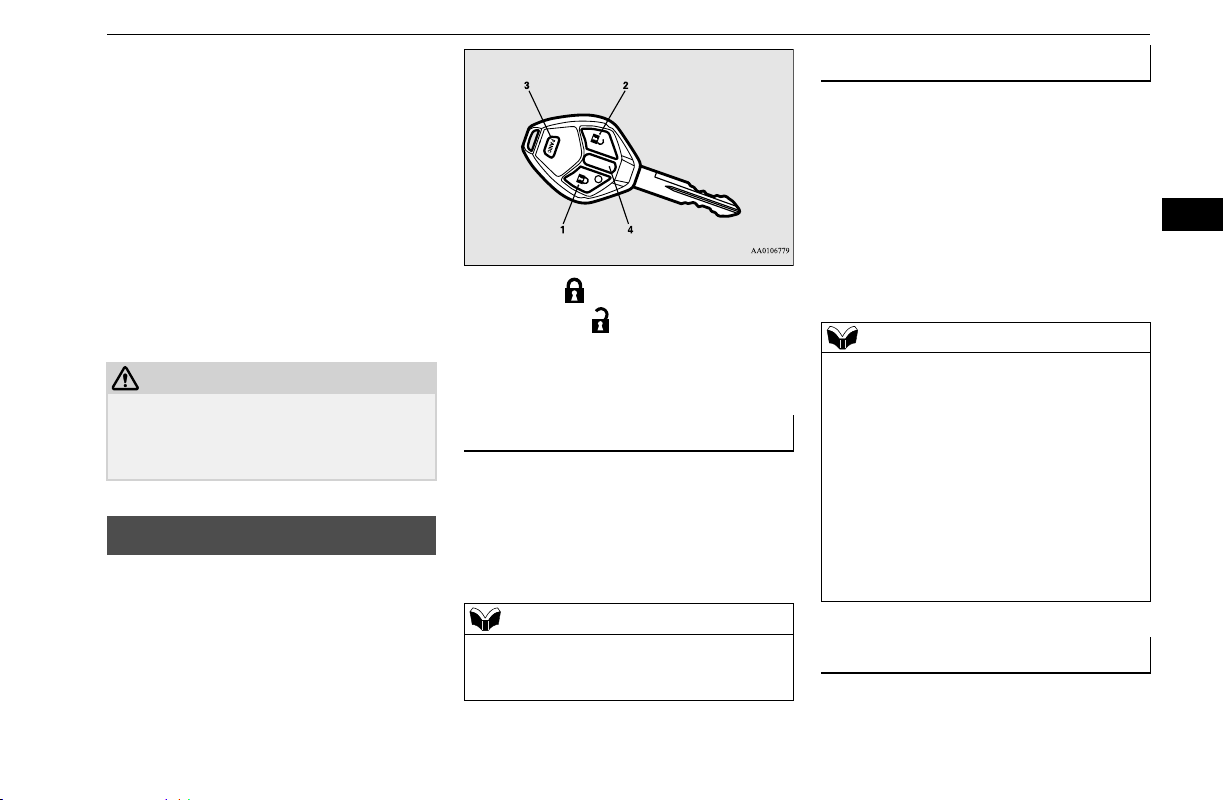
Keyless entry system
Features and controls 5-5
5
Rules. Operation is subject to the following
two conditions.
This device may not cause harmful inter-
ference.
This device must accept any interference
received, including interference that may
cause undesired operation.
This digital apparatus does not exceed the
Class A limits for radio noise emissions from
digital apparatus set out in the Radio Interfer-
ence Regulations of the Canadian Department
of Communications.
N00509000910
Press the remote control transmitter buttons
to lock or unlock the doors and to open the
liftgate.
It can also help you signal for attention by
setting off the panic alarm.
Press the LOCK button (1) to lock all the
doors and the liftgate.
If the dome light switch is in the door posi-
tion, the dome light will blink once. The turn
signal lights will also blink once.
Press the UNLOCK button (2) to unlock the
driver’s door only.
Within about 2 seconds, press the UNLOCK
button one more time to unlock all the doors
and the liftgate.
If the dome light switch is in the door posi-
tion, the dome light will turn on for about 30
seconds. The turn signal lights will also blink
twice.
The keyless entry system answerback func-
tions from the horn can each be turned on or
off as desired.
CAUTION
Changes or modifications not expressly
approved by the manufacturer for compli-
ance could void the user’s authority to oper-
ate the equipment.
Keyless entry system
1-
LOCK ( ) button
2-
UNLOCK ( ) button
3- PANIC button
4- Indicator light
To loc k
NOTE
If you press the LOCK button (1) after lock-
ing the doors and the liftgate, the horn will
sound once to confirm that they are locked.
To unlock
NOTE
If the UNLOCK button (2) is pressed and no
door or liftgate is opened within approxi-
mately 30 seconds, relocking will automati-
cally occur (automatic relocking function).
The time for automatic relocking can be
changed. For details, please contact a certi-
fied i-MiEV dealer.
The door and liftgate unlock function can be
set so that all doors and liftgate unlock when
the UNLOCK button (2) is pressed once.
For details, please contact a certified i-MiEV
dealer.
Answerback function
BK0220401US.book 5 ページ 2015年6月3日 水曜日 午前7時42分

Keyless entry system
5-6 Features and controls
5
The horn answerback function can be set to
the following three conditions.
Each time the horn answerback function is
set, a chime will sound to tell you the condi-
tion of the answerback function.
1. Remove the key from the electric motor
switch.
2. Open the driver’s door and turn the com-
bination headlights and dimmer switch to
the “OFF” position.
3. Press the LOCK button (1) for 4 to 10 sec-
onds and press the UNLOCK button (2)
during this time.
4. Release in sequence the UNLOCK and
LOCK buttons within 10 seconds of
pressing the UNLOCK button in step 3.
The turn signal lights answerback function
can be changed.
If you want to change the answerback func-
tion, please contact a certified i-MiEV dealer
for details.
N00543600105
The door and liftgate unlock function can be
set so that all doors and liftgate unlock when
the UNLOCK button (2) is pressed once.
For details, please contact a certified i-MiEV
dealer.
N00543700050
If you are near your vehicle and feel threat-
ened, you may activate the alarm to call atten-
tion as follows:
1. Press the PANIC button (3) for more than
1 second.
2. The headlights will blink on and off and
the horn will sound intermittently for
about 3 minutes.
3. To turn off the alarm, press any button on
the remote control transmitter.
N00543800077
Only remote control transmitters pro-
grammed with the vehicle’s electronics can
lock or unlock all doors.
If you lose the remote control transmitter, you
can order a remote control transmitter from a
certified i-MiEV dealer by referring to the
key number.
To prevent vehicle theft, the ID codes for all
the remote control transmitters except the one
for the lost key must be programmed again.
Take your vehicle and all the remaining
remote control transmitters to a certified i-
MiEV dealer to have your ID codes pro-
grammed again.
N00543900065
To add a remote control transmitter, you must
already have one registered remote control
transmitter.
Registering the ID code can be done by your-
self or by a certified i-MiEV dealer. For you
to register the ID code yourself, follow the
“Customer remote control transmitter pro-
gramming” procedure below.
Horn deactivation/reactivation
Number of
chimes
Condition
One chime The horn will not sound.
Two chimes The horn will sound.
Three chimes
The horn will sound if the
auto light switch is ON (if
so equipped).
Four chimes
The horn will sound if the
LOCK button is pressed
twice quickly.
Changing the setting of the turn
signal lights answerback function
Setting of door unlock function
Using the panic alarm
Replacement remote control
transmitters
Additional remote control
transmitters
BK0220401US.book 6 ページ 2015年6月3日 水曜日 午前7時42分
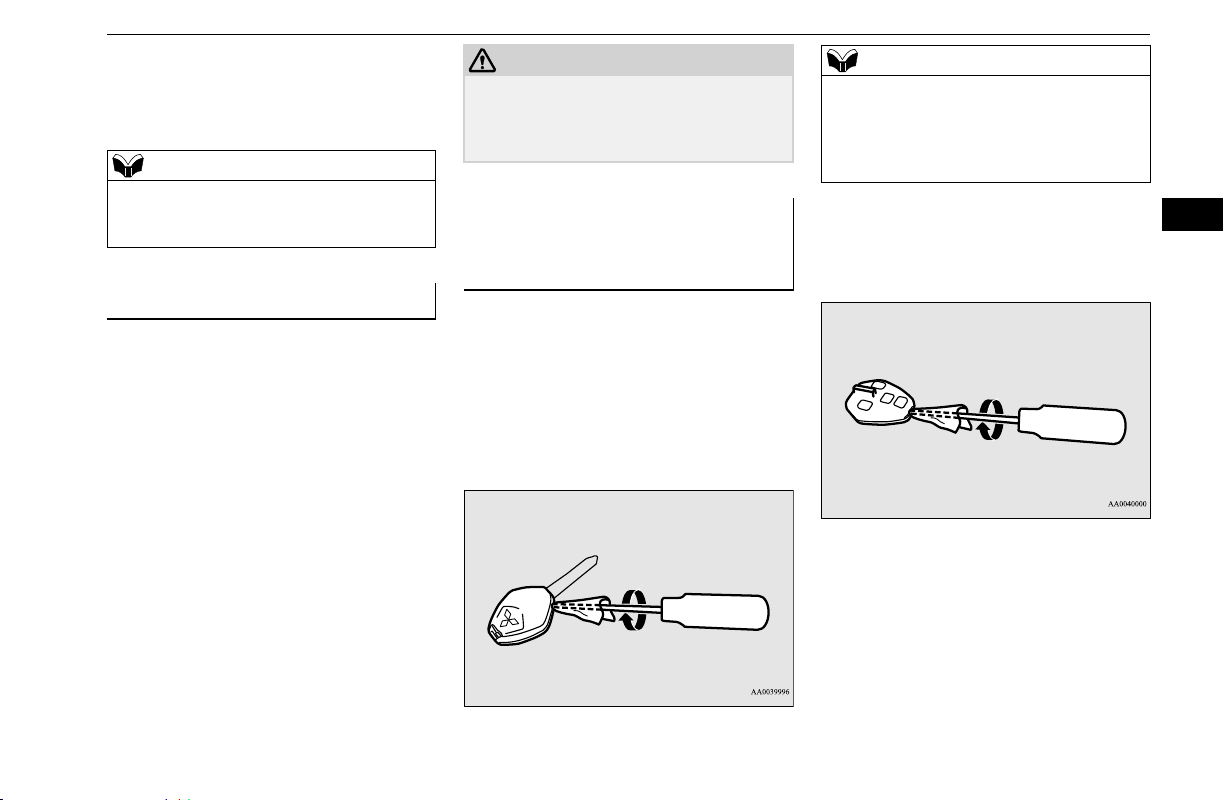
Keyless entry system
Features and controls 5-7
5
If you choose to have a certified i-MiEV
dealer register the ID code, take your vehicle
and all remaining keys to a certified i-MiEV
dealer.
N00546100101
Your keyless entry system operates on a radio
frequency subject to Federal Communica-
tions Commission (FCC) Rules (For vehicles
sold in U.S.A.) and Industry Canada Rules
(For vehicles sold in Canada). This device
complies with Part 15 of the FCC Rules and
RSS-Gen of the Industry Canada Rules.
Operation is subject to the following two con-
ditions.
This device may not cause harmful inter-
ference.
This device must accept any interference
received, including interference that may
cause undesired operation.
N00544101133
1. Before replacing the battery, remove static
electricity from your body by touching a
metal grounded object.
2. With the Mitsubishi mark facing up, insert
the cloth-covered tip of a flat blade screw-
driver into the notch in the remote control
transmitter case and use it to open the
case.
3. Remove the remote control transmitter
from the remote control transmitter case.
Then, open the remote control transmitter
using the method described in step 2.
4. Remove the old battery.
5. Install a new battery with the + side (A)
down.
NOTE
You are provided with 2 remote control
transmitters, but you may register up to 4
remote control transmitters.
General information
CAUTION
Changes or modifications not expressly
approved by the manufacturer for compli-
ance could void the user’s authority to oper-
ate the equipment.
Procedure for replacing the
remote control transmitter bat-
tery
NOTE
Be sure to perform the procedure with the
Mitsubishi mark facing up. If the Mitsubishi
mark is not facing up when you open the
remote control transmitter case, the buttons
may come out.
BK0220401US.book 7 ページ 2015年6月3日 水曜日 午前7時42分
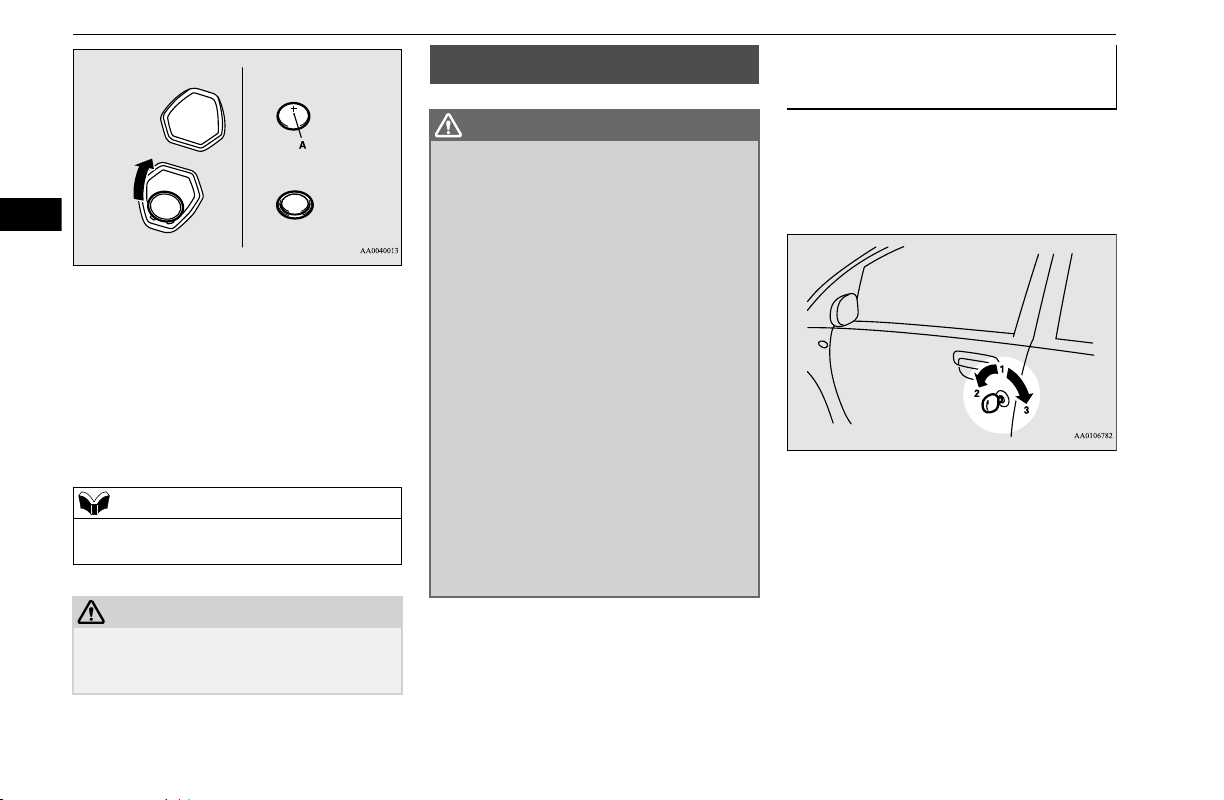
Door locks
5-8 Features and controls
5
6. Close the remote control transmitter
firmly.
7. Place the remote control transmitter in the
remote control transmitter case, then
securely close the remote control trans-
mitter case.
8. Check the keyless entry system to see that
it works.
N00509200534
Turn the key toward the front of the vehicle to
lock the door. After checking that the door is
locked, turn the key back to the center and
remove it.
NOTE
A certified i-MiEV dealer can replace the
battery for you if you prefer.
CAUTION
When the remote control transmitter case is
opened, be careful to keep water, dust, etc.
out. Also, do not touch internal components.
+ side
- side
Coin type battery
CR1620
Door locks
WARNING
Make sure all doors are tightly closed and
locked while driving.
• Locked doors, in combination with the
use of seat belts, can help reduce the risk
of ejection in an accident.
• Locked doors can help keep passengers,
especially small children, from opening
doors and falling out of moving vehicles.
• Locked doors can help prevent outsiders
from gaining access to your vehicle when
you slow down or come to a stop.
Lock your vehicle whenever you leave it.
Children who get into unlocked vehicles
may not be able to get out. Children
trapped inside vehicles can quickly be
overcome by heat and suffer serious
injury or death due to heat stroke.
Never leave children unattended inside a
vehicle. In addition to the risk of heat
stroke, children can activate switches and
controls, resulting in an injury or fatal
accident.
To lock or unlock the door with
the key
1- Insert or remove the key
2- Lock
3- Unlock
BK0220401US.book 8 ページ 2015年6月3日 水曜日 午前7時42分
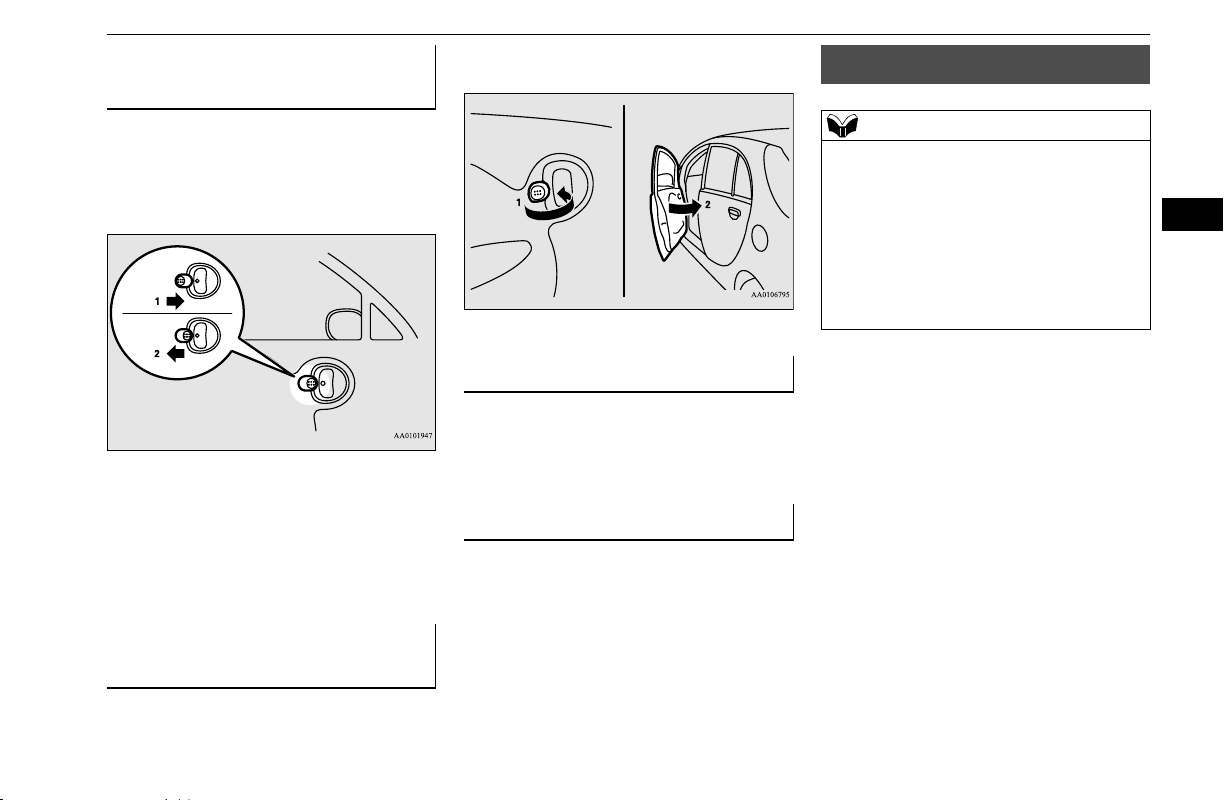
Power door locks
Features and controls 5-9
5
Move the lock knob to the lock position to
lock the door.
All doors should be kept locked while driv-
ing.
The driver’s door can be unlocked without
using the lock knob by pulling on the inside
door handle.
1. Move the inside lock knob to the locked
position.
2. Be sure the keys are not inside the vehi-
cle. Close the door.
N00549600240
If you open the driver’s door while the key is
in the “LOCK” or “ACC” position, a tone
will sound, reminding you to remove the key.
N00549700179
If the key is in the electric motor switch when
you push the lock knob forward with the
driver’s door or passenger’s door open, the
lock knob will automatically return to the
unlocked position.
N00509300607
To lock or unlock the door from
the inside
1- Lock
2- Unlock
To lock the door without using
the key
Key reminder buzzer
Lock out protection
Power door locks
NOTE
When locking or unlocking with the key on
the driver’s door, only the driver’s door will
lock or unlock.
Repeated continuous operation between lock
and unlock could activate the power door
locking systems built-in protection circuit
and prevent the system’s from operating. If
this occurs, wait about 1 minute before oper-
ating the power door lock switch.
BK0220401US.book 9 ページ 2015年6月3日 水曜日 午前7時42分
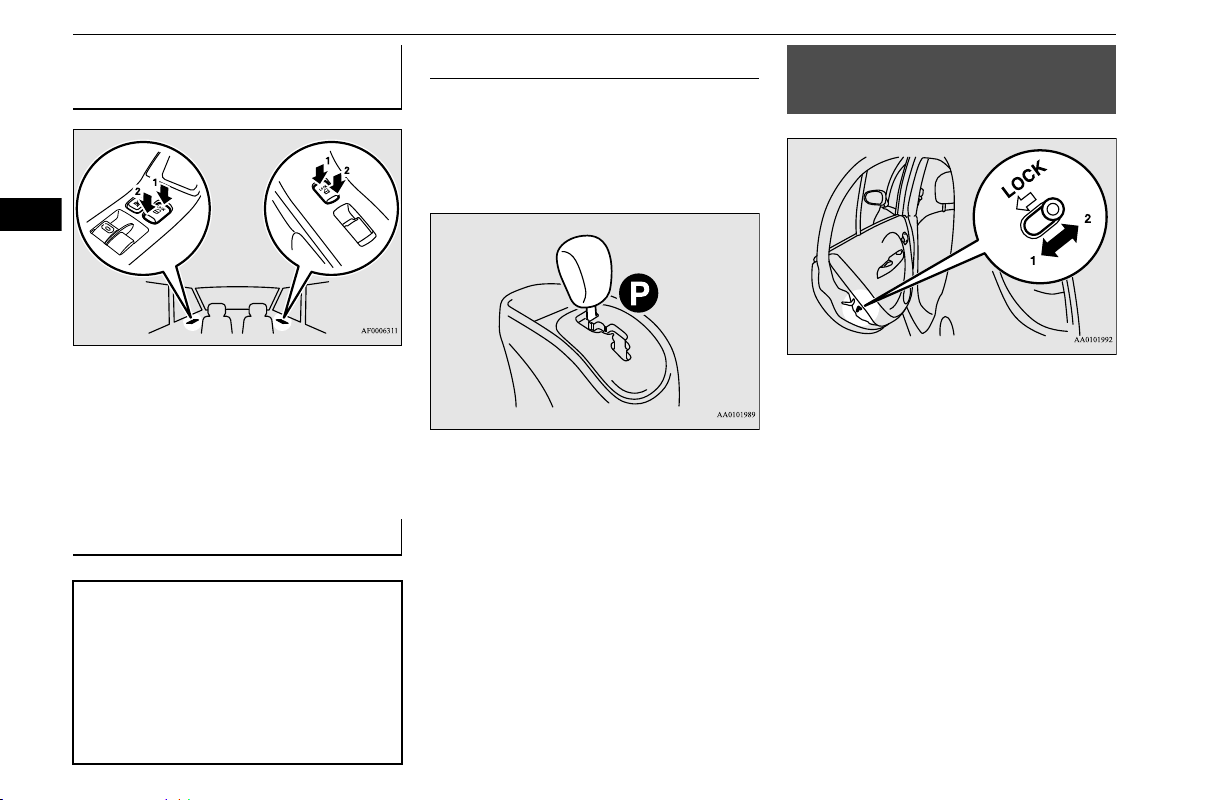
Child safety locks for rear door
5-10 Features and controls
5
All of the doors and the liftgate can be locked
or unlocked by operating the power door lock
switch on the driver’s or the passenger’s door.
N00563400095
All doors and the liftgate will unlock when
the selector lever is moved to the “P” (PARK)
position with the electric motor switch in the
“ON” position.
N00509400288
Child safety locks help prevent rear passen-
gers, especially children, from opening the
rear door using the inside door handle.
A lock lever for the child safety lock is pro-
vided on each rear door.
When the lever is in the lock position (1), the
rear door cannot be opened using the inside
door handle.
To open the rear door when the child safety
lock lever is in the lock position, pull the out-
side door handle.
When the lever is in the release position (2),
the child safety lock is released and the rear
To lock and unlock by the
power door lock switch
1- Lock
2- Unlock
To unlock the doors and liftgate
You can select the functions to unlock the
doors and liftgate either using the electric
motor switch position or using the selector
lever position.
These functions are not activated when the
vehicle is shipped from the factory. To acti-
vate or deactivate these functions, please
contact a certified i-MiEV dealer.
Using the selector lever position
Child safety locks for rear
door
1- To lock
2- To release
BK0220401US.book 10 ページ 2015年6月3日 水曜日 午前7時42分
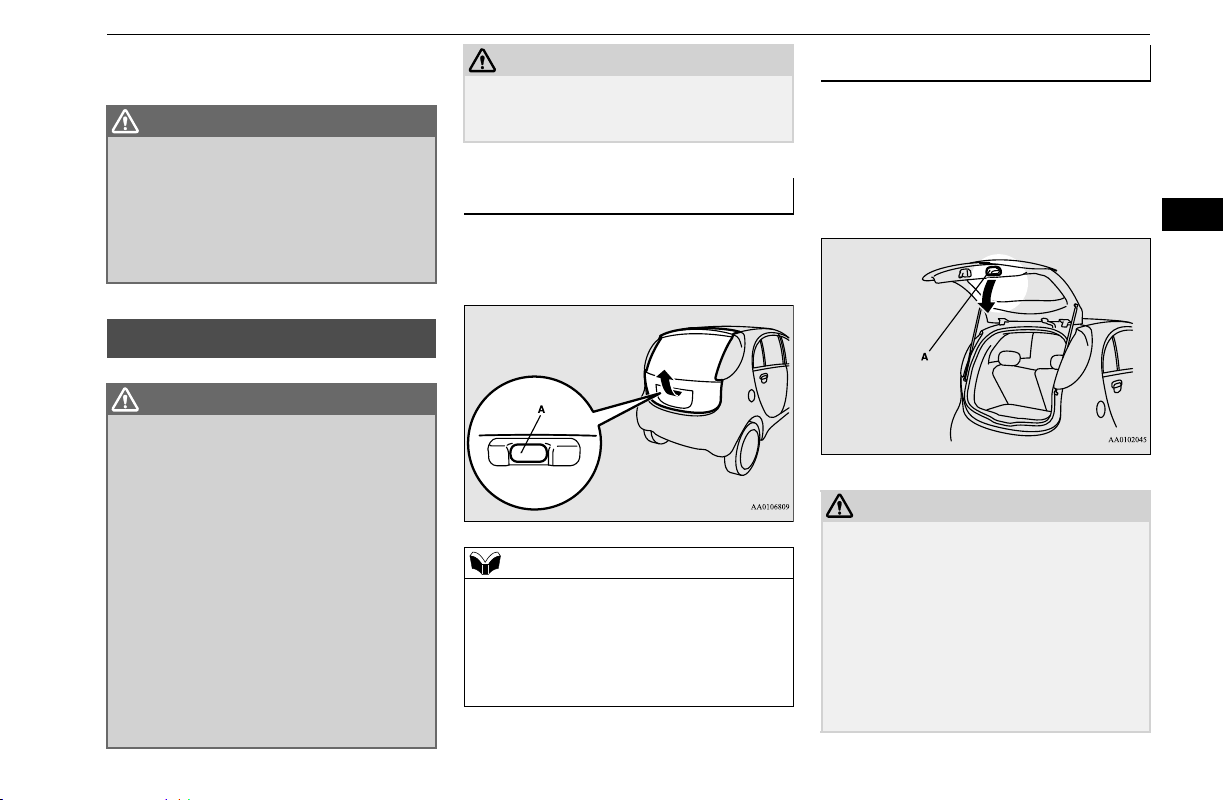
Liftgate
Features and controls 5-11
5
door can be opened using the inside door han-
dle.
N00510101266
After unlocking the liftgate, push the switch
(A) and pull up the liftgate.
Pull the liftgate grip (A) downward as illus-
trated. Gently push the upper gate from the
outside with enough force so that it is com-
pletely closed. Always ensure the liftgate is
securely closed.
WARNING
Always keep the doors tightly closed and
locked when driving. An unlocked door
may be accidentally opened by a passen-
ger, especially by a child who could fall
out. Also, if the doors are not locked, there
is a greater risk of someone being thrown
from the vehicle in an accident.
Liftgate
WARNING
When opening and closing the liftgate,
make sure that there are no people nearby
and be careful not to hit your head or
pinch your hands, neck, etc.
If snow or ice has accumulated on the lift-
gate, remove it before opening the liftgate.
Otherwise the liftgate may abruptly close
due to the weight of the snow or ice.
When opening the liftgate, always fully
open it. A partially opened liftgate can
unexpectedly close due to its own weight.
When the vehicle is parked on a slope, the
effort required to open or close the liftgate
may be greater or less than expected.
The liftgate may also open or close more
quickly.
CAUTION
To avoid damage to the liftgate, make sure
the area above and behind the liftgate is clear
before opening it.
To open
NOTE
If you do not open the liftgate immediately
after pulling the handle, the liftgate can not
be lifted. If this happens, pull the handle
again and lift the liftgate.
The liftgate cannot be opened when the bat-
tery is flat or disconnected.
To close
CAUTION
To avoid injuring your hand or arm, do not
attempt to close the liftgate the gate grip (A).
Before starting the vehicle, be sure to con-
firm that the liftgate is locked. If the liftgate
opens while driving the vehicle, objects
stored in the luggage compartment could fall
out into the road.
When closing the liftgate, always ensure that
everybody removes their hands and fingers
from the liftgate opening.
BK0220401US.book 11 ページ 2015年6月3日 水曜日 午前7時42分
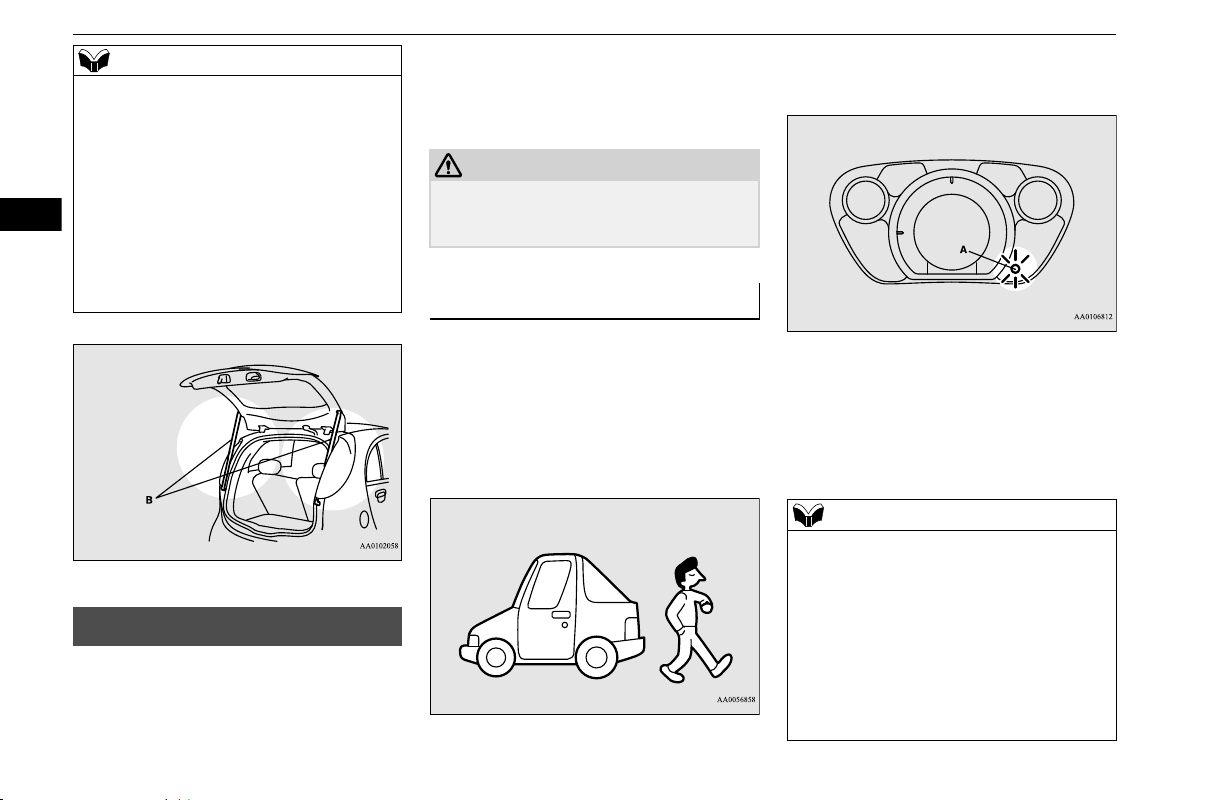
Theft-alarm system
5-12 Features and controls
5
N00510200244
The theft-alarm system is designed to provide
protection from unauthorized entry into the
vehicle. This system is operated in three
stages: the first is the “armed” stage, the sec-
ond is the “alarm” stage, and third is the “dis-
armed” stage. If triggered, the system
provides both audible and visual alarm sig-
nals.
Park the vehicle and stop the electric motor
unit. Arm the system as described below.
1. Remove the key from the electric motor
switch.
2. Lock all doors and the liftgate by using
the keyless entry system.
At this time, the theft-alarm indicator (A)
in the meter cluster flashes for confirma-
tion.
3. The system has entered the armed stage
after about 20 seconds, when the theft-
alarm indicator flashing becomes slower.
The theft-alarm indicator continues to
flash while the system is in the armed
stage.
NOTE
Gas struts (B) are installed to support the lift-
gate.
To prevent damage or faulty operation.
• Do not hold the gas struts when closing the
liftgate.
• Also, do not push or pull on the gas struts.
• Do not attach any plastic material, tape,
etc., to the gas struts.
• Do not tie anything, etc., around the gas
struts.
• Do not hang any objects on the gas struts.
Theft-alarm system
CAUTION
Do not modify or add parts to the theft-alarm
system. Doing so could cause the theft-alarm
to malfunction.
Armed stage
Arm the system and leave
NOTE
The system will be disarmed if, while the
theft-alarm indicator is illuminated, all doors
and the liftgate are unlocked by using the
keyless entry system.
The system will be disarmed if, while the
theft-alarm indicator is illuminated, the elec-
tric motor switch is turned to the “ON”.
The system will not be armed if a door or the
liftgate is not completely closed. If this hap-
pens, rearm the system as described above.
BK0220401US.book 12 ページ 2015年6月3日 水曜日 午前7時42分
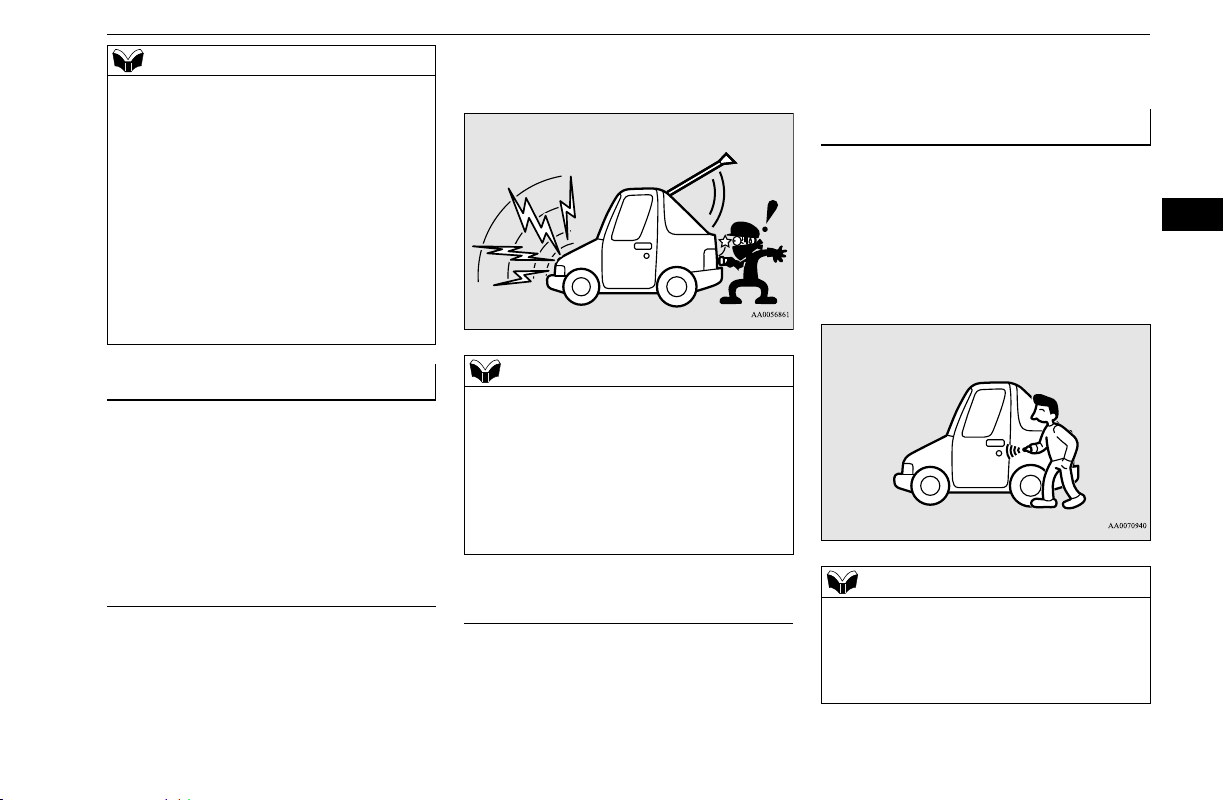
Theft-alarm system
Features and controls 5-13
5
The alarm will be activated if the following
occurs while the vehicle is parked and the
system is armed.
One of the doors and the liftgate is opened
without using the keyless entry system.
When the alarm is activated:
1. The headlights blink on and off for 3 min-
utes.
After 3 minutes the headlights automati-
cally shut off.
2. The horn will sound intermittently for 3
minutes.
The alarm can be deactivated in the following
ways.
By using the keyless entry system to lock
or unlock the doors and liftgate.
Turn the electric motor switch to the
“ON” position.
The system will be disarmed if the following
operation is performed.
The electric motor switch is turned to the
“ON” position.
All doors and the liftgate are unlocked by
using the keyless entry system.
The theft-alarm system can be activated
when people are riding inside the vehicle or
when the windows are open. To prevent acci-
dental activation of the alarm, do not set the
system to the system armed mode while peo-
ple are riding in the vehicle.
If the answerback function (flashing of the
turn signal lights by locking and unlocking
the doors and the liftgate) is deactivated, the
turn signal lights do not flash after the lock-
ing and unlocking operation.
For information on the answerback function,
refer to “Keyless entry system” on pages 5-5.
Alarm stage
Type of alarm
NOTE
NOTE
The alarm will continue to operate for 3 min-
utes. At the end of that period, the alarm will
automatically shut off to save battery power.
The system will then be rearmed until the
proper disarming step is taken.
The alarm will resume if unauthorized
actions are taken again, even if the alarm has
stopped.
Alarm deactivation
Horn sounds!
Headlights blink on and off!
Disarmed stage
NOTE
If the UNLOCK button on the remote control
transmitter is operated when all doors and
the liftgate are closed and no door is opened
within approximately 30 seconds, re-arming
will automatically occur.
Disarm...by using the keyless entry system
BK0220401US.book 13 ページ 2015年6月3日 水曜日 午前7時42分
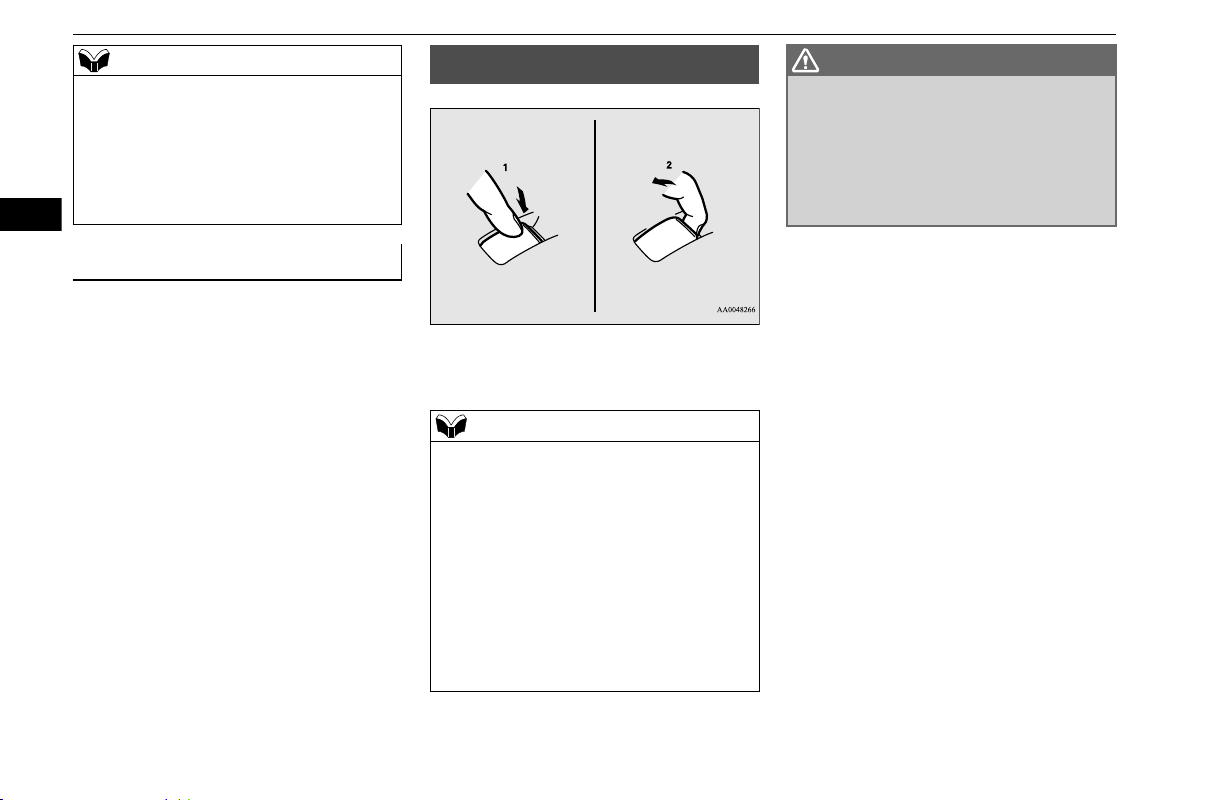
Power window control
5-14 Features and controls
5
Use the following procedure to test the sys-
tem:
1. Lower the driver’s window.
2. Arm the system as explained in “Armed
stage”.
3. Make sure that the theft-alarm indicator
comes on and flashes for approximately
20 seconds.
4. Wait a few seconds and then unlock the
driver’s side door by using the inside door
lock knob. Open the door.
5. Make sure that the horn sounds intermit-
tently and the headlights blink when a
door is opened.
6. Disarm the system by unlocking all doors
and the liftgate by using the keyless entry
system.
N00510801410
The amount of time after unlocking until the
vehicle relocks automatically can be
adjusted. See a certified i-MiEV dealer for
details.
Once the system has been disarmed, it can-
not be rearmed except by repeating the arm-
ing procedure.
Testing the theft-alarm system
NOTE
Power window control
1- Open (down)
2- Close (up)
NOTE
Never try to operate the main switch and
sub-switch in different directions at the same
time. This will freeze the window in posi-
tion.
Operating the power windows repeatedly
with the electric motor unit stopped will run
down the 12V starter battery. Use the win-
dow switches only while the electric motor
unit is operating.
Do not turn the electric motor switch to the
“ON” position during quick charging.
Doing so will stop quick charging.
WARNING
Before operating the power windows,
make sure that nothing can be trapped
(head, hands, fingers, etc.) in the window.
Never leave the vehicle without carrying
the key.
Never leave children or unreliable adults
unattended inside the vehicle.
BK0220401US.book 14 ページ 2015年6月3日 水曜日 午前7時42分
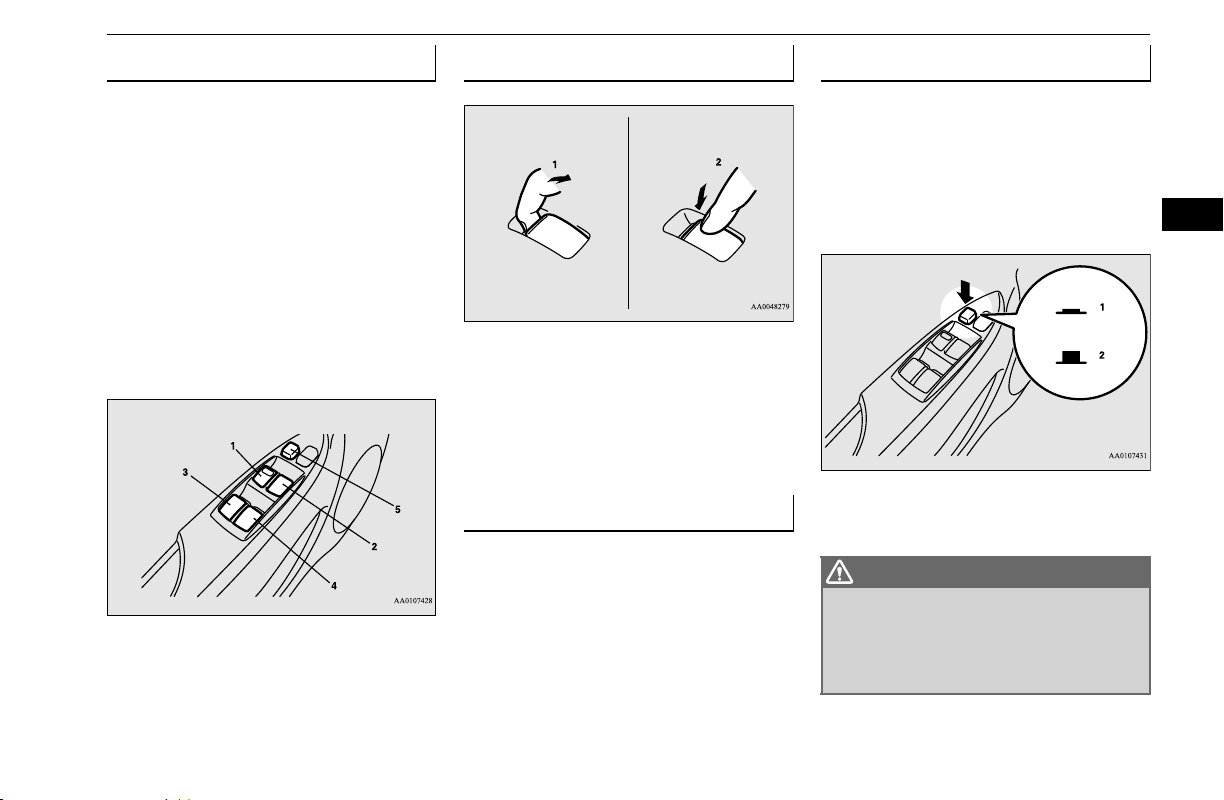
Power window control
Features and controls 5-15
5
N00548700127
The main switch located on the driver’s door
can be used to operate all the windows.
A window can be opened or closed by operat-
ing the corresponding switch.
Press the switch down to open the window,
and pull up the switch to close it.
If the driver’s door window switch is fully
pressed down, the driver’s door window auto-
matically opens completely.
If you want to stop the window movement,
operate the switch lightly in the reverse direc-
tion.
N00548800115
Each sub-switch can be used for it’s own pas-
senger door window, unless the driver’s win-
dow lock switch is activated.
N00548900145
The power windows can be run up or down
when the electric motor switch is in the “ON”
position.
The door windows can be opened or closed
for a 30-second period after the electric motor
switch is turned to the “ACC” or “LOCK”
position. However, once the driver’s door or
the front passenger’s door is opened, the
power windows cannot be operated.
N00549000156
When this switch is in the lock mode, the pas-
senger door switches cannot be used to open
or close the door windows, and the main
switch will open or close only the driver’s
door window. To unlock the switch, press it
again.
Main switch
1- Driver’s door window switch
2- Front passenger door window switch
3- Left rear door window switch
4- Right rear door window switch
5- Lock switch
Sub switch
1- Close
2- Open
Power window timer function
Lock switch
1- Lock
2- Unlock
WARNING
Before driving with a child in the vehicle,
be sure to lock the window switch to make
it inoperative. Children tampering with
the switch could easily trap their hands or
heads in the window.
BK0220401US.book 15 ページ 2015年6月3日 水曜日 午前7時42分
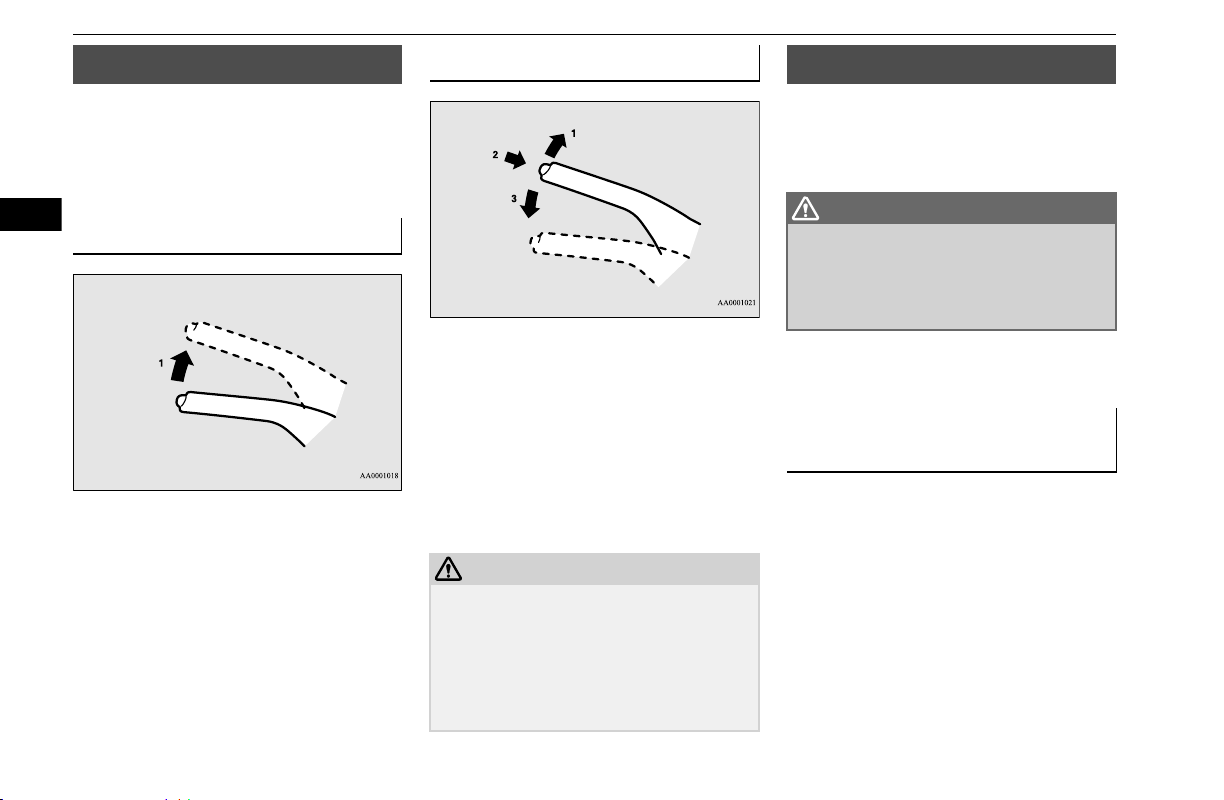
Parking brake
5-16 Features and controls
5
N00511400386
To park the vehicle, first bring it to a com-
plete stop, fully engage the parking brake,
and set the selector lever to “P” (PARK) posi-
tion.
When parking on a hill, apply the parking
brake and turn the front wheels toward the
curb on a downhill grade, away from the curb
on an uphill grade.
N00511600287
Adjust the inside rearview mirror only after
making any seat adjustments so as to have a
clear view to the rear of the vehicle.
Adjust the inside mirror to maximize the
view through the rear window.
It is possible to move the mirror up and down
to adjust its position.
Parking brake
To apply
1- Pull the lever up without pushing the
button at the end of hand grip.
When the parking brake is set and the
electric motor switch is in the “ON”
position, the brake warning light in the
instrument cluster will come on.
Before driving, be sure to release the
parking brake.
To release
1- Pull the lever up slightly.
2- Press and hold the button at the end of
the hand grip.
3- Push the lever downward.
CAUTION
Before driving, be sure that the parking
brake is fully released and brake warning
light is off.
If a vehicle is driven without releasing the
parking brake, the brakes will be overheated,
resulting in ineffective braking and possible
brake failure.
Inside rearview mirror
WARNING
Do not attempt to adjust the inside rear-
view mirror while driving. This can be
dangerous.
Be sure to adjust the mirror before driv-
ing.
To adjust the vertical mirror
position
BK0220401US.book 16 ページ 2015年6月3日 水曜日 午前7時42分
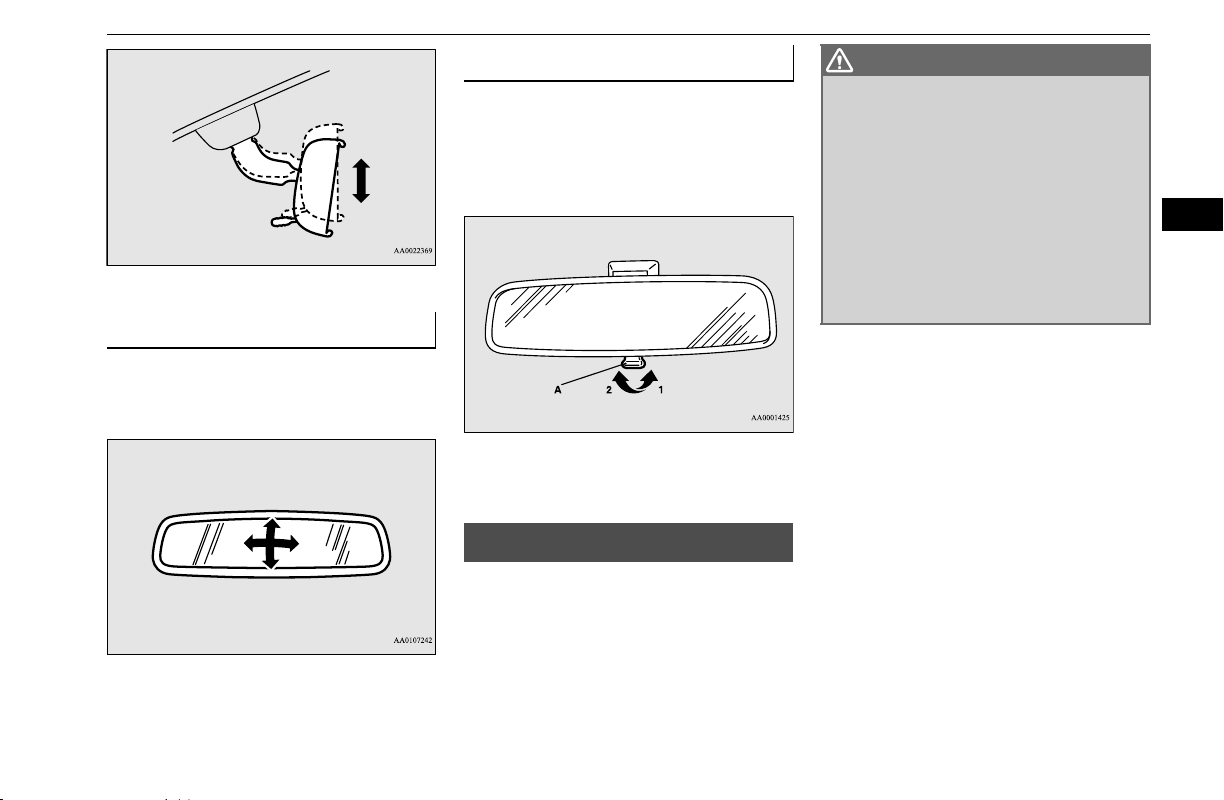
Outside rearview mirrors
Features and controls 5-17
5
It is possible to move the mirror up/down and
left/right to adjust its position.
The day/night knob (A) at the bottom of the
mirror can be used to adjust the mirror to
reduce the glare from the headlights of vehi-
cles behind you during night driving.
N00512200222
Adjust the outside rearview mirrors only after
making any seat adjustments so you have a
clear view to the rear of the vehicle.
To adjust the mirror position
To reduce the glare
1- Daytime position
2- Night position
Outside rearview mirrors
WARNING
Do not attempt to adjust the outside rear-
view mirrors while driving. This can be
dangerous.
Be sure to adjust the mirrors before driv-
ing.
Your front passenger’s side mirror is con-
vex. The objects you see in the mirror will
look smaller and farther away than they
appear in a regular flat mirror.
Do not use this mirror to estimate the dis-
tance of vehicles following you when
changing lanes.
BK0220401US.book 17 ページ 2015年6月3日 水曜日 午前7時42分
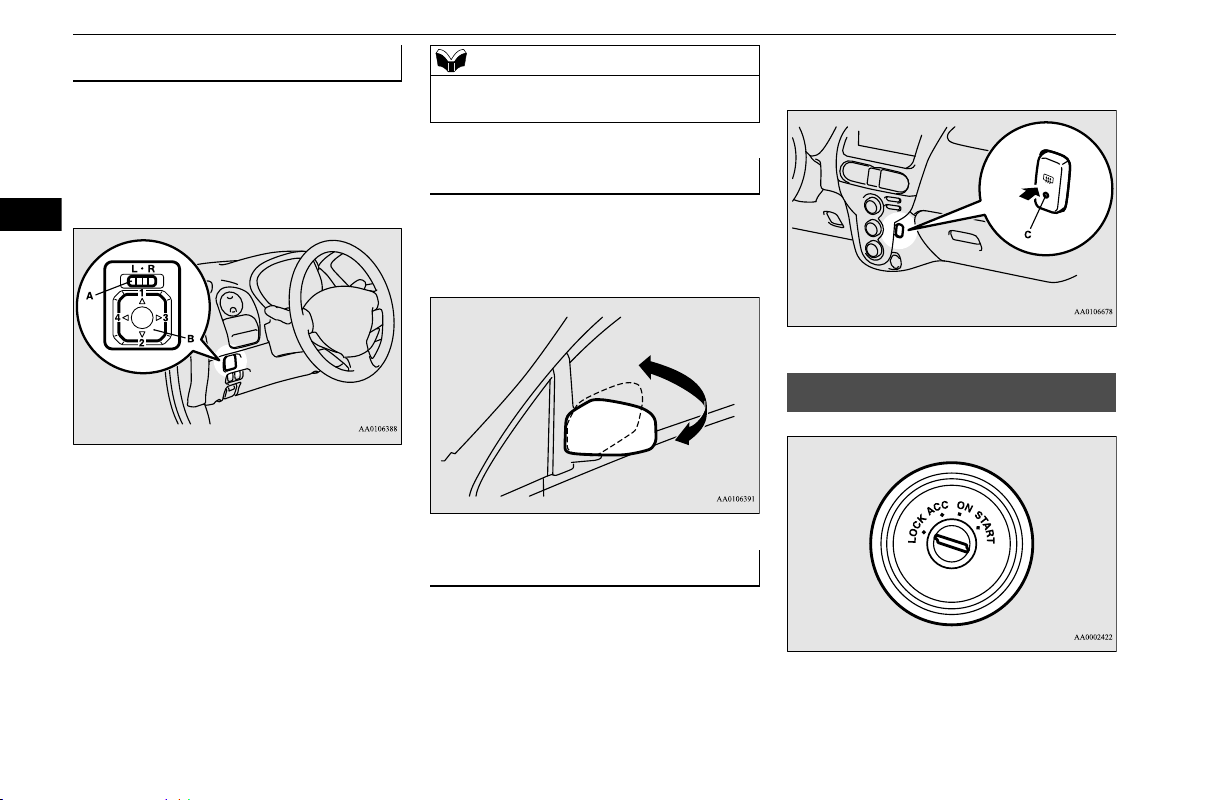
Electric motor switch
5-18 Features and controls
5
The outside rearview mirrors can be adjusted
when the electric motor switch is in the “ON”
or “ACC” position.
Move the lever (A) to the same side as the
mirror you wish to adjust.
Press the switch (B) to adjust the mirror posi-
tion.
The outside mirror can be folded in toward
the side window to prevent damage when
parking in tight locations.
N00549301231
When the rear window defogger switch is
pressed, the outside rearview mirrors are
defogged or defrosted. Current will flow
through the heater element inside the mirrors,
thus clearing away frost or condensation.
The indicator light (C) will illuminate while
the defogger is on.
The heater will be turned off automatically in
about 20 minutes.
N00571500011
To adjust the mirror position
L- Left outside mirror adjustment
R- Right outside mirror adjustment
1- Up
2- Down
3- Right
4- Left
NOTE
After adjusting, return the lever to the “•”
(off) position.
To fold the mirror
Heated mirror
Electric motor switch
BK0220401US.book 18 ページ 2015年6月3日 水曜日 午前7時42分
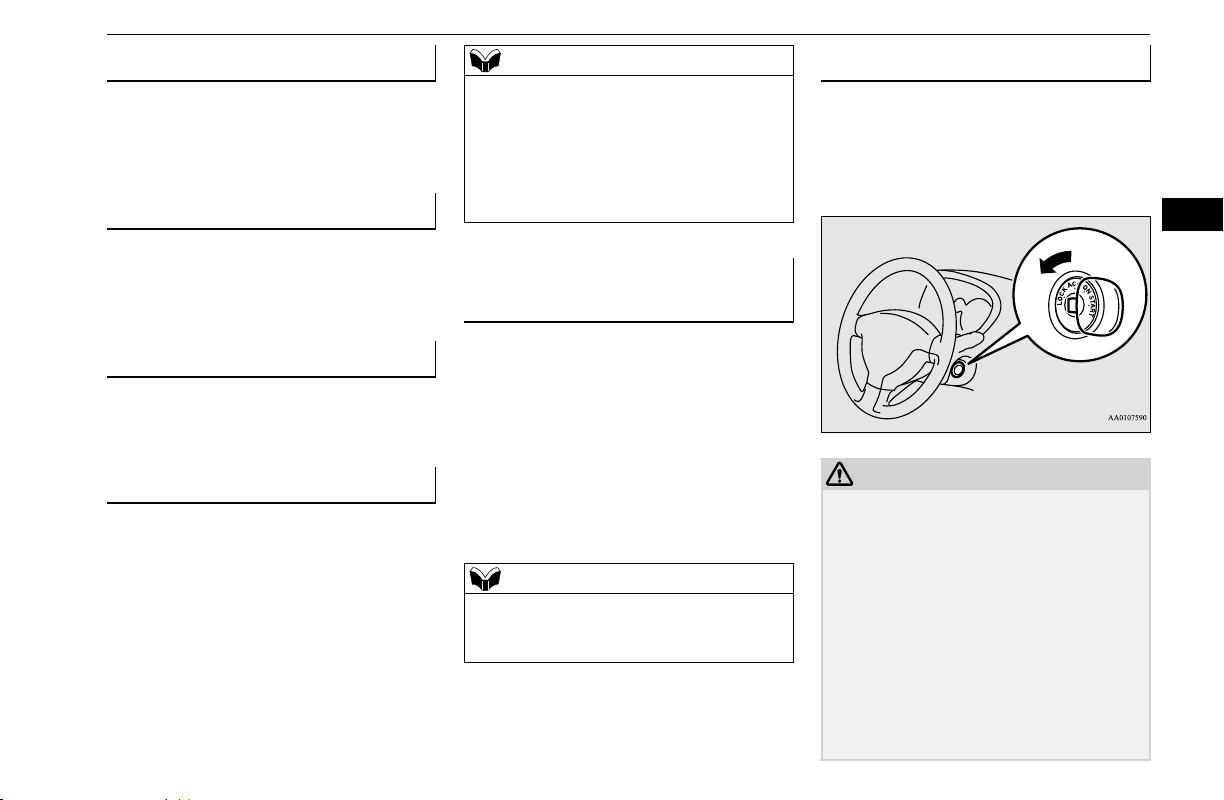
Electric motor switch
Features and controls 5-19
5
The steering wheel is locked. The key can be
inserted and removed only when the switch is
in this position.
The ready indicator is not illuminated, but the
audio system and other electric devices can
be operated.
The electric motor unit is running, and all the
vehicle’s electrical devices can be operated.
The electric motor unit operates. After the
electric motor unit has started, release the key
and it will automatically return to the “ON”
position.
N00573800021
After about 30 minutes has elapsed with the
electric motor switch in the “ACC” position,
the function automatically cuts out the power
for the audio system and other electric
devices that can be operated with that posi-
tion.
When the electric motor switch is turned
from the “ACC” position, the power is sup-
plied again to those devices.
N00571600025
When removing the key, first set the selector
lever to the “P” (PARK) position, and then
turn the key to the “LOCK” position and
remove it.
LOCK
ACC
ON
START
NOTE
Your vehicle is equipped with an electronic
immobilizer. To start the electric motor unit,
the ID code which the transponder inside the
key sends must match the one registered to
the immobilizer computer.
(Refer to “Electronic immobilizer” on page
5-2.)
ACC power auto-cutout func-
tion
NOTE
It is possible to modify functions as follows:
• The ACC power auto-cutout function can
be deactivated by a certified i-MiEV dealer.
To remove the key
CAUTION
Do not remove the key from the electric
motor switch while driving. The steering
wheel will lock, causing loss of control.
If the ready indicator is turned off while
driving, the power brake booster will stop
functioning and braking efficiency will be
reduced. Also, the power steering system
will not function and it will require greater
effort to manually steer the vehicle.
Do not leave the key in the “ON” position for
a long time when the electric motor unit is
not running. This will cause the 12V starter
battery to run down.
BK0220401US.book 19 ページ 2015年6月3日 水曜日 午前7時42分
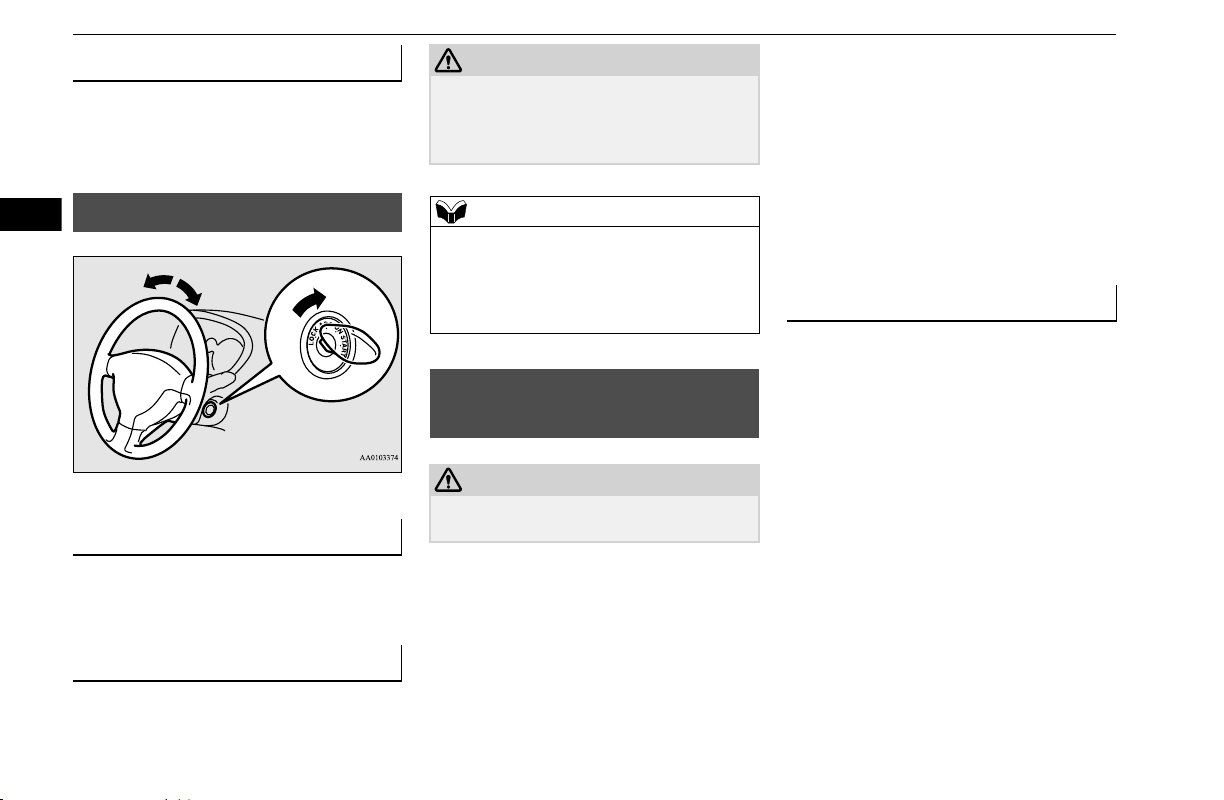
Steering wheel lock
5-20 Features and controls
5
N00571700013
If the driver’s door is opened while the elec-
tric motor switch is in the “LOCK” or “ACC”
position, a tone will sound.
N00512500209
Remove the key at the “LOCK” position.
Turn the steering wheel until it is locked.
Turn the key to the “ACC” position while
moving the steering wheel slightly.
N00571800014
1. Make sure all occupants are properly
seated with seat belts fastened.
2. Insert the key.
3. Make sure the parking brake is applied.
4. Press and hold the brake pedal down with
your right foot.
5. Make sure the selector lever is in the “P”
(PARK) position.
6. Turn the key to the “ON” position and
make certain that all warning lights are
functioning properly before starting the
electric motor unit.
7. Turn the key to the “START” position for
one to two seconds, and slowly return it to
its original position. When you hear the
startup sound and the ready indicator
comes on, startup of the electric motor
unit is complete.
If the driver’s door is opened while the key is
in the “ON” position, the electric motor
reminder buzzer sounds intermittently to
remind the key is in the electric motor switch.
Key reminder buzzer
Steering wheel lock
To loc k
To unlock
CAUTION
Remove the key when leaving the vehicle.
If your vehicle needs to be towed, turn the
key to the “ACC” position to unlock the
steering wheel.
NOTE
If the front wheels are turned, the anti-theft
lock may sometimes make it difficult to turn
the key from “LOCK” position to “ACC”
position. Firmly turn the steering wheel to
the left or to the right as you turn the key.
Starting the electric motor
unit
CAUTION
Never attempt to start the electric motor unit
by pushing or pulling the vehicle.
Electric motor reminder
BK0220401US.book 20 ページ 2015年6月3日 水曜日 午前7時42分
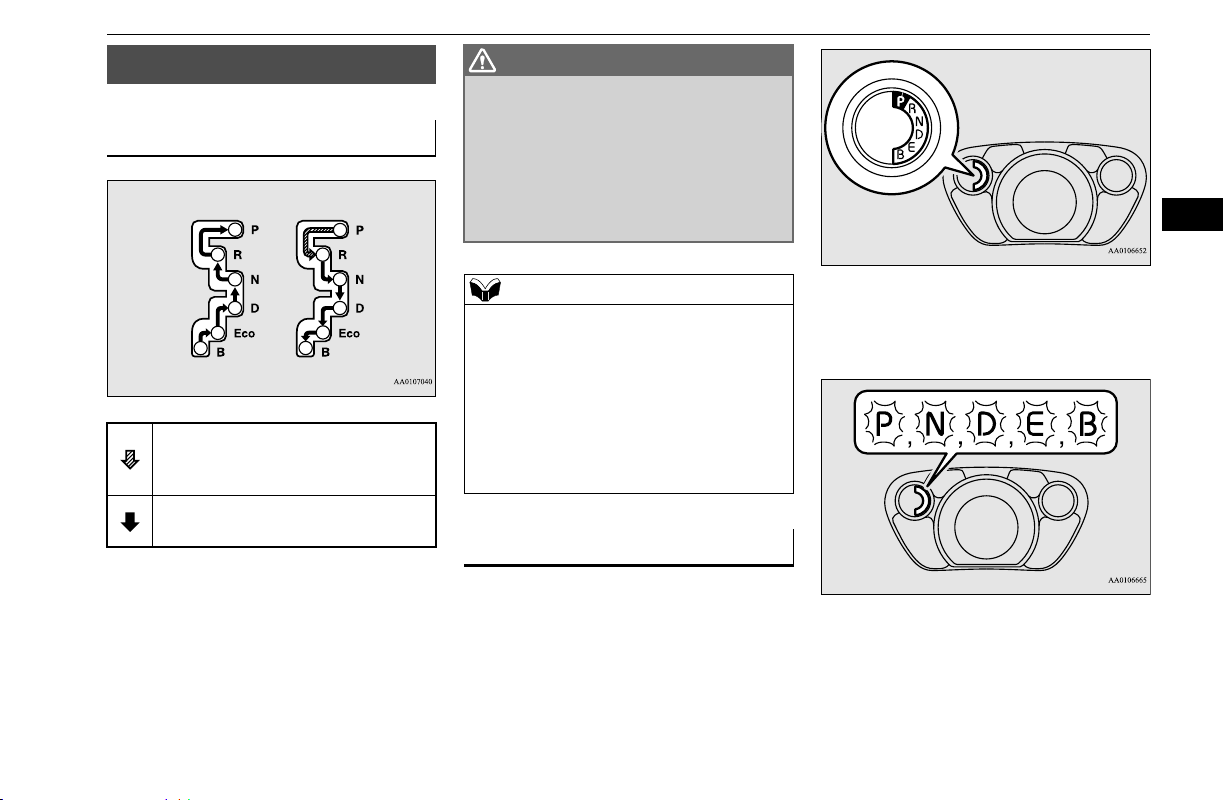
Selector lever
Features and controls 5-21
5
N00583600022
N00583700023
N00583800024
When the electric motor switch is turned to
the “ON” position, the current position of the
selector lever is indicated on the instrument
cluster.
When the selector lever position indicator
flashes while you are driving, there could be a
malfunction in the transmission.
Selector lever
Selector lever operation
While depressing the brake pedal,
move the selector lever through the
gate.
Move the selector lever through the
gate.
WARNING
Always depress the brake pedal when
shifting the selector lever into another
position from the “P” (PARK) or “N”
(NEUTRAL) position.
Never put your foot on the accelerator
pedal while shifting the selector lever from
the “P” (PARK) or “N” (NEUTRAL) posi-
tion.
NOTE
To avoid erroneous operation, move the
selector lever firmly into each position and
briefly hold it there. Always check the posi-
tion shown by the selector lever position dis-
play after moving the selector lever.
If the brake pedal is not depressed and held,
the shift-lock device activates to prevent the
selector lever from being moved from the
“P” (PARK) position.
Selector lever position indicator
BK0220401US.book 21 ページ 2015年6月3日 水曜日 午前7時42分
Selector lever
5-22 Features and controls
5
N00583900025
This position locks the transmission to pre-
vent the vehicle from moving. The electric
motor unit can be started from the “PARK”
position.
This position is to back up.
Use this position only when the vehicle is sta-
tionary for an extended length of time while
driving, such as in a traffic jam.
Use this position for normal driving.
Use this position when you desire to limit
power consumption and/or when moderate
regenerative braking is required.
Use this position when strong regenerative
braking is required, such as on a steep down-
hill.
Refer to “Regenerative braking” on page 3-3.
Refer to “When driving downhill” on page
6-5.
CAUTION
If the selector lever position indicator blinks
while you are driving, it is likely that a safety
device is operating because of a malfunction
in the transmission system. We recommend
you to have your vehicle inspected as soon as
possible.
The selector lever position indicator warning
function does not operate with the selector
lever in the “R” (REVERSE) position.
Selector lever positions
“P” PARK
WARNING
Do not leave the vehicle with the electric
motor switch in the “ON” position. The
vehicle can move suddenly. To be sure the
vehicle will not move, even when you are
on level ground, always set the parking
brake and move the selector lever to the
“P” (PARK) position.
“R” REVERSE
CAUTION
Never move the selector lever to the “P”
(PARK) or “R” (REVERSE) position while
the vehicle is in motion. If the lever is moved
to the “P” (PARK) or “R” (REVERSE) posi-
tion while the vehicle is in motion, the trans-
mission could be damaged.
“N” NEUTRAL
WARNING
Never move the selector lever to the “N”
(NEUTRAL) position while the vehicle is
in motion. You will lose regenerative brak-
ing. In addition, a serious accident could
occur if the selector lever were inadver-
tently moved into the “P” (PARK) position
or “R” (REVERSE) position.
“D” DRIVE
CAUTION
To avoid transmission damage, never shift
into the “D” (DRIVE) position from the “R”
(REVERSE) position while the vehicle is in
motion.
“ECO” ECO MODE
“B” REGENERATIVE BRAKE
MODE
BK0220401US.book 22 ページ 2015年6月3日 水曜日 午前7時42分
Acoustic vehicle alerting system (AVAS)
Features and controls 5-23
5
N00584000023
N00584100024
For short waiting periods, such as at traffic
signals the vehicle can be left in selector lever
position and held stationary with the service
brake.
For longer waiting periods with the electric
motor unit running, place the selector lever in
the “N” (NEUTRAL) position and apply the
parking brake, while holding the vehicle sta-
tionary with the service brake.
N00584200025
To park the vehicle, first bring it to a com-
plete stop, fully engage the parking brake,
and then move the selector lever to the “P”
(PARK) position.
If you are going to leave the vehicle unat-
tended, always switch off the electric motor
unit and carry the key.
N00571900028
While driving at low speeds, such as in park-
ing lots, the acoustic vehicle alerting system
(AVAS) alerts people who may not hear your
vehicle approaching.
The system sounds when the vehicle speed is
approximately 22 mph (35 km/h) or less.
The acoustic vehicle alerting system (AVAS)
will operate under the following conditions:
When the vehicle speed is approximately
2 mph (3 km/h) or less and the brake
pedal is not depressed.
WARNING
While driving on a slippery road, do not
use the “B” position. Abruptly releasing
the accelerator pedal can apply strong
regenerative braking causing the vehicle
to skid which could result in an accident.
NOTE
When the main drive lithium-ion battery
level is full or nearly full, or the main drive
lithium-ion battery temperature is too high or
too low, the regenerative braking force may
be reduced and stronger effort may be
required to operate the brakes.
Operation of the transmission
CAUTION
Before selecting a position with the electric
motor unit running and the vehicle station-
ary, fully depress the brake pedal to prevent
the vehicle from creeping.
The vehicle will begin to move as soon as the
transmission is engaged, the brakes should
only be released when you are ready to drive
away.
Depress the brake pedal with the right foot at
all times.
Using the left foot could cause driver move-
ment delay in case of an emergency.
Operating the accelerator pedal while the
other foot is resting on the brake pedal will
affect braking efficiency and may cause pre-
mature wear of brake pads.
Waiting
CAUTION
Never hold the vehicle stationary on a hill
with the accelerator. Always apply the park-
ing brake and/or service brake.
Parking
CAUTION
NOTE
On a slope, be sure to apply the parking
brake before moving the selector lever to the
“P” (PARK) position. If you move the selec-
tor lever to the “P” (PARK) position before
applying the parking brake, it may be diffi-
cult to disengage the selector lever from the
“P” (PARK) position when next you drive
the vehicle, requiring application of a strong
force to the selector lever to move from the
“P” (PARK) position.
Acoustic vehicle alerting
system (AVAS)
BK0220401US.book 23 ページ 2015年6月3日 水曜日 午前7時42分
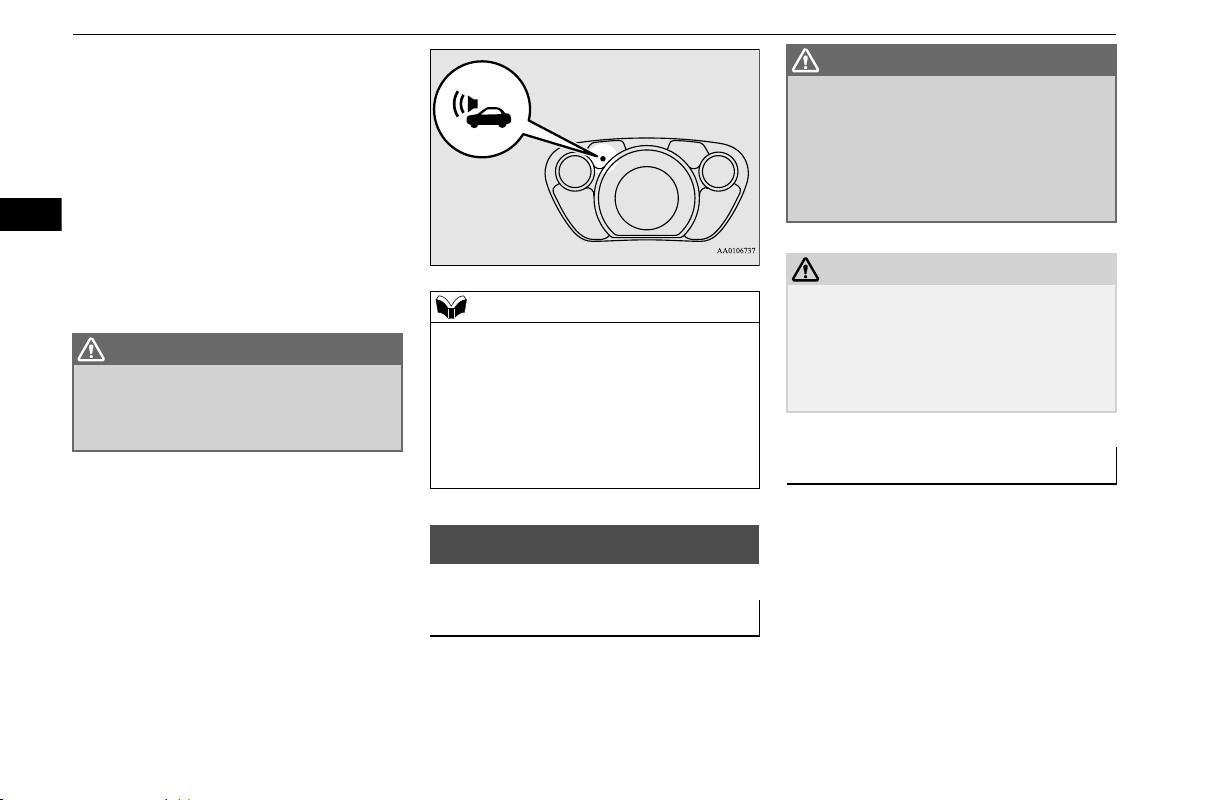
Service brake
5-24 Features and controls
5
When the vehicle speed is approximately
2-22 mph (3-35 km/h).
The system will not operate under the follow-
ing conditions:
When the vehicle speed is approximately
2 mph (3 km/h) or less and the brake
pedal is depressed.
When the vehicle speed is approximately
22 mph (35 km/h) or more.
When the selector lever is in the “P”
(PARK) position.
Under normal conditions, the indicator light
in the instrument cluster illuminates when the
electric motor switch is turned to the “ON”
position and goes off a few seconds later.
Always confirm the indicator light goes off
before driving.
N00517500305
Overuse of the brake can cause poor brake
response and premature wear of the brake
pads.
N00517600423
Your vehicle is equipped with power brakes
for more braking force with reduced brake
pedal effort.
Your brakes are designed to operate at full
capacity, even if the power assist is lost.
If the power assist is lost, the effort needed to
press the brake pedal is greater.
If you should lose the power assist for some
reason, the brakes will still work.
If the power brake unit or either of the two
brake hydraulic systems stop working prop-
WARNING
Always pay special attention to pedestri-
ans. Even if the acoustic vehicle alerting
system (AVAS) sounds, pedestrians may
not notice your vehicle.
NOTE
If the indicator light blinks, turn the electric
motor switch back to the “LOCK” position
and again turn the switch to the “ON” posi-
tion.
It is not a malfunction if the indicator light
goes off. If the indicator light blinks again,
however, have the vehicle inspected at a cer-
tified i-MiEV dealer as soon as possible.
Service brake
Brake pedal
WARNING
Do not leave any objects near the brake
pedal or let a floor mat slide under it;
doing so could prevent the full pedal
stroke that would be necessary in an
emergency. Make sure that the pedal can
be operated freely at all times. Make sure
the floor mat is securely held in place.
CAUTION
It is important not to drive the vehicle with
your foot resting on the brake pedal when
braking is not required. This practice can
result in very high brake temperatures, pre-
mature pad wear, and possible damage to the
brakes.
Power brakes
BK0220401US.book 24 ページ 2015年6月3日 水曜日 午前7時42分
Brake assist system
Features and controls 5-25
5
erly, the rest of the brake system will still
work, but the vehicle will not slow down as
quickly.
You will know this has happened if you find
you need to depress the brake pedal down
further, or harder when slowing down or stop-
ping, or if the brake warning light comes on.
N00532500162
The disc brakes have an alarm that makes a
metallic squeal when the brake pads have
worn down enough to need service. If you
hear this sound, have the brake pads replaced
at a certified i-MiEV dealer.
N00567300063
The brake assist system is a device assisting
drivers who cannot depress the brake pedal
firmly such as in emergency stop situations
and provides greater braking force.
If the brake pedal is depressed suddenly, the
brakes will be applied with more force than
usual.
N00517900325
The anti-lock braking system helps prevent
the wheels from locking up when braking.
This helps you keep control of your vehicle
and its direction.
WARNING
Never turn off the electric motor switch
while driving. Doing so will result in a loss
of power assist for the brakes and steer-
ing, increasing the effort required to steer
and brake the vehicle.
NOTE
At times, you may hear the brake electric
vacuum pump for the power brakes operat-
ing when the ready indicator illuminates or
the brake pedal is depressed.
This sound is normal and does not indicate a
problem.
Brake pad wear alarm
WARNING
Driving with worn brake pads will make it
harder to stop, and can cause an accident.
Brake assist system
CAUTION
The brake assist system is not a device
designed to exercise braking force greater
than its capacity. Make sure to always keep a
sufficient distance between vehicles in front
of you without relying too much on the brake
assist system.
NOTE
Once the brake assist system is operational,
it maintains great braking force even if the
brake pedal is lightly released.
To stop its operation, completely remove
your foot from the brake pedal.
The brake assist system may become opera-
tional when the brake pedal is fully
depressed even if it has not been depressed
suddenly.
When the brake assist system is in use while
driving, you may feel as if the depressed
brake pedal is soft, the pedal moves in small
motions in conjunction with the operation
noise, or the vehicle body and the steering
wheel vibrate. This occurs when the brake
assist system is operating normally and does
not indicate faulty operation. Continue to
depress the brake pedal.
You may hear an operation noise when the
brake pedal is depressed suddenly while sta-
tionary. This does not indicate a malfunction
and the brake assist system is operating nor-
mally.
Anti-lock braking system
NOTE
BK0220401US.book 25 ページ 2015年6月3日 水曜日 午前7時42分
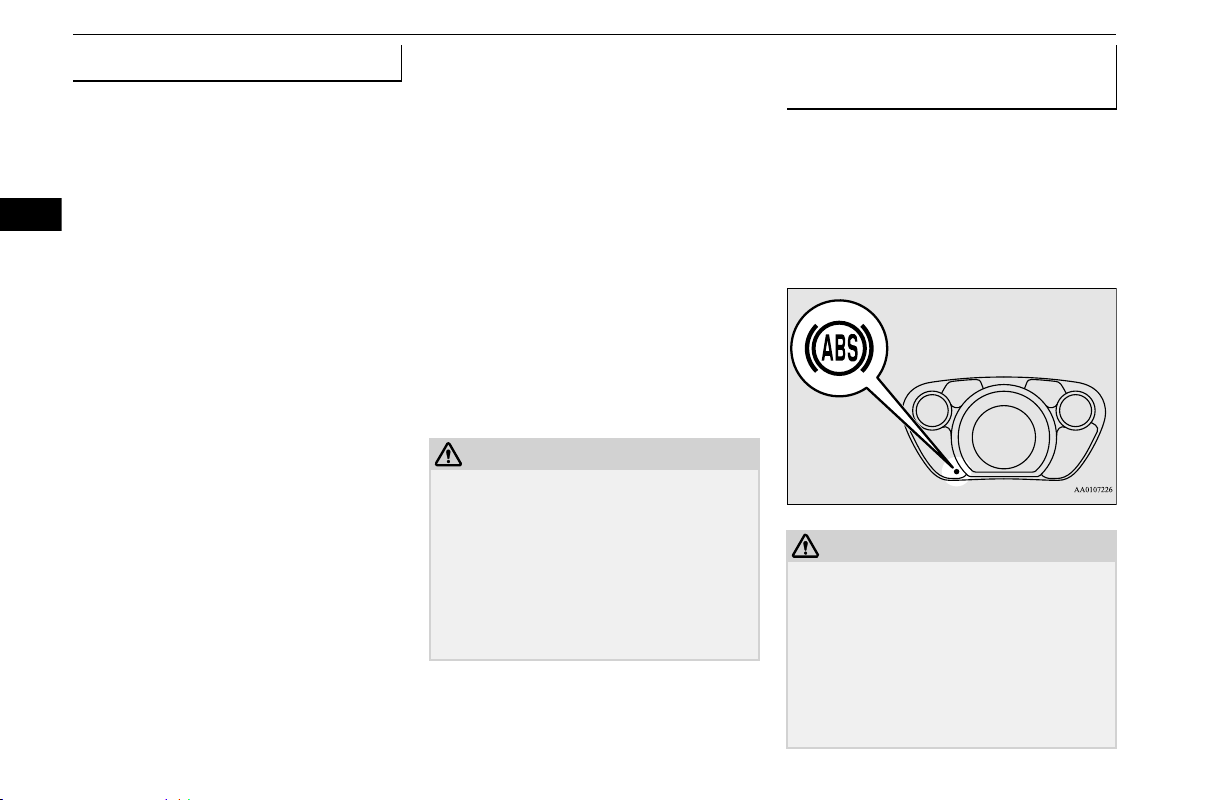
Anti-lock braking system
5-26 Features and controls
5
When using the anti-lock brakes (sudden
braking), steering is slightly different
from normal driving conditions. Use the
steering wheel carefully.
Always keep a safe distance from the
vehicle in front of you. Even if your vehi-
cle is equipped with the anti-lock braking
system, leave a greater braking distance
when:
• Driving on gravel or snow-covered
roads.
• Driving on uneven road surfaces.
Operation of anti-lock braking system is
not restricted to situations where brakes
are applied suddenly. This system may
also prevent the wheels from locking
when you drive over manholes, steel
roadwork plates, road markings, or any
uneven road surface.
When the anti-lock braking system is in
use, you may feel the brake pedal vibrat-
ing and hear a unique sound. You may
also feel as if the pedal resists being
pressed.
In this situation, simply hold the brake
pedal down firmly. Do not pump the
brake, which will result in reduced
braking performance.
An operation noise may be emitted from
under the hood in the following situations.
The sound is associated with checking the
operations of the anti-lock braking sys-
tem.
At this time, you may feel a shock from
the brake pedal if you depress it. These do
not indicate a malfunction.
• When the electric motor switch is set to
the “ON” position.
• When the vehicle is driven for a while
after the electric motor is turned on.
The ABS can be used after the vehicle has
reached a speed over approximately 6
mph (10 km/h). It stops working when the
vehicle slows below approximately 3 mph
(5 km/h).
N00531600661
This light comes on in the event of a malfunc-
tion in the anti-lock braking system. It will
also come on as a self-check for a few sec-
onds when the electric motor switch is turned
to the “ON” position. Always make sure that
the light goes out before beginning to drive.
Driving hints
CAUTION
The anti-lock braking system cannot prevent
accidents. It is your responsibility to take
safety precautions and to drive carefully.
Be sure to use the specified type and size of
tire on all four wheels. Otherwise, the ABS
may not work properly.
Do not install any aftermarket limited slip
differential (LSD) on your vehicle. The ABS
may stop functioning properly.
Anti-lock braking system warn-
ing light
CAUTION
If the anti-lock braking system warning light
comes on and stays on after starting the elec-
tric motor unit or while driving, it means that
the anti-lock braking system is not working
and that only the standard brake system is
available. (The standard brake system will
still work properly.) If this happens, take
your vehicle to a certified i-MiEV dealer as
soon as possible.
BK0220401US.book 26 ページ 2015年6月3日 水曜日 午前7時42分
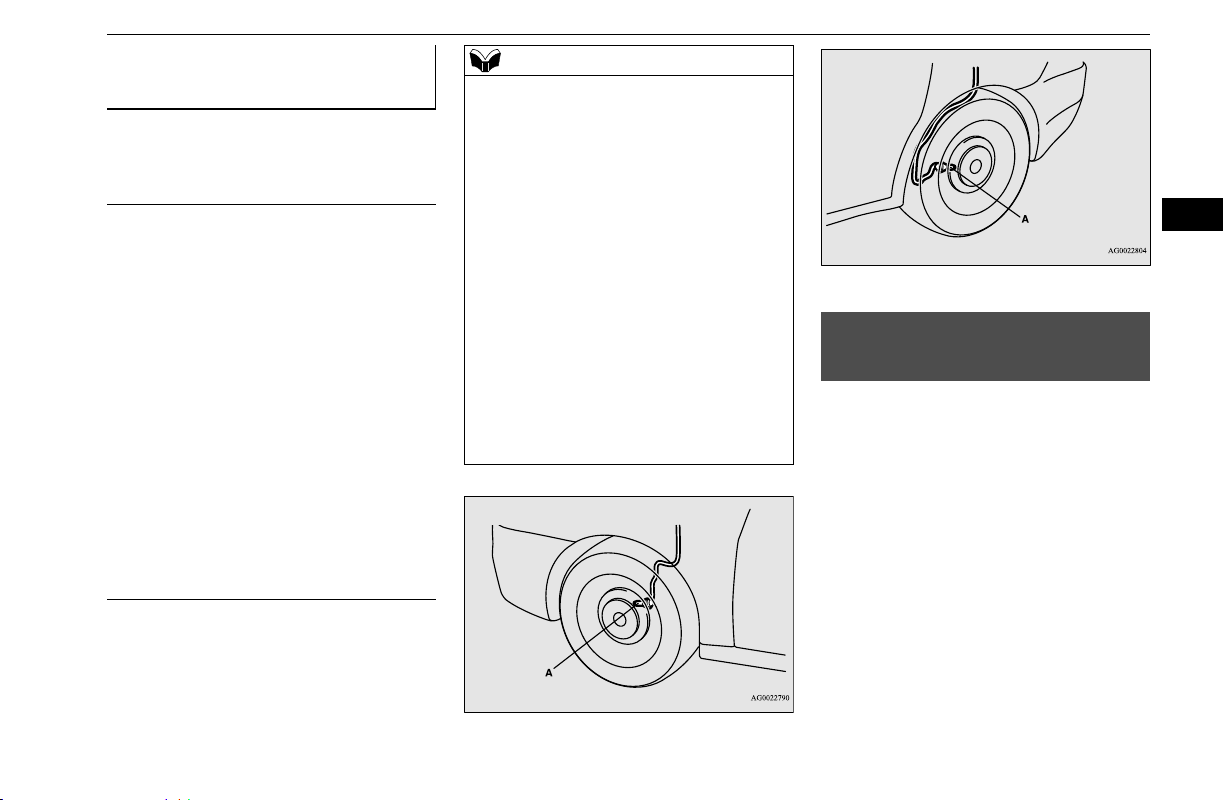
Electric power steering system (EPS)
Features and controls 5-27
5
N00531700590
Avoid hard braking and high-speed driving.
Stop the vehicle in a safe place, put the selec-
tor lever to the “P” (PARK) position and turn
off the electric motor unit.
Restart the electric motor unit and check to
see whether the light goes out after a few
minutes driving; if it then remains off during
driving, there is no problem.
However, if the warning light does not disap-
pear, or if it comes on again when the vehicle
is driven, we recommend you to have the
vehicle checked.
The ABS and brake force distribution func-
tion may not work, so hard braking could
make the vehicle unstable.
Avoid hard braking and high-speed driving.
Stop the vehicle in a safe place and we rec-
ommend you to have the vehicle checked.
N00568400058
The power steering system operates while the
electric motor unit is running. It helps reduce
the effort needed to turn the steering wheel.
The power steering system has mechanical
steering capability in case the power assist is
lost. If the power assist is lost for some rea-
son, you will still be able to steer your vehi-
cle, but you will notice it takes much more
effort to steer. If this happens, have your vehi-
cle inspected at a certified i-MiEV dealer.
If the warning light illuminates
while driving
If only the ABS warning light illu-
minate
If the ABS warning light and
brake warning light illuminate at
the same time
NOTE
The warning light may be illuminated when
the electric motor unit is started while the
12V starter battery voltage is low, but this is
not an ABS malfunction.
When the main drive lithium-ion battery is
charged, the 12V starter battery is charged at
the same time, and the warning light will go
out.
If the warning light does not go out or illumi-
nates from time to time even after the battery
is charged, take your vehicle to a certified i-
MiEV dealer and have the system checked as
soon as possible.
After driving on snow or icy roads, remove
any snow and ice which may have been left
around the wheels. On vehicles that have an
anti-lock braking system, be careful not to
damage the wheel speed sensors (A) or the
cables located at each wheel.
Front
Electric power steering sys-
tem (EPS)
Rear
BK0220401US.book 27 ページ 2015年6月3日 水曜日 午前7時42分
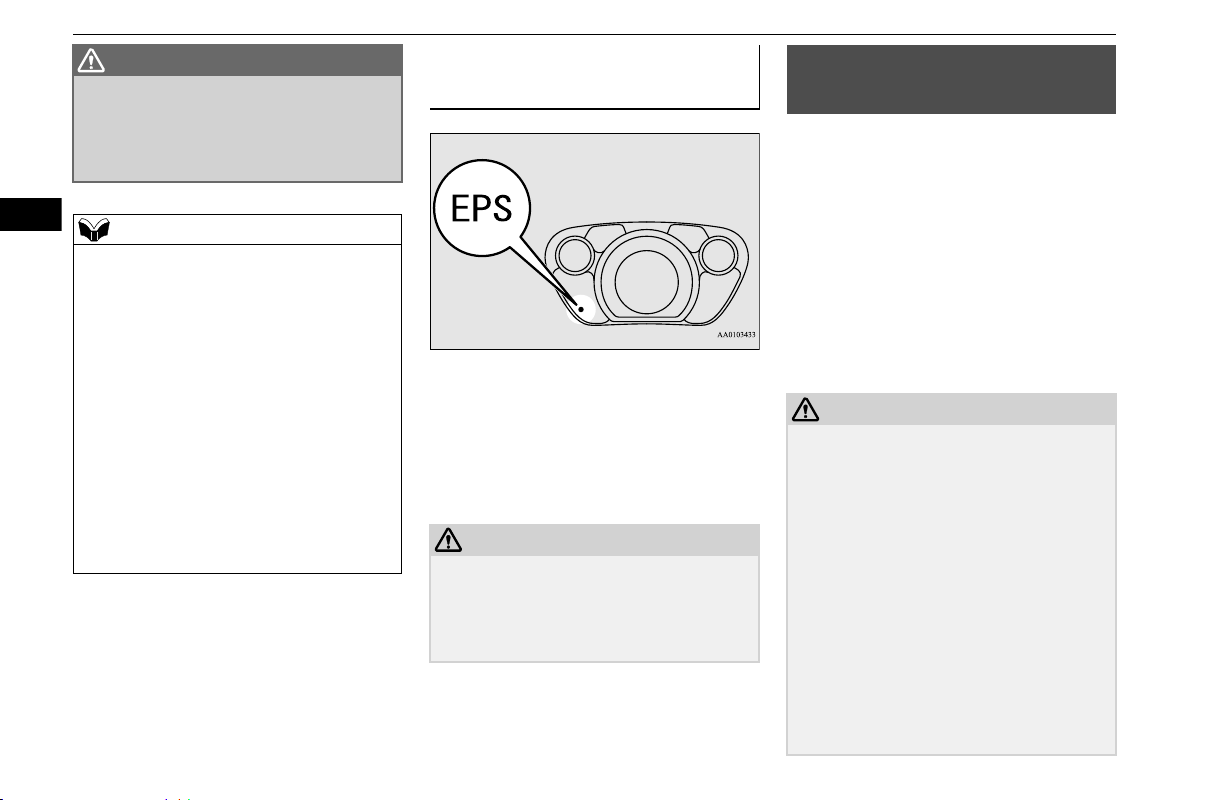
Active stability control (ASC)
5-28 Features and controls
5
N00574400024
If there is a malfunction in the system, the
warning light will come on.
Under normal conditions, the warning light
comes on when the electric motor switch is
turned to the “ON” position and goes off a
few seconds later.
N00559100163
The active stability control (ASC) takes over-
all control of the anti-lock braking system,
traction control function and skid control
function to help maintain the vehicle’s con-
trol. Also refer to the following pages on the
anti-lock braking system, traction control
function and skid control function.
Anti-lock braking system (ABS) P.5-25
Traction control function P.5-29
Skid control function P.5-29
WARNING
Do not turn the key from the ON position
while the vehicle is moving. Stopping the
electric motor unit would make the steer-
ing wheel extremely hard to turn, possibly
resulting in an accident.
NOTE
During repeated full-lock turning of the
steering wheel (for example, while you are
maneuvering the vehicle into a parking
space), a protection function may be acti-
vated to prevent overheating of the power
steering system. This function will make the
steering wheel gradually harder to turn. In
this event, limit your turning of the steering
wheel for a while. When the system has
cooled down, the steering effort will return
to normal.
If you turn the steering wheel while the vehi-
cle is stationary with the headlights on, the
headlights may become dim. This behavior
is not abnormal. The headlights will return to
their original brightness after a short while.
Electric power steering system
warning light
CAUTION
If the warning light appears while the elec-
tric motor unit is running, have the vehicle
inspected at a certified i-MiEV dealer as
soon as possible. It may become harder to
turn the steering wheel.
Active stability control
(ASC)
CAUTION
Do not over-rely on the ASC. Even the ASC
cannot prevent the natural laws of physics
from acting on the vehicle. This system, like
any other system, has limits and cannot help
you to maintain traction and control of the
vehicle in all circumstances. Reckless driv-
ing can lead to accidents. It is the driver’s
responsibility to drive carefully. This means
taking into account the traffic, road and envi-
ronmental conditions.
Be sure to use the specified type and size of
tire on all four wheels. Otherwise, the ASC
may not work properly.
Do not install any aftermarket limited slip
differential (LSD) on your vehicle. The ASC
may stop functioning properly.
BK0220401US.book 28 ページ 2015年6月3日 水曜日 午前7時42分
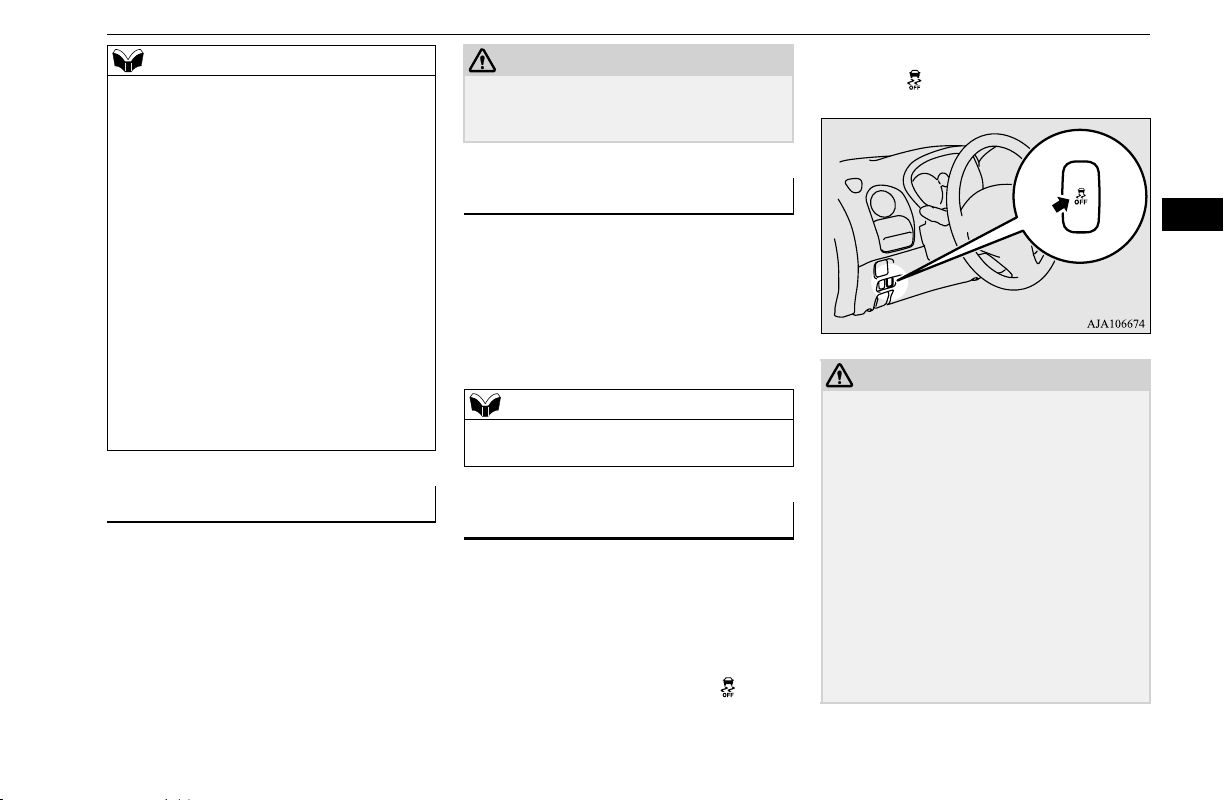
Active stability control (ASC)
Features and controls 5-29
5
N00559200089
On slippery surfaces, the traction control
function prevents the drive wheels from spin-
ning excessively, thus helping the vehicle to
start moving from a stopped condition. It also
provides sufficient driving force and steering
performance as the vehicle turns while press-
ing the acceleration pedal.
N00546800049
The skid control function is designed to help
the driver maintain control of the vehicle on
slippery roads or during rapid steering
maneuvers. It works by controlling the elec-
tric motor unit output and the brake on each
wheel.
N00559401280
The ASC is automatically activated when the
electric motor switch is turned to the “ON”
position. You can deactivate the system by
pressing down the ASC OFF switch for 3 sec-
onds or longer.
When the ASC is deactivated, the indica-
tor will be illuminated. To reactivate the
ASC, momentarily press the ASC OFF
switch; the indicator is turned off.
NOTE
An operation noise may be emitted from
under the hood in the following situations.
The sound is associated with checking the
operations of the ASC. At this time, you may
feel a shock from the brake pedal if you
depress it. These do not indicate a malfunc-
tion.
• When the electric motor switch is set to the
“ON” position.
• When the vehicle is driven for a while after
the electric motor unit is turned on.
When the ASC is activated, you may feel a
vibration in the vehicle body or hear a whin-
ing sound from under the hood.
This indicates that the system is operating
normally. It does not indicate a malfunction.
When the anti-lock braking system warning
light is illuminated, the ASC is not active.
Traction control function
CAUTION
When driving a vehicle on a snowy or icy
road, be sure to install snow tires and drive
the vehicle at moderate speeds.
Skid control function
NOTE
The skid control function operates at speeds
of about 9 mph (15 km/h) or higher.
ASC OFF switch
CAUTION
For safety reasons, the ASC OFF switch
should be operated when your vehicle is
stopped.
Be sure to keep the ASC on while driving in
normal circumstances.
If you deactivate the ASC to move out of
mud, sand or fresh snow, be sure to reacti-
vate the ASC immediately when done. Do
not deactivate the ASC except when neces-
sary.
If you depress the accelerator pedal exces-
sively and the wheels continue spinning
while the ASC is deactivated, the transmis-
sion or other parts may become damaged and
could cause an accident.
BK0220401US.book 29 ページ 2015年6月3日 水曜日 午前7時42分
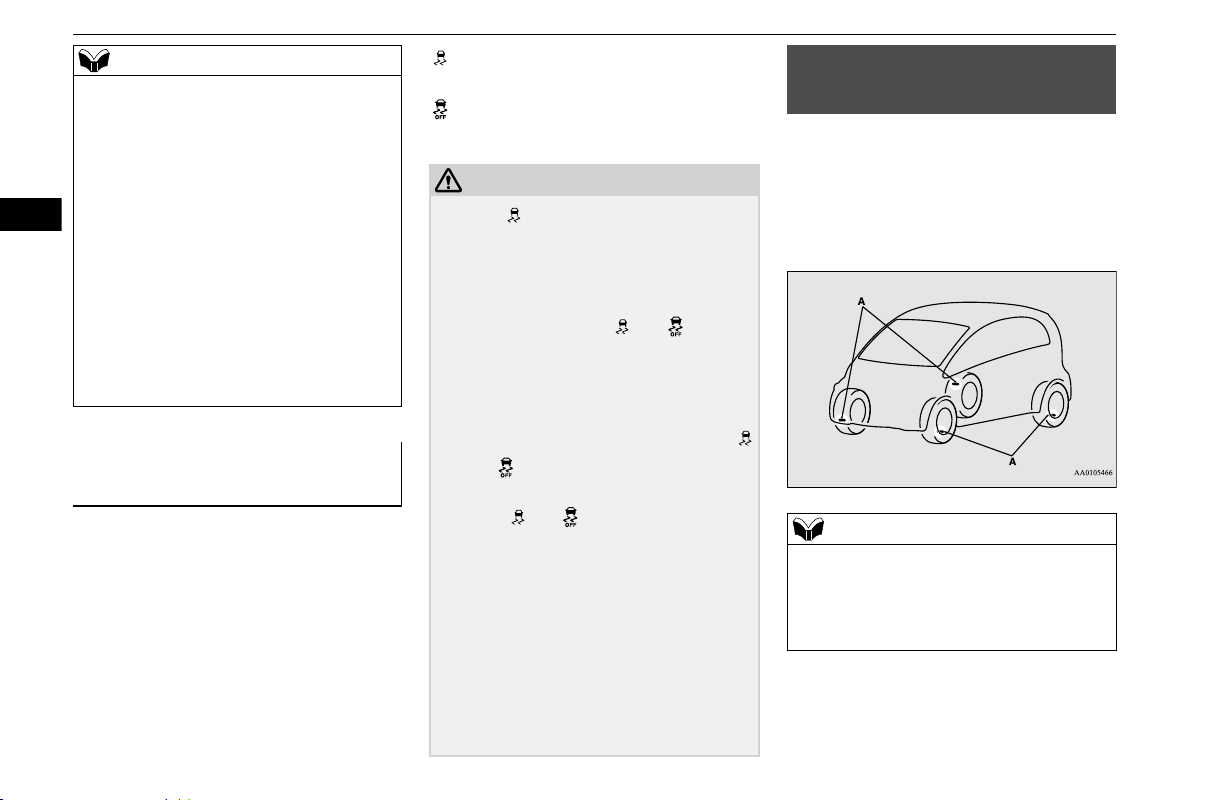
Tire pressure monitoring system
5-30 Features and controls
5
N00546901063
The indicators should illuminate when the
electric motor switch is turned to the “ON”
position, and should turn off after a few sec-
onds.
If the indicator stays on or does not illuminate
when the electric motor switch is turned to
the “ON” position, have the vehicle inspected
by a certified i-MiEV dealer as soon as possi-
ble.
indicator blinks when the ASC is operat-
ing.
indicator is illuminated when the ASC is
deactivated.
N00530201537
The tire pressure monitoring system uses tire
inflation pressure sensors (A) on the wheels
to monitor the tire inflation pressures. The
system only indicates when a tire is signifi-
cantly under-inflated.
NOTE
Using the ASC OFF switch turns off both the
skid control function and the traction control
function.
When trying to move out of mud, sand or
fresh snow, even if the accelerator pedal is
depressed, the ASC may not allow the elec-
tric motor speed to increase enough to move
the vehicle out.
In such situations, deactivating the ASC may
make it easier to move your vehicle out.
Refer to “If your vehicle becomes stuck in
sand, mud or snow” on page 8-13.
If you continue to press the ASC OFF switch
after the ASC has been turned off, the ASC
will automatically be reactivated to prevent
misoperation of the ASC OFF switch.
ASC indicator, ASC OFF indi-
cator
CAUTION
When indicator blinks, the ASC is oper-
ating, which means that the road is slippery
or that your vehicle’s wheels are beginning
to slip. If this happens, drive slower.
If an abnormal condition occurs in the sys-
tem while driving, the and indicators
will illuminate.
In these cases, follow these procedures:
• Park your vehicle in a safe place and stop
the electric motor unit. Restart the electric
motor unit again and check whether the
and indicators go out. If these indicators
go out, there is no abnormal condition.
If the and indicators remain on even
after your vehicle is driven a short distance
after re-starting the electric motor unit,
have the vehicle inspected by a certified i-
MiEV dealer as soon as possible.
When towing the vehicle with only the rear
wheels raised off the ground, do not place
the electric motor switch in the “ON” posi-
tion. Placing the electric motor switch in the
“ON” position could cause the ASC to oper-
ate, resulting in an accident.
For details, refer to “Towing” on page 8-11.
Tire pressure monitoring
system
NOTE
The tire pressure monitoring system is not a
substitute for regularly checking tire infla-
tion pressures.
Be sure to check the tire inflation pressures
as described in “Tires” on page 9-10.
BK0220401US.book 30 ページ 2015年6月3日 水曜日 午前7時42分
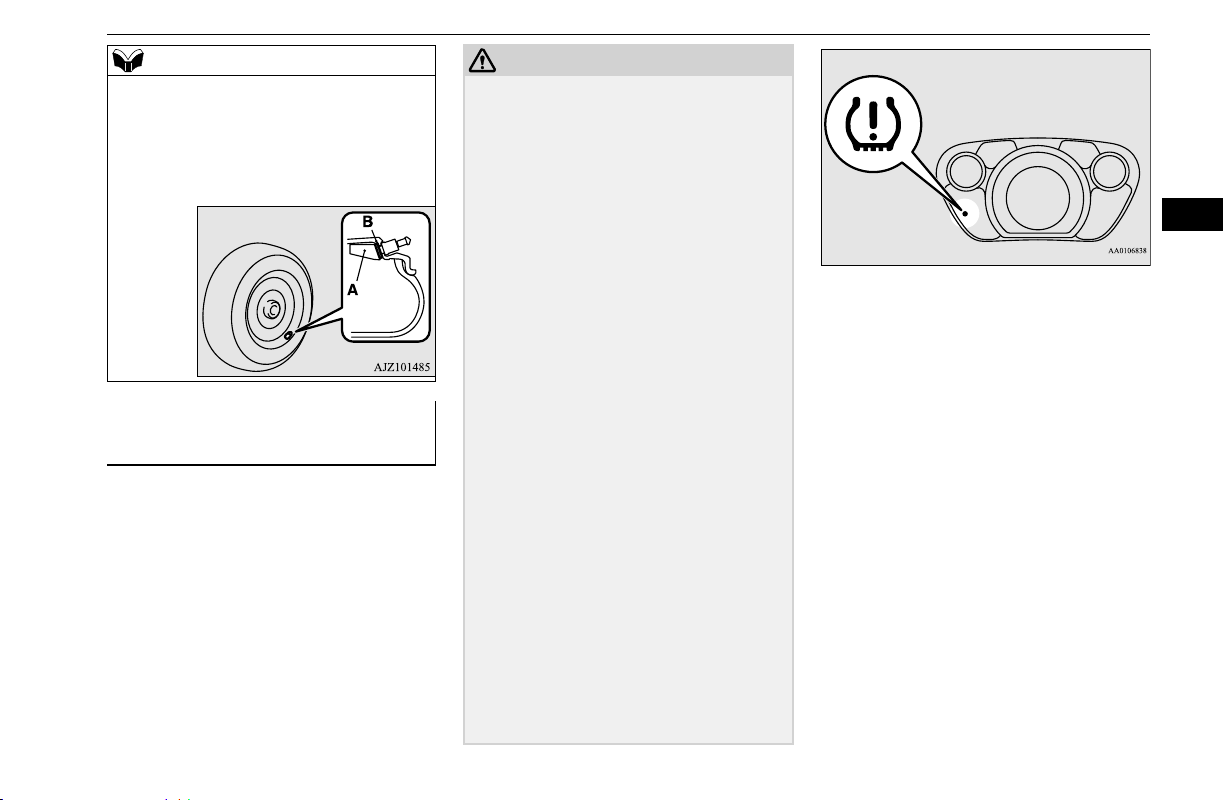
Tire pressure monitoring system
Features and controls 5-31
5
N00554800136
When the electric motor switch is turned to
the “ON” position, this light normally illumi-
nates and goes off a few seconds later.
If one or more of the vehicle tires is signifi-
cantly under-inflated, however, this light will
remain illuminated while the electric motor
switch is in the “ON” position.
Refer to “If the warning light illuminates
while driving” on page 5-32 and take the nec-
essary measures.
Each tire, including the spare (if provided),
should be checked monthly when cold and
inflated to the inflation pressure recom-
mended by the vehicle manufacturer on the
vehicle placard or tire inflation pressure label.
(If your vehicle has tires of a different size
than the size indicated on the vehicle placard
or tire inflation pressure label, you should
determine the proper tire inflation pressure
for those tires.)
As an added safety feature, your vehicle has
been equipped with a tire pressure monitoring
system (TPMS) that illuminates a low tire
pressure telltale when one or more of your
tires is significantly under-inflated.
Accordingly, when the low tire pressure tell-
tale illuminates, you should stop and check
your tires as soon as possible, and inflate
them to the proper pressure.
The tire inflation pressure sensor (A) is
installed in the illustrated location. Replace
grommet (B) with a new one when the tire is
replaced.
For details, please contact a certified i-MiEV
dealer.
Tire pressure monitoring sys-
tem warning light
NOTE
CAUTION
If the tire pressure monitoring system warn-
ing light does not illuminate when the elec-
tric motor switch is turned to the “ON”
position, it means that the tire pressure moni-
toring system is not working properly. Have
the system inspected by a certified i-MiEV
dealer.
In such situations, a malfunctioning of the
system may be preventing the monitoring of
the tire pressure. Avoid sudden braking,
sharp turning and high-speed driving.
If a malfunction is detected in the tire pres-
sure monitoring system, the tire pressure
monitoring system warning light will blink
for approximately 1 minute and then remain
continuously illuminated. The warning light
will issue further warnings each time the
electric motor unit is restarted as long as the
malfunction exists.
Check to see whether the warning light goes
off after few minutes of driving.
If it then goes off during driving, there is no
problem.
However, if the warning light does not go
off, or if it blinks again when the electric
motor unit is restarted, have the vehicle
inspected by a certified i-MiEV dealer.
In such situations, a malfunctioning of the
system may be preventing the monitoring of
the tire pressure. For safety reasons, when
the warning light appears while driving,
avoid sudden braking, sharp turning and
high-speed driving.
BK0220401US.book 31 ページ 2015年6月3日 水曜日 午前7時42分
Tire pressure monitoring system
5-32 Features and controls
5
Driving on a significantly under-inflated tire
causes the tire to overheat and can lead to tire
failure.
Under-inflation also reduces alternative fuel
efficiency and tire tread life, and may affect
the vehicle’s handling and stopping ability.
Please note that the TPMS is not a substitute
for proper tire maintenance, and it is the
driver’s responsibility to maintain correct tire
pressure, even if under-inflation has not
reached the level to trigger illumination of the
TPMS low tire pressure telltale.
Your vehicle has also been equipped with a
TPMS malfunction indicator to indicate when
the system is not operating properly. The
TPMS malfunction indicator is combined
with the low tire pressure telltale.
When the system detects a malfunction, the
telltale will flash for approximately one min-
ute and then remain continuously illuminated.
This sequence will continue upon subsequent
vehicle start-ups as long as the malfunction
exists.
When the malfunction indicator is illumi-
nated, the system may not be able to detect or
signal low tire pressure as intended.
TPMS malfunctions may occur for a variety
of reasons, including the installation of
replacement or alternate tires or wheels on the
vehicle that prevent the TPMS from function-
ing properly. Always check the TPMS mal-
function telltale after replacing one or more
tires or wheels on your vehicle to ensure that
the replacement or alternate tires and wheels
allow the TPMS to continue to function prop-
erly.
N00532800484
1. If the low tire pressure monitoring system
warning light illuminates, avoid hard
braking, sharp steering maneuvers and
high speeds. You should stop and adjust
the tires to the proper inflation pressure as
soon as possible. Refer to “Tires” on page
9-10.
2. If the tire pressure monitoring system
warning light remains illuminated after
you have been driving for about 20 min-
utes after you adjust the tire inflation pres-
sure, one or more of the tires may have a
puncture. Inspect the tire and if it has a
puncture, have it repaired by a certified i-
MiEV dealer as soon as possible.
If the warning light illuminates
while driving
NOTE
When inspecting or adjusting the tire pres-
sure, to avoid breakage, do not apply exces-
sive force to the valve stem.
After inspecting or adjusting the tire pres-
sure, always reinstall the valve cap on the
valve stem.
Without the valve cap, dirt or moisture could
get into the valve, resulting in damage to the
tire inflation pressure sensor.
Do not use metal valve caps, which may
cause a metal reaction, resulting in corrosion
and damage of the tire inflation pressure sen-
sors.
Once adjustments have been made, the warn-
ing light will go off after a few minutes of
driving.
WARNING
If the tire pressure monitoring system
warning light illuminates while you are
driving, avoid hard braking, sharp steer-
ing maneuvers and high speeds. Driving
with an under-inflated tire adversely
affects vehicle performance and can result
in an accident.
CAUTION
The tire pressure monitoring system warning
light may not illuminate immediately in the
event of a tire blowout or rapid leak.
NOTE
To avoid the risk of damage to the tire infla-
tion pressure sensors, have any punctured
tire repaired by a certified i-MiEV dealer. If
the tire repair is not done by a certified i-
MiEV dealer, it is not covered by your war-
ranty.
BK0220401US.book 32 ページ 2015年6月3日 水曜日 午前7時42分
Tire pressure monitoring system
Features and controls 5-33
5
The tire pressure monitoring system may not
work normally in the following circum-
stances:
A wireless facility or device using the
same frequency is near the vehicle.
Snow or ice is stuck inside the fenders
and/or on the wheels.
The tire inflation pressure sensors’ battery
is exhausted.
Wheels other than Mitsubishi Motors gen-
uine wheels are being used.
Wheels that are not fitted with tire infla-
tion pressure sensors are being used.
Wheels whose ID codes are not memo-
rized by the vehicle are used.
A window tint that affects the radio wave
signals is installed.
N00532900182
If you use new wheels with new tire inflation
pressure sensors, their ID codes must be pro-
grammed into the tire pressure monitoring
system. Have tire and wheel replacement per-
formed by a certified i-MiEV dealer to avoid
the risk of damaging the tire inflation pres-
sure sensors.
N00533000207
Your tire pressure monitoring system oper-
ates on a radio frequency subject to Federal
Communications Commission (FCC) Rules
(For vehicles sold in U.S.A.) and Industry
Canada Rules (For vehicles sold in Canada).
This device complies with Part 15 of the FCC
Rules and RSS- Gen of the Industry Canada
Rules.
Operation is subject to the following two con-
ditions.
This device may not cause harmful inter-
ference.
This device must accept any interference
received, including interference that may
cause undesired operation.
Do not use an aerosol puncture-repair spray
on any tire. Such a spray could damage the
tire inflation pressure sensors.
Using the tire repair kit may damage the tire
inflation pressure sensor. The vehicle must
promptly be inspected and repaired by a cer-
tified i-MiEV dealer after using the tire
repair kit.
NOTE
NOTE
Tire inflation pressures vary with the ambi-
ent temperature. If the vehicle is subjected to
large variations in ambient temperature, the
tire inflation pressures may be under-inflated
(causing the warning light to come on) when
the ambient temperature is relatively low. If
the warning light comes on, adjust the tire
inflation pressure.
Whenever the tires and wheels
are replaced with new ones
CAUTION
The use of non-genuine wheels will prevent
the proper fit of the tire inflation pressure
sensors, resulting air leakage or damage of
the sensors.
General information
CAUTION
Changes or modifications not expressly
approved by the manufacturer for compli-
ance could void the user’s authority to oper-
ate the equipment.
BK0220401US.book 33 ページ 2015年6月3日 水曜日 午前7時42分
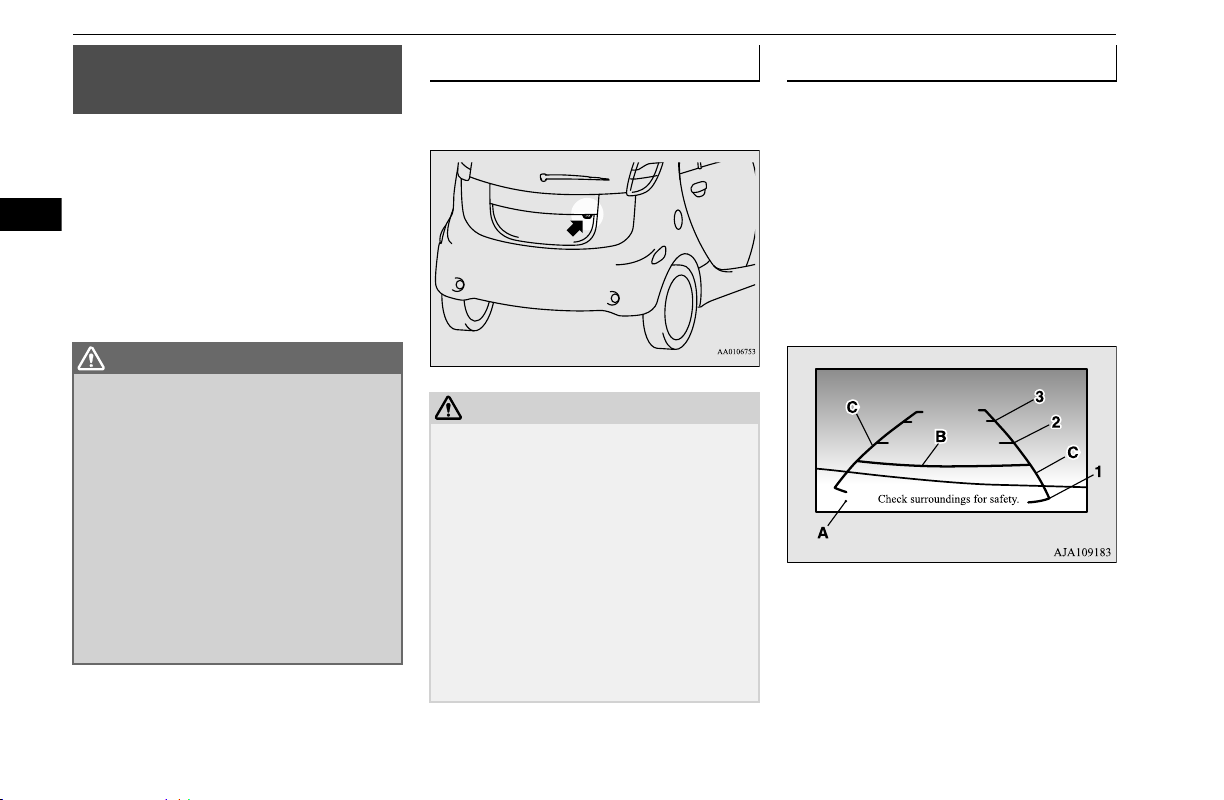
Rear-view camera (if so equipped)
5-34 Features and controls
5
N00546201200
When the selector lever is in the “R”
(REVERSE) position with the electric motor
switch is in the “ON” position, the rear-view
image will be displayed on the screen of the
Mitsubishi Multi Communication System.
When the selector lever is shifted out of the
“R” position, the rear-view image will turn
off.
The rear-view camera is in the liftgate. Reference lines and upper surface of the rear
bumper (A) are displayed on the screen.
Red line (B) indicates approximately 20
inches (50 cm) behind the rear bumper.
Two Green lines (C) indicate approxi-
mately 8 inches (20 cm) outside of the
vehicle body.
Short transverse lines (1 to 3) indicate dis-
tance from the rear bumper.
Rear-view camera (if so
equipped)
WARNING
Never rely solely on the rear-view camera
to clear the area behind your vehicle.
Always check visually behind and all
around your vehicle for persons, animals,
obstructions or other vehicles. Failure to
do so can result in vehicle damage, serious
injury or death.
The rear-view camera is an aid system for
backing up, but it is not a substitute for
your visual confirmation.
The view on the screen is limited, and
objects outside the view, such as under the
bumper or around either corner of the
bumper end, cannot be seen on the screen.
Location of rear-view camera
CAUTION
If the camera lens gets dirty, a clear image
cannot be obtained. As necessary, rinse the
lens with clean water and gently wipe with a
clean, soft cloth.
To avoid damaging the camera;
• Do not rub the cover excessively or polish
it by using an abrasive compound.
• Do not disassemble the camera.
• Do not splash hot water directly on the lens.
• Do not spray the camera and its surround-
ings with high-pressure water.
• Make sure that the liftgate is securely
closed when backing up.
Reference lines on the screen
1: Approximately at the rear edge of the
rear bumper
2: Approximately 39 inches (100 cm)
3: Approximately 79 inches (200 cm)
BK0220401US.book 34 ページ 2015年6月3日 水曜日 午前7時42分
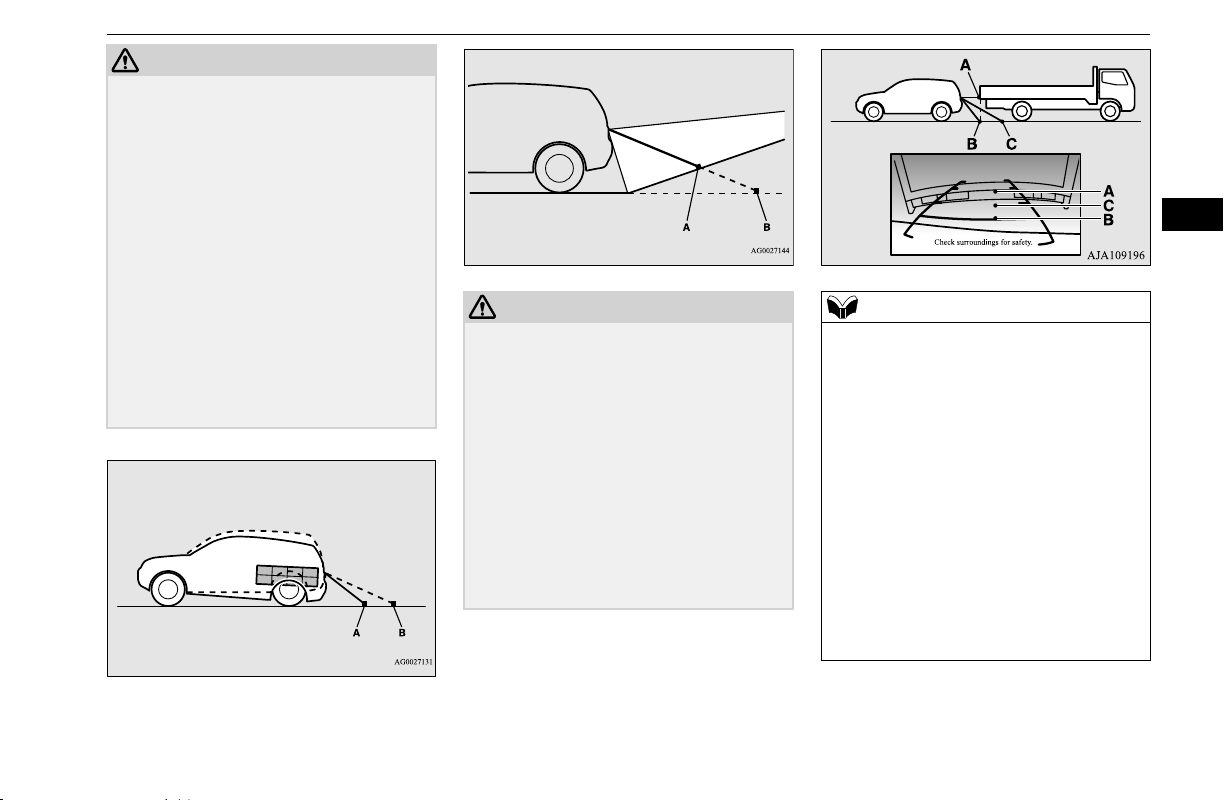
Rear-view camera (if so equipped)
Features and controls 5-35
5
CAUTION
The rear-view camera uses a wide-angle
lens. As a result, images and distances shown
on the screen are not exact.
Actual distance may be different from dis-
tance indicated by the lines on the screen,
depending on the loading condition of the
vehicle and road surface condition.
The reference lines for distance and vehicle
width are based on a level, flat road surface.
In the following cases, objects shown on the
screen will appear to be farther off than they
actually are.
• When the rear of the vehicle is weighed
down with the weight of passengers and
luggage in the vehicle. (Case 1)
• When there is an upward slope at the back.
(Case2)
Case 1
A: Actual objects
B: Objects shown on the screen
CAUTION
The reference lines for distance and vehicle
width are intended to indicate the distance to
a flat object such as a level, flat road surface.
They may not indicate correct distance
depending on the shape of an obstacle.
For example, when there is an object behind
the vehicle that has upper sections projecting
in the direction of the vehicle, the reference
lines on the screen will indicate that point A
is the farthest point and point B is the closest
point to the vehicle. In reality, point A and B
are actually the same distance from the vehi-
cle, and point C is farther off than point A
and B.
Case 2
A: Actual objects
B: Objects shown on the screen
NOTE
Mirror image is displayed on the screen.
Monitor brightness is adjusted automatically
by sensors.
It is possible to change the display language
of the screen.
For details, please refer to the separate
owner’s manual for “Mitsubishi Multi-Com-
munication System”.
Under certain circumstances, it may become
difficult to see an image on the screen, even
when the system is functioning correctly.
• In a dark area, such as at night.
• When water drops or condensation are on
the lens.
• When sunlight or headlights shine directly
into the lens.
BK0220401US.book 35 ページ 2015年6月3日 水曜日 午前7時42分
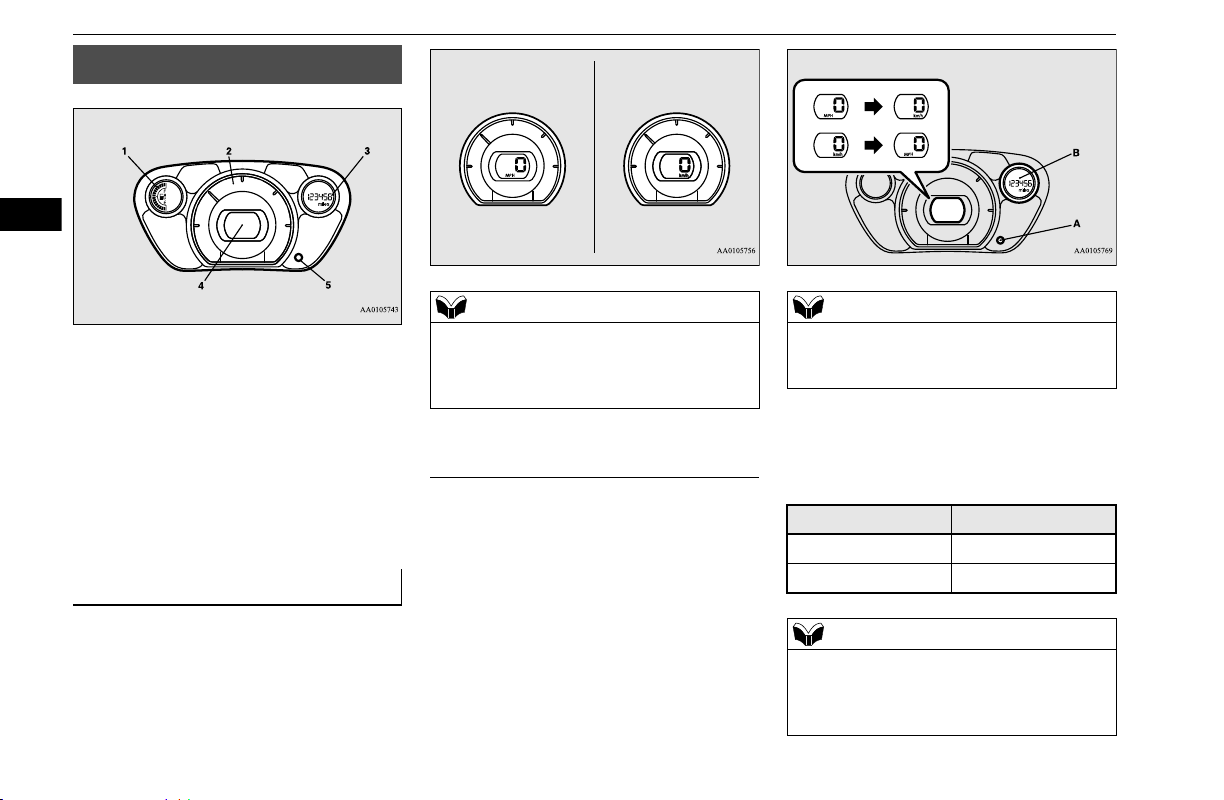
Instrument cluster
5-36 Features and controls
5
N00519000375
N00519100246
When the electric motor switch is in the
“ON” position, the speedometer indicates the
vehicle’s speed in miles per hour (mph) or
kilometers per hour (km/h).
N00572000013
It is possible to select the speedometer’s dis-
play unit.
1. Press the reset button (A) to display the
odometer (B).
(Refer to “To change the display” on page
5-37.)
2. Keep the reset button pressed for 2 sec-
onds or longer to change the display unit
from MPH to km/h or from km/h to MPH.
The display unit for the cruising range will
change to match the selected speedometer’s
display unit.
Instrument cluster
1- Energy level gauge
2- Energy usage indicator
3- Odometer/Trip odometer/Dash lights
brightness indicator/Service
reminder/Cruising range indicator/Out-
side temperature display
4- Speedometer
5- Reset button/Dash lights illumination
button/Selector button
Speedometer
NOTE
The display setting can be changed to the
preferred units (miles or km).
Refer to “Changing the display unit” on page
5-36.
Changing the display unit
Type 1 Type 2
NOTE
Once the display unit has changed, keeping
the reset button pressed will not cause the
display unit to change again.
Speedometer Cruising range
MPH miles
km/h km
NOTE
Even if speedometer’s display unit is
changed, the display units for the odometer,
trip odometer, and service reminder do not
change.
BK0220401US.book 36 ページ 2015年6月3日 水曜日 午前7時42分
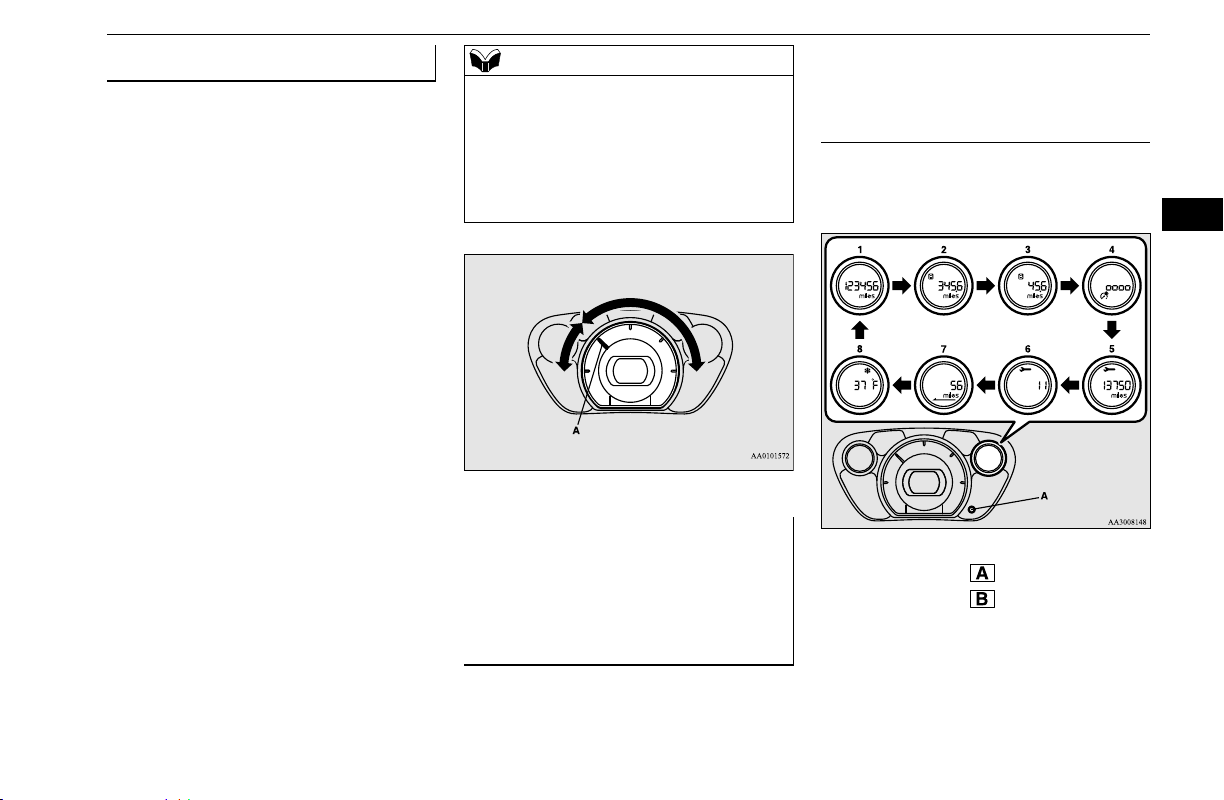
Instrument cluster
Features and controls 5-37
5
N00572101037
The power consumption of the electric motor,
the air conditioning, and power generation by
the regenerative brake are indicated.
When the ready indicator comes on, the red
needle will move to the neutral point (A) and
then move to the right or left according to the
amount of power consumption or power gen-
eration.
[When the red needle moves to the right of
the neutral point]
This indicates that the electric motor unit
and/or the air conditioning are consuming
electric energy from the main drive lithium-
ion battery.
The more the needle moves to the right, the
more electrical energy is being consumed.
[When the red needle moves to the left of the
neutral point]
This indicates that electric energy is being
generated by the regenerative brake and
charged to the main drive lithium-ion battery.
The more the needle moves to the left, the
more electric energy is being generated.
N00519501449
Odometer, trip odometer, dash lights bright-
ness indicator, service reminder, cruising
range indicator, and outside temperature are
displayed.
N00572201025
The display is changed every time the reset
button (A) is briefly pressed.
Energy usage indicator
NOTE
When the main drive lithium-ion battery is at
or near full charge, or the main drive lithium-
ion battery temperature is too high or too
low, the needle in the energy usage indicator
may not move to the left of the neutral point,
since the main drive lithium-ion battery can-
not receive charge.
Odometer/Trip odometer/Dash
lights brightness indicator/Ser-
vice reminder/Cruising range
indicator/Outside temperature
display
To change the display
1- Odometer
2-
Trip odometer
3-
Trip odometer
4- Dash lights brightness indicator
5- Service reminder (Drive distance
remaining until next inspection)
6- Service reminder (Number of months
remaining until next inspection)
7- Cruising range indicator
BK0220401US.book 37 ページ 2015年6月3日 水曜日 午前7時42分
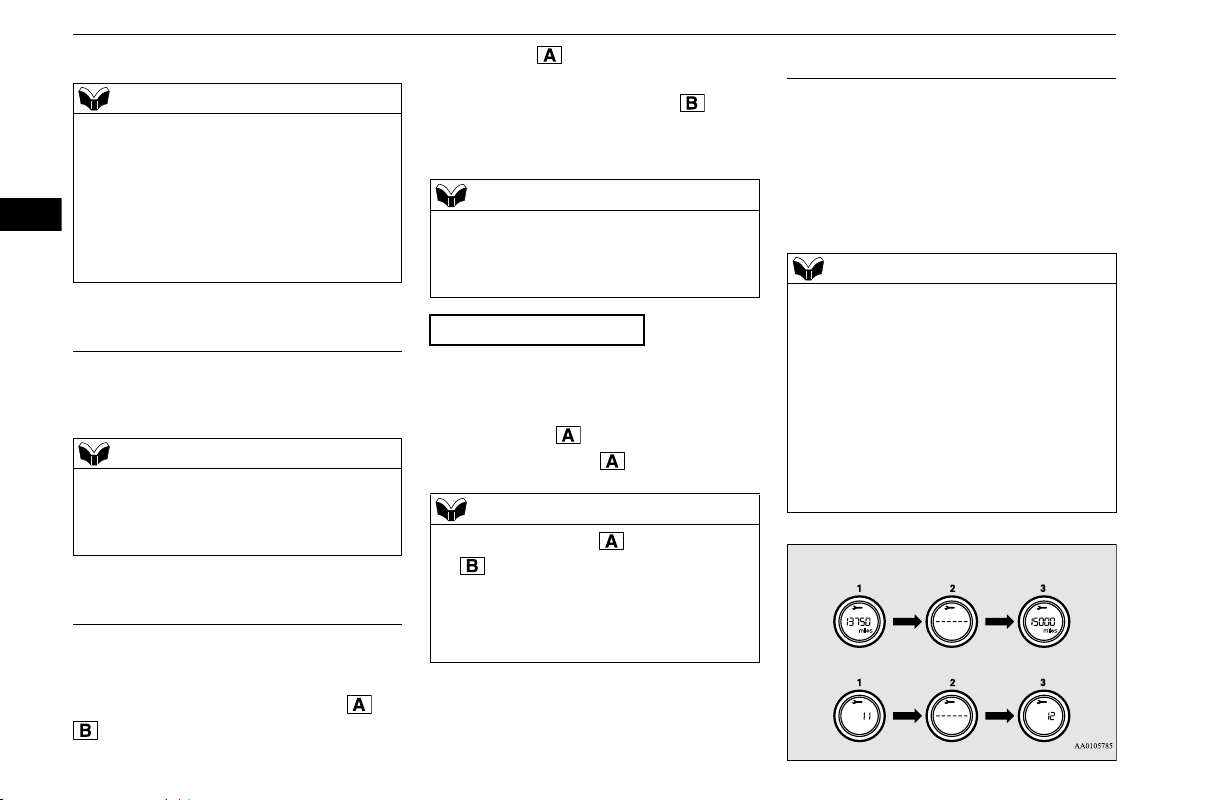
Instrument cluster
5-38 Features and controls
5
N00572300016
The odometer indicates the total distance the
vehicle has traveled.
N00572400020
The trip odometer shows the distance traveled
since the last time it was reset.
There are two trip odometer displays: and
.
Trip odometer can be used to measure the
distance traveled since the current trip began.
At the same time, Trip odometer can be
used to measure the distance from a second
location.
To zero the counter, press and hold the reset
button for more than 1 second. Only the cur-
rently displayed value will be reset.
If trip odometer is displayed, for exam-
ple, only trip odometer will be reset.
N00572500021
The service reminder shows the driving dis-
tance or number of months remaining until
the next recommended periodic maintenance
inspection is required.
When the next inspection is nearly due, the
display shows “------”.
8- Outside temperature display
NOTE
The cruising range indicator and outside
temperature display are not indicated when
the electric motor switch is in the “ACC” or
“LOCK” position.
If there is no operation for about 10 seconds
when the meter illumination control or ser-
vice reminder is shown, the display returns
to the odometer.
Odometer
NOTE
Even if the electric motor switch is turned to
“ACC” or “LOCK”, the odometer will be
displayed for about 30 seconds after the reset
button is pressed.
Trip odometer
NOTE
Even if the electric motor switch is turned to
“ACC” or “LOCK” position, the trip odome-
ter will be displayed for about 30 seconds
after the reset button is pressed.
To reset the trip odometer
NOTE
Both trip odometer and trip odometer
can measure trips up to 9999.9
miles/kilometers.
If the 12V starter battery is disconnected for
a long time, both of these displays will be
reset to “0”.
Service reminder
NOTE
The service reminder time can be modified
by a certified i-MiEV dealer, to adjust for
severe usage, etc. Refer to “Severe mainte-
nance schedule” in your vehicle’s Warranty
and Maintenance Manual. For further infor-
mation, please contact a certified i-MiEV
dealer.
Even if the electric motor switch is turned to
“ACC” or “LOCK” position, the service
reminder will be displayed for about 30 sec-
onds after reset button is pressed.
Driving distance
Number of months
BK0220401US.book 38 ページ 2015年6月3日 水曜日 午前7時42分
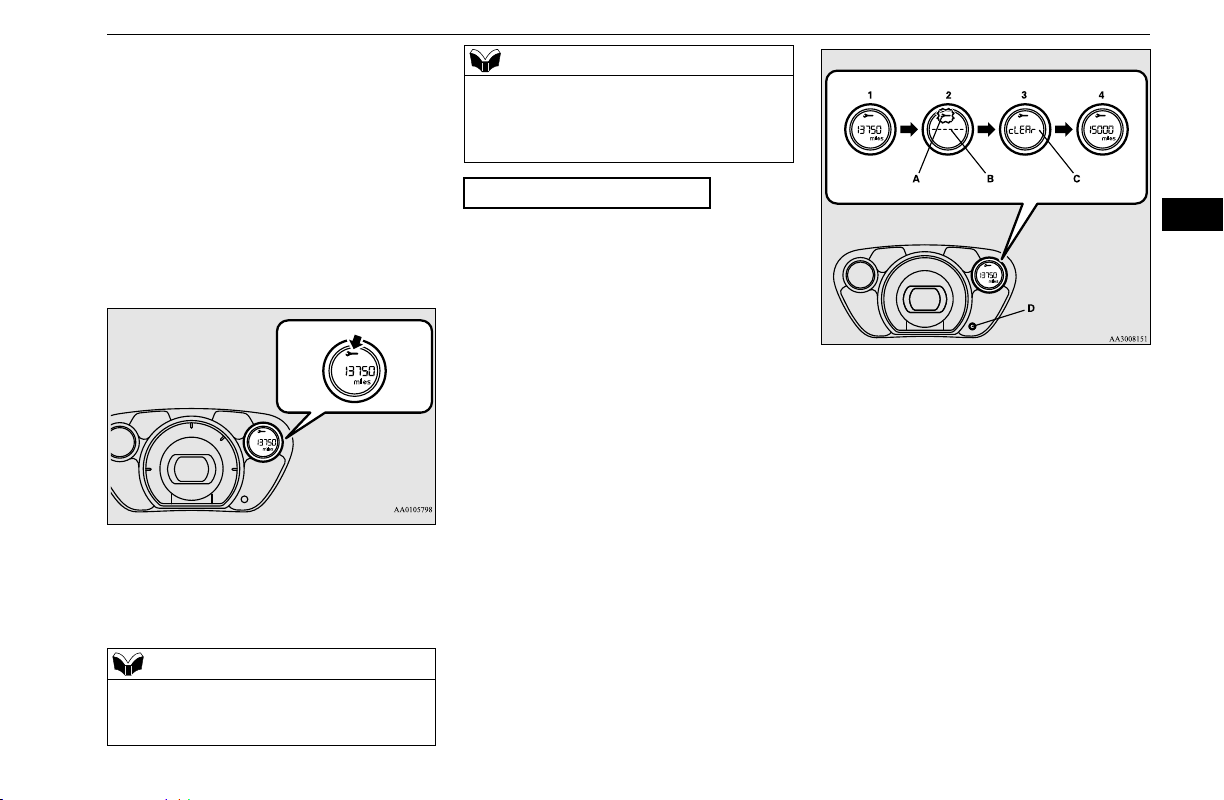
Instrument cluster
Features and controls 5-39
5
1. The display shows the driving distance or
number of months remaining until the
next periodic inspection.
2. This informs you that a periodic inspec-
tion is due. Contact a certified i-MiEV
dealer to have the system checked.
At this time, a spanner mark is shown for
a few seconds whenever the electric
motor switch is turned from the “LOCK”
position or the “ACC” position to the
“ON” position.
3. After your vehicle is inspected at a certi-
fied i-MiEV dealer, it displays the time
and miles (km) until the next periodic
inspection.
With the electric motor switch in the
“LOCK” position or the “ACC” position, it is
possible to reset the spanner mark (A) and “--
----” indication (B).
When they have been reset, the driving dis-
tance or number of months remaining until
the next periodic inspection are shown and
the spanner mark (A) is no longer shown
every time the electric motor switch is turned
from the “LOCK” position or the “ACC”
position to the “ON” position.
1. Push the reset button (D) to view the driv-
ing distance or number of months remain-
ing until the next periodic inspection.
2. Give the reset button (D) a long push (at
least 2 seconds) to make the spanner mark
(A) start flashing. (If you do not touch the
reset button for about 10 seconds while
the spanner mark is flashing, the display
will revert to its original indication.)
3. Give the reset button (D) a gentle push
while the spanner mark is flashing. The “-
-----” indication (B) will change to
“cLEAr” (C).
4. The driving distance or number of months
remaining until the next periodic inspec-
tion will be shown.
NOTE
The indicated distance decreases in steps of
100miles (100 km). The indicated number of
months decreases in steps of one month.
It is possible to change the settings for the
service reminder.
For further information, we recommend you
to consult a certified i-MiEV dealer.
Resetting the service reminder
NOTE
BK0220401US.book 39 ページ 2015年6月3日 水曜日 午前7時42分
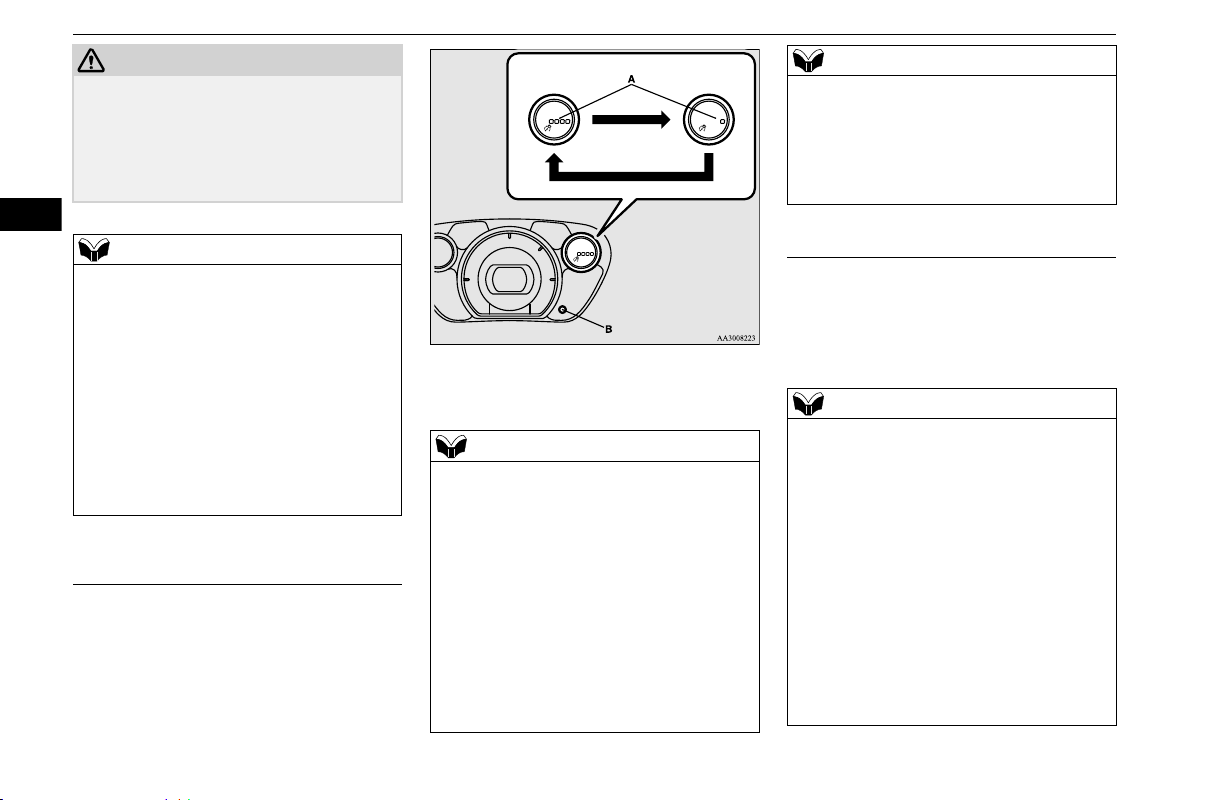
Instrument cluster
5-40 Features and controls
5
N00572600019
Each time you press the dash lights illumina-
tion button (B), the brightness of the instru-
ments changes.
N00572700036
This displays the approximate cruising range
(how many more miles or kilometres you can
drive). When the cruising range becomes
short, the indication changes to “---”.
CAUTION
The customer is responsible for making sure
that regular inspections and maintenance are
performed.
Inspections and maintenance must be per-
formed to prevent accidents and malfunc-
tions.
NOTE
It is not possible to reset the “------” indica-
tion (B) with the electric motor switch in the
“ON” position.
When a certain distance has been driven and
a certain period has elapsed after appearance
of the “------” indication (B), the indication
is automatically reset and the number of
months until the next periodic inspection is
shown.
If you accidentally reset the display, consult
a certified
i-MiEV dealer for assistance.
Dash lights brightness indicator
A- Brightness display
B- Dash lights illumination button
NOTE
You can adjust to 4 different levels for when
the parking lights or headlights are illumi-
nated and 4 for when they are not.
If you press and hold the button for longer
than about 1 second, the brightness automati-
cally scrolls through its different levels, and
stops scrolling when you release the button.
Select your desired level of brightness.
When the combination headlights and dim-
mer switch is in the “AUTO” position, the
meter illumination switches automatically to
the adjusted brightness, depending on the
brightness outside the vehicle.
Bright Dim
The brightness level of the instruments is
stored when the electric motor switch is
turned off.
If the 12V starter battery is disconnected for
a long time, these level of brightness will be
reset.
Cruising range indicator
NOTE
The cruising range is displayed based on the
past drive data. It may vary depending on the
driving condition (road condition, driving
situation, etc.) and air conditioning operation
status.
For example, the cruising range can be short-
ened by driving on congested roads, by driv-
ing uphill, by repeated hard acceleration, and
by use of the air conditioner and heater.
When the 12V starter battery terminal is dis-
connected, the power consumption data of
the main drive lithium-ion battery in the past
is deleted. A different value from before may
be displayed. Be sure to use the display only
for reference.
NOTE
BK0220401US.book 40 ページ 2015年6月3日 水曜日 午前7時42分
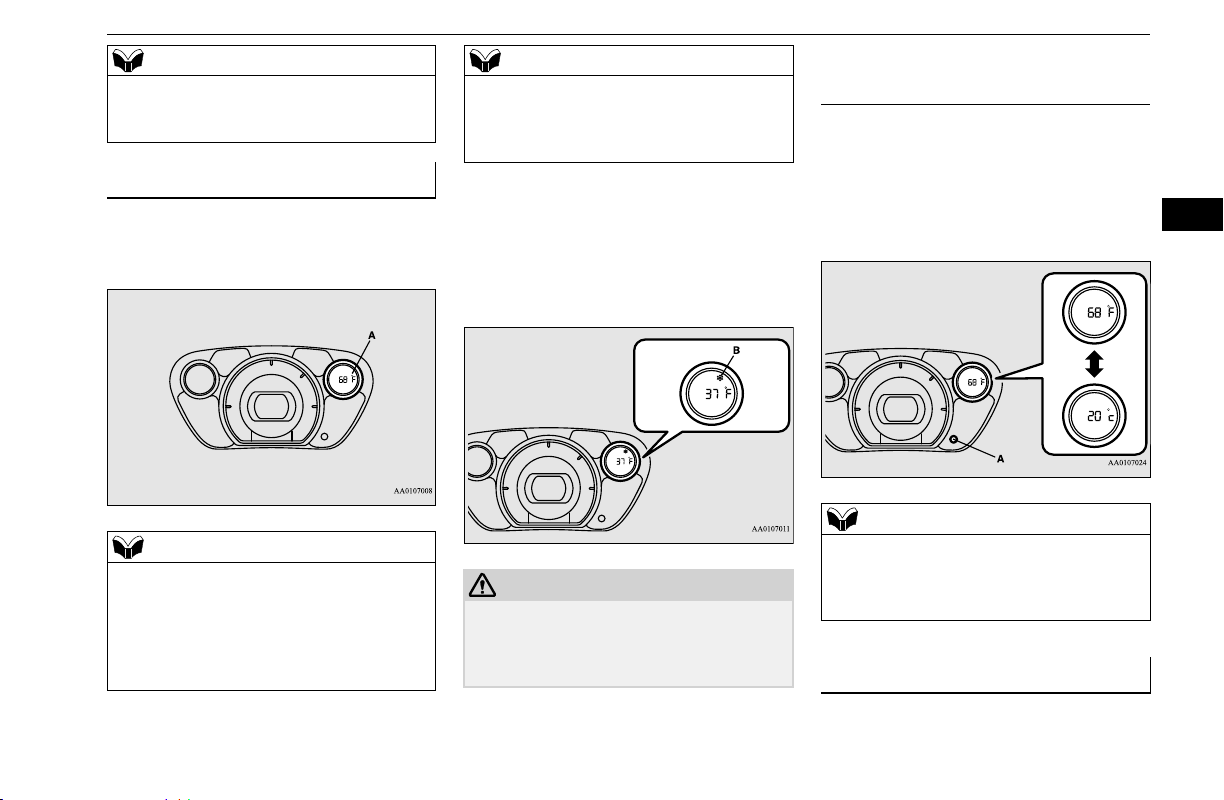
Instrument cluster
Features and controls 5-41
5
N00573000010
This value (A) shows the outside temperature
of the vehicle.
If the outside temperature drops below
approximately 37 °F (3 °C), the alarm sounds
and the outside air temperature warning indi-
cator (B) flash for approximately 10 seconds
to show there is a danger the road might be
icy.
N00573100011
When the electric motor switch is in the
“ACC” or “ON” position, pressing the selec-
tor button (A) for more than 2 seconds will
switch the outside temperature unit between
°F and °C.
N00572800024
The energy level gauge indicates the remain-
ing power in the main drive lithium-ion bat-
When the main drive lithium-ion battery is
charged, the approximate cruising range is
updated.
Outside temperature display
NOTE
The outside temperature can be displayed
from -40 °F (-40 °C) to 122 °F (50 °C).
When the outside temperature is over 122 °F
(50°C) or below -40°F (-40°C), the display
will remain 122 °F (50 °C) or -40 °F
(-40 °C).
NOTE
The outside temperature displayed may dif-
fer from the actual temperature on account of
surrounding conditions, driving conditions,
etc.
CAUTION
Even when the outside air temperature warn-
ing indicator (B) indications do not flash, the
road may be icy, so please take care when
driving.
NOTE
Change of the outside temperature
unit
NOTE
Disconnecting the battery cable causes the
outside temperature unit memory to be
erased. If it has been disconnected, readjust
the unit with the above procedure.
Energy level gauge
BK0220401US.book 41 ページ 2015年6月3日 水曜日 午前7時42分
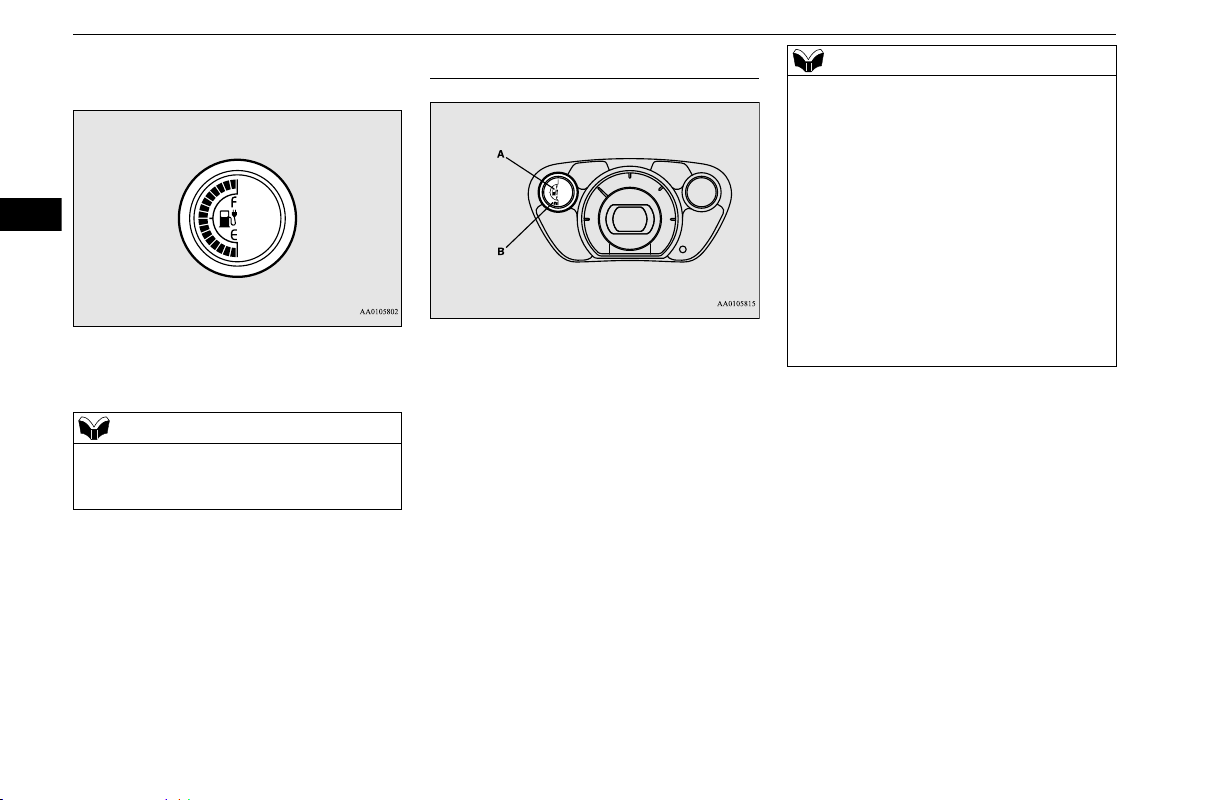
Instrument cluster
5-42 Features and controls
5
tery during charging or when the electric
motor switch is in the “ON” position.
N00572900025
When the electric motor switch is in the
“ON” position and the remaining bar of the
energy level gauge shows 2 bars or less, the
warning indicator (A) and the charging bars
(B) flash as follows:
When the energy level gauge shows 2 bars:
The warning indicator flashes.
When the energy level gauge shows 1 bar:
The warning indicator and the charging bars
flash alternately.
Recharge the main drive lithium-ion battery
as soon as possible.
F- Battery is fully charged.
E- Charge the battery.
NOTE
The charging indicator is also illuminated
during charging.
Refer to “Charging indicator” on page 5-44.
Low energy warning indicator
NOTE
If the energy level gauge shows 0 bars during
use of the air conditioning, the cooling or
heating may stop operation and the mode is
changed to fan only.
If the energy level gauge shows 0 bars, the
power down warning light is illuminated to
control the output.
If the energy level gauge shows 2 bars while
the main drive lithium-ion battery is being
charged, the warning indicator flashes. If the
energy level gauge shows 1 bar while the
main drive lithium-ion battery is being
charged, the warning indicator and the charg-
ing bars flash alternately.
BK0220401US.book 42 ページ 2015年6月3日 水曜日 午前7時42分
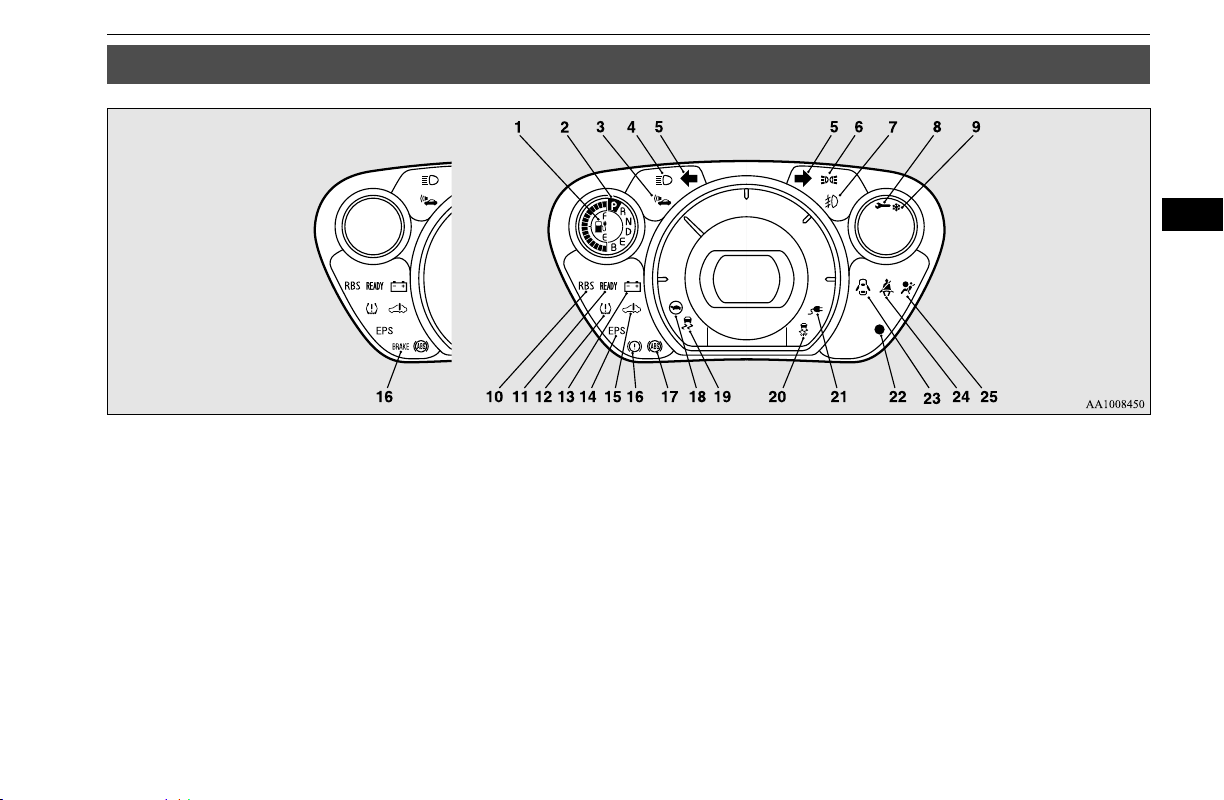
Indicator and warning light package
Features and controls 5-43
5
N00519801888
Indicator and warning light package
1- Low energy warning indicator
P.5-42
2- Selector lever position indicator
P.5-21
3- Acoustic Vehicle Alerting System
( AVA S ) i nd ic at or P.5-23
4- High-beam indicator P.5-44
5- Turn-signal indicators/Hazard warning
lights P.5-44
6- Position indicator P.5-44
7- Front fog light indicator P.5-44
8- Service reminder P.5- 3 8
9- Outside air temperature warning indi-
cator P.5- 4 1
10- Regenerative brake system indicator
P.5-44
11- Ready indicator P.5-44
12- Tire pressure monitoring system warn-
ing light P.5-31
13- 12V starter battery charging system
warning light P.5-45
14- Electric power steering system warning
light P.5-28
15- Electric motor unit warning light
P.5-45
16- Brake warning light P.5 - 4 4
17- Anti-lock braking system warning light
P.5-26
18- Power down warning light P.5-46
19- Active stability control (ASC) indicator
P.5-30
20- Active stability control (ASC) OFF
indicator P.5 - 3 0
21- Charging indicator P.5-44
22- Theft-alarm indicator P.5-12
23- Door-ajar warning light P.5-45
24- Driver’s seat belt reminder/warning
light P.4 - 1 0
25- Supplemental Restraint System (SRS)
warning light P.4-13
BK0220401US.book 43 ページ 2015年6月3日 水曜日 午前7時42分
Indicators
5-44 Features and controls
5
N00519900127
N00520000232
The arrows will flash in time with the corre-
sponding exterior turn signals when the turn
signal lever is used.
Both arrows will flash when the hazard warn-
ing flasher switch is pressed.
N00520100086
A blue light comes on when the headlights
are on high beam.
N00520201244
This indicator comes on while the front fog
lights are on.
N00551300039
This indicator turns on while the position
lights are on.
N00573200012
This indicator comes on when the electric
motor switch is turned to “START” and driv-
ing becomes possible.
N00573301023
This indicator flashes when the EV charging
cable (regular charger or quick charger) is
connected.
After that, the light switches to being illumi-
nated when charging starts and goes out when
charging is completed.
N00573400014
The indicator comes on when the regenera-
tive brake performance may be weakened. In
this case, drive the vehicle at a lower speed.
N00520300147
N00520400513
This light comes on when the electric motor
switch is turned to the “ON” position, and
goes off after a few seconds when the parking
brake is released. Before driving your vehi-
cle, release the parking brake and make cer-
tain that the brake warning light has gone off.
If the light stays on when the parking brake is
fully released, the service brake system is not
working properly or the brake fluid level is
low.
Indicators
Turn signal indicators/Hazard
warning lights
NOTE
If the indicator flashes faster than usual or if
the indicator stays on without flashing, check
for a malfunctioning turn signal light bulb or
turn signal connection.
High beam indicator
Front fog light indicator
Position indicator
Ready indicator
Charging indicator
NOTE
Although it is possible to start the electric
motor unit if quick charging has not finished
normally, the charging indicator is continu-
ously blinking.
Refer to “Charging troubleshooting guide”
on page 3-31.
Regenerative brake system
indicator
Warning lights
Brake warning light
WARNING
If any of the following conditions occur,
the brake effort may significantly
increase. Stop the vehicle in a safe loca-
tion, avoiding where possible any sudden
brake application, and contact a certified
i-MiEV dealer.
BK0220401US.book 44 ページ 2015年6月3日 水曜日 午前7時42分
Warning lights
Features and controls 5-45
5
N00573500028
This light will illuminate when there is a
problem with the charging system for the 12V
starter battery.
Normally, when the electric motor switch is
turned to the “ON” position, this light will
illuminate. Then, when the electric motor unit
is started and the ready indicator illuminates,
the light will go out.
N00520900316
This light comes on when any door or liftgate
is open or not completely closed.
When the vehicle is moving at more than 5
mph (8 km/h) and any door or liftgate is open
or ajar, a tone will sound 16 times and the
warning light will flash 16 times to inform
the driver that a door or liftgate is not prop-
erly shut.
N00573600029
This warning light will illuminate when there
is a problem with a high voltage component.
Refer to “Service precautions” on page 9-2.
• The brake warning light does not come
on when the electric motor switch is
turned to the “ON” position.
• The brake warning light does not illumi-
nate while the parking brake is applied
and the electric motor switch is in the
“ON” position.
• The brake warning light stays on when
the parking brake is not applied.
NOTE
When the brake warning light illuminates,
the warning buzzer may also sound.
When the brake pedal has been repeatedly
depressed over a short period of time, the
brake warning light may come on and the
brake warning buzzer may sound. The ser-
vice brake system is working normally, if the
warning light goes out and the buzzer stops
sounding in a few seconds.
12V starter battery charging
system warning light
WARNING
CAUTION
If the warning light stays on after the ready
indicator illuminates, there may be a prob-
lem with the charging system for the 12V
starter battery.
• Immediately park your vehicle in a safe
place and contact a certified i-MiEV dealer.
• Do not charge the 12V starter battery.
Door-ajar warning light and
buzzer
CAUTION
Before driving, make sure that the door-ajar
warning light is off.
NOTE
The flashing of the warning light and the
buzzer can be disabled.
For further details, please contact a certified
i-MiEV dealer.
When the driver’s door is open, the door-ajar
warning buzzer does not sound because the
electric motor reminder sounds instead.
Electric motor unit warning
light
CAUTION
If this light illuminates while driving, imme-
diately park your vehicle in a safe place and
contact a certified i-MiEV dealer.
BK0220401US.book 45 ページ 2015年6月3日 水曜日 午前7時42分
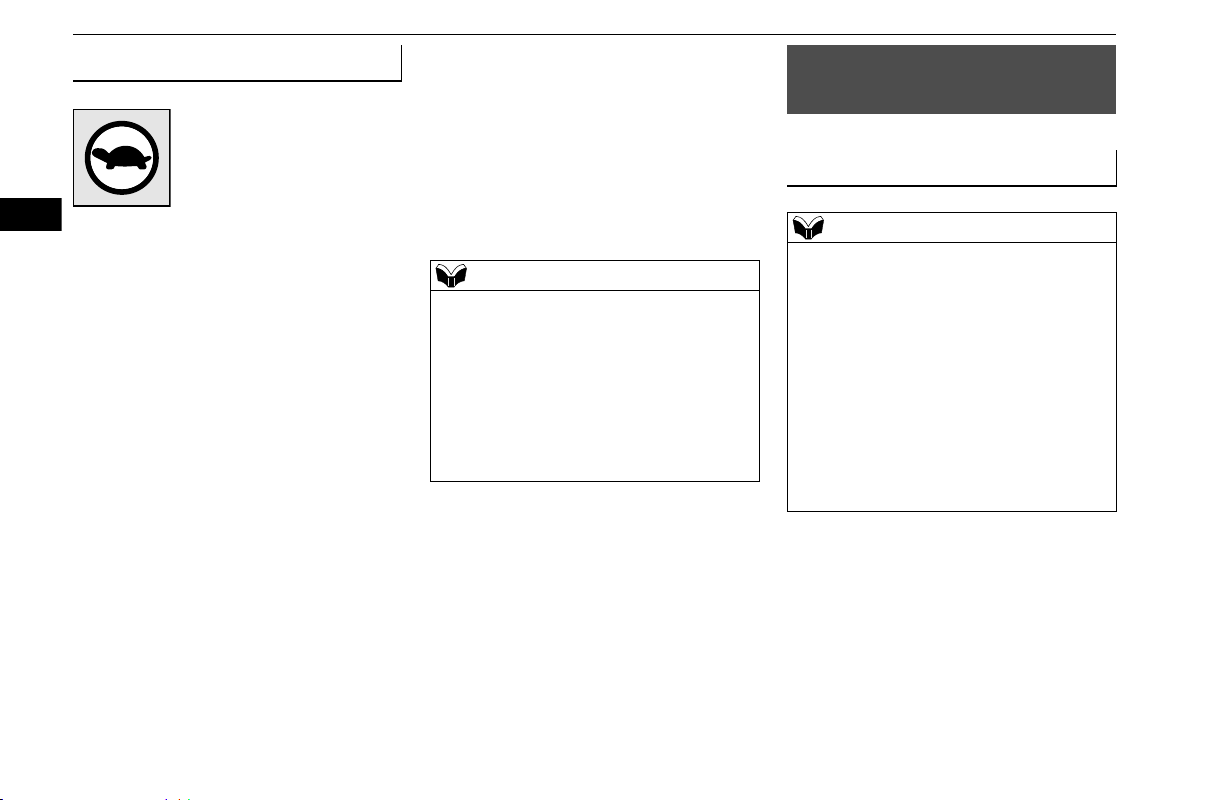
Combination headlights and dimmer switch
5-46 Features and controls
5
N00573700020
If the warning light illuminates when the out-
side air temperature is very low, move the
vehicle to a warmer location.
If the warning light illuminates after the vehi-
cle has been driven continuously uphill or
when the outside air temperature is very high,
stop the vehicle in a safe place so the electric
motor unit and/or the main drive lithium-ion
battery can cool down. When they have
cooled down, the warning light will go off. If
the warning light does not turn off, contact a
certified i-MiEV dealer.
N00522501805
Rotate the switch to operate the lights.
Power down warning light
If this warning light illumi-
nates, the power provided by
the electric motor will be
reduced and the vehicle will
be only able to move at low
speeds.
This warning light will illu-
minate;
When the energy level in
the main drive lithium-ion
battery is near empty.
When temperature of the
electric motor unit or the
main drive lithium-ion
battery is too high or too
low.
When voltage of the main
drive lithium-ion battery
becomes low.
If the energy level gauge
shows 0 bar, the main drive
lithium-ion battery is near
empty and must be charged as
soon as possible. Refer to
“Charging” on page 3-13.
NOTE
When the power down warning light illumi-
nates, avoid rapid starts and aggressive
acceleration.
Illumination of the power down warning
light does not indicate a malfunction.
If the power down warning light illuminates
while the air conditioning is used, the cool-
ing or heating may stop operating and only
the fan will operate.
Combination headlights and
dimmer switch
Headlights
NOTE
Do not leave the headlights and other lights
on for a long period of time while the ready
indicator is not illuminated. A run down 12V
starter battery could result.
When it rains, or when the vehicle has been
washed, the inside of the lens sometimes
becomes foggy. This is the same as when
window glass mists up on a humid day, and
does not indicate a problem. When the light
is switched on, the heat will dry out the fog.
However, if water collects inside the light,
have it checked by a certified
i-MiEV dealer.
BK0220401US.book 46 ページ 2015年6月3日 水曜日 午前7時42分
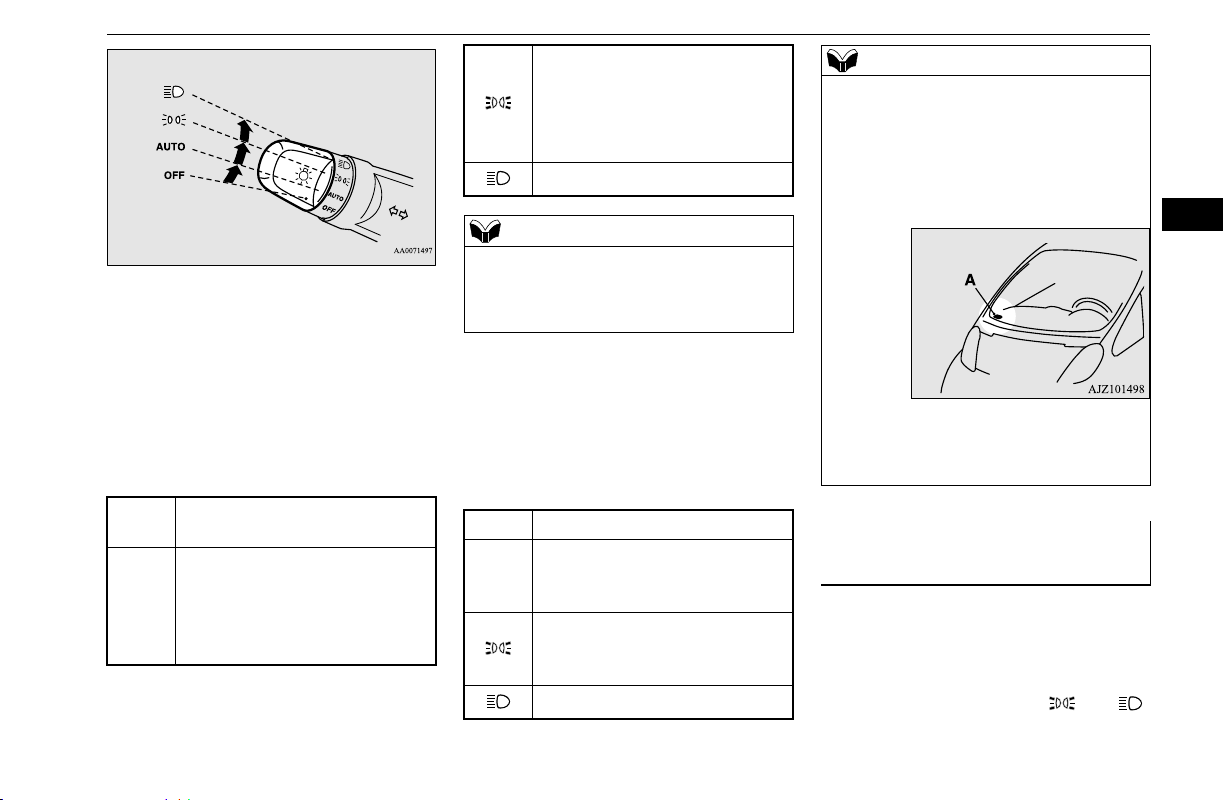
Combination headlights and dimmer switch
Features and controls 5-47
5
The combinations of switch operations and
illuminated lights differ in accordance with
the following conditions.
[When the ready indicator is illuminated, and
the parking brake is released]
The daytime running lights will be illumi-
nated:
[When the ready indicator is not illuminated,
or when the ready indicator is illuminated but
the parking brake is not released]
The electric motor unit starts when the lights
are off.
N00532600554
If the key is turned to “LOCK” or “ACC”
position or removed from the electric
motor switch and the driver’s door is
opened with the combination headlights
and dimmer switch in the “ ” or “ ”
position, the lights automatically turn off.
OFF
The daytime running lights illumi-
nated
AUTO
The daytime running lights illumi-
nated
Headlights and other lights turn on
and off automatically in accor-
dance with outside light level.
The daytime running lights illumi-
nated
Parking, tail, front and rear side-
marker lights, license plate and
instrument panel lights on
Headlights and other lights on
NOTE
Once the daytime running light come on,
they do not go out until the electric motor
switch is turned to the “LOCK” or “ACC”
position.
OFF All lights off
AUTO
Headlights and other lights turn on
and off automatically in accor-
dance with outside light level.
Parking, tail, front and rear side-
marker lights, license plate and
instrument panel lights on
Headlights and other lights on
NOTE
The sensitivity of the automatic on/off con-
trol can be adjusted.
For further information, please contact a cer-
tified i-MiEV dealer.
Do not place anything on the sensor (A), and
do not clean with a glass cleaner. Clean only
with clear water.
If the lights do not turn on or off with the
switch in the “AUTO” position, manually
operate the switch. Have the system checked
by a certified i-MiEV dealer.
Light auto-cutout function
(headlights and other lights)
BK0220401US.book 47 ページ 2015年6月3日 水曜日 午前7時42分
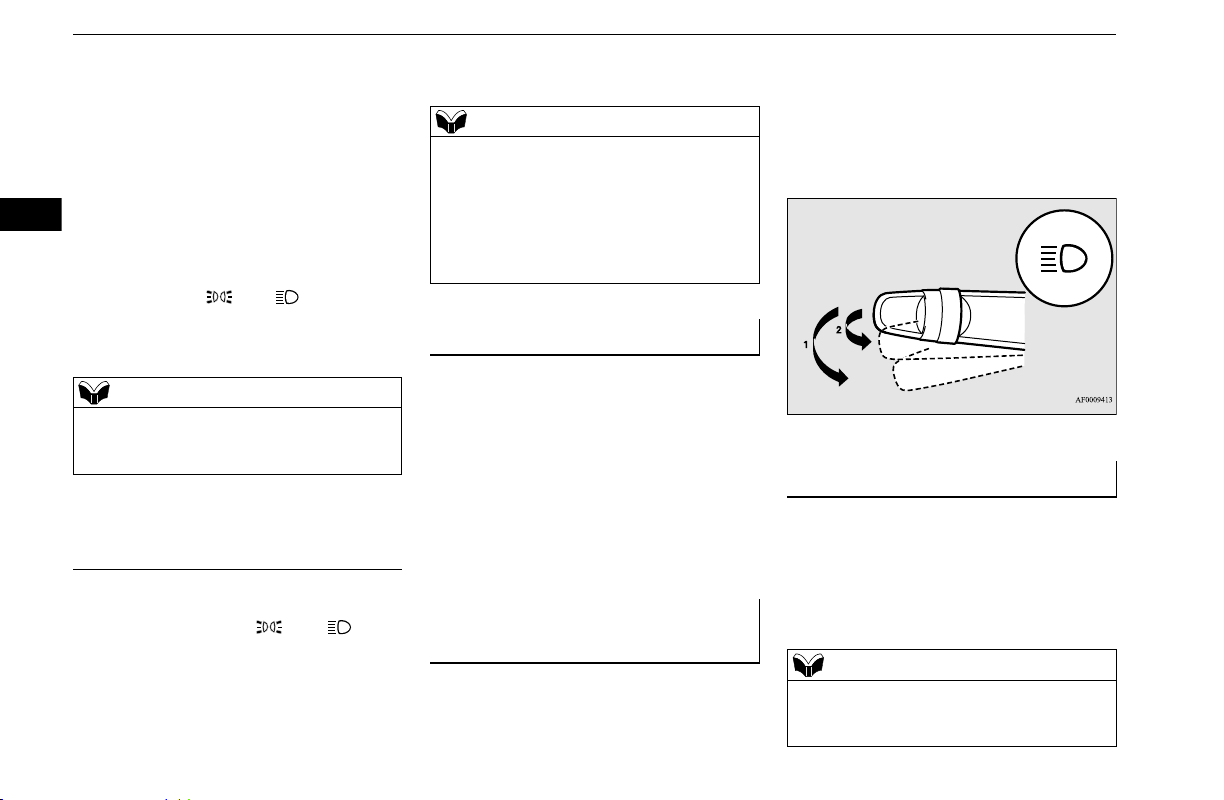
Combination headlights and dimmer switch
5-48 Features and controls
5
• If the driver’s door is opened after the
key is removed from the electric motor
switch, a buzzer will sound to remind
you to turn off the lights.
• If the driver’s door is opened with the
key in the electric motor switch, a buzzer
will sound intermittently to remind you
to remove the key.
If the key is turned to “LOCK” or “ACC”
position with the driver’s door closed and
the combination headlights and dimmer
switch in the “ ” or “ ” position, the
lights will stay on for about 3 minutes and
then turn off automatically.
If the combination headlights and dimmer
switch is turned to the “ ” or “ ” posi-
tion again after the electric motor switch is
turned to “LOCK” or “ACC” position, the
auto-cutout function described above will not
work. The lights (the parking lights, tail lights
and license plate lights) will stay on and will
not turn off automatically.
N00549800213
If the driver’s door is opened with the key
removed from the electric motor switch while
the lights are on, the buzzer will sound to
remind you to turn off the lights.
The lights and buzzer will turn off automati-
cally.
Or you can turn the combination headlights
and dimmer switch to the “OFF” position to
stop the buzzer.
N00549900155
To change the headlights from high beam to
low beam and vice versa, pull the turn signal
lever to fully toward you (1). Switch the
headlights to low beam as a courtesy when-
ever there are oncoming vehicles, or when
there is traffic moving ahead of you. An illu-
minated blue light in the instrument cluster
indicates when the headlights are on high
beam.
N00550000198
You can flash the high beams by pulling the
lever gently toward you (2). The lights will
go back to normal when you let go. While the
high beam is on, you will see a blue light on
the instrument panel.
NOTE
The light auto-cutout function can be deacti-
vated.
See a certified i-MiEV dealer for details.
When you want to keep the lights
on:
NOTE
If the driver’s door is opened and the key is
removed, the headlight reminder buzzer will
sound. If the key is still in the electric motor
switch the key reminder buzzer will sound
intermittently.
The buzzer stops when the driver’s door is
closed.
Headlight reminder buzzer
Dimmer (high/low beam
change)
Headlight flasher
NOTE
You can flash the high beams by pulling the
lever toward you, even if the combination
headlights and dimmer switch is off.
BK0220401US.book 48 ページ 2015年6月3日 水曜日 午前7時42分
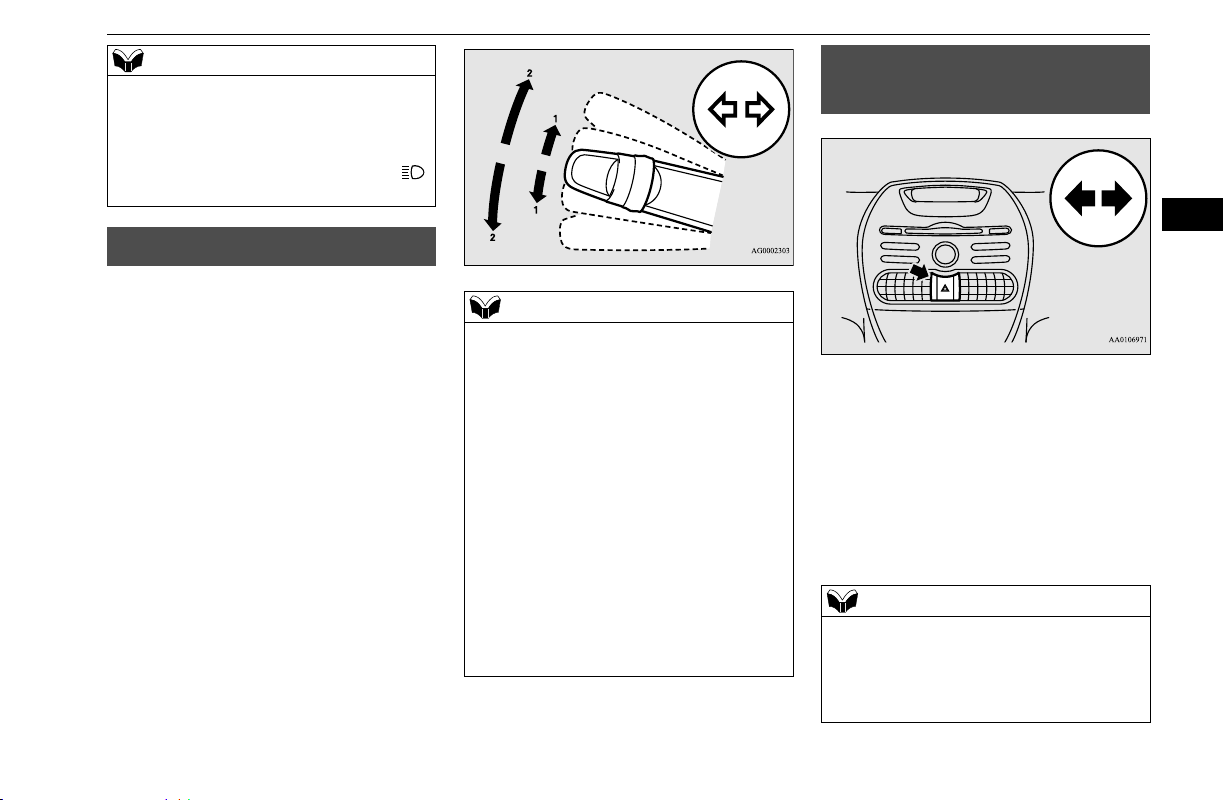
Turn signal lever
Features and controls 5-49
5
N00522600506
When changing lanes, or to making a gradual
turn, hold the lever in the “lane change” posi-
tion (1). It will return to the neutral position
when you let go. Use the full position (2)
when making a normal turn. The lever will
return to the neutral position when the turn is
complete. There may be times when the lever
does not return to the neutral position. This
usually happens when the steering wheel is
turned only slightly. You can easily return the
lever by hand.
Also, when you move the lever to (1) slightly
then release it, the turn signal lights and indi-
cator in the instrument cluster will flash three
times.
N00522700305
If you press the flasher switch, the front and
rear turn signals will flash intermittently, and
so will the hazard warning lights. This is an
emergency warning system and should not be
used when the vehicle is in motion, except for
emergencies.
If you need to leave your vehicle, the flashers
will keep working after the key is removed
from the electric motor switch.
If you turn the lights off with the headlights
set to high-beam illumination, the headlights
are automatically returned to their low-beam
setting when the combination headlights and
dimmer switch is next turned to the “ ”
position.
Turn signal lever
NOTE
NOTE
A light in the instrument panel flashes to
show when the front and rear turn signal
lights are working properly.
If this light flashes faster than usual, check
for a burned out light bulb or malfunctioning
connection.
If the panel light does not come on when the
lever is moved, check for a blown fuse or a
burned out bulb in the panel.
Have the vehicle inspected by a certified i-
MiEV dealer.
It is possible to modify functions as follows:
• Deactivate the turn signal light 3-flash
function for lane changes.
• Adjust the time required to operate the
lever for the 3-flash function.
See a certified i-MiEV dealer for details.
Hazard warning flasher
switch
NOTE
If you keep the flashers on for a long period
of time while the ready indicator is not illu-
minated, the 12V starter battery could go flat
and the electric motor unit could be impossi-
ble to start.
BK0220401US.book 49 ページ 2015年6月3日 水曜日 午前7時42分
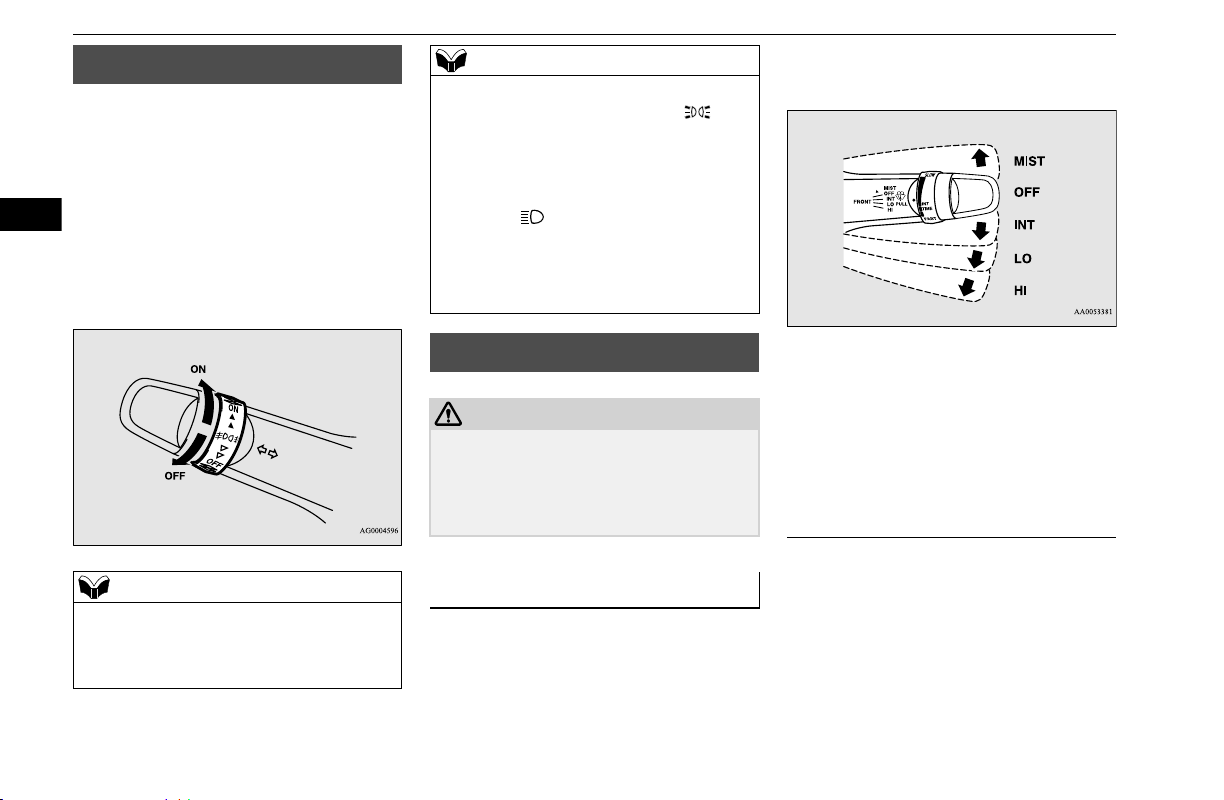
Front fog light switch
5-50 Features and controls
5
N00522801433
The front fog lights illuminate only when the
headlights are on low beam.
Turning the knob in the direction of the “ON”
position turns on the front fog lights as well
as the indicator in the instrument cluster. To
turn them off, turn the knob in the direction of
the “OFF” position.
The knob will return to the neutral position
when it is released.
N00523000640
The windshield wiper and washer can be
operated with the electric motor switch in the
“ON” or “ACC” position.
If the blades are frozen to the windshield, do
not operate the wipers until the ice has melted
and the blades are freed, otherwise the wiper
motor may be damaged.
With the lever in the “INT” (speed sensitive
intermittent operation) position, the intermit-
tent intervals can be adjusted by turning the
knob (A).
Front fog light switch
NOTE
If the headlights are switched to high beam,
the front fog lights will go out; they will illu-
minate again when the headlights are
switched back to low beam.
If the combination headlights and dimmer
switch is rotated to the “OFF” or “ ” posi-
tion while the front fog lights are illumi-
nated, they will automatically turn off. They
can be turned back on again by rotating the
combination headlights and dimmer switch
back to “ ” position, and turning the knob
in the direction of the “ON” position.
Do not use fog lights except in conditions of
fog, otherwise excessive light glare may
temporarily blind oncoming vehicle drivers.
Wiper and washer switch
CAUTION
If the washer is used in cold weather, the
washer fluid sprayed against the glass may
freeze, which may hinder visibility. Warm
the glass with the defroster before using the
washer.
Windshield wipers
NOTE
MIST- Misting function
The wipers will operate once.
OFF- Off
INT- Intermittent (Speed sensitive)
LO- Slow
HI- Fast
To adjust intermittent intervals
BK0220401US.book 50 ページ 2015年6月3日 水曜日 午前7時42分
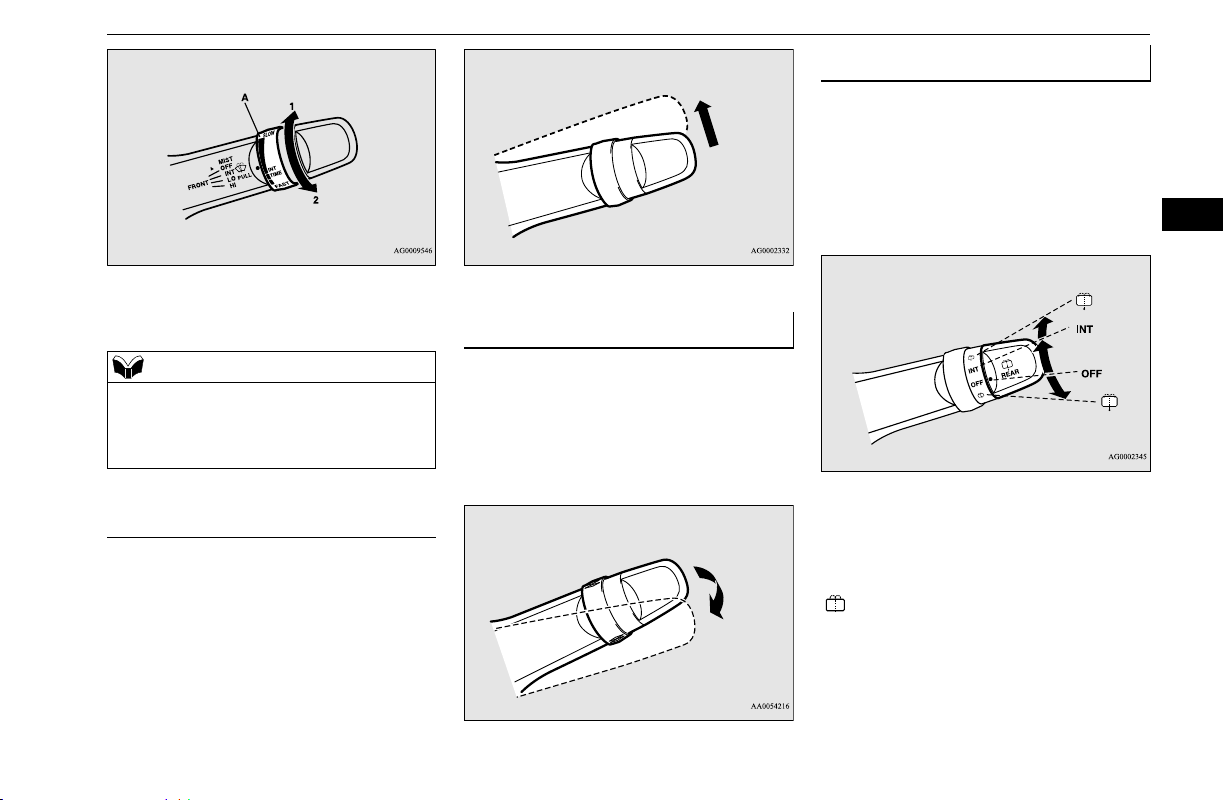
Wiper and washer switch
Features and controls 5-51
5
The wipers will operate once if the wiper
lever is raised to the “MIST” position and
released. This operation is useful when it is
drizzling, etc. The wipers will continue to
operate while the lever is held in the “MIST”
position.
N00504600272
To turn on the windshield washer, pull the
lever toward you with the electric motor
switch in either the “ON” or “ACC” position.
The washer fluid will be sprayed onto the
windshield by pulling the lever toward you.
N00523200394
The rear window wiper and washer can be
operated when the electric motor switch in
either the “ON” or “ACC” position.
Turn the knob to operate the rear window
wiper.
1- Fast
2- Slow
NOTE
The speed-sensitive-operation function of
the windshield wipers can be deactivated.
For further information, please contact a cer-
tified i-MiEV dealer.
Misting function
Windshield washer
Rear window wiper and washer
OFF- Off
INT- The wiper operates continuously for
several seconds then operates inter-
mittently at intervals of about 8 sec-
onds.
-
Washer fluid will be sprayed onto
the rear window glass while the
knob is turned fully in either direc-
tion.
When the washer fluid is sprayed,
the wiper will automatically operate
2 or 3 times.
BK0220401US.book 51 ページ 2015年6月3日 水曜日 午前7時42分
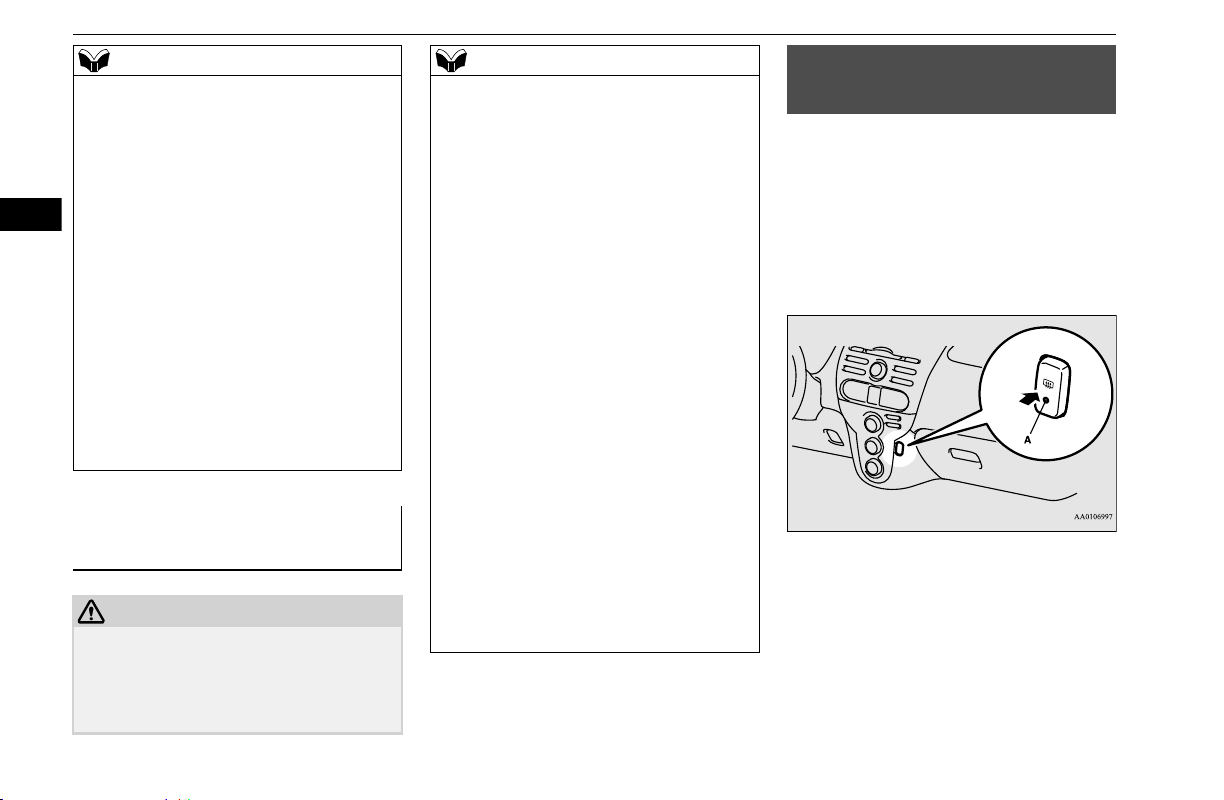
Electric rear window defogger switch
5-52 Features and controls
5
N00523500241
N00523701455
The electric rear window defogger can be
used when the ready indicator is illuminated.
The indicator light (A) will come on when
you press the electric rear window defogger
switch. Electric current will flow through the
heating wires on the rear window to help
clear away moisture or frost.
After about 20 minutes of operation, the sys-
tem will shut off automatically.
To switch the defogger OFF before 20 min-
utes have passed, press the switch again. The
indicator light will go out and the defogger
will turn off.
If you need the defogger for more than 20
minutes, press the switch again. This will add
20 more minutes.
NOTE
To ensure a clear rearward view, the wiper
performs several continuous operations
when the reverse gear is engaged and the
switch is in the “INT” position.
Following this continuous operation, the
wiper will automatically switch to intermit-
tent operation.
It is possible to modify functions as follows:
• Adjustment of the interval for intermittent
operation
• Changing intermittent wiper operation to
continuous wiper operation
For details, consult a certified i-MiEV
dealer.
The washer fluid reservoir is located under-
neath the hood.
Check the fluid level regularly and refill if
necessary. (Refer to “Washer fluid” on page
9-7.)
Precautions to observe when
using wipers and washers
CAUTION
If the washer is used in cold weather, the
washer fluid sprayed onto the glass might
freeze, blocking your view. In cold weather,
heat the glass with the defroster before using
the washer.
NOTE
Do not use the wipers when the windshield is
dry. This could scratch the glass and wear the
wiper blades prematurely.
Before using the wipers in cold weather,
check to be sure that the wiper blades are not
frozen to the windshield. Using the wipers
while the blades are frozen could cause the
wiper motor to burn out.
If the wipers are left on the glass out of the
parked position and they become blocked by
ice or other deposits on the glass, the motor
may still burn out even if the wiper switch is
OFF. If deposits form on the windshield,
park your vehicle in a safe place, turn off the
electric motor switch, and clean the glass so
that the wipers can operate smoothly.
Avoid using the washer for more than 20 sec-
onds at a time. Do not operate the washer
when the fluid reservoir is empty or the
pump may fail.
During cold weather, add a recommended
washer solution that will not freeze in the
washer reservoir. Otherwise the washer may
not work or may be damaged.
Replace the wiper blades when they are
worn. Use the proper size replacement
blades. If you have questions, ask a certified
i-MiEV dealer.
Electric rear window defog-
ger switch
BK0220401US.book 52 ページ 2015年6月3日 水曜日 午前7時42分
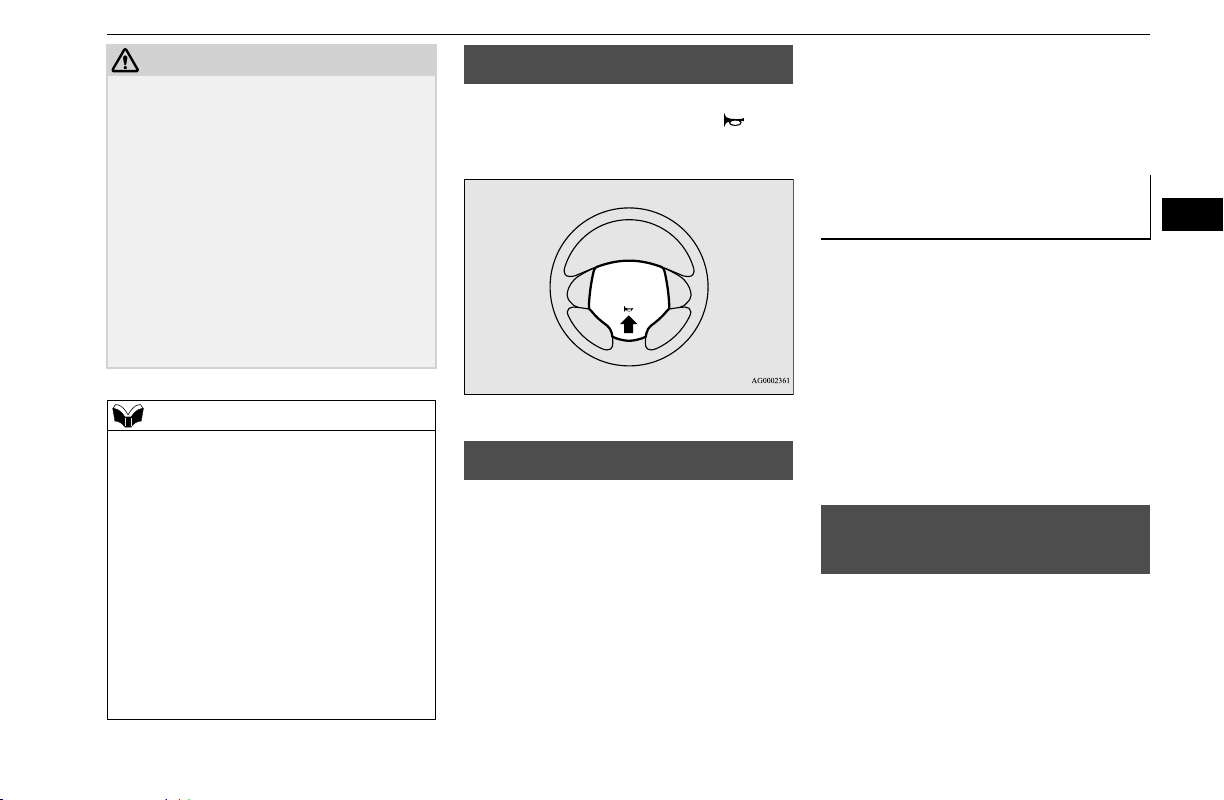
Horn switch
Features and controls 5-53
5
N00523800172
To honk the horn, press around the “ ” mark
on the steering wheel.
N00563700030
The Link System takes overall control of the
devices connected via the USB input terminal
or the Bluetooth
®
2.0 interface allowing the
connected devices to be operated by using the
switches in the vehicle or voice commands.
See the following section for details on how
to operate.
Refer to “Bluetooth
®
2.0 interface” on page
5-53.
Refer to “USB input terminal” on page 5-73.
Refer to “To play iPod/USB memory device
tracks via voice operation” on page 7-20.
Bluetooth
®
is a registered trademark of
BLUETOOTH SIG, INC.
N00563800015
You have acquired a device that includes soft-
ware licensed by Mitsubishi Motors Corpora-
tion from JOHNSON CONTROLS Inc (the
automotive experience business unit), and
their subsequent 3rd party suppliers. For a
complete list of these 3rd party products and
their end user license agreements, please go
to the following website.
http://www.jciblueconnect.com/faq/fulldis-
closure.pdf
N00563901286
The Bluetooth
®
2.0 interface allows for mak-
ing/receiving hands-free calls in the vehicle
using a Bluetooth
®
compatible cellular phone
based on the wireless communication tech-
nology commonly known as Bluetooth
®
. It
also allows the user to play music, saved in a
CAUTION
The rear window defogger is not designed to
melt snow. Remove any snow manually
before using the rear window defogger.
Use the rear window defogger only after the
ready indicator is illuminated. Be sure to turn
the defogger switch off immediately after the
window is clear to save on 12V starter bat-
tery power.
Do not place stickers, tape, or other items
that are attached with adhesive over the grid
wires on the rear window.
When cleaning the inside rear window, use a
soft cloth and wipe lightly over the grid
wires.
NOTE
If your vehicle is equipped with heated mir-
rors, mist can also be removed from the out-
side rearview mirrors when the rear window
defogger switch is pressed. (Refer to
“Heated mirror” on page 5-18.)
The electric rear window defogger is acti-
vated automatically when the Remote Cli-
mate Control is activated in Pre-Defroster
Mode.
Refer to “Remote Climate Control” on page
3-36, 3-47 and “For persons with electro-
medical apparatus such as implantable car-
diac pacemaker or implantable cardiovascu-
lar defibrillator” on page 3-6.
Horn switch
Link System (if so equipped)
Link System End User License
Agreement
Bluetooth
®
2.0 interface (if so
equipped)
BK0220401US.book 53 ページ 2015年6月3日 水曜日 午前7時42分
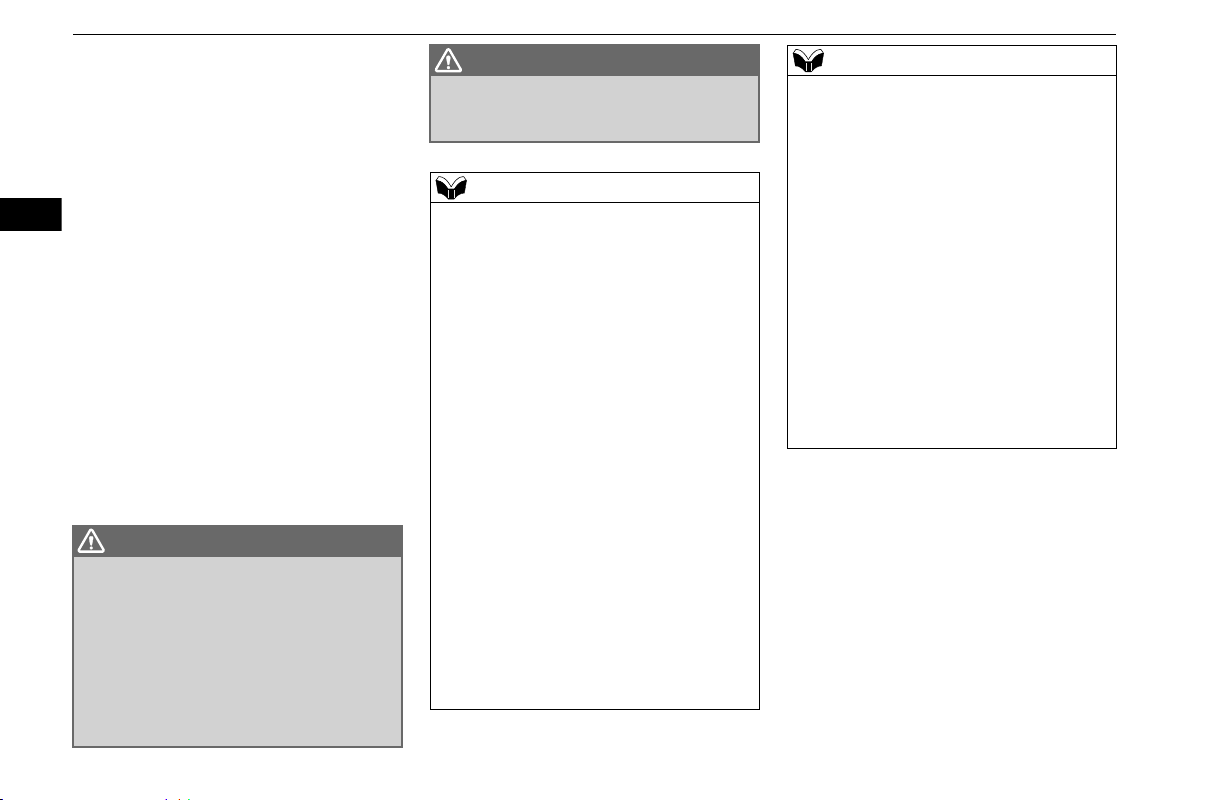
Bluetooth® 2.0 interface (if so equipped)
5-54 Features and controls
5
Bluetooth
®
music player, from the vehicle’s
speakers.
The system is equipped with a voice recogni-
tion function, which allows you to make
hands-free calls by simple switch operations
and voice command operations using a
defined voice tree.
The Bluetooth
®
2.0 interface can be used
when the electric motor switch is in the “ON”
or “ACC” position.
Before you can use the Bluetooth
®
2.0 inter-
face, you must pair the Bluetooth
®
device
and Bluetooth
®
2.0 interface. Refer to “Con-
necting the Bluetooth
®
2.0 interface and
Bluetooth
®
device” on page 5-59.
Bluetooth
®
is a registered trademark of
BLUETOOTH SIG, INC.
Steering control switch and microphone
P.5-55
Voice recognition function P.5-56
Useful voice commands P.5-56
Speaker enrollment function P. 5 - 58
Connecting the Bluetooth
®
2.0 interface and
the Bluetooth
®
device P.5-59
Operating a music player connected via Blue-
tooth
®
P.5-63
How to make or receive hands-free calls
P.5-63
Phonebook function P.5-66
WARNING
Although the Bluetooth
®
2.0 interface
allows you to make hands-free calls, if you
choose to use the cellular phone while
driving, you must not allow yourself to be
distracted from the safe operation of your
vehicle. Anything, including cellular
phone usage, that distracts you from the
safe operation of your vehicle increases
your risk of an accident.
Refer to and comply with all state and
local laws in your area regarding cellular
phone usage while driving.
NOTE
If the electric motor switch is left in the
“ACC” position, the accessory power will
automatically turn off after a certain period
of time and you will no longer be able to use
the Bluetooth
®
2.0 interface. The accessory
power comes on again if the electric motor
switch is turned from the “ACC” position.
Refer to “ACC power auto-cutout function”
on page 5-19.
The Bluetooth
®
2.0 interface cannot be used
if the Bluetooth
®
device has a dead battery
or the device power is turned off.
Hands-free calls will not be possible if your
phone does not have service available.
If you place the Bluetooth
®
device in the
luggage compartment, you may not be able
to use the Bluetooth
®
2.0 interface.
Some Bluetooth
®
devices are not compatible
with the Bluetooth
®
2.0 interface.
You can confirm the Link System software
version by pressing the HANG-UP button 3
times (press and hold 2 times and then press
briefly) within 10 seconds.
WARNING
For detail of the Bluetooth
®
2.0 interface,
refer to the following web site:
[For vehicles sold in U.S.A.]
You can access the Mitsubishi Motors North
America website.
[For vehicles sold in Canada]
You can access the Mitsubishi Motors web-
site.
Please read and agree to the “Warning about
Links to the Web Sites of Other Companies”,
the websites mentioned above may connect
you to websites other than the Mitsubishi
Motors website.
http://www.mitsubishi-motors.com/en/prod-
ucts/index.html
Software updates by cellular phone/digital
audio device manufacturers may
change/alter device connectivity.
NOTE
BK0220401US.book 54 ページ 2015年6月3日 水曜日 午前7時42分
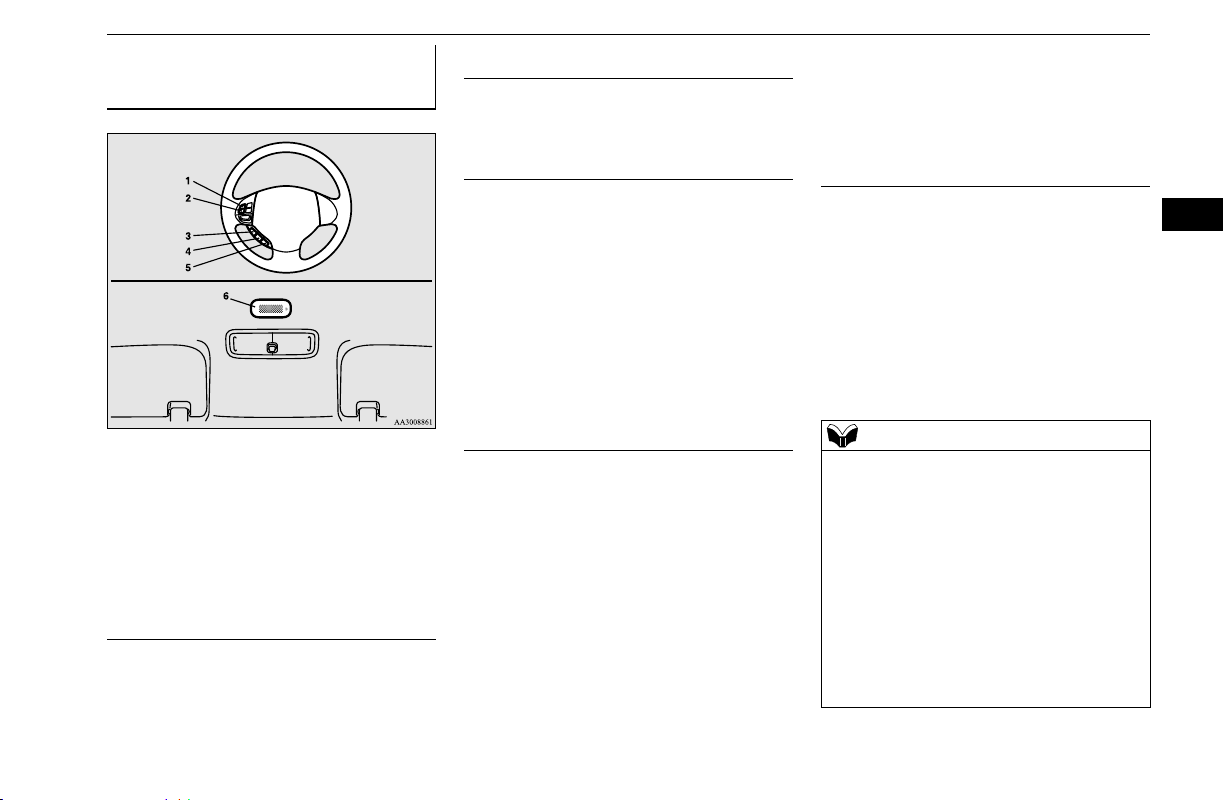
Bluetooth® 2.0 interface (if so equipped)
Features and controls 5-55
5
N00564001170
Press this button to increase the volume.
Press this button to decrease the volume.
Pressing this button will activate the voice
recognition mode of Mitsubishi Multi-
Communication System (a beep will
sound when successfully activated). To
use the voice recognition of the Blue-
tooth
®
2.0 interface, press the PICK-UP
button.
Pressing the SPEECH button longer will
deactivate the voice recognition mode.
Press this button when an incoming call is
received to answer the telephone.
When not receiving incoming calls, press-
ing the PICK-UP button will activate the
voice recognition of the Bluetooth
®
2.0
interface.
When another call is received during a
call, press this button to put the first caller
on hold and talk to the new caller.
• In such circumstances, you can press the
button briefly to switch between callers.
You will switch to the first caller and the
other caller will be put on hold.
• To establish a three-way call in such situ-
ations, press the SPEECH button to enter
voice recognition mode and then say
“Join calls.”
Press this button when an incoming call is
received to refuse the call.
Press this button during a call to end the
current call.
When another call is on hold, you will
switch to that call.
If this button is pressed in the voice recog-
nition mode, the voice recognition mode
will be deactivated.
Steering control switch and
microphone
1- Volume up button
2- Volume down button
3- SPEECH button
4- PICK-UP button
5- HANG-UP button
6- Microphone
Volume up button
Volume down button
SPEECH button
PICK-UP button
HANG-UP button
NOTE
When you press the PICK-UP button to enter
voice recognition mode with a cellular phone
paired to the system, current information on
the cellular phone, such as “remaining bat-
tery life,” “signal strength” or “roaming,”
will be displayed on the audio display.*
*: Some cellular phones will not send this
information to the Bluetooth
®
2.0 interface.
Call waiting and three-way calls can be used
by the Bluetooth
®
2.0 interface, only if it is
possible to use those services with your cel-
lular phone.
BK0220401US.book 55 ページ 2015年6月3日 水曜日 午前7時42分
Bluetooth® 2.0 interface (if so equipped)
5-56 Features and controls
5
Your voice will be recognized by a micro-
phone in the overhead console, allowing you
to make hands-free calls with voice com-
mands.
N00564101168
The Bluetooth
®
2.0 interface is equipped
with a voice recognition function.
Simply say voice commands and you can per-
form various operations and make or receive
hands-free calls.
With the Bluetooth
®
2.0 interface, voice rec-
ognition is possible for US English, North
American Spanish, Canadian French and Jap-
anese. The factory setting is “English.”
1. Press the PICK-UP button.
2. Say “Setup.”
3. Say “Language.”
4. The voice guide will say “Select a lan-
guage: English, Spanish, French or Japa-
nese.” Say the desired language.
(Example: “English”)
5. The voice guide will say “English (Span-
ish, French or Japanese) selected. Is this
correct?” Say “Yes.”
If you say “No,” the system will return to
Step 4.
6. When the voice guide says “English
(Spanish, French or Japanese) selected,”
the language change process will be com-
pleted and the system will return to the
main menu.
N00564200016
N00564300017
The Bluetooth
®
2.0 interface is equipped
with a help function.
If you say “Help” when the system is waiting
for a voice command input, the system will
tell you a list of the commands that can be
used under the circumstances.
Microphone
NOTE
If a cellular phone is within close proximity
of the microphone, it may distort the sound
quality. In this case, place the cellular phone
as far as possible from the microphone.
Voice recognition function
NOTE
If the voice command that you say differs
from the predefined command or cannot be
recognised due to ambient noise or some
other reason, the Bluetooth
®
2.0 interface
will ask you for the voice command again up
to 3 times.
For best performance and further reduction
of ambient noise, the vehicle windows
should be closed, lower the blower speed and
refrain from conversation with your passen-
gers while engaging the voice recognition
function.
Depending on the selected language, some
functions may not be available.
Selecting the language
NOTE
The voice guide will repeat the same mes-
sage twice. The first message is in the cur-
rent language, and the second message is in
the selected language.
If many entries are registered in the vehicle
phonebook, changing the language will take
a longer time.
Changing the language deletes the mobile
phonebook imported to the Bluetooth
®
2.0
interface. If you wish to use it, you will have
to import it again.
Useful voice commands
Help function
BK0220401US.book 56 ページ 2015年6月3日 水曜日 午前7時42分
Bluetooth® 2.0 interface (if so equipped)
Features and controls 5-57
5
N00564400018
There are 2 cancel functions.
If you are at the main menu, say “Cancel” to
exit from the Bluetooth
®
2.0 interface.
If you are anywhere else within the system,
say “Cancel” to return to the main menu.
N00564501061
The Bluetooth
®
2.0 interface is equipped
with a confirmation function.
With the confirmation function activated, you
are given more opportunities than normal to
confirm a command when making various
settings to the Bluetooth
®
2.0 interface. This
allows you to decrease the possibility that a
setting is accidentally changed.
The confirmation function can be turned on
or off by following the steps below.
1. Press the PICK-UP button.
2. Say “Setup.”
3. Say “Confirmation prompts.”
4. The voice guide will say “Confirmation
prompts are <on/off>. Would you like to
turn confirmation prompts <off/on>.”
Answer “Yes” to change the setting or
answer “No” to keep the current setting.
5. The voice guide will say “Confirmation
prompts are <off/on>” and then the sys-
tem will return to the main menu.
N00564601163
It is possible to use a passcode as a security
function by setting a passcode of your choice
for the Bluetooth
®
2.0 interface.
When the security function is turned on, it is
necessary to make a voice input of a 4-digit
passcode in order to use all functions of the
Bluetooth
®
2.0 interface, except for recep-
tion.
Use the following procedure to turn on the
security function by setting a passcode.
1. Press the PICK-UP button.
2. Say “Setup.”
3. Say “Passcode.”
4. The voice guide will say “Passcode is dis-
abled. Would you like to enable it?”
Answer “Yes.”
Answer “No” to cancel the setting of the
passcode and return to the main menu.
5. The voice guide will say “Please say a 4-
digit passcode. Remember this passcode.
It will be required to use this system.”
Say a 4-digit number which you want to
set as a passcode.
6. For confirmation purposes, the voice
guide will say “Passcode <4-digit pass-
code>. Is this correct?” Answer “Yes.”
Answer “No” to return to the passcode
input in Step 5.
7. When the registration of the passcode is
completed, the voice guide will say “Pass-
code is enabled” and the system will
return to the main menu.
If a passcode has been set and the security
function is enabled, the voice guide will say
“Hands-free system is locked. State the pass-
code to continue” when the PICK-UP button
is pressed to enter voice recognition mode.
Canceling
Confirmation function setting
Security function
Setting the passcode
NOTE
Passcode will be required to access the sys-
tem after restarting the electric motor unit.
It is required for a little time after the ready
indicator has turned off that the entered pass-
code is actually recorded in the system. If the
electric motor switch is made to “ACC” or
“ON” or the electric motor is started immedi-
ately after the ready indicator has turned off,
there is a case when the entered passcode is
not recorded in the system. At this time,
please try to enter the passcode again.
Entering the passcode
BK0220401US.book 57 ページ 2015年6月3日 水曜日 午前7時42分
Bluetooth® 2.0 interface (if so equipped)
5-58 Features and controls
5
Say the 4-digit passcode number to enter the
passcode.
If the entered passcode is wrong, the voice
guide will say “<4-digit passcode>, Incorrect
passcode. Please try again.” Enter the correct
passcode.
Use the following procedure to turn off the
security function by disabling the passcode.
1. Press the PICK-UP button.
2. Say “Setup.”
3. Say “Passcode.”
4. The voice guide will say “Passcode is
enabled. Would you like to disable it?”
Answer “Yes.”
Answer “No” to cancel the disabling of
the passcode and return to the main menu.
5. When the disabling of the passcode is
completed, the voice guide will say “Pass-
code is disabled” and the system will
return to the main menu.
N00564700011
The Bluetooth
®
2.0 interface can use the
speaker enrollment function to create a voice
model for one person per language.
This makes it easier for the Bluetooth
®
2.0
interface to recognise voice commands said
by you.
You can turn a voice model registered with
the speaker enrollment function on and off
whenever you want.
N00564801149
It takes about 2 to 3 minutes to complete the
speaker enrollment process.
To ensure the best results, run through the
process while in the driver’s seat, in an envi-
ronment that is as quiet as possible (when
there is no rain or strong winds and the vehi-
cle windows are closed). Please turn off your
phone while in speaker enrollment to prevent
interruption of the process.
Use the following procedure for speaker
enrollment.
1. Stop your vehicle in a safe area, put the
selector lever in the “P” (PARK) position,
and then pull the parking brake lever.
2. Press the PICK-UP button.
3. Say “Voice training.”
4. The voice guide will say “This operation
must be performed in a quiet environment
while the vehicle is stopped. See the
owner’s manual for the list of required
training phrases. Press and release the
SPEECH button when you are ready to
begin. Press the HANG-UP button to can-
cel at any time.”
Press the SPEECH button to start the
speaker enrollment process.
NOTE
You can reenter the passcode as many times
as you want.
If you have forgotten your passcode, say
“Cancel” to quit the voice input mode and
then check with a certified i-MiEV dealer.
Disabling the passcode
NOTE
System must be unlocked to disable the pass-
code.
Speaker enrollment function
Speaker enrollment
NOTE
Speaker enrollment is not possible unless the
vehicle is parked. Make sure you park the
vehicle in a safe area before attempting
speaker enrollment.
NOTE
If you do not start the speaker enrollment
process within 3 minutes after pressing the
SPEECH button, the speaker enrollment
function will time out.
The voice guide will say “Speaker enroll-
ment has timed out.” The system will then
beep and the voice recognition mode will be
deactivated.
BK0220401US.book 58 ページ 2015年6月3日 水曜日 午前7時42分
Bluetooth® 2.0 interface (if so equipped)
Features and controls 5-59
5
5. The voice guide will prompt for phrase 1.
Repeat the corresponding phrase listed in
table “Enrollment commands” on page
5-73.
The system will register your voice and
then move on to the registration of the
next command. Continue the process until
all phrases have been registered.
6. When all enrollment commands have
been read out, the voice guide will say
“Speaker enrollment is complete.” The
system will then end the speaker enroll-
ment process and return to the main
menu.
N00564901108
You can turn a voice model registered with
the speaker enrollment function on and off
whenever you want.
You can also retrain the system.
Use the following procedure to perform these
actions.
1. Press the PICK-UP button.
2. Say “Voice training.”
3. If you have completed a speaker enroll-
ment process once already, the voice
guide will say either “Enrollment is
enabled. Would you like to disable or
retrain?” or “Enrollment is disabled.
Would you like to enable or retrain?”
4. When enrollment is “enabled,” the voice
model is on; when enrollment is “dis-
abled,” the voice model is off. Say the
command that fits your needs.
Say “Retrain” to start the speaker enroll-
ment process and recreate a new voice
model. (Refer to “Speaker enrollment” on
page 5-58.)
N00565001278
Before you can make or receive hands-free
calls or play music using the Bluetooth
®
2.0
interface function, you must pair the Blue-
tooth
®
device and Bluetooth
®
2.0 interface.
Up to 7 Bluetooth
®
devices can be paired
with the Bluetooth
®
2.0 interface.
If multiple paired Bluetooth
®
devices are
available in the vehicle, the cellular phone or
music player most recently connected is auto-
matically connected to the Bluetooth
®
2.0
interface.
You can also change a Bluetooth
®
device to
be connected.
NOTE
To repeat the most recent voice training com-
mand, press and release the SPEECH button.
If you press the HANG-UP button anytime
during the process, the system will beep and
stop the speaker enrollment process.
NOTE
Completing the speaker enrollment process
will turn on the voice model automatically.
The commands “Help” and “Cancel” will not
work in this mode.
Enabling and disabling the voice
model and retraining
Connecting the Bluetooth
®
2.0
interface and Bluetooth
®
device
NOTE
Pairing is required only when the device is
used for the first time. Once the device has
been paired with the Bluetooth
®
2.0 inter-
face, all you need is to bring the device into
the vehicle next time and the device will
connect to the Bluetooth
®
2.0 interface auto-
matically (if supported by the device).
BK0220401US.book 59 ページ 2015年6月3日 水曜日 午前7時42分
Bluetooth® 2.0 interface (if so equipped)
5-60 Features and controls
5
To pair a Bluetooth
®
device with the Blue-
tooth
®
2.0 interface, follow the steps below.
1. Stop your vehicle in a safe area, put the
selector lever in the “P” (PARK) position,
and then pull the parking brake lever.
2. Press the PICK-UP button.
3. Say “Setup.”
4. Say “Pairing Options.”
5. The voice guide will say “Select one of
the following: pair, edit, delete, or list.”
Say “Pair.”
6. The voice guide will say “Please say a 4-
digit pairing code.” Say a 4-digit number.
When the confirmation function is on, the
system will confirm whether the number
said is acceptable. Answer “Yes.”
Answer “No” to return to pairing code
selection.
7. The voice guide will say “Start pairing
procedure on the device. See the device
manual for instructions.” Enter in the
Bluetooth
®
device the 4-digit number you
have registered in Step 6.
To p a ir
NOTE
You cannot pair any Bluetooth
®
device with
the Bluetooth
®
2.0 interface unless the vehi-
cle is parked. Before paring a Bluetooth
®
device with the Bluetooth
®
2.0 interface,
confirm that the vehicle is parked in a safe
location.
NOTE
If 7 devices have already been paired, the
voice guide will say “Maximum devices
paired” and then the system will end the
pairing process. To register a new device,
delete one device and then repeat the pairing
process.
(Refer to “Deleting a device” on page 5-61.)
NOTE
Some Bluetooth
®
devices require a specific
pairing code. Please refer to the device man-
ual for pairing code requirements.
The pairing code entered here is only used
for the Bluetooth
®
connection certification.
It is any 4-digit number the user would like
to select.
Remember the pairing code as it needs to be
keyed into the Bluetooth
®
device later in the
pairing process.
Depending on the connection settings of the
Bluetooth
®
device, this code may have to be
entered each time you connect the Blue-
tooth
®
device to the Bluetooth
®
2.0 inter-
face. For the default connection settings,
refer to the instructions for the device.
NOTE
Depending on the device, it might take a few
minute to pair the Bluetooth
®
device with
the Bluetooth
®
2.0 interface.
If the Bluetooth
®
2.0 interface cannot recog-
nize the Bluetooth
®
device, the voice guide
will say “Pairing has timed out” and the pair-
ing process will be cancelled.
Confirm that the device you are pairing sup-
ports Bluetooth
®
, and try pairing it again.
NOTE
BK0220401US.book 60 ページ 2015年6月3日 水曜日 午前7時42分
Bluetooth® 2.0 interface (if so equipped)
Features and controls 5-61
5
8. The voice guide will say “Please say the
name of the device after the beep.” You
can assign a desired name for the Blue-
tooth
®
device and register it as a device
tag. Say the name you want to register
after the beep.
9. The voice guide will say “Pairing com-
plete,” and the pairing process will end.
N00565101123
If multiple paired Bluetooth
®
devices are
available in the vehicle, the cellular phone or
music player most recently connected is auto-
matically connected to the Bluetooth
®
2.0
interface.
You can connect to the other cellular phone or
music player by following setting change pro-
cedures.
1. Press the PICK-UP button.
2. Say “Setup.”
3. Say “Select phone.”
4. After the voice guide says “Please say,”
the numbers of the cellular phones and
device tags of corresponding cellular
phones will be read out in order, starting
with the cellular phone that has been most
recently connected.
Say the number of the cellular phone that
you want to connect to.
When the confirmation function is on, the
system will ask you again whether the
phone that you want to connect to is cor-
rect. Answer “Yes” to continue and con-
nect to the cellular phone.
Answer “No,” and the voice guide will
say “Please say.” Say the number of the
phone that you want to connect to.
5. The selected phone will be connected to
the Bluetooth
®
2.0 interface. The voice
guide will say “<device tag> selected”
and then the system will return to the
main menu.
1. Press the PICK-UP button.
2. Say “Setup.”
3. Say “Select music player.”
4. After the voice guide says “Please say,”
the numbers of the music players and
device tags of corresponding music play-
ers will be read out in order, starting with
the music player that has been most
recently connected.
Say the number of the music player that
you want to connect to.
When the confirmation function is on, the
system will ask you again whether the
music player that you want to connect to
is correct. Answer “Yes” to continue and
connect to the music player.
If you enter the wrong number, the voice
guide will say “Pairing failed” and the pair-
ing process will be cancelled.
Confirm the number is right, and try pairing
it again.
NOTE
When the confirmation function is on, after
repeating the device tag you have said, the
voice guide will ask “Is this correct?”
Answer “Yes.”
To change the device tag, answer “No” and
then say the device tag again.
Selecting a device
NOTE
To select a cellular phone
NOTE
You can connect to a phone at any time by
pressing the SPEECH button and saying the
number, even before all of the paired num-
bers and device tags of corresponding cellu-
lar phones are read out by the system.
To sel ect a music player
BK0220401US.book 61 ページ 2015年6月3日 水曜日 午前7時42分
Bluetooth® 2.0 interface (if so equipped)
5-62 Features and controls
5
Answer “No,” and the voice guide will
say “Please say.” Say the number of the
music player that you want to connect to.
5. The selected music player will be con-
nected to the Bluetooth
®
2.0 interface.
The voice guide will say “<device tag>
selected” and then the system will return
to the main menu.
Use the following procedure to delete a
paired Bluetooth
®
device from the Blue-
tooth
®
2.0 interface.
1. Press the PICK-UP button.
2. Say “Setup.”
3. Say “Pairing Options.”
4. The voice guide will say “Select one of
the following: pair, edit, delete, or list.”
Say “Delete.”
5. After the voice guide says “Please say,”
the numbers of the devices and device
tags of corresponding devices will be read
out in order, starting with the device that
has been most recently connected. After it
completes reading all pairs, the voice
guide will say “or all.”
Say the number of the device that you
want to delete from the system.
If you want to delete all paired phones
from the system, say “All.”
6. For confirmation purposes, the voice
guide will say “Deleting <device tag>
<number>. Is this correct?” or “Deleting
all devices. Is this correct?”
Answer “Yes” to delete the phone(s).
Answer “No,” the system will return to
Step 4.
7. The voice guide will say “Deleted,” and
then the system will end the device dele-
tion process.
N00565201065
You can check a paired Bluetooth
®
device by
following the steps below.
1. Press the PICK-UP button.
2. Say “Setup.”
3. Say “Pairing Options.”
4. The voice guide will say “Select one of
the following: pair, edit, delete, or list.”
Say “List.”
5. The voice guide will read out device tags
of corresponding devices in order, starting
with the Bluetooth
®
device that has been
most recently connected.
6. After the device tags of all paired Blue-
tooth
®
devices have been read, the system
will say “End of list, would you like to
start from the beginning?”
To hear the list again from the beginning,
answer “Yes.”
When you are done, answer “No” to
return to the main menu.
NOTE
You can connect to a music player at any
time by pressing the SPEECH button and
saying the number, even before all of the
paired numbers and device tags of corre-
sponding music players are read out by the
system.
Deleting a device
NOTE
If the device deletion process fails for some
reason, the voice guide will say “Delete
failed” and then the system will cancel delet-
ing the device.
To check a paired Bluetooth
®
device
BK0220401US.book 62 ページ 2015年6月3日 水曜日 午前7時42分
Bluetooth® 2.0 interface (if so equipped)
Features and controls 5-63
5
N00565301066
You can change the device tag of a paired cel-
lular phone or music player.
Follow the steps below to change a device
tag.
1. Press the PICK-UP button.
2. Say “Setup.”
3. Say “Pairing Options.”
4. The voice guide will say “Select one of
the following: pair, edit, delete, or list.”
Say “Edit.”
5. The voice guide will say “Please say,” and
read out the numbers of the Bluetooth
®
devices and device tags of corresponding
devices in order, starting with the Blue-
tooth
®
that has been most recently con-
nected.
After all paired device tags have been
read, the voice guide will say “Which
device, please?” Say the number of the
device tag you want to change.
6. The voice guide will say “New name,
please.” Say the name you want to regis-
ter as a new device tag.
When the confirmation function is on, the
voice guide will say “<New device tag>.
Is this correct?” Answer “Yes.”
Answer “No,” you can say the new device
tag you want to register again.
7. The device tag is changed.
When the change is complete, the voice
guide will say “New name saved” and
then the system will return to the main
menu.
N00565400028
For the operation of a music player connected
via Bluetooth
®
, refer to “To play iPod/USB
memory device tracks via voice operation” on
page 7-20.
N00565500061
You can make or receive hands-free calls
using a Bluetooth
®
compatible cellular phone
connected to the Bluetooth
®
2.0 interface.
You can also use the phonebooks in the Blue-
tooth
®
2.0 interface to make calls without
dialling telephone numbers.
To make a call P.5-64
Send function P.5-65
Receiving calls P.5-65
Mute function P.5-65
Switching between hands-free mode and pri-
vate mode P.5-66
NOTE
If you press and release the SPEECH button
and say “Continue” or “Previous” while the
list is being read, the system will advance or
rewind the list.
Say “Continue” to proceed to the device with
the next highest number or “Previous” to
return to the phone with the previous num-
ber.
You can change the device tag by pressing
and releasing the SPEECH button and then
saying “Edit” while the list is being read.
You can change the phone to be connected
by pressing and releasing the SPEECH but-
ton and then saying “Select phone” while the
list is being read.
You can change the music player to be con-
nected by pressing and releasing the
SPEECH button and then saying “Select
music player” while the list is being read.
Changing a device tag
NOTE
You can press and release the SPEECH but-
ton while the list is being read, and immedi-
ately say the number of the device tag you
want to change.
Operating a music player con-
nected via Bluetooth
®
How to make or receive hands-
free calls
BK0220401US.book 63 ページ 2015年6月3日 水曜日 午前7時42分
Bluetooth® 2.0 interface (if so equipped)
5-64 Features and controls
5
N00565601131
You can make a call in the following 3 ways
using the Bluetooth
®
2.0 interface:
Making a call by saying a telephone number,
making a call using the Bluetooth
®
2.0 inter-
face’s phonebook, and making a call by redi-
aling.
You can make a call by saying the telephone
number.
1. Press the PICK-UP button.
2. Say “Dial.”
3. After the voice guide says “Number
please,” say the telephone number.
4. The voice guide will say “Dialing <num-
ber recognized>.”
The Bluetooth
®
2.0 interface will then
make the call.
When the confirmation function is on, the
system will confirm the telephone number
again. To continue with that number,
answer “Yes.”
To change the telephone number, answer
“No.” The system will say “Number
please” then say the telephone number
again.
You can make calls using the vehicle phone-
book or mobile phonebook of the Bluetooth
®
2.0 interface.
For details on the phonebooks, refer to
“Phonebook function” on page 5-66.
1. Press the PICK-UP button.
2. Say “Call.”
3. After the voice guide says “Name please,”
say the name you want to call, from those
registered in the phonebook.
4. If there is only 1 match, the system will
proceed to Step 5.
If there are 2 or more matches, the voice
guide will say “More than one match was
found, would you like to call <returned
name>.” If that person is the one you want
to call, answer “Yes.”
Answer “No,” the name of the next
matching person will be uttered by the
voice guide.
NOTE
The hands-free calls might not be operated
correctly when it makes calling or receiving
by operating the cellular phone directly.
To m a k e a call
Making a call by using the telephone
number
NOTE
In the case of English, the system will recog-
nise both “zero” and “oh” (Letter “o”) for the
number “0.”
The Bluetooth
®
2.0 interface supports num-
bers (0 to 9) and characters (+, # and *).
The maximum supported telephone number
length is as follows:
• International telephone number: + and tele-
phone numbers (to 18 digits).
• Except for international telephone number:
telephone numbers (to 19 digits).
Making a call using a phonebook
NOTE
If you say “Call” when the vehicle phone-
book and the mobile phonebook are empty,
the voice guide will say “The vehicle phone-
book is empty. Would you like to add a new
entry now?”
Answer “Yes,” and the voice guide will say
“Entering the phonebook - new entry menu.”
You can now create data in the vehicle
phonebook.
Answer “No,” the system will return to the
main menu.
NOTE
If you say “No” to all names read by the sys-
tem, the voice guide will say “Name not
found, returning to main menu” and the sys-
tem will return to the main menu.
BK0220401US.book 64 ページ 2015年6月3日 水曜日 午前7時42分
Bluetooth® 2.0 interface (if so equipped)
Features and controls 5-65
5
5. If only 1 telephone number is registered
under the name you just said, the voice
guide will proceed to Step 6.
If 2 or more telephone numbers are regis-
tered that match the name you just said,
the voice guide will say “Would you like
to call <name> at [home], [work],
[mobile], or [other]?” Select the location
to call.
6. The voice guide will say “Calling <name>
<location>” and then the system will dial
the telephone number.
You can redial the last number called, based
on the history of dialed calls in the paired cel-
lular phone.
Use the following procedure to redial.
1. Press the PICK-UP button.
2. Say “Redial.”
N00565700018
During a call, press the SPEECH button to
enter voice recognition mode, then say
“<numbers> SEND” to generate DTMF
tones.
For example, if during a call you need to sim-
ulate the pressing of a phone button as a
response to an automated system, press the
SPEECH button and speak “1 2 3 4 pound
send” and the 1234# will be sent via your cel-
lular phone.
N00565800022
If an incoming phone call is received while
the electric motor switch is in the “ACC” or
“ON” position, the audio system will be auto-
matically turned on and switched to the
incoming call, even when the audio system
was originally off.
The voice guide announcement for the
incoming call will be output from the front
passenger’s seat speaker.
If the CD player or radio was playing when
the incoming call was received, the audio sys-
tem will mute the sound from the CD player
or radio and output only the incoming call.
To receive the call, press the PICK-UP button
on the steering wheel control switch.
When the call is over, the audio system will
return to its previous state.
N00565900010
At any time during a call, you can mute the
vehicle microphone.
Pressing the SPEECH button and then saying
“Mute” during a call will turn ON the mute
function and mute the microphone.
NOTE
If the name you selected has matching data
in the vehicle phonebook but no telephone
number is registered under the selected loca-
tion, the voice guide will say
“{home/work/mobile/other} not found for
<name>. Would you like to add location or
try again?”
Say “Try again,” and the system will return
to Step 3.
Say “Add location” and you can register an
additional telephone number under the
selected location.
If the name you selected has matching data
in the mobile phonebook but no telephone
number is registered under the selected loca-
tion, the voice guide will say
“{home/work/mobile/other} not found for
<name>. Would you like to try again?”
Answer “Yes,” and the system will return to
Step 3.
Answer “No,” and the call making will be
cancelled. Start over again from Step 1.
NOTE
When the confirmation function is on, the
system will check if the name and location of
the receiver are correct. If the name is cor-
rect, answer “Yes.”
To change the name or location to call,
answer “No.” The system will return to Step
3.
Redialing
Send function
Receiving calls
Mute function
BK0220401US.book 65 ページ 2015年6月3日 水曜日 午前7時42分
Bluetooth® 2.0 interface (if so equipped)
5-66 Features and controls
5
Saying “Mute off” in the same way will turn
off the mute function and cancel the mute on
the microphone.
N00566600014
The Bluetooth
®
2.0 interface can switch
between hands-free mode (hands-free calls)
and private mode (calls using cellular phone).
If you press the SPEECH button and say
“Transfer call” during a hands-free call, you
can stop the hands-free mode and talk in pri-
vate mode.
To return to hands-free mode, press the
SPEECH button again and say “Transfer
call.”
N00566000018
The Bluetooth
®
2.0 interface has 2 types of
unique phonebooks that are different from the
phonebook stored in the cellular phone. They
are the vehicle phonebook and the mobile
phonebook.
These phonebooks are used to register tele-
phone numbers and make calls to desired
numbers via voice recognition function.
N00566101120
This phonebook is used when making calls
with the voice recognition function.
Up to 32 names can be registered in the vehi-
cle phonebook per language.
Also, each entry has 4 locations associated
with: home, work, mobile and other. You can
register one telephone number for each loca-
tion.
You can register a desired name as a name for
any phonebook entry registered in the vehicle
phonebook.
Names and telephone numbers can be
changed later on.
The vehicle phonebook can be used with all
paired cellular phones.
N00580500059
You can register a telephone number in the
vehicle phonebook in the following 2 ways:
Reading out a telephone number, and select-
ing and transferring 1 phonebook entry from
the phonebook of the cellular phone.
N00580600106
1. Press the PICK-UP button.
2. Say “Phonebook.”
3. The voice guide will say “Select one of
the following: new entry, edit number,
edit name, list names, delete, erase all, or
import contact.” Say “New entry.”
4. The voice guide will say “Name please.”
Say your preferred name to register it.
5. When the name has been registered, the
voice guide will say “home, work,
mobile, or other?” Say the location for
which you want to register a telephone
number.
Switching between hands-free
mode and private mode
Phonebook function
NOTE
Disconnecting the battery cable will not
delete information registered in the phone-
book.
Vehicle phonebook
To register a telephone number in
the vehicle phonebook
To register by reading out a tele-
phone number
NOTE
If the maximum number of entries are
already registered, the voice guide will say
“The phonebook is full. Would you like to
delete a name?” Say “Yes” if you want to
delete a registered name.
If you say “No,” the system will return to the
main menu.
BK0220401US.book 66 ページ 2015年6月3日 水曜日 午前7時42分
Bluetooth® 2.0 interface (if so equipped)
Features and controls 5-67
5
6. The voice guide will say “Number
please.” Say the telephone number to reg-
ister it.
7. The voice guide will repeat the telephone
number you have just read, and then reg-
ister the number.
When the telephone number has been reg-
istered, the voice guide will say “Number
saved. Would you like to add another
number for this entry?”
To add another telephone number for a
new location for the current entry, answer
“Yes.” The system will return to location
selection in Step 5.
Answer “No” to end the registration pro-
cess and return to the main menu.
N00580700080
You can select 1 phonebook entry from the
phonebook of the cellular phone and register
it in the vehicle phonebook.
1. Press the PICK-UP button.
2. Say “Phonebook.”
3. The voice guide will say “Select one of
the following: new entry, edit number,
edit name, list names, delete, erase all, or
import contact.” Say “Import contact.”
4. The voice guide will say “Would you like
to import a single entry or all contacts?”
Say “Single entry.”
The Bluetooth
®
2.0 interface will become
ready to receive transferred phonebook
data.
NOTE
When the confirmation function is on, the
voice guide will say “<Location>. Is this cor-
rect?” Answer “Yes.”
Answer “No” to return to location selection
in Step 5.
If a telephone number has been registered for
the selected location, the voice guide will say
“The current number is <telephone number>,
number please.”
If you do not want to change the telephone
number, say “cancel” or the original number
to keep it registered.
NOTE
In the case of English, the system will recog-
nise both “zero” and “oh” (Letter “o”) for the
number “0.”
NOTE
When the confirmation function is on, after
repeating the telephone number you have
read, the voice guide will ask “Is this cor-
rect?” Answer “Yes.”
Answer “No” to return to telephone number
registration in step 6.
To select and transfer one phone-
book entry from the phonebook of
the cellular phone
NOTE
Transfer is not permitted unless the vehicle is
parked. Before transferring, make sure that
the vehicle is parked in a safe location.
All or part of data may not be transferred,
even when the cellular phone supports Blue-
tooth
®
, depending on the compatibility of
the device.
The maximum supported telephone number
length is 19 digits. Any telephone number of
20 digits or more will be truncated to the first
19 digits.
If telephone numbers contain characters
other than 0 to 9, *, # or +, these characters
are deleted before the transfer.
For the connection settings on the cellular
phone side, refer to the instructions for the
cellular phone.
NOTE
If the maximum number of entries are
already registered, the voice guide will say
“The phonebook is full. Would you like to
delete a name?” Say “Yes” if you want to
delete a registered name.
If you say “No,” the system will return to the
main menu.
NOTE
BK0220401US.book 67 ページ 2015年6月3日 水曜日 午前7時42分
Bluetooth® 2.0 interface (if so equipped)
5-68 Features and controls
5
5. After the voice guide says “Ready to
receive a contact from the phone. Only a
home, a work, and a mobile number can
be imported,” the Bluetooth
®
2.0 inter-
face will receive the phonebook data from
the Bluetooth
®
compatible cellular phone.
6. Operate the Bluetooth
®
compatible cellu-
lar phone to set it up so that the phone-
book entry you want to register in the
vehicle phonebook can be transferred to
the Bluetooth
®
2.0 interface.
7. When the reception is complete, the voice
guide will say “<Number of telephone
numbers that had been registered in the
import source> numbers have been
imported. What name would you like to
use for these numbers?”
Say the name you want to register for this
phonebook entry.
8. The voice guide will say “Adding
<name>.”
When the confirmation function is on, the
system will ask if the name is correct.
Answer “Yes.”
Answer “No,” the voice guide will say
“Name please.” Register a different name.
9. The voice guide will say “Numbers
saved.”
10. The voice guide will say “Would you like
to import another contact?”
Answer “Yes” if you want to continue
with the registration. You can continue to
register a new phonebook entry from Step
5.
Answer “No,” the system will return to
the main menu.
N00579800049
You can change or delete a name or telephone
number registered in the vehicle phonebook.
You can also listen to the list of names regis-
tered in the vehicle phonebook.
N00579900082
1. Press the PICK-UP button.
2. Say “Phonebook.”
3. The voice guide will say “Select one of
the following: new entry, edit number,
edit name, list names, delete, erase all, or
import contact”. Say “Edit number.”
4. The voice guide will say “Please say the
name of the entry you would like to edit,
or say list names.” Say the name of the
phonebook entry you want to edit.
5. The voice guide will say “Home, work,
mobile or other?” Select and say the loca-
tion where the telephone number you
want to change or add is registered.
NOTE
If the Bluetooth
®
2.0 interface cannot recog-
nise the Bluetooth
®
compatible cellular
phone or the connection takes too much
time, the voice guide will say “Import con-
tact has timed out” and then the system will
cancel the registration. In such case, start
over again from Step 1.
Pressing the HANG-UP button or pressing
and holding the SPEECH button will cancel
the registration.
NOTE
If the entered name is already used for other
phonebook entry or similar to a name used
for other phonebook entry, that name cannot
be registered.
To change the content registered in
the vehicle phonebook
NOTE
The system must have at least one entry.
Editing a telephone number
NOTE
Say “List names,” and the names registered
in the phonebook will be read out in order.
Refer to “Listening to the list of registered
names” on page 5-69.
BK0220401US.book 68 ページ 2015年6月3日 水曜日 午前7時42分
Bluetooth® 2.0 interface (if so equipped)
Features and controls 5-69
5
When the confirmation function is on, the
system will check the target name and
location again. Answer “Yes” if you want
to continue with the editing.
Answer “No,” the system will return to
Step 3.
6. The voice guide will say “Number,
please.” Say the telephone number you
want to register.
7. The voice guide will repeat the telephone
number.
When the confirmation function is on, the
system will ask if the number is correct.
Answer “Yes.”
Answer “No,” the system will return to
the Step 3.
8. Once the telephone number is registered,
the voice guide will say “Number saved”
and then the system will return to the
main menu.
N00580100084
1. Press the PICK-UP button.
2. Say “Phonebook.”
3. The voice guide will say “Select one of
the following: new entry, edit number,
edit name, list names, delete, erase all, or
import contact.” Say “Edit name.”
4. The voice guide will say “Please say the
name of the entry you would like to edit,
or say list names.” Say the name you want
to edit.
5. The voice guide will say “Changing
<name>.”
When the confirmation function is on, the
system will check if the name is correct.
Answer “Yes” if you want to continue
with the editing based on this information.
Answer “No,” the system will return to
Step 4.
6. The voice guide will say “Name please.”
Say the new name you want to register.
7. The registered name will be changed.
When the change is complete, the system
will return to the main menu.
N00580200072
1. Press the PICK-UP button.
2. Say “Phonebook.”
3. The voice guide will say “Select one of
the following: new entry, edit number,
edit name, list names, delete, erase all, or
import contact.” Say “List names.”
4. Bluetooth
®
2.0 interface will read out the
entries in the phonebook in order.
5. When the voice guide is done reading the
list, it will say “End of list, would you like
to start from the beginning?” When you
want to check the list again from the
beginning, answer “Yes.”
When you are done, answer “No” to
return to the previous or main menu.
NOTE
If the telephone number is already registered
in the selected location, the voice guide will
say “The current number is <current num-
ber>. New number, please.” Say a new tele-
phone number to change the current number.
NOTE
If the location where a telephone number
was already registered has been overwritten
with a new number, the voice guide will say
“Number changed” and then the system will
return to the main menu.
Editing a name
NOTE
Say “List names,” and the names registered
in the phonebook are read out in order. Refer
to “Listening to the list of registered names”
on page 5-69.
Listening to the list of registered names
BK0220401US.book 69 ページ 2015年6月3日 水曜日 午前7時42分
Bluetooth® 2.0 interface (if so equipped)
5-70 Features and controls
5
N00580300099
1. Press the PICK-UP button.
2. Say “Phonebook.”
3. The voice guide will say “Select one of
the following: new entry, edit number,
edit name, list names, delete, erase all, or
import contact.” Say “Delete.”
4. The voice guide will say “Please say the
name of the entry you would like to
delete, or say list names.” Say the name of
the phonebook entry in which the tele-
phone number you want to delete is regis-
tered.
5. If only one telephone number is registered
in the selected phonebook entry, the voice
guide will say “Deleting <name> <loca-
tion>.”
If multiple telephone numbers are regis-
tered in the selected phonebook entry, the
voice guide will say “Would you like to
delete [home], [work], [mobile], [other],
or all?”
Select the location to delete, and the voice
guide will say “Deleting <name> <loca-
tion>.”
6. The system will ask if you really want to
delete the selected telephone number(s) to
go ahead with the deletion, answer “Yes.”
Answer “No,” the system will cancel
deleting the telephone number(s) and then
return to Step 4.
7. When the telephone number deletion is
complete, the voice guide will say
“<name> <location> deleted” and then
the system will return to the main menu.
If all locations are deleted, the system will
say “<name> and all locations deleted”
and the name will be removed from the
phonebook. If numbers still remain under
the entry, the name will retain the other
associated numbers.
N00580400074
You can delete all registered information
from the vehicle phonebook.
1. Press the PICK-UP button.
2. Say “Phonebook.”
3. The voice guide will say “Select one of
the following: new entry, edit number,
edit name, list names, delete, erase all, or
import contact.” Say “Erase all.”
4. For confirmation purposes, the voice
guide will ask “Are you sure you want to
erase everything from your hands-free
system phonebook?” Answer “Yes.”
Answer “No” to cancel the deletion of all
registered information in the phonebook
and return to the main menu.
NOTE
You can call, edit or delete a name that is
being read out.
Press the SPEECH button and say “Call” to
call the name, “Edit name” to edit it, or
“Delete” to delete it.
The system will beep and then execute your
command.
If you press the SPEECH button and say
“Continue” or “Previous” while the list is
being read, the system will advance or
rewind the list. Say “Continue” to proceed to
the next entry or “Previous” to return to the
previous entry.
Deleting a telephone number
NOTE
Say “List names,” and the names registered
in the phonebook are read out in order. Refer
to “Listening to the list of registered names”
on page 5-69.
NOTE
To delete the telephone numbers from all
locations, say “All.”
Erasing the phonebook
BK0220401US.book 70 ページ 2015年6月3日 水曜日 午前7時42分
Bluetooth® 2.0 interface (if so equipped)
Features and controls 5-71
5
5. The voice guide will say “You are about
to delete everything from your hands-free
system phonebook. Do you want to con-
tinue?” Answer “Yes” to continue.
Answer “No” to cancel the deletion of all
registered information in the phonebook
and return to the main menu.
6. The voice guide will say “Please wait,
erasing the hands-free system phone-
book” and then the system will delete all
data in the phonebook.
When the deletion is complete, the voice
guide will say “Hands-free system phone-
book erased” and then the system will
return to the main menu.
N00566201105
All entries in the phonebook stored in the cel-
lular phone can be transferred in a batch and
registered in the mobile phonebook.
Up to 7 mobile phonebooks, each containing
up to 1,000 names, can be registered.
The Bluetooth
®
2.0 interface automatically
converts from text to voice the names regis-
tered in the transferred phonebook entries,
and creates names.
Follow the steps below to transfer to the
mobile phonebook the phonebook stored in
the cellular phone.
1. Press the PICK-UP button.
2. Say “Phonebook.”
3. The voice guide will say “Select one of
the following: new entry, edit number,
edit name, list names, delete, erase all, or
import contact.” Say “Import contact.”
4. The voice guide will say “Would you like
to import a single entry or all contacts?”
Say “All contacts.”
5. The voice guide will say “Importing the
contact list from the mobile phonebook.
This may take several minutes to com-
plete. Would you like to continue?”
Answer “Yes,” transferring to the mobile
phonebook the phonebook stored in the
cellular phone will start.
Answer “No,” the system will return to
the main menu.
Mobile phonebook
NOTE
Only the mobile phonebook transferred from
the connected cellular phone can be used
with that cellular phone.
You cannot change the names and telephone
numbers in the phonebook entries registered
in the mobile phonebook. You cannot select
and delete specific phonebook entries, either.
To change or delete any of the above, change
the applicable information in the source
phonebook of the cellular phone and then
transfer the phonebook again.
To import a devices phonebook
NOTE
Transfer should be completed while the vehi-
cle is parked. Before transferring, make sure
that the vehicle is parked in a safe location.
The already stored phonebook in the mobile
phonebook is overwritten by the stored
phonebook in the cellular phone.
All or part of data may not be transferred,
even when the cellular phone supports Blue-
tooth
®
, depending on the compatibility of
the device.
Only a home, a work, and a mobile number
can be imported.
The maximum supported telephone number
length is 19 digits. Any telephone number of
20 digits or more will be truncated to the first
19 digits.
If telephone numbers contain characters
other than 0 to 9, *, # or +, these characters
are deleted before the transfer.
For the connection settings on the cellular
phone side, refer to the instructions for the
cellular phone.
NOTE
BK0220401US.book 71 ページ 2015年6月3日 水曜日 午前7時42分
Bluetooth® 2.0 interface (if so equipped)
5-72 Features and controls
5
6. When the transfer is complete, the voice
guide will say “Import complete” and
then the system will return to the main
menu.
N00566301092
MODEL: MMC FCC ID: CB2MDGMY10
IC: 279B-MDGMY10
Your Bluetooth
®
2.0 interface operates on a
radio frequency subject to Federal Communi-
cations Commission (FCC) Rules (For vehi-
cles sold in U.S.A.) and Industry Canada
Rules (For vehicles sold in Canada). This
device complies with Part 15 of the FCC
Rules and RSS-210 of the Industry Canada
Rules. Operation is subject to the following
two conditions:
This device may not cause harmful inter-
ference.
This device must accept any interference
received, including interference that may
cause undesired operation.
The term “IC:” before the radio certification
number only signifies that Industry Canada
technical specifications were met.
The antenna used for this transmitter must not
be co-located or operating in conjunction
with any other antenna or transmitter. End-
users and installers must be provided with
installation instructions and transmitter oper-
ating conditions for satisfying RF exposure
compliance.
FCC Notice: This equipment has been tested
and found to comply with the limits for a
Class B digital device, pursuant to part 15 of
the FCC Rules. These limits are designed to
provide reasonable protection against harmful
interference in a residential installation.
This equipment generates, use and can radiate
radio frequency energy and, if not installed
and used in accordance with the instructions,
may cause harmful interference to radio com-
munications.
However, there is no guarantee that interfer-
ence will not occur in a particular installation.
If this equipment does cause harmful interfer-
ence to radio or television reception, which
can be determined by turning the equipment
off and on, the user is encouraged to try to
correct the interference by one or more of the
following measures:
Reorient or relocate the receiving antenna.
Increase the separation between the
equipment and receiver.
Connect the equipment into an outlet on a
circuit different from that to which the
receiver is connected.
Consult the dealer or an experienced
radio/TV technician for help.
ICES Notice: This Class B digital apparatus
complies with Canadian ICES-003.
NOTE
The transfer may take some time to complete
depending on the number of contacts.
If the Bluetooth
®
2.0 interface could not be
connected to the Bluetooth
®
compatible cel-
lular phone, the voice guide will say “Unable
to transfer contact list from phone” and then
the system will return to the main menu.
If you press the HANG-UP button or press
and hold the SPEECH button during the data
transfer, the transfer will be cancelled and
the system will return to the main menu.
If an error occurs during the data transfer, all
transfer will be cancelled and the voice guide
will say “Unable to complete the phonebook
import” and then the system will return to
the main menu.
If there are no contacts in the phonebook, the
voice guide will say “There are no contacts
on the connected phone.”
General information
CAUTION
Changes or modifications made to this
equipment not expressly approved by the
manufacturer may void the FCC authoriza-
tion to operate this equipment.
BK0220401US.book 72 ページ 2015年6月3日 水曜日 午前7時42分
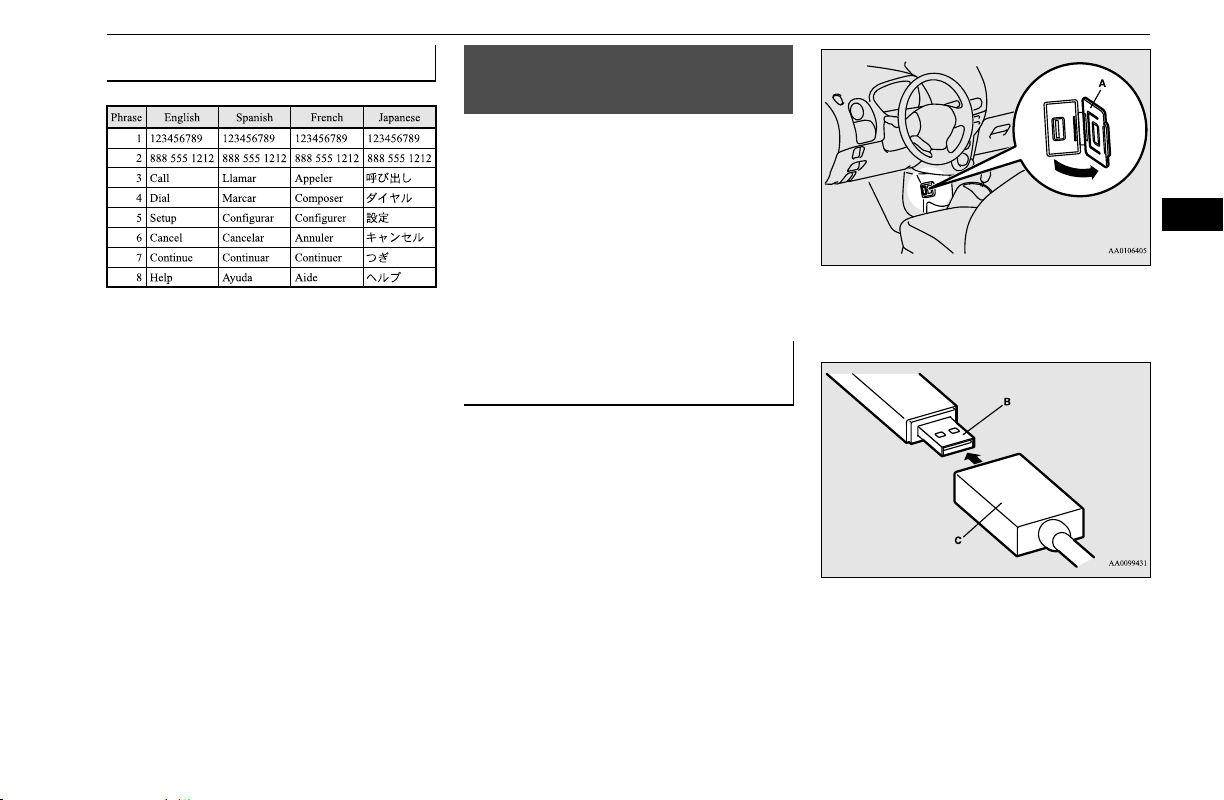
USB input terminal (if so equipped)
Features and controls 5-73
5
N00566401080
N00566701041
You can connect your USB memory device or
iPod* to play music files stored in the USB
memory device or iPod.
The following explains how to connect and
remove a USB memory device or iPod.
*: “iPod” is a registered trademark of Apple
Inc. in the United States and other countries.
N00566800087
1. Park your vehicle in a safe place and turn
the electric motor switch to the “LOCK”
position.
2. Open the USB input terminal cover (A) in
the floor console.
3. Connect a commercially available USB
connector cable (C) to the USB memory
device (B).
4. Connect the USB connector cable (C) to
the USB input terminal (D).
Enrollment commands
USB input terminal (if so
equipped)
How to connect a USB memory
device
BK0220401US.book 73 ページ 2015年6月3日 水曜日 午前7時42分
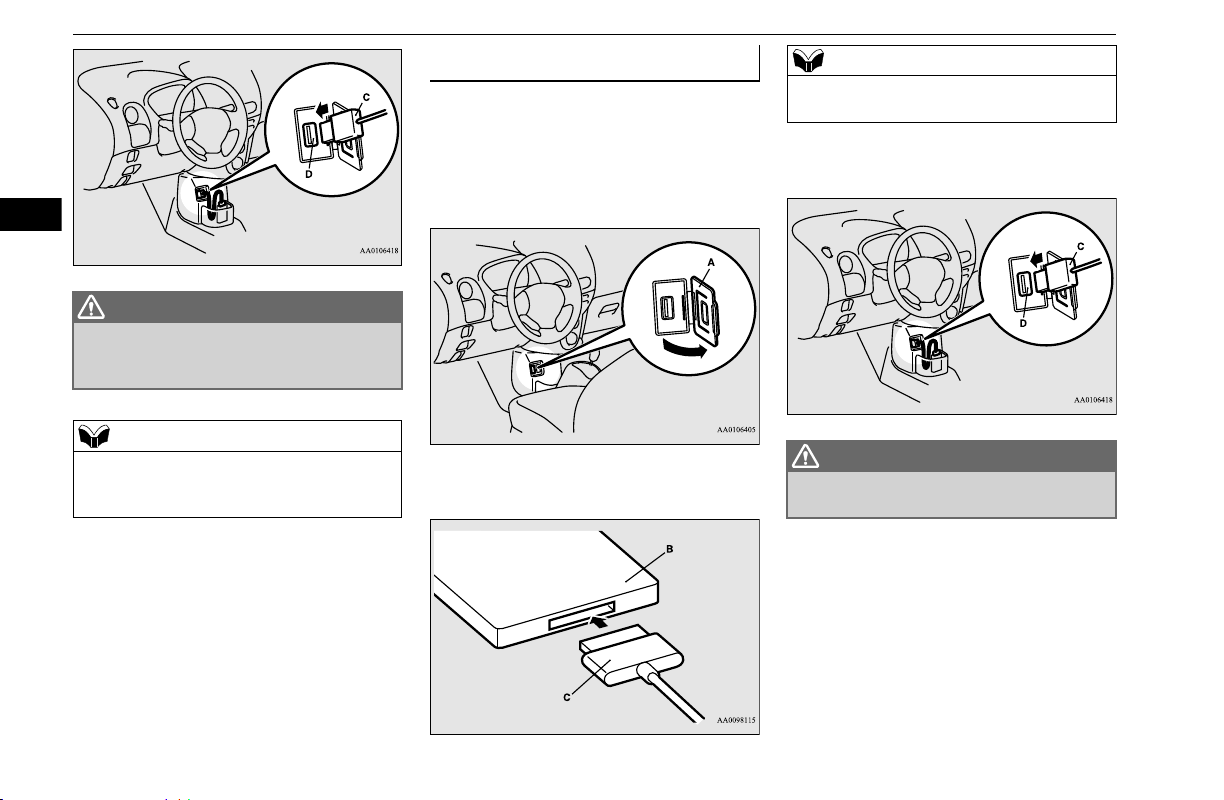
USB input terminal (if so equipped)
5-74 Features and controls
5
5. To remove the USB connector cable, turn
the electric motor switch to the “LOCK”
position first and perform the installation
steps in reverse.
N00566900075
1. Park your vehicle in a safe place and turn
the electric motor switch to the “LOCK”
position.
2. Open the USB input terminal cover (A) in
the floor console.
3. Connect the Dock connector (C) to the
iPod (B).
WARNING
Place the USB memory device and the
USB connector cable so as not to interfere
with driving.
NOTE
Do not connect the USB memory device to
the USB input terminal directly.
The USB memory device may be damaged.
How to connect an iPod
4. Connect the Dock connector (C) to the
USB input terminal (D).
5. To remove the Dock connector, turn the
electric motor switch to the “LOCK”
position first and perform the installation
steps in reverse.
NOTE
Use a genuine Dock connector from Apple
Inc.
WARNING
Place the iPod and the USB connector
cable so as not to interfere with driving.
BK0220401US.book 74 ページ 2015年6月3日 水曜日 午前7時42分
USB input terminal (if so equipped)
Features and controls 5-75
5
N00567000031
N00567101169
Devices of the following types can be con-
nected.
For these connectable device types, “iPod*,”
“iPod classic*,” “iPod nano*,” “iPod touch*”
and “iPhone*,” refer to the following web-
site:
[For vehicles sold in U.S.A.]
You can access the Mitsubishi Motors North
America website.
[For vehicles sold in Canada]
You can access the Mitsubishi Motors web-
site. Please read and agree to the “Warning
about Links to the Web Sites of Other Com-
panies”. The websites mentioned above may
connect you to websites other than the Mit-
subishi Motors website.
http://www.mitsubishi-motors.com/en/prod-
ucts/index.html
*: “iPod,” “iPod classic,” “iPod nano,” “iPod-
touch,” and “iPhone” are registered trade-
marks of Apple Inc. in the United States and
other countries.
N00567201069
You can play music files of the following
specifications that are saved in a USB mem-
ory device or other device supporting mass
storage class. When you connect your iPod,
playable file specifications depend on the
connected iPod.
Types of connectable devices
and supported file specifica-
tions
Device types
Model name Condition
USB memory device
Storage capacity of
256 Mbytes or more
Models other than
USB memory
devices and iPods
Digital audio player
supporting mass
storage class
NOTE
Depending on the type of the USB memory
device or other device connected, the con-
nected device may not function properly or
the available functions may be limited.
It is recommended to use an iPod with firm-
ware updated to the latest version.
You can charge your iPod by connecting it to
the USB input terminal when the electric
motor switch is in the “ACC” or “ON” posi-
tion.
Do not keep your USB memory device or
iPod in your vehicle.
It is recommended that you back up the files
in case of data damage.
Do not connect to the USB input terminal
any device (hard disk, card reader, memory
reader, etc.) other than the connectable
devices specified in the previous section.
The device and/or data may be damaged. If
any of these devices was connected by mis-
take, remove it after turning the electric
motor switch to the “LOCK” position.
File specifications
Item Condition
File format
MP3, WMA, AAC,
WAV
Maximum number of
levels
(including the root)
Level 8
Number of folders 700
Number of files 65,535
BK0220401US.book 75 ページ 2015年6月3日 水曜日 午前7時42分
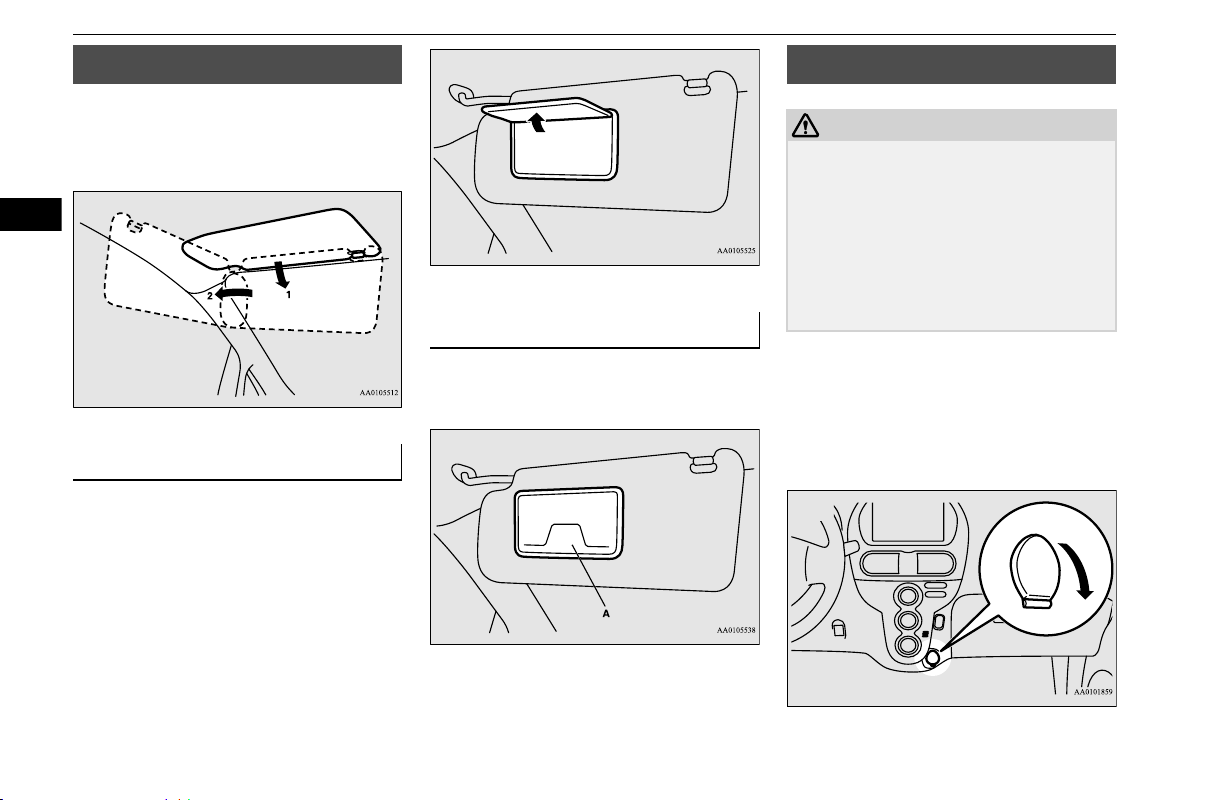
Sun visors
5-76 Features and controls
5
N00524600340
Fold the sun visor downward (1) to reduce
front glare while driving. To reduce side
glare, turn the visor to the side (2).
A vanity mirror is fitted to the back of the sun
visor.
Cards can be slipped into the front (A) of the
lid of the vanity mirror.
N00525000602
The accessory can be operated when the elec-
tric motor switch is in the “ON” or “ACC”
position.
To use a “plug-in” type accessory, open the
cover, then insert the plug in the socket.
Sun visors
Vanity mirror
Card holder
12 V power outlet
CAUTION
Be sure to use a “plug-in” type accessory
operating at 12 V and 120 W or less.
Be aware that using electronic equipment
with the ready indicator off may run the 12 V
starter battery down.
When the 12 V power outlet is not in use, be
sure to close the 12 V power outlet cover.
This will prevent the 12 V power outlet from
becoming dirty and possibly short-circuiting.
BK0220401US.book 76 ページ 2015年6月3日 水曜日 午前7時42分
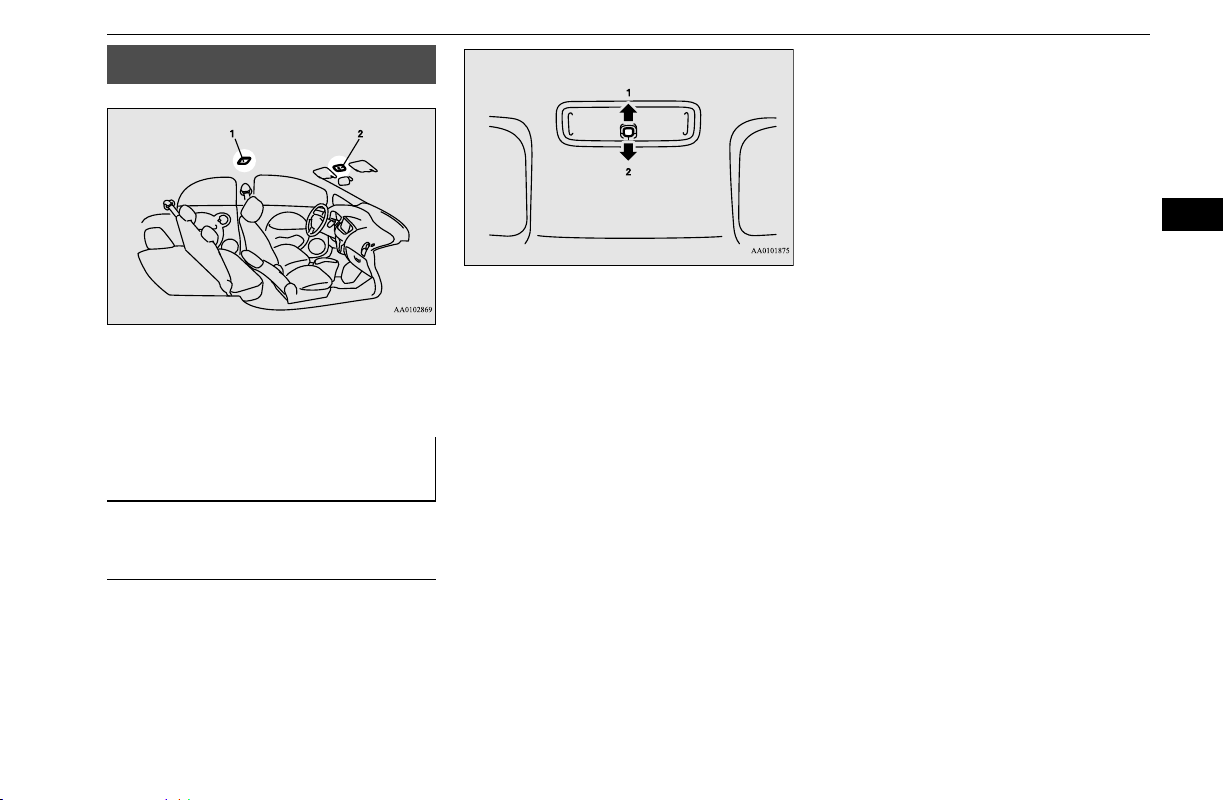
Interior lights
Features and controls 5-77
5
N00525300559
N00525800222
The dome light can be turned on by sliding
the dome light switch.
Interior lights
1- Dome light (Rear) P.5-78
2- Dome light (Front)/Reading lights
P.5-77
Dome light (Front)/Reading
lights (if so equipped)
Dome light (Front)
1- Door
2- Off
1- (DOOR)
The dome light comes on when any
door or the liftgate is opened. It goes
off approximately 30 seconds after
the door or liftgate is closed (delayed
off function). However, the light
goes off immediately if:
• The door and the liftgate are closed
and the electric motor switch is
turned to the “ON” position.
• The driver’s door is closed after all
the other doors are closed while the
lock knob of the driver’s door is in
the lock position.
• The door and the liftgate are closed
and the power door lock switch is
used to lock the doors.
• The keyless entry system remote
control transmitter is used to lock
the doors.
BK0220401US.book 77 ページ 2015年6月3日 水曜日 午前7時42分
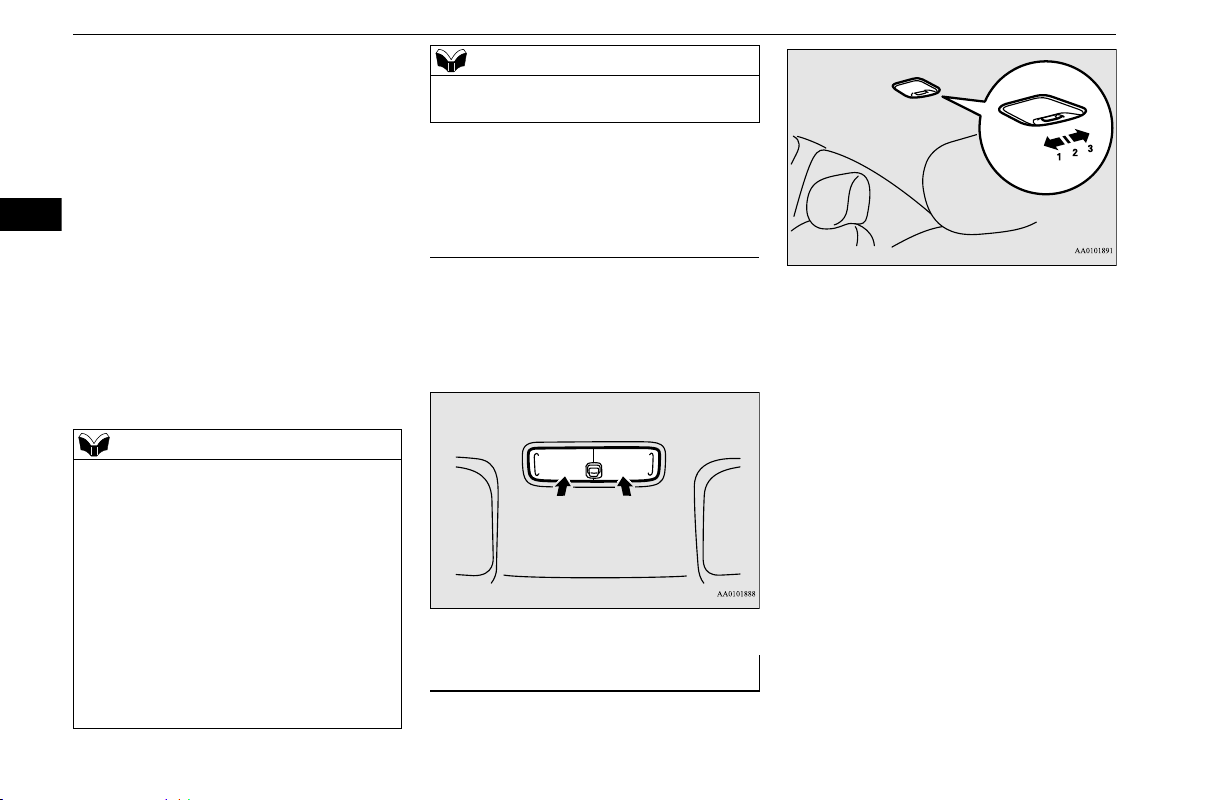
Interior lights
5-78 Features and controls
5
N00553800096
Regardless of the dome light switch position,
when you press the lens, the light on the side
that is pressed illuminates; when you press
the lens again, the light goes off.
N00525400459
The rear dome light can be turned on by slid-
ing the dome light switch.
If the dome light is left switched on
with the electric motor switch in the
“LOCK” or “ACC” position and a
door or the liftgate is opened, it goes
off automatically after approxi-
mately 30 minutes.
The light will illuminate again after
it automatically goes off in the fol-
lowing cases:
• When the electric motor switch is
turned to the “ON” position.
• When the keyless entry system
remote control transmitter is oper-
ated.
• When any of the doors or the lift-
gate is opened after all doors and
the liftgate are closed.
NOTE
When the key is removed while the doors
and liftgate are closed, the dome light will
illuminate for approximately 30 seconds
before going off.
The time until the light goes off (delayed off)
can be adjusted. See a certified i-MiEV
dealer for details.
However, the dome light will shut off in sync
with the automatic relocking function, even
if the dome light delayed off function has
been extended. For the automatic relocking
function, refer to “Keyless entry system” on
page 5-5.
The auto cut-out function can be deactivated.
See a certified i-MiEV dealer for details.
2-
The dome light goes off.
Reading lights
Dome light (Rear)
NOTE
1- On
2- Door
3- Off
1- (ON)
The dome light comes on.
2- ()
BK0220401US.book 78 ページ 2015年6月3日 水曜日 午前7時42分
Storage spaces
Features and controls 5-79
5
N00526400502
The dome light comes on when any
door or the liftgate is opened. It goes
off approximately 30 seconds after
the door or liftgate is closed (delayed
off function). However, the light
goes off immediately if:
• The door and the liftgate are closed
and the electric motor switch is
turned to the “ON” position.
• The driver’s door is closed after all
the other doors are closed while the
lock knob of the driver’s door is in
the lock position.
• The door and the liftgate are closed
and the power door lock switch is
used to lock the doors.
• The keyless entry system remote
control transmitter is used to lock
the doors.
If the dome light is left switched on
with the electric motor switch in the
“LOCK” or “ACC” position and a
door or the liftgate is opened, it goes
off automatically after approxi-
mately 30 minutes.
The light will illuminate again after
it automatically goes off in the fol-
lowing cases:
• When the electric motor switch is
turned to the “ON” position.
• When the keyless entry system
remote control transmitter is oper-
ated.
• When any of the doors or the lift-
gate is opened after all doors and
the liftgate are closed.
NOTE
When the key is removed while the doors
and liftgate are closed, the dome light will
illuminate for approximately 30 seconds
before going off.
The time until the light goes off (delayed off)
can be adjusted. See a certified i-MiEV
dealer for details.
However, the dome light will shut off in sync
with the automatic relocking function, even
if the dome light delayed off function has
been extended. For the automatic relocking
function, refer to “Keyless entry system” on
page 5-5.
The auto cut-out function cannot be operated
when the dome light switch is in the “ON”
position.
Also, this function can be deactivated.
See a certified i-MiEV dealer for details.
3- (OFF)
The dome light goes off.
Storage spaces
CAUTION
Never leave lighters, carbonated drink cans,
or spectacles in the cabin when parking the
vehicle in hot sunshine. The cabin will
become extremely hot, so lighters and other
flammable items may catch fire and
unopened drink cans (including beer cans)
may rupture. The heat may also deform or
crack plastic spectacle parts.
Keep the lids of storage spaces closed while
driving the vehicle. A lid or the contents of a
storage space could otherwise cause injuries
during a sudden stop.
NOTE
Do not leave valuables in any storage space
when leaving the vehicle.
NOTE
BK0220401US.book 79 ページ 2015年6月3日 水曜日 午前7時42分
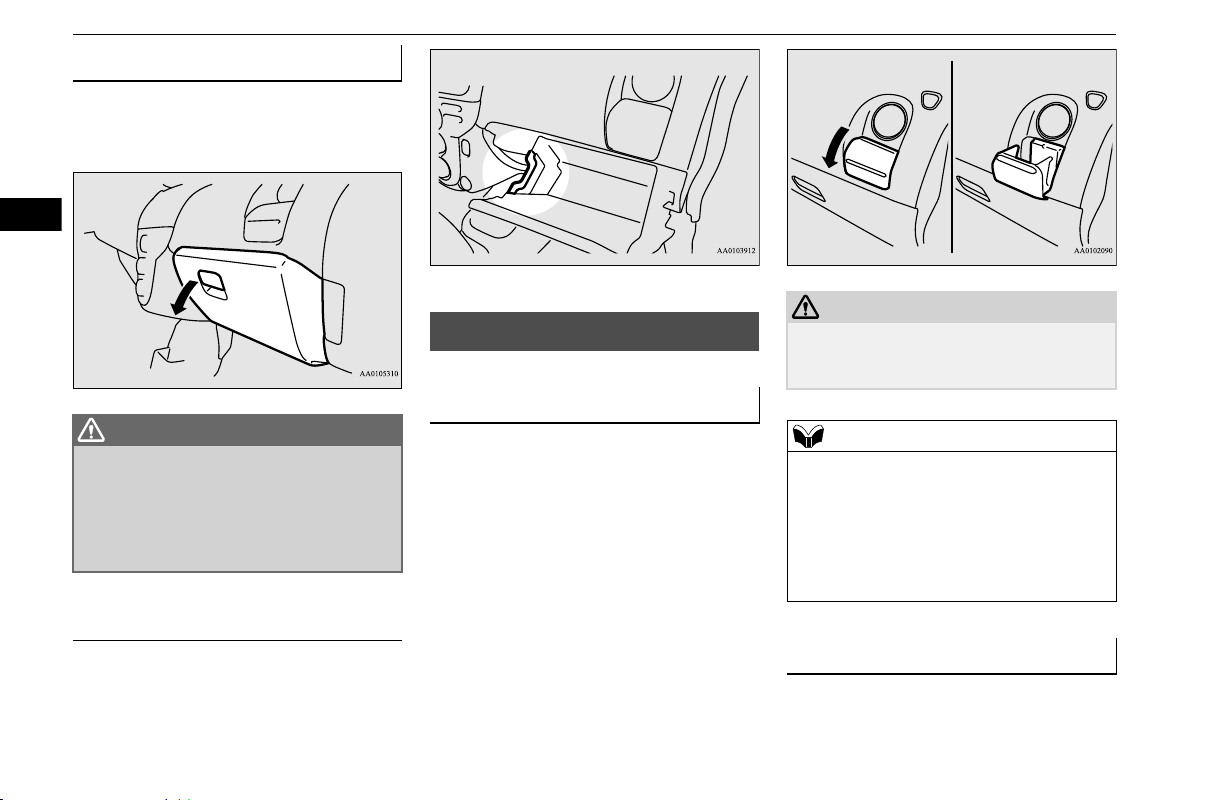
Cup holder
5-80 Features and controls
5
N00551500259
To open the glove compartment, pull the
lever (A).
N00571400010
There is a card holder on the inside of the
glove compartment.
N00527300364
The cup holder is located in front of the side
vent.
The cup holder is designed for holding cups
or drink-cans securely in its holes.
Tip the cup holder toward you to use it.
N00537000146
This cup holder is located behind the parking
brake lever.
Glove compartment
WARNING
An open glove compartment door can
cause a serious injury or death to the front
passenger in an accident, even if the pas-
senger is wearing his/her seat belt. Always
keep the glove compartment door closed
when driving.
Card holder
Cup holder
For the front seat
CAUTION
Do not drink beverages while driving your
vehicle. This is distracting and could cause
an accident.
NOTE
When not using the holder, push the holder
in to stow it away.
Do not put your hand on the cup holder while
getting in or out of the vehicle. The cup
holder could break.
Never place anything other than cup or drink
can in the cup holder.
For the rear seat
BK0220401US.book 80 ページ 2015年6月3日 水曜日 午前7時42分
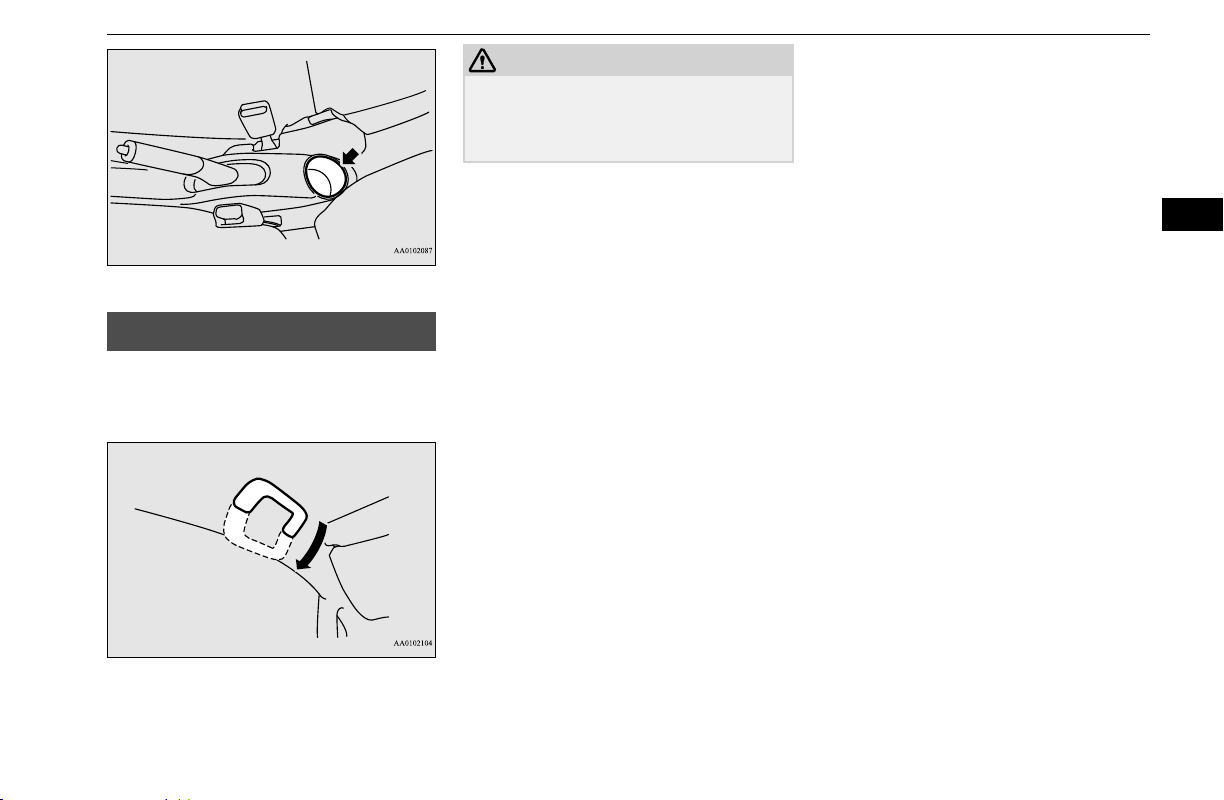
Assist grip
Features and controls 5-81
5
N00559000058
These grips are to support the body by hand
while seated in the vehicle.
Assist grip
CAUTION
Do not use the assist grips when getting into
or out of the vehicle.
The assist grips could detach and cause an
accident.
BK0220401US.book 81 ページ 2015年6月3日 水曜日 午前7時42分

BK0220401US.book 82 ページ 2015年6月3日 水曜日 午前7時42分

6
Driving safety
Economical driving ..........................................................................6-2
Driving, alcohol and drugs ..............................................................6-2
Floor mat ..........................................................................................6-2
Vehicle preparation before driving ..................................................6-3
Safe driving techniques ....................................................................6-4
Driving during cold weather ............................................................6-4
Braking ............................................................................................6-5
Parking .............................................................................................6-6
Loading information ........................................................................6-6
Cargo loads ....................................................................................6-10
Trailer towing ................................................................................6-10
Dinghy towing ...............................................................................6-10
BK0220401US.book 1 ページ 2015年6月3日 水曜日 午前7時42分
Economical driving
6-2 Driving safety
6
N00628500029
For economical driving, there are some tech-
nical requirements that have to be met. In
order to achieve longer life of the vehicle and
the most economical operation, we recom-
mend you to have the vehicle checked at reg-
ular intervals according to the “WARRANTY
AND MAINTENANCE MANUAL”.
Avoid driving with the accelerator pedal fully
depressed, such as for unnecessarily sudden
starts, acceleration and deceleration.
Smoothly depress the accelerator pedal.
Observe the speed limit and keep the speed as
constant as possible while driving.
Parking for a long period with the ready indi-
cator illuminated will shorten the cruising
range.
At higher the vehicle speed the more main
drive lithium-ion battery is consumed. Avoid
driving at full speed. Even a slight release of
the accelerator pedal will save a significant
amount of main drive lithium-ion battery
charge.
Check the tire inflation pressures at regular
intervals Low tire inflation pressure increases
road resistance. In addition, low tire pressures
adversely affect tire wear and driving stabil-
ity.
Do not drive with unnecessary articles in the
luggage compartment.
Too much cooling/heating can affect the
cruising range, so maintain an appropriate
temperature to extend the cruising range.
N00628900010
Drunk driving is one of the most frequent
causes of accidents.
Your driving ability can be seriously impaired
even with blood alcohol levels far below the
legal minimum. If you have been drinking,
don’t drive. Ride with a designated non-
drinking driver, call a cab or a friend, or use
public transportation. Drinking coffee or tak-
ing a cold shower will not make you sober.
Similarly, prescription and nonprescription
drugs affect your alertness, perception and
reaction time. Consult with your doctor or
pharmacist before driving while under the
influence of any of these medications.
N00628600017
The original equipment floor mat provided
with your vehicle was specifically designed
for your vehicle. Always properly position
the floor mat and assure it does not interfere
with operation of the pedals. Always use the
retaining clip on the driver’s floorboard to
secure the floor mat. When used, this clip will
help prevent the floor mat from moving for-
ward and possibly interfering with the opera-
tion of the pedals. To prevent the floor mat
Economical driving
Starting and acceleration
Idling
Speed
Tire inflation pressure
Cargo loads
Air conditioning
Driving, alcohol and drugs
WARNING
NEVER DRINK AND DRIVE.
Your perceptions are less accurate, your
reflexes are slower and your judgment is
impaired.
Floor mat
BK0220401US.book 2 ページ 2015年6月3日 水曜日 午前7時42分
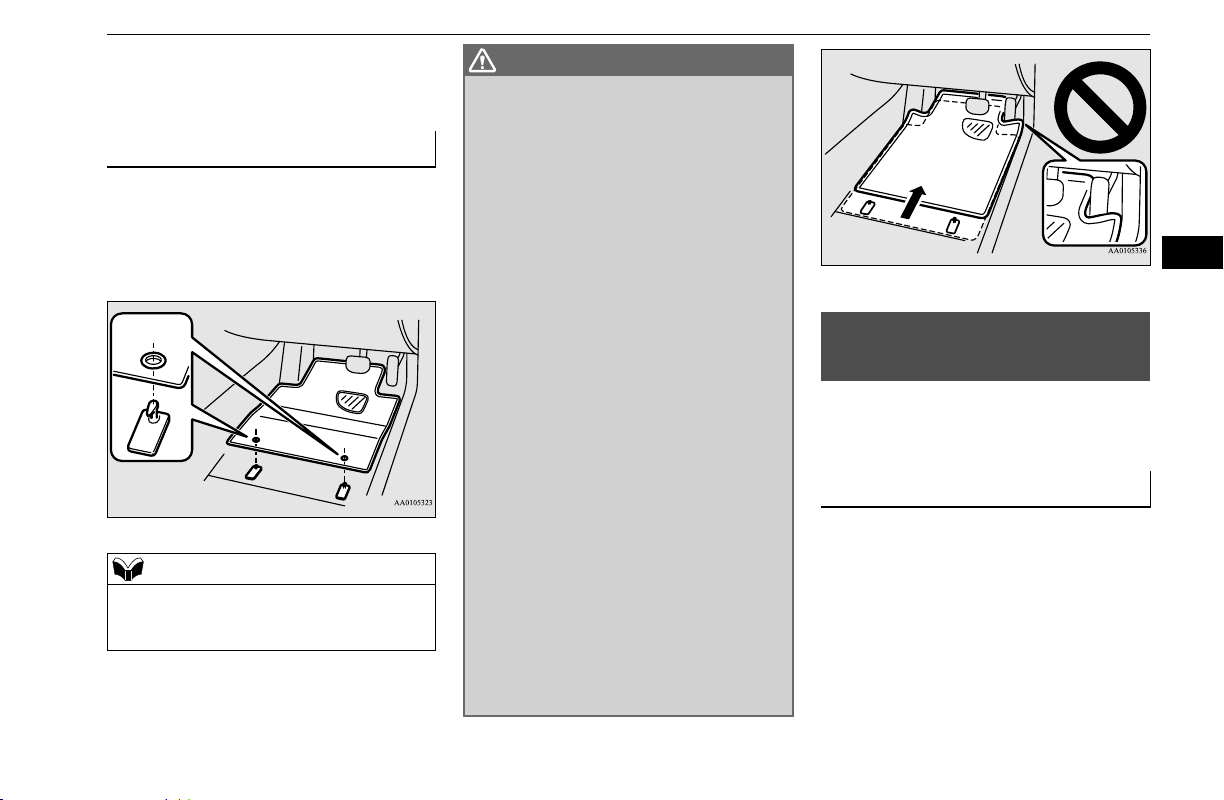
Vehicle preparation before driving
Driving safety 6-3
6
from moving forward and possibly interfering
with the operation of the pedals, Mitsubishi
genuine floor mats are recommended.
N00628700063
1. Place the floor mat to fit the shape of the
floorboard.
2. Align the floor mat with the installation
holes over the retaining clips.
3. Secure the floor mat with retaining clips.
N00629000698
For a safer and more enjoyable trip, always
observe the following:
Before starting the vehicle, make certain
that you and all passengers are seated and
wearing their seat belts properly (with
children in the rear seat, in appropriate
restraints), and that all the doors and the
rear hatch are locked.
To install the floor mat
NOTE
The shape of the mat and the number of
retaining clips may vary depending on the
vehicle model.
WARNING
If a floor mat is the wrong size or is not
properly installed, it can interfere with the
operation of the pedals. Interference with
the pedals can cause unintended accelera-
tion and/or increased stopping distances
resulting in a crash and injury. Always
make sure the floor mat does not interfere
with the accelerator or brake pedal.
Always use the retaining clip on the
driver’s floorboard to secure the floor
mat.
Always install the mat with the correct
side facing down.
Never install a second mat over or under
an existing floor mat.
Do not use a floor mat designed for
another model vehicle even if it is a
Mitsubishi genuine floor mat.
Before driving, be sure to check the fol-
lowing:
• Periodically check that the floor mat is
properly secured with the retaining clips.
If you remove the floor mat while clean-
ing the inside of your vehicle or for any
other reason, always check the condition
of the floor mat after it has been rein-
stalled.
• While the vehicle is stopped with the
electric motor unit off, check that the
floor mat is not interfering with the ped-
als by depressing the pedals fully.
Vehicle preparation before
driving
Seat belts and seats
BK0220401US.book 3 ページ 2015年6月3日 水曜日 午前7時42分
Safe driving techniques
6-4 Driving safety
6
Move the driver’s seat as far backward as
possible, while still keeping good visibil-
ity, and good control of the steering
wheel, brakes, accelerator, and controls.
Check the instrument panel indicators for
any possible problem.
Move the front passenger seat as far back
as possible.
Make sure that infants and small children
are properly restrained in accordance with
all laws and regulations.
Check these by selecting the defroster mode,
and set the blower switch on high. You should
be able to feel the air blowing against the
windshield.
(Refer to “Defrosting or defogging the wind-
shield and door windows” on page 7-9.)
Check all the tires for heavy tread wear or
uneven wear patterns. Look for stones, nails,
glass, or other objects stuck in the tread. Look
for any tread cuts or sidewall cracks. Check
the wheel nuts for tightness, and the tires for
proper pressures. Replace your tires before
they are heavily worn out.
As your vehicle is equipped with a tire pres-
sure monitoring system, there is a risk of
damage to the tire inflation pressure sensors
when the tire is replaced on the rim. Tire
replacement should, therefore, be performed
only by a certified i-MiEV dealer.
Have someone watch while you turn all the
exterior lights on and off. Also check the turn
signal indicators and high-beam indicators on
the instrument panel.
Check the ground under the vehicle after
parking overnight, for water, oil, or other
leaks. Make sure all the fluid levels are cor-
rect.
N00629200124
Even this vehicle’s safety equipment, and
your safest driving, cannot guarantee that you
can avoid an accident or injury. However, if
you give extra attention to the following
areas, you can better protect yourself and
your passengers:
Drive defensively. Be aware of traffic,
road and weather conditions. Leave plenty
of stopping distance between your vehicle
and the vehicle ahead.
Before changing lanes, check your mir-
rors and use your turn signal light.
While driving, watch the behavior of
other drivers, bicyclists, and pedestrians.
Always obey applicable laws and regula-
tions. Be a polite and alert driver. Always
leave room for unexpected events, such as
sudden braking.
N00629400416
Check the 12V starter battery, including
terminals and cables. During extremely
cold weather, the 12V starter battery will
not be as strong and its power level may
drop.
Before driving the vehicle, check to see if
the headlights are as bright as normal.
Charge or replace the 12V starter battery
if necessary. During extreme cold
weather, it is possible that a very low 12V
starter battery could freeze.
Defrosters
Tires
Lights
Fluid leaks
Safe driving techniques
Driving during cold weather
BK0220401US.book 4 ページ 2015年6月3日 水曜日 午前7時42分
Braking
Driving safety 6-5
6
Check the antifreeze.
If there is not enough coolant because of a
leak, add high-quality ethylene glycol
antifreeze and water. Use Mitsubishi
Motors Genuine Super Long Life Coolant
Premium or an equivalent. The recom-
mended blend is about 50 % water and 50
% anti-freeze. Use a higher concentration
(not over 60 %) when the outside temper-
ature is -31 °F (-35 °C) or lower. When
the electric motor unit is working very
hard (for example, during mountain driv-
ing and/or when the outside temperature
is high), use a 50 % concentration. This
blend will provide adequate protection
from corrosion and boiling.
N00629501531
All the parts of the brake system are critical
to safety. Have the vehicle serviced by a certi-
fied i-MiEV dealer at regular intervals
according to the “WARRANTY AND
MAINTENANCE MANUAL”.
Check the brake system while driving at a
low speed immediately after starting, espe-
cially when the brakes are wet, to confirm
they work normally.
A film of water can be formed on the brake
discs and prevent normal braking after driv-
ing in heavy rain or through large puddles, or
after the vehicle is washed. If this occurs, dry
the brakes out by driving slowly while lightly
depressing the brake pedal.
On snowy roads, ice can form on the braking
system, making the brakes less effective.
While driving in such conditions, pay close
attention to preceding and following vehicles
and to the condition of the road surface. From
time to time, lightly depress the brake pedal
and check how effective the brakes are.
Put the selector lever to “B” (REGENERA-
TIVE BRAKE MODE) or “ECO” (ECO
MODE) position according to the grade of
the slope and vehicle speed. This will allow
effective use of the regenerative brake and
prevent the service brake from overheating.
If the brake pedal is continuously or fre-
quently depressed on downhill roads, the ser-
vice brake could overheat and the brake
performance will be reduced.
WARNING
The 12V starter battery gives off explosive
hydrogen gas. Any spark or flame can
cause the 12V starter battery to explode,
which could cause serious injury or death.
Always wear protective clothes and a face
mask when working with your 12V starter
battery, or let a skilled mechanic do it.
WARNING
Never open the coolant reservoir cap while
it is hot. You could be seriously burned.
Braking
When brakes are wet
When driving in cold weather
When driving downhill
NOTE
When the main drive lithium-ion battery
level is full or nearly full, or the main drive
lithium-ion battery temperature is too high or
too low, the regenerative braking force may
be reduced. Refer to “Regenerative braking”
on page 3-3.
If the red needle in the energy usage indica-
tor does not move to the left of the neutral
point (A) while the accelerator pedal is
released, the regenerative brake will not
work. Refer to “Energy usage indicator” on
page 5-37. In the such case, before approach-
ing a long downhill road, reduce speed to
prevent the service brake from overheating.
BK0220401US.book 5 ページ 2015年6月3日 水曜日 午前7時42分
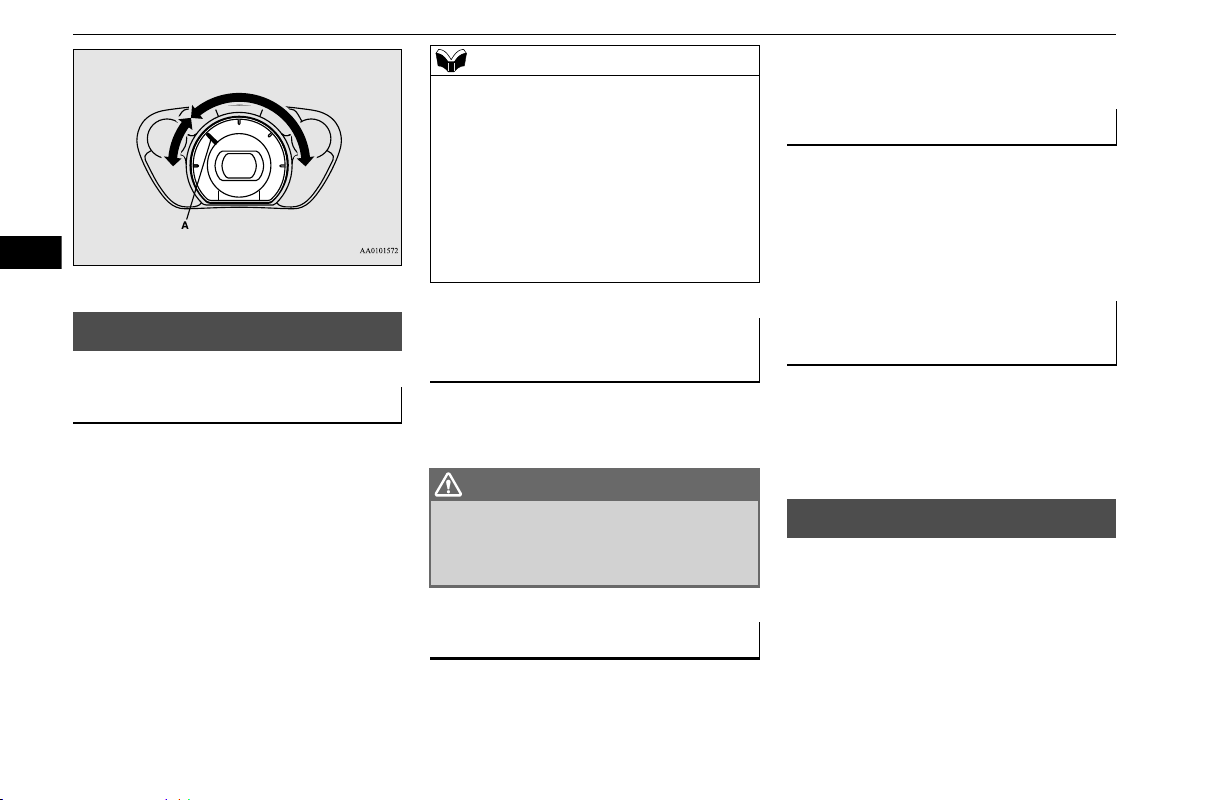
Parking
6-6 Driving safety
6
N00629600317
When parking on a hill, set the parking brake,
and turn the front wheels toward the curb on a
downhill, or away from the curb on an uphill.
If necessary, apply chocks to wheels.
Never leave the electric motor unit running
while you take a short sleep/rest.
Your front bumper can be damaged if you
scrape it over curbs or parking stop blocks.
Be careful when traveling up or down steep
slopes where your bumper can scrape the
road.
Always remove the key from the electric
motor switch and lock all doors and the lift-
gate when leaving the vehicle unattended.
Always try to park your vehicle in a well lit
area.
More effort could be required to turn the
steering wheel.
Refer to “Electric power steering system
(EPS)” on page 5-27.
N00629900411
It is very important to know how much
weight your vehicle can carry. This weight is
called the vehicle capacity weight and
includes the weight of all occupants, cargo
and non-factory-installed options. The tire
and loading information placard located on
the driver’s door sill of your vehicle will
show how much weight it may properly carry.
Parking
Parking on a hill
NOTE
On a slope, be sure to apply the parking
brake before moving the selector lever to the
“P” (PARK) position. If you move the selec-
tor lever to the “P” (PARK) position before
applying the parking brake, it may be diffi-
cult to disengage the selector lever from the
“P” (PARK) position when next you drive
the vehicle, requiring application of a strong
force to the selector lever to move from the
“P” (PARK) position.
Parking with the electric motor
unit running
WARNING
Leaving the electric motor unit running
when you are not alert risks injury or
death from accidentally moving the selec-
tor lever.
Where you park
When leaving the vehicle
Do not keep the steering wheel
fully turned for a long time
Loading information
BK0220401US.book 6 ページ 2015年6月3日 水曜日 午前7時42分
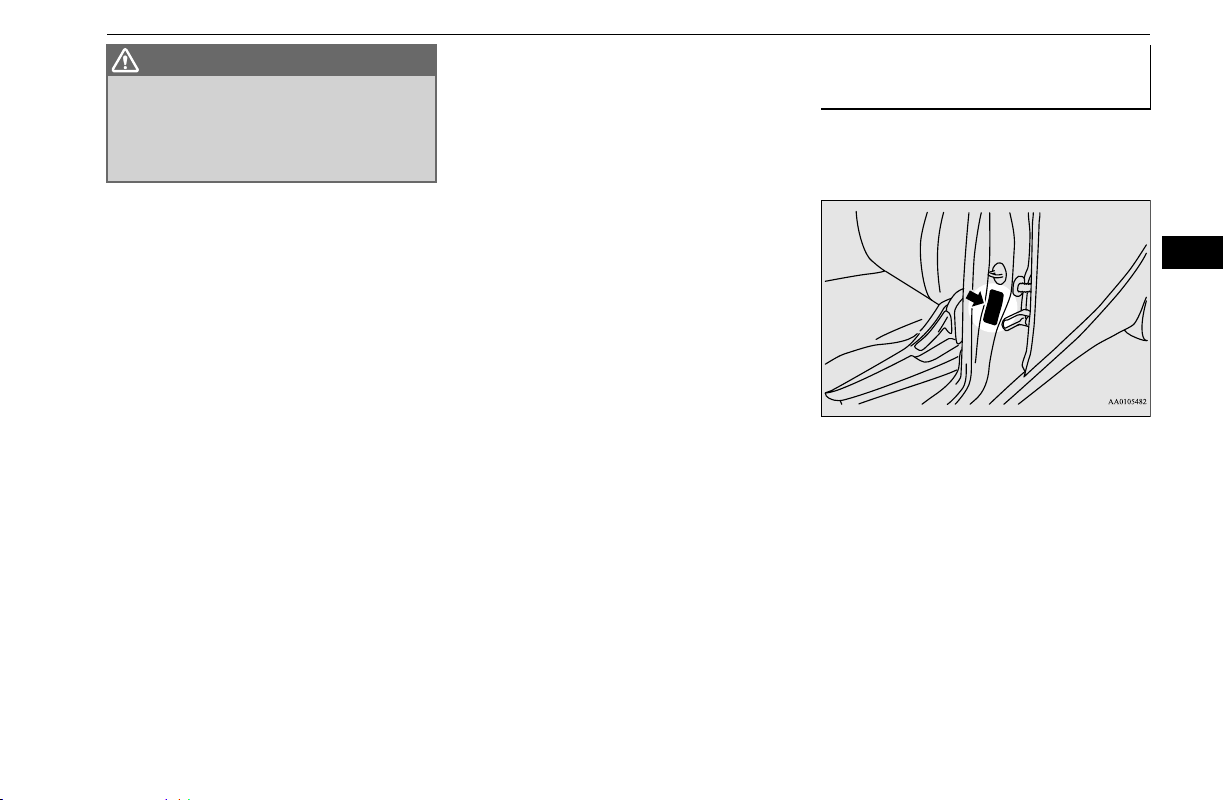
Loading information
Driving safety 6-7
6
It is important to familiarize yourself with the
following terms before loading your vehicle:
Vehicle maximum load on the tire: load
on an individual tire that is determined by
distributing to each axle its share of the
maximum loaded vehicle weight and
dividing by two.
Vehicle normal load on the tire: load on an
individual tire that is determined by dis-
tributing to each axle its share of the curb
weight, accessory weight, and normal
occupant weight and dividing by two.
Maximum loaded vehicle weight: the sum
of -
(a) Curb weight;
(b) Accessory weight;
(c) Vehicle capacity weight; and
(d) Production options weight.
Curb weight: the weight of a motor vehi-
cle with standard equipment including the
maximum capacity of oil, and coolant.
Accessory weight: the combined weight
(in excess of those standard items which
may be replaced) of automatic transmis-
sion, power steering, power brakes, power
windows, power seats, radio, and heater,
to the extent that these items are available
as factory- installed equipment (whether
installed or not).
Vehicle capacity weight: the rated cargo
and luggage load plus 150 lbs (68 kg)*
times the vehicle’s designated seating
capacity.
Production options weight: the combined
weight of those installed regular produc-
tion options weighing over 5 lbs (2.3 kg)
in excess of those standard items which
they replace, not previously considered in
curb weight or accessory weight, includ-
ing heavy duty brakes, ride levelers, roof
rack, heavy duty battery, and special trim.
Normal occupant weight: 150 lbs (68 kg)*
times the number of specified occupants.
(In your vehicle the number is 2)
Occupant distribution: distribution of
occupants in a vehicle as specified. (In
your vehicle the distribution is 2 in front
seat)
N00630100370
The tire and loading information placard is
located on the driver’s door sill.
This placard shows the maximum number of
occupants permitted to ride in your vehicle as
well as “the combined weight of occupants
and cargo” (C), which is called the vehicle
capacity weight. This placard also tells you
the size and recommended inflation pressure
for the original equipment tires on your vehi-
cle. For more information, refer to “Tires” on
page 9-10.
WARNING
Never overload your vehicle. Overloading
can damage your vehicle, adversely affect
vehicle performance, including handling
and braking, cause tire failure, and result
in an accident.
*: 150 lbs (68 kg) is the weight of one per-
son as defined by U.S.A. and Canadian
regulations.
Tire and loading information
placard
BK0220401US.book 7 ページ 2015年6月3日 水曜日 午前7時42分
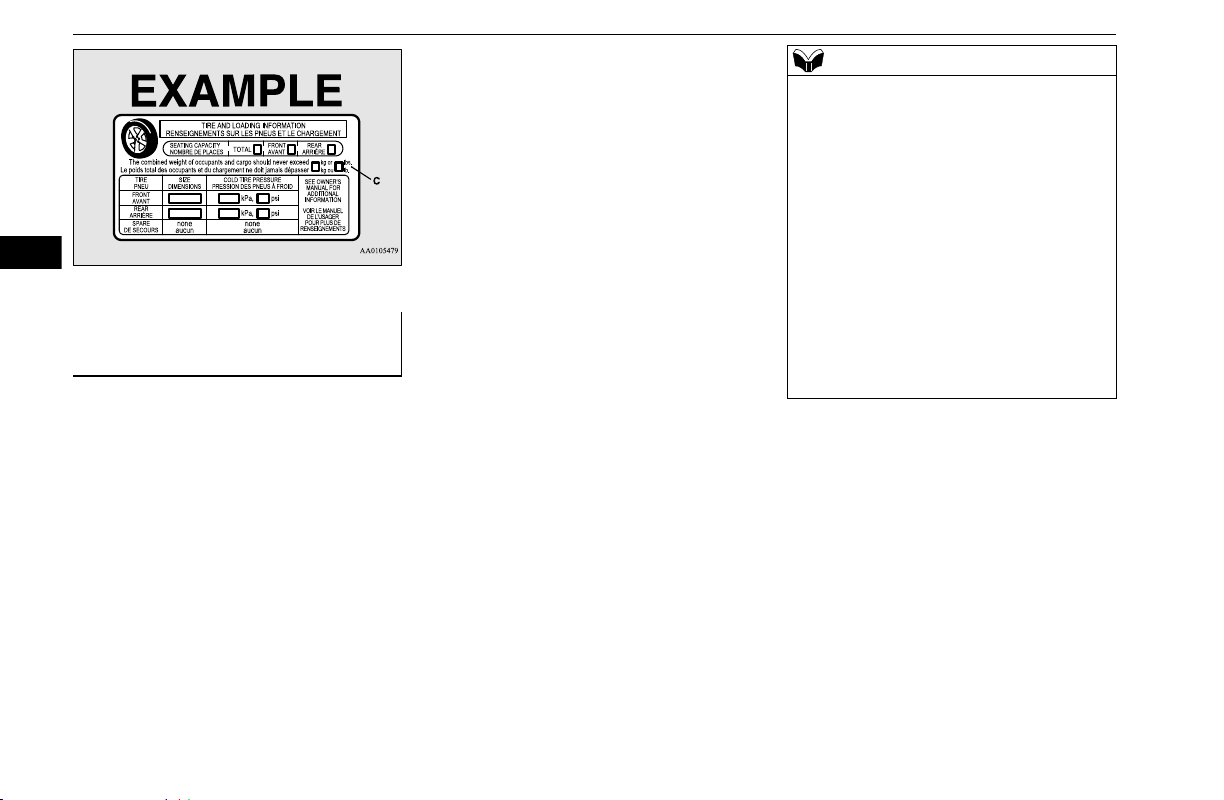
Loading information
6-8 Driving safety
6
N00630201264
1. Locate the statement “The com-
bined weight of occupants and
cargo should never exceed XXX
kg or XXX lbs.” on your vehicle’s
placard.
2. Determine the combined weight
of the driver and passengers that
will be riding in your vehicle.
3. Subtract the combined weight of
the driver and passengers from
XXX kg or XXX lbs.
4. The resulting figure equals the
available amount of cargo and
luggage load capacity. For exam-
ple, if the “XXX” amount equals
1400 lbs. and there will be five
150 lbs. passengers in your vehi-
cle, the amount of available cargo
and luggage load capacity is 650
lbs. (1400 - 750 (5 x 150) = 650
lbs.)
5. Determine the combined weight
of luggage and cargo being loaded
on the vehicle. That weight may
not safely exceed the available
cargo and luggage load capacity
calculated in Step 4.
6. If your vehicle will be towing a
trailer, load from your trailer will
be transferred to your vehicle.
Consult this manual to determine
how this reduces the available
cargo and luggage load capacity
of your vehicle.
Steps for Determining Correct
Load Limit
NOTE
The above steps for determining
correct load limit were written in
accordance with U.S.A. regula-
tions.
For your vehicle, please deter-
mine correct load limit bearing
in mind the following differ-
ences:
• Your vehicle’s seating capacity
is 4 people.
• Your vehicle cannot tow a
trailer, so step 6 is irrelevant.
BK0220401US.book 8 ページ 2015年6月3日 水曜日 午前7時42分
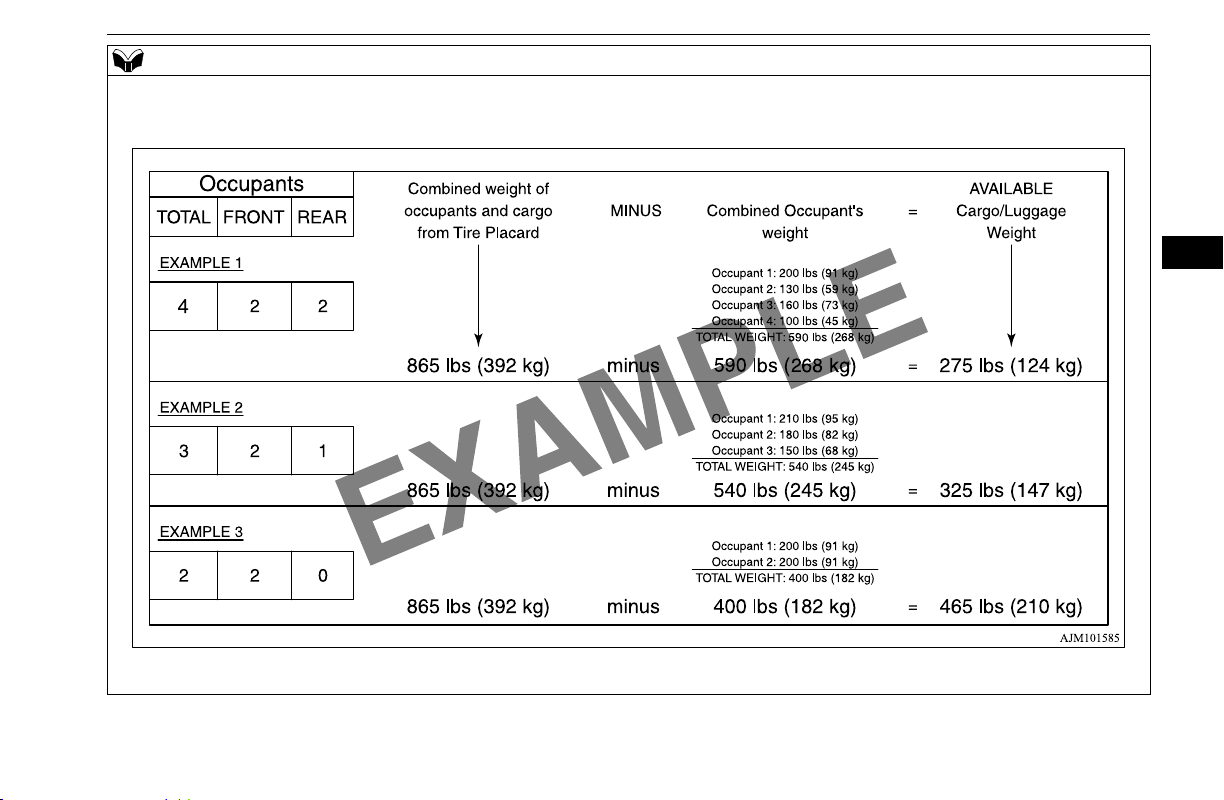
Loading information
Driving safety 6-9
6
NOTE
The following table shows examples on how to calculate total cargo/load capacity of your vehicle with varying seating configurations and number and size
of occupants. This table is for illustration purposes only and may not be accurate for the seating and load capacity of your vehicle.
For the following example the combined weight of occupants and cargo should never exceed 865 lbs (392 kg).
Under a maximum loaded vehicle condition, gross axle weight ratings (GAWR’s) for the front and rear axles must not be exceeded. For further information
on GAWR’s, vehicle loading, see the “Specifications” section of this manual.
BK0220401US.book 9 ページ 2015年6月3日 水曜日 午前7時42分
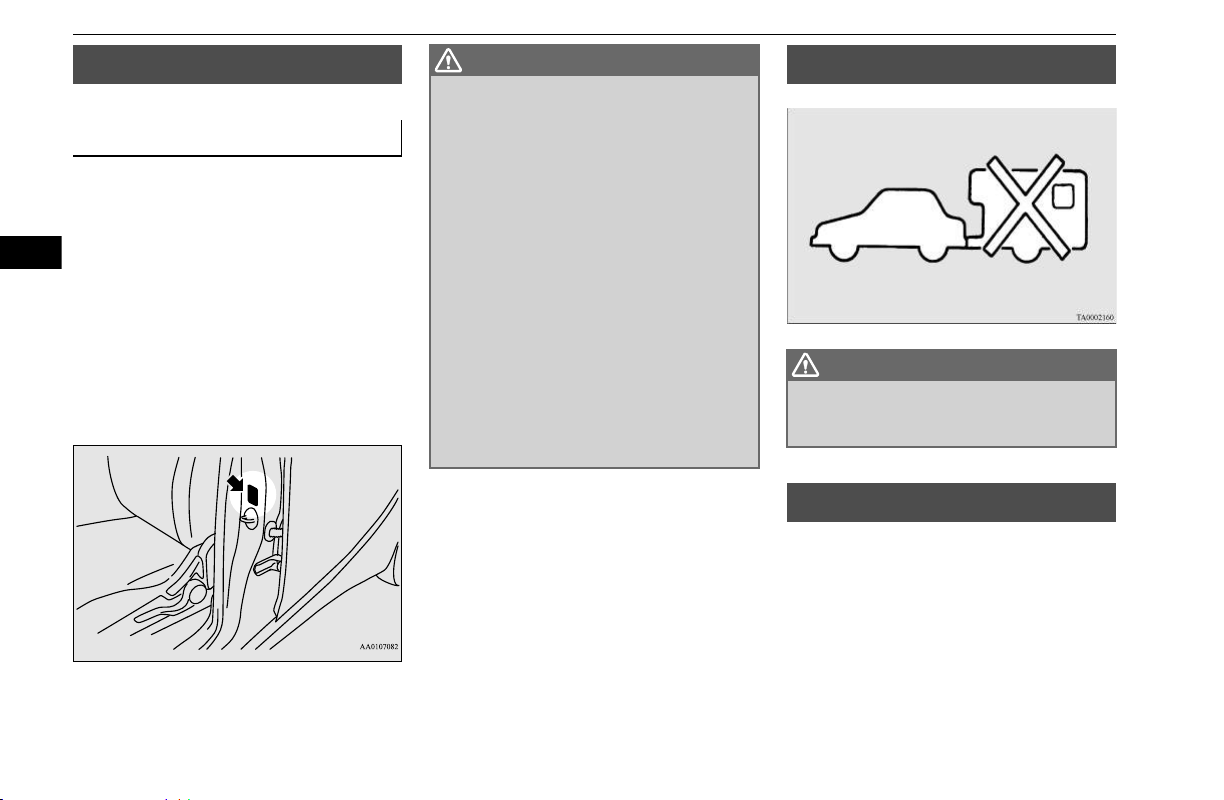
Cargo loads
6-10 Driving safety
6
N00629700510
To determine the cargo load capacity for your
vehicle, subtract the weight of all vehicle
occupants from the vehicle capacity weight.
For added information, if needed, refer to
“Steps for Determining Correct Load Limit”
on page 6-8.
DO NOT USE the Gross Vehicle Weight Rat-
ing and Gross Axle Weight Rating numbers
listed on the safety certification label located
on the driver’s side door pillar as the guide
for passengers and/or cargo weight.
N00629800188
N00630700015
Dinghy towing is towing the vehicle with all
four wheels on the ground.
Cargo loads
Cargo load precautions
WARNING
To reduce the risk of serious injury or
death, the combined weights of the driver,
passengers and cargo and must never
exceed the vehicle capacity weight.
Exceeding the vehicle capacity weight will
adversely affect vehicle performance,
including handling and braking, and may
cause an accident.
Do not load cargo or luggage higher than
the top of the seatback. Be sure that your
cargo or luggage cannot move when your
vehicle is in motion.
Having either the rear view blocked, or
your cargo being thrown inside the cabin
if you suddenly have to brake can cause a
serious accident or injury or death.
Put cargo or luggage in the cargo area of
your vehicle. Try to spread the weight
evenly.
Trailer towing
WARNING
Do not use this vehicle for trailer towing.
It may not be possible to maintain control
or adequate braking.
Dinghy towing
BK0220401US.book 10 ページ 2015年6月3日 水曜日 午前7時42分
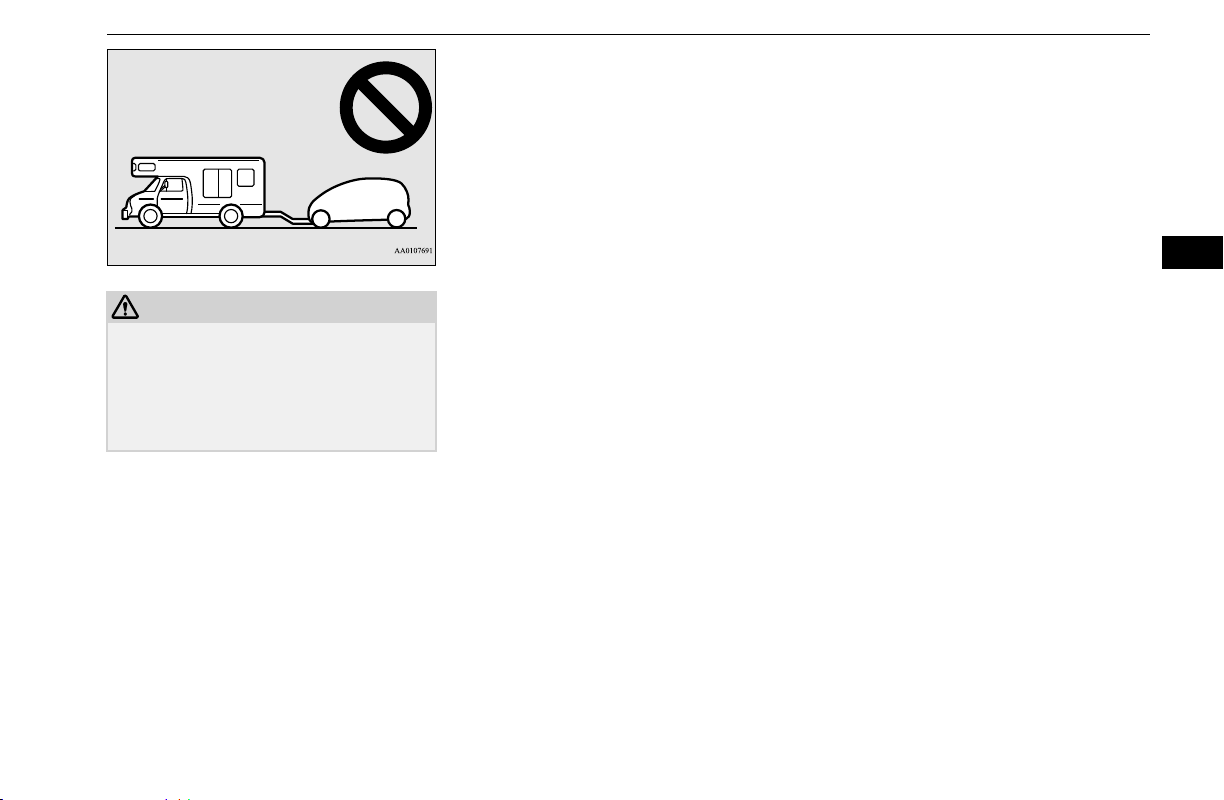
Dinghy towing
Driving safety 6-11
6
CAUTION
Your vehicle is not designed to be dinghy
towed behind a motor home.
Dinghy towing can cause damage to the elec-
tric motor unit. Damage caused by dinghy
towing will not be covered by the vehicle
warranty.
BK0220401US.book 11 ページ 2015年6月3日 水曜日 午前7時42分

BK0220401US.book 12 ページ 2015年6月3日 水曜日 午前7時42分

7
Comfort controls
Vents ................................................................................................7-2
Air conditioning ...............................................................................7-4
Important air conditioning operating tips ......................................7-10
Air purifier .....................................................................................7-11
Remote Climate Control ................................................................7-11
AM/FM electronically tuned radio with CD player
(if so equipped) ..........................................................................7-11
To play iPod/USB memory device tracks via voice operation
(vehicles with Bluetooth
®
2.0 interface) ...................................7-20
Steering wheel audio remote control switch (if so equipped) ........7-22
Error codes .....................................................................................7-24
Handling of compact discs .............................................................7-25
Antenna ..........................................................................................7-27
Clock (if so equipped) ....................................................................7-27
General information about your radio ...........................................7-28
BK0220401US.book 1 ページ 2015年6月3日 水曜日 午前7時42分
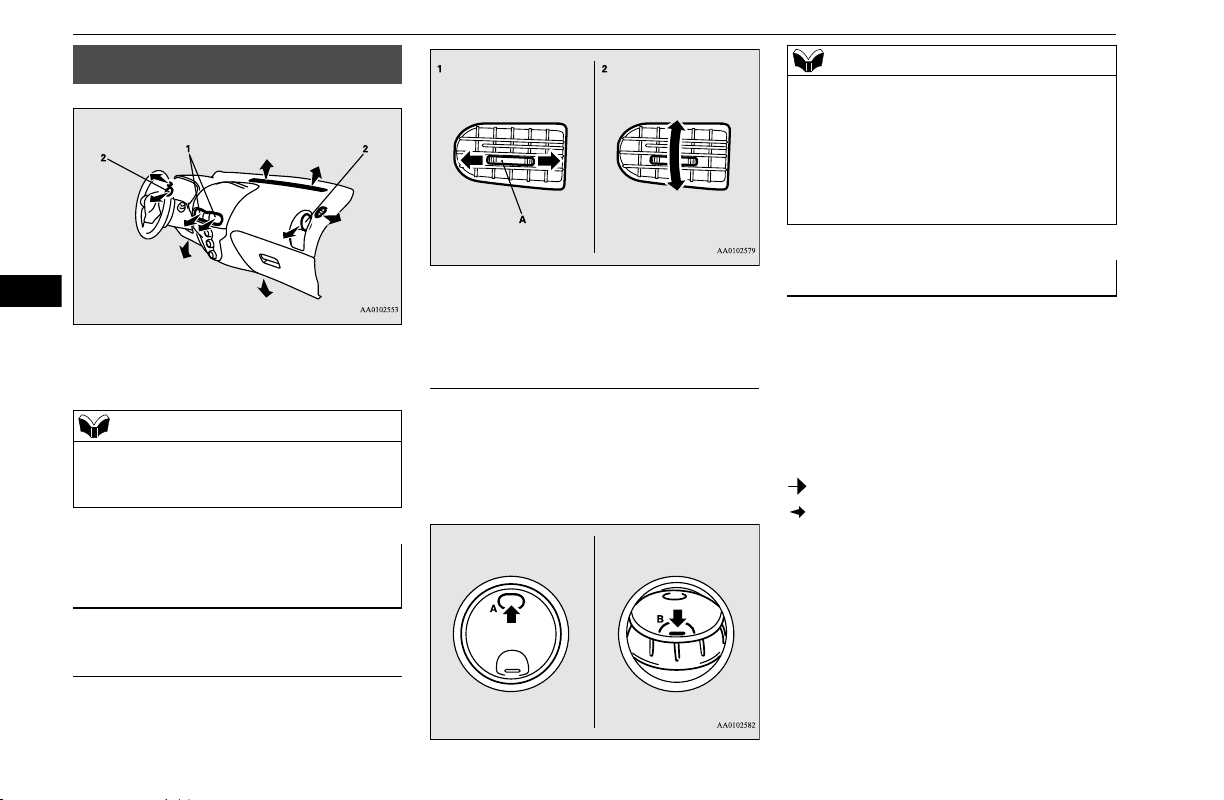
Vents
7-2 Comfort controls
7
N00729900265
N00730200314
Adjust the direction of the air flow by moving
the knob (A) and vent.
When the dimple (A) is pressed, the vent
opens.
To close the vent, press the dimple (B) on the
opposite side.
N00736400581
To change the position and amount of air
flowing from the vents, turn the mode selec-
tion dial. Refer to “Mode selection dial” on
page 7-5.
These symbols are used in the next several
illustrations to demonstrate the quantity of air
coming from the vents.
: Small amount of air from the vents
: Large amount of air from the vents
Vents
1- Center vents
2- Side vents
NOTE
Do not place beverages on top of the instru-
ment panel. If they splash into the air condi-
tioning vents, they could damage the system.
Air flow and direction adjust-
ments
Center vents
1- Left-right adjustment
2- Up-down adjustment
Side vents
NOTE
On rare occasions, air from the vents of an
air-conditioned vehicle may be foggy. This is
only moist air cooling suddenly and does not
indicate a problem.
Do not let drinks or other liquids get into the
vents as they could prevent the air condition-
ing from operating normally.
Changing the mode selection
BK0220401US.book 2 ページ 2015年6月3日 水曜日 午前7時42分
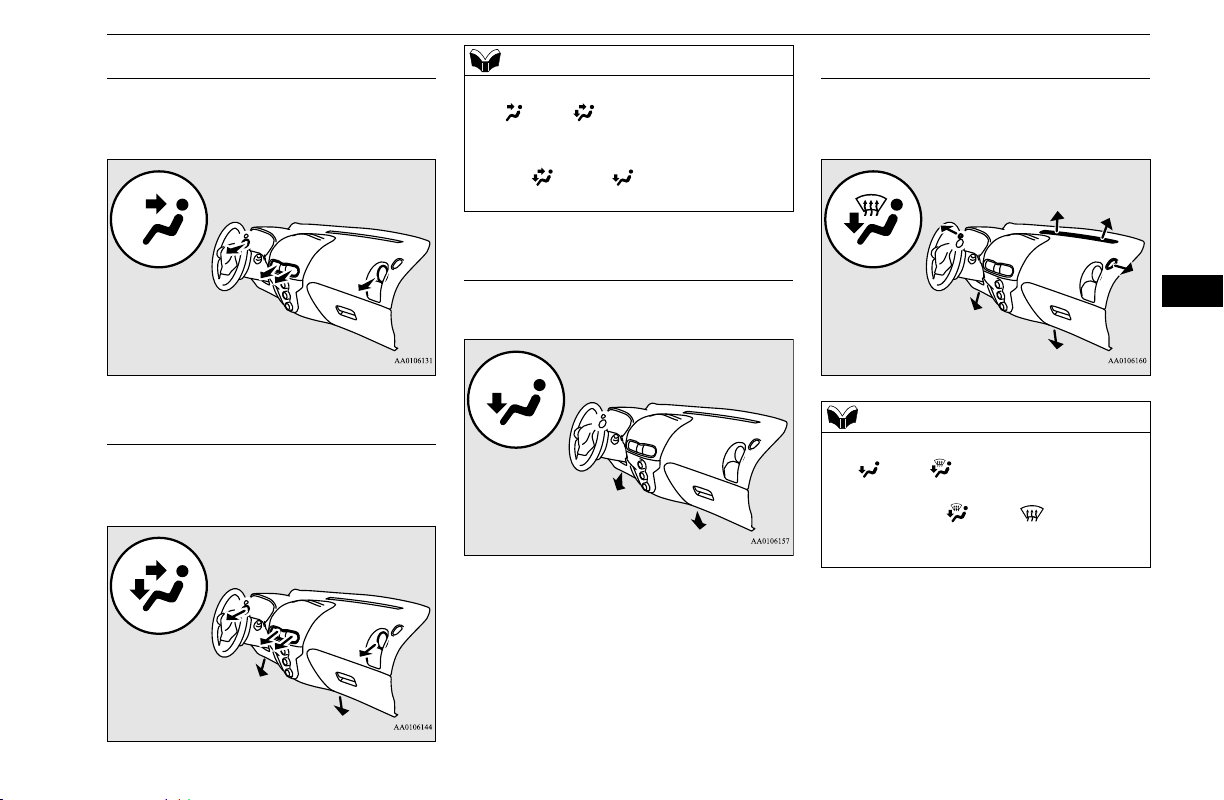
Vents
Comfort controls 7-3
7
Air flows only to the upper part of the passen-
ger compartment.
Air flows to the upper part of the passenger
compartment, and flows to the leg area.
Air flows mainly to the leg area.
Air flows to the leg area, the windshield and
the door windows.
Face position
Foot/Face position
NOTE
With the mode selection dial between the
“ ” and “ ” positions, air flows mainly
to the upper part of the passenger compart-
ment. With the mode selection dial between
the “ ” and “ ” positions, air flows
mainly to the leg area.
Foot position
Foot/Defroster position
NOTE
With the mode selection dial between the
“ ” and “ ” positions, air flows mainly
to the leg area. With the mode selection dial
between the “ ” and “ ” positions, air
flows mainly to the windshield and door
windows.
BK0220401US.book 3 ページ 2015年6月3日 水曜日 午前7時42分
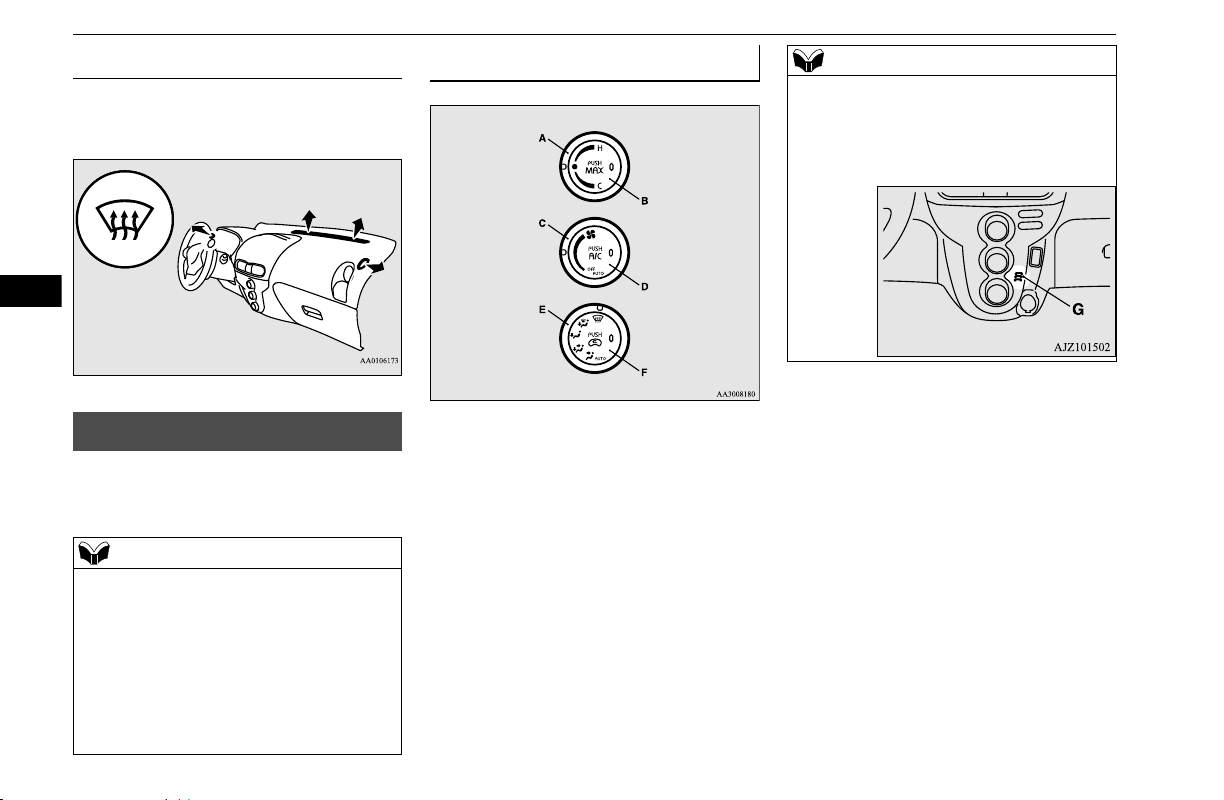
Air conditioning
7-4 Comfort controls
7
Air flows mainly to the windshield and the
door windows.
N00730300328
The air conditioning can only be used when
the ready indicator is illuminated.
N00730501314
Defroster position
Air conditioning
NOTE
If the energy level gauge is at 0 bars or the
power down warning light illuminates, the
vehicle interior may not be cooled/heated
even though the dial or switch is operated.
Furthermore, the defog performance may be
also reduced.
Refer to “Energy level gauge” on page 5-41.
Refer to “Power down warning light” on
page 5-46.
Control panel
A- Temperature control dial
B- MAX switch
C- Blower speed selection dial
D- Air conditioning switch
E- Mode selection dial
F- Air selection switch
NOTE
There is an interior air temperature sensor
(G) in the illustrated position.
Never place anything over the sensor, since
doing so will prevent it from functioning
properly.
BK0220401US.book 4 ページ 2015年6月3日 水曜日 午前7時42分
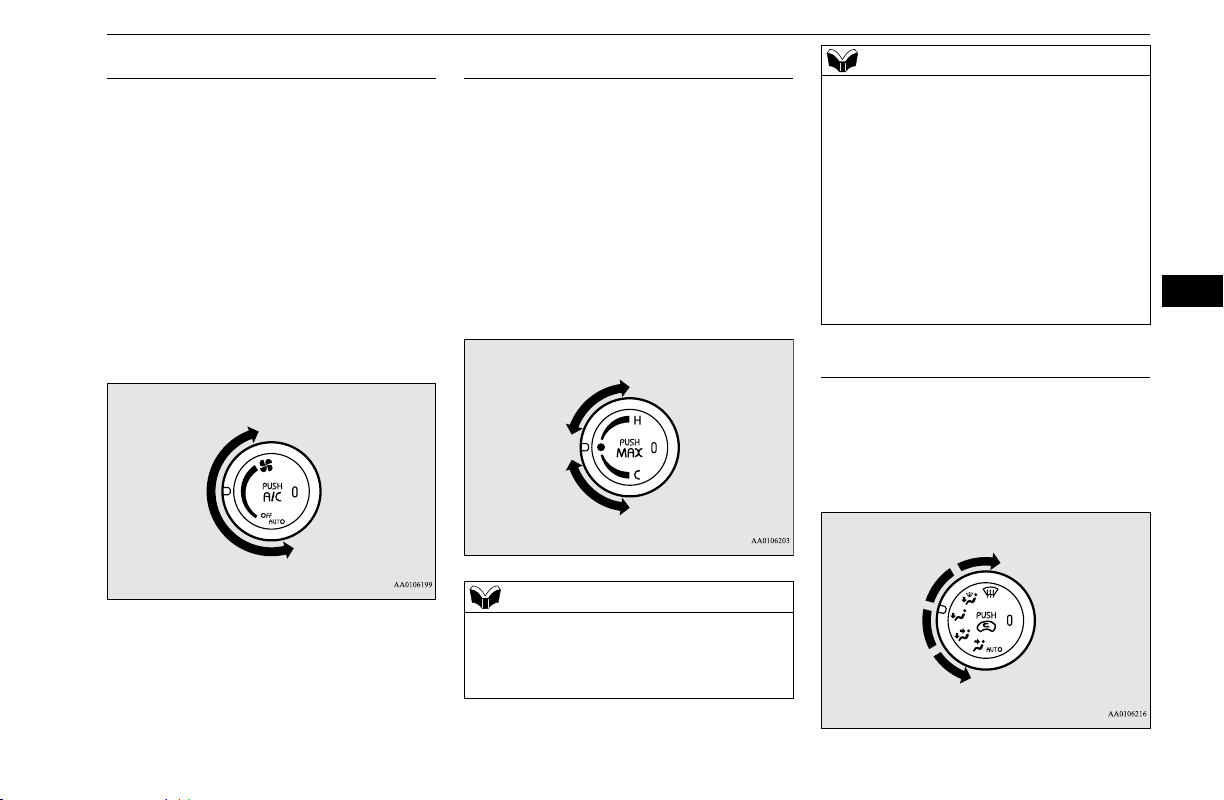
Air conditioning
Comfort controls 7-5
7
N00736500191
When the electric motor switch is in the
“ON” position, select the blower speed by
turning the blower speed selection dial.
Turning the dial clockwise will increase the
blower speed;
turning the dial counterclockwise will
decrease it. When the dial is set to the “OFF”
position, all fan-driven airflow will stop.
When the dial is set to the “AUTO” position,
the air flow is adjusted automatically accord-
ing to the temperature of the interior and the
position of the temperature control dial.
N00736600235
Use this dial to adjust the temperature of the
air flow from the vents.
Turn the temperature control dial clockwise
to make the air warmer. Turn it counterclock-
wise to make the air cooler.
When the dial is set to middle () position,
only uncooled and unheated air will flow.
When the dial is moved to middle () posi-
tion when using cooling or heating, cooling
or heating stops.
N00736700210
To change the position and amount of air
flowing from the vents, turn the mode selec-
tion dial. Refer to “Changing the mode selec-
tion” on page 7-2.
Blower speed selection dial Temperature control dial
NOTE
When the dial is moved from middle ()
position to the left while the air conditioning
is not operating, the air temperature will not
change.
When the dial is moved to middle () posi-
tion and then to the left while the air condi-
tioning is operating, the air conditioning
system is operating again.
When the temperature control dial is set to
“C” position, the air selection will be auto-
matically set to the recirculation position and
the air conditioning will operate.
When the dial is moved thereafter, the air
conditioning continues to operate and the air
selection setting returns to the setting before
the dial was set to “C” position.
Mode selection dial
NOTE
BK0220401US.book 5 ページ 2015年6月3日 水曜日 午前7時42分
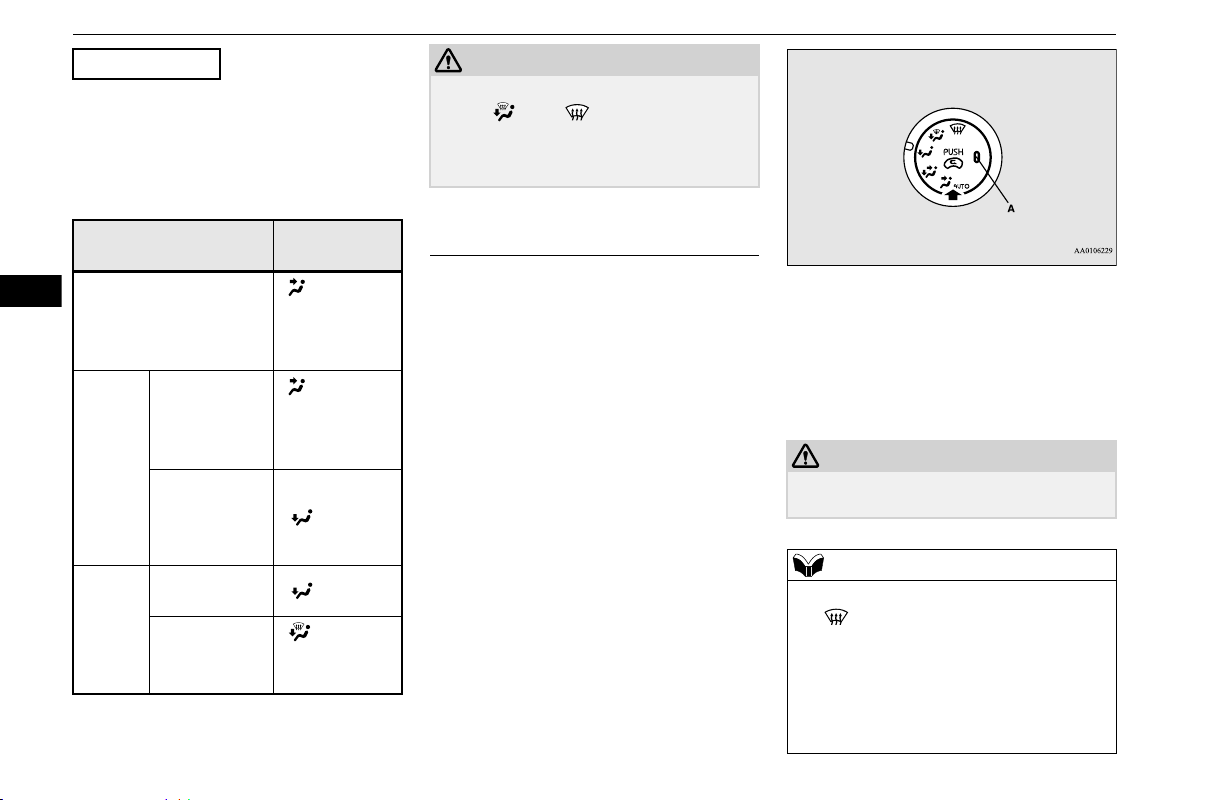
Air conditioning
7-6 Comfort controls
7
The vents change to the following positions
according to the position of the temperature
control dial.
Refer to “Temperature control dial” on page
7-5.
N00736800400
Normally, use the outside air position to keep
the windshield and side windows clear and to
quickly remove fog or frost from the wind-
shield.
To change the air selection, simply press the
air selection switch.
Outside air {Indicator light (A) OFF}
Outside air is introduced into the passen-
ger compartment.
Recirculated air {Indicator light (A) ON}
Air is recirculated inside the passenger
compartment.
If high cooling performance is desired, or, if
the outside air is dusty or contaminated in
some way, use the recirculation position.
Switch to the outside air position every now
and then to keep the windows from fogging
up.
“AUTO” position
Temperature control
dial position
Vent s
Between “C” and mid-
dle()
: Upper part
of front passen-
ger compart-
ment
Mid-
dle()
Set the dial to
middle ()
from the “C”
side
: Upper part
of front passen-
ger compart-
ment
Set the dial to
middle ()
from the “H”
side
: Leg area
Between
middle
() and
“H”
Near middle
()
: Leg area
Near “H”
: Leg area,
windshield, and
door windows
CAUTION
When using the mode selection dial between
the “ ” and “ ” positions, prevent fog-
ging by pressing the air selection switch to
select outside air. (Refer to “Air selection
switch” on page 7-6.)
Air selection switch
CAUTION
Using recirculated air for a long time may
cause the windows to fog up.
NOTE
When the mode selection dial is set to the
“ ” position, the air conditioning com-
pressor runs automatically. Outside air intro-
duction will also be selected automatically.
When the temperature control dial is set to
the “C” position, the air selection will be
automatically set to the recirculation posi-
tion.
BK0220401US.book 6 ページ 2015年6月3日 水曜日 午前7時42分
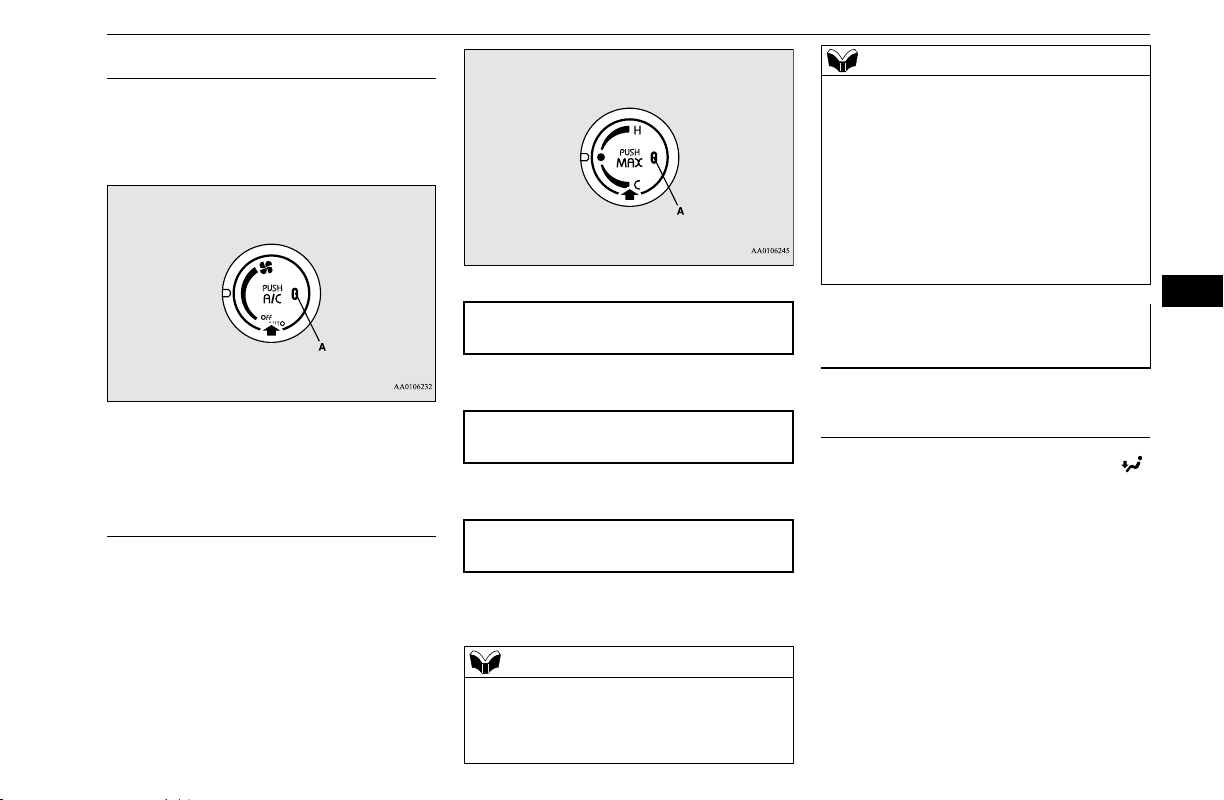
Air conditioning
Comfort controls 7-7
7
N00731000465
Push the switch, and the air conditioning
compressor will turn on. The air conditioning
indicator light (A) will come on.
Push the switch again and the air condition-
ing compressor will stop and the indicator
light (A) goes off.
N00766500015
When the blower speed selection dial is not
OFF and the MAX switch is pressed, the indi-
cator light (A) illuminates and cooling/heat-
ing performance and the air conditioning
setting is changed according to the tempera-
ture control dial position.
When the switch is pressed again, the opera-
tion returns to the mode before pressing the
switch.
The heating capability is at maximum.
The air flow is at maximum.
The air conditioning automatically operates
and the cooling capability is at maximum.
N00731101290
1. Set the mode selection dial to the “ ”
position.
2. Set the air selection switch (A) to the out-
side position.
3. Turn the temperature control dial clock-
wise or counterclockwise to the desired
temperature between middle () and “H”
position.
4. Select the desired blower speed.
Air conditioning switch
MAX switch
When the temperature control dial is set
between middle () and “H” position
When the temperature control dial is in
middle () position
When the temperature control dial is set
between “C” and middle () position
NOTE
Do not use the cooling/heating function with
the MAX switch for a long time. Because the
power consumption is greatly increased, the
cruising range is shortened.
When the blower speed selection dial or tem-
perature control dial is operated with the
indicator light illuminated, the indicator light
goes out and the selected function overrides
others.
Other functions return to the mode before
pressing the MAX switch.
When the air conditioning is operated with
the MAX switch, the air conditioning does
not stop if the function is cancelled.
Operating the air conditioning
system
Heating
NOTE
BK0220401US.book 7 ページ 2015年6月3日 水曜日 午前7時42分
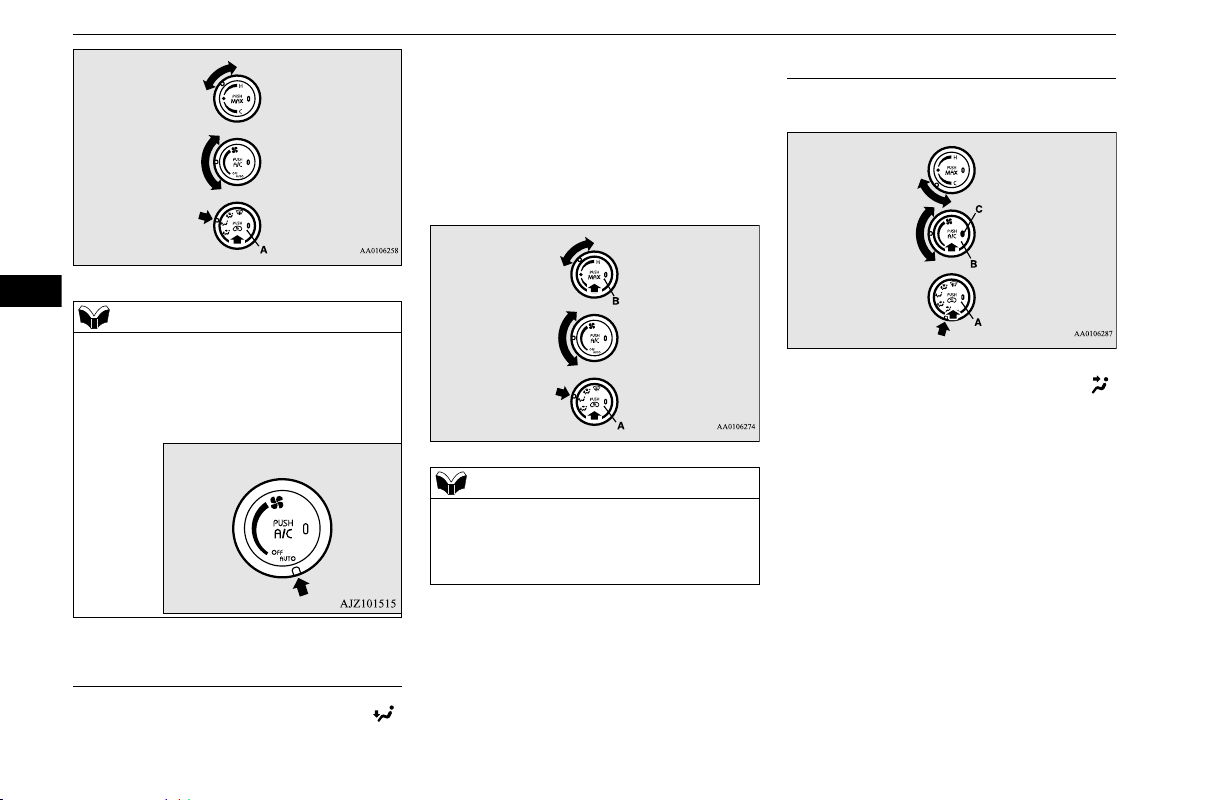
Air conditioning
7-8 Comfort controls
7
1. Set the mode selection dial to the “ ”
position.
2. Set the air selection switch (A) to the out-
side position.
3. Turn the temperature control dial clock-
wise or counterclockwise to between mid-
dle () position and “H” position.
4. Turn the blower speed selection dial to
any position other than “OFF” position.
5. Press the MAX switch (B).
N00731201363
For ordinary cooling
1. Set the mode selection dial to the “ ”
position.
2. Set the air selection switch (A) to the out-
side position.
3. Turn the temperature control dial clock-
wise or counterclockwise to the desired
temperature between middle () and “C”
position.
4. Select the desired blower speed.
5. Push the air conditioning switch (B).
6. When the air conditioning is operating,
the switch indicator light (C) illuminates.
NOTE
When the blower speed selection dial is set
to the “AUTO” position, the air flow is
adjusted automatically according to the tem-
perature of the interior and the position of
the temperature control dial.
Quick heating
NOTE
Do not use the heating function with the
MAX switch for a long time. Because the
power consumption is greatly increased, the
cruising range is shortened.
Cooling
BK0220401US.book 8 ページ 2015年6月3日 水曜日 午前7時42分
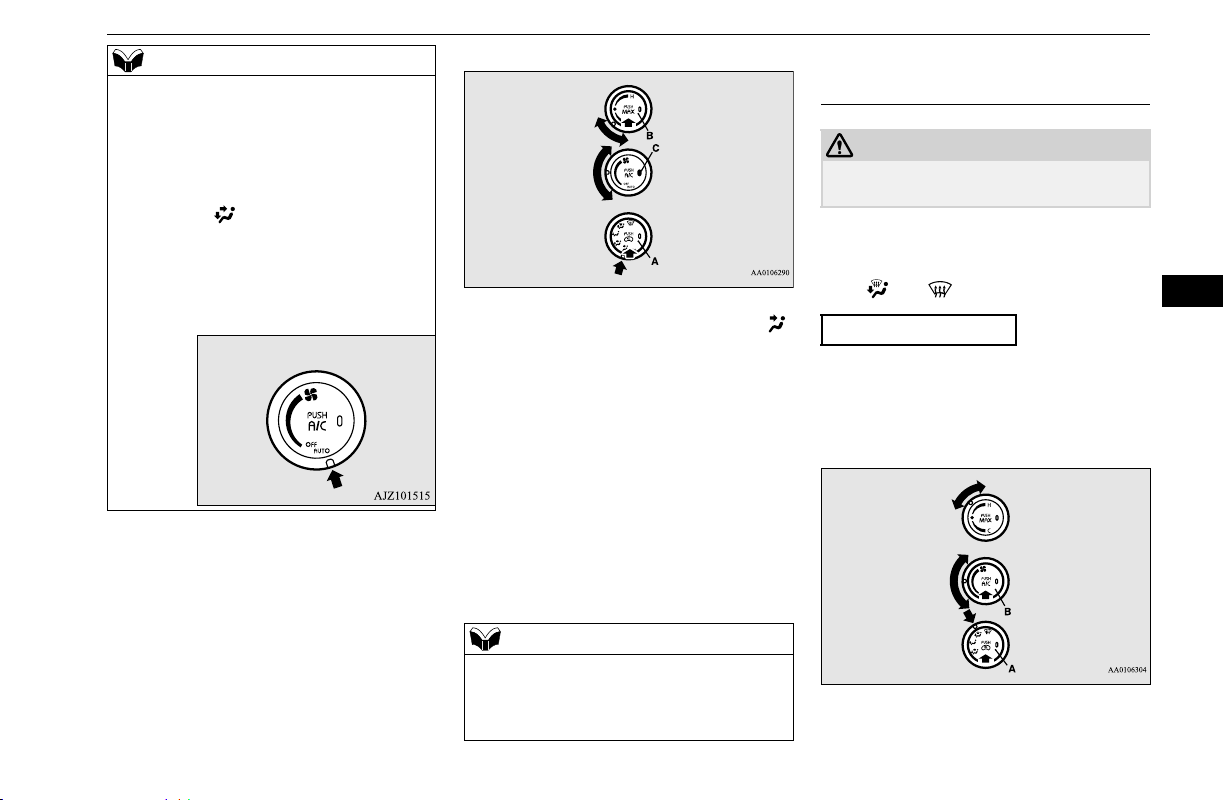
Air conditioning
Comfort controls 7-9
7
For quick cooling
1. Set the mode selection dial to the “ ”
position.
2. Set the air selection switch (A) to the
recirculation position.
3. Turn the temperature control dial clock-
wise or counterclockwise to between mid-
dle () and “C” position.
4. Turn the blower speed selection dial to
any position other than “OFF” position.
5. Press the MAX switch (B).
The air conditioning automatically oper-
ates and the indicator light (C) illumi-
nates.
N00731400557
To remove frost or fog from the windshield
and door windows, use the mode selection
dial (“ ” or “ ”).
Use this setting to keep the windshield and
door windows clear of mist, and to keep the
leg area heated (when driving in rain or
snow).
1. Set the air selection switch (A) to the out-
side position.
NOTE
If the outside air is dusty or contaminated in
some way, set the air selection switch (A) to
the recirculation position. Let in some out-
side air from time to time for good ventila-
tion.
To cool the leg areas, set the mode selection
dial to the “ ” position.
When the blower speed selection dial is set
to the “AUTO” position, the air flow is
adjusted automatically according to the tem-
perature of the interior and the position of
the temperature control dial.
NOTE
Do not use the cooling function with the
MAX switch for a long time. Because the
power consumption is greatly increased, the
cruising range is shortened.
Defrosting or defogging (wind-
shield, door windows)
CAUTION
For safety, make sure you have a clear view
through all the windows.
For ordinary defrosting
BK0220401US.book 9 ページ 2015年6月3日 水曜日 午前7時42分
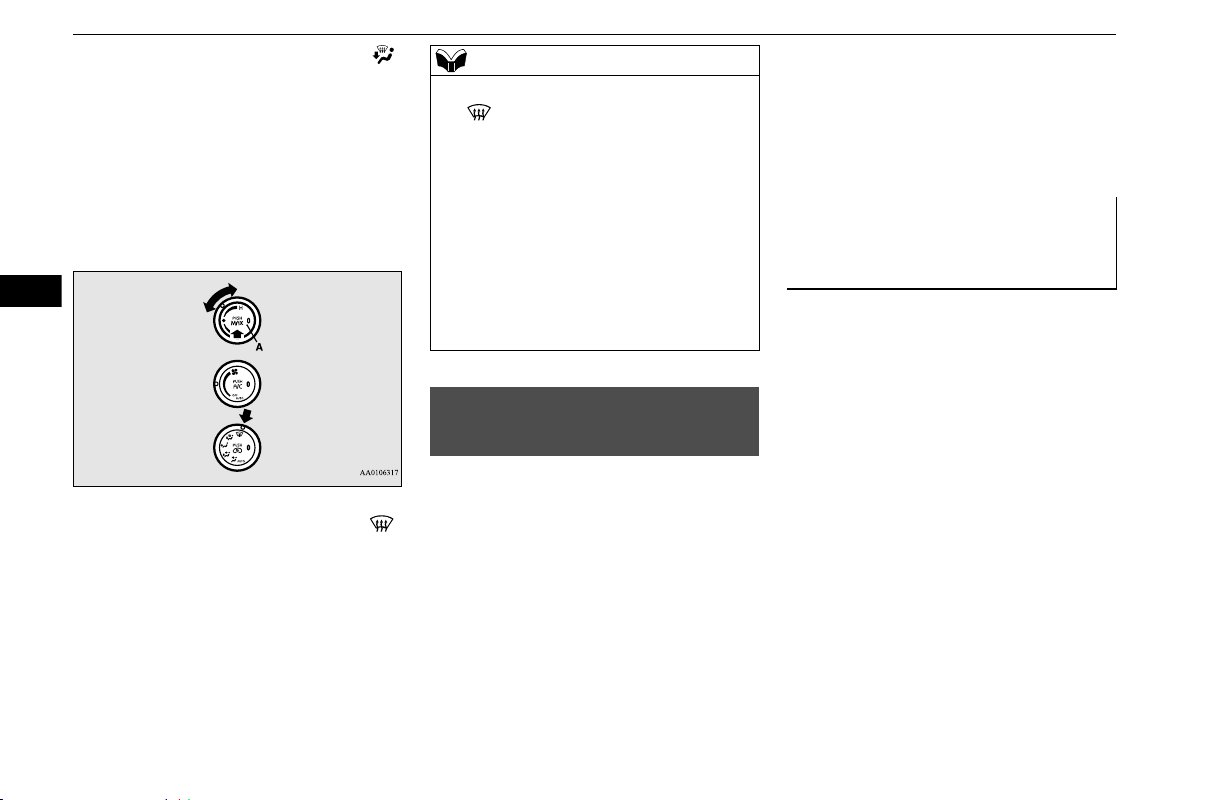
Important air conditioning operating tips
7-10 Comfort controls
7
2. Set the mode selection dial to the “ ”
position.
3. Turn the temperature control dial clock-
wise or counterclockwise to the desired
temperature between middle () and “H”
position.
4. Select the desired blower speed.
5. Push the air conditioning switch (B).
For quick defrosting
1. Set the mode selection dial to the “ ”
position.
2. Turn the temperature control dial clock-
wise or counterclockwise to the desired
temperature between middle () and “H”
position.
3. Press the MAX switch (A).
N00733700323
1. Park the vehicle in the shade whenever
possible. Parking in the hot sun makes the
vehicle interior extremely hot which then
requires more time to cool. If it is neces-
sary to park in the sun, open the windows
for the first few minutes of air condition-
ing to expel the hot air.
2. Afterwards, keep the windows closed
when the air conditioning is in use. The
entry of outside air through open windows
will reduce cooling efficiency.
3. When running the air conditioning, make
sure the air intake, which is located in
front of the windshield, is free of obstruc-
tions such as leaves. Leaves collected in
the air-intake chamber may reduce air
flow and plug the water drains.
If the air conditioning seems less effective
than usual, the cause might be a refrigerant
leak.
Have the system inspected by a certified i-
MiEV dealer.
NOTE
When the mode selection dial is set to the
“ ” position, the air conditioning com-
pressor runs automatically. Outside air intro-
duction will also be selected automatically.
When defrosting, do not set the temperature
control dial to the maximum cool position.
This would blow cool air on the window
glass and fog it up.
Since defogging or defrosting with the MAX
switch consumes a large amount of power,
stop the switch after defogging or defrosting.
Use the MAX setting for a long time
decreases the cruising range.
Important air conditioning
operating tips
Air conditioning system refrig-
erant and lubricant recommen-
dations
BK0220401US.book 10 ページ 2015年6月3日 水曜日 午前7時42分
Air purifier
Comfort controls 7-11
7
The air conditioning should be operated for at
least five minutes each week, even in cold
weather. This includes the quick defrosting
mode. Operating the air condition system
weekly maintains lubrication of the compres-
sor internal parts and maintains the air condi-
tioning in the best operating condition.
N00733800177
The air conditioning system is equipped with
an air filter to reduce pollen and dust entering
the cabin.
The air filter’s ability to collect pollen and
dust will be reduced as it becomes dirty, so
replace it periodically. For the maintenance
interval, refer to the “WARRANTY AND
MAINTENANCE MANUAL”.
N00766601026
You can run the air conditioning in advance
of using the vehicle. For details, refer to
“Remote Climate Control” on page 3-36,
3-47.
N00734301062
The audio system can only be used when the
electric motor switch is in the “ON” or
“ACC” position.
CAUTION
The air conditioning system in your vehicle
must be charged with the refrigerant HFC-
134a and the lubricant POE MA68EV.
Use of any other refrigerant or lubricant will
cause severe damage and may require replac-
ing your vehicle’s entire air conditioning
system.
The release of refrigerant into the atmo-
sphere is not recommended.
The new refrigerant HFC-134a in your vehi-
cle is designed not to harm the earth’s ozone
layer. However, it may contribute slightly to
global warming.
It is recommended that the old refrigerant be
saved and recycled for future use.
During a long period of disuse
Air purifier
NOTE
Operation in certain conditions such as driv-
ing on a dusty road or frequent use of the air
conditioning can reduce the service life of
the filter. When you feel that the air flow is
lower than normal or when the windshield or
windows start to fog up easily, replace the air
filter.
Contact a certified i-MiEV dealer for assis-
tance.
Remote Climate Control
AM/FM electronically tuned
radio with CD player (if so
equipped)
NOTE
To listen to the audio system while the elec-
tric motor unit is not running, turn the elec-
tric motor switch to the “ACC” position.
If the electric motor switch is in the “ACC”
position, the accessory power will automati-
cally turn off after a certain period of time
and you will no longer be able to use the
audio system. The accessory power comes
on again if the electric motor switch is turned
from the “ACC” position. Refer to “ACC
power auto-cutout function” on page 5-19.
If a cellular phone is used inside the vehicle,
it may create noise in the audio equipment.
This does not mean that anything is wrong
with your audio equipment. In such a case,
use the cellular phone at a place as far away
as possible from the audio equipment.
BK0220401US.book 11 ページ 2015年6月3日 水曜日 午前7時42分
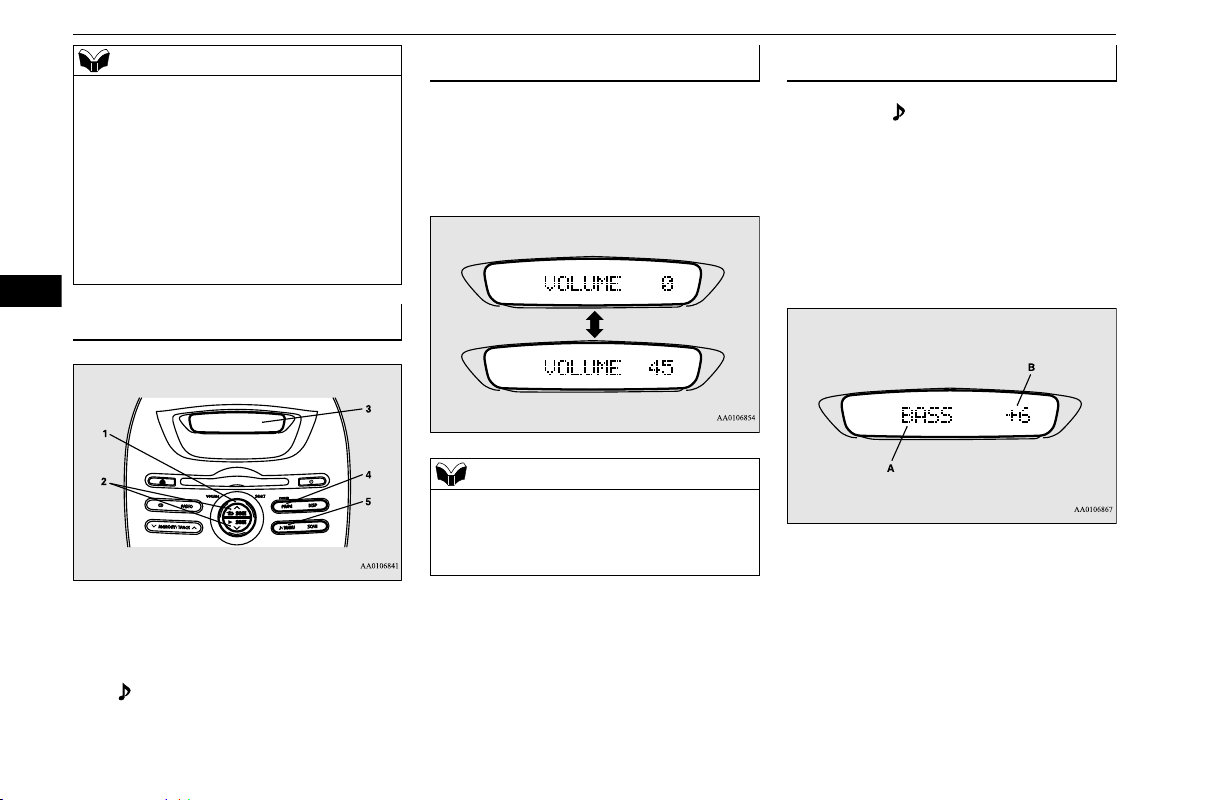
AM/FM electronically tuned radio with CD player (if so equipped)
7-12 Comfort controls
7
N00711900716
N00712000408
Turn the VOLUME knob clockwise to
increase the volume; counterclockwise to
decrease the volume.
The status will be displayed in the display.
N00712100672
1. Press the button repeatedly to select
the tone, balance and SCV (Speed Com-
pensated Volume) function control to
change. The order is: BASS TREBLE
FADER BALANCE SCV
Audio adjust mode OFF
2. Press the SEEK button to change the tone,
balance and SCV function setting.
The status will be displayed in the display.
If foreign objects or water get into the audio
equipment, or if smoke or a strange odor
comes from it, immediately turn off the
audio system and have it checked at a certi-
fied i-MiEV dealer. Never try to repair it
yourself. Avoid using the audio system until
it is inspected by a qualified person.
If the audio system is damaged by foreign
objects, water, or fire, have the system
checked at a certified i-MiEV dealer.
Volume and tone control panel
1- VOLUME (Volume control) knob
2- SEEK (Audio adjust) button
3- Display
4- POWER (On-Off) button
5- (Mode change) button
NOTE
To adjust the volume
NOTE
The volume control mode will shut off auto-
matically if the another mode is selected, or
if no adjustment is made within about 2 sec-
onds.
To adjust the tone
A- Adjust mode
B- Adjust level
BK0220401US.book 12 ページ 2015年6月3日 水曜日 午前7時42分
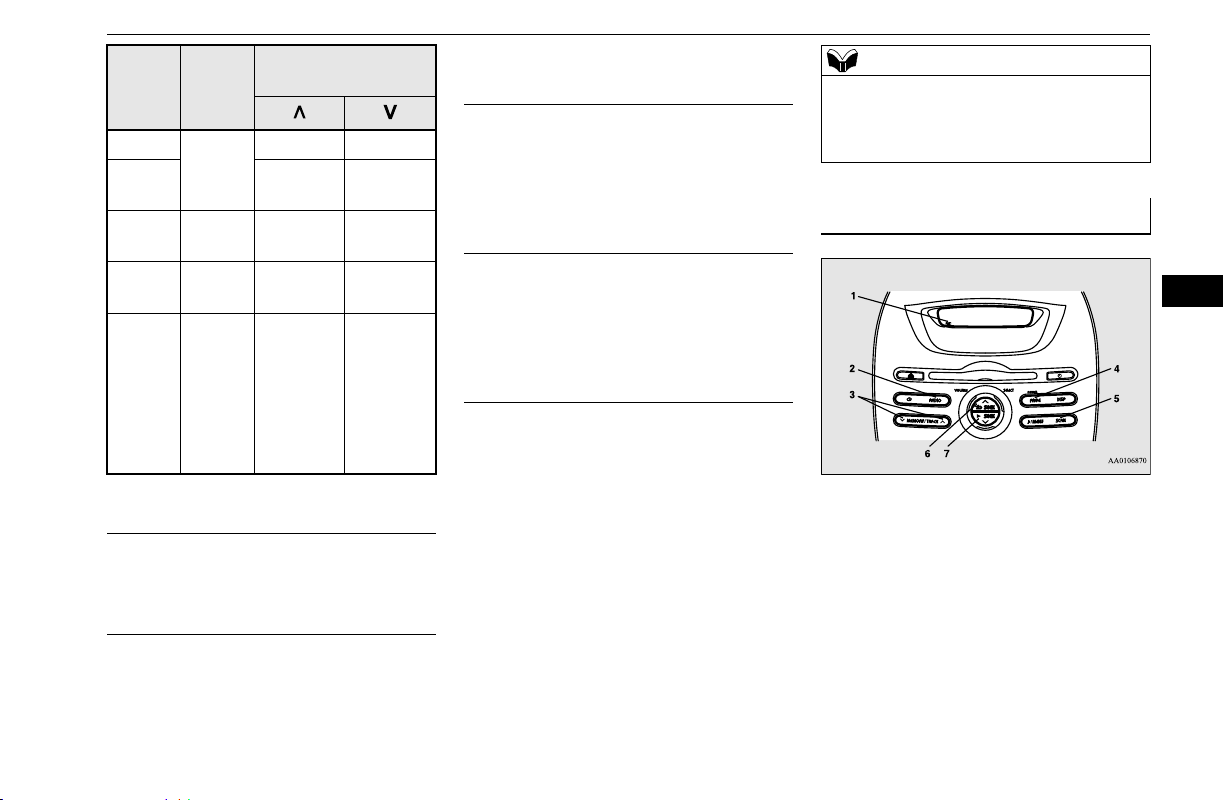
AM/FM electronically tuned radio with CD player (if so equipped)
Comfort controls 7-13
7
To select the desired bass level.
To select the desired treble level.
To balance the volume from the F (front) and
the R (rear) speakers.
To balance the volume from the L (left) and
the R (right) speakers.
Speed Compensated Volume function is a
feature that automatically adjusts the VOL-
UME, BASS and TREBLE settings in accor-
dance with the vehicle speed.
The effects of the SCV function can be
selected either of three levels (LOW, MID
and HIGH). Select the degree of your choice
by pressing the SEEK button.
If you want to stop the SCV function, select
the OFF.
N00734900902
Adjust
Mode
Adjust
Level
SEEK button opera-
tion
BASS
-6 to 6
Stronger Weaker
TRE-
BLE
Stronger Weaker
FADER
F11 to
R11
F (Front)
increases
R (Rear)
increases
BAL-
ANCE
L11 to
R11
R (Right)
increases
L (Left)
increases
SCV
HIGH,
MID,
LOW,
OFF
HIGH
MID
LOW
OFF
HIGH
MID
LOW
OFF
BASS (Bass tone control)
TREBLE (Treble tone control)
FADER (Front/Rear balance con-
trol)
BALANCE (Left/Right balance
control)
SCV (Speed Compensated Vol-
ume) function
NOTE
The audio adjust mode will automatically
shut off when another mode is selected, or if
no adjustment is made within about 10 sec-
onds.
Radio control panel and display
1- FM (FM1/FM2) indicator
2- RADIO (AM/FM selection) button
3- MEMORY (Memory selection) button
4- POWER (On-Off) button
5- SCAN button
6- SEEK (Up-seek) button
7- SEEK (Down-seek) button
BK0220401US.book 13 ページ 2015年6月3日 水曜日 午前7時42分
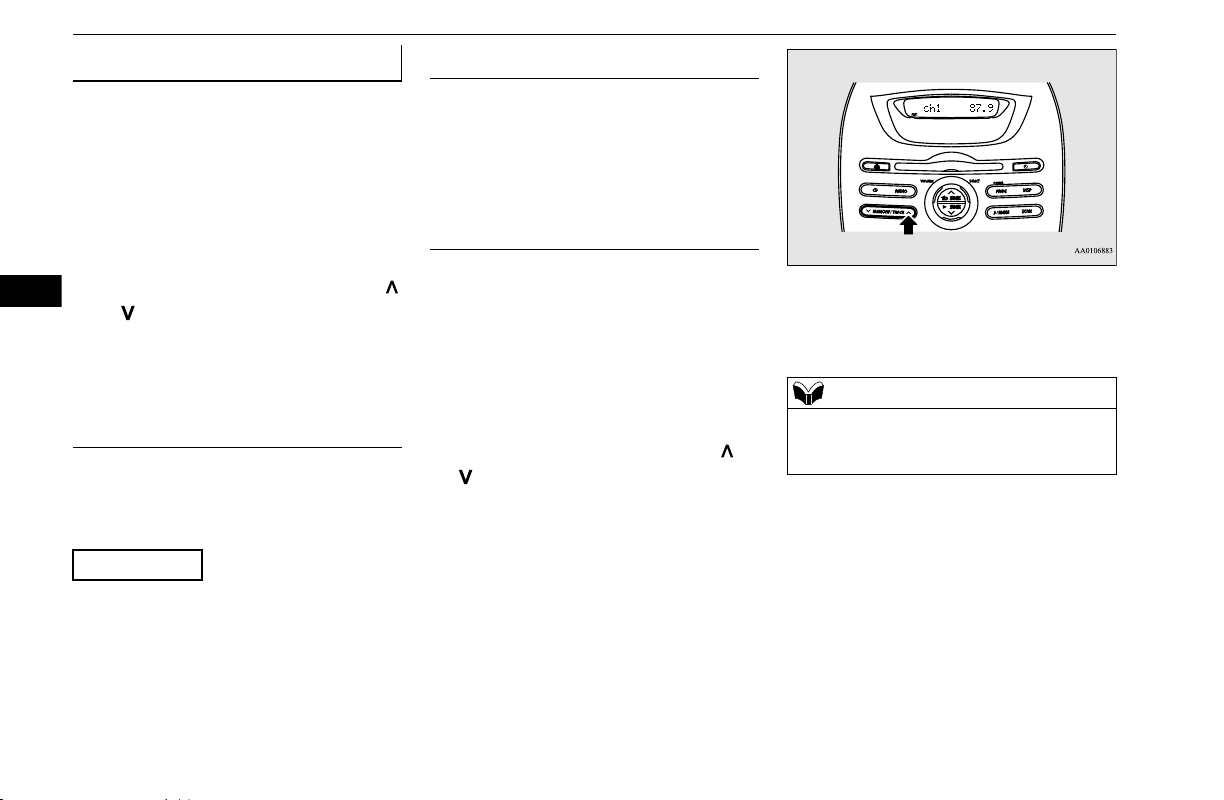
AM/FM electronically tuned radio with CD player (if so equipped)
7-14 Comfort controls
7
N00735000913
1. Press the POWER button until it beeps to
turn the audio system ON and OFF. The
system turns on in the last mode used.
Press the RADIO button to turn ON the
radio.
2. Press the RADIO button to select the
desired band (AM/FM1/FM2).
3. Press the SEEK button to tune to a station,
or press the MEMORY button either
or to tune in to a station memorized.
Refer to “Automatic tuning”, “Manual
tuning” or “To enter frequencies into the
memory”.
After pressing the SEEK button, a receivable
station will be automatically selected and
reception of the station will begin.
Press the SCAN button. The radio will tune
consecutively to each available station for
about 5 seconds per station. If you want to
stop scanning, press the SCAN button again.
The frequency display of the current station
flashes once per second during SCAN.
The frequency changes every time the SEEK
button is pressed.
Press the button to select the desired station.
As many as 6 AM and 12 FM stations can be
entered into the memory.
To store a frequency in the memory, follow
these steps:
1. Press the SEEK button to tune to the fre-
quency you wish to keep in the memory.
2. Press the MEMORY button either or
until it beeps.
The sound will be momentarily inter-
rupted while the frequency is being
entered into the memory.
3. To recall a frequency that has been saved
in memory, press the MEMORY button
briefly for no longer than about 1 second.
To listen to the radio
Automatic tuning
SCAN function
Manual tuning
To enter frequencies into the mem-
ory
NOTE
Disconnecting the 12V starter battery cables
erases all the radio station settings stored in
the memory.
BK0220401US.book 14 ページ 2015年6月3日 水曜日 午前7時42分
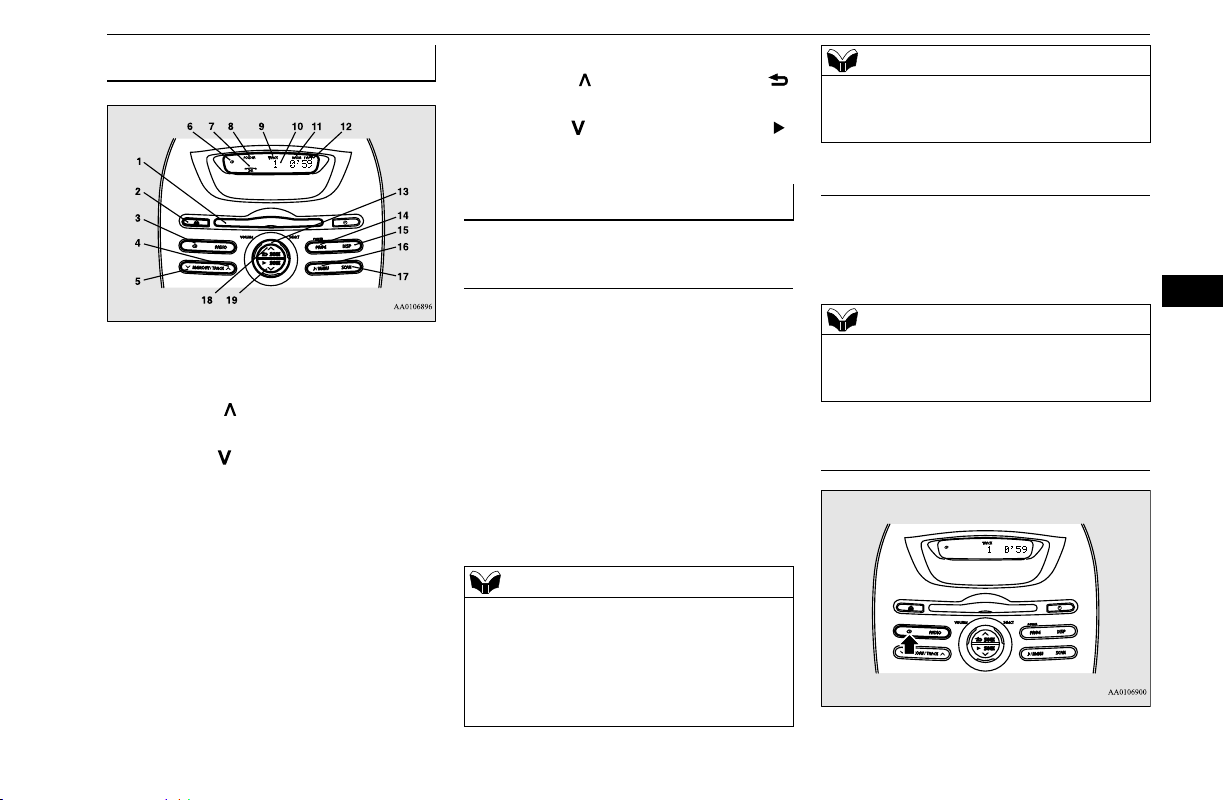
AM/FM electronically tuned radio with CD player (if so equipped)
Comfort controls 7-15
7
N00735300743
N00735502097
1. Press the POWER button until it beeps to
turn the audio system ON and OFF. The
system turns on in the last mode used.
2. Insert the disc with the label facing up.
When a disc is inserted, the CD indicator
will come on and the CD player will begin
playing even if the radio is being used.
The CD player will also begin playing
when the CD button is pressed with a disc
set in the CD player or in the disc loading
slot, even if the radio is being used.
When the eject button is pressed, the disc
automatically stops and is ejected. The sys-
tem automatically switches to radio mode.
CD control panel and display
1- Disc loading slot
2- Eject button
3- CD (CD mode changeover) button
4-
TRACK (Fast-forward/Track up)
button
5-
TRACK (Fast-reverse/Track down)
button
6- CD indicator
7- SEL (Select mode) indicator
8- FOLDER indicator
9- TRACK indicator
10- Display
11- RDM/F-RDM indicator
12- RPT/F-RPT indicator
13- SELECT knob
14- POWER (On-Off) button/PAGE (Title
scroll) button
15- DISP (Title display) button
16- MENU button
17- SCAN button
18-
SEEK (Up-seek) button/
(Return) button
19-
SEEK (Down-seek) button/
(Select) button
To listen to a CD
To s e t a disc
NOTE
For information concerning the adjustment
of volume and tone, refer to “To adjust the
volume” on page 7-12 and “To adjust the
tone” on page 7-12.
3 inches (8 cm) compact disc cannot be
played on this CD player.
For information concerning the handing of
the compact discs, refer to “Handling of
compact discs” on page 7-25.
To eject a disc
NOTE
If you do not remove an ejected disc before
15 seconds have elapsed, the disc will be
reloaded.
To listen to a music CD
NOTE
BK0220401US.book 15 ページ 2015年6月3日 水曜日 午前7時42分
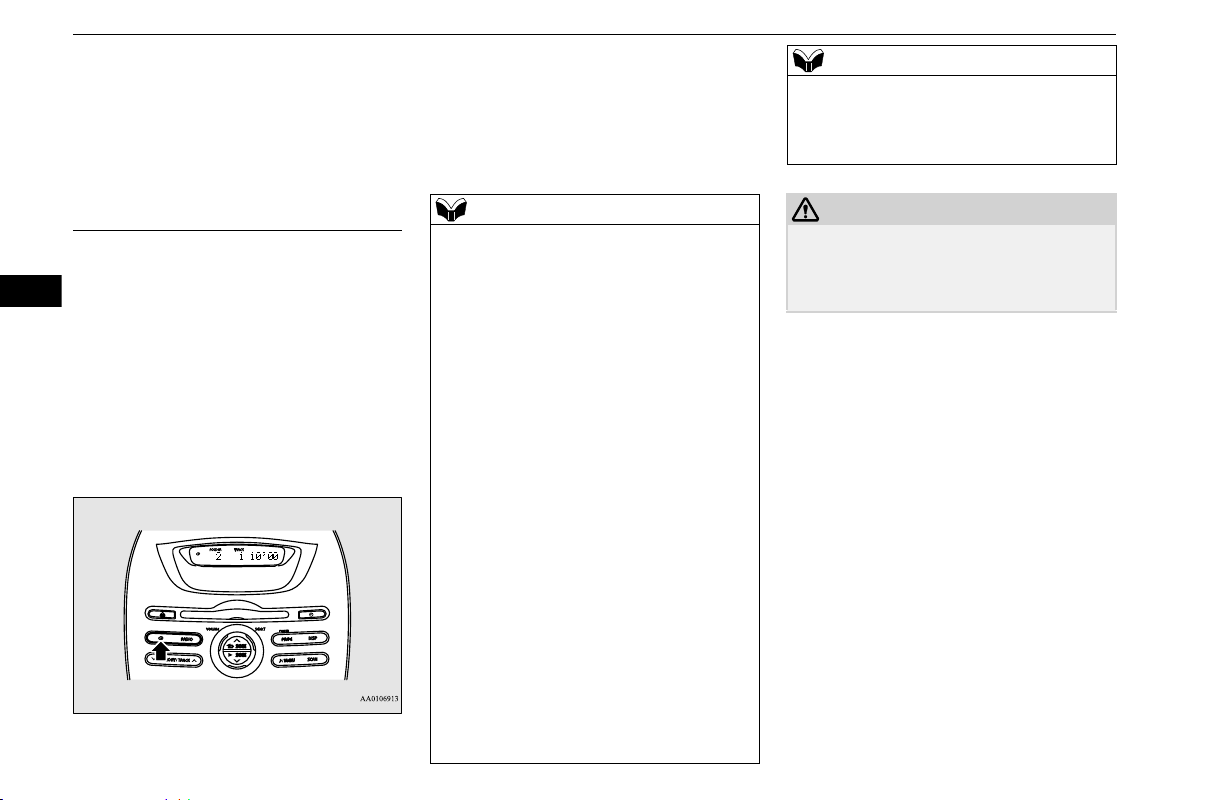
AM/FM electronically tuned radio with CD player (if so equipped)
7-16 Comfort controls
7
Push the CD button if a disc is already in the
CD player. The audio system will enter CD
mode and start playback. The track number
and the playing time will appear on the dis-
play. The tracks in the disc will be played
consecutively and continuously.
This CD player allows you to play MP3
(MPEG Audio Layer-3) files recorded on
CD-ROMs, CD-Rs (recordable CDs), and
CD-RWs (rewritable CDs) in ISO9660 Level
1/Level 2, Joliet, and Romeo formats. Each
disc may have a maximum of 16 trees, 100
folders and 255 files. During MP3 playback,
the unit can display ID3 tag information. For
information concerning ID3 tag, refer to “CD
text and MP3 title display” on page 7-19.
Push the CD button if a disc is already in the
CD player.
The display shows “READING”, then play-
back begins. The folder number, the track
number and the playing time will appear on
the display.
To listen to an MP3 CD
NOTE
While listening to a disc on which CD-DA
(CD-Digital Audio) and MP3 files have both
been recorded, you can switch between read-
ing of the CD-DA, reading of the MP3 files,
and the external audio input mode by press-
ing the CD button for 2 seconds or longer
(until you hear a beep).
With a disc that contains both CD-DA and
MP3 files, the CD-DA files are automati-
cally played first.
The playback sound quality differs depend-
ing on the encoding software and the bit rate.
For details, refer to the user manual of your
encoding software.
Depending on file/folder configurations on a
disc, it may take some time before playback
starts.
MP3 encode software and writing software
are not supplied with this unit.
You may encounter trouble in playing an
MP3 or displaying the information of MP3
files recorded with certain writing software
or CD recorders (CD-R/RW drivers).
If you record too many folders or files other
than MP3 onto a disc, it may take some time
before playback starts.
This unit does not record MP3 files.
For information concerning CD-Rs/RWs,
refer to “Notes on CD-Rs/RWs” on page
7-26.
CAUTION
Attempting to play a file not in the MP3 for-
mat which has the “.mp3” file name may
produce noise from the speakers and speaker
damage, and can damage your hearing.
NOTE
BK0220401US.book 16 ページ 2015年6月3日 水曜日 午前7時42分
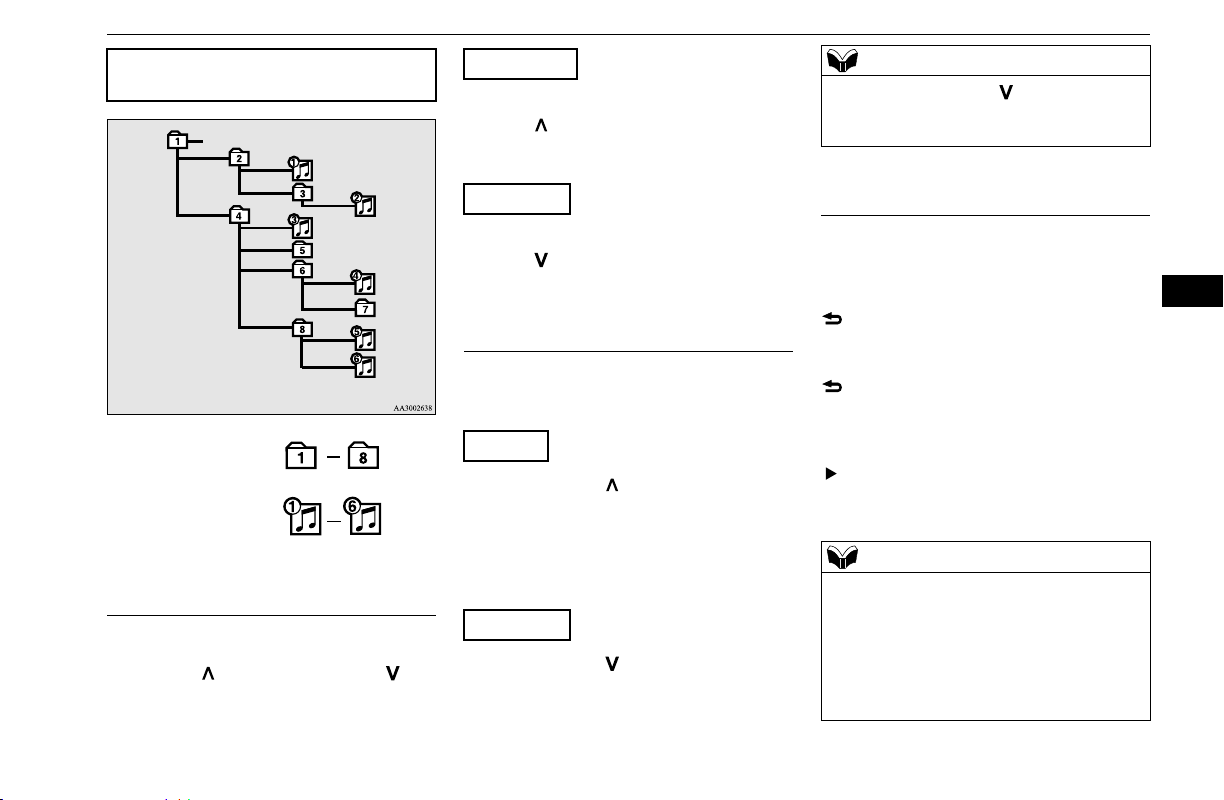
AM/FM electronically tuned radio with CD player (if so equipped)
Comfort controls 7-17
7
To fast forward or fast reverse the disc, press
the TRACK button or the TRACK but-
ton.
You can fast-forward the disc by pressing the
TRACK button. While the button is kept
pressed, the disc will be fast-forwarded.
You can fast reverse the disc by pressing the
TRACK button. While the button is kept
pressed, the disc will be fast-reversed.
You can select your desired track by using the
TRACK button.
Press the TRACK button repeatedly until
the desired track number appears on the dis-
play.
When listening to a MP3 CD, keep pressing
the button to continue to move up tracks.
Press the TRACK button repeatedly until
the desired track number appears on the dis-
play.
When listening to a MP3 CD, keep pressing
the button to continue to move down tracks.
Operate the following buttons or the SELECT
knob to select desired file.
When this mode is activated by pressing the
button, the SEL indicator will be dis-
played in the display.
Folder selection order/MP3 file playback
order (Example)
Folder selection
In the order
File selection
In the order
To fast forward/reverse the disc
Root folder (Root directory)
Tree 1 Tree 2 Tree 3 Tree 4
Fast forward
Fast reverse
To select a desired track
Track up
Track down
NOTE
Pressing the TRACK button once during
the song will cause the CD player to restart
playback from the beginning of the song.
To find a file (MP3 CDs only)
button
:Press the button to start this
mode or cancel the selection.
SELECT knob :Turn the knob to show the
folder or file.
button
:Press the button to select the
folder or file.
NOTE
If no operation is performed for 10 seconds
or more or other button is operated after the
SELECT knob has been turned, searching of
the desired file is canceled.
If no operation is performed for 5 seconds or
more after the file is displayed, playback
starts.
BK0220401US.book 17 ページ 2015年6月3日 水曜日 午前7時42分
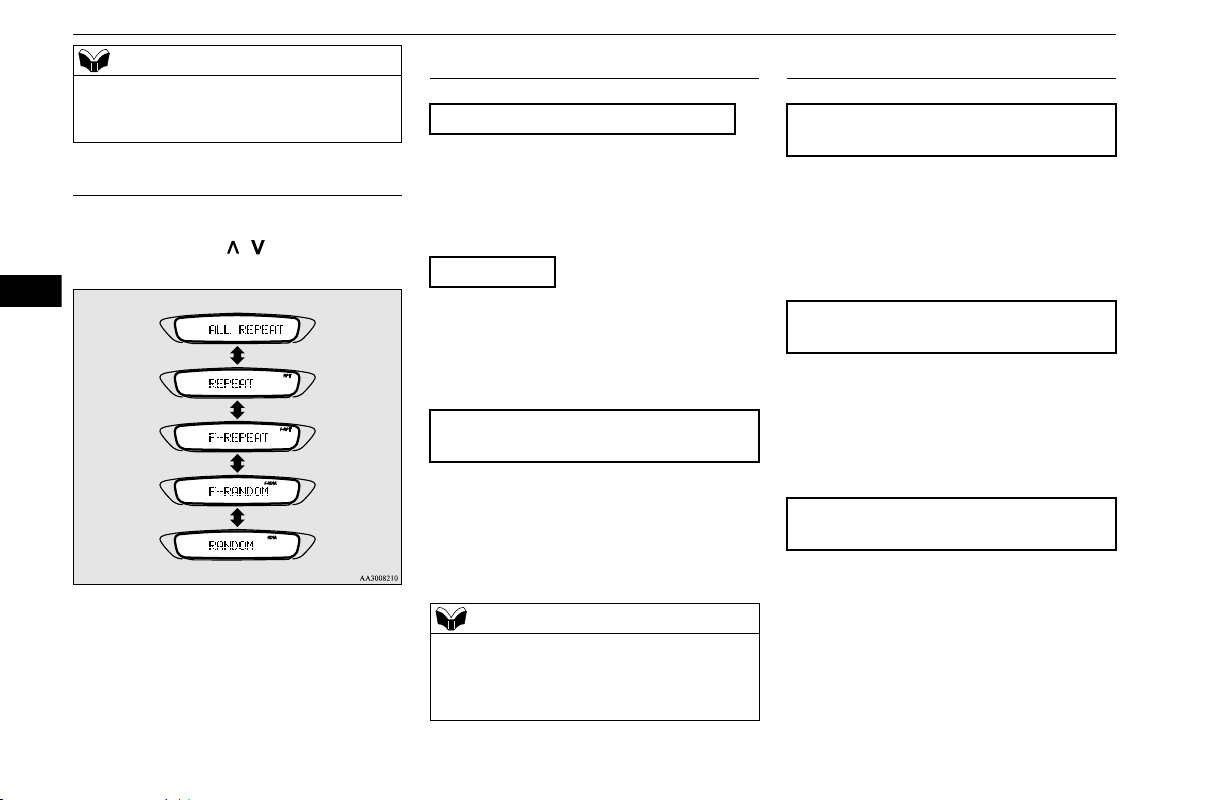
AM/FM electronically tuned radio with CD player (if so equipped)
7-18 Comfort controls
7
N00771500013
1. Press the MENU button until beeps.
2. Press the SEEK / button repeatedly
to select the mode.
3. Press the MENU button until you hear a
beep. The selected mode will operate.
N00771600014
Select the ALL REPEAT mode. Refer to “To
select the playing mode” on page 7-18.
The all tracks on the disc will be played
repeatedly.
Select the REPEAT mode. Refer to “To select
the playing mode” on page 7-18.
The RPT indicator will come on and repeat
the same track.
Select the F-REPEAT mode. Refer to “To
select the playing mode” on page 7-18.
The F-RPT indicator will come on and the all
track on the currently selected folder will be
played repeatedly.
N00771800016
Select the RANDOM mode. Refer to “To
select the playing mode” on page 7-18.
The RDM indicator will come on and the
tracks on the disc will be played in a random
sequence.
Select the F-RANDOM mode. Refer to “To
select the playing mode” on page 7-18.
The F-RDM indicator will come on and the
tracks on the currently selected folder will be
played in a random sequence.
Select the RANDOM mode. Refer to “To
select the playing mode” on page 7-18.
The RDM indicator will come on and the
files from all the folders on the disc will be
playback in a random sequence.
When the SEL indicator is not shown on the
display and the SELECT knob is operated,
the volume adjustment is effective.
To select the playing mode
NOTE
(MP3 CDs only)
(MP3 CDs only)
To play tracks in repeat
Repeat an all track (normal playback)
Repeat a track
Repeat tracks in the same folder (MP3
CDs only)
NOTE
With a disc that contains both CD-DA and
MP3 files, the repeat mode causes only files
of the same format (CD-DA only or MP3
files only) to be repeated.
To play tracks in random order
Random playback for a disc (music CDs
only)
Random playback for a folder (MP3 CDs
only)
Random playback for all folders on a
disc (MP3 CDs only)
BK0220401US.book 18 ページ 2015年6月3日 水曜日 午前7時42分
AM/FM electronically tuned radio with CD player (if so equipped)
Comfort controls 7-19
7
N00771900017
Press the SCAN button. “SCAN” will appear
on the display and the CD player will play
back the first 10 seconds of each track on the
selected disc (music CDs only) or the cur-
rently selected folder (MP3 CDs only).
The track number will blink while the scan
mode is selected. To stop the scan mode,
press the SCAN button again.
N00752100166
This audio system can display CD text and
MP3 titles including ID3 tag information.
The audio system can display disc and track
titles for discs with converted disc and track
title information. Press the DISP button
repeatedly to make selections in the following
sequence: disc name track name normal
display mode.
The audio system can display folder and track
titles for discs with converted folder and track
information. Press the DISP button repeat-
edly to make selections in the following
sequence: folder name track name nor-
mal display mode.
The audio system can display ID3 tag infor-
mation for files that have been recorded with
ID3 tag information.
1. Press the DISP button for 2 seconds or
longer to switch to the ID3 tag informa-
tion. “TAG” will appear on the display.
2. Press the DISP button repeatedly to make
selections in the following sequence:
album name track name artist name
normal display mode.
NOTE
With a disc that contains both CD-DA and
MP3 files, the random mode causes only
files of the same format (CD-DA only or
MP3 files only) to be repeated.
To find the start of each track on a
disc for playback
NOTE
Once all tracks on the disc (music CDs only)
or the currently selected folder (MP3 CDs
only) have been scanned, playback of the
disc will restart from the beginning of the
track that was playing when scanning
started.
With a disc that contains both CD-DA and
MP3 files, the scan mode causes only files of
the same format (CD-DA only or MP3 files
only) to be played.
CD text and MP3 title display
CD text
NOTE
The display can show up to 11 characters. If
a disc name or track name has more than 11
characters, press the PAGE button to view
the next 11 characters.
When there is no title information to be dis-
played, the display shows “NO TITLE”.
Characters that the audio system cannot dis-
play are shown as “ ”.
MP3 title
ID3 tag information
NOTE
To return from ID3 tag information to the
folder name, press the DISP button again for
2 seconds or longer.
When there is no title information to be dis-
played, the display shows “NO TITLE”.
The display can show up to 11 characters. If
a folder name, track name, or item of ID3 tag
information has more than 11 characters,
press the PAGE button to view the next 11
characters.
Folder names, track names and ID3 tag
information can each be displayed up to a
length of 32 characters.
Characters that the audio system cannot dis-
play are shown as “ ”.
BK0220401US.book 19 ページ 2015年6月3日 水曜日 午前7時42分
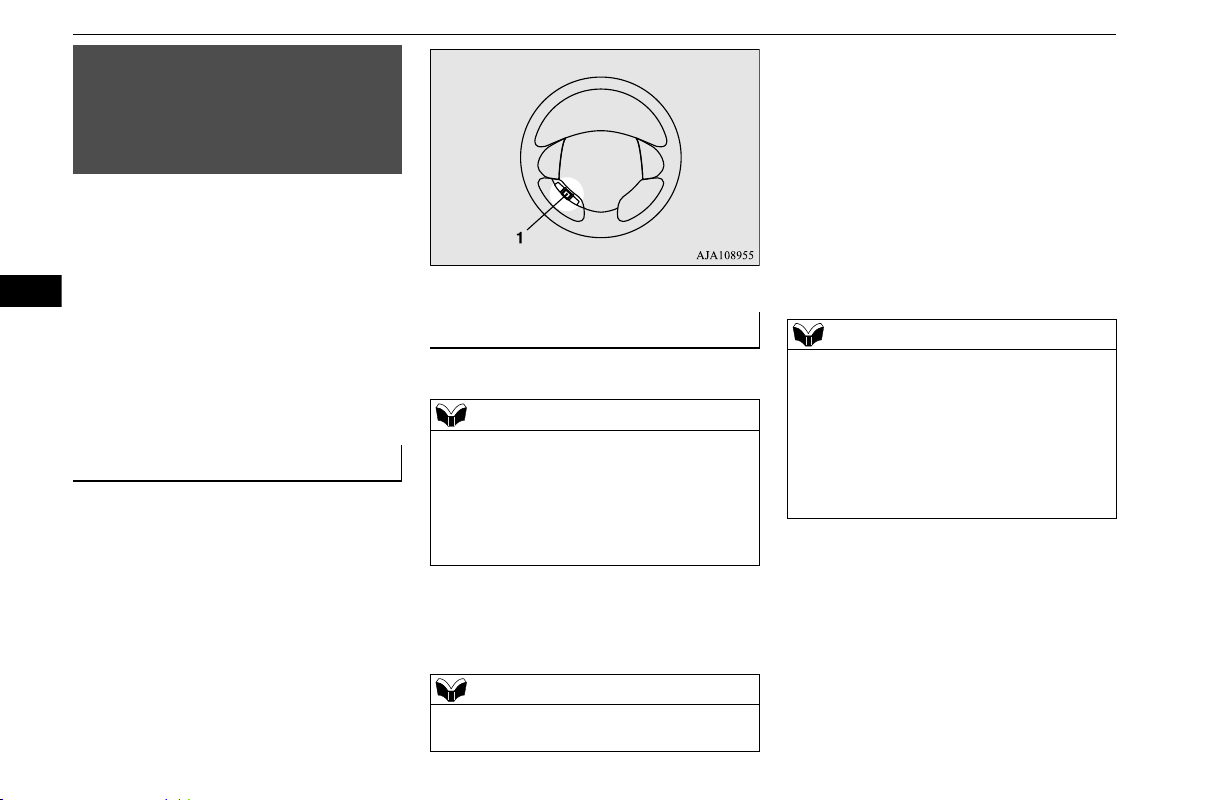
To play iPod/USB memory device tracks via voice operation (vehicles with Bluetooth® 2.0 interface)
7-20 Comfort controls
7
N00772001025
Desired tracks can be selected and played
from your iPod or USB memory device by
“Artist”, “Album”, “Playlist” and “Genre”
using voice commands.
For information concerning the voice recog-
nition function or speaker registration func-
tion, refer to “Bluetooth
®
2.0 interface” on
page 5-53.
The following explains how to prepare for
voice operation and play the tracks.
N00772101026
To use the voice operation, press the PICK-
UP button (1) first.
N00772200017
1. Say “Play” on the main menu.
2. After the voice guide says “Would you
like to play by Artist, Album, Playlist or
Genre?,” say “Artist”.
3. After the voice guide says “What Artist
would you like to play?,” say the artist
name.
4. If there is only one match, the system pro-
ceeds to step 6.
5. If there are two or more matches, the
voice guide will say “More than one
match was found, would you like to play
<artist name>?” If you say “Yes,” the sys-
tem proceeds to step 6.
If you say “No,” the next matching artist
is uttered by the system.
6. After the voice guide says “Playing <artist
name>,” the system creates a playlist
index for the artist.
To play iPod/USB memory
device tracks via voice oper-
ation (vehicles with Blue-
tooth
®
2.0 interface)
Preparation for voice operation
To search by artist name
NOTE
The Bluetooth
®
2.0 interface starts recogniz-
ing the connected device.
If the connected device cannot be recognized
or a connection error occurs, the Bluetooth
®
2.0 interface starts an appropriate voice
guide. Follow the voice guide.
NOTE
If you say “Artist <name>,” you can skip
step 3.
NOTE
If you say “No” to three or all artist names
uttered by the system, the voice guide will
say “Artist not found, please try again” and
the system returns to step 2.
Search time depends on the number of songs
on your connected device. Devices contain-
ing a large number of songs may take longer
to return search results.
BK0220401US.book 20 ページ 2015年6月3日 水曜日 午前7時42分

To play iPod/USB memory device tracks via voice operation (vehicles with Bluetooth® 2.0 interface)
Comfort controls 7-21
7
7. The system exits the voice recognition
mode and starts playback.
N00772300018
1. Say “Play” on the main menu.
2. After the voice guide says “Would you
like to play by Artist, Album, Playlist or
Genre?,” say “Album”.
3. After the voice guide says “What Album
would you like to play?” say the album
title.
4. If there is only one match, the system pro-
ceeds to step 6.
5. If there are two or more matches, the
voice guide will say “More than one
match was found, would you like to play
<album title>?” If you say “Yes,” the sys-
tem proceeds to step 6.
If you say “No,” the name of the next
matching album is uttered by the system.
6. After the voice guide says “Playing
<album title>,” the system creates a playl-
ist index for the album title.
7. The system exits the voice recognition
mode and starts playback.
N00772400019
1. Say “Play” on the main menu.
2. After the voice guide says “Would you
like to play by Artist, Album, Playlist or
Genre?,” say “Playlist”.
3. After the voice guide says “What Playlist
would you like to play?,” say the playlist
name.
4. If there is only one match, the system pro-
ceeds to step 6.
NOTE
If the confirmation function is active, the
voice guide confirms if the artist name is
correct. If the artist name is correct, say
“Yes”. If not, say “No”. After the voice guide
says “Artist not found, please try again,” the
system returns to step 2.
To search by album title
NOTE
The Bluetooth
®
2.0 interface starts recogniz-
ing the connected device.
If the connected device cannot be recognized
or a connection error occurs, the Bluetooth
®
2.0 interface starts an appropriate voice
guide. Follow the voice guide.
NOTE
If you say “Album <title>,” you can skip
step 3.
NOTE
If you say “No” to three or all album titles
uttered by the system, the voice guide will
say “Album not found, please try again” and
the system returns to step 2.
NOTE
If the confirmation function is active, the
voice guide confirms if the album title is cor-
rect. If the album title is correct, say “Yes”.
If not, say “No”. After the voice guide says
“Album not found, please try again,” the sys-
tem returns to step 2.
To search by playlist
NOTE
The Bluetooth
®
2.0 interface starts recogniz-
ing the connected device.
If the connected device cannot be recognized
or a connection error occurs, the Bluetooth
®
2.0 interface starts an appropriate voice
guide. Follow the voice guide.
NOTE
If you say “Playlist <playlist>,” you can skip
step 3.
If the device has no playlist, the voice guide
will say “There are no playlists stored on
device” and the system returns to step 2.
BK0220401US.book 21 ページ 2015年6月3日 水曜日 午前7時42分
Steering wheel audio remote control switch (if so equipped)
7-22 Comfort controls
7
5. If there are two or more matches, the
voice guide will say “More than one
match was found, would you like to play
<playlist>?” If you say “Yes,” the system
proceeds to step 6.
If you say “No,” the next matching playl-
ist name is uttered by the system.
6. After the voice guide says “Playing
<playlist>,” the system creates an index
for the playlist.
7. The system exits the voice recognition
mode and starts playback.
N00772500010
1. Say “Play” on the main menu.
2. After the voice guide says “Would you
like to play by Artist, Album, Playlist or
Genre?,” say “Genre”.
3. After the voice guide says “What Genre
would you like to play?,” say the music
type.
4. If there is only one match, the system pro-
ceeds to step 6.
5. If there are two or more matches, the
voice guide will say “More than one
match was found, would you like to play
<genre>?” If you say “Yes,” the system
proceeds to step 6.
If you say “No,” the next matching genre
is uttered by the system.
6. After the voice guide says “Playing
<genre>,” the system creates an index for
the genre.
7. The system exits the voice recognition
mode and starts playback.
N00714800471
The remote control switch is located on the
left side of the steering wheel.
NOTE
If you say “No” to three or all playlist names
uttered by the system, the voice guide will
say “Playlist not found, please try again” and
the system returns to step 2.
NOTE
If the confirmation function is active, the
voice guide confirms if the playlist name is
correct. If the playlist name is correct, say
“Yes”. If not, say “No”. After the voice guide
says “Playlist not found, please try again,”
the system returns to step 2. Refer to “Con-
firmation function setting” on page 5-57.
To search by genre
NOTE
The Bluetooth
®
2.0 interface starts recogniz-
ing the connected device.
If the connected device cannot be recognized
or a connection error occurs, the Bluetooth
®
2.0 interface starts an appropriate voice
guide. Follow the voice guide.
NOTE
If you say “Genre <type>,” you can skip step
3.
NOTE
If you say “No” to three or all genres uttered
by the system, the voice guide will say
“Genre not found, please try again” and the
system returns to step 2.
NOTE
If the confirmation function is active, the
voice guide confirms if the genre is correct.
If the genre is correct, say “Yes”. If not, say
“No”. After the voice guide says “Genre not
found, please try again,” the system returns
to step 2. Refer to “Confirmation function
setting” on page 5-57.
Steering wheel audio remote
control switch (if so equipped)
BK0220401US.book 22 ページ 2015年6月3日 水曜日 午前7時42分
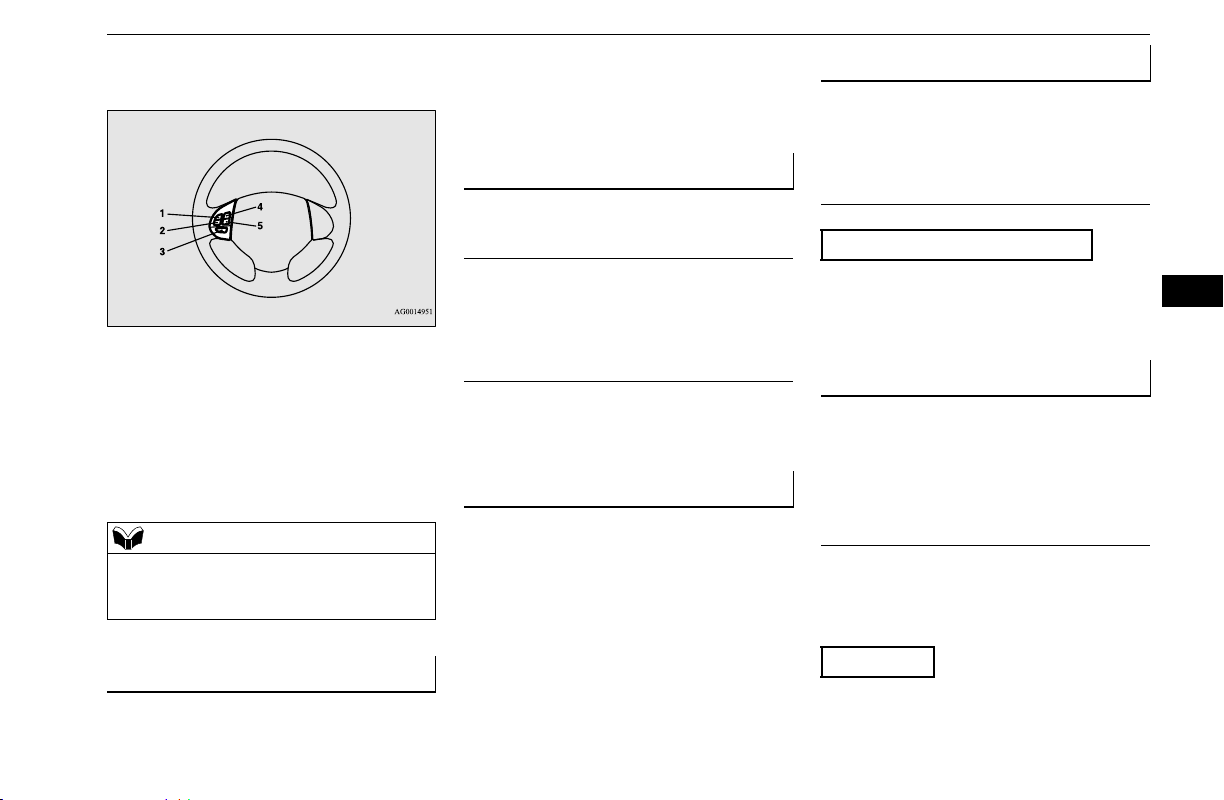
Steering wheel audio remote control switch (if so equipped)
Comfort controls 7-23
7
It can be used when the electric motor switch
is in the “ON” or “ACC” position.
Press the power switch to turn on the power.
When the power is turned on, the last mode
used before turning off is displayed. To turn
off the power, press and hold down the power
switch for about 2 seconds until you hear a
beep.
While the button is pressed, the volume will
continue to increase.
While the button is pressed, the volume will
continue to decrease.
Press the mode selector button to select the
desired mode.
The mode changes in the following order.
AM FM1 FM2 CD USB or iPod*
Bluetooth
®
* AM
*: If you connect these devices.
Press the mode selector button and select AM
or FM mode.
After pressing one of these buttons, a receiv-
able station will be automatically selected and
reception of the station will begin.
Press the mode selector button and select CD
mode.
To fast forward or fast reverse the disc, press
the fast-forward button or the fast-reverse
button.
You can fast forward the disc by holding
down the fast-forward button. While the but-
1- Volume up button
2- Volume down button
3- Power switch/Mode selector button
4- Seek up/Track up/File up/Fast-forward
button
5- Seek down/Track down/File
down/Fast-reverse button
NOTE
Do not press multiple buttons at the same
time when using the steering wheel audio
remote control switch.
To turn on the power
Volum e con trol
Volume up button
Volume down button
Mode selection
To listen to the radio
Automatic tuning
Seek up button/Seek down button
To listen to a CD
To fast forward/reverse the disc
(music CDs only)
Fast forward
BK0220401US.book 23 ページ 2015年6月3日 水曜日 午前7時42分
Error codes
7-24 Comfort controls
7
ton is kept pressed, the disc will be fast-for-
warded.
You can fast reverse the disc by holding down
the fast-reverse button. While the button is
kept pressed, the disc will be fast-reversed.
You can select your desired track by using the
track up button or the track down button.
Press the mode selector button and select
iPod mode.
Press the button repeatedly until the desired
track number appears on the display.
Press the button repeatedly until the desired
track number appears on the display.
Press the mode selector button and select
USB mode.
Press the button repeatedly until the desired
track number appears on the display.
Press the button repeatedly until the desired
track number appears on the display.
N00736100777
If an error code appears in the display, take action in accordance with the table below.
Fast reverse
NOTE
With an MP3 CD, you can fast forward and
fast reverse tracks in the same folder.
To select a desired track
NOTE
Pressing the track down button once during
the song will cause the system to restart
playing from the beginning of the song.
To listen to an iPod
To select a desired track
Track up button
NOTE
The track number continues to increase
while the button is pressed.
Track down button
NOTE
The track number continues to decrease
while the button is pressed.
To listen to a USB memory
device
To select a desired file
File up button
NOTE
The track number continues to increase
while the button is pressed.
File down button
NOTE
The track number continues to decrease
while the button is pressed.
Error codes
BK0220401US.book 24 ページ 2015年6月3日 水曜日 午前7時42分
Handling of compact discs
Comfort controls 7-25
7
N00734100340
Use only the type of compact discs that
have the mark shown in the illustration
below. (Playback of CD-R or CD-RW
discs may cause problems.)
The use of special shaped, damaged com-
pact discs (like cracked discs) or low-
quality compact discs (like warped discs
or burrs on the discs) such as those shown
will damage the CD player.
Error display Problem Item Repair
NO DISC No disc inserted Disc is not in CD player. Insert disc.
CHECK DISC Focus error
Disc is not loaded correctly, or condensation on
disc.
Insert disc with label facing up.
Remove moisture from disc.
DISC ERROR Disc error
Disc is dirty, scratched, or deformed; or exces-
sive vehicle vibration.
Clean or replace disc. Retry when vibrations
stop.
INTERNAL E Mechanism error
Loading or eject error. Pick-up is out of posi-
tion.
Eject disc and reload. If disc will not eject, bring
your vehicle to a certified i-MiEV dealer.
HEAT ERROR
Inside of audio system is
hot.
Internal protection against high temperatures.
Allow radio to cool by waiting about 30 min-
utes.
ERROR DC DC offset output voltage Foreign material is inside of radio or amplifier. Bring your vehicle to a certified i-MiEV dealer.
ERROR
Communication or power
supply error
Communication error between external device
and equipment. Power supply error of external
device.
Bring your vehicle to a certified i-MiEV dealer.
Handling of compact discs
BK0220401US.book 25 ページ 2015年6月3日 水曜日 午前7時42分
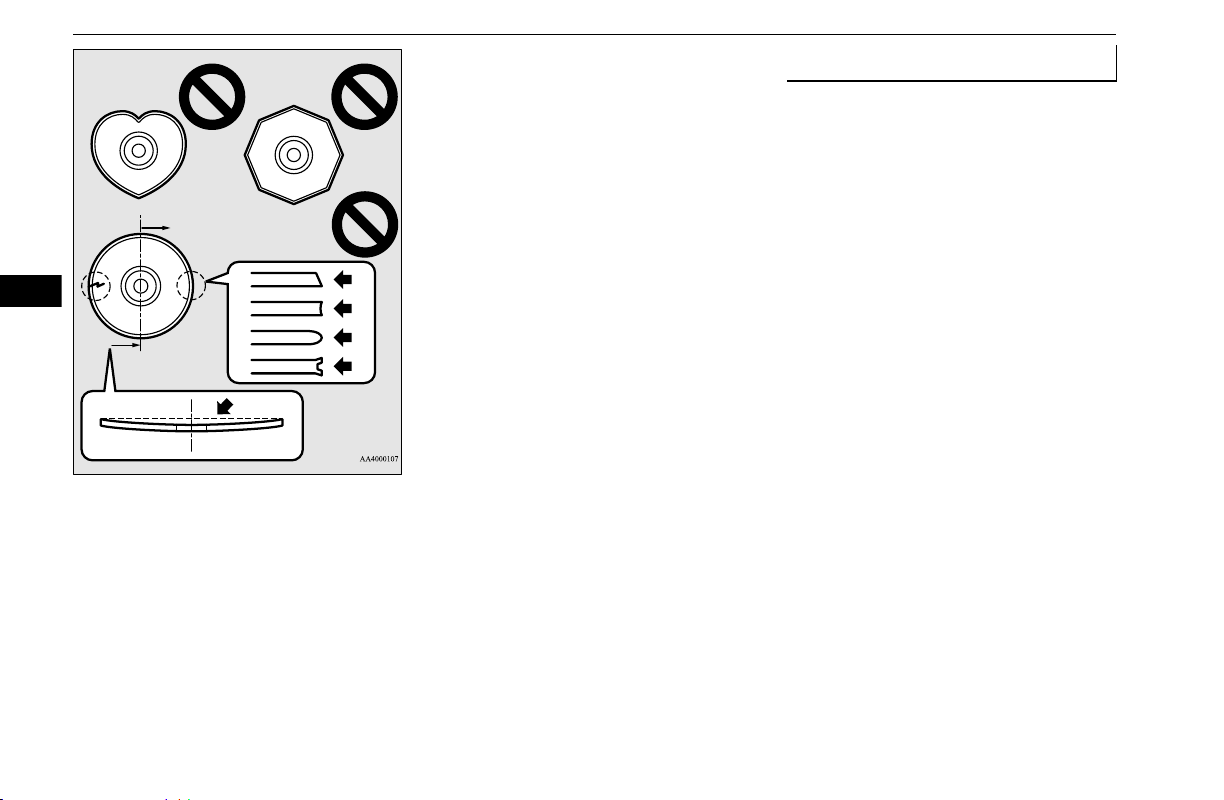
Handling of compact discs
7-26 Comfort controls
7
In the following circumstances, moisture
can form on compact discs and inside the
audio system, preventing normal opera-
tion.
• When there is high humidity (for exam-
ple, when it is raining).
• When the temperature suddenly rises,
such as right after the heater is turned on
in cold weather.
In this case, wait until the moisture has
had time to dry out.
When the CD player is subjected to vio-
lent vibrations, such as during off-road
driving, the tracking may not work.
When storing compact discs, always store
them in their separate cases. Never place
compact discs in direct sunlight, or in any
place where the temperature or humidity
is high.
Never touch the flat surface of the disc
where there isn’t a label. This will damage
the disc surface and could affect the sound
quality. When handling a compact disc,
always hold it by the outer edge and the
center hole.
To clean a disc, use a soft, clean, dry
cloth. Wipe directly from the center hole
toward the outer edge. Do not wipe in a
circle. Never use any chemicals such as
benzine, paint thinner, a disc spray
cleaner, or an anti-static agent on the disc.
Do not use a ball point pen, felt pen, pen-
cil, etc. to write on the label surface of the
disc.
Do not put additional labels or stickers on
compact discs. Also, do not use any com-
pact disc on which a label or sticker has
started to peel off or any compact disc that
has stickiness or other contamination left
by a peeled-off label or sticker. If you use
such a compact disc, the CD player may
stop working properly and you may not be
able to eject the compact disc.
N00751900112
You may have trouble playing back some
CD-R/RW discs recorded on CD record-
ers (CD-R/RW drives), either due to their
recording characteristics or dirt, finger-
prints, scratches, etc. on the disc surface.
CD-R/RW discs are less resistant to high
temperatures and high humidity than ordi-
nary music CDs and can therefore be
damaged and rendered unplayable if left
inside your vehicle for a long time.
Depending on the combination of the
writing software, the CD recorder (CD-
R/RW drive), and the disc used to create a
CD-R/RW, the disc might not play suc-
cessfully.
This player cannot play the CD-R/RW
discs if the session is not closed.
This player cannot play CD-R/RW discs
which contain data other than CD-DA or
MP3 data (Video CD, etc.).
Be sure to observe the handling instruc-
tions for the CD-R/RW disc.
Notes on CD-Rs/RWs
BK0220401US.book 26 ページ 2015年6月3日 水曜日 午前7時42分
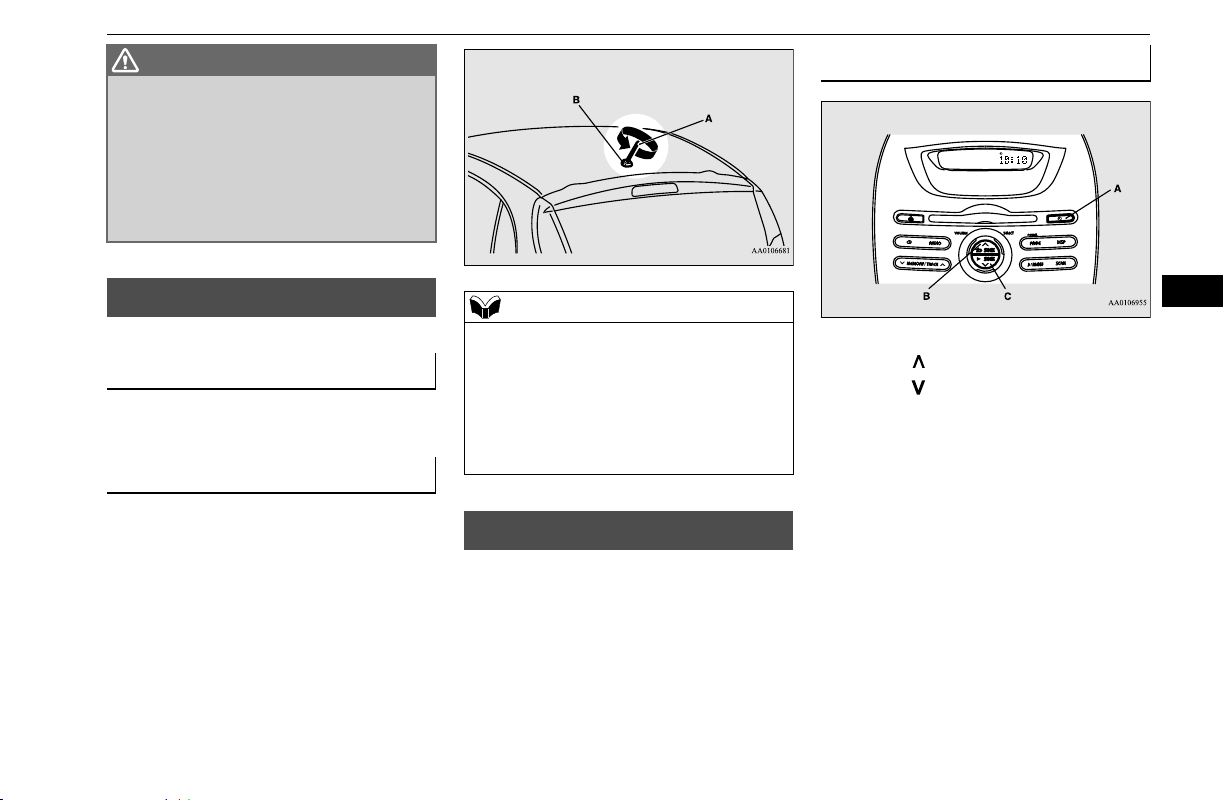
Antenna
Comfort controls 7-27
7
N00734200471
Turn the pole (A) counterclockwise.
Screw the pole (A) clockwise into the base
(B) until it is securely retained.
N00755000124
The time is displayed when the electric motor
switch is in the “ON” or “ACC” position.
1. Press and hold the clock button and the
clock display flashes.
2. Press the SEEK button to adjust the
“hours” digit.
If you keep pressing the button, fast-for-
ward begins.
3. When the “hours” digit is adjusted, press
the clock button to flash the “minutes”
digit.
Press the SEEK button to adjust the “min-
utes” digit.
If you keep pressing the button, fast-for-
ward begins.
WARNING
Operating the CD player in a manner
other than specifically instructed herein
may result in hazardous radiation expo-
sure. Do not remove the cover and attempt
to repair the CD player by yourself. There
are no user serviceable parts inside. In
case of malfunction, contact a certified i-
MiEV dealer.
Antenna
To remove
To install
NOTE
Be sure to remove the roof antenna in the
following cases:
• When using an automatic car wash
• When covering your vehicle with a car
cover
• When driving into a structure that has a low
ceiling.
Clock (if so equipped)
To set the time
A- Clock button
B- SEEK (clock adjustment up) button
C- SEEK (clock adjustment down) but-
ton
BK0220401US.book 27 ページ 2015年6月3日 水曜日 午前7時42分
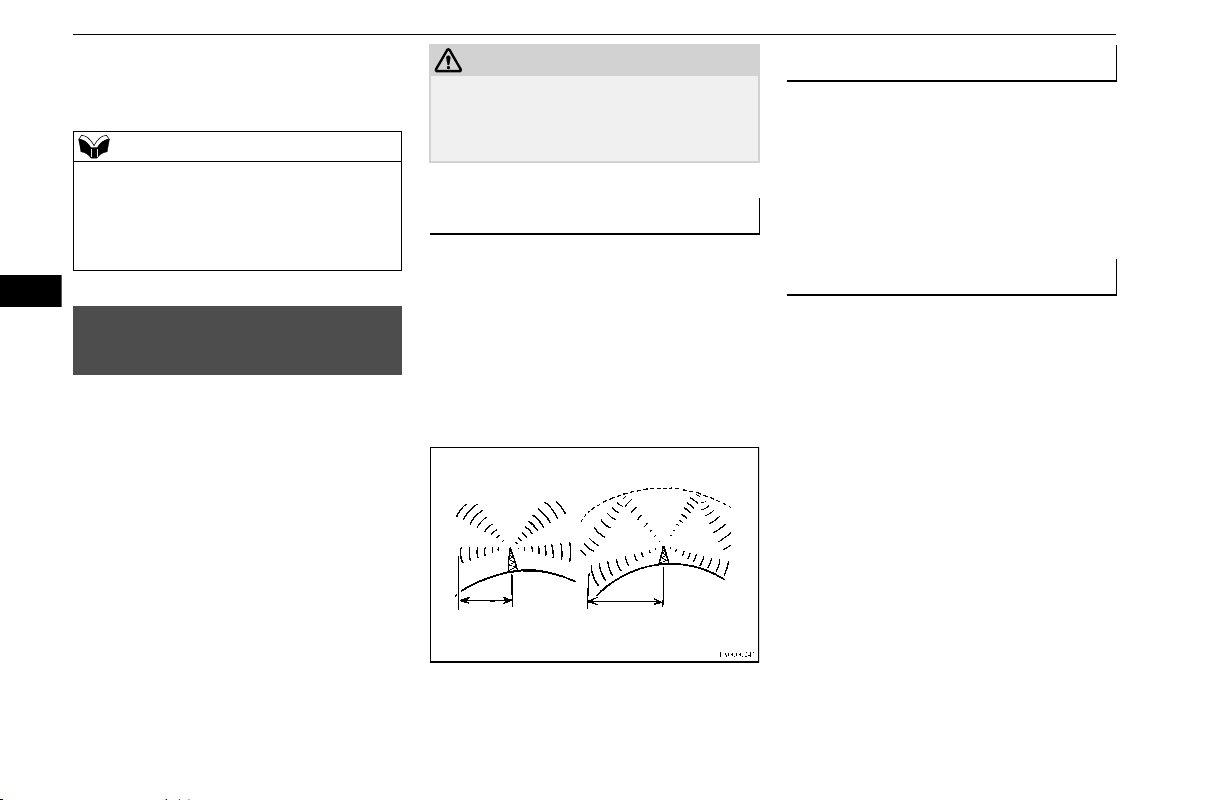
General information about your radio
7-28 Comfort controls
7
4. When the time is set, press the clock but-
ton to stop the clock display from flash-
ing.
N00733900439
Your vehicle’s radio receives both AM and
FM stations.
The quality of your reception is affected by
distance, obstacles, and signal interference.
This radio complies with Part 15 of Federal
Communications Commission (FCC) Rules
(for vehicles sold in U.S.A.). Operation is
subject to the following conditions:
The device may not cause harmful inter-
ference.
This device must accept any interference
recieved, including interference that may
cause undesirable operation.
FM signals do not follow the earth surface
nor are they reflected by the upper atmo-
sphere. For this reason, FM broadcasts cannot
be received over long distances. AM signals
follow the earth’s surface and are reflected by
the upper atmosphere. For this reason, AM
broadcasts can be received over longer dis-
tances.
Because of the limited range of FM signals
and the way FM waves transmit, you may
experience weak or fading FM reception.
When the broadcast is blocked by mountains
or similar obstructions, reception can be dis-
turbed.
The reason why one can hear FM but not AM
in parking garages, under bridges etc., is that
FM signals, unlike AM signals, are reflected
by solid objects such as buildings, etc.
Because FM signals are easily reflected by
buildings, this can also cause reception dis-
turbances.
The direct signal from the broadcast station
reaches the antenna slightly before the
reflected signal. This time difference may
cause some reception disturbance or flutter.
This problem occurs primarily in urban areas.
NOTE
Reset the time after the 12V starter battery
terminals are disconnected and reconnected.
Seconds do not appear in the clock display,
but after adjusting the “minutes” setting, the
clock begins to operate from 0 seconds.
General information about
your radio
CAUTION
Changes or modifications not expressly
approved by the party meeting the above
conditions could void the user’s authority to
operate the equipment.
Signal transmission
FM AM
25 to 40 mile radius
(25 to 40 miles)
100 mile radius
(100 miles)
Weak reception (fading)
Reflection
BK0220401US.book 28 ページ 2015年6月3日 水曜日 午前7時42分
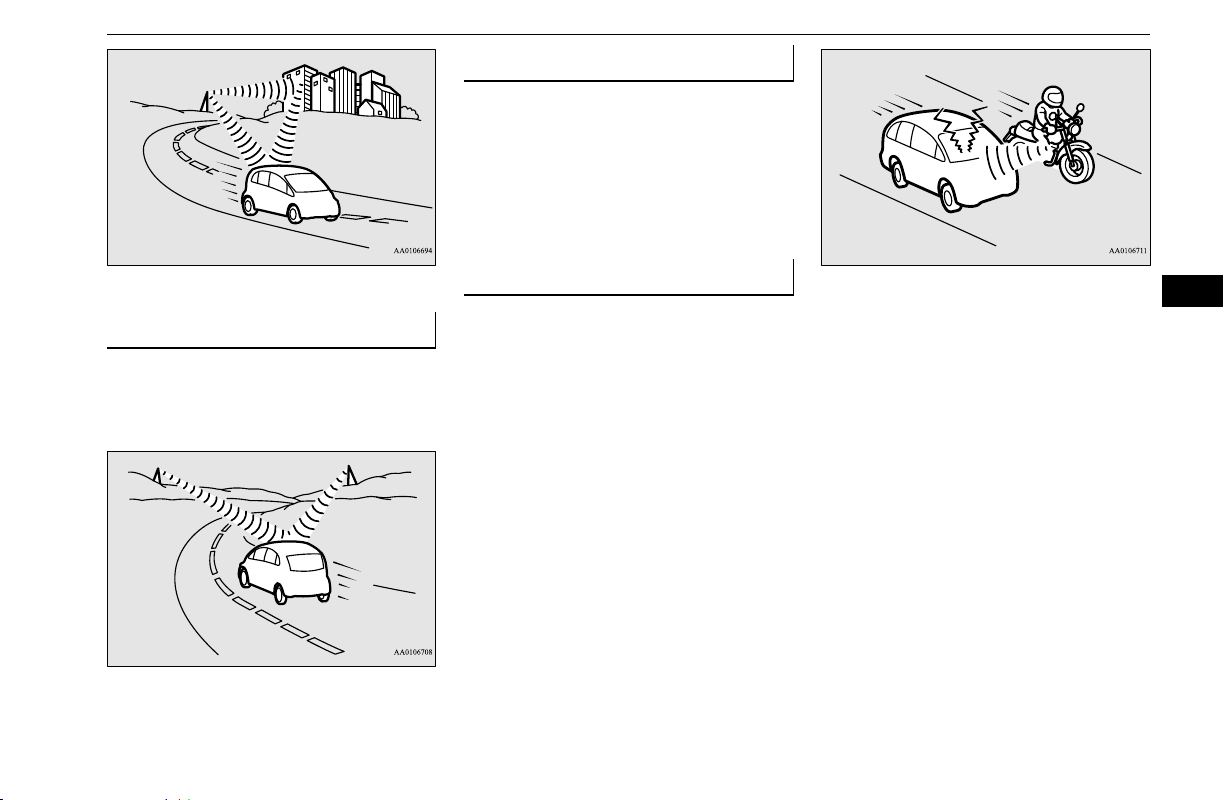
General information about your radio
Comfort controls 7-29
7
If one listens to a weak station and is in the
vicinity of another strong station, both sta-
tions might be received simultaneously.
Stereo reception requires a high quality
broadcast signal. This means that types of
disturbances mentioned previously become
more marked and the reception range is
somewhat diminished during stereo recep-
tion.
FM reception is affected by the electrical sys-
tems of vehicles in the vicinity, especially
those without an electronic noise suppression
device. The disturbance is even greater if the
station is weak or poorly tuned.
FM reception is not as sensitive to electrical
disturbances as AM. AM reception is sensi-
tive to electrical disturbances such as power
lines, lightning and other types of similar
electrical phenomena.
Cross modulation
FM stereo reception
Causes of disturbances
BK0220401US.book 29 ページ 2015年6月3日 水曜日 午前7時42分

BK0220401US.book 30 ページ 2015年6月3日 水曜日 午前7時42分
8
For emergencies
If the vehicle breaks down ...............................................................8-2
Jump-starting ...................................................................................8-2
Tire repair kit ...................................................................................8-5
Towing ...........................................................................................8-11
Operation under adverse driving conditions ..................................8-13
BK0220401US.book 1 ページ 2015年6月3日 水曜日 午前7時42分
If the vehicle breaks down
8-2 For emergencies
8
N00836301243
If your vehicle breaks down on the road,
move to the shoulder and turn on the hazard
warning flashers. If there is no shoulder, or
the shoulder is not safe, drive in the right lane
slowly, with the hazard lights flashing, until
you come to a safe stopping place. Keep the
flashers flashing.
If the ready indicator light goes out while
driving, the brakes and steering will continue
to work, but without power assist, so more
effort will be required for braking and steer-
ing. Stop the vehicle on the shoulder of the
road and turn on the hazard warning flashers.
If you need to push your vehicle, turn the
electric motor switch to the “ON” position,
and place the selector lever in the “N” (NEU-
TRAL) position.
N00836400742
If the electric motor unit cannot be energized
because the 12V starter battery is weak or
dead, you can start it with the battery from
another vehicle using jumper cables.
1. Take off any metal jewelry such as watch
bands or bracelets that might make an
accidental electrical contact.
2. Position the vehicles close enough
together so that the jumper cables can
reach, but be sure the vehicles are not
touching each other.
3. Set the parking brake firmly on your vehi-
cle and move the selector lever into the
“P” (PARK) position.
4. Set the parking brake firmly on the other
vehicle. Put the automatic transaxle in “P”
(PARK) or the manual transaxle in “N”
(Neutral).
5. Turn the ignition switch (the electric
motor switch) on each vehicle to the
“LOCK” position.
6. Remove the battery cover, and then make
sure your 12V starter battery electrolyte is
at the proper level. (Refer to “Checking
12V starter battery electrolyte level” on
page 9-8.)
If the vehicle breaks down
Jump-starting
WARNING
To reduce the risk of igniting flammable
gas that may be emitted from the 12V
starter battery, carefully read this section
before jump-starting the vehicle.
Do not try to start the electric motor unit
by pushing or towing the vehicle. This can
cause an accident resulting in serious
injury or death and can damage the vehi-
cle.
CAUTION
Do not attempt jump starting the 12V starter
battery while the main drive lithium-ion bat-
tery is being charged. Doing so could dam-
age the vehicle or charging equipment.
NOTE
Do not use jumper cables if they have dam-
age or corrosion.
CAUTION
Check the other vehicle. It must have a 12V
battery. If the other system is not 12V, both
systems can be damaged.
NOTE
Turn off all lights, heater, and other electrical
loads. This will help avoid sparks.
BK0220401US.book 2 ページ 2015年6月3日 水曜日 午前7時42分
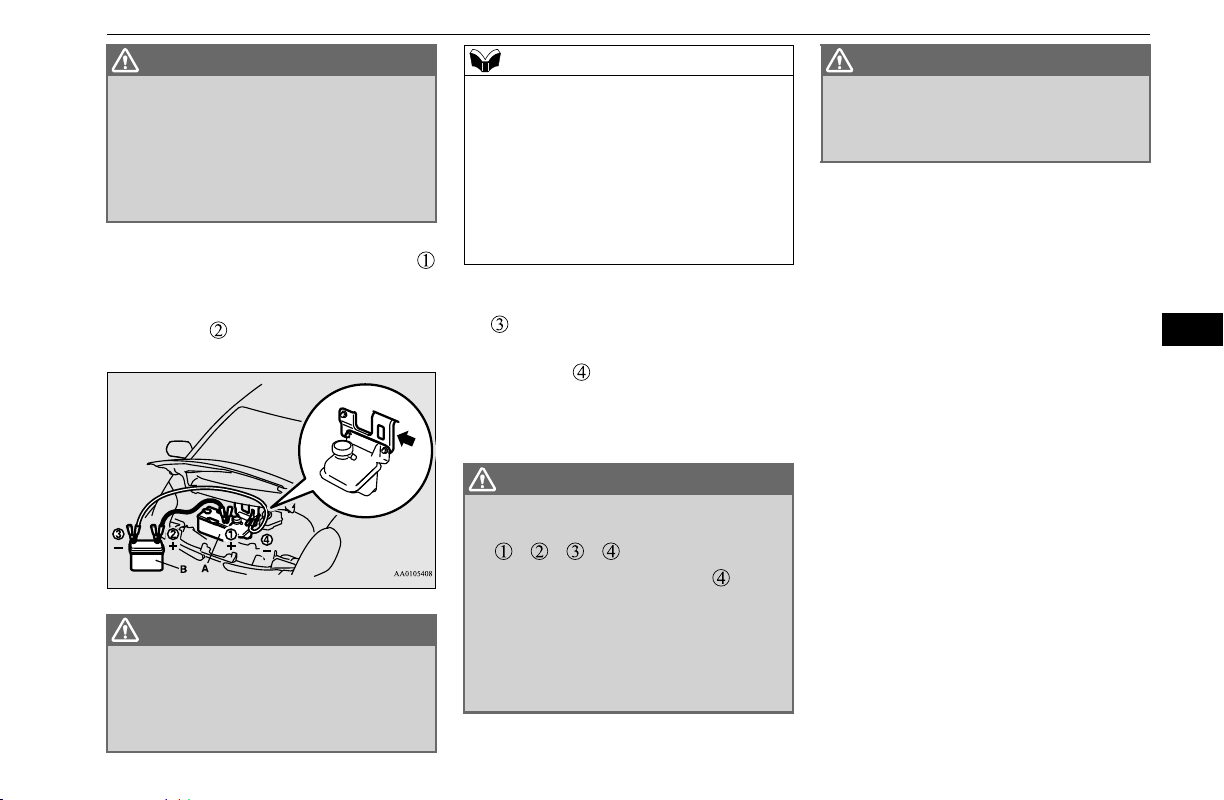
Jump-starting
For emergencies 8-3
8
7. Connect one end of one jumper cable
to the positive (+) terminal of the dis-
charged battery (A), and then connect the
other end to the positive (+) terminal
of the booster battery (B).
8. Connect one end of the other jumper cable
to the negative (-) terminal of the
booster battery (B), and then connect the
other end to the designated ground
location of the vehicle with the discharged
battery (A) at the point farthest from the
battery.
9. Start the engine in the vehicle providing
the boost. Let the engine idle a few min-
utes, then start the electric motor unit by
turning the electric motor switch to the
ON position.
10. Check if the ready indicator illuminates.
[When the ready indicator illuminates]
Stop the engine of the other vehicle, and
disconnect the cables in the reverse order
and keep the electric motor switch in the
ON position to charge the 12V starter bat-
tery for more than 30 minutes.
After the 12V starter battery is charged,
continue the process from step 17.
[When the ready indicator does not illu-
minate]
Both the 12V starter battery and the main
drive lithium-ion battery have gone flat at
the same time.
Charge the 12V starter battery and the
main drive lithium-ion battery by follow-
ing steps from steps 11 to 15.
WARNING
If the electrolyte fluid is not visible, or
looks frozen, DO NOT ATTEMPT JUMP
STARTING!!
The battery might split open or explode if
the temperature is below the freezing
point or if it is not filled to the proper
level.
WARNING
Make sure that the jumper cables and
your clothing are clear of the cooling fans
and drive belts. Entanglement with the
fans or belts can cause serious personal
injury.
NOTE
Open the terminal cover before connecting
the jumper cable to the positive terminal of
the 12V starter battery.
(Refer to “Disconnection and connection” on
page 9-9.)
Use the proper cables suitable for the battery
size.
Otherwise heat damage to the cables could
result.
WARNING
Be sure to follow the proper order when
connecting the batteries, of:
.
Make sure that the connection is made
to the correct designated location (as
shown in the illustration) properly. If the
connection is directly made to the negative
(-) terminal of the battery, the flammable
gases from inside the battery might catch
fire and explode, causing personal injury.
When connecting the jumper cables, do
not connect the positive (+) cable to the
negative (-) terminal. Sparks can make the
battery explode.
WARNING
BK0220401US.book 3 ページ 2015年6月3日 水曜日 午前7時42分
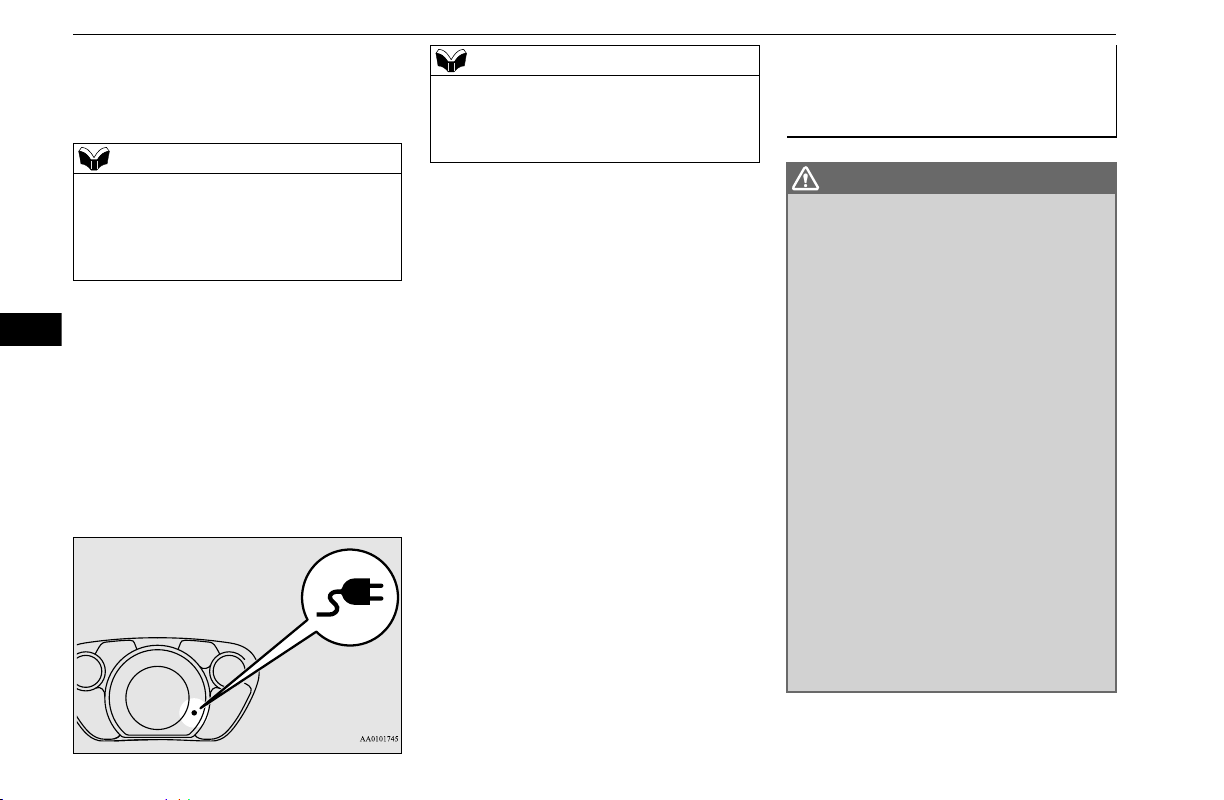
Jump-starting
8-4 For emergencies
8
11. Keep the jumper cables to each vehicle
connected and turn the electric motor
switch of your vehicle to the “LOCK”
position.
12. Charge the main drive lithium-ion battery
by regular charging. The 12V starter bat-
tery will automatically charge while the
main drive lithium-ion battery is charging.
(Refer to “Regular charging” on page
3-16.)
13. When the charging indicator on the instru-
ment cluster is illuminated, stop the
engine of the other vehicle and disconnect
the jumper cables in the reverse order.
14. Charge the main drive lithium-ion battery
for more than 1 hour.
15. Disconnect the charging cable.
(Refer to “Regular charging” on page
3-16.)
16. Turn the electric motor switch to the
“START” position, make sure that the
ready indicator on the instrument cluster
is illuminated.
If the ready indicator does not illuminate,
perform the procedure again starting from
step 5. If charging cannot be performed,
consult a certified i-MiEV dealer.
17. Refit the battery cover. (“Checking 12V
starter battery electrolyte level” on page
9-8.)
NOTE
The jumper cables need to be connected to
the 12V starter battery when you start charg-
ing the main drive lithium-ion battery
because the on board charger etc. operate uti-
lizing power from the 12V starter battery.
NOTE
When the regular charge connector is con-
nected to the charge port, the charging indi-
cator will blink. When charging has started,
the charging indicator will illuminate.
Charging the 12V starter bat-
tery by using an external bat-
tery charger
WARNING
Always remove the 12V starter battery
from your vehicle when the 12V starter
batter is charged by an external battery
charger.
Keep sparks, cigarettes and flames away
from the 12V starter battery because the
battery may explode.
Keep your work area well vented when
charging or using the 12V starter battery
in an enclosed space.
Remove all the caps before charging the
12V starter battery.
Electrolyte (battery acid) is corrosive
diluted sulphuric acid. If electrolyte comes
in contact with your hands, eyes, clothes,
or the painted surface of your vehicle,
thoroughly flush with water. If electrolyte
gets in your eyes, flush them immediately
and thoroughly with water, and get
prompt medical attention.
Always wear protective clothing and gog-
gles when working near the battery.
Keep the battery out of the reach of chil-
dren.
BK0220401US.book 4 ページ 2015年6月3日 水曜日 午前7時42分
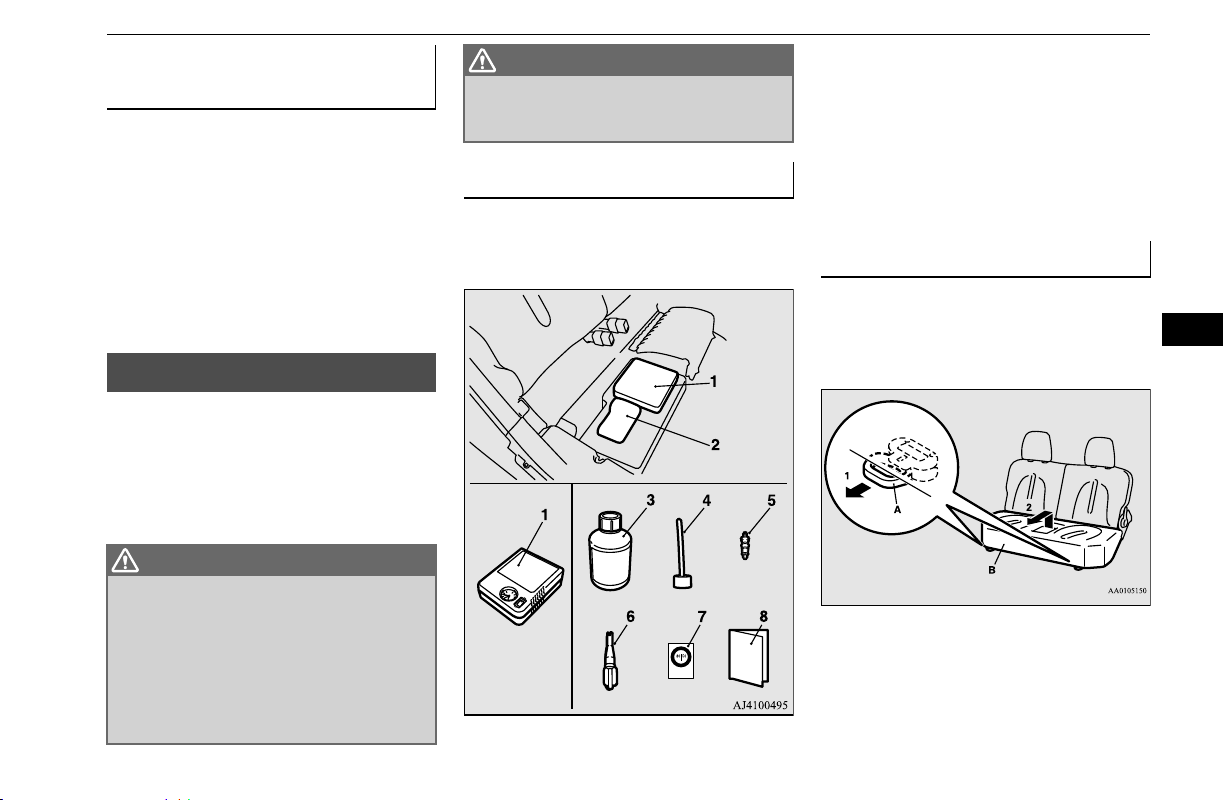
Tire repair kit
For emergencies 8-5
8
If you drive your vehicle with a low battery
charge, after the electric motor unit has been
started by using jumper cables, it can cause
the anti-lock braking system warning light to
illuminate. This is only due to the low battery
voltage. It is not a problem with the brake
system. If this happens, fully charge the 12V
starter battery and ensure the charging system
is operating properly.
N00836600366
This vehicle is equipped with a tire repair kit
which can be used to repair a minor puncture
in tread area caused by a nail, screw or simi-
lar object. A spare tire is not provided with
this vehicle.
N00837701026
The tire repair kit is stowed under the rear
seat cushion.
N00837800033
1. Pull forward the seat stoppers (A) under
the rear seat cushion (B).
2. Lift up the seat cushion and pull it for-
ward to remove it.
3. Remove the screws (C) with a coin or the
washer (D) at a position shown in the
illustration, and remove the cover (E).
As your vehicle has anti-lock
brakes
Tire repair kit
WARNING
The tire repair kit may not permanently
seal a punctured tire.
Using the tire repair kit may damage the
wheel and/or the tire inflation pressure
sensor for the tire. The vehicle must
promptly be inspected and repaired by a
certified i-MiEV dealer after using the tire
repair kit.
Use only the Mitsubishi genuine tire
repair kit. Sealant in other repair kits may
not sufficiently seal the tire puncture.
Tire repair kit storage
1- Tire compressor
WARNING
2- Tire repair set: Items #3-#8 shown
above
3- Tire sealant bottle
4- Filler hose
5- Valve insert (spare)
6- Valve remover
7- Speed restriction sticker
8- Instruction manual for tire repair
To remove
BK0220401US.book 5 ページ 2015年6月3日 水曜日 午前7時42分
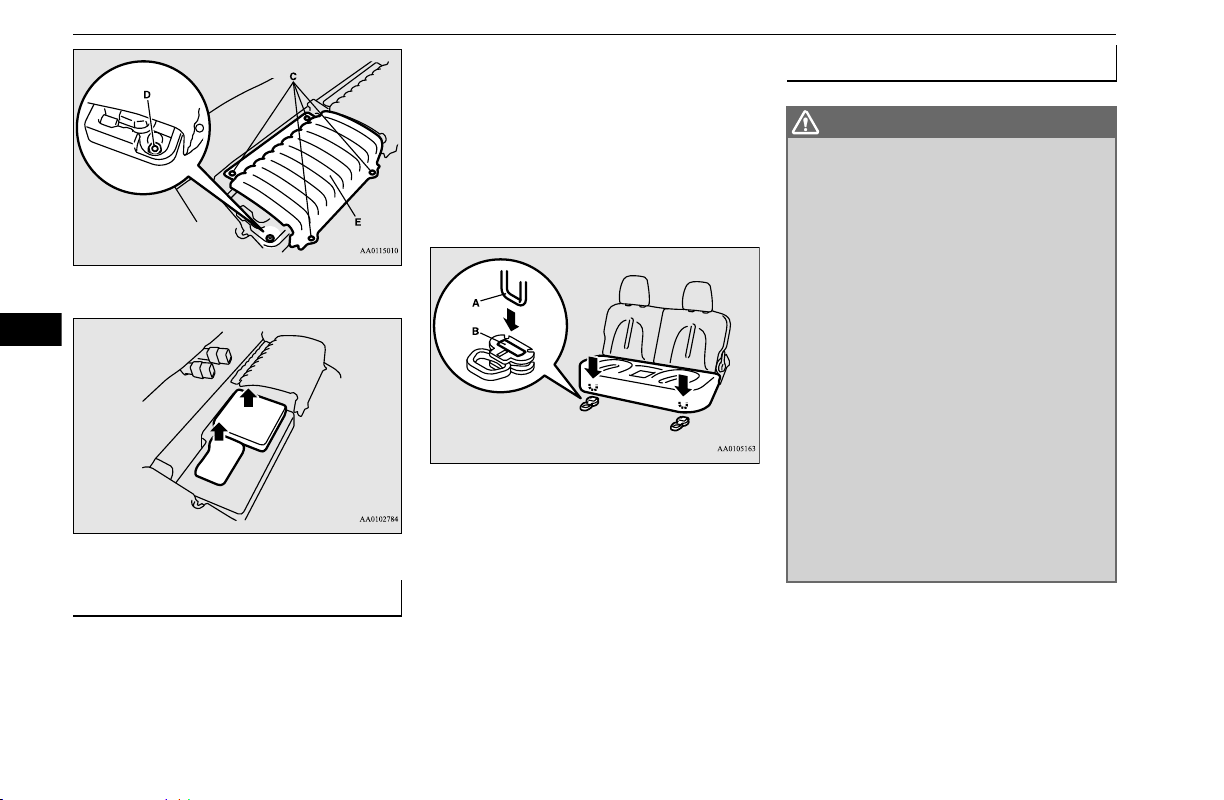
Tire repair kit
8-6 For emergencies
8
4. Remove the tire repair kit.
N00837900018
1. Return the tire repair kit to its original
place.
Attach the cover and fasten the screws.
2. Insert two wire tabs at the rear edge of the
seat cushion under the seat back.
3. Pass both rear seat belt buckles through
slits at the rear edge of the seat cushion.
Make sure that the seat belt buckles are
not twisted.
4. While pushing the seat cushion as far
back as possible, press down hooks (A)
under the seat cushion into the right and
left stopper installation holes (B) until a
click is heard.
5. After installing the seat cushion, shake it
lightly to confirm that it is properly fixed
in position.
N00800201049
To store
How to use the tire repair kit
WARNING
Never use the tire repair kit under in any
of the situations listed below. The tire can-
not be repaired by the tire repair kit. If
any of these situations occurs, please con-
tact a certified i-MiEV dealer.
• More than one tire is punctured.
• The puncture hole has a length or width
of 1/7 inch (4 mm) or greater.
• The tire is punctured in the side wall (A),
not in the tread (B).
• The vehicle has been driven with the tire
almost completely flat.
• The tire has completely slipped over the
wheel rim and come off the wheel.
• The wheel is damaged.
• A bump, cut or crack is on the tire.
• The tire sealant’s expiration date has
passed. (The expiration date is shown on
the bottle label (C).)
• Ambient temperature is below -22 °F
(-30 °C) or above 140 °F (60 °C).
BK0220401US.book 6 ページ 2015年6月3日 水曜日 午前7時42分
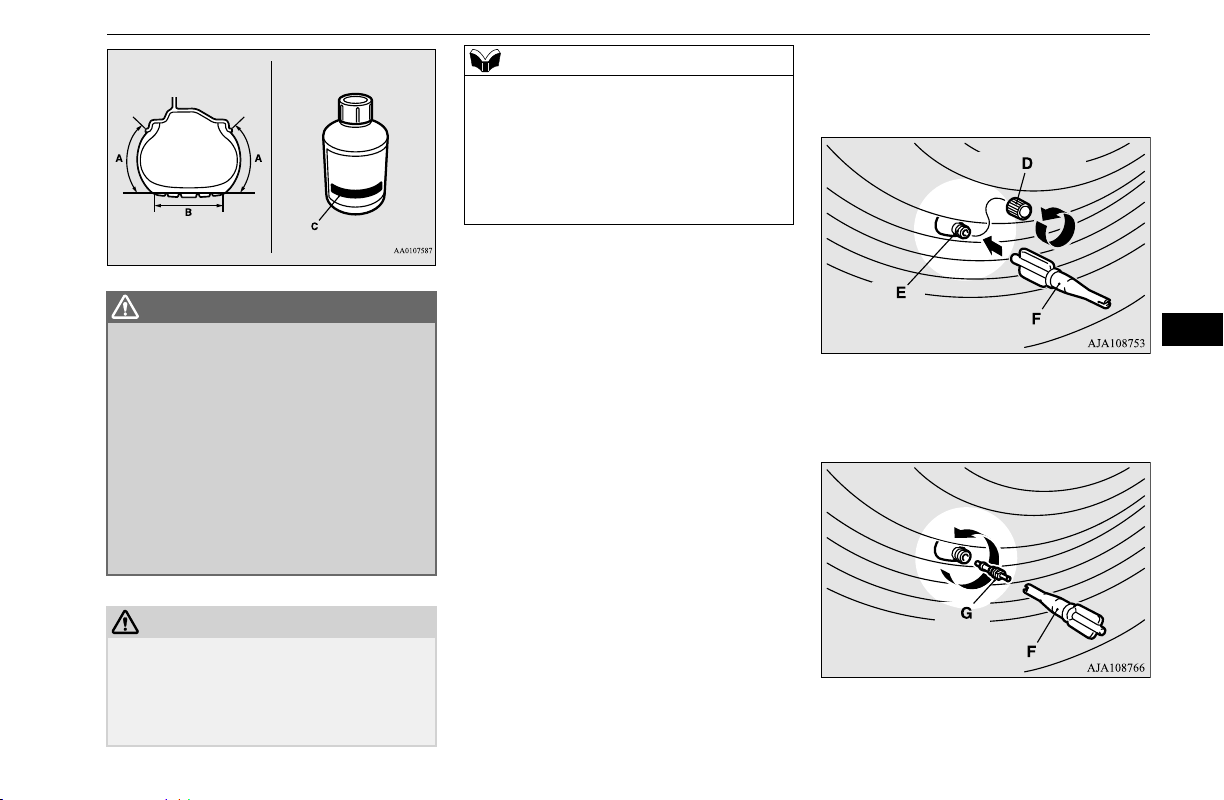
Tire repair kit
For emergencies 8-7
8
1. Park the vehicle on a safe, flat and level
place.
2. Set the parking brake firmly.
3. Move the selector lever to the “P”
(PARK) position and turn the electric
motor switch to the “LOCK” position.
4. Turn on the hazard warning flashers and
set up a warning sign, such as a warning
triangle or flashing signal lamp, at an ade-
quate distance from the vehicle, and have
all your passengers leave the vehicle.
5. Take out the tire repair kit.
6. Take the valve cap (D) off the tire valve
(E), then press the valve remover (F) onto
the valve as illustrated. Allow all of the
air in the tire to escape.
7. Remove the valve insert (G) by turning it
counterclockwise using the valve remover
(F). Put the removed valve insert in a
clean place so it does not get dirty.
WARNING
The tire sealant can cause health damage
if swallowed. If you accidentally swallow
it, drink as much water as possible and
immediately seek medical attention.
If the tire sealant gets in your eyes or on
your skin, rinse it away with lots of water.
If you still sense an abnormality, seek
medical attention.
Consult a doctor immediately if any aller-
gic reactions occur.
Do not allow children to touch the tire
sealant.
CAUTION
If the vehicle body is contaminated by the
tire sealant, wipe the tire sealant off immedi-
ately with a wet cloth.
Immediately wash clothes contaminated with
tire sealant.
NOTE
Do not pull out an object, such as a nail or
screw, that penetrates the punctured tire.
Move the vehicle so that the tire valve is
positioned away from the point where the
tire touches the ground. If the valve is near
the point where the tire touches the ground,
the sealant may not enter the tire easily.
BK0220401US.book 7 ページ 2015年6月3日 水曜日 午前7時42分
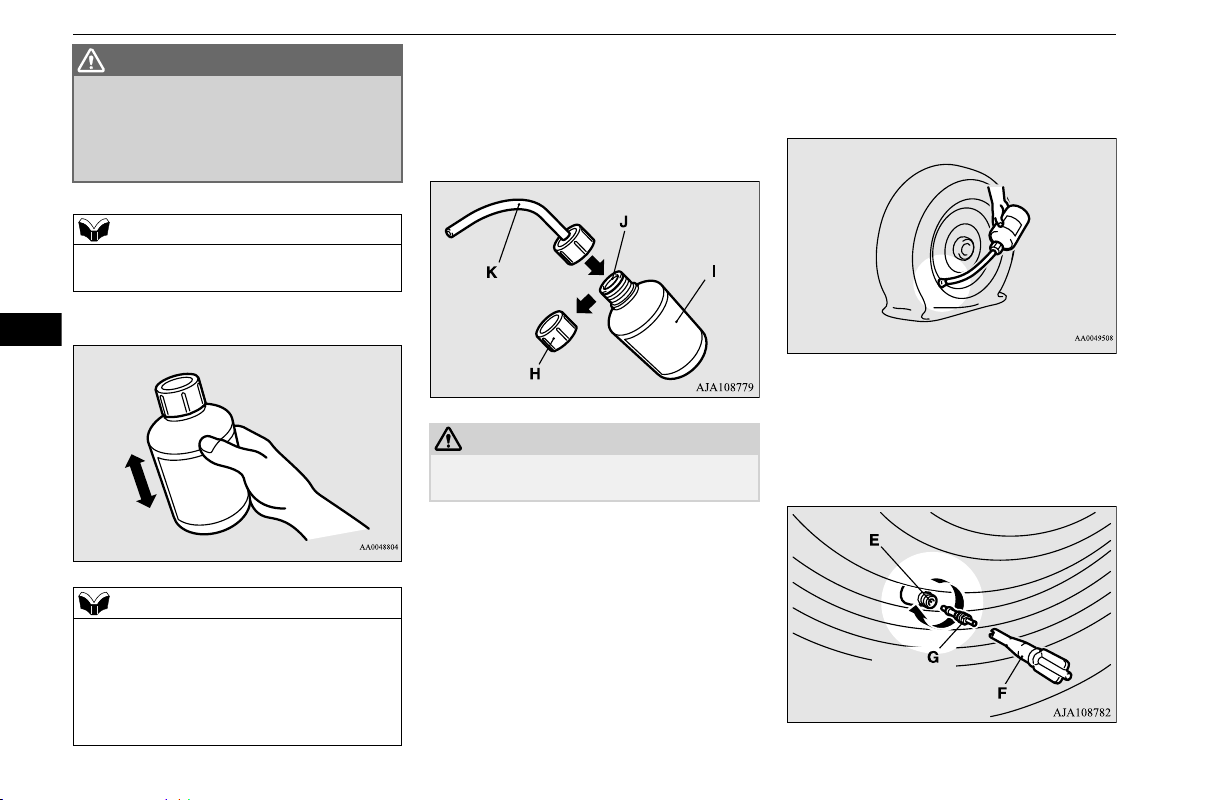
Tire repair kit
8-8 For emergencies
8
8. Shake the tire sealant bottle well.
9. Take the cap (H) off the tire sealant bottle
(I). Do not remove the seal (J). Screw the
filler hose (K) onto the bottle (I). As you
screw the filler hose onto the bottle, the
seal will break, allowing the sealant to be
used.
10. Press the hose onto the valve. Holding the
sealant bottle upside-down, squeeze it
again and again to inject all of the sealant
into the tire.
11. After injecting the sealant, pull the hose
off the valve, remove any residual sealant
from the valve, rim and/or tire.
Fit the valve insert (G) into the valve (E),
and screw the valve insert securely into
place using the valve remover (F).
WARNING
If there is any air left in the tire when you
remove the valve insert, the valve insert
may fly out and injure you. Make sure the
tire contains no air before removing the
valve insert.
NOTE
Turn the valve remover by hand. If you use a
tool, the valve remover could be damaged.
NOTE
In cold conditions (when the ambient tem-
perature is 32 °F {0 °C} or lower), thicken-
ing of the tire sealant can make the tire
sealant hard to squeeze out of the bottle.
Warm the bottle between your hands inside
the vehicle.
CAUTION
If you shake the bottle after screwing on the
hose, sealant may spray out of the hose.
BK0220401US.book 8 ページ 2015年6月3日 水曜日 午前7時42分
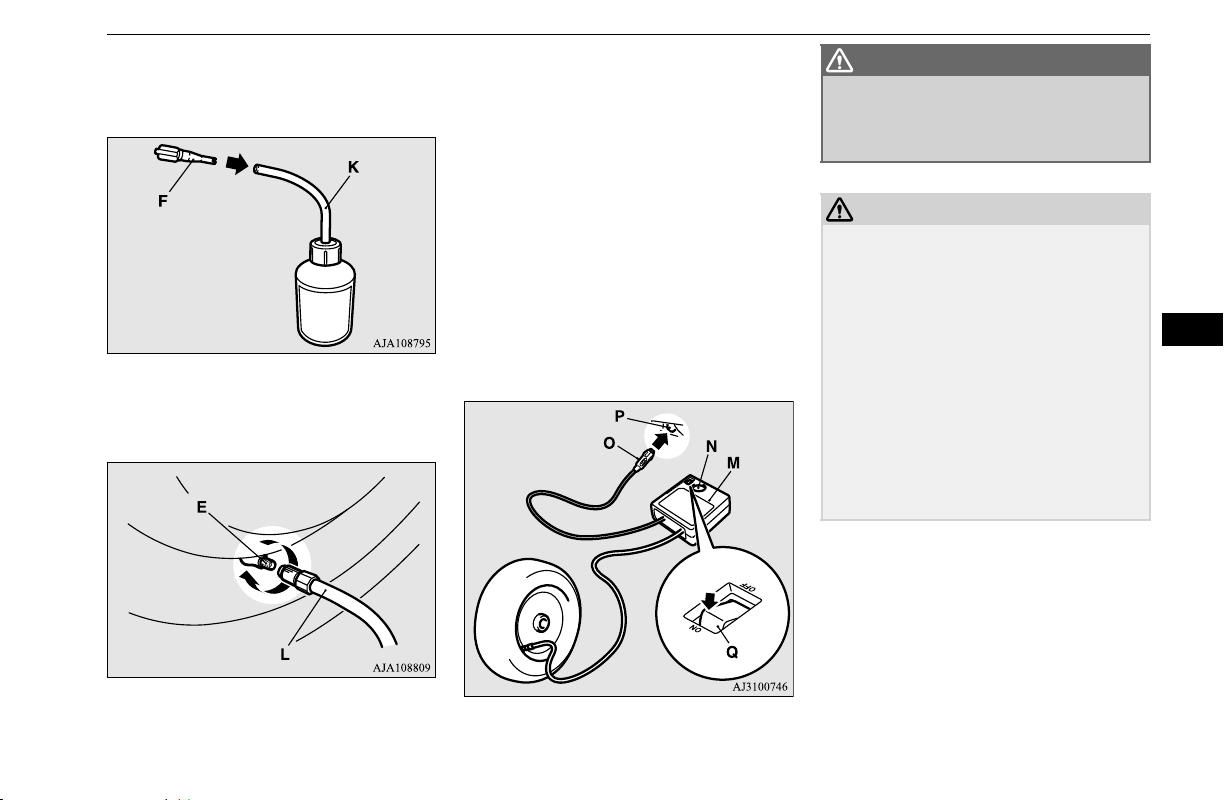
Tire repair kit
For emergencies 8-9
8
12. After injecting the sealant, securely fit the
valve remover (F) into the end of the filler
hose (K) to prevent sealant from leaking
from the empty bottle.
13. Pull out the compressor hose (L) from the
side of the tire compressor, and then
securely attach the hose to the tire valve
(E).
14. Place the compressor (M) with its air
pressure gauge (N) on top.
Pull out the compressor’s power cord (O),
insert the plug on the cord into the 12 V
power outlet (P), and then turn the electric
motor switch to the “ACC” position.
(Refer to “12V power outlet” on page
5-76.)
Turn ON the compressor switch (Q) and
inflate the tire to the specified pressure.
(Refer to “Tire inflation pressures” on
page 9-13.)
If there is a gap between the tire and
wheel, push the tread area toward the cen-
ter of the wheel to close the gap before
running the compressor.
15. Check and adjust the tire pressure with
reference to the air pressure gauge on the
compressor. If you overinflate the tire,
release air by loosening the hose’s end fit-
ting.
WARNING
Do not place your hand or fingers between
the tire and wheel while inflating the tire.
Your hand or fingers may become caught
between the tire and wheel.
CAUTION
The supplied compressor is designed only
for inflation of your vehicle tires.
The compressor is designed to run on a vehi-
cle’s 12 V power supply. Do not connect it to
any other power source.
The compressor is not waterproof. If you use
it in rain, make sure water does not get on it.
Any sand or dust sucked into the compressor
could make the compressor break down. Do
not place the compressor directly on any
sandy or dusty surface when using it.
Do not disassemble or modify the compres-
sor. Also, do not subject the air pressure
gauge to shock. It could malfunction.
BK0220401US.book 9 ページ 2015年6月3日 水曜日 午前7時42分
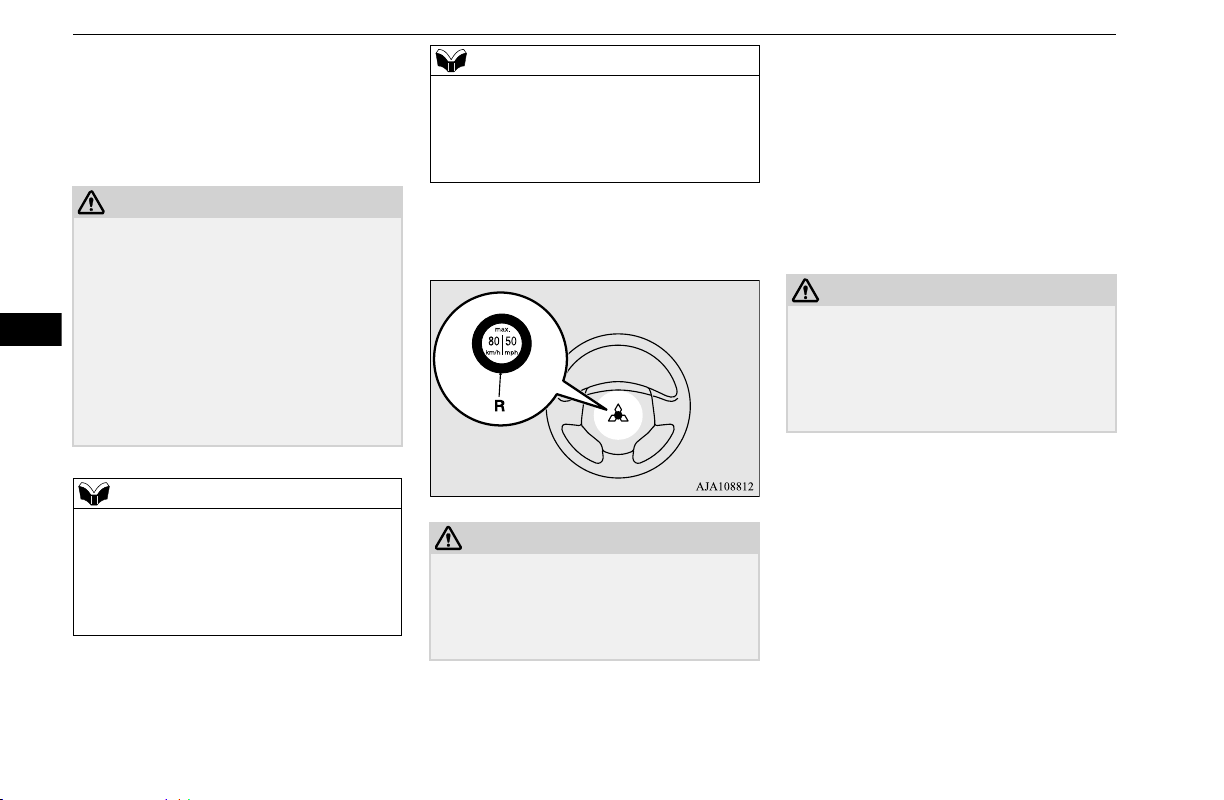
Tire repair kit
8-10 For emergencies
8
If there is a gap between the tire and
wheel because the tire has moved inward
from the wheel rim, press the tire tread
towards the wheel to close the gap before
running the compressor. (With no gaps,
the tire pressure will rise.)
16. Turn OFF the compressor switch, then
pull the power cord plug out of the 12 V
power outlet.
17. Affix the speed restriction sticker (R) to
the three-diamond mark on the steering
wheel.
18. When you have inflated the tire to the
specified pressure, stow the compressor,
bottle, and other items in the vehicle and
make sure that the seat cushion is properly
secured. (Refer to “Tire repair kit storage”
on page 8-5.) Promptly start driving the
vehicle so that the tire sealant can spread
evenly in the tire. Drive with great care.
Do not exceed a speed of 50 mph (80
km/h). Observe local speed limits.
19. After driving for 10 minutes or 3 miles (5
km), park the vehicle in safe place.
Remove the air compressor from the
stowed position. Check the tire pressure
using the air pressure gauge on the com-
pressor. If the tire pressure has apparently
not dropped, the emergency repair proce-
dure is complete. Continue the process
from step 21.
If the tire pressure is not sufficient, inflate
the tire to the specified pressure again and
drive the vehicle carefully without
exceeding a speed of 50 mph (80 km/h).
CAUTION
The surface of the compressor will get hot
while the compressor is running. Do not
keep the compressor running continuously
for more than 10 minutes. After using the
compressor, wait for the compressor to cool
before using it again.
If the compressor becomes sluggish or hot
while operating, it is overheating. Immedi-
ately place the switch in the OFF position
and let the compressor cool down for at least
30 minutes.
NOTE
If the tire pressure does not rise to the speci-
fied level within 10 minutes, the tire may be
so severely damaged that the tire sealant can-
not be used to effect the emergency repair.
Do not drive the vehicle. Please contact a
certified i-MiEV dealer.
NOTE
At this point the puncture hole is not sealed
yet. Air will leak through the puncture hole
until the emergency repair procedure is com-
pleted (through step 19 or step 20 of these
instructions).
CAUTION
Do not affix the sticker anywhere except the
specified position on the pad of the steering
wheel. Affixing the sticker in an incorrect
position could prevent the SRS airbag from
deploying properly.
CAUTION
If you sense any abnormality while driving,
stop the vehicle and contact a certified i-
MiEV dealer. Otherwise the tire pressure
may drop before the emergency repair proce-
dure is completed, rendering the vehicle
unsafe to drive.
BK0220401US.book 10 ページ 2015年6月3日 水曜日 午前7時42分
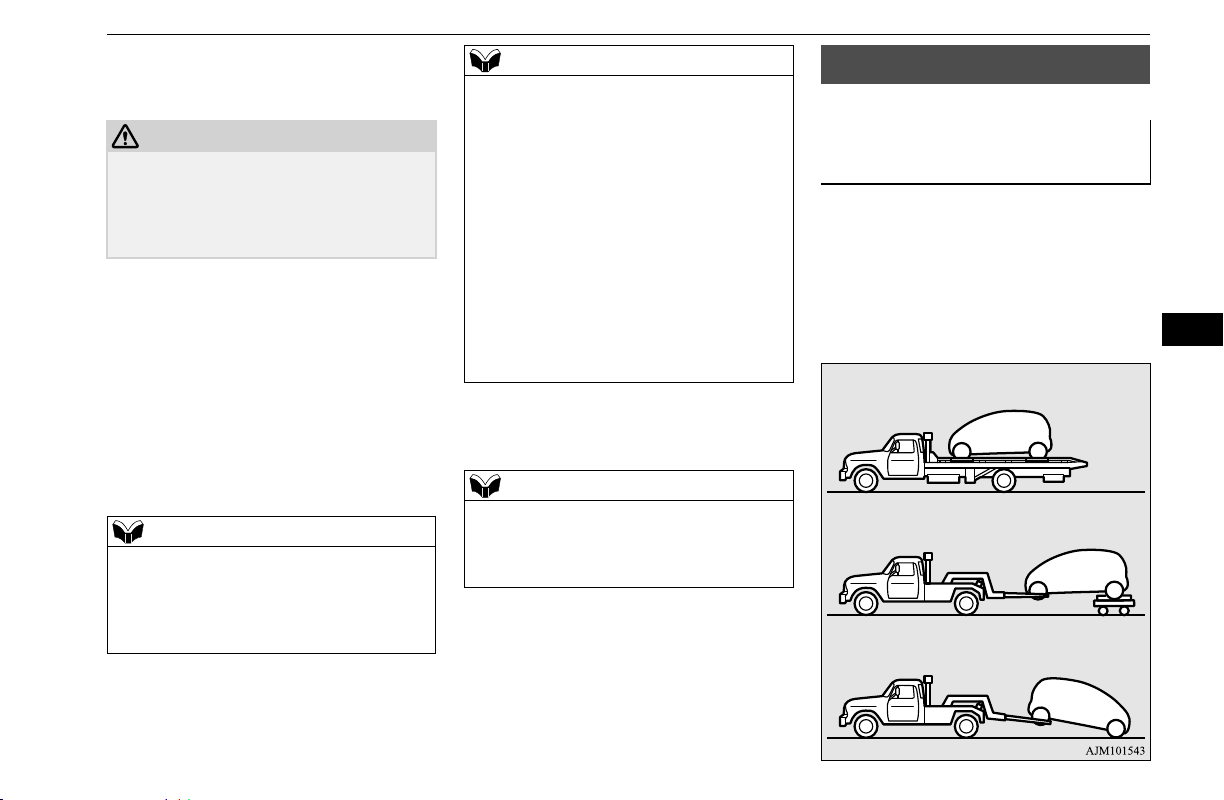
Towing
For emergencies 8-11
8
Before driving, stow the compressor and
make sure that the rear seat cushion is
properly secured.
20. After driving for 10 minutes or 3 miles (5
km) again, check the tire pressure using
the air pressure gauge on the compressor.
If the tire pressure has apparently not
dropped, the emergency repair procedure
is complete. Before driving, make sure
that the compressor is stowed and the seat
cushion is properly secured. You must
still not exceed a speed of 50 mph (80
km/h). Observe local speed limits.
21. Immediately drive with great care to a
certified i-MiEV dealer and have tire
repair/replacement performed.
N00837001931
If you need to tow your vehicle, contact a cer-
tified i-MiEV dealer or a commercial tow
truck service.
Transport the vehicle on a flatbed truck or
tow the vehicle either with all wheels or the
rear wheels (drive wheels) off the ground.
CAUTION
If the tire pressure is lower than the mini-
mum permitted pressure (18 psi {130 kPa}),
the tire cannot successfully be repaired with
the tire sealant. Do not drive the vehicle any
further. Contact a certified i-MiEV dealer.
NOTE
If the tire pressure has dropped below the
specified level when you check it at the end
of the repair procedure, do not drive the
vehicle any further. Contact a certified i-
MiEV dealer.
In cold conditions (when the ambient tem-
perature is 32 °F {0 °C} or lower), the time
and driving distance necessary until comple-
tion of the repair can become longer than in
warmer conditions, and the tire pressure may
drop below the specified level even after you
have inflated the tire the second time and
subsequently driven the vehicle. If this hap-
pens, inflate the tire to the specified pressure
once more, drive for about 10 minutes or 3
miles (5 km), then check the tire pressure
again. If the tire pressure has again dropped
below the specified level, stop driving the
vehicle and contact a certified i-MiEV
dealer.
NOTE
Please give the empty sealant bottle to a cer-
tified i-MiEV dealer or dispose of the sealant
bottle according to regulations for the dis-
posal of chemical waste.
NOTE
Towing
If your vehicle needs to be
towed
Towing with rear wheels off the ground
Dolly type
Flat bed type
BK0220401US.book 11 ページ 2015年6月3日 水曜日 午前7時42分
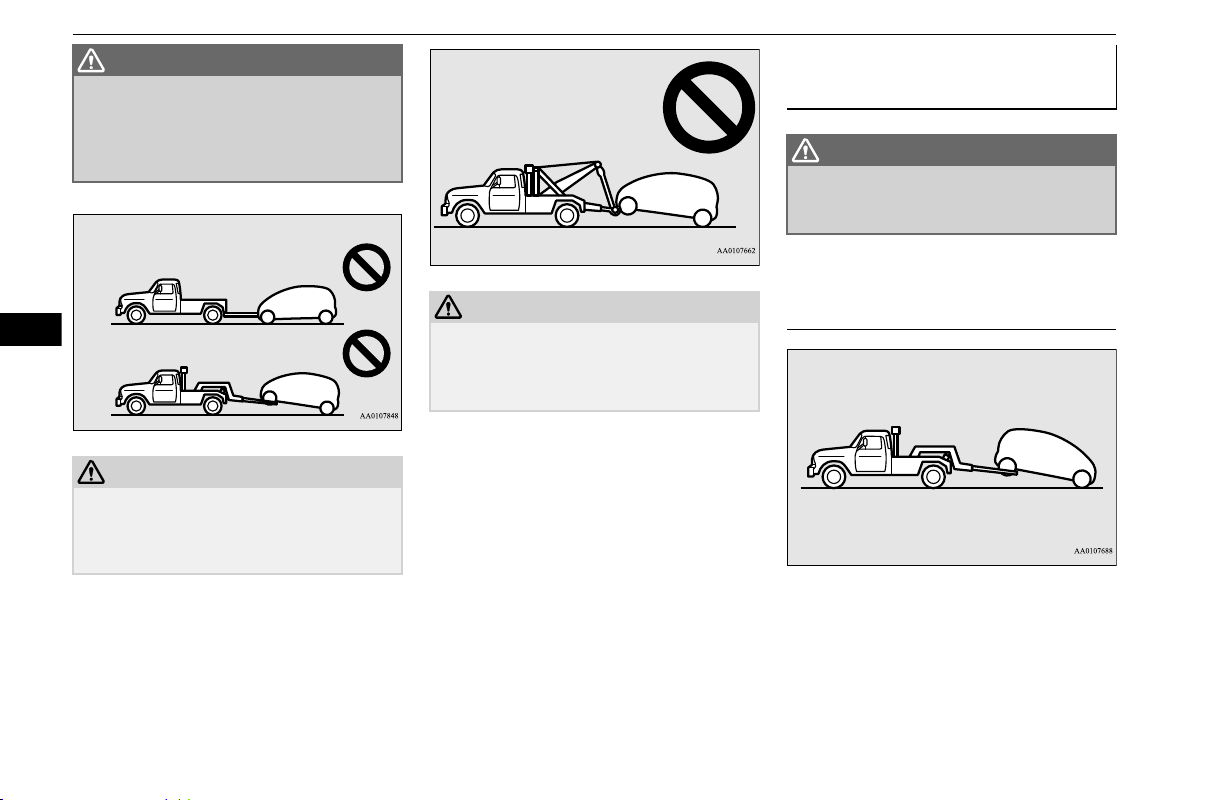
Towing
8-12 For emergencies
8
If a wheel gets stuck in a ditch, do not try to
tow the vehicle.
Please contact a certified i-MiEV dealer or a
commercial tow truck service for assistance.
There may be local regulations concerning
towing in your area. Obey the regulations in
the area where you are driving your vehicle.
Place the selector lever in the “N” (NEU-
TRAL) position. Turn the electric motor
switch to the “ACC” position and secure the
steering wheel in a straight-ahead position
with a rope or tie-down strap. Never place the
electric motor switch in the “LOCK” or “ON”
position when towing.
WARNING
Never tow the vehicle with rear wheels
(drive wheels) on the ground. This may
cause damage to the electric motors. Also
this may cause a fire, if wiring in the elec-
tric motor unit room becomes damaged.
CAUTION
Never tow the vehicle using a sling type
truck.
Doing so will damage the bumper and/or
body.
Towing with all wheels on the ground
Towing with front wheels off the ground
CAUTION
Never attempt to tow the vehicle using
another vehicle with a rope.
Never tow another vehicle using your i-
MiEV
Towing with a sling-type truck
Towing the vehicle by a tow
truck
WARNING
Never get under your vehicle after it has
been lifted by a tow truck.
Never ride in a vehicle that is being towed.
Towing with rear wheels off the
ground
BK0220401US.book 12 ページ 2015年6月3日 水曜日 午前7時42分
Operation under adverse driving conditions
For emergencies 8-13
8
N00837200747
If your vehicle becomes stuck in snow, sand,
or mud, it can often be moved by a rocking
motion. Rock your vehicle back and forth to
free it.
Do not spin the wheels. Constant efforts to
free a stuck vehicle can cause transmission
failure.
If your vehicle is still stuck after several rock-
ing attempts, call for a commercial tow truck
service.
When driving on a road covered with
snow or ice, use snow tires. Tire chains
cannot be used on your vehicle. There
may be state or local regulations about
using snow tires. Always check the regu-
lations in your local area before using
them. Refer to the section entitled “Snow
tires” on page 9-15 and “Tire chains” on
page 9-16.
Drive slowly. Do not make sudden starts
or stops, sharp turns, or slam on the
brakes.
Allow extra distance between your vehi-
cle and the vehicle in front of you, and
avoid sudden braking.
If a skid occurs when the accelerator
pedal is depressed, take your foot off the
pedal. Steer gently in the direction of the
skid.
Your vehicle is equipped with an anti-lock
braking system (ABS), hold the brake
pedal down firmly and keep it depressed.
Do not pump the brake pedal which will
result in reduced braking performance.
CAUTION
If the transmission or the steering system has
a problem or damage, transport the vehicle
on a flatbed truck or tow the vehicle with the
all wheels off the ground.
If the electric motor switch is in the “ON”
position, the Active Stability Control (ASC)
system may operate, resulting in an accident.
Make sure the electric motor switch is in the
“ACC” position before towing.
Operation under adverse
driving conditions
If your vehicle becomes stuck in
sand, mud or snow
WARNING
When trying to rock your vehicle out of a
stuck position, make sure that there are no
people nearby. The rocking motion can
make your vehicle suddenly lurch forward
or backward, and injure any bystanders.
On wet roads
CAUTION
Do not drive on a flooded road. If you drive
on a flooded road, not only the electric motor
unit stops but also a failure like electric leak-
age or short circuit may occur.
If you inevitably had to run on a flooded
road and the vehicle was exposed to water,
be sure to have your vehicle inspected by a
certified i-MiEV dealer.
When driving in rain, on water-covered
roads, or through a car wash, water could get
into the brake discs and make them fail tem-
porarily. In such cases, lightly press the
brake pedal to see if they are working prop-
erly. If they are not, press the pedal lightly
several times while driving to dry the brake
pads or linings, then check them again.
When driving in rain, a layer of water may
form between the tires and the road surface
(aquaplaning). This loosens your tires’ grip
on the road, making it difficult to steer or
brake properly. When driving on a wet road:
• Drive your vehicle at a safe speed.
• Do not drive on worn tires.
• Always keep the tires at the correct infla-
tion pressures.
On snowy or icy roads
CAUTION
BK0220401US.book 13 ページ 2015年6月3日 水曜日 午前7時42分
Operation under adverse driving conditions
8-14 For emergencies
8
After parking on snowy or icy road, it
may be difficult to move your vehicle due
to freeze-up of the brake. Depress the
accelerator pedal little by little to move
the vehicle after confirming safety of the
vehicle.
Drive as slow as possible when driving on
bumpy or rutted roads or over potholes
etc.
CAUTION
Do not depress the accelerator pedal rapidly.
The vehicle could start moving when it
breaks free from the ice, possibly resulting in
an accident.
On a bumpy or rutted road
CAUTION
Driving on bumpy, rutted roads or over pot-
holes can damage the tires and wheels.
Wheels with low-profiles tires or under-
inflated tires are especially at risk for dam-
age.
The vehicle’s body, bumper, muffler and
other parts may be damaged if the vehicle is:
• driven over a step (for example, at the
entrance or exit of a parking lot);
• parked too closely against a curb or parking
block, or by the side of a road with curb-
stones;
• driven on a steep slope.
CAUTION
BK0220401US.book 14 ページ 2015年6月3日 水曜日 午前7時42分
9
Vehicle care and maintenance
Service precautions ..........................................................................9-2
Hood ................................................................................................9-3
View under the hood and electric motor unit room .........................9-4
Coolant/Hot water heater fluid ........................................................9-4
Washer fluid .....................................................................................9-7
Brake fluid .......................................................................................9-7
12V starter battery ...........................................................................9-7
Tires ...............................................................................................9-10
Brake pedal free play .....................................................................9-16
Parking brake lever stroke .............................................................9-16
Wiper blades ..................................................................................9-16
General maintenance .....................................................................9-17
For cold and snowy weather ..........................................................9-18
Fusible links ...................................................................................9-18
Fuses ..............................................................................................9-18
Replacement of light bulbs ............................................................9-21
Vehicle care precautions ................................................................9-28
Cleaning the inside of your vehicle ...............................................9-28
Cleaning the outside of your vehicle .............................................9-30
BK0220401US.book 1 ページ 2015年6月3日 水曜日 午前7時42分
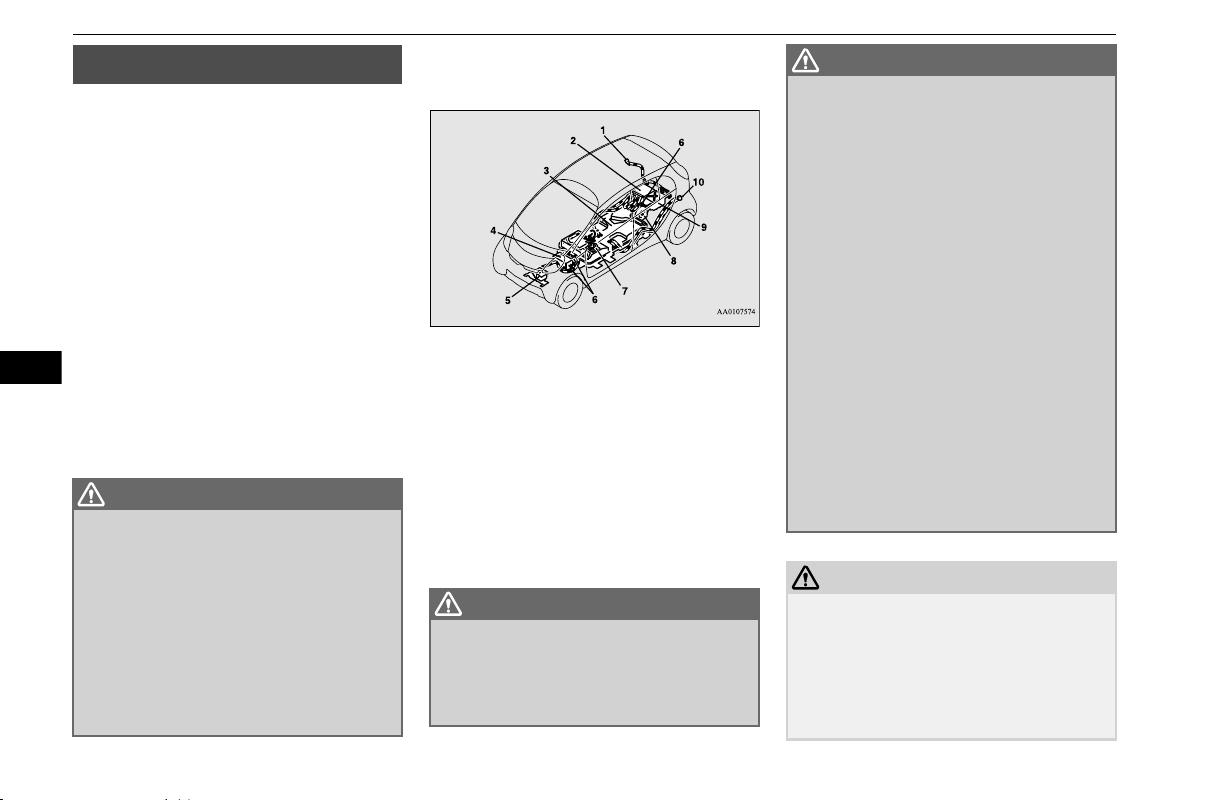
Service precautions
9-2 Vehicle care and maintenance
9
N00937301414
Taking regular care of your vehicle helps pre-
serve its value and appearance as long as pos-
sible.
This vehicle is an electric vehicle and is
equipped with many high-voltage compo-
nents. Refer to “High-voltage components”
on page 3-34.
You can do some of the maintenance work
described in this manual by yourself, but the
rest must be performed only by a certified i-
MiEV dealer.
If you discover a malfunction or other prob-
lem, have it corrected by a certified i-MiEV
dealer.
Also follow the instructions and take note of
the precautions for each procedure.
High voltage components and wiring cables
are located as shown in the figure below.
Service precautions
WARNING
Never touch, remove or disassemble the
high- voltage components including high-
voltage wires colored orange and their
connectors. Doing so can result in a fire,
property damage, electrocution and seri-
ous injury or death.
These components are affixed with a label
indicating precautions for handling. Fol-
low the instructions on the label. Take
your vehicle to a certified i-MiEV dealer
for any necessary maintenance.
1- Regular charge port
2- MCU
3- Main drive lithium-ion battery
4- Heater
5- Air conditioner compressor
6- High voltage connector
7- Service plug
8- Electric motor (Electric motor unit)
9- On board charger/DC-DC converter
10- Quick charge port
WARNING
When servicing the vehicle, make sure
that the electric motor switch is in the
“LOCK” position and the charging cable
is disconnected. Failure to do so could
result in an electric shock.
When checking or servicing under the
hood or the coolant reserve tank, be sure
the electric motor unit is stopped and it
has had a chance to cool down.
If you need to work under the hood with
the electric motor unit on, be careful that
your clothing, hair, etc. does not get
caught in the fan or other moving parts.
The fan can turn on automatically even if
the electric motor unit is not running.
Turn the electric motor switch to the
“LOCK” position to be safe while you are
working under the hood.
Do not smoke or allow open flames around
the 12V starter battery.
Be extremely careful when working
around the 12V starter battery. It contains
poisonous and corrosive sulfuric acid.
Handling your vehicle’s parts and materi-
als in the wrong way can injure you. Ask a
certified i-MiEV dealer if you have ques-
tions.
CAUTION
The components inside the electric motor
unit room may be very hot to the touch.
Make sure all components have sufficiently
cooled before beginning an inspection.
These components are affixed with a label
indicating precautions for handling. Follow
the instructions on the label.
WARNING
BK0220401US.book 2 ページ 2015年6月3日 水曜日 午前7時42分
Hood
Vehicle care and maintenance 9-3
9
Have you purchased the Mitsubishi Motors
Diamond Care Protection Plan? The Plan
supplements your new vehicle warranties.
See a certified i-MiEV dealer for details.
N00937500549
Use the hood release lever (located under the
instrument panel near the passenger’s door)
to unlock the hood.
Pull the lever toward you to release the hood
latch.
Release the safety lever (A) and lift the hood.
Support the hood by inserting the support
prop (B) into its slot on the underside of the
hood arm.
When replacing the 12V starter battery,
remove the positive (+) and negative (-) ter-
minals after turning the electric motor switch
to the “LOCK” position and waiting at least
2 minutes. If the 12V starter battery terminal
is removed just after the electric motor
switch is turned to the “LOCK” position, this
may cause damage to electric components.
If the electric motor unit warning light illu-
minates, do not replace the 12V starter bat-
tery. Contact a certified i-MiEV dealer.
CAUTION
Hood
To open
WARNING
Never use the release lever to unlatch the
hood while the vehicle is in motion.
Do not drive your vehicle unless the hood
is locked.
NOTE
To prevent damage to the hood and wipers,
make sure the wipers are at resting position
when you open the hood.
BK0220401US.book 3 ページ 2015年6月3日 水曜日 午前7時42分
View under the hood and electric motor unit room
9-4 Vehicle care and maintenance
9
Make sure the hood is securely locked by
softly lifting the centre of the hood.
Slowly lower the hood about 12 inches (30
cm), then let it drop from its own weight.
N00937600700
N00937800539
CAUTION
Always insert the support prop into the hole
specially made for it. Propping the hood at
any other place could cause the prop to slip
out and lead to an accident.
The hood prop can fall out if the hood is
lifted by a strong wind.
To close
CAUTION
Be careful not to trap your hands or fingers
when closing the hood.
Make sure the hood is firmly closed before
driving.
If you drive without the hood completely
closed, it could open up while driving.
NOTE
If this does not close the hood properly, drop
it again from a slightly higher position.
Do not push down strongly on the hood.
Depending on how strongly or where you
push down, you could create a dent in the
hood.
View under the hood and
electric motor unit room
CAUTION
Under the hood
1- Windshield washer fluid reservoir
2- 12V starter battery
3- Hot water heater reservoir
4- Brake fluid reservoir
5- Coolant reservoir
Coolant/Hot water heater
fluid
To check the coolant level
WARNING
Before checking the coolant level, make
sure the electric motor switch is in the
“Lock” position to avoid the risk of an
electrical shock that can result in serious
injury or death.
Electric motor unit room
BK0220401US.book 4 ページ 2015年6月3日 水曜日 午前7時42分
Coolant/Hot water heater fluid
Vehicle care and maintenance 9-5
9
1. Open the liftgate.
2. Peel off the Velcro fastener (A) to remove
the luggage room floor carpet (B).
3. Turn the 4 screws on the front and rear of
the electric motor unit room lid (C) coun-
terclockwise to loosen and remove them,
and then remove the electric motor unit
room lid (C).
4. Check the coolant level in the reservoir
(D).
While the motor is cold, the coolant level
must always be between the “F (FULL)”
and the “L (LOW)” marks. If necessary,
add coolant. Refer to “To add coolant” on
page 9-6.
5. Reinstall the electric motor unit room lid
and the luggage room floor carpet by fol-
lowing the removal procedures in reverse.
The reservoir (A) is located under the hood.
The room under the hood and the electric
motor unit room (located under the lug-
gage room carpet) can be very hot after
driving. Wait until they have cooled down.
Coolant
WARNING
NOTE
A heat insulating material is attached to the
luggage room floor carpet. To remove the
luggage floor carpet, grasp and lift up both
the carpet fabric and the heat insulating
material.
NOTE
When laying the electric motor unit room lid
on the ground, leave the underside of the lid
with the rubber surface facing up. If the
underside is facing downward debris and
other foreign material could get on the rub-
ber surface and prevent proper reinstallation
of the electric motor unit room lid.
WARNING
Never touch components inside the elec-
tric motor unit room except the reservoir
(D).
Hot water heater fluid
FULL
LOW
BK0220401US.book 5 ページ 2015年6月3日 水曜日 午前7時42分
Coolant/Hot water heater fluid
9-6 Vehicle care and maintenance
9
The coolant level in this reservoir should be
kept between the “F (FULL)” and the “L
(LOW)” marks when measured while the
electric motor is cold. If necessary, add cool-
ant. Refer to “To add coolant” on page 9-6.
N00955900024
Mitsubishi Motors Genuine Coolant provides
excellent protection against corrosion and
rust formation on all metals, including alumi-
num.
If you need to add coolant often, the cooling
system should be pressure-tested for leaks.
Take your vehicle to a certified i-MiEV
dealer for testing.
N00955800010
The reservoir cap (E) must be tightly sealed
to prevent losing coolant which may result in
electric motor or nearby parts of the room
under the hood damage. Only use a Genuine
Mitsubishi Parts reservoir cap, or an
approved equivalent.
N00955700019
Do not overfill the reservoir.
Your vehicle uses a special reservoir cap
that stays sealed and keeps the pressure in
the reservoir below the allowable pres-
sure. If you need to change the cap, use
the exact same kind.
Check the coolant freeze point in the radi-
ator with the proper gauge, and only when
it is safe. If you add antifreeze, the con-
tents of the reservoir must be protected
against freezing.
Keep the front of the radiator and con-
denser clean.
To add coolant
Use “Mitsubishi Motors Genuine Super Long
Life Coolant Premium” or an equivalent*.
*: similar high quality ethylene glycol
based non-silicate, non-amine, non-
nitrate and non-borate coolant with long
life hybrid organic acid technology
FULL
LOW
CAUTION
Do not use alcohol or methanol antifreeze or
any coolants that contain them. Using the
wrong antifreeze can corrode aluminum
parts.
The required concentration of anti-freeze dif-
fers depending on the expected ambient tem-
perature.
Above -31 °F (-35 °C): 50 % concentration
of anti-freeze
Below -31 °F (-35 °C): 60 % concentration
of anti-freeze
You can check the concentration level with a
gauge from an automotive supply store, or a
certified i-MiEV dealer or service station can
check it for you.
Do not use water to adjust the concentration
of coolant.
Do not top off the tank with plain water only.
Water by itself boils at a lower temperature
and does not stop rust or freezing. If the
water freezes, it will damage your cooling
system. Do not use tap water. It can cause
corrosion and rust.
Reservoir cap
WARNING
Wait for the electric motor to cool down
before opening the reservoir cap. Other-
wise hot steam or boiling coolant could
spray up from the reservoir and scald you.
Points to remember
BK0220401US.book 6 ページ 2015年6月3日 水曜日 午前7時42分
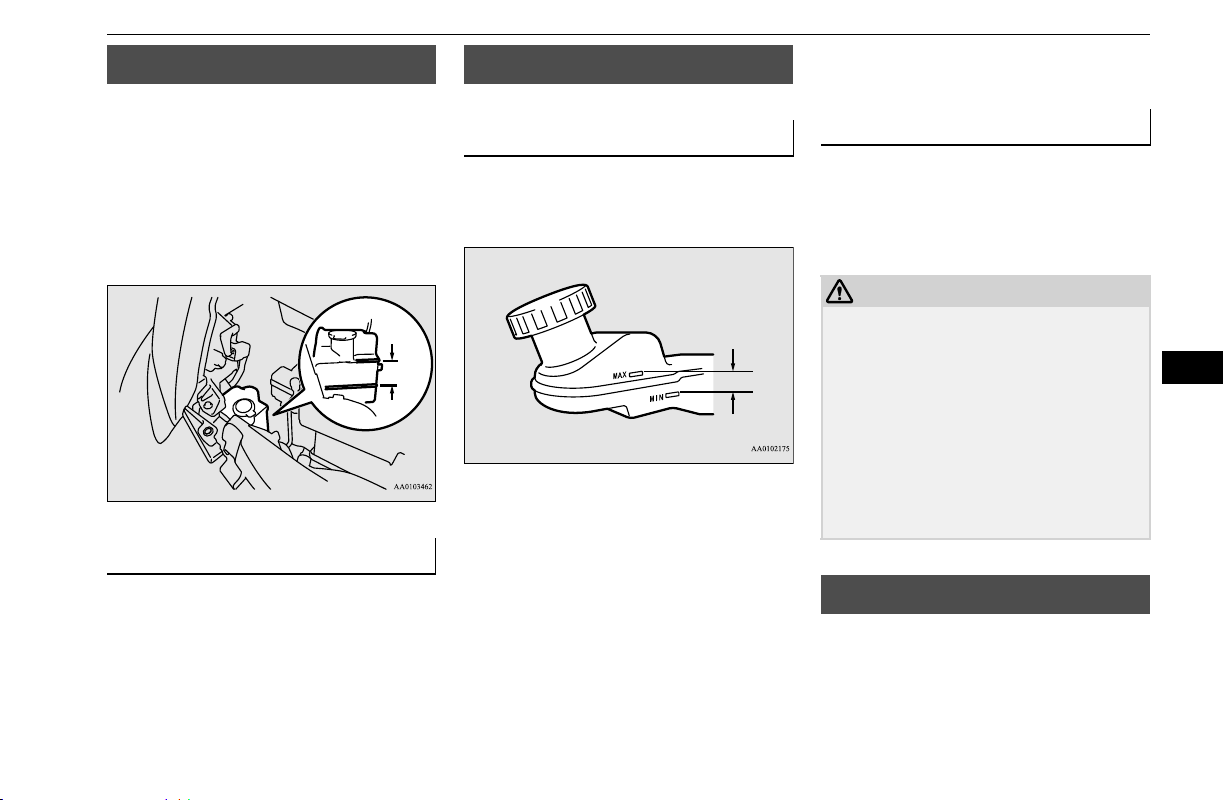
Washer fluid
Vehicle care and maintenance 9-7
9
N00938600303
The windshield washer fluid reservoir is
under the hood.
Check the washer fluid level at regular inter-
vals and add washer fluid to reservoir if nec-
essary.
Open the reservoir cap and check the fluid
level.
When freezing weather is anticipated, flush
out the water in the reservoir by operating the
pump. Fill the reservoir with windshield anti-
freeze (not radiator antifreeze), and operate
the system for a few seconds to flush out the
residual water.
N00938700261
The brake fluid level must be between the
“MAX” and “MIN” marks on the reservoir.
The brake fluid level falls slightly with wear
of the brake pads, but this does not indicate
any abnormality.
The brake fluid in the master cylinder should
be checked when doing other work under the
hood. The brake system should also be
checked for leaks at the same time.
If the brake fluid level falls markedly in a
short length of time, it indicates a leak in the
brake system.
If this occurs, have the vehicle checked by a
certified i-MiEV dealer.
Use the recommended brake fluid conform-
ing to DOT 3 or DOT 4. The reservoir cap
must be tightly sealed to keep dirt and water
out.
N00939100914
The condition of the 12V starter battery is
very important to keep the vehicle’s electrical
system working properly. Check the 12V
starter battery regularly.
Washer fluid
During cold weather
FULL
1/2
Brake fluid
To check the fluid level
Fluid type
CAUTION
Do not let any petroleum-based fluid touch,
mix with, or get into the brake fluid. This
will damage the seals.
Be careful when handling brake fluid. It can
damage painted surfaces.
Use only the listed brake fluid. Different
brands of brake fluid have different addi-
tives, and these can cause a chemical reac-
tion. Do not mix brands of brake fluid.
Keep the reservoir tank cap closed to keep
the brake fluid from evaporating.
12V starter battery
BK0220401US.book 7 ページ 2015年6月3日 水曜日 午前7時42分
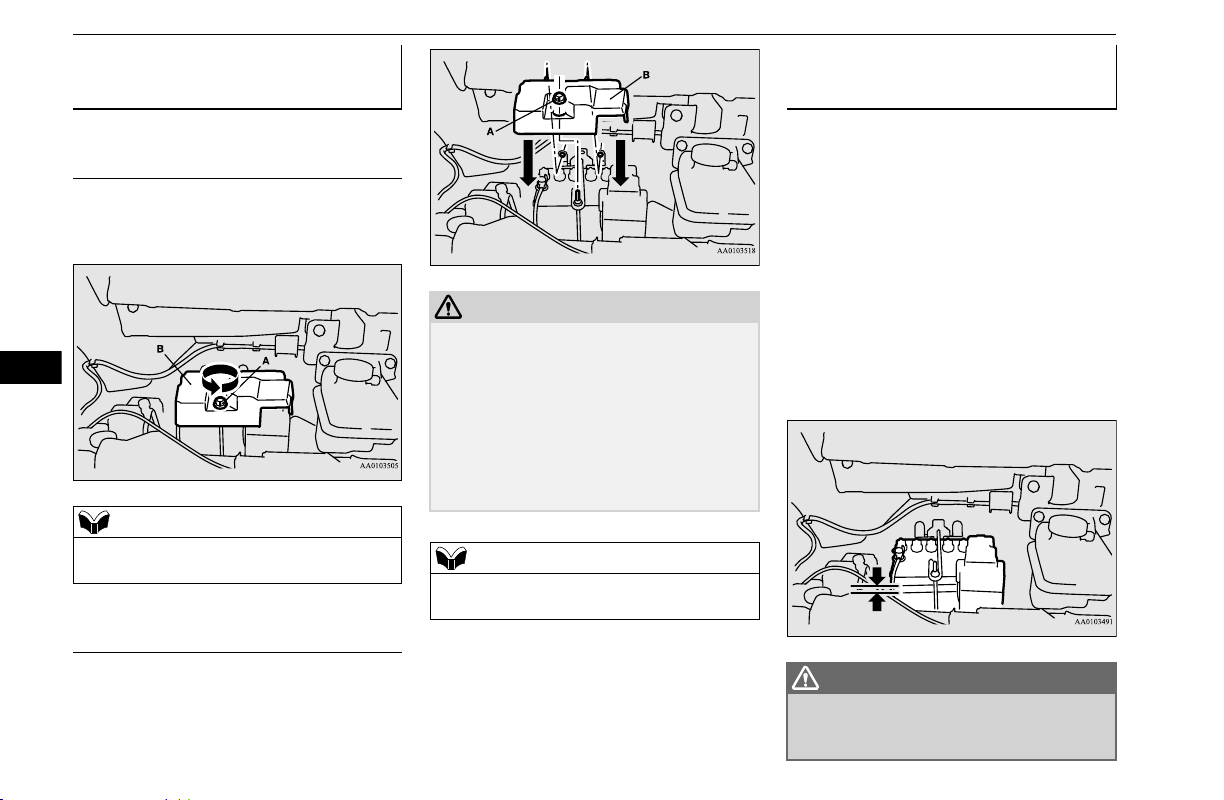
12V starter battery
9-8 Vehicle care and maintenance
9
N00901300054
1. Turn the plastic nut (A) counterclockwise,
and then remove the 12V starter battery
upper cover (B).
1. Install the 12V starter battery upper cover
(B) onto the 12V starter battery, and then
push the plastic nut (A) in the direction
shown by the arrows to secure the cover.
N00901500069
Before checking the 12V starter battery elec-
trolyte level, remove the 12V starter battery’s
upper cover.
The electrolyte level must be between the
limits shown on the outside of the 12V starter
battery. Fill it with distilled water as needed.
The inside of the 12V starter battery is
divided into several compartments. Take the
cap off of each compartment and fill to the
mark.
Do not fill above the top line because a spill
during driving could cause damage.
Removing and installing the
12V starter battery upper cover
To rem ove
NOTE
Be careful not to lose the removed plastic
nut.
To install
CAUTION
Be sure to install the 12V starter battery
upper cover. Otherwise, the battery electro-
lyte may spill and cause a malfunction.
When installing the 12V starter battery upper
cover and plastic nut do not touch the cool-
ing fan or other moving parts under the hood.
Be especially careful that the cables, your
clothing or hair, etc., do not get caught in the
cooling fan or other moving parts.
NOTE
Be sure to install the plastic nut in the correct
direction.
Checking 12V starter battery
electrolyte level
WARNING
If the 12V starter battery goes flat, be sure
to check the 12V starter battery electro-
lyte level before connecting booster cables.
BK0220401US.book 8 ページ 2015年6月3日 水曜日 午前7時42分
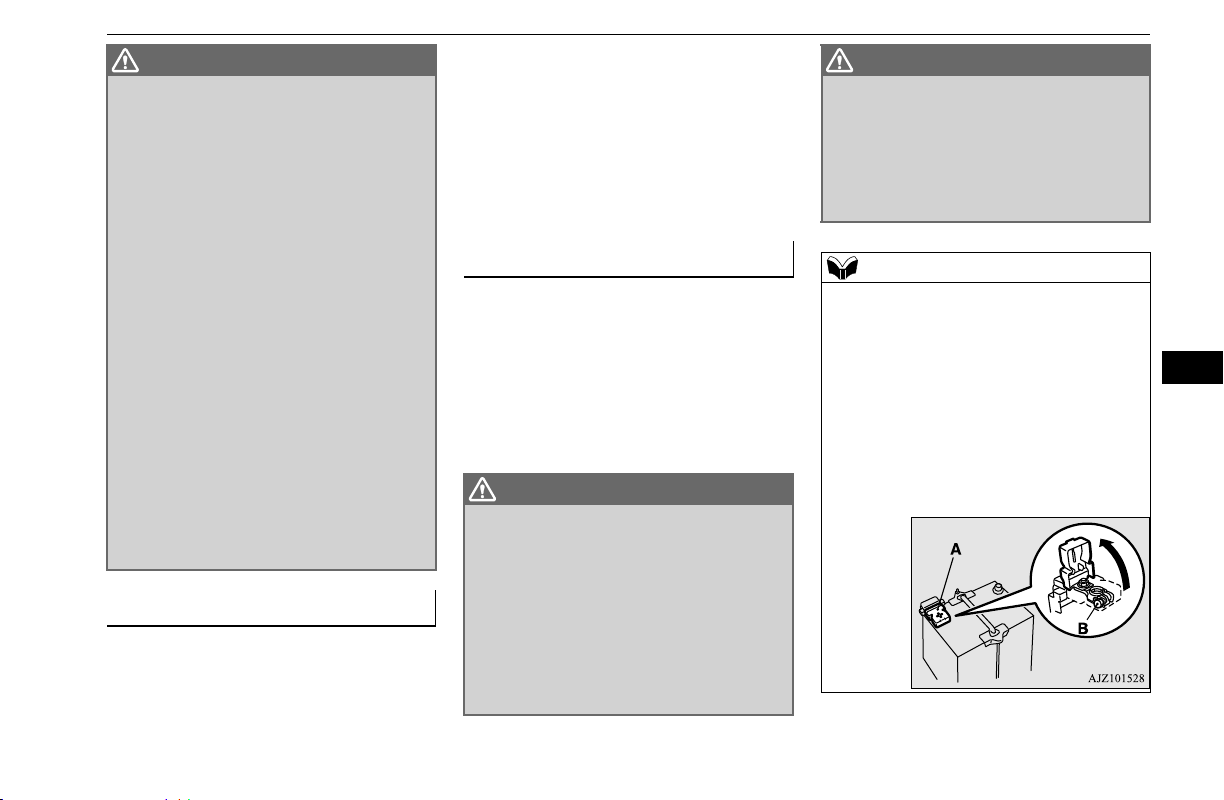
12V starter battery
Vehicle care and maintenance 9-9
9
N00901600057
The 12V starter battery is weaker in cold tem-
peratures. This has to do with its chemical
and physical properties and is why a very
cold 12V starter battery, especially one with a
low charge, will have a hard time starting
your vehicle.
It is recommended that you have your 12V
starter battery and charging system checked
by a certified i-MiEV dealer before the start
of cold weather. If necessary, have it charged.
This will guarantee more reliable starting,
and longer 12V starter battery life.
N00901701114
To disconnect the 12V starter battery cable,
stop the electric motor. Disconnect the nega-
tive (-) terminal first, then the positive (+) ter-
minal. To reconnect the 12V starter battery,
first connect the positive (+) terminal and
then the negative (-) terminal, before starting
the vehicle.
After checking the 12V starter battery
electrolyte level, make sure the caps are
fitted securely.
If any of the caps cannot be re-secured to
the 12V starter battery, replace the 12V
starter battery.
Electrolyte (battery acid) is made of corro-
sive diluted sulfuric acid. If it spills on
nearby parts, it can crack, stain, or dis-
color them. And if gets on your skin or in
your eyes, it can cause burns or blindness.
Please observe the following handling
instructions:
• If electrolyte gets on plastic parts or
other nearby parts, wipe it off with a soft
cloth or chamois soaked in a solution of
water and neutral detergent then imme-
diately rinse the affected parts with
plenty of water.
• If electrolyte gets on your hands or
clothes, rinse thoroughly with water. If
electrolyte gets in your eyes, flush them
with water immediately and get immedi-
ate medical attention.
During cold weather
WARNING
Disconnection and connection
WARNING
Never disconnect the 12V starter battery
while the electric motor unit is running, or
you could damage the vehicle’s electrical
parts.
Never short-circuit the 12V starter bat-
tery. This could cause it to overheat and
be damaged.
Keep sparks, cigarettes, and flames away
from the 12V starter battery because the
12V starter battery could explode.
When installing the 12V starter battery,
start connection with the positive (+) ter-
minal. If connection is started from the
negative (-) terminal, sparks will occur if
the positive (+) terminal touches any other
parts, and this may cause the 12V starter
battery to explode.
NOTE
Remove the 12V starter battery upper cover
before disconnecting the terminal of 12V
starter battery. Refer to “Removing and
installing the 12V starter battery upper
cover” on page 9-8.
Open the terminal cover (A) before discon-
necting or connecting the positive (+) termi-
nal of the 12V starter battery.
Loosen the nut (B), and then disconnect the
12V starter battery cable from the positive
(+) terminal.
WARNING
BK0220401US.book 9 ページ 2015年6月3日 水曜日 午前7時42分
Tires
9-10 Vehicle care and maintenance
9
N00939201619
It is important to familiarize yourself with the
following terms:
Cold tire pressure:
• The measured pressure after the vehicle
has been parked for at least three hours,
or
• The measured pressure when the vehicle
is driven less than 1 mile (1.6 km) after
having been parked for three hours.
Maximum inflation pressure: the maxi-
mum permissible cold tire inflation pres-
sure for this tire.
Recommended inflation pressure: the
inflation pressure for optimum tire perfor-
mance.
WARNING
Open doors and windows in any closed
space where you may be charging or
working with the 12V starter battery.
Always wear protective clothing and gog-
gles when working with the 12V starter
battery, or have a skilled automobile tech-
nician do it.
If you are quick-charging your 12V
starter battery, first disconnect the 12V
starter battery cables.
In order to prevent a short circuit, be sure
to disconnect the negative (-) terminal
first, and reconnect it last.
If the electrolyte level is very low, have the
12V starter battery checked at a certified
i-MiEV dealer.
12V starter battery terminals and related
accessories contain lead and lead com-
pounds. Wash hands after handling.
CAUTION
When replacing the 12V starter battery,
remove the connected positive (+) and nega-
tive (-) terminals after turning the electric
motor switch to the “LOCK” position and
waiting at least 1 minute. If the 12V starter
battery terminal is removed just after the
electric motor switch is turned to the
“LOCK” position, this may cause damage to
components of the electric motor unit.
NOTE
Before cleaning the 12V starter battery,
tighten all the filler port caps to keep dirt and
moisture out.
Check each 12V starter battery terminal for
corrosion. If necessary, clean the terminals
with a solution of baking soda and water.
Grease the posts and clamps after cleaning or
tightening them.
Check to see that the 12V starter battery is
securely installed and cannot be moved. Also
check each terminal for tightness.
If you will not be driving your vehicle for a
long period of time, remove the 12V starter
battery and store it in a place where the 12V
starter battery fluid will not freeze. Memory
data for settings made by the user may be
erased when the 12V starter battery is
removed. If this happens, reset the settings
again using the relevant procedures. The
12V starter battery only should be stored
with a full charge.
Tires
WARNING
Driving with tires that are worn, damaged
or improperly inflated is dangerous.
These type tire conditions will adversely
affect vehicle performance.
These type tire conditions can also cause a
tread separation or blowout which may
result in an accident causing serious
injury or death.
Tires degrade over time with age even
when they are not being used. It is recom-
mended that tires over 6 years generally
be replaced even if damage is not obvious.
BK0220401US.book 10 ページ 2015年6月3日 水曜日 午前7時42分
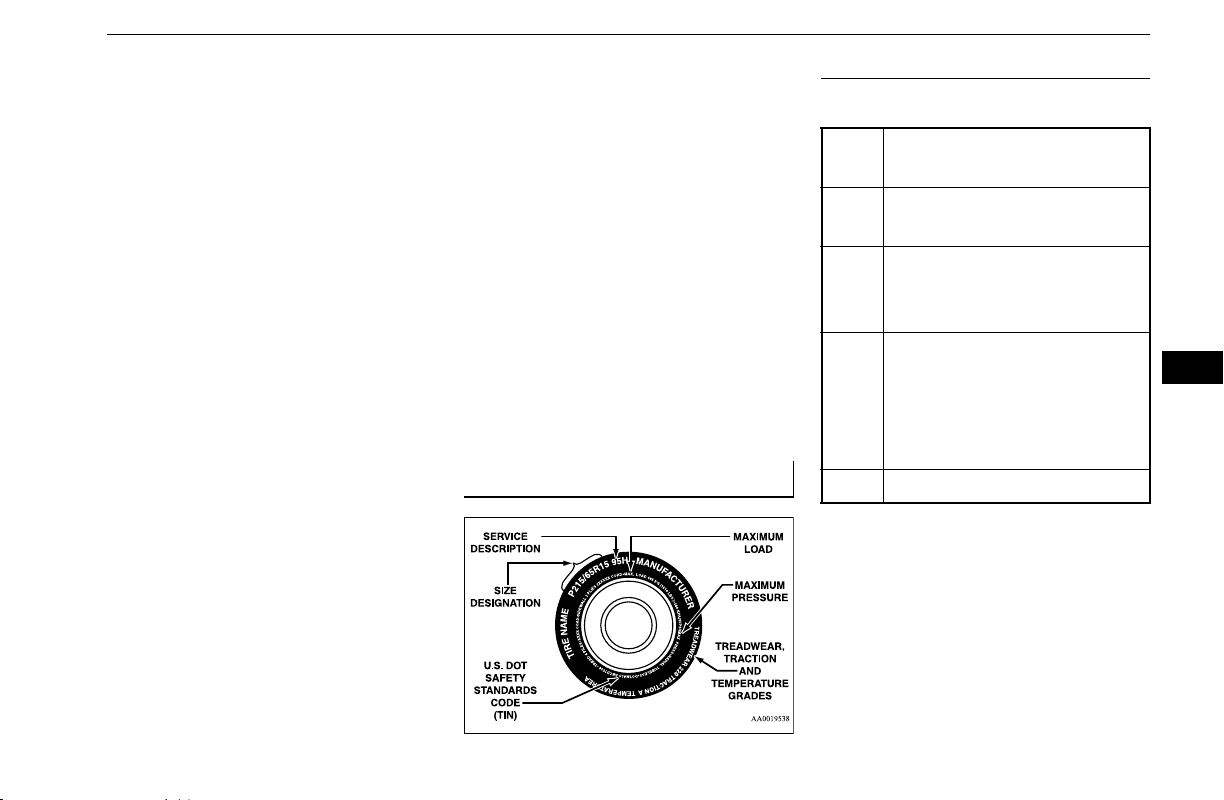
Tires
Vehicle care and maintenance 9-11
9
Intended outboard sidewall:
• The sidewall that contains a whitewall,
bears white lettering or bears manufac-
turer, brand, and/or model name molding
that is higher or deeper than the same
molding on the other sidewall of the tire,
or
• The outward facing sidewall of an asym-
metrical tire that has a particular side
that must always face outward when
mounted on a vehicle.
Passenger car tire: a tire intended for use
on passenger cars, multipurpose passen-
ger vehicles, and trucks, that have a gross
vehicle weight rating (GVWR) of 10,000
pounds or less.
Light truck (LT) tire: a tire designated by
its manufacturer as primarily intended for
use on lightweight trucks or multipurpose
passenger vehicles.
Tread: portion of a tire that comes into
contact with the road.
Tread rib: a tread section running circum-
ferentially around a tire.
Tread separation: pulling away of the
tread from the tire carcass.
Carcass: the tire structure, except tread
and sidewall rubber which, when inflated,
bears the load.
Sidewall: portion of a tire between the
tread and bead.
Section width: the linear distance between
the exteriors of the sidewalls of an
inflated tire, excluding elevations due to
labeling, decoration, or protective bands.
Bead: the part of the tire that is made of
steel wires, wrapped or reinforced by ply
cords and that is shaped to fit the rim.
Ply: a layer of rubber-coated parallel
cords.
Cord: the strands forming the plies in the
tire.
Rim: a metal support for a tire or a tire
and tube assembly upon which the tire
beads are seated.
Rim diameter: nominal diameter of the
bead seat.
Groove: the space between two adjacent
tread ribs.
EXAMPLE:P215/65R15
Tire Markings
Size Designation
P
Passenger car tire size based
on U.S.A. design standards
215
Section width in millimeters
(mm.)
65
Aspect ratio in percent (%)
Ratio of section height to
section width of tire.
R
Construction code
•“R” means radial construc-
tion.
• “D” means diagonal or
bias construction.
15 Rim diameter in inches (in)
BK0220401US.book 11 ページ 2015年6月3日 水曜日 午前7時42分
Tires
9-12 Vehicle care and maintenance
9
EXAMPLE: 95H
Maximum load indicates the maxi-
mum load this tire is designed to
carry.
Maximum Pressure indicates the
maximum permissible cold tire infla-
tion pressure for this tire.
The TIN may be found on one or
both sides of the tire but the date
NOTE
European/Japanese metric tire
sizing is based on European/Jap-
anese design standards. Tires
designed to these standards have
the tire size molded into the
sidewall beginning with the sec-
tion width. The letter “P” is
absent from this tire size desig-
nation. Example: 215/65R15
96H.
LT (Light Truck) -metric tire
sizing is based on U.S.A. design
standards. The size designation
for LT-metric tires is the same as
for P-metric tires except for the
letters “LT” that are molded into
the sidewall preceding the size
designation. Example:
LT235/85R16.
Service Description
95
Load index
A numerical code associ-
ated with the maximum load
a tire can carry.
H
Speed symbol
A symbol indicating the
range of speeds at which a
tire can carry a load corre-
sponding to its load index
under certain operating con-
ditions.
The maximum speed corre-
sponding to the speed sym-
bol should only be achieved
under specified operating
conditions. (i.e. tire pressure,
vehicle loading, road condi-
tions and posted speed lim-
its)
Maximum Load
WARNING
Overloading of your tire is
dangerous. Overloading can
cause tire failure, affect vehi-
cle handling, and increase
your stopping distance. Use
tires of the recommended load
capacity for your vehicle.
Never overload them.
Maximum Pressure
Tire Identification Number (TIN)
BK0220401US.book 12 ページ 2015年6月3日 水曜日 午前7時42分
Tires
Vehicle care and maintenance 9-13
9
code may only be on one side. Look
for the TIN on the outboard side of
tires as mounted on the vehicle. If the
TIN is not found on the outboard side
then you will find it on the inboard
side of the tire.
EXAMPLE: DOT MA L9 ABCD
1504
The treadwear grade is a comparative rating
based on the wear rate of the tire when tested
under controlled conditions on a specified
government test course. For example, a tire
graded 150 would wear one and one-half
(1
1
/
2
) times as well on the government course
as a tire graded 100. The relative performance
of tires depends upon the actual conditions of
their use, however, and may depart signifi-
cantly from the norm due to variations in
driving habits, service practices and differ-
ences in road characteristics and climate.
The traction grades, from highest to lowest,
are AA, A, B and C. Those grades represent
the tire’s ability to stop on wet pavement as
measured under controlled conditions on
specified government test surfaces of asphalt
and concrete. A tire marked C may have poor
traction performance.
The temperature grades are A (the highest), B
and C, representing the tire’s resistance to the
generation of heat and its ability to dissipate
heat when tested under controlled conditions
on a specified indoor laboratory test wheel.
Sustained high temperature can cause the
material of the tire to degenerate and reduce
tire life, and excessive temperature can lead
to sudden tire failure. The grade C corre-
sponds to a level of performance which all
passenger car tires must meet under the Fed-
eral Motor Vehicle Safety Standard No. 109.
Grades B and A represent higher levels of
performance on the laboratory test wheel than
the minimum required by law.
N00939300873
Proper tire inflation pressure is essential for
the safe and satisfactory operation of your
vehicle. The wrong tire pressure will cause
problems in three major areas:
Safety
DOT
Department of Transporta-
tion
This symbol certifies that
the tire is in compliance
with the U.S.
Department
of Transportation tire safety
standards, and is approved
for highway use.
MA
Code representing the tire
manufacturing location. (2
digits)
L9
ABCD
Code representing the tire
size. (2 digits)
Code used by tire manufac-
turer. (1 to 4 digits)
15
Number representing the
week in which the tire was
manufactured. (2 digits)
04
Number representing the
year in which the tire was
manufactured. (2 digits)
Treadwear, Traction and Temper-
ature Grades
Treadwear
Traction
Temperature
Tire inflation pressures
BK0220401US.book 13 ページ 2015年6月3日 水曜日 午前7時42分
Tires
9-14 Vehicle care and maintenance
9
Too little pressure increases flexing in the
tire and can cause tire failure. Too much
pressure can cause a tire to lose its ability
to cushion shock. Objects on the road and
potholes could then cause tire damage that
may result in tire failure.
Economy
The wrong tire pressure can cause uneven
wear patterns in the tire tread. These
abnormal wear patterns will reduce the
tread life, and the tire will have to be
replaced sooner.
Too little pressure also makes it harder for
the tire to roll, and this uses up more
power.
Ride comfort and vehicle stability
The superior riding experience built into
your vehicle partly depends on the correct
tire pressure. Too much pressure gives an
uncomfortable and jarring ride. Too little
pressure feels as if your vehicle is slow to
respond.
Unequal tire pressures can make steering
your vehicle uneven and unpredictable.
The correct tire pressure for your vehicle is
listed on the placard attached to the sill of the
driver’s door.
(Refer to “Tire and loading information plac-
ard” on page 11-3.)
The recommended inflation pressures should
be used for the tires listed below.
Tire pressures should be checked, and
adjusted if necessary, at least once a month.
Pressures should be checked more often
whenever weather temperatures change
severely, because tire pressures change with
outdoor temperatures. The pressures listed on
the placard are always “cold inflation pres-
sure”.
Cold inflation pressure is measured after the
vehicle has been parked for at least three
hours or is driven less than 1 mile (1.6 km)
after having been parked for three hours.
Cold inflation pressure must not go above the
maximum values molded into the tire side-
wall. After driving several miles, your tire
inflation pressure may increase 14 to 41 KPA,
2 to 6 PSI from the cold inflation pressure.
Do not let air out of the tires to get back to the
specified cold pressure, or your tire pressure
will be too low.
You should also take the following safety pre-
cautions:
Keep your tires inflated to the recom-
mended pressures. (See the tire and load-
ing information placard attached to the sill
of the driver’s door.)
Stay within the recommended load limits.
Make sure that the weight of any load in
your vehicle is evenly distributed.
Drive at safe speeds.
After filling your tires to the correct pres-
sure, check them for damage and air
leaks. Be sure to reinstall the caps on the
valve stems.
N00939600427
Tire size Front Rear
145/65R15
72H
250 KPA,
36 PSI
—
175/60R15
81H
—
250 KPA,
36 PSI
Replacing tires and wheels
CAUTION
Avoid using different size tires and wheels
from the ones listed, and avoid the combined
use of different types of tires and wheels.
Using different size or type tires and wheels
may affect driving safety.
Refer to “Tires and wheels” on page 11-6.
Even if a wheel has the same rim size and
offset as the specified type of wheel, its
shape may prevent it from being fitted cor-
rectly. Consult a certified
i-MiEV dealer before using wheels that you
have.
BK0220401US.book 14 ページ 2015年6月3日 水曜日 午前7時42分
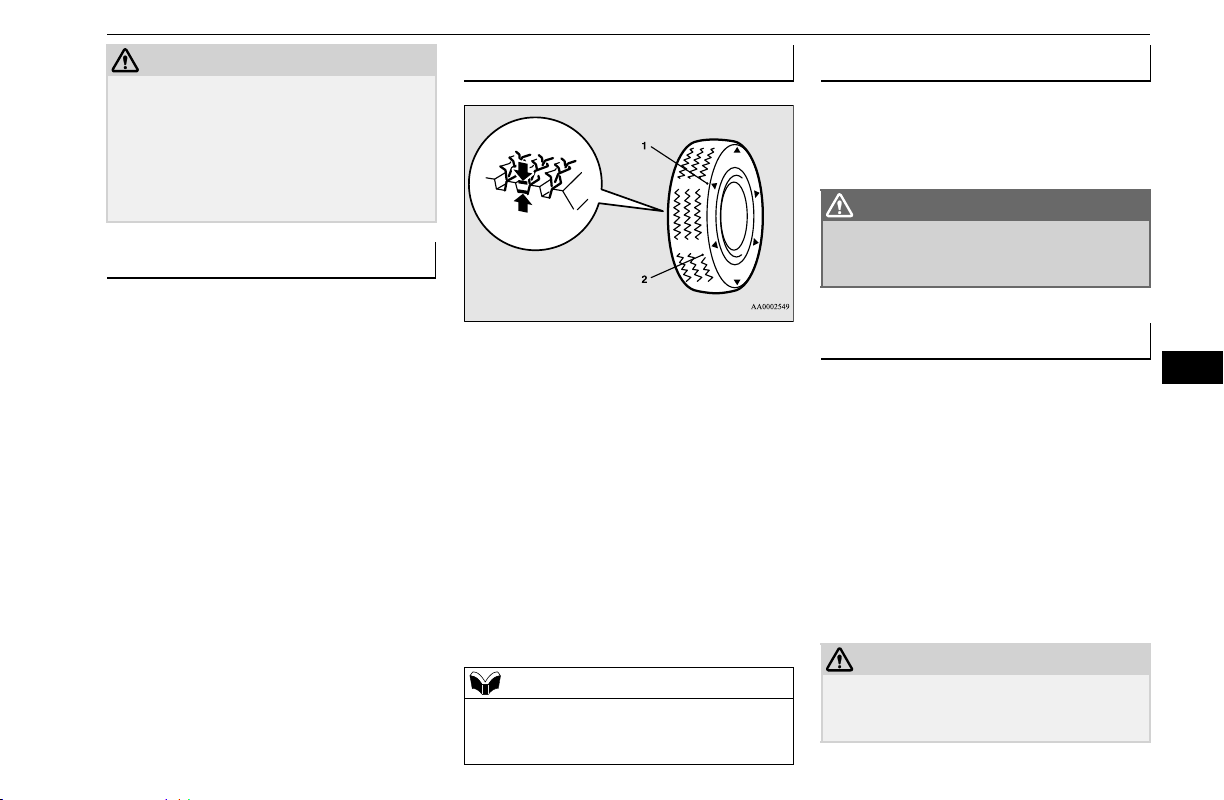
Tires
Vehicle care and maintenance 9-15
9
N00939700170
The following maintenance steps are recom-
mended:
Check tire pressures regularly.
Have regular maintenance done on the
wheel balance and front and rear suspen-
sion alignment.
N00939800214
Tread wear indicators are built into the origi-
nal equipment tires on your vehicle to help
you know when your tires should be replaced.
Many states have laws requiring that you
replace your tires at this point.
These indicators are molded into the bottom
of the tread grooves and will appear when the
tire tread is worn down to 1/16 inch
(1.6 mm).
When the bands appear next to one another in
two or more places, replace your tires.
N00939900518
Because the front and rear tires and wheels
are not the same size, do not rotate the front
and rear tires.
N00940000359
In some areas of the country, snow tires are
required for winter driving. If snow tires are
required in your area, you must choose snow
tires of the same size and type as the original
tires provided with your vehicle. Snow tires
should also be installed on all four wheels.
Otherwise your safety and vehicle handling
can be reduced.
Even where laws may permit it, snow tires
should not be operated at sustained speeds
over 75 mph (120 km/h).
Only Mitsubishi Motors genuine wheels
should be used, because your vehicle is
equipped with a tire pressure monitoring sys-
tem.
Use of another type of wheel risks air leaks
and sensor damage, as it will not be possible
to install the tire pressure sensor properly.
Tire maintenance
CAUTION
Tread wear indicators
1- Location of the tread wear indicator
2- Tread wear indicator
NOTE
Tire wear indicators can have different marks
and locations depending on the tire manufac-
turer.
Tire rotation
WARNING
Rotating tires would compromise the sta-
bility and drivability of the vehicle and
could lead to a serious accident.
Snow tires
CAUTION
If flange nuts are used on your vehicle,
change to tapered nuts when using snow tires
with steel wheels.
BK0220401US.book 15 ページ 2015年6月3日 水曜日 午前7時42分
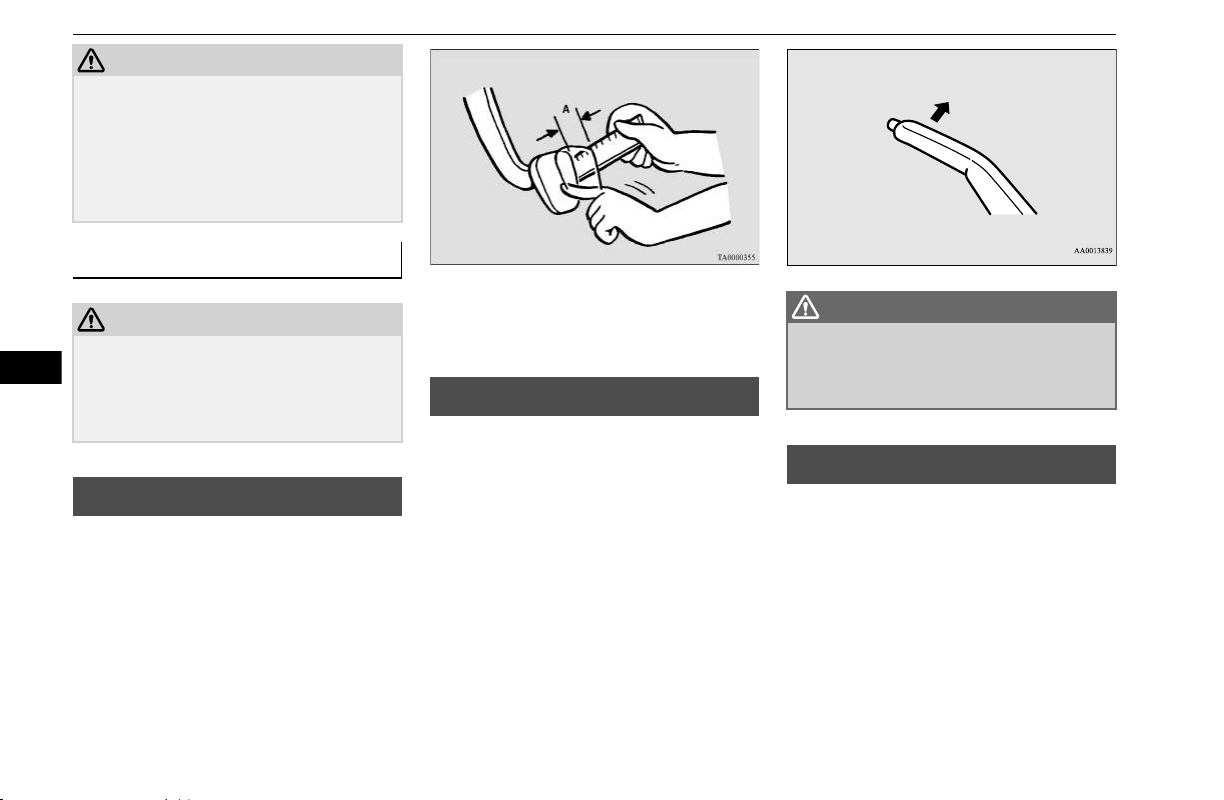
Brake pedal free play
9-16 Vehicle care and maintenance
9
N00940100129
N00940300310
To check the brake pedal free play (A), turn
off the electric motor unit and press the brake
pedal several times with your foot. Then
press the pedal down with your fingers until
you first feel resistance.
Brake pedal free play:
.1 to .3 inch (3 to 8 mm)
If the free play is not within these limits, take
your vehicle to a certified i-MiEV dealer for
adjustment.
N00940400236
Check the parking brake lever travel occa-
sionally. To check this, pull the lever up
slowly and count the number of clicks of the
ratchet.
Parking brake lever stroke:
6 to 7 notches
Also check to see if the lever stays gripped by
the ratchet after pulling.
N00940701210
Check the wiper blades occasionally. Clean
them regularly to remove deposits of salt and
road film. Use a sponge or cloth and a mild
detergent or non-abrasive cleaner to clean the
blades and glass areas.
Replace the blades if they continue to streak
or smear.
Only Mitsubishi Motors genuine wheels
should be used, because your vehicle is
equipped with a tire pressure monitoring sys-
tem.
Use of another type of wheel risks air leaks
and sensor damage, as it will not be possible
to install the tire pressure sensor properly.
Tire chains
CAUTION
Tire chains cannot be used on your vehicle.
The clearance between the chains and the
body is not sufficient to allow proper clear-
ance, and the vehicle body might be dam-
aged.
Brake pedal free play
CAUTION
Parking brake lever stroke
WARNING
Continued operation of the vehicle with
the parking brake lever out of adjustment
may result in the vehicle moving when
unattended.
Wiper blades
BK0220401US.book 16 ページ 2015年6月3日 水曜日 午前7時42分
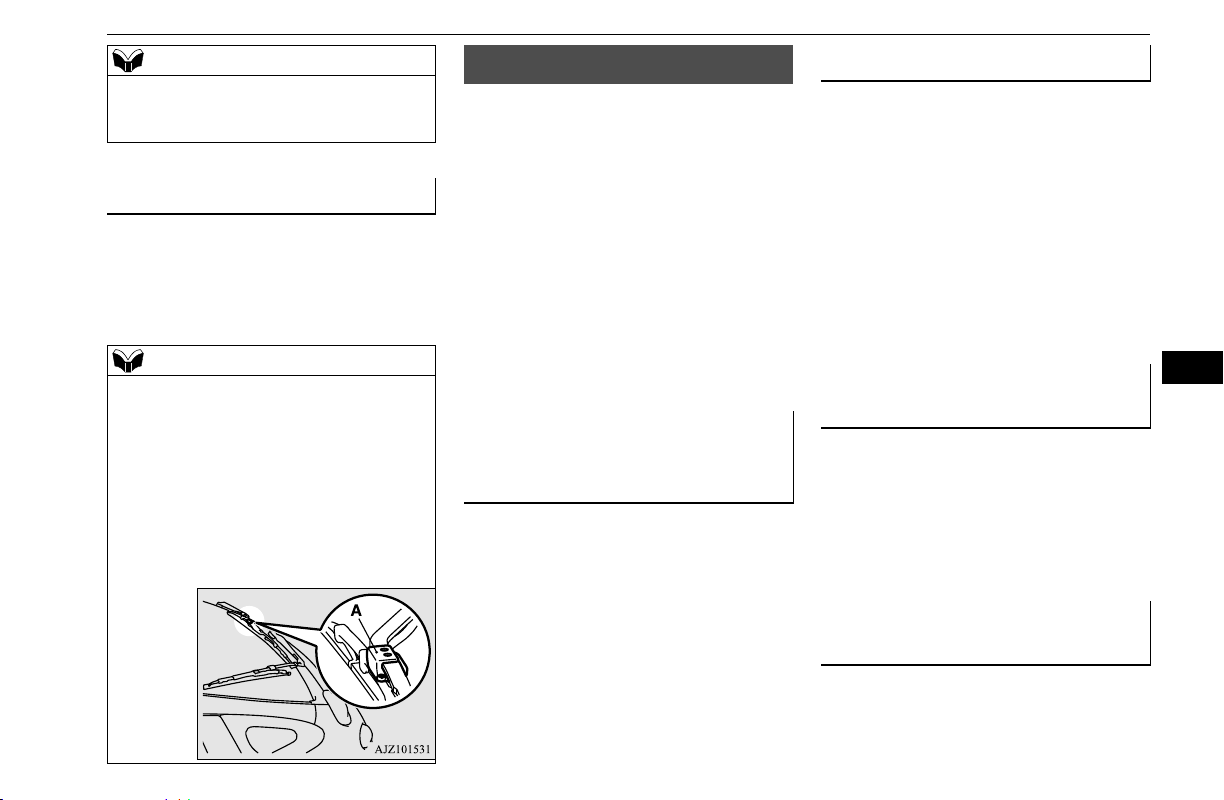
General maintenance
Vehicle care and maintenance 9-17
9
If the blades are frozen to the windshield or
rear window, do not operate the wipers until
the ice has melted and the blades are freed,
otherwise the wiper motor may be damaged.
N00941500289
The next pages list the maintenance service
recommended by Mitsubishi Motors Corpo-
ration. In addition to the general maintenance
that needs to be performed at the times listed,
there are other parts which do not usually
need regular maintenance.
But, if any of these parts stops working prop-
erly, your vehicle performance could suffer.
Have these items checked if you notice a
problem with them.
See a certified i-MiEV dealer for assistance,
if you have any questions.
N00941600033
Good brakes are essential to safe driving.
Check the brake pads and brake linings for
wear and check the rear wheel cylinders for
leaks. For good braking performance, replace
the brake pads with the same type pads as the
originals.
N00941700047
Brake hoses and tubing should be checked
for:
Severe surface cracking, scuffing or worn
spots. If the fabric casing of the hose is
showing through any cracks or worn spots
in the rubber hose cover, the hose should
be replaced. The brakes can fail if the
hose wears through.
Improper installation may cause twisting,
or wheel, tire or chassis interference.
N00941800077
Check the following parts for damage and
grease leaks:
Ball joint boots of the front suspension
and steering linkage
Bellows on both ends of the drive shaft
N00942500114
The hood lock release mechanism and hood
safety catch should be checked, cleaned, and
oiled when needed for easy movement and to
NOTE
Do not run the wipers on dry glass for a long
time. This wears out the rubber and can
scratch the glass.
During cold weather
NOTE
When replacing front wiper blade assembly
with a wiper blade for use in cold regions, it
is necessary to adjust the washer nozzle (A)
spray positions. Always contact a certified i-
MiEV dealer when replacing front wiper
blade with a wiper blade for use in cold
regions.
When removing snow and frost, be careful
not to damage the washer nozzle which are
attached to the wiper arm.
General maintenance
Disc brake pads, rear drum
brake linings and rear wheel
cylinders
Brake hoses
Ball joint, steering linkage seals
and drive shaft boots
Hood lock release mechanism
and safety catch
BK0220401US.book 17 ページ 2015年6月3日 水曜日 午前7時42分
For cold and snowy weather
9-18 Vehicle care and maintenance
9
stop rust and wear. Use Multipurpose Grease
NLGI Grade 2 sparingly for all sliding parts
of the hood latch and release lever. Work the
grease into the hood lock mechanism until all
the movable surfaces are covered.
Also, put a light coat of the same grease on
the safety catch wherever moving parts touch.
N00942600131
The ventilation slots in front of the wind-
shield should be brushed clear after a heavy
snowfall so that the operation of the heating
and ventilation systems will not be impaired.
To prevent freezing of the weatherstripping
on the doors, hood, etc., they should be
treated with silicone grease.
It is a good idea to carry a shovel or a short-
handled spade in the vehicle during the win-
ter so that you can clear away snow if you get
stranded. A small hand-brush for sweeping
snow off the vehicle and a plastic scraper for
the windshield, side and rear window are also
useful.
N00942700321
The fusible links will melt to prevent a fire if
a large current attempts to flow through cer-
tain electrical systems.
In case of a melted fusible link, see a certified
i-MiEV dealer for inspection and replace-
ment.
For the fusible links, please refer to “Fuse
load capacities” on page 9-19.
N00942800885
N00901000107
To prevent damage to the electrical system
from short-circuiting or overloading, each
individual circuit is equipped with a fuse.
The fuse blocks are located in the passenger
compartment and in under the hood.
The fuse block in the passenger compartment
is located in front of the driver’s seat at the
position shown in the illustration.
Press the tab (A) and remove the fuse cover
(B).
For cold and snowy weather
Ventilation slots
Weatherstripping
Additional equipment (For
regions where snow is encoun-
tered)
Fusible links
WARNING
Fusible links must not be replaced by any
other device. Failing to fit the correct fus-
ible link may result in fire in the vehicle,
property destruction and serious or fatal
injuries at any time.
Fuses
Fuse block location
NOTE
Spare fuses are not provided. Please pur-
chase from a certified i-MiEV dealer.
Passenger compartment
BK0220401US.book 18 ページ 2015年6月3日 水曜日 午前7時42分
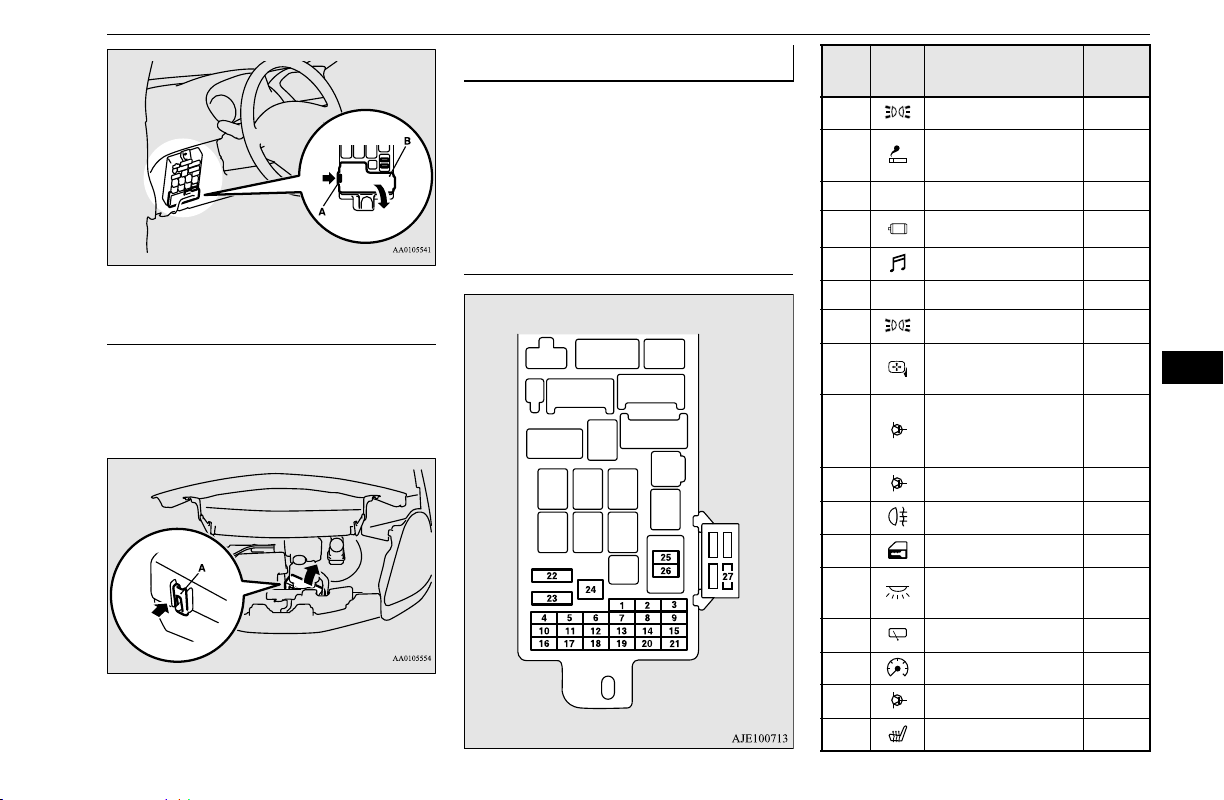
Fuses
Vehicle care and maintenance 9-19
9
Under the hood, the fuse block is located as
shown in the illustration.
Press the tab (A) and remove the cover.
N00954801313
This fuse list shows the names of the electri-
cal systems and their fuse capacities.
Always replace a blown fuse with one of the
same capacity as the original.
Under the hood
Fuse load capacities
Passenger compartment fuse loca-
tion table
No.
Sym-
bol
Electrical system
Capac-
ity
1 Tail light (left) 7.5 A
2
Cigarette lighter/
12 V power outlet
15 A
3 — — —
4 Starter 7.5 A
5 Audio amplifier 20 A
6— — —
7 Tail light (right) 7.5 A
8
Outside rearview
mirrors
7.5 A
9
Control unit
(Electric motor
unit)
7.5 A
10 Control unit 7.5 A
11 Rear fog light 10 A
12 Door lock 15 A
13
Interior lights
(Dome lights)
10 A
14 Rear window wiper 15 A
15 Gauges 7.5 A
16 Relay 7.5 A
17 Heated seat 20 A
BK0220401US.book 19 ページ 2015年6月3日 水曜日 午前7時42分
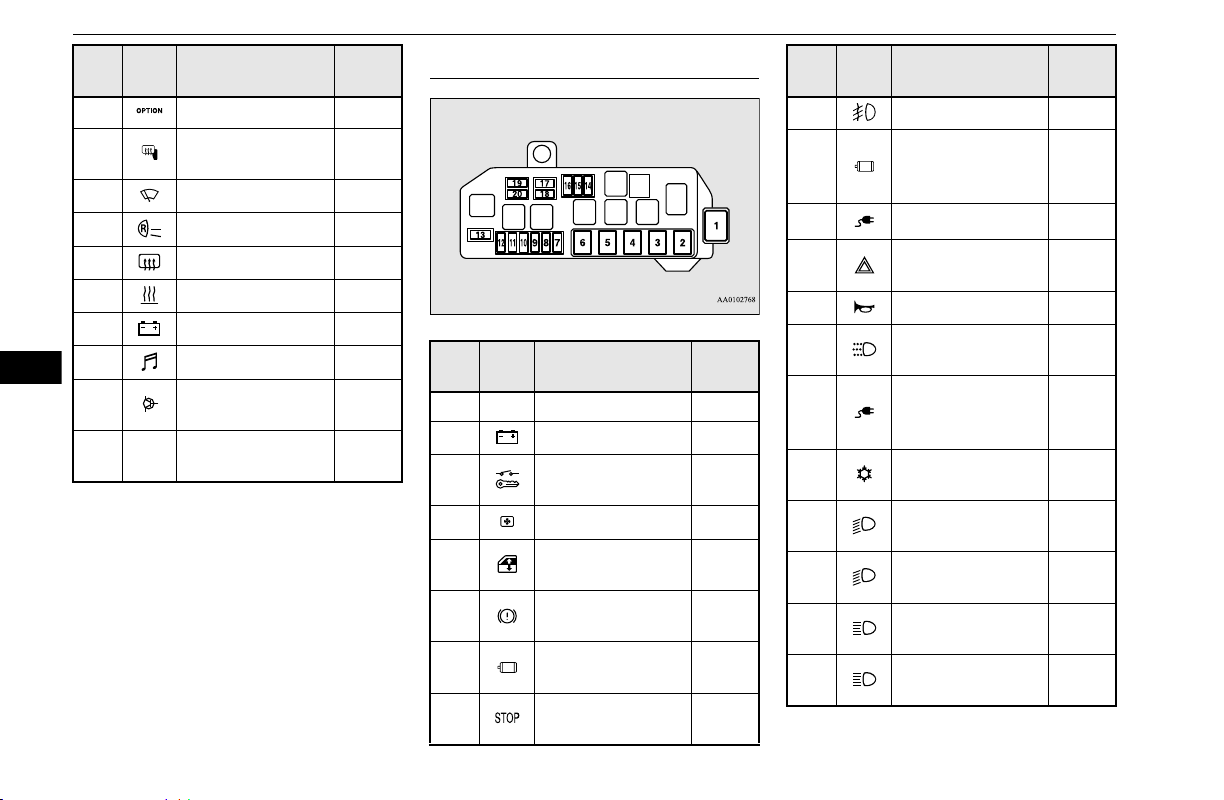
Fuses
9-20 Vehicle care and maintenance
9
*: Fusible link
Some fuses may not be installed on your
vehicle, depending on the vehicle model
or specifications.
The table above shows the main equip-
ment corresponding to each fuse.
*: Fusible link
18 Option 10 A
19
Heated outside rear-
view mirrors
7.5 A
20 Windshield wiper 20 A
21 Back-up lights 7.5 A
22 Defogger 30 A
23 Heater 30 A
24 12V starter battery 30 A*
25 Radio 10 A
26
Electronic con-
trolled unit
15 A
27 —
Electronic con-
trolled unit
7.5 A
No.
Sym-
bol
Electrical system
Capac-
ity
Under the hood fuse location table
No.
Sym-
bol
Electrical system
Capac-
ity
1— — —
2 12V starter battery 30 A*
3
Electric motor
switch
40 A*
4 Radiator fan motor 40 A*
5
Power window con-
trol
40 A*
6
Brake electric vac-
uum pump
30 A*
7
Electric motor unit
control
15 A
8
Stop lights (Brake
lights)
15 A
9 Front fog lights 15 A
10
Water pump
(Electric motor
unit)
15 A
11 Charge 10 A
12
Hazard warning
flasher
10 A
13 Horn 10 A
14
Daytime running
lights
10 A
15
Main drive lithium-
ion battery fan
motor
15 A
16
Water pump
(Air conditioning)
10 A
17
Headlight (low
beam) (right)
20 A
18
Headlight (low
beam) (left)
20 A
19
Headlight (high
beam) (right)
10 A
20
Headlight (high
beam) (left)
10 A
No.
Sym-
bol
Electrical system
Capac-
ity
BK0220401US.book 20 ページ 2015年6月3日 水曜日 午前7時42分
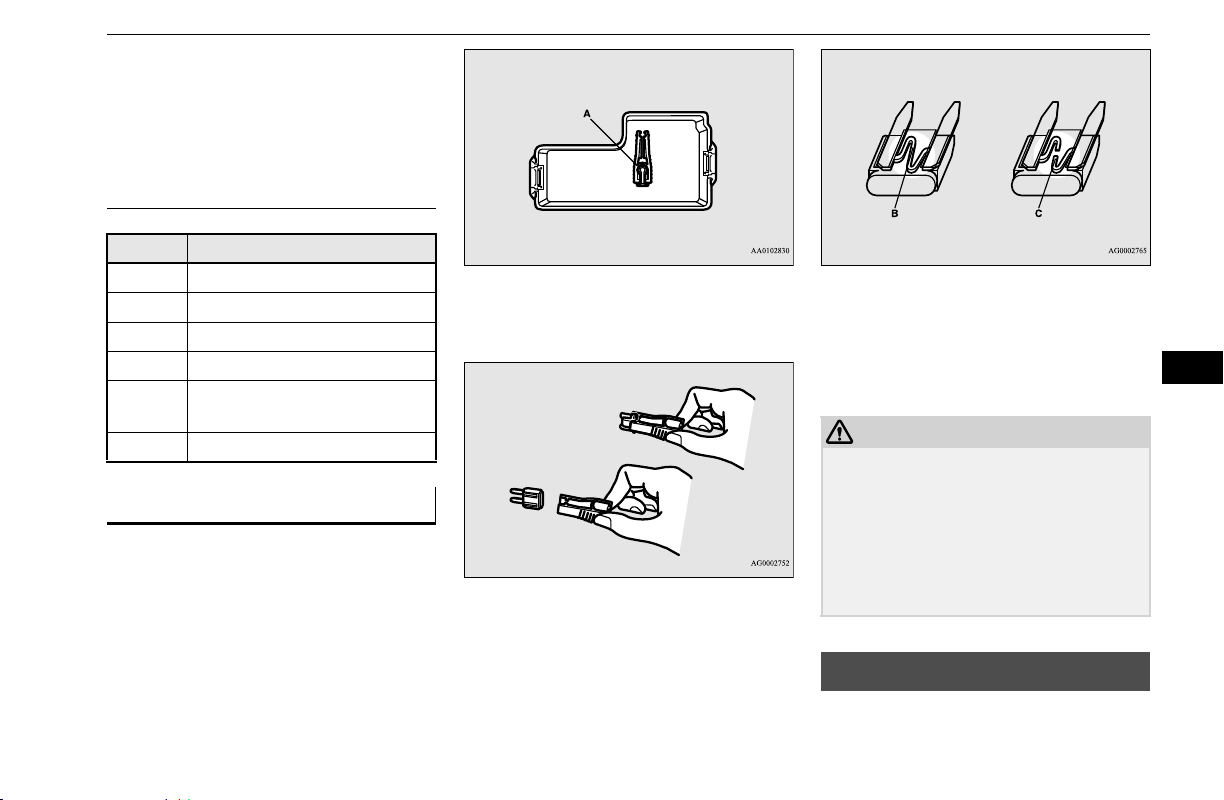
Replacement of light bulbs
Vehicle care and maintenance 9-21
9
Some fuses may not be installed on your
vehicle, depending on the vehicle model
or specifications.
The table above shows the main equip-
ment corresponding to each fuse.
N00901100078
N00954900115
1. Before replacing a fuse, always turn off
the electrical item connected to the fuse
and turn the electric motor switch to the
“LOCK” position.
2. Remove the fuse puller (A) from the
inside of the fuse cover in the passenger
compartment.
3. Clamp it on the fuse you wish to remove,
and pull the fuse straight out from the fuse
block.
4. Use the fuse location diagrams and their
corresponding tables, to check the fuse
that is related to the problem. If the fuse is
not blown, something else must be caus-
ing the problem.
Contact a certified i-MiEV dealer to have
the problem checked.
5. Insert a new fuse of the same capacity
securely into the appropriate slot.
N00942900336
Before replacing a bulb, be sure the light is
off. Do not touch the glass part of the new
Identification of fuse
Capacity Color
7.5 A Brown
10 A Red
15 A Blue
20 A Yellow
30 A
Green (fuse type) /Pink (fusible
link type)
40 A Green (fusible link type)
Fuse replacement
B- Fuse is OK
C- Blown fuse
CAUTION
Never use a fuse with a capacity greater than
the one listed or any substitute, such as wire,
foil etc. This would cause the circuit wiring
to heat up and could cause a fire.
If the replacement fuse blows again after a
short time, have the electrical system
checked by a certified i-MiEV dealer to find
and correct the cause.
Replacement of light bulbs
BK0220401US.book 21 ページ 2015年6月3日 水曜日 午前7時42分
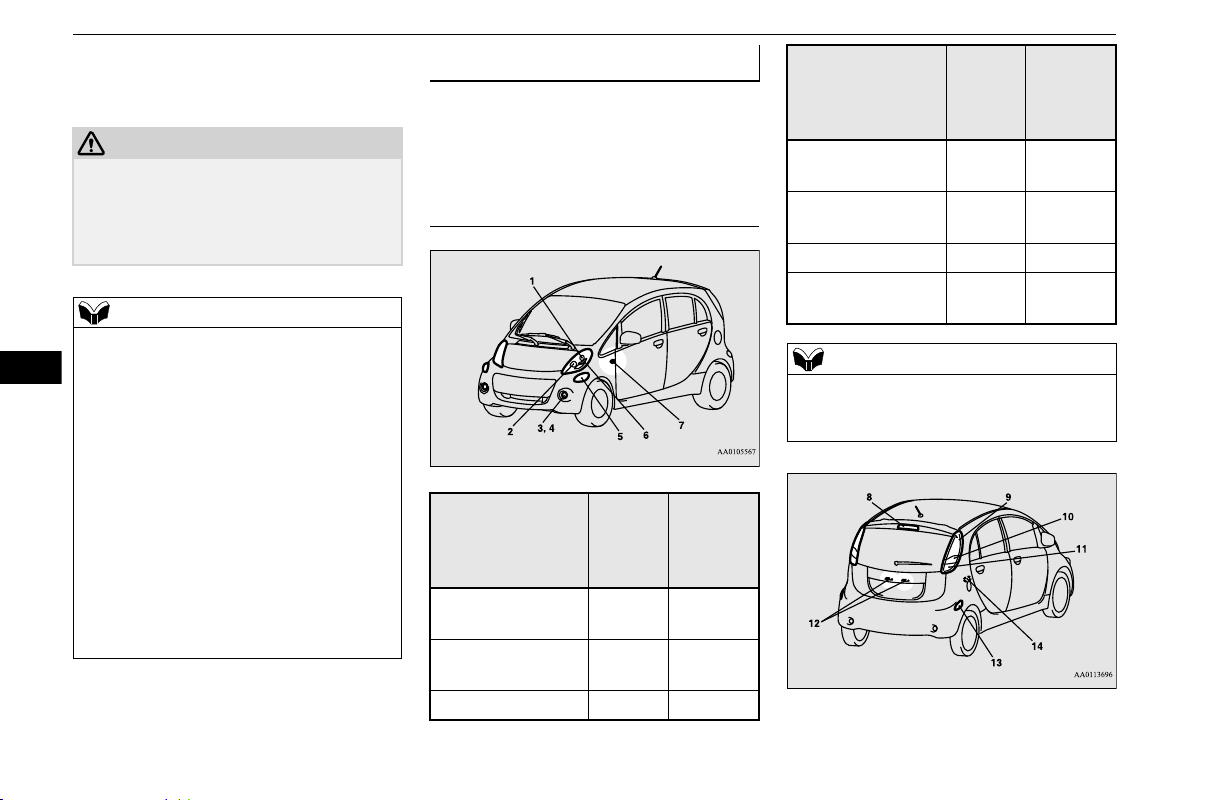
Replacement of light bulbs
9-22 Vehicle care and maintenance
9
bulb with your bare fingers; the oil from your
skin will stay on the glass and dim or destroy
the bulb when it gets hot.
N00943000099
The bulb should only be replaced with a new
bulb with the same rating and type. The type
and rating are listed on the base of the bulb.
N00950301916
CAUTION
Bulbs are extremely hot immediately after
being turned off.
When replacing a bulb, wait for it to cool
sufficiently before touching it. You could
otherwise be burned.
NOTE
If you are unsure of how to carry out the
work as required, it is recommended that
these procedures be carried out by a certified
i-MiEV dealer.
Be careful not to scratch the vehicle body
when removing a light and lens.
When it rains, or when the vehicle has been
washed, the inside of the lens sometimes
becomes temporarily foggy. This is the same
phenomenon as when window glass mists up
on a humid day, and does not indicate a func-
tional problem.
When the light is switched on, the heat will
remove the fog. However, if water collects
inside the light, please have it checked by a
certified i-MiEV dealer.
Bulb capacity
Outside
Description Wattage
ANSI
Trade No.
or Bulb
type
1- Headlight, low
beam
55 W H11
2- Head light,
high beam
60 W 9005 HB3
3- Front fog light 35 W H8
Front
4- Daytime run-
ning light
13 W P13W
5- Front turn sig-
nal light
21 W W21W
6- Parking light 5 W W5W
7- Front side-
marker light
5 W W5W
NOTE
Check with a certified i-MiEV dealer when
the headlight and the parking light need to be
repaired or replaced.
Description Wattage
ANSI
Trade No.
or Bulb
type
Rear
BK0220401US.book 22 ページ 2015年6月3日 水曜日 午前7時42分
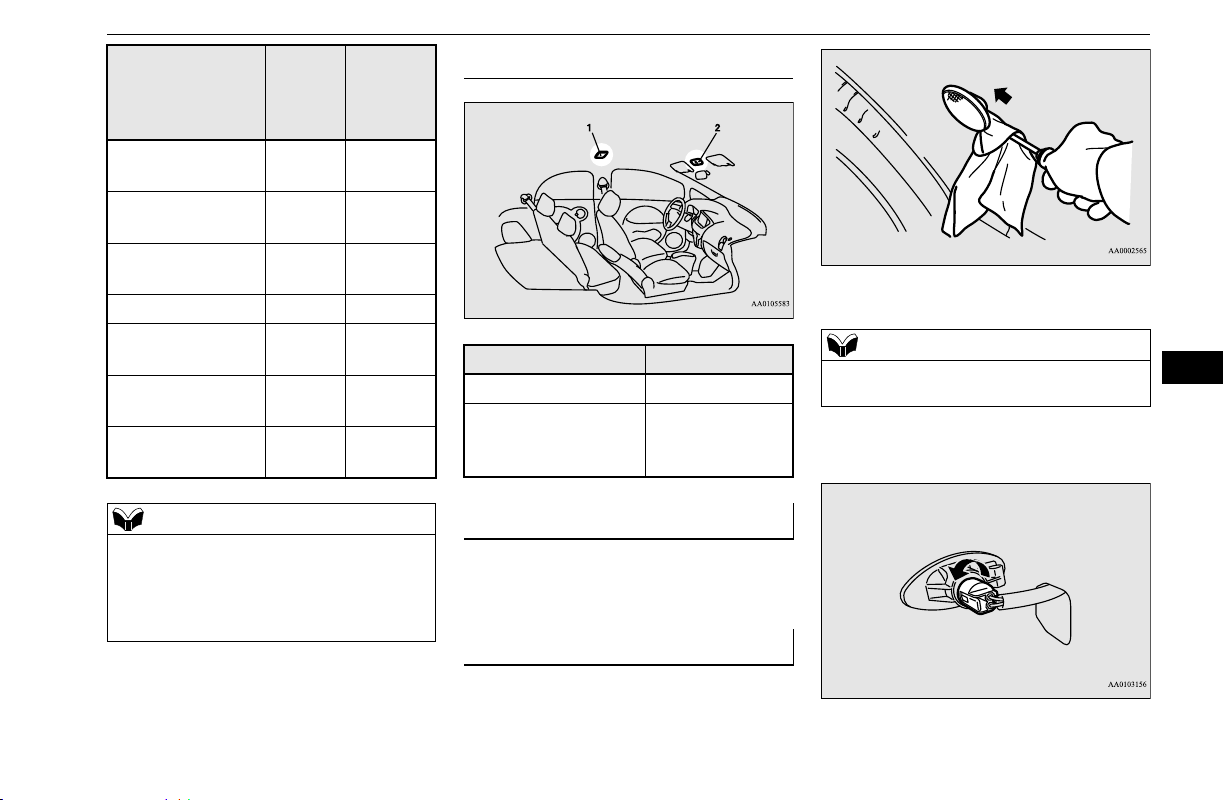
Replacement of light bulbs
Vehicle care and maintenance 9-23
9
N00950400617
N00943200349
The alignment of the headlights should be
checked by a certified i-MiEV dealer.
N00915501184
1. Insert a flat blade screwdriver into the end
of the light nearer the rear of the body and
pry gently to remove the light.
2. Remove the socket and bulb assembly
together by turning it counterclockwise.
3. Pull the bulb out of the socket.
Description Wattage
ANSI
Trade No.
or Bulb
type
8- High-mounted
stop light
5 W W5W
9- Tail and stop
light
——
10- Rear turn sig-
nal light
21 W WY21W
11- Back-up light 21 W W21W
12- License plate
light
5 W W5W
13- Rear side-
marker light
5 W W5W
14- Regular charge
port light
——
NOTE
The tail and stop lights along with the regu-
lar charge port light use LEDs rather than
bulbs.
For repair and replacement, contact a certi-
fied i-MiEV dealer.
Inside
Description Wattage
1- Dome light (Rear) 8 W
2- Dome light
(Front)/Reading
lights
8 W
Adjustment of headlight aim
Front side-marker lights
*: Front of the vehicle
NOTE
Wrap a cloth around the tip of the screw-
driver to keep from scratching the lens.
*
BK0220401US.book 23 ページ 2015年6月3日 水曜日 午前7時42分
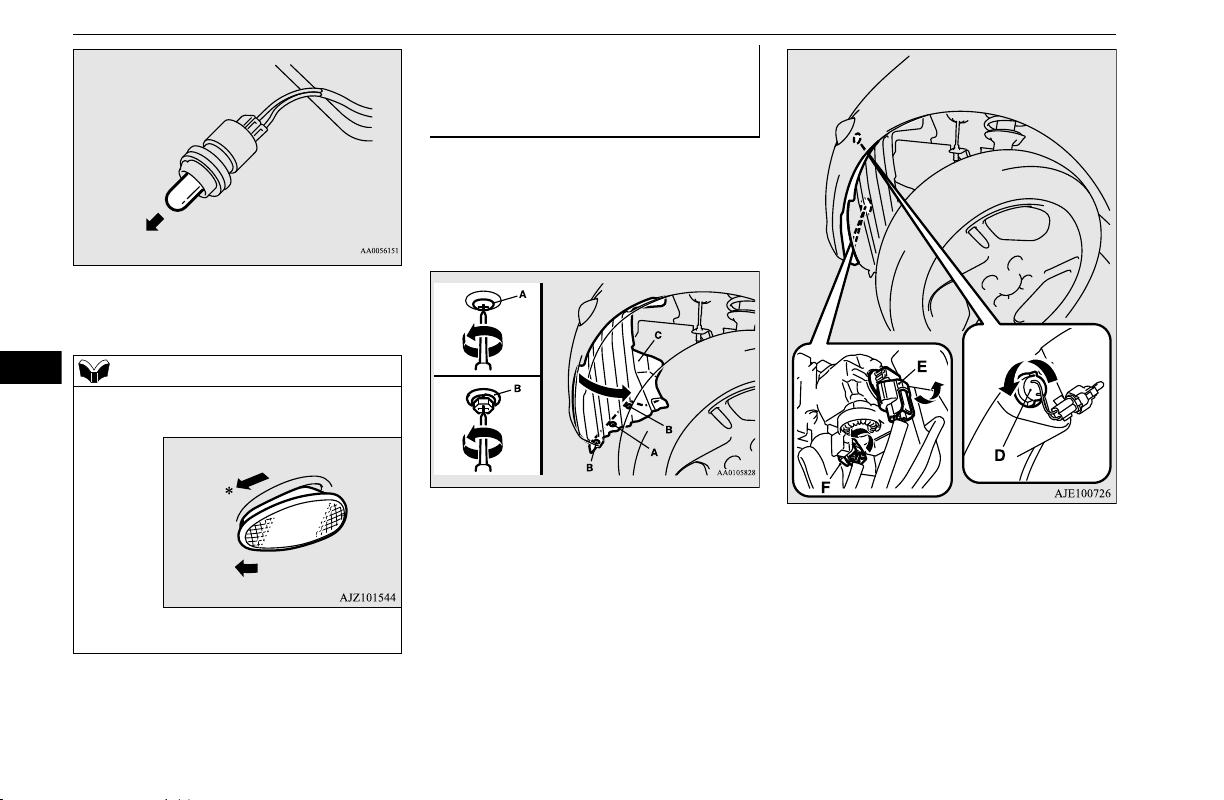
Replacement of light bulbs
9-24 Vehicle care and maintenance
9
4. To install the bulb, perform the removal
steps in reverse.
N00943401407
1. To create enough work space, turn the
steering wheel all the way in the same
direction to the side you wish to replace.
2. Remove the clip (A) and bolts (B), then
lift the cover (C).
3. Turn the socket counterclockwise to
remove it.
4. Remove the bulb as follows.
[Front turn signal light]
Pull the bulb out of the socket.
[Front fog light and daytime running
light]
While holding down the tab (G), pull out
the bulb assembly (H).
NOTE
When installing the light assembly, push in
the end facing the front of the vehicle first.
*: Front of the vehicle
Front turn signal lights/Front
fog lights/Daytime running
lights
D- Front turn signal light
E- Front fog light
F- Daytime running light
BK0220401US.book 24 ページ 2015年6月3日 水曜日 午前7時42分
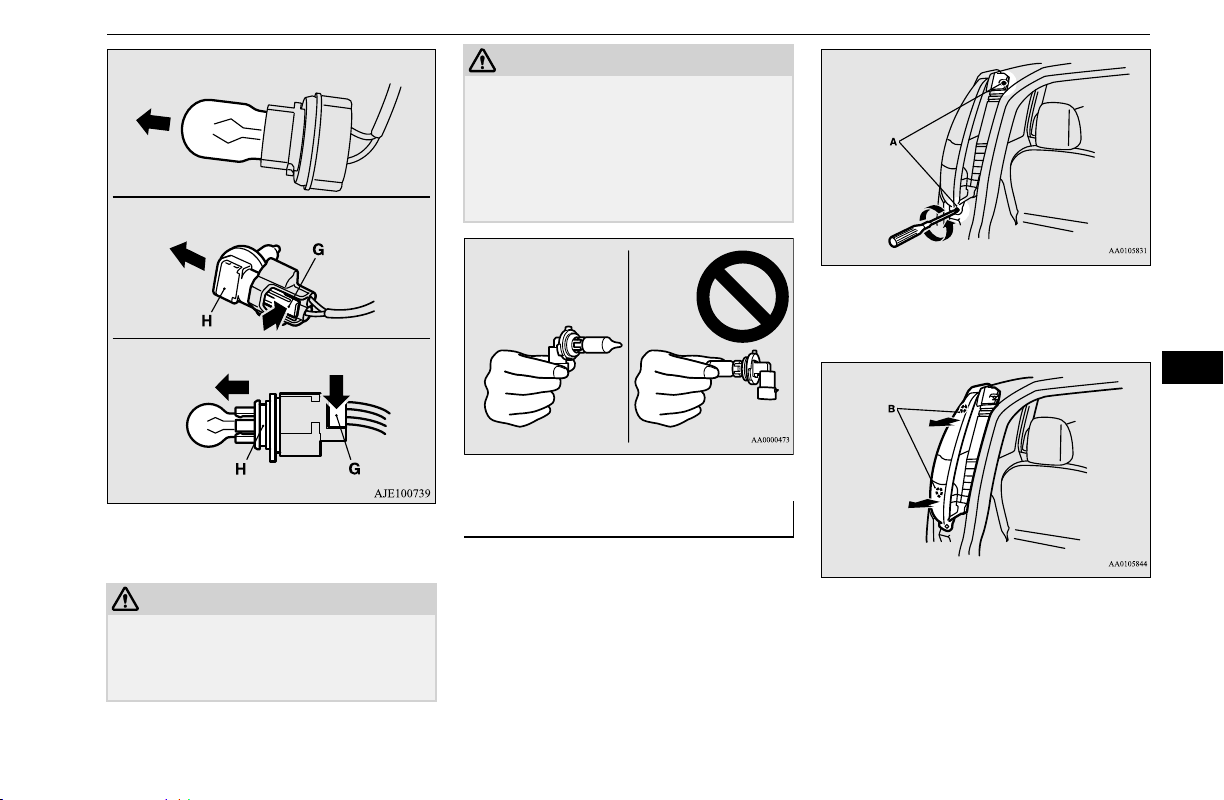
Replacement of light bulbs
Vehicle care and maintenance 9-25
9
5. To install the bulb, perform the removal
steps in reverse.
N00943700487
1. Open the liftgate.
(Refer to “Liftgate” on page 5-11.)
2. Remove the screws (A) that hold the light
unit and remove the light unit.
3. Move the light unit toward the rear of the
vehicle and remove the pins (B) of the
light unit from the vehicle.
4. Turn the socket counterclockwise to
remove it.
CAUTION
Handle halogen light bulb with care. The gas
inside a halogen light bulb is highly pressur-
ized, so dropping, knocking, or scratching a
halogen light bulb can cause it to shatter.
Front turn signal light
Front fog light
Daytime running light
Never hold the halogen light bulb with a bare
hand, dirty glove, etc.
The oil from your hand could cause the bulb
to break the next time the fog lights are used.
If the glass surface is dirty, clean it with
alcohol and let it dry completely before
installing the bulb.
Rear combination lights
CAUTION
BK0220401US.book 25 ページ 2015年6月3日 水曜日 午前7時42分
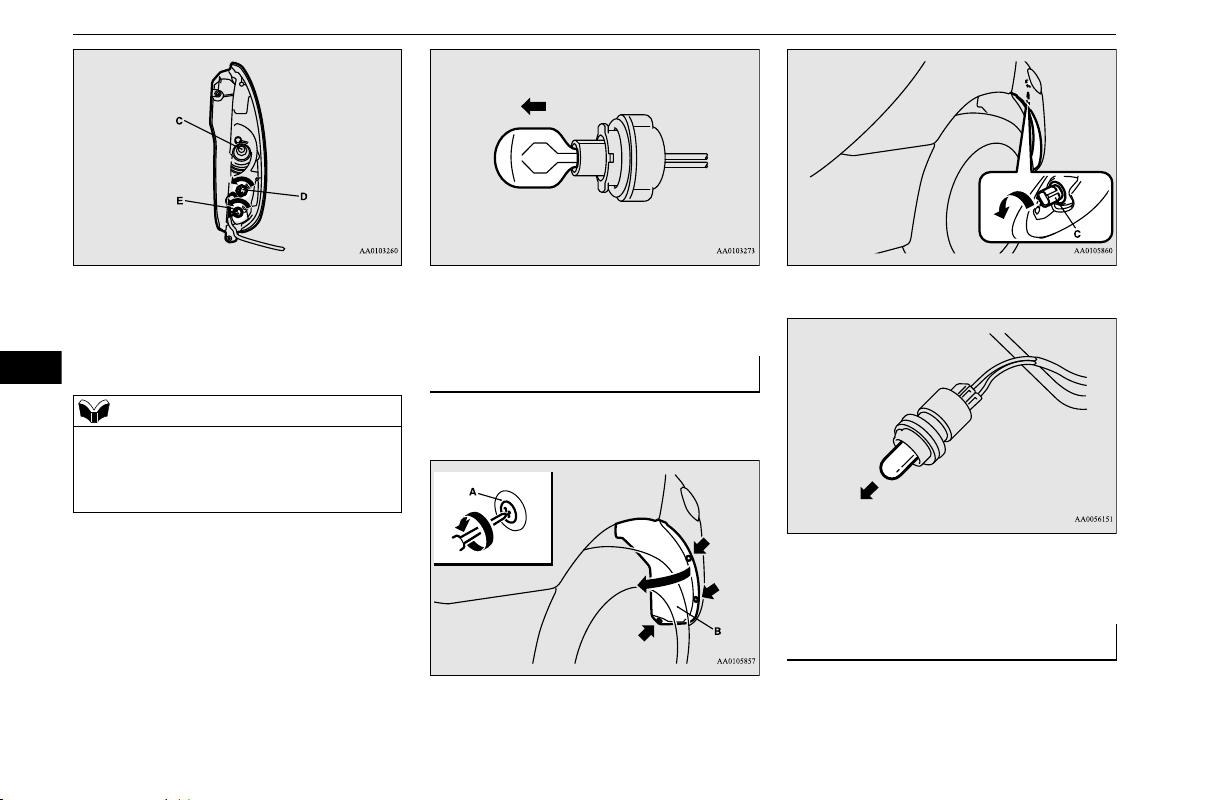
Replacement of light bulbs
9-26 Vehicle care and maintenance
9
5. Pull the bulb out of the socket.
6. To install the bulb, perform the removal
steps in reverse.
N00935400108
1. Remove the clips (A), then lift the cover
(B).
2. Turn the socket (C) counterclockwise to
remove it.
3. Pull the bulb out of the socket.
4. To install the bulb, perform the removal
steps in reverse.
N00943900128
1. Remove the mounting screws (A) and
remove the light unit.
C- Tail and stop light (LED) - cannot be
replaced
D- Rear turn signal light
E- Back up light
NOTE
The tail and stop lights use LEDs rather than
bulbs.
For repair and replacement, contact a certi-
fied i-MiEV dealer.
Rear side-marker lights
High-mounted stop light
BK0220401US.book 26 ページ 2015年6月3日 水曜日 午前7時42分
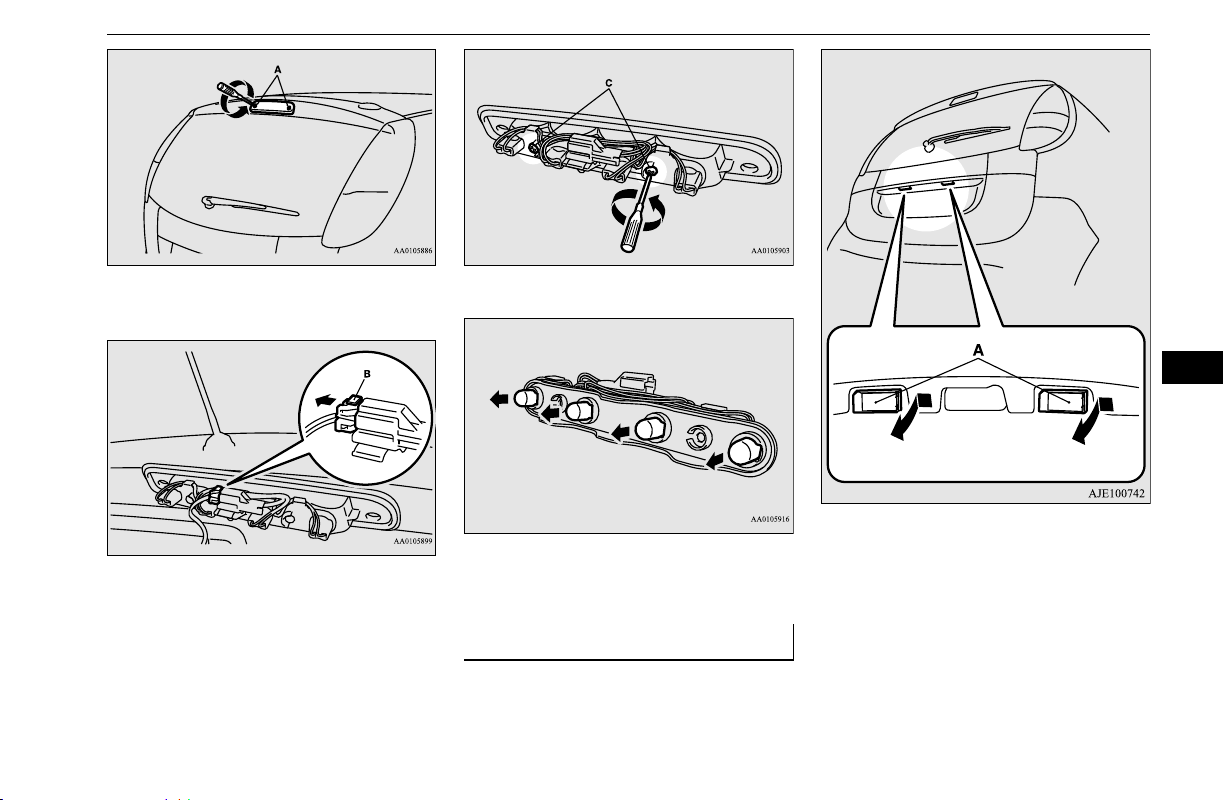
Replacement of light bulbs
Vehicle care and maintenance 9-27
9
2. While holding down the tab (B), pull out
the connector.
3. Remove the screws (C) and then remove
the bulb holder.
4. Pull the bulb out of the socket.
5. To install the bulb, perform the removal
steps in reverse.
N00944001413
1. When removing the light unit (A), push it
toward the left side of the vehicle body.
2. Use a flat blade screwdriver into the tab
(B) and pry gently to remove the lens.
License plate lights
BK0220401US.book 27 ページ 2015年6月3日 水曜日 午前7時42分
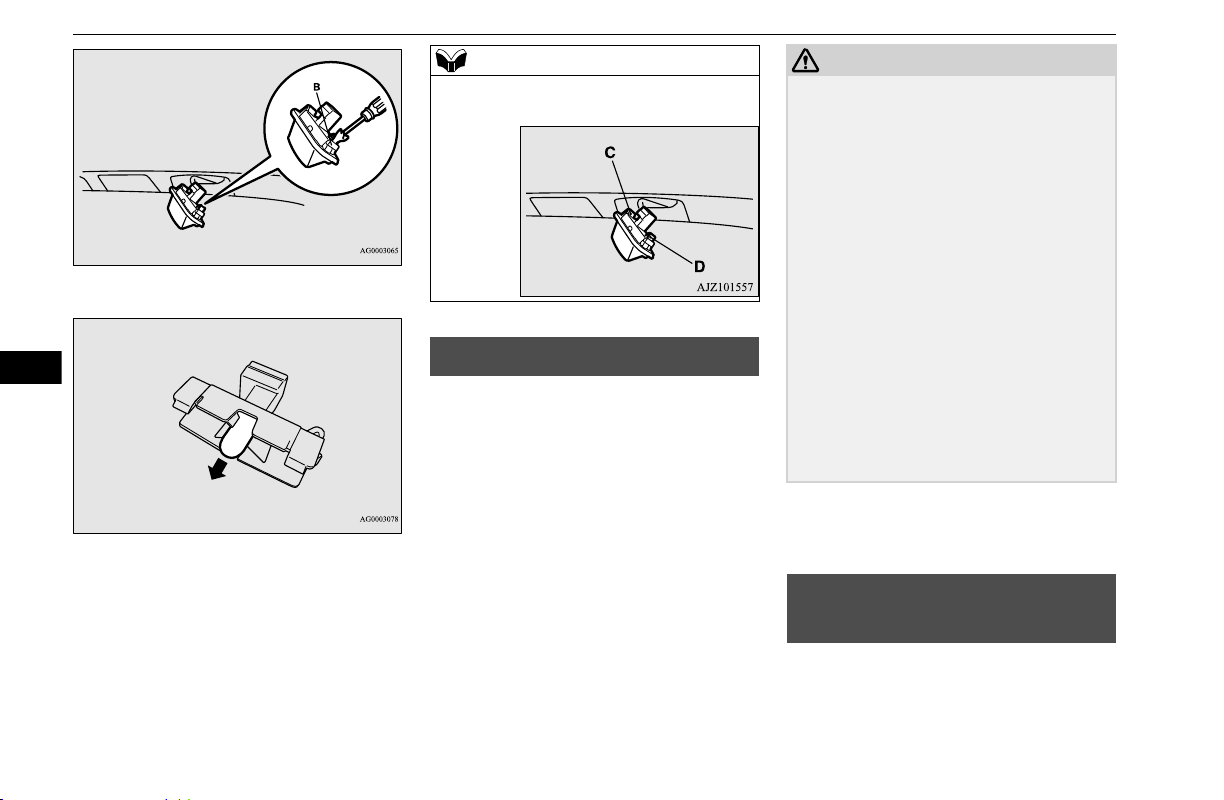
Vehicle care precautions
9-28 Vehicle care and maintenance
9
3. Pull the bulb out of the socket.
4. To install the bulb, perform the removal
steps in reverse.
N00945100195
In order to maintain the value of your vehicle,
perform regular maintenance using the proper
materials and procedures. Be sure to use only
those materials and procedures that meet your
local environmental pollution control regula-
tions. Choose the materials you will use care-
fully, to be sure that they do not contain
corrosives. If you are not sure, contact a certi-
fied i-MiEV dealer for help in choosing these
materials.
These can all be dangerous, and they all can
damage your vehicle.
N00945200079
After washing the inside of your vehicle with
any cleaner, wipe it dry in a shady, well venti-
lated area.
NOTE
When installing the light, insert tab (C) first
then align and insert tab (D).
Vehicle care precautions
CAUTION
Cleaning products can be dangerous. Some
are poisonous. Others are highly flammable.
Some are dangerous if you breathe their
fumes in a closed space. When you use any-
thing in a container to clean your vehicle, be
sure to follow the instructions. Always open
your vehicle doors or windows when you’re
cleaning the inside. Never use the following
chemicals to clean your vehicle:
• Gasoline
• Carbon Tetrachloride
• Benzine
• Kerosene
• Naphtha
• Acetone
• Turpentine
• Paint Thinner
• Lacquer Thinner
• Nail Polish Remover
Cleaning the inside of your
vehicle
BK0220401US.book 28 ページ 2015年6月3日 水曜日 午前7時42分
Cleaning the inside of your vehicle
Vehicle care and maintenance 9-29
9
N00945300214
1. Lightly wipe these off with a soft cloth
soaked in a mild soap and water solution.
2. Dip cloth in fresh water and wring out
well. Using this cloth, wipe off the deter-
gent thoroughly.
N00945500144
1. To maintain the value of your new vehi-
cle, maintain the upholstery carefully and
keep the interior clean.
Use a vacuum cleaner and brush to clean
the seats. If stained, vinyl and synthetic
leather should be cleaned with an appro-
priate cleaner. Cloth fabrics can be
cleaned with either upholstery cleaner or a
mild soap and water solution.
2. Clean the carpeting with a vacuum
cleaner and remove any stains with carpet
cleaner. Oil and grease can be removed by
lightly dabbing with a clean white cloth
and spot remover.
N00945600275
1. To clean, lightly wipe the leather with a
soft cloth soaked in a mild soap and water
solution.
2. To rinse, dip the cloth in fresh water,
wring it out well, and wipe off all the
soap.
3. To preserve and protect, use a leather pro-
tecting agent on the genuine leather sur-
face.
CAUTION
Do not use organic substances (solvents,
benzine, kerosene, alcohol, gasoline, etc.) or
alkaline or acidic solutions.
These chemicals can cause discoloring,
staining or cracking of the surface.
If you use cleaners or polishing agents, make
sure their ingredients do not include the sub-
stances mentioned above.
NOTE
Always read the instructions on the cleaner
label.
Plastic, vinyl leather, fabric and
flocked parts
NOTE
Do not use cleaners, conditioners, and pro-
tectants containing silicones or wax.
Such products, when applied to the instru-
ment panels or other parts, may cause reflec-
tions on the windshield and obscure vision.
Also, if such products get on the switches of
the electrical accessories, it may lead to fail-
ure of these accessories.
Upholstery
NOTE
If fuzzing is difficult to remove from the seat
upholstery, draw a suitable defuzzing brush
over the surface in one direction.
Genuine leather (if so equipped)
NOTE
If genuine leather is wet with water, wipe it
with a dry, soft cloth. If left damp, mildew
may grow.
The genuine leather surface can be damaged
if brushed with a nylon or synthetic fiber
brush.
Organic solvents such as benzine, kerosene,
alcohol, gasoline, acid or alkaline solvents
can discolor the genuine leather surface and
should not be used.
The genuine leather surface may harden and
shrink if it is exposed to the direct sunlight
for long hours. When your vehicle is parked,
place it in the shade as much as possible.
BK0220401US.book 29 ページ 2015年6月3日 水曜日 午前7時42分
Cleaning the outside of your vehicle
9-30 Vehicle care and maintenance
9
N00945700061
To protect your vehicle’s finish, wash it often
and thoroughly. If desired, you may wax your
vehicle using a nonabrasive automobile wax.
N00945800046
Industrial pollution, road tar, bird droppings,
tree sap, insect remains, sea water and other
foreign matters can damage the finish on your
vehicle.
Generally, the longer any foreign material
stays on the finish, the worse the damage.
Wash your vehicle as soon as possible when-
ever the finish gets soiled.
N00945900627
Chemicals contained in the dirt and dust
picked up from air, rain, snow or road sur-
faces can damage the paint and body of your
vehicle if left on.
Frequent washing and waxing is the best way
to protect your vehicle from this damage.
Do not wash the vehicle in direct sunlight.
Park the vehicle in the shade and spray it with
water to remove dust. Next, using plenty of
clean water and a car washing mitt or sponge,
wash the vehicle from top to bottom.
Use a mild car washing soap if necessary.
Rinse thoroughly and wipe dry with a cham-
ois or soft cloth. After washing the vehicle,
carefully clean the joints and flanges of the
doors, hood, etc., where dirt is likely to
remain.
Cleaning the outside of your
vehicle
Foreign material
Washing
WARNING
Do not wash the vehicle while charging the
main drive lithium-ion battery.
Doing so could cause a fire or an electric
shock.
Before washing the vehicle, make sure
that the charging lid and the inner lid are
completely closed.
If the lid is open, the charging unit is
exposed to water, resulting in a fire or an
electric shock.
Do not pour water inside the electric
motor unit room. Doing so could cause a
fire or an electric shock.
CAUTION
When washing the vehicle, turn the electric
motor switch to the “LOCK” position.
Do not use a high pressure washing machine
to clean the underneath of the vehicle.
Doing so might cause the electric motor unit
problem or malfunction.
When washing the underside of your vehicle
or the wheels, wear a pair of gloves to pro-
tect your hands.
Never spray or splash water on the electrical
parts in under the hood. This may damage
them. Be careful also when washing the
underbody. Do not spray water up under the
hood.
Avoid automatic car washers that use rotat-
ing brushes. These brushes may scratch the
paint surface and make it dull.
Scratches are more noticeable on darker col-
ored vehicles.
Some hot water washing equipment uses
high pressure and heat to clean your vehicle.
This heated water may damage your vehi-
cle’s resin parts. It can flood the interior of
the vehicle. Therefore, be sure of the follow-
ing:
• Keep the washing nozzle at least 28 inches
(70 cm) away from the vehicle body.
• When washing around the door glass, hold
the nozzle at a distance of more than 28
inches (70 cm) and at right angles to the
glass surface.
Make sure to do the following when using an
automatic car wash, with help from either
this manual or the car wash operator, to
avoid damaging your vehicle:
• Fold the outside mirrors.
• Remove the antenna.
• Tape the wiper arm assembly.
CAUTION
BK0220401US.book 30 ページ 2015年6月3日 水曜日 午前7時42分
Cleaning the outside of your vehicle
Vehicle care and maintenance 9-31
9
Salt and other chemicals spread on winter
roads in some geographical areas can have a
detrimental effect on the vehicle underbody.
You should flush the underbody with a high
pressure hose every time you wash the out-
side of your vehicle.
Take special care to remove mud or other
debris which could trap and hold salt and
moisture.
After washing your vehicle, wipe off all
waterdrops from the rubber parts around the
doors to prevent the doors from freezing.
N00946000247
Wax your vehicle once or twice a year, or
when water does not bead up on the paint.
Use a soft cloth to put a small amount of wax
on the painted surfaces. After the wax has
dried, polish with a dry soft cloth.
Do not wax your vehicle in direct sunlight.
You should wax when the painted surfaces
are cool.
N00946100059
If painted surfaces have been severely dam-
aged and lost their original luster and color
tone, polish the surface lightly with a fine
polishing compound. Avoid limiting your
polishing to the damaged surface only; polish
a somewhat wider area, moving the polishing
cloth in one direction. After polishing, flush
the compound from the surface and apply a
coat of wax to regain a beautiful luster.
N00946200089
Small cracks and scratches in the paint coat
should be touched up as soon as possible with
touch-up paint to prevent corrosion.
Check body areas facing the road or the tires
carefully for damage to the paint caused by
flying stones, etc. The paint code number for
your vehicle can be found on the vehicle
information code plate. Refer to “Vehicle
information code plate” on page 11-2.
N00946300211
Use a sponge or chamois to clean these parts.
If a vehicle wax sticks to a gray or black
rough surface of the bumper, molding or
lights, the surface may appear white in color.
In this case, wipe it off using lukewarm water
and a soft cloth or chamois.
During cold weather
NOTE
When the door is frozen, opening it by force
may tear off or crack the rubber gasket
installed around the door. Pour warm water
to melt the ice. Be sure to thoroughly wipe
off the water after opening the door. To pre-
vent freezing of the weatherstripping on the
doors, hood, etc., treat with silicone lubri-
cant.
Waxing
CAUTION
Waxes containing high abrasive compounds
should not be used. These waxes remove rust
and stain effectively from the paintwork, but
are harmful to the finish on the paint and the
plate, because they also remove clearcoat.
They are also harmful to other glossy sur-
faces such as the grille, trim, moldings, etc.
Do not use gasoline, kerosene, benzine or
paint thinners to remove road tar or other dirt
from the vehicle surface.
Do not put wax on the areas having black
matte coating because it can cause uneven
discoloration, patches, blurs, etc. If these get
wax on them, wipe the wax off right away
with a soft cloth and warm water.
Polishing
Damaged paint
Cleaning plastic parts
CAUTION
Do not use a scrubbing brush or other rough
scrubber as these may damage the plastic
surface.
BK0220401US.book 31 ページ 2015年6月3日 水曜日 午前7時42分
Cleaning the outside of your vehicle
9-32 Vehicle care and maintenance
9
N00946400065
To prevent spots and corrosion of chrome
parts, wash with water, dry thoroughly, and
apply a nonabrasive automotive wax. If the
chrome is severely damaged or pitted, use a
commercially available chrome polish.
N00946500196
1. Remove dirt using a wet sponge.
2. Use a mild detergent on any dirt that can-
not be removed easily with water.
Rinse off the detergent after washing the
wheel.
3. Dry the wheel thoroughly using a chamois
leather or a soft cloth.
N00946600067
The window glass can usually be cleaned
using only a sponge and water. Glass cleaner
can be used to remove wax, oil, grease, dead
insects, etc. After washing the glass, wipe it
dry with a clean, dry, soft cloth.
N00946700097
Use a soft cloth and glass cleaner to remove
grease, dead insects, etc., from the wiper
blades.
Replace the wiper blades when they no longer
clean the windshield and rear window prop-
erly.
N00947000127
Never spray or splash water on the electrical
components under the hood, as this may
cause damage.
Do not allow any nearby parts (such as plastic
parts) come into contact with sulphuric acid
(12V starter battery electrolyte), which may
crack, stain, or discolour them.
If this occurs, wipe the parts with a soft cloth
saturated with a mild detergent and water
solution.
Then immediately rinse the affected parts
with plenty of water.
Do not use wax containing compounds (pol-
ishing powder) which may damage the plas-
tic surface.
Do not let the plastic parts get soiled with
gasoline, oil, brake fluids, greases, paint
thinner, and sulfuric acid (battery electro-
lyte). These fluids, etc., may crack, stain or
discolor the plastic parts.
If any of these get on the plastic parts, wipe
them up with a soft cloth or chamois and a
mild solution of soap and water. Then rinse
them immediately with water.
Chrome parts
Aluminum wheels
CAUTION
CAUTION
Do not use a brush or other hard implement
on the wheels.
Doing so could scratch the wheels.
Do not use any cleaner that contains an abra-
sive substance or is acidic or alkaline. Doing
so could cause the coating on the wheels to
peel or become discolored or stained.
Do not directly apply hot water using a steam
cleaner or by any other means.
Contact with seawater or road salt used for
de-icing can cause corrosion. Rinse off such
substances as soon as possible.
Window glass
Wiper blades
Under the hood
BK0220401US.book 32 ページ 2015年6月3日 水曜日 午前7時42分

10
Customer assistance/Reporting Safety Defects
Consumer information (For vehicles sold in U.S.A.) ....................10-2
Reporting Safety Defects ...............................................................10-2
Important facts to know in case of an accident ..............................10-3
BK0220401US.book 1 ページ 2015年6月3日 水曜日 午前7時42分
Consumer information (For vehicles sold in U.S.A.)
10-2 Customer assistance/Reporting Safety Defects
10
N01047100171
This information is provided in compliance
with the requirements of the National High-
way Traffic Safety Administration, Depart-
ment of Transportation. It provides the
purchasers and/or prospective purchasers
with information on reporting safety defects.
DOT quality grades - All passenger vehicle
tires must conform to Federal Safety Require-
ments in addition to these grades. The spe-
cific grade rating in each grade category is
shown on the side wall of the tires on your
vehicle.
The treadwear grade is a comparative rating
based on the wear rate of the tire when tested
under controlled conditions on a specified
government test course. For example, a tire
graded 150 would wear one and one-half
(1
1
/
2
) times as well on the government course
as a tire graded 100. The relative performance
of tires depends upon the actual conditions of
their use, however, and may depart signifi-
cantly from the norm due to variations in
driving habits, service practices and differ-
ences in road characteristics and climate.
The traction grades, from highest to lowest,
are AA, A, B and C. Those grades represent
the tire’s ability to stop on wet pavement as
measured under controlled conditions on
specified government test surfaces of asphalt
and concrete. A tire marked C may have poor
traction performance.
The temperature grades are A (the highest), B
and C, representing the tire’s resistance to the
generation of heat and its ability to dissipate
heat when tested under controlled conditions
on a specified indoor laboratory test wheel.
Sustained high temperature can cause the
material of the tire to degenerate and reduce
tire life, and excessive temperature can lead
to sudden tire failure. The grade C corre-
sponds to a level of performance which all
passenger car tires must meet under the Fed-
eral Motor Vehicle Safety Standard No. 109.
Grades B and A represent higher levels of
performance on the laboratory test wheel than
the minimum required by law.
N01047201515
If you believe that your vehicle has a
defect which could cause a crash or
could cause injury or death, you
should immediately inform the
National Highway Traffic Safety
Administration (NHTSA) in addi-
tion to notifying Mitsubishi Motors
Corporation.
Consumer information (For
vehicles sold in U.S.A.)
Uniform tire quality grading
Treadwear
Traction AA, A, B, C
WARNING
The traction grade assigned to this tire is
based on straight-ahead braking traction
tests, and does not include acceleration,
cornering, hydroplaning, or peak traction
characteristics.
Temperature A, B, C
WARNING
The temperature grade for this tire is
established for a tire that is properly
inflated and not overloaded. Excessive
speed, underinflation, or excessive load-
ing, either separately or in combination,
can cause heat buildup and possible tire
failure.
Reporting Safety Defects
BK0220401US.book 2 ページ 2015年6月3日 水曜日 午前7時42分

Important facts to know in case of an accident
Customer assistance/Reporting Safety Defects 10-3
10
If NHTSA receives similar com-
plaints, it may open an investigation,
and if it finds that a safety defect
exists in a group of vehicles, it may
order a recall and remedy campaign.
However, NHTSA cannot become
involved in individual problems
between you, your dealer, or Mit-
subishi Motors Corporation.
To contact NHTSA, you may call the
Vehicle Safety Hotline toll-free at 1-
888-327-4236 (TTY: 1-800-424-
9153); go to
http://www.safercar.gov; or write to:
You can also obtain other informa-
tion about motor vehicle safety from
http://www.safercar.gov.
To contact Mitsubishi Motors North
America, Inc. call 1-888-648-7820 or
write to:
If you live in Canada, and you
believe that your vehicle has a safety
defect, you should immediately
notify Transport Canada, in addition
to notifying Mitsubishi Motor Sales
of Canada, Inc. You may write to:
To contact Mitsubishi Motor Sales of
Canada, Inc. call 1-888-576-4878 or
write to:
N01047300098
We hope you will never be involved in an
accident, but there is always that potential
danger. So, please be sure to buckle up and
drive safely.
Remain calm.
Check for injuries. Report all injuries to
the police, and, if necessary, call for an
ambulance.
NHTSA Headquarters
1200 New Jersey Avenue, SE
West Building
Washington, DC 20590
For vehicles sold in U.S.A.
Mitsubishi Motors North Amer-
ica, Inc.
Customer Relations Department
P.O. Box 6400
Cypress, CA 90630-0064
For vehicles sold in Canada
Transport Canada
330 Sparks Street
Tower C
Ottawa, Ontario K1A 0N5
Mitsubishi Motor Sales of Can-
ada, Inc.
Customer Relations Department
P.O. Box 41009
4141 Dixie Road
Mississauga, ON L4W 5C9
Important facts to know in
case of an accident
In the event of an accident
BK0220401US.book 3 ページ 2015年6月3日 水曜日 午前7時42分

Important facts to know in case of an accident
10-4 Customer assistance/Reporting Safety Defects
10
Record all the details of the accident. This
will provide you with accurate records of
the accident for discussions with your
insurance company and other persons
who may be acting on your behalf.
Understand your repair estimate before
approving repairs.
Choosing the repair shop and the brands
of parts that they use on your vehicle is
your decision.
Ask for genuine Mitsubishi Motors parts.
Many times, to save money, your insur-
ance company will recommend imitation
parts that do not meet the original specifi-
cations of fit, finish, corrosion resistance
or workmanship.
The strength and integrity built into your
Mitsubishi vehicle is the result of a specific
design referred to as “Energy Management”.
Individual body parts are designed to act as
one unit in the event of an accident. Shock
waves are absorbed by protective panels or
are channeled around the passenger compart-
ment. This important feature is possible
because high tensile steel is used in
Mitsubishi panels and structural parts, some-
thing that cannot be guaranteed by the manu-
facturers of imitation parts. All Genuine
Mitsubishi body panels and support brackets
are designed and constructed as important
protection features in the event of an acci-
dent. By replacing body parts with imitations,
your vehicle may no longer meet original
equipment specifications.
As a consumer requesting repair on your
vehicle, you have consumer rights. Across the
country, State Insurance Commissioners have
begun considering rules on the use of non-
OEM parts. This could mean that repair shops
will have to disclose to the consumer, when
they intend to use non-OEM parts. Since reg-
ulations are not consistent on this point,
remember you have a choice. So, if you want
genuine Mitsubishi Motors parts, you may
have to specifically request them. Make cer-
tain your insurance company understands
imitations are not to be used in the repair of
your vehicle. You deserve the best genuine
Mitsubishi Motors parts.
Genuine Mitsubishi Motors parts are built
with the high quality and durability standards
you expect. Genuine Mitsubishi Motors
replacements parts are your guarantee that
your vehicle will have all the technological
advantages and maintain the style and protec-
tion of a brand new Mitsubishi Motors.
Remember to ask for genuine Mitsubishi
Motors parts.
Key information to discuss with
your insurance company
Mitsubishi Motors built-in pro-
tection
Consumer rights (For vehicles
sold in U.S.A.)
Genuine Mitsubishi Motors
parts
BK0220401US.book 4 ページ 2015年6月3日 水曜日 午前7時42分
11
Specifications
Vehicle labeling .............................................................................11-2
Vehicle dimensions ........................................................................11-4
Vehicle weights ..............................................................................11-4
Charging system specifications .....................................................11-5
Electric motor specifications .........................................................11-6
12V starter battery .........................................................................11-6
Tires and wheels ............................................................................11-6
Refill capacities .............................................................................11-7
BK0220401US.book 1 ページ 2015年6月3日 水曜日 午前7時42分
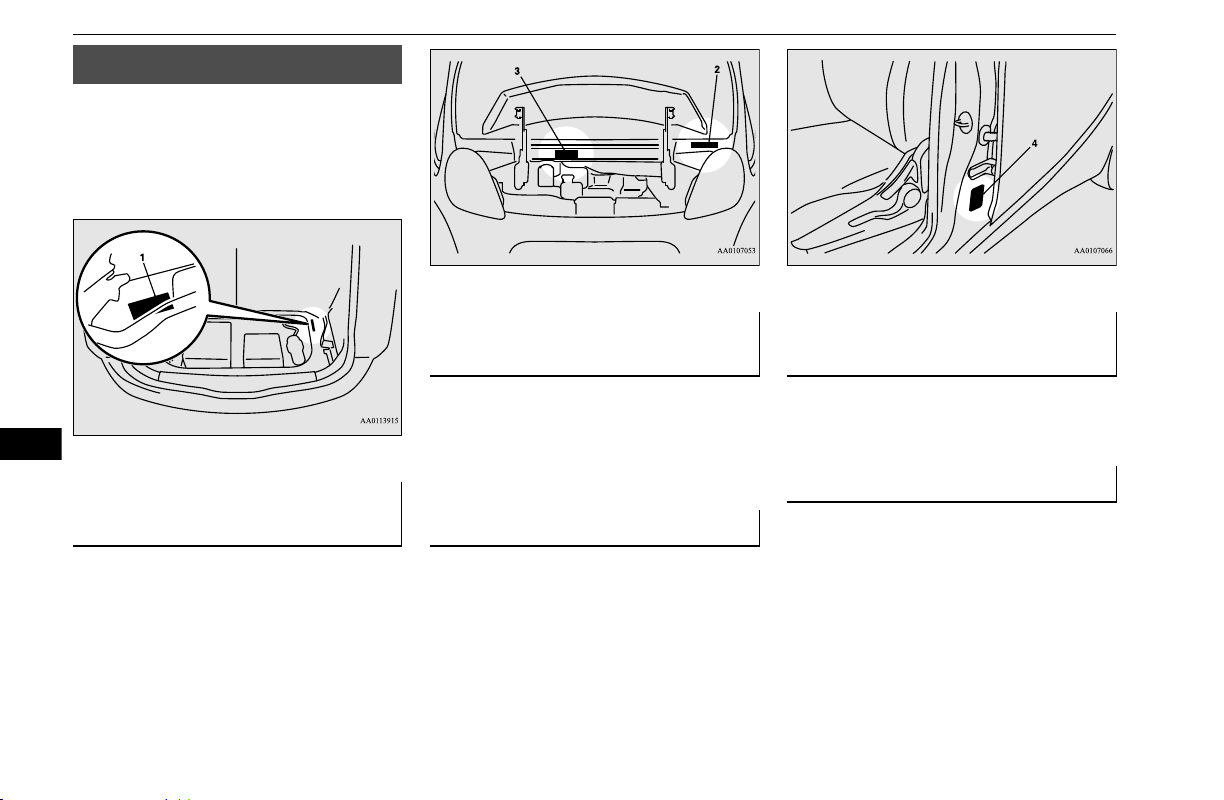
Vehicle labeling
11-2 Specifications
11
N01147400739
Keep a record of the chassis number and
vehicle identification number. This informa-
tion will assist the police if your vehicle is
ever stolen.
The vehicle emission control information
label is affixed in the location shown in the
illustration.
The vehicle identification number is stamped
in the location shown in the illustration. It is
visible from outside of the vehicle through
the windshield.
The air conditioning label is affixed on the
bulkhead as shown in the illustration.
The vehicle information code plate is located
on the driver’s door sill.
The chassis number is stamped behind the lid
on the right side of the luggage room.
Vehicle labeling
1 - Vehicle emission control
information label
2 - Vehicle identification num-
ber plate
3 - Air conditioning label
4 - Vehicle information code
plate
Chassis number
BK0220401US.book 2 ページ 2015年6月3日 水曜日 午前7時42分
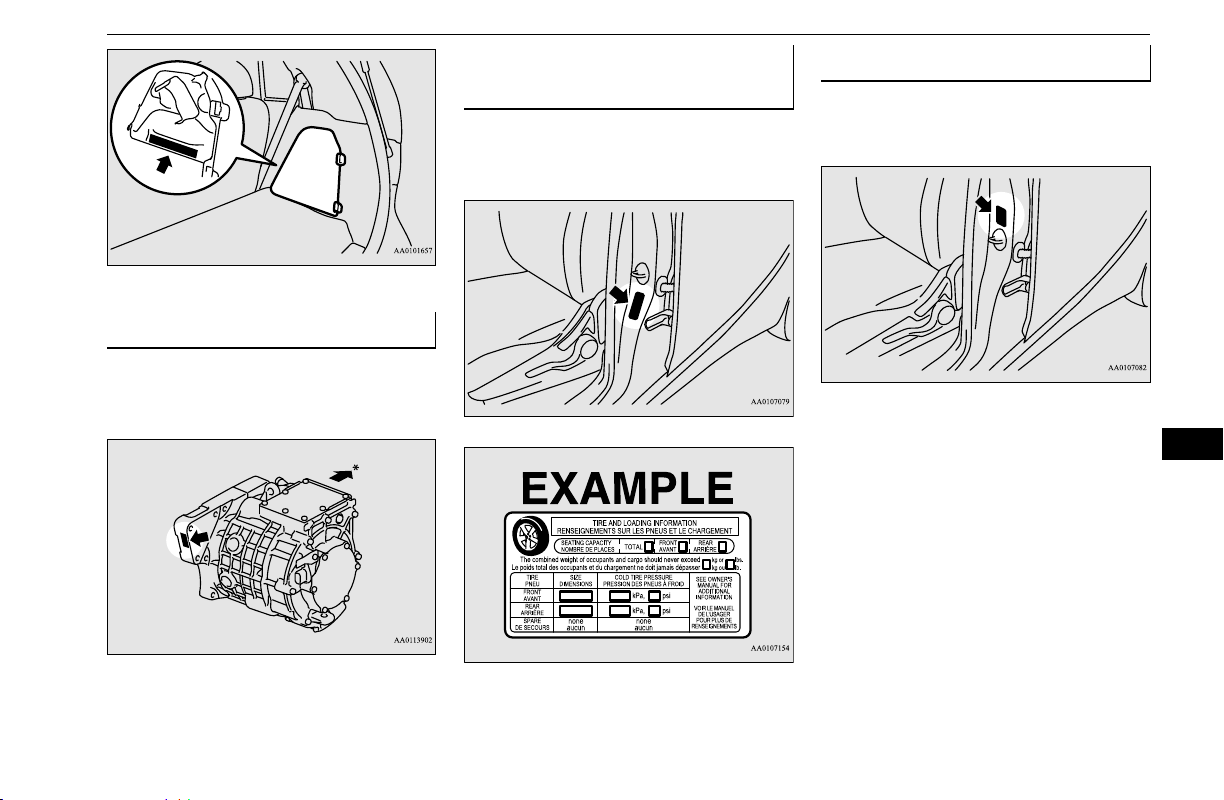
Vehicle labeling
Specifications 11-3
11
The electric motor number is stamped on the
cylinder block as shown in the illustration.
N01148100599
The tire and loading information placard is
located on the driver’s door sill.
N01148200239
The certification label is located on the
driver’s door sill.
Electric motor number
*- Front of the vehicle
Tire and loading information
placard
Certification label
BK0220401US.book 3 ページ 2015年6月3日 水曜日 午前7時42分
Vehicle dimensions
11-4 Specifications
11
N01147501580
N01147601943
GVWR: maximum total weight (load) limit specified for the vehicle
GAWR: maximum weight (load) limit specified for the front or rear axle
Seating capacity: the number of maximum occupants
Vehicle dimensions
Overall length 144.7 in (3,675 mm)
Overall width 62.4 in (1,585 mm)
Overall height 63.6 in (1,615 mm)
Wheel base 100.4 in (2,550 mm)
Vehicle weights
Gross vehicle weight rating (GVWR) 3,329 lb (1,510 kg)
Gross axle weight rating (GAWR)
Front 1,488 lb (675 kg)
Rear 1,962 lb (890 kg)
Vehicle capacity weight 661 lb (300 kg)
Seating capacity 4 persons
BK0220401US.book 4 ページ 2015年6月3日 水曜日 午前7時42分
Charging system specifications
Specifications 11-5
11
N01148501037
*
1
: When using a genuine charging cable with control box
*
2
: When using a home or public charging device (EVSE: Electric Vehicles Supply Equipment)
Charging system specifications
Regular charging system
Rated input voltage AC 240V (single phase) AC 120V (single phase)
Rated input frequency 50 Hz/60 Hz
Rated current 15 A (max)
8 A/12 A (max)*
1
Maximum power consumption
3.3 kVA*
2
1.8 kVA*
2
Applicable standards
UL2594: Electric Vehicle Supply Equipment
SAE J1772: (R) SAE Electric Vehicle and Plug in Hybrid Electric
Vehicle Conductive Charge Coupler
CSA C22.2 No.107.1-01: General use power supplies
Leakage current sensitivity in
cable control box
20 mA
Quick charging system
Applicable standards CHAdeMO
Maximum input current 125 A
Regular charging/
Quick charging system
Enclosure type
Charge connector: Type 3s
Control box (CCID): Type 3
BK0220401US.book 5 ページ 2015年6月3日 水曜日 午前7時42分
Electric motor specifications
11-6 Specifications
11
N01147301038
N01147801307
Battery is a 12 volt type.
N01147900734
PCD: Pitch Circle Diameter (installation holes)
Electric motor specifications
Electric motor model Y51
Maximum output 49 kW
Maximum torque 196 N•m
12V starter battery
34B19L(S)
Tires and wheels
Item Front Rear
Tire 145/65R15 72H 175/60R15 81H
Wheel
Size 15x4J 15x5J
PCD 3.93 in (100 mm)
Offset 1.37 in (35 mm)
NOTE
Contact a certified i-MiEV dealer for details on the combination used on your vehicle.
These tires satisfy vehicle loading conditions described in this owner’s manual.
BK0220401US.book 6 ページ 2015年6月3日 水曜日 午前7時42分
Refill capacities
Specifications 11-7
11
N01148002143
*: similar high quality ethylene glycol based non-silicate, non-amine, non-nitrate and non-borate coolant with long life hybrid organic acid tech-
nology
Refill capacities
No. Item Capacity Lubricants
1 Windshield washer fluid 2.0 qt (1.9 L) —
2 Brake As required Conforming to Brake fluid DOT3 or DOT4
3
Hot water heater fluid
[Includes .42 qt (0.4 L) in reservoir]
2.0 qt (1.9 L)
Mitsubishi Motors Genuine Super Long Life Coolant Premium or
an equivalent*
4
Coolant
[Includes 1.2 qt (1.1 L) in reservoir]
5.4 qt (5.1 L)
5 Transmission .79 qt (0.75 L) Mitsubishi Motors Genuine ATF SPIII
6 Refrigerant (air conditioning)
Refer to the “Air con-
ditioning label” on
page 11-2
HFC-134a
BK0220401US.book 7 ページ 2015年6月3日 水曜日 午前7時42分

BK0220401US.book 8 ページ 2015年6月3日 水曜日 午前7時42分

Alphabetical index
12-1
12
Numerics
12V power outlet ................................ 5-76
12V starter battery ................................ 9-7
Specification .................................. 11-6
12V starter battery charging system warning
light................................................. 5-45
A
Accessory (installation) ......................... 3-7
Acoustic vehicle alerting system (AVAS) ....
5-23
Active stability control ........................ 5-28
ASC indicator................................. 5-30
ASC OFF indicator ......................... 5-30
ASC OFF switch ............................ 5-29
Skid control function....................... 5-29
Traction control function ................. 5-29
Air conditioning ................................... 7-4
Important air conditioning operating tips..
7-10
Air purifier......................................... 7-11
Aluminum wheels............................... 9-32
Antenna ............................................. 7-27
Anti-lock braking system..................... 5-25
Warning light ........................ 5-26, 5-27
ASC .................................................. 5-28
ASC indicator..................................... 5-30
ASC OFF indicator............................. 5-30
ASC OFF switch ................................ 5-29
Assist grip ......................................... 5-81
Audio
AM/FM electronically tuned radio with
CD player.................................... 7-11
Error codes .................................... 7-24
Handling of compact discs .............. 7-25
Steering wheel audio remote control switch
7-22
B
Back up lights
Bulb capacity................................. 9-22
Replacement.................................. 9-25
Ball joint, steering linkage seals and drive
shaft boots ....................................... 9-17
Battery
12V starter battery charging system warn-
ing light....................................... 5-45
Disconnection and connection ........... 9-9
During cold weather ......................... 9-9
Main drive lithium-ion battery........... 3-3
Bluetooth® 2.0 interface ..................... 5-53
Brake
Anti-lock braking system ................ 5-25
Braking ........................................... 6-5
Fluid ....................................... 9-7, 11-7
Hose ............................................. 9-17
Parking brake................................. 5-16
Parking brake lever stroke ............... 9-16
Pedal ............................................. 5-24
Pedal free play................................ 9-16
Power brakes.................................. 5-24
Service brake.................................. 5-24
Warning light ................................. 5-44
Brake assist system ............................. 5-25
Break-in recommendations .................... 5-2
Bulb capacity...................................... 9-22
C
California Perchlorate Materials
Requirements ..................................... 3-8
Capacities .......................................... 11-7
Card holder ............................... 5-76, 5-80
Cargo loads ........................................ 6-10
Certification label ............................... 11-3
Charging
Quick charging ............................... 3-27
Regular charging ................... 3-16, 3-26
Charging indicator .............................. 5-44
Charging Timer .................................. 3-41
Charging troubleshooting guide............ 3-31
Chassis number................................... 11-2
Child restraint..................................... 4-13
Child safety locks for rear door ............ 5-10
Cleaning
BK0220401US.book 1 ページ 2015年6月3日 水曜日 午前7時42分

Alphabetical index
12-2
12
Inside of your vehicle...................... 9-28
Outside of your vehicle ................... 9-30
Clock................................................. 7-27
Cold
Cautions and actions to deal with intense
cold............................................. 3-10
Combination headlights and dimmer switch ..
5-46
Consumer information ........................ 10-2
Coolant....................................... 9-4, 11-7
Cruising range...................................... 3-4
Cruising range indicator ............. 5-37, 5-40
Cup holder ......................................... 5-80
D
Dash lights brightness indicator .. 5-37, 5-40
Daytime running lights
Bulb capacity ................................. 9-22
Replacement .................................. 9-24
Defogger (rear window) ...................... 5-52
Dimensions ........................................ 11-4
Dimmer (high/low beam change) ......... 5-48
Dinghy towing ................................... 6-10
Disc brake pads .................................. 9-17
Dome light (Front)/Reading lights
Bulb capacity ................................. 9-23
Switch ........................................... 5-77
Dome light (Rear)
Bulb capacity.................................. 9-23
Switch............................................ 5-78
Door-ajar warning light and buzzer....... 5-45
Doors
Lock ............................................... 5-8
Power door locks ............................. 5-9
Driver’s seat belt reminder/warning light......
4-10
Driving during cold weather.................. 6-4
Driving, alcohol and drugs .................... 6-2
E
Economical driving .............................. 6-2
Electric motor
Number.......................................... 11-3
Specifications ................................. 11-6
Electric motor switch........................... 5-18
Electric motor unit warning light .......... 5-45
Electric power steering system (EPS) .... 5-27
Electric rear window defogger switch.... 5-52
Electronic immobilizer (Anti-theft starting
system) ............................................. 5-2
Energy level gauge.............................. 5-41
Energy usage indicator......................... 5-37
EV charging cable............................... 3-23
F
Floor mat ............................................. 6-2
Fluid
Brake fluid.............................. 9-7, 11-7
Coolant................................... 9-4, 11-7
Hot water heater fluid .............. 9-4, 11-7
Washer fluid ........................... 9-7, 11-7
Fluid capacities and lubricants ............. 11-7
Front fog lights
Bulb capacity ................................. 9-22
Indicator ........................................ 5-44
Replacement .................................. 9-24
Switch ........................................... 5-50
Front seats............................................ 4-3
Front side-marker lights
Bulb capacity ................................. 9-22
Replacement .................................. 9-23
Front turn signal lights
Bulb capacity ................................. 9-22
Replacement .................................. 9-24
Fuses ................................................. 9-18
Fusible links....................................... 9-18
G
Gauges .............................................. 5-36
General maintenance........................... 9-17
General vehicle data............................ 11-4
BK0220401US.book 2 ページ 2015年6月3日 水曜日 午前7時42分

Alphabetical index
12-3
12
Genuine parts ....................................... 3-8
Glove compartment............................. 5-80
H
Hazard warning flasher switch ............. 5-49
Hazard warning lights ......................... 5-44
Head restraints...................................... 4-6
Headlights
Bulb capacity ................................. 9-22
Dimmer ......................................... 5-48
Headlight flasher ............................ 5-48
Reminder buzzer............................. 5-48
Switch ........................................... 5-46
Heat
Cautions and actions to deal with intense
heat ............................................... 3-8
High beam indicator............................ 5-44
High-mounted stop light
Bulb capacity ................................. 9-22
Replacement .................................. 9-26
High-Voltage components ................... 3-34
Hood ................................................... 9-3
Hood lock release mechanism and safety
catch................................................ 9-17
Horn switch........................................ 5-53
Hot water heater fluid................... 9-4, 11-7
I
If the vehicle breaks down..................... 8-2
i-MiEV................................................ 3-2
Cruising range.................................. 3-4
Main drive lithium-ion battery........... 3-3
Main features................................... 3-2
Important facts to know in case of an accident
10-3
Indicator and warning light package..... 5-43
Indicators .......................................... 5-44
Inside rearview mirror......................... 5-16
Instrument cluster............................... 5-36
Intense cold
Cautions and actions....................... 3-10
Intense heat
Cautions and actions......................... 3-8
Interior lights ..................................... 5-77
J
Jump-starting ....................................... 8-2
K
Key reminder buzzer..................... 5-9, 5-20
Keyless entry system ............................ 5-5
Keys ................................................... 5-2
L
Labeling............................................. 11-2
License plate lights
Bulb capacity ................................. 9-22
Replacement................................... 9-27
Liftgate .............................................. 5-11
Link System ....................................... 5-53
Loading information.............................. 6-6
Lubricants .......................................... 11-7
M
Main drive lithium-ion battery................ 3-3
Main Drive Lithium-ion Battery Level
Indicator .......................................... 3-50
MiEV Remote System......................... 3-36
Mirror
Inside rearview mirror ..................... 5-16
Outside rearview mirrors ................. 5-17
Modifications to and racing of your vehicle..
3-6
O
Odometer .................................. 5-37, 5-38
Oil
Transmission oil ............................. 11-7
BK0220401US.book 3 ページ 2015年6月3日 水曜日 午前7時42分

Alphabetical index
12-4
12
Operation under adverse driving conditions...
8-13
Outside rearview mirrors ..................... 5-17
Outside temperature display........ 5-37, 5-41
P
Parking ................................................ 6-6
Parking brake ................................. 5-16
Parking brake lever stroke ............... 9-16
Parking lights
Bulb capacity ................................. 9-22
Polishing............................................ 9-31
Power brakes...................................... 5-24
Power door locks .................................. 5-9
Power down warning light................... 5-46
Power outlet....................................... 5-76
Power windows .................................. 5-14
Precautions during Charging the Main Drive
Lithium-ion Battery .......................... 3-15
Q
Quick charging................................... 3-27
R
Radio
General information about your radio 7-28
Ready indicator .................................. 5-44
Rear combination lights
Bulb capacity.................................. 9-22
Replacement................................... 9-25
Rear side-marker lights
Bulb capacity.................................. 9-22
Replacement................................... 9-26
Rear turn signal lights
Bulb capacity.................................. 9-22
Replacement................................... 9-25
Rear window defogger switch .............. 5-52
Rear-view camera ............................... 5-34
Rearview mirror
Inside............................................. 5-16
Outside .......................................... 5-17
Refill capacities .................................. 11-7
Regenerative brake system indicator ..... 5-44
Regenerative braking............................ 3-3
Regular charging........................ 3-16, 3-26
Remote Climate Control .... 3-36, 3-47, 7-11
Replacement of light bulbs................... 9-21
Replacing tires and wheels ................... 9-14
Reporting Safety Defects ..................... 10-2
Reservoir cap....................................... 9-6
S
Safe driving techniques......................... 6-4
Seat .................................................... 4-2
Front seats ....................................... 4-3
Heated seat ...................................... 4-4
Rear seats ........................................ 4-5
Seats and restraint systems ................ 4-2
Seat belt............................................... 4-8
Adjustable seat belt shoulder anchor. 4-11
Child restraint ................................ 4-13
Driver’s seat belt reminder/warning light ..
4-10
Force limiter .................................. 4-13
Front passenger seat belt warning light .....
4-11
Maintenance and inspection............. 4-20
Pre-tensioner.................................. 4-12
Seat belt extender ........................... 4-12
Seat belt instructions ......................... 4-9
Seat belt use during pregnancy......... 4-12
Selector lever ..................................... 5-21
Selector lever operation................... 5-21
Selector lever position indicator ....... 5-21
Selector lever positions ................... 5-22
Service brake...................................... 5-24
Service precautions ............................... 9-2
Service reminder........................ 5-37, 5-38
Skid control function........................... 5-29
Snow tires.......................................... 9-15
Speedometer ...................................... 5-36
Steering
Wheel lock..................................... 5-20
Stop lights
BK0220401US.book 4 ページ 2015年6月3日 水曜日 午前7時42分

Alphabetical index
12-5
12
Bulb capacity ................................. 9-22
Replacement .................................. 9-25
Storage spaces .................................... 5-79
Sun visors .......................................... 5-76
Supplemental Restraint System ............ 4-20
How the Supplement Restraint System
works .......................................... 4-23
Servicing ....................................... 4-34
Warning light ................................. 4-26
T
Tail lights
Bulb capacity ................................. 9-22
Replacement .................................. 9-25
Theft-alarm system ............................. 5-12
Tire
Quality grading............................... 10-2
Tire pressure monitoring system........... 5-30
Tire repair kit ....................................... 8-5
Tires .................................................. 9-10
Inflation pressure ............................ 9-13
Maintenance................................... 9-15
Replacing tires and wheels............... 9-14
Rotation......................................... 9-15
Size (tire and wheel) ....................... 11-6
Snow tires ...................................... 9-15
Tire and loading information placard . 6-7,
11-3
Tire chains ..................................... 9-16
Tread wear indicators ..................... 9-15
Towing.............................................. 8-11
Traction control function..................... 5-29
Trailer towing .................................... 6-10
Trip odometer ............................ 5-37, 5-38
Turn signal lights
Indicators ...................................... 5-44
Lever ............................................ 5-49
U
USB input terminal............................. 5-73
How to connect a USB memory device ....
5-73
How to connect an iPod .................. 5-74
V
Vanity mirror ..................................... 5-76
Vehicle care precautions ..................... 9-28
Vehicle dimensions ............................ 11-4
Vehicle labeling ................................. 11-2
Vehicle preparation before driving ......... 6-3
Vehicle weights.................................. 11-4
Vents .................................................. 7-2
W
Warning lights ................................... 5-44
Washer
Fluid....................................... 9-7, 11-7
Rear window washer ....................... 5-51
Switch ........................................... 5-51
Windshield washer.......................... 5-51
Waxing .............................................. 9-31
Weights ............................................. 11-4
Wheel
Specification .................................. 11-6
Wiper
Rear window wiper ......................... 5-51
Windshield..................................... 5-50
Wiper blades .................................. 9-16
BK0220401US.book 5 ページ 2015年6月3日 水曜日 午前7時42分

BK0220401US.book 6 ページ 2015年6月3日 水曜日 午前7時42分