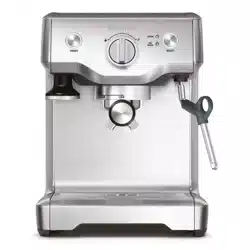
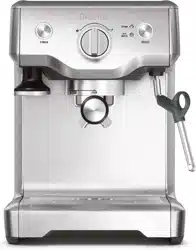
A. POWER button surround illuminates when machine is switched on.
B. Thermocoil heating system accurately controls water temperature.
C. Integrated removable tamper for tamping control.
D. Group head for easy positioning of the portafilter.
E. 54mm stainless steel portafilter with commercial style spouts.
F. Extra-tall cup height for coffee mugs
G. Drip tray full indicator
H. Removable drip tray
I. Cup warming tray
J. SELECT button for steam or hot water
K. Control dial for espresso, steam and hot water.
L. Swivel steam wand easily adjusts to perfect position for texturing milk.
NOT SHOWN
Removable 1.8L water tank filled from the top with integrated water filtration.
Storage tray located behind the drip tray for storage of accessories.
CUSTOM DESIGNED ACCESSORIES
Razor™ Precision Dose Trimming Tool
Single wall filter baskets for freshly ground coffee.
Advanced dual wall filter baskets for pre-ground coffee.
Water filter
Stainless steel milk jug
CLEANING ACCESSORIES
Cleaning tool
Silicon cleaning disk
Cleaning tablets
OPERATING YOUR BREVILLE PRODUCT
BEFORE FIRST USE
Machine Preparation
Remove and discard all labeling and packaging materials attached to your espresso machine. Ensure you have removed all parts and accessories before discarding the packaging. Clean parts and accessories (water tank, portafilter, filter baskets and jug) using warm water and a gentle dish washing liquid and rinse well. Wipe the outer housing and drip tray with a soft damp cloth and dry thoroughly. Do not immerse the outer housing, power cord or power plug in water or any other liquid.
The water filter located inside the water tank will need to be removed before washing the water tank
Conditioning the Water Filter
Remove filter from the plastic bag and soak in a cup of water for 5 minutes.
Rinse filter under cold running water.
Wash the stainless steel mesh in the plastic filter compartment with cold water. Insert the filter into the filter holder.
Set the dial date 2 months ahead.
To install filter into water tank, push down to lock into place.
Slide the water tank into position and lock into place.
NOTE
Do not clean any of the parts or accessories in the dishwasher.
FIRST USE
Initial Start Up
Fill tank with water
Press POWER button
A pumping sound will be heard. The machine will reach operating temperature and go into ‘Standby’ mode.
Flushing the Machine
It is recommended to complete a water flushing operation, without ground coffee, to ensure the machine has been conditioned. When the machine has reached ‘Standby’ mode, run the following 2 steps.
Turn the Control Dial to the ‘Espresso’ position for 30 seconds.
Turn the Control Dial to the
‘Steam’ position to activate steam for 20 seconds.
Repeat this cycle several times.
NOTE
To purchase water filters contact Breville Customer Service Centre on 1-866-273-8455 (USA) or 1-855-683-3535 (CANADA).
FILLING THE WATER TANK
Ensure the water filter is securely fitted inside the tank.
Fill the water tank with cold tap water to the maximum mark on the side of the tank and slide the water tank back into position at the back of the machine.
Plug the power cord into power outlet.
Press the POWER button. The POWER button surround will flash while the machine is heating. When the correct temperature has been reached, all the button surrounds on the control panel will illuminate.
NOTE
Check the water level before use and replace the water daily. The water tank should be filled with fresh, cold tap water before each use. Do not use de-mineralized or distilled water or any other liquid.
COFFEE PREPARATION
Dose & Tamping the Ground Coffee
If using whole bean coffee ground directly before extracting, use the Single Wall Filter Baskets. If using Pre-ground coffee, use the Dual Wall Filter Baskets. Insert the correct Filter Basket into the portafilter. Fill the Filter Basket with ground coffee, tap down to collapse the coffee, then using the integrated tamper, tamp down firmly (approx. 15-20kg of pressure).
It’s important to apply consistent pressure every time.
As a guide to dose, the top edge of the metal cap on the tamper should be level with the top of the filter basket AFTER the coffee has been tamped. This will minimize under or over dosing the coffee.
Wipe excess coffee from the rim of the filter basket to ensure a proper seal in the group head is achieved.
TRIMMING THE DOSE
The Razor™ precision dose trimming tool allows you to trim the puck to the right level for a consistent extraction.
Refer to Coffee Making Tips & Preparation, page 17 for more details.
EXTRACTING ESPRESSO
Insert the Portafilter into the Group Head & lock into position. Turn the Control Dial to the ‘Espresso’ position. A pumping noise will be heard. After a few seconds, coffee will begin to brew into the cup.
When sufficient coffee has been extracted, turn the Control Dial to ‘Standby’. This will stop the flow of coffee. Breville recommends approx. 30 sec of extraction.
NOTE
For optimal flavor when using a 1 CUP filter, you should extract approx. 1oz. When using a 2 CUP filter, you should extract approx. 2oz.
LOW PRESSURE PRE-INFUSION
The low pressure pre-infusion gradually increases water pressure to gently expand grinds for an even extraction before increasing to full pressure.
WARNING The metal parts of the portafilter will be very hot.
NOTE
If machine is run continuously for 30 minutes, allow machine to cool for 5 minutes before the next use.
TEXTURING MILK
The Duo Temp™ Pro is equipped with a commercial style steam wand.
Before inserting the steam wand into the milk, it is recommended to purge the steam wand.
Set the Control Dial to ‘Steam’.
The ‘Steam’ LED will illuminate.
It may take a few moments before the steam appears.
Pause the steam by returning the dial back to the ‘Standby’ position. This will avoid the milk splashing out of the jug.
The Steam will Pause for 8 secs.
Insert the wand into the milk and set the Control Dial to the ‘Steam’ position to texture milk.
To stop the steam set the Control Dial to the ‘Standby’ position and remove the jug.
NOTE
When the espresso machine creates steam, a pumping noise can be heard. This is the normal operation of the 15 bar Italian pump.
HOT WATER
The machine features a separate Hot Water function that dispenses hot water from the steam wand.
To use the Hot Water function:
Press the SELECT button and the Hot Water LED will illuminate.
Direct the spout outlet towards the drip tray.
Turn the Control Dial to ‘Steam’.
To turn the hot water off, turn the Control Dial to the ‘Standby’ position.
NOTE
The machine will automatically default to ‘Steam’ when the appliance is first switched on.
Steam and Hot Water functions cannot be operated at the same time.
WARNING
Hot water may drip from the Steam Wand. Always direct spout outlet towards the drip tray.
AUTO PURGE
For extracting espresso immediately after using the steam function, this machine features an auto purge function.
The auto purge function ensures the ground coffee will not be burnt by the initial water flow from the thermocoil being too hot. Water is automatically released internally into the drip tray ensuring that the thermocoil is at optimal temperature for extracting espresso. Your espresso will always be extracted at the optimal temperature ensuring only the best flavors are extracted.
COFFEE MAKING TIPS & PREPARATION
PRE-HEATING
Heating your cup or glass
A warm cup will help maintain the coffee’s optimal temperature. Preheat your cup by rinsing with hot water and place on the cup warming tray.
Heating the portafilter and filter basket
A cold portafilter and filter basket can reduce the extraction temperature enough to significantly affect the quality of your espresso. Ensure the portafilter and filter basket are preheated with hot water before initial use. Wipe the filter and portafilter dry before dosing with ground coffee as moisture can encourage channeling where water by-passes the ground coffee during extraction.
Single Wall Filter Baskets
The Single Wall filters (1 & 2 CUP) are designed to be used with freshly ground coffee and allow you to experiment with grind, dose, and tamp to create a more balanced espresso.
The Single Wall filters have no markings on the underside of the filter.
Advanced Dual Wall Filter Baskets
The Dual Wall filters (1 & 2 CUP) are designed to be used with pre-ground coffee and regulate the pressure to help optimize extraction and crema regardless of the grind, dose or tamp pressure.
The Dual Wall filters have DUAL WALL stamped on the underside of the filter.
The Grind
When grinding coffee beans, the grind size should be fine but not too fine. The grind size will affect the rate at which the water flows through the ground coffee in the filter basket and the taste of the espresso. If the grind is too fine (looks like powder and feels like flour when rubbed between fingers), the water will not flow through the coffee when under pressure. The resulting espresso will be OVER EXTRACTED, dark in color and bitter in flavor.
Coffee Dose and Tamping
Wipe coffee basket with a dry cloth.
If using Single Wall filter baskets, grind enough coffee to fill the coffee basket. You may need to experiment with the amount of coffee to achieve the correct dose.
Tap the portafilter several times to distribute the coffee evenly in the filter basket.
Tamp down firmly (using approx. 30-40lbs or 15-20kg of pressure). It’s important to apply consistent pressure every time.
As a guide to dose, the top edge of the metal cap on the tamper should be level with the top of the filter basket AFTER the coffee has been tamped. This will minimize under or over dosing the coffee.
Wipe excess coffee from the rim of the filter basket to ensure a proper seal in the group head is achieved.
TRIMMING THE DOSE
The Razor™ precision dose trimming tool allows you to trim the puck to the right level for a consistent extraction.
Dose the Portafilter with freshly ground coffee and tamp down with between 30-40lbs or 15-20kg of pressure.
Insert the Razor™ into the coffee basket until its shoulders rest on the rim of the filter basket. The blade of the dosing tool should penetrate the surface of the tamped coffee. Rotate the Razor™ dosing tool back and forth while holding the portafilter on an angle over the knock box to trim off excess coffee. Your coffee filter basket is now dosed with the correct amount of coffee.
NOTE
When using the 1 CUP Single Wall Filter basket, you may need to make the grind finer and also decrease the grind amount to ensure a correct dose and extraction.
EXTRACTION GUIDE
COFFEE MAKING TIPS & PREPARATION
PURGING THE GROUP HEAD
Before placing the portafilter into the group head, run a short flow of water through the group head, turning the Control Dial to the ‘Espresso’ position. This will purge any ground coffee residue from the group head and stabilize the temperature prior to extraction.
INSERTING THE PORTAFILTER
Place the portafilter underneath the group head so that the handle is aligned with the INSERT position. Insert the portafilter into the group head and rotate the handle towards the center until resistance is felt.
EXTRACTING ESPRESSO
Place pre-warmed cup(s) beneath the group head and turn the Control Dial to the ‘Espresso’ position until the required volume is reached.
As a guide, the espresso should start to flow after 8-10 seconds (infusion time) and should be the consistency of pouring honey.
If the espresso starts to flow before 6 seconds you have either under dosed the filter basket and/or the grind is too coarse. This is an UNDER EXTRACTED shot.
If the espresso starts to drip but doesn’t flow after 15 seconds, you have either over dosed the filter basket and/or the grind is too fine. This is an OVER EXTRACTED shot.
A great espresso is about achieving the perfect balance between sweetness, acidity and bitterness.
The flavor of your coffee will depend on many factors, such as the type of coffee beans, degree of roast, freshness, coarseness or fineness of the grind and dose of ground coffee.
Experimenting by adjusting these factors just one at a time can help to achieve the taste of your preference.
TEXTURING MILK
There are two phases to texturing milk. The first is stretching the milk to aerate it and the second is swirling the milk to make it silky smooth. These two operations should blend into one.
Always start with fresh cold milk.
Fill the jug just below the V at the bottom of the spout.
Position the steam tip over the drip tray and turn the Control Dial to ‘Steam’ position, purging any condensed water.
Turn the Control Dial to ‘Standby’ position to pause the steam, insert steam wand tip into milk and turn dial to ‘Steam’ position.
Insert the steam tip 1-2cm below the surface close to the right hand side of the jug at the 3 o’clock position.
Keep the tip just under the surface until the milk is spinning clockwise, producing a vortex (whirlpool effect).
With the milk spinning, slowly lower the jug. This will bring the steam tip to the surface of the milk and start to introduce air into the milk. You may have to gently break the surface of the milk with the tip to get the milk spinning fast enough.
Keep the tip at or slightly below the surface, continuing to maintain the vortex. Texture the milk until sufficient volume is obtained.
Lower the tip beneath the surface, but keep the vortex of milk spinning. The milk is at the correct temperature 140-150°F or 60-65°C when the jug is hot to touch.
Turn the Control Dial to the ‘Standby’ position before taking the tip out of the milk.
Set the jug to one side, turn steam on to purge out any residual milk from the steam wand and wipe steam wand with a damp cloth.
Tap the jug on the bench to collapse any bubbles.
Swirl the jug to polish and integrate the texture.
Pour milk directly into the espresso.
The key is to work quickly, before the milk begins to separate.
BEAN FRESHNESS
Breville recommends quality 100% Arabica beans with a ‘Roasted On’ date stamped on the bag, not a ‘Best Before’ or ‘Use By’ date.
Coffee beans are best consumed between 5-20 days after the ‘Roasted On’ date.
Store coffee beans in an airtight container. Vacuum seal if possible. Grind immediately before brewing as ground coffee quickly loses its flavor and aroma.
CARE & CLEANING
INSTALLING/REPLACING THE FILTER IN THE WATER TANK
Soak the water filter for 5 minutes
Rinse filter & mesh
Assemble
Set date 2 months ahead
Install filter in water tank
Insert & lock water tank
The water filter provided helps to prevent scale build up which over time can affect the performance of your machine, potentially causing blockages and heating problems. Replacing the water filter every two months will reduce the mineral build up in the machine.
If you live in a hard water area, we recommend you change the water filter more frequently.
Replacing The Water Filter
Remove the filter from the plastic bag, and soak in a cup of water for 5 minutes.
Rinse the filter under cold running water for 5 seconds.
Wash the stainless steel mesh in the plastic filter compartment with water and assemble.
Set the date dial 2 months ahead.
To install, push down to lock into place. The water filter can be removed
from the water tank during operation if not required.
PORTAFILTER CLEANING
Periodically run water through the machine with the portafilter in place, but without any ground coffee, to rinse out any residual coffee particles.
MACHINE CLEANING
After regular use, residual grinds and oil build up in the machine can affect coffee extraction. We recommend performing a cleaning cycle every 2-3 months using the cleaning tablet provided.
To perform a cleaning cycle:
1. Insert the silicon disk into the portafilter.
2. Place the cleaning tablet on the silicon disk (position in the center).
3. Insert the portafilter into the group head and rotate to right to lock in position.
4. Ensure Power On/Off button is on.
5. Turn the dial to the ‘Espresso’ position for 20 seconds.
6. Turn the dial back to the ‘Standby’ position.
7. Repeat steps 5-6 three times or until the cleaning tablet is dissolved.
DECALCIFYING
After regular use, hard water can cause mineral build up in and on many of the internal components, reducing water flow, power of the machine, and affecting the quality of coffee.
We advise decalcifying the machine on a regular basis (every 2-3 months) using a mixture of white vinegar and water.
Use the following as a guide:
SOLUTION FOR DECALCIFYING
Diluted Solution (for softer water).
1 part white vinegar
2 parts cold tap water
Concentrated Solution (for harder water)
1 part white vinegar
1 part cold tap water
NOTE
If an alternative decalcifying agent is used, please follow the manufacturer’s instructions specified.
DECALCIFYING THE MACHINE
Ensure the Control Dial is in the ‘Standby’ position, the POWER On/Off button is off and unplugged.
Remove the filter holder and pour the mixture of white vinegar and water into the water tank.
Plug the machine into the power outlet.
Place a large container under both the Group Head and the Steam Wand.
Set the Control Dial to the ‘Espresso’ position and let half the mixture of white vinegar and water run through the Group Head.
Set the Control Dial to the ‘Steam’ position and allow the remaining liquid to run through the Steam Wand. When the liquid stops flowing, set the Control Dial back to the ‘Standby’ position.
After decalcifying, remove the water tank and rinse thoroughly then re-fill with fresh cold water.
To rinse the machine, run half the water through the Group Head and half through the Steam Wand.
The machine is ready for use.
CLEANING THE STEAM WAND
Run steam to clear milk from wand after texturing
Wipe steam wand after each use
Clean hole with pin
Remove tip
Soak tip overnight then re-attach
CLEANING FILTER BASKETS
Should the fine holes in the filters become blocked follow the steps below:
1. Place the filter into the portafilter. Run water through the machine with the filter and portafilter in place, without any ground coffee.
2. The pin tool can be used to clear the filter basket holes.
3. For a thorough clean of the filters, dissolve a cleaning tablet in hot water and soak filters overnight.
CLEANING THE OUTER HOUSING / CUP WARMING PLATE
The outer housing and cup warming plate can be cleaned with a soft, damp cloth. Then polish with a soft, dry cloth.
Do not use abrasive cleansers, pads or cloths which can scratch the surface.
CLEANING THE DRIP TRAY
The drip tray should be removed, emptied and cleaned at regular intervals.
Wash the drip tray with warm soapy water, using a non-abrasive washing liquid, rinse and dry thoroughly. The drip tray base and cover are dishwasher safe.
CLEANING THE STORAGE TRAY
The storage tray can be removed after the drip tray is removed then cleaned with a soft, damp cloth (do not use abrasive cleansers, pads or cloths which can scratch the surface).
STORING YOUR MACHINE
Before storing, press the POWER button to ‘Off’, turn the Control Dial to ‘Standby’ and unplug.
Insert all accessories into position or into the storage tray.
Store upright. Do not place anything on top.
WARNING
Do not immerse power cord, power plug or appliance in water or any other liquid. The water tank should never be removed or completely emptied during decalcifying.
TROUBLESHOOTING
PROBLEM
POSSIBLE CAUSES
WHAT TO DO
Coffee does not run through
Machine is not turned On
Ensure the machine is plugged in and the POWER button is pressed.
Water tank is empty
Refer to ‘Filling The Water Tank’, page 14.
The Control Dial not set to ‘Espresso’ position
Turn the Control Dial to the ‘Espresso’ position
Coffee grind is too fine
Ensure you use a suitable espresso grind. Refer to ‘The Grind’, page 18.
Too much coffee in the filter basket
Refer to ‘Coffee Dose and Tamping’, page 18.
Coffee tamped too firmly
Refer to ‘Coffee Dose and Tamping’, page 18.
The filter basket is blocked
Use a pin to clear the holes. Please refer to ‘Cleaning Filter Baskets’, page 25.
Coffee runs out too
quickly
The coffee grind is too coarse
Ensure you use a suitable espresso grind. Refer to ‘The Grind’, page 18.
Not enough coffee in the filter basket
Refer to ‘Coffee Dose and Tamping’, page 18.
Coffee not tamped firmly enough
Refer to ‘Coffee Dose and Tamping’, page 18.
Coffee is too cold
Cups not preheated
Preheat cups. Refer to ‘Pre-heating Cup or Glass’, page 18.
Milk not heated enough (if making a milk coffee)
When the base of the jug becomes too hot to touch this is when the milk is heated at the correct temperature. Refer to ‘Texturing Milk’, page 20.
No crema
Coffee is not tamped firmly enough
Refer to ‘Coffee Dose and, Tamping’, page 18.
Coffee grind is too coarse
Ensure you use a suitable espresso grind. Refer to ‘The Grind’, page 18.
Ground coffee is not fresh
Change to freshly roasted beans. Refer to ‘Bean Freshness’, page 21.
Filter holes are blocked
Use the pin tool accessory to clear the holes. Refer to ‘Cleaning The Steam Wand’ on page 25.
Machine is making pulsing/pumping sound while extracting coffee or steaming milk
The machine is carrying out the normal operation of the 15 bar Italian pump
No action required as this is the normal operation of the machine.
Coffee runs out around the edge of the portafilter
Portafilter is not inserted into the group head properly
Insert portafilter into the group head and align with ‘LOCK’ on the group head collar, until resistance is felt. Refer to ‘Inserting The Portafilter’, page 20.
There are coffee grounds around the filter basket rim
Clean any excess ground coffee from the rim of the filter basket to ensure a proper fit into the group head.
Too much ground coffee in the filter basket
Refer to ‘Coffee Dose & Tamping’, page 18.
Ground coffee has been tamped too firmly
Refer to ‘Coffee Dose & Tamping’, page 18.
Incorrect filter for amount of ground coffee used
Ensure you use the 1 CUP filter for 1 cup of coffee and the 2 CUP filter for 2 cups of coffee.
Coffee drips from the
portafilter spouts
The water tank is empty or low
Refer to ‘Filling The Water Tank’, page 12
Coffee grind is too fine
Ensure you use a suitable espresso grind. Refer to ‘The Grind’, page 18.
Too much coffee in basket
Refer to ‘Coffee Dose and Tamping’, page 18.
Machine is blocked by mineral deposits
Decalcify the machine. Refer to ‘Decalcifying’, page 24.
Machine is making a loud and continuous pumping noise
Water tank is empty
Refer to ‘Filling The Water Tank’, page 14.
Water tank is not securely in place
Refer to ‘Filling The Water Tank’, page 14.
No steam is generated
Machine is not turned on
Ensure the machine is plugged in and the POWER button is pressed.
Water tank is empty
Refer to ‘Filling the Water Tank’, page 14.
Control Dial not in ‘Steam’ position and/or the ‘Steam’ function has not been selected.
Turn the Control Dial
to the ‘Steam’ position.
Use the SELECT button to toggle to the ‘Steam’ function.
Ensure the ‘Steam’ LED is illuminated for steam and the ‘Hot Water’ LED is illuminated for hot water.
Steam Wand is blocked
Use the pin on the cleaning tool to clear the opening. If the steam wand continues to be blocked remove the tip of the steam wand using the spanner in the middle of the cleaning tool. Refer to ‘Cleaning the Steam Wand’, page 25.
No hot water
Empty tank
Fill tank.
Steam Wand is blocked
Use the pin on the cleaning tool to clear the opening. If the steam wand continues to be blocked remove the tip of the steam wand using the spanner in the middle of the cleaning tool. Refer to ‘Cleaning the Steam Wand’, page 25.
Milk is not smooth after texturing
Not enough steam
Steam wand may be blocked. Refer to ‘Cleaning the Steam Wand’, page 25.
Milk is not cold enough
Use cold fresh milk, refer to ‘Texturing Milk’, page 20.
Machine is not working
The safety thermal cut out may have activated due to the pump overheating. Turn the machine off and allow to cool for about 30-60 minutes.
COFFEES TO TRY
CAPPUCCINO
A single shot of espresso with textured milk, garnished with
drinking chocolate.
ESPRESSO
Intense and aromatic, it is also known as an espresso or short
black and is served in a small cup or glass.
LATTÉ
A latté consists of a single espresso with textured milk and
approx. 10mm of foam.
MACCHIATO
Traditionally served short, the macchiato is also poured as a
long black with a dash of milk or a dollop of textured milk.
AMERICANO
Add hot water first, then a shot of espresso (single or double)
so that crema is maintained.
RISTRETTO
A ristretto is an extremely short espresso of approximately