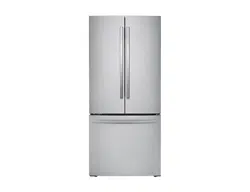
User manual Refrigerator
• Before using your new Samsung Refrigerator, please read this manual thoroughly to ensure that you know how to operate the features and functions of your new appliance safely and efficiently.
• This appliance is not intended for use by persons (including children) with reduced physical, sensory or mental capabilities, or lack of experience and knowledge, unless they have been given supervision or instruction concerning use of the appliance by a person responsible for their safety. Children should be supervised to ensure that they do not play with the appliance.
• Because the following instructions cover various models, the characteristics of your refrigerator may differ slightly from those described in this manual.
• If you have any questions, call your nearest contact center or find help and information online at www.samsung.com.
• Use R-600a or R-134a as a refrigerant. Check the compressor label on the back of the appliance or the rating label inside the fridge to see which refrigerant is used for your refrigerator. If this product contains flammable gas (Refrigerant R-600a), contact your local authority in regard to safe disposal of this product.
• It is hazardous for anyone other than an Authorized Service Person to service this appliance.
Severe warning signs for installation
• Do not install the refrigerator in a damp place or place where it may come in contact with water.
- Deteriorated insulation of electrical parts may cause an electric shock or fire.
• Do not place this refrigerator in direct sunlight or expose to the heat from stoves, room heaters, or other appliances.
• Do not plug several appliances into the same multiple power board. The refrigerator should always be plugged into its own individual electrical outlet which has a voltage rating that matches the rating plate.
- This provides the best performance and also prevents overloading of house wiring circuits, which could cause a fire hazard from overheated wires.
• If the wall socket is loose, do not insert the power plug.
- There is a risk of electric shock or fire.
• Do not use a cord that shows cracks or abrasion damage along its length or at either end.
• Do not bend the power cord excessively or place heavy articles on it.
• Do not twist or tie the power cord.
• Do not hook the power cord over a metal object, place a heavy object on the power cord, insert the power cord between objects, or push the power cord into the space behind the appliance.
- When moving the refrigerator, be careful not to roll over or damage the power cord.
- This may result in an electric shock or fire.
• Never unplug your refrigerator by pulling on the power cord. Always grip the plug firmly and pull straight out from the outlet.
- Damage to the cord may cause a short-circuit, fire and/or electric shock.
• Do not use aerosols near the refrigerator.
- Aerosols used near the refrigerator may cause an explosion or fire.
• Do not install this appliance near a heater, inflammable material.
• Do not install this appliance in a humid, oily or dusty location, in a location exposed to direct sunlight and water (rain drops).
• Do not install this appliance in a location where gas may leak.
- This may result in an electric shock or fire.
• This appliance must be properly grounded. Do not ground the appliance to a gas pipe, plastic water pipe, or telephone line.
- The refrigerator must be grounded to prevent any power leakages or electric shocks caused by current leakage from the refrigerator.
- This may result in an electric shock, fire, explosion, or problems with the product.
- Never plug the power cord into a socket that is not grounded correctly and make sure that it is in accordance with local and national codes. This appliance should be positioned in such a way that it is accessible to the power plug.
- Failing to do so may result in an electric shock or fire due to electric leakage.
• This refrigerator must be properly installed and located in accordance with the manual before it is used.
• Connect the power plug in the proper position with the cord hanging down.
- If you connect the power plug upside down, the wire can get cut off and cause a fire or electric shock.
• When moving the refrigerator, be careful not to roll over or damage the power cord.
- This constitutes a fire hazard.
• Make sure that the power plug is not squashed or damaged by the back of the refrigerator.
• Keep the packing materials out of reach of children.
- There is a risk of death from suffocation if a child puts the packing materials on his or her head.
• The appliance must be positioned so that the plug is accessible after installation.
• You need to remove all the protective plastic film before you initially plug the product in.
• When disposing of this or other refrigerator/s, remove the door/door seals, door latch so that children or animals cannot become trapped inside. Children should be supervised to ensure that they do not enter and play with the appliance.
- If trapped inside, the child may become injury and suffocate to death.
• The refrigerator must be safely grounded.
- Always make sure that you have grounded the refrigerator before attempting to investigate or repair any part of the appliance. Power leakages can cause severe electric shock.
• Never use gas pipes, telephone lines or other potential lightning attractors as an electrical ground.
• Improper use of the grounding plug can result in a risk of electric shock. If it is necessary to use an extension cord, use only a 3-wire extension cord that has a 3-blade grounding plug and a 3-slot receptacle that will accept the plug on the appliance. The marked rating of the extension cord should be AC115-120 V, 10 A, or more. If a grounding adapter is used, make sure the receptacle box is fully grounded.
• If the products is equipped with the LED Lamp, do not disassemble Lamp Cover and LED Lamp by yourself. Please contact your service agent.
• Use only the LED Lamps provided by manufacturer or service agent.
• If the power cord is damaged, have it replaced immediately by the manufacturer or its service agent.
• The wall socket must be easily accessible so that the appliance can be quickly disconnected from the wall socket in an emergency. It must be outside the area of the rear of the appliance.
• When positioning the appliance, ensure the power cord is not trapped or damaged.
• Do not locate multiple portable socket-outlets or portable power supplies at the rear of the appliance.
• Do not store explosive substances such as aerosol cans with a flammable propellant in this appliance.
Installation cautions
• Allow sufficient space to install the refrigerator on a flat surface.
- If your refrigerator is not level, the internal cooling system may not work correctly.
• Keep the ventilation space in the appliance enclosure or mounting structure clear of obstruction.
• Allow the appliance to stand for 2 hours after installation.
• We recommend you have installed this refrigerator by a qualified technician or service company.
- Failing to do so may result in an electric shock, fire, explosion, problems with the product, or injury.
• WARNING - Improper use of the grounding plug can result in a risk of an electric shock.
• If it is necessary to use an extension cord, use only a 3-wire extension cord that has a 3-blade grounding plug and a 3-slot receptacle that will accept the plug on the appliance. The marked rating of the extension cord should be AC115-120 V, 10 A, or more. If a grounding adapter is used, make sure the receptacle box is fully grounded.
• Plug the power plug into the wall socket firmly. Do not use a damaged power plug, damaged power cord or loose wall socket.
- This may result in an electric shock or fire.
• Do not plug several appliances into the same multiple power board. The refrigerator should always be plugged into its own individual electrical outlet which has a voltage rating that matched the rating plate.
- This provides the best performance and also prevents overloading house wiring circuits, which could cause a fire hazard from overheated wires.
• Connect the power plug in proper position with the cord hanging down.
- If you connect the power plug upside down, wire can get cut off and cause fire or electric shock.
• Do not pull or excessively bend the power cord.
• Do not twist or tie the power cord.
• Do not hook the power cord over a metal object, place a heavy object on the power cord, insert the power cord between objects, or push the power cord into the space behind the appliance.
- When moving the refrigerator, be careful not to roll over or damage the power cord.
- This may result in an electric shock or fire.
• Do not install this appliance near a heater, inflammable material.
• Do not install this appliance in a humid, oily or dusty location, in a location exposed to direct sunlight and water (rain drops).
• Do not install this appliance in a location where gas may leak.
- This may result in an electric shock or fire.
• Do not attempt to repair, disassemble, or modify the appliance yourself.
- Do not use any fuse(such as copper, steel wire, etc.) other than the standard fuse.
- When repairing or reinstalling the appliance is required, contact your nearest service center.
- Failing to do so may result in an electric shock, fire, problems with the product, or injury.
• If any dust or water is in Refrigerator, pull out power plug and contact your Samsung Electronics service center.
- Otherwise there is a risk of fire.
• If gas leak is detected, avoid any naked flames or potential sources of ignition and air the room in which the appliance is standing for several minutes.
Critical usage warnings
• Do not insert the power plug with wet hands.
• Do not store articles on the top of the appliance.
- When you open or close the door, the articles may fall and cause personal injury and/or material damage.
• Do not put a container filled with water on the refrigerator.
- If spilled, there is a risk of fire or electric shock.
• Children should be supervised to ensure that they do not play with the appliance.
- Keep fingers out of "pinch point" areas: clearances between the doors and cabinet are necessarily small. Be careful when you open the doors when children are in the area.
- Do not let children hang on the door. A serious injury may occur.
- There is a Risk of children entrapment. Do not let children enter inside the refrigerator.
• Never put fingers or other objects into the dispenser hole, ice chute and ice maker bucket.
- It may cause a personal injury or material damage.
• Do not use or place any substances sensitive to temperature such as inflammable sprays, inflammable objects, dry ice, medicine, or chemicals near or inside of the refrigerator.
• Do not keep volatile or inflammable objects or substances (benzene, thinner, propane gas, alcohol, ether, LP gas and other such products etc.) in the refrigerator.
- This refrigerator is for storing food only.
- This may result in fire or explosion.
• Do not store pharmaceuticals products, scientific materials or temperature-sensitive products in the refrigerator.
- Products that require strict temperature controls must not be stored in the refrigerator.
• Do not place or use electrical appliance inside the refrigerator/freezer, unless they are of a type recommended by the manufacturer.
• If you smell pharmaceutical or smoke, pull out power plug immediately and contact your Samsung Electronics service center.
• Do not let children go inside the refrigerator. Children could become trapped.
• Do not insert your hands into the bottom area under the appliance.
- Any sharp edges may cause personal injury.
• Do not let children step on a drawer's cover.
- The drawer may break and cause them to slip.
• Do not overfill the refrigerator with food.
- When you open the door, an item may fall out and cause personal injury or material damage.
• Do not touch the inside walls of the freezer or products stored in the freezer with wet hands.
- This may cause frostbite.
• Never put fingers or other objects into the water dispenser hole, ice chute, or ice maker bucket.
- It may cause personal injury or material damage.
• Do not spray flammable gas near the refrigerator. There is a risk of explosion or fire.
• Do not store volatile or flammable substances in the refrigerator. The storage of benzene, thinner, alcohol, ether, LP gas and other such products may cause explosions.
• Do not store pharmaceuticals products, scientific materials, or temperature sensitive products in the refrigerator. Products that require strict temperature controls must not be stored in the refrigerator.
• Do not place or use an electrical appliance inside the refrigerator, unless it is of a type recommended by the manufacturer.
• Do not stand on top of the appliance or place objects (such as laundry, lighted candles, lighted cigarettes, dishes, chemicals, metal objects, etc.) on the appliance. This may result in an electric shock, fire, problems with the product, or injury.
• Do not put a container filled with water on the appliance. If spilled, there is a risk of fire or electric shock.
• Do not use mechanical devices or any other means to accelerate the defrosting process, other than those recommended by the manufacturer.
• Do not damage the refrigerant circuit.
• Do not spray volatile material such as insecticide onto the surface of the appliance. As well as being harmful to humans, it may also result in an electric shock, fire or problems with the product.
• Never stare directly at the UV LED lamp for long periods of time. This may result in eye strain due to the ultraviolet rays.
• Keep ventilation opening in the appliance enclosure or mounting structure clear of obstruction.
• The installation or any service of this appliance is recommended by a qualified technician or service company. Failing to do so may result in an electric shock, fire, explosion, problems with the product, or injury.
• Do not touch the power plug with wet hands. This may result in an electric shock.
• Do not disassemble or repair the refrigerator by yourself. You run risk of causing a fire, malfunction and/or personal injury.
• When the interior or exterior LED lamp has gone out, please contact your service agents.
• Children should be supervised to ensure that they do not play with the appliance.
• Keep fingers out of "pinch point" areas: clearances between the doors and cabinet are necessarily small. Be careful when you open the doors when children are in the area. Do not let children hang on the door. If not, a serious injury may occur. Risk of children entrapment. Do not let children enter inside the refrigerator.
• Bottles should be stored tightly together so that they do not fall out.
• This product is intended only for the storage of food in a domestic environment.
• If a gas leak is detected, avoid any naked flames or potential sources of ignition and air the room in which the appliance is standing for several minutes.
- Do not touch the appliance or power cord.
- Do not use a ventilating fan.
- A spark may result in explosion or fire.
• Use only the LED Lamps provided by manufacturer or service agents.
• If there are burning smells or smoke, pull out power plug immediately and contact your Samsung Electronics service center.
• If you experience difficulty when changing the light, contact a service agent.
• If the product is equipped with LED Lamps, do not disassemble the Lamp Cover and LED Lamp by yourself. Please contact your service agents.
• If any dust or water is in refrigerator, pull out the power plug and contact your Samsung Electronics service center. Otherwise there is a risk of fire.
a) Allow the appliance to stand for 2 hours after installation.
b) To get Best performance from the product,
1) Do not place foods too closely in front of the vents at the rear of the appliance as it can obstruct free air circulation in the freezer compartment.
2) Wrap the food up properly or place it in airtight containers before putting it into the fridge or freezer.
3) Do not put any newly introduced food for freezing near to already existing food.
c) Do not place glass or bottles or carbonated beverages into the freezer. The container may freeze and break, and this may result in injury.
d) Please observe maximum storage times and expiry dates of frozen goods.
e) There is no need to disconnect the refrigerator from the power supply if you will be away for less than three weeks. But, Remove all the food if you are going away for the three weeks or more. Unplug the refrigerator and clean it, rinse and dry.
Usage cautions
• Do not re-freeze frozen foods that have thawed completely. Do not place carbonated or fizzy drinks in the freezer compartment. Do not put bottles or glass containers in the freezer.
- When the contents freeze, the glass may break and cause personal injury.
• Use only the ice maker provided with the refrigerator. The water supply to this refrigerator must only be installed/connected by a suitably qualified person and connected to a potable water supply only. In order to operate the ice maker properly, water pressure of 20 ~ 125 psi is required. If you have a long vacation or business trip and won't use water or ice dispensers, close the water valve.
- Otherwise, water leakage may occur.
• Wipe excess moisture from the inside and leave the doors open.
- Otherwise, odor and mold may develop.
• Take out the right box in the refrigerator after removing the guard(LMF-RL22*)
• Do not apply strong shock or excessive force on to the surface glass.
- Broken glass may result in a personal injury and property damage.
• Service warranty and Modification.
- Any changes or modifications performed by a 3rd party on this finished appliance are not covered under Samsung warranty service, nor can Samsung be responsible for safety issues that result from 3rd party modifications.
• Do not block air holes.
- If the air holes are blocked, especially with a plastic bag, the refrigerator can be over cooled. If this cooling period lasts too long, the water filter may break and cause water leakage.
• If the refrigerator is disconnected from the power supply, you should wait for at least five minutes before plugging it back in.
• If you have a long vacation planned or the refrigerator is not to be used for a long period of time, you must empty the refrigerator and pull out the power plug.
- Letting the refrigerator run for a long time without using it can cause the insulation to deteriorate and may cause a fire.
- Wipe excess moisture from the inside and leave the doors open. Otherwise, odor and mold may develop.
• To get the best performance from the product:
- Do not place foods too close to the vents at the rear of the appliance as it can obstruct free air circulation in the refrigerator compartment.
- Wrap food up properly or place it in airtight containers before putting it into the refrigerator.
• Fill the water tank, ice tray, and water cubes only with potable water.
• If the product is flooded, make sure to contact your nearest service center.
- There is a risk of electric shock or fire.
• Do not keep vegetable oil in your refrigerator's door bins. The oil can solidify, making it foul-tasting and difficult to use. In addition, the open container can leak and the leaked oil can cause the door bin to crack. After opening an oil container, it is best to keep the container in a cool and shaded place such as a cupboard or pantry.
- Examples of vegetable oil: olive oil, corn oil, grape-seed oil, etc.
Cleaning cautions
• Do not directly spray water on the inside or outside the refrigerator.
- There is a risk of fire or electric shock.
• Do not use a hair dryer to dry the inside of the refrigerator. Do not place a lighted candle in the refrigerator to remove bad odors.
- This may result in an electric shock or fire.
• Remove any foreign matter or dust from the power plug pins. Do not use a wet or damp cloth when cleaning the plug.
- Otherwise, there is a risk of fire or electric shock.
• Unplug the refrigerator before cleaning or making repairs.
• Remove all foreign substances such as dust or water from the power plug terminals and contact points using a dry cloth on a regular basis.
- Unplug the power plug and clean it with a dry cloth.
- Failing to do so may result in an electric shock or fire.
• Before cleaning or performing maintenance, unplug the appliance from the wall socket.
- Failing to do so may result in an electric shock or fire.
• Do not clean the appliance by spraying water directly onto it.
• Do not use benzene, thinner or alcohol to clean the appliance. This may result in discoloration, deformation, damage, electric shock or fire.
• Do not spray inflammable gas near the refrigerator. There is a risk of explosion or fire.
• Install the appliance in a cool, dry room with adequate ventilation. Ensure that it is not exposed to direct sunlight and never put it near a direct source of heat (radiator, for example).
• Never block any vents or grilles on the appliance. Allow warm food to cool down before placing it in the appliance.
• Put frozen food in the refrigerator to thaw. You can then use the low temperatures of the frozen products to cool food in the refrigerator.
• Do not keep the door of the appliance open for too long when putting food in or taking food out. The shorter time for which the door is open, the less ice will form in the freezer.
• Allow clearance to the right, left, back and top when installing. This will help reduce power consumption and keep your energy bills lower.
• In the event of a power failure, call the local office of your Electricity Company and ask how long it is going to last. Most power failures that are corrected in an hour or two will not affect your refrigerator temperatures. However, you should minimize the number of door openings while the power is off. But Should the power failure last more than 24 hours, remove all frozen food.
• If the key is provided with refrigerator, the keys should be kept out of the reach of children and not be in the vicinity of the appliance.
• The appliance might not operate consistently (possibility of defrosting of contents or temperature becoming too warm in the frozen food compartment) when sited for an extended period of time below the cold end of the range of temperatures for which the refrigerating appliance is designed.
• Do not store food which goes bad easily at low temperature, such as bananas, melons.
• Your appliance is frost free, which means there is no need to manually defrost your appliance, as this will be carried out automatically. Temperature rise during defrosting can comply with ISO requirements. But if you want to prevent an undue rise in the temperature of the frozen food while defrosting the appliance, please wrap the frozen food up in several layers of newspaper. Any increase in temperature of frozen food during defrosting can shorten its storage life.
• Do not re-freeze frozen foods that have thawed completely.
• Install the appliance in a cool, dry room with adequate ventilation. Ensure that it is not exposed to direct sunlight and never put it near a direct source of heat (radiator, for example).
• Never block any vents or grilles on the appliance. Allow warm food to cool down before placing it in the appliance.
• Put frozen food in the refrigerator to thaw. You can then use the low temperatures of the frozen products to cool food in the refrigerator.
• Do not keep the door of the appliance open for too long when putting food in or taking food out. The shorter time for which the door is open, the less ice will form in the freezer.
• Allow clearance to the right, left, back and top when installing. This will help reduce power consumption and keep your energy bills lower.
• To get the best energy efficiency of this product, please leave all selves, drawers and baskets on their original position like as above illustration.
• Use only the ice maker provided with the refrigerator. The water supply to this refrigerator must only be installed/connected by a suitably qualified person and connected to a potable water supply only. In order to operate the ice maker properly, water pressure of 0.1~0.7 MPa is required. If you have a long vacation or business trip and won't use water or ice dispensers, close the water valve. Otherwise, water leakage may occur.
• Wipe excess moisture from the inside and leave the doors open. Otherwise, odor and mold may develop.
• Never stare directly at the UV LED lamp for long periods of time. This may result in eye strain due to the ultraviolet rays.
• Do not allow babies or children go inside the drawer. It can cause death from suffocation by entrapment or a personal injury.
• Do not sit on the Freezer door. The door may be broken and cause a personal injury.
• To prevent children entrapment, you must reinstall the divider using provided screw after cleaning or other actions if you removed the divider from the drawer.
• When you use this function the energy consumption of the refrigerator will increase. Remember to turn it off when you don't need it and return the freezer to your original temperature setting.
• If you need to freeze a large amount of food, activate the Power Freeze function at least 24 hours before.
Important disposal warning
• Risk of child entrapment. Before you throw away your old refrigerator or freezer:
- Take off the doors.
- Leave the shelves in place so that children may not easily climb inside.
• Please dispose of the packaging material from this product in an environmentally friendly manner.
• Ensure that none of the pipes on the back of the appliance are damaged prior to disposal. The pipes shall be broken in the open space.
• R-600a or R-134a is used as a refrigerant. Check the compressor label on the back of the appliance or the rating label inside the fridge to see which refrigerant is used for your refrigerator. If this product contains flammable gas (Refrigerant R-600a), contact your local authority in regard to safe disposal of this product.
• When disposing of this refrigerator, remove the door/door seals and door latch so that young children or animals cannot become trapped inside. Children should be supervised to ensure that they do not play with the appliance.
• Cyclopentane is used as in the insulation. The gases in the insulation material require a special disposal procedure. Please contact your local authorities in regard to the environmentally safe disposal of this product. Ensure that none of the pipes on the back of the appliance are damaged prior to disposal. The pipes shall be broken in the open space.
This appliance is intended to be used in household and similar applications such as
• staff kitchen areas in shops, offices and other working environments;
• farm houses and by clients in hotels, motels and other residential type environments;
• bed and breakfast type environments;
• catering and similar non-retail applications.
Setting up your French Door Refrigerator
Getting ready to install the refrigerator
Congratulations on your purchase of this Samsung French Door Refrigerator. We hope you enjoy the state-of-the-art features and efficiencies that this new appliance offers.
Selecting the best location for the refrigerator
• A location with easy access to a water supply.
• A location without direct exposure to sunlight.
• A location with a level floor.
• A location with enough space for the refrigerator doors to open easily.
• A location that allows sufficient space to the right, left, back and top for air circulation.
• A location that allows you to move the refrigerator easily if it needs maintenance or service.
• Do not install the refrigerator where the temperature will go below 50°F (10°C).
• Do not locate the refrigerator where it may become wet.
If your refrigerator has an ice maker, allow extra space at the back for the water line connections.
When moving your refrigerator
To prevent floor damage, be sure the front adjusting legs are in the up position (above the floor). Refer to 'Adjusting the Level' in the manual (on page 15).
First thing! Make sure that you can easily move your refrigerator to its final location by measuring doorways (both width and height), thresholds, ceilings, stairways, etc.
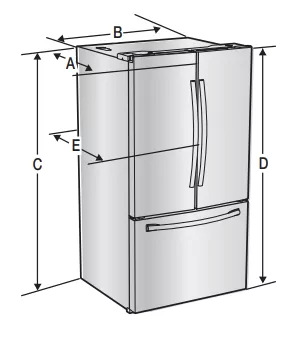
| Model |
RF220** / RF221** |
| Depth "A" |
34 3/4" (884 mm) |
| Width "B" |
29 3/4" (758 mm) |
| Height "C" |
65 1/4" (1655 mm) |
| Overall Height "D" |
66 3/4" (1695 mm) |
| Depth "E" |
37 1/4" (944 mm) |
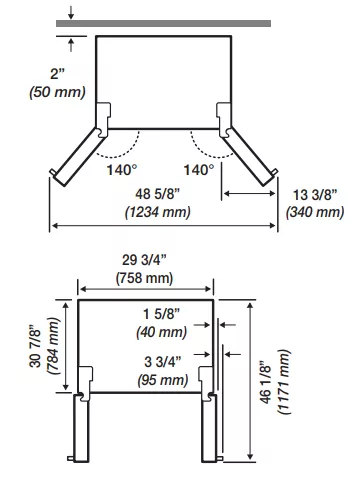
The measurements here are based on the design dimension, which may differ depending on the measuring method.
Flooring
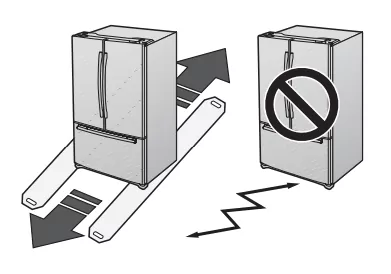
For proper installation, you must place this refrigerator on a level, hard surface that is the same height as the rest of the floor. This surface should be strong enough to support a fully loaded refrigerator, or approximately 286.6 lbs (130 kg). To protect the finish of the flooring, cut a large section of the cardboard carton and place it under the refrigerator where you are working. When moving the refrigerator, you need to pull and push it straight forwards or back. Do not wiggle it from side to side.
Accessories and required tools
The following accessories are included with your refrigerator: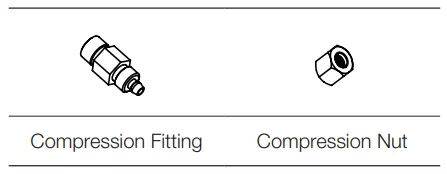
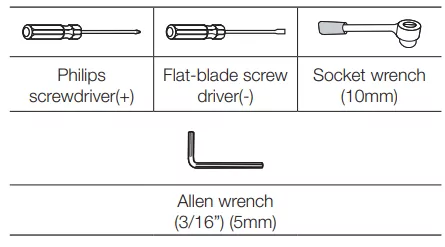
Required Tools (Not provided):
You need the following tools to complete the installation of your refrigerator:
Removing the refrigerator doors
Before removing the door/drawer, make sure you read the following items:
Disconnect power to the refrigerator before removing the door or drawer.
Be careful not to drop, damage or scratch the door/drawer while removing them. Be careful not to get injured while removing the door/drawer. Reattach the door/drawer properly to avoid: Moisture from air leakage. Uneven door alignment. Wasting energy due to improper door seal.
Disassembling the fridge door
Be careful not to drop and scratch the doors while removing the doors.
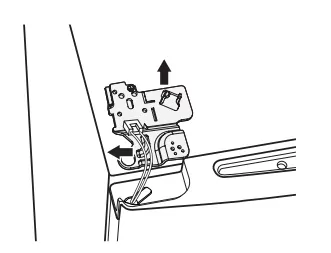
- Remove the 3 screws holding down the top table and remove it.
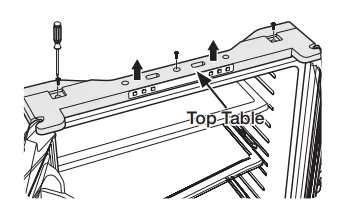
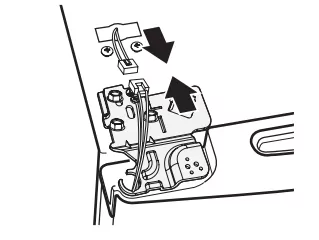
- Disconnect electric wire on the top of the refrigerator.
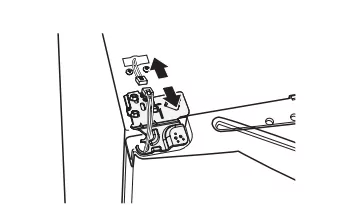
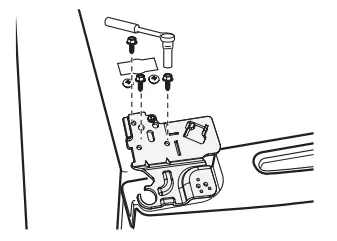
- Remove the 3 hex bolts that hold the hinge on the top of the refrigerator with the 10 mm socket wrench.
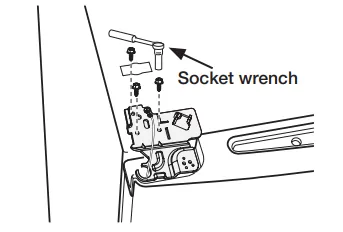
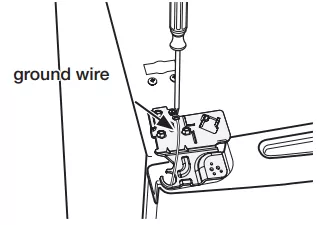
- Remove the screw that holds the ground wire with a philips screwdriver (+).
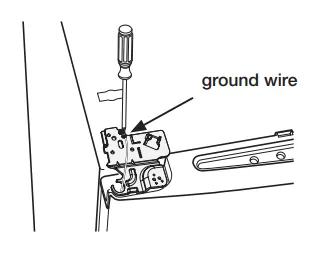
- Separate the hinge from the electric wire and ground wire as shown above.
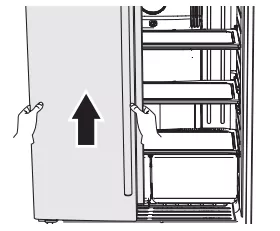
- Lift the door straight up to remove. Be careful not to drop and scratch the doors while removing them.
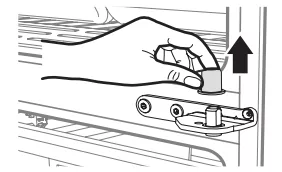
- Separate the cap on the middle hinge.
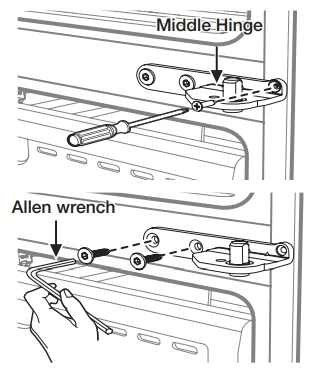
- Remove the screw attached to the left and right middle hinges with a philips screwdriver (+). Remove the 2 hex head bolts attached to the left and right middle hinges with an allen wrench (3/16").
Disassembling the freezer door
- After opening the Freezer door, lift the drawer
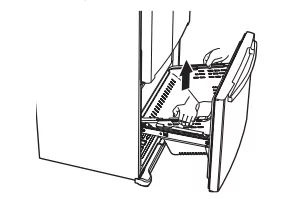
- Remove 4 hex head bolt from both sides with a socket wrench (10mm)
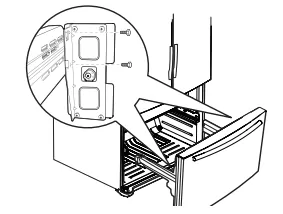
- Remove 4 hex head bolts from both sides with a socket wrench(10 mm).
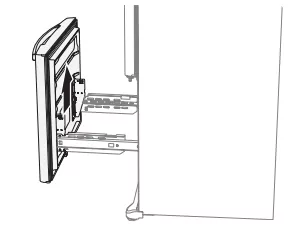
Reassembling the fridge door
- Insert and tighten the screw into the left and right middle hinges with a philips screwdriver (+).
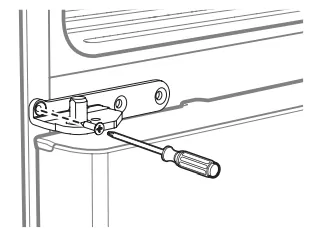
- Insert and tighten the 2 hex head bolts into the left and right middle hinges with an allen wrench(3/16").
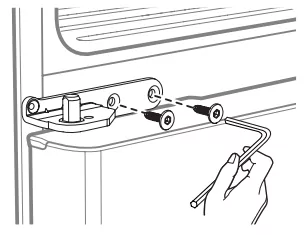
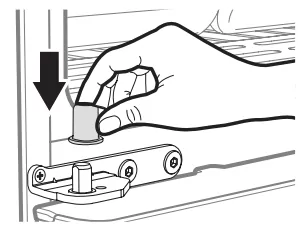
- Replace the middle hinge cap.
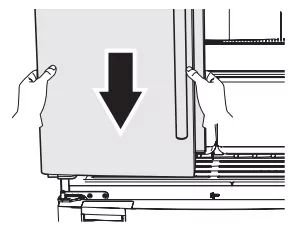
- Place the hole in the bottom of the left door over the middle hinge.
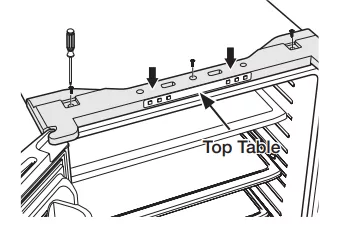
- Position the top table in place. Insert and tighten the 3 screws into the top table with a philips screwdriver (+).
- Insert the left upper hinge shaft into the hole the corner of the fridge door.
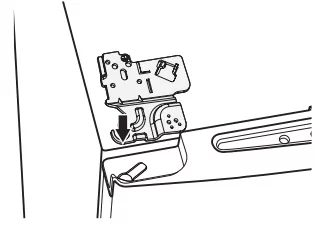
- Insert the upper hinges into the holes at the top of the door. Insert and tighten the 3 hex head bolts into the left and right upper hinges with a socket wrench.
- Insert and tighten the ground screw into the left and right upper hinges with a philips screwdriver (+).
- Connect the electronic wire on the top of the refrigerator.
Reassembling the freezer door
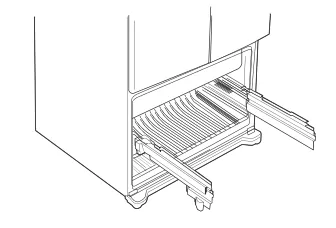
- Pull out the rails to the full length on each side of the cabinet evenly.
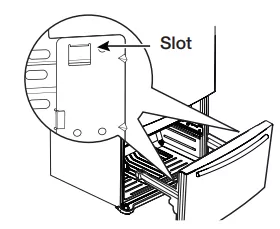
- Hang the freezer door front onto open slot on the sides.
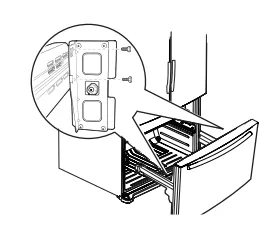
- With the 10mm wrench, reattach 4 bolts to connect the rail with the door.
- With the drawer pulled out fully, insert the drawer box into the rail system.
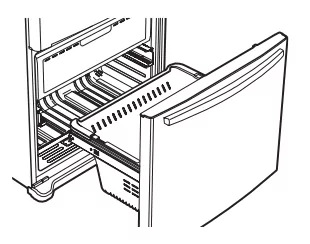
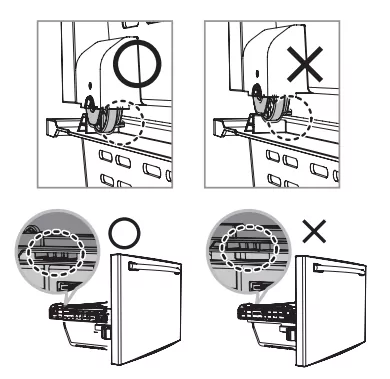
Caution: Be careful not to scratch or dent the sliding rail by letting it strike the floor. Make sure that you mount the freezer basket in the right position when removing / installing the freezer door. Failing to do so may result in the door not opening or closing properly.
Leveling the refrigerator
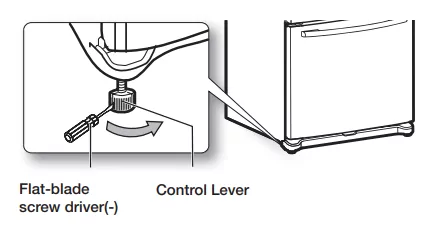
Make sure the refrigerator is level before performing any final adjustments. Use a level to test if the refrigerator is level from side to side and from front to back. If the refrigerator is not level, the doors will not be perfectly aligned, which can cause moisture condensation and higher energy bills. The following instructions explain how to level the refrigerator when the left side of the refrigerator is lower than the right side.
How to adjust the level
- Open the freezer drawer and remove the lower basket.
- Insert a flat-blade screwdriver (-) into the notch on the left control lever, and then turn it counter-clockwise to level the refrigerator. (You turn the lever clockwise to lower the refrigerator and counterclockwise to raise it.)
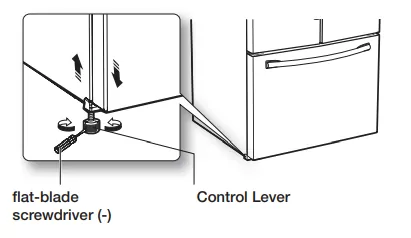
Caution: Both control levers must be touching the floor to avoid possible personal injury or property damage because of tipping.
Note: If the right side is lower, perform the same procedure, but with the right control lever. It is difficult to remove the cover leg front from the refrigerator, so we do not recommend making small adjustments with the control lever. Instead, refer to the next page for the best way to make minor adjustments to the doors.
Making minor adjustments between doors
Remember, a leveled refrigerator is necessary for getting the doors perfectly even. If you need help, review the previous section on leveling the refrigerator.
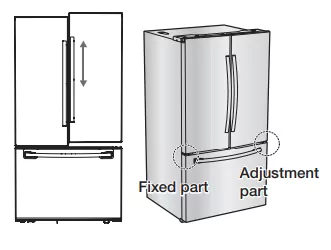
Note: The left door is fixed. To make minor adjustments between doors, adjust only the right door.
- Pull out the freezer drawer (1), then you can see the lower hinge (2).
- Insert a philips screwdriver (+) (3) into the shaft (4) of the lower hinge.
- Adjust the height by turning a philips screwdriver (+) (3) clockwise (
 ) or counterclockwise (
 ).
).
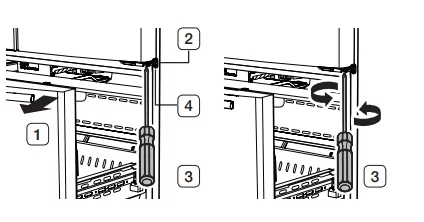
When you turn a philips screwdriver (+) counterclockwise (), the door will move up.
Installation of the water line
Before You Install the water line:
- The water line installation is not warranted by the refrigerator manufacturer. So before you install the water line, read the whole steps for installing and follow these instructions carefully to minimize the risk of expensive water damage.
- Banging pipes (water banging in the pipes) in house plumbing can cause damage to fridge parts and lead to water leakage or flooding. Call a qualified plumber to correct the problem before installing the water supply line to the fridge.
- To prevent burns and product damage, do not hook up the water line to the hot water line.
- Do not install the water line in areas where temperatures fall below freezing.
- When using any electrical device (such as a power drill) during installation, be sure the device is insulated or wired in a manner to prevent electric shock.
- All installations must be in accordance with local plumbing code requirements.
- Note: Water line Kit and water filter are not covered by Samsung's Warranty. The manufacturer (or dealer, installer) of them is responsible for any defects and all the loss caused by water filter & water line kit.
- The filter should be replaced according to manufacturer (or dealer's instruction).
- To order additional water filters, please contact the manufacturer (or dealer) of the filter.
Using the water filter (not provided)
Connecting to water supply line
- Shut off the main water supply line and turn the ice maker to the off position.
- Locate the nearest cold drinking water line.
- Follow the instructions in the water filter installation kit.
- After connecting the water supply line to the Cartridge Holder inlet and installing the Filter Cartridge (insert plastic line in fully).
- Turn on water supply and Flush 3 gallons through filter before use (flush approximately 6 minutes)
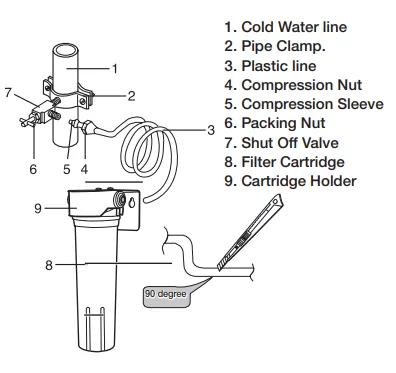
Note:
- The water filter must be installed outside the refrigerator. It is not provided with your new refrigerator. The filter cartridge (8) and holder (9) kit can be purchased from the retailer where you purchased this refrigerator.
- Do not use copper line.
- Cut the tubing, making sure the ends are square and clean.
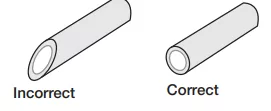
There are several items that you need to purchase to complete this connection. You may find these items sold as a kit at your local hardware store.
| Use Copper Tubing |
Use Plastic Tubing |
| ¼" copper tubing |
¼" plastic tubing → Molded end(Bulb) |
| ¼" compression nut (1pc) |
¼" compression nut (1pc) |
| Ferrule (2pc) |
|
Connect the water line to the fridge
- Connect the plastic line on the back of your fridge to the cartridge holder outlet (fully insert the plastic line to the cartridge holder outlet).
- Insert plastic clip to the cartridge holder inlet and outlet.
- Turn water on and check for any leakage.
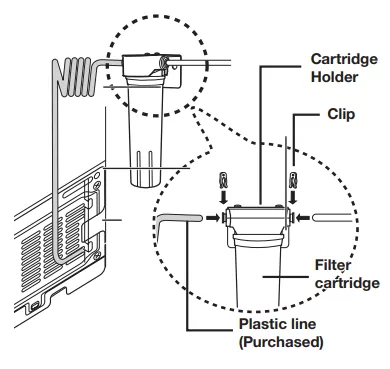
You can purchase the necessary filter cartridge at the retailer where you purchased this refrigerator. Water line must be connected to drinkable water only. When pushing the Refrigerator back, make sure you don't roll over the power cord or water line (Icemaker supply line). Use the new hose-sets supplied with the appliance only. Do not re-use an old hose set. Keep ventilation openings, in the appliance enclosure or in the built-in structure, clear of obstruction. Connect to potable water supply only.
To use without the water filter
Connecting to the water supply line
- Shut to the main water supply line and turn the Ice maker to the off position.
- Locate the nearest cold water drinking line.
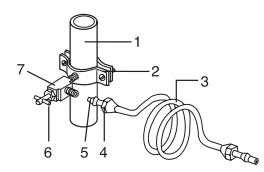
- Cold Water line
- Pipe Clamp.
- Plastic line
- Compression Nut
- Compression Sleeve
- Packing Nut.
- Shut Off Valve
Connect the water line to the fridge
- Slip the compression nut through the plastic tubing.
- After inserting the compression nut into plastic tubing, tighten the compression nut onto 1/4" compression fitting (Purchased).
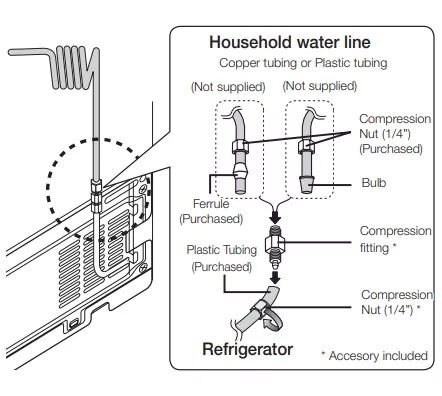
Note: Do not use without the molded end(Bulb) of the plastic tubing.
Using Copper Tubing: Slip the compression nut and ferrule on copper tubing as shown. Using Plastic Tubing: Insert the molded end(Bulb) of the plastic tubing into the compression fitting.
- Tighten the compression nut onto the compression fitting.
- Turn water on and check for any leakage.
Note: You can purchase the necessary filter cartridge at the retailer where you purchased this refrigerator. Water line must be connected to drinkable water only. When pushing the Refrigerator back, make sure you don't roll over the power cord or water line (Icemaker supply line).
Connecting the water supply line to the refrigerator
- Tighten the compression nut (B) onto the compression fitting. Do not over-tighten the compression nut (B).
- Turn water on and check for any leakage. If you find water drops or leakage in the connection areas, turn off the main water supply. Check the connections and, if necessary, tighten.
- Flush 1 gallon of water through the filter before drinking or using the water from the refrigerator. (Flush approximately 6 minutes.) To flush, press a large glass or cup against the water dispenser lever. Fill the glass, empty it into the kitchen sink after it is filled, and then repeat.
- After you turn on the refrigerator, let the ice maker make ice for 1 to 2 days. Over that period of time, throw out the first 1 or 2 buckets of ice the freezer makes to ensure all impurities have been removed from the water line.
Note: Only connect the water line to a drinkable water source. If you have to repair or disassemble the water line, cut off 1/4" of the plastic tubing to make sure you get a snug, leak-free connection.
Completing the set up
Now that you have your new refrigerator installed in place, you are ready to set up and enjoy the features and functions of the appliance. By completing the following steps, your refrigerator should be fully operational.
- Make sure your refrigerator is in an appropriate location with reasonable clearance between it and the wall. Refer to installation instructions in this manual.
- Once the refrigerator is plugged in, make sure the interior light comes on when you open the doors.
- Set the Temperature control to the coldest temperature and wait for an hour. The freezer will get slightly chilled and the motor will run smoothly. Reset the refrigerator and freezer to the temperatures you want.
- After you plug the refrigerator in, it will take a few hours to reach the appropriate temperature. You can store food and drinks in the refrigerator after the temperature is sufficiently cool.
Operating your French Door Refrigerator
CHECKING THE CONTROL PANEL
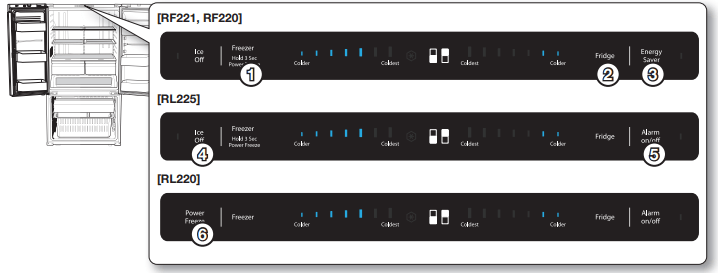
|
( 1 )
Freezer (Hold 3 sec for Power Freeze)
|
Press the Freezer button to set the freezer temperature between colder and coldest. Press and hold the Freezer button for 3 seconds to activate Power Freezer function which speeds up the freezing process in the freezer. |
|
( 2 )
Fridge
|
Press the Fridge button to set the Fridge temperature between cold and coldest. |
|
( 3 )
Energy Saver
|
For better energy efficiency, press the Energy Saver button. If condensation occurs on the doors, turn the Energy Saver Button function off. |
|
( 4 )
Ice Of
|
If you don’t want to make more ice, Press the Ice Off button. The LED will light up and the Ice-Maker stops making ice. |
|
( 5 )
Alarm On/Of
|
Press the Alarm On/Off button to turn the door open alarm on and off. |
|
( 6 )
Power Freeze
|
Press this button to activate Power Freezer function which speeds up the freezing process in the freezer. |
USING THE CONTROL PANEL
Freezer/Fridge (Temperature adjustment)
Press the Freezer or Fridge button until the desired temperature is set. For lower temperature, press the Freezer or Fridge button until more LED lights (coldest). For higher temperature, press the Freezer or Fridge button until less LED lights (colder).
Each time you press the Freezer or Fridge button, temperature indicator will change in below order.
Power Freeze
RF221 / RF220 / RL225
This icon will light up when you activate the Power Freeze function. Power Freeze function generates cool air for 50 hours continuously and it makes the inside of the refrigerator cool faster. This function is useful when you make ice more quickly.
When you have enough, just press and hold the Freeze (Hold 3 sec for Power Freeze) button again for 3 seconds to cancel the Power Freeze function.
RL220
This icon will light up when you activate the Power Freeze function. Power Freeze function generates cool air for 50 hours continuously and it makes the inside of the refrigerator cool faster. When you have enough, just press the Power Freeze button again to cancel the Power Freeze function.
When you use this function the energy consumption of the refrigerator may increase. Remember to turn it o when you do not need it and return the freezer to your original temperature setting.
Energy Saver
This LED will light up when you activate the Energy Saver function. The Energy Saver function is automatically set to “ON” when power is supplied to the Refrigerator. If condensation occurs on the doors, turn the Energy Saver function off.
In some places, water drop may be generated on the door part. In this case, it is recommended to turn o the Energy saver function.
Ice Of
This LED will light up when you activate the Ice Off function. In this case, the ice will not be produced.
Alarm On/Off
If the door alarm is set to On, an alarm beeps if any refrigerator door is left open for more than three minutes. The beeping stops when you close the door. The door alarm function is pre-set to On in the factory. You can turn it o by touching and then releasing this button. You can turn it back on in the same fashion. The LED lights up when the function is on.
Canceling cooling off mode (Freezer/ Fridge Temperature Indicator moving)
Cooling o function is for store display, and it makes the refrigerator not to generate cool air. (Only for product sold in U.S)
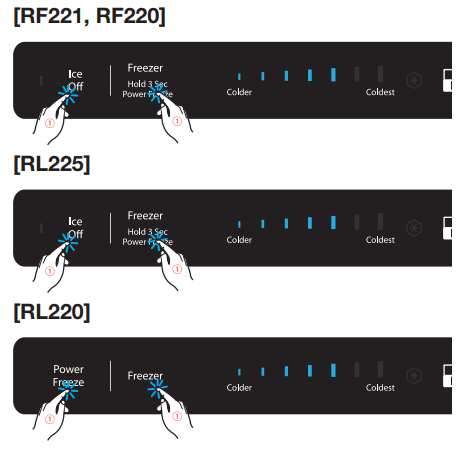
In case of Cooling o Mode, refrigerator may seem like working but it does not make cool air. To cancel this mode, press the “Cooling Off Key” at the same time for 5 seconds until “Ding-dong” sounds.
COOLING OFF KEY
RF221, RF220, RL225 Model :
Ice Off + Freezer Key
RL220 Model :
Power Freeze + Freezer Key
Reverse Osmosis Water Supply
IMPORTANT :
The pressure of the water supply coming out of a reverse osmosis system going to the water inlet valve of the refrigerator needs to be between 35 and 120 psi (241 and 827 kPa).
If a reverse osmosis water filtration system is connected to your cold water supply, the water pressure to the reverse osmosis system needs to be a minimum of 40 to 60 psi (276 to 414 kPa.) If the water pressure to the reverse osmosis system is less than 40 to 60 psi (276 to 414 kPa):
- Check to see whether the sediment filter in the reverse osmosis system is blocked. Replace the filter if necessary.
- Allow the storage tank on the reverse osmosis system to refill after heavy usage.
- If your refrigerator has a water filter, it may further reduce the water pressure when used in conjunction with a reverse osmosis system. Remove the water filter.
If you have questions about your water pressure, call a licensed, qualified plumber.
USING THE COLD WATER DISPENSER
Using the Water dispenser (RF221**)
Place a glass underneath the water outlet and push gently against the water dispenser lever with your glass. Make sure the glass is in line with the dispenser to prevent the water from splashing out.
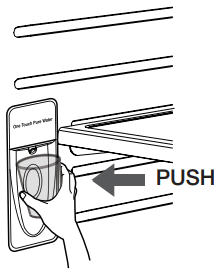
If you have just installed the refrigerator or installed a new water filter, Flush 11 L through filter before use (flush approximately 6 minutes). Make sure water flows cleanly before drinking.
Caution: If you have a long vacation or business trip, close the water valve and shut off the water supply to the Refrigerator. This will help prevent accidental leakages.
Note:
- Water clouding phenomenon
- All water provided to refrigerators flows through the core filter which is an alkaline water filter. In this process, the pressure in the water that has flowed out of the filter gets increased, and oxygen and nitrogen become saturated. When this water flows out in the air, the pressure plummets and the oxygen and nitrogen get supersaturated so that they turn into gas bubbles. The water could look misty due to these oxygen bubbles. The water may look temporarily cloudy due to these oxygen bubbles. After a few seconds, the water will look clear.
- The water tank’s capacity is approximately 1 L.
- Please wait 1 second before removing the cup after dispensing water to prevent spills.
PARTS AND FEATURES
Use this page to become more familiar with the parts and features of the refrigerator.
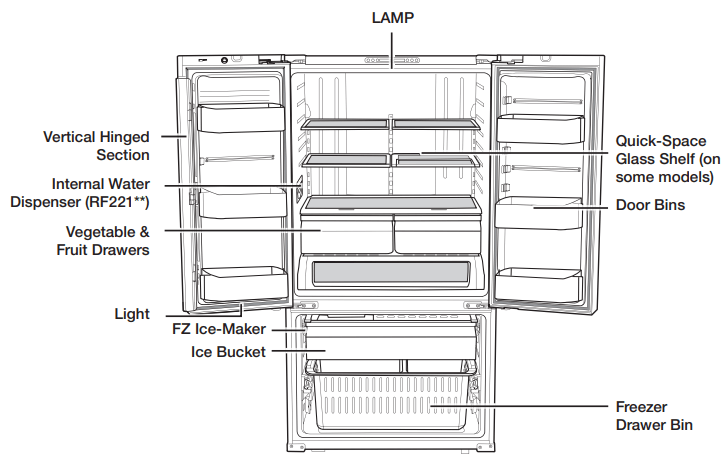
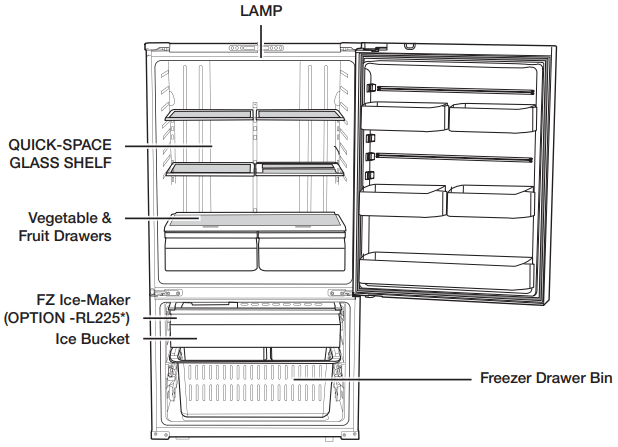
Note:
- When closing the door, make sure the Vertical Hinged Section is in the correct position to avoid scratching the other door.
- If the Vertical Hinged Section is reversed, put it back to the right position and close the door.
- Moisture may appear at times on the Vertical Hinged Section.
- The door handle may become loose over time. If this happens, tighten the bolts found on the inside of the door.
- If you close one door with a lot of force, the other door may open.
- When the interior or exterior LED lamp has gone out, please contact your service agents.
REMOVING THE REFRIGERATOR ACCESSORIES
1. Door Bins
Door Bins
To remove - Simply lift the bin up and pull straight out.
To relocate - Slide it in above the desires location and push down until it stops.
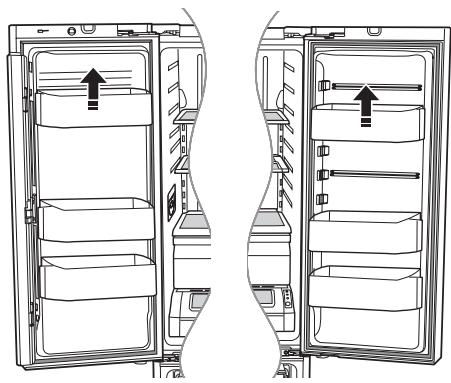
Note:
- Injury may occur if the door bins are not firmly assembled.
- Do not allow children to play with bins. Sharp corners of the bins may cause injury.
Caution: Do not adjust a bin full of food. Remove the food first. Dust removal method - Remove the guard and wash in water.
2. Tempered Glass shelves
To remove - Tilt up the front of the shelf in the direction shown ( 1 ) and lift it up vertically ( 2 ). Pull the shelf out.
To relocate - Tilt the front of the shelf up and guide the shelf hooks into the slots at a desired eight. Then lower the front of the shelf so that the hooks can drop into the slots.
Caution: The Tempered Glass shelves are heavy. Use special care when removing them.
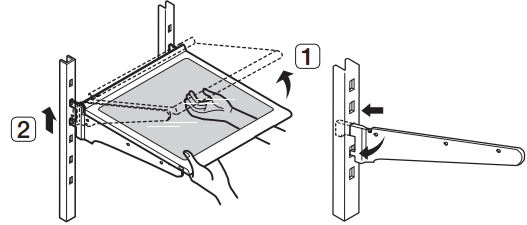
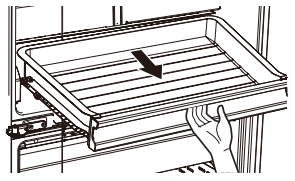
3. Vegetable & Fruit Drawers
To remove - Pull the drawer out to full extension. Tilt up the front of the drawer and pull straight out.
To relocate - Insert the drawer into the frame rails and push back into place.
Caution: The drawers need to be removed before the glass shelf above them can be lifted out.
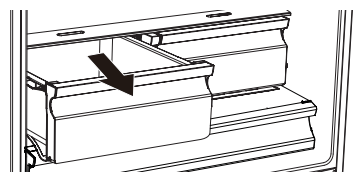
4. Pantry (applicable models only)
To remove the Pantry – Pull the pantry out to full extension. Tilt up the front side of the pantry and pull straight out.
Using the doors
Ensure that the doors close all the way and are securely sealed.
When the refrigerator door is only partially open, it will automatically close. But, the door will stay open when opened more than the auto close range and you must close it manually.
REMOVING THE REFRIGERATOR ACCESSORIES
1. ICE BUCKET
To remove - Lift the ice bucket ( 1 ).
To relocate - Place the ice bucket into the Super extended drawer ( 2 ).
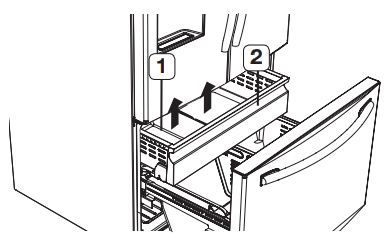
2. Super Extended Drawer
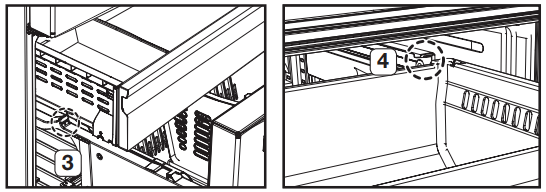
To remove - Pull the drawer out to full extension. Tilt up the rear of the drawer and lift straight out.
To relocate - Place the drawer onto the rails ( 4 ) by tilting it up. Lower the drawer into place until it is horizontal and slide the Drawer ( 3 ) in.
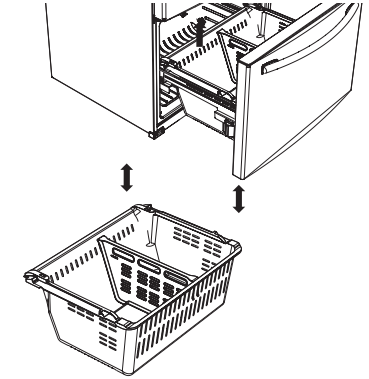
3. Freezer Drawer
To remove the freezer drawer - Pull the freezer drawer out fully. Tilt up the rear of the bin and lift it out to remove.
To relocate the freezer drawer - Place the bin into the rail assembly.
Caution:
Do not allow babies or children go inside the freezer drawer. They could damage the refrigerator and seriously injure themselves.
Do not sit on the freezer door. The door may break. Do not allow children to climb into the freezer drawer.
Do not remove the divider.
Warning: If trapped inside, children may be injured or suffocate to death.
CLEANING THE REFRIGERATOR
Caring for your Samsung French Door Refrigerator prolongs the life of your appliance and helps keep the refrigerator free of odor and germs.
Cleaning the Interior
Clean the inside walls and accessories with a mild detergent and then wipe dry with a soft cloth. You can remove the drawers and shelves for a more thorough cleaning. Just make sure to dry drawers and shelves before putting them back into place.
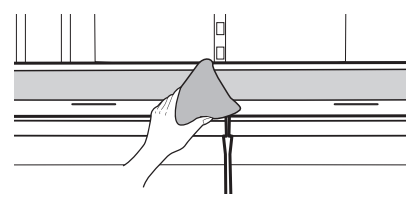
Cleaning the Exterior
Wipe the control panel and digital display with a damp, clean, soft cloth. Do not spray water directly on the surface of the refrigerator. The doors, handles, and cabinet surfaces should be cleaned with a mild detergent and then wiped dry with a soft cloth. To keep your appliance looking its best, polish the exterior once or twice a year.
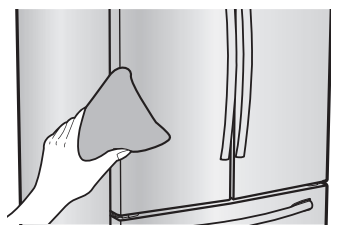
Caution:
Do not spray water directly on the refrigerator. Use a clean, damp cloth to clean.
Do not use benzene, thinner, or Clorox for cleaning. They may damage the surface of the appliance and may cause a fire.
You can erase the printed letters on the display if you apply stainless cleaner directly to the area where the letters are printed.

If the rubber door seals are dirty, the doors may not close properly, and the refrigerator will not operate efficiently. Keep the door seals free of dust or stains by cleaning the doors with a mild detergent and damp cloth. Wipe dry with a clean, soft cloth.
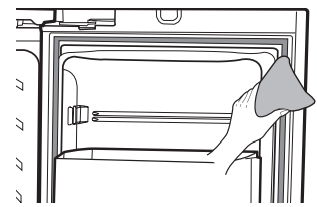
Caution: Do not clean the refrigerator with benzene, thinner, or car detergent due to risk of fire.
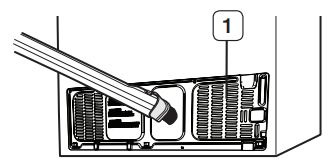
Cleaning the rear side of the refrigerator
To keep cords and exposed parts free of dust and dirt accumulation.
Vacuum the rear side of the appliance once or twice a year.
Caution: Do not remove the back cover ( 1 ). You could suffer an electric shock.
Food storage tips
| Foods |
Refrigerator |
Freezer |
Storage Tips |
| DAIRY PRODUCTS |
| Butter |
2-3 Weeks |
6-9 Months |
Wrap or cover tightly. |
| Milk |
1-2 Weeks |
Not recommended |
Check date code. Most milk and similar products are sold in date-coded cartons that indicate a product's peak freshness. Re-seal with cap or wrap tightly. Do not return unused portions to original container. |
| Cream Cheese, cheese food, and cheese spread |
2-4 Weeks |
Not recommended |
Check date code. Keep all cheese tightly packed in moisture proof wrap |
| Hard Cheese (unopened) |
3-4 Months |
6 Months |
|
| Hard Cheese (opened) |
2 Months |
Not recommended |
|
| Cottage Cheese |
10-15 Days |
Not recommended |
|
| Cream |
7-10 Days |
2 Months |
|
| Sour Cream |
2 Weeks |
Not recommended |
|
| Cream Dips (opened) |
1 Week |
Not recommended |
Check date code. Most yogurt, creams, and similar products are sold in date-coded cartons that indicate a product's peak freshness. Re-seal or cover tightly. Do not return unused portions to original container. |
| Yogurt |
10-14 Days |
Not recommended |
Check date code. Keep covered. |
| Frozen Yogurt |
na |
2 Months |
|
| EGGS |
| Eggs (uncooked) |
3-4 Weeks |
Not recommended |
Check date code. Store eggs in coldest part of refrigerator and in their original container. |
| Eggs (cooked) |
1 Week |
Not recommended |
Store in covered container |
| Leftover egg dishes |
3-4 Days |
Not recommended |
Store in covered container |
| FRESH FRUITS |
| Apples |
1 Month |
Not recommended |
If storing in refrigerator, do not wash fruit before storing. Store in moisture resistant bags or containers. Wrap cut fruits. Some fruits darken when refrigerated. |
| Bananas |
2-4 Days |
Not recommended |
| Peaches, Melons, Pears, Avocados |
3-5 Days |
Not recommended |
| Berries and Cherries |
2-3 Days |
12 Months |
| Apricots |
3-5 Days |
Not recommended |
| Grapes |
2-5 Days |
na |
| Pineapple (un-cut) |
2-3 Days |
Not recommended |
| Pineapple (cut) |
5-7 Days |
6-12 Months |
| Citrus |
1-2 Weeks |
Not recommended |
Store uncovered. |
| Juice |
6 Days |
Not recommended |
Check date code and re-seal in original container. Do not return unused portions to original container. |
| Frozen Juice |
Thawing only |
12 Months |
Check date code. Do not re-freeze. |
Troubleshooting
|
PROBLEM
|
SOLUTION
|
| The refrigerator does not work at all or it does not chill sufficiently. |
• Check if the power plug is properly connected.
• Check if the set temperature on the digital display is warmer than the freezer or fridge inner temperature. If it is, set the refrigerator colder.
• Is the refrigerator in direct sunlight or located near a heat source?
• Is the back of the refrigerator too close to the wall, preventing proper ventilation?
|
| The food in the fridge is frozen. |
• Check if the set temperature on the digital display is too low.
• Try setting the refrigerator to a warmer temperature.
• Is the temperature in the room too low? Set the refrigerator warmer.
• Did you store the food which is juicy in the coldest part of the refrigerator? Try moving those items to the other shelves in the fridge instead of keeping them in the colder areas or bins.
|
| You hear unusual noise or sounds. |
• Check if the refrigerator is level and stable.
• Is the back of the refrigerator too close to the wall, preventing proper ventilation? Try moving the back of the refrigerator at least 2 inches from the wall.
• Was anything dropped behind or under the refrigerator?
• A “ticking” sound is heard from inside the refrigerator. This is normal and occurs because various accessories are contracting or expanding according to the temperature of the refrigerator interior.
• If it sounds as if something is hitting something else inside the refrigerator, this is normal. The sound is caused by the compressor operating at high capacity.
|
| The cabinet-door sealing area of the appliance is hot and condensation is occurring. |
• Some heat is normal as anti-condensators are installed in the vertical hinged section of the refrigerator to prevent condensation.
• Is the refrigerator door ajar? Condensation can occur when you leave the door open for a long time.
|
| Ice Maker is not producing ice. |
• Did you wait for 12 hours after installation of the water supply line before making ice?
• Is the water line connected and the shut-off valve opened?
• Did you manually stop the ice making function?
• Is the freezer temperature too warm? Try setting the freezer temperature lower.
|
| You can hear water bubbling in the refrigerator. |
• This is normal. The bubbling comes from refrigerant circulating through the refrigerator. |
| There is a bad smell in the refrigerator. |
• Check for spoiled food.
• Foods with strong odors (for example, fish) should be tightly covered.
• Clean out your freezer periodically and throw away any spoiled or suspicious food.
|
| Frost forms on the walls of the freezer. |
• Is the air vent blocked? Remove any obstructions so air can circulate freely.
• Allow sufficient space between the stored foods for efficient air circulation.
• Is the freezer drawer closed properly?
|
| Water dispenser is not functioning. |
• Is the water line connected and the shut-off valve opened?
• Has the water supply line tubing been crushed or kinked?
• Make sure the tubing is free and clear of any obstruction.
• Is the water tank frozen because the fridge temperature is too low? Try selecting a warmer setting on the Digital display
|
| Auto close system does not work with the freezer door. |
• Is there an imbalance between the right and left parts of the door?
• Open and close the door smoothly 1~2 times. After you do this, the auto close system usually works properly again.
• Try opening the door smoothly to avoid unbalancing the right and the left part of the door.
|