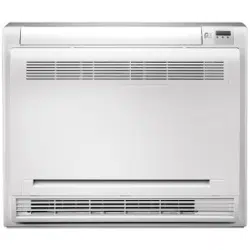
Air conditioner
User manual
AJMBADEC
• Thank you for purchasing this Samsung air conditioner.
• Before operating this unit, please read this user manual carefully and retain it for future reference.
QUESTIONS OR COMMENTS?
COUNTRY CALL OR VISIT US ONLINE AT
SINGAPORE 1800-SAMSUNG(726-7864) www.samsung.com/sg/support
DB68-06407A-01
Air conditioner
User manual
AJMBADEC
• Thank you for purchasing this Samsung air conditioner.
• Before operating this unit, please read this user manual carefully and retain it for future reference.
2
Contents
Safety Information 4
Safety Information 4
At a Glance 12
Indoor Unit Overview 12
Display
Remote Control Overview 13
Inserting batteries
Remote Control Operation 14
Operation modes
Controlling temperature
Controlling fan speed
Controlling air flow direction
Power Smart Features 16
Cooling Operation 16
Cool mode
2-Step cooling function
Dehumidifying Operation 17
Dry mode
Air Purifying Operation 18
Virus doctor function
Quick Smart Features 19
Auto mode
Fan mode
Fast function
Comfort function
Beep sound function
Quiet function
Wi-Fi function (Smart A/C application)
Energy-Saving Features 23
Energy-Saving Operation 23
Usage time check
Timed on/Timed off function
good’sleep function
Cleaning and Maintenance 26
Cleaning at a Glance 26
Troubleshooting 28
3
Installation 32
Safety Information on Installation 32
Preparation 34
Step 1.1 Choosing the installation location
Step 1.2 Checking and preparing accessories and tools
Step 1.3 Drilling a hole through the wall
Step 1.4 Taping the pipes, cables, and drain hose
Indoor Unit Installation 37
Step 2.1 Disassembling the cover panel
Step 2.2 Disassembling the installation plate
Step 2.3 Connecting the power and communication cables (assembly cable)
Step 2.4 Optional: Extending the power cable
Step 2.5 Installing and connecting the drain hose
Step 2.6 Optional: Extending the drain hose
Step 2.7 Optional: Changing the direction of the drain hose
Step 2.8 Installing and connecting the assembly pipes to the refrigerant pipes (assembly pipe)
Step 2.9 Shortening or extending the refrigerant pipes (assembly pipe)
Step 2.10 Fixing the installation plate
Step 2.11 Fixing the indoor unit to the installation plate
Step 2.12 Assembling the cover panel
Step 2.13 Performing final check and trial operation
4
Safety InformationSafety Information
Safety Information
Safety Information
Before using your new air conditioner, please read this manual
thoroughly to ensure that you know how to safely and efficiently
operate the extensive features and functions of your new appliance.
Because the following operating instructions cover various models,
the characteristics of your air conditioner may differ slightly from
those described in this manual. If you have any questions, call your
nearest contact centre or find help and information online at www.
samsung.com.
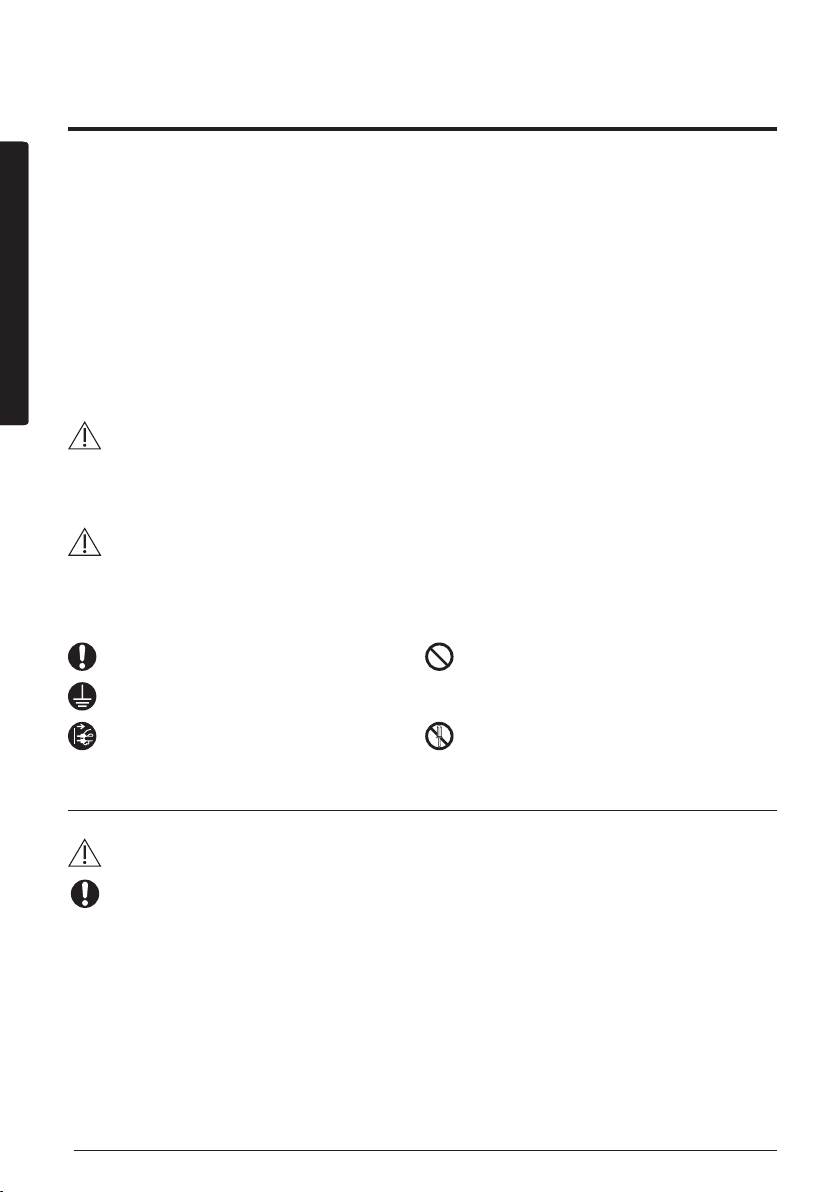
WARNING
Hazards or unsafe practices that may result in severe personal
injury or death.
CAUTION
Hazards or unsafe practices that may result in minor personal
injury or property damage.
Follow directions. Do NOT attempt.
Make sure the machine is grounded to prevent electric shock.
Cut off the power supply. Do NOT disassemble.
FOR INSTALLATION
WARNING
Use a power cord with this product's power specifications
or higher and use the power cord for this appliance only. In
addition, do not use an extension cord.
• Extending the power cord may result in electric shock or fire.
• Do not use an electric transformer. This may result in electric
shock or fire.
• If the voltage/frequency/rated current condition is different,
it may cause fire.
Safety Information
5
Safety Information
Safety Information
Safety Information
The installation of this appliance must be performed by a
qualified technician or service company.
• Failing to do so may result in electric shock, fire, explosion,
problems with the product, or injury and may also void
warranty on the installed product.
Install an Isolation Switch next to the Air Conditioner (but
not on the panels of the Air Conditioner) and circuit breaker
dedicated to the air conditioner.
• Failing to do so may result in electric shock or fire.
Fix the outdoor unit firmly so that the electric part of the
outdoor unit is not exposed.
• Failing to do so may result in electric shock, fire, explosion,
or problems with the product.
Do not install this appliance near a heater, or inflammable material.
Do not install this appliance in a humid, oily or dusty location, in
a location exposed to direct sunlight and water (or rain). Do not
install this appliance in a location where gas may leak.
• This may result in electric shock or fire.
Never install the outdoor unit in a location such as on a high
external wall where it could fall.
• If the outdoor unit falls, it may result in injury, death or
property damage.
This appliance must be properly grounded. Do not ground the
appliance to a gas pipe, plastic water pipe, or telephone line.
• Failing to do so may result in electric shock, fire, and
explosion.
• Make sure to use a socket-outlet with ground.
CAUTION
Please cover the air conditioner with PE BAG after installation,
and remove it when you start to run air conditioner.
Safety Information
6
Safety InformationSafety Information
Safety Information
Install your appliance on a level and hard floor that can
support its weight.
• Failing to do so may result in abnormal vibrations, noise, or
problems with the product.
Install the drain hose properly so that water drains correctly.
• Failing to do so may result in water overflowing and
property damage. Avoid adding drain to waste pipes as
odours may arise in the future.
When installing the outdoor unit, make sure to connect the
drain hose so that draining is performed correctly.
• The water generated during heating by the outdoor unit may
overflow and result in property damage.
In particular, in winter, if a block of ice falls, it may result in
injury, death or property damage.
FOR POWER SUPPLY
WARNING
When the circuit breaker is damaged, contact your nearest
service centre.
Do not pull or excessively bend the power line. Do not twist
or tie the power line. Do not hook the power line over a metal
object, place a heavy object on the power line, insert the
power line between objects, or push the power line into the
space behind the appliance.
• This may result in electric shock or fire.
CAUTION
When not using the air conditioner for a long period of time or
during a thunder/lightning storm, cut the power at the circuit
breaker.
• Failing to do so may result in electric shock or fire.
7
Safety Information
Safety Information
Safety Information
FOR USING
WARNING
If the appliance is flooded, please contact your nearest service
centre.
• Failing to do so may result in electric shock or fire.
If the appliance generates a strange noise, a burning smell or
smoke, cut off the power supply immediately and contact the
nearest service centre.
• Failing to do so may result in electric shock or fire.
In the event of a gas leak (such as propane gas, LP gas, etc.),
ventilate immediately without touching the power line. Do not
touch the appliance or power line.
• Do not use a ventilating fan.
• A spark may result in an explosion or fire.
To reinstall the air conditioner, please contact your nearest
service centre.
• Failing to do so may result in problems with the product,
water leakage, electric shock, or fire.
• Delivery service for the product is not provided. If you
reinstall the product in another location, additional
construction expenses and an installation fee will be charged.
• Especially, when you wish to install the product in an
unusual location such as in an industrial area or near the
seaside where it is exposed to salt in the air, please contact
your nearest service centre.
Do not touch the circuit breaker with wet hands.
• This may result in electric shock.
8
Safety InformationSafety Information
Safety Information
Do not turn the air conditioner off with the circuit breaker
while it is operating.
• Turning the air conditioner off and then on again with the
circuit breaker may cause a spark and result in electric shock
or fire.
After unpacking the air conditioner, keep all packaging
materials well out of the reach of children, as packaging
materials can be dangerous to children.
• If a child places a bag over its head, it may result in
suffocation.
Do not touch the air flow blade with your hands or fingers
during heating.
• This may result in electric shock or burns.
Do not insert your fingers or foreign substances into the air
inlet/outlet of the air conditioner.
• Take special care that children do not injure themselves by
inserting their fingers into the product.
Do not strike or pull the air conditioner with excessive force.
• This may result in fire, injury, or problems with the product.
Do not place an object near the outdoor unit that allows
children to climb onto the machine.
• This may result in children seriously injuring themselves.
Do not use this air conditioner for long periods of time in badly
ventilated locations or near infirm people.
• Since this may be dangerous due to a lack of oxygen, open a
window at least once an hour.
If any foreign substance such as water has entered the
appliance, cut off the power supply and contact the nearest
service centre.
• Failing to do so may result in electric shock or fire.
9
Safety Information
Safety Information
Safety Information
Do not attempt to repair, disassemble, or modify the appliance
yourself.
• Do not use any fuse (such as cooper, steel wire, etc.) other
than the standard fuse.
• Failing to do so may result in electric shock, fire, problems
with the product, or injury.
CAUTION
Do not place objects or devices under the indoor unit.
• Water dripping from the indoor unit may result in fire or
property damage.
Check that the installation frame of the outdoor unit is not
broken at least once a year.
• Failing to do so may result in injury, death or property
damage.
• To prevent personal injury, make sure that you change the
directions of the horizontal air flow blades after stopping the
movements of the vertical air flow blade.
Max current is measured according to IEC standard for safety
and current is measured according to ISO standard for energy
efficiency.
Do not stand on top of the appliance or place objects (such as
laundry, lighted candles, lighted cigarettes, dishes, chemicals,
metal objects, etc.) on the appliance.
• This may result in electric shock, fire, problems with the
product, or injury.
Do not operate the appliance with wet hands.
• This may result in electric shock.
Do not spray volatile material such as insecticide onto the
surface of the appliance.
• As well as being harmful to humans, it may also result in
10
Safety InformationSafety Information
Safety Information
electric shock, fire or problems with the product.
Do not drink the water from the air conditioner.
• The water may be harmful to humans.
Do not apply a strong impact to the remote control and do not
disassemble the remote control.
Do not touch the pipes connected with the product.
• This may result in burns or injury.
Do not use this air conditioner to preserve precision
equipment, food, animals, plants or cosmetics, or for any other
unusual purposes.
• This may result in property damage.
Avoid directly exposing humans, animals or plants to the air
flow from the air conditioner for long periods of time.
• This may result in harm to humans, animals or plants.
This appliance is not intended for use by persons (including
children) with reduced physical, sensory or mental capabilities,
or lack of experience and knowledge, without supervision
or instruction concerning use of the appliance by a person
responsible for their safety. Children should be supervised to
ensure that they do not play with the appliance.
FOR CLEANING
WARNING
Do not clean the appliance by spraying water directly onto it.
Do not use benzene, thinner or alcohol to clean the appliance.
• This may result in discolouration, deformation, damage,
electric shock or fire.
Before cleaning or performing maintenance, cut off the power
supply and wait until the fan stops.
• Failing to do so may result in electric shock or fire.
11
Safety Information
Safety Information
Safety Information
Correct Disposal of This Product
(Waste Electrical & Electronic Equipment)
(Applicable in countries with separate collection systems)
This marking on the product, accessories or literature indicates that the product and its electronic accessories (e.g.
charger, headset, USB cable) should not be disposed of with other household waste at the end of their working
life. To prevent possible harm to the environment or human health from uncontrolled waste disposal, please
separate these items from other types of waste and recycle them responsibly to promote the sustainable reuse of
material resources.
Household users should contact either the retailer where they purchased this product, or their local government
office, for details of where and how they can take these items for environmentally safe recycling.
Business users should contact their supplier and check the terms and conditions of the purchase contract. This
product and its electronic accessories should not be mixed with other commercial wastes for disposal.
Correct disposal of batteries in this product
(Applicable in countries with separate collection systems)
This marking on the battery, manual or packaging indicates that the batteries in this product should not be
disposed of with other household waste at the end of their working life. Where marked, the chemical symbols Hg,
Cd or Pb indicate that the battery contains mercury, cadmium or lead above the reference levels in EC Directive
2006/66. If batteries are not properly disposed of, these substances can cause harm to human health or the
environment.
To protect natural resources and to promote material reuse, please separate batteries from other types of waste
and recycle them through your local, free battery return system.
CAUTION
Take care when cleaning the surface of the heat exchanger of
the outdoor unit since it has sharp edges.
• This should be done by a qualified technician. Please contact
your installer or service centre.
Do not clean the inside of the air conditioner by yourself.
• For cleaning inside the appliance, contact your nearest
service centre.
• When cleaning the filter, refer to the descriptions in the
‘Cleaning at a Glance’ section.
• Failing to do so may result in damage, electric shock or fire.
• Make sure to prevent any injury from sharp edges of the
surface when handling the heat exchanger.
12
At a Glance
At a Glance
07
03
04
08
01
02
05
06
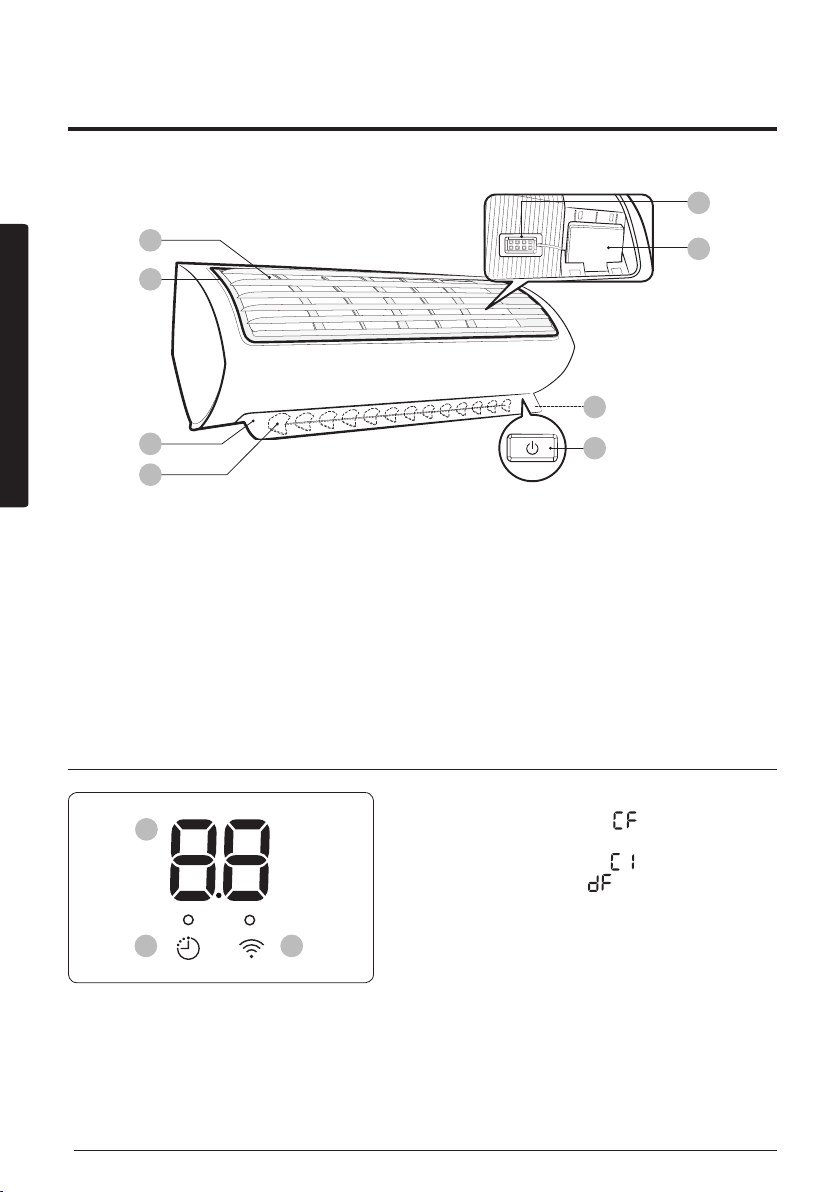
01 Air intake
02 Air filter
03 Air flow blade (up and down)
04 Air flow blade (left and right)
05 Room temperature sensor
06 Wi-Fi module
07 Display
08 Power button /
Remote control receiver
Display
01
02 03
01 Temperature indicator
Filter reset indicator ( )
Usage time indicator
Auto clean indicator ( )
Defrost indicator ( )
02 Timer indicator
good'sleep indicator
Auto clean indicator
03 Wi-Fi indicator
The actual product may differ slightly from the image depicted below.
Indoor Unit Overview
At a Glance
13
At a Glance
At a Glance
Remote Control Overview
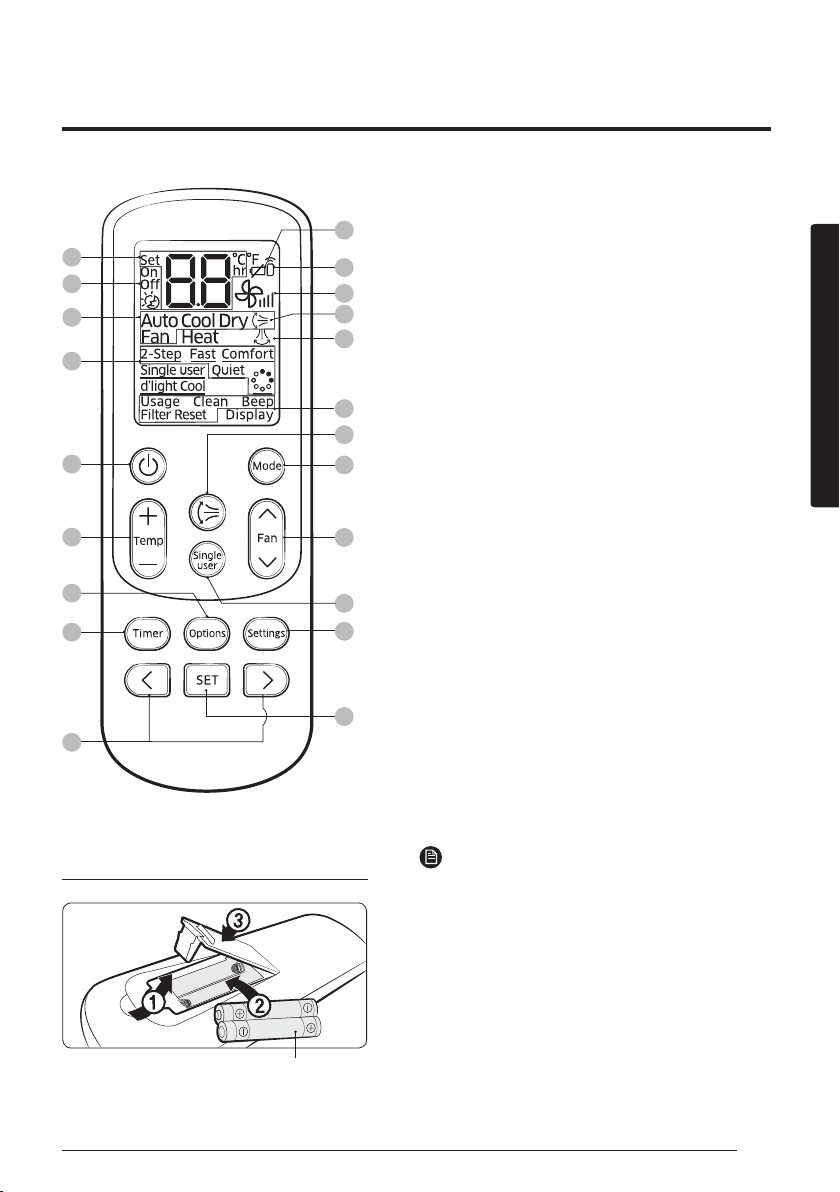
01 Set temperature indicator
02 Timer option indicator
03 Operation mode indicator
04 Options indicator
05 Low battery indicator
06 Transmit indicator
07 Fan speed indicator
08 Vertical air swing indicator
09 Horizontal air swing indicator(without this
function)
10 Settings indicator
11 Power button
12 Temperature button
13 Options button
14 Timer button
15 Direction button / Selection button
16 Vertical air swing button
17 Mode button
18 Fan speed button
19 Single user button
20 Settings button
21 SET button
NOTE
• The descriptions in this manual are primarily
made based on the remote control buttons.
• Although Heat mode / d'light Cool / Single
user / Display / Horizontal air swing
indicator is displayed on the remote control
display, it is not available on this model.
At a Glance
01
05
06
07
08
10
09
16
17
18
20
21
02
03
04
11
12
13
19
14
15
Inserting batteries
two 1.5V AAA type batteries
14
At a Glance
At a Glance
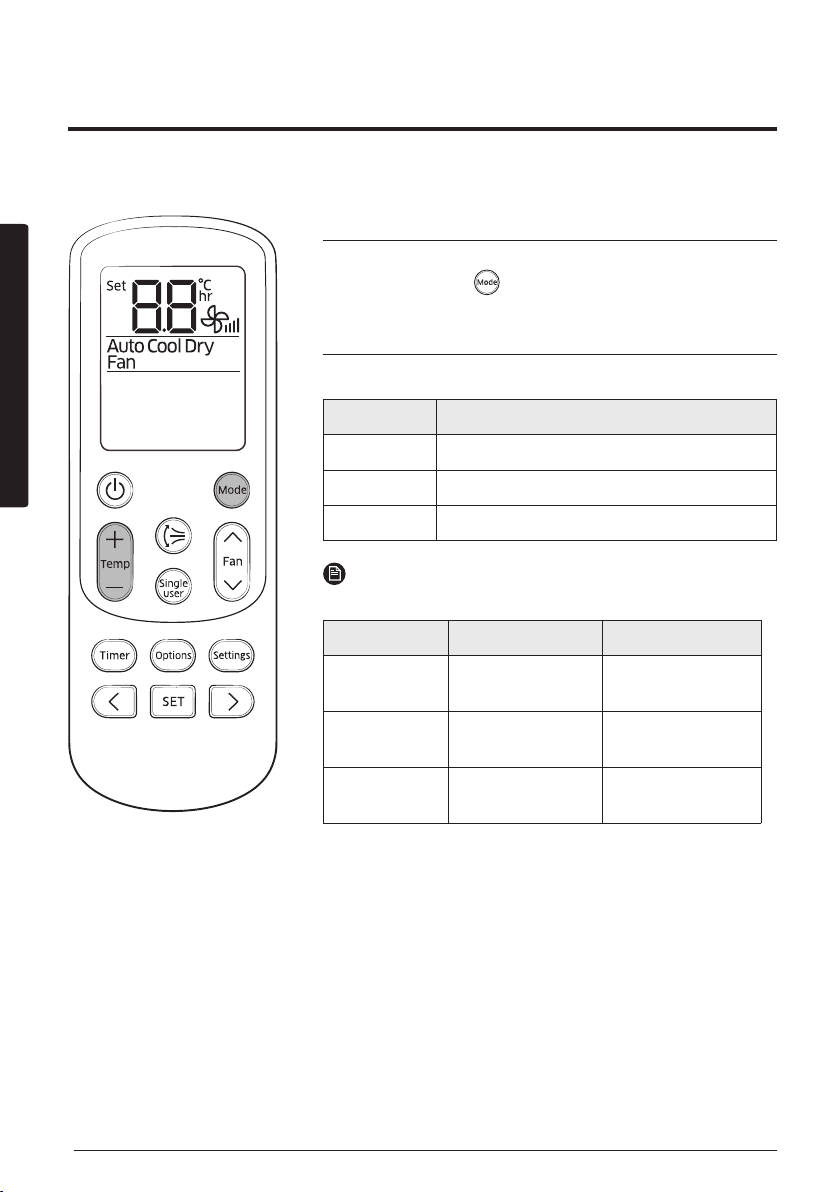
Operation modes
You can change the current mode between Auto, Cool, Dry,
Fan, by pressing the button.
Controlling temperature
You can control the temperature in each mode as follows:
Mode Temperature control
Auto/Cool Adjust by 1 °C between 16 °C and 30 °C.
Dry Adjust by 1 °C between 18 °C and 30 °C.
Fan You cannot control the temperature.
NOTE
You can use the Cool, Dry, modes in the following conditions:
Mode Cool Dry
Indoor
temperature
16 °C to 32 °C 18 °C to 32 °C
Outdoor
temperature
10 °C to 46 °C 10 °C to 46 °C
Indoor
humidity
80% or less relative
humidity
_
• If the air conditioner operates in a high humidity
environment in the Cool mode for an extended period of
time, condensation may occur.
You can use the air conditioner easily by selecting a mode and then by controlling the
temperature, fan speed, and air direction.
Remote Control Operation
15
At a Glance
At a Glance
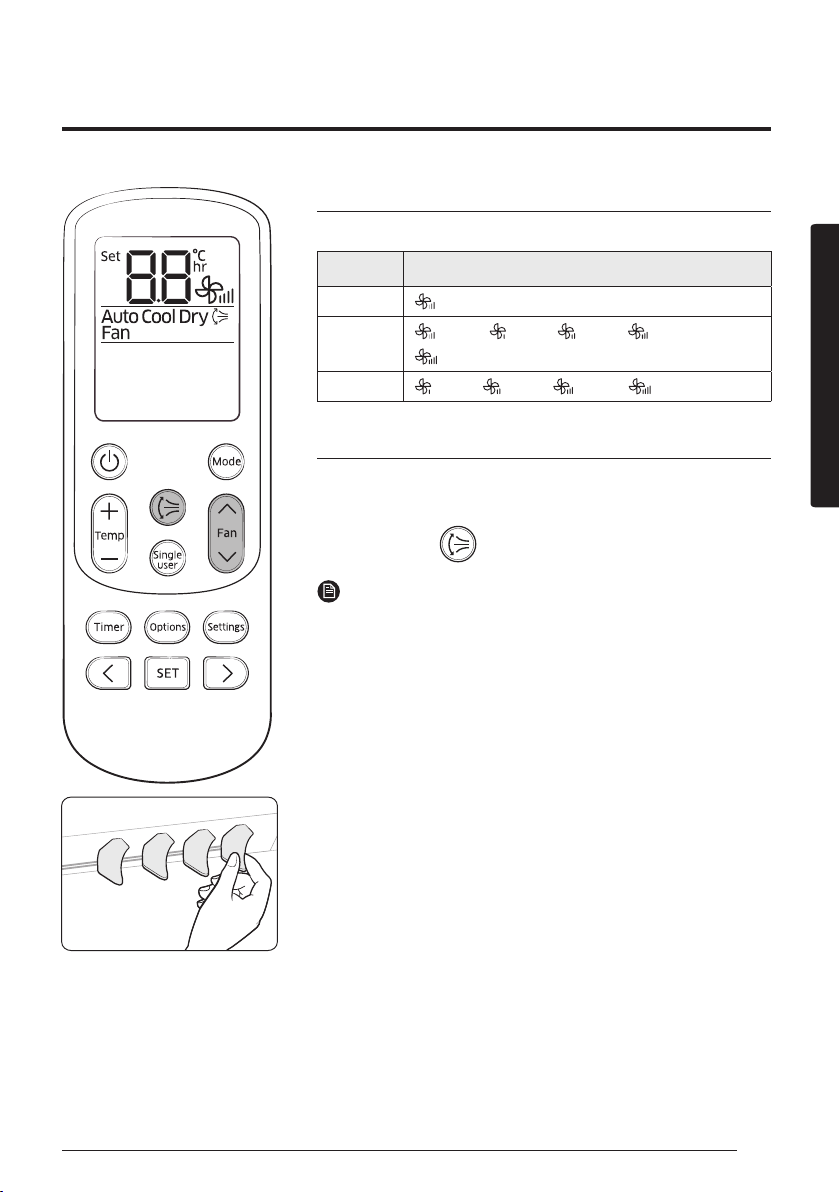
Controlling fan speed
You can select the following fan speeds in each mode:
Mode Available fan speeds
Auto/Dry
(Auto)
Cool
(Auto), (Low), (Med), (High),
(Turbo)
Fan
(Low), (Med), (High), (Turbo)
Controlling air flow direction
Keep the air flow in a constant direction by stopping the
movements of the vertical and horizontal air flow blades.
In operation
►
NOTE
• If you adjust the vertical air flow blade manually, it may
not close completely when you turn off the air conditioner.
Horizontal air flow (manual)
Keep the horizontal air flow in a constant direction by
changing the directions of the horizontal air flow blades
manually.
16
Power Smart Features
The smart and powerful cooling functions of the Samsung air conditioner keep an enclosed space
cool and comfortable.
Cooling Operation
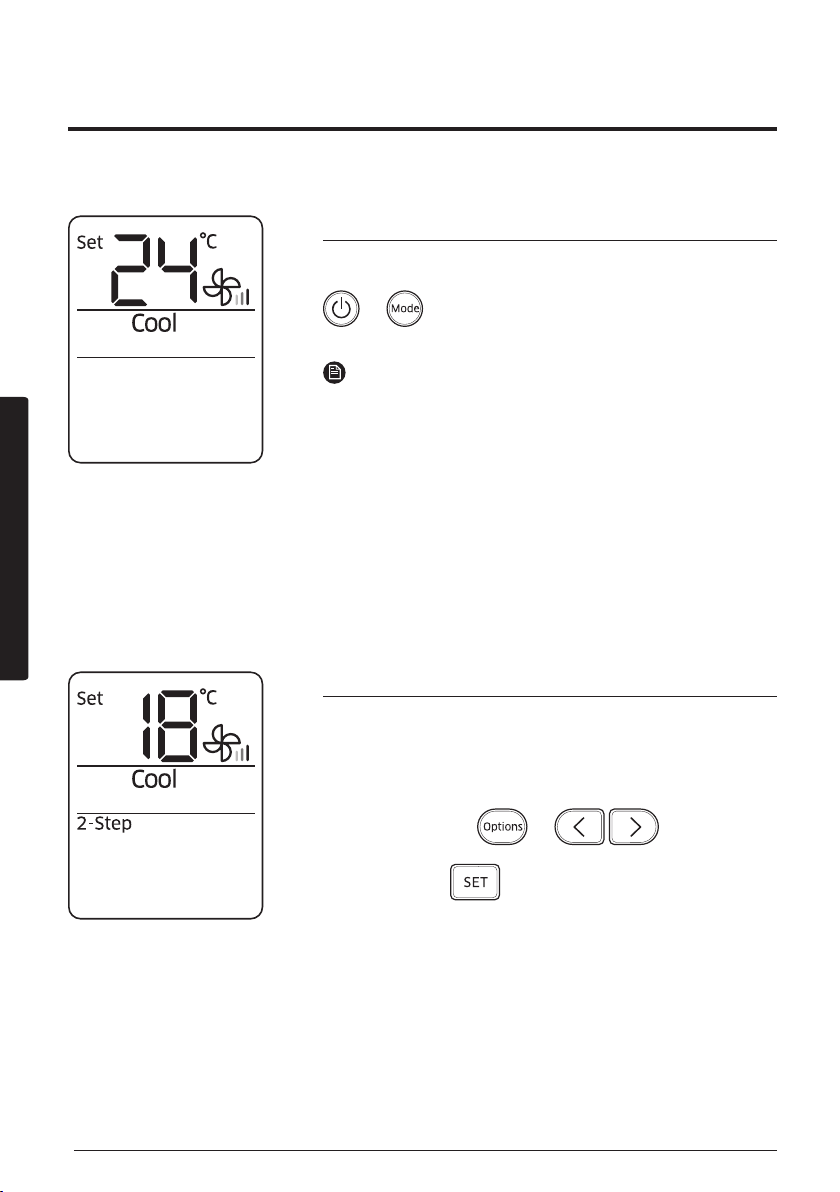
Cool mode
Use the Cool mode to stay cool in hot weather.
► ►
Select Cool.
NOTE
• For comfort, keep the temperature difference between the
indoor and outdoor air within 5 °C in the Cool mode.
• After selecting the Cool mode, select a function,
temperature, and fan speed that you want to apply.
– To cool your room quickly, select a low temperature and
a strong fan speed.
– To save energy, select a high temperature and a weak
fan speed.
– As the indoor temperature approaches the set
temperature, the compressor will operate at a low speed
to save energy.
2-Step cooling function
Use the 2-Step cooling function to quickly reach the set
temperature. The air conditioner automatically adjusts the fan
speed and air flow direction. You can select this function only
when the Cool mode is running.
In the Cool mode
► ► ►
Select 2-Step.
►
Power Smart Features
17
Power Smart Features
The dehumidifying function of the Samsung air conditioner keeps an enclosed space dry and
comfortable.
Dehumidifying Operation
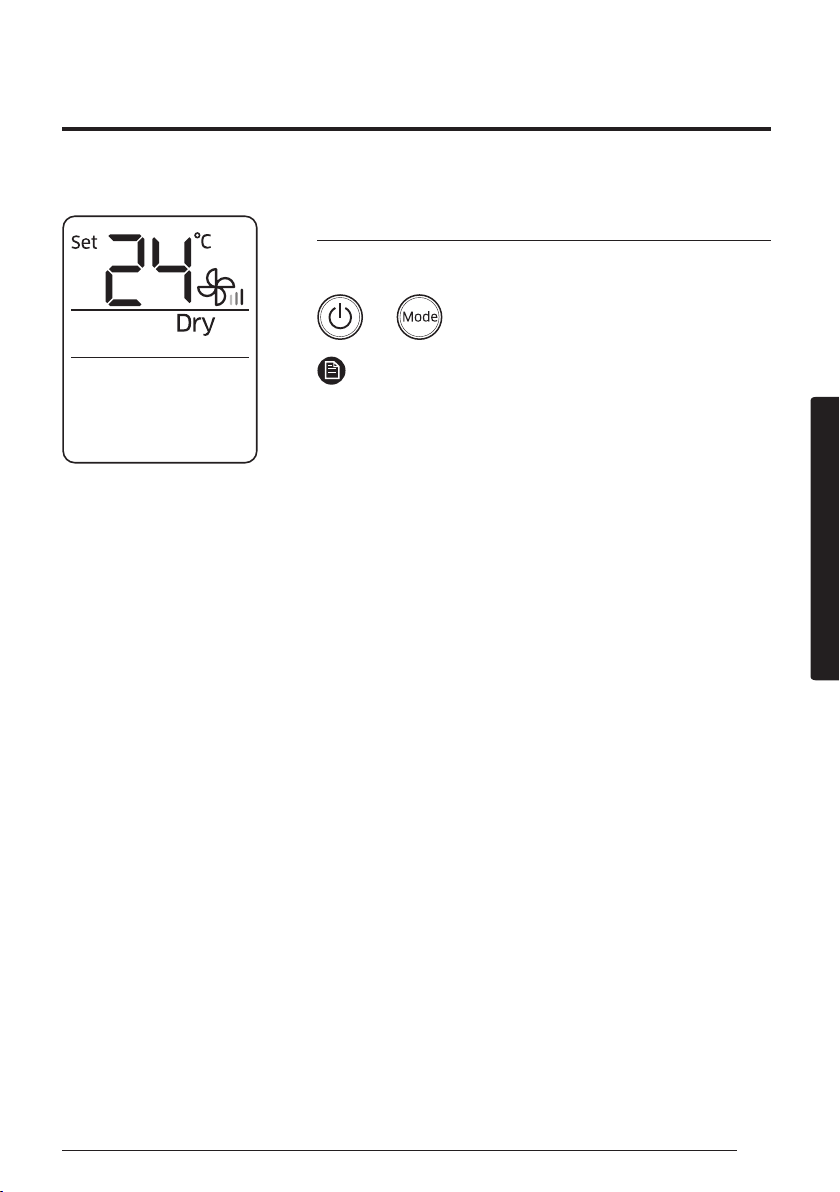
Dry mode
Use the Dry mode in rainy or humid weather.
► ►
Select Dry.
NOTE
• The lower the set temperature is, the greater the
dehumidifying capacity is. When the current humidity
seems to be high, adjust the set temperature to a low
temperature.
• You cannot use the Dry mode for heating. The Dry mode is
designed to produce a cooling side-effect.
Power Smart Features
18
Power Smart Features
The air purification function of the Samsung air conditioner keeps the air in an enclosed space
purified.
Air Purifying Operation
Virus doctor function
Use the Virus doctor function to purify your room with
negative ions produced by the air conditioner. This function is
available in the Auto,Cool Dry, Fan modes.
In the Auto, Cool, Dry,
Fan mode
► ► ►
Select .
►
NOTE
• You can adjust the set temperature, except for in the Fan
mode.
• When the Virus doctor function is additionally selected
while a specific mode is running, there is little difference in
electricity consumption and operating noise.
19
Power Smart Features
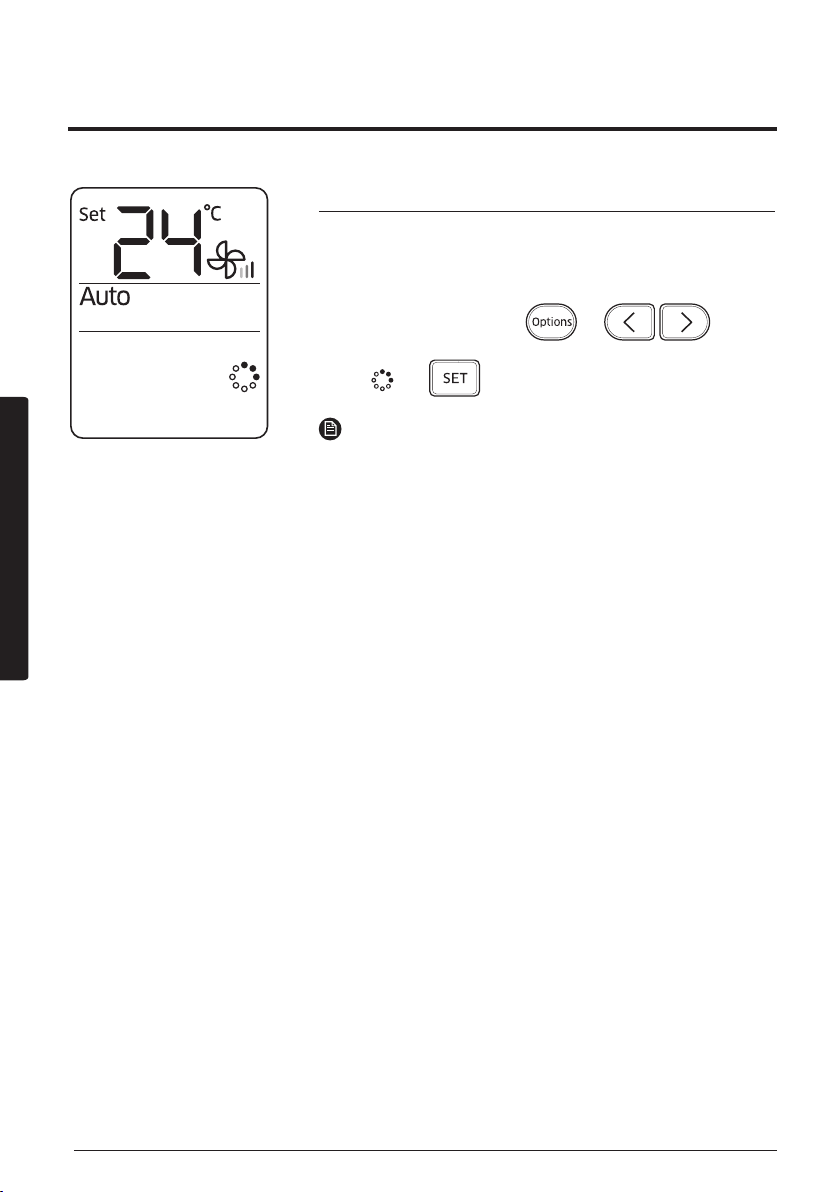
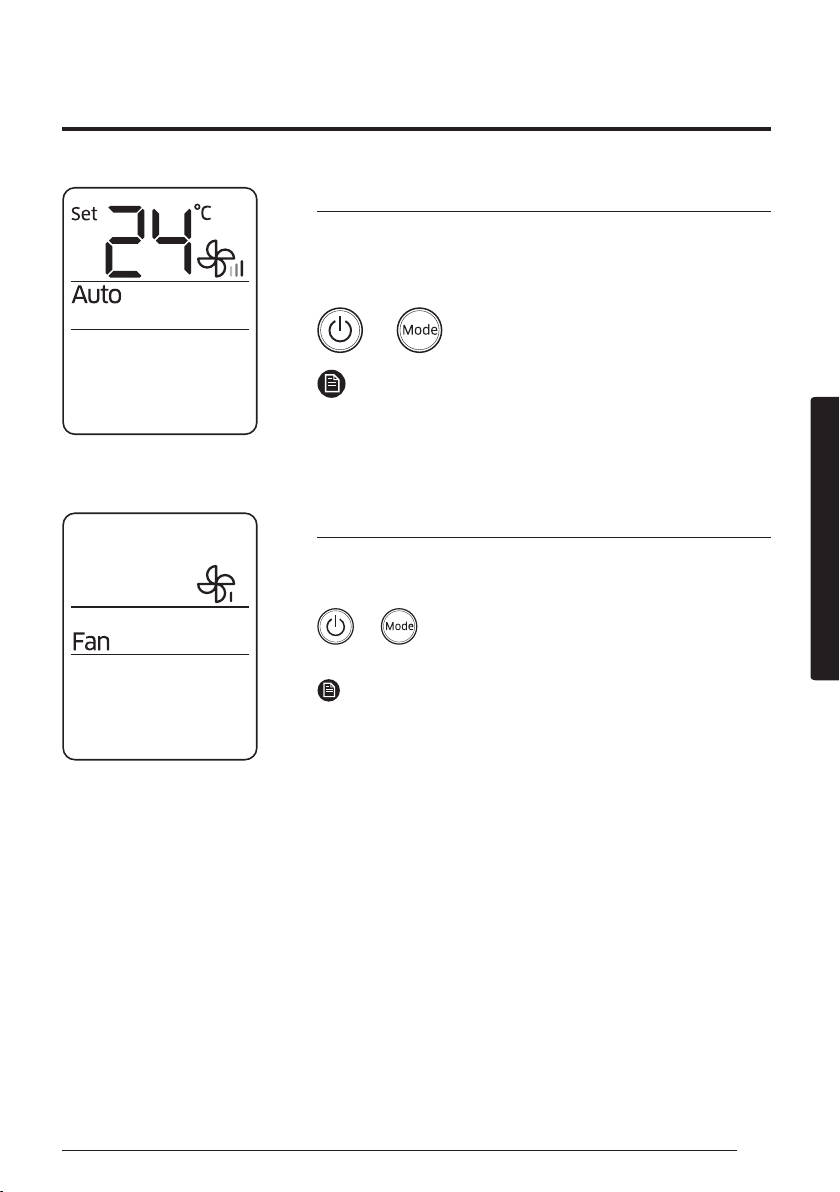
Auto mode
Use the Auto mode when you want the air conditioner to
automatically control the operation. The air conditioner will
provide the most comfortable atmosphere that it can.
► ►
Select Auto.
NOTE
• When the indoor temperature seems to be higher or
lower than the set point, the air conditioner automatically
produces cool air to cool down the indoor temperature .
Fan mode
Use the Fan mode to run the air conditioner like a common
fan. The air conditioner provides a natural breeze.
► ►
Select Fan.
NOTE
• If the air conditioner will not be used for an extended
period of time, dry the air conditioner by running it in the
Fan mode for 3 or 4 hours.
• The outdoor unit is designed not to operate in the Fan
mode to prevent cold air from entering through the unit.
This is a normal operation and not a fault with the air
conditioner.
There is a variety of extra functionality provided by the Samsung air conditioner.
Quick Smart Features
20
Power Smart Features
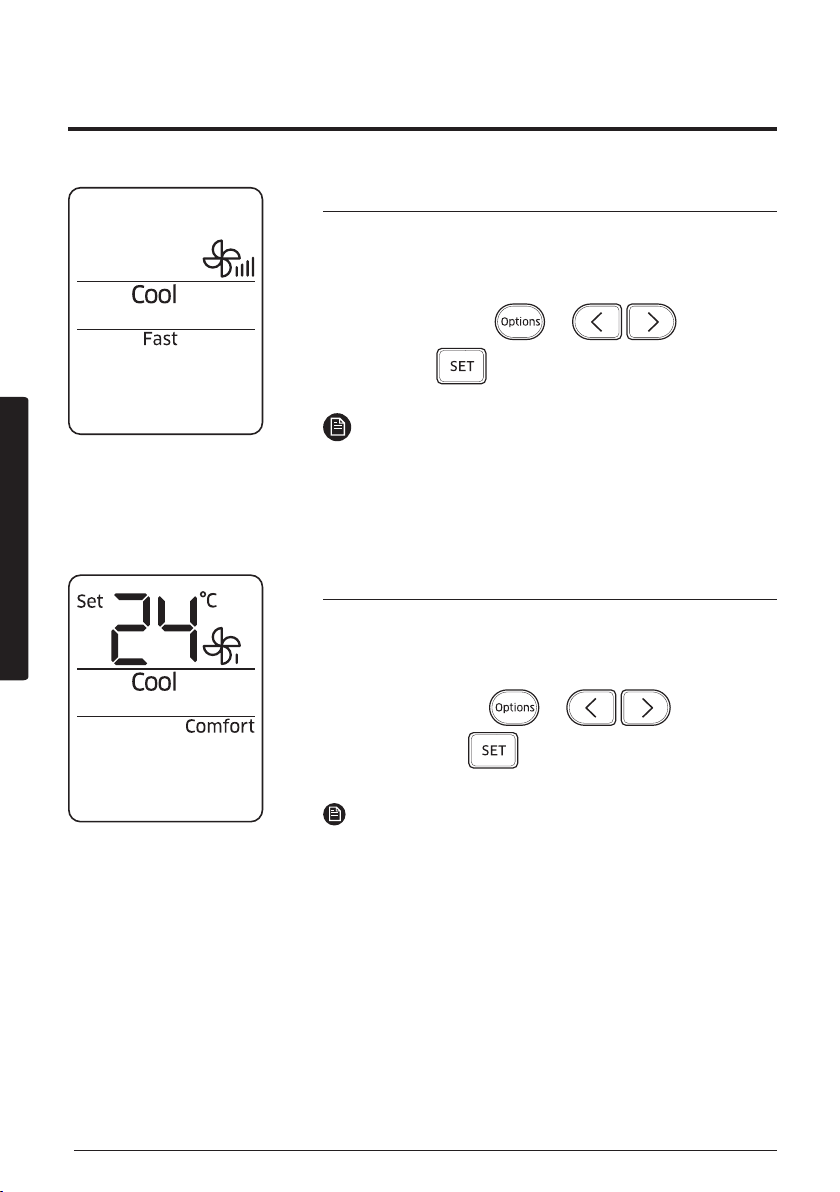
Fast function
Use the Fast function to quickly cool your room. This function
is the most powerful cooling function provided by the air
conditioner. You can select this function in the Cool modes.
In the Cool mode
► ► ►
Select Fast.
►
NOTE
• If you select the Fast function while such functions as
2-Step cooling, Comfort, Single user, Quiet, or good'sleep
are running, these functions are cancelled.
• You can change the air flow direction.
• You cannot change the set temperature and the fan speed.
Comfort function
Use the Comfort function when you feel the current cooling
effect is too strong. The air conditioner provides a mild
cooling. You can select this function in the Cool modes.
In the Cool mode
► ► ►
Select Comfort.
►
NOTE
• You can change the set temperature and the air flow direction.
• You cannot change the fan speed.
• If you select the Comfort function while such functions as
2-Step cooling, Fast, Single user, Quiet, or good'sleep are
running, these functions are cancelled.
• If you feel cooling effect in the Comfort function is weak,
cancel the Comfort function.
21
Power Smart Features
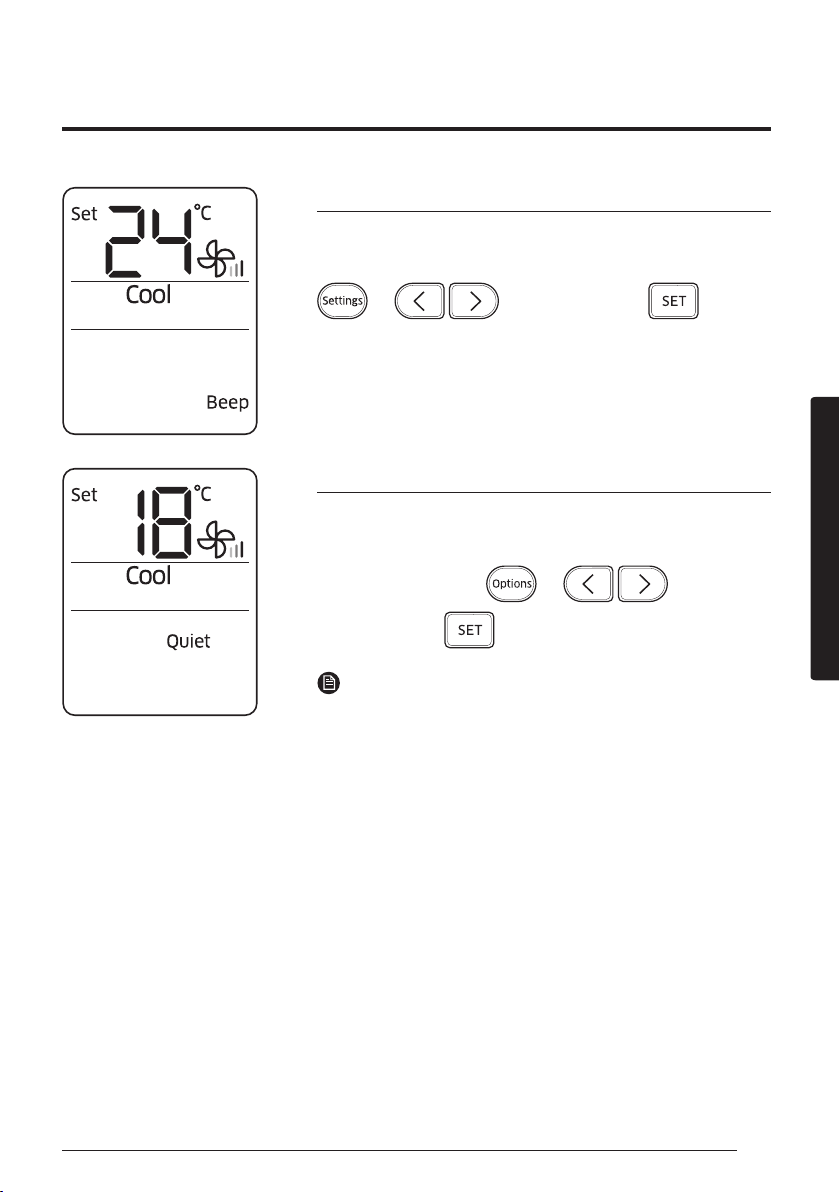
Beep sound function
Use the Beep sound function to turn on or off the beep sound
that plays when you press a button on the remote control.
► ►
Select Beep.
►
Quiet function
Use the Quiet function to reduce operating noise. You can
select this function in the Cool modes.
In the Cool mode
► ► ►
Select Quiet.
►
NOTE
• You can change the set temperature and the air flow
direction.
• You cannot change the fan speed.
• If you select the Quiet function while such functions as
2-Step cooling, Fast, Comfort, Single user, or good'sleep
are running, these functions are cancelled.
22
Power Smart Features
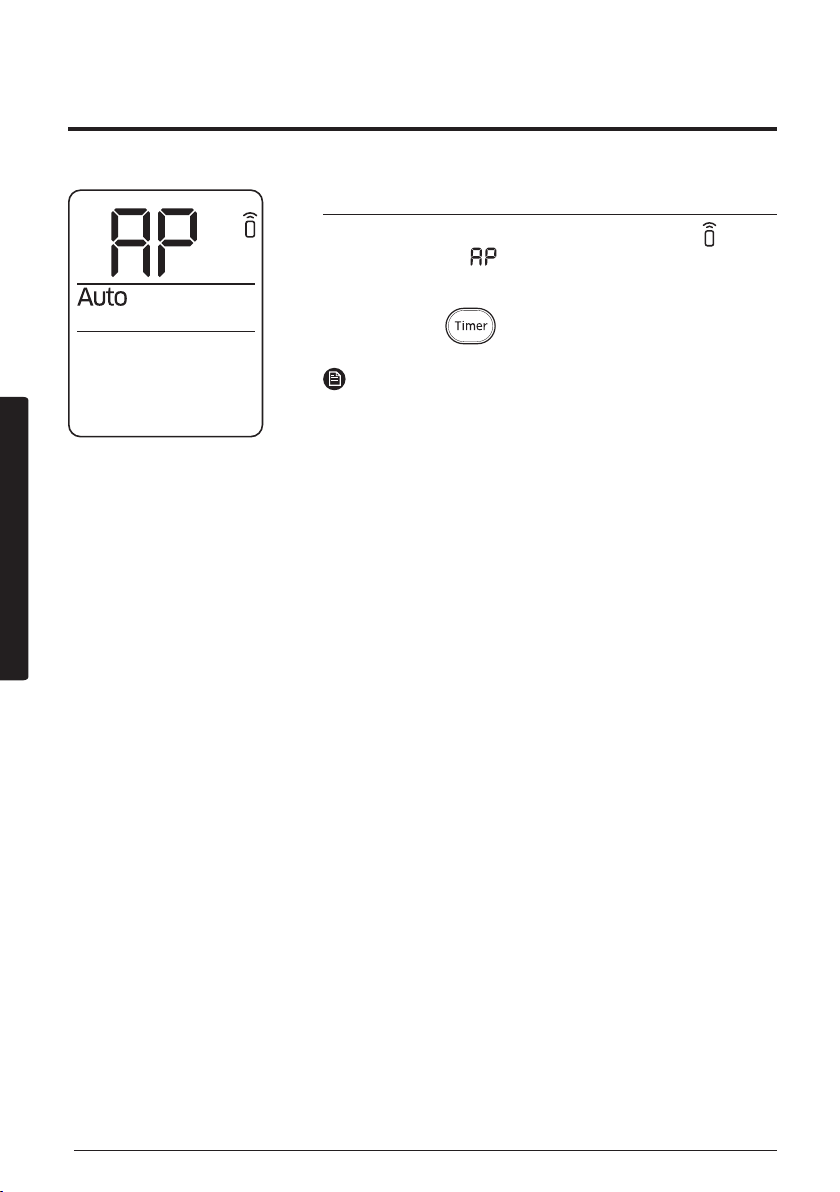
Wi-Fi function (Smart A/C application)
When you turn on the Wi-Fi function, the Transmit ( )
indicator blinks and appears on the remote control display
for a few seconds. Then both of them disappear.
In operation
► ►
Hold down 4 seconds.
NOTE
• For further information, refer to the Smart A/C application
manual.
23
Energy-Saving Features
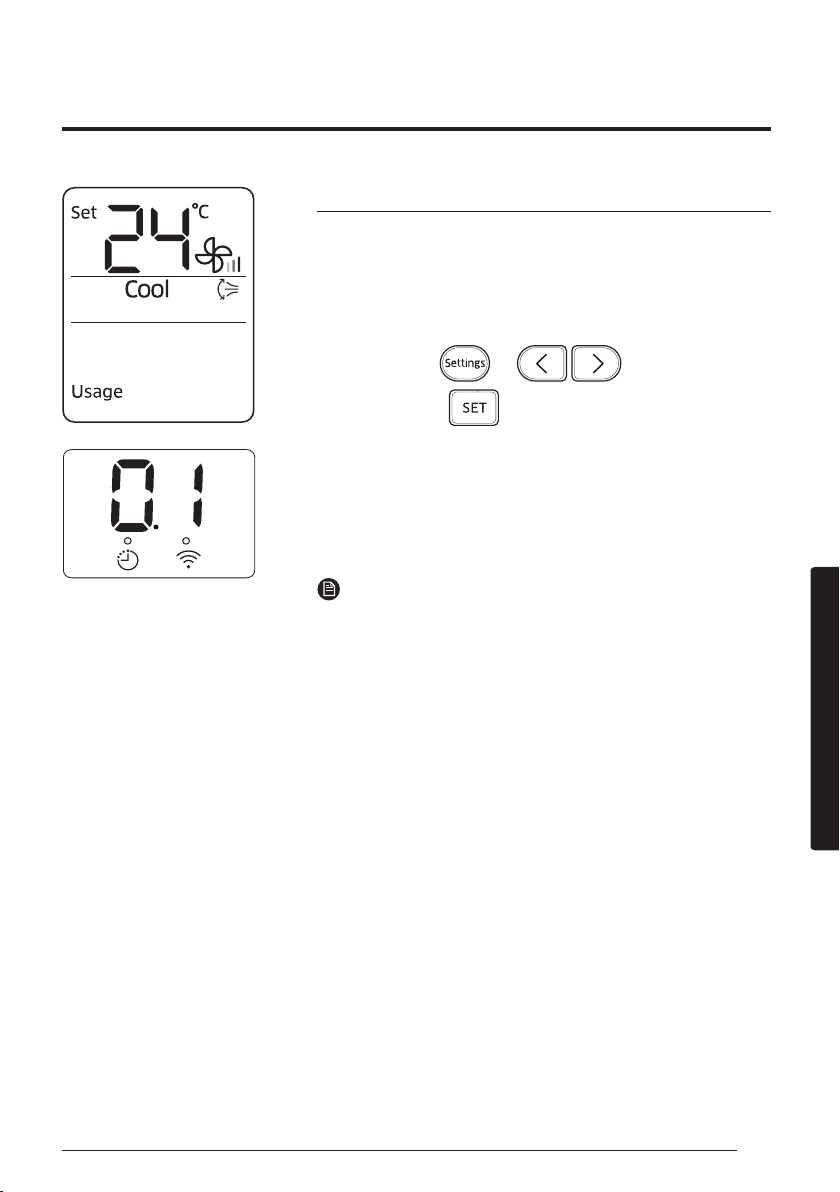
Indoor unit display
Usage time check
Use the Usage time function to check the operation duration
from the moment when the air conditioner is turned on to the
moment when the Usage time function is selected. The usage
time is displayed on the indoor unit display for a few seconds,
and the set indoor temperature appears.
In operation
► ► ►
Select Usage.
►
The usage time is displayed in units of hour. For example,
0.1 is equivalent to 6 minutes; 2.5, 2 hours and 30 minutes;
3.7, 3 hours and 42 minutes. The value range displayed
is between 0.0 and 99. The value is reset when the air
conditioner turns off.
NOTE
• The usage time shown on the indoor unit display may
a little differ from the actual operation time of the air
conditioner.
• You can view the usage time only when the air
conditioner is operating.
The smart energy-saving functions of the Samsung air conditioner reduce electricity
consumption.
Energy-Saving Operation
Energy-Saving Features
24
Energy-Saving Features
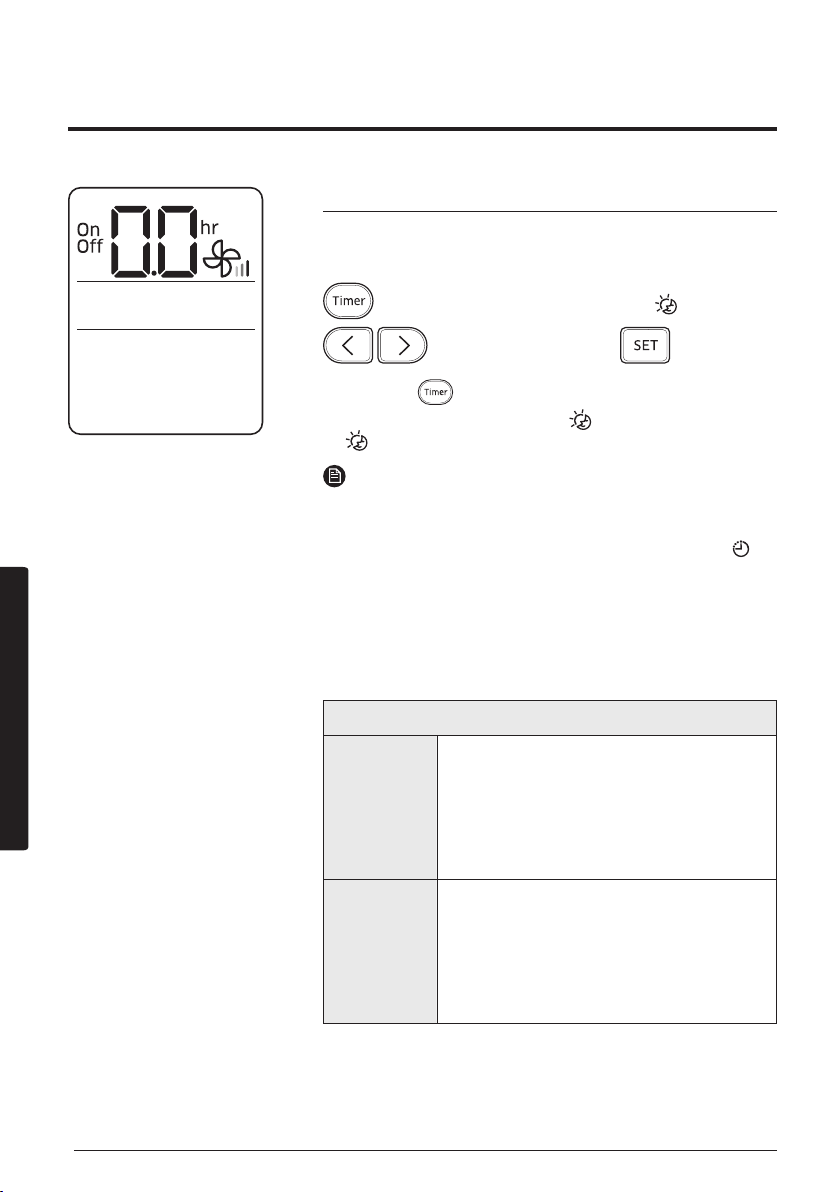
Timed on/Timed off function
Use the Timed on/Timed off to turn on or off the air
conditioner after the time that you set.
(Select On or Off among On, Off, and .)
►
(Set the on/off time.)
►
• Press the (Timer) button to change the current
function between On, Off, and (good’sleep).
(good’sleep) is displayed in the Cool modes only.
NOTE
• You can set a time between 0.5 and 24 hours. Set the time
interval to 0.0 to cancel the Timed on/off function.
• Once you start the Timed on/off function, the Timer ( )
indicator is displayed on the indoor unit display.
• After starting the Timed on function, you can change the
mode and the set temperature. You cannot change the set
temperature while the Fan mode is running.
• You cannot set the same time for both of the Timed on
and Timed off functions.
Combining Timed on and Timed off
When
the air
conditioner
is off
Example) Timed on: 3 hours, Timed off: 5
hours
The air conditioner turns on after 3 hours
from the moment you start Timed on/
off, remains on for 2 hours, then turns off
automatically.
When
the air
conditioner
is on
Example) Timed on: 3 hours, Timed off: 1
hour
The air conditioner turns off after 1 hour
from the moment you start Timed on/
off, then turns on after 2 hours from the
moment it is turned off.
25
Energy-Saving Features
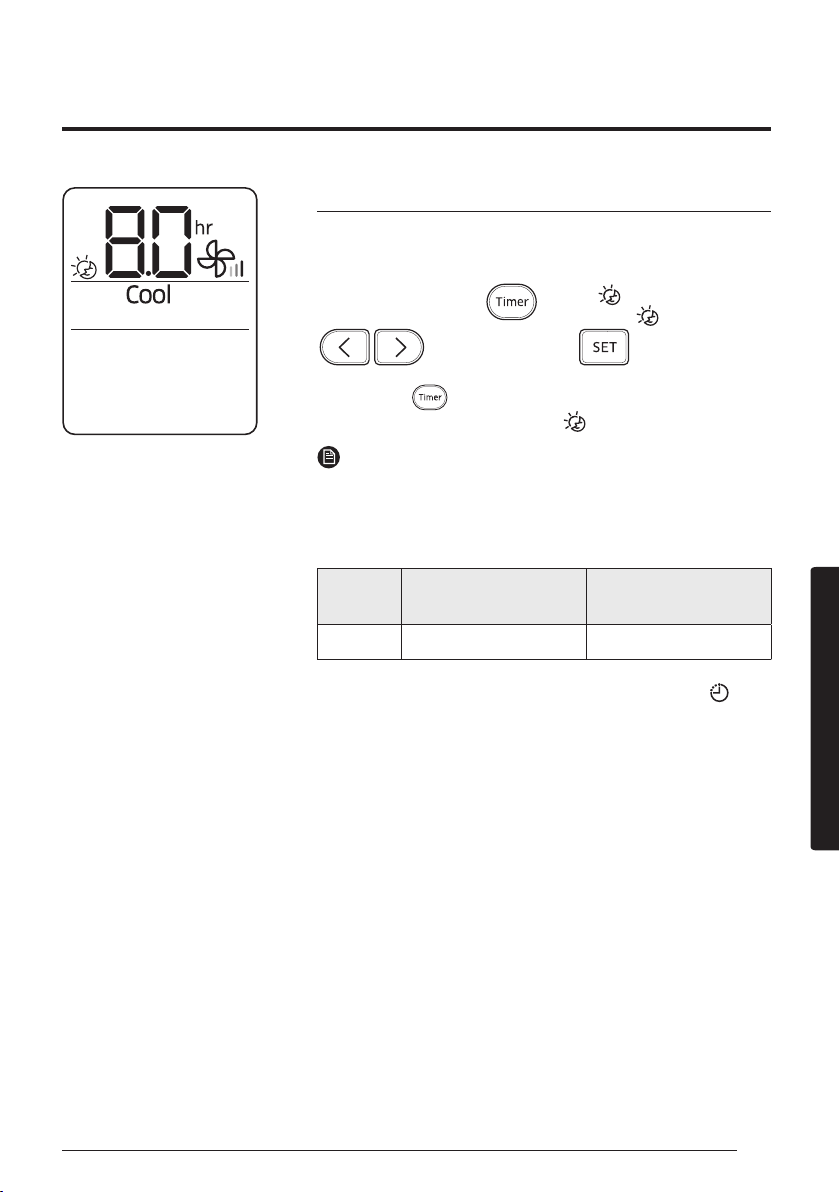
good’sleep function
Use the good'sleep function to get a good sleep at night and
to save energy. You can select this function in the Cool modes.
In the Cool mode
►
(Select among
On, Off, and .)
►
(Set the
operation time.)
►
• Press the (Timer) button to change the current
function between On, Off, and (good’sleep).
NOTE
• You can adjust the set temperature by 1 °C between 16 °C
and 30 °C.
• The recommended and optimal set temperatures in the
good’sleep function are as follows:
Mode
Recommended set
temperature
Optimal set
temperature
Cool 25 °C to 27 °C 26 °C
• Once you start the good’sleep function, the Timer ( )
indicator appears on the indoor unit display.
• You can set the operation time to between 0.5 and
12 hours. Set the operation time to 0.0 to cancel the
good’sleep function.
• The default operation time for the good’sleep function in
the Cool mode is 8 hours. If the operation time is set to
over 5 hours, the Wake up function begins 1 hour before
the set time. The air conditioner stops automatically when
the operation time expires.
• When the Timed on, Timed off, and good'sleep functions
are overlapped, the air conditioner operates its timer with
only the function that you have started most recently.
26
Cleaning and Maintenance
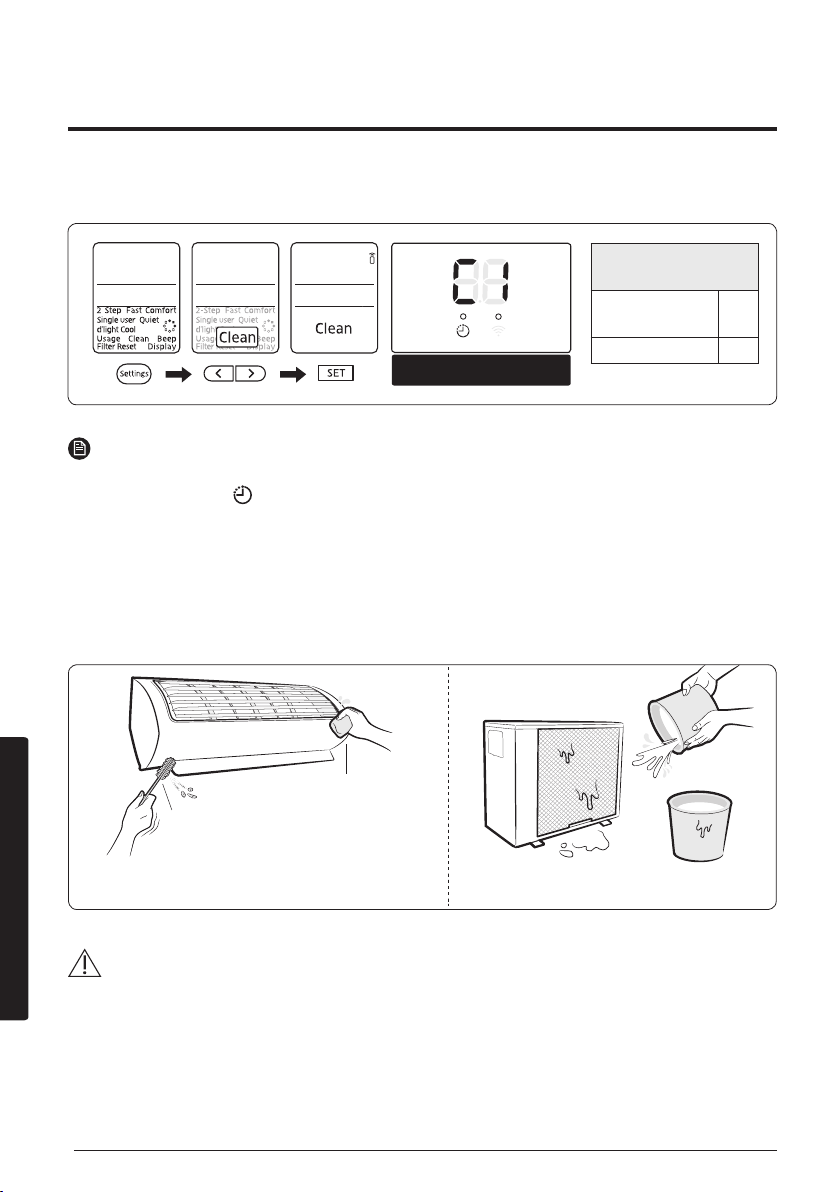
Running Auto clean
Indoor unit display
NOTE
• When you set the Auto clean timer, Clean blinks and then disappears on the remote control
display. The Timer ( ) indicator also appears on the indoor unit display.
• When the air conditioner is off, Auto clean starts immediately when it is selected. When the
air conditioner is on, Auto clean starts as soon as the air conditioner stops running.
• During Auto clean, the indoor fan continues to run, and air flow blades remain open to expel
ambient air.
Cleaning the indoor unit exterior and outdoor unit heat exterior
CAUTION
• Do not clean the display by using alkaline detergent.
Cleaning at a Glance
Cleaning and Maintenance
Cleaning duration
(minutes)
Auto (Cool),
Cool, Dry
30
Fan 15
Soft brush
Tepid damp cloth
Before cleaning, be sure to turn off the equipment
and disconnect the power plug.
Spray water to clean the dust.
27
Cleaning and Maintenance
• Do not use sulphuric acid, hydrochloric acid, or organic solvents
(such as thinner, kerosene, and acetone) to clean the surfaces. Do
not put any stickers on it as this can damage the surface of the
air conditioner.
• When you clean and inspect the heat exchanger on the outdoor
unit, contact the local service centre for help.
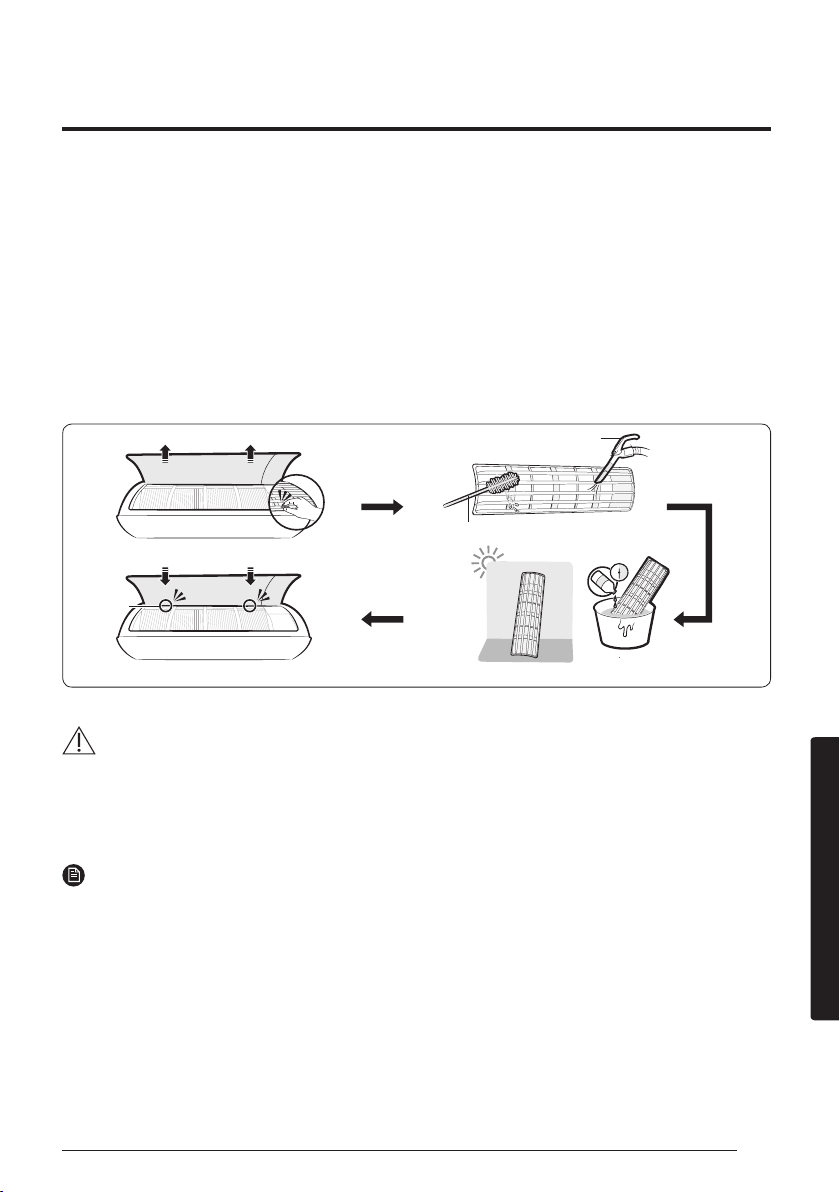
Cleaning the filter
CAUTION
• Do not scrub the air filter with a brush or other cleaning utensil.
This may damage the filter.
• Do not expose the air filter to direct sunlight when drying it.
NOTE
• Clean the air filter every 2 weeks. Cleaning term may vary depending on the usage and
environmental conditions.
• If the air filter dries in a humid area, it may produce offensive odours. Clean it again and dry
it in a well-ventilated area.
Vacuum cleaner
Soft brush
30 minutes
Mild detergent
Hooks
28
Cleaning and Maintenance
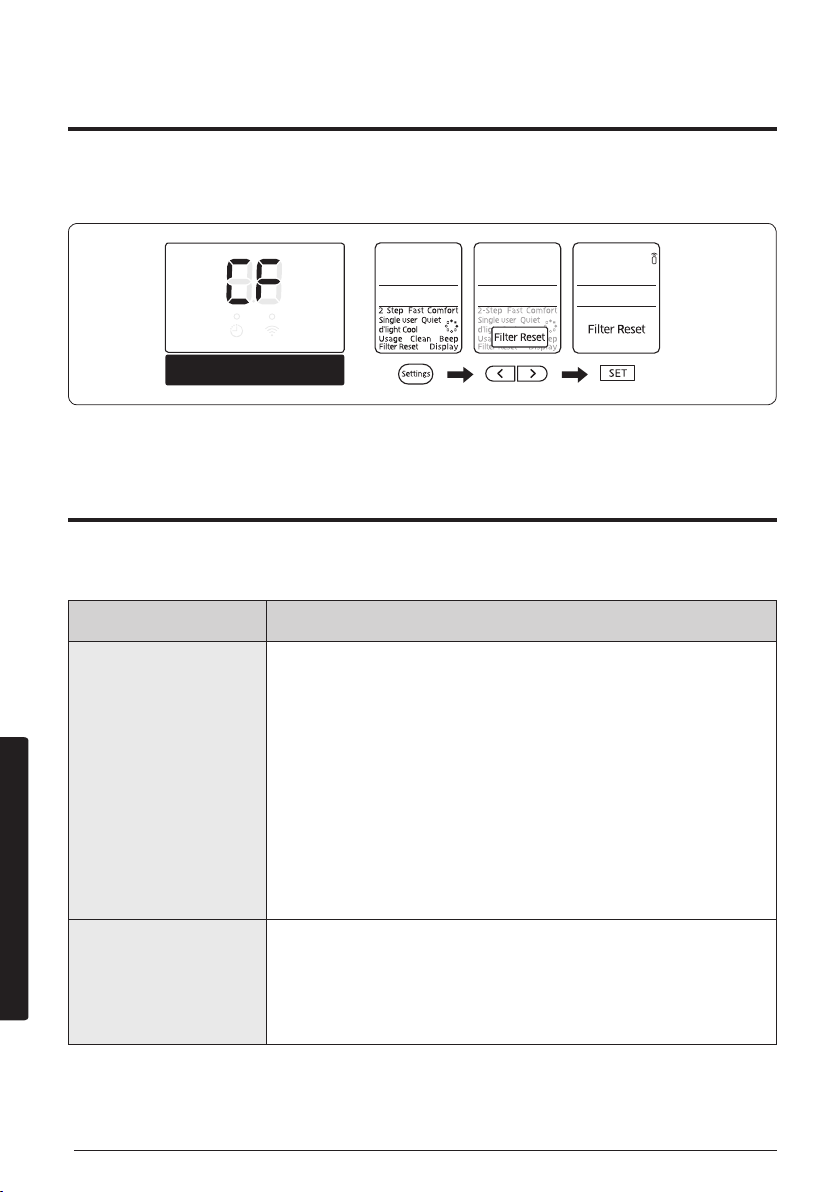
Resetting the filter-cleaning reminder
Indoor unit display
If the air conditioner operates abnormally, refer to the following
chart to save time and unnecessary expenses.
Problem Solution
The air
conditioner does
not work at all.
• Check the power status, then operate the air
conditioner again.
• Switch on the circuit breaker, plug in the
power cord, then operate the air conditioner
again.
• Make sure that the isolator is turned on.
• Check whether the Timed off function is
running. Operate the air conditioner again by
pressing the Power button.
I cannot change
the temperature.
• Check whether the Fan or Fast mode is
running. In these modes, the air conditioner
controls the set temperature automatically,
and you cannot change the set temperature.
Troubleshooting
29
Cleaning and Maintenance
Problem Solution
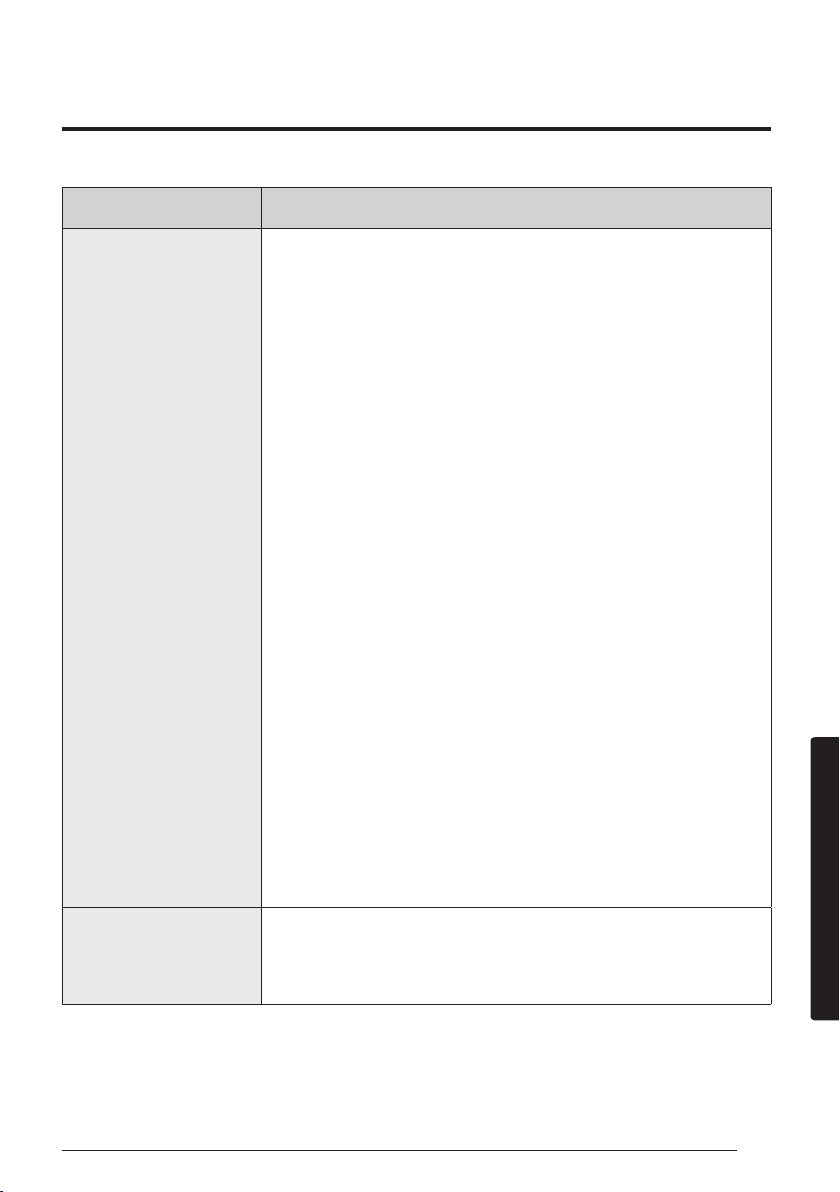
Cool air does not
come out of the
air conditioner.
• Check whether the set temperature is
higher in the Cool mode than the current
temperature. Press the Temperature button
on the remote control to change the set
temperature.
• Check whether the air filter is blocked with
dirt. If the air filter is blocked, the cooling
performance may decrease. Remove dirt
regularly.
• Check whether the outdoor unit is covered
or installed near obstacles. Remove the
coverings and obstacles.
• Check whether doors or windows are open.
This may cause poor cooling performance.
Close the doors and windows.
• Check whether the air conditioner is turned
on immediately after the cooling operation
stops. In this case, only the fan runs to
protect the outdoor unit compressor.
• Check whether the pipe length is too long.
When the pipe length exceeds the maximum
pipe length, the cooling performance may
decrease.
I cannot change
the air flow
direction.
• Check whether the good'sleep function is
running. While this function is running, you
cannot control the air flow direction.
30
Cleaning and Maintenance
Problem Solution
I cannot change
the fan speed.
• When the Auto, Dry, or Fast mode is running
or the good'sleep function is running in the
Cool mode, the air conditioner controls the
fan speed automatically and you cannot
change the fan speed.
The remote
control does not
work.
• Replace the batteries in the remote control
with new ones.
• Make sure that nothing is blocking the
remote control sensor.
• Check whether there are strong lighting
apparatus near the air conditioner. Strong
light which comes from fluorescent bulbs or
neon signs may interrupt the electric waves.
The Timed on/
off function
does not work.
• Check whether you pressed the SET button
on the remote control after setting the time.
The indicator
blinks
continuously.
• Press the Power button to turn off the air
conditioner or disconnect the power plug.
If the indicator is still blinking, contact the
service centre.
Odours
permeate in the
room during
operation.
• Check whether the air conditioner is
running in a smoky area. Ventilate the
room or operate the air conditioner in the
Fan mode for 3 to 4 hours. (There are no
components used in the air conditioner that
emit a strong odour.)
• Check whether the drains are clean. Clean
them regularly.
31
Cleaning and Maintenance
Problem Solution
An error is
indicated.
• If the indoor unit indicator blinks, contact
the nearest service centre. Be sure to pass
the error code to the service centre.
Noise is
generated.
• When refrigerant flow changes, noise may
be generated, depending on the status
of the air conditioner. This is a normal
operation.
Water drops
from the pipe
connections of
the outdoor unit.
• Condensation may develop when the
ambient temperature changes excessively.
This is a normal operation.
32
Installation
Carefully follow the precautions listed below because
they are essential to guarantee the safety of both the air
conditioner and the workers.
• Always disconnect the air conditioner from the power
supply before servicing it or accessing its internal
components.
• Verify that installation and testing operations are
performed by qualified personnel.
• Verify that the air conditioner is not installed in an
easily accessible area.
General information
• Carefully read the content of this manual before
installing the air conditioner and store the manual in a
safe place in order to be able to use it as reference after
installation.
• For maximum safety, installers should always carefully
read the following warnings.
• Store the operation and installation manual in a safe
location and remember to hand it over to the new
owner if the air conditioner is sold or transferred.
• This manual explains how to install an indoor unit
with a split system with two SAMSUNG units. The use
of other types of units with different control systems
may damage the units and invalidate the warranty.
The manufacturer shall not be responsible for damages
arising from the use of non compliant units.
• The manufacturer shall not be responsible for damage
originating from unauthorised changes or the improper
connection of electric and requirements set forth in the
“Operating limits” table, included in the manual, shall
immediately invalidate the warranty.
• The air conditioner should be used only for the
applications for which it has been designed: the indoor
unit is not suitable to be installed in areas used for
laundry.
• Do not use the units if damaged. If problems occur,
switch the unit off and disconnect it from the power
supply.
• In order to help prevent electric shocks, fires or injuries,
always stop the unit, disable the protection switch
and contact SAMSUNG’s technical support if the unit
produces smoke, if the power cable is hot or damaged
or if the unit is very noisy.
• Always remember to inspect the unit, electric
connections, refrigerant tubes and protections regularly.
These operations should be performed by qualified
personnel only.
• The unit contains moving parts, which should always be
kept out of the reach of children.
• Do not attempt to repair, move, alter or reinstall the
unit. If performed by unauthorised personnel, these
operations may cause electric shocks or fires.
• Do not place containers with liquids or other objects on
the unit.
• All the materials used for the manufacture and
packaging of the air conditioner are recyclable.
• The packing material and exhaust batteries of the
remote control (optional) must be disposed of in
accordance with current laws.
• The air conditioner contains a refrigerant that has to be
disposed of as special waste. At the end of its life cycle,
the air conditioner must be disposed of in authorised
centres or returned to the retailer so that it can be
disposed of correctly and safely.
Installation of the unit
• IMPORTANT: When installing the unit, always remember
to connect first the refrigerant tubes, then the electrical
lines. Always disassemble the electric lines before the
refrigerant tubes.
• Upon receipt, inspect the product to verify that it has
not been damaged during transport. If the product
appears damaged, DO NOT INSTALL it and immediately
report the damage to the carrier or retailer (if the
installer or the authorised technician has collected the
material from the retailer.)
• After completing the installation, always carry out a
functional test and provide the instructions on how to
operate the air conditioner to the user.
• Do not use the air conditioner in environments with
hazardous substances or close to equipment that release
free flames to avoid the occurrence of fires, explosions
or injuries.
• Our units must be installed in compliance with the
spaces indicated in the installation manual to ensure
either accessibility from both sides or ability to perform
routine maintenance and repairs. The units’ components
must be accessible and that can be disassembled in
conditions of complete safety either for people or
things. For this reason, where it is not observed as
indicated into the Installation Manual, the cost necessary
to reach and repair the unit (in safety, as required
by current regulations in force) with slings, trucks,
scaffolding or any other means of elevation won’t be
considered in-warranty and will be charged to end
user.
Safety Information on Installation
33
Installation
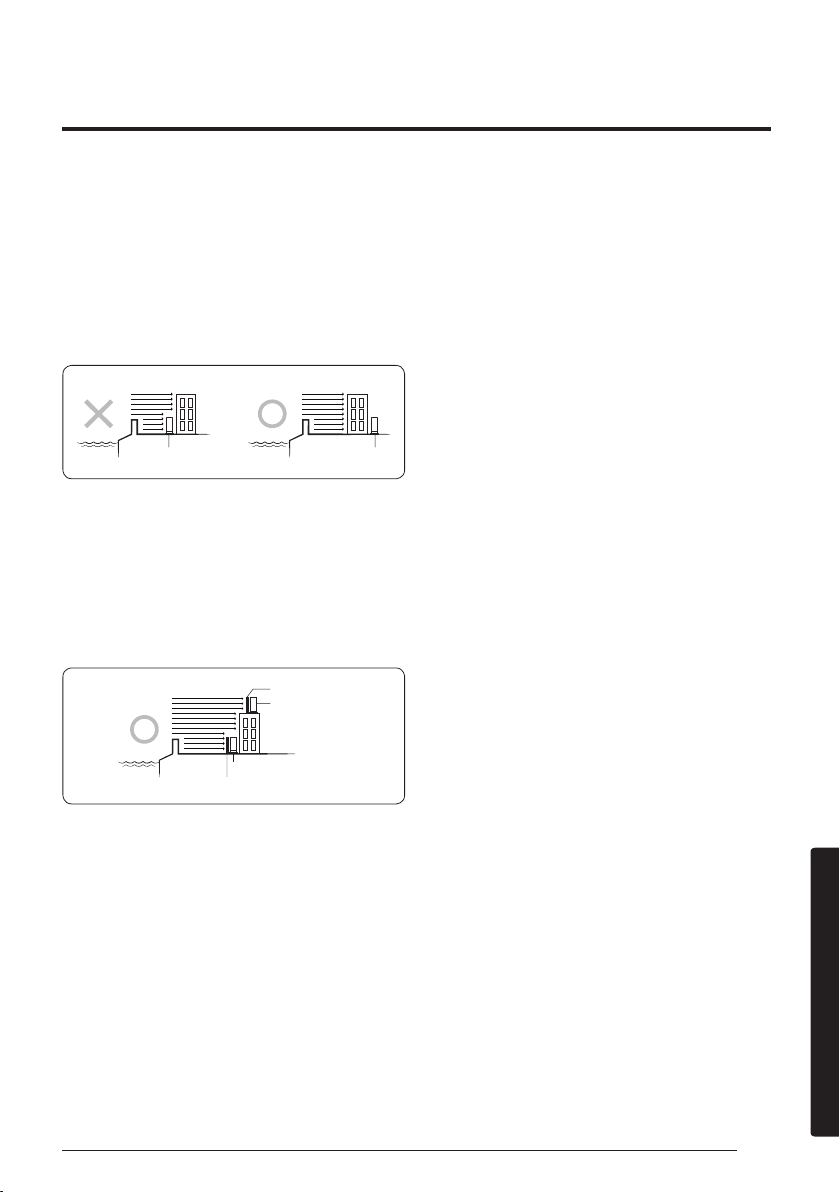
• When installing the outdoor unit at the seaside, make
sure that it is not directly exposed to sea breeze. If
you cannot find an adequate place free from direct
sea breeze, construct a protection wall or a protective
fence.
– Install the outdoor unit in a place (such as near
buildings etc.) where it can be protected from sea
breeze. Failure to do so may cause a damage to the
outdoor unit.
• If you cannot avoid installing the outdoor unit at the
seaside, construct a protection wall around to block the
sea breeze.
• Construct a protection wall with a solid material such
as concrete to block the sea breeze. Make sure that the
height and the width of the wall are 1.5 times larger
than the size of the outdoor unit. Also, secure a space
larger than 600 mm between the protection wall and
the outdoor unit for exhausted air to ventilate.
• Install the unit in a place where water can drain
smoothly.
• If you have any difficulty finding installation location
as prescribed above, contact your manufacturer for
details.
• Be sure to clean the sea water and the dust on the heat
exchanger of the outdoor unit and apply a corrosion
inhibitor on it. (At least once in a year.)
Power supply line, fuse, or circuit
breaker
• Always make sure that the power supply is compliant
with current safety standards. Always install the air
conditioner in compliance with current local safety
standards.
• Always verify that a suitable grounding connection is
available.
• Verify that the voltage and frequency of the power
supply comply with the specifications and that the
installed power is sufficient to ensure the operation of
any other domestic appliance connected to the same
electric lines.
• Always verify that the cut-off and protection switches
are suitably dimensioned.
• Verify that the air conditioner is connected to the
power supply in accordance with the instructions
provided in the wiring diagram included in the manual.
• Always verify that electric connections (cable entry,
section of leads, protections…) are compliant with
the electric specifications and with the instructions
provided in the wiring scheme. Always verify that all
connections comply with the standards applicable to
the installation of air conditioners.
• Be sure not to perform power cable modification,
extension wiring, and multiple wire connection.
– It may cause electric shock or fire due to poor
connection, poor insulation, or current limit
override.
– When extension wiring is required due to power
line damage, refer to "Step 2.4 Optional: Extending
the power cable" in the installation manual.
Protection wall
Outdoor unit
Sea
Outdoor unit
Protection wall
Sea breeze
Outdoor unit
Sea
Sea breeze
Sea
Outdoor unit
Sea breeze
34
Installation
Preparation
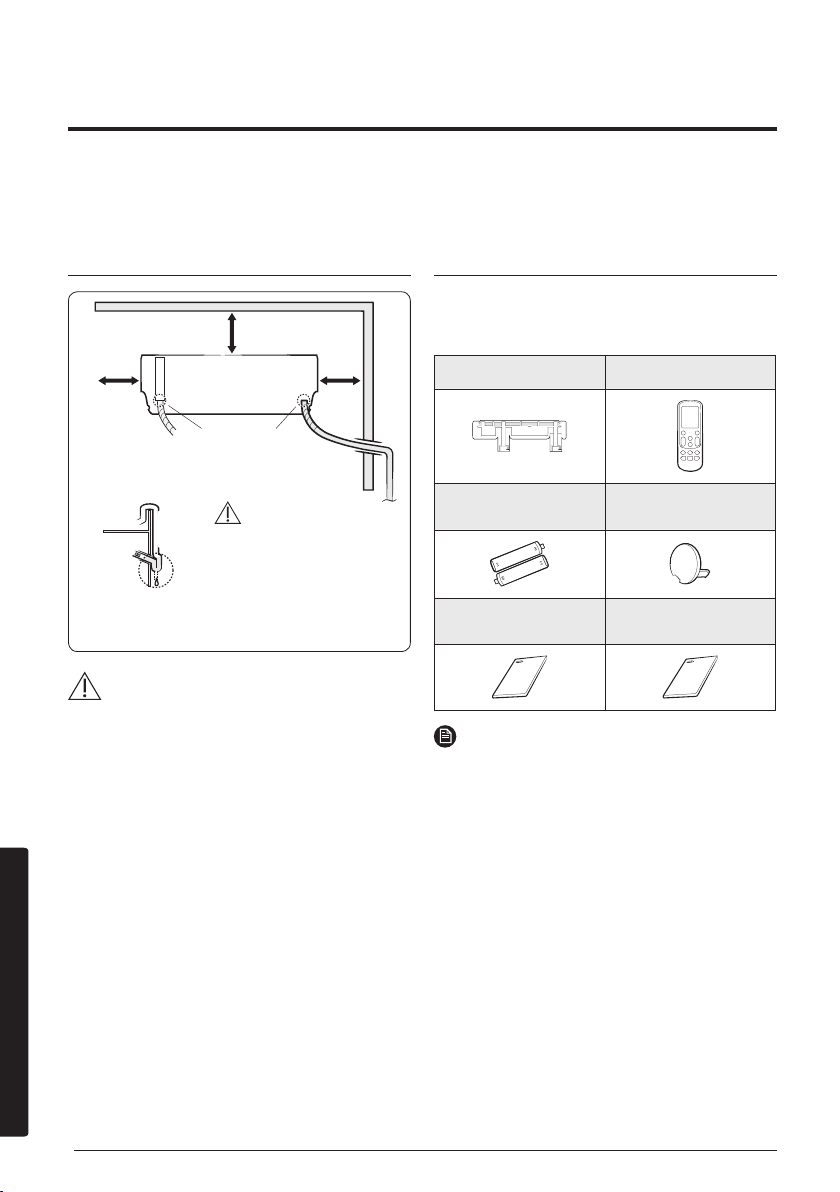
Step 1.1 Choosing the installation
location
Overview of installation location requirements
CAUTION
CAUTION
• Comply with the length and height limits described in
the figure above.
Step 1.2 Checking and preparing
accessories and tools
Accessories
Accessories in the indoor unit package
Installation plate (1) Remote control (1)
Remote control battery
(2)
Cap screw (2)
Manual user & install (1)
Smart A/C application
Manual (1)
NOTE
• A flare nut is attached to the end of each pipe of an
evaporator or a service port. Use flare nuts when
connecting the pipes.
• Wire assembly cables are optional. If they are not
supplied, use standard cables.
• The drain plug and the rubber legs are included only
when the air conditioner is supplied without assembly
pipes.
• If these accessories are supplied, they are in the
accessory package or outdoor unit package.
100 mm or more
Drain hose hole
You can select the direction of
draining (left or right).
Make a U-trap (A) on the
pipe (which is connected
to the indoor unit) at outer
wall and cut the bottom
part of the insulation
(about 10 mm) to prevent
rainwater from getting
inside through the
insulation.
Outdoor Unit
Outer wall
Indoor Unit
Cut insulation to have
rainwater drained
125 mm
or more
125 mm
or more
35
Installation
Tools
General tools
• Vacuum pump
(Backward flowing
prevention)
• Manifold gauge
• Stud finder
• Torque wrench
• Pipe cutter
• Reamer
• Pipe bender
• Spirit level
• Screwdriver
• Spanner
• Drill
• L-wrench
• Measuring tape
Tools for test operation
• Thermometer
• Resistance meter
• Electroscope
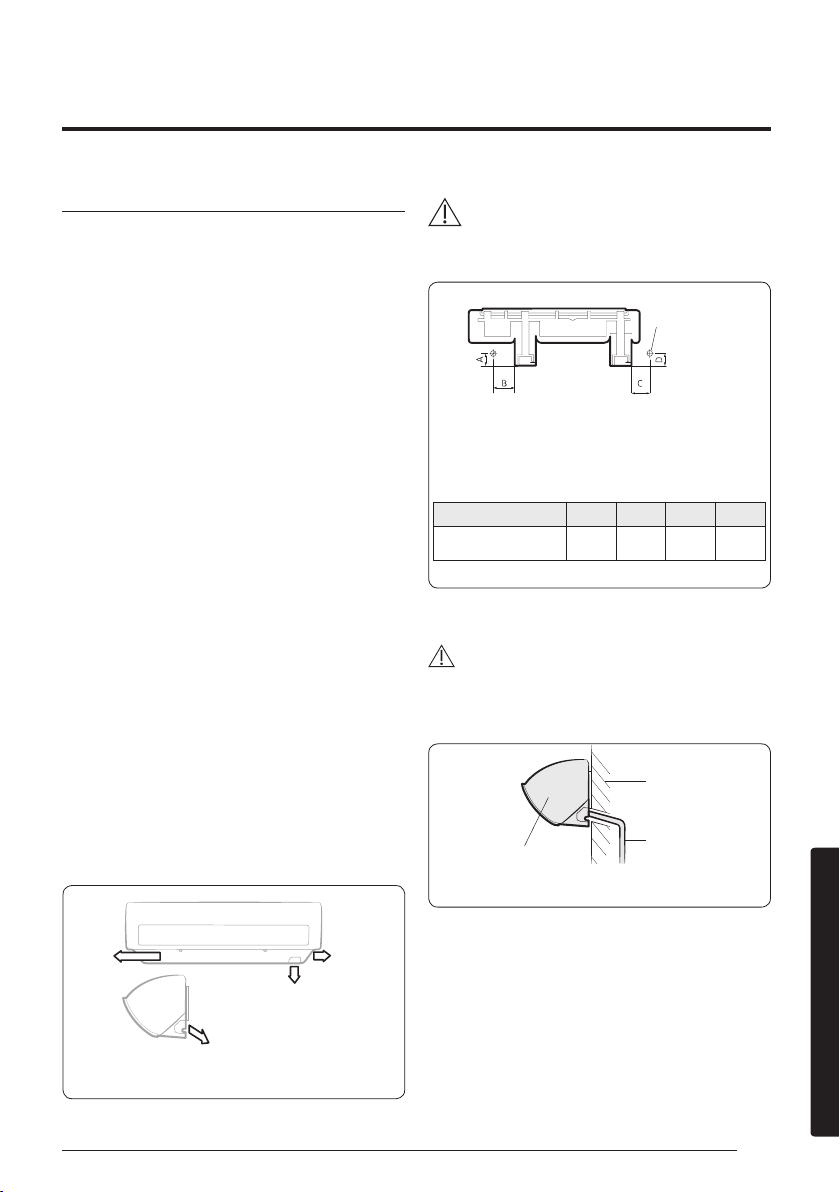
Step 1.3 Drilling a hole through the
wall
Before fixing the installation plate to a wall and then fixing
the indoor unit to the installation plate, a window frame,
or a gypsum board, you must determine the position of a
hole (with 65 mm inner diameter) through which the pipe
bundle (consisting of power and communication cables,
refrigerant pipes, and drain hose) will pass and then drill
that hole.
1. Determine the position of a 65 mm hole in
consideration of the possible directions of
the pipe bundle and the minimum distances
between the hole and the installation plate.
CAUTION
• Comply with the length and height limits described in
the figure above.
2. Drill the hole.
CAUTION
• Be sure to drill only one hole.
• Make sure that the hole slants downwards so that the
drain hose slants downwards to drain water well.
Pipe bundle hole
(Unit : mm)
Model A B C D
AJMBADEC 36 190 81 36
Pipe bundle hole: Ø 65 mm
<Minimum distances between the hole
and the installation plate>
Wall
Drain hose
Indoor unit
<The hole slants downwards>
Wall
Drain hose
Indoor unit
<The hole slants downwards>
36
Installation
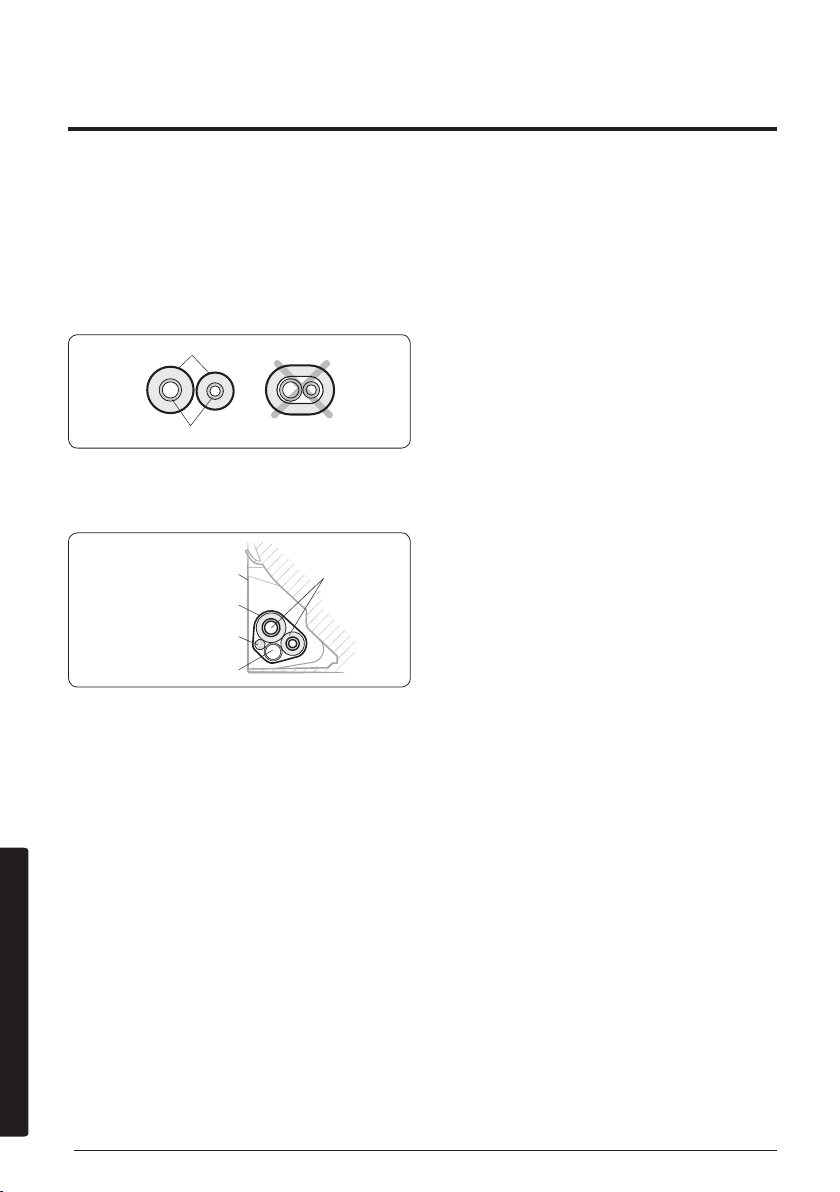
Step 1.4 Taping the pipes, cables, and
drain hose
1. Wrap foam insulation on parts without
insulation on the ends of the refrigerant
pipes, as shown in the figure. This
wrapping minimises condensation problem.
2. Wind the refrigerant pipes, power cable,
communication cable and drain hose with
vinyl tape to make a pipe bundle.
Insulation
Refrigerant pipes
Refrigerant pipes
(assembly pipe)
Installation plate
Vinyl tape
Power and communication
cables (assembly cable)
Drain hose
37
Installation
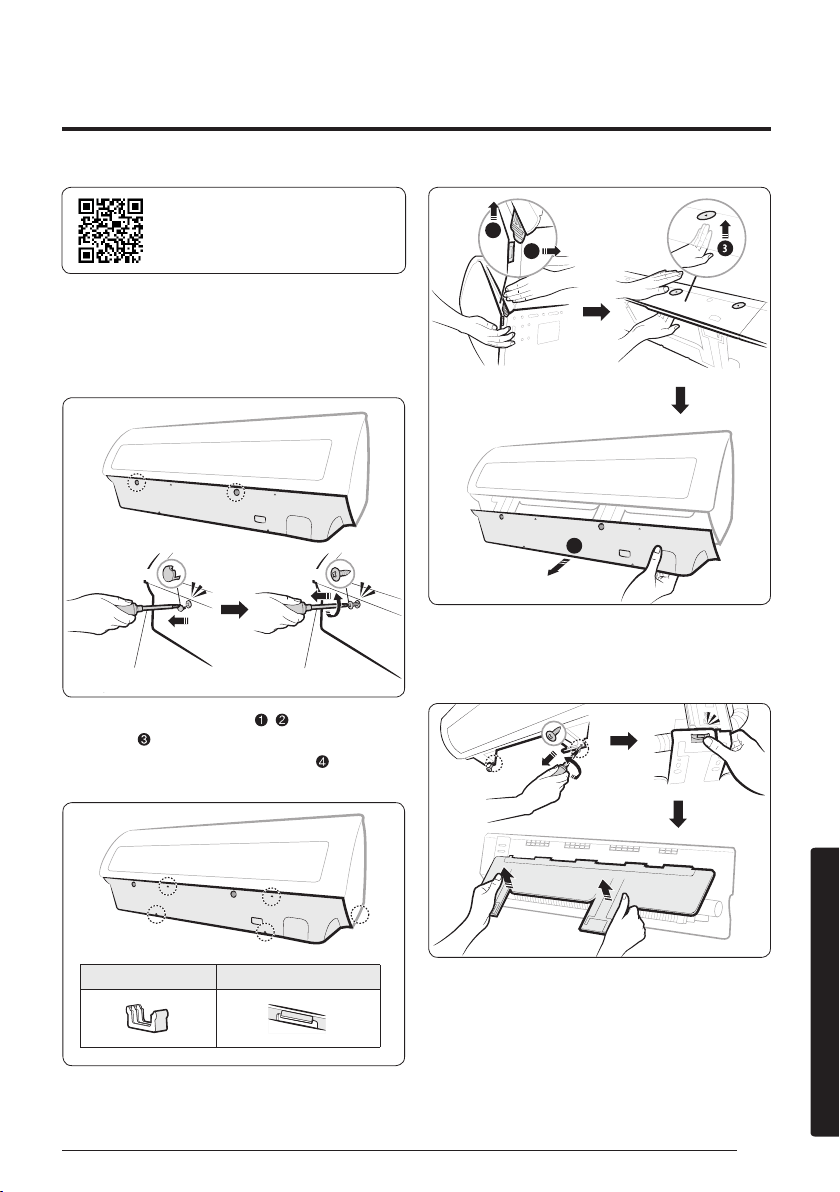
Step 2.1 Disassembling the cover
panel
1. Remove the cap screws, then the screws.
2. Unlock the side hooks ( , ), then centre
hooks ( ).
Then unlock the bottom hooks ( ) to pull
out the cover panel.
B
B
C
A
A
1
2
4
Step 2.2 Disassembling the
installation plate
Indoor Unit Installation
Please scan this QR code for detail
video of indoor unit installation.
Cap screw
Phillips
screwdriver
Screw
Flat-head screwdriver
Centre hook (A) Bottom/Side hook (B/C)
38
Installation
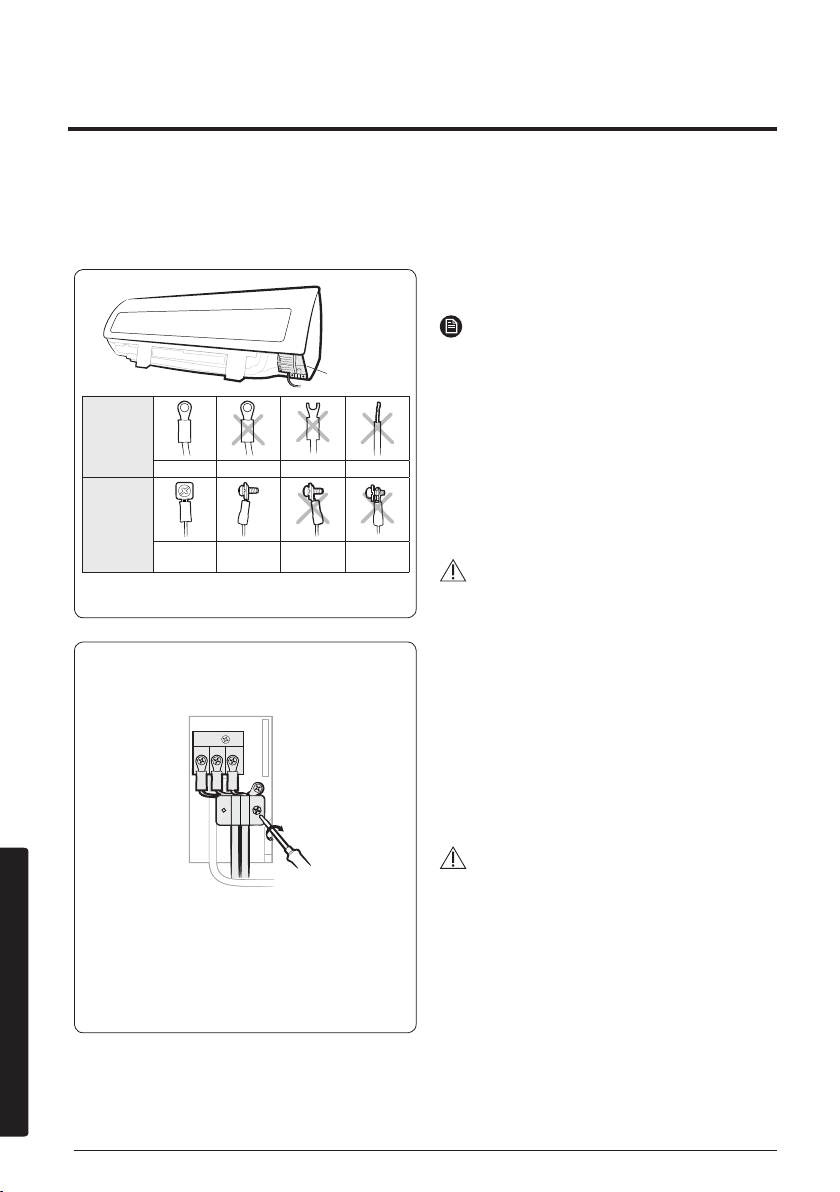
Step 2.3 Connecting the power and
communication cables (assembly
cable)
1(L)2(N) 3(C)
• When performing electrical and earthing works,
be sure to comply with the 'technical standards of
electrical installations' and the 'wiring regulations' in
the local regulations.
• Tightentheterminalblockscrewto1.2-1.8N•m(12-
18kgf•cm).
NOTE
• Each wire is labelled with the corresponding terminal
number.
• Use shield cable (Category 5; less than 50pF/m) for
noisy environmental site.
• Power supply cords of parts of appliances for outdoor
use shall not be lighter than polychloroprene sheathed
flexible cord. (Code designation IEC: 60245 IEC 66/
CENELEC: H07RN-F, IEC: 60245 IEC 57/CENELEC:
H05RN-F)
• Power & Communication cable shall not exceed 30m.
CAUTION
• For the terminal block wiring, use a wire with a
ring terminal socket only. Regular wires without a
ring terminal socket may become a hazard due to
overheating of the electrical contact during installation.
• Do not connect two or more different cables to extend
the length. This connection may cause fire.
• Each circular terminal must match the size of its
corresponding screw in the terminal block.
• After connecting the cables, make sure that terminal
numbers on the indoor and outdoor units match.
• Ensure that power and communication cables are
separated, they must not be in the same cable.
WARNING
• Connect the wires firmly so that wires cannot be pulled
out easily. (If they are loose, it could cause burn-out of
the wires.)
Before
connecting
Correct Upside down Damaged Non-circular
After
connecting
Correct Correct
Upside down Non-fitted
(Front view) (Side view)
<Circular terminal>
Control box
Fasten the screws for the wire holders.
39
Installation
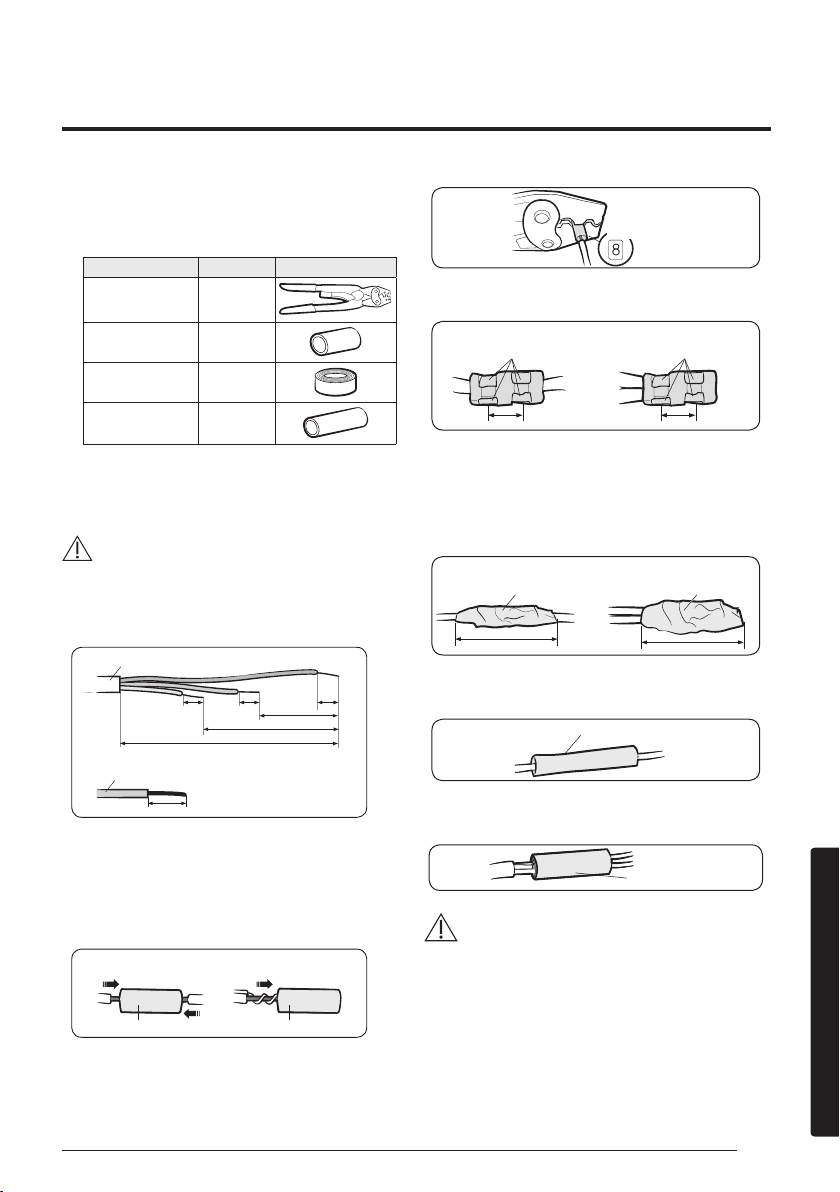
Step 2.4 Optional: Extending the power
cable
1. Prepare the following tools
Tools Spec Shape
Crimping pliers MH-14
Connection
sleeve (mm)
20xØ6.5
(HxOD)
Insulation tape
Width 19
mm
Contraction
tube (mm)
70xØ8.0
(LxOD)
2. As shown in the figure, peel off the shields from
the rubber and wire of the power cable.
• Peel off 20 mm of cable shields from the pre-installed
tube.
CAUTION
• For information about the power cable specifications for
indoor and outdoor units, refer to the installation manual.
• After peeling off the tube wire, you must insert a
contraction tube.
Power cable
Pre-installed tube for the power cable
(Unit: mm)
(Unit: mm)
20 20
20
20
60
120
180
3. Insert both sides of core wire of the power cable
into the connection sleeve.
• Method 1: Push the core wire into the sleeve from both
sides.
• Method 2: Twist the wire cores together and push it into
the sleeve.
Connection sleeve Connection sleeve
Method 1 Method 2
4. Using a crimping tool, compress the two points and
flip it over and compress another two points in the
same location.
• The compression dimension should be 8.0.
Compression
dimension
• After compressing it, pull both sides of the wire to
make sure it is firmly pressed.
Compress it 4 times.
5 mm
Compress it 4 times.
5 mm
Method 1 Method 2
5. Wrap it with the insulation tape twice or
more and position your contraction tube in
the middle of the insulation tape.
Three or more layers of insulation are
required.
Method 1 Method 2
Insulation tape
40 mm
35 mm
Insulation tape
6. Apply heat to the contraction tube to
contract it.
Contraction tube
7. After tube contraction work is completed,
wrap it with the insulation tape to finish.
Insulation tape
CAUTION
• Make sure that the connection parts are not exposed
to outside.
•
Be sure to use insulation tape and a contraction tube
made of approved reinforced insulating materials that
have the same level of withstand voltage with the
power cable. (Comply with the local regulations on
extensions.)
40
Installation
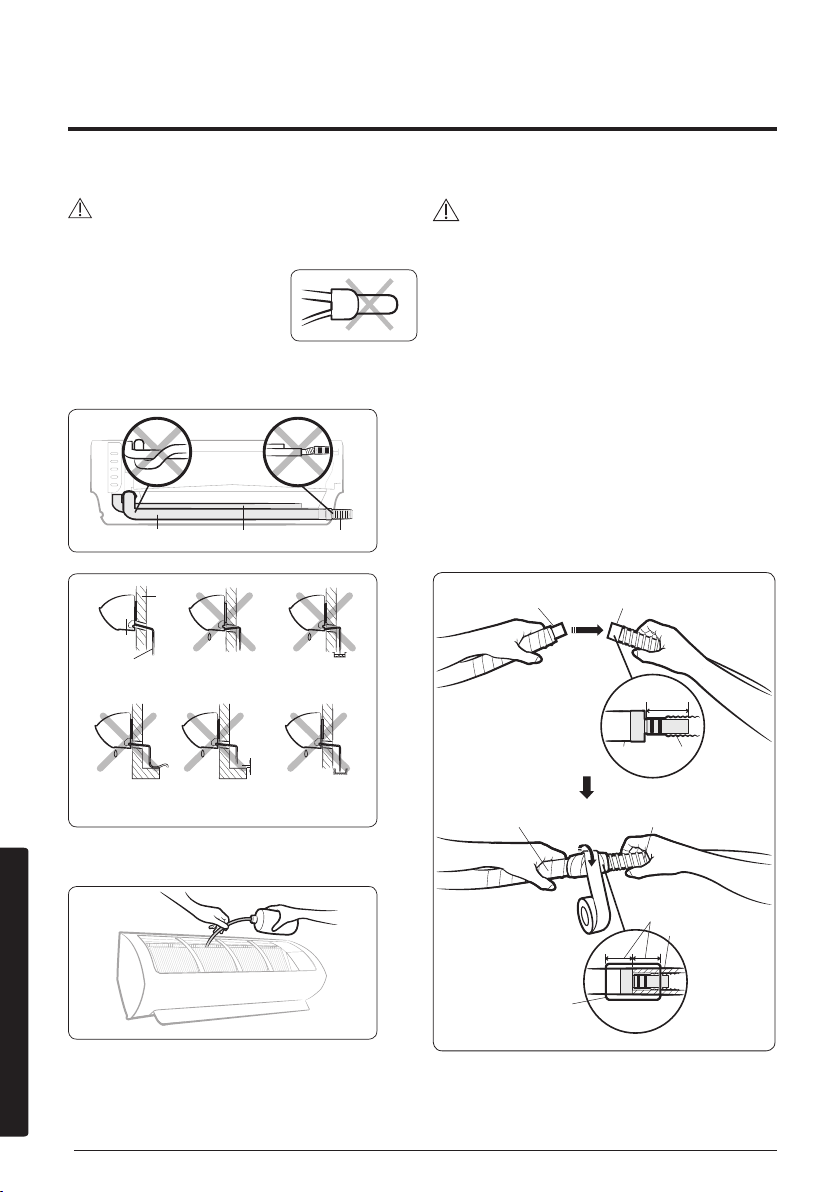
WARNING
• In case of extending the electric wire, please DO NOT use a
round-shaped pressing socket.
– Incomplete wire connections can
cause electric shock or a fire.
Step 2.5 Installing and
connecting the drain hose
1. Install the drain hose.
2. Pour water into the drain pan. Check whether
the hose is well drained.
CAUTION
• Make sure that the indoor unit is in upright position
when you pour water to check for leakage. Make sure
that the water does not overflow onto the electrical
part.
• If the diameter of the connection hose is smaller than
the product's drain hose, water leakage may occur.
• Inadequate installation may cause water leakage.
• If the drain hose is routed inside the room, insulate the
hose so that dripping condensation does not damage
the furniture or floors.
• Do not box in or cover the drain hose connection.
Drain hose connection must be easily accessible and
serviceable.
Step 2.6 Optional: Extending the drain
hose
(A) (B)
Drain hose
Assembly
pipe
Connection
hose
Indoor
unit
Drain
hose
Wall
5 cm
less
Ditch
Slant downwards Slant upwards
Dipped in
water
Bent
Too small
clearance
Too small
clearance
Drain
hose (A)
Extension drain
hose (B)
Drain
hose
Extension drain
hose
20 mm or
more
Foam
insulation
Vinyl
tape
40~45mm
41
Installation
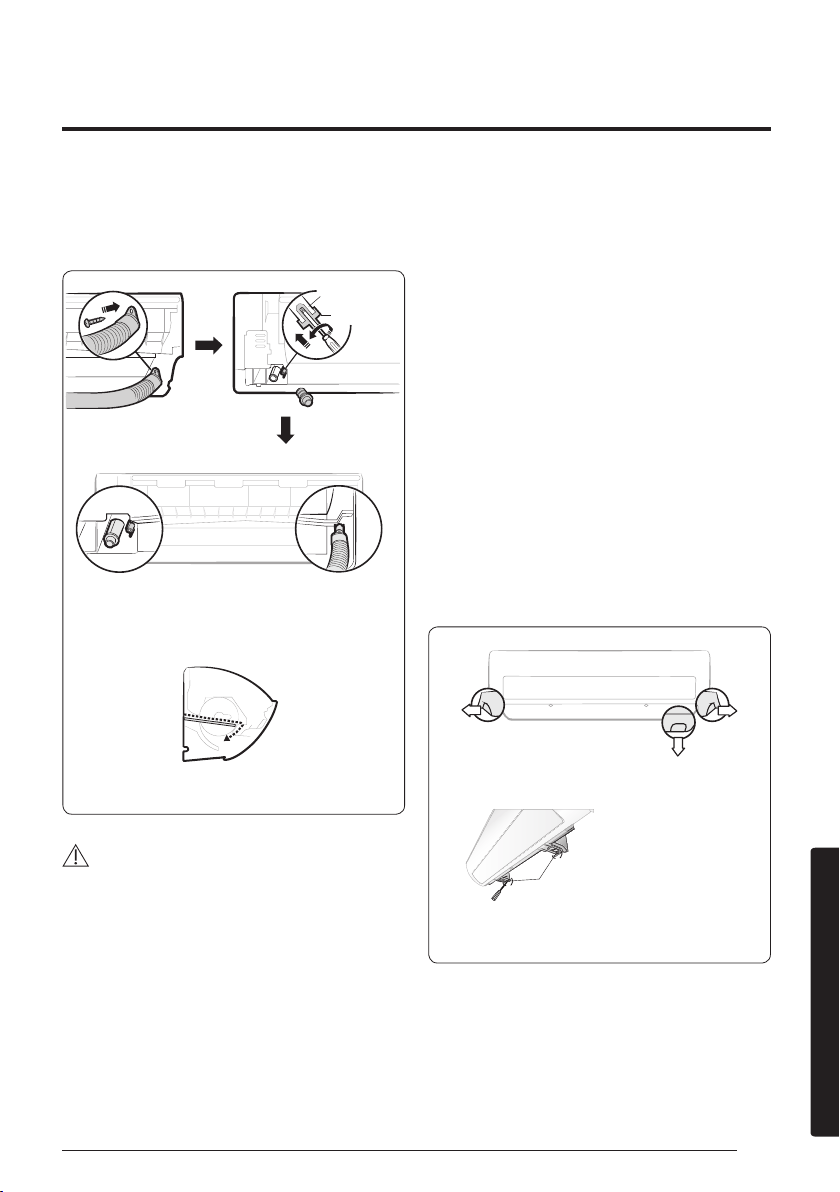
Step 2.7 Optional: Changing the
direction of the drain hose
CAUTION
• Make sure that the indoor unit is in upright position
when you pour water to check for leakage. Make sure
that the water does not overflow onto the electrical
part.
Step 2.8 Installing and connecting
the assembly pipes to the refrigerant
pipes (assembly pipe)
Connect indoor and outdoor units with field-supplied
copper pipes by means of flare connections. Use insulated
seamless refrigeration grade pipe only, (Cu DHP type
according to ISO1337), degreased and deoxidized, suitable
for operating pressures of at least 4200 kPa and for burst
pressure of at least 20700 kPa. Under no circumstances
must sanitary type copper pipe be used.
There are 2 refrigerant pipes of different diameters:
• The smaller one is for the liquid refrigerant
• The larger one is for the gas refrigerant
A short liquid refrigerant pipe and a short gas refrigerant
pipe are already fitted to the air conditioner. The
connection procedure for the refrigerant pipes varies
according to the exit position of each pipe when facing
the wall:
1. Cut out the appropriate knock-out piece (A,
B, C) on the rear of the indoor unit unless
you connect the pipe directly from the rear.
2. Smooth the cut edges.
Drain pan outlet
Rubber cap
Pour water in the direction of arrow.
Direction of the drained water
<Front view>
<Side view>
1 <Front view>
Left(A)
Underside(C)
Right(B)
2 <Assembling the
hanger screw>
Screw
42
Installation
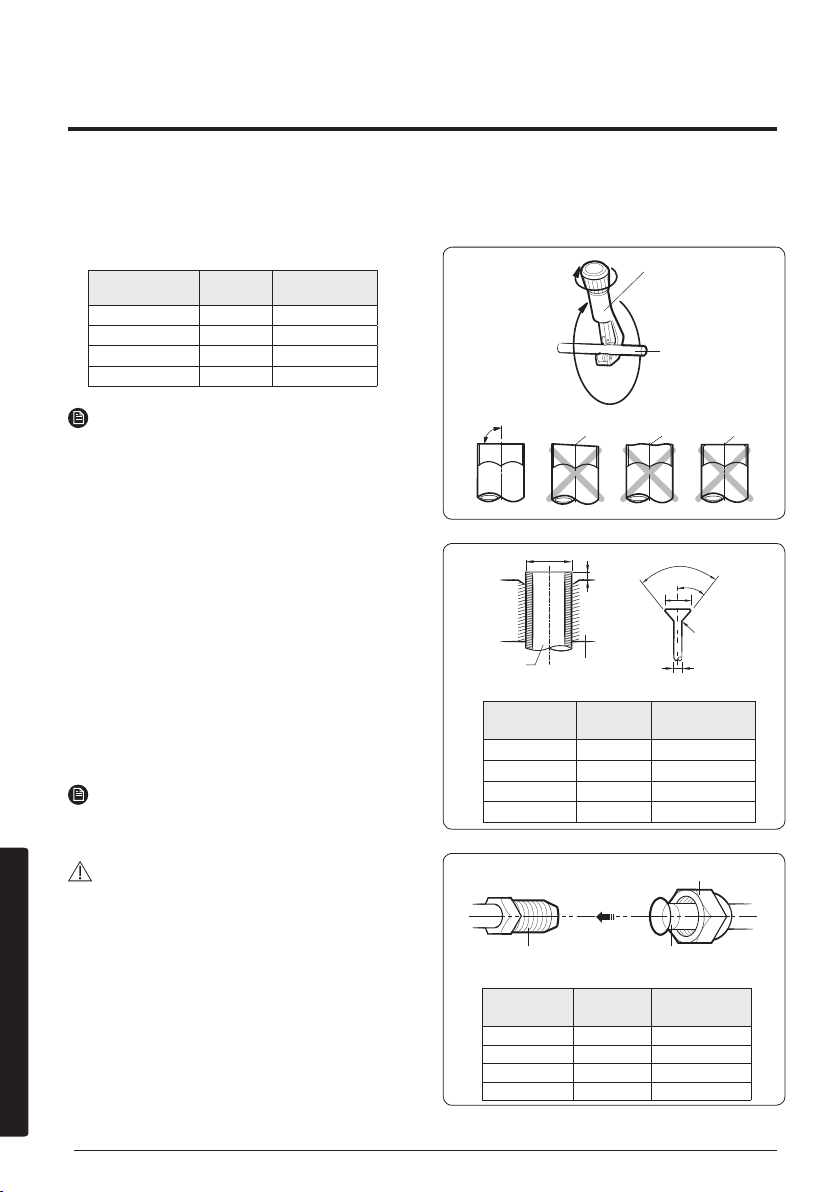
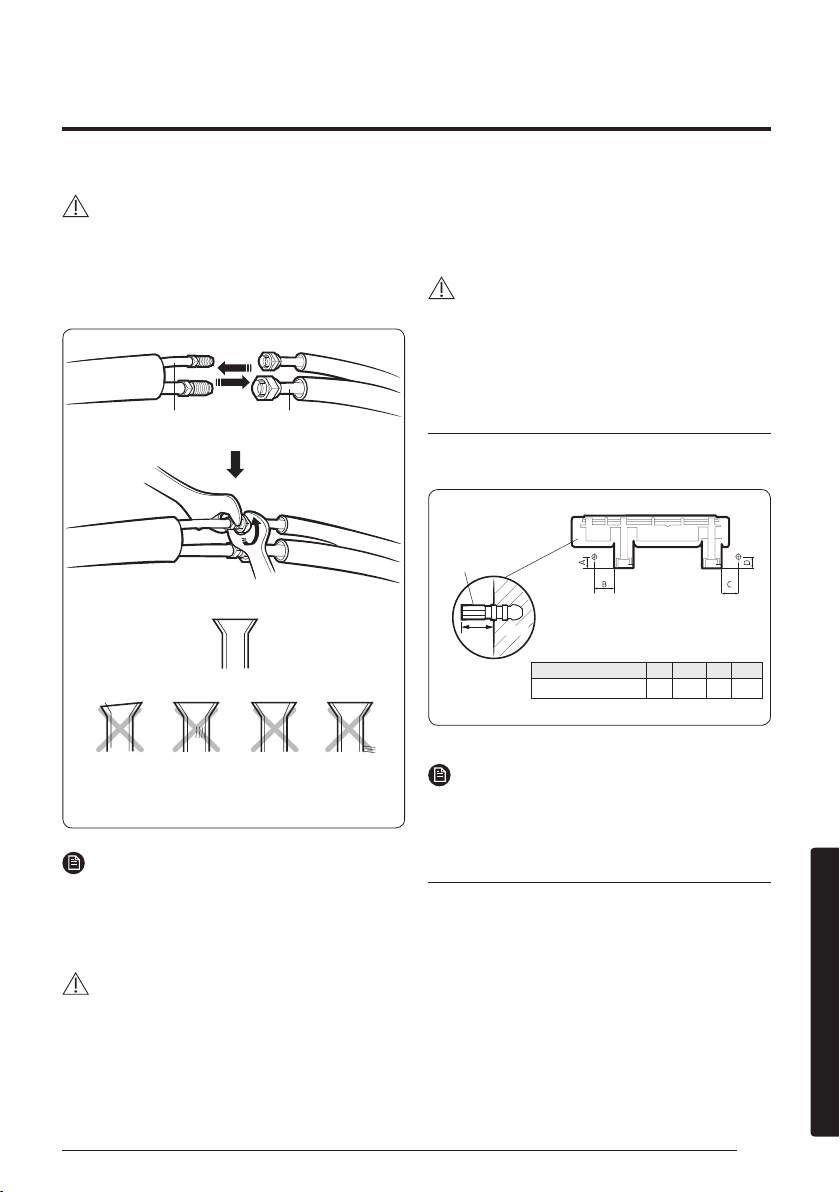
3. Remove the protection caps of the pipes and
connect the assembly pipe to each pipe. Tighten
the nuts first with your hands, and then with a
torque wrench, applying the following torque:
Outer diameter
(mm)
Torque
(N•m)
Torque (kgf•cm)
ø 6.35 14 to 18 140 to 180
ø 9.52 34 to 42 350 to 430
ø 12.70 49 to 61 500 to 620
ø 15.88 68 to 82 690 to 830
NOTE
• If you want to shorten or extend the pipes, see Step 2.9
Shortening or extending the refrigerant pipes (assembly
pipe) on page 42.
4. Cut off the remaining foam insulation.
5. If necessary, bend the pipe to fit along the bottom
of the indoor unit. Then pull it out through the
appropriate hole.
• The pipe should not project from the rear of the indoor
unit.
• The bending radius should be 100 mm or more.
6 Pass the pipe through the hole in the wall.
7. Fix the indoor unit on the wall.Pass the cables,
pipes and hose through the knock-out hole which
would be connected to the outdoor unit .
8. Use 2 screws to fix the indoor unit as shown in
the picture 2.
NOTE
• The pipe will be insulated and fixed permanently into position
after finishing the installation and the gas leak test.
CAUTION
• Tighten the flare nut with a torque wrench according to
specified method. If the flare nut is over-tightened, the flare
may break and cause refrigerant gas leakage.
• Do not box in or cover the pipe connection. All refrigerant pipe
connection must be easily accessible and serviceable.
Step 2.9 Shortening or extending the
refrigerant pipes (assembly pipe)
90°
R 0.4 to 0.8
90°±2°
45°±2°
L
D
D
A
(Unit: mm)
Outer diameter
(D)
Depth (A)
Flare dimension
(L)
ø 6.35 1.3 8.7 to 9.1
ø 9.52 1.8 12.8 to 13.2
ø 12.70 2.0 16.2 to 16.6
ø 15.88 2.2 19.3 to 19.7
(Unit: mm)
Outer diameter
(mm)
Torque (N•m) Torque (kgf•cm)
ø 6.35 14 to 18 140 to 180
ø 9.52 34 to 42 350 to 430
ø 12.70 49 to 61 500 to 620
ø 15.88 68 to 82 690 to 830
Pipe
cutter
Pipe
Oblique Rough
Burr
Pipe Flare
Indoor outlet
pipe
Connecting
pipe
Flare
nut
43
Installation
CAUTION
• If you need a pipe longer than specified in piping
codes and standards, you must add refrigerant to the
pipe. Otherwise, the indoor unit may freeze.
• While removing burrs, put the pipe face down to make
sure that the burrs do not get in to the pipe.
NOTE
• Excessive torque may cause gas leakage. When
extending the pipe with welding or brazing, ensure
that nitrogen is used during the welding or brazing
process. The joint must be accessible and serviceable.
CAUTION
• Tighten the flare nut at the specified torque. If the flare
nut is over-tightened, it may break to cause leakage of
refrigerant gas.
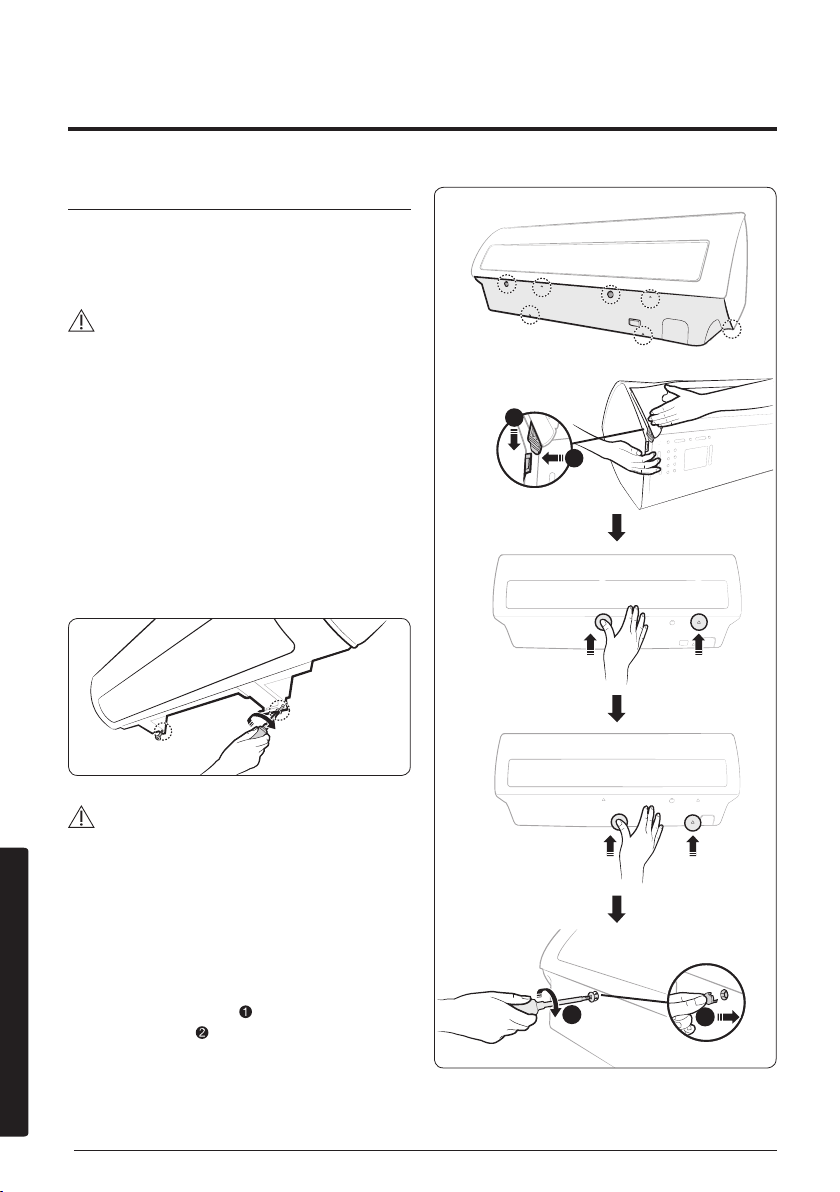
Step 2.10 Fixing the installation plate
You can install the indoor unit on a wall, window frame, or
gypsum board.
WARNING
• Make sure that the wall, window frame, or gypsum
board can withstand the weight of the indoor unit. If
you install the indoor unit in a place where it is not
strong enough to withstand the unit's weight, the unit
could fall and cause injury.
When fixing the indoor unit on a wall
Fix the installation plate to the wall giving attention to the
weight of the indoor unit.
NOTE
• If you mount the plate to a concrete wall using plastic
anchors, make sure that gaps between the wall and the
plate, created by projected anchor, is less than 20 mm.
When fixing the indoor unit on a window frame
1. Determine the positions of the wooden
uprights to be attached to the window
frame.
2. Attach the wooden uprights to the window
frame giving attention to the weight of the
indoor unit.
3. Attach the installation plate to the wooden
upright using tapping screws.
<Flare nut>
Liquid service port
<High pressure>
Gas service port
<Low pressure>
Correct
Inclined Cracked
Uneven
thickness
Damaged
surface
Plastic anchor
Wall
20 mm
(Unit : mm)
Model A B C D
009/012/018 36 120 81 36
Pipe bundle hole: Ø 65 mm
44
Installation
When fixing the indoor unit on a gypsum board
1. Use stud finder to find out locations of the
studs.
2. Fix the plate hanger on two studs.
CAUTION
• If you fix the indoor unit on a gypsum board, use
only specified anchor bolts on reference positions.
Otherwise, the gypsum surrounding the joints may
crumble over time and cause the screws to be
loosened and stripped. This may lead to physical injury
or equipment damage.
• Search for other spots if there are less than two studs,
or the distance between the studs are different from
the plate hanger.
• Fix the installation plate without inclining to one side.
Step 2.11 Fixing the indoor unit to the
installation plate
CAUTION
• Make sure that the pipe bundle does not move when
you install the indoor unit onto the installation plate.
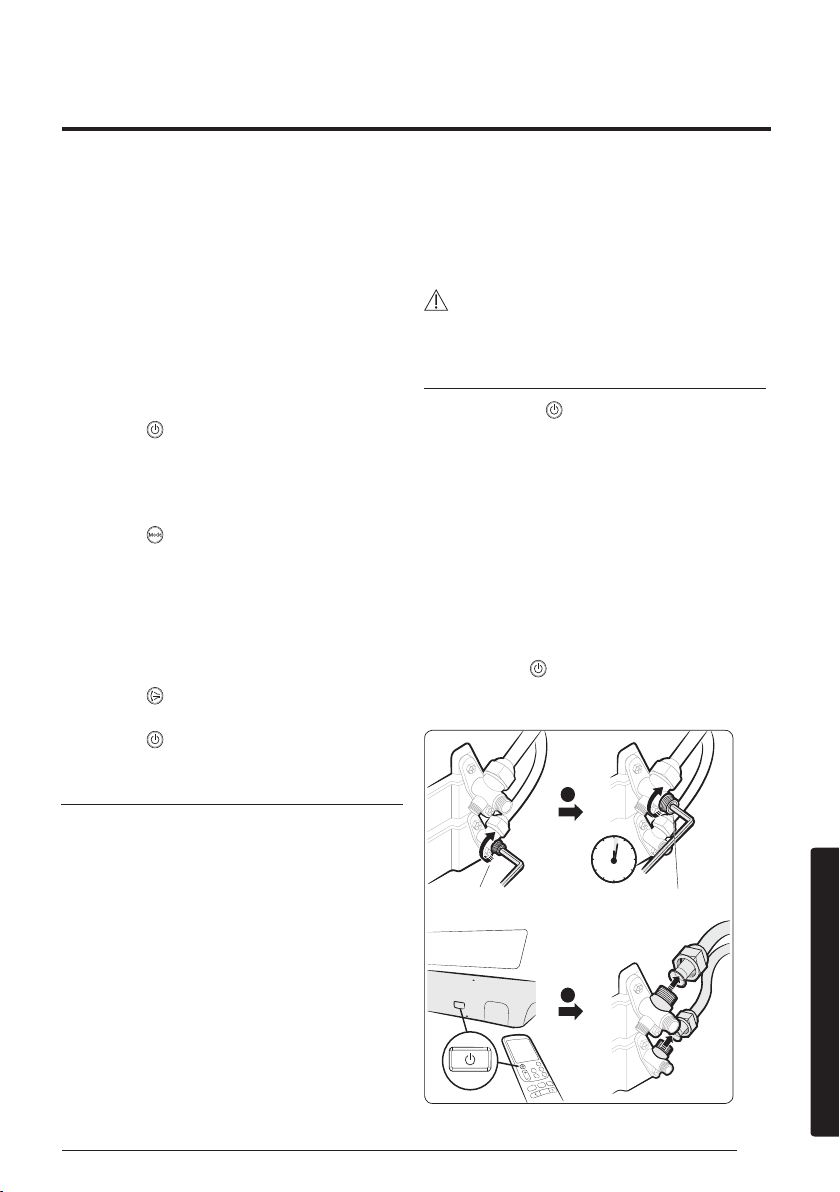
Step 2.12 Assembling the cover panel
1. Lock the side hooks (D), then centre hooks
(B). Then lock the bottom hooks (C) to
engage the cover panel in place.
2. Fasten the screw (A- ), then assemble the
cap screws (A- ).
B B
C
C
A
A
A
B
B
C
C
D
D
1
2
A
2
1
Installation
45
Step 2.13 Performing final check and trial
operation
1. Check the following:
• Strength of the installation site
• Tightness of pipe connection to detect gas leak
• Electric wiring connection
• Heat-resistant insulation of the pipe
• Drainage
• Grounding conductor connection
• Correct operation (Take the following steps.)
2. Press the (Power) button on the remote
control to check the following:
• The indicator on the indoor unit lights up.
• The airflow blade opens and the fan gears up for
operation.
3. Press the
(Mode) button to select Cool mode.
Then take the following sub-steps:
• In Cool mode, use the Temperature button to set the set
temperature to 16 °C.
• Check whether, approximately 3 to 5 minutes later, the
outdoor unit starts, and a cool air blows out.
• After 12 minutes of stationary condition, check the
indoor unit air treatment.
4. Press the (Air swing) button to check
whether the airflow blades work properly.
5. Press the (Power) button to stop the trial
operation.
Pumping down refrigerant
Pump-down is an operation intended to collect all the system
refrigerant in the outdoor unit. This operation must be carried
out before disconnecting the refrigerant tubing in order to avoid
refrigerant loss to the atmosphere.
1. Shut off the liquid valve with the Allen wrench.
2. Turn on the air conditioner in cooling with fan
operating at high velocity. (Compressor will
immediately start, provided 3 minutes have
elapsed since the last stop.)
3. After 2 minutes of operation, shut the suction
valve with the same wrench.
4. Turn off the air conditioner and switch mains
supply off.
5. Disconnect tubing. After disconnection, protect
valves and tubing ends from dust.
CAUTION
• Compressor damage may occur if the compressor is run at a
negative suction pressure.
Pumping down for removing the product
1. Hold down the (Power) button on the indoor
unit for 5 seconds. Beep sounds immediately
to indicate that the product is ready for pump
down procedure.
2. Let the compressor run for more than 5 minutes.
3. Release the valve caps on High and Low
pressure side.
4. Use L-wrench to close the valve on the high
pressure side.
5. After approximately 1 minute, close the valve
on the low pressure side.
6. Stop operation of the air conditioner by
pressing the (Power) button on the indoor
unit or remote control.
7. Disconnect the pipes.
1
2
Liquid service port
<High pressure>
Gas service port
<Low pressure>
Off
1 minute