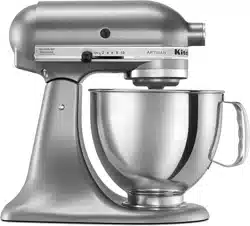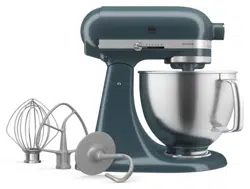

K45SS, KSM150, K5SS
W���9��3�C_ENv�3����� � ��/5/�� 3:5� P�

STAND MIXER INSTRUCTIONS
W���9��3�C_ENv�3����� � ��/5/�� 3:5� P�
English
3
STAND MIXER INSTRUCTIONS
TABLE OF CONTENTS
STAND MIXER SAFETY
Important Safeguards...........................................................................................4
Electrical Requirements ....................................................................................... 6
PARTS AND FEATURES (TILT-HEAD)
K45SS Tilt-Head Stand Mixer Features ...............................................................7
KSM150 Tilt-Head Stand Mixer Features ............................................................8
ASSEMBLING YOUR TILT-HEAD STAND MIXER ............................................ 9
PARTS AND FEATURES (BOWL-LIFT)
K5SS Bowl-Lift Stand Mixer Features ................................................................10
ASSEMBLING YOUR BOWL-LIFT STAND MIXER .........................................11
USING THE STAND MIXER
Using Your KitchenAid Attachments .................................................................12
Beater-to-Bowl Clearance .................................................................................12
Care and Cleaning of Your Stand Mixer ............................................................13
Planetary Mixing Action .....................................................................................13
Stand Mixer Use ................................................................................................13
Speed Control Guide .........................................................................................14
Stand Mixer Use ................................................................................................15
Mixing and Kneading Yeast Dough.....................................................................16
Egg Whites .........................................................................................................17
Whipped Cream ................................................................................................ 17
ACCESSORIES
General Information ..........................................................................................18
General Instructions ..........................................................................................18
TROUBLESHOOTING ..........................................................................................19
WARRANTY ...........................................................................................................20
W���9��3�C_ENv�3����� 3 ��/5/�� 3:5� P�
4
STAND MIXER SAFETYSTAND MIXER SAFETY
IMPORTANT SAFEGUARDS
When using electrical appliances, basic safety
precautions should always be followed, including the
following:
1. Read all instructions. Misuse of appliance may result
in personal injury.
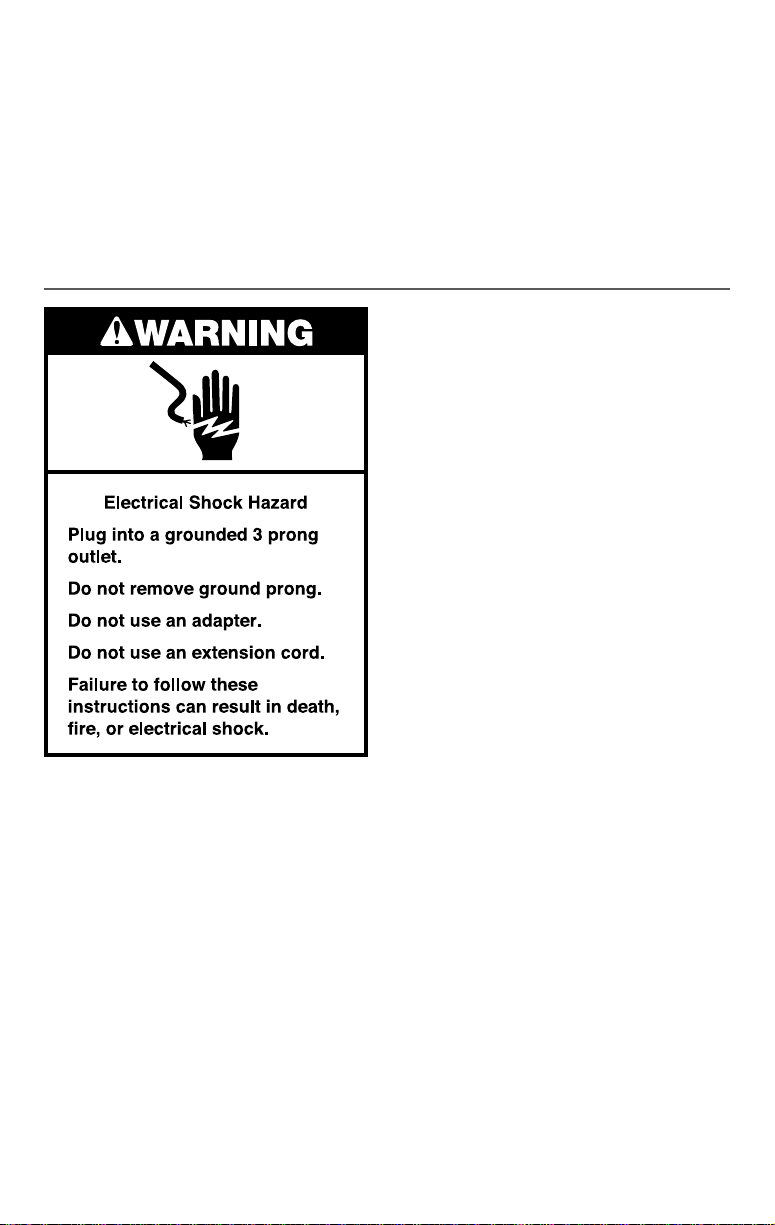
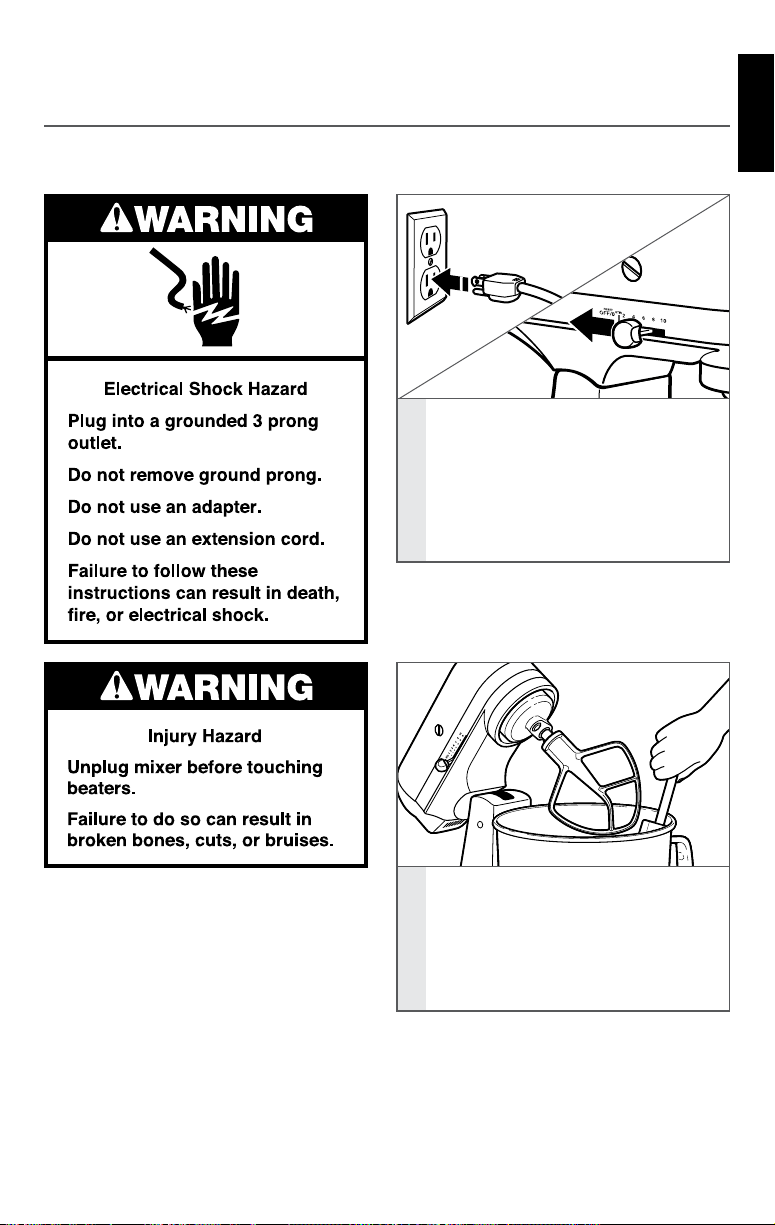
2. To protect against risk of electrical shock, never
immerse Stand Mixer in water or other liquid.
3. Be sure that the prongs on the plug of the unit mate
with the electrical wall receptacle into which it will be
plugged. Observation of proper grounding techniques
and local electrical codes is required.
4. Children should be supervised to ensure that they do
not play with the appliance.
5. Close supervision is necessary when any appliance
is used by or near children. Do not leave the Stand
Mixer unattended while it is operating.
6. Unplug the Stand Mixer from outlet when not
in use, before inserting or removing parts, and
before cleaning.
7. Avoid contacting moving parts. Keep hands, hair,
clothing, as well as spatulas and other utensils away
from beater during operation to prevent injury, and/or
damage to the Stand Mixer.
W���9��3�C_ENv�3����� � ��/5/�� 3:5� P�
English
5
STAND MIXER SAFETYSTAND MIXER SAFETY
8. Do not operate the Stand Mixer unattended or near
edge of work surface. When used for heavy loads
or at high speeds, the Stand Mixer may move on
the work surface.
9. Remove the at beater, wire whip, or dough hook
from the Stand Mixer before washing.
10. Do no operate any appliance with a damaged
cord set or after the appliance has been dropped
or damaged in any manner. If the supply cord is
damaged, it must be replaced by the manufacturer,
its service agent, or similarly qualied persons
in order to avoid a hazard.
11. The use of attachments not recommended by
KitchenAid may cause re, electrical shock, or injury.
12. Do not use outdoors.
13. Do not let cord hang over edge of table or counter,
or touch hot surfaces.
14. When using a tilt-head Stand Mixer, the head must be
completely down before locking. Before mixing, make
sure lock is in position by attempting to raise head.
15. Do not use an extension cord.
16. This appliance is not intended for use by persons
(including children) with reduced physical sensory
or mental capabilities or lack of experience and
knowledge, unless they have been given supervision
or instruction concerning use of the appliance by a
person responsible for their safety. If there is lack of
understanding of these risks the person responsible
for their safety shall prevent use of the appliance or
take precautions to eliminate those risks.
17. When making dough with the Stand Mixer, never
operate the Stand Mixer continuously for more than
10 minutes.
18. Be careful when lifting the Stand Mixer, as it is heavy.
19. Use the Stand Mixer only for its intended function.
W���9��3�C_ENv�3����� 5 ��/5/�� 3:5� P�
6
STAND MIXER SAFETY PARTS AND FEATURES (TILT-HEAD)
20. Be certain the attachment hub is secure (tighten
attachment knob) prior to using the Stand Mixer
to avoid any possibility of the attachment hub
falling into the bowl during mixing.
SAVE THESE INSTRUCTIONS
Electrical Requirements
Your Stand Mixer operates on a regular
220-240 Volt A.C., 50-60 Hertz house
current. The wattage rating for your
Stand Mixer is printed on the trim band.
This wattage is determined by using the
accessory which draws the greatest power.
Other recommended accessories may draw
signicantly less power.
Do not use an extension cord. If the power
supply cord is too short, have a qualied
electrician or serviceman install an outlet
near the appliance.
W���9��3�C_ENv�3����� � ��/5/�� 3:5� P�
English
7
STAND MIXER SAFETY PARTS AND FEATURES (TILT-HEAD)
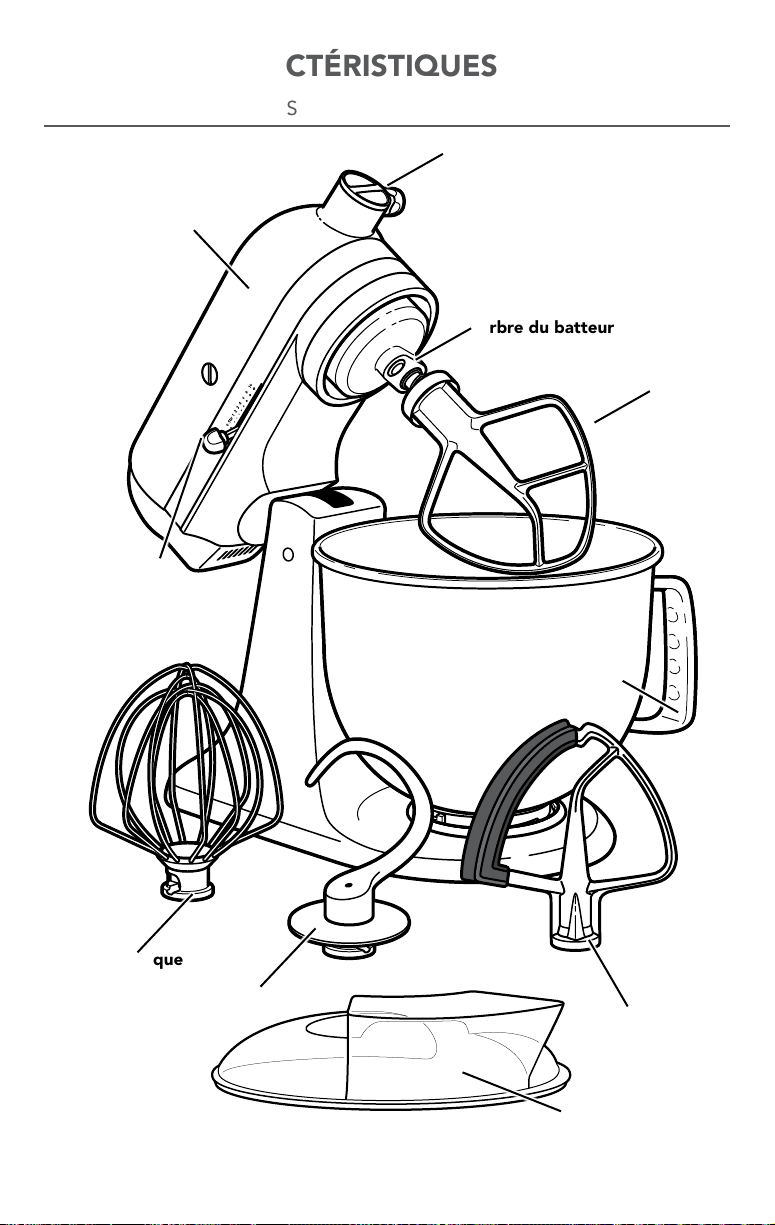
K45SS Tilt-Head Stand Mixer Features
� �
��
�
�
�
�
�
�
�
�
�
�
�
�
�
�
�
�
�
�
�
�
�
�
�
�
�
�
�
�
�
�
�
�
�
�
�
�
�
�
�
�
�
�
�
�
�
�
�
�
� ��� � � � � ��
� �� � � � � � � � � �� � �� � � � � �
Motor Head
Beater Height
Adjustment
Screw
Motor Head
Locking Lever
(not shown)
Accessory Knob
Accessory Hub
Flat Beater
Wire Whip
Dough Hook
Speed
Control
Lever
Bowl Clamping Plate
Beater Shaft
4.25 liter
(4.5 qt.)
Stainless
Steel
Bowl
W���9��3�C_ENv�3����� 7 ��/5/�� 3:5� P�
CMD + SHIFT CLICK TO CHANGE COPY
8
PARTS AND FEATURES (TILT-HEAD)
KSM150 Tilt-Head Stand Mixer Features
ASSEMBLING YOUR TILT-HEAD STAND MIXER
Motor Head
Beater Height
Adjustment
Screw
Motor Head
Locking Lever
(not shown)
Accessory Knob
Accessory Hub
Flat Beater
Wire Whip
Speed
Control
Lever
Bowl Clamping Plate
Beater Shaft
4.8 liter
(5 qt.)
Stainless
Steel Bowl
Pouring
Shield
Dough Hook
W���9��3�C_ENv�3����� � ��/5/�� 3:5� P�
English
CMD + SHIFT CLICK TO CHANGE COPY
9
PARTS AND FEATURES (TILT-HEAD) ASSEMBLING YOUR TILT-HEAD STAND MIXER
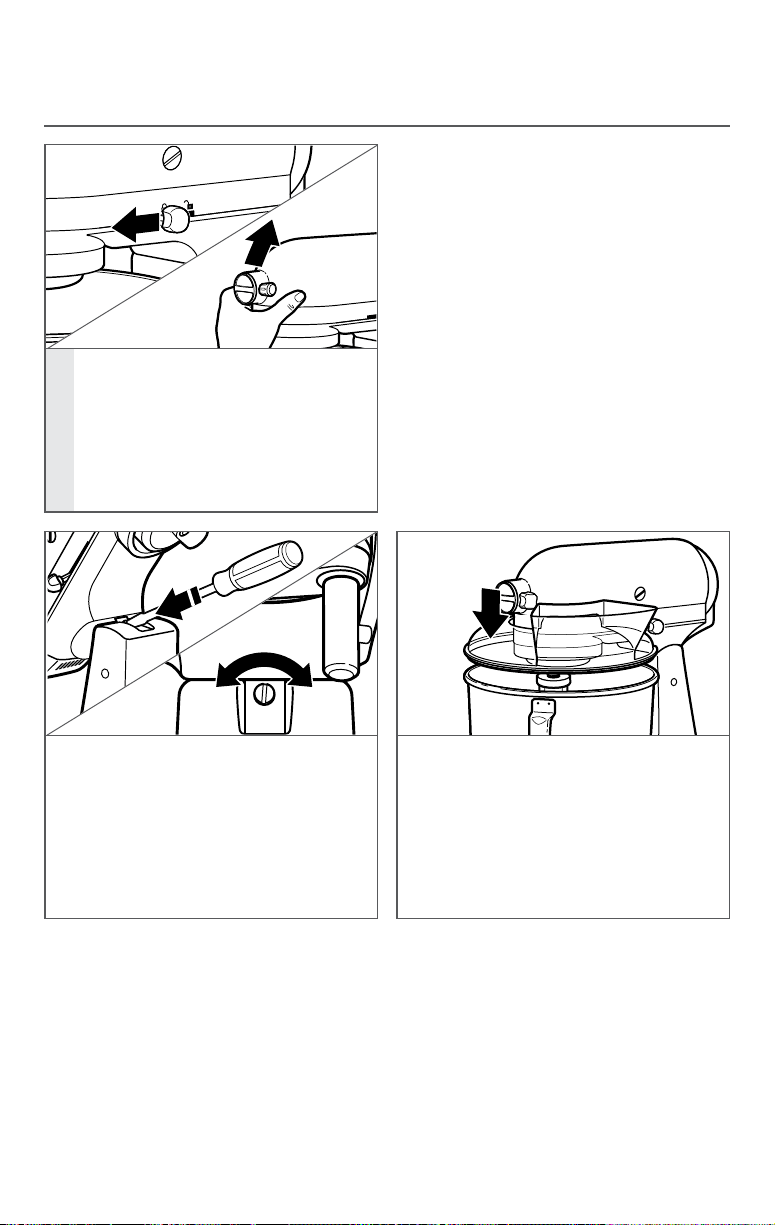
TO LOCK MOTOR HEAD IN RAISED
POSITION
• Push locking lever up into UNLOCK
position and hold.
• Tilt motor head back.
• Move locking lever into LOCK position.
TO LOCK MOTOR HEAD IN
OPERATING POSITION
• Push locking lever up into UNLOCK
position and hold.
• Lower motor head until it is completely
down into operating position.
• Move locking lever into LOCK position.
• Before mixing, test motor head lock by
attempting to raise head.
NOTE: Motor head should always
be kept in LOCK position when using
Stand Mixer.
TO OPERATE SPEED CONTROL
• Speed control lever should always be set
on lowest speed for starting, then
gradually moved to desired higher speed
to avoid splashing ingredients out of
bowl. See “Speed Control Guide.”
0 1 2 4 6 8 10
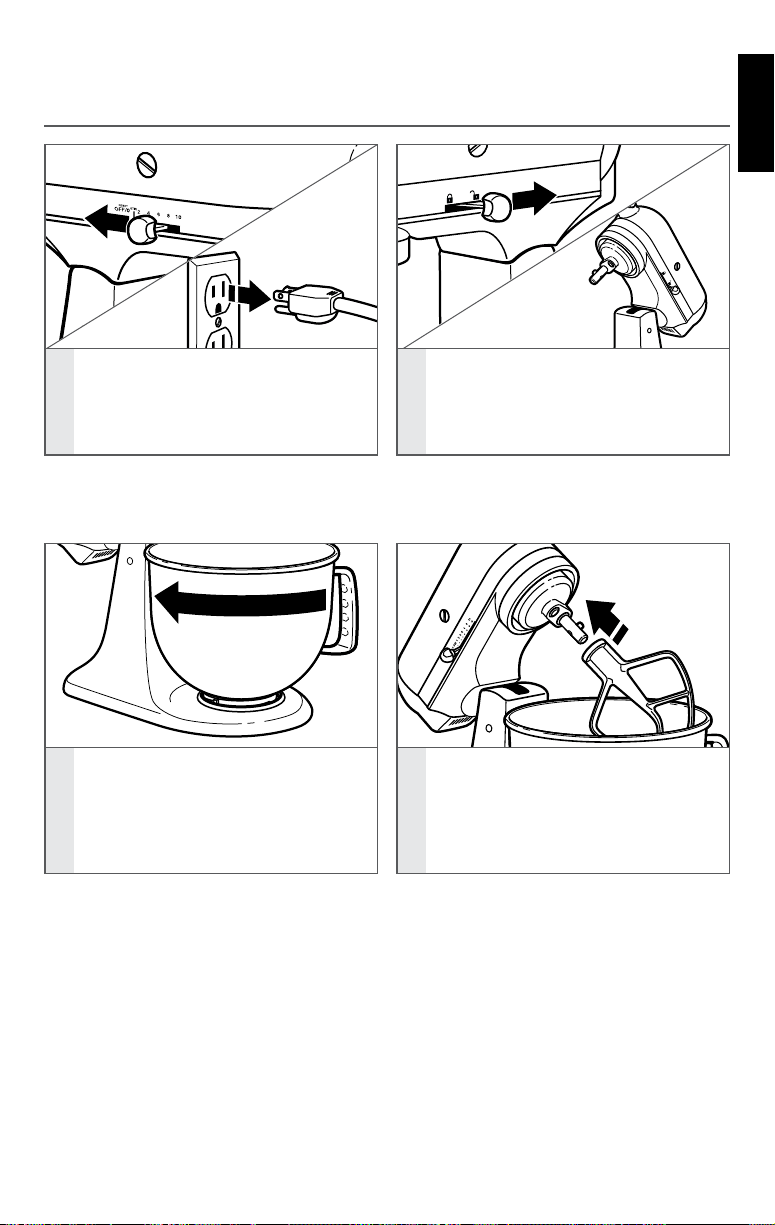
TO ATTACH BOWL
• Be sure speed control is OFF.
• Tilt motor head back.
• Place bowl on bowl clamping plate.
• Turn bowl gently in clockwise direction
(see picture above).
• Set pouring shield on bowl.*
* If pouring shield is included
TO REMOVE BOWL
• Turn speed control to OFF.
• Tilt motor head back.
• Turn bowl in counterclockwise
direction.
TO ATTACH FLAT BEATER,
WIRE WHIP, OR DOUGH HOOK
• Turn speed control to OFF and unplug.
• Raise motor head.
• Slip beater onto beater shaft and press
upward as far as possible.
• Turn beater to right, hooking beater
over pin on shaft.
TO REMOVE FLAT BEATER,
WIRE WHIP, OR DOUGH HOOK
• Turn speed control to OFF and unplug.
• Raise motor head.
• Press beater upward as far as possible
and turn left.
• Pull beater from beater shaft.
Ki
t
c
hen
A
i
d
S
t.J
os
e
p
h
,
M
i
ch
i
g
a
n
,
U
S
A
0 1
2 4 6
8
10
OFF
ON
W���9��3�C_ENv�3����� 9 ��/5/�� 3:5� P�
CMD + SHIFT CLICK TO CHANGE COPY
10
PARTS AND FEATURES (BOWL-LIFT)
K5SS Bowl-Lift Stand Mixer Features
ASSEMBLING YOUR BOWL-LIFT STAND MIXER
Heavy Duty
KitchenAid
St. Joseph, Michigan, USA
0 1 2 4 6 8 10
Motor Head
Bowl-Lift
Handle
(not shown)
Spring Latch, Bowl
Pin and Bowl Height
Adjustment Screw
(not shown)
Accessory
Knob
Accessory Hub
Locating Pins
Wire Whip
Flat Beater
Dough Hook
Speed Control
Knob
Bowl Support
Beater
Shaft
4.8 liter (5 qt.)
Stainless Steel Bowl
Pouring
Shield
W���9��3�C_ENv�3����� �� ��/5/�� 3:5� P�
English
CMD + SHIFT CLICK TO CHANGE COPY
11
PARTS AND FEATURES (BOWL-LIFT) ASSEMBLING YOUR BOWL-LIFT STAND MIXER
TO RAISE BOWL
• Rotate handle back and up until it snaps
into the locked vertical position.
• Bowl must always be in raised, locked
position when mixing.
TO LOWER BOWL
• Rotate handle back and down.
TO ATTACH FLAT BEATER,
WIRE WHIP, OR DOUGH HOOK
• Turn speed control to OFF and unplug.
• Lower bowl by rotating Bowl-Lift handle
downward.
• Slip flat beater on beater shaft and press
upward as far as possible.
• Turn beater to right, hooking beater
over the pin on shaft.
TO REMOVE FLAT BEATER,
WIRE WHIP, OR DOUGH HOOK
• Turn speed control to OFF and unplug.
• Lower bowl by rotating Bowl-Lift handle
downward.
• Press beater upward as far as possible
and turn left.
• Pull beater from beater shaft.
TO OPERATE SPEED CONTROL
• Speed control lever should always be
set on lowest speed for starting, then
gradually moved to desired higher speed
to avoid splashing ingredients out of
bowl. See “Speed Control Guide.”
TO ATTACH BOWL
• Be sure speed control is OFF.
• Place Bowl-Lift handle in down position.
• Fit bowl supports over locating pins.
• Press down on back of bowl until bowl
pin snaps into spring latch.
• Set pouring shield* on bowl.
• Raise bowl before mixing.
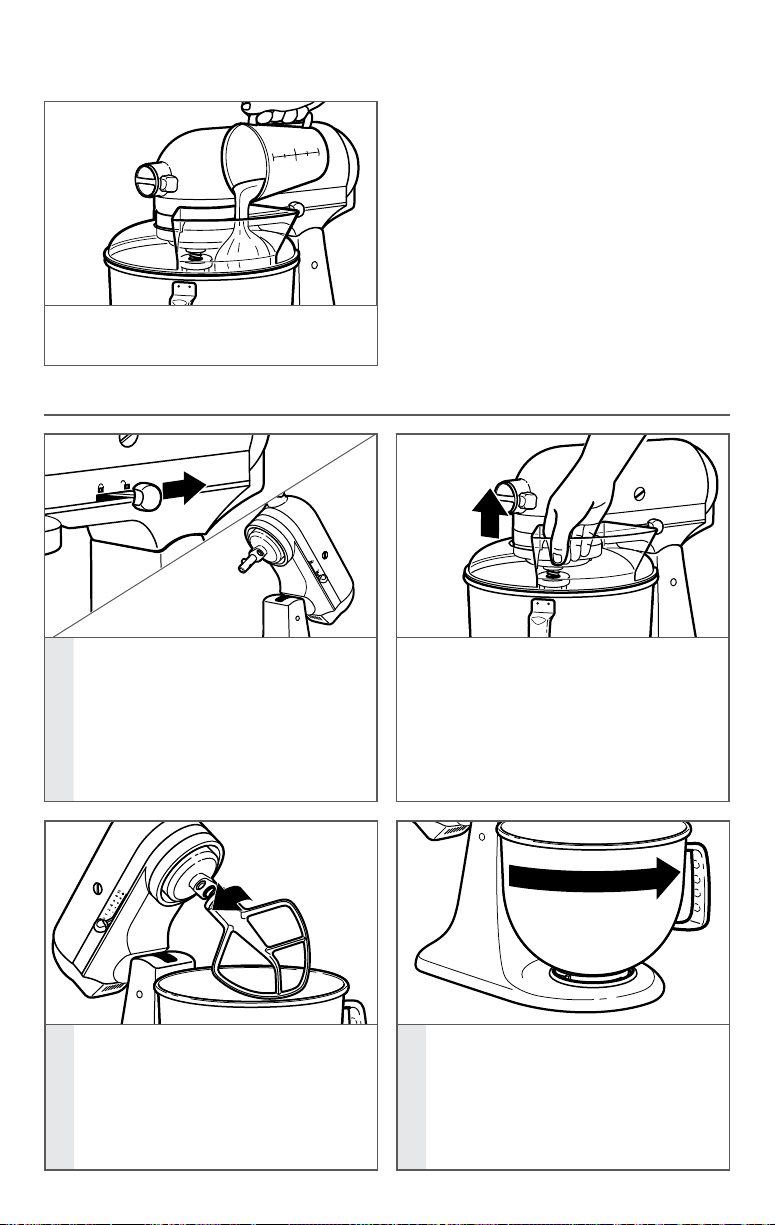
TO ATTACH POURING SHIELD*
1. Turn speed control to OFF.
2. Unplug Stand Mixer or disconnect
power.
3. Attach flat beater, dough hook, or wire
whip and bowl.
4. From the front of the Stand Mixer, slide
the pouring shield over the bowl until the
shield is centred. The bottom rim of the
shield should fit within the bowl.
TO REMOVE POURING SHIELD
1. Turn speed control to OFF.
2. Unplug Stand Mixer or disconnect
power.
3. Lift the front of the pouring shield clear
of the bowl rim and pull forward.
4. Remove attachment and bowl.
TO USE POURING SHIELD
1. For best results, rotate the shield so the
motor head covers the u-shaped gap in
the shield. The pouring chute will be just
to the right of the attachment hub as you
face the Stand Mixer.
2. Pour the ingredients into the bowl
through the pouring chute.
* If pouring shield is included
NOTE: Check that bowl and pouring shield
are properly in place.
TO REMOVE BOWL
• Place Bowl-Lift handle in down position.
• Grasp bowl handle and lift straight up and
off locating pins.
0 1 2 4 6 8 10
W���9��3�C_ENv�3����� �� ��/5/�� 3:5� P�
CMD + SHIFT CLICK TO CHANGE COPY
12
USING THE STAND MIXER
Tilt-Head
1. Turn speed control to “O”.
2. Unplug Stand Mixer.
3. Lift motor head.
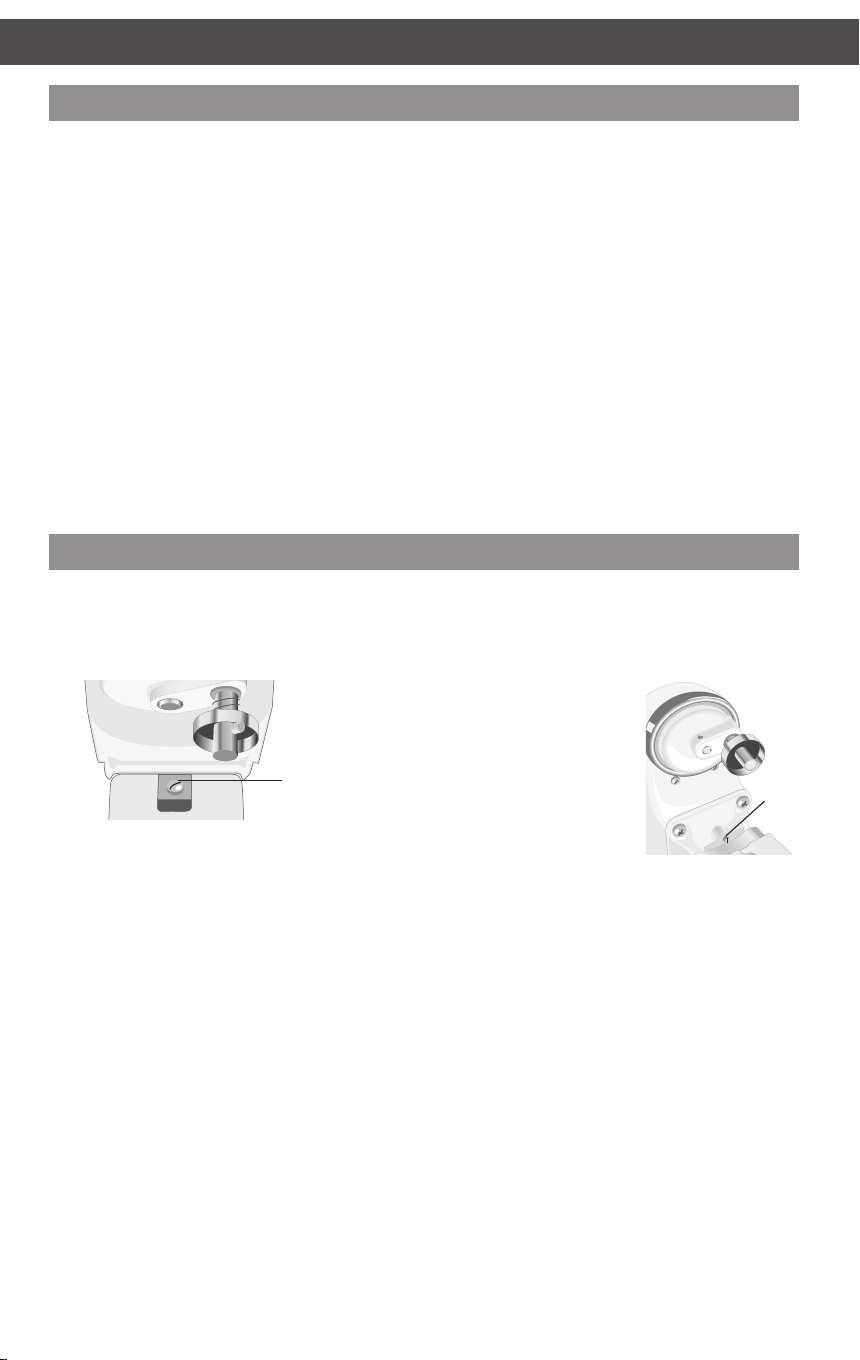
4. Turn screw (A) SLIGHTLY
counterclockwise (left) to raise flat
beater or clockwise (right) to lower
flat beater.
5. Make adjustment with flat beater,
so it just clears surface of bowl. If you
overadjust the screw, the bowl lock
lever may not lock into place.
NOTE: When properly adjusted, the flat
beater will not strike on the bottom or side
of the bowl. If the flat beater or the wire
whip is so close that it strikes the bottom
of the bowl, coating may wear off the
beater or wires on whip may wear.
Your Stand Mixer is adjusted at the factory so the flat beater just clears the bottom of
the bowl. If, for any reason, the flat beater hits the bottom of the bowl or is too far
away from the bowl, you can correct clearance easily.
A
Bowl-Lift
1. Turn speed control to
“O”.
2. Unplug Stand Mixer.
3. Place bowl-lift handle
in down position.
4. Attach flat beater.
5. Turn screw (B) SLIGHTLY
counterclockwise (left) to raise flat
beater or clockwise (right) to lower
flat beater.
6. Place bowl-lift handle in up position to
check clearance.
7. Repeat steps 5 and 6 if necessary.
NOTE: When properly adjusted, the flat
beater will not strike on the bottom or side
of the bowl. If the flat beater or the wire
whip is so close that it strikes the bottom
of the bowl, coating may wear off the
beater or wires on whip may wear.
See the Stand Mixer Attachments Use and Care Guide for speed settings and
operating times.
Using Your KitchenAid Attachments
Beater-to-Bowl Clearance
B
USING THE STAND MIXER
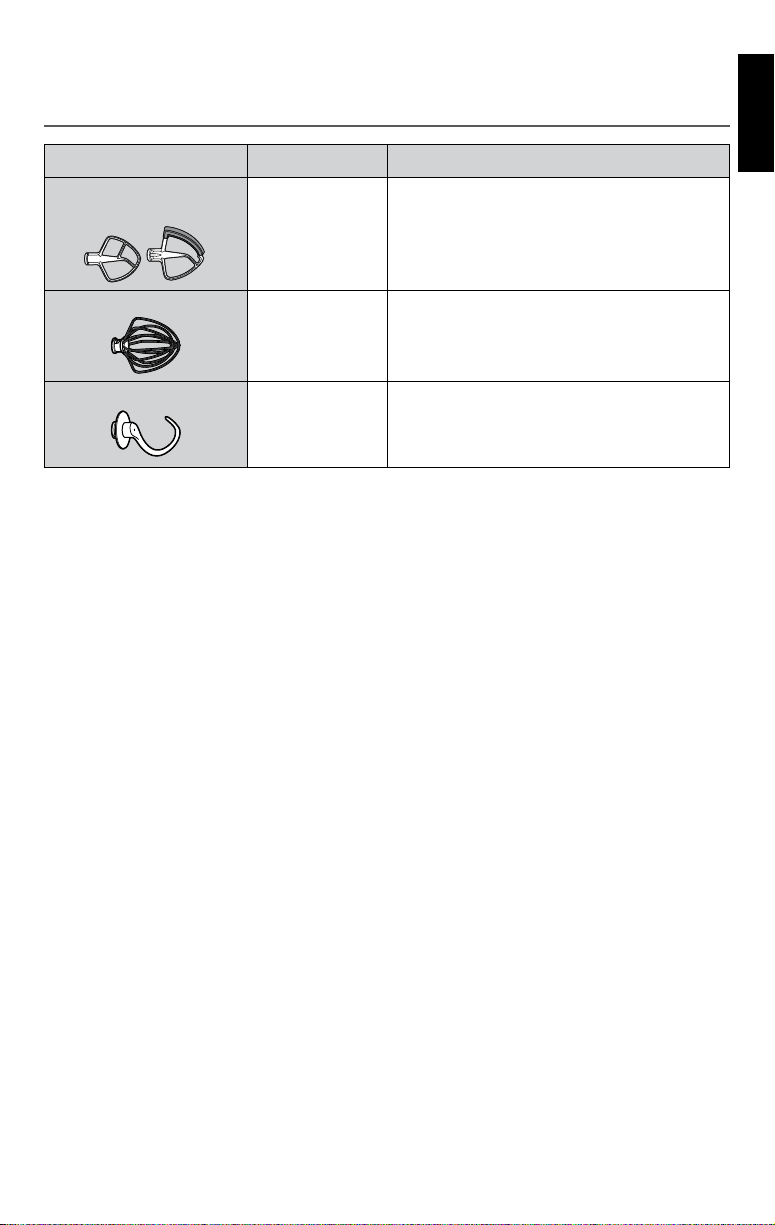
Flat beater for normal to heavy mixtures,
such as:
cakes biscuits
creamed frostings crumpets
candies meat loaf
cookies mashed potatoes
pie pastry
Dough hook for mixing and kneading yeast
doughs, such as:
breads coffee cakes
rolls buns
Wire whip for mixtures that need to
incorporate air, such as:
eggs sponge cakes
egg whites angel food cakes
heavy cream mayonnaise
boiled frostings some candies
W���9��3�C_ENv�3����� �� ��/5/�� 3:5� P�

English
CMD + SHIFT CLICK TO CHANGE COPY
13
USING THE STAND MIXER USING THE STAND MIXER
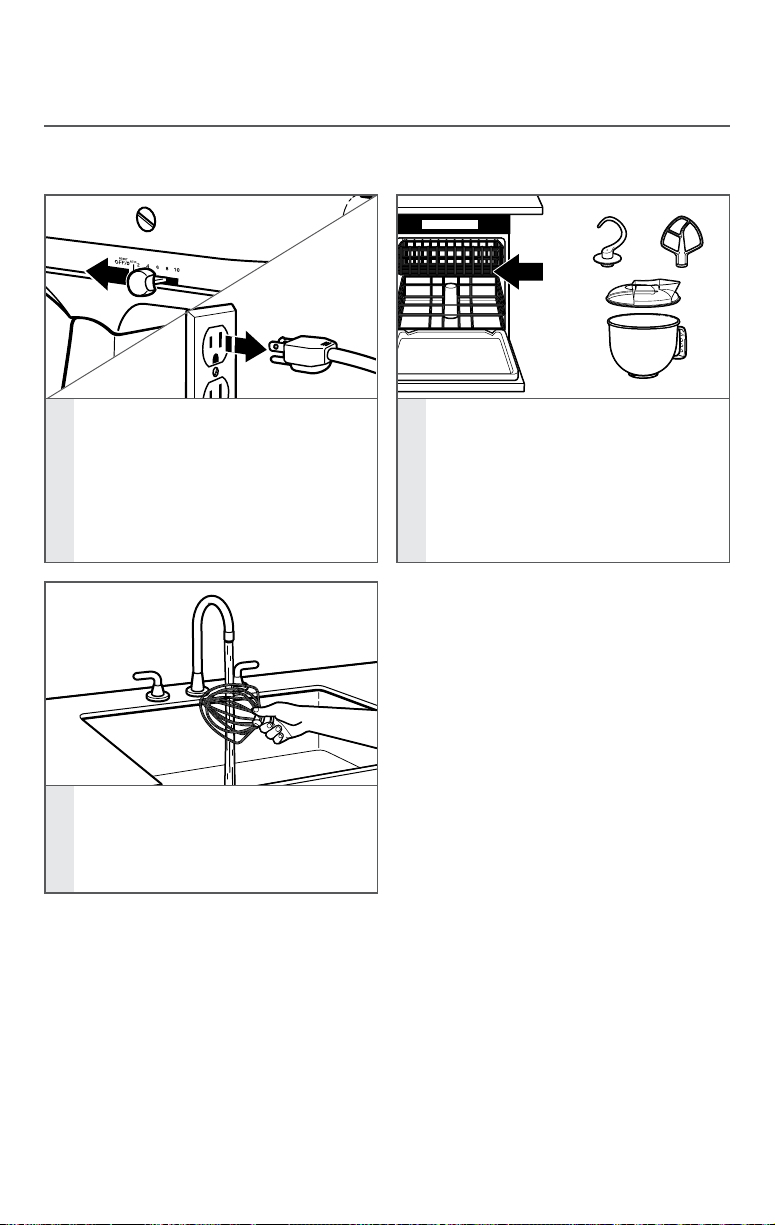
Bowl, coated flat beater and coated
dough hook may be washed in an automatic
dishwasher. Or, clean them thoroughly
in hot sudsy water and rinse completely
before drying. Do not store beaters on
shaft.
NOTE: The wire whip is NOT
dishwasher-safe!
NOTE: Always be sure to unplug Stand
Mixer before cleaning. Wipe Stand Mixer
with a soft, damp cloth. Do not use
household/commercial cleaners. Do not
immerse in water. Wipe off beater shaft
frequently, removing any residue that may
accumulate.
Care and Cleaning of Your Stand Mixer
Planetary Mixing Action
Stand Mixer Use
The bowl and beater are designed to
provide thorough mixing without frequent
scraping. Scraping the bowl once or twice
during mixing is usually sufficient.
The Stand Mixer may warm up during use.
Under heavy loads with extended mixing
time, you may not be able to comfortably
touch the top of the unit. This is normal.
NOTE: Do not scrape bowl while Stand
Mixer is operating.
Your KitchenAid Stand Mixer will mix
faster and more thoroughly than most
other electric mixers. Therefore, the
mixing time in most recipes must be
adjusted to avoid overbeating.
During operation, the flat
beater moves around the
stationary bowl, at the
same time turning in the
opposite direction on its
own axis. The diagram
shows the complete
coverage of the bowl
made by the path of
the beater.
ELECTRICAL SHOCK HAZARD
ALWAYS BE SURE TO UNPLUG
MIXER BEFORE CLEANING TO AVOID
POSSIBLE ELECTRICAL SHOCK.
Wipe mixer with a damp cloth. DO
NOT IMMERSE IN WATER. Wipe off
beater shaft frequently, removing any
residue that may accumulate.
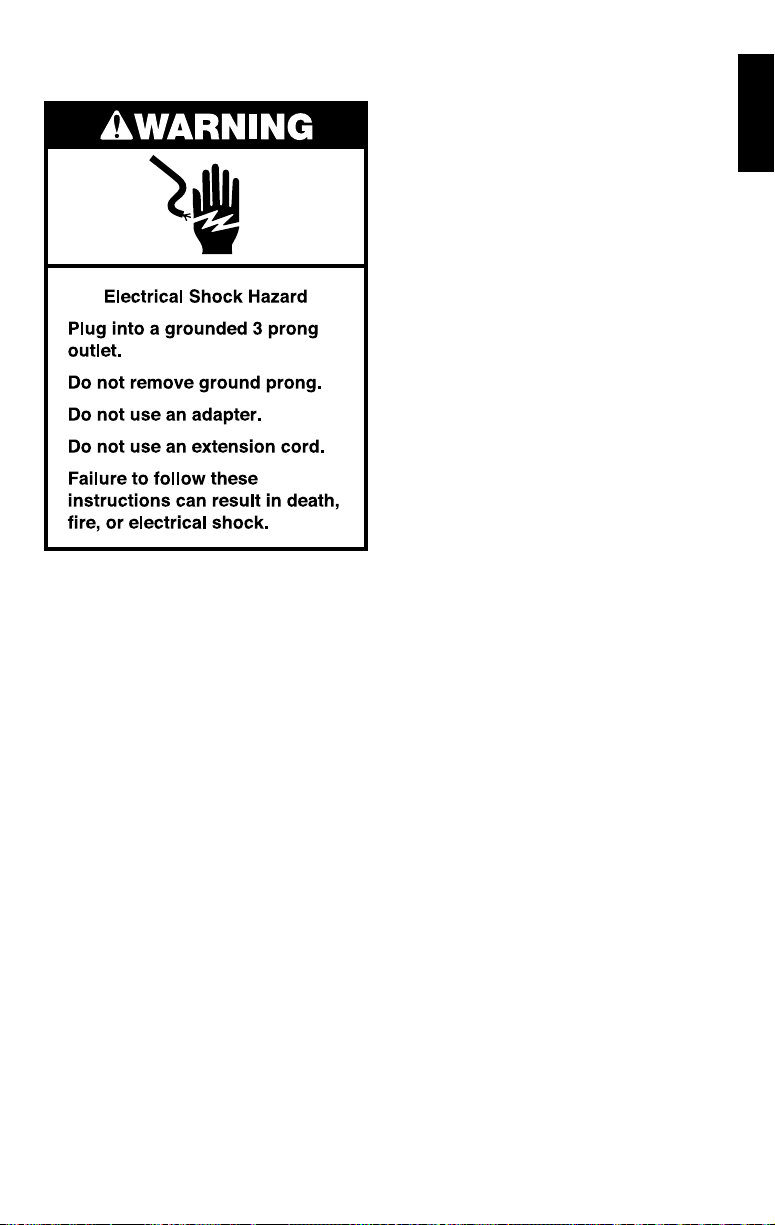
PERSONAL INJURY HAZARD
To avoid personal injury and damage
to the beater, do not attempt to scrape
bowl while mixer is operating; turn
mixer off. Should scraper or other
object drop into bowl, turn motor
OFF before removing.
W���9��3�C_ENv�3����� �3 ��/5/�� 3:5� P�
CMD + SHIFT CLICK TO CHANGE COPY
14
USING THE STAND MIXER
Speed Control Guide
USING THE STAND MIXER
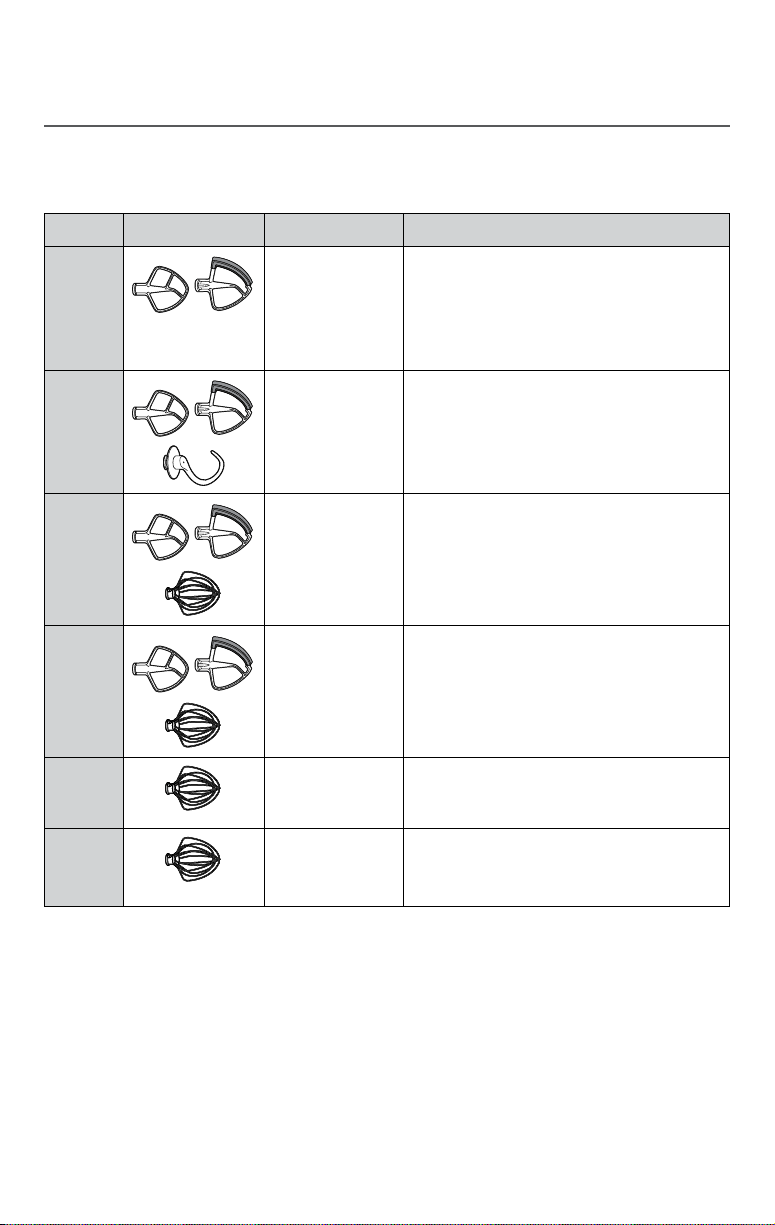
Number Speed Description
1 STIR For slow stirring, combining, mashing or
starting all mixing procedures. Use to
add flour and dry ingredients to batter, and
add liquids to dry ingredients. Do not use STIR
Speed to mix or knead yeast doughs.
2 SLOW MIXING For slow mixing, mashing or faster stirring.
Use to mix and knead yeast doughs, heavy
batters and candies, start mashing potatoes
or other vegetables, cut shortening into flour,
mix thin or splashy batters. Use with Can
Opener accessory.
4 MIXING, For mixing semi-heavy batters, such as
BEATING cookies. Use to combine sugar and shortening
and to add sugar to egg whites for meringues.
Medium speed for cake mixes. Use with: Food
Grinder, Rotor Slicer/Shredder, Pasta Roller,
and Fruit/Vegetable Strainer.
6 BEATING, For medium fast beating (creaming) or
CREAMING whipping. Use to finish mixing cake, doughnut,
and other batters. High speed for cake mixes.
Use with Citrus Juicer accessory.
8 FAST BEATING, For whipping cream, egg whites or
WHIPPING boiled frostings.
10 FAST WHIPPING For whipping small amounts of cream, egg
whites or for final whipping of mashed
potatoes. Use with Pasta Maker and Grain Mill
accessory.
NOTE: Will not maintain fast speeds under
heavy loads, such as when using Pasta Maker
or Grain Mill accessory.
NOTE: Do not exceed Speed 2 when preparing yeast doughs as this may cause damage to
the Stand Mixer.
W���9��3�C_ENv�3����� �� ��/5/�� 3:5� P�
English
CMD + SHIFT CLICK TO CHANGE COPY
15
USING THE STAND MIXER USING THE STAND MIXER
Cake Mixes
When preparing packaged cake mixes, use
Speed 4 for medium speed and speed 6 for
high speed. For best results, mix for the
time stated on the package directions.
Adding Nuts, Raisins or Candied Fruits
Solid materials should be folded in the last
few sections of mixing on stir speed. The
batter should be thick enough to keep the
fruits and nuts from sinking to the bottom
of the pan during baking. Sticky fruits should
be dusted with flour for better distribution
in the batter.
Liquid Mixture
Mixtures containing large amounts of liquid
ingredients should be mixed at lower
speeds to avoid splashing. Increase speed
only after mixture has thickened.
Kneading Yeast Doughs
ALWAYS use the dough hook to mix and
knead yeast doughs. Use Speed 2 to mix or
knead yeast doughs. Use of any other speed
creates high potential for unit failure. When
making dough with a 4.25 liter (4.5 qt.)
tilt-head Stand Mixer, NEVER use recipes
calling for more than 0.87 kg (7 cups)
all-purpose flour or 0.81 kg (6 cups) whole
wheat flour. When making dough with a
4.8 liter (5 qt.) tilt-head Stand Mixer,
NEVER use recipes calling for more than
1.00 kg (8 cups) all-purpose flour or 0.81 kg
(6 cups) whole wheat flour.
Converting Your Recipe for the
Stand Mixer
The mixing instructions found in this book
can be used to convert your favorite recipes
for use with your KitchenAid Stand Mixer.
To help determine a mixing procedure,
your own observations and experience will
be needed. Watch the batter or dough and
mix only until it has the desired appearance
described in your recipe, such as “smooth
and creamy.” Use the “Speed Control
Guide” to help determine proper mixing
speeds.
Adding Ingredients
The standard procedure to follow when
mixing most batters, especially cake and
cookie batters, is to add:
1/3 dry ingredients
1/2 liquid ingredients
1/3 dry ingredients
1/2 liquid ingredients
1/3 dry ingredients
Use stir speed until ingredients have been
blended. Then gradually increase to desired
speed.
Always add ingredients as close to side of
bowl as possible, not directly into moving
beater. The pouring shield can be used to
simplify adding ingredients.
NOTE: If ingredients in very bottom
of bowl are not thoroughly mixed, the
beater is not far enough into the bowl.
See “Beater-to-Bowl Clearance.”
Stand Mixer Use
W���9��3�C_ENv�3����� �5 ��/5/�� 3:5� P�
CMD + SHIFT CLICK TO CHANGE COPY
16
USING THE STAND MIXER
Mixing and Kneading Yeast Dough
USING THE STAND MIXER
“Rapid Mix” describes a bread baking
method that calls for dry yeast to be mixed
with other dry ingredients before liquid is
added. In contrast, the traditional method
is to dissolve yeast in warm water.
1. Place all dry ingredients including yeast
into bowl, except last 125 to 250 g
(1 to 2 cups) flour.
2. Bowl-Lift Stand Mixers: Attach bowl
and dough hook. Raise Stand Mixer bowl.
Tilt-Head Stand Mixers: Attach bowl
and dough hook. Lock Stand Mixer head.
3. Turn to Speed 2 and mix about
15 seconds, or until ingredients
are combined.
4. Continuing on Speed 2, gradually add
liquid ingredients to flour mixture and
mix 1 to 2 minutes longer.
NOTE: If liquid ingredients are added too
quickly, they will form a pool around the
dough hook and slow down mixing process.
5. Continuing on Speed 2, gently add
remaining flour, 60 g (1/2 cup) at a time,
as needed. Mix until dough starts to clean
sides of bowl, about 2 minutes.
6. When dough clings to hook, knead on
Speed 2 for 2 minutes, or until dough is
smooth and elastic.
NOTE: Dust flour on the inside of bowl and
dough hook to prevent dough from sticking.
7. Bowl-Lift Stand Mixers: Lower bowl
on Stand Mixer and remove dough from
the bowl and dough hook.
Tilt-Head Stand Mixers: Unlock and
tilt back Stand Mixer head and remove
dough from the bowl and dough hook.
8. Follow directions in recipe for rising,
shaping, and baking.
When using the traditional method to
prepare a favorite recipe, dissolve yeast
in warm water in warmed bowl. Add
remaining liquids and dry ingredients, except
last 125 to 250 g (1 to 2 cups) flour. Turn to
Speed 2 and mix about 1 minute, or until
ingredients are thoroughly mixed. Proceed
with Steps 4 through 6.
Both methods work equally well for bread
preparation. However, the “Rapid Mix”
method may be a bit faster and easier
for new bread bakers. It is slightly more
temperature tolerant because the yeast
is mixed with dry ingredients rather than
with warm liquid.
W���9��3�C_ENv�3����� �� ��/5/�� 3:5� P�

English
CMD + SHIFT CLICK TO CHANGE COPY
17
USING THE STAND MIXER USING THE STAND MIXER
Pour cream into chilled bowl. Attach bowl
and wire whip. To avoid splashing, gradually
turn to designated speed and whip to
desired stage. See chart below.
Amount Speed
59 mL Gradually to 10
118 mL Gradually to 10
236 mL Gradually to 8
472 mL Gradually to 8
WHIPPING STAGES
Watch cream closely during whipping.
Because your KitchenAid Stand Mixer
whips so quickly, there are just a few
seconds between whipping stages.
Lookfor these characteristics:
Begins to thicken:
Cream is thick and custard-like.
Holds its shape:
Cream forms soft peaks when wire whip
is removed. Can be folded into other
ingredients when making desserts and
sauces.
Stiff:
Cream stands in stiff, sharp peaks when
wire whip is removed. Use for topping on
cakes or desserts, or filling for cream puffs.
Place room temperature egg whites in
clean, dry bowl. Attach bowl and wire
whip. To avoid splashing, gradually turn to
designated speed and whip to desired stage.
See chart below.
Amount Speed
1 egg white Gradually to 10
2-4 egg whites Gradually to 8
6 or more egg whites Gradually to 6
WHIPPING STAGES
With your KitchenAid Stand Mixer, egg
whites whip quickly. So, watch carefully
to avoid overwhipping. This list tells you
what to expect.
Frothy:
Large, uneven air bubbles.
Begins to hold shape:
Air bubbles are fine and compact; product
is white.
Soft peak:
Tips of peaks fall over when wire whip
is removed.
Almost stiff:
Sharp peaks form when wire whip is
removed, but whites are actually soft.
Stiff but not dry:
Sharp, stiff peaks form when wire whip
is removed. Whites are uniform in color
and glisten.
Stiff and dry:
Sharp, stiff peaks form when wire whip
is removed. Whites are speckled and dull
in appearance.
Egg Whites
Whipped Cream
W���9��3�C_ENv�3����� �7 ��/5/�� 3:5� P�
18
ACCESSORIESACCESSORIES
KitchenAid Accessories are designed to assure long life. The accessory power shaft and hub
socket are of a square design, to eliminate any possibility of slipping during the transmission
of power to the accessory. The hub and shaft housing are tapered to assure a snug t,
even after prolonged use and wear. KitchenAid Accessories require no extra power unit to
operate them; the power unit is built-in.
General Information
General Instructions
‡ Not part of
Stand Mixer.
Accessory
Hub Socket
Accessory
Knob
Notch
Pin
Accessory Shaft
Housing
Accessory
Power Shaft‡
Accessory
Housing
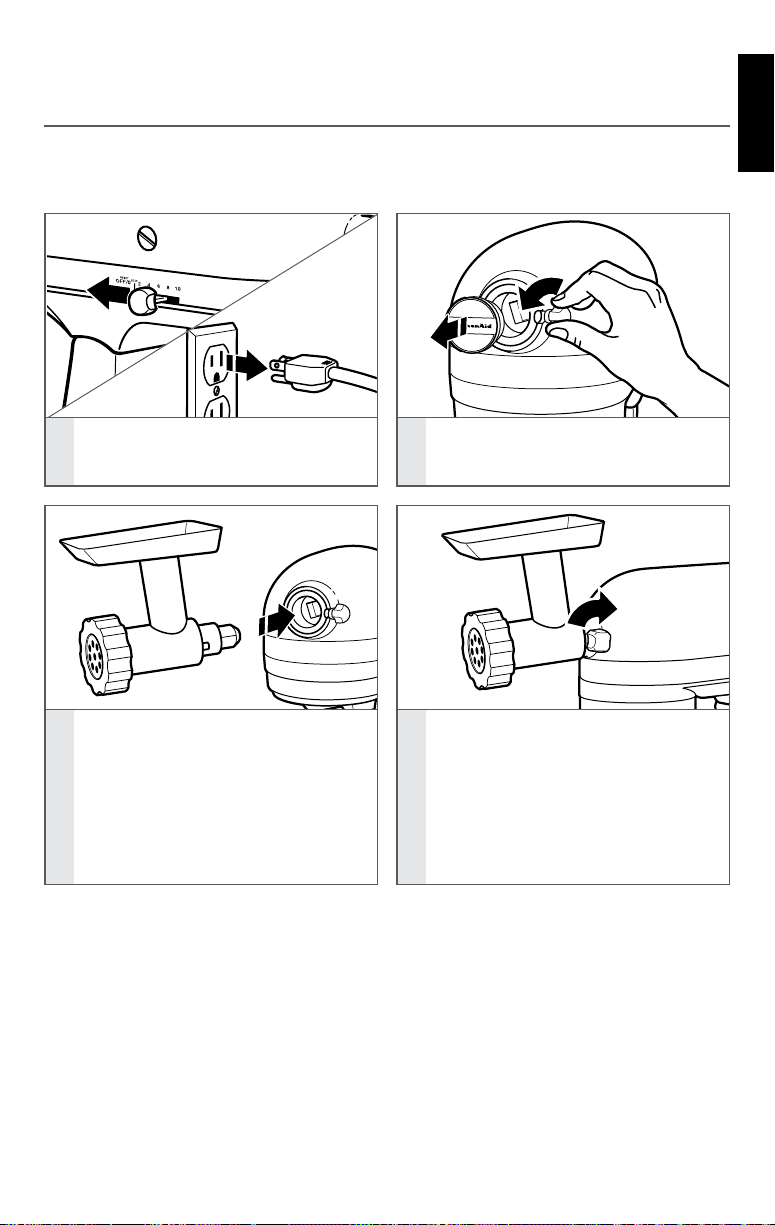
To Attach
1. Turn speed control to “O”.
2. Unplug Stand Mixer or disconnect
power.
3. Loosen accessory knob by turning it
counterclockwise. Remove accessory
hub cover.
4. Insert accessory shaft housing into
accessory hub, making certain that
accessory power shaft fits into square
accessory hub socket. It may be
necessary to rotate accessory back
and forth. When accessory is in proper
position, the pin on the accessory will fit
into the notch on the hub rim.
5. Tighten accessory knob by turning
clockwise until accessory is completely
secured to Stand Mixer.
6. Plug into proper electrical outlet.
TROUBLESHOOTING
W���9��3�C_ENv�3����� �� ��/5/�� 3:5� P�
English
19
ACCESSORIESACCESSORIES
Please read the following before calling
your service centre.
1. The Stand Mixer may warm up during
use. Under heavy loads with extended
mixing time periods, you may not be
able to comfortably touch the top of the
unit. This is normal.
2. The Stand Mixer may emit a pungent
odor, especially when new. This is
common with electric motors.
3. If the flat beater hits the bowl, stop
the Stand Mixer. See “Beater-to-Bowl
Clearance”.
If your Stand Mixer should malfunction or fail
to operate, please check the following:
- Is the Stand Mixer plugged in?
- Is the fuse in the circuit to the Stand
Mixer in working order? If you have a
circuit breaker box, be sure the circuit is
closed.
- Turn the Stand Mixer off for 10-15
seconds, then turn it back on. If the Stand
Mixer still does not start, allow it to cool
for 30 minutes before turning it back on.
- If the problem is not due to one of the
above items, see “Service Centres.”
To Remove
1. Turn speed control to “O”.
2. Unplug Stand Mixer or
disconnect power.
3. Loosen accessory knob by turning it
counterclockwise. Rotate accessory
slightly back and forth while
pulling out.
4. Replace accessory hub cover. Tighten
accessory knob by turning it clockwise.
TROUBLESHOOTING
W���9��3�C_ENv�3����� �9 ��/5/�� 3:5� P�
20
WARRANTY
Length of Warranty: KitchenAid Will Pay For: KitchenAid Will Not Pay For:
China:
One Year Full
Warranty from
date of purchase.
Replacement parts and
repair labor costs to
correct defects in materials
or workmanship. Service
must be provided by an
Authorised KitchenAid
Service Centre.
A. Repairs when Stand Mixer
is used for operations other
than normal household food
preparation.
B. Damage resulting from
accident, alterations, misuse,
abuse, or installation/
operation not in accordance
with local electrical codes.
KITCHENAID DOES NOT ASSUME ANY RESPONSIBILITY FOR
INDIRECT DAMAGES.
©2016 All rights reserved. KITCHENAID and the design of the
Stand Mixer are trademarks in the U.S. and elsewhere.
www.KitchenAid.com
KitchenAid Household Stand Mixer Warranty
Service Centres
In China:
KitchenAid Trading Co., Ltd.
6F, Building 8, No.1888 XinJinqiao Road.
Pudong, Shanghai, China
www.KitchenAid.com.cn
In USA:
Customer Satisfaction Center
KitchenAid Portable Appliances
P.O. Box 218
Saint Joseph MI 49085
USA
Toll-free number (in U.S.A. only):
1-800-541-6390
All service should be handled locally by an Authorised KitchenAid Service Centre.
Contact the dealer from whom the unit was purchased to obtain the name of the
nearest Authorised KitchenAid Service Centre.
W���9��3�C_ENv�3����� �� ��/5/�� 3:5� P�
中文
21
台式搅拌机说明
目录
台式搅拌机安全
重要保护措施.................................................. 22
电气要求...................................................... 24
零部件和结构
K45SS台式搅拌机的结构....................................... 25
KSM150台式搅拌机的结构...................................... 26
组装台式搅拌机(倾斜头).......................................... 27
零部件和结构
K5SS台式搅拌机的结构............................................ 28
组装台式搅拌机(升降式).......................................... 29
使用台式搅拌机
使用KitchenAid附件.......................................... 30
搅拌器至桶间隙................................................ 30
台式搅拌机的护理和清洁........................................ 31
轻柔搅拌操作.................................................. 31
台式搅拌机使用................................................ 31
速度控制器指导................................................ 32
台式搅拌机使用................................................ 33
搅拌及搓揉发酵面团............................................ 34
蛋白.......................................................... 35
发泡鲜奶油.................................................... 35
附件
一般信息...................................................... 36
一般说明...................................................... 36
故障排除.......................................................... 37
保修证............................................................ 38
W���9��3�C_ZHv������� �� 9/�9/�� 9:5� ��
22
台式搅拌机安全 台式搅拌机安全
重要保护措施
使用家用电器时,应始终遵循基本安全预防措施,包括:
1. 阅读所有说明。家电使用不当可能导致人员受伤。
2. 为了避免触电风险,切勿将台式搅拌机放入水中或其他
液体中。
3. 确保设备插头上的插针适配要插入的墙上电源插座。注
意遵照正确的接地技术和本地电气规范。
4. 监督儿童,确保他们不玩耍本家电。
5. 由儿童使用或在儿童附近使用任何家电时,需要密切监
督。请勿在无人照料台式搅拌机的情况下使其工作。
6. 不使用时以及插入或拆卸零件前以及清洁前,请从插座
上拔下台式搅拌机。
7. 避免接触移动部件。在操作期间让手、头发、衣物以及
刮刀和其他餐具远离搅拌器以避免受伤和/或损坏台式
搅拌机。
䆜
ধ䲟
ྸу䚫ᆾ䈪᱄θ㜳ሲ㠪↱ӗᡌ
䠃՚Ⱦ
ྸу䚫ᆾ䈪᱄θ㜳ሲ㠪↱ӗᡌ䠃՚Ⱦ
ᡁԜᐢ൘ᵜԕ৺ᛘⲴᇦ⭥кᨀҶ䇨ཊ䟽㾱ⲴᆹޘؑDŽ䈧࣑ᗵ䰵䈫ᒦ䚥ᗚ
ᡰᴹᆹޘ⎸DŽ
䘉ᱟᆹޘ䆖⽪ㅖDŽ
↔ㅖ䆖⽪ᛘ㜭ሬ㠤ᛘ઼ԆӪՔӑⲴ▌൘ড䲙DŽ
ᡰᴹᆹޘؑ䜭ᴹᆹޘ䆖⽪ㅖ઼䆖⽪䈝Āড䲙āᡆĀ䆖āDŽ䘉
Ӌ䇽Ⲵѹᱟ˖
ᡰᴹᆹޘؑ䜭ሶᤷࠪ▌൘ড䲙ᱟӰѸˈྲօ䱽վՔⲴࠐ⦷ˈԕ৺н䚥ᆸ䈤᰾
ሶՊ⭏ӰѸDŽ
ᛞⲺᆿޞૂެԌӰⲺᆿޞ䶔ᑮ䠃㾷Ⱦ
W���9��3�C_ZHv������� �� 9/�9/�� 9:5� ��
中文
23
台式搅拌机安全 台式搅拌机安全
8. 请勿在无人照料台式搅拌机或接近其工作表面边缘的情
况下使用它。当用于重型负载或高速使用时,台式搅拌
机可能在工作表面上移动。
9. 在清洗之前请从台式搅拌机上拆下平搅器、打蛋器或面
团钩。
10. 若任何家电的线缆受损,或者家电以任何方式掉落或受
损,请勿操作。如果电源线损坏,必须让制造商、服务
代理或类似合格人员进行更换以避免发生危险。
11. 使用非KitchenAid推荐或出售的附件可能会引起火
灾、触电或受伤。
12. 不要在室外使用。
13. 请勿将线缆悬挂在桌子或厨房台面边缘或者接触热表
面。
14. 在使用台式搅拌机(倾斜头)时,在锁定之前头部必须
完全降下。在搅拌之前,通过升起头部确保锁就位。
15. 不要使用延长线。
16. 身体行动不便、感官或智力障碍或缺乏相关经验和知识
者(包括儿童),除非受到其安全负责人的监督或关于
如何安全使用本家电的指导,否则不得使用本家电。如
果有人缺乏对这些风险的了解,则负责其安全的人应当
禁止他们使用本家电或采取预防措施消除相关风险。
17. 当使用台式搅拌机和面时,请勿连续操作台式搅拌机
10分钟以上。
18. 在提起台式搅拌机时请小心,因为它较重。
19. 只能将台式搅拌机用于预期用途。
20. 在使用台式搅拌机之前确保附件套筒牢固地固定(拧紧
附件旋钮),避免附件套筒在搅拌期间可能掉入桶中的
情况。
保留这些说明
W���9��3�C_ZHv������� �3 9/�9/�� 9:5� ��
24
台式搅拌机安全 零部件和结构
电气要求
您的台式搅拌机以常规的220-240
伏、50-60赫兹的住宅交流电源。您的台
式搅拌机的功率打印在带箍上。该功率通
过使用消耗最大功率的配件确定。其他建
议的配件消耗的功率可能明显更少。
不要使用延长线。如果电源线太短,请求
有资质的电工或维修人员在家电附近安装
插座。
W���9��3�C_ZHv������� �� 9/�9/�� 9:5� ��
中文
25
台式搅拌机安全 零部件和结构
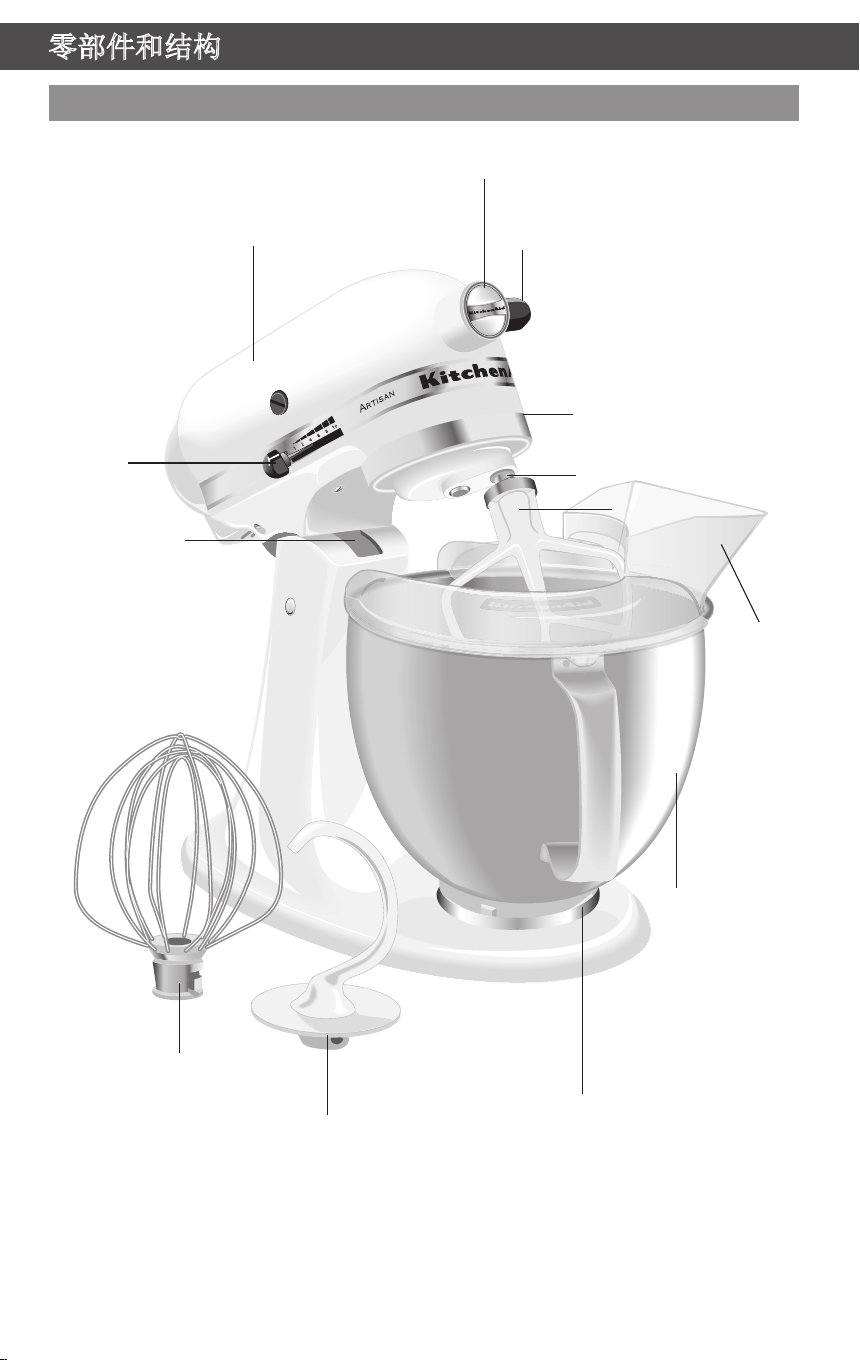
K45SS台式搅拌机(倾斜头)的结构
� �
��
�
�
�
�
�
�
�
�
�
�
�
�
�
�
�
�
�
�
�
�
�
�
�
�
�
�
�
�
�
�
�
�
�
�
�
�
�
�
�
�
�
�
�
�
�
�
�
�
� ��� � � � � ��
� �� � � � � � � � � �� � �� � � � � �
电动头
搅拌器高度调整
螺钉
电动头锁定杆
(未示出)
附件旋钮
附件套筒
平搅器
打蛋器
面团钩
速度控
制杆
桶夹板
搅拌轴
4.25升
(4.5夸
脱)不锈
钢桶
W���9��3�C_ZHv������� �5 9/�9/�� 9:5� ��
26
零部件和结构 组装台式搅拌机(倾斜头)
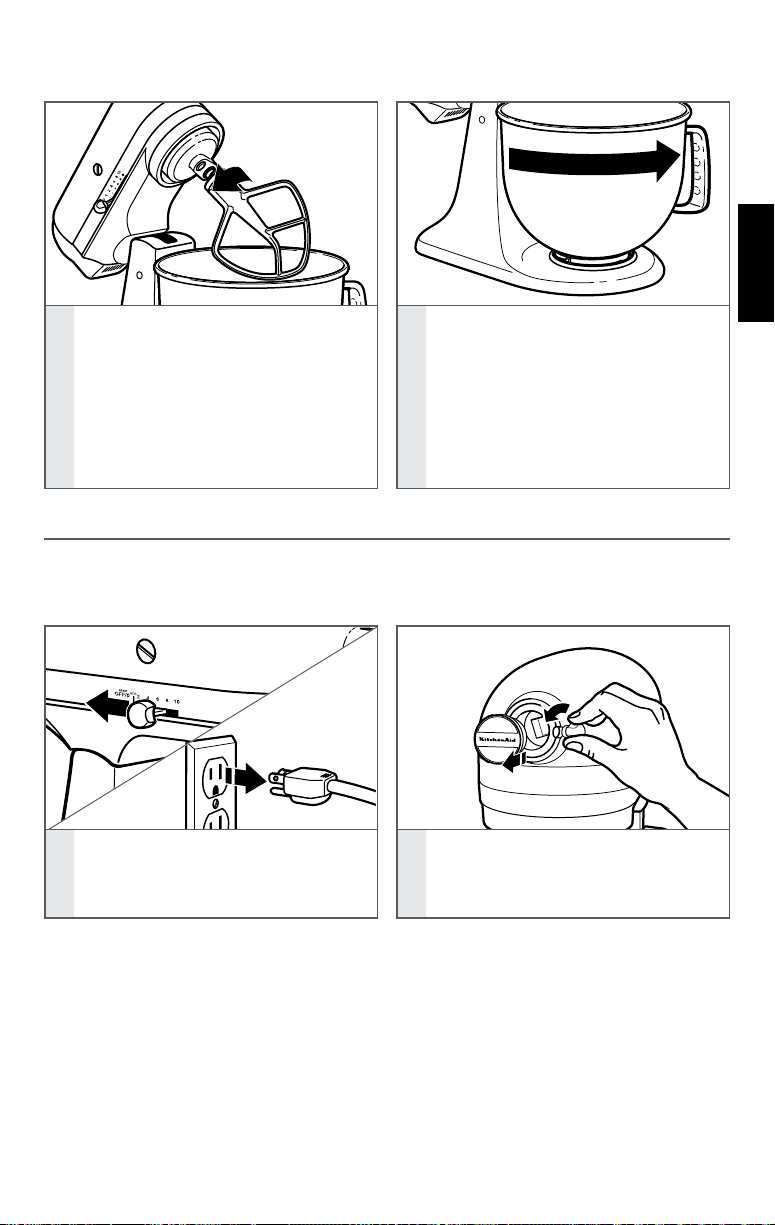
KSM150台式搅拌机(倾斜头)的结构
电动头
搅拌器高度调整
螺钉
电动头锁定杆
(未示出)
附件旋钮
附件套筒
平搅器
打蛋器
速度控
制杆
桶夹板
搅拌轴
4.8升(5
夸脱)不锈
钢桶
导流罩
面团钩
W���9��3�C_ZHv������� �� 9/�9/�� 9:5� ��
中文
27
零部件和结构 组装台式搅拌机(倾斜头)
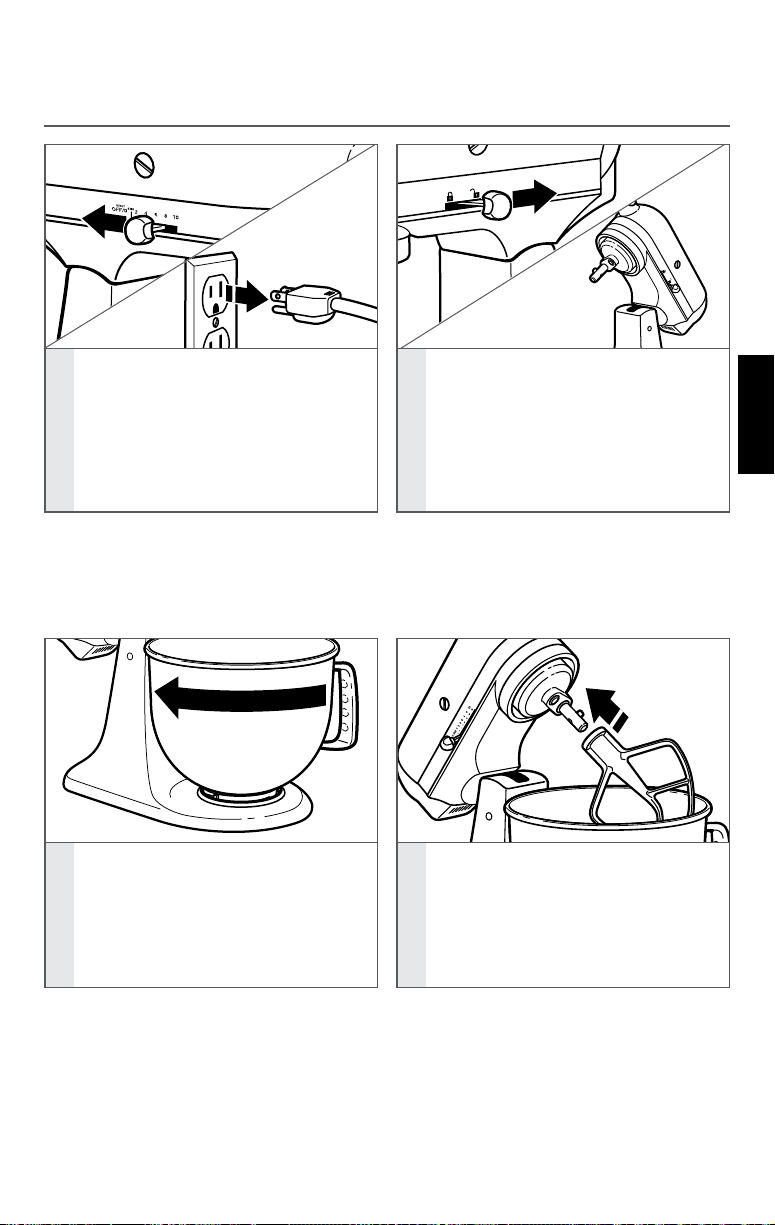
在升起位置锁定电动头
•将锁定杆向上推入解锁位置并握住。
•向后倾斜电动头。
•将锁定杆移动至锁定位置。
在工作位置锁定电动头
•将锁定杆向上推入解锁位置并握住。
•降下电动头,直至其完全下降到工
作位置。
•将锁定杆移动至锁定位置。
•在搅拌之前,通过尝试升起头部测
试电动头锁。
注:在使用台式搅拌机时,电动头应当
始终保持在锁定位置。
操作速度控制器
•在启动时速度控制杆应当始终设置
在最低速度上,然后逐渐移动至所
需的更高速度,避免桶中的成分溅
出。请参见“速度控制器指导”。
0 1 2 4 6 8 10
连接桶
•务必关闭速度控制器。
•向后倾斜电动头。
•将桶放置在桶夹板上。
•以顺时针方向轻轻转动桶(请参见
上图)。
•将导流罩放在桶上。*
*如果附带有导流罩
拆卸桶
•关闭速度控制器。
•向后倾斜电动头。
•以逆时针方向转动桶。
附接平搅器、
打蛋器或面团钩
•关闭速度控制器并拔出。
•升起电动头。
•将搅拌器滑动到搅拌轴上并尽量向
上按。
•向右转动搅拌器,将搅拌器挂在轴
上的销上。
拆卸平搅器、
打蛋器或面团钩
•关闭速度控制器并拔出。
•升起电动头。
•尽量向上按搅拌器并向左转动。
•从搅拌器轴拉动搅拌器。
Ki
t
c
hen
A
i
d
S
t.J
os
e
p
h
,
M
i
ch
i
g
a
n
,
U
S
A
0 1
2 4 6
8
10
关
开
W���9��3�C_ZHv������� �7 9/�9/�� 9:5� ��
28
零部件和结构 组装台式搅拌机(升降式)
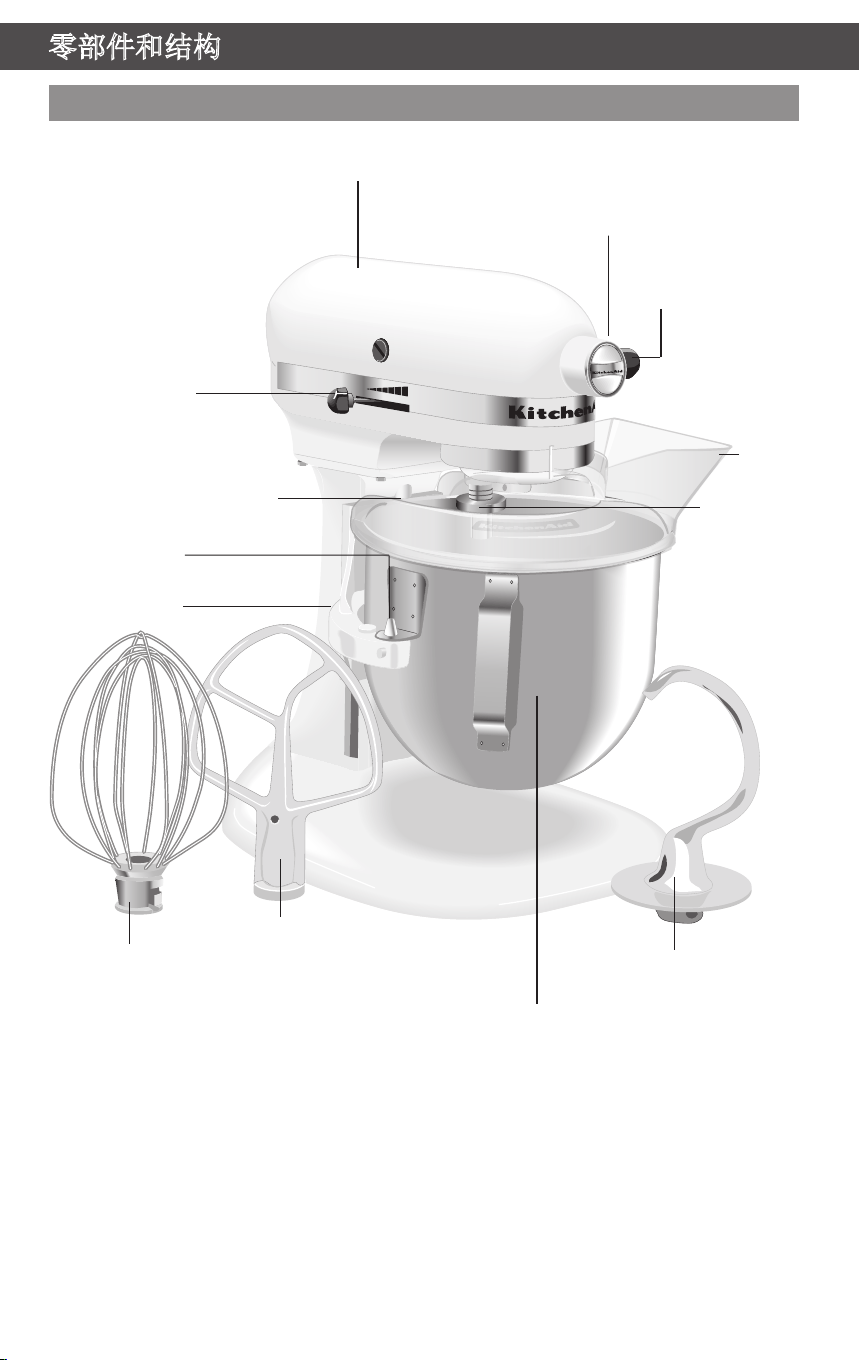
K5SS台式搅拌机(升降式)的结构
Heavy Duty
KitchenAid
St. Joseph, Michigan, USA
0 1 2 4 6 8 10
电动头
桶升降手柄
(未示出)
弹簧闩锁、桶销和桶高
度调整螺钉(未示出)
附件旋钮
附件套筒
定位销
打蛋器
平搅器
面团钩
速度控制旋钮
桶支撑
搅拌轴
4.8升(5夸脱)不
锈钢桶
导流罩
W���9��3�C_ZHv������� �� 9/�9/�� 9:5� ��

中文
29
零部件和结构 组装台式搅拌机(升降式)
升起桶
•向后并向上旋转手柄,直至它卡入
锁定的垂直位置。
•搅拌时,桶必须始终在升起、锁定
的位置。
降下桶
•向后并向下旋转手柄。
附接平搅器、
打蛋器或面团钩
•关闭速度控制器并拔出。
•通过向下转动桶升降手柄将桶降
下。
•将平搅器滑动到搅拌轴上并尽量向
上按。
•向右转动搅拌器,将搅拌器挂在轴
上的销上
拆下平搅器、
打蛋器或面团钩
•关闭速度控制器并拔出。
•通过向下转动桶升降手柄将桶降
下。
•尽量向上按搅拌器并向左转动。
•从搅拌器轴拉动搅拌器。
操作速度控制器。
•在启动时速度控制杆应当始终设置
在最低速度上,然后逐渐移动至所
需的更高速度,避免桶中的成分溅
出。请参见“速度控制器指导”。
过载重置按钮
(仅限型号5KPM50)
•如果台式搅拌机过载,过载按钮将
弹出,并且台式搅拌机将关闭。将
速度控制杆转动到关闭位置。等待
数分钟,然后按下过载重置按钮。
将速度控制杆转动到所需速度并继
续搅拌。
连接桶
•务必关闭速度控制器。
•将桶升降手柄置于降下位置。
•将桶支撑装配到定位销上。
•向下按桶的背部,直至桶销卡扣到弹
簧闩锁中。
•将导流罩*放在桶上。
•在搅拌之前升起导流罩。
附接导流罩*
1.关闭速度控制器。
2.拔下台式搅拌机插头或断开电源。
3.附接平搅器、面团钩或打蛋器及桶。
4.从台式搅拌机前方,在桶上方滑动导
流罩,直至罩对中。罩的底部边缘应
当装配在桶内。
拆下导流罩
1.关闭速度控制器。
2.拔下台式搅拌机插头或断开电源。
3.升起导流罩前方,离开桶边缘,并将
其向前拉动。
4.拆下附接件和桶。
使用导流罩
1.为了得到最佳结果,旋转导流罩,从
而电动头涵盖罩中的U型间隙。在
面对台式搅拌机时,导流槽将刚好在
附件套筒的右侧。
2.通过导流槽将配料倒入桶中。
*如果附带有导流罩
注:确保桶和导流槽正确就位。
拆卸桶
•将桶升降手柄置于降下位置。
•握住桶手柄并笔直向上升起并脱离定
位销。
0 1 2 4 6 8 10
W���9��3�C_ZHv������� �9 9/�9/�� 9:5� ��
30
使用台式搅拌机 使用台式搅拌机
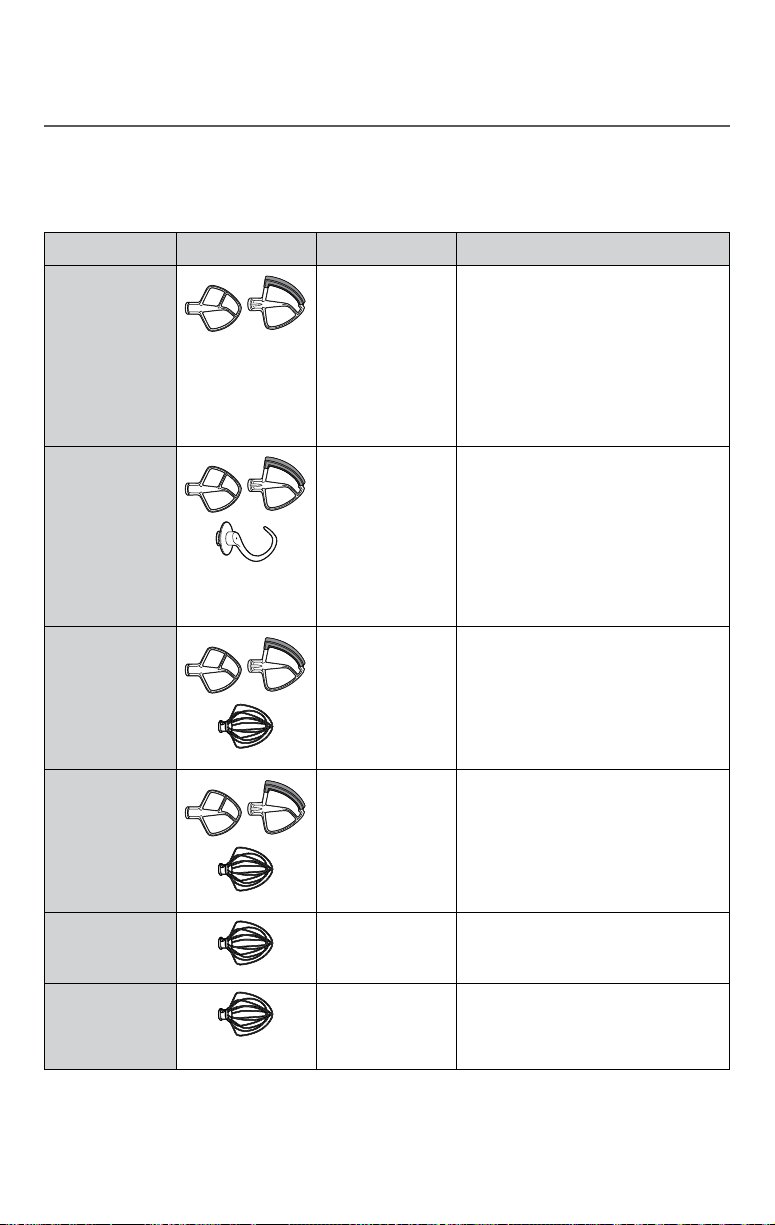
平搅器,用于普通到重型混合物,例如:
蛋糕 饼干
奶油糖霜 煎饼
糖果 肉糜卷
曲奇 土豆泥
馅饼点心
面团钩,用于搅拌和搓揉发酵面团,例
如:
面包 咖啡蛋糕
卷 包点
披萨面团
打蛋器,用于需要混入空气的混合物,
例如:
鸡蛋 松糕
蛋白 蛋黄酱
多脂奶油 某些糖果
煮沸糖霜 天使蛋糕
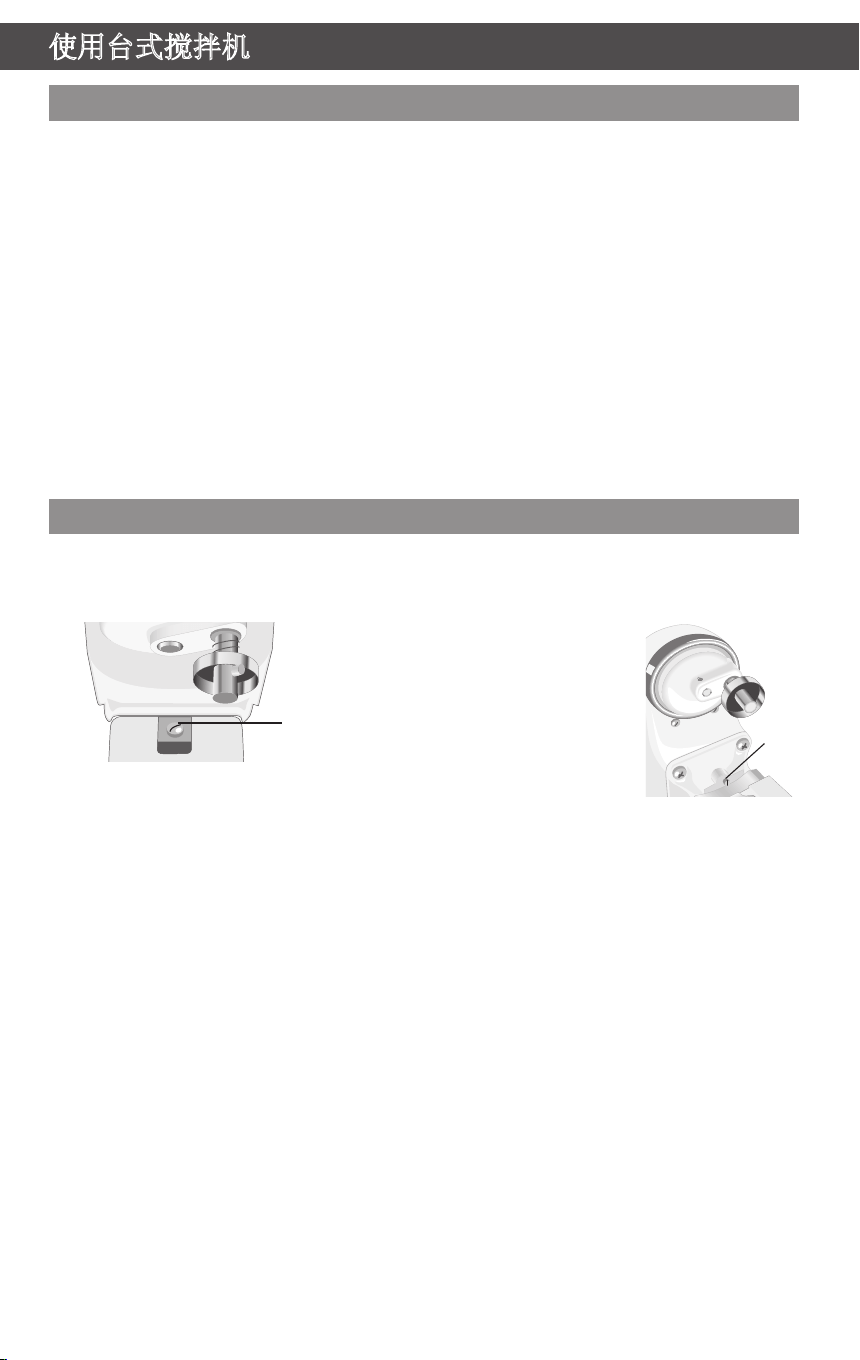
倾斜头
1.将速度控制器旋转到“O”。
2.拔出台式搅拌机的插头。
3.抬起电动头。
4.沿逆时针方向(左)略微旋转螺钉
(A),以升高平搅器;或沿顺时针方
向(右)略微旋转螺钉(A),以降低
平搅器。
5.调整平搅器,使其刚好离开桶表面。
如果螺钉过调,桶锁定杆可能无法锁
到位。
注意:如果调整恰当,平搅器不会碰到
桶底或桶壁。如果平搅器或打蛋器过于
接近桶,当它碰到桶底时,会磨掉/损
平搅器上的涂层或打蛋器上的金属丝。
本台式搅拌机出厂时已调好,平搅器恰好不会接触桶底。如果由于某种原因,平搅器
接触了桶底或离桶过远,您可以轻松校正间距。
A
升降式
1.将速度控制器旋转
到“O”。
2.拔出台式搅拌机的
插头。
3.将桶升降柄置于低
位。
4.装上平搅器。
5.沿逆时针方向(左)略微旋转螺钉
(B),以升高平搅器;或沿顺时针方向
(右)略微旋转螺钉(B),以降低平
搅器。
6.将桶升降柄置于高位,查看间距。
7.必要时重复步骤5和6。
注意:如果调整恰当,平搅器不会碰到
桶底或桶壁。如果平搅器或打蛋器过于
接近桶,当它碰到桶底时,会磨掉/损平
搅器上的涂层或打蛋器上的金属丝。
请参见台式搅拌机附件使用和护理指南了解有关速度设置和工作时间的信息。
使用KitchenAid附件
搅拌器至桶间隙
B
W���9��3�C_ZHv������� 3� 9/�9/�� 9:5� ��
中文
31
使用台式搅拌机 使用台式搅拌机
桶、带涂层的平搅器以及带涂层的面团
钩可在自动洗碗机中清洗。或者在起泡
热水中彻底清洁它们,然后彻底冲净它
们,再干燥。请勿以轴放置搅拌器。
注:打蛋器不可用洗碗机清洗!
注:在清洁之前务必拔下台式搅拌机插
头。用柔软的湿布擦拭台式搅拌机。请
勿使用家用/市售清洁剂。不要浸在水
中。时常擦拭搅拌轴,去除可能累积的
任何残留物。
台式搅拌机的护理和清洁
轻柔搅拌操作
台式搅拌机使用
桶和搅拌机旨在提供彻底的搅拌,不会
时常产生刮擦。在搅拌期间最多只能刮
擦桶一次或两次。
台式搅拌机在使用期间温度可能升高。
在重负载下,如果搅拌时间延长,您在
触碰到设备顶部时可能感到不适。这属
于正常现象。
注:请勿在台式搅拌机在工作时
刮擦桶。
您的KitchenAid台式搅拌机和其他
大多数电动搅拌机相比,搅拌的速度更
快,并且搅拌程度更彻底。因此,必须
对大多数配方中的搅拌时间进行调整,
防止过度搅拌。
在操作中,平搅器围绕
固定桶移动,同时在自
己的轴上以相对方向转
动。该图示出搅拌器的
通道形成的桶的整个覆
盖范围。
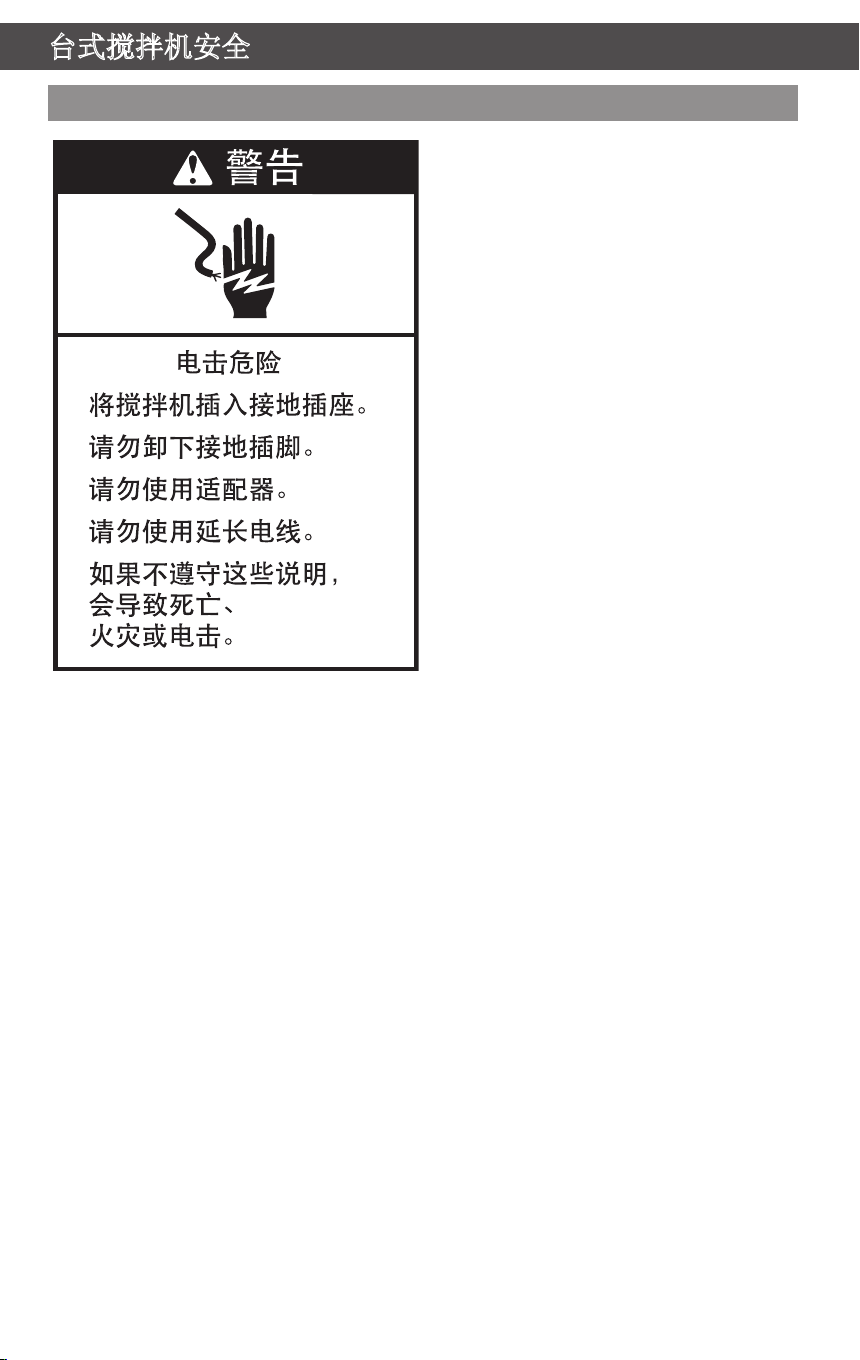
警告
人身伤害危险
为避免搅拌器损坏和造成人身伤害,
当搅拌机工作时,请勿尝试刮擦桶;
请关闭搅拌机。如果刮刀或其他物体
掉入桶内,请先关闭电动头,然后将
其取出。
触电危险
警告
在清洁之前,务必拔下搅拌机的插头
,
以免造成触电危险。请使用柔软的湿
布擦拭搅拌机。切勿浸泡在水中。时
常擦拭搅拌轴,去除可能累积的任何
残留物
W���9��3�C_ZHv������� 3� 9/�9/�� 9:5� ��
32
使用台式搅拌机 使用台式搅拌机
速度控制器指导
编号 速度 说明
1 搅动(STIR) 适合于缓慢的搅动、混合、捣碎操作,或作
为所有搅拌过程的第一步。用于向糊浆中添
加面粉和干配料,以及向干配料中添加液
体。请勿使用STIR(搅动)速度搅拌或揉
搓发酵面团。
2 缓慢搅拌 适合于缓慢的搅拌、捣碎或较快的搅动操
作。用于搅拌和揉搓发酵面团、粘稠的糊浆
和糖果,启动土豆或其他蔬菜的捣碎过程,
将起酥油切到面粉中,搅拌稀薄或易溅的糊
浆。配合开罐器附件使用。
4 搅拌、打浆 用于搅拌中等稠度的糊浆,如曲奇的糊。用
于混合糖与起酥油,以及在蛋白中加糖(用
于制作蛋白酥皮)。对蛋糕粉而言是中速。
配合以下工具使用:食品研磨机、旋转切片
机/切丝机、压面辊和水果/蔬菜滤网。
6 打浆、乳析 适合于中速打浆(乳析)或打发。作为蛋
糕、甜甜圈和其他糊浆的搅拌操作的最后一
步。对蛋糕粉而言是高速。配合柑橘榨汁机
附件使用。
8 快速打浆、打发 适合于发泡鲜奶油、蛋白或熟炼糖霜。
10 快速打发 适合于打发少量奶油、蛋白,或作为土豆泥
打发操作的最后一步。配合制浆机和谷物磨
粉机附件使用。
注意:负荷大时不能维持快速状态,如使用
制浆机和谷物磨粉机附件时。
注意:准备发酵面团时请勿超过2档速度,否则会导致台式搅拌机损坏。
W���9��3�C_ZHv������� 3� 9/�9/�� 9:5� ��
中文
33
使用台式搅拌机 使用台式搅拌机
蛋糕搅拌
在准备包装蛋糕搅拌时,对于中等速度使
用速度4,高度使用速度6。为得到最
佳结果,以包装说明上指明的时间搅拌。
添加坚果、葡萄干或果脯
固体材料应当以“搅动”级别速度在最后
的数个混合部分中加入。面糊应当足够
厚,防止烘培时水果和坚果沉入盘的底
部。粘性水果应当打碎并和面粉混合,以
更好地分布在面糊中。
液体混合物
包含大量液体成分的混合物应当以较低速
度搅拌以避免飞溅。只能在混合物变厚之
后提升速度。
搓揉发酵面团
务必使用面团钩来搅拌和搓揉发酵面团。
使用速度2来搅拌或搓揉发酵面团。使
用其他任何速度很可能造成设备故障。
在以4.25升(4.5夸脱)台式搅拌
机(倾斜头)制作面团时,请勿使用所
需数量高于0.87kg(7杯)通用面粉
或0.81kg(6杯)全麦面粉的配方。
在以4.8升(5夸脱)台式搅拌机(倾
斜头)制作面团时,请勿使用所需数量
高于1.00kg(8杯)通用面粉或0.81
kg(6杯)全麦面粉的配方。
通过台式搅拌机应用自己的配方
本书中提供的搅拌说明可用于通过
KitchenAid台式搅拌机应用自己喜欢的
配方。
要确定搅拌速度,需要您自行观察,并运
用经验。观察面糊或面团,将其混合到配
方中所需外观即可,例如“光滑乳脂状”
。使用“速度控制指导”帮助确定正确的
搅拌速度。
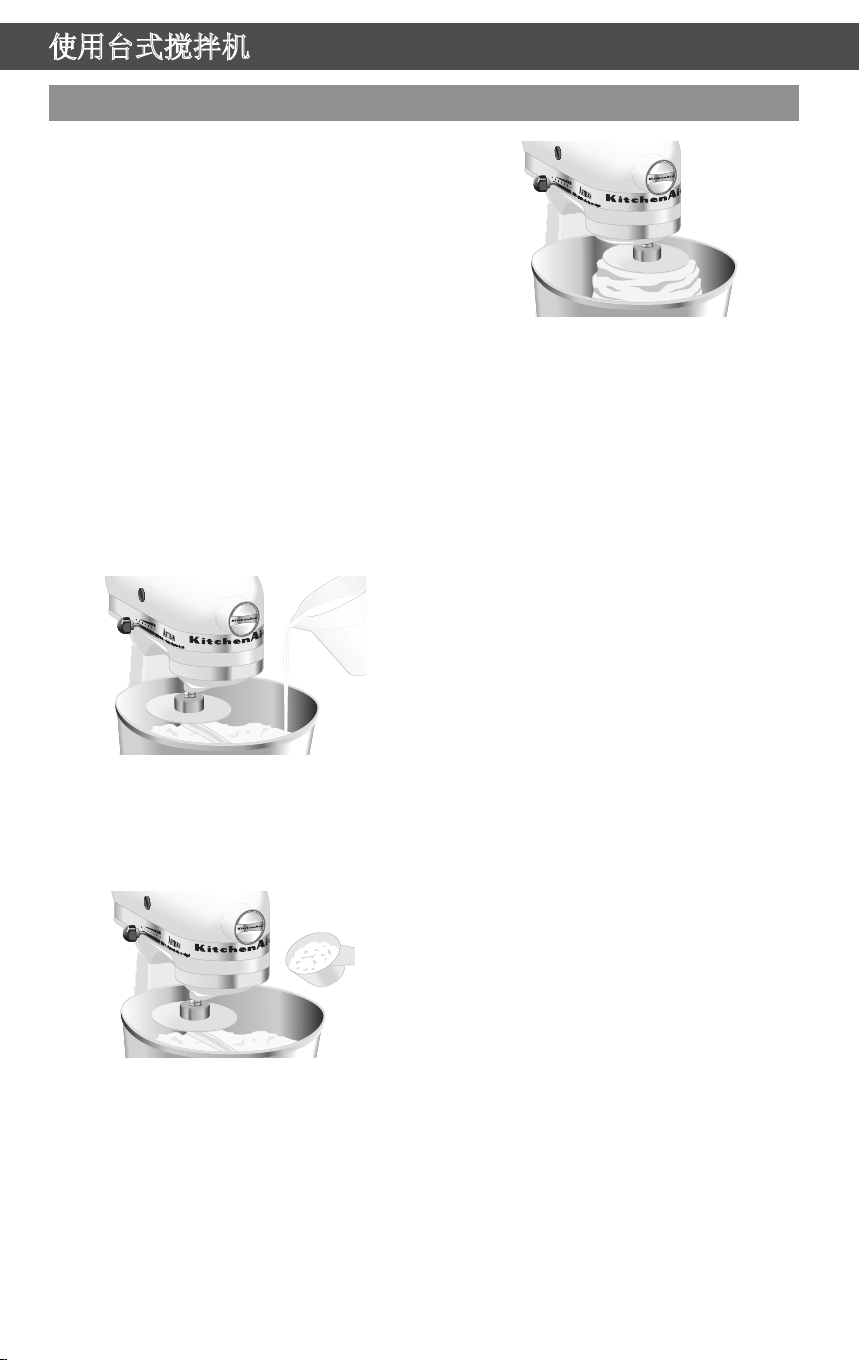
添加成分
在搅拌大多数面糊(尤其是蛋糕和曲奇面
糊)时要遵照的标准程序是添加:
1/3干燥成分
1/2液体成分
1/3干燥成分
1/2液体成分
1/3干燥成分
使用“搅动”级别速度,直到成分混合。
然后逐渐增大到所需速度。
务必尽可能靠近桶的侧面添加成分,而不
是直接添加到移动的搅拌器中。可使用导
流罩来简化成分添加操作。
注:如果桶底部的成分没有彻底搅拌,则
表明搅拌器没有足够深入桶内。请参见
“搅拌器至桶间隙。”
台式搅拌机使用
W���9��3�C_ZHv������� 33 9/�9/�� 9:5� ��
34
使用台式搅拌机 使用台式搅拌机
搅拌及搓揉发酵面团
“快速搅拌”是指一种面包烘培方法,需
要将干酵母和其他干燥成分搅拌,然后再
添加液体。与之相较,传统方法是将酵母
溶解在温水中。
1.将所有包括酵母在内的干燥成分放入
桶,不包括最后加入的125到250
g(1到2杯)面粉。
2.台式搅拌机(升降式):附接桶和面
团钩。升起台式搅拌机桶。
台式搅拌机(倾斜头):附接桶和面
团钩。锁定台式搅拌机头。
3.转到速度2并搅拌大约15秒,或者
直到成分组合。
4.以速度2继续,逐渐将液体成分添加
到面粉混合物,并再搅拌1至2分
钟。
注:如果以过快的速度添加液体成分,
将会在面团钩附近形成池,让搅拌过程
变慢。
5.以速度2继续,根据需要慢慢添加其
余面粉,一次60g(1/2杯)。一直
搅拌到面糊不再粘附桶侧面,大约要
2分钟。
6.如果面糊粘附在钩上,以速度2搓
揉2分钟,或者直到面糊光滑而有弹
性。
注:在桶内部和面团钩上搅拌面粉,防止
面糊粘附。
7.台式搅拌机(升降式):降低台式搅
拌机上的桶并从桶和面团钩上去除面
糊。
台式搅拌机(倾斜头):将台式搅拌
机头解锁并向后倾斜,将面糊从桶和
面团钩上去除。
8.遵照配方中有关升起、成形和烘培的
说明。
在使用传统的方法来准备喜欢的配方时,
请将酵母溶解在温热的桶中的温水里。添
加其余液体以及干燥成分,但是不包括最
后125到250g(1至2杯)面粉。
转到速度2并搅拌大约1分钟,或者
直到成分混合。继续执行步骤4到6。
两种方法对于面包制备都有同样好的效
果。但是对于面包烘培新手,“快速搅
拌”方法可能更快、更便利。这个方法的
温度容差稍大,因为酵母是和干燥成分混
合在一起,而不是和温热的液体混合。
W���9��3�C_ZHv������� 3� 9/�9/�� 9:5� ��
中文
35
使用台式搅拌机 使用台式搅拌机
将奶油导入冰冷的桶。附接桶和打蛋器。
为了避免溅出,请逐渐转变到指定的速
度,并搅打至所需的阶段。请参见下面
的图表。
数量 速度
59mL 逐渐到10
118mL 逐渐到10
236mL 逐渐到8
472mL 逐渐到8
搅打阶段
在搅打期间请密切观察奶油。
因为KitchenAid台式搅拌机
的搅打速度很快,在各个搅打阶段之间
仅相隔数秒。观察
以下特征:
开始变厚:
奶油较厚并且形似奶油冻。
固定形状:
在取出打蛋器后
奶油形成软峰。在制作甜点和酱料时可加
入其他成分。
坚硬:
当拆下打蛋器时,奶油形成坚硬、锐利的
峰。用于蛋糕或甜点上的浇头,或奶油卷
的馅料。
将室温蛋白放置在洁净、干燥的桶中。附
接桶和打蛋器。为了避免溅出,请逐渐转
变到指定的速度,并搅打至所需的阶段。
请参见下面的图表。
数量 速度
1个鸡蛋蛋白 逐渐到10
2-4个鸡蛋蛋白 逐渐到8
6个或更多个鸡蛋蛋白 逐渐到6
搅打阶段
借助KitchenAid台式搅拌机,可以
快速搅打蛋白。因此,请仔细观察,
避免过度搅打。该列表为您说明
预期的程度。
起泡:
大型不均匀的气泡。
开始固定形状:
气泡细密而紧实;所得物质呈白色。
打发:
在取出打蛋器之后峰的尖端倒塌。
几乎僵硬:
在取出打蛋器后形成尖锐峰形,但蛋白实
际上是柔软的。
僵硬但不干燥:
在取出打蛋器之后形成锋利、坚硬的峰。
蛋白在颜色和光泽上均匀。
坚硬而干燥:
在取出打蛋器之后形成锋利、坚硬的峰。
蛋白有斑点并且外观灰暗。
蛋白
发泡鲜奶油
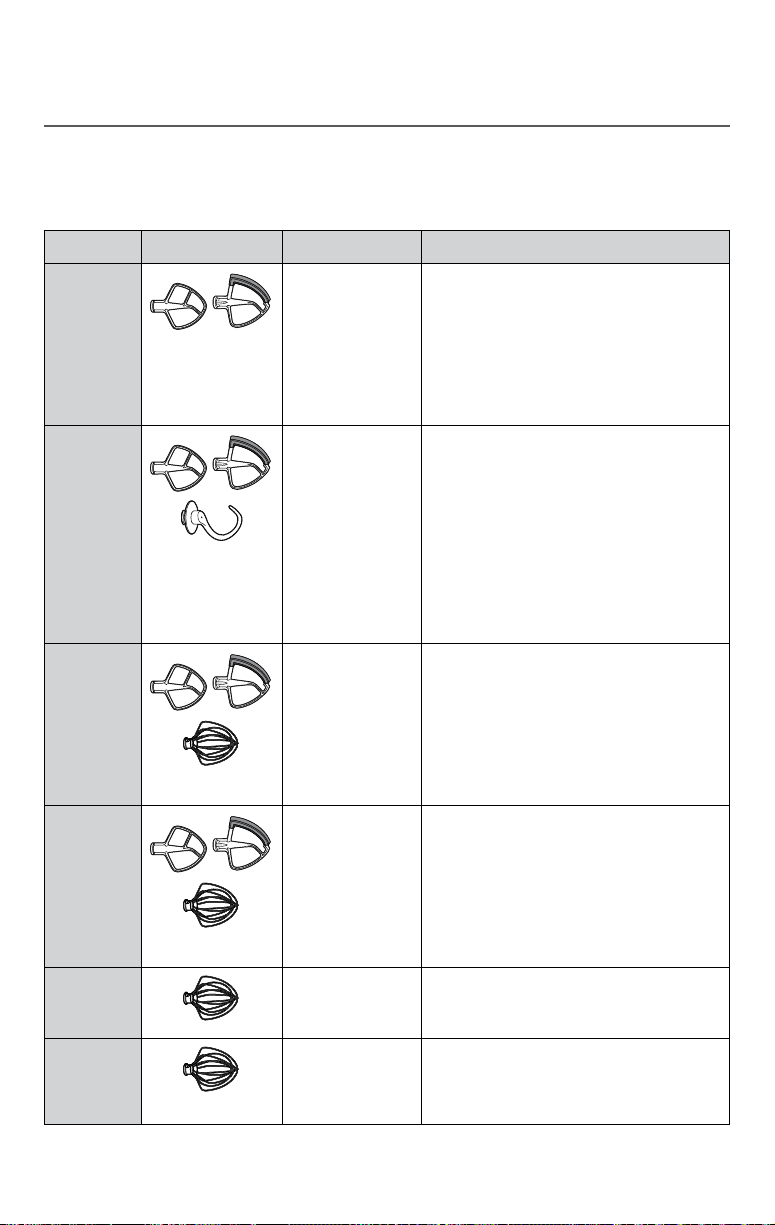
W���9��3�C_ZHv������� 35 9/�9/�� 9:5� ��

36
附件 附件
故障排除
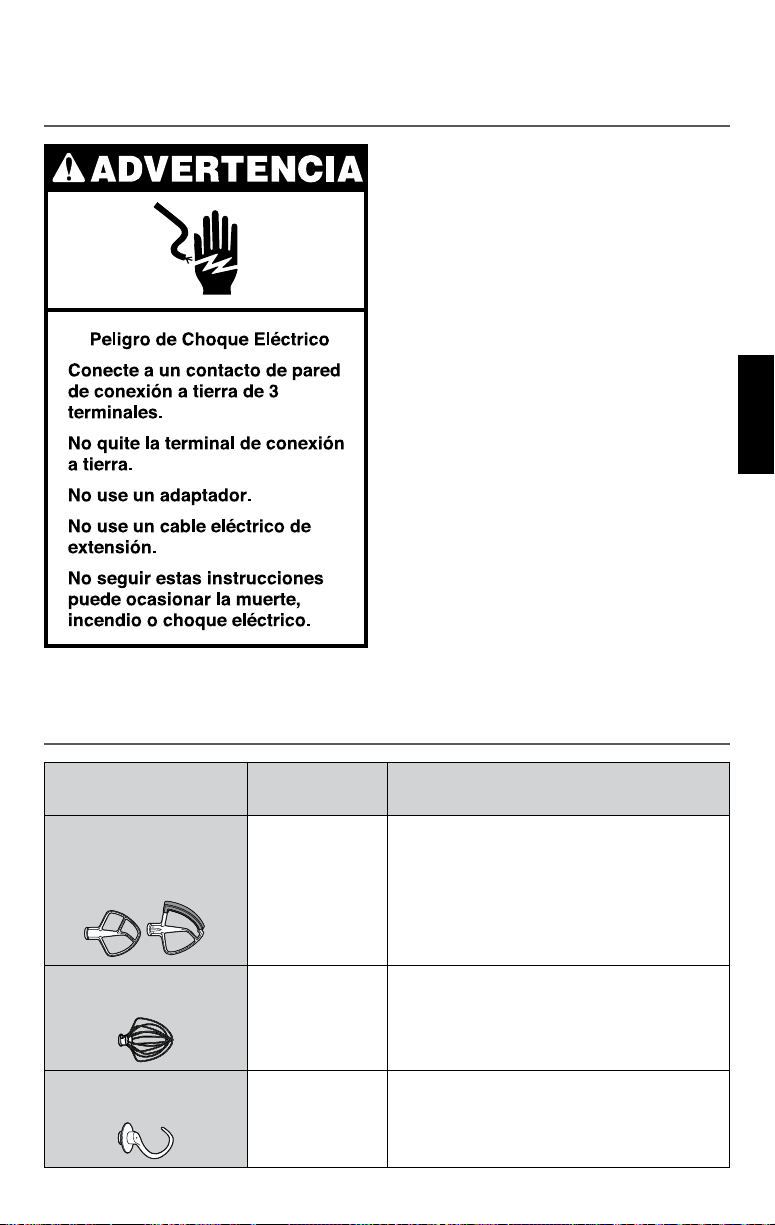
KitchenAid附件的设计旨在确保长寿命。附件动力轴和套筒插孔为方形设计,消除将
动力传输到附件期间可能出现的任何滑动。套筒和轴壳体呈锥形,确保适贴配合,即
使在长期使用并磨损后也是如此。KitchenAid附件无需额外的电力装置便可工作;电
力装置是内置在其中的。
一般信息
一般说明
‡并非
台式搅拌机的一部分。
附件套筒插孔
附件旋钮
凹口
销
附件轴壳体
附件
动力轴‡
附件壳体
附接
1.将速度控制器转动到“O”。
2.拔下台式搅拌机插头或断开电源。
3.通过逆时针转动来松开附件旋钮。拆
下附件套筒盖。
4.将附件轴壳体插入附件套筒,确保附
件动力轴安装到方形附件套筒插孔
中。可能必须来回转动附件。当附件
处于正确的位置时,附件上的销将装
入套筒边缘上的凹口。
5.通过顺时针转动紧固附件旋钮,直到
附件完全固定至台式搅拌机。
6.插入正确的电气插座。
W���9��3�C_ZHv������� 3� 9/�9/�� 9:5� ��
中文
37
附件 附件
故障排除
在致电服务中心之前,请阅读以下内
容。
1.台式搅拌机在使用期间温度可能升
高。在重负载下,如果搅拌时间延
长,您在触碰到设备顶部时可能感到
不适。这属于正常现象。
2.台式搅拌机可能发出刺激气味,尤其
是新机器。这是电机的正常现象。
3.如果平搅器碰到桶,请停止台式搅拌
机。请参见“搅拌器至桶间隙”。
如果台式搅拌机故障或者无法工作,请
检查以下数项:
-台式搅拌机是否已插入?
-台式搅拌机电路中的保险丝是否正常工
作?如果您有断路器箱,请确保将电路
关闭。
-将台式搅拌机关闭10-15秒,然后再
次打开。如果台式搅拌机仍然未启动,
请让它冷却30分钟,然后再打开。
-如果问题并非由于以上原因之一引起,
请参见“服务中心”。
拆卸
1.将速度控制器转动到“O”。
2.拔下台式搅拌机插头或断开电源。
3.通过逆时针转动来松开附件旋钮。在
拉出时轻轻来回旋转附件。
4.更换附件套筒盖。通过顺时针旋转紧
固附件旋钮。
W���9��3�C_ZHv������� 37 9/�9/�� 9:5� ��
38
保修证
不对间接损害承担任何责任。
在亚州:
凯膳怡贸易有限责任公司
中国上海市浦东新区,
新金桥路1888号
8号楼6楼
www.KitchenAid.com.cn
在美国:
CustomerSatisfactionCenter
KitchenAidPortableAppliances
P.O.Box218
SaintJosephMI49085
USA
免费电话号码(仅限美国境内):
1-800-541-6390
www.KitchenAid.com
应由当地授权KitchenAid服务中心提供所有服务。联系向您出售搅拌机的
经销商,以获取距离您最近的授权KitchenAid服务中心的名称。
©2016保留一切權利。KITCHENAID和StandMixer
的設計是在美國和其他地方的商標。
保修时间: KitchenAid
承担以下费用:
KitchenAid
不承担以下费用:
中国:
自购买之日起一年
内整机保修。
用于校正材料或工艺缺
陷的替换部件和修理人
工费。服务必须由授权
KitchenAid服务中心提
供。
A.由于将台式搅拌机用于普通
家庭食品准备以外的用途而
导致的修理。
B. 由于意外事件、改造、误
用、滥用台式搅拌机,或未
按照当地电气规范安装/使
用台式搅拌机,而导致台式
搅拌机受损。
KitchenAid家用台式搅拌机保修证
服务中心
W���9��3�C_ZHv������� 3� 9/�9/�� 9:5� ��
W���9��3�C_ENv�3����� �3 ��/5/�� 3:5� P�

©2016 All rights reserved. KITCHENAID and the design of the
Stand Mixer are trademarks in the U.S. and elsewhere.
©2016 保留一切權利。KITCHENAID 和 Stand Mixer
的設計是在美國和其他地方的商標。
W10190231C 10/16
W���9��3�C_ENv�3����� �� ��/5/�� 3:5� P�