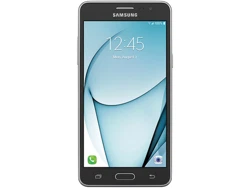
SMARTPHONE
User Manual
Please read this manual before operating your device
and keep it for future reference.

i
Legal Notices
Legal Notices
Warning: This product contains chemicals known to the State
of California to cause cancer and reproductive toxicity. For more
information, please call 1-800-SAMSUNG(726-7864).
Intellectual Property
All Intellectual Property, as defined below, owned by or which is
otherwise the property of Samsung or its respective suppliers
relating to the SAMSUNG Phone, including but not limited to,
accessories, parts, or software relating there to (the “Phone
System”), is proprietary to Samsung and protected under federal
laws, state laws, and international treaty provisions. Intellectual
Property includes, but is not limited to, inventions (patentable
or unpatentable), patents, trade secrets, copyrights, software,
computer programs, and related documentation and other works
of authorship. You may not infringe or otherwise violate the rights
secured by the Intellectual Property. Moreover, you agree that you
will not (and will not attempt to) modify, prepare derivative works of,
reverse engineer, decompile, disassemble, or otherwise attempt to
create source code from the software. No title to or ownership in
the Intellectual Property is transferred to you. All applicable rights
of the Intellectual Property shall remain with SAMSUNG and its
suppliers.
TF_SM-S978L_Eng_UM_OD8_TN_042815_R5

ii
Legal Notices
Open Source Software
Some software components of this product incorporate source
code covered under GNU General Public License (GPL), GNU
Lesser GeneralPublic License (LGPL), OpenSSL License, BSD
License and other open source licenses. Toobtain the source
code covered under the opensource licenses, please visit:
http://opensource.samsung.com.
Disclaimer of Warranties; Exclusion of
Liability
EXCEPT AS SET FORTH IN THE EXPRESS WARRANTY
CONTAINED ON THE WARRANTY PAGE ENCLOSED WITH THE
PRODUCT, THE PURCHASER TAKES THE PRODUCT “AS IS”,
AND SAMSUNG MAKES NO EXPRESS OR IMPLIED WARRANTY
OF ANY KIND WHATSOEVER WITH RESPECT TO THE PRODUCT,
INCLUDING BUT NOT LIMITED TO THE MERCHANTABILITY
OF THE PRODUCT OR ITS FITNESS FOR ANY PARTICULAR
PURPOSE OR USE; THE DESIGN, CONDITION OR QUALITY OF
THE PRODUCT; THE PERFORMANCE OF THE PRODUCT; THE
WORKMANSHIP OF THE PRODUCT OR THE COMPONENTS
CONTAINED THEREIN; OR COMPLIANCE OF THE PRODUCT
WITH THE REQUIREMENTS OF ANY LAW, RULE, SPECIFICATION
OR CONTRACT PERTAINING THERETO. NOTHING CONTAINED
IN THE INSTRUCTION MANUAL SHALL BE CONSTRUED TO
CREATE AN EXPRESS OR IMPLIED WARRANTY OF ANY KIND
WHATSOEVER WITH RESPECT TO THE PRODUCT. IN ADDITION,
SAMSUNG SHALL NOT BE LIABLE FOR ANY DAMAGES OF
ANY KIND RESULTING FROM THE PURCHASE OR USE OF
THE PRODUCT OR ARISING FROM THE BREACH OF THE

iii
Legal Notices
EXPRESS WARRANTY, INCLUDING INCIDENTAL, SPECIAL
OR CONSEQUENTIAL DAMAGES, OR LOSS OF ANTICIPATED
PROFITS OR BENEFITS.
Modification of Software
SAMSUNG IS NOT LIABLE FOR PERFORMANCE ISSUES OR
INCOMPATIBILITIES CAUSED BY YOUR EDITING OF REGISTRY
SETTINGS, OR YOUR MODIFICATION OF OPERATING SYSTEM
SOFTWARE.
USING CUSTOM OPERATING SYSTEM SOFTWARE MAY CAUSE
YOUR DEVICE AND APPLICATIONS TO WORK IMPROPERLY.
YOUR CARRIER MAY NOT PERMIT USERS TO DOWNLOAD
CERTAIN SOFTWARE, SUCH AS CUSTOM OS.
Samsung Electronics America (SEA), Inc
Address:
85 Challenger Road
Ridgefield Park,
New Jersey 07660
Phone: 1-800-SAMSUNG (726-7864)
Internet Address: www.samsung.com
©2015 Samsung Electronics America, Inc. Samsung, Galaxy, Galaxy
Note, S Pen, Multiwindow, and SHealth are registered trademarks of
SamsungElectronics Co., Ltd.

iv
Legal Notices
Do you have questions about your Samsung Mobile
Device?
For 24 hour information and assistance, we offer a new
FAQ/ARS System (Automated Response System) at:
www.samsung.com/us/support
The actual available capacity of the internal memory is less than
the specified capacity because the operating system and default
applications occupy part of the memory. The available capacity
may change when you upgrade the device.
Nuance
®
, VSuite
™
, T9
®
Text Input, and the Nuance logo are
trademarks or registered trademarks of Nuance Communications,
Inc., or its affiliates in the United States and/or other countries.
The Bluetooth
®
word mark, figure mark (stylized “B Design”), and
combination mark (Bluetooth word mark and “B Design”) are
registered trademarks and are wholly owned by the Bluetooth SIG.
microSD
™
and the microSD logo are Trademarks of the SD Card
Association.
Google, the Google logo, Android, the Android logo, Google Play,
Gmail, Google Maps, Google Music, Google Hangouts, Picasa,
Play Newsstand, YouTube, and other marks are trademarks of
Google Inc.
Wi-Fi is a registered trademark of the WirelessFidelity Alliance,
Inc.

v
Legal Notices
Online Legal Information
The online version of the Health/Safety and Warranty guide for
your device can be found at:
English
www.samsung.com/us/Legal/Phone-HSGuide
Spanish
www.samsung.com/us/Legal/Phone-HSGuide-SP
The online version of the End User Licensing
Agreement for your device can be found online at:
www.samsung.com/us/Legal/SamsungLegal-EULA2.

vi
Table of Contents
Table of Contents
Getting Started .....................................................................1
Front View ............................................................................. 2
Back View ............................................................................. 4
Assemble Your Device ....................................................... 6
Set Up Your Device ............................................................. 9
Set Up Accounts ...............................................................11
Know Your Device ...........................................................13
Home Screen .....................................................................14
Status Bar ...........................................................................22
Navigation and Motions ...................................................26
Notification Panel ..............................................................28
Entering Text .......................................................................31
Calling ...................................................................................... 34
Making and Answering Calls ..........................................35
Applications ......................................................................... 45
Apps List .............................................................................46
Google Applications .........................................................51
Other Applications ............................................................55
Calculator ............................................................................56
Calendar .............................................................................58
Camera and Video ............................................................62
Clock ...................................................................................69
Contacts ..............................................................................72
Email ....................................................................................83

vii
Table of Contents
Galaxy Apps .......................................................................86
Gallery ................................................................................. 88
Internet ................................................................................ 92
Memo ..................................................................................96
Messages ...........................................................................99
Music .................................................................................105
My Files .............................................................................107
Video .................................................................................112
Voice Recorder ................................................................114
Settings ..................................................................................116
How to Use Settings .......................................................118
Wi-Fi and Wi-Fi Direct .....................................................120
Bluetooth ...........................................................................125
Airplane Mode .................................................................129
Data Usage ......................................................................130
Mobile Networks ..............................................................131
NFC and Payment ...........................................................132
More Connection Settings .............................................135
Sound and Notification ...................................................138
Display Settings ...............................................................147
Motions and Gestures ....................................................152
Applications ......................................................................153
Wallpaper Settings ..........................................................160
Lock Screen and Security .............................................161
Privacy ...............................................................................170
Easy Mode ........................................................................173
Accessibility .....................................................................174
Accounts ...........................................................................179
Backup and Reset ..........................................................181
Language and Input Settings ........................................183

viii
Table of Contents
Battery ...............................................................................188
Storage ..............................................................................190
Date and Time Settings ..................................................194
About Your Phone ...........................................................196
Software Updates ............................................................197

Getting Started
Learn about your mobile device
hardware, assembly procedures, and
how to get started using your new
device.
2
Front View
Getting Started
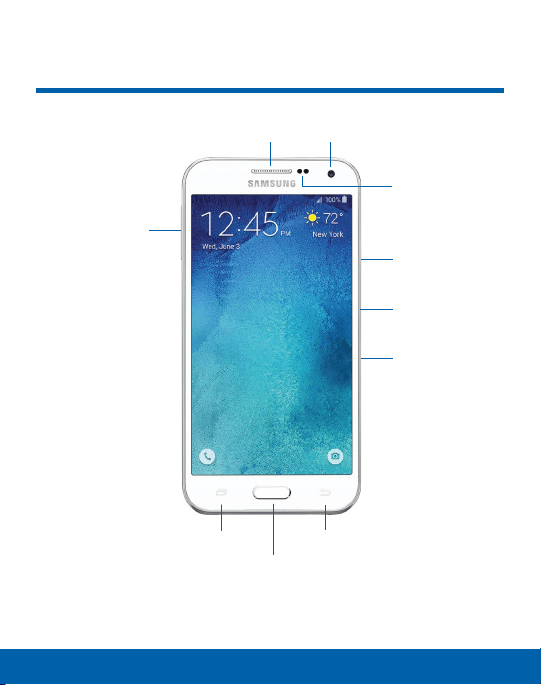
Front View
Earpiece Front camera
Proximity
sensor
Volume key
Power/Lock
key
microSD card
slot
Nano SIM
card slot
Recent apps
Back
Home key

3
Front View
Getting Started
•
Back: Tap to return to the previous screen, or to close a dialog
box, menu, or keyboard.
•
Earpiece: Listen to a call.
•
Front camera: Take self-portraits and record videos of yourself.
•
Home key: Tap to return to the Home screen.
•
microSD card slot: Tray for an optional microSD card (not
included).
•
Nano SIM card slot: Tray for a nano SIM card.
•
Proximity sensor: Detects the presence of objects near the
device.
•
Power/Lock key: Press and hold to turn the device on or off.
Press to lock or wake up the screen. Press and hold to turn the
device off or restart it, or for quick access to Airplane Mode,
Emergency Mode, and to Mute, Vibrate, and Sound modes.
•
Recent apps: Tap to display recent apps or touch and hold for
home screen options.
•
Volume key: Press to adjust the volume of your device’s sounds
and audio.
4
Back View
Getting Started
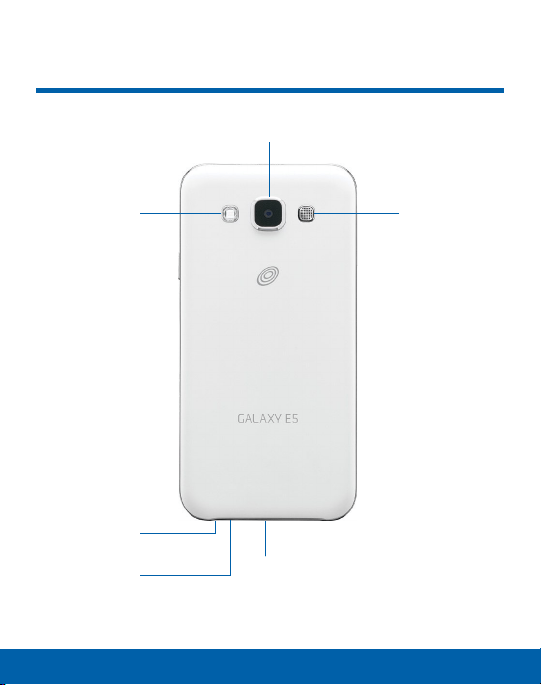
Back View
Back camera
Flash
Speaker
Microphone
USB charger/Accessory port
Headset jack

5
Back View
Getting Started
•
Back camera: Take pictures and record videos.
•
Flash: Illuminate subjects in low-light environments when taking
a photo or recording video.
•
Headset jack: Connect an optional headset (notincluded).
•
Microphone: Records audio and detects voice commands.
•
Speaker: Plays music and other sounds.
•
USB charger/Accessory port: Connect the Charger/USB cable
(included), and other optional accessories (not included).

6
Assemble Your Device
Getting Started
Assemble Your Device
This section explains how to assemble your
device.
Install an Optional Memory Card
To install an optional memory card (not included), please see
“Install a Memory Card” on page 191.
Charge the Battery
Note: For fastest charging times, use the Adaptive Fast Charging
charger that came with your phone. This charger provides faster
charging only when connected to devices that support Adaptive Fast
Charging.
Caution: Use only Samsung-approved charging devices and
batteries. Samsung accessories are designed to maximize battery
life. Using other accessories may invalidate your warranty and may
cause damage.

7
Assemble Your Device
Getting Started
1. Insert the USB cable into the port.
2. Connect the USB cable to the charging head, and then plug
the charging head into a standard outlet.
3. When charging is complete, unplug the charging head from
the outlet and remove the USB cable from the device.

8
Assemble Your Device
Getting Started
When to Charge the Battery
When the battery is weak and only a few minutes of operation
remain, the device sounds a warning tone at regular intervals.
In this condition, your device conserves its remaining battery
power by dimming the screen. When the battery level becomes too
low, the device automatically turns off.
► For a quick check of your battery level, view the battery
charge indicator located in the StatusBar of your device’s
display. A solid color
indicates a full charge.
You can also choose to display a percentage value.
Viewing a percentage value can provide a better idea of the
remaining charge on the battery. For more information, see
(
)
“Battery” on page 188.

9
Set Up Your Device
Getting Started
Set Up Your Device
Turn Your Device On or Off
Turn the Device On
► Press and hold the Power/Lock key until the device vibrates
and starts up.
Turn the Device Off
1. Press and hold the Power/Lock key until the device vibrates
and the Device options menu displays.
2. Tap Power off.
Welcome Screen
The first time you turn your device on, the Welcome Screen
displays. It will guide you through the basics of setting up your
device.
Follow the prompts to choose a default language, connect to a Wi-
Fi network, set up accounts, choose location services, learn about
your device’s features, and more.

10
Set Up Your Device
Getting Started
Secure Your Device
Use your device’s screen lock features to secure your device.
Lock the Device
By default, the device locks automatically when the screen times
out.
►
To lock the device, press the Power/Lock key.
Unlock the Device
The default Screen lock on your device is Swipe.
►
To unlock your device, press the Power/Lock key or Home
key, and then touch and drag your finger across the screen.
Set Up a Secure Screen Lock
The default Screen lock is Swipe, which offers no
security. To choose a more secure screen lock, see
“Set a Screen Lock” on page 162.

11
Set Up Accounts
Getting Started
Set Up Accounts
Google Account
Your new device uses your Google Account to fully utilize its
Android features, including Gmail, GoogleHangouts, and the
Google Play Store.
When you turn on your device for the first time, set up your existing
Google Account, or create a new GoogleAccount.
– or –
To create a new Google Account or set up your Google Account
on your device at any time, use Accounts settings. Formore
information, see “Accounts” on page 179.
► From a Home screen, tap
Apps > Settings>
Accounts> Add account > Google.
12
Set Up Accounts
Getting Started
Samsung Account
Create a Samsung account, for access to Samsung content and
apps on your device.
When you turn on your device for the first time, set up your existing
Samsung account, or create a new Samsung account.
– or –
To create a new Samsung account or set up your Samsung
account on your device at any time, use Accounts settings.
Formore information, see “Accounts” on page 179.
► From a Home screen, tap
Apps > Settings>
Accounts> Add account > Samsungaccount.

Know Your Device
Learn some of the key features of
your mobile device, including the
screens and icons, as well as how
to navigate the device and enter text
using the keyboard.
Warning: Please note that a touch screen responds best
to a light touch from the pad of your finger or a non-
metallic stylus. Using excessive force or a metallic object
when pressing on the touch screen may damage the
tempered glass surface and void the warranty.
14
Home Screen
Know Your Device
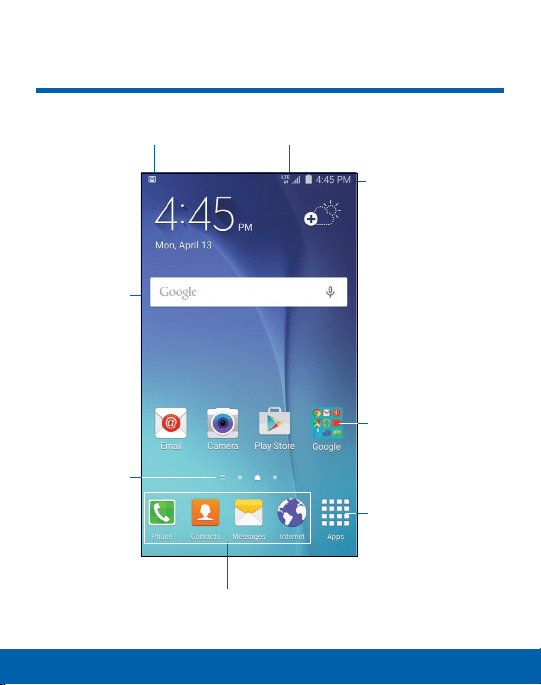
Home Screen
Notification icons Status icons
Status Bar
Widget
App folder
Home
screen
indicator
Apps list
App
shortcuts

15
Home Screen
Know Your Device
•
App folder: For your convenience, there are several
applications that are grouped into folders on the main Home
screen.
•
App shortcuts: Shortcuts to your favorite applications.
•
Apps list: Allows quick access to all of your applications.
•
Home screen indicator: Indicates which Homescreen is
presently displayed.
•
Notification icons: Display new messages and emails,
notifications, available software updates, and so on.
•
Status Bar: Displays device status icons (right) and notification
icons (left).
•
Status icons: Display information about the device, such as the
network signal strength, battery level, the time, and so on.
•
Widget: Self-contained application that runs on the Home
screen (not a shortcut).

16
Home Screen
Know Your Device
The Home screen is the starting point for
using your device.
Customize your Home screen by adding
application shortcuts, widgets, folders,
andusing wallpapers.
Manage Home Screens
Your device comes with multiple Home screens to hold apps and
widgets. You can rearrange the Home screens in a different order.
1. From a Home screen, pinch the screen.
– or –
Touch and hold an empty space on the screen.
2.
Use these options to manage screens:
•
Add a screen: Scroll to the end of the screens, and then
tap Add.
•
Remove a screen: Touch and hold on a screen, and then
drag it to Remove.

17
Home Screen
Know Your Device
•
Set a screen as the main Home screen: Tap Main
Home screen at the top of a screen. This screen displays
when you press the Home key.
•
Change the order of screens: Touch and hold on a
screen, and then drag to a new position.
App Shortcuts
You can use app shortcuts to launch an app from any Home
screen.
Add a Shortcut to a Home Screen
1. From a Home screen, tap Apps.
2. Touch and hold an app shortcut, drag it to a Home screen,
and then release it.
Remove a Shortcut
1. Touch and hold an app shortcut to releaseit.
2. Drag the app shortcut to Delete and release it.
Note: Removing a shortcut does not delete the app, it just removes
the shortcut from the Home screen.

18
Home Screen
Know Your Device
Change the Wallpaper
Change the look of the Home and Lock screens with wallpaper.
You can display a favorite picture or choose from preloaded
wallpapers.
1. From a Home screen, pinch the screen.
– or –
Touch and hold an empty space on the screen.
2. Tap Wallpapers, and then choose Home screen, Lock
screen, or Home and lock screens.
3. Tap a wallpaper to see a sample, and then tap
SETASWALLPAPER.

19
Home Screen
Know Your Device
Widgets
Widgets are self-contained apps that run on a Homescreen.
There are all kinds of widgets, including links to a specific contact,
Internet bookmarks, Gmail and email accounts, and manyothers.
Add a Widget to a Home Screen
1. Touch and hold an empty space on the screen, and then tap
Widgets.
2. Touch and hold a widget, drag it to a Homescreen, and then
release it.
Remove a Widget
1. From a Home screen, touch and hold a widget to releaseit.
2. Drag the widget to Delete and releaseit.
Note: Removing a widget does not delete the widget, it just removes
the widget from the Home screen.

20
Home Screen
Know Your Device
Folders
Place folders on a Home screen to organize items.
Create a Folder
You can create app folder on a Home screen.
1. On a Home screen, touch and hold an app icon and drag it on
top of another app until a highlighted box appears.
2. Release the app icon to create the folder.
3. Tap the line to enter a name for the folder.
4. Tap the
Palette icon to change the color (ifdesired).
5. Tap anywhere outside of the folder to close it.
6. To add more apps, touch and hold an app icon, and then drag
it to the folder.

21
Home Screen
Know Your Device
Add a Folder to a Home Screen
Folders created on an Apps screen can be added to a Home
screen
1. From an Apps screen, touch and hold an app folder.
2. Drag the folder onto a Home screen and releaseit.
Remove a Folder from a Home Screen
1. Touch and hold the folder until it detaches.
2. Drag the folder to Delete and release it.

22
Status Bar
Know Your Device
Status Bar
The Status Bar at the top of the Home screen
provides device information (such as network
status, battery charge, and time) on the right
side and notification alerts on the left.
Know Your Device
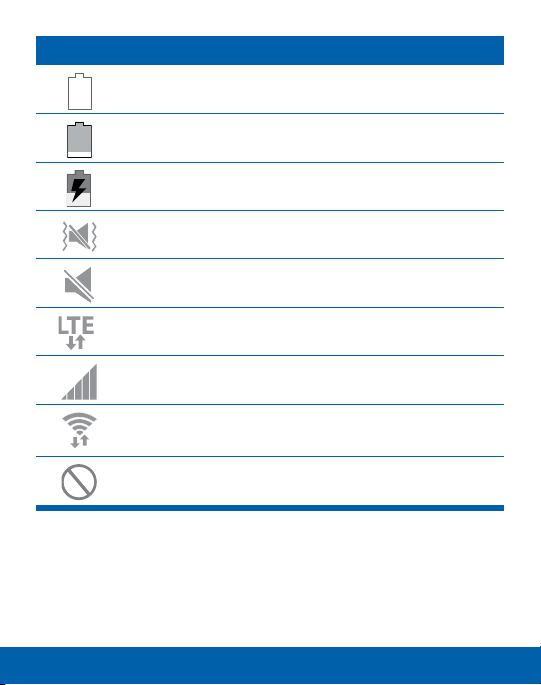
Status Icons
Battery is fully charged.
Battery is low. The yellow area turns red as the
charge level becomes critical.
Battery is charging.
Vibrate mode is enabled.
Mute mode is enabled.
The device is connected to a 4G LTE wireless
network.
Signal strength.
Wi-Fi is active.
No wireless network is available.
23
Status Bar
Know Your Device
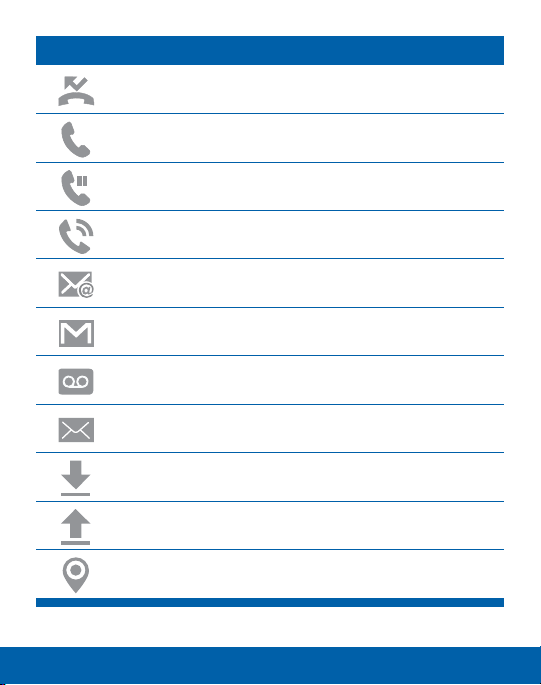
Notification Icons
Missed call.
Call in progress.
Call is on hold.
Call is using speakerphone.
New email has arrived.
New Gmail has arrived.
New voicemail message has been received.
New text or multimedia message has arrived.
Download of a file or app is in progress.
File is being uploaded or sent.
Location service (GPS) is active.
24
Status Bar
Know Your Device
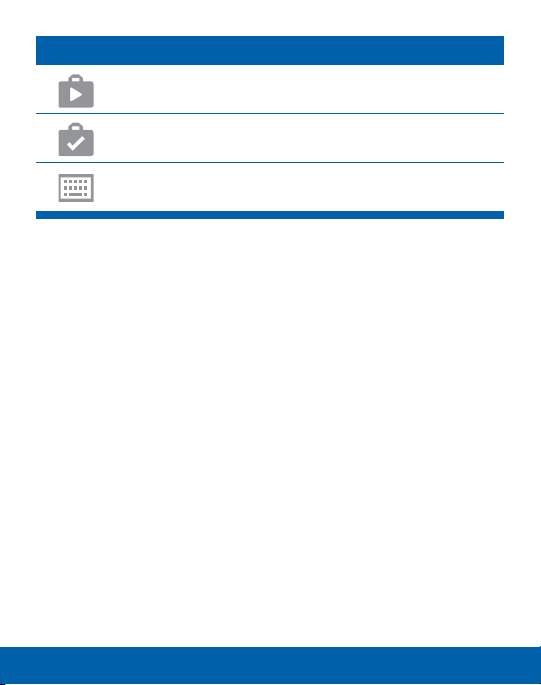
Notification Icons
App updates are available from the Google Play
Store.
App updates are complete.
Keyboard is in use.
25
Status Bar

26
Navigation and Motions
Know Your Device
Navigation and Motions
Touchscreen Navigation
Tap
Lightly tap items to select or launch them.
•
Tap the onscreen keyboard to enter characters ortext.
•
Tap an item to select it.
•
Tap an app icon to launch the application.
Touch and Hold
Activate onscreen items by a touch and hold gesture.
•
Touch and hold a widget on the Home screen to moveit.
•
Touch and hold a field to display a pop-up menu of options.

27
Navigation and Motions
Know Your Device
Swipe or Slide
To swipe, lightly drag your finger vertically or horizontally across
the screen.
•
Swipe the screen to unlock the device.
•
Swipe the screen to scroll through the Homescreens or menu
options.
Drag
To drag, touch and hold on an item, and then move it to a new
location.
•
Drag an app shortcut to add it to a Home screen.
•
Drag a widget to a place it in a new location on a Homescreen.
Pinch and Spread
Pinch the screen using your thumb and forefinger or spread by
moving your fingers apart.
•
Pinch the screen to zoom in while viewing a picture or a
webpage.
•
Spread the screen to zoom out while taking a picture.
28
Notification Panel
Know Your Device
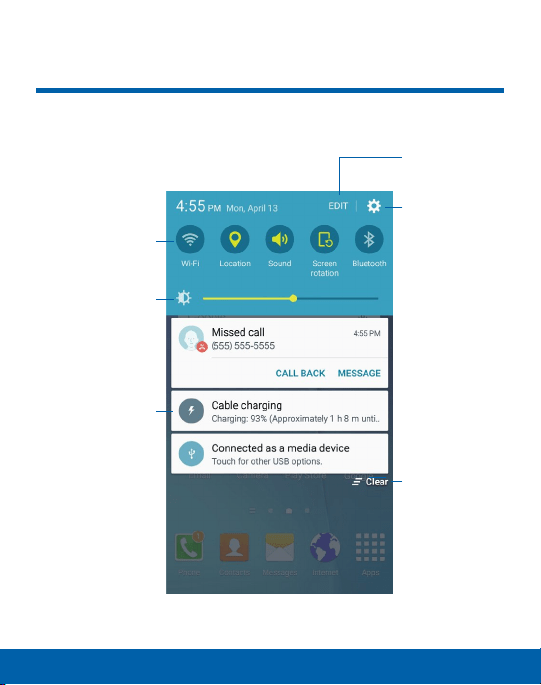
Notification Panel
Quick settings
Adjust screen
brightness
Tap notification
to launch app
or view detail
Edit the
Quick
settings
Settings
Clear all
notifications

29
Notification Panel
Know Your Device
Notification icons on the Status Bar display
calendar events, device status, and more. For
details, open the Notification Panel.
View the Notification Panel
1. Swipe down on the Status Bar to display the Notification
Panel.
2. Scroll down the list to see notification details.
•
Tap an item to open it.
•
To clear a single notification, drag the notification left or
right.
•
Tap Clear to clear all notifications.
3. To close the Notification Panel, swipe upward from the bottom
of the screen or tap Back.

30
Notification Panel
Know Your Device
Quick Settings
In addition to notifications, the Notification Panel also provides
quick access to device functions such as Wi-Fi, allowing you to
quickly turn them on or off.
To view additional Quick settings:
► On the Notification Panel, swipe left or right across the visible
icons.
To customize the Quick settings that appear:
► On the Notification Panel, tap EDIT.
31
Entering Text
Know Your Device
Entering Text
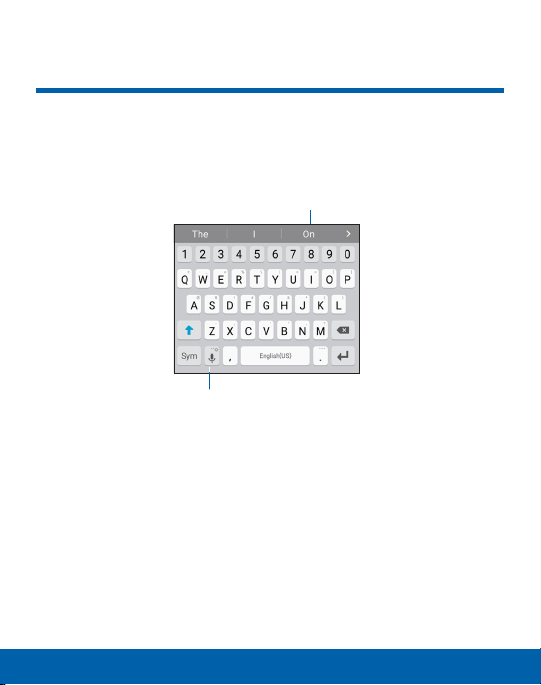
Using the SamsungKeyboard
Type your text input using a QWERTY keyboard.
Predictive Text
Options key
Predictive Text
Predictive text suggest words matching your text entries, and,
optionally, completes common words automatically. Predictive
text can learn your personal writing style from your contacts,
messages, email, and social networking sites — improving its
accuracy of predicting your text entries.
Know Your Device
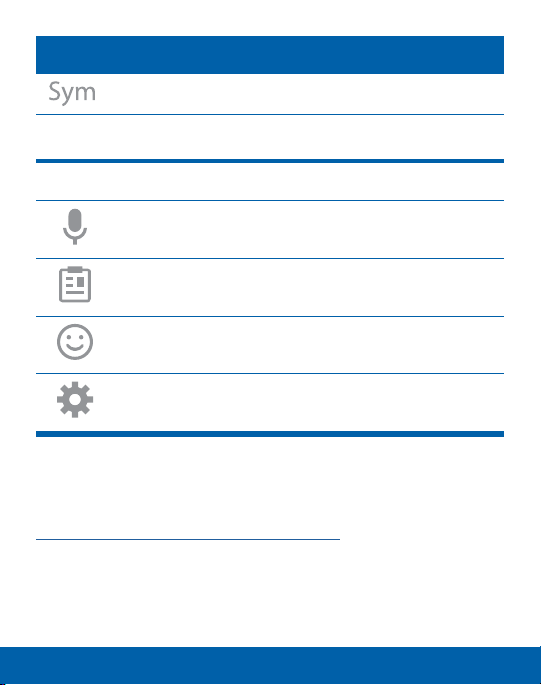
Special Keys
Tap to insert numbers and symbols.
Tap to insert letters.
ABC
Touch and hold the Options key to:
Google voice.
Copy content from the clipboard.
Insert emoticons.
Access keyboard settings.
Configure the Samsung Keyboard
To customize the Samsung Keyboard, see
“Samsung Keyboard Settings” on page 184.
32
Entering Text
33
Entering Text
Know Your Device
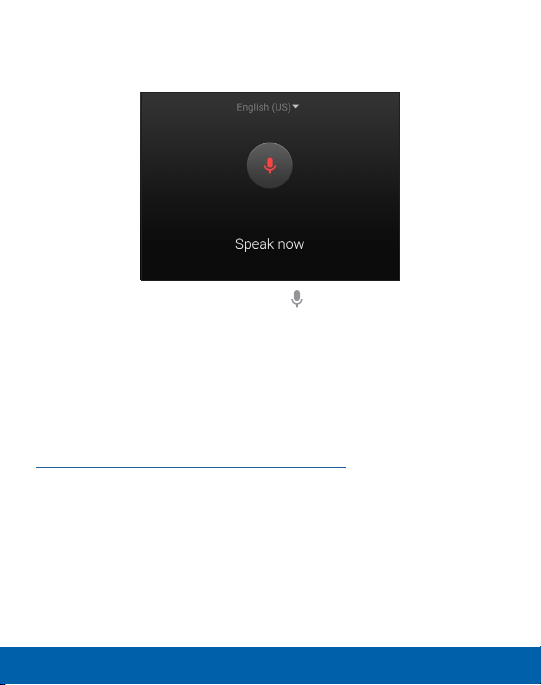
Using Google Voice Typing
Instead of typing, speak your text input.
1. On the Samsung Keyboard, tap GoogleVoiceTyping.
You may need to touch and hold the Options key (left of the
Space key) to find it.
2. Speak your text.
Configure Google Voice Typing
To customize Google Voice Typing, see
“Google Voice Typing Settings” on page 185.

Calling
Make telephone calls using a variety
of calling features and services.
35
Making and Answering Calls
Calling
Making and Answering Calls
Learn how to make or answer a call. Explore
features and functionality associated with
making or answering a call.
Make a Call
1. From a Home screen, tap Phone.
2. Enter a number and tap Dial.
Note: If the keypad does not appear, tap the
Keypad icon.
Quickly Dial a Number from YourContactList
1. From a Home screen, tap Apps > Contacts.
2. While viewing your contact list, swipe your finger across a
contact to the right call the contact.
36
Making and Answering Calls
Calling
Dial a Recent Number
All incoming, outgoing, and missed calls are recorded in the
Call log. If the number or caller is listed in your contacts list, the
associated name is also displayed.
1. From a Home screen, tap
Phone.
2. Tap RECENT. A list of recent calls is displayed.
3. Tap a contact, and then tap Dial.
End a Call
► When you are ready to end your call, tap Endcall.
Answer a Call
When a call is received the phone rings and displays the caller’s
phone number, or name if stored in the contacts list.
►
At the incoming call screen:
•
Touch and drag Answer in any direction to answer the
call.
•
Touch and drag Reject in any direction to reject the call
and send it to your voicemail.

37
Making and Answering Calls
Calling
Multitasking While on a Call
If you exit the call screen and return to a Home screen, your active
call is indicated by on the Status Bar.
This lets you continue with your current call and do something
else, such as access the contacts list, view a recent email, locate a
picture, and so on.
To return to the call screen:
►
Swipe the Status Bar downward to reveal the Notification
Panel, and then tap the Call notification.
To end a call from any application:
► Swipe the Status Bar downward to reveal the Notification
Panel, and then tap
End call.
Options During a Call
Your phone provides a number of functions that you can use
during a call.
Adjusting the Call Volume
► Press the Volume key to increase or decrease the volume.
– or –
Quickly add more volume to the incoming audio by tapping
Extra volume.

38
Making and Answering Calls
Calling
Listen with the Speaker or BluetoothHeadset
Listen to the call using the speaker or through a Bluetoothheadset
(not included).
► Tap
Speaker to hear the caller using the speaker.
– or –
Tap
Bluetooth to use a Bluetooth headset (notincluded).
Place a New Call While on a Call
If your service plan supports this feature, you can make another
call while a call is in progress.
1. From the active call, tap Add call to dial the second call. The
first call is displayed as a thumbnail.
2. Dial the new number and tap
Dial.
•
Tap Swap to switch between the two calls.
•
Tap Merge to hear both callers at once
(multiconferencing).
39
Making and Answering Calls
Calling
Call Waiting
If your service plan supports this feature, you can answer an
incoming call while you have a call in progress. You are notified of
an incoming call by a call waiting tone.
To answer a new call while you have a call in progress:
► Slide
Answer in any direction to answer the new call.
•
Tap Swap to switch between the two calls. This places
the new caller on hold and activates the previous call.
Call Log
The numbers of the calls you have dialed, received, or missed are
stored in the Call log.
1. From a Home screen, tap
Phone.
2.
Tap RECENT. A list of recent calls is displayed. If the caller is
in your contacts list, the caller’s name is displayed.

40
Making and Answering Calls
Calling
Save a Recent Call to Your Contacts List
1. From a Home screen, tap Phone > RECENT.
2. Tap the call that contains the information that you want to save
to your contacts list.
3. Tap CREATE CONTACT.
– or –
If you want to replace the number for an existing contact, tap
UPDATE EXISTING.
Delete a Call from the Call Log
1. From a Home screen, tap Phone > RECENT.
2. Touch and hold the call you want to delete from the Call log.
3. Tap DELETE.

41
Making and Answering Calls
Calling
Add a Call to the Reject List
By adding a caller to your Reject list, future calls from this number
will be sent directly to your voicemail.
1. From a Home screen, tap
Phone > RECENT.
2. Tap the caller you want to add to the Reject list.
3. Tap MORE > Add to Auto reject list.
Make a Call Using Speed Dial
You can assign a shortcut number to a contact for speed dialing
their default number.
To make a call using Speed Dial:
1. From a Home screen, tap
Phone.
2. Touch and hold the speed dial number.
If the speed dial number is more than 1 digit long, enter the
first digits, then hold the last digit.

42
Making and Answering Calls
Calling
Create a Speed Dial
1. From a Home screen, tap Apps > Phone.
2. Tap CONTACTS > MORE > Speed dial. The Speed dial
screen displays showing the numbers 1 through 100.
Number1 is reserved for voicemail.
3. Tap an unused number, which is indicated by Add contact.
Alist of contacts displays.
4. Tap a contact to assign to the number. Theselected contact
displays in the speed dial number box.
To remove a Speed Dial number assignment:
1. From a Home screen, tap
Apps > Phone > CONTACTS.
2. Tap MORE > Speed dial.
3. Find the contact to remove from Speed dial and tap
Remove.
43
Making and Answering Calls
Calling
Make an Emergency Call
The Emergency calling mode makes dialing an emergency number
a one-tap process.
Note: This mode can drain your battery power more rapidly than
normal calling mode.
Make an Emergency Call without a SIMCard
Without a SIM card, you can only make an emergency call with the
phone; normal cell phone service is not available.
1. From the Lock screen, tap the phone icon, and swipe outward.
2. Tap EMERGENCY CALL.
3. Enter 911 and tap
Dial.
4. Complete your call. During this type of call, you will have
access to the Speaker mode, Keypad, and End Call features.
5. Tap Endcall.
44
Making and Answering Calls
Calling
Make an Emergency Call with a SIM Card
1. From a Home screen, tap Phone.
2. Enter the emergency number (for example: 911), then tap
Dial.
Call Settings
To access the Call settings menu:
► From a Home screen, tap
Phone > MORE > Settings.
– or –
From a Home screen, tap
Apps > Settings>
Applications > Phone.

Applications
The Apps screen displays all
applications installed on your device,
both preloaded apps and apps you
download and install yourself.
Learn how to change the way apps
appear, organize apps into folders,
and uninstall or disable apps.

46
Apps List
Applications
Apps List
The Apps list shows all preloaded apps and
apps that you downloaded. You can uninstall,
disable, or hide apps from view.
Shortcuts to apps can be placed on any of
the Home screens. For more information, see
“Add a Shortcut to a Home Screen” on page 17.
Access Applications
1. From a Home screen, tap Apps.
2. Tap an application’s icon to launch it.
3. To return to the main Home screen, press the Home key.
47
Apps List
Applications
Download and Install NewApps
Find new apps to download and install on your device:
Play Store: Download new apps from the Google Play Store.
Visit play.google.com/store/apps to learn more.
•
Galaxy Apps: View and download Samsung apps that are
optimized for use with Galaxy devices. Visit apps.samsung.com
to learn more.
•
Uninstall or Disable Apps
You can uninstall or disable apps you download andinstall.
•
Preloaded apps cannot be uninstalled.
•
Apps that are disabled are turned off and hidden fromview.
1. From a Home screen, tap
Apps.
2. Tap EDIT. Apps that can be uninstalled or disabled show
Remove on their icon.
3. Tap Remove and follow the prompts to either uninstall or
disable the app.

48
Apps List
Applications
To enable apps after disabling them:
1. From a Home screen, tap
Apps > Settings >
Applications > Application manager.
2. Swipe to the DISABLED screen, and tap the app you want to
enable.
3. Tap ENABLE. The app will appear again in the Appslist.
Organize Your Apps
The Apps icons can be organized in folders and listed
alphabetically or in your own custom order.
Change the Order Apps Are Listed
1. From a Home screen, tap Apps.
2. Tap EDIT.
3. Touch and hold an app icon or folder and drag it to the
location you want:
4. Tap DONE when finished.

49
Apps List
Applications
To list apps alphabetically:
1. From a Home screen, tap
Apps.
2. Tap A-Z.
3. Tap OK to confirm. Apps are arranged alphabetically.
Use Folders to Organize Apps
1. From a Home screen, tap Apps.
2. Tap EDIT.
3. Touch and hold an app icon and drag it on top of another app
until a highlighted box appears.
4. Release the app icon to create the folder.
5. Tap the line to enter a name for the folder.
6. Tap the Palette icon to change the color (if desired).
7. Tap anywhere outside of the folder to close it.
8. To add more apps, touch and hold an app icon and drag it to
the folder.

50
Apps List
Applications
Remove a Folder from an Apps Screen
1. From a Home screen, tap Apps.
2. Tap EDIT.
3. Tap the folder.
4. Tap Remove folder, and then tap REMOVE. If there are
any app shortcuts in the folder, they will not be deleted, but
instead be moved to an Appsscreen.
51
Google Applications
Applications
Google Applications
Enjoy these applications from Google.
Note: Certain applications require a Google account.
Visit google.com to learn more.
Chrome
Use Google Chrome to browse the Internet and bring
your open tabs, bookmarks and address bar data
from your computer to your mobile device.
Drive
Open, view, rename, and share your Google Docs
and files.
Gmail
Send and receive email with Gmail, Google’s web-
based email service.
Google
Search not only the Internet, but also the apps and
contents of your device.
52
Google Applications
Applications
Google Now
Google Now works in the background to collect
information you regularly look up and organize it into
convenient cards that appear when you need them.
►
Press and hold the Home key.
Note: When Google Now is enabled, you can also
access it by touching .
Google Settings
Quickly and easily change Google app settings to
suit your preferences.
Note: You must be signed in to the application you
want to configure. For example, sign in to Google+ to
configure Google+ settings.
Google+
Stay connected and share with Google+. Chat with
friends and family, post photos, and see what others
are sharing.
Hangouts
Hangouts is an online place to meet friends
and family, share photos, and host video calls.
Conversation logs are automatically saved to a Chats
area in your Gmail account.
Applications
Maps
Use Google Maps to find your current location, get
directions, and other location-based information.
Note: You must enable location services to use Maps.
Please see “Location” on page 170.
Photos
This application automatically backs up your photos
and videos to your Google+ account.
Play Books
With Google Play Books, you can find millions of free
e-books and hundreds of thousands more to buy in
the eBookstore.
Play Games
Discover hundreds of games for download and
purchase through the Google Play Store.
Play Movies & TV
Watch movies and TV shows purchased from Google
Play. You can stream them instantly, or download
them for viewing when you are not connected to the
Internet. You can also view videos saved on your
device.
53
Google Applications
54
Google Applications
Applications
Play Music
With Google Play Music, you can play music and
audio files on your device.
Play Newsstand
Subscribe to your favorite magazines to read on your
device at your leisure.
PlayStore
Find new apps, movies and TV shows, music, books,
magazines, and games in Google Play Store.
Voice Search
Use voice commands to search the web with Google.
YouTube
View and upload YouTube videos right from your
device.

55
Other Applications
Applications
Other Applications
My Account Downloader
This application provides access to your current
account information.
My Extras
Specially recommended apps from TracFone.
56
Calculator
Applications
Calculator
The Calculator provides basic and advanced
arithmetic functions.
Basic Operation
1. From a Home screen, tap Apps > Calculator.
2. Enter the first number using the numeric keys.
3. Tap the appropriate arithmetic function key.
4. Enter the next number.
5. To view the result, tap the
Equals key.

57
Calculator
Applications
Additional Functions
To clear the results:
► Tap
Clear.
To clear the calculator history:
►
Tap HISTORY > CLEARHISTORY.
Tip: Tap KEYPAD to return to the calculator keys.
To copy all or part of the calculation to the clipboard:
►
Touch and hold an entry in the displayfield.
Scientific Calculator
Turn the device landscape to use advanced arithmetic functions,
such as sin, cos, and tan.
58
Calendar
Applications
Calendar
Manage your events and tasks.
Create an Event
1. From a Home screen, tap Apps > Calendar.
2. Tap
Add to add an event:
3. Enter details for the event, and then tapSAVE.
Delete an Event
1. From a Home screen, tap Apps > Calendar.
2. Tap an event to view it, and then tap DELETE.

59
Calendar
Applications
Share an Event
1. From a Home screen, tap Apps > Calendar.
2. Tap an event to view it.
3. Tap SHARE and tap a sharing format.
4. In the Share as window, tap either Event file (VCS) or Text.
5. In the Share via window, tap a sharing method and follow the
prompts.

60
Calendar
Applications
Create a Task
Tasks are items you add to the calendar to be accomplished on
a certain day. A task appears as a checklist item and is removed
once you mark the task as complete.
1. From a Home screen, tap
Apps > Calendar.
2. Tap the drop down menu in the top left corner (by default, the
Month and Year are shown) and tap Tasks.
3. Tap the Enter new task field to enter a new task.
4. You can choose to set the task for TODAY, TOMORROW, or
tap the
Expand icon to view and set the following options:
•
Due date: Tap the ON/OFF switch to select a date on the
calendar for the task.
•
Reminder: Tap to set a reminder alert.
•
Notes: Tap to save a note with your task.
•
Priority: Tap to assign a priority to the task.
5. Tap SAVE to save the task.

61
Calendar
Applications
Delete a Task
1. From a Home screen, tap Apps > Calendar.
2. Tap a day on the calendar to view the tasks for the day, or
select Tasks from the drop down menu.
3. Tap the checkbox by the task to mark it as complete and
remove it from the calendar.
4. To delete the task permanently, tap the task to open it, and
then tap DELETE.
Calendar Settings
These settings allow you to modify settings associated with using
the Calendar.
1. From a Home screen, tap
Apps > Calendar.
2. Tap MORE > Settings.
3. Tap an option and follow the prompts.
62
Camera and Video
Applications
Record video
View pictures
and videos in the
Gallery
Quick
Take a
settings
picture
Camera settings Shooting mode
Switch between
the front and
back cameras
Camera and Video

63
Camera and Video
Applications
Taking Pictures
Take pictures with your device’s front or back camera.
1. From a Home screen, tap
Apps > Camera.
2. Using the display screen as a viewfinder, compose your shot
by aiming the camera at the subject. While composing your
picture, use the onscreen options or these gestures:
•
Touch the screen with two fingers and pinch or spread
them on the screen to zoom in and out.
•
Tap the screen to focus on the area you touched.
3. If desired, before taking the photo, you can touch onscreen
icons to access various camera options and settings. You can
also touch the screen to move the focus field to the area you
touch.
4. Tap
Capture to take the picture.
Note: You can also press the Volume key up or down to take a
picture while recording a video or in place of tapping the capture icon
on the screen. You can configure the Volume key to act as the video
record key or as a zoom key.

64
Camera and Video
Applications
Shooting Mode
Several visual effects are available. Some modes are not available
when taking self-portraits.
1. From a Home screen, tap
Apps > Camera.
2. Tap MODE, and then scroll through the options:
Rear camera only
•
Auto: Allow the camera to evaluate the surroundings and
determine the ideal mode for the picture.
•
Pro: Manually adjust the ISO sensitivity, exposure value,
white balance, and color tone while taking pictures.
•
Beauty face: Take a picture with lightened faces for gentler
images.
•
Rear-cam selfie: Take a selfie using the rear camera.
•
Panorama: Create a linear image by taking pictures in
either a horizontal or vertical direction.
•
Continuous shot: Capture several continuous pictures by
holding down the
Capture button.
•
HDR (Rich tone): Save the picture in HDR (richtone) only.
•
Shot & more: Use various functions with your burst shots
after you take them, including best photo, best face, drama,
eraser, and panning shot.

65
Camera and Video
Applications
Front camera only
•
Selfie: Take selfie shots and apply various effects, such as
an airbrushed effect.
•
Wide selfie: Take wide-angle selfie shots to fit more people
into your pictures.
•
Interval shot: Select the best pictures from a series of
continuous shots taken at set intervals.
Both cameras
•
Animated GIF: Hold the
Capture button down to take
several continuous pictures of motion. You can then edit
the images to make an animated GIF.
•
Night: Take brighter, clearer photos in low light conditions
without flash.
•
Download: Download additional shooting modes from the
GALAXY Apps store.

66
Camera and Video
Applications
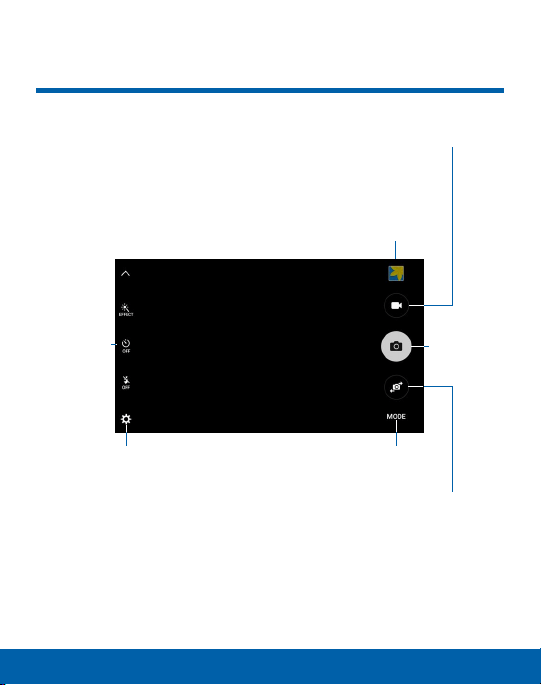
Camera Settings
1. From a Home screen, tap Apps > Camera.
2. Quick settings are listed across one side of the camera view
finder. Available options vary depending on the camera or
recording mode used. Default settings include:
•
Flash: Activate or deactivate the flash (back camera only).
•
Beauty: Take a picture with lightened faces for gentler
images (front camera only).
•
Timer: Take time-delayed pictures or videos.
•
Effects: Add special graphical effects.
3. Tap
Settings to configure settings for Camera. Available
options vary depending on the camera/recording mode used.

67
Camera and Video
Applications
Both cameras
•
Picture size: Select a resolution. Use higher resolution
for higher quality. Higher resolution pictures take up more
memory.
•
Video size: Select a resolution. Use higher resolution
for higher quality. Higher resolution videos take up more
memory.
•
Grid lines: Display viewfinder grid lines to help
composition when selecting subjects.
•
Location tags: Attach a GPS location tag to the picture.
•
Review pictures: Set to show pictures after taking them.
•
Voice control: To take pictures say smile, cheese, capture,
or shoot. To record videos, say Record video.
•
Storage location: Select where photos should be saved.
•
Volume keys function: Use the Volume key as the camera
key, the record key, or as a zoomkey.
•
Shutter sound: Enable or disable a shutter sound when
pictures are taken.
•
Reset settings: Reset the camera settings.

68
Camera and Video
Applications
Front camera only
•
Gesture control: Detect palm and automatically take a
picture two seconds later.
•
Save as horizontally flipped: Save the self-portrait or
self-recording as a reversed (or ‘mirrored’) image.

69
Clock
Applications
Clock
The Clock app offers features for keeping
track of time and setting alarms.
1. From a Home screen, tap Apps > Clock.
2. Tap a tab to use a feature:
•
Alarm: This feature allows you to set an alarm to ring at a
specific time.
•
World clock: View the time of day or night in other parts
of the world. World Clock displays time in hundreds of
different cities, within all 24 time zones around the world.
•
Stopwatch: You can use this option to measure intervals
of time.
•
Timer: You can use this option to set a countdown timer.
Use a timer to count down to an event based on a preset
time length (hours, minutes, and seconds).

70
Clock
Applications
Create an Alarm
Create an alarm event. You can set one-time or recurring alarms,
and choose options for how to be notified.
1. From a Home screen, tap
Apps > Clock.
2. Tap the following items to configure an alarm:
•
Date: Choose the day for this alarm.
•
Time: Set a time for the alarm.
•
Repeat weekly: Choose when to repeat the alarm, if so
desired.
•
OPTIONS: Tap to view and set the following options:
- Alarm type: Choose Sound, Vibrate, or Sound &
vibrate to alert you when an alarm is active.
- Volume: If you have chosen an alarm type that includes
sound, drag the slider to set the volume of the alarm.
- Alarm tone: If you have chosen an alarm type that
includes sound, choose a sound to play for the alarm.
- Snooze: Allow snoozing, and set interval and repeat
values for the alarm while snoozing.

71
Clock
Applications
- Increasing volume: When on, the alarm will start
playing a tone at a low volume at an interval before the
alarm time, and slowly increase in volume. Available
when you have chosen an alarm type that includes
sound.
-
Alarm name: Enter a name for the alarm.
3.
Tap SAVE to save the alarm.
Delete an Alarm
1. From a Home screen, tap Apps > Clock.
2. Find the alarm in the alarm list (under the Alarm tab), and
then tap
Delete in the upper right corner of the alarm
entry.

72
Contacts
Applications
Contacts
Store and manage your contacts with the
Contacts app, which can be synchronized
with a variety of your existing personal
accounts, including Google, Email, Facebook,
and your Samsung account.
For more information on connecting with and managing your
accounts through your device, see “Accounts” on page 179.
Note: The Contacts app is different from the CONTACTS tab in
the Phone app. Although both list the contacts in your phone and
accounts, the available options and functions are different.

73
Contacts
Applications
Contacts
Access your list of contacts by using the Contacts app, which is a
shortcut to the Contacts tab. To access your Contacts list:
► From a Home screen, tap
Apps > Contacts.
Find a Contact
You can search for a contact, or scroll the list to find one by name.
1. From a Home screen, tap
Apps > Contacts.
2. Tap the Search field, and then enter characters to find
contacts that match.
– or –
Tap a letter on the side of the list to jump directly to that letter
in the alphabetical list. You can also press and slide across
the alphabetical list to select a letter with better precision.
74
Contacts
Applications
Add a Contact
1. From a Home screen, tap Apps > Contacts.
2. Tap
Add, and then tap contact fields to enter information.
•
Choose a storage account for the contact. You can store
the contact on the device, or sync it with an account.
•
Tap
Photo to assign a picture to the new contact.
•
Enter a name, phone number, and assign the contact to
a group. Tap ADDANOTHER FIELD to add additional
contact information.
- Tap
Add to enter another contact.
-
Tap
Delete to remove an entry.
- Tap
Expand for additional fields.
- Tap the label name to the right of the field to choose
another label (for example, Home orWork).
3. Tap SAVE.

75
Contacts
Applications
Edit a Contact
When editing a contact, you can tap a field and change or delete
the information, or you can add additional fields to the contact’s list
of information.
1. From a Home screen, tap
Apps > Contacts.
2. Tap the contact to display it, and then tap EDIT.
3. Tap any of the fields to add, change, or delete information.
4. Tap SAVE.
Share a Name Card
When you share a name card, the contact’s information is sent as
a vCard file (.vcf). You can share a vCard via Bluetooth or Wi-Fi
Direct, attach it to a message, or save it to a storage location.
1. From a Home screen, tap
Apps > Contacts.
2. Tap a contact to display it, and then tap MORE > Share
namecard.
3. Choose a sharing method and follow the prompts.
76
Contacts
Applications
Link Contacts
When you have contacts from various sources (Gmail, Facebook,
and so on), you may have multiple similar entries for a single
contact. Contacts lets you link multiple entries into a single
contact.
1. From a Home screen, tap
Apps > Contacts.
2. Tap the contact to display it, and then tap
Link.
3. Tap LINK ANOTHER CONTACT, and then select contact(s) to
link to the original contact.
4. Tap LINK.
Unlink Contacts
1. From a Home screen, tap Apps > Contacts.
2. Tap the contact to display it, and then tap
Link.
3. Tap
Remove beside contacts to unlink them from the main
contact.

77
Contacts
Applications
Delete Contacts
You can delete a single contact, or choose multiple contacts to
delete.
1. From a Home screen, tap
Apps > Contacts.
2. Touch and hold a contact to select it. You can also tap
additional contacts.
3. Tap DELETE.
Create a Shortcut to a Contact
You can create a shortcut to a contact on a Home screen to
access their information directly from a Homescreen.
1. From a Home screen, tap
Apps > Contacts.
2. Tap a contact to view it.
3. Tap MORE > Add shortcut to Home screen. The new
shortcut displays in an empty area of the home screen.
78
Contacts
Applications
Favorites
When you mark contacts as favorites, they are easily accessible
from other apps. Favorites display together on the Favorites tab in
Contacts.
Mark Contacts as Favorites
1. From a Home screen, tap Apps > Contacts.
2. Tap a contact to display it, and then tap
Favorite (the star
turns gold ).
Remove Contacts from Favorites
1. From a Home screen, tap Apps > Contacts.
2. Tap a contact to display it, and then tap
Favorite (the star
turns loses the gold color ).

79
Contacts
Applications
Groups
You can use groups to organize your contacts. Your device comes
with preloaded groups, and you can create your own. You might
create a group for your family, for coworkers, or a team. Groups
make it easy to find contacts, and you can send messages to the
members of a group.
Create a Group
1. From a Home screen, tap Apps > Contacts.
2. Tap GROUPS, and then tap ADD.
3. Tap fields to enter information about the group:
•
Tap Group name to enter a name for the new group.
•
Tap Add member and select contact(s) to add to the new
group, and then tap DONE.
•
Tap Group ringtone to assign a ringtone to the group.
4. Tap SAVE.
80
Contacts
Applications
Rename a Group
1. From a Home screen, tap Apps > Contacts.
2. Tap GROUPS, and then tap a group.
3. Tap MORE > Edit group and enter a new name.
4. Tap SAVE.
Add Contacts to a Group
1. From a Home screen, tap Apps > Contacts.
2. Tap GROUPS, and then tap a group.
3. Tap ADD, and then tap the contact(s) you want toadd.
4. Tap DONE.

81
Contacts
Applications
Send a Message or an Email to a Group
You can send a text message or an email to members of a group.
1. From a Home screen, tap
Apps > Contacts.
2. Tap GROUPS, and then tap a group.
3. Tap MORE > Send message or email
.
4. Tap either Message or Email.
5. Tap contacts to select them, or tap the All checkbox at the
top of the screen to select all, and then tap DONE. You will
only see group members that have the appropriate contact
information (a phone number or an email address) in their
records.
6. For email, choose an account and follow theprompts.
82
Contacts
Applications
Delete a Group
Preset groups, such as Family, cannot be deleted.
1. From a Home screen, tap
Apps > Contacts.
2. Tap GROUPS.
3. Tap DELETE.
4. Tap the group category to open.
5. Tap the groups to select them or tap the All checkbox at the
top of the screen to select all.
6. Tap DELETE.
7. Tap Group only to only delete the group or tap Groups and
members to delete the groups and the contacts in the groups.
Contact Settings
These settings allow you to modify settings associated with using
the Contacts app.
1. From a Home screen, tap
Apps > Contacts.
2. Tap MORE > Settings.
3. Tap an option and follow the onscreen instructions.
83
Email
Applications
Email
Use the Email app to view and manage all
your email accounts in one application.
To access Email:
► From a Home screen, tap
Apps > Email.
Configure Email Accounts
You can configure Email for most accounts in just a few steps.
1. From a Home screen, tap
Apps > Email.
2. Follow the onscreen instructions to set up your email account.
– or –
For additional accounts, tap MORE > Settings >
Addaccount.
The device communicates with the appropriate server to set up
your account and synchronize your email. When complete, your
email appears in the Inbox for the account.
Note: To configure email account settings at any time, tap MORE >
Settings. Tap the account to display Account settings.

84
Email
Applications
Manage Your Email Accounts
You can view email you receive for all accounts on the Combined
view screen or you can view email accounts individually.
1. From a Home screen, tap
Apps > Email.
2. Tap the drop down menu at the top left of the screen to view
the current account mailbox.
3. Tap on the account name to view:
•
Combined view: View all email in a combined inbox.
•
[Account Name]: View email for only this account.
Delete Email Accounts
To delete an Email account:
1. From a Home screen, tap
Apps > Email.
2. Tap MORE > Settings.
3. Tap the account you want to remove.
4. Tap REMOVE. Confirm by tapping REMOVE on the prompt.

85
Email
Applications
Email Settings
These settings allow you to modify settings associated with using
the Email app.
1. From a Home screen, tap
Apps > Email.
2. Tap MORE > Settings.
3. Tap an option and follow the onscreen instructions.
86
Galaxy Apps
Applications
Galaxy Apps
Samsung Galaxy Apps is a free storefront that
provides a quick and easy way to find and
download apps that are compatible with your
Galaxy device.
Galaxy Essentials is a collection of specially
chosen applications available through
Samsung Apps. From Galaxy Essentials, you
can access and download a collection of
premium content, free of charge.
To access the Samsung Galaxy Apps website:
► From a Home screen, tap
Apps > GalaxyApps.

87
Galaxy Apps
Applications
To access Galaxy Essentials:
1. Swipe across the Galaxy Apps screen and then tap Galaxy
Essentials.
– or –
Swipe across the Home screens and locate and tap the
Galaxy Essentials widget.
2. Follow the onscreen instructions to download Galaxy
Essentials apps specially chosen from Samsung Apps.
Note: A Samsung account is required to purchase and download
apps.

88
Gallery
Applications
Gallery
View, edit, and manage pictures and videos.
View Images and Videos
Launching Gallery displays available folders. When another
application, such as Email, saves an image, a Download folder is
automatically created to contain the image. Likewise, capturing a
screenshot automatically creates a Screenshots folder.
1. From a Home screen, tap
Apps > Gallery.
2. Tap the drop down menu in the upper left corner, and then tap
Time or Albums to choose the way items display.
•
In Album view, you can create albums to organize your
images. On the drop down menu, tap Albums, and then tap
MORE > Createalbum.

89
Gallery
Applications
3. Depending on the view mode selected, either tap an image or
video to view it, or first tap an album or folder and then tap an
image or video.
4. When viewing an image or video, you can scroll left or right to
view the next or previous image orvideo.
Zoom In and Out
Use one of the following methods to zoom in or out on an image:
•
Double-tap anywhere on the screen to zoom in or zoom out.
•
Spread two fingers apart on any place to zoom in. Pinch the
screen to zoom out.
Play Videos
1. From a Home screen, tap Apps > Gallery.
2. Tap a folder or category to open it.
3. Tap a video to view it.
4. Tap the Play icon to play the video.
90
Gallery
Applications
Edit Images
1. While viewing an image, tap the screen once to see the image
options.
2. Tap
Edit to view and use the editing tools.
Delete Images
1. From a Home screen, tap Apps > Gallery.
2. Tap a folder or category to open it.
3. Tap MORE > Edit.
4. Tap images to select them.
5. Tap DELETE.

91
Gallery
Applications
Share Images
You can share images by using the following procedure:
1. From a Home screen, tap
Apps > Gallery.
2. Tap a folder or category to open it.
3. Tap MORE > Share.
4. Tap one or more images to select them, and then tap SHARE.
5. Tap a sharing method or service, and then follow the prompts
to share the images.
92
Internet
Applications
Internet
Access the Internet with a fully featured web
browser.
Access the Internet
► From a Home screen, tap Apps > Internet.
Command Keys
The following command keys are available:
Back or Back key to return to the previous page.
•
F
or
w
ard
t
o g
o f
or
w
ar
d to a recent page.
•
Home to display your Internet Home screen.
•
Bookmarks to manage bookmarked pages, saved pages,
and history.
•
Tabs to manage open tabs. The number on the icon
indicates the number of tabs that are currentlyopen.
•
Refresh to refresh or reload the current Webpage.
•
93
Internet
Applications
Viewing Web Site
To view a web site:
► Tap the address field, enter the web address, and then tap Go
on the keyboard.
To zoom in or out:
► Tap the screen twice or pinch the screen to zoom out and
stretch the screen to zoom in.
Browser Tabs
Use tabs to view multiple web pages at the sametime.
To open a new tab:
► Tap
Tabs > NEWTAB.
To close a tab:
► Tap
Tabs and then tap Closetab.

94
Internet
Applications
Bookmarks
To bookmark the current web page:
1. Tap
Bookmarks > ADD.
2. Type a title for the bookmark and tap SAVE.
To open a bookmarked web page:
► Tap Bookmarks, then tap a folder, and an entry.
History
To view a list of recently visited web pages:
► Tap
Bookmarks > HISTORY.
Saved Pages
To save a web page:
►
Tap MORE > Savewebpage.
To view a list of saved web pages:
► Tap
Bookmarks > SAVED PAGES.

95
Internet
Applications
Share Pages
To share a web page address with others:
►
Tap MORE > Share and follow the prompts.
Secret Mode
Pages viewed in secret mode do not appear within your browser
history or search history, and leave no traces (such as cookies)
on your device. Secret tabs are a darker shade than the normal
tabwindows.
Note: Any downloaded files will remain on your device after you
close the incognito tab.
To open a new incognito tab:
► Tap
Tabs > MORE > Newsecrettab.
Internet Settings
These settings allow you to modify settings associated with using
the Internet app.
1. From a Home screen, tap
Apps > Internet.
2. Tap MORE > Settings.
3. Tap an option and follow the onscreen instructions.
96
Memo
Applications
Memo
Use the Memo app to write and save notes
on your device.
Compose a Memo
1. Tap Apps > Memo.
2. Tap Create memo, type a memo.
•
To change the category, tap the Category icon.
•
To insert an image into the memo, tap the
Image icon.
•
To use your voice to insert text into the memo, tap the
Voice
icon.
•
To add tasks, tap the
Tasks icon.
3.
When finished creating your memo, tap SAVE.

97
Memo
Applications
View a Memo
1. Tap Apps > Memo.
2. Tap a memo thumbnail to open it.
•
To edit the memo, tap the content of the memo.
•
To delete memos, tap MORE > Edit, select memos, and tap
DELETE.
•
To send a memo to others, tap MORE > Share, select a memo,
and then select a method to share the memo.
Browse Memos
1. Tap Apps > Memo.
2. Browse memo thumbnails by scrolling up or down.
3. To search for a memo, tap SEARCH.

98
Memo
Applications
Memo Options
► While browsing memo thumbnails, tap MORE for the following
options:
•
Edit: Select notes to delete or move.
•
Share: Share memos.
•
Manage categories: Create and manage categories to
organize your memos.

99
Messages
Applications
Messages
Learn how to send and receive different
messages using the default messaging app
on your phone.
Types of Messages
Your default Messaging app provides the following message types:
•
Text Messages (SMS)
•
Multimedia Messages (MMS)
The Short Message Service (SMS) lets you send and receive text
messages to and from other mobile phones or email addresses.
To use this feature, you may need to subscribe to your service
provider’s message service.
The Multimedia Messaging Service (MMS) lets you send and
receive multimedia messages (such as picture, video, and audio
messages) to and from other mobile phones or email addresses.
To use this feature, you may need to subscribe to your service
provider’s multimedia message service.
Messaging icons are displayed at the top of the screen and
indicate when messages are received and their type.

100
Messages
Applications
Create and Send Messages
This section describes how to create a send a message using the
Messaging app.
1. From a Home screen, tap
Apps > Messages>
Compose.
2. Tap the Enter recipients field to manually enter a recipient or
tap
Add Recipient to select a recipient from your Contacts.
•
If manually entering recipients, enter additional recipients
by separating each entry with a semicolon (;). More
recipients can be added at any time before the message
is sent.
•
If adding a recipient from your Contacts, tap the contact
to place a check mark then tap DONE. The contact will be
placed in the recipients field.
•
For the Group option, if the number of recipients is less
than 10, all members in the group can be added by placing
a check mark by the contacts and then tap DONE.
101
Messages
Applications
3. Tap the Enter message field and use the onscreen keypad to
enter a message.
•
Tap
Add emoticons to choose an available emoticon
from an onscreen list and then add it into your message (at
the cursor location) if desired.
4. Review your message and tap
SEND.
Note: If you exit a message before you send it, the message is
automatically saved as a draft.
View New Messages
When you receive a new message, a new message icon appears
on the Status Bar.
To view the message:
1. Open the Notification Panel and select the message. For more
information, please see “Notification Panel” on page 28.
– or –
From a Home screen, tap
Apps > Messages, and then
tap the new message to view it.
2. To play a multimedia message (audio or video), tap
Play.
3.
To scroll through the list of messages, tap the screen and
scroll up or down the page.

102
Messages
Applications
Delete Messages
To delete messages, follow these steps:
1. From a Home screen, tap
Apps > Messages.
2. Tap MORE > Edit.
3. Tap each message you want to delete or tap the checkbox All.
4. Tap DELETE.
Message Search
You can search through your messages by using the Message
Search feature.
1. From a Home screen, tap
Apps > Messages.
2. Tap SEARCH.
3. Enter a word or phrase to search for, and then tap
Search
on the keyboard.

103
Messages
Applications
Message Settings
Configure the settings for text messages, multimedia messages,
push messages, and so on.
► From a Home screen, tap Apps >
Messages> MORE >
Settings.
Emergency Alerts
This device is designed to receive wireless emergency alerts from
the Commercial Mobile Alerting System (CMAS) which may also
be known as the Personal Localized Alerting Network (PLAN). For
more information, please contact your wireless provider.
Emergency Alerts allows customers to receive geographically-
targeted messages. Alert messages are provided by the US
Department of Homeland Security and will alert customers of
imminent threats to their safety within their area. There is no
charge for receiving an Emergency Alert message.
There are three types of Emergency Alerts:
•
Alerts issued by the President
•
Alerts involving imminent threats to safety of life (Extreme and
Severe)
•
AMBER Alerts (missing child alert)
Users may choose not to receive Imminent Threats (Extreme and
Severe) and AMBER Alerts. Alerts issued by the President cannot
be disabled.

104
Messages
Applications
To disable Imminent Threats and AMBER Alerts, follow the
instructions below:
1. From a Home screen, tap Messages.
2. Tap MORE > Settings > Emergencyalerts > Emergency
alerts.
3. All alerts are enabled by default (check mark showing). Tap
an alert option to disable it. You cannot disable Presidential
alerts.
105
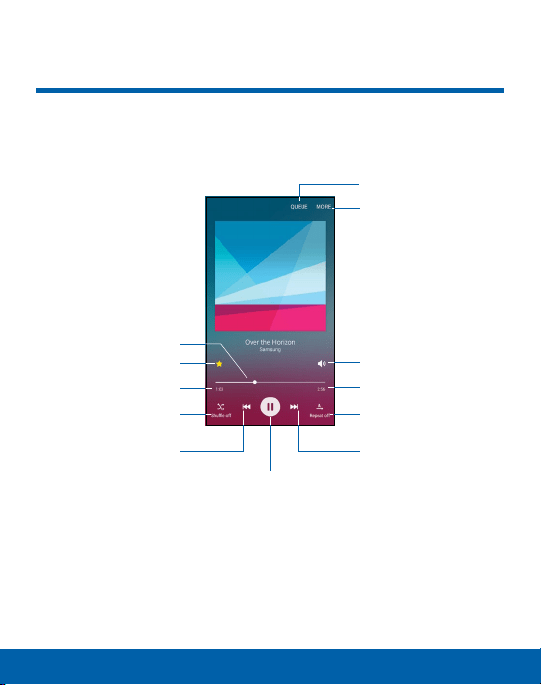
Music
Applications
Music
Add tracks
More options
Volume
Length of song
Repeat mode
Scan forward or
gotonext song
Pause/Play
Playback position
Mark as favorite
Elapsed time
Shuffle songs
Rewind or go to
previous song

106
Music
Applications
Listen to your favorite songs with the Music
player. Navigate through your music library,
play songs, and create customized playlists.
Listen to Music
1. From a Home screen, tap Apps > Music.
2. Tap a library category at the top of the screen to view your
music files.
3. Scroll through the list of songs and tap a song to begin
playback.

107
My Files
Applications
My Files
Access files stored on your device, including
images, videos, songs, and sound clips.
To view files in My Files:
1. From a Home screen, tap
Apps > MyFiles.
2. Tap a category to view the relevant files or folders.
3. Tap a file or folder to open it.

108
My Files
Applications
View Files
Files stored in the device are organized into the following groups:
•
Category: Files are grouped into the following categories:
-
Images: View image files.
-
Videos: View video files.
-
Audio: View audio files.
-
Documents: View document files.
-
Download history: View all apps and files that have been
downloaded to the device.
•
Local storage: View folders and files in their storage locations.
-
Device storage: View folders and files located on the device.
•
Cloud storage: Contains shortcuts to FTP servers or other
cloud storage locations that you have added.
-
Google Drive: Sign in to view folders and files located in your
Google Drive account.

109
My Files
Applications
My Files Options
On the main My Files screen, the following options are available:
•
SEARCH: Search for a file or folder.
•
MORE: Tap for the following options:
-
Show/Conceal hidden files: Show or conceal hidden files.
•
STORAGE USAGE: Tap to view memory information for your
device.

110
My Files
Applications
Category Options
After tapping on a category, the following options are available:
•
HOME: Return to the main My Files screen.
•
SEARCH: Search for a file in the selected category.
•
MORE: Tap for the following options:
-
Edit: Select files or folders.
-
Share: Select files to share.
-
View as: Choose how to view the files: List, Detailed or Grid.
-
Sort by: Change the sort order of the files.
-
Show/Conceal hidden files: Show or conceal hidden files.

111
My Files
Applications
Options for Selected Files and Folders
► Tap MORE > Edit, select a file or folder, and then use one of
these functions:
•
DELETE: Delete files or folders.
•
MORE: Select one of the following options:
- Move: Move files or folders to another folder.
- Copy: Copy files or folders to another folder
- Rename: Rename a file or folder. This option only
appears when just one file or folder is selected.
- Add shortcut on Home screen: Add a shortcut the
Home screen.
- Compress: Create a zip file containing the selected
files. This option only appears in Local Storage
categories. A selected zip file has the additional option
of Extract.
-
Details: View details of the selected file(s) or folder(s).
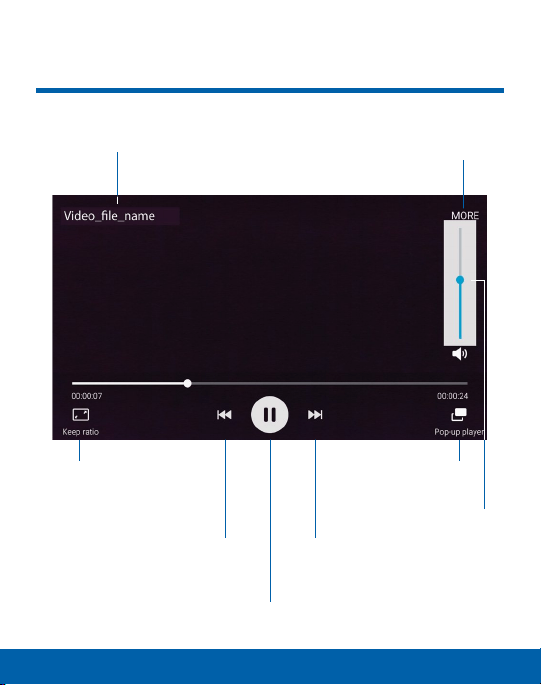
112
Video
Applications
Video
More
Video file name
options
Switch screen
layout
Rewind video or go
toprevious video
Pop-up player
Volume
Scan forward or gotonext
video
Pause/Play
113
Video
Applications
Play and manage videos stored on your
device.
To access video:
1. From a Home screen, tap
Apps > Video.
2. Scroll through the videos stored on your device. After a few
seconds, each video thumbnail begins playing a preview of
the clip.
3. Tap a video to view it.
Use Pop-Up Play
Multi task with Pop-Up Play bytransforming your video player into
a pop-up window. The video will continue to play, and the pop-up
window can be resized or moved anywhere on the screen.
1. From a Home screen, tap
Apps > Video.
2. Tap a video to view it.
3. Tap
to continue playing the video in a floating window.
•
Drag the window to any location on the screen.
•
Use two fingers to pinch or spread to resize the floating
window.
114
Voice Recorder
Applications
Voice Recorder
Record voice memos and notes.
► From a Home screen, tap Apps > VoiceRecorder.
•
Tap
Record to record an audio file.
•
Tap Stop to stop recording. The file is automatically
saved.
•
Tap
Pause to pause the recording of an audio file.
•
Tap Bookmark to bookmark a position in the recording
for later reference.
•
While recording, tap MORE > Turn on Callrejection to
reject incoming calls during arecording.

115
Voice Recorder
Applications
Manage Recordings
To display a list of recordings:
1. From a Home screen, tap
Apps > VoiceRecorder.
2. Tap Recordings.
3. Tap a recording to play it back.
4. Tap MORE for additional options:
•
Edit: Tap to select recordings. Once selected, the following
options are available:
-
DELETE: Delete the recording.
-
MORE: Tap to either Rename the file or Write to Voice
Label (which writes the recording to an NFC voice
label).
•
Share: Tap to select and share recording files.
•
Search: Tap to search for a recording.

Settings
Configure your device’s connections
and settings, add accounts, and
customize the home screen, apps,
and features.

117
Settings
•
Some options use an ON/OFF button to turn the option on
or off .
(
ON
) ( )
•
For some options, you must tap a field, such as Emailaddress,
to display and set options.
•
Some options are enabled or disabled by tapping a
checkbox. When enabled, a check mark displays. Tap the check
mark to remove it and disable the option.

118
How to Use Settings
Settings
How to Use Settings
Access Settings
► From a Home screen, tap Apps > Settings.
– or –
From a Home screen, drag down from the StatusBar to
display the Notification Panel, and then tap
Settings.
Search for Settings
If you are not sure exactly where to find a certain setting, you can
use the Search feature.
1. From a Home screen, tap
Apps > Settings.
2. Tap SEARCH.
•
Enter a word or words in the Search box. As you type,
settings that match will appear on the screen.
•
Tap an entry to go to that setting.

119
How to Use Settings
Settings
Customize the Quick Settings Menu
Quick settings are the settings that you are most likely to
frequently use. When you first access the Settings menu, the Quick
settings are set to a default list of settings.
To find the Quick settings menu:
► From a Home screen, tap
Apps > Settings.
Change the Quick Settings
You can change the Quick settings list to include your most
frequently used settings.
1. From a Home screen, tap
Apps > Settings.
2. Tap EDIT.
•
Select additional settings to appear in your Quicksettings
menu. Settings that are already in the Quick settings menu
are checked. Up to nine settings can be selected.
•
Uncheck a setting to remove it from the Quick settings list.
3. Tap
Back arrow to save your new Quick settings menu.

120
Wi-Fi and Wi-Fi Direct
Settings
Wi-Fi and Wi-Fi Direct
Wi-Fi is a term used for certain types of
Wireless Local Area Networks (WLAN). Wi-Fi
communication requires access to a Wireless
Access Point (WAP).
Wi-Fi Direct creates a direct connection
between two or more devices using Wi-Fi.
Turn Wi-Fi On or Off
Turning Wi-Fi on makes your device able to discover and connect
to compatible in-range WAPs.
1. From a Home screen, tap
Apps > Settings.
2. Tap Wi-Fi, and then tap ON/OFF to turn Wi-Fi on or off.

121
Wi-Fi and Wi-Fi Direct
Settings
Scan and Connect to a Wi-Fi Network
1. From a Home screen, tap Apps > Settings.
2. Tap Wi-Fi, and then tap ON/OFF to turn Wi-Fi on. When Wi-Fi
is turned on, your device will automatically scan for available
networks and display them.
3. Tap the network you want to connect to. When you select
an open network, you are automatically connected to the
network. Otherwise, enter a password to connect.
Manually Connect to a Wi-FiNetwork
1. From a Home screen, tap Apps > Settings.
2. Tap Wi-Fi, and then tap ON/OFF to turn Wi-Fi on.
3. Tap MORE > Addnetwork.
4. Enter information about the Wi-Fi network:
•
Tap Enter network name to enter the name of the Wi-Fi
network.
•
Tap the Security field and select a security option and
enter your password.
•
Tap Show advanced options if you need to add advanced
options such as IPsettings and Proxy settings.
5. Tap CONNECT to store the new information and connect to
your target WAP.

122
Wi-Fi and Wi-Fi Direct
Settings
Wi-Fi Settings
The Wi-Fi settings menu allows you to set up many of your device’s
advanced Wi-Fi services.
1. From a Home screen, tap Apps > Settings.
2. Tap Wi-Fi, and then tap ON/OFF to turn Wi-Fi on.
3. Tap MORE for options:
•
Add network: Manually add a Wi-Fi network.
•
WPS push button: Set up a connection to a WPS (Wi-Fi
Protected Setup) router or other equipment.
•
WPS PIN entry: View the PIN used by your device to set
up a PIN-secured connection to a Wi-Fi router or other
equipment (not configurable).
•
Smart network switch: Automatically switch between
mobile data and Wi-Fi to maintain a stable Internet
connection.
•
Keep Wi-Fi on during sleep: Specify when to disconnect
from Wi-Fi.
•
Always allow scanning: Allow Google location service and
other apps to scan for networks, even when Wi-Fi is turned
off.
•
Install network certificates: Install authentication
certificates.

123
Wi-Fi and Wi-Fi Direct
Settings
Wi-Fi Status Indicators
These Status Bar icons show your current Wi-Fi connection status:
Displays when Wi-Fi is connected, active, and
communicating with a Wireless Access Point (WAP).
A Wi-Fi access point is available, but your device is
not connected to it. It may also display if there is a
communication issue with the target Wireless Access
Point (WAP).

124
Wi-Fi and Wi-Fi Direct
Settings
Wi-Fi Direct
Wi-Fi Direct allows direct device-to-device connections via Wi-Fi,
without having to connect to a Wi-Fi network.
1. From a Home screen, tap
Apps > Settings.
2. Tap Wi-Fi, and then tap ON/OFF to turn Wi-Fi on. Wi-Fi must
be on to configure settings.
3. Tap Wi-Fi Direct. Your device automatically scans for nearby
Wi-Fi Direct devices.
4. After scanning for devices, select a device, and then follow the
prompts to complete the connection.
Wi-Fi Direct Status Indicator
Displays when connected to another device using Wi-Fi
Direct.

125
Bluetooth
Settings
Bluetooth
Bluetooth is a short-range communications
technology that allows you to connect
wirelessly to a number of Bluetooth devices,
such as headsets and hands-free car
Bluetooth systems, and Bluetooth-enabled
computers, printers, and wireless devices.
Note: The Bluetooth communication range is approximately 30 feet.
Turn Bluetooth On and Off
1. From a Home screen, tap Apps > Settings.
2. Tap Bluetooth, and then tap ON/OFF to turn Bluetooth on or
off.

126
Bluetooth
Settings
Scan for Bluetooth Devices
When you want to pair with another Bluetooth device, you can scan
for nearby devices that are visible.
1. From a Home screen, tap
Apps > Settings.
2. Tap Bluetooth, and then tap ON/OFF to turn on Bluetooth.
3. When Bluetooth is first turned on, it scans for nearby
Bluetooth devices and displays them.
•
To manually perform a new scan, tap SCAN.

127
Bluetooth
Settings
Pair Bluetooth Devices
The Bluetooth pairing process allows you to establish trusted
connections between your device and another Bluetooth device.
Pairing between two Bluetooth devices is a one-time process.
Once a pairing is created, the devices will continue to recognize
their partnership and exchange information without having to re-
enter a passcode.
1. From a Home screen, tap
Apps > Settings.
2. Tap Bluetooth, and then tap ON/OFF to turn on Bluetooth.
3. Make sure that the target device is discoverable, so that your
device can find it. Refer to the instructions that came with the
device to find out how to set it to discoverable mode.
4. Tap SCAN. Your device will start to scan for Bluetooth devices
within range.
5. When you see the name of the target device displayed in the
Bluetooth devices section, tap the name. Your device then
automatically tries to pair with the target device. If automatic
pairing fails, enter the passcode supplied with the target
device.
Note: Due to different specifications and features of other Bluetooth-
compatible devices, display and operations may be different, and
functions such as transfer or exchange may not be possible with all
Bluetooth compatible devices.

128
Bluetooth
Settings
Delete a Paired Device (Unpairing)
When you unpair from a Bluetooth device, the two devices will no
longer recognize each other. To connect again, you’d need to pair
the devices.
1. Verify your Bluetooth is active.
2. From the Bluetooth settings page, tap next to the previously
paired device, and then tap Unpair to delete the paired
device.
Bluetooth Status Indicators
When Bluetooth is turnedon, displays in the StatusBar.

129
Airplane Mode
Settings
Airplane Mode
Airplane mode disconnects your device
from all networks and turns off connectivity
features, such as phone calls and Wi-Fi.
While in airplane mode, you can use other
features, such as playing music, watching
videos, and other onlineapplications.
1. From a Home screen, tap Apps > Settings.
2. Tap Airplane mode, and tap ON/OFF to enable or disable
theoption.
Note: You can also control Airplane mode from the Device options
menu. Press and hold the Power/Lock key, and then tap Airplane
mode.

130
Data Usage
Settings
Data Usage
Monitor your mobile data usage.
Note: Your service provider may account for data usage differently.
1. From a Home screen, tap
Apps > Settings >
Data usage for options:
•
Mobile data: Enable mobile data. You can also control
Mobile Data at the Notification panel.
•
Set mobile data limit: Disable your mobile data
connection when the specified limit is reached. Drag the
red limit line to set the data usage limit.
•
Data usage cycle: Tap the menu, and then choose a time
period for data usage. Data usage for the period displays
on the graph, along with usage by application below.
•
By application: View data usage by application.
2.
Tap MORE:
•
Restrict background data: Restrict some apps and
services from working unless you are connected to a Wi-Fi
network.
•
Show Wi-Fi usage: Display a Wi-Fi tab that shows Wi-Fi
usage.

131
Mobile Networks
Settings
Mobile Networks
Control your device’s access to networks and
mobile data service.
► From a Home screen, tap Apps > Settings >
Mobilenetworks for options:
•
Data roaming: Allow your device to connect to data
services when roaming.
•
Network mode: Choose a preferred network mode.
•
System select: Change the network roaming mode.

132
NFC and Payment
Settings
NFC and Payment
NFC (Near Field Communication) allows data
exchange when you touch your device with
another compatible device. This is used for
features like Android Beam.
To activate NFC:
1. From a Home screen, tap
Apps > Settings > NFC and
payment.
2. Tap NFC.
3. Tap ON/OFF to turn NFC on.

133
NFC and Payment
Settings
Android Beam
When Android Beam is activated, you can beam app content to
another NFC-capable device by holding the devices close together.
You can beam browser pages, YouTube videos, contacts, and
more.
1. From a Home screen, tap
Apps > Settings > NFC and
payment.
2. Tap NFC.
3. Tap ON/OFF to turn NFC on. Turning NFC on automatically
turns Android Beam on.
4. Tap Android Beam.
5. Tap ON/OFF to turn Android Beam on.
6. Touch the back of your device with another NFC-capable
device and the content is transferred.

134
NFC and Payment
Settings
Tap and Pay
Tap and pay allows you to select the default payment application
you want to use for making purchases on your phone.
1. From a Home screen, tap
Apps > Settings > NFC and
payment.
2. Tap NFC.
3. Tap ON/OFF to turn NFC on.
4. Tap
Back to return to the NFC and payment screen.
5. Tap Tap and pay.
6. Select the app that you want as your default.

135
More Connection Settings
Settings
More Connection Settings
The More connection settings allow you to
configure a variety of communication settings
for yourdevice.
Printing
Print images and documents to Samsung printers and other
compatible printers (notincluded).
1. From a Home screen, tap
Apps > Settings > More
connection settings > Printing.
2. Tap a print service and follow the prompts.
Note: Tap Download plug-in to install additional print service
drivers.

136
More Connection Settings
Settings
Virtual Private Networks (VPN)
Set up and manage your VirtualPrivate Networks (VPNs).
Note: You must set a screen lock PIN or password
before setting up a VPN. For more information, see
“Lock Screen and Security” on page 161.
Adding a VPN
1. From a Home screen, tap Apps > Settings > More
connection settings > VPN.
2. Tap ADD VPN, and follow the prompts to set up yourVPN.
Connect to a VPN
1. From a Home screen, tap Apps > Settings > More
connection settings > VPN.
2. Tap the VPN, enter your log in information, and tap CONNECT.
Edit or Delete a VPN
1. From a Home screen, tap Apps > Settings > More
connection settings > VPN.
2. Touch and hold the VPN that you want to edit or delete.
3. Tap either Edit network or Delete network.

137
More Connection Settings
Settings
Default Messaging App
If you have multiple messaging apps installed, you can select
which app should be your default messaging app.
► From a Home screen, tap
Apps > Settings > More
connection settings > Defaultmessagingapp to select a
default.

138
Sound and Notification
Settings
Sound and Notification
Configure the sounds and vibrations used to
indicate notifications, screen touches, and
other activities.
Change the Sound Mode
You can switch between sound modes, while preserving the
individual sound settings you have made.
1. From a Home screen, tap
Apps > Settings.
2. Tap Sound and notification > Sound mode, and then choose
a mode:
•
Sound: Your device uses the sounds, vibrations, and
volume levels you have chosen in Sound settings for
notifications and alerts.
•
Vibrate: Your device vibrates for notifications and alerts.
This uses the Vibration intensity you choose in Sound
settings.
•
Mute: Your device mutes all sounds and notifications.

139
Sound and Notification
Settings
Adjust the Volume
Set the system volume level, and set default volume for call
ringtones, notifications, and other audio.
Tip: You can also set System volume from the home screen by
pressing the Volume key.
1. From a Home screen, tap
Apps > Settings.
2. Tap Sound and notification > Volume, and then drag the
sliders to set the default volume for:
•
Ringtone
•
Media
•
Notifications
•
System

140
Sound and Notification
Settings
Select a Default Ringtone
Choose from preset ringtones or add your own.
1. From a Home screen, tap
Apps > Settings.
2. Tap Sound and notification > Ringtonesandsounds >
Ringtone
.
3. Tap a ringtone to hear a preview and select it.
– or –
Tap Add ringtone to use an audio file as a ringtone.
Change the Notification Sound
Choose a sound for notifications, such as for new messages and
event reminders.
1. From a Home screen, tap
Apps > Settings.
2. Tap Sound and notification > Ringtones and sounds >
Default notificationsound.
3. Tap a sound to preview it, and select it.

141
Sound and Notification
Settings
Set Notification Sounds for Samsung
Applications
Choose notification alerts for new messages, calendar events, and
email.
1. From a Home screen, tap
Apps > Settings.
2. Tap Sound and notification > Ringtones and sounds, and
tap to configure each option:
•
Messages: Configure message notifications and alerts.
•
Calendar: Configure event notifications.
•
Email: Configure email account notifications.

142
Sound and Notification
Settings
System Sounds
Set various system sound options.
1. From a Home screen, tap
Apps > Settings.
2. Tap Sound and notification > Ringtones and sounds, and
tap to enable each option:
•
Touch sounds: Play tones when you touch or tap the
screen to make selections.
•
Dialing keypad tone: Play tone when the dialing keypad is
tapped.
•
Screen lock sounds: Play a sound when you unlock the
screen.
•
Emergency tone: When an emergency alert is received,
either play a sound or vibrate. This option can also be set
to Silent
•
Keyboard sound: Play a sound when the Samsung
keyboard is tapped.

143
Sound and Notification
Settings
Vibrations
Set the amount of vibration for incoming calls, notifications, and
haptic feedback.
1. From a Home screen, tap
Apps > Settings.
2. Tap Sound and notification > Vibrations.
•
Tap Vibration pattern to choose a pattern.
•
Tap Vibrate while ringing to enable vibrations when the
phone is ringing.
Sound Quality and Effects
Choose from advanced sound options to customize your audio
experience.
Adapt Sound
Find the best sound setting for your preferences
1. From a Home screen, tap
Apps > Settings.
2. Tap Sound and notification > Sound quality and effects.
3. Tap Adapt Sound and follow the prompts to customize your
sound settings.

144
Sound and Notification
Settings
Other Advanced Options
1. From a Home screen, tap Apps > Settings.
2. Tap Sound and notification > Sound quality and effects.
3. Tap ON/OFF to enable each option:
•
SoundAlive+: Recreate the effects of rich surround sound.
•
Tube Amp: Simulate the soft timbre of a tube amplifier.
Do Not Disturb
This setting allows you to block all notifications and alerts. The
options below determine what notifications can make sounds, and
during what time periods you want to enter this mode.
To activate Do Not Disturb mode:
1. From a Home screen, tap
Apps > Settings.
2. Tap Sound and notification > Do not disturb.
3. Tap ON/OFF to enable this option.

145
Sound and Notification
Settings
Allow Exceptions
This option lets you customize what notifications are allowed while
your phone is in Do not disturb mode.
1. From a Home screen, tap
Apps > Settings.
2. Tap Sound and notification > Do not disturb.
3. Tap Allow exceptions, and tap ON/OFF to enable the
exceptions you want to allow.
Set Schedule
This option allows you to turn Do not disturb mode on and off
automatically at scheduled times.
Note: Scheduling is not available if Do not disturb mode has been
turned on manually.
1. From a Home screen, tap
Apps > Settings.
2. Tap Sound and notification > Do not disturb.
3. Tap Set schedule, and set the Days, Start time, and
Endtime.

146
Sound and Notification
Settings
Notifications on Lock Screen
Choose what notifications can display while the device is locked.
1. From a Home screen, tap
Apps > Settings.
2. Tap Sound and notification > Notifications on lock screen,
and choose an option.
App Notifications
1. From a Home screen, tap Apps > Settings.
2. Tap Sound and notification > App notifications, and choose
an app to enable or disable notifications.

147
Display Settings
Settings
Display Settings
Adjust the Screen Brightness
Adjust the screen brightness to suit your surroundings or personal
preference. You may also want to adjust screen brightness to
conserve battery power.
1. From a Home screen, tap
Apps > Settings > Display.
2. Tap Brightness and drag the slider to adjust the brightness
level.
Note: You can also control Brightness from the NotificationPanel.
Drag down the Status Bar at the top of the screen to find the
Brightness slider.

148
Display Settings
Settings
Change the Font Style and Size
You can set the font style and size for all text that displays on the
screen.
1. From a Home screen, tap
Apps > Settings > Display.
2. Tap Font to choose a font and change the font size.
•
Tap the bar under Font size to change the size of main
text. The sample text changes size.
•
Tap a font under Font style to change the font.
•
You can download additional fonts from GalaxyApps by
tapping Download fonts.
3.
Tap DONE to save your changes.
One-handed Operation
Change the screen layout to accommodate operating your device
with one hand.
1. From a Home screen, tap
Apps > Settings > Display.
2. Tap One-handed operation > Reduce screen size, and tap
ON/OFF to enable.

149
Display Settings
Settings
Set the Screen Timeout Delay
Choose how long the display screen remains lit after you tap the
screen or press any key.
1. From a Home screen, tap
Apps > Settings > Display.
2. Tap Screen timeout, and then choose a timeperiod.
Smart Stay
Using the front camera to detect your face, the screen will not time
out as long as you are facing the screen.
1. From a Home screen, tap
Apps > Settings > Display.
2. Tap Smart stay to enable the feature.

150
Display Settings
Settings
Screen Mode
Choose a screen mode to match your type of viewing. You
can choose to have the device automatically adapt the display
depending on the type of image being displayed, and other criteria
such as battery level.
1. From a Home screen, tap
Apps > Settings > Display.
2. Tap Screen mode, and then choose a screen mode.
•
To have your device automatically optimize the display to
match the type of image being displayed and other criteria,
such as battery level, tap Adaptive display.
- or -
Choose a specific type of screen mode based on what you
are viewing.

151
Display Settings
Settings
Daydream (Screen Saver)
The Daydream setting controls what the screen displays when the
device is docked (dock not included), or while charging. You can
choose to display colors, or display photos stored on your device.
1. From a Home screen, tap
Apps > Settings > Display.
2. Tap Daydream. Tap ON/OFF to turn Daydream on. Configure
options:
•
Colors: Tap the selector to display a changing screen of
colors.
•
Google Photos: Display pictures from your Google Photos
account. Tap Settings for options.
•
Photo Frame: Display pictures in a photo frame. Tap
Settings for options.
•
Photo Table: Display pictures in a photo table. Tap
Settings for options.
3. Tap PREVIEW to see a demonstration of the Daydream feature
selected.

152
Motions and Gestures
Settings
Motions and Gestures
Control certain device actions by touching
the screen with the palm of your hand.
1. From a Home screen, tap Apps > Settings.
2. Tap Motions and gestures.
3. Tap ON/OFF to enable each of the following:
•
Smart alert: Set the device to vibrate when you pick it up
to notify you about missed calls and messages.
•
Mute: Mute sounds and video by covering the screen or
turning over the device.
•
Palm swipe to capture: Capture an image of the screen
when you sweep your hand left or right across the screen.

153
Applications
Settings
Applications
Manage settings for applications on your
phone.
Application Manager
You can download and install new applications on your device.
Use Application manager settings to manage your downloaded and
preloaded applications.
Warning: Because this device can be configured with system
software not provided by or supported by Google or any other
company, end-users operate these devices at their own risk.
Memory Usage
See how memory is being used by Downloaded or Running
applications.
1. From a Home screen, tap
Apps> Settings >
Applications > Applicationmanager.
2. Swipe across the screen to display DOWNLOADED, SD CARD,
RUNNING, or ALL to display memory usage for that category
of applications.
The graph on the DOWNLOADED tab shows used and free
device memory. The graph on the RUNNING tab shows used
and free RAM.

154
Applications
Settings
Downloaded
Displays apps you have downloaded onto your device.
1. From a Home screen, tap
Apps> Settings >
Applications > Applicationmanager.
2. Tap DOWNLOADED to view a list of all the downloaded
applications on your device.
•
To switch the order of the DOWNLOADED list, tap MORE >
Sort by size or Sortbyname.
•
To reset all of your application preferences, tap MORE >
Reset app preferences.
•
Tap an application to view and update information about
the application, including memory usage, default settings,
and permissions. The following options are displayed:
-
FORCE STOP: Stop an app that is misbehaving. Restart
your device if stopping an app, process, or service
causes your device to stop working correctly.
-
UNINSTALL UPDATES: Delete the application from the
device or uninstall updates made to apps that cannot
be deleted.
-
DISABLE: Disable apps that cannot be deleted.
-
MOVE TO SD CARD: Move the app to an SD card.

155
Applications
Settings
-
CLEAR DATA: Clear application data from memory.
-
CLEAR CACHE: Clear an application’s temporary
memory storage.
-
CLEAR DEFAULTS: Clear an application’s
customization.
-
Permissions: View information about the application’s
access to your device and data.

156
Applications
Settings
SD Card
Displays apps you have downloaded onto your memory card (not
included).
1. From a Home screen, tap
Apps> Settings >
Applications > Applicationmanager.
2. Tap SD CARD to view a list of all the downloaded applications
on your SD card.
•
To switch the order of the SD CARD list, tap MORE > Sort
by size or Sortbyname.
•
To reset your application preferences, tap MORE> Reset
app preferences.
Note: When you reset app preferences, you will not lose any app
data.
3. Tap an application to view and update information about the
application, including memory usage, default settings, and
permissions.

157
Applications
Settings
Running Services
View and control services running on your device.
1. From a Home screen, tap
Apps> Settings >
Applications > Applicationmanager.
2. Tap RUNNING to view a list of running services.
All the applications that are currently running on the device
display.
3. Tap MORE > Show cached processes to display all the
cached processes that are running. Tap MORE> Show
services in use to switch back.
4. Tap one of the applications to view application information.
•
STOP: Stops the application from running on the device.
This is usually done prior to uninstalling the application.
(Not all services can be stopped. Stopping services may
have undesirable consequences on the application or
Android System.)
•
REPORT: Report failure and other application information.
Note: Options vary by application.

158
Applications
Settings
Default Applications
If you have multiple applications of the same type, such as email
apps, you can select one app to be the default.
You can also use a simpler Home screen which provides an easier
user experience for first-time smartphone users.
1. From a Home screen, tap
Apps> Settings >
Applications > DefaultApplications.
2. Tap Home and select a Home screen mode:
•
TouchWiz easy home: Provides an easier user experience
for the first-time smartphone users.
•
TouchWiz home: The Home screen that originally displays
on your phone.
3. Tap Messages and select a default messagingapp.
4. To clear defaults you have set up, tap CLEAR.

159
Applications
Settings
Application Settings
Shortcuts to the settings for various apps are available in one
convenient location.
To quickly access the settings:
1. From a Home screen, tap
Apps> Settings >
Applications.
2. Tap one of the following to display the settings for the selected
app:
•
Calendar
•
Camera
•
Contacts
•
Email
•
Internet
•
Messages
•
Music
•
Phone
•
Weather

160
Wallpaper Settings
Settings
Wallpaper Settings
Change the look of the home and lock
screens with wallpaper.
You can display a favorite picture or choose
from preloaded wallpapers.
1. From a Home screen, tap Apps > Settings > Wallpaper.
2. Tap Home screen, Lock screen, or Home and lock screens.
3. Tap a image to preview it, and then tap SETASWALLPAPER.

161
Lock Screen and Security
Settings
Lock Screen and Security
Choose a method for unlocking your screen.
Screen locks have different levels of security
and options.

162
Lock Screen and Security
Settings
Set a Screen Lock
1. From a Home screen, tap Apps > Settings.
2. Tap Lock screen and security.
3. Tap Screen lock type to select a screen lock and level of
security:
•
Swipe: Swipe the screen to unlock it. This option provides
no security.
•
Pattern: A screen unlock pattern is a tap gesture you
create and use to unlock your device. This option provides
medium security.
•
PIN: Select a PIN to use for unlocking the screen. This
option provides medium to high security.
•
Password: Create a password for unlocking the screen.
This option provides high security.
•
None: Never use a Lock screen.
4. If choosing a secured lock screen option, select your
notification settings:
•
Show content
•
Hide content
•
Do not show notifications

163
Lock Screen and Security
Settings
Screen Lock Options
Note: Options vary based on the screen lock type.
•
Show information: Show the dual clock, or information
such as the weather information, on the lock screen.
•
Unlock effect: Set the visual effect used when unlocking
the screen. (This option is available with Swipe only.)
•
Secure lock settings: Set the following secure lock
functions:
-
Make pattern visible: Show the pattern as you draw it.
(Available only with a Pattern lock screen.)
-
Lock automatically: Set the time after the screen is
turned off to enable the screenlock.
-
Lock instantly with power key: Tap the ON/OFF
switch to enable or disable locking the screen
immediately when pressing the Power key.
-
Smart Lock: Set your phone to stay unlocked when
you have trusted devices connected or when it’s in a
trusted place.

164
Lock Screen and Security
Settings
Reactivation Lock
Stop anyone from reactivating your phone without your permission.
1. From a Home screen, tap
Apps > Settings > Lock
screen and security.
2. Tap Reactivation lock to enable this feature.
To turn this feature off, you will have to enter your Samsung
account password.
Unknown Sources
Enable installation of non-Google Play applications.
1. From a Home screen, tap
Apps > Settings.
2. Tap Lock screen and security > Unknownsources to enable
this option.
Warning: Enabling installation of third-party applications can cause
your device and personal data to be more vulnerable to attacks by
unknown sources.

165
Lock Screen and Security
Settings
Other Security Settings
You can configure other security settings, including encryption and
certificates.
Encrypt Your Data
Require a numeric PIN or password to decrypt your device each
time you power it on.
1. From a Home screen, tap
Apps > Settings.
2. Tap Lock screen and security > Other security settings >
Encrypt phone for options:
•
Tap Encrypt phone and follow the prompts to encrypt all
data on your device.
•
Tap Encrypt external SD card to encrypt data on a
memory card (not included).

166
Lock Screen and Security
Settings
Factory Data Reset Password
Setup or change your factory data reset password.
1. From a Home screen, tap
Apps > Settings.
2. Tap Lock screen and security > Other security settings >
Set up/change password, and enter a new password.
View Passwords
Display password characters briefly as you type them.
1. From a Home screen, tap
Apps > Settings.
2. Tap Lock screen and security > Other security settings >
Make passwords visible to turn the feature on.

167
Lock Screen and Security
Settings
Security Update Service
Automatically receive security updates.
1. From a Home screen, tap
Apps > Settings.
2. Tap Lock screen and security > Other security settings >
for the following Security update service options:
•
Security policy updates: Automatically or manually check
for security policy updates.
•
Send security reports: Send security reports to Samsung
via Wi-Fi for threat analysis.
Phone Administration
Manage your phone administrators and application installation
privileges.
1. From a Home screen, tap
Apps > Settings.
2. Tap Lock screen and security > Other security settings >
Phone administrators.
3. Tap Android Device Manager to allow it to lock or erase a
lost device.

168
Lock Screen and Security
Settings
Credential Storage
Manage your security certificates. If a certificate authority (CA)
certificate gets compromised or for some other reason you do not
trust it, you can disable or remove it.
1. From a Home screen, tap
Apps > Settings.
2. Tap Lock screen and security > Other security settings for
the following Credential storage options:
•
Storage type: Select a storage location for credential
contents.
•
View security certificates: Display CA certificates in your
device’s ROM and other certificates you have installed.
•
Install from phone storage: Install a new certificate from
storage.
•
Clear credentials: Erase the credential contents from the
device and reset the password.

169
Lock Screen and Security
Settings
Advanced Security Settings
Use these options to configure advanced security settings.
1. From a Home screen, tap
Apps > Settings.
2. Tap Lock screen and security > Other security settings for
the following Advanced options:
•
Trust agents: Perform selected actions when trusted
devices are connected.
•
Pin windows: Pin an app on your device screen,
preventing access to other features of you phone.
•
Usage data access: View the applications that can access
your device’s usage history.
•
Notification access: View the applications that can access
notifications you receive on your phone.
Note: To view Trust agents, set up a screen lock (pin,
password, or pattern). For more information, see
“Set a Screen Lock” on page 162.

170
Privacy
Settings
Privacy
Choose from various modes designed to hide
personal content from being accessed by
anyone else using your device, or to aid you
in an emergency.
Note: A secure screen lock (Pattern, PIN, Fingerprint, or Password) is
required to use Private Mode.
Location
Some apps, such as Google maps, may require one or more
location services be turned on for full functionality.

171
Privacy
Settings
Locating Method
1. From a Home screen, tap Apps > Settings > Privacy >
Location.
2. Tap ON/OFF to turn on Location services.
3. Tap Locating method to select how your location is
determined:
•
High accuracy: Use GPS, Wi-Fi, and mobile networks.
•
Power saving: Use Wi-Fi and mobile networks (no GPS).
•
GPS only: Use GPS only.
Recent Location Requests
Apps that have requested your location are listed under Recent
location requests.
1. From a Home screen, tap
Apps > Settings > Privacy >
Location.
2. Tap ON/OFF to turn on Location services.
3. Tap an entry under Recent location requests to view the
app’s settings.

172
Privacy
Settings
Location Reporting
Google uses Location Reporting to store and use your device’s
most recent location data. Google apps, such as Google Maps,
can use this data to improve your search results based on places
that you have visited.
1. From a Home screen, tap
Apps > Settings > Privacy >
Location.
2. Tap ON/OFF to turn on Location services.
3. Tap Google Location History for options:
•
Tap ON/OFF to allow Google to store a history of your
location data.
•
Tap DELETE LOCATION HISTORY to permanently delete
your location history.
Report Diagnostic Info
This feature sends diagnostic information about your phone when
you are having technical problems.
1. From a Home screen, tap
Apps > Settings.
2. Tap Privacy, and then tap the ON/OFF switch for Report
diagnostic info to either enable or disable this feature.

173
Easy Mode
Settings
Easy Mode
Switch between the default screen layout
and a simpler layout. The Easy Mode layout
has larger text and icons, making for a more
straightforward visual experience.
To enable Easy Mode:
1. From a Home screen, tap
Apps > Settings >
Easymode
.
2. Tap Easy mode to enable this feature. When Easymode is
enabled, you can scroll down the page and select which apps
you want to appear on the Home screens.
3. Tap ON/OFF next to the apps you want to add or remove.
4. When finished, tap DONE.
To return to Standard Mode:
1. From a Home screen, tap
Settings > Easymode.
2. Tap Standard mode.
3. Tap DONE.

174
Accessibility
Settings
Accessibility
Accessibility services are special features that
make using the device easier for those with
certain physical disabilities.
Note: You can download additional accessibility applications from the
Google Play store.
1. From a Home screen, tap
Apps > Settings.
2. Tap Accessibility for options:
Vision
•
Voice Assistant: Speak feedback aloud to help blind and
low-vision users.
-
Voice Assistant can collect all of the text you enter,
except passwords, including personal data and credit
card numbers. It may also log your user interface
interactions with the device.
•
Voice Assistant help: Tap for help on using Voice
Assistant.
•
Dark screen: Keep the screen turned off at all times for
privacy.

175
Accessibility
Settings
•
Rapid key input: Release your finger to enter selection
instead of double tapping.
•
Speak passwords: Read the characters aloud as you
enter your passwords.
•
Voice Label: Write voice recordings to NFC tags to provide
information about nearbyobjects.
•
Font size: Set the font size.
•
Magnification gestures: Use exaggerated gestures such
as triple-tapping, double pinching, and dragging two
fingers across the screen.
•
Grayscale: Change all colors to gray.
•
Negative colors: Reverse the display of onscreen colors
from White text on a Black background to Black text on a
White background.
•
Color adjustment: Adjust the color of the screen if you are
color blind or have difficulty reading the display because of
the screen color. Tap Color adjustment for options.
•
Accessibility shortcut: Quickly enable accessibility
features in two quick steps. Tap ON/OFF to turn the
feature on.
•
Text-to-speech options: Set your preferred TTS
engine and options. For more information, see
“Text-To-Speech Options” on page 187.

176
Accessibility
Settings
Hearing
•
Flash notification: Set your camera light to blink whenever
you receive a notification.
•
Turn off all sounds: For privacy, turn off all notifications
and audio.
•
Hearing aids: Improve the sound quality for use with
hearing aids.
•
Samsung subtitles (CC): Use Samsung subtitles with
multimedia files when available Tap Samsung subtitles (CC)
for options.
•
Google subtitles (CC): Use Google subtitles with
multimedia files when available. Tap Google subtitles (CC)
for options.
•
Left and right sound balance: Use the slider to set the
Left and Right balance when using a stereo device.
•
Mono audio: Switch audio from stereo to mono for use
with one earphone.

177
Accessibility
Settings
Dexterity and Interaction
•
Assistant menu: Improve the device accessibility for users
with reduced dexterity.
•
Touch and hold delay: Select a time interval for this tap
gesture.
•
Interaction control: Block areas of the screen from
touch interaction. Disable Auto rotate screen and hard
key functions. Only show application notifications in the
Notification Panel and the StatusBar.

178
Accessibility
Settings
More Settings
•
Direct access: Open your accessibility settings by
pressing the Home Key three times in quick succession.
•
Notification reminder: Beep at set intervals to remind you
of any unread notifications.
•
Answering and ending calls: Select shortcuts for
answering and ending calls.
•
Single tap mode: Tap to stop/snooze alarms and calendar
events.
•
Manage accessibility: Export your accessibility settings
and share them with another device.
Services
•
Additional accessibility apps may be downloaded from the
Google Play store. Certain accessibility services you install
may be configured here.

179
Accounts
Settings
Accounts
Set up and manage accounts, including your
Google Account, Samsung account, email,
and social networking accounts.
Depending on the account, you can choose
to synchronize your calendar, contacts, and
other types of content.
Add an Account
1. From a Home screen, tap Apps > Settings >
Accounts> Add account.
2. Tap one of the account types.
3. Follow the prompts to enter your credentials and set up the
account.

180
Accounts
Settings
Synchronize Accounts
1. From a Home screen, tap Apps > Settings >
Accounts> [Account type].
2. Tap an account to view the sync settings for that account.
3. Tap individual data items to sync.
4. Tap MORE > Sync now to synchronize the account.
Account Settings
Each account has its own set of settings. In addition, you can
configure common settings for all accounts of the same type.
Note: Account settings and available features vary between account
types and service providers. Contact your service provider for more
information on your account’s settings.
1. From a Home screen, tap
Apps > Settings >
Accounts> [Account type].
2. Tap an account to configure that account’s settings.
Delete an Account
1. From a Home screen, tap Apps > Settings >
Accounts> [Account type].
2. Tap the account, and then tap MORE > Removeaccount.

181
Backup and Reset
Settings
Backup and Reset
Back up your data to Google servers. You can
also reset your device to its factory defaults.
Backup and Restore
Enable backup of your information to Google servers.
1. From a Home screen, tap
Apps > Settings.
2. Tap Backup and reset for options:
•
Samsung account: Configure backup and restore options
using a Samsung account.
-
Back up my data: Enable back up of your phone log,
messages, and more through your Samsung account.
-
Restore: Use your Samsung account to restore your
backup data.
•
Google account: Configure backup and restore options
using a Google Account.
-
Backup account: Select a Google Account to be used
as your backup account.

182
Backup and Reset
Settings
-
Back up my data: Enable back up of application data,
Wi-Fi passwords, and other settings to Google servers.
-
Automatic restore: Enable automatic restoration
of settings from Google servers. When enabled,
backed-up settings are restored when you reinstall an
application.
Factory Data Reset
Return your device to its factory defaults.
Warning: This action permanently erases ALL data from the device,
including Google or other account settings, system and application
data and settings, downloaded applications, as well as your music,
photos, videos, and other files.
1. From a Home screen, tap
Apps > Settings.
2. Tap Backup and reset > Factory data reset.
3. Tap RESET PHONE and follow the prompts to perform the
reset.

183
Language and Input Settings
Settings
Language and Input Settings
Configure your device’s language and input
settings.
Set Your Default Language
1. From a Home screen, tap Apps > Settings.
2. Tap Language and input > Language.
3. Select a language from the list.
Select Your Default Keyboard orInput
Method
1. From a Home screen, tap Apps > Settings.
2. Tap Language and input > Default keyboard.
3. Select a keyboard.
Note: Additional keyboards can be downloaded from the Google Play
store.

184
Language and Input Settings
Settings
Samsung Keyboard Settings
Configure options for using the Samsung keyboard.
1. From a Home screen, tap
Apps > Settings.
2. Tap Language and input.
3. Tap Samsung keyboard for options:
•
Select input languages: Choose which languages are
available on the keyboard. To switch between languages,
slide the space bar sideways.
•
Predictive text: Allow Predictive text to suggest words
matching your text entries, and, optionally, complete
common words automatically. Predictive text can learn
your personal writing style from your contacts, messages,
Gmail, and social networking sites— improving its accuracy
of predicting your text entries.
•
Additional keyboard settings provide assistance with
capitalization, punctuation, and much more.

185
Language and Input Settings
Settings
Google Voice Typing Settings
Speak rather than type your text entries using Google Voice
Typing.
1. From a Home screen, tap
Apps > Settings.
2. Tap Language and input.
3. Tap Google voice typing for options:
•
Choose input languages: Select languages for Google
voice typing.
•
Block offensive words: Hide words many people find
offensive are in results of Google voice searches. Offensive
words are replaced in results with a placeholder (####).
•
Offline speech recognition: Download and install speech
recognition engines, allowing you to use voice input while
not connected to the network.

186
Language and Input Settings
Settings
Voice Input
Use Google voice recognition to perform Google searches using
spoken commands.
To perform a voice search, tap
in the Google search bar or
widget. Or say “Ok Google” to launch a Google search (if the
hotword detection option is enabled).
1. From a Home screen, tap
Apps > Settings.
2. Tap Language and input > Voice input for options.
3. Tap Enhanced Google services for full voice interaction or
Basic Google recognition for simple voice recognition.
4. Tap
Settings next to the selected option to configure its
options.

187
Language and Input Settings
Settings
Text-To-Speech Options
Configure your Text-To-Speech (TTS) options. TTS is used
for various accessibility features, such as TalkBack. For more
information, see “Accessibility” on page 174.
1. From a Home screen, tap
Apps > Settings.
2. Tap Language and input > Text-to-speech options for
options:
•
Choose a text-to-speech engine. Tap Settings next to
the TTS engine for options.
•
Speech rate: Set the speed at which the text is spoken.
•
Default language status: Display the default language in
use.
Mouse/Trackpad Settings
Configure settings for using an optional mouse or trackpad (not
included).
1. From a Home screen, tap
Apps > Settings > Language
and input.
2. Tap Pointer speed to set the speed of the pointer.

188
Battery
Settings
Battery
View how battery power is used for device
activities.
1. From a Home screen, tap Apps > Settings.
2. Tap Battery for options:
•
Tap Power saving mode to configure this feature, which
helps save battery power by reducing the power usage by
many phone features and apps.
-
Tap ON/OFF to turn on Power saving mode.
-
Tap Start power saving to select a remaining
battery percentage at which Power saving mode will
automatically be enabled.

189
Battery
Settings
•
Tap Ultra power saving mode to configure this feature,
which applies a simplified grayscale theme to your Home
screen and limits the number of usable apps.
-
Tap ON/OFF to turn the feature on.
-
To turn off Ultra power saving mode, from the Home
screen, tap MORE > Turn off Ultra power saving
mode.
•
Tap Display battery percentage to show or hide the
battery charge percentage next to the battery icon on the
Status Bar.
•
Tap REFRESH to refresh the battery usagechart.

190
Storage
Settings
Storage
View the device memory and usage, or
mount, unmount, or format an optional
memory card (not included).
Device Memory
View and manage the memory used by the device.
► From a Home screen, tap
Apps > Settings > Storage.
•
The Device memory bar shows how memory is being
utilized.
•
Total space shows how much memory is available on your
phone.
•
Memory usage is divided into Available space, System
memory, Used space, Cached data, and Miscellaneous
files.
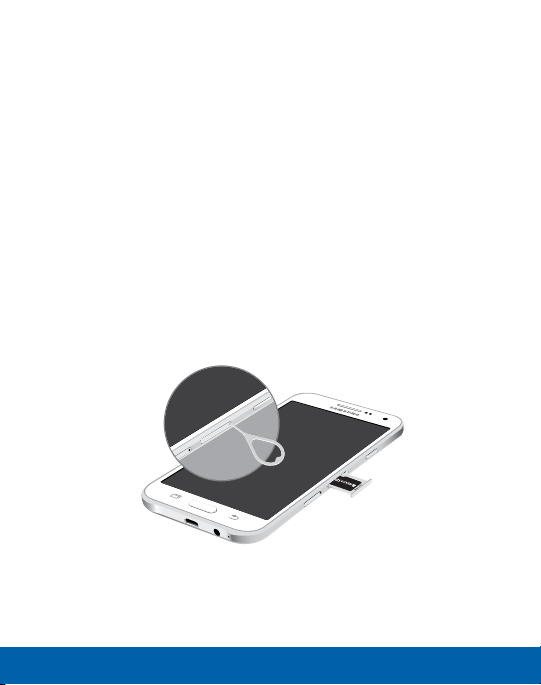
191
Storage
Settings
To increase available memory:
1. Tap Cached data > DELETE to clear all cached data for all
apps.
2. Tap Miscellaneous files, select unnecessaryfiles (or tap
SELECT ALL), andthentap DELETE.
Memory Card (SD Card)
Once an optional memory card (not included) has been installed
in your device, the card memory displays as Total space and
Available space.
Install a Memory Card
You can use an optional microSD card (not included) to add
additional memory space to your device.
Caution: Exercise care when using the metallic removal tool to eject
the memory card slot.

192
Storage
Settings
1. Insert the removal tool into the hole on the microSD card tray,
and push until the tray pops out.
2. Place the micro SD card on the tray, and slide the tray back
into the slot.
Caution: If the memory card is not inserted correctly, the device will
not detect the card. Re-orient the card and place it back into the slot
if it is notdetected.
Mount a Memory Card
When you install an optional memory card, it is automatically
mounted (connected to the device) and prepared for use. However,
should you unmount the card without removing it from the device,
you will need to mount it before it can be accessed.
1. From a Home screen, tap
Apps > Settings > Storage.
2. Tap Mount SD card.
Unmount a Memory Card
To prevent damage to information stored on the memory card,
always unmount the card before removing it from the device.
Unmounting an SD card may stop some applications from
functioning until you mount the SD card again.
1. From a Home screen, tap
Apps > Settings > Storage.
2. Tap Unmount SD card.

193
Storage
Settings
Remove a Memory Card
Warning: To prevent damage to information stored on the memory
card, unmount the card before removing it from the device.
1. From a Home screen, tap
Apps > Settings > Storage.
2. Tap Unmount SD card.
Caution: Exercise care when using the metallic removal tool to eject
the memory card slot.
3. Insert the removal tool into the hole on the microSD card tray,
and push until the tray pops out.
4. Remove the micro SD card from the tray, and slide the tray
back into the slot.
Format a Memory Card
Warning: When formatting an SD card, you should backup your
music and photo files that are stored on the card because formatting
the SD card deletes all the stored data.
1. From a Home screen, tap
Apps > Settings > Storage.
2. Tap Format SD card and follow the prompts.

194
Date and Time Settings
Settings
Date and Time Settings
By default, your device receives date and time
information from the wireless network.
When you are outside network coverage, you
may want to set date and time information
manually using the date and time settings.
► From a Home screen, tap Apps > Settings > Date and
time.
•
Automatic date and time: Tap the check box to use the
time on the mobile and/or Wi-Fi network. If this option is
checked, you cannot manually set the date and time.
•
Automatic time zone: Tap the check box to use the time
zone detected on the mobile and/or Wi-Fi network. If this
option is checked, you cannot manually set the time zone.
•
Set date: Tap to manually set the date. This option is
locked if Automatic date and time is enabled.

195
Date and Time Settings
Settings
•
Set time: Tap to manually set the time. This option is
locked if Automatic date and time is enabled.
•
Select time zone: Tap to manually set the time zone. This
option is locked if Automatic time zone is enabled.
•
Use 24-hour format: Tap to use 24-hour format (as
opposed to 12-hour with AM and PM).
•
Select date format: Tap to choose your preferred date
format.

196
About Your Phone
Settings
About Your Phone
View information about your phone, including
status, legal information, and hardware and
software versions.
1. From a Home screen, tap Apps > Settings.
2. Tap About phone, and then tap items for more details:
•
Status: View the status of the battery, network, and other
information about your device.
•
Legal information: View your device’s open source
licenses and Google legal information.
•
Device name: View and change your device’s name.
•
Additional device information includes the Model number,
Android version, Build number, and more.

197
Software Updates
Settings
Software Updates
Check for software updates for your phone.
1. From a Home screen, tap Apps > Settings.
2. Tap Software update.
•
Tap Check for update to check for available software
updates to download and install.
•
Tap Check software version to see your current software
version.
•
Tap Bootstrap setting to view your phone’s settings for
loading software.