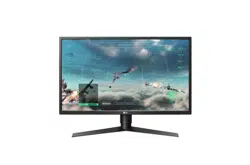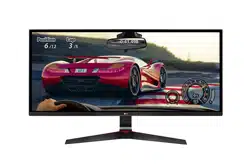
www.lg.com
OWNER'S MANUAL
LED MONITOR*
24GM77
Please read the safety information carefully before using the product.
LED Monitor Model List
*LG LED Monitors are LCD Monitors with LED Backlighting.

2
ENG
ENGLISH
TABLE OF CONTENTS
TABLE OF CONTENTS
3 LICENSE
4 ASSEMBLING AND
PREPARING
4 Product Composition
5 Component and Button Description
6 - How to Use the Joystick Button
7 Moving and Lifting the Monitor
8 Installing the Monitor
8 - Assembling the Stand Base
9 - Detaching the Stand Base
9 - Installing on to a Table
10 - Adjusting the Stand Height
11 - Adjusting the Angle
11 - Tidying Cables
12 - Pivot Feature
13 - Using the Kensington Lock
13 - Detaching the Stand Body
14 - Installing the Wall Mount Plate
14 - Installing on the Wall
16 USING THE MONITOR
16 Connecting to a PC
16 - HDMI Connection
17 - DisplayPort Connection
17 - D-SUB Connection
18 - DVI Connection
18 Connecting AV Devices
18 - HDMI Connection
19 Connecting Peripherals
19 - USB Cable Connection - PC
20 - Headphone Port Connection
21 USER SETTINGS
21 Activating the Main Menu
21 - Main Menu Features
22 User Settings
22 - Menu Settings
23 - Ratio
24 - Function
27 - Picture
29 - Color
30 - Display
31 - Settings
32 - Auto Configuration
33 - Reset
34 TROUBLESHOOTING
36 PRODUCT SPECIFICATION
37 Factory Support Mode
(Preset Mode, DisplayPort/D-SUB/DVI-D/
HDMI PC)
37 HDMI Timing (Video)
37 Power LED
38 PROPER POSTURE
38 Proper Posture for Using the Monitor
WARNING: This product contains chemicals known to the State of California to cause cancer and birth
defects or other reproductive harm.
Wash hands after handling.
3
ENG
ENGLISH
LICENSE
LICENSE
Each model has different licenses. Visit www.lg.com for more information on the license.
VESA, VESA logo, Display Port Compliance Logo and Display Port
Compliance Logo for dual-mode source are all registered trademarks of the
Video Electronics Standards Association.
The terms HDMI and HDMI High-Definition Multimedia Interface, and the
HDMI logo are trademarks or registered trademarks of HDMI Licensing LLC in
the United States and other countries.
4
ENG
ENGLISH
ASSEMBLING AND PREPARING
ASSEMBLING AND PREPARING
The components may look different from those illustrated here.
Without prior notice, all product information and specifications contained in this manual are subject to
change to improve the performance of the product.
To purchase optional accessories, visit an electronics store or an online shopping site, or contact the
retailer from which you purchased the product.
The power cord provided may differ depending upon the region.
NOTE
Product Composition
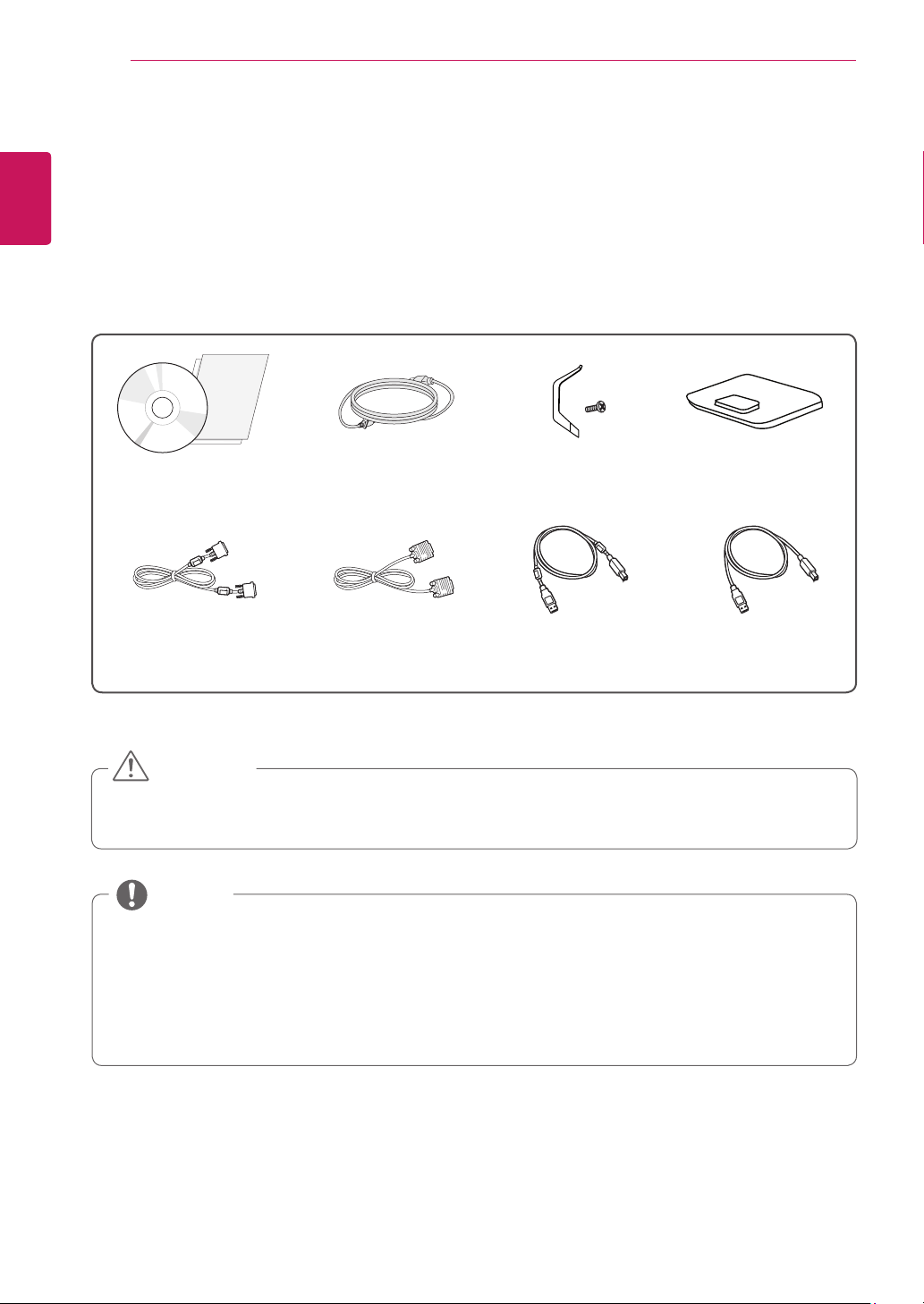
Please check whether all the components are included in the box before using the product. If there are
missing components, contact the retail store where you purchased the product. Note that the product and
components may look different from those shown here.
Always use genuine components to ensure safety and product performance.
The product warranty will not cover damage or injury caused by the use of unauthorized components.
CAUTION
CD (Owner's Manual)
/ Cards
Power Cord
Cable Holder /
Screw
Stand Base
or
DVI-D Dual Cable D-SUB Cable A-B Type USB 3.0 Cable
5
ENG
ENGLISH
ASSEMBLING AND PREPARING
Component and Button Description
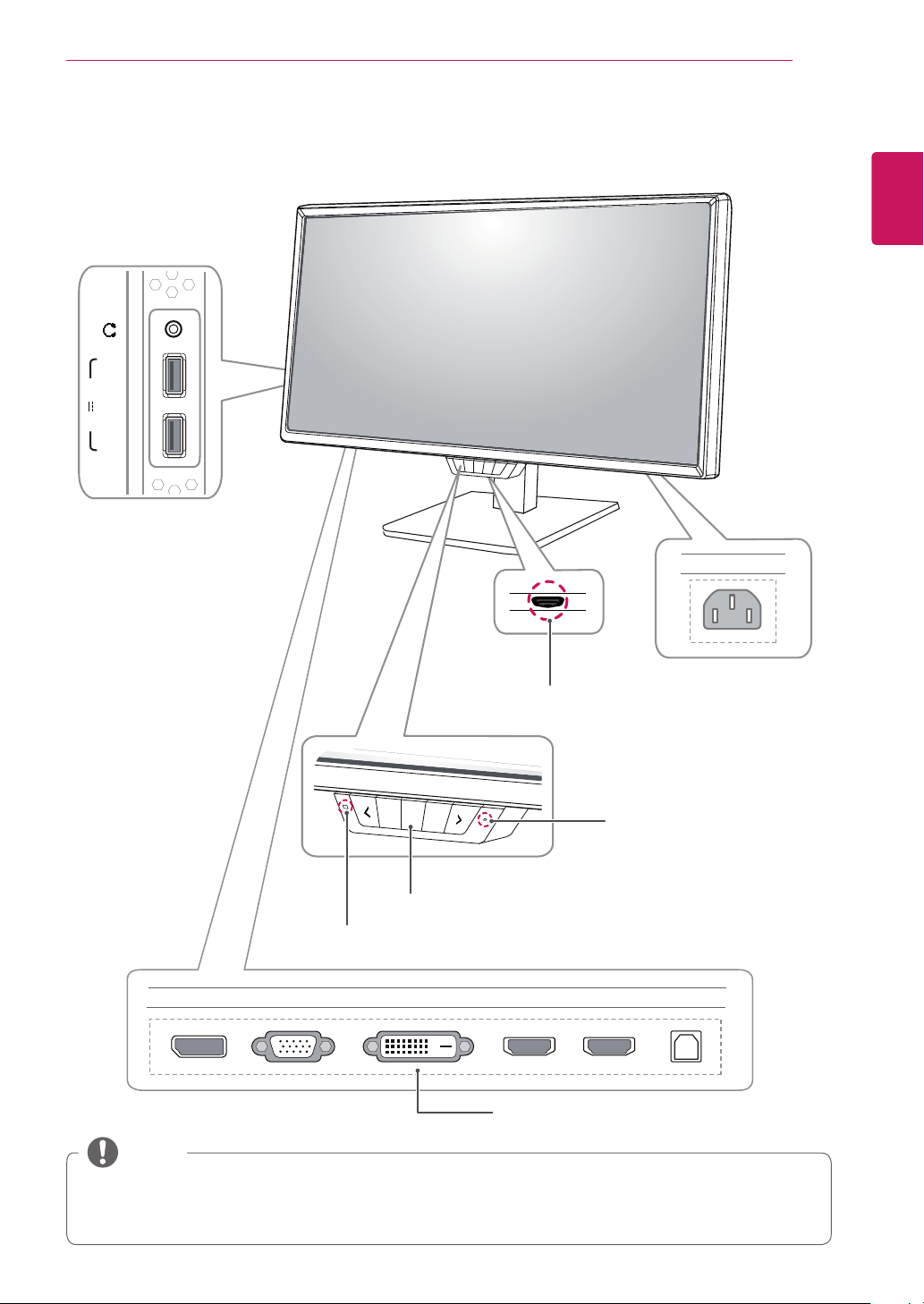
The Brightness Sensor senses the amount of exterior light so that the processor can make necessary
adjustments to the brightness level to compensate.
The joystick button is located at the bottom of the monitor.
NOTE
AC-IN
USB 2
USB 1
BLACK
ST.
GAME
MODE
DAS
MODE
DP IN D-SUB IN DVI-D IN HDMI IN 1USB UPHDMI IN 2
5 V 0.9 A
Joystick Button
Input Connector
Front Side Buttons
Power LED
On Power on
Off Power off
Brightness Sensor
6
ENG
ENGLISH
ASSEMBLING AND PREPARING
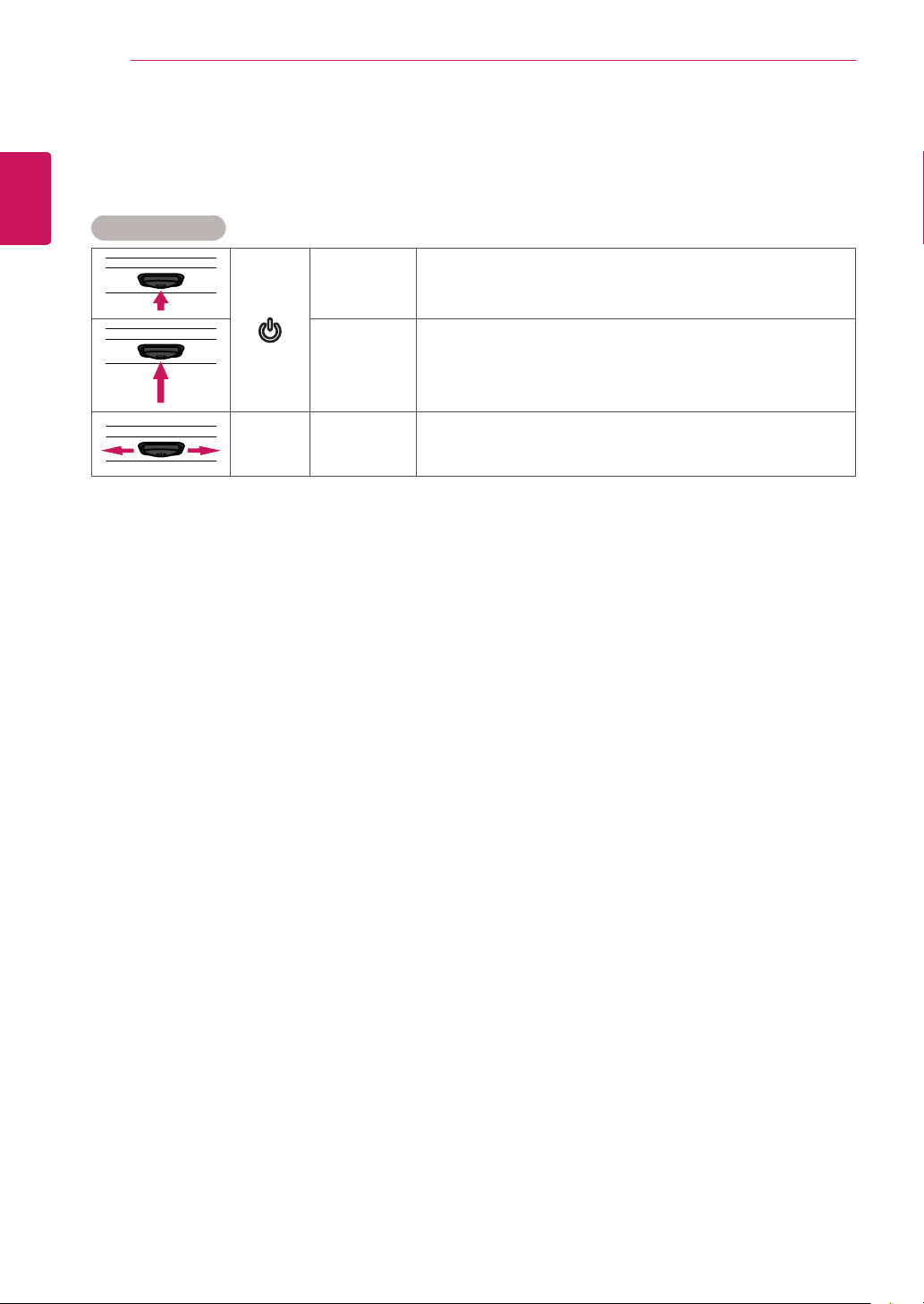
How to Use the Joystick Button
You can easily control the functions of the monitor by pressing the joystick button or moving it left/right with
your finger.
Basic Functions
Power on
Press the joystick button once with your finger to turn on the
monitor.
Power off
Press and hold the joystick button once with your finger to turn off
the monitor.
◀ / ▶
Volume
Control
You can control the volume by moving the joystick button left/right.
7
ENG
ENGLISH
ASSEMBLING AND PREPARING
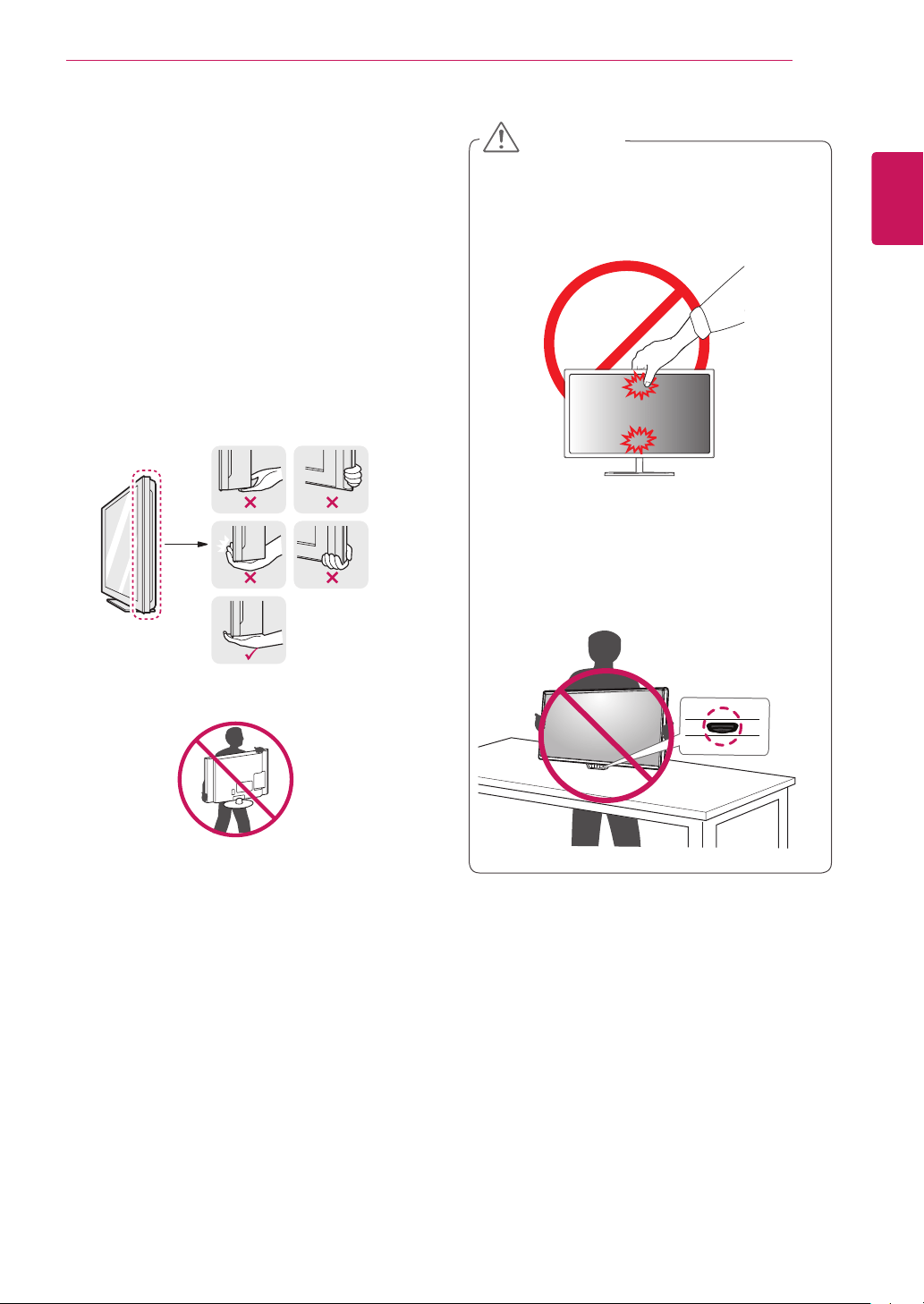
Moving and Lifting the Monitor
When moving or lifting the monitor, follow these
instructions to prevent the monitor from being
scratched or damaged and to ensure safe trans-
portation, regardless of its shape or size.
It is advisable to place the monitor in the
original box or packing material before
attempting to move it.
Before moving or lifting the monitor,
disconnect the power cord and all cables.
Hold the top and bottom of the monitor frame
firmly. Do not hold the panel itself.
When holding the monitor, the screen should
face away from you to prevent it from being
scratched.
When transporting the monitor, do not ex-
pose the monitor to jolts or excessive vibra-
tion.
When moving the monitor, keep it upright and
never turn the monitor on its side or tilt it side-
ways.
CAUTION
Avoid touching the monitor screen as much
as possible. Do not apply pressure.
- This may result in damage to the screen or
some of the pixels used to create images.
If you use the monitor panel without the stand
base, its joystick button may cause the moni-
tor to become unstable and fall, resulting in
damage to the monitor or human injury. In
addition, this may cause the joystick button to
malfunction.
8
ENG
ENGLISH
ASSEMBLING AND PREPARING
Installing the Monitor
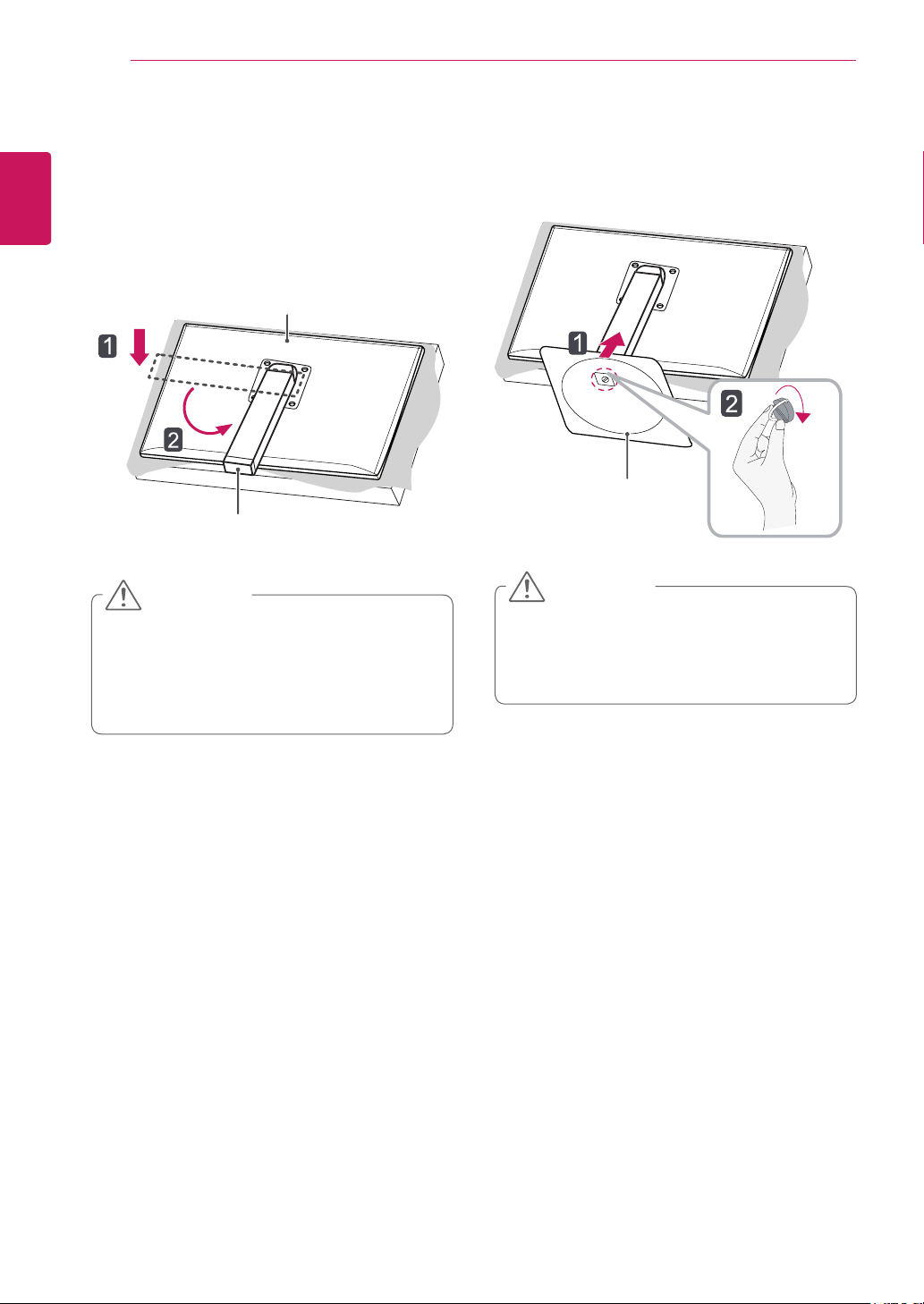
Assembling the Stand Base
1
Place the screen face down.
2
Rotate the Stand Body 90˚ counter clockwise.
To protect the screen from scratches, cover
the surface with a soft cloth.
To avoid scratching the head, make sure that
when rotating the Stand Body, the stand
body does not make contact with the head.
Applying excessive force when tightening
screws may cause damage to the monitor.
Damage caused in this way will not be cov-
ered by the product warranty.
CAUTION
CAUTION
3
Align the hole on the Stand Base with the
Stand Body and push it all the way up.Turn
the screws on the Stand Base to the right.
Stand Body
Head
Stand Base
9
ENG
ENGLISH
ASSEMBLING AND PREPARING
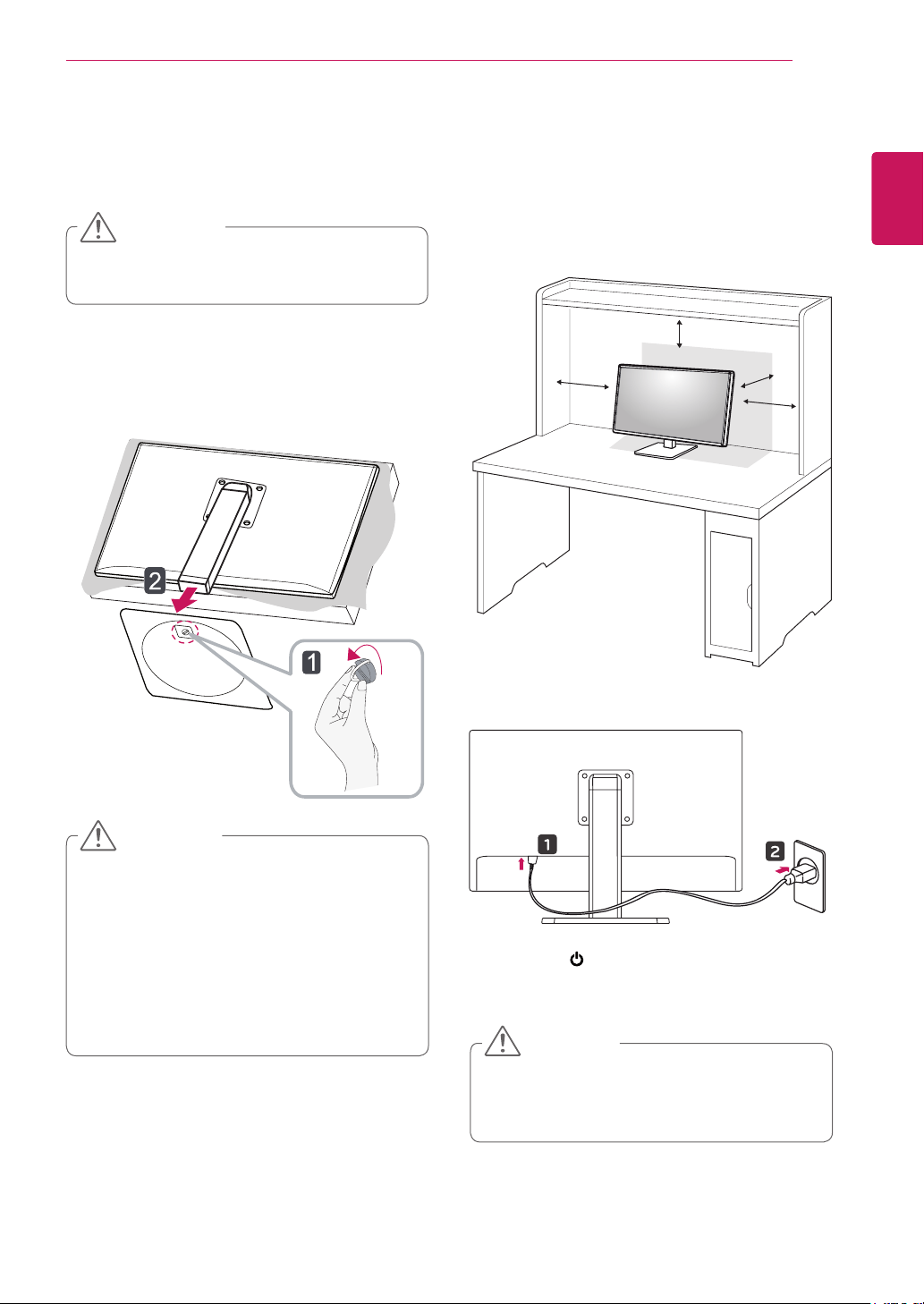
Detaching the Stand Base
1
Place the screen face down.
To protect the screen from scratches, cover
the surface with a soft cloth.
CAUTION
The components in the illustrations may differ
from the actual product.
Do not carry the monitor upside down, as this
may cause it to fall off its stand and result in
damage or injury.
To avoid damaging the screen when lifting
or moving the monitor, only hold the stand
or the plastic cover. This avoids putting
unnecessary pressure on the screen.
CAUTION
2
BodyTurn the screws on the Stand Base to the
left to detach the Stand Base from the Stand
Body.
2
Connect the Power Cord to a wall outlet.
3
Press the (Power) button on the bottom of
the monitor to turn it on.
To avoid the risk of electric shock, disconnect
the Power Cord before moving or installing
the monitor.
CAUTION
Installing on to a Table
1
Lift the monitor and place it on the table in an
upright position.
Place at least 10 cm (4 inches) away from the
wall to ensure sufficient ventilation.
10 cm
10 cm (4 inches)
10 cm
10 cm
10
ENG
ENGLISH
ASSEMBLING AND PREPARING
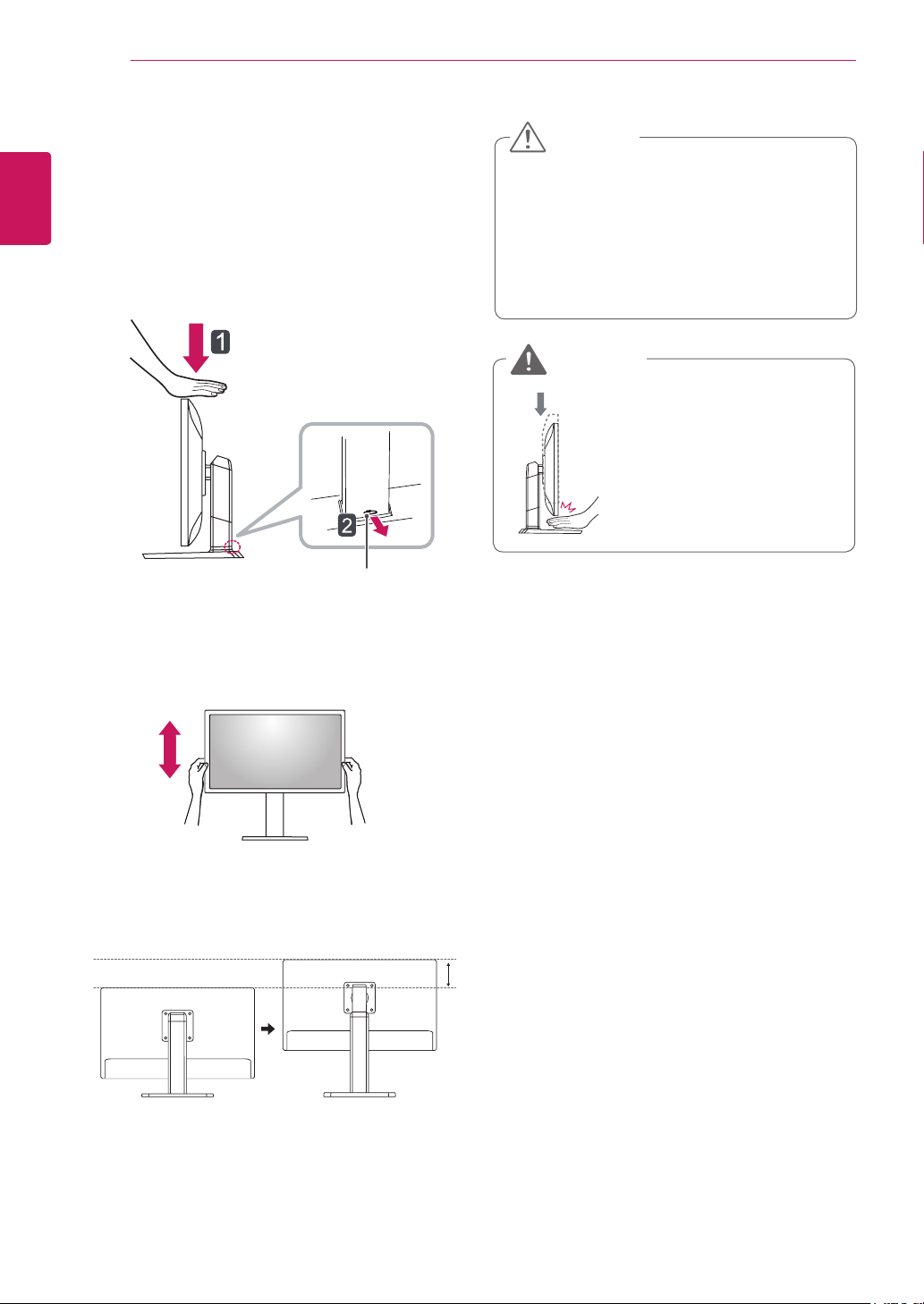
Adjusting the Stand Height
1
Place the monitor mounted on the stand base
in an upright position.
2
Push the Head downward and pull out the
Locking Pin.
3
Handle the monitor with both hands for safety.
4
The height can be adjusted up to 100.0 mm
(approx. 4 inches).
Once the pin is removed, it is not necessary
to re-insert it to adjust the height.
Problems with the height or angle adjustment
of the product caused by the attachment of
protective glass in Internet cafes specializing
in gaming will not be covered by the
warranty.
CAUTION
Head
Locking pin
100.0 mm (approx. 4 inches)
To avoid injury, do not put
your fingers or hand between
the head and the base when
adjusting the screen's height.
WARNING
11
ENG
ENGLISH
ASSEMBLING AND PREPARING
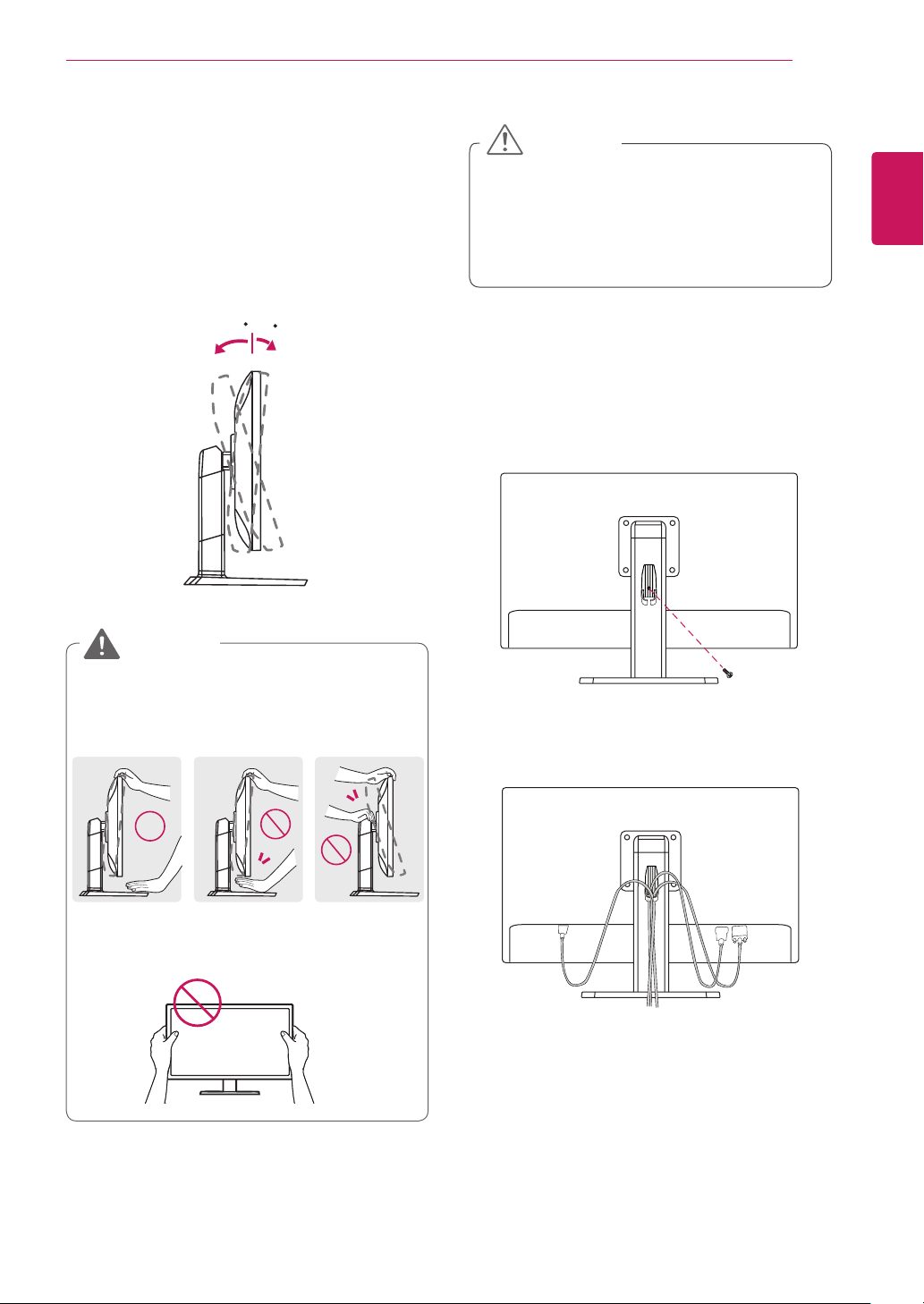
Adjusting the Angle
1
Place the monitor in an upright position, mount-
ed on the stand base.
2
Adjust the angle of the screen. The angle of
the screen can be adjusted forwards or back-
wards from -5° to 20° for a comfortable viewing
experience.
Tidying Cables
1
Use the screw provided to attach the cable
holder to the stand body as illustrated.
2
Gather and bind the cables with the supplied
cable holder.
-520
Front Side
Rear Side
To avoid injury, do not put your fingers or
hand between the head and the base when
adjusting the screen's angle or height.
Be careful not to touch or press the screen
area when adjusting the angle of the moni-
tor.
WARNING
-520
-520
Problems with the height or angle adjustment
of the product caused by the attachment of
protective glass in Internet cafes specializing
in gaming will not be covered by the
warranty.
CAUTION

12
ENG
ENGLISH
ASSEMBLING AND PREPARING
Pivot Feature
The pivot feature allows the monitor to rotate 90°
clockwise.
Head
Stand
To avoid scratching the stand base, make
sure that when rotating the monitor using
the pivot feature, the stand does not make
contact with the monitor.
WARNING
1
Raise the monitor to the maximum height.
3
Rotate the monitor clockwise as shown in the
figure.
2
Adjust the angle of the monitor in the direction
of the arrow as shown in the figure.
4
Complete the installation by rotating the
monitor 90° as shown below.
Auto Pivot feature of the display is not
supported.
The screen can be rotated easily using the
screen pivot shortcut key provided with your
Windows operating system. Note that some
Windows versions may use different settings
for the screen pivot key or may not support
the pivot key at all.
Supported Windows versions: Windows 7
and Windows 8
Windows screen pivot shortcut keys
- 0°: Ctrl + Alt + Up arrow key (↑)
- 90°: Ctrl + Alt + Left arrow key (←)
- 180°: Ctrl + Alt + Down arrow key (↓)
- 270°: Ctrl + Alt + Right arrow key (→)
NOTE

13
ENG
ENGLISH
ASSEMBLING AND PREPARING
Using the Kensington Lock
The Kensington security system connector is locat-
ed at the back of the Monitor set.
For more information on installation and usage,
refer to the Kensington lock user manual or visit
the website at http://www.kensington.com.
Connect the Kensington security system cable
between the Monitor and a table.
The Kensington security system is optional.
You can obtain additional accessories from
most electronics stores.
NOTE
Take care when rotating the monitor if the
cable is connected.
To avoid injury when rotating the display, do
not place your fingers between the display
and the stand base.
WARNING
Detaching the Stand Body
1
Place the monitor's screen face down. To
protect the screen from scratches, cover the
surface with a soft cloth.
2
Using a screwdriver, remove the four screws
and detach the stand from the monitor.
14
ENG
ENGLISH
ASSEMBLING AND PREPARING
Installing the Wall Mount Plate
This monitor meets the specifications for the wall
mount plate or other compatible devices.
1
Place the screen face down. To protect the
screen from scratches, cover the surface with a
soft cloth.
2
Place the wall mount plate onto the monitor
and align it with the screw holes.
3
Tighten the four screws to fix the plate to the
monitor using a screwdriver.
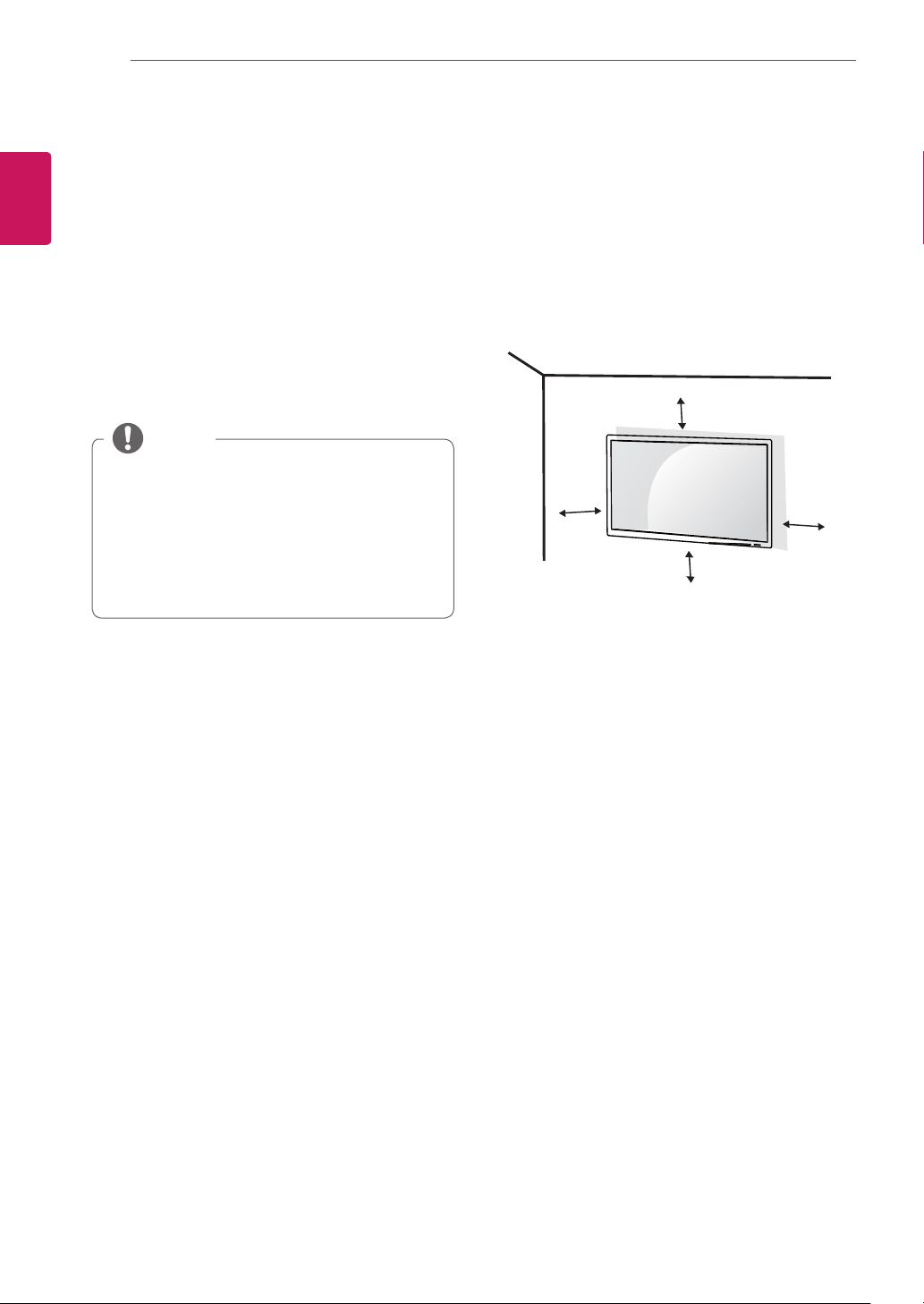
Installing on the Wall
Install the monitor at least 10 cm (4 inches)
away from the wall and leave about 10 cm (4
inches) of space at each side of the monitor to
ensure sufficient ventilation. Detailed installation
instructions can be obtained from your local retail
store. Alternatively, please refer to the manual for
how to install and set up a tilting wall mounting
bracket.
The wall mount plate is sold separately.
For more information on installation, refer to
the wall mount plate's installation guide.
Be careful not to apply too much force while
mounting the wall mount plate as it may
cause damage to the screen
NOTE
10 cm (4 inches)
10 cm
10 cm
10 cm
To install the monitor to a wall, attach a wall
mounting bracket (optional) to the back of the
monitor.
Make sure that the wall mounting bracket is
securely fixed to the monitor and to the wall.
1
If you use screws longer than the standard
length, it may damage the inside of the prod-
uct.
2
A non-VESA standard screw may damage the
product and cause the monitor to fall.
LG Electronics is not liable for any accidents
relating to the use of non-standard screws.
15
ENG
ENGLISH
ASSEMBLING AND PREPARING
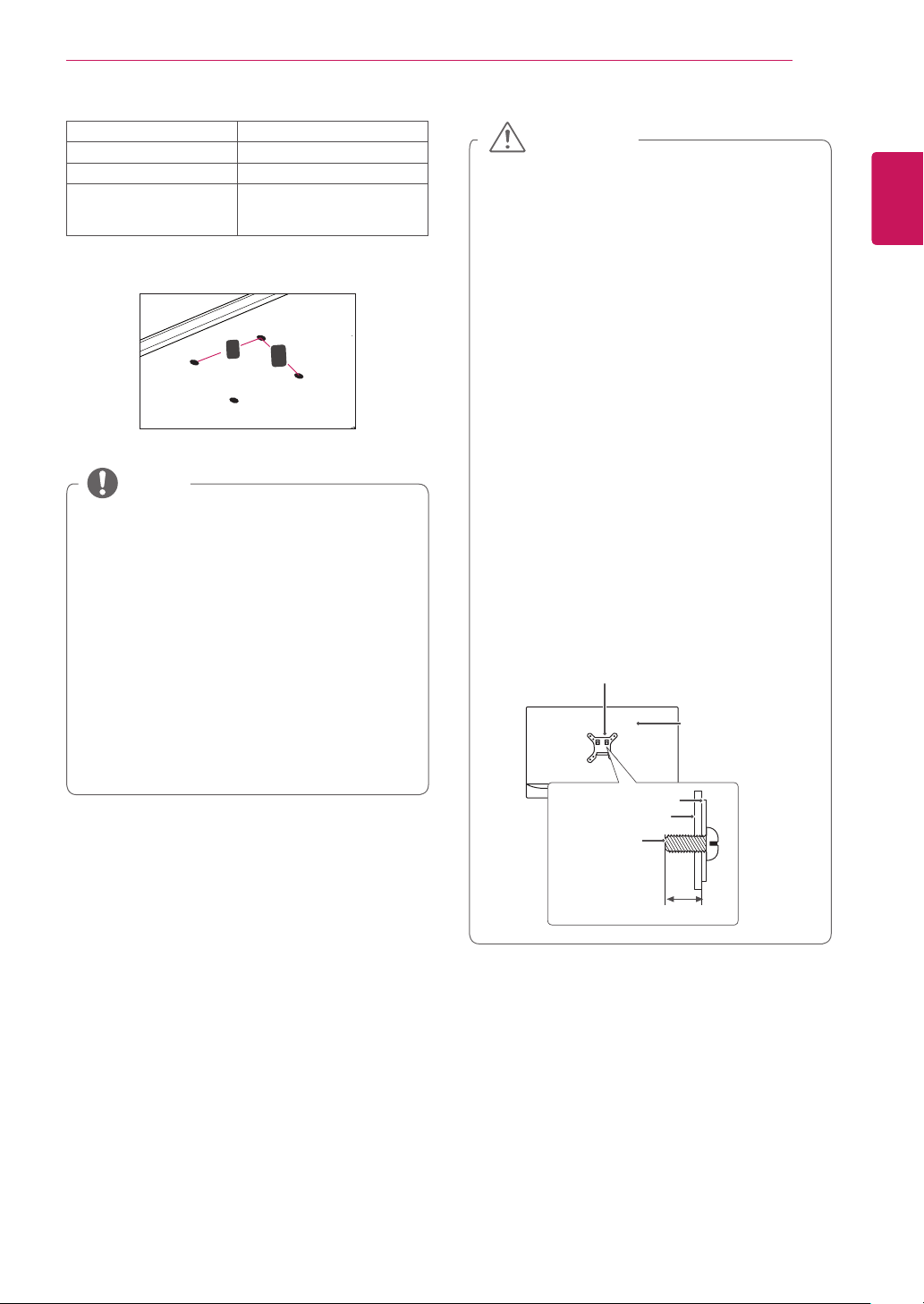
Wall Mount (A x B)
100 x 100
Stand Screw
M4 x 10 mm
Required Screws
4
Wall Mount Plate
(Optional)
RW120
Wall Mount (A x B)
A
B
Use the screws specified by VESA stan-
dards.
The wall mount kit includes the installation
guide and all necessary parts.
The wall mounting bracket is optional. You
can obtain optional accessories from your
local dealer.
The length of the screw may differ for each
wall mounting bracket. Be sure to use the
proper length.
For more information, please refer to the
user manual for the wall mounting bracket.
NOTE
CAUTION
Unplug the power cord before moving or
installing the monitor to avoid electric shock.
Installing the monitor on the ceiling or on a
slanted wall may result in the monitor falling
off, which could lead to injury. Use an autho-
rized LG wall mount and contact the local
dealer or qualified personnel.
Applying excessive force when tightening
screws may cause damage to the monitor.
Damage caused in this way will not be cov-
ered by the product warranty.
Use the wall mounting bracket and screws
that conform to VESA standards. Damage
caused by the use or misuse of inappropri-
ate components will not be covered by the
product warranty.
To prevent injury, this apparatus must be
securely attached to the wall in accordance
with the instrallation instructions. (This per-
tains only to Australia and New Zealand.)
When measured from the back of the moni-
tor, the length of each installed screw must
be 8 mm (5/16 inches) or less.
Wall Mount Plate
Back of the Monitor
Screw
Dimensions
: M4 x L10
Wall Mount Plate
Back of the Monitor
Max 8 mm
16
ENG
ENGLISH
USING THE MONITOR
USING THE MONITOR
Connecting to a PC
This monitor supports the *Plug and Play
feature.
*Plug and Play: A feature that allows you to
add a device to your computer without having
to reconfigure anything or install any manual
drivers.
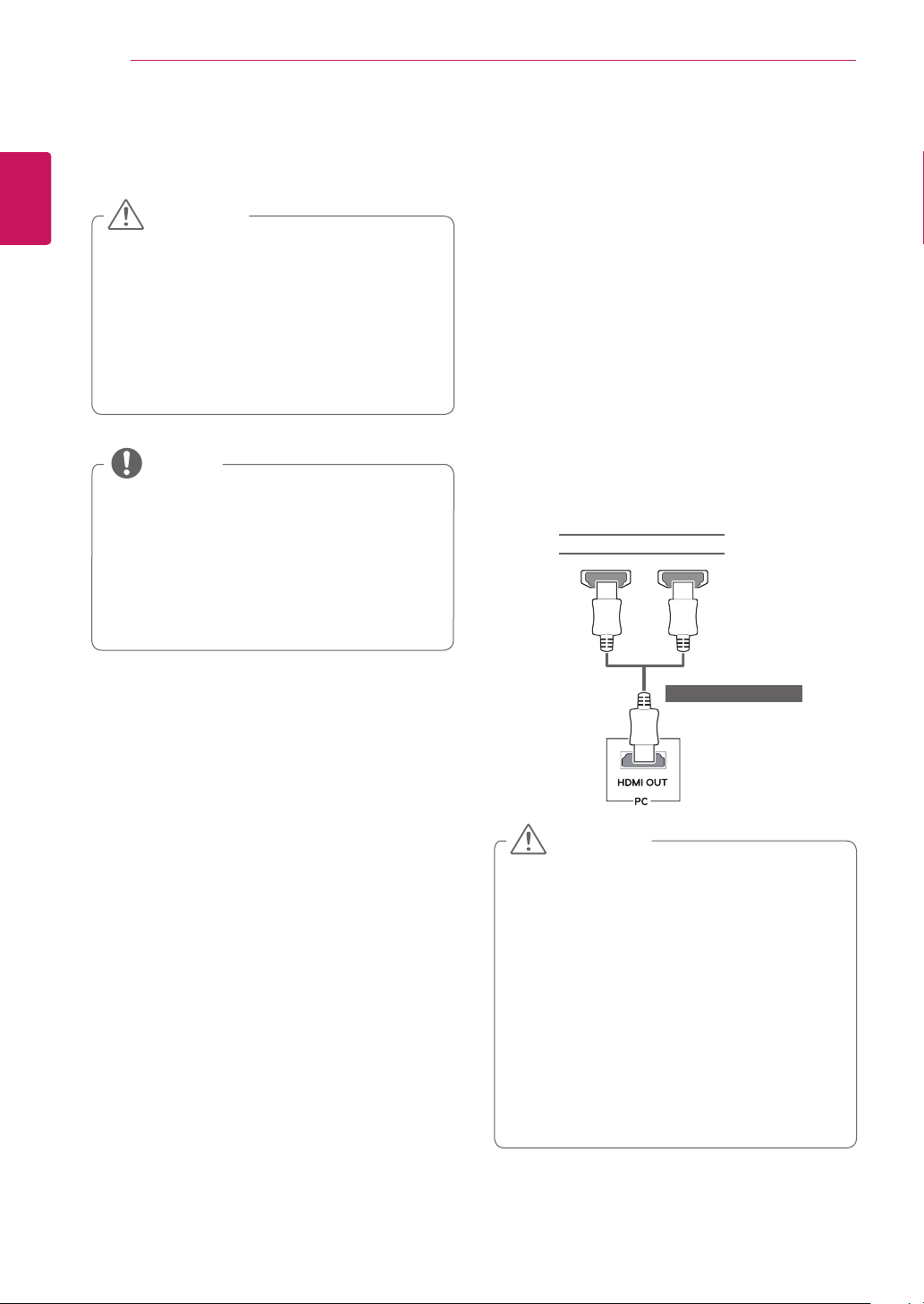
HDMI Connection
Transmits digital video and audio signals from your
PC to the monitor. Connect your PC to the monitor
using the HDMI cable as shown in the illustration
below.
Do not press on the screen for a prolonged
period of time. This may cause image distor-
tion.
Do not display a still image on the screen for
a prolonged period of time. This may cause
image retention. Use a screensaver if pos-
sible.
CAUTION
Connecting your PC to the monitor using the
HDMI cable may cause device compatibility
issues.
Using a DVI to HDMI / DP(DisplayPort) to
HDMI cable may cause compatibility issues.
Use a certified cable with the HDMI logo
attached. If you do not use a certified HDMI
cable, the screen may not display or a con-
nection error may occur.
Recommended HDMI cable types
- High-Speed HDMI
®
/
TM
Cable
- High-Speed HDMI
®
/
TM
Cable with Ethernet
CAUTION
When connecting the power cord to the out-
let, use a grounded (3-hole) multi-socket or a
grounded power outlet.
The monitor may flicker when turned on in an
area of low temperature. This is normal.
Sometimes red, green, or blue spots may ap-
pear on the screen. This is normal.
NOTE
D-SUB OUT
PC
AUDIO OUT
USB 2
USB 1
DP
IN
D-SUB I
N
DVI
-
D
IN
HDMI IN
1
USB UPHDMI IN
2
DP IN
DVI
-
D
IN
HDMI IN
1
US
B
UP
HDMI IN
2
DP OUT
DP
IN
D-SUB IN
DVI
-
D
IN
HDMI IN
1
US
B
UP
HDMI IN
2
DP
IN
D-
SU
B I
N
DVI-D IN HDMI IN
1
US
B
UP
HDMI IN
2
DVI-I(D) OUT
PC
AUDIO OUT
D-
SU
B IN
DVI
-
D
IN
HDMI IN 1
US
B
UP
HDMI IN 2
DP IN
D-
SU
B I
N
DVI
-
DIN
HDMI IN 1
US
B
UP
HDMI IN 2
US
B
2
US
B 1
5 V 0.9 A
5 V 0.9 A
(Sold Separately)

17
ENG
ENGLISH
USING THE MONITOR
DisplayPort Connection
Transmits digital video and audio signals from your
PC to the monitor. Connect the monitor to your
PC using the display port cable as shown in the
illustration below:
D-SUB OUT
PC
AUDIO OUT
USB 2
USB 1
DP
IN
D-SUB I
N
DVI
-
D
IN
HDMI IN
1
USB UPHDMI IN
2
DP IN
DVI
-
D
IN
HDMI IN
1
US
B
UP
HDMI IN
2
DP OUT
DP
IN
D-SUB IN
DVI
-
D
IN
HDMI IN
1
US
B
UP
HDMI IN
2
DP
IN
D-
SU
B I
N
DVI-D IN HDMI IN
1
US
B
UP
HDMI IN
2
DVI-I(D) OUT
PC
AUDIO OUT
D-
SU
B IN
DVI
-
D
IN
HDMI IN 1
US
B
UP
HDMI IN 2
DP IN
D-
SU
B I
N
DVI
-
DIN
HDMI IN 1
US
B
UP
HDMI IN 2
US
B
2
US
B 1
5 V 0.9 A
5 V 0.9 A
(Sold Separately)
There may be no video or audio output
depending on the DP (DisplayPort) version of
the PC.
When using a Mini DP to DP (Mini
DisplayPort to DisplayPort) cable, a cable
with DisplayPort 1.1a specifications or above
is recommended.
NOTE
D-SUB Connection
Transmits the analog video signal from your PC
to the monitor. Connect the monitor to the PC
using the provided 15-pin D-Sub signal cable as
illustrated below.
D-SUB OUT
PC
AUDIO OUT
USB 2
USB 1
DP
IN
D-SUB I
N
DVI
-
D
IN
HDMI IN
1
USB UPHDMI IN
2
DP IN
DVI
-
D
IN
HDMI IN
1
US
B
UP
HDMI IN
2
DP OUT
DP
IN
D-SUB IN
DVI
-
D
IN
HDMI IN
1
US
B
UP
HDMI IN
2
DP
IN
D-
SU
B I
N
DVI-D IN HDMI IN
1
US
B
UP
HDMI IN
2
DVI-I(D) OUT
PC
AUDIO OUT
D-
SU
B IN
DVI
-
D
IN
HDMI IN 1
US
B
UP
HDMI IN 2
DP IN
D-
SU
B I
N
DVI
-
DIN
HDMI IN 1
US
B
UP
HDMI IN 2
US
B
2
US
B 1
5 V 0.9 A
5 V 0.9 A
(Sold Separately)
Connect the input signal cable
and turn in the direction of the
arrow. To prevent disconnection
secure the cable firmly, do not
over tighten.
CAUTION
Apple
®
Adapter
If you are using an Apple
®
computer, an
Apple
®
adapter is required. The adapter can
be purchased at an Apple
®
store.
NOTE
18
ENG
ENGLISH
USING THE MONITOR
Connecting AV Devices
HDMI Connection
HDMI transmits digital video and audio signals
from your AV device to the monitor. Connect your
AV device to the monitor using the HDMI cable as
shown in the illustration below.
D-SUB OUT
PC
AUDIO OUT
USB 2
USB 1
DP
IN
D-SUB I
N
DVI
-
D
IN
HDMI IN
1
USB UPHDMI IN
2
DP IN
DVI
-
D
IN
HDMI IN
1
US
B
UP
HDMI IN
2
DP OUT
DP
IN
D-SUB IN
DVI
-
D
IN
HDMI IN
1
US
B
UP
HDMI IN
2
DP
IN
D-
SU
B I
N
DVI-D IN HDMI IN
1
US
B
UP
HDMI IN
2
DVI-I(D) OUT
PC
AUDIO OUT
D-
SU
B IN
DVI
-
D
IN
HDMI IN 1
US
B
UP
HDMI IN 2
DP IN
D-
SU
B I
N
DVI
-
DIN
HDMI IN 1
US
B
UP
HDMI IN 2
US
B
2
US
B 1
5 V 0.9 A
5 V 0.9 A
(Sold Separately)
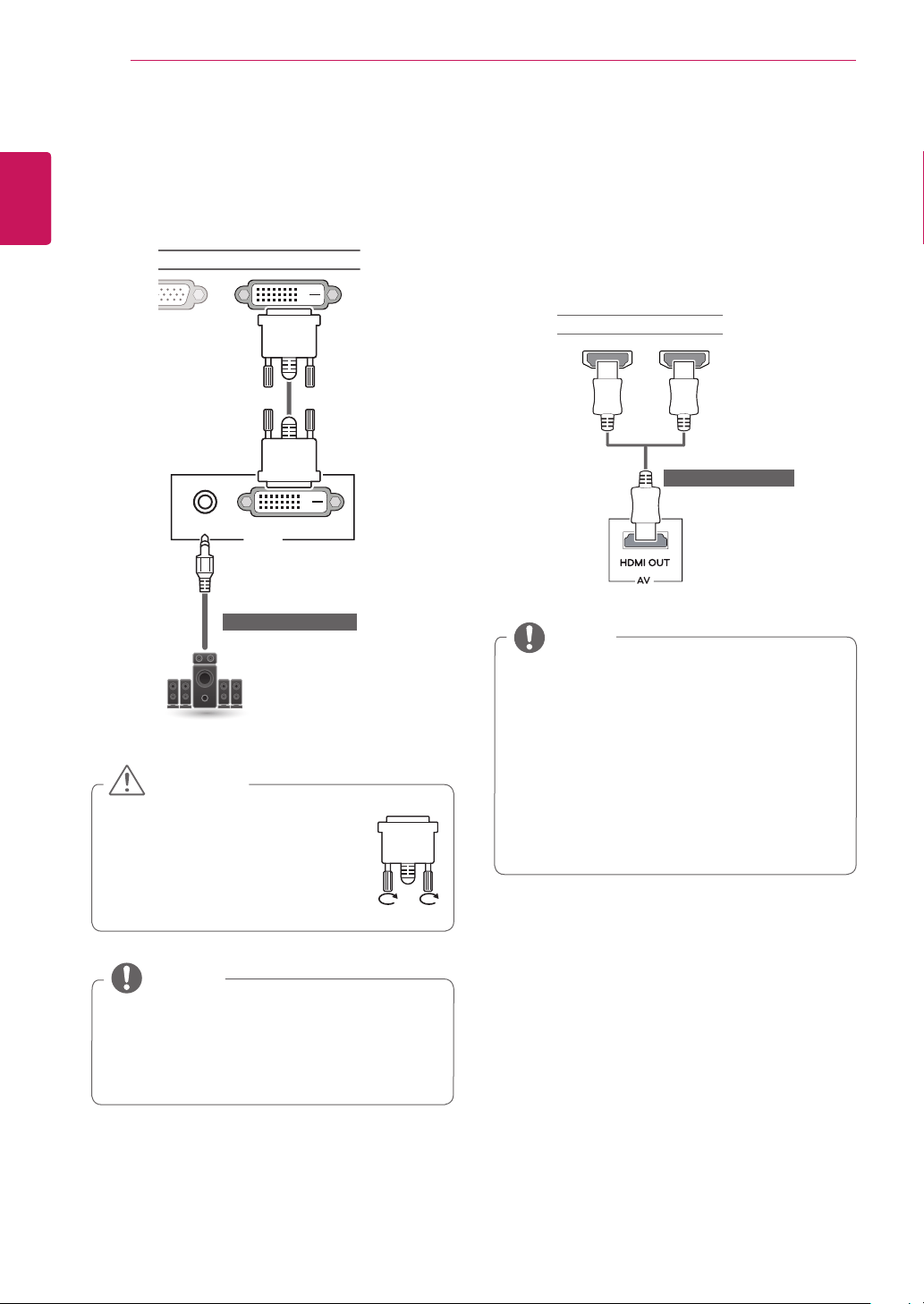
DVI Connection
Transmits digital video signals to the monitor.
Connect the monitor using the DVI cable as
illustrated below.
Connect the input signal cable
and turn in the direction of the
arrow. To prevent disconnection
secure the cable firmly, do not
over tighten.
CAUTION
Using a DVI to HDMI cable may cause
compatibility issues.
If you connect a DVI signal cable, use the
DVI-D dual cable.
NOTE
D-SUB OUT
PC
AUDIO OUT
USB 2
USB 1
DP
IN
D-SUB I
N
DVI
-
D
IN
HDMI IN
1
USB UPHDMI IN
2
DP IN
DVI
-
D
IN
HDMI IN
1
US
B
UP
HDMI IN
2
DP OUT
DP
IN
D-SUB IN
DVI
-
D
IN
HDMI IN
1
US
B
UP
HDMI IN
2
DP
IN
D-
SU
B I
N
DVI-D IN
HDMI IN
1
US
B
UP
HDMI IN
2
DVI-I(D) OUT
PC
AUDIO OUT
D-
SU
B IN
DVI
-
D
IN
HDMI IN 1
US
B
UP
HDMI IN 2
DP IN
D-
SU
B I
N
DVI
-
DIN
HDMI IN 1
US
B
UP
HDMI IN 2
US
B
2
US
B 1
5 V 0.9 A
5 V 0.9 A
(Sold Separately)
Using a DVI to HDMI / DP(DisplayPort) to
HDMI cable may cause compatibility issues.
Use a certified cable with the HDMI logo
attached. If you do not use a certified HDMI
cable, the screen may not display or a con-
nection error may occur.
Recommended HDMI cable types
- High-Speed HDMI
®
/
TM
Cable
- High-Speed HDMI
®
/
TM
Cable with Ethernet
NOTE
19
ENG
ENGLISH
USING THE MONITOR
Connecting Peripherals
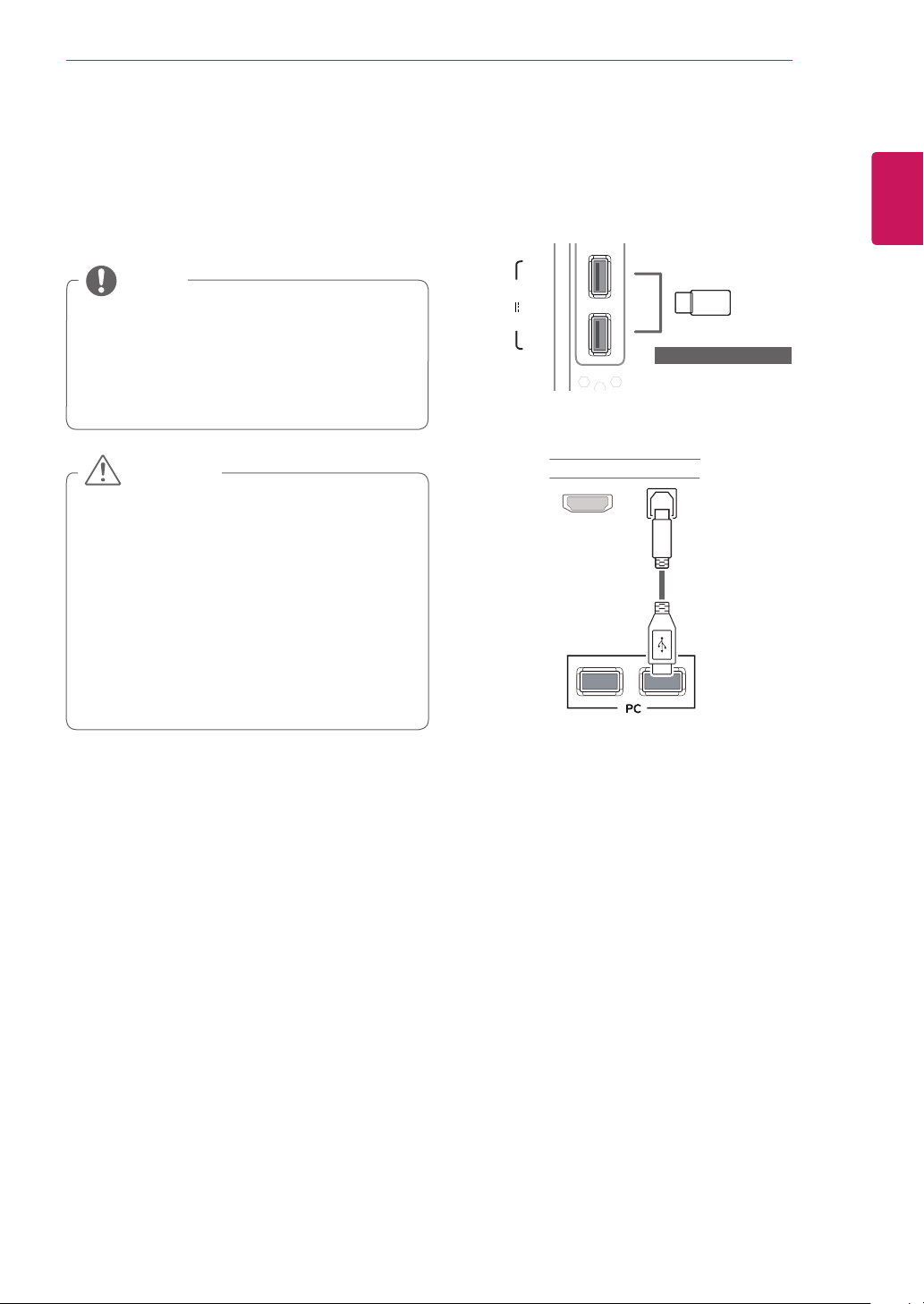
USB Cable Connection - PC
The USB port on the product functions as a USB
hub.
Make sure to install the most recent Windows
OS service pack before using the product.
Peripheral devices are sold separately.
A keyboard, mouse, or USB device can be
connected to the USB port.
NOTE
Cautions When Using a USB Device
A USB device with an automatic recognition
program installed or that uses its own driver
may not be recognized.
Some USB devices may not be supported or
may not work properly.
It is recommended to use a USB hub or hard
disk drive with an external power supply. (If
the power supply is not adequate, the USB
device may not be recognized properly.)
CAUTION
To use USB 3.0, connect the A-B type USB 3.0
cable of the product to the PC.
Peripheral devices connected to the USB 1, 2 port
can be controlled from the PC.
D-SUB OUT
PC
AUDIO OUT
USB 2
USB 1
DP
IN
D-SUB I
N
DVI
-
D
IN
HDMI IN
1
USB UPHDMI IN
2
DP IN
DVI
-
D
IN
HDMI IN
1
US
B
UP
HDMI IN
2
DP OUT
DP
IN
D-SUB IN
DVI
-
D
IN
HDMI IN
1
US
B
UP
HDMI IN
2
DP
IN
D-
SU
B I
N
DVI-D IN HDMI IN
1
US
B
UP
HDMI IN
2
DVI-I(D) OUT
PC
AUDIO OUT
D-
SU
B IN
DVI
-
D
IN
HDMI IN 1
US
B
UP
HDMI IN 2
DP IN
D-
SU
B I
N
DVI
-
DIN
HDMI IN 1
US
B
UP
HDMI IN 2
US
B
2
US
B 1
5 V 0.9 A
5 V 0.9 A
(Sold Separately)
D-SUB OUT
PC
AUDIO OUT
USB 2
USB 1
DP
IN
D-SUB I
N
DVI
-
D
IN
HDMI IN
1
USB UPHDMI IN
2
DP IN
DVI
-
D
IN
HDMI IN
1
US
B
UP
HDMI IN
2
DP OUT
DP
IN
D-SUB IN
DVI
-
D
IN
HDMI IN
1
US
B
UP
HDMI IN
2
DP
IN
D-
SU
B I
N
DVI-D IN HDMI IN
1
US
B
UP
HDMI IN
2
DVI-I(D) OUT
PC
AUDIO OUT
D-
SU
B IN
DVI
-
D
IN
HDMI IN 1
US
B
UP
HDMI IN 2
DP IN
D-
SU
B I
N
DVI
-
DIN
HDMI IN 1
US
B
UP
HDMI IN 2
US
B
2
US
B 1
5 V 0.9 A
5 V 0.9 A
20
ENG
ENGLISH
USING THE MONITOR
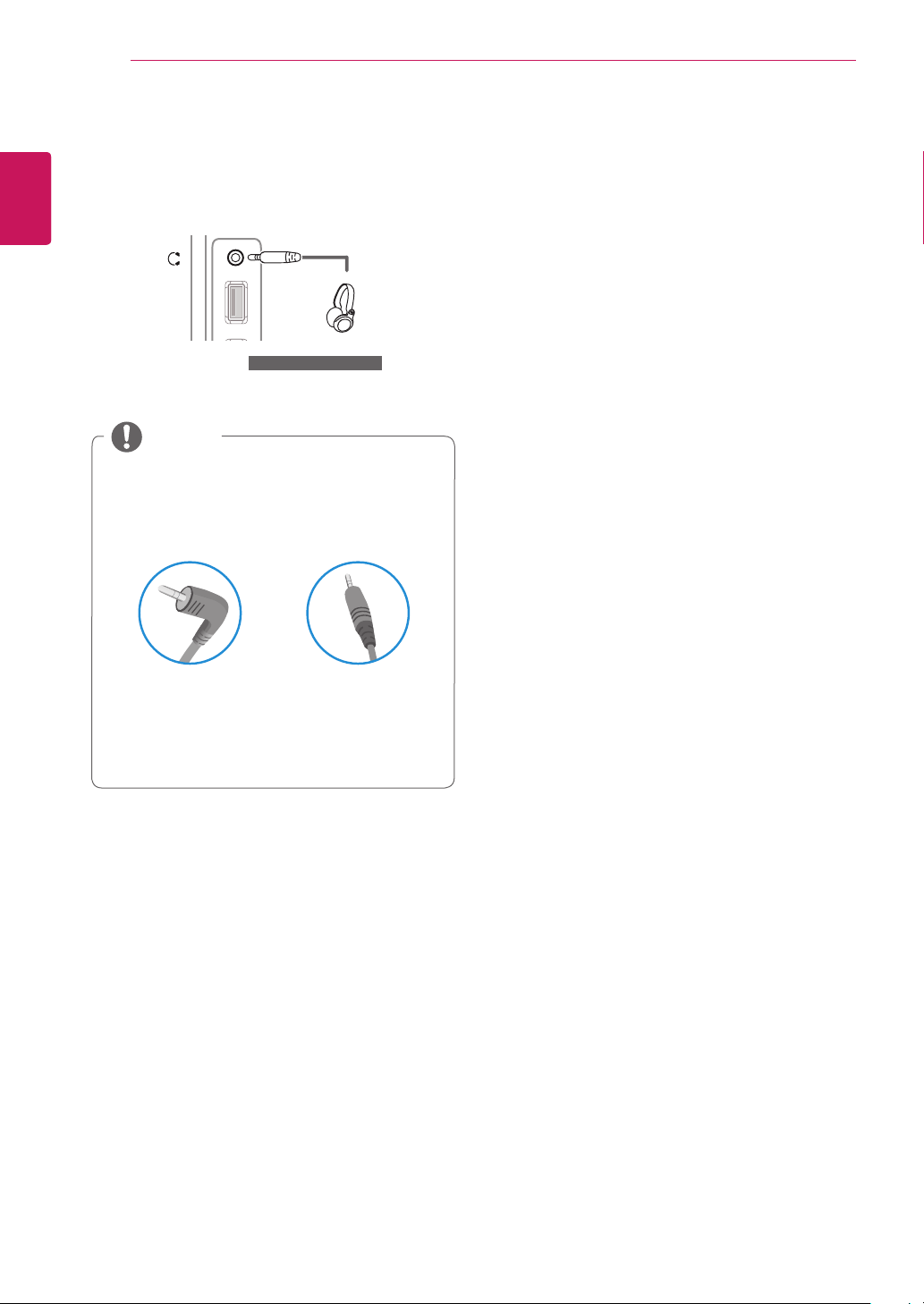
Headphone Port Connection
Use the headphone port to connect a peripheral
device to the monitor. Connect as illustrated.
NOTE
Peripheral devices are sold separately.
It is difficult to connect an angle plug
earphone or a peripheral device, so please
use a straight type plug.
Angle Type Straight Type
Depending on the audio settings of the PC
and external device, headphone and speaker
functions may be limited.
(Sold Separately)
D-SUB OUT
PC
AUDIO OUT
USB 2
USB 1
DP
IN
D-SUB I
N
DVI
-
D
IN
HDMI IN
1
USB UPHDMI IN
2
DP IN
DVI
-
D
IN
HDMI IN
1
US
B
UP
HDMI IN
2
DP OUT
DP
IN
D-SUB IN
DVI
-
D
IN
HDMI IN
1
US
B
UP
HDMI IN
2
DP
IN
D-
SU
B I
N
DVI-D IN HDMI IN
1
US
B
UP
HDMI IN
2
DVI-I(D) OUT
PC
AUDIO OUT
D-
SU
B IN
DVI
-
D
IN
HDMI IN 1
US
B
UP
HDMI IN 2
DP IN
D-
SU
B I
N
DVI
-
DIN
HDMI IN 1
US
B
UP
HDMI IN 2
US
B
2
US
B 1
5 V 0.9 A
5 V 0.9 A
21
ENG
ENGLISH
USER SETTINGS
USER SETTINGS
Activating the Main Menu
1
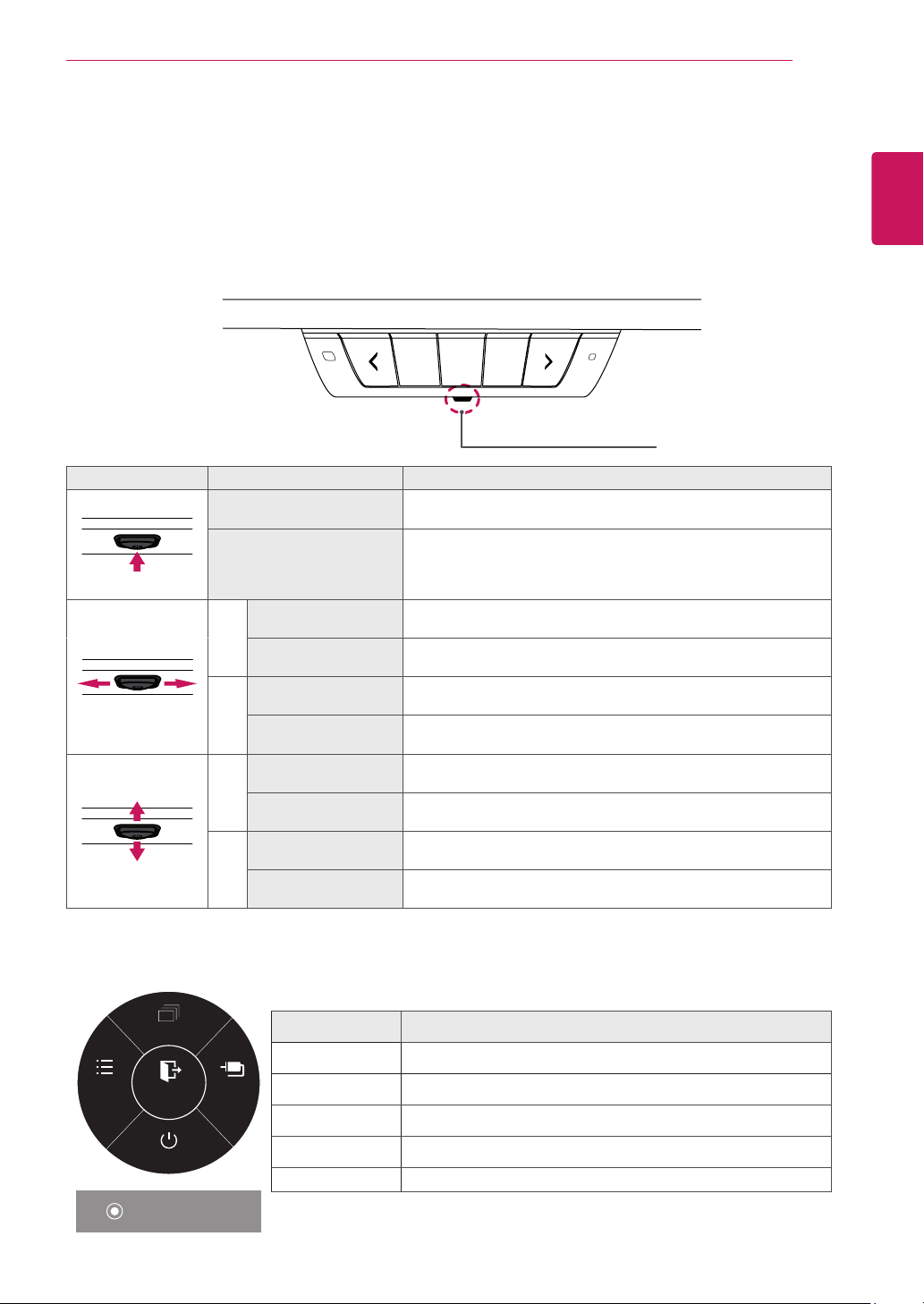
Press the joystick button on the bottom of the monitor.
2
Move the joystick up/down (▲/▼) and left/right (◄/►) to set the options.
3
Press the joystick button once more to exit the main menu.
BLACK
ST.
GAME
MODE
DAS
MODE
Joystick Button
Button Menu Status Description
Main menu disabled Enables the main menu.
Main menu enabled
Exits the main menu.
(Press and hold the button to turn off the monitor: You can turn
off the monitor using this method at any time, including when the
OSD (On Screen Display) is on.)
◄
Main menu disabled Adjusts the monitor volume level.
Main menu enabled Enters the menu features.
►
Main menu disabled Adjusts the monitor volume level.
Main menu enabled Enters the input feature.
▲
Main menu disabled Enables the main menu.
Main menu enabled Enters the picture mode feature.
▼
Main menu disabled Enables the main menu.
Main menu enabled Turns the monitor off.
Main Menu Features
Picture Mode
Menu Input
Monitor off
Exit
Long Press: Monitor Off.
Main Menu Description
Menu Configures the screen settings.
Picture Mode Optimizes the screen for picture mode.
Input Sets input mode.
Monitor off Turns off the monitor.
Exit Exits the main menu.

22
ENG
ENGLISH
USER SETTINGS
User Settings
Menu Settings
1
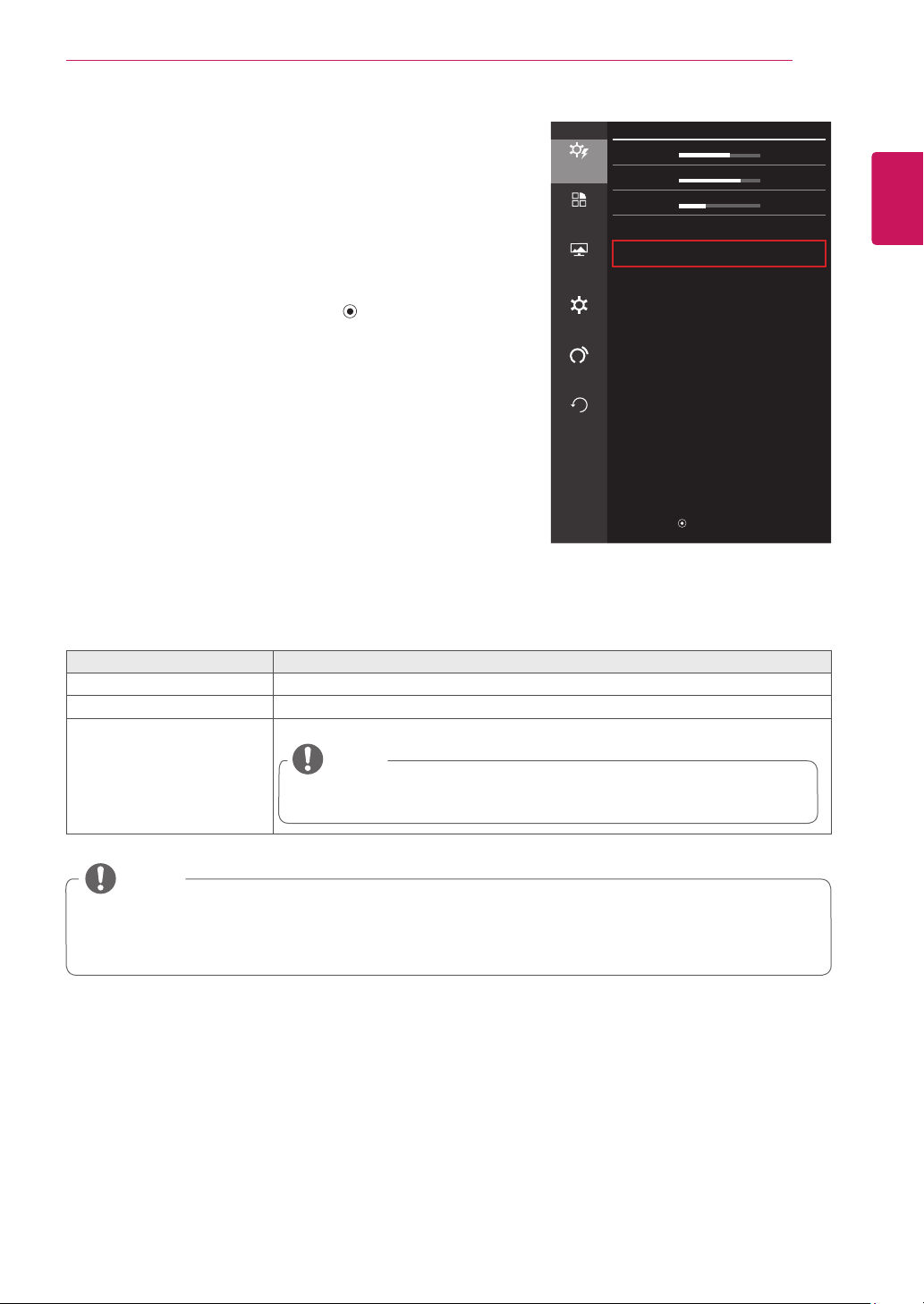
To view the OSD menu, press the joystick button on the bottom of the monitor and then enter the
Menu.
2
Configure the options by moving the joystick up/down/left/right.
3
If you want to configure an upper menu or another option, move the joystick ◄ or press it (
/ OK).
4
If you want to exit the OSD menu, move the joystick ◄ until you exit.
When you enter the menu, instructions on how to use the button will appear in the bottom right corner
of the screen.
Easy control Function Screen Settings
Auto
Configuration
Reset
Each option is described below.
Menu Description
Easy control Brightness Adjusts the screen brightness.
NOTE
You can turn the auto brightness adjustment on/off by moving the joystick but-
ton ▼ in the Brightness menu.
Contrast
Adjusts the screen contrast.
Volume Adjusts the volume level.
NOTE
You can turn mute on/off by moving the joystick button ▼ in the Volume menu.
Input Selects the input mode.
Ratio Adjusts the aspect ratio of the screen.
Function Adjusts Picture Mode, Game Mode, DAS Mode, Motion 240, and SUPER ENERGY
SAVING.
Screen Picture Adjusts SUPER RESOLUTION+, Sharpness, Black Level, Black Stabilizer, and Re-
sponse Time of the screen.
Color Adjusts the Gamma, Color Temp, and Color.
Display Adjusts Position, Width, and Phase of the screen.
(Activated only when using a D-Sub Analog input.)
Settings Adjusts Language, Power LED, Automatic Standby, and OSD Lock.
Auto Configuration Adjusts the Position, Width, and Phase of the screen automatically.
(Activated only when using a D-Sub Analog input.)
Reset Restores the default settings.
◄ Exit Exits the OSD menu.
23
ENG
ENGLISH
USER SETTINGS
Ratio
1
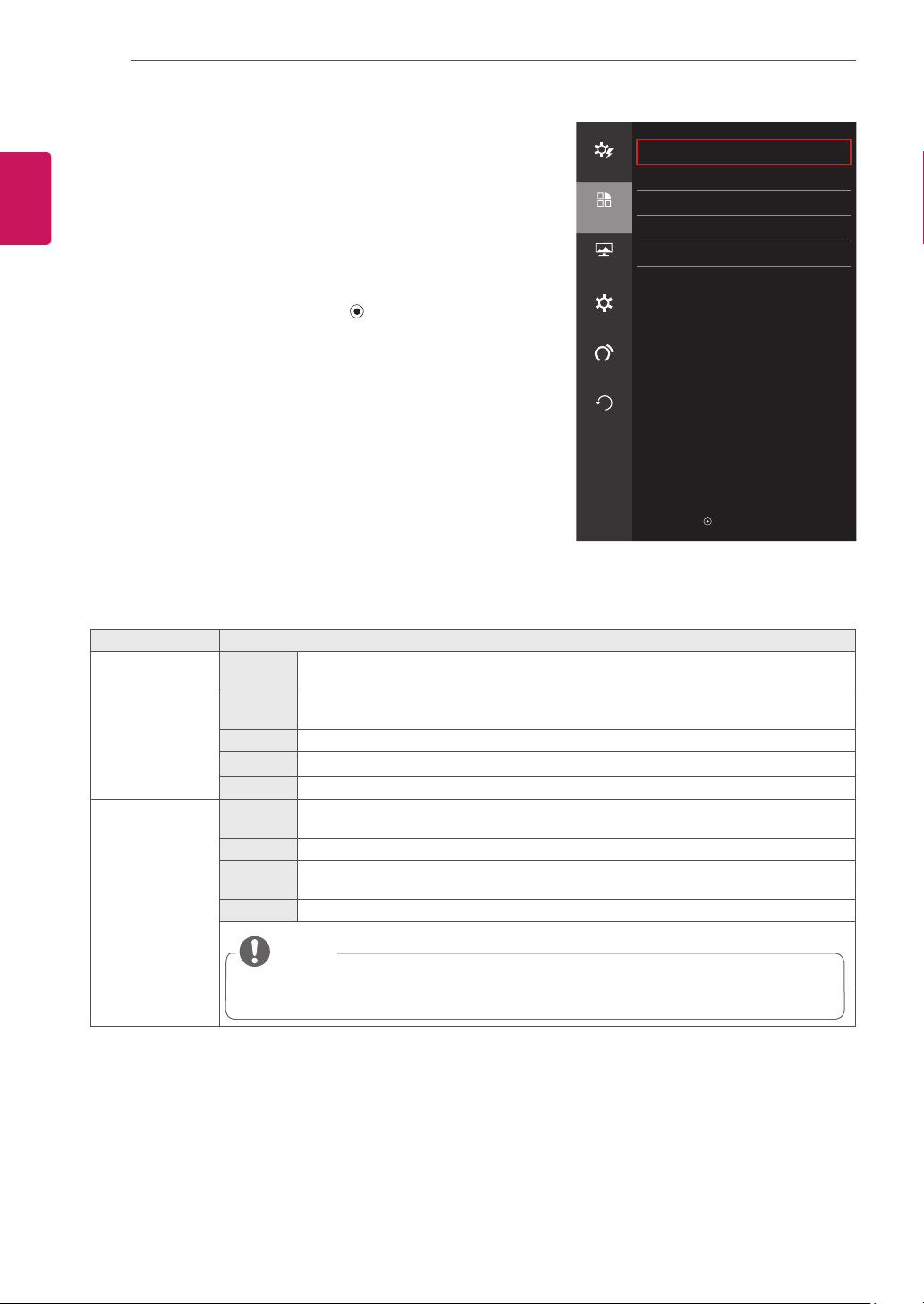
To view the OSD menu, press the joystick button on the
bottom of the monitor and then enter the Menu.
2
Go to Easy control > Ratio by moving the joystick.
3
Configure the options following the instructions that appear
in the bottom right corner.
4
If you want to configure an upper menu, or another option,
move the joystick to ◄ or press it (
/ OK).
5
If you want to exit the OSD menu, move the joystick to ◄
until you exit.
Each option is described below.
Menu > Easy control > Ratio Description
Wide Displays the video in wide screen, regardless of the video signal input.
Original Displays the video according to the aspect ratio of the video signal input.
1:1 The aspect ratio is not adjusted from the original.
NOTE
This function is not available when the DAS mode is turned on. To use the 1:1
mode, you should turn the DAS mode off.
Easy control
Easy control
Brightness
60
>
Contrast 70
>
Function
Volume
30
>
Input DVI-D
>
Screen
Ratio Wide
>
Settings
Auto
Configuration
Reset
▲ / ▼ : Move
/ ► : OK
◄ : Back
NOTE
The display may look the same for Wide, Original, and 1:1 options at the recommended resolution
(1920 x 1080).
Ratio is disabled with an interlaced signal.
24
ENG
ENGLISH
USER SETTINGS
Function
1
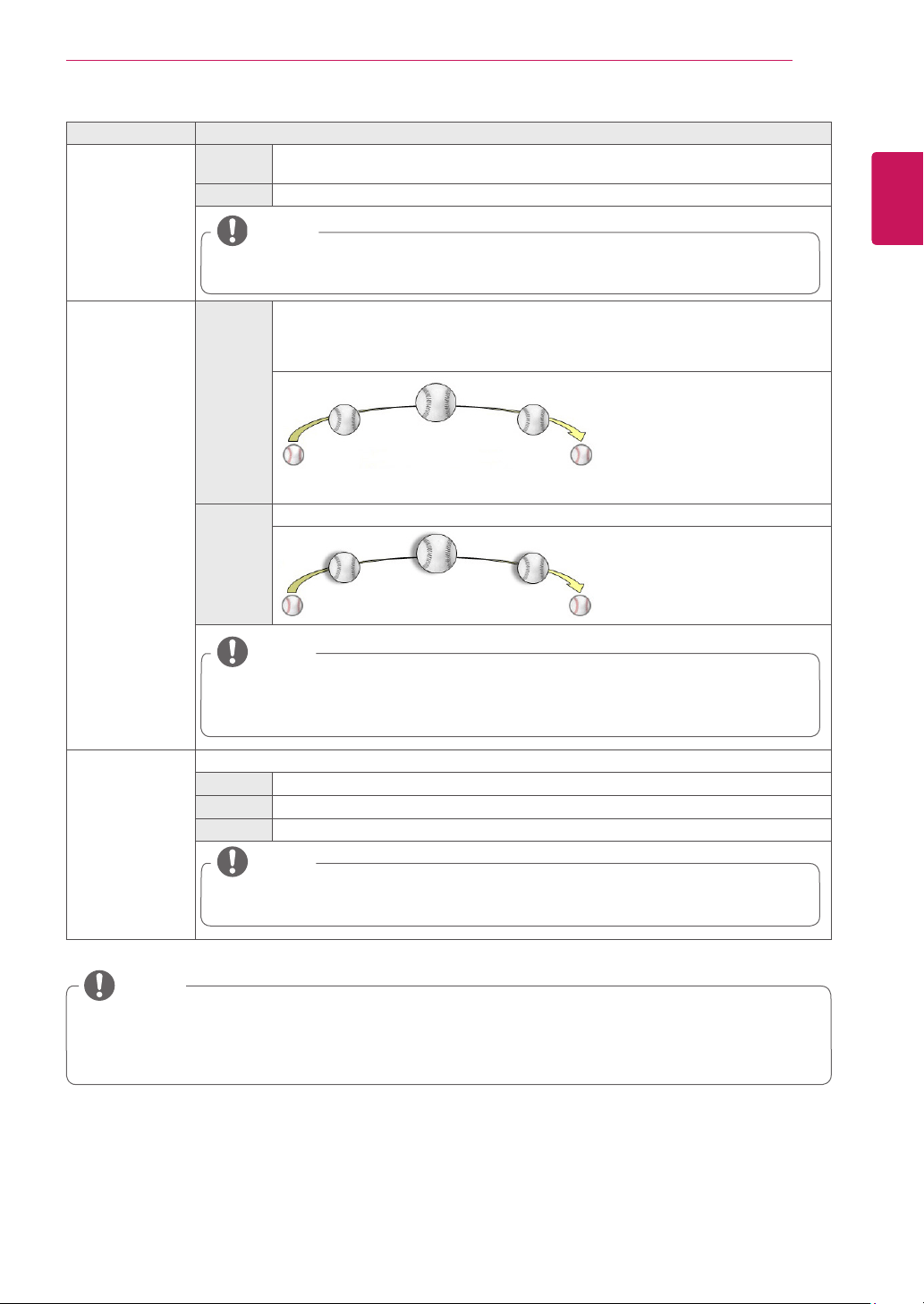
To view the OSD menu, press the joystick button on the
bottom of the monitor and then enter the Menu.
2
Go to Function by moving the joystick.
3
Configure the options following the instructions that appear
in the bottom right corner.
4
If you want to configure an upper menu, or another option,
move the joystick ◄ or press it (
/ OK).
5
If you want to exit the OSD menu, move the joystick ◄ until
you exit.
Each option is described below.
Menu > Function Description
Picture Mode
(Move the joystick
to ▲ in the main
menu to enter
Picture Mode
directly.)
Reader 1 Optimizes the screen for browsing newspapers. You can brighten the screen in the
OSD menu.
Reader 2 Optimizes the screen for reading comics. You can brighten the screen in the OSD
menu.
Photo Optimizes the screen for photos.
Cinema Optimizes the screen for video.
Custom You can customize Screen functions.
Game Mode Gamer
1, 2, 3
Brightness, Contrast, Sharpness, Gamma, Color Temp, Black Stabilizer, Response
Time, DAS Mode, and Motion 240 functions can be customized as Gamer 1, 2, or 3.
FPS 1 Game Mode functions are optimized for FPS games.
FPS 2 The Black Stabilizer value is greater than that of FPS 1. It is suitable for very dark FPS
games.
RTS Game Mode functions are optimized for RTS games.
NOTE
Use the GAME MODE button on the front of the monitor to quickly select and switch be-
tween the Gamer 1/2/3, FPS 1/2, RTS, and Off options.
* FPS: First-Person Shooter
* RTS: Real-Time Strategy
* DAS: Dynamic Action Sync
Function
Easy control
Picture Mode Custom
>
Game Mode FPS 1
>
Function
DAS Mode On
>
Motion 240 Off
>
Screen
SUPER ENERGY SAVING Low
>
Settings
Auto
Configuration
Reset
▲ / ▼: Move
/ ► : OK
◄ : Back
25
ENG
ENGLISH
USER SETTINGS
Menu > Function Description
DAS Mode On You can enjoy faster game ensuring your commands appear onscreen without delay.
(The screen flickers when turning DAS Mode on/off.)
Off Turns DAS Mode off.
NOTE
Use the DAS MODE button on the front of the monitor to quickly select and switch between
the options.
Motion 240 On This mode minimizes motion blur in fast-moving videos. This function only works for
frame rates (vertical frequency) of 100 Hz and 120 Hz. To take full advantage of this
function, select 1920 × 1080 @ 120 Hz for DisplayPort (DP) or DVI inputs before
enabling Motion 240.
This function is available for 100 Hz and 120 Hz only.
Off Turns Motion 240 Mode off.
NOTE
To reduce motion blur, brightness is reduced with backlight control.
Motion 240 and DAS Mode cannot be used simultaneously. When Motion 240 is enabled,
DAS Mode is disabled automatically.
SUPER ENERGY
SAVING
Conserve energy by using luminance compensation algorithm
High Saves energy using the high-efficiency SUPER ENERGY SAVING feature.
Low Saves energy using the low-efficiency SUPER ENERGY SAVING feature.
Off Disables the SUPER ENERGY SAVING function.
NOTE
If you set the SUPER ENERGY SAVING function to high or low in the picture mode of
Reader 1, Reader 2, Photo, or Cinema, the picture mode will be changed to Custom.
Saving Data depends on the panel. So,those values should be different from each panel and panel
vendor. If option of SUPER ENERGY SAVING is High or Low, monitor luminance become higher or
lower depend upon source.
NOTE
26
ENG
ENGLISH
USER SETTINGS
Using Hot Keys
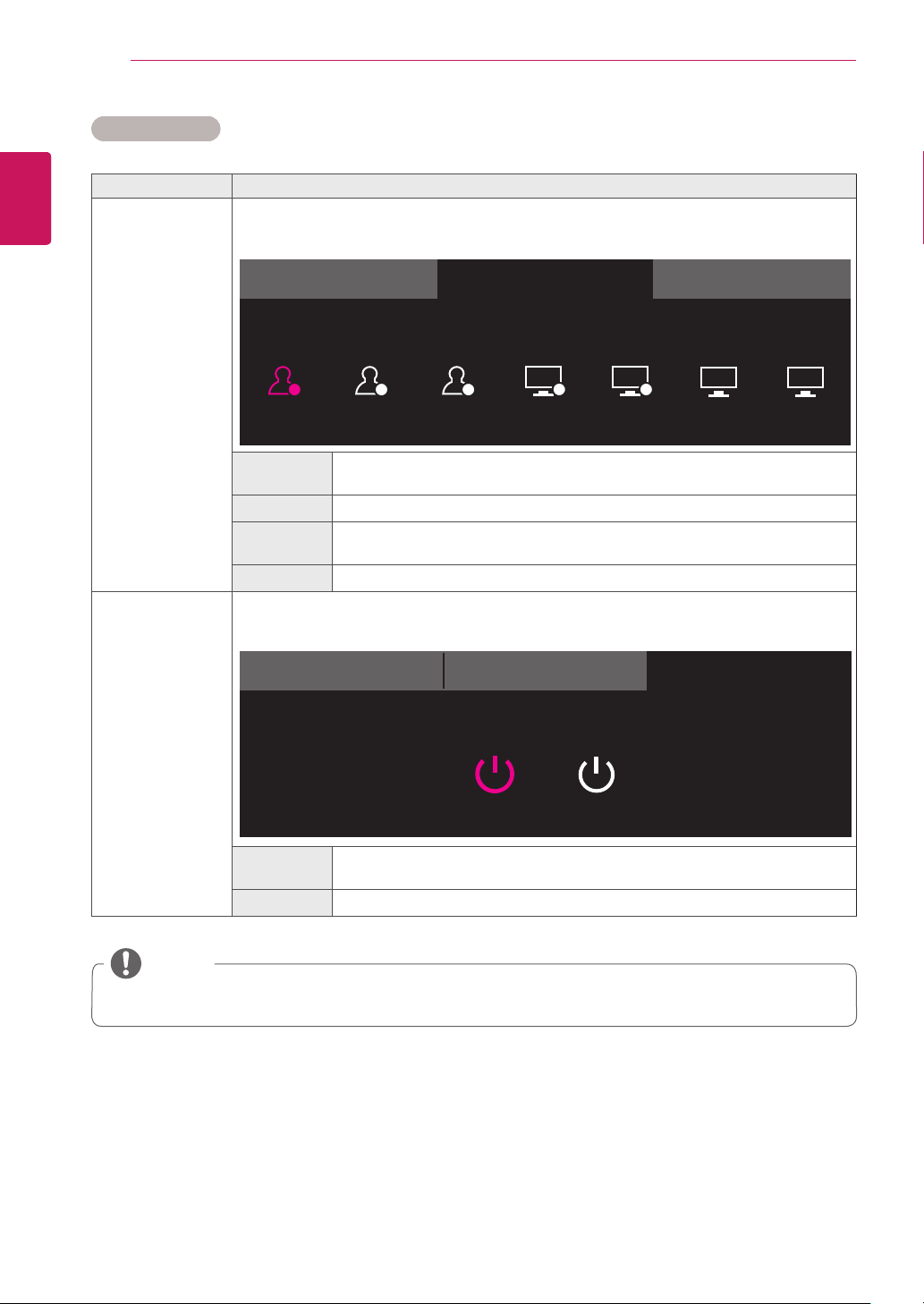
Use the button on the front of the monitor to quickly select and switch between available options.
Menu
Description
GAME MODE
You can enter the OSD menu by pressing the GAME MODE button on the front of the monitor.
You can change the Game Mode settings by using the left and right(< >) buttons.
Press the GAME MODE button again to save your settings and exit the OSD menu.
Black Stabilizer Game Mode DAS Mode
You can choose the optimal screen setting among the gaming presets.
1
3
2
FPS
1
RTS
FPS
2
OFF
1 3
2
FPS
1
RTS
FPS
2
OFF
1
3
2
FPS
1
RTS
FPS
2
OFF
1 3
2
FPS
1
RTS
FPS
2
OFF
1 3
2
FPS
1
RTS
FPS
2
OFF
1 3
2
FPS
1
RTS
FPS
2
OFF
1 3
2
FPS
1
RTS
FPS
2
OFF
Gamer 1 Gamer 2 Gamer 3 FPS 1 FPS 2 RTS Off
Gamer
1, 2, 3
To change the detailed settings, go to Menu → Function → Game Mode →
Gamer 1,2,3.
FPS 1 Game Mode functions are optimized for FPS games.
FPS 2
The Black Stabilizer value is greater than that of FPS 1. It is suitable for very
dark FPS games.
RTS Game Mode functions are optimized for RTS games.
DAS MODE
You can enter the OSD menu by pressing the DAS MODE button on the front of the monitor.
You can change the DAS MODE settings by using the left and right(< >) buttons.
Press the DAS MODE button again to save your settings and exit the OSD menu.
Black Stabilizer Game Mode DAS Mode
You can enjoy faster game ensuring your commands appear onscreen without delay.
On Off
On
You can enjoy faster game ensuring your commands appear onscreen without
delay. (The screen flickers when turning DAS Mode on/off.)
Off Turns DAS Mode off.
NOTE
The buttons on the front of the monitor are disabled in the sleep mode.
27
ENG
ENGLISH
USER SETTINGS
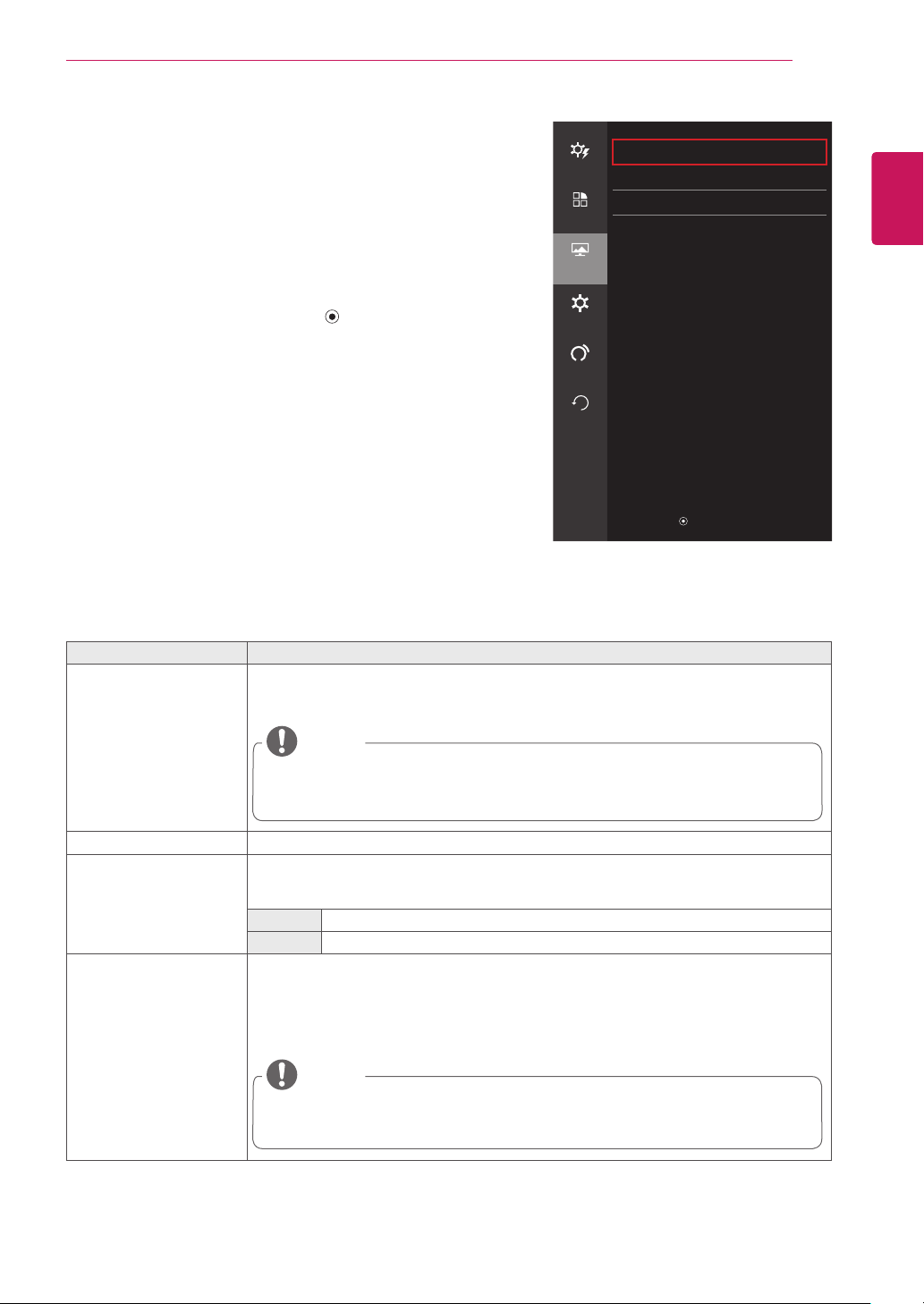
Picture
1
To view the OSD menu, press the joystick button on the
bottom of the monitor and then enter the Menu.
2
Go to Screen > Picture by moving the joystick.
3
Configure the options following the instructions that appear in
the bottom right corner.
4
If you want to configure an upper menu, or another option,
move the joystick ◄ or press it (
/ OK).
5
If you want to exit the OSD menu, move the joystick
◄
until
you exit.
Each option is described below.
Menu > Screen > Picture Description
SUPER RESOLUTION+ With the picture improvement technology that minimizes the degradation of the picture
quality due to enlargement (e.g. blurred focus or unsharpened edges), the resolution is not
compromised, even when the images are enlarged, which guarantees a clear image.
NOTE
Because this is a function to increase the sharpness of low resolution pictures, it
is not recommended to use the function for normal text or for desktop icons. Doing
so may result in unnecessarily high sharpness.
Sharpness Adjusts the sharpness of the screen.
Black Level Sets the offset level (for HDMI only).
Offset: as a reference for the video signal, this is the darkest color the monitor can
display.
High The screen picture gets brighter.
Low The screen picture gets darker.
Black Stabilizer Black Stabilizer
: You can control the black contrast to have better visibility in dark scenes.
Increasing the Black Stabilizer value brightens the low gray level area on the screen. (You
can easily distinguish objects on dark game screens.)
Reducing the Black Stabilizer value darkens the low gray level area and increases the
dynamic contrast on the screen.
NOTE
Use the BLACK ST. button on the front of the monitor to quickly switch between
the Black Stabilizer options.
Screen
Easy control
Picture
>
Color
>
Function
Display
>
Screen
Settings
Auto
Configuration
Reset
▲ / ▼ : Move
/ ► : OK
◄ : Back
28
ENG
ENGLISH
USER SETTINGS
Menu > Screen > Picture Description
Response Time Sets a response time for displayed pictures based on the speed of the screen. For a normal
environment, it is recommended that you use Middle. For a fast-moving picture, it is recom-
mended that you use High.
Setting the response time to High may cause image sticking.
High Sets the response time to High.
Middle Sets the response time to Middle.
Low Sets the response time to Low.
Off Does not use the response time improvement feature.
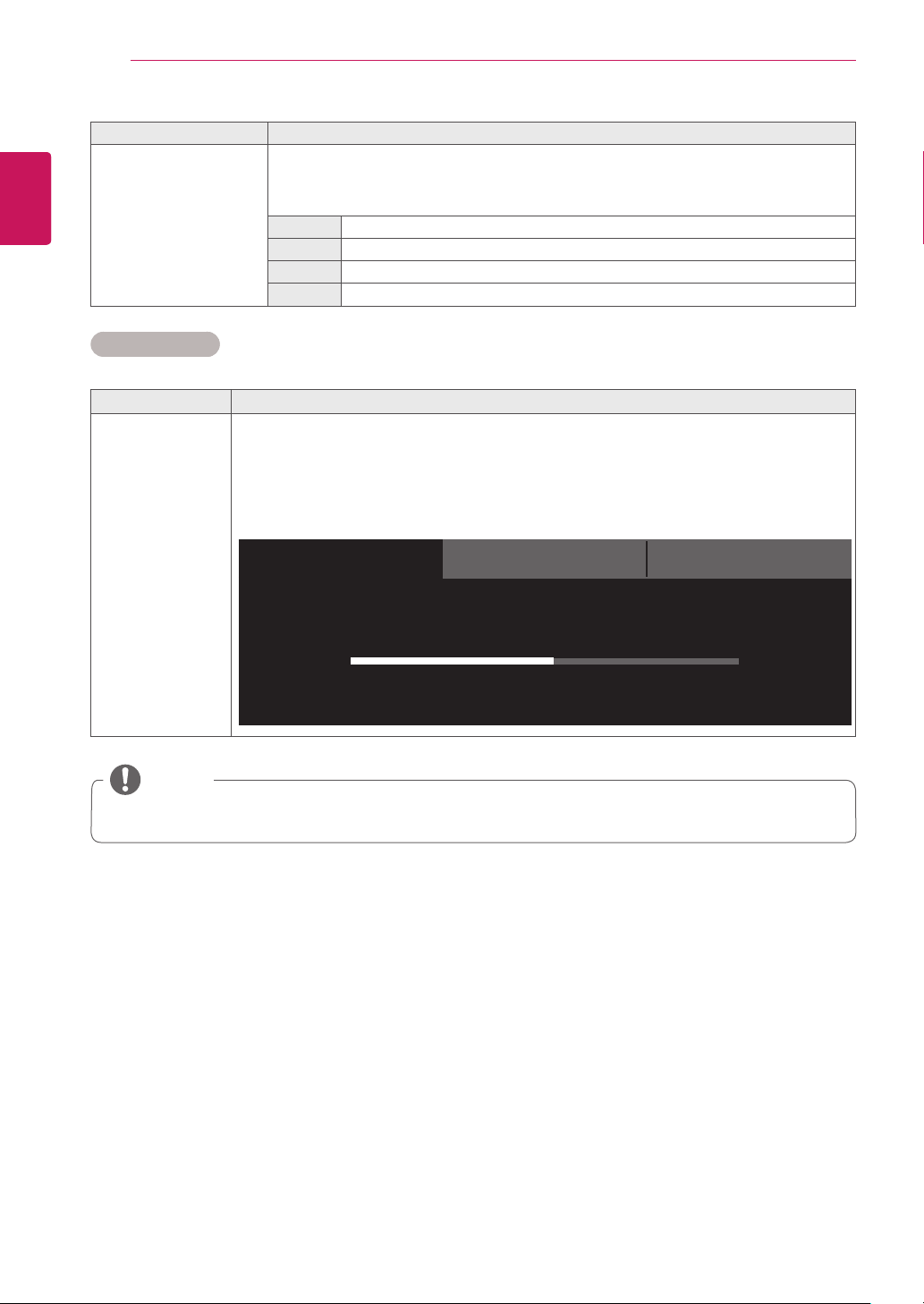
Using Hot Keys
Use the button on the front of the monitor to quickly switch between the BLACK ST. options.
Menu
Description
BLACK ST.
You can enter the OSD menu by pressing the BLACK ST. button on the front of the monitor.
You can change the Black Stabilizer settings by using the left and right(< >) buttons.
Press the BLACK ST. button again to save your settings and exit the OSD menu.
-Increasing the Black Stabilizer value brightens the low gray level area on the screen.
(You can easily distinguish objects on dark game screens.)
- Reducing the Black Stabilizer value darkens the low gray level area and increases the dynam-
ic contrast on the screen.
Black Stabilizer Game Mode DAS Mode
You can control the black contrast to have better visibility in dark scenes.
◄
► 50
NOTE
The buttons on the front of the monitor are disabled in the sleep mode.
29
ENG
ENGLISH
USER SETTINGS
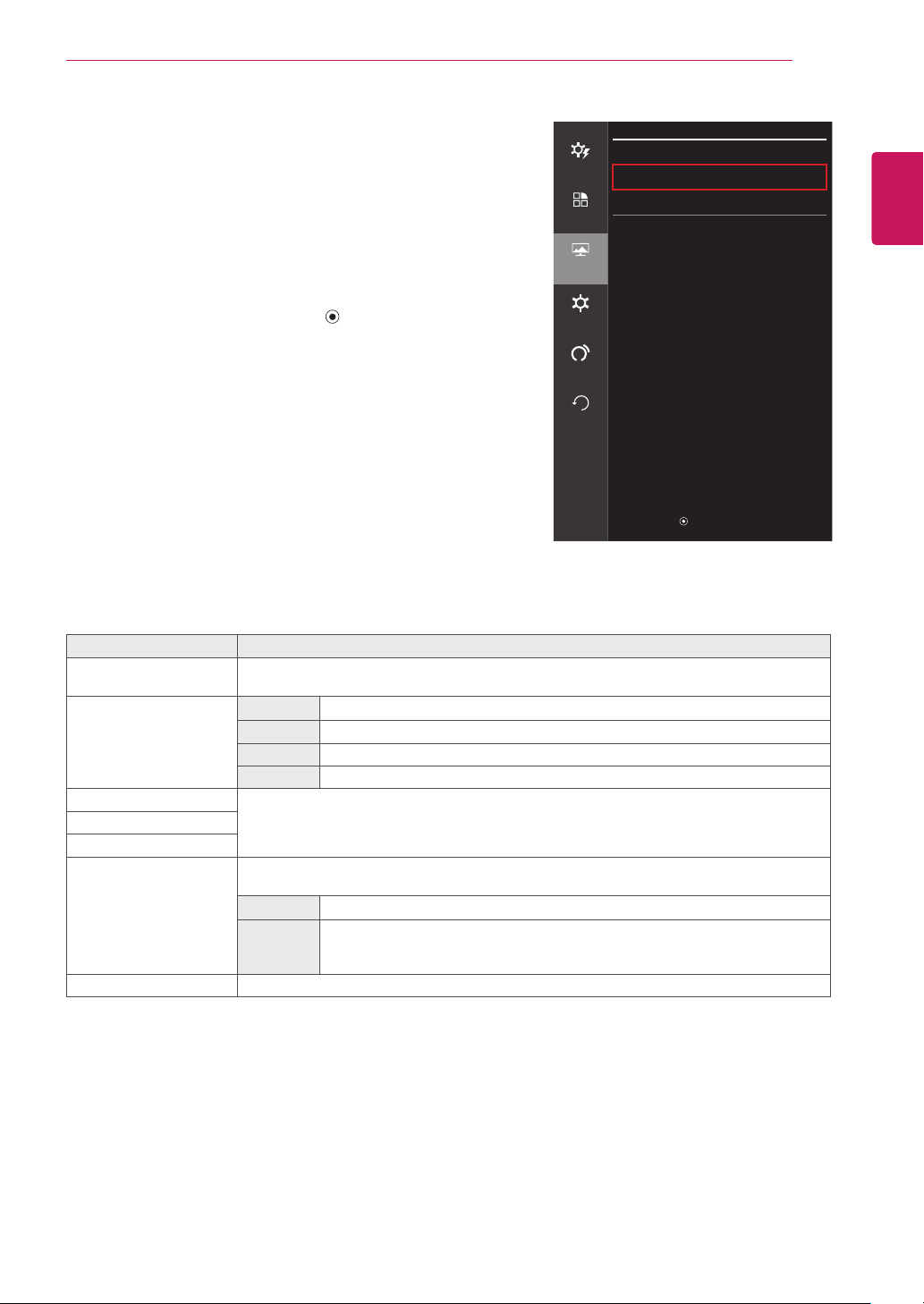
Color
1
To view the OSD menu, press the joystick button on the
bottom of the monitor and then enter the Menu.
2
Go to Screen > Color by moving the joystick.
3
Configure the options following the instructions that appear in
the bottom right corner.
4
If you want to configure an upper menu, or another option,
move the joystick ◄ or press it (
/ OK).
5
If you want to exit the OSD menu, move the joystick ◄ until
you exit.
Each option is described below.
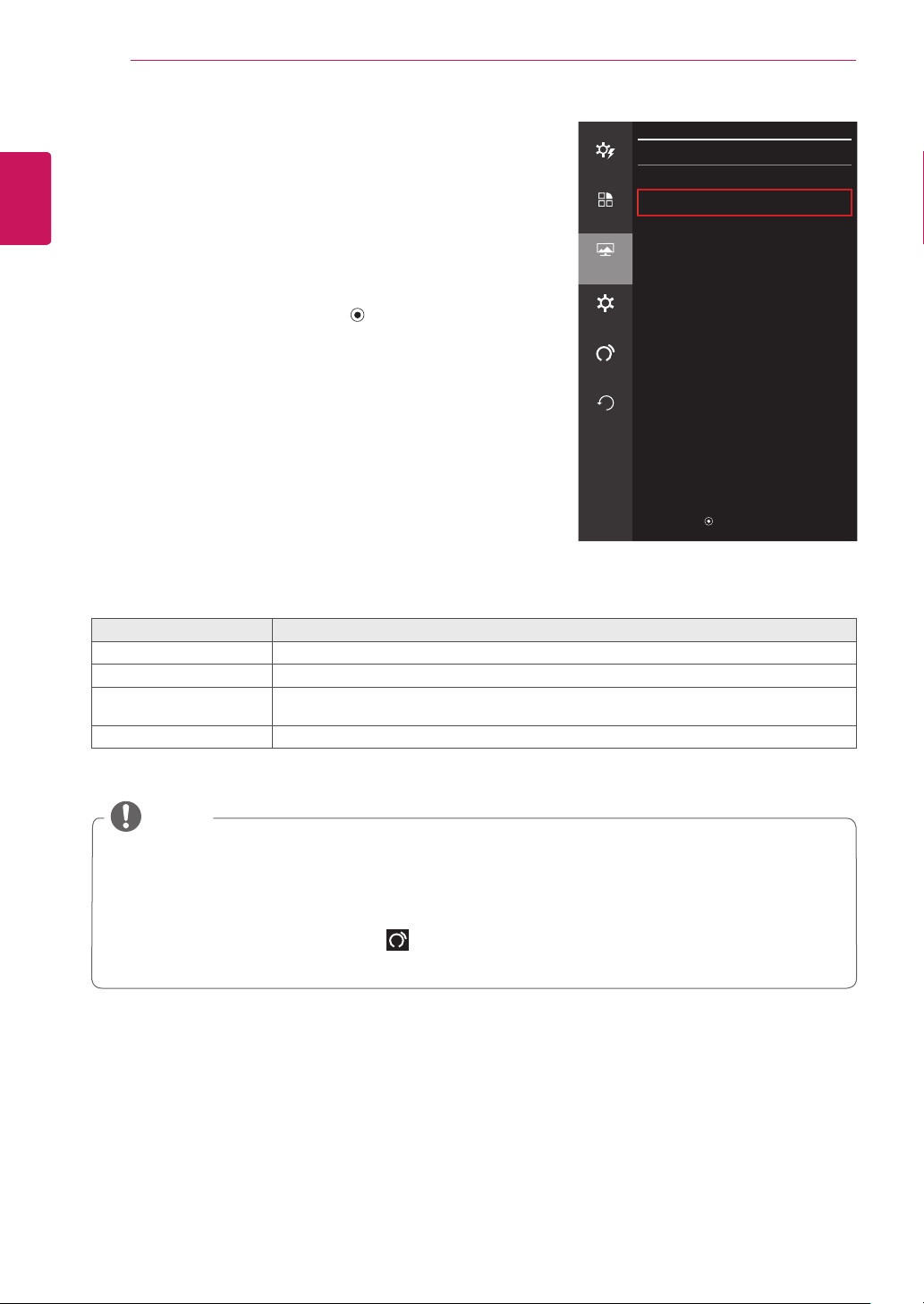
Menu > Screen
> Color
Description
Gamma Custom gamma settings: When using the Gamma 0, Gamma 1, and Gamma 2 monitor set-
tings, higher gamma settings mean a brighter image is displayed and vice versa.
Color Temp Warm Sets the screen color to a reddish tone.
Medium Sets the screen color between the reddish and bluish tone.
Cool Sets the screen color to a bluish tone.
Custom Selects the factory default picture color.
Red You can customize the picture color using Red, Green, and Blue colors.
Green
Blue
Six Color Meets the user's requirements for color by adjusting the hue and saturation of the six colors
(red, green, blue, cyan, magenta, and yellow) and then saving the settings.
Hue Adjusts the tone of the screen colors.
Saturation Adjusts the saturation of the screen colors. The lower the value, the less satu-
rated and brighter the colors become. The higher the value, the more saturated
and darker the colors become.
Reset Returns the colors to the default settings.
Screen
Easy control
Picture
>
Color
>
Function
Display
>
Screen
Settings
Auto
Configuration
Reset
▲ / ▼ : Move
/ ► : OK
◄ : Back
30
ENG
ENGLISH
USER SETTINGS
Display
1
To view the OSD menu, press the joystick button on the
bottom of the monitor and then enter the Menu.
2
Go to Screen > Display by moving the joystick.
3
Configure the options following the instructions that appear in
the bottom right corner.
4
If you want to configure an upper menu, or another option,
move the joystick ◄ or press it (
/ OK).
5
If you want to exit the OSD menu, move the joystick
◄
until
you exit.
Each option is described below.
Menu > Screen
> Display
Description
Horizontal Used to adjust the horizontal position of the screen.
Vertical Used to adjust the vertical position of the screen.
Clock To obtain the correct width of the input signal by adjusting the frequency. Used to minimize
the vertical bars that appear because of an incorrect width.
Phase Used to optimize screen performance by adjusting the phase.
Screen
Easy control
Picture
>
Color
>
Function
Display
>
Screen
Settings
Auto
Configuration
Reset
▲ / ▼ : Move
/ ► : OK
◄ : Back
NOTE
This function is activated only when using D-Sub analog input.
(When using analog signals, this function is required because the position and focus of the video
varies slightly according to graphic cards, cables, resolution settings, etc. This function is not re-
quired when using digital signals.)
Use the Menu > Auto Configuration ( ) function to automatically obtain the optimal position and
focus.

31
ENG
ENGLISH
USER SETTINGS
Settings
1
To view the OSD menu, press the joystick button on the
bottom of the monitor and then enter the Menu.
2
Go to Settings by moving the joystick.
3
Configure the options following the instructions that appear in
the bottom right corner.
4
If you want to configure an upper menu, or another option,
move the joystick ◄ or press it (
/ OK).
5
If you want to exit the OSD menu, move the joystick ◄ until
you exit.
Each option is described below.
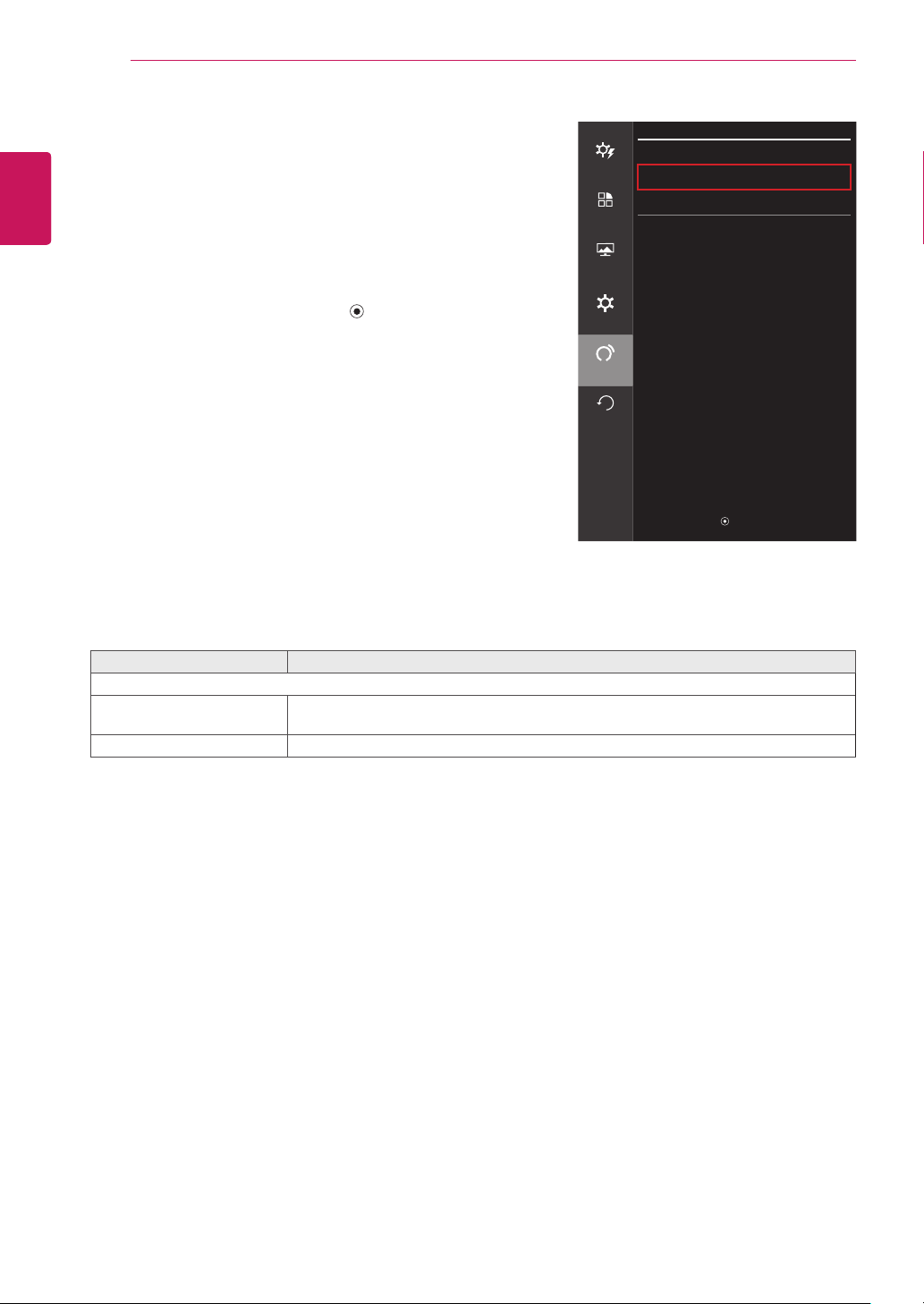
Menu > Settings Description
Language Sets the menu screen to the desired language.
Power LED Turns the Power LED on the front of the monitor on or off.
On The power LED turns on automatically.
Off The power LED turns off.
Automatic
Standby
Turns the monitor off automatically when there is no movement on the screen for a set period of
time.
You can set timer for the auto-off function. (Off, 4H, 6H, and 8H)
OSD Lock Prevents incorrect key input.
On Disables the key input feature.
Off Enables the key input feature.
NOTE
All of the features are disabled, except for Brightness, Contrast, Volume, Input, OSD
Lock in Settings, and the Exit button.
Settings
Easy control
Language English
>
Power LED Off
>
Function
Automatic Standby Off
>
OSD Lock Off
>
Screen
Settings
Auto
Configuration
Reset
▲ / ▼ : Move
/ ► : OK
◄ : Back
32
ENG
ENGLISH
USER SETTINGS
Auto Configuration
1
To view the OSD menu, press the joystick button on the
bottom of the monitor and then enter the Menu.
2
Go to Auto Configuration by moving the joystick.
3
Configure the options following the instructions that appear in
the bottom right corner.
4
If you want to configure an upper menu, or another option,
move the joystick ◄ or press it (
/ OK).
5
If you want to exit the OSD menu, move the joystick ◄ until
you exit.
Each option is described below.
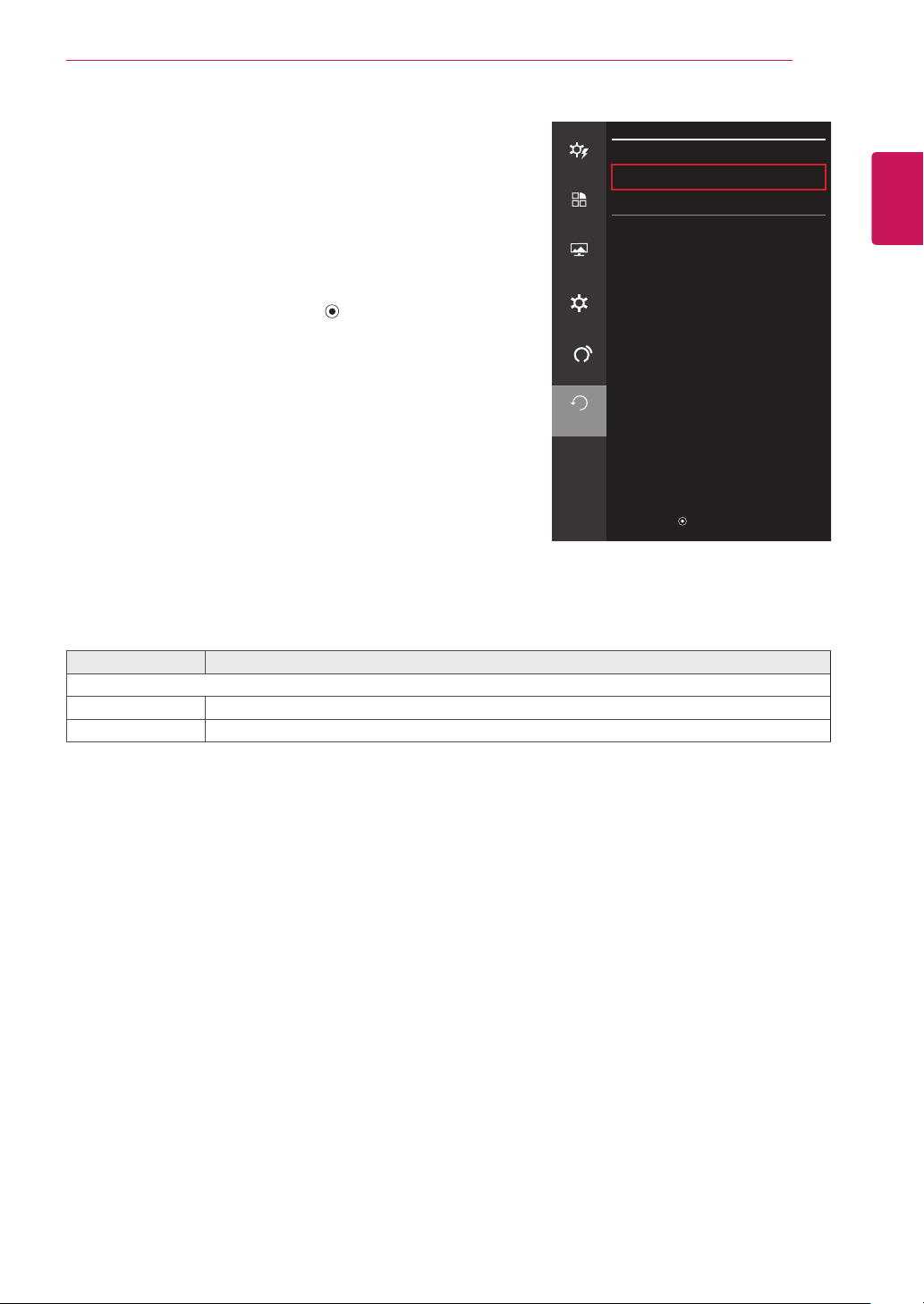
Menu > Auto Configuration Description
Do you want to Auto Configuration?
Yes Adjusts the Position, Width, and Phase of the screen automatically.
(Activated only when using a D-Sub Analog input.)
Cancel Cancels the Auto Configuration.
Auto Configuration
Easy control
Do you want to Auto Configuration?
Yes
Function
Cancel
Screen
Settings
Auto
Configuration
Reset
▲ / ▼ : Move
/ ► : OK
◄ : Back
33
ENG
ENGLISH
USER SETTINGS
Reset
1
To view the OSD menu, press the joystick button on the
bottom of the monitor and then enter the Menu.
2
Go to Reset by moving the joystick.
3
Configure the options following the instructions that appear in
the bottom right corner.
4
If you want to configure an upper menu, or another option,
move the joystick ◄ or press it (
/ OK).
5
If you want to exit the OSD menu, move the joystick ◄ until
you exit.
Each option is described below.
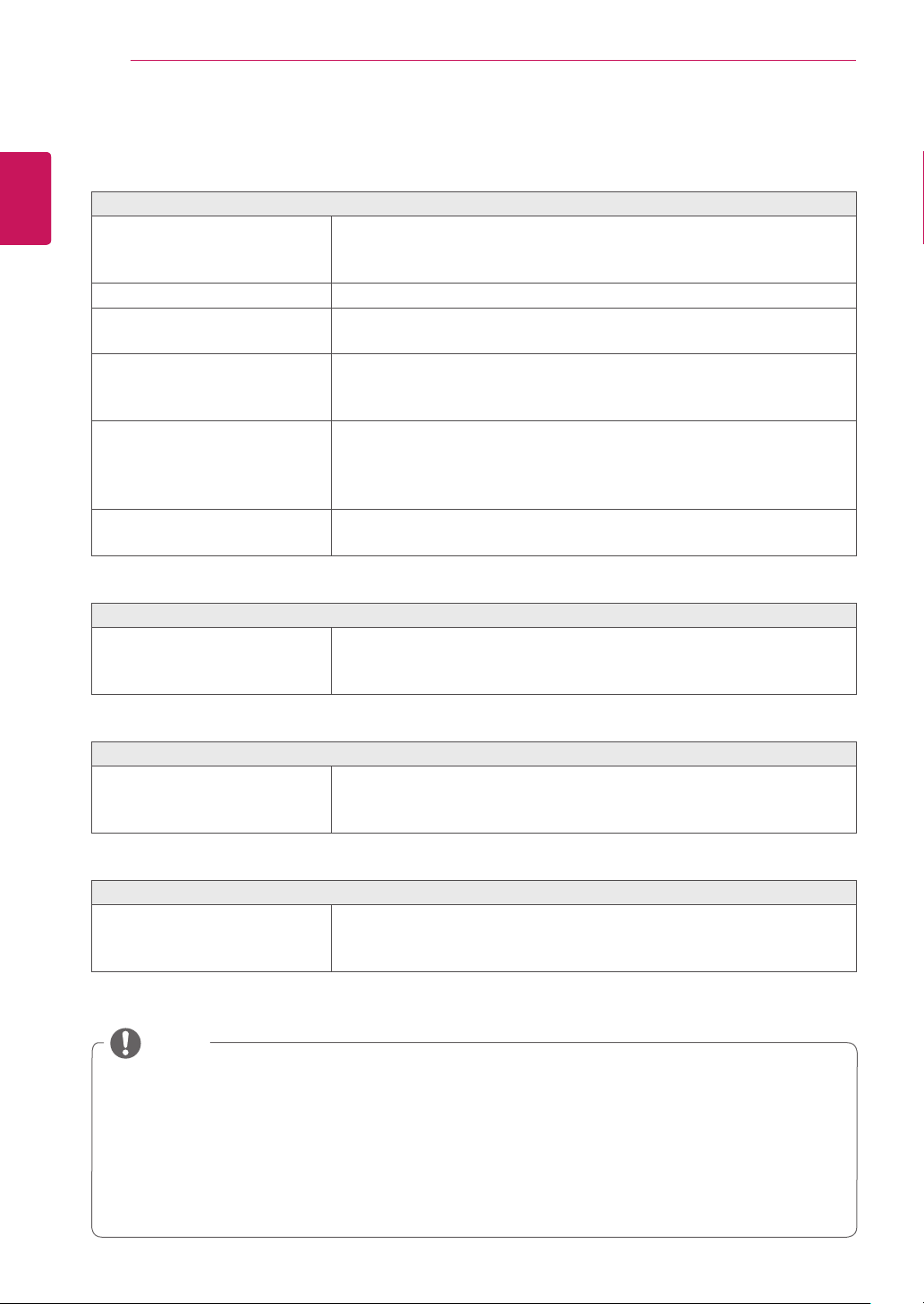
Menu >
Reset
Description
Do you want to reset your settings?
Reset Restores the default settings.
Cancel Cancels the Reset.
Reset
Easy control
Do you want to reset your settings?
Reset
Function
Cancel
Screen
Settings
Auto
Configuration
Reset
▲ / ▼ : Move
/ ► : OK
◄ : Back
34
ENG
ENGLISH
TROUBLESHOOTING
Nothing is displayed on the screen.
Is the monitor's power cord
plugged in?
Check if the power cord is correctly plugged in to the power outlet.
Confirm there is power available at the AC plug by plugging in a lamp
or another electrical device.
Is the power LED on?
Check the power cable connection and press the power button.
Is the power on and the power
LED displaying white?
Check that the connected input is enabled (Menu - Input).
Is the power LED blinking?
If the monitor is in sleep mode, move the mouse or press
any key on the keyboard to switch the display on.
Check if the computer is turned on.
Is the OUT OF RANGE mes-
sage being displayed?
This occurs when signals transferred from the PC (video card) are
out of the horizontal or vertical frequency range of the monitor.
Please see the Product Specification section of this manual to set
the appropriate frequency.
Is the No Signal message be-
ing displayed?
This is displayed when the signal cable between the PC and the
monitor is missing or disconnected. Check the cable and reconnect.
The OSD Lock message is being displayed.
Are some functions not avail-
able when you press the Menu
button?
The OSD is locked. Go to Menu > Settings and set OSD Lock to
Off.
The screen retains an image.
Does image sticking occur even
when the monitor is turned off?
Displaying a still image for a prolonged time may cause damage to
the screen, resulting in the retention of the image.
To extend the lifetime of the monitor, use a screensaver.
Screen display is unstable and shaky / Images displayed on the monitor leave shadow trails.
Did you select the appropriate
resolution?
If the selected resolution is HDMI 1080i 60/50 Hz (interlaced), the
screen may be flickering. Change the resolution to 1080P or the
recommended resolution.
TROUBLESHOOTING
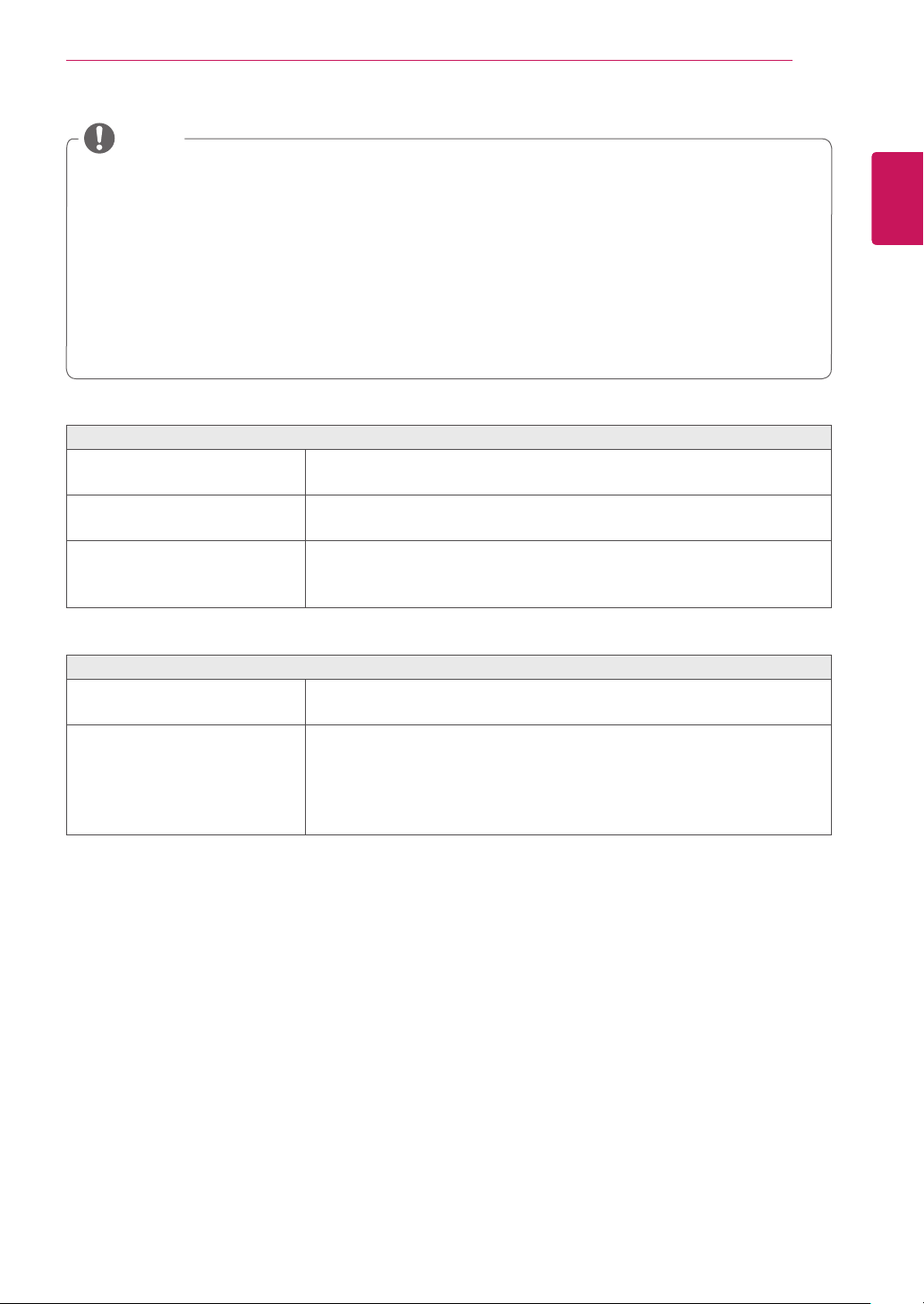
Vertical Frequency: In order to display an image, the screen must be refreshed dozens of times per
second like a fluorescent lamp.
The number of times the screen is refreshed per second is called vertical frequency or refresh rate
and is represented by Hz.
Horizontal Frequency: The time it takes to display one horizontal line is called the horizontal cycle.
The number of horizontal lines displayed in one second can be calculated by dividing one by the
horizontal cycle. This is called horizontal frequency and is represented by kHz.
NOTE
35
ENG
ENGLISH
TROUBLESHOOTING
The display color is abnormal.
Does the display appear discol-
ored (16 color)?
Set the color to 24 bit (true color) or higher. In Windows, go to Control
Panel > Display > Settings > Color Quality.
Does the display color appear
unstable or in monochrome?
Check if the signal cable is connected properly. Reconnect the cable
or reinsert the PC's video card.
Are there spots on the screen?
When using the monitor, pixilated spots (red, green, blue, white, or
black) may appear on the screen. This is normal for the LCD screen.
It is not an error nor is it related to the monitor's performance.
No sound from the headphone port.
Are the D-Sub and DVI con-
nected?
D-Sub and DVI do not support audio.
Audio may not be supported, depending on the type of cable you use.
Are images displayed using
DP (DisplayPort) or HDMI input
without sound?
Make sure that the headphone port connections are made properly.
Try increasing the volume with the joystick.
Set the audio output of the PC to the monitor you are using: On
Microsoft Windows, go to Control Panel > Hardware and Sound >
Sound > set the monitor as default device.
Check if the video card's resolution or frequency is within the range allowed by the monitor and set to
the recommended (optimal) resolution in Control Panel > Display > Settings.
Failing to set the video card to the recommended (optimal) resolution may result in blurred text, a
dimmed screen, a truncated display area or misalignment of the display.
The configuration procedure may differ depending on your computer and/or operating system. Also,
some video cards may not support certain resolutions. If this is the case, contact the manufacturer of
the computer or video card for assistance.
Some video cards may not support 1920 x 1080 resolution.
If the resolution cannot be displayed, contact the manufacturer of your video card.
NOTE
36
ENG
ENGLISH
PRODUCT SPECIFICATION
PRODUCT SPECIFICATION
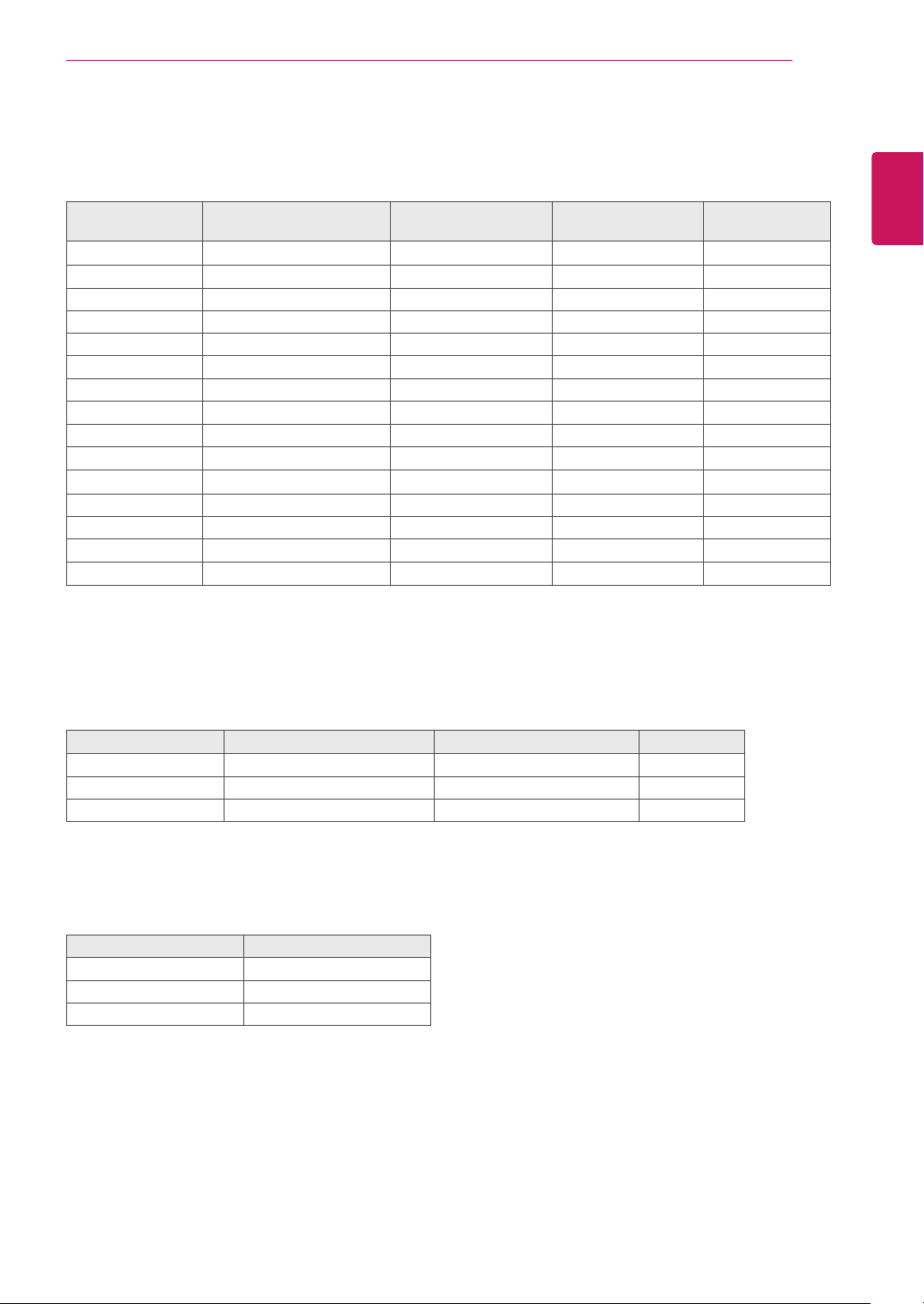
LCD Screen Type 60.9 cm TFT (Thin Film Transistor)
LCD (Liquid Crystal Display) Screen
Diagonal length of the screen: 60.9 cm
24" class (24" / 60.9 cm diagonal)
Pixel Pitch 0.27675 mm x 0.27675 mm
Resolution Maximum Resolution Analog, HDMI 1920 x 1080 @ 60 Hz
DVI-D, DisplayPort 1920 x 1080 @ 144 Hz
Recommended Resolution 1920 x 1080 @ 60 Hz
Video Signal Horizontal Frequency Analog, HDMI 30 kHz to 135 kHz
DVI-D, DisplayPort 30 kHz to 160 kHz
Vertical Frequency Analog, HDMI 56 Hz to 120 Hz
DVI-D, DisplayPort 56 Hz to 144 Hz
Synchronization Separate Sync.
Input Connector USB 1, 2, USB UP, DP(DisplayPort) IN, D-SUB IN, DVI-D IN, HDMI IN 1, 2, HP OUT
Power Voltage AC 100-240 V~ 50 / 60 Hz 0.8 A
Power consumption (Typ.) On Mode ≤ 23 W
Sleep Mode ≤ 1.2 W
Off Mode ≤ 0.3 W
Stand Angle Forward/Backward: -5° to 20° (Head)
Environmental
Conditions
Operating Condition Temperature: 10°C to 35°C; Humidity: 10% to 80%
Storing Condition Temperature: -20°C to 60°C; Humidity: 5% to 90%
Dimension Monitor Size (Width x Height x Depth)
With stand
567.6 mm x 401.2 mm x 248 mm
(22.3 inch x 15.7 inch x 9.7 inch)
Without Stand
567.6 mm x 353.9 mm x 57.3 mm
(22.3 inch x 13.9 inch x 2.2 inch)
Weight (Without
Packaging)
With stand 5.43 kg (11.9 lb)
Without Stand 3.83 kg (8.4 lb)
The specifications are subject to change without notice.
37
ENG
ENGLISH
PRODUCT SPECIFICATION
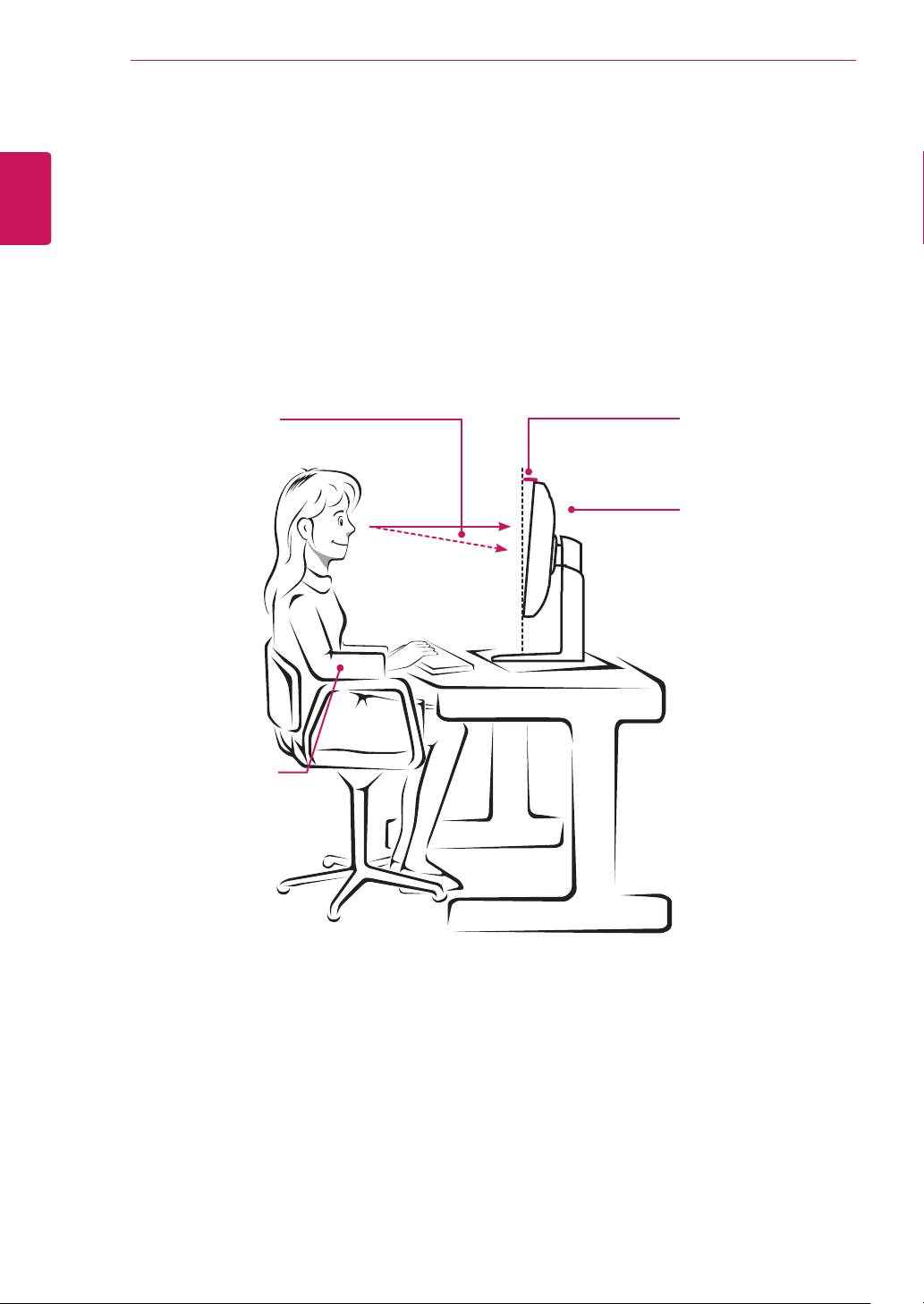
Factory Support Mode
(Preset Mode, DisplayPort/D-SUB/DVI-D/HDMI PC)
Preset Mode, PC
Horizontal Frequency
(kHz)
Vertical Frequency
(Hz)
Polarity (H/V) Remarks
720 x 400 31.468 70.08 -/+
640 x 480 31.469 59.94 -/-
640 x 480 37.5 75 -/-
800 x 600 37.879 60.317 +/+
800 x 600 46.875 75 +/+
800 x 600 76.302 119.972 +/-
1024 x 768 48.363 60 -/-
1024 x 768 60.123 75.029 +/+
1024 x 768 97.551 119.989 +/-
1280 x 1024 63.981 60.02 +/+
1280 x 1024 79.976 75.025 +/+
1280 x 1024 * 130.035 119.958 +/-
1920 x 1080 67.5 60 +/-
1920 x 1080 ** 137.26 119.98 +/-
1920 x 1080 ** 158.11 144 +/-
* 1280 x 1024 @ 120 Hz: HDMI not supported.
** 1920 x 1080 @ 120 Hz/144 Hz: HDMI/D-Sub not supported.
HDMI Timing (Video)
Preset Mode, PC Horizontal Frequency (kHz) Vertical Frequency (Hz) Remarks
480P 31.5 60
720P 45 60
1080P 67.5 60
Power LED
Mode LED Color
On Mode White
Sleep Mode Blinking in white
Off Mode Off
38
ENG
ENGLISH
PROPER POSTURE
PROPER POSTURE
Proper Posture for Using the Monitor
Adjust the screen so that you can comfortably look at it at a slight downward angle from your natural eye
level.
Take a break for approximately 10 minutes every hour to reduce any fatigue caused by long-time
usage.
The stand of the touch monitor allows the product to be used in the optimum position.
Adjust the stand angle from -5° to 20° to obtain the best view of the screen.
You should be looking
slightly down at the
screen.
Place your hands gently
on the keyboard,
keeping your arms bent
at the elbows
and extended
horizontally in front of
you.
Adjust the angle
-5° to 20°
So that there is no
reflection or glare from
the screen.

This device meets the EMC requirements
for home appliances (Class B) and is in-
tended for home usage. This device can
be used in all regions. Read the owner's
manual (CD) carefully and keep it at
hand. Please note that the label attached
to the product provides information for
technical support.
Model
Serial No.
As an ENERGY STAR Partner LGE
U. S. A., Inc. has determined that
this product meets the ENERGY
STAR guidelines for energy
efficiency.
ENERGY STAR is a set of power-saving
guidelines issued by the U.S.Environmental
Protection Agency(EPA).
Refer to ENERGY STAR.gov for more infor-
mation on the ENERGY STAR program.
Declaration of Conformity
Trade Name: LG
Model: 24GM77
Responsible Party: LG Electronics Inc.
Address: 1000 Sylvan Ave.
Englewood Cliffs NJ 07632
U.S.A
TEL: 201-266-2534