
2
3
TABLE OF CONTENTS
PROTECTION AGREEMENTS
............................... 3
WARRANTY
............................................................4
REFRIGERATOR SAFETY
.................................. 5-6
Proper Disposal of Your Old Refrigerator ........ 6
INSTALLATION INSTRUCTIONS .....................
7
Unpack the Refrigerator ......................................7
Location Requirements .........................................8
Electrical Requirements ....................................... 8
Parts and Features ................................................ 9
Water Supply Requirements ............................. 10
Connect the Water Supply ............................... 10
Connect to Refrigerator ...................................... 11
Complete the Installation ...................................12
Front Base Grille Installation ............................13
Reverse Doors ................................................. 13-14
Handles Installation .............................................15
Adjust the Doors ..................................................16
REFRIGERATOR USE
........................................... 17
Using the Controls ............................................ 17
Icemaker ..............................................................18
REFRIGERATOR FEATURES
................................19
Refrigerator Shelves ...........................................19
Deli Drawer ..........................................................19
Crisper .................................................................20
FREEZER FEATURES
.............................................21
DOOR FEATURES
.................................................22
Door Bins .............................................................22
Dairy Compartment ..........................................22
FOOD STORAGE GUIDE
....................................23
Fresh Food Storage ...........................................23
REFRIGERATOR CARE
........................................24
Cleaning ..............................................................24
To Clean Your Refrigerator ...............................24
Vacation and Moving Care .............................24
TROUBLESHOOTING GUIDE
.............................26
SERVICE NUMBERS
.........................BACK COVER

2
3
PROTECTION AGREEMENTS
Master Protection Agreements
Congratulations on making a smart purchase. Your new
Kenmore® product is designed and manufactured for
years of dependable operation. But like all products,
it may require preventive maintenance or repair from
time to time. That’s when having a Master Protection
Agreement can save you money and aggravation.
The Master Protection Agreement also helps extend the
life of your new product. Here’s what the Agreement*
includes:
• Parts and labor
not just for repairing defects, but to
help keep products operating properly
under normal
use
. Our coverage goes
well beyond the product
warranty
. No deductibles, no functional failure
excluded from coverage—
real protection
.
• Expert service
by experienced service technicians
trusted in millions of homes every year.
• Unlimited service calls and nationwide service
, as
often as you want us, whenever you want us.
• “No-lemon” guarantee
– replacement of your covered
product after three separate product failures occur
within twelve months and a fourth repair is required.
Includes free delivery and installation, if necessary, of
replacement product.
• Product replacement
if your covered product can’t be
xed.
• Annual Preventive Maintenance Check
at your
request – no extra charge.
• Fast help by phone
– phone support from a service
agent on all products to help troubleshoot problems.
Think of us as a “talking owner’s manual.”
• Power surge protection
against electrical damage due
to power uctuations.
•
$
300 Food Loss Protection
for any food spoilage
that is the result of mechanical failure of any covered
refrigerator or freezer.
• Service Promise: $50
if rst attempt repair of your
covered product can’t be accomplished and product is
not usable while awaiting further repair service.
• 25% discount
o the regular price of any non-covered
repair service and related installed parts.
Once you purchase the Agreement, a simple phone call is
all that it takes for you to schedule service. You can call
anytime day or night.
The Master Protection Agreement is a risk free purchase.
If you cancel for any reason during the product warranty
period, we will provide a full refund. Or, a prorated
refund anytime after the product warranty period expires.
Purchase your Master Protection Agreement today!
Some limitations and exclusions apply. For prices and
additional information in the U.S.A. call 1-800-827-
6655.
* Coverage in Canada varies on some items. For full
details call Sears Canada at 1-800-361-6665.
Sears Installation Service
For Sears professional installation of home appliances,
garage door openers, water heaters, and other major
home items, in the U.S.A. call
1-844-553-6667
, and in
Canada call
1-800-469-4663
.
PRODUCT RECORD
In the space below, record the date of purchase, model and serial number of your product. You will nd the model and
serial number printed on an identication label located on the interior liner of the refrigerator compartment. Have these
items of information available whenever you contact Sears concerning your product.
Model No.___________________ Date of Purchase ___________________
Serial No.___________________
Save these instructions and attach your sales receipt for future reference.
4
5
KENMORE LIMITED WARRANTY
REFRIGERATOR WARRANTY
KENMORE LIMITED WARRANTY
FOR ONE YEAR from the date of sale this appliance is warranted against defects in material or workmanship when
it is correctly installed, operated and maintained according to all supplied instructions.
WITH PROOF OF SALE, a defective appliance will receive free repair or replacement at option
of seller.
For warranty coverage details to obtain free repair or replacement, visit the web page: www.kenmore.com/warranty
This warranty applies for only 90 DAYS if this appliance is ever used for other than private household purposes.
This warranty covers ONLY defects in material and workmanship, and will NOT pay for:
1. Expendable items that can wear out from normal use, including but not limited to lters, belts, bags or screw-in
base light bulbs.
2. A service technician to clean or maintain this appliance, or to instruct the user in correct appliance installation,
operation and maintenance.
3. Service calls to correct appliance installation not performed by Sears authorized service agents, or to repair
problems with house fuses, circuit breakers, house wiring, and plumbing or gas supply systems resulting from such
installation.
4. Damage to or failure of this appliance resulting from installation not performed by Sears authorized service
agents, including installation that was not in accord with electrical, gas or plumbing codes.
5. Damage to or failure of this appliance, including discoloration or surface rust, if it is not correctly operated and
maintained according to all supplied instructions.
6. Damage to or failure of this appliance, including discoloration or surface rust, resulting from accident, alteration,
abuse, misuse or use for other than its intended purpose.
7. Damage to or failure of this appliance, including discoloration or surface rust, caused by the use of detergents,
cleaners, chemicals or utensils other than those recommended in all instructions supplied with the product.
8. Damage to or failure of parts or systems resulting from unauthorized modications made to this appliance.
9. Service to an appliance if the model and serial plate is missing, altered, or cannot easily be determined to have
the appropriate certication logo.
Disclaimer of implied warranties; limitation of remedies
Customer’s sole and exclusive remedy under this limited warranty shall be product repair or replacement as provided
herein. Implied warranties, including warranties of merchantability or tness for a particular purpose, are limited to
one year or the shortest period allowed by law. Seller shall not be liable for incidental or consequential damages.
Some states do not allow the exclusion or limitation of incidental or consequential damages, or limitation on the
duration of implied warranties of merchantability or tness, so these exclusions or limitations may not apply to you.
This warranty applies only while this appliance is used in the United States.
This warranty gives you specic legal rights, and you may also have other rights which vary from state to state.
Sears Brands Management Corporation, Hoffman Estates, IL 60179
4
5
REFRIGERATOR SAFETY
IMPORTANT SAFETY INSTRUCTIONS
Your safety and the safety of others are very important.
We have provided many important safety messages in this manual and on your appliance. Always read and obey all
safety messages.
This is the safety alert symbol.
This symbol alerts you to potential hazards that can kill or hurt you and others.
All safety messages will follow the safety alert symbol and either the word “DANGER” or “WARNING.”
These words mean:
WARNING:
To reduce the risk of re, electric shock, or injury to persons when using the refrigerator, follow basic
precautions, including the following:
• Plug into a grounded 3 prong outlet.
• Do not remove ground prong.
• Do not modify plug on power cord. If plug does not
t electrical outlet, have proper outlet installed by a
qualied electrician.
• Do not use a two-prong adapter, extension cord or
power strip.
• Do not service or replace any part of refrigerator
unless specically recommended in Use & Care Guide
or published user-repair instructions. Do not attempt
service if instructions are not under-stood or if they are
beyond personal skill level.
• Always disconnect refrigerator from electrical supply
before attempting any service.
• Disconnect power cord by grasping the plug, not the
cord.
• Install refrigerator according to Installation Instructions.
All connections for water, electrical power and
grounding must comply with local codes and be made
by licensed personnel when required.
• Keep your refrigerator in good condition. Bumping
or dropping refrigerator can damage refrigerator or
cause refrigerator to malfunction or leak. If damage
occurs, have refrigerator checked by qualied service
technician.
• Replace worn power cords and/or loose plugs.
• Always read and follow manufacturer’s storage and
ideal environment instructions for items being stored in
refrigerator.
• Your refrigerator should not be operated in the
presence of explosive fumes.
• Remove doors from your old refrigerator.
• Children should not climb, hang or stand on any part
of the refrigerator.
• Clean up spills or water leakage associated with water
installation.
• Use nonammable cleaner.
• Keep ammable materials and vapors, such as
gasoline, away from refrigerator.
• Use two or more people to move and install
refrigerator.
• Disconnect power before installing icemaker (on
icemaker kit ready models only).
You can be killed or seriously injured if you don’t immediately follow instructions.
You can be killed or seriously injured if you don’t follow instructions.
SAVE THESE INSTRUCTIONS
All safety messages will tell you what the potential hazard is, tell you how to reduce the chance of injury, and tell you
what can happen if the instructions are not followed.
6
7
SPECIFICATIONS
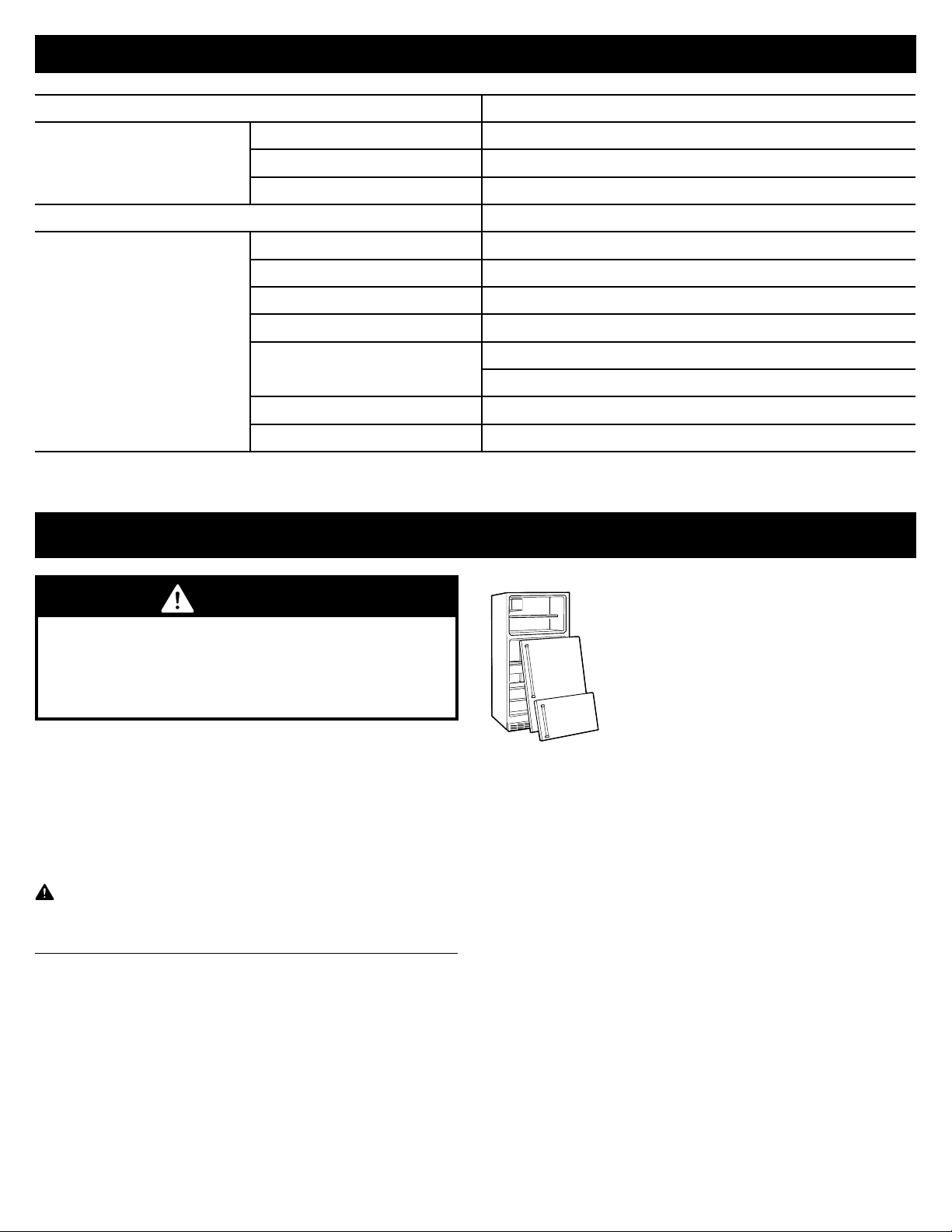
MODELS 7121*, 6121 *
EXTERNAL DIMENSIONS
WIDTH 32.9 in
BACKGROUND 32.0 in
HIGH 66.7 in
NET WEIGHT 220.5 Lbs
SYSTEM
CARACTERISTICS
FREEZER CAPACITY 5.8 cu ft
FRESH FOOD CAPACITY 15.0 cu ft
TOTAL CAPACITY 20.8 cu ft
COOLING SYSTEM FORCED CONVECTION
DEFROST SYSTEM
BY RESISTENCE, TYPE SHEATH
AUTOMATIC
REFRIGERANT R134a
SUPPLY VOLTAGE 115V-127V/60Hz
Proper Disposal of Your Old Refrigerator
DANGER
Child Entrapment and Suffocation Hazard
Remove doors from your old refrigerator.
Failure to do so can result severe injury or death.
Junked or abandoned refrigerators are still dangerous –
even if they will sit for “just a few days.” If you are getting
rid of your old refrigerator, please follow these instructions
to help prevent accidents.
BEFORE YOU THROW AWAY
YOUR OLD REFRIGERATOR
OR FREEZER:
• Take o the doors.
• Leave the shelves in place so that
children may not easily climb inside.
Important information to know about disposal of
refrigerants:
Dispose of refrigerator in accordance with Federal
and Local regulations. Refrigerants must be evacuated
by a licensed, EPA certied refrigerant technician in
accordance with established procedures.
WARNING
STATE OF CALIFORNIA
PROPOSITION 65 WARNINGS
The California Safe Drinking Water and Toxic Enforcement
Act requires the Governor of California
to publish a list of substances known to the State of
California to cause cancer. birth defects. or other
reproductive harm, and requires businesses to warn of
potential exposure to such substances.
This product contains a chemical known to the State of
California to cause cancer. birth defects, or
other reproductive harm. This appliance can cause low-
level exposure to some of the substances
listed, including benzene, formaldehyde. And carbon
monoxide.
6
7
INSTALLATION INSTRUCTIONS
Unpack the Refrigerator
WARNING
Excessive Weight Hazard
Use two or more people to move and install refrigerator.
Failure to do so can result in back or other injury.
Remove the Packaging
• Remove tape and glue residue from surfaces before
turning on the refrigerator. Rub a small amount of liquid
dish soap over the adhesive with your ngers. Wipe
with warm water and dry.
NOTE:
Do not use sharp instruments, rubbing alcohol,
ammable uids, or abrasive cleaners to remove tape
or glue. These products can damage the surface of your
refrigerator. For more information, see “Refrigerator
Safety.”
• Dispose of/recycle all packaging materials.
IMPORTANT:
Do not remove the white foam air return
insert that is located behind the control panel on the ceiling
of the refrigerator (on some models). The insert is part of
the refrigerator and not part of the packing material. If the
insert is removed, ice may migrate down from the freezer
and cause icicles to form.
When Moving Your Refrigerator:
Your refrigerator is heavy. When moving the refrigerator
for cleaning or service, be sure to cover the oor with
cardboard or hardboard to avoid oor damage. Always
pull the refrigerator straight out when moving it. Do not
wiggle or “walk” the refrigerator when trying to move it,
as oor damage could occur.
Clean Before Using
• After you remove all of the package materials, clean
the inside of your refrigerator before using it. See the
cleaning instructions in “Refrigerator Care.”
Important information to know about glass shelves
and covers:
Do not clean glass shelves or covers with warm water
when they are cold. Shelves and covers may break if
exposed to sudden temperature changes or impact, such
as bumping. Tempered glass is designed to shatter into
many small, pebble-size pieces. This is normal. Glass
shelves and covers are heavy. Use both hands when
removing them to avoid dropping.
8
9
INSTALLATION INSTRUCTIONS
Location Requirements
WARNING
Explosion Hazard
Keep ammable materials and vapors, such as gasoline,
away from refrigerator.
Failure to do so can result in death, explosion, or re.
IMPORTANT:
This refrigerator is designed for indoor
household use only.
To ensure proper ventilation for your refrigerator, allow
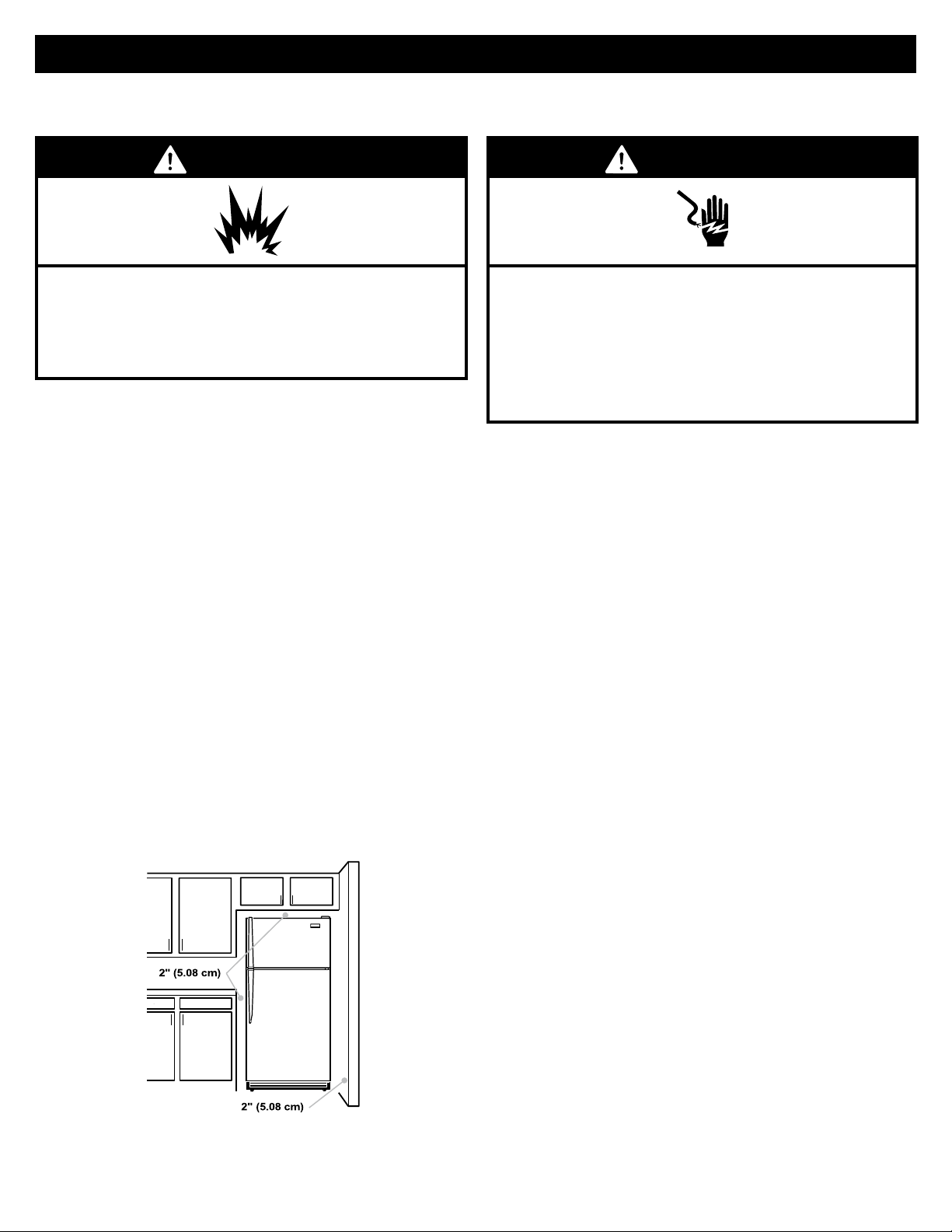
for 2” (5.08 cm) of space on each side and at the top.
Allow for 2” (5.08 cm) of space behind the refrigerator.
If your refrigerator has an icemaker, allow extra space at
the back for the water line connections. When installing
your refrigerator next to a xed wall, leave a 2” (5.08 cm)
minimum space on the hinge side (some models require
more) to allow the door to swing open.
NOTE:
This refrigerator is intended for use in a location
where the temperature ranges from a minimum of 39°F
(4°C) to a maximum of 110°F (43°C). The preferred room
temperature range for optimum performance, which
reduces electricity usage and provides superior cooling, is
between 60°F (15°C) and 90°F (32°C). It is recommended
that you do not install the refrigerator near a heat source,
such as an oven or radiator.
Use caution when installing the unit on vinyl or hardwood
oors so as not to mark or otherwise damage the ooring.
Apiece of plywood, a rug or other material should be used
to protect the oor while positioning the unit.
Electrical Requirements
WARNING
Electrical Shock Hazard
Plug into a grounded 3 prong outlet.
Do not remove ground prong. Do not use an adapter.
Do not use an extension cord.
Failure to follow these instructions can result in death,
re, or electrical shock.
Before you move your refrigerator into its nal location, it
is important to make sure you have the proper electrical
connection.
Recommended Grounding Method
A 115 volt, 60 Hz, AC only, 15- or 20-amp fused, grounded
electrical supply is required. It is recommended that a
separate circuit serving only your refrigerator be provided.
Use an outlet that cannot be turned o by a switch. Do not
use an extension cord.
NOTE:
Before performing any type of installation or
cleaning, disconnect the refrigerator from the electrical
source. When you are nished, reconnect the refrigerator
to the electrical source.
8
9
PARTS AND FEATURES
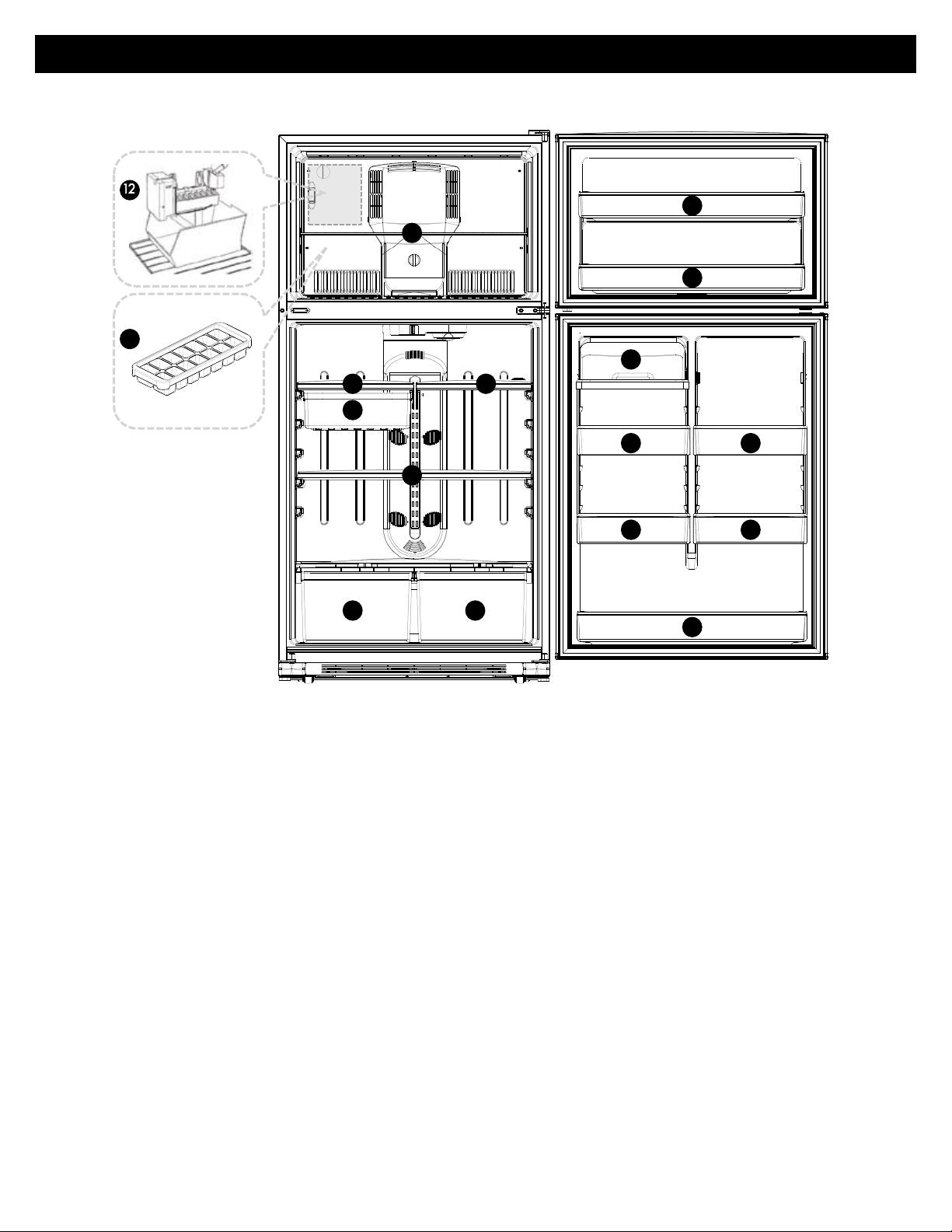
*This instruction manual refers to several models. Features may vary according to model.
1. Freezer door bin
2. Dairy compartment
for spreadable food items such as butter or margarine.
3. Adjustable half width door bin
4. Full width door bin
5. Adjustable wire shelf
6. Adjustable half width shelf
7. Adjustable half width shelf
with deli drawer
8. Deli drawer
9. Adjustable full width shelf
10. Humidity controlled crisper drawer
for storage of fruits and vegetables
11. Ice tray (optional)
12. Ice maker / Ice storage bin (optional)
1
1
2
3
3
3
3
4
5
6
7
8
9
10
10
12
11

10
11
INSTALLATION INSTRUCTIONS
Water Supply Requirements(optional)
This water line installation is not warranted by the
refrigerator or icemaker manufacturer. Follow these
instructions carefully to minimize the risk of expensive
water damage.
Gather the required tools and parts before starting
installation. Read and follow the instructions provided with
any tools listed here.
TOOLS NEEDED:
• ¼” outer diameter refrigerator copper tubing kit
• Flat-blade screwdriver
• ½” open-end wrenches or adjustable wrench
• Two ¼” outer diameter compression nuts and 2 sleeves
• Power drill and drill bit
IMPORTANT:
• If you turn the refrigerator on before the water line is
connected, turn the icemaker OFF.
• All installations must meet local plumbing code
requirements.
• Use copper tubing and check for leaks. Install copper
tubing only in areas where the household temperatures
will remain above freezing.
• To prevent burns and product damage, do not hook up
the water line to the hot water line.
• When using any electrical device (such as a power drill)
during installation, be sure the device is double insulated
or grounded in a manner to prevent the hazard of
electric shock, or is battery powered.
NOTE:
If your existing copper water line has a ared
tting at the end, you will need an adapter (available at
plumbing supply stores) to connect the water line to
the refrigerator OR you can cut o the ared tting
with a tube cutter and then use a compression tting.
Shuto valve to connect to the cold water line.
The shuto valve should have a water inlet with a
minimum inside diameter of 5/32”(3.97 mm) at the point
of connection to the cold water line. Saddle-type shuto
valves are included in many water supply kits. Before
purchasing, make sure a saddle-type valve complies with
your local plumbing codes.
Install the shuto valve on the nearest frequently used
drinking water line.
Water Pressure
IMPORTANT:
A cold water supply with water pressure
between 30 and 120 psi (207 and 827 kPa) is required to
operate the icemaker.
NOTE:
If the water pressure is less than what is required,
ice cubes could be hollow or irregular shaped.
If you have questions about your water pressure, call a
licensed, qualied plumber.
Reverse Osmosis Water Supply
If a reverse osmosis water ltration system is connected to
your cold water supply, the water pressure to the reverse
osmosis system needs to be a minimum of 40 to 60 psi (276
to 414 kPa). If the icemaker is still not operating properly:
• Check to see whether the sediment lter in the
reverse osmosis system is blocked. Replace the lter if
necessary.
• Allow the storage tank on the reverse osmosis system to
rell after heavy usage.
Connect the Water Supply(optional)
Read all directions before you begin.
IMPORTANT:
If you turn the refrigerator on before the
water line is connected, turn the icemaker OFF.
Connect to Water Line
1.
Unplug refrigerator or disconnect power.
2.
Turn OFF main water supply. Turn ON nearest faucet
long enough to clear line of water.
3.
Locate a ½” to 1 ¼” (1.25 cm to 3.18 cm) vertical cold
water pipe near the refrigerator.
IMPORTANT:
• Make sure it is a cold water pipe.
• Horizontal pipe will work, but drill on the top side of
the pipe, not the bottom. This will help keep water
away from the drill and normal sediment from
collecting in the valve.
4.
Determine the length of copper tubing you need.
Measure from the connection on the lower left rear of
refrigerator to the water pipe. Add 8 ft (2.4 m) to allow
for cleaning. Use ¼” (6.35 mm) O.D. (outside diameter)
copper tubing. Be sure both ends of copper tubing are
cut square.
10
11
INSTALLATION INSTRUCTIONS
Connect the Water Supply (continued)
5.
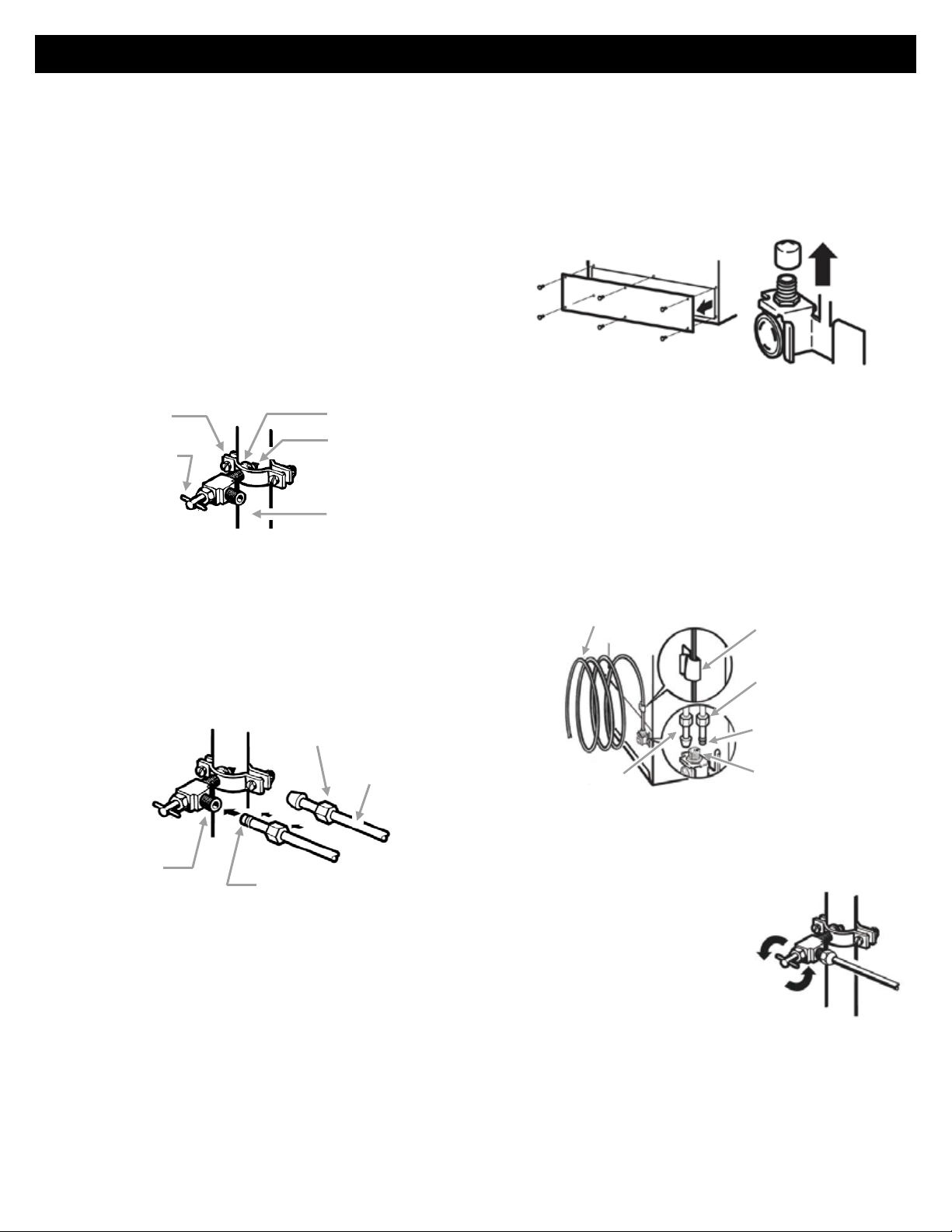
Drill a ¼” hole in the cold water pipe (even if using a
self-piercing valve), using a sharp bit. Remove any burrs
resulting from drilling the hole in the pipe. Take care not
to allow water to drain into the drill. Failure to drill a
¼” hole may result in reduced ice production or smaller
cubes.
6.
Fasten the shuto valve to the cold water pipe with the
pipe clamp. Be sure the outlet end is solidly in the ¼”
drilled hole in the water pipe and that the washer is
under the pipe clamp. Tighten the packing nut. Tighten
the pipe clamp screws slowly and evenly so washer
makes a watertight seal. Do not overtighten or you may
crush the copper tubing.
7.
Place the compression nut and sleeve for copper tubing
onto the end of the tubing and connect it to the shuto
valve. Make sure the tubing is fully inserted into the
valve. Tighten the compression nut securely.
For plastic tubing, insert the molded end of the tubing
into the shuto valve and tighten compression nut until
it is hand-tight; then tighten one additional turn with a
wrench. Overtightening may cause leaks.
8.
Place the free end of the tubing in a container or sink,
and turn ON the main water supply. Flush the tubing
until water is clear. Turn OFF the shuto valve on the
water pipe. Coil the copper tubing.
Connect to Refrigerator
1.
Unplug refrigerator or disconnect power.
2.
Remove the screws holding the compressor compartment
access cover to the back) of the refrigerator case.
Remove the cover and the plastic exible cap from the
water valve (refrigerator connection)
NOTE:
Be sure to save the screws as the access cover
must be reinstalled later to ensure your refrigerator will
function properly.
3.
Place the compression nut and sleeve onto the end of
the tubing as shown. Insert the end of the tubing into
the water valve connection as far as possible. While
holding the tubing, tighten the tting.
For plastic tubing, insert the molded end of the tubing
into the water valve connection and tighten compression
nut until it is hand-tight; then tighten one additional turn
with a wrench. Overtightening may cause leaks.
4.
Use the tube clamp on the back of the refrigerator to
secure the tubing to the refrigerator as shown. This will
help avoid damage to the tubing when the refrigerator
is pushed back against the wall.
5.
Turn shuo valve ON.
Reattach the access cover.
6.
Check for leaks. Tighten any connections (including
connections at the valve) or nuts that leak.
7.
The icemaker is equipped with a built-in water strainer.
If your water conditions require a second water strainer,
install it in the ¼” (6.35 mm) water line at either tube
connection. Obtain a water strainer from your nearest
appliance dealer.
Pipe Clamp
Saddle-Type
Shutoff Valve
Washer
Vertical Cold
Water Pipe
Inlet End
Tubing Clamp
Compression Nut
Sleeve
Refrigerator
Connection
Plastic Tubing
¼” Tubing
Outlet Valve
Sleeve
Compression Nut
Plastic Tubing
12
13
INSTALLATION INSTRUCTIONS
Complete the Installation
WARNING
Electrical Shock Hazard
Plug into a grounded 3 prong outlet.
Do not remove ground prong. Do not use an adapter.
Do not use an extension cord.
Failure to follow these instructions can result in death,
re, or electrical shock.
1.
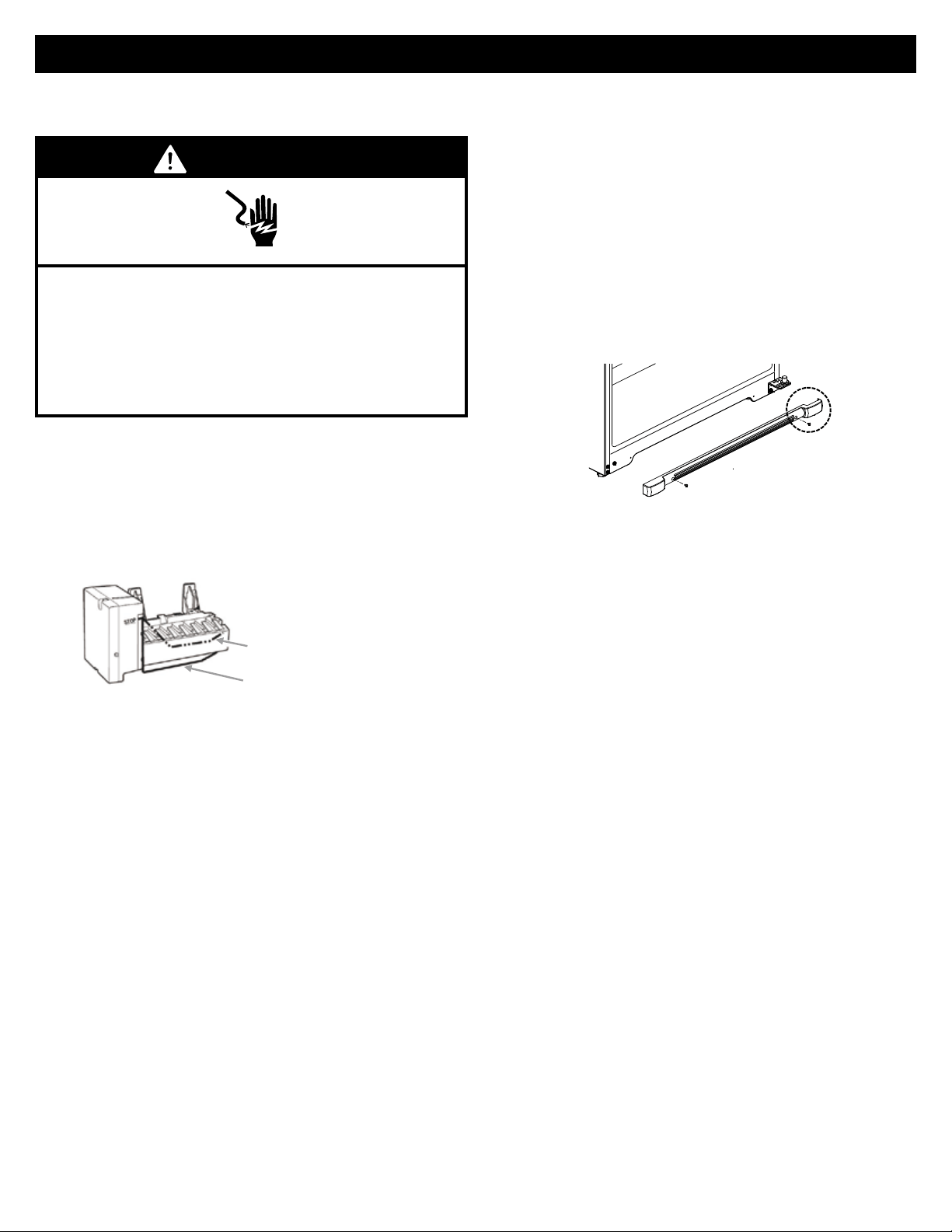
Plug into a grounded 3 prong outlet.
2.
Start the icemaker. Move the feeler arm to the ON
(down) position. The icemaker will not begin to operate
until it reaches its operating temperature of 15°F (-9°C)
or below. It will then begin operation automatically.
NOTE:
Allow 24 hours to produce the rst batch of ice.
Discard the rst three batches of ice produced. Allow 3
days to completely ll ice container.
In lower water pressure conditions, the water valve may
turn on up to 3times to deliver enough water to the
icemaker.
Front Base Grille
The front base grille which was packaged inside the
refrigerator for shipment and should be installed after the
refrigerator has been leveled.
1.
Align the base grille to the screw holes.
(The cut out side on the base grille installs around the
lower hinge of the door.)
2.
Secure the base grille into screw holes with Phillips
screwdriver.
NOTE:
Reverse these steps to remove this style of base
grille.
Feeler arm in the STOP (up)
position.
Feeler arm in the ON (down)
position.
12
13
INSTALLATION INSTRUCTIONS
Reverse Doors (optional)
IMPORTANT:
If you want to reverse your doors so that they
open in the opposite direction, follow these steps.
Tools Required:
5/16 “ end wrench, Phillips screwdriver,
Putty knife, 5/16 “ socket and ratchet
Unplug the refrigerator
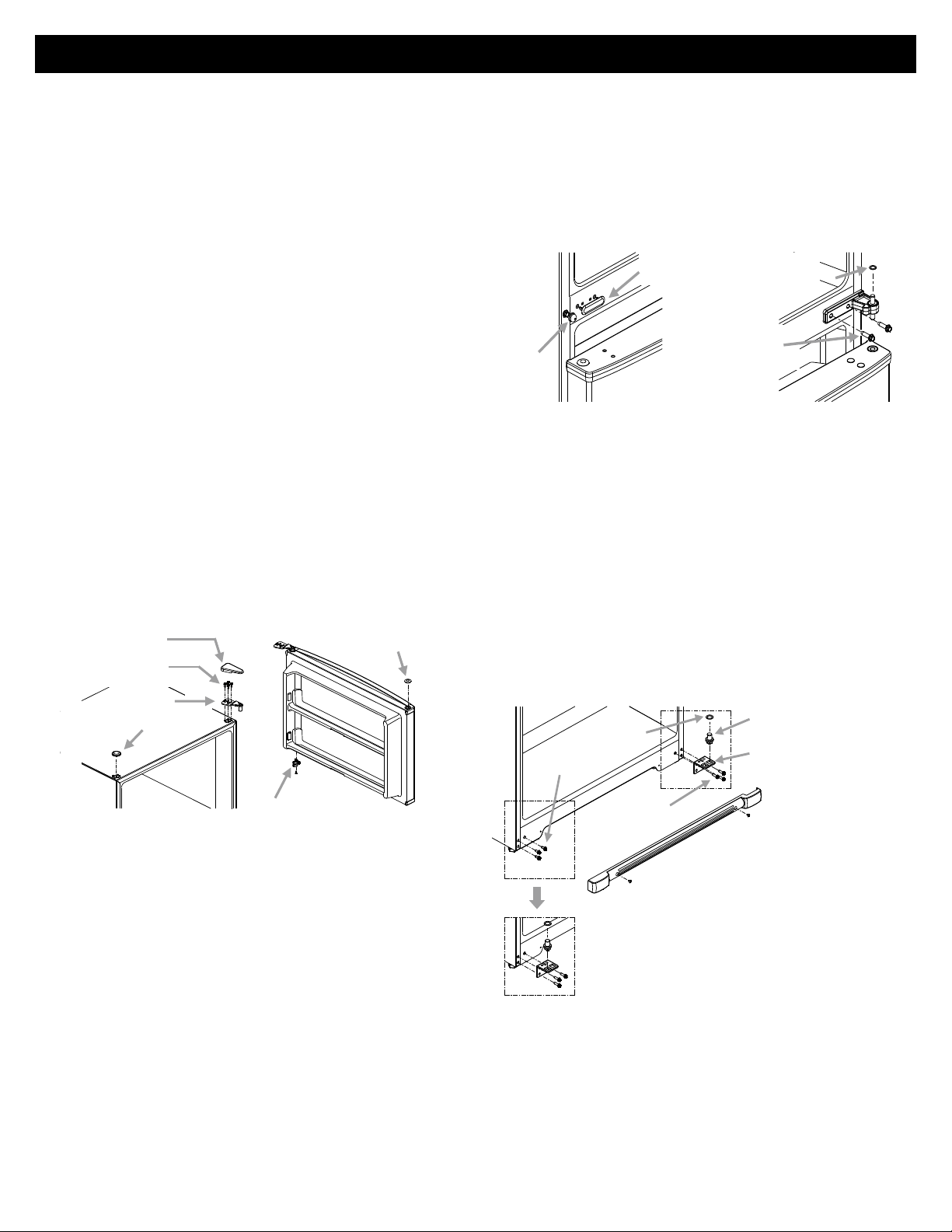
1.
Tape the freezer door shut with masking tape. Pry o
hinge cap with a at blade screwdriver and set aside.
2.
With a 5/16 “ socket and ratchet, remove screws from
the top hinge and set aside.
3.
Remove the tape and carefully lift and remove freezer
door (including the top hinge) o the center hinge.
4.
With a Phillips screwdriver, remove the door stop from
the underside of the freezer door and secure it on the
opposite side.
5.
With a putty knife, carefully pry out the hinge hole plug
from the top of the freezer door and install it on the
other side.
6.
Remove the screw hole plug from top of cabinet and
install it on the opposite side.
NOTE:
• Do not misplace the top hinge screws.
• Set the door on a non-scratching surface with the
inside up.
• Do not let door to drop to the oor when setting it
down, or the door stop could be damaged.
7.
Tape the refrigerator door shut with masking tape.With
a 5/16 “ socket and ratchet, remove the middle hinge
screws and middle hinge from the top of refrigerator
door. Using a at blade screwdriver, pry out the dome
cap and the middle hinge hole cover. And then install
them on the opposite side.
NOTE:
Do not misplace the middle hinge screws and the
middle hinge washer. If the washer is not on the hinge,
check to see if it is stuck to the bottom of the door.
8.
Remove the tape and carefully lift and remove
refrigerator door.
9.
Remove front base grille and set aside.
10.
With a 5/16 “ socket and ratchet, remove the bottom
hinge plate from lower corner of refrigerator and
secure it on the opposite side
11.
Remove the washer and shaft from the inside of the hinge
plate and install them on the outside of the hinge plate.
Bottom
Hinge Plate
Bottom
Hinge Shaft
Bottom
Hinge Washer
Bottom
Hinge Screws
Cabinet Screws
NOTE:
• Do not misplace the bottom hinge screws, cabinet
screws and bottom hinge washer. If the washer is
not on the hinge, check to see if the it is stuck to the
bottom of the door.
• Set the door on a non-scratching surface with the
inside up.
• Do not let door to drop to the oor when setting it
down, or the door stop could be damaged.
Hinge Cap
Freezer Door Stop
Freezer Door
Hinge Hole Plug
Top Hinge
Screw Hole Plug
Top Hinge
Screws
Mid. Hinge
Screws
Mid. Hinge
Hole Cover
Dome
Cap
Mid. Hinge
Washer
14
15
INSTALLATION INSTRUCTIONS
Reverse Doors (optional) (continued)
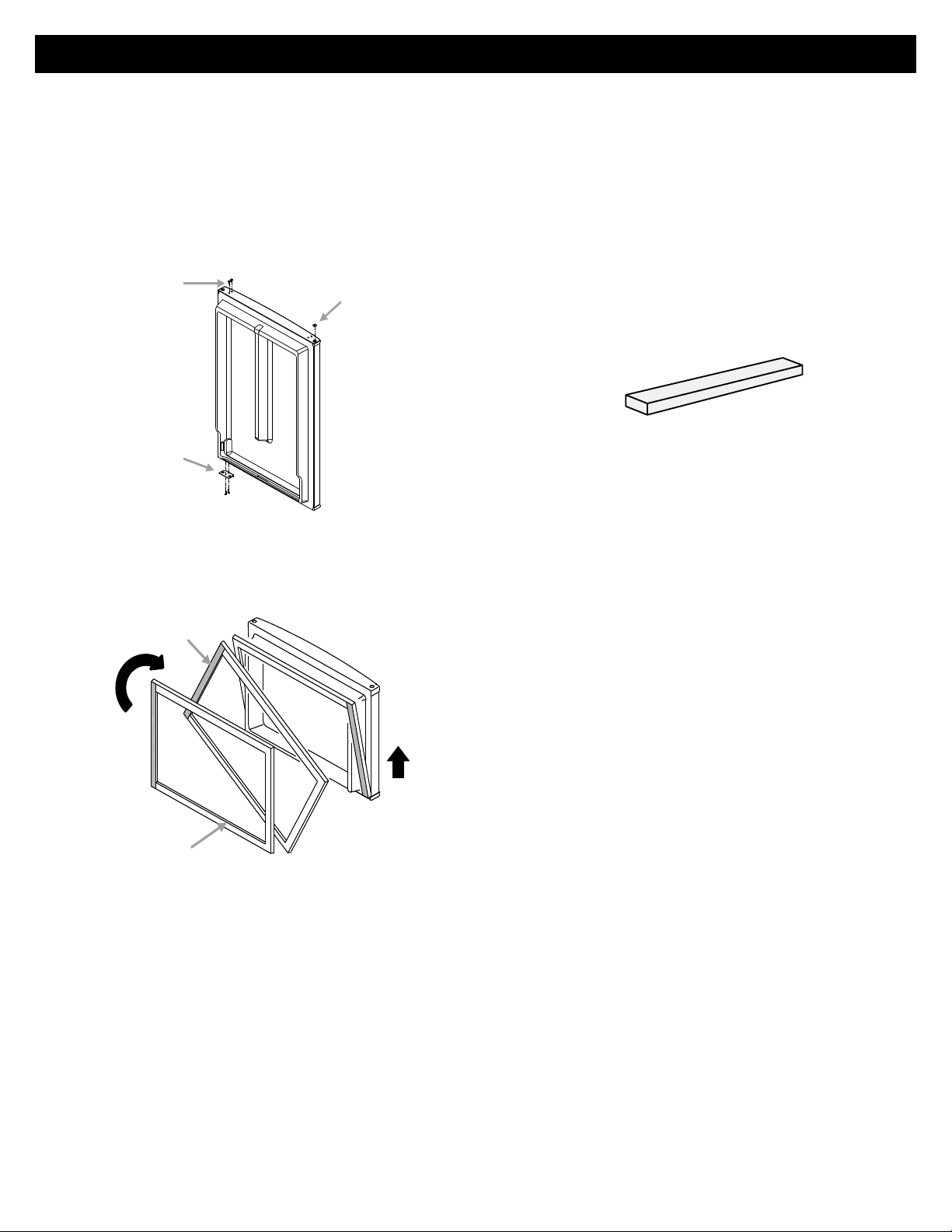
12.
Remove the refrigerator door stop from the underside
of refrigerator door and secure it on the opposite side
with a Phillips screwdriver.
13.
With a screwdriver, pry out the plugs from the top of
refrigerator door and replace them on the opposite
side.
14.
Remove the gaskets from freezer and refrigerator door.
And then rotate them 180 degrees. Reassemble them
by pushing from bottom to top.
NOTE:
The oil on the gasket is normal. There is no need
to clean the oil. It helps to prevent deformation of the
hinge side of gasket. If more oil is needed, use Vaseline.
15.
Carefully place refrigerator door onto the hinge plate
in lower corner. Ensure that the washer is in place on
top of the hinge shaft.
16.
Attach the middle hinge with the screws removed
from the opposite side and secure them using a 5/16”
wrench.
1 7.
Use foam door spacer to set the correct gap between
the freezer and refrigerator door. Place spacer
between the doors when tightening the freezer door
top hinge.
NOTE:
You may need to use the spacer again to set
gap. Ensure the washer is in place on top of the hinge
shaft.
18.
Slide top hinge into place on freezer door and secure
screws with 5/16 “ wrench. Conrm that all screws
have been tightened securely.
19.
Snap hinge cap securely in place.
20.
Replace front base grille. Remember to plug in your
refrigerator and reset the controls to the appropriate
setting(s).
Door Gasket
Door Gasket Oil
Handle Hole
Plugs
Refrigerator
Door Stop
Refrigerator
Door Hinge
Hole Plug
14
15
16
17
INSTALLATION INSTRUCTIONS
Adjusting the Doors
Leveling
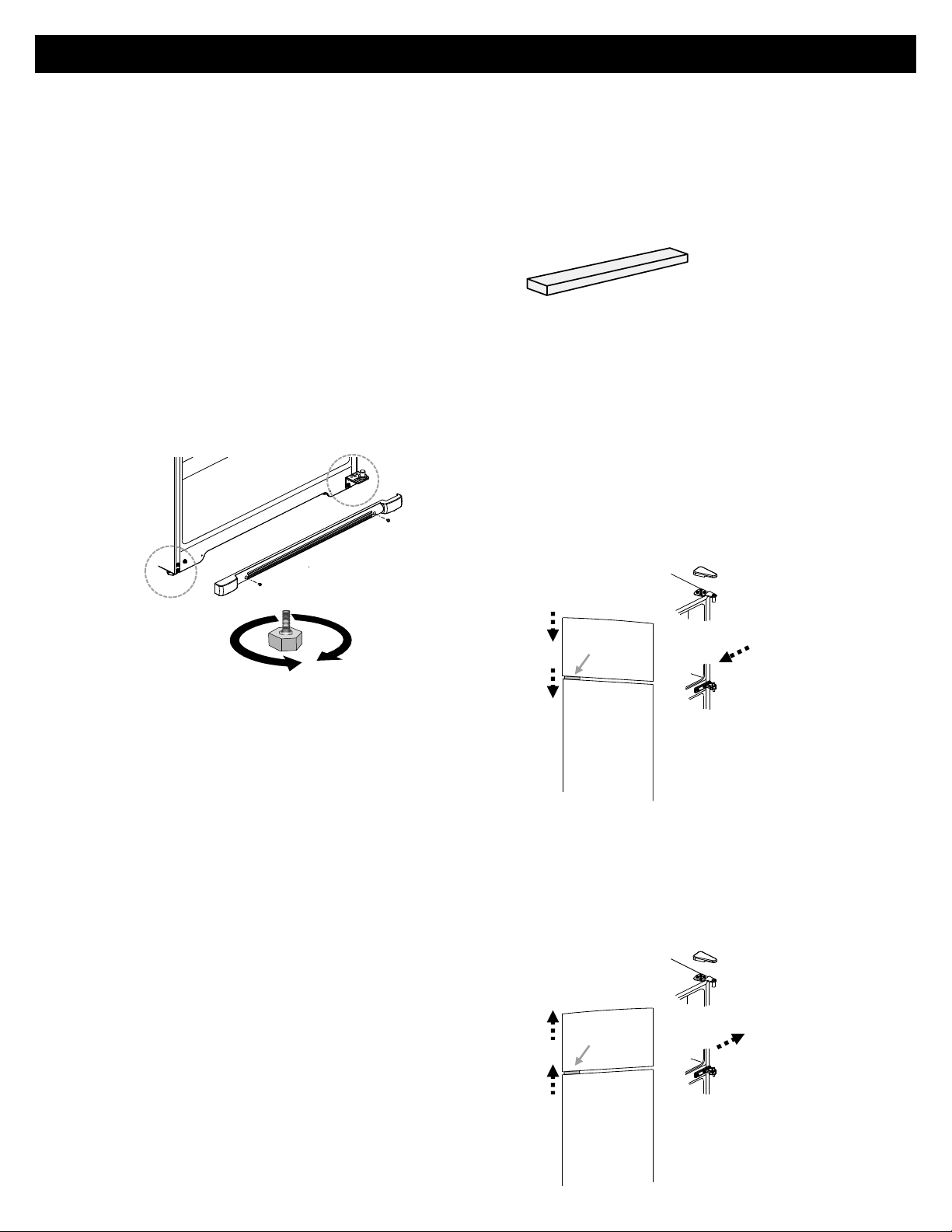
Your refrigerator has two front adjustable legs - near each
front corner of ther refrigerator, next to the rollers. If your
refrigerator seems unsteady or you want the doors to
close easier, adjust the refrigerator’s tilt using the following
instructions:
1.
Remove the base grille. See “Front Base Grille
Installation”.
2.
Turn the two front leveling legs clockwise to raise the
front of the refrigerator and counterclockwise to lower.
NOTE:
Having someone push against the top of the
refrigerator takes some weight o the leveling legs
which makes it easier to adjust.
3.
Open both doors again to make sure they close as
easily as you like and that they stay closed. If not, tilt
the refrigerator slightly more to the rear by turning both
leveling legs clockwise .
4.
Replace the base grille.
NOTE:
• Before moving the refrigerator away from the wall be
sure to turn the leveling legs counterclockwise so that
the weight of the refrigerator is fully transferred to the
front rollers.
• If the oor is not level and it is necessary to raise the
rear of ther refrigerator we suggest rolling the rear
rollers onto a piece of plywood or other shim material.
Door Aligning
If the space between your doors looks uneven, you can
adjust it using the following instructions:
NOTE:
Use foam door spacer to set the correct gap between
the freezer and refrigerator door. Place spacer between the
doors when tightening the freezer door top hinge.
If the freezer door is too high:
1.
Remove the hinge cap on top of the freezer door and
loosen the screws with a 5/16 “ socket and ratchet.
2.
Place the door spacer between the doors to establish
the correct gap and tighten the hinge screws.
3.
Fully tighten all screws and replace the hinge cap.
If both doors are too high:
1.
Remove the hinge cap on top of the freezer door and
loosen the screws with a 5/16 “ socket and ratchet.
2.
Loosen the two middle hinge screws with a 5/16 “
socket and ratchet.
3.
Slide the middle hinge to the left to lower the doors.
4.
Fully tighten all screws and replace hinge cap.
If both doors are too low:
1.
Remove the hinge cap on top of the freezer door and
loosen the screws with a 5/16 “ socket and ratchet.
2.
Loosen the two middle hinge screws with a 5/16 “
socket and ratchet.
3.
Slide the middle hinge to the right to raise the doors.
4.
Fully tighten all screws and replace hinge cap.
Counterclockwise to
lower refrigerator
Clockwise to raise
refrigerator
Loosen screws
Loosen screws
Loosen screws
and slide left to
lower doors
Loosen screws
and slide right to
raise doors
Door Spacer
Door Spacer
Loosen screws
Loosen screws
Loosen screws
and slide left to
lower doors
Loosen screws
and slide right to
raise doors
Door Spacer
Door Spacer
16
17
REFRIGERATOR USE
Using the Controls
Your refrigerator has two controls that aect the
temperature.
The Temperature control is located at the top front of
the refrigerator compartment and the Airow control is
located on the back wall of the freezer compartment.
IMPORTANT:
• The recommended setting should be correct for normal
household refrigerator use. The controls are set correctly
when milk or juice is as cold as you like and when ice
cream is rm.
• Wait 24 hours for your refrigerator to cool completely
before adding food. If you add food before the
refrigerator has cooled completely, your food may spoil.
NOTE:
Adjusting the refrigerator and freezer
temperature controls to a colder than recommended
setting will not cool the compartments any faster.
• If the temperature is too warm or too cold in the
refrigerator or freezer, rst check the air vents to be
sure they are not blocked before adjusting the controls.
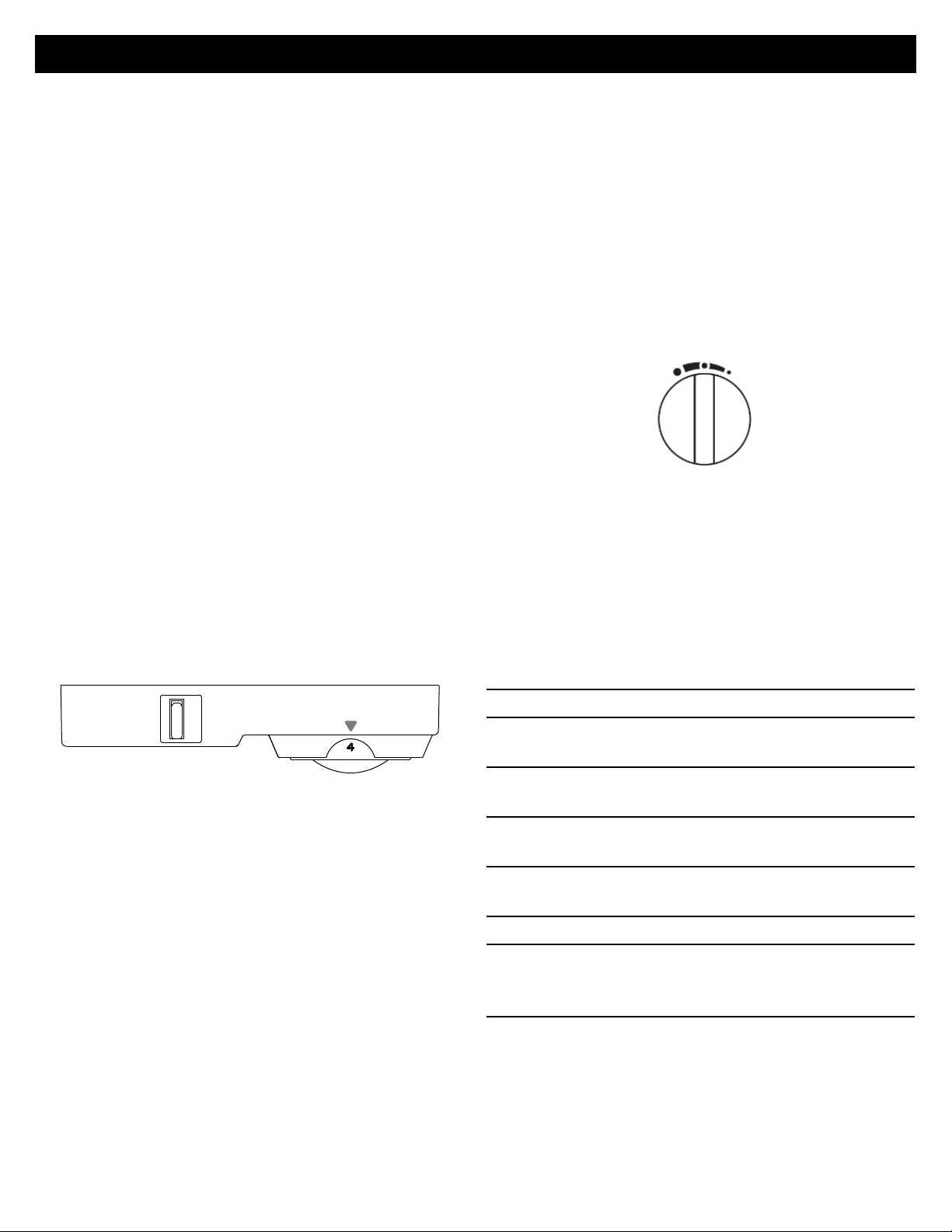
Refrigerator Temperature Control
The temperature control dial is calibrated in a range
from 1 (least cold) to 7 (coldest). For your convenience,
the Temperature control is preset at the factory to the
recommended setting (4).
Recommended Setting “4”
NOTE:
Your refrigerator will run continuously for several
hours when you rst start it. This is normal.
Adjusting the Temperature Control
If you need to adjust the temperature in the refrigerator
(or freezer compartment), follow the indications in the
TEMPERATURE CONTROL GUIDE table.
NOTE:
Do not adjust the control more than one setting
at a time. Wait 24 hours between adjustments for the
temperature to stabilize.
• Garage Ready Settings: For optimal operation in
a garage environment, set temperature control in
refrigerator compartment to 4 and set temperature
control in freezer compartment to Recommended.
NOTE:
Sustained exposure to ambient temperatures below
39°F (4°C) may result in freezing of food and beverages
stored in the refrigeration section.
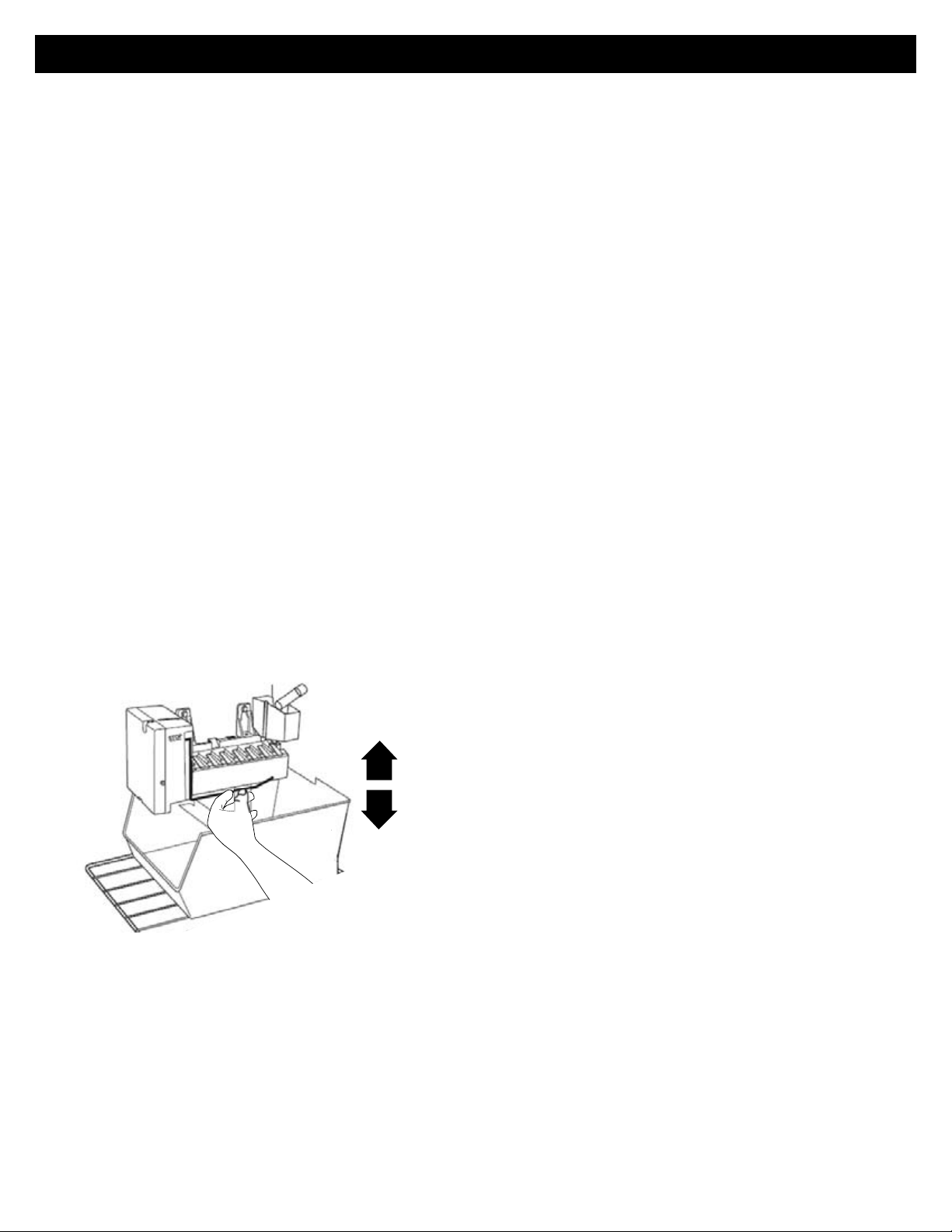
Freezer Temperature Control
The temperature control dial is calibrated in a range from
“Coldest” to “Cold”.
For your convenience, the Temperature control is preset at
the factory to the recommended setting which is indicated
on the dial.
Use the freezer temperature control to adjust the freezer
temperature to your desired condition. It is recommended
that when you plug in the refrigerator for the rst time,
make sure the control setting is on Recommended.
Adjusting the Freezer Temperature
If you need to adjust the temperature in the freezer (or
refrigerator compartment), follow the indications in the
TEMPERATURE CONTROL GUIDE table below.
IMPORTANT:
Once the performance is achieved, return
the Airow control to the Recommended setting to keep
the refrigerator operating at optimum eciency.
TEMPERATURE CONTROL GUIDE
CONDITION/REASON: ADJUSTMENT:
REFRIGERATOR too
warm
Refrigerator temperature
Control one setting higher
FREEZER too warm/too
little ice
Freezer Temperature
Control one setting higher
REFRIGERATOR too cold Refrigerator temperature
Control one setting lower
FREEZER too cold Freezer Temperature
Control one setting lower
Faster Ice Production COLDEST
High Temperature
location (over 90 deg F)
COLDEST - To maintain ice
making production rate
Fresh Food Temperature
4-Recommended
7-Coldest
Recommended
Coldest Cold
Temperature
18
19
REFRIGERATOR USE
Frost Free
Your refrigerator is designed to defrost automatically
Warm Cabinet Surfaces
At times, the front of the refrigerator cabinet may be warm
to the touch. This is a normal occurrence that helps prevent
moisture from condensing on the cabinet. The condition will
be more noticeable when you rst start the refrigerator,
during hot weather and after excessive or lengthy door
openings.
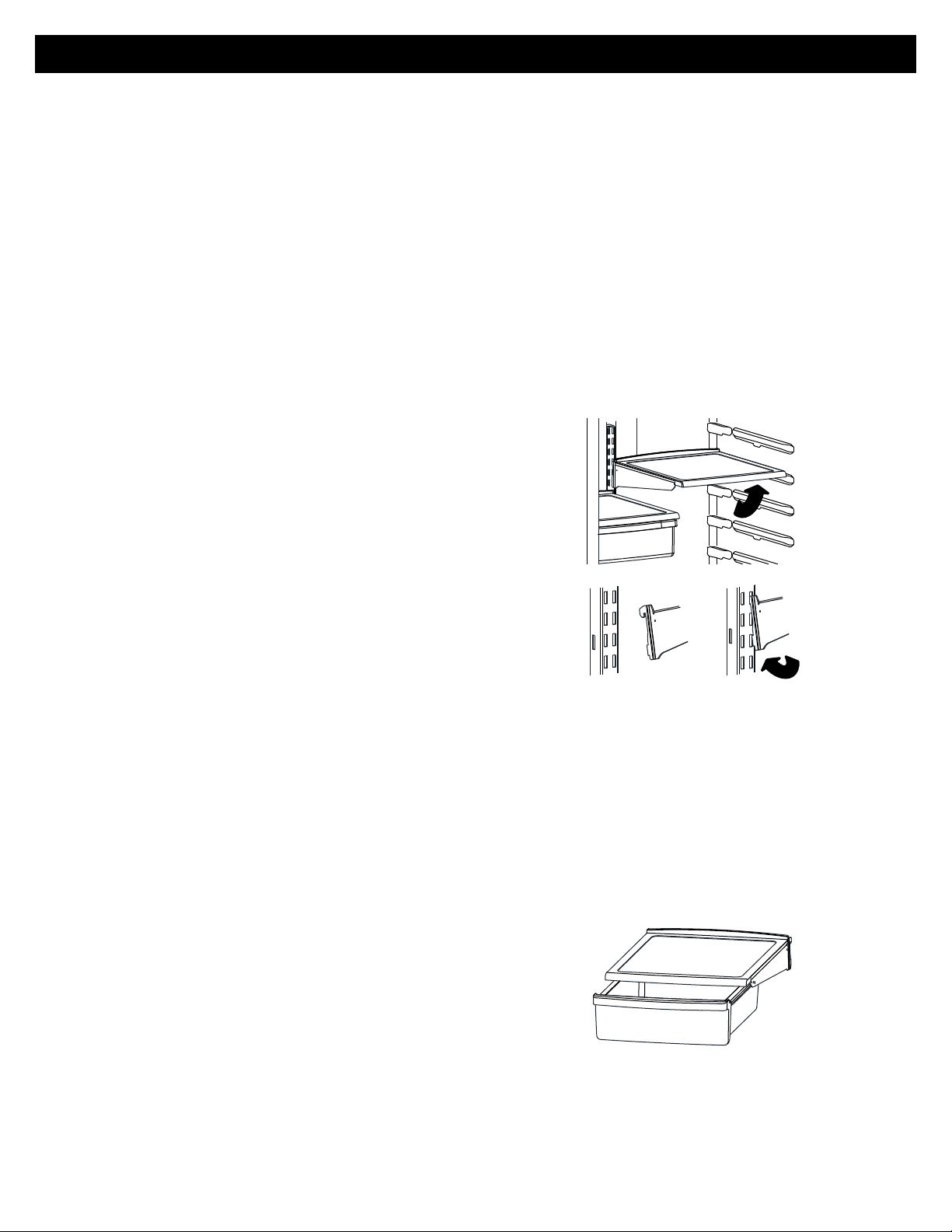
Icemaker (on some models)
Turning the Icemaker On/O
NOTE:
Do not force the wire shuto arm up or down.
• To turn the icemaker on, simply lower the wire shuto
arm.
NOTE:
Your icemaker has an automatic shuto. As ice is
made, the ice cubes will ll the ice storage bin and the
ice cubes will raise the wire shuto arm to the OFF (arm
up) position.
• To manually turn the icemaker o, lift the wire shuto
arm to the OFF (arm up) position and listen for the click
to make sure the icemaker will not continue to operate.
NOTE:
Turn the icemaker o before removing the ice
storage bin to serve ice or to clean the bin. This will keep
the ice cubes from dropping out of the icemaker and into
the freezer compartment. After replacing the ice storage
bin, turn on the icemaker.
Ice Production Rate
• The icemaker should produce approximately 8 to 12
batches of ice in a 24 hour period. If ice is not being
made fast enough, turn the Freezer control toward a
higher (colder) number in half steps. Wait 24 hours and,
if necessary, gradually turn the Freezer control to the
highest setting, waiting 24 hours between each increase.
Remember
• The icemaker will not begin to operate until it reaches a
temperature of 15°F (-9°C) or below. It will then begin
operation automatically.
• In conditions of lower water pressure or rst water
supply, the water valve may turn on up to 3 times to
deliver enough water to the icemaker.
• Allow 24 hours to produce the rst batch of ice. Allow
3 days to completely ll the ice storage bin. Discard the
rst three batches of ice produced.
• The quality of your ice will be only as good as the
quality of the water supplied to your icemaker. Avoid
connecting the icemaker to a softened water supply.
Water softener chemicals (such as salt) can damage
parts of the icemaker and lead to poor quality ice. If a
softened water supply cannot be avoided, make sure
the water softener is operating properly and is well
maintained.
• Do not store anything on top of the icemaker or in the
ice storage bin.
18
19
REFRIGERATOR FEATURES
Your model may have some or all of these features.
To know about glass shelves and covers:
Refrigerator Shelves
The shelves in your refrigerator are adjustable to match
your individual storage needs.
Storing similar food items together in your refrigerator and
adjusting the shelves to t dierent heights of items will
make nding the exact item you want easier. It will also
reduce the amount of time the refrigerator door is open,
and save energy.
IMPORTANT:
• Do not clean glass shelves or covers with warm water
when they are cold. Shelves and covers may break if
exposed to sudden temperature changes or impact, such
as bumping.
• Tempered glass is designed to shatter into many small,
pebble-size pieces. This is normal.
• Glass shelves and covers are heavy. Use both hands
when removing them to avoid dropping.
CAUTION:
To avoid personal injury or property damage.
• Never attempt to adjust a shelf when it is loaded with
food.
• Conrm that shelf is secure prior to loading items onto
it.
Full Width Shelf
Select models are equipped with wire or glass full width
shelves that are supported by rails molded into the interior
walls of the fresh food compartment.
To remove and replace a full width shelf:
1.
Remove food from the shelf.
2.
Grasp each side of the shelf.
3.
Pull the shelf forward approximately 1 inch (25mm).
4.
While supporting the shelf from underneath, lift it up
and out.
5.
Slide the shelf into the desired alternate position.
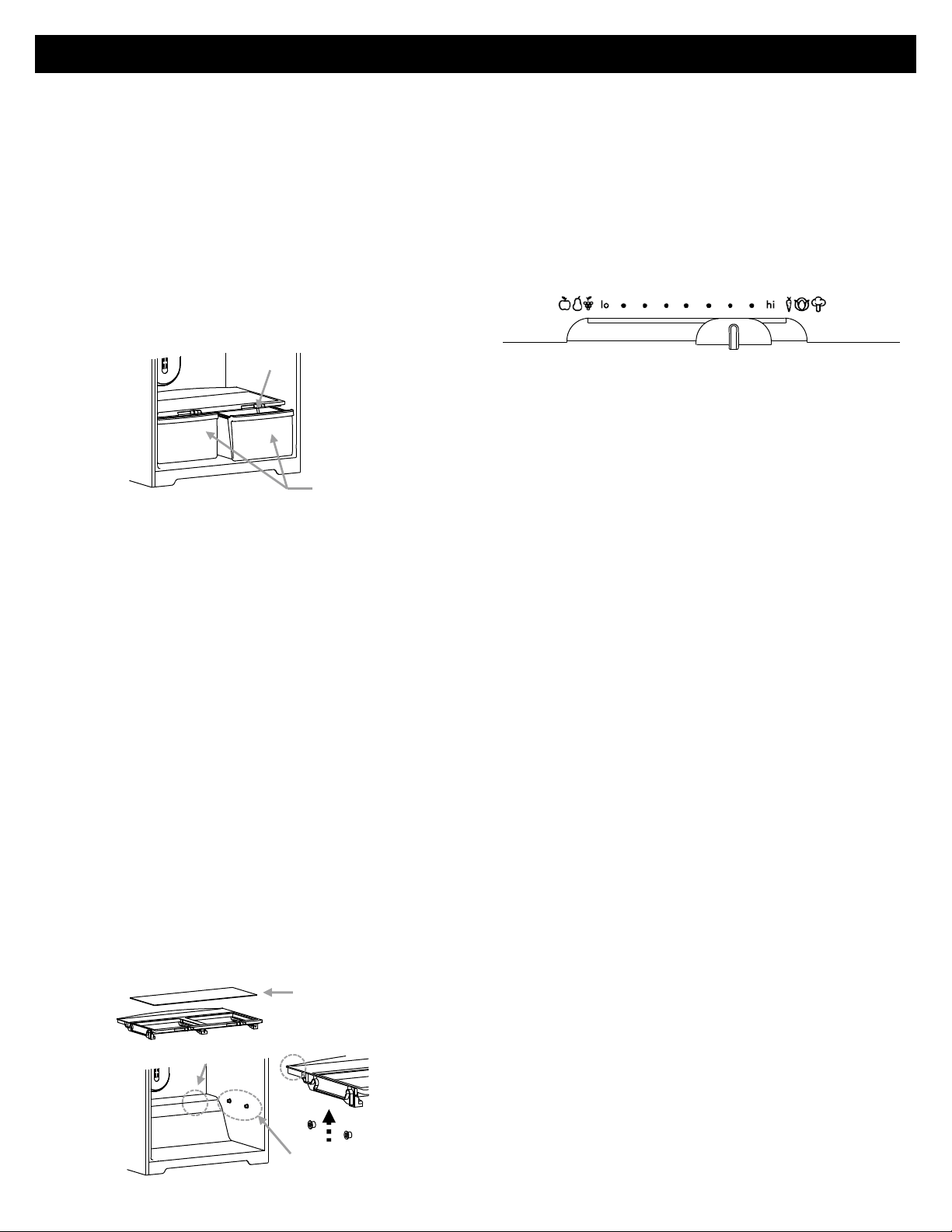
Half-Width Shelf
One side of the shelf rests on a molded side-wall support;
a bracket on the other side hooks into a track on the rear
cabinet wall.
To remove and replace a half-width shelf:
1.
Remove food from the shelf.
2.
Tilt up the front edge of the shelf.
3.
Lift up the rear of the shelf.
4.
Pull the shelf out of the track.
5.
Move the shelf into the desired alternate position.
6.
While tilting the shelf up, insert the top hook at the
back of the shelf in a slot on the track.
7.
Lower the front of the shelf until the bottom of the shelf
locks into place.
.
Deli Drawer
To remove and replace the deli drawer:
1.
Slide deli drawer out to the stop.
2.
Lift front of deli drawer with one hand while supporting
bottom of drawer with other hand. Slide drawer out the
rest of the way.
3.
Replace the drawer by sliding it back in fully past the
drawer stop.
Tilt up
Tilt up
20
21
REFRIGERATOR FEATURES
Crisper
Crisper Drawers
The Crispers provide a storage area for fruit and
vegetables.
Excess water that may accumulate in the bottom of the
drawers or under the drawers should be wiped dry.
To remove and replace the crisper drawer:
1.
Slide the crisper drawer straight out to the stop. Lift the
front and slide the drawer out the rest of the way.
2.
Replace the drawer by sliding the drawer in fully past
the stop.
NOTE:
If the refrigerator door prevents you from taking out
a crisper drawer, rst try removing any obstructing door
bins. If bin removal still does not provide enough clearance,
the refrigerator will need to be rolled forward from its
installation position until the door can be opened enough
to glide the drawers out.
Crisper Cover
To remove and replace the crisper cover:
1.
Remove the food from the cover and then the crisper
drawers.
2.
Remove the glass pane from the cover frame.
3.
Slightly lift up the front of the crisper cover frame.
4.
Support the cover from underneath to lift it up and then
out of the cabinet.
5.
To replace the cover, tilt front of cover frame slightly up
and carefully insert the back of the cover frame into the
cabinet.
With the cover front tilted slightly upward, carefully
insert the cover top back into the cabinet.
6.
Position the back and sides of the cover on the supports
and let the cover top settle into place.
7.
Replace the glass by pushing the front edge rmly into
the crisper cover. Replace the drawers.
Crisper Humidity Control
You can control the amount of humidity in the moisture-
sealed crisper. For most fruits, slide the control (select
models) to “lo” to provide and vegetables with skins lower
humidity conditions in the drawer. For leafy vegetables, slide
the control to “hi” to provide higher humidity conditions in
the drawer. For best results, keep the crisper drawers tightly
closed.
• Fruit: Wash, let dry and store in refrigerator in plastic
bag or crisper. Do not wash or hull berries until they are
ready to use. Sort and keep berries in original container
in crisper, or store in a loosely closed paper bag on a
refrigerator shelf.
• Vegetables with skins: Place in plastic bag or plastic
container and store in crisper.
• Leafy vegetables: Wash in cold water, drain and trim or
tear o bruised and discolored areas. Place in plastic
bag or plastic container and store in crisper.
Crisper Drawers
Crisper Cover
Crisper Cover
Glass
Crisper cover frame
back support.
Crisper cover frame
side supports
Humidity Control
Crisper Drawers
Crisper Cover
Crisper Cover
Glass
Crisper cover frame
back support.
Crisper cover frame
side supports
20
21
FREEZER FEATURES
CAUTION
:
To avoid personal injury or property damage.
• Never attempt to adjust a shelf when it is loaded with
food.
• Conrm that shelf is secure prior to loading items onto
it.
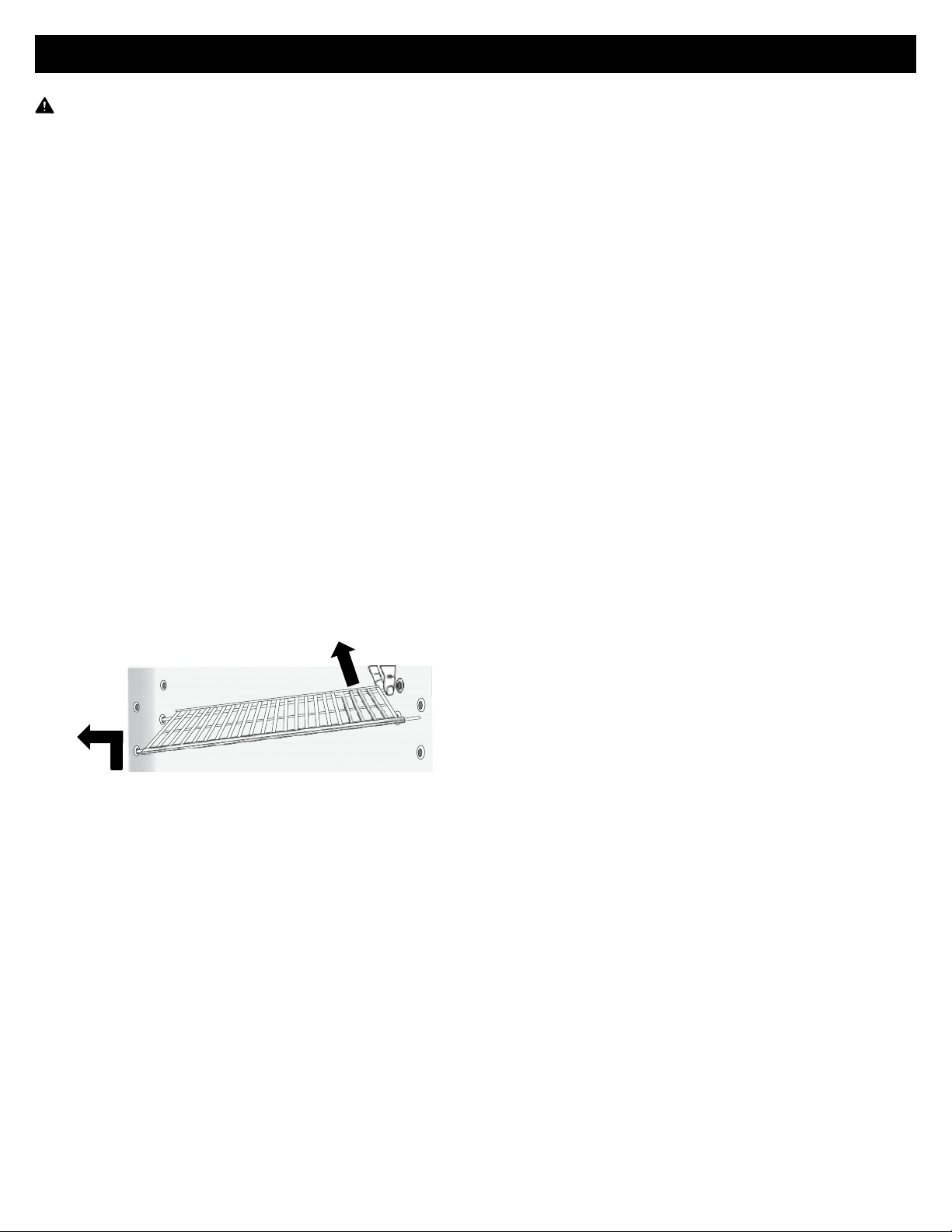
To remove and replace a wire shelf:
1.
Remove the food from the shelf.
2.
Lift up left side of shelf slightly and slide it left as far as
it will go into the center of the left shelf support holes.
The right side of the shelf will release from the support
holes on the right. Raise up right side of shelf to remove
from freezer compartment.
3.
To replace, angle right side of shelf up and insert left
side of shelf as far as it will go into the center of the left
shelf support holes. Lower the right side of shelf to align
with right side support holes. Slide the shelf to the right
to secure into the support holes.
NOTE:
If icemaker is not in use, the shelf may be
inserted into the higher set of support holes to adapt to
storage needs once the ice storage bin is removed.
4.
To relace, holding the shelf diagonally, insert the left
end of the shelf into the center of the shelf supports ont
the side wall.
5.
Insert the right end of the shelf into the shelf supports on
the side wall. Rest each end of the shelf on the bottom
of the shelf supports.
Lift up and slide
Raise
22
23
DOOR FEATURES
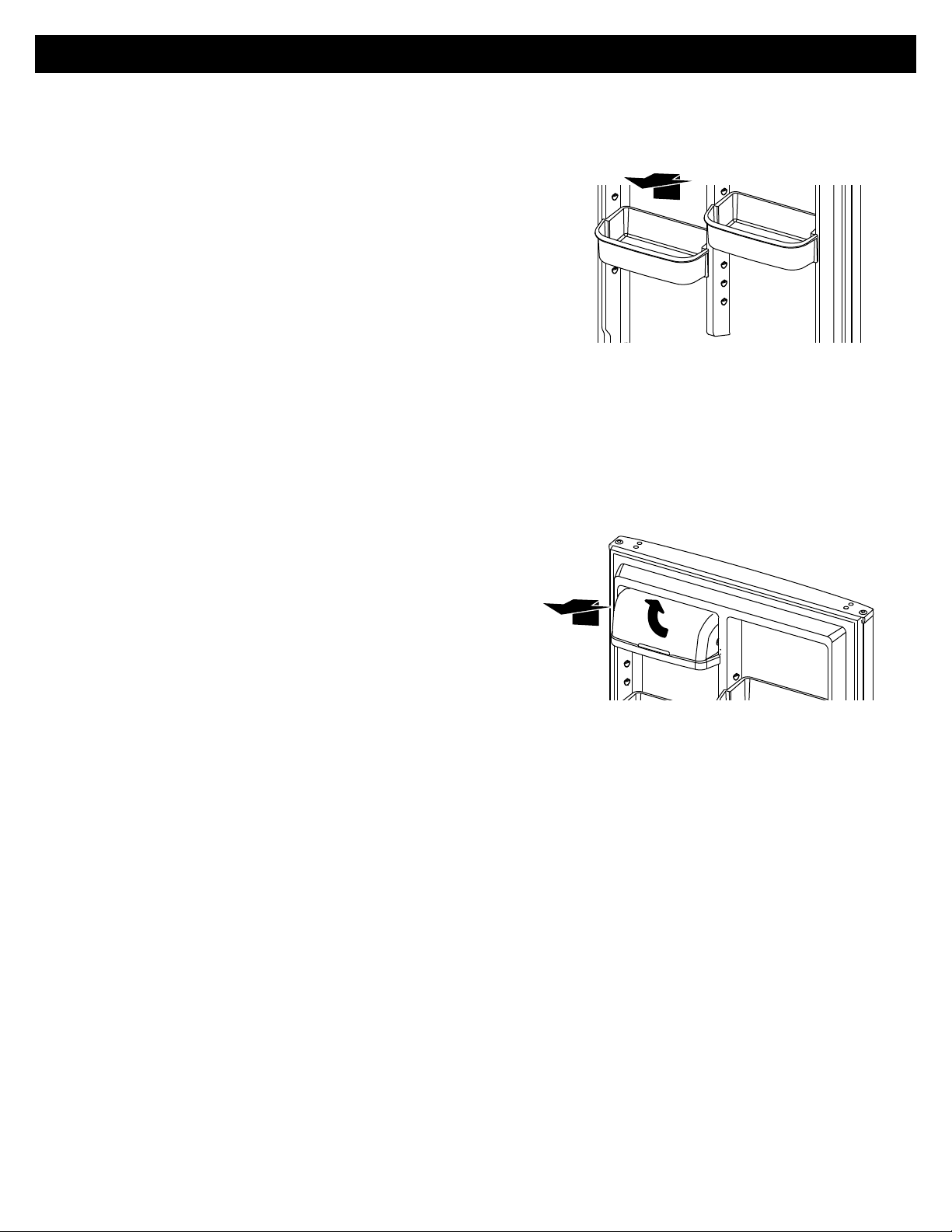
Door Bins
To remove and replace the bins:
1.
Remove the bin by lifting it and pulling it straight out.
2.
Replace the bin by sliding it in above the desired
support and pushing it down until it stops.
Dairy Compartment
The covered dairy compartment is designed to store
spreadable food items such as butter or margarine. To use
this compartment, simply raise the lid to store or retrieve
items.
To remove for cleaning:
1.
Grasp the dairy compartment from the bottom and lift
up and out.

22
23
FOOD STORAGE GUIDE
Fresh Food Storage
• The fresh food compartment of a refrigerator should
be kept between 34°F (1°C) and 40°F (4°C) with an
optimum temperature of 37°F (3°C). To check the
temperature, place an appliance thermometer in a glass
of water and place in the center of the refrigerator.
Check after 24 hours. If the temperature is above 40°F
(4°C) adjust the control as explained on “Temperature
Control” page.
• Avoid overcrowding the refrigerator shelves.
This reduces the circulation of air around the food and
results in uneven cooling.
• Storage in the crisper drawers traps humidity to help
preserve the fruit and vegetable quality for longer time
periods
• Sort fruits and vegetables before storage and use
bruised or soft items rst. Discard those showing signs of
decay.
• Always wrap odorous foods such as onions and
cabbage so the odor does not transfer to other foods.
• While vegetables need a certain amount of humidity
to remain fresh, too much moisture can shorten storage
times (especially leafy items). Drain vegetables well
before storing.
• Raw meat and poultry should be wrapped securely so
leakage and contamination of other foods or surfaces
does not occur.
• Occasionally mold will develop on the surface of hard
cheeses (Swiss, Cheddar, Parmesan). Cut o at least an
inch around and below the moldy area.
Keep your knife or instrument out of the mold itself.
Do not try to save individual cheese slices, soft cheese,
cottage cheese, cream, sour cream or yogurt when mold
appears.
• Most dairy foods such as milk, yogurt, sour cream and
cottage cheese have freshness dates on their cartons for
appropriate length of storage.
Store these foods in the original carton and refrigerate
immediately after purchasing and after each use.
Freezer Storage
• The freezer compartment of a refrigerator should
be kept at approximately 0°F (-18°C). To check the
temperature, place an appliance thermometer between
the frozen packages and check afeter 24 hours. If the
temperater is above 0°F (-18°C), adjust the control as
explained on “
Temperature Control
” page.
• Storage times will vary according to the quality and
type of food, the type of packaging or wrap used
(should be airtight and moisture-pfoof), and the storage
temperature.
• Seal the package or container securely to avoid taste
and odor transfer throughout the product. Ice crystals
inside a sealed package are normal. This simply means
that moisture in the food and air inside the package
have condensed, creating ice crystals.
• A freezer operates more eciently when it is at least
2/3 full. Leave a space between the packages so cold
air can circulate freely, allowing food to freeze as
quickly as possible.
• To minimize dehydration and quality deterioration use
aluminum foil, freezer wrap, freezer bags or airtight
containers. Force as much air out of the packages as
possible and be sure they are tightly sealed. Trapped
air can cause the food to dry out, change color and
develop an o-avor (freezer burn).
• Do not refreeze meat that has completely thawed.
• Avoid adding too much warm food to the freezer at
one time. This overloads the freezer, slows the rate of
freezing and can raise the temperature of frozen foods.
• Avoid storing hard-to-freeze foods such as ice cream
and orange juice on the freezer door shelves. These
foods are best stored in the freezer interior where the
temperature varies less with door openings.
24
25
REFRIGERATOR CARE
Cleaning
WARNING
Explosion Hazard
Use nonammable cleaner.
Failure to do so can result in death, explosion, or re.
Both the refrigerator and freezer sections defrost
automatically. However, clean both sections about
once a month to avoid buildup of odors. Wipe up spills
immediately.
IMPORTANT:
Because air circulates between both sections,
any odors formed in one section will transfer to the other.
You must thoroughly clean both sections to eliminate odors.
To avoid odor transfer and drying out of food, wrap or
cover foods tightly.
To Clean Your Refrigerator
WARNING:
To avoid electrical shock which can cause
severe personal injury or death, disconnect the power cord
before moving or cleaning the refrigerator.
NOTE:
Do not use abrasive or harsh cleaners such as
window sprays, scouring cleansers, ammable uids,
cleaning waxes, concentrated detergents, bleaches or
cleansers containing petroleum products on exterior
surfaces (doors and cabinet), plastic parts, interior and
door liners or gaskets. Do not use paper towels, scouring
pads, or other harsh cleaning tools.
1.
Unplug refrigerator or disconnect power.
2.
Hand wash, rinse, and dry removable parts and interior
surfaces thoroughly. Use a clean sponge or soft cloth
and a mild detergent in warm water.
3.
Clean the exterior surfaces.
Painted metal or Active Finish™:
Wash painted metal
exteriors with a clean, soft cloth or sponge and a mild
detergent in warm water. Rinse surfaces with clean,
warm water and dry immediately to avoid water spots.
Stainless Steel:
Wash stainless steel surfaces with a
clean, soft cloth or sponge and a mild detergent in
warm water. Rinse surfaces with clean, warm water and
dry immediately to avoid water spots.
NOTE:
When cleaning stainless steel, always wipe in the
direction of the grain to avoid cross-grain scratching.
Stainless Steel Cleaner
For best cleaning results, use Kenmore Stainless Steel
Cleaner item #02240083 or equivalent. Available on
sears.com or by calling 1-844-553-6667.
4.
There is no need for routine condenser cleaning in
normal home operating environments. If the environment
is particularly greasy or dusty, or there is signicant pet
trac in the home, the condenser should be cleaned
every 2 to 3 months to ensure maximum eciency.
If you need to clean the condenser:
• Remove the base grille. See Front Base Grille in
Installation Instructions section.
• Use a vacuum cleaner with a soft brush to clean the
grille, the open areas behind the grille and the front
surface area of the condenser.
• Replace the base grille when nished.
5.
Plug in refrigerator or reconnect power.

24
25
REFRIGERATOR CARE
Vacation and Moving Care
Vacations
If You Choose to Leave the Refrigerator On While You’re
Away:
1.
Use up any perishables and freeze other items.
2.
If your refrigerator has an automatic icemaker, and is
connected to the household water supply, turn o the
water supply to the refrigerator. Property damage can
occur if the water supply is not turned o.
3.
If you have an automatic icemaker, turn o the
icemaker.
NOTE:
Raise the wire shuto arm to OFF (up) position.
4.
Empty the ice bin.
If You Choose to Turn O the Refrigerator Before You
Leave:
1.
Remove all food from the refrigerator.
2.
Disconnect the refrigerator from the electrical outlet.
3.
If your refrigerator has an automatic icemaker:
• Turn o the water supply to the icemaker at least
one day ahead of time.
• When the last load of ice drops, raise the wire
shuto arm to the OFF (up) position.
• Bleed the water from the icemaker ll line and dry
the icemaker thoroughly.
4.
Clean refrigerator, wipe it, and dry well.
5.
Tape rubber or wood blocks to the tops of both doors to
prop them open far enough for air to get in. This stops
odor and mold from building up.
NOTE:
If using an automatic icemaker, discard rst two
or three ice harvests, when refrigerator is put back into
service .
Moving
1.
If your refrigerator has an automatic icemaker:
• Turn o the water supply to the icemaker at least
one day ahead of time.
• Disconnect the water line from the back of the
refrigerator.
• When the last load of ice drops, raise the wire
shuto arm to the OFF (up) position.
2.
Remove all food from the refrigerator and pack all
frozen food in dry ice.
3.
Empty the ice bin.
4.
Unplug refrigerator.
5.
Clean, wipe, and dry thoroughly.
6.
Take out all removable parts, wrap them well, and tape
them together so they don’t shift and rattle during the
move.
7.
Depending on the model, raise the front of the
refrigerator so it rolls more easily OR raise the leveling
legs so they don’t scrape the oor.
8.
Tape the doors closed and tape the power cord to the
back of the refrigerator.
When you get to your new home, put everything back
and refer to the “Installation Instructions” section for
preparation instructions. Also, if your refrigerator has an
automatic icemaker, remember to reconnect the water
supply to the refrigerator.
26
27
TROUBLESHOOTING GUIDE
First try the solutions suggested here or visit our website to possibly avoid the cost of a service call.
Review this chart of troubleshooting tips rst…you may not need to call for service at all.
WARNING
Electrical Shock Hazard
Plug into a grounded 3 prong outlet.
Do not remove ground prong. Do not use an adapter.
Do not use an extension cord.
Failure to follow these instructions can result in death,
re, or electrical shock.
WARNING
Explosion Hazard
Use nonammable cleaner.
Failure to do so can result in death, explosion, or re.
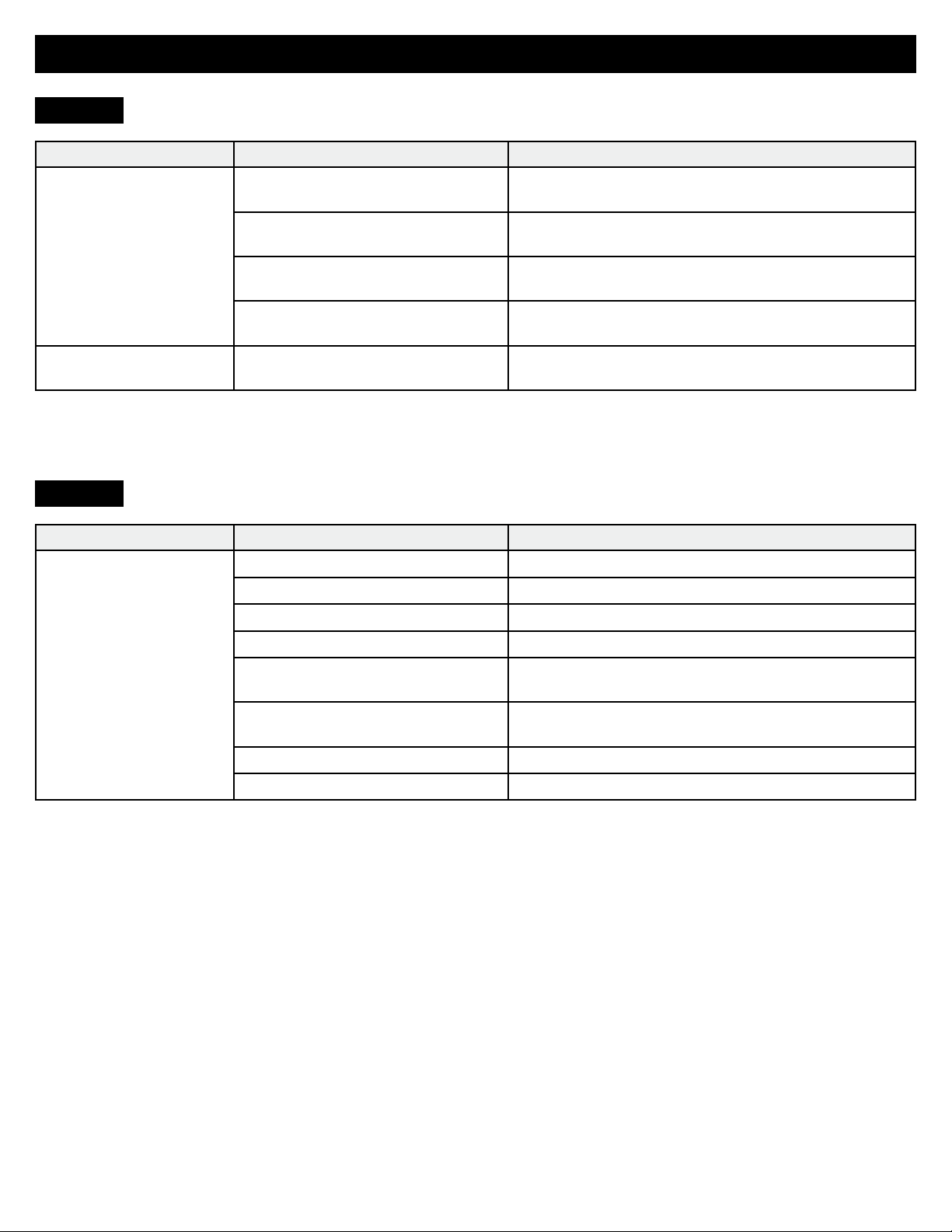
GENERAL OPERATION
Problem Possible Causes What to Do
The refrigerator will not
operate
Not connected to an electrical supply Plug the power cord into a grounded 3 prong outlet. Do
not use an extension cord.
No power to the electrical outlet. Plug in a lamp to see if the outlet is working.
Household fuse blown or circuit
breaker tripped.
Replace the fuse or reset the circuit breaker. If the
problem continues, contact an electrician.
New installation Allow 24 hours following installation for the refrigerator
to cool completely.
Runs too long, too
frequently
Today’s refrigerators start and stop more
often to maintain even temperatures.
Normal at startup for new or recently
installed units.
Wait 24 hours for refrigerator to completely cool down
(see “Temperature Controls” page).
Prolonged or frequent door openings. This is normal. Minimize door openings.
Door not sealing. Check to see if something is preventing door from
closing.
Front base grille blocked. Unblock to allow warm air to exit unit.
The door will not close
completely
The door is blocked open
Move food packages away from door. Push bin or shelf
back into the correct position. Make sure the crisper cover
is fully pushed in, so that the back rests on the supports.
The door is dicult to
open
Gaskets are dirty or sticky. Clean gaskets and contact surfaces with mild soap and
warm water.
Rinse and dry with soft cloth.
Warm air from cabinet
bottom
This is normal air ow for condenser
circulation.
There is interior moisture
buildup.
Humid room Contributes to moisture buildup in the refrigerator.
Door(s) opened often or not closed
completely.
Allows humid air to enter the refrigerator. Minimize door
openings and keep door fully closed.
Cabinet vibrates Cabinet not level. Weak oor. Level cabinet.
Odor in cabinet
Odor producing foods not covered.
Cover or wrap odorous foods tightly. Clean cabinet.
26
27
TROUBLESHOOTING GUIDE
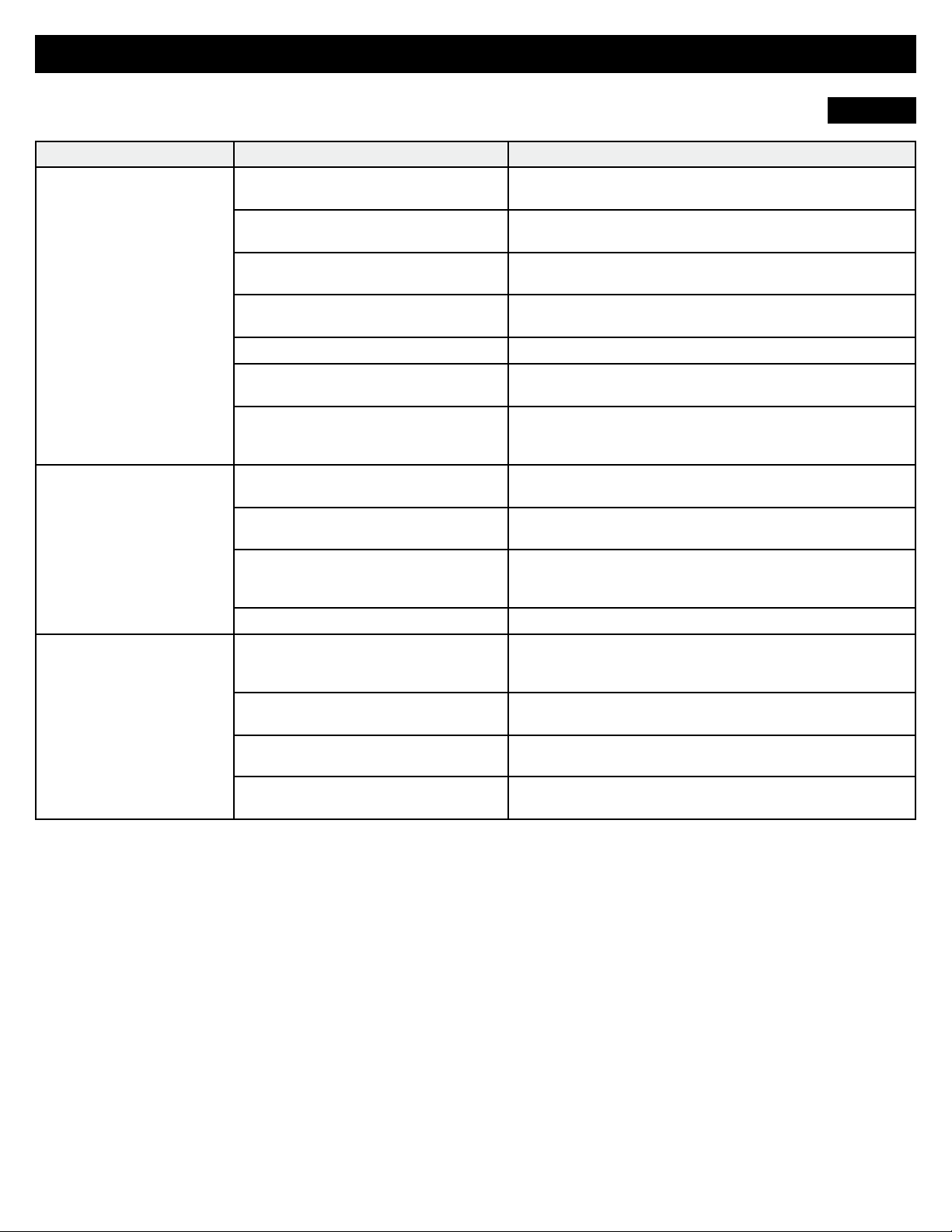
TEMPERATURE
Problem Possible Causes What to Do
Freezer, refrigerator too
warm
New installation Allow 24 hours following installation for the refrigerator
to cool completely.
Control set too warm. Prolonged door
openings.
Adjust temperature control. Minimize door openings.
A large amount of warm food has
been recently added.
Allows several hours for refrigerator to return to normal
temperature.
Products with high sugar content may
not harden completely when frozen.
Freezer, refrigerator too
cold
Control set too cold. Adjust temperature control.
NOISE
Problem Possible Causes What to Do
The refrigerator is noisy
NOTE:
Refrigerator noise
has been reduced over the
years. Due to this reduction
in operating noise, you
may notice unfamiliar
noises that are normal.
Normal noise: buzzing Heard when the water valve opens to ll the icemaker
Normal noise: clicking/Snapping Valves opening or closing
Normal noise: pulsating Fans/compressor adjusting to optimize performance
Normal noise: sizzling/Gurgling Water dripping on the heater during defrost cycle
Normal noise: popping Contraction/expansion of inside walls, especially during
initial cool-down.
Normal noise: water running May be heard when ice melts during the defrost cycle
and water runs into the drain pan.
Normal noise: creaking/cracking Occurs as ice is being ejected from the icemaker mold.
Cabinet not level. Level cabinet.
TROUBLESHOOTING GUIDE
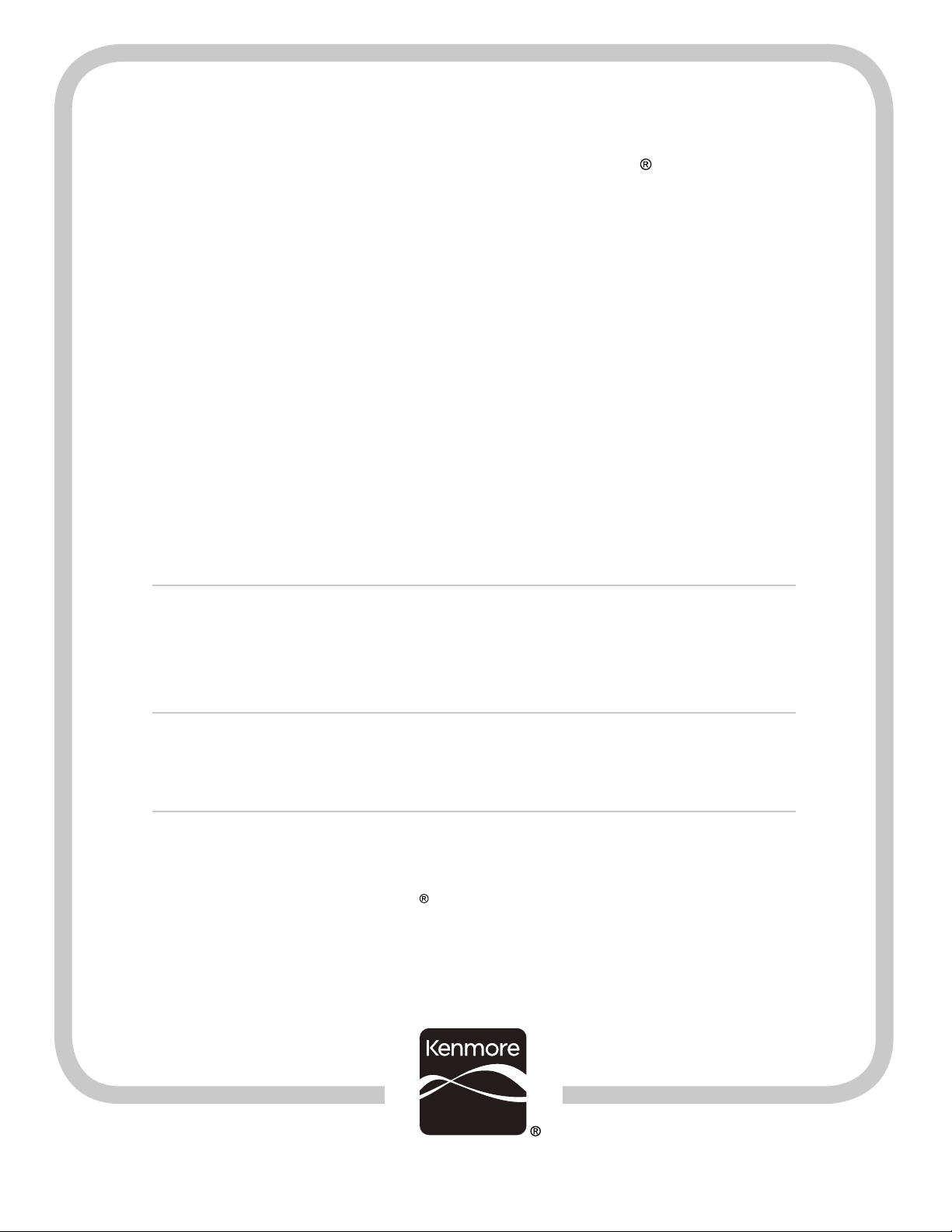
Icemaker
Problem Possible Causes What to Do
The icemaker is not
producing ice or not
enough ice (on some
models)
The icemaker is not connected to a
water supply
Connect refrigerator to water supply and turn water
shuto valve fully open.
A kink in the line can reduce water
ow
Straighten the water source line
Icemaker is not turned on Make sure the icemaker wire shuto arm or switch
(depending on model) is in the ON position.
New installation Wait 24 hours after icemaker installation for ice
production to begin. Wait 3 days for full ice production.
Large amount of ice recently removed Allow sucient time for icemaker to produce more ice.
Ice cube jammed in the icemaker
ejector arm
Remove ice from the ejector arm with a plastic utensil.
A reverse osmosis water ltration
system connected to your cold water
supply can decrease water pressure
See “Water Supply Requirements.”
The ice cubes are hollow
or small (on some models)
NOTE:
This is an indication
of low water pressure.
The water valve is not completely
open
Turn the water shuto valve fully open
A kink in the line can reduce water
ow
Straighten the water source line.
A reverse osmosis water ltration
system connected to your cold water
supply can decrease water pressure
See “Water Supply Requirements”
Supply line or shuo valve is clogged. Call a licensed, qualied plumber
O-taste, odor or gray
color in the ice (on some
models)
New plumbing connections can cause
discolored or o-avored ice
Discard the ice and wash the ice storage bin. Allow 24
hours for the icemaker to make new ice, and discard the
rst 3 batches of ice produced.
Ice stored too long can develop an
o-taste
Discard ice. Wash ice bin. Allow 24 hours for icemaker
to make new ice.
Food odor transferring to ice Use airtight, moisture proof packaging to store food.
There are minerals (such as sulfur) in
the water
A water lter may need to be installed to remove the
minerals.
Kenmore
For Sears Home Services in-home repair
of all Kenmore major appliances.
For the replacement parts, accessories and
Use & Care Guides that you need to do-it-yourself.
For professional installation of major home appliances
and items like air conditioners and water heaters.
1-844-553-6667
www.kenmore.com
In Canada 1-800-469-4663
www.sears.ca
Call anytime for the location of your nearest
Sears Parts & Repair Service Center
800-469-1-800-488-1222
(U.S.A.)
1-800-469-4663
(Canada)
To purchase a protection agreement on a serviceable product:
1-800-827-6655
(U.S.A.)
1-800-361-6665
(Canada)
Para pedir servicio de reparación
a domicilio, y ordenar piezas:
888-SU-1-888-SU-HOGAR
(1-888-784-6427)
www.kenmore.com
Au Canada pour service en français:
800-LE-1-800-LE-FOYER
MC
(1-800-533-6937)
www.sears.ca

인쇄물 신규(수정) 의뢰서
문서번호 담당자 파트장
구분 ■ 신규 / □ 수정
요청일자 2016. 07. 21
요청부서 / / /
부품CODE 품명 규격 Buyer
MANUAL B5, 총 30P, 6121@,7121@_Top mounted(영어)
상세 내용
영+스 합본 (총 60p)
160721 - 신규 : 총 32p(1~32)
160726 - 수정 : 총 32p(1~32)_내용 변경 많음.
160803 - 수정 : 총 2p(13,14)_총 30p로 변경
160906 - 수정 : 총 30p(1~30)_멕시코서 다시 작업해서 웹상올리거 재작업
※ 별첨 : 관련 PDF 파일 1부
상기와 같이 신규(수정)을 의뢰 합니다.
2016. 07. 21
동부대우전자 냉장고공장 생산기술파트