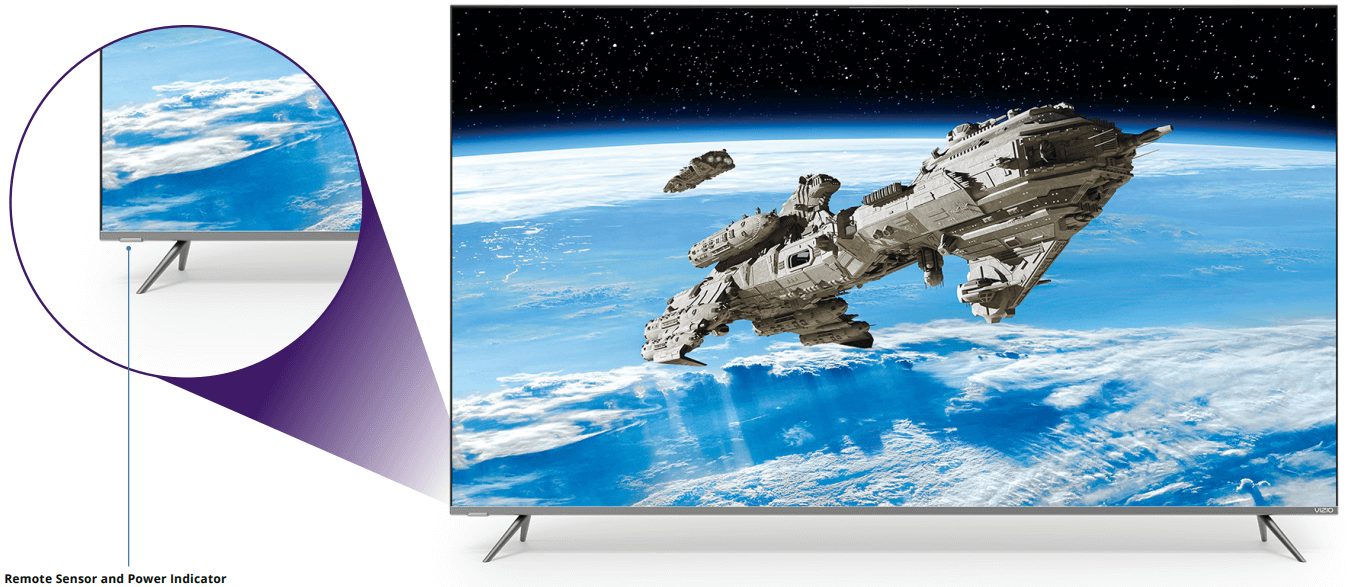
When using the remote, aim it directly at this sensor. The power indicator flashes on when the TV turns on, then goes out after several seconds.
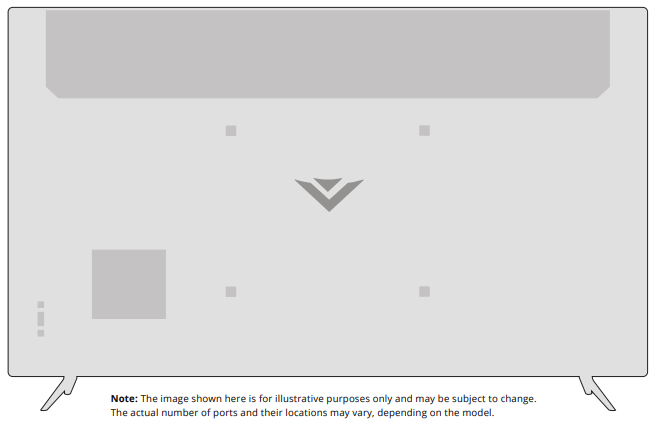
REAR PANEL
Power
Press to turn on the TV.
Press and hold to turn the TV off.
Volume
Press to increase or decrease the TV volume level.
Input
Press to access the input menu.
HDMI
Connect an HDMI device
Component/Composite
Connect a component or composite
Audio Out
Connect to an RCA device, such as sound bar
Coaxial
Connect to a coaxial cable from cable, satellite, or antenna
USB
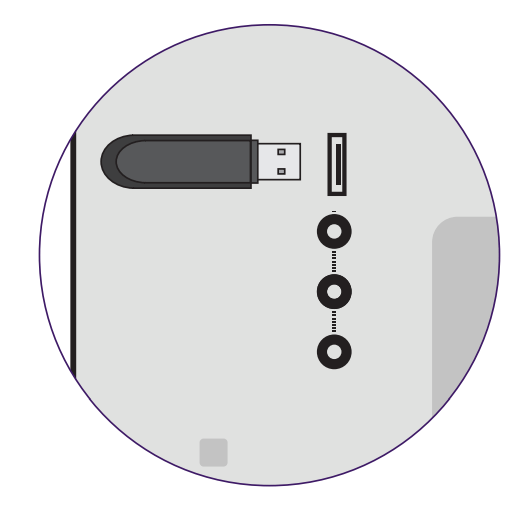
Connect a USB thumb drive to play photo, music, or video
Optical Audio Out
Connect to an optical/SPDIF audio device, such as home audio receiver
Ethernet
Connect an Ethernet cable to modem/ router
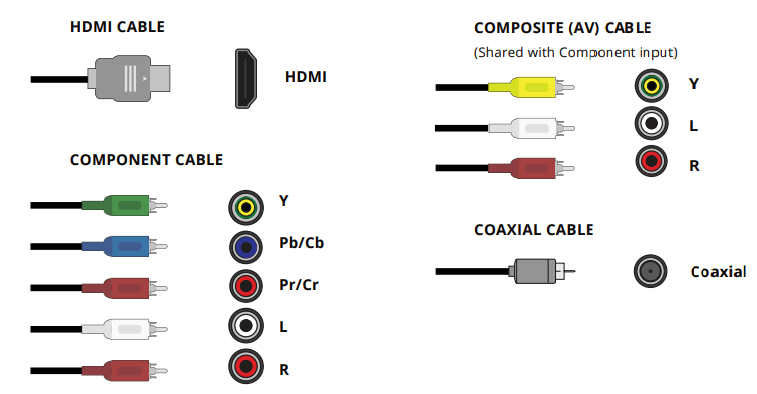
Connecting a device — AUDIO & VIDEO CABLE TYPES
Your TV can be used to display output from most devices.
Verify that your device has a video port that matches an available port on the TV (HDMI, Composite, etc.).
Connect the appropriate cable (not included) to the TV and the device.
Turn the TV and your device on.
Set the TV’s input to match the connection you used (HDMI-1, HDMI-2, etc.).
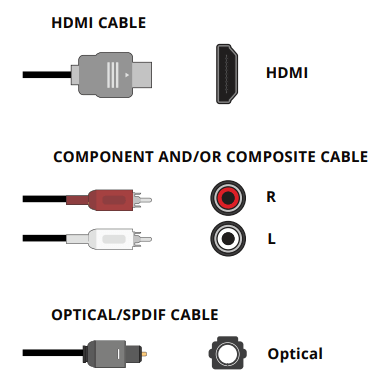
Connecting a device — AUDIO CABLE TYPES
Your TV can be output sound to an audio device, such as a receiver or sound bar.
Verify that your device has an audio port that matches an available port on the TV (optical, RCA, etc).
Connect the appropriate cable (not included) to the TV and the device. 3. Turn the TV and your device on.
Note: The actual ports and their locations may vary, depending on the TV model.
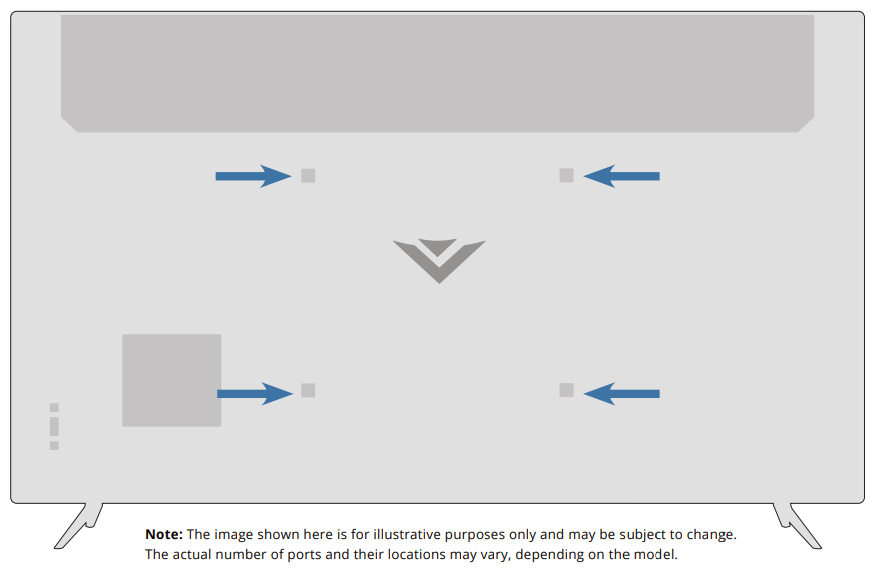
WALL-MOUNTING THE TV
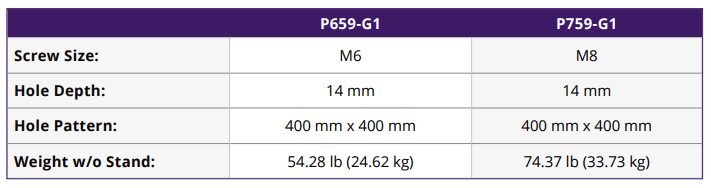
First you will need a wall mount. Consult the provided table below to find the appropriate mount for your TV.
Be sure the mount you choose is capable of supporting the weight of the TV.
To install your TV on a wall:
Disconnect any cables connected to your TV.
Place the TV face-down on a clean, flat, stable surface. Be sure the surface is clear of debris that can scratch or damage the TV.
If attached, remove the stands by loosening and removing the screws.
Attach your TV and wall mount to the wall by carefully following the instructions that came with your mount. Use only with a UL-listed wall mount bracket rated for the weight/load of your TV.
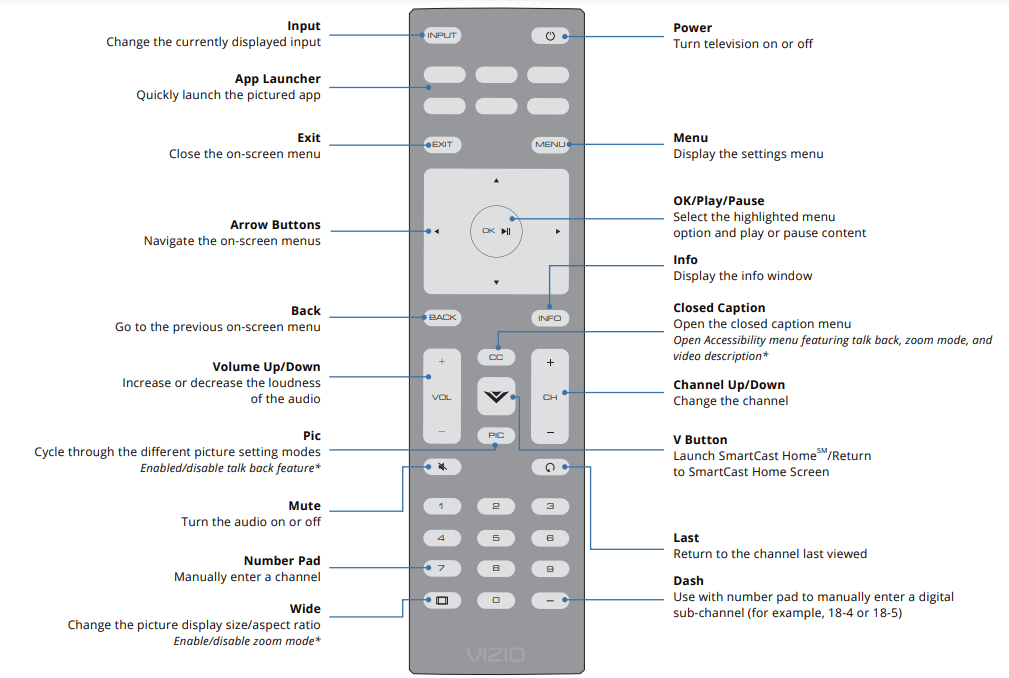
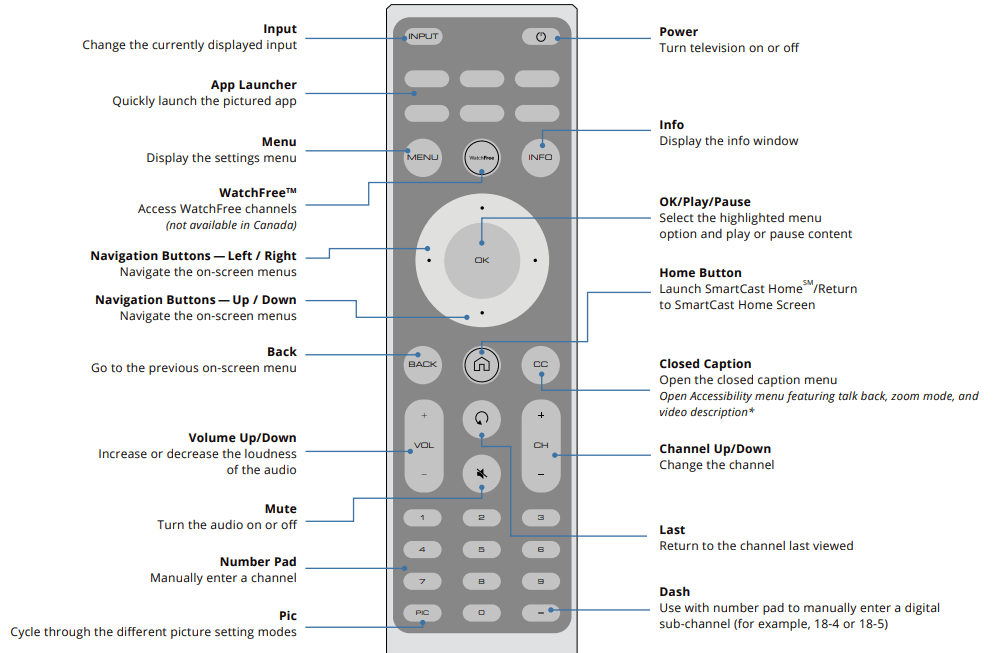
USING THE REMOTE — XRT136 (BLACK)
*Enabled/disabled different accessibility features by holding down each of these buttons for 5 seconds.
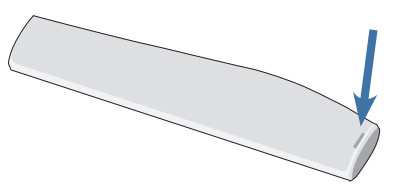
Replacing the Batteries
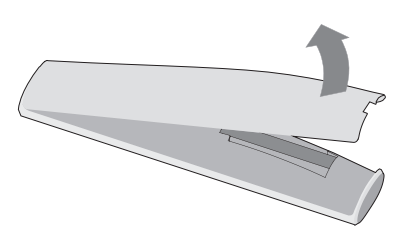
1. Find the notch on the back of the remote. Insert a coin and pry open the back cover.
2. Insert two batteries into the remote control. Make sure that the (+) and (-) symbols on the batteries match the (+) and (-) symbols inside the battery compartment.
3. Replace the battery cover.
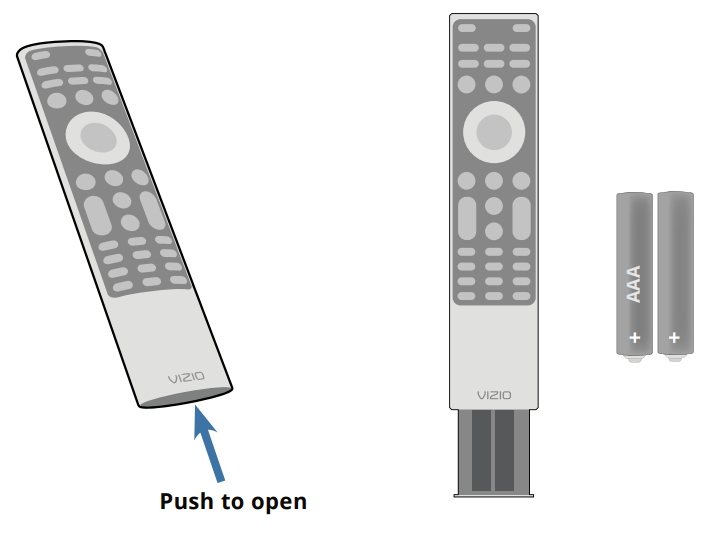
USING THE REMOTE — XRT150 (SILVER)
Replacing the Batteries
Push the bottom of the remote to open the battery compartment.
Insert two batteries into the remote control. Make sure that the (+) and (-) symbols on the batteries match the (+) and (-) symbols inside the battery compartment.
Push the bottom of the remote to close.
Completing the First-Time Setup
Before you begin the first-time setup:
Your TV should be installed and the power cord should be connected to an electrical outlet.
If you have a wireless network, have the network password ready.
If you are connecting to your network with an Ethernet cable, connect it to the Ethernet port on the TV.
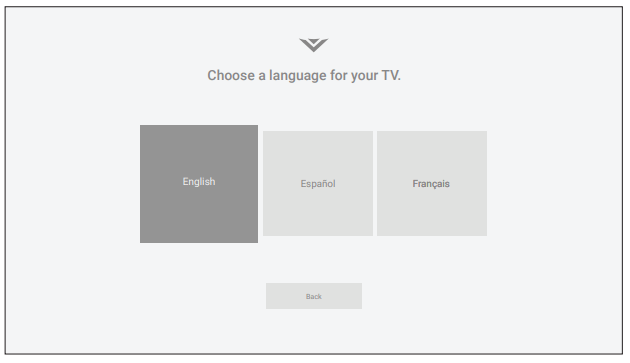
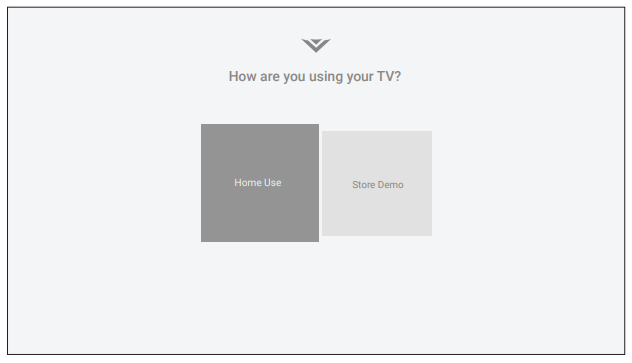
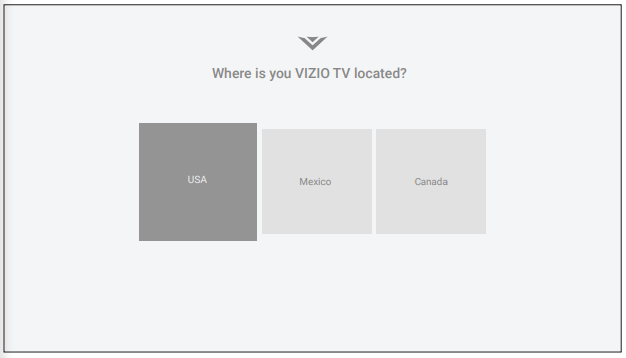
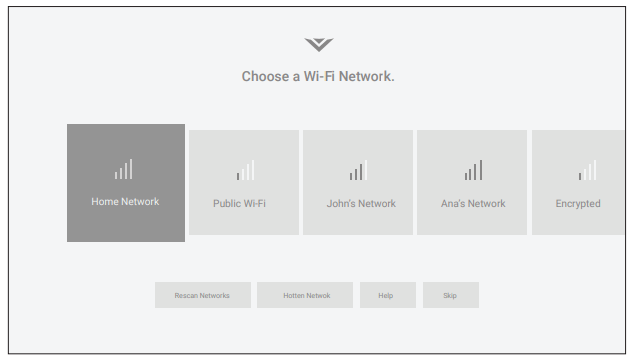
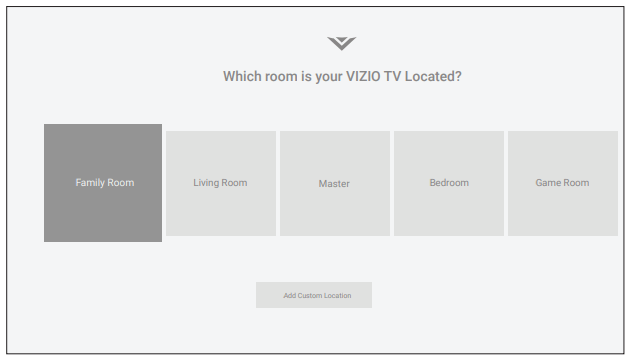
The first time you turn on the TV, the on-screen instructions will guide you through each of the steps necessary to get your TV ready for use:
1. Choose your language.
2. Choose home use.
3. Choose your country.
4. Choose your WI-Fi network and enter the password.
5. Name your TV.
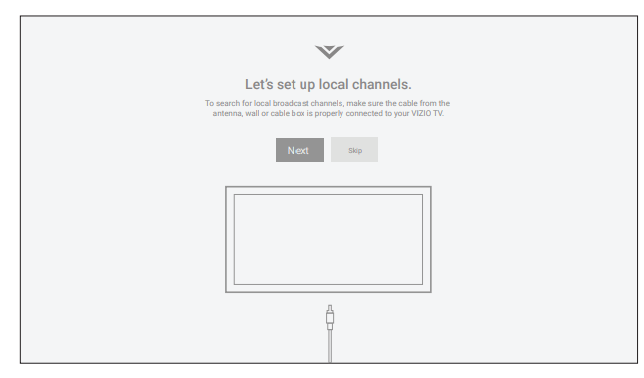
6. Scan for channels.
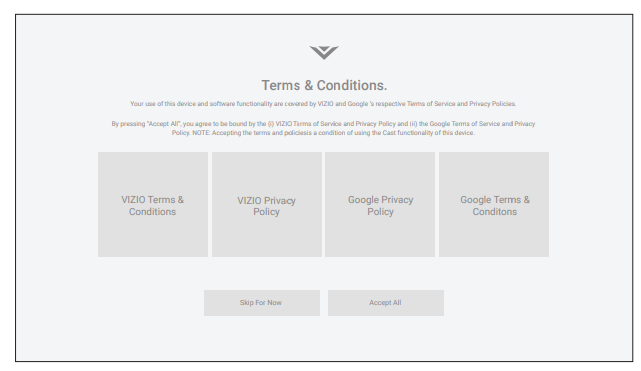
7. Accept the Terms & Conditions and register your device.
Using the On-Screen Menu
Your TV features an easy-to-use on-screen menu.
To open the on-screen menu, press the MENU button on the remote.
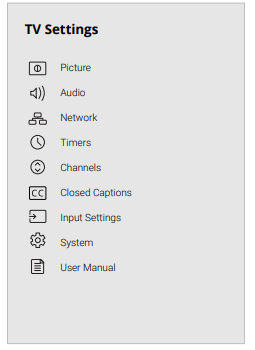
From this menu, you can:
• Adjust the picture settings
• Adjust the audio settings
• Adjust the network settings
• Set up timers
• Adjust the channel settings
• Set up closed captioning
• Name and adjust Inputs
• Adjust TV settings
• View the user manual
NAVIGATING THE ON-SCREEN MENU
To open the on-screen menu:
1. Press the MENU button on the remote.
2. Use the Navigation buttons to highlight a menu option, and press the OK button to select that option.
TIP: While navigating the on-screen menu, you can press the BACK button at any time to return to the previous menu screen.
CHANGING THE INPUT SOURCE
External devices, such as DVD players, Blu-ray Players, and video game consoles, can be connected to your TV. To use one of these devices with your TV, you must first change the input source using the Input menu.
To change the input sources:
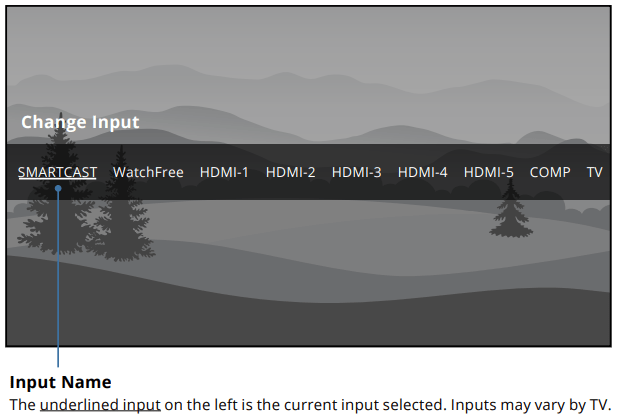
1. Press the INPUT button on the remote. The input menu is displayed.
2. Use the Navigation buttons or the INPUT button on the remote to highlight the input you wish to view. The corresponding inputs are named on the back of your TV.
3. Press OK or release the INPUT button. The selected input is displayed.
TIP: You can change the input names that appear on the Input menu to make your devices easy to recognize. See Renaming Devices on the Input Menu.
CHANGING THE SCREEN ASPECT RATIO
To change the screen aspect ratio:
Menu > System > Aspect Ratio
Use the Arrow buttons to highlight the aspect ratio you wish to view.
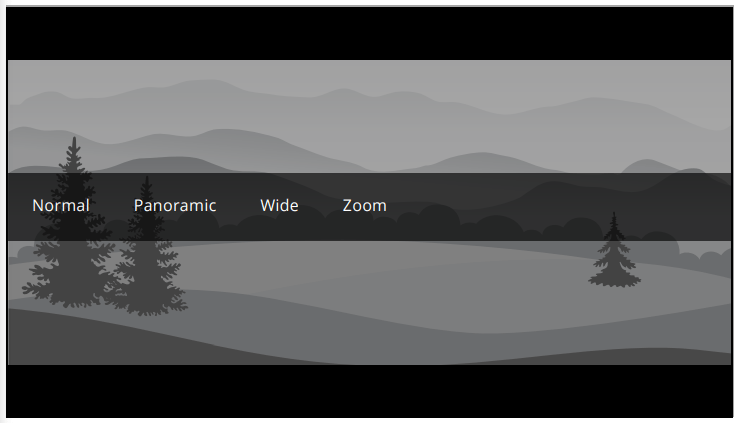
Your TV can display images in different modes: Normal, Stretch, Wide, Zoom, and Panoramic.
• Normal (default) — No change to aspect ratio.
• Stretch*—When the 16:9 signal is a 4:3 image with black bars left and right, stretches to fill the screen.
• Wide – Stretches a 4:3 aspect ratio to fill 16:9 screen. If a 16:9 image, adds black bars to top and bottom.
• Zoom – Expands image both horizontally and vertically by 14%.
• Panoramic* — Stretches a 4:3 image to fill 16:9 screen with an algorithm so the center doesn’t look stretched.
Some programs have black bars on the top or sides of the screen so that the picture keeps its original shape. Examples include widescreen movies and older TV programs.
TIP: The aspect ratio cannot be changed for Ultra HD content or HDR content.
ADJUSTING THE PICTURE SETTINGS
Your TV can be adjusted to suit your preferences and viewing conditions.
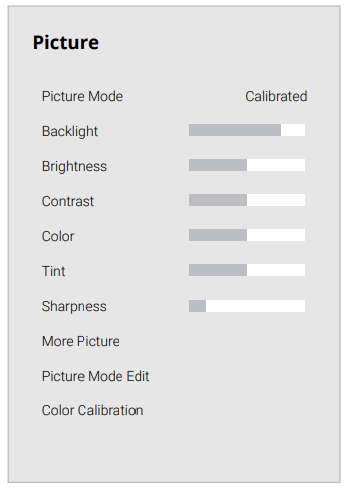
To adjust the picture settings: Menu > Picture > Picture Mode
1. Use the Navigation buttons on the remote to highlight Picture Mode, then use the Left/Right Navigation buttons to change the picture mode:
• Standard — Sets the picture settings to the default settings.
• Calibrated — Sets the picture settings to values ideal for watching TV in a brightly-lit room.
• Calibrated Dark — Sets the picture settings to values ideal for watching TV in a dark room.
• Vivid — Sets the picture settings to values that produce a brighter, more vivid picture.
• Game — Reduces throughput delays and optimizes the picture settings for displaying game console output.
• Computer — Optimizes the picture settings for displaying computer output.
TIP: If you save changes to the settings for a picture mode, an asterisk will appear after is name.
2. To manually change each of the picture settings, use the Up/Down Navigation buttons on the remote to highlight that picture setting, then use the Left/Right Navigation buttons to adjust the setting:
• Backlight — Adjusts the LED brightness to affect the overall brilliance of the picture. Backlight cannot be adjusted when starting from some picture modes.
• Brightness — Adjusts the black level of the picture. When this setting is too low, the picture may be too dark to distinguish details. When this setting is too high, the picture may appear faded or washed out.
• Contrast — Adjusts the white level of the picture. When this setting is too low, the picture may appear dark. When this setting is too high, the picture may appear faded or washed out. If the setting is too high or too low, detail may be difficult to distinguish in dark or bright areas of the picture.
• Color — Adjusts the intensity of the picture colors.
• Tint — Adjusts the hue of the picture. This setting is useful in adjusting the flesh tones in the picture. If flesh appears too orange, reduce the level of color before adjusting tint.
• Sharpness — Adjusts the edge sharpness of picture elements. It can be used to sharpen non-HD (high definition) content; however, it will not produce detail that does not otherwise exist.
Adjusting More Picture Settings
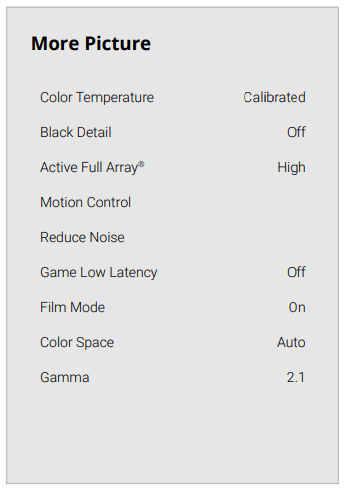
To adjust more picture settings: Menu > Picture > More Picture
Use the Navigation buttons to highlight the setting you wish to adjust, then press the Left/Right Navigation buttons to change the setting:
• Color Temperature — Change the white balance of the picture. Refer to the section on Adjusting the Color Temperature.
• Black Detail — Adjusts the average brightness of the picture to compensate for large areas of brightness.
• Active Full Array® — Based on the content, dynamically adjusts and balances the brightness and the contrast ratio of the picture by locally adjusting backlight zones.
• Motion Control — Reduce the motion blur of the conent with fast action.
• Reduce Noise:
− Reduce Signal Noise: Lessens artifacts in the image caused by the digitizing of image motion content.
− Reduce Block Noise: Reduces pixelation and distortion for mpeg files.
• Game Low Latency — Reduces video delay (lag) when gaming.
• Film Mode — Optimizes the picture for watching films.
• Color Space — Select Color Space for the source. Video sources uses YCbCr, but PC uses RGB.
• Gamma — Set the shape of the Gamma curve. Use lower Gamma values for bright room conditions, and higher values when it’s dark.
Adjusting the Color Temperature
Adjusting the color temperature changes the white balance of the picture.
To adjust the color temperature:
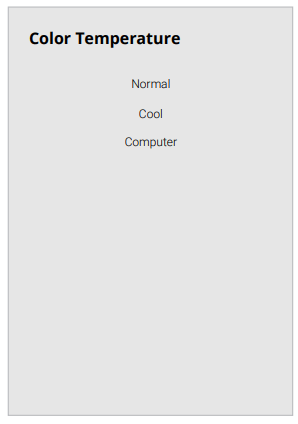
Menu > Picture > More Picture > Color Temperature
Use the Navigation buttons on the remote to highlight a color temperature preset and then press OK.
• Normal — Optimized for television viewing.
• Cool — Produces a blue-hued picture.
• Computer — Optimizes the picture for use as a PC monitor.
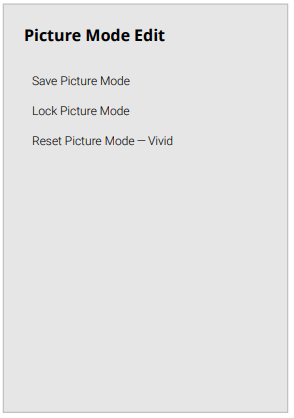
Adjusting the Picture Mode Edit Settings
Picture Mode Edit Settings allow you to make precise adjustments to the picture.
To adjust the Picture Mode Edit settings:
Menu > Picture > Picture Mode Edit
Use the Navigation buttons to highlight the setting you wish to adjust, then press OK to change the setting:
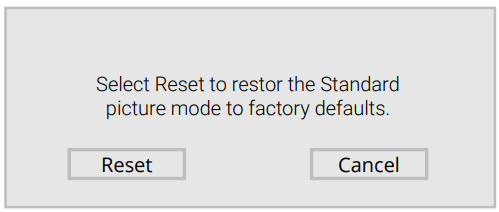
• Reset Picture Mode — Reset the picture mode settings to factory default values. Only available on customized preset modes.
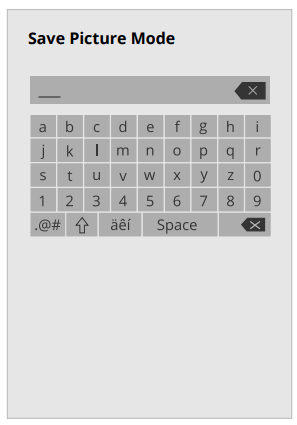
Saving a Custom Picture Mode
Custom picture modes allow you to save a group of custom settings for various viewing conditions and video sources.
To save a custom picture mode:
Menu > Picture > Picture Mode Edit > Save Picture Mode > Enter a Name >Save
• Changes made while on any preset picture mode will add an asterisk on the top right corner of the preset mode.
• The custom picture mode is not automatically saved.
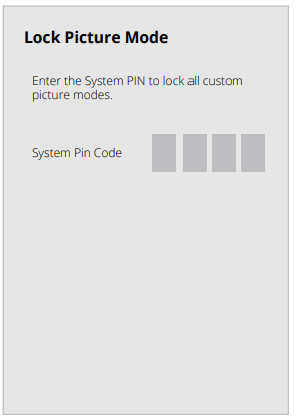
Locking/Unlocking a Custom Picture Mode
Custom picture modes can be locked/unlocked with a unique PIN to prevent accidental changes to their settings. If not previously set, you can set up your system PIN code here.
To lock all custom picture modes:
Menu > Picture > Picture Mode Edit > Lock Picture Mode > Enter Your PIN > Save
To unlock all custom picture modes:
Menu > Picture > Picture Mode Edit > Lock Picture Mode > Off > Enter Your PIN
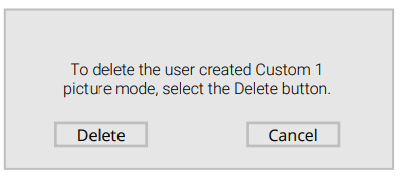
Deleting a Custom Picture Mode
Custom picture modes that are no longer needed can be deleted.
TIP: Inputs assigned to a deleted custom picture mode become assigned to the Calibrated picture mode.
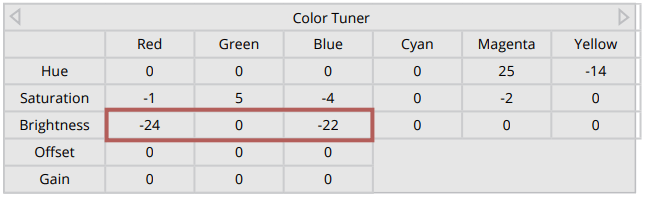
The Color Tuner settings allow you to adjust the color management system, 2 point white balance, 11 point white balance, turn color channels off for testing, and display SMPTE, flat, ramp, and uniformity analyzer test patterns.
To access the color tuner table:
Menu > Picture > Color Calibration > Color Tuner
To turn color channels off and on:
Use the Navigation buttons on the remote to highlight Red, Green, or Blue.
Press the OK button to turn the color channel off or on. An X appears over a color channel that has been turned off.
Only two color channels can be turned off at the same time.
TIP: Any changes made affect the color temperature setting. Select the preferred color temperature setting first.
To adjust the color management system/2 point white balance settings:
Use the Navigation buttons on the remote to highlight the Hue, Saturation, Brightness, Offset, or Gain of the color you wish to adjust. Press the OK button.
Use the Left/Right Navigation buttons to adjust the value. When you are finished press the OK button to save the setting.
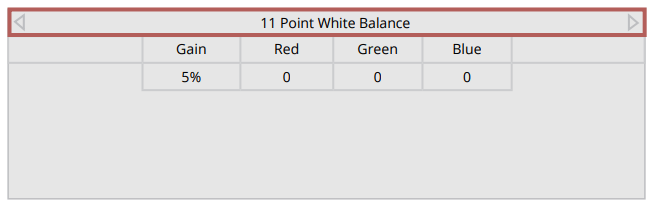
To adjust the 11 Point White Balance settings:
1. From the Color Tuner table, use the Navigation buttons to highlight the top bar and then press the Left/Right Navigation buttons until the 11 POINT WHITE BALANCE menu is displayed.
2. Use the Navigation buttons on the remote to highlight the Gain and Color values you wish to adjust. Press the OK button and use the Left/Right Navigation buttons to adjust the value. When you are finished, press the OK button to save the setting.
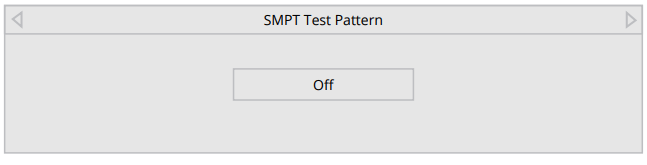
To show or hide the SMPTE Test Pattern:
Menu > Picture > Color Calibration > Calibration Tests > SMPTE Test Pattern
1. Use the Navigation buttons on the remote to highlight Off. Use the Left/ RightNavigation buttons to select On to show the SMPTE Pattern.
—or—
2. To hide the SMPTE Test Pattern, use the Left/Right Navigation buttons to select Off.
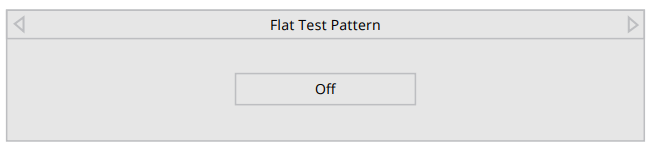
To show or hide the Flat Test Pattern:
Menu > Picture > Color Calibration > Calibration Tests > Flat Test Pattern
1. Use the Navigation buttons on the remote to highlight Off. Use the Left/Right Navigation buttons to select the percentage brightness for the flat test pattern. Selecting a percentage immediately shows the flat pattern at that brightness.
—or—
2. To disable the Flat Test Pattern, use the Left/Right Navigation buttons to select Off.
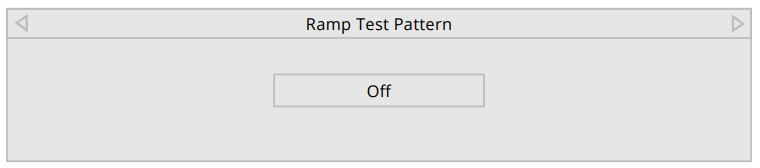
To show or hide the Ramp Test Pattern:
Menu > Picture > Color Calibration > Calibration Tests > Ramp Test Pattern
1. Use the Navigation buttons on the remote to highlight Off. Use the Left/Right Navigation buttons to select the color for the ramp test pattern. Selecting a color immediately shows that color ramp.
—or—
2. To hide the Ramp Test Pattern, use the Left/Right Navigation buttons to select Off.
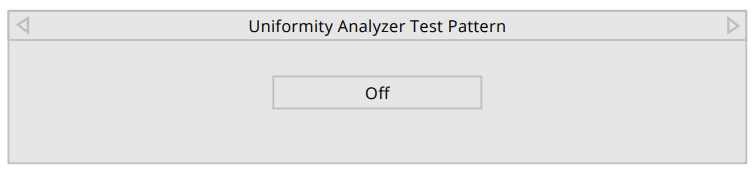
To show or hide the Uniformity Analyzer Test Pattern:
Menu > Picture > Color Calibration > Calibration Tests > Uniformity Analyzer Test Pattern
1. Use the Navigation buttons on the remote to highlight Off. Use the Left/Right Navigation buttons to select On to show the Uniformity Analyzer Test Pattern.
—or—
2. To hide the Uniformity Analyzer Test Pattern, use the Left/Right Navigation buttons to select Off.
ADJUSTING THE AUDIO SETTINGS
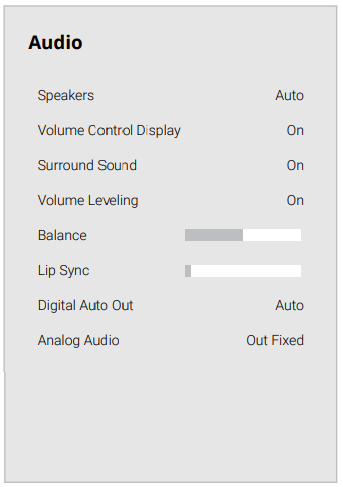
To adjust the audio settings: Menu > Audio > OK
Use the Navigation buttons to highlight the setting you wish to adjust, then press Left/Right Navigation buttons to change the setting:
• Speakers — Turn the built-in speakers On or Off.
• Volume Control Display — Turn the on-screen volume display slider On or Off.
• Surround Sound — Surround sound uses DTS TruSurround™ to deliver an immersive surround sound experience from the TV’s internal speakers. TruSurround completes the entertainment experience by providing deep, rich bass, crisp details, and clear, intelligible dialog. Select On or Off.
• Volume Leveling — Volume leveling uses DTS TruVolume™ to maintain consistent volume levels during transitions between program content, AV formats, and input sources. Select On or Off. In a few cases, volume leveling may artificially suppress volume increases, making it difficult to hear dialog or flattening sudden noises. If this occurs, turn volume leveling off.
• Balance — Adjusts the loudness of the audio output from the left and right speakers.
TIP: When the TV speakers are set to On, DTS signals cannot be passed through digital audio outputs.
• Lip Sync — Adjusts the synchronization between the display image and the accompanying audio track.
• Digital Audio Out — Changes the type of processing for digital audio out and HDMI ARC output when connected to a home theater audio system. Select Auto, PCM, Dolby D or Bitstream.
- To hear talk back when Talk Back function is enabled, digital audio out must be set to PCM.
• Analog Audio Out — Sets the volume control properties for the RCA connector when connected to a home theater audio system. Select Variable if you are controlling the volume with the TV’s volume controls, or select Fixed if an external audio device (sound bar or AV receiver) will control the volume.
TIP: You must select Bitstream for audio with more than two channels (e.g., 3.0, 5.0, or 5.1).
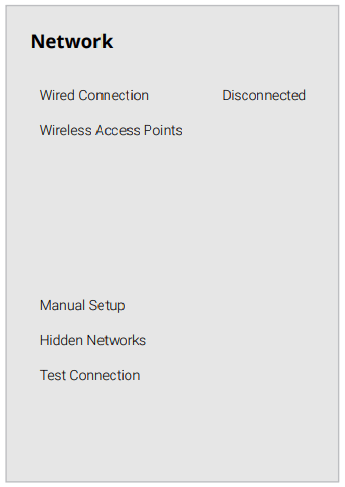
ADJUSTING THE NETWORK SETTINGS
Your TV is Internet-ready, featuring both an Ethernet port and built-in high-speed wireless internet.
TIP: If your TV is connected to a network with an Ethernet cable, you will not see the wireless network connection menu. You must unplug the Ethernet cable to set a wireless network connection.
Connecting to a Wireless Network
To connect to a wireless network whose network name (SSID) is being broadcast:
Menu > Network > Choose your network > Enter in the password > Connect
If you do not see your wireless network displayed, click on:
More Access Points > Highlight your wireless network > Enter in the password > Connect
TIP: You can display your photos in Fullscreen. Select the photo, press OK, then highlight Fullscreen and press OK.
Changing the Manual Setup Settings
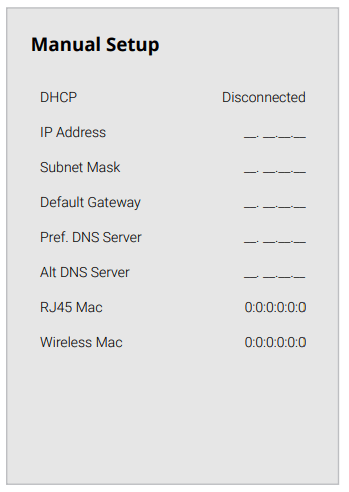
Advanced users can fine-tune the network settings using the Manual Setup feature. The security settings on your router may require you to enter the TV's MAC address.
To change advanced network settings:
Menu > Network > Manual Setup > DHCP > Off
1. Use the Navigation and OK buttons to adjust each setting:
• IP Address — The IP address assigned to the TV.
• Subnet Mask — The subnet Exit 2D.
• Default Gateway — Your network’s default gateway address.
• Pref. DNS Server — Your preferred domain name server address.
• Alt. DNS Server — Your alternate domain name server address.
2. Use the Navigation buttons on the remote to highlight Save and press OK.
To find the TV’s MAC address:
Menu > Network > Manual Setup
You can find your TV's MAC address at the bottom of the list. The MAC addresses for the connections in use are displayed:
• RJ45 MAC — The Ethernet or RJ45 MAC address may be needed to set up your network when you have connected the TV to your network when you have connected the TV to your network with an Ethernet (Cat 5) cable.
• Wireless MAC — The Wireless (Wi-Fi) MAC address may be needed to connect your TV to your network with Wi-Fi.
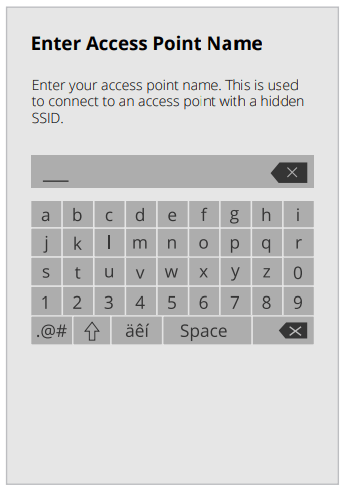
Connecting to a Hidden Network
To connect to a wireless network whose network name (SSID) is not being broadcast:
Menu > Network > Hidden Network > Enter the Access Point Name > Connect > Enter in the password
Testing Your Network Connection
To test your network connection:
Network Menu > Test Connection
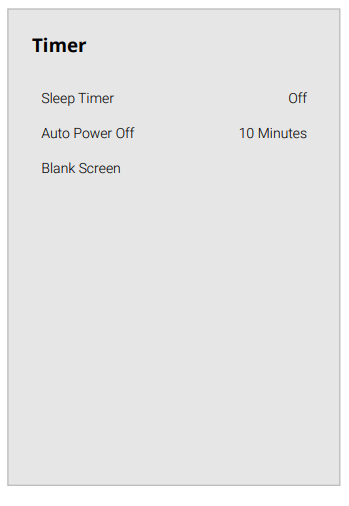
SETTING TIMERS
When activated, the TV’s timer will turn the TV off after a set period of time.
To setup a sleep timer:
Menu > Timers
Use the Left/Right Navigation buttons on the remote to highlight the period of time after which you want the TV to go to sleep: 30, 60, 90, 120, or 180 minutes. If you don’t want the sleep timer to activate, change the setting to Off.
Setting the Auto Power Off Feature
To help save energy, your TV is set by default to turn off after 10 minutes without a video or audio signal. This feature can be deactivated.
To set the Auto Power Off feature:
Menu > Timers > Auto Power Off > Off
Using the Blank Screen Feature
To help save LED life, your TV screen can turn on or off while audio is streaming.
To use the Blank Screen feature:
Menu > Timers > Blank Screen
To exit Blank Screen, press any key (except the volume and mute keys).
SETTING UP CHANNELS
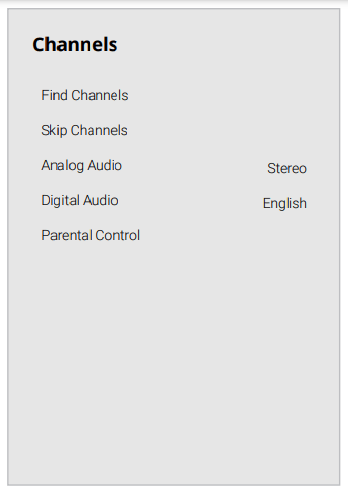
You can use the TV’s Channels menu to:
• Find channels
• Select channels to skip
• Select analog audio mode
• Select the language for digital audio
• Set parental controls
Scanning for Channels
The TV may need to scan for channels before it can display programs and their associated information. A channel scan is required for free over-the-air channels (using an antenna) and cable channels from an out-of-the-wall connection (without a cable box). Moving the TV to an area with different channels requires the TV to scan for channels again.
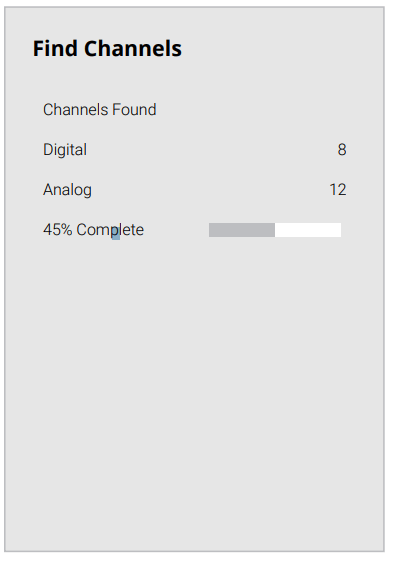
To perform an Auto Channel Scan: Menu > Channels > Find
Channels Wait until the channel scan is 100% complete. Highlight Done and press OK.
• If the channel scan is canceled, the channels that were already discovered are retained. A new channel scan will clear all channels.
Skipping Channels
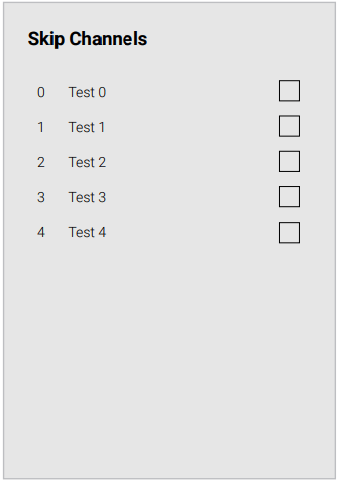
After a channel scan is completed, you may find that some channels are too weak to watch comfortably. There may also be some channels you do not want to view. You can remove these channels from the TV’s memory with the Skip Channel feature.
To remove a channel:
1. From the CHANNELS menu, highlight Skip Channel, and press OK. The SKIP CHANNEL menu is displayed.
2. For each channel you wish to remove, use the Up/Down Navigation buttons on the remote to highlight the channel and press OK. A P appears to the right of each channel you select.
LISTENING TO ALTERNATE AUDIO
Changing the Analog Audio Language
Some analog over-the-air (free) and cable channels broadcast programs in more than one language. The TV’s Analog Audio feature allows you to listen to audio in an alternate language using Secondary Audio Programming (SAP).
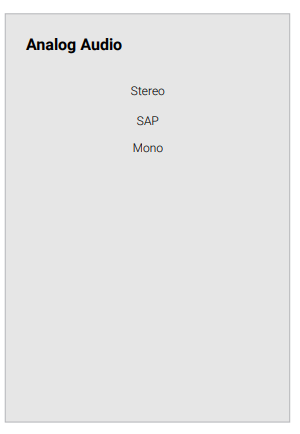
To use the Analog Audio feature: Menu > Channels > Analog Audio
• Stereo — More than one speaker channel is being used. Sounds may be dispersed through different speakers depending on how the audio is programmed.
• SAP (Secondary Audio Program) — Typically used for audio in a different language other than the native one used in the program.
• Mono — All speakers are producing the same sound; there is no distinction between left or right sounds.
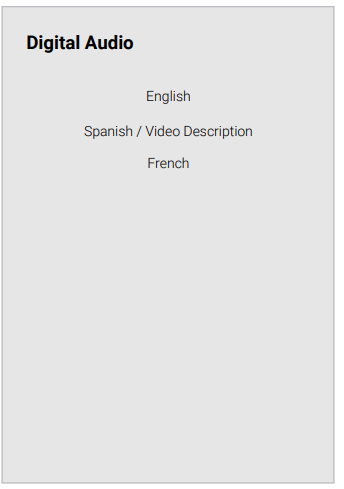
To use the Digital Language feature: Menu > Channels > Digital Audio
Select the preferred audio language. Available languages or video description depend on the broadcast content.
USING PARENTAL CONTROLS
The TV’s parental controls allow you to prevent the TV from displaying certain channels or programs unless a PIN is used.
Accessing the Parental Controls Menu
To access the Parental Controls menu you must first set up a system PIN:
Menu > Channels > Parental Controls > Enter in PIN
The Parental Controls menu only appears when:
• You are using the tuner to receive your TV signals, such as when you are using an antenna for Over-the-Air signals or when connected to cable TV directly from the wall (no cable box).
• You have a device connected using a composite video cable or a coaxial cable, such as a VCR, satellite or cable box, or DVR.
Enabling or Disabling Program Ratings
To manage program content according to its rating, you must first enable the Program Rating feature.
To enable or disable the Program Rating feature:
Menu > Channels > Parental Controls > Locks > ON/OFF
Locking and Unlocking Channels
When a channel is locked, it cannot be accessed. Locking a channel is a good way to prevent children from viewing inappropriate material.
To lock or unlock a channel:
Menu > Channels > Parental Controls > Channel Locks
Highlight the channel you want to lock or unlock and press OK.
• When a channel is locked, the Lock icon appears locked. The channel is not accessible unless the system PIN is entered.
• When a channel is unlocked, the Lock icon appears unlocked.
Blocking and Unblocking Content by Rating
A channel may sometimes broadcast programs that are meant for a variety of audiences (some for children and some for adults). You might not want to block the channel completely using a channel lock, but you can block certain programs from being viewed.
You can use the TV’s Rating Block feature to block content based on its rating.
To block or unblock content by its rating:
1. From the Parental Controls menu, highlight the content type you want to adjust and press OK:
• USA TV — USA television program broadcasts.
• USA Movie — USA movie broadcasts.
• Canadian English — Canadian English television program broadcasts.
• Canadian French — Canadian French television program broadcasts.
2. For each rating type you want to block or unblock, use the Navigation buttons to highlight the rating type and press OK.
• When the rating type is blocked, the Lock icon appears locked. Content with this rating and all higher ratings cannot be viewed.
• When the rating type is unblocked, the Lock icon appears unlocked. Content with this rating and all lower ratings can be viewed.
• If you want to block all unrated content, highlight Block Unrated Shows and use the Navigation buttons on the remote to select On.
SETTING UP CLOSED CAPTIONING
Your TV can display closed captions for programs that include them. Closed captions display a transcription of a program’s dialogue.
To activate or deactivate closed captions:
Menu > Closed Captions > Closed Captions > Off/On
1. Use the Navigation buttons on the remote to highlight either Analog or Digital Closed Captions.
2. Use the Left/Right Navigation buttons on the remote to select the caption channel you wish to display.
Changing the Appearance of Digital Closed Captions
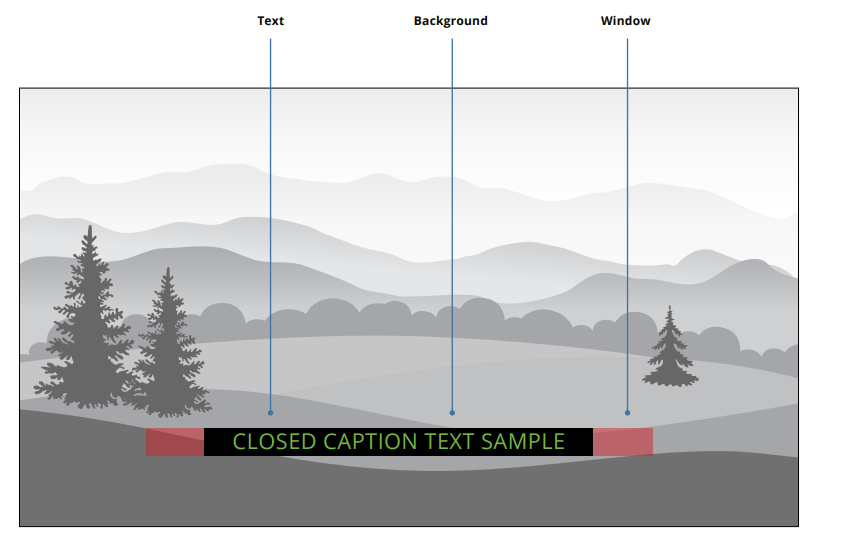
Digital closed captions can be displayed according to your preference. See the diagram on the next page for an explanation of the parts of the closed caption area.
To change the appearance of digital closed captions:
Menu > Closed Captions > Digital Style
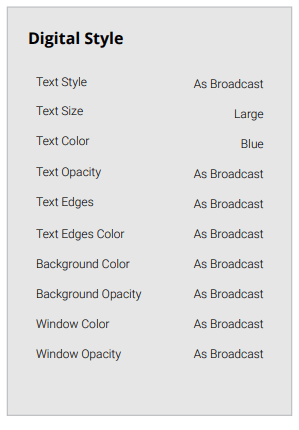
1. Use the Left/Right Navigation buttons on the remote to select Custom. The Digital Style menu appears as shown.
2. Use the Up/Down Navigation buttons on the remote to highlight the setting you wish to change, then use the Left/Right Navigation buttons to change the setting:
• Caption Style — Choose As Broadcast to keep default settings or Custom to manually change each setting.
• Text Style — Change the font used for the closed captioning text.
• Text Size — Make the text larger or smaller.
• Text Color — Change the color of the text.
• Text Opacity — Change the transparency of the text.
• Text Edges — Change the effects at the edges of the text, such as raising the edges or adding drop shadows.
• Text Edges Color — Change the color of the text edge effects.
• Background Color — Change the color of the background directly behind the text.
• Background Opacity — Change the transparency of the background directly behind the text.
• Window Color — Change the color of the closed captioning box.
• Window Opacity — Change the opacity of the closed captioning box.
Typical choices include:
• Opaque background, transparent window — Only a strip of background appears behind the text, expanding as the text appears. This is the typical "As Broadcast" mode.
• Opaque background and window in the same color — When text appears, the entire line fills with color at once.
In the example, the closed caption text is green, the background is black, and the window is red.
CHANGING INPUT SETTINGS
To access input settings menu: Menu > Input Settings
Highlight the input device that you want to view/change and press OK.
Renaming Devices on the Input Menu
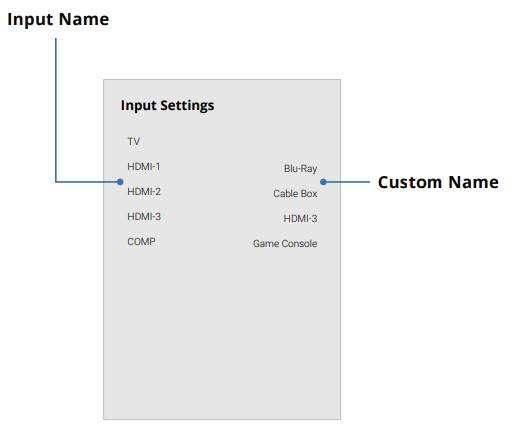
You can rename the inputs to make them easier to recognize on the Input menu. For example, if you have a DVD player connected to the component input, you can rename that input to display “DVD Player.”
To change the name of an input: Menu > Input Settings
To use a preset input name:
• Highlight the Name Input row and press OK.
• Highlight the input name and use the Left/Right Navigation buttons on the remote to cycle through preset input names
—or—
To enter a custom name:
• Highlight the Name Input row and press OK.
• Enter your custom label using the on-screen keyboard and press OK.
Other settings include the following:
• Full UHD Color* — expanded color display.
• Picture Size* — configure the display size to enlarge or shrink the image to fill the screen.
• Picture Position* — move the vertical and horizontal position of the picture in relation to the screen.
• Hide from Input Source — hide inputs that are not being used. Hidden inputs will not be displayed in the input list.
*Only available if there is an input source. Not available for WatchFree. Menu items will be grayed out if not available.
CHANGING THE TV SETTINGS
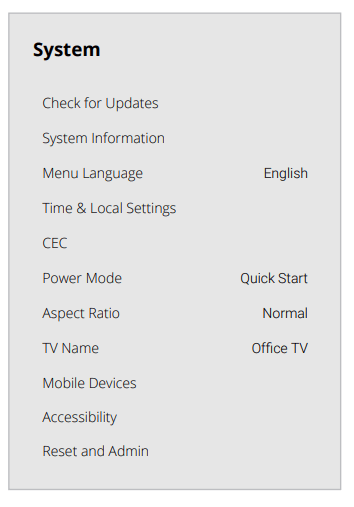
Using the System menu, you can:
• Check for updates
• View system information
• Change the on-screen menu language
• Set time zone and local settings
• Adjust the CEC settings
• Adjust the power mode settings
• Adjust to preserve aspect ratio or fill the screen
• Name the TV
• Review and maintain the list of paired devices
• Adjust accessibility settings
• Reset the TV settings and setup administrative controls
Checking for System Updates
To check for a system update: Menu > System > Check for Updates
If an update is found, the TV will ask to confirm the update. If no update is found, the screen will note The TV is up-to-date.
Viewing System Information
To view technical data and status information about your TV and network connection:
Menu > System > System Information
Changing the On-Screen Menu Language
Your TV can display the on-screen menu in different languages.
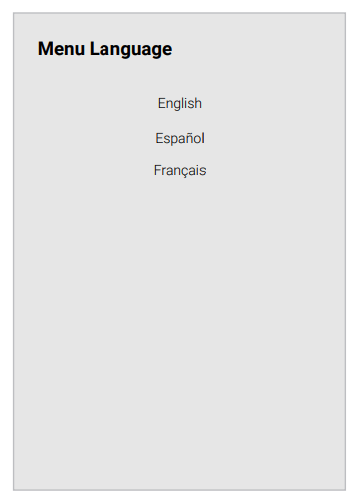
To change the on-screen menu language:
Menu > System > Menu Language
Highlight your preferred language (English, Español, or Français) and press OK.
Setting the Time and Local Settings
To ensure the correct time is displayed when you press the INFO button, set the TV’s time zone:
Menu > System > Time & Local > Settings > Time Zone
To turn Daylight Saving Time on or off:
1. Highlight Daylight Saving Time and press OK. The Daylight Saving Time menu is displayed.
2. Choose On if it is currently Daylight Savings Time, Off if it is Standard Time, or Auto to have the system automatically detect Daylight Savings Settings.
Adjusting the CEC Settings
The CEC function on your TV enables you to control devices connected to HDMI (ARC) input with the included remote, without any programming. Using CEC, your VIZIO TV remote can control:
• Power On/Off
• Volume
• Mute
To enable, disable, or adjust CEC settings:
Set up your audio device and connect it to the HDMI-1(HDMI Arc) input on the TV. On your audio device, select the HDMI ARC input.
Menu > System > CEC
Select a setting and then press OK.
• CEC — To use CEC, you must select Enable.
• Device Discovery — To determine if your device is connected and supports CEC, select Device Discovery and then press OK
Adjusting the Power Mode
Your TV is set to Eco Mode by default. When the TV is powered off, the Eco Mode setting uses less than 0.5W of power. Quick Start Mode enables your display to power on faster and also to turn on when powered from another device (such as when you are casting onto the TV).
To switch between Eco Mode and Quick Start Mode:
Menu > System > Power Mode
Highlight either Eco Mode or Quick Start Mode and press OK.
Changing the TV Name
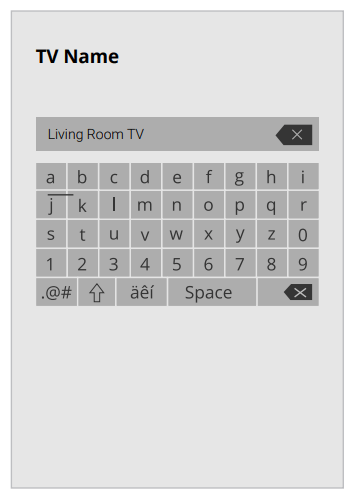
Naming your TV helps differentiate it from other cast devices you may have in your home.
To edit your TV name:
Menu > System > TV Name > Enter a Name
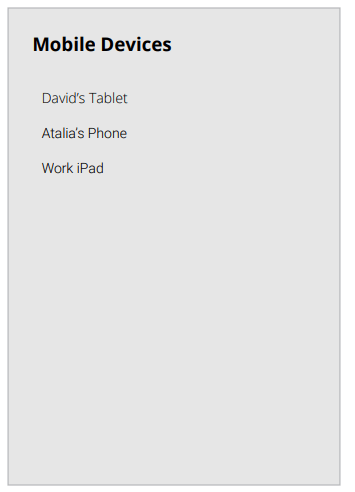
Manging Mobile Devices
Your TV can be paired with a mobile device so you can easily control your TV across multiple devices.
To see a list of paired devices or unpair a device:
Menu > System > Mobile Devices
Highlight a device name to delete it and press OK.
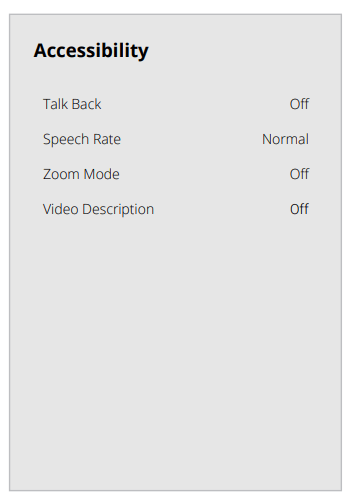
Accessibility Settings
VIZIO is committed to providing intuitive, user-friendly products. Your new VIZIO TV offers several accessibility features that can help you with easy navigation.
To access the Accessibility menu:
Menu > System > Accessibility
1. Talk Back — enables your TV to speak all settings changes and adjustments using the remote in English.
2. Speech Rate* — Adjusts the rate in which Text-to-Speech is spoken. Select Slow, Normal (Default), or Fast.
3. Zoom Mode — Enlarges a section of the screen by approximately 200%.
4. Video Description — If included by the broadcaster, provides a narrated description of the action for the content.
To access the Closed Caption menu: Menu > Closed Captions
To access the Video Description menu: Menu > Channels > Digital Audio
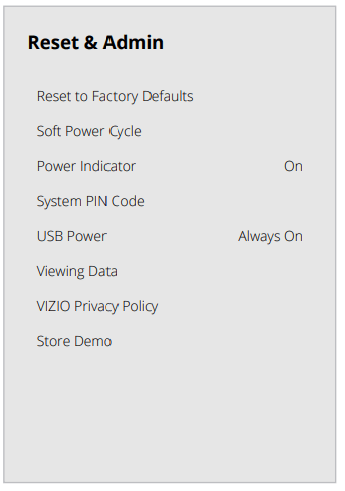
USING THE RESET & ADMIN MENU
You can use the TV’s Reset & Admin menu to restore the TV to its factory default settings as well as access other system settings.
Using the RESET & ADMIN menu, you can:
• Reset the TV to factory settings
• Force the system to power off and on
• Create a system pin code to lock content and picture settings
• Turn USB power on or off.
• Enable or disable program offers and suggestions
• Enable or disable anonymous debug data for system performance.
• Start or stop the store demo mode
Restoring the TV to Factory Default Settings
All of the on-screen menu settings can be reset to the factory defaults.
To restore the TV to its factory default settings:
Menu > System > Reset & Admin > Reset to Factory Settings
1. If you set a system PIN code, enter it now.
2. The TV displays, “Select Reset to restore all TV settings to factory defaults."
3. Highlight Reset and press OK.
4. Wait for the TV to turn off. The TV will turn back on shortly afterward and the setup process will begin.
Performing a Soft Power Cycle
A soft power cycle forces the TV to turn off then on again.
Menu > System > Reset & Admin > Soft Power Cycle > YES
Turning the Power Indicator On or Off
The power indicator on the front of your TV normally does not glow when the TV is on. You can change this setting if you prefer the light to be on.
To turn the Power Indicator Light On or Off:
Menu > System > Reset & Admin > Power Indicator > ON/OFF
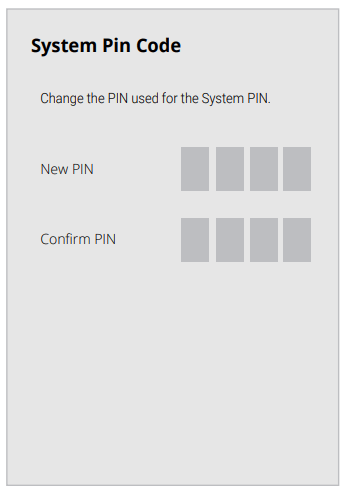
Setting a System PIN
You can set a system pin to lock content and picture modes, as well as prevent accidental system resets. The first time you select System PIN code, you will need to create a PIN.
To create a PIN.
Menu > System > Reset & Admin > System PIN Code > Enter Your PIN > Save
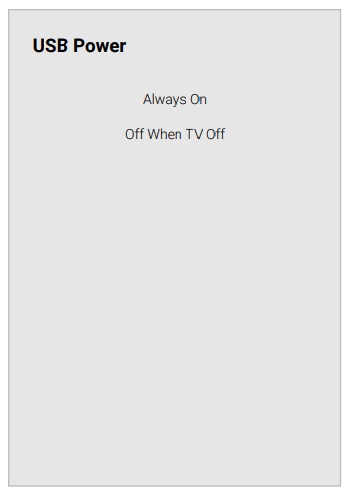
Using the USB Power Feature
The USB port can be used to charge devices.
The two options for this feature are:
• Always On — Power is always available.
• Off When TV Off — Power is only available with the TV is on.
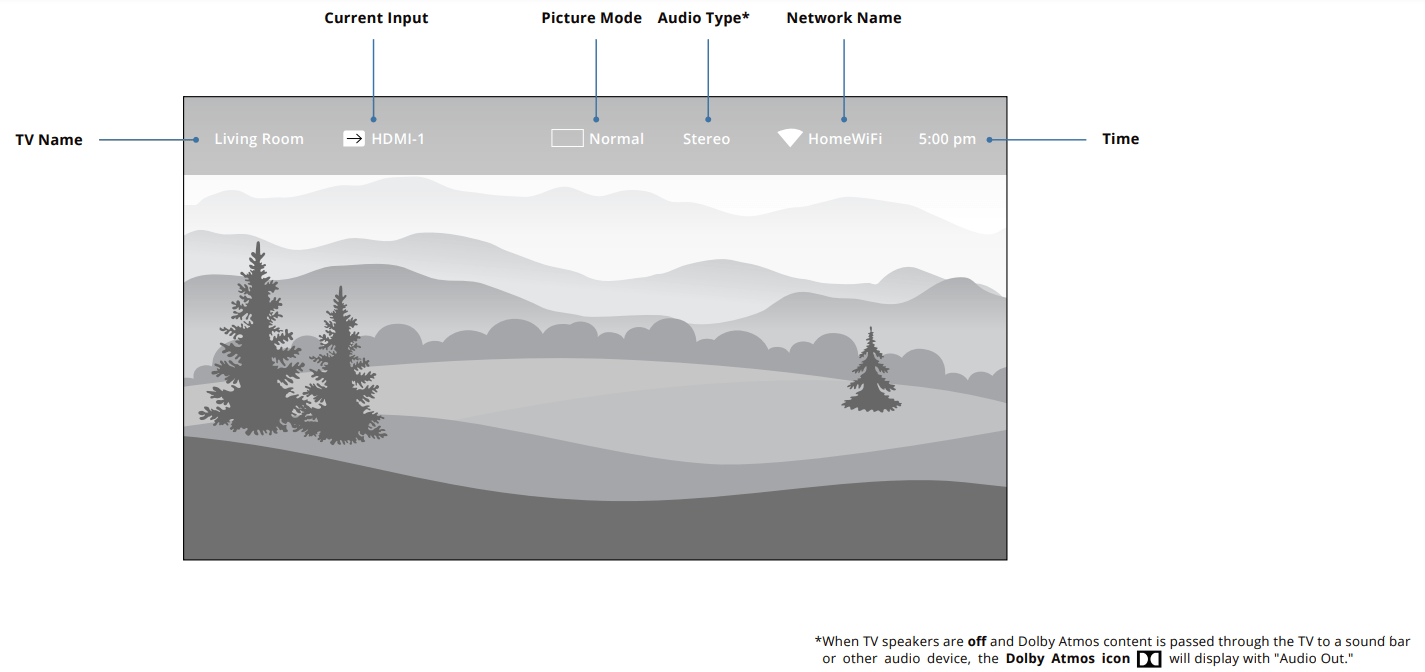
USING THE INFO WINDOW
Press the INFO button one time to display:
• TV name
• Current input
• Picture mode
• Audio type
• Network name
• Time
SmartCast Home
What is SmartCast Home?
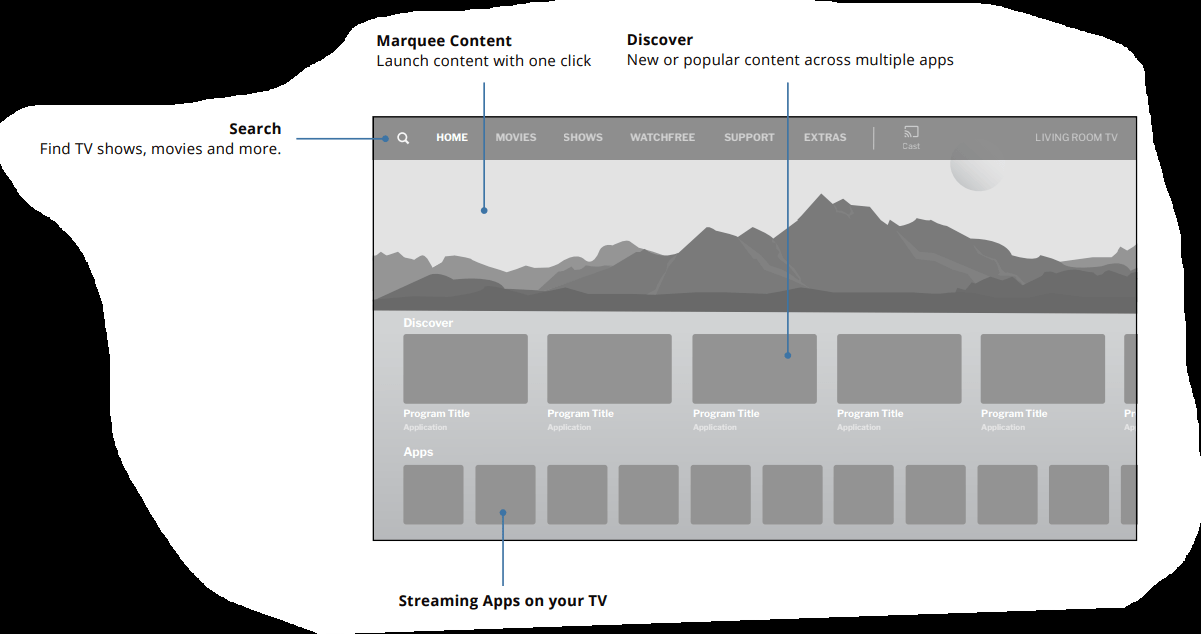
SmartCast Home lets you discover, stream, and control your content like never before! Access top apps, like Netflix, Hulu, and Amazon Prime Video, by using the remote to easily browse and launch content directly from the home screen. SmartCast Home makes finding something to watch easy and fun.
How to Launch SmartCast
Home Begin streaming with SmartCast Home by:
• Press the V-Logo button or the SmartCast Home button on your remote.
—or—
• Select SmartCast from the list of inputs.
What you can do with SmartCast Home
• Stream high quality entertainment.
• Launch top tier apps directly from the home screen.
• Unlock your photos and videos by mirroring your laptop or mobile device onto your TV.
• Rearrange apps on your home screen just the way you like it.
• Works with Google Assistant and other popular voice assistants.
Control your TV with the SmartCast Mobile™ App
Download the VIZIO SmartCast Mobile app and turn your smartphone into a remote to control and configure your TV.
With SmartCast Mobile, you can:
• Power on/off devices, play/pause content, and modify advanced settings, all from the palm of your hand.
• Easily enter text onto your TV/display from your mobile device using a full keyboard.
• Browse and discover movies, TV shows, music, live streams, and more, across multiple apps at once.
• Access a quick look at show ratings, synopsis, cast, crew, clips, and other details.
WatchFree™
What is WatchFree?
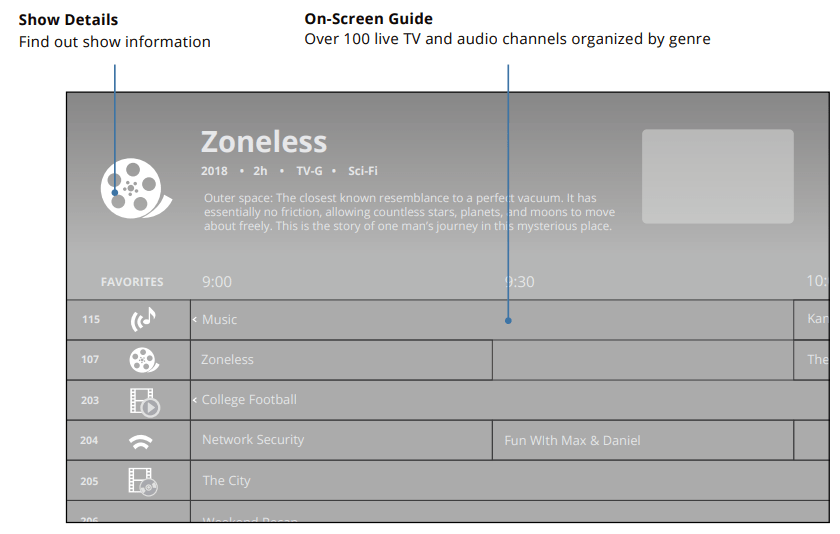
VIZIO WatchFree takes your cord-cutting entertainment experience one step further! With the simple press of a button, enjoy free streaming TV with over 100 live TV channels to choose from – news, movies, sports, comedy, music and more. A built-in on-screen guide makes finding something to watch easier than ever.
And it’s all FREE – no fees, no subscriptions, or logins.
What you can do with WatchFree
• Stream over 100 live TV channels absolutely free – news, movies, sports, comedy, music and more.
• Navigate through channels, organized by genre, with an intuitive on-screen guide.
• Watch 1000’s of free movies from major studios.
• Watch the best of internet TV.
• No logins, subscriptions or transactions fees.
How to Launch WatchFree
To launch and begin watching entertainment offered on WatchFree:
• Push the WatchFree button or the INPUT button on your remote.
—or—
• Simply select the WatchFree app logo from the SmartCast Home app row.
Playing USB Media
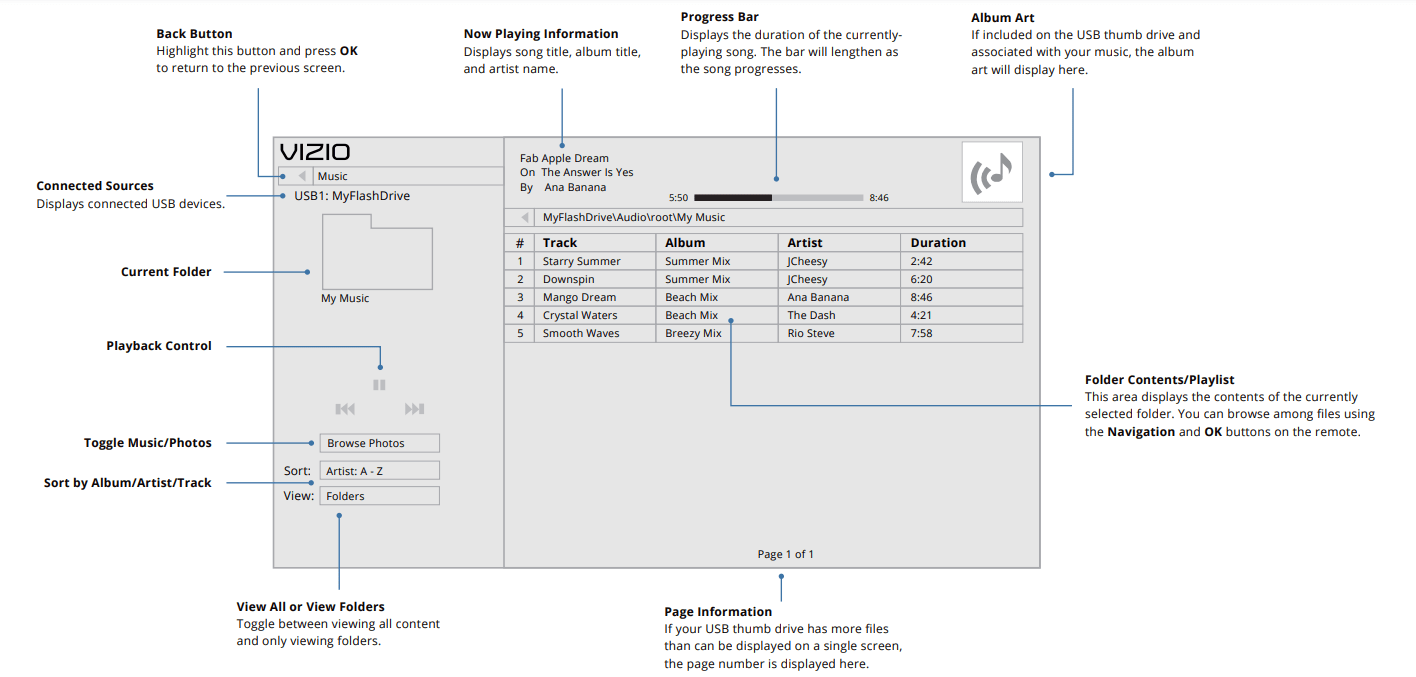
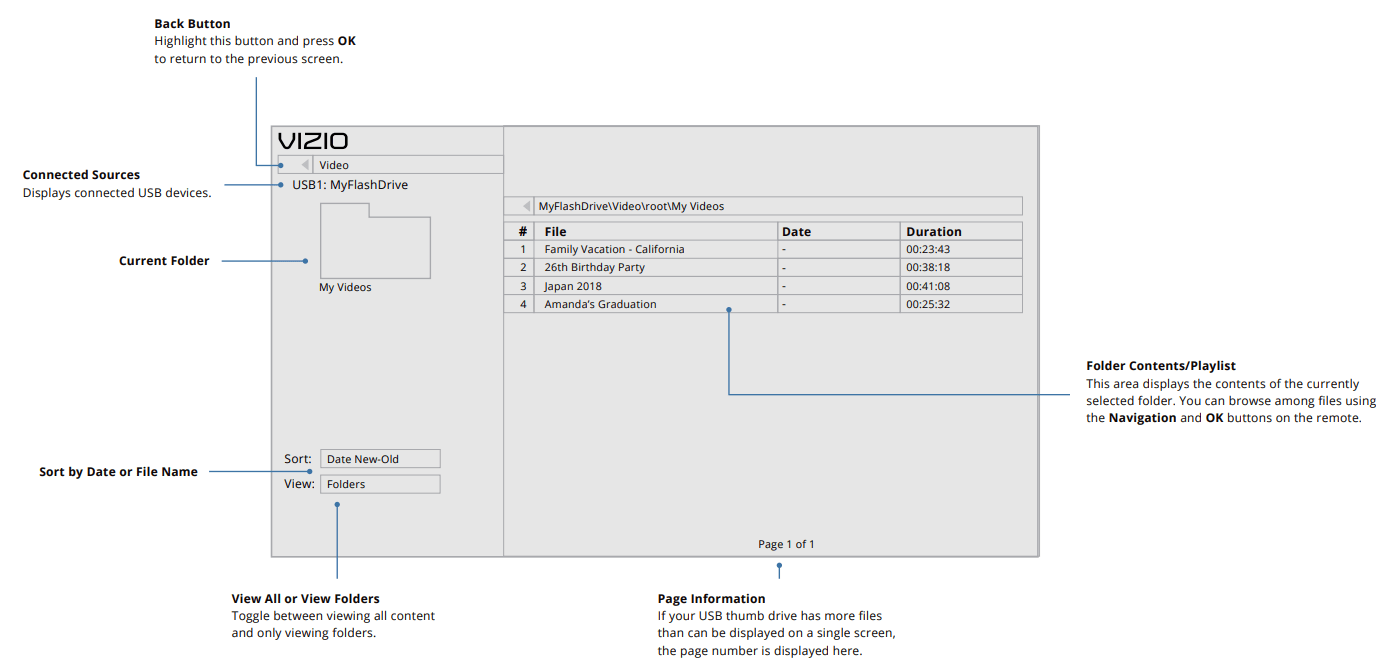
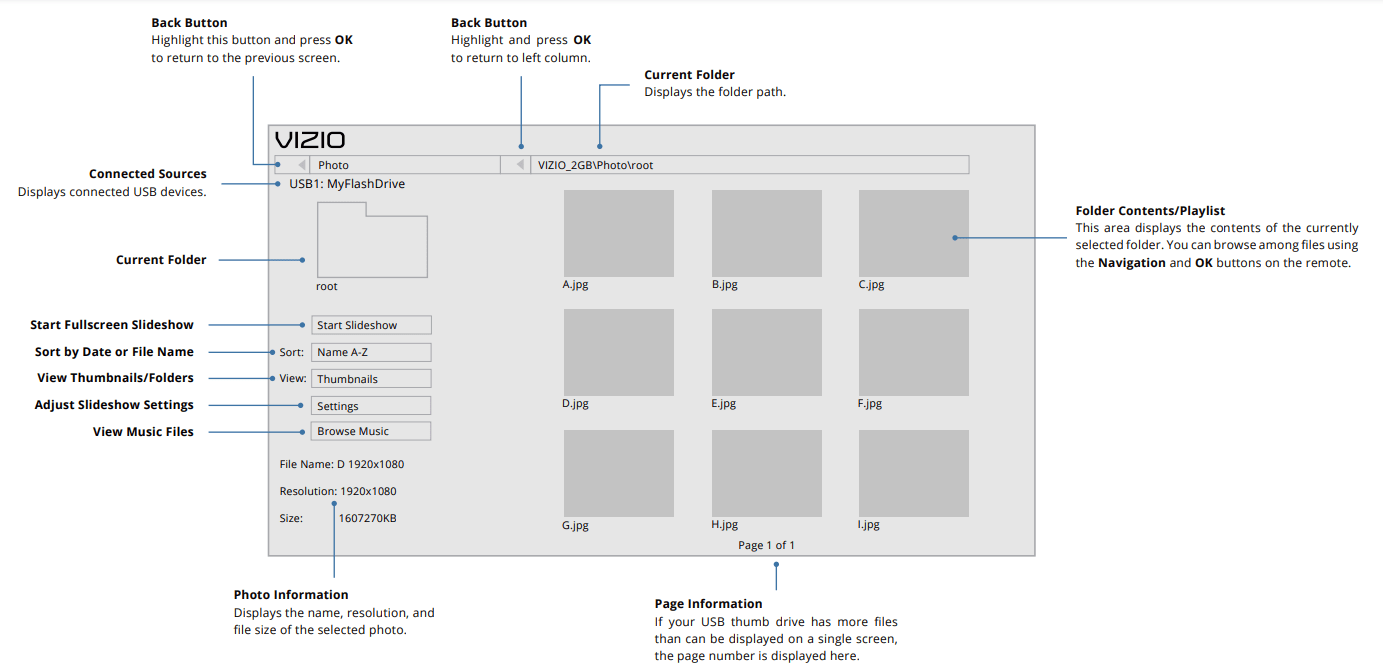
The USB Media Player allows you to connect a USB flash drive to your TV and play music, video, or photos.
Preparing Your USB Drive to Play USB Media
To display USB media, you must first save your videos onto a USB flash drive:
• The USB flash drive must be formatted as FAT32.
• Files on the USB flash drive must end in a supported file extension ( .mp3, .jpg, etc).
• The player is not designed to play media from external hard drives, MP3 players, cameras, or smartphones.
Displaying USB Media
To display your USB media:
1. Connect your USB flash drive to the USB port on the side of the TV.
2. The TV will recognize the USB. Use the Navigation Keys on the remote to select the content you want to play.
—or—
3. Select USB from the bottom streaming icons on the SmartCast HomeSM page.
Removing the USB Drive from the TV
To safely remove your USB flash drive from the TV:
1. Turn the TV off.
2. Disconnect your USB flash drive from the USB port on the side of the TV.
Playing USB Media: Music
Playing USB Media: Video
Playing USB Media: Photo
Help Topics
The remote is not responding.
• Make sure the batteries are properly inserted matching the - and + symbols.
• Replace the batteries with fresh ones.
The TV displays “No Signal.”
• Press INPUT button on the remote control to select a different input source.
• If you are using cable TV or antenna connected directly to the TV, scan for channels.
There is no power.
• Ensure the TV is plugged into a working electrical outlet.
• Ensure the power cable is securely attached to the TV.
• Press the Power/Standby button on the remote or on the back of the TV to turn the TV on.
The power is on, but there is no image on the screen.
• Ensure all cables are securely attached to the TV.
• Ensure all devices are connected correctly. Devices differ; see your device’s user manual for details.
• Adjust Brightness, Contrast, or Backlight.
• Press the INPUT button on the remote to select a different input source.
The sound is flat or dialog is not audible.
• Turn off Volume Leveling.
How do I stream apps like Netflix to my VIZIO SmartCast™ TV?
• Download and open a Chromecast-enabled apps on your mobile device. Then tap the Cast button.
The colors on the TV don’t look right.
• Adjust the Color and Tint settings in the Picture menu.
• Select a pre-set picture mode. VIZIO recommends selecting Calibrated.
• Check all cables to ensure they are securely attached.
There is no sound.
• Press Volume Up on the remote control.
• Press the Mute button on the remote to ensure mute is off.
• Check the audio settings. See Adjusting the Audio Settings.
• Check the audio connections of external devices (Blu-ray player, game console, cable/satellite box) that are connected to the TV.
• If you are using an antenna, the signal strength of the channel may be low. Ensure your antenna is connected securely to the TV and move the antenna around the room or close to a window for the best signal.
The image quality is not good.
• For the best image quality, view high-definition programs using digital sources. Connect your devices with HDMI cables.
• If you are using an antenna, the signal strength of the channel may be low. Ensure your antenna is connected securely to the TV and move the antenna around the room or close to a window for the best signal.
The picture is distorted.
• Move the TV away from electrical appliances, cars, and fluorescent lights.
• Ensure all cables are securely attached.
The TV image does not cover the entire screen.
• If you are using TV, AV, or Component with 480i input, go to Menu > System > Aspect Ratio.
The TV has pixels (dots) that are always dark.
• Your HD TV is precision-manufactured using an extremely high level of technology. However, sometimes pixels may not display correctly. These types of occurrences are inherent to this type of product and do not constitute a defective product.
The buttons on the remote aren’t working.
• Ensure you are only pressing one button at a time.
• Point the remote directly at the TV when pressing a button.
• Replace the remote batteries with new ones. See Replacing the Batteries.
I see “noise” or static on the screen.
• When your TV’s digital capabilities exceed a digital broadcast signal, the signal is up-converted (improved) to match your TV’s display capabilities. This up-converting can sometimes cause irregularities in the image.
• If you are using an antenna, the signal strength of the channel may be low. Ensure your antenna is connected securely to the TV and move the antenna around the room or close to a window for the best signal.
When I change input source, the TV image changes size.
• The TV remembers the viewing mode on each input source. If the viewing mode on the new input source differs from the one on the input source you switch from, the difference may be noticeable.
• See Changing the Screen Aspect Ratio.
How do I download the VIZIO SmartCast Mobile™ App?
• Make sure your phone or tablet is connected to a Wi-Fi network. Open a browser on your phone or tablet.
• Navigate to vizio.com/smartcastapp and follow the on-screen instructions to download the VIZIO SmartCast Mobile™ App.
How do I change the Inputs?
• Press the INPUT button on the back of the TV to cycle through the Inputs.
• Press the INPUT button on the basic remote to cycle through the Inputs.
• Make sure the VIZIO SmartCast Mobile app is installed on your phone or tablet. Open the VIZIO SmartCast Mobile app. Tap on the Device list and select your TV. Tap on the Input key and select the Input of your choice.
How do I connect to my Wi-Fi network?
• On your TV remote, press the Menu button then go to Network > Select your Wi-Fi name > Enter password.
• Open the VIZIO SmartCast Mobile™ app on your phone or tablet. Tap on the device list and select your Display.
• Tap on the Settings icon > Network > Wireless Access Points. Select your Wi-Fi network from the list, enter the Wi-Fi password, and tap Connect.
How do I exit Demo Mode
• Press and hold the INPUT button on the back of the TV to exit the demo mode.
How do I watch Cable/Antenna TV channels?
• If you subscribe to cable or satellite, simply connect an HDMI cable (not included) to the receiver.
• If you use external antennas to watch local broadcast channels, use a coaxial cable to connect.
Some of my Channels are missing.
• Press the MENU button on your TV remote and select the channels option. Then select Find Channels.
• Open the VIZIO SmartCast Mobile app on your phone or tablet.
• Click on: Control > Your TV/Device Name > Settings Icon > Channels > Find Channels.
How do I disable/enable Viewing Data?
• Press the MENU button on your remote and select the System option. Select Reset & Admin. Then select Viewing Data to turn the feature on or off.
• Open the VIZIO SmartCast Mobile app on your phone or tablet.
• Click on: Control > Your TV/Device Name > Settings Icon > System > Reset & Admin > Viewing Data Slider.
The television will not turn on using Alexa or Google Assistant.
• Ensure the television is in Quick Start mode.
• Tap on Menu > System > Power Mode > Quick Start.
How do I know I am getting 4K resolution or HDR content such as Dolby Vision?
• As you are watching content on the television, press the INFO button on the remote or VIZIO SmartCast Mobile app. You will see the current resolution being displayed along with the version of video.
• HDR will show as a Dolby Vision icon, HDR10 or HLG.
Specifications
Size
65”
75”
Viewable Area
64.5”
74.5”
PRODUCT DIMENSIONS
Dimensions w/ Stand
57.01” x 35.14” x 11.81”
(1448.08 x 892.52 x 300 mm)
65.77” x 40.26” x 13.39”
(1670.4 x 1022.66 x 340 mm)
Dimensions w/o Stand
57.01” x 32.74” x 2.72”
(1448.08 x 831.62 x 69 mm)
65.77” x 37.59” x 2.65”
(1670.4 x 954.66 x 67.3 mm)
Weight w/ Stand
55.12 lb (25 kg)
75.34 lb (34.17 kg)
Weight w/o Stand
54.28 lb (24.62 kg)
74.37 lb (33.73 kg)
Mounting Screw Size
M6
M8
Hole Pattern
400 mm x 400 mm
400 mm x 400 mm
PICTURE QUALITY
Maximum Resolution
3840 x 2160 (UHD)
3840 x 2160 (UHD)
LCD Backlight
Direct LED
Direct LED
Refresh Rate
240 Hz (Effective Refresh rate)
240 Hz (Effective Refresh rate)
INPUTS / OUTPUTS
HDMI Inputs
5
5
Component Video Input
1
1
Composite Video Input
1 (shared component)
1 (shared component)
Ethernet Input
1
1
RF Antenna Input
1
1
USB
1
1
Audio Output
HDMI ARC, RCA, Digital Optical
HDMI ARC, RCA, Digital Optical
OTHER
Remote Control Model
XRT136, XRT150
XRT136, XRT150
Power Consumption
(at default setting)
277.2 W (USA), 240 W (Canada)
276.32 W
Standby Power
<0.5W
<0.5W
Voltage
120V
120V
OSD Language
English, French, Spanish
English, French, Spanish
Certification
UL, cUL, FCC Class B, BETS-7/ICES-003 Class B, IC, HDMI (CEC, ARC) Dolby Audio, Dolby Vision
UL, cUL, FCC Class B, BETS-7/ICES-003 Class B, IC, HDMI (CEC, ARC) Dolby Audio, Dolby Vision







 locked. The channel is not accessible unless the system PIN is entered.
 unlocked.
 locked. Content with this rating and all higher ratings cannot be viewed.
 unlocked. Content with this rating and all lower ratings can be viewed.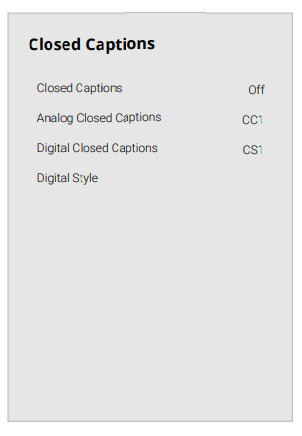
 or the SmartCast Home
  button on your remote.