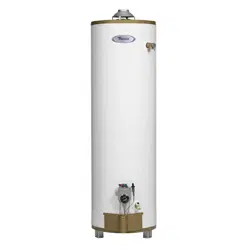
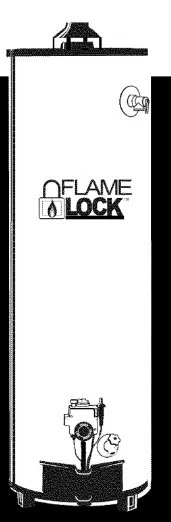
Use & Care Guide for Whirlpool 40T6-34LP Water Heater
INSTALLING YOUR GAS WATER HEATER
Site Location
Select a location near the center of the water piping system. The water heater must be installed indoors and in a vertical position on a level surface. Do not install in bathrooms, bedrooms, or any occupied room normally kept closed.
Locate the water heater as close to the chimney or gas vent as practical. Consider the vent system piping and combustion air supply requirements when selecting the water heater location. The venting system must be able to run from the water heater to termination with minimal length and elbows.
Locate the water heater near the existing gas piping.
If installing a new gas line, locate the water heater to minimize the pipe length and elbows.
The water heater should be located in an area not subject to freezing temperatures. Water heaters located in unconditioned spaces (i.e., attics, basements, etc.) may require insulation of the water piping and drain piping to protect against freezing. The drain and controls must be easily accessible for operation and service. Maintain proper clearances as specified on the data plate.
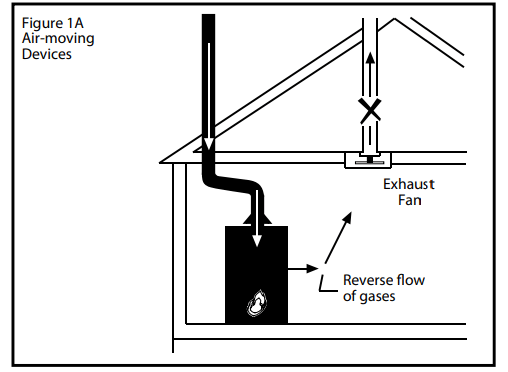
Do not locate the water heater near an air-moving device. The operation of air-moving devices such as exhaust fans, ventilation systems, clothes dryers, fireplaces, etc., can affect the proper operation of the water heater. Special attention must be given to conditions these devices may create. Flow reversal of flue gases may cause an increase of carbon monoxide inside of the dwelling.
If the water heater is located in an area that is subjected to lint, dirt, and oil, it may be necessary to periodically clean the flame-trap (see “External Inspection & Cleaning of the Flame-trap” section).
Clearances and Accessibility
NOTE: Minimum clearances from combustible surfaces are stated on the data plate adjacent to the gas control valve/ thermostat of the water heater.
The water heater is certified for installation on a combustible floor.
IMPORTANT: If installing over carpeting, the carpeting must be protected by a metal or wood panel beneath the water heater. The protective panel must extend beyond the full width and depth of the water heater by at least three inches (76.2mm) in any direction; or if in an alcove or closet installation, the entire floor must be covered by the panel.
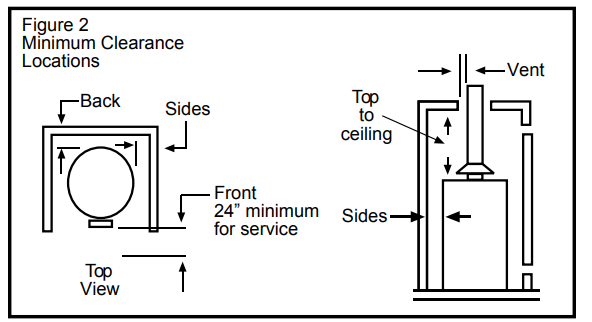
Figure 2 may be used as a reference guide to locate the specific clearance locations. A minimum of 24 inches of front clearance should be provided for inspection and service.
Vent Pipe System
This water heater uses a non-direct, single-pipe vent system to remove exhaust gases created by the burning of fossil fuels. Air for combustion is taken from the immediate water heater location or is ducted in from the outside (see “Combustion Air Supply and Ventilation” section).
This water heater must be properly vented for the removal of exhaust gases to the outside atmosphere. Correct installation of the vent pipe system is mandatory for the proper and efficient operation of this water heater and is an important factor in the life of the unit.
The vent pipe must be installed according to all local and state codes or, in the absence of local and state codes, the “National Fuel Gas Code”, ANSI Z223.1(NFPA 54)-current edition. The vent pipe installation must not be obstructed so as to prevent the removal of exhaust gases to the outside atmosphere.
IMPORTANT: The use of vent dampers is not recommended by the manufacturer of this water heater. Although some vent dampers are certified by CSA International, this certification applies to the vent damper device only and does not mean they are certified for use on this water heater.
U.L. recognized fuel gas and carbon monoxide (CO) detectors are recommended in all applications and should be installed using the manufacturer’s instructions and local codes, rules, or regulations.
IMPORTANT: If you lack the necessary skills required to properly install this venting system, you should not proceed, but get help from a qualified person.
Draft Hood Installation
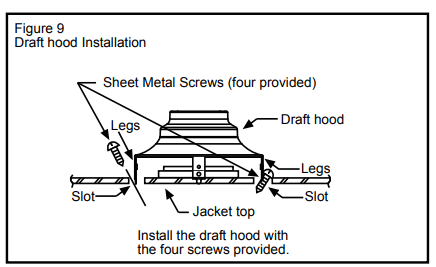
Align the legs of the draft hood with the slots provided. Insert the legs and secure the draft hood to the water heater’s top with the four screws provided as shown in Figure 9. Do not alter the draft hood in any way. If you are replacing an existing water heater, be sure to use the new draft hood supplied with the water heater.
Vent Pipe Size
It is important that you follow the guidelines in these instructions for sizing a vent pipe system. If a transition to a larger vent size is required, the vent transition connection must be made at the draft hood outlet.
Vent Connectors
Type B, Double wall, U.L. Listed Vent Pipe.
Single wall Vent Pipe.
Maintain the manufacturer’s specified minimum clearance from combustible materials when using type B double wall vent pipe.
Vent connectors made of type B, double wall vent pipe material may pass through walls or partitions constructed of combustible material if the minimum listed clearance is maintained.
Maintain a six inch minimum clearance from all combustible materials when using single wall vent pipe.
IMPORTANT: Single wall vent pipe cannot be used for water heaters located in attics and may not pass through attic spaces, crawl spaces or any confined or inaccessible location. A single wall metal vent connector cannot pass through any interior wall.
When installing a vent connector, please note the following:
Install the vent connector avoiding unnecessary bends, which create resistance to the flow of vent gases.
Install without dips or sags with an upward slope of at least 1/4-inch per foot.
Joints must be fastened by sheet metal screws or other approved means. It must be supported to maintain clearances and prevent separation of joints and damage.
The length of the vent connector cannot exceed 75% of the vertical vent height.
The vent connector must be accessible for cleaning, inspection, and replacement.
Vent connectors cannot pass through any ceiling, floor, firewall, or fire partition.
It is recommended (but not mandatory) that a minimum 12 inches of vertical vent pipe be installed on the draft hood prior to any elbow in the vent system to improve conditions for positive flow of venting gases.
IMPORTANT: Existing vent systems must be inspected for obstructions, corrosion, and proper installation.
Chimney Connection
IMPORTANT: Before connecting a vent to a chimney, make sure the chimney passageway is clear and free of obstructions. The chimney must be cleaned if previously used for venting solid fuel appliances or fireplaces. Also consult local and state codes for proper chimney sizing and application or, in the absence of local and state codes, the “National Fuel Gas Code”, ANSI Z223.1(NFPA 54)-current edition.
The connector must be installed above the extreme bottom of the chimney to prevent potentially blocking the flue gases.
The connector must be firmly attached and sealed to prevent it from falling out.
To aid in removing the connector, a thimble or slip joint may be used.
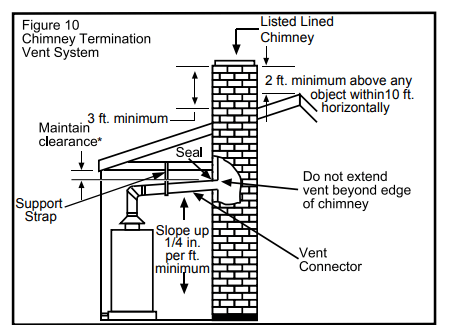
The connector must not extend beyond the inner edge of the chimney as it may restrict the space between it and the opposite wall of the chimney (Figure 10).
Do not terminate the vent connector in a chimney that has not been certified for this purpose. Some local codes may prohibit the termination of vent connectors in a masonry chimney.
Vertical Exhaust Gas Vent
Vertical exhaust gas vents must be installed with U.L. listed type B vent pipe according to the vent manufacturer’s instructions and the terms of its listing.
It must be connected to the water heater’s draft hood by a listed vent connector or by directly originating at the draft hood opening.
Vertical gas vents must terminate with a listed cap or other roof assembly and be installed according to their manufacturer’s instructions.
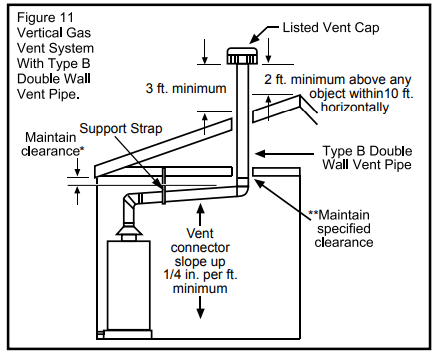
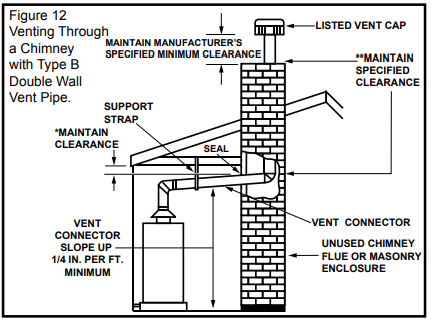
Gas vents must be supported to prevent damage, joint separation, and maintain clearances to combustible materials (Figures 11 and 12).
IMPORTANT: This gas vent must be terminated in a vertical position to facilitate the removal of the burnt gases. An unused chimney flue or masonry enclosure may be used as a passageway for the installation of a gas vent (Figure 12).
Common (combined) venting is allowable with vertical type B vent systems and lined masonry chimneys as long as proper draft for the water heater is established under all conditions of operation.
IMPORTANT: Do not common vent this water heater with any power vented appliance.
Figures 10-12 are examples of vent pipe system installations and may or may not be typical for your specific application. Consult the “National Fuel Gas Code”, NFPA 54, ANSI Z223.1-current edition and the guidelines set forth by prevailing local codes.
Water System Piping
Piping Installation
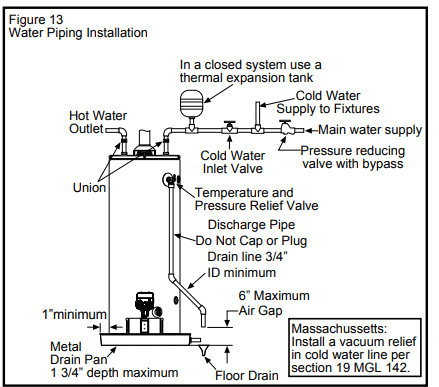
Piping, fittings, and valves should be installed according to the installation drawing (Figure 13). If the indoor installation area is subject to freezing temperatures, the water piping must be protected by insulation.
The water supply pressure should not exceed 80 psi. If this occurs, a pressure reducing valve with a bypass should be installed in the cold water inlet line. This should be placed on the supply to the entire house in order to maintain equal hot and cold water pressures.
IMPORTANT: Heat cannot be applied to the water fittings on the heater as they may contain nonmetallic parts. If solder connections are used, solder the pipe to the adapter before attaching the adapter to the hot and cold water fittings.
IMPORTANT: Always use a good grade of joint compound and be certain that all fittings are drawn up tight.
Install the water piping and fittings as shown in Figure 13. Connect the cold water supply (3/4” NPT) to the fitting marked “C”. Connect the hot water supply (3/4” NPT) to the fitting marked “H”. IMPORTANT: Some models may contain energy saving heat traps to prevent the circulation of hot water within the pipes. Do not remove the inserts within the heat traps.
The installation of unions in both the hot and cold water supply lines is recommended for ease of removing the water heater for service or replacement.
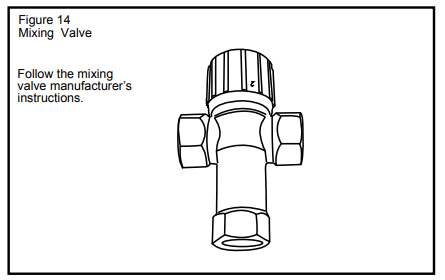
The manufacturer of this water heater recommends installing a mixing valve at each point of use. See Figure 14. These valves reduce the point-of-use temperature of the water by mixing cold and hot water and are readily available for use.
If installing the water heater in a closed water system, install an expansion tank in the cold water line as specified under “Closed System/Thermal Expansion” section.
Install a shut-off valve in the cold water inlet line. It should be located close to the water heater and be easily accessible. Know the location of this valve and how to shut off the water to the heater.
A temperature and pressure relief valve must be installed in the opening marked “Temperature and Pressure (T & P) Relief Valve” on the water heater. A discharge line must be added to the opening of the T&P Relief Valve. Follow the instructions under “Temperature and Pressure Relief Valve” section.
After piping has been properly connected to the water heater, remove the aerator at the nearest hot water faucet. Open the hot water faucet and allow the tank to completely fill with water. To purge the lines of any excess air, keep the hot water faucet open for 3 minutes after a constant flow of water is obtained. Close the faucet and check all connections for leaks.
OPERATING YOUR WATER HEATER
Lighting Instructions
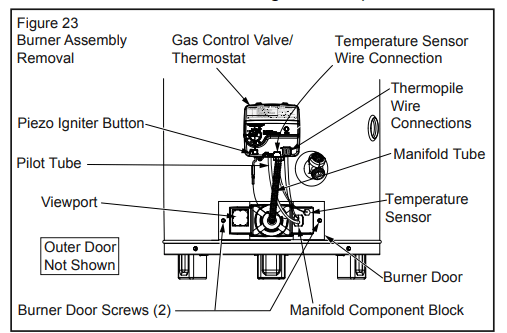
Read and understand these directions thoroughly before attempting to light or re-light the pilot. Make sure that the view port (sight glass) is not missing or damaged. See Figure 23. Make sure the tank is completely filled with water before lighting the pilot. Check the data plate near the gas control valve/thermostat for the correct gas. Do not use this water heater with any gas other than the one listed on the data plate. If you have any questions or doubts, consult your gas supplier or gas utility company.
Lighting the Pilot:
Read and follow the lighting instructions on the water heater’s label.
Turn the Control Knob to Pilot. Press the Knob in fully and hold it in. (The knob will travel in about 1/4-inch if it is set to Pilot correctly.)
Click the Igniter button continuously for up to 90 seconds or until the Status Light begins to blink.
If the Status Light does not begin to blink after 90 seconds, STOP. Wait 10 minutes before attempting to relight the Pilot. Repeat these steps 2-3 times, if necessary.
The circuitry in this gas valve requires that you wait 10 minutes between lighting attempts.
If the Status Light blinks, release the Control Knob and turn it to the desired setting. (“Hot” is approximately 120°F.)
If the Status Light Does Not Blink:
Wait 10 minutes before another lighting attempt.
If the Status Light did not blink, repeat the lighting procedure by following the lighting instructions on the water heater’s label. Remove the outer door. The Control Knob must be set to Pilot and held in continuously while clicking the igniter button (about once per second for up to 90 seconds). To observe the Pilot, remove the outer door and look through the view port (sight glass). See Figure 23.
Continue clicking the Igniter button (for up to 90 seconds) until Pilot lights.
Once the Pilot is lit, continue to hold the Control Knob in until the Status Light begins to blink.
Release Control Knob and set Knob to desired temperature setting. (“Hot” is approximately 120°F.)
Replace the outer door.
If the Pilot Does Not Light:
Wait 10 minutes before another lighting attempt. If the pilot does not light, the Igniter may not be sparking or the unit may not be getting gas (or for a new installation, there may still be air in the gas line). Each time you click the igniter button, you should be able to see the spark by looking through the view port. See Figure 23. (You may have to darken the room lights to see the spark.) You do not have to push the Control Knob in to check the Igniter button. Simply look through the sight glass while clicking the Igniter button and look for a spark. If you can’t see a spark when the Igniter button is clicked, check the wiring connections from the Igniter button and make sure that they are tight.
If you see the Igniter spark, try relighting the pilot by following the instructions on the water heater’s label. Ensure that the gas supply is turned on. There may be air in the gas line, and several lighting attempts may be needed to completely fill the line with gas and successfully light the pilot.
If the Pilot Lights but the Status Light Does Not Blink:
If the pilot lights, continue to hold the Control Knob in until the Status Light blinks. If the pilot is lit and remains lit for 90 seconds and the Status Light still does not blink, the thermopile connections may be loose or the thermopile may be defective.
Check the wiring connections from the thermopile to the gas control valve/thermostat. Ensure that all wiring connections are tight. See Figure 23.
Wait 10 minutes and try to light the Pilot according to the instructions on the water heater’s label.
While clicking the Igniter button continuously, the Control Knob must be set to Pilot and held in until the Status Light blinks. Once the Status Light blinks, release the Control Knob and set the Knob to the desired temperature setting. (“Hot” is approximately 120°F.)
Checking the Draft
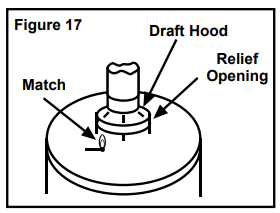
After successfully lighting the water heater, allow the unit to operate for 15 minutes and check the draft hood relief opening for proper draft. Make sure all other appliances in the area are operating and all doors are closed when performing the draft test. Pass a match flame around the relief opening of the draft hood. A steady flame drawn into the opening indicates proper draft. If the flame flutters or is blown out, combustion products are escaping from the relief opening. If this occurs, do not operate the water heater until proper adjustments or repairs are made to the vent pipe system and/or air supply requirements.
Burner Flames
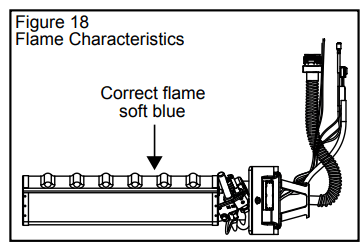
Inspect the burner flames through the viewport. Flames should be very small with a blue haze and small amounts of yellow or orange at the edges. After several minutes of operation, the burner screen may glow red. If large flames are observed at any time, shut-off unit and call a qualified person.
Water Temperature Stacking
Stacking occurs when a series of short draws of hot water (3 gallons or less) are taken from the water heater tank.
This causes increased cycling of the burner and can result in increased water temperatures at the hot water outlet.
This water heater’s temperature control has been designed to accurately regulate the water temperature. However, under certain operating conditions, the water temperature may temporarily exceed the dial setting. Consequently, in addition to setting the temperature no higher than 120°F, we recommend the installation of a mixing valve at each point of use to further reduce the risk of scald injury. These devices can be obtained from a plumbing service agency or your retail supplier.
Emergency Shut Down
IMPORTANT: Should overheating occur or the gas supply fails to shut off, turn off the water heater’s manual gas control valve and call a qualified person.
Water Temperature Regulation
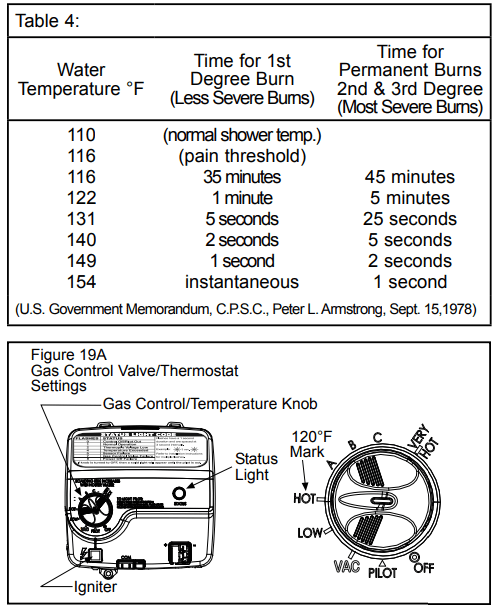
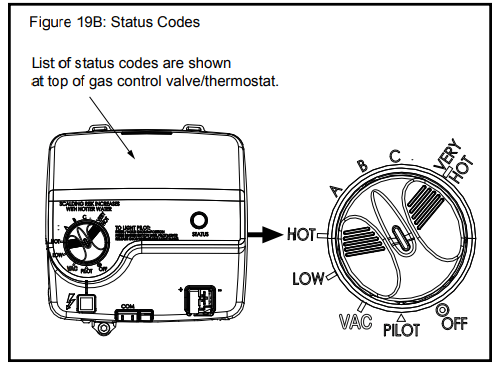
The thermostat is adjusted to the pilot position when it is shipped from the factory. Water temperature can be regulated by moving the temperature dial to the preferred setting. The preferred starting point is 120°F at the “HOT” setting. Align the knob with the desired water temperature as shown in Figure 19A. There is a hot water scald potential if the thermostat is set too high.
NOTE: Temperatures shown on the gas control valve/ thermostat are approximates. The actual temperature of the heated water may vary
IMPORTANT: Adjusting the thermostat past the 120°F bar on the temperature dial will increase the risk of scald injury. Hot water can produce first degree burns within:
NOTE: During low demand periods when hot water is not being used, a lower thermostat setting will reduce energy losses and may satisfy your normal hot water needs. If hot water use is expected to be more than normal, a higher thermostat setting may be required to meet the increased demand. When leaving your home for extended periods (vacations, etc.) turn the temperature dial to the vacation (VAC) setting. This will maintain the water at low temperatures with minimum energy losses and prevent the tank from freezing during cold weather.
Operating the Temperature Control System
Water Temperature Adjustment
The water temperature setting can be adjusted from 55°F to 155°F. Turn the Gas Control/Temperature Knob to the desired setting/temperature.
NOTE: The temperatures indicated are approximates. The actual temperature of the heated water may vary. Also, some models are certified for 180°F outlet temperatures. See the Data Plate on the front of the water heater for the maximum outlet temperature.
Operating Modes and Settings
The gas control valve has two different operating modes: Standard and Vacation.
Standard mode allows you to adjust the water temperature to your desired setting.
Vacation (VAC) mode sets the thermostat at approximately 55°F and is recommended when not using hot water for an extended period of time. The VAC setting also reduces energy losses and keeps the tank from freezing during cold weather, but it can cause a Hydrogen gas build up in the water system. See caution on page 2.
NOTE: The actual temperature of the water in most installations will be greater than 55°F due to the surrounding environment and the pilot flame.
Status Light Codes
Normal Flashes:
0 Flashes Indicates Control Off/Pilot Out.
1 Flash Indicates Normal Operation.
Continuous Light indicates the gas control valve/thermostat is shutting down.
Diagnostic Flashes: If the water heater is not working, look for the following diagnostic flashes after lighting the pilot.
2 Flashes Indicates thermopile voltage is low.
4 Flashes Indicates overheat failure.
5 Flashes Indicates water temperature sensor failure.
7 Flashes Indicates electronic control failure.
8 Flashes See “Status Light Code Troubleshooting Chart.”
9 Flashes Indicates chamber temperature sensor circuit is open or shorted.
10 Flashes Indicates an LDO occurrence was detected in the combustion chamber (contaminants).
Operational Conditions
Condensation
Moisture from the products of combustion condenses on the tank surface and the outside jacket of the water heater and forms drops of water which may fall onto the burner or other hot surfaces. This will produce a “sizzling” or “frying” noise. NOTE: This condensation is normal and should not be confused with a leaking tank. Condensation may increase or decrease at different times of the year.
High efficient energy saver water heaters will produce larger amounts of condensation on initial start-up or when a large amount of hot water is being used. NOTE: Do not confuse this with a “tank leak”. Once the water reaches a temperature of 120°F and the tank warms up (usually 1-2 hours), the condensation will stop.
IMPORTANT: It is always recommended that a suitable metal drain pan be installed under the water heater to protect the area from water damage resulting from normal condensation production, a leaking tank or piping connections. Refer to “Location Requirements” on page 4. Under no circumstances is the manufacturer to be held responsible for any water damage in connection with this water heater.
Water Heater Sounds
During the normal operation of the water heater, sounds or noises may be heard. These noises are common and may result from the following:
1. Normal expansion and contraction of metal parts during periods of heat-up and cool-down.
2. Condensation causes sizzling and popping within the burner area and should be considered normal.
3. Sediment buildup in the tank bottom will create varying amounts of noise and may cause premature tank failure. Drain and flush the tank as directed under “Draining and Flushing”.
Smoke/Odor
The water heater may give off a small amount of smoke and odor during the initial start-up of the unit. This is due to the burning off of oil from metal parts of a new unit and will disappear after a few minutes of operation.
Safety Shut-off
This water heater is designed to automatically shut-off in the event of the following:
The pilot flame is extinguished for any reason.
The water temperature exceeds 189°F (87°C).
Excessive contaminants in the combustion chamber.
The ignition of flammable vapors.
A thermopile is used to determine if a pilot flame is present and will shut off the gas supply to the main burner and pilot if the flame is absent. This unit is also equipped with a combustion chamber temperature sensor that will shut off the gas supply to the burner if poor combustion is sensed (caused by a blocked vent or insufficient combustion air). If the gas control valve/thermostat shuts off the gas supply, check the diagnostic flash code and refer to the “Status Light Code Troubleshooting Chart.” If necessary, also refer to the “Troubleshooting Chart.”
IMPORTANT: Correct any issues prior to resetting the gas control valve/thermostat. For service information, contact the Product Service and Support Department at 1-877-817-6750.
Reset the system by following these steps: 1.) Turn the temperature adjustment knob to OFF. 2.) Unplug the thermopile plug from the gas control valve/thermostat.
3.) Wait for about three minutes. 4.) Plug the thermopile plug back into the gas control valve/thermostat. 5.) Turn the temperature adjustment knob to PILOT and restart the water heater as directed in this manual.
A temperature limit switch or ECO (Energy Cut Off) sensor located in the gas control valve\thermostat is used to shut off the water heater if the water temperature exceeds 189°F (87°C). The Diagnostic Status Light will flash a code indicating an “Overheat Failure” (4 Flashes). See “Operating the Temperature Control System.” If the ECO has functioned the gas control valve/thermostat should be replaced by a qualified person. Contact your local dealer for service information.
Anode Rod/Water Odor
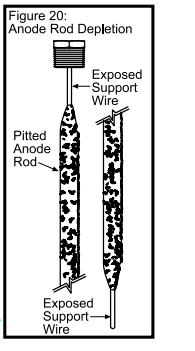
Each water heater contains at least one anode rod, which will slowly deplete (due to electrolysis) prolonging the life of the water heater by protecting the glass-lined tank from corrosion. Adverse water quality, hotter water temperatures, high hot water usage, hydronic heating devices, and water softening methods can increase the rate of anode rod depletion. Once the anode rod is depleted, the tank will start to corrode, eventually developing a leak. Certain water conditions will cause a reaction between the anode rod and the water. The most common complaint associated with the anode rod is a “rotten egg smell” produced from the presence of hydrogen sulfide gas dissolved in the water.
IMPORTANT: Do not remove this rod permanently as it will void any warranties. A special anode rod may be available if water odor or discoloration occurs.
NOTE: This rod may reduce but not eliminate water odor problems. The water supply system may require special filtration equipment from a water conditioning company to successfully eliminate all water odor problems.
Artificially softened water is exceedingly corrosive because the process substitutes sodium ions for magnesium and calcium ions. The use of a water softener may decrease the life of the water heater tank.
The anode rod should be inspected after a maximum of three years and annually thereafter until the condition of the anode rod dictates its replacement.
NOTE: Artificially softened water requires the anode rod to be inspected annually.
The following are typical (but not all) signs of a depleted anode rod:
The majority of the rods diameter is less than 3/8”.
Significant sections of the support wire (approx. 1/3 or more of the anode rod’s length) are visible.
If the anode rod show signs of either or both it should be replaced.
NOTE: Whether re-installing or replacing the anode rod, check for any leaks and immediately correct if found.
In replacing the anode:
Turn off gas supply to the water heater.
Shut off the water supply and open a nearby hot water faucet to depressurize the water tank.
Drain approximately 5 gallons of water from tank. (Refer to “Draining and Flushing” for proper procedures). Close drain valve.
Remove old anode rod.
Use Teflon® tape or approved pipe sealant on threads and install new anode rod.
Turn on water supply and open a nearby hot water faucet to purge air from water system.
Check for any leaks and immediately correct any if found.
Restart the water heater as directed in this manual. See the Repair Parts Illustration for anode rod location.
MAINTENANCE OF YOUR WATER HEATER
Draining and Flushing
It is recommended that the tank be drained and flushed every 6 months to remove sediment which may build up during operation. The water heater should be drained if being shut down during freezing temperatures. To drain the tank, perform the following steps:
Turn off the gas to the water heater at the manual gas shut-off valve.
Open a nearby hot water faucet until the water is no longer hot.
Close the cold water inlet valve.
Connect a hose to the drain valve and terminate it to an adequate drain or external to the building.
Open the water heater drain valve and allow all of the water to drain from the tank. Flush the tank with water as needed to remove sediment.
Close the drain valve, refill the tank, and restart the heater as directed in this manual.
If the water heater is going to be shut down for an extended period, the drain valve should be left open.
IMPORTANT: Condensation may occur when refilling the tank and should not be confused with a tank leak.
Routine Preventative Maintenance
At least annually, a visual inspection should be made of the venting and air supply system, piping systems, main burner, pilot burner, and Flame-trap. Check the water heater for the following:
Obstructions, damage, or deterioration in the venting system. Make sure the ventilation and combustion air supplies are not obstructed.
Build up of soot and carbon on the main burner and pilot burner. Check for a soft blue flame.
Leaking or damaged water and gas piping.
Presence of flammable or corrosive materials in the installation area.
Presence of combustible materials near the water heater.
After servicing this water heater, check to make sure it is working properly. (See Operating Your Water Heater section of this manual.)
IMPORTANT: If you lack the necessary skills required to properly perform this visual inspection, you should not proceed, but get help from a qualified person.
Temperature and Pressure Relief Valve
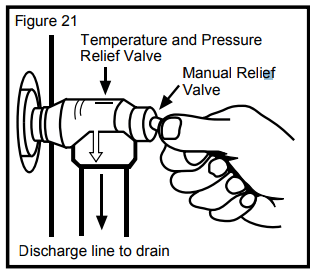
Manually operate the temperature and pressure relief valve at least once a year to make sure it is working properly. To prevent water damage, the valve must be properly connected to a discharge line which terminates at an adequate drain. Standing clear of the outlet (discharged water may be hot), slowly lift and release the lever handle on the temperature and pressure relief valve to allow the valve to operate freely and return to its closed position. If the valve fails to completely reset and continues to release water, immediately shut off the manual gas control valve and the cold water inlet valve and call a qualified person.
Replacement Parts
IMPORTANT: The following maintenance procedures are for the Flame Lock® Safety System components and should be performed by a qualified person.
Replacement parts may be ordered through your plumber or the local distributor. Parts will be shipped at prevailing prices and billed accordingly. When ordering replacement parts, always have the following information ready:
model, serial, and product number
type of gas
item number
parts description
See pages 31-32 for a list of available repair parts.
Removing the Burner Door Assembly
Turn off the gas to the water heater at the manual shut-off valve (Figure 3).
Turn the gas control/temperature knob to the “OFF”position (Figure 19).
Remove the outer door.
Remove the two screws (1/4” nut driver) securing the burner door assembly to the combustion chamber (Figure 23).
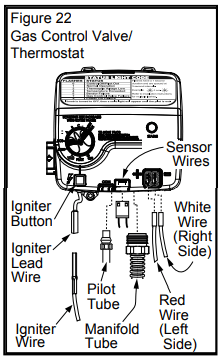
Disconnect the pilot tube (7/16” wrench), the igniter wire from the igniter lead wire, and manifold tube (3/4” wrench) at the gas control valve/thermostat. Disconnect the sensor wires (lift white lever outward, then gently pull the plug downward). Also, use needle nose pliers to disconnect the red (+) and white (-) thermopile wires from the gas control valve/thermostat. See Figures 22 & 23.
Grasp the manifold tube and push down slightly to free the manifold, pilot tube, and thermopile.
Carefully remove the burner door assembly from the burner compartment.
NOTE: Be sure not to damage internal parts.
Natural Gas Burner (Ultra Low Nox)
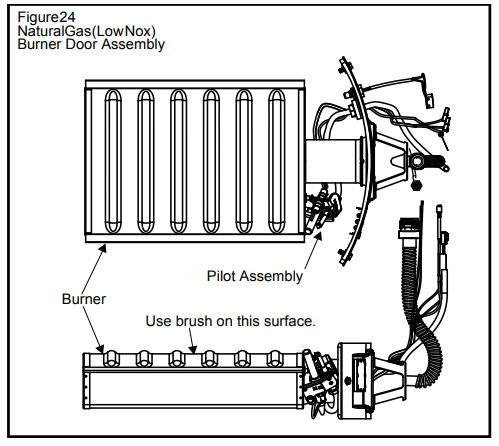
Check the burner to see if it is dirty or clogged. The burner may be cleaned with soft paint brush (Figure 24). Do not use a wire brush or any tool that may damage the burner screen. Important: Do not use the burner if the burner screen is damaged. NOTE: Damage may be rips or holes in the burner screen. Discoloration is normal.
Replacing the Pilot/Thermopile Assembly
Remove the burner assembly as directed previously.
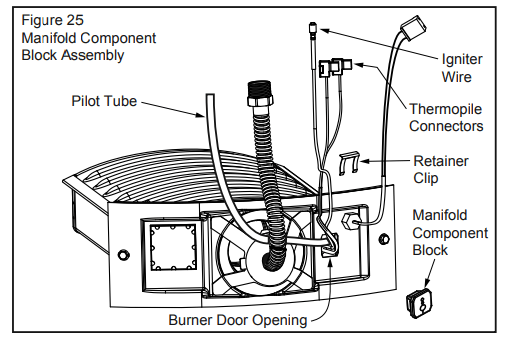
Lift the retainer clip straight up from the back of the manifold component block (using a flat-blade screwdriver), then remove the manifold component block from the burner door assembly (Figure 25).
Locate and remove the phillips screw attaching the pilot to the pilot bracket, then pull the pilot/thermopile assembly (including the igniter wire) out of the burner door assembly.
Using a 7/16” wrench, loosen the nut securing the pilot tube to the pilot assembly (right-hand threads).
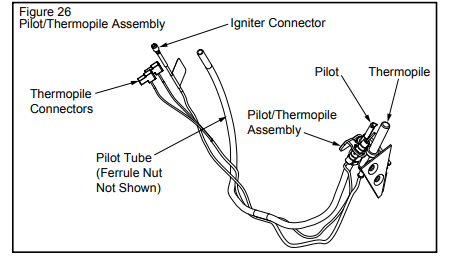
Pull the pilot tube from the pilot assembly (Figure 26). IMPORTANT: Be careful not to bend or alter the position of the pilot assembly components.
Using the old pilot tube as a guide, bend the new pilot tube to match the old one. Make only the bends closest to the pilot before going to the next step.
Reconnect the pilot tube and tighten the nut securing it to the pilot assembly. To prevent any bending of the pilot bracket, use pliers to hold the pilot assembly bracket while tightening the pilot nut. IMPORTANT: Keep the pilot orifice in the pilot when making the connection. DO NOT operate the water heater without the pilot orifice installed.
Push the new pilot assembly connectors through the opening in the burner door (See Figure 25).
Attach the pilot assembly to the Burner Door Assembly.
Position the new thermopile wires through the top opening of the manifold component block (Figure 25). Be sure that the igniter wire is positioned through the middle opening of the manifold component block. Position the pilot tube through the bottom opening of the manifold component block.
See “Replacing the Burner Door Assembly” on page 26.
External Inspection & Cleaning of the Flame-trap
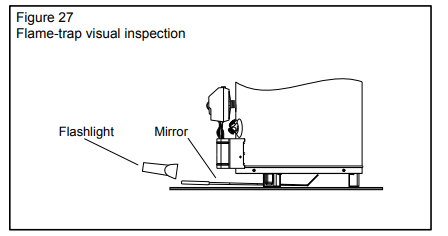
Although not likely to occur, if debris collects on the flame-trap, use a vacuum, compressed air, or a soft bristle brush to remove it.
NOTE: If unable to inspect or clean the flame trap from underneath, follow the “Cleaning the Combustion Chamber and Flame-trap” section instructions.
Cleaning the Combustion Chamber and Flame-trap
Follow procedure outlined in “Removing the Burner Door Assembly”.
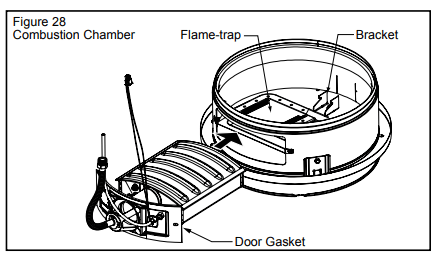
Use a vacuum cleaner/shop vac to remove all loose debris in the combustion chamber (Figure 28). Use compressed air to clear any dust or debris that may have accumulated in the flame-trap.
Reassemble following the procedure under “Replacing the Burner Door Assembly”.
Replacing the Burner Door Assembly
WARNING Explosion Hazard
Tighten both burner door screws securely.
Remove any fiberglass between gasket and combustion chamber.
Replace viewport if glass is missing or damaged.
Replace manifold component block if missing or removed.
Replace door gasket if damaged.
Failure to follow these instructions can result in death, explosion, or fire.
Check the door gasket for damage or imbedded debris prior to installation.
Inspect the viewport for damage and replace as required.
Insert the burner assembly into the burner compartment, making sure that the burner assembly sits firmly against the burner bracket inside the combustion chamber (Figure 28).
Inspect the door gasket and make sure there is no fiberglass insulation between the gasket and the combustion chamber.
Replace the two screws which secure the burner assembly to the combustion chamber and tighten securely. There should be no space between the gasket part of the burner door and combustion chamber. IMPORTANT: Do not operate the water heater if the door gasket does not create a seal between the burner door and the combustion chamber.
Reconnect the manifold tubing (3/4” wrench), pilot tubing (7/16” wrench), temperature sensor wires, and thermopile wires to the gas control valve/thermostat. (See Figure 22 for the correct position of the thermopile wires.) Do not cross-thread or apply any thread sealant to the fittings.
Reconnect the igniter wire.
Turn the gas supply on and refer to the “Lighting Instructions” on page 17.
Check for leaks by brushing on an approved noncorrosive leak detection solution. Bubbles forming indicate a leak. Correct any leak found. IMPORTANT: All leaks must be fixed immediately.
Replace the outer door.
Piezoelectric Igniter System
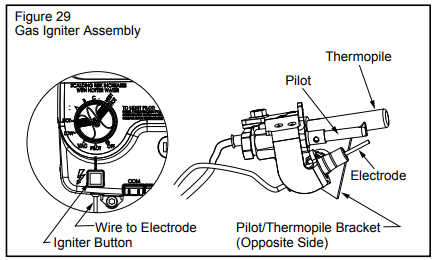
The piezoelectric igniter system consists of the igniter button, electrode, and wire. The pilot is ignited by an electric spark generated when the igniter button is pressed. (See Figure 29). Use only factory authorized piezoelectric igniter parts for replacement.
Testing the Igniter System
Turn off the gas to the water heater at the manual gas shutoff valve. Watch the electrode tip while activating the igniter. A visible spark should jump from the electrode. To avoid shock, do not touch the burner or any metal part on the pilot or pilot assembly. If no spark is visible, check the wire connections and make sure the electrode is not broken. Replace the igniter if defective. Dirt and rust on the pilot or electrode tip can prevent the igniter spark. Wipe clean with a damp cloth and dry completely. Rust can be removed from the electrode tip and metal surfaces by lightly sanding with an emery cloth or fine grit sandpaper.
Removing and Replacing the Gas Control Valve/Thermostat
Removing the Gas Control Valve/Thermostat:
Turn the gas control/temperature knob to the “OFF” position (Figure 19A).
Turn off the gas at the manual shut-off valve on the gas supply pipe (Figure 3).
Drain the water heater. Refer to the section on “Draining and Flushing” and follow the procedure.
Disconnect the igniter wire from the igniter lead wire. Disconnect the temperature sensor wire, then use needle nose pliers to disconnect the red (+) and white (-) thermopile wires. Disconnect the pilot tube (7/16” wrench) and manifold tube (3/4” wrench) at the gas control valve/thermostat (Figure 22).
Refer to “Gas Piping” (Figure 3) and disconnect the ground joint union in the gas piping. Disconnect the remaining pipe from the gas control valve/thermostat.
To remove the gas control valve/thermostat, thread a 4” section of gas pipe into the inlet and use it to turn the gas control valve/thermostat (counterclockwise.) Do not use a pipe wrench or equivalent to grip body. Damage may result. Do not insert any sharp objects into the inlet or outlet connections. Damage to the gas control valve/thermostat may result.
Gas Control Valve/Thermostat:
To replace the gas control valve/thermostat, reassemble in reverse order. When replacing the gas control valve/ thermostat, thread a 4” section of gas pipe into the inlet and use it to turn the gas control valve/thermostat (clockwise.)
DO NOT OVER TIGHTEN, damage may result.
Be sure to use approved Teflon® tape or pipe joint compound on the gas piping connections and fitting on the back of the gas control valve that screws into tank.
Be sure to remove the pilot ferrule nut from the new gas control valve/thermostat.
Turn the gas supply on and check for leaks. Test the water heater by brushing on an approved noncorrosive leak detection solution. Bubbles forming indicate a leak. Correct any leak found.
Be sure tank is completely filled with water before lighting and activating the water heater. Follow the “Lighting Instructions” on page 17.
If additional information is required, reference the number on the cover of this manual for service information.
Flame Lock® Safety System Operational Checklist
Burner door gasket properly sealed.
Viewport not damaged or cracked.
Flame-trap free of debris and undamaged.
Manifold component block properly installed.
No leaks at pilot and manifold connection.
Burner door screws securely tightened.
TROUBLESHOOTING CHART
PROBLEM
POSSIBLE CAUSE(S)
CORRECTIVE ACTION
BURNER WILL NOT IGNITE
Pilot not lit
Thermostat set too low
No gas
Dirt in the gas lines
Pilot line clogged
Main burner line clogged
Non-functioning thermopile
Non-functioning thermostat
Heater installed in a confined area
Light pilot
Turn temp. dial to desired temperature
Check with gas utility company
Notify utility-install trap in gas line
Clean, locate source and correct
Clean, locate source and correct
Replace thermopile
Replace thermostat
Provide fresh air ventilation
SMELLY WATER
Sulfides in the water
Replace the anode with a special anode
BURNER FLAME YELLOW-LAZY
Insufficient secondary air
Low gas pressure
Flue clogged
Main burner line clogged
Heater installed in a confined area
Obstruction in main burner orifice
Provide ventilation to water heater
Check with gas utility company
Clean, locate source and correct
Clean, locate source and correct
Proper fresh air ventilation
Clean or replace orifice
PILOT WILL NOT LIGHT OR REMAIN LIT
Non-functioning igniter
Thermopile connection loose
Air in gas line
Proper Lighting Sequence not followed. Gas Control / Temperature Knob was not held in for sufficient time.
Low gas pressure
No gas
Dirt in gas lines
Cold drafts
ECO switch open
Pilot line or orifice clogged
Non-functioning thermopile
Air for combustion obstructed
Flammable vapors incident, Flame Lock® function utilized
Replace igniter pilot assembly
Seat connector firmly in socket
Bleed the air from the gas line
Do not attempt to relight if the status light is lit and the pilot flame is not visible through the view port. Wait until the status light is no longer lit, then follow lighting instructions on the water heater.
Check with gas utility company
Check with gas utility company
Notify utility-install sediment trap in gas line
Locate source and correct
Replace gas control valve/thermostat
Clean, locate source and correct
Replace thermopile
See maintenance section for inspection and cleaning of flame trap
Replace water heater, eliminate flammable vapors source. Call 1-877-817-6750.
HIGH OPERATION COSTS
Thermostat set too high
Sediment or lime in tank
Water heater too small for job
Wrong piping connections
Leaking faucets
Gas leaks
Wasted hot water
Long runs of exposed piping
Hot water piping in exposed wall
Set temperature dial to lower setting
Drain/flush-provide water treatment if needed
Install adequate heater
Correct piping-dip tube must be in cold inlet
Repair faucets
Check with utility-repair at once
Advise customer
Insulate piping
Insulate piping
INSUFFICIENT HOT WATER
Thermostat set too low
Sediment or lime in tank
Water heater too small
Wrong piping connections
Leaking faucets
Wasted hot water
Long runs of exposed piping
Hot water piping in outside wall
Low gas pressure
Turn temperature dial to desired setting
Drain/flush-provide water treatment if needed
Install adequate heater
Correct piping-dip tube must be in cold inlet
Repair faucets
Advise customer
Insulate piping
Insulate piping
Check with gas utility company
SLOW HOT WATER RECOVERY
Insufficient secondary air
Flue clogged
Low gas pressure
Improper calibration
Thermostat set too low
Water heater too small
Wrong piping connections
Wasted hot water
Provide ventilation to water heater. Check flue way, flue baffle, and burner
Clean flue, locate source and correct
Check with gas utility company
Replace thermostat
Turn temperature dial to desired setting
Install adequate heater
Correct piping-dip tube must be in cold inlet
Advise customer
DRIP FROM RELIEF VALVE
Excessive water pressure
Heater stacking
Closed water system
Use a pressure reducing valve and relief valve
Lower the thermostat setting
See “Closed System/Thermal Expansion”
THERMOSTAT FAILS TO SHUT-OFF
Thermostat not functioning properly
Improper calibration
Replace thermostat
Replace thermostat
COMBUSTION ODORS
Insufficient secondary air
Flue clogged
Heater installed in a confined area
Provide ventilation to water heater. Check flue way, flue baffle, and burner
Clean, locate source and correct
Provide fresh air ventilation
SMOKING AND CARBON FORMATION (SOOTING)
Insufficient secondary air
Low gas pressure
Flue clogged
Thermostat not functioning properly
Heater installed in a confined area
Burner flame yellow-lazy
Provide ventilation to water heater. Check flue way, flue baffle, burner
Check with gas utility company
Clean, locate source and correct
Replace thermostat
Provide fresh air ventilation
See “Burner Flame Yellow-Lazy”
CONDENSATION
Temperature setting too low
Increase the temperature setting
BURNER FLAME FLOATS AND LIFTS OFF PORTS
Orifice too large
High gas pressure
Flue clogged
Cold drafts
Replace with correct orifice
Check with gas utility company
Clean flue and burner-locate source and correct
Locate source and correct
BURNER FLAME TOO HIGH
Orifice too large
Replace with correct orifice
PILOT FLAME TOO SMALL
Pilot line or orifice clogged
Low gas pressure
Clean, locate source and correct
Check with gas utility company
STATUS LIGHT CODE TROUBLESHOOTING CHART
LED STATUS
PROBLEM
CORRECTIVE ACTION
0 FLASHES (LED NOT LIT)
Pilot light is not lit. Not enough power (millivolts) to keep it lit.
Follow the lighting instructions on the front of the water heater and record any diagnostic codes. See “Status Light Codes” section.
1 FLASH (EVERY 3 SECONDS)
Normal operation.
No corrective action necessary.
2 FLASHES
Insufficient power (millivolts) to the gas control valve/thermostat.
Check all wiring connections. If problem persists proceed to step 2.
Replace the thermopile. See “Replacing the Pilot/Thermopile Assembly.”
4 FLASHES
High water temperature has activated the over heat sensor.
Replace the gas control valve/thermostat. See “Removing and Replacing the Gas Control Valve/ Thermostat.”
5 FLASHES
Water temperature sensor failure
Replace the gas control valve/thermostat. See “Removing and Replacing the Gas Control Valve/ Thermostat.”
7 FLASHES
Gas Control Valve/Thermostat failure.
Replace the gas control valve/thermostat. See “Removing and Replacing the Gas Control Valve/ Thermostat.”
8 FLASHES
This condition only appears if the gas control/temperature knob has been turned off and the thermopile continued to produce electric power. This condition can occur if the thermopile does not cool down as quickly as expected when the unit is shut off. This condition can also occur if the gas control/ temperature knob has been turned off and the pilot continues to operate because the pilot valve is stuck in the open position.
Make sure that the gas control valve/thermostat knob is set to OFF. Wait one minute. Remove the outer door. Look through the sight glass for a pilot flame. If a pilot flame is observed with the gas control valve/thermostat knob set to the OFF position, the pilot valve is stuck open. Turn the main gas supply OFF. Replace the gas control valve/thermostat. For instructions, see “Removing and Replacing the Gas Control Valve/Thermostat.”
If the pilot flame is not observed when the gas control valve/thermostat knob is set to the OFF position, wait 10 minutes for the thermopile to cool, then attempt to relight the pilot by following the lighting instructions on the water heater's label.
If this condition returns, replace the gas control valve/thermostat. See “Removing and Replacing the Gas Control Valve/Thermostat” for instructions.
9 FLASHES
Combustion chamber temperature sensor circuit is open or shorted
Check all connections. If the problem persists, proceed to step 2.
Replace the temperature sensor. (Temperature sensor replacement must be performed by a qualified person.) If the problem persists, proceed to step 3.
Replace the gas control valve/thermostat. For instructions, see “Removing and Replacing the Gas Control Valve/Thermostat.”
10 FLASHES
LDO occurrence was detected in the combustion chamber (contaminants)
Reset the system by following these steps: 1.) Turn the temperature adjustment knob to OFF. 2.) Unplug the thermopile plug from the gas control valve/thermostat. 3.) Wait for about three minutes. 4.) Plug the thermopile plug back into the gas control valve/ thermostat. 5.) Turn the temperature adjustment knob to PILOT and restart the water heater as directed in this manual. If the problem persists, proceed to step 2.
Follow the procedure outlined in “Cleaning the Combustion Chamber and Flame-Trap.” If the problem persists, proceed to step 3.
Shut off the gas supply to the water heater and contact Customer Service at 1-877-817-6750.
PILOT LIGHT TROUBLESHOOTING CHART
Section A: Pilot light will not light (new installation).
Is the manual gas shut-off valve, located in the supply line to the water heater, in the on position?
YES: Have you bled all the air from the pilot tube and gas supply line?
YES: Is the igniter producing a spark?
YES: While repeatedly depressing the igniter button, push in and hold the gas control/ temperature knob until the pilot is lit and maintains a stable flame, (status light will blink) then release the gas control/ temperature knob.
NO: Follow the “Testing the Igniter System” section in this manual.
NO: While repeatedly depressing the igniter button, push in and hold the gas control/ temperature knob until the pilot is lit and maintains a stable flame, (status light will blink) then release the gas control/ temperature knob.
Set thermostat to desired temperature.
NO: Turn the manual gas shut-off valve to the on position and follow the lighting instructions on the front of the water heater.
Section B: Pilot light repeatedly goes out.
Remove the burner door assembly. Are the flame-trap and burner free from debris due to excessive lint, dirt, dust or oil?
YES: Does the flame-trap show signs of discoloration?
YES: Shut-off the gas supply to the water heater at the manual gas shut-off valve and contact Customer Service at 1-877-817-6750.
NO: Reassemble the heater and attempt to return the heater to service. Does the pilot remain lit?
YES: Set to desired temperature.
NO: Does the diagnostic status light on the gas control valve/thermostat give a two flash error code?
YES: Refer to the “Replacing the Pilot Assembly” instructions in the manual.→Reassemble and restore to service.
NO: Refer to the “Maintenance of your Water Heater” section of this manual for information on cleaning the flame-trap and burner. Does the flame-trap show signs of discoloration?
YES: Shut-off the gas supply to the water heater at the manual gas shut-off valve and contact Customer Service at 1-877-817-6750.
NO: Reassemble the heater and attempt to return the heater to service. Does the pilot remain lit?
YES: Set to desired temperature.
NO: Does the diagnostic status light on the gas control valve/thermostat give a two flash error code?
YES: Refer to the “Replacing the Pilot Assembly” instructions in the manual.→Reassemble and restore to service.
Section C: Pilot light will not remain lit.
Check for insufficient combustion air.
→ Are the combustion air supply and ventilation openings of sufficient size? See “Combustion Air Supply and Ventilation” section in this manual for requirements.
YES: Is there a furnace/air handler in the same room as the water heater?
YES: Does the return air duct for the furnace/ air handler draw its air from a separate location than the water heater? See the “Location Requirements” section and the “Combustion Air Supply” section.
YES: Is there proper drafting at the drafthood? See “Checking the Draft” section in this manual.
YES: Contact Customer Service at 1-877-817-6750.
NO: Check the vent system for restrictions/ obstructions and check the vent termination height. Refer to the “Installation Instructions” section of this manual for specific requirements.
NO: Contact a local Heating, Ventilation, Air-Conditioning & Refrigeration authorized service provider to correct the combustion air supply/ ventilation issue.
NO: Is there proper drafting at the drafthood? See “Checking the Draft” section in this manual.
YES: Contact Customer Service at 1-877-817-6750.
NO: Check the vent system for restrictions/ obstructions and check the vent termination height. Refer to the “Installation Instructions” section of this manual for specific requirements.
NO: Correct size of openings to allow sufficient air.
NOTE: If you are still experiencing diffi culties after following the steps in sections A, B, and C, please contact Customer Service at 1-877-817-6750.