P/N 297081000 (Jan 2000)
READ AND SAVE THESE INSTRUCTIONS
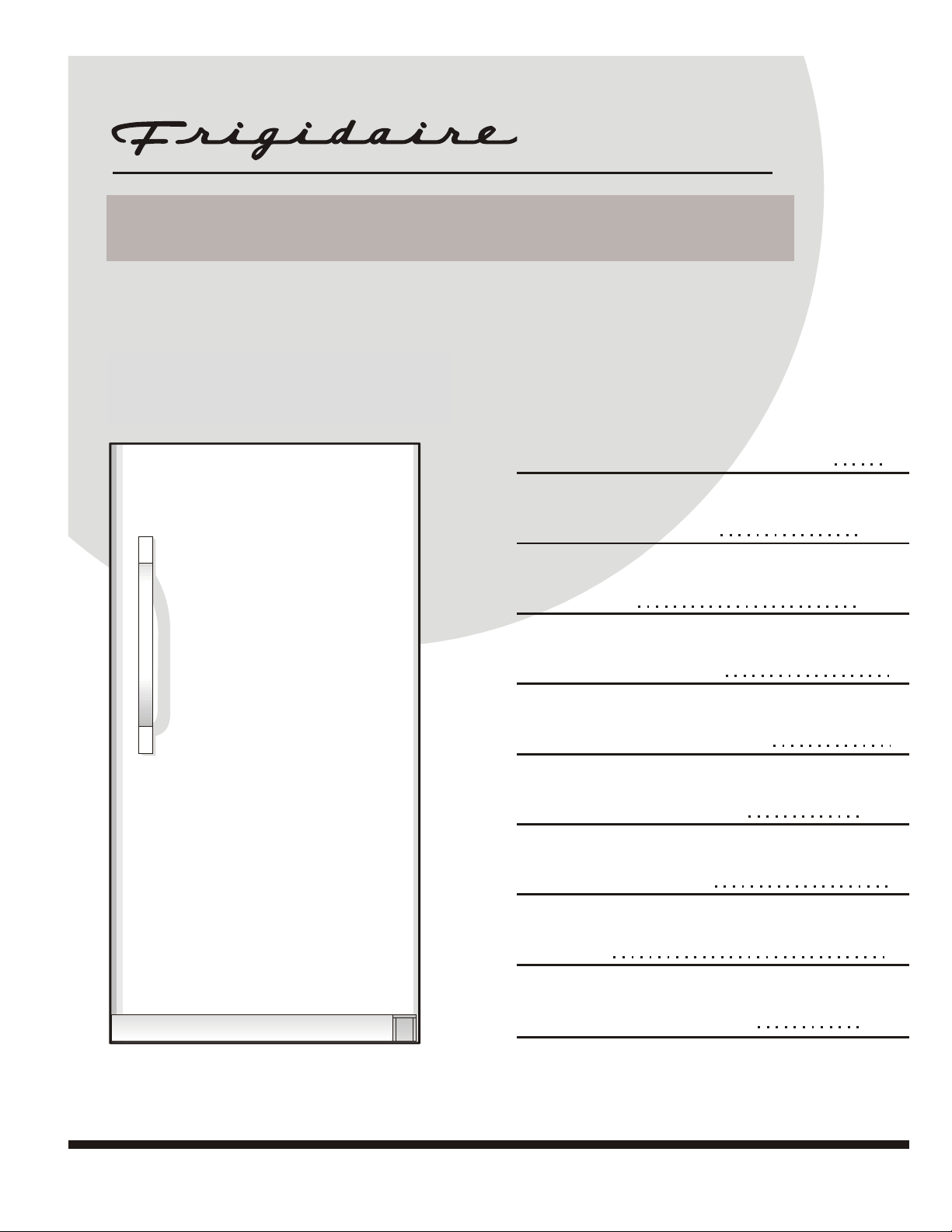
Use & Care Manual
Ref r i ger ador
Record Serial/Model Numbers 2
2 - 3
4
3 - 4
4
4 - 5
5
6
7 - 8
Safety Instructions
First Steps
Energy Saving Tips
Setting
the Temperature Control
Refrigerator Features
Care and Cleaning
Warranty
Troubleshooting Guide
Refrigerator
Use and Care Manual
2
SERIAL / MODEL NUMBERS
READ ALL INSTRUCTIONS BEFORE USING THIS
REFRIGERATOR.
FOR YOUR SAFETY
Do not store or use gasoline, or other flammable vapors
and liquids in the vicinity of this or any other appliance.
Read product labels for flammability and other warnings.
CHILD SAFETY
• Destroycarton,plasticbags,andanyexteriorwrap
ping material immediately after the refrigerator is un-
packed. Children should never use these items to play.
Cartons covered with rugs, bedspreads, plastic sheets
or stretch wrap may become airtight chambers, and can
quickly cause suffocation.
• Removeallstaplesfromthecarton.Staplescancause
severe cuts, and destroy finishes if they come in contact
with other appliances or furniture.
• Anempty,discardedicebox,refrigerator,orfreezerisa
very dangerous attraction to children.
• Removeanddiscardanyspacersusedtose-
curetheshelvesduringshipping.Smallobjects
areachokehazardtochildren.
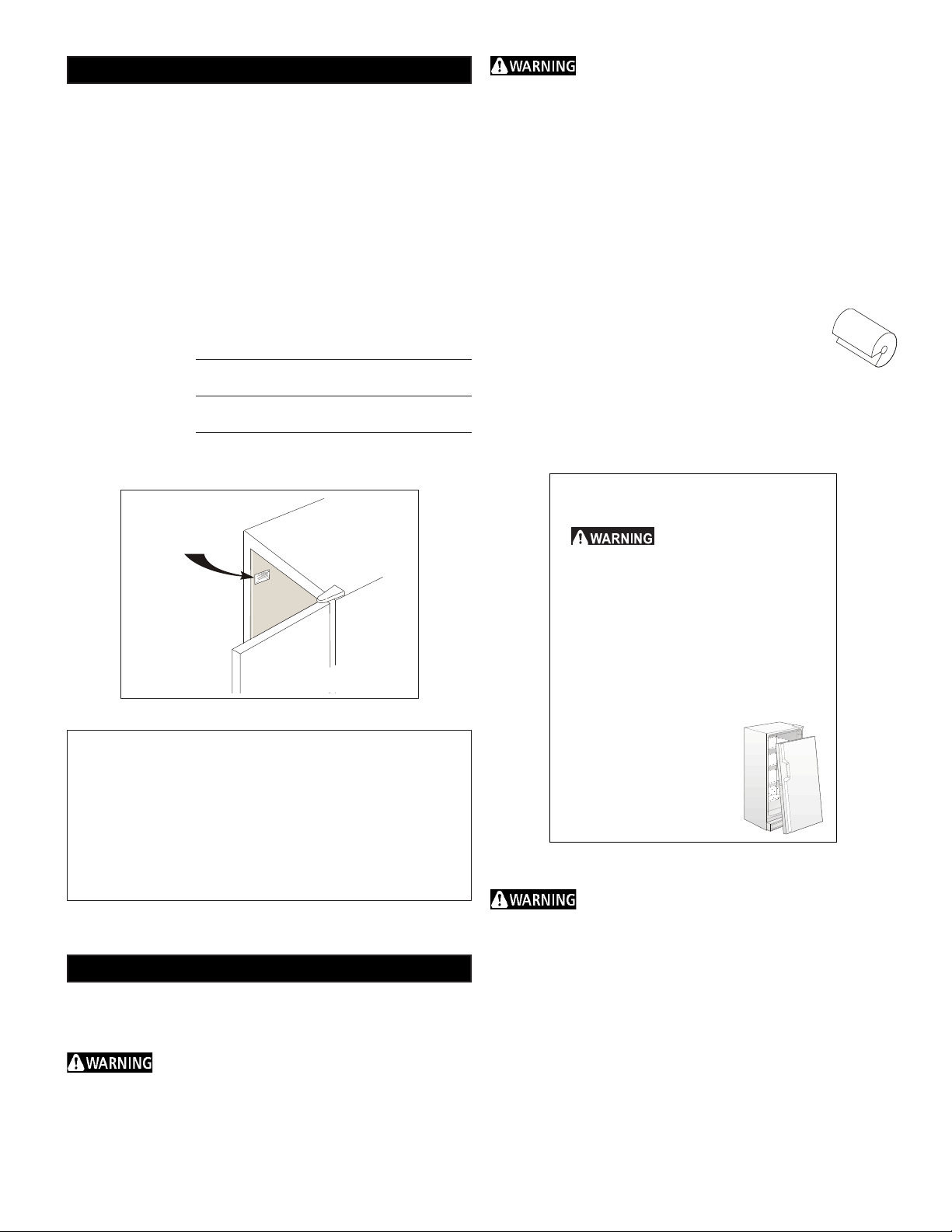
Model and Serial
Number Plate
READ AND SAVE THESE INSTRUCTIONS
This Owner’s Guide provides specific operating instruc-
tions for your model. Use your refrigerator only as in-
structed in this guide. These instructions are not meant to
cover every possible condition and situation that may oc-
cur. Common sense and caution must be practiced when
installing, operating, and maintaining any appliance.
Record Your Model and Serial Numbers
Record the model and serial numbers in the space provid-
ed below. The serial plate is located on the upper left wall
inside the refrigerator.
Model Number:
Serial Number:
Purchase Date:
Versión en español
SideseaobtenerunacopiaenespañoldeesteManual
del Usuario, sívase escribir a la dirección que se incluye a
continuación.SolicitelaP/N297081100.
SpanishOwner’sGuides
ElectroluxHomeProducts
P.O.Box212378
Augusta,GA30917
IMPORTANT SAFETY INSTRUCTIONS
Remove the door(s) of any appliance that is not in use,
even if it is being discarded.
ELECTRICAL INFORMATION
These guidelines must be followed to ensure that
safety mechanisms in the design of this refrigerator
will operate properly.
• Refrigerator must be plugged into its own 115 Volt,
60 Hz., AC only electric outlet. The power cord of the
appliance is equipped with a three-prong grounding
plugforyourprotectionagainstshockhazards.Itmust
be plugged directly into a properly grounded three-prong
receptacle. The receptacle must be installed in
accordance with local codes and ordinances. Consult a
qualified electrician. Do not use an extension cord or
adapter plug.
Proper Disposal of Your
Refrigerator/Freezer
Risk of child
entrapment. Child entrapment and
suffocation are not problems of the past.
Junked or abandoned refrigerators or
freezersarestilldangerous—evenif
theywillsitfor“justafewdays.”Ifyou
are getting rid of your old refrigerator or
freezer,pleasefollowtheinstructions
below to help prevent accidents.
BEFOREYOUTHROWAWAYYOUR
OLDREFRIGERATOR/
FREEZER:
• Remove doors.
• Leave shelves in place so
children may not easily
climb inside.
3
Avoid fire hazard or
electricshock.Donotuseanextension
cord or an adapter plug. Do not remove
any prong from the power cord.
Grounding type
wall receptacle
Power supply
cord with 3-prong
grounding plug
Do not, under any
circumstances,
cut, remove,
or bypass the
grounding prong.
• Ifvoltagevariesby10% or more, performance of your
refrigerator may be affected. Operating refrigerator with
insufficient power can damage the compressor.
• Topreventtherefrigeratorfrombeingturnedoffacciden-
tally, do not plug unit into an outlet controlled
by a wall switch or pull cord.
• Donotpinch,knot,orbendthecordinanymanner.
OTHER PRECAUTIONS
• Neverunplugtherefrigeratorbypullingonthecord.
Alwaysgriptheplugrmly,andpullstraightoutfrom
the receptacle.
• Toavoidelectricalshock,unplugtherefrigeratorbefore
cleaning and before replacing a light bulb.
NOTE:TurningthetemperaturecontroltoOFFturnsoff
the compressor, but does not disconnect the power to the
light bulb or other electrical components.
• Donotoperaterefrigeratorinthepresenceof
explosivefumes.
This Owner’s Guide provides specific operating instruc-
tions for your model. Use the refrigerator only as instructed
in this Owner’s Guide. Before starting the refrigerator,
follow these important first steps.
INSTALLATION
• Chooseaplacethatisnearagroundedelectricaloutlet.
Do Notuseanextensioncordoranadapterplug.
• Forthemostefcientoperation,therefrigeratorshould
be located where surrounding temperatures will not drop
below10°F(-12°C)orexceed110°F(43°C).The
FreezeControlFeatureisdesignedtoautomatically
maintain the selected interior refrigerator temperature
within these boundaries.
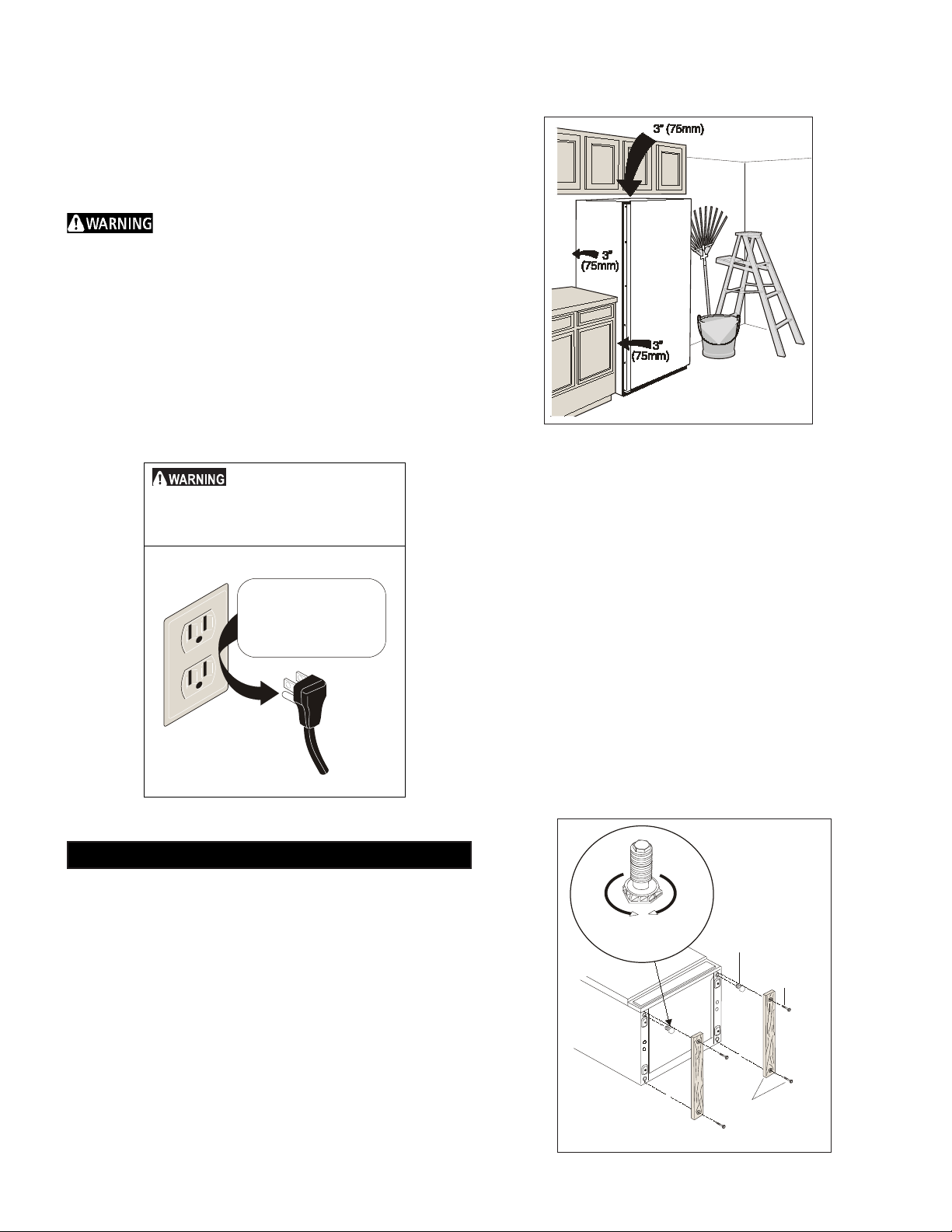
• Allow space around the unit for good air circulation.
Leavea3inch(75mm)spaceonallsidesoftherefrig-
erator for adequate circulation.
FIRST STEPS
NOTE: Theexteriorwallsoftherefrigeratormaybecome
quite warm as the compressor works to transfer heat from
theinside.Temperaturesasmuchas30°Fwarmerthan
roomtemperaturecanbeexpected.Forthisreasonitis
particularly important in hotter climates to allow enough
space for air circulation around your refrigerator.
LEVELING
The refrigerator must have all bottom corners resting firmly
on a solid floor. The floor must be strong enough to sup-
port a fully loaded refrigerator. NOTE:ItisVery Important
for your refrigerator to be level in order to function properly.
Iftherefrigeratorisnotleveledduringinstallation,thedoor
may be misaligned and not close or seal properly, causing
cooling, frost, or moisture problems.
To Level Your Refrigerator:
Afterdiscardingcratingscrewsandwoodbase,usea
carpenter’s level to level the refrigerator from front-to-back.
Adjusttheplasticlevelingfeetinfront,½bubblehigher,so
that the door closes easily when left halfway open.
Installation
Plastic
Leveling Feet
Crating
Screw
Discard The (4) Crating Screws
And (2) Wood Bases
Tu r n
Left To
Raise
Tu r n
Right To
Lower
Unpacking and Leveling -- Upright Models
Unpacking and Leveling
4
CLEANING
• Washanyremovablepartsoftherefrigeratorinterior,
andexteriorwithmilddetergentandwarmwater.Wipe
dr y. Do not use harsh cleaners on these surfaces.
• Donotuserazorbladesorothersharpinstruments,
which can scratch the appliance surface when removing
adhesivelabels.Anyglueleftfromthetapecanbe
removedwithamixtureofwarmwaterandmilddeter-
gent, or touch the residue with the sticky side of tape
already removed. Do not remove the serial plate.
S
A
V
E
M
O
N
E
Y
S
A
V
E
E
N
E
R
G
Y
DOOR REMOVAL
If door must be removed :
1. Gentlylayrefrigeratoronitsback,onarugorblanket.
2. Remove two base screws and base panel. Remove wire
clips on bottom of cabinet.
3. Removebottomhingescrews.
4. Removeplastictophingecover.
5. Removescrewsfromtophinge.
6. Remove top hinge from cabinet.
7. Removedoorandbottomhingefromcabinet.
8. Toreplacedoor,reversetheaboveorderandsecurely
tighten all screws to prevent hinge slippage.
• Installtherefrigeratorinthecoolest
part of the room, out of direct sunlight
and away from heating ducts or
registers. Do not place the refrigerator
nexttoheat-producingappliances
such as a range, oven or dishwasher.
• Leveltherefrigeratorsothedoor
close tightly.
•Donotovercrowdtherefrigeratoror
block cold air vents. Doing so causes the refrigerator to
runlongerandusemoreenergy.Shelvesshouldnotbe
linedwithaluminumfoil,waxpaperorpapertoweling.
Liners interfere with cold air circulation, making the re-
frigerator less efficient, which could cause food spoilage.
COOL DOWN PERIOD
Forsafefoodstorage,allow4hoursfortherefrigeratorto
cool down completely. The refrigerator will run continuously
for the first several hours.
TEMPERATURE CONTROL
The temperature control is located inside the refrigerator.
The temperature is factory preset to provide satisfactory
foodstoragetemperatures.However,thetemperature
controlisadjustabletoprovidearangeoftemperatures
foryourpersonalsatisfaction.Ifacoldertemperatureis
desired, turn the temperature control knob toward COLD-
ESTandallowseveralhoursfortemperaturestostabilize
betweenadjustments.
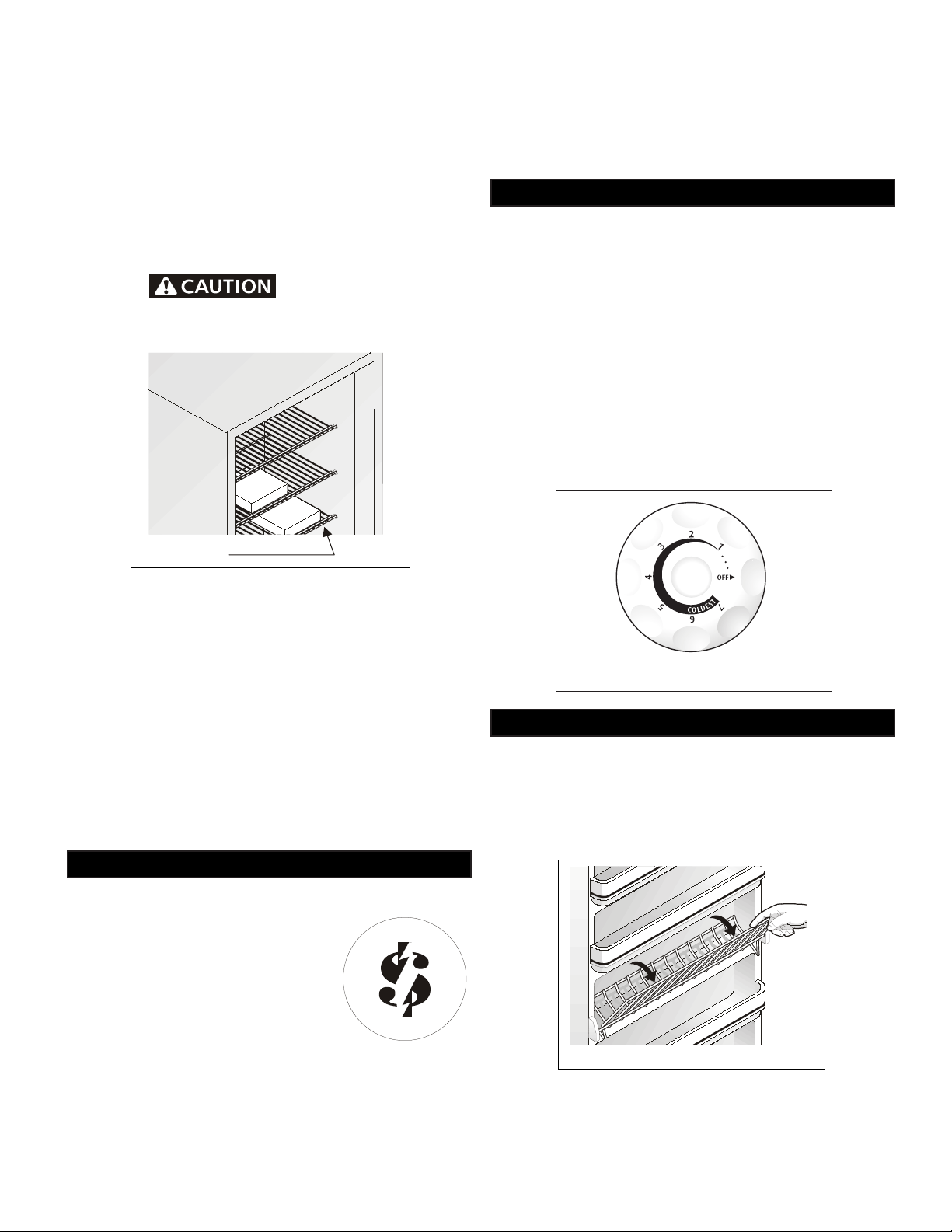
SETTING THE TEMPERATURE CONTROL
To allow door to
close and seal properly, DO NOT let
food packages extend past the front
of shelves.
Shelf Front
ENERGY SAVING TIPS
REFRIGERATOR FEATURES
TILT-OUT SHELF
This shelf is located inside on the refrigerator door and
provides additional storage space. To access an item, tilt
topof“basket”shelfdown.
Tilt-Out Shelf
• Coverfoodsandwipecontainersdrybeforeplacing
them in the refrigerator. This cuts down on moisture
build-up inside the unit.
• Organizetherefrigeratortoreducedooropenings.
Remove as many items as needed at one time and
close the door as soon as possible.
Cold Control
5
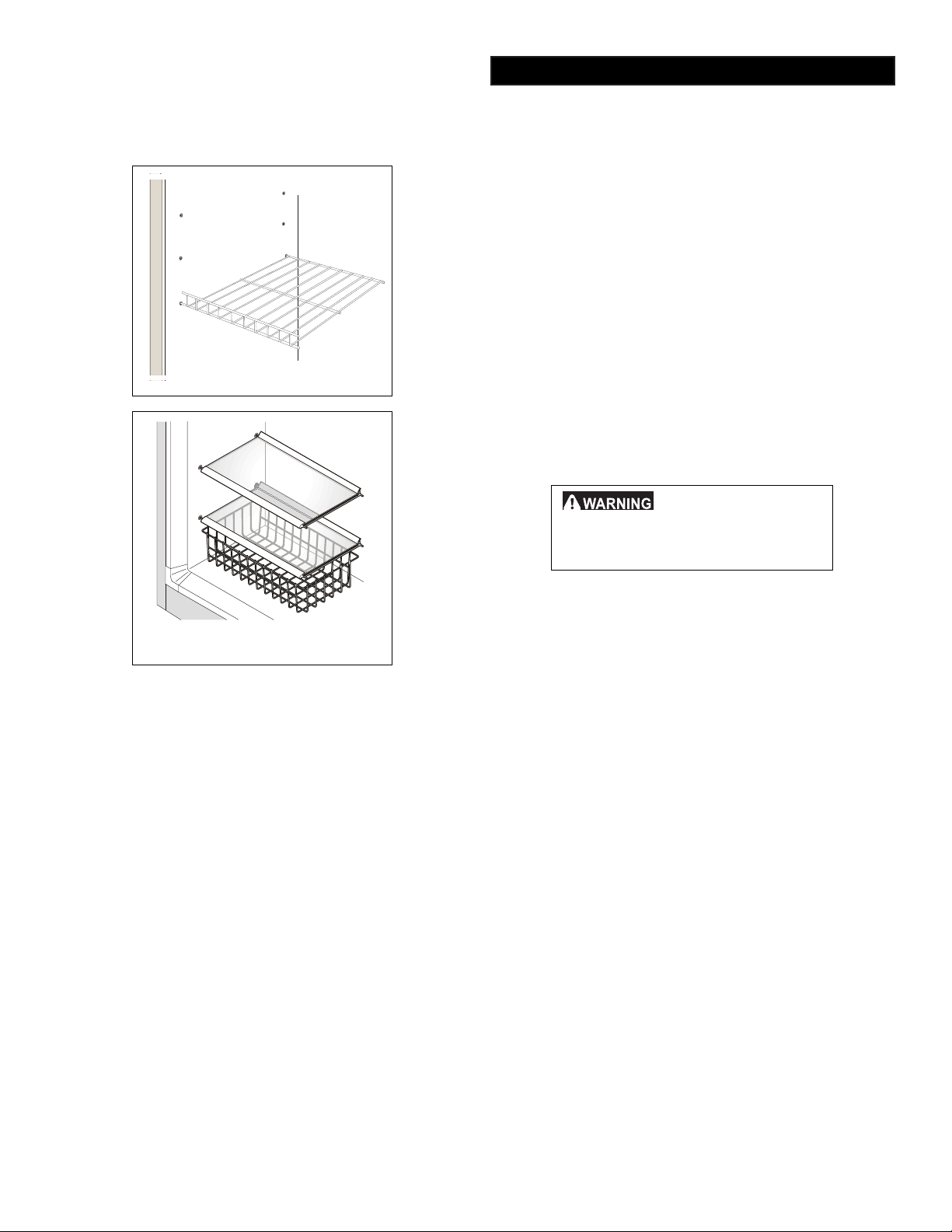
ADJUSTABLE INTERIOR SHELVES
Multi-positionadjustableinteriorshelvescanbemovedto
any position for larger or smaller packages. The shipping
spacersthatstabilizetheshelvesforshippingshouldbe
removed and discarded.
Adjustable Interior Shelves - Upright Models
AdjustableInteriorShelves
SLIDE-OUT BASKET
ASlide-OutBasket(somemodels)locatedatthebottomof
the refrigerator, provides separate storage space for items
that are difficult to store on refrigerator shelves. To remove
the basket, pull out and lift up.
AUTOMATIC FREEZE CONTROL
TheFreezeControlFeaturewillmaintainproperinteriorre-
frigerator temperature even when the refrigerator is placed
in an area where the surrounding temperature drops down
to10°F(-12°C).
INTERIOR LIGHT
The light comes on automatically when the door is opened.
To replace the light bulb, turn the temperature control to
OFFandunplug the electrical cord. Replace the old bulb
with a bulb of the same wattage.
AdjustableInteriorShelves
andSlide-OutBasket
CLEANING THE INSIDE
Washinsidesurfacesoftherefrigeratorwithasolutionof
twotablespoonsofbakingsodainonequart(1.136litres)
warmwater.Rinseanddry.Wringexcesswateroutofthe
sponge or cloth when cleaning in the area of the controls,
or any electrical parts.
Washtheremovablepartswiththebakingsodasolution
mentioned above, or mild detergent and warm water. Rinse
and dry. Never use metallic scouring pads, brushes, abra-
sive cleaners, or alkaline solutions on any surface. Do not
wash removable parts in a dishwasher.
CLEANING THE OUTSIDE
Washthecabinetwithwarmwaterandmildliquidde-
tergent. Rinse well and wipe dry with a clean soft cloth.
Replace parts and food.
VACATION AND MOVING TIPS
Vacations:
Iftherefrigeratorwillnotbeusedforseveralmonths:
• Removeallfoodandunplugthepowercord.
• Cleananddrytheinteriorthoroughly.
• Leavetherefrigeratordooropenslightly,blockingitopen
if necessary, to prevent odor and mold growth.
Moving:Whenmovingtherefrigerator,followthese
guidelinestopreventdamage:
• Disconnectthepowercordplugfromthewalloutlet.
• Removefoodsandcleantherefrigerator.
• Securealllooseitemsbytapingthemsecurelyinplace
to prevent damage.
• Inthemovingvehicle,securerefrigeratorinanupright
positiontopreventmovement.Alsoprotectoutsideof
refrigerator with a blanket, or similar item.
CARE AND CLEANING
If leaving the refrigera-
tor door open while on vacation, make
certain that children cannot get into the
refrigerator and become entrapped.
6
Your appliance is covered by a one year limited warranty. For one year from your original date of
purchase, Electrolux will pay all costs for repairing or replacing any parts of this appliance that prove
to be defective in materials or workmanship when such appliance is installed, used and maintained in
accordance with the provided instructions.
This warranty does not cover the following:
1. Products with original serial numbers that have been removed, altered or cannot be readily determined.
2. Product that has been transferred from its original owner to another party or removed outside the USA or
Canada.
3. Rust on the interior or exterior of the unit.
4. Products purchased “as-is” are not covered by this warranty.
5. Food loss due to any refrigerator or freezer failures.
6. Products used in a commercial setting.
7. Service calls which do not involve malfunction or defects in materials or workmanship, or for appliances
not in ordinary household use or used other than in accordance with the provided instructions.
8. Service calls to correct the installation of your appliance or to instruct you how to use your appliance.
9. Expenses for making the appliance accessible for servicing, such as removal of trim, cupboards, shelves,
etc.,which are not a part of the appliance when it is shipped from the factory.
10. Servicecallstorepairorreplaceappliancelightbulbs,airlters,waterlters,otherconsumables,or
knobs, handles, or other cosmetic parts.
11. Surcharges including, but not limited to, any after hour, weekend, or holiday service calls, tolls, ferry trip
charges, or mileage expense for service calls to remote areas, including the state of Alaska.
12.Damagestothenishofapplianceorhomeincurredduringinstallation,includingbutnotlimitedtooors,
cabinets, walls, etc.
13. Damages caused by: services performed by unauthorized service companies; use of parts other than
genuine Electrolux parts or parts obtained from persons other than authorized service companies; or
externalcausessuchasabuse,misuse,inadequatepowersupply,accidents,res,oractsofGod.
DISCLAIMER OF IMPLIED WARRANTIES; LIMITATION OF REMEDIES
CUSTOMER’S SOLE AND EXCLUSIVE REMEDY UNDER THIS LIMITED WARRANTY SHALL BE PRODUCT
REPAIRORREPLACEMENTASPROVIDEDHEREIN.CLAIMSBASEDONIMPLIEDWARRANTIES,INCLUDING
WARRANTIES OF MERCHANTABILITY OR FITNESS FOR A PARTICULAR PURPOSE, ARE LIMITED TO ONE YEAR
OR THE SHORTEST PERIOD ALLOWED BY LAW, BUT NOT LESS THAN ONE YEAR. ELECTROLUX SHALL NOT
BELIABLEFORCONSEQUENTIALORINCIDENTALDAMAGESSUCHASPROPERTYDAMAGEANDINCIDENTAL
EXPENSESRESULTINGFROMANYBREACHOFTHISWRITTENLIMITEDWARRANTYORANYIMPLIED
WARRANTY. SOME STATES AND PROVINCES DO NOT ALLOW THE EXCLUSION OR LIMITATION OF INCIDENTAL
ORCONSEQUENTIALDAMAGES,ORLIMITATIONSONTHEDURATIONOFIMPLIEDWARRANTIES,SOTHESE
LIMITATIONSOREXCLUSIONSMAYNOTAPPLYTOYOU.THISWRITTENWARRANTYGIVESYOUSPECIFIC
LEGALRIGHTS.YOUMAYALSOHAVEOTHERRIGHTSTHATVARYFROMSTATETOSTATE.
Keep your receipt, delivery slip, or some other appropriate payment record to establish the warranty period
should service be required. If service is performed, it is in your best interest to obtain and keep all receipts.
Service under this warranty must be obtained by contacting Electrolux at the addresses or phone
numbers below.
Exclusions
If You Need
Service
This warranty only applies in the USA and Canada. In the USA, your appliance is warranted by Electrolux Major Appliances
North America, a division of Electrolux Home Products, Inc. In Canada, your appliance is warranted by Electrolux Canada Corp.
Electrolux authorizes no person to change or add to any obligations under this warranty. Obligations for service and parts under
thiswarrantymustbeperformedbyElectroluxoranauthorizedservicecompany.Productfeaturesorspecicationsasdescribed
or illustrated are subject to change without notice.
USA
1.800.944.9044
Frigidaire
10200 David Taylor Drive
Charlotte, NC 28262
Canada
1.800.265.8352
Electrolux Canada Corp.
5855 Terry Fox Way
Mississauga, Ontario, Canada
L5V 3E4
Major Appliance Warranty Information
7
TROUBLESHOOTING
GUIDE
Beforecallingforservice,reviewthislist.Itmaysaveyoutimeandexpense.This
list includes common occurrences that are not the result of defective workmanship
or materials in this appliance.
PROBLEM CAUSE CORRECTION
REFRIGERATOR OPERATION
Refrigerator does not run.
•Refrigeratorispluggedintoa
circuit that has a ground fault interrupt.
•Temperaturecontrolisinthe
OFFposition.
•Refrigeratormaynotbeplugged
in, or plug may be loose.
•Housefuseblownortripped
circuit breaker.
•Poweroutage.
•Useanothercircuit.Ifyouareunsureaboutthe
outlet, have it checked by a certified technician.
•SeeSetting the Temperature ControlSection.
•Ensureplugistightlypushedintooutlet.
•Check/replacefusewitha15amptime-delayfuse.
Reset circuit breaker.
•Checkhouselights.CalllocalElectricCompany.
Refrigerator runs too much or
too long.
•Roomoroutsideweather
is hot.
•Refrigeratorhasrecentlybeen
disconnected for a period of time.
•Largeamountsofwarmorhot
food have been stored recently.
•Doorsareopenedtoofrequently
or too long.
•Refrigeratordoormaybeslightlyopen.
•TemperatureControlisset
too low.
•Refrigeratorgasketisdirty,
worn, cracked, or poorly fitted.
•It’snormalfortherefrigeratortoworkharderunder
these conditions.
•Ittakes4hoursfortherefrigeratortocool
down completely.
•Warmfoodwillcauserefrigeratortorunmoreuntil
the desired temperature is reached.
•Warmairenteringtherefrigeratorcausesittorun
more. Open doors less often.
•See“DOOR PROBLEMS”Section.
•Turncontrolknobtoawarmersetting.Allowsev-
eralhoursforthetemperaturetostabilize.
•Cleanorchangegasket.Leaksinthedoorsealwill
cause refrigerator to run longer in order to main-
tain desired temperature.
Interior refrigerator tempera-
ture is too cold.
•TemperatureControlisset
too low.
•Turnthecontroltoawarmersetting.Allowseveral
hoursforthetemperaturetostabilize.
Interior refrigerator tempera-
ture is too warm.
•TemperatureControlisset
too warm.
•Dooriskeptopentoolongoris
opened too frequently.
•Doormaynotbeseatingproperly.
•Largeamountsofwarmorhotfood
may have been stored recently.
•Refrigeratorhasrecentlybeen
disconnected for a period of time.
•Turncontroltoacoldersetting.Allowseveralhours
forthetemperaturetostabilize.
•Warmairenterstherefrigeratoreverytimethe
door is opened. Open the door less often.
•See“DOOR PROBLEMS”Section.
•Waituntiltherefrigeratorhashadachanceto
reach its selected temperature.
•Refrigeratorrequires4hourstocooldowncompletely.
Refrigerator external surface
temperature is warm.
•Theexternalrefrigeratorwalls
canbeasmuchas30°Fwarmer
than room temperature.
•Thisisnormalwhilethecompressorworksto
transfer heat from inside the refrigerator cabinet.
SOUND AND NOISE
Louder sound levels when-
ever refrigerator is on.
•Modernrefrigeratorshaveincreased
storage capacity and more stable
temperatures. They require a high
efficiency compressor.
•Thisisnormal.Whenthesurroundingnoiselevelis
low, you might hear the compressor running while
it cools the interior.
8
PROBLEM CAUSE CORRECTION
SOUND AND NOISE (Cont.)
Longer sound levels when
compressor comes on.
•Refrigeratoroperatesathigherpres-
suresduringthestartoftheONcycle.
•Thisisnormal.Soundwillleveloffordisappearas
refrigerator continues to run.
Fan runs when room tempera-
ture is below 45°F.
•Exteriorthermostathas
activated the heater and fan.
•Thisisnormal.
Popping or cracking sound
when compressor comes on.
•Metalpartsundergoexpansionand
contraction, as in hot water pipes.
•Thisisnormal.Soundwillleveloffordisappearas
refrigerator continues to run.
Bubbling or gurgling sound,
like water boiling.
•Refrigerant(usedtocoolrefrig-
erator)iscirculatingthroughout
the system.
•Thisisnormal.
Vibrating or rattling noise.
•Refrigeratorisnotlevel.Itrockson
the floor when it is moved slightly.
•Refrigeratoristouching
the wall.
•Leveltheunit.Referto“Leveling”intheFirst
StepsSection.
•Re-leveltherefrigeratorormoverefrigeratorslight-
ly.Referto“Leveling”inthe First StepsSection.
Snapping Sound.
•ColdControlturningthe
refrigerator on and off.
•Thisisnormal.
WATER/MOISTURE/FROST INSIDE REFRIGERATOR
Moisture forms on inside of
refrigerator walls.
•Weatherishotandhumid.
•Doormaynotbeseatingproperly.
•Dooriskeptopentoolong,oris
opened too frequently.
•Thisisnormal.
•See“DOOR PROBLEMS”Section.
•Openthedoorlessoften.
WATER/MOISTURE/FROST OUTSIDE REFRIGERATOR
Moisture forms on outside
of refrigerator.
•Doormaynotbeseatingproperly,
causing the cold air from inside
the refrigerator to meet warm
moist air from outside.
•See“DOOR PROBLEMS”Section.
ODOR IN REFRIGERATOR
Odors in refrigerator.
•Interiorneedstobecleaned.
•Foodswithstrongodorsarein
the refrigerator.
•Cleaninteriorwithsponge,warmwater,andbakingsoda.
•Coverthefoodtightly.
DOOR PROBLEMS
Door will not close.
•Refrigeratorisnotlevel.Itrocks
on the floor when it is
moved slightly.
•Thisconditioncanforcethecabinetoutofsquare
andmisalignthedoor.Referto“Leveling”inthe
First Steps Section.
LIGHT BULB IS NOT ON
Light bulb is not on.
•Lightbulbisburnedout.
•Noelectriccurrentisreaching
the refrigerator.
•Followdirectionsunder“InteriorLight”intheRe-
frigerator FeaturesSection.
•See“REFRIGERATOR OPERATION”Section.