Contents
35
EN
1 Instructions 36
1.1 General safety instructions 36
1.2 Manufacturer liability 37
1.3 Appliance purpose 37
1.4 Disposal 37
1.5 Identification plate 38
1.6 This user manual 38
1.7 How to read the user manual 38
2 Description 39
2.1 General description 39
2.2 Control panel 39
2.3 Other parts 40
2.4 Available accessories 41
3 Use 43
3.1 Instructions 43
3.2 First use 44
3.3 Using the accessories 46
3.4 Using the appliance 47
3.5 Turning the appliance off 47
3.6 Cooking tips 47
4 Cleaning and maintenance 51
4.1 Instructions 51
4.2 Cleaning the appliance 51
4.3 Extraordinary maintenance 54
5 Installation 55
5.1 Safety instructions 55
5.2 Gas connection 57
5.3 Adaptation to different types of gas 60
5.4 Electrical connection 64
5.5 Positioning 65
We advise you to read this manual carefully, which contains all the instructions for
maintaining the appliance's aesthetic and functional qualities.
For further information on the product: www.smeg.com

Instructions
36
1 Instructions
1.1 General safety instructions
Risk of personal injury
• Use outdoors only
• During use the appliance and its
accessible parts become very hot.
Keep young children away.
• Keep children under eight years of
age at a safe distance if they are not
constantly supervised.
• Never try to put out a fire or flames
with water: Turn off the appliance
and smother the flames with a fire
blanket or other appropriate cover.
• Have qualified personnel carry out
installation and assistance
interventions according to the
standards in force.
• Even if apparently empty, gas
canisters must always be handled
with care in accordance with the
safety regulations supplied with the
instructions.
• Never use any gas canister if dented
or rusty.
• Never store a spare gas canister
close to the appliance.
• Never disconnect the gas canister
from the appliance while it is in
operation. Always perform any
procedure on the gas canister well
away from the appliance.
• Only light the burners with the lid
raised.
• Never move the appliance during
use.
• Do not try to repair the appliance
yourself or without the intervention of
a qualified technician.
• Do not modify this appliance.
• If the appliance is to be out of use for
some time, close the gas supply
valve.
• In the event of a fault on the
appliance or a malfunction, contact
the aftersales service.
• If the knob becomes stiff to turn, have
the valves checked by an authorised
service centre.
• If the power supply cable is
damaged, contact technical support
immediately and they will replace it.
• Always keep hold of the lid when
lowering it.
• Observe the thermometer provided
on the lid: When the reading
exceeds 300°C (red zone) the lid
must be raised to prevent dangerous
overheating.
Risk of damaging the appliance
• In the event of a fault on the
appliance or a malfunction, contact
the aftersales service.
• Do not seat on the appliance.
• Do not use steam jets for cleaning the
appliance.
Instructions
37
EN
• Do not obstruct ventilation openings
and heat dispersal slots.
• Never leave the appliance
unattended during cooking
operations where fats or oils could
be released.
• Never leave objects on the cooking
surface.
• Do not use the appliance to heat
rooms for any reason.
For this appliance
• This appliance must be used outdoors,
protected from rain, in the presence of
natural ventilation which is able to
rapidly disperse any gas leaks or
combustion products.
• Never use the appliance outdoors in
case of bad weather. Any contact with
water might seriously damage the
appliance and put its safety at risk.
• Remove any traces of liquid from the lid
(if fitted) before opening.
• Only light the burners with the lid (if
present) raised.
• Not for use in marine craft, caravans or
mobile homes.
1.2 Manufacturer liability
The manufacturer declines all liability for
damage to persons or property caused by:
• Use of the appliance other than the one
envisaged;
• Non-observance of the user manual
provisions;
• Tampering with any part of the
appliance;
• Use of non-original spare parts.
1.3 Appliance purpose
• This appliance is intended for cooking
food in the home environment. Every
other use is considered improper.
• This appliance may be used by children
aged at least 8 and by people of
reduced physical and mental capacity,
or lacking in experience in the use of
electrical appliances, as long they are
supervised or instructed by adults who
are responsible for their safety.
• The appliance is not designed to
operate with external timers or with
remote-control systems.
1.4 Disposal
This appliance must be disposed of
separately from other waste
(Directives 2002/95/EC, 2002/
96/EC, 2003/108/EC). The appliance
does not contain substances in quantities
sufficient to be considered hazardous to
health and the environment, in accordance
with current European directives.
To dispose of the appliance:
Power voltage
Danger of electrocution
• Disconnect the main power supply.
• Disconnect the power cable from the
electrical system.
Instructions
38
• Cut the power supply cable and remove
it along with the plug.
• Deliver the appliance to the appropriate
selective collection centres for electrical
and electronic equipment waste, or
return it to the retailer when purchasing
an equivalent product, on a one for one
basis.
Our appliances are packed in non-
polluting and recyclable materials.
• Deliver the packing materials to the
appropriate recycling centre.
1.5 Identification plate
The identification plate bears the technical
data, serial number and brand name of the
appliance. Do not remove the identification
plate for any reason.
1.6 This user manual
This user manual is an integral part of the
appliance and must therefore be kept in its
entirety and within the user's reach for the
whole working life of the appliance.
Read this user manual carefully before using
the appliance.
1.7 How to read the user manual
This user manual uses the following reading
conventions:
1. Use instruction sequence.
• Single use instruction.
Plastic packaging
Danger of suffocation
• Do not leave the packaging or any part
of it unattended.
• Do not let children play with the
packaging plastic bags.
Instructions
General information on this user
manual, on safety and final
disposal.
Description
Description of the appliance and its
accessories.
Use
Information on the use of the
appliance and its accessories,
cooking advice.
Cleaning and maintenance
Information for proper cleaning and
maintenance of the appliance.
Installation
Information for the qualified
technician: Installation, operation
and inspection.
Safety instructions
Information
Advice
Description
39
EN
2 Description
2.1 General description
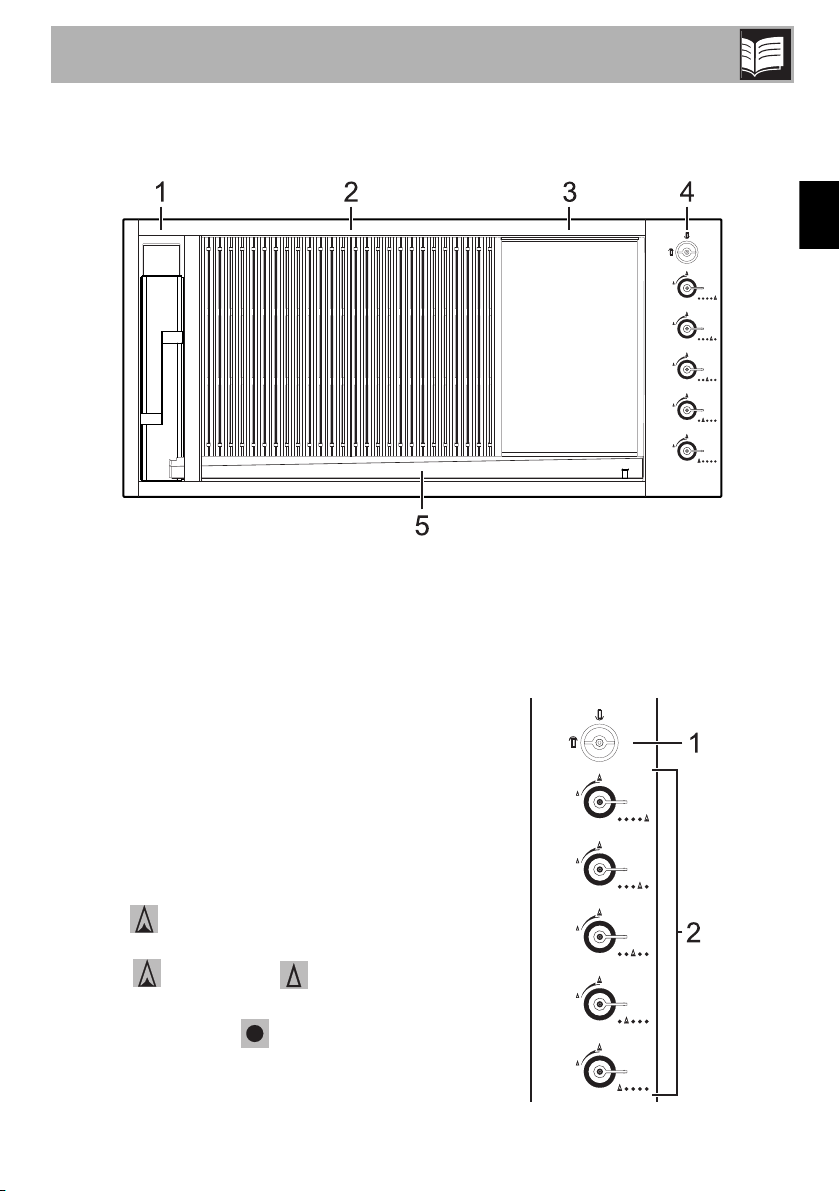
1 Liquid waste compartment
2 Grills
3 Griddle
4 Control panel
5 Duct
2.2 Control panel
Battery (1)
The battery supplies the burner ignition
plugs.
Burner knobs (2)
Useful for lighting and adjusting the
appliance burners.
Press and turn the knobs anti-clockwise to
the value to light the relative burners.
Turn the knobs to the zone between the
maximum and minimum setting to
adjust the flame.
Return the knobs to the position to turn
off the burners.
Description
40
2.3 Other parts
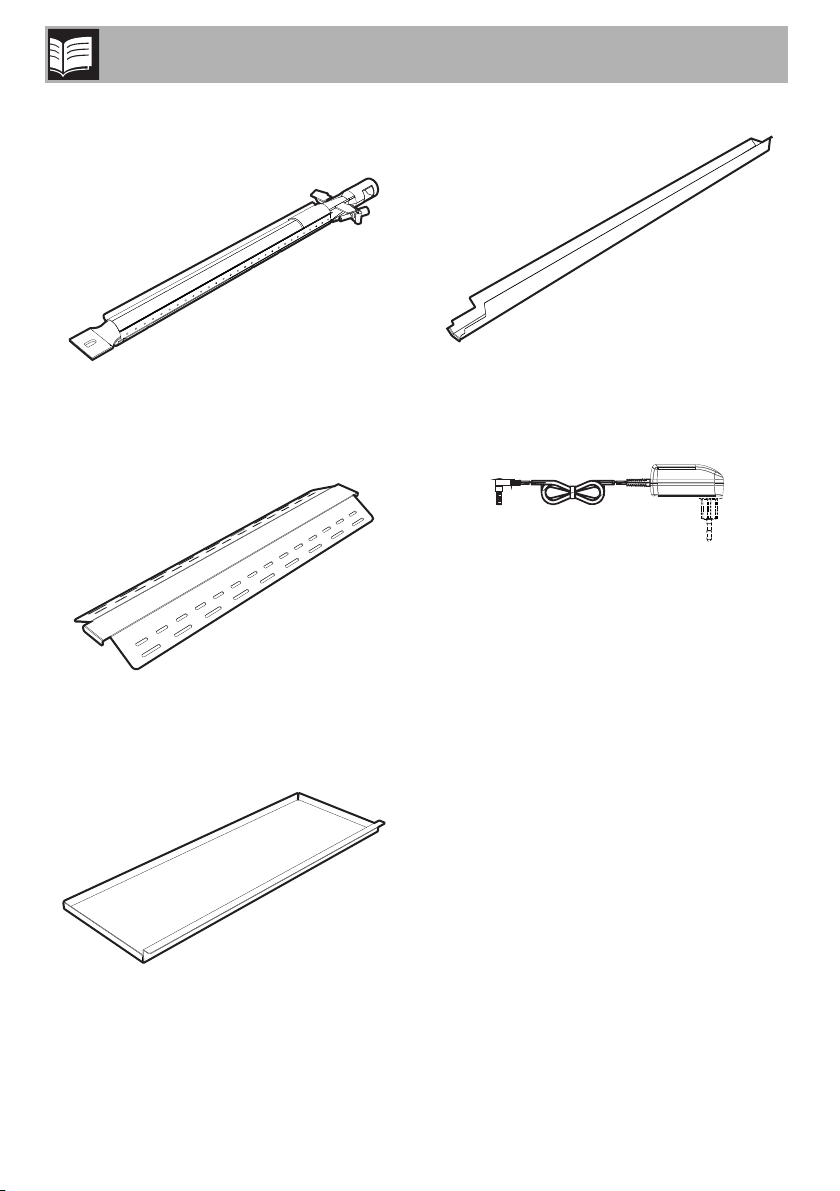
Burners
The fundamental element of the appliance,
these generate the flame for cooking.
Diffusers
Useful for making the flame uniform and
improving the type of cooking.
Drip trays
These catch the residue produced by the
food being cooked.
Duct
Allows liquids to run off into the liquid waste
compartment.
Mains adapter
Powers the burner igniters. When
connected, the battery is automatically
disconnected.
Description
41
EN
2.4 Available accessories
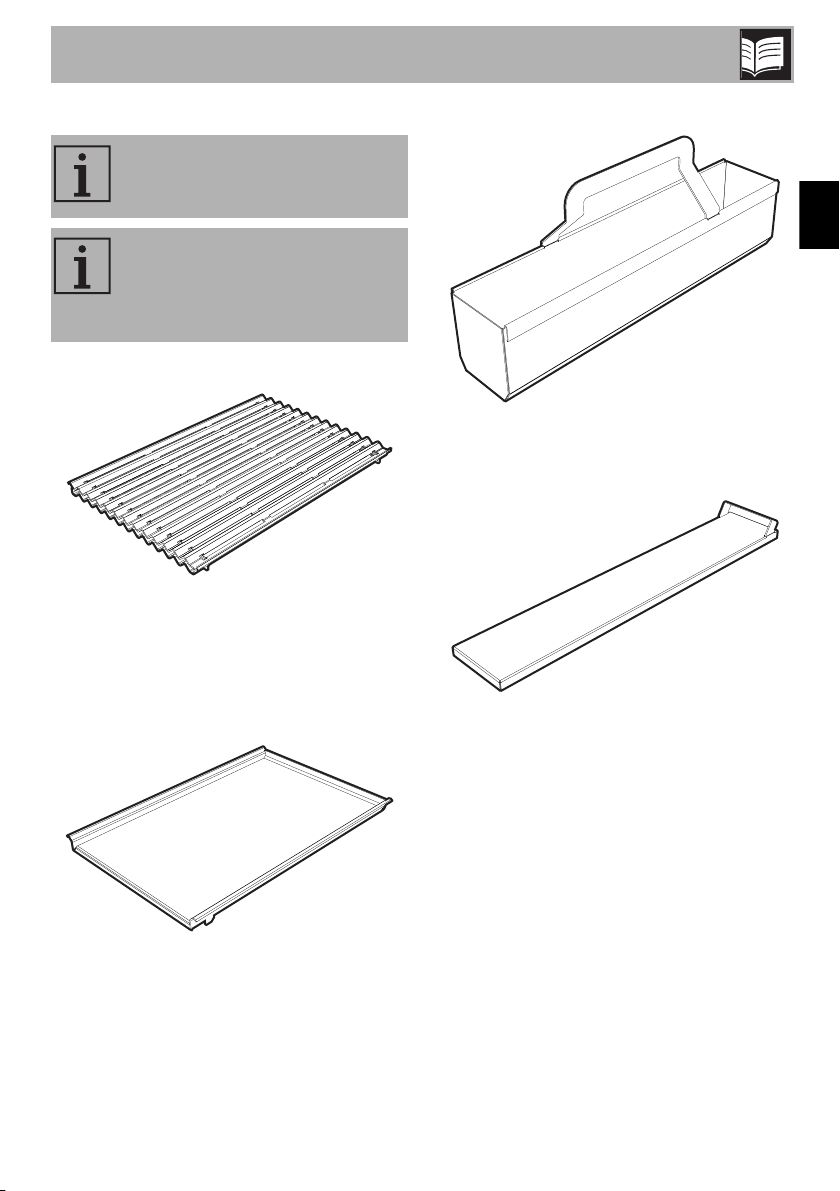
Grills
For rapid cooking of meat, fish and
vegetables directly on the grill, bringing out
their flavour by directly exposing them to the
flame.
Griddle
For direct, uniform cooking of meat, fish and
vegetables, providing light dishes with their
nutritional content intact.
Liquid waste compartment
For collecting waste liquids.
Liquid waste compartment cover
For closing the liquid waste compartment
when the appliance is not in use.
Some models are not provided
with all accessories.
The accessories intended to come
into contact with food are made of
materials that comply with the
provisions of current legislation.
Description
42
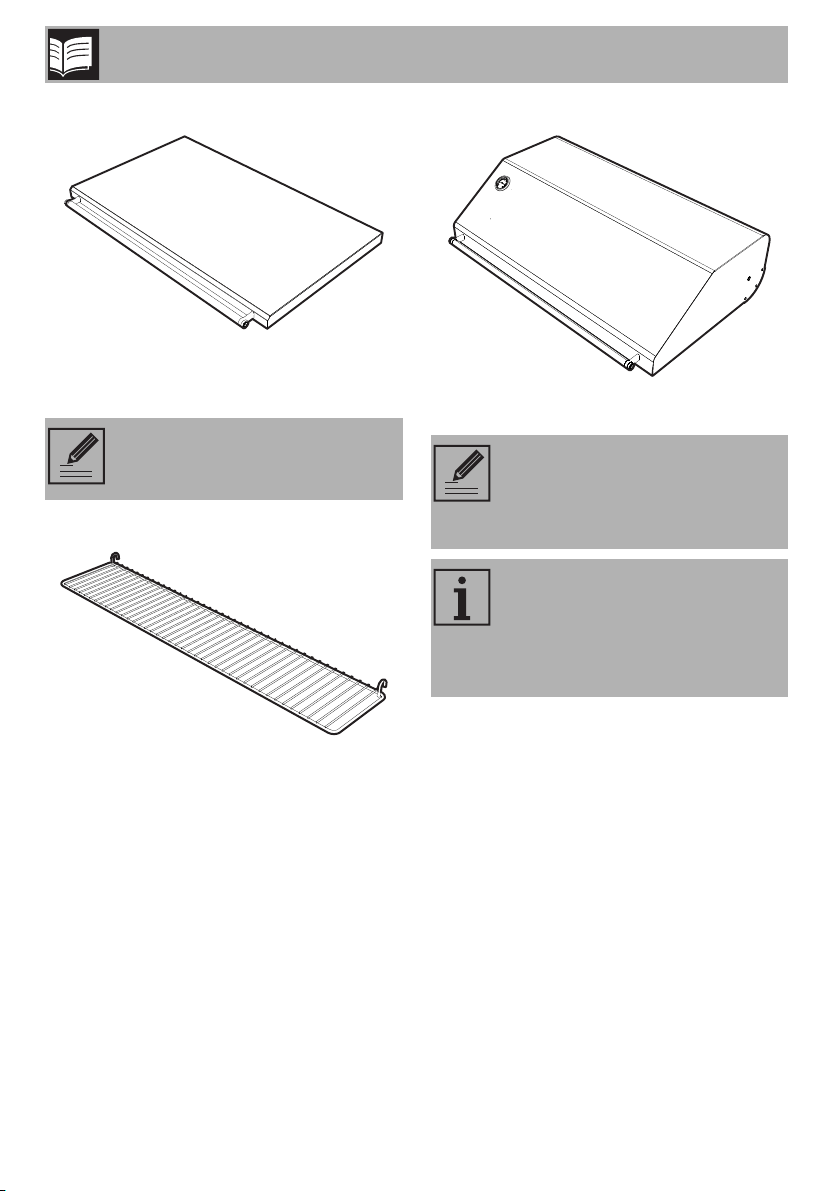
Cover (on some models only)
For closing the appliance when it is not
being used.
Utensil holder (on some models only)
For holding cooking utensils when using the
appliance
Lid (on some models only)
For indirect grilling.
DO NOT CLOSE THE COVER
WHEN THE BURNERS ARE ON
Take care not to allow the glass of
the barbecue lid to come into
contact with water while it is still
hot.
Original supplied and optional
accessories can be requested to
Authorised Assistance Centres.
Use only original accessories
supplied by the manufacturer.
Use
43
EN
3 Use
3.1 Instructions
High temperatures during use
Danger of burns
• During use the appliance and its
accessible parts become very hot. Keep
young children away.
• Protect your hands wearing heat
resistant gloves when moving food.
• Do not touch the heating elements inside
the appliance.
• Switch the appliance off immediately
after use.
• Do not pour water directly onto very hot
trays.
• Young children should be supervised to
ensure that they do not play with the
appliance.
• Children must never play with the
appliance.
• The appliance must never be cleaned
by unsupervised children.
• Oils and fat could catch fire if
overheated. Be very careful.
• Always ensure that the burner
components are correctly fitted in place.
Improper use
Risk of damage to surfaces
• Do not rest pans or trays on the lid
(when fitted).
• Do not pour water directly onto very hot
trays.
• Never use the appliance outdoors in
case of bad weather.
• Use wooden or plastic utensils.
High temperatures during use
Danger of fire or explosion
• Do not spray any spray products near
the appliance.
• Do not use or leave flammable materials
near the appliance.
• Do not use plastic kitchenware or
containers when cooking food.
• Do not leave the appliance unattended
during cooking operations where fats or
oils could be released.
Use
44
3.2 First use
1. Remove any protective film from the
outside or inside of the appliance,
including accessories.
2. Remove any labels (apart from the
technical data plate) from the
accessories and from the cooking
compartments.
3. Remove all the accessories from the
appliance and clean them (see 4
Cleaning and maintenance).
4. Run the burners at full power for 10
minutes before you first use the
appliance to remove any residue from
the manufacturing process.
Diffusers
Before using the appliance, it is necessary
to assemble the diffusers as shown in the
figure below.
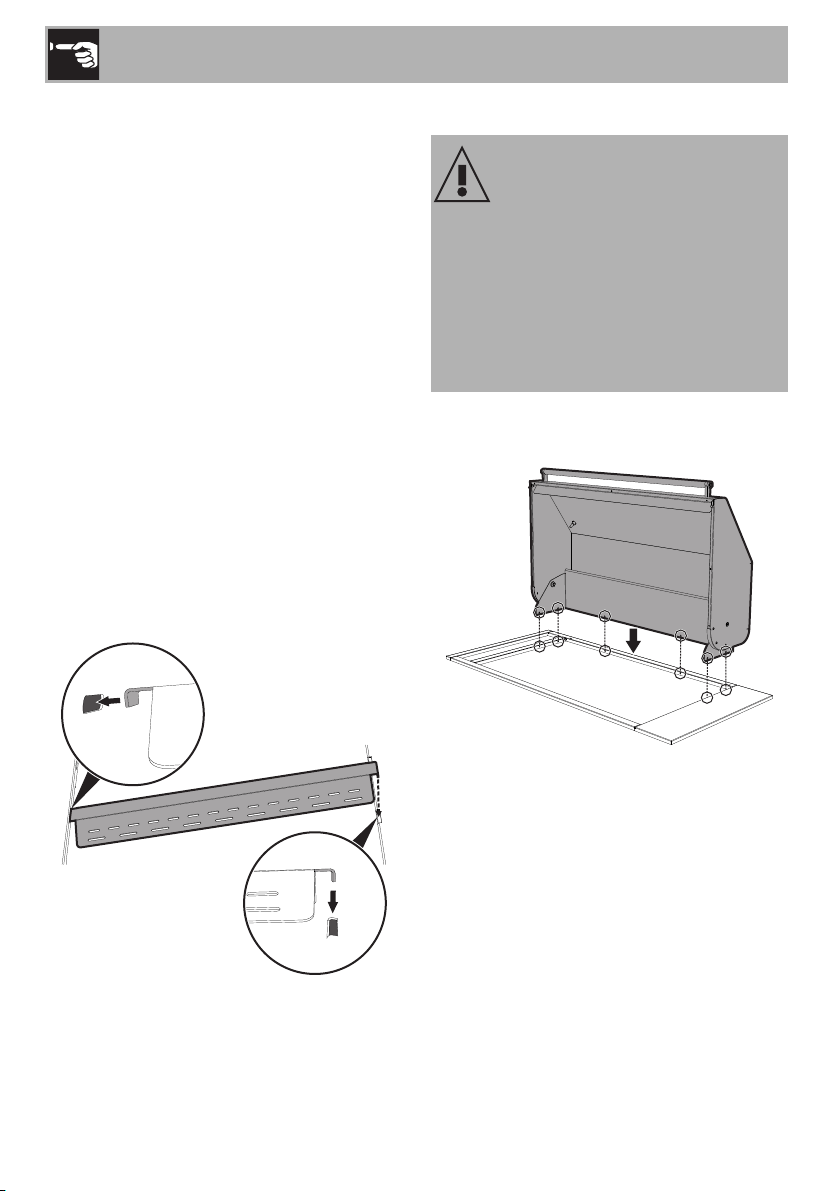
Installing the lid (on some models only)
Place the lid in position on the appliance
and attach it with the 6 screws supplied.
Improper use
Danger of burns
• The lid must always be kept open while
the burners are being lit. It can be
lowered once they have ignited and
must be raised as soon as the
thermometer fitted on it reaches 300°C.
Take care not to obstruct the combustion
gas outlet flue in the back of the lid.
Use
45
EN
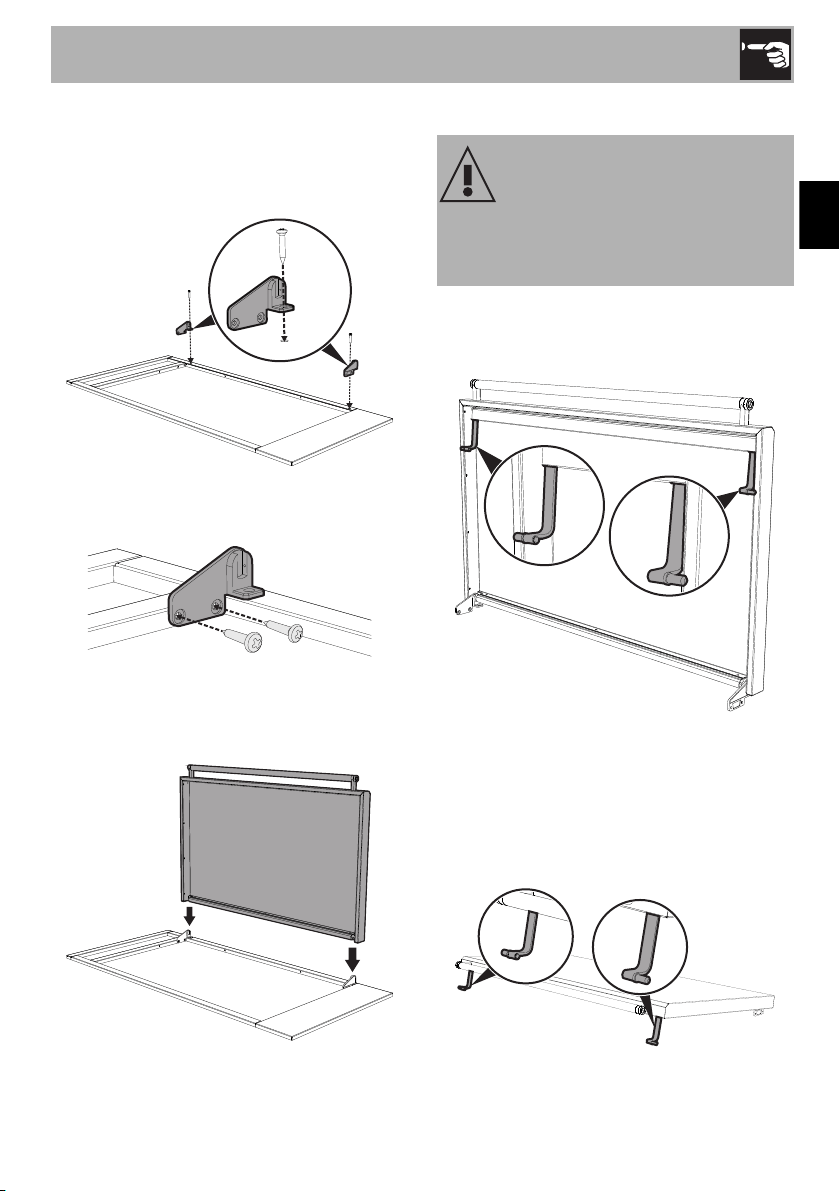
Installing the cover (on some models only)
1. Position the supplied hinges and screw
the 2 supplied screws to the upper part
of the appliance.
2. Fasten the hinges with the 4 supplied
screws.
3. Position the cover and fasten the screws
to the upper part of the hinge using an
Allen key to fix it to the appliance.
Cover safety legs
To ensure that the user remembers to turn off
the gas before closing the cover, two
pivoting safety legs have been fitted.
When closing the cover the safety legs will
pivot forward and rest against the trim
surface to prevent the cover closing. After
ensuring the gas has been turned off, to fully
close the cover, the legs need to be rotated
backwards.
Improper use
Danger of burns
• The cover must not be closed when the
burners are operating.
Use
46
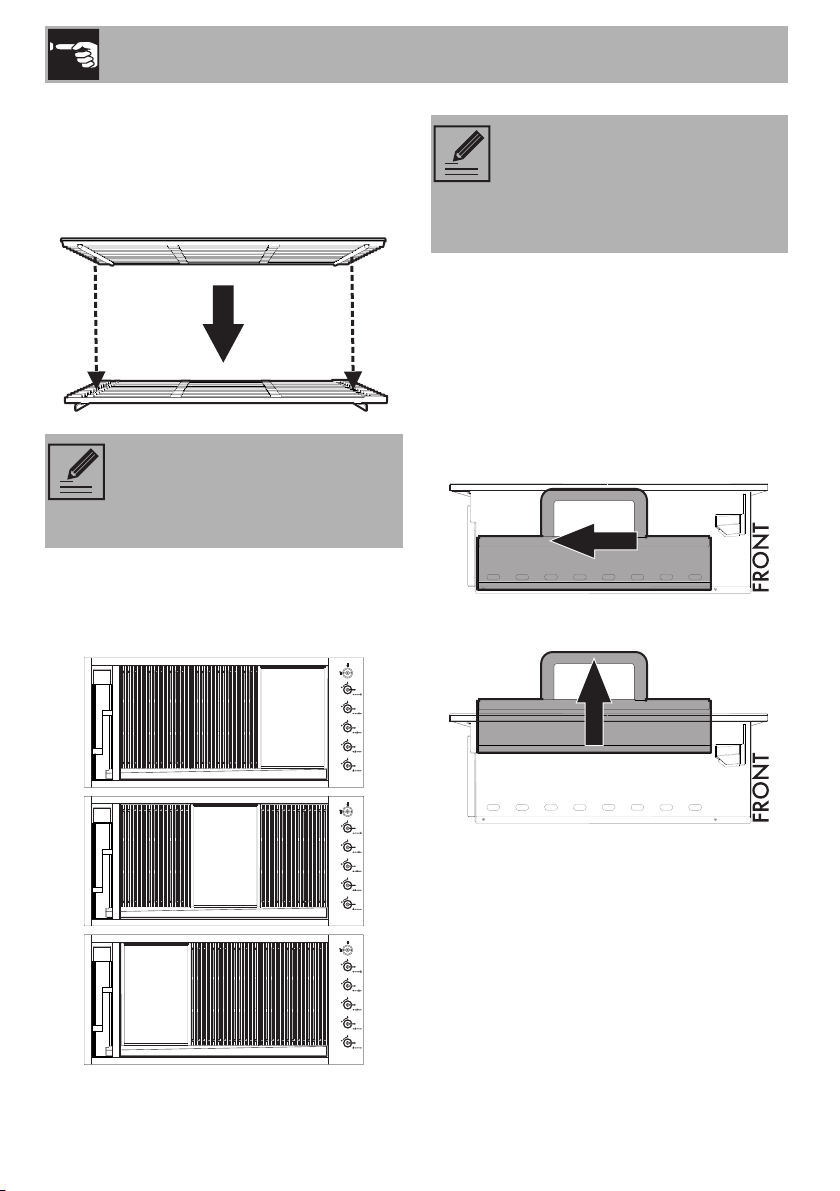
3.3 Using the accessories
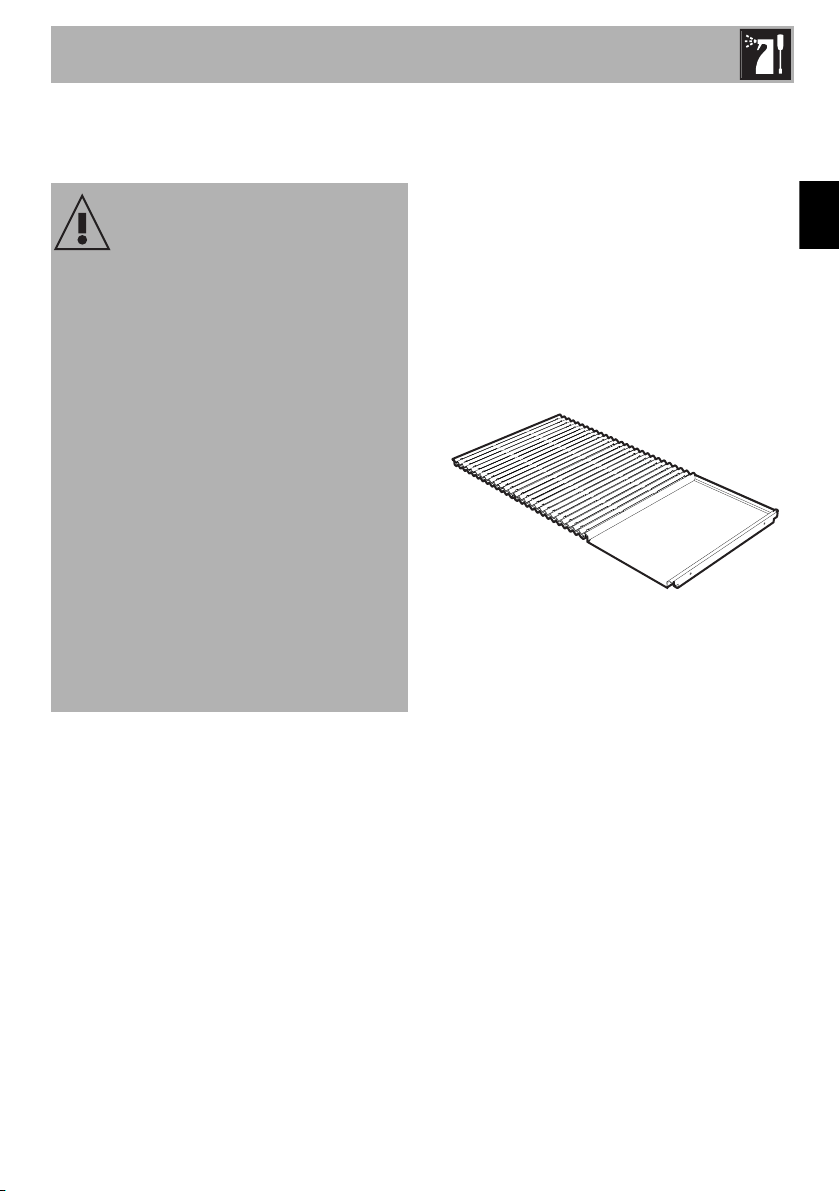
Grills
The grills must be assembled as shown in
the figure below.
Layout
The griddle and grills can be fitted to or
removed from the appliance as required.
Liquid waste container
It is recommended you empty the liquid
waste container after using the appliance:
1. Remove the liquid waste compartment
cover.
2. Holding the container by its handle, push
it towards the back of the liquid waste
compartment.
3. Lift the container upwards.
4. Empty and clean the container.
5. Once you have cleaned the container,
replace it in its compartment and follow
the removal operations above in reverse.
Clean the grills before using them
for the first time to remove any
residue left by the manufacturing
process.
Proceed with cooking only with the
griddle and all grills in position to
avoid danger to the user or
damage to the appliance's
appearance and functionality.

Use
47
EN
3.4 Using the appliance
(for all models)
All the appliance's control and monitoring
devices are located together on the control
panel. The burner controlled by each knob
is shown next to the knob. The appliance is
equipped with an electronic ignition device.
Simply press the knob and turn it anti-
clockwise to the maximum flame symbol,
until the burner lights. If the burner does not
light in the first 15 seconds, turn the knob to
and wait 60 seconds before trying
again.
(only for valved models)
After lighting, keep the knob pressed in for
a few seconds to allow the thermocouple to
heat up. The burner may go out when the
knob is released: In this case, the
thermocouple has not heated up sufficiently.
Wait a few moments and repeat the
operation. Keep the knob pressed in
longer.
3.5 Turning the appliance off
If the appliance is to be out of use for some
time, close the gas supply valve, unplug the
appliance from the wall socket and remove
the battery.
Before reusing it, check that the gas outlet
holes are not clogged with dust or spider's
webs.
3.6 Cooking tips
• During indirect grilling the lid (if fitted)
must be left closed and only opened if
the temperature exceeds 300°C. Close
it again after 5 minutes have passed.
• Water should always be poured into the
dripping pans for more succulent
cooking results and to simplify cleaning
of the barbecue after use.
• Always preheat at the minimum setting.
Some models are not fitted with a
safety valve. If you notice that the
flames have gone out, turn the
knobs to IMMEDIATELY and
wait a few minutes before
attempting to ignite the burners
again.
Direct grilling: Food cooked
directly on a grill positioned above
a lit burner.
Indirect grilling: Food cooked on a
grill positioned adjacent to the lit
burner.

Use
48
• For processes requiring more powerful
grilling, preheat the burners for 15
minutes.
• Preheat for indirect grilling by igniting the
burner where the food is to be placed for
5 minutes at the minimum setting and the
other burners at the maximum setting for
10 minutes.
• During direct grilling (meat or fish), if the
fierce heat burns the food, turn the
burners down using the knob or move the
food.
• During cooking, it is recommended to
remove the liquid waste compartment
cover to allow cooking fumes to escape.
Meat (direct grilling)
The burners must be set to maximum. The
cooking time varies depending on the
thickness of the food and personal taste.
For best results when grilling, brown the
outside at maximum heat then use the knobs
to turn the burners down to a medium /
minimum setting to allow the meat to cook
right through without burning on the outside.
The appearance of flames, when cooking
pork (i.e. fatty foods) in particular, is normal
and is caused by dripping fat. Do not
worry, but move the food being cooked to
another part of the rack.
To allow this, it is best not to fill the whole
grill with food for cooking.
It is recommended to preheat the
burners at maximum power for 5-
10 minutes with the lid (where
fitted) closed, depending on the
thickness of the meat.
Use
49
EN
Meat (indirect grilling)
After preheating with the burners at the
minimum setting and the lid (where fitted)
closed, place the meat on a grill next to the
lit burner. For example, the meat can be
placed on the central grill after the side
burners have been ignited.
The advantage of indirect grilling is that the
heat is less fierce. Start cooking with the
burners on the minimum setting then
gradually increase over time.
Naturally, it takes considerably longer than
direct grilling, but excellent results will be
assured.
Large pieces of meat or fish such as roasts,
whole chickens, lamb and other particularly
thick/fat cuts are suitable for indirect
grilling.
Vegetables and fish (direct grilling)
Arrange the vegetables and/or fish on the
grill after preheating. Given the nature of
these foods, the knobs should be kept
turned to the minimum setting.
Grilling information table
It is recommended to preheat the
burners at minimum power for 15
minutes with the lid (where fitted)
closed.
Heat
Temperature
(°C)
Burner setting Suitable for
High
230 - 250 Maximum
Preheating before starting cooking.
Medium-High
200 Medium-Maximum
Direct grilling of thin cuts of meat, fish and vegetables.
Medium
160 - 180 Intermediate
Direct grilling of cuts of meat of medium thickness (e.g.
half chicken) and indirect grilling.
Medium-Low
150 Medium-Minimum
Indirect grilling and smoking, or keeping food which
has already been grilled warm.
Low
110 - 120 Minimum
Smoking and indirect grilling of large pieces of fatty or
delicate foods, or keeping food which has already
been grilled warm.
Use
50
Barbecue cooking
Food
Cooking
mode
Weight
(Kg)
Preheat. Cooking time Tips
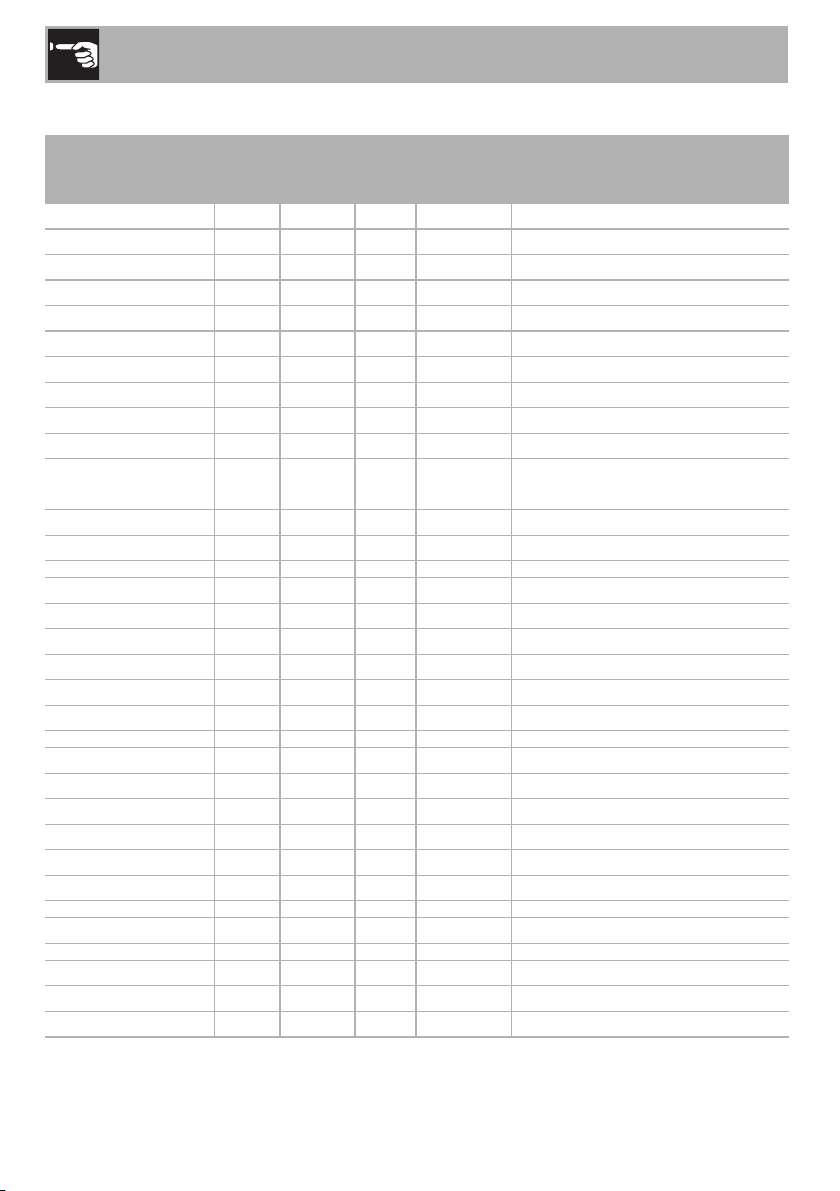
Beef steaks
Direct 0.5 10’ 3’ - 5’
Flame at maximum setting
T-bone steaks
Direct 2 = 4 pcs. 15’ 4’ per side
Medium-high flame
Beef fillet
Direct 1.5 10’ 40’ - 50’
Medium-high flame
Chicken joints
Direct 2 10’ 45’
Minimum flame
Whole chicken
Indirect 3 10’ 150’
Medium-minimum flame
Chops
Direct 1 10’ 15’ - 18’
Medium flame
Bacon
Direct 0.5 10’ 5’ - 7’
Medium flame
Whole pork neck
Indirect 2.5 10’ 240’
Minimum flame, then increase
Stuffed roast pork
Indirect 2.5 10’ 150’
Minimum flame, then increase
Pork shank
Indirect 1 10’ 70’
Minimum flame, then increase
Spare ribs
Direct 2 8’ - 10’ 30’ - 40’
Medium-minimum flame, turn food often
Sausages
Direct 1 10’ 13’ - 15’
Medium-minimum flame
Leg of lamb
Indirect 2.5 10’ 150’ - 180’
On stainless-steel griddle
Sliced onion
Direct 0.6 15’ 10’ - 15’
On stainless-steel griddle
Sliced aubergine
Direct 0.5 10’ 8’ - 13’
Medium flame
Whole potatoes
Indirect 1 10’ 90’ - 110’
Maximum flame
Diced potatoes
Indirect 1 10’ 80’ - 90’
Medium flame
Courgettes
Direct 0.5 10’ 15’ - 18’
Medium-minimum flame
Peppers
Direct 3 pcs 10’ 13’ - 15’
Medium flame
Prawns
Direct 0.75 10’ 10’ - 12’
Medium-minimum flame
Trout
Direct 1 10’ 18’
Minimum flame
Small fish (e.g. herring)
Direct 0.3 15’ 4’ per side
Maximum flame on stainless steel griddle
Sea bream
Indirect 3 10’ 40’
Medium-minimum flame
Salmon fillets/steaks
Direct 0.5 10’ 15’
Minimum flame
Sea-bass
Direct 1 10’ 40’
Minimum flame
Pineapple
Direct 0.8 10’ 8’
Minimum flame
Polenta slices
Direct 1 10’ 4’-5’ per side
Maximum flame
Sliced bruschetta
Direct 1 5’ 6’-8’ per side
Medium-minimum flame
Bread
Direct 0.2 5’ 20’ - 25’
Minimum flame
Cleaning and maintenance
51
EN
4 Cleaning and maintenance
4.1 Instructions
4.2 Cleaning the appliance
To keep the surfaces in good condition,
they should be cleaned regularly after use.
Let them cool first.
Ordinary daily cleaning
Always use only specific products that do
not contain abrasives or chlorine-based
acids.
Pour the product onto a damp cloth and
wipe the surface, rinse thoroughly and dry
with a soft cloth or a microfibre cloth.
Food stains or residues
Do not use metallic sponges or sharp
scrapers as they will damage the surfaces.
Use ordinary non-abrasive products with
the aid of wooden or plastic utensils if
necessary. Rinse thoroughly and dry with a
soft cloth or a microfibre cloth.
Do not allow residues of sugary foods (such
as jam) to set inside the oven. If left to set for
too long, they might damage the enamel
lining of the oven.
Griddle and grills
For best results, clean the griddle and grills
when still lukewarm. Wearing heat-resistant
gloves, dip them in water and then scrub
them with a brass-bristle brush to remove
any food residue. Complete cleaning by
washing the grills with a degreasing
detergent and rinse thoroughly.
Improper use
Risk of damage
• Do not use steam jets for cleaning the
appliance.
• Do not use cleaning products containing
chlorine, ammonia or bleach on steel
parts or parts with metallic finishes on the
surface (e.g. anodizing, nickel- or
chromium-plating).
• Do not use abrasive or corrosive
detergents on glass parts (e.g. powder
products, stain removers and metallic
sponges).
• Do not use rough or abrasive materials
or sharp metal scrapers.
• Do not wash removable components
such as the grills and griddle in the
dishwasher.
• All previous food residue must always
be removed before cooking.
Cleaning and maintenance
52
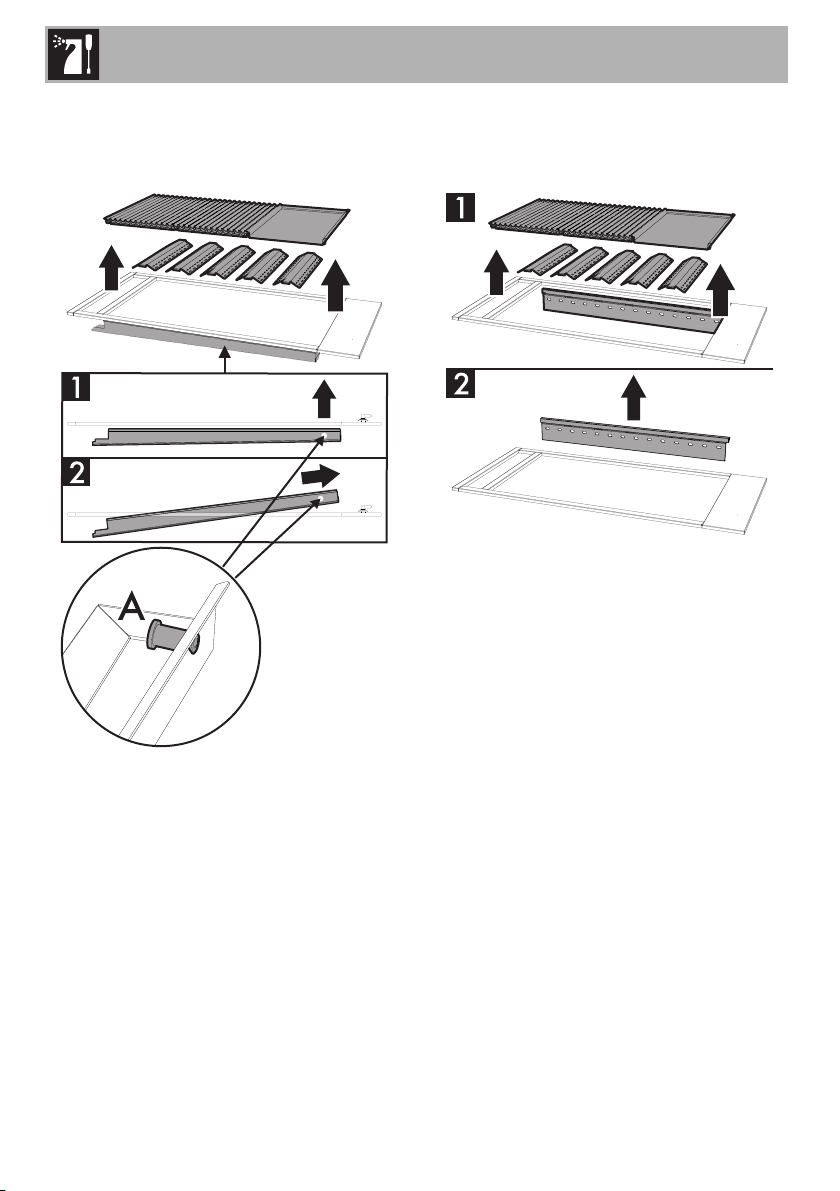
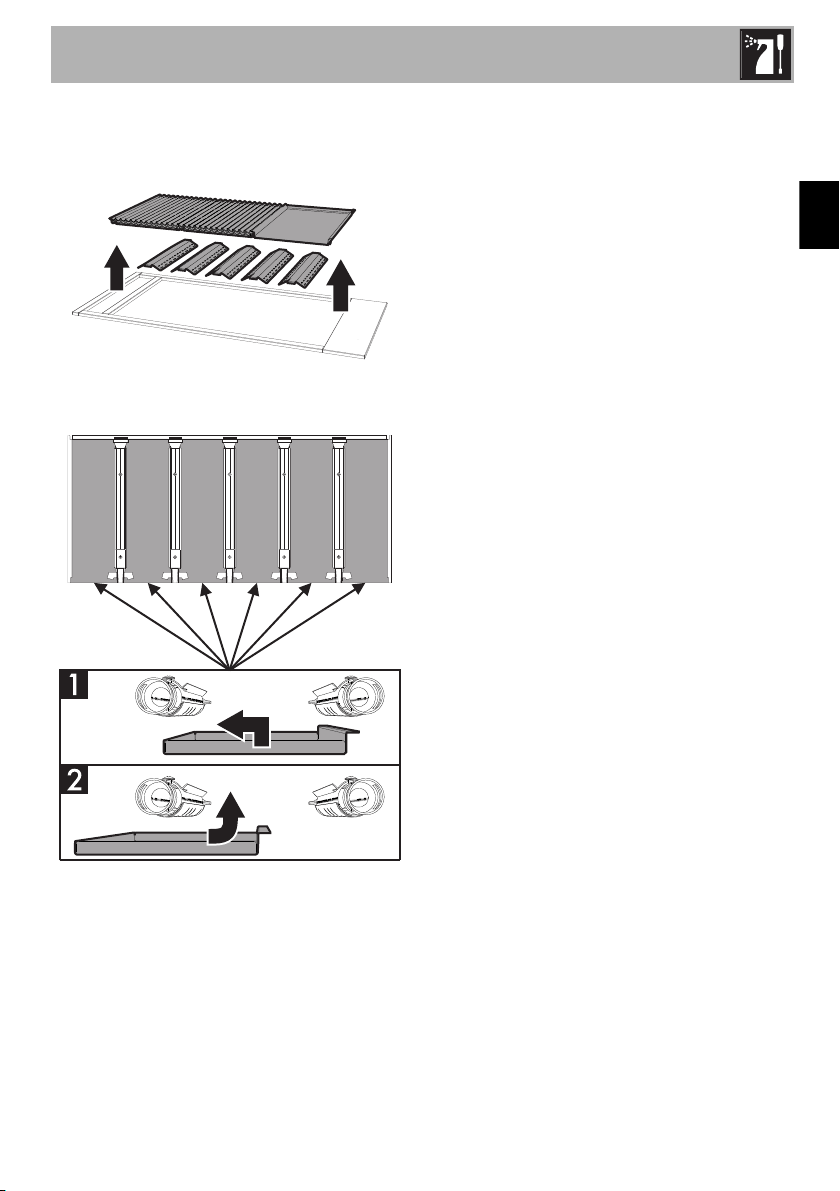
Duct
Remove the grills and griddle and then the
diffusers.
1. Take hold of pin A of the duct and lift it
upwards.
2. Pull the duct to the right to extract it.
3. Clean the duct and refit it following the
instructions given above.
Rear support
1. Remove the grills and griddle and then
the diffusers.
2. Lift the rear support upwards to remove it.
3. Clean the support and refit it following
the instructions given above.
Drip trays
After cooking, carefully remove the drip
trays and pour the fat into a suitable
container; this must then be disposed of in
accordance with local regulations. The oil
or fat produced by cooking meat and fish
must never be poured down drains or sinks,
for example. It must be disposed of
correctly in special containers or delivered
to the collection points provided for by law.
Clean the drip trays with suitable non-
abrasive products and put them back in
place.
Cleaning and maintenance
53
EN
Removing the drip trays
Remove the grills and griddle and then the
diffusers.
1. Lift the drip trays up a few centimetres
(one at a time) and move them to the left.
2. Twist the tray upwards in order to extract
it through the space between the two
burners.
3. Clean the drip trays and refit them
following the instructions given above.
Burners
Check regularly that the burners are igniting
completely and no gas outlet holes are
clogged.
If you notice that a burner is not igniting
completely, blowing it with compressed air
may be sufficient to clear dust or spiders'
webs from the clogged holes. If this is not
sufficient, the burners can be dismantled for
more thorough cleaning, for example by
poking a pin through the clogged holes
and blowing compressed air straight into
the burner.
Cleaning and maintenance
54
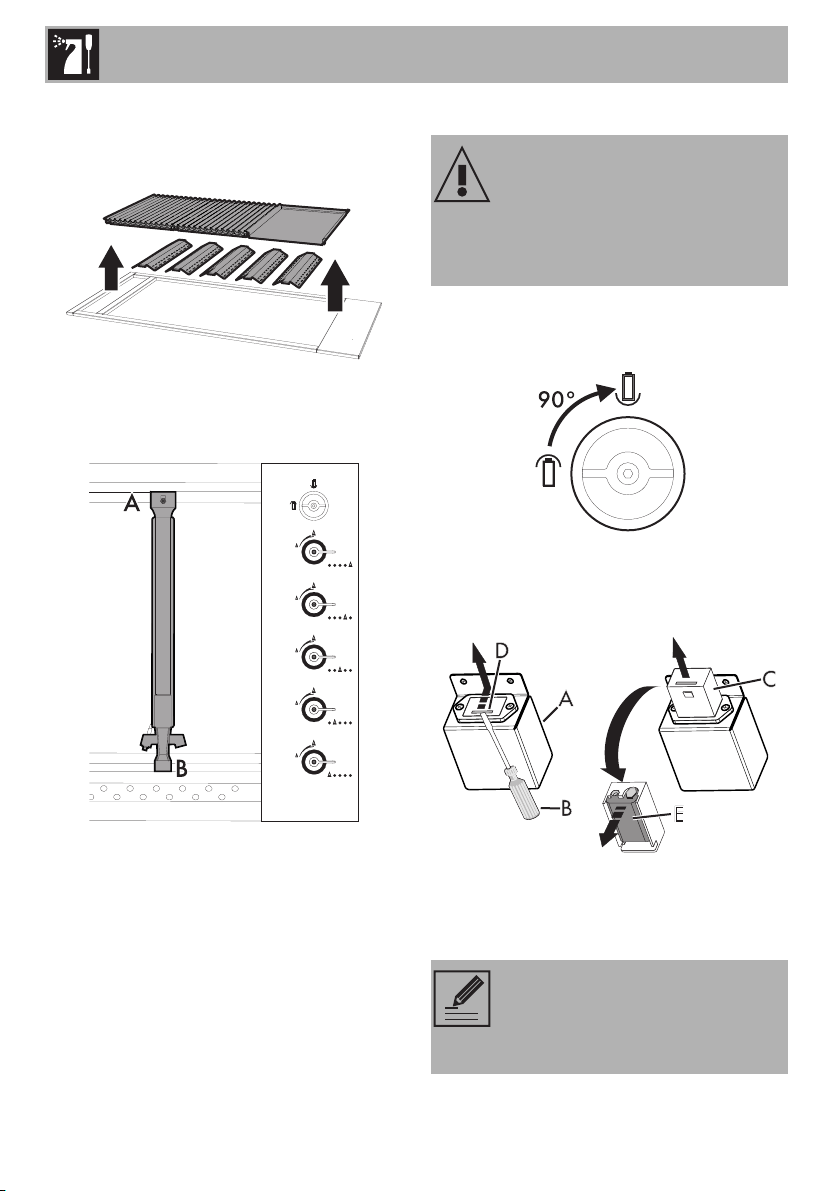
Removing the burners
Remove the grills and griddle and then the
diffusers.
Remove the rear support (see “Rear
support”).
1. Unscrew retaining screw A.
2. The burners can then be removed from
their bases in the front of the appliance B
for more thorough cleaning.
3. Refit the burners after cleaning. Fit the
front part in its base B, then screw the
retaining screw A back in.
4.3 Extraordinary maintenance
Replacing the battery
1. Turn the battery top 90° clockwise.
2. Run the head of a screwdriver B into slot
D press upwards and take container C
out of housing A.
3. After replacing the battery E, reinsert the
container into its housing, making sure
that slot D is facing inwards.
Live parts
Danger of electrocution
• Ensure the appliance is switched off to
avoid the possibility of electric shock.
If the appliance will not be used for
long periods of time, we
recommend removing the battery
from its housing.
Installation
55
EN
5 Installation
5.1 Safety instructions
• Keep a minimum side clearance of 100
mm and rear clearance of 250 mm from
any combustible material.
• A vertical clearance of at least 1000 mm
should be maintained between the top of
the cooking surface and any combustible
material.
• If used in a closed environment,
ventilation must be provided for as
explained in chapter 5.5 Positioning.
• Avoid exposure to wind as this will affect
cooking performance and burner
efficiency. If this cannot be avoided
some shielding may be necessary.
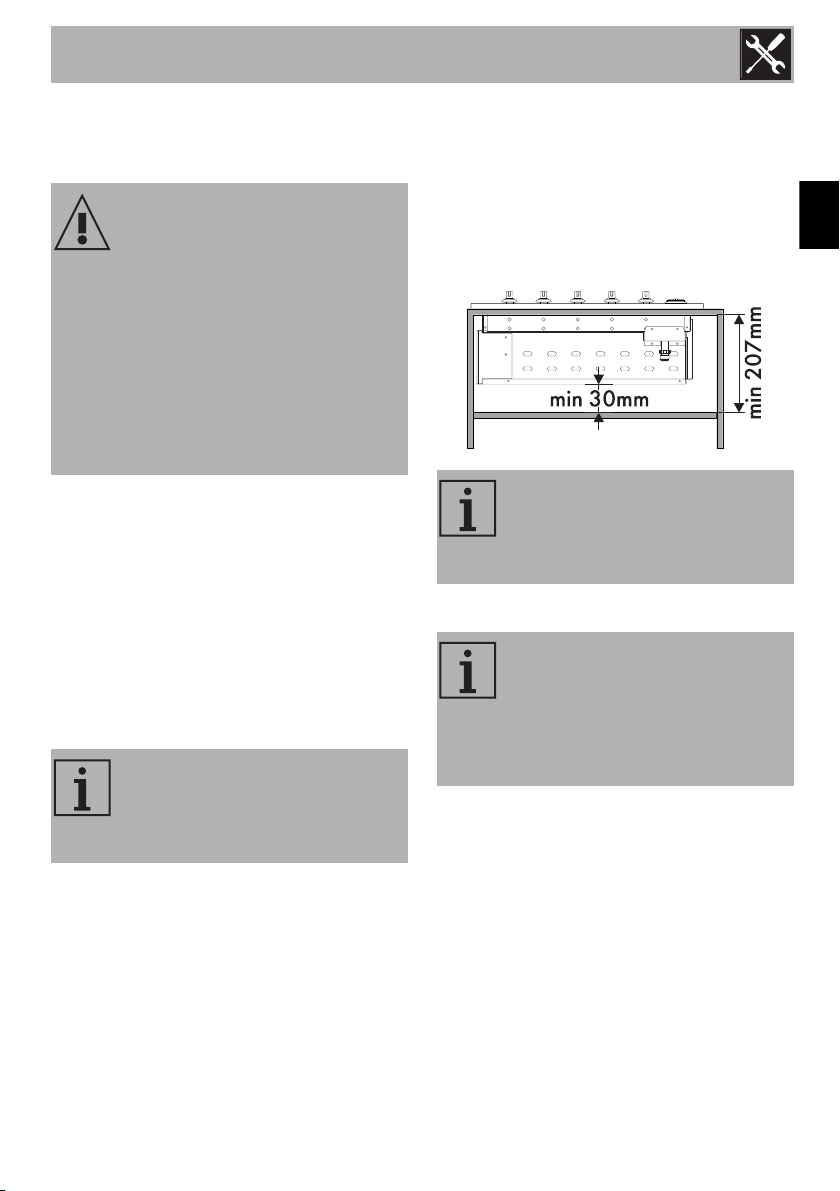
• The appliance requires a non-
combustible panel under the barbecue
to prevent excessive heat. The panel is to
be placed at 30 mm from the base of the
appliance. There are spacers added to
the bottom of the appliance to prevent
the panel being too close to the base.
Section cut from the work surface
This appliance can be installed in a support
structure such as an island unit, or in a
worktop with a rear wall:
• If installed in a support structure such as
an island, the appliance must be installed
in the centre.
Heat production during appliance
operation
Risk of fire
• This appliance must not be installed on
any combustible material.
• Check that the support structure has the
required slots.
• Veneers, adhesives or plastic coatings
on adjacent furniture should be
temperature-resistant.
Gas is highly explosive and can
cause serious injury and damage
to property if allowed to
accumulate and then be ignited.
Failure to install the non-
combustible panel exposes the
user to possible accidental contact
with sharp or hot parts.
The following operation requires
building and/or carpentry work
and must therefore be carried out
by a competent tradesman.
This appliance must not be installed
on any combustible material.
Installation
56
• If installed in a worktop with rear wall,
ensure that the worktop is made of a
non-combustible material.
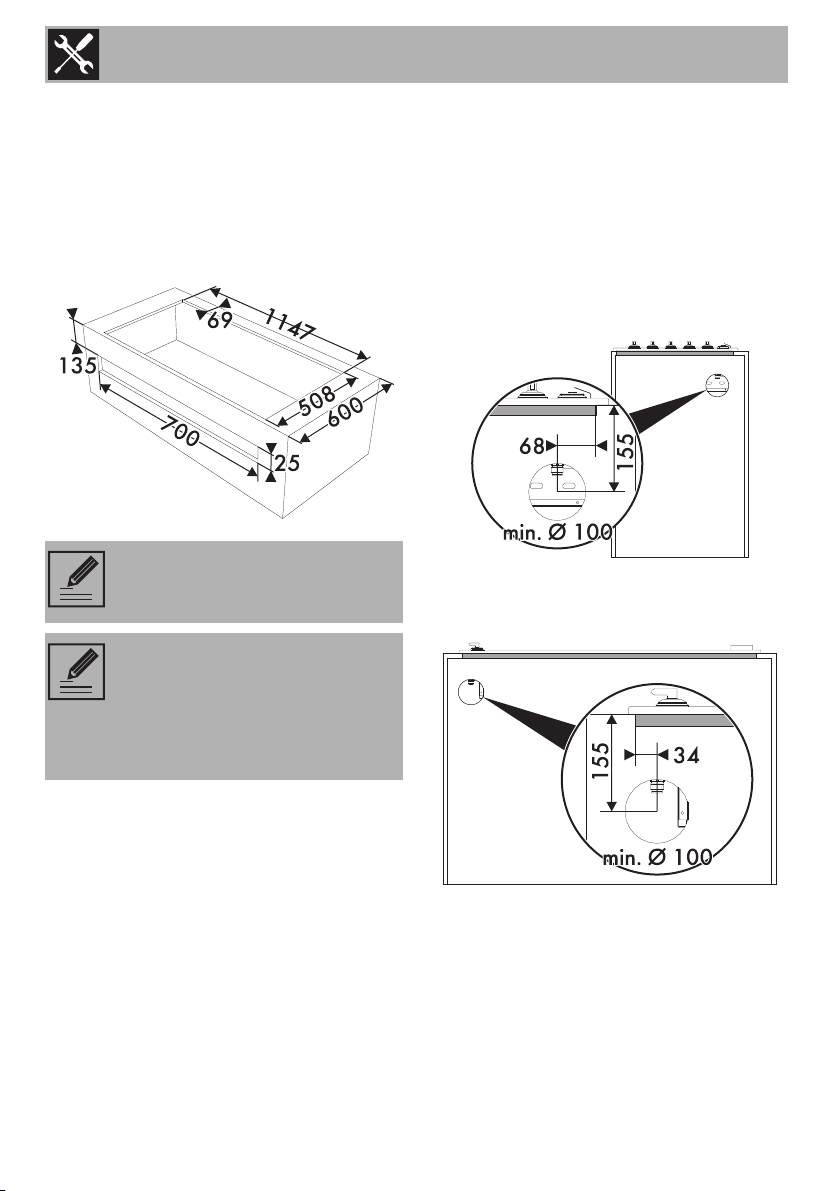
Cut an opening in the worktop of the
support structure with the dimensions
indicated in the figure (all measurements
are given in mm).
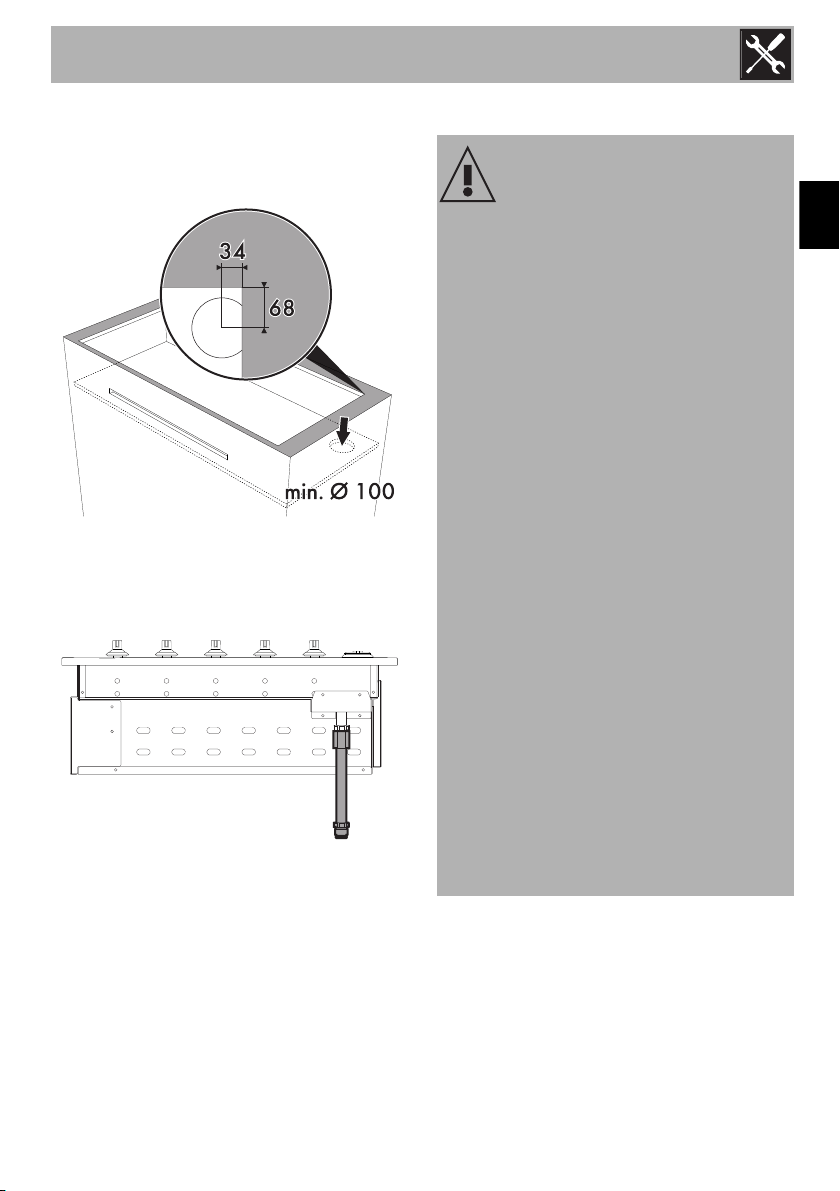
Hole for running connections
Make a circular hole of minimum 100 mm
to allow electricity and gas connections to
be run. The hole may be made on the right-
hand side or in the rear of the supporting
structure, always on the right, in
correspondence with the appliance’s gas
intake.
(all measurements are expressed in mm).
Side view
Rear view
This appliance requires a front
opening in the support structure.
During cooking, take care not to
obstruct the fat drainage hole in
the front of the appliance. If
necessary, clean it thoroughly with
the aid of a wooden or plastic
utensil.
Installation
57
EN
Alternatively, it is also possible to make a
circular hole of minimum 100 mm diameter
in the non-combustible panel underneath
the appliance.
In this case, we recommend installing the
supplied gas intake extension before
positioning the appliance in the support
structure.
5.2 Gas connection
General information
This appliance is suitable for installation with
LPG or Natural Gas. Refer to “Burner and
nozzle characteristics tables” for the
relevant burner pressure and appropriate
injector sizes.
Gas leak
Danger of explosion
• After carrying out any operation, check
that the tightening torque of gas
connections is between 10 Nm and 15
Nm.
• At the end of the installation, check for
any leaks with a soapy solution, never
with a flame.
• The hoses should not come into contact
with moving parts and should not be
crushed in any way.
• Never use a naked flame to check that
gas is flowing from the burners properly,
or to look for gas leaks in the appliance.
• When hooking up the appliance to the
canister, use only the fittings and
regulators supplied with the appliance.
These products are also available from
our authorised service centres. Using
any other products can seriously
compromise the safety of the appliance.
• Do not obstruct ventilation openings of
the canister compartment.
• If operation is not optimal, DO NOT
ATTEMPT TO REPAIR THE APPLIANCE,
but contact the nearest Authorised
Service Centre.
Installation
58
When the appliance is to be connected to
Natural Gas then the pressure regulator
supplied must be fitted to the gas inlet. A test
point (for checking the gas pressure) is
supplied either with the regulator or as a
separate fitting in the case of LPG
appliances.
Connecting to LPG
All the adjustments necessary to allow the
appliance to function correctly are made in
the factory. The only procedure required for
correct operation is connection of the hose
supplied with the appliance.
The appliance comes complete with a
rubber hose with pressure regulator and
connectors. The pressure regulator is preset
in the factory to ensure the appliance
functions to the highest standards.
Use a pressure regulator compatible with
EN regulations, making connection to the
gas canister following the guidelines set out
in the regulations in force.
The supply pressure must comply with the
values indicated in the table in “Gas types
and Countries”.
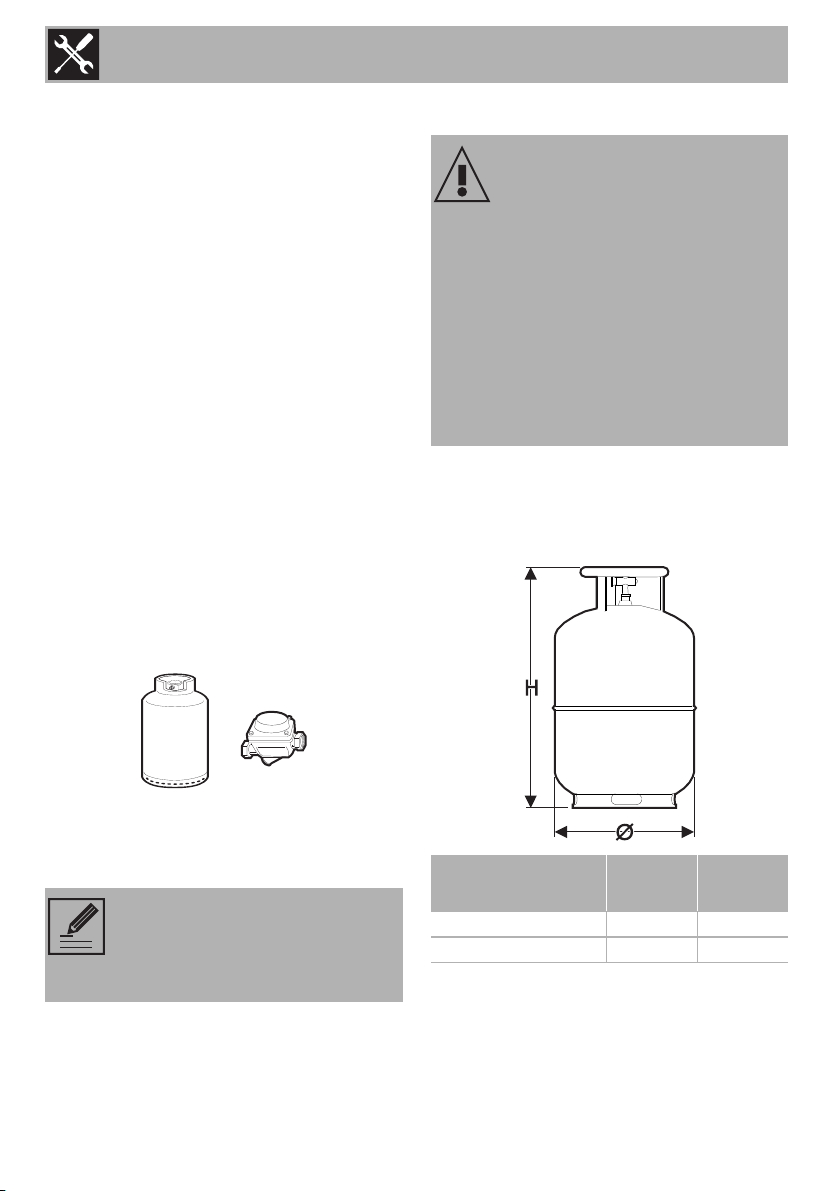
Type of LPG canisters
Various types of canisters can be used with
this appliance. It is, however,
recommended to use LPG canisters with the
characteristics indicated in the table.
For assembling or replacing the
hose (periodically check its
expiration date), you must refer to
the applicable regulations.
Improper use
Risk of explosion
• Handle the gas canister with care.
• Always use the canister holding it
vertically.
• Position the canister in an easily
accessible location to facilitate its
opening and closure.
• Keep the canister away from heat
sources.
Maximum load
(Kg)
H
(mm)
Ø
(mm)
10 600 270
15 650 315
Installation
59
EN
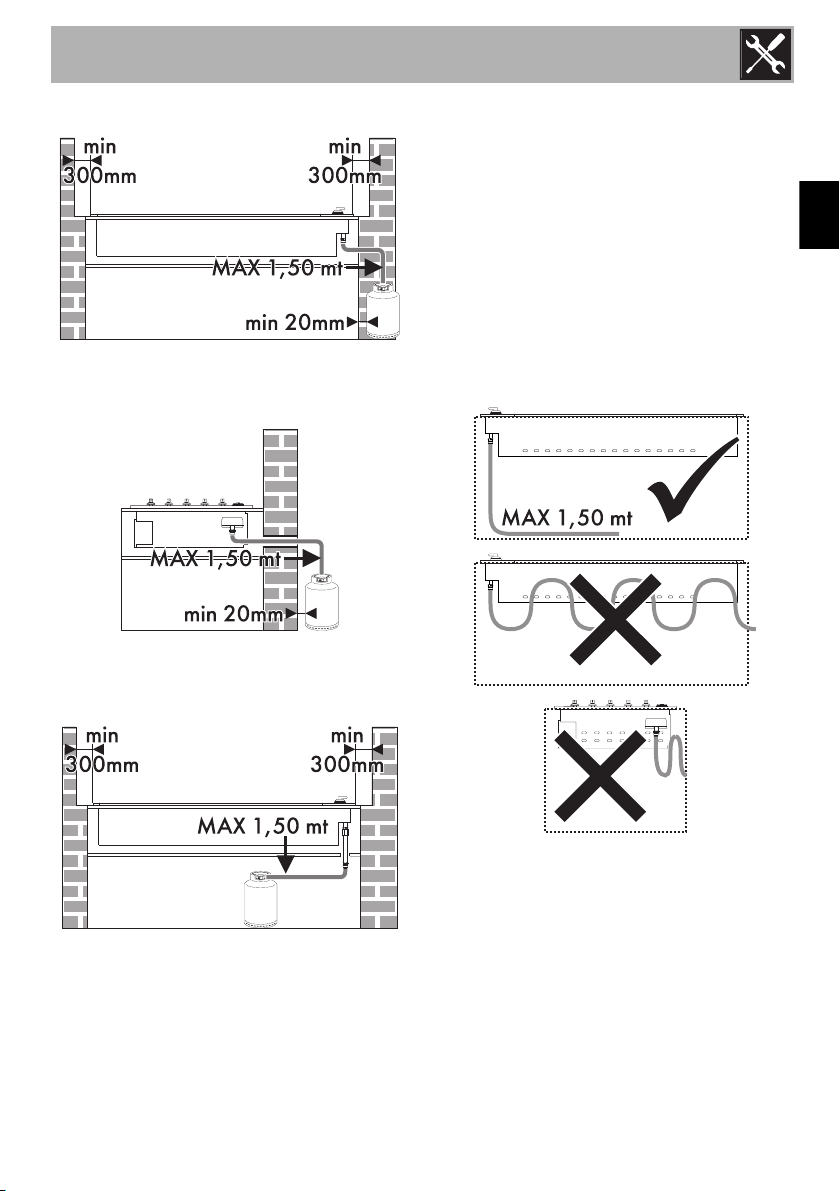
Positioning the gas canisters
Example of side canister positioning
Example of rear canister positioning
Example of canister positioned under the
non-combustible panel
Connection with a rubber hose
Verify that all following conditions are met:
• The hose is fixed to the hose connection
with safety clamps;
• Installation with rubber hose must be
carried out so that the length of the
piping does not exceed 1.5 metres.
• No part of the hose is in contact with hot
walls (max. 50 °C);
• The hose is not under traction or tension
and has no kinks or twists;
• The hose is not in contact with sharp
objects or sharp corners;
• If the hose is not perfectly airtight and
leaks gas, do not try to repair it; replace
it with a new hose.
Installation
60
• verify that the hose is not past its expiry
date (serigraphed on the hose itself).
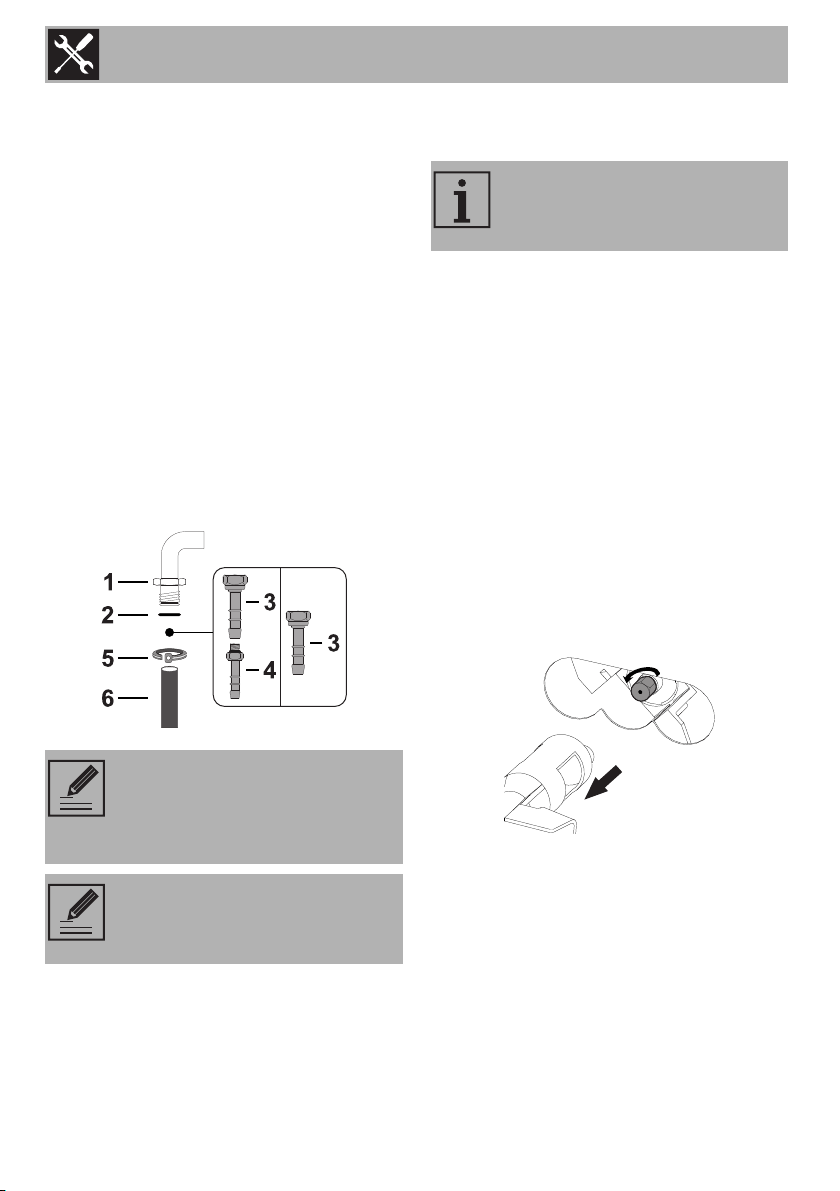
Make the connection to the gas mains
using a rubber hose whose specifications
comply with current standards (verify that
the reference standard is stamped on the
hose).
Carefully screw the hose connector 3 to the
appliance’s gas connector 1 (½” thread
ISO 228-1), placing the seal 2 between
them. The hose connector 4 can also be
screwed to the hose connector 3,
depending on the diameter of the gas hose
used. After having tightened the hose
connector(s), push the gas hose 6 onto the
hose connector and secure it with the clamp
that is compliant with the standard in force.
5.3 Adaptation to different types of
gas
In the case of operation with other types of
gas, the burner nozzles must be changed
and the minimum flame adjusted on the gas
taps.
Replacing nozzles
1. Remove the grills and griddle, diffusers
and then the components (see
“Diffusers”).
2. Remove the burners (see “Removing the
burners”).
3. Replace the nozzles using a 7 mm socket
wrench according to the gas to use (see
“Burner and nozzle characteristics
tables”).
4. Reposition the burners in their correct
seats.
Adjusting the minimum setting for natural
gas
Light the burner and turn it to the minimum
position. Extract the gas tap knob and turn
the adjustment screw next to the tap rod
(depending on the model) until the correct
minimum flame is achieved.
Connection using a rubber hose
complying with current standards is
only permitted if the hose can be
inspected along its entire length.
The inside diameter of the hose
must be 8 mm for LPG and 13 mm
for NATURAL GAS.
The appliance is pre-set for liquid
gas at a pressure of 28-30/37
mbar.
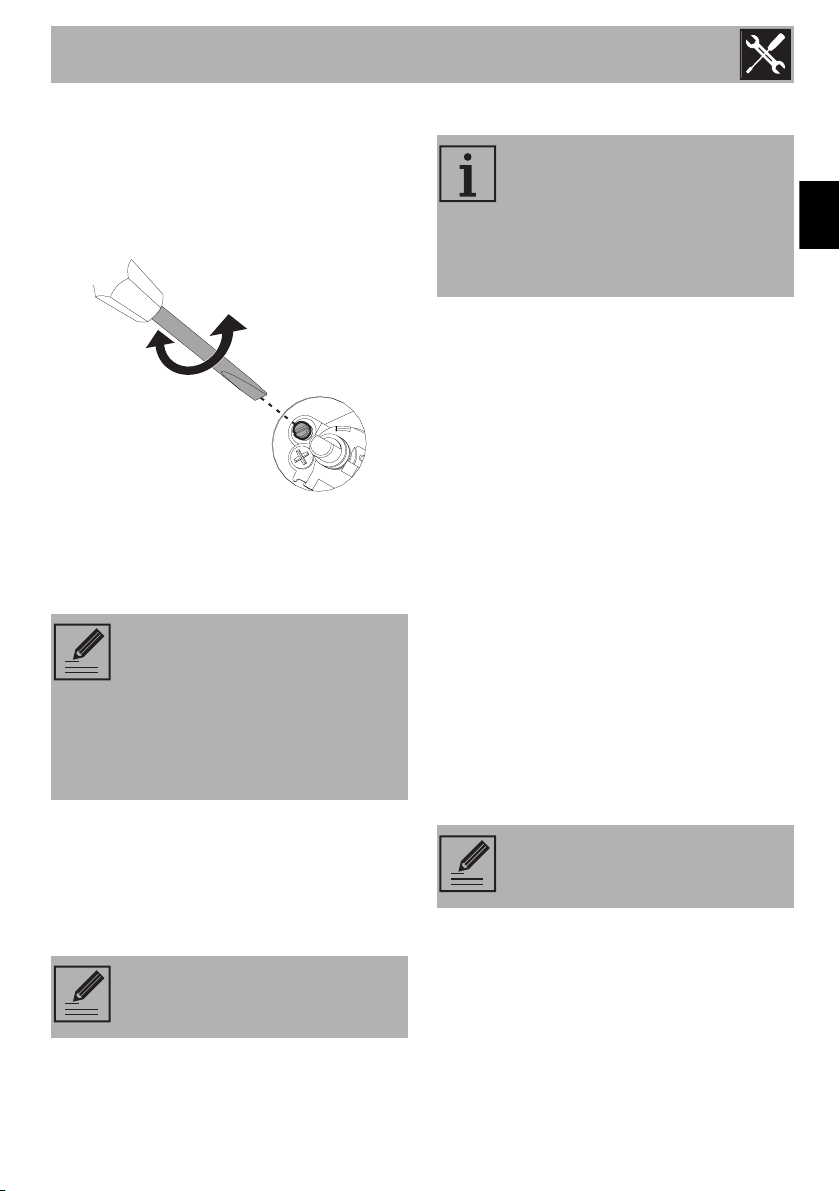
Installation
61
EN
Refit the knob and verify that the burner
flame is stable.
Turn the knob rapidly from the maximum to
the minimum setting: The flame should not
go out. Repeat the operation on all the gas
taps.
Adjusting the minimum setting for LPG
Tighten the screw located at the side of the
tap rod clockwise all the way.
Lubricating the gas taps
Over time the gas taps may become difficult
to turn and get blocked. Clean them
internally and replace the lubrication
grease.
Check for any gas leaks
Once the barbecue hose has been
connected to the gas supply (LPG),
proceed as follows:
1. Open the gas valve on the LPG canister
(or rotate the tap for the Natural Gas
supply), BUT DO NOT ATTEMPT TO
LIGHT THE BURNERS.
2. With gas pressure in the hose, check for
any leaks on all the connections using a
soap and water solution. Never use a
naked flame to check for leaks.
3. In the event that there is a leak, bubbles
will appear on the faulty connection
where the gas is escaping.
4. Close the gas tap of the gas canister,
tighten the leaking connection and then
repeat the test.
5. If the gas leak persists, contact the
nearest supplier.
Following adjustment to a gas
other than the one originally set in
the factory, replace the gas setting
label fixed to the appliance with
the one corresponding to the new
gas. The label is inserted inside the
nozzle pack (where present).
Gas taps should be greased by a
specialised technician.
These operations must be carried
out when the barbecue is
connected for the first time and
every time that it is disconnected
and reconnected to the gas
supply.
Never use a flame to detect leaks
Installation
62
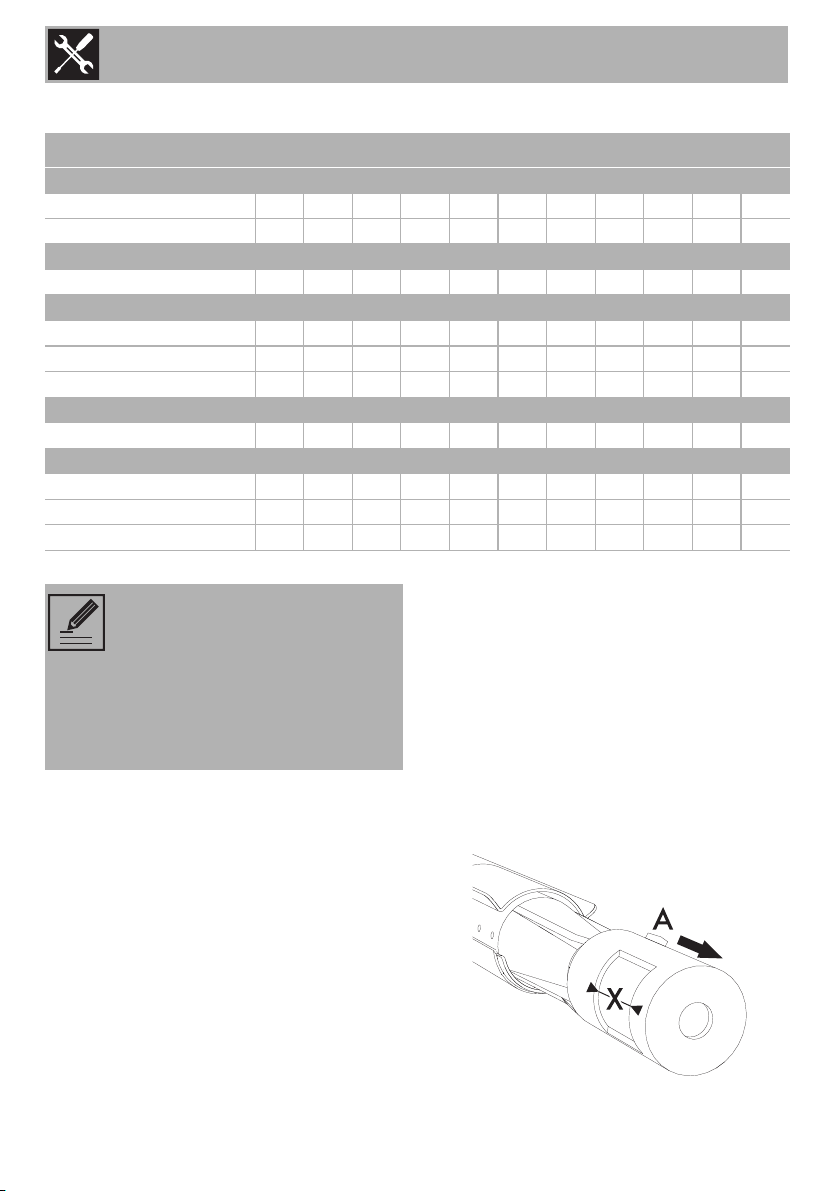
Gas types and Countries
* only on valved products.
Primary air adjustment
The operations below must be carried out
for every burner in the appliance:
• Move the screw A of the air regulator
sleeve into the position for the type of
gas to be used, consulting the table
below.
Tighten the regulator screw, making sure
that the distance X is correct.
Gas types IT GB-IE FR-BE DE AT NL ES PT SE RU DK
1 Natural Gas G20
G20 20 mbar
•• •• •••••
G20/25 20/25 mbar
•
2 Natural Gas G25
G25 25 mbar
•
3 LPG G30/31
G30/31 28/37 mbar
•• • •
G30/31 30/37 mbar
••
G30/31 30/30 mbar
•••
4 LPG G30/31
G30/31 50 mbar
••
5 City Gas *
G110 8 mbar
•••
G120 8 mbar
•
G150.1 8 mbar
•
It is possible to identify the
available gas types based on the
country the appliance is to be
installed in. Refer to the heading
number to identify the correct
values in the “Burner and nozzle
characteristics tables”.
Installation
63
EN
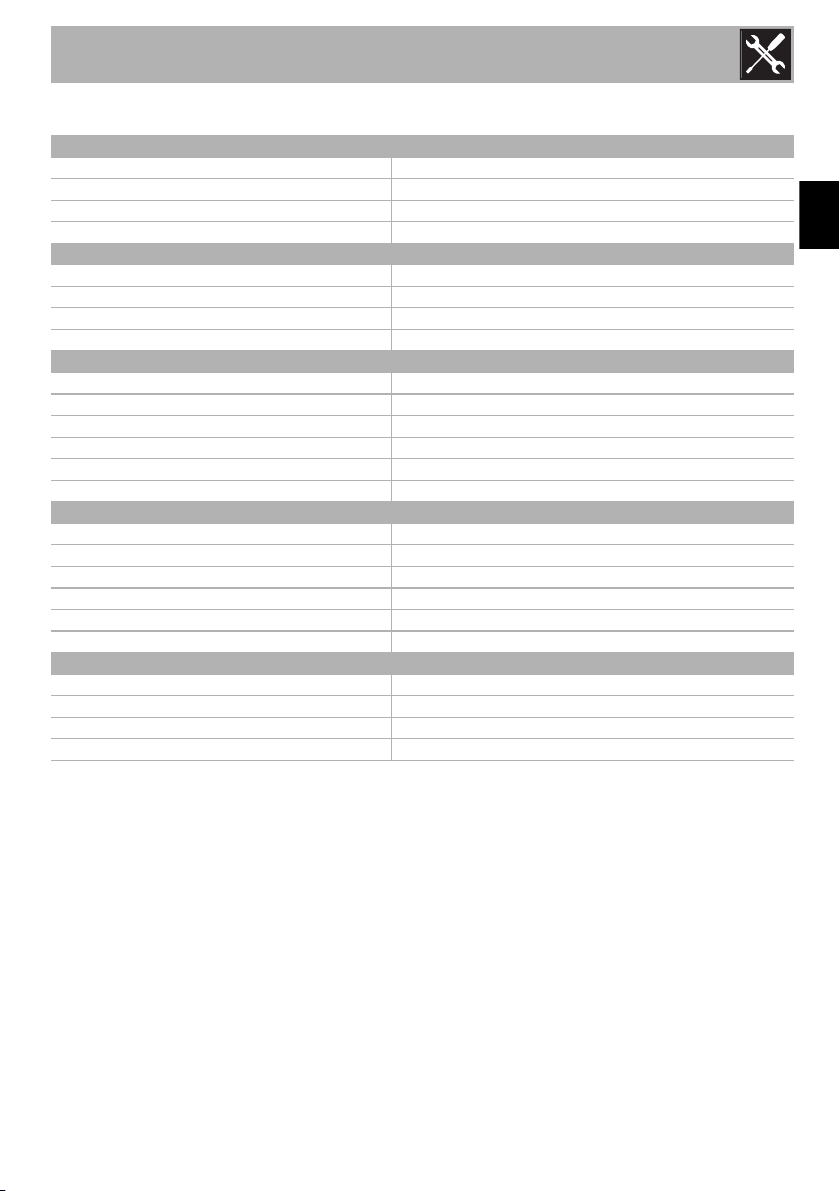
Burner and nozzle characteristics tables
The nozzles not provided are available at Authorised Service Centres.
* only on valved products.
1
Natural Gas G20
Rated heating capacity (kW)
3.5
Nozzle diameter (1/100 mm)
135
Reduced capacity (W)
1800
Primary air (mm) - X =
5
2
Natural Gas G25
Rated heating capacity (kW)
3.5
Nozzle diameter (1/100 mm)
135
Reduced capacity (W)
1800
Primary air (mm) - X =
1
3
LPG G30/31
Rated heating capacity (kW)
3.5
Nozzle diameter (1/100 mm)
87
Reduced capacity (W)
1800
Primary air (mm) - X =
5
Rated capacity G30 (g/h)
255
Rated capacity G31 (g/h)
250
4
LPG G30/31
Rated heating capacity (kW)
3.5
Nozzle diameter (1/100 mm)
75
Reduced capacity (W)
1800
Primary air (mm) - X =
5
Rated capacity G30 (g/h)
255
Rated capacity G31 (g/h)
250
5
City Gas *
Rated heating capacity (kW)
3.4
Nozzle diameter (1/100 mm)
280
Reduced capacity (W)
1800
Primary air (mm) - X =
3
Installation
64
5.4 Electrical connection
General information
Check the grid characteristics against the
data indicated on the plate.
The identification plate bearing the
technical data, serial number and brand
name is visibly positioned on the appliance.
Do not remove this plate for any reason.
Fixed connection
Fit the power line with an omnipolar circuit
breaker in compliance with installation
regulations.
The circuit breaker should be located near
the appliance and in an easily reachable
position.
Connection with plug and socket
Make sure that the plug and socket are of
the same type.
Avoid using adapters and shunts as these
could cause overheating and a risk of
burns.
Power voltage
Danger of electrocution
• Have the electrical connection
performed by authorised technical
personnel.
• Use personal protective equipment.
• The appliance must be connected to
earth in compliance with electrical
system safety standards.
• Disconnect the main power supply.
• Do not pull the cable to remove the
plug.
• Use cables withstanding a temperature
of at least 90°C.
• The tightening torque of the screws of
the terminal supply wires must be 1.5 - 2
Nm.
Installation
65
EN
5.5 Positioning
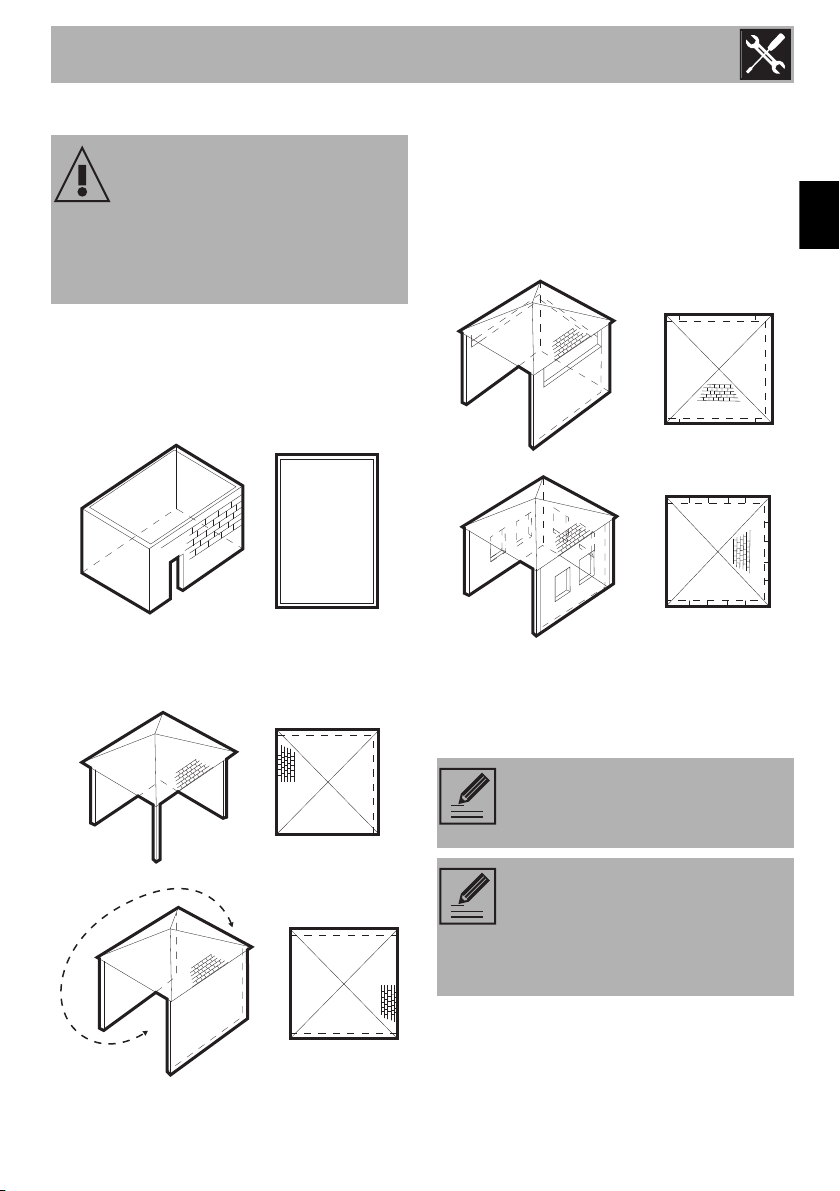
Position the barbecue as follows:
• Within an enclosure with walls on all
sides, but at least one permanent
opening at ground level and no
overhead cover.
• Within a partial enclosure that includes
an overhead cover and no more than
two walls.
• With a partial enclosure that includes a
roof covering but no more than two walls
with the following restrictions: At least
25% of the total wall area must be
completely open. At least 30% of the
remaining surface area is open and not
delimited.
• In the case of balconies, at least 20% of
the total of the side, back and front wall
areas must be and remain open and
unrestricted.
Heavy appliance
Danger of crush injuries
• Place the appliance into the support
structure with the aid of a second
person.
Do not use the appliance in
conditions where it is directly
exposed to the elements.
Once the appliance has cooled
down, it must be protected against
the elements in order to avoid
damage to the electrical
components.
Installation
66
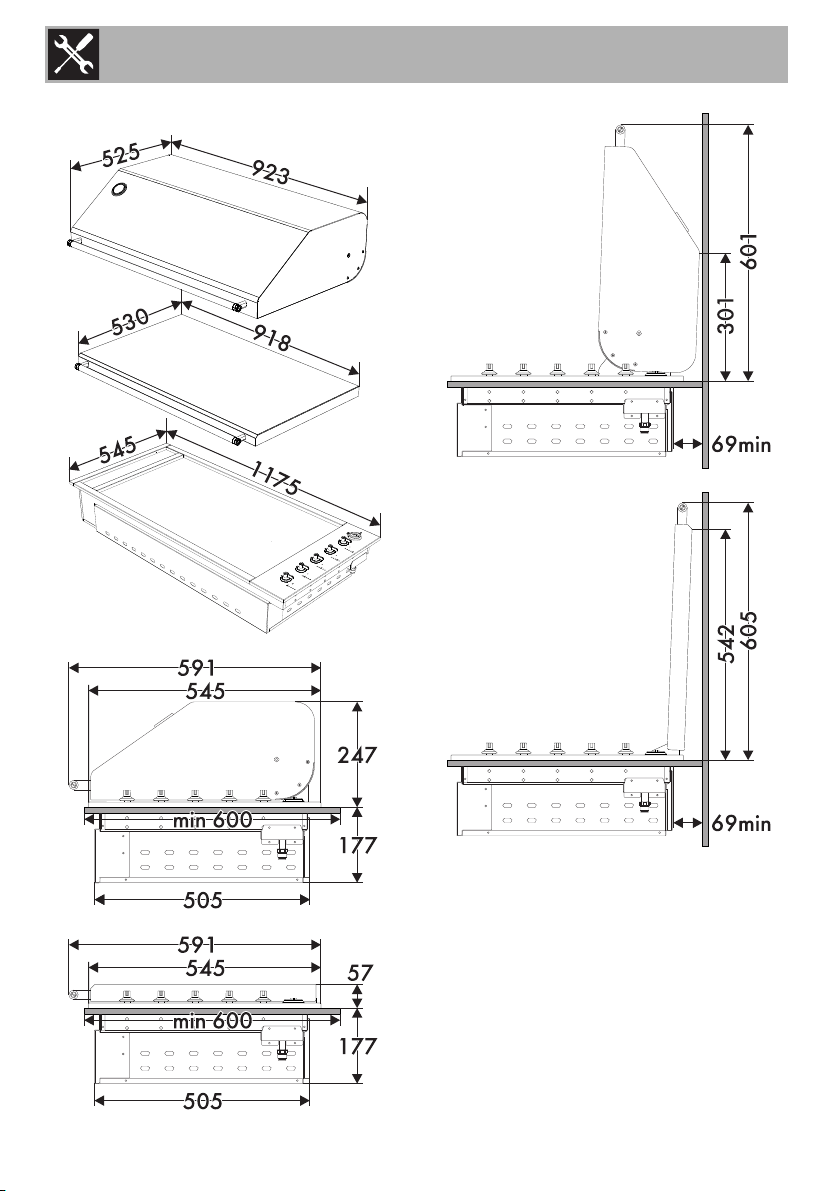
Appliance overall dimensions (mm)