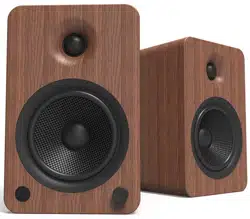
1. Before making connections make sure that the speakers are turned off.
2 Using the speaker wires provided, connect the black (-) wires to the negative (-) speaker terminals (right and left) on your speakers and to the negative (-) terminals on the right and left speakers.
3. Connect the red (+) wires to the positive (+) speaker terminals (right and left) on your speakers and to the positive (+) terminals on the right and left speakers.
4. Insert one end of the input signal cable (RCA/3.5mm Aux) into the input port on back panel and the other end into the output port of your sound source device (such as a PC, DVD, or MP3 player). - OR -
Insert one end of a 3.5 mm cable into the input port on back panel and the other end into the 3.5 mm output port of your sound source device (such as a PC, DVD, or MP3 player).
- OR -
5. Plug the speakers into a wall socket. 6. Adjust the volume knob to the minimum, then press the power button on the side of the master speaker to turn on your speakers. The red LED turns on. The speakers enter into AUX mode as the default setting. 7. Adjust the volume knob to a comfortable level. 8. Adjust the Treble and Bass knobs to the desired level. 9. Switch between AUX, RCA, and BT modes by pressing the volume button or by using the remote control.
NOTE USB connector is for charging only, not for audio input.
Connecting to a sound source with Bluetooth
Make sure that a compatible Bluetooth device (like an MP3 player or smartphone) is turned on and within 33 feet (10 meters) of your bookshelf speakers.
Switch to Bluetooth mode by pressing the volume control knob on the side panel of your speaker or pressing the BT button on the remote control.
After switching to Bluetooth mode, the speakers automatically search for a previously connected Bluetooth device and connect with it. If the speakers can’t find a previously paired device, they enter pairing mode automatically and the blue LED will flash quickly.
Go to the Bluetooth manager on your device by doing the following:
For iPad/iPhone/iPod touch:
From the home page, tap Settings > General > Bluetooth.
For Android Phone/Tablet:
From your smart phone/tablet home page, tap Settings > Wirelessand networks.
Tap to activate Bluetooth, then tap Bluetooth settings.
For a PC or Mac, you can find these instructions in the documentation that came with your computer or operating system.
On the Bluetooth device, select NS-HBTSS116 in the list of found devices.
On the Bluetooth device, enter 0000 as the PIN, if prompted. The LED indicator lights solid blue on the bookshelf speakers.
If you are pairing with a computer, make sure that your bookshelf speakers are selected as the computer’s default playback device. See the computer’s documentation for instructions.
NOTE
Some devices, such as an iPhone, connect immediately after pairing so the LED indicator on the compact shelf system remains on. Other devices, such as notebook computers, may ask you if you wish to connect. In this instance, the LED continues to blink until a connection is established.
Your bookshelf speakers save pairing information for up to eight devices. However, they can only be connected and playing content from one device at a time.
When you turn on your bookshelf speakers, they automatically connect to the last connected device if that device is in range. To connect to a different paired device, you have to turn off Bluetooth or unpair from the currently paired device and manually connect to the other paired device.
Pairing with a bluetooth device with NFC
If your Bluetooth device supports Near Field Communication (NFC), make sure that the NFC feature is active. Touch the NFC area of your Bluetooth device to the top of your bookshelf speakers in order to automatically pair the devices.
NOTE If your phone has NFC support but it is running an OS below Android 4.1, you will need to download an NFC Bluetooth APP from Google play or a similar online store.
Disconnecting your device
Turn off the Bluetooth function on your device.
Reconnecting to a paired device
Your bookshelf speakers lose the Bluetooth connection if you…
To reconnect...
Turn it off.
Turn on your speakers. Your speakers search for the last connected Bluetooth device and reconnect.
Move the Bluetooth device out of range.
Move your Bluetooth device within 30 feet (10 m) of your speakers.
Turn off your Bluetooth device.
Turn on your Bluetooth device, then make sure that Bluetooth is on.
Turn off Bluetooth on your Bluetooth device.
Turn on Bluetooth on your Bluetooth device.
Connect your Bluetooth device to another Bluetooth device.
Disconnect your Bluetooth device from the other Bluetooth device, then set your device to pairing mode. Select “NS-HBTSS116” on your Bluetooth device.
NOTE If a device does not automatically reconnect, you may need to reselect “NS-HBTSS116” on your Bluetooth device.
Connecting to a different device
On the Bluetooth device you are currently connected to, turn off the Bluetooth function or unpair the speakers in your Bluetooth device list. The speakers can now be connected to another Bluetooth Device.
Follow the section “Connecting to a sound source with Bluetooth” to connect a new device.
Receiving a phone call while playing music
When a call is received while playing music through a phone, the music stops automatically.
When the call ends, depending on the setting of your phone, the current track may resume playback.
USING YOUR SPEAKERS
These speakers let you to access three different sound sources (AUX, RCA, and Bluetooth).
Listening to your speakers
Press the (Power) button on your speakers. The red standby indicator turns off and the source indicator lights.
Turn on the audio source device connected to your speakers and begin playback.
Press the Volume/Source button on your speakers repeatedly to select the audio source or press the selected source button on the remote control until you hear sound from your speakers.
Adjust the volume on your speakers or the source audio device to a comfortable level.
Press the (Power) button to turn off your speakers. The power indicator lights red.
WARNING Continuous use of high volume sound may permanently damage your hearing.
MAINTAINING YOUR BOOKSHELF SPEAKERS
Cleaning your speakers (Please verify)
Clean the surface of your speakers with a soft, dry cloth.
Replacing the remote control battery
1. Squeeze the battery tray’s sides together and slide it out of the remote control.
2. Remove the old battery and insert the new 3V lithium battery (CR2025) into the battery tray. Match the polarity of the new battery with the plus sign (+) in the battery tray.
3 Slide the battery tray back into the battery compartment until it clicks into place.
CAUTION
The battery should not be exposed to excessive heat, such as sunshine, heat registers, or fire.
Battery chemicals can cause a rash. If the battery leaks, clean the battery compartment with a cloth. If chemicals touch your skin, wash immediately.
Make sure that the battery is disposed of correctly. Do not burn or incinerate.
NOTE
Remove the battery when the charge is depleted.
If the remote control is not going to be used for a long time, remove the battery to avoid any damage that may be caused by leakage and corrosion.
TROUBLESHOOTING
Problem
Possible Solutions
The power does not come on.
• Make sure that the AC adapter is securely plugged into the power outlet and the bookshelf speakers.
The remote control does not work.
• Remove any obstacles between the remote control and the IR sensor on the bookshelf speakers.
• Replace the battery.
• Move closer to the bookshelf speakers. The remote control is effective to approximately 23 ft. (7 m).
There is no sound or very low-level sound is heard from the bookshelf speakers.
• Make sure that you are connected to an audio OUTPUT jack on your sound source. The port will not send audio out if it is an input jack.
• Make sure that the volume level of the bookshelf speakers is set to an adequate level.
• If you are using Bluetooth, turn up the volume on your Bluetooth device.
• Make sure that the volume level is not muted. Press the (mute) button on the remote control again to restore the sound output.
• Make sure that the correct audio source is selected. Press the Volume/Source button repeatedly to switch to the correct audio source.
• Make sure that the power is on and all connections are secure.
• If you are using a 3.5 mm cable connection, make sure that the volume is turned up on your sound source.
• Make sure that the audio cable you are using is not damaged or broken. Try using another one.
Your bookshelf speakers are not working properly.
• Unplug the AC adapter from the wall outlet and then try plugging it in again after 30 seconds.
• Make sure that the audio cable you are using is not damaged or broken. Try using another one.
The sound is breaking up or buzzing.
• Make sure that you are connected to an audio OUTPUT jack on your sound source. The port will not send audio out if it is an input jack.
• Make sure that all connections are secure and cables are not broken or damaged.
• Connect to a different source device (such as a TV or DVD/Blu-ray player) to see if the buzzing still occurs. If it does not, this may indicate an issue with the original source device.
• Use a different connection method (for example, try Aux instead of RCA) between the bookshelf speakers and the source device to make sure that the jacks on both devices are still working.
• Make sure that the audio cable you are using is not damaged or broken. Try using another one.
There is no sound or low volume in Bluetooth mode.
• Make sure that your Bluetooth device is turned on, Bluetooth is turned on, and "NS-HBTSS116” is selected.
• Turn up the volume on your bookshelf speakers.
• Turn up the volume on your Bluetooth device.
• Make sure that your Bluetooth device is not muted.
• Make sure that you are playing music from your Bluetooth device.
• Make sure that you have selected the Bluetooth source on your bookshelf speakers.
• Make sure that your bookshelf speakers are not paired to another Bluetooth device.
• Make sure that your Bluetooth device is not paired to a different Bluetooth speaker.
My bookshelf speakers won't connect to my Bluetooth device.
• Shorten the distance between your bookshelf speakers and your Bluetooth device.
• Turn your devices off, then on. Re-pair your bookshelf speakers and your Bluetooth device.
• Make sure that your bookshelf speakers are not paired to another Bluetooth device.
• Make sure that your bookshelf speakers and Bluetooth device are both in pairing mode.
• Make sure that your Bluetooth device is not connected to any other device.
• Make sure that you have selected "NS-HTBSS116” on your Bluetooth device.
My Bluetooth device keeps unpairing.
• Shorten the distance between your bookshelf speakers and your Bluetooth device.
• If the battery on your Bluetooth device is low, recharge the battery.
"NS-HBTSS116” does not appear on my Bluetooth device.
• Shorten the distance between your bookshelf speakers and your Bluetooth device.
• Put your bookshelf speakers into pairing mode, then refresh your list of Bluetooth devices. For more information, see the documentation that came with your Bluetooth device.
• Make sure that your Bluetooth device is visible to other devices. For more information, see the documentation that came with your Bluetooth device.


 (Power) button on your speakers. The red standby indicator turns off and the source indicator lights.
 (mute) button on the remote control again to restore the sound output.