
User guide
Xperia
™
XZs
G8232

Contents
Getting started............................................................................... 6
About This User Guide........................................................................ 6
Overview.............................................................................................6
Assembly............................................................................................ 7
Screen Protection............................................................................... 8
Starting Your Device for the First Time.................................................9
Why Do I Need a Google™ Account?................................................. 9
Device security.............................................................................11
Making Sure Your Device is Protected...............................................11
Screen Lock......................................................................................11
Fingerprint Manager.......................................................................... 13
Unlocking Your Device Automatically.................................................13
SIM Card Protection..........................................................................17
Using Multiple SIM Cards.................................................................. 17
Finding the Identification Number of Your Device...............................18
Finding a Lost Device ....................................................................... 18
Learning the basics...................................................................... 20
Using the touchscreen...................................................................... 20
Locking and Unlocking the Screen.................................................... 21
Homescreen..................................................................................... 22
Application screen.............................................................................23
Navigating Applications..................................................................... 25
Widgets............................................................................................ 26
Shortcuts and folders........................................................................27
Background and Themes..................................................................27
Taking a screenshot.......................................................................... 28
Notifications...................................................................................... 28
Icons in the status bar.......................................................................30
Applications Overview....................................................................... 32
Battery and Maintenance............................................................. 35
Charging Your Device........................................................................35
Battery and Power Management.......................................................36
Updating your device........................................................................ 38
Maintenance Using a Computer........................................................ 39
Storage and Memory........................................................................ 40
Backing Up and Restoring Content................................................... 42
Downloading applications............................................................45
Downloading Applications from Google Play™..................................45
Downloading Applications from Other Sources..................................45
2

Internet and networks.................................................................. 46
Browsing the web............................................................................. 46
Internet and MMS Settings ...............................................................46
Wi-Fi................................................................................................. 47
Sharing Your Cellular Data Connection.............................................. 49
Controlling Data Usage..................................................................... 50
Selecting a SIM card for data traffic...................................................51
Selecting cellular networks................................................................ 52
Virtual private networks (VPNs)..........................................................52
Synchronizing data on your device..............................................54
Synchronizing with Online Accounts..................................................54
Synchronizing with Microsoft® Exchange ActiveSync®.....................54
Basic settings...............................................................................56
Accessing settings............................................................................ 56
Volume settings.................................................................................56
Do Not Disturb Mode........................................................................ 57
Screen settings................................................................................. 58
Application settings........................................................................... 60
Resetting Your Applications...............................................................61
Screen Saver.................................................................................... 61
Language Settings............................................................................ 62
Date and time................................................................................... 62
X-Reality™ for mobile........................................................................63
Super-Vivid Mode..............................................................................63
Enhancing the Sound Output............................................................ 63
Noise cancellation............................................................................. 64
Multiple User Accounts..................................................................... 64
Typing text....................................................................................67
On-Screen Keyboards.......................................................................67
Editing text........................................................................................68
Calling.......................................................................................... 69
Making calls...................................................................................... 69
Receiving Calls..................................................................................70
Smart call handling............................................................................71
Ongoing Calls................................................................................... 72
Using the Call Log.............................................................................72
Forwarding Calls............................................................................... 73
Restricting Calls................................................................................ 73
Multiple Calls.....................................................................................74
Conference calls............................................................................... 75
Voicemail...........................................................................................75
Emergency calls................................................................................75
3

Contacts.......................................................................................77
Searching and viewing contacts........................................................77
Adding and editing contacts..............................................................78
Transferring contacts.........................................................................79
Adding Medical and Emergency Contact Information........................ 80
Favorites........................................................................................... 81
Sending contact information..............................................................81
Avoiding Duplicate Entries in the Contacts Application...................... 81
Backing up Contacts.........................................................................82
Messaging and chat.....................................................................83
Reading and sending messages....................................................... 83
Organizing your messages................................................................ 84
Calling from Messaging..................................................................... 84
Messaging settings........................................................................... 85
Video Chat........................................................................................ 85
Email.............................................................................................86
Setting Up Email............................................................................... 86
Sending and Receiving Email Messages........................................... 86
Organizing your email messages....................................................... 87
Email account settings...................................................................... 88
Gmail™.............................................................................................88
Music............................................................................................90
Transferring music to your device...................................................... 90
Listening to Music............................................................................. 90
Music Menu...................................................................................... 92
Playlists.............................................................................................92
Sharing music................................................................................... 93
Enhancing the sound........................................................................ 93
Camera.........................................................................................94
Taking Photos and Recording Videos................................................ 94
General camera settings................................................................... 95
Still camera settings.......................................................................... 99
Video camera settings.....................................................................101
Photos and videos in Album...................................................... 104
Viewing Photos and Videos.............................................................104
Sharing and Managing Photos and Videos......................................105
Editing photos with the Photo editor application..............................106
Editing videos with the Video editor application............................... 107
Hiding photos and videos................................................................107
Album Homescreen Menu...............................................................107
Viewing Your Photos on a Map........................................................108
4

Videos.........................................................................................110
The Video Application..................................................................... 110
Transferring Video Content to Your Device.......................................111
Managing video content..................................................................111
Movie Creator................................................................................. 111
Connectivity............................................................................... 113
Mirroring the Screen of Your Device Wirelessly on a TV................... 113
Sharing Content with DLNA Certified™ Devices.............................. 113
Connecting Your Device to USB Accessories.................................. 115
Connecting Your Device to a DUALSHOCK™ 4 Wireless Controller 116
NFC................................................................................................ 116
Bluetooth® Wireless Technology.....................................................118
Smart Apps and Features That Save You Time.........................121
Google Search & Now.....................................................................121
Using the News Suite Application....................................................121
Using your Device as a Wallet......................................................... 121
Travel and maps......................................................................... 122
Using Location Services.................................................................. 122
Google Maps™ and navigation....................................................... 122
Using Data Traffic when Traveling.................................................... 123
Airplane Mode.................................................................................123
Clock and Calendar....................................................................124
Calendar......................................................................................... 124
Clock.............................................................................................. 124
Accessibility............................................................................... 127
Magnification Gesture..................................................................... 127
Font Size.........................................................................................127
Color Correction..............................................................................127
TalkBack......................................................................................... 127
Mono Audio.................................................................................... 128
TTY (Teletypewriter) Mode............................................................... 128
Switch Access................................................................................ 128
Support and Legal......................................................................129
Support Application........................................................................ 129
Xperia™ Tips.................................................................................. 129
Help in Menus and Applications...................................................... 129
Restarting, Resetting, and Repairing............................................... 129
Help Us Improve Our Software........................................................130
Warranty, SAR, and Usage Guidelines.............................................131
Recycling your device..................................................................... 131
Legal information.............................................................................131
5
Getting started
About This User Guide
This is the Xperia™ XZs User Guide for the Android™ 7.1.1 software version. If you're
not sure which software version your device is running, you can check it in the Settings
menu.
System and application updates may change how features in your device are presented. For
more information about software updates, see
Updating your device
on the 38 page.
To Check the Current Software Version of Your Device
1
From your Home screen, tap
.
2
Find and tap Settings > About phone > Android™ version.
To Find the Model Number and Name of Your Device
1
From your Home screen, tap
.
2
Find and tap
.
The device model number and name are displayed.
Limitations to Services and Features
Some of the services and features described in this User Guide may not be supported in
all countries or regions, or by all networks or service providers. The GSM International
Emergency Number can always be used in all countries, regions, networks and by all
service providers, provided that the device is connected to the cellphone network.
Please contact your network operator or service provider to determine the availability of
any specific service or feature and whether additional access or usage fees apply.
The use of certain features and applications described in this guide may require access
to the internet. You may incur data connection charges when you connect to the internet
with your device. Contact your wireless service provider for more information.
Overview
6
This is an internet version of this publication. © Print only for private use.
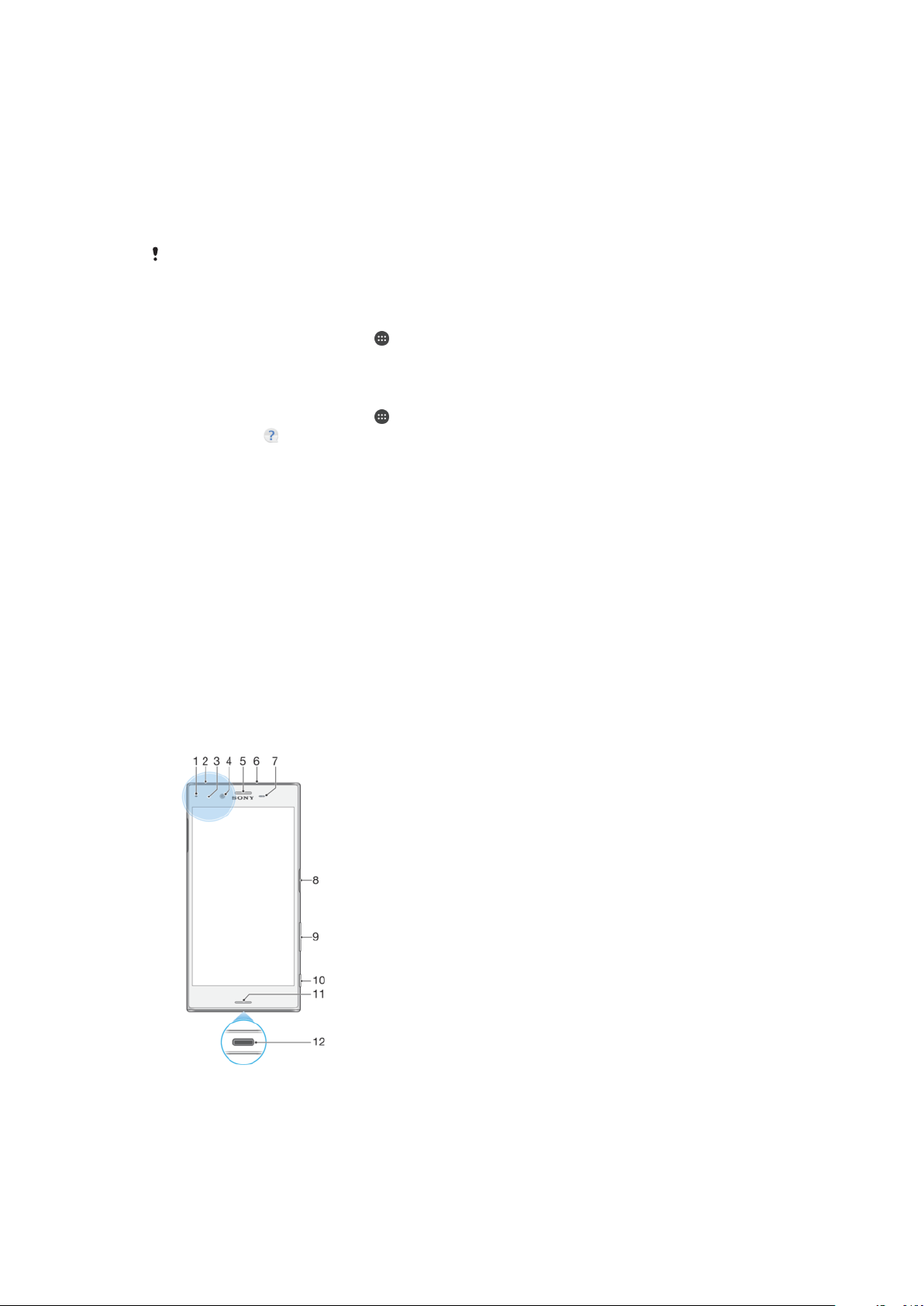
1. Charging/Notification light
2. Headset jack
3. NFC™ detection area
4. Front camera lens
5. Ear speaker/Second loudspeaker
6. Second microphone
7. Proximity/Light sensor
8. Power key/Fingerprint sensor*
9. Volume/Zoom key
10. Camera key
11. Main loudspeaker
12. Charger/USB Type-C™ cable port
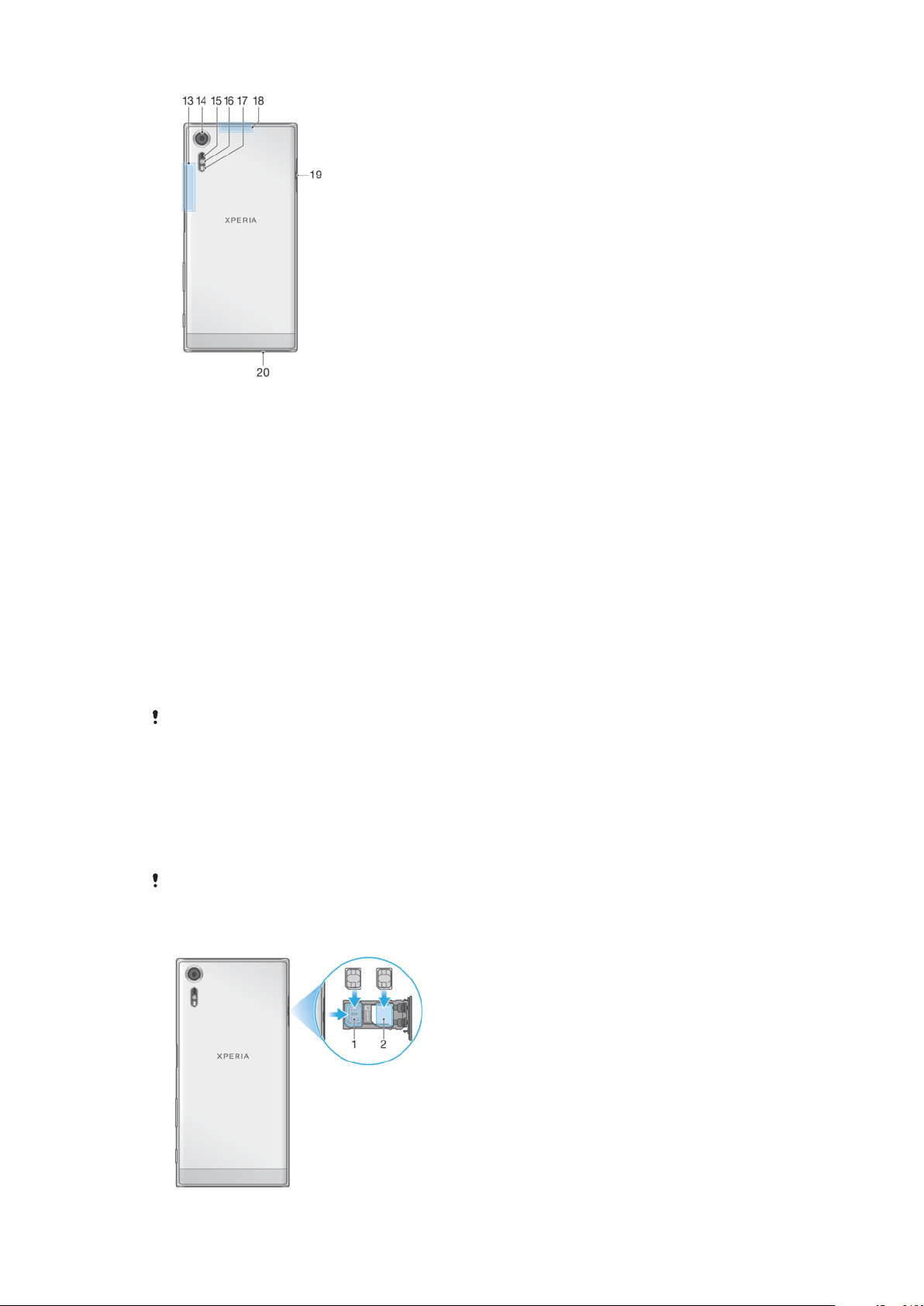
13. Wi-Fi/Bluetooth antenna area
14. Main camera lens
15. Laser AF sensor
16. RGBC-IR sensor
17. Flashlight
18. GPS antenna area
19. Nano SIM/Memory card slot cover
20. Main microphone
Fingerprint functionality is not available in the US market.
Assembly
Your device only supports nano SIM cards. The nano SIM card and the memory card
have separate slots in the same holder. Make sure you don’t confuse the two. The
combined SIM/Memory card slot allows you to use either a memory card or an additional
SIM card.
To prevent data loss, be sure to turn off your device or unmount the memory card before you
drag out the holder to remove the nano SIM card (or cards) or memory card from the device.
To Insert One or Two Nano SIM Cards
7
This is an internet version of this publication. © Print only for private use.
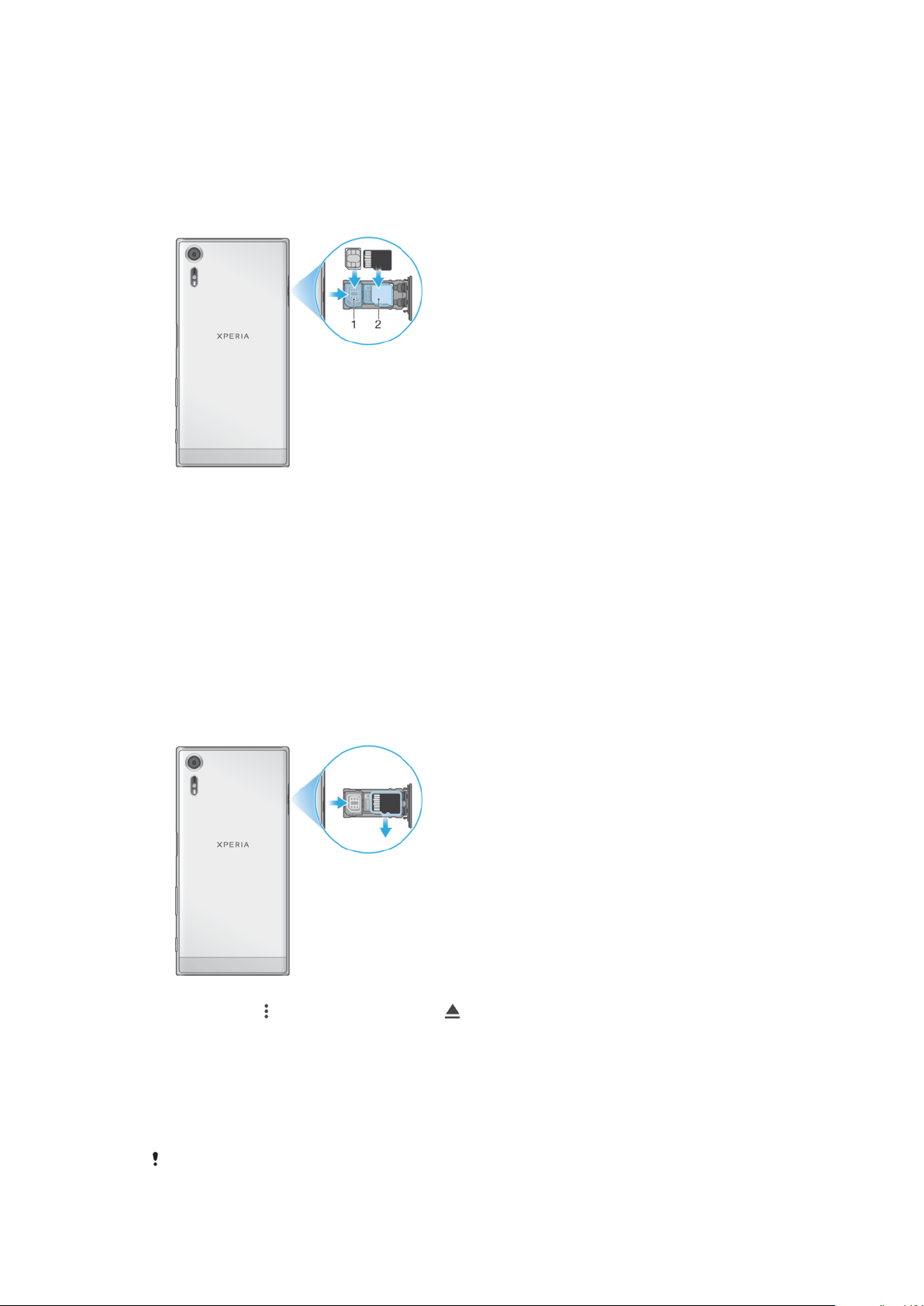
1
Using your fingernail, drag out the SIM/Memory card tray.
2
Firmly place the primary SIM card (SIM 1) in the correct orientation in position (1)
as shown in the illustration.
3
Firmly place the additional SIM card (SIM 2) in the correct orientation in position (2)
as shown in the illustration.
4
Gently push the tray back into the slot until it fits into place.
To Insert One Nano SIM Card and One Memory Card
1
Using your fingernail, drag out the SIM/Memory card tray.
2
Firmly place the SIM card in the correct orientation in position (1) as shown in the
illustration.
3
Firmly place the memory card in the correct orientation in position (2) as shown in
the illustration.
4
Gently push the tray back into the slot until it fits into place.
To Remove the Nano SIM Card
1
With the screen facing down, open the nano SIM/Memory card slot cover.
2
Drag out the nano SIM/Memory card tray using your fingernail.
3
Remove the nano SIM card, then gently push the tray back into the slot until it fits
into place.
To Remove the Memory Card
1
Either turn off the device, or unmount the memory card under Settings > Storage
& memory > > Advanced > Storage > next to SD card.
2
With the screen facing down, open the nano SIM/Memory card slot cover.
3
Drag out the nano SIM/Memory card tray using your fingernail.
4
Remove the memory card, then gently push the tray back into the slot until it fits
into place.
Screen Protection
Before using your device, remove the protective
film by pulling up on the protruding tab.
8
This is an internet version of this publication. © Print only for private use.

It is recommended to protect your device with a Sony-branded screen cover or a
protector intended for your Xperia™ model. The use of third-party screen protection
accessories may prevent your device from working correctly by covering sensors, lenses,
speakers, or microphones and can invalidate the warranty.
Starting Your Device for the First Time
It is recommended that you charge the battery for at least 30 minutes before starting up
your device for the first time. You can still use your device while it is charging, see
Charging Your Device
on page 35.
The first time you start your device, a setup guide helps you to configure basic settings,
personalize your device, and sign in to your accounts, for example a Google™ account.
To turn on the device
It is important to use the USB Type-C™ cable (provided) when charging your device, as other
types of USB cables can damage your device. It is recommended to charge the battery for at
least 30 minutes before you turn on the device for the first time.
1
Press and hold down the power key until the device vibrates.
2
Enter your PIN for SIM card 1 and SIM card 2 when requested, then tap
.
3
Wait a while for the device to start.
Your SIM card PIN is initially supplied by your service provider, but you can change it later
from the Settings menu. To correct a mistake made while entering your SIM card PIN, tap .
To Turn off the Device
1
Press and hold down the power key until the options menu opens.
2
In the options menu, tap Power off.
It may take a while for the device to shut down.
Why Do I Need a Google™ Account?
Your Xperia™ device from Sony runs on the Android™ platform developed by Google™.
A range of Google™ applications and services is available on your device when you
purchase it, for example, Gmail™, Google Maps™, YouTube™, and the Play Store™
application which gives you access to the Google Play™ online store for downloading
Android™ applications. To get the most out of these services, you need a Google™
account. For example, a Google™ account enables you to do all of the following:
•
Download and install applications from Google Play™.
•
Synchronize your email, contacts, and calendar using Gmail™.
•
Chat with friends using the Duo™ application.
•
Synchronize your browsing history and bookmarks using the Google Chrome™ web
browser.
•
Identify yourself as the authorized user after a software repair using Xperia™ Companion.
•
Remotely find, lock, or clear a lost or stolen device using the my Xperia™ or Android™
Device Manager services.
For more information about Android™ and Google™, go to
http://support.google.com
.
It is crucial that you remember your Google™ account username and password. In some
situations, you may need to identify yourself for security reasons using your Google™ account.
If you fail to give your Google™ username and password in such situations, your device is
locked. Also, if you have more than one Google™ account, be sure to enter the details for the
relevant account.
9
This is an internet version of this publication. © Print only for private use.

To Set Up a Google™ Account on your Device
1
From your Home screen, tap .
2
Find and tap Settings > Accounts & sync > Add account > Google.
3
Follow the registration wizard to create a Google™ account, or sign in if you
already have an account.
You can also sign in to or create a Google™ account from the setup guide the first time you
start your device. Alternatively, you can go online and create an account at
www.google.com/accounts
.
To Remove a Google™ Account
1
From your Home screen, tap .
2
Tap Settings > Accounts & sync > Google.
3
Select the Google™ account you want to remove.
4
Tap
> Remove account.
5
Tap Remove account again to confirm.
If you remove your Google™ account, any security features that are linked to your Google™
account will no longer be available.
10
This is an internet version of this publication. © Print only for private use.

Device security
Making Sure Your Device is Protected
Your device includes several security options, strongly recommended in case of loss or
theft.
These options are as follows:
•
Set a secure screen lock on your device using a PIN, password, or pattern to prevent
anyone from accessing or resetting your device.
•
Add a Google™ account to prevent others from using your device if it gets stolen or
wiped.
•
Activate either the “Protection by my Xperia” or the Android™ Device Manager web
service. Using one of these services, you can remotely locate, lock, or clear a lost device.
Verifying the Ownership of Your Device
Certain protection features require you to either unlock your screen with your PIN,
password, or pattern, or enter your Google™ account information. Below are examples
of protection features and some of the required credentials:
Factory Data
Reset
protection
You must unlock your screen before you are allowed to perform a Factory
Data Reset.
Protection by
my Xperia
If you remotely reset your device using this service, you must enter the
username and password for a Google™ account associated with the
service. The device must be connected to the internet before the setup
process can be completed. Otherwise, you will not be able to use your
device after the reset.
Android™
Device
Manager
If you remotely reset your device using this service, you must enter the
username and password for a Google™ account. The device must be
connected to the internet before the setup process can be completed.
Otherwise, you will not be able to use your device after the reset.
Software repair
If you use the Xperia™ Companion software to perform a software repair,
you’re asked to enter your Google™ account username and password
when you start the device after the repair is complete.
For Android™ Device Manager, it is necessary to enter information from a Google™ account.
This can be any Google™ account which you have set up on the device as an owner. If you
cannot provide the relevant account information during a setup process, you won't be able to
use the device at all.
Screen Lock
Fingerprint functionality is not available in the US market.
There are several screen lock options available. The security level of each lock type is
listed below in order of weakest to strongest:
•
Swipe
– no protection, but you have quick access to the Homescreen.
•
Pattern
– draw a simple pattern with your finger to unlock your device.
•
PIN
– enter a numeric PIN of at least four digits to unlock your device.
•
Password
– enter an alpha-numeric password to unlock your device.
•
Fingerprint
– place your registered finger on the power key to unlock your device.
11
This is an internet version of this publication. © Print only for private use.

It is very important that you remember your screen unlock pattern, PIN, or password. If
you forget this information, it may not be possible to restore important data, such as
contacts and messages. If you have set up a Microsoft® Exchange ActiveSync® (EAS)
account on your Xperia™ device, the EAS security settings may limit the lockscreen type
to only a PIN or password. This occurs when your network administrator specifies a
lockscreen type for all EAS accounts for enterprise security reasons. Contact the
network administrator of your company or organization to check what network security
policies are implemented for cellular devices.
For more settings for each screen lock type, tap beside Screen lock.
To change your screen lock type
1
From your Home screen, tap .
2
Find and tap Settings > Lock screen & security > Screen lock.
3
Confirm your current screen lock, choose an option, and follow the instructions on
your device.
To Create a Screen Lock Pattern
1
From your Home screen, tap
.
2
Find and tap Settings > Lock screen & security > Screen lock > Pattern.
3
Choose an option and follow the instructions on your device.
If you enter an incorrect lock pattern five times in a row, you must wait 30 seconds before
trying again.
To Change the Screen Lock Pattern
1
From your
Home screen
, tap .
2
Find and tap Settings > Lock screen & security > Screen lock.
3
Draw your screen unlock pattern.
4
Tap Pattern, choose an option, and follow the instructions on your device.
To Create a Screen Lock PIN
1
From your Home screen, tap .
2
Find and tap
Settings
>
Lock screen & security
>
Screen lock
>
PIN
.
3
Choose an option. Enter a numeric PIN, and then tap CONTINUE.
4
Re-enter and confirm your PIN, then tap
OK
.
To Create a Screen Lock Password
1
From your
Home screen
, tap .
2
Find and tap Settings > Lock screen & security > Screen lock > Password.
3
Choose an option and follow the instructions on your device.
To Activate the Swipe Unlock Function
1
From your Home screen, tap .
2
Find and tap Settings > Lock screen & security > Screen lock.
3
Draw your screen unlock pattern, or enter your PIN or password depending on
which of these screen lock types is enabled.
4
Tap Swipe, then tap YES, REMOVE.
Fingerprint Unlock
Fingerprint functionality is not available in the US market.
You can use your fingerprint to quickly unlock your device. To use this feature, you need
to register a fingerprint and enable this feature in the Fingerprint Manager first.
The pattern, PIN, or password screen lock you set up serves as a backup unlock
method if you enable the Fingerprint unlock option.
Selecting other screen lock types will clear all
fingerprint settings.
12
This is an internet version of this publication. © Print only for private use.

To Unlock the Device Using Your Fingerprint
•
With the lockscreen active, place your finger on the power key so that the device
can scan your fingerprint and unlock the screen. Be sure to use a finger that you
have registered in Fingerprint Manager.
If you fail to unlock the screen using your fingerprint after five attempts, you can use your
backup pattern, PIN, or password instead.
Fingerprint Manager
Fingerprint functionality is not available in the US market.
Fingerprint Manager registers fingerprint information that can be used as an additional
security method for unlocking your device or authenticating purchases. You are allowed
to register a maximum of 5 fingerprints on your device.
Before using the Fingerprint sensor, make sure the sensor is clean and without any visible
moisture.
To Register a Fingerprint for the First Time
1
From your Home screen, tap .
2
Find and tap Settings > Lock screen & security > Fingerprint Manager.
3
Tap Continue, then confirm your pattern, PIN or password if prompted.
4
Follow the on-screen instructions to complete fingerprint registration.
When registering a
fingerprint for the first time, you are also prompted to set up a pattern, PIN,
or password as a security backup if you have not already done so.
The fingerprint sensor is on the power key and not on the screen of your device. Before using
the Fingerprint sensor, make sure the sensor is clean and without any visible moisture.
To Register Additional Fingerprints
1
From your Home screen, tap .
2
Find and tap
Settings
>
Lock screen & security
>
Fingerprint Manager
.
3
Confirm your pattern, PIN, or password.
4
Tap , then follow the on-screen instructions.
To Delete a Registered Fingerprint
1
From your
Home screen
, tap .
2
Find and tap Settings > Lock screen & security > Fingerprint Manager.
3
Tap the registered fingerprint, then tap
DELETE
>
DELETE
.
To Rename a Registered Fingerprint
1
From your
Home screen
, tap .
2
Find and tap Settings > Lock screen & security > Fingerprint Manager.
3
Tap a registered fingerprint in the list and then enter a fingerprint name.
4
Tap OK.
Unlocking Your Device Automatically
The Smart Lock feature makes unlocking your device easier by letting you set it to unlock
automatically in certain situations. You can keep your device unlocked, for example,
when it’s connected to a Bluetooth® device or when you’re carrying it with you.
You can set Smart Lock to keep your device unlocked using the following settings:
•
On-body detection: Keep your device unlocked when you're carrying it with you.
•
Trusted places: Keep your device unlocked when you're in a familiar, secure location,
such as your home.
•
Trusted devices: Keep your device unlocked when a trusted Bluetooth® or NFC device
is connected.
•
Trusted face: Unlock your device by looking at it.
13
This is an internet version of this publication. © Print only for private use.

•
Trusted voice: Set up voice recognition to search in any screen.
The Smart Lock feature may not be available in every market, country, or region.
With Smart Lock enabled you still need to unlock your device manually after restarting, and
after leaving the device inactive for 4 hours.
The Smart Lock feature is developed by Google™ and the exact functionality may change over
time due to updates from Google™.
To Enable Smart Lock
1
Set a pattern, PIN, or password as a screen lock if you have not already done so.
2
From your Home screen, tap
.
3
Find and tap Settings > Lock screen & security > Trust agents.
4
Tap the Smart Lock (Google) slider to enable the function.
5
Tap the back arrow next to Trust agents.
6
Find and tap Smart Lock.
7
Enter your pattern, PIN, or password. You need to enter these credentials
whenever you want to change your Smart Lock settings.
8
Select a Smart Lock type.
To Set Up Trusted Face
1
From your Home screen, tap
.
2
Find and tap Settings > Lock screen & security > Smart Lock > Trusted face.
3
Tap
SET UP
>
NEXT
, follow the instructions on your device.
To Set Up Trusted Voice
1
From your
Home screen
, tap
.
2
Find and tap Settings > Lock screen & security > Smart Lock > Trusted voice.
3
Follow the instruction on your device.
Keeping Your Device Unlocked while You’re Carrying It
Using the On-body detection feature, you can keep your device unlocked while you're
carrying it in your hand or in a pocket or bag. The accelerometer in your device keeps
your device unlocked while it senses that it's being carried. The device locks when the
accelerometer detects that the device has been put down.
When you use the On-body detection feature, you need to be aware of the following
behaviors:
•
Any time you put your device down and it senses that it's no longer being carried, it
locks automatically.
•
The device can take up to one minute to lock.
•
After you get into a car, bus, train, or other land vehicle, your device can take between 5
and 10 minutes to lock.
•
Note that when you get on an airplane or a boat (or another non-land-based vehicle),
your device may not lock automatically, so be sure to lock it manually if needed.
•
When you pick up your device again or get out of the vehicle, just unlock it once and
your device then stays unlocked for as long as you have it on you.
The On-body detection feature can't distinguish whose body is connected. If you give your
device to someone else while it's unlocked using On-body detection, your device may stay
unlocked for the other user. Keep in mind that On-body detection as a security feature is less
secure than a pattern, PIN, or password.
To Enable or Disable On-Body Detection
1
From your Home screen, tap
.
2
Find and tap Settings > Lock screen & security > Smart Lock > On-body
detection.
3
Tap the slider to enable the function, then tap CONTINUE. To disable the function,
tap the slider beside On.
14
This is an internet version of this publication. © Print only for private use.

Connecting to Trusted Devices
You can designate a connected device as trusted and keep your Xperia™ device
unlocked while connected. If you have a device that you connect to regularly using
Bluetooth® or NFC, for example, a home entertainment system or a fitness tracker, you
can add it as a trusted device and bypass the added security of the lockscreen to save
time. This feature is suitable if you’re normally in a relatively secure place when you use
these devices. In some cases, you may still need to manually unlock your device before a
trusted device can be connected.
It is not recommended to add devices that are constantly connected to your device as trusted
devices, such as Bluetooth® keyboards or cases.
As soon as a trusted device is switched off or moves out of range, your screen locks and you
need your PIN, pattern or password to unlock it.
To Add or Remove a Trusted Bluetooth® Device
1
Make sure your device is paired and connected to the Bluetooth® device that you
want to add as a trusted device.
2
From your Home screen, tap
.
3
Find and tap Settings > Lock screen & security > Smart Lock.
4
In the Smart Lock menu tap Trusted devices > ADD TRUSTED DEVICE >
Bluetooth.
5
Tap a device name to select it from the list of connected and paired devices, then
tap
YES, ADD
.
6
To remove a paired device, select it from the list and tap REMOVE TRUSTED
DEVICE
.
To Add or Remove a Trusted NFC Device
1
Make sure your device is paired and connected to the Bluetooth® device that you
want to add as a trusted device.
2
Find and tap
Settings
>
Lock screen & security
>
Smart Lock
.
3
Tap Trusted devices > ADD TRUSTED DEVICE > NFC.
4
Follow the on-screen instructions.
5
To remove a paired device, select it from the list and tap REMOVE TRUSTED
DEVICE
Making Sure You're Secure when Using Trusted Devices
Different Bluetooth® devices support different Bluetooth® standards and security
capabilities. There's a chance someone could keep your Xperia™ device unlocked by
imitating your Bluetooth® connection, even if your trusted device is no longer nearby.
Your device is not always able to determine whether your connection is secure from
someone trying to imitate it.
When your device can't determine whether you're using a secure connection, you'll get a
notification on your Xperia™ device and may need to manually unlock it before the
trusted device can keep it unlocked.
Bluetooth® connectivity range can vary depending on factors like the model of your device,
the connected Bluetooth® device, and your environment. Depending on these factors,
Bluetooth® connections can work over distances up to 100 meters.
Connecting to Trusted Places
When the Trusted places feature is set up, the lockscreen security on your Xperia™
device gets disabled when you are in a designated trusted location. For this feature to
work, you must have an internet connection (preferably over Wi-Fi) and allow your device
to use your current location.
To set up trusted places, first make sure high-accuracy location mode or battery-saving
location mode is enabled on your device before you add home or custom locations.
The exact dimensions of a trusted location are an estimate and may extend beyond the
physical walls of your home or other areas you have added as trusted locations. This feature
15
This is an internet version of this publication. © Print only for private use.

can keep your device unlocked within a radius of up to 80 meters. Also be aware that location
signals can be replicated or manipulated. Someone with access to specialized equipment
could unlock your device.
To Add Your Home Location
1
From your Home screen, tap .
2
Find and tap Settings > Lock screen & security > Smart Lock > Trusted places >
Home.
3
To enter the desired location type the address in the search bar. Your device
searches for the entered location.
To Edit Your Home Location
1
From your Home screen, tap
.
2
Find and tap Settings > Lock screen & security > Smart Lock > Trusted places.
3
Select your home location.
4
Tap Edit.
5
In the search bar, enter the location that you want to use as your home location.
If other residences share your street address, you can add the actual location of your home
within the building complex as a custom place.
To Remove Your Home Location
1
From your
Home screen
, tap
.
2
Find and tap Settings > Lock screen & security > Smart Lock > Trusted places >
Home
.
3
Tap Edit >
.
Using Custom Locations
You can add any location as a trusted, custom place where your device can remain
unlocked.
To Add a Custom Place
1
From your Home screen, tap
.
2
Find and tap
Settings
>
Lock screen & security
>
Smart Lock
>
Trusted places
.
3
Tap Add trusted place.
4
To use your current location as a custom place, tap
Select this location
.
5
Alternately, to enter another location, tap
and type the address. Your device
searches for the entered location. Tap the suggested address to use it.
6
To fine-tune the location, tap the back arrow next to the address, drag the location
pin to the desired location, and then tap
Select this location
.
To Edit a Custom Place
1
From your Home screen, tap .
2
Find and tap Settings > Lock screen & security > Smart Lock > Trusted places.
3
Select the place that you want to edit.
4
Tap Edit Address.
5
To enter another location, tap , and then type the address. Your device searches
for the entered location. To use the suggested address, tap the address.
6
To fine-tune the location, tap the back arrow next to the address, drag the location
pin to the desired location, and then tap Select this location.
To Remove a Custom Place
1
From your Home screen, tap .
2
Find and tap Settings > Lock screen & security > Smart Lock > Trusted places.
3
Select the place you want to remove.
4
Tap Delete.
16
This is an internet version of this publication. © Print only for private use.

SIM Card Protection
You can lock and unlock each SIM card that you use in your device with a PIN (Personal
Identification Number). When a SIM card is locked, the subscription linked to the card is
protected against misuse, meaning you have to enter a PIN every time you start your
device.
If you enter the PIN incorrectly too many times, your SIM card will get blocked. You then
need to enter your PUK (Personal Unblocking Key) and a new PIN. Your PIN and PUK
are supplied by your service provider.
To Set Up a SIM Card Lock
1
From the Homescreen, tap
.
2
Find and tap Settings > Lock screen & security > Set up SIM card lock.
3
Select a SIM card.
4
Tap the Lock SIM card slider to enable or disable the SIM card lock.
5
Enter the SIM card PIN and tap OK. The SIM card lock is now active and you will
be prompted to enter the PIN every time you restart the device.
To Change the SIM Card PIN
1
From the Home screen, tap
.
2
Find and tap Settings > Lock screen & security > Set up SIM card lock.
3
Select a SIM card.
4
Tap
Change SIM PIN
.
5
Enter the old SIM card PIN and tap OK.
6
Enter the new SIM card PIN and tap
OK
.
7
Retype the new SIM card PIN and tap OK.
To Unlock a Blocked SIM Card Using the PUK Code
1
Enter the PUK code and tap .
2
Enter a new PIN code and tap .
3
Re-enter the new PIN code and tap
.
If you enter an incorrect PUK code too many times, you need to contact your network operator
to get a new SIM card.
Using Multiple SIM Cards
Your device works with either one or two SIM cards inserted. You get incoming
communication to both SIM cards and you can select which number you want to place
outgoing communication from. Before you can use both SIM cards, you need to enable
them and select which SIM card will handle data traffic.
You can forward calls that come in on SIM card 1 to SIM card 2 when SIM card 1 is
unreachable, and vice versa. This function is called Dual SIM reachability. You must
enable it manually. See
Forwarding Calls
on the 73 page.
To Enable or Disable the Use of Two SIM Cards
1
From the Home screen, tap .
2
Find and tap Settings > Dual SIM.
3
Tap the SIM1 and SIM2 sliders to enable or disable the SIM cards.
To Rename a SIM Card
1
From the Home screen, tap .
2
Find and tap Settings > Dual SIM.
3
Select a SIM card and enter a new name for it.
4
Tap OK.
17
This is an internet version of this publication. © Print only for private use.
To select which SIM card handles data traffic
1
From your Home screen, tap .
2
Find and tap Settings > SIM cards > Cellular data.
3
Select the SIM card you want to use for data traffic.
For higher data speeds, select the SIM card that supports the fastest cellular network, for
example, 3G or LTE.
Finding the Identification Number of Your Device
Your device has a unique identification number. This number is referred to as the IMEI
(International Mobile Equipment Identity). You should keep a copy of this number. You
may require it, for example, when you access the Xperia™ Care support service to
register your device. Also, if your device is stolen, some network providers can use this
number to stop the device from accessing the network in your country or region.
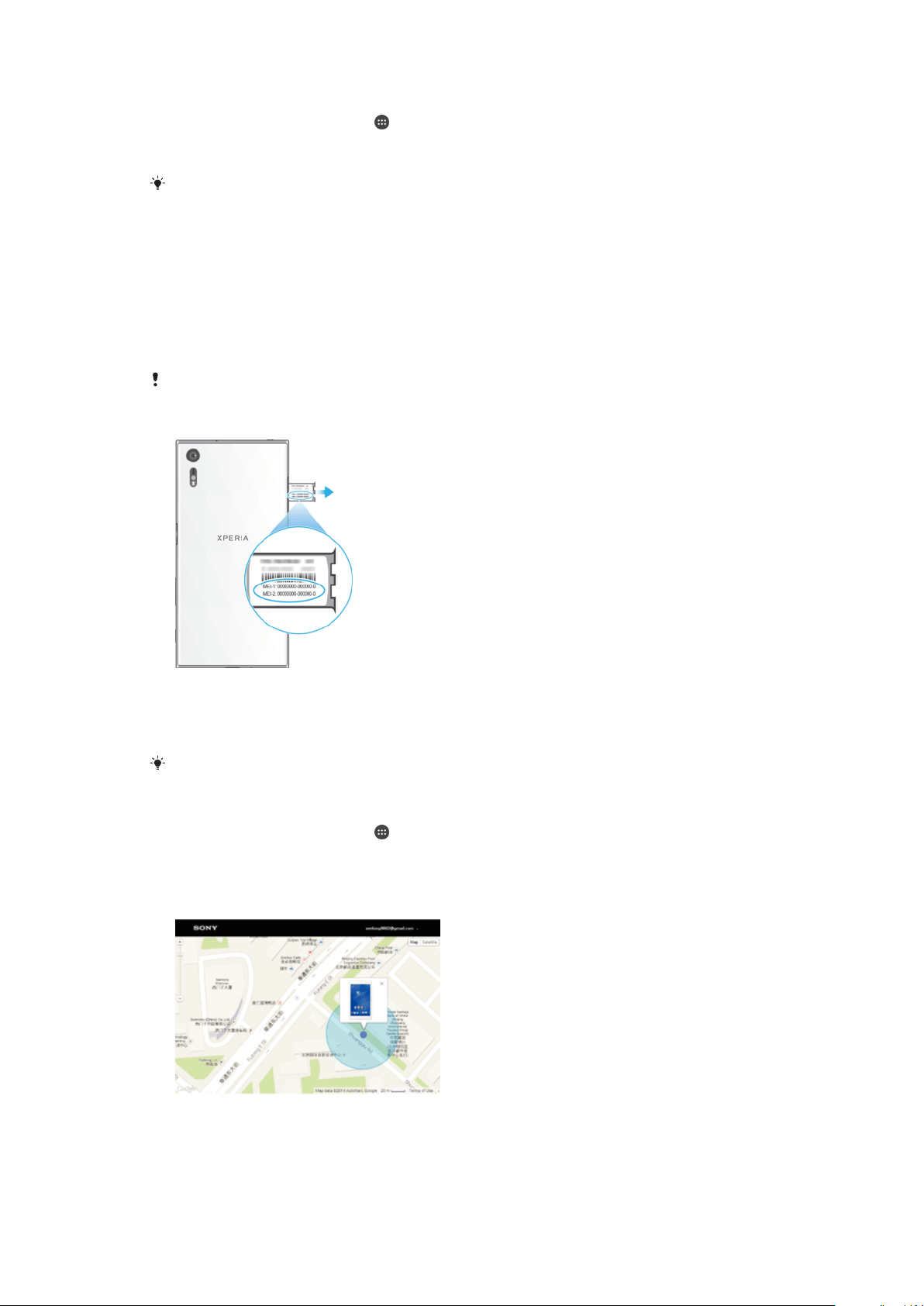
For devices with two SIM cards, there are two IMEI numbers, one for each SIM card slot.
To view your IMEI numbers on the label strip
1
Open the cover for the nano SIM/Memory card slot.
2
Remove the SIM/Memory Card tray.
3
Drag the strip outward using your fingernail. The IMEI numbers are displayed on
the strip.
You can also view the IMEI numbers by opening the phone dialer and entering
*#06#.
To view your IMEI numbers via the device settings
1
From your Home screen, tap .
2
Find and tap
Settings
>
About phone
>
Status
>
IMEI information
.
Finding a Lost Device
If you have a Google™ account, the “Protection by my Xperia” web service can help you
locate and secure your device if you ever lose it. If you have activated this service on your
device, you can:
•
Locate your device on a map.
18
This is an internet version of this publication. © Print only for private use.

•
Sound an alert even if the device is in Do not disturb mode.
•
Remotely lock the device and make the device display your contact details to anyone
who finds it.
•
Remotely clear the internal and external memory of the device as a last resort.
If you’ve cleared the internal memory of the device using the “Protection by my Xperia” web
service, you must sign in to a Google™ account that was previously synced on this device the
next time you turn on the device.
The “Protection by my Xperia” service may not be available in all countries or regions.
To activate Protection by my Xperia
1
Make sure you have an active data connection, and enable location services on
your device.
2
From your Home screen, tap
.
3
Find and tap Settings > Lock screen & security > Protection by my Xperia >
Activate.
4
Mark the checkbox to agree to the terms and conditions of the service, then tap
ACCEPT.
5
If prompted, sign in to your Google™ account, or create a new account if you
don’t already have one.
6
To verify that Protection by my Xperia can locate your device, go to
myxperia.sonymobile.com
and sign in to your Google™ account.
If you are sharing a device with multiple users, note that the Protection by my Xperia service is
only available to the user who is logged in as the owner.
Finding a Lost Device Using Android™ Device Manager
Google™ offers a location and security web service called Android™ Device Manager.
You can use it in parallel with, or as an alternative to, the Protection by my Xperia service.
If you lose your device, you can use Android™ Device Manager to:
•
Find and show where your device is located.
•
Ring or lock your device, erase everything on it, or add a phone number to the
lockscreen.
For additional information about Android™ Device Manager, go to
www.support.google.com
.
Android™ Device Manager does not work if your device is turned off or if it does not have a
connection to the internet. The Android™ Device Manager service may not be available in all
countries or regions.
To Activate Android™ Device Manager
1
If you are sharing a device with multiple users, make sure you are logged in as the
owner.
2
Make sure you have an active data connection and location services are enabled.
3
From your Home screen, tap
.
4
Find and tap Settings > Google > Security.
5
Tap the sliders beside Remotely locate this device and Allow remote lock and
erase to enable both functions.
6
If prompted, agree to the terms and conditions by tapping Activate this device
administrator.
7
To verify that Android™ Device Manager can locate your device after you activate
the service, go to
www.android.com/devicemanager
and sign in using your
Google™ account.
You can also activate Android™ Device Manager from
Lock screen & security under Device
administrators.
19
This is an internet version of this publication. © Print only for private use.
Learning the basics
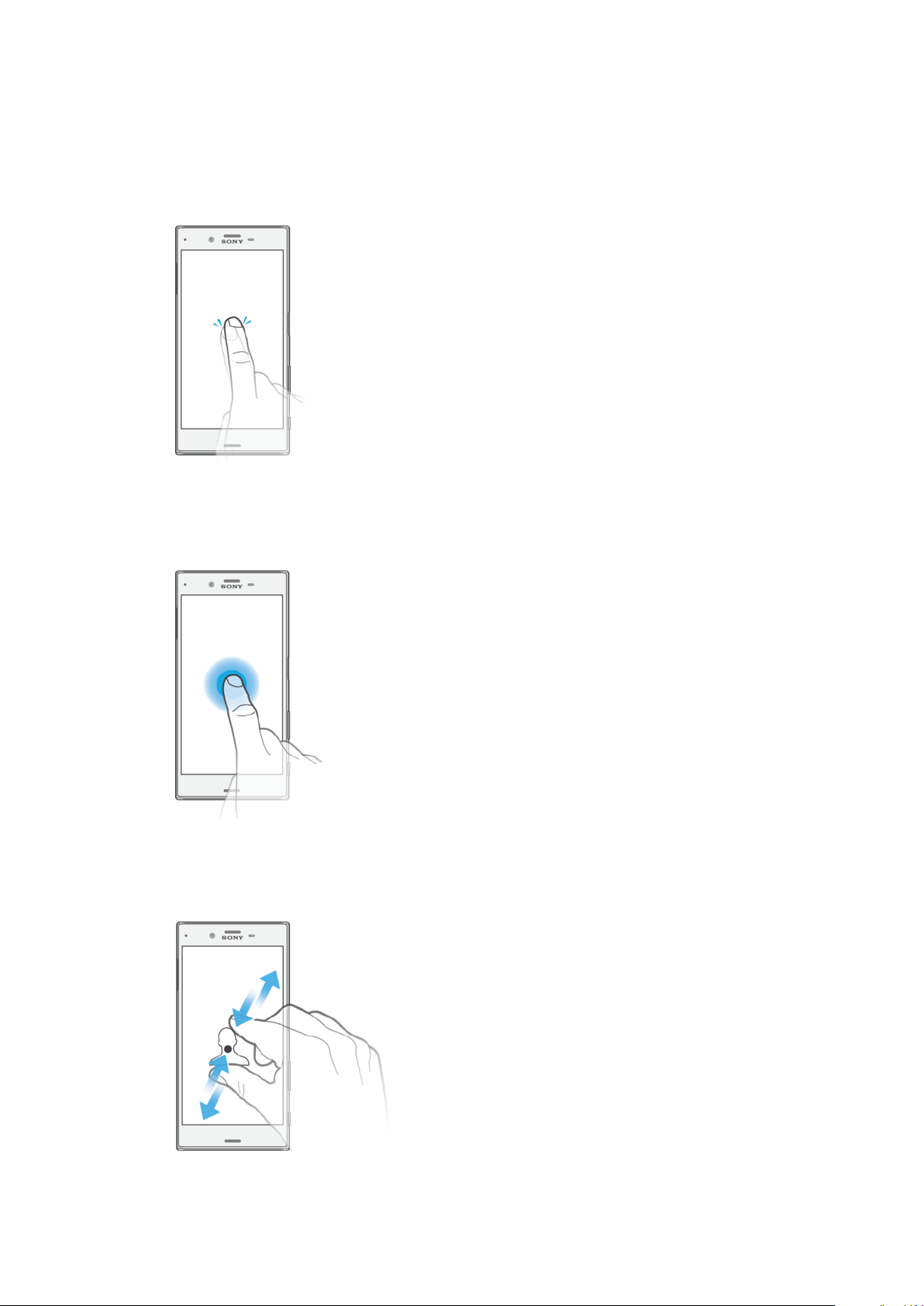
Using the touchscreen
Tapping
•
Open or select an item.
•
Mark or unmark a checkbox or option.
•
Enter text using the on-screen keyboard.
Touching and holding
•
Move an item.
•
Activate an item-specific menu.
•
Activate selection mode, for example, to select several items from a list.
Pinching and spreading
•
Zoom in or out on web pages, photos, and maps, and when you’re taking photos or
shooting videos.
20
This is an internet version of this publication. © Print only for private use.

Swiping
•
Scroll up or down a list.
•
Scroll left or right, for example, between Homescreen panes.
•
Swipe left or right to reveal more options.
Flicking
•
Scroll quickly, for example, in a list or on a web page. You can stop the scrolling
movement by tapping the screen.
Locking and Unlocking the Screen
When your device is on and left idle for a set period of time, the screen darkens to save
battery power and locks automatically. This lock prevents unwanted actions on the
touchscreen when you are not using it. When you buy your device, a basic screen swipe
lock is already set. This means you have to swipe left or upward on the screen to unlock
it. You can change the security settings later and add other kinds of locks. See
Screen
Lock
on the 11 page.
21
This is an internet version of this publication. © Print only for private use.

To activate the screen
•
Briefly press the power key .
To lock the screen
•
When the screen is active, briefly press the power key .
Homescreen
The Homescreen is the starting point for using your device. It’s similar to the desktop on
a computer screen. Your Homescreen can have up to twenty panes, which extend
beyond the regular screen display width. The number of Homescreen panes is
represented by a series of dots on the lower part of the Homescreen. The highlighted dot
shows the pane that is currently displayed.
1 Welcome to Xperia™ widget – Tap to open the widget and select a task such as copying content from
your old device or setting up Xperia™ services
2 Dots – Represents the number of Homescreen panes
To go to the Home screen
•
Press .
To browse the Home screen
Homescreen Panes
You can add new panes to your Homescreen (up to a maximum of twenty panes) and
delete panes. You can also set the pane that you want to use as the main Homescreen
pane.
22
This is an internet version of this publication. © Print only for private use.

To Set a Pane as the Main Homescreen Pane
1
Touch and hold any area on your Homescreen until the device vibrates.
2
Flick left or right to browse to the pane you want to set as your main Homescreen
pane, then tap
in the upper-left corner of the screen.
When Google Search & Now is enabled, the left-most pane is reserved for this service and the
main Homescreen pane cannot be changed. For more information, see
Google Search & Now
on page 121.
To Add a Pane to Your Homescreen
1
Touch and hold any area on your Homescreen until the device vibrates.
2
To browse the panes, flick all the way to the right or left, then tap .
When Google Search & Now is enabled, the left-most pane is reserved for this service and
additional panes cannot be added to the left. For more information, see
Google Search & Now
on page 121.
To Delete a Pane from your Homescreen
1
Touch and hold any area on your Homescreen until the device vibrates.
2
Flick left or right to browse to the pane you want to delete, then tap
in the top-
right corner of the pane.
Homescreen Settings
To disable or uninstall an application from the homescreen
Disabling a pre-installed app deletes all data, but the app can be enabled again from
Settings
> Apps. Only downloaded apps can be fully uninstalled.
1
Touch and hold any area on your Homescreen until the device vibrates.
2
Flick left or right to browse the panes. All applications that can be disabled or
uninstalled are indicated by
.
3
Tap the relevant application, then tap Disable if the app came pre-installed on
your device or OK if the app was downloaded and you would like to uninstall it.
To Adjust the Size of Icons on Your Homescreen
1
Touch and hold any area on your Homescreen until the device vibrates, then tap
.
2
Tap Icon size, then select an option.
Application screen
The Application screen, which you open from the Homescreen, contains the applications
that come pre-installed on your device as well as applications that you download.
23
This is an internet version of this publication. © Print only for private use.

To view all applications on the Application screen
1
From your Home screen, tap
.
2
Flick left or right on the Application screen.
To Enable or Disable the Recommended Apps Listings
The first time you access the application screen, you get the option to enable or disable
recommended apps listings. You can also enable or disable this feature later by following
the steps below:
1
Touch and hold any area on your Homescreen until the device vibrates, then tap
.
2
Tap the App recommendations slider.
To Open an Application from the Application Screen
•
When the Application screen is open, flick left or right to find the application, and
then tap the application.
To Search for an Application from the Application Screen
1
When the Application screen is open, tap
Search applications
or simply swipe
down on the Application screen or Homescreen.
2
Enter the name of the application you want to search for.
To Arrange Applications on the Application Screen
1
When the Application screen is open, tap
.
2
Tap Sort apps, then select an option.
To Add an Application Shortcut to the Homescreen
1
On the Application screen, touch and hold an application icon until the device
vibrates, and then drag the icon to the top of the screen. The Homescreen opens.
2
Drag the icon to the desired location on the Homescreen, then release it.
To Move an Application on the Application Screen
1
When the Application screen is open, tap .
2
Make sure Own order is selected under Sort apps.
3
Touch and hold the application until the device vibrates, and then drag it to the
new location.
To disable or uninstall an application from the application screen
Disabling a pre-installed app deletes all data, but the app can be enabled again from
Settings
> Apps. Only downloaded apps can be fully uninstalled.
1
Touch and hold any area on the Application screen until the device vibrates. All
applications that can be disabled or uninstalled are then indicated by .
2
Tap the relevant application, then tap DISABLE if the app came pre-installed on
your device or OK if the app was downloaded and you would like to uninstall it.
24
This is an internet version of this publication. © Print only for private use.
Navigating Applications
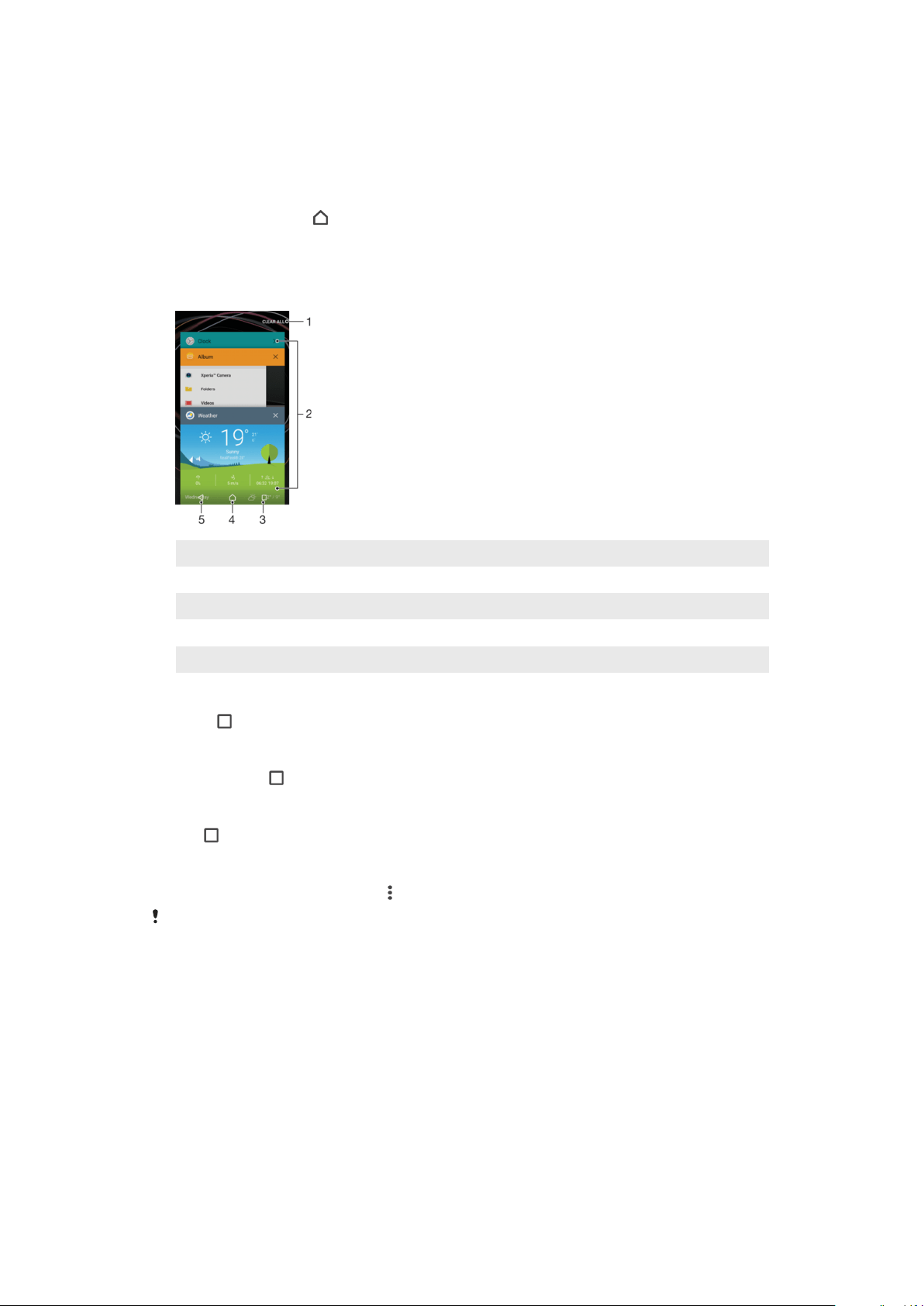
You can navigate between applications using the navigation keys and the recently used
applications window, which lets you switch easily between all recently used applications.
The navigation keys are the Back key, the Home key, and the Recent apps key. You can
also pop open two applications on the screen at once using the split screen mode, if the
application supports multi-window function. Some applications get closed when you
press the Home key
to exit while others are paused or continue to run in the
background. If an application is paused or running in the background, you can continue
where you left off the next time you open the application.
1 Clear all – Close all the recently used applications
2 Recently used applications window – Open a recently used application
3 Recent apps key – Open the recently used applications window and the favorites bar
4 Home key – Exit an application and go back to the Homescreen
5 Back key – Go back to the previous screen within an application or close the application
To open the recently used applications window
•
Press .
To Quickly Switch Between Recently Used Applications
•
Quickly press twice.
To Close All the Recently Used Applications
•
Tap
and then tap CLEAR ALL.
To Open a Menu in an Application
•
While using the application, tap
.
Menus are not available in all applications.
Split Screen Mode
Split screen mode enables you to view two applications at once, for example, if you want
to view your email inbox and a web browser at the same time.
25
This is an internet version of this publication. © Print only for private use.
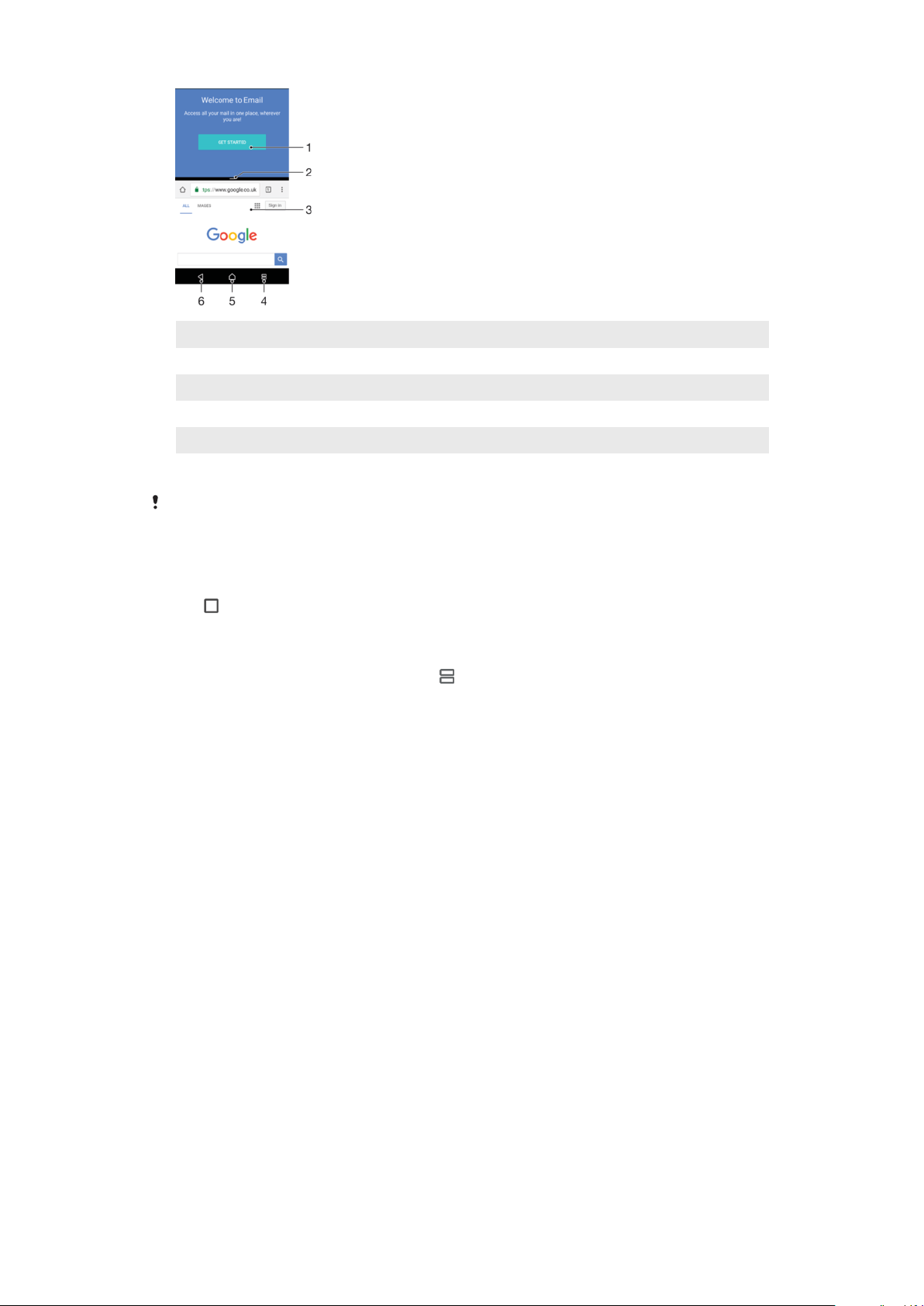
1 Application 1 in upper window
2 Split screen border – Drag to resize windows
3 Application 2 in lower window
4 Split screen key – Select a recently used application
5 Home key – Go back to the Homescreen
6 Back key – Go back to the previous screen within an application or close the application
Not all applications support split screen mode.
To Use Split-Screen Mode
1
Make sure the two applications that you want to use in split screen mode are
open and running in the background.
2
Tap
, then drag and drop the desired application to the top part of the screen.
3
In the lower part of the screen, tap the second desired application.
4
In portrait orientation, drag the black bar in the center up or down to resize the
windows.
5
To exit split-screen mode, tap and hold
.
Widgets
Widgets are small applications that you can use directly on your Homescreen. They also
function as shortcuts. For example, the Weather widget allows you to see basic weather
information directly on your Homescreen. When you tap the widget, the full Weather
application opens. You can download additional widgets from Google Play™.
To Add a Widget to the Homescreen
1
Touch and hold any empty area on your Home screen until the device vibrates,
then tap Widgets.
2
Find and tap the widget you want to add.
To Resize a Widget
1
Touch and hold a widget until the device vibrates, and then release it. If the widget
can be resized, for example, the Calendar widget, then a highlighted frame and
resizing dots appear.
2
Drag the dots inward or outward to shrink or expand the widget.
3
To confirm the new size of the widget, tap anywhere on the Home screen.
To Move a Widget
•
Touch and hold the widget until the device vibrates, and then drag it to the new
location.
To Remove a Widget
•
Touch and hold the widget until the device vibrates, and then drag it to Remove
from home screen.
26
This is an internet version of this publication. © Print only for private use.
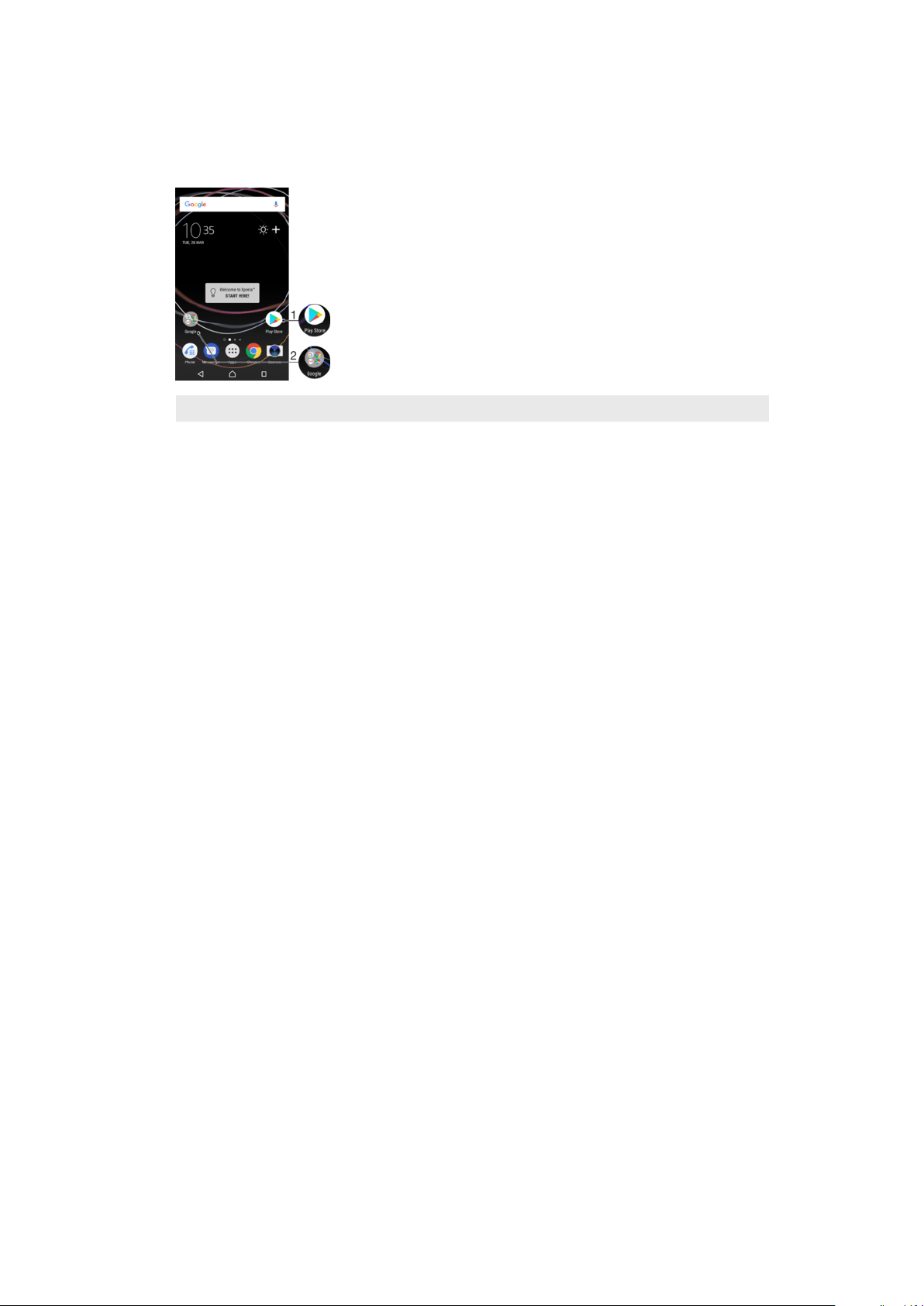
Shortcuts and folders
Use shortcuts and folders to manage your applications and keep your Home screen tidy.
1 Access an application using a shortcut
2 Access a folder containing applications
To Add an Application Shortcut to Your Homescreen
1
Touch and hold an empty area on your Home screen.
2
In the customization menu, tap
Widgets
>
Shortcuts
.
3
Scroll through the list and select an application. The selected application gets
added to the
Home screen
.
To Move an Item on the Homescreen
•
Touch and hold the item until the device vibrates, and then drag the item to the
new location.
To Remove an Item from the Homescreen
•
Touch and hold the item until the device vibrates, and then drag the item to
Remove from home screen
at the top of the screen.
To Create a Folder on the Homescreen
•
Touch and hold an application icon or a shortcut until the device vibrates, and then
drag and drop it on top of another application icon or shortcut.
To Add Items to a Folder on the Homescreen
•
Touch and hold an item until the device vibrates, and then drag the item to the
folder.
To rename a folder on the Home screen
1
Tap the folder to open it.
2
Tap the folder's title bar to show the Folder name field.
3
Enter the new folder name and tap Done.
Background and Themes
Your device comes with a default background, but you can adapt the Home screen and
Lock screen to your own style using wallpapers and themes featuring different colors and
patterns.
A wallpaper may be used without changing any of the other elements of your
Homescreen and Lockscreen. Live wallpapers add visual effects to your interactions with
the touch screen, letting the display change dynamically.
Themes can include a wallpaper, a screensaver, title bars, and a sound scheme that all fit
together to create a unique look and feel for your device.
27
This is an internet version of this publication. © Print only for private use.
To Change Your Wallpaper
1
Touch and hold any empty area on your Home screen until the device vibrates.
2
Tap Wallpapers and select an option.
You can also change your Lockscreen wallpaper or set the same image for both your
Homescreen and Lockscreen. Follow the steps above, then tap Album. Tap the desired image
and choose an option.
To set a theme
1
Touch and hold an empty area on your Home screen until the device vibrates.
2
Tap Themes.
3
Choose an option:
•
To use an existing theme, select the theme, then tap APPLY THEME.
•
To download a new theme, tap GET MORE THEMES.
When you change a theme, the background also changes in some applications.
Taking a screenshot
You can capture still images of any screen on your device as a screenshot. Screenshots
you take are automatically saved in Album.
To Take a Screenshot
1
Press and hold down the power key until a prompt window appears.
2
Tap
.
You can also take a screenshot by pressing and holding the power key and volume down key
at the same time.
To View Your Screenshot
1
Double-tap the status bar to display the Notification panel.
2
Tap the screenshot.
You can also view your screenshots in the Album application.
Notifications
Notifications inform you of events such as new messages and calendar notifications as
well as activities in progress, such as file downloads. Notifications appear in the following
places:
•
The status bar
•
The Notification panel
•
The lockscreen
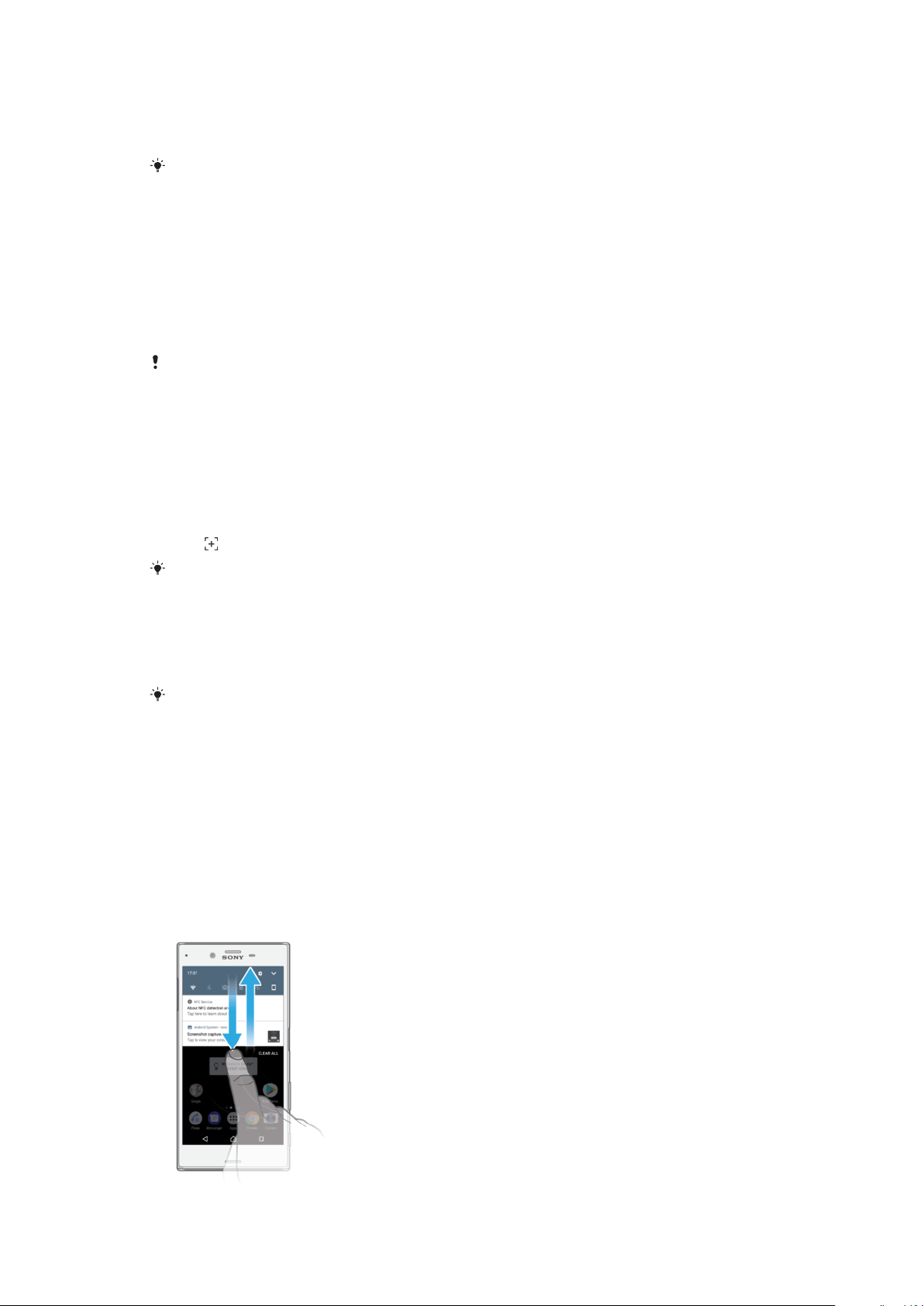
To Open or Close the Notification Panel
28
This is an internet version of this publication. © Print only for private use.

1
To open the Notification panel, drag the status bar downward, or simply double-
tap it.
2
To close the Notification panel, drag or flick the panel upward.
After opening the Notification panel, you can access the Quick Settings panel by dragging the
status bar down again.
To Take Action on a Notification in the Notification Panel
•
Tap the notification.
You can directly reply to chat or email messages in the Notification panel.
To Dismiss a Notification from the Notification Panel
•
Swipe the notification left or right.
Not all notifications can be dismissed.
To change settings for notifications, simply drag the notification slowly to the left or right, then
tap .
To Expand a Notification on the Notification Panel
•
Simply tap to expand and view more information about the notification without
opening the app.
Not all notifications are expandable.
To Clear All Notifications from the Notification Panel
•
Tap
CLEAR ALL
.
To Take Action on a Notification from the Lockscreen
•
Double-tap the notification.
To Dismiss a Notification from the Lockscreen
•
Swipe the notification left or right.
To Expand a Notification on the Lockscreen
•
Drag the notification downward.
Not all
notifications are expandable.
Managing Notifications on the Lockscreen
Show all notification
content
Get all notifications on the lockscreen. When you have this setting turned on, keep in
mind that all content (including the content of incoming email and chat messages) will
be visible on your lockscreen unless you designate the relevant apps as Hide sensitive
content in the App notifications settings menu.
Hide sensitive
notification content
You must have a PIN, password, or pattern set up as your screen lock in order for this
setting to be available. Contents hidden is displayed on the lockscreen when sensitive
notifications arrive. For example, you'll get a notification for an incoming email or chat,
but the content won't be visible on your lockscreen.
Don't show
notifications at all
You won't get any notifications on the lockscreen.
29
This is an internet version of this publication. © Print only for private use.
To Select the Notifications to Display on the Lockscreen
1
From your Home screen, tap .
2
Find and tap Settings > Notifications.
3
Tap , and then tap On the lock screen.
4
Select an option.
You can keep notifications on the lockscreen until you swipe to dismiss them. To enable this
feature, tap the Keep notifications on lock screen slider.
Setting the Notification Level for an App
Block all
Never receive notifications from the selected app.
Sounds and vibrations off
Receive notifications but without sound, vibration, or peeking into view.
Interrupts Priority only
Receive notifications from this app even when Do not disturb is set to Priority
only.
To Set the Notification Level for an App
1
From your Home screen, tap
.
2
Find and tap Settings > Notifications.
3
Select the desired app.
4
Tap the sliders to adjust notification settings as desired.
Notification Light
The notification light informs you about battery status and some other events. For
example, a flashing white light means there is a new message or a missed call. The
notification light is enabled by default but can be disabled manually.
When the
notification light is disabled, it only lights up when there is a battery status warning,
such as when the battery level falls below 15 percent.
To Enable or Disable the Notification Light
1
From your Homescreen, tap .
2
Find and tap
Settings
>
Notifications
> .
3
Tap the slider beside Notification light to enable or disable the function.
Icons in the status bar
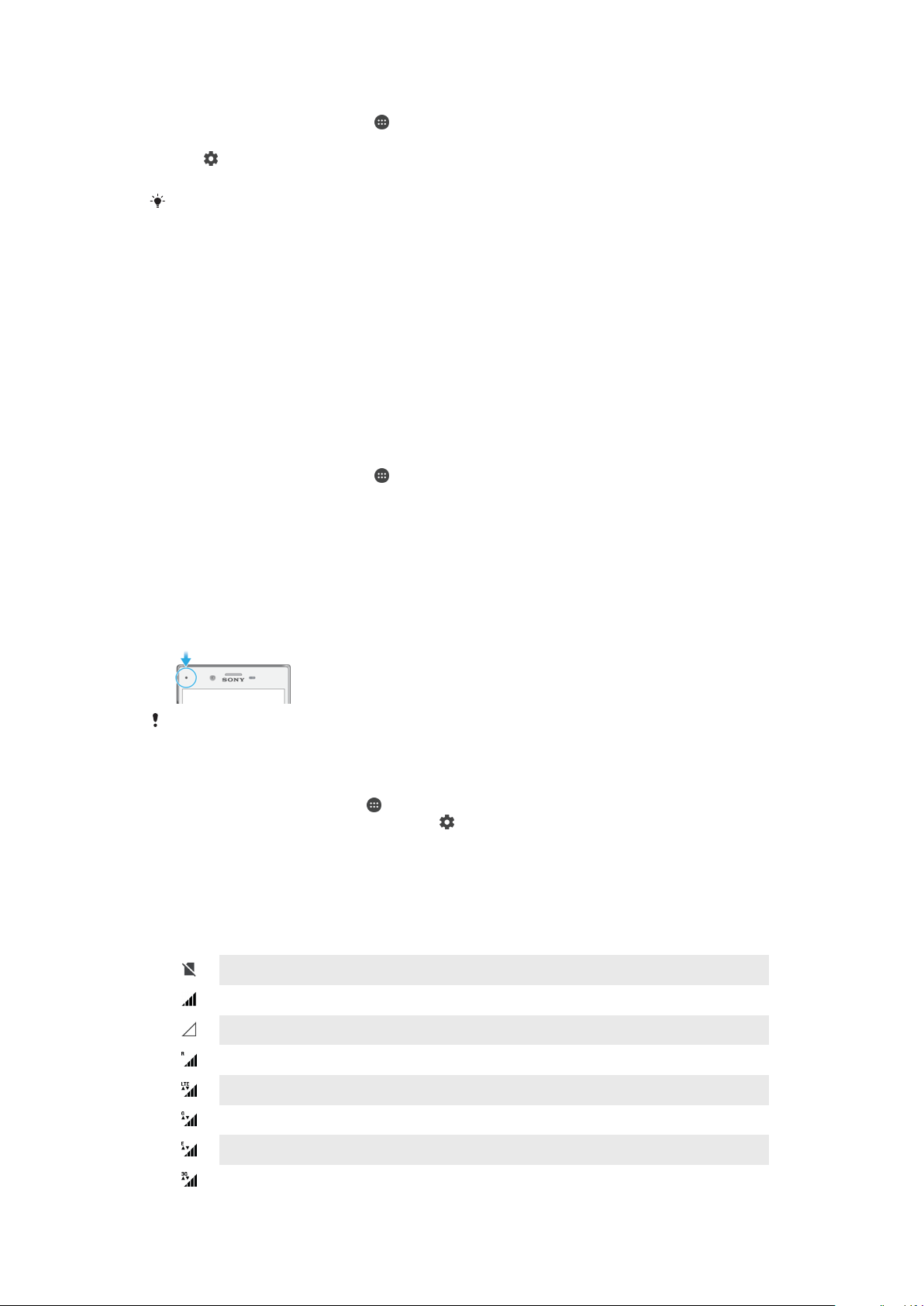
Status icons
No SIM card
Signal strength
No signal
Roaming
Sending and downloading LTE data
Sending and downloading GPRS data
Sending and downloading EDGE data
Sending and downloading 3G data
30
This is an internet version of this publication. © Print only for private use.
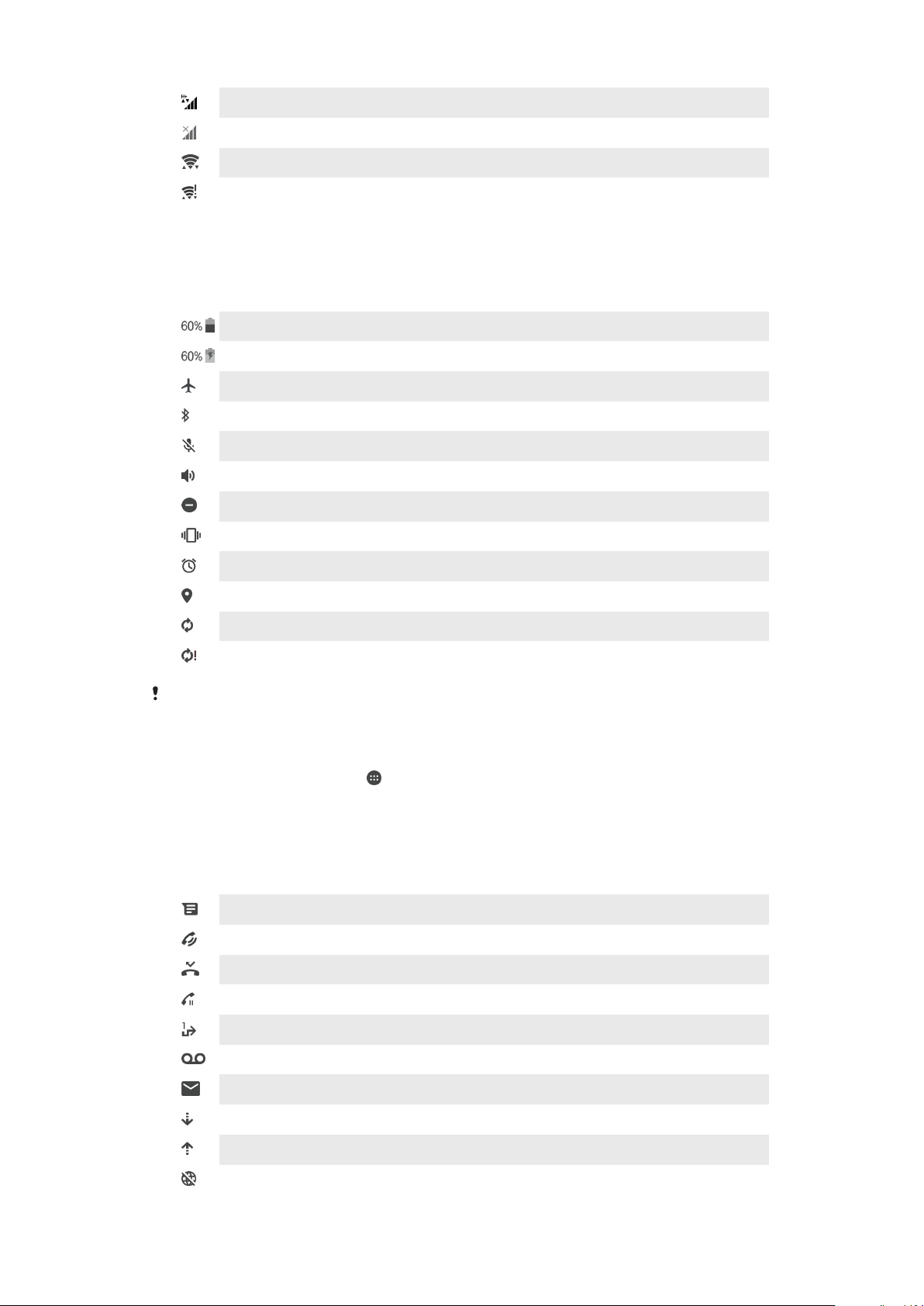
Sending and downloading HSPA+ data
Cellular data is disabled
A Wi-Fi connection is enabled and data is being transmitted
A Wi-Fi connection is enabled but there is no internet connection.
This icon also appears when you are trying to connect to a secured Wi-Fi
network. After successful login, the exclamation point disappears.
If Google™ is blocked in your area, the exclamation point may appear even
when the device is connected to a Wi-Fi network and there is a working internet
connection.
Battery status
The battery is charging
Airplane mode is activated
The Bluetooth® function is activated
The microphone is muted
The speakerphone is on
Do Not Disturb mode is activated
Vibrate mode
An alarm is set
GPS is activated
Synchronization is ongoing
Problem with sign-in or synchronization
Depending on your service provider, network, or region, the functions or services represented
by some icons in this list may not be available.
To Manage Status Bar Icons
1
From your Homescreen, tap .
2
Find and tap Settings > Display > System icons.
3
Mark the checkboxes for the system icons that you want to appear in the status
bar.
Notification Icons
New text message or multimedia message
Ongoing call
Missed call
Call on hold
Call forwarding is turned on
New voicemail message
New email message
Downloading data
Uploading data
Cellular data is disabled
31
This is an internet version of this publication. © Print only for private use.
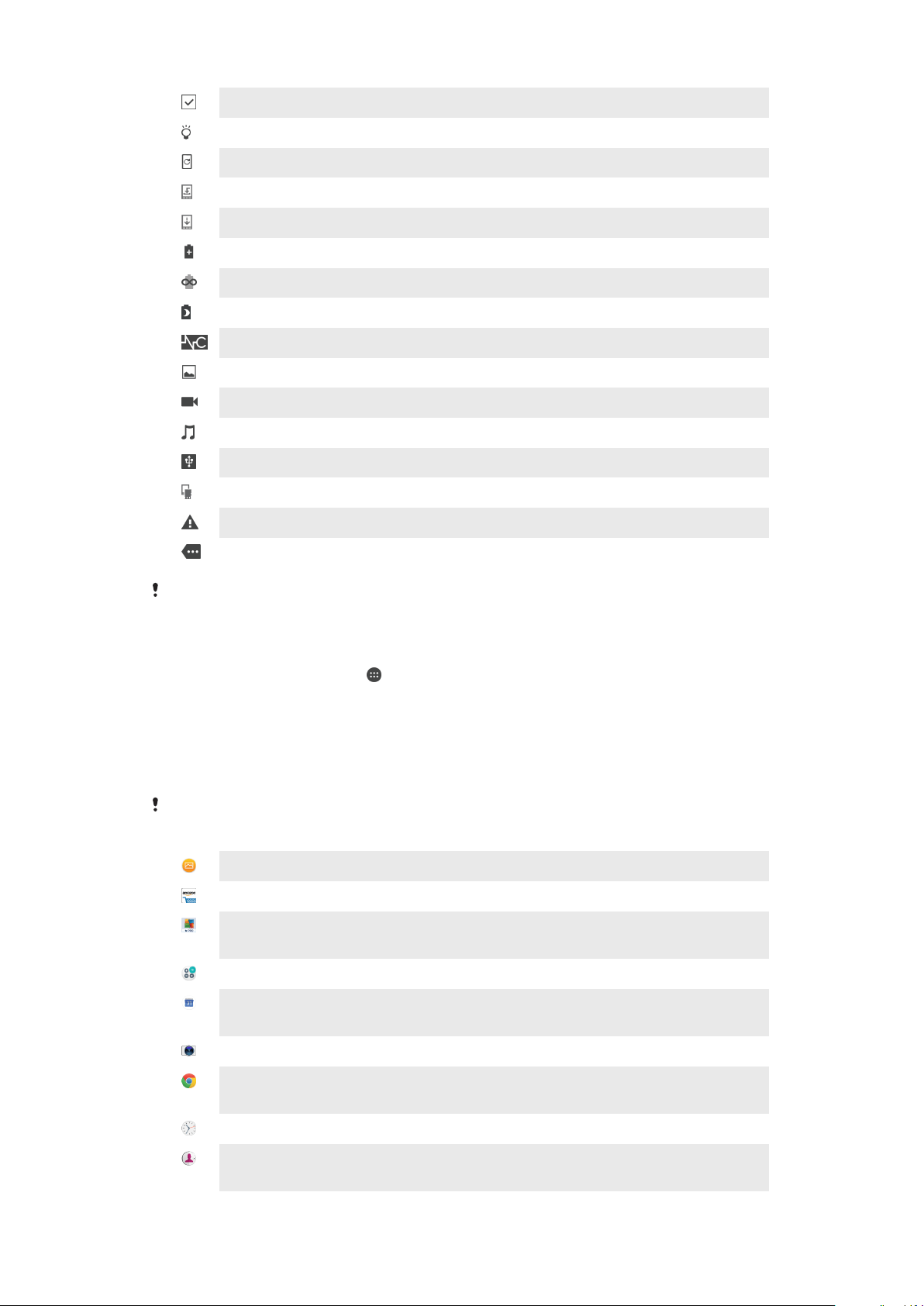
Perform a basic setup of your device
A software update is available
System updates are available
Downloading system updates
Tap to install the downloaded system updates
STAMINA mode is activated
Ultra STAMINA mode is activated
Battery Care is activated
Noise canceling is on
Screenshot captured
Video chat with friends using the Duo™ application
A song is playing
The device is connected to a computer via a USB cable
Internal storage is 75% full — tap to transfer data to a memory card
Warning
More undisplayed notifications
Not all icons that may appear on your device are listed here. This list is for reference purposes
only, and changes may be made without notice.
To Block an Application from Sending Notifications
1
From your Homescreen, tap .
2
Find and tap Settings > Notifications.
3
Select an application.
4
Tap the Block all slider.
Applications Overview
Some applications may not be included on your device or may not be supported by all
networks or service providers in all areas.
Use the Album application to manage, view, and edit your photos and videos.
Browse, search, and buy thousands of products right from your device.
Protect your device against viruses, malware, spyware, phishing attempts, and
online exploitation.
Use the Calculator application to perform basic calculations.
Use the Calendar application to keep track of events and manage your
appointments.
Use the camera to take photos and record video clips.
Use the Chrome web browser to navigate and view web pages and manage
bookmarks, text, and images.
Use the Clock application to set various kinds of alarms and timers.
Use the Contacts application to manage phone numbers, email addresses, and
other information related to your contacts.
32
This is an internet version of this publication. © Print only for private use.
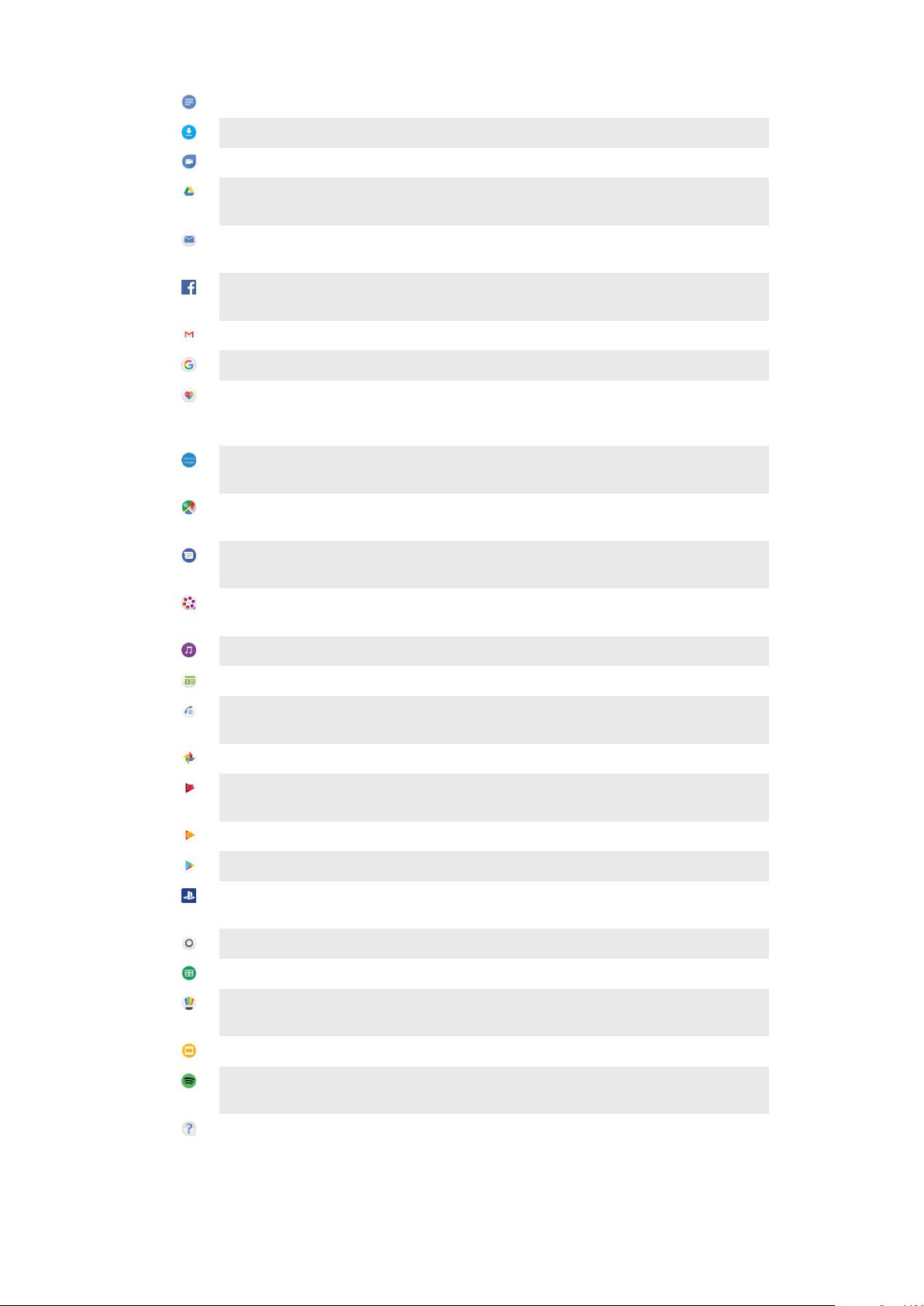
Create, edit, and collaborate with others on documents.
Access your downloaded applications, documents, and pictures.
Use the Duo™ application to make video calls.
Save your documents and files for easy access from any device, share them with
your friends, and collaborate with coworkers.
Use the Email application to send and receive emails through both personal and
work accounts.
Use the Facebook™ application for social networking with friends, family
members, and coworkers around the world.
Use the Gmail™ application to read, write, and organize email messages.
Search for information on your device and on the web.
Use the Lifelog application to automatically log events about your daily life. For
example, you can set goals and track your progress in achieving them, or
bookmark special moments.
Enjoy music, movies, apps, and games on your device, and get exclusive access
to unique content available only with Xperia™ devices.
View your current location, find other locations, and calculate routes using
Google Maps™.
Use the Messenger application to send and receive text and multimedia
messages.
The Xperia™ Movie Creator automatically creates short video collages using your
existing photo and video collection.
Use the Music application to organize and play music and audio books.
View news stories from News Suite.
Make phone calls by dialing the number manually or by using the smart dial
function.
Organize, search, or browse through all your photos and videos.
Use the Google Play Movies & TV application to watch movies and TV shows
purchased or rented on Google Play.
Discover and play thousands of songs with the Google Play Music application.
Use the Play Store™ application to find applications to buy or download for free.
Stay connected with your gaming friends and the games you love to play, shop
on the PlayStation® Store, and more.
Optimize settings to suit your own requirements.
Create, edit, and collaborate with others on spreadsheets.
Use the Sketch application to create and explore images, then share them with
your friends.
Create, edit, and collaborate with others on presentations.
Stream music, browse through your friend's collections or through artist's
discographies, or create your own radio station.
Use the Support application to access user support on your device. For
example, you can access a User Guide, troubleshooting information, plus tips
and tricks.
33
This is an internet version of this publication. © Print only for private use.

Use the Video application to play videos on your device and share content with
your friends.
Search content on the web using your voice.
Use the Weather application to view weather forecasts.
Use the What’s New application to discover new games, apps, and media
content.
Use YouTube™ to watch videos from users around the world, and share your
own.
34
This is an internet version of this publication. © Print only for private use.
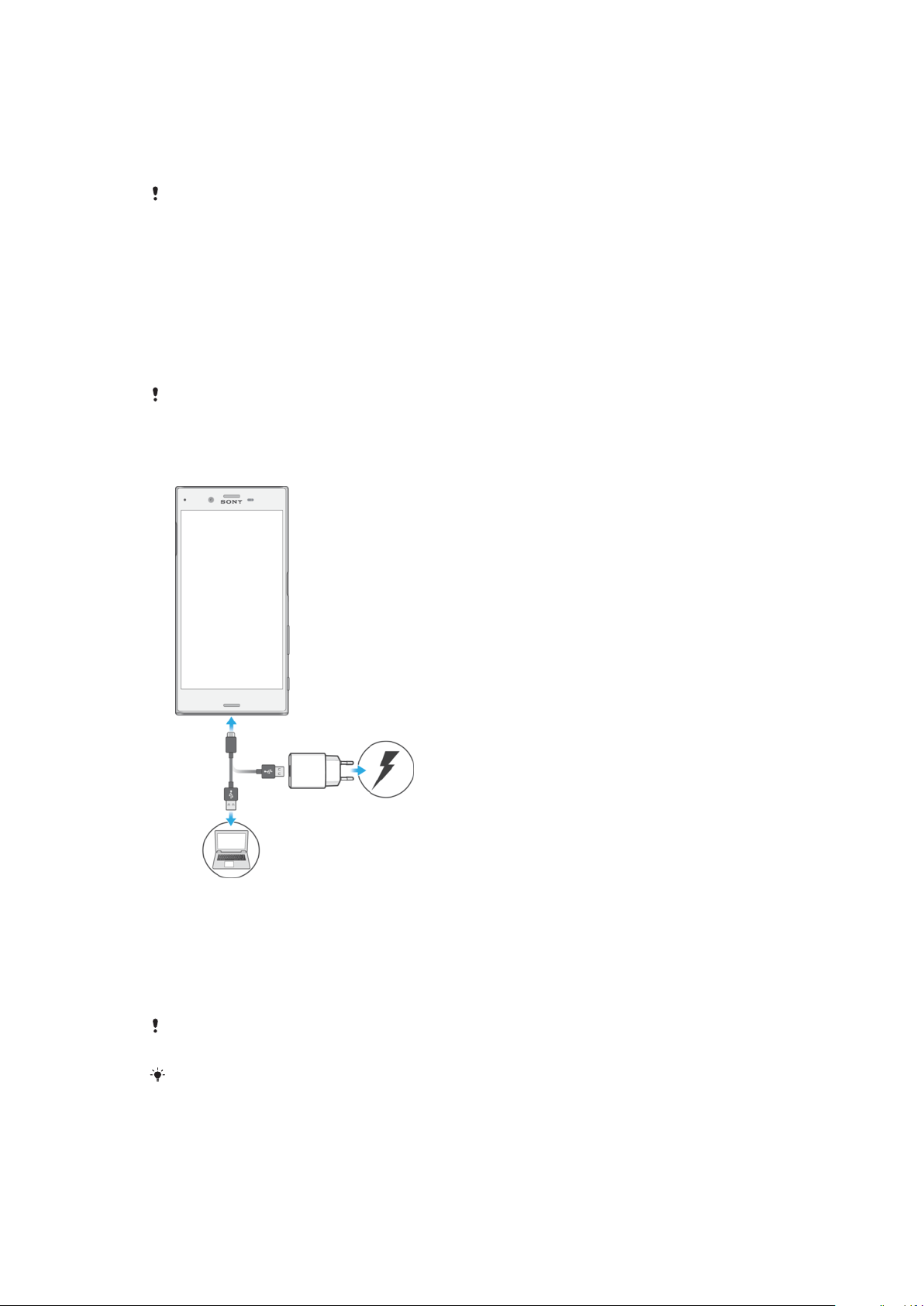
Battery and Maintenance
Charging Your Device
Always use an original Sony charger and USB Type-C™ cable intended for your specific
Xperia™ model. Other chargers and cables may increase charging time, not charge at all, or
may even damage your device. Make sure all USB ports and connectors are completely dry,
before inserting the USB Type-C™ cable.
A wall socket charger will charge your device faster than charging via your computer. You
can still use your device while charging.
If the battery is depleted, it may take up to 30 minutes for your device to respond to the
charging. During this time, the screen may remain completely dark, not showing the
charging icon. Also note that it can take up to 4 hours for a completely drained battery to
charge fully.
Your device has an embedded, rechargeable battery that can only be replaced by an
authorized Sony repair center. You should never try to open or take apart the device yourself.
Doing so can cause damage and void your warranty.
To Charge Your Device
1
Plug the charger into a power outlet.
2
Plug one end of the USB Type-C™ cable into the charger (or into the USB port of
a computer).
3
Plug the other end of the cable into the USB Type-C™ port on your device. The
notification light illuminates when charging begins.
4
When the device is fully charged, disconnect the cable from your device by pulling
it straight out. Make sure not to bend the connector.
It is important to use the USB Type-C™ cable (provided) when charging your device as other
types of USB cables can damage your device.
If the battery is completely depleted, it may take a few minutes before the notification light
illuminates and the charging icon appears.
35
This is an internet version of this publication. © Print only for private use.

Battery Notification Light Status
Green The battery is charging and the battery charge level is greater than 90%
Orange The battery is charging and the battery charge level is less than 90%
Red The battery is charging and the battery charge level is less than 15%
Battery and Power Management
Your device has an embedded battery. To get the most use from it, keep track of the
power consumed by different apps and features. You can also use Battery Care to
increase the battery’s lifetime. Background power-saving features are activated by default
to help you reduce battery consumption, and additional power saving modes are
available to help you reduce battery consumption further when necessary.
Power-saving features lower the priority for certain non-essential device functions, such
as higher-grade image performance, network activities such as location services, app
synchronization and background Wi-Fi scanning. If you do not want an application to be
affected, you can exempt it in the Battery Optimization menu. Phone calls and SMS are
not affected.
System updates may change the power saving features available on your device.
To View Battery Consumption, Estimated Time, and Power-Saving Tips
1
From your
Home screen
, tap .
2
Find and tap Settings > Battery. An overview appears showing the battery
percentage and an estimated battery time.
3
Tap SHOW BATTERY USAGE to view a list of features and services that have
consumed battery power since the last charging cycle. Tap an item to get
information on how to reduce its battery consumption.
To View Battery Consumption For Applications
1
From your Home screen, tap .
2
Find and tap
Settings
>
Apps
.
3
Select an application and review its battery consumption under Battery usage.
General Usage Tips to Improve Battery Performance
The following tips can help you improve battery performance:
•
Lower the screen brightness level, see
Screen settings
on page 58.
•
Turn off Bluetooth®, Wi-Fi, and location services when you don't need these
features.
•
Turn off your device or use Airplane mode if you are in an area with no or low
network coverage. Otherwise, your device repeatedly scans for available
networks, and this consumes power.
•
Use a Wi-Fi network instead of roaming when abroad. Roaming is scanning for
your home network and puts additional demands on your battery as your device
must transmit with a higher output power, see
Wi-Fi
on page 47.
•
Change the synchronization settings for your email, calendar, and contacts, see
Synchronizing with Online Accounts
on page 54.
•
Check the applications that have a high battery consumption and consider the
battery saving tips provided on your device for these applications.
•
Change the notification level for an application, see
Notifications
on page 28.
•
Turn off the location-sharing permission for an application, see
Application
settings
on page 60.
•
Uninstall applications that you are not using, see
Application screen
on page 23.
•
Use a Sony original handsfree device to listen to music. Handsfree devices
consume less battery than your device's loudspeakers.
•
Restart your device every now and then.
36
This is an internet version of this publication. © Print only for private use.

To Make Exceptions to Power Saving Features for Apps
1
From your Home screen, tap .
2
Find and tap Settings > Battery.
3
Tap and select Battery optimization. You will see a list of applications that are not
optimized.
4
To add or remove applications from this list, tap APPS and select or de-select an
application from the list to edit its optimization settings.
5
The list of applications that are not optimized will get updated according to your
settings.
You cannot exempt applications from being optimized by Ultra STAMINA mode.
You can also configure Battery optimization from Settings > Apps > > Special access.
STAMINA Mode
Depending on the STAMINA level, different features will be restricted or disabled in order
to reduce battery consumption. These include rendering performance, animation and
screen brightness, image enhancement, background app data syncing, vibration (except
for incoming calls), streaming, and GPS (while the screen is off).
appears in the status
bar.
If you are sharing a device with multiple users, you may need to log in as the owner, that is, the
primary user, to activate or deactivate STAMINA mode.
To Activate or Deactivate STAMINA Mode
1
From your
Home screen
, tap .
2
Find and tap Settings > Battery.
3
Tap
STAMINA mode
and tap the slider to activate or deactivate the function.
When STAMINA mode is activated you can select additional options, for example
you can adjust the Auto-start percentage according to your preferences.
You can exempt applications from being optimized by STAMINA mode in the Battery
Optimization menu.
Ultra STAMINA Mode
Your battery time is extensively prolonged, but available apps are limited, and mobile
data and Wi-Fi are disabled. Calling and SMS are still available. Your Home screen is
changed and appears in the status bar.
If you are sharing a device with multiple users, you may need to log in as the owner, that is, the
primary user, to activate or deactivate Ultra STAMINA mode.
To activate Ultra STAMINA mode
1
From your Home screen, tap .
2
Find and tap Settings > Battery.
3
Tap Ultra STAMINA mode, and then tap Activate.
4
Confirm to activate.
You cannot exempt applications from being optimized by Ultra STAMINA mode.
To Deactivate Ultra STAMINA Mode
1
Drag down the status bar to access the Notification panel.
2
Tap Deactivate Ultra STAMINA mode.
3
Tap OK.
Deactivating Ultra STAMINA mode will restart your device.
37
This is an internet version of this publication. © Print only for private use.

Battery Care
Use Battery Care to increase the lifespan of your battery. This feature detects your
charging patterns and estimates the start and end times of your regular charging period.
The rate of charging is controlled so that your battery reaches 100% just before you
disconnect the charger.
Battery Care will not control the charging rate until it detects a regular charging cycle of at least
4 hours over a period of several days.
To Enable or Disable Battery Care
1
From your Home screen tap , then find and tap Settings.
2
Tap Battery, then tap Battery Care.
3
Tap the slider to enable or disable Battery Care.
Learned patterns of the regular charging cycle are saved by Battery Care. Even if the function
has been disabled, it adopts to the learnt patterns after enabling the function again.
Updating your device
You should update the software on your device to get the latest functionality,
enhancements, and bug fixes in order to ensure optimal performance. When a software
update is available, appears in the status bar. You can also check for new updates
manually, or schedule an update.
The easiest way to install a software update is to do it wirelessly from your device.
However, some updates are not available for wireless download. You then need to use
the Xperia™ Companion software on a PC or on an Apple
®
Mac
®
computer to update
your device.
Before updating your device, consider the following:
•
Ensure you have sufficient storage capacity before attempting to update.
•
If you are using a device with multiple users, you must log in as the owner, that is, the
primary user, to update the device.
•
System and application updates can present the features on your device in another way
than described in this User Guide. The Android™ version might not be affected after an
update.
For more information about software updates, go to
http://support.sonymobile.com/
software/
.
To Check for New Software
1
If you are using a device with multiple users, make sure you are logged in as the
owner.
2
From your
Home screen
, tap
.
3
Find and tap Settings > About phone > Software update.
If no new software is available, it’s possible that you may not have enough free memory on
your device. If your Xperia™ device has less than 500 MB of free internal memory available,
you do not receive any information about new software. In this case, you receive a warning in
the Notification panel:
“Storage space running out. Some system functions may not work.”
If you receive this notification, you must free up internal memory to get notifications about new
available software.
Updating Your Device Wirelessly
Use the Software update application to update your device software wirelessly. The
updates you can download over a cellphone network depend on your service provider. It
is recommended to use a Wi-Fi network instead of a cellphone network to download
new software so you can avoid data traffic costs.
38
This is an internet version of this publication. © Print only for private use.

To Install a System Update
1
If you are sharing a device with multiple users, make sure you are logged in as the
owner.
2
From your Home screen, tap .
3
Find and tap Settings > About phone > Software update.
4
If a system update is available, tap CONTINUE, then tap INSTALL NOW.
To Schedule a System Update
1
If you are sharing a device with multiple users, make sure you are logged in as the
owner.
2
From your Home screen, tap
.
3
Find and tap Settings > About phone > Software update.
4
If a system update is available, tap CONTINUE, then tap the Schedule
installation slider.
5
Tap OK > Set time.
6
Set the desired time for the software update, then tap OK.
7
Your device will be updated at the set time automatically.
To Set Up Automatic Download of System Updates
1
From your Home screen, tap
.
2
Find and tap Settings > About phone > Software update.
3
Tap , then tap
Settings
>
Auto download system updates
.
4
Select an option.
To Enable or Disable Automatic Updates for Applications
1
From your
Home screen
, tap .
2
Find and tap Settings > About phone > Software update.
3
Tap , then tap
Settings
>
Auto update apps
.
4
Select the preferred option.
To Update Your Device Using a Computer
1
Using a USB Type-C™ cable, connect your device to the computer.
2
Make sure the screen of your device is unlocked, and the USB connection mode
on the device is set to Transfer files.
3
Open Xperia™ Companion, if it is not automatically launched.
4
Make sure the computer can access the internet.
5
Computer
: If a new software update is detected, a popup window appears.
Follow the on-screen instructions to run the relevant software updates.
If you don’t have the Xperia™ Companion software installed on the relevant computer, connect
your device to the computer and follow the on-screen installation instructions. Make sure you
are using the USB Type-C cable that came with your device and it is properly connected to the
device and computer.
Maintenance Using a Computer
Xperia™ Companion
Xperia™ Companion is a software service which provides a collection of tools and
applications you can use when you connect your device to a computer. With Xperia™
Companion, you can:
•
Update or repair your device’s software.
•
Transfer your content from an old device using Xperia™ Transfer.
•
Back up and restore content on your computer.
•
Sync multimedia content—photos, videos, music, and playlists—between your device
and computer.
•
Browse files on your device.
To use Xperia™ Companion, you need an internet-connected computer running one of
the following operating systems:
39
This is an internet version of this publication. © Print only for private use.
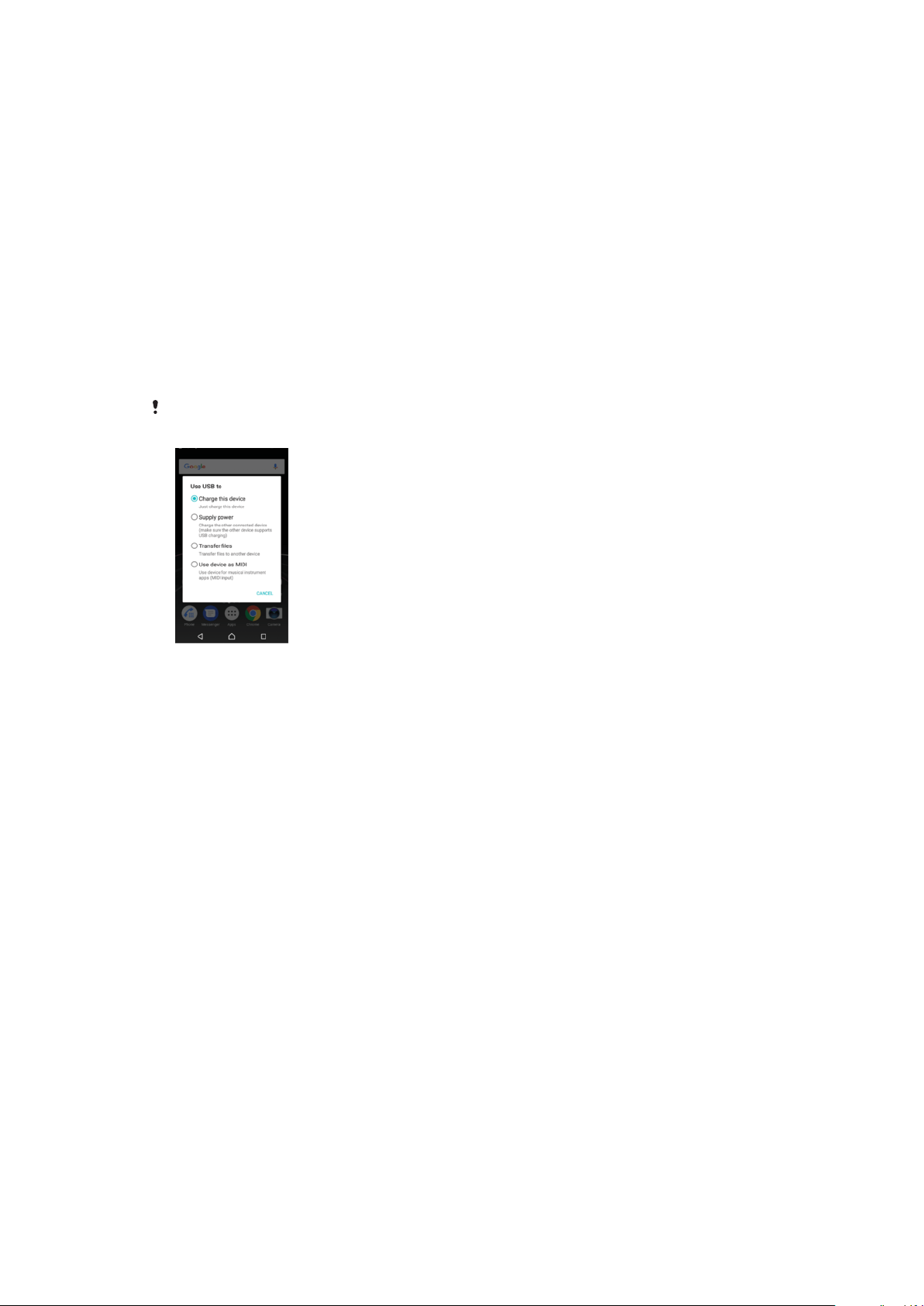
•
Microsoft® Windows® 7 or later
•
Mac OS® X 10.11 or later
Learn more and download Xperia™ Companion for Windows or Mac at
http://support.sonymobile.com/global-en/xperia-companion/
.
Managing Files Using a Computer
Use a USB Type-C™ cable connection between a Windows
®
computer and your device
to transfer and manage your files.
Once the two devices are connected, you can choose if you want to charge your device,
transfer files, use it as a power supply, or use it for MIDI input. Your computer will detect
your device when you select the Transfer files connection mode. The default connection
mode is set to Charge this device.
With Xperia™ Companion you can access the file system of your device. If you do not
have Xperia™ Companion installed, you are requested to install it when you connect your
device to the computer.
Always use a USB cable intended for your specific Xperia™ model and make sure it is
completely dry.
USB Connection Mode
You can use the Transfer files connection mode for managing files and updating device
software. This USB mode is used with Microsoft
®
Windows
®
computers. Charging is
enabled by default.
You can also use your device as a Supply power, and charge the other connected
device. Make sure the other device supports USB charging.
Using the Use device as MIDI mode, your device can function as a MIDI input for
musical instrument apps.
To Change USB Connection Mode
1
Attach a USB Type-C™ connector to your device.
2
Drag down the status bar, and then tap Charge this device.
3
Tap Transfer files, Supply power, or Use device as MIDI to enable the desired
mode.
Storage and Memory
Your device has several different storage and memory options.
•
The
internal storage
is about 64 GB and is used to store downloaded or transferred content along with
personal settings and data. Some examples of data saved to internal storage are alarm,
volume, and language settings; emails; bookmarks; calendar events; photos; videos and
music.
•
You can use a removable
memory card
40
This is an internet version of this publication. © Print only for private use.

with a storage capacity of up to 200 GB to get more storage space. Media files and
some apps, along with their associated data, can be moved to this type of memory to
free up internal storage. Some apps, for example, the Camera app, can save data
directly to a memory card.
•
The
dynamic memory (RAM)
is about 4 GB and cannot be used for storage. RAM is used to handle running
applications and the operating system.
You may have to purchase a memory card separately.
Read more about the use of memory in Android devices by downloading the White paper for
your device at
www.sonymobile.com/support/
.
Improving Memory Performance
Your device memory tends to fill up as a result of normal usage. If the device starts to
slow down, or applications suddenly shut down, you should consider the following:
•
Always try to keep at least 500 MB of free internal storage available.
•
Close running applications that you are not using.
•
Clear the cache memory for all applications.
•
Uninstall downloaded applications that you don't use.
•
Move applications to the memory card if the internal storage is full.
•
Transfer photos, videos, and music from the internal memory to the memory card.
•
If your device can't read content on the memory card, you may need to format the card.
Note that all content on the card gets erased when you format it.
If you are sharing a device with multiple users, you must log in as the owner, that is, the
primary user, to be able to perform certain actions, such as transferring data to the memory
card and formatting the memory card.
To View the Memory Status
1
From your Home screen, tap .
2
Find and tap
Settings
>
Storage & memory
.
To View the Amount of Free and Used RAM
1
From your
Home screen
, tap .
2
Find and tap Settings > Storage & memory.
3
Tap , then tap
Advanced
>
Memory
.
To Clear the Cache Memory for All Applications
1
From your
Home screen
, tap
.
2
Find and tap Settings > Storage & memory.
3
Tap , then tap
Advanced
>
Storage
, then find and tap
Cached data
>
OK
. If you
have a memory card inserted, select Internal shared storage after tapping
Storage.
When you clear the cache memory, you don't lose any important information or settings.
To Transfer Media Files to the Memory Card
1
Make sure you have a memory card inserted in your device.
2
From your Home screen, tap
.
3
Find and tap Settings > Storage & memory > Transfer data.
4
Mark the files that you want to transfer to the memory card.
5
Tap Transfer.
To Stop Applications and Services from Running
1
From your Home screen, tap .
2
Find and tap Settings > Apps.
3
Select an application or service, and then tap FORCE STOP > OK.
41
This is an internet version of this publication. © Print only for private use.

To format the memory card
1
From your Home screen, tap .
2
Find and tap Settings > Storage & memory.
3
Tap , tap Advanced > Storage > SD Card > , and then tap Storage settings >
Format > Erase & format.
All content on the memory card gets erased when you format it. Make sure you first make
backups of all data you want to save. To back up your content, you can copy it to a computer.
For more information, see
Managing Files Using a Computer
on the 40 page.
Smart Cleaner
Using Smart cleaner, you can improve device performance by automatically optimizing
storage and memory depending on the frequency of app use.
To Enable or Disable Smart Cleaner
1
From your Home screen, tap .
2
Find and tap Settings > Storage & memory.
3
Tap the slider beside Smart cleaner.
You can also modify, copy or delete files manually if you go to Settings > Storage & memory >
> Advanced > Storage > Explore
Backing Up and Restoring Content
Generally, you should not save photos, videos, and other personal content solely on the
internal memory of your device. If your device is damaged, lost or stolen, the data stored
on its internal memory may be impossible to recover. It is recommended to use the
Xperia™ Companion software to make backups which save your data safely to an
external device. This method is especially recommended if you are updating your device
software to a newer Android version.
The Xperia™ Backup & Restore application is recommended for backing up data before
you do a factory data reset. With this application you can back up data to an online
account, an SD card or to an external USB storage device that you have connected to
your device using a USB host adapter:
With the Google Backup & Restore application, you can back up data to a Google
server.
Backing up Data to a Computer
Use the Xperia™ Companion software to back up data from your device to a PC or an
Apple
®
Mac
®
computer. You can back up the following types of data:
•
Call logs
•
Text messages
•
Calendar
•
Settings
•
Media files such as music and videos
•
Photos and images
To Back Up Your Data Using a Computer
1
Unlock the screen of your device and connect it to the computer using a USB
Type-C™ cable.
2
Open the Xperia™ Companion software on your computer if it is not automatically
launched. After a few moments, the computer detects your device. Make sure to
select Transfer files mode on your device.
3
Click on Backup on the Xperia™ Companion main screen.
4
Follow the on-screen instructions to back up data from your device.
If you do not have Xperia™ Companion installed, you are requested to install it when you
connect your device to the computer.
42
This is an internet version of this publication. © Print only for private use.

To Restore Your Data Using a Computer
1
Unlock the screen of your device and connect it to the computer using a USB
Type-C™ cable.
2
Open the Xperia™ Companion software on your computer if it is not automatically
launched. After a few moments, the computer detects your device. Make sure to
select Transfer files mode on your device.
3
Click on Restore on the Xperia™ Companion main screen.
4
Select a backup file from the backup records, then click on Next and follow the
on-screen instructions to restore data to your device.
If you do not have Xperia™ Companion installed, you are requested to install it when you
connect your device to the computer.
Backing up Data with the Xperia™ Backup & Restore Application
Using the Xperia™ Backup & restore application, you can make an online or a local data
backup. You can do so manually or turn on the automatic backup function to save data
periodically.
The Xperia™ Backup & restore application is recommended for backing up data before
you do a factory data reset. With this application, you can back up the following types of
data to an online account, to an SD card, or to an external USB storage device that you
have connected to your device using a USB host adapter:
•
Contacts
•
Conversations
•
Call Log
•
Calendar
•
Email Accounts
•
Wi-Fi Accounts
•
Device Settings
•
Applications
•
Xperia™ Home layout
To Set Up the Automatic Backup Function
1
If you are backing up content to a USB storage device, make sure the storage
device is connected to your device using a USB host adapter. If you are backing
up to an SD card, make sure the SD card is properly inserted in your device. If you
are backing up content to an online account, make sure you have signed in to
your Google ™ account.
2
From your Home screen, tap
.
3
Find and tap
Settings
>
Backup & reset
.
4
Under Xperia™ Backup & restore, tap Automatic backup.
5
To enable the automatic backup function, tap the on-off switch.
6
Select where to save backup files.
7
If desired, select a backup frequency, when to back up, and the specific data to
back up. Otherwise the backup is completed according to the default settings.
8
To save your settings, tap
.
To Back Up Content Manually
1
If you are backing up content to a USB storage device, make sure the storage
device is connected to your device using a USB host adapter. If you are backing
up to an SD card, make sure the SD card is properly inserted in your device. If you
are backing up content to an online account, make sure you have signed in to
your Google ™ account.
2
From your Home screen, tap
.
3
Find and tap Settings > Backup & reset.
4
Under Xperia™ Backup & restore, tap More.
5
Tap Manual backup, then select a backup destination and the data you want to
back up.
6
Tap Backup.
7
After the data is backed up, tap Finish.
43
This is an internet version of this publication. © Print only for private use.

To Edit a Backup File
1
From your Home screen, tap .
2
Find and tap Settings > Backup & reset.
3
Under Xperia™ Backup & restore, tap More.
4
Tap Edit backup file, then select a backup source and the data types you want to
delete.
5
Tap Delete data.
6
Tap OK to confirm.
7
After the data is deleted, tap Finish.
To Restore Backed Up-Content
1
If you are restoring content from a USB storage device, make sure the storage
device is connected to your device using the USB Host adapter. If you are
restoring content from an SD card, make sure the SD card is properly inserted in
your device. If you are restoring content from the Xperia Backup & Restore
service, make sure you have signed in to your Google™ account.
2
From your Home screen, tap
.
3
Find and tap Settings > Backup & reset.
4
Under Xperia™ Backup & restore, tap Restore data, then select a restore source
and the data you want to restore.
5
Tap Restore data.
6
After the content is restored, tap Finish.
Remember that any changes you make to your data and settings after you create a backup,
such as any new apps you install, get deleted during any subsequent restore procedures.
Backing Up Data With the Google Backup & Restore Application
Using the Google Backup & restore application, you can back up data to a Google
server. You can also turn on the automatic restore function to restore application data
and settings when you reinstall an application.
With this application you can back up the following types of data:
•
Applications
•
Bookmarks
•
Wi-Fi networks
•
Other settings
To Back Up Data to a Google™ Account
1
From your
Home screen
, tap
.
2
Find and tap Settings > Backup & reset.
3
Under
Google™ Backup & restore
, tap
Back up my data
, then tap the slider.
To Enable or Disable Automatic Restore when you Reinstall an Application
1
From your Home screen, tap
.
2
Find and tap Settings > Backup & reset.
3
Under Google™ Backup & restore, tap the Automatic restore slider.
44
This is an internet version of this publication. © Print only for private use.

Downloading applications
Downloading Applications from Google Play™
Google Play™ is the official online Google store for downloading applications, games,
music, movies, and books. It includes both free and paid applications. Before you start
downloading from Google Play™, make sure you have a working internet connection,
preferably over Wi-Fi to limit data traffic charges.
To use Google Play™, you need to have a Google™ account. Google Play™ may not be
available in all countries or regions.
To Download an Application from Google Play™
1
From the Home screen, tap .
2
Find and tap Play Store.
3
Find an item you wish to download by browsing categories, or by using the search
function.
4
Tap the item to view its details, and follow the instructions to complete the
installation.
Some applications may need to access data, settings, and various functions on your device in
order to work properly. Only install and give permissions to applications you trust. You can
view the permissions granted to a downloaded application and also change their status by
tapping the application under Settings > Apps.
Downloading Applications from Other Sources
When your device is set to allow downloads from sources other than Google Play™, you
can download applications directly from other websites by following the relevant
download instructions.
Installing applications of unknown or unreliable origin can damage your device. Download
applications only from reliable sources. Contact the application provider if you have any
questions or concerns.
If you are using a device with multiple users, only the owner, that is, the primary user, can
allow downloads from sources other than Google Play™. Changes made by the owner affect
all other users.
To Enable or Disable the Downloading of Applications from Other Sources
1
From your
Home screen
, tap .
2
Find and tap Settings > Lock screen & security.
3
Tap the
Unknown sources
slider.
4
Tap OK.
Some applications may need to access data, settings, and various functions on your device in
order to work properly. Only install and give permissions to applications you trust. You can
view the permissions granted to a downloaded application and also change their status by
tapping the application under Settings > Apps.
45
This is an internet version of this publication. © Print only for private use.

Internet and networks
Browsing the web
The Google Chrome™ web browser for Android™ devices comes pre-installed in most
markets. Go to
http://support.google.com/chrome
and click the "Chrome for Mobile" link
to get more detailed information about how to use this web browser.
To Browse the Web
1
From your Home screen, tap
.
2
Find and tap .
3
If you are using Google Chrome™ for the first time, select to either sign in to a
Google™ account or browse with Google Chrome™ anonymously.
4
Enter a search term or web address in the search and address field, then tap
on the keyboard.
Internet and MMS Settings
To send multimedia messages, or to access the internet when there is no available Wi-Fi
network, you must have a working cellular data connection with the correct internet and
MMS (Multimedia Messaging Service) settings. Here are some tips:
•
For most cellphone networks and service providers, internet and MMS settings come
pre-installed on your device. You can then start using the internet and send multimedia
messages right away.
•
It is possible to download these settings via Wi-Fi.
•
You can manually add, change, or delete internet and MMS settings on your device at
any time. If you change or delete an internet or MMS setting by mistake, download the
internet and MMS settings again.
•
If you cannot access the internet over a cellphone network or if multimedia messaging is
not working, even though the internet and MMS settings are downloaded successfully to
your device, refer to the troubleshooting tips for your device at
www.sonymobile.com/
support/
for network coverage, cellular data, and MMS issues.
•
If the Battery time preferred setting of STAMINA mode is activated to save power, all
cellular data traffic gets paused when the screen is off. If this causes connection
problems, try excluding some applications and services from being paused, or deactivate
STAMINA mode temporarily.
•
If you are using a device with multiple users, only the owner (that is, the primary user) can
download internet and messaging settings from the Settings menu, but the downloaded
settings are applicable to all users.
To Download internet and MMS Settings
1
From your
Home screen
, tap
.
2
Find and tap Settings > More > Internet settings.
3
Tap ACCEPT. Once the settings are downloaded successfully, appears in the
status bar and mobile data traffic is turned on automatically.
If the settings cannot be downloaded to your device, check the signal strength of your
cellphone or Wi-Fi network connections. Move to an open location free from obstructions or
get close to a window and then try again.
46
This is an internet version of this publication. © Print only for private use.

To Add internet and MMS Settings
1
From your Home screen, tap .
2
Find and tap Settings > More > Mobile networks.
3
Select a SIM card.
4
Tap Access Point Names > .
5
Tap Name and enter a name of your choice, then tap OK.
6
Tap APN and enter the access point name, then tap OK.
7
Enter all other required information. If you don’t know what information is required,
contact your service provider for more details.
8
When you're done, tap
, and then tap SAVE.
To View Downloaded internet and MMS Settings
1
From your Home screen, tap
.
2
Find and tap Settings > More > Mobile networks.
3
Select A SIM Card.
4
Tap Access Point Names.
5
To view more details, tap any of the available items.
Wi-Fi
Use Wi-Fi to surf the internet, download applications, or send and receive emails. Once
you connect to a Wi-Fi network, your device remembers the network and automatically
connects to it the next time you come within range.
Some Wi-Fi networks require you to log in to a web page before you can get access.
Contact the relevant Wi-Fi network administrator for more information.
Available Wi-Fi networks may be open or secured:
•
Open networks are indicated by
next to the Wi-Fi network name.
•
Secured networks are indicated by
next to the Wi-Fi network name.
Some Wi-Fi networks do not show up in the list of available networks because they do not
broadcast their network name (SSID). If you know the network name, you can add it manually
to your list of available Wi-Fi networks.
To Turn Wi-Fi On or Off
1
From your
Home screen
, tap .
2
Find and tap Settings > Wi-Fi.
3
Tap the slider to enable or disable Wi-Fi.
It may take a few seconds before Wi-Fi is enabled.
To Connect to A Wi-Fi Network
1
From your Home screen, tap .
2
Find and tap Settings > Wi-Fi.
3
Tap the slider to turn on Wi-Fi. All available Wi-Fi networks are displayed.
4
Tap a Wi-Fi network to connect to it. For secured networks, enter the relevant
password.
is displayed in the status bar once you are connected.
To search for new available networks, tap
, then tap Refresh. If you cannot connect to a Wi-Fi
network successfully, refer to the relevant troubleshooting tips for your device at
www.sonymobile.com/support/
.
47
This is an internet version of this publication. © Print only for private use.
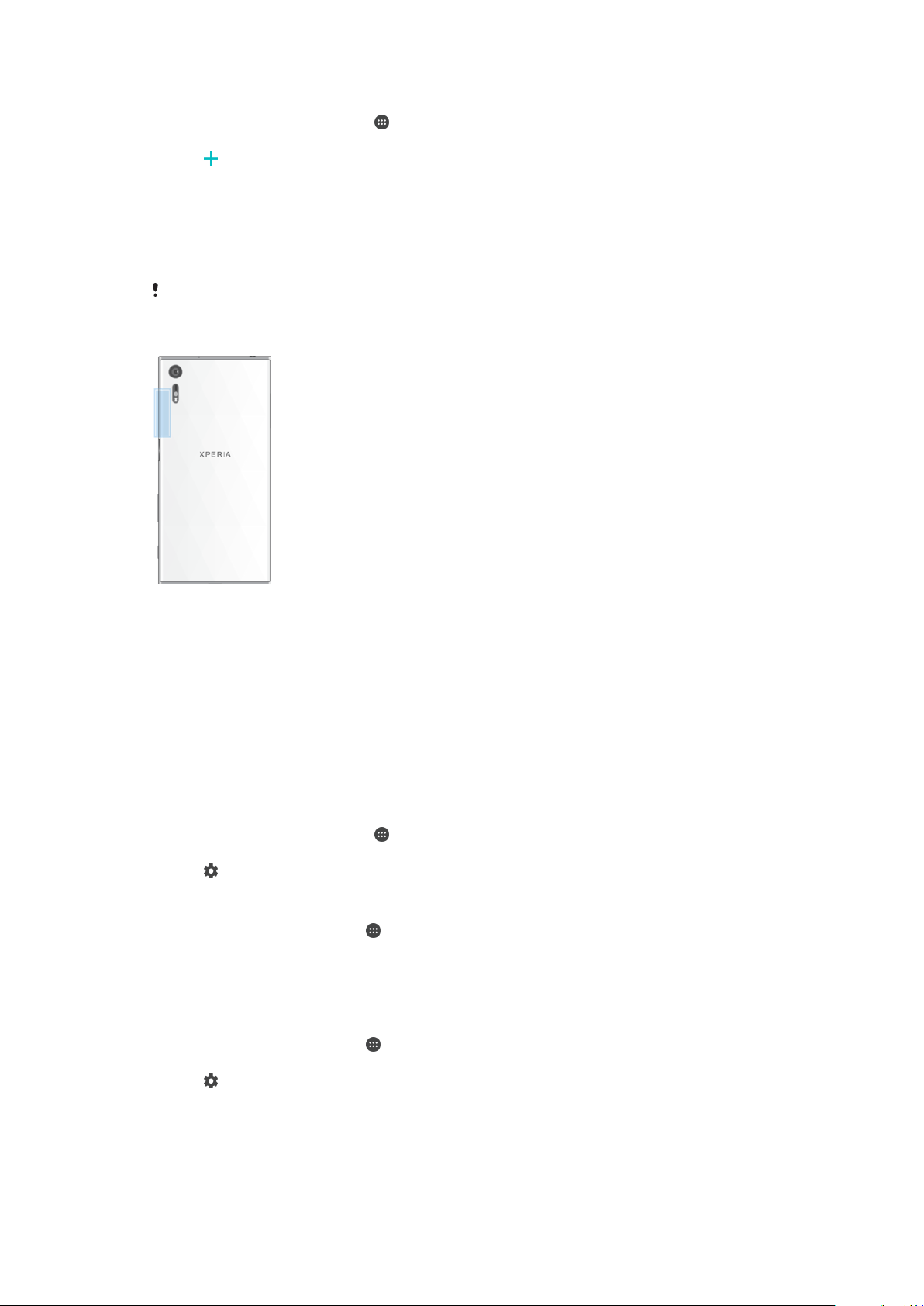
To Add a Wi-Fi Network Manually
1
From your Home screen, tap .
2
Find and tap Settings > Wi-Fi.
3
Tap at the end of the listed items.
4
Enter the Network name (SSID) information.
5
To select a security type, tap the Security field.
6
If required, enter a password.
7
To edit advanced options such as proxy and IP settings, tap Advanced options
and then edit the options as desired.
8
Tap Save.
Contact your Wi-Fi network administrator to get the network SSID and password.
Increasing Wi-Fi Signal Strength
There are a number of things you can do to improve Wi-Fi reception:
•
Move your device closer to the Wi-Fi access point.
•
Move the Wi-Fi access point away from any potential obstructions or interference.
•
Don’t cover the Wi-Fi antenna area of your device (the highlighted area in the illustration).
Wi-Fi Settings
When you are connected to a Wi-Fi network or when there are Wi-Fi networks available
in your vicinity, you can view the status of these networks. You can also enable your
device to notify you whenever an open Wi-Fi network is detected.
To Enable or Disable Wi-Fi Network Notifications
1
Turn on Wi-Fi, if it is not on already.
2
From your
Home screen
, tap
.
3
Find and tap Settings > Wi-Fi.
4
Tap , then tap the
Network notification
slider.
To View Detailed Information About a Connected Wi-Fi Network
1
From the Home screen, tap
.
2
Find and tap Settings > Wi-Fi.
3
Tap the Wi-Fi network you are currently connected to. Detailed network
information is displayed.
To Add a Wi-Fi Sleep Policy
1
From the Home screen, tap .
2
Find and tap Settings > Wi-Fi.
3
Tap , then tap Keep Wi-Fi on during sleep.
4
Select an option.
48
This is an internet version of this publication. © Print only for private use.

To Enable Auto-Network Switch
1
From the Home screen, tap .
2
Find and tap Settings > Wi-Fi.
3
Tap > Auto network switch > ENABLE.
To Find the MAC Address for Your Device
1
From the Home screen, tap .
2
Find and tap Settings > Wi-Fi.
3
Tap
. The MAC address is displayed in the list.
WPS
WPS (Wi-Fi Protected Setup™) is a wireless networking standard that helps you to
establish secure wireless network connections. WPS makes it easy for you to set up Wi-
Fi Protected Access® (WPA) encryption to secure your network. You can also add new
devices to an existing network without entering long passwords.
Use one of these methods to enable WPS:
•
Push button method – simply push a button on a WPS-supported device, for example, a
router.
•
PIN method – your device creates a random PIN (Personal Identification Number), which
you enter on the WPS-supported device.
To Connect to a Wi-Fi Network Using a WPS Button
1
From the Home screen, tap
.
2
Find and tap
Settings
>
Wi-Fi
.
3
Turn on Wi-Fi if it is not already on.
4
Tap , then tap
More features
>
WPS Push Button
, then press the WPS button on
the WPS-supported device.
To Connect to a Wi-Fi Network Using a WPS PIN
1
From your Home screen, tap
.
2
Find and tap
Settings
>
Wi-Fi
.
3
Turn on Wi-Fi if it is not already on.
4
Tap >
More features
>
WPS PIN Entry
.
5
On the WPS-supported device, enter the PIN that appears on your device.
Sharing Your Cellular Data Connection
You can share your cellular data connection with other devices in several ways:
•
USB tethering
– share your cellular data connection with a single computer using a USB Type-C™
cable.
•
Bluetooth® tethering
– share your cellular data connection with up to four other devices via Bluetooth®.
•
Portable hotspot
– share your cellular data connection simultaneously with up to 10 other devices via Wi-
Fi, including devices that support WPS technology.
To Share Your Data Connection Using a USB Cable
1
Connect your device to a computer, using the USB cable that came with it.
2
From your Home screen, tap .
3
Find and tap Settings > More > Tethering & portable hotspot.
4
Tap the USB tethering slider, then tap OK if prompted. is displayed in the
status bar once you are connected.
5
To stop sharing your data connection, tap the USB tethering slider or disconnect
the USB cable.
You cannot share your device's data connection and SD card over a USB cable at the same
time.
49
This is an internet version of this publication. © Print only for private use.

To Share Your Cellular Data Connection With Another Bluetooth® Device
1
Make sure your device and the other Bluetooth® device are paired with each
other and cellular data traffic is activated on your device.
2
Your device: From your Home screen, tap .
3
Find and tap Settings > More > Tethering & portable hotspot and then tap the
Bluetooth tethering slider to enable the function.
4
Bluetooth® device: Set up the device so it gets its network connection using
Bluetooth®. If the device is a computer, refer to the relevant instructions to
complete setup. If the device runs on the Android™ operating system, tap the
settings icon beside the name of the device it is paired with under Settings >
Bluetooth > Paired devices, then mark the Internet access checkbox.
5
Your device: Wait for
to appear in the status bar. Once it appears, the setup is
complete.
6
Tap the Bluetooth tethering slider again to disable the function.
The Bluetooth tethering function is turned off every time you turn off your device or turn off the
Bluetooth® function.
To Use Your Device as a Portable Wi-Fi Hotspot
1
From your Home screen, tap .
2
Find and tap Settings > More > Tethering & portable hotspot.
3
Tap Portable hotspot settings > Configure hotspot.
4
Enter the
Network name (SSID)
information.
5
To select a security type, tap the Security field. If required, enter a password.
6
Tap
SAVE
.
7
Tap
, then tap the Portable hotspot slider to enable the function.
8
If prompted, tap
OK
to confirm. appears in the status bar once the portable Wi-
Fi hotspot is active.
To Allow a WPS-Supported Device to Use Your Cellular Data Connection
1
Make sure that your device is functioning as a portable hotspot.
2
From your
Home screen
, tap
.
3
Find and tap Settings > More > Tethering & portable hotspot > Portable hotspot
settings
.
4
Under Configure hotspot, make sure that your portable hotspot is secured by a
password.
5
Enable Discoverable, if it was disabled.
6
Tap
WPS Push Button
, then follow the relevant instructions. Alternatively, tap >
WPS PIN Entry, then enter the PIN that appears on the WPS-supported device.
To Rename or Secure Your Portable Hotspot
1
From the Home screen, tap
.
2
Find and tap
Settings
>
More
>
Tethering & portable hotspot
.
3
Tap Portable hotspot settings > Configure hotspot.
4
Enter the Network name (SSID) for the network.
5
To select a security type, tap the Security field.
6
If required, enter a password.
7
Tap Save.
Controlling Data Usage
You can keep track of the amount of data transferred to and from your device over your
cellular data or Wi-Fi connection during a given period. For example, you can view the
amount of data used by individual applications. For data transferred over your cellular
data connection, you can also set data usage warnings and limits to avoid additional
charges.
If you are using a device that has multiple users, only the owner (that is, the primary user) can
adjust data usage settings. Adjusting data usage settings can help you keep greater control
over data usage but cannot guarantee the prevention of additional charges.
50
This is an internet version of this publication. © Print only for private use.

To Help Reduce Data Usage
1
From your Home screen, tap .
2
Find and tap Settings > Data usage > Data Saver.
3
Select a SIM card to enable a cellular data network connection.
4
Tap the slider to enable or disable the function.
To Turn Data Traffic On or Off
1
From your Home screen, tap .
2
Find and tap Settings > Data usage.
3
Tap the Mobile data traffic slider to turn data traffic on or off.
When data traffic is turned off, your device can still establish Wi-Fi and Bluetooth®
connections.
To Set a Data Usage Warning
1
Make sure cellular data traffic is turned on.
2
From your Home screen, tap
.
3
Find and tap Settings > Data usage > Billing cycle.
4
To set the warning level, tap Data warning, enter the desired data limit and tap
SET. You receive a warning notification when the amount of data traffic reaches
the level you set.
To set a cellular data limit
1
Make sure cellular data traffic is turned on.
2
From your Home screen, tap
.
3
Find and tap
Settings
>
Data usage
.
4
Tap Billing cycle and tap the slider beside Set data limit, then tap OK.
Once your cellular data usage reaches the set limit, cellular data
traffic on your device gets
turned off automatically.
To Control the Data Usage of Individual Applications
1
From your Home screen, tap .
2
Find and tap
Settings
>
Apps
.
3
Tap the application that you want to control, then tap Data usage.
The performance of individual applications may be affected if you change the related data
usage settings.
To Check Your Data Usage
1
From your Home screen, tap .
2
Find and tap
Settings
>
Data usage
.
3
Find and tap Cellular data usage to view information about the amount of data
transferred via cellular data connection.
4
To view information about the amount of data transferred via Wi-Fi connection, tap
the Wi-Fi data usage.
Selecting a SIM card for data traffic
Either of the two SIM cards inserted in your device can handle data traffic, but only one
SIM card can be selected to handle data at any given time. You can select the SIM card
to use for data traffic during the initial setup of your device, or you can select or change it
later via the Settings menu.
51
This is an internet version of this publication. © Print only for private use.

To change the SIM card used for data traffic
1
From your Home screen, tap .
2
Find and tap Settings > Dual SIM > Cellular data.
3
Select the SIM card that you want to use for data traffic.
For higher data speeds, select the SIM card that supports the fastest cellular network, for
example, 3G or LTE.
Selecting cellular networks
Your device supports the use of two different networks at the same time. You can select
from the following network mode combinations:
•
One WCDMA network
•
One GSM network
•
One WCDMA and one GSM network
•
One LTE, one WCDMA, and one GSM network
For each SIM card, you can set your device to switch automatically between cellphone
networks depending on which cellphone networks are available where you are. You can
also manually set your device to use a particular cellphone network mode for each SIM
card, for example, WCDMA or GSM.
Different status icons are displayed in the status bar depending on the type or mode of
network that you are connected to. Refer to
Status icons
on page 30 to see what the
different status icons look like.
To Select a Network Mode
1
From your
Home screen
, tap .
2
Find and tap Settings > More > Mobile networks.
3
Select a SIM card.
4
Tap Preferred network type, then select a network mode.
To Select Another Network Manually
1
From your Home screen, tap .
2
Find and tap
Settings
>
More
>
Mobile networks
.
3
Select a SIM card.
4
Tap
Network operators
.
5
Tap Search mode, then select Manual.
6
Select a network.
If you select a network manually, your device will not search for other networks, even if you
move out of range of the manually selected network.
To activate automatic network selection
1
From your Home screen, tap .
2
Find and tap Settings > More > Mobile networks.
3
Select a SIM card.
4
Tap Service providers > Search mode, then select Automatic.
Virtual private networks (VPNs)
Use your device to connect to virtual private networks (VPNs), which allow you to access
resources inside a secured local network from a public network. For example, VPN
connections are commonly used by corporations and educational institutions for users
who need to access intranets and other internal services when they are outside of the
internal network, for example, when they are traveling.
VPN connections can be set up in many ways, depending on the network. Some
networks may require you to transfer and install a security certificate on your device. For
52
This is an internet version of this publication. © Print only for private use.

detailed information about how to set up a connection to your virtual private network,
contact the network administrator of your company or organization.
If you are using a device with multiple users, you may need to log in as the owner, that is, the
primary user, to adjust the settings for VPN.
To Add a Virtual Private Network
1
From your Home screen, tap .
2
Find and tap Settings > More > VPN.
3
Tap
.
4
Select the type of VPN to add.
5
Enter your VPN settings.
6
Tap SAVE.
To Connect to a Virtual Private Network
1
From your Home screen, tap
.
2
Find and tap Settings > More > VPN.
3
In the list of available networks, tap the VPN that you want to connect to.
4
Enter the required information.
5
Tap Connect.
To Disconnect from a Virtual Private Network
1
Double-tap the status bar to open the Notification panel.
2
Tap the notification for the VPN connection to turn it off.
53
This is an internet version of this publication. © Print only for private use.

Synchronizing data on your device
Synchronizing with Online Accounts
Synchronize your device with contacts, email, calendar events, and other information
from online accounts, for example, email accounts such as Gmail™ and Exchange
ActiveSync, Facebook™, and Flickr™. You can synchronize data automatically for such
accounts by activating the auto-sync function, or you can synchronize each account
manually.
To Set Up an Online Account for Synchronization
1
From your Home screen, tap
.
2
Tap Settings > Accounts & sync > Add account, then select the account that you
want to add.
3
Follow the instructions to create or sign in to an account.
To Synchronize Manually With an Online Account
1
From your Home screen, tap
> Settings > Accounts & sync.
2
Tap the name of the account you want to synchronize with. A list of items appears
showing what can be synchronized with the account.
3
Tap the slider next to the item that you want to synchronize.
To Remove an Online Account
1
From your Home screen, tap > Settings > Accounts & sync.
2
Select the account type, then tap the account you want to remove.
3
Tap , then tap Remove account.
4
Tap
REMOVE ACCOUNT
again to confirm.
Synchronizing with Microsoft
®
Exchange ActiveSync
®
If your company uses a Microsoft Exchange ActiveSync account, you can access your
corporate email messages, calendar appointments, and contacts directly on your device.
After setup, you can find your information in the
Email
,
Calendar
and
Contacts
applications.
If you have set up a Microsoft® Exchange ActiveSync® (EAS) account on your Xperia™
device, the EAS security settings may limit the lockscreen type to only a PIN or password. This
occurs when your network administrator specifies a lockscreen type for all EAS accounts for
enterprise security reasons. Contact the network administrator of your company or
organization to check what network security policies are implemented for cellular devices.
Fingerprint functionality is not available in the United States.
To set up an EAS account for synchronization
1
From your Home screen, tap .
2
Tap Settings > Accounts & sync > Add account > Exchange ActiveSync.
3
Enter your corporate email address and password.
4
Tap NEXT. If a failure occurs, enter the domain and server details for your account
manually and then tap NEXT.
5
Tap OK to allow your corporate server to control your device.
6
Select a synchronization method, a synchronization interval and the data that you
want to sync with your device.
7
Tap NEXT, then select how you want to be notified when a new email arrives.
8
Tap NEXT, enter a name for the corporate account, then tap Finish setup.
9
If prompted, activate the device administrator to allow your corporate server to set
certain security rules on your device, such as disabling voice recording and using
storage encryption.
54
This is an internet version of this publication. © Print only for private use.

To Remove an EAS Account
1
From your Home screen, tap > Settings > Accounts & sync.
2
Tap Exchange ActiveSync, then select the EAS account that you want to remove.
3
Tap , then tap REMOVE ACCOUNT.
4
Tap REMOVE ACCOUNT again to confirm.
55
This is an internet version of this publication. © Print only for private use.

Basic settings
Accessing settings
View and change settings for your device from the Settings menu. The Settings menu is
accessible from both the Application screen and the Quick settings panel.
To Open the Device Settings Menu from the Application Screen
1
From your Home screen, tap
.
2
Find and tap Settings.
To View Information About Your Device
1
From your Home screen, tap
.
2
Find and tap Settings > About phone.
To Access the Quick Settings Panel
•
Drag the status bar downward using two fingers.
To Turn On the Flashlight
1
Drag the status bar downward using two fingers.
2
Tap .
To Select Which Settings to Display on the Quick Settings Panel
1
Using two fingers, drag the status bar fully downward, then tap .
2
To add a setting to the Quick Settings panel, drag and drop the icon into the
upper part of the screen. To remove a setting, drag an drop the icon into the lower
part of the screen.
To Rearrange the Quick Settings Panel
1
Drag the status bar fully downward, then tap .
2
Touch and hold an icon, and then move it to the desired position.
Volume settings
You can adjust the ringtone volume for incoming calls and notifications as well as for
music and video playback.
To adjust the ringtone volume with the volume key
•
Press the volume key up or down.
To Adjust the Media Playing Volume with the Volume Key
•
When playing music or watching video, press the volume key up or down, even
when the screen is locked.
To Turn on Vibrate Mode
•
Press the volume key up or down until appears.
To Adjust the Volume Levels
1
From your Home screen, tap .
2
Find and tap Settings > Sound.
3
Drag the volume sliders to the desired positions.
You can also press the volume key up or down and tap
to adjust the ringtone, media
playback, or alarm volume levels separately.
56
This is an internet version of this publication. © Print only for private use.

To Set Your Device to Vibrate for Incoming Calls
1
From your Home screen, tap .
2
Find and tap Settings > Sound.
3
Tap the Also vibrate for calls slider to enable the function.
To Set a Ringtone
1
From your Home screen, tap .
2
Find and tap Settings > Sound > Phone ringtone.
3
Select an option from the list or tap
and select a music file that is saved on your
device.
4
To confirm, tap Done.
To Select the Notification Sound
1
From your Home screen, tap
.
2
Find and tap Settings > Sound > Notification sound.
3
Select an option from the list or tap
and select a music file that is saved on your
device.
4
To confirm, tap Done.
Some applications have their own specific notification sounds, which you can select from the
application settings.
To Enable Touch Tones
1
From your
Home screen
, tap .
2
Find and tap Settings > Sound > Other sounds.
3
Tap the sliders to enable or disable the different touch tones as desired.
Do Not Disturb Mode
You can set your device to Do not disturb mode and decide how long your device will be
in Do not disturb mode manually. You can also preset when your device will be in Do not
disturb mode automatically.
To Activate Do Not Disturb Mode
1
Using two fingers, drag the status bar fully downward to access the Quick
Settings panel.
2
Find and tap .
3
Select an option, then tap
Done
.
To Quickly Shift Between Do Not Disturb/Vibrate/Sound Mode
1
Press the volume key up or down until , , or appears.
2
Tap
or to quickly shift between Vibrate/Sound mode. To activate Do not
disturb mode, press the volume key down when in vibrate mode.
To Schedule Do Not Disturb Mode Time Intervals
1
From your Home screen, tap
.
2
Find and tap Settings > Sound > Do not disturb> Automatic rules.
3
Select the time or event to schedule Do Not Disturb mode for, or add a new rule.
4
Enter the desired name for the rule, then tap OK
5
Find and tap Days and mark the checkboxes for the relevant days, then tap
Done.
6
To adjust the start time, tap Start time and select a value, then tap OK.
7
To adjust the end time, tap End time and select a value, then tap OK. Your device
stays in Do Not Disturb mode during the selected time interval.
57
This is an internet version of this publication. © Print only for private use.

Setting Exceptions for Do Not Disturb Mode
You can select which types of notifications are allowed to sound in Do not disturb mode
and you can filter exceptions based on who the notifications come from. The most
common types of exceptions include:
•
Events and reminders
•
Calls
•
Messages
•
Alarms
To associate exceptions with specific contact types
1
From the Homescreen, tap
.
2
Find and tap Settings > Sound > Do not disturb > Allowed in Priority only.
3
Tap Calls or Messages.
4
Select an option.
Screen settings
To Adjust the Screen Brightness Manually Regardless of Lighting Conditions
1
From your Homescreen, tap
.
2
Find and tap Settings > Display and tap the Adaptive brightness slider to disable
this function, if it is not already disabled.
3
Tap
Brightness level
.
4
Drag the slider to adjust the brightness.
Lowering the brightness level helps the battery last longer.
To Enable or Disable Vibrate on Touch
1
From your Homescreen, tap .
2
Find and tap Settings > Sound > Other sounds.
3
Tap the
Vibrate on tap
slider to enable or disable the function.
To Adjust the Idle Time Before the Screen Turns Off
1
From your
Home screen
, tap .
2
Find and tap Settings > Display > Sleep.
3
Select an option.
To turn off the screen quickly,
briefly press the power key .
To Adjust the Font Size
1
From your Homescreen, tap .
2
Find and tap
Settings
>
Display
>
Font size
.
3
Select the preferred option.
To Adjust the Display Size
1
From your Homescreen, tap .
2
Find and tap Settings > Display > Display size.
3
Drag the slider to select the preferred option.
To Adjust the White Balance of the Display
1
From your Home screen, tap
.
2
Find and tap Settings > Display > White balance.
3
Drag the sliders to the desired positions to adjust the white balance.
To revert the white balance setting back to its default values, tap
> Default values.
58
This is an internet version of this publication. © Print only for private use.

Smart backlight control
The smart backlight control keeps the screen on as long as the device is held in your
hand. Once you put down the device, the screen turns off according to your sleep
setting.
To Enable or Disable the Smart Backlight Control Function
1
From your Home screen, tap .
2
Find and tap Settings > Display > Smart backlight control.
3
Tap the slider to enable or disable the function.
Glove mode
Using glove mode, you can wear gloves and still navigate the screen on your device.
When you use glove mode, a cursor ring appears on the area of the screen where a
touch is registered.
To Enable Glove Mode
1
From your Home screen, tap
> Settings > Display > Glove mode.
2
Tap the slider to enable this function.
The sensitivity depends on the size of the contact area between the screen and the gloved
finger that you use to navigate the screen.
Screen Pinning
Use screen pinning to set your device to display only the screen for a specific application.
For example, if you are playing a game and you accidentally touch the Home navigation
key, the screen pinning feature prevents the active game app screen from being
minimized. You can also use this feature when you lend your device to another person to
make it harder for them to access more than one application. For example, you can lend
your device to somebody to take a photo and pin the screen to the Camera application
so that the person can't easily use other apps such as Email.
Screen pinning is not a security feature and does not fully prevent other users from unpinning a
screen and accessing your device. To protect your data, you should set up your device to
request a screen lock PIN, password, or pattern before someone can unpin the screen.
To Enable or Disable Screen Pinning
1
From your Home screen, tap .
2
Find and tap
Settings
>
Lock screen & security
>
Screen pinning
.
3
Tap the slider to enable or disable the function.
4
If you have enabled Screen pinning, you can tap the
Require unlock pattern for
unpinning slider to enable or disable this additional security function as desired.
A pattern, PIN, or password is not mandatory for screen pinning to work.
To Pin a Screen
1
Make sure screen pinning is activated on your device.
2
Open an app and go to the screen you want to pin.
3
Tap
.
4
To display the screen pinning icon , swipe upward.
5
Tap
.
6
In the pop-up window that appears, tap Got it.
To Unpin a Screen
•
On the pinned screen, touch and hold until the screen is unpinned.
If you selected a security option when you activated the screen pinning function, you have to
enter your pattern, PIN, or password to unlock the device before the screen can be unpinned.
59
This is an internet version of this publication. © Print only for private use.

Application settings
Some apps will ask for permissions once you start using them. You can allow or deny
permissions individually for each app, either from the Settings menu or from the
Permission confirm dialog. Permission requirements depend on the app’s design.
Allowing or denying permissions
You can choose whether to allow or deny permissions when the dialog is shown. If you
have used another Android version previously, most apps will have already been granted
the necessary permissions.
To allow a permission
1
To allow a permission, tap Allow.
2
When the confirm dialog appears for the second time, you can choose the Don't
ask again option if you wish.
3
A dialog will also explain why the app needs the permissions and what it uses
them for specifically. To dismiss this dialog, tap OK.
To deny a permission
•
To deny a permission, tap Deny when the dialog is shown.
Some applications can still be used even if you have denied permissions.
Critical permissions
Some permissions are mandatory for apps to work as intended. In such cases, a dialog
will inform you.
To Configure Applications
1
From your
Home screen
, tap .
2
Find and tap Settings > Apps > .
3
Select a configuration option, such as
App permissions
, and then choose an
application that you want to configure.
To allow critical permissions
1
To allow permissions, tap Apps > APP INFO > Permissions.
2
Find the critical permission you need.
3
Tap the relevant slider to adjust permissions.
Allowing or Denying Automatic Application Updates
If the automatic update feature is enabled, your applications get updated without you
being asked, so you may not realize that large volumes of data are being downloaded. In
order to avoid potentially high data transfer costs, you can disable automatic updates or
enable automatic updates only over Wi-Fi connection. You have to disable the automatic
update feature both in the Play Store™ app and the What's New app (where available) to
avoid the automatic updating of apps.
To Enable or Disable Automatic Updates for All Applications in the Play Store
1
From your Home screen, tap
, then find and tap .
2
Tap , then tap Settings > Auto-update apps.
3
Select the preferred option.
To Enable or Disable Automatic Updates for All Applications in What’s New
1
From your Home screen, tap , then find and tap .
2
Tap , then tap Settings > Auto-update apps.
3
Select the preferred option.
60
This is an internet version of this publication. © Print only for private use.

Application linking
Your device can determine the default app to handle a particular web link. This means
that if the link is set, you don’t need to select an app each time you open a link. You can
change the default app any time you want.
To Manage App Links from the Settings Menu
1
From your Home screen, tap .
2
Find and tap Settings > Apps.
3
Tap
and find Opening links.
4
Select an app and adjust the settings as desired.
Resetting Your Applications
You can reset an application or clear application data if your application stops
responding or causes issues with your device.
To Reset Application Preferences
1
From your Home screen, tap
.
2
Find and tap Settings > Apps.
3
Tap
> Reset app preferences, then tap > RESET APPS.
Resetting application preferences does not delete any application data from your device.
To Clear Application Data
1
From your
Home screen
, tap .
2
Find and tap Settings > Apps.
3
Select an application or service, then tap
Storage
>
CLEAR DATA
>
OK
.
When you clear application data, data for the selected application is deleted from your device
permanently. The option to clear application data is not available for every application or
service.
To Clear Application Cache
1
From your Home screen, tap .
2
Find and tap
Settings
>
Apps
.
3
Select an application or service, and then tap Storage > CLEAR CACHE.
The option to clear the application cache is not available for every application or service.
To Clear the Application Default Setting
1
From your
Home screen
, tap .
2
Find and tap Settings > Apps.
3
Select an application or service, and then tap Open by default > CLEAR
DEFAULTS.
The option to clear the application default setting is not available for every application or
service.
Screen Saver
Set up an interactive screen saver that automatically displays colours, photos, or a
slideshow while your device is docked or charging and the screen is idle.
On a device with multiple users, each user can have individual Screen saver settings.
To Enable or Disable the Screen Saver
1
From your Home screen, tap .
2
Find and tap Settings > Display > Screen saver.
3
Tap the slider to enable or disable the function.
61
This is an internet version of this publication. © Print only for private use.

To Select Content for the Screen Saver
1
From your Home screen, tap .
2
Find and tap Settings > Display > Screen saver.
3
Tap the slider to enable the function.
4
Select what you want to display when the screen saver is active.
To Start the Screen Saver Manually
1
From your Home screen, tap .
2
Find and tap Settings > Display > Screen saver.
3
Tap the slider to enable the function.
4
To activate the Screen saver immediately, tap
, then tap Start now.
Language Settings
You can select a default language for your device and change it again at a later time. You
can also change the writing language for text input.
To Change the Language
1
From the Home screen, tap
.
2
Find and tap Settings > Languages & input > Languages.
3
To change the language, drag and drop the desired language to the top of the list.
If the desired language is not currently listed, tap
to add it.
4
Tap
OK
.
If you select the wrong language and cannot read the menu texts,
find and tap . Then, select
the text beside and select the first entry in the menu that opens. You can then select the
language you want.
Date and time
You can change the date and time on your device.
To Set the Date Manually
1
From the
Home screen
, tap .
2
Find and tap Settings > Date & time.
3
Disable the
Automatic date & time
function by tapping the slider.
4
Tap Set date.
5
Flick left or right, or use the arrows to set the desired date.
6
Tap OK.
To Set the Time Manually
1
From your Home screen, tap .
2
Find and tap Settings > Date & time.
3
Disable the Automatic date & time function by tapping the slider.
4
Tap Set time.
5
Select the relevant values for the hour and minute.
6
Tap OK.
To Set the Time Zone
1
From your Home screen, tap .
2
Find and tap Settings > Date & time.
3
Disable the Automatic time zone function by tapping the slider.
4
Tap Select time zone.
5
Select an option.
62
This is an internet version of this publication. © Print only for private use.

X-Reality™ for mobile
Sony's X-Reality™ for mobile technology improves the viewing quality of photos and
videos, giving you clearer, sharper, and more natural images. X-Reality™ for mobile is
turned on by default, but you can turn it off if you want to reduce battery consumption.
To Turn On X-Reality™ for Mobile
1
From your Home screen, tap .
2
Find and tap Settings > Display > Image enhancement.
3
Tap the X-Reality for mobile radio button if it is not already selected.
Super-Vivid Mode
Super-Vivid mode enhances the color brightness and saturation of your photos and
videos while you view them on your device.
To Turn on Super-Vivid Mode
1
From your Home screen, tap
.
2
Find and tap Settings > Display > Image enhancement.
3
Tap the Super-vivid mode radio button if it is not already selected.
Enhancing the Sound Output
You can enhance the sound of your device by manually enabling individual sound
settings such as Equalizer and Surround sound. You can enable the Dynamic normalizer
to minimize volume differences between songs or videos. You can also improve the
quality of compressed music files to near high-resolution audio quality when you are
using wired headphones.
To Enhance the Sound Output Automatically
1
From your
Home screen
, tap
.
2
Find and tap Settings > Sound > Audio settings.
3
Enable the
ClearAudio+
function by tapping the slider.
To adjust the sound settings manually
1
From the Homescreen, tap .
2
Find and tap Settings > Sound > Audio settings.
3
If the
ClearAudio+
function is enabled, tap the slider to disable it.
4
Tap Sound effects > Equalizer.
5
To adjust the sound manually, drag the frequency band buttons. To choose a
preset arrangement, tap , select an arrangement, then tap OK to confirm.
The manual adjustment of sound output settings has no effect on voice communication
applications. For example, there is no change in the voice call sound quality.
To Minimize Volume Differences Using the Dynamic Normaliser
1
From your Home screen, tap .
2
Find and tap Settings > Sound > Audio settings.
3
Disable the DSEE HX function by tapping the slider, if it is enabled.
4
Enable the Dynamic normalizer function by tapping the slider.
To Upgrade the Quality of Compressed Music Files
1
From your Home screen, tap
.
2
Find and tap Settings > Sound > Audio settings.
3
Enable the DSEE HX function by tapping the slider.
This setting is only available for wired headphones that support High-Resolution Audio.
63
This is an internet version of this publication. © Print only for private use.

Noise cancellation
Your device supports noise canceling headsets. By using a noise canceling headset with
your device, you can get much clearer audio quality when listening, for example, to
music in a noisy environment, such as on a bus, a train or a plane. You can also use this
feature to create a silent environment in which to study, work or read.
To ensure optimal performance, noise canceling headsets from Sony are recommended.
To Use a Noise-Canceling Headset
1
Connect the noise-canceling headset to your device.
2
From your Home screen, find and tap
> Settings > Sound > Accessory
settings > Noise canceling, then enable the Noise canceling function by tapping
the slider.
3
Tap Headset/Headphone type, and select the type of your headset/headphone.
4
If you want Noise canceling to be enabled only during music or video playback or
when the screen is active, tap the Power save mode slider to enable this function.
5
If you want Noise canceling to be enabled for as long as the headset is
connected, tap the Power save mode slider to disable this function.
A noise-canceling headset may not be included with your device at purchase.
You can also enable the Noise canceling function via the Quick Settings panel when a noise-
canceling headset is connected to your device.
To Adjust the Settings to the Noise Environment
1
Make sure a noise-canceling headset is connected to your device.
2
From your
Home screen
, tap .
3
Find and tap Settings > Sound > Accessory settings > Noise canceling > Noise
environment
.
4
Select the relevant noise environment type, then tap OK.
Multiple User Accounts
Your device supports multiple user accounts so that different users can log in separately
to the device and use it. Multiple user accounts work well in situations where you share
the same device with other people or lend your device to someone to use for a while.
The user who sets up the device for the first time becomes the owner of the device. Only
the owner can manage the accounts of other users. Apart from the owner account, there
are two different types of accounts:
•
Regular User: This account type is suitable for someone who regularly uses your device.
•
Guest User: Enable the guest account option for someone who just wants to use your
device temporarily.
Some features are only available to the owner. For example, only the owner can allow
downloads from sources other than Google Play™.
About the Regular User Account
By adding Regular User accounts, you can allow different users to have different
homescreens, wallpapers, and general settings. They also get separate access to
applications and memory storage for files such as music and photos. You can add up to
seven Regular User accounts on your device.
64
This is an internet version of this publication. © Print only for private use.

To Add a Regular User Account
1
Make sure you are logged in as the owner, that is, the user who set up the device
for the first time.
2
From your Home screen, tap .
3
Find and tap Settings > Users > Add user.
4
Tap OK. The new account is now created.
5
Tap SET UP NOW. The screen locks and an icon representing the newly added
user appears in the top-right corner.
6
Unlock the screen by swiping upwards.
7
Follow the on-screen instructions to set up the account for the user.
You can also add a regular user account from the status bar on any screen. Just drag the
status bar fully downward and tap the user icon, and then tap Add user.
To Delete a Regular User Account from Your Device
1
Be sure you are logged in as the owner.
2
From your Home screen, tap
.
3
Find and tap Settings > Users.
4
Tap
beside the name of the user who you want to delete, and then tap Remove
user > Delete.
About the Guest User Account
If someone just wants to use your device temporarily, you can enable a guest account
for that user. In Guest mode, your device starts up as a freshly installed system with only
the preinstalled apps. Once your guest is finished using your device, you can wipe the
session clean so that the next guest can start fresh. The Guest User account is
preinstalled and cannot be deleted.
To Activate the Guest User Account
1
Make sure you are logged in as the owner, that is, the user who set up the device
for the first time.
2
From your Home screen, tap
.
3
Find and tap
Settings
>
Users
>
Guest
.
You can also activate the guest user account from the status bar on any screen. Just drag the
status bar fully downward and tap the user icon, and then tap Add guest.
To Clear the Guest Session Data
1
Make sure you are logged in to the guest account.
2
From your
Home screen
, tap .
3
Find and tap Settings > Users.
4
Find and tap
Remove guest
.
5
Tap Remove.
You can also clear the guest session from the status bar on any screen as long as you are
logged in to the guest account. Just drag the status bar downward and tap the user icon, and
then tap Remove guest.
Switching between Multiple User Accounts
To Switch Between Multiple User Accounts
1
To view the list of users, drag the status bar downward, then tap the user icon in
the upper-right of the screen.
2
Tap the icon representing the user account that you want to switch to. The lock
screen for that user account appears.
When you switch to the guest account, tap
Start over if you want to wipe the previous session
or tap Yes, continue to continue the previous session.
65
This is an internet version of this publication. © Print only for private use.

Settings for Multiple User Accounts
There are three different types of settings on devices with multiple users:
•
Settings that can be changed by any user and affect all users. Examples include
language, Wi-Fi, Airplane mode, NFC, and Bluetooth®.
•
Settings that only affect an individual user account. Examples include automatic data
syncing, screen lock, various accounts added, and wallpaper.
•
Settings that are only visible to the owner and affect all users, for example, VPN settings.
66
This is an internet version of this publication. © Print only for private use.

Typing text
On-Screen Keyboards
There are a number of pre-installed text entry providers on your device.
The default text entry provider may depend on the regional or language settings you use. One
or more text entry providers might not be available in your region.
SwiftKey
®
Keyboard
You can enter text using the on-screen keyboard by tapping each letter individually, or
you can use the SwiftKey
®
flow feature and slide your finger from letter to letter to form
words.
1 Delete a character before the cursor.
2 Tap to enter a carriage return, or touch and hold to access smileys.
3 Enter punctuation.
4 Enter a space.
5 Tap to enter a comma, or touch and hold to enter text using voice input.
6 Display numbers and symbols.
7 Switch between lower case, upper case, and all caps.
For more information about SwiftKey
®
, go to https://swiftkey.com/
Google Keyboard Overview
You can enter text using the on-screen keyboard by tapping each letter individually, or
you can slide your finger from letter to letter to form words.
1 Tap to delete a character before the cursor.
2 Tap to enter a hard return, access smileys, or search the content. Functionality may depend on text field
type.
3 Tap to enter punctuation.
4 Tap to insert space.
5 Tap to enter a comma.
6 Tap to display numbers and symbols.
7 Tap to switch between lower case, upper case, and all caps.
67
This is an internet version of this publication. © Print only for private use.

To display the on-screen keyboard to enter text
•
Tap a text entry field.
To use the on-screen keyboard in landscape orientation
•
When the on-screen keyboard is displayed, turn the device sideways.
You may need to adjust the settings in some applications to enable landscape orientation.
To enter text character by character
1
To enter a character visible on the keyboard, tap the character.
2
To enter a character variant, touch and hold a regular keyboard character to get a
list of available options, then select from the list. For example, to enter "é," touch
and hold "e" until other options appear, then, while keeping your finger pressed on
the keyboard, drag to and select "é."
To enter a period
•
After you enter a word, double-tap the space bar.
To Enter Text Using the Gesture Input Function
1
When the on-screen keyboard is displayed, slide your finger from letter to letter to
trace the word you want to write.
2
After you finish entering a word, lift up your finger. A word suggestion appears
based on the letters you have traced.
3
If the word that you want does not appear, tap
to see other options and select
accordingly. If the desired option does not appear, delete the entire word and
trace it again, or enter the word by tapping each letter individually.
Editing text
You can select, cut, copy and paste text as you write. You can access the editing
options by double-tapping the entered text. The editing options then become available
via an application bar.
Text Editing Bar
After selecting text by double-tapping on a word, an editing bar appears with several
tools available:
• Cut
• Copy
• Paste
• Share
• Select all
• Assist
The
Paste option only appears when you have text saved on the clipboard.
To Select Text
1
Double-tap a word to highlight it.
2
You can drag the tabs on both sides of the highlighted word to select more text.
To Edit Text
1
Double-tap a word to make the application bar appear.
2
Select the text you want to edit, and then use the application bar to make your
desired changes.
To use the magnifier
•
When you enter text, tap and hold on the text field to view the text magnified and
to place the cursor where you want within the text field.
68
This is an internet version of this publication. © Print only for private use.
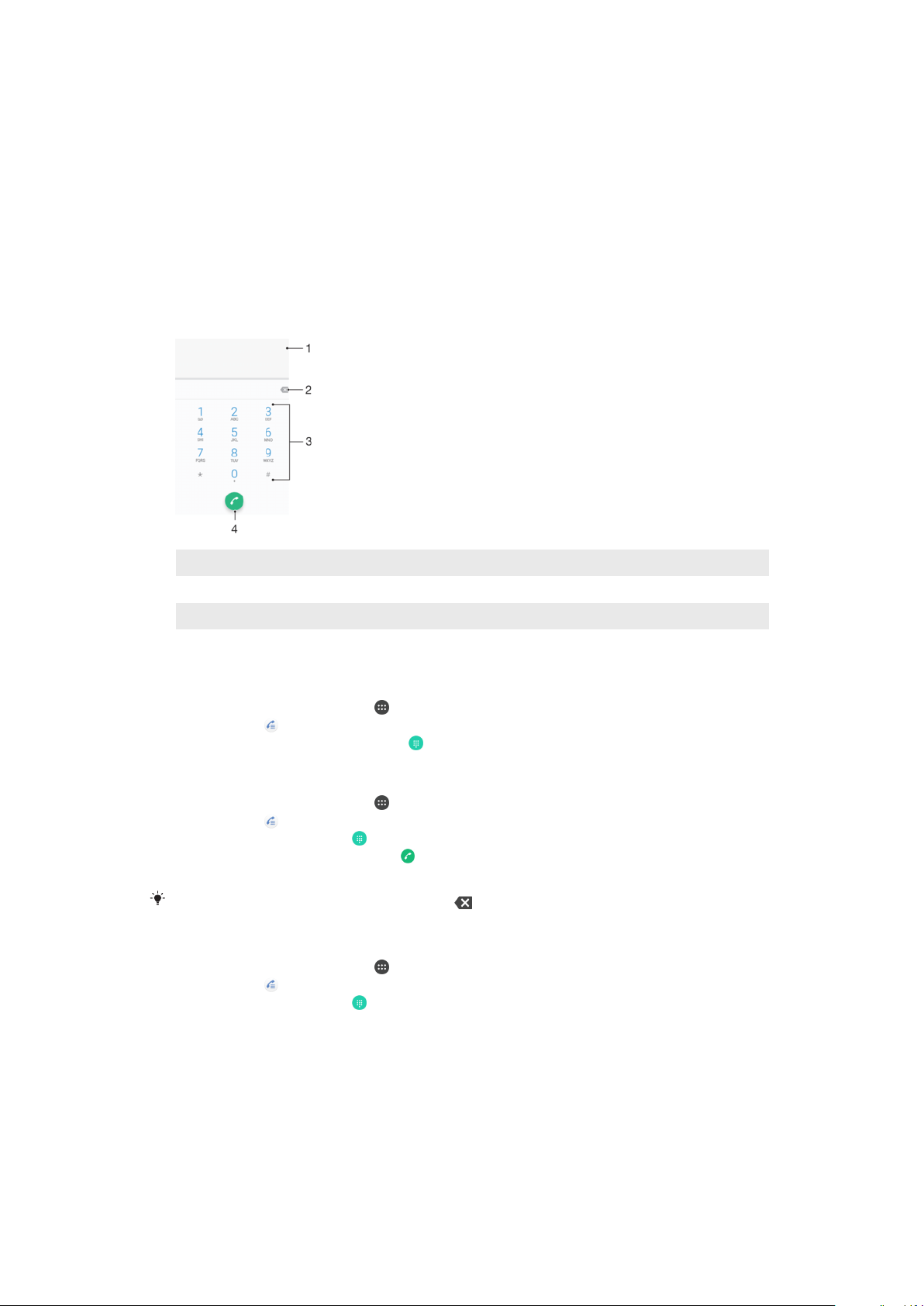
Calling
Making calls
You can make a call by manually dialing a phone number, by tapping a number saved in
your contacts list, or by tapping the phone number in your call log. You can also use the
smart dial function to quickly find numbers from your contacts list and call logs by
entering part of a contact number or name and selecting from the suggestions that
appear. To make a video call, you can use the Duo™ video chat application on your
device.
1 View more options
2 Delete number
3 Dialpad
4 Call button
To Open the Dialpad
1
From your Home screen, tap .
2
Find and tap .
3
If the dialpad does not appear, tap .
To Dial a Phone Number
1
From your Home screen, tap .
2
Find and tap .
3
If the call log appears, tap
to display the dialpad.
4
Enter the phone number, and tap
.
5
Select a SIM card in select account dialog.
To delete a number entered by mistake, tap
.
To Make a Call Using Smart Dial
1
From your Home screen, tap .
2
Find and tap .
3
If the call log appears, tap to display the dialpad.
4
Use the dialpad to enter letters or numbers that correspond to the contact you
want to call. As you enter each letter or number, a list of possible matches
appears.
5
Tap the contact that you want to call.
6
Select a SIM card.
69
This is an internet version of this publication. © Print only for private use.

To Make an International Call
1
From your Home screen, tap .
2
Find and tap . The call log is displayed.
3
Tap to display the dialpad.
4
Touch and hold 0 until a “+” sign appears.
5
Enter the country code and the area code without the initial zeros, followed by the
phone number. Then tap .
6
Select a SIM card in select account dialog.
To Add a Direct Dial Number to Your Homescreen
1
Touch and hold an empty area on your Home screen until the device vibrates and
the customization menu appears.
2
In the customization menu, tap Widgets > Shortcuts.
3
Scroll through the list of applications and select Direct dial.
4
Select the contact and the number that you want to use as the direct dial number.
Showing or hiding your phone number
You can select to show or hide your phone number on call recipients' devices when you
call them.
To Show or Hide Your Phone Number During Outgoing Calls
1
From the Home screen, tap
.
2
Find and tap
Settings
>
Call
.
3
Select a SIM card.
4
Tap
Additional settings
>
Caller ID
, and choose an option.
This option may not be provided by every operator.
Receiving Calls
If you receive an incoming call when the device is in sleep mode or the screen is locked,
the phone application opens in fullscreen format, with a SIM icon indicating which SIM
card the call is for. If you receive an incoming call when the screen is active, the incoming
call is displayed as a floating notification, that is, in a If you receive an incoming call when
the screen is active, the incoming call is displayed as a floating notification, that is, in a
minimized window that floats at the top of whatever screen is open, with SIM1 or SIM2
indicating which SIM card the call is for. When such a notification arrives, you can choose
to answer the call and open the phone application screen, or you can reject the call and
stay on the current screen.
To Answer a Call When the Screen is Inactive
•
When a call comes in, drag
to the right.
To Answer an Incoming Call When the Screen is Active
•
When a call comes in, in the heads-up notification that appears at the top of the
screen, tap ANSWER.
Instead of answering the call, you can go to the main phone application screen by tapping the
heads-up notification window. Using this method, you get more options to manage the call.
For example, you can decide to reject the call with a message.
To Reject a Call When the Screen Is Inactive
•
When a call comes in, drag to the left.
70
This is an internet version of this publication. © Print only for private use.

To Reject a Call When the Screen is Active
•
When a call comes in, in the heads-up notification that appears at the top of the
screen, tap DECLINE.
Instead of rejecting the call, you can go to the main phone application screen by tapping the
heads-up notification window. This way you get more options to manage the call. For
example, you can decide to reject the call with a message.
To mute the ringtone for an incoming call
•
When you receive the call, press the volume key.
Rejecting a Call with a Text Message
You can reject a call with a text message, sent automatically to the caller and stored in
the Messaging conversation with the contact.
You can select from a number of predefined messages available on your device, or you
can create a new message. You can also create your own personalized message by edit
the predefined ones.
To Reject a Call with a Text Message When the Screen Is Inactive
1
When an incoming call arrives, tap RESPONSE OPTIONS.
2
Select a predefined message or tap Write new message.
To Reject a Call With a Text Message When the Screen is Active
1
When an incoming call arrives, tap the heads-up notification window where the
phone number or the name of the contact is displayed.
2
Tap
RESPONSE OPTIONS
.
3
Select a predefined message or tap Write new message.
To Reject a Second Call with a Text Message
1
When you hear repeated beeps during a call, tap RESPONSE OPTIONS.
2
Select a predefined message or tap
Write new message
.
To edit the text message used to reject a call
1
From your
Home screen
, tap
.
2
Find and tap Settings > Call, choose a SIM card, and then tap Reject call with
message
.
3
Tap the message you want to edit, then make the necessary changes.
4
Tap
OK
.
Smart call handling
You can handle incoming calls without touching the screen by turning on the Smart call
handling function. Once activated, you can handle calls in the following way:
•
Answer: bring the device to your ear.
•
Reject: shake the device.
•
Ringer off: place the device face down.
To Turn On Smart Call Handling
1
From your Home screen, tap
.
2
Find and tap Settings > Call.
3
Select a SIM card.
4
Tap Smart call handling.
5
Tap the slider under Smart call handling.
71
This is an internet version of this publication. © Print only for private use.
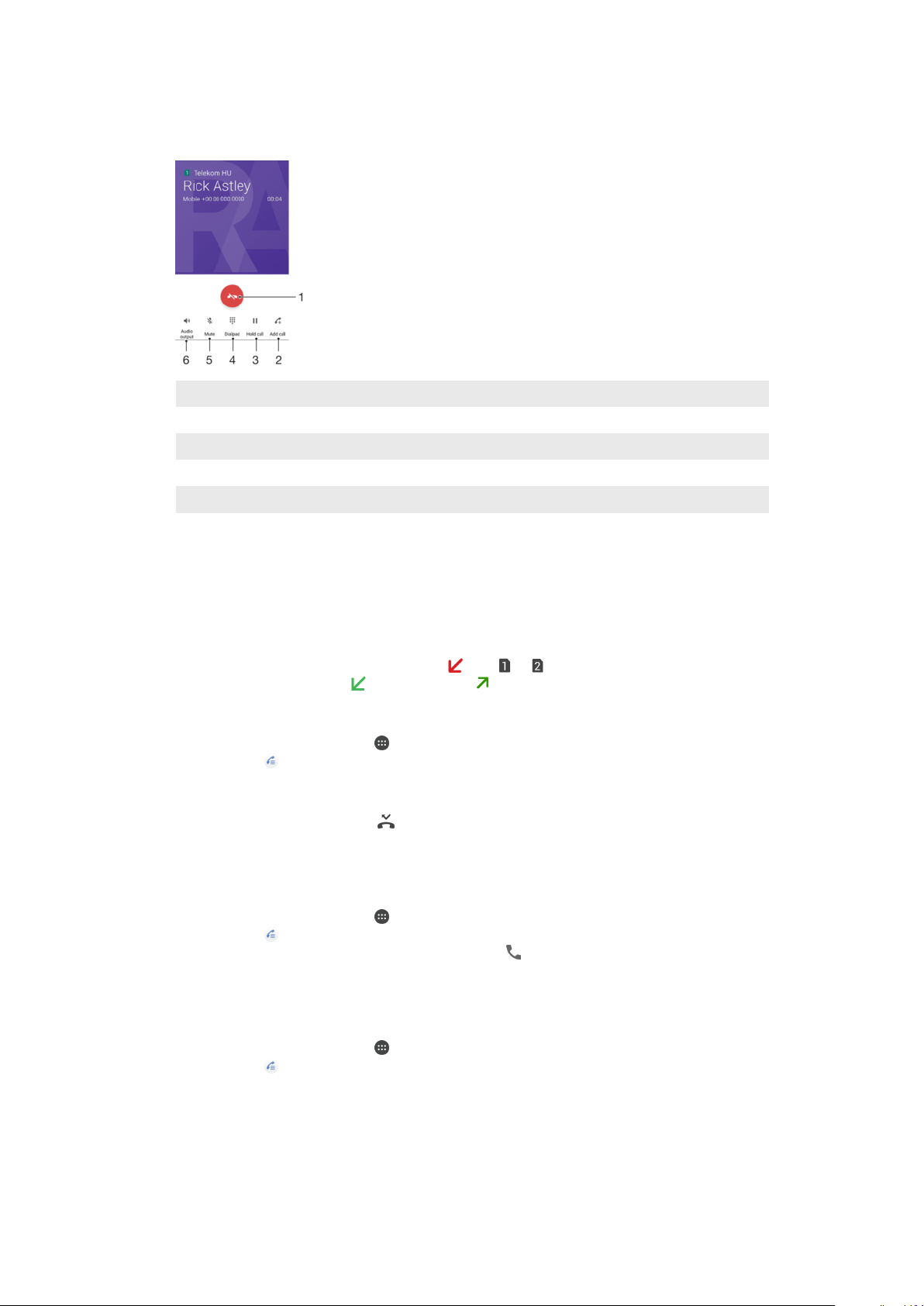
Ongoing Calls
1 End a call
2 Make a second call
3 Put the current call on hold or retrieve a call on hold
4 Enter DTMF digits during a call
5 Mute the microphone during a call
6 Turn on the loudspeaker during a call
To change the volume during a call
•
Press the volume key up or down.
Using the Call Log
In the call log, you can view missed calls with or indicating which SIM card the
call was for, received calls and dialed calls .
To Open the Call Log
1
From your
Home screen
, tap .
2
Find and tap .
To view your missed calls
1
When you have missed a call, appears in the status bar. Drag the status bar
downwards.
2
Tap Missed call.
To call a number from your call log
1
From your Home screen, tap .
2
Find and tap . The call log is displayed.
3
To call a number directly from the call log, tap the beside the number, and
select a SIM card. To edit a number before calling, touch and hold the number,
then tap Edit number before call.
To Add a Number from the Call Log to Your Contacts
1
From your Home screen, tap
.
2
Find and tap .
3
Tap a number displayed in the call log, then select Create new contact or Add to
a contact.
4
Edit the contact details, then tap SAVE.
72
This is an internet version of this publication. © Print only for private use.

To View Call Log Options
1
From your Home screen, tap .
2
Find and tap .
3
Tap .
You can also access general call settings by following the steps above.
Forwarding Calls
You can direct calls to a different recipient, such as another phone number, another
device, or an answering service. You can also forward calls that come in on SIM card 1
to SIM card 2 when SIM card 1 is unreachable, and vice versa. This function is called
Dual SIM reachability. You must enable it manually.
To Forward Calls
1
From your Home screen, tap
.
2
Find and tap Settings > Call.
3
Select a SIM card.
4
Tap Call forwarding > Voice and select an option.
5
Enter the number you want to forward calls to, then tap Turn on.
To Turn Off Call Forwarding
1
From your Home screen, tap
.
2
Find and tap
Settings
>
Call
.
3
Select a SIM card.
4
Tap
Call forwarding
>
Voice
.
5
Select an option, then tap Turn off.
To Enable the Dual SIM Reachability Function
1
From your Home screen, tap .
2
Find and tap
Settings
>
Dual SIM
>
Dual SIM reachability
.
3
Under Dual SIM reachability, tap the slider to enable the function.
4
Follow the on-screen instructions to complete the procedure.
If the Dual SIM reachability function does not work after you enable it, check you have entered
the phone numbers correctly for each SIM card. In some cases, the numbers are detected
automatically during setup. Otherwise, you are prompted to enter them manually.
Restricting Calls
You can block all or certain categories of incoming and outgoing calls. If you have
received a PIN2 code from your service provider, you can also use a list of Fixed Dialing
Numbers (FDNs) to restrict outgoing calls. If your subscription includes a voicemail
service, you can send all incoming calls from a specific contact directly to voicemail. If
you want to block a certain number, you can go to Google Play™ and download
applications that support this function.
FDN is not supported by all network operators. Contact your network operator to verify if your
SIM card or network service supports this feature.
To block calls and messages from a specific number
1
From your Home screen, tap
.
2
Find and tap > Settings > Block numbers > Add a number.
3
Enter the phone number that you want to block calls and texts from, then tap
BLOCK.
73
This is an internet version of this publication. © Print only for private use.

To Enable or Disable Fixed Dialing
1
From your Home screen, tap .
2
Find and tap Settings > Call.
3
Select a SIM card.
4
Tap Fixed dialing numbers.
5
If you want to enable fixed dialing, select Activate fixed dialing. If you want to
disable fixed dialing, select Deactivate fixed dialing.
6
Enter your PIN2 and tap OK.
To access the list of accepted call recipients
1
From your Home screen, tap
.
2
Find and tap Settings > Call.
3
Select a SIM card.
4
Tap Fixed dialing numbers > Fixed dialing numbers.
To Change the SIM Card PIN2
1
From the Home screen, tap
.
2
Find and tap Settings > Call.
3
Select a SIM card.
4
Tap Fixed dialing numbers > Change PIN2.
5
Enter the old SIM card PIN2 and tap OK.
6
Enter the new SIM card PIN2 and tap OK.
7
Confirm the new PIN2 and tap
OK
.
To Send Incoming Calls From a Specific Contact Directly to Voicemail
1
From your
Home screen
, tap
.
2
Find and tap .
3
Select the desired contact.
4
Tap
> .
5
Mark the checkbox beside
All calls to voicemail
.
6
Tap SAVE.
Multiple Calls
If you have activated call waiting, you can handle multiple calls at the same time. When it
is activated, you will be notified by a beep if you receive another call.
Cellular data is unavailable during calls. Applications like email, internet, and social networking
will work if you connect to a Wi-Fi network.
To Activate or Deactivate Call Waiting
1
From your Home screen, tap .
2
Find and tap Settings > Call.
3
Select a SIM card.
4
Tap Additional settings.
5
To activate or deactivate call waiting, tap Call waiting.
To Answer a Second Call and Put the Ongoing Call on Hold
1
When you hear repeated beeps during a call, drag to the right.
2
Tap Hold call.
To Reject a Second Call
•
When you hear repeated beeps during a call, drag to the left.
To Make a Second Call
1
During an ongoing call, tap . The call log is displayed.
2
Tap
to display the dialpad.
3
Enter the number of the recipient and tap
. The first call is put on hold.
74
This is an internet version of this publication. © Print only for private use.

To Switch Between Multiple Calls
•
To switch to another call and put the current call on hold, tap On hold.
Conference calls
With a conference or multiparty call, you can have a joint conversation with two or more
people.
For details about the number of participants that you can add to a conference call, contact
your network operator.
To Make a Conference Call
1
During an ongoing call, tap
. The call log appears.
2
To display the dialpad, tap .
3
Dial the number of the second participant and tap
. The first participant is put on
hold temporarily.
4
To add the second participant to the call and start the conference call, tap
.
5
To add more participants to the call, repeat the relevant steps as described above.
To Have a Private Conversation with a Conference Call Participant
1
During an ongoing conference call, tap Manage conference.
2
Tap the separate button of the participant who you want to have a private
conversation with.
3
To end the private conversation and return to the conference call, tap .
To Release a Participant from a Conference Call
1
During an ongoing conference call, tap Manage conference.
2
Tap next to the participant you want to release.
To End a Conference Call
•
During the conference call, tap .
Voicemail
If your subscription includes a voicemail service, callers can leave voice messages for
you when you can't answer calls. Your voicemail service number is normally saved on
your SIM card. If not, you can get the number from your service provider and enter it
manually.
To Enter Your Voicemail Number
1
From the
Home screen
, tap
.
2
Find and tap Settings > Call > Voicemail > Voicemail settings > Voicemail
number.
3
Enter your voicemail number.
4
Tap OK.
To Call Your Voicemail Service
1
Open the dialpad.
2
Touch and hold 1, then select a SIM card.
The
first time you call your voicemail number, your service provider’s voicemail system
normally prompts you to set up your voicemail. For example, you may be asked to record a
greeting and set a password.
Emergency calls
Your device supports international emergency numbers, for example, 112 or 911. You
can normally use these numbers to make emergency calls in any country, with or without
a SIM card inserted if you are within range of a network.
75
This is an internet version of this publication. © Print only for private use.

To Make an Emergency Call
1
Open the dialpad.
2
Enter the emergency number, then tap .
You can make emergency calls even when no SIM card is inserted or when all outgoing calls
are blocked.
To make an emergency call while the SIM card is locked
1
Tap EMERGENCY.
2
Enter the emergency number and tap
.
To make an emergency call while the screen is locked
1
If the active screen lock type is Swipe, swipe up and tap , then tap to display
the dialpad. Enter the emergency number, then tap .
2
If your screen is locked with a pattern, PIN, or password, swipe up and tap
EMERGENCY. Enter the emergency number, then tap
.
76
This is an internet version of this publication. © Print only for private use.
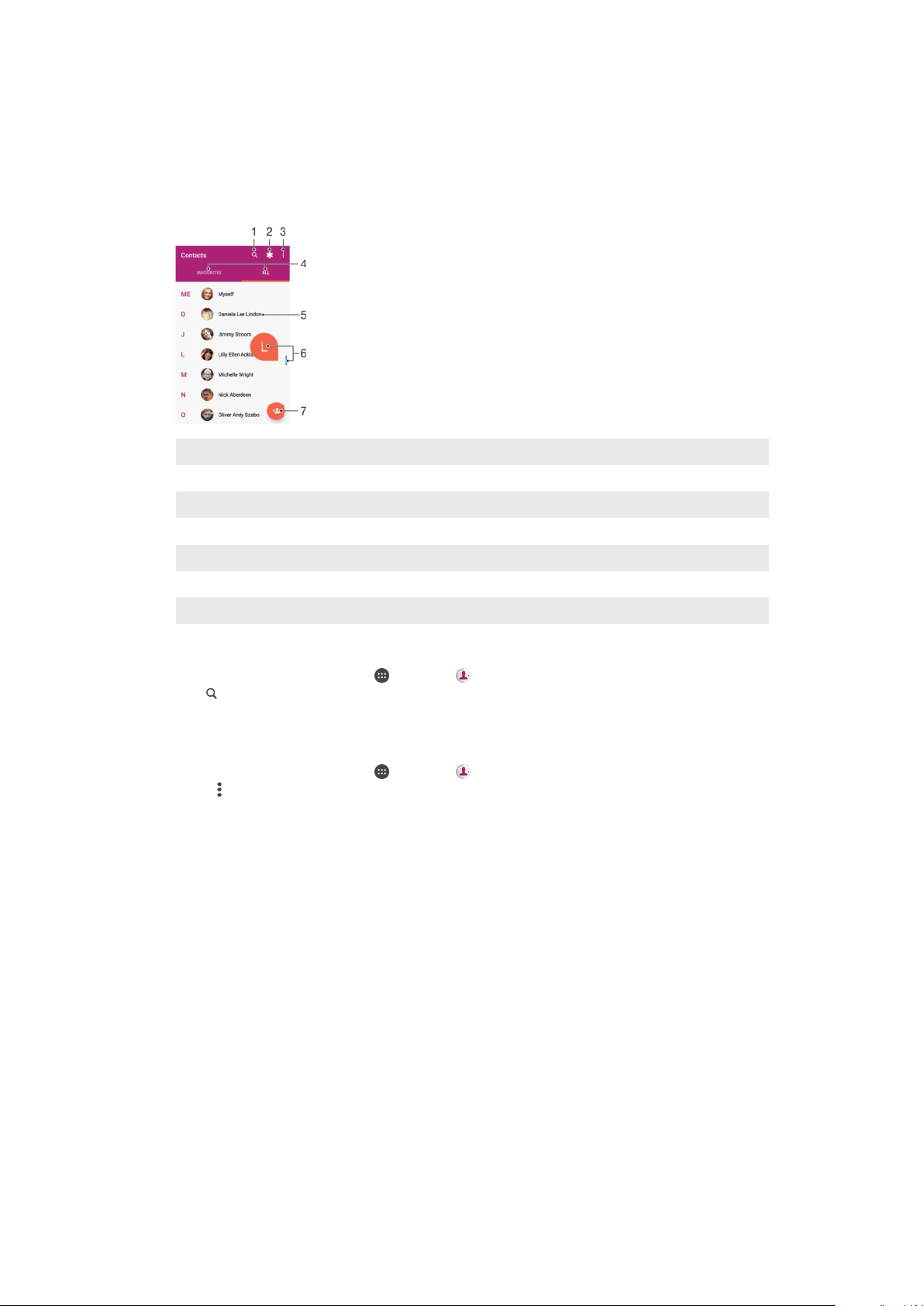
Contacts
Searching and viewing contacts
1 Search for contacts
2 Edit and view medical and emergency contact information
3 View more options
4 Favorites and All contacts tabs
5 View contact details
6 Use the slider to jump to contacts starting with the selected letter
7 Add a contact
To Search for a Contact
1
From your Home screen, tap , then tap .
2
Tap
and enter a phone number, name or other information in the
Find contacts
field. The results list is filtered as you enter each character.
To select which contacts to display in the Contacts application
1
From your Home screen, tap
, then tap .
2
Press , then tap
Select Groups/Accounts
.
3
In the list that appears, select the desired option. If you have synchronized your
contacts with a synchronization account, that account appears in the list.
4
To further expand the list of options, tap Select groups, select the appropriate
drop-down list and mark or unmark the checkboxes as desired.
5
When you’re finished, tap OK.
77
This is an internet version of this publication. © Print only for private use.

Adding and editing contacts
To Add a Contact
1
From your Home screen, tap , then tap .
2
Tap .
3
If you synchronized your contacts with one or more accounts and you are adding
a contact for the first time, you must select the account you want to add the
contact to. Alternatively, tap Phone contact if you only want to use and save this
contact on your device.
4
Enter or select the desired information for the contact.
5
When you are done, tap SAVE.
Once you save a contact to an account, that account will show as the default account to save
to the next time you add a contact. If you want to change which account a contact is saved to,
you need to create the contact again and save it to the correct account.
If you add a plus sign and the country code before a contact's phone number, you do not
have to edit the number again when you make calls from abroad.
To Edit a Contact
1
From your Home screen, tap
, then tap .
2
Tap the contact you want to edit, then tap .
3
Edit the desired information.
4
When you are done, tap
SAVE
.
Some synchronization services do not allow you to edit contact details.
To Add a Picture to a Contact
1
From your Home screen, tap , then tap .
2
Tap the contact you want to edit, then tap .
3
Tap
, then select a method for adding the contact picture and edit it as desired.
4
After you add the picture, tap
SAVE
.
You can also add a picture to a contact directly from the
Album application. If you want to add
a picture that is saved to an online account, you must download the picture first.
To Personalize the Ringtone for a Contact
1
From your Home screen, tap , then tap .
2
Tap the contact that you want to edit, and then tap .
3
Tap
> Set ringtone.
4
Select an option from the list or tap to select a music file saved on your device,
then tap DONE.
5
Tap
SAVE
.
To Send All Calls to Voicemail for a Contact
1
From your Home screen, tap
, then tap .
2
Tap the contact you want to edit, then tap .
3
Tap , then mark the All calls to voicemail checkbox.
4
When you are done, tap SAVE.
To block a phone number
1
From your Home screen, tap , then tap .
2
Tap , then tap Block numbers.
3
Tap Add a number, then enter the phone number that you want to block calls and
texts from.
4
Tap BLOCK.
78
This is an internet version of this publication. © Print only for private use.

To Delete Contacts
1
From your Home screen, tap , then tap .
2
Touch and hold the contact that you want to delete.
3
To delete several or all contacts, mark the checkboxes beside the contacts that
you want to delete.
4
Tap , then tap Delete contact.
5
Tap DELETE to confirm.
To Edit Contact Information About Yourself
1
From your Home screen, tap
, then tap .
2
Tap ME, then tap .
3
Enter the new information or make the changes you want.
4
When you are finished, tap SAVE.
To Create a New Contact from a Text Message
1
From your Home screen, tap
, then find and tap .
2
Tap the icon next to the phone number, then tap SAVE.
3
Select an existing contact, or tap Create new contact.
4
Edit the contact information and tap SAVE.
Transferring contacts
There are several ways to transfer contacts to your new device. You can sync contacts
from an online account or import contacts directly from another device.
Transferring Contacts Using an Online Account
If you sync the contacts in your old device or your computer with an online account, for
example, Google Sync™ or Microsoft
®
Exchange ActiveSync
®
, you can transfer your
contacts to your new device using that account.
To Synchronize Contacts on Your New Device With a Synchronization Account
1
From your Home screen, tap
, then tap .
2
Tap
, then tap
Manage accounts
.
3
Select the account that you want to sync your contacts with, then tap > Sync
now
.
You need to be signed in to the relevant sync account before you can sync your contacts with
it.
Other methods for transferring contacts
There are several other ways to transfer contacts from your old device to your new
device. For example, you can copy contacts to a memory card, use Bluetooth
®
technology, or save contacts to a SIM card. For more specific information about
transferring the contacts from your old device, refer to the relevant User guide.
To Import Contacts From a Memory Card
1
From your Home screen, tap , then tap .
2
Press , then tap Import/export > Import from SD card or internal storage (.vcf
file).
3
Select where to store your contacts.
4
Tap SD card.
5
Select the files that you want to import by tapping them.
79
This is an internet version of this publication. © Print only for private use.
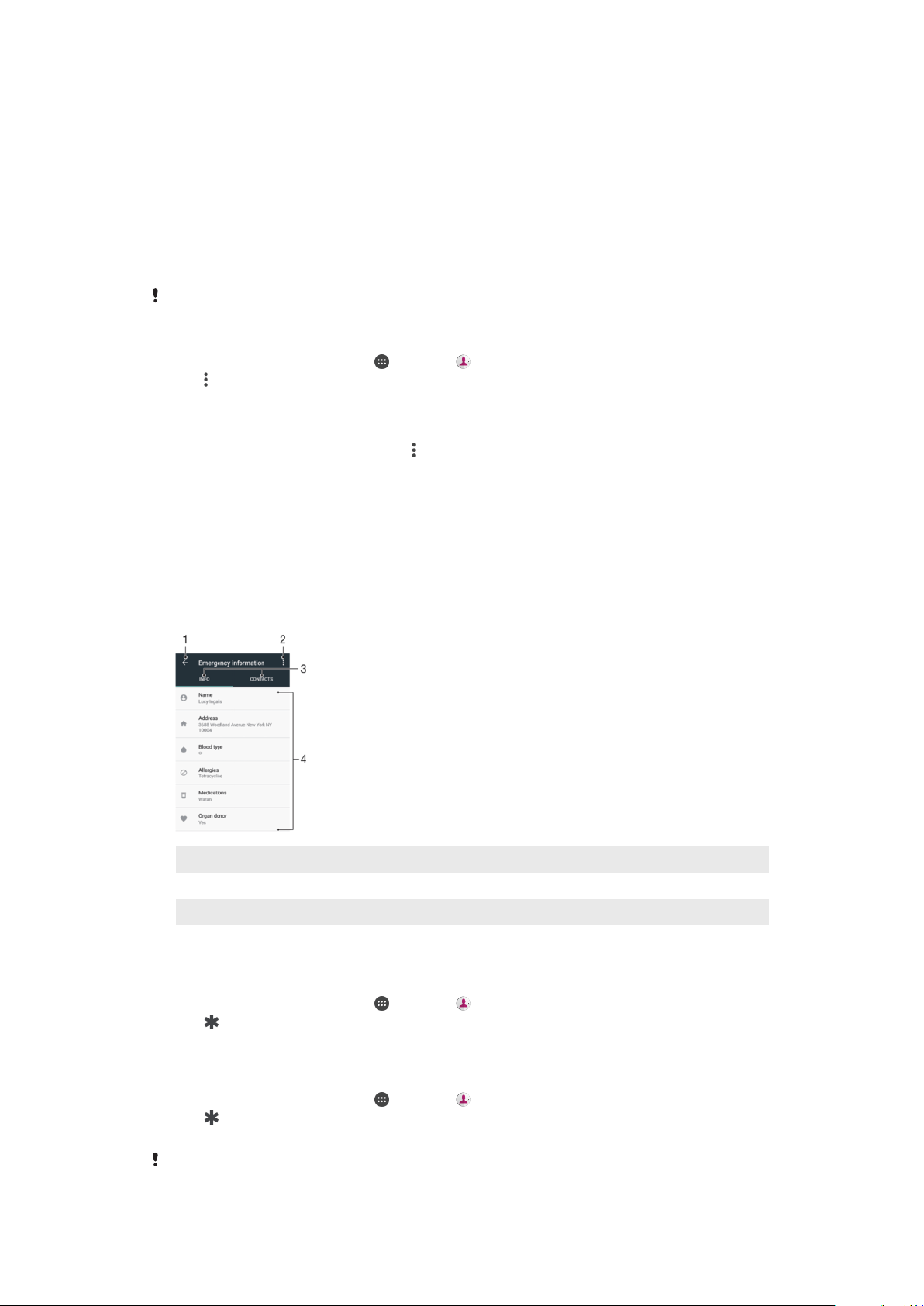
To import contacts using Bluetooth
®
technology
1
Make sure you have the Bluetooth
®
function turned on and that your device is set
to visible.
2
When you are notified of an incoming file to your device, drag the status bar
downward and tap the notification to accept the file transfer.
3
Tap Accept to start the file transfer.
4
Drag the status bar downward. When the transfer is complete, tap the notification.
5
Tap the received file and select where to store your contacts.
To Import Contacts From a SIM Card
When transferring contacts to or from a SIM card, some contacts may get duplicated at the
destination. For information on how to resolve this, see
Avoiding Duplicate Entries in the
Contacts Application
on page 81.
1
From your Home screen, tap , then tap .
2
Tap , then tap Import/export.
3
Select A SIM Card.
4
Select where to store your contacts.
5
Select contacts to import. To import an individual contact, find and tap the
contact. To import all contacts, tap
, then tap Import all.
Adding Medical and Emergency Contact Information
You can add and edit emergency information in the Contacts application. You can enter
medical details, such as allergies and medications that you are using, plus information
about relatives and friends who can be contacted in case of emergency. After setup,
your emergency information can be accessed from the security lockscreen. This means
that even if the screen is locked, for example, by a PIN, pattern, or password, emergency
personnel can still retrieve your ICE information.
1 Go back to the main Contacts screen
2 View more options
3 Medical and personal information and emergency contacts tab
4 Medical and personal information
To Enter Your Medical Information
1
From your Home screen, tap , then tap .
2
Tap .
3
Edit the desired information.
To add a new emergency contact
1
From your Home screen, tap , then tap .
2
Tap , then tap CONTACTS > Add contact.
3
Tap the contact that you want to use as an emergency contact.
The emergency contact must have at least a phone number that emergency personnel can
call. If your device is locked by a security screen lock, emergency personnel can only see the
80
This is an internet version of this publication. © Print only for private use.

phone number of the emergency contact, even if there is other information entered in the
Contacts application.
Favorites
Contacts that you mark as favorites appear under the favorites tab in the Contacts
application along with your most frequently called contacts or "top contacts". This way
you get quicker access to these contacts.
To Mark or Unmark a Contact as a Favorite
1
From the Home screen, tap
, then tap .
2
Tap the contact you want to add to or remove from your favorites.
3
Tap
.
To View Your Favorite Contacts
1
From your Home screen, tap
, then tap .
2
Tap Favorites.
Sending contact information
To Send Your Business Card
1
From your Home screen, tap
, then tap .
2
Tap
ME
.
3
Tap , then tap Share.
4
Select an available transfer method and follow the on-screen instructions.
To Send a Contact
1
From your
Home screen
, tap , and then tap .
2
Tap the contact whose details you want to send.
3
Tap
, then tap
Share
.
4
Select an available transfer method and follow the on-screen instructions.
To Send Several Contacts at Once
1
From your Home screen, tap , then tap .
2
Touch and hold a contact then mark or unmark the checkboxes beside the
contacts that you want to share.
3
Tap , then tap
Share
.
4
Select an available transfer method and follow the on-screen instructions.
To Send All Contacts
1
From your Home screen, tap , then tap .
2
Press , then tap Import/export > Share all contacts to start exporting all your
contacts.
3
Drag the status bar downward. When the export is complete, tap the notification.
4
Select an available transfer method and follow the on-screen instructions.
Avoiding Duplicate Entries in the Contacts Application
If you synchronize your contacts with a new account or import contact information in
other ways, you could end up with duplicate entries in the Contacts application. If this
happens, you can link such duplicates to create a single entry. If you link entries by
mistake, you can unlink them again later.
81
This is an internet version of this publication. © Print only for private use.

To link contacts
1
From your Home screen, tap , then tap .
2
Tap and hold the contact that you want to link with another contact.
3
Tick the checkbox beside the contact that you want to link.
4
Tap , then tap Link. The information from the first contact is merged with the
second contact, and the linked contacts are displayed as one contact in the
Contacts list.
5
Tap Link to confirm.
To Separate Linked Contacts
1
From your Home screen, tap , then tap .
2
Tap the linked contact that you want to edit, then tap .
3
Tap
, then tap Unlink.
4
Tap Unlink to confirm.
Backing up Contacts
You can use internal storage, a memory card, or a SIM card to back up contacts. See
Transferring contacts
on page 79 for more information about how to restore contacts to
your device.
To Export All Contacts to a Memory Card
1
From your
Home screen
, tap , then tap .
2
Press , then tap Import/export > Export to SD card or internal storage (.vcf file).
3
Tap >
SD card
.
4
Tap SAVE.
To Export Contacts to a SIM Card
When you export contacts to a SIM card, not all information may get exported. This is due to
memory limitations on SIM cards.
1
From your Home screen, tap
, then tap .
2
Tap >
Import/export
.
3
Select a SIM card.
4
Tap
OK
.
To Export All Contacts to Internal Storage
1
From your
Home screen
, tap , then tap .
2
Press , then tap Import/export > Export to SD card or internal storage (.vcf file).
3
Tap >
Show internal storage
.
4
Tap , then tap your device’s model number beside .
5
Select a destination folder or simply tap
SAVE
.
82
This is an internet version of this publication. © Print only for private use.
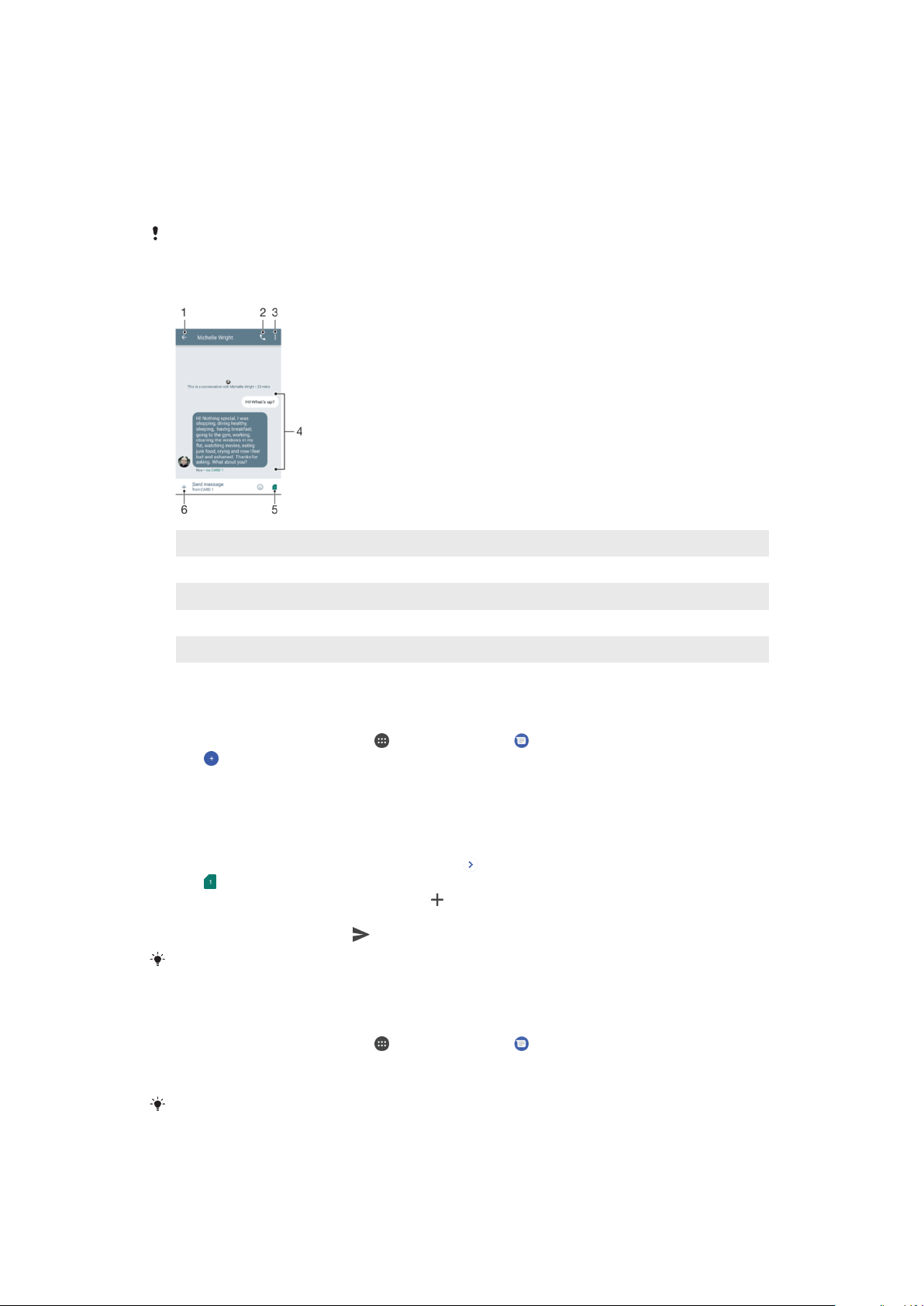
Messaging and chat
Reading and sending messages
The Messaging application shows your messages as conversations, which means all
messages to and from a particular person are grouped together.
The number of characters you can send in a single message varies depending on the provider
and the language you use. The maximum size of a multimedia message, which includes the
size of added media files, is also provider-dependent. Contact your service provider for more
information.
1 Go back to the list of conversations
2 Call the message sender
3 View more options
4 Sent and received messages
5 Select SIM card/Send a completed message
6 Add attachments
To Create and Send a Message
1
From your Home screen, tap , then find and tap .
2
Tap .
3
Enter the recipient’s name or phone number, then select from the suggestions that
appear. If the recipient is not listed as a contact, enter the recipient’s number
manually.
4
If you want to send a group message, repeat the procedure described above to
add more recipients.
5
After adding the recipient or recipients, tap
.
6
Tap
to select the SIM card you wish to use, then enter your message text.
7
If you want to add an attachment, tap and select the relevant attachment
option.
8
To send the message, tap .
If you exit a message before sending, it gets saved as a draft. The conversation gets tagged
with the word Draft.
To Read a Received Message
1
From your Home screen, tap , then find and tap .
2
Tap the desired conversation.
3
If the message has not been downloaded yet, tap it.
All received messages are saved by default to the device memory.
83
This is an internet version of this publication. © Print only for private use.

To Reply to a Message
1
From your Home screen, tap , then find and tap .
2
Tap the conversation containing the message.
3
Tap to select the SIM card you wish to use, then enter your reply and tap .
To Forward a Message
1
From your Home screen, tap , then find and tap .
2
Tap the conversation containing the desired message.
3
Touch and hold the desired message, then tap .
4
Select a recent contact from the list, or tap NEW MESSAGE and enter the
recipient’s name or phone number, then select from the suggestions that appear. If
the recipient is not listed as a contact, enter the recipient’s number manually.
5
Tap
to select the SIM card you wish to use, edit the message if necessary, then
tap
.
To Save a File Contained in a Received Message
1
From your Home screen, tap
, then find and tap .
2
If the message has not been downloaded yet, tap it.
3
Touch and hold the file you want to save, then select the desired option.
Organizing your messages
To Delete a Message
1
From your
Home screen
, tap
, then find and tap .
2
Tap the conversation containing the message that you want to delete.
3
Touch and hold the message you want to delete, then tap
>
DELETE
.
To Delete Conversations
1
From your
Home screen
, tap
, then find and tap .
2
Touch and hold the conversation you want to delete.
3
If you want to delete additional conversations, tap them.
4
Tap
> DELETE.
To Search for Messages
1
From your Home screen, tap , then find and tap .
2
Tap .
3
Enter your search keywords. The search results appear in a list.
Calling from Messaging
To Call a Message Sender
1
From your Home screen, tap , then find and tap .
2
Tap a conversation and tap , then select a SIM card.
To Save a Sender’s Number as a Contact
1
From your Home screen, tap , then find and tap .
2
Tap the icon next to the phone number, then tap ADD CONTACT.
3
Select an existing contact, or tap Create new contact.
4
Edit the contact information and tap SAVE.
84
This is an internet version of this publication. © Print only for private use.

Messaging settings
To Change Your Message Notification Settings
1
From your Home screen, tap , then find and tap .
2
Tap , and then tap Settings.
3
To set a notification sound, tap Notification sound, and then select an option or
tap and select a music file that is saved on your device.
4
To confirm, tap DONE.
5
To adjust additional notification settings, tap the sliders.
To Enable or Disable Delivery Reports for Outgoing Messages
1
From your Home screen, tap
, then find and tap .
2
Tap , then tap Settings > Advanced.
3
Tap the Get SMS delivery reports slider to enable or disable the function.
After delivery reports are turned on, a check mark is displayed for messages that have been
successfully delivered.
Video Chat
You can use the Google Duo™ video chat application on your device to chat with friends
who also use the application on Android™ and iOS devices.
Go to
https://support.google.com/duo/
to get more detailed information about how to
use this application.
The video call function only works on devices with a front camera.
To use the Duo™ application
1
From your Home screen, tap .
2
Find and tap
Google
>
Duo
.
85
This is an internet version of this publication. © Print only for private use.
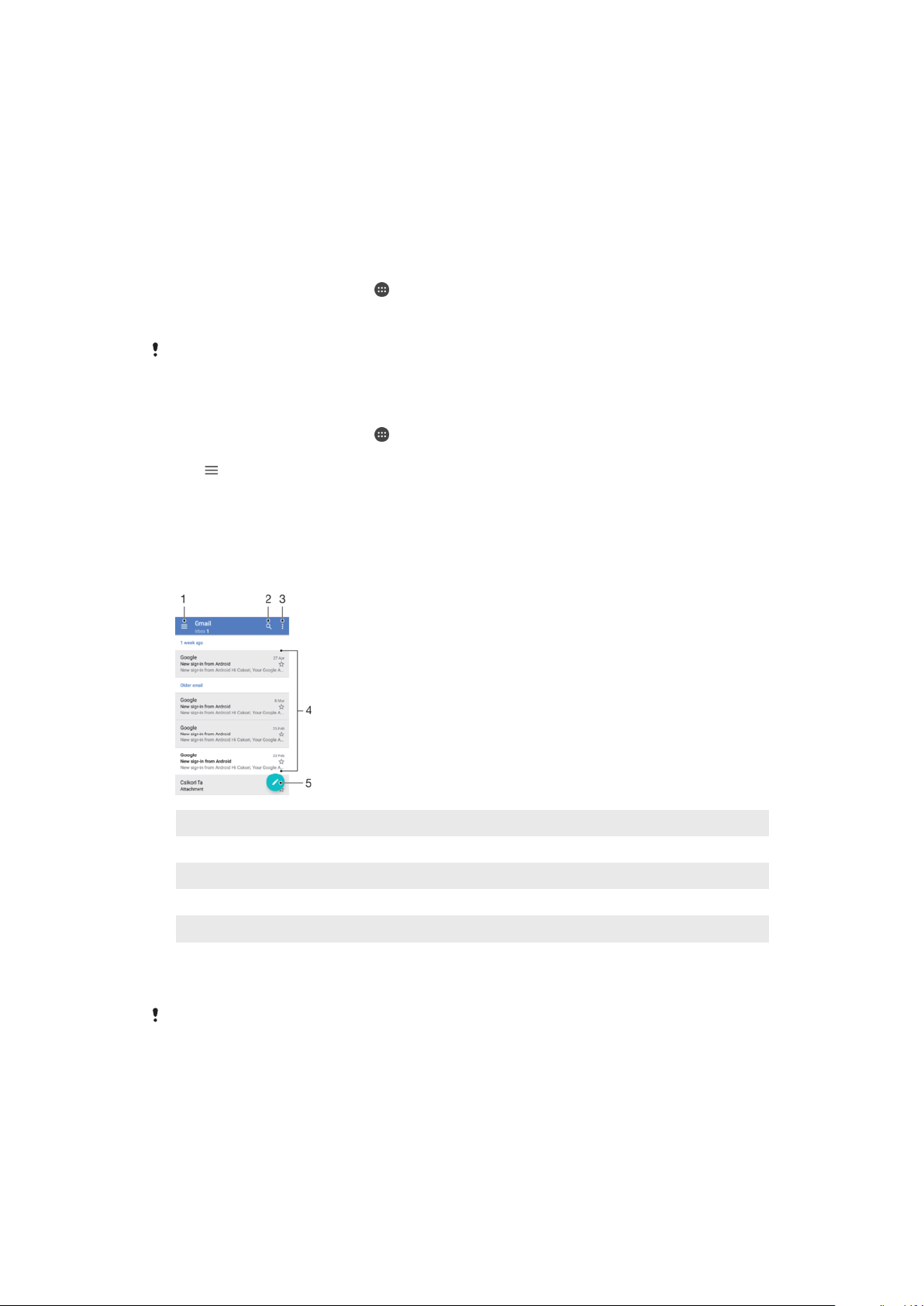
Email
Setting Up Email
Use the email application on your device to send and receive email messages through
your email accounts. You can have one or several email accounts at the same time,
including corporate Microsoft Exchange ActiveSync accounts.
To Set Up an Email Account
1
From your Home screen, tap
.
2
Find and tap Email.
3
Follow the instructions that appear on the screen to complete the setup.
For some email services, you may need to contact your email service provider for information
on detailed settings for the email account.
To Add an Extra Email Account
1
From your Home screen, tap .
2
Find and tap Email.
3
Tap
, then tap Settings > Add account.
4
Follow the on-screen instructions. If the settings for the email account cannot be
downloaded automatically, complete the setup manually.
5
When you are done, tap NEXT.
Sending and Receiving Email Messages
1 Access settings, view a list of all email accounts and folders
2 Search for email messages
3 Access other options
4 List of email messages
5 Write an email message
To download new email messages
•
When the email inbox is open, swipe downward on the message list.
Before trying to download new email messages, make sure you have a working data
connection. For more information about ensuring successful data connections, see
Internet
and MMS Settings
on page 46.
86
This is an internet version of this publication. © Print only for private use.

To Read Your Email Messages
1
From your Home screen, tap .
2
Find and tap Email.
3
If you are using several email accounts, tap , then tap and select the
account you want to check. If you want to check all your email accounts at once,
tap , then tap and select Combined inbox.
4
In the email inbox, scroll up or down and tap the email message you want to read.
To Create and Send an Email Message
1
From your Home screen, tap
, then find and tap Email.
2
If you are using several email accounts, tap , then tap and select the
account you want to send the email from.
3
Tap
, then type the recipient’s name or email address and select one or more
recipients from the drop-down list.
4
Enter the email subject and message text, then tap .
To Reply to an Email Message
1
In your email inbox, find and tap the message that you want to reply to, and then
tap REPLY or REPLY ALL.
2
Enter your reply, and then tap
.
To Forward an Email Message
1
In your email inbox, find and tap the message that you want to forward, and then
tap
FORWARD
.
2
Enter the recipient’s name or email address, and then select one or more
recipients from the drop-down list.
3
Enter your message text, then tap
.
To Save or View an Email Message Attachment
1
Find and tap the email message containing the attachment that you want to view.
Email messages with attachments are indicated by .
2
After the email message opens, find the attachment in the email body, then tap
SAVE
or
VIEW
next to it.
To Save a Sender's Email Address to Your Contacts
1
Find and tap a message in your email inbox.
2
Tap the name of the sender, tap Add to contacts then tap OK.
3
Select an existing contact, or tap
Create new contact
.
4
Edit the contact information, if desired, then tap SAVE.
Organizing your email messages
To Sort Your Email
1
From your Home screen, tap
.
2
Find and tap Email.
3
If you are using several email accounts, tap , then tap and select the
account with the inbox you want to sort. If you want to sort email in all your email
accounts at once, tap , then tap and select Combined inbox.
4
Tap , and then tap Sort.
5
Select a sorting option.
87
This is an internet version of this publication. © Print only for private use.

To Search for Emails
1
From your Home screen, tap , then find and tap Email.
2
If you are using several email accounts, tap , then tap and select the
account you want to search. If you want to search all your email accounts at once,
tap , then tap and select Combined inbox.
3
Tap .
4
Enter your search text.
5
The search results appear in a list sorted by date. Tap the email message you
want to open.
To View All Folders for One Email Account
1
From your Home screen, tap
, then find and tap Email.
2
Tap , then tap and select the account you want to check.
3
Under the account you want to check, select Show all folders.
To Delete Email Messages
1
Tap and hold the message that you want to delete until the device vibrates.
2
Mark the checkboxes for the messages that you want to delete.
3
Tap
You can also flick the message to the right to delete it.
To move an email message to another folder
1
In your email inbox, flick the message that you want to move to the left.
2
Tap
Move
, then select a folder.
Email account settings
To Remove an Email Account from Your Device
1
From your
Home screen
, tap .
2
Find and tap Email.
3
Tap , then tap
Settings
.
4
Select the account you want to remove.
5
Tap
Delete account
>
OK
.
To Change the Inbox Check Frequency
1
From your
Home screen
, tap .
2
Find and tap Email.
3
Tap , then tap
Settings
.
4
Select the desired account.
5
Tap
Check frequency
>
Check frequency
and select an option.
To Set an Out of Office Auto-Reply in an Exchange ActiveSync Account
1
From your Home screen, tap , then find and tap Email.
2
Tap , then tap Settings.
3
Select the EAS (Exchange ActiveSync) account that you want to set an Out of
Office auto-reply for.
4
Tap Out of office.
5
Tap the slider to enable the function.
6
If needed, mark the Set time range checkbox and set the time range for the auto-
reply.
7
Enter your Out of Office message in the body text field.
8
Tap OK to confirm.
Gmail™
If you have a Google™ account, you can use the Gmail™ application to read and write
email messages.
88
This is an internet version of this publication. © Print only for private use.
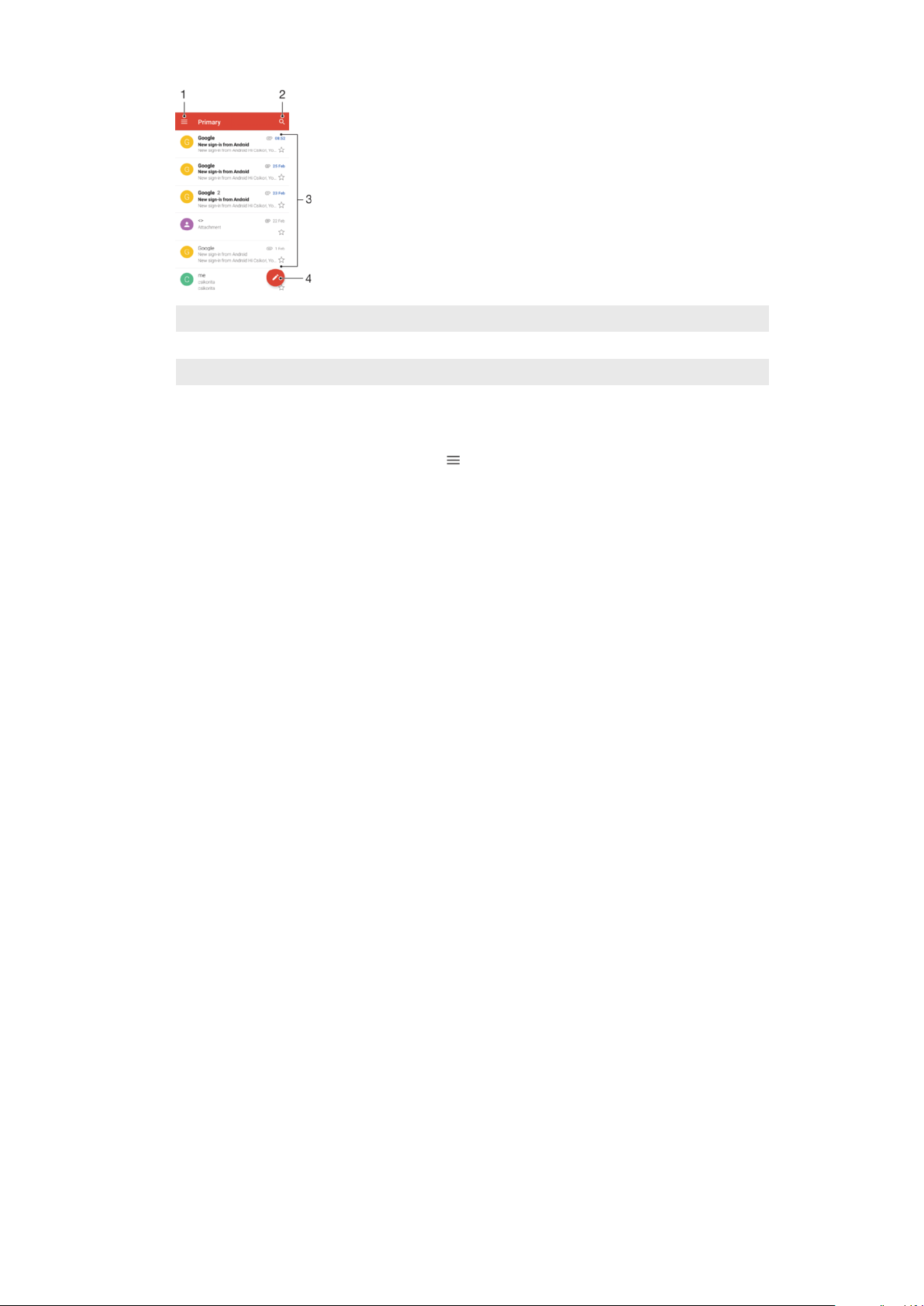
1 View a list of all Gmail accounts and folders
2 Search for email messages
3 List of email messages
4 Write an email message
To Learn More about Gmail™
•
When the Gmail application is open, tap
, then find and tap Help & feedback.
89
This is an internet version of this publication. © Print only for private use.
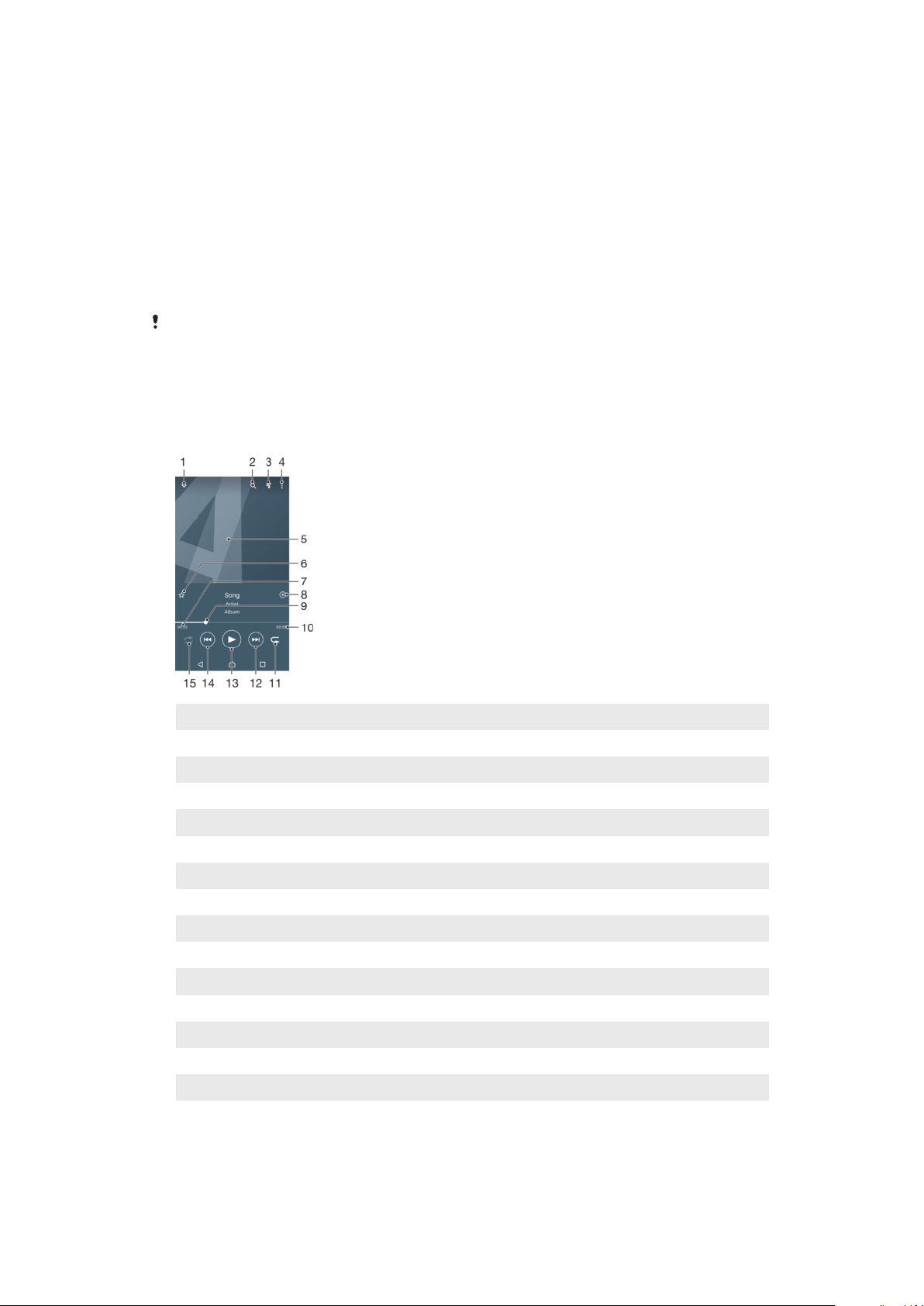
Music
Transferring music to your device
There are two ways to transfer music from a computer to your device:
•
Connect your device to a computer using a USB Type-C™ cable. Select Transfer files
on your device and then copy and paste, or drag and drop the files using the computer.
See
Managing Files Using a Computer
on page 40.
•
You can use the Xperia™ Companion software to transfer your media files between the
computer and your device. Learn more and download Xperia™ Companion for Windows
or Mac at
http://support.sonymobile.com/global-en/xperia-companion/
.
The Music application may not support all music file formats. For more information about
supported file formats and the use of multimedia (audio, image, and video) files, download the
White paper for your device at
www.sonymobile.com/support/
.
Listening to Music
Use the Music application to listen to your favorite music and audiobooks.
1 Minimize the full-screen player
2 Search all songs saved to your device
3 View the current play queue
4 View menu options
5 Album art (if available)
6 Add or remove a song as a favorite
7 Elapsed time of current song
8 Add a song to a playlist
9 Progress indicator – drag the indicator or tap along the line to fast forward or rewind
10 Total length of current song
11 Repeat all songs in the current play queue
12 Tap to go to the next song in the play queue, touch and hold to fast-forward within the current song
13 Play or pause a song
14 Tap to go to the previous song in the play queue, touch and hold to rewind within the current song
15 Shuffle songs in the current play queue
90
This is an internet version of this publication. © Print only for private use.
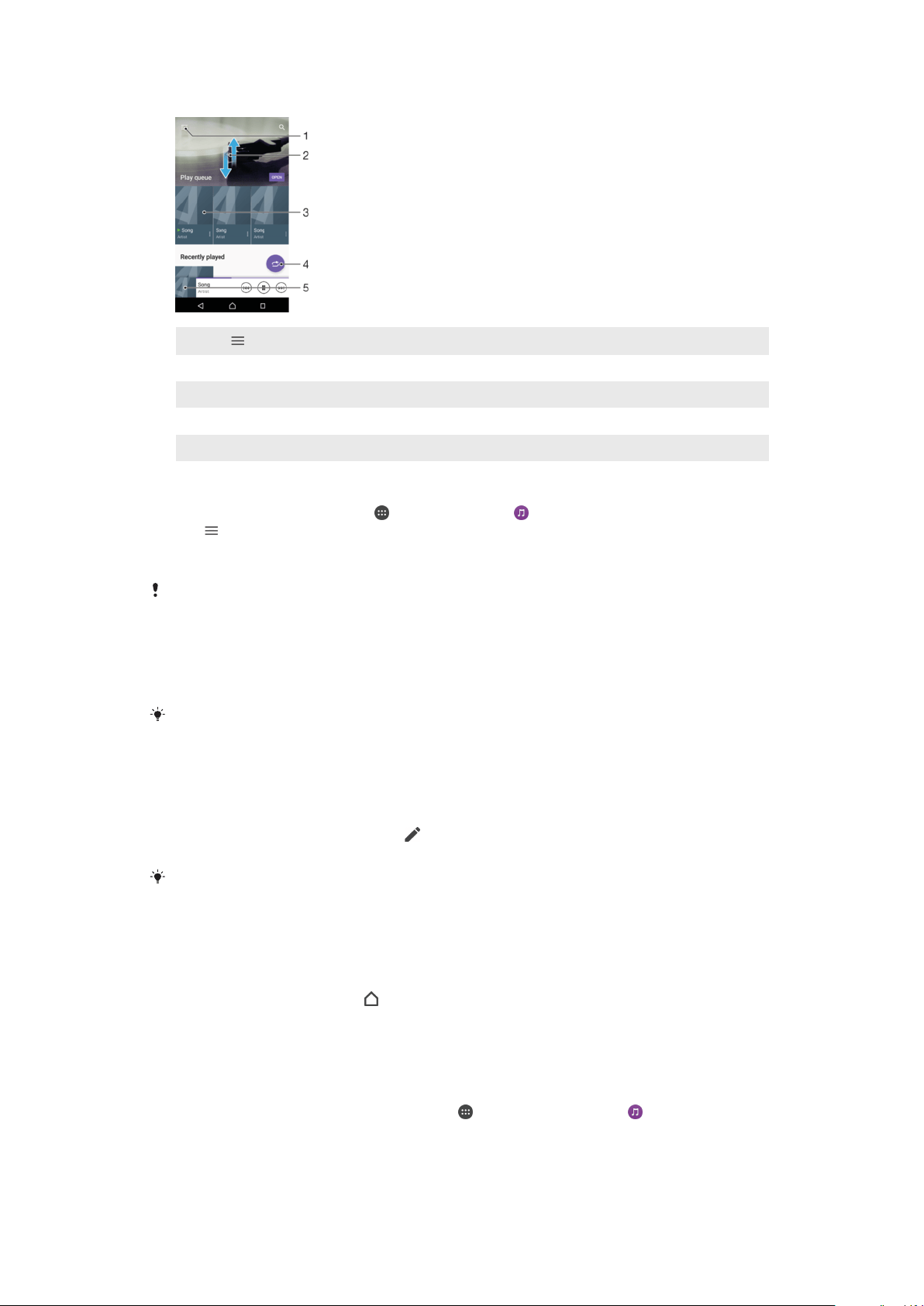
Music Homescreen
1
Tap in the upper-left corner to open the Music menu
2 Scroll up or down to view content
3 Play a song using the Music application
4 Play all songs in shuffle mode
5 Return to the music player screen
To Play a Song Using the Music Application
1
From your
Home screen
, tap , then find and tap .
2
Tap .
3
Select a music category.
4
Tap a song to play it.
You might not be able to play copyright-protected items. Make sure you have the necessary
rights for the content you wish to use.
To Find Song-Related Information Online
•
While a song is playing in the Music application, tap the Album art, then tap More
about this
.
Online resources related to the song can include videos on YouTube™, song lyrics, and artist
information on Wikipedia.
To Edit Music Information and Download Album Art
1
From the Music application, tap the Album art, and then tap
Edit music info
.
2
Edit the information as desired.
3
To set or download album art, tap
, then select an option.
4
When you are finished, tap SAVE.
You can also set album art to download automatically in the Music menu, under Settings.
To Adjust the Audio Volume
•
Press the volume key up or down.
To Minimize the Music Application
•
When a song is playing, tap to go to the Home screen. The Music application
keeps running in the background.
To Open the Music Application when it is Playing in the Background
•
While a song is playing in the background, drag the status bar downward and tap
the Music application.
•
Alternatively, from your Home screen, tap , and then find and tap .
91
This is an internet version of this publication. © Print only for private use.
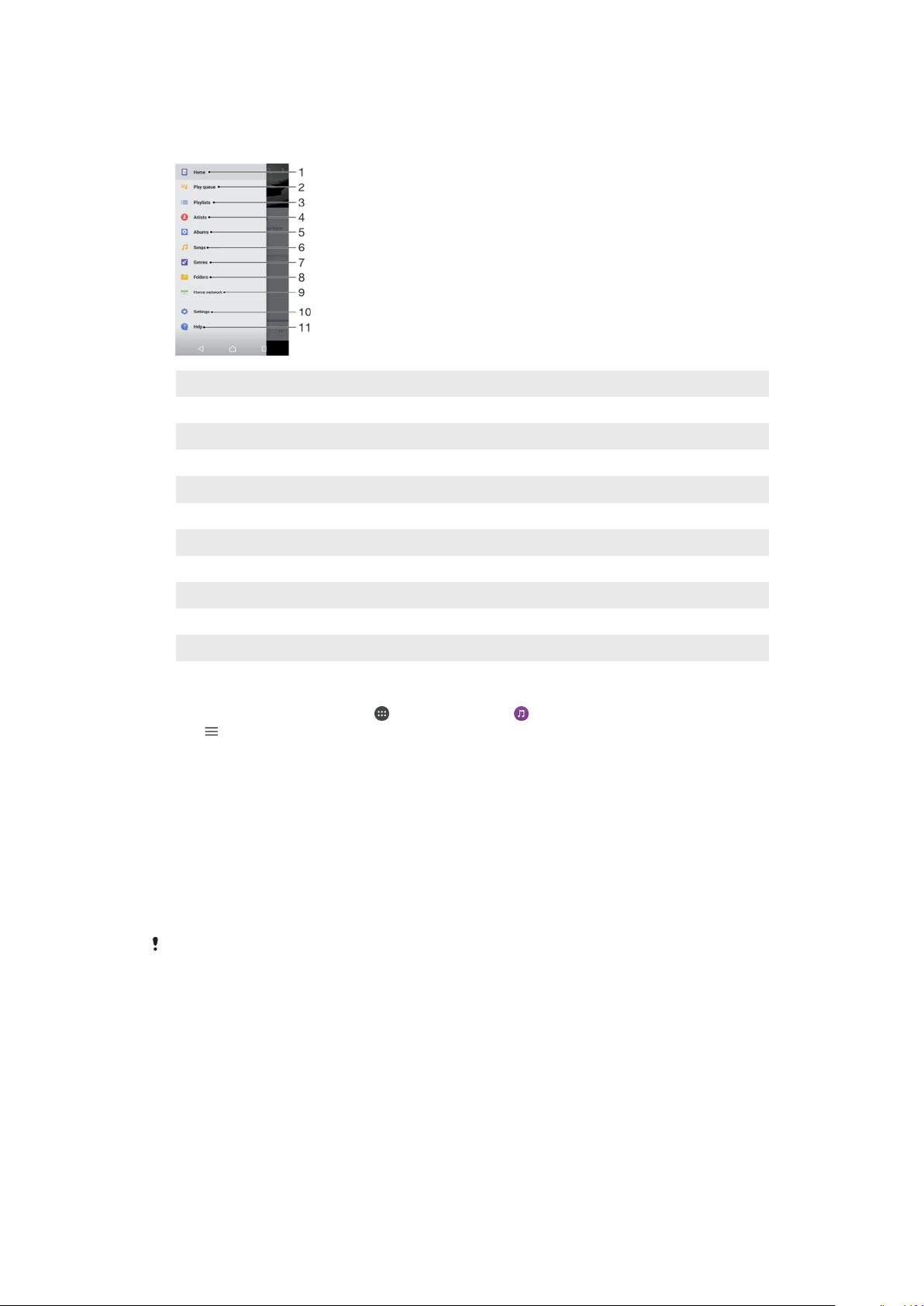
Music Menu
The Music menu gives you an overview of all the songs on your device. From here you
can manage your albums and playlists.
1 Return to the Music homescreen
2 View the current play queue
3 Browse all playlists
4 Browse all artists
5 Browse all albums
6 Browse all songs
7 Browse all genres
8 Browse all folders
9 Play a shared music file on another device
10 Open the settings menu for the Music application
11 Open the support menu for the Music application
To Open the Music Menu
1
From your Home screen, tap , then find and tap .
2
Tap .
To Return to the Music Homescreen
•
When the Music menu is open, tap
Home
or simply tap on the screen to the right
of the menu.
To Delete a Song
1
From the Music menu, browse to the song that you want to delete.
2
Touch and hold the song title, then tap Delete from storage in the list that
appears.
3
Tap DELETE to confirm.
You cannot delete a song that is currently playing.
Playlists
On the Music homescreen, you can create your own playlists from the music that is
saved on your device.
92
This is an internet version of this publication. © Print only for private use.

To Create Your Own Playlists
1
From the Music homescreen, touch and hold the name of the album or song that
you want to add to a playlist.
2
In the menu that opens, tap Add to playlist > Create new playlist.
3
Enter a name for the playlist and tap OK.
You can also open the Music homescreen menu, tap Playlists, and then tap to create a new
playlist.
To Play Your Own Playlists
1
Open the Music menu, and then tap Playlists.
2
Under Playlists, select the playlist you want to open.
3
If you want to play all songs, tap any song or Shuffle all.
To Add Songs to a Playlist
1
From the Music homescreen, browse to the song or album that you want to add
to a playlist.
2
Touch and hold the song or the album title, then tap Add to playlist.
3
Tap the name of the playlist you want to add the album or song to. The album or
song is now added to the playlist.
To Remove a Song from a Playlist
1
In a playlist, touch and hold the title of the song you want to remove.
2
Tap Remove from playlist.
To Delete a Playlist
1
Open the Music menu, then tap Playlists.
2
Touch and hold the playlist that you want to delete.
3
Tap Delete from storage.
4
Tap
DELETE
to confirm.
You cannot delete smart playlists.
Sharing music
To share a song
1
From the Music homescreen, browse to the song or album that you want to share.
2
Touch and hold the song title, then tap
Share
.
3
Select an application from the list, then follow the on-screen instructions.
You can also share albums and playlists in the same way.
Enhancing the sound
To Improve the Sound Quality Using the Equalizer
1
Open the Music menu, and then tap Settings > Audio settings > Sound effects >
Equalizer.
2
To adjust the sound manually, drag the frequency band buttons up or down. To
choose a preset arrangement, tap to select an arrangement, then tap OK to
confirm.
To Turn On the Surround Sound Feature
1
Open the Music menu, and then tap Settings > Audio settings > Sound effects >
Surround sound (VPT).
2
Flick left or right to select a setting, and then tap OK to confirm.
93
This is an internet version of this publication. © Print only for private use.
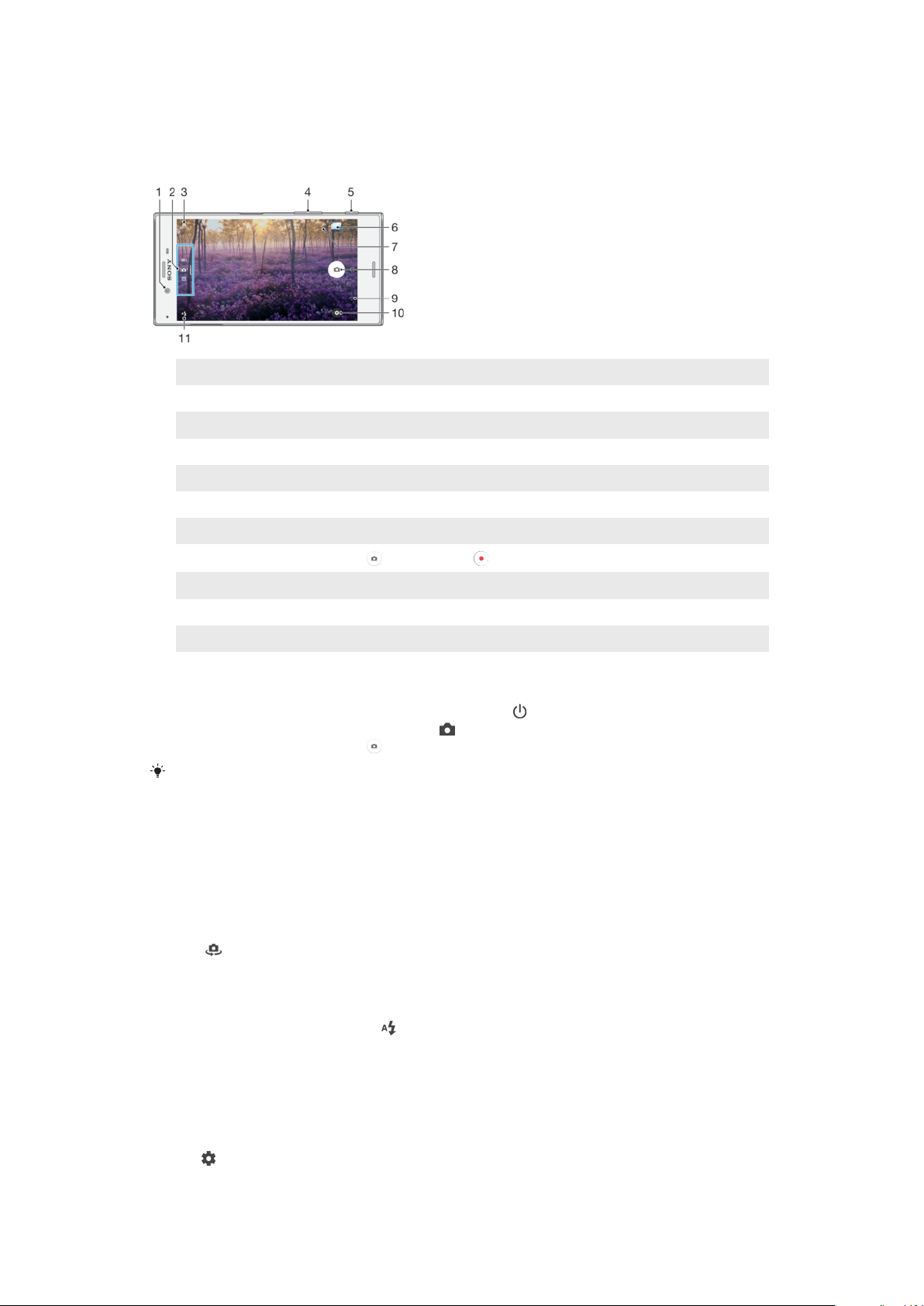
Camera
Taking Photos and Recording Videos
1 Front camera lens
2 Select capturing mode
3 Switch between the front and main camera
4 Zoom in or out
5 Camera key – Activate the camera/Take photos/Record videos
6 View photos and videos
7 Save location
8
Shutter button – Take photos or record videos
9 Go back a step or exit the camera
10 Capturing mode settings
11 Flash settings
To Take a Photo From the Lockscreen
1
To activate the screen, briefly press the power key .
2
To activate the camera, touch and hold , then swipe it anywhere.
3
After the camera opens, tap
.
You can activate the camera when the screen is locked and inactive. To do this, press the
camera key fully. Press again to take a photo.
To take a photo using the camera key
1
Activate the camera.
2
Press the camera key fully down.
To Take a Selfie Using the Front Camera
1
Activate the camera.
2
Tap
.
3
To take the photo, press the camera key.
To use the still camera flash
1
When the camera is open, tap
.
2
Select your desired flash setting.
3
Take the photo.
To Use the Zoom Function
•
When the camera is open, pinch or spread on the camera screen.
•
You can also use the volume key, pressing up or down. To enable this function,
tap
, then tap More > Use Volume key as.
94
This is an internet version of this publication. © Print only for private use.

To Record a Video Using the Camera Key
1
Activate the camera.
2
Swipe the screen to select .
3
To start recording a video, press the camera key.
4
To stop recording, press the camera key again.
To Record a Video
1
Activate the camera.
2
If video mode is not selected, swipe the screen to select .
3
Point the camera toward the subject.
4
To start recording, tap .
5
To pause when recording a video, tap
. To resume recording, tap .
6
To stop recording, tap .
To Take a Photo when Recording a Video
•
To take a photo while recording a video, tap
. The photo is taken as soon as you
release the camera button.
To view your photos and videos
1
Activate the camera, then tap a thumbnail to open a photo or video.
2
Flick left or right to view your photos and videos.
To Delete a Photo or Video
1
Find the photo or video you want to delete.
2
Tap the screen to display the toolbar.
3
Tap .
4
Tap
DELETE
to confirm.
General camera settings
Capturing Modes Overview
You can choose from a range of capturing modes and camera apps. Simply swipe left or
right on the camera screen to switch between them.
Manual
Manually adjust camera settings such as resolution, white balance, and ISO.
Superior auto
Optimize your settings to suit any scene.
Video camera
Manually adjust video settings to suit any scene.
Camera apps
Select camera applications manually.
To learn more about how to take better photos, go to
support.sonymobile.com
.
Camera Apps
AR effect
Take photos or videos with virtual scenes and characters.
Creative effect
Apply effects to photos or videos.
95
This is an internet version of this publication. © Print only for private use.

Sound Photo
Take photos with background sound.
Panorama
Take wide-angle and panoramic photos.
4K video
Take videos with 4K ultra-high definition.
Panorama
You can take wide-angle and panoramic photos with an easy press-and-sweep motion.
To Take a Panoramic Photo
1
Activate the camera.
2
Swipe the screen to select
, then select .
3
Press the camera key and move the camera slowly and steadily in the direction of
movement indicated on the screen.
Auto Face Detection
The camera automatically detects faces and indicates them with frames. A colored frame
shows which face has been selected for focus. The focus is set to the face closest to the
center of the camera. You can also tap one of the frames to select which face should be
in focus.
Auto-Capturing
Turn on auto-capturing to take pictures automatically using one of the options below.
Hand Shutter
Turn your palm toward the camera to turn on the self-timer and take self-portraits in Manual and Superior
auto capturing modes.
Smile Shutter
Use Smile Shutter™ technology to photograph a face just as it smiles. The camera detects up to five faces
and selects one face for smile detection and auto-focus. When the selected face smiles, the camera
automatically takes a photo.
Off
When auto-capturing is off, you can take photos using the shutter button or the camera key.
The Hand Shutter function is available for taking self-portraits only.
To Turn On Smile Shutter™
1
Activate the camera.
2
Tap
.
3
Find and tap Auto capturing > Smile Shutter.
4
When the camera is open and Smile Shutter is turned on, point the camera at
your subject. The camera selects which face to focus on.
5
The face appears inside a colored frame and the photo is taken automatically as
soon as a smile is detected.
6
If no smile is detected, you can press the camera key to take the photo manually.
To Turn On Hand Shutter
1
Activate the camera.
2
Switch to the front camera by tapping
3
Tap .
4
Tap More.
5
Find and tap Auto capturing > Hand Shutter.
96
This is an internet version of this publication. © Print only for private use.

Saving a Photo’s Geographic Location
Enable the Saving location function to geotag your photos, saving the approximate
geographical location as you shoot. The geographical location is determined by wireless
networks and GPS technology.
When appears on the camera screen, Saving location is turned on but the
geographical position has not been found. When appears, Saving location is turned
on and the geographical location is available, so the geographical location can be added
to your photo. When neither of these two symbols appears, Saving location is disabled.
To Turn On Geotagging
1
Activate the camera.
2
Tap
.
3
Tap More, then tap the slider beside Save location to enable or disable the
function.
4
If you are enabling geotagging, you are prompted to enable Location services if
they are not already enabled. Tap OK, then tap the Location slider.
Touch Capture
With Touch capture, simply tap anywhere on the camera screen to take a photo.
On
Only front camera
Off
Touch to adjust
Touch the screen to choose an area to focus on while taking pictures.
Focus only
Focus and brightness
This function is available in Superior auto mode only.
Predictive Capture
The camera automatically starts buffering once it detects movement. When you take a
photo of a moving object, the camera saves several snapshots from before shutter
release in addition to your own photo. 2–4 photos are saved in total, depending on the
movement of the object.
Auto
Off
This function is available in Superior auto mode only.
Auto Photo/Video Preview
You can choose to preview photos or videos just after you shoot them.
On
After you shoot a photo or a video, a preview of it appears in the lower-right corner of the screen for 3
seconds.
Only front camera
After you shoot a photo or video with the front camera, a preview of it appears in the lower-right corner of the
screen for 3 seconds.
Off
The photo or video is saved after you shoot it, and no preview appears.
97
This is an internet version of this publication. © Print only for private use.

Use Volume Key as
You can choose how you want to use the volume key when taking photos.
Zoom
Use the volume key to zoom in or out.
Volume
Use the volume key to adjust the volume of notifications, ringtones and music.
Shutter
Use the volume key to take photos.
Sound
When you take a photo or start recording a video, the camera makes a shutter sound. If
you use the self-timer, it will make a series of beeps to mark the countdown. You can
choose to turn these sounds on or off.
Data storage
You can choose to save your data either to a removable SD card or to your device's
internal storage.
Internal storage
Photos or videos are saved on the device memory.
SD card
Photos or videos are saved on the SD card.
Grid Lines
You can use grid lines as a visual aid while shooting to help you find the right
composition for your photo.
Grid lines are only shown on the camera screen while shooting and do not appear in the
final
photo.
Quick Launch
Use Quick launch settings to launch the camera when the screen is locked.
Launch only
When this setting is activated, you can launch the camera when the screen is locked by pressing and holding
down the camera key.
Launch and capture
When this setting is activated, you can launch the camera and capture a photo automatically when the
screen is locked by pressing and holding down the camera key.
Launch and record video
When this setting is activated, you can launch the camera and start capturing video when the screen is
locked by pressing and holding down the camera key.
Off
To Adjust Color and Brightness
1
Activate the camera.
2
Tap > Color and brightness.
3
Drag the sliders to the desired positions to adjust color and brightness.
This setting is only available in the Superior auto and Video camera modes.
White Balance, Focus, Exposure, and Shutter Speed
White balance, which is only available in Manual capturing mode, adjusts the color
balance according to the lighting conditions. You can also adjust the exposure manually
in the -2.0 EV to +2.0 EV range. For example, you can increase the image brightness or
98
This is an internet version of this publication. © Print only for private use.

decrease the overall exposure by tapping the plus or minus controls accordingly when
is displayed. Focus and shutter speed can be set for either manual or automatic
adjustment.
White balance Auto
Adjust the color balance automatically.
Incandescent
Adjust the color balance for warm lighting conditions, such as
under light bulbs.
Fluorescent
Adjust the color balance for fluorescent lighting.
Daylight
Adjust the color balance for sunny outdoor conditions.
Cloudy
Adjust the color balance for a cloudy sky.
Focus AF
Adjust focus automatically.
Focus MF
Adjust focus manually.
SS auto
Adjust shutter speed automatically.
SS 1/8
Adjust shutter speed manually.
Still camera settings
To adjust the still camera settings
1
Activate the camera.
2
To display all settings, tap .
3
Select the setting that you want to adjust, then edit as desired.
Still camera settings overview
Resolution
Choose between several resolutions and aspect ratios before taking a photo. A photo
with a higher resolution has a higher quality, but requires more memory.
Main camera:
19MP
5056×3792(4:3)
19-megapixel resolution with 4:3 aspect ratio. Suitable for photos you want to view on
non-widescreen displays or print in high resolution.
17MP
5504×3096(16:9)
17-megapixel resolution with 16:9 aspect ratio. Suitable for photos you want to view on
widescreen displays.
12MP
4000×3000(4:3)
12-megapixel resolution with 4:3 aspect ratio. Suitable for photos you want to view on
non-widescreen displays or print in high resolution.
99
This is an internet version of this publication. © Print only for private use.

12MP
4608×2592(16:9)
12-megapixel resolution with 16:9 aspect ratio. Suitable for photos you want to view on
widescreen displays.
Front camera:
13MP
4160×3120(4:3)
13-megapixel resolution with 4:3 aspect ratio. Suitable for photos you want to view on
non-widescreen displays or print in high resolution.
10 MP 16:9
4192×2358(16:9)
10-megapixel resolution with 16:9 aspect ratio. Suitable for photos you want to view on
widescreen displays.
Self-Timer
With the self-timer, you can take a photo without holding the device. Use this function to
take self-portraits or group photos with everyone in the photo. You can also use the self-
timer if you want to avoid shaking the camera when taking photos.
10 sec.
Set a 10-second delay in taking the photo from when you tap the shutter button or press the camera key.
3 sec.
Set a 3-second delay in taking the photo from when you tap the shutter button or press the camera key.
Off
The photo is taken as soon as you tap the shutter button or press the camera key.
Soft Skin Effect
You can turn on the
Soft skin effect
on your device to make skin tones slightly softened
while taking selfies in Manual and Superior auto capturing modes.
Object Tracking
When you select an object by touching it in the viewfinder, the camera tracks it for you.
HDR
Use the HDR (High Dynamic Range) setting to take a photo against strong backlight or in
conditions where the contrast is sharp. HDR compensates for the loss of detail and
produces a picture that is representative of both dark and bright areas.
This setting is only available in
Manual capturing mode.
ISO
The ISO sensitivity can be set to adjust automatically, or can be manually adjusted to
sensitivity settings ranging from 50 to 3200.
This setting is only available in
Manual capturing mode.
Metering
This function automatically determines a well-balanced exposure by measuring the
amount of light striking the image you want to capture.
Face
100
This is an internet version of this publication. © Print only for private use.

Measures the amount of light on your subject’s face, and adjusts the exposure so the face is neither too dark
nor too bright.
Multi
Divides the image into several parts, and measures each part to determine a well-balanced exposure.
Center
Determines the center of the image, and sets the exposure based on the brightness of the subject there.
Spot
Adjusts the exposure in a very small part of the subject that you want to capture.
Touch
Adjusts the exposure to the desired part of the subject when you touch the screen.
This setting is only available in Manual capturing mode.
Flash
Use the flash to take photos when lighting conditions are poor or when there is a
backlight. The following options are available when you tap the flash icon on the
camera screen:
Auto
The camera automatically determines whether the lighting conditions require the use of a flash.
Fill flash
Use this setting when the background is brighter than the subject. This setting removes unwanted dark
shadows.
Red-eye reduction
Reduces the red color of eyes when taking a photo.
Off
The flash is turned off. Sometimes photo quality can be better without the flash, even if lighting
conditions are poor. Taking a good photo without using the flash requires a steady hand. Use the self-
timer to avoid blurred photos.
Flashlight
The flash shines continuously while taking pictures.
Video camera settings
To Adjust the Video Camera Settings
1
Activate the camera.
2
Swipe the screen to select .
3
To display settings, tap
.
4
Select the setting you want to adjust, then make your changes.
Video camera settings overview
Video Resolution
Adjust the video resolution for different formats. HD refers to High Definition, while FPS
refers to Frames Per Second. A higher FPS rate provides a smoother video, at the cost
of a larger file size.
Main camera:
Full HD (30 fps)
1920×1080(16:9)
Full HD (Full High Definition) format with 30 fps and 16:9 aspect ratio.
Full HD (60 fps)
1920×1080(16:9)
Full HD (Full High Definition) format with 60 fps and 16:9 aspect ratio.
101
This is an internet version of this publication. © Print only for private use.

HD
1280×720(16:9)
HD (High Definition) format with 16:9 aspect ratio.
VGA
640×480(4:3)
VGA format with 4:3 aspect ratio.
MMS
Record videos suitable for sending in multimedia messages. The recording time of this
video format is limited so that video files can fit in a multimedia message.
Front camera:
Full HD
1920×1080(16:9)
Full HD (Full High Definition) format with 16:9 aspect ratio.
HD
1280×720(16:9)
HD (High Definition) format with 16:9 aspect ratio.
VGA
640×480(4:3)
VGA format with 4:3 aspect ratio.
MMS
Record videos suitable for sending in multimedia messages. The recording time of this
video format is limited so that video files can fit in a multimedia message.
Recording Videos in Slow Motion
You can record video at the high frame rate of 120 or even 960 frames per second, and
then apply effects so you can play back parts or all of the video in slow motion.
Super slow motion
Start recording a video at normal speed, and record short bursts in slow motion at 960
fps by pressing anytime.
Super slow motion (one-shot)
Record a short burst of video at 960 fps.
Slow motion
Record a video at 120 fps and apply slow-motion effects.
For the best image quality, it is recommended to record videos in a well-lit environment.
To Record a Video in Slow Motion
1
Activate the camera.
2
Swipe the screen to select .
3
Tap
.
4
To display settings, tap .
5
Tap Slow motion mode, and then select an option.
6
Tap the shutter button to start recording.
7
Tap
to exit Slow motion mode and return to Video mode.
102
This is an internet version of this publication. © Print only for private use.

Auto-Capturing (Video)
Turn on auto-capturing to take pictures automatically while recording a video. When
using the Smile Shutter™ feature, the camera automatically takes snapshots of smiling
faces while you continue to record your video.
To Turn On Smile Shutter™ (Video)
1
Activate the camera.
2
Tap .
3
Find and tap Auto capturing (video) > Smile Shutter.
SteadyShot™
When recording a video, it can be difficult to hold the device steady. The stabilizer helps
by compensating for the small movements of your hand.
Intelligent active
Activate to compensate for major and minor camera shakes.
Standard
Activate to remove the high-frequency camera shakes.
Off
The stabilizer is turned off.
Object Tracking
When you select an object by touching it in the viewfinder, the camera tracks it for you.
Flashlight
Use the flashlight to provide lighting for videos when ambient lighting conditions are poor
or when there is a backlight. The video flash icon
is available on the video camera
screen. Note that the video quality can sometimes be better without a light, even if
lighting conditions are poor.
On
Off
Further Camera Support Information
Use the Help menu to search for camera-related tests and other useful information. To
access support, follow the steps below.
1
Open the camera application.
2
Tap
, then tap More > Help
103
This is an internet version of this publication. © Print only for private use.
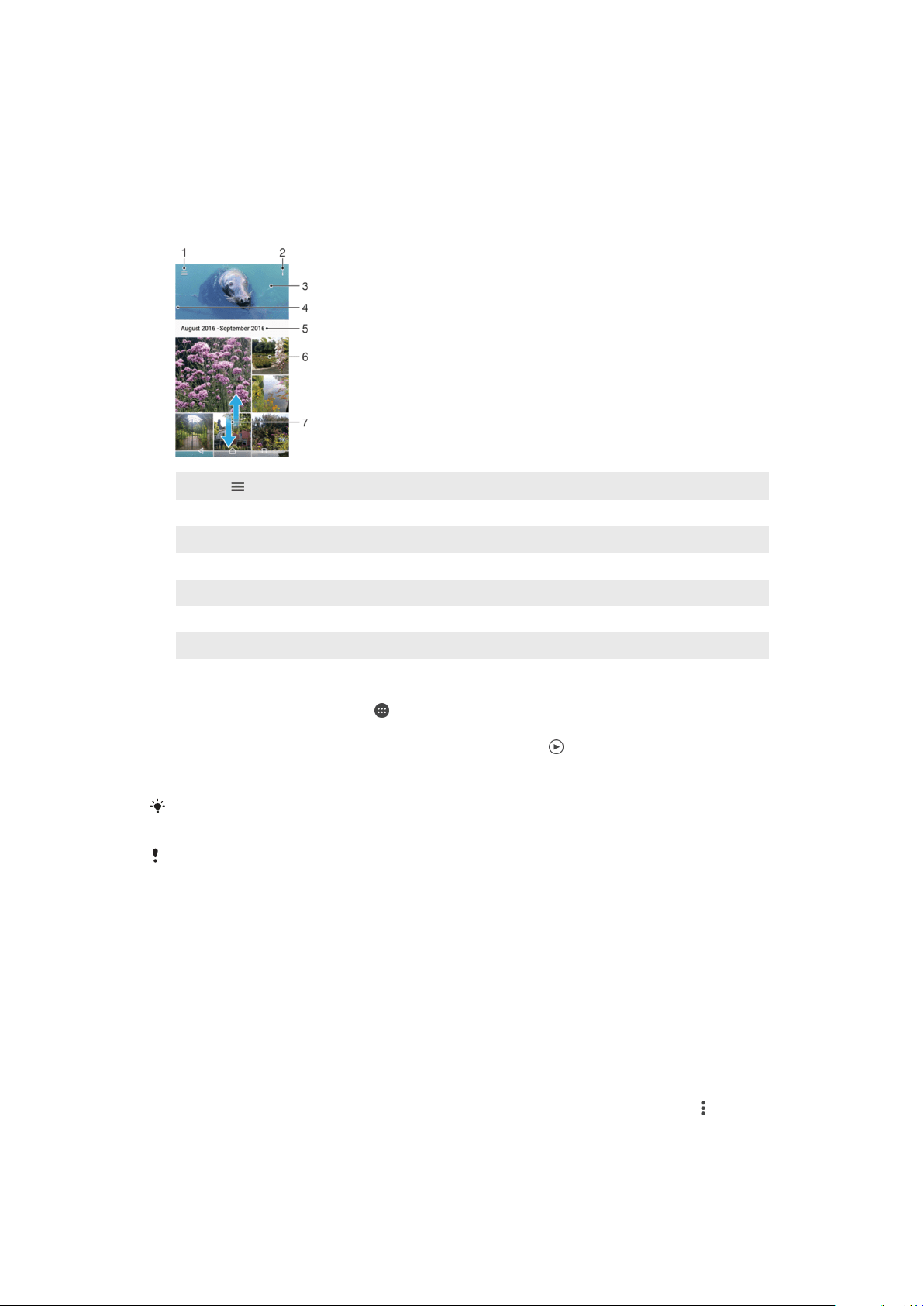
Photos and videos in Album
Viewing Photos and Videos
Use the Album application to view photos and play videos you’ve taken with your
camera, or to view similar content you’ve saved to your device. All photos and videos are
displayed in a chronologically ordered grid.
1
Tap to open the Album Homescreen menu
2 View menu options
3 A slideshow of all your photos and videos, or the ones you added to favorites
4 Drag the left edge of the screen to the right to open the Album Homescreen menu
5 The date of items in the group
6 Tap a photo or video to view it
7 Scroll up or down to view content
To View Photos and Videos
1
From your Home screen, tap .
2
Find and tap
Album
.
3
Tap a photo or video you want to view. If prompted, tap .
4
Flick left to view the next photo or video. Flick right to view the previous photo or
video.
To set the screen to rotate automatically when turned sideways, tap
Rotate the contents of the
screen under Settings > Display > When device is rotated.
The Album application may not support all file formats. For more information about supported
file formats and the use of multimedia (audio, image, and video) files, download the White
paper for your device at
www.sonymobile.com/support/
.
To change the size of the thumbnails
•
When viewing thumbnails of photos and videos in Album, spread two fingers apart
to zoom in, or pinch two fingers together to zoom out.
To zoom a photo
•
When you are viewing a photo, spread two fingers apart to zoom in, or pinch two fingers
together to zoom out.
To Watch a Slideshow of Your Photos
1
When you are viewing a photo, tap the screen to display the toolbars, then tap
>
Slideshow to start playing all the photos in an album.
2
Tap a photo to end the slideshow.
104
This is an internet version of this publication. © Print only for private use.

To Play a Video
1
In Album, find and tap the video you want to play.
2
Tap .
3
If the playback controls are not displayed, tap the screen to display them. To hide
the controls, tap the screen again.
To Pause a Video
1
When a video is playing, tap the screen to display the controls.
2
Tap .
To Fast-Forward and Rewind a Video
1
When a video is playing, tap the screen to display the controls.
2
Drag the progress bar marker left to rewind, or right to fast-forward.
To Adjust the Sound Volume of a Video
•
Press the volume key up or down.
Sharing and Managing Photos and Videos
You can share photos and videos that you’ve saved on your device. You can also
manage them in different ways. For example, you can work with photos in batches,
delete photos, and link them to contacts. If you have lots of photos saved on your
device, it’s a good idea to routinely transfer them to a computer or to an external storage
device in order to avoid any inadvertent loss of data. Doing so also frees up more space
on your device. See
Managing Files Using a Computer
on the 40 page.
You might not be able to copy, send, or transfer copyright-protected items. Also, some items
may not send if the file size is too large.
To Share a Photo or Video
1
In Album, find and tap the photo or video you want to share.
2
Tap the screen to display the toolbars, then tap
.
3
Tap the application you want to use to share the photo, then follow the steps to
send it.
To Use a Photo as a Contact Picture
1
When you are viewing a photo, tap the screen to display the toolbars, then tap >
Use as
>
Contact photo
.
2
Select a contact, then edit the photo as desired.
3
Tap
SAVE
.
To Use a Photo as Wallpaper
1
When you are viewing a photo, tap the screen to display the toolbars, then tap >
Use as > Wallpaper.
2
Follow the instructions on the screen.
To Rotate a Photo
1
When you are viewing a photo, tap the screen to display the toolbars, then tap .
2
Tap Rotate, and then select an option. The photo is saved in the new orientation.
To Delete a Photo or Video
1
When you are viewing a photo, tap the screen to display the toolbars, then tap .
2
Tap DELETE.
105
This is an internet version of this publication. © Print only for private use.

To Work with Batches of Photos or Videos in Album
1
When viewing thumbnails of photos and videos in Album, touch and hold an item
until it’s highlighted.
2
Tap other items you want to work with to select them. If you want to select all
items, tap
, then tap Select all.
3
Use the tools in the toolbar to work with your selected items.
Editing photos with the Photo editor application
You can edit and apply effects to original photos that you’ve taken with your camera. For
example, you can change the light effects. After you save the edited photo, the original
unchanged version of the photo remains on your device.
To edit a photo
•
When you are viewing a photo, tap the screen to display the toolbars, then tap
.
To Crop a Photo
1
When you are viewing a photo, tap the screen to display the toolbars, then tap
.
2
If prompted, select Photo editor.
3
Tap > Crop.
4
Tap Crop to select an option.
5
To adjust the crop frame, touch and hold the edge of the crop frame. When the
circles at the edges disappear, drag inward or outward to resize the frame.
6
To resize all sides of the crop frame at the same time, touch and hold one of the
four corners. When the circles at the edges disappear, drag the corner
accordingly.
7
To move the crop frame to another area of the photo, touch and hold inside the
frame, then drag it to the desired position.
8
Tap
.
9
To save a copy of the cropped photo, tap
SAVE
.
To apply special effects to a photo
1
When you are viewing a photo, tap the screen to display the toolbars, then tap .
2
If prompted, select Photo editor.
3
Tap
or , then select an option.
4
Edit the photo as desired, and then tap SAVE.
To Add a Photo Frame Effect to a Photo
1
When you are viewing a photo, tap the screen to display the toolbars, then tap .
2
If prompted, select
Photo editor
.
3
Tap
, then select an option.
4
To save a copy of the edited photo, tap
SAVE
.
To Adjust the Light Settings for a Photo
1
When you are viewing a photo, tap the screen to display the toolbars, then tap .
2
If prompted, select Photo editor.
3
Tap , then select an option and edit as desired.
4
To save a copy of the edited photo, tap SAVE.
To Set the Saturation Level of Colors in a Photo
1
When you are viewing a photo, tap the screen to display the toolbars, then tap .
2
If prompted, select Photo editor.
3
Tap
, then select an option.
4
To save a copy of the edited photo, tap SAVE.
106
This is an internet version of this publication. © Print only for private use.

Editing videos with the Video editor application
You can edit videos that you’ve taken with your camera. For example, you can trim a
video to the desired length or adjust the speed of a video. After you save the edited
video, the original unchanged version of the video remains on your device.
To Trim a Video
1
In the Album, find and tap the video you want to edit.
2
Tap the screen to display the toolbars, then tap .
3
If prompted, select Video Editor, and then tap Trim.
4
To move the trim frame to another part of the timeline, touch and hold the edge of
the trim frame and drag it to the desired position, and then tap Apply.
5
To save a copy of the trimmed video, tap SAVE.
To Adjust the Speed of a Video
1
In the Album, find and tap the video you want to play.
2
Tap the screen to display the toolbars, then tap
.
3
If prompted, select Video Editor, and then tap Speed.
4
Select an option, touch and hold the edge of the timeline and drag it to the
desired position, and then tap Apply.
5
To save a copy of the edited video, tap SAVE.
To Capture a Photo from a Video
1
In the Album, find and tap the video you want to play.
2
Tap the screen to display the toolbars, and then tap
.
3
If prompted, select Video Editor, and then tap Photo Capture.
4
With the help of the arrows, or by dragging the marker on the progress bar, select
the preferred frame that you want to capture, and then tap Save.
Hiding photos and videos
You can hide any photos and videos from the Album homescreen. Once photos and
videos are hidden from the Album homescreen, they can only be viewed from the Hidden
folder.
To Hide a Photo or Video
1
In Album, find and tap the photo or video you want to hide.
2
Tap the screen to display the toolbars, then tap .
3
Tap
Hide
>
OK
.
To View Your Hidden Photos and Videos
1
In Album, tap , then tap
Hidden
.
2
Tap a photo or video to view it.
3
Flick left to view the next photo or video. Flick right to view the previous photo or
video.
To Unhide a Photo or Video
1
In Album, tap , then tap Hidden.
2
Tap a photo or video that you want to unhide.
3
Tap the screen to display the toolbars, then tap
.
4
Tap Don't hide.
Album Homescreen Menu
From the Album homescreen menu, you can browse your photo albums, including
photos and videos taken using special effects, as well as content that you have shared
online via services such as Picasa™ and Facebook. Once you are logged in to such
platforms, you can manage content and view online images. From the Album application,
107
This is an internet version of this publication. © Print only for private use.
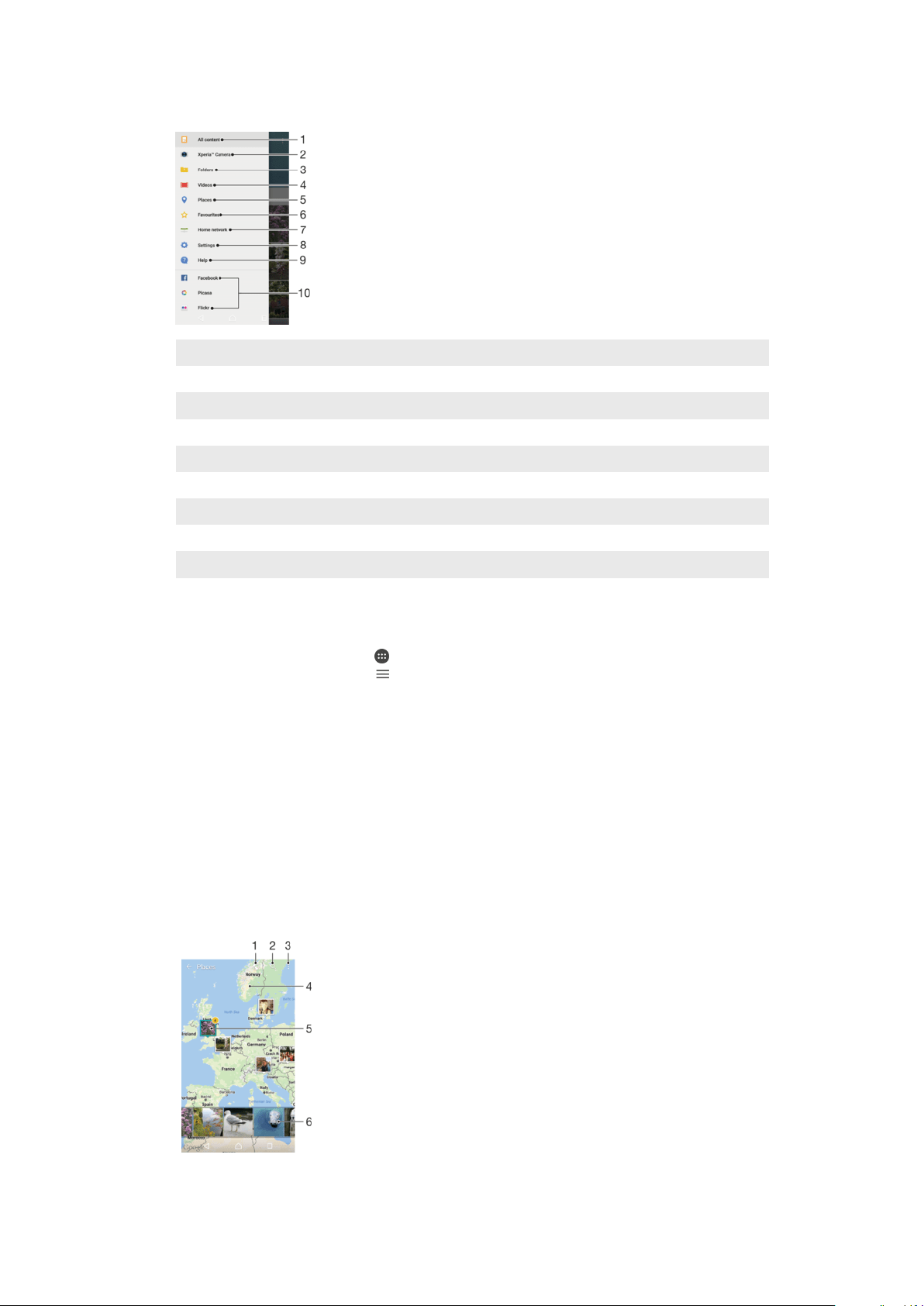
you can also add geotags to photos, perform basic editing tasks, and use methods such
as Bluetooth® wireless technology and email to share content.
1 Return to the Album application homescreen to view all content
2 View all photos and videos taken with your device's camera
3 View all photos and videos saved on your device in different folders
4 View all videos saved on your device
5 View your photos on a map or in Globe view
6 View your favorite photos and videos
7 View photos and videos on other devices in the same network
8 Open the settings menu for the Album application
9 Open web support
10 View photos from online services
To View Photos from Online Services in Album
1
From your Home screen, tap .
2
Find and tap
Album
, then tap
.
3
Tap the desired online service, and then follow the on-screen instructions to get
started. All available online albums that you have uploaded to the service are
displayed.
4
Tap any album to view its content, and then tap a photo in the album.
5
Flick left to view the next photo or video. Flick right to view the previous photo or
video.
Viewing Your Photos on a Map
Adding location information to photos is referred to as geotagging. You can view and tag
your photos on a map and show friends and family where you were when you took a
particular photo. See
Saving a Photo’s Geographic Location
on page 97 for more
information.
108
This is an internet version of this publication. © Print only for private use.

1 View geotagged photos in Globe view
2 Search a location on the map
3 View menu options
4 Double-tap to zoom in. Pinch to zoom out. Drag to view different parts of the map
5 A group of photos or videos geotagged with the same location
6 Thumbnails of the selected group of photos or videos. Tap an item to view it in full screen
To Add or Edit the Geotag of a Photo
1
When you are viewing a photo, tap the screen to display the toolbars.
2
Tap
, then tap Add geotag or Edit geotag to open the map screen.
3
Tap on the map to set the location for the photo.
4
To reset the location for the photo, tap the new location on the map.
5
When you are done, tap OK.
If you have turned on location detection and activated geotagging in the camera, you can tag
your photos directly for map viewing at a later stage.
To View Geotagged Photos on a Map
1
From your Home screen, tap .
2
Find and tap
Album
.
3
Tap , then tap Places.
4
Tap the photo that you want to view on a map.
If several photos were taken at the same location, only one of them appears on the map. The
total number of photos appears in the top-right corner, for example, . To view all photos in
the group, tap the cover photo, then tap one of the thumbnails at the bottom of the screen.
To View Geotagged Photos on a Globe
1
From your Home screen, tap .
2
Find and tap
Album
.
3
Tap , then tap Places > .
4
Tap the photo that you want to view on a globe.
To change the geotag of a photo
1
When viewing a photo on the map in Album, touch and hold the photo until its
frame turns blue, then tap the desired location on the map.
2
Tap
OK
.
To Change the Map View
•
When viewing the map in Album, tap , then switch between
Classic view
and
Satellite
view.
109
This is an internet version of this publication. © Print only for private use.

Videos
The Video Application
Use the Video application to play movies and other video content that you’ve saved or
downloaded to your device. The application also serves as a TV program guide with the
option to show detailed program information and related content, including social media
posts about the program you are interested in. You can use the application as a fully
functioning remote controller with your compatible home device. You can also play your
movies on other devices that are connected to the same network or saved in the cloud.
Some video files may not be playable in the Video application. The availability of the TV
program guide and the remote controller vary by market and connected device.
1
Tap to open the Video homescreen menu
2 View the program guide
3 Refresh content
4 Remote controller
5 Search content
6 Switch between viewing the contents of your library, Popular shows, On Air shows, Movies, TV Series,
and Recommended shows
7 Drag the left edge of the screen to the right to open the menu, browse content, and adjust settings
8 Tap a show to get detailed information and related content
To use your device as a remote controller
To use your device as a remote controller with another compatible home network device,
you first need to pair the two devices. In order to do this, both devices need to be
connected to the same network.
1
From your Home screen, tap , then find and tap Video.
2
Tap to open the Homescreen menu, then tap Add device.
3
Select the home device from the list.
4
Enter the registration number shown on the home device and follow the
instructions to finish pairing.
5
After the successful pairing, the
icon for the remote controller function appears.
You can now use your device as a fully functional remote controller for the home
device.
To Change Settings
1
From your Home screen, tap
, then find and tap Video.
2
Tap to open the Homescreen menu, then tap Settings.
3
Change the settings as desired.
110
This is an internet version of this publication. © Print only for private use.

To Play a Video
1
From your Home screen, tap , then find and tap Video.
2
Find and tap the video you want to play. If the video is not displayed on the
screen, tap to open the Homescreen menu, then find and tap the video you
want to play.
3
To display or hide the controls, tap the screen.
4
To pause playing, tap . To resume playing, tap .
5
To rewind, drag the progress bar marker to the left. To fast-forward, drag the
progress bar marker to the right.
To Change the Sound Settings While a Video is Playing
1
While a video is playing, tap the screen to display the controls.
2
Tap
> Audio settings, then change the settings as desired.
To Share a Video
1
When a video is playing, tap
, then tap Share.
2
Tap the application you want to use to share the selected video, then follow the
instructions provided.
Transferring Video Content to Your Device
Before you start using the Video application, it’s a good idea to transfer movies, TV
shows, and other video content to your device from other devices, such as a computer.
There are several ways to transfer your content:
•
For Windows
®
only: Connect your device to a computer using a USB Type-C™ cable
and drag and drop the video files directly using the file manager application on the
computer. See
Managing Files Using a Computer
on page 40.
•
If you have a PC or an Apple
®
Mac
®
computer, use Xperia™ Companion to organize
content and transfer video files to your device.
Managing video content
To View Movie Information
1
From your Home screen, tap , then find and tap Video.
2
Tap to open the Homescreen menu, then tap
Mobile device
.
3
Browse through the different categories and find the desired video.
4
Tap the video thumbnail.
To Delete a Video
1
From your
Home screen
, tap
, then find and tap
Video
.
2
Tap to open the Homescreen menu, then tap Mobile device.
3
Browse through the different categories and find the desired video.
4
Tap the video thumbnail, then tap .
5
Tap Delete again to confirm.
Movie Creator
The Xperia™ Movie Creator automatically creates short videos using existing photos and
videos. The application automatically determines the timeline to create its movie. For
example, it can take a selection of photos and videos from a Saturday afternoon outing
or from a weekly, monthly, or even a yearly period and create a movie for you. When this
highlight-style movie is ready, you get notified. You can then edit it as desired. For
example, you can edit the title, delete scenes, change the music, or add more photos
and videos. You can create Highlight Movies by selecting photos and videos manually. If
you log in to a Facebook account, you can create Highlight Movies from your Facebook
events, featuring photos from the event, friends’ names, and more.
111
This is an internet version of this publication. © Print only for private use.

To Open Movie Creator
1
From your Home screen, tap .
2
Find and tap Movie Creator.
To Enable or Disable Movie Creator Notifications
1
From your Home screen, tap .
2
Find and tap Movie Creator.
3
Tap , then tap Settings, and tap the Notifications slider to enable or disable
notifications.
To enable or disable the automatic creation of Highlight Movies
1
From your Home screen, tap
.
2
Find and tap Movie Creator.
3
Tap
, then tap Settings, and tap the Auto creating slider to enable or disable the
function.
To Manually Create a Highlight Movie
1
From your Home screen, tap .
2
Find and tap Movie Creator.
3
Tap
> Create new.
4
Select the desired photos or videos by tapping them.
5
Tap CREATE. If you want to edit a Highlight Movie, tap View story, then use the
toolbar to edit as desired.
To Create a Highlight Movie from Facebook Events
1
From your
Home screen
, tap .
2
Find and tap Movie Creator.
3
Tap >
Settings
.
4
Tap the slider beside Link Facebook.
•
Movie Creator is now linked with your Facebook account if you are already
logged in to Facebook.
•
If you are not logged in to Facebook yet, follow the on-screen instructions.
5
Tap
, then scroll down to browse your Facebook events.
6
Choose an event to create a Highlight Movie about and tap
CREATE
.
112
This is an internet version of this publication. © Print only for private use.

Connectivity
Mirroring the Screen of Your Device Wirelessly on a TV
You can use the Screen mirroring feature to show the screen of your device on a TV or
other large display without using a cable connection. Wi-Fi Direct™ technology creates a
wireless connection between the two devices, so you can sit back and enjoy your
favorite photos from the comfort of your couch. You can also use this feature to listen to
music from your device using the TV's speakers.
When using Screen mirroring, the image quality may sometimes be negatively impacted if
there is interference from other Wi-Fi networks.
To Mirror the Screen of Your Device on a TV Screen
1
TV: Follow the instructions in the User Guide of your TV to turn on the Screen
mirroring function.
2
Your device: From your Home screen, tap .
3
Find and tap Settings > Device connection > Screen mirroring.
4
Tap Start.
5
Tap OK and select a device.
Your TV must support Screen mirroring based on Wi-Fi CERTIFIED Miracast
™
for the function
to work. If your TV does not support Screen mirroring, you may need to purchase a wireless
display adapter separately. Also, when using Screen mirroring, do not cover the Wi-Fi antenna
area of your device.
To Stop Screen Mirroring between Devices
1
From your
Home screen
, tap .
2
Find and tap Settings > Device connection > Screen mirroring.
3
Tap
Disconnect
, then tap
OK
.
Sharing Content with DLNA Certified™ Devices
You can view or play media content saved to your device on other devices, like a TV or a
computer. These devices must be on the same wireless network and can be Sony TVs
or speakers, or products that are DLNA Certified™ by the Digital Living Network Alliance.
You can also view or play content from other DLNA Certified™ devices on your device.
After you set up media sharing between devices, you can for example listen to music
files stored on your home computer using your device, or view photos taken with your
device's camera on a large-screen TV.
Playing Files from DLNA Certified™ Devices on Your Device
When you play files from another DLNA Certified™ device on your device, this other
device acts as a server. In other words, it shares content over a network. The server
device must have its content sharing function enabled and give access permission to
your device. It also must be connected to the same Wi-Fi network as your device.
To Use Your Device to Play a Music Track Stored on Another Device
1
Make sure the device you want to share files with is connected to the same Wi-Fi
network as your device.
2
From your Home screen, tap
, then find and tap .
3
Tap , then tap Home network.
4
Select a device from the list of connected devices.
5
Browse the folders of the connected device and select the track you want to play.
Once selected, the track starts playing automatically.
113
This is an internet version of this publication. © Print only for private use.

To play a shared video on your device
1
Make sure the devices that you want to share files with are connected to the same
Wi-Fi network as your device.
2
From your Home screen, tap , then find and tap or .
3
Tap , then tap Home network.
4
Select a device from the list of connected devices.
5
Browse the folders of the connected device and select the video you want to play.
To View a Shared Photo on Your Device
1
Make sure the devices you want to share files with are connected to the same Wi-
Fi network as your device.
2
From your Home screen, tap
, then find and tap .
3
Tap , and then tap Home network.
4
Select a device from the list of connected devices.
5
Browse the folders of the connected device and select a photo to view it.
Playing files from your device on DLNA Certified™ devices
Before you can view or play media files from your device on other DLNA Certified™
devices, you must set up file sharing on your device. The devices that you share content
with are called client devices. For example, a TV, computer or tablet can act as client
devices. Your device works as a media server when it makes content available to client
devices. When you set up file sharing on your device, you must also give access
permission to client devices. After you do so, such devices appear as registered devices.
Devices that are waiting for access permission are listed as pending devices.
To Set Up File Sharing With Other DLNA Certified™ Devices
1
Connect your device to a Wi-Fi network.
2
From your Home screen, tap
, then find and tap Settings > Device connection
>
Media server
.
3
Tap the slider beside Share media.
4
Use your computer or other DLNA™ client devices on the same Wi-Fi network to
connect to your device.
5
A notification appears in the status bar of your device. Open the notification and
set access permissions for each client device attempting to connect to your
device.
The steps for accessing media on your device using a DLNA™ client differ between client
devices. Refer to your client device User Guide for more information. If your device is
inaccessible to a client on the network, check if your Wi-Fi network is working.
You can also access the Media server menu from certain applications like Music or Album by
dragging the left edge of the application’s homescreen to the right and then tapping Settings
> Media server.
To Stop Sharing Files With Other Home Network Devices
1
From your Home screen, tap .
2
Find and tap Settings > Device connection > Media server.
3
Tap the Share media slider.
To Set Access Permissions for a Pending Device
1
From your Home screen, tap .
2
Find and tap Settings > Device connection > Media server.
3
Select a device from the Pending devices list.
4
Select an access permission level.
114
This is an internet version of this publication. © Print only for private use.

To Change the Name of a Registered Device
1
From your Home screen, tap .
2
Find and tap Settings > Device connection > Media server.
3
Select a device from the Registered devices list, then select Change name.
4
Enter a new name for the device, then tap OK.
To Change the Access Level of a Registered Device
1
From your Home screen, tap .
2
Find and tap Settings > Device connection > Media server.
3
Select a device from the Registered devices list.
4
Tap Change access level and select an option.
To Get Help With Sharing Content With Other DLNA Certified™ Devices
1
From your Home screen, tap
.
2
Find and tap Settings > Device connection > Media server.
3
Tap
and then tap Help.
Displaying Files on Another Device Using Cast
Using DLNA™ technology, you can push media content from your device to another
device connected to the same Wi-Fi network. The receiving device must be able to
function as a Digital Media Renderer (DMR) device and play content received from your
device. A TV that supports DLNA™ or a PC running Windows® 7 or later are examples
of DMR devices.
The steps for playing shared media may vary depending on the client device. Refer to the user
guide of the DMR device for more information.
Content secured with Digital Rights Management (DRM) cannot be played on a Digital Media
Renderer device using DLNA™ technology.
To Display Photos or Videos on a Client Device Using Cast
1
Make sure you have correctly set up the DMR or DLNA™ client device and it is
connected to the same Wi-Fi network as your device.
2
From your Home screen, tap
.
3
Find and tap
Album
.
4
Browse and open the photos or videos that you want to view.
5
Swipe down the status bar with two fingers, then tap and select the device you
want to share your content with.
6
To stop sharing the photo or video with the client device, tap and then select
Stop casting.
You may also see Google Cast devices shown on the list when tapping
.
To Play a Music Track on a Client Device Using Cast
1
Make sure you have correctly set up the DMR or DLNA™ client device and it is
connected to the same Wi-Fi network as your device.
2
From your Home screen, tap , then find and tap .
3
Select a music category and browse to the track that you want to share, then tap
the track.
4
Tap and select a client device to share your content with. The track starts
playing on the device that you select.
5
To disconnect from the client device, tap and then select Stop casting.
You may also see Google Cast devices shown on the list when tapping
.
Connecting Your Device to USB Accessories
You can use a USB Type-C™ host adapter to connect your device to USB accessories
such as USB mass storage devices, game controllers, USB keyboards, and USB mice. If
115
This is an internet version of this publication. © Print only for private use.

the USB accessory has a USB Type-C connector, a USB Type-C host adapter is not
necessary.
USB Type-C host adapters are sold separately. Sony does not guarantee that all USB
accessories are supported by your device.
This device has a capless USB Type-C port. If your device gets exposed to water, ensure that
the port is completely dry before connecting a USB Type-C cable.
Connecting Your Device to a DUALSHOCK™ 4 Wireless
Controller
Using a DUALSHOCK™ 4 wireless controller, you can play games stored on your Xperia
device or game console using Remote Play.
To Connect a DUALSHOCK™4 Wireless Controller to your Device
1
From your Home screen, tap
.
2
Find and tap Settings > Device connection > DUALSHOCK™4.
3
Tap Pair controller, and then follow the on-screen instructions to complete the
connection.
NFC
Use Near Field Communication (NFC) to share data with other devices, such as videos,
photos, web page addresses, music files, or contacts. You can also use NFC to scan
tags that give you more information about a product or service as well as tags that
activate certain functions on your device.
NFC is a wireless technology with a maximum range of one centimeter, so the devices
sharing data must be held close to each other. Before you can use NFC, you must first
turn on the NFC function, and the screen of your device must be active.
The NFC detection area is located on the front of the device. Hold your device close to
another device or an NFC reader so the NFC detection areas touch each other.
NFC may not be available in all countries or regions. Using certain apps, some NFC functions
can be enabled even when the device is switched off. Note that not all devices support this
feature.
To Enable or Disable the NFC Function
1
From your Home screen, tap .
2
Find and tap Settings > More.
3
Tap the NFC slider.
116
This is an internet version of this publication. © Print only for private use.

To Share a Contact with Another Device Using NFC
1
Make sure both devices have the NFC function turned on, and that both screens
are active and unlocked.
2
To view contacts, go to your Home screen, tap , then tap .
3
Tap the contact you want to share.
4
Hold your device and the receiving device close to each other so that the NFC
detection areas of each device touch. When the devices connect, a thumbnail of
the contact appears.
5
Tap the thumbnail to start the transfer.
6
When the transfer is done, the contact information is saved on the receiving
device and displayed on its screen.
To Share a Music File With Another Device Using NFC
1
Make sure both your device and the receiving device have the NFC function
turned on and both screens are active and unlocked.
2
To open the Music application, tap
, then find and tap .
3
Select a music category and browse to the track you want to share.
4
Tap the track to play it. You can then tap
to pause the track. The transfer works
whether the track is playing or paused.
5
Make sure the track is displayed on full screen.
6
Hold your device and the receiving device close to each other so the NFC
detection areas of each device touch. When the devices connect, a thumbnail of
the track appears.
7
Tap the thumbnail to start the transfer.
8
When the transfer is done, the music file is saved on the receiving device.
9
To display the music file, double-tap the status bar to open the Notification panel,
then tap Beam complete .
To Share a Photo or Video with Another Device Using NFC
1
Make sure both devices have the NFC function turned on, and that both screens
are active and unlocked.
2
To view photos and videos on your device, go to your Home screen, tap , then
find and tap
Album
.
3
Tap the photo or video you want to share.
4
Hold your device and the receiving device close to each other so that the NFC
detection areas of each device touch. When the devices connect, a thumbnail of
the photo or video appears.
5
Tap the thumbnail to start the transfer.
6
When the transfer is done, the photo or video is saved on the receiving device.
To Share a Web Address With Another Device Using NFC
1
Make sure both devices have the NFC function turned on, and both screens are
active and unlocked.
2
From your Home screen, tap
.
3
To open the web browser, find and tap .
4
Load the web page that you want to share.
5
Hold your device and the receiving device close to each other so the NFC
detection areas of each device touch. When the devices connect, a thumbnail of
the web page appears.
6
Tap the thumbnail to start the transfer.
7
When the transfer is done, the web page is displayed on the screen of the
receiving device.
Scanning NFC Tags
Your device can scan various kinds of NFC tags to receive additional information, such
as a web address. For example, it can scan embedded tags on a poster, on a billboard
advertisement, or beside a product in a retail store.
117
This is an internet version of this publication. © Print only for private use.

To Scan an NFC Tag
1
Make sure your device has the NFC function turned on and the screen is active
and unlocked.
2
Place your device over the tag so the NFC detection area touches it. Your device
scans the tag and displays the content collected. Tap the content of the tag to
open it.
Connecting to an NFC-Compatible Device
You can connect your device to other NFC-compatible devices produced by Sony, such
as a speaker or a headphone. When establishing this kind of connection, refer to the
User Guide of the compatible device for more information.
You may need to have Wi-Fi or Bluetooth® activated on both devices for the connection to
work.
Bluetooth® Wireless Technology
Use the Bluetooth® function to send files to other Bluetooth® compatible devices, or to
connect to hands-free accessories. Bluetooth® connections work better within 10
meters (33 feet), with no solid objects in between. In some cases you have to manually
pair your device with other Bluetooth® devices.
Interoperability and compatibility among Bluetooth® devices can vary.
If you are using a device with multiple users, each user can change the Bluetooth® settings,
and the changes affect all users.
To Turn the Bluetooth
®
Function On or Off
1
From your
Home screen
, tap .
2
Find and tap Settings > Bluetooth.
3
Tap the
Bluetooth
slider to enable or disable the function.
Naming your device
You can give your device a name. This name is shown to other devices after you have
turned on the Bluetooth
®
function and your device is set to visible.
To Give Your Device a Name
1
Make sure the Bluetooth
®
function is turned on.
2
From your Home screen, tap
.
3
Find and tap
Settings
>
Bluetooth
.
4
Tap > Rename this device.
5
Enter a name for your device.
6
Tap RENAME.
Pairing with Another Bluetooth
®
Device
When you pair your device with another device, you can for example connect your
device to a Bluetooth
®
headset or a Bluetooth
®
car kit, and use these other devices to
share music.
Once you pair your device with another Bluetooth
®
device, your device remembers this
pairing. When pairing your device with a Bluetooth
®
device for the first time, you may
need to enter a passcode. Your device will automatically try the generic passcode 0000.
If this does not work, refer to the User guide for your Bluetooth
®
device to get the device
118
This is an internet version of this publication. © Print only for private use.

passcode. You do not need to re-enter the passcode the next time you connect to a
previously paired Bluetooth
®
device.
Some Bluetooth
®
devices, for example, most Bluetooth
®
headsets, require you to both pair
and connect with the other device.
You can pair your device with several Bluetooth
®
devices, but you can only connect to one
Bluetooth
®
profile at the same time.
To Pair Your Device with Another Bluetooth
®
Device
1
Make sure the device you want to pair with has the Bluetooth
®
function activated
and is visible to other Bluetooth
®
devices.
2
From your device’s Home screen, tap
.
3
Find and tap Settings > Bluetooth.
4
Tap the Bluetooth slider to enable the function. A list of the available Bluetooth
®
devices appears.
5
Tap the Bluetooth
®
device you want to pair with.
6
Enter a passcode, if required, or confirm the same passcode on both devices.
To Connect Your Device to Another Bluetooth
®
Device
1
From your Home screen, tap .
2
Find and tap Settings > Bluetooth.
3
Tap the Bluetooth
®
device you want to connect to.
To Unpair a Bluetooth
®
Device
1
From your Home screen, tap
.
2
Find and tap
Settings
>
Bluetooth
.
3
Under Paired devices, tap beside the name of the device that you want to
unpair.
4
Tap FORGET.
Sending and receiving items using Bluetooth
®
technology
Use Bluetooth
®
technology to share items with other Bluetooth
®
compatible devices
such as phones or computers. You can send and receive the following kinds of items:
•
Photos and videos
•
Music and other audio files
•
Web pages
To Send Items Using Bluetooth
®
1
Receiving device: Make sure the Bluetooth
®
function is turned on and that the
device is visible to other Bluetooth
®
devices.
2
Sending device: Open the application which contains the item that you want to
send, and scroll to the item.
3
Depending on the application and on the item that you want to send, you may
need to, for example, touch and hold the item, open the item, and press
.
4
Select Bluetooth.
5
Turn on Bluetooth
®
if you are prompted to do so.
6
Tap the name of the receiving device.
7
Receiving device: If prompted, accept the connection.
8
Sending device: If prompted, confirm the transfer to the receiving device.
9
Receiving device: Accept the incoming item.
119
This is an internet version of this publication. © Print only for private use.

To receive items using Bluetooth
®
1
Make sure that the Bluetooth
®
function is on and is visible to other Bluetooth
®
devices.
2
The sending device now starts sending data to your device.
3
If prompted, enter the same passcode on both devices, or confirm the suggested
passcode.
4
When you are notified of an incoming file to your device, drag the status bar
downward and tap the notification to accept the file transfer.
5
Tap Accept to start the file transfer.
6
To view the progress of the transfer, drag the status bar downward.
7
To open a received item, drag the status bar downward and tap the relevant
notification.
To View Files You Have Received Using Bluetooth®
1
From your Home screen, tap
.
2
Find and tap Settings > Bluetooth.
3
Press
and select Show received files.
120
This is an internet version of this publication. © Print only for private use.

Smart Apps and Features That Save
You Time
Google Search & Now
Use the Google app to search the internet. You can also enable a feed for regular
updates - for example, you can get traffic information before commuting to work, find
popular restaurants in your area, see your favourite team's current score, and more. The
app can be accessed by tapping
in the application list, or you can reserve a pane on
your Homescreen for quick access and easy reading.
To enable or disable Your Feed
1
From your Home screen, tap
.
2
Find and tap Settings > Google > Search > Your feed.
3
Tap the slider to enable or disable the feed.
To Reserve a Pane on the Homescreen for Google Search & Now
1
Touch and hold any area on your Homescreen until the device vibrates.
2
Tap
, then tap the Google feed slider.
3
You can now swipe to the left-most pane on the Homescreen to access the
Google Search & Now interface.
If you reserve the left-most pane for Google Search & Now, the main Homescreen pane cannot
be changed and additional panes cannot be added to the left. Only the left-most pane can be
reserved.
Using the News Suite Application
News Suite is a two-in-one news app featuring a new two-tab concept. Switch between
the News tab, where you can find out about all the latest current affairs, and the My
Feeds tab, where you can read up on all the news that’s most relevant to your own
interests
.
The News Suite application is not available in all markets.
To Open the News Suite Application
1
From your
Home screen
, tap .
2
Find and tap .
Using your Device as a Wallet
You can use your device to pay for goods without reaching for your real wallet and
manage all payment services in one place. When making a payment, remember to turn
on the NFC function before you touch your device to a card reader. For more information
about NFC, see
NFC
on page 116.
NFC-initiated payments are only supported when an NFC-enabled SIM card is inserted in SIM
card slot 1. Also, mobile payment services may not be available in your region.
To Manage Payment Services
1
From your Home screen, tap .
2
Find and tap Settings > More > Tap & pay. A list of payment services appears.
3
Manage the payment services as desired, for example, you can change your
default payment service.
121
This is an internet version of this publication. © Print only for private use.
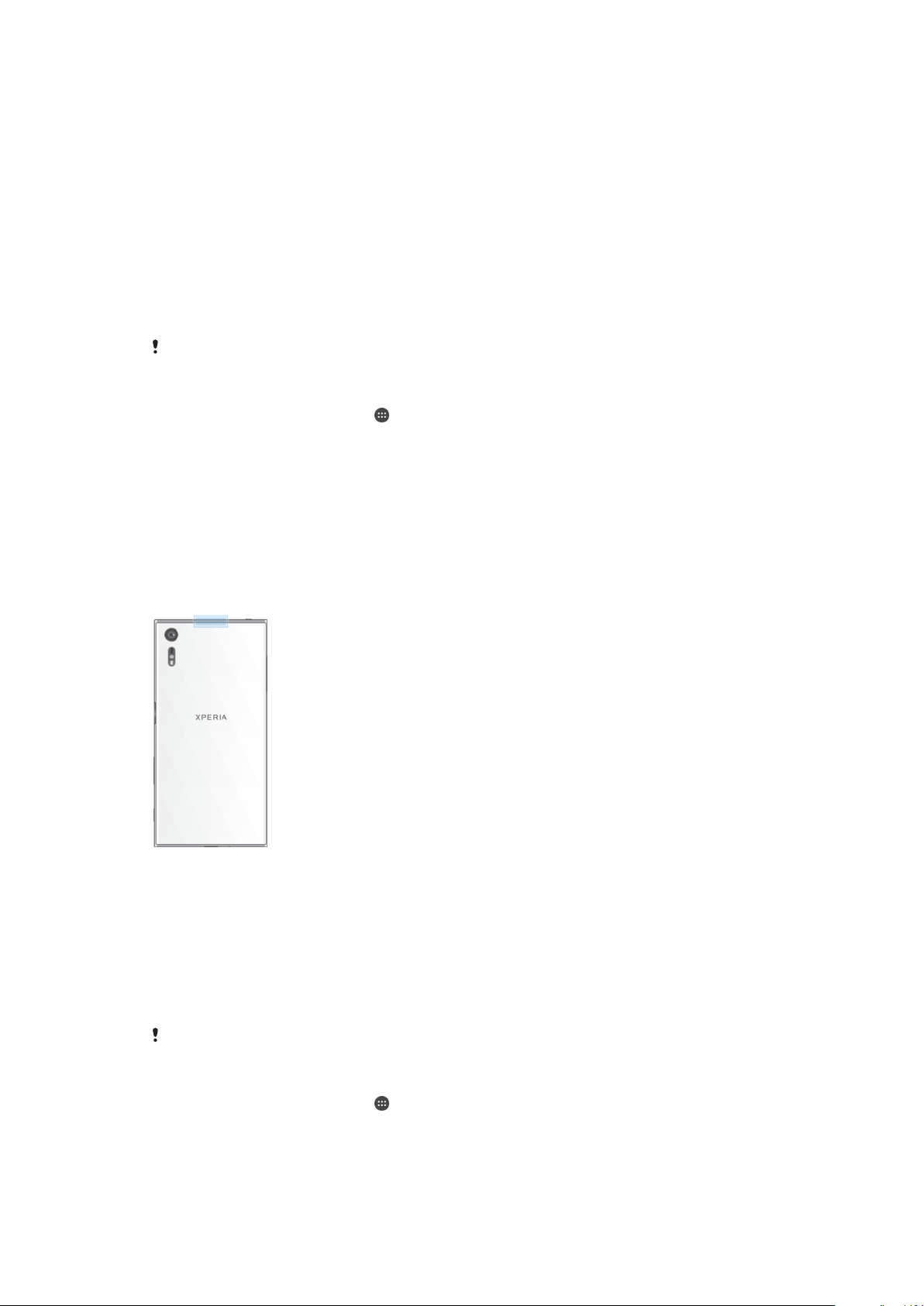
Travel and maps
Using Location Services
Location services allow applications such as Maps and the camera to use information
from your cellphone or Wi-Fi network as well as Global Positioning System (GPS)
information to determine your approximate location. If you're not within a clear line of
sight of GPS satellites, your device can determine your location using the Wi-Fi function.
And if you're not within range of a network, your device can determine your location
using your cellphone network.
In order to use your device to find out where you are, you need to enable location
services.
You may incur data connection charges when you connect to the internet from your device.
To Enable or Disable Location Services
1
From your Home screen, tap
.
2
Find and tap Settings > Location, then tap the slider to enable or disable location
services.
Improving GPS Accuracy
The first time you use the GPS function in your device, it can take a few minutes for your
location to be found. To help the search, make sure you have a clear view of the sky.
Stand still and don't cover the GPS antenna (the highlighted area in the image). GPS
signals can pass through clouds and plastic, but not through most solid objects such as
buildings and mountains. If your location isn't found after a few minutes, move to another
location.
Google Maps™ and navigation
Use Google Maps™ to track your current location, view real-time traffic situations, and
receive detailed directions to your destination.
The Google Maps™ application requires an internet connection when used online. You
may incur data connection charges when you connect to the internet from your device.
To get more detailed information about how to use this application, go to
http://support.google.com
.
The Google Maps™ application may not be available in every market, country, or region.
To Use Google Maps™
1
From your Home screen, tap .
2
Find and tap Google > Maps.
122
This is an internet version of this publication. © Print only for private use.

Using Data Traffic when Traveling
When you travel outside of your home cellphone network, you may need to access the
internet using cellular data traffic. If so, you need to activate data roaming on your device.
You may incur additional charges when you activate data roaming. It is recommended to
check the relevant data transmission charges in advance.
If you are using a device that has multiple users, you may need to log in as the owner (that is,
the primary user) to activate or deactivate data roaming.
To Enable or Disable Data Roaming
1
From your Home screen, tap .
2
Find and tap Settings > More > Mobile networks.
3
Select a SIM card.
4
Tap the Data roaming slider to enable or disable the function.
You can't activate data roaming while mobile data traffic is turned off.
Airplane Mode
In Airplane mode, the network and radio transceivers are turned off to prevent
disturbance to sensitive equipment. However, you can still make emergency calls, play
games, listen to music, and watch videos and other content, as long as all this content is
saved on your memory card or internal storage. You can also be notified by alarms, if
alarms are activated.
Turning on Airplane mode reduces battery consumption.
To Enable or Disable Airplane Mode
1
From your Home screen, tap .
2
Find and tap
Settings
>
More
.
3
Tap the Airplane mode slider.
123
This is an internet version of this publication. © Print only for private use.
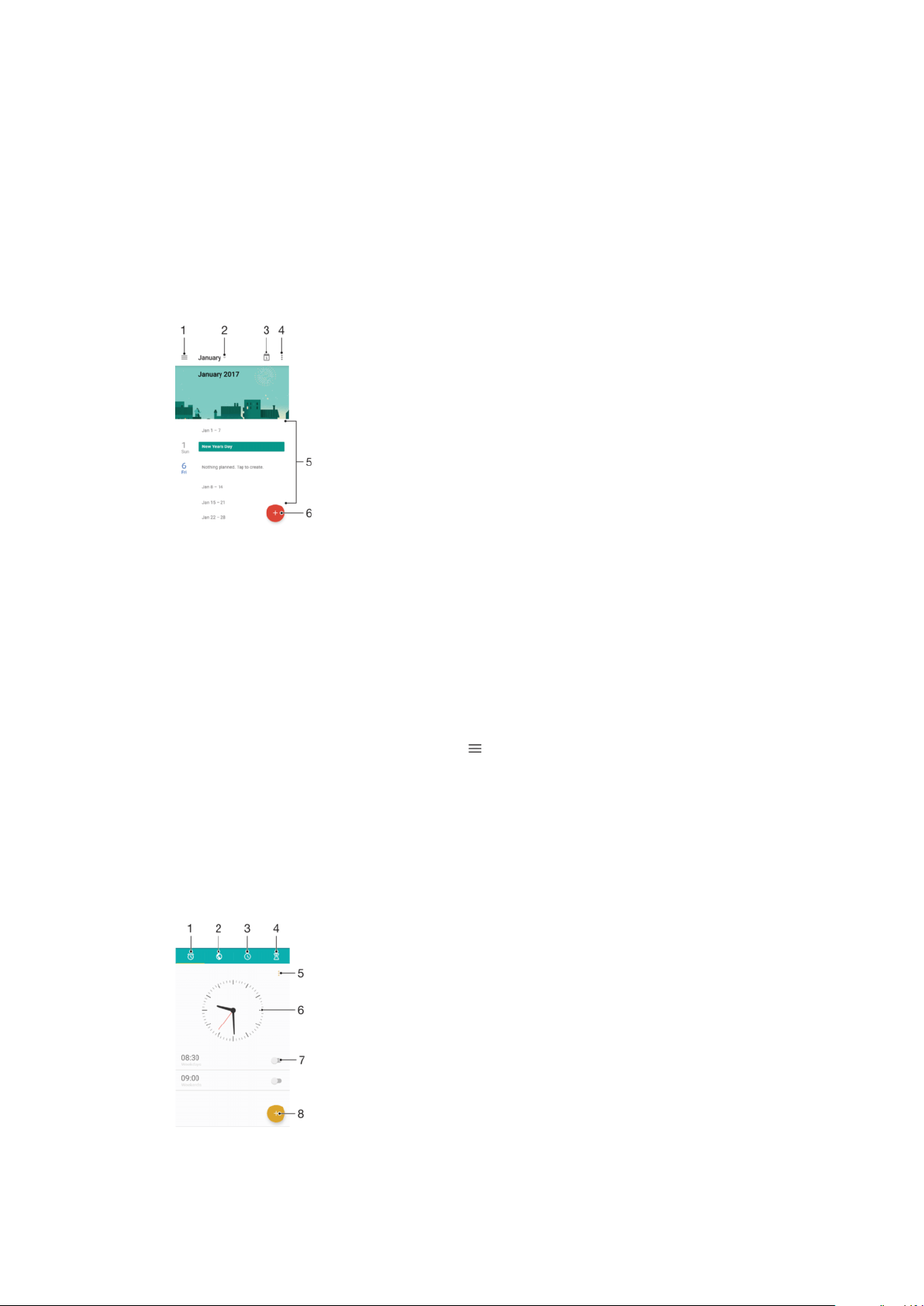
Clock and Calendar
Calendar
Use the Calendar application to manage your time schedule. If you have signed in to and
synchronized your device with one or several online accounts that include calendars, for
example, your Google™ account, then calendar events from these accounts will also
appear in the Calendar application. You can select which calendars you want to integrate
into the combined Calendar view.
When an appointment time approaches, your device plays a notification sound to remind
you.
1 Select a view type and the calendars you want to view
2 Access an overview of the current month
3 Return to the current date
4 Access other options
5 Scroll up or down to browse the calendar
6 Add a calendar entry
To Learn More about Calendar
•
When the Calendar application is open, tap , then find and tap Help &
feedback
.
Clock
You can set one or several alarms and use any sound saved on your device as the alarm
signal. The alarm does not sound if your device is turned off.
The alarm time format displayed is the same as the format you select for your general
time settings, for example, 12-hour or 24-hour.
1 Access the alarms tab
2 Access the world clock tab
124
This is an internet version of this publication. © Print only for private use.

3 Access the stopwatch function
4 Access the timer function
5 View option for the current tab
6 Open date and time settings for the clock
7 Turn an alarm on or off
8 Add a new alarm
To Set a New Alarm
1
From your Homescreen, tap
.
2
Find and tap Clock.
3
Tap
.
4
Tap Time and select the desired value.
5
Tap OK.
6
If desired, edit other alarm settings.
7
Tap SAVE.
To Snooze an Alarm When It Sounds
•
Tap SNOOZE.
To Turn Off an Alarm When It Sounds
•
Drag
to the right.
To turn off a snoozed alarm, you can double-tap the status bar to open the
Notification panel,
then tap .
To Edit an Existing Alarm
1
Find and tap Clock, then tap the alarm that you want to edit.
2
Make the desired changes.
3
Tap SAVE.
To Turn an Alarm On or Off
•
Find and tap Clock, and then tap the slider for the alarm you want to turn on or
off.
To Delete an Alarm
1
Find and tap
Clock
, and then touch and hold the alarm you want to delete.
2
Tap Delete alarm, and then tap YES.
To set the sound for an alarm
1
Find and tap Clock, then tap the alarm that you want to edit.
2
Tap Alarm sound and select an option, or tap and select a music file.
3
Tap DONE, then tap SAVE.
To Adjust the Volume Level for an Alarm
1
Find and tap Clock, then tap the alarm that you want to edit.
2
Drag the volume slider under Alarm volume to the desired position.
3
Tap SAVE.
To Set a Recurring Alarm
1
Find and tap Clock, then tap the alarm that you want to edit.
2
Tap Repeat.
3
Mark the checkboxes for the relevant days, and then tap OK.
4
Tap SAVE.
125
This is an internet version of this publication. © Print only for private use.

To Activate the Vibrate Function for an Alarm
1
Find and tap Clock, then tap the alarm that you want to edit.
2
Tap the Vibrate slider to enable or disable the function.
3
Tap SAVE.
To Set the Side Keys Behavior
1
Find and tap Clock, and then select the alarm you want to edit.
2
Tap Side keys behavior, and then select the desired behavior of side keys when
they are pressed during the alarm.
3
Tap SAVE.
126
This is an internet version of this publication. © Print only for private use.

Accessibility
Magnification Gesture
Magnification gesture allows you to zoom in to parts of the screen by tapping an area of
the touchscreen three times in succession.
To Enable or Disable Magnification Gesture
1
From your Home screen, tap
.
2
Find and tap Settings > Accessibility > Magnification gesture.
3
Tap the slider under Magnification gesture.
To Magnify an Area and Pan Across the Screen
1
Make sure Magnification gesture is enabled.
2
To temporarily magnify an area, tap it three times.
3
Move the area by dragging it with two or more fingers.
4
To exit zoom mode, tap the area three times again.
With certain applications, you can also zoom in or out by pinching an area.
Font Size
You can enable the
Font size
option to increase the default size of text displayed on your
device.
To Set Font Size
1
From your Home screen, tap .
2
Find and tap
Settings
>
Accessibility
.
3
Tap Font size, and then set the desired font size by tapping the scale.
Color Correction
The Color correction setting adjusts how colors are displayed on the screen for users
who are color blind or have difficulty distinguishing between colors.
To Enable Color Correction
1
From your Home screen, tap .
2
Find and tap
Settings
>
Accessibility
>
Color correction
.
3
Tap the slider under Color correction.
4
Tap
Correction mode
, and then select the appropriate color sensitivity.
Color correction is currently an experimental feature and may affect device performance.
TalkBack
TalkBack is a screen reader service for visually impaired users. TalkBack uses spoken
feedback to describe any events or actions performed on your Android device. TalkBack
describes the user interface and reads out software errors, notifications, and messages.
127
This is an internet version of this publication. © Print only for private use.

To Enable TalkBack
1
From your Home screen, tap .
2
Find and tap Settings > Accessibility > TalkBack.
3
Tap the slider under TalkBack and then tap OK.
To change speech, feedback, and touch preferences for TalkBack, tap Settings, then tap the
screen twice.
TalkBack launches a tutorial immediately after you enable the feature. To exit the tutorial, tap
, then tap the screen twice.
To Disable TalkBack
1
From your Home screen, tap
, then tap anywhere on the screen twice.
2
Find and tap Settings, then tap anywhere on the screen twice.
3
Find and tap Accessibility by scrolling through the list with two or more fingers,
then tap anywhere on the screen twice.
4
Find and tap TalkBack by scrolling through the list with two or more fingers, then
tap anywhere on the screen twice.
5
Tap the on-off switch, and then tap anywhere on the screen twice.
6
Tap OK, and then tap anywhere on the screen twice.
Mono Audio
The Mono audio setting makes both left and right audio channels get played back
simultaneously when playing audio. Using Mono instead of Stereo playback is most
useful for users with certain types of hearing loss or for safety reasons, for example when
you need to listen to your surroundings.
To Enable or Disable Mono Audio
1
From your
Home screen
, tap
.
2
Find and tap Settings > Accessibility.
3
Tap the slider beside
Mono audio
.
TTY (Teletypewriter) Mode
The TTY (Teletypewriter) feature on your device allows people who are deaf, hard of
hearing, or who have speech or language disabilities to communicate using a TTY device
or a relay service.
To enable TTY mode
1
From your Home screen, tap
.
2
Find and tap
Settings
>
Call
.
3
Choose a SIM card, then tap Accessibility > TTY mode.
4
Select the applicable TTY mode.
Switch Access
With Switch Access, you can interact with your Xperia™ device using one or more
switches. A switch is a device used to send a keystroke signal to your Android device.
These can be helpful for users with mobility limitations. For more information about
Switch Access, see Settings > Accessibility > Switch Access > SETTINGS > Help &
feedback.
To Enable or Disable Switch Access
1
From your Home screen, tap
.
2
Find and tap Settings > Accessibility > Switch Access.
3
Tap the slider to enable or disable the function, then tap OK.
128
This is an internet version of this publication. © Print only for private use.

Support and Legal
Support Application
Use the Support application on your device to browse User Guides, troubleshooting
guides, and to find information about software updates and other product-related
information.
To Access the Support Application
1
From your Home screen, tap
.
2
Find and tap , then select the required support item.
Connect to the internet when using the Support application for the best available support.
Xperia™ Tips
Using Xperia™ Tips, you can get useful information for your device via notifications, and
learn all you need to get started.
To enable or disable Xperia™ Tips
1
From your
Home screen
, tap .
2
Find and tap Settings > Assistant.
3
Tap the
Xperia™ Tips
slider to enable or disable.
Help in Menus and Applications
Some applications and settings have help available in the options menu, which is
normally indicated by
in the individual applications.
Restarting, Resetting, and Repairing
You can force your device to restart or shut down if it stops responding or won't restart
normally. No settings or personal data get deleted.
You can also reset your device to its original factory settings. This action is sometimes
necessary if your device stops functioning properly, but note that if you want to keep any
important data, you should first back up this data to a memory card or other non-internal
memory. For more information, see
Backing Up and Restoring Content
on page 42.
If your device fails to turn on or you want to reset your device’s software, you can use
Xperia™ Companion to repair your device. For more information on using Xperia™
Companion, see
Xperia™ Companion
on page 39.
If you are sharing a device with multiple users, you may need to log in as the owner, that is,
the primary user, to reset your device to its original factory settings.
To Restart Your Device
Your device may fail to restart if the battery level is low. Connect your device to a charger and
try restarting again.
1
Press and hold down the power key .
2
In the menu that opens, tap Restart. The device restarts automatically.
129
This is an internet version of this publication. © Print only for private use.

To Force the Device to Restart or Shutdown
1
Press and hold down the power key and the volume up key at the same time
for 6 seconds.
2
Your device vibrates once. Depending on whether you wish to force the device to
restart or shut down, proceed as follows.
•
If you wish to force restart the device: Release the keys at this point. The
device restarts.
•
If you wish to force shut down the device: Continue pressing the keys. After a
few more seconds, the device vibrates three times and turns off.
To Perform a Factory Data Reset
To avoid permanent damage to your device, do not interrupt a factory data reset procedure.
1
Back up any important data that is saved on the internal memory of your device to
a memory card or other non-internal memory. If you have any encrypted files
stored on an SD card, you should also remove the encryption to ensure you can
still access them after the reset.
2
From your Home screen, tap
.
3
Find and tap Settings > Backup & reset > Factory data reset.
4
Tap Reset phone.
5
If required, draw your screen unlock pattern or enter your screen unlock password
or PIN to continue.
6
To confirm, tap Erase everything.
Your device does not revert to an earlier software version of Android™ when you perform a
factory data reset.
Repairing the Device Software
If you forget your screen unlock password, PIN, or pattern, you can use the device repair
feature in Xperia™ Companion to erase the security layer. You need to provide your
Google account login details to perform this operation. By running the repair feature, you
reinstall software for your device and you may lose some personal data in the process.
If you can’t turn off your device before performing a software repair, force it to shut down.
When you receive a new Google™ account username or password, you might not be able to
use them to log in to and recover your device for 72 hours.
To Repair the Device Software Using Xperia™ Companion
Before performing a software repair, make sure you know your Google™ account username
and password. Depending on your security settings, you may need to enter them in order to
restart the device after a software repair.
If your device seems to have frozen, restarts repeatedly or doesn’t start at all after you
updated the Xperia™ software or after you performed a software repair or a factory data
reset, try forcing the device to shut down then try turning it back on. If the problem still
exists, force the device to shut down then perform a software repair by following the
steps below:
1
Make sure Xperia™ Companion is installed on your PC or Mac
®
.
2
Open the Xperia™ Companion software on the computer and click on Software
repair on the main screen.
3
Follow the instructions that appear on the screen to reinstall the software and
complete the repair.
Help Us Improve Our Software
You can enable the sending of usage info from your device so that Sony Mobile can
receive anonymous bug reports and statistics that help improve our software. None of
the information gathered includes personal data.
130
This is an internet version of this publication. © Print only for private use.

To Allow the Sending of Usage Info
1
From your Home screen, tap .
2
Find and tap Settings > About phone > Usage info settings.
3
Mark the Send usage info checkbox if it is not already marked.
4
Tap Agree.
Warranty, SAR, and Usage Guidelines
For information about warranty, SAR (Specific Absorption Rate), and safety guidelines,
please read the Important information provided under Settings > About phone > Legal
information on your device.
Recycling your device
Got an old device lying around the house? Why not recycle it? By doing so, you will help
us re-use its materials and components, and you’ll protect the environment too! Find out
more about the recycling options in your region at
http://blogs.sonymobile.com/about-
us/sustainability/commitment/overview/
.
Legal information
Sony G8232
This User guide is published by Sony Mobile Communications Inc. or its local affiliated company, without any
warranty. Improvements and changes to this User guide necessitated by typographical errors, inaccuracies of
current information, or improvements to programs and/or equipment, may be made by Sony Mobile
Communications Inc. at any time and without notice. Such changes will, however, be incorporated into new
editions of this user guide. All illustrations are for illustrative purposes only and may not accurately depict the actual
device.
All product and company names mentioned herein are the trademarks or registered trademarks of their respective
owners. All other trademarks are property of their respective owners. Any rights not expressly granted herein are
reserved. Visit
www.sonymobile.com/us/legal/
for more information.
This User Guide may reference services or applications provided by third parties. Use of such programming or
services may require separate registration with the third party provider and may be subject to additional terms of
use. For applications accessed on or through a third-party website, please review such websites’ terms of use and
applicable privacy policy in advance. Sony does not warrant or guarantee the availability or performance of any
third-party websites or offered services.
Your cellular device has the capability to download, store, and forward additional content, like ringtones. The use of
such content may be restricted or prohibited by rights of third parties, including but not limited to restriction under
applicable copyright laws. You, and not Sony, are entirely responsible for additional content that you download to or
forward from your cellular device. Prior to your use of any additional content, please verify that your intended use is
properly licensed or is otherwise authorized. Sony does not guarantee the accuracy, integrity or quality of any
additional content or any other third-party content. Under no circumstances will Sony be liable in any way for your
improper use of additional content or other third-party content.
This product is protected by certain intellectual property rights of Microsoft. Use or distribution of such technology
outside of this product is prohibited without a license from Microsoft.
Content owners use Windows Media digital rights management technology (WMDRM) to protect their intellectual
property, including copyrights. This device uses WMDRM software to access WMDRM protected content. If the
WMDRM software fails to protect the content, content owners may ask Microsoft to revoke the software’s ability to
use WMDRM to play or copy protected content. Revocation does not affect unprotected content. When you
download licenses for protected content, you agree that Microsoft may include a revocation list with the licenses.
Content owners may require you to upgrade WMDRM to access their content. If you decline an upgrade, you will
not be able to access content that requires the upgrade.
This product is licensed under the MPEG-4 visual and AVC patent portfolio licenses for the personal and non-
commercial use of a consumer for (i) encoding video in compliance with the MPEG-4 visual standard ("MPEG-4
video") or the AVC standard ("AVC video") and/or (ii) decoding MPEG- 4 or AVC video that was encoded by a
consumer engaged in a personal and non-commercial activity and/or was obtained from a video provider licensed
by MPEG LA to provide MPEG-4 and/or AVC video. No license is granted or shall be implied for any other use.
Additional information including that relating to promotional, internal, and commercial uses and licensing may be
obtained from MPEG LA, L.L.C. See
www.mpegla.com
. MPEG Layer-3 audio decoding technology licensed from
Fraunhofer IIS and Thomson.
SONY MOBILE WILL NOT BE LIABLE FOR ANY LOSS, DELETION AND/OR DATA OVERWRITING OF PERSONAL
DATA OR FILES STORED ON YOUR DEVICE (INCLUDING BUT NOT LIMITED TO CONTACTS, MUSIC TRACKS,
AND PICTURES) ARISING OUT OF ANY UPDATE OF YOUR DEVICE BY ANY OF THE METHODS DESCRIBED IN
THIS USER GUIDE OR DOCUMENTATION. IN NO EVENT SHALL SONY MOBILE OR ITS SUPPLIERS’ TOTAL
LIABILITY TO YOU FOR ANY AND ALL DAMAGES, LOSSES AND CAUSES OF ACTION (WHETHER IN
CONTRACT OR TORT, INCLUDING, BUT NOT LIMITED TO NEGLIGENCE OR OTHERWISE) EXCEED THE
AMOUNT ACTUALLY PAID BY YOU FOR YOUR DEVICE.
© 2017 Sony Mobile Communications Inc.
All rights reserved.
131
This is an internet version of this publication. © Print only for private use.