USER
MANUAL
EN User Manual
Washer Dryer
L7WBG741R

CONTENTS
1. SAFETY INFORMATION.............................................................................................3
2. SAFETY INSTRUCTIONS.............................................................................................6
3. INSTALLATION............................................................................................................7
4. PRODUCT DESCRIPTION.........................................................................................12
5. CONTROL PANEL..................................................................................................... 13
6. DIAL AND BUTTONS................................................................................................15
7. PROGRAMMES..........................................................................................................16
8. SETTINGS...................................................................................................................22
9. BEFORE FIRST USE................................................................................................... 23
10. DAILY USE - WASHING ONLY...............................................................................23
11. DAILY USE - WASHING & DRYING....................................................................... 28
12. DAILY USE - DRYING ONLY...................................................................................29
13. FLUFF IN THE FABRICS..........................................................................................30
14. HINTS AND TIPS..................................................................................................... 31
15. CARE AND CLEANING.......................................................................................... 33
16. TROUBLESHOOTING.............................................................................................37
17. CONSUMPTION VALUES.......................................................................................41
18. TECHNICAL DATA..................................................................................................42
19. ACCESSORIES.........................................................................................................43
FOR PERFECT RESULTS
Thank you for choosing this AEG product. We have created it to give you
impeccable performance for many years, with innovative technologies that help
make life simpler features you might not find on ordinary appliances. Please
spend a few minutes reading to get the very best from it.
Visit our website for:
Get usage advice, brochures, trouble shooter, service information:
www.aeg.com/webselfservice
Register your product for better service:
www.registeraeg.com
Buy Accessories, Consumables and Original spare parts for your appliance:
www.aeg.com/shop
CUSTOMER CARE AND SERVICE
Always use original spare parts.
When contacting our Authorised Service Centre, ensure that you have the
following data available: Model, PNC, Serial Number.
The information can be found on the rating plate.
Warning / Caution-Safety information
General information and tips
Environmental information
Subject to change without notice.
www.aeg.com
2

1. SAFETY INFORMATION
Before the installation and use of the appliance,
carefully read the supplied instructions. The
manufacturer is not responsible for any injuries or
damages that are the result of incorrect installation or
usage. Always keep the instructions in a safe and
accessible location for future reference.
1.1 Children and vulnerable people safety
WARNING!
Risk of suffocation, injury or permanent
disability.
• This appliance can be used by children aged from 8
years and above and persons with reduced physical,
sensory or mental capabilities or lack of experience
and knowledge if they have been given supervision or
instruction concerning the use of the appliance in a
safe way and understand the hazards involved.
• Children between 3 and 8 years of age and persons
with very extensive and complex disabilities shall be
kept away unless continuously supervised.
• Children of less than 3 years of age should be kept
away unless continuously supervised.
• Do not let children play with the appliance.
• Keep all packaging away from children and dispose of
it appropriately.
• Keep detergents away from children.
• Keep children and pets away from the appliance when
the door is open.
• If the appliance has a child safety device, it should be
activated.
• Children shall not carry out cleaning and user
maintenance of the appliance without supervision.
1.2
General Safety
•
Do not change the specification of this appliance.
ENGLISH
3

• This appliance is intended to be used in household
and similar applications such as:
– staff kitchen areas in shops, offices and other
working environments;
– by clients in hotels, motels, bed & breakfast and
other residential type environments;
– areas for communal use in blocks of flats or in
launderettes.
• The appliance shall be installed as a freestanding
product or below the kitchen worktop if space
margins permit.
• Do not install the appliance behind a lockable door, a
sliding door or a door with a hinge on the opposite
side, that would prevent the appliance door from
being fully open.
• Connect the mains plug to the mains socket only at
the end of the installation process. Make sure that the
mains plug is accessible after installation.
• The ventilation opening in the base must not be
covered by a carpet, mat, or any floor covering.
• WARNING: The appliance must not be supplied
through an external switching device, such as a timer,
or connected to a circuit that is regularly switched on
and off by a utility.
• Ensure good air ventilation in the room where the
appliance is installed to avoid the backflow of
unwanted gases into the room from appliances
burning gas or other fuels, including open fires.
• Exhaust air must not be discharged into a flue which is
used for exhausting fumes from any appliances
burning gas or other fuels.
• The operating water pressure at the water entry point
from the outlet connection must be between 0.5 bar
(0.05 MPa) and 8 bar (0.8 MPa).
• Do not exceed the maximum load of 7 kg (refer to the
"Programme chart" chapter).
www.aeg.com
4

• The appliance must be connected to the water mains
using the new supplied hose sets, or other new hose
sets supplied by the Authorised Service Centre.
• Old hose sets must not be reused.
• If the mains power supply cable is damaged, it must
be replaced by the manufacturer, its Authorised
Service Centre or similarly qualified persons to avoid
an electrical hazard.
• Wipe away lint or packaging debris that has
accumulated around the appliance.
• Items that have been soiled with substances such as
vegetable or mineral oil, acetone, alcohol, petrol,
kerosene, spot removers, turpentine, waxes and wax
removers should be washed separately with an extra
amount of detergent before being dried in the washer
dryer.
• Do not use the appliance if items have been soiled
with industrial chemicals.
• Do not dry unwashed items in the wash dryer.
• Items such as foam rubber (latex foam), shower caps,
waterproof textiles, and rubber backed articles and
clothes, or pillows fitted with foam rubber pads should
not be dried in the washer dryer.
• Fabric softeners, or similar products, should only be
used as specified by the product manufacturer’s
instructions.
• Remove all objects from items that could be a source
of fire ignition such as lighters or matches.
• Never stop the washer dryer before the end of the
drying cycle unless all items are quickly removed and
separated so that residual heat can dissipate.
• The final part of the washer dryer cycle takes place
without heat (cool down cycle) to ensure that items
reach a temperature that will not cause damage to
them.
• Do not use high pressure water sprays and/or steam
to clean the appliance.
ENGLISH
5
• Clean the appliance with a moist cloth. Use only
neutral detergents. Do not use abrasive products,
abrasive cleaning pads, solvents or metal objects.
• Before any maintenance operation, deactivate the
appliance and disconnect the mains plug from the
socket.
2. SAFETY INSTRUCTIONS
2.1 Installation
The installation must comply
with relevant national
regulations.
• Follow the installation instructions
supplied with the appliance.
• Do not install or use the appliance
where the temperature can be less
than 0°C or where it is exposed to the
weather.
• Always keep the appliance vertical
when it is being moved.
• Make sure that there is air circulation
between the appliance and the floor.
• Remove all the packaging and the
transit bolts.
• The floor area on which the appliance
is to be installed must be flat, stable,
heat resistant and clean.
• Keep the transit bolts in a safe place.
If the appliance is to be moved in the
future they must be reattached to lock
the drum to prevent an internal
damage.
• Always take care when moving the
appliance as it is heavy. Always use
safety gloves and enclosed footwear.
• Do not install or use a damaged
appliance.
• Do not install the appliance where the
appliance door cannot be fully
opened.
• Adjust the feet to have the necessary
space between the appliance and the
flooring.
• When the appliance is in its
permanent position, check if it is
levelled correctly with the aid of a
spirit level. If it is not, adjust the feet
accordingly.
2.2 Electrical Connection
WARNING!
Risk of fire and electric
shock.
• The appliance must be earthed.
• Always use a correctly installed
shockproof socket.
• Do not use multi-plug adapters and
extension cables.
• Do not pull the mains cable to
disconnect the appliance. Always pull
the mains plug.
• Do not touch the mains cable or the
mains plug with wet hands.
• UK and Ireland only. This appliance is
fitted with a 13 A mains plug. If it is
necessary to change the mains plug
fuse, use only a 13 A ASTA (BS 1362)
fuse.
• This appliance complies with the
E.E.C. Directives.
2.3 Water Connection
• Do not cause damage to the water
hoses.
• Before connection to new pipes,
pipes not used for a long time, where
repair work has been carried out or
new devices fitted (water meters,
etc.), let the water flow until it is clean
and clear.
• Ensure that there are no visible water
leaks during and after the first use of
the appliance.
www.aeg.com
6
2.4 Use
WARNING!
Risk of injury, electric shock,
fire, burns or damage to the
appliance.
• Do not put flammable products or
items that are wet with flammable
products in, near or on the appliance.
• Do not touch the glass door while a
programme is in operation. The glass
can get hot.
• Do not dry damaged (torn, frayed)
items that contain padding or fillings.
• If laundry has been washed with a
stain remover, carry out an additional
rinse cycle before starting a drying
cycle.
• Make sure that all metal objects are
removed from the laundry.
• Only dry fabrics that are suitable to
dry in the washer dryer. Follow the
cleaning instruction on the item label.
• Plastic items are not heat resistant.
– If a detergent ball is used, remove
it before starting a drying
programme.
– Do not use a detergent ball if
setting a non-stop programme.
WARNING!
Risk of injury or damage to
the appliance.
• Do not sit or stand on the open door.
• Do not dry dripping wet clothes in the
appliance.
2.5 Service
• To repair the appliance contact an
Authorised Service Centre.
• Use original spare parts only.
2.6 Disposal
• Disconnect the appliance from the
mains electrical and water supplies.
• Cut off the mains electrical cable
close to the appliance and dispose of
it.
• Remove the door catch to prevent
children or pets from becoming
trapped in the drum.
• Dispose of the appliance in
accordance with local requirements
for the disposal of Waste Electrical
and Electronic Equipment (WEEE).
3. INSTALLATION
WARNING!
Refer to Safety chapters.
3.1 Unpacking
WARNING!
Remove all the packaging
and the transit bolts before
installing the appliance.
WARNING!
Use the gloves.
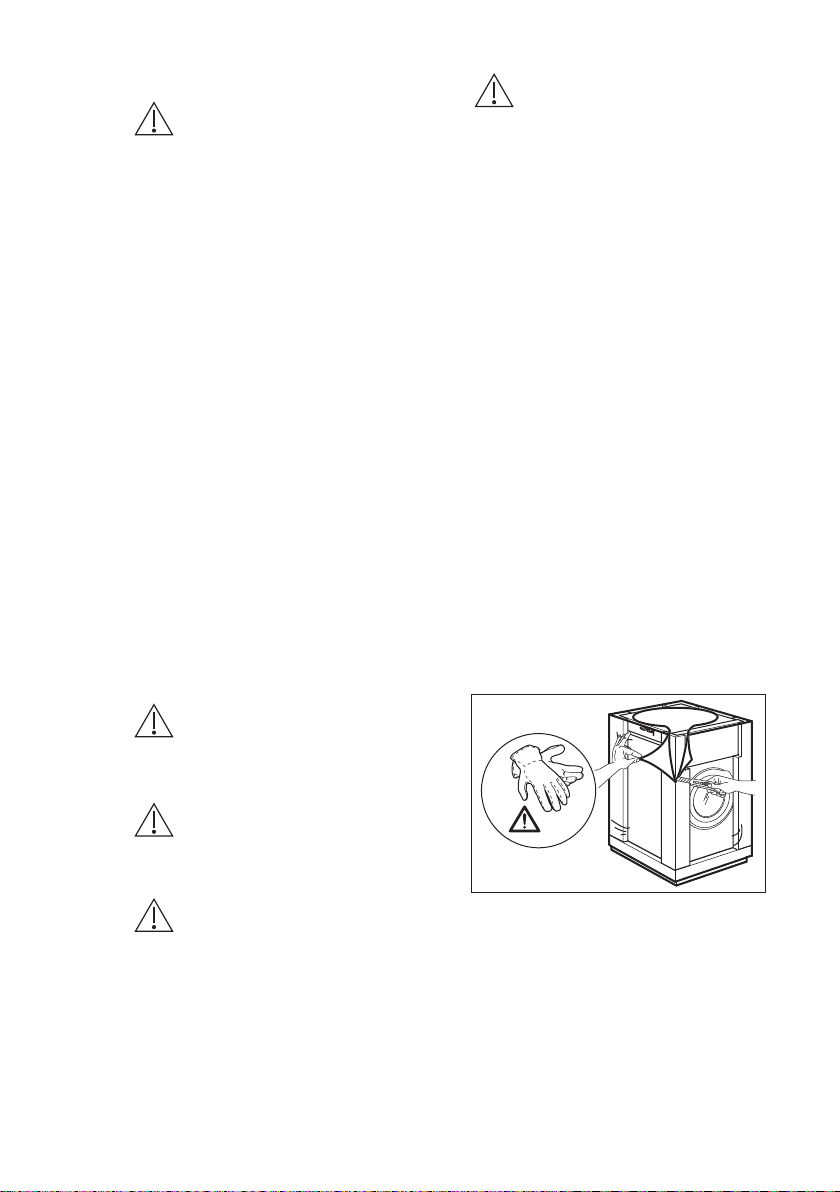
1. Remove the external film. If
necessary, use a cutter.
2. Remove the cardboard top and the
polystyrene packaging materials.
ENGLISH 7
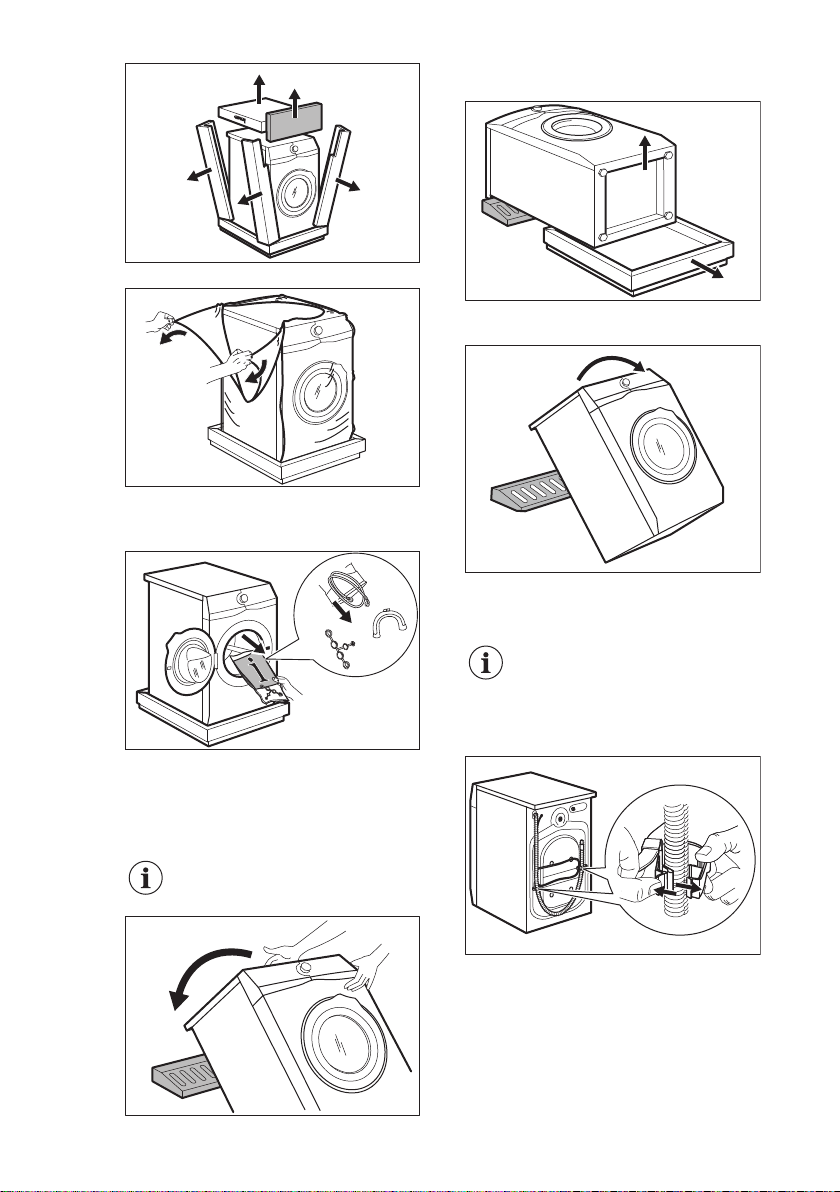
3. Remove the internal film.
4. Open the door and remove the
polystyrene piece from the door seal
and all the items from the drum.
5. Carefully put the appliance down on
its rear side.
6. Put the front polystyrene packaging
element on the floor under the
appliance.
Make sure not to
damage the hoses.
7. Remove the polystyrene protection
from the bottom.
1
2
8. Pull up the appliance in vertical
position.
9. Remove the power supply cable and
the drain hose from the hose holders.
It is possible to see
water flowing from the
drain hose. This is due to
the testing with water of
the appliance in factory.
10. Remove the three bolts by using the
spanner supplied with the appliance.
www.aeg.com
8
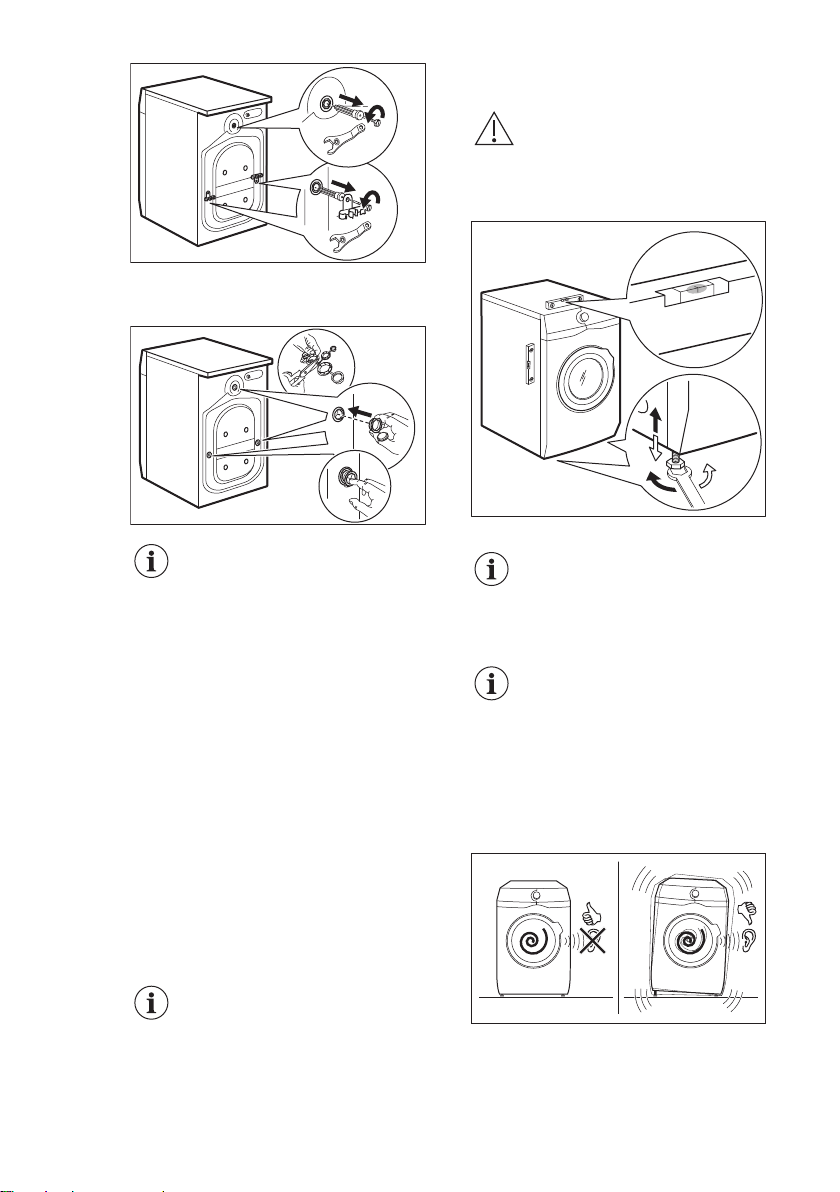
11. Pull out the plastic spacers.
12. Put the plastic caps, that you find in
the user manual bag, in the holes.
We recommend that you
keep the packaging and the
transit bolts for any
movement of the appliance.
3.2 Installation on suspended
flooring
Suspended wooden floors are
particularly susceptible to vibration.
To limit vibration we recommend placing
a waterproof wooden panel, at least 15
mm thick, under the appliance. It should
be screwed to at least 2 floor beams and
should extend beyond the front feet.
If possible, install the appliance where
the floor is more stable.
3.3 Positioning and levelling
1. Install the appliance on a flat hard
floor.
Make sure that carpets do
not stop the air circulation
below the appliance.
Make sure that the
appliance does not touch
the wall or other units.
2. Loosen or tighten the feet to adjust
the level.
WARNING!
Do not put cardboard, wood
or equivalent materials
below the appliance feet to
adjust the level.
x4
The appliance must be level and stable.
A correct adjustment of the
appliance level prevents the
vibration, noise and the
movement of the appliance
when in operation.
When the machine is
installed on a plinth or if a
washer dryer is stacked on
the washing machine, use
the accessories described in
chapter 'Accessories'. Read
carefully the instructions
supplied with the appliance
and with the accessory.
3.4 The inlet hose
1. Connect the water inlet hose to the
back of the appliance.
ENGLISH
9
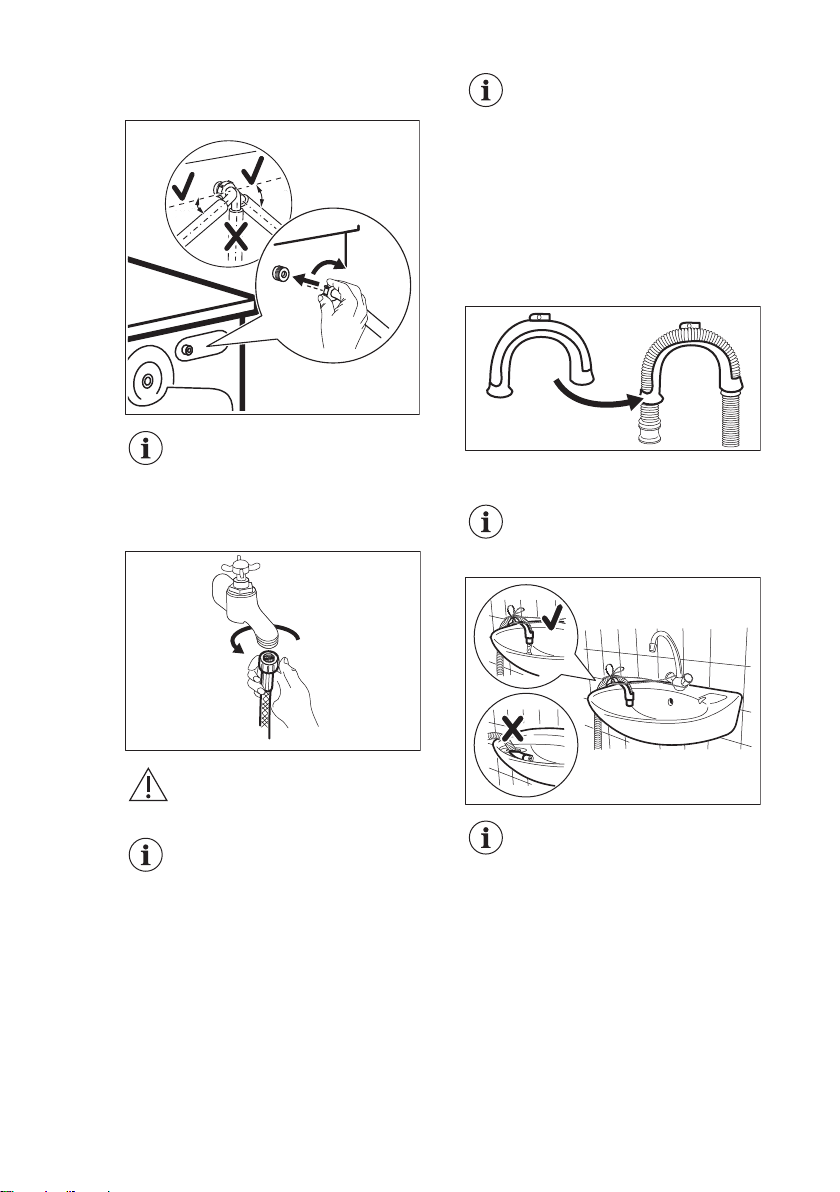
2. Position it toward left or right
depending on the position of the
water tap.
20
O
20
O
45
O
45
O
Make sure that the inlet hose
is not in vertical position.
3. If necessary, loose the ring nut to set
it in the correct position.
4. Connect the water inlet hose to the
cold water tap with 3/4" thread.
CAUTION!
Make sure that there are no
leaks from the couplings.
Do not use an extension
hose if the inlet hose is too
short. Contact the service
centre for the replacement
of the inlet hose.
3.5 Water drainage
The drain hose should be positioned at a
height of not less than 60 cm and not
more than 100 cm from the floor.
You can extend the drain
hose to maximum 400 cm.
Contact the authorized
service centre for the other
drain hose and the
extension.
It is possible to connect the drain hose in
different ways:
1. Make a U shape with the drain hose
and put it around the plastic hose
guide.
2. On the edge of a sink - Fasten the
guide to the water tap or to the wall.
Make sure that the plastic
guide cannot move when
the appliance drains.
Make sure that the drain
hose end is not immersed in
the water. There may be a
return of dirty water into the
appliance.
3. To a stand pipe with vent-hole -
Insert the drain hose directly into a
drain pipe. Refer to the illustration.
www.aeg.com
10
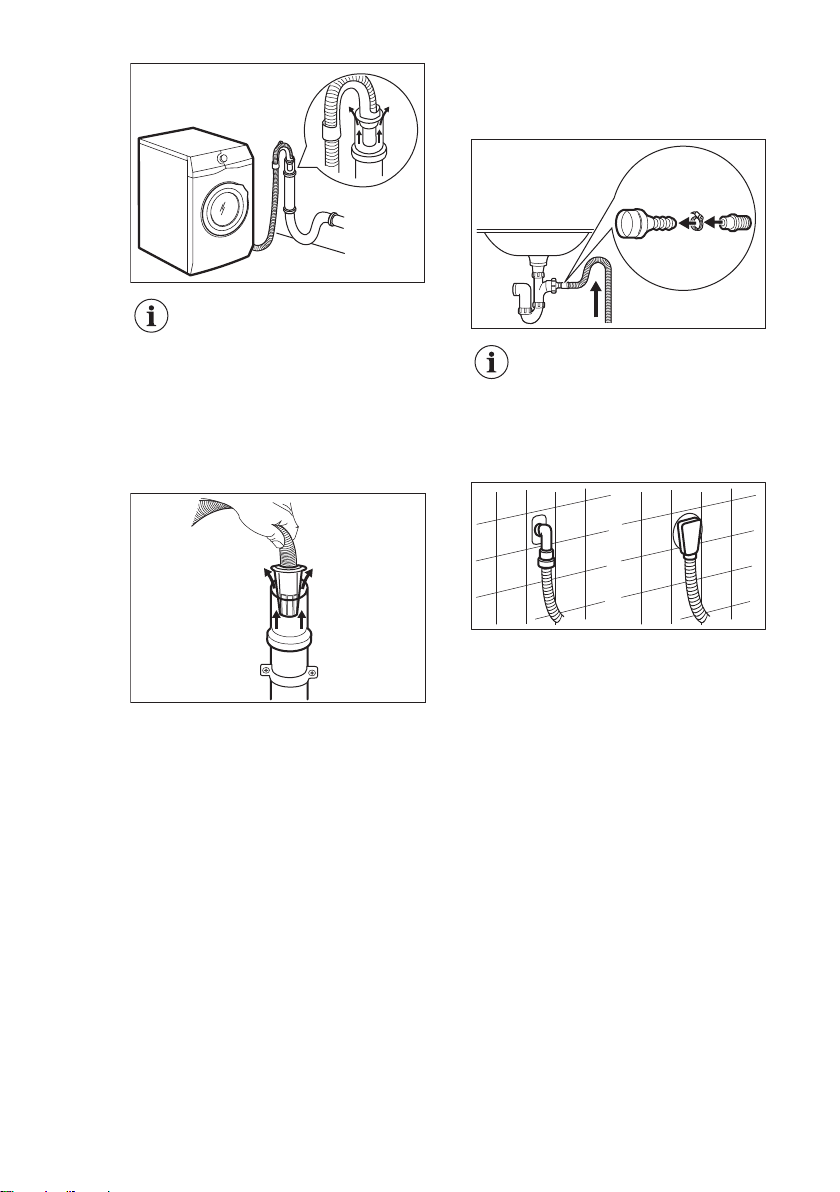
The end of the drain hose
must always be ventilated ,
i.e. the inner diameter of the
drain pipe (min. 38 mm -
min. 1.5") must be larger
than the external diameter
of the drain hose.
4. If the end of the drain hose looks like
this (see the picture), you can push it
directly into the stand pipe.
5. Without the plastic hose guide, to
a sink spigot - Put the drain hose in
the spigot and tighten it with a
clamp. Refer to the illustration.
Make sure that the drain
hose makes a loop to
prevent particles going into
the appliance from the sink.
6.
Position the hose directly to a built-
in drain pipe in the room wall and
tighten it with a clamp.
ENGLISH
11
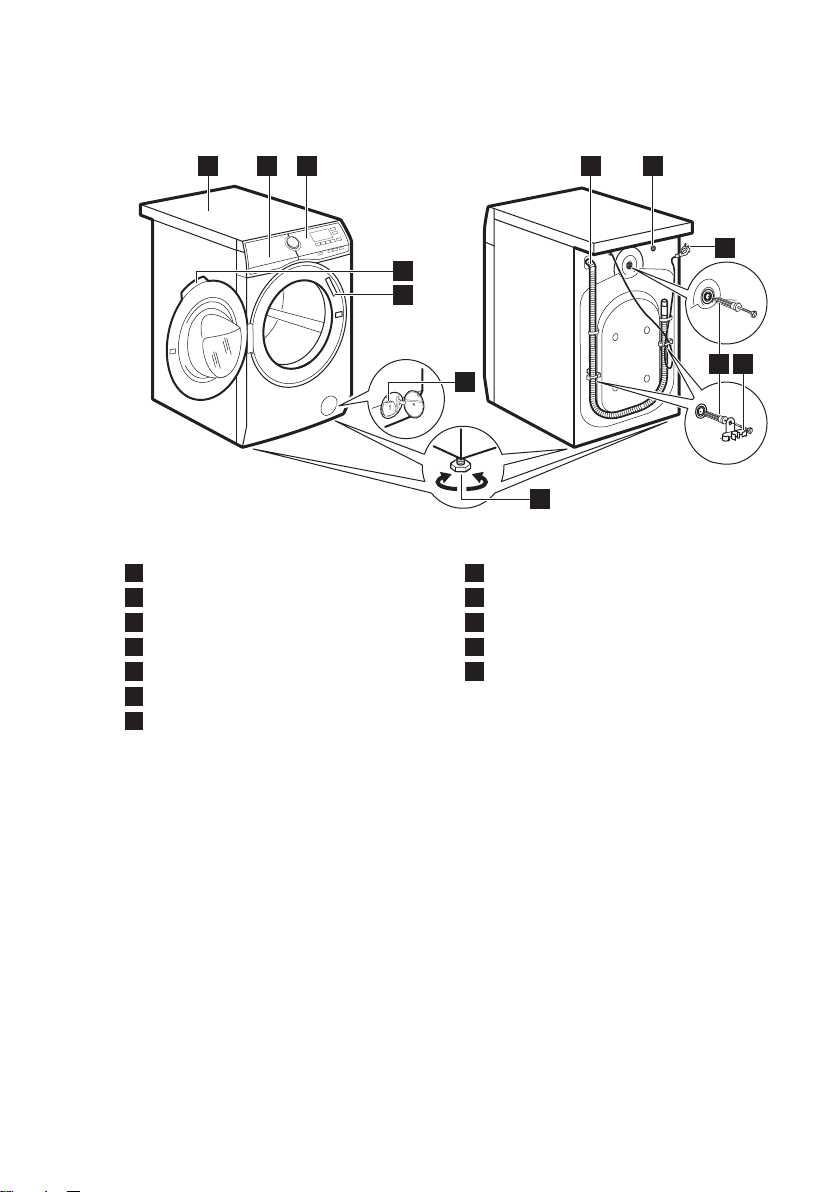
4. PRODUCT DESCRIPTION
4.1 Appliance overview
1 2 3
9
5
6
7
4
10
8
11 12
1
Worktop
2
Detergent dispenser
3
Control panel
4
Door handle
5
Rating plate
6
Drain pump filter
7
Feet for levelling the appliance
8
Drain hose
9
Inlet hose connection
10
Mains cable
11
Transit bolts
12
Hose support
www.aeg.com12
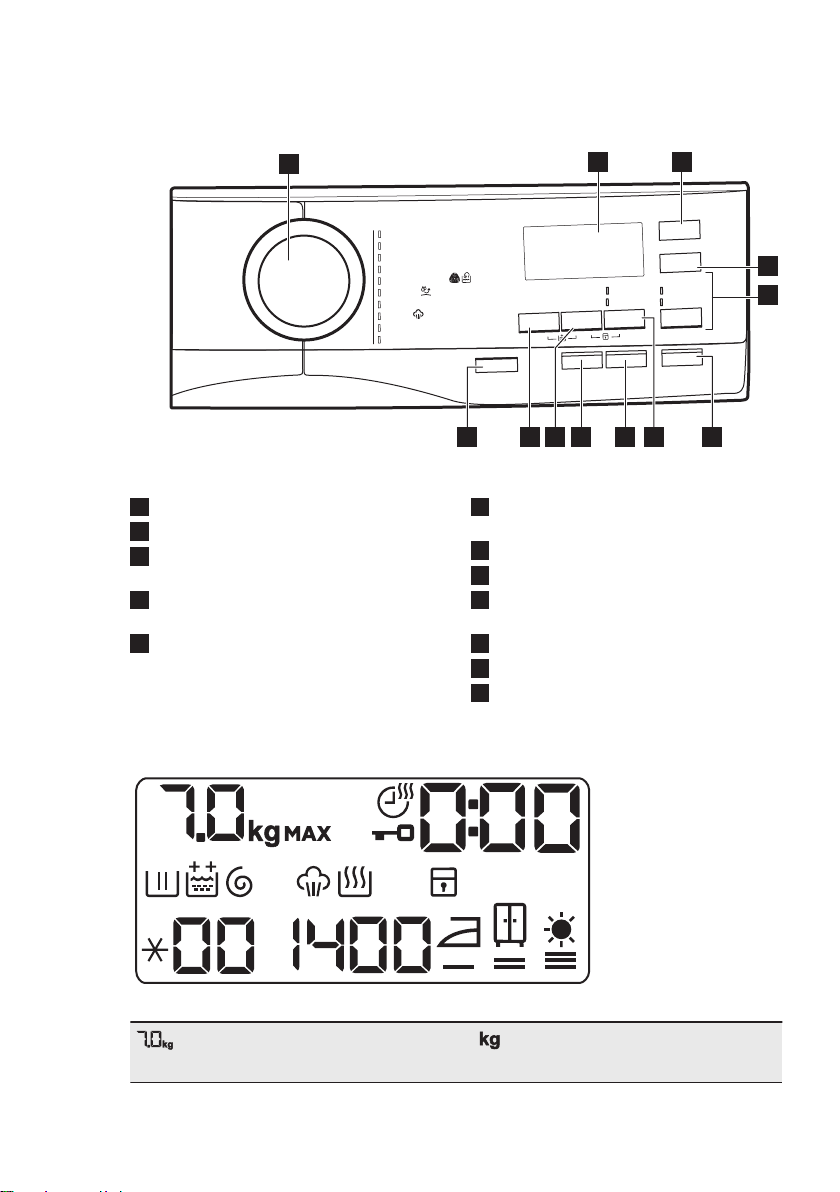
5. CONTROL PANEL
5.1 Control panel description
Cottons
Cottons Eco
Sy
n
theti
c
s
Delicates
Outdo
o
r
No
nStop
60m
in
R
i
nse
S
p
i
n/Dra
i
n
Wool/Handwash
Steam
Programme
Dry
Was
h
Stain
s
P
rewash
M
ode
Temp.
Spin
Auto Drying
Time Drying
On/
O
Q
uick Wa
s
h
D
elay Start
Star
t
/
Pause
Stain s/
P
rewash
2
3
6
12 11 10 8
1
4
5
7
9
1
Programme dial
2
Display
3
Drying time touch button (Time
Drying)
4
Drying level touch button (Auto
Drying)
5
Washing and drying mode touch
button (Mode)
• Wash
• Dry
6
Start and pause touch button (Start/
Pause)
7
Option touch button (Stains/Prewash)
8
Delay Start touch button (Delay Start)
9
Time Saving touch button (Quick
Wash)
10
Spin reduction touch button (Spin)
11
Temperature touch button (Temp.)
12
On/Off push button (On/Off)
5.2 Display
MIX
Maximum load indicator. The indicator flashes during the laundry
load estimation.
ENGLISH 13
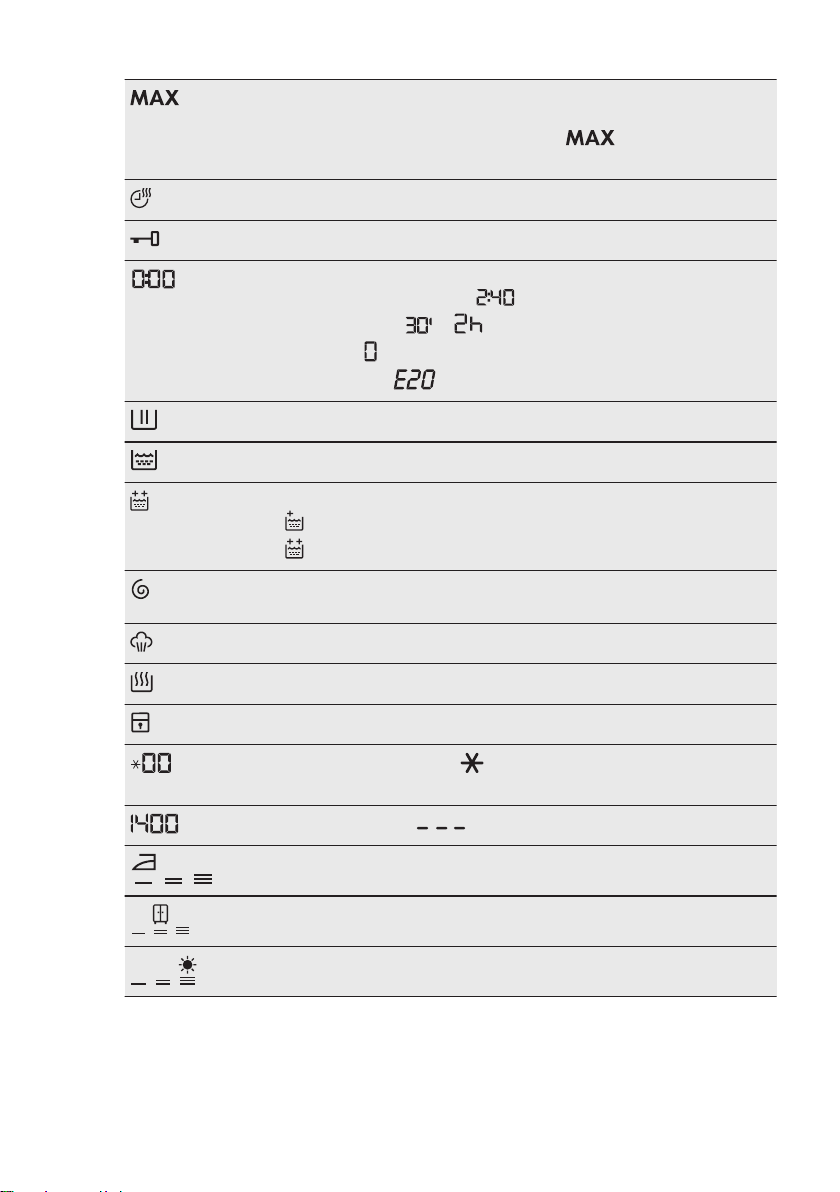
Maximum laundry indicator. It flashes when the laundry load exceeds
the maximum declared load of the selected programme. If you run a
programme when the drum is overloaded, also flashes at the
end of the programme.
Drying time indicator.
Door locked indicator.
The digital indicator can show:
• Programme duration (e. g. , washing and/or drying phase).
• Delay time (e. g. or ).
• Cycle end ( ).
• Warning code ( ).
Washing phase indicator. It flashes during prewash and wash phase.
Rinsing phase indicator. It flashes during rinse phase.
The permanent Extra Rinse option:
• - one additional rinse.
• - two additional rinses.
Spinning and draining phase indicator. It flashes during spin and drain
phase.
Steam phase indicator.
Drying phase indicator.
Child safety lock indicator.
Temperature indicator. The indicator appears when a cold wash is
set.
Spin speed indicator. - No Spin indicator.
Iron drying indicator.
Cupboard drying indicator.
Extra drying indicator.
www.aeg.com14
6. DIAL AND BUTTONS
6.1 Introduction
When pressing a key
combination, do not tilt
your fingers downwards .
The sensors of the
underneath buttons are
sensitive and may interfere
with Your choice.
6.2 On/Off
Pressing this button for a few seconds
allows to activate or deactivate the
appliance. Two different tunes sound
while switching the appliance on or off.
As the Stand-by function automatically
deactivates the appliance to decrease
the energy consumption in a few cases,
you may need to activate the appliance
again.
For more details, refer to Stand-by
paragraph in Daily Use chapter.
6.3 Introduction
The options/functions are
not selectable with all
washing programmes. Check
the compatibility between
options/functions and
washing programmes in the
"Programme Chart". An
option/function can exclude
another one, in this case the
appliance doesn't allow you
to set the incompatible
options/functions together.
Make sure the screen and
touch buttons are always
clean and dry.
6.4 Temp.
When you select a washing programme,
the appliance automatically proposes a
default temperature.
Touch this button repeatedly until the
desired temperature value appears on
the display.
When the display shows the indicators
and , the appliance does not
heat the water.
6.5 Spin
When you set a programme, the
appliance automatically sets the
maximum spin speed allowed.
Touch repeatedly this button to:
• Decrease the spin speed.
The display shows only
the spin speeds available
for the set programme.
• Activate the No Spin option .
This option is available only with the
Spin/Drain programme. The
appliance skips all spin phases and
only drains the water. The display
shows the indicator .
6.6 Stains/Prewash
Press this button repeatedly to activate
one of the two options.
The relevant indicator goes on in the
display.
• Stains
Select this option to add an anti-stain
phase to a programme in order to
treat heavily soiled or stained laundry
with stain remover.
Pour the stain remover into
compartment . The stain remover
will be added in the appropriate
phase of the washing programme.
This option is not
available with a
temperature lower than
40 °C.
• Prewash
Use this option to add a pre-wash
phase at 30 °C before the washing
phase.
This option is recommended for
heavily soiled laundry, especially if
containing sand, dust , mud and other
solid particles.
ENGLISH
15
The options can increase the
programme duration.
6.7 Delay Start
With this option you can delay the start
of a programme in a more convenient
time.
Tap on the button repeatedly to set the
required delay. The time increases by
steps of 30 minutes up to 90' and from 2
hours up to 20 h.
After starting the cycle by the means of
the Start/Pause button, the display shows
the selected delay time and the
appliance begins the countdown.
6.8 Quick Wash
With this option you can decrease the
programme duration.
• If your laundry is normally or lightly
soiled, it may be advisable to shorten
the washing programme. Touch this
button once to decrease the duration.
• In case of smaller load, touch this
button twice to set an extra quick
programme.
On the display the programme duration
is adjusted accordingly.
When this button is set, the led above
the button is on.
This option can also be used
to shorten the Steam
programme duration.
6.9 Time Drying
Touch this button to set the time that
suits the fabrics you have to dry (refer to
"Timed drying" table). The display shows
the set value.
Each time you touch this button the time
value increases by 5 minutes.
You cannot set all time
values for different types of
fabrics.
6.10 Auto Drying
Touch this button to set one of 3
automatic dryness levels proposed by
the appliance.
On the display the relevant dryness
indicator goes on:
•
Iron dry: laundry to be
ironed.
•
Cupboard dry: laundry to be
put in store.
• Extra dry: laundry to be
fully dried.
You can not set all
automatic levels for each
type of fabrics.
6.11 Mode
Thanks to this button, a cycle can
perform:
• Only washing : Wash indicator is on.
• Washing and drying : Wash and Dry
indicators are on.
• Only drying : Dry indicator is on.
6.12 Start/Pause
Touch the Start/Pause button to start,
pause the appliance or interrupt a
running programme.
7.
PROGRAMMES
7.1 Programme Chart
Programme Programme description
Washing programmes
www.aeg.com16
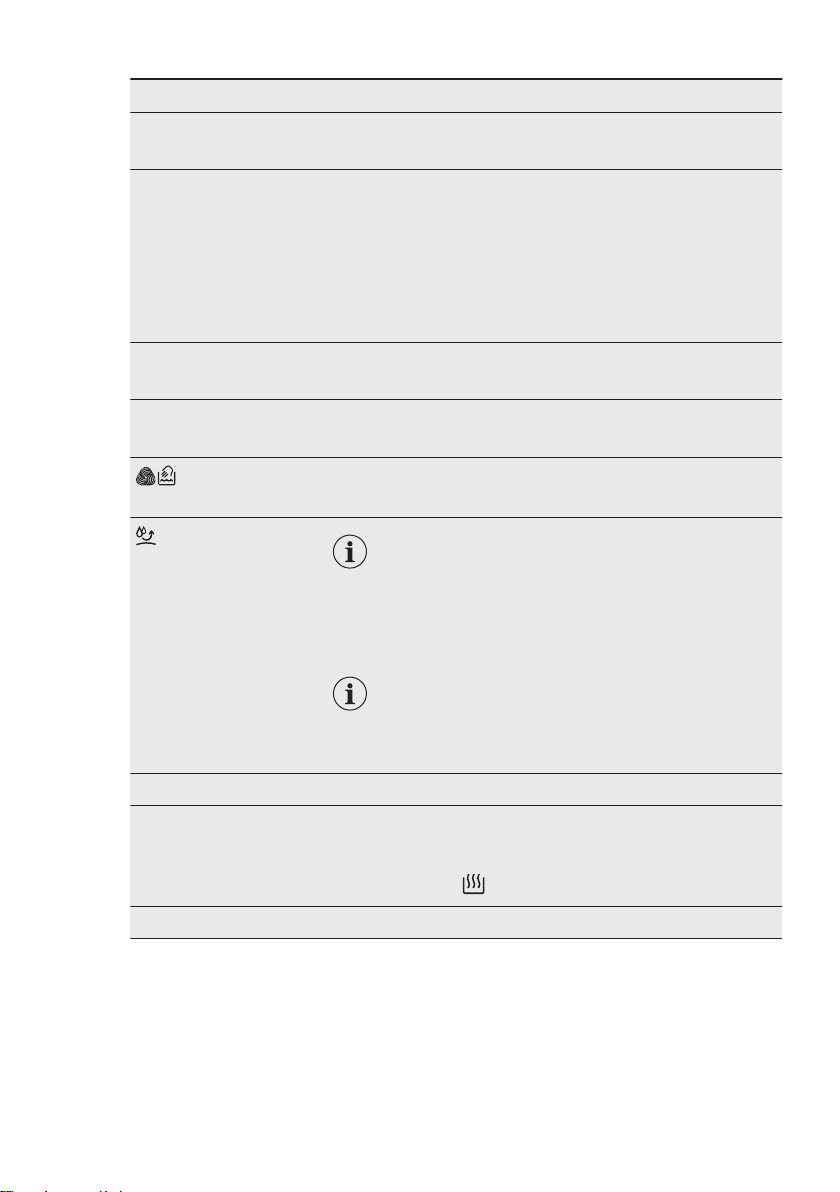
Programme Programme description
Cottons
White cotton and coloured cotton. Normal, heavy and light
soil.
Cottons Eco
White cotton and coloured cotton. Normal, heavy and light
soil.
Cottons energy saving programme. This programme at 60ºC
with a load of 7 kg is the reference programme for data en-
tered in the energy label, in compliance with 96/60/EC Direc-
tive. Set this programme to have a good washing results and
decrease the energy consumption. The time of the washing
programme is extended.
Synthetics
Synthetic items or mixed fabric items. Normal soil.
Delicates
Delicate fabrics such as acrylics, viscose and mixed fabrics
requiring gentler washing. Normal soil.
Wool/Handwash
Machine washable wool, hand washable wool and other
fabrics with «hand washing» care symbol
1)
.
Outdoor
Do not use fabric softener and make sure that
there is no softener residue in the detergent
dispenser.
Outdoor clothing, technical, sport fabrics, waterproof and
breathable jackets, shell jackets with a removable fleece or
inner insulation.
By performing a combined wash and dry pro-
gramme, the drying phase also acts as water-
repellent restorer. Make sure that the gar-
ment care label permits tumble drying.
Wash&Dry programme
NonStop 60min
Complete programme composed of a washing phase and of a
drying phase for a small load of mixed fabrics (cotton and syn-
thetic items).
Also, the indicator appears on the display.
Steam programme
ENGLISH 17
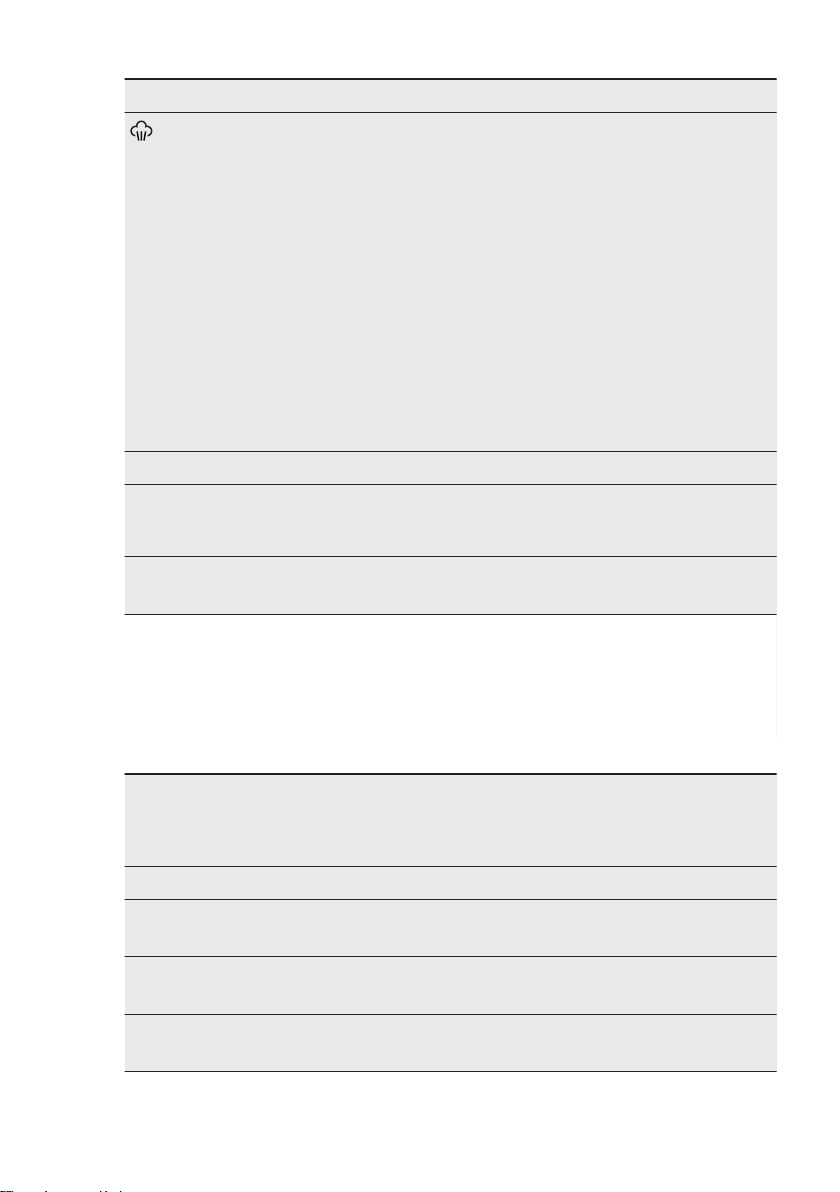
Programme Programme description
Steam
Steam programmes
2)
Steam can be used for dried, washed or worn once laun-
dry. These programmes can reduce creases and odours
and make your laundry softer.
Do not use any detergent. If necessary, remove stains by
washing or using localized stain removal.
Steam programmes do not perform any hygienic cycle.
Do not set a Steam programme with these types of items:
• Items to be washed at a temperature lower than 40°C.
• Items where it is not specified on the care label as being
suitable for tumble drying.
• All items with plastic, metal, wooden parts or alike.
Additional programmes
Rinse
To rinse and spin the laundry. All fabrics, except woollens and
very delicate fabrics. Reduce the spin speed accordingly to the
type of laundry.
Spin/Drain
All fabrics, except woollens and delicate fabrics. To spin the
laundry and to drain the water in the drum.
1)
During this cycle the drum rotates slowly to ensure a gentle wash. It can seem that the drum doesn't
rotate or doesn't rotate properly, but this is normal for this programme.
2)
If you set a Steam programme with dried laundry, at the end of the cycle the laundry could be humid.
It is better to expose the items to the fresh air for about 10 minutes to let the humidity dry. When the
programme is completed, quickly remove the laundry from the drum. After a steam cycle, items may be
ironed however with less effort.
Programme temperature, maximum spin speed and maximum load
Programme Default tempera-
ture
Temperature
range
Reference spin
speed
Spin speed range
Maximum load
Washing programmes
Cottons
40 °C
95 °C - Cold
1400 rpm
1400 rpm - 400 rpm
7 kg
Cottons Eco
40 °C
60°C - 40 °C
1400 rpm
1400 rpm - 400 rpm
7 kg
Synthetics
40 °C
60 °C - Cold
1200 rpm
1200 rpm - 400 rpm
3 kg
www.aeg.com18
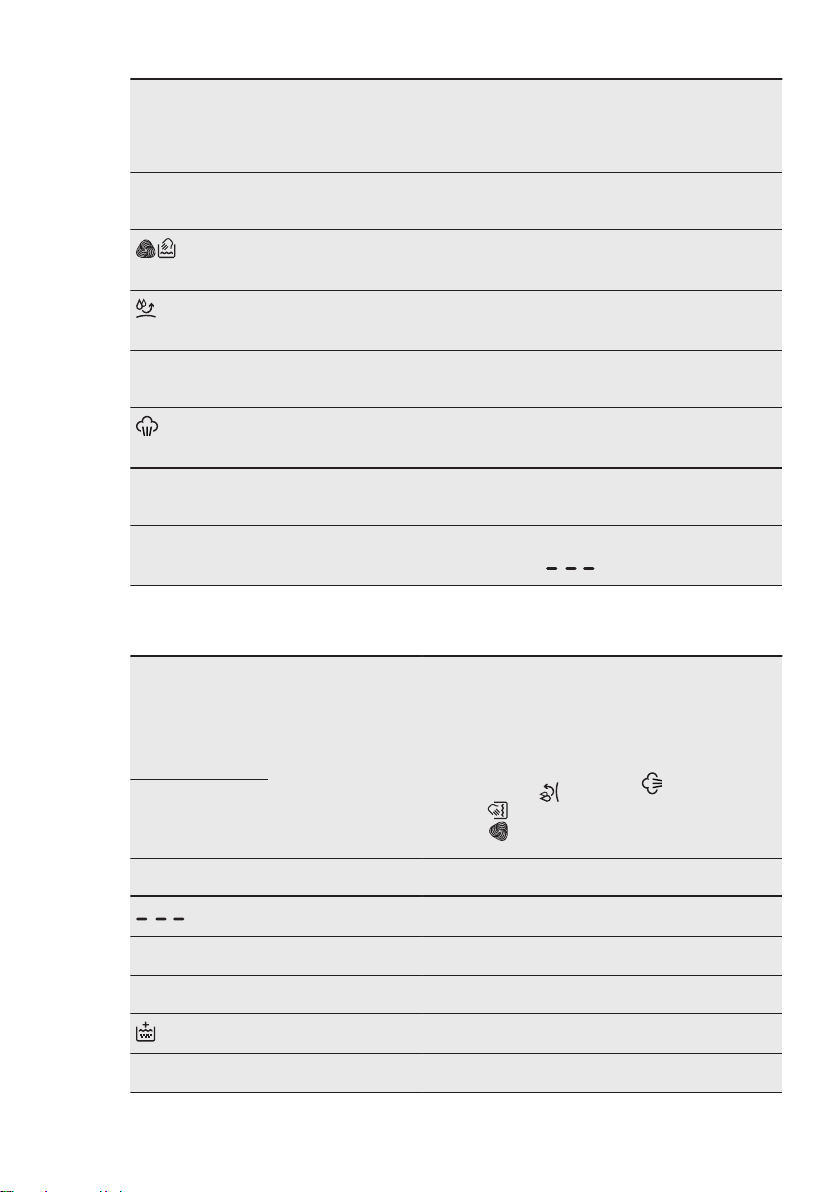
Programme Default tempera-
ture
Temperature
range
Reference spin
speed
Spin speed range
Maximum load
Delicates
40 °C
40 °C - Cold
1200 rpm
1200 rpm - 400 rpm
3 kg
Wool/Handwash
40 °C
40 °C - Cold
1200 rpm
1200 rpm - 400 rpm
1.5 kg
Outdoor
30 °C
40 °C - Cold
1200 rpm
1200 rpm - 400 rpm
2 kg
NonStop 60min
30 °C
40 °C - 30 °C
1200 rpm
1200 rpm
1 kg
Steam
1.5 kg
Rinse
1400 rpm
1400 rpm - 400 rpm
7 kg
Spin/Drain
1400 rpm
1400 rpm -
7 kg
Programme options compatibility
Programme
Cottons
Cottons Eco
Synthetics
Delicates
Wool/Handwash
Outdoor
NonStop 60min
Steam
Rinse
Spin/Drain
Options
Spin
■ ■ ■ ■ ■ ■ ■ ■
No Spin
■
1)
Stains
2)
■ ■ ■ ■
Prewash
■ ■ ■ ■
Extra Rinse
■ ■ ■ ■ ■
Quick Wash
3)
■ ■ ■ ■ ■
ENGLISH 19
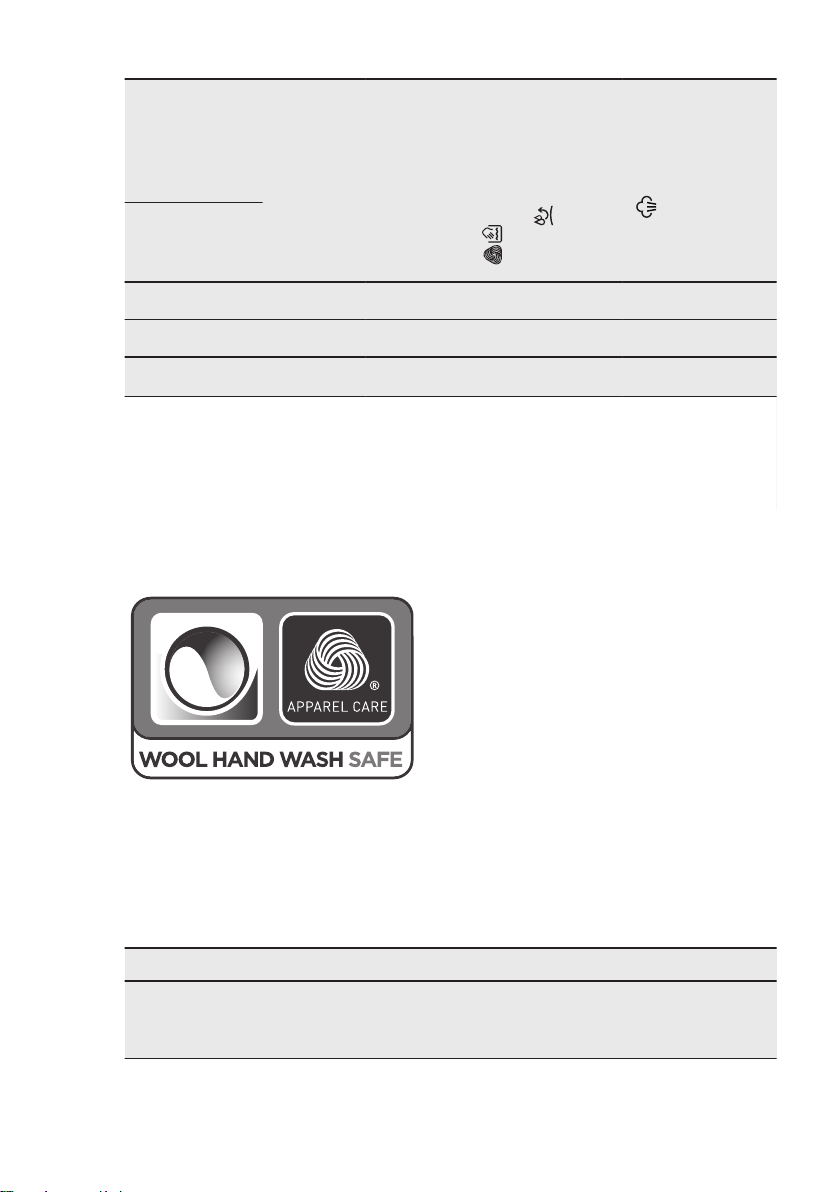
Programme
Cottons
Cottons Eco
Synthetics
Delicates
Wool/Handwash
Outdoor
NonStop 60min
Steam
Rinse
Spin/Drain
Options
Delay Start
■ ■ ■ ■ ■ ■ ■ ■ ■ ■
Time Drying
■ ■ ■ ■ ■ ■
Auto Drying
■
■
4)
1)
If you set No Spin option, the appliance only drains the water.
2)
This option is not available with temperature lower than 40 °C.
3)
If you set the shortest duration, we recommend that you decrease the load size. It is possible to fully
load the appliance, however the washing results can be less satisfactory.
4)
Iron Dry is not available with this programme.
7.2 Woolmark Apparel Care -
Blue
• The wool wash cycle of this machine
has been approved by The Woolmark
Company for the washing of wool
garments labelled as "hand wash"
provided that the products are
washed according to the instructions
on the garment label and those
issued by the manufacturer of this
washing machine. M1664
• The wool drying cycle of this machine
has been tested and approved by The
Woolmark Company. The cycle is
suitable to dry wool garments which
are labelled "hand wash" provided
that the garments are washed in a
Woolmark endorsed hand washing
cycle and dried according to the
instructions issued by the
manufacturer. M1664
In UK, Eire, Hong Kong and India the
Woolmark symbol is a certification
trademark.
7.3 Automatic drying
Dryness Level Type of fabric Load
Extra Dry
For towelling materials
Cottons and Linen
(bathrobes, bath towels, etc)
up to 4 kg
www.aeg.com20
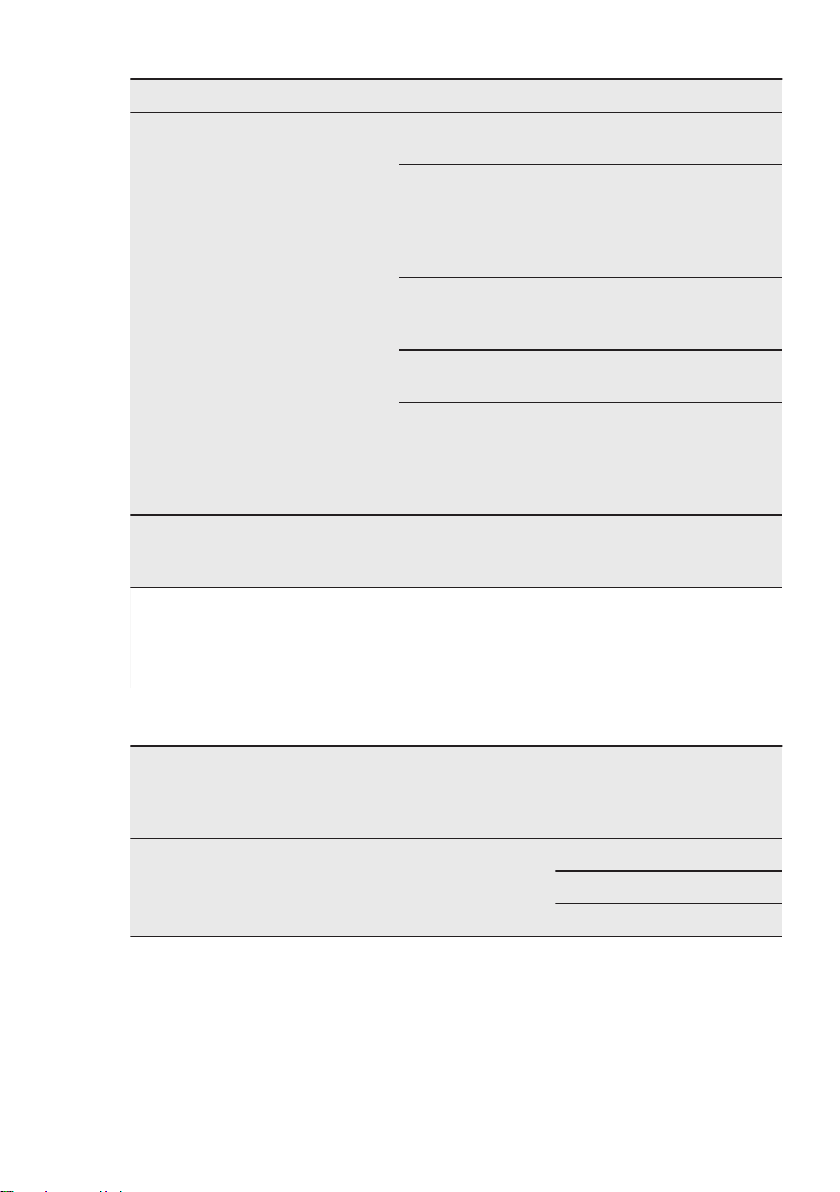
Dryness Level Type of fabric Load
Cupboard Dry
1)
For items to be stored
Cottons and Linen
(bathrobes, bath towels, etc)
up to 4 kg
Synthetics and mixed fab-
rics
(jumpers, blouses, under-
wear, household and bed lin-
en)
up to 3 kg
Delicate fabrics
(acrylics, viscose and delicate
mixed fabrics)
up to 2 kg
Wool items
(woollen jumpers)
up to 1 kg
Outdoor sporting garments
(Outdoor clothing, technical,
sport fabrics, waterproof and
breathable jackets, shell jack-
ets)
up to 2 kg
Iron Dry
Suitable for ironing
Cottons and Linen
(sheets, tablecloths, shirts,
etc)
up to 4 kg
1)
Hints for test institute The test performance, in accordance with EN 50229, must be carried out with
a FIRST drying load of the maximum declared drying capacity (load composition according to EN61121)
by setting the AUTOMATIC CUPBOARD DRY for Cottons Eco programme. The SECOND drying load
with the residual load must be tested by setting the AUTOMATIC CUPBOARD DRY for Cottons Eco pro-
gramme.
7.4 Timed drying
Dryness Level Type of fabric Load
(kg)
Spin
spee
d
(rpm)
Suggested
duration
(mins)
Extra Dry
For towelling
materials
Cottons and Linen
(bathrobes, bath towels, etc)
4 1400 190 - 210
2 1400 105 - 120
1 1400 60 - 70
ENGLISH 21
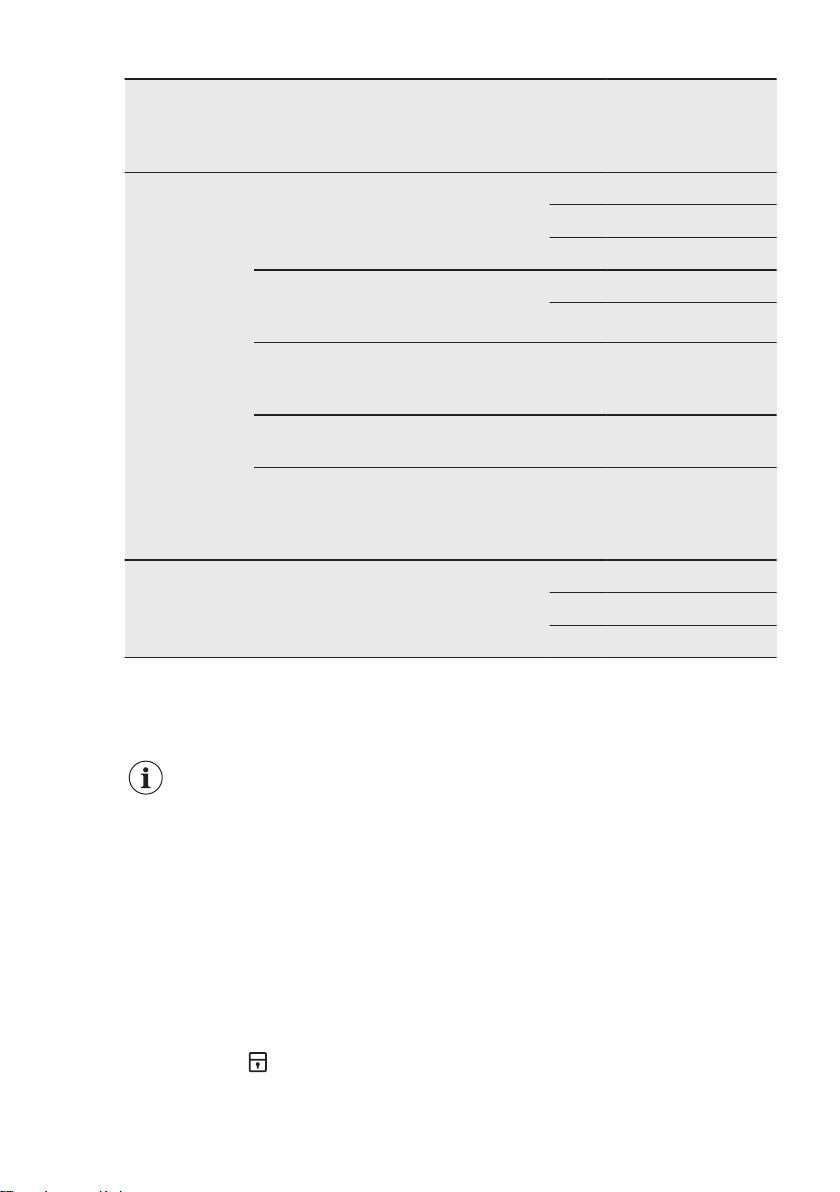
Dryness Level Type of fabric Load
(kg)
Spin
spee
d
(rpm)
Suggested
duration
(mins)
Cupboard Dry
For items to be
stored
Cottons and Linen
(bathrobes, bath towels, etc)
4 1400 180 - 200
2 1400 95 - 110
1 1400 50 - 60
Synthetics and mixed fabrics
(jumpers, blouses, underwear, house-
hold and bed linen)
3 1200 130 - 145
1 1200 45 - 55
Delicates
(acrylics, viscose and delicate mixed
fabrics)
2 1200 150
Wool
(woollen jumpers)
1 1200 170 - 190
Outdoor sporting garments
(Outdoor clothing, technical, sport fab-
rics, waterproof and breathable jackets,
shell jackets)
2 1200 160
Iron Dry
Suitable for
ironing
Cottons and Linen
(sheets, tablecloths, shirts, etc)
4 1400 115 - 130
2 1400 65 - 75
1 1400 40 - 50
8. SETTINGS
8.1 Introduction
When pressing a key
combination, do not tilt
your fingers downwards .
The sensors of the
underneath buttons are
sensitive and may interfere
with Your choice.
8.2 Child Lock
With this option you can prevent children
from playing with the control panel.
• To activate/deactivate this option,
touch the Spin and the Stains/
Prewash buttons simultaneously until
the indicator comes on/goes off
on the display.
You can activate this option:
• After you touch the Start/Pause
button: all the buttons and the
programme dial are deactivated
(except On/Off button ).
• Before you touch the Start/Pause
button: the appliance cannot start.
The appliance keeps the selection of this
option after you switch it off.
8.3 Acoustic signals
The acoustic signals operate when the
programme is completed (sequence of
sounds for about 2 minutes).
To deactivate/activate the acoustic
signals, touch the Stains/Prewash and the
Delay Start buttons simultaneously for
about 6 seconds.
www.aeg.com
22
If you deactivate the
acoustic signals, they
continue operate when the
appliance has a malfunction.
8.4 Permanent Extra Rinse
With this option you can permanently
have one or two extra rinses when you
set a new programme.
• Simultaneously touch the Temp.
button and the Spin button once to
add one extra rinse. appears on
the display.
• Simultaneously touch the Temp.
button and the Spin button twice to
add two extra rinses. appears on
the display.
• Simultaneously touch the Temp.
button and the Spin button three
times to remove extra rinses. The
display only shows
.
9. BEFORE FIRST USE
During installation or before
first use you may observe
some water in the appliance.
This is a residual water left in
the appliance after a full
functional test in the factory
to ensure the appliance is
delivered to customers in
perfect working order and is
no cause for concern.
1. Make sure that all transit bolts have
been removed from the appliance.
2. Make sure that the electrical power is
available and the water tap is open.
3. Pour 2 litres of water into the
detergent compartment marked by
.
This action activates the drain system.
4. Pour a small quantity of detergent
into the compartment marked by
.
5. Set and start a programme for cotton
at the highest temperature without
any laundry in the drum.
This removes all possible dirt from the
drum and the tub.
10. DAILY USE - WASHING ONLY
WARNING!
Refer to Safety chapters.
10.1 Activating the appliance
1. Connect the mains plug to the mains
socket.
2. Open the water tap.
3. Press the On/Off button for a few
seconds to activate the appliance.
The indicator of the Start/Pause
button starts flashing.
The programme dial is automatically set
on Cotton programme and only the
indicator Wash is on above the Mode
button.
The display shows the maximum load,
the default temperature, the maximum
spin speed, the indicators of the phases
making up the programme and the cycle
duration.
10.2 Loading the laundry
1. Open the appliance door.
2. Shake the items before you put them
in the appliance.
3. Put the laundry in the drum, one item
at a time.
Make sure not to put too much laundry
in the drum.
4. Close the door firmly.
ENGLISH 23
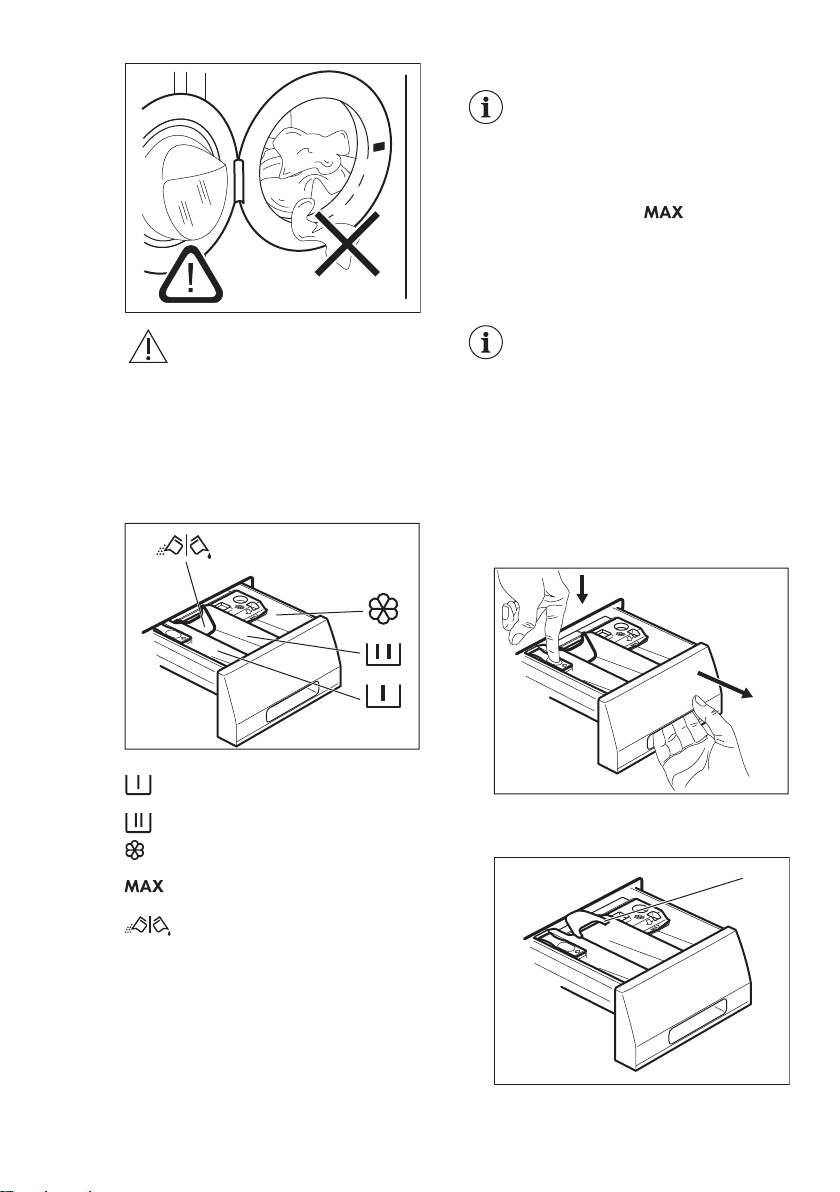
CAUTION!
Make sure that no laundry
stays between the seal and
the door. There is a risk of
water leakage or damage to
the laundry.
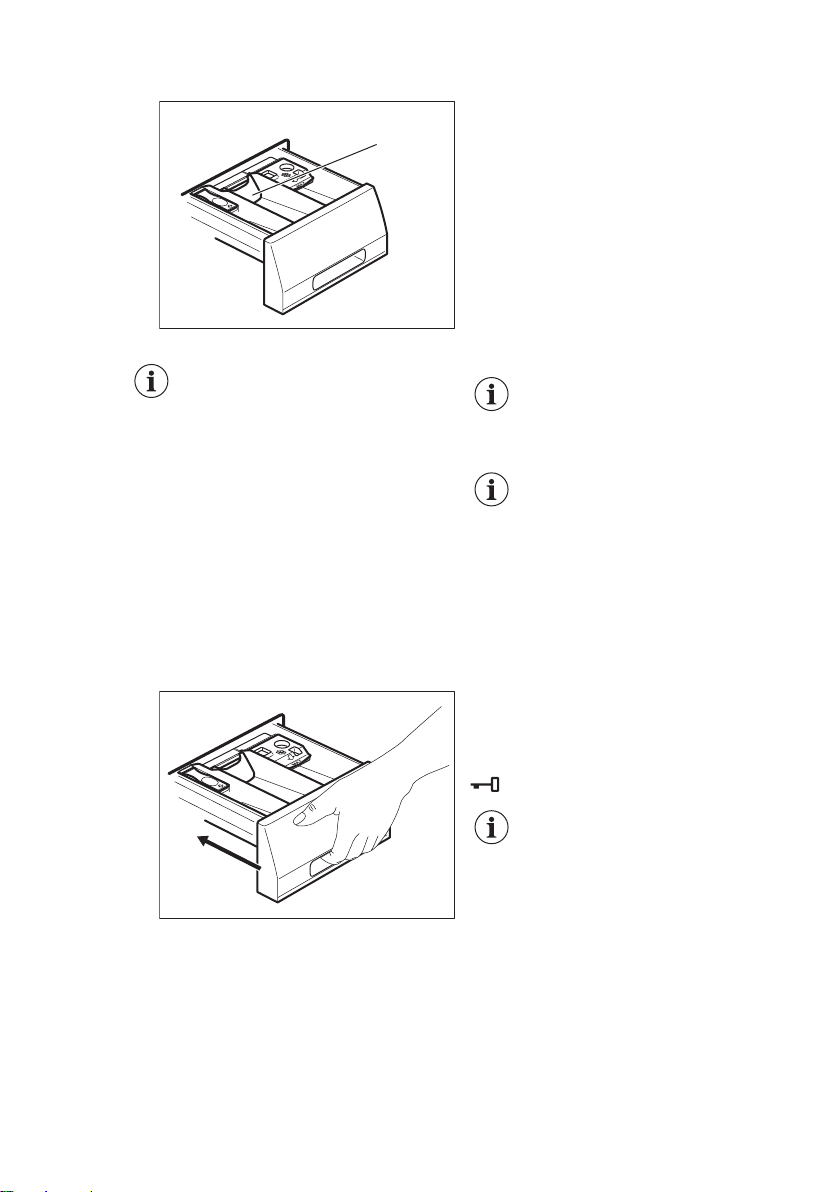
10.3 Filling the detergent and
additives
Compartment for prewash phase,
soak programme or stain remover.
Compartment for washing phase.
Compartment for liquid additives
(fabric conditioner, starch).
Maximum level for quantity of liquid
additives.
Flap for powder or liquid detergent.
Always follow the
instructions that you find on
the packaging of the
detergent products, but we
recommend that you do not
exceed the maximum
indicated level ( ). This
quantity will however
guarantee the best washing
results.
After a washing cycle, if
necessary, remove any
detergent residue from the
detergent dispenser.
10.4 Check the position of the
flap
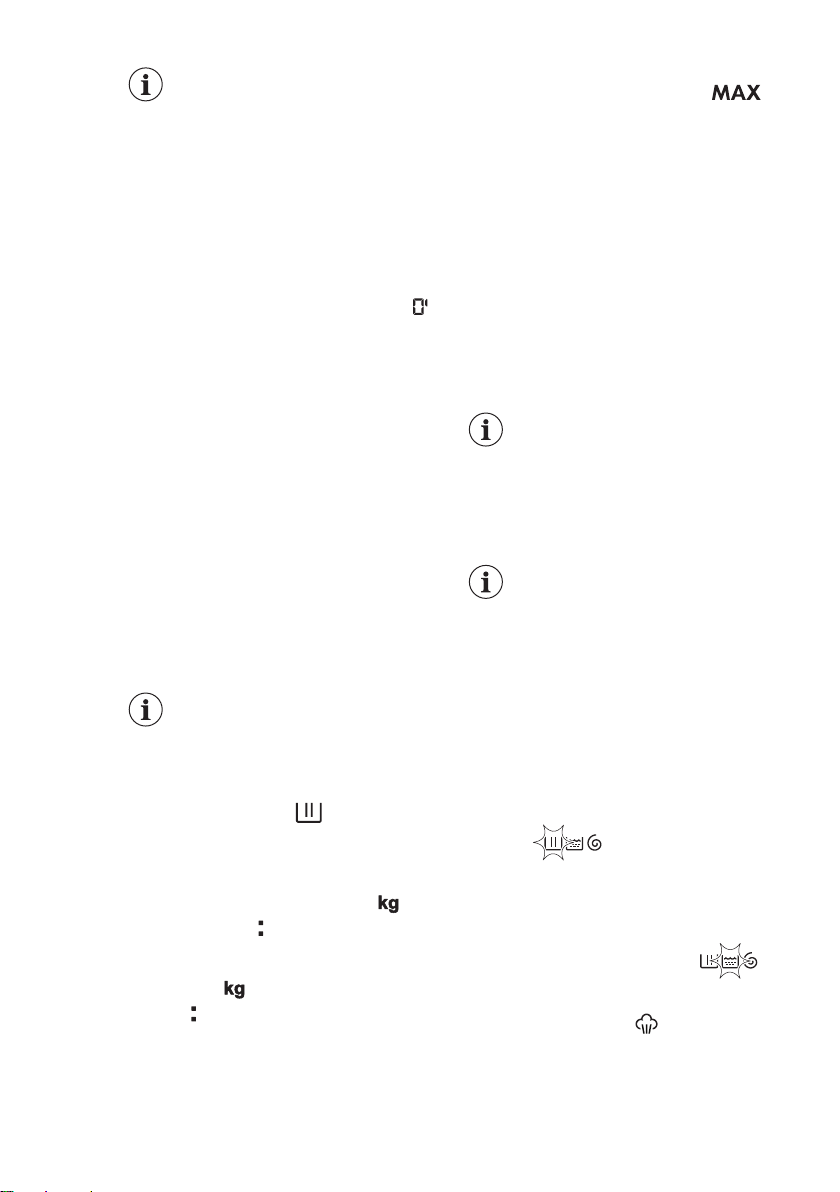
1. Pull out the detergent dispenser until
it stops.
2. Press the lever down to remove the
dispenser.
3. To use powder detergent, turn the
flap up.
A
www.aeg.com
24
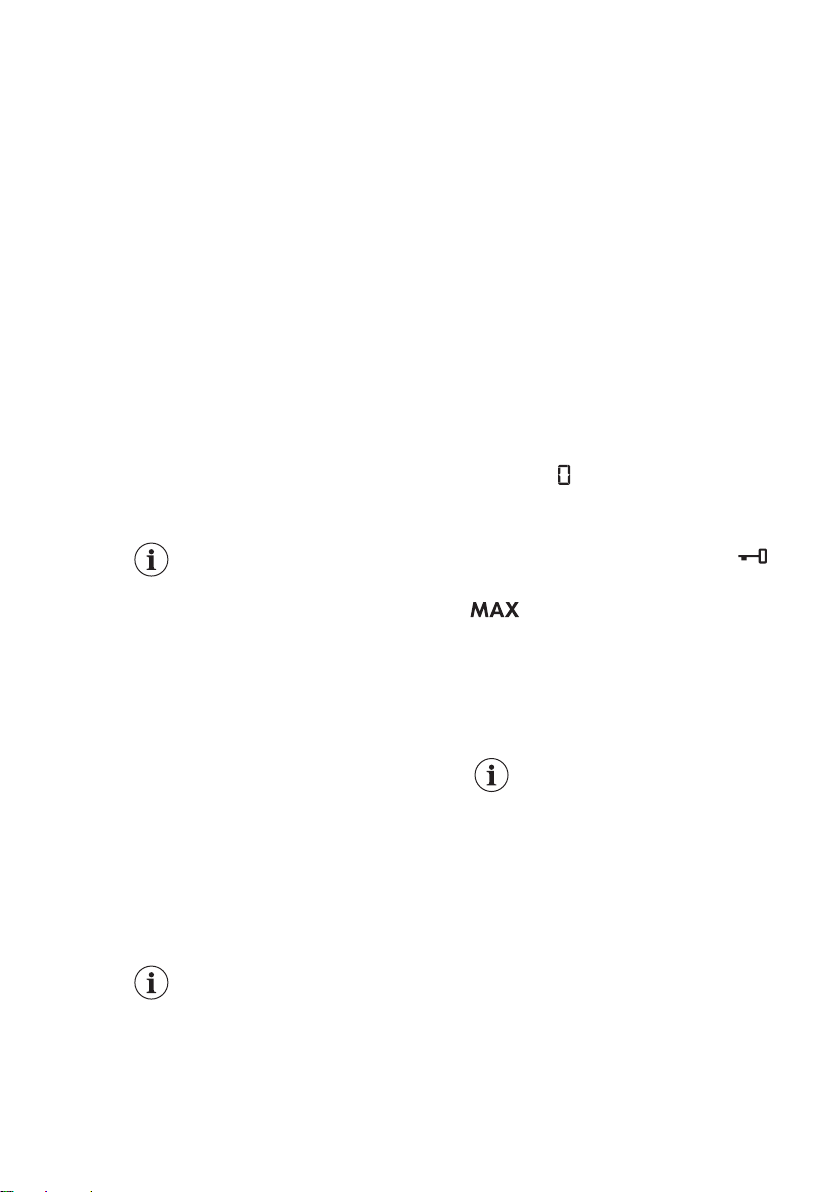
4. To use liquid detergent, turn the flap
down.
B
With the flap in the
position DOWN:
• Do not use
gelatinous or thick
liquid detergents.
• Do not put more
liquid detergent than
the limit shown on
the flap.
• Do not set the
prewash phase.
• Do not set the delay
start function.
5. Measure out the detergent and the
fabric conditioner.
6. Carefully close the detergent
dispenser.
Make sure that the flap does not cause a
blockage when you close the drawer.
10.5 Setting a programme
1. Turn the programme dial to select
the desired washing programme. The
related programme indicator comes
on.
The indicator of the Start/Pause button
flashes.
The display shows the maximum
declared load for the programme, the
default temperature, the maximum spin
speed, the washing phase indicators
(when available) and an indicative
programme duration.
2. To change the temperature and/or
the spin speed, touch the related
buttons.
3. If desired, set one or more options
by touching the related buttons. The
related indicators come on in the
display and the given information
changes accordingly.
To perform washing only,
make sure that only the
Wash indicator is on above
the Mode button.
In case a selection is not
possible, no indicator comes
on and an acoustic signal
sounds.
10.6 Starting a programme
Touch the Start/Pause button to start the
programme.
The related indicator stops flashing and
stays on.
In the display, the indicator of the
operating phase starts flashing and the
maximum load indicator goes off.
The programme starts, the door is
locked. The display shows the indicator
.
The drain pump can operate
shortly before the appliance
fills water.
10.7 Starting a programme
with the delay start
1. Touch the Delay Start button
repeatedly until the display shows
the desired delay time. The indicator
Delay Start goes on.
2. Touch the Start/Pause button.
The appliance starts the countdown of
the delay start.
When the countdown is completed, the
programme starts.
ENGLISH
25
The PROSENSE estimation
starts at the end of the
countdown.
Cancelling the delay start after
the countdown has started
To cancel the delay start:
1. Touch the Start/Pause button to
pause the appliance. The related
indicator flashes.
2. Touch the Delay Start button
repeatedly until the display shows .
3. Touch the Start/Pause button again
to start the programme immediately.
Changing the delay start after
the countdown has started
To change the delay start:
1. Touch the Start/Pause button to
pause the appliance. The related
indicator flashes.
2. Touch the Delay Start button
repeatedly until the display shows
the desired delay time.
3. Touch the Start/Pause button again
to start the new countdown.
10.8 The ProSense load
detection
The programme duration in
the display is referred to a
medium/high load.
After touching the Start/Pause button,
the maximum declared load indicator
goes off, the indicator
flashes, the
ProSense starts the laundry load
detection:
1. The appliance detects the load in the
first 30 seconds: the indicator and
the time dots
flash, the drum
rotates shortly.
2. At the end of the load detection, the
indicator
goes off and the time
dots
stop flashing. The programme
duration will be adjusted accordingly
and could increase or decrease. After
further 30 seconds, the water filling
starts.
At the end of the load detection, in case
of drum overload, the indicator
is
flashing in the display:
In this case, for 30 seconds, it is possible
to pause the appliance and remove the
exceeding garments.
Once removed the exceeding garments,
touch the Start/Pause button to start the
programme again. The ProSense phase
can be repeated up to three times (see
point 1).
Important! If the laundry amount will not
be reduced, the washing programme
starts anyway, despite the overload. In
this case, it will be not possible to
guarantee the best washing results.
About 20 minutes after the
programme start, the
programme duration could
be adjusted again
depending on the capacity
of water absorption of the
fabrics.
The ProSense detection is
carried out with complete
washing programmes only
(no skipping phase
selected).
10.9 Programme phase
indicators
When the programme starts the indicator
of the running phase flashes and the
other phase indicators are steady on.
E.g. the washing or pre wash phase is
running: .
When the phase ends the relevant
indicator stops flashing and is steady on.
The next phase indicator starts flashing.
E.g. the rinse phase is running:
.
If you select the Steam programme the
steam phase indicator
comes on.
www.aeg.com
26
10.10 Interrupting a
programme and changing the
options
When the programme is running, you
can change only some options:
1. Touch the button Start/Pause.
The related indicator flashes.
2. Change the options. The given
information in the display changes
accordingly.
3. Touch the button Start/Pause again.
The washing programme continues.
10.11 Cancelling a running
programme
1. Press the button On/Off to cancel
the programme and to deactivate
the appliance.
2. Press the button On/Off again to
activate the appliance.
Now, you can set a new washing
programme.
If the ProSense phase is
already carried out and the
water filling is already
started, the new programme
starts without repeating
the ProSense phase. The
water and the detergent are
not drained out in order to
avoid waste. The display
shows the maximum
duration of the programme,
updating it about 20 minutes
after the starting of the new
programme.
10.12 Opening the door -
Adding garments
While a programme or the delay start
operates, the appliance door is locked.
If the temperature and level
of the water in the drum are
too high and/or the drum
still rotates you cannot open
the door.
1. Touch the button Start/Pause.
In the display the related door lock
indicator goes off.
2. Open the appliance door. If
necessary, add or remove the items.
3. Close the door and touch the button
Start/Pause.
The programme or the delay start
continues.
4. The door can be opened when the
programme is complete, or set Spin/
Drain programme and than press
Start/Pause button.
10.13 End of the programme
When the programme has finished, the
appliance stops automatically. The
acoustic signals operate (if they are
active).
In the display all washing phase
indicators become steady and the time
area shows .
The indicator of the Start/Pause button
goes off.
The door unlocks and the indicator
goes off.
flashes at the end of the
programme in case of overloaded drum.
1. Press the On/Off button to
deactivate the appliance.
After five minutes from the end of the
programme, the energy saving function
automatically deactivates the appliance.
When you activate the
appliance again, the display
show the end of the last
selected programme. Turn
the programme dial to set a
new cycle.
2. Remove the laundry from the
appliance.
3. Make sure that the drum is empty.
4. Keep the door and the detergent
dispenser slightly ajar to prevent
mildew and odours.
5. Close the water tap.
10.14 Stand-by option
The Stand-by function automatically
deactivates the appliance to decrease
the energy consumption when:
ENGLISH
27
• You do not use the appliance for 5
minutes before you touch the Start/
Pause button.
Press the button On/Off to activate
the appliance again.
• After 5 minutes from the end of the
washing programme
Press the On/Off button to activate
the appliance again.
The display shows the end of the last
set programme.
Turn the programme dial to set a new
cycle.
If you set a programme or an
option that ends with water
in the drum, the Stand-by
function doesn't deactivate
the appliance to remind you
to drain the water.
11. DAILY USE - WASHING & DRYING
WARNING!
Refer to Safety chapters.
This appliance is an
automatic washer dryer.
11.1 Complete wash&dry
programmes
Automatic Non-Stop
programme
The appliance is equipped with the
NonStop 60min programme, an
automatic wash&dry programme where it
is not necessary to set the Dry mode.
To run this programme:
1. After loading laundry and detergent,
press the On/Off button for some
seconds to activate the appliance.
2. Set the NonStop 60min programme
by means of the programme dial.
The indicator
appears on the display
3. Touch the Start/Pause button to start
the programme.
Non-automatic wash&dry
programmes
In some washing programmes, you can
combine Wash and Dry mode for
running a complete wash&dry
programme.
Proceed as follows:
1. Press the On/Off button for some
seconds to activate the appliance.
2. Load the laundry one item at a time.
3. Put the detergent and the additives
in the appropriate compartment.
4. Turn the programme dial to the
washing programme. The display
shows the default temperature and
spin. If necessary, change them
according to your laundry. The
display also shows the maximum
recommended load for washing
phase.
5. Set the desired options, if there are
available.
6. Touch the Mode button once to
activate also the drying function. The
Wash and Dry indicators come on.
The indicators
and
appear on the display. The display
also shows the maximum
recommended load for a washing
and drying programme (e.g. 4 kg for
cottons).
7. Now, you can choose an automatic
drying level or a specific timed
drying.
11.2 Washing and Drying -
Automatic levels
1. Tap on the Auto Drying button
repeatedly until the display shows
the required dryness level. The
indicators in the display illuminate
accordingly:
a.
Iron dry: for cotton
items;
b. Cupboard dry: for
cotton and synthetic items;
www.aeg.com
28
c. Extra dry: for cotton
items.
The time value on the display is the
duration of both cycles washing and
drying, calculated on a default load
size.
To have a good drying by
using less energy and in a
shorter time, the appliance
does not let you set a too
low spin speed for the items
to be washed and dried.
2. Touch button Start/Pause to start the
programme. The PROSENSE
estimation starts.
In the display the door locked
indicator goes on, the indicator of the
running phase starts flashing.
The display also shows the remaining
programme time.
11.3 Washing and Timed
Drying
1. Tap on the button Time Drying
repeatedly to set the desired time
value (see the "Timed drying" table
the "Programmes" chapter). The
drying level indicator goes off and
the indicator
comes on.
Each time you tap on this button the
time value increases by 5 minutes. The
display shows the set new time value.
2. Touch the Start/Pause to start the
programme. The PROSENSE
estimation starts.
In the display the door locked
indicator comes on and the indicator of
the running phase starts flashing.
The display also shows the remaining
programme time.
11.4 At the end of the drying
programme
• The appliance stops automatically.
• The acoustic signals operate (if they
are active).
• In the display comes on.
• The indicator of button Start/Pause
goes off. The door locked goes
off
• Press the button On/Off for some
seconds to deactivate the appliance.
After some minutes from
the end of the
programme, the energy
saving function
deactivates the appliance
automatically.
1. Remove the laundry from the
appliance.
2. Make sure that the drum is empty.
After drying phase, clean the
drum, the seal and the inside
of the door with a wet cloth.
12. DAILY USE - DRYING ONLY
WARNING!
Refer to Safety chapters.
This appliance is an
automatic washer dryer.
12.1 Preparation to drying
1. Press the On/Off button for some
seconds to activate the appliance.
With a drying-only
programme the display does
not show the maximum load
and the PROSENSE
estimation is deactivated.
2. Load the laundry one item at a time.
3. Turn the programme dial to the
programme suitable for the items to
dry.
4. Tap on the Mode button twice to
exclude washing and perform drying
only. The Dry indicator is on. The
indicators and appear on
the display.
ENGLISH 29
When drying a big amount
of laundry, to have good
drying performances, make
sure that the laundry itself is
not rolled up and that is
uniformly distributed in the
drum.
12.2 Drying - Automatic levels
1. Tap on the Auto Drying button
repeatedly until the display shows
the required dryness level. The
indicators in the display illuminate
accordingly:
a.
Iron dry: for cotton
items;
b. Cupboard dry: for
cotton and synthetic items;
c.
Extra dry: for cotton
items.
The display shows the drying
programme duration.
To have a good drying by
using less energy and in a
shorter time, the appliance
does not let you set a too
low spin speed for the items
to be washed and dried.
2. Touch button Start/Pause to start the
programme.
In the display the door locked
indicator goes on, the indicator of the
running phase starts flashing.
The display also shows the remaining
programme time.
12.3 Timed Drying
1. Tap on the button Time Drying
repeatedly to set the desired time
value (see the "Timed drying" table
the "Programmes" chapter). The
drying level indicator goes off and
the indicator comes on.
Each time you tap on this button the
time value increases by 5 minutes. The
display shows the set new time value.
2. Touch the Start/Pause to start the
programme.
In the display the door locked
indicator comes on and the indicator of
the running phase starts flashing.
The display also shows the remaining
programme time.
12.4 At the end of the drying
programme
• The appliance stops automatically.
• The acoustic signals operate (if they
are active).
• In the display comes on.
• The indicator of button Start/Pause
goes off. The door locked
goes
off
• Press the button On/Off for some
seconds to deactivate the appliance.
After some minutes from
the end of the
programme, the energy
saving function
deactivates the appliance
automatically.
1. Remove the laundry from the
appliance.
2. Make sure that the drum is empty.
After drying phase, clean the
drum, the seal and the inside
of the door with a wet cloth.
13. FLUFF IN THE FABRICS
During the washing and/or drying phase,
some types of fabric, (sponge, wool,
sweatshirt) could release fluff.
The released fluff could stick to the
fabrics during the next cycle.
This inconvenient increases with
technical fabrics.
To prevent the fluff in your laundry, we
recommend that you:
• To do not wash dark fabrics after you
washed and dried light coloured
fabrics (hand towel, wool, sweatshirt )
and the contrary.
www.aeg.com30

• To dry this type of fabrics at open air
when they are washed the first time.
• To clean the drain filter.
• After the drying phase, clean the
empty drum, the gasket and the door
with a wet cloth.
To remove the fluff inside the drum,
set a special programme:
• Empty the drum.
• Clean the drum, the gasket and the
door with a wet cloth.
• Set the rinse programme.
• Simultaneously press the Spin and the
Quick Wash buttons until the display
shows CLE to activate the cleaning
function.
• Touch the Start/Pause button to start
the programme.
If the appliance is frequently
used, carry out the CLE
programme regularly.
14. HINTS AND TIPS
WARNING!
Refer to Safety chapters.
14.1 The laundry load
• Divide the laundry into: white,
coloured, synthetics, delicates and
wool.
• Follow the washing instructions on the
laundry care labels.
• Do not wash white and coloured
items together.
• Some coloured items can discolour
with the first wash. We recommend
that you wash them separately for the
first couple of times.
• Button up pillowcases, close zippers,
hooks and poppers. Tie up belts.
• Empty pockets and unfold.
• Turn multilayered fabrics, wool and
items with printed illustrations inside
out.
• Pre-treat tough stains.
• Wash heavy soil stains with a special
detergent.
• Be careful with curtains. Remove the
hooks and put the curtains in a
washing bag or pillowcase.
• Do not wash laundry without hems or
with cuts.
• Use a washing bag to wash small
and/or delicate items (e.g. underwired
bras, belts, tights, etc. ).
• A very small load can cause balance
problems with the spin phase leading
to excessive vibration. If this occurs:
a. interrupt the programme and
open the door (refer to "Daily
Use" chapter);
b. manually redistribute the load so
that the items are spaced evenly
around the tub;
c. press the Start/Pause button. The
spin phase continues.
14.2 Stubborn stains
For some stains, water and detergent is
not sufficient.
We recommend that you pre-treat these
stains before you put the items in the
appliance.
Special stain removers are available. Use
the special stain remover that is
applicable to the type of stain and fabric.
14.3 Detergents and other
treatments
• Only use detergents and other
treatments specially made for
washing machines:
– powder detergents for all types of
fabric, excluding delicate. Prefer
powder detergents containing
bleach for whites and laundry
sanitization
– liquid detergents, preferably for
low temperature wash
programmes (60 °C max) for all
types of fabric, or special ones for
woollens only.
• Do not mix different types of
detergents.
• To help the environment, do not use
more than the recommended quantity
of detergent.
• Follow the instructions that you find
on packaging of the detergents or
ENGLISH
31
other treatments without exceeding
the indicated maximum level ( ).
• Use the recommended detergents for
the type and colour of the fabric, the
programme temperature and the
level of soil.
14.4 Ecological hints
• Set a programme without the
prewash phase to wash laundry with
normal soil.
• Always start a washing programme
with the maximum load of laundry
allowed.
• If you pre-treat the stains or use a
stain remover, set a programme with
a low temperature.
• To use the correct quantity of
detergent, check the water hardness
of your domestic system. Refer to
"Water hardness".
14.5 Water hardness
If the water hardness in your area is high
or moderate, we recommend that you
use a water softener for washing
machines. In areas where the water
hardness is soft it is not necessary to use
a water softener.
To find out the water hardness in your
area, contact your local water authority.
Use the correct quantity of water
softener. Follow the instructions that you
find on the packaging of the product.
14.6 Prepare the drying cycle
• Open the water tap.
• Check if the drain hose is connected
properly. Refer to installation chapter
for more information.
• For the maximum laundry load of the
drying programmes, refer to the
drying programmes table.
14.7 Items not suitable for
drying
Do not set a drying programme for
this laundry:
• Synthetic curtains.
• Pieces of clothing with metal inserts.
• Nylon stockings.
• Quilts.
• Bed covers.
• Duvets.
• Anoraks.
• Sleeping bags.
• Fabrics with residue of hair sprays, nail
solvents or similar.
• Garments with foam-rubber or
materials similar to foam-rubber.
14.8 Garment labels
When you dry the laundry, obey the
indications on the labels of the
manufacturers:
•
= The item can be tumble dried
• = The drying cycle is at high
temperature
•
= The drying cycle is at reduced
temperature
• = The item can not be tumble
dried.
14.9 Drying cycle duration
The drying time can change depending
on:
• speed of the last spin
• dryness level
• type of laundry
• weight of the load
14.10 Additional drying
If, at the end of the drying programme,
the laundry is still damp, set a short
drying cycle again.
WARNING!
To avoid creasing and
shrinkage do not overdry
the laundry.
14.11 General Tips
Refer to the «Drying programmes» table
to find the average drying times.
Experience will help you to dry the
laundry better. Take note of the duration
of the cycles done before.
To avoid the static charge at the end of
the drying cycle:
1. Use fabric conditioner in the washing
cycle.
www.aeg.com
32
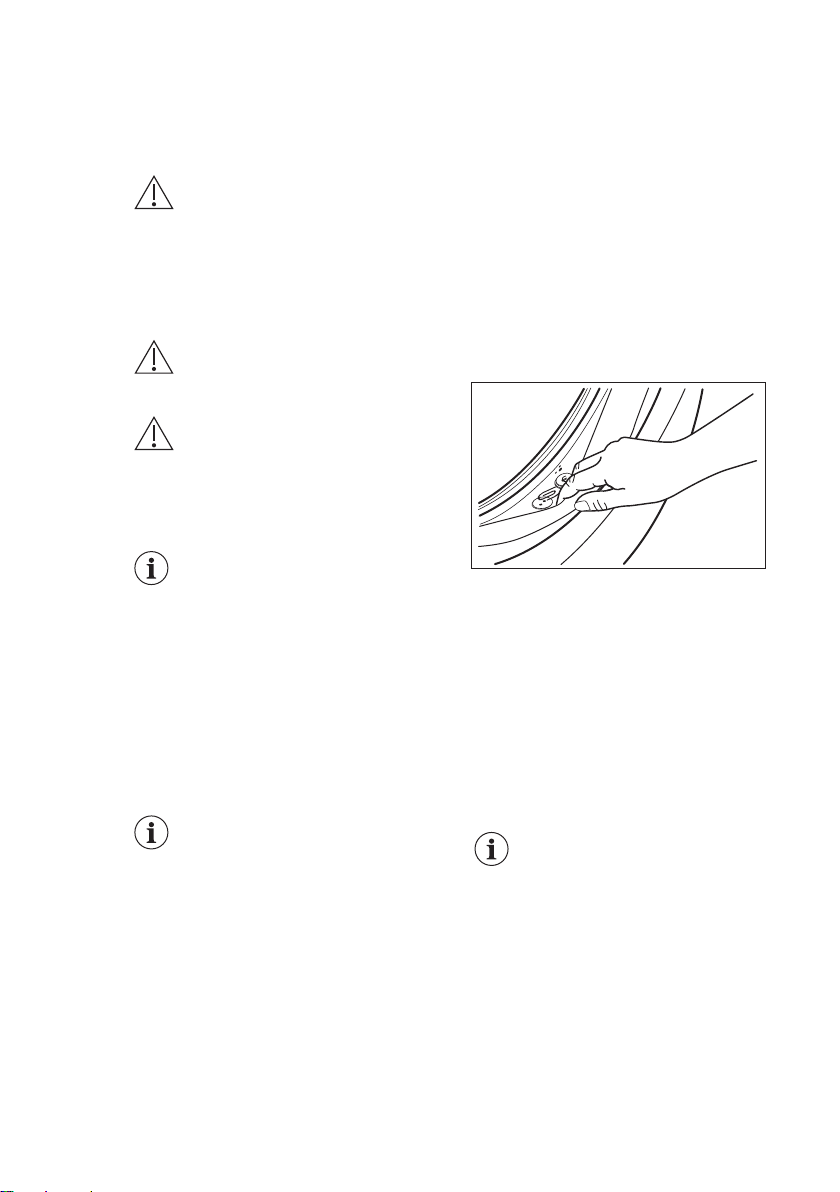
2. Use special fabric conditioner for
tumble dryers.
When the drying programme is
completed remove the laundry promptly.
15. CARE AND CLEANING
WARNING!
Refer to Safety chapters.
15.1 External cleaning
Clean the appliance with mild soap and
warm water only. Fully dry all the
surfaces.
CAUTION!
Do not use alcohol, solvents
or chemical products.
CAUTION!
Do not clean the metal
surfaces with chlorine-based
detergent.
15.2 Descaling
If the water hardness in your
area is high or moderate, we
recommend that you use a
water descaling product for
washing machines.
Regularly examine the drum to check for
limescale.
The regular detergents already contain
water softening agents, but we
recommend to run a cycle with empty
drum and a descaling product
occasionally.
Always follow the
instructions that you find on
the packaging of the
product.
15.3 Maintenance wash
The repeated and prolonged use of low
temperature programmes can cause
detergent deposits, fluff residues,
bacterial growth inside the drum and the
tub. This could generate bad odours and
mildew.
To eliminate these deposits and
hygienize the inner part of the appliance,
run a maintenance wash regularly (at
least once a month):
1. Remove all laundry from the drum.
2. Run a cotton programme with the
highest temperature with a small
quantity of powder detergent or, if
available, run the Machine Clean
programme.
15.4 Door seal
Regularly examine the seal and remove
all objects from the inner part.
15.5 Cleaning the drum
Regularly examine the drum to prevent
unwanted deposits.
Rust deposits in the drum may occur due
to rusting foreign body in the washing or
tap water containing iron.
Clean the drum with special products for
stainless steel.
Always follow the
instructions that you find on
the packaging of the
product.
Do not clean the drum with
acidic descaling products,
scouring products
containing chlorine or iron or
steel.
For a thorough clean:
1. Clean the drum with special products
for stainless steel.
ENGLISH
33
Always follow the
instructions that you find on
the packaging of the
product.
2. Run a short cotton programme at
high temperature with empty drum
and with a small quantity of powder
detergent or, if available, run the
Machine Clean programme.
15.6 Cleaning the detergent
dispenser
To prevent possible deposits of dried
detergent or clotted fabric softener
and/or formation of mould in the
detergent dispenser drawer, once in a
while carry out the following cleaning
procedure:
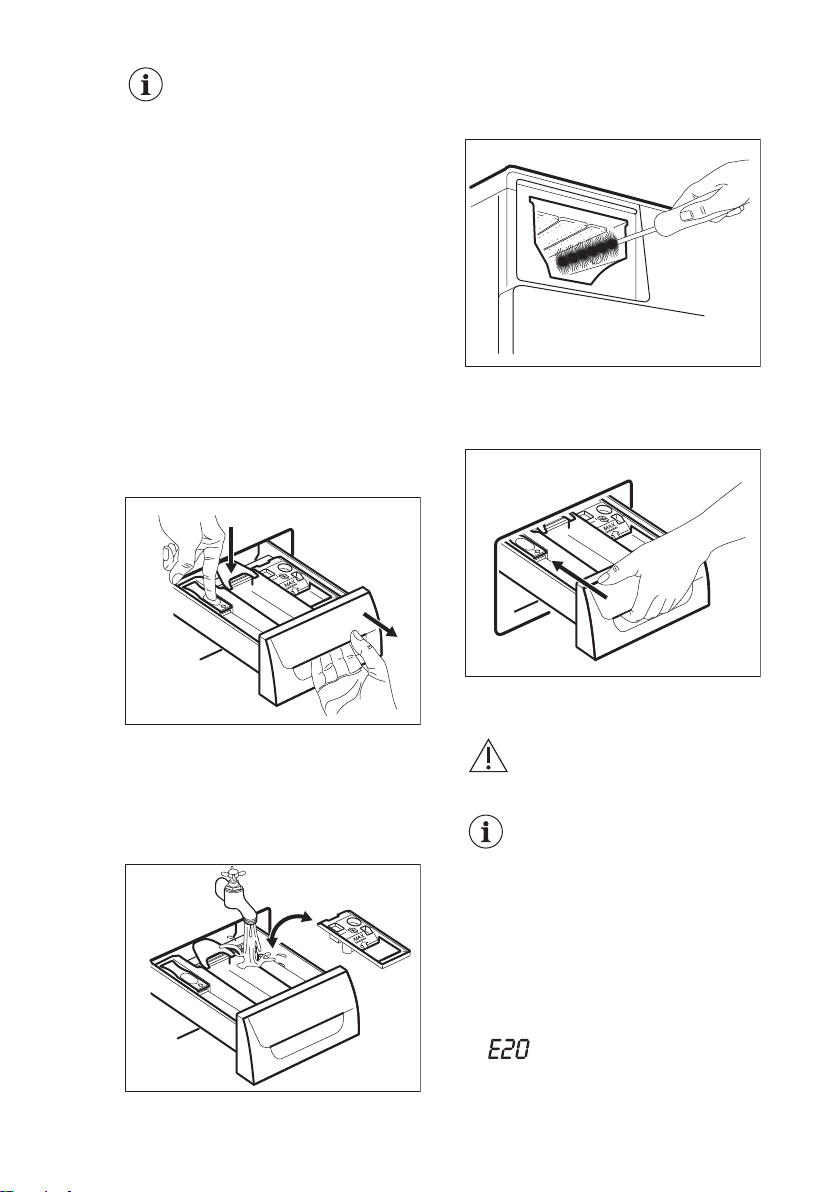
1. Open the drawer. Press the catch
downwards as indicated in the
picture and pull it out.
1
2
2. Remove the top part of the additive
compartment to aid cleaning and
flush it out under running warm
water, to remove any traces of
accumulated detergent. After
cleaning, replace the top part in its
position.
3. Make sure that all detergent residue
is removed from the upper and lower
part of the recess. Use a small brush
to clean the recess.
4. Insert the detergent drawer into the
guide rails and close it. Run the
rinsing programme without any
clothes in the drum.
15.7 Cleaning the drain pump
WARNING!
Disconnect the mains plug
from the mains socket.
Regularly check the drain
pump filter and make sure
that it is clean.
Clean the drain pump if:
• The appliance does not drain the
water.
• The drum does not turn.
• The appliance makes an unusual
noise because of the blockage of the
drain pump.
• The display shows the alarm code
.
www.aeg.com
34
WARNING!
• Do not remove the filter
while the appliance
operates.
• Do not clean the pump if
the water in the
appliance is hot. Wait
until the water cools
down
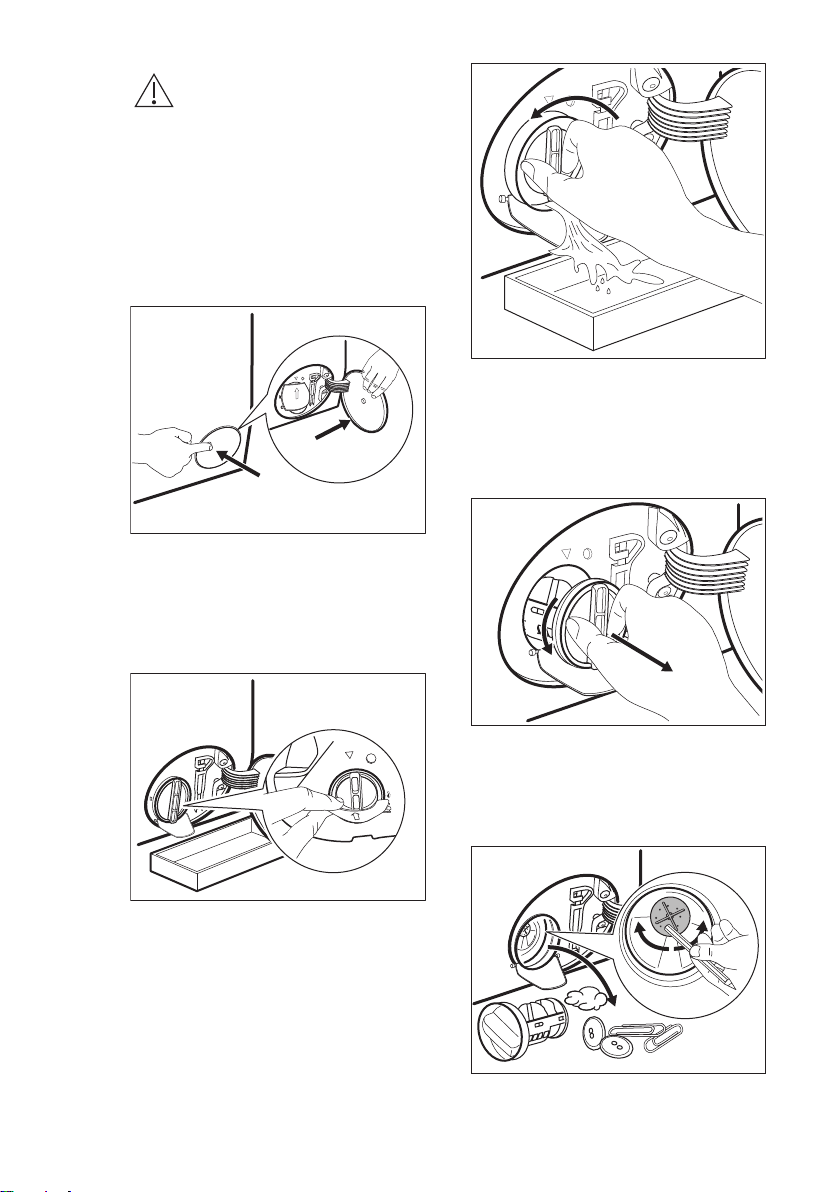
Proceed as follows to clean the pump:
1. Open the pump cover.
1
2
2. Place a suitable bowl below the drain
pump access to collect the water that
flows out.
3. Open the chute downwards. Always
keep a rag nearby to dry up any
water spillages when removing the
filter.
4. Turn the filter 180 degrees in anti-
clockwise direction to open it,
without removing. Let the water flow
out.
5. When the bowl is full of water, turn
the filter back and empty the
container.
6. Repeat the steps 4 and 5 until the
water stops to flow out.
7. Turn the filter anti-clockwise to
remove it.
1
2
8. If it is necessary, remove fluff and
objects from the filter recess.
9. Make sure that the impeller of the
pump can rotate. If it does not
rotate, contact the Authorised
Service Centre.
10. Clean the filter under the water tap.
ENGLISH
35
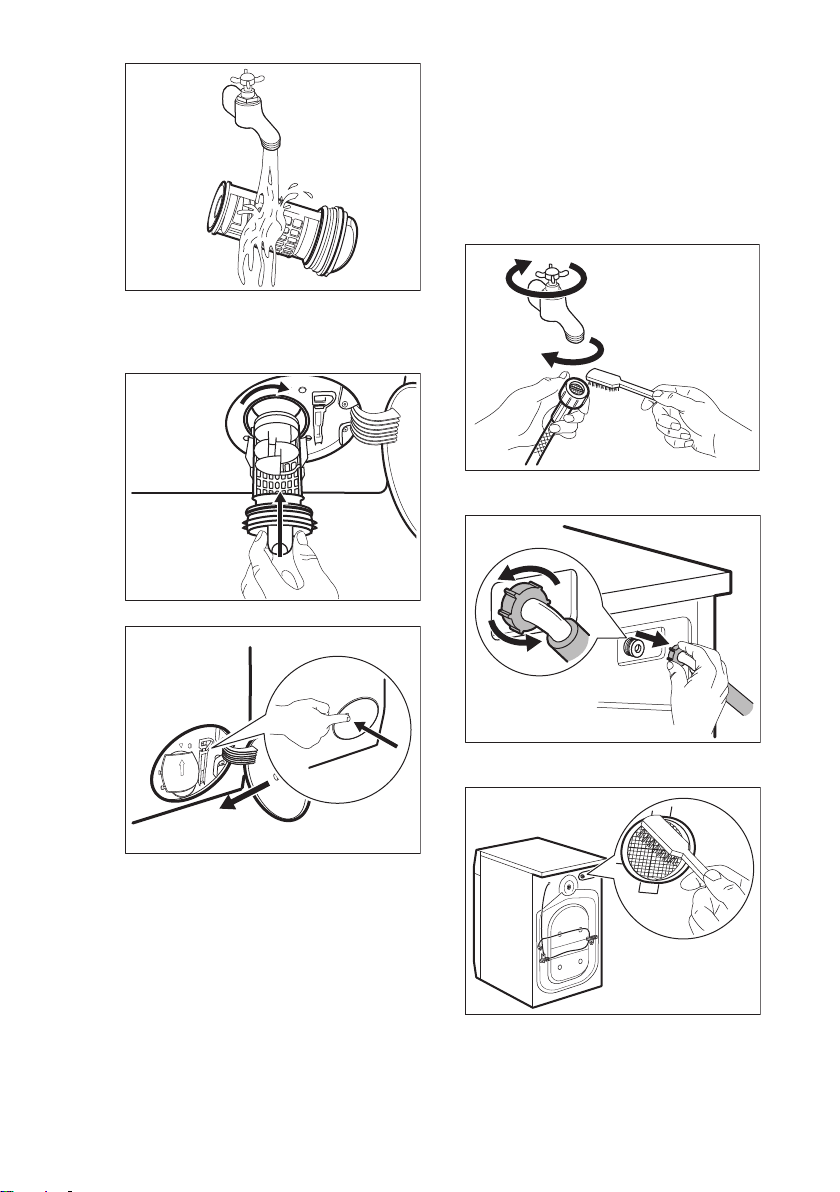
11. Put the filter back into the special
guides by turning it clockwise. Make
sure that you tighten the filter
correctly to prevent leakages.
2
1
12. Close the pump cover.
2
1
When you drain the water with the
emergency drain procedure, you must
activate the drain system again:
a. Put 2 litres of water in the main
wash compartment of the
detergent dispenser.
b. Start the programme to drain the
water.
15.8 Cleaning the inlet hose
and the valve filter
It is recommended to clean both the
filters of the inlet hose and valve
occasionally to remove any deposit,
collected over the time:
1. Remove the inlet hose from the tap
and clean the filter.
1
2
3
2. Remove the inlet hose from the
appliance by loosening the ring nut.
3. Clean the valve filter on the back of
the appliance with a toothbrush.
4. When you reconnect the hose to the
back of the appliance, turn it left or
right (not in vertical position)
depending on the position of your
water tap.
www.aeg.com
36
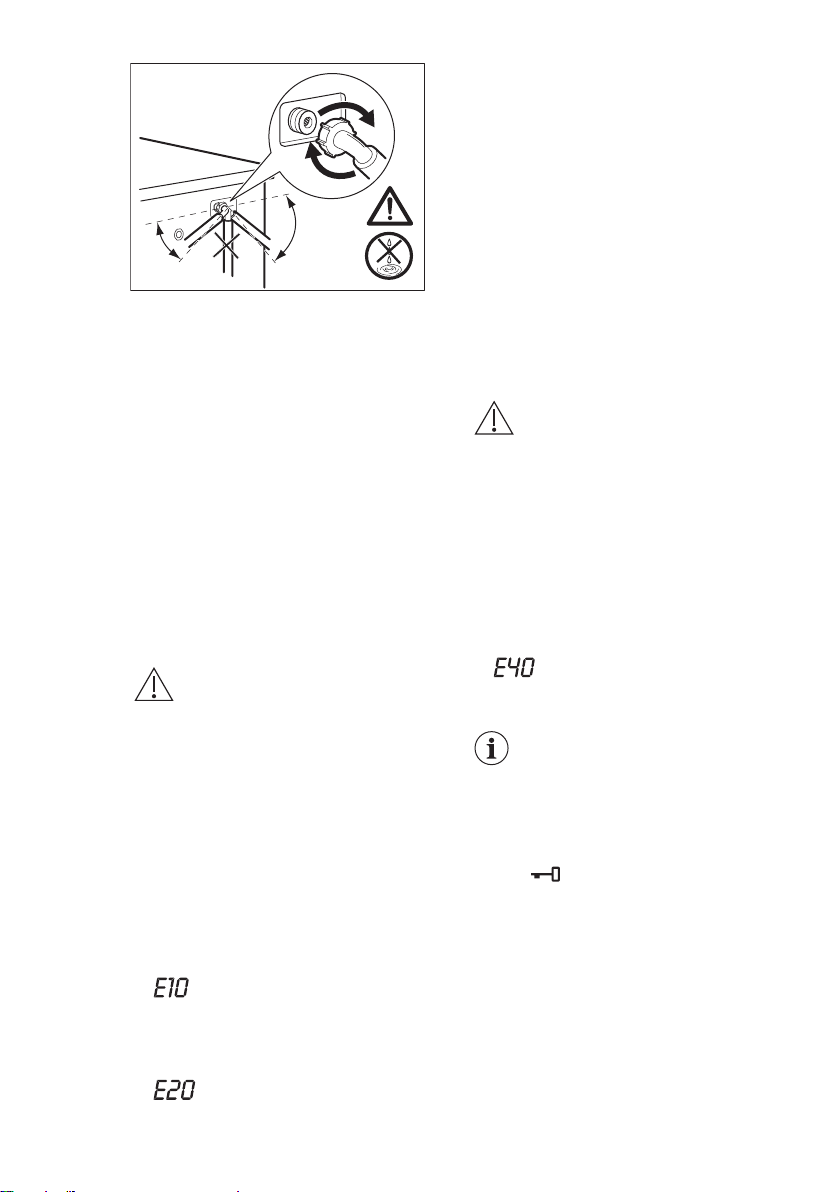
45°
20°
15.9 Emergency drain
If the appliance cannot drain the water,
carry out the same procedure, described
in 'Cleaning the drain pump' paragraph.
If necessary, clean the pump.
When you drain the water with the
emergency drain procedure, you must
activate the drain system again:
1. Put 2 litres of water in the main wash
compartment of the detergent
dispenser.
2. Start the programme to drain the
water.
15.10 Frost precautions
If the appliance is installed in an area
where the temperature can reach the
values around 0° C or drop below,
remove the remaining water from the
inlet hose and the drain pump.
1. Disconnect the mains plug from the
mains socket.
2. Close the water tap.
3. Put the two ends of the inlet hose in
a container and let the water flow out
of the hose.
4. Empty the drain pump. Refer to the
emergency drain procedure.
5. When the drain pump is empty,
install the inlet hose again.
WARNING!
Make sure that the
temperature is higher than 0
°C before you use the
appliance again.
The manufacturer is not
responsible for damages
caused by low temperatures.
16. TROUBLESHOOTING
WARNING!
Refer to Safety chapters.
16.1 Introduction
The appliance does not start or it stops
during operation.
First try to find a solution to the problem
(refer to the table). If the problem
persists, contact the Authorised Service
Centre.
In case of major problems, the acoustic
signals operate, the display shows an
alarm code and the Start/Pause button
may flash continuously:
• - The appliance does not fill with
water properly.
Start the appliance again by pressing
Start/Pause button. After 5 seconds
the door will be unlocked.
• - The appliance does not drain
the water.
• - The appliance door is open or
not closed correctly. Please check the
door!
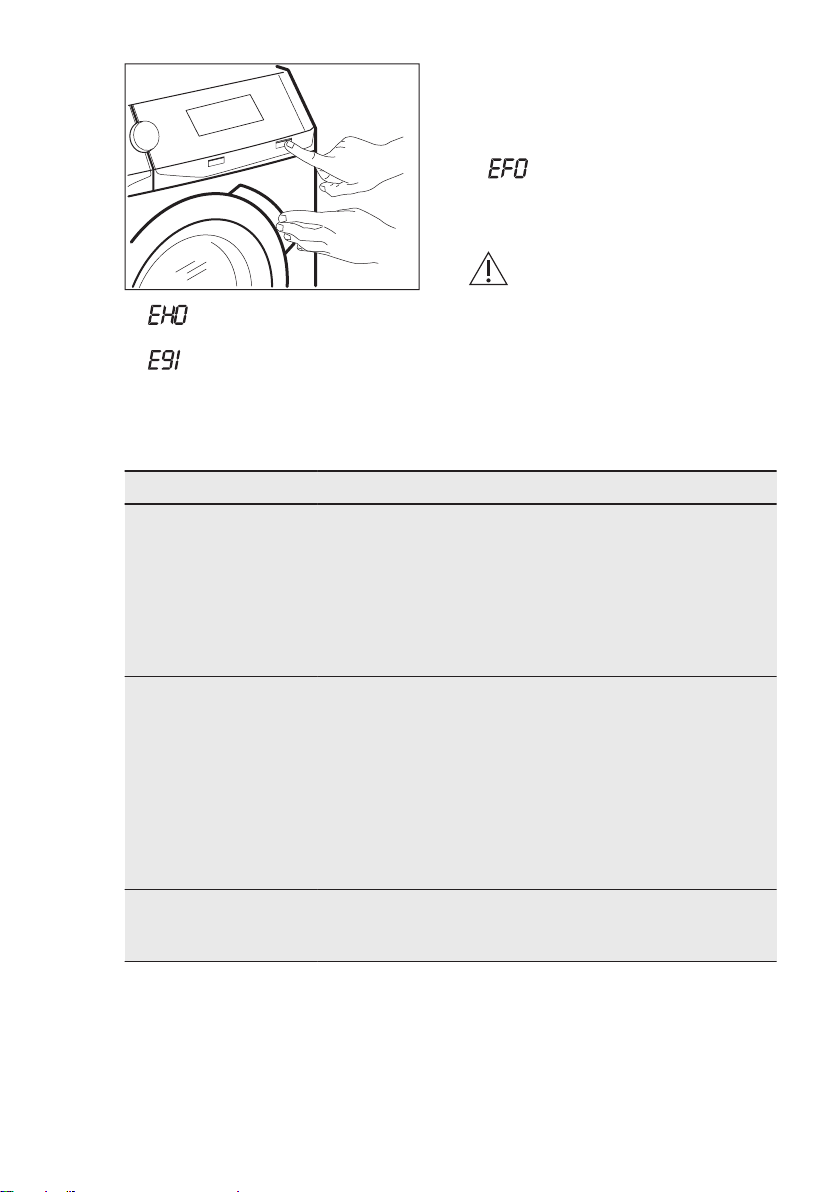
If the appliance is
overloaded, remove
some items from the
drum and/or keep
pressed the door while
touching the Start/Pause
button until the indicator
stops flashing (see
the picture below).
ENGLISH 37
• - The mains supply is unstable.
Wait until the mains supply is stable.
• - No communication between
electronic elements of the appliance.
Switch it off and switch on again.
The programme was not finished
properly or the appliance stopped
too early. If the alarm code appears
again, contact the Authorised Service
Centre.
• - The anti-flood device is on.
Disconnect the appliance and close
the water tap. Contact the Authorised
Service Centre.
WARNING!
Deactivate the appliance
before carrying out any
check.
16.2 Possible failures
Problem Possible solution
The programme does
not start.
• Make sure that the mains plug is connected to the mains
socket.
• Make sure that the appliance door is closed.
• Make sure that there is no damaged fuse in the fuse box.
• Make sure that the Start/Pause has been touched.
• If the delay start is set, cancel the setting or wait for the end
of countdown.
• Deactivate the Child Lock function if it is on.
The appliance does not
fill with water properly.
• Make sure that the water tap is open.
• Make sure that the pressure of the water supply is not too
low. For this information, contact your local water authority.
• Make sure that the water tap is not clogged.
• Make sure that the inlet hose has no kinks, damages or
bends.
• Make sure that the connection of the water inlet hose is
correct.
• Make sure that the filter of the inlet hose and the filter of
the valve are not clogged. Refer to 'Care and cleaning'.
The appliance fills with
water and drains immedi-
ately
• Make sure that the drain hose is in the correct position. The
hose may be positioned too low. Refer to "Installation in-
struction".
www.aeg.com38

Problem Possible solution
The appliance does not
drain the water.
• Make sure that the sink spigot is not clogged.
• Make sure that the drain hose has no kinks or bends.
• Make sure that the drain filter is not clogged. Clean the fil-
ter, if necessary. Refer to "Care and cleaning".
• Make sure that the connection of the drain hose is correct.
• Set the drain programme if you set a programme without
drain phase.
• Set the drain programme if you set an option which ends
with water in the tub.
The spin phase does not
operate or the washing
cycle lasts longer than
usual.
• Set the spin programme.
• Make sure that the drain filter is not clogged. Clean the fil-
ter, if necessary. Refer to "Care and cleaning".
• Adjust manually the items in the tub and start the spin
phase again. This problem may be caused by balance prob-
lems.
There is water on the
floor.
• Make sure that the couplings of the water hoses are tight
and there is not water leakages.
• Make sure that the water inlet hose and the drain hose have
no damages.
• Make sure you use the correct detergent and the correct
quantity of it.
You cannot open the ap-
pliance door.
• Make sure that a washing programme that ends with water
in tub, has been selected.
• Make sure that the washing programme is finished.
• Set the drain or the spin programme if there is water in the
drum.
• Make sure that the appliance receives electrical power.
• This problem may be caused by a failure of the appliance.
Contact the Authorised Service Centre.
If you need to open the door, please read carefully "Emer-
gency door opening".
The appliance makes an
unusual noise and vi-
brates.
• Make sure the levelling of the appliance is correct. Refer to
"Installation instruction".
• Make sure that the packaging and/or the transit bolts are
removed. Refer to "Installation instruction".
• Add more laundry in the drum. The load may be too small.
The programme duration
increases or decreases
during programme exe-
cution.
• The ProSense function is able to adjust the programme du-
ration according to the type and the laundry load size. Re-
fer to "The ProSense load detection" in "Daily Use" chap-
ter.
ENGLISH 39
Problem Possible solution
The washing results are
not satisfactory.
• Increase the detergent quantity or use a different deter-
gent.
• Use special products to remove the stubborn stains before
you wash the laundry.
• Make sure that you set the correct temperature.
• Decrease the laundry load.
Too much foam in the
drum during the washing
cycle.
• Reduce the quantity of detergent.
After the washing cycle,
there are some deter-
gent residues in the dis-
penser drawer.
• Make sure that the flap is in the correct position (UP for
powder detergent - DOWN for liquid detergent).
• Make sure you have used the detergent dispenser accord-
ing the indications given in this user manual.
The appliance does not
dry or does not dry cor-
rectly.
• Turn the water tap on.
• Make sure the drain filter is not clogged.
• Reduce the laundry load.
• Make sure you have set the correct cycle. if necessary, set
again a short drying time.
The laundry is full of dif-
ferent colours fluff.
The fabrics washed in the previous cycle released fluff of a dif-
ferent colour:
• The drying phase helps to eliminate some fluff.
• Clean the clothes with a fluff remover.
In case of an excessive amount of fluff in the drum run the spe-
cial programme to clean it (refer to “Fluff in the fabrics" for
more details).
After the check, activate the appliance. The programme continues from the point of
interruption.
If the problem occurs again, contact the Authorised Service Centre.
If the display shows other alarm codes. Deactivate and activate the appliance. If the
problem continues, contact the Authorised Service Centre.
16.3 Emergency door opening
In case of power failure or functioning
failure the appliance door remains
locked. The washing programme
continues when the power is restored. If
the door remains locked in case of
failure, it is possible to open it using the
emergency unlock function.
Before opening the door:
CAUTION!
Risk of burns! Make sure
that the water
temperature is not too
high and the laundry is not
hot. If necessary, wait until
they cool down.
CAUTION!
Risk of injury! Make sure
that the drum is not
rotating. If necessary, wait
until the drum stops
rotating.
www.aeg.com40
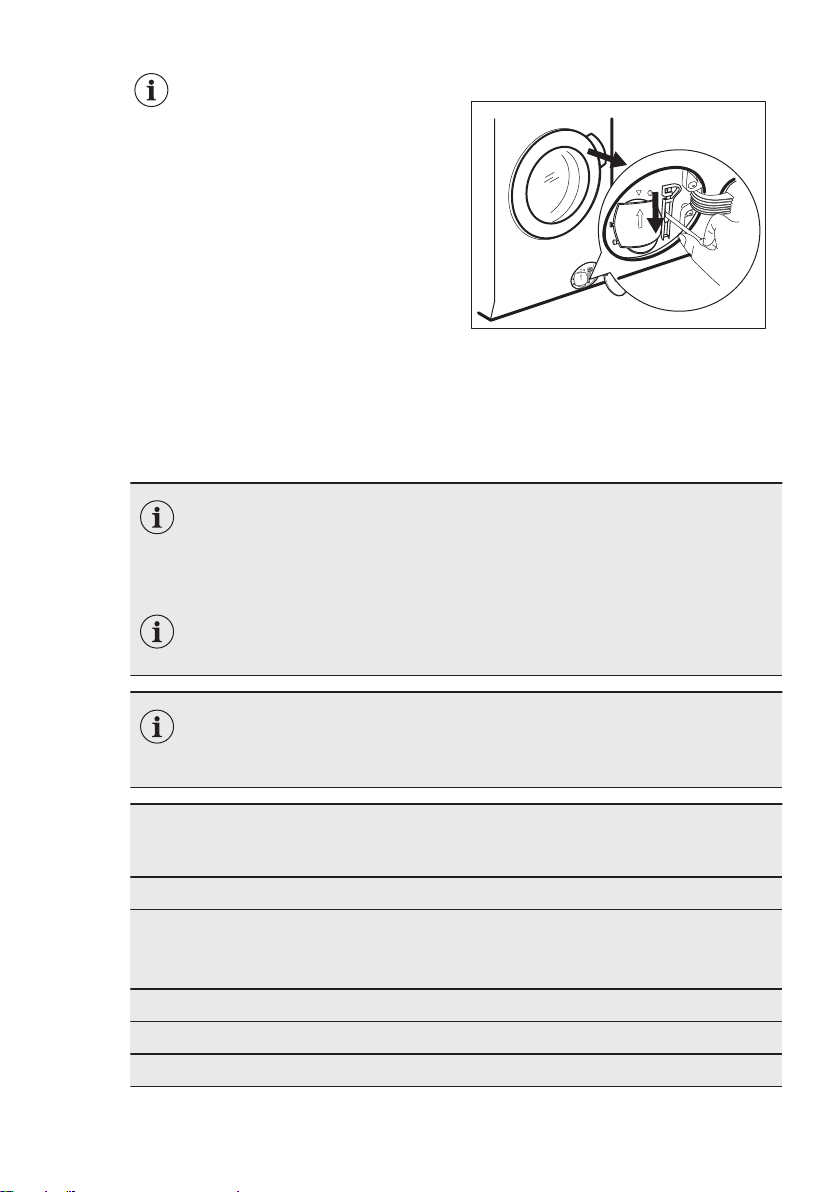
Make sure that the water
level inside the drum is not
too high. If necessary,
proceed with an
emergency drain (refer to
«Emergency drain» in
«Care and cleaning»
chapter).
To open the door, proceed as follows:
1. Press the On/Off button to switch the
appliance off.
2. Disconnect the mains plug from the
mains socket.
3. Open the filter flap.
4. Pull the emergency unlock trigger
downward once. Pull it downward
once again, keep it tensed and, in
the meanwhile, open the appliance
door.
5. Take out the laundry and then close
the appliance door.
6. Close the filter flap.
17. CONSUMPTION VALUES
Stated values are obtained in laboratory conditions with relevant stand-
ards. Different causes can change the data: the quantity and type of
laundry and ambient temperature. Water pressure, the supply voltage
and the temperature of inlet water may also affect the washing pro-
gramme duration.
Technical specifications may be changed without prior notice to improve
the quality of product.
During the washing programme, the ProSense technology can vary the
wash duration and the consumption values. For further details see 'The
ProSense load detection' paragraph in 'Daily Use' chapter.
Programmes Load
(kg)
Energy
consump-
tion (kWh)
Water con-
sumption (li-
tre)
Approximate pro-
gramme duration
(minutes)
Cottons 60°C 7 1.30 80 220
Cottons Eco
Cotton Energy Saving Pro-
gramme 60°C
1)
7 0.59 52 262
Cottons 40°C 7 1.20 80 210
Synthetics 40°C 3 0.80 60 140
Delicates 40°C 3 0.60 60 120
ENGLISH 41

Programmes Load
(kg)
Energy
consump-
tion (kWh)
Water con-
sumption (li-
tre)
Approximate pro-
gramme duration
(minutes)
Wool/Handwash 30°C 1.5 0.30 60 75
1)
«Cotton Energy Saving programme » at 60°C with a load of 7kg is the reference programme for the
data entered in the energy label, in compliance with 96/60/EC Directive.
18. TECHNICAL DATA
Dimension Width/ Height/ Depth/
Total depth
597 mm/ 848 mm/ 547 mm/ 576 mm
Electrical connection Voltage
Overall power
Fuse
Frequency
230-240 V
2200 W
13 A
50 Hz
Level of protection against ingress of solid particles
and moisture ensured by the protective cover, ex-
cept where the low voltage equipment has no pro-
tection against moisture
IPX4
Water supply
1)
Cold water
Water supply pressure
2)
Minimum
Maximum
0.5 bar (0.05 MPa)
8 bar (0.8 MPa)
Maximum wash load Cotton 7 kg
Maximum dry load Cotton
Synthetics
4 kg
3 kg
Spin Speed Maximum spin speed 1350 rpm
1)
Connect the water inlet hose to a water tap with a 3/4'' thread.
2)
The appliance works correctly if the water pressure is not lower than 0.05 MPa (0.5 bar). If you cannot
connect the water inlet hose to the cold water tap of the primary hydraulic system, connect it to your
domestic cold water storage system. Make sure not to exceed a distance of 5.02 m (16.5 ft) between the
appliance inlet hose and the bottom of the water storage tank.
www.aeg.com42

19. ACCESSORIES
19.1 Available in
www.aeg.com/shop or from
authorised dealer
Only appropriate
accessories approved by
AEG ensure the safety
standards of the appliance. If
unapproved parts are used,
any claims will be
invalidated.
19.2 Fixing plate kit
If you install the appliance on a plinth,
secure the appliance with the fixing
plates.
Read carefully the instructions supplied
with the accessory.
20. ENVIRONMENTAL CONCERNS
Recycle materials with the symbol .
Put the packaging in relevant containers
to recycle it. Help protect the
environment and human health by
recycling waste of electrical and
electronic appliances. Do not dispose of
appliances marked with the symbol
with the household waste. Return the
product to your local recycling facility or
contact your municipal office.
*
ENGLISH
43
www.aeg.com/shop
157024420-A-372018