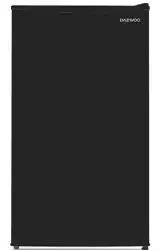
Contents
1.
SAFETY WARNINGS.................................................................................................... 1
2.
INSTALLATION ........................................................................................................... 1
2.1 Loca on............................................................................................................. 2
2.2
Reversing the Door Swing ................................................................................... 2
2.3
Door Space Requirements ................................................................................... 3
2.4
Levelling the Unit................................................................................................ 4
2.5
Cleaning Before Use............................................................................................ 4
2.6
Before Using Your Unit........................................................................................ 4
2.7
Interior Accessories ............................................................................................ 4
3.
PRODUCT OVERVIEW................................................................................................. 4
4.
OPERATION............................................................................................................... 5
4.1
Switching On Your Unit ....................................................................................... 5
4.2
Noise Inside the Unit ......................................................................................... 5
4.3
Tips for Keeping Food in the Unit ......................................................................... 6
5.
CLEANING ................................................................................................................. 6
5.1
Defros ng .......................................................................................................... 6
5.2
Cleaning the Interior and the Exterior of the Unit ................................................. 6
5.3
Cleaning Tips ...................................................................................................... 6
6.
MAINTENANCE.......................................................................................................... 7
6.1
Care When Handling / Moving Your Unit.............................................................. 7
6.2
Servicing ............................................................................................................ 7
6.3
Switching Of for Long Periods of Time.................................................................. 7
7.
TROUBLE SHOOTING .................................................................................................. 7
7.1
Warm ps: ......................................................................................................... 8
1
1)
WARNING
WARNING
WARNING
WARNING
Do not use mechanical devices or other means to accelerate the defros ng
process, other than those recommended by the manufacturer.
2) Do not damage the refrigerant circuit.
3) Do not use electrical appliances inside the food storage compartments of the
appliance, unless they are of the type recommended by the manufacturer.
4) DANGER: Risk of child entrapment. Before you throw away your old
refrigerator or freezer;
Take o the doors
Leave the shelves in place so that children may not easily climb inside.
5) The appliance has to be unplugged a er use and before carrying out user maintenance on the
appliance.
6)
This appliance can be used by children aged from 8 years and above and persons with reduce
physical sensory or mental capabili es or lack of experience and knowledge if they have been
given supervision or instruc on concerning use of the appliance in a safe way and understand the
hazards involved. Children shall not play with the appliance. Cleaning and user maintenance shall
not be made by children without supervision.
7) If the supply cord is damaged, it must be replaced by the manufacturer, its service agent or
similarly quali ed persons in order to avoid a hazard.
8) Please abandon the refrigerator according to local regulators for it use ammable blowing gas
and refrigerant.
9)
Please scrap according
to local regula ons regarding disposal of the appliance for its ammable
refrigerant and blowing gas. Before you scrap the appliance, please take o the doors to prevent
children trapped.
10)
This appliance is intended to be used in household and similar applica ons such as
– sta kitchen areas in shops, o ces and other working environments;
– farm houses and by clients in hotels, motels and other residen al type environments;
– bed and breakfast type environments;
– catering and similar non-retail applica ons.
11) Do not use an extension cord with this appliance. If the power cord is too short, have a
quali ed electrician or service technician install an outlet near the appliance. Use of an extension
cord can nega vely a ect the performance of the unit.
IT IS HAZARDOUS FOR ANYONE OTHER THAN AUTHORISED SERVICE PERSONNEL TO
CARRY OUT SERVICING OF REPAIRS WHICH INVOLVE THE REMOVAL OF COVERS.
TO AVOID THE RISK OF AN ELECTRICAL SHOCK DO NOT ATTEMPT REPAIRS YOURSELF.
2
2.1 Location
When selec ng a posi on for your unit you should make sure the f loor is flat and rm, and the
room is well ven lated. Avoid loca ng your unit near a heat source, e.g. cooker, boiler or radiator.
Also avoid direct sunlight as it may increase the electrical consump on. Extreme cold ambient
temperatures may also cause the unit not to perform properly. This unit is not designed for use in
a garage or outdoor installa on. Do not drape the unit with any covering.
When installing the unit, ensure that 40 cm of free space is le at both sides, 15 cm at the rear
and 20 cm at the top of the unit. This will allow cold air to circulate around the wine cooler and
improve the ef ciency of the cooling process. The door can be opened to the right or the le ,
depending on what be er suits the loca on. Please ensure there is adequate space for the door
to fully open.
2.2
Reversing the Door Swing
Tools Required: Phillips style screwdriver / Flat blade screwdriver / Hexagonal spanner
If you want to have the door swing reversed, we recommend that you contact a
quali ed technician. You should only try to reverse the door yourself if you believe that
you are qualified to do so.
Ensure the unit is unplugged and empty
.
Adjust the two levelling feet to their highest posi on.
To take the door of it is necessary to lt the unit backwards. You should rest the unit on
something solid so that it will not slip during the door reversing process.
All parts removed must be saved to do the reinstalla on of the door.
Do not lay the unit fat as this may damage the coolant system.
We recommend that 2 people handle the unit during assembly.
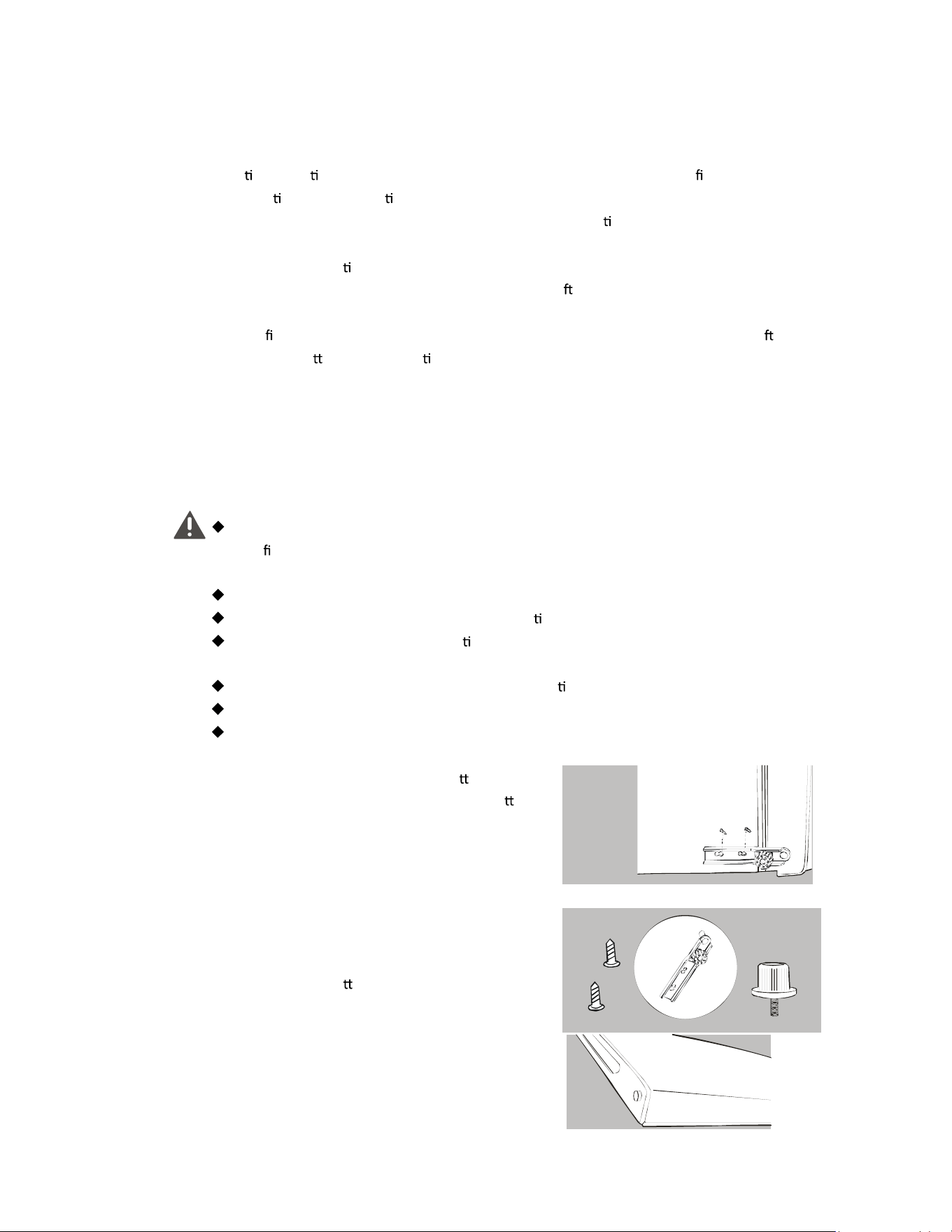
1) Start by removing the bracket from the bo om of the
refrigerator. Unscrew the two screws from the bo om
bracket. Remove the foot from opposite side.
2) Self-Tapping Screws/Bo om Bracket/Foot
3) Slide the door down, away from the hinge pin located
on the top of the door.
3
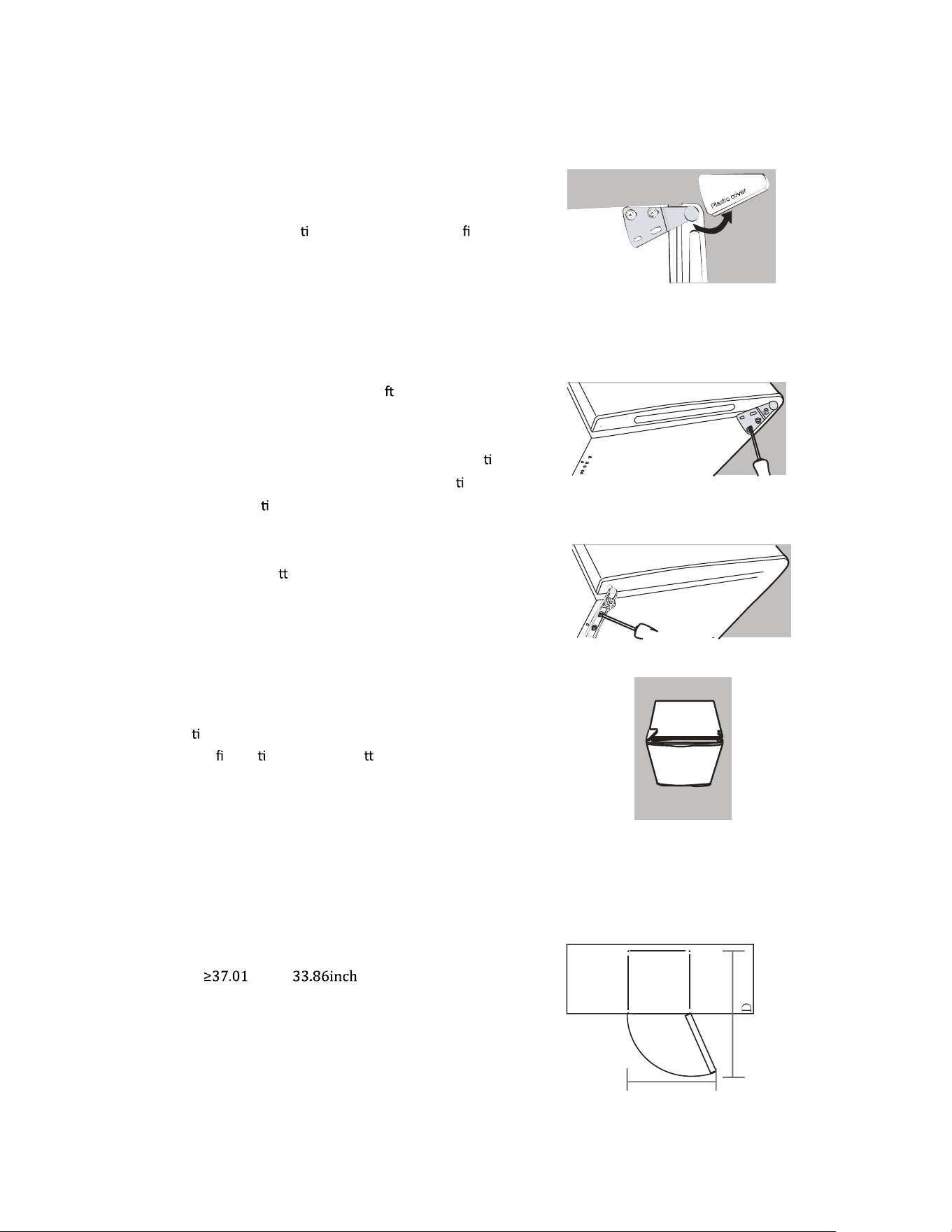
4) Remove the plas c cover from door hinge rst. Then
unscrew the two screws from top bracket and replace
on the other side.
5) To install the bracket on the le side of the appliance,
screw the two screws through the bracket and into the
top of the appliance. Slide the door back on to the top
hinge. Ensure the door is face up. Replace the plas c
cover on the top bracket by pressing down un l it
clicks into posi on.
6) Screw the bo om hinge into place on the new side.
Replace the foot on the other side.
7) Check that the door is aligned horizontally and
ver cally and that the seals are closed on all sides
before nally ghtening the bo om hinge.
Re-adjust the levelling feet.
2.3
Door
S
pace Requirements
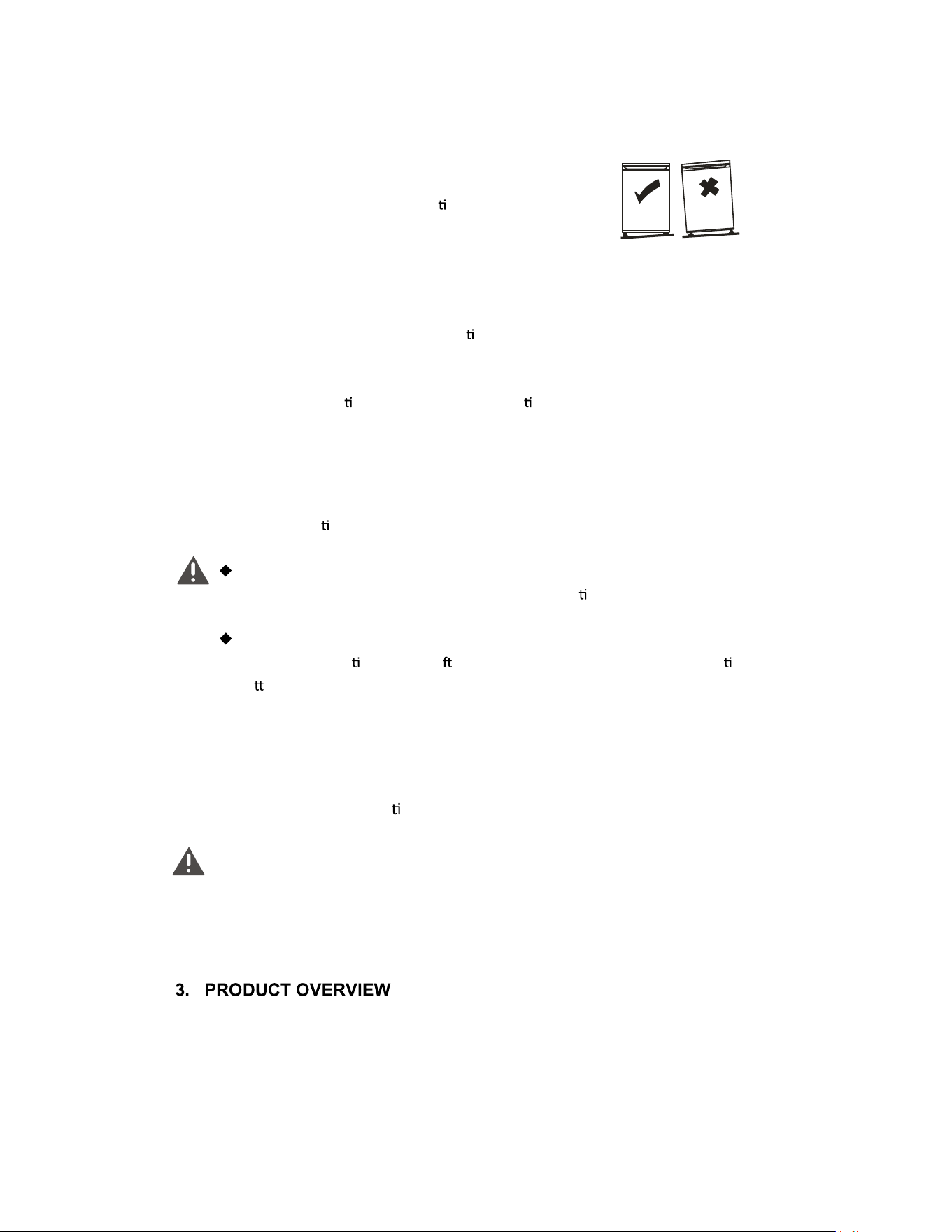
The unit's door must be able to open fully as shown.
W×D inch
×
W
4
2.4 Levelling the Unit
To do this adjust the two levelling feet at the front of the unit.
If the unit is not level, the door and magne
c seal alignments
will not be covered properly.
2.5 Cleaning Before Use
Wipe the inside of the unit with a weak solu on of bicarbonate soda. Then rinse with warm
water using a 'Wrung-out' sponge or cloth. Wash the shelves and salad bin in warm soapy water
and dry completely before replacing in the unit. Clean the exterior of the unit with a damp cloth.
If you require more informa on refer to the Cleaning sec on.
2.6 Before Using Your Unit
Before placing any food in your unit, turn it on and wait for 24 hours, to make sure it is working
properly and to allow it me to fall to the correct temperature. Your unit should not be overfilled.
Before Plugging in
You must check that you have a socket which is compa ble with the plug supplied
with the unit.
Before Turning On!
Do not turn on un l two hours a er moving the unit. The coolant fluid needs me to
se le.
2.7 Interior Accessories
Various glass or wire
storage shelves are included with your appliance - different
models have different combina ons.
Please do the same in reverse to insert the shelf at a different height.
In order to make the most of the volume of the fresh food storage compartment and
frozen-food storage compartment, the user can remove one or more shelves, drawers, out
of the appliance, according to your daily use.
5
*All i mages i n this instruc on manuala re for indica on only; please refer to your individual unit for details.
4.1 Switching On Your Unit
The temperature selector knob is located on the right hand side
wall of the refrigerator interior
Se ng
“
O
”
UnitO
Se ng
“
Min
”
Less Cool Temperature
Se ng
“
Med
”
Normal Oper on(adequate for most situa ons)
Se ng
“
Max
”
Coolest Temperature
During high ambient temperatures e.g. on hot summer days. It may be necessary to set the
thermostat to the Coolest se ng(posi on“Max”).This may cause the compressor running
con nuously in order to maintain a low temperature in the cabinet.
For the rst me you install your refrigerator, set the thermostat knob at “Med”.
Give your refrigerator me to cool down completely before adding food. It is the best to wait
24 hours before adding food. The thermostat knob controls the temperature. When the
thermostat control knob is set to OFF, the refrigerator will not be running.
4.2
Noise Inside the Unit
You may no ce that your unit makes some unusual noises. Most of these are perfectly normal ,
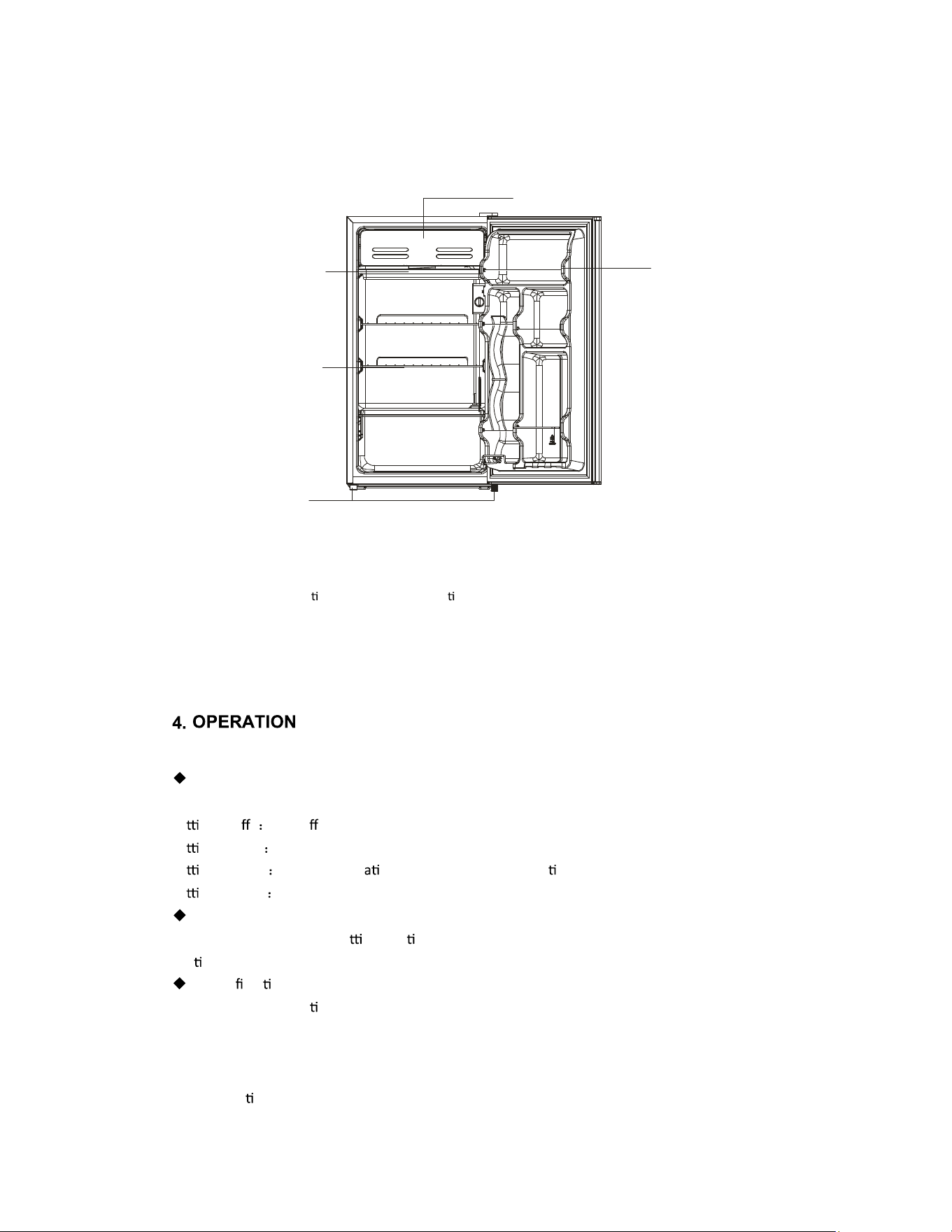
Chiller compartment door
Steel wire shelf
Adjustable leveling leg
Wire steel bar
Drip tray
6
but you should be aware of them!
These noises are caused by the circula on of the refrigerant liquid in the cooling system. It has
become more pronounced since the introduc on of CFC free gases. This is not a fault and will not
affect the performance of your unit. This is the compressor motor working, as it pumps the
refrigerant around the system.
4.3
Tips for Keeping Food in the Unit
Cooked meats/fishes should always be stored on a shelf above raw meats/fishes to avoid
bacterial transfer. Keep raw meats/fishes in a container which is large enough to collect juices
and cover it properly. Place the container on the lowest shelf.
Leave space around your food, to allow air to circulate inside the unit. Ensure all parts of the
unit are kept cool.
To prevent transfer of favors and drying out, pack or cover the food separately. Fruit and
vegetables do not need to be wrapped.
Always let pre-cooked food cool down before you put in the unit. This will help to maintain
the internal temperature of the unit.
To prevent cold air escaping from the unit, try to limit the number of mes you open the
door. We recommend that you only open the door when you need to put food in or take food
out.
5.1
Defrosting
Frost may accumulate on the inner rear surface of the appliance which will automa cally defrost
during the of cycle of the compressor. Water is channelled via the drain hole to the collec on tray
above the compressor where it will evaporate.
Please ensure the drain hole is checked and cleaned on a regular basis so water can exit the
storage compartment.
Do not use Mechanical Devices to Defrost refrigerator.
5.2 Cleaning the Interior and the Exterior of the Unit
Remove all the shelves and the salad bin. To remove the salad bin first remove the lower
door shelf.
Wipe the inside of the unit with a weak solu on of bicarbonate soda and then rinse with
warm water using a
“
wrung-out
”
sponge or cloth. Wipe completely dry before replacing the
shelves and salad bin.
Use a damp cloth to clean the exterior, and then wipe with a standard furniture polish. Make
sure that the door is closed to avoid the polish ge ng on the magne c door seal or inside
the unit.
The grille of the condenser at the back of the unit and the adjacent components can be
vacuumed using a so brush a achment.
5.3 Cleaning Tips
Condensa on may appear on the outside of the unit. This may be due to a change in room
7
temperature. Wipe of any moisture residue. If the problem con nues, please contact a qualif ied
technician for assistance.
6.1 Care When Handling/Moving Your Unit
Hold the unit around its sides or base when moving it. Under no circumstances should it be li ed
by holding the edges of the top surface. Avoid damaging the refrigerant tubing when handling,
moving and use of refrigerator.
6.2 Servicing
The unit should be serviced by an authorized engineer and only genuine spare parts should be
used. Under no circumstances should you a empt to repair the unit yourself. Repairs carried out
by inexperienced persons may cause injury or serious malfunc on. Contact a
technician.
6.3 Switching off for Long periods of Time
When the unit is not in use for a long period of me, disconnect it from the mains supply, empty
all food and clean the appliance, leaving the door ajar to prevent unpleasant smells.
The following simple issues can be handled by the user. Please call the a er -sale service
department if the issues are not se led.
Odor
Odorous foods should closely wrapped;
Whether foods are ro en;
Whether the interior shall be cleaned.
Long-term opera on of
compressor
It is normal that refrigerator operates for longer me in
summer when the ambient temperature is higher;
Do not put too much food in the freezer at one me;
Do not put foods un l they are cooled;
Frequent opening of refrigerator door.
The refrigerator door can not
be properly closed.
The freezer door is stuck by food packages;
Too much food;
Tilt refrigerator.
Loud noises
Whether the food is leveled, whether the refrigerator is
balanced;
.
8
7.1 Warm tips:
The refrigerator enclosure may emit heat during opera on specially in summer, this is caused
by the radia on of the condenser, and it is a normal phenomenon.
Condensa on: condensa on phenomenon will be detected on the exterior surface and door
seals of the freezer when the ambient humidity is large, this is a normal phenomenon, and the
condensa on can be wiped away with a dry towel.
Buzz: Buzz will be generated by running compressor specially when star ng up or shu ng
down.