www.lg.com
MFL67683082
Important
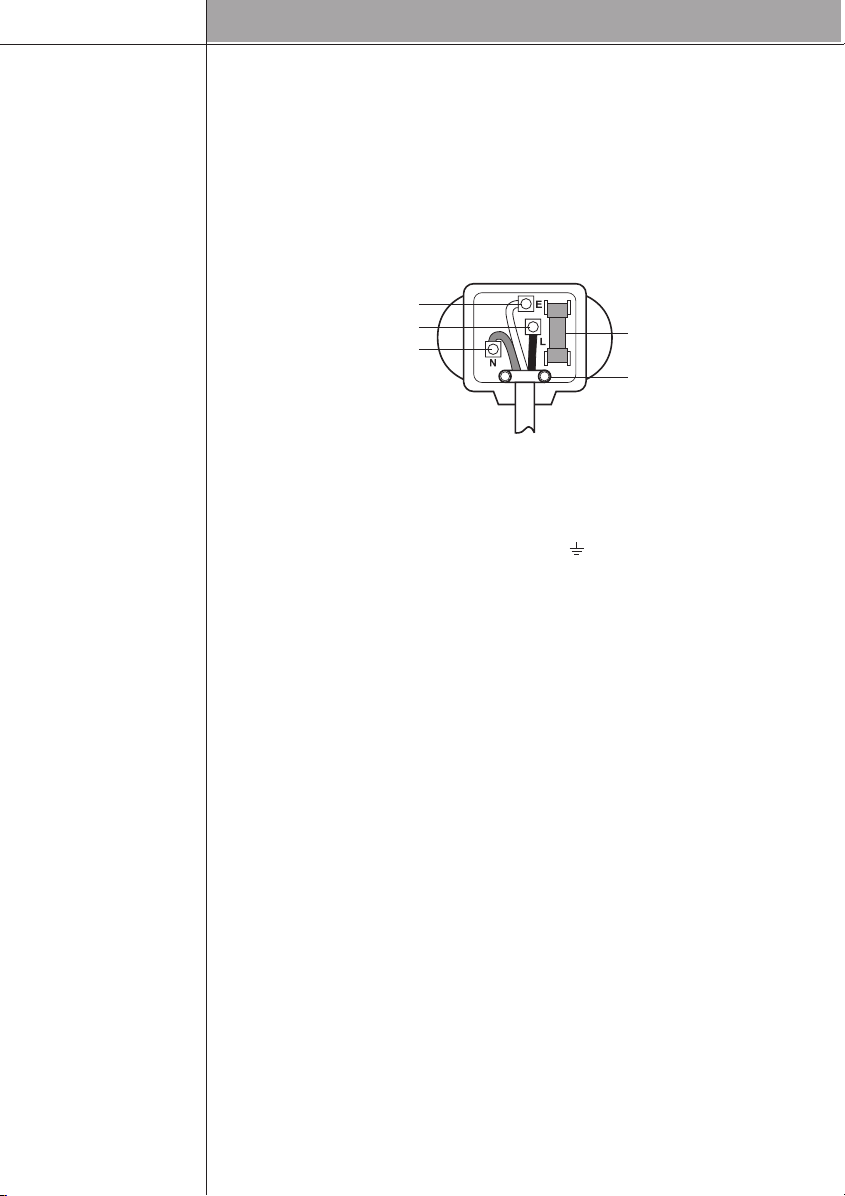
The wires in this mains lead are coloured in accordance with the following code:
(In the UK Only)
GREEN AND YELLOW:EARTH
BLUE:NEUTRAL
BROWN:LIVE
This appliance must be earthed
Green and Yellow (Earth)
Fuse
Brown(Live)
Blue(Neutral)
Cord
grip
As the colours of the wires in the mains lead of this apparatus may not correspond with the
coloured markings identifying the terminals in your plug, proceed as follows:
The wire which is coloured Green and Yellow must be connected to the terminal in the plug
which is marked with the letter E or by the earth symbol( ) or coloured
Green or Green and Yellow.
The wire which is coloured Blue must be connected to the terminal which is marked with the
letter N or coloured Black.
The wire which is coloured Brown must be connected to the terminal which is marked with the
letter L or coloured Red.
If a 13 amp(BS 1363) plug is used, t a 13 amp BS 1362 fuse.
2
Electrical Connections
15
18
18
19
20
20
20
21
22
23
23
24
26
26
28
Deodorizer
Freezer compartment
Shelf
33
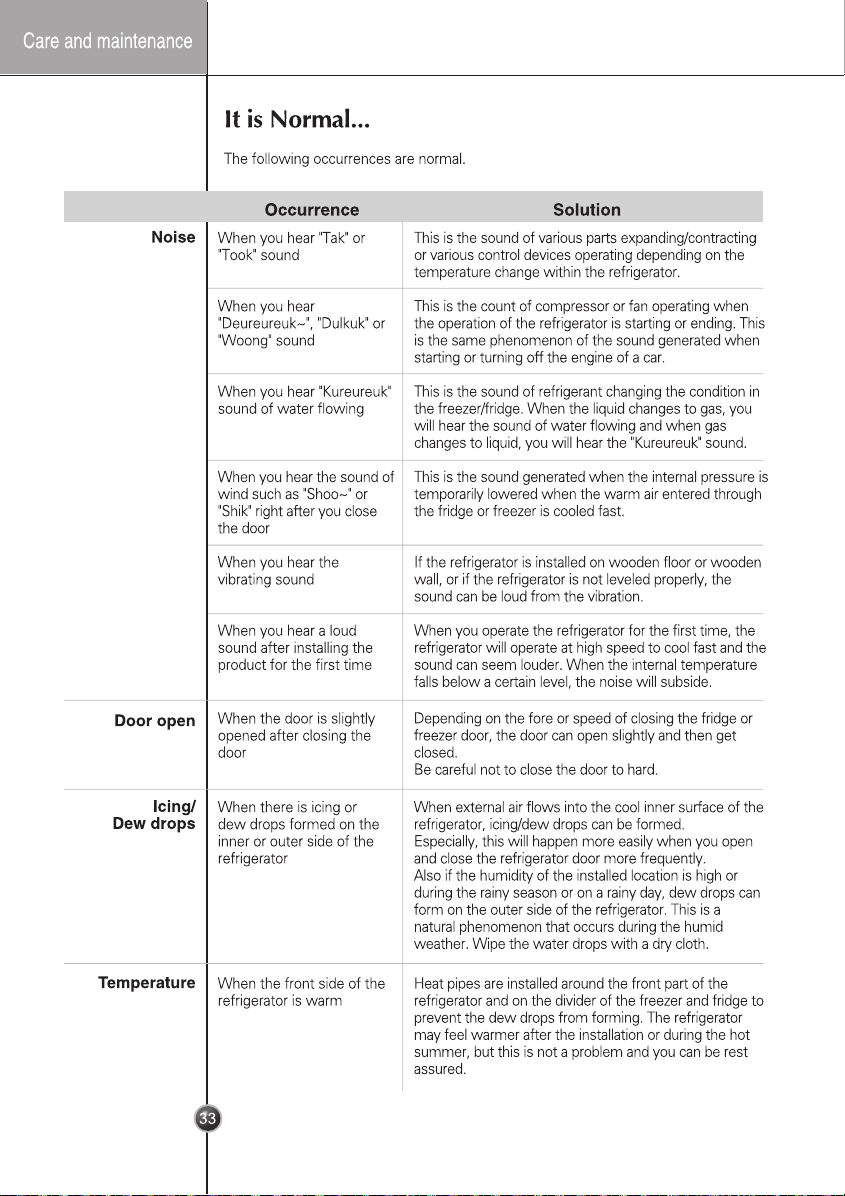
It is normal...
4
The model and serial numbers are found on the inner case on the back
or one side of the refrigerator
compartment of this unit. These numbers
are unique to this unit and are not available to others. You should record
requested information here and retain this guide as a permanent record of
your purchase. Staple your receipt here.
Before it is used, this refrigerator must be properly installed and located in accordance with
the installation instructions in this document. This Refrigerator is intended for Domestic
indoor use only.
Never unplug your refrigerator by pulling on the power cord. Always grip plug rmly and
pull it straight out from the outlet.
When moving your appliance away from the wall, be careful not to roll over the power
cord or to damage it in any way.
After your refrigerator is in operation, do not touch the cold surfaces in the freezer
compartment, particularly when your hands are damp or wet. Skin could adhere to these
extremely cold surfaces.
Unplug the power cord from the power outlet for cleaning or other maintenance. Never
touch the appliance with wet hands as you may receive an electric shock or injure yourself.
Never damage, press, severely bend, pull or twist the power cord as damage to the cord
may cause re or electric shock. Never touch the cord if you are uncertain if the appliance
is correctly earthed.
Never place glass items in the freezer as they may break due to expansion of their contents
on freezing.
Never put your hands into the storage bin of the automatic ice maker as you could be
injured during its operation.
The appliance is not intended for use by young children or inrm persons without
supervision.
Young children should be supervised to ensure that they do not play with the appliance.
Never allow anyone to climb, sit, stand or hang on the refreshment centre door. These
actions may damage the refrigerator and even tip it over, causing severe personal injury.
It is advised that this appliance should be connected through an independent power
socket to prevent it and other appliances from overloading the circuit and causing a power
outage.
The appliance should be positioned so that the supply plug is easily accessible for quick
disconnection should an accident occur.
If the supply cord is damaged, it must be replaced by the manufacturer or its service agent
or a similarly qualied person in order to avoid a hazard.
Entry
Important safety instructions
Date of purchase :
Dealer purchased from :
Dealer address :
Dealer phone no. :
Model no. :
Serial no. :
Do not modify or extend the Power Cord length.
It may cause electric shock or re.
Don’t use an
extension cord
Accessibility
of Supply Plug
Supply Cord
Replacement
Warning
Introduction
Introduction
DANGER: Risk of child entrapment.
Before you dispose of your old refrigerator please remove doors but leave the shelves
in place so that children cannot climb inside.
This appliance is not intended for use by persons (including children) with reduced
physical, sensory or mental capabilities, or lack of experience and knowledge, unless
they have been given supervision or instruction concerning use of the appliance by
a person responsible for their safety.
Children should be supervised to ensure that they do not play with the appliance.
this or any other appliance.
In the event of an electric short circuit, grounding (earthing) reduces the risk of
electric shock by providing an escape wire for the electric current.
In order to prevent possible electric shock this appliance must be earthed. Improper
electrician or service engineer if the earthing instructions are not completely
understood, or if you have doubts as to whether the appliance is properly earthed.
Do not use the combustible spray near the refrigerator.
Do not store explosive substances such as aerosol cans with a ammable propellant in
this appliance.
It may cause re.
Keep ventilation openings in the room where the appliance is installed clear of
obstruction.
Do not use mechanical devices or other means to accelerate the defrosting
process, other than those recommended by the manufacturer.
Do not damage the refrigerant circuit.
Do not use electrical appliances inside the food storage compartments of the
appliance, unless they are of the type recommended by the manufacturer.
Disposal procedures. If disposing of this appliance, please consult with a service
This appliance may contain (Check the rating/comliance label for the refriger-
ant type and amount. Applicable to some models only) a small amount of
isobutane refrigerant (R600a),
natural gas with high environmental compatibility, but it is also combustible.
When transporting and installing the appliance, care should be taken to ensure
that no parts of the refrigerating circuit are damaged. Refrigerant squirting out
of the pipes could ignite or cause an eye injury. If a leak is detected, avoid any
appliance is standing for several minutes.
refrigerating circuit occurs, the size of the room in which the appliance may be
sited depends on the amount of refrigerant used. The room must be 1m
2
in size
for every 8g of R600a refrigerant inside the appliance. The amount of refriger-
ant in your particular appliance is shown on the identication plate inside the
appliance. Never start up an appliance showing any signs of damage. If in
doubt, consult your dealer.
Child entrapment
Don’t store
Grounding
(Earthing)
Warning
Warning
Warning
Warning
Introduction
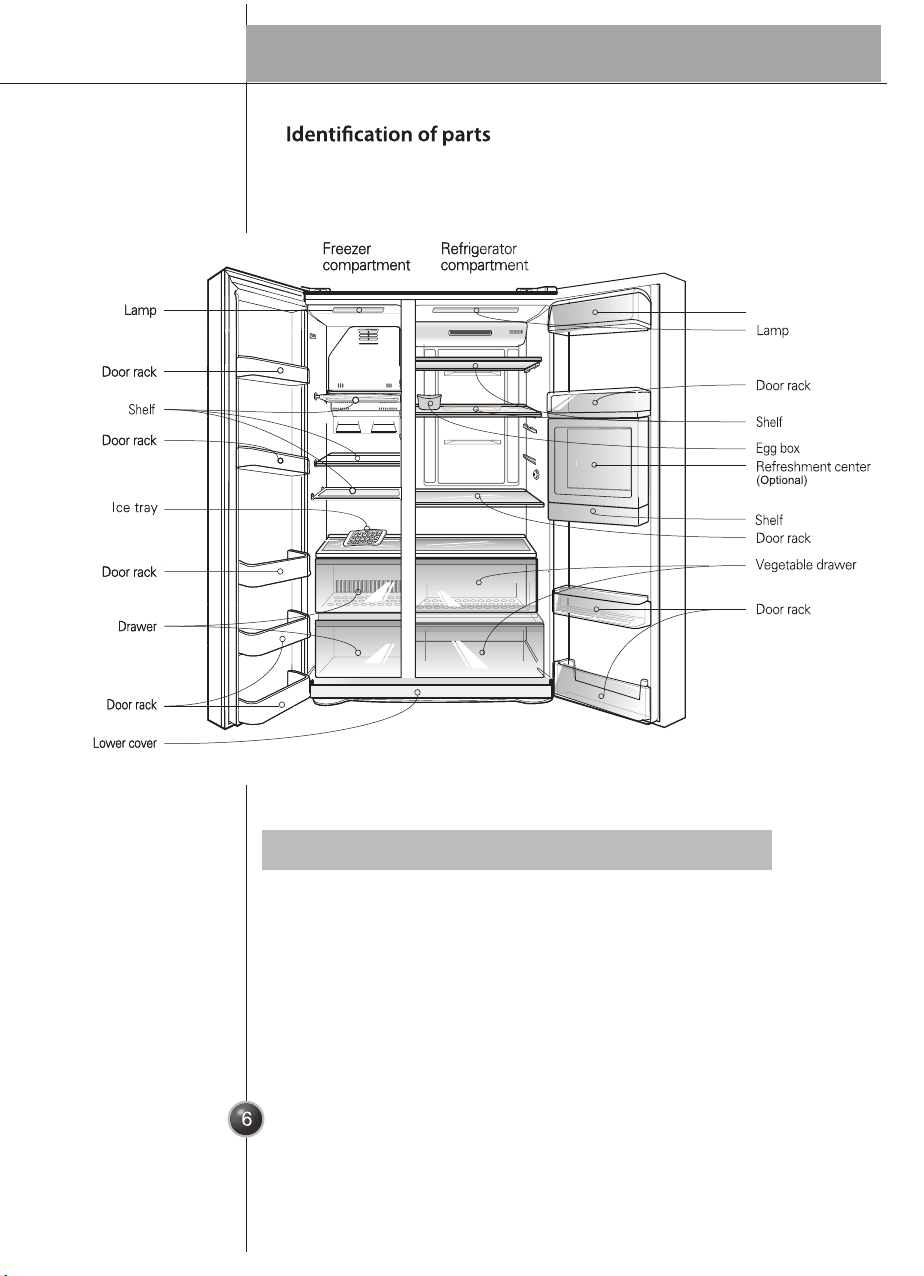
*Non dispenser model
NOTE
• Parts, features, and options vary by model. Your model may not include every option.
Introduction
Dairy corner
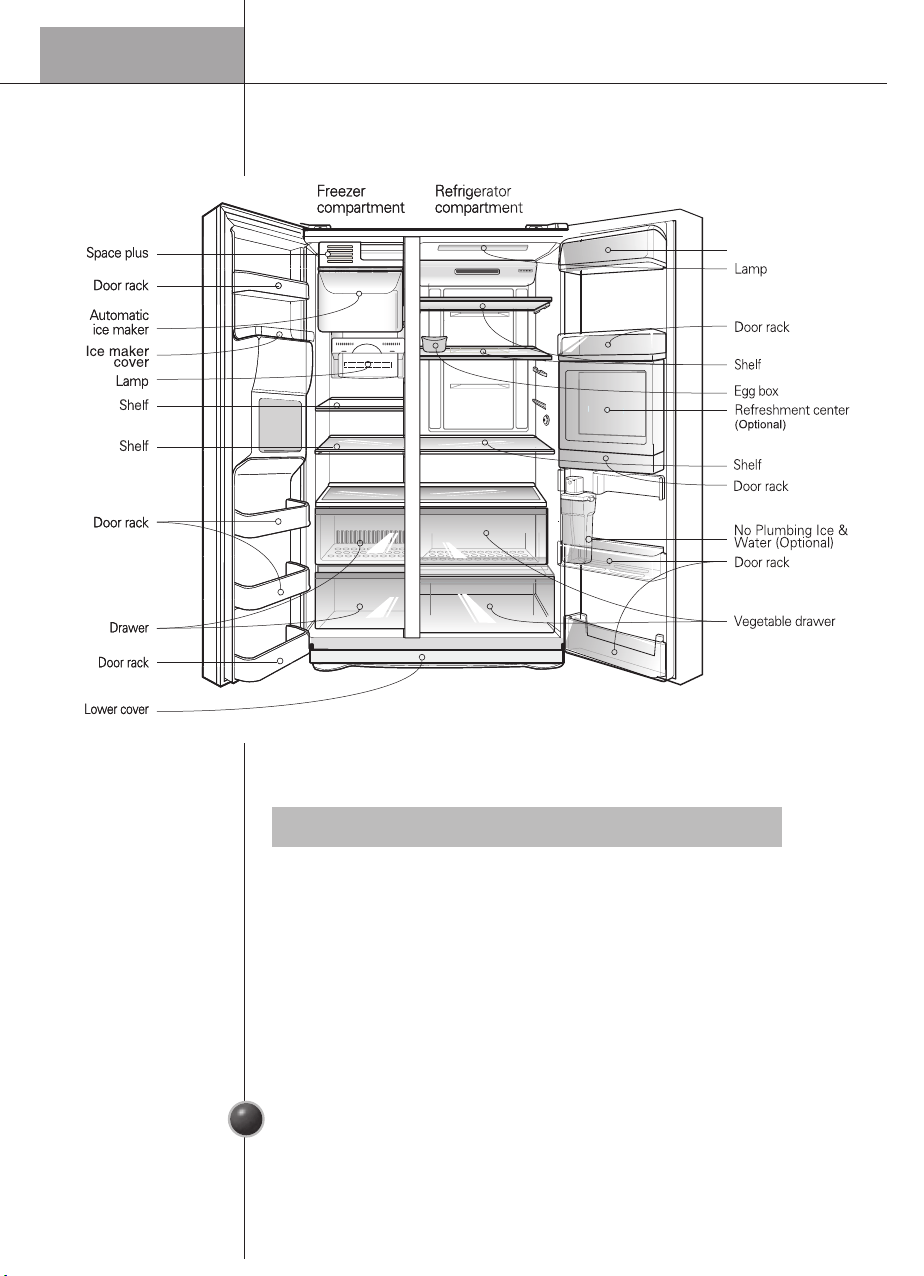
NOTE
• Parts, features, and options vary by model. Your model may not include every option.
*Dispenser model
Introduction
7
Dairy corner
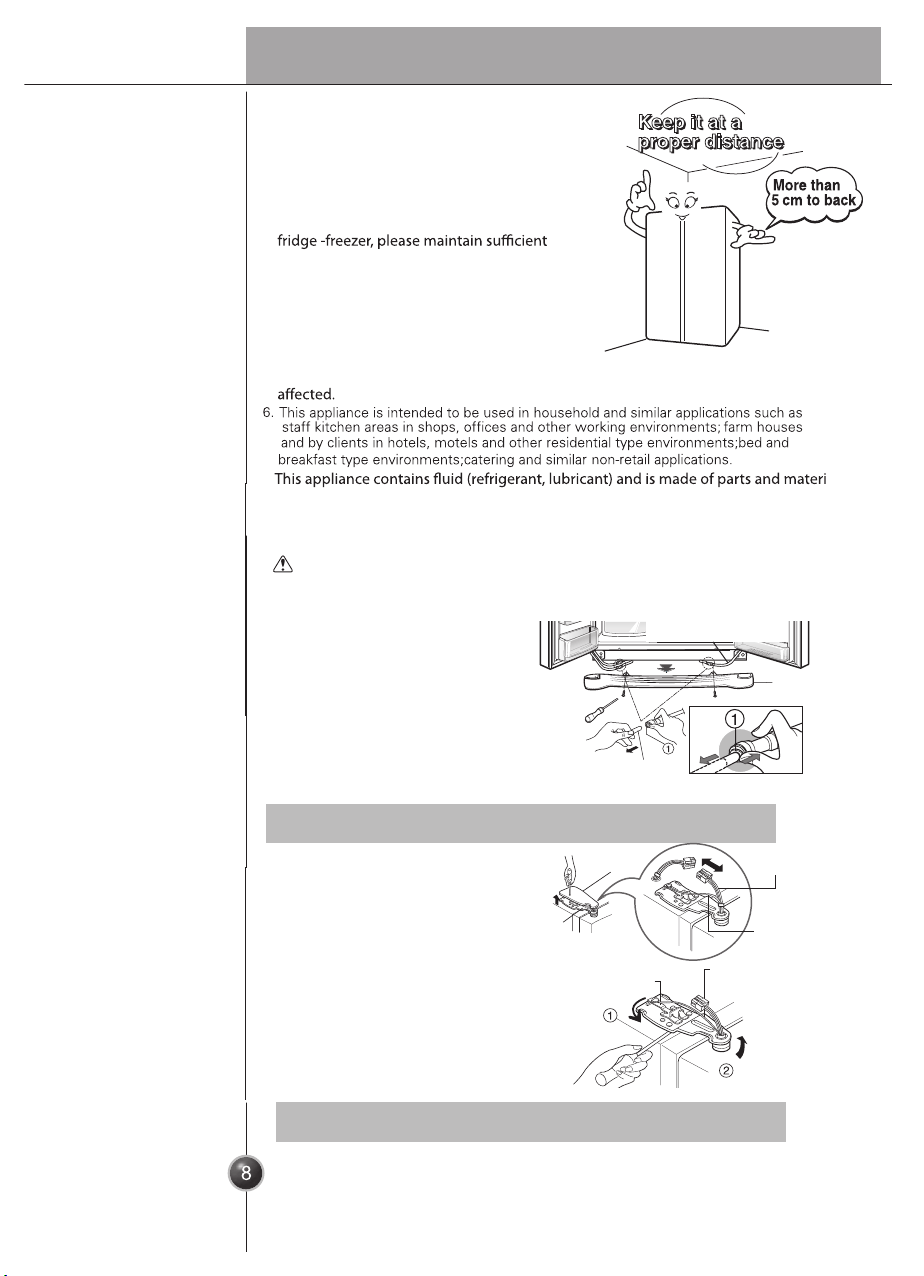
Where to install
Door removal
1. Place your appliance where it is easy to use.
2. Avoid placing the unit near heat sources, di-
rect sunlight or moisture. Do not operate the
appliance outdoors where it can be exposed
directly, or indirectly to sun, wind and rain.
3. To ensure proper air circulation around the
space on both the sides as well as top and
maintain at least 2 inches (5 cm) from the
rear wall.
4. To avoid vibrations, the appliance must be
levelled.
5. Do not install the appliance in temperatures
of less than 5°C as the performance may be
Electric Shock Hazard
Disconnect electrical supply to refrigerator before installing. Failure to do so could
result in death or serious injury.
If your front door is too narrow to get
the refrigerator into the house,
remove the refrigerator doors and pass
the appliance through laterally.
Remove the lower cover by loosening
all the screws. Then push in the feed
water tube while depressing the
connector , as shown in the illustration
on the right.
1) Remove the hinge cover by
loosening the screws. Then sepa-
rate all connection wires except
for the earth.
2) Remove the keeper by rotating it
counter clockwise ( ) and then
lifting the upper hinge up ( ).
-
als which are reusable and/or recyclable.
All the packaging materials should be sent to the collection centre for recycling. For
details of your local recycling centre, please contact your local council.
Select a good
location
Disposal of the
old appliance
Remove lower
cover and then
feed water
tube
Remove the
freezer
compartment
door
Applicable to No Plumbing
Ice & Water Model only
Lower cover
Feed water tube
NOTE
• If a tube end is deformed or abraded, trim the end with sharp knife until perfectly round.
NOTE
• When removing the upper hinge, be careful that the door does not fall forwards .
①
②
Connection
wires
Earth line
Upper
hinge
Hinge
cover
Keeper
Upper hinge
Installation
NOTE
• If a tube end is deformed or abraded, trim the end with sharp knife until perfectly round.
Door replacement
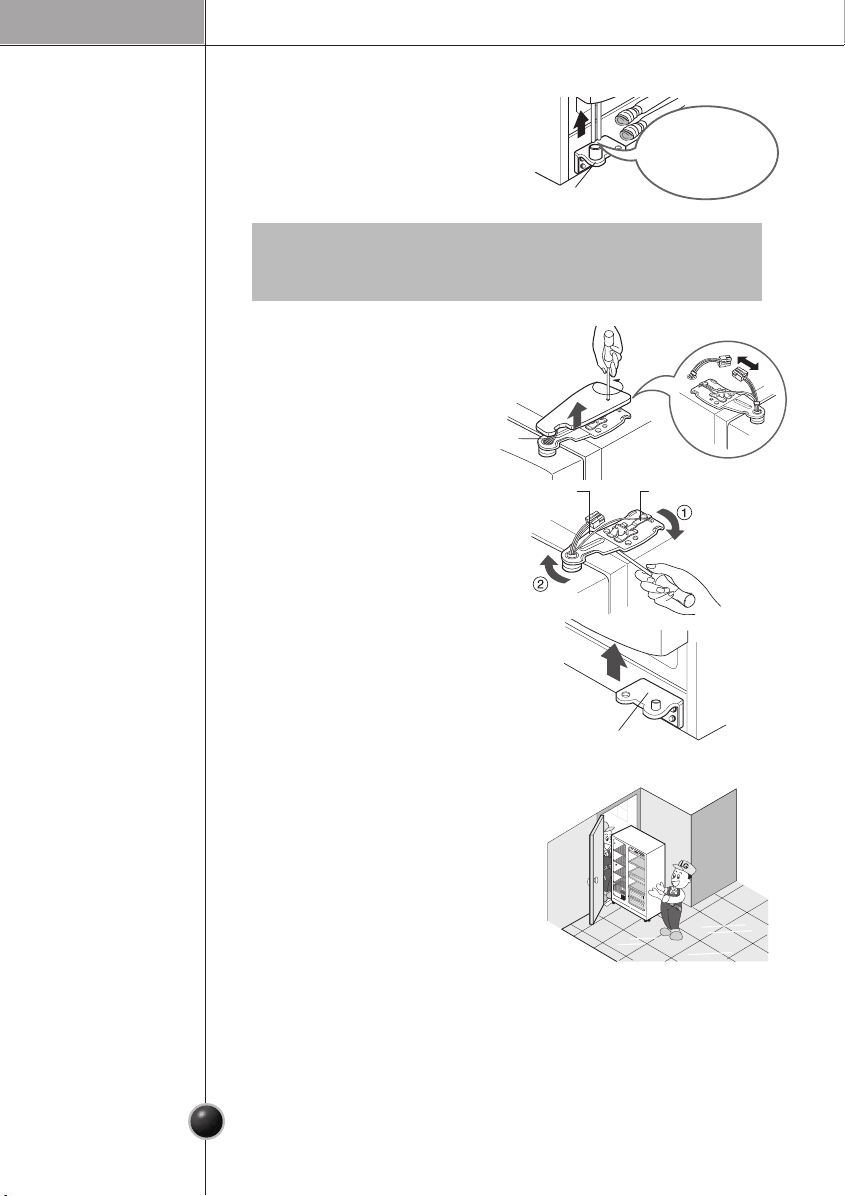
3) Remove the freezer compartment door
by lifting it upward. The door should be
lifted high enough for the feed water
pipe tube to be completely pulled out.
1) Loosen the hinge cover screws and
remove the cover. Remove
connection wires, if any, except for
the earth line.
2) Remove keeper by rotating it
clockwise ( ) and then remove the
upper hinge by lifting it up ( ).
3) Remove the refrigerator
compartment door by lifting it up.
Pass the refrigerator laterally through
the access door as illustrated to
the right.
Once the fridge is through the access door, remount the fridge doors by following
the door removal instructions in reverse.
Remove the
refrigerator
compartment
door
Pass the
refriger
ator
Lower cover
Enough for
water feed pipe tube to
be completly pulled out
NOTE
• If you have removed the refrigerator compartment door to pass the appliance
through an access door, lay the door down, but be careful not to damage the feed
water pipe tube.
Connection
wires
Upper hinge
Keeper
Lower hinge
①
②
Installation
9
10
Feed water pipe installation (Dispenser model only)
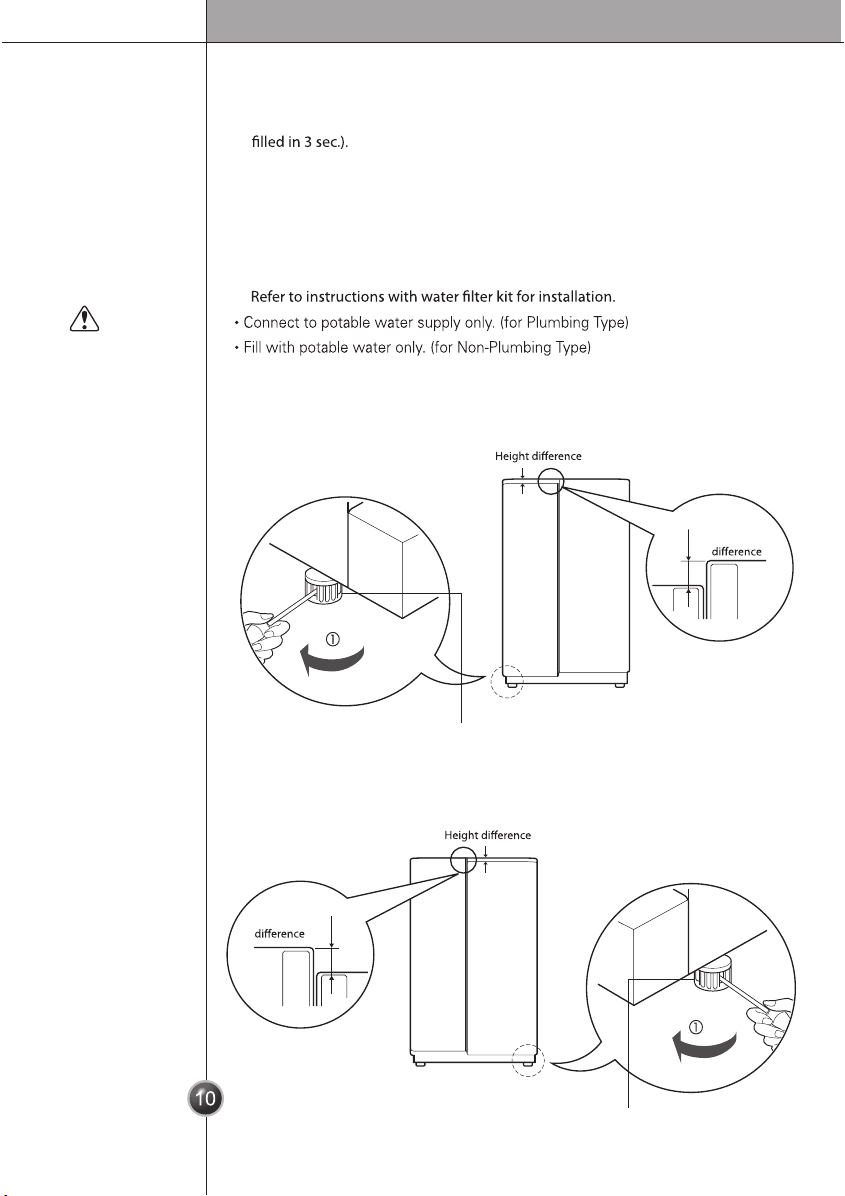
Door height adjustment
▪Automatic ice maker operation needs water pressure of 147~834kPa
(1.5~8.5kgf/cm2) (The pressure is correct when an instant paper cup (180cc) is
▪If water pressure does not reach the rating 147kPa(1.5kgf/cm
2
) or below, it
is necessary to purchase a separate pressure pump for normal automatic icing
and cool water feed.
▪Keep the total length of the feed water pipe tube within 8m and be careful that
the tube does not bend. If the tube is 8m or longer it may cause water feed prob-
lems owing to the drain water pressure.
▪Install the feed water pipe tube at a place free from heat.
▪
Levelthedoorbyinsertingflat(-type)driverintothegrooveoftheleftheight
adjustingscrewandrotateitclockwise().
Levelthedoorbyinsertingflat(-type)driverintothegrooveoftheleftheight
adjustingscrewandrotateitclockwise().
erofeB
installation
rezeerf eht fI
compartment
door is lower than
rotaregirfer eht
compartment
door
rezeerf eht fI
compartment
door is higher than
rotaregirfer eht
compartment
door
Height
Height
Left height
adjustment screw
Right height
adjustment screw
Warning
①
①
Installation
11
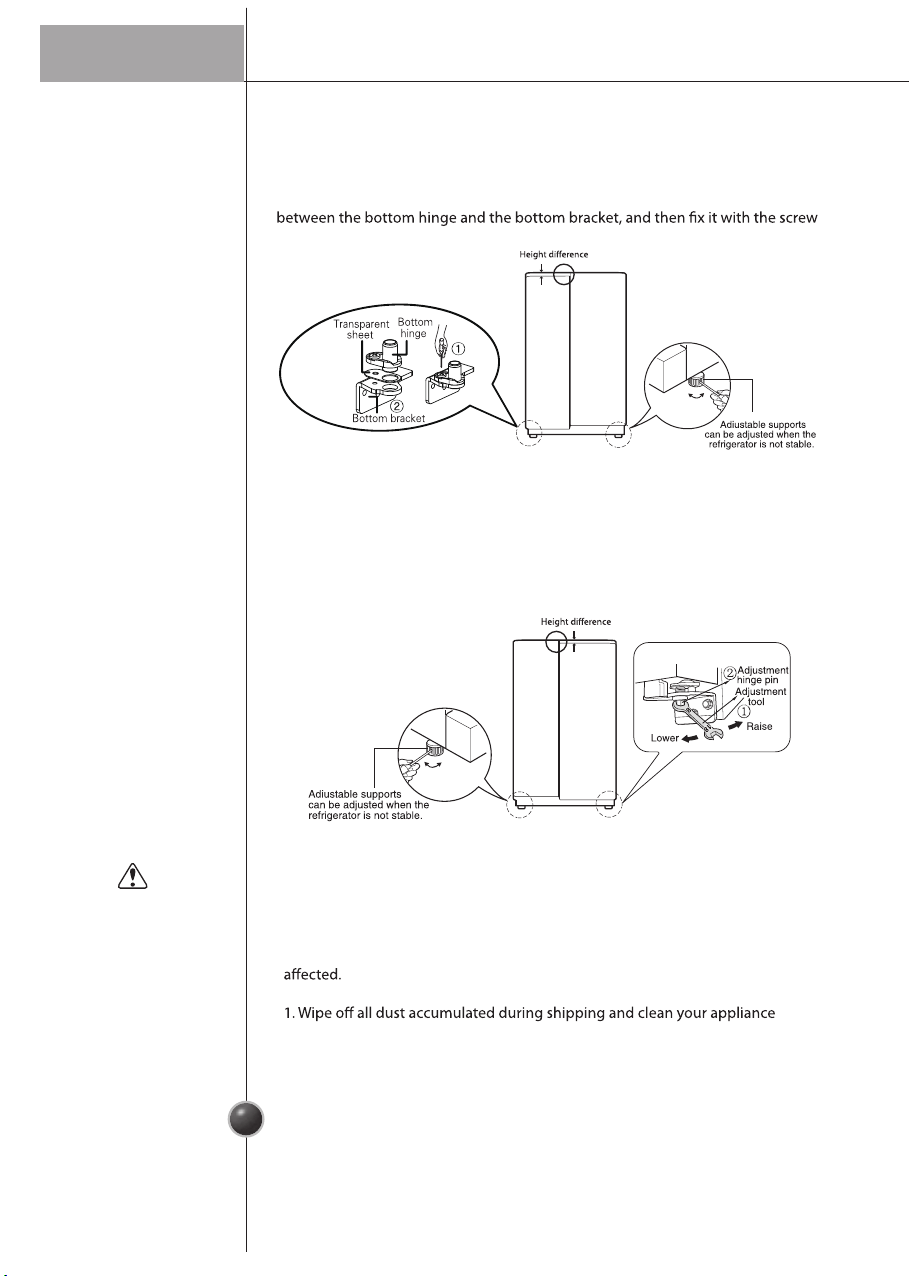
Therefrigeratordoorswillclosesmoothlybyadjustingthefrontsideusingthe
height adjustment screw. If the doors do not close correctly, performance may be
thoroughly.
2. Install accessories such as the ice cube box, cover evaporating tray, etc., in their
proper places. They are packed together to prevent possible damage during
shipping.
3. Connect the power supply cord (or plug) to the outlet. Don’t double up with
other appliances on the same outlet.
After levelling
the door height
Next
Installation
Insert the transparent sheet supplied with the product wen the freezerdoor is lower
then the refrigerator door
Separate the door with the lower height, use the (+) type screwdriver to unscrew
the screw at the bottom hinge as shown at Figure ( ), insert the transparent sheet
as shown at Figure ( )
Make adjustments when the refrigerator door is lower then the freezer door while
using the refrigerator.
Use the adjustment tool ( ) to rotate the adjustment hinge pin ( ) in either
clockwise or counterclockwise direction to level the height of the refrigerator
to that of the freezer.
Do not adjust the height axcessively. You can lose the hinge pin.
Height adjustable range: Maximum of 5mm)
Warning
①
①
②
②
zer eerfeht fI
compartment
door is lower than
the ref or taregir
compartment
door
zer eerfeht fI
compartment
door is higher than
ref or taregireht
compartment
door
(on some model)
(on some model)
12
*Non dispenser model
13
Ice & Water
Ice & Water
Ice & Water
*Dispenser model
(Fig-1)
(Fig-2)
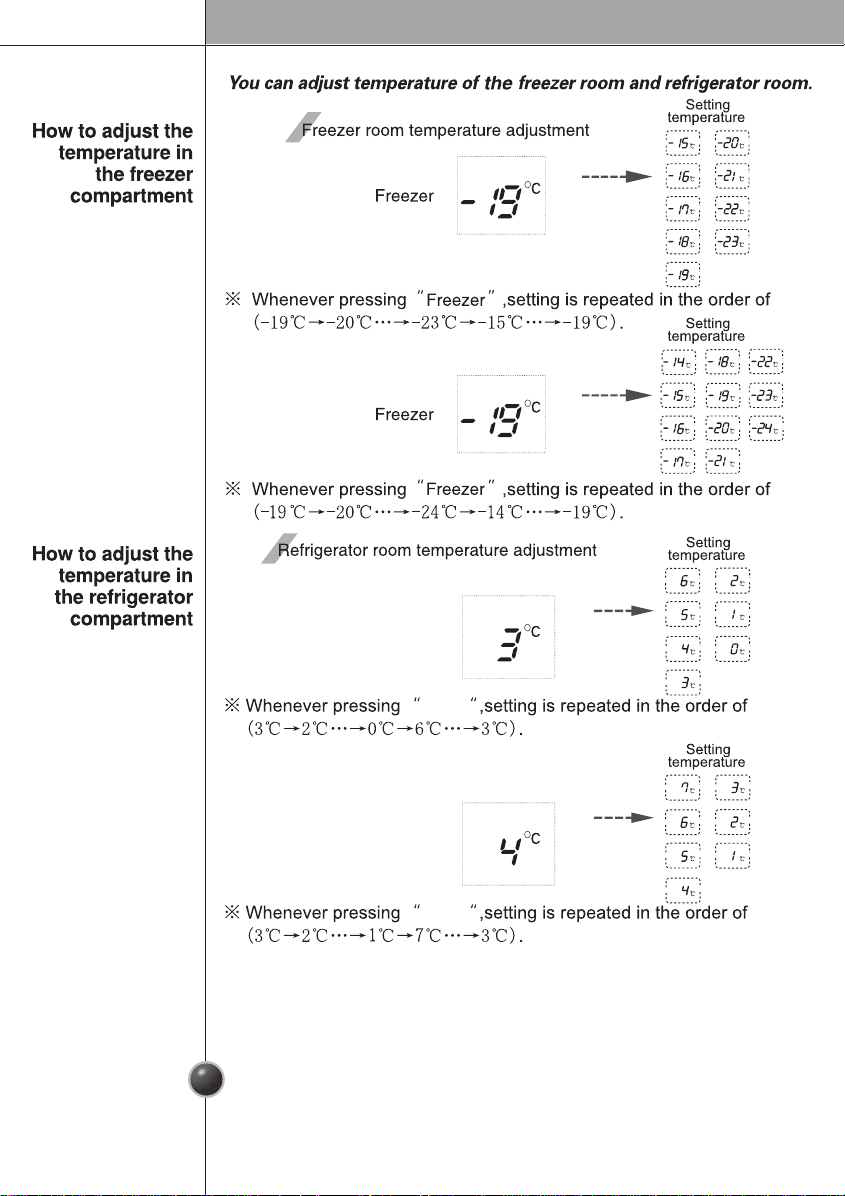
The actual inner temperature varies depending on the food status. The indicated
temperature is a target temperature, not the actual temperature within the refrig
erator
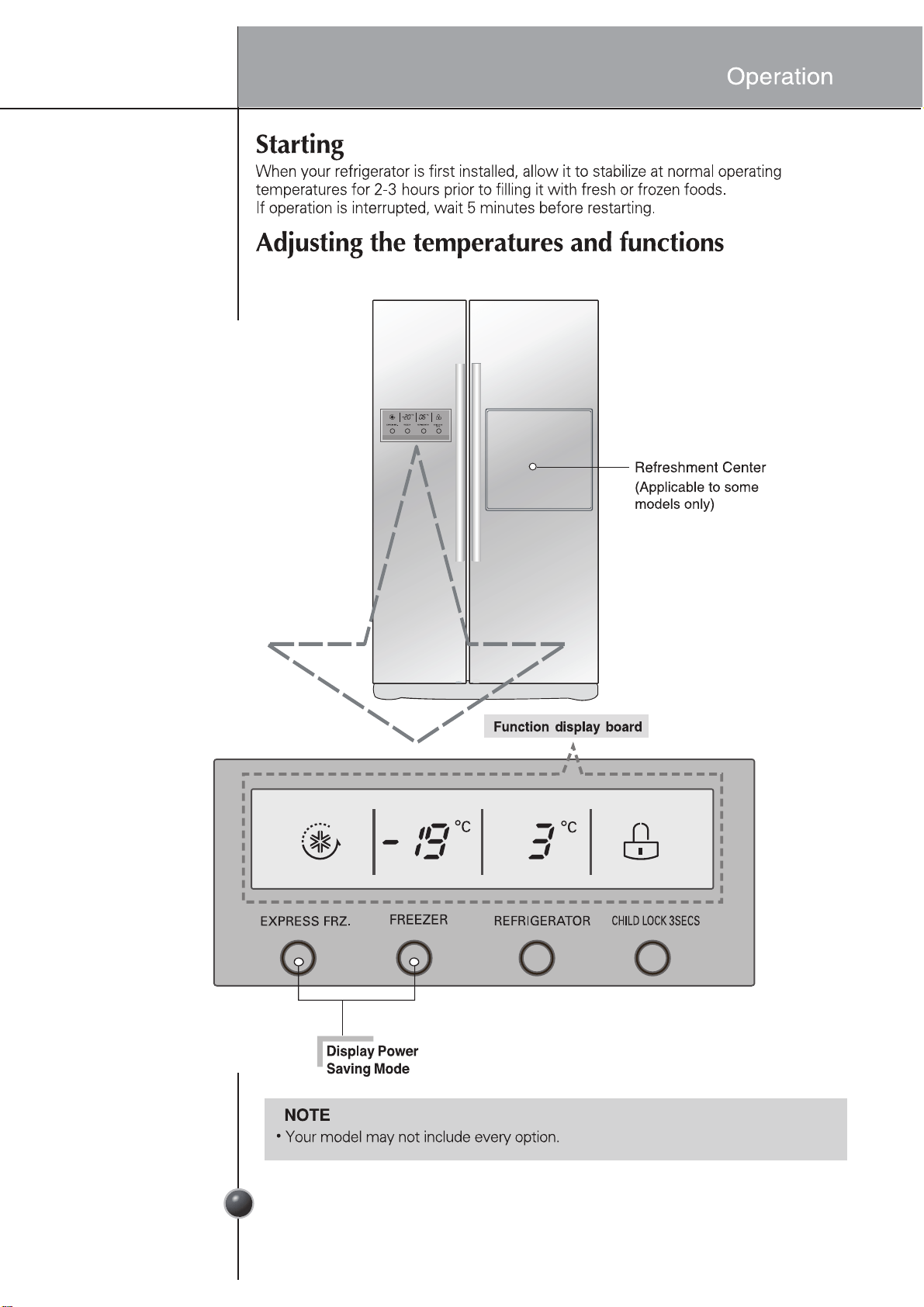
Until your refrigerator has settled from transit, it will not perform at its optimum.
It takes 2 or 3 days for the fridge to stabilise. During this period, please adjust the
temperature as above.
Operation
14
Fridge
Fridge
Fridge
Fridge
Type-1
Type-2
Type-1
Type-2
▪
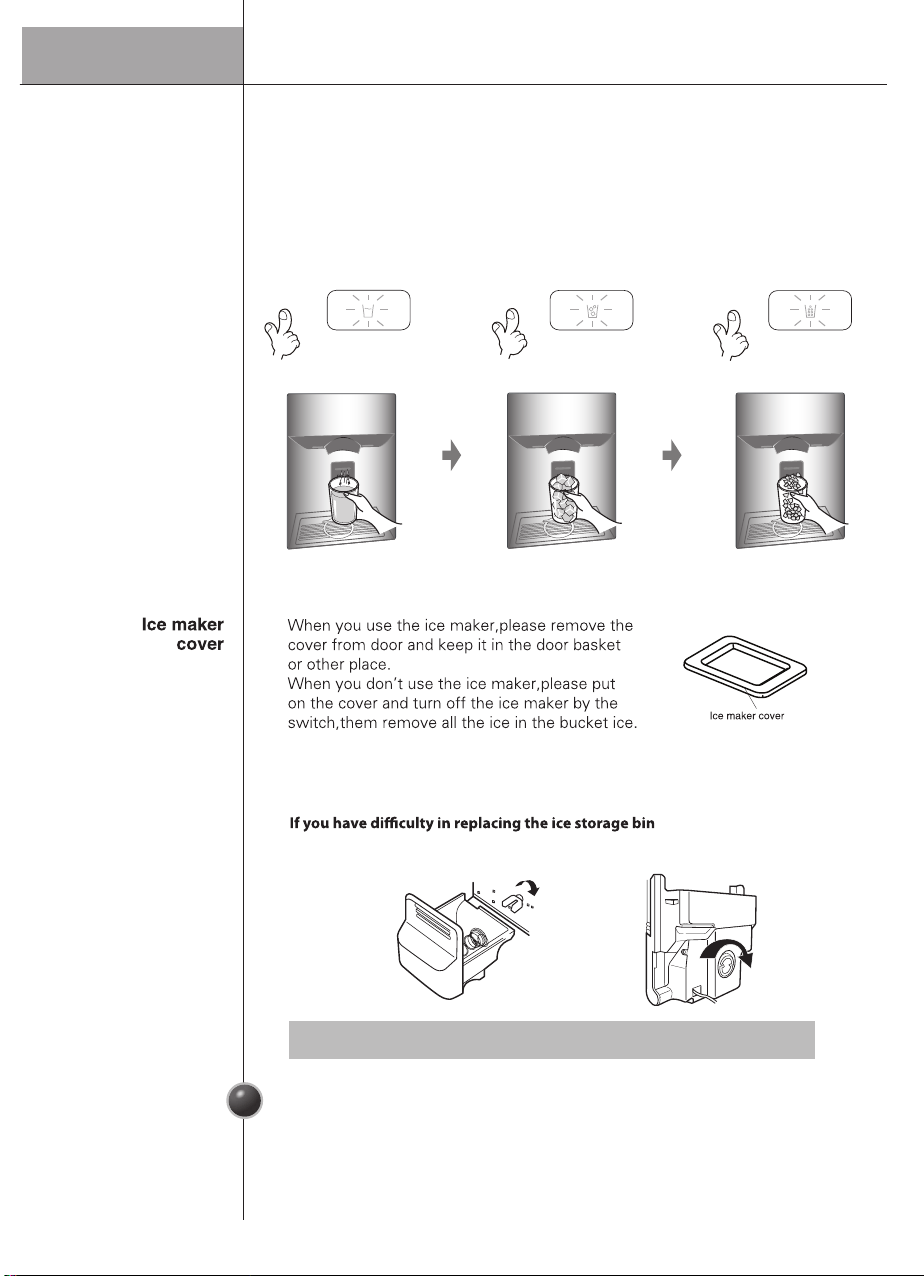
Choose from crushed ice, water, and cubed ice and depress the dispenser switch
with a glass or other container.
Crushed Ice
Select crushed ice by pressing
the selection button, which will
be highlighted.
Water
Select water by pressing the
selection button, which will be
highlighted.
Cubed Ice
Select cubed ice by pressing
the selection button, which
will be highlighted
Dispenser use
(on some
model)
NB : Please wait for 2-3 seconds before removing the cup from beneath
the dispenser to ensure it has finished dispensing the ice or water
.
15
Operation
Ice & Water Ice & Water Ice & Water
①
②
The dispensed water will not be icy cold, but just cool or cold. If you want colder
water, dispense ice before dispensing water.
Rotate the rotary gear in 1/4 cycle as shown in the illustration and then push it back.
Precautions when
using the dispen-
ser (on some
model)
(on some
model)
NOTE
• Figure
①and②dependsonmodel.
To get cold water
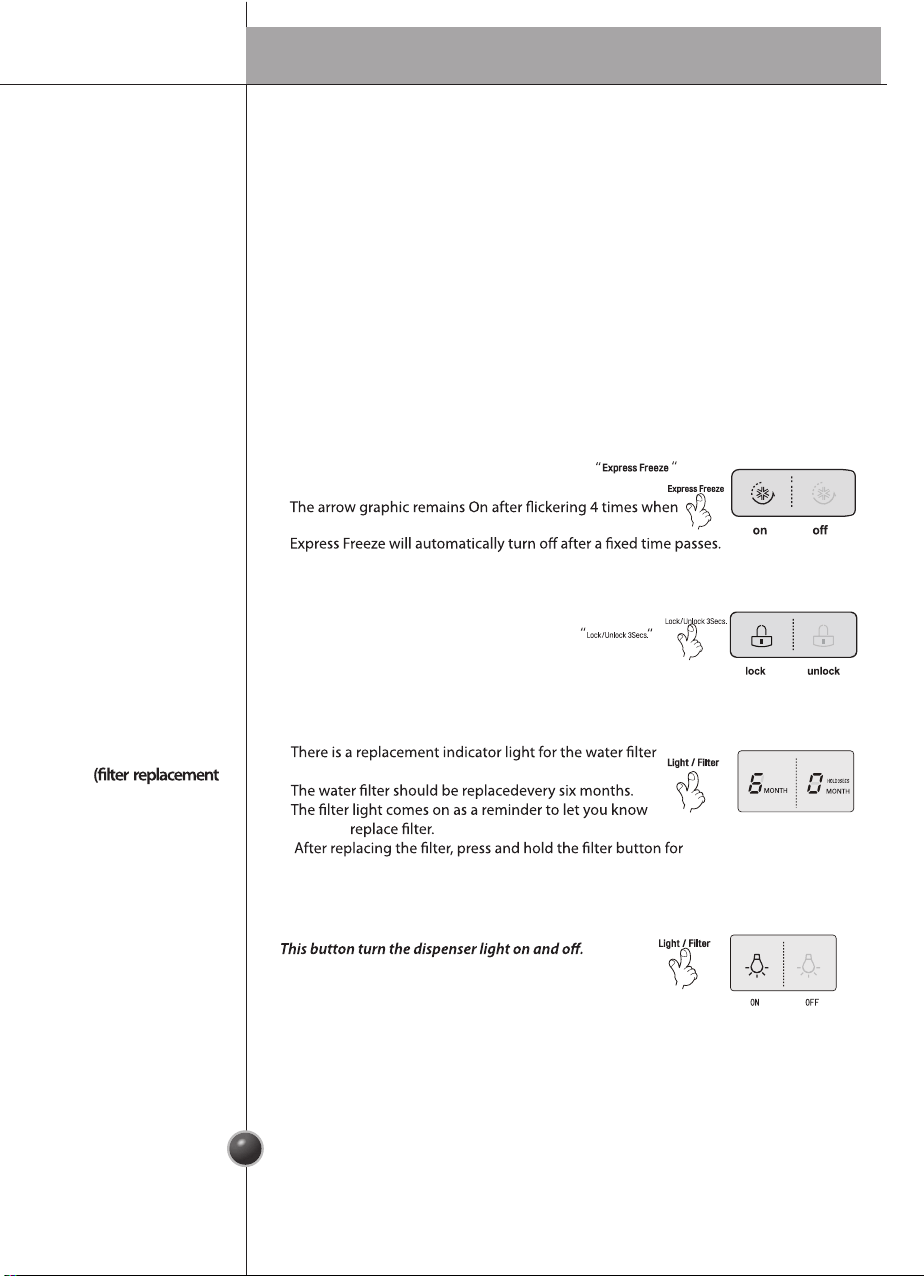
When ice maker
does not operate
smoothly
▪
When ice is lumped together, take the ice lumps out of the ice storage bin, break
them into small pieces, and place them back into the ice storage bin.
▪
When the ice maker produces small or lumped together ice, the amount of water
supplied to the ice maker may need to be adjusted. Contact the service centre.
* If ice is not used frequently, it may lump together.
▪Ice may melt and drop into the freezer compartment. Take the ice storage bin out
and discard all the ice then dry it and place it back. After the machine is powered
again, crushed ice will be automatically selected.
▪
It takes about 12 hours for a newly installed refrigerator to make ice in the freezer
compartment.
Ice is lumped together
Power failure
The unit is newly installed
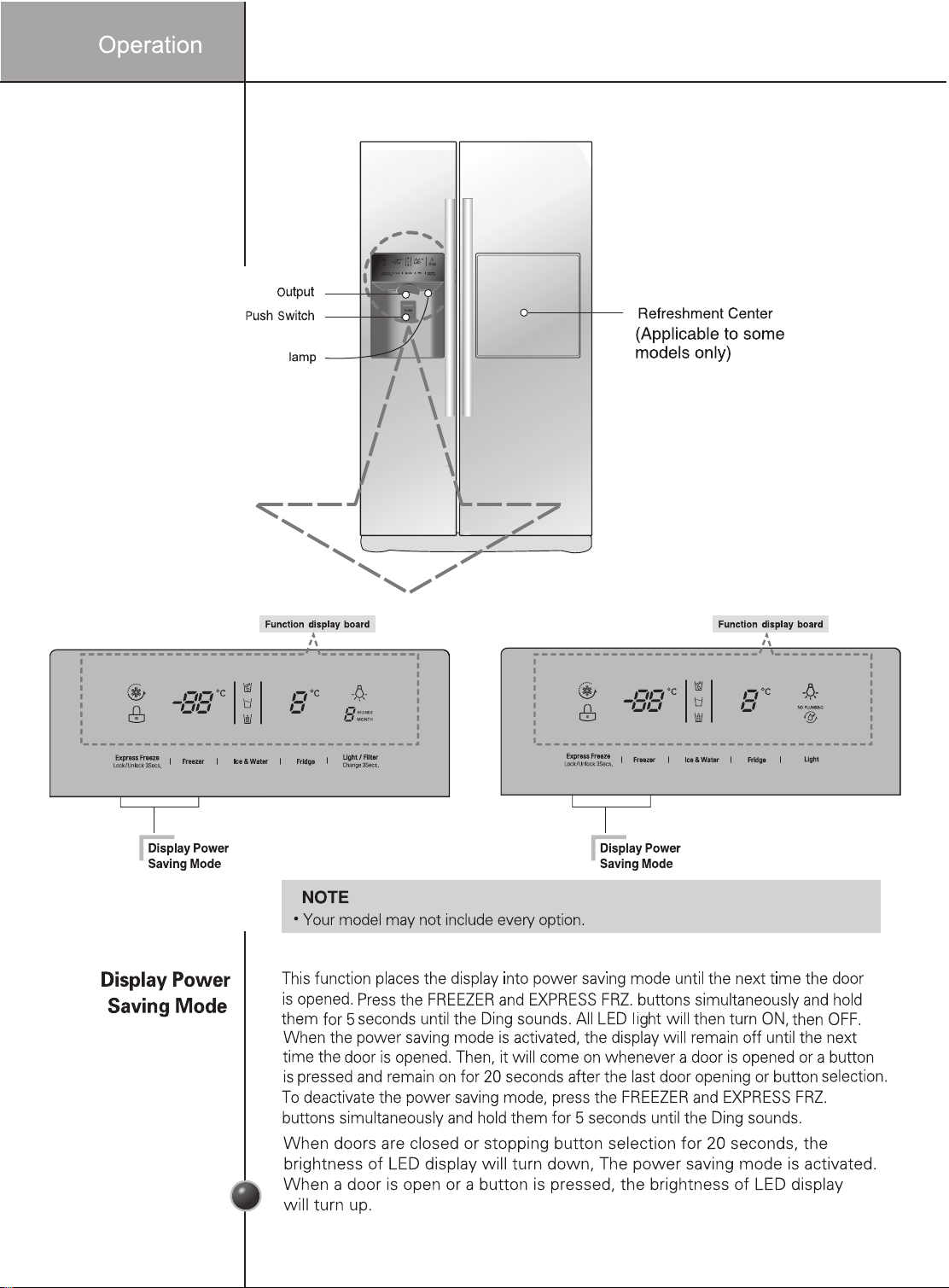
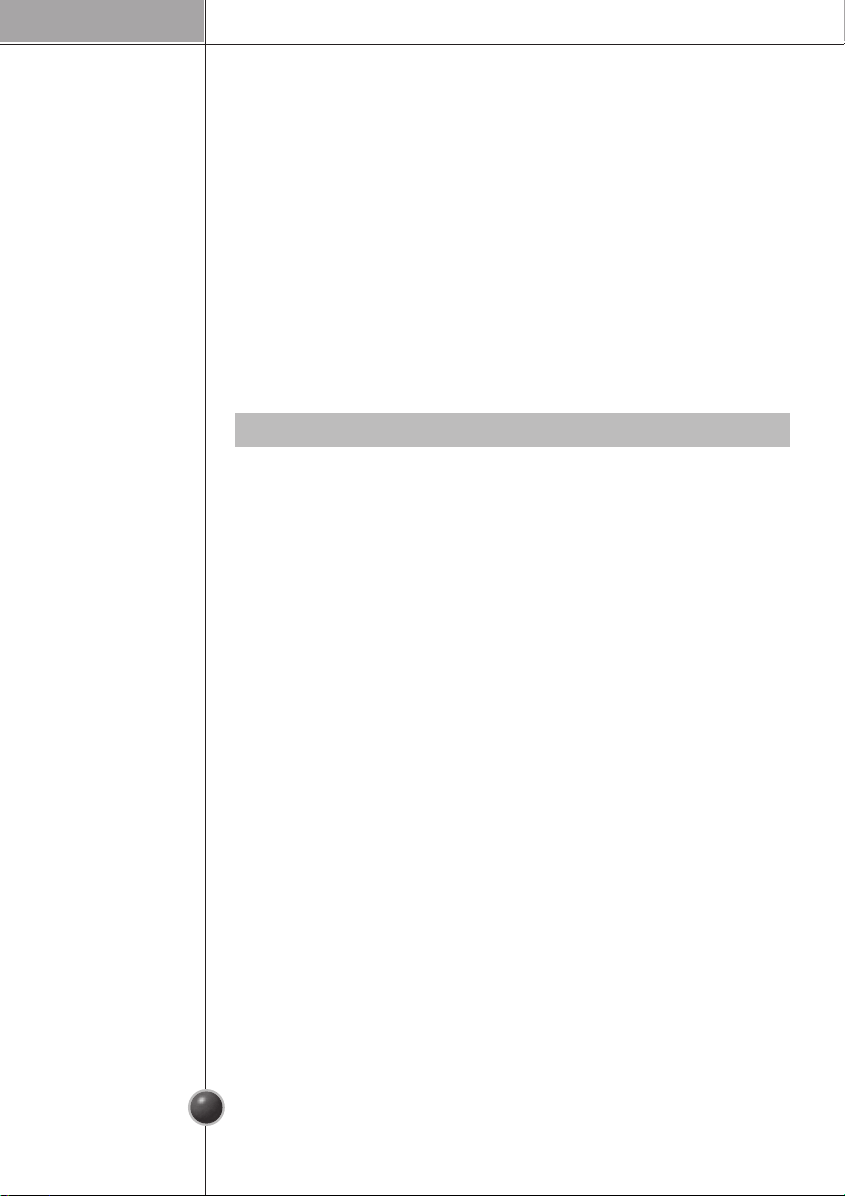
Express Freezer
Lock
Filter condition
cycle) display
function (on some
model)
Dispenser
light (on some
model)
▪
OFF
→
ON
→
OFF is repeated whenever pressing
▪
selecting Express Freeze
▪
▪
Locking or Release is repeated whenever the
is pressed for
more than 3 seconds.
▪
If you use the lock button, none of the other buttons will work
until you unlock them.
▪
cartridge on the dispenser.
▪
▪
when to
▪
more than 3 seconds to reset the indicator.
▪
The dispenser light function is turned ON or OFF by
pressing
Light/Filter / Light button.
Please select this function for fast freezing.
This button locks the other buttons
Operation
button.
16
The other
functions
How ice/cold
water is supplied
Door open warning
Diagnosis (failure detection) function
▪
A warning bleep will sound 3 times every 30 seconds if the main or minibar door is
left open or ajar for more than a minute.
▪ Please contact your local service centre if the warning continues to sound when
the door is closed.
▪
The Diagnosis function automatically detects the problem when a failure is found
whilst using of refrigerator.
▪ If a fault occurs, and none of the refrigerator buttons or functions are working,
do not turn power off but immediately contact your local service centre. Once
powered off it may not be possible for a service engineer to use the Diagnosis
function to detect what caused the original fault.
The first ice and water may include particles or odour from the feed water pipe
or the feed water box. The should also be done if the refrigerator has not been
used for a long time.
Children may push the dispenser switch incorrectly, or damage the dispenser
by breaking associated parts. It may also cause them injury.
If foods are placed at the entrance of the ice chute, ice may not be dispensed.
The ice chute may become covered with ice powder if crushed ice is most
commonly used. Remove the accumulated ice powder.
Such glasses or containers may be broken.
This may damage the automatic ice maker.
Water may be splashed if ice is added after the drink.
Touching the ice outlet may cause a breakage or hand injury.
Ice may be jammed in ice chute causing the refrigerator to fail.
If ice is allowed to pile up near the ice maker, the ice maker may think that it is
already full and it will stop producing ice.
A glass too close to the outlet may hinder ice from coming out.
Water is cooled while stored in the water tank in the refrigerator compartment, and
then sent to the dispenser. Ice is made in the automatic ice maker and is then sent
to the dispenser as either crushed or cubed ice.
NOTE
• It is normal that at first the water is not very cold. If you want colder water, add ice to the glass.
Throw away the first ice (about 20 pieces) and the first water (about 7 glasses)
passing through the appliance when the refrigerator is initially installed.
Keep children away from the dispenser.
Always ensure that food does not block the ice chute.
Never use fine crystal glasses or crockery to collect ice.
Never store beverage cans or other foods in the ice storage bin for
rapid cooling.
Put ice into a glass before filling with water or other beverages.
Never touch the ice outlet either with hands or any implement.
If discolored ice is dispensed, stop using the appliance and contact your serv-
ice centre immediately.
Never remove the ice maker cover. It might be necessary from time to time to
level the ice so the storage bin can fill to capacity.
Keep the glass at a proper distance from ice outlet.
Never use narrow or deep glassware when using the icemaker
as ice can back up into the ice chute and cause a malfunction.
Operation
17
22
How to use
Use the minibar
door as a stand
Never remo
ve
the inner minibar
door cover
Never place
heavy items on
the minibar door
or allow children
to hang or sit
on it.
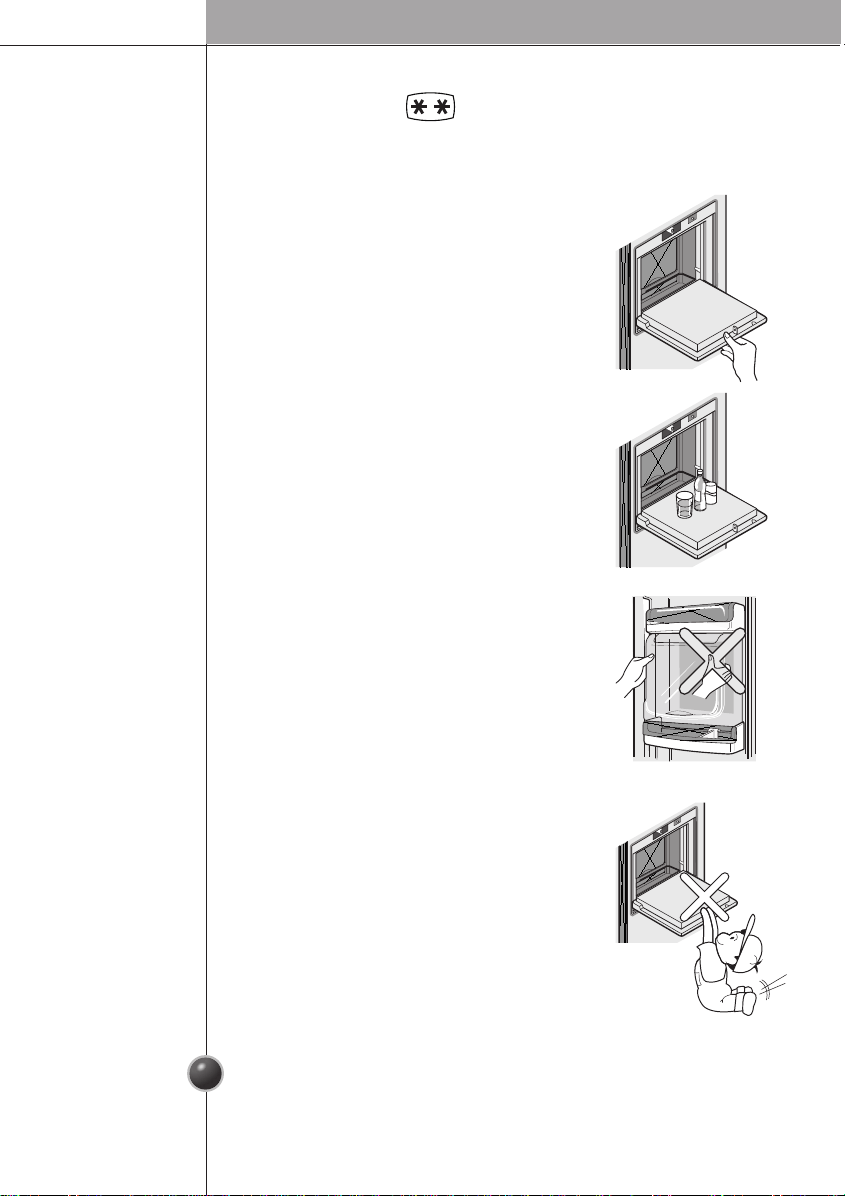
▪
Two stars means the temperature in the section is -12°C~ -18°C.
▪
Freezer foods for short-term storage.
Open the minibar door.
▪
You can access the minibar without
opening the refrigerator door, thus saving
electricity.
▪
Inner lamp is lit in the refrigerator
compartment when the minibar door
opens, making it easy to identify the
contents.
▪
Never use the minibar door as a chopping
board and take care not to damage it with
sharp tools.
▪ Never rest or press on the open minibar
door.
▪
The minibar can not function correctly
without the cover.
Only applies to models with inner minibar
cover.
▪
Not only may the minibar door be
damaged, but children may be hurt.
Two stars section (Applicable to some models only)
Refreshment centre(Applicable to some models only)
Operation
18
Operation
No Plumbing Ice & Water
(Applicable to some models only)
The other
functions
You can use the Automatic ice maker and Water Dispenser function
without having to connect an external water pipe to the refrigerator.
The refrigerator uses an internal water tank located on the
refrigerator door to supply water for these functions.
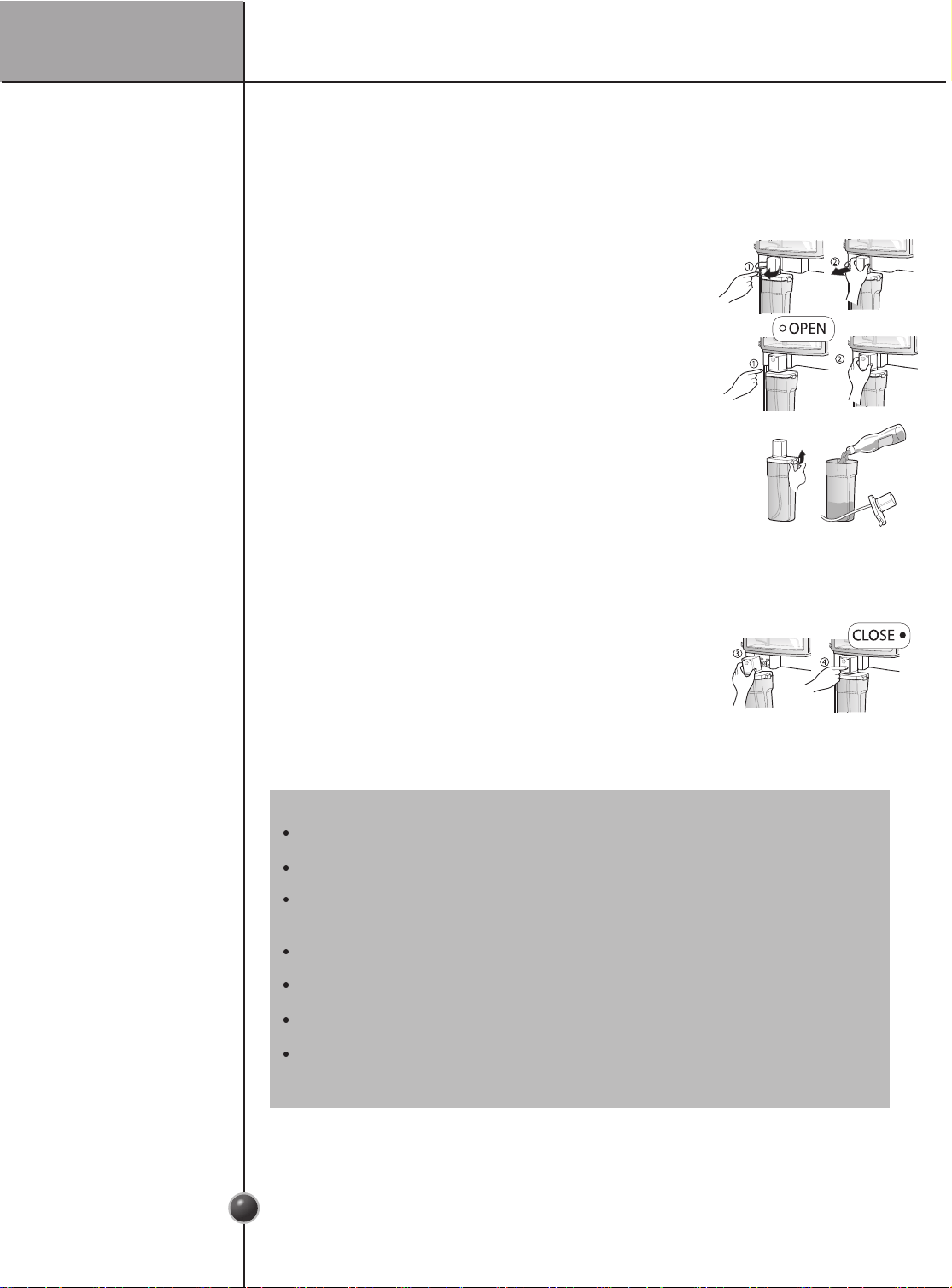
To fill the water tank
Lift up the clamps on both sides to open the water
tank cover, and then fill the tank. Pour water up to the
marked line (4.5ℓ). When the tank is full, close the tank
cover and lock the clamps on both sides.
The water tank can also be filled from the removable fill
cap located on the water tank lid.
NOTE
When assembling or disassembling the water tank, be careful not to apply
excessive force as it can damage the water tank.
If there is no water in the water tank, you will not be able to use the Auto Ice
Maker function and Water Dispenser function.
When the water in the water tank is low, the size of the ice cubes may
become smaller.
and placing it into position.
The method of using the Dispenser and Ice Maker is the same as other common
Dispenser models.
tank, especially with one hand.
As the ice maker uses water from the water tank, you may hear the water pump
operating 8~10 times per day.
Because the water tank can get heavy,don’t let children use or hold the water
It’s a good idea to clean out the water initially before filling it with water
Using other liquid besides water can cause problems to the pump.
To remove the water tank:
Turn the locking dial to the “OPEN” position as shown in
Fig.(1). Then hold and pull the cap of the water tank in the
direction of the arrow in Fig.(2) to release the water tank.
the water tank can now be lifted carefully out of the door
basket for filling or cleaning.
To refit the water tank:
Place the filled water tank back into the door basket and align
the pick up nozzle to the water pipe spigot as shown in Fig (3).
Firmly push the tank so that the water pick up nozzle locates into
the spigot. Fig (4). Then turn the locking dial to the “CLOSED” position.
The pump motor will then automatically operate when this is
done so that the water line is purged of any air.
NOTE: If the tank is not inserted correctly, water will leak
from the pick up nozzle onto the door basket.
Always wait 15 seconds after dispensing water before
attempting to remove the water bottle for filling or cleaning.
22
19
Operation
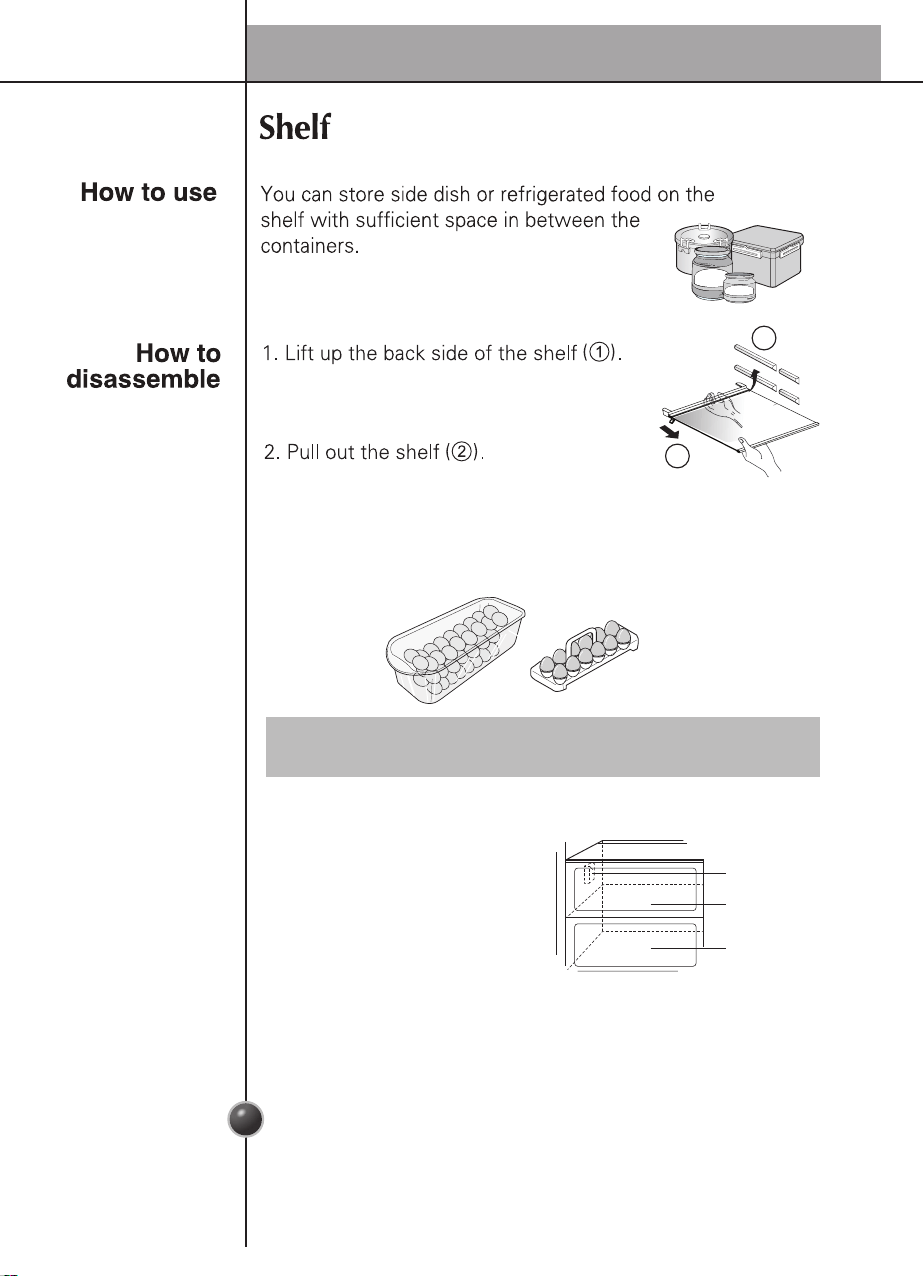
Egg box (Depends on model)
NOTE
• Never use the egg box as an ice storage bin. It can be broken.
• Never store the egg box in the freezer compartment or fresh compartment.
Operation
Deodorizing
system
Vegetable
compartment
Vegetable
compartment
How to use the
deodorizing
system
This system efficiently absorbs strong
odours by using an optical catalyst. This
system does not have any aect on stored
food.
▪ The deodorizer is located behind the vegetable compartment. It can be removed
for cleaning with soapy warm water from time to time.
▪ Please use closed containers to store pungent food. Odours are easily absorbed by
other food in the compartment.
Deodorizer (Applicable to some models only)
20
1
2
26
Freezer Compartment
(Option not available for all models)
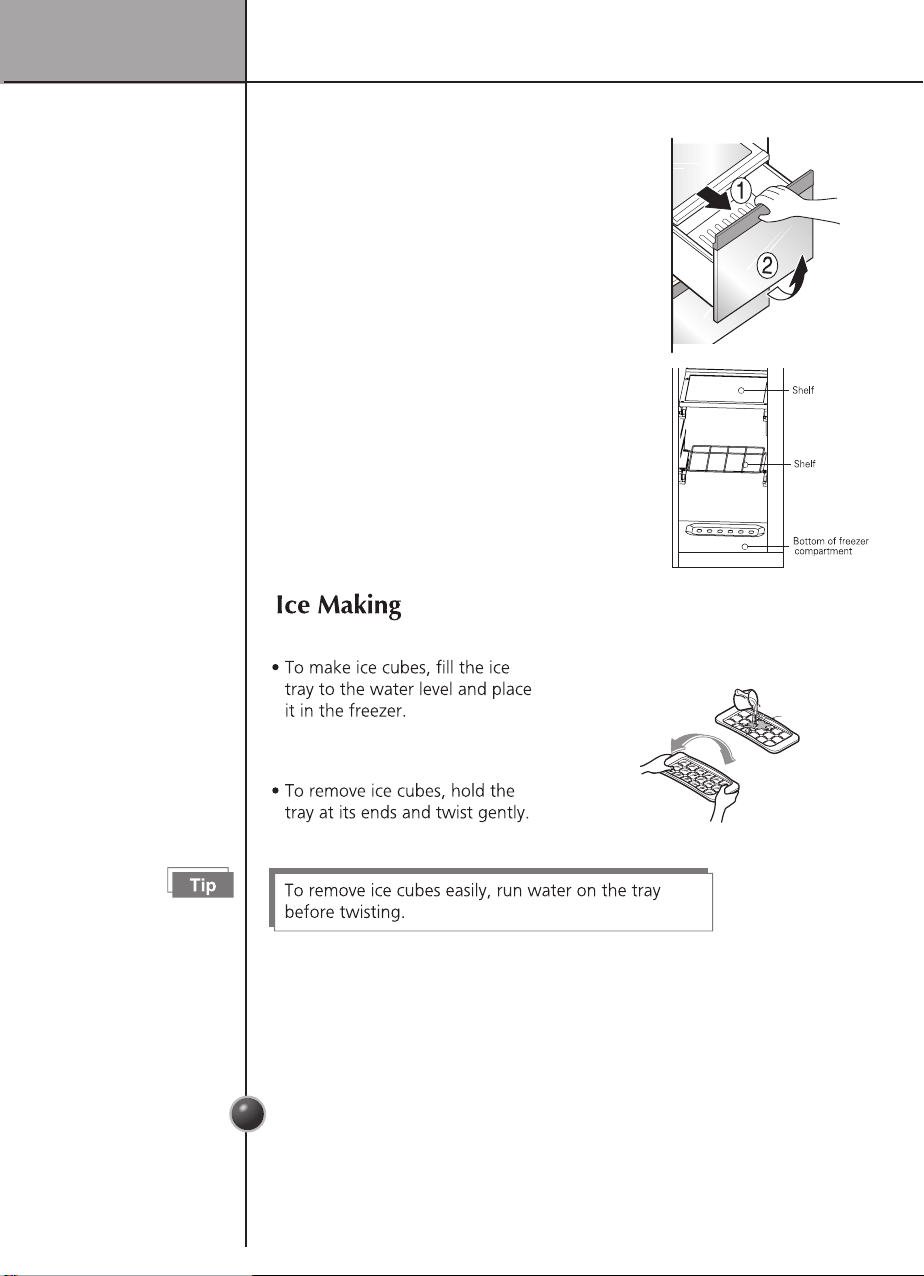
If a large quantity of food is to be placed in the
freezer compartment:
The middle drawer of freezer compartment shall
be taken out of the appliance and food shall be
stacked directly on the wire shelf.
Freezer compartment provides wire shelf on default to
maximize food storage capacity. And also the drawer
is provided to convenient usage for watery meat or
half-liquid state food.
Operation
Max Freezing capacity
If there is already food in the compartment,
button on “Express frz" several hours before
placing fresh produce in the freezer
compartment to get maximum
capacity, As a rule, 4 hours is adequate.
21
(Option not available for all models)
28
Freezer
compartment
shelf
Freezer
compartment
door rack
Freezer
compartment
drawer
Milk product corner
Egg box
Refreshment center
Refrigerator
compartment shelf
Refrigerator
compartment
door rack
Vegetable drawer
(Refer to identification of parts)
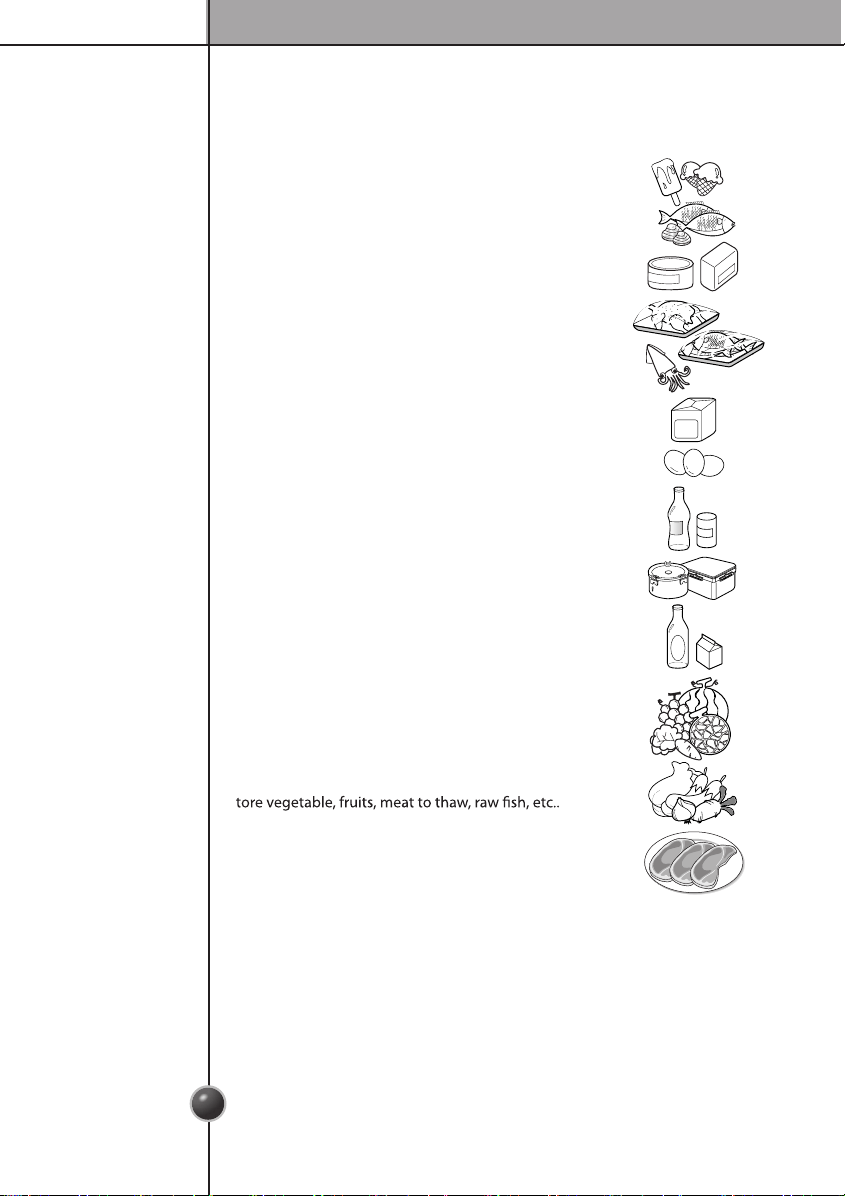
Store various frozen foods such as meat, sh,ice cream,
frozen snacks, etc..
▪ Store small packed frozen food.
▪ Temperature is likely to increase as door opens. So, do
not store long-term food such ice cream, etc..
▪ Store meat, fish, chicken, etc.. after wrapping them with
tin foil.
▪ Store dry.
Store milk products such as butter, cheese,etc..
Place this egg box in the proper location.
Store foods of frequent use such as beverage,etc..
Store side dishes or other foods at a proper distance.
Store small packed food or beverages such as milk, juice,
beer, etc..
S
Location of foods
Suggestion on food storage
22
Storing foods
Suggestion for energy saving
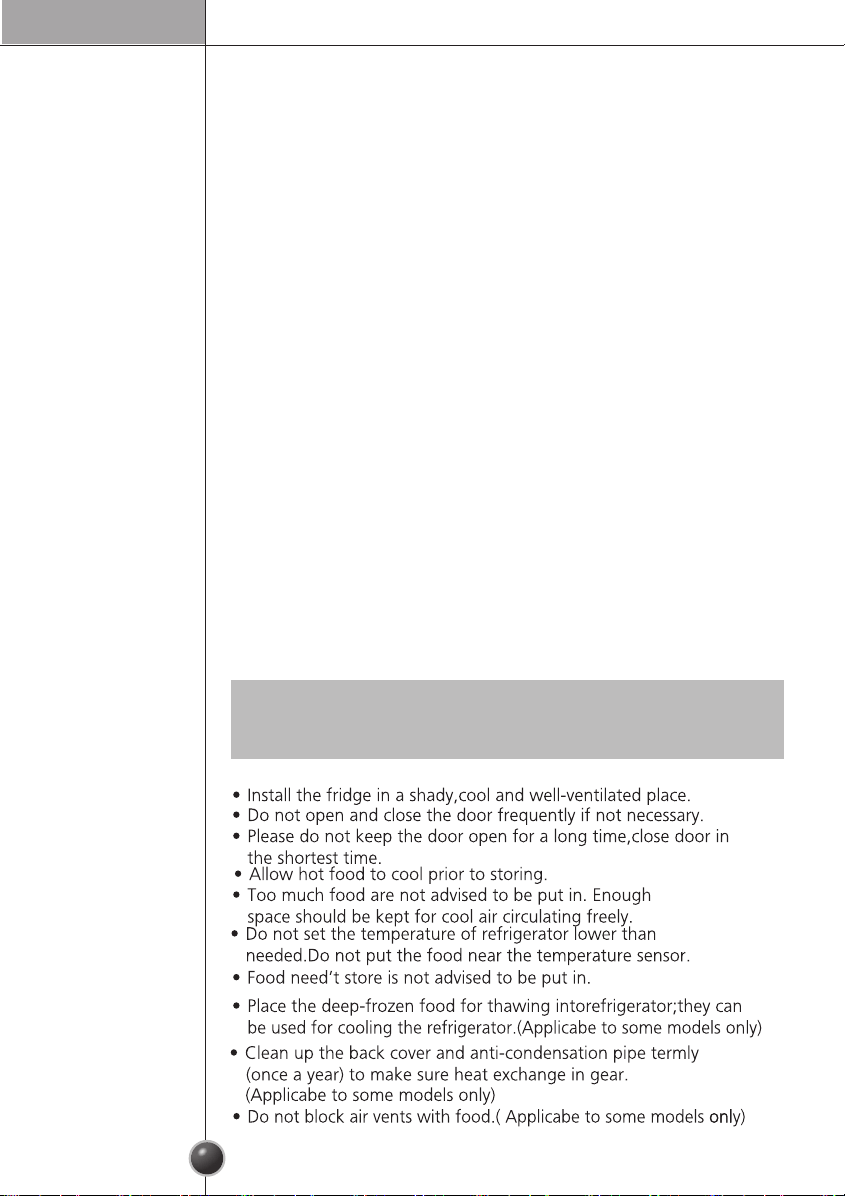
▪ Store fresh food in the refrigerator compartment. How food is frozen and thawed
is an important factor in maintaining its freshness and flavour.
▪ Do not store food which goes bad easily at low temperatures, such as bananas,
and melons.
▪ Allow hot food to cool prior to storing. Placing hot food in a refrigerator could
spoil other food, and lead to higher energy consumption.
▪ When storing food, cover it with vinyl wrap or store in a container with a lid.
This prevents moisture from evaporating, and helps food to keep its taste and
nutrients.
▪ Do not block air vents with food. Smooth circulation of chilled air keeps
refrigerator temperatures even.
▪ Do not open the door frequently. Opening the door lets warm air enter the
refrigerator and causes temperatures to rise.
▪ Never keep too much food in the door rack as it may push against the inner racks
so that the door cannot fully close.
▪ Do not store bottles in the freezer compartment - they may break when frozen.
▪ Do not refreeze food that has been thawed. This causes loss of taste and nutrients.
▪ When storing frozen food like ice cream for a long period, place it on the freezer
shelf, not in the door rack.
▪ Do not touch cold foods or containers - especially metallic containers - with wet
hands or place glass products in the freezer compartment.
- You may get chill blains, and glass containers may break when frozen, causing
personal injury.
▪ Avoid placing sauces on top refrigerator shelves, which could freeze on direct
contact with chilled air.
▪ Always clean food prior to refrigeration. Vegetables and fruits should be washed
and wiped, and packed food should be wiped, to prevent adjacent food from
spoiling.
▪ When storing eggs in their storage rack or box, ensure that they are fresh, and
always store them in an upright position, which keeps them fresh longer.
Freezer
Compartment
Refrigerator
Compartment
NOTE
• If you keeping the refrigerator in a hot and humid place, frequently open the
door or store a lot of vegetables, dew may form. This has no effect on operation
or performance. Remove the dew with an absorbent dry cloth.
Suggestion on food storage
23
24
back
General information
Cleaning
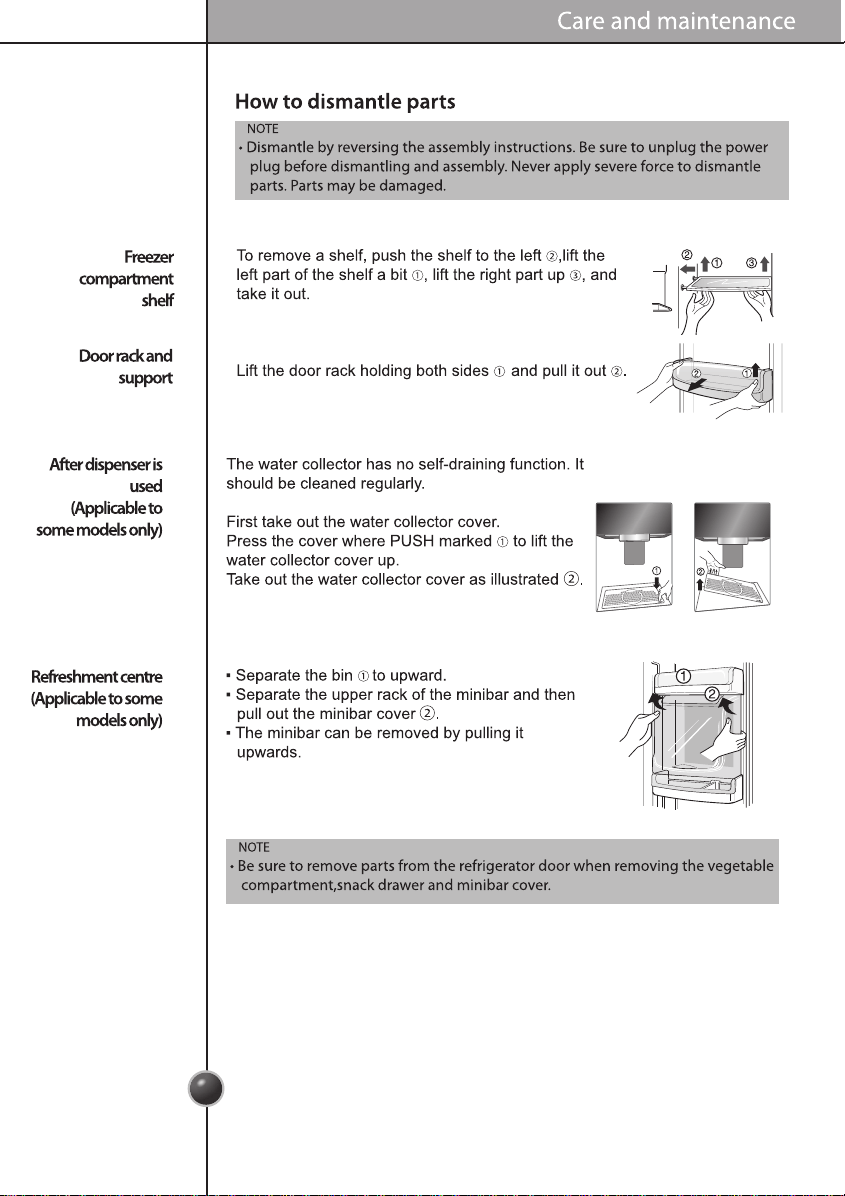
touch frozen surfaces with wet or damp hands, because damp object will stick to
extremely cold surfaces.
Vacation time
Exterior
Power failure
Interior
If you move
After cleaning
Anti condensation
pipe
Warning
26
Your new refrigerator may make sounds that your old one didn’t make. Because the sounds
are new to you, you might be concerned about them. Most of the new sounds are normal.
Hard surfaces, l oor, walls and cabinets, can make the sounds seem louder than they
describes the kinds of actually are. The following sounds and what may be making them:
Understanding
sounds you
may hear
•The defrost timer will click when the automatic defrost cycle begins and ends. The
thermostat control (or refrigerator control, depending on the model) will also click when
cycling on an .
•Rattling noises may come fr
ow of refrigerant,the water line, or items stored on top
of the refrigerator.
•Do not move refrigerator while the refrigerator is operating. Compressor may occur a
temporary rattling noise. (This is normal and will not impact on the performance or the
life of the compressor. The rattling will stop after the refrigerator comes to a rest.)
•Your refrigerator is designed to run mor
ntly to keep your food items at the desired
temperature. The h
ciency compressor may cause your new refrigerator to run longer
than your old one, and you may hear a pulsating or high-pitched sound.
•You may hear the evaporator fan motor circulating the air through the refrigerator and
freezer compartments.
•As each cycle ends, you may hear a gurgling sound due the refrigeran
owing in your refrigerator.
Contraction cause a popping noise to and expansion of the inside walls may a popping
noise.
•Water dripping on the defrost heater during a defrost cycle may cause a sizzling sound.
•You may hear air being forced over the condenser by the condenser fan.
•You may hear water running into the drain pan during the defrost cycle.
operation. Place freezable items in freezer for longer life. When you plan not to operate,
remove all food, disconnect the power cord, clean the interior thoroughly, and leave each
door OPEN to prevent odour formation.
temperatures. However, you should minimize the number of door openings while the
Remove or securely fasten down all loose items inside the refrigerator. To avoid damaging
the height adjusting screws, turn them all the way into the base.
The outside wall of the refrigerator cabinet may sometimes get warm, especially just after
installation. Don’t be alarmed. This is due to the anti-condensation pipe, which pumps
through the refrigerator to prevent “sweating” on the outer cabinet wall.
It is important that your refrigerator be kept clean to prevent undesirable odours. Spilled
food should be wiped up immediately, since it may acidify and stain plastic surfaces if
allowed to settle.
refrigerator. Wipe with a clean damp cloth and then dry.
Regular cleaning is recommended. Wash all compartments with a baking soda solution
or a mild detergent and warm water. Rinse and dry.
Please verify that the power cord is not damaged, power plug is not overheated, or
power plug is well inserted into the wall outlet socket.
Always remove power cord from the wall outlet prior to cleaning near to electrical
equipment (lamps, switches, controls, etc.). Wipe up excess moisture with a sponge
or cloth to prevent water or liquid from getting into any electrical part and causing
an electric shock. Never use metallic scouring pads, brushes, coarse abrasive cleaners,
Care and maintenance
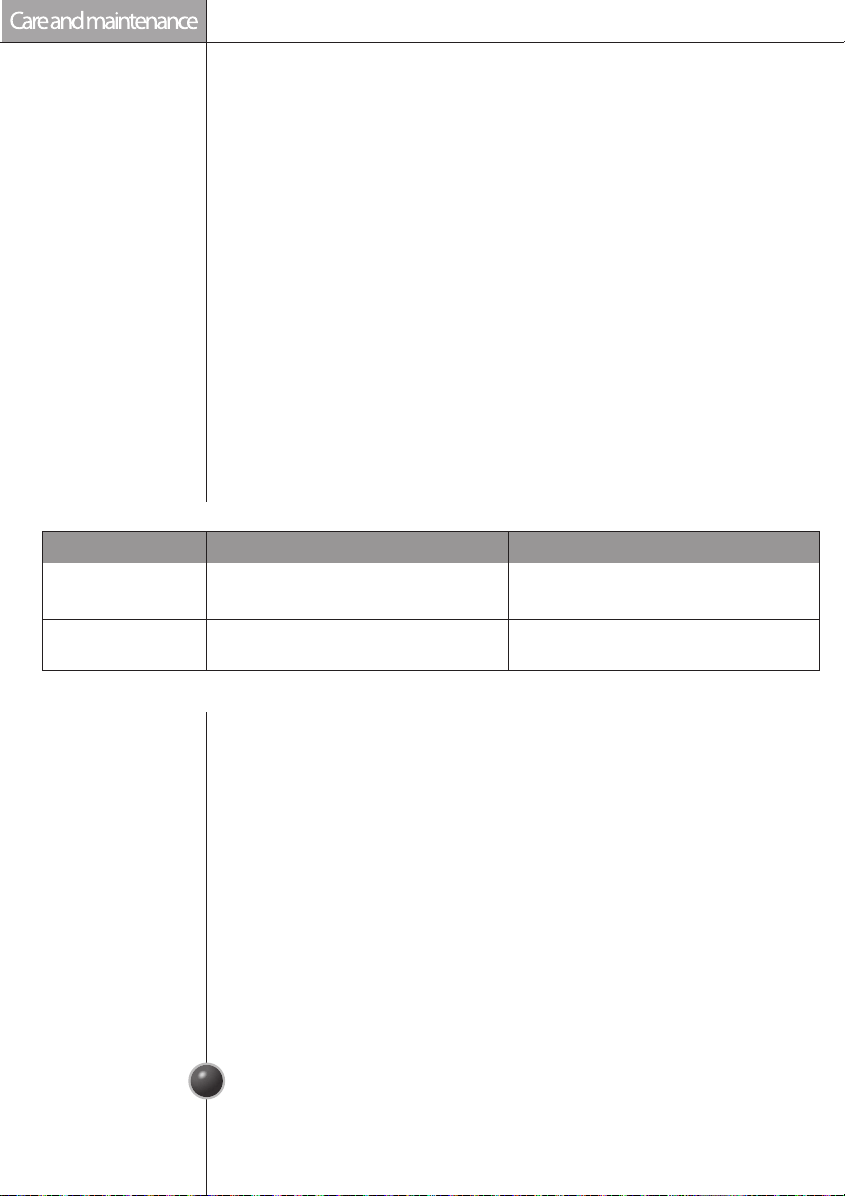
Care and maintenance
Cleaning the water dispenser and the water tank.
(Applicable to some models only)
Frequency of cleaning: every 2 months or when is needed.
Procedure:
1. Before cleaning pour out water from the water tank.
2. Mix 0.5l of water with proper amount of dispenser cleaning product (and then pour it into
the water tank). Do not use any harsh chemicals.
3. Dispense 1 cup of solution and leave the rest of it inside dispenser system for time shown
on the cleaning product label. Do not drink water from the dispenser while all the
cleaning process!
4. Dispense rest of the solution until the tank is empty.
5. Clean the water tank with a soft sponge and rinse it under tap water.
6. Fill the water tank with fresh water. Dispense 3 cups of water, one after another with
20s breaks. Fill the water tank with boiled water and dispense one cup.
7. Check taste of water. If the taste is tainted repeat action no.6 until water has
non-suspicious taste.
We recommend NOT to leave water inside the water tank for more than 2 days.
27
Occurrence Possible cause Solution
Type of water supply or water dispenser
needs cleaning.
Water not dispensed for extended period.
Clean the water tank. Always boil water
before placing it into the water tank.
Pour out old water. Clean the water tank.
Fill the water tank with new water.
Sediment seen
inside the water tank
Bad smell and
taste of water
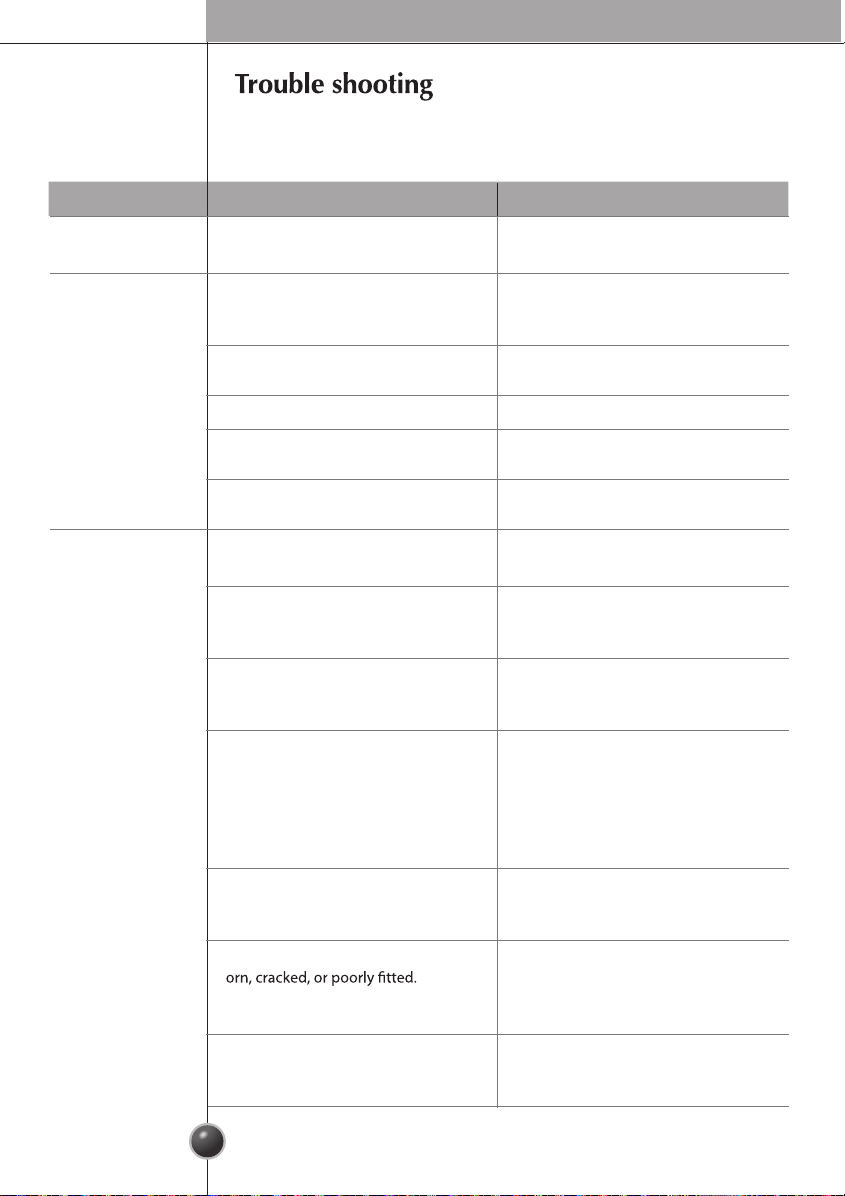
Before calling for service, review this list. It may save you both time and expense.
This list includes common occurrences that are not the result of defective
workmanship or materials in this appliance.
Thermostat is keeping the refrigerator at
a constant temperature.
28
w
Refrigerator or freezer gasket is dirty,
Occurrence Possible cause Solution
Running of refrigerator Refrigerator control is off. Set refrigerator control. See setting the
controls.
Refrigerator
compressor does not
run.
Refrigerator is in defrost cycle. This is normal for a fully automatic
defrosting refrigerator. The defrost cycle
occurs periodically.
Plug at wall outlet is disconnected. Make sure plug is tightly pushed into
outlet.
Power outage. Check house lights. Call your electricity supplier.
Refrigerator is larger than the previous
one you owned.
This is normal. Larger, more ecient
units run longer in these conditions.
Room or outside weather is hot. It is normal for the refrigerator to work
harder under these conditions.
Refrigerator
compressor runs too
often or too long.
Refrigerator has recently been
disconnected for a period of time.
It takes some hours for the refrigerator
to cool down completely.
Large amounts of warm or hot food may
have been stored recently.
Warm food will cause the refrigerator
to run longer until the desired
temperature is reached.
Doors are opened too frequently or too
long.
Warm air entering the refrigerator
causes it to run longer. Open the door
less often.
Refrigerator or freezer door may be
slightly open.
Make sure the refrigerator is level. It is
normal for the refrigerator to have a
slight lean backwards. Keep food and
containers from blocking door. See
problem section OPENING/CLOSING
of doors.
Refrigerator control is set too cold. Set the refrigerator control to a
warmer setting until the refrigerator
temperature is satisfactory.
Clean or change gasket. Leaks in the
door seal will cause refrigerator to run
longer in order to maintain desired
temperatures.
This is normal. Refrigerator goes on and
o to keep the temperature constant.
Care and maintenance
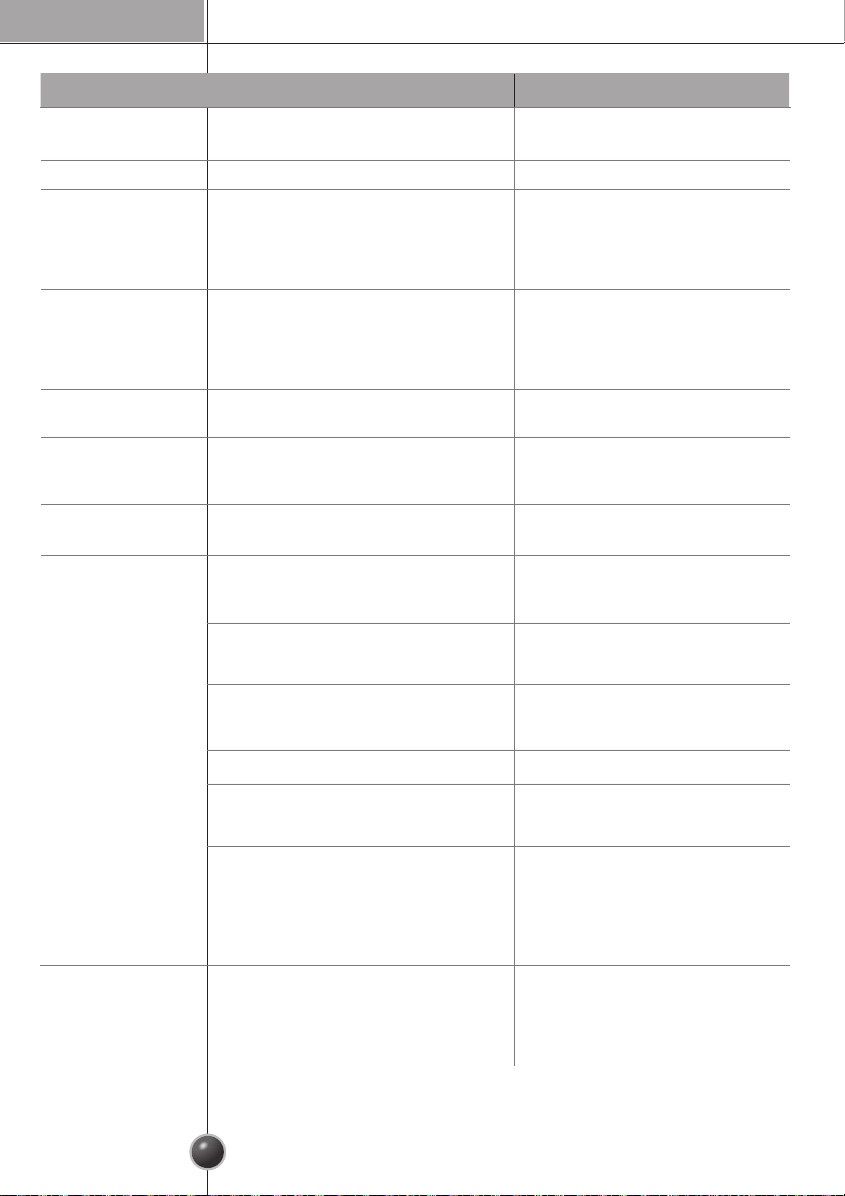
35
29
Refrigerator has recently been disconnected
for a period of time.
Temperature in the
refrigerator is too
warm but the freezer
temperature is
Refrigerator control is set too warm.
Occurrence Possible cause Solution
Refrigerator compressor
does not run
Thermostat is keeping the refrigerator at a
constant temperature.
Set refrigerator control. See setting the
controls.
Temperatures are too cold
Temperature in the
freezer is too cold
but refrigerator
temperature is
satisfactory.
Freezer control is set too cold Set freezer control to a warmer setting
until the freezer temperature is
satisfactory.
Temperature in the
refrigerator is too
cold but freezer
temperature is
satisfactory.
Refrigerator control is set too cold Set refrigerator control to a warmer
setting until the refrigerator
temperature is satisfactory.
Food stored in
drawers freezes.
Refrigerator control is set too cold See above solution.
Meat stored in fresh
meat drawer freezes.
Meat should be stored at a temperature just
below the freezing point of water (32F, 0C)
for maximum fresh storage time.
It is normal for ice crystals to form
due to the moisture content of meat.
Temperatures are too
warm
Temperatures in the
refrigerator or freezer are
too warm.
Freezer control is set too warm. Set the refrigerator control to a colder
setting until the freezer or refrigerator
temperature is satisfactory.
Refrigerator control is set too warm.
Refrigerator control has some eect on
freezer temperature.
Set the refrigerator control to a colder
setting until the freezer or refrigerator
temperature is satisfactory.
Doors are opened too frequently or too
long.
Warm air enters the refrigerator/
freezer whenever the door is opened.
Open the door less often.
Door is slightly open. Close the door completely
Large amounts of warm or hot food may
have been stored recently.
Wait until the refrigerator or freezer
has a chance to reach its selected
temperature.
A refrigerator requires some hours to
cool down completely. Do not place
food items inside the refrigerator
until it has initially reached it’s set
temperature, or has cooled down
considerably.
satisfactory.
Set the refrigerator control to a colder
setting.
e and maintenance
Care and maintenance
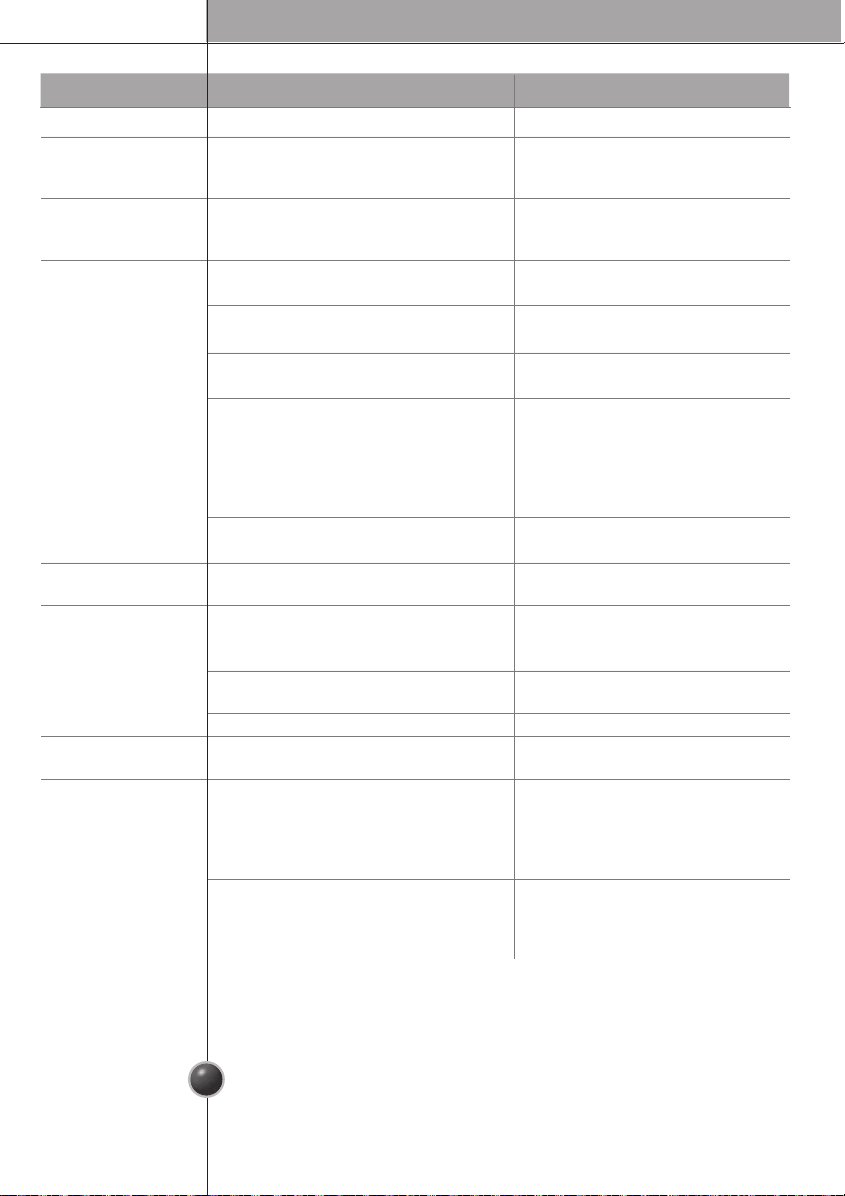
Occurrence Possible cause Solution
Sound and noise
Louder sound levels when
refrigerator is on.
Today’s refrigerators have increased
storage capacity and maintain more even
temperatures.
It is normal for sound levels to be
higher.
Louder sound levels
when compressor
comes on.
Refrigerator operates at higher pressures
during the start of the ON cycle.
This is normal. The sound will level o˛
as the refrigerator continues to run.
Vibrating or rattling
noise.
Floor is uneven or weak. Refrigerator rocks on
the floor when it is moved slightly.
Be sure floor is level and solid and can
adequately support refrigerator.
Refrigerator control is set too cold See above solution.
Items placed on the top of the refrigerator
are vibrating.
Remove items.
Dishes are vibrating on the shelves in the
refrigerator.
It is normal for dishes to vibrate
slightly. Move dishes slightly. Make
sure refrigerator is level and rmly
set on oor. It is normal for the
refrigerator to have a slight lean
backwards.
Refrigerator is touching wall or cabinets. Move refrigerator so that it does not
touch the wall or refrigerator.
Water/Moisture/Ice
inside refrigerator
Moisture collects on
the inside walls of the
refrigerator.
The weather is hot and humid which
increases the rate of frost buildup and
internal sweating.
This is normal.
Door is slightly open. See problem section opening/closing
of doors.
Door is opened too often or too long. Open the door less often.
Water/Moisture/Ice
outside refrigerator
Moisture forms
on the outside of
the refrigerator or
between doors.
Weather is humid. This is normal in humid weather.
When humidity is lower, the moisture
should disappear.
Door is slightly open,causing cold air from
the inside the refrigerator to meet warm air
from the outside.
This time, close the door completely.
Care and maintenance
30
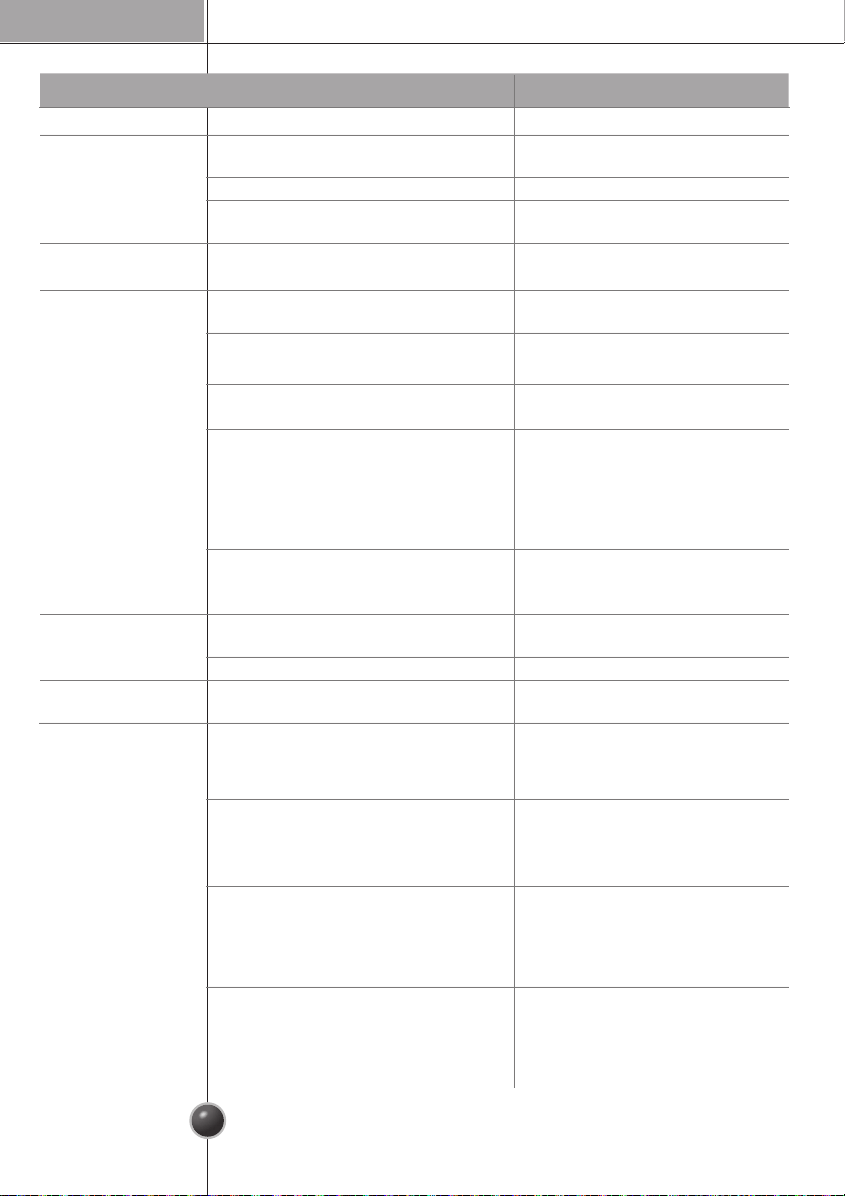
37
Refrigerator or freezer door is not closed.
31
Care and maintenance
Occurrence Possible cause Solution
Odours in refrigerator
Interior needs to be cleaned. Clean interior with sponge,warm
water and baking soda.
Food with strong odour is in the refrigerator. Cover food completely.
Some containers and wrapping materials
produce odours.
Use a dierent container or brand of
wrapping materials.
Opening/Closing of
doors/Drawers
Door(s) will not close. Food package is keeping door open. Move packages that keep door from
closing.
Door was closed too hard, causing other
door to open slightly
Close both doors gently.
Refrigerator is not level. It rocks on the oor
when it is moved slightly.
Adjust the height adjusting screw.
Floor is uneven or weak. Refrigerator rocks
on the oor when it is moved slightly.
Be sure oor is level and can
adequately support refrigerator.
Contact carpenter to correct sagging
or sloping oor. It is normal for the
refrigerator to have a slight lean
backwards.
Refrigerator is touching wall or cabinets. Move refrigerator.
Drawers are dicult
to move.
Food is touching shelf on top of the drawer. Keep less food in drawer.
Track that drawer slides on is dirty. Clean drawer and track.
Dispenser
Dispenser will not
dispense ice
Ice storage bin is empty. When the rst supply of ice is
dropped into the bin, the dispenser
should operate.
Freezer temperature is set too warm. Turn the freezer control to a higher
setting so that ice cubes will be
made. When the rst supply of ice is
made,the dispenser should operate.
Household water line valve is not open. Open household water line valve
and allow sucient time for ice to be
made. When ice is made, dispenser
should operate.
Be sure both doors are closed.
Care and maintenance
Care and maintenance
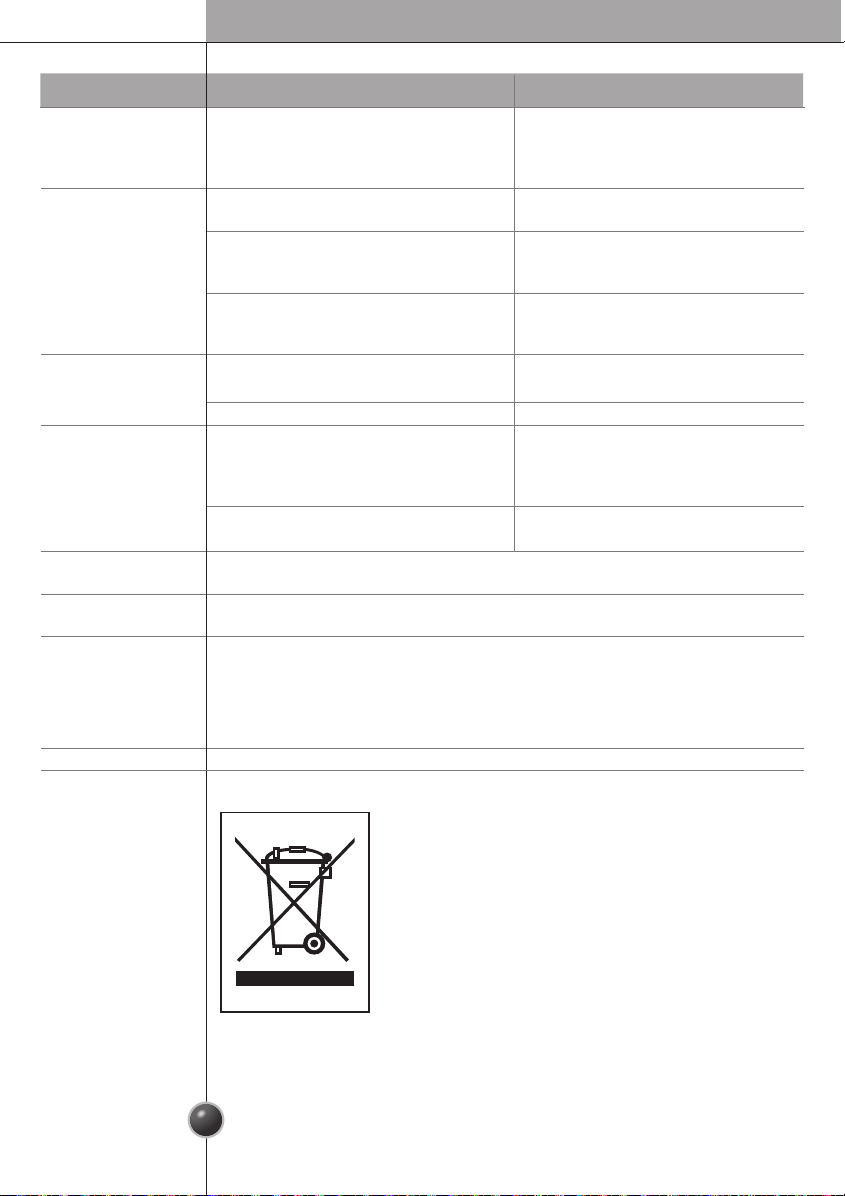
Occurrence Possible cause Solution
Dispenser will not
dispense ice.
Ice has melted and frozen around auger due
to infrequent use, temperature fluctuations
and/or power outrages.
Remove ice storage bin, and thaw and
the contents. Clean bin, wipe dry and
replace in proper position. When new
ice is made, dispenser should operate.
Ice dispenser is
jammed.
Ice cubes are jammed between the icemaker
arm and back of the bin.
Remove the ice cubes that are jamming
the dispenser.
Ice cubes are frozen together. Only the ice cubes made by the
ice maker should be used with the
dispenser.
Ice cubes that have been purchased or
made in some other way have been used in
the dispenser.
Use a dierent container or brand of
wrapping materials.
Dispenser will not
dispense water.
Household water line valve is not open. See
problem “Ice maker is not making any ice.”
Open household water line valve.
Refrigerator or freezer door is not closed. Be sure both doors are closed.
Water has an odd taste
and/or odour.
Water has been in the tank for too long. Dispense and discard 7 glasses of
water to freshen the supply. Dispense
and discard an additional 7 glasses to
completely rinse out tank.
Unit not properly connected to cold water
line.
Connect unit to cold water line which
supplies water to kitchen tap.
Sound of ice dropping This sound is normally made when automatically made ice is dropped into ice storage
bin. Volume may vary according to refrigerator’s location.
Sound of water supply This sound is normally made when ice maker is supplied with water after dropping the
automatically made ice.
The display shows
the word OFF
(After
20 seconds the word
OFF disappears but the
rergerator is still in the
DEMO MODE)
.
The refrigerator is in the Demo(Demonstration) Mode. The Demonstration Mode disables the
cooling system, only the lighting system and the display operate in a regular way. To disable
the Demo Mode open the door and holding down the Fridge button press the EXPRESS F
button 3 times
After deactivating the Demo Mode, the previously set values will appear.
Other Please thoroughly read ‘Automatic ice maker and dispenser’ in this manual.
DISPOSAL OF YOUR OLD APPLIANCE
1. When this crossed-out wheeled bin symbol is attached to a product it
means the product is covered by the European Directive 2002/96/EC.
2. All electrical and electronic products should be disposed of separately
from the municipal waste stream via designated collection facilities
appointed by the government or the local authorities.
3. The correct disposal of your old appliance will help prevent potential
negative consequences for the environment and human health.
4. For more detailed information about disposal of your old
appliance,please contact your local Council, waste disposal service or
the shop where you purchased the product.
32
Care and maintenance