WARNING
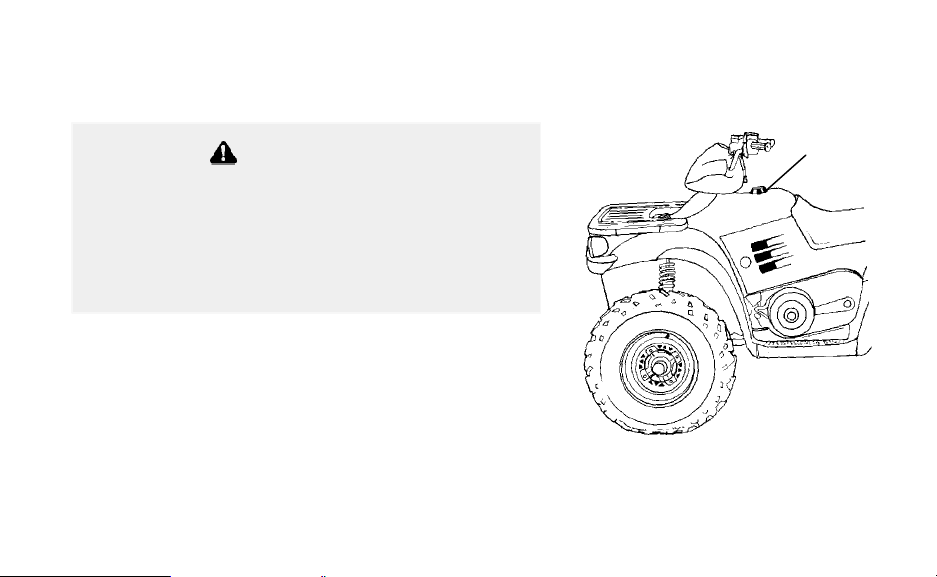
The engine exhaust from this
product contains chemicals known
to cause cancer, birth defects or
other reproductive harm.

1
Welcome
Dear Parents:
We believe your children should have the opportunity to enjoy The Way Out experience
along with you. We’ve provided this owner’s manual to assist you and your children in
learning about safe operation and care of your new ATV. Please review the information in
this manual with any child who may operate the ATV. Help your children learn to operate
the ATV with safety as a top priority. Help them also learn to show respect for our
environment and for the rights of others while operating the ATV.
Children differ in skills, physical abilities and judgement. S ome children may not be able to
operate an ATV safely. Always supervise your child’s use of the ATV, and permit continued
use only if you determine that your child has the ability and maturity to operate the ATV
safely. Never allow a child to operate the ATV without adult supervision.
The preventive maintenance program outlined in this manual is designed to ensure that all
critical components on your child’s ATV are thoroughly inspected at various intervals. For
safe and enjoyable operation of the vehicle, be sure to follow all of the instructions and
recommendations in this manual. If you have any questions about the ATV, contact a
Polaris dealer for assistance.

2

3
Welcome
Dear Childr en:
Before you ride your new Polaris ATV, there are some important things that you need to
know. Your parents and Polaris want you to enjoy riding your new ATV, and that’s why
you need to read and understand the information in your owner’s manual.
Ask your parents to explain anything you don’t understand, and pay close attention to the
warnings and instructions you read. Your safety and the safety of others is the most
important thing to think about at all times.
As the driver of the ATV, you must learn how to keep yourself and those around you safe
while you’re riding. So read your manual, and then enjoy riding your new Polaris ATV!

4
All information in this manual is based upon the latest product data and specifications available at the time of printing. Polaris
Industries Inc. reserves the right to make product changes and improvements which may affect illustrations or explanations.
No part of this manual shall be reproduced or used without the written permission of Polaris Industries Inc.
Illustrations included in this manual are general representations of parts having a similar function. Your model may differ.
Copyright 2002
Polaris Industries Inc.
All Rights Reserved Printed in Taiwan

5
Safety
Understand the Warnings
Always follow the age guidelines for your ATV. Never allow a younger child to ride on or
drive the ATV. Make sure all operators understand all warnings and the owner’s manual
before driving the ATV.
Know Your ATV Before Riding
Parents must help their children learn the proper and safe way to ride an ATV. Read the
owner’s manual with your children before starting the engine for the first time, and review
it with them periodically afterwards.
Safety Training
When you purchased this ATV, your Polaris dealer offered a hands-on safety training course
that covers all aspects of ATV safety. In addition, you were provided with printed material
and a video that instructs operators on safe operating procedures. You should review this
information with your child on a regular basis. If you purchased a used P olaris ATV from a
party other than a Polaris dealer, you can request this free safety training from any
authorized Polaris dealer.
6
Safety
The following signal words and symbols appear throughout this manual and on your
vehicle. Your safety is involved when these words and symbols are used. Become familiar
with their meanings before reading the manual.
The safety alert symbol, on your vehicle or in this manual, alerts you to the
potential for personal injury.
The safety alert warning indicates a potential hazard that may result in serious injury
or death.
WARNING
7
Safety
The safety alert caution indicates a potential hazard that may result in minor personal
injury or damage to the vehicle.
CAUTION
A caution indicates a situation that may result in damage to the vehicle.
CAUTION
NOTE:
A note will alert you to important information or instructions.
8
Safety
WARNING
Failure to follow the warnings in this manual can result in severe injury or death.
A Polaris ATV is not a toy and can be hazardous to operate. This vehicle handles
differently than other vehicles such as motorcycles and cars. A collision or rollover
can occur quickly, even during routine maneuvers like turning, or driving on hills or
over obstacles, if you fail to take proper precautions.
Read and understand the owner’s manual and all warnings before operating a
Polaris ATV.

9
Safety
S Read this manual and all labels carefully and follow the operating procedures described.
S Never operate an ATV without proper instruction. Take a training course. Riders
should receive training from a certifie d instructor. Contact an authorized Polaris ATV
dealer or call Polaris at 1-800-342-3764 to find out about the training courses nearest
you.
S Always follow the age guidelines for your machine. Youth ATVs are designed and in-
tended for use by children i n two age groups. The Scrambler 50 is for children not less
than 6 years of age. The Scrambler 90 and the Sportsman 90 are for children not less
than 12 years of age. No children under the age of 16 should ride an ATV designed and
sold for an adult.
S Do not allow other children to ride this ATV unless they have read the manual, seen the
instructional video and taken and passed a Polaris approved riding skill test.
S Always avoid operating an ATV on any paved surfaces, including sidewalks, driveways,
parking lots and streets.
S Never operate an ATV on any public street, road or highway, including dirt or gravel
roads.

10
Safety
S Never operate an ATV without wearing an approved helmet that fits properly. You
should also wear eye protection (goggles or face shield), gloves, boots, long-sleeved shirt
or jacket, and long pants.
S Never consume alcohol or drugs before or while operating this ATV.
S Never operate at excessive speeds. Always travel at a speed which is proper for the ter-
rain, visibility and operating conditions, and your experience.
S Never attempt wheelies, jumps or other stunts.
S Always inspect your ATV each time you use it to make sure it i s in safe operating condi-
tion. Always follow the inspection and maintenance procedures and schedules described
in this manual.
S Always keep both hands on the handlebars and both feet on the footrests of the ATV dur-
ing operation.
S Always go slowly and be extra careful when operating on unfamiliar terrain. Always be
alert to changing terrain conditions when operating t he ATV.
S Never operate on excessively rough, slippery or loose terrain.

11
Safety
S Always follow proper procedures for turning as described in t his manual. Practice turn-
ing at low speeds before attempting to turn at faster speeds. Do not turn at excessive
speed.
S Always have the ATV checked by an authorized Polaris dealer if it has been involved in
an accident.
S Never operate the ATV on hills too steep for the ATV or for your abilities. Practice on
smaller hills before attempting larger hills.
S Always follow proper procedures for climbing hills as described in this manual. Check
the terrain carefully before you start up any hill. Never climb hills with excessively slip-
pery or loose surfaces. Shift your weight forward. Never open the throttle suddenly or
make sudden gear changes. Never go over the top of any hill at high speed.
S Always follow proper procedures for going down hills and for braking on hills as de-
scribed in this manual. Check the terrain carefully before you start down any hill. Shift
your weight backward. Never go down a hill at high speed. Avoid going down a hill at
an angle which would cause the vehicle to lean sharply to one side. Go straight down the
hill where possible.

12
Safety
S Always follow proper procedures for crossing the side of a hill as described in t his manu-
al. Avoid hills with excessively slippery or loose surfaces. Shift your weight to the
uphill side of the ATV. Never attempt to turn the ATV around on any hill until you have
mastered the turning technique described in this manual on level ground. Avoid crossing
the side of a steep hill if possible.
S Always use proper procedures if you stall or roll backwards when climbing a hill. To
avoid stalling, maintain a steady speed when climbing a hill. If you stall or roll back-
wards, follow the special procedure for braking described in this manual. Dismount on
the uphill side or to either side if pointed straight uphill. Turn the ATV around and re-
mount, following the procedure described in this manual.
S Always check for obstacles before operating in a new area. Never attempt to operate
over large obstacles, such as large rocks or fallen trees. Always follow proper procedures
when operating over obstacles as described in t his manual.
S Always be careful of skidding or sliding. On slippery surfaces, such as ice, go slowly
and be very cautious in order to reduce the chance of skidding or sliding out of control.

13
Safety
S Avoid operating the ATV through deep or fast flowing water. If you cannot avoid water
which exceeds the recommended maximum depth (pg. 114), go slowly, balance your
weight carefully avoiding sudden movements, maintain a slow and steady forward mo-
tion, do not make sudden turns or stops, and do not make sudden throttle changes.
S Wet brakes may have reduced stopping ability. Test your brakes after leaving water. If
necessary apply them lightly several times t o let friction dry out the pads.
S Always use the size and type tires specified in this manual. Always maintain proper tire
pressure as described in this manual.
S Never modify an ATV through improper installation or use of accessories.
S Never exceed the stated load capacity for an ATV. Cargo should be properly distributed
and securely attached. Reduce speed and follow instructions in this manual for carrying
cargo. Allow greater distance for braking.
S Always remove the ignition key when the vehicle is not in use to prevent unauthorized
use or accidental starting.
FOR MORE INFORMATION ABOUT ATV SAFETY, call the Consumer Product Safety
Commission at 1-800-638-2772, or Polaris at 1-800-342-3764.

14
Safety
Equipment Modifications
We are concerned for the s afety of our customers and for the general public. Therefore, we
strongly recommend that consumers do not install on a Polaris ATV any equipment that
may increase the speed or power of the vehicle, or make any other modifications to the
vehicle for these purposes. Any modifications to the original equipment of the vehicle
create a substantial safety hazard and increase the risk of bodily injury.
The warranty on your Polaris ATV is terminated if any equipment has been added to the
vehicle, or if any modifications have been made to the vehicle, that i ncrease its speed or
power.
NOTE: The addition of certain accessories may change the handling characteristics of the
ATV. Use only Polaris-approved accessories, and familiarize yourself with their function
and effect on the ATV.

15
Table of Contents
Welcome 1....................................................
Safety 5......................................................
Table of Contents 15...........................................
YOUTH SECTION 17
Know Your ATV 18..........................................
Pre-Ride Check 26..........................................
Riding Rules 29.............................................
ADULT SECTION 35
Safety Decals 36............................................
Driver Warnings 49..........................................
Vehicle Identification Numbers 76.............................
Controls 79.................................................
Break-in Period 94..........................................
Daily Pre-Ride Inspection 96.................................
Starting the Engine 98.......................................

16
Table of Contents
ADULT SECTION (continued)
Driving Safely 100...........................................
Hauling Cargo 117..........................................
Noise Emission Control System Regulation 120.................
Maintenance 121...........................................
Specifications 164...........................................
Polaris-Recommended Products 170..........................
Troubleshooting 172.........................................
Warranty 178...............................................
INDEX 182
17
Youth
Section

18
Know Your ATV
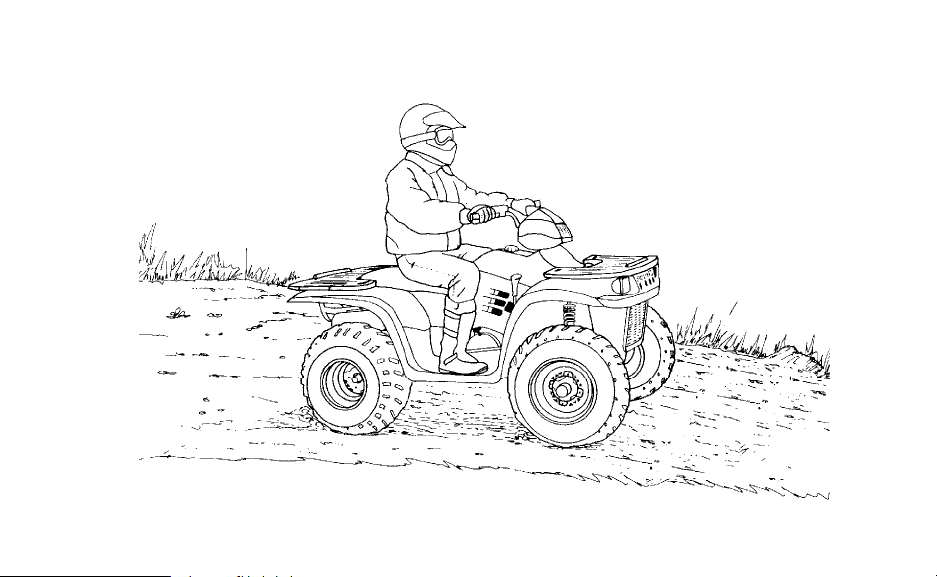
PARENTS: Polaris Youth ATVs are equipped with an electronic speed control system to
allow adults to limit the speed of the vehicle for the rider’s skill and experience. More
information on speed limiting functions can be found on page 141.
These units are not designed for adult use. Serious damage to the vehicle may occur if the
maximum rider weight capacity is exceeded. The maximum rider weight capacity for 50 cc
models is 90 lbs. (40.9 kg). The maximum for the 90 cc models is 150 lbs. (68.1 kg).
CHILDREN: Before you ride your new Polaris ATV, there are some important things that
you need to know. Your safety and the safety of others is the most important thing t o think
about at all times. As the driver of the ATV, you must learn how to keep yourself and t hose
around you safe while you’re riding.
Pay attention when you see this symbol:
This is the safety alert symbol. When you see this symbol on your
ATV or in this manual it means PAY ATTENTION because you
could die or be seriously injured if you don’t follow the instructions.
19
Know Your ATV
Before you have an adult start the engine for you for t he first time, let’s learn about the
controls on your new ATV.
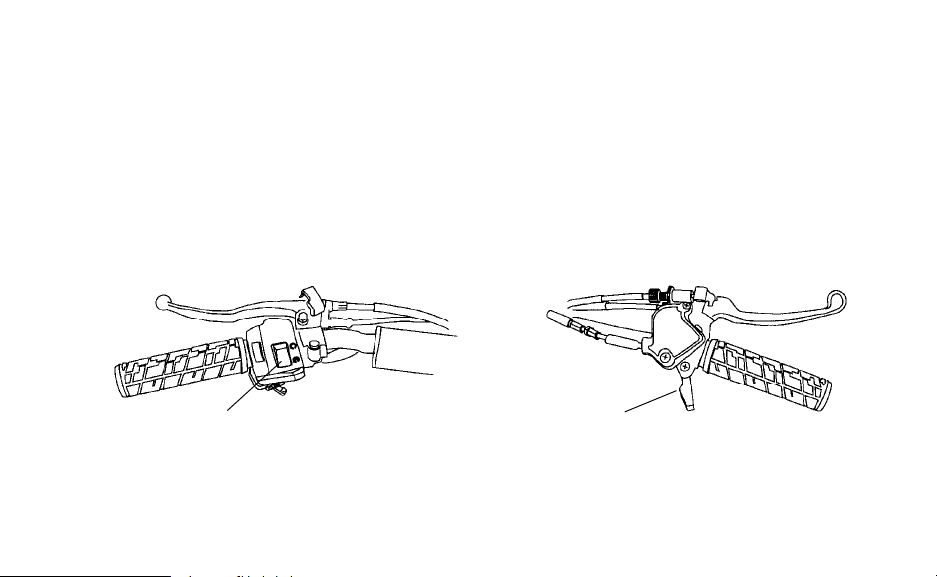
1. Engine Stop Switch - When the engine is running, push t his button down to shut the
engine off quickly. The button must be up before you can start the engine again.
2. Throttle Control - Press the throttle lever with your thumb when you want the ATV to
go forward. Always make sure the throttle control does not stick before you drive your
ATV. Read more about it on page 26.
1
2
20
Know Your ATV
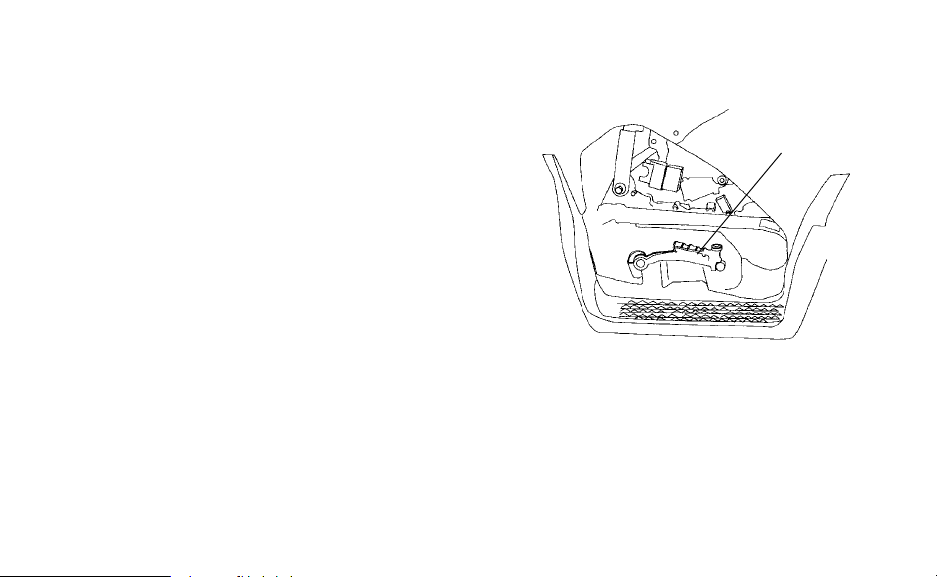
3. Kick-Start Lever - If your battery is too
weak to start your ATV, you can push down
on the kick-start lever with your foot to
start the engine. Have an adult show you
how it works. Read more about how to use
the kick-start on page 93.
3
21
Know Your ATV
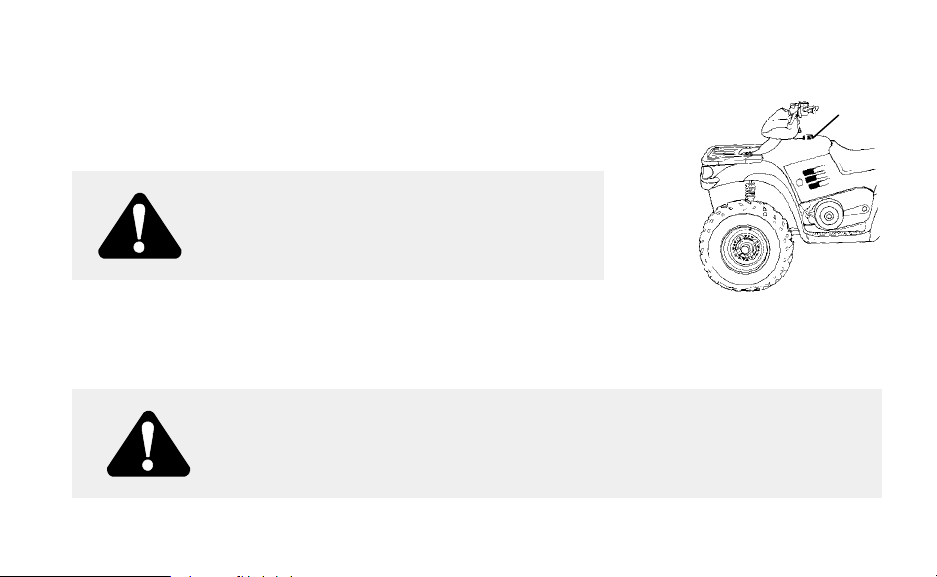
4. Gas Cap - The gas cap has to be taken off when an
adult puts gas in your ATV. Never take the gas cap off.
Always make sure it’s tightly closed.
5. Seat Latch - To remove the seat, reach under the rear of the cab and pull back on the
seat latch. To replace the seat, set it in place and push down on the rear of seat.
Always make sure the seat is locked in place before riding.
4
Always have an adult put gas in your ATV.
Never try to do it yourself.
The exhaust gets very hot when the engine is running. It can cause
serious burns to your skin if you accidentally touch it. Do not try to
release the seat latch until the engine has cooled for at least an hour .
22
Know Your ATV
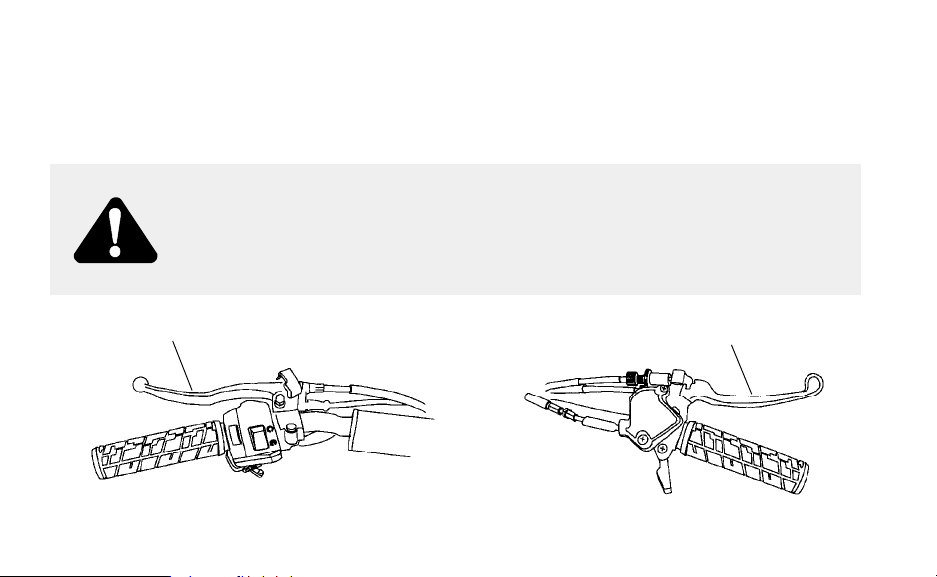
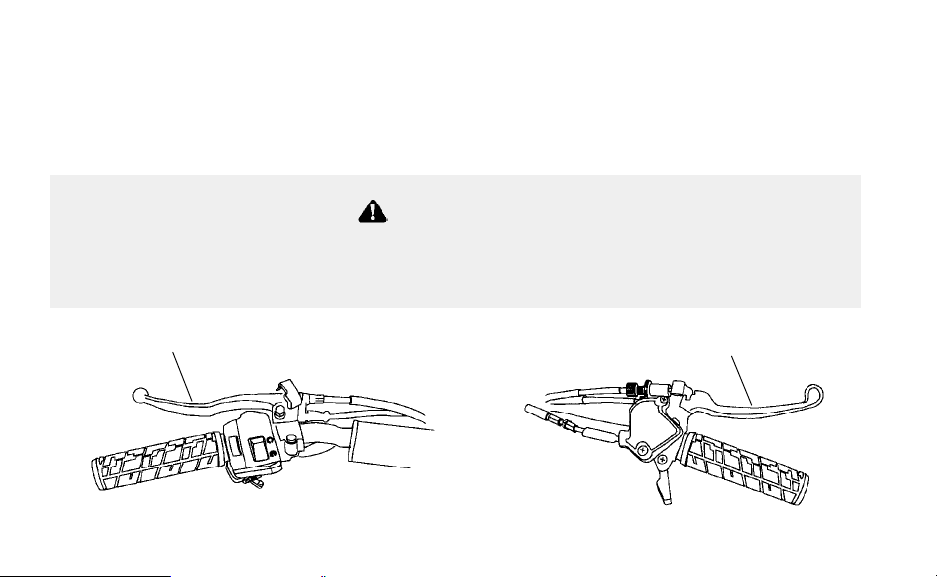
6. Brake Levers - Squeeze the brake levers toward the handlebar to slow down or stop
the ATV. The left hand lever (A) controls the rear brake. The right hand lever (B)
controls the front brake. Always squeeze both brake levers at the same time.
Always squeeze both brakes at the same time or you could lose
control of the ATV and be seriously injured.
Always take your thumb off the throttle lever when you squeeze the
brake levers.
A
B
23
Know Your ATV
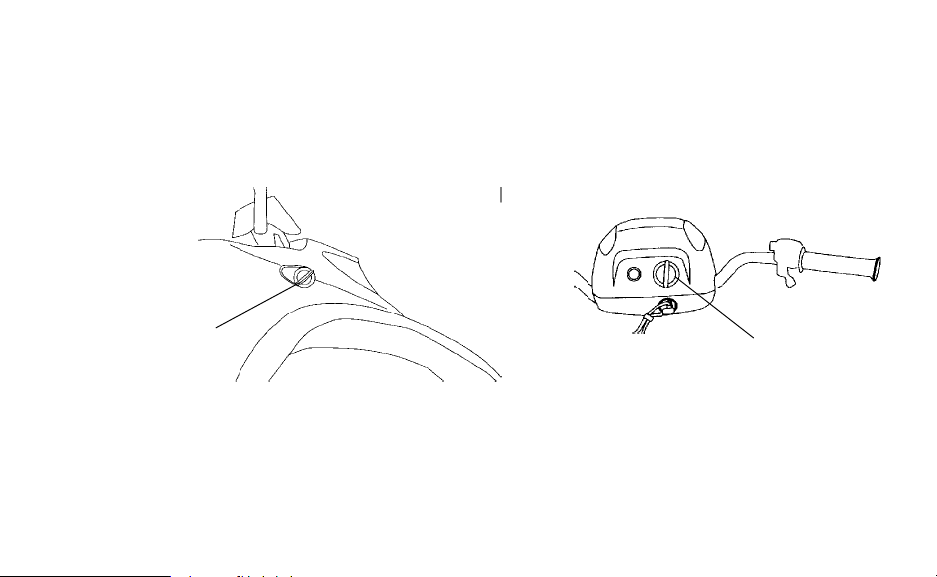
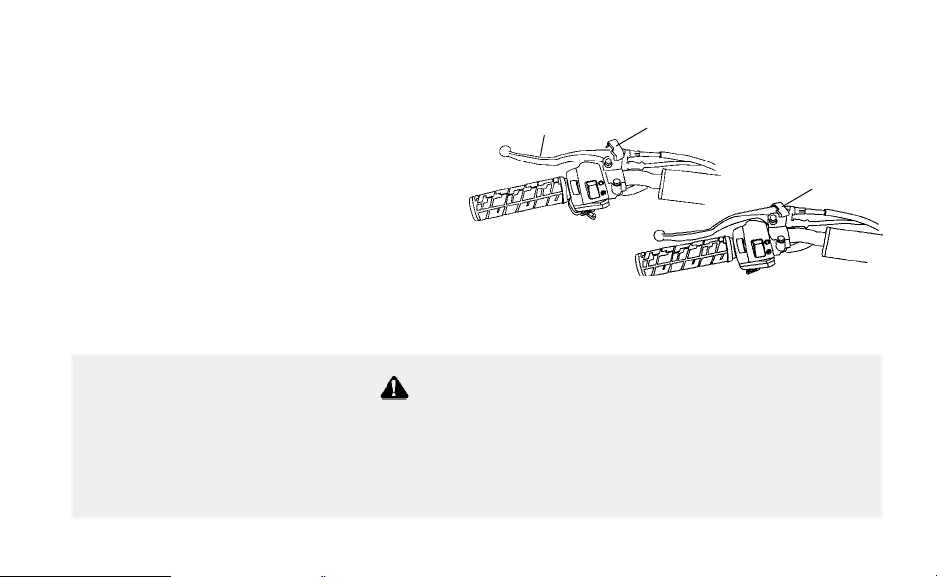
7. Ignition Switch - The ignition switch key must be turned on before pushing the starter
button. You can also use this key to turn off the engine. If you have a Scrambler, the
ignition switch key is on the right side of the ATV (A). If you have a S portsman, it’s on
the pod (B).
A
B
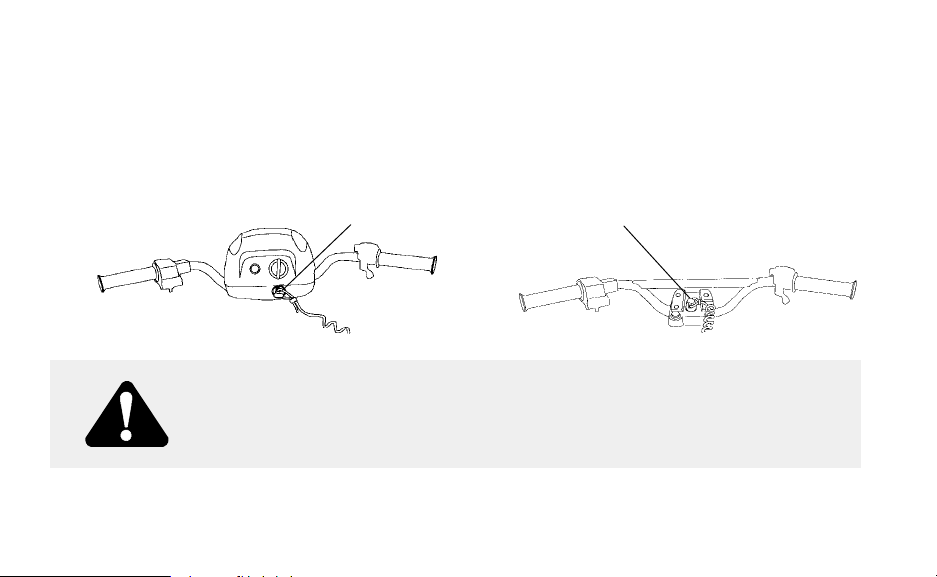
24
Know Your ATV
8. Tether Strap and Switch - The tether strap must always be attached snugly to your
right wrist and to your ATV every time you drive. If you fall off your ATV, the t ether
strap will pull away from the switch and the engine will stop. If you have a Sportsman,
the switch is on the pod (A). If you have a Scrambler, the switch is at the center of the
handlebars (B).
A
B
Never ride without the tether strap attached to your right wrist and to
your ATV. Be careful not to let the cord get tangled around the
handlebars or any part of your body.
25
Know Your ATV
Let’s review the three ways to stop your ATV:
1. Push the stop switch down.
2. Pull off the tether strap.
3. Turn the key off.
26
Pre-Ride Check
We’re almost ready to have an adult start your ATV. But before the ATV is started for the
first time, you must do a Pre-Ride Check. In fact, every time you want to ride you must
have an adult help you check some things on your ATV before starting it. Let’s learn about
these things now.
Make sure the throttle doesn’t stick. Check this by pushing the throttle lever toward the
handlebar and then letting go. The lever should come right back to where it was before
you pushed it. If it comes back slowly or stays close to the handlebar, the ATV has a
sticky throttle. This means that something is wrong or broken and must be fixed before
you can ride your ATV s afely.
Never start the engine if you have a sticky throttle. You could be
seriously hurt if you ride with a sticky throttle. Have an adult or your
Polaris dealer fix the throttle before you ride.
27
Pre-Ride Check
Make sure the brakes don’ t stick. Check the brake levers by squeezing them toward the
handlebar and then letting go. They should come right back to where they were before
you squeezed. If they go back slowly or stay close to the handlebar, your ATV has stic ky
brakes. They must be fixed before you can ride your ATV safely.
Have an adult check to see if your ATV needs more gas. Children must never add their
own gasoline. This must always be done by an adult. Before anyone adds gasoline to
your ATV they must read the instructions and warnings on page 88 of this manual.
Never start the engine if your ATV has sticky brakes. You could be
seriously hurt if you ride with sticky brakes. Have an adult or your
Polaris dealer fix the sticky brakes before you ride.
Always have an adult put gas in your ATV. Never try to do it yourself.

28
Pre-Ride Check
If you used the storage area under the seat, make sure the seat is locked in place.
Have an adult check the engine oil level when the engine is cold. The engine is very hot
after i t has been running and it can burn your skin if you touch it. Children must never
check the oil on their own. An adult should always be in charge of keeping the gas and
oil levels at the full marks.
This last check is done with the engine running. You must check to make sure that all
three ways to stop your ATV are working the way they should. Do you remember what
they are? If you can’t remember the t hree ways to stop your ATV, go back to page 25
and review. Then have an adult help you start your ATV and practice stopping the en-
gine all three ways.

29
Riding Rules
Now you’re ready to learn about riding your Polaris ATV. There are some things you can
do and there are some things you must never do. Rules are very important when you’re
driving an ATV. Adults have riding rules, too. The rules help keep us safe when we ride.
The adult with you is your teacher. Always pay attention to what your teacher says so you
can learn how to always drive safely.
Let’s l earn how to ride!
Always follow the safe riding rules found on the next pages. You or
others around you could be seriously hurt or killed if you don’t follow the
safe riding rules.
30
Riding Rules
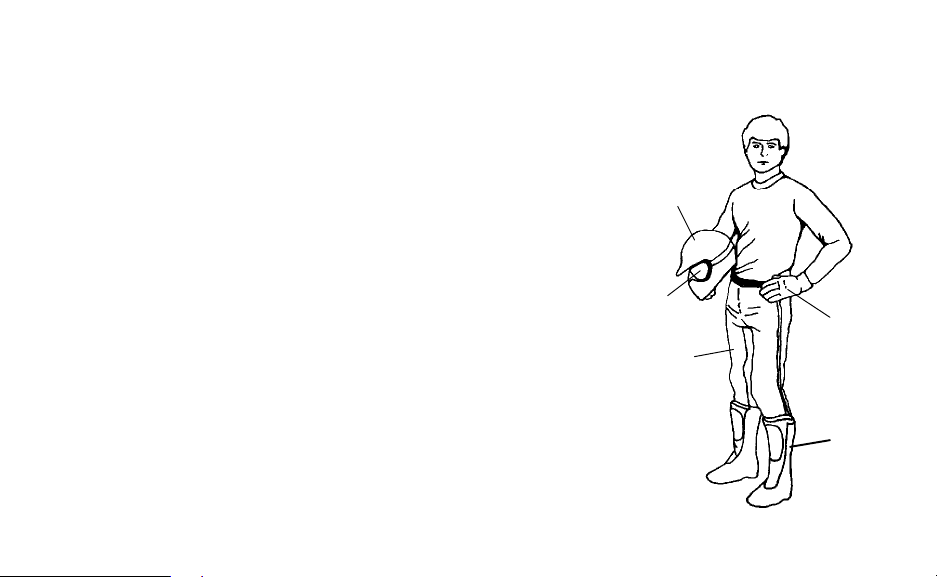
" Always wear the right kind of clothing and safety gear when riding your ATV.
1. Helmet: Your helmet is very important for safe riding.
A helmet can prevent a severe head injury.
2. Eye Protection: Always wear shatterproof goggles or a
helmet face shield, and always keep them clean so you can
see where you’re driving.
3. Gloves: Wear gloves to protect your hands from sun and
wind. Gloves will also protect your hands from scrapes and
scratches.
4. B oots: Wear sturdy boots to keep your feet dry. Boots
will also protect your feet and ankles from scrapes and
scratches.
5. Clothing: Make sure your clothing fits properly. If it’s
too small, it could keep you from moving easily when you
shift your weight. If it’s too big, it could hang down and
get caught in a moving part.
1
2
3
4
5
31
Riding Rules
" Always attach the tether strap to your right
wrist and to the ATV before riding.
" Make sure you know where you’re going
to drive before your ATV is started. Make
sure the area is safe all around your ATV.
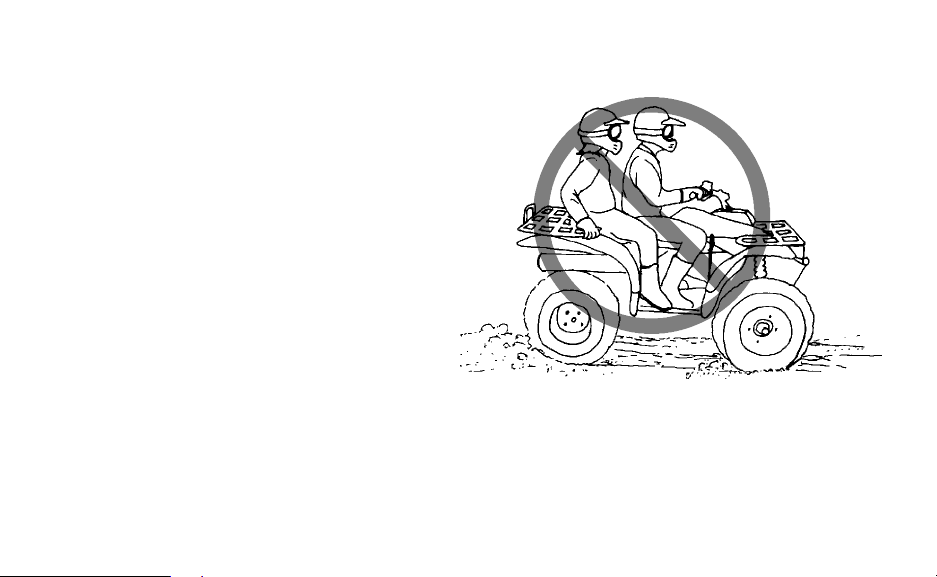
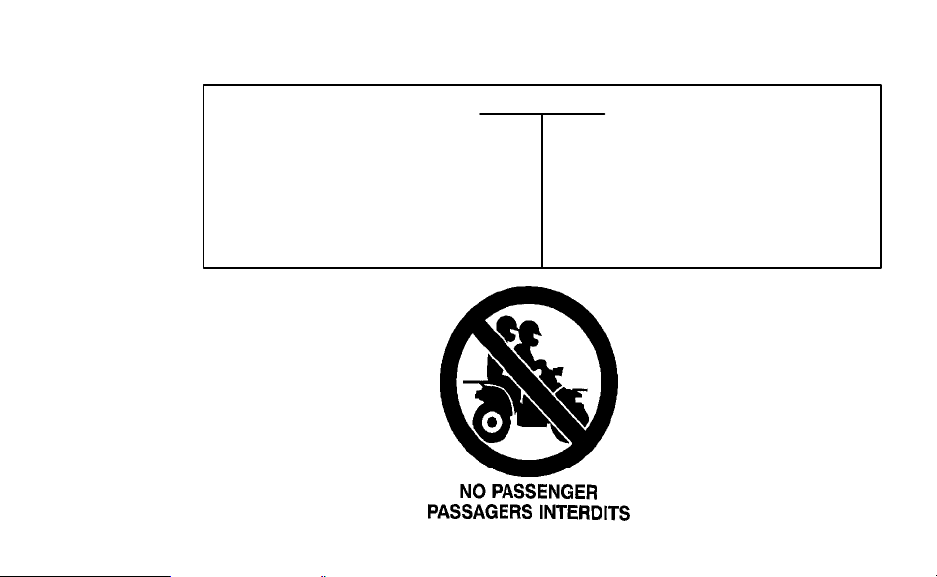
" Your ATV is made for one person.
Never carry a passenger. A passenger
will make the ATV harder to drive.
You you may lose control and hurt
yourself and your passenger.
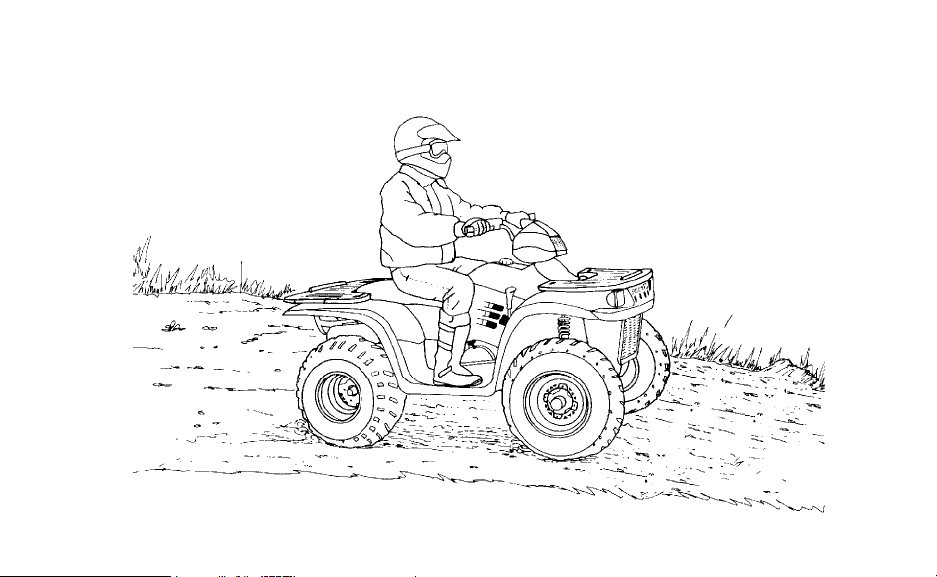
" Always drive your ATV while sitting
down. Keep both hands on the han-
dlebars and keep both feet on the
footrests.
" Always be alert and pay attention to where you’re driving. Pay attention to other drivers,
and be even more careful around them because you don’t know what they’re going to do.
" Never follow another ATV too closely. You need lots of time and space to stop your
ATV.

32
Riding Rules
" Never ride alone. An adult should always be watching you in case you need help. Al-
ways drive within the sight of an adult.
" Never ride on public trails.
" Don’t ride your ATV on roads or over railroad tracks. Your ATV makes noise that will
keep you from hearing cars, trucks or trains that may be coming towards you.
" Don’t ride at night. Your ATV doesn’t have lights that are safe for driving in the dark.
" Learn where there are lakes, rivers, ponds and ditches in your driving area. Stay away
from them.
" Never ride on frozen water. You could get hurt or you could even die. All ice can be
dangerous!
" Only ride your ATV where you know it is safe to drive and where you have permission
to drive. Be careful of the things around you.
" Always be a polite driver. (No driving through the flower garden or over the little trees
you planted.)
" Always do your best to help take care of nature.

33
Respect your ATV;
respect your environment;
and you will earn
the respect of everyone.
Enjoy riding your new Polaris ATV!

34
NOTES
35
Adult
Section
36
Safety Decals
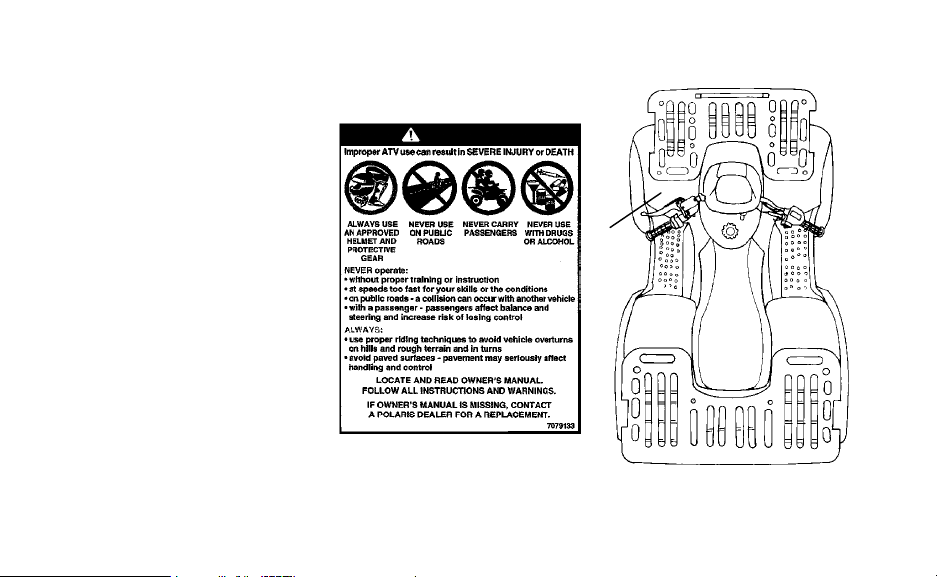
Warning and safety
decals have been
placed on the ATV for
the protection of the
operator. Read and
follow the instructions
on each decal
carefully. If any
safety decal becomes
illegible or comes off,
contact your Polaris
dealer for a free
replacement. The part
number is printed on
the decal.
WARNING
L

37
Safety Decals
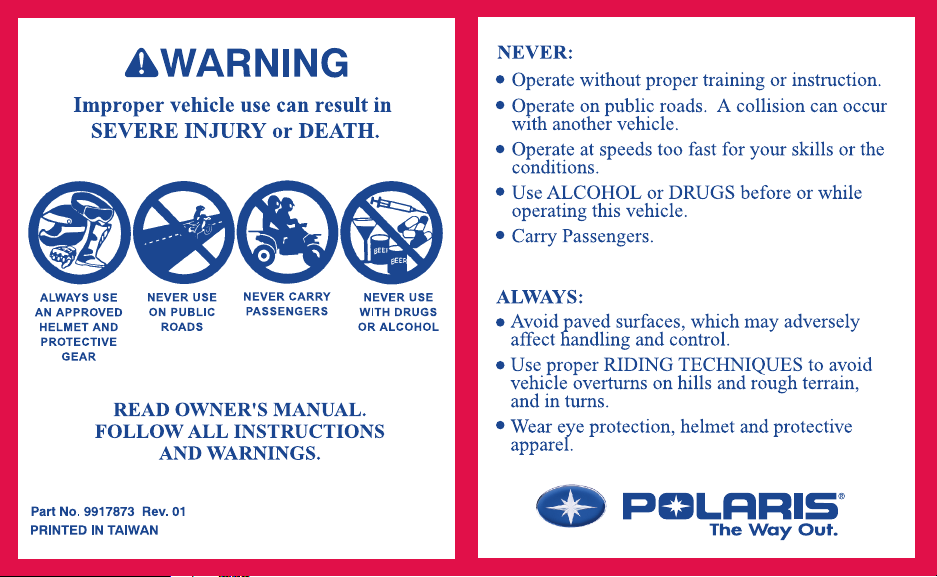
Improper ATV u se can result in SEVERE INJURY OR DEATH.
Always use an approved helmet and protective gear; Never use on public roads
Never carry passengers; Never use with drugs or alcohol
NEVER operate: without proper training or instruction; at speeds too fast for your skills or
the conditions; on public roads - a collision can occur with another vehicle; with a passenger
- passengers affect balance and steering and increase risk of losing control.
AL WAYS use proper riding techniques to avoid vehicle overturns on hills and rough terrain
and in turns; avoid paved surfaces - pavement may seriously affect handling and control
LOCATE AND READ OWNER’S MANUAL. FOLLOW ALL INSTRUCTIONS AND
W ARNINGS. IF OWNER’S MANUAL IS MISSING, CONTACT A POLARIS DEALER FOR
A REPLACEMENT.
38
Safety Decals
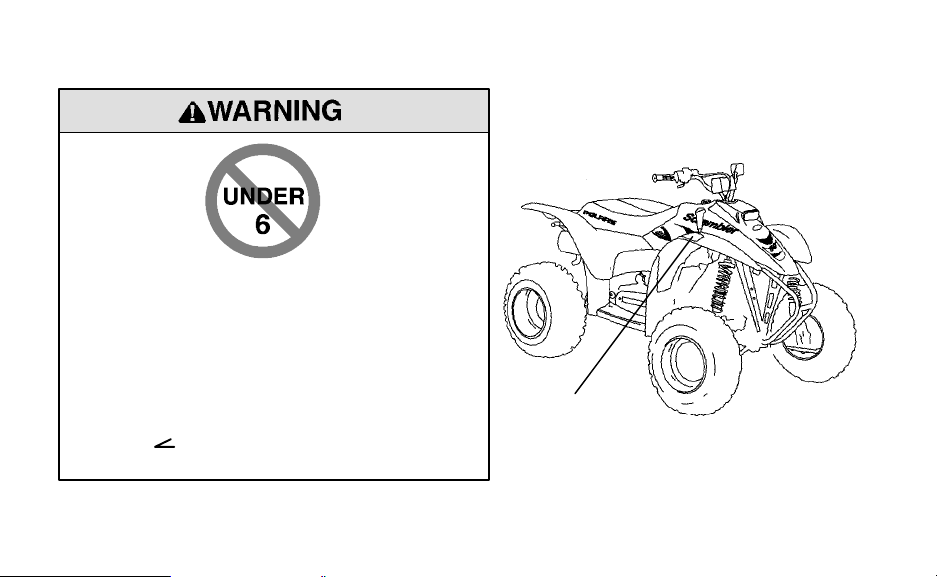
S Kids under age 6 should NEVER operate this ATV.
Kids under 6 have an increased chance of losing
control, which could result in severe injury or death.
S Adult supervision is required.
S Make sure operators follow Owner’s Manual and
labels.
S Make sure operators watch the safety video and
pass the ATV Training Course.
S Never operate this ATV on HILLS steeper than 15
degrees 15°. To prevent flipover on hilly terrain,
use throttle and brakes gradually.
L

39
Safety Decals
Scrambler 50 Age Warning Decal
S Kids under age 6 should NEVER operate this ATV. Kids under 6 have an increased
chance of losing control, which could result in severe injury or death.
S Adult supervision is required.
S Make sure operators follow Owner’s Manual and labels.
S Make sure operators watch the safety video and pass the ATV Training Course.
S Never operate this ATV on HILLS steeper than 15 degrees
15°. To prevent flipover on
hilly terrain, use throttle and brakes gradually.
40
Safety Decals
L
7079091
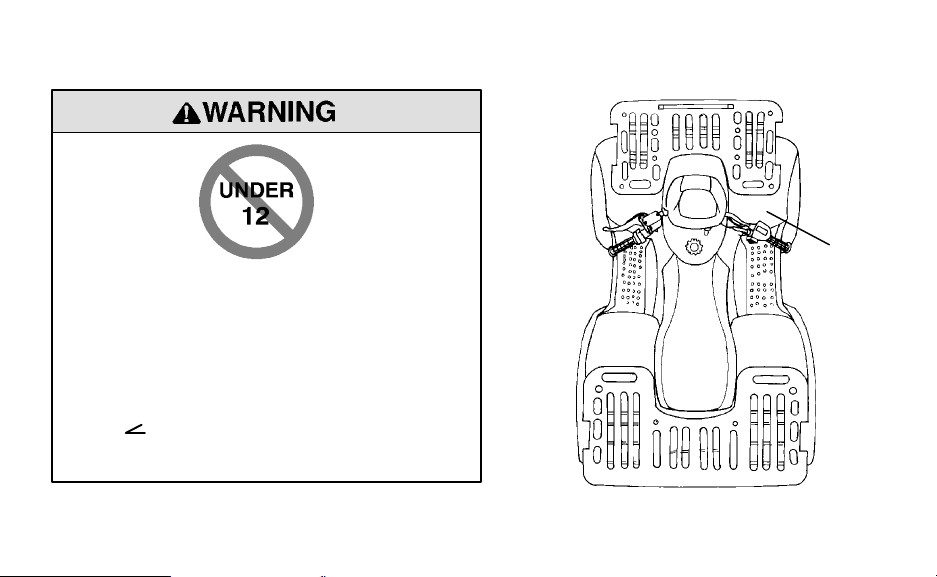
S Kids under age 12 should NEVER operate this ATV.
Kids under 12 have an increased chance of losing con-
trol, which could result in severe injury or death.
S Adult supervision is required.
S Make sure operators follow Owner’s Manual and labels.
S Make sure operators watch the safety video and pass
the ATV Training Course.
S Never operate this ATV on HILLS steeper than 15 de-
grees 15°. To prevent flipover on hilly terrain, use
throttle and brakes gradually.

41
Safety Decals
Scrambler 90/Sportsman 90 Age Warning Decal
S Kids under age 12 should NEVER operate this ATV. Kids under 12 have an increased
chance of losing control, which could result in severe injury or death.
S Adult supervision is required.
S Make sure operators follow Owner’s Manual and labels.
S Make sure operators watch the safety video and pass the ATV Training Course.
S Never operate this ATV on HILLS steeper than 15 degrees
15°. To prevent flipover on
hilly terrain, use throttle and brakes gradually.
42
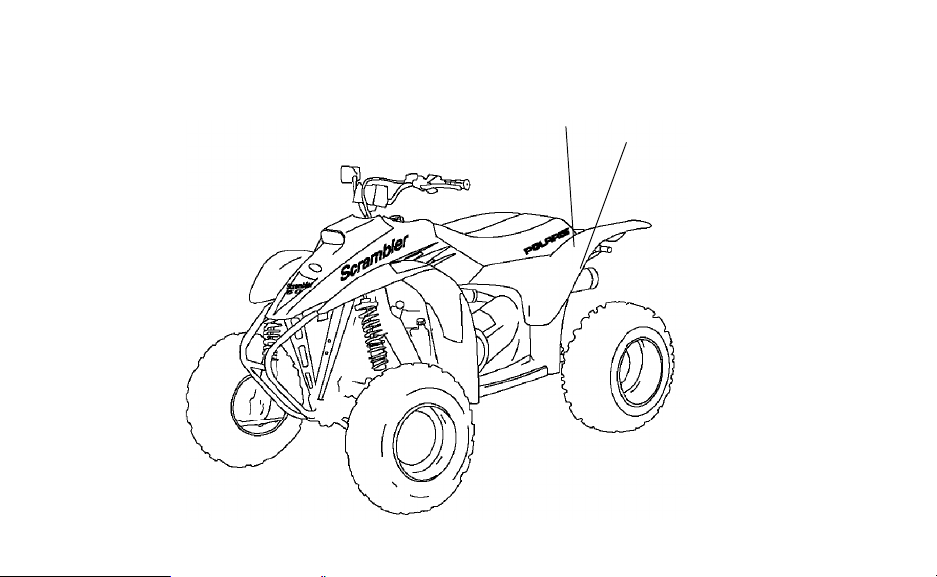
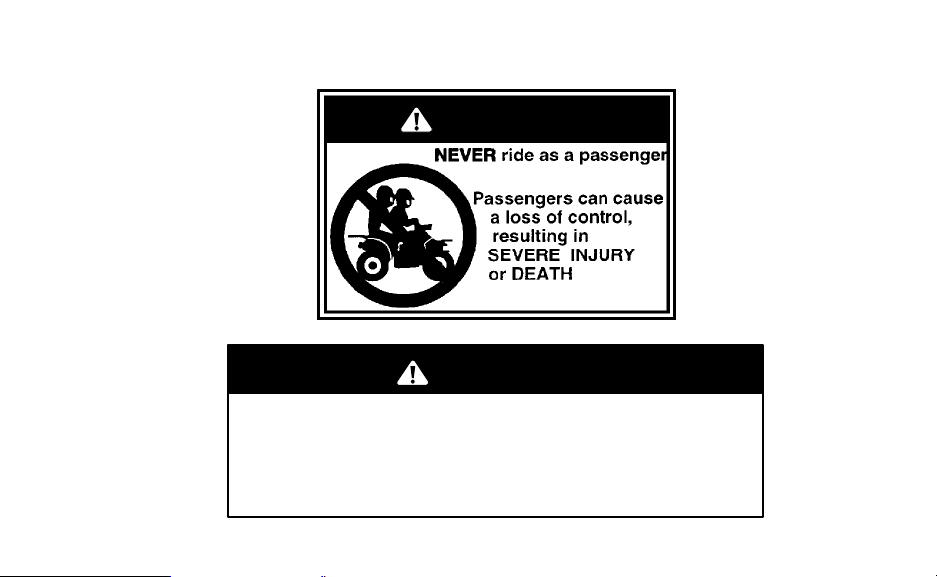
Safety Decals
2
1
43
Safety Decals
IMPROPER TIRE PRESSURE OR OVERLOADING can cause loss
of control, resulting in SEVERE INJURY OR DEATH.
TIRE PRESSURE (PSI): FRONT 3 REAR 3
Maximum Weight Capacity (Gross Vehicle Weight)
INCLUDING MACHINE, DRIVER AND CARGO IS _____ LBS.
2
WARNING
1
WARNING
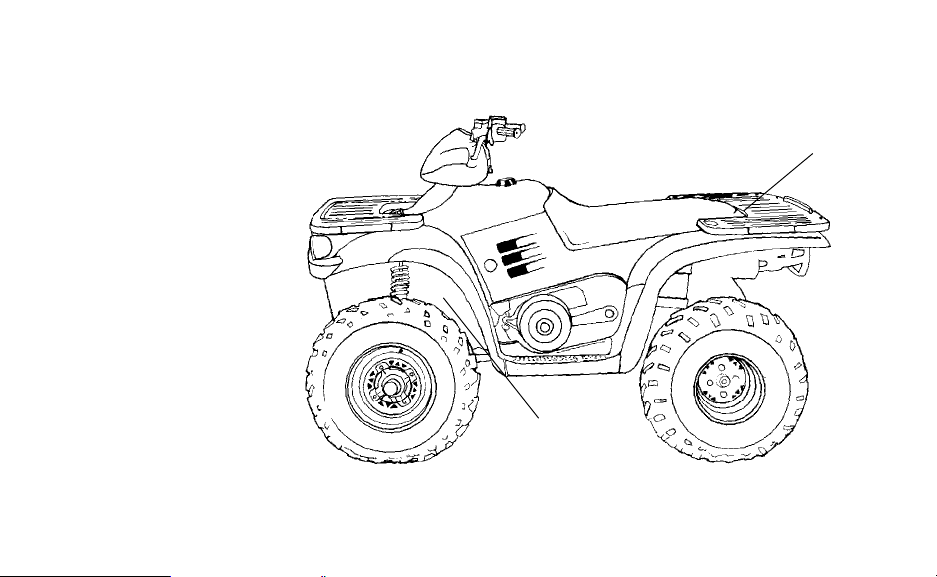
44
Safety Decals
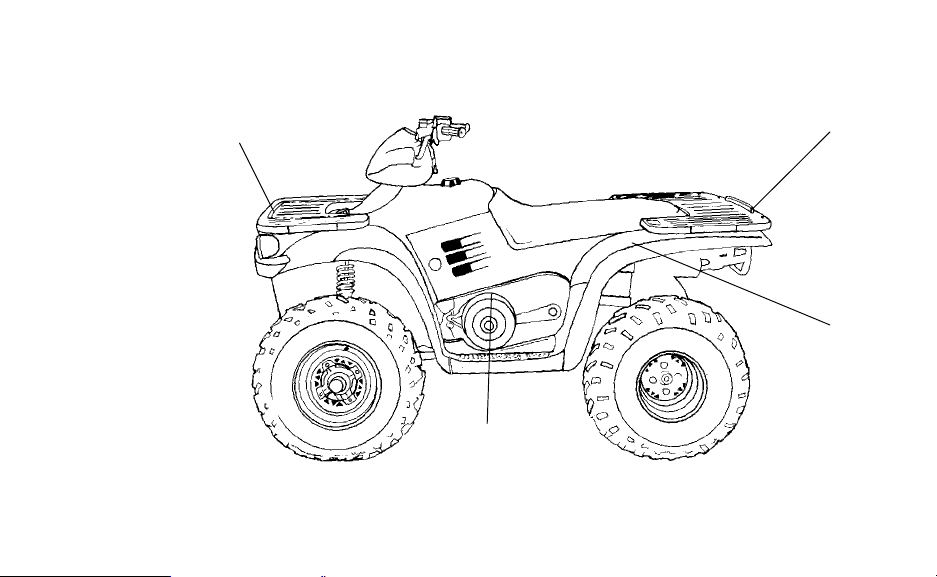
5
6
45
Safety Decals
ATTENTION
S Operation of this vehicle without the filter
element will severely damage the engine.
S Clean air filter often, more frequent clean-
ing required in dusty conditions.
5
S Specific carburetor jetting and
adjustments are required depending
on temperature and altitude. See your
Owner’s Manual.
Factory Setting:
40° to 80° F. at 0-3000 feet.
(5° to 27° C. at 0-900 meters)
(on air filter box)
(on rear of seat)
6
46
Safety Decals
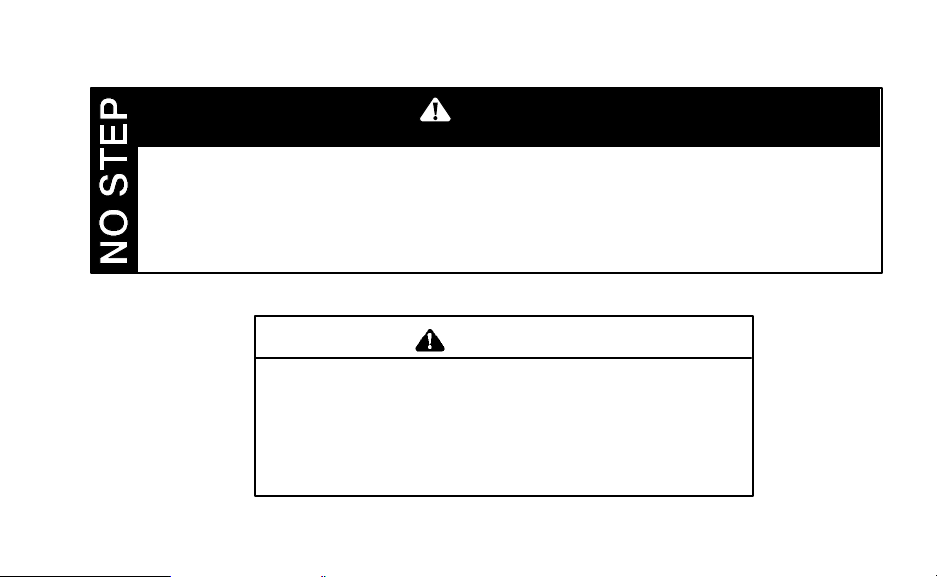
7
10
8
8
47
Safety Decals
7
Moving part s hazar d under belt- clutch guard. To prev ent s erious injury, do
not operat e vehicle with guard remov ed.
Do not modify engine or clutch. Doing so can cause part failure, possible
imbalance, and excessive engine RPM which can result in serious injury or death.
DO NOT TOW FROM RACK OR BUMPER.
Vehicle damage or tipover may result causing
severe injury or death.
Maximum Rack Loads: Front 10 lbs.; Rear 20 lbs.
8
(Sportsman 90)
WARNING
WARNING
48
Safety Decals
MANUFACTURED
IN TAIWAN
DATE:
VIN:
THIS VEHICLE IS AN ALL TERRAIN VEHICLE AND IS
NOT INTENDED FOR USE ON PUBLIC ROADS.
CE VÉHICULE EST UN VÉHICULE TOUT TERRAIN
QUI NiEST PAS DESTINÉ À ÊTRE UTILISÉ SUR
LES CHEMINS PUBLICS.
IMPROPER TIRE PRESSURE OR OVERLOADING can cause
loss of control resulting in SEVERE INJURY OR DEATH.
TIRE PRESSURE (PSI): FRONT 3 REAR 3
MAXIMUM WEIGHT CAPACITY (Gross Vehicle Weight
INCLUDING MACHINE, DRIVER AND CARGO IS 423 LBS.)
Reduce speed and allow greater distance for braking when
carrying cargo. Overloading or carrying tall, off-center, or unse-
cured loads will increase your risk of losing control. Loads
should be centered, carried as low as possible, and firmly se-
cured to the racks. With dual racks, load distribution 1/3 front
2/3 rear is best. For stability on rough or hilly terrain, reduce
speed and cargo. Be careful if load extends over the side of the
rack.
Read Owner’s Manual for more detailed loading information.
S
S
(Sportsman 90)
10
WARNING
9

49
Driver Warnings
Be sure to read all o f t h e fo llo win g warnings
about driving hazards and how to avoid them.
These warnings are provided for your child’s safety,
so be sure to explain to your young driver that
the followin g hazards MUST be avoid ed at all times.
50
Driver Warnings
POTENTIAL HAZARD
Operating this ATV without proper instruction.
WHAT CAN
HAPPEN
The risk of an accident is greatly increased if the operator does not know how to
operate the ATV properly in different situations and on different types of terrain.
HOW TO AVOID THE
HAZARD
Beginning and inexperienced operators should complete the certified training course
offered by Polaris Industries Inc. They should then regularly practice the skills learned
in the course and the operating techniques described in the Owner’s Manual.
For more information about the training course, contact an authorized ATV dealer or
call Polaris at 1-800-342-3764.
WARNING
51
Driver Warnings
POTENTIAL HAZARD
Failure to follow the age recommendations for this ATV.
WHAT CAN
HAPPEN
Use by children of ATVs that are not recommended for their age can lead to severe
injury or death of the child.
Even though a child may be within the age group for which some ATVs are
recommended, he or she may not have the skills, abilities, or judgment needed to
operate the ATV safely and may be involved in a serious accident.
HOW TO AVOID THE
HAZARD
Follow the age guidelines printed on your machine.
WARNING
52
Driver Warnings
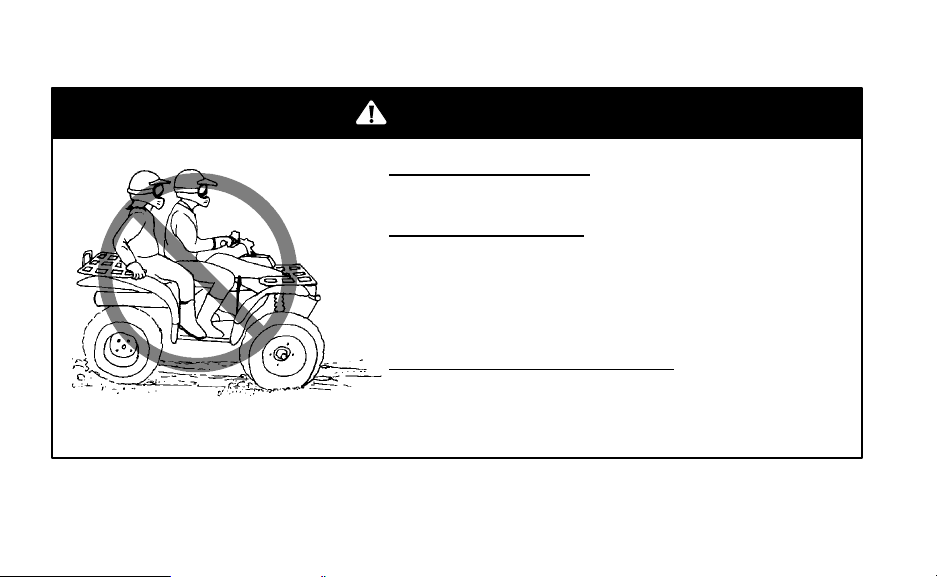
POTENTIAL HAZARD
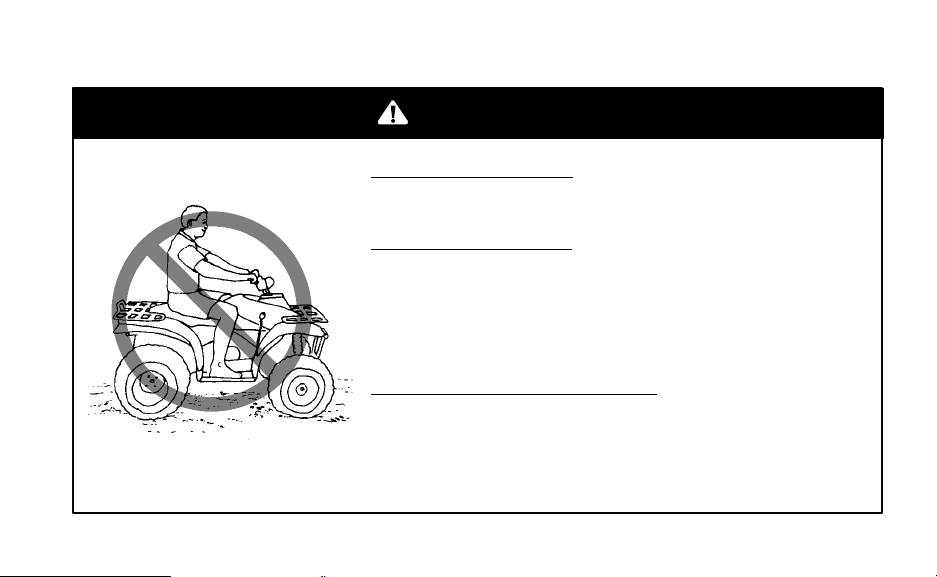
Carrying a passenger on this ATV.
WHAT CAN
HAPPEN
Greatly reduces your ability to balance and control
this ATV.
Could cause an accident, resulting in harm to you
and/or your passenger.
HOW TO AVOID THE
HAZARD
Never carry a passenger. The long seat is to allow
the operator to shift position as needed during
operation. It is not for passengers.
WARNING
53
Driver Warnings
POTENTIAL HAZARD
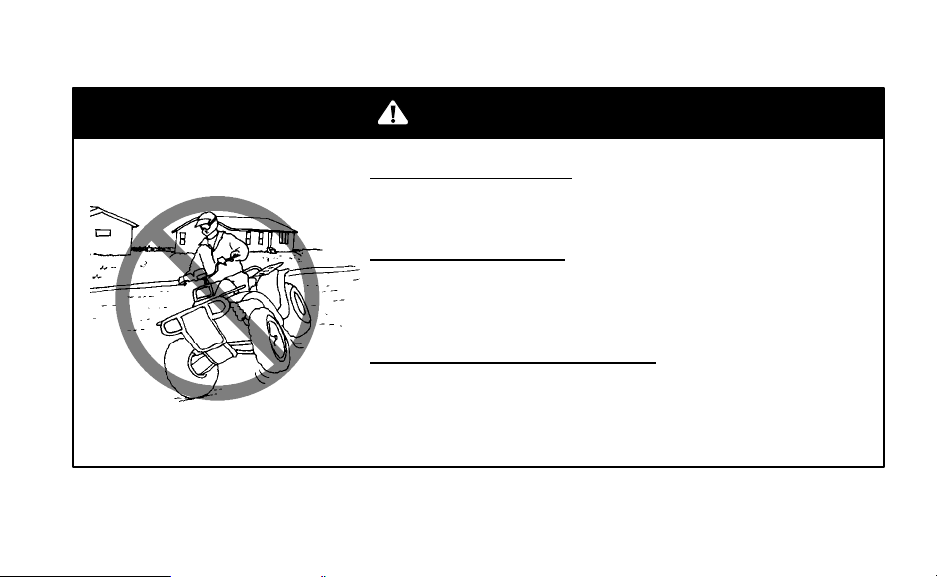
Operating this ATV on paved surfaces, including
sidewalks, paths, parking lots and driveways.
WHAT CAN
HAPPEN
The ATV tires are designed for off-road use. Paved
surfaces may seriously affect handling and control of
the ATV, and may cause the vehicle to go out of control.
HOW TO AVOID THE
HAZARD
Avoid operating the ATV on pavement whenever
possible. If you must ride on a paved surface, go slowly
and do not make sudden turns or stops.
WARNING
54
Driver Warnings
POTENTIAL HAZARD
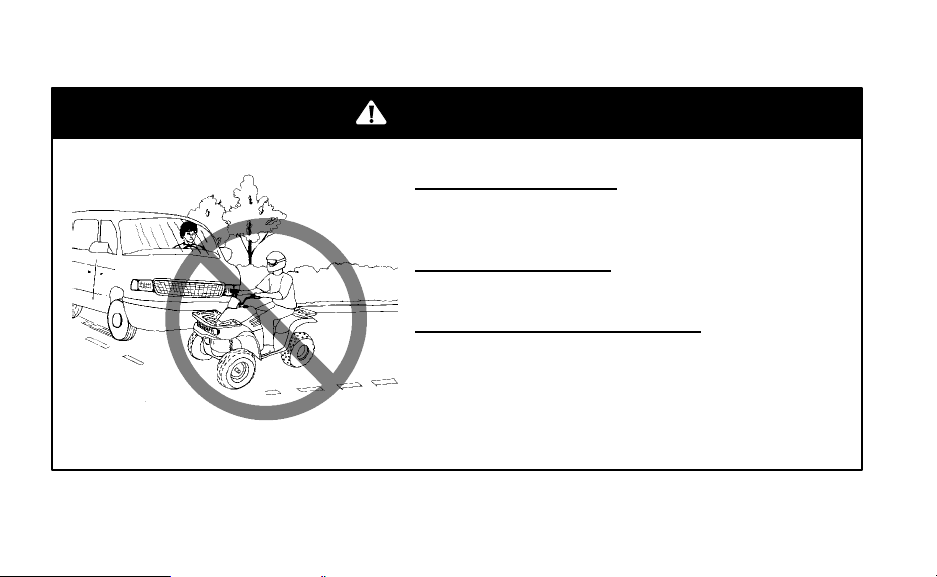
Operating this ATV on public streets, roads or
highways.
WHAT CAN
HAPPEN
You can collide with another vehicle.
HOW TO AVOID THE
HAZARD
Never operate this ATV on any public street,
road or highway, even a dirt or gravel one.
In many states it is illegal to operate ATVs on
public streets, roads and highways.
WARNING
55
Driver Warnings
POTENTIAL HAZARD: Operating this ATV without
wearing an approved helmet, eye protection and
protective clothing.
WHAT CAN HAPPEN:
Operating without an approved
helmet increases your chances of a severe head injury
or death in the event of an accident.
Operating without eye protection can result in an
accident and increases your chances of a severe
injury in the event of an accident.
HOW TO AVOID THE
HAZARD
Always wear an approved helmet which fits properly.
You should also wear: eye protection (goggles or face
shield); gloves; boots; long-sleeved shirt or jacket; and
long pants.
WARNING
56
Driver Warnings
POTENTIAL HAZARD
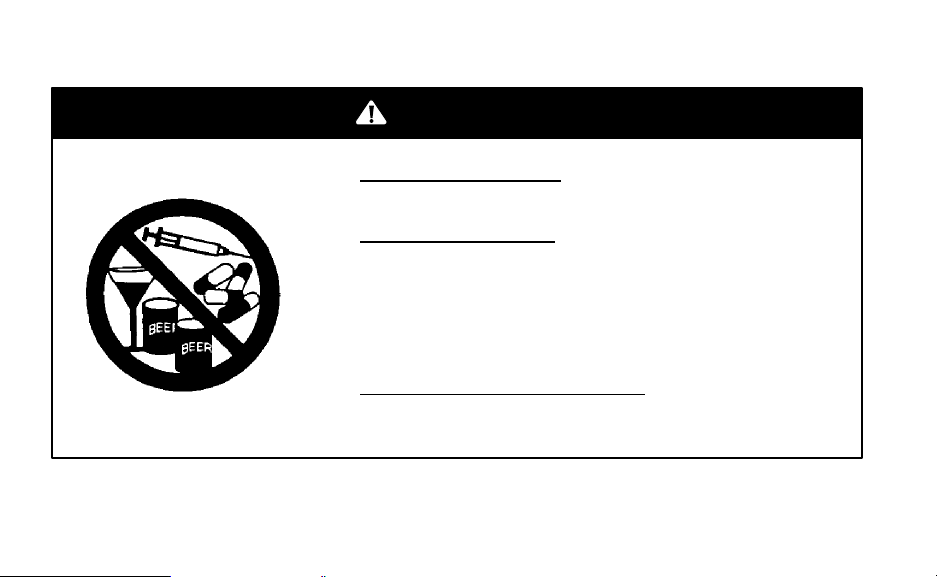
Operating this ATV after consuming alcohol or drugs.
WHAT CAN
HAPPEN
Could seriously affect your judgment.
Could cause you to react more slowly.
Could affect your balance and perception.
Could result in an accident.
HOW TO AVOID THE
HAZARD
Never consume alcohol or drugs before or while
driving this ATV.
WARNING
57
Driver Warnings
POTENTIAL HAZARD
Operating this ATV at excessive speeds.
WHAT CAN
HAPPEN
Increases your chances of losing control of the ATV, which can result in an
accident.
HOW TO AVOID THE
HAZARD
Always travel at a speed which is proper for the terrain, visibility and operating
conditions; and your experience.
WARNING
58
Driver Warnings
WARNING
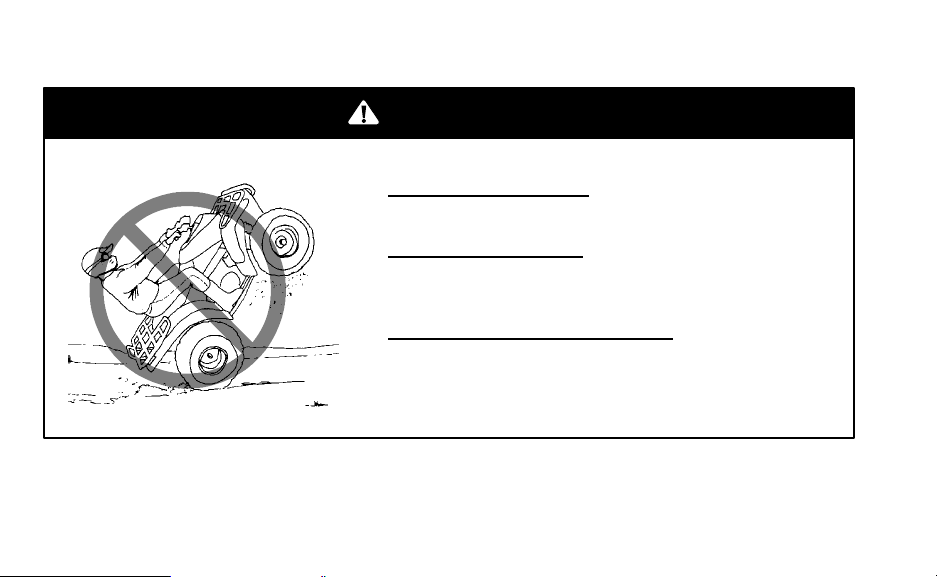
POTENTIAL HAZARD
Attempting wheelies, jumps and other stunts.
WHAT CAN
HAPPEN
Attempting stunts increases the chance of an
accident, including an overturn.
HOW TO AVOID THE
HAZARD
Never attempt wheelies, jumps, or other stunts.
Avoid exhibition driving (don’t show off).
59
Driver Warnings
POTENTIAL HAZARD
Failure to inspect the ATV before operating.
Failure to properly maintain the ATV.
WHAT CAN
HAPPEN
Increases the possibility of an accident or equipment damage.
HOW TO AVOID THE
HAZARD
Always inspect your ATV each time you use it to make sure the ATV is in safe
operating condition.
Always follow the inspection and maintenance procedures and schedules
described in the Owner’s Manual.
WARNING
60
Driver Warnings
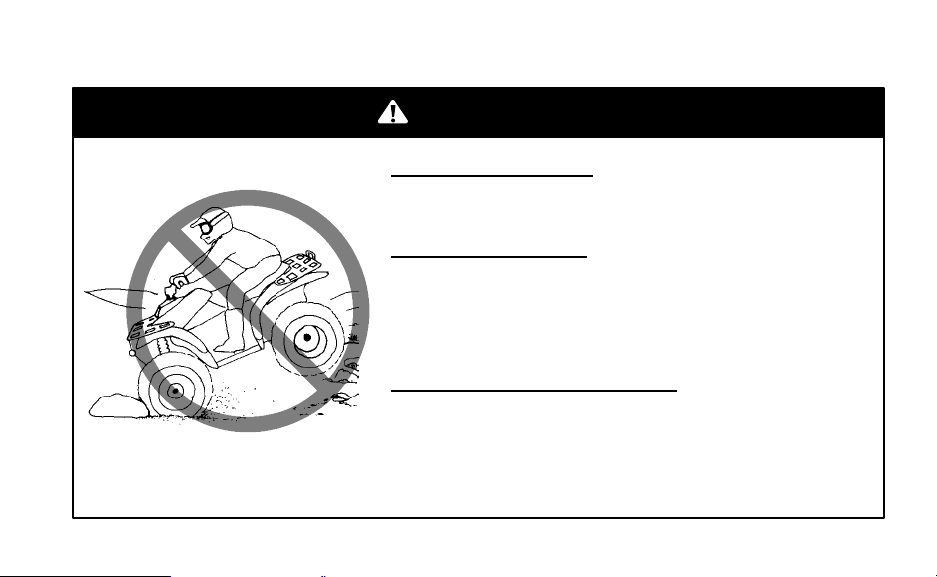
POTENTIAL HAZARD
Removing hands from handlebars or feet from footrests during operation.
WHAT CAN
HAPPEN
Removing even one hand or foot can reduce your ability to control the ATV or could
cause you to lose your balance and fall off the ATV. If you remove a foot from the
footrest, your foot or leg may come into contact with the rear wheels, which could
injure you or cause an accident.
HOW TO AVOID THE
HAZARD
Always keep both hands on the handlebars and both feet on the footrests of your
ATV during operation.
WARNING
61
Driver Warnings
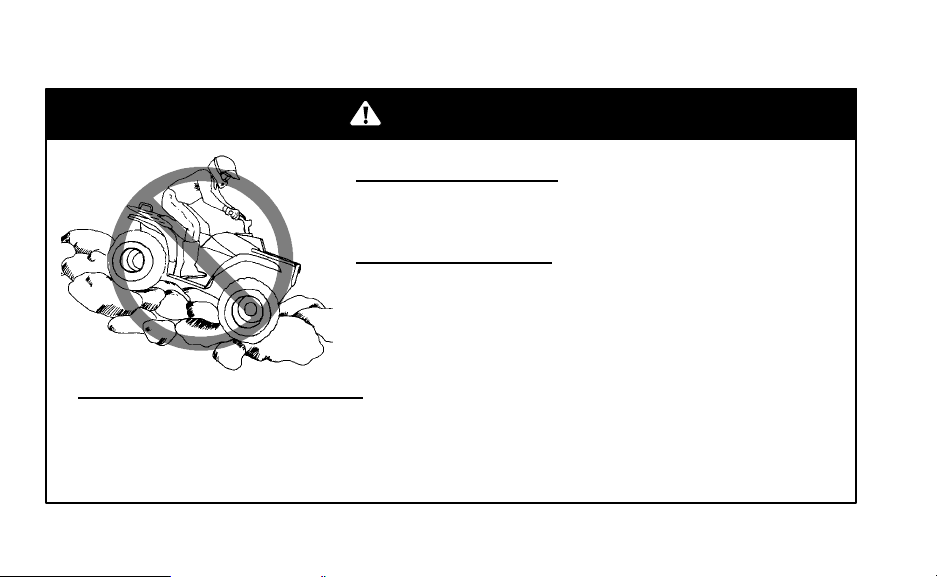
POTENTIAL HAZARD
Failure to use extra care when operating this ATV on
unfamiliar terrain.
WHAT CAN
HAPPEN
You can come upon hidden rocks, bumps, or holes,
without enough time to react.
Could result in the ATV overturning or going out of
control.
HOW TO AVOID THE
HAZARD
Go slowly and be extra careful when operating on
unfamiliar terrain.
Always be alert to changing terrain conditions when
operating the ATV.
WARNING
62
Driver Warnings
WARNING
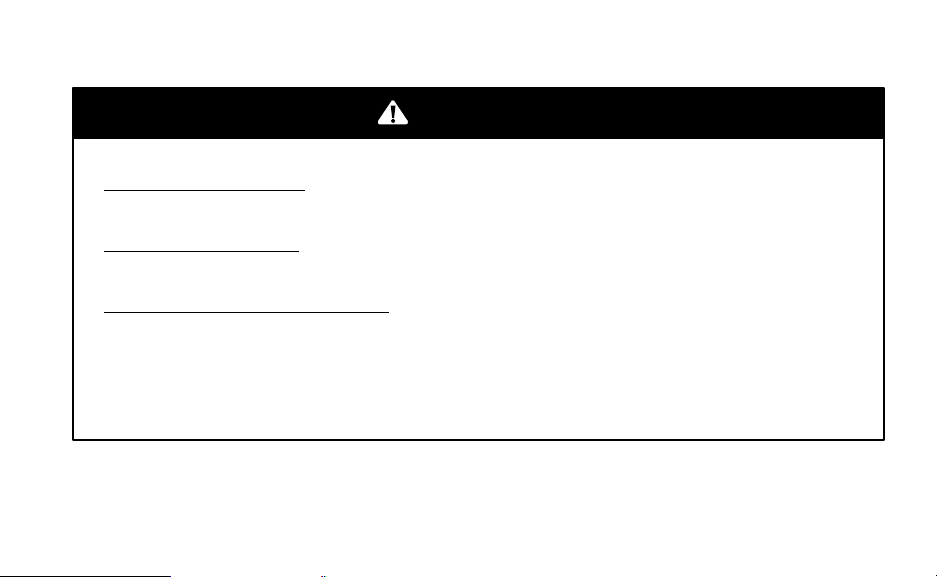
POTENTIAL HAZARD
Failure to use extra caution when operating on
excessively rough, slippery or loose terrain.
WHAT CAN
HAPPEN
Operating on excessively rough, slippery or loose
terrain could cause loss of traction or loss of control,
which could result in an accident or overturn.
HOW TO AVOID THE
HAZARD
Do not operate on excessively rough, slippery or loose terrain until you’ve learned
and practiced the skills necessary to control the ATV on such terrain.
Always use extra caution on rough, slippery or loose terrain.
63
Driver Warnings
WARNING
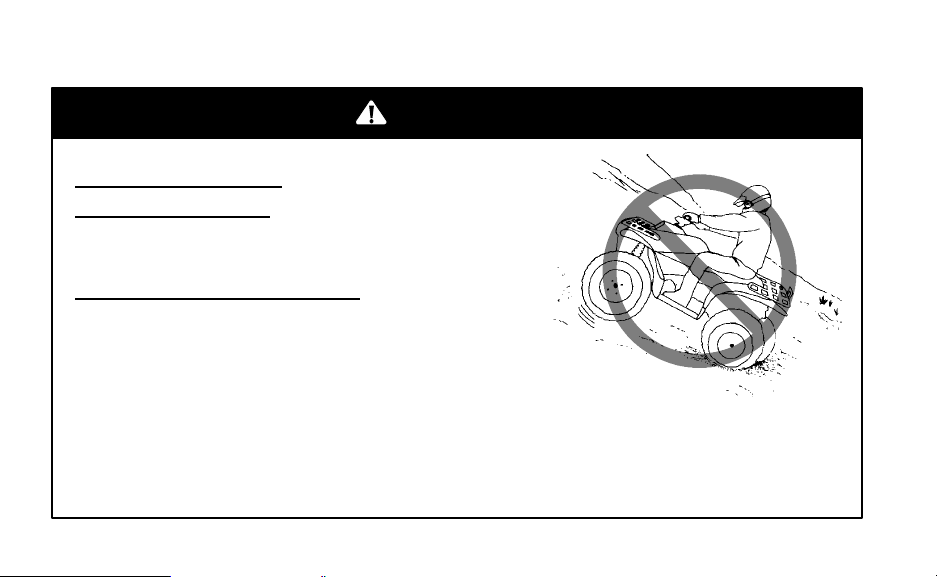
POTENTIAL HAZARD
T urning improperly.
WHAT CAN
HAPPEN
Improper turns could cause loss of control and lead to a collision or overturn.
HOW TO AVOID THE
HAZARD
Always follow proper procedures for turning as described in the owner’s manual.
Practice turning at slow speeds before attempting to turn at faster speeds.
Never turn at excessive speed.
64
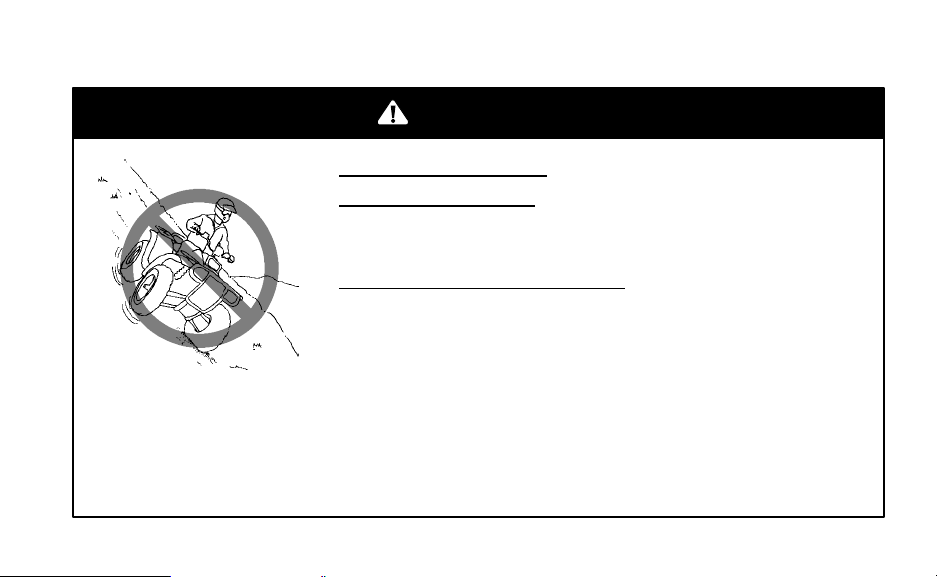
Driver Warnings
POTENTIAL HAZARD: Climbing hills improperly.
WHAT CAN HAPPEN
Improper hill climbing could cause loss of control or
overturn.
HOW TO AVOID THE
HAZARD
Always follow proper procedures for climbing hills
as described in the Owner’ s Manual beginning on
page 106.
Always check the terrain carefully before you start up any hill. Never climb hills with
excessively slippery or loose surfaces. Shift your weight forward.
Never open the throttle suddenly. The ATV could flip over backwards. Never go over
the top of any hill at high speed. An obstacle, a sharp drop, or another vehicle or
person could be on the other side of the hill.
WARNING
65
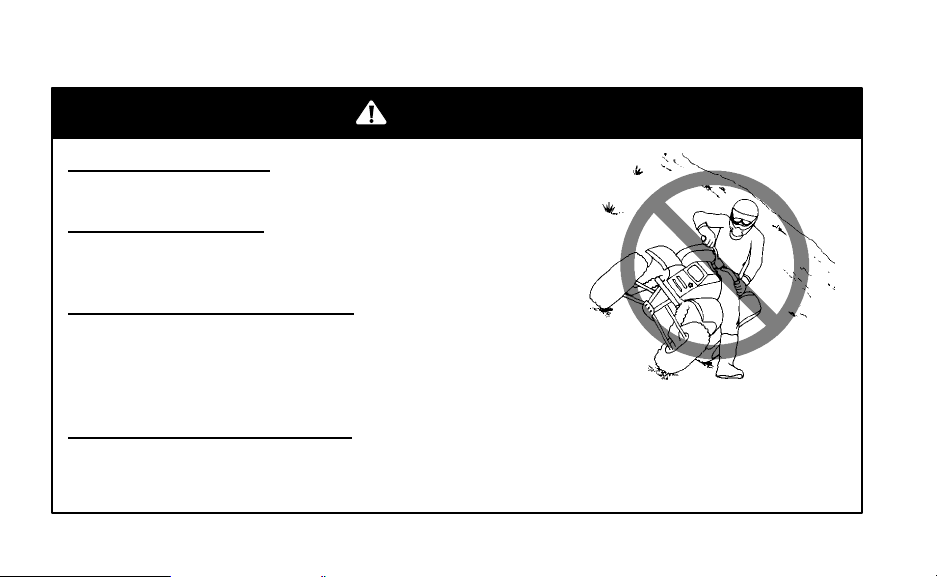
Driver Warnings
Always check the terrain carefully before you start down any hill. Shift your weight
backward. Never go down a hill at high speed.
Avoid going down a hill at an angle, which would cause the vehicle to lean sharply to
one side. Go straight down the hill when possible.
WARNING
POTENTIAL HAZARD: Going down a hill improperly.
WHAT CAN HAPPEN
Driving downhill improperly could cause loss of control or
ATV overturn.
HOW TO AVOID THE
HAZARD
Always follow proper procedures for going down hills as
described in the Owner’ s Manual. See page 112.
NOTE: A special technique is required when braking as
you go downhill.
66
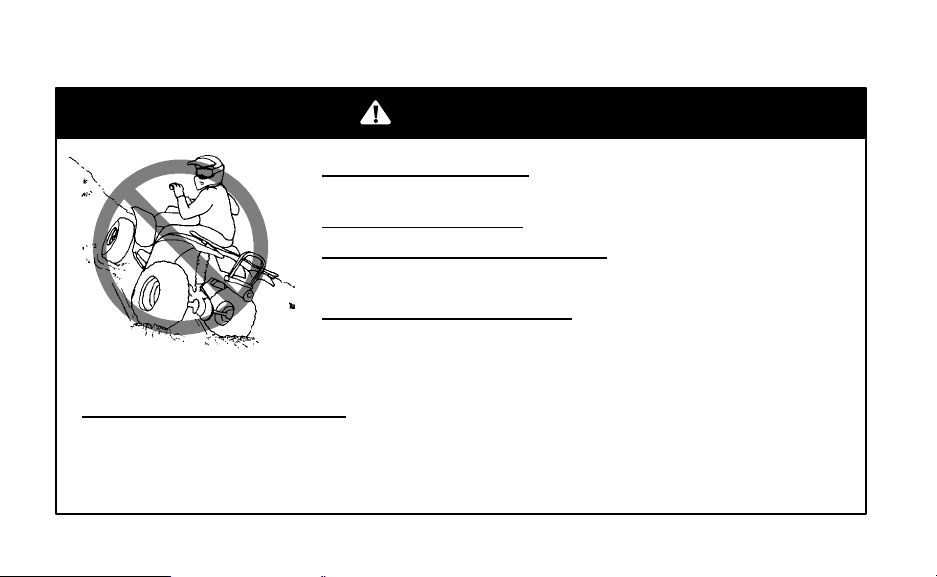
Driver Warnings
POTENTIAL HAZARD
Improperly crossing hills and turning on hills.
WHAT CAN
HAPPEN
Improperly crossing or turning as hills could
cause loss of control or overturn.
HOW TO AVOID THE
HAZARD
Never try to turn the ATV around on any hill until you’ve
mastered the turning technique (on level ground) as
described in the owner’s manual. See page 110. Use
extra caution when turning on any hill. Avoid crossing the side of a steep hill.
When crossing the side of a
hill:
Always follow proper procedures as described in the owner’s manual. Avoid hills with
excessively slippery or loose surfaces. Shift your weight to the uphill side of the ATV.
WARNING
67
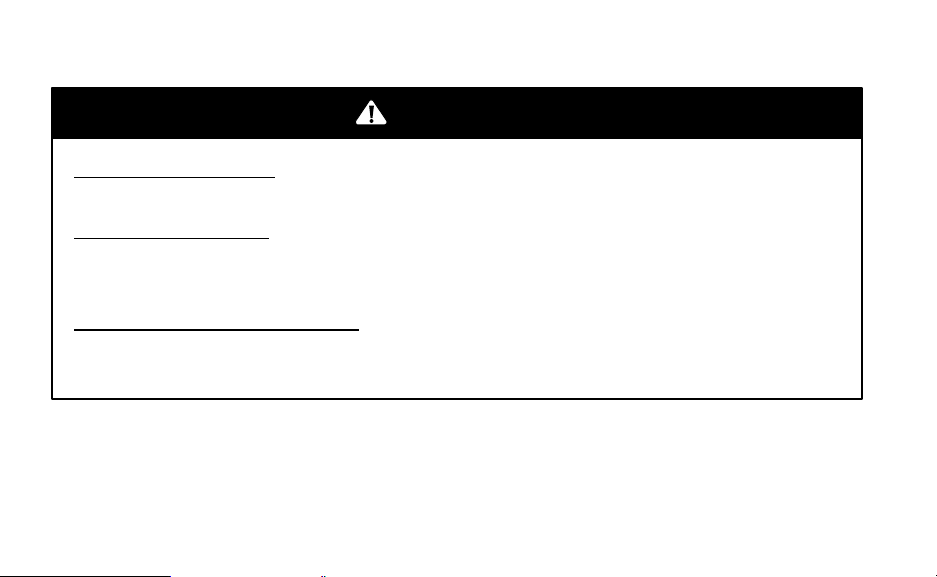
Driver Warnings
If you begin rolling backwards: Keep weight uphill. Never apply engine power. Never
apply the rear brake while rolling backwards. Apply the front brake slowly. When fully
stopped, apply rear brake as well, and then lock the parking brake. Dismount on uphill
side, or to either side if pointed straight uphill. T urn the ATV around and remount,
following the procedure described in the Owner’ s Manual. See page 110.
WARNING
POTENTIAL HAZARD: Stalling, rolling backwards or
improperly dismounting while climbing a hill.
WHAT CAN HAPPEN:
The ATV could overturn.
HOW TO AVOID THE HAZARD
Maintain steady speed when climbing a hill.
If you lose all forward speed
: Keep your weight uphill. Apply
the front brakes gradually (right lever). When fully stopped,
apply the rear brake as well (left lever) and then lock the
parking brake.
68
Driver Warnings
WARNING
POTENTIAL HAZARD
Skidding or sliding.
WHAT CAN
HAPPEN
Skidding or sliding can cause loss of control.
If the tires regain traction unexpectedly, the ATV could overturn.
HOW TO AVOID THE
HAZARD
On slippery surfaces such as ice, travel slowly and use extra caution to reduce the
chance of skidding or sliding out of control.
69
Driver Warnings
WARNING
POTENTIAL HAZARD
Improperly operating over obstacles.
WHAT CAN
HAPPEN
Operating over obstacles could cause loss of control or overturn.
HOW TO AVOID THE
HAZARD
Before operating in a new area, check for obstacles.
Avoid operating over large obstacles such as rocks and fallen trees when possible. If
unavoidable, use extreme caution and always follow proper procedures as outlined in
the owner’s manual.
70
Driver Warnings
POTENTIAL HAZARD
Riding on frozen lakes and rivers.
WHAT CAN
HAPPEN
Severe injury or death can result if the ATV and/or the operator break through the ice.
HOW TO AVOID THE
HAZARD
Never ride your ATV on a frozen body of water.
WARNING
71
Driver Warnings
WARNING
POTENTIAL HAZARD
Operating the ATV through deep or fast-flowing water.
WHAT CAN
HAPPEN
T ires may float, causing loss of traction and loss of control, which could lead to an
accident or overturn.
HOW TO AVOID THE
HAZARD
Avoid operating the ATV through deep or fast-flowing water. If it’s unavoidable to enter
water that exceeds the recommended maximum depth (see page 114), travel slowly,
balance your weight carefully, avoid sudden movements, and maintain a slow and
steady forward motion. Do not make sudden turns or stops, and do not make sudden
throttle changes.
Wet brakes may have reduced stopping ability. Always test the brakes after leaving
water. If necessary, apply them several times to let friction dry out the pads.
72
Driver Warnings
WARNING
POTENTIAL HAZARD
Operating this ATV with improper tires, or with improper or uneven tire pressure.
WHAT CAN
HAPPEN
Use of improper tires, or operation of the ATV with improper or uneven tire pressure,
could cause loss of control or accident.
HOW TO AVOID THE
HAZARD
Always use the size and type of tires specified in the owner’s manual supplement for
the ATV.
Always maintain proper tire pressure as described in the owner’s manual
supplement.
73
Driver Warnings
POTENTIAL HAZARD
Overloading the ATV.
WHAT CAN
HAPPEN
Overloading the ATV could cause changes in handling, which could lead to an
accident.
HOW TO AVOID THE
HAZARD
Never exceed the stated load capacity for this ATV.
Cargo should be properly distributed and securely attached.
WARNING
74
Driver Warnings
After a rollover or an accident, have a qualified service dealer check the complete
machine including, but not limited to, brakes, throttle and steering for possible damage.
Safe operation of this rider active vehicle requires good judgement and physical skills.
Persons with cognitive or physical disabilities who operate this vehicle have an increased
risk of overturns and loss of control which could result in severe injury or death.
WARNING
WARNING
WARNING
Leaving the keys in the ignition can lead to unauthorized use of the vehicle resulting in
serious injury or death. Always remove the ignition key when the vehicle is not in use.
75
Driver Warnings
WARNING
POTENTIAL HAZARD
Operating the ATV with improper modifications.
WHAT CAN
HAPPEN
Improper installation of accessories or modification of the ATV may cause changes in
handling which could lead to an accident.
HOW TO AVOID THE
HAZARD
Never modify the ATV through improper installation or use of accessories. All parts and
accessories added to the vehicle must be genuine Polaris Industries Inc. or equivalent
components designed for use on this ATV and should be installed and used according
to approved instructions. See your authorized Polaris ATV dealer for more information.
76
Vehicle Identification Numbers
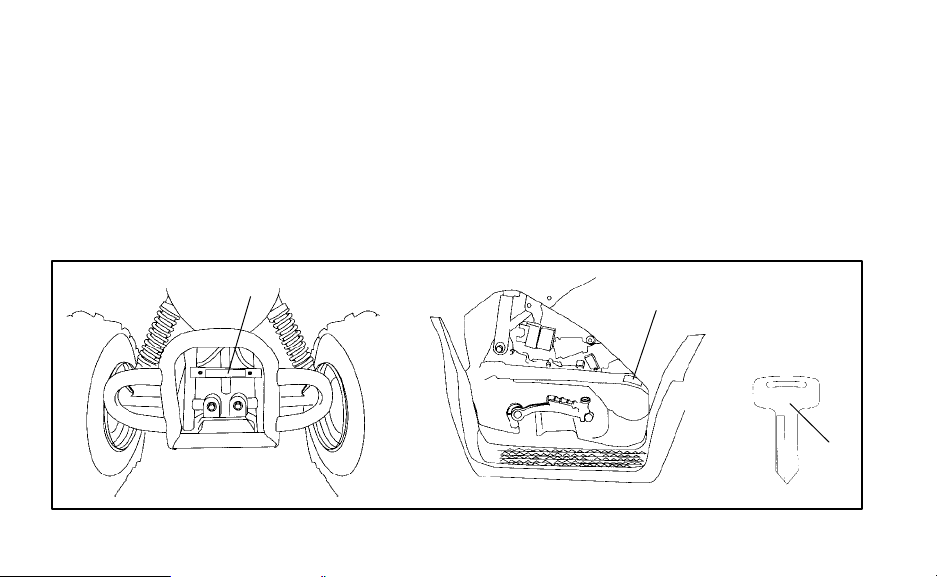
The frame vehicle identification number (VIN)(1) and engine serial number (2) are
important for model identification when registering your vehicle, when obtaining insurance,
and when ordering replacement parts. In the event your vehicle is stolen, these numbers are
essential to the recovery and identification of your vehicle.
Remove the spare key and store it in a safe place. Your key can be duplicated only by
mating a Polaris key blank with one of your existing keys. If both keys are lost, the ignition
switch must be replaced. See your Polaris dealer.
1
2
31XX
3

77
Vehicle Identification Numbers
NOTE: Record your vehicle’s ID numbers and key number (3) in the spaces provided.
Frame VIN (on the front of the frame below the steering post):
Engine Serial Number (on the left side of the engine crankcase):
Vehicle Model Number:
Key Number:

78
NOTES
79
Controls
Main Switch
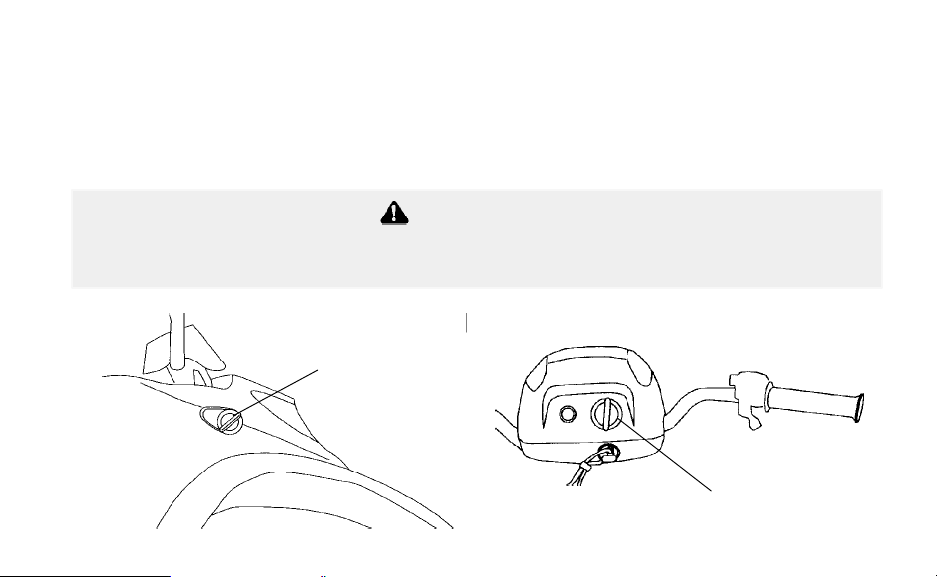
The m ain switch is located on the right-hand side of the Scrambler (A) and on the pod of
the S portsman (B). This switch i s operated with a key and must be turned clockwise to the
ON position before starting t he engine.
Leaving the keys in the ignition can lead to unauthorized use of the vehicle resulting in
serious injury or death. Always remove the ignition key when the vehicle is not in use.
WARNING
A
B

80
Controls
Engine Stop Switch
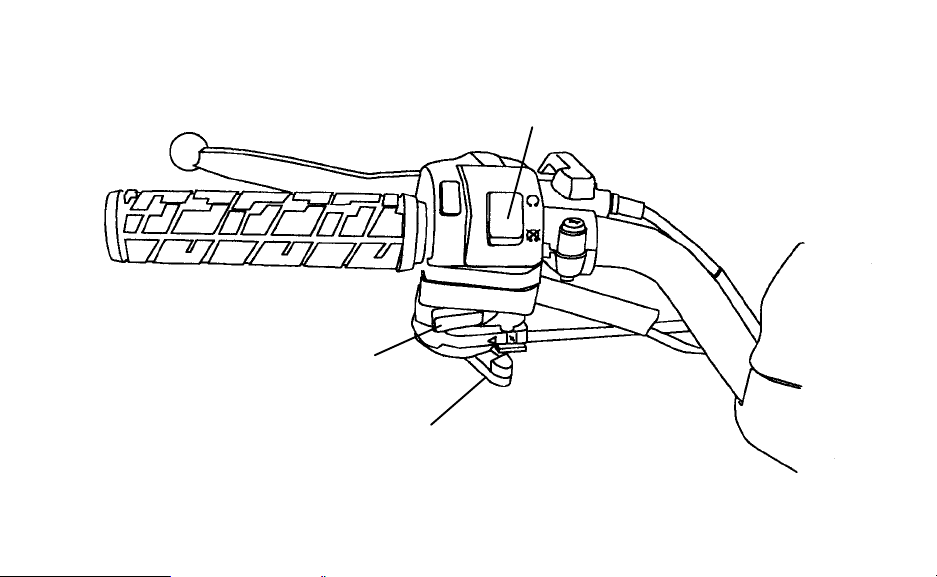
The stop switch (C) is located on the top of the left handlebar. The engine will not start or
run when the stop switch is down, in the OFF position. Its purpose is to provide the
operator with a quick means of engine shutdown in case of stuck throttle or other
emergency. NOTE: Both the main switch and the emergency engine stop switch shut off
all electrical power to the entire vehicle. To stop t he engine quickly, push the stop switch
down.
Choke Lever
The choke lever (D) is located on the bottom of t he left handlebar. The choke is used when
starting a cold engine. Push the choke lever to the left before starting t he engine. When the
engine starts, gradually return the choke lever to t he OFF position as the engine warms up
and runs smoothly.
Engine Start Button
The start button (E) is located slightly above the choke lever. To start the engine, make
sure the tether strap is securely plugged into the machine and attached to the rider’s right
wrist. Turn the key to the ON position, set the parking brake, push t he start button up to
the ON position and press the start button.
81
Controls
C
D
E
82
Controls
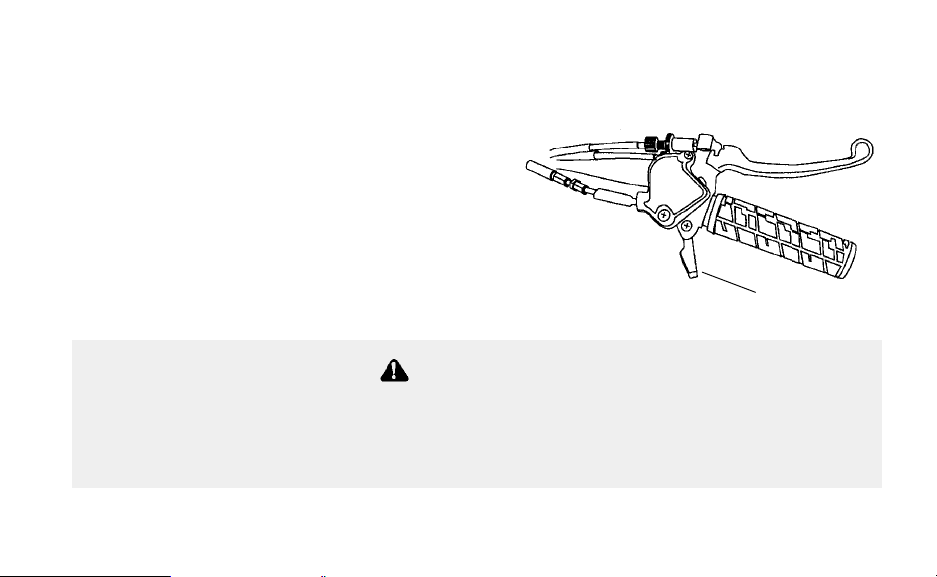
Throttle Controls
4
Operating an ATV with sticking or improperly operating throttle controls could
cause an accident and lead to severe injury or death.
Never start or operate an ATV with a sticking or improperly operating throttle.
Always contact your dealer for service if throttle problems arise.
Failure to check or maintain proper operation of the throttle system can result in
an accident if the throttle lever sticks during operation. Always check the lever for
free movement and return before starting the engine. Also check occasionally
during operation.
WARNING
83
Controls
Throttle Lever
Engine speed and vehicle movement are
controlled by pressing the throttle lever (A).
The throttle lever is spring loaded. Engine
speed returns to idle when the lever is released.
This ATV is equipped with an Electronic Throttle
Control (ETC), which is designed to reduce the
risk of a frozen or stuck throttle. If the throttle cable should
stick in an open position when the operator releases the throttle
lever, the engine will stop and power to the rear wheels will cease.
A
The Electronic Throttle Control (ETC) stops the engine in the event of a throttle
system malfunction and is provided for your safety. Do not attempt to modify the
ETC system or replace it with any after market throttle mechanism.
WARNING
84
Controls
Brakes
To activate the rear brake (A), squeeze the left-hand lever toward the handlebar. The front
brakes (B) are activated by squeezing the lever on the right-hand handlebar.
Applying only one brake could cause loss of control and result in serious injury
or death. Always apply both brakes at the same time.
WARNING
A
B
85
Controls
Brakes
Setting the Parking Brake
1. Squeeze the left-hand brake lever (A).
2. Push the park brake lock (B) down.
This will prevent the lever from
returning to the released position.
3. To release the parking brake lock,
squeeze and release the brake lever.
The parking brake will release
automatically.
A
B
B
Operating the ATV while the parking brake is engaged could cause an accident
resulting in serious injury or death. It could also result in driveline or engine damage.
Always be sure to disengage the parking brake before operating the ATV.
WARNING

86
Controls
Brakes
Parking Brake
NOTE: This vehicle has a PVT system that’s always in forward. Always lock the park
brake before starting the engine.
Always lock the parking brake whenever the vehicle is l eft unattended.
Since the transmission is always in forward gear, activating the throttle to warm the engine
will make the machine move forward if the park brake is not locked.
After the engine has warmed enough for operation, release t he park brake and gently apply
the throttle to move forward.
87
Controls
Lights
Indicator Lights
Each Polaris ATV has different indicator lights. Your model has a low oil warning light.
When the red dot is illuminated, i t means the oil level is getting too low.
Polaris Youth ATVs are not equipped with lights. The ATVs are designed for off-road
use only and must not be ridden on streets or highways. Use caution and drive at
reduced speeds in conditions of reduced visibility. Do not operate this ATV after dark.
WARNING
88
Controls
Fuel System
Gasoline is highly flammable and explosive under certain conditions.
S Always exercise extreme caution whenever handling gasoline.
S Always refuel with the engine stopped, and outdoors or in a well ventilated area.
S Do not smoke or allow open flames or sparks in or near the area where refueling
is performed or where gasoline is stored.
S Do not overfill the tank. Do not fill the tank neck.
S If gasoline spills on your skin or clothing, immediately wash it off with soap and
water and change clothing.
S Never start the engine or let it run in an enclosed area. Engine exhaust fumes are
poisonous and can cause loss of consciousness or death in a short time.
S Turn the fuel valve off whenever the ATV is stored or parked.
WARNING
89
Controls
Fuel System
Gas Cap
The fuel t ank filler cap (A) is located directly below
the handlebars. The tank has a capacity of 1.3
gallons (5 liters). Use unleaded gasoline with a
minimum pump octane of 87.
A
The engine exhaust from this product contains
chemicals known to cause cancer, birth defects
or other reproductive harm.
Operate this vehicle only outdoors or in
well-ventilated areas.
WARNING

90
Controls
Fuel System
Fuel V alve
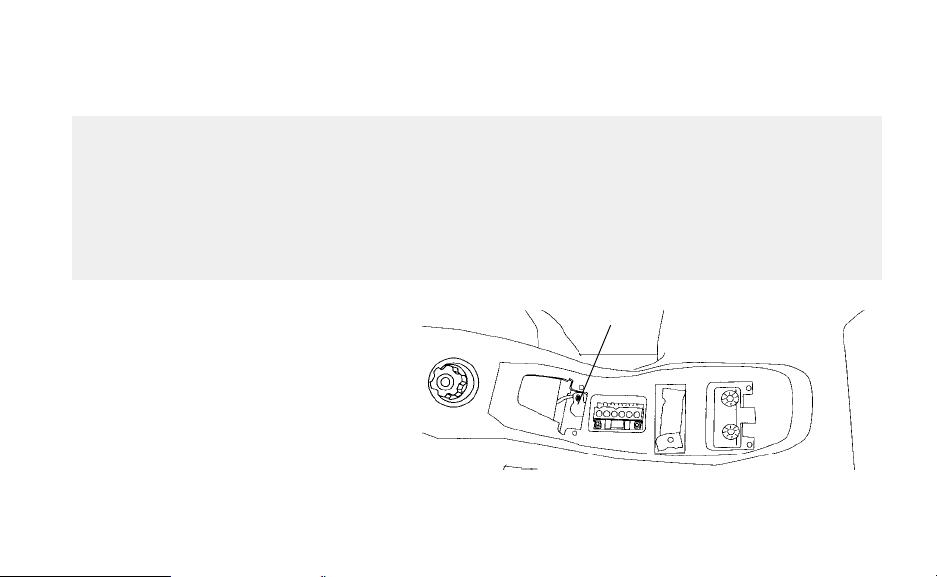
The fuel valve (A) is located on the right-hand side of the ATV.
It has three positions:
OFF: For vehicle storage and when transporting.
ON: For normal operation.
RES: For reserve supply if main supply is exhausted.
NOTE: There’s about a 7-10 mile (11-16 km) range on reserve
gas. Always refill the gas tank as soon as possible after using the
main supply. Always return the valve to the ON position after
refueling.
Fuel Filter
The P olaris ATV is equipped with an in-line fuel filter. This filter should be replaced by
your dealer after every 100 hours of operation or annually. Do not attempt to clean the fuel
filter.
RES
ON
OFF
91
Controls
Oil System
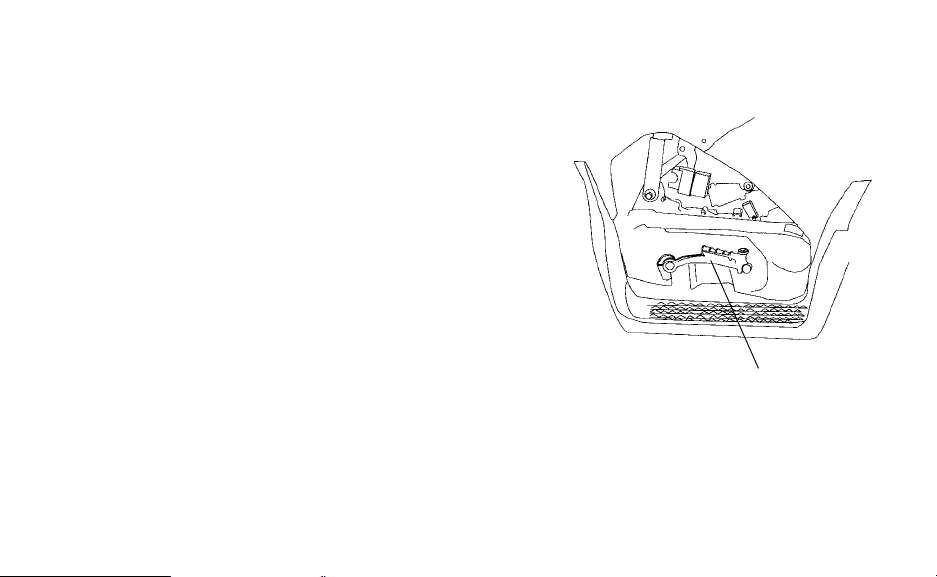
The oil tank (A) is located under
the seat and has a capacity of 1.1
quarts (1 liter). Always top off the
oil level when refueling.
NOTE: See page 21 for seat
removal instructions.
CAUTION
Mixing brands or using a non-recommended oil may cause serious engine damage.
We recommend the use of Polaris Premium 2-cycle oil or Polaris Premium Gold
Synthetic 2-cycle oil. Never substitute or mix oil brands.
To avoid serious engine damage, always top off the oil level when refueling.
A

92
Controls
Oil System
Polaris 2-Cycle Oil
Polaris has a family of premium oils available for use in all of our products. We highly
recommend the use of Polaris Premium 2-cycle oil or Premium Gold Synthetic 2-cycle oil.
Polaris Premium 2-cycle lubricants are the most advanced formulation of oils specifically
designed for today’s 2-cycle engines. Months of lab and field tests have resulted in a new
generation of 2-cycle lubricants. Polaris Premium 2-cycle lubricants provide additives for
2-cycle engines lacking in today’s fuel that keep ring grooves cleaner for l ess ring sticking
and provide improved overall engine cleanliness. With new generation l ubricity
technology, they excel in meeting the lubrication demands of today’s high performance
2-cycle engines. These are optimum oils recommended for liquid cooled and air cooled
2-cycle engines. We believe these oils are the best available in t he market today.
93
Controls
Kick-Start L ever
If the battery becomes too weak to start the engine,
the kick-start lever will allow you to start t he engine
until the battery is serviced.
4. Be sure the ATV is on a l evel surface with the
parking brake locked.
5. Fold out the kick-start lever (A) on the left-hand
side of the ATV.
6. Make sure the stop switch is in the RUN
position and turn the key to ON.
7. Place your foot on the kick-start, and then thrust
your heel downward to crank the engine.
8. After the engine has started, fold t he kick-start
lever back into place.
A

94
Break-in Period
The break in period for your new Polaris ATV is the length of time it takes to use the first
tank of gas. No single action on your part is as important as following the procedures for a
proper break-in. Careful treatment of a new engine will result in more efficient
performance and longer life for the engine. Perform the following procedures carefully.
1. Mix 6.4 ounces of recommended oil to two gallons of gasoline i n an appropriate gas
container and fill the fuel tank as outlined on pages 88-89. NOTE: After the break-in
period the oil injection system provides the necessary engine lubrication without the
need for pre-mixed fuel.
CAUTION
Excessive heat build-up during the first three hours of operation will damage close-fitted
engine parts. Do not operate at full throttle or high speeds for extended periods during
the first three hours of use.
Use of any lubricants other than those recommended by Polaris may cause serious
engine damage. We recommend the use of Polaris lubricants for your vehicle.

95
Break-in Period
2. Fill the oil tank with Polaris-recommended oil. NOTE: Always be sure to top off the
oil level whenever refueling.
3. Drive slowly at first. Select an open area that allows room to familiarize yourself with
vehicle operation and handling.
4. Vary the throttle positions. Do not operate at sustained idle.
5. Perform regular checks on fluid levels, controls and areas outlined on the daily pre-ride
inspection. See page 96.
6. After the first tank of pre-mixed fuel has been used, check to see if the oil level in the
oil tank has dropped, indicating that the oi l pump is functioning properly. If the level
has not dropped, see your dealer for oil pump bleeding and then repeat the pre-mix
procedure.
96
Daily Pre-Ride Inspection
Use the following checklist to make sure the ATV is in proper working condition before
each use.
Item/Inspection Procedure
1. Tires - Check condition and pressures.
2. Fuel and oil tanks - Fill both tanks to their proper l evels.
3. All brakes - Check operation and adjustment.
4. Throttle - Check for free operation and proper closing.
5. Brakelight - Check for proper operation.
WARNING
If a proper inspection is not done before each use, severe injury or death could result.
Always inspect the ATV before each use to ensure it’s in proper operating condition.

97
Daily Pre-Ride Inspection
6. Engine stop switch - Check for proper function.
7. Wheels - Check for tightness of wheel nuts and axle nuts; check that axle nuts are
secured by cotter pins.
8. Drive chain - Condition and slack; refer to drive chain adjustment.
9. Air cleaner element - Check for dirt; clean or replace.
10. Steering - Check for free operation noting any unusual looseness in any area.
11. Loose parts - Visually inspect vehicle for any damaged components or loose nuts/bolts
or fasteners.
12. Riding gear - Wear a helmet, goggles and protective clothing.

98
Starting the Engine
1. Set the parking brake and turn the fuel tank valve to ON.
2. Sit on the vehicle and attach the tether strap to the ATV and to your right wrist.
Engine exhaust contains poisonous carbon monoxide and can cause loss of
consciousness resulting in severe injury or death. Never run an engine in an
enclosed area.
WARNING
Operating the ATV immediately after starting could cause engine damage.
Allow the engine to warm up for several minutes before operating.
CAUTION

99
Starting the Engine
NOTE: The choke is fully on when the lever is pushed completely to the left. The choke
is off when the lever is pushed completely to the right. The choke can be adjusted
gradually, depending on how much choke is needed for starting.
3. If the engine is cold, use full choke by pushing the choke lever all the way to the left.
A warm engine will not require the use of the choke.
4. Turn the engine stop switch to RUN, then turn the ignition key to ON. NOTE: Do not
press the throttle while starting the engine.
5. Squeeze the rear brake lever and press the starter button.
NOTE: The rear brake lever must be engaged or the engine won’t s tart.
6. Activate the starter for a maximum of five seconds, releasing the button when the
engine starts. If it doesn’t start, release the starter, wait five seconds, t hen activate for
another five seconds. R epeat until the engine starts.
7. If the engine slows or stops, position the choke lever half way to allow proper engine
warm up. Vary the R PM slightly with the throttle to aid in warm up.
8. When the engine idles smoothly, push the choke lever all the way to the right.
100
Driving Safely
Safe Riding Gear
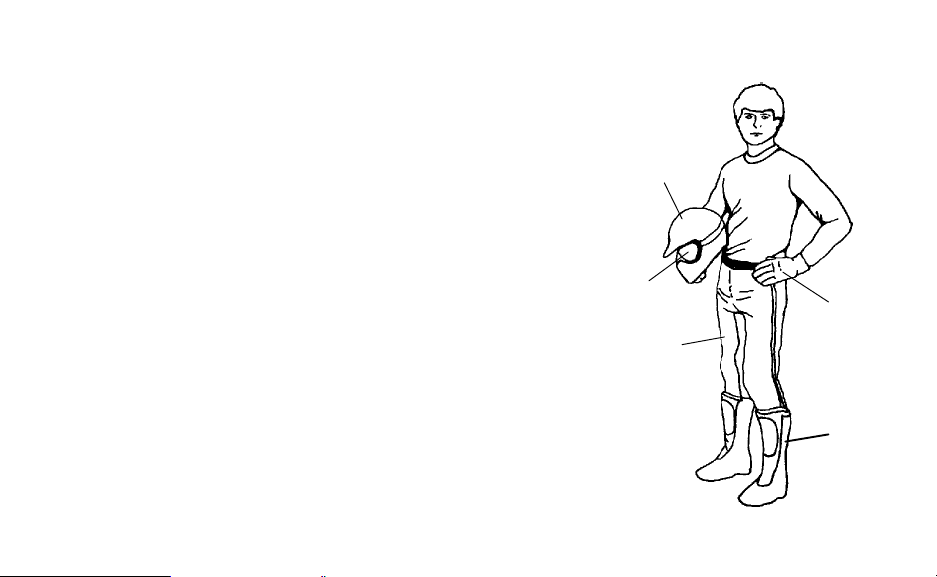
Always wear clothing suited to the type of riding. ATV
riding requires special protective clothing for comfort and
to reduce the chance of injury.
1. Helmet
Your helmet is the most important piece of protective gear
for safe riding. A helmet can prevent a severe head injury.
Select an approved helmet that meets or exceeds your
state’s safety standards and bears either the Department of
Transportation (DOT) label, the American National
Standards Institute label (ANSI z90.1), or the Snell
Memorial Foundation label.
1
2
3
4
5

101
Driving Safely
2. Eye Protection
Do not depend on sunglasses for proper eye protection. A pair of goggles or a helmet face
shield offer t he best protection for your eyes. They should be kept clean and be of
shatterproof design (bearing the markings z2.1 or VESC 8).
3. Gloves
Off-road style gloves with knuckle pads are the best for comfort and protection.
4. Boots
The best footwear is a pair of strong over-the-calf boots with heels, like moto-cross boots.
5. Clothing
Always wear long sleeves and long pants to protect arms and legs. Riding pants with
kneepads and a jersey with shoulder pads provide the best protection.
102
Driving Safely
Driving Procedure
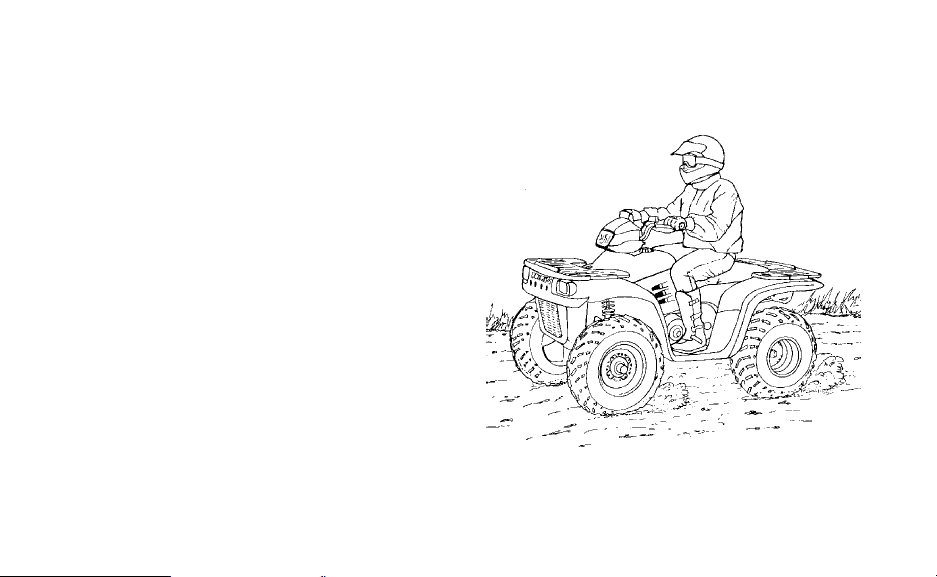
1. Sit upright with both feet on the footrests
and both hands on the handlebars.
2. Start the engine and allow it t o warm up.
3. Check your surroundings and determine
your path of travel.
4. Release the parking brake.
5. Slowly depress the throttle with your
right thumb and begin driving.
Vehicle speed is controlled by the
amount of throttle opening.
6. Drive slowly, practice maneuvering
and using the throttle and brakes on
level surfaces.
103
Driving Safely
Making Turns
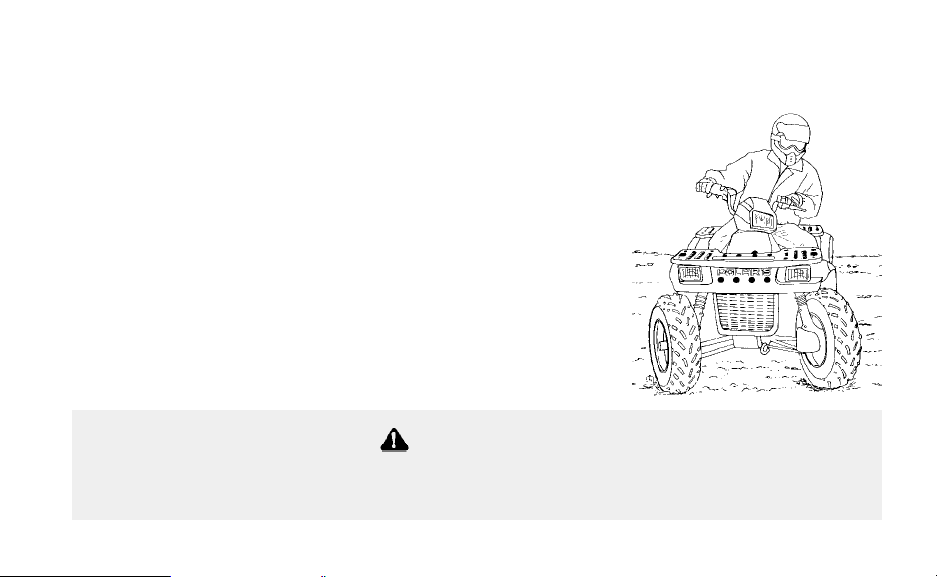
Your ATV is equipped with a solid rear axle, which drives both
rear wheels equally at all times. This means that the wheel on
the outside of the turn must travel a greater distance than the
inside wheel when turning and the inside tire must slip
traction slightly. To turn, steer in the direction of the
turn, leaning your upper body to the inside of the turn
while supporting your weight on the outer footrest.
This technique alters the balance of traction between
the rear wheels, allowing the turn to be made smoothly.
NOTE: Practice making turns at slow speeds.
WARNING
T urning at sharp angles or at excessive speeds can result in vehicle overturn and
lead to serious injury. Avoid turning at sharp angles. Never turn at high speeds.
104
Driving Safely
Driving o n Slippery Surfaces
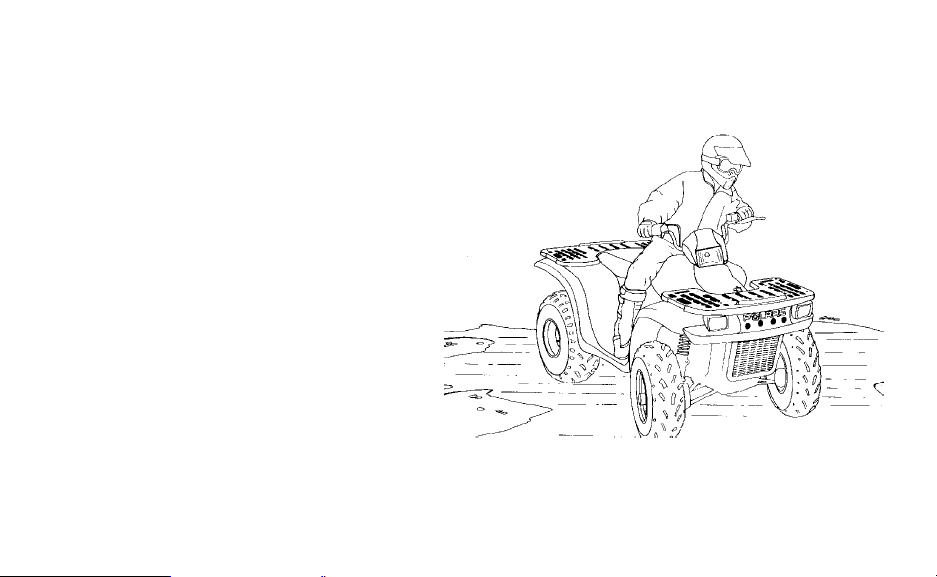
WARNING
Failure to exercise care when operating on slippery surfaces can result in loss of tire
traction and cause loss of control, accident, and serious injury or death.
Never apply the brakes during a skid.
Do not operate on excessively slippery surfaces.
Always reduce speed and use additional caution.
105
Driving Safely
Whenever riding on slippery surfaces such as wet trails
or loose gravel, or during freezing weather , follow
these precautions:
1. Slow down when entering slippery areas.
2. Maintain a high level of alertness, reading
the t rail and avoiding quick, sharp
turns, which can cause skids.
3. Correct a skid by turning the
handlebars i n the direction of the
skid and shifting your body
weight forward.
106
Driving Safely
Driving Uphill
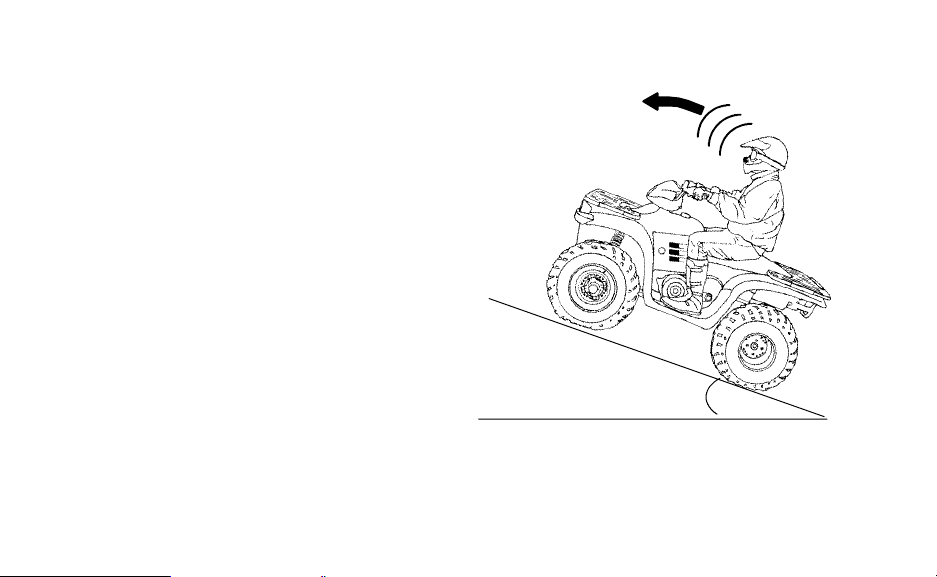
WARNING
Braking and handling are greatly affected when operating in hilly terrain. Improper
procedure could cause loss of control or overturn and result in serious injury or
death.
Avoid climbing steep hills (15_ maximum).
Use extreme caution when operating on hills, and follow proper operating procedures
outlined in the owner’s manual.
107
Driving Safely
Whenever traveling uphill, follow
these precautions:
1. Always travel straight uphill.
2. Avoid steep hills (15_ maximum).
3. Keep both feet on the footrests.
4. Transfer your weight forward.
5. Proceed at a steady rate of speed
and throttle opening.
6. Remain alert and be prepared to
take emergency action. This may
include quick dismounting of the
vehicle.
15_ Max imum

108
Driving Safely
Driving Across Hillsides
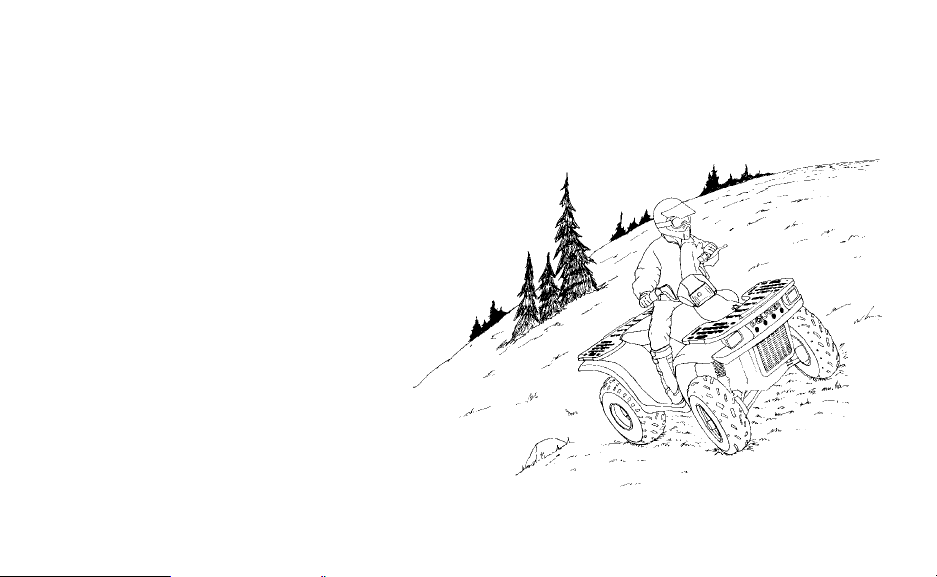
Improperly crossing hills or turning on hills can result in loss of control or vehicle
overturn, resulting in severe injury or death. Avoid crossing the side of a hill when
possible. Follow proper procedures as outlined in the owner’s manual.
WARNING
109
Driving Safely
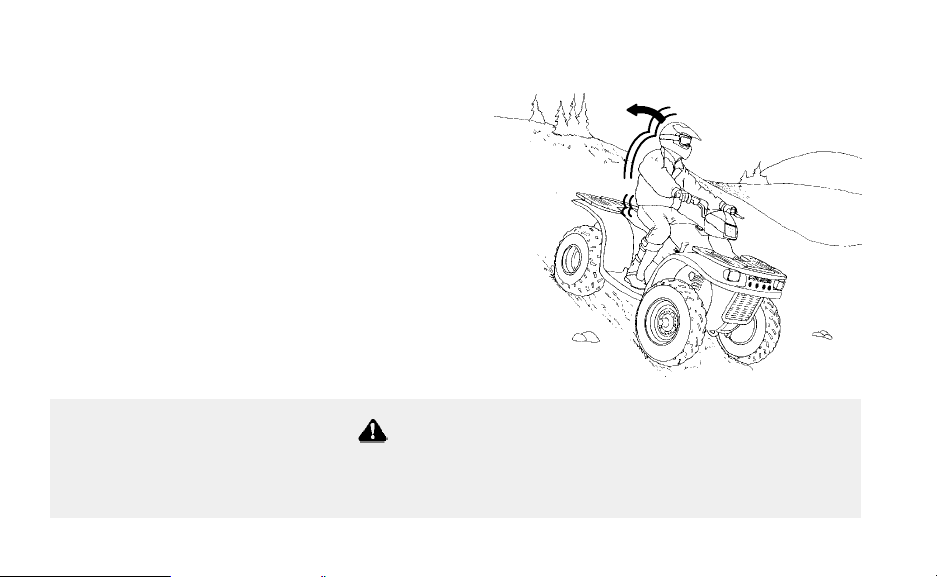
Sidehilling can be a dangerous type of driving and should be avoided if at all possible. If
you do enter into a situation where sidehilling is necessary, follow these precautions:
1. Slow down.
2. Lean into the hill, transferring
your upper body weight uphill
while keeping your feet on the
footrests.
3. Steer slightly into the hill to
maintain direction.
NOTE: If the vehicle begins to
tip, quickly turn the front
wheel downhill, if possible, or
dismount on the uphill side
immediately!
110
Driving Safely
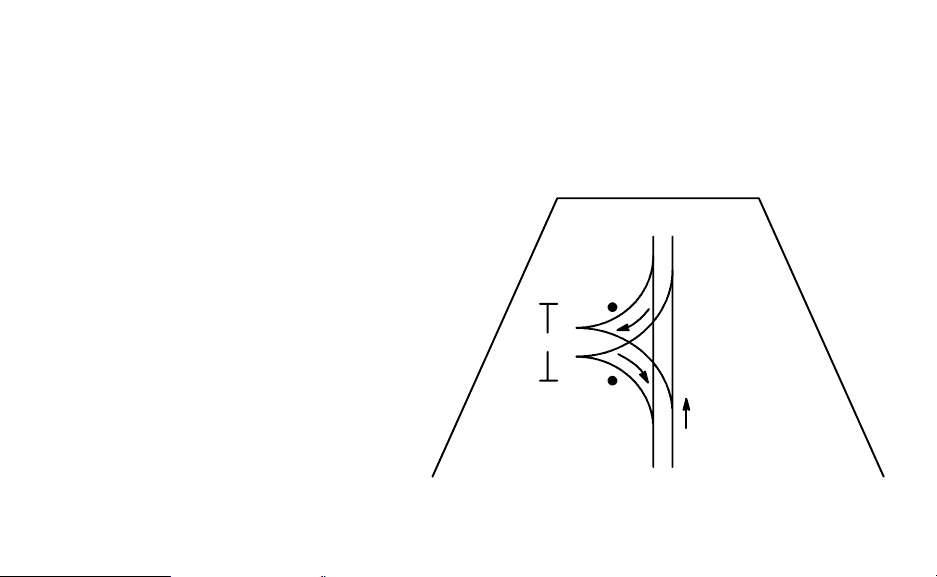
Turning Around on a Hill
If the vehicle stalls while climbing a hill, never back it down the hill! One maneuver that
can be used when it’s necessary to turn around while climbing a hill is the K-turn:
1. Stop and lock the parking brake while maintaining body weight uphill.
2. Shut off the engine.
3. Dismount on the uphill side of the vehicle, or on the left if the vehicle is pointing
straight uphill.
WARNING
Improper hill climbing procedures could cause loss of control or overturn and result in
serious injury or death.
Avoid climbing steep hills (15_ maximum).
Use extreme caution when operating on hills, and follow proper operating procedures
outlined in the owner’s manual.
111
Driving Safely
4. Staying uphill of the ATV, turn the handlebars full left.
5. While holding the brake, release the parking brake lock and slowly release the brake,
allowing the ATV to roll around to your right until it’s pointing across t he hill or
slightly downward.
6. Lock the parking brake and
remount the ATV from the uphill
side, maintaining body weight
uphill.
7. Restart engine, release the parking
brake, and proceed slowly,
controlling speed with the rear
brake, until the ATV is on more
level ground.
8’
Uphill
112
Driving Safely
Driving Downh ill
Whenever descending a hill, follow t hese
precautions:
1. Drive directly downhill.
2. Transfer your weight to the rear of the
vehicle.
3. Slow down.
4. Apply the front and rear brakes at the same
time, and very slightly, to aid in slowing.
Excessive speed can cause loss of control and lead to serious injury or death.
Always operate slowly when traveling downhill.
WARNING
113
Driving Safely
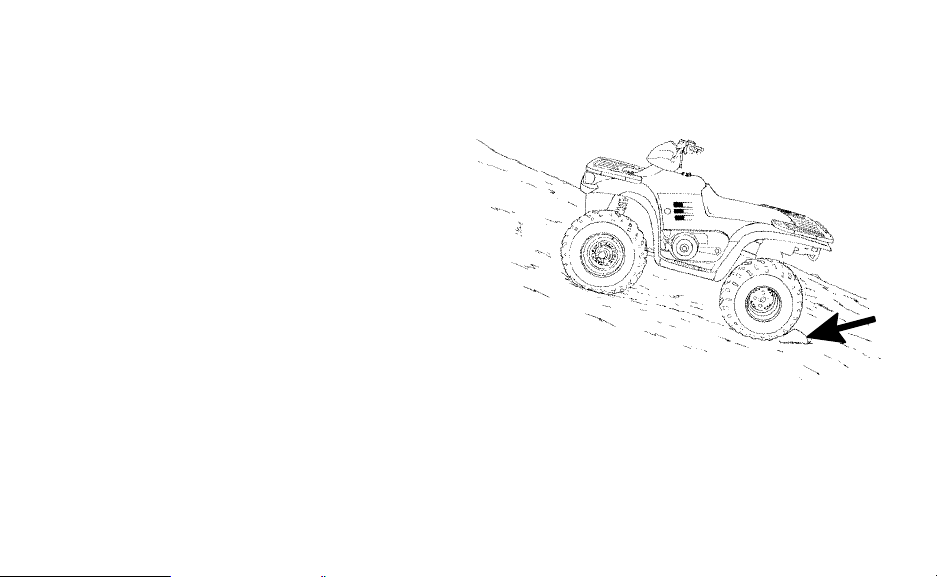
Parking on a Hill o r Incline
Avoid parking on a hill or incline if
possible. If it’s unavoidable, follow these
precautions:
1. Turn the engine off.
2. Set the parking brake.
3. Always block the rear wheels on the
downhill side as shown in t he
illustration.
4. Shut off the fuel supply.
114
Driving Safely
Driving Through Water
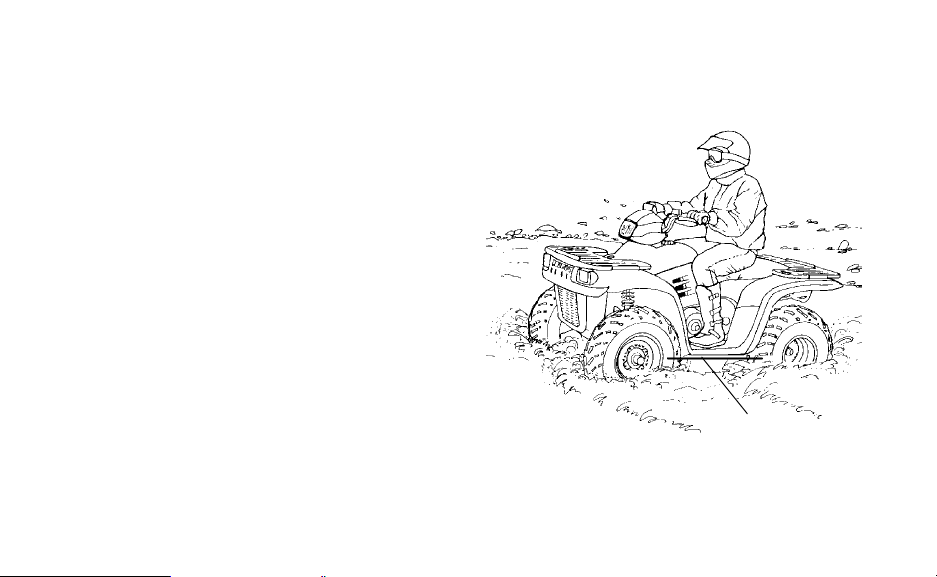
Your ATV can safely operate through shallow water. The
recommended maximum depth for your ATV is below
the bottom of the footrests (A). Follow these
procedures when operating through water:
1. Determine water depths before driving
through water.
2. If crossing a stream, choose a crossing
where both banks have gradual inclines.
3. Proceed slowly, avoiding rocks and
obstacles if possible.
4. After driving through water, dry t he brakes
by applying light pressure to the levers until
braking action is normal. If you do not
perform this procedure, your brakes may be
ineffective.
A
115
Driving Safely
Avoid operating your ATV through deep or fast flowing water. If the ATV i s operated in
deeper water than recommended, it’s critical to have it serviced as outlined in the
maintenance chart beginning on page 127. The following areas need special attention:
engine oil, gearcase oil, front and rear gearcases and all grease fittings.
Major engine damage can result from driving this ATV in deeper water than
recommended. If your vehicle becomes immersed or is operated in water that exceeds
the bottom of the footrests, take it to your dealer for service before starting the engine.
CAUTION
116
Driving Safely
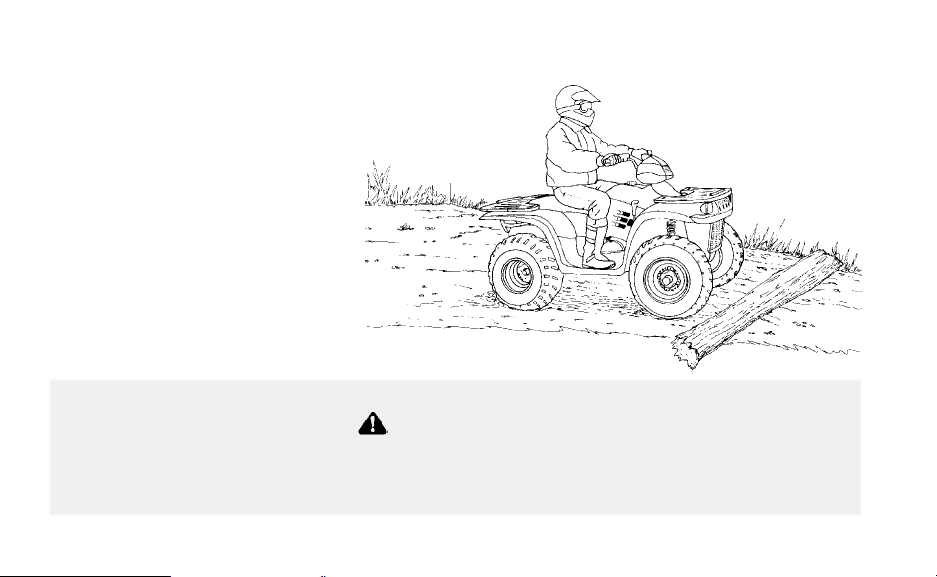
Driving Over Obstacles
Be alert! Look ahead and learn
to read the terrain you’re
traveling on. Be constantly
alert for hazards such as logs,
rocks and low hanging
branches.
Severe injury or death can result if your vehicle comes in contact with a hidden obstacle.
Not all obstacles are immediately visible. T ravel with caution in unfamiliar terrain.
WARNING
117
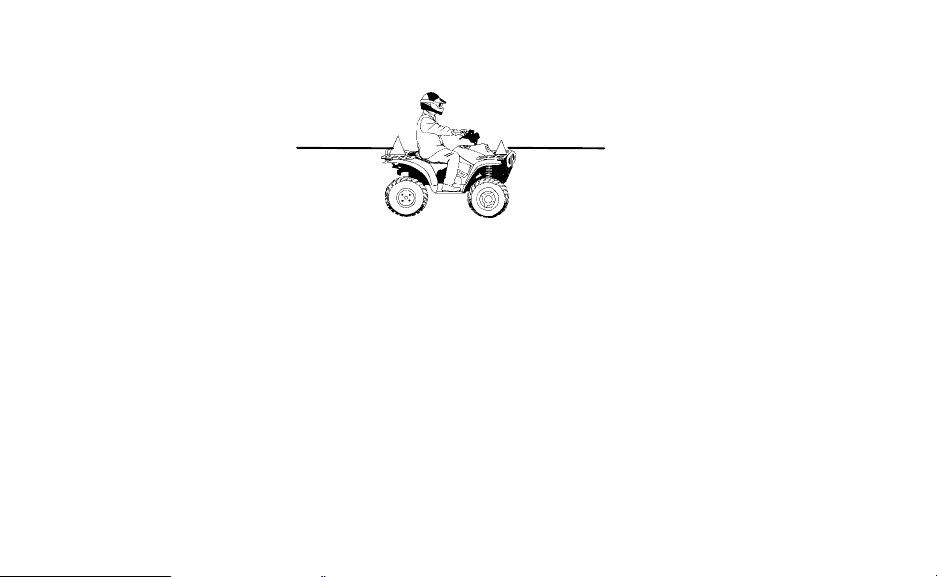
Hauling Cargo
The Sportsman 90 was designed to carry a certain amount of load. Never exceed the
weight capacities listed in the specifications section of the owner ’s manual. Never carry
cargo on a Scrambler.
Cargo weight should be evenly distributed (1/3 on the front rack and 2/3 on the rear rack)
and mounted as low as possible. When operating over rough or hilly terrain, reduce speed
and cargo weight to maintain stable driving conditions.
Hauling cargo improperly can alter vehicle handling and may cause loss of control or
brake instability and result in serious injury or death. Always heed the warnings on
the following pages.
WARNING
118
Hauling Cargo
S REDUCE SPEED AND ALLOW GREATER DISTANCE FOR BRAKING
WHEN CARRYING CARGO.
S CARGO WEIGHT DISTRI BUT ION should be 1/3 on the front rack and 2/3 on
the rear rack. When operating over rough or hilly terrain, reduce speed and cargo
to maintain stable driving conditions. Carrying loads on one rack only increases
the possibility of vehicle tip over.
S HEAVY LOADS CAN CAUSE BRAKING AND CONTROL PROBLEMS. Us e
extreme caution when applying brakes with a loaded vehicle. Avoid terrain or
situations which may require backing downhill.
2/3 of Load
on
Rear Rack
1/3 of Load
on
Front Rack

119
Hauling Cargo
S ALL LOADS MUST BE SECURED BEFORE MOVING VEHICLE. Unse-
cured loads can create unstable operating conditions, which could result in loss of
control of the vehicle.
S LOADS MUST BE CARRIED AS LOW ON THE RACKS AS POSSIBLE.
Carrying loads high on the racks raises the center of gravity of the vehicle and
creates a less stable operating condition. When cargo loads are carried high on
the racks, the weight of the loads must be reduced to maintain stable operating
conditions.
S OPERATE ONLY WITH STABLE AND SAFELY ARRANGED LOADS.
When handling off-centered loads which cannot be centered, securely fasten load
and operate with extra caution.
S EXTREME CAUTION MUST BE USED when operating with loads extending
over the rack sides. Stability and maneuverability may be adversely affected,
causing the machine to overturn.
S DO NOT TRAVEL FASTER THAN THE RECOMMENDED SPEEDS.

120
Noise Emission Control System Regulation
TAMPERING WITH NOISE CONTROL SYSTEM PROHIBITED!
U.S. Federal law prohibits the following acts or the causing thereof:
(1) The removal or rendering inoperative by any person other than for purposes of
maintenance, repair, or replacement of any device or element of design incorporated into
any new vehicle for the purpose of noise control prior to its sale or delivery to the ultimate
purchaser or while it is in use or
(2) the use of the vehicle after such device or element of design has been removed or
rendered inoperative by any person.
ACTS PRESUMED TO CONSTITUTE TAMPERING ARE THE ACTS LISTED
BELOW INCLUDE BUT ARE NOT LIMITED TO THE FOLLOWING:
1. Removal or alteration or the puncturing of the m uffler or any engine component which
conducts removal of engine exhaust gases.
2. Removal or alteration or the puncturing of any part of the engine air induction system.
3. Replacement of any vehicle parts with parts not in compliance with federal regulations.
4. Lack of proper maintenance.
121
Maintenance
PVT System
The PVT system rotates at high speeds, creating large amounts of force on clutch
components. Extensive engineering and testing has been conducted to insure the
safety of this product. However , as the owner you have the following responsibilities
to make sure this system remains safe:
Do not modify any component of the PVT system. Doing so may reduce its strength
so that a failure may occur at high speeds. This system has been precision balanced.
Any modification will cause the system to be out of balance, creating vibration and
additional loads on components.
S Routine maintenance is the responsibility of the owner. Always follow recom-
mended maintenance procedures. See your dealer!
S This PVT system is intended for use on Polaris products only.
S The PVT housing must be securely in place during operation.
Failure to comply with this warning can result in severe injury or death.
WARNING

122
Maintenance
PVT System
If the ATV is operated in dusty areas, clean the PVT filter more often than recommended
for normal conditions. To clean the PVT filter:
1. Remove the screws and the crankcase cover.
2. Remove the screws and the filter cover.
3. Soak the filter in a mild detergent and rinse with clean water.
4. Allow the filter to air dry, then reinstall.
Exposure to salt water will cause corrosion to metal components. If your vehicle is
operated in salt water areas, rinse it off frequently with fresh water.
CAUTION
123
Maintenance
Battery
The battery in your Polaris ATV is a sealed lead acid type battery. The sealing strip cannot
be removed. Water must not be added to this type of battery.
Keep the battery terminals and connections free of corrosion. If cleaning is necessary,
remove the corrosion with a stiff wire brush. Wash with a solution of one tablespoon
baking soda and one cup water. Rinse well with tap water and dry off with clean shop
towels. Coat the terminals with dielectric grease or petroleum jelly.
Improperly connecting or disconnecting battery cables can result in an explosion
and cause serious injury or death. When removing the battery, always disconnect
the negative (black) cable first. When reinstalling the battery, always connect the
negative (black) cable last.
WARNING

124
Maintenance
Battery
Battery Removal
1. Disconnect the hold-down s traps securing the electrical box and battery in position.
2. Disconnect the black (negative) battery cable first.
3. Disconnect the red (positive) battery cable next.
4. Lift the battery out of the ATV.

125
Maintenance
Battery
Battery Installation and Connections
1. Set the battery in its holder.
2. Connect and tighten the red (positive) cable first.
3. Connect and tighten the black (negative) cable last.
4. Attach the hold-down strap.
5. Verify that cables are properly routed.
NOTE: When installing a new battery, make sure it’s fully charged prior to its initial use.
Using a new battery that has not been fully charged can damage the battery and result in a
shorter life. It can also hinder vehicle performance. If recharging is necessary, use a .5
amp battery charger.
Battery Storage
When the vehicle is placed in storage for three months or more, the battery should be
removed, stored out of the sun in a cool, dry pl ace and tested monthly. B efore reusing, take
the battery to your dealer for testing and recharging on a . 5 amp battery charger.

126
Maintenance
Periodic Maintenance Schedule
To help you perform routine maintenance, a tool kit is provided i n the storage compartment
under the seat. Items included i n the kit are:
S Sparkplugwrench
S Screwdriver
S Tire pressure gauge
Maintenance intervals are based upon average riding conditions and an average vehicle
speed of approximately 10 miles per hour. Vehicles subjected to severe use, such as
operation in wet or dusty areas, should be inspected and serviced more frequently.
Inspect, clean, lubricate, adjust and replace parts as necessary. When inspection reveals the
need for replacement parts, use genuine Polaris parts available from your Polaris dealer.
NOTE: Service and adjustments are critical. If you’re not familiar with safe service and
adjustment procedures, have a qualified dealer perform these operations.
127
Maintenance
Periodic Maintenance Schedule
Hours of operation are based on a 10 mph average. If service is due at 20 hours, the
equivalent odometer reading would be 200 miles. Perform all services at whichever
reading is reached first.
Maintenance Chart Key
" Perform these operations more often under severe use, such as in dirty or wet
conditions, to purge water or dirt contamination from grease fittings and other critical
components.
J Dealer service item.
Improperly performing the procedures marked with a J could result in component
failure and lead to serious injury or death. Have an authorized Polaris dealer
perform these services.
WARNING
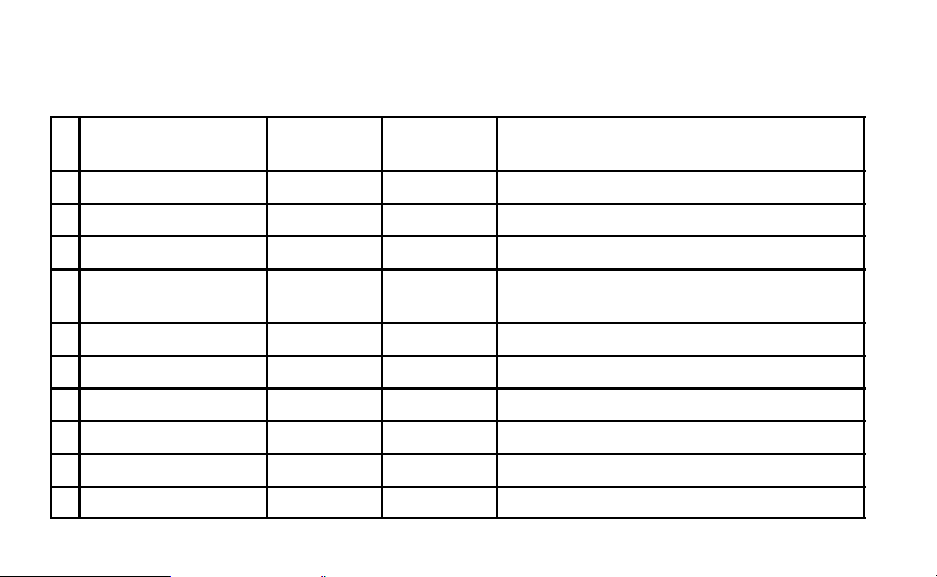
128
Maintenance
Periodic Maintenance Schedule
Item to Inspect Hours/
Miles
Frequency
Remarks
Brake System Pre-ride Pre-ride Inspect
Tires Pre-ride Pre-ride Inspect
Wheels Pre-ride Pre-ride Inspect
Frame nuts, bolts,
fasteners
Pre-ride Pre-ride Inspect; tighten any loose hardware
Throttle Pre-ride Pre-ride Check for proper operation
Engine stop switch Pre-ride Pre-ride Check for proper operation
Engine oil Pre-ride Pre-ride Check level; fill oil when refueling
" Air Filter Pre-ride Pre-ride Inspect; clean
" Steering Pre-ride Pre-ride Check for free operation
" Drive Chain Pre-ride Pre-ride Inspect

129
Maintenance
Periodic Maintenance Schedule
Item to Inspect Hours/
Miles
Frequency
Remarks
J Brake pad wear 10 hrs Monthly Inspect periodically
Battery 20 hrs Monthly Inspect terminals; clean
Oil Pump Cable 50 hrs 6 months Inspect; adjust; lubricate; replace if
required
Carburetor Float
Bowl
50 hrs 6 months Drain bowl periodically and prior to
storage
J Throttle Cable/
ETC Switch
50 hrs 6 months Inspect; adjust; lubricate; replace if
necessary
" Steering 50 hrs 6 months Inspect; lubricate
" Rear Axle 50 hrs 6 months Inspect bearings; lubricate

130
Maintenance
Periodic Maintenance Schedule
Item to Inspect Hours/
Miles
Frequency
Remarks
" Drive Chain 50 hrs 6 months Inspect; adjust and lubricate if needed
" Front Suspension 50 hrs 6 months Inspect; lubricate; tighten fasteners
" Rear Suspension 50 hrs 6 months Inspect; tighten fasteners
J Clutches (drive
and driven)
100 hrs 12 months Inspect; clean
Engine Mounts 100 hrs 12 months Inspect
Spark Plug 100 hrs 12 months Inspect; replace if necessary
J Ignition Timing 100 hrs 12 months Inspect; adjust as needed
J Fuel System 100 hrs 12 months Check for leaks at tank cap, lines, fuel
valve, filter, pump and carburetor. Re-
place lines every two years.

131
Maintenance
Periodic Maintenance Schedule
Item to Inspect Hours/
Miles
Frequency
Remarks
J Fuel Filter 100 hrs 12 months Replace annually
Spark arrestor 100 hrs 12 months Clean out
J Front wheel bear-
ings
300 hrs 36 months Inspect; replace if necessary
J Idle Speed As needed As needed Adjust
J Toe adjustment As needed As needed Inspect periodically adjust when parts
are replaced

132
Maintenance
Lubrication Recommendations
Item Lube Method Frequency
1. Engine Oil Polaris 2-cycle oil Fill oil tank. As needed and
when refueling
2. Gearcase Oil
Level
Polaris Premium
Synthetic gearcase
lube
See Page 151. Change annually or at
100 hrs. Maintain in
safe range.
3. Drive Chain O-Ring chain lube
or SAE 80/90
Lubricate as required
and before each ride
in wet conditions.
As required
4. Front A-Arm " L Grease Locate fittings and
grease.
Every 3 months or 50
hrs.
" Grease more often under severe use, such as wet or dusty conditions.
L Use Polaris Premium all Season Grease or grease conforming t o NLGI No. 2.
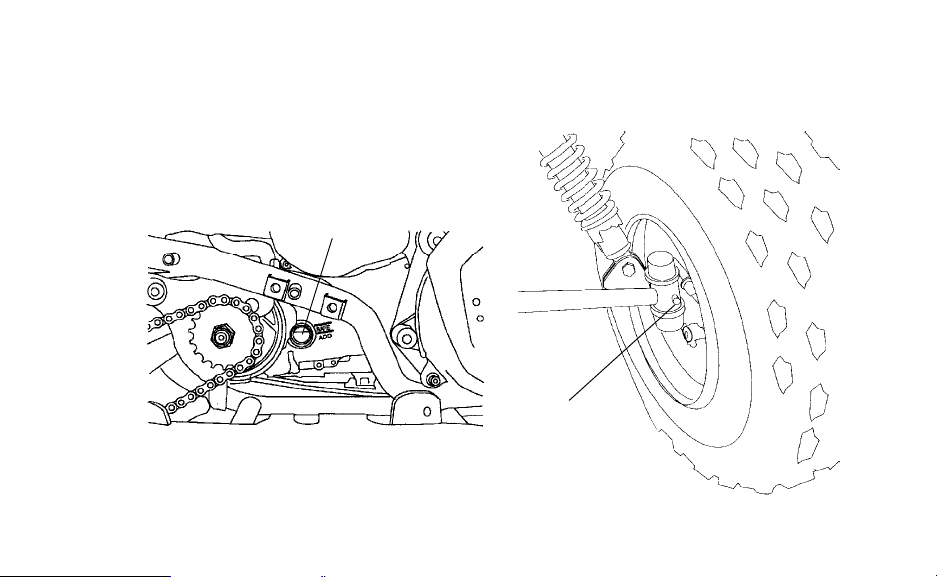
133
Maintenance
Lubrication Recommendations
2
4
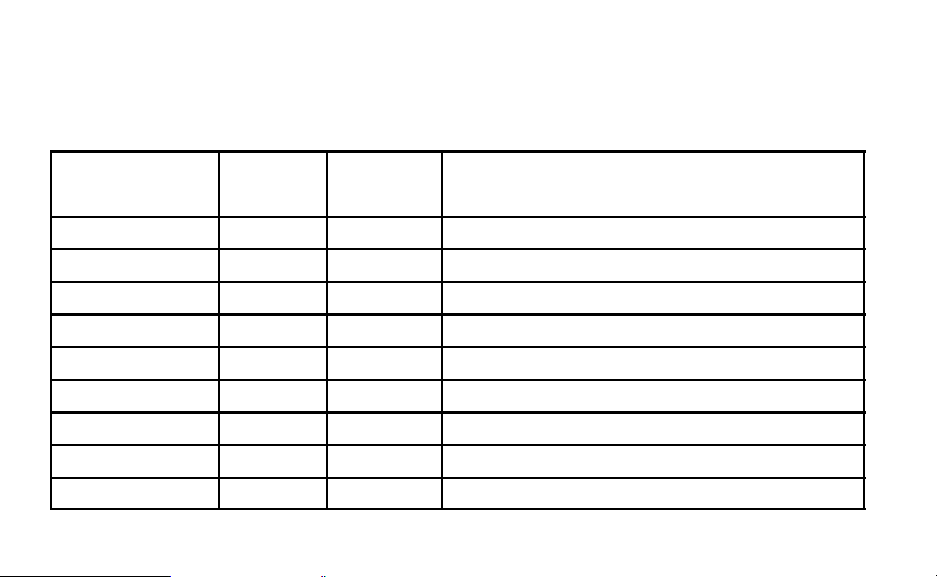
134
Maintenance
Periodic Maint en an ce Record
Use the following chart to record periodic maintenance.
Maintenance
Interval
Performed
Servicing
Date
Servicing
Dealer
or Person
Remarks
First 5 hrs.
25 hrs.
50 hrs.
75 hrs.
100 hrs.

135
Maintenance
Maintenance
Interval
Performed
Servicing
Date
Servicing
Dealer
or Person
Remarks
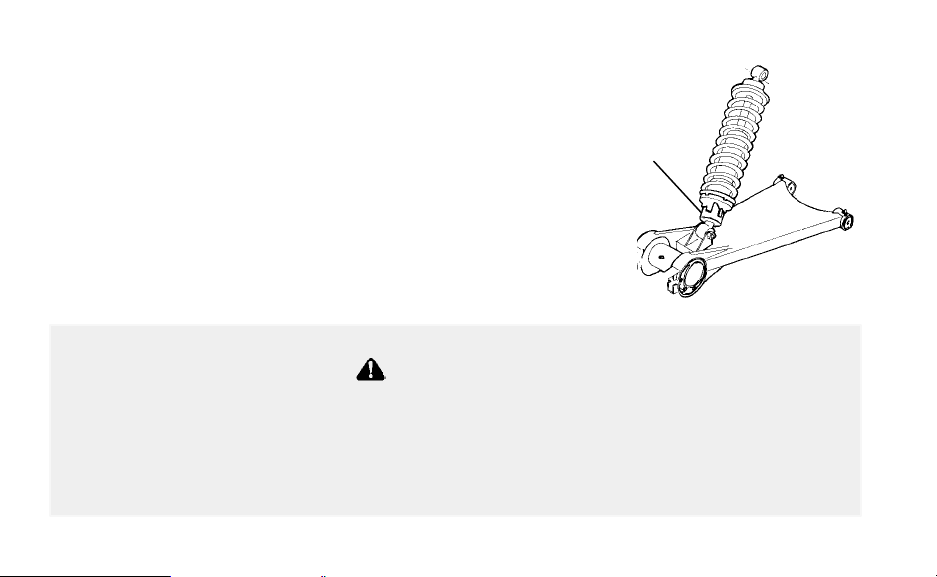
136
Maintenance
Rear Spring Adjustment
The rear shock absorber spring is adjusted by rotating the
adjuster (A) in the direction required to increase or
decrease spring tension.
Handlebar Adju stment
A
Improper adjustment of the handlebars or incorrect torquing of the adjuster block
tightening bolts can cause limited steering or loosening of the handlebars, resulting in
loss of control and possible serious personal injury or death. Follow the adjustment
procedures exactly, or see your Polaris dealer for service.
WARNING
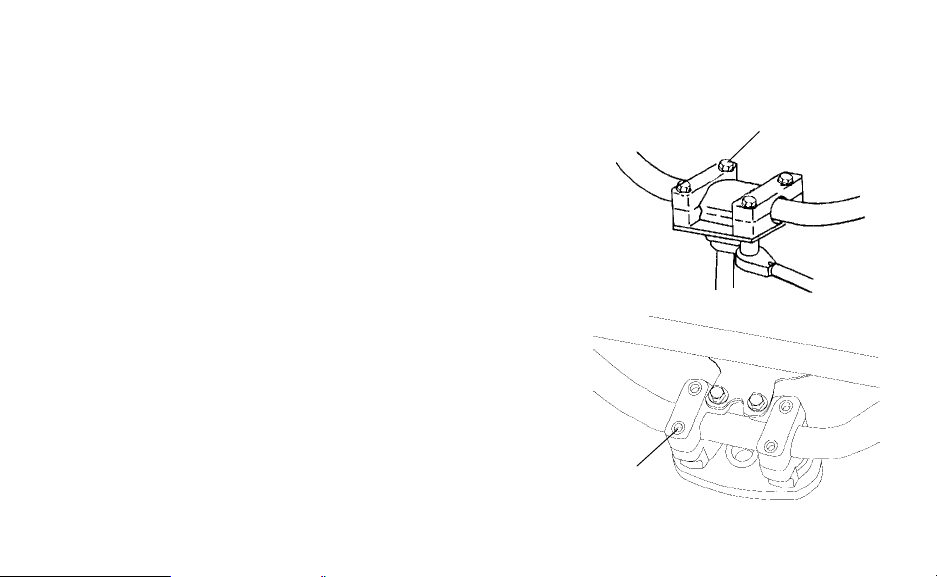
137
Maintenance
Handlebar Adju stment
The handlebars can be adjusted for rider
preference.
1. Locate the handlebar bolts. On models with a
headlight pod, remove the upper pod. On
other models, remove the handlebar cover.
2. Loosen the four bolts (A).
3. Adjust the handlebar to the desired height. Be
sure the handlebars do not hit the gas tank or
any other part of the machine when turned
fully to the left or right.
4. Lightly tighten each bolt equally to prevent
uneven gaps in t he block.
5. Torque the handlebar adjuster block bolts to
7.3 ft. lbs.
A
A
138
Maintenance
Axle an d Wheel Nut Torque Specifications
Check the following nuts occasionally and when they’ve been loosened for maintenance.
Specification
Front Spindle Nuts 42-45 ft. lbs. (57-61 Nm)
Rear Spindle Nuts 78-81 ft. lbs. (106-110 Nm)
NOTE: All nuts with a cotter pin installed must be serviced by an authorized Polaris
dealer.
Front Wheel Hub Tightening
Front wheel bearing tightness and s pindle nut retention are critical component operations.
All service must be performed by your authorized Polaris dealer.

139
Maintenance
Speed Con t rol Systems
Per ANSI / SVIA--1--2001 (sec. 6.1.3) AS DELIVERED TO THE CONSUMER, the speed
of youth models is restricted to under 10 MPH for the 50 cc m odels and under 15 MPH for
the90ccmodels.
The dealer CANNOT, under any circumstances, either prior to the sale or later, even at the
consumer’s request, remove or adjust any speed limiting devices.
Polaris Youth ATVs have an electronic speed control system and an adjustable throttle
limiting screw. These speed limiting devices may be adjusted/removed only by consumers
when they determine that their child is capable of handling the additional speed.
Per ANSI / SVIA--1--2001 (sec. 6.2) the unrestricted top speed is less than 15 MPH for the
50 cc models and less than 30 MPH for the 90 cc models.
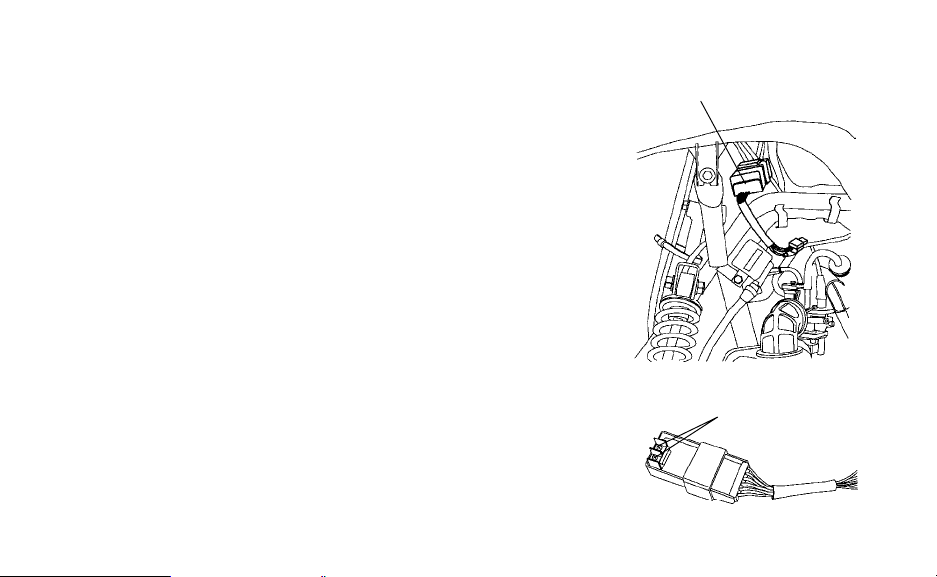
140
Maintenance
Speed Con t rol Systems
Electronic Speed Control System
Your Polaris ATV is equipped with an electronic speed control
system, which controls the engine RPM and speed of the ATV.
Speed can be adjusted by removing or installing the jumper on
the C DI (A). With the jumper installed, 50cc models will
travel no faster than 10 mph and 90cc models will travel no
faster than 15 mph. With the jumper removed, 50cc models
will travel no faster than 15 mph and 90cc models will travel
no faster than 30 mph.
Jumper Removal and Installation
1. Remove the CDI and its rubber m ounting strap from the
mounting tab, which is located on the frame bulkhead near the
steering post. It can be accessed through the left front fender.
2. Remove the two screws (B) from the jumper to remove or
install the jumper. Reinstall the screws.
3. Reinstall the CDI and mounting strap onto the mounting tab.
A
B
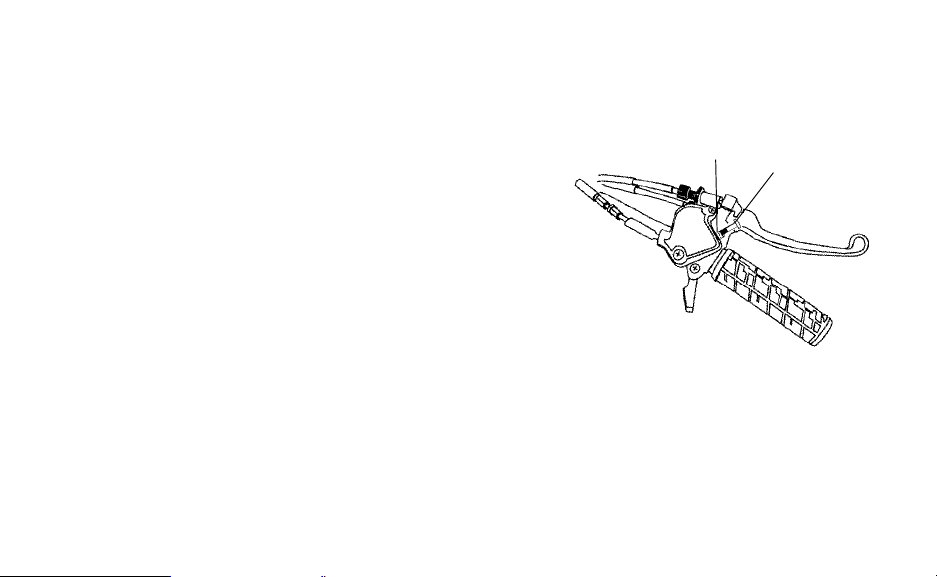
141
Maintenance
Speed Con t rol Systems
Throttle Stop Speed Control System
Adjusting speed at the CDI is the recommended
method of speed control, but the throttle stop system
may also be used. Use the following procedure t o
control how far the throttle opens.
1. Loosen the jam nut (A)
2. Turn the screw (B) inward to reduce speed or
outward to increase speed.
3. Tighten the jam nut after adjusting.
A
B

142
Maintenance
Steering Insp ectio n
The steering assembly of the ATV should be checked periodically for l oose nuts and bolts.
If any are found, have your dealer tighten them before operating the ATV.
143
Maintenance
Toe Alignment
Use t he following procedure to check the toe alignment of the vehicle. The recommended
toe alignment is 1/8” to 1/4” toe out.
1. Set the handlebars in a straight-ahead position. NOTE: The steering frog can be used
as an indicator of whether the handlebars are straight. The frog should always point
straight back from the steering post.
2. Place stands (A) in front of the vehicle, perpendicular to the rear tires. See illustration.
WARNING
Severe injury or death can result from improper toe alignment and adjustment. Do not
attempt to adjust tie rod alignment. All tie rod adjustments should be performed by an
authorized Polaris dealer .
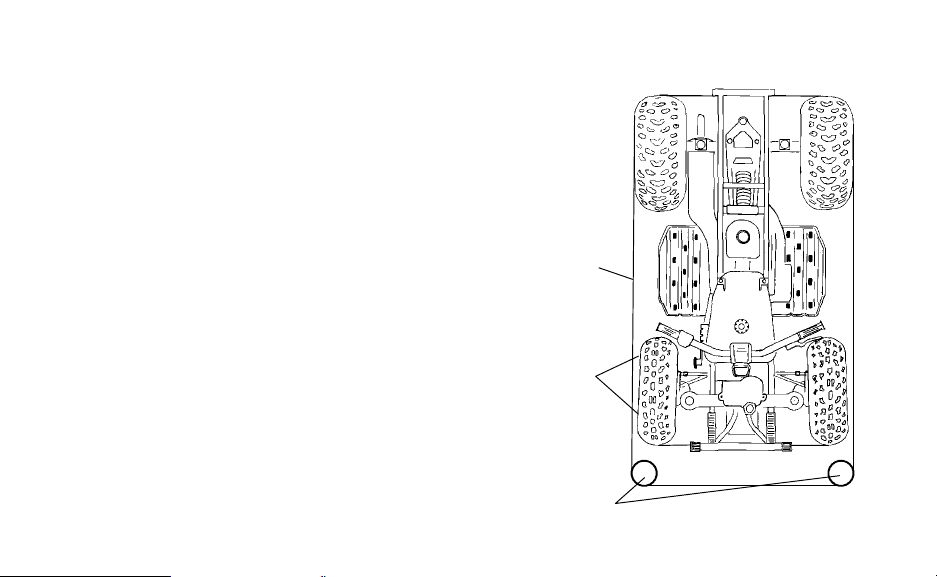
144
Maintenance
Toe Alignment
3. Tie an elastic string around the stands, making
sure the string just touches the side surface of the
rear tires on each side of the vehicle and goes
around the stands in front of the vehicle (2).
4. Measure the distance from the string to the rim at
the front and rear of the front rim (3). Rear
measurement should be 1/16″ -1/8″ (.2to.3cm)
more than the front measurement.
NOTE: If you discover improper alignment, see
your Polaris dealer for service.
Camber an d Caster
The camber and caster are non-adjustable.
A
C
B
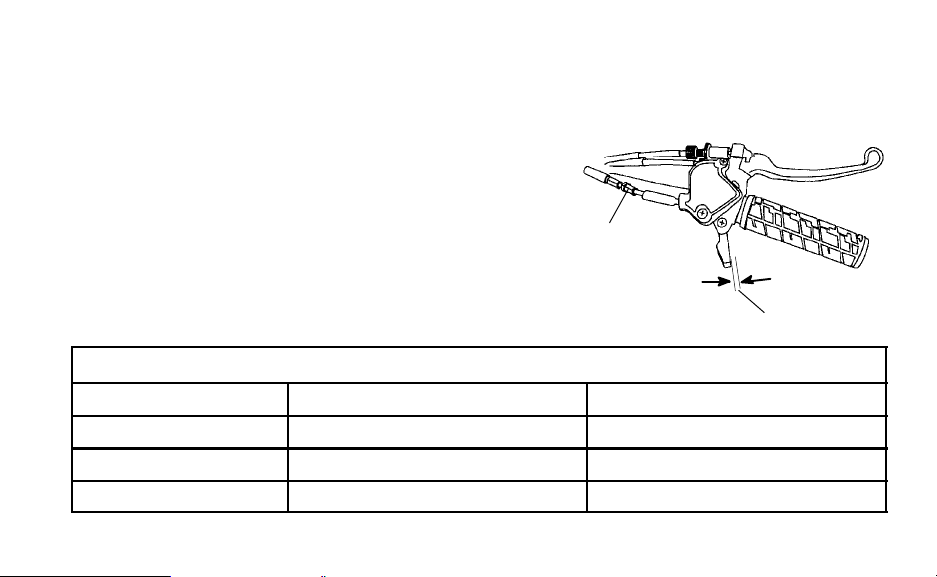
145
Maintenance
Throttle Cable Adjustment
Always check the throttle for smooth
operation before riding. Periodically check
the throttle freeplay. It should be kept
between 1/16″ and 1/8 ″ (1.5mm - 3.2mm)
(A). If adjustment is required, turn the
adjustment nut (B) until the freeplay falls in
to the acceptable limit.
Brake Freeplay
Brake Freeplay Specifications
Model Front Rear
Sportsman 90 .40″ -.80″ (10-20 mm) .40″ -.80″ (10-20 mm)
Scrambler 90 .40″ -.80″ (10-20 mm) .40″ -.80″ (10-20 mm)
Scrambler 50 .1″ -.39″ (2.5-9.9 mm) .15″ -.30″ (3.8-7.6 mm)
A
B
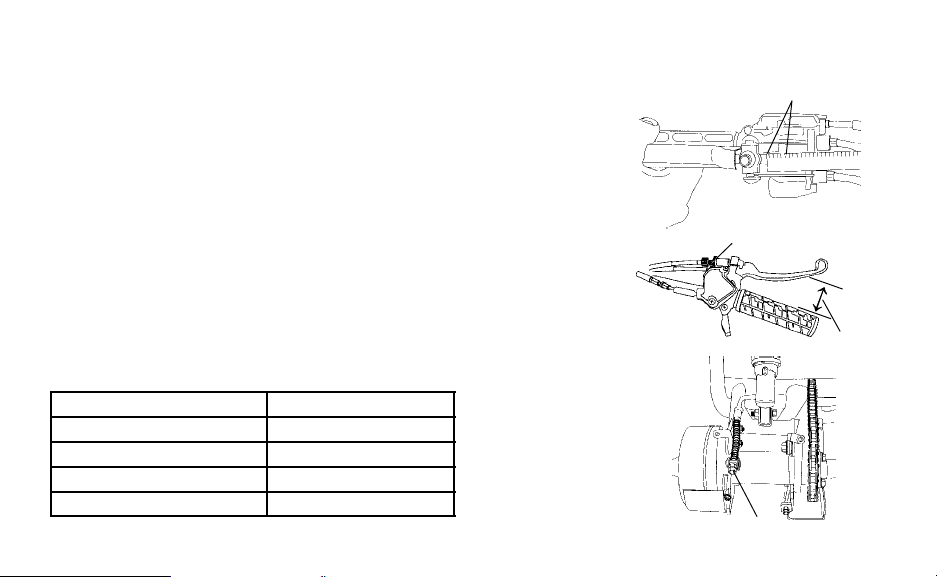
146
Maintenance
Brake Adjustment
Periodically check (measure) the freeplay of the front and rear
brakes (A). Refer to the specifications chart on page 145 for
the acceptable range of freeplay.
To adjust the front brake freeplay, turn the adjustment knob
(B). To adjust the rear brake freeplay, turn the adjuster nut (C).
Brake Lever Travel
Service the brakes when brake lever travel (D) reaches the
following total lever travel measurements. Always service the
brakes when there is no longer sufficient stopping ability at
the specified lever travel setting.
Component Total Lever T ravel
50cc front brake lever 1 1/8” (28mm)
50cc rear brake lever 1 1/8” (28mm)
90cc front brake lever 1 3/4” (45mm)
90cc rear brake lever 2 1/2” (65mm)
C
B
A
D
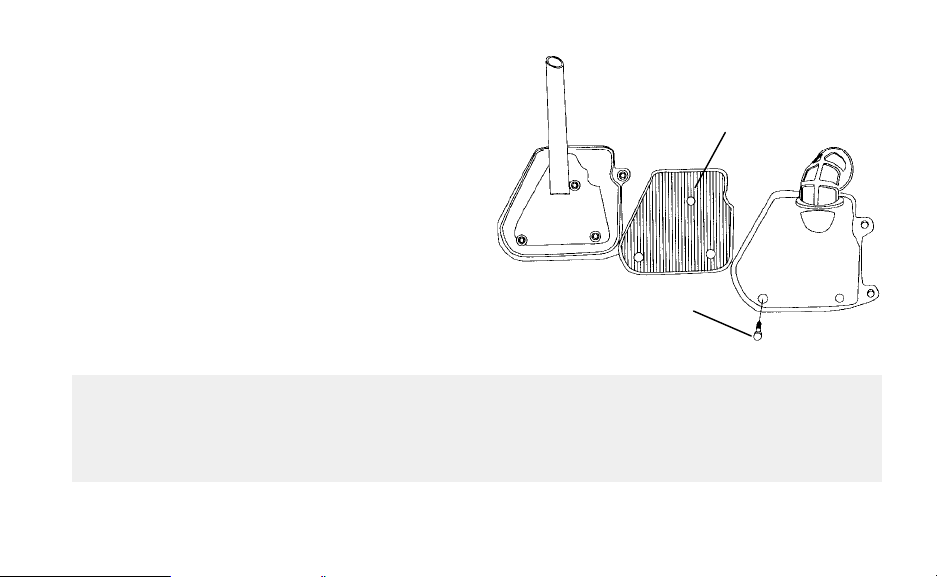
147
Maintenance
Air Cleaner
Inspect the air filter weekly or after every 50
hours of operation. If the ATV is ridden in wet
or dusty conditions, clean the filter m ore often.
1. Remove the screws (A) on the airbox
and remove the filter (B).
2. Soak the filter in a mild detergent and
rinse it in clean water.
3. Let the filter air dry and reinstall.
A
B
Never operate the ATV with the filter element removed. Dirt will enter the engine
causing serious rapid wear and damage to the engine.
CAUTION

148
Maintenance
Carburetor Adjustments
Your Polaris ATV is calibrated at t he factory for optimal performance at altitudes ranging
from zero to 6,000 feet (1800 m) and temperatures of +40 degrees F. (4 degrees C.) or
higher.
Above 6000 feet (1800 m) the engine air/fuel mixture becomes overly rich and the engine
loses approximately 3% of its power for each 1000-foot (304.8 m) increase in elevation.
Although this power cannot be regained, adjustments to the carburetor and drive system can
be made to allow m ore efficient operation.
Optional jets, available from your Polaris dealer, are required for operation above 6,000 feet
and temperatures below +40 degrees F. (4 degrees C.) NOTE: Continuous operation of
the engine without proper jetting when required can cause poor performance, overheating or
engine damage. See your Polaris dealer for more information about jetting the ATV for
conditions in your area.
149
Maintenance
Spark Plugs
S Use NGK BP7HS or NGK BPR7HS spark plugs.
S Proper electrode gap is .24”-.28” (0.6-0.7 mm).
S Spark plug torque is 14 ft. lbs. (19 Nm).
Spark plug condition is indicative of engine operation. The spark plug firing end condition
should be read after the engine has been warmed up and the vehicle has been driven at
higher speeds. Immediately check the spark plug for correct color.
Using non-recommended spark plugs can result in serious engine damage.
Always use Polaris-recommended spark plugs.
CAUTION
WARNING
A hot exhaust system and engine can cause serious burns. Wear protective gloves
when removing a spark plug for inspection.

150
Maintenance
Spark Plugs
NORMAL: The normal insulator tip is gray, tan or light brown. There will be few
combustion deposits. The electrodes are not burned or eroded. This indicates the proper
type and heat range for t he engine and the service. NOTE: The tip should not be white. A
white insulator tip indicates overheating, caused by use of an improper spark plug or
incorrect carburetion adjustments.
WET FOULED: The wet fouled insulator tip is black. A damp oil film covers the firing
end. There may be a carbon layer over the entire nose. Generally, the electrodes are not
worn. General causes of fouling are excessive oil, use of non-recommended oil, improper
use of the choke, or incorrect carburetion adjustments.
Spark Plug Removal and Replacement
1. Remove the spark plug cap.
2. Using the special wrench provided in the tool pouch, rotate the spark plug
counterclockwise to remove.
3. Reverse the procedure for spark plug i nstallation. Torque to 14 ft. lbs. (19 Nm).
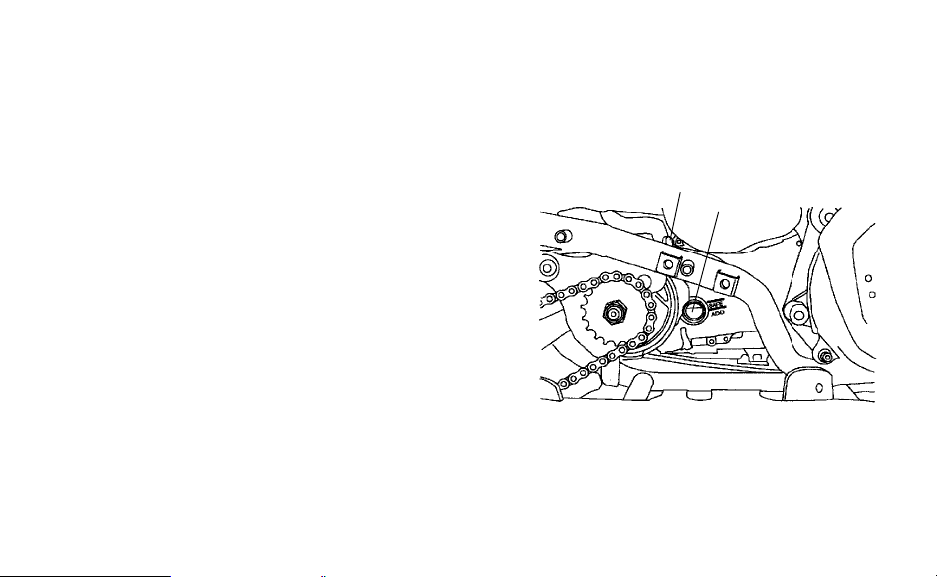
151
Maintenance
Cylinder Head/Cylind er Base F asten er Torque
Have your dealer check the ATV cylinder head and cylinder base fasteners for proper torque
at the first service or after 25 hours.
Gearcase Lubrication
The gearcase fill plug (A) is located on the top
of the gearcase. The sight glass (B) is on the
right-hand side of the gearcase. The oil level
must be maintained in the safe zone of the sight
glass. It should be checked monthly and
changed annually.
With the ATV on a level surface, check the oil
level through the sight glass. If the level is low,
add Polaris Premium Synthetic Gearcase
Lubricant. See page 170 for the part numbers of
Polaris-recommended products.
B
A

152
Maintenance
Gearcase Oil Change
1. Remove the fill plug.
2. Remove the gearcase drain plug and drain the oil into a drain pan. Dispose of properly.
3. Clean and reinstall the drain plug. Torque to 14 ft. lbs. (19 Nm).
4. Add Polaris Premium Synthetic Gearcase Lubricant (about 7 oz.) to the safe zone in the
sight glass.
5. Replace the fill plug and check for leaks.
153
Maintenance
Operating your ATV with worn tires, improperly inflated tires, non-standard tires or
improperly installed tires will affect vehicle handling and could cause an accident
resulting in serious injury or death.
Maintain proper tire pressure as described on the decal on your ATV and in the
owner’s manual.
Always use original equipment size and type when replacing tires.
Make sure the wheels are installed properly.
Always replace tires when the tread depth measures 1/8″ (.3 cm) or less.
WARNING
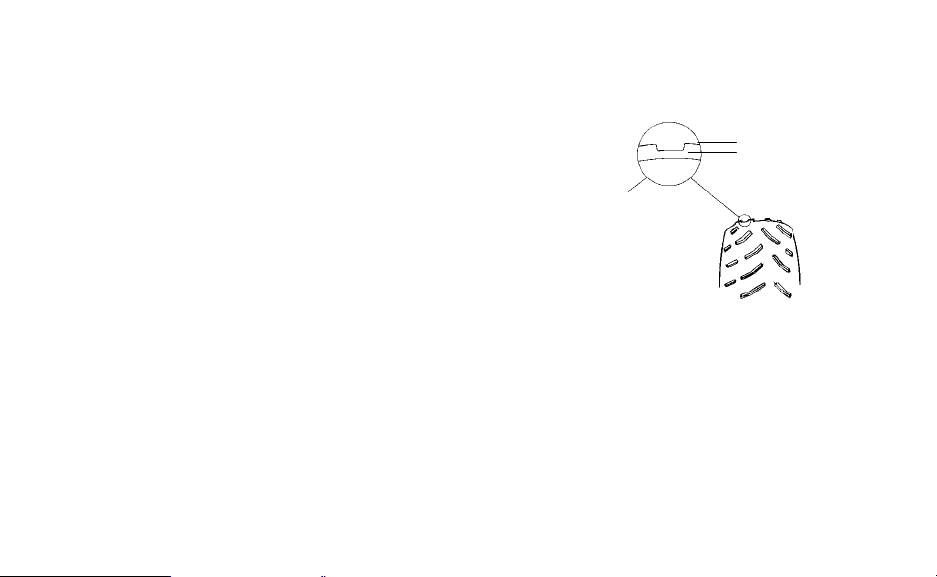
154
Maintenance
Tire Tread Depth
Always replace tires when tread depth is worn to 1/8″
(.3 cm) or less. See illustration.
Wheel Removal
1. Stop the engine and lock the parking brake.
2. Loosen the wheel nuts slightly.
3. Elevate the side of the vehicle by placing a suitable
stand under the footrest frame.
4. Remove the wheel nuts and remove the wheel.
1/8I (.3 cm)
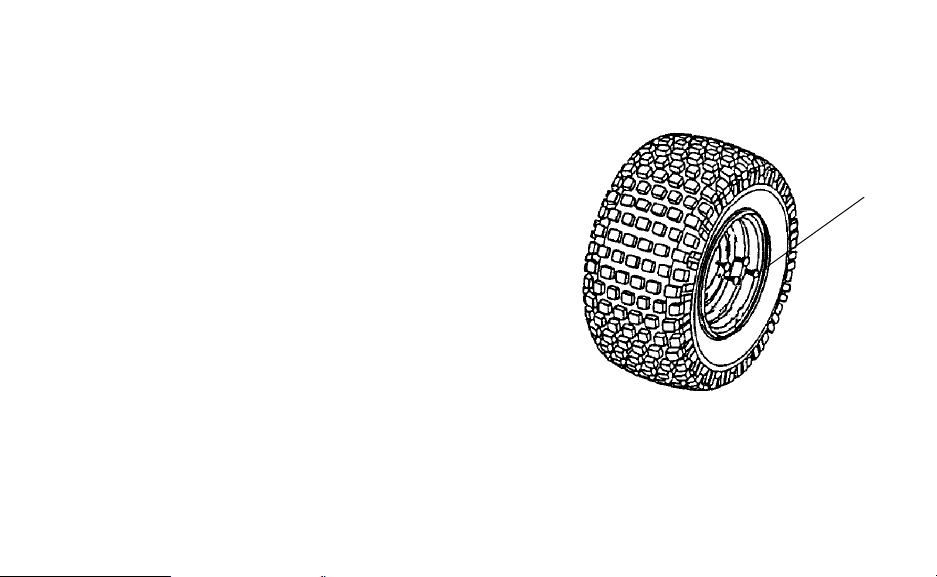
155
Maintenance
Wheel In stallatio n
1. With the park brake locked, place the
wheel in the correct position on the
wheel hub. Be sure the valve stem is
toward the outside and rotation arrows
on the tire point toward forward rotation.
2. Install the wheel bolts (A) and finger
tighten them.
3. Lower the vehicle to the ground.
4. Securely tighten the bolts to 22 ft. lbs.
(30 Nm).
A

156
Maintenance
Drive Chain Inspection and Adjustment
Regularly lubricate the drive chain with Polaris chain spray lube or an approved o-ring
chain spray lube. See page 170 for the part numbers of Polaris-recommended products.
W ashing the drive chain with a high pressure washer or gasoline can cause
premature wear and drive chain failure. Don’t use a high pressure washer or
gasoline to clean the drive chain.
CAUTION
Adjusting or operating the ATV with improper rear drive chain slack can result in
severe damage to the transmission and drive components. Always make sure the
slack is within the stated specifications.
CAUTION
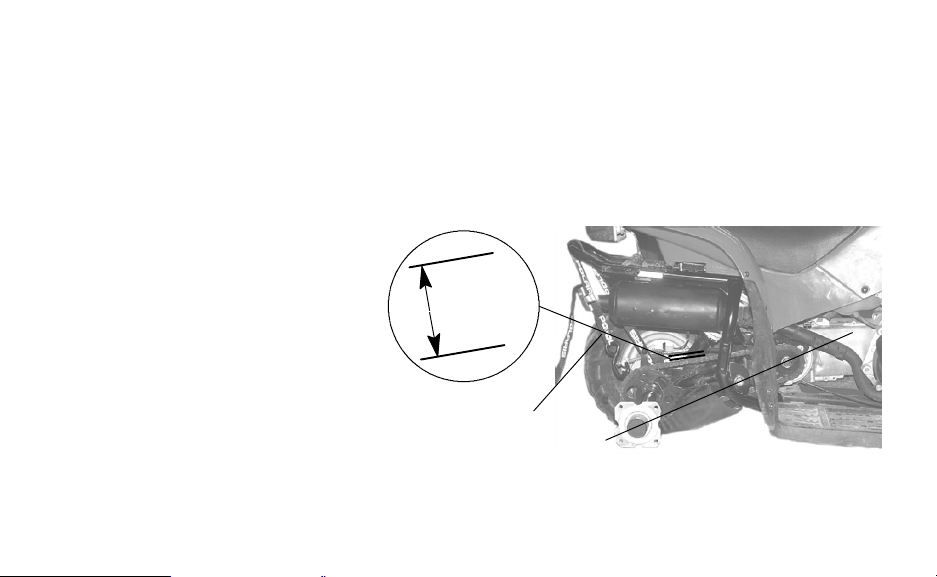
157
Maintenance
Drive Chain Slack Ad justment
1. Check the amount of chain slack by moving the vehicle slightly forward to gain slack
at the t op side of the chain.
2. Collapse the suspension with an adjustable (buckle type) trailer tie down. Fasten the
strap (A) around the axle and rear bumper tube as shown in the illustration.
3. Tighten the strap until a
straight line can be drawn from
the rear axle to the gearcase
output shaft intersecting the
swing arm pivot (B). This
establishes the tightest chain
position. The chain should
have 1/4”-1/2” (6-12 mm)
deflection.
4. If the chain needs adjustment,
use the procedure on the
following page.
A
B
1/4”-1/2”
(6-12 mm)
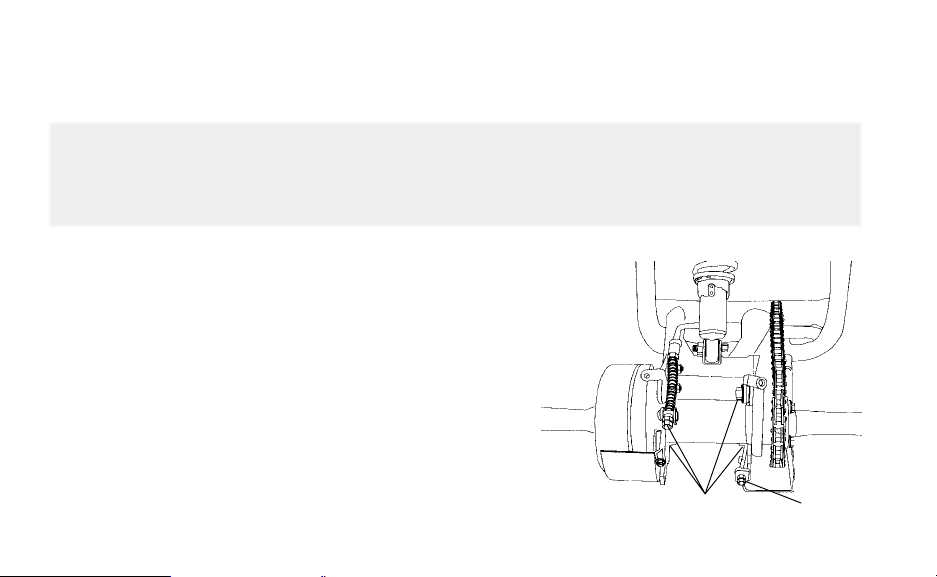
158
Maintenance
Drive Chain Slack Ad justment
1. Loosen the four rear housing mount bolts (A).
2. Loosen the chain adjuster lock nut.
3. Turn the chain adjuster (B) clockwise to
1/4”-1/2” (6-12 mm) deflection.
4. Tighten the chain adjuster lock nut to 84 in.
lbs. (9.4 Nm).
5. Tighten the four rear housing mount bolts to
43 ft. lbs. (60 Nm).
CAUTION
Hold the adjuster stud securely while tightening the jam nuts to avoid breaking the stud.
A
B

159
Maintenance
Brakelight L amp Replacement
If the brakelight doesn’t work, the lamp may need to be replaced.
1. From the rear of the brakelight, remove the two
screws (A) holding the l ens cover in place and
remove the lens cover (B).
2. Remove the lamp (C) and replace it with a new
recommended lamp.
3. Test the brakelight to ensure operation.
4. Reinstall the lens cover.
A
B
C

160
Maintenance
Cleaning and Storage
Keeping your ATV clean will not only improve its appearance but it can also extend the life
of various components. With a few precautions, your ATV can be cleaned much like an
automobile.
W ashing the ATV
The best and safest way to clean your ATV is with a garden hose and a pail of mild soap
and water. Use a professional type washing mitten, cleaning the upper body first and the
lower parts last. Rinse with water frequently and dry with a chamois to prevent water
spots. NOTE: If warning and safety labels are damaged, contact your a P olaris dealer for
free replacement.
Polaris does not recommend the use of a high pressure type car wash system for washing
the ATV. If a high pressure system is used, exercise extreme care to avoid water damage to
the wheel bearings, transmission seals, body panels, brakes and warning labels.
NOTE: Grease all zerk fittings immediately after washing, and allow the vehicle t o run for
a while to evaporate any water that may have entered the engine or exhaust system.

161
Maintenance
Cleaning and Storage
Waxing the ATV
Your ATV can be waxed with any non-abrasive automotive paste wax. Avoid t he use of
harsh cleaners since they can scratch t he body finish.
Certain products, including insect repellants and chemicals, will damage plastic
surfaces. Use caution when using these products near plastic surfaces.
CAUTION

162
Maintenance
Cleaning and Storage
Storing the ATV
Proper preparation of the engine and fuel system is vital to the prevention of rust and
corrosion on engine parts. Whenever the machine is stored for a period of more than 60
days, the engine must be fogged. Use P olaris Fogging Oil and follow the directions on the
can.
Always add a fuel conditioner/stabilizer to the fuel tank before storage. Run the engine for
five minutes to get the additives through the entire fuel system and then top off with fuel.
Fuel additive products are available through your Polaris dealer.
NOTE: Jet restriction caused by improper storage can cause lean conditions and very poor
slow speed driving quality.

163
Maintenance
Cleaning and Storage
Transporting the ATV
Follow these procedures when transporting the ATV.
1. Turn the fuel valve off.
2. Be sure the fuel cap, oil cap and seat are installed correctly and securely.
3. Tie the frame of the ATV to the transporting unit securely using suitable straps or rope.
4. Lock the parking brake.
Accessories
Polaris has a wide range of accessories available for your ATV. See your Polaris dealer.
164
Specifications
Specifications - Scrambler 50
Rider Capacity/Maximum Weight 1 Rider/90 lbs. (40.9 kg)
Displacement 49cc
Cooling Fan Cooled
Engine type 2-Stroke
Lubrication Oil Injected
Oil Capacity 1.1 quarts (1 liter)
Fuel Capacity 1.3 gallons (5 liters)
Starting Electric with kick-start backup
T ransmission Automatic CVT
Front Suspension A-Arm with 4.25″ (10.8 cm) of travel
Rear Suspension Spring over shock with 4.25″ (10.8 cm) of travel
165
Specifications
Specifications - Scrambler 50
Front/Rear Brakes Drum
Parking Brake Mechanical Lock
Front T ires / PSI 16 x 8 - 7 (2 psi)
Rear Tires / PSI 16 x 8 - 7 (2 psi)
T urning Radius 74.8″ (190 cm)
Wheel Base 35.4″ (90 cm)
Dry Weight 211.6 lbs (96 kgs)
Length 54.6″ (138.7 cm)
Width 34″ (86.3 cm)
Height 34.7″ (88.2 cm)
Brake Light Standard
Low Oil Light Standard
166
Specifications
Specifications - Scrambler 90
Rider Capacity/Maximum Weight 1 Rider/150 lbs. (68.1 kg)
Displacement 89cc
Cooling Fan Cooled
Engine type 2-Stroke
Lubrication Oil Injected
Oil Capacity 1.1 quarts (1 liter)
Fuel Capacity 1.3 gallons (5 liters)
Starting Electric with kick-start backup
T ransmission Automatic CVT
Front Suspension A-arm with 4.25″ (10.8 cm) travel
Rear Suspension Spring over shock with 4.25″ (10.8 cm) of travel
167
Specifications
Specifications - Scrambler 90
Front/Rear Brakes Drum
Parking Brake Mechanical Lock
Front T ires / PSI 18 x 7 - 7 (3 psi)
Rear Tires / PSI 18 x 9.5 - 8 (3 psi)
T urning Radius 98.4″ (250 cm)
Wheel Base 38.5″ (98 cm)
Dry Weight 233.7 lbs (106 kgs)
Length 56.1″ (142.4 cm)
Width 35.75″ (86.3 cm)
Height 36.1″ (90.1 cm)
Brake Light Standard
Low Oil Light Standard
168
Specifications
Specifications - Sportsman 90
Rider Capacity/Maximum Weight 1 Rider/150 lbs. (68.1 kg)
Displacement 89cc
Cooling Fan Cooled
Engine type 2-Stroke
Lubrication Oil Injected
Oil Capacity 1.1qts. (1ltr)
Fuel Capacity 1.3 ga. (5 ltr)
Starting Electric with kick-start backup
T ransmission Automatic CVT
Front Suspension A-armwith4.25in/10.8cmtravel
Rear Suspension Spring over shock with 4.25 in / 10.8 cm travel
Front Rack Capacity 10 lb (4.5 kgs)
Rear Rack Capacity 20 lb (9 kgs)

169
Specifications
Specifications - Sportsman 90
Front/Rear Brakes Drum
Parking Brake Mechanical Lock
Front Tires / PSI 19 x 7 - 8 (3 psi)
Rear Tires / PSI 18 x 9.5 - 8 (3 psi)
Wheel Base 37.8″ (96 cm)
T urning Radius 98.4″ (250 cm)
Dry Weight 238.1 lbs (108 kgs)
Length 57.6″ (146.3 cm)
Width 34.4″ (87.4 cm)
Height 36.6″ (93 cm)
Brake Light Standard
Low Oil Light Standard
170
Polaris-Recommended Products
Part No. Description
Engine Lubricant
2870791 Fogging Oil (12 oz. Aerosol)
2871098 Premium 2-Cycle Engine Oil (qt.)
2871721 Premium Gold Synthetic 2-Cycle Oil (qt.)
2871281 Premium 4 Synthetic 0W-40 Engine Oil (4-Cycle)(qt.)
Gearcase / Transmission Lubricants
2873602 Premium Synthetic Gearcase Lubricant (qt.)
2871653 Premium Front Gearcase Lube (8 oz.)
2871654 Premium Drive Hub Fluid (8 oz.)
Coolant
2871323 60/40 Coolant (gal.)
2871534 60/40 Coolant (qt.)
171
Polaris-Recommended Products
Part No. Description
Grease / Specialized Lubricants
2871312 Grease Gun Kit, Premium All Season (3 oz.)
2871322 Premium All Season Grease (3 oz. cartridge)
2871423 Premium All Season Grease (14 oz. cartridge)
2871460 Starter Drive Grease (2 oz.)
2871515 Premium U-Joint Lube (3 oz.)
2871551 Premium U-Joint Lube (14 oz.)
2871329 Dielectric Grease (Nyogelt)
2872073 Chain Lube, Aerosol (6.25 oz.)
2872348 Chain Lube, Aerosol (16 oz.)
Additives / Miscellaneous
2871326 Carbon Clean Plus (12 oz.)
2870652 Fuel Stabilizer (16 oz.)
2870990 DOT3 Brake Fluid (12 oz.)
2872893 Engine Degreaser (12 oz.)
172
Troubleshooting
See your Polaris dealer if you’re unable to identify solutions using the following charts.
Engine Tu rns Over, F ails to Start
Possible Cause Solution
Out of fuel Turn fuel valve to reserve, refuel
Clogged fuel valve or filter Inspect and clean or replace
Water is present in fuel Drain the fuel system and refuel
Fuel valve is turned off Turn the fuel valve on
Old or non-recommended fuel Replace with new fuel
Fouled or defective spark plug(s) Inspect plug(s), replace if necessary
No spark to spark plug Inspect plug(s), verify stop switch is on
Crankcase filled with water or fuel Immediately see your Polaris dealer
Clogged fuel filter Replace the filter
Low battery voltage Rechar ge battery with .5 amp charger
Mechanical failure See your Polaris dealer
173
Troubleshooting
Engine Doesn’t Turn Over
Possible Cause Solution
Low battery voltage Rechar ge battery with .5 amp charger
Loose battery connections Check all connections and tighten
Loose solenoid connections Check all connections and tighten
Engine Pings or Knocks
Possible Cause Solution
Poor quality or low octane fuel Replace with recommended fuel
Incorrect ignition timing See your Polaris dealer
Incorrect spark plug gap or heat range Set gap to specs or replace plugs
174
Troubleshooting
Engine Backfires
Possible Cause Solution
Weak spark from spark plugs Inspect, clean and/or replace spark plugs
Incorrect spark plug gap or heat range Set gap to specs or replace plugs
Old or non-recommended fuel Replace with new fuel
Incorrectly installed spark plug wires See your Polaris dealer
Incorrect ignition timing See your Polaris dealer
Mechanical failure See your Polaris dealer

175
Troubleshooting
Engine Runs Irregularly, Stalls or Misfires
Possible W eak Spark Cause Solution
Fouled or defective spark plugs Inspect, clean and/or replace spark plugs
Worn or defective spark plug wires See your Polaris dealer
Incorrect spark plug gap or heat range Set gap to specs or replace plugs
Loose ignition connections Check all connections and tighten
Water present in fuel Replace with new fuel
Low battery voltage Rechar ge battery with .5 amp charger
Kinked or plugged fuel vent line Inspect and replace
Incorrect fuel Replace with recommended fuel
Clogged air filter Inspect and clean or replace
Electronic throttle control malfunction See your Polaris dealer
Other mechanical failure See your Polaris dealer
176
Troubleshooting
Engine Runs Irregularly, Stalls or Misfires
Possible Lean Fuel Mixture Cause Solution
Low or contaminated fuel Add or change fuel, clean the fuel system
Low octane fuel Replace with recommended fuel
Clogged fuel filter Replace filter
Incorrect jetting See your Polaris dealer
Possible Rich Fuel Mixture Cause Solution
Overuse of choke Inspect, clean and/or replace spark plugs
Fuel is very high octane Replace with lower octane fuel
Incorrect jetting See your Polaris dealer
177
Troubleshooting
Engine Stops or Loses Power
Possible Cause Solution
Out of fuel Turn fuel valve to reserve, refuel
Kinked or plugged fuel vent line Inspect and replace
Water present in fuel Replace with new fuel
Fouled or defective spark plugs Inspect, clean and/or replace spark plugs
Worn or defective spark plug wires See your Polaris dealer
Incorrect spark plug gap or heat range Set gap to specs or replace plugs
Loose ignition connections Check all connections and tighten
Low battery voltage Rechar ge battery with .5 amp charger
Incorrect fuel Replace with recommended fuel
Clogged air filter Inspect and clean or replace
Electronic throttle control malfunction See your Polaris dealer
Other mechanical failure See your Polaris dealer

178
Warranty
LIMITED WARRANTY
Polaris Industries Inc., 2100 Highway 55, Medina, MN 55340, gives a SIX MONTH LIMITED WARRANTY on all compo-
nents of the Polaris All Terrain Vehicle (ATV) against defects in material or workmanship. Polaris also gives a one year lim-
ited warranty on the final drive chain for failure due to defects. This warranty covers the parts and labor charges for repair or
replacement of defective parts which are covered by this warranty. This warranty begins on the date of purchase. This war -
ranty is transferrable to another consumer during the warranty period through a Polaris dealer.
REGISTRATION
At the time of sale, the Warranty Registration Form must be completed by your dealer and submitted to Polaris within ten
days. Upon receipt of this registration, Polaris will record the registration for warranty. THE PURCHASER MUST COM-
PLETE AN ATV SAFETY TRAINING COURSE PROVIDED BY THE DEALER IN ORDER TO HAVE VALID WARRAN-
TY ON THE ATV. No verification of registration will be sent to the purchaser as the copy of the Warranty Registration Form
will be the warranty entitlement. If you have not signed the original registration and received the “customer copy”, please
contact your dealer immediately. NO WARRANTY COVERAGE WILL BE ALLOWED UNLESS YOUR ATV IS REG-
ISTERED WITH POLARIS.
Initial dealer preparation and set--up of your ATV is very important in ensuring trouble -- free operation. Purchasing a machine
in the crate or without proper d ealer set--up will void your warranty coverage.

179
Warranty
W ARRANTY COVERAGE AND EXCLUSIONS:
LIMITATIONS OF WARRANTIES AND REMEDIES
The Polaris limited warranty excludes any failures that are not caused by a defect in material or workmanship. This warranty
does not cover accidental damage, normal wear and tear, abuse or improper handling. This warranty also does not cover any
ATV that has been altered structurally, modified, neglected, improperly maintained, used for racing, or used for purposes other
than for which it was manufactured, or for any damages which occur during trailer transit or as a result of unauthorized service
or the use of unauthorized parts. In addition, this warranty does not cover physical damage to paint or finish, stress cracks,
tearing or puncturing of upholstery material, corrosion, or defects in parts, components or the ATV due to fire, explosions or
any other cause beyond Polaris’ control.
This warranty does not cover the use of unauthorized lubricants, chemicals, or fuels that are not compatible with the ATV. The
exclusive remedy for breach of this warranty shall be, at Polaris’ exclusive option, repair or replacement of any defective
materials, or components or products. THE REMEDIES SET FORTH IN THIS WARRANTY ARE THE ONLY REMEDIES
AVA ILABLE TO ANY PERSON FOR BREACH OF THIS WARRANTY. POLARIS SHALL HAVE NO LIABILITY TO
ANY PERSON FOR INCIDENTAL, CONSEQUENTIAL OR SPECIAL DAMAGES OF ANY DESCRIPTION, WHETHER
ARISING OUT OF EXPRESS OR IMPLIED
WARRANTY OR ANY OTHER CONTRACT, NEGLIGENCE, OR OTHER TORT OR OTHERWISE. Some states do n ot
permit the exclusion or limitation of incidental or consequential damages or implied warranties, so the above limitations or
exclusions may not apply to you if inconsistent with controlling state law.

180
Warranty
ALL IMPLIED WARRANTIES (INCLUDING BUT NOT LIMITED TO THE IMPLIED WARRANTIES OF MERCHANT-
ABILITY AND FITNESS FOR A PARTICULAR PURPOSE) ARE LIMITED IN DURATION TO THE ABOVE SIX
MONTH WARRANTY PERIOD. POLARIS FURTHER DISCLAIMS A LL EXPRESS WARRANTIES NOT STATED IN
THIS WARRANTY. Some states do not allow limitations on how long an implied warranty lasts, so the above limitation may
not apply to you if inconsistent with controlling state law.
HOW TO OBTAIN WARRANTY SERVICE
If your ATV requires warranty service, you must take it to a Polaris dealer authorized to repair Polaris ATVs. When requesting
warranty service you must present your copy of the Warranty Registration form to the dealer. (THE COST OF TRANS-
PORTATION TO AND FROM THE DEALER IS YOUR RESPONSIBILITY). Polaris suggests th a t y ou use your original
selling dealer; however, you may use any Polaris Servicing Dealer to perform warranty service.

181
Warranty
Please work with your dealer to resolve any warranty issues. Should your dealer require
any additional assistance they will contact the appropriate personnel at Polaris.
This warranty gives you specific legal rights, and you may also have other rights which
vary from state to state.
If any of the above terms are void because of state or federal law, all other warranty terms
will remain in effect.
Recommended Lubricants
1. Mixing oil brands or using non-recommended oil may cause engine damage. We
recommend the use of Polaris engine oil.
2. Damage resulting from the use of non-recommended lubricants may not be covered by
warranty.

182
Index
A
Air Cleaner 147...................
Axle and Wheel Nut Torques 138.....
B
Battery 123-125...................
Battery Installation 125.............
Battery Removal 124...............
Battery Storage 125................
Brake Adjustment 146..............
Brake Freeplay 145................
Brake Freeplay Specifications 145.....
Brake Lev er Travel 146.............
Brake Lev er s 22...................
Brakelight Lamp Replacement 159....
Brakes 84-86......................
Break--in Period 94-95..............
C
Camber and Caster 144.............
Carburetor Adjustments 148.........
Chain Adjustment 157-158...........
Choke Lever 80...................
Cleaning and Storage 160-163........
Controls 79-93....................
Cylinder Head Torque 151...........
D
Daily Pre-Ride Inspection 96-97.......
Drive Chain Adjustment 156.........
Driver Warnings 49-75..............
Driving Across Hillsides 108.........
Driving Downhill 112..............
Driving on Slippery Surfaces 104.....
Driving Over Obstacles 116..........
Driving Procedure 102.............
Driving Safely 100-116.............
Driving Through Water 114..........
Driving Uphill 106................
E
Electronic Speed Control System 140..
Engine Start Button 80..............
Engine Stop Switch 80..............
Equipment Modifications 14.........
F
Front Wheel Hub Tightening 138.....
Fuel Filter 90.....................
Fuel System 88-90.................
Fuel Valve 90.....................
G
Gas Cap 21, 89...................
Gearcase Lubrication 151...........
Gearcase Oil Chang e 152............
H
Handlebar Adjustment 137..........
Hauling Cargo 117-119..............
I
Ignition Switch 23.................
K
K-turn 110.......................
Kick Start 20.....................
Kick--Start Lever 93................
Know Your ATV 18-25..............
L
Lights 87........................
Lubrication Recommendations 132-133.

183
Index
M
Main Switch 79...................
Maintenance 121-163...............
Maintenance Chart Key 127.........
Maintenance Record 134............
Maintenance Schedule 126-131.......
Making Turns 103.................
N
Noise Emission Control
System Regulation 120........
O
Oil 92...........................
Oil System 91-92..................
Oil tank 91.......................
P
Parking Brake 85..................
Parking Brake 86.................
Parking on a Hill or Incline 113.......
Polaris-Recommended Products 170-171
Pre-Ride Check 26-28...............
PVT System 121-122...............
R
Rear Spring Adjustment 136.........
Recommended Lubricants 181.......
Riding Rules 29-32.................
S
Safety 5-14.......................
Safety Decals 36-48................
Safety Training 5..................
Seat Latch 21.....................
Signal words 6....................
Spark Plug Removal 150............
Spark Plug Replacement 150.........
Spark Plugs 149-150................
Specifications 164-169..............
Speed Control Systems 139-141.......
Start Button 80....................
Starting the Engine 98-99............
Steering Inspection 142.............
Stop Switch 19, 80.................
Storing the ATV 162...............
Symbols 6.......................
T
Table of Contents 15-16.............
Tether Strap 24...................
Throttle 19, 82-83..................
Throttle Cable Adjustment 145.......
Throttle Stop Speed Control 141......
Tires 154........................
Toe Alignment 143-144.............
Transporting the ATV 163...........
Troubleshooting 172-177............
Turning Around on a Hill 110........
U-V
Understanding Warnings 33..........
Vehicle Identification Numbers 76-77..
W
Warnings 5.......................
Warranty 178-181..................
Washing the ATV 160..............
Waxing the ATV 161...............
Welc ome 1.......................
Wheel Installation 155..............
Wheel Removal 154...............