Thank you for choosing a Mazda. We at Mazda design and build vehicles with complete
customer satisfaction in mind.
To help ensure enjoyable and trouble-free operation of your Mazda, read this manual
carefully and follow its recommendations.
An Authorized Mazda Dealer knows your vehicle best. So when maintenance or service is
necessary, that's the place to go.
Our nationwide network of Mazda professionals is dedicated to providing you with the best
possible service.
We assure you that all of us at Mazda have an ongoing interest in your motoring pleasure
and in your full satisfaction with your Mazda product.
Mazda Motor Corporation
HIROSHIMA, JAPAN
Important Notes About This Manual
Keep this manual in the glove compartment as a handy reference for the safe and enjoyable use of your Mazda.
Should you resell the vehicle, leave this manual with it for the next owner.
All specifications and descriptions are accurate at the time of printing. Because improvement is a constant goal
at Mazda, we reserve the right to make changes in specifications at any time without notice and without obliga‐
tion.
Air Conditioner and the Environment
Your Mazda's genuine air conditioner is filled with a refrigerant that has been found not to damage the earth's
ozone layer. If the air conditioner does not operate properly, consult an Authorized Mazda Dealer.
Perchlorate
Certain components of this vehicle such as [air bag modules, seat belt pretensioners, lithium batteries,…] may
contain Perchlorate Material-- Special handling may apply for service or vehicle end of life disposal. See
www.dtsc.ca.gov/hazardouswaste/perchlorate.
Please be aware that this manual applies to all models, equipment and options. As a result, you may find
some explanations for equipment not installed on your vehicle.
©2019 Mazda Motor Corporation
July 2019 (Print1)
A Word to Mazda Owners
Mazda3_8HZ1-EA-19G_Edition1_old 2019-5-17 13:49:03
We want to help you get the most driving
pleasure from your vehicle. Your owner's
manual, when read from cover to cover,
can do that in many ways.
Illustrations complement the words of the
manual to best explain how to enjoy your
Mazda. By reading your manual, you can
find out about the features, important
safety information, and driving under
various road conditions.
The symbol below in this manual means
“Do not do this” or “Do not let this
happen”.
Index: A good place to start is the Index,
an alphabetical listing of all information in
your manual.
You'll find several WARNINGs,
CAUTIONs, and NOTEs in the manual.
WARNING
A WARNING indicates a situation in which
serious injury or death could result if the
warning is ignored.
CAUTION
A CAUTION indicates a situation in which
bodily injury or damage to your vehicle, or
both, could result if the caution is ignored.
NOTE
A NOTE provides information and
sometimes suggests how to make better
use of your vehicle.
The following symbol, located on some
parts of the vehicle, indicates that this
manual contains information related to the
part.
Please refer to the manual for a detailed
explanation.
How to Use This Manual
Mazda3_8HZ1-EA-19G_Edition1_old 2019-5-17 13:49:03
Table of Contents
Pictorial Index
Interior, exterior views and part identification of your Mazda.
1
Essential Safety Equipment
Important information about safety equipment, including seats, seat belt
system, child-restraint systems and SRS air bags.
2
Before Driving
Use of various features, including keys, doors, mirrors and windows.
3
When Driving
Information concerning safe driving and stopping.
4
Interior Features
Use of various features for ride comfort, including air-conditioning system
and audio system.
5
Maintenance and Care
How to keep your Mazda in top condition.
6
If Trouble Arises
Helpful information on what to do if a problem arises with the vehicle.
7
Customer Information and Reporting Safety Defects
Important consumer information including warranties and add-on
equipment.
8
Specifications
Technical information about your Mazda.
9
Index
10
Mazda3_8HZ1-EA-19G_Edition1_old 2019-5-17 13:49:03

Mazda3_8HZ1-EA-19G_Edition1_old 2019-5-17 13:49:03
1
Pictorial Index
Interior, exterior views and part identification of your Mazda.
Interior Overview..............................1-2
Interior Equipment (View A)........1-2
Interior Equipment (View B)........1-3
Interior Equipment (View C)........1-4
Interior Equipment (View D)........1-5
Interior Equipment (View E)........1-6
Exterior Overview.............................1-8
4-Door...........................................1-8
5-Door...........................................1-9
1-1
Mazda3_8HZ1-EA-19G_Edition1_old 2019-5-17 13:49:03
Interior Equipment (View A)
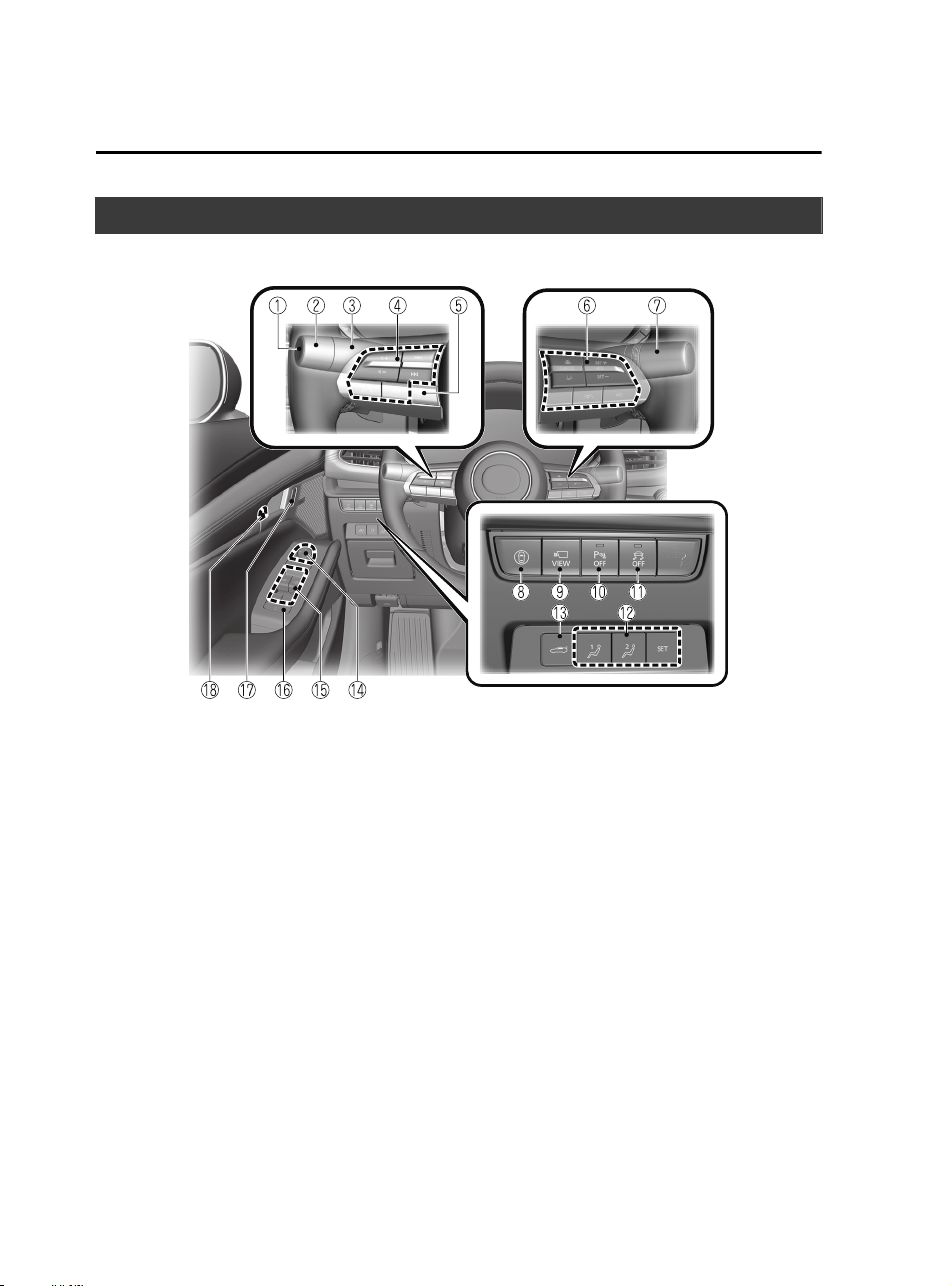
▼
Interior Equipment (View A)
① High beam control switch..................................................................................... page 4-90
② Lighting control.....................................................................................................page 4-44
③ Turn and lane-change signals................................................................................page 4-50
④ Audio remote control switches..............................................................................page 5-19
⑤ INFO switch.......................................................................................................... page 4-14
⑥ Cruise control switches.....................................................page 4-122, 4-131, 4-143, 4-212
⑦ Wiper and washer lever.........................................................................................page 4-51
⑧ i-ACTIVSENSE switch........................................................................................ page 4-87
⑨ 360° view monitor switch...................................................................................page 4-175
⑩ Parking sensor switch......................................................................................... page 4-239
⑪ DSC OFF switch................................................................................................... page 4-78
⑫ Position memory buttons.......................................................................................page 2-10
⑬ Trunk release button..............................................................................................page 3-20
⑭ Outside mirror switches........................................................................................ page 3-30
⑮ Power window switches........................................................................................page 3-35
⑯ Power window lock switch................................................................................... page 3-35
⑰ Door-lock switch................................................................................................... page 3-15
⑱ Door-lock knob..................................................................................................... page 3-17
Pictorial Index
Interior Overview
1-2
The equipment and installation position varies by vehicle
Mazda3_8HZ1-EA-19G_Edition1_old 2019-5-17 13:49:03
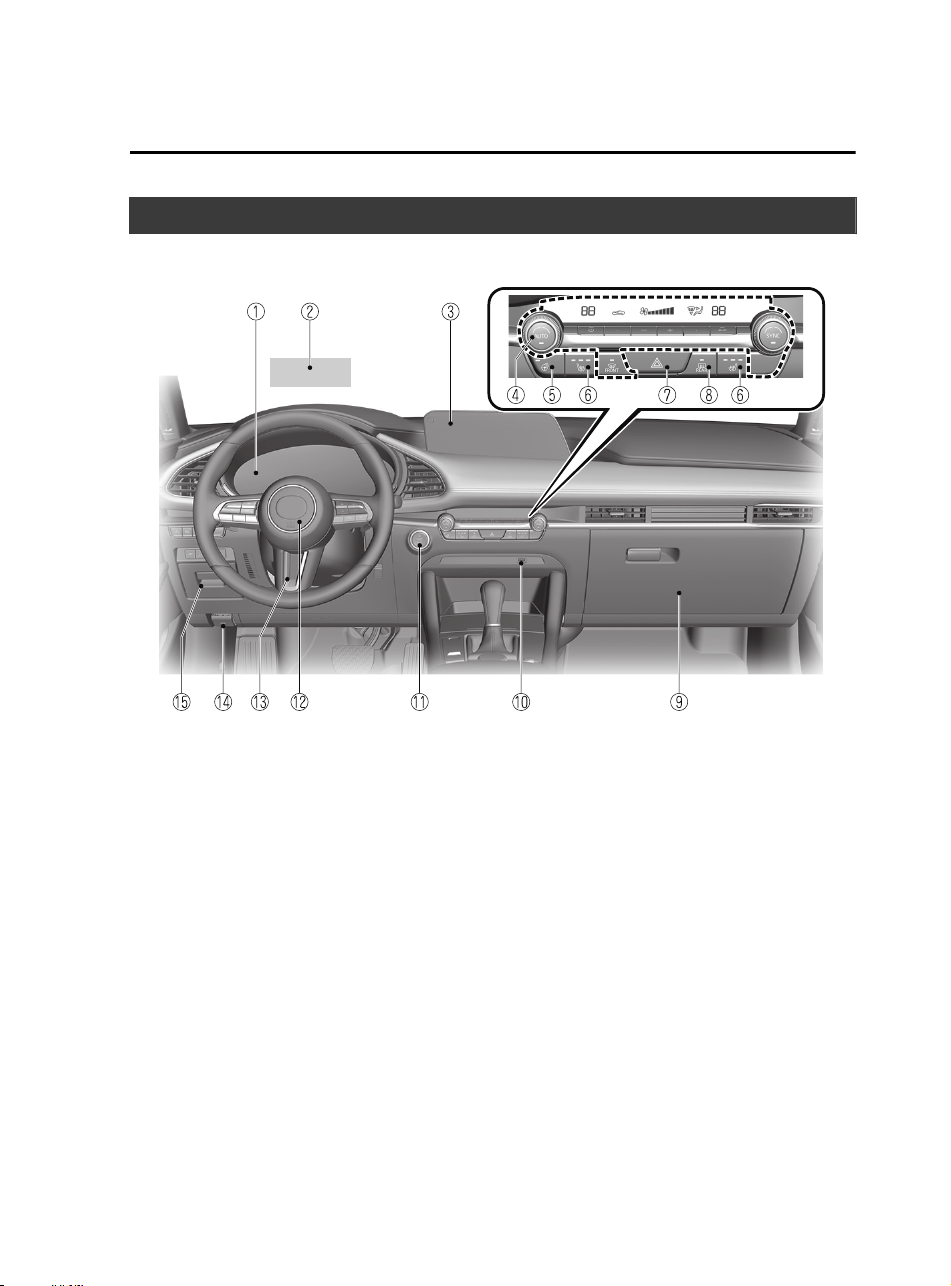
Interior Equipment (View B)
▼
Interior Equipment (View B)
① Instrument cluster..................................................................................................page 4-12
② Active driving display........................................................................................... page 4-29
③ Mazda Connect......................................................................................................page 5-14
④ Climate control system............................................................................................page 5-2
⑤ Heated steering wheel switch................................................................................page 2-21
⑥ Seat warmer switches............................................................................................page 2-20
⑦ Hazard warning flasher switch..............................................................................page 4-58
⑧ Rear window defogger switch...............................................................................page 4-56
⑨ Glove compartment...............................................................................................page 5-42
⑩ External input terminal..........................................................................................page 5-14
⑪ Push button start......................................................................................................page 4-4
⑫ Horn.......................................................................................................................page 4-57
⑬ Lock release lever................................................................................................... page 2-5
⑭ Hood release handle.............................................................................................. page 6-12
⑮ Storage pocket.......................................................................................................page 5-42
Pictorial Index
Interior Overview
The equipment and installation position varies by vehicle
1-3
Mazda3_8HZ1-EA-19G_Edition1_old 2019-5-17 13:49:03
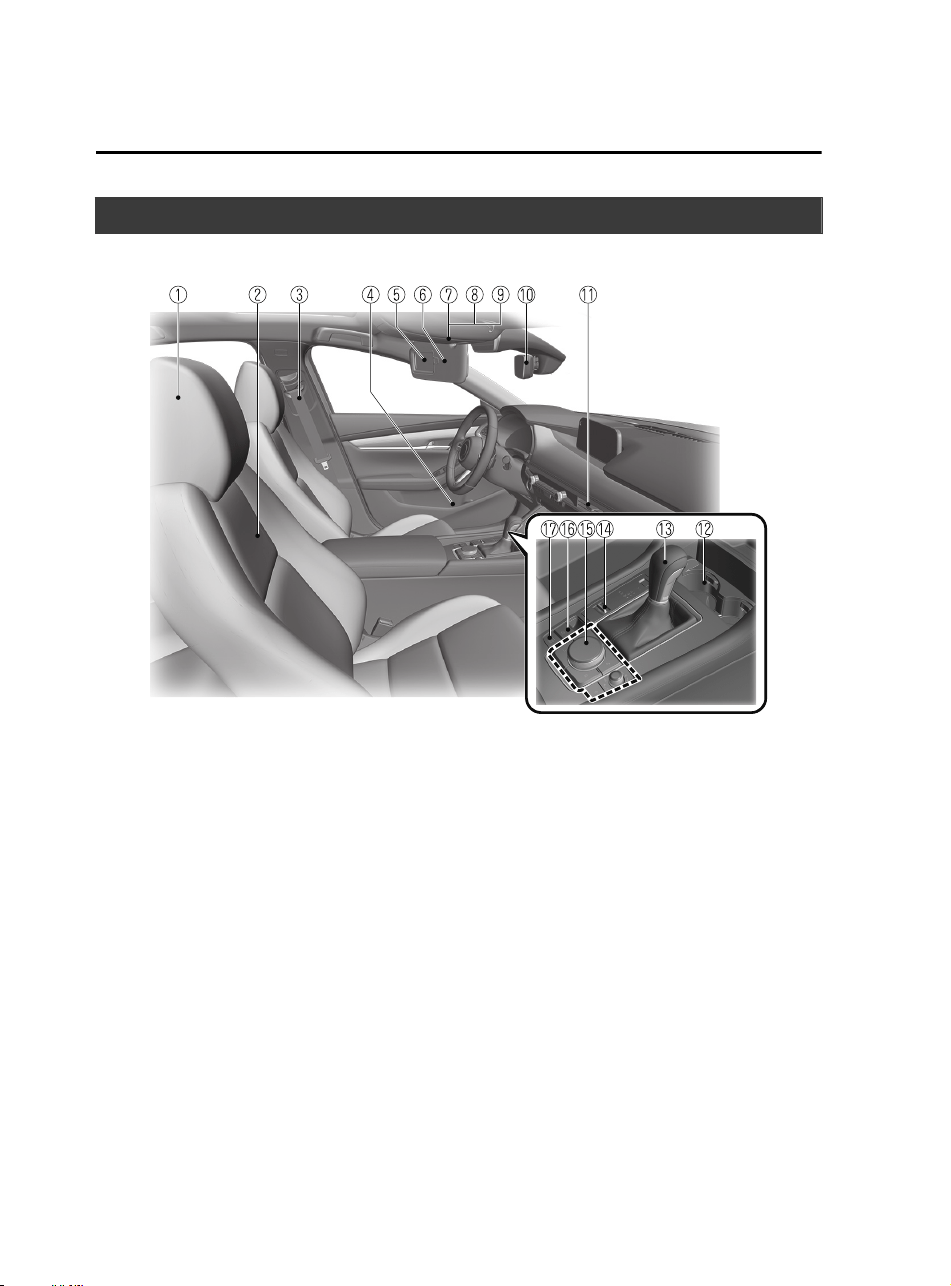
Interior Equipment (View C)
▼
Interior Equipment (View C)
① Head restraint........................................................................................................ page 2-17
② Front seat.................................................................................................................page 2-5
③ Seat belt.................................................................................................................page 2-23
④ Bottle holder..........................................................................................................page 5-40
⑤ Vanity mirror......................................................................................................... page 5-34
⑥ Sunvisor.................................................................................................................page 5-34
⑦ Overhead light (front)/Map lights......................................................................... page 5-35
⑧ Overhead console.................................................................................................. page 5-42
⑨ Moonroof switch................................................................................................... page 3-37
⑩ Rearview mirror.................................................................................................... page 3-32
⑪ Vent......................................................................................................................... page 5-3
⑫ Cup holder.............................................................................................................page 5-38
⑬ Shift lever/Selector lever............................................................................. page 4-31, 4-33
⑭ Drive selection switch...........................................................................................page 4-79
⑮ Commander switch................................................................................................page 5-17
⑯ Electric Parking Brake (EPB) switch....................................................................page 4-64
⑰ AUTOHOLD switch............................................................................................. page 4-71
Pictorial Index
Interior Overview
1-4
The equipment and installation position varies by vehicle
Mazda3_8HZ1-EA-19G_Edition1_old 2019-5-17 13:49:03
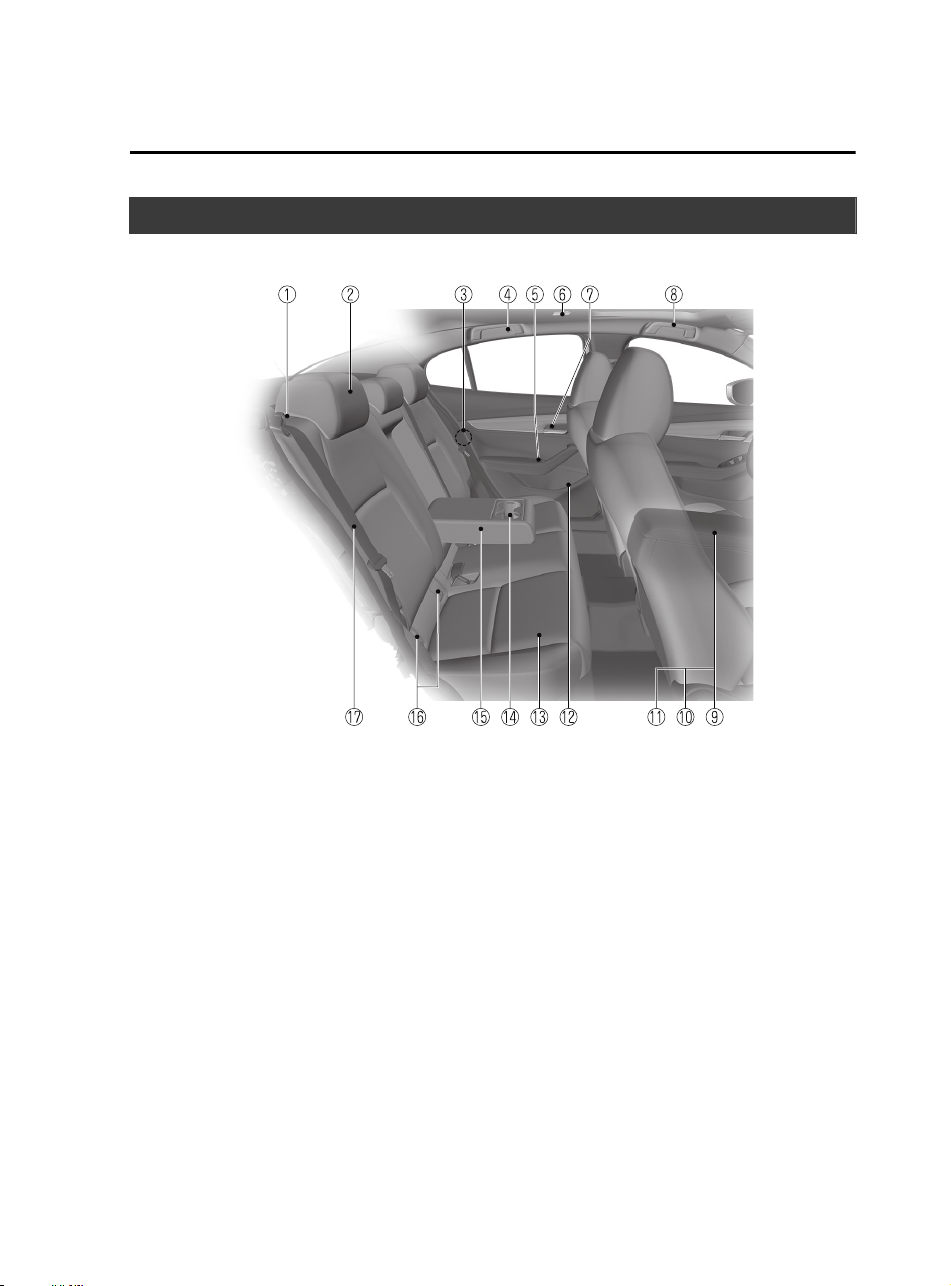
Interior Equipment (View D)
▼
Interior Equipment (View D)
① Push knob (5-door)................................................................................................page 2-14
② Head restraint........................................................................................................ page 2-17
③ Child safety lock................................................................................................... page 3-18
④ Rear coat hook.......................................................................................................page 5-41
⑤ Power window switch........................................................................................... page 3-35
⑥ Overhead light (rear)............................................................................................. page 5-35
⑦ Door-lock knob..................................................................................................... page 3-17
⑧ Assist grip..............................................................................................................page 5-40
⑨ Center console.......................................................................................................page 5-42
⑩ Accessory socket...................................................................................................page 5-37
⑪ External input terminal..........................................................................................page 5-14
⑫ Bottle holder..........................................................................................................page 5-40
⑬ Rear seat................................................................................................................ page 2-14
⑭ Cup holder.............................................................................................................page 5-38
⑮ Armrest..................................................................................................................page 2-17
⑯ ISOFIX lower anchors (Mexico)/LATCH lower anchors (Except Mexico).........page 2-50
⑰ Seat belt.................................................................................................................page 2-23
Pictorial Index
Interior Overview
The equipment and installation position varies by vehicle
1-5
Mazda3_8HZ1-EA-19G_Edition1_old 2019-5-17 13:49:03
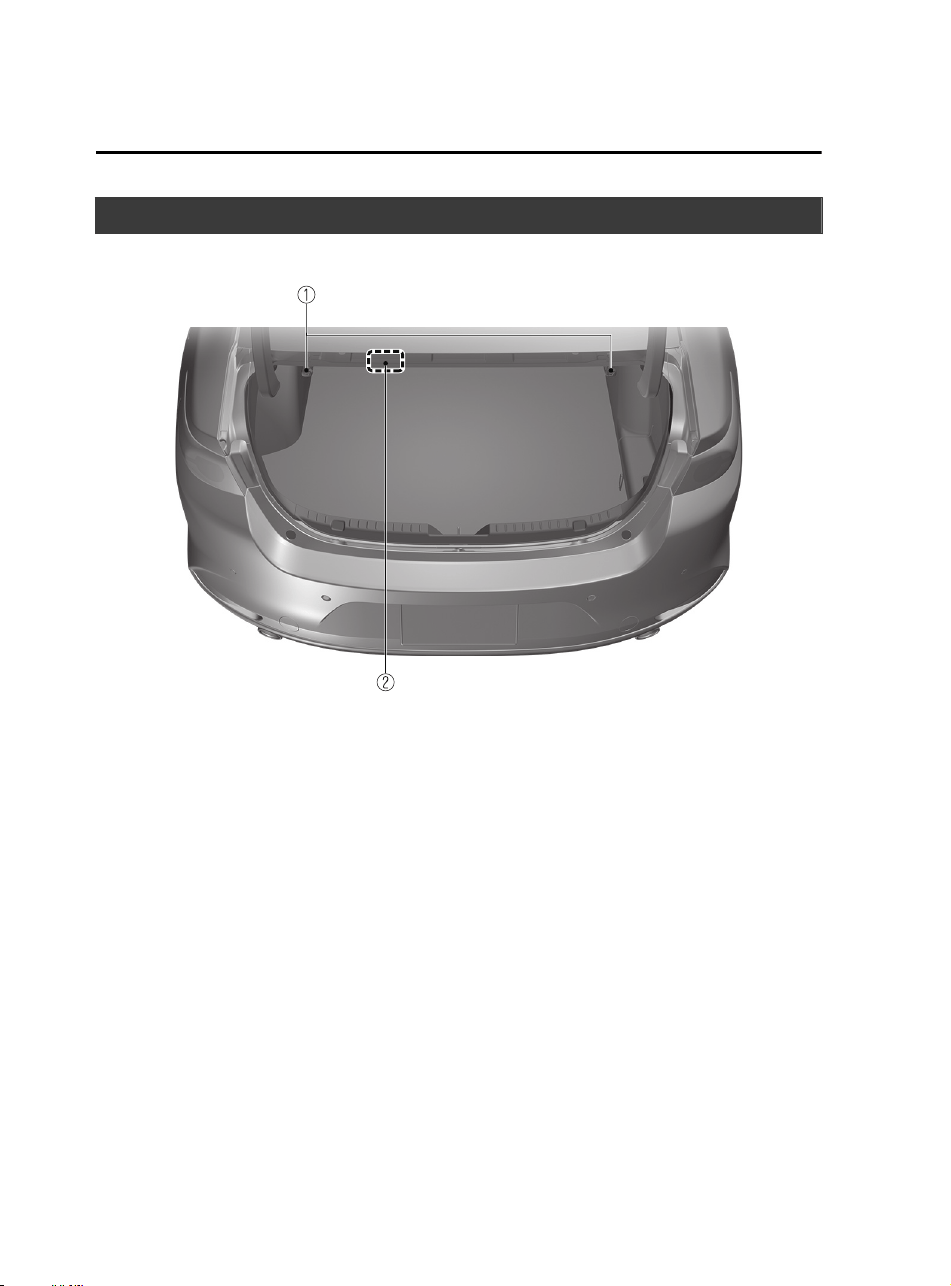
Interior Equipment (View E)
▼
4-Door
① Remote handles..................................................................................................... page 2-14
② Trunk light.............................................................................................................page 5-35
Pictorial Index
Interior Overview
1-6
The equipment and installation position varies by vehicle
Mazda3_8HZ1-EA-19G_Edition1_old 2019-5-17 13:49:03
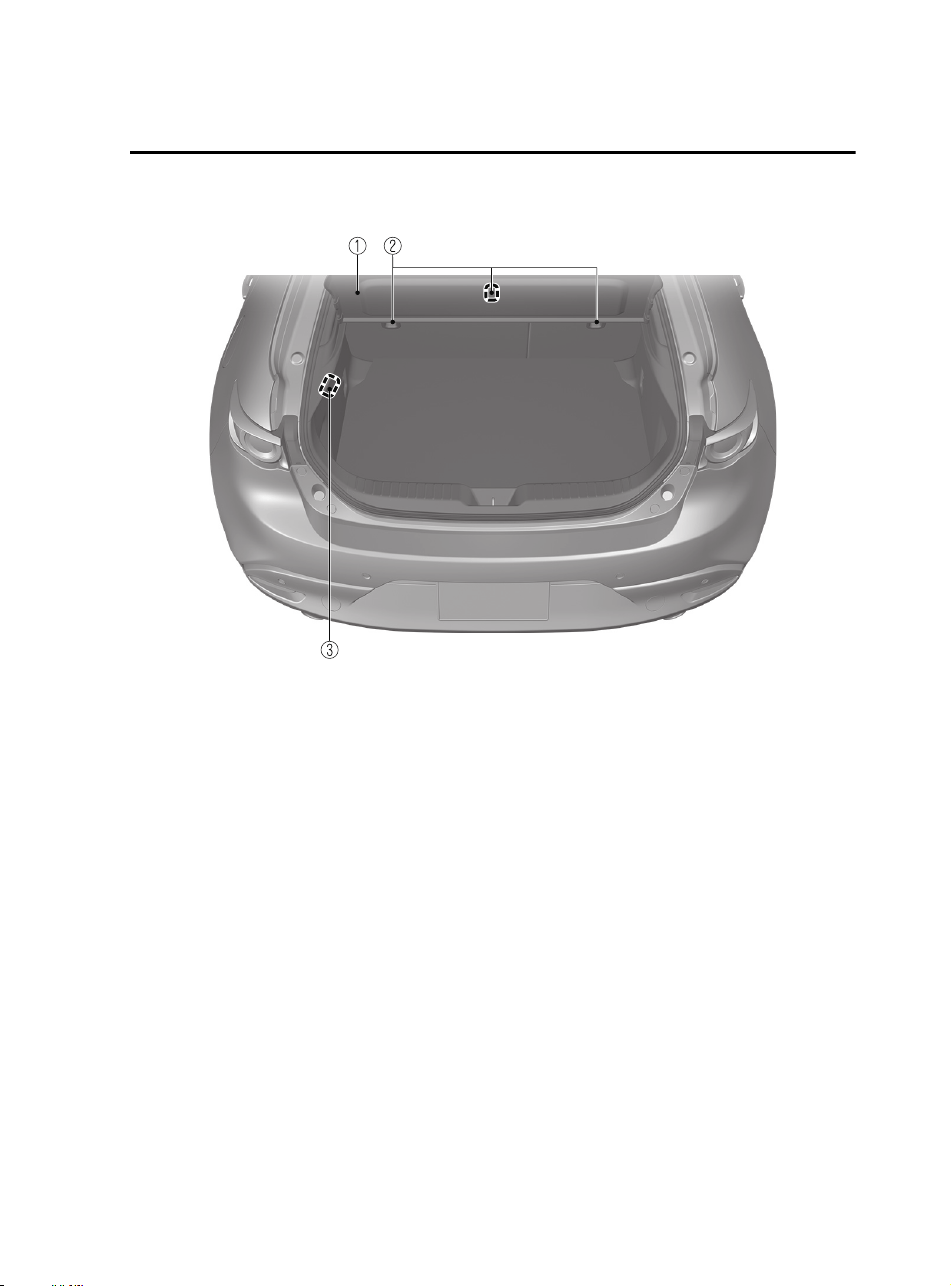
▼
5-Door
① Luggage compartment cover.................................................................................page 3-22
② Anchor brackets.................................................................................................... page 2-42
③ Luggage compartment light.................................................................................. page 5-35
Pictorial Index
Interior Overview
The equipment and installation position varies by vehicle
1-7
Mazda3_8HZ1-EA-19G_Edition1_old 2019-5-17 13:49:03
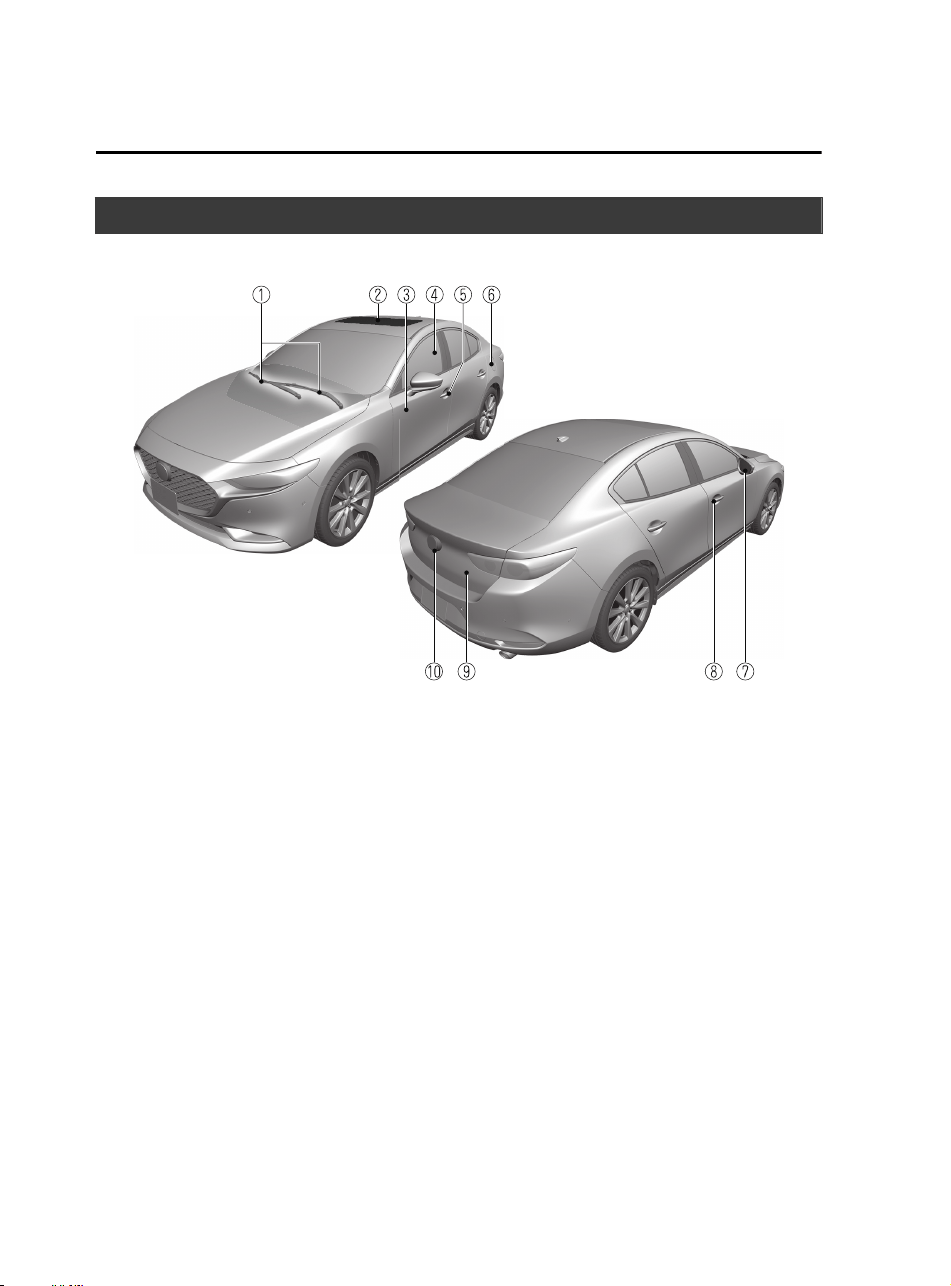
4-Door
▼
4-Door
① Windshield wiper blades....................................................................................... page 6-21
② Moonroof...............................................................................................................page 3-37
③ Door.......................................................................................................................page 3-11
④ Window................................................................................................................. page 3-34
⑤ Touch sensor..........................................................................................................page 3-13
⑥ Fuel-filler lid......................................................................................................... page 3-27
⑦ Outside mirror....................................................................................................... page 3-30
⑧ Touch sensor..........................................................................................................page 3-13
⑨ Trunk lid................................................................................................................page 3-19
⑩ Electric trunk lid opener........................................................................................page 3-20
Pictorial Index
Exterior Overview
1-8
The equipment and installation position varies by vehicle
Mazda3_8HZ1-EA-19G_Edition1_old 2019-5-17 13:49:03
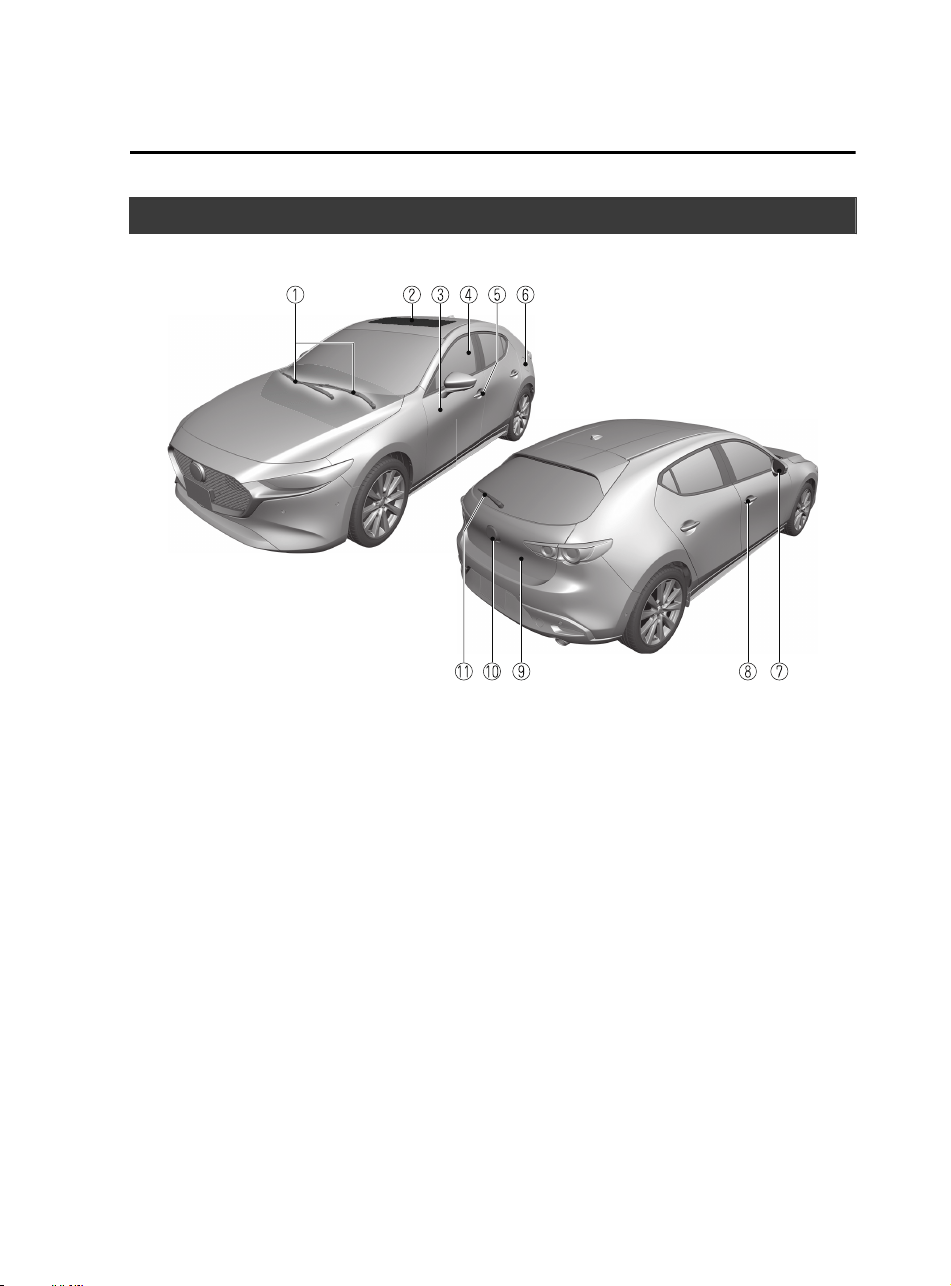
5-Door
▼
5-Door
① Windshield wiper blades....................................................................................... page 6-21
② Moonroof...............................................................................................................page 3-37
③ Door.......................................................................................................................page 3-11
④ Window................................................................................................................. page 3-34
⑤ Touch sensor..........................................................................................................page 3-13
⑥ Fuel-filler lid......................................................................................................... page 3-27
⑦ Outside mirror....................................................................................................... page 3-30
⑧ Touch sensor..........................................................................................................page 3-13
⑨ Liftgate.................................................................................................................. page 3-19
⑩ Electric liftgate opener.......................................................................................... page 3-20
⑪ Rear window wiper blade......................................................................................page 6-25
Pictorial Index
Exterior Overview
The equipment and installation position varies by vehicle
1-9
Mazda3_8HZ1-EA-19G_Edition1_old 2019-5-17 13:49:03

MEMO
1-10
Mazda3_8HZ1-EA-19G_Edition1_old 2019-5-17 13:49:03

2
Essential Safety Equipment
Important information about safety equipment, including seats, seat
belt system, child-restraint systems and SRS air bags.
Seats.................................................... 2-2
Seat Precautions............................2-2
Front Seat......................................2-5
Rear Seat.....................................2-14
Head Restraints...........................2-17
Seat Warmer/Heated Steering
Wheel................................................ 2-20
Seat Warmer
*
..............................2-20
Heated Steering Wheel
*
............. 2-21
Seat Belt Systems.............................2-23
Seat Belt Precautions..................2-23
Seat Belt......................................2-26
Seat Belt Warning Systems.........2-27
Front Seat Belt Pretensioner and
Load Limiting Systems...............2-28
Seat Belt Extender...................... 2-30
Child Restraint................................ 2-32
Child-Restraint Precautions........2-32
Child-Restraint System
Installation.................................. 2-37
Child-Restraint System Suitability
for Various Seat Positions
Table........................................... 2-39
Installing Child-Restraint
Systems.......................................2-42
SRS Air Bags....................................2-55
Supplemental Restraint System
(SRS) Precautions.......................2-55
Supplemental Restraint System
Components................................2-62
How the SRS Air Bags Work..... 2-64
SRS Air Bag Deployment
Criteria........................................2-68
Limitations to SRS Air Bag........2-70
Driver and Front Passenger
Occupant Classification System
*
.......
.................................................... 2-71
Constant Monitoring...................2-76
*Some models.
2-1
Mazda3_8HZ1-EA-19G_Edition1_old 2019-5-17 13:49:03
Seat Precautions
▼
Seat Precautions
WARNING
Make sure the adjustable components of a
seat are locked in place:
Adjustable seats and seatbacks that are
not securely locked are dangerous. In a
sudden stop or collision, the seat or
seatback could move, causing injury. Make
sure the adjustable components of the seat
are locked in place by attempting to slide
the seat forward and backward and
rocking the seatback.
Never allow children to adjust a seat:
Allowing children to adjust a seat is
dangerous as it could result in serious
injury if a child's hands or feet become
caught in the seat.
Do not drive with the seatback unlocked:
All of the seatbacks play an important role
in your protection in a vehicle. Leaving the
seatback unlocked is dangerous as it can
allow passengers to be ejected or thrown
around and baggage to strike occupants in
a sudden stop or collision, resulting in
severe injury. After adjusting the seatback
at any time, even when there are no other
passengers, rock the seatback to make sure
it is locked in place.
Adjust a seat only when the vehicle is
stopped:
If the seat is adjusted while the vehicle is
being driven, the seating posture may
become unstable and the seat could move
unexpectedly resulting in injury.
Do not modify or replace the front seats:
Modifying or replacing the front seats such
as replacing the upholstery or loosening
any bolts is dangerous. The front seats
contain air bag components essential to
the supplemental restraint system. Such
modications could damage the
supplemental restraint system and result in
serious injury. Consult an Authorized
Mazda Dealer if there is any need to
remove or reinstall the front seats.
Do not drive with damaged front seats:
Driving with damaged front seats, such as
seat cushions torn or damaged down to
the urethane, is dangerous. A collision,
even one not strong enough to
inate
the
air bags, could damage the front seats
which contain essential air bag
components. If there was a subsequent
collision, an air bag may not deploy which
could lead to injuries. Always have an
Authorized Mazda Dealer inspect the front
seats, front seat belt pretensioners and air
bags after a collision.
Do not drive with either front seats
reclined:
Sitting in a reclined position while the
vehicle is moving is dangerous because you
do not get the full protection from seat
belts. During sudden braking or a collision,
you can slide under the lap belt and
suer
serious internal injuries. For maximum
protection, sit well back and upright.
Essential Safety Equipment
Seats
2-2
Mazda3_8HZ1-EA-19G_Edition1_old 2019-5-17 13:49:03

Do not place an object such as a cushion
between the seatback and your back:
Putting an object such as a cushion
between the seatback and your back is
dangerous because you will be unable to
maintain a safe driving posture and the
seat belt cannot function at its full capacity
in a collision, which could result in a serious
accident, injury or death.
Do not place objects under the seat:
The object could get stuck and cause the
seat to not be xed securely, and result in
an accident.
Do not stack cargo higher than the
seatbacks:
Stacking luggage or other cargo higher
than the seatbacks is dangerous. During
sudden braking or a collision, objects can
y
around and become projectiles that
may hit and injure passengers.
Make sure luggage and cargo is secured
before driving:
Not securing cargo while driving is
dangerous as it could move or be crushed
during sudden braking or a collision and
cause injury.
Never allow a passenger to sit or stand on
the folded seatback while the vehicle is
moving:
Driving with a passenger on the folded
seatback is dangerous. Allowing a child to
sit up on the folded seatback while the
vehicle is moving is particularly dangerous.
In a sudden stop or even a minor collision,
a child not in a proper seat or
child-restraint system and seat belt could
be thrown forward, back or even out of the
vehicle resulting in serious injuries or death.
The child in the baggage area could be
thrown into other occupants and cause
serious injury.
Never give the car keys to children and do
not allow them to play in the vehicle (4–
Door):
Playing with the folding rear seats is
dangerous. Once the seatbacks are back
up, a child in the trunk would not be able to
get out the way they had entered. If you
have small children, keep the seatbacks
locked.
Always leave your car locked and keep the
car keys safely away from children (4–
Door):
Leaving your car unlocked or the keys in
reach of children is dangerous. Children
who nd their way into the trunk through
an unlocked rear seatback or an open
trunk can become accidentally locked in
the trunk. This could result in death or
brain damage from heat prostration,
particularly in the summer. Always lock the
doors and the trunk, and as an added
measure, keep the rear seatbacks locked,
whether you have children in your home or
not.
Essential Safety Equipment
Seats
2-3
Mazda3_8HZ1-EA-19G_Edition1_old 2019-5-17 13:49:03
CAUTION
When operating a seat, be careful not to
put your hands or ngers near the
moving parts of the seat or on the side
trim to prevent injury.
When moving the seats, make sure there
is no cargo in the surrounding area. If the
cargo gets caught it could damage the
cargo.
(Manual Seat)
When moving the seats forward and
rearward or returning a rear-reclined
seatback to its upright position, make
sure you hold onto the seatback with
your hand while operating. If the
seatback is not held, the seat will move
suddenly and could cause injury.
When inserting your hand under the seat
to clean the cabin or pick up something
you dropped under the seat, be careful
not to hurt yourself. If you contact the
moving parts and surrounding parts
around the seat rail, seat frame, and the
bottom of the seat, it could result in
injury.
NOTE
When returning a rear seat to its
original position, place the seat belt in
its normal position. Verify that the seat
belt pulls out and retracts.
(Power Seat)
The seat-bottom power adjustment is
operated by motors. Avoid extended
operation because excessive use can
damage the motors.
To prevent the battery from running
down, avoid using the power
adjustment when the engine is
stopped. The adjuster uses a large
amount of electrical power.
Do not use the switch to make more
than one adjustment at a time.
Essential Safety Equipment
Seats
2-4
Mazda3_8HZ1-EA-19G_Edition1_old 2019-5-17 13:49:03
Front Seat
▼
Adjusting the Driver's Seat
Using the driving position set up
procedure recommended by Mazda allows
you to maintain a relaxed posture, drive
the vehicle for longer periods without
feeling tired, and make quick operations
naturally.
Also, you can be assured of a clear view in
the forward direction to help you drive
more safely and comfortably.
The adjustments for the driving position
recommended by Mazda are done using
the following procedures.
1. Moving the steering wheel and seat to
their default positions.
2. Adjusting the seatback angle.
3. Adjusting the seat position forward
and back.
4. Adjusting the seat height.
5. Adjusting the height on the front edge
of the seat bottom.
6. Adjusting the steering wheel position.
7. Adjusting the head restraint position.
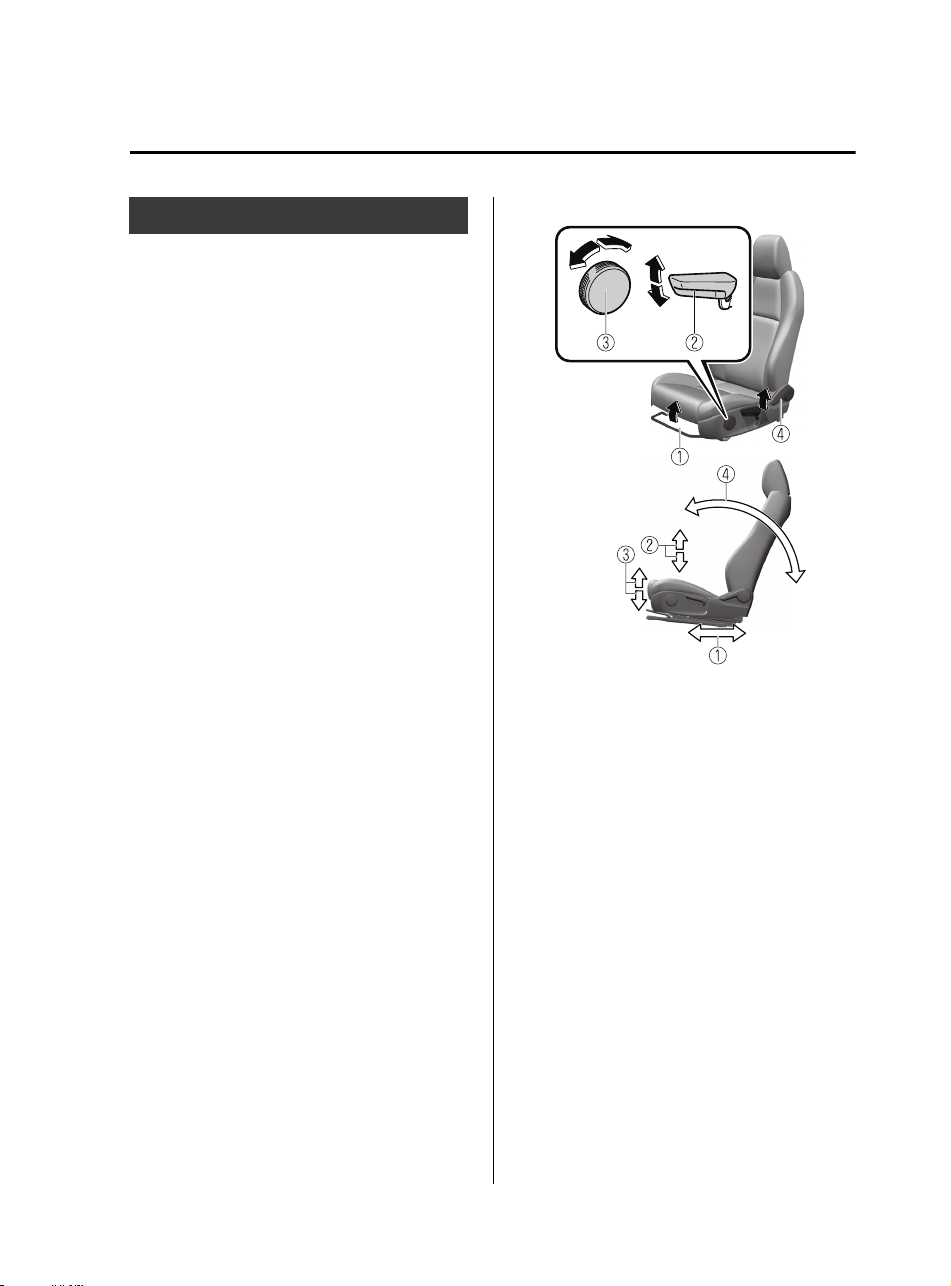
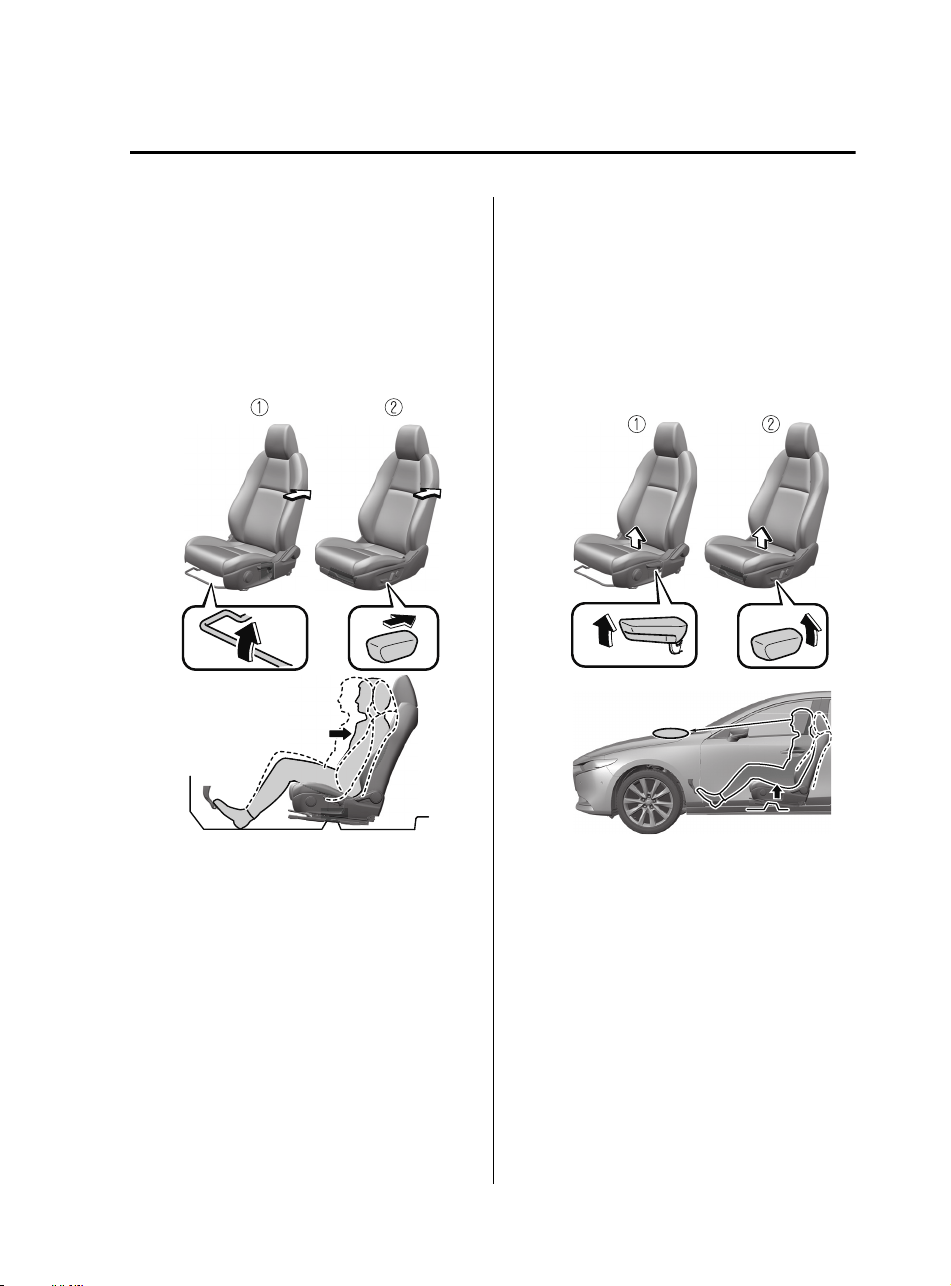
Manual seat
1. Seat Slide
To move a seat forward or backward,
raise the lever and slide the seat to the
desired position and release the lever.
Make sure the lever returns to its
original position and the seat is locked
in place by attempting to push it
forward and backward.
2. Height Adjustment
To adjust the seat height, move the
lever up or down.
3. Height Adjustment for Front Edge
of Seat Bottom
To adjust the height for front edge of
the seat bottom, rotate the dial to the
desired position.
Essential Safety Equipment
Seats
2-5
Mazda3_8HZ1-EA-19G_Edition1_old 2019-5-17 13:49:03

4. Seat Recline
To change the seatback angle, lean
forward slightly while raising the lever.
Then lean back to the desired position
and release the lever.
Make sure the lever returns to its
original position and the seatback is
locked in place by attempting to push
it forward and backward.
Power seat
1. Seat Slide
To slide the seat, move the slide lifter
switch on the outside of the seat to the
front or back and hold it. Release the
switch at the desired position.
2. Height Adjustment
To adjust the seat height, move the
slide lifter switch up or down.
3. Height Adjustment for Front Edge
of Seat Bottom
To adjust the front height of the seat
bottom, raise or lower the front of the
slide lifter switch.
4. Seat Recline
To change the seatback angle, press the
front or rear side of the reclining
switch. Release the switch at the
desired position.
5. Lumbar Support Adjustment
To increase the seat firmness, press
and hold the front part of the switch to
the desired position, then release it.
Press the rear part of the switch to
decrease firmness.
Before making adjustments to the
driving position recommended by
Mazda
Before making adjustments, move the
steering wheel and seat to their default
positions.
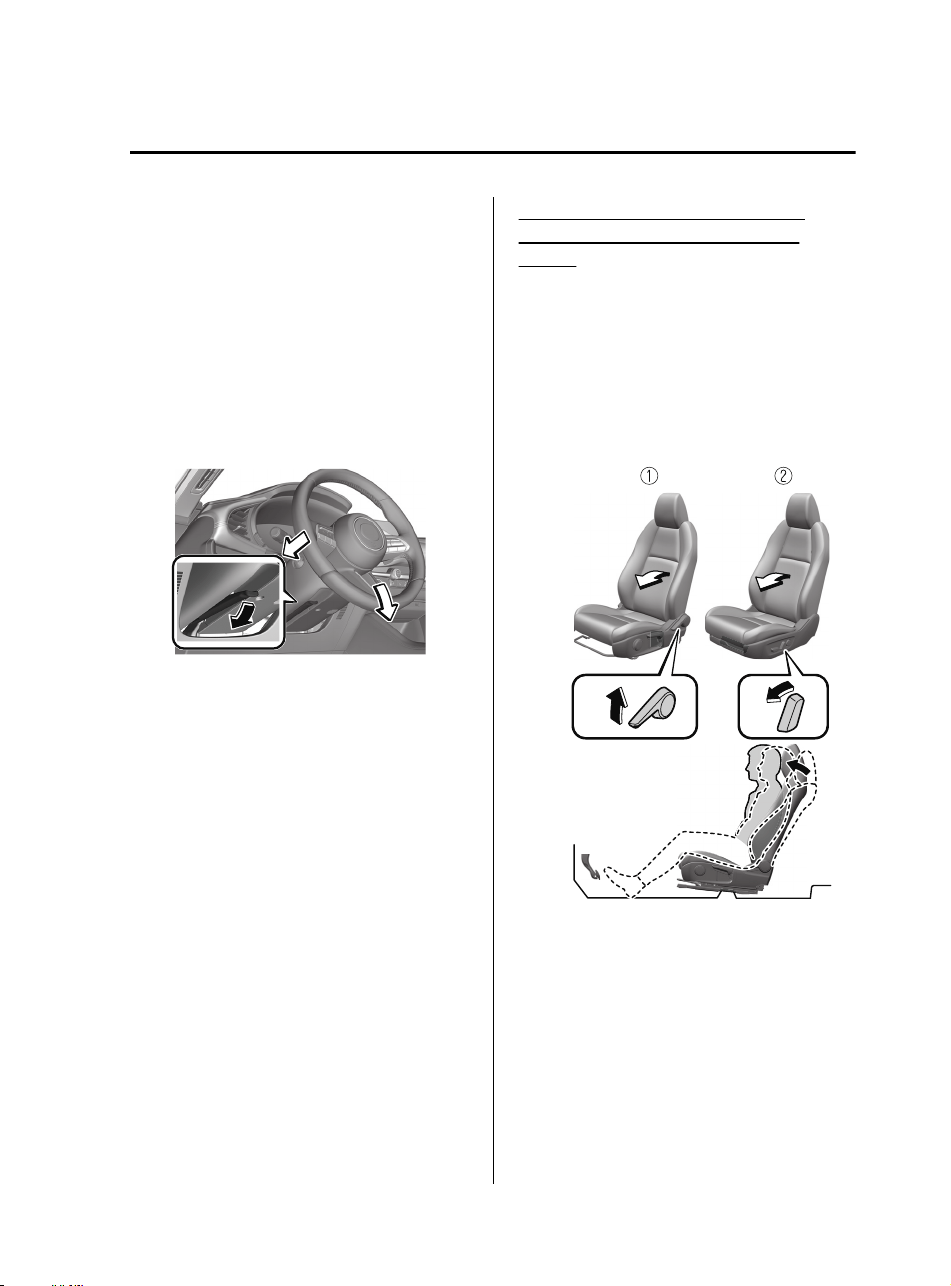
How to move the steering wheel to its
default position
WARNING
Never adjust the steering wheel while the
vehicle is moving:
Adjusting the steering wheel while the
vehicle is moving is dangerous. Moving it
can very easily cause the driver to abruptly
turn to the left or right. This can lead to loss
of control or an accident.
Essential Safety Equipment
Seats
2-6
Mazda3_8HZ1-EA-19G_Edition1_old 2019-5-17 13:49:03
After adjusting the steering wheel position,
make sure it is securely locked by trying to
move it up and down:
Driving with the steering wheel not
securely locked in position is dangerous. If
the steering wheel moves unexpectedly
while driving, you could lose control of the
steering resulting in an accident.
Lower the lever, move the steering wheel
to the lowest position, and then push it
down and all the way back.
How to move a driver’s seat to its
default position
1. Slide the seat all the way back.
2. Lower the seat to its lowest height.
3. Lower the front edge of the seat
bottom to its lowest height.
4. Sit squarely in the seat and rest your
back against the seatback.
Seat adjustment procedure for the
driving position recommended by
Mazda
Adjusting the seatback angle (reclining)
Adjust the seatback to the angle providing
a comfortable seated posture.
1. With your posture slightly slouched,
move the seatback forward to the angle
where your waist feels slightly
cramped.
1. Manual Seat
2. Power Seat
Essential Safety Equipment
Seats
2-7
Mazda3_8HZ1-EA-19G_Edition1_old 2019-5-17 13:49:03
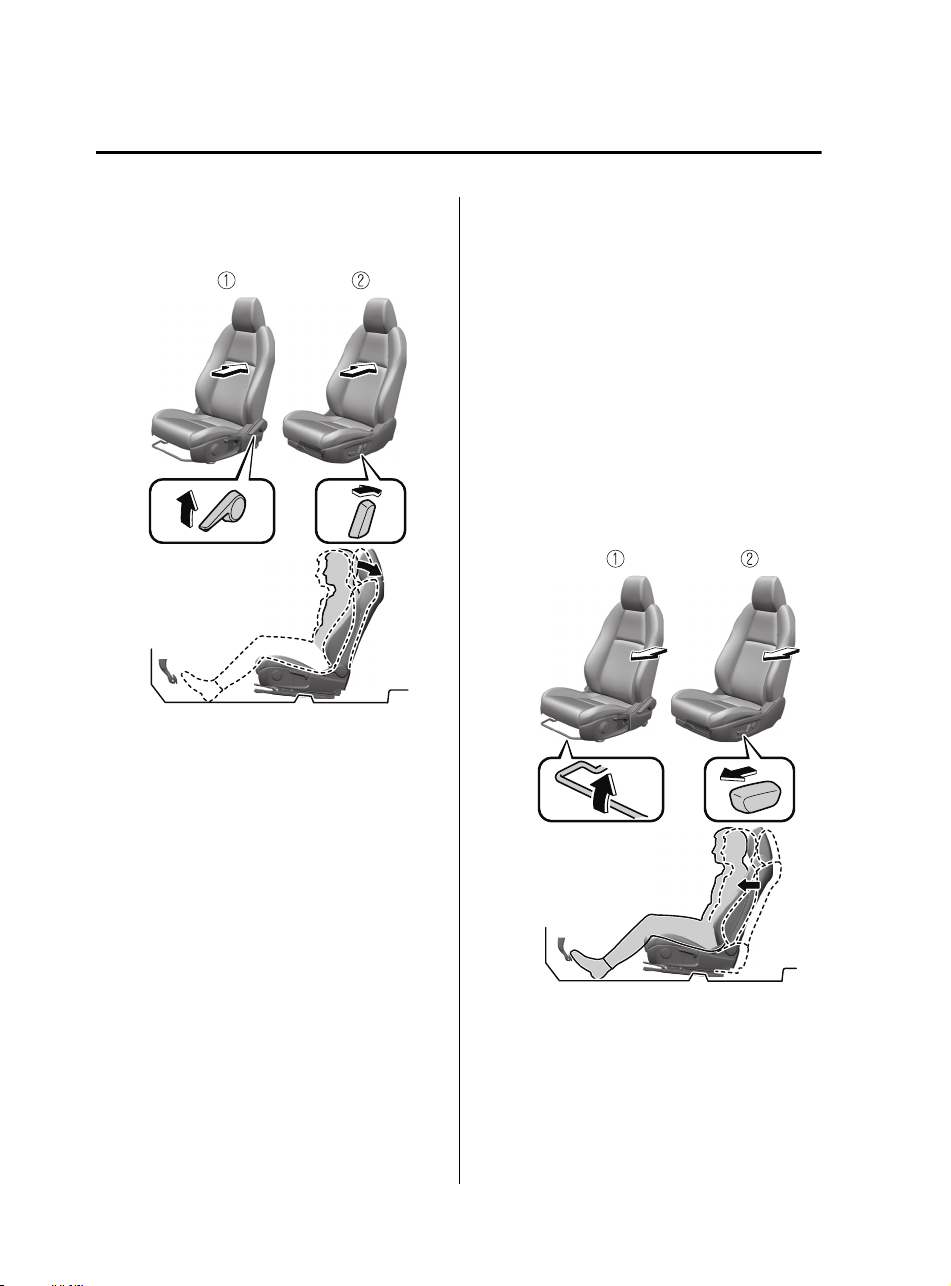
2. Move the seatback backward to a
comfortable seated posture without any
feeling of cramping in your waist.
1. Manual Seat
2. Power Seat
Adjusting the seat position forward and
back (sliding)
Adjust the seat to the position best for
operating the accelerator and brake pedals.
1. Place your left foot on the footrest,
your right foot between the accelerator
and brake pedals, and position your
heel to the position allowing easy
switching between the pedals.
2. With your heel set on the floor, set
your right foot on the brake pedal and
move the seat forward as far as
possible until you feel a slight
cramping in your ankle.
1. Manual Seat
2. Power Seat
3. With your right foot set on the brake
pedal, move the seat back until you no
longer feel cramping in your ankle.
Essential Safety Equipment
Seats
2-8
Mazda3_8HZ1-EA-19G_Edition1_old 2019-5-17 13:49:03
4. With your heel set on the floor, make
sure you can move your foot between
the brake pedal and accelerator pedal
smoothly.
5. Depress the accelerator pedal
completely with your heel set on the
floor and make sure that your ankle
does not feel over-stretched.
1. Manual Seat
2. Power Seat
Adjusting the seat height
Adjust the seat height to a position where
you have a clear forward view and you can
drive the vehicle easily.
1. With your back resting against the
seatback, raise the seat to the height
where you can see the rear edge area of
the hood surface from the windshield.
1. Manual Seat
2. Power Seat
Essential Safety Equipment
Seats
2-9
Mazda3_8HZ1-EA-19G_Edition1_old 2019-5-17 13:49:03
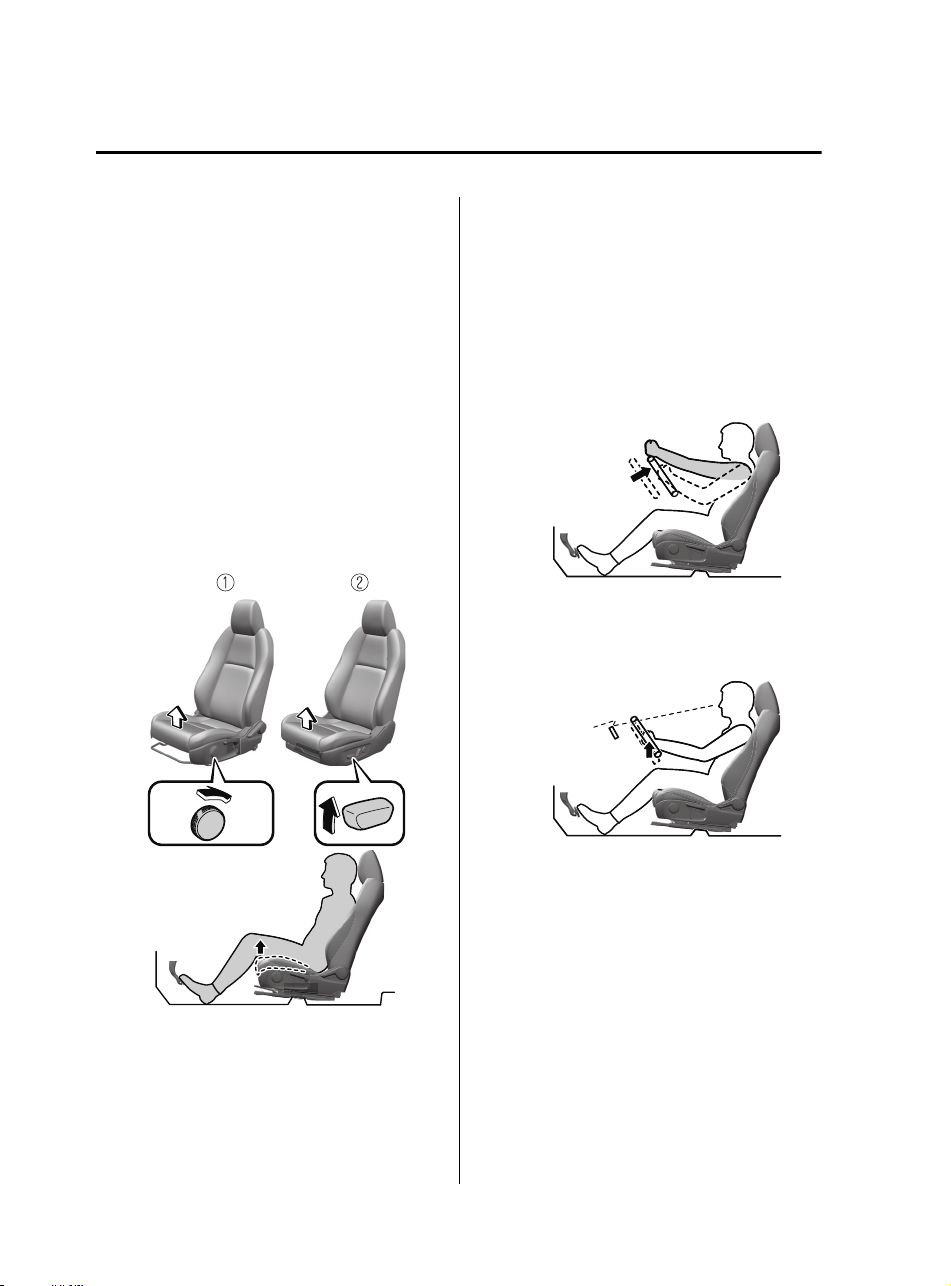
Adjusting the height on the front edge
of the seat bottom
Adjust the height on the front edge of the
seat bottom to the position where the back
of your knees contacts the front edge of
the seat bottom.
1. With your right foot set on the
accelerator pedal, adjust the height on
the front edge of the seat bottom so
that the back of your knees lightly
contacts the front edge of the seat
bottom.
2. Depress the accelerator pedal and
make sure that you no longer feel
cramping in the back of your knees.
1. Manual Seat
2. Power Seat
Adjusting the steering wheel position
Adjust the steering wheel to the position
where it can be operated easily and the
gauges can be viewed easily.
1. With your back resting against the
seatback, extend both arms, place them
on the top of the steering wheel, and
pull the steering wheel towards you to
the position of your wrists.
2. Adjust the steering wheel height so
that the gauges can be viewed easily.
3. Raise the lever to securely lock the
steering wheel.
Adjusting the head restraint position
To prevent shock to the head and neck,
adjust the head restraints to their correct
positions.
Refer to Height Adjustment on page
2-17.
▼
Driving Position Memory (Power
Seat)
*
The desired driving position can be called
up after programming the position.
The following driving positions can be
programmed.
Essential Safety Equipment
Seats
2-10
*Some models.
Mazda3_8HZ1-EA-19G_Edition1_old 2019-5-17 13:49:03
Driver’s seat position (seat slide, height
adjustment, front edge of seat bottom,
seat recline)
Refer to Adjusting the Driver's Seat on
page 2-5.
Active driving display (display position,
brightness level, display information)
Refer to Active Driving Display on page
4-29.
Outside mirror angle
Refer to Outside Mirrors on page 3-30.
A driving position can be programmed to
the following parts.
Position memory button
Transmitter used for vehicle
NOTE
Lumbar support adjustment cannot be
programmed.
Programming
1. Make sure the parking brake is on.
2. (Automatic transmission)
Make sure the selector lever is in the P
position.
3. Switch the ignition ON.
4. Adjust the following parts to the
desired conditions.
Driver's seat
Active driving display
Outside mirrors
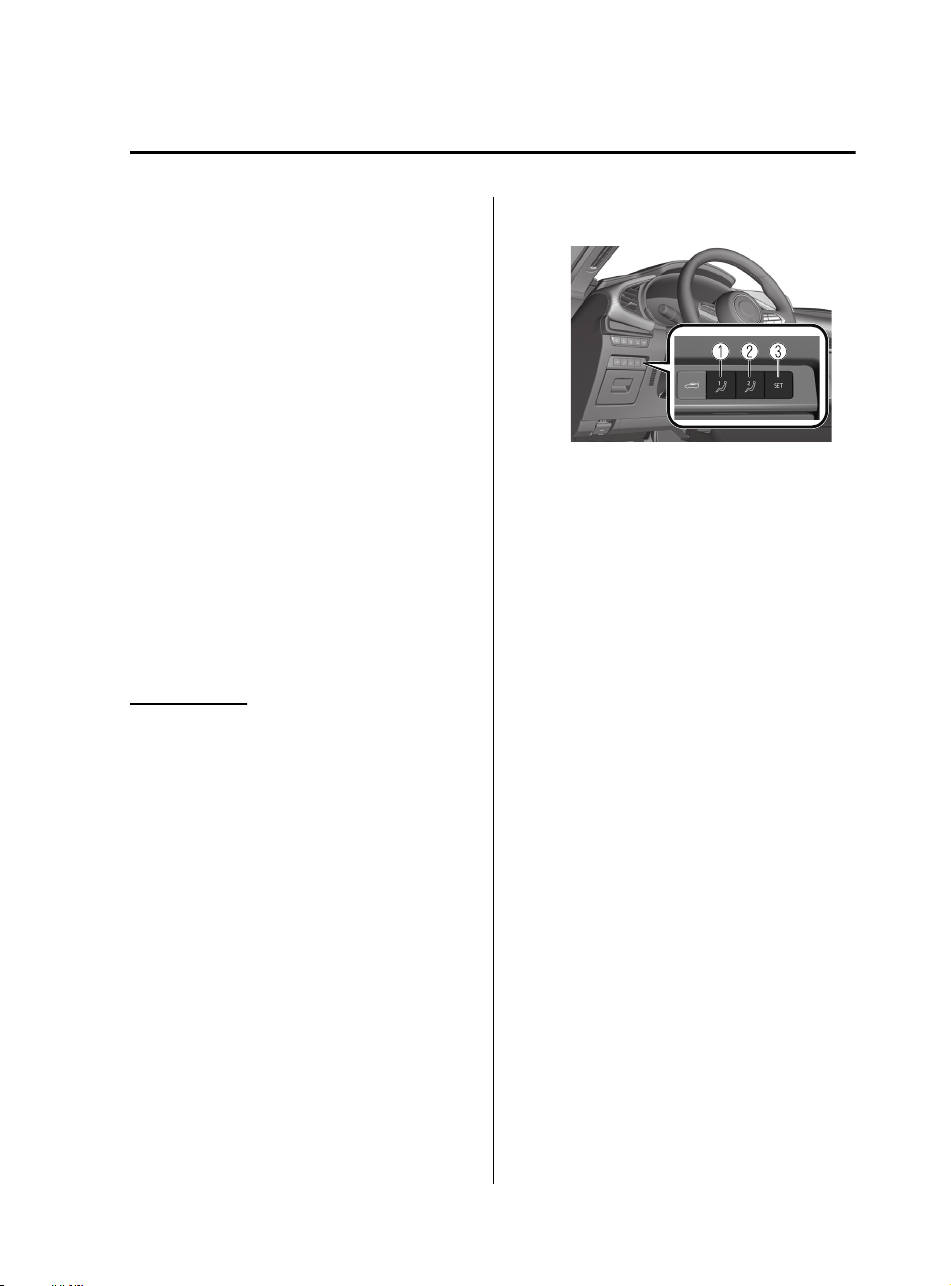
5. Press the SET button continuously
until a sound is activated.
1. 1 button
2. 2 button
3. SET button
6. Do the following operation within 5
seconds after the sound is activated to
program the driving position.
Programming to a position
memory button
Press the button you want to
program, either 1 or 2 button.
Programming to the transmitter
Press the unlock button on the
transmitter.
A sound is activated when the
operation is completed correctly.
NOTE
If you do not perform the operation
correctly, a sound indicating that the
programming has failed is activated.
If the angle of the outer mirrors only
changes a little, the angle of the outer
mirrors may not have been programmed
correctly.
If the angle of the outer mirrors is
adjusted close to the limits of its range
of motion, the driving position can be
successfully programmed, but it may fail
when calling up the programmed
driving position.
Essential Safety Equipment
Seats
2-11
Mazda3_8HZ1-EA-19G_Edition1_old 2019-5-17 13:49:03
Calling up the programmed driving
position
CAUTION
Do not place ngers or hands around the
bottom of the seat while the seat memory
function is operating. The seat moves
automatically while the seat memory
function is operating and ngers or hands
could get pinched and injured.
Using the position memory button
1. Make sure the parking brake is on.
2. (Automatic transmission)
Make sure the selector lever is in the P
position.
3. Switch the ignition ON.
4. Press the programming button for the
driving position you want to call up
(button 1 or 2).
5. A sound is activated when the
adjustment to the programmed driving
position is completed.
NOTE
When adjustment of the driving position
is not necessary, a sound is not
activated.
The driving position adjustment is
canceled in the following cases:
The seat adjustment switch on the
driver's seat is operated.
The angle of the outer mirrors is
adjusted.
The SET button is pressed.
Programming button 1 or 2 is pressed.
The lock button or unlock button on
the transmitter is pressed.
The vehicle starts moving.
The active driving display is adjusted.
(Manual transmission)
The parking brake is released.
(Automatic transmission)
The selector lever is shifted to a
position other than P.
Using the transmitter
1. Unlock the driver's door using one of
the following methods.
Touch the sensing area of the door
release touch sensor.
Press the unlock button on the
transmitter.
2. When you open the driver's door
within 90 seconds after unlocking the
doors, the adjustment of the following
parts starts.
Driver's seat
Active driving display (When the
ignition is switched ON, the adjusted
active driving display is activated.)
Outside mirrors
A sound is activated when the
adjustment is completed.
Essential Safety Equipment
Seats
2-12
Mazda3_8HZ1-EA-19G_Edition1_old 2019-5-17 13:49:03
NOTE
When adjustment of the driving position
is not necessary, a sound is not
activated.
The driving position adjustment is
canceled in the following cases:
The seat adjustment switch on the
driver's seat is operated.
The angle of the outer mirrors is
adjusted.
The SET button is pressed.
Programming button 1 or 2 is pressed.
The lock button or unlock button on
the transmitter is pressed.
The vehicle starts moving.
The active driving display is adjusted.
(Manual transmission)
The parking brake is released.
(Automatic transmission)
The selector lever is shifted to a
position other than P.
Erasing programmed driving positions
Erasing the driving positions
programmed to the key
1. Switch the ignition OFF.
2. Press the SET button continuously
until a sound is activated.
3. Press the lock button on the transmitter
within 5 seconds after the sound is
activated.
NOTE
If you do not perform the operation
correctly, a sound indicating that the
programming has failed is activated.
▼
Adjusting the Front Passenger's
Seat
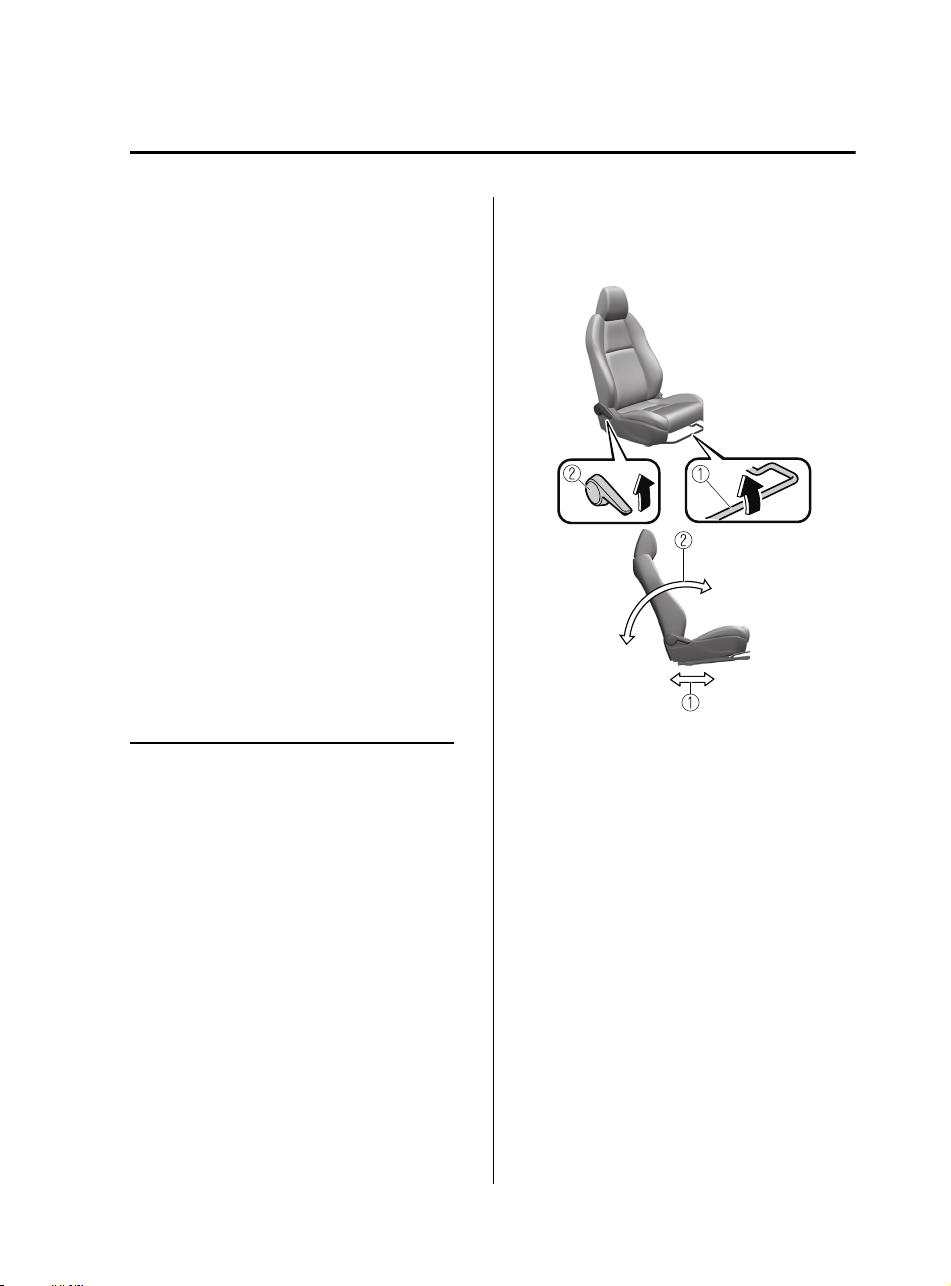
1. Seat Slide
To move a seat forward or backward,
raise the lever and slide the seat to the
desired position and release the lever.
Make sure the lever returns to its
original position and the seat is locked
in place by attempting to push it
forward and backward.
2. Seat Recline
To change the seatback angle, lean
forward slightly while raising the lever.
Then lean back to the desired position
and release the lever.
Make sure the lever returns to its
original position and the seatback is
locked in place by attempting to push
it forward and backward.
Essential Safety Equipment
Seats
2-13
Mazda3_8HZ1-EA-19G_Edition1_old 2019-5-17 13:49:03
Rear Seat
▼
Split Folding the Seatbacks
By lowering the rear seatbacks the luggage
compartment space can be expanded.
WARNING
Do not drive the vehicle with occupants on
folded down seatbacks or in the luggage
compartment.
Putting occupants in the luggage
compartment is dangerous because seat
belts cannot be fastened which could lead
to serious injury or death during sudden
braking or a collision.
Do not allow children to play inside the
vehicle with the seatbacks lowered.
Allowing children to play in the vehicle
with the seatbacks folded down is
dangerous. If a child enters the luggage
compartment and the seatbacks were
raised back up, the child may become
trapped in the luggage compartment
which could lead to an accident.
Tightly secure cargo in the luggage
compartment when it is transported with
the seatbacks folded down.
Driving without tightly securing cargo and
luggage is dangerous as it could move and
become an obstruction to driving during
emergency braking or a collision resulting
in an unexpected accident.
When transporting cargo, do not allow the
cargo to exceed the height of the
seatbacks.
Transporting cargo stacked higher than
the seatbacks is dangerous as visibility to
the rear and sides of the vehicle is reduced
which could interfere with driving
operations and lead to an accident.
Lowering the seatbacks
CAUTION
(5–Door)
When folding the seatback forward,
always support the seatback with your
hand. If it is not supported by a hand,
ngers
or the hand pressing the push
knob could be injured.
Check the position of a front seat before
folding a rear seatback.
Depending on the position of a front
seat, it may not be possible to fold a rear
seatback all the way down because it
may hit the seatback of the front seat
which could scratch or damage the front
seat or its pocket. Lower or remove the
head restraint on the rear outboard seat
if necessary.
Essential Safety Equipment
Seats
2-14
Mazda3_8HZ1-EA-19G_Edition1_old 2019-5-17 13:49:03
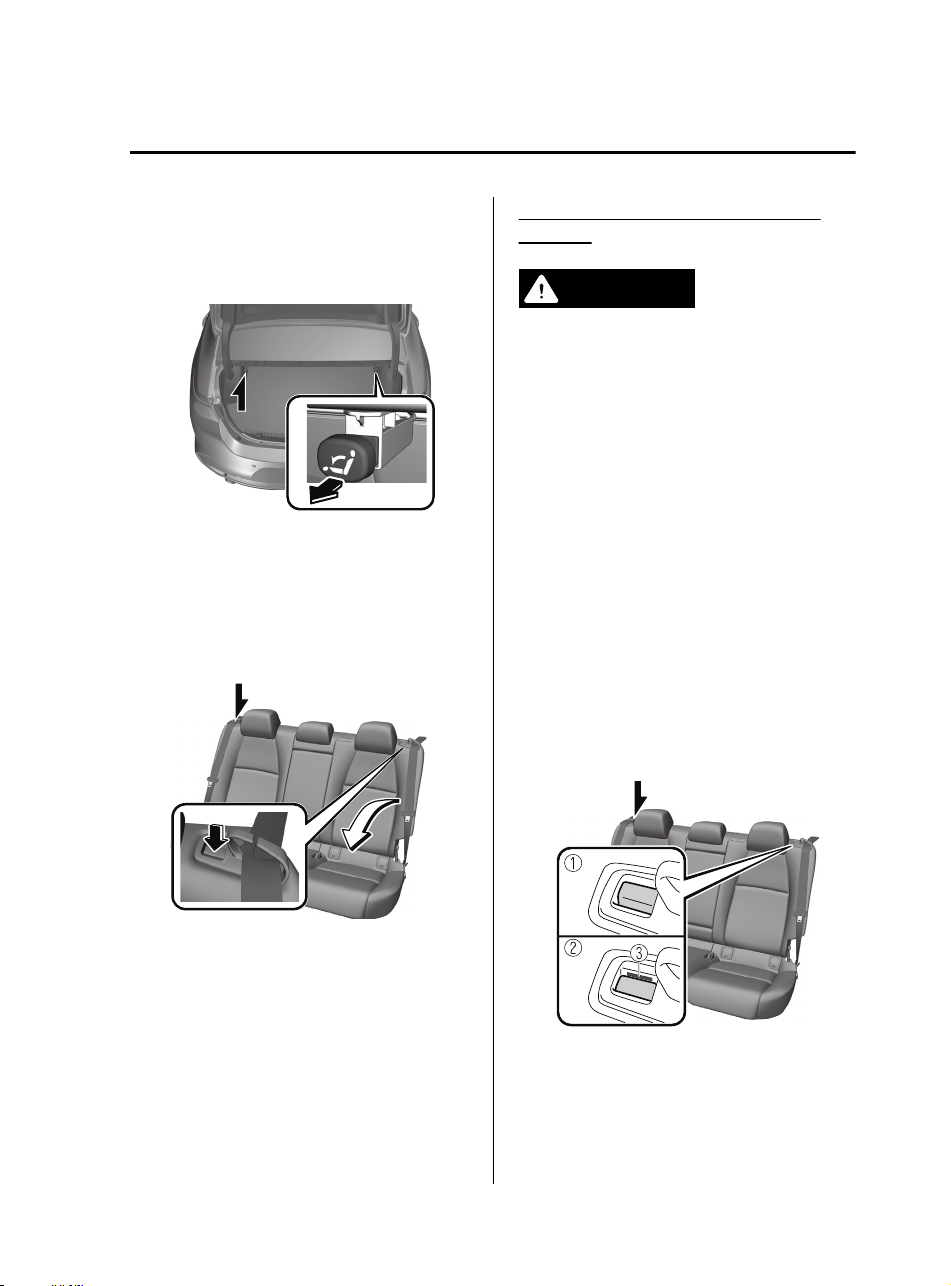
(4–Door)
1. Open the trunk lid and pull the lever of
the seatback you want to fold down.
2. Open a rear door and fold the rear seat
forward.
(5–Door)
Press the push knob to fold down the
seatback.
To return the seatback to its upright
position:
WARNING
When returning a seatback to its upright
position, make sure the 3-point seat belt is
not caught in the seatback and the 3-point
seat belt is not twisted.
If the seat belt is used while it is twisted and
caught in the seatback, the seat belt
cannot function at its full capacity, which
could cause serious injury or death.
When returning a seatback to its upright
position, make sure that it is rmly locked
and the red indication is not visible (5–
Door).
If the red indication is visible behind the
push knob, it means the seatback is not
locked. If the vehicle is driven without the
seatback locked, it could fold down
suddenly and cause an accident.
1. Locked position
2. Unlocked position
3. Red indication
Essential Safety Equipment
Seats
2-15
Mazda3_8HZ1-EA-19G_Edition1_old 2019-5-17 13:49:03
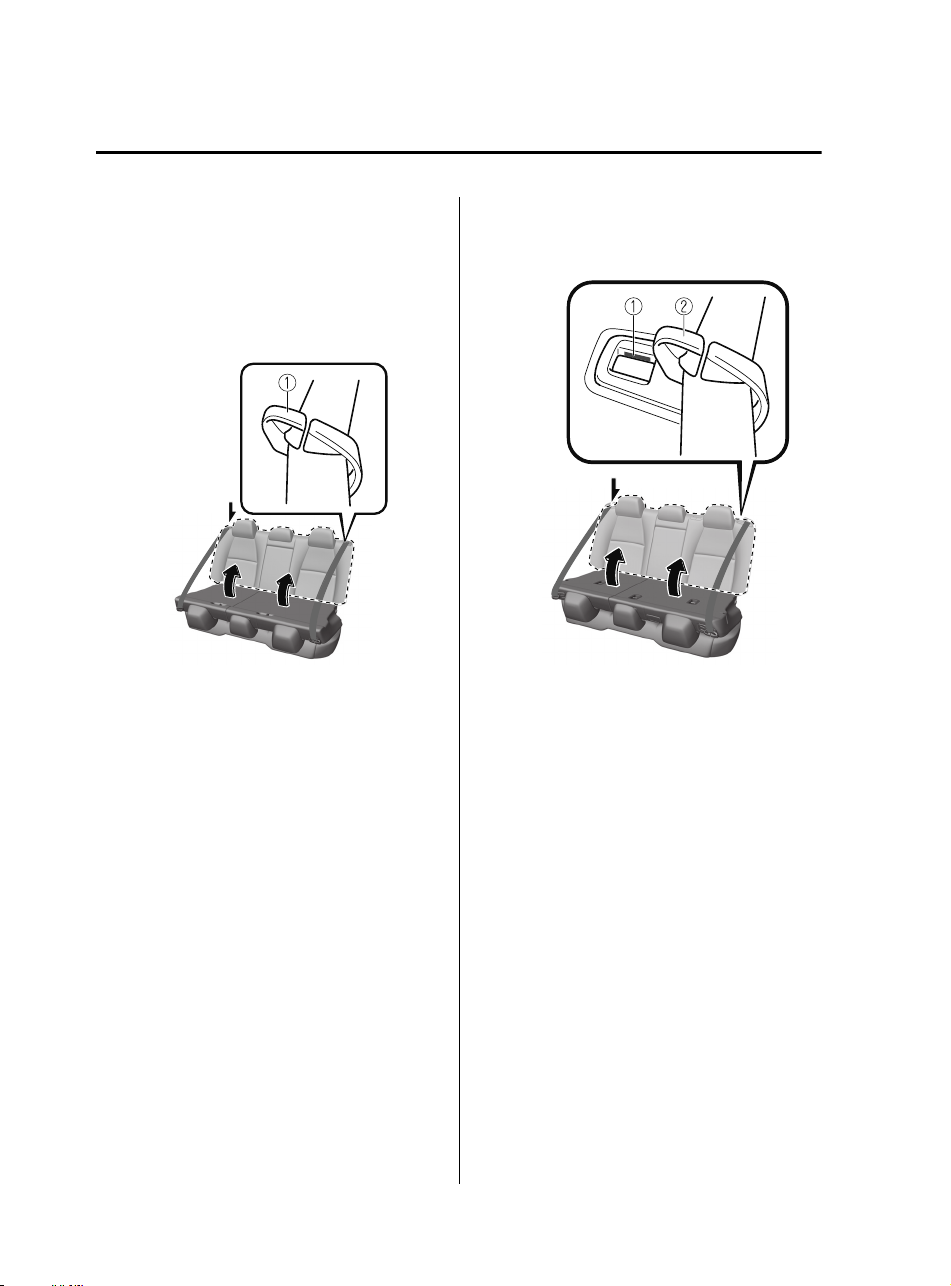
1. Make sure that the seat belt passes
through the seat belt guide correctly
and it is not twisted, then raise the
seatback while preventing the seat belt
from being caught in the seatback.
(4–Door)
1. Seat belt guides
(5–Door)
1. Red indication
2. Seat belt guide
2. Press the seatback rearward and lock it
in place. After returning the seatback
to its upright position, make sure it is
securely locked.
Essential Safety Equipment
Seats
2-16
Mazda3_8HZ1-EA-19G_Edition1_old 2019-5-17 13:49:03
▼
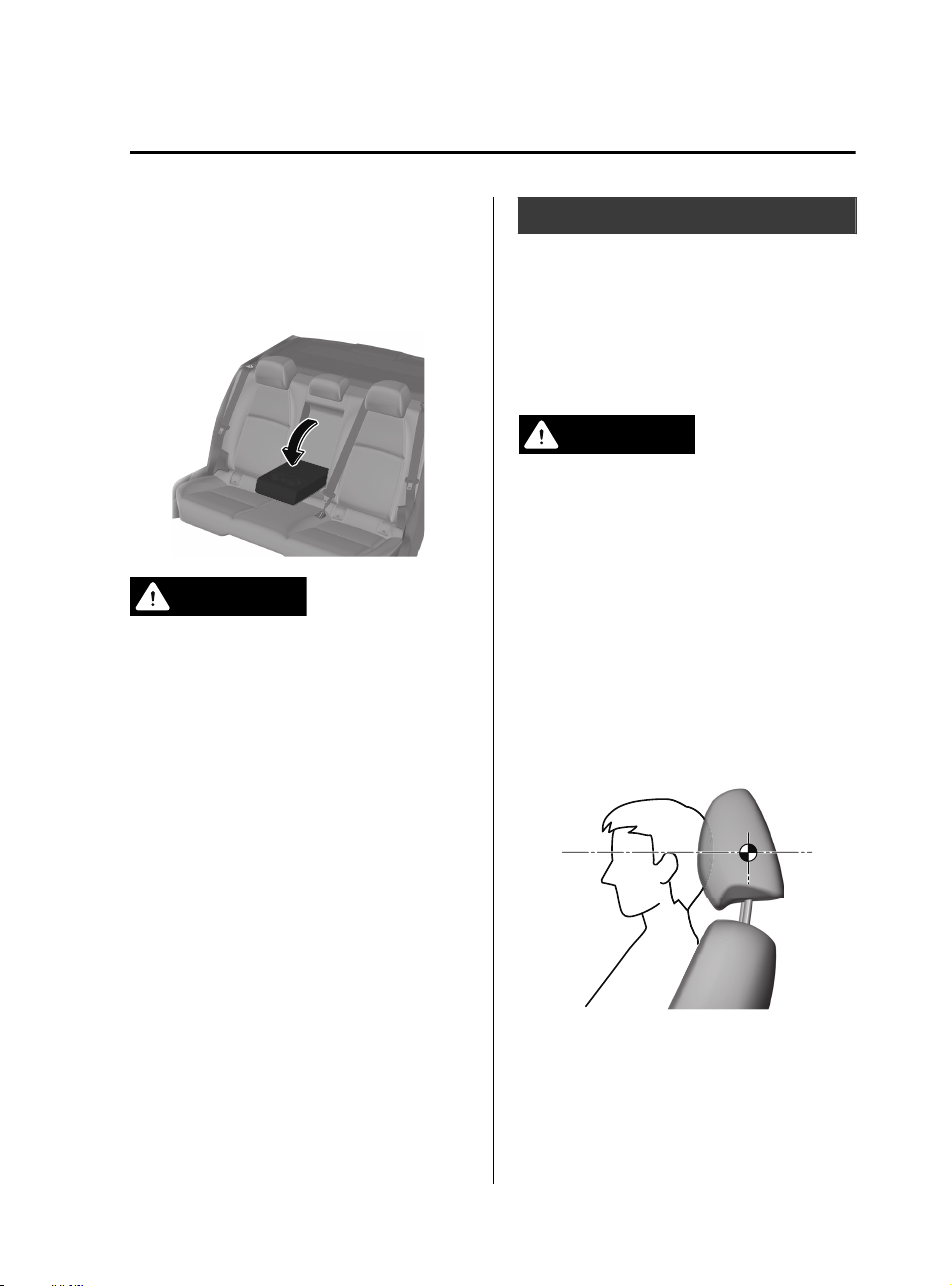
Armrest
*
The rear armrest in the center of the rear
seatback can be used (no occupant in the
center seat) or placed upright.
WARNING
Never put your hands and ngers around
the moving parts of the seat and armrest:
Putting your hands and ngers around the
moving parts of the seat and armrest is
dangerous as they could get injured.
Head Restraints
▼
Head Restraints
Your vehicle is equipped with head
restraints on all outboard seats and the rear
center seat. The head restraints are
intended to help protect you and the
passengers from neck injury.
WARNING
Always drive with the head restraints
installed when seats are being used and
make sure they are properly adjusted:
Driving with the head restraints adjusted
too low or removed is dangerous. With no
support behind your head, your neck could
be seriously injured in a collision.
▼
Height Adjustment
Adjust the head restraint so that the center
is even with the top of the passenger's
ears.
To raise a head restraint, pull it up to the
desired position.
To lower the head restraint, press the
stop-catch release, then push the head
restraint down.
Essential Safety Equipment
Seats
*Some models.
2-17
Mazda3_8HZ1-EA-19G_Edition1_old 2019-5-17 13:49:03
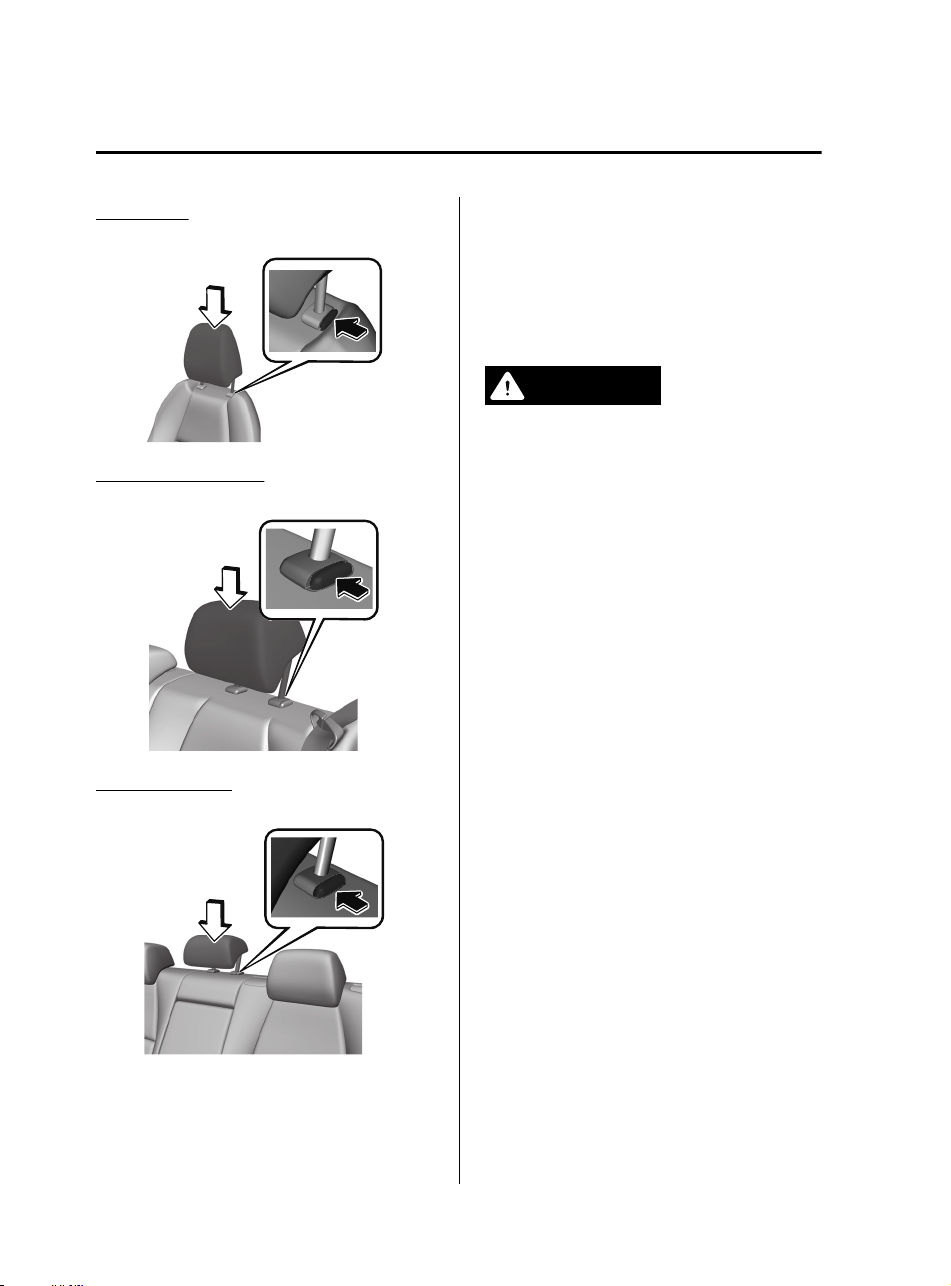
Front seats
Rear outboard seats
Rear center seat
▼
Removal/Installation
To remove the head restraint, pull it up
while pressing the stop-catch.
To install the head restraint, insert the legs
into the holes while pressing the
stop-catch.
WARNING
Always drive with the head restraints
installed when seats are being used and
make sure they are properly installed:
Driving with the head restraints not
installed is dangerous. With no support
behind your head, your neck could be
seriously injured in a collision.
After installing a head restraint, try lifting it
to make sure that it does not pull out:
Driving with an unsecured head restraint is
dangerous as the eectiveness of the head
restraint will be compromised which could
cause it to unexpectedly detach from the
seat.
Essential Safety Equipment
Seats
2-18
Mazda3_8HZ1-EA-19G_Edition1_old 2019-5-17 13:49:03
CAUTION
When installing a head restraint, make
sure that it is installed correctly with the
front of the head restraint facing
forward. If the head restraint is installed
incorrectly, it could detach from the seat
during a collision and result in injury.
The head restraints on each of the front
and rear seats are specialized to each
seat. Do not switch around the head
restraint positions. If a head restraint is
not installed to its correct seat position,
the eectiveness of the head restraint
during a collision will be compromised
which could cause injury.
Essential Safety Equipment
Seats
2-19
Mazda3_8HZ1-EA-19G_Edition1_old 2019-5-17 13:49:03
Seat Warmer
*
▼
Seat Warmer
The front seats can be warmed up while
the engine is running.
While the seat warmer is operating, the
indicator light in the seat warmer switch
turns on according to the set temperature.
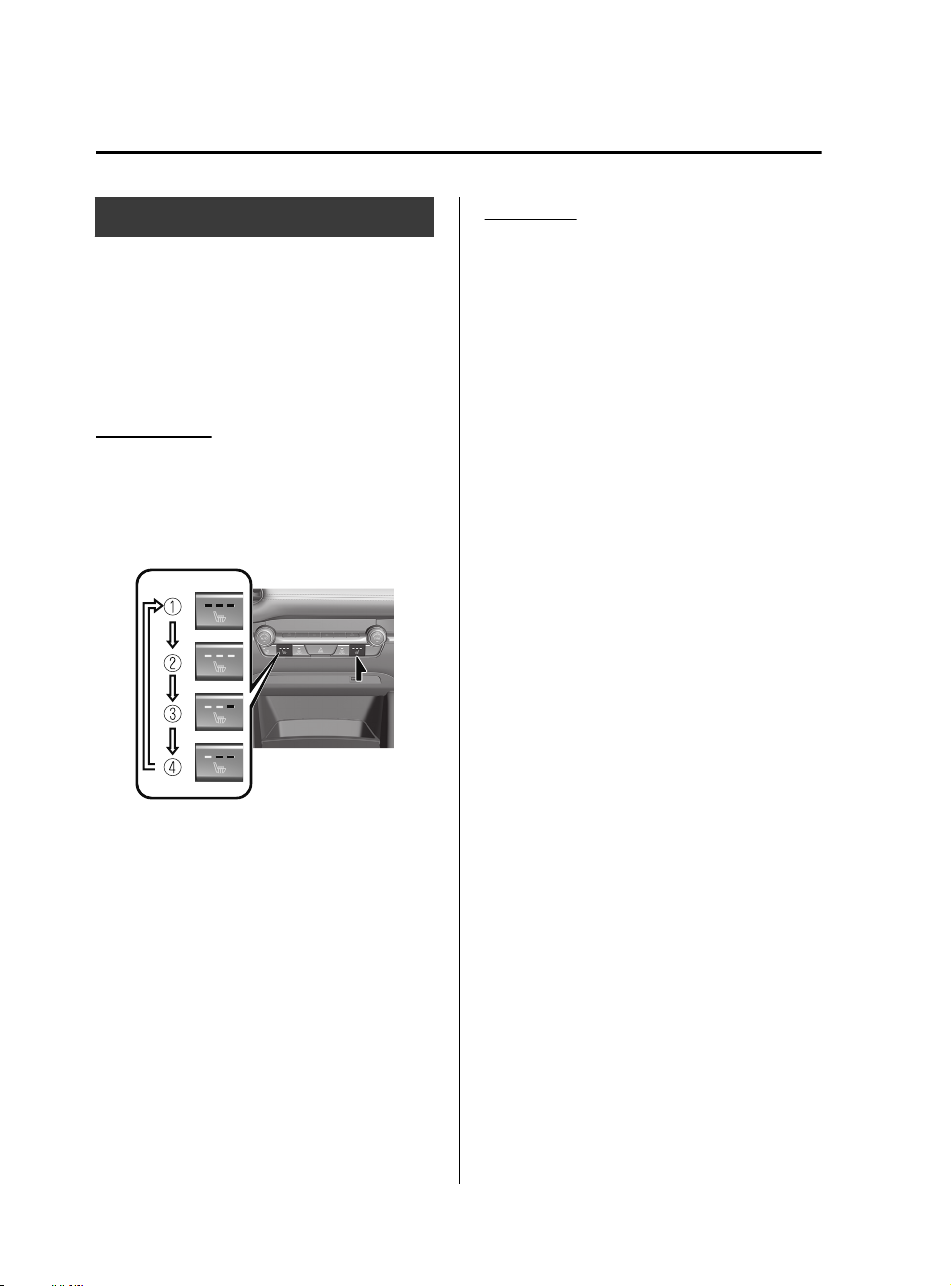
Manual mode
When the seat warmer switch is pressed,
the seat warmer operates in manual mode.
The set temperature changes as shown in
the figure each time the seat warmer
switch is pressed.
1. OFF
2. High
3. Mid
4. Low
NOTE
If the engine is turned off while the seat
warmer is operating in manual mode, the
seat warmer does not turn on
automatically the next time the engine is
turned on. To turn the seat warmer on,
press the switch again.
Auto mode
The driver and front passenger's seat
warmer can be operated in auto mode
using the following procedure.
1. If “Link Seat & Climate Control
Temperatures” has been disabled,
enable it using the following
procedure.
a) Select “Settings” from the Mazda
Connect home screen.
b) Select “Vehicle Settings”.
c) Enable “Link Seat & Climate
Control Temperatures”.
2. Press the AUTO switch.
While in auto mode, the seat temperature
is automatically controlled in 4 levels
(High, Mid, Low, and OFF) according to
the conditions in the cabin.
NOTE
If the front passenger’s seat belt is
unfastened, the front passenger’s seat
warmer turns off.
If the seat warmer switch is pressed
during auto mode, the seat warmer on
the side where the switch was pressed
switches to manual mode. To return to
auto mode, press the AUTO switch.
If the engine is turned off while the seat
warmer is operating in auto mode, the
seat warmer operates in auto mode
again the next time the engine is turned
on.
Essential Safety Equipment
Seat Warmer/Heated Steering Wheel
2-20
*Some models.
Mazda3_8HZ1-EA-19G_Edition1_old 2019-5-17 13:49:03
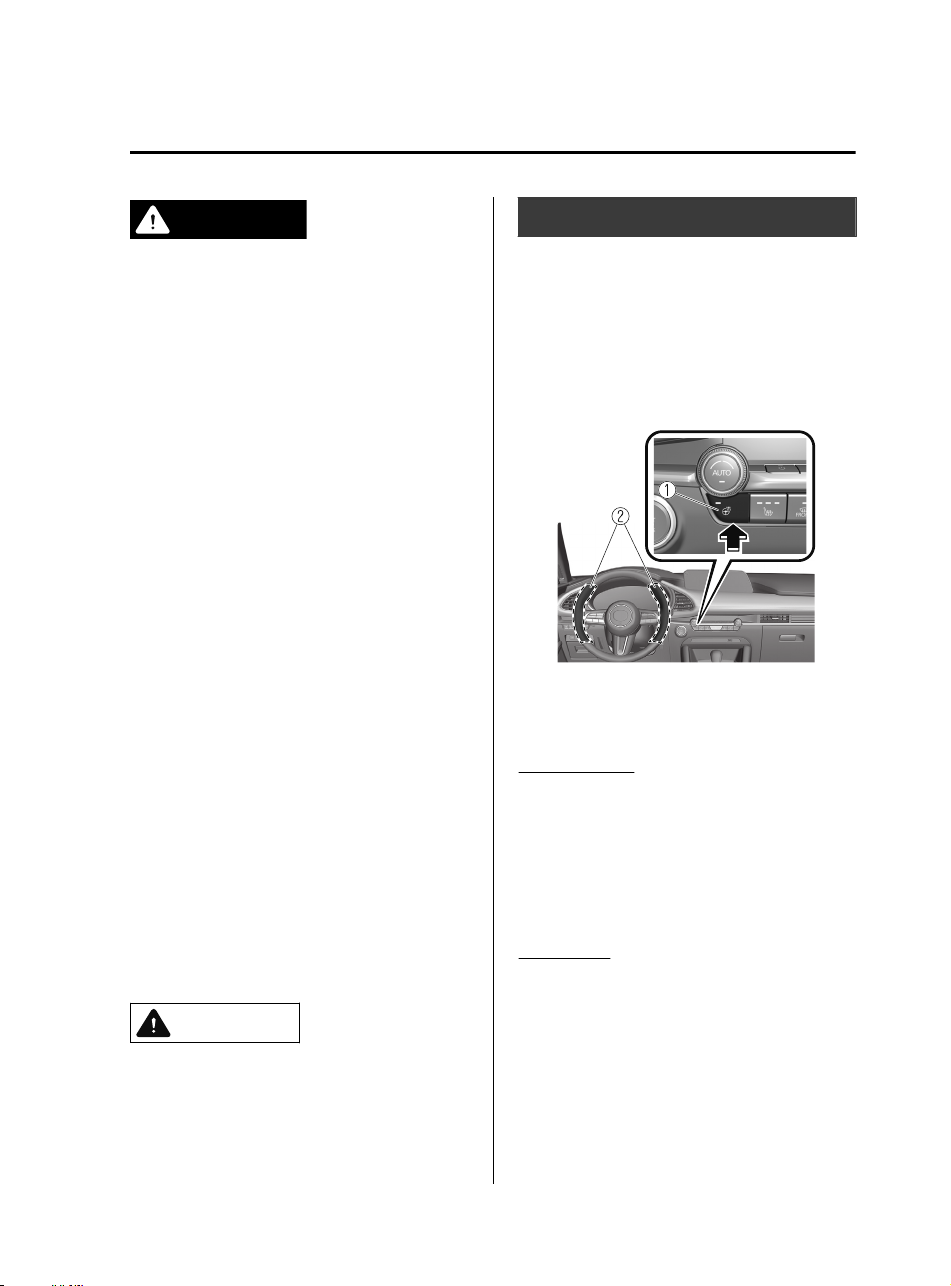
WARNING
Be careful when using the seat warmer:
The heat from the seat warmer may be too
hot for the following people and could
cause a low-temperature burn.
Infants, small children, elderly people,
and physically challenged people
People with delicate skin
People who are excessively fatigued
People who are intoxicated
People who have taken sleep-inducing
medicine such as sleeping pills or cold
medicine
Do not use the seat warmer with anything
having high moisture-retention ability such
as a blanket or cushion on the seat:
The seat may be heated excessively and
cause a low-temperature burn.
Do not use the seat warmer even when
taking a short nap in the vehicle:
The seat may be heated excessively and
cause a low-temperature burn.
Do not place heavy objects with sharp
projections on the seat, or insert needles or
pins into it:
This could cause the seat to become
excessively heated and result in injury from
a minor burn.
CAUTION
Do not use organic solvents to clean the
seat. It may damage the seat surface and
the heater.
Heated Steering Wheel
*
▼
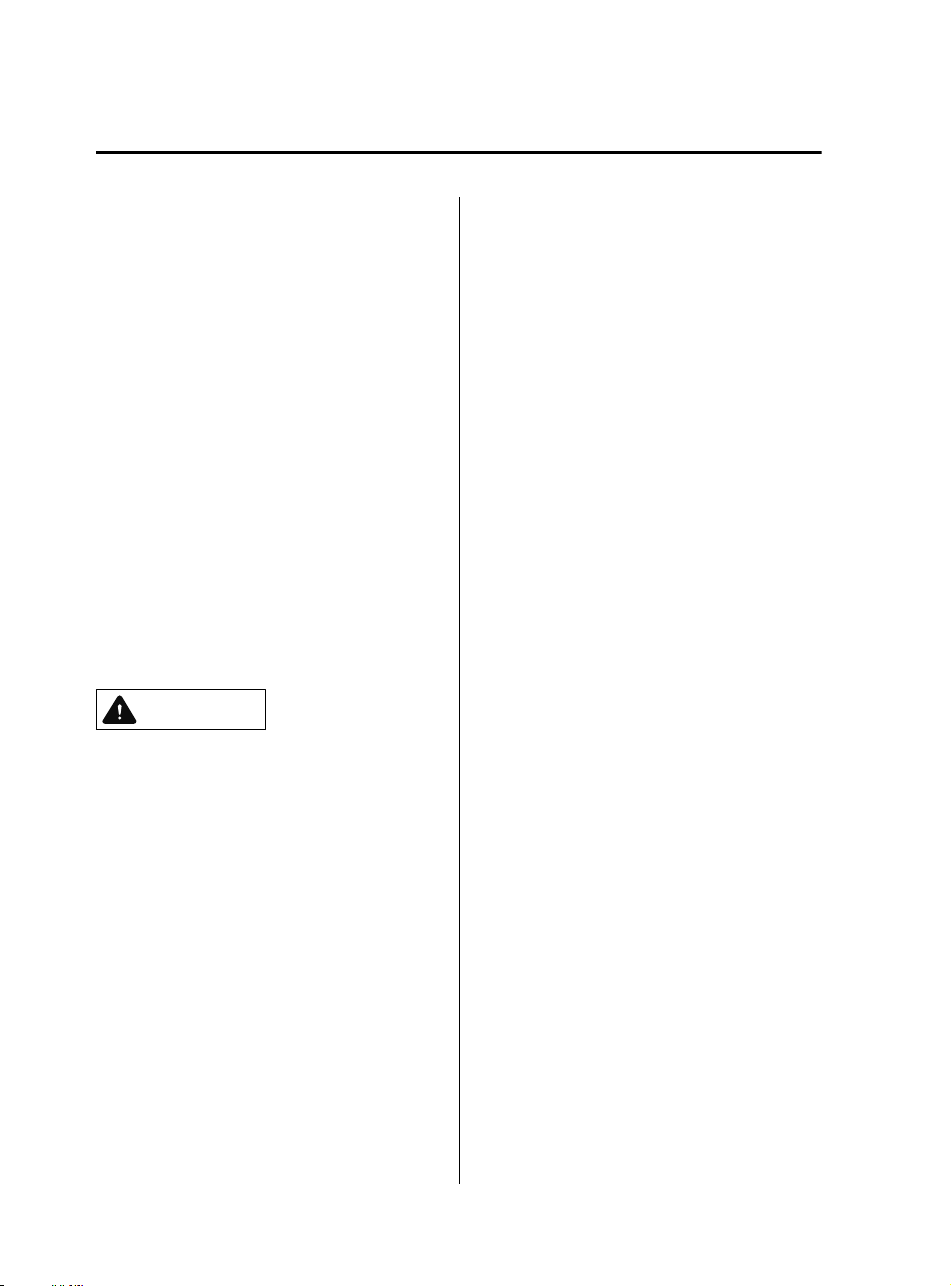
Heated Steering Wheel
The grips on the left and right of the
steering wheel can be warmed up when
the ignition is switched ON.
While the heated steering wheel is
operating, the indicator light in the heated
steering wheel switch turns on.
1. Heated steering wheel switch
2. Heating area
Manual mode
The heated steering wheel operates for
about 30 minutes when the heated steering
wheel switch is pressed, and then
automatically turns off.
To turn the heated steering wheel off
manually, press the switch again.
Auto mode
The heated steering wheel can be operated
in auto mode using the following
procedure.
1. If “Link Seat & Climate Control
Temperatures” has been disabled,
enable it using the following
procedure.
a) Select “Settings” from the Mazda
Connect home screen.
Essential Safety Equipment
Seat Warmer/Heated Steering Wheel
*Some models.
2-21
Mazda3_8HZ1-EA-19G_Edition1_old 2019-5-17 13:49:03
b) Select “Vehicle Settings”.
c) Enable “Link Seat & Climate
Control Temperatures”.
2. Press the AUTO switch.
While in auto mode, the heated steering
wheel automatically operates/turns off
according to the conditions in the cabin.
NOTE
If the heated steering wheel switch is
pressed during auto mode, the heated
steering wheel switches to manual
mode. To return to auto mode, press the
AUTO switch.
If the ignition is switched OFF while the
heated steering wheel is operating in
auto mode, the heated steering wheel
operates in auto mode again the next
time the ignition is switched ON.
CAUTION
The following types of persons should be
careful not to touch the steering wheel.
Otherwise, it could cause a
low-temperature burn.
Infants, small children, elderly people,
and physically challenged people
People with delicate skin
People who are excessively fatigued
People who are intoxicated
People who have taken sleep-inducing
medicine such as sleeping pills or cold
medicine
Essential Safety Equipment
Seat Warmer/Heated Steering Wheel
2-22
Mazda3_8HZ1-EA-19G_Edition1_old 2019-5-17 13:49:03
Seat Belt Precautions
▼
Seat Belt Precautions
Seat belts help to decrease the possibility
of severe injury during accidents and
sudden stops. Mazda recommends that the
driver and all passengers always wear seat
belts.
(Mexico)
All the seats have lap/shoulder belts.
These belts have retractors with inertia
locks that keep them out of the way when
not in use. The locks allow the belts to
remain comfortable on users, but they will
lock in position during a collision.
(Except Mexico)
All of the seat belt retractors are designed
to keep the lap/shoulder belts out of the
way when not in use.
The driver's seat belt has no provisions for
child-restraint systems and has only an
emergency locking mode. The driver may
wear it comfortably, and it will lock during
a collision.
However, the front passenger's seat and all
rear lap/shoulder belt retractors operate in
two modes: emergency locking mode, and
for child-restraint systems, automatic
locking mode. While we recommend you
put all children in the rear seats, if you
must use the front passenger seat for a
child, slide the front passenger seat as far
back as possible and make sure any
child-restraint system is secured properly.
WARNING
Always wear your seat belt and make sure
all occupants are properly restrained:
Not wearing a seat belt is extremely
dangerous. During a collision, occupants
not wearing seat belts could hit someone
or things inside the vehicle or even be
thrown out of the vehicle. They could be
seriously injured or even killed. In the same
collision, occupants wearing seat belts
would be much safer.
Do not wear twisted seat belts:
Twisted seat belts are dangerous. In a
collision, the full width of the belt is not
available to absorb the impact. This puts
more force on the bones beneath the belt,
which could cause serious injury or death.
So, if your seat belt is twisted, you must
straighten the seat belt to remove any
twists and to allow the full width of the belt
to be used.
Never use one seat belt on more than one
person at a time:
Using one seat belt for more than one
person at a time is dangerous. A seat belt
used in this way cannot spread the impact
forces properly and the two passengers
could be crushed together and seriously
injured or even killed. Never use one belt for
more than one person at a time and always
operate the vehicle with each occupant
properly restrained.
Essential Safety Equipment
Seat Belt Systems
2-23
Mazda3_8HZ1-EA-19G_Edition1_old 2019-5-17 13:49:03
Do not operate a vehicle with a damaged
seat belt:
Using a damaged seat belt is dangerous.
An accident could damage the belt
webbing of the seat belt in use. A damaged
seat belt cannot provide adequate
protection in a collision. Have an
Authorized Mazda Dealer inspect all seat
belt systems in use during an accident
before they are used again.
Have your seat belts changed immediately
if the pretensioner or load limiter has been
expended:
Always have an Authorized Mazda Dealer
immediately inspect the seat belt
pretensioners and air bags after any
collision. Like the air bags, the seat belt
pretensioners and load limiters will only
function once and must be replaced after
any collision that caused them to deploy. A
seat belt with an expended pretensioner or
load limiter is still better than wearing no
seat belt at all; however, if the seat belt
pretensioners and load limiters are not
replaced, the risk of injury in a collision will
increase.
Positioning the Shoulder Portion of the
Seat Belt:
Improper positioning of the shoulder
portion of the seat belt is dangerous.
Always make sure the shoulder portion of
the seat belt is positioned across your
shoulder and near your neck, but never
under your arm, on your neck, or on your
upper arm.
Positioning the Lap Portion of the Seat Belt:
The lap portion of the seat belt worn too
high is dangerous. In a collision, this would
concentrate the impact force directly on
the abdominal area, causing serious injury.
Wear the lap portion of the belt snugly and
as low as possible.
CAUTION
Belt retraction may become dicult if the
belts and rings are soiled, so try to keep
them clean. For more details about
cleaning the seat belts, refer to "Seat Belt
Maintenance" (page 6-50).
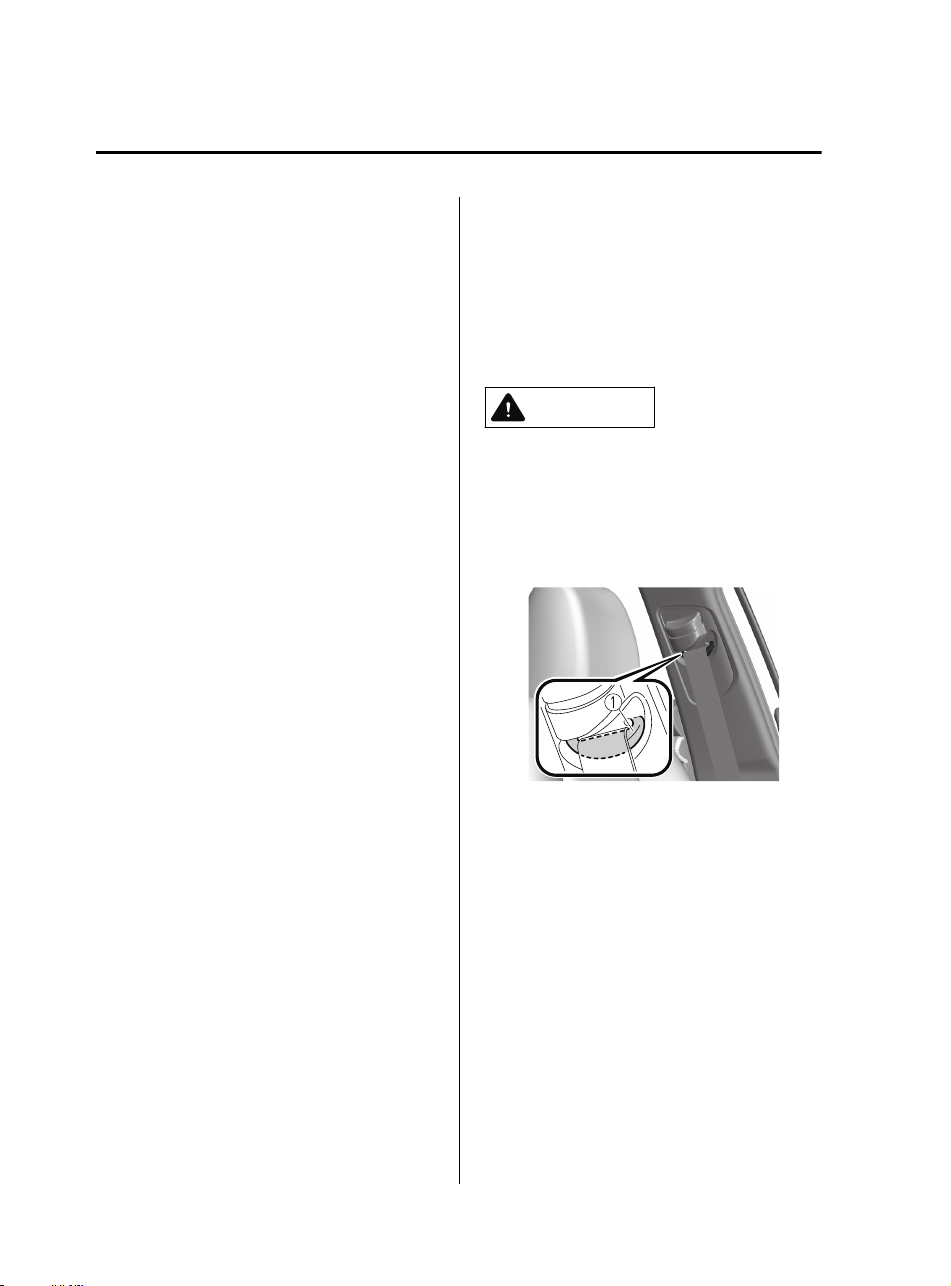
1. Ring
Essential Safety Equipment
Seat Belt Systems
2-24
Mazda3_8HZ1-EA-19G_Edition1_old 2019-5-17 13:49:03
▼
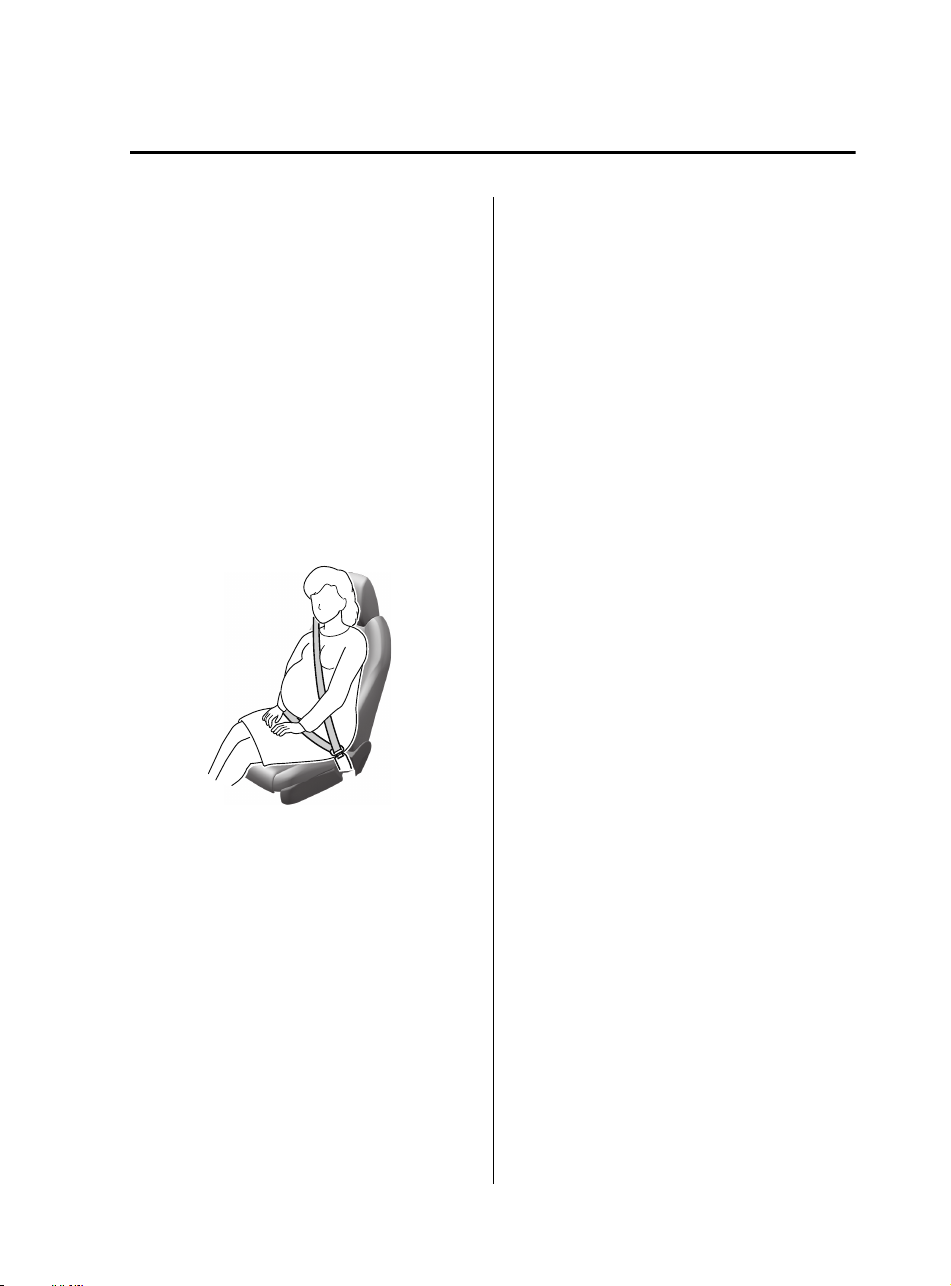
Pregnant Women and Persons with
Serious Medical Conditions
Pregnant women should always wear seat
belts. Ask your doctor for specific
recommendations.
The lap belt should be worn SNUGLY
AND AS LOW AS POSSIBLE OVER
THE HIPS.
The shoulder belt should be worn across
your shoulder properly, but never across
the stomach area.
Persons with serious medical conditions
also should wear seat belts. Check with
your doctor for any special instructions
regarding specific medical conditions.
▼
Emergency Locking Mode
When the seat belt is fastened, it will
always be in the emergency locking mode.
In the emergency locking mode, the belt
remains comfortable on the occupant and
the retractor will lock in position during a
collision.
If the belt is locked and cannot be pulled
out, retract the belt once, and then try
pulling it out slowly. If this fails, pull the
belt strongly 1 time and loosen, then pull it
out again slowly.
(Seat Belt with Automatic Locking
Mode)
When the seat belt is fastened, it will
always be in the emergency locking mode
until it is switched to automatic locking
mode by pulling it all the way out to its
full length. If the belt feels tight and
hinders comfortable movement while the
vehicle is stopped or in motion, it may be
in the automatic locking mode because the
belt has been pulled too far out. To return
the belt to the more comfortable
emergency locking mode, wait until the
vehicle has stopped in a safe, level area,
retract the belt fully to convert it back to
emergency locking mode and then extend
it around you again.
▼
Automatic Locking Mode (Except
Mexico)
Always use the automatic locking mode to
keep the child-restraint system from
shifting to an unsafe position in the event
of an accident. To enable seat belt
automatic locking mode, pull it all the way
out and connect it as instructed on the
child-restraint system. It will retract down
to the child-restraint system and stay
locked on it. See the section on child
restraint (page 2-44).
Essential Safety Equipment
Seat Belt Systems
2-25
Mazda3_8HZ1-EA-19G_Edition1_old 2019-5-17 13:49:03
Seat Belt
▼
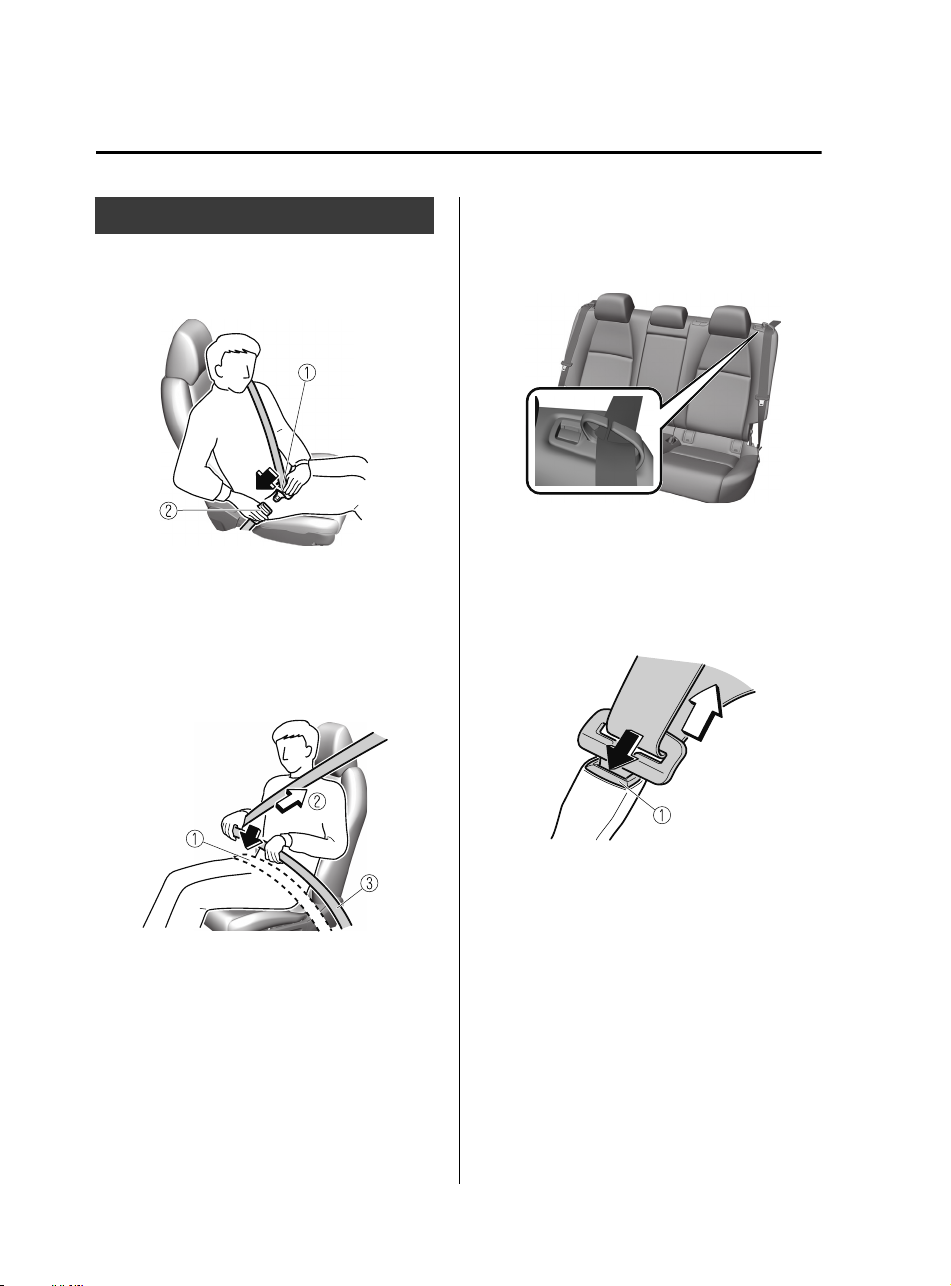
Fastening the Seat Belt
Insert the seat belt tongue into the buckle.
1. Seat belt tongue
2. Seat belt buckle
Position the lap belt as low as possible, not
on the abdominal area, then adjust the
shoulder belt so that it fits snugly against
your body.
1. Keep low on hip bone
2. Take up slack
3. Too high
Before fastening the rear seat belt, make
sure that the seat belt passes through the
seat belt guide correctly and it is not
twisted.
▼
Unfastening the Seat Belt
Depress the button on the seat belt buckle.
If the belt does not fully retract, pull it out
and check for kinks or twists. Then make
sure it remains untwisted as it retracts.
1. Button
NOTE
If a belt does not fully retract, inspect it
for kinks and twists. If it is still not
retracting properly, have it inspected at an
Authorized Mazda Dealer.
Essential Safety Equipment
Seat Belt Systems
2-26
Mazda3_8HZ1-EA-19G_Edition1_old 2019-5-17 13:49:03
▼
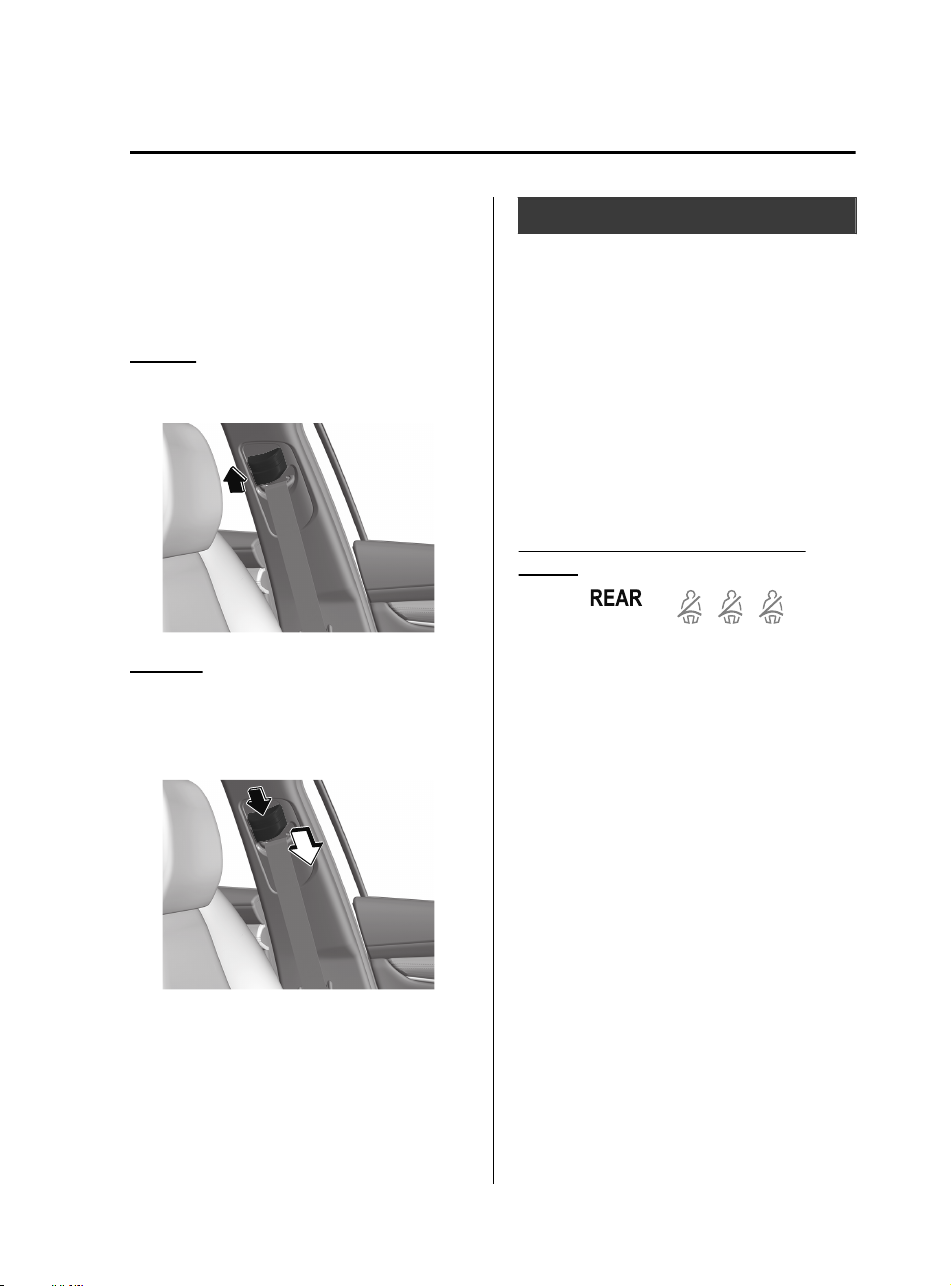
Front Shoulder Belt Adjuster
The front seat belts have a front shoulder
belt adjuster. If the seat belt contacts your
neck or it slips off the shoulder, adjust the
seat belt height.
To r ai se
To heighten the seat belt, move the front
shoulder belt adjuster upward.
To l owe r
To lower the seat belt, hold the front
shoulder belt adjuster and lower the seat
belt with the knob of the front shoulder
belt adjuster pressed.
After adjusting, press the front shoulder
belt adjuster downward and make sure that
it is securely locked.
Seat Belt Warning Systems
▼
Seat Belt Warning Systems
If it detects that the occupant seat belt is
unfastened, the warning light or beep
alerts the occupant.
Refer to Seat Belt Warning Indication/
Warning Light (Front seat) on page 7-35.
Refer to Seat Belt Warning Light (Rear
seat) (Red) on page 7-36.
Refer to Seat Belt Warning Beep on page
7-41.
Seat belt indicator light (rear seat)
(green)
The light turns on when the rear seat belt
is fastened while the ignition is switched
ON, and it turns off after a certain period.
Essential Safety Equipment
Seat Belt Systems
2-27
Mazda3_8HZ1-EA-19G_Edition1_old 2019-5-17 13:49:03
Front Seat Belt
Pretensioner and Load
Limiting Systems
▼
Front Seat Belt Pretensioner and
Load Limiting Systems
For optimum protection, the driver and
front passenger seat belts are equipped
with pretensioner and load limiting
systems. For both these systems to work
properly you must wear the seat belt
properly.
Pretensioners:
When a collision is detected, the
pretensioners deploy simultaneously with
the air bags.
For vehicles with the front passenger
occupant classification system, the
pretensioners deploy simultaneously with
the air bags when a roll-over is also
detected.
For deployment details, refer to the SRS
Air Bag Deployment Criteria (page
2-68).
The seat belt retractors remove slack
quickly as the air bags are expanding. Any
time the air bags and seat belt
pretensioners have fired they must be
replaced.
A system malfunction or operation
conditions are indicated by a warning.
Refer to Air Bag/Front Seat Belt
Pretensioner System Warning Indication/
Warning Light on page 7-32.
Refer to Air Bag/Front Seat Belt
Pretensioner System Warning Beep on
page 7-41.
(With Front Passenger Occupant
Classification System)
In addition, the pretensioner system for the
front passenger, like the front and side
passenger air bag, is designed to only
deploy in accordance with the total seated
weight on the front passenger seat.
For details, refer to the front passenger
seat weight sensors (page 2-72).
Load limiter:
The load limiting system releases belt
webbing in a controlled manner to reduce
belt force on the occupant's chest. While
the most severe load on a seat belt occurs
in frontal collisions, the load limiter has an
automatic mechanical function and can
activate in any accident mode with
sufficient occupant movement.
Even if the pretensioners have not fired,
the load limiting function must be checked
by an Authorized Mazda Dealer.
WARNING
Wear seat belts only as recommended in
this owner's manual:
Incorrect positioning of the seat belts is
dangerous. Without proper positioning, the
pretensioner and load limiting systems
cannot provide adequate protection in an
accident and this could result in serious
injury. For more details about wearing seat
belts, refer to "Fastening the Seat Belt"
(page 2-26).
Essential Safety Equipment
Seat Belt Systems
2-28
Mazda3_8HZ1-EA-19G_Edition1_old 2019-5-17 13:49:03

Have your seat belts changed immediately
if the pretensioner or load limiter has been
expended:
Always have an Authorized Mazda Dealer
immediately inspect the seat belt
pretensioners and air bags after any
collision. Like the air bags, the seat belt
pretensioners and load limiters will only
function once and must be replaced after
any collision that caused them to deploy. A
seat belt with an expended pretensioner or
load limiter is still better than wearing no
seat belt at all; however, if the seat belt
pretensioners and load limiters are not
replaced, the risk of injury in a collision will
increase.
Do not modify the components or wiring,
or use electronic testing devices on the
pretensioner system:
Modifying the components or wiring of the
pretensioner system, including the use of
electronic testing devices is dangerous. You
could accidentally activate it or make it
inoperable which would prevent it from
activating in an accident. The occupants or
repairers could be seriously injured.
Properly dispose of the pretensioner
system:
Improper disposal of the pretensioner
system or a vehicle with non-deactivated
pretensioners is dangerous. Unless all
safety procedures are followed, injury could
result. Have an Authorized Mazda Dealer
safely dispose of the pretensioner system or
scrap a pretensioner system equipped
vehicle.
NOTE
The pretensioner system may not
operate depending on the type of the
collision. For details, refer to the SRS
Air Bag Deployment Criteria (page
2-68).
Some smoke (non-toxic gas) will be
released when the air bags and
pretensioners deploy. This does not
indicate a fire. This gas normally has no
effect on occupants, however, those with
sensitive skin may experience light skin
irritation. If residue from the
deployment of the air bags or the
pretensioner system gets on the skin or
in the eyes, wash it off as soon as
possible.
Essential Safety Equipment
Seat Belt Systems
2-29
Mazda3_8HZ1-EA-19G_Edition1_old 2019-5-17 13:49:03
Seat Belt Extender
▼
Seat Belt Extender
If your seat belt is not long enough, even
when fully extended, a seat belt extender
may be available to you at no charge from
your Authorized Mazda Dealer.
This extender will be only for you and for
the particular vehicle and seat. Even if it
plugs into other seat belts, it may not hold
in the critical moment of a crash.
When ordering an extender, only order one
that provides the necessary additional
length to fasten the seat belt properly.
Please contact your Authorized Mazda
Dealer for more information.
WARNING
Do not use a seat belt extender unless it is
necessary:
Using a seat belt extender when not
necessary is dangerous. The seat belt will
be too long and not t properly. In an
accident, the seat belt will not provide
adequate protection and you could be
seriously injured. Only use the extender
when it is required to fasten the seat belt
properly.
Do not use an improper extender:
Using a seat belt extender that is for
another person or a dierent vehicle or seat
is dangerous. The seat belt will not provide
adequate protection and the user could be
seriously injured in an accident. Only use
the extender provided for you and for the
particular vehicle and seat. NEVER use the
extender in a dierent vehicle or seat. If you
sell your Mazda, do not leave your seat belt
extender in the vehicle. It could be used
accidentally by the new owner of the
vehicle. After removing the seat belt
extender, discard it. Never use the seat belt
extender in any other vehicle you may own
in the future.
Do not use an extender that is too long:
Using an extender that is too long is
dangerous. The seat belt will not t
properly. In an accident, the seat belt will
not provide adequate protection and you
could be seriously injured. Do not use the
extender or choose one shorter in length if
the distance between the extender's buckle
and the center of the user's body is less
than 15 cm (6 in).
Essential Safety Equipment
Seat Belt Systems
2-30
Mazda3_8HZ1-EA-19G_Edition1_old 2019-5-17 13:49:03

Do not leave a seat belt extender
connected to the buckle:
Leaving a seat belt extender connected to
the buckle without using the seat belt is
dangerous. When the seat belt extender is
connected to the driver's seat belt buckle
(or front passenger's seat belt buckle), the
SRS driver's (or front passenger's) air bag
system will determine that the driver (or
front passenger) is wearing the seat belt
even if the driver (or front passenger) is not
wearing it. This condition could cause the
driver's (or front passenger's) air bag to not
activate correctly and result in death or
serious injury in the event of collision.
Always wear the seat belt with the seat belt
extender.
Do not use the seat belt extender when
installing a child-restraint system on the
front or rear passenger seat:
Using a seat belt extender to fasten a
child-restraint system on any seat is
dangerous. Always follow the
child-restraint system manufacturer's
installation instructions and never use a
seat belt extender.
NOTE
When not in use, remove the seat belt
extender and store it in the vehicle. If the
seat belt extender is left connected, the
seat belt extender might get damaged as it
will not retract with the rest of the seat belt
and can easily fall out of the door when
not in use and be damaged. In addition,
the seat belt warning light will not
illuminate and function properly.
Essential Safety Equipment
Seat Belt Systems
2-31
Mazda3_8HZ1-EA-19G_Edition1_old 2019-5-17 13:49:03
Child-Restraint
Precautions
▼
Child-Restraint Precautions
Mazda strongly urges the use of
child-restraint systems for children small
enough to use them.
You are required by law to use a
child-restraint system for children in the
U.S. and Canada.
Check your local and state or provincial
laws for specific requirements regarding
the safety of children riding in your
vehicle.
Whatever child-restraint system you
consider, please pick the appropriate one
for the age and size of the child, obey the
law and follow the instructions that come
with the individual child-restraint system.
A child who has outgrown child-restraint
systems should sit in the rear and use seat
belts, both lap and shoulder. If the
shoulder belt crosses the neck or face,
move the child closer to the center of the
vehicle in the outboard seats, and towards
the buckle on the right if the child is
seated on the center seat.
Statistics confirm that the rear seat is the
best place for all children up to 12 years of
age, and more so with a supplemental
restraint system (air bags).
A rear-facing child-restraint system should
NEVER be used on the front seat with the
air bag system activated. The front
passenger's seat is also the least preferred
seat for other child-restraint systems.
(With Front Passenger Occupant
Classification System)
To reduce the chance of injuries caused by
deployment of the front passenger air bag,
the front passenger seat weight sensors
occupant classification sensor works as a
part of the supplemental restraint system.
This system deactivates the front
passenger front and side air bags and knee
air bags, and also the front passenger seat
belt pretensioner system when the front
passenger air bag deactivation indicator
light illuminates.
When an infant or small child sits on the
front passenger seat, the system shuts off
the front passenger front and side air bags
and knee air bags, and seat belt
pretensioner system, so make sure the
front passenger air bag deactivation
indicator light illuminates.
Even if the front passenger air bag is shut
off, Mazda strongly recommends that
children be properly restrained and
child-restraint systems of all kinds are
properly secured on the rear seats which
are the best place for children.
For more details, refer to "Front passenger
seat weight sensors" (page 2-72).
Essential Safety Equipment
Child Restraint
2-32
Mazda3_8HZ1-EA-19G_Edition1_old 2019-5-17 13:49:03
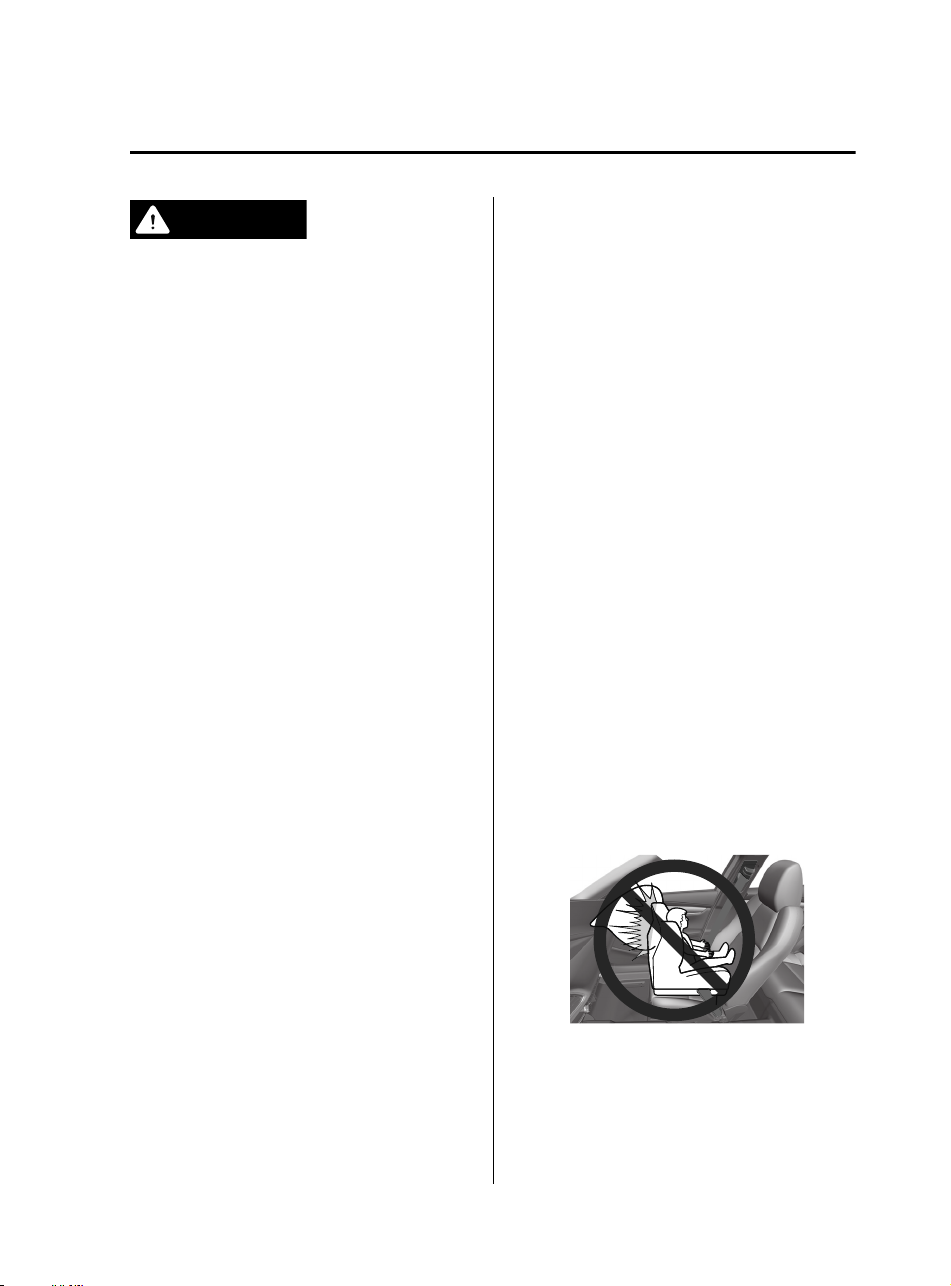
WARNING
Use the correct size child-restraint system:
For eective protection in vehicle accidents
and sudden stops, a child must be properly
restrained using a seat belt or
child-restraint system depending on age
and size. If not, the child could be seriously
injured or even killed in an accident.
Follow the manufacturer's instructions and
always keep the child-restraint system
buckled down:
An unsecured child-restraint system is
dangerous. In a sudden stop or a collision it
could move causing serious injury or death
to the child or other occupants. Make sure
any child-restraint system is properly
secured in place according to the
child-restraint system manufacturer's
instructions. When not in use, remove it
from the vehicle or fasten it with a seat belt,
or attach it to BOTH ISOFIX/LATCH
*1
lower
anchors for ISOFIX/LATCH
*1
child-restraint
systems and the corresponding tether
anchor.
*
1 ISOFIX (Mexico)/LATCH (Except Mexico)
Always secure a child in a proper
child-restraint system:
Holding a child in your arms while the
vehicle is moving is extremely dangerous.
No matter how strong the person may be,
he or she cannot hold onto a child in a
sudden stop or collision and it could result
in serious injury or death to the child or
other occupants. Even in a moderate
accident, the child may be exposed to air
bag forces that could result in serious injury
or death to the child, or the child may be
slammed into an adult, causing injury to
both child and adult.
Never use a rear-facing child-restraint
system in the front seat with an air bag
that could deploy:
Rear-facing child-restraint systems on the
front seat are particularly dangerous even
though you may feel assured that a front
passenger air bag will not deploy based on
the fact that the front passenger air bag
deactivation indicator light illuminates.
The child-restraint system can be hit by a
deploying air bag and moved violently
backward resulting in serious injury or
death to the child.
Essential Safety Equipment
Child Restraint
2-33
Mazda3_8HZ1-EA-19G_Edition1_old 2019-5-17 13:49:03
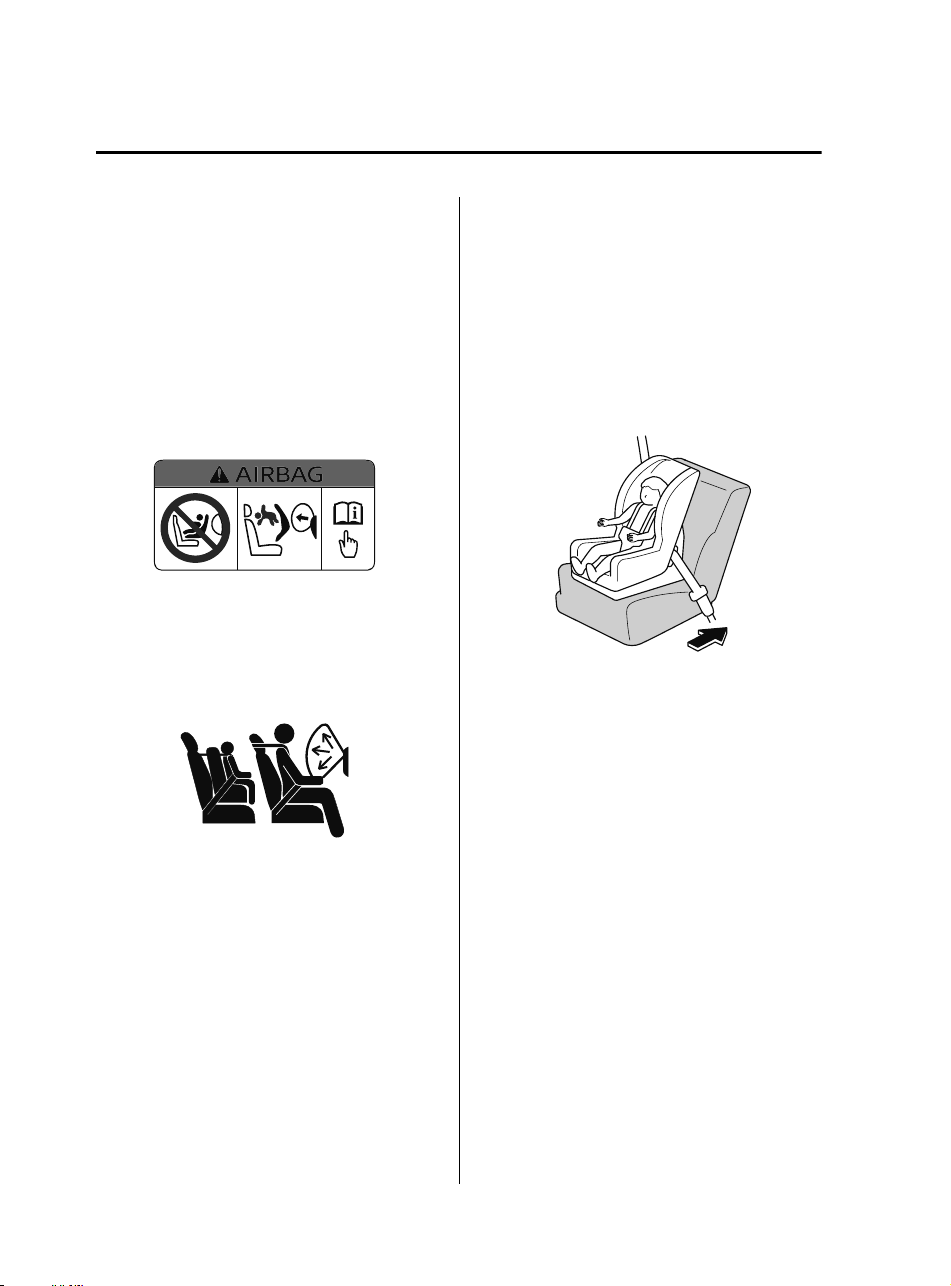
(Mexico)
NEVER use a rearward facing child restraint
on a seat protected by an ACTIVE AIRBAG in
front of it, DEATH or SERIOUS INJURY to the
CHILD can occur.
Vehicles with a front passenger air bag
have the following warning label. The
warning label reminds you not to put a
rear-facing child-restraint system on the
front passenger seat at any time.
(Except Mexico)
Vehicles with a front passenger air bag
have the following warning label. The
warning label reminds you not to put a
rear-facing child-restraint system on the
front passenger seat at any time.
Do not install a front-facing child-restraint
system on the front passenger seat unless it
is unavoidable:
In a collision, the force of a deploying air
bag could cause serious injury or death to
the child. If installing a front-facing
child-restraint system on the front
passenger seat is unavoidable, move the
front passenger seat as far back as
possible.
Seating a child in a child-restraint system
on the front passenger seat is dangerous
under certain conditions (With Front
Passenger Occupant Classication System):
Your vehicle is equipped with front
passenger seat weight sensors. Even with
the front passenger seat weight sensors, if
you must use the front passenger seat to
seat a child, using a child-restraint system
on the front passenger seat under the
following conditions increases the danger
of the front passenger air bag deploying
and could result in serious injury or death
to the child.
The front passenger air bag deactivation
indicator light does not illuminate when
seating a child in the child-restraint
system.
Essential Safety Equipment
Child Restraint
2-34
Mazda3_8HZ1-EA-19G_Edition1_old 2019-5-17 13:49:03

Luggage or other items are placed on the
seat with the child in the child-restraint
system.
A rear passenger or luggage pushing or
pulling down on the front passenger
seatback.
Luggage or other items are placed on the
seatback or hung on the head restraint.
The seat is washed.
Liquids are spilled on the seat.
The front passenger seat is moved
backward, pushing into luggage or other
items placed behind it.
The front passenger seatback contacts
the rear seat.
Luggage or other items are placed
between the front passenger seat and
driver seat.
An electric device is put on the front
passenger's seat.
An additional electrical device, such as a
seat warmer is installed to the surface of
the front passenger seat.
Any accessories, which might increase
the total seated weight on the front
passenger seat, are attached to the front
passenger seat.
The designated positions with seat belts on
the rear seats are the safest places for
children. Always use seat belts and child
restraints.
Do not allow a child or anyone to lean over
or against the side window of a vehicle
with side and curtain air bags:
It is dangerous to allow anyone to lean
over or against the side window, the area
of the front passenger seat, the front and
rear window pillars and the roof edge
along both sides from which the side and
curtain air bags deploy, even if a
child-restraint system is used. The impact
of ination from a side or curtain air bag
could cause serious injury or death to an
out of position child. Furthermore, leaning
over or against the front door could block
the side and curtain air bags and eliminate
the advantages of supplemental
protection. With the front air bag and the
additional side air bag that comes out of
the front seat, the rear seat is always a
better location for children. Take special
care not to allow a child to lean over or
against the side window, even if the child is
seated in a child-restraint system.
Never use one seat belt on more than one
person at a time:
Using one seat belt for more than one
person at a time is dangerous. A seat belt
used in this way cannot spread the impact
forces properly and the two passengers
could be crushed together and seriously
injured or even killed. Never use one belt for
more than one person at a time and always
operate the vehicle with each occupant
properly restrained.
Essential Safety Equipment
Child Restraint
2-35
Mazda3_8HZ1-EA-19G_Edition1_old 2019-5-17 13:49:03
CAUTION
A seat belt or child-restraint system can
become very hot in a closed vehicle during
warm weather. To avoid burning yourself
or a child, check them before you or your
child touches them.
NOTE
Your Mazda is equipped with ISOFIX/
LATCH
*1
lower anchors for attachment of
specially designed ISOFIX/LATCH
*1
child-restraint systems on the rear seats.
When using these anchors to secure a
child-restraint system, refer to "Using
ISOFIX Lower Anchor (Mexico)/Using
LATCH Lower Anchor (Except Mexico)"
(page 2-50).
*
1 ISOFIX (Mexico)/LATCH (Except
Mexico)
Essential Safety Equipment
Child Restraint
2-36
Mazda3_8HZ1-EA-19G_Edition1_old 2019-5-17 13:49:03
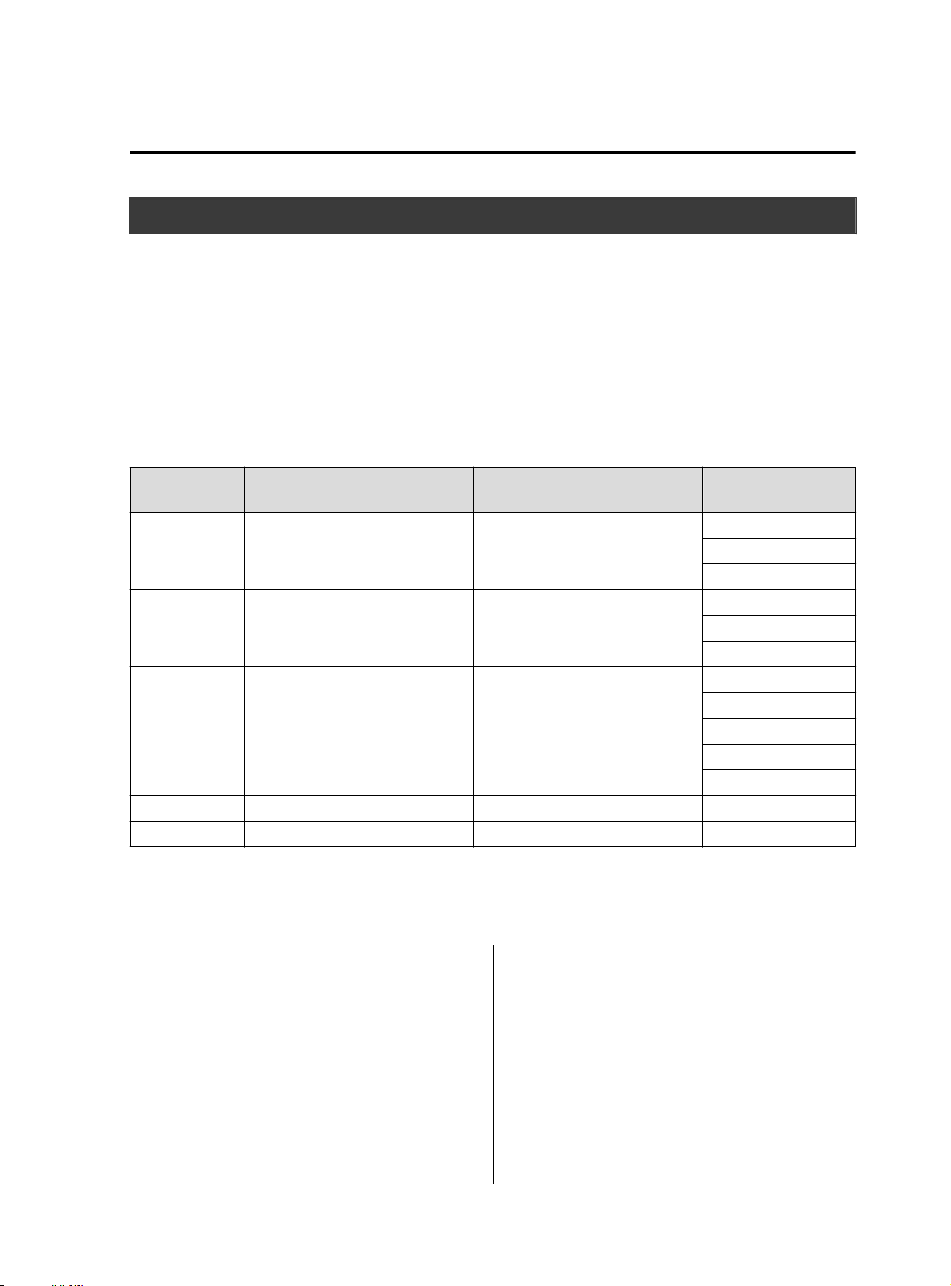
Child-Restraint System Installation
▼
Categories of Child-Restraint Systems
NOTE
When purchasing, ask the manufacturer of the child-restraint system which type of
child-restraint system is appropriate for your child and vehicle.
(Mexico)
Child-restraint systems are classified into the following 5 groups according to the UN-R 44
regulation.
Group Age Weight
Size Classification/
Fixture (CRF)
0 Up to about 9 months old Up to 10 kg (up to 22 lb)
ISO/L1
ISO/L2
ISO/R1
0+ Up to about 2 years old Up to 13 kg (up to 29 lb)
ISO/R1
ISO/R2
ISO/R3
1 About 8 months to 4 years old 9 kg ― 18 kg (20 lb ― 40 lb)
ISO/R2
ISO/R3
ISO/F2
ISO/F2X
ISO/F3
2 About 3 to 7 years old 15 kg ― 25 kg (33 lb ― 55 lb) ―
3 About 6 to 12 years old 22 kg ― 36 kg (48 lb ― 79 lb) ―
(Except Mexico)
Please comply with the legal regulations concerning the use of child-restraint systems in
your country.
▼
Child-Restraint System Types
In this owner's manual, explanation of
child-restraint systems is provided for the
following three types of popular
child-restraint systems: infant seat, child
seat, booster seat.
NOTE
Installation position is determined by
the type of child-restraint system.
Always read the manufacturer's
instructions and this owner's manual
carefully.
Essential Safety Equipment
Child Restraint
2-37
Mazda3_8HZ1-EA-19G_Edition1_old 2019-5-17 13:49:03
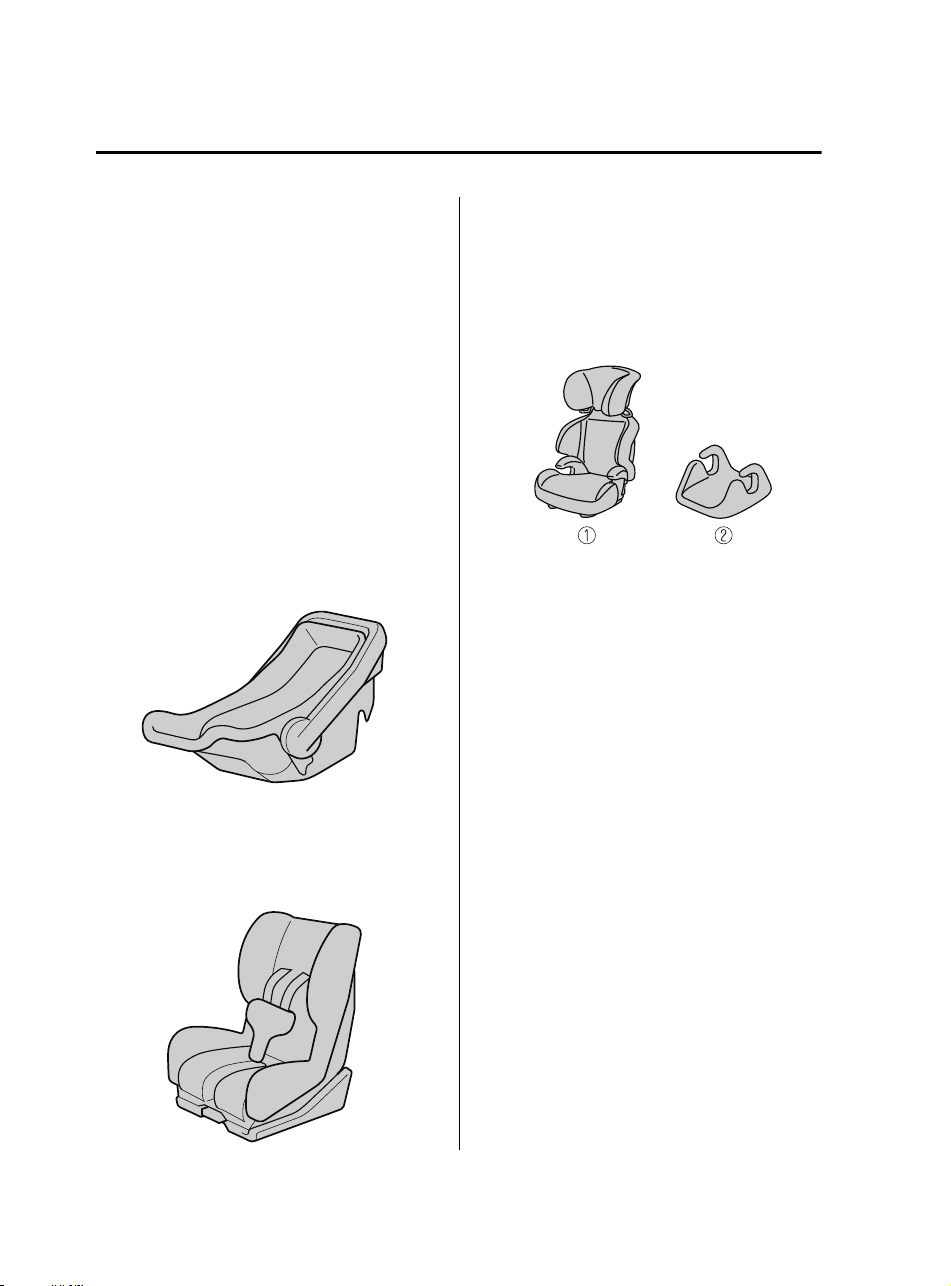
Due to variations in the design of
child-restraint systems, vehicle seats
and seat belts, all child-restraint systems
may not fit all seating positions. Before
purchasing a child-restraint system, it
should be tested in the specific vehicle
seating position (or positions) where it
is intended to be used. If a previously
purchased child-restraint system does
not fit, you may need to purchase a
different one that will.
Infant seat
An infant seat provides restraint by
bracing the infant's head, neck and back
against the seating surface.
Equal to Group 0 and 0+ of the UN-R 44
and UN-R 129 regulation.
Child seat
A child seat restrains a child's body using
the harness.
Equal to Group 1 of the UN-R 44 and
UN-R 129 regulation.
Booster seat
A booster seat is a child restraint
accessory designed to improve the fit of
the seat belt system around the child's
body.
Equal to Group 2 and 3 of the UN-R 44
and UN-R 129 regulation.
1. Full booster seat
2. Backless booster seat
When using a backless booster seat,
always install the vehicle head restraint to
the seat where the backless booster seat is
installed.
Essential Safety Equipment
Child Restraint
2-38
Mazda3_8HZ1-EA-19G_Edition1_old 2019-5-17 13:49:03
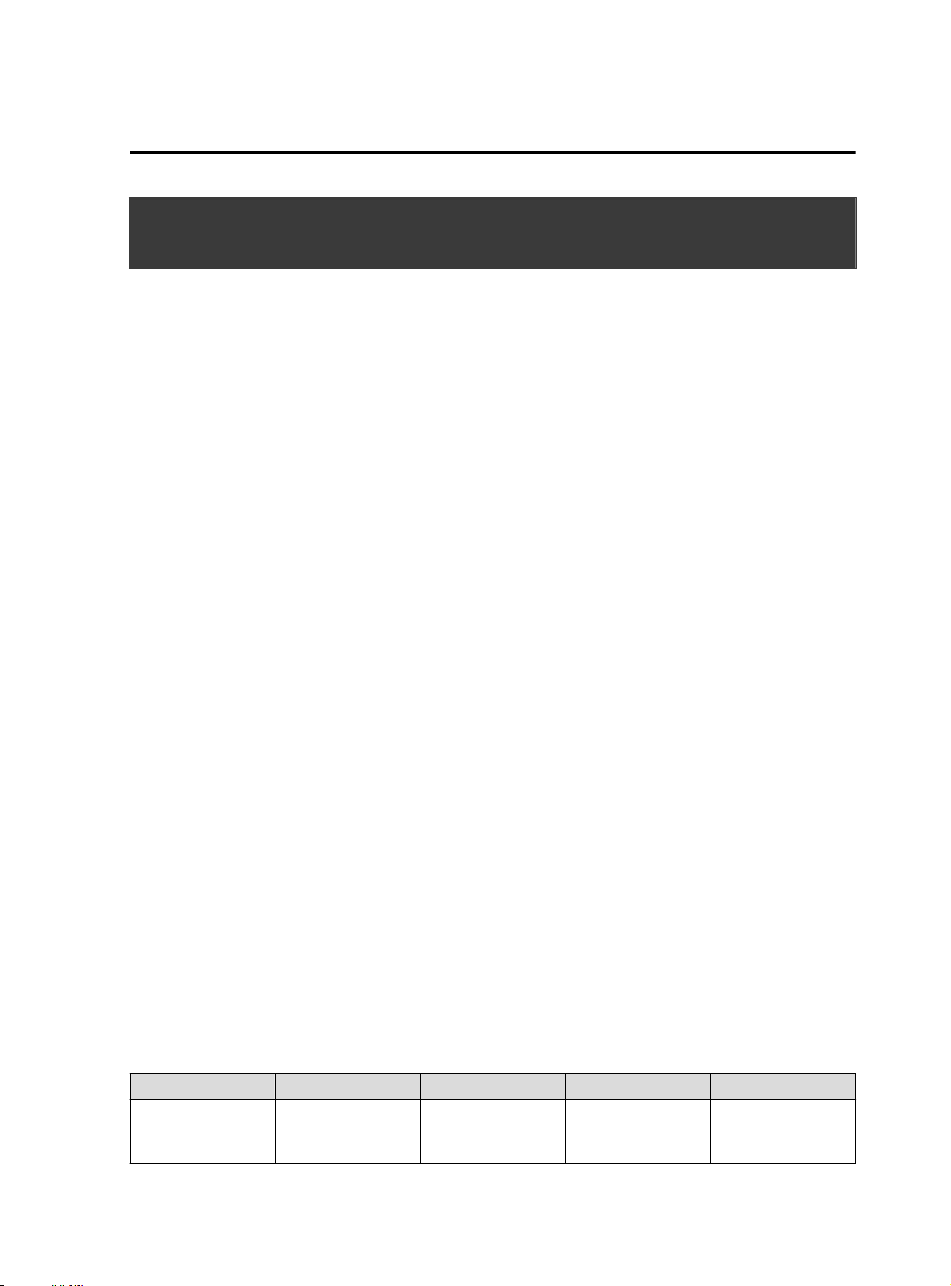
Child-Restraint System Suitability for Various Seat
Positions Table
▼
Child-Restraint System Suitability for Various Seat Positions Table
(Mexico)
Provided information in the table shows your child-restraint system suitability for various
seating position. For installation suitability of other manufacturer child-restraint system,
carefully consult the manufacturer's instructions which accompany the child-restraint
system.
When installing a child-restraint system, the following points must be observed:
Always remove the head restraint before installing a child-restraint system. However,
when installing a backless booster seat, always install the vehicle head restraint to the seat
where the backless booster seat is installed. In addition, always use a tether strap and
attach it securely. Refer to Head Restraints on page 2-17.
When installing a child-restraint system to the front passenger seat, adjust the seat slide
position as far back as possible.
Refer to Adjusting the Front Passenger's Seat on page 2-13.
When it is difficult to install a child-restraint system to the front passenger seat, or the seat
belt cannot be secured to the child-restraint system, perform the following operations to
adjust the seat holding the child-restraint system so that the seat belt can be secured
completely to it.
Move the seat forward or back.
Move the seatback forward or back.
Move the seat upward or downward. (Vehicles with height adjustment function)
When installing a child-restraint system to the rear seat, adjust the front seat position so
that the front seat does not contact the child-restraint system.
Refer to Adjusting the Driver's Seat on page 2-5.
Refer to Adjusting the Front Passenger's Seat on page 2-13.
When installing a child-restraint system equipped with a tether, remove the head restraint.
Refer to Head Restraints on page 2-17.
An i-Size child-restraint system refers to a child-restraint system which has acquired
i-Size category certification for the UN-R 129 regulation.
When installing a child-restraint system to the rear seat, refer to the child-restraint system
manufacturer's instructions and the Using ISOFIX Lower Anchor on page 2-50.
Seating position Passenger Rear (Left) Rear (Center) Rear (Right)
Seating position suit‐
able for universal
belted (Yes/No)
Yes (UF) Yes (U) Yes (U) Ye s (U )
Essential Safety Equipment
Child Restraint
2-39
Mazda3_8HZ1-EA-19G_Edition1_old 2019-5-17 13:49:03
Seating position Passenger Rear (Left) Rear (Center) Rear (Right)
i-Size seating posi‐
tion (Yes/No)
No No No No
Largest suitable rear‐
ward facing fixture
(R1)
No Yes (IL) No Yes (IL)
Largest suitable rear‐
ward facing fixture
(R2)
No Yes (IL) No Yes (IL)
Largest suitable rear‐
ward facing fixture
(R2X)
No Yes (IL) No Yes (IL)
Largest suitable rear‐
ward facing fixture
(R3)
No Yes (IL) No Yes (IL)
Largest suitable for‐
ward facing fixture
(F2)
No Yes (IUF) No Yes (IUF)
Largest suitable for‐
ward facing fixture
(F2X)
No Yes (IUF) No Yes (IUF)
Largest suitable for‐
ward facing fixture
(F3)
No Yes (IUF) No Yes (IUF)
Largest suitable lat‐
eral facing fixture
(L1)
No No No No
Largest suitable lat‐
eral facing fixture
(L2)
No No No No
Largest suitable
booster fixture (B2)
No Yes (IUF) No Yes (IUF)
Largest suitable
booster fixture (B3)
No Yes (IUF) No Yes (IUF)
Non i-size compati‐
ble with a support
leg (Yes/No)
Yes
*1
Yes No Yes
Lower ISOFIX an‐
chorages but without
Top Tether (Yes/No)
No No No No
U = Suitable for “universal” category restraints approved for use in this mass group.
UF = Suitable for forward-facing “universal” category restraints approved for use in this mass group.
IUF = Suitable for ISOFIX forward child restraints systems of universal category approved for use in the mass
group.
Essential Safety Equipment
Child Restraint
2-40
Mazda3_8HZ1-EA-19G_Edition1_old 2019-5-17 13:49:03

L = Suitable for particular child restraints given on attached list. These restraints may be of the “specific vehicle”,
“restricted” or “semi-universal” categories.
IL = Suitable for particular ISOFIX child restraint systems (CRS) given in the attached list. These ISOFIX CRS are
those of the “specific vehicle”, “restricted” or “semi-universal” categories.
i-U = Suitable for i-Size “universal” Child Restraint Systems forward and rearward facing.
i-UF = Suitable for forward-facing i-Size “universal” Child Restraint Systems only.
Yes = Child-restraint system can be secured on the seat.
No = Child-restraint system cannot be secured on the seat, or there is no fixture.
X = Child-restraint system cannot be installed.
*
1 Child restraint system can only be installed in the forward-facing position.
A Mazda genuine child-restraint system can be installed. Regarding child-restraint systems which can be installed,
refer to the accessories catalog.
(Except Mexico)
Regarding child-restraint systems which can be installed to your Mazda, consult an
Authorized Mazda Dealer.
A child-restraint system with a support leg cannot be installed on the rear center seat
position.
Please comply with the legal regulations concerning the use of child-restraint systems in
your country.
For the CRS which do not carry the ISO/XX size class identification (A to G), for the
applicable mass group, the child seat manufacturer shall indicate the vehicle specific
LATCH child-restraint systems recommended for each position.
Essential Safety Equipment
Child Restraint
2-41
Mazda3_8HZ1-EA-19G_Edition1_old 2019-5-17 13:49:03
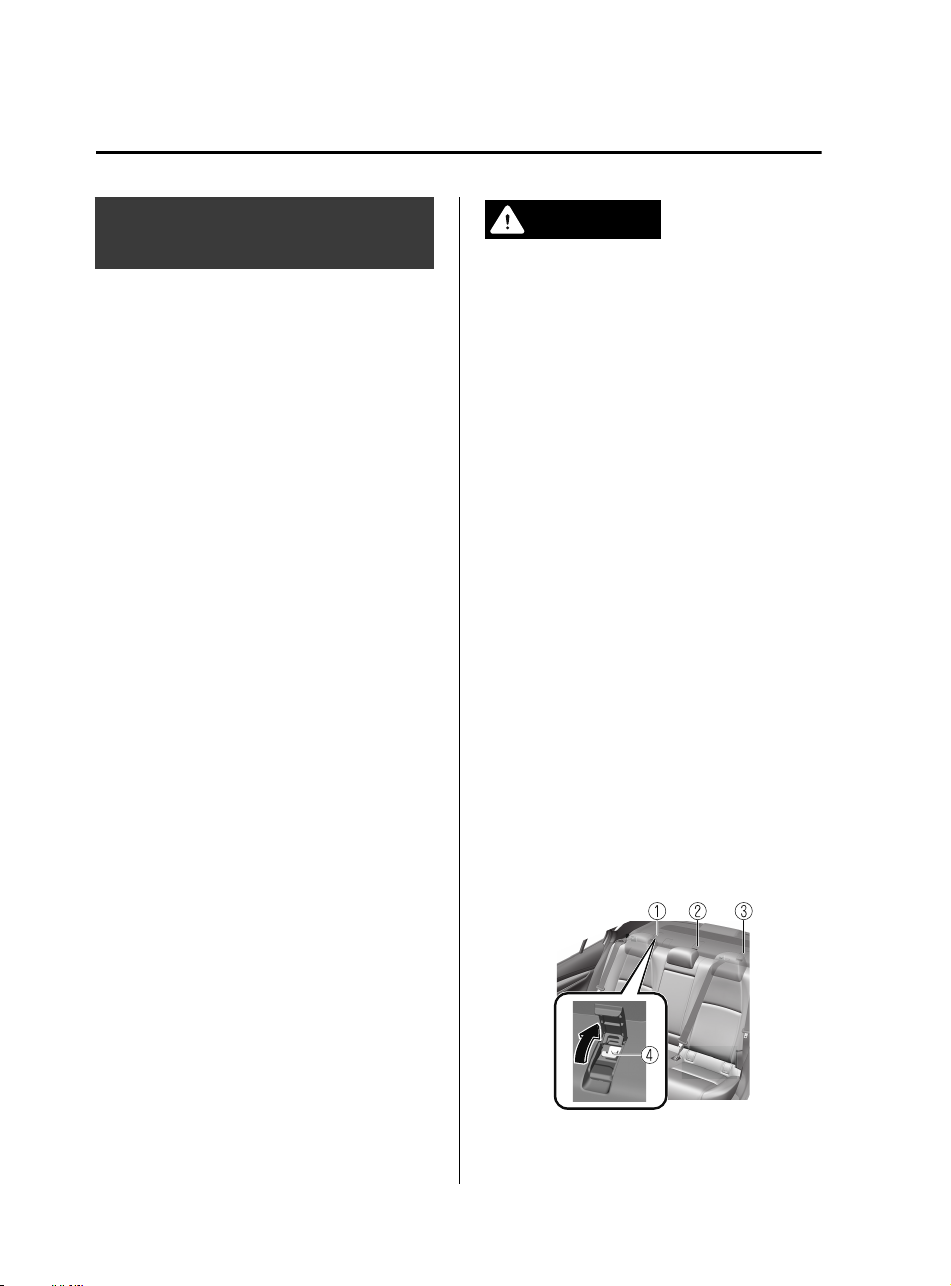
Installing Child-Restraint
Systems
▼
Installing Child-Restraint Systems
Accident statistics reveal that a child is
safer in the rear seat. The front passenger's
seat is clearly the worst choice for any
child under 12, and with rear-facing
child-restraint systems it is clearly unsafe
due to air bags.
NOTE
Even if your vehicle is equipped with front
passenger occupant classification sensor
(page 2-72), which automatically
deactivates the front passenger air bag, a
rear seat is the safest place for a child of
any age or size.
Some child-restraint systems now come
with tethers and therefore must be
installed on the seats that take tethers to be
effective. In your Mazda, tethered
child-restraint systems can only be
accommodated in the three positions on
the rear seat.
Some child-restraint systems also employ
specially designed ISOFIX/LATCH
*1
attachments; refer to "Using ISOFIX
Lower Anchor (Mexico)/Using LATCH
Lower Anchor (Except Mexico)" (page
2-50).
*
1 ISOFIX (Mexico)/LATCH (Except
Mexico)
WARNING
Tethered Child-Restraint Systems Work
Only on Tether-Equipped Rear Seats:
Installation of a tether equipped
child-restraint system in the front
passenger's seat defeats the safety design
of the system and will result in an increased
chance of serious injury if the
child-restraint system goes forward
without benet of being tethered.
Place tether equipped child-restraint
systems where there are tether anchors.
▼
Anchor Bracket
Anchor brackets for securing
child-restraint systems are equipped in the
vehicle. Locate each anchor position using
the illustration.
To install a child-restraint system, remove
the head restraint. Always follow the
instruction manual accompanying the
child-restraint system.
Anchor bracket location
Use the indicated anchor bracket locations
when installing a child-restraint system
equipped with a tether.
(4–Door)
1. For right
2. For center (Except Mexico)
Essential Safety Equipment
Child Restraint
2-42
Mazda3_8HZ1-EA-19G_Edition1_old 2019-5-17 13:49:03
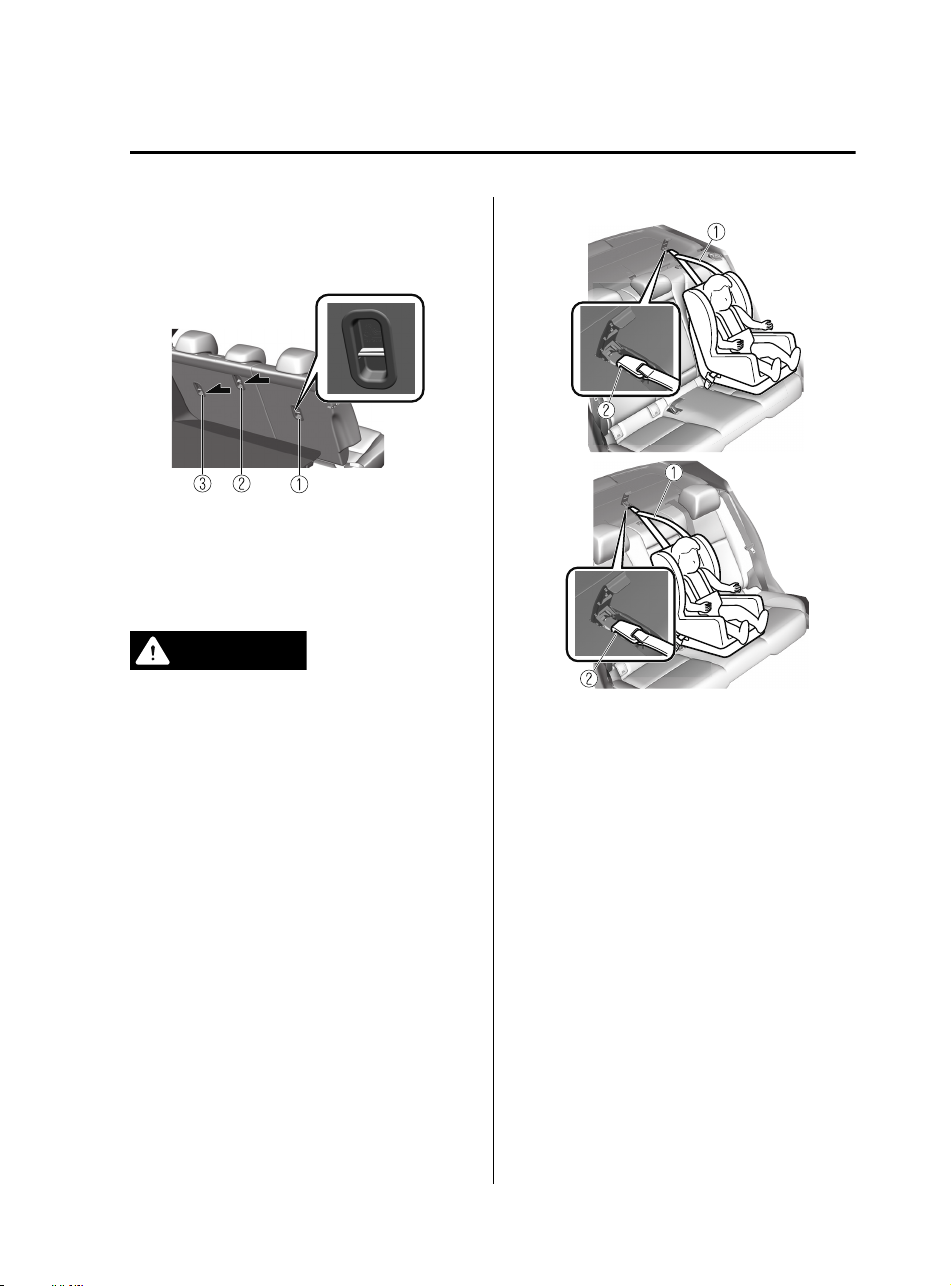
3. For left
4. Anchor bracket
(5–Door)
1. For right
2. For center (Except Mexico)
3. For left
WARNING
Always attach the tether strap to the
correct tether anchor position:
Attaching the tether strap to the incorrect
tether anchor position is dangerous. In a
collision, the tether strap could come
o
and loosen the child-restraint system. If the
child-restraint system moves it could result
in death or injury to the child.
Always remove the head restraint and
install child-restraint system:
Installing a child-restraint system without
removing the head restraint is dangerous.
The child-restraint system cannot be
installed correctly which may result in
death or injury to the child in a collision.
(4–Door)
1. Tether strap
2. Anchor bracket
Essential Safety Equipment
Child Restraint
2-43
Mazda3_8HZ1-EA-19G_Edition1_old 2019-5-17 13:49:03
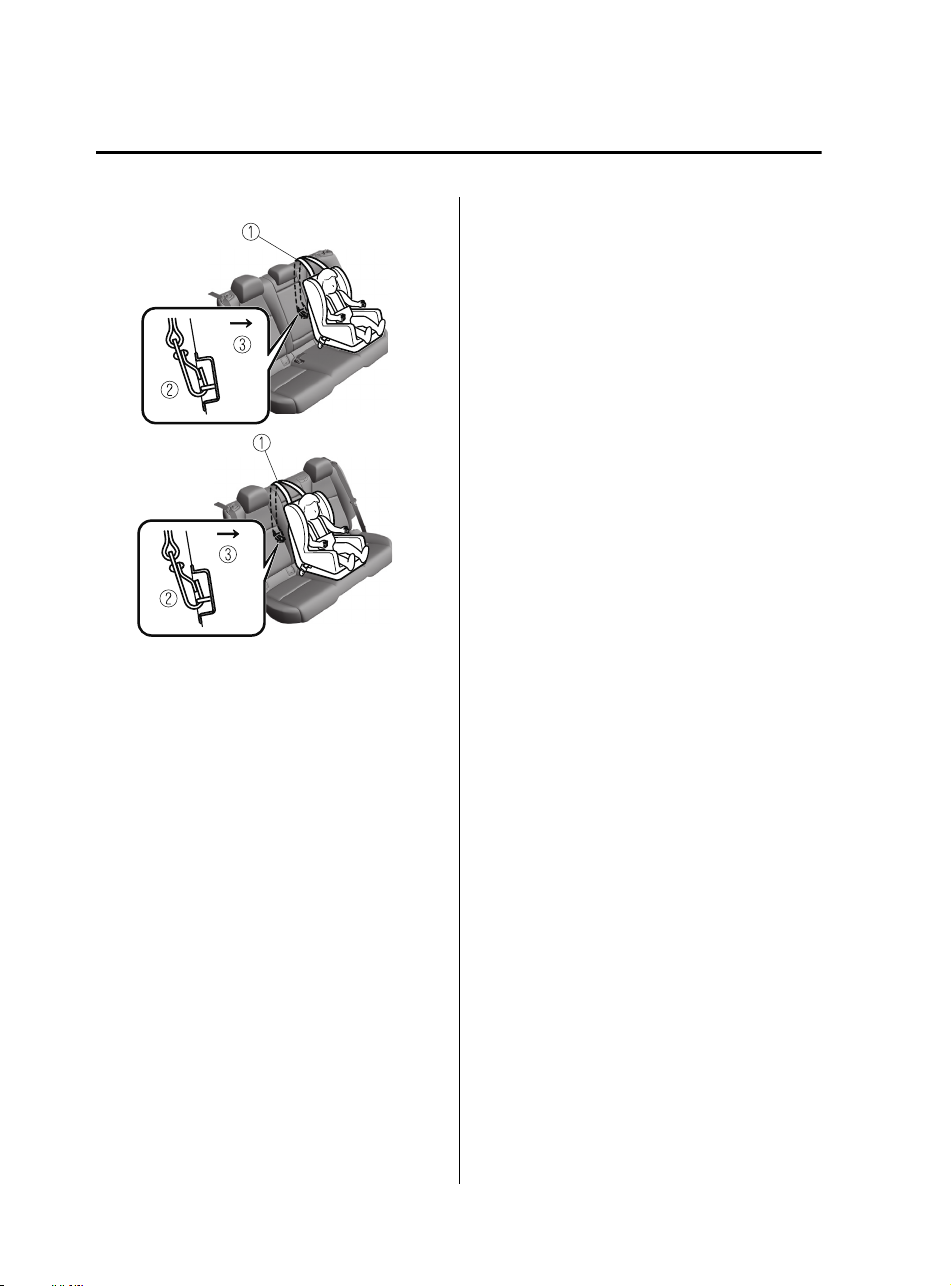
(5–Door)
1. Tether strap
2. Anchor bracket
3. Forward
Always install the head restraint and adjust
it to the appropriate position after
removing the child-restraint system:
Driving with the head restraint removed is
dangerous as impact to the occupant's
head cannot be prevented during
emergency braking or in a collision, which
could result in a serious accident, injury or
death.
Refer to Head Restraints on page 2-17.
▼
Using Automatic Locking Mode
(Except Mexico)
Follow these instructions when using a
child-restraint system, unless you are
attaching a LATCH-equipped
child-restraint system to the rear LATCH
lower anchors. Refer to “Using LATCH
Lower Anchor” (page 2-50).
NOTE
Follow the child-restraint system
manufacturer's instructions carefully. If
you are not sure whether you have a
LATCH system or tether, check in the
child-restraint system manufacturer's
instructions and follow them accordingly.
Depending on the type of child-restraint
system, it may use LATCH system instead
of seat belts or if the belt goes across the
child's chest, may recommend against
using automatic locking mode.
1. Make sure the seatback is securely
latched by pushing it back until it is
fully locked.
2. Remove the head restraint. However,
when installing a backless booster seat,
always install the vehicle head restraint
to the seat where the backless booster
seat is installed.
Refer to Head Restraints on page 2-17.
3. Secure the child-restraint system with
the lap portion of the lap/shoulder belt.
See the manufacturer's instructions on
the child-restraint system for belt
routing instructions.
Essential Safety Equipment
Child Restraint
2-44
Mazda3_8HZ1-EA-19G_Edition1_old 2019-5-17 13:49:03
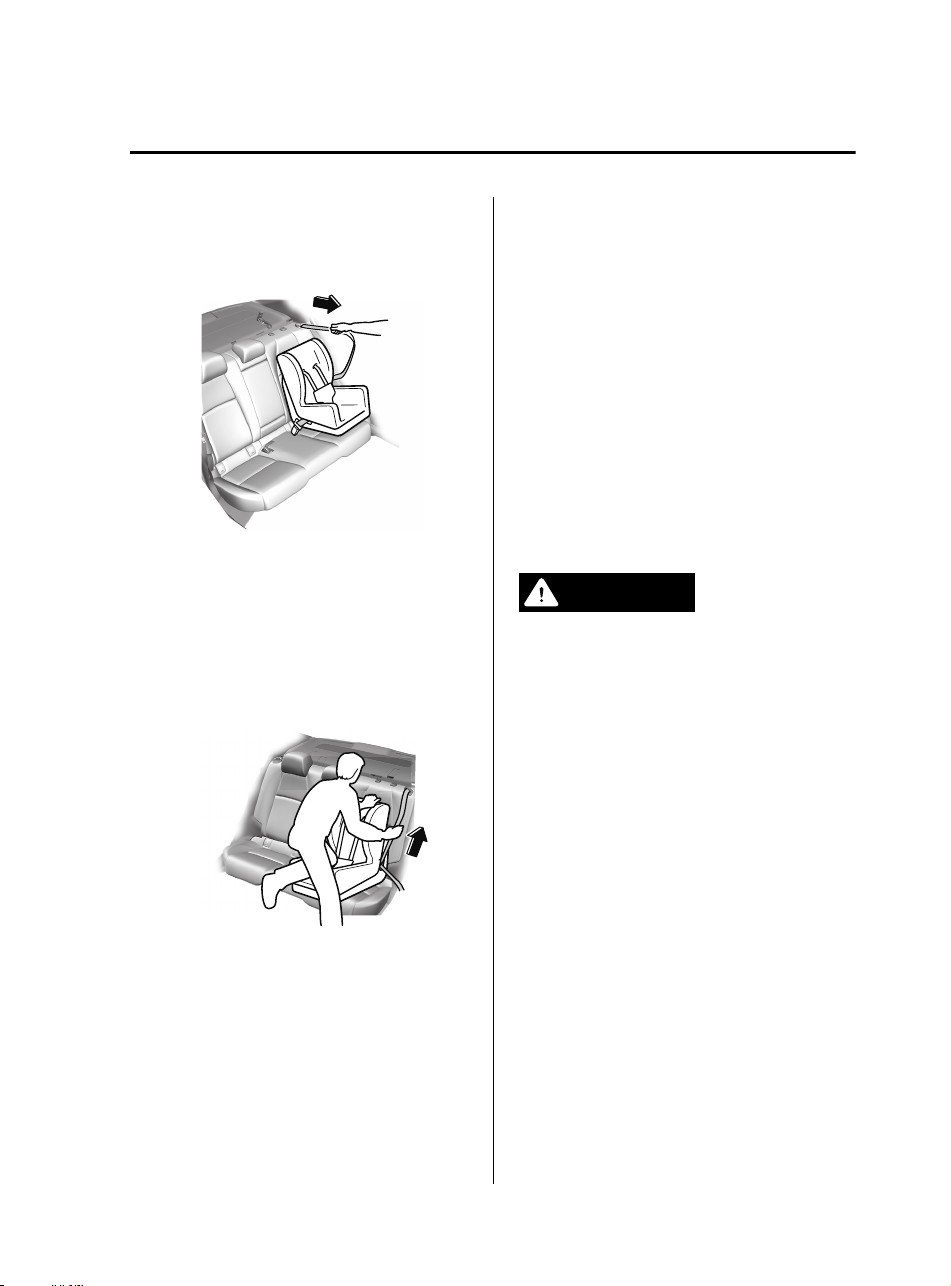
4. To get the retractor into the automatic
locking mode, pull the shoulder belt
portion of the seat belt until the entire
length of the belt is out of the retractor.
5. Push the child-restraint system firmly
into the vehicle seat. Be sure the belt
retracts as snugly as possible. A
clicking noise from the retractor will
be heard during retraction if the system
is in the automatic locking mode. If the
belt does not lock the seat down tight,
repeat this step.
NOTE
Inspect this function before each use
of the child-restraint system. You
should not be able to pull the
shoulder belt out of the retractor
while the system is in the automatic
locking mode. When you remove the
child-restraint system, be sure the
belt fully retracts to return the
system to emergency locking mode
before occupants use the seat belts.
6. If your child-restraint system requires
the use of a tether strap, refer to the
manufacturer's instructions to hook
and tighten the tether strap.
WARNING
Use the tether and tether anchor only for a
child-restraint system:
Using the tether or tether anchor to secure
anything but a child-restraint system is
dangerous. This could weaken or damage
the tether or tether anchor and result in
injury.
Always remove the head restraint and
install child-restraint system (except when
installing a backless booster seat):
Installing a child-restraint system without
removing the head restraint is dangerous.
The child-restraint system cannot be
installed correctly which may result in
death or injury to the child in a collision.
Essential Safety Equipment
Child Restraint
2-45
Mazda3_8HZ1-EA-19G_Edition1_old 2019-5-17 13:49:03
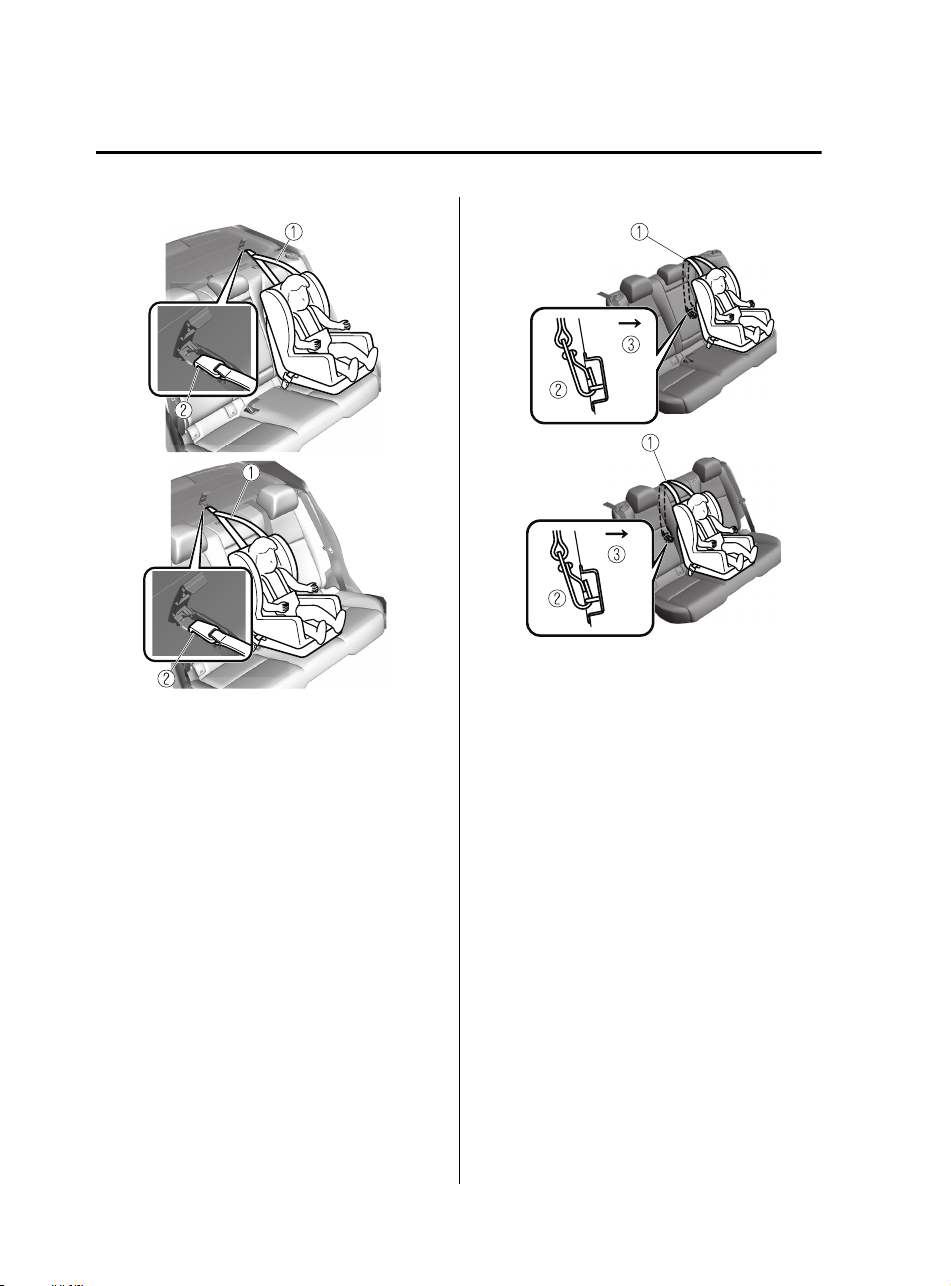
(4–Door)
1. Tether strap
2. Anchor bracket
(5–Door)
1. Tether strap
2. Anchor bracket
3. Forward
Always attach the tether strap to the
correct tether anchor position:
Attaching the tether strap to the incorrect
tether anchor position is dangerous. In a
collision, the tether strap could come o
and loosen the child-restraint system. If the
child-restraint system moves it could result
in death or injury to the child.
Always install the head restraint and adjust
it to the appropriate position after
removing the child-restraint system:
Driving with the head restraint removed is
dangerous as impact to the occupant's
head cannot be prevented during
emergency braking or in a collision, which
could result in a serious accident, injury or
death.
Refer to Head Restraints on page 2-17.
Essential Safety Equipment
Child Restraint
2-46
Mazda3_8HZ1-EA-19G_Edition1_old 2019-5-17 13:49:03
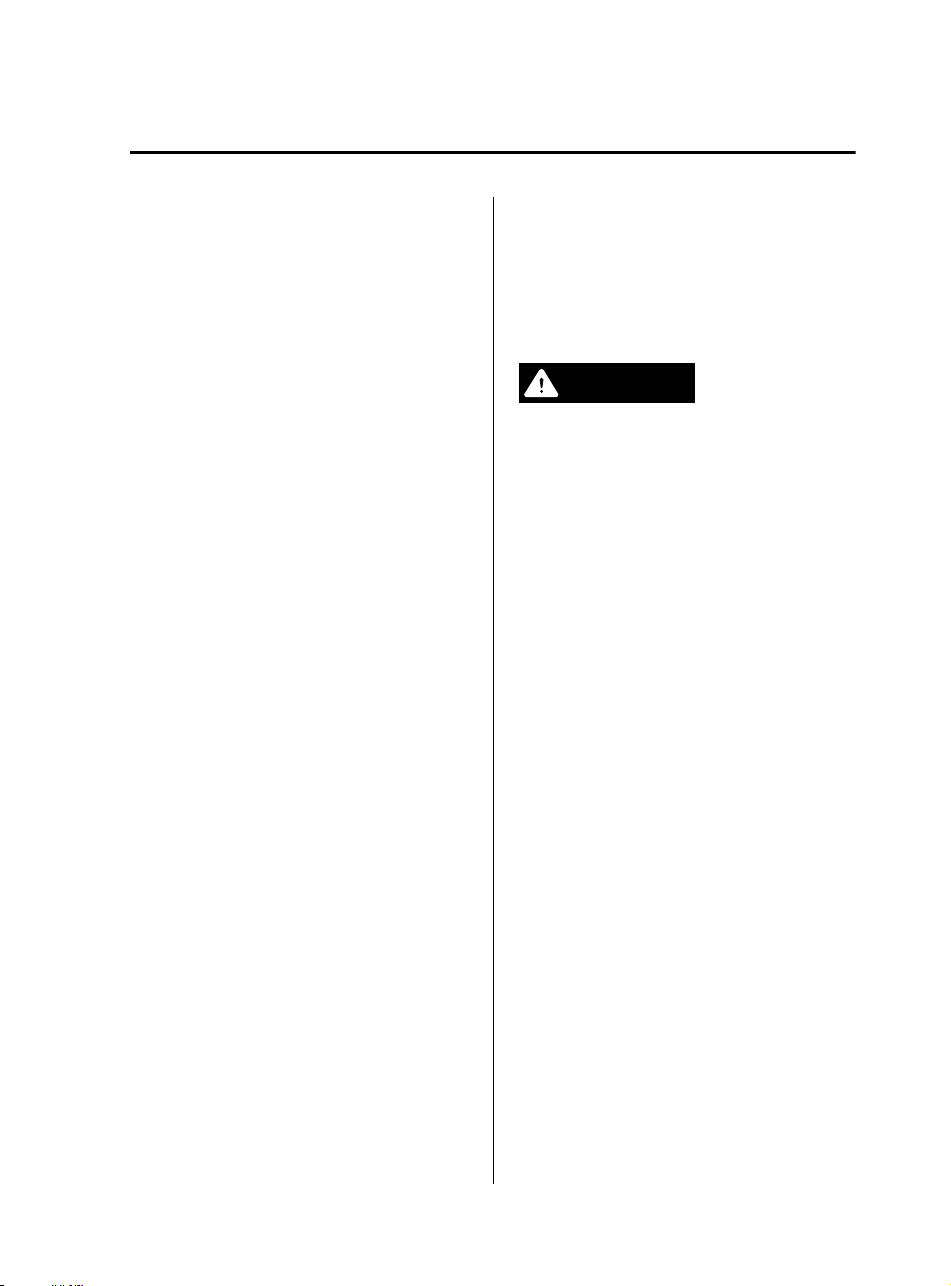
▼
If You Must Use the Front Seat for
Children
If you cannot put all children in the rear
seat, at least put the smallest children in
the rear and be sure the largest child up
front uses the shoulder belt over the
shoulder.
NEVER put a rear-facing child-restraint
system on the front passenger seat whether
your vehicle is equipped with an occupant
classification sensor or not.
This seat is also not set up for tethered
child-restraint systems, put them in one of
the rear seat positions set up with tether
anchors.
Likewise the ISOFIX/LATCH
*1
child-restraint system cannot be secured in
the front passenger's seat and should be
used in the rear seat.
Do not allow anyone to sleep against the
side window since your vehicle has side
and curtain air bags, it could cause serious
injuries to an out of position occupant. As
children more often sleep in cars, it is
better to put them in the rear seat. If
installing the child-restraint system on the
front seat is unavoidable, follow these
instructions when using a front-facing
child-restraint system in the front
passenger's seat.
*
1 ISOFIX (Mexico)/LATCH (Except
Mexico)
NOTE
To check if your front seats have side air
bags:
Mazda vehicles equipped with side air
bag will have a "SRS AIRBAG" tag on
the outboard shoulder of the front seats.
To check if your vehicle has curtain air
bags:
Mazda vehicles equipped with curtain
air bag will have an "SRS AIRBAG"
marking on the window pillars along the
roof edge.
WARNING
Always move the front passenger seat as
far back as possible if installing a
front-facing child-restraint system on it is
unavoidable:
As your vehicle has front air bags and
doubly so because your vehicle has side air
bags, a front-facing child-restraint system
should be put on the front passenger seat
only when it is unavoidable.
Even if the front passenger air bag
deactivation indicator light illuminates,
always move the seat as far back as
possible, because the force of a deploying
air bag could cause serious injury or death
to the child.
Never use a rear-facing child-restraint
system in the front seat with an air bag
that could deploy:
Rear-facing child-restraint systems on the
front seat are particularly dangerous.
Even in a moderate collision, the
child-restraint system can be hit by a
deploying air bag and moved violently
backward resulting in serious injury or
death to the child. Even though you may
feel assured that the front passenger air
bag will not deploy based on the fact that
the front passenger air bag deactivation
indicator light illuminates, you should not
use a rear-facing child-restraint system in
the front seat.
Essential Safety Equipment
Child Restraint
2-47
Mazda3_8HZ1-EA-19G_Edition1_old 2019-5-17 13:49:03
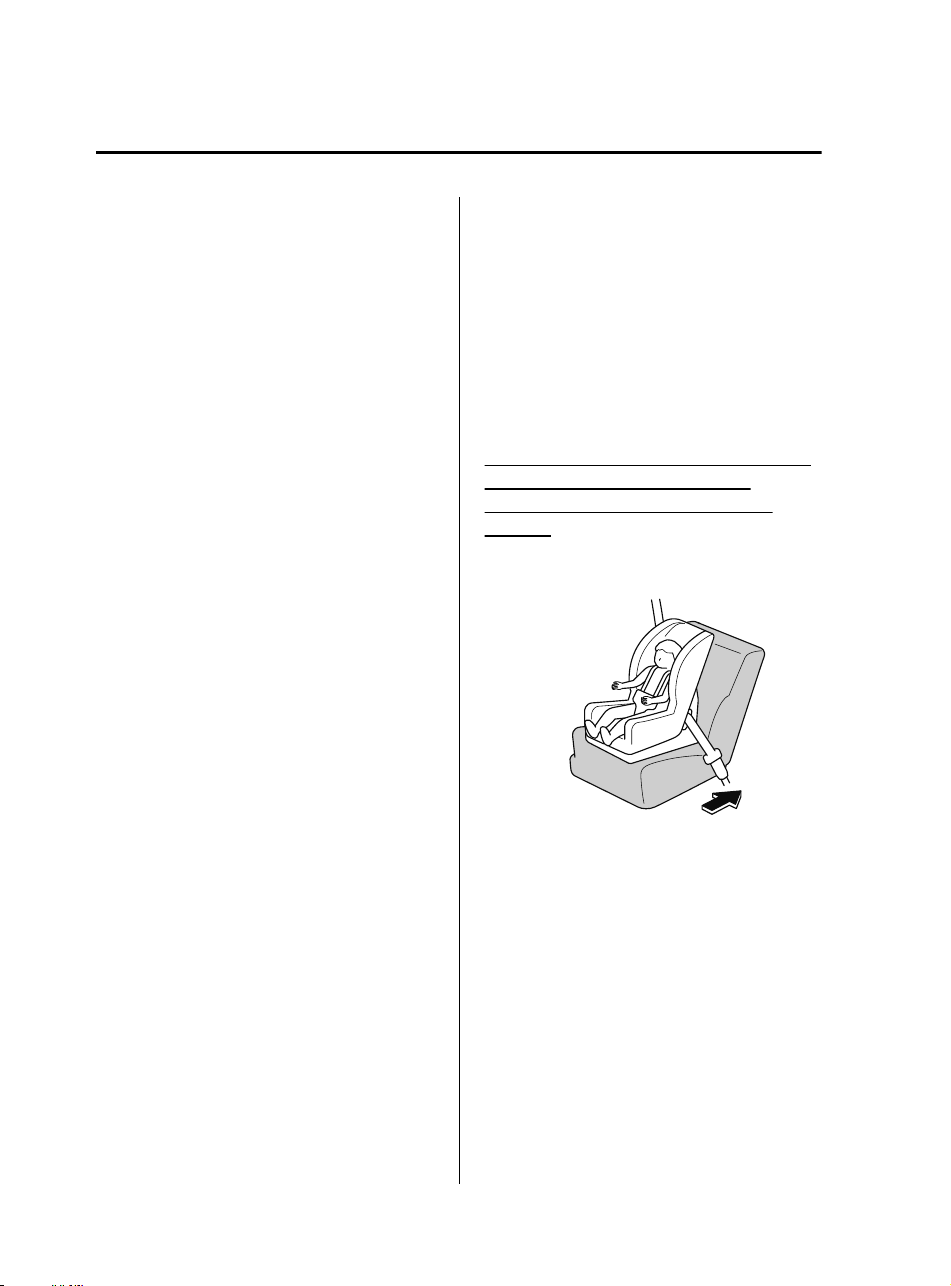
Do not allow a child or anyone to lean over
or against the side window of a vehicle
with side and curtain air bags:
It is dangerous to allow anyone to lean
over or against the side window, the area
of the front passenger seat, the front and
rear window pillars and the roof edge
along both sides from which the side and
curtain air bags deploy, even if a
child-restraint system is used. The impact
of ination from a side or curtain air bag
could cause serious injury or death to an
out of position child. Furthermore, leaning
over or against the front door could block
the side and curtain air bags and eliminate
the advantages of supplemental
protection. With the front air bag and the
additional side air bag that comes out of
the front seat, the rear seat is always a
better location for children. Take special
care not to allow a child to lean over or
against the side window, even if the child is
seated in a child-restraint system.
Always remove the head restraint and
install child-restraint system (except when
installing a backless booster seat):
Installing a child-restraint system without
removing the head restraint is dangerous.
The child-restraint system cannot be
installed correctly which may result in
death or injury to the child in a collision.
Always install the head restraint and adjust
it to the appropriate position after
removing the child-restraint system:
Driving with the head restraint removed is
dangerous as impact to the occupant's
head cannot be prevented during
emergency braking or in a collision, which
could result in a serious accident, injury or
death.
Refer to Head Restraints on page 2-17.
Front Passenger's Seat Child-Restraint
System Installation (With Front
Passenger Occupant Classification
System)
1. Make sure the ignition is switched off.
2. Slide the seat as far back as possible.
3. Remove the head restraint. However,
when installing a backless booster seat,
always install the vehicle head restraint
to the seat where the backless booster
seat is installed.
4. Place the child-restraint system on the
seat without putting your weight on the
seat and fasten the seat belt. See the
manufacturer's instructions on the
child-restraint system for belt routing
instructions.
5. To get the retractor into the automatic
locking mode, pull the shoulder belt
portion of the seat belt until the entire
length of the belt is out of the retractor.
Essential Safety Equipment
Child Restraint
2-48
Mazda3_8HZ1-EA-19G_Edition1_old 2019-5-17 13:49:03
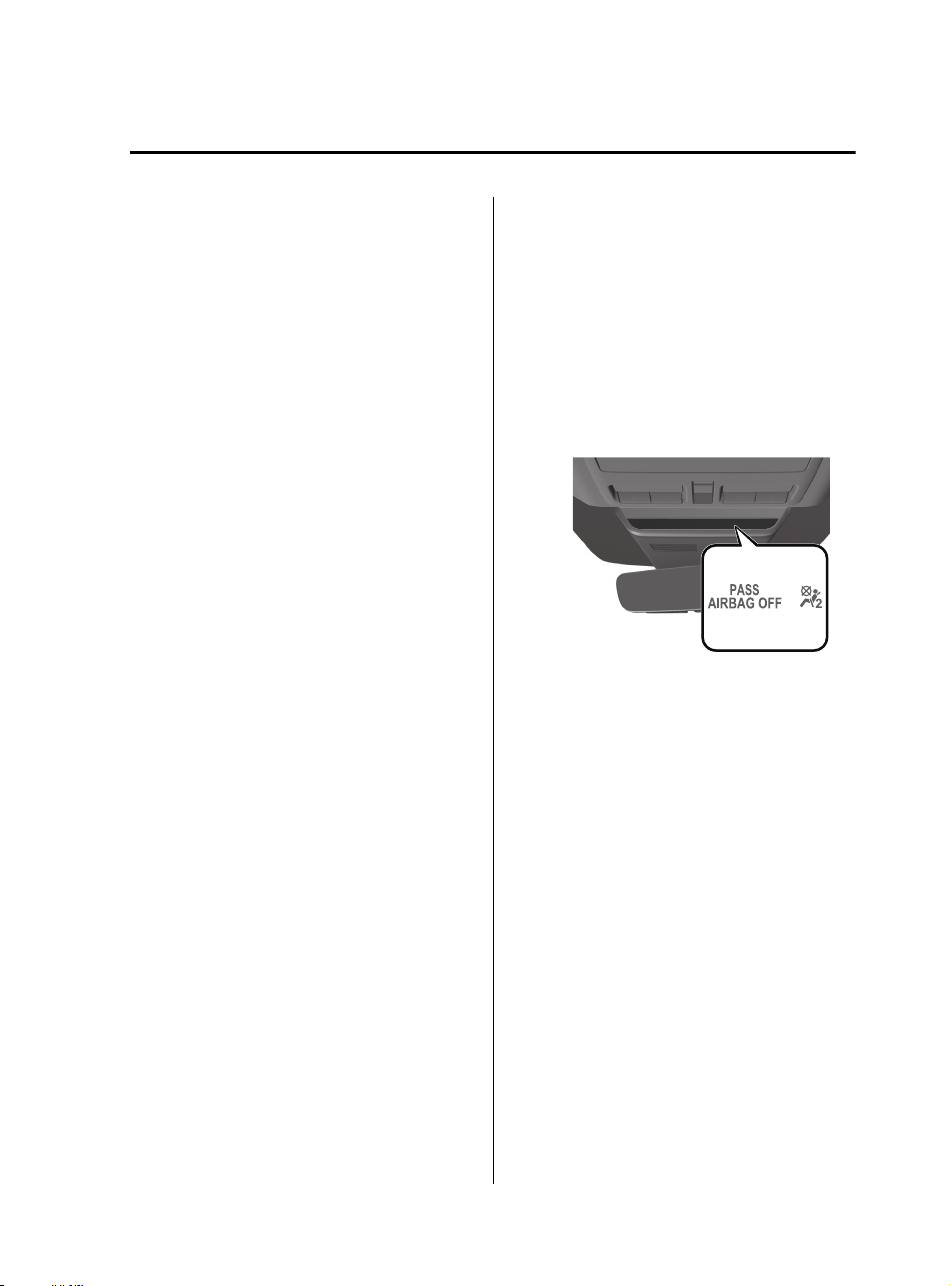
6. Push the child-restraint system firmly
into the vehicle seat. Be sure the belt
retracts as snugly as possible. A
clicking noise from the retractor will
be heard during retraction if the system
is in automatic locking mode. If the
belt does not lock the seat down tight,
repeat the previous step and also this
one.
NOTE
Inspect this function before each use
of the child-restraint system. You
should not be able to pull the
shoulder belt out of the retractor
while the system is in the automatic
locking mode. When you remove the
child-restraint system, be sure the
belt fully retracts to return the
system to emergency locking mode
before occupants use the seat belts.
Follow the child-restraint system
manufacturer's instructions
carefully.
Depending on the type of
child-restraint system, it may not
employ seat belts which are in
automatic locking mode.
7. Seat your child safely in the
child-restraint system and secure the
child according to the instructions
from the child-restraint system
manufacturer.
8. Switch the ignition ON and make sure
the front passenger air bag deactivation
indicator light illuminates after
installing a child-restraint system on
the front passenger seat.
If the front passenger air bag
deactivation indicator light does not
illuminate, remove the child-restraint
system, switch the ignition to OFF, and
then re-install the child-restraint
system (page 2-72).
Essential Safety Equipment
Child Restraint
2-49
Mazda3_8HZ1-EA-19G_Edition1_old 2019-5-17 13:49:03
WARNING
Do not seat a child in a child-restraint
system on the front passenger seat if the
front passenger air bag deactivation
indicator light does not illuminate:
While it is always better to install any
child-restraint system on the rear seat, it is
imperative that a child-restraint system
ONLY be used on the front passenger seat if
the deactivation indicator light illuminates
when the child is seated in the
child-restraint system (page 2-72). Seating
a child in a child-restraint system installed
on the front passenger seat with the front
passenger air bag deactivation indicator
light not illuminated is dangerous. If this
indicator light does not illuminate, this
means that the front passenger front and
side air bags, and knee air bags, and seat
belt pretensioners are ready for
deployment. If an accident were to deploy
an air bag, a child in a child-restraint
system sitting in the front passenger seat
could be seriously injured or killed. If the
indicator light does not illuminate after
seating a child in a child-restraint system
on the front passenger seat, seat a child in
a child-restraint system on the rear seat
and consult an Authorized Mazda Dealer
as soon as possible.
▼
Using ISOFIX Lower Anchor
(Mexico)/Using LATCH Lower
Anchor (Except Mexico)
Your Mazda is equipped with ISOFIX/
LATCH
*1
lower anchors for attachment of
specially designed ISOFIX/LATCH
*1
child-restraint systems in the rear seats.
Both anchors must be used, otherwise the
seat will bounce around and put the child
in danger. Most ISOFIX/LATCH
*1
child-restraint systems must also be used
in conjunction with a tether to be effective.
If they have a tether you must use it to
better assure your child's safety.
WARNING
Follow the manufacturer's instructions for
the use of the child-restraint system:
An unsecured child-restraint system is
dangerous. In a sudden stop or a collision it
could move causing serious injury or death
to the child or other occupants. Make sure
the child-restraint system is properly
secured in place according to the
child-restraint system manufacturer's
instructions.
Essential Safety Equipment
Child Restraint
2-50
Mazda3_8HZ1-EA-19G_Edition1_old 2019-5-17 13:49:03

Never attach two child-restraint systems to
the same ISOFIX/LATCH
*1
lower anchor:
Attaching two child-restraint systems to
the same ISOFIX/LATCH
*1
lower anchor is
dangerous. In a collision, one anchor may
not be strong enough to hold two
child-restraint system attachments, and it
may break, causing serious injury or death.
If you use the seat position for another
child-restraint system when an outboard
ISOFIX/LATCH
*1
position is occupied, use
the center seat belts instead, and the tether
if tether-equipped.
Make sure the child-restraint system is
properly secured:
An unsecured child-restraint system is
dangerous. In a sudden stop or a collision it
could move causing serious injury or death
to the child or other occupants. Follow the
child-restraint system manufacturer's
instructions on belt routing to secure the
seat just as you would with a child in it so
that nobody is tempted to put a child in an
improperly secured seat later on. When not
in use, remove it from the vehicle or fasten
it with a seat belt, or attach it to BOTH
ISOFIX/LATCH
*1
lower anchors for ISOFIX/
LATCH
*1
child-restraint systems.
Make sure there are no seat belts or foreign
objects near or around the ISOFIX/LATCH
*1
child-restraint system:
Not following the child-restraint system
manufacturer's instructions when
installing the child-restraint system is
dangerous. If seat belts or a foreign object
prevent the child-restraint system from
being securely attached to the ISOFIX/
LATCH
*1
lower anchors and the
child-restraint system is installed
improperly, the child-restraint system could
move in a sudden stop or collision causing
serious injury or death to the child or other
occupants. When installing the
child-restraint system, make sure there are
no seat belts or foreign objects near or
around the ISOFIX/LATCH
*1
lower anchors.
Always follow the child-restraint system
manufacturer's instructions.
*
1 ISOFIX (Mexico)/LATCH (Except
Mexico)
Installation on rear outboard seats
1. First, adjust the front seat to allow
clearance between the child-restraint
system and the front seat.
Refer to Adjusting the Driver's Seat on
page 2-5.
Refer to Adjusting the Front
Passenger's Seat on page 2-13.
2. Make sure the seatback is securely
latched by pushing it back until it is
fully locked.
Essential Safety Equipment
Child Restraint
2-51
Mazda3_8HZ1-EA-19G_Edition1_old 2019-5-17 13:49:03
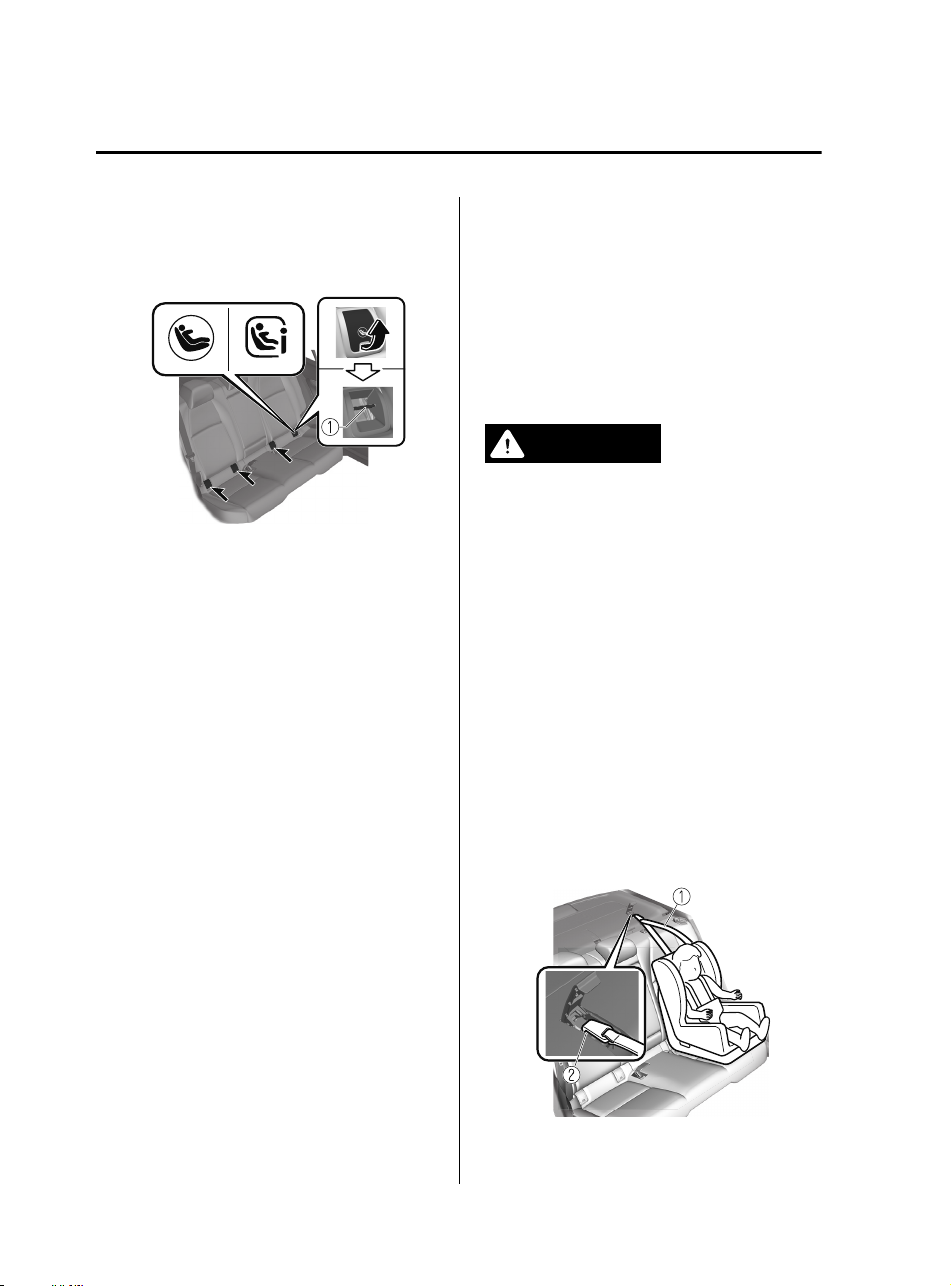
3. Remove the cover of the child-restraint
system's ISOFIX/LATCH
*1
lower
anchors to verify the locations of the
ISOFIX/LATCH
*1
lower anchors.
1. Lower anchor
NOTE
The ISOFIX/LATCH
*1
lower
anchors marking on the cover
indicates the position of the ISOFIX/
LATCH
*1
lower anchors for the
attachment of a child-restraint
system.
Store the removed cover so that it
does not get lost.
4. Remove the head restraint. However,
when installing a backless booster seat,
always install the vehicle head restraint
to the seat where the backless booster
seat is installed.
Refer to Head Restraints on page 2-17.
5. Secure the child-restraint system using
BOTH ISOFIX/LATCH
*1
lower
anchors, following the child-restraint
system manufacturer's instruction. Pull
on the child-restraint to be sure both
anchors are engaged.
6. If your child-restraint system came
equipped with a tether, that means it is
very important to properly secure the
tether for child safety. Please carefully
follow the child-restraint system
manufacturer's instructions when
installing tethers.
*
1 ISOFIX (Mexico)/LATCH (Except
Mexico)
WARNING
Use the tether and tether anchor only for a
child-restraint system:
Using the tether or tether anchor to secure
anything but a child-restraint system is
dangerous. This could weaken or damage
the tether or tether anchor and result in
injury.
Always remove the head restraint and
install child-restraint system (except when
installing a backless booster seat):
Installing a child-restraint system without
removing the head restraint is dangerous.
The child-restraint system cannot be
installed correctly which may result in
death or injury to the child in a collision.
(4–Door)
1. Tether strap
Essential Safety Equipment
Child Restraint
2-52
Mazda3_8HZ1-EA-19G_Edition1_old 2019-5-17 13:49:03
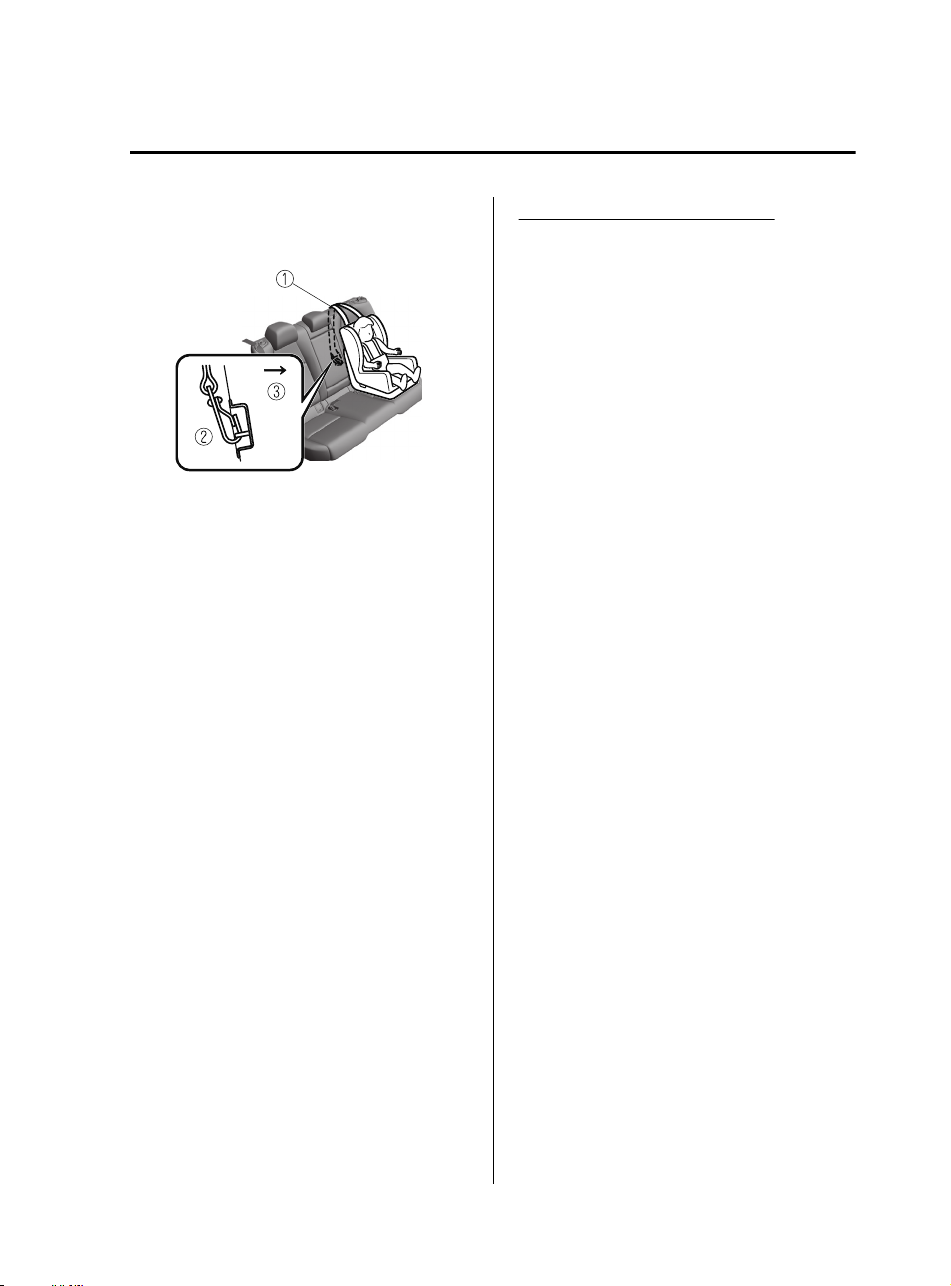
2. Anchor bracket
(5–Door)
1. Tether strap
2. Anchor bracket
3. Forward
Always attach the tether strap to the
correct tether anchor position:
Attaching the tether strap to the incorrect
tether anchor position is dangerous. In a
collision, the tether strap could come
o
and loosen the child-restraint system. If the
child-restraint system moves it could result
in death or injury to the child.
Always install the head restraint and adjust
it to the appropriate position after
removing the child-restraint system:
Driving with the head restraint removed is
dangerous as impact to the occupant's
head cannot be prevented during
emergency braking or in a collision, which
could result in a serious accident, injury or
death.
Refer to Head Restraints on page 2-17.
Installation on rear center seat
The ISOFIX/LATCH
*1
lower anchors at
the center of the rear seat are much further
apart than the sets of ISOFIX/LATCH
*1
lower anchors for child-restraint system
installation at other seating positions.
Child-restraint systems with rigid ISOFIX/
LATCH
*1
attachments cannot be installed
on the center seating position. Some
ISOFIX/LATCH
*1
equipped
child-restraint systems can be placed in the
center position and will reach the nearest
ISOFIX/LATCH
*1
lower anchors which
are 434 mm (17.1 in) apart. ISOFIX/
LATCH
*1
compatible child-restraint
systems (with attachments on belt
webbing) can be used at this seating
position only if the child-restraint system
manufacturer's instructions state that the
child-restraint system can be installed to
ISOFIX/LATCH
*1
lower anchors that are
434 mm (17.1 in) apart. Do not attach two
child-restraint systems to the same
ISOFIX/LATCH
*1
lower anchor. If your
child-restraint system has a tether, it must
also be used for your child's optimum
safety.
The procedure is the same as the
installation for the rear outboard seats.
*
1 ISOFIX (Mexico)/LATCH (Except
Mexico)
Essential Safety Equipment
Child Restraint
2-53
Mazda3_8HZ1-EA-19G_Edition1_old 2019-5-17 13:49:03
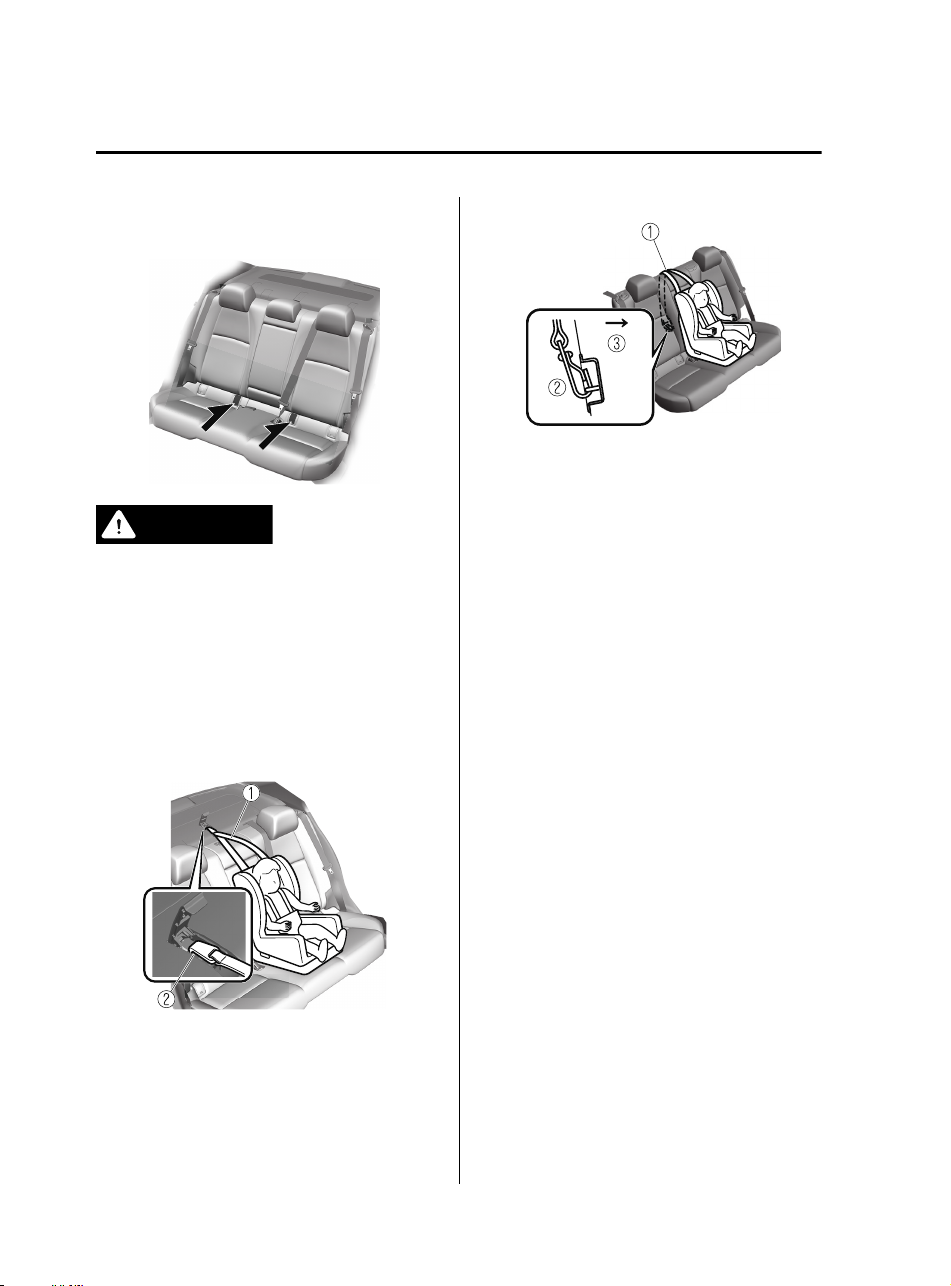
ISOFIX/LATCH
*1
lower anchor
location
WARNING
Always remove the head restraint and
install child-restraint system (except when
installing a backless booster seat):
Installing a child-restraint system without
removing the head restraint is dangerous.
The child-restraint system cannot be
installed correctly which may result in
death or injury to the child in a collision.
(4–Door)
1. Tether strap
2. Anchor bracket
(5–Door)
1. Tether strap
2. Anchor bracket
3. Forward
Always attach the tether strap to the
correct tether anchor position:
Attaching the tether strap to the incorrect
tether anchor position is dangerous. In a
collision, the tether strap could come
o
and loosen the child-restraint system. If the
child-restraint system moves it could result
in death or injury to the child.
Always install the head restraint and adjust
it to the appropriate position after
removing the child-restraint system:
Driving with the head restraint removed is
dangerous as impact to the occupant's
head cannot be prevented during
emergency braking or in a collision, which
could result in a serious accident, injury or
death.
Refer to Head Restraints on page 2-17.
*
1 ISOFIX (Mexico)/LATCH (Except
Mexico)
Essential Safety Equipment
Child Restraint
2-54
Mazda3_8HZ1-EA-19G_Edition1_old 2019-5-17 13:49:03
Supplemental Restraint
System (SRS) Precautions
▼
Supplemental Restraint System
(SRS) Precautions
The front and side supplemental restraint
systems (SRS) include different types of
air bags. Please verify the different types
of air bags which are equipped on your
vehicle by locating the “SRS AIRBAG”
location indicators. These indicators are
visible in the area where the air bags are
installed.
The air bags are installed in the following
locations:
The steering wheel hub (driver air bag)
The front passenger dashboard (front
passenger air bag)
Under the instrument panel (driver and
front passenger
*
knee air bags)
The outboard sides of the front
seatbacks (side air bags)
The front and rear window pillars, and
the roof edge along both sides (curtain
air bags)
Vehicles with the Front Passenger
Occupant Classification System have a
sensor which detects an impending
roll-over accident.
The air bag supplemental restraint systems
are designed to provide supplemental
protection in certain situations so seat belts
are always important in the following
ways:
Without seat belt usage, the air bags
cannot provide adequate protection during
an accident. Seat belt usage is necessary
to:
Keep the occupant from being thrown
into an inflating air bag.
Reduce the possibility of injuries during
an accident that is not designed for air
bag inflation, such as rear impact.
Reduce the possibility of injuries in
frontal, near frontal or side collisions or
roll-over accidents that are not severe
enough to activate the air bags.
Reduce the possibility of being thrown
from your vehicle.
Reduce the possibility of injuries to
lower body and legs during an accident
because the air bags provide no
protection to these parts of the body.
Hold the driver in a position which
allows better control of the vehicle.
Essential Safety Equipment
SRS Air Bags
*Some models.
2-55
Mazda3_8HZ1-EA-19G_Edition1_old 2019-5-17 13:49:03

If your vehicle is also equipped with a
front passenger occupant classification
system, refer to the Front Passenger
Occupant Classification System (page
2-71) for details.
If your vehicle is equipped with a front
passenger occupant classification system,
the front passenger air bag deactivation
indicator light illuminates for a specified
time after the ignition is switched ON.
Small children must be protected by a
child-restraint system as stipulated by law
in every state and province. In certain
states and provinces, larger children must
use a child-restraint system (page 2-32).
Carefully consider which child-restraint
system is necessary for your child and
follow the installation directions in this
Owner's Manual as well as the
child-restraint system manufacturer's
instructions.
WARNING
Seat belts must be worn in air bag
equipped vehicles:
Depending only on the air bags for
protection during an accident is
dangerous. Alone, air bags may not
prevent serious injuries. The appropriate air
bags can be expected to inate only in the
rst
accident, such as frontal, near frontal
or side collisions or roll-over accidents that
are at least moderate. Vehicle occupants
should always wear seat belts.
Children should not ride in the front
passenger seat:
Placing a child, 12 years or under, in the
front seat is dangerous. The child could be
hit by a deploying air bag and be seriously
injured or even killed. A sleeping child is
more likely to lean against the door and be
hit by the side air bag in moderate collision
to the front-passenger side of the vehicle.
Whenever possible, always secure a child
12 years and under on the rear seats with
an appropriate child-restraint system for
the child's age and size.
Essential Safety Equipment
SRS Air Bags
2-56
Mazda3_8HZ1-EA-19G_Edition1_old 2019-5-17 13:49:03
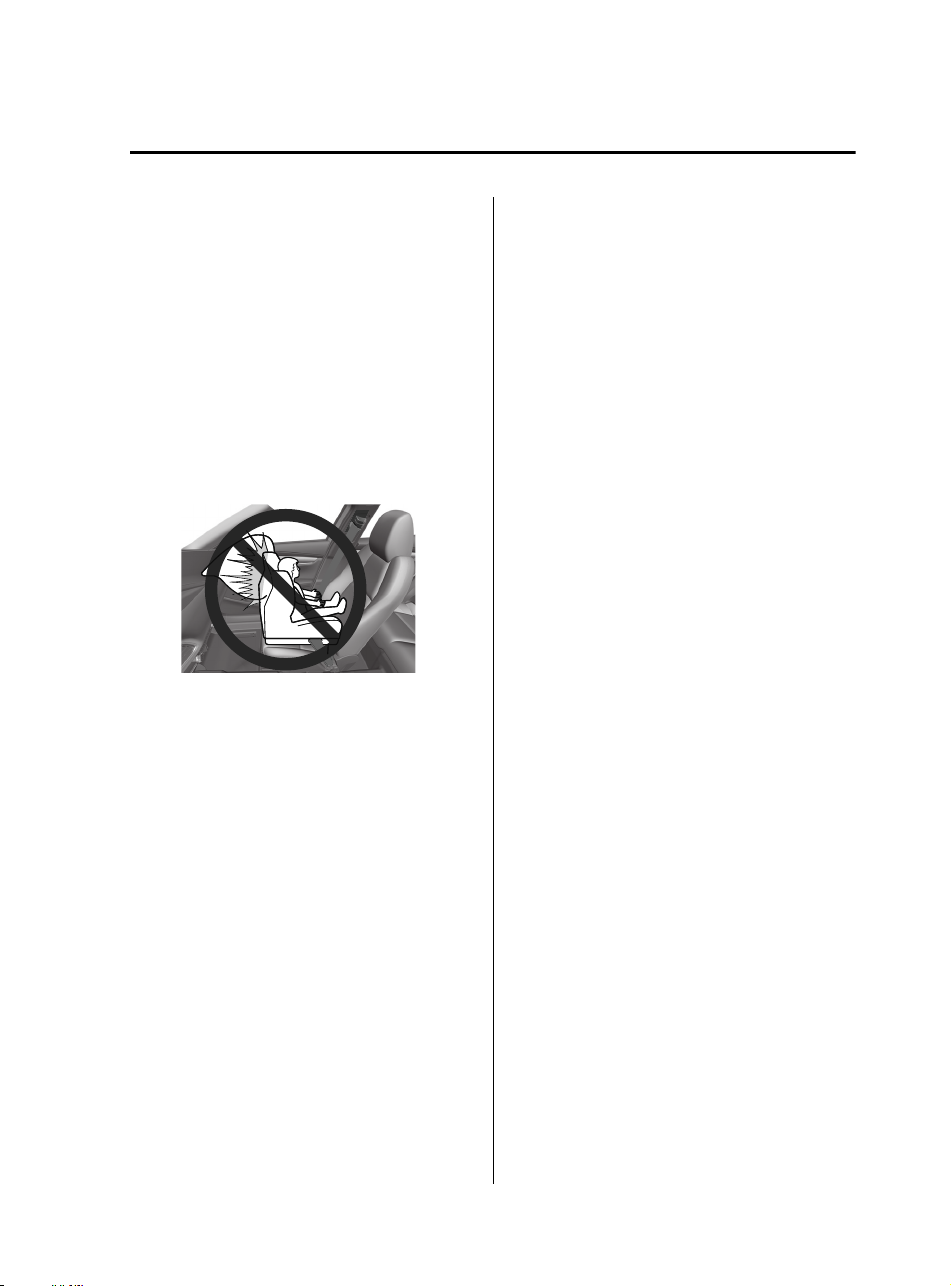
Never use a rear-facing child-restraint
system in the front seat with an air bag
that could deploy:
Rear-facing child-restraint systems on the
front seat are particularly dangerous even
though you may feel assured that a front
passenger air bag will not deploy based on
the fact that the front passenger air bag
deactivation indicator light illuminates.
The child-restraint system can be hit by a
deploying air bag and moved violently
backward resulting in serious injury or
death to the child.
Do not sit too close to the driver and front
passenger air bags:
Sitting too close to the driver and front
passenger air bag modules or placing
hands or feet on them is extremely
dangerous. The driver and front passenger
air bags inate with great force and speed.
Serious injuries could occur if someone is
too close. The driver should always hold
onto only the rim of the steering wheel. The
front seat passenger should keep both feet
on the
oor.
Front seat occupants should
adjust their seats as far back as possible
and always sit upright against the
seatbacks with seat belts worn properly.
Sit in the center of the seat and wear seat
belts properly:
Sitting too close to the side air bag modules
or placing hands on them, or sleeping up
against the door or hanging out the
windows is extremely dangerous. The side
and curtain air bags inate with great force
and speed directly expanding along the
door on the side the car is hit. Serious injury
could occur if someone is sitting too close
to the door or leaning against a window, or
if rear seat occupants grab the sides of the
front seatbacks. Give the side and curtain
air bags room to work by sitting in the
center of the seat while the vehicle is
moving with seat belts worn properly.
Do not attach objects on or around the
area where driver and front passenger air
bags deploy:
Attaching an object to the driver and front
passenger air bag modules or placing
something in front of them is dangerous. In
an accident, an object could interfere with
air bag ination and injure the occupants.
Do not attach objects on or around the
area where a side air bag deploys:
Attaching objects to the front seat in such a
way as to cover the outboard side of the
seat in any way is dangerous. In an
accident the object could interfere with the
side air bag, which
inates
from the
outboard side of the front seats, impeding
the added protection of the side air bag
system or redirecting the air bag in a way
that is dangerous. Furthermore, the bag
could be cut open releasing the gas.
Essential Safety Equipment
SRS Air Bags
2-57
Mazda3_8HZ1-EA-19G_Edition1_old 2019-5-17 13:49:03

Do not hang net bags, map pouches or
backpacks with side straps on the front
seats. Never use seat covers on the front
seats. Always keep the side air bag modules
in your front seats free to deploy in the
event of a side collision.
Do not attach objects on or around the
area where a curtain air bag deploys:
Attaching objects to the areas where the
curtain air bag activates such as on the
windshield glass, side door glass, front and
rear window pillars and along the roof
edge and assist grips is dangerous. In an
accident the object could interfere with the
curtain air bag, which
inates
from the
front and rear window pillars and along
the roof edge, impeding the added
protection of the curtain air bag system or
redirecting the air bag in a way that is
dangerous. Furthermore, the bag could be
cut open releasing the gas.
Do not place hangers or any other objects
on the assist grips. When hanging clothes,
hang them on the coat hook directly.
Always keep the curtain air bag modules
free to deploy in the event of a side collision
or roll-over accident.
Do not touch the components of the
supplemental restraint system after the air
bags have inated:
Touching the components of the
supplemental restraint system after the air
bags have inated is dangerous.
Immediately after ination, they are very
hot. You could get burned.
Never install any front-end equipment to
your vehicle:
Installation of front-end equipment, such
as frontal protection bar (kangaroo bar,
bull bar, push bar, or other similar devices),
snowplow, or winches, is dangerous. The
air bag crash sensor system could be
aected. This could cause air bags to
inate unexpectedly, or it could prevent the
air bags from inating during an accident.
Front occupants could be seriously injured.
Do not modify the suspension:
Modifying the vehicle suspension is
dangerous. If the vehicle's height or the
suspension is
modied,
the vehicle will be
unable to accurately detect a collision or
roll-over accident resulting in incorrect or
unexpected air bag deployment and the
possibility of serious injuries.
To prevent false detection by the air bag
sensor system, heed the following:
Do not use tires or wheels other than
those
specied
for your Mazda:
Use of any tire or wheel other than those
specied
for your Mazda (page 9-9) is
dangerous. Use of such wheels will
prevent the vehicle's accident detections
system from accurately detecting a
collision or roll-over accident resulting in
incorrect or unexpected air bag
deployment and the possibility of serious
injuries.
Essential Safety Equipment
SRS Air Bags
2-58
Mazda3_8HZ1-EA-19G_Edition1_old 2019-5-17 13:49:03

Do not overload your vehicle:
Overloading your vehicle is dangerous as
it could prevent the air bag crash sensor
system from accurately detecting a
collision or roll-over accident resulting in
incorrect or unexpected air bag
deployment and the possibility of serious
injuries. The gross axle weight rating
(GAWR) and the gross vehicle weight
rating (GVWR) for your vehicle are on the
Motor Vehicle Safety Standard Label on
the driver's door frame. Do not exceed
these ratings.
Do not drive the vehicle o-road:
Driving your Mazda o-road is
dangerous because the vehicle has not
been designed to do so. Driving the
vehicle o-road could prevent the air bag
crash sensor system from accurately
detecting a collision or roll-over accident
resulting in incorrect or unexpected air
bag deployment and the possibility of
serious injuries.
Do not modify a front door or leave any
damage unrepaired. Always have an
Authorized Mazda Dealer inspect a
damaged front door:
Modifying a front door or leaving any
damage unrepaired is dangerous. Each
front door has a side crash sensor as a
component of the supplemental restraint
system. If holes are drilled in a front door, a
door speaker is left removed, or a damaged
door is left unrepaired, the sensor could be
adversely aected causing it to not detect
the pressure of an impact correctly during a
side collision. If a sensor does not detect a
side impact correctly, the side and curtain
air bags and the front seat belt
pretensioner may not operate normally
which could result in serious injury to
occupants.
Do not modify the supplemental restraint
system:
Modifying the components or wiring of the
supplemental restraint system is
dangerous. You could accidentally activate
it or make it inoperable. Do not make any
modications to the supplemental restraint
system. This includes installing trim,
badges, or anything else over the air bag
modules. It also includes installing extra
electrical equipment on or near system
components or wiring. An Authorized
Mazda Dealer can provide the special care
needed in the removal and installation of
front seats. It is important to protect the air
bag wiring and connections to assure that
the bags do not accidentally deploy, and
that the front passenger occupant
classication system and the seats retain
an undamaged air bag connection.
Essential Safety Equipment
SRS Air Bags
2-59
Mazda3_8HZ1-EA-19G_Edition1_old 2019-5-17 13:49:03

Do not place luggage or other objects
under the front seats:
Placing luggage or other objects under the
front seats is dangerous. The components
essential to the supplemental restraint
system could be damaged, and in the event
of a side collision, the appropriate air bags
may not deploy, which could result in
death or serious injury. To prevent damage
to the components essential to the
supplemental restraint system, do not
place luggage or other objects under the
front seats.
Do not operate a vehicle with damaged air
bag/seat belt pretensioner system
components:
Expended or damaged air bag/seat belt
pretensioner system components must be
replaced after any collision which caused
them to deploy or damage them. Only a
trained Authorized Mazda Dealer can fully
evaluate these systems to see that they will
work in any subsequent accident. Driving
with an expended or damaged air bag or
pretensioner unit will not
aord
you the
necessary protection in the event of any
subsequent accident which could result in
serious injury or death.
Do not remove interior air bag parts:
Removing any components such as the
front seats, front dashboard, the steering
wheel or parts on the front and rear
window pillars and along the roof edge,
containing air bag parts or sensors is
dangerous. These parts contain essential
air bag components. The air bag could
accidentally activate and cause serious
injuries. Always have an Authorized Mazda
Dealer remove these parts.
Properly dispose of the air bag system:
Improper disposal of an air bag or a vehicle
with live air bags in it can be extremely
dangerous. Unless all safety procedures are
followed, injury could result. Have an
Authorized Mazda Dealer safely dispose of
the air bag system or scrap an air bag
equipped vehicle.
NOTE
If it becomes necessary to have the
components or wiring system for the
supplementary restraint system modified
to accommodate a person with certain
medical conditions in accordance with a
certified physician, contact an
Authorized Mazda Dealer, refer to
“Customer Assistance (U.S.A.)” (page
8-2).
When an air bag deploys, a loud
inflation noise can be heard and some
smoke will be released. Neither is likely
to cause injury, however, the texture of
the air bags may cause light skin
injuries on body parts not covered with
clothing through friction.
Should you sell your Mazda, we urge
you to tell the new owner of its air bag
systems and that familiarization with all
instructions about them, from the
Owner's Manual, is important.
Essential Safety Equipment
SRS Air Bags
2-60
Mazda3_8HZ1-EA-19G_Edition1_old 2019-5-17 13:49:03
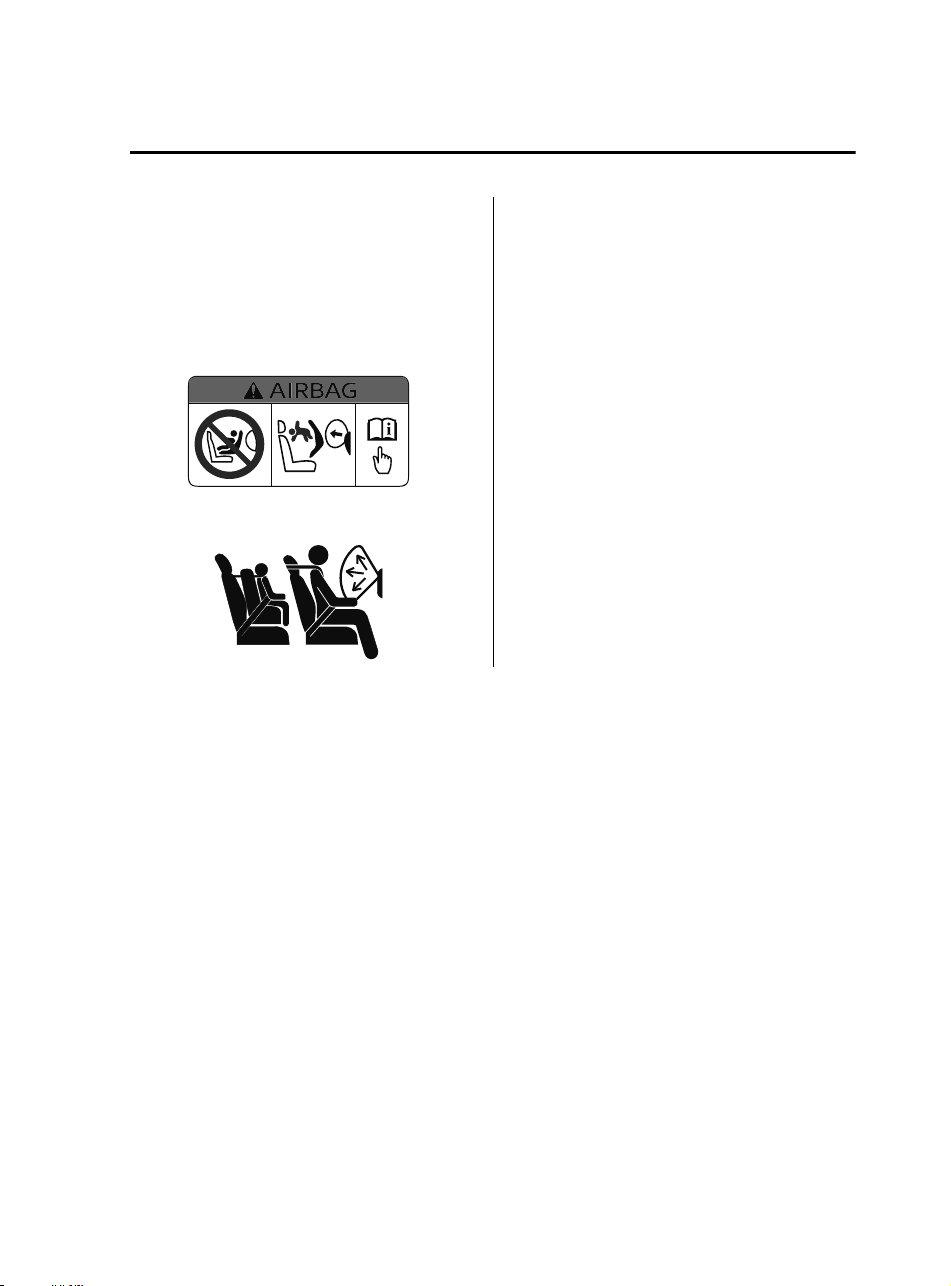
This highly-visible label is displayed
which warns against the use of a
rear-facing child-restraint system on the
front passenger seat.
(Mexico)
(Except Mexico)
Essential Safety Equipment
SRS Air Bags
2-61
Mazda3_8HZ1-EA-19G_Edition1_old 2019-5-17 13:49:03
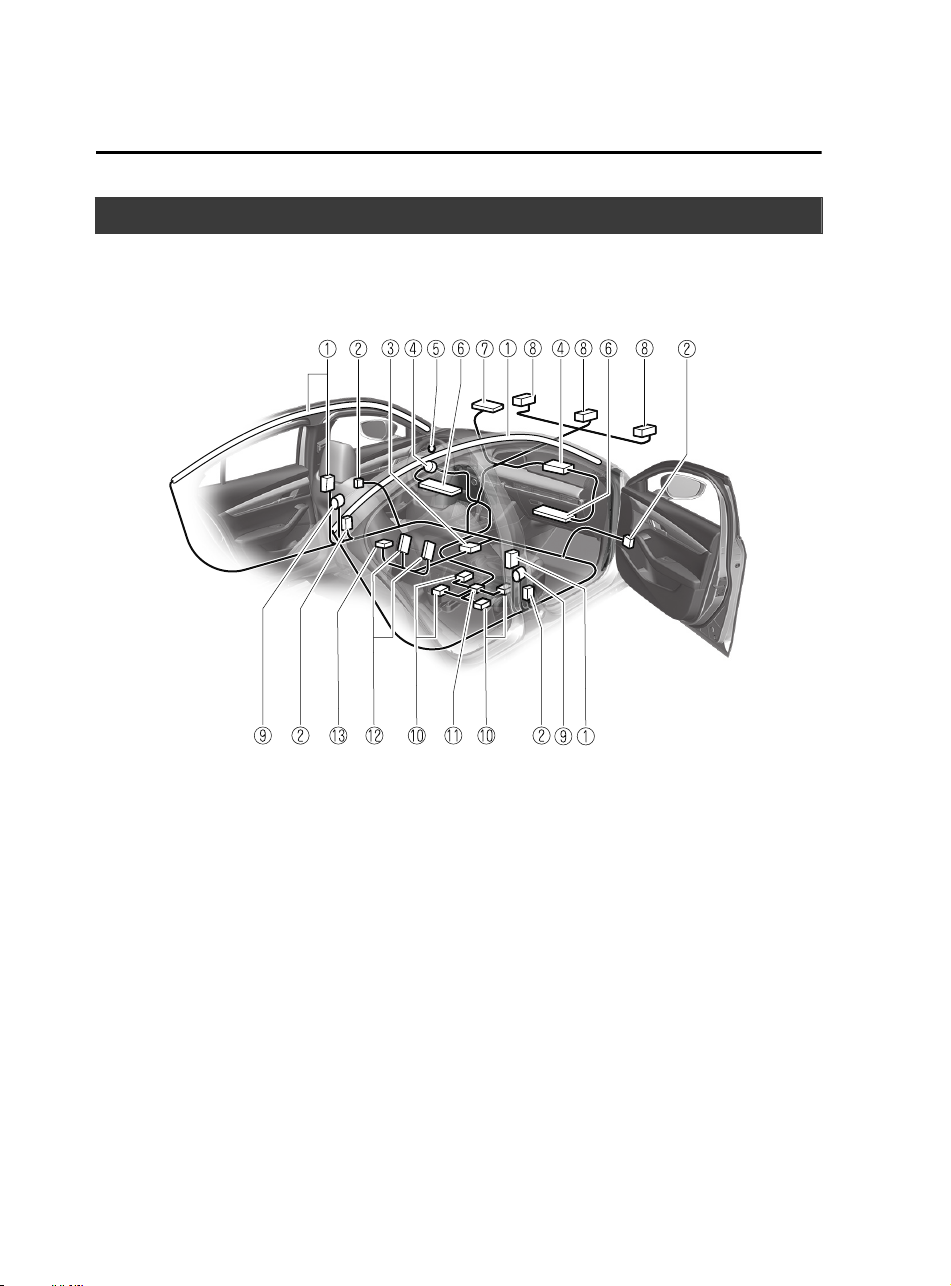
Supplemental Restraint System Components
▼
Supplemental Restraint System Components
(With Front Passenger Occupant Classification System)
1. Side and curtain inflators and air bags
2. Side crash sensors
3. Roll-over sensor, crash sensors, and diagnostic module (SAS unit)
4. Driver/Front passenger inflators and air bags
5. Air bag/front seat belt pretensioner system warning indication/warning light (page
7-32)
6. Driver/Front passenger knee inflators and air bags
7. Front passenger air bag deactivation indicator light (page 2-72)
8. Front air bag sensors
9. Seat belt pretensioners (page 2-28)
10. Front passenger seat weight sensors (page 2-72)
11. Front passenger seat weight sensor control module
12. Driver and front passenger seat belt buckle switches (page 2-76)
13. Driver seat slide position sensor (page 2-71)
Essential Safety Equipment
SRS Air Bags
2-62
Mazda3_8HZ1-EA-19G_Edition1_old 2019-5-17 13:49:03
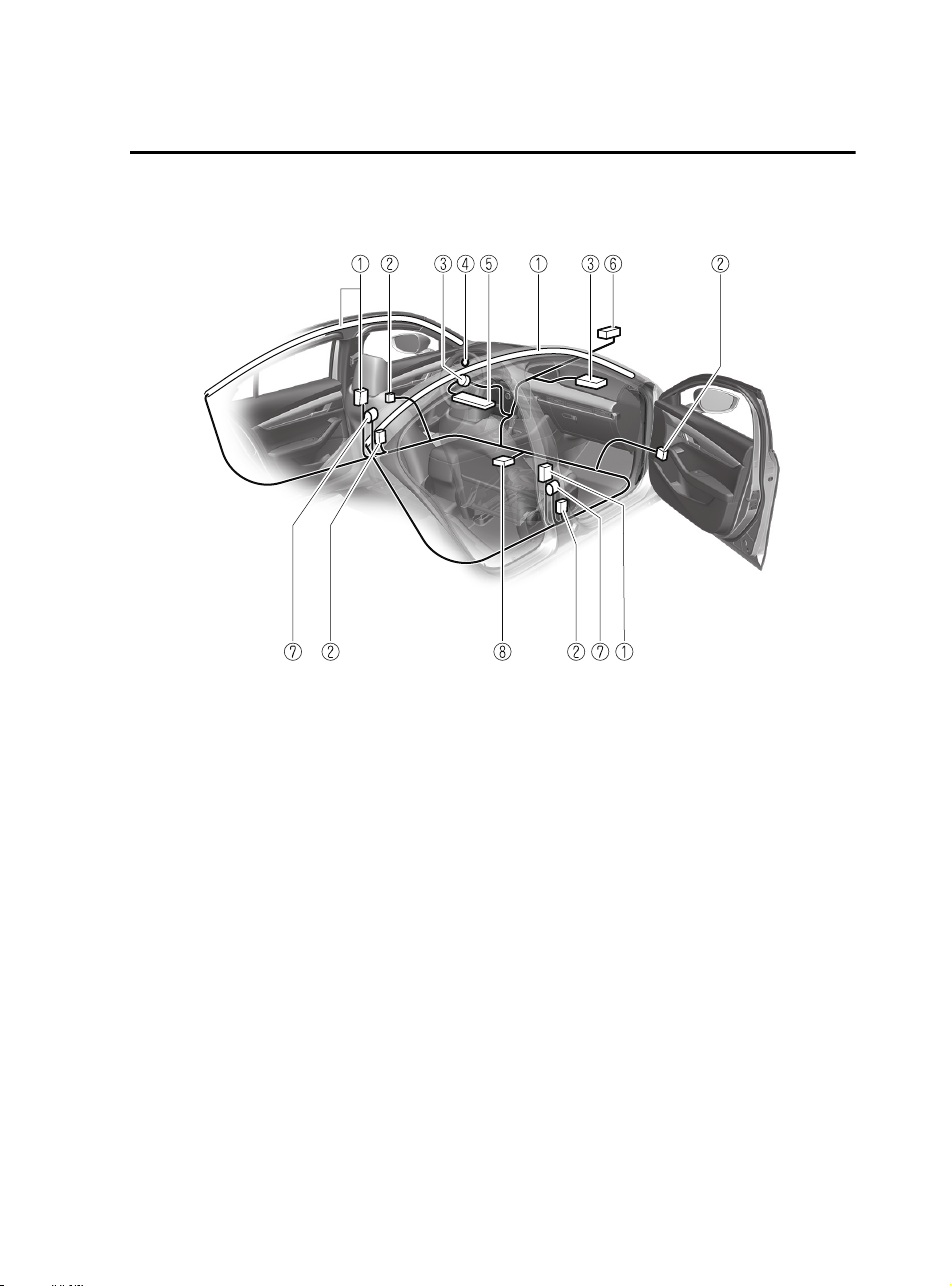
(Without Front Passenger Occupant Classification System)
1. Side and curtain inflators and air bags
2. Side crash sensors
3. Driver/Front passenger inflators and air bags
4. Air bag/
front seat belt pretensioner system warning indication
/warning light (page 7-32)
5. Driver knee inflator and air bag
6. Front air bag sensor
7. Seat belt pretensioners (page 2-28)
8. Crash sensors, and diagnostic module (SAS unit)
Essential Safety Equipment
SRS Air Bags
2-63
Mazda3_8HZ1-EA-19G_Edition1_old 2019-5-17 13:49:03
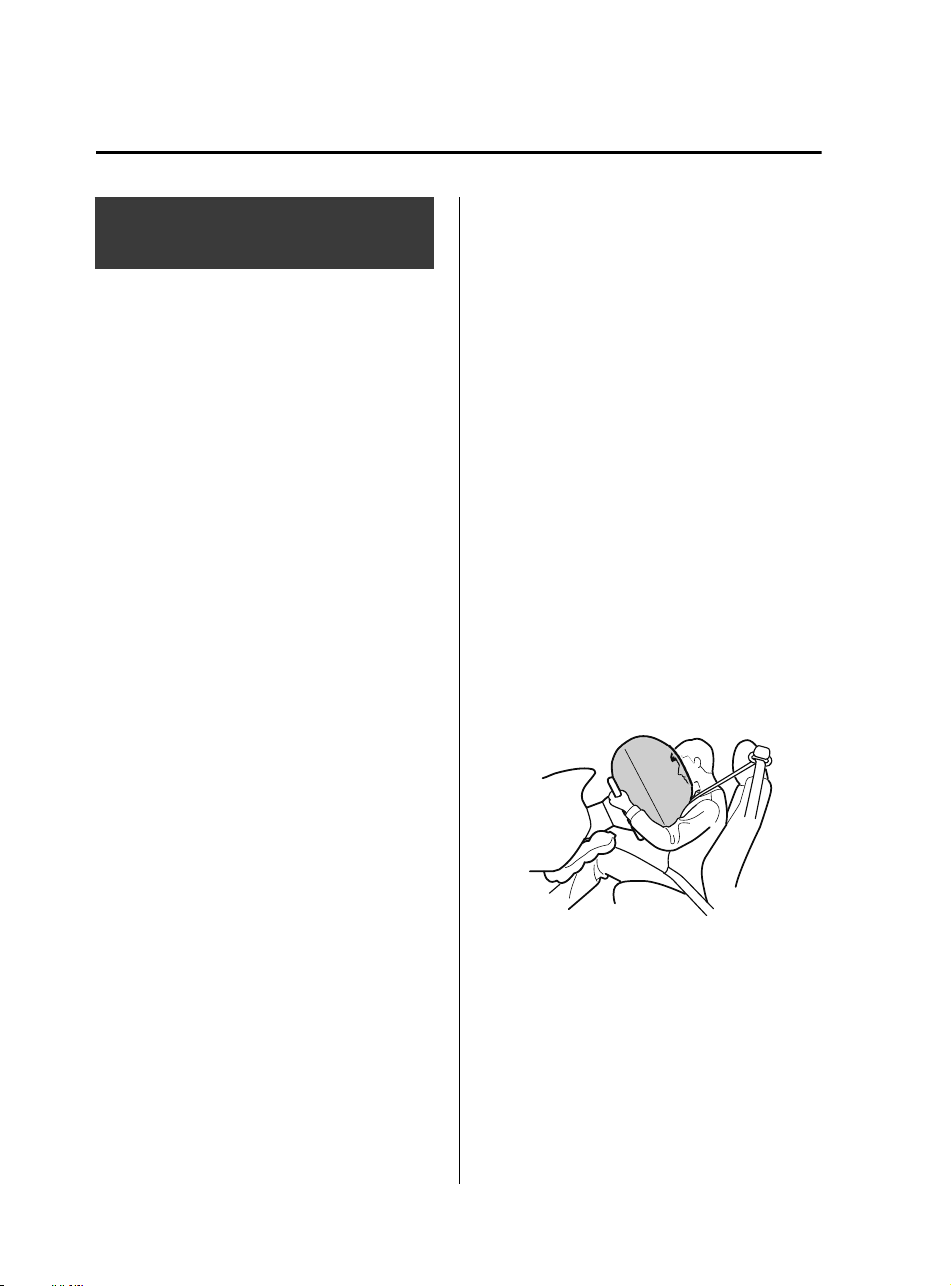
How the SRS Air Bags
Work
▼
How the SRS Air Bags Work
Your Mazda is equipped with the
following types of SRS air bags. SRS air
bags are designed to work together with
the seat belts to help to reduce injuries
during an accident.
The SRS air bags are designed to provide
further protection for passengers in
addition to the seat belt functions. Be sure
to wear seat belts properly.
▼
Front Seat Belt Pretensioners
The front seat belt pretensioners are
designed to deploy in moderate or severe
frontal, near frontal collisions.
In addition, the pretensioners operate
when a side collision or a roll-over
accident is detected. The pretensioners
operate differently depending on what
types of air bags are equipped. For more
details about seat belt pretensioner
operation, refer to the SRS Air Bag
Deployment Criteria (page 2-68).
▼
Driver Air Bag
The driver's air bag is mounted in the
steering wheel.
When air bag crash sensors detect a frontal
impact of greater than moderate force, the
driver's air bag inflates quickly helping to
reduce injury mainly to the driver's head
or chest caused by directly hitting the
steering wheel.
For more details about air bag
deployment, refer to "SRS Air Bag
Deployment Criteria" (page 2-68).
(With Front Passenger Occupant
Classification System)
The driver's dual-stage air bag controls air
bag inflation in two energy stages. During
an impact of moderate severity, the
driver's air bag deploys with lesser energy,
whereas during more severe impacts, it
deploys with more energy.
Essential Safety Equipment
SRS Air Bags
2-64
Mazda3_8HZ1-EA-19G_Edition1_old 2019-5-17 13:49:03
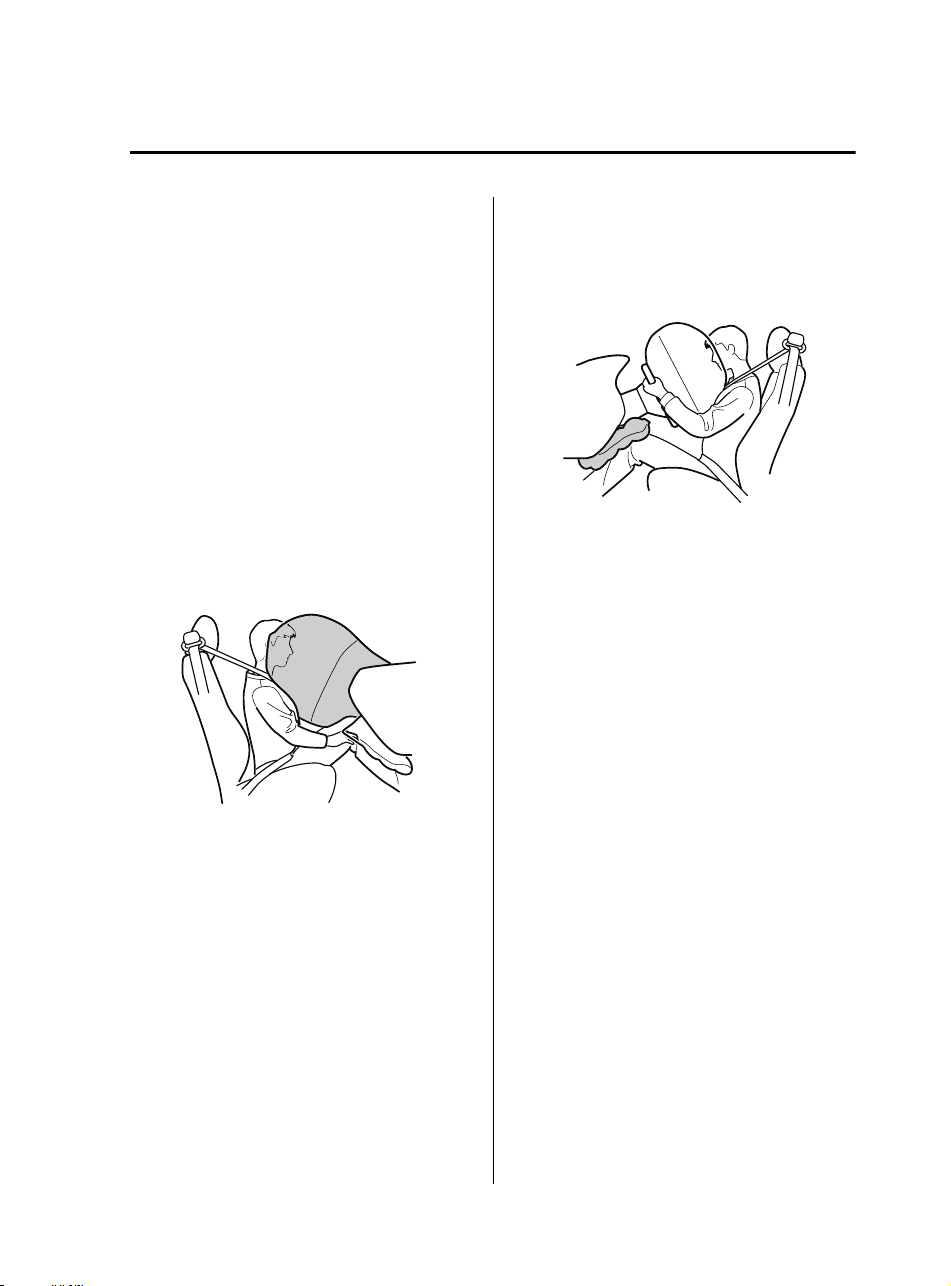
▼
Front Passenger Air Bag
The front passenger air bag is mounted in
the front passenger dashboard.
The inflation mechanism for the front
passenger air bag is the same as the
driver's air bag.
For more details about air bag
deployment, refer to "SRS Air Bag
Deployment Criteria" (page 2-68).
(With Front Passenger Occupant
Classification System)
In addition, the front passenger air bag is
designed to only deploy in accordance
with the total seated weight on the front
passenger seat. For details, refer to the
front passenger occupant classification
system (page 2-71).
▼
Driver and Front Passenger Knee
Air Bags
*
The knee air bags are equipped under the
instrument panel.
If the air bag crash sensors receive a
frontal impact of greater than moderate
force, the knee air bags deploy
immediately to reduce impact to the driver
and front passenger's legs.
For more details about air bag
deployment, refer to "SRS Air Bag
Deployment Criteria" (page 2-68).
▼
Side Air Bags
The side air bags are mounted in the
outboard sides of the front seatbacks.
When the air bag crash sensors detect a
side impact of greater than moderate force,
the system inflates the side air bag only on
the side in which the vehicle was hit. The
side air bag inflates quickly to reduce
injury to the driver or front passenger's
chest caused by directly hitting interior
parts such as a door or window.
For more details about air bag
deployment, refer to "SRS Air Bag
Deployment Criteria" (page 2-68).
Essential Safety Equipment
SRS Air Bags
*Some models.
2-65
Mazda3_8HZ1-EA-19G_Edition1_old 2019-5-17 13:49:03
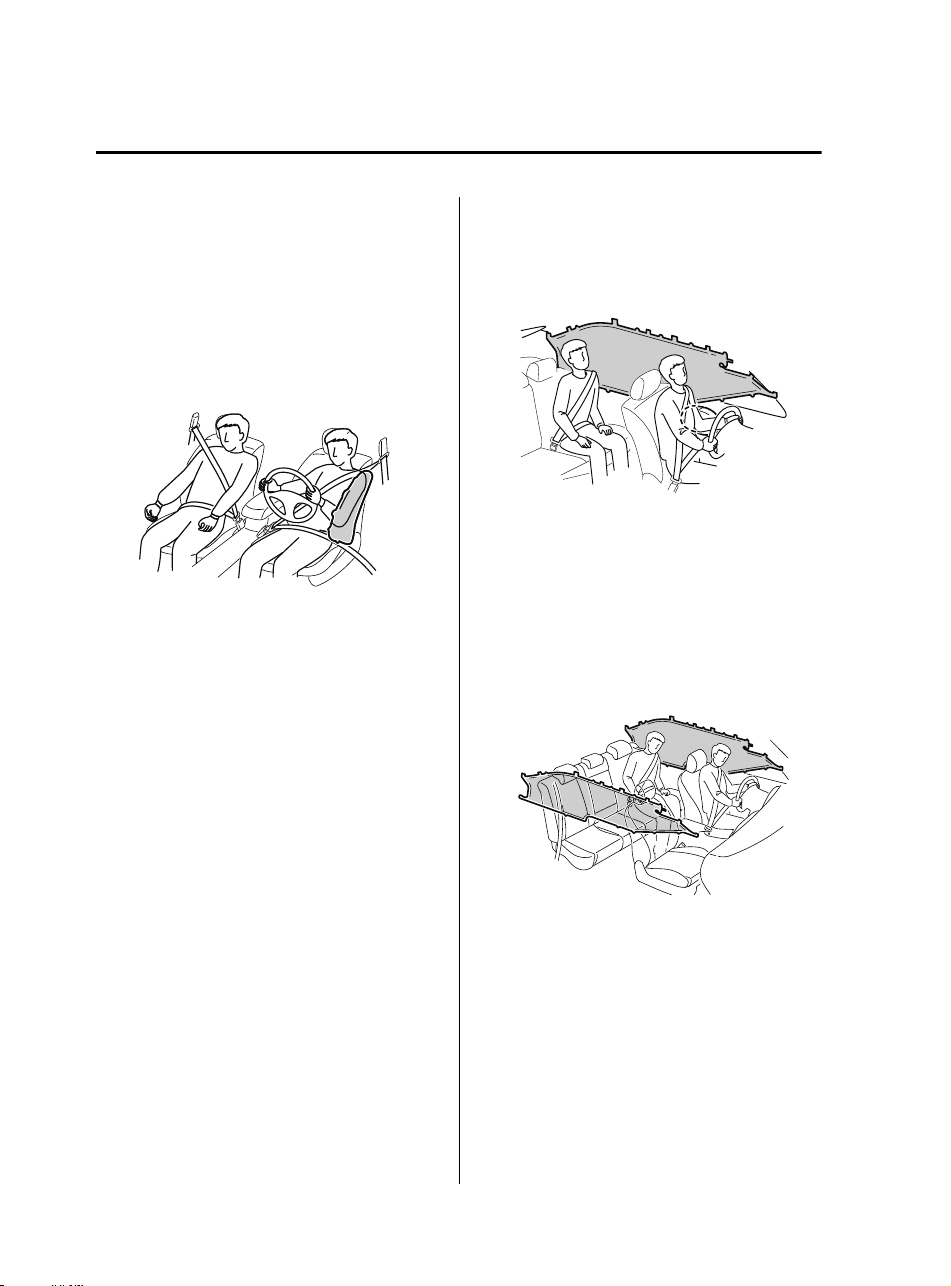
(With Front Passenger Occupant
Classification System)
In addition, the front passenger side air
bag is designed to only deploy in
accordance with the total seated weight on
the front passenger seat. For details, refer
to the front passenger occupant
classification system (page 2-71).
▼
Curtain Air Bags
The curtain air bags are mounted in the
front and rear window pillars, and the roof
edge along both sides.
When the air bag crash sensors detect a
side impact of greater than moderate force,
the curtain air bag inflates quickly and
helps to reduce injury mainly to the driver
and front and rear outboard passengers'
heads caused by directly hitting interior
parts such as a door or window.
For more details about air bag
deployment, refer to "SRS Air Bag
Deployment Criteria" (page 2-68).
In a side impact:
Greater than moderate impact to one side
of the vehicle will cause the curtain air bag
on that side only to inflate.
Only one side curtain air bag will deploy
on the side of the vehicle that receives the
force of an impact.
(With Front Passenger Occupant
Classification System)
In a roll-over:
In response to a vehicle roll-over, both
curtain air bags inflate.
Both curtain air bags will deploy after the
roll-over accident is detected.
Essential Safety Equipment
SRS Air Bags
2-66
Mazda3_8HZ1-EA-19G_Edition1_old 2019-5-17 13:49:03

▼
Warning Light/Beep
A system malfunction or operation
conditions are indicated by a warning.
Refer to Air Bag/Front Seat Belt
Pretensioner System Warning Indication/
Warning Light on page 7-32.
Refer to Air Bag/Front Seat Belt
Pretensioner System Warning Beep on
page 7-41.
Essential Safety Equipment
SRS Air Bags
2-67
Mazda3_8HZ1-EA-19G_Edition1_old 2019-5-17 13:49:03
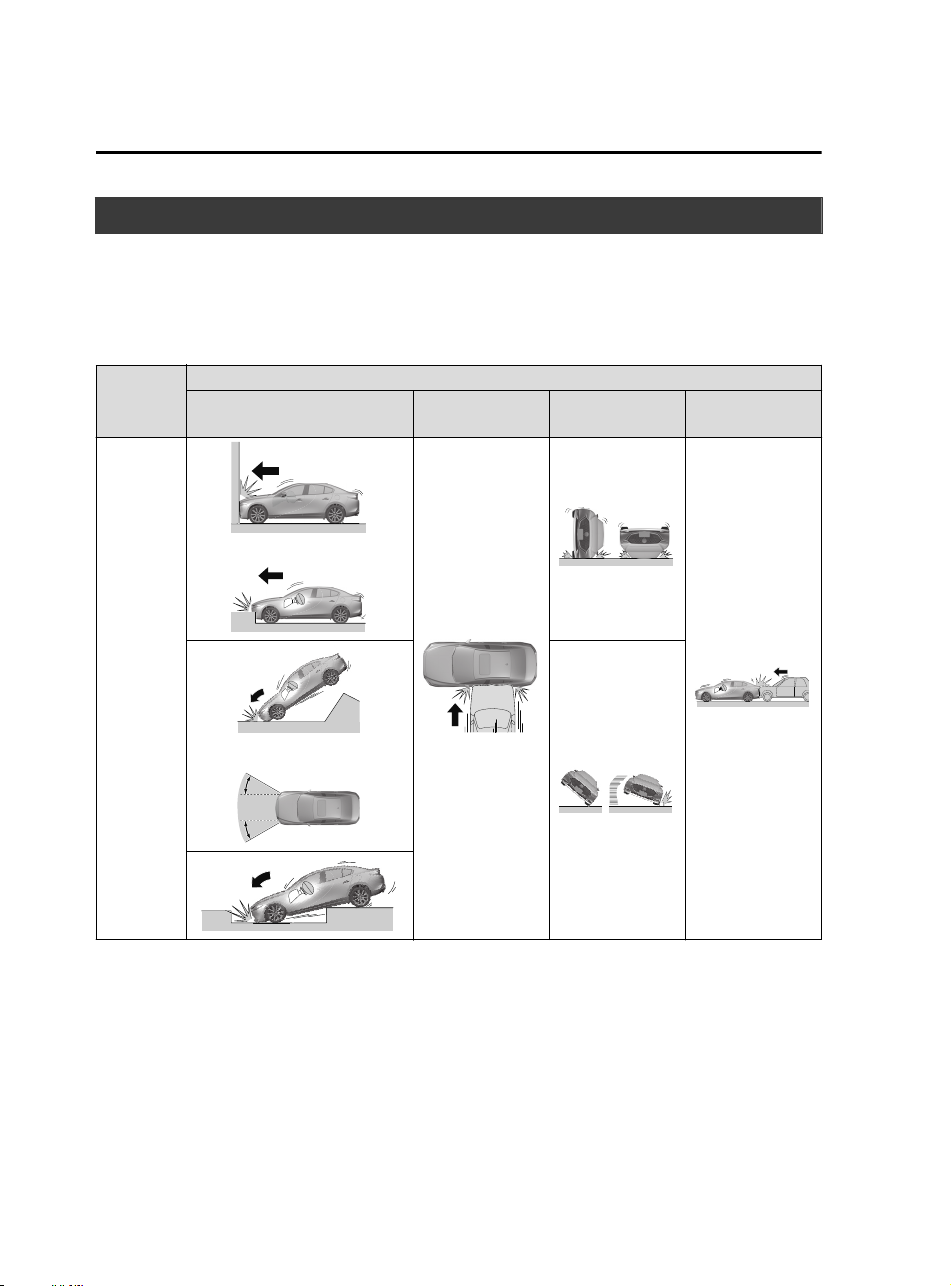
SRS Air Bag Deployment Criteria
▼
SRS Air Bag Deployment Criteria
This chart indicates the applicable SRS equipment that will deploy depending on the type of
collision.
(The illustrations are the representative cases of collisions.)
SRS equip‐
ment
Types of collision
A severe frontal/near frontal
collision
A severe side colli‐
sion
A roll-over/near
roll-over
*2
A rear collision
Essential Safety Equipment
SRS Air Bags
2-68
Mazda3_8HZ1-EA-19G_Edition1_old 2019-5-17 13:49:03
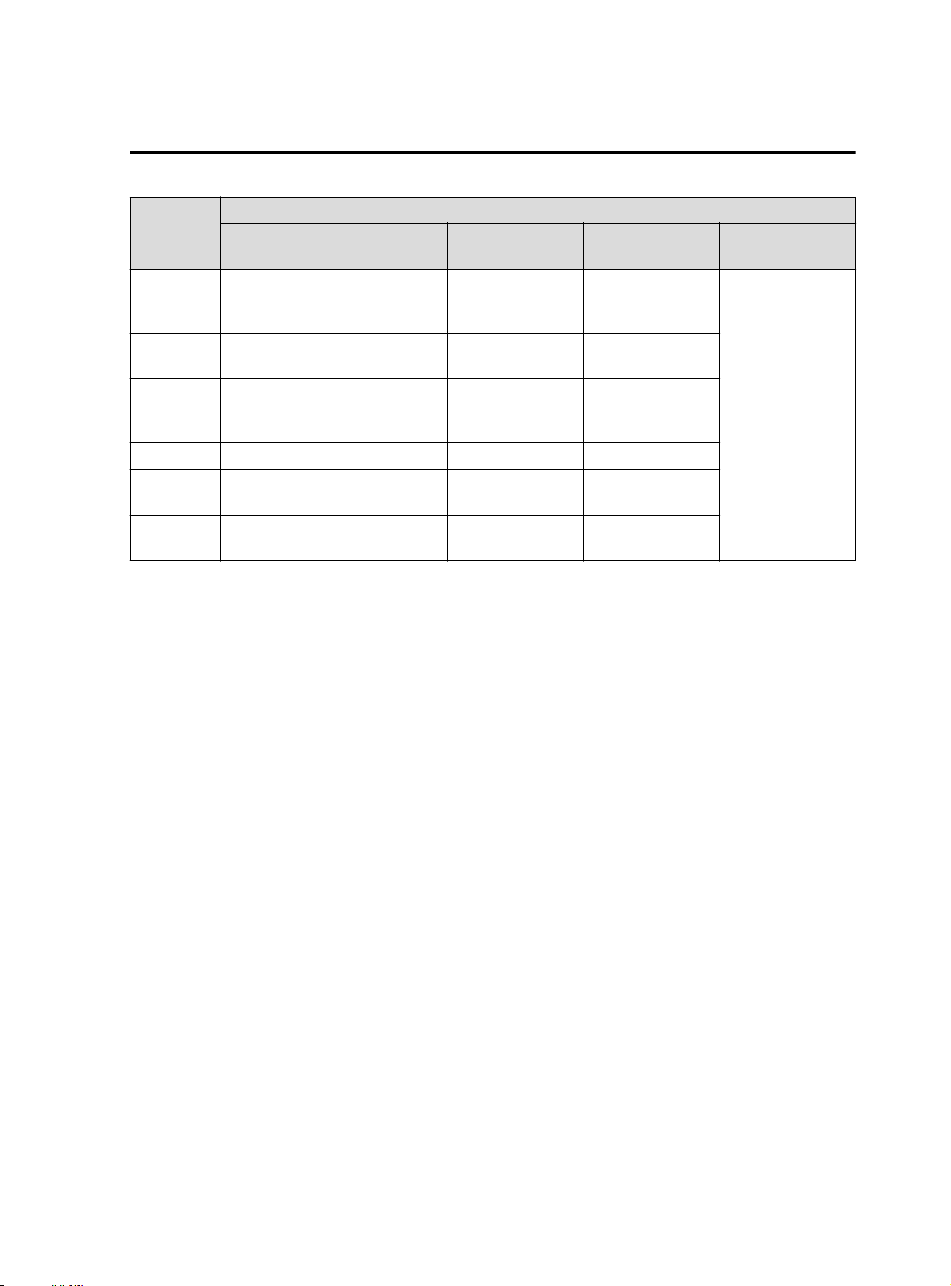
SRS equip‐
ment
Types of collision
A severe frontal/near frontal
collision
A severe side colli‐
sion
A roll-over/near
roll-over
*2
A rear collision
Front seat
belt preten‐
sioner
X
*1
X
*1
X
*1
No air bag and
front seat belt pre‐
tensioner will be
activated in a rear
collision.
Driver air
bag
X――
Front pas‐
senger air
bag
X
*1
――
Knee Airbag
X
*1
――
Side air bag ―
X
*1
(impact side
only)
―
Curtain air
bag
―
X (impact side on‐
ly)
X (both sides)
X: The SRS air bag equipment deploys in a collision.
―:The SRS air bag equipment does not deploy in a collision.
*
1 (With Front Passenger Occupant Classification System)
The front passenger front and side air bags, seat belt pretensioner and knee air bag are designed to deploy
depending on the condition of the total seated weight on the front passenger seat.
*
2 (With Front Passenger Occupant Classification System)
In a roll-over accident, the seat belt pretensioners and the curtain air bags deploy.
NOTE
In a frontal offset collision, the equipped air bags and pretensioners may all deploy
depending on the direction, angle, and rate of impact.
Essential Safety Equipment
SRS Air Bags
2-69
Mazda3_8HZ1-EA-19G_Edition1_old 2019-5-17 13:49:03
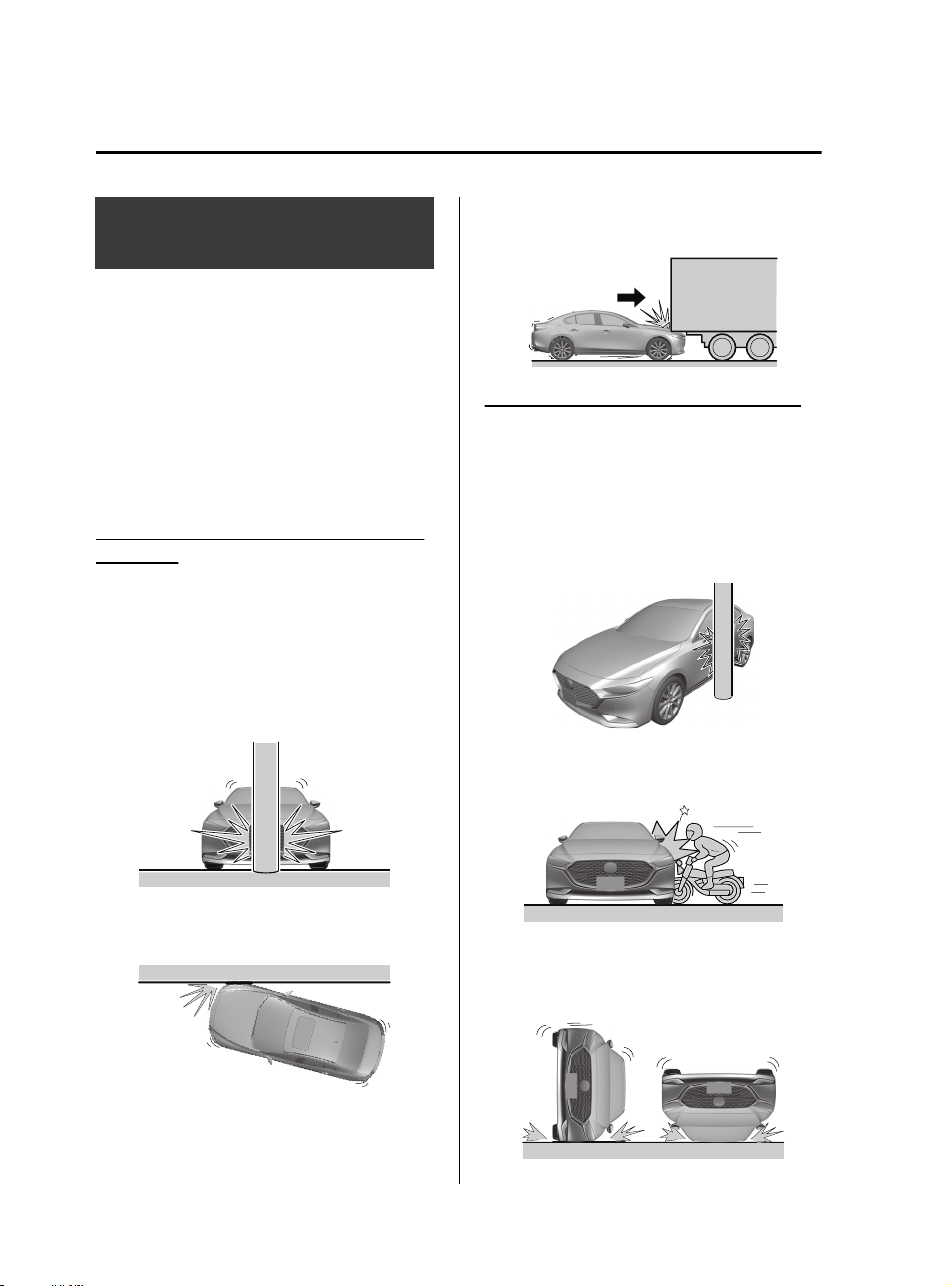
Limitations to SRS Air
Bag
▼
Limitations to SRS Air Bag
In severe collisions such as those
described previously in "SRS Air Bag
Deployment Criteria", the applicable SRS
air bag equipment will deploy. However,
in some accidents, the equipment may not
deploy depending on the type of collision
and its severity.
Limitations to front/near front collision
detection:
The following illustrations are examples
of front/near front collisions that may not
be detected as severe enough to deploy the
SRS air bag equipment.
Impacts involving trees or poles
Frontal offset impact to the vehicle
Rear-ending or running under a truck's
tail gate
Limitations to side collision detection:
The following illustrations are examples
of side collisions that may not be detected
as severe enough to deploy the SRS air
bag equipment.
Side impacts involving trees or poles
Side impacts with two-wheeled vehicles
Roll-over (Without Front Passenger
Occupant Classification System)
Essential Safety Equipment
SRS Air Bags
2-70
Mazda3_8HZ1-EA-19G_Edition1_old 2019-5-17 13:49:03
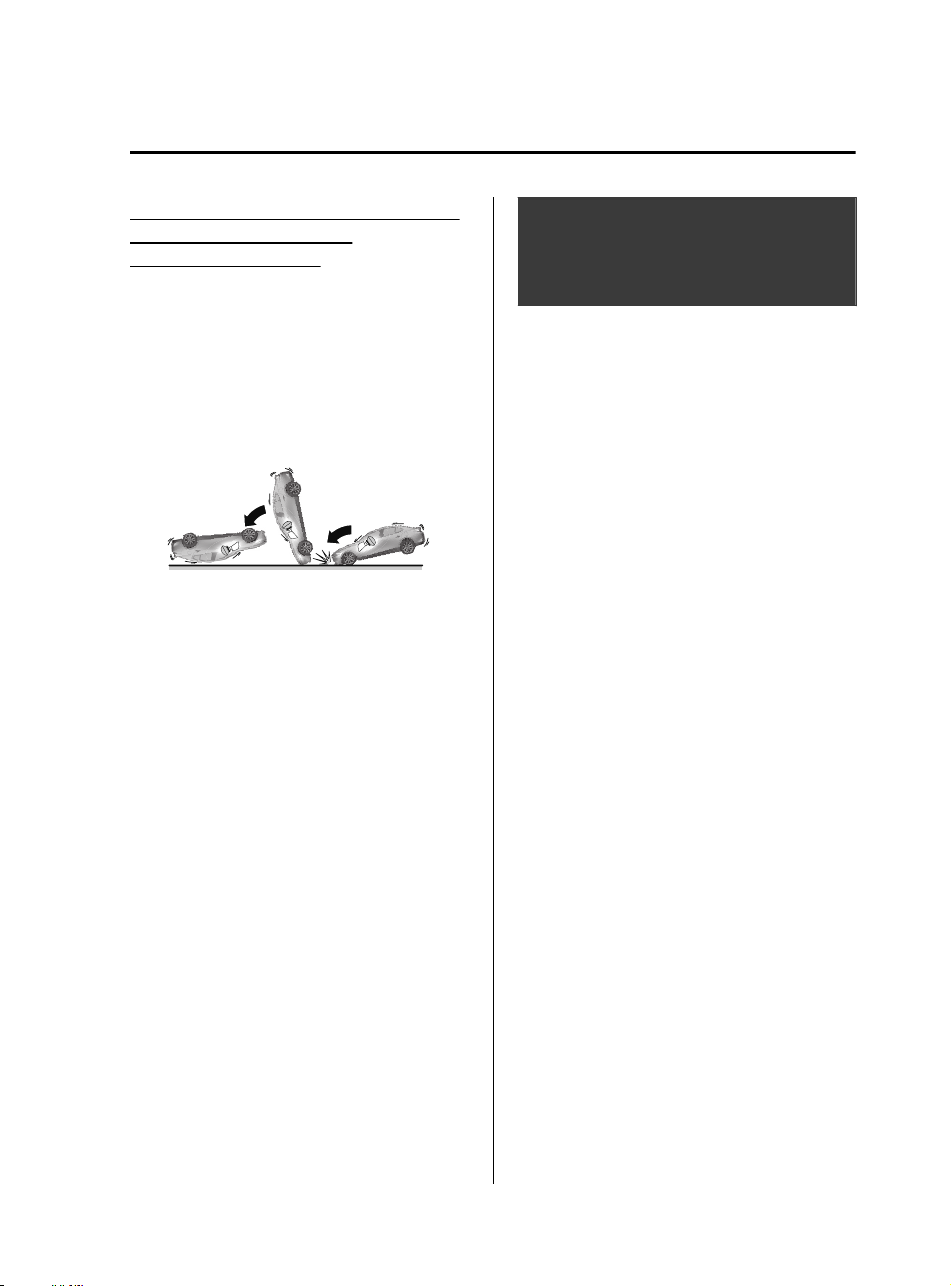
Limitations to roll-over detection (With
Front Passenger Occupant
Classification System):
The following illustration is an example of
an accident that may not be detected as a
roll-over accident. Therefore, the front
seat belt pretensioners and curtain air bags
may not deploy.
Pitch end over end
Driver and Front
Passenger Occupant
Classification System
*
▼
Driver and Front Passenger
Occupant Classification System
First, please read "Supplemental Restraint
System (SRS) Precautions" (page 2-55)
carefully.
▼
Driver Seat Slide Position Sensor
Your vehicle is equipped with a driver seat
slide position sensor as a part of the
supplemental restraint system. The sensor
is located under the driver seat.
The sensor determines whether the driver
seat is fore or aft of a reference position
and sends the seat position to the
diagnostic module (SAS unit).
The SAS unit is designed to control the
deployment of the driver air bag
depending on how close the driver seat is
to the steering wheel.
The air bag/front seat belt pretensioner
system warning light flashes if the sensor
has a possible malfunction (page 2-67).
Essential Safety Equipment
SRS Air Bags
*Some models.
2-71
Mazda3_8HZ1-EA-19G_Edition1_old 2019-5-17 13:49:03
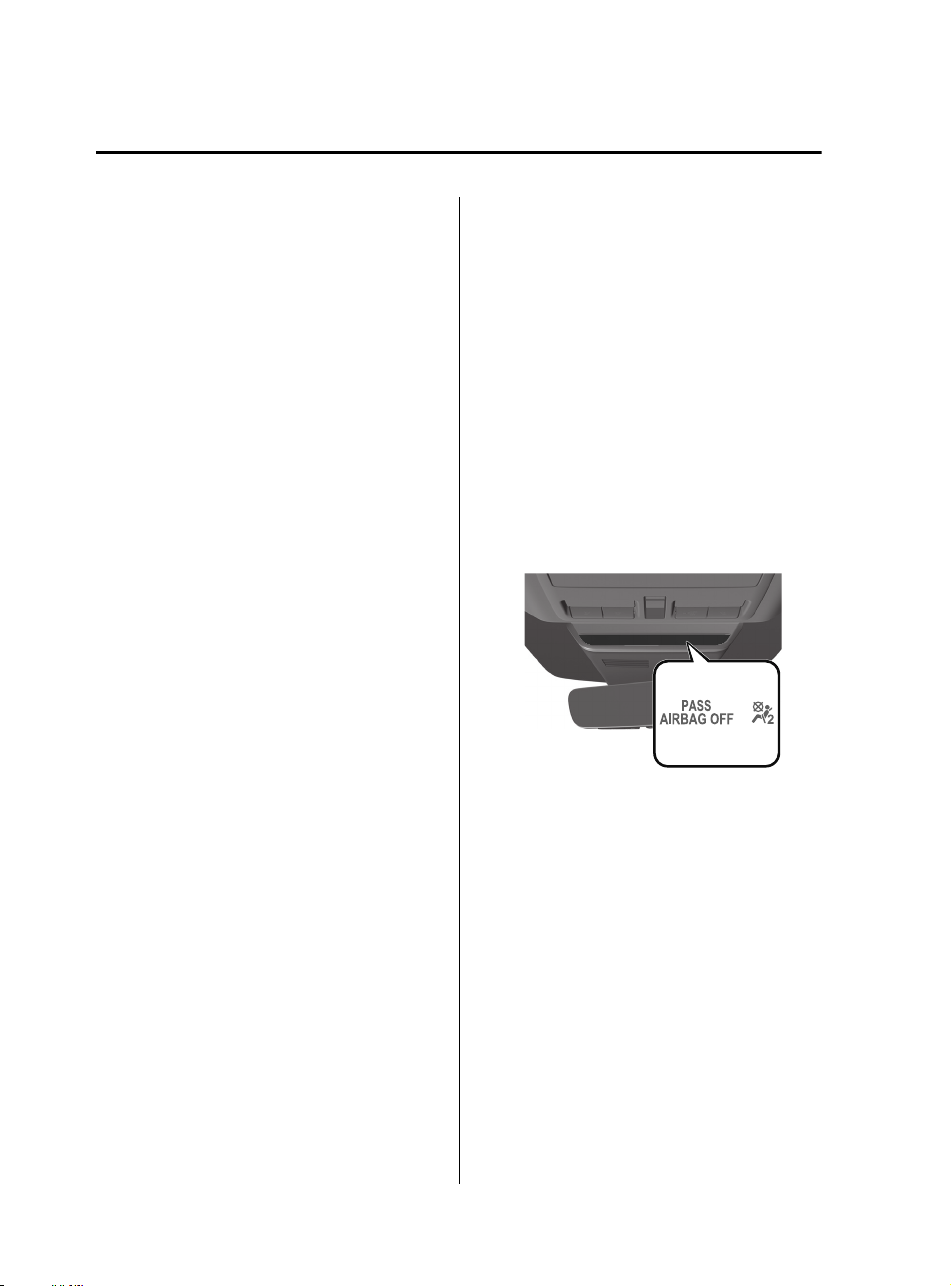
▼
Front Passenger Seat Weight
Sensors
Your vehicle is equipped with a front
passenger seat weight sensors as a part of
the supplemental restraint system. These
sensors are located under both of the front
passenger seat rails. These sensors
determine the total seated weight on the
front passenger seat and monitor the seat
belt buckle for the front passenger seat.
The SAS unit is designed to prevent the
front passenger front and side air bags and
knee air bags, and seat belt pretensioner
system from deploying if the front
passenger air bag deactivation indicator
light illuminates.
To reduce the chance of injuries caused by
deployment of the front passenger air bag,
the system deactivates the front passenger
front and side air bags and knee air bags,
and also the seat belt pretensioner system
when the front passenger air bag
deactivation indicator light illuminates.
Refer to the following table for the front
passenger air bag deactivation indicator
light illumination conditions.
This system shuts off the front passenger
front and side air bags and knee air bags,
and seat belt pretensioner system, so make
sure the front passenger air bag
deactivation indicator light illuminates
according to the following table.
The air bag/front seat belt pretensioner
system warning light flashes and the front
passenger air bag deactivation indicator
light illuminates if the sensors have a
possible malfunction. If this happens, the
front passenger front and side air bags and
knee air bags, and seat belt pretensioner
system will not deploy.
Front passenger air bag deactivation
indicator light
This indicator light illuminates to remind
you that the front passenger front and side
air bags and knee air bags, and seat belt
pretensioners will not deploy during a
collision.
If the front passenger weight sensors are
normal, the indicator light illuminates
when the ignition is switched ON. The
light turns off after a few seconds. Then,
the indicator light illuminates or is off
under the following conditions:
Essential Safety Equipment
SRS Air Bags
2-72
Mazda3_8HZ1-EA-19G_Edition1_old 2019-5-17 13:49:03
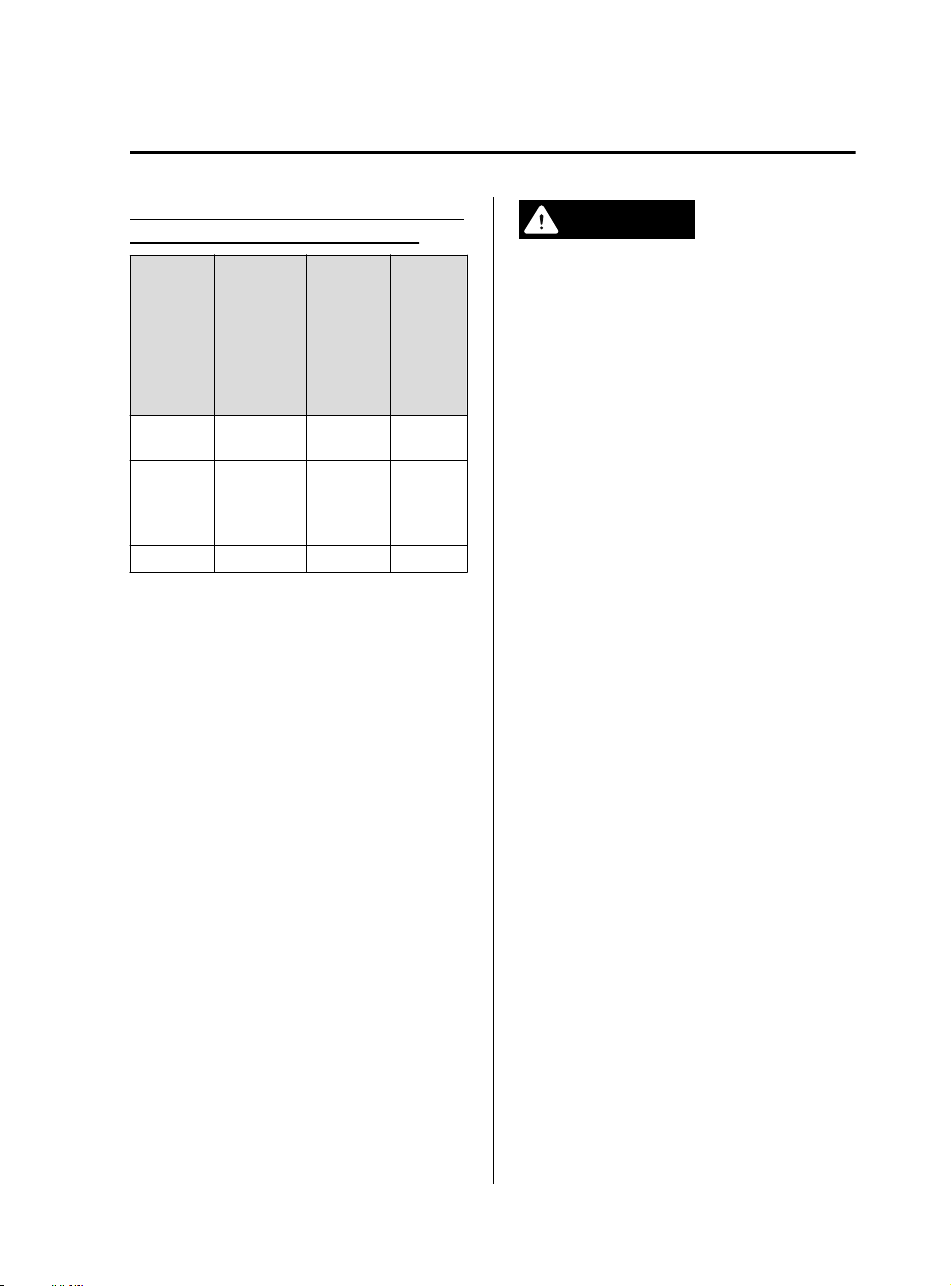
Front passenger air bag deactivation in‐
dicator light on/off condition chart
Condition
detected
by the
front pas‐
senger oc‐
cupant
classifica‐
tion system
Front pas‐
senger air
bag deacti‐
vation indi‐
cator light
Front pas‐
senger
front and
side and
knee air
bags
Front
passenger
seat belt
preten‐
sioner
system
Empty (Not
occupied)
On Deactivated
Deactivat‐
ed
Child or
child-re‐
straint sys‐
tem
*1
On Deactivated
Deactivat‐
ed
Adult
*2
Off Ready Ready
*
1 If a larger child sits on the front passenger seat,
the sensors might detect the child as being an
adult depending on the child's physique.
*
2 If a smaller adult sits on the front passenger seat,
the sensors might detect the person as being a
child depending on the person's physique.
The curtain air bag is ready for inflating regardless of
what the front passenger air bag deactivation
indicator light on/off condition chart indicates.
If the front passenger air bag deactivation
indicator light does not illuminate when
the ignition is switched ON and does not
illuminate as indicated in the front
passenger air bag deactivation indicator
light on/off condition chart, do not allow a
child to sit in the front passenger seat and
consult an Authorized Mazda Dealer as
soon as possible. The system may not
work properly in an accident.
WARNING
Do not decrease the total seated weight on
the front passenger seat:
When an adult or large child sits on the
front passenger seat, decreasing the total
seated weight on the front passenger seat
required for air bag deployment is
dangerous. The front passenger seat
weight sensors will detect the reduced total
seated weight condition and the front
passenger front and side air bags and knee
air bags, and the seat belt pretensioner
system will not deploy during an accident.
The front passenger will not have the
supplementary protection of the air bag,
which could result in serious injury.
Decreasing the total seated weight on the
front passenger seat could result in an air
bag not deploying under the following
conditions, for example:
Essential Safety Equipment
SRS Air Bags
2-73
Mazda3_8HZ1-EA-19G_Edition1_old 2019-5-17 13:49:03
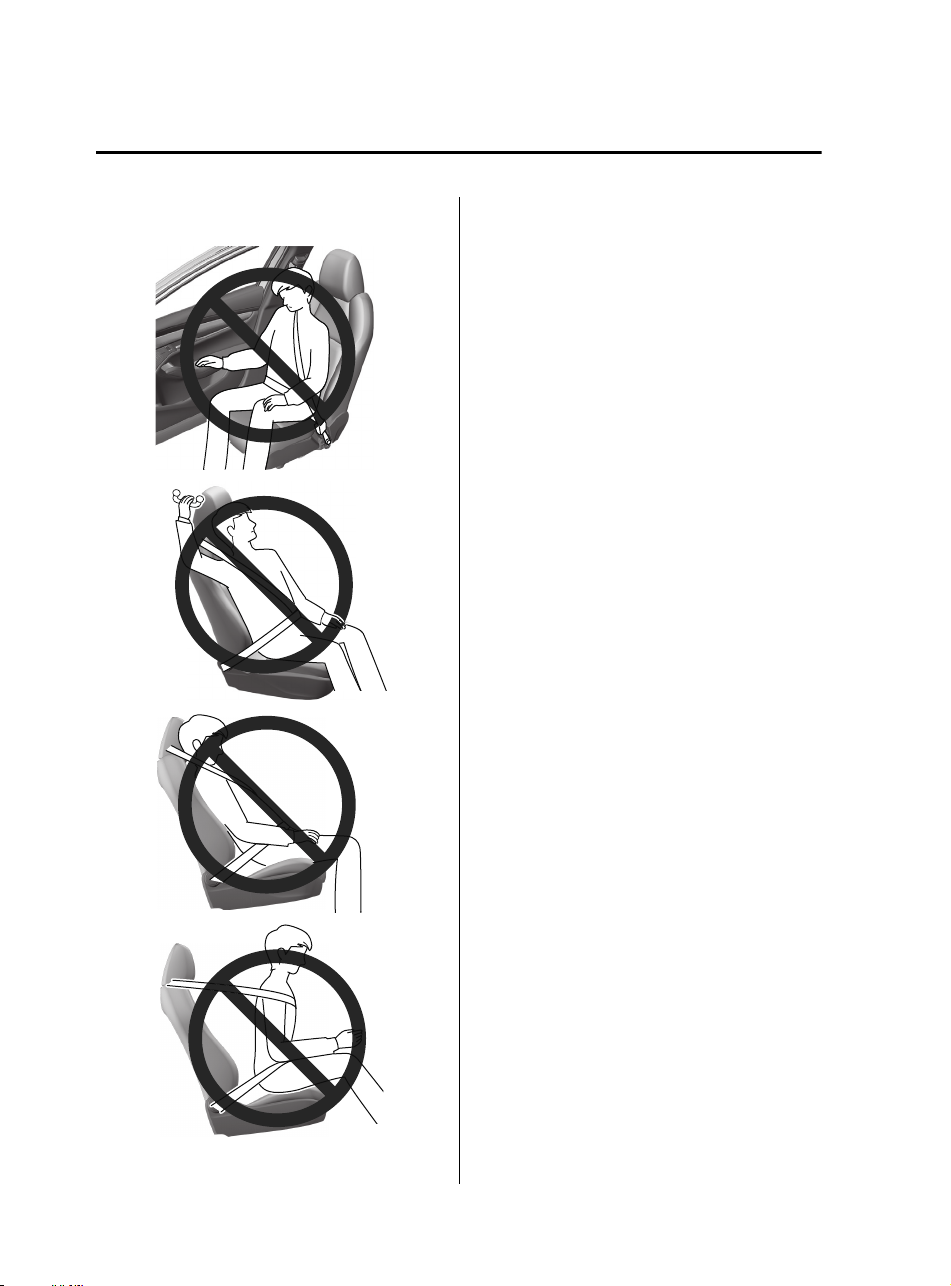
A front passenger is seated as shown in
the following gure:
A rear passenger pushes up on the front
passenger seat with their feet.
Luggage or other items placed under the
front passenger seat or between the front
passenger seat and driver seat that push
up the front passenger seat bottom.
Any accessories which might decrease
the total seated weight on the front
passenger seat are attached to the front
passenger seat.
The front passenger front and side air
bags and knee air bags, and the seat belt
pretensioner system will deactivate if the
front passenger air bag deactivation
indicator light illuminates.
Do not increase the total seated weight on
the front passenger seat:
When an infant or small child sits on the
front passenger seat, increasing the total
seated weight on the front passenger seat
is dangerous. The front passenger seat
weight sensors will detect the increased
total seated weight, which could result in
the unexpected deployment of the front
passenger front and side air bags and knee
air bags, and seat belt pretensioner system
in an accident and may cause serious
injury. Increasing the total seated weight
on the front passenger seat could result in
the front passenger front and side air bags
and knee air bags, and seat belt
pretensioner system deployment in an
accident under the following conditions,
for example:
Luggage or other items are placed on the
seat with the child in the child-restraint
system.
A rear passenger or luggage push or pull
down on the front passenger seatback.
Essential Safety Equipment
SRS Air Bags
2-74
Mazda3_8HZ1-EA-19G_Edition1_old 2019-5-17 13:49:03
A rear passenger steps on the front
passenger seat rails with their feet.
Luggage or other items are placed on the
seatback or hung on the head restraint.
Heavy items are placed in the seatback
map pocket.
The seat is washed.
Liquids are spilled on the seat.
The front passenger seat is moved
backward, pushing into luggage or other
items placed behind it.
The front passenger seatback contacts
the rear seat.
Luggage or other items are placed
between the front passenger seat and
driver seat.
Any accessories which might increase the
total seated weight on the front
passenger seat are attached to the front
passenger seat.
CAUTION
To assure proper deployment of the front
air bag and to prevent damage to the
sensors in the front seat bottoms:
Do not place sharp objects on the front
seat bottoms or leave heavy luggage
on them.
Do not spill any liquids on the front
seats or under the front seats.
To allow the sensors to function properly,
always perform the following:
Adjust the front seats as far back as
possible and always sit upright against
the seatbacks with seat belts worn
properly.
If you place your child on the front
passenger seat, secure the
child-restraint system properly and
slide the front passenger seat as far
back as possible (page 2-47).
NOTE
The system requires about 10 seconds to
alternate between turning the front
passenger front and side air bags and
knee air bags, and seat belt pretensioner
system on or off.
The front passenger air bag deactivation
indicator light may illuminate
repeatedly if luggage or other items are
put on the front passenger seat, or if the
temperature of the vehicle's interior
changes suddenly.
The front passenger air bag deactivation
indicator light may illuminate for 10
seconds if the total seated weight on the
front passenger seat changes.
The air bag/front seat belt pretensioner
system warning light might illuminate if
the front passenger seat receives a
severe impact.
If the front passenger air bag
deactivation indicator light does not
illuminate after installing a
child-restraint system on the front
passenger seat, first, re-install your
child-restraint system according to the
procedure in this owner's manual. Then,
if the front passenger air bag
deactivation indicator light still does not
illuminate, install the child-restraint
system on the rear seat and consult an
Authorized Mazda Dealer as soon as
possible.
Essential Safety Equipment
SRS Air Bags
2-75
Mazda3_8HZ1-EA-19G_Edition1_old 2019-5-17 13:49:03
If the front passenger air bag
deactivation indicator light illuminates
when an adult is seated in the front
passenger seat, have the passenger
re-adjust their posture by sitting with
their feet on the floor, and then
re-fastening the seat belt. If the front
passenger air bag deactivation indicator
light still illuminates, move the
passenger to the rear seat. If sitting in
the rear seat is not possible, slide the
front passenger seat as far back as
possible. Consult an Authorized Mazda
Dealer as soon as possible.
▼
Driver and Front Passenger Buckle
Switches
The buckle switches on the front seat belts
detect whether or not the front seat belts
are securely fastened and further control
the deployment of the air bags.
Constant Monitoring
▼
Constant Monitoring
The following components of the air bag
systems are monitored by a diagnostic
system:
Front air bag sensors
Crash sensors, and diagnostic module
(SAS unit)
Side crash sensors
Air bag modules
Front seat belt pretensioners
Air bag/Front seat belt pretensioner
system warning indication/warning light
Related wiring
(With Driver and Front Passenger
Occupant Classification System)
Driver seat slide position sensor
Front passenger occupant classification
sensor
Front passenger occupant classification
module
Front passenger air bag deactivation
indicator light
Front passenger seat belt buckle switch
The diagnostic module continuously
monitors the system's readiness. This
begins when the ignition is switched ON
and continues while the vehicle is being
driven.
Essential Safety Equipment
SRS Air Bags
2-76
Mazda3_8HZ1-EA-19G_Edition1_old 2019-5-17 13:49:03
3
Before Driving
Use of various features, including keys, doors, mirrors and windows.
Keys.................................................... 3-2
Keys..............................................3-2
Keyless Entry System...................3-4
Advanced Keyless Entry
System.................................................3-9
Advanced Keyless Entry System
*
.....
...................................................... 3-9
Operational Range...................... 3-10
Doors and Locks.............................. 3-11
Door Locks................................. 3-11
Liftgate/Trunk Lid...................... 3-19
Inside Trunk Release Lever (4-
door)
*
..........................................3-23
Fuel and Emission........................... 3-25
Fuel and Engine Exhaust
Precautions................................. 3-25
Fuel-Filler Lid and Cap.............. 3-27
Mirrors............................................. 3-30
Mirrors........................................3-30
Windows...........................................3-34
Power Windows..........................3-34
Moonroof
*
.................................. 3-37
Security System............................... 3-40
Modification and Add-On
Equipment...................................3-40
Immobilizer System....................3-40
Theft-Deterrent System
*
.............3-42
Driving Tips..................................... 3-44
Break-In Period.......................... 3-44
Saving Fuel and Protection of the
Environment............................... 3-44
Hazardous Driving......................3-45
Floor Mat....................................3-46
Rocking the Vehicle....................3-46
Winter Driving............................3-47
Driving In Flooded Area............ 3-49
Overloading................................ 3-49
Driving on Uneven Road............3-50
Towing.............................................. 3-51
Trailer Towing............................ 3-51
Recreational Towing...................3-51
*Some models.
3-1
Mazda3_8HZ1-EA-19G_Edition1_old 2019-5-17 13:49:03
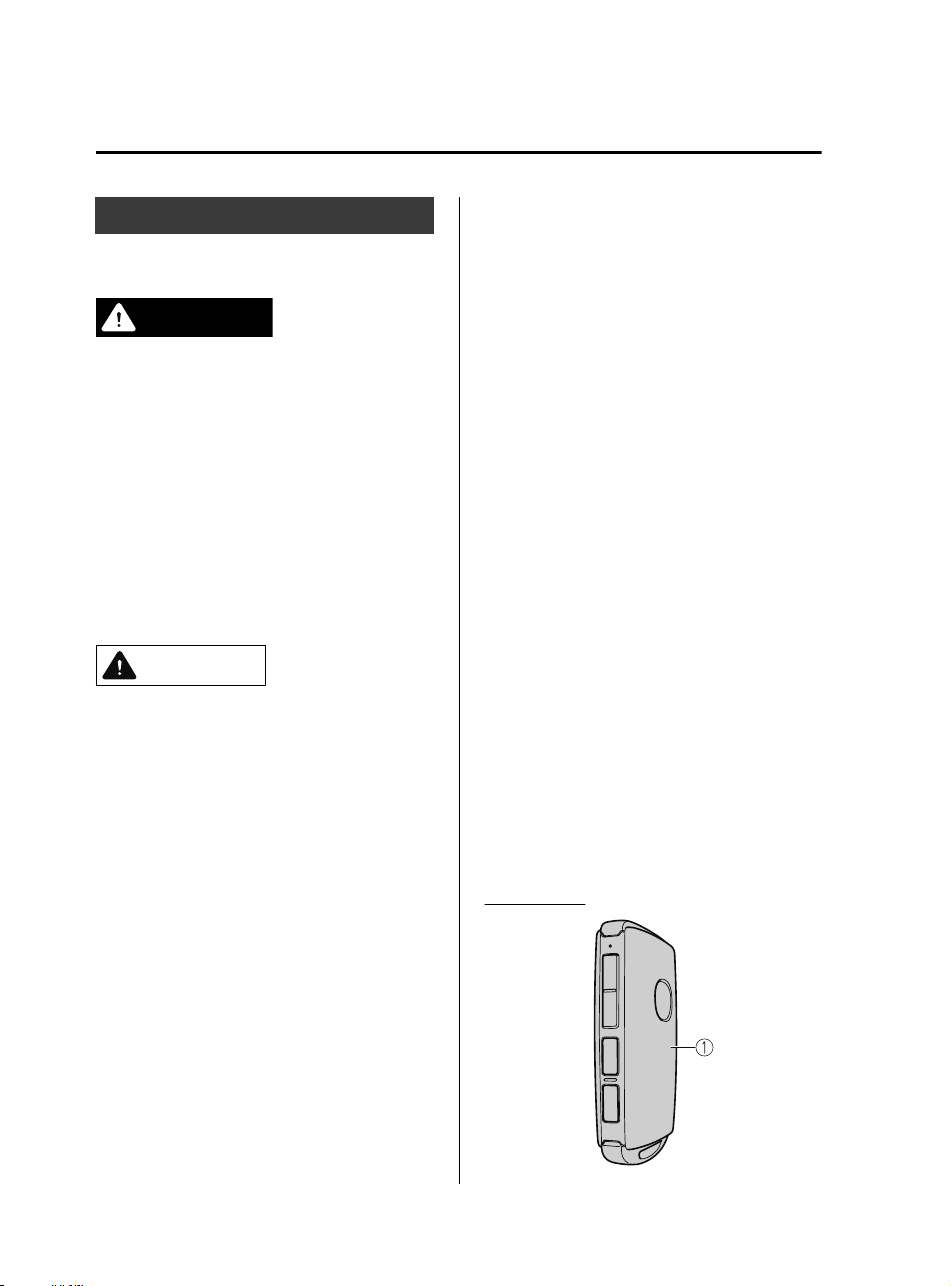
Keys
▼
Keys
WARNING
Do not leave the key in your vehicle with
children and keep them in a place where
your children will not
nd
or play with
them:
Leaving children in a vehicle with the key is
dangerous. This could result in someone
being badly injured or even killed. Children
may nd these keys to be an interesting toy
to play with and could cause the power
windows or other controls to operate, or
even make the vehicle move.
CAUTION
Because the key (transmitter) uses
low-intensity radio waves, it may not
function correctly under the following
conditions:
The key (transmitter) is carried with
communication devices such as
cellular phones.
The key (transmitter) contacts or is
covered by a metal object.
The key (transmitter) is near electronic
devices such as personal computers.
Non-Mazda genuine electronic
equipment is installed in the vehicle.
There is equipment which discharges
radio waves near the vehicle.
The key (transmitter) may consume
battery power excessively if it receives
high-intensity radio waves. Do not place
the key (transmitter) near electronic
devices such as televisions or personal
computers.
To avoid damage to the key
(transmitter), DO NOT:
Drop the key (transmitter).
Get the key (transmitter) wet.
Disassemble the key (transmitter).
Expose the key (transmitter) to high
temperatures on places such as the
dashboard or hood, under direct
sunlight.
Expose the key (transmitter) to any
kind of magnetic eld.
Place heavy objects on the key
(transmitter).
Put the key (transmitter) in an
ultrasonic cleaner.
Put any magnetized objects close to
the key (transmitter).
NOTE
The driver must carry the key (transmitter)
to ensure the system functions properly.
Transmitter
Before Driving
Keys
3-2
Mazda3_8HZ1-EA-19G_Edition1_old 2019-5-17 13:49:03
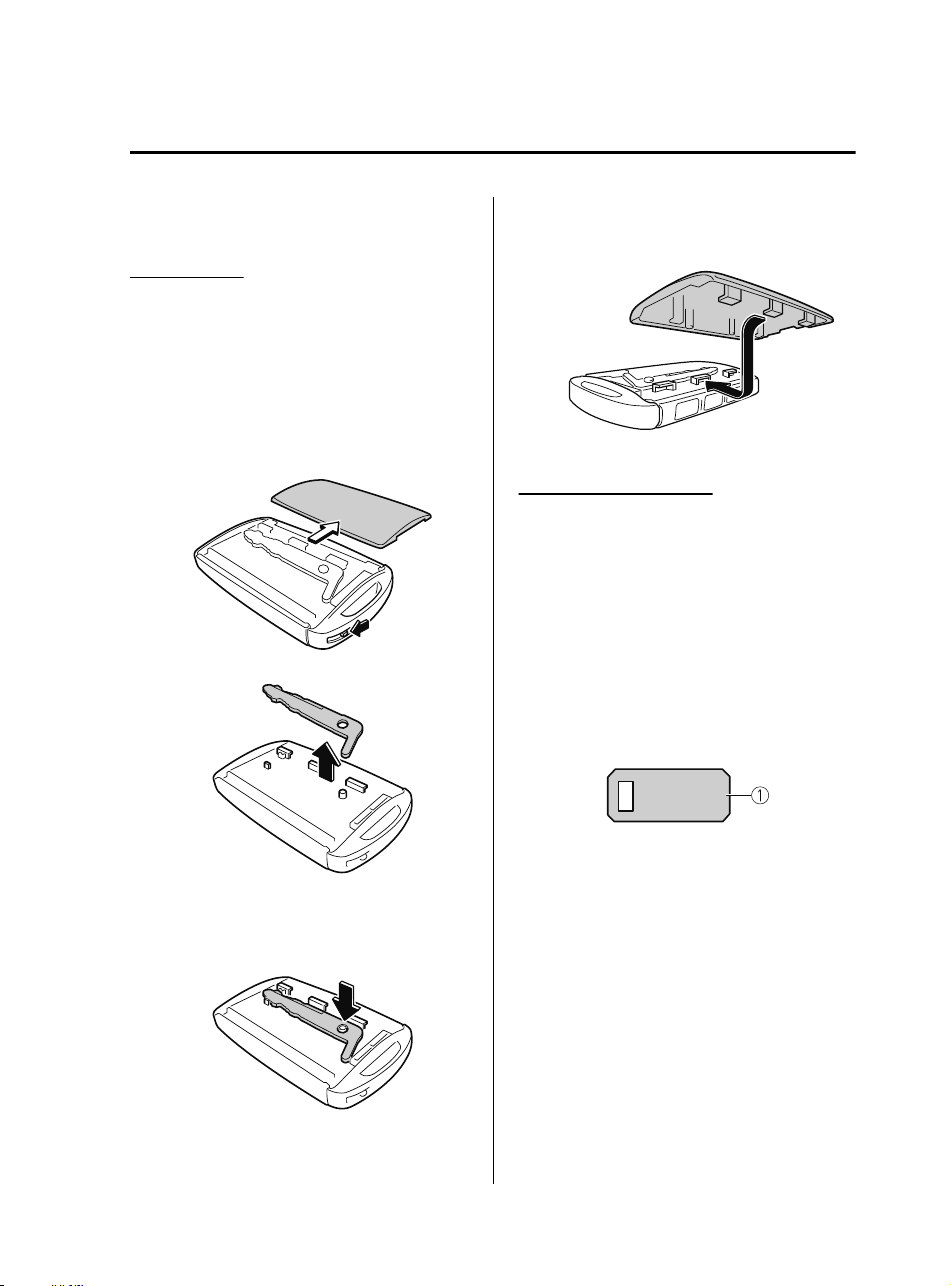
1. Transmitter (page 3-5)
Auxiliary key
There is a removable auxiliary key inside
the transmitter.
Removing the auxiliary key
1. Remove the lower cover while
pressing the knob in the direction of
the arrow.
2. Remove the auxiliary key.
Installing the auxiliary key
1. Install the auxiliary key as the
illustration.
2. Insert the tabs of the lower cover into
the slots of the transmitter and install
the lower cover.
Key code number plate
A code number is stamped on the plate
attached to the key set; detach this plate
and store it in a safe place (not in the
vehicle) for use if you need to make a
replacement key (auxiliary key).
Also write down the code number and
keep it in a separate safe and convenient
place, but not in the vehicle.
If your key (auxiliary key) is lost, consult
an Authorized Mazda Dealer and have
your code number ready.
1. Key code number plate
Before Driving
Keys
3-3
Mazda3_8HZ1-EA-19G_Edition1_old 2019-5-17 13:49:03
Keyless Entry System
▼
Keyless Entry System
This system uses the key buttons to
remotely lock and unlock the doors,
liftgate, and fuel-filler lid, and opens the
trunk lid.
The system can start the engine without
having to take the key out of your purse or
pocket.
It can also help you signal for attention or
help.
Operating the theft-deterrent system is
also possible on theft-deterrent
system-equipped vehicles.
System malfunctions or warnings are
indicated by the following warning lights
or beeps.
Check the displayed message for more
information and, if necessary, have the
vehicle inspected at an Authorized Mazda
Dealer, according to the indication.
KEY Warning Indication/Warning Light
(Red)
Refer to KEY Warning Indication/
Warning Light (Red) on page 7-33.
Ignition Not Switched Off (STOP)
Warning Beep
Refer to Ignition Not Switched Off
(STOP) Warning Beep on page 7-42.
Key Removed from Vehicle Warning
Beep
Refer to Key Removed from Vehicle
Warning Beep on page 7-42.
If you have a problem with the key,
consult an Authorized Mazda Dealer.
If your key is lost or stolen, consult an
Authorized Mazda Dealer as soon as
possible for a replacement and to make the
lost or stolen key inoperative.
CAUTION
Radio equipment like this is governed by
laws in the United States.
Changes or modications not expressly
approved by the party responsible for
compliance could void the user's authority
to operate the equipment.
NOTE
The keyless entry system operation may
vary due to local conditions.
The keyless entry system is fully
operational when the ignition is
switched off. The system does not
operate if the ignition is switched to any
position other than off.
If the key does not operate when
pressing a button or the operational
range becomes too small, the battery
may be weak. To install a new battery,
refer to Key Battery Replacement (page
6-28).
Battery life is about 1 year. Replace the
battery with a new one if the messages
are displayed in the instrument cluster.
Replacing the battery about once a year
is recommended because the KEY
warning indication may not display
depending on the rate of battery
depletion.
Before Driving
Keys
3-4
Mazda3_8HZ1-EA-19G_Edition1_old 2019-5-17 13:49:03
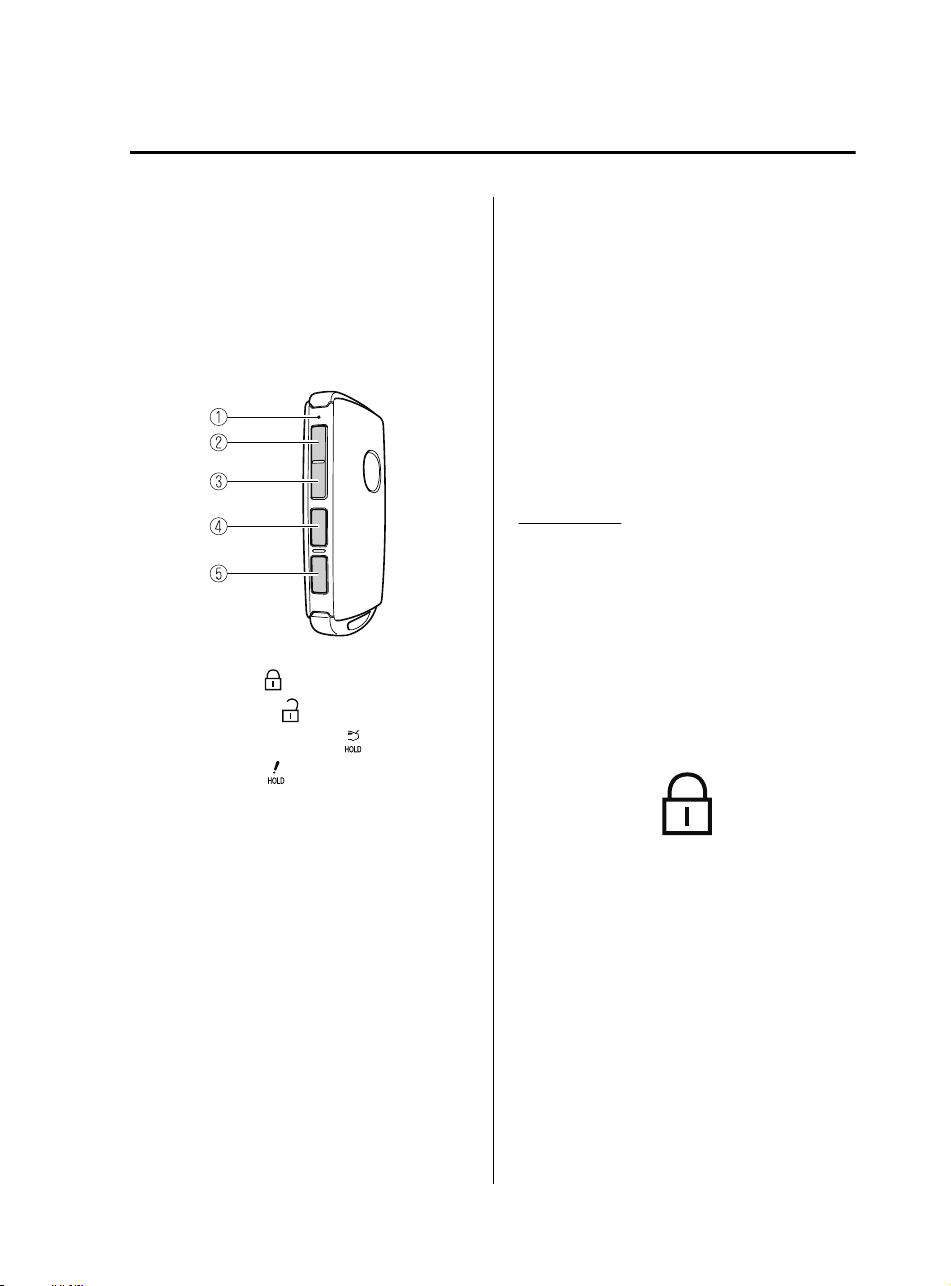
Additional keys can be obtained at an
Authorized Mazda Dealer. Up to 6 keys
can be used with the keyless functions
per vehicle. Bring all keys to an
Authorized Mazda Dealer when
additional keys are required.
▼
Transmitter
1. Operation indicator light
2. Lock button (
)
3. Unlock button (
)
4. Trunk button (4–door) (
)
5. Panic button (
)
NOTE
The headlights turn on/off by operating
the transmitter. Refer to Leaving Home
Light on page 4-48.
(With theft-deterrent system)
The hazard warning lights flash when
the theft-deterrent system is armed or
turned off.
Refer to Theft-Deterrent System on page
3-42.
(With the advanced keyless function)
A beep sound can be heard for
confirmation when the doors, fuel-filler
lid and liftgate are locked/unlocked
using the key. If you prefer, the beep
sound can be turned off.
The volume of the beep sound can also
be changed.
Refer to the Settings section in the
Mazda Connect Owner's Manual.
The operation indicator light flashes when
the buttons are pressed.
Lock button
To lock the doors, fuel-filler lid and
liftgate, press the lock button and the
hazard warning lights will flash once.
(With the advanced keyless function)
A beep sound will be heard once.
To confirm that all the doors, fuel-filler lid
and liftgate have been locked, press the
lock button again within 5 seconds. If they
are closed and locked, the horn will sound.
NOTE
If the lock button is pressed with any
door or liftgate/trunk lid open, any
closed door can be locked. Close any
open door and liftgate/trunk lid to lock.
Confirm that all the doors, fuel-filler lid
and liftgate are locked visually or
audibly by use of the double click.
Make sure all the doors, fuel-filler lid
and liftgate are locked after pressing the
button.
Before Driving
Keys
3-5
Mazda3_8HZ1-EA-19G_Edition1_old 2019-5-17 13:49:03
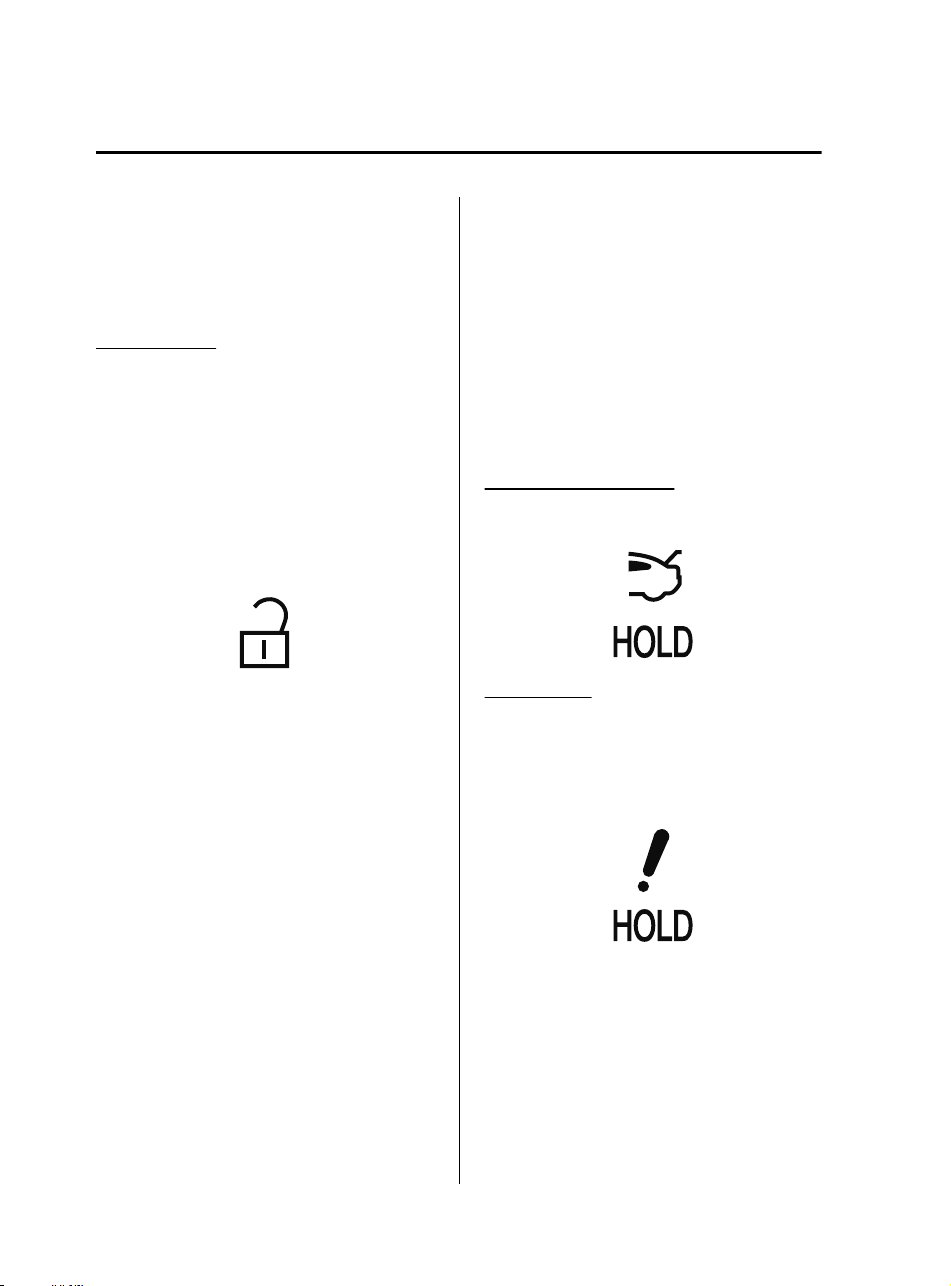
(With theft-deterrent system)
If the lock button is pressed with all the
doors and liftgate closed, the hazard
warning lights will flash and the
theft-deterrent system is armed.
Unlock button
To unlock the driver's door and fuel-filler
lid, press the unlock button and the hazard
warning lights will flash twice.
(With the advanced keyless function)
A beep sound will be heard twice.
To unlock the other doors and liftgate,
press the unlock button again within 5
seconds and two more beep sounds will be
heard.
NOTE
The system can be set to unlock all the
doors, fuel-filler lid and liftgate when
pressing the unlock button once.
Refer to the Settings section in the
Mazda Connect Owner's Manual.
(Auto re-lock function)
After unlocking with the key, all the
doors, fuel-filler lid and liftgate will
automatically lock if any of the
following operations are not performed
within about 60 seconds. If your vehicle
has a theft-deterrent system, the hazard
warning lights will flash for
confirmation.
The time required for the doors to lock
automatically can be changed.
Refer to the Settings section in the
Mazda Connect Owner's Manual.
A door or the liftgate/trunk lid is
opened.
The ignition is switched to any
position other than off.
(With theft-deterrent system)
When the doors are unlocked by
pressing the unlock button on the key
while the theft-deterrent system is turned
off, the hazard warning lights will flash
twice to indicate that the system is
turned off.
Trunk button (4–door)
To open the trunk lid, press and hold the
trunk button until the trunk lid opens.
Panic button
If you witness from a distance someone
attempting to break into or damage your
vehicle, press and hold the panic button to
activate the vehicle's alarm. Call
emergency services if necessary.
NOTE
The panic button will work whether any
door or the liftgate/trunk lid is open or
closed.
Before Driving
Keys
3-6
Mazda3_8HZ1-EA-19G_Edition1_old 2019-5-17 13:49:03

(Turning on the alarm)
Pressing the panic button for 1 second or
more will trigger the alarm for about 2
minutes and 30 seconds, and the following
will occur:
The horn sounds intermittently.
The hazard warning lights flash.
(Turning off the alarm)
The alarm stops by pressing any button on
the key.
Power saving function
By turning on the transmitter power saving
function, the advanced keyless entry
*1
and
push button start system functions turn off
and the battery power consumption of the
transmitter is restricted.
The remote control function is operational
by operating the transmitter switch even
while the power saving function is turned
on. However, the operation indicator light
of the transmitter does not turn on/flash.
Turning on the power saving function
After you have turned on the power saving
function according to the following
procedure, the hazard warning lights and
sound operate
*1
one time.
1. Press the lock button on the transmitter
4 times within 3 seconds to turn on the
operation indicator light.
2. Press the lock button continuously for
1.5 seconds or longer while the
operation indicator light turns on (for 5
seconds).
3. Press any of the buttons on the
transmitter to make sure that the
operation indicator light does not turn
on/flash.
Turning off the power saving function
After you have turned off the power
saving function according to the following
procedure, the hazard warning lights and
sound operate
*1
one time.
1. Press any of the buttons on the
transmitter to make sure that the
operation indicator light does not turn
on/flash.
2. Press the lock button on the transmitter
4 times within 3 seconds to turn on the
operation indicator light.
3. Press the lock button continuously for
1.5 seconds or longer while the
operation indicator light turns on (for 5
seconds).
*
1 With the advanced keyless function
▼
Operational Range
The system operates only when the driver
is in the vehicle or within operational
range while the key is being carried.
Starting the Engine
NOTE
Starting the engine may be possible even
if the key is outside of the vehicle and
extremely close to a door and window,
however, always start the engine from
the driver's seat.
If the vehicle is started and the key is not
in the vehicle, the vehicle will not restart
after it is shut off and the ignition is
switched to off.
The luggage compartment/trunk is out of
the assured operational range, however,
if the key (transmitter) is operable the
engine will start.
Before Driving
Keys
3-7
Mazda3_8HZ1-EA-19G_Edition1_old 2019-5-17 13:49:03
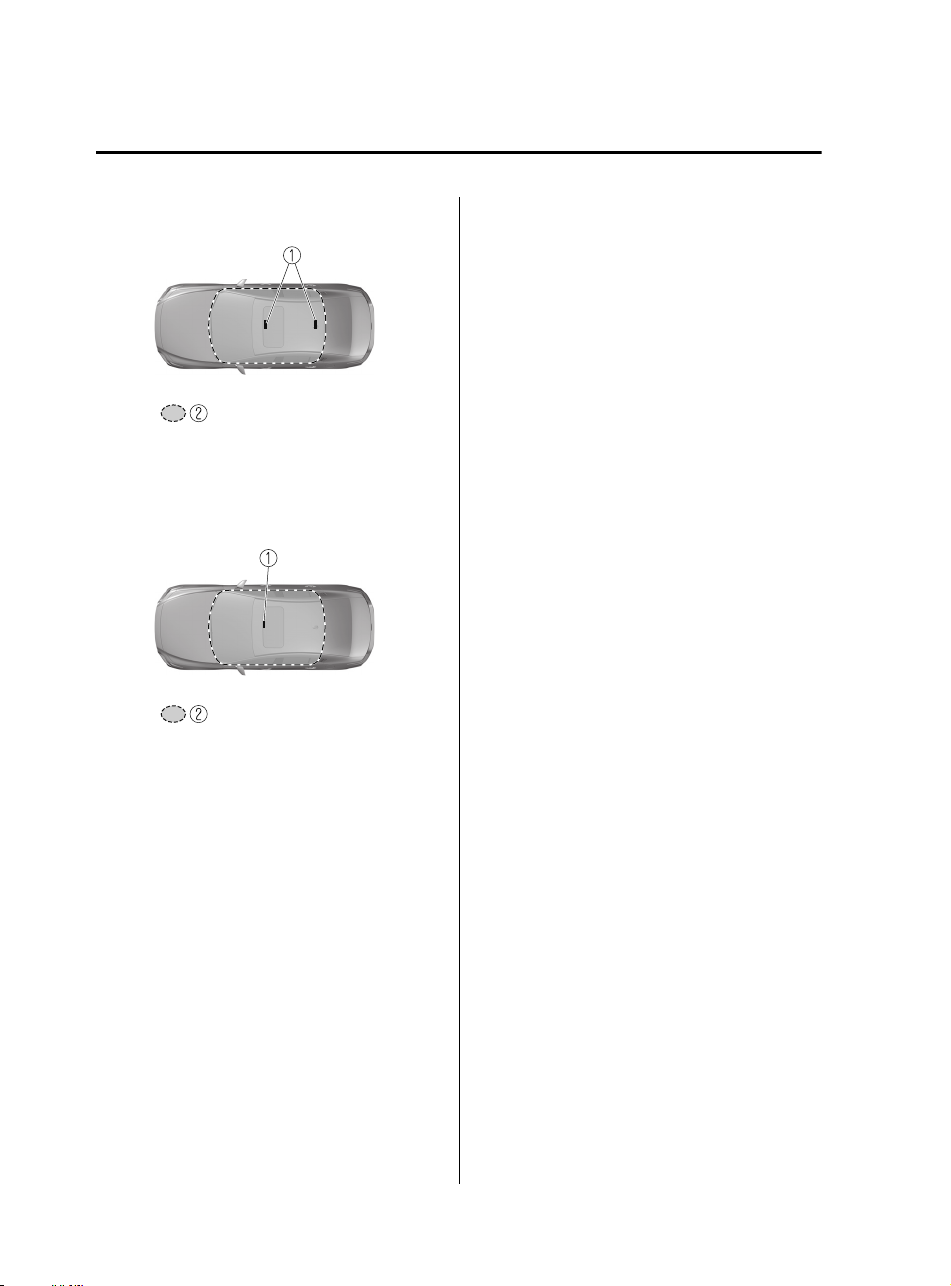
With the advanced keyless function
1. Interior antenna
2. Operational range
Without the advanced keyless function
1. Interior antenna
2. Operational range
NOTE
The engine may not start if the key is
placed in the following areas:
Around the dashboard
In the storage compartments such as the
glove compartment or the center console
On the rear parcel shelf (4–door)
▼
Key Suspend Function
If a key is left in the vehicle, the functions
of the key left in the vehicle are
temporarily suspended to prevent theft of
the vehicle.
To restore the functions, press the unlock
button on the functions-suspended key in
the vehicle.
Before Driving
Keys
3-8
Mazda3_8HZ1-EA-19G_Edition1_old 2019-5-17 13:49:03
Advanced Keyless Entry
System
*
▼
Advanced Keyless Entry System
WARNING
Radio waves from the key may aect
medical devices such as pacemakers:
Before using the key near people who use
medical devices, ask the medical device
manufacturer or your physician if radio
waves from the key will aect the device.
The advanced keyless function allows you
to lock/unlock the door, liftgate, and
fuel-filler lid, or open the liftgate/trunk lid
while carrying the key.
System malfunctions or warnings are
indicated by the following warning beeps.
Touch Sensor Inoperable Warning Beep
Refer to Touch Sensor Inoperable
Warning Beep (With the advanced
keyless function) on page 7-43.
Key Left-in-luggage Compartment/
Trunk Warning Beep
Refer to Key Left-in-luggage
Compartment/Trunk Warning Beep
(With the advanced keyless function) on
page 7-43.
Key Left-in-vehicle Warning Beep
Refer to Key Left-in-vehicle Warning
Beep (With the advanced keyless
function) on page 7-43.
NOTE
The advanced keyless entry system
functions can be deactivated to prevent
any possible adverse effect on a user
wearing a pacemaker or other medical
device. If the system is deactivated, you
will be unable to start the engine by
carrying the key. Consult an Authorized
Mazda Dealer for details. If the advanced
keyless entry system has been deactivated,
you can start the engine by following the
procedure indicated when the key battery
goes dead.
Refer to Engine Start Function When Key
Battery is Dead on page 4-8.
Before Driving
Advanced Keyless Entry System
*Some models.
3-9
Mazda3_8HZ1-EA-19G_Edition1_old 2019-5-17 13:49:03
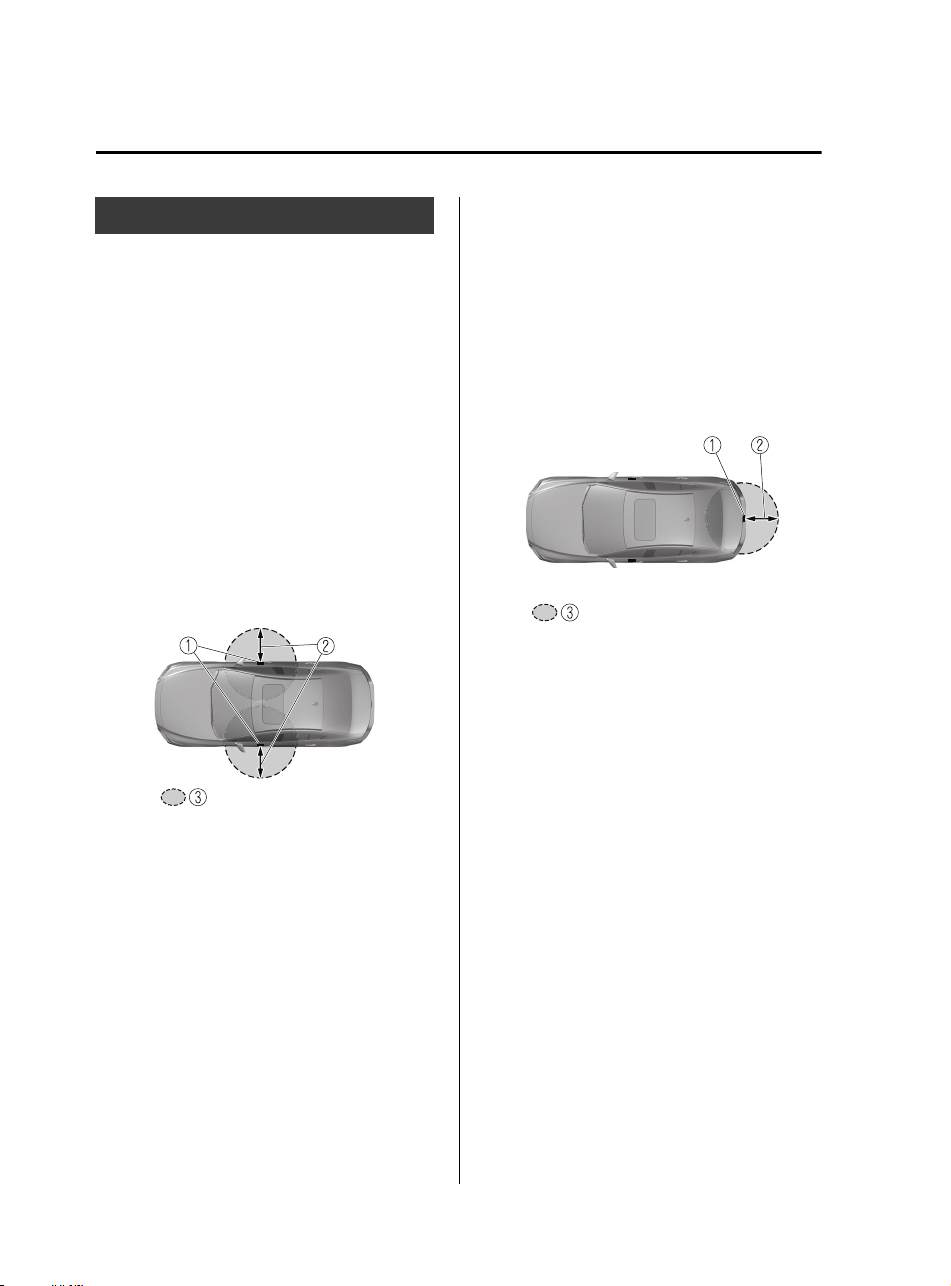
Operational Range
▼
Operational Range
The system operates only when the driver
is in the vehicle or within operational
range while the key is being carried.
NOTE
When the battery power is low, or in
places where there are high-intensity radio
waves or noise, the operational range may
become narrower or the system may not
operate. For determining battery
replacement, Refer to Keyless Entry
System on page 3-4.
▼
Locking/Unlocking Using Touch
Sensor
1. Exterior antenna
2. 80 cm (31 in)
3. Operational range
NOTE
The system may not operate if you are
too close to the windows or door
handles.
If the key is left in the following areas
and you leave the vehicle, the doors may
be locked depending on the radio wave
conditions even if the key is left in the
vehicle.
Around the dashboard
In the storage compartments such as
the glove compartment or the center
console
On the rear parcel shelf (4–door)
Next to a communication device such
as a mobile phone
▼
Locking Using Door-Lock Switch
(5–door)/Unlocking Using Electric
Opener
1. Exterior antenna
2. 80 cm (31 in)
3. Operational range
Before Driving
Advanced Keyless Entry System
3-10
Mazda3_8HZ1-EA-19G_Edition1_old 2019-5-17 13:49:03
Door Locks
▼
Door Locks
WARNING
Always take all children and pets with you
or leave a responsible person with them:
Leaving a child or a pet unattended in a
parked vehicle is dangerous. In hot
weather, temperatures inside a vehicle can
become high enough to cause brain
damage or even death.
Do not leave the key in your vehicle with
children and keep them in a place where
your children will not nd or play with
them:
Leaving children in a vehicle with the key is
dangerous. This could result in someone
being badly injured or even killed.
Keep all doors locked when driving:
Unlocked doors in a moving vehicle are
dangerous. Passengers can fall out if a
door is accidentally opened and can more
easily be thrown out in an accident.
Always close all the windows and
moonroof, lock the doors, fuel-ller lid, and
liftgate and take the key with you when
leaving your vehicle unattended:
Leaving your vehicle unlocked is dangerous
as children could lock themselves in a hot
vehicle, which could result in death. Also, a
vehicle left unlocked becomes an easy
target for thieves and intruders.
After closing the doors and the liftgate/
trunk lid, always verify that they are
securely closed:
Doors and the liftgate/trunk lid not
securely closed are dangerous, if the vehicle
is driven with a door and the liftgate/trunk
lid not securely closed, the door and the
liftgate/trunk lid could open unexpectedly
resulting in an accident.
Always conrm the safety around the
vehicle before opening a door and the
liftgate/trunk lid:
Suddenly opening a door and the liftgate/
trunk lid is dangerous. A passing vehicle or
a pedestrian could be hit and cause an
accident.
CAUTION
Always conrm the conditions around
the vehicle before opening/closing the
doors and the liftgate/trunk lid and use
caution during strong winds or when
parked on an incline. Not being aware of
the conditions around the vehicle is
dangerous because ngers could get
caught in the door and the liftgate/trunk
lid or a passing pedestrian could be hit,
resulting in an unexpected accident or
injury.
NOTE
Always stop the engine and lock the
doors. In addition, to prevent theft of
valuables, do not leave them inside the
cabin.
Before Driving
Doors and Locks
3-11
Mazda3_8HZ1-EA-19G_Edition1_old 2019-5-17 13:49:03

If the key is left in the following areas
and you leave the vehicle, the doors may
be locked depending on the radio wave
conditions even if the key is left in the
vehicle.
Around the dashboard
In the storage compartments such as
the glove compartment or the center
console
On the rear parcel shelf (4–door)
Next to a communication device such
as a mobile phone
When the ignition is switched to ACC or
ON, the vehicle lock-out prevention
feature prevents you from locking
yourself out of the vehicle.
All doors, fuel-filler lid, and liftgate will
automatically unlock if they are locked
using the power door locks with any
door or the liftgate open.
The vehicle lock-out prevention feature
does not operate while the ignition is
switched off.
When all doors, fuel-filler lid, and
liftgate are locked using the power door
lock with any door or the liftgate/trunk
lid open, the closed doors, fuel-filler lid,
and liftgate are locked. After that, when
all doors and the liftgate/trunk lid are
closed, all doors and the liftgate/trunk
lid are locked. However, if the key is
inside the vehicle, all doors, fuel-filler
lid, and liftgate are automatically
unlocked.
(With the advanced keyless function)
The beep sound is heard for about 10
seconds to notify the driver that the key
has been left in the vehicle.
(Without the advanced keyless
function)
The horn sound is heard twice to notify
the driver that the key has been left in
the vehicle.
(Door unlock (control) system with
collision detection)
This system automatically unlocks the
doors, fuel-filler lid, and liftgate in the
event the vehicle is involved in an
accident to allow passengers to get out
of the vehicle immediately and prevent
being trapped inside. While the ignition
is switched ON and in the event the
vehicle receives an impact strong
enough to inflate the air bags, all the
doors, fuel-filler lid, and liftgate are
automatically unlocked after about 6
seconds have elapsed from the time of
the accident.
The doors, fuel-filler lid, and liftgate
may not unlock depending on how an
impact is applied, the force of the
impact, and other conditions of the
accident.
If door-related systems or the battery is
malfunctioning, the doors, fuel-filler lid,
and liftgate will not unlock.
Before Driving
Doors and Locks
3-12
Mazda3_8HZ1-EA-19G_Edition1_old 2019-5-17 13:49:03
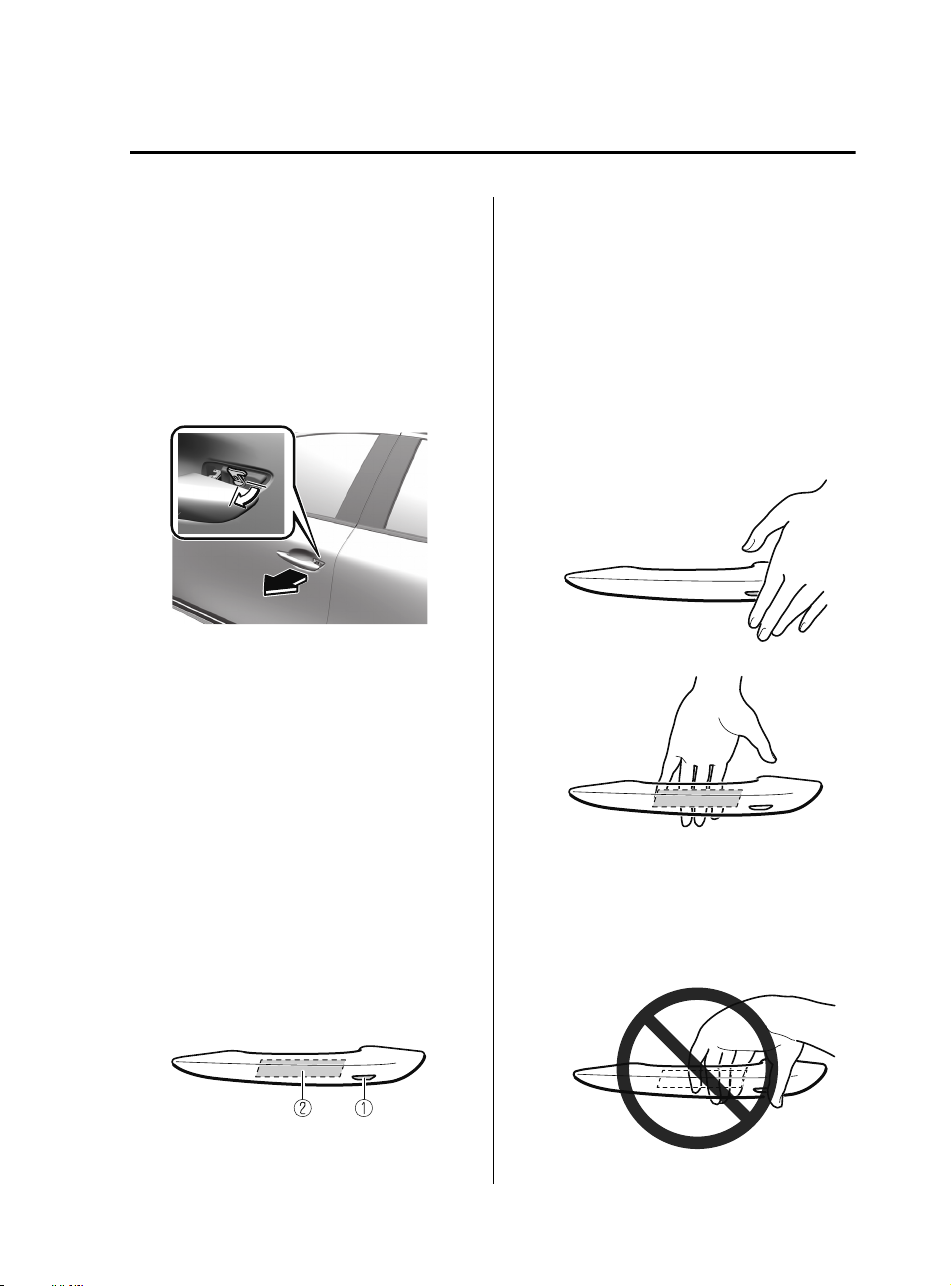
▼
Unlocking with Auxiliary Key
Only the driver's door can be unlocked
using the auxiliary key.
Refer to Keys on page 3-2.
Insert the auxiliary key while the driver's
door handle is pulled and turn the key to
the unlock side. Turn the auxiliary key
back to its original position before
removing it.
NOTE
If you attempt to open the driver’s door
using an unauthorized auxiliary key, the
key cylinder will spin around but the door
will not unlock.
▼
Locking, Unlocking with Touch
Sensor, Door Handle (With the
advanced keyless function)
By touching the sensing area of the touch
sensor, various locking/unlocking
operations can be done without taking the
key out of a bag or pocket.
There are two types of touch sensors used
for locking and unlocking, and each sensor
is built into the outer door handle on the
driver and front passenger's doors.
1. Sensing area of door lock touch sensor
(Depression on outer side of door
handle)
2. Sensing area of door release touch
sensor (Inner side of door handle)
NOTE
When locking/unlocking with the
transmitter carried, securely touch the
sensing area of the touch sensor as
follows.
Locking
Unlocking
The system may not operate normally
under the following conditions.
You touch the sensing area of the door
lock touch sensor and the sensing
area of the door release touch sensor
at the same time.
Before Driving
Doors and Locks
3-13
Mazda3_8HZ1-EA-19G_Edition1_old 2019-5-17 13:49:03
You touch the sensing area of the
touch sensor while wearing gloves.
Foreign matter such as snow or dirt is
stuck on the sensing area of the touch
sensor.
You pull the door handle just after
touching the sensing area of the touch
sensor.
The system may operate if the outer side
door handle of a front door is splashed
with water by a car wash or rain while
the transmitter is in the operation range.
If the system does not operate even
though you touch the sensing area of the
touch sensor correctly, release the touch
sensor once, and then touch the sensing
area of the touch sensor again after
waiting about 3 seconds.
Locking
When locking, touch the sensing area of
the door lock touch sensor with all of the
following conditions met.
The ignition is switched OFF.
All the doors are closed.
You are carrying the transmitter.
The following locations are locked by
touching the sensing area of the door lock
touch sensor.
All doors
Fuel-filler lid
Liftgate
When locking, the hazard warning lights
and sound operate one time.
Unlocking
When unlocking, touch the sensing area of
the door release touch sensor with all of
the following conditions met.
The ignition is switched OFF.
The driver’s door is locked.
Three seconds or longer have passed
since the doors were locked.
You are carrying the transmitter.
(Unlocking from the driver's door)
The following locations are unlocked by
touching the sensing area of the door
release touch sensor of the driver's door.
Driver’s door
Fuel-filler lid
NOTE
The location to be unlocked can be
changed.
Refer to the Settings section in the
Mazda Connect Owner's Manual.
When unlocking, the hazard warning
lights and sound operate two times.
(Unlocking from the front passenger’s
door)
The following locations are unlocked by
touching the sensing area of the door
release touch sensor of the front
passenger's door.
All doors
Fuel-filler lid
Liftgate
When unlocking, the hazard warning
lights and sound operate two times.
NOTE
Confirm that all the doors and liftgate/
trunk lid are securely locked.
For the liftgate/trunk lid, move it
without pressing the electric liftgate/
trunk lid opener to verify that the
liftgate/trunk lid has not been left ajar.
Before Driving
Doors and Locks
3-14
Mazda3_8HZ1-EA-19G_Edition1_old 2019-5-17 13:49:03
A beep sound is heard for confirmation
when the doors, fuel-filler lid, and
liftgate are locked/unlocked using the
touch sensor. If you prefer, the beep
sound can be turned off.
The volume of the beep sound can also
be changed. Refer to the Settings section
in the Mazda Connect Owner's Manual.
(With theft-deterrent system)
The hazard warning lights flash when
the theft-deterrent system is armed or
turned off.
Refer to Theft-Deterrent System on page
3-42.
The setting can be changed so that the
doors, fuel-filler lid, and liftgate are
locked automatically without touching
the sensing area of the touch sensor.
Refer to the Settings section in the
Mazda Connect Owner's Manual.
(Walk-away auto lock function)
A beep sound is heard when all doors
and the liftgate/trunk lid are closed
while the transmitter is being carried.
All the doors, fuel-filler lid, and liftgate
are locked automatically when the
transmitter is out of the operational
range. Also, the hazard warning lights
flash once. (Even if the driver is in the
operational range, all the doors,
fuel-filler lid, and liftgate are locked
automatically after about 30 seconds.) If
you are out of the operational range
before the doors and the liftgate/trunk
lid are completely closed or another
transmitter is left in the vehicle, the
walk-away auto lock function will not
work. Always make sure that all doors
and the liftgate/trunk lid are closed and
locked before leaving the vehicle. The
walk-away auto lock function does not
close the power windows.
(Auto re-lock function)
After unlocking with the touch sensor,
all the doors , fuel-filler lid, and liftgate
will automatically lock if any of the
following operations are not performed
within about 60 seconds.
Opening a door or the liftgate/trunk
lid.
Switching the ignition to any position
other than off.
If your vehicle has a theft-deterrent
system, the hazard warning lights will
flash for confirmation.
The time required for the doors to lock
automatically can be changed.
Refer to the Settings section in the
Mazda Connect Owner's Manual.
▼
Locking, Unlocking with
Transmitter
The following locations can be locked/
unlocked by operating the keyless entry
system transmitter. Refer to Keyless Entry
System (page 3-4).
All doors
Fuel-filler lid
Liftgate
▼
Locking, Unlocking with Door-Lock
Switch
Door-lock switch on driver’s and front
passenger's door
The following locations are locked/
unlocked by pressing the door-lock switch.
All doors
Fuel-filler lid
Liftgate
Before Driving
Doors and Locks
3-15
Mazda3_8HZ1-EA-19G_Edition1_old 2019-5-17 13:49:03
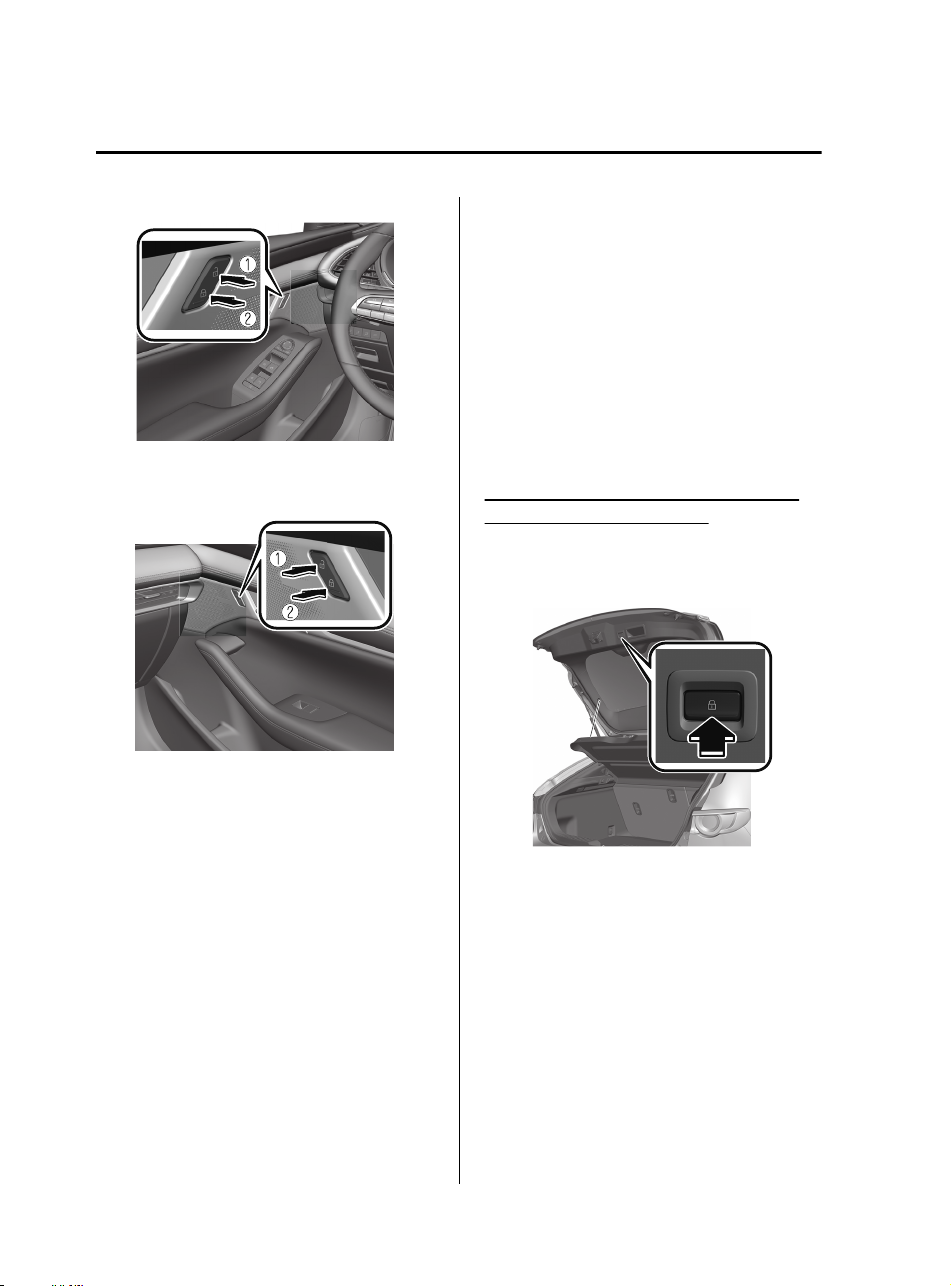
Driver's door
1. Unlock
2. Lock
Front passenger's door
1. Unlock
2. Lock
Locking from the outside using the
door-lock switch
When locking from the outside using the
door-lock switch, press the lock side of the
door-lock switch with all of the following
conditions met and then close all the
doors.
The ignition is switched OFF.
Any door is open.
NOTE
To prevent the transmitter from being
left in the vehicle, make sure that you
carry the transmitter before locking.
After locking by pressing the door-lock
switch and when all the doors are closed
with the transmitter left in the vehicle,
all the doors, liftgate, and fuel-filler lid
are unlocked.
After locking by pressing the door-lock
switch and when the liftgate/trunk lid is
closed last with the transmitter left in
the vehicle, only the liftgate/trunk lid is
unlocked.
Door-lock switch on liftgate (With the
advanced keyless function)
All doors, fuel-filler lid, and the liftgate
can be locked by pressing the door-lock
switch.
When locking using the door-lock switch,
press the door-lock switch with all of the
following conditions met and then close
the liftgate.
You are carrying the transmitter.
The ignition is switched OFF.
All the doors are closed.
When locking, the hazard warning lights
and a beep sound operate 1 time.
Before Driving
Doors and Locks
3-16
Mazda3_8HZ1-EA-19G_Edition1_old 2019-5-17 13:49:03
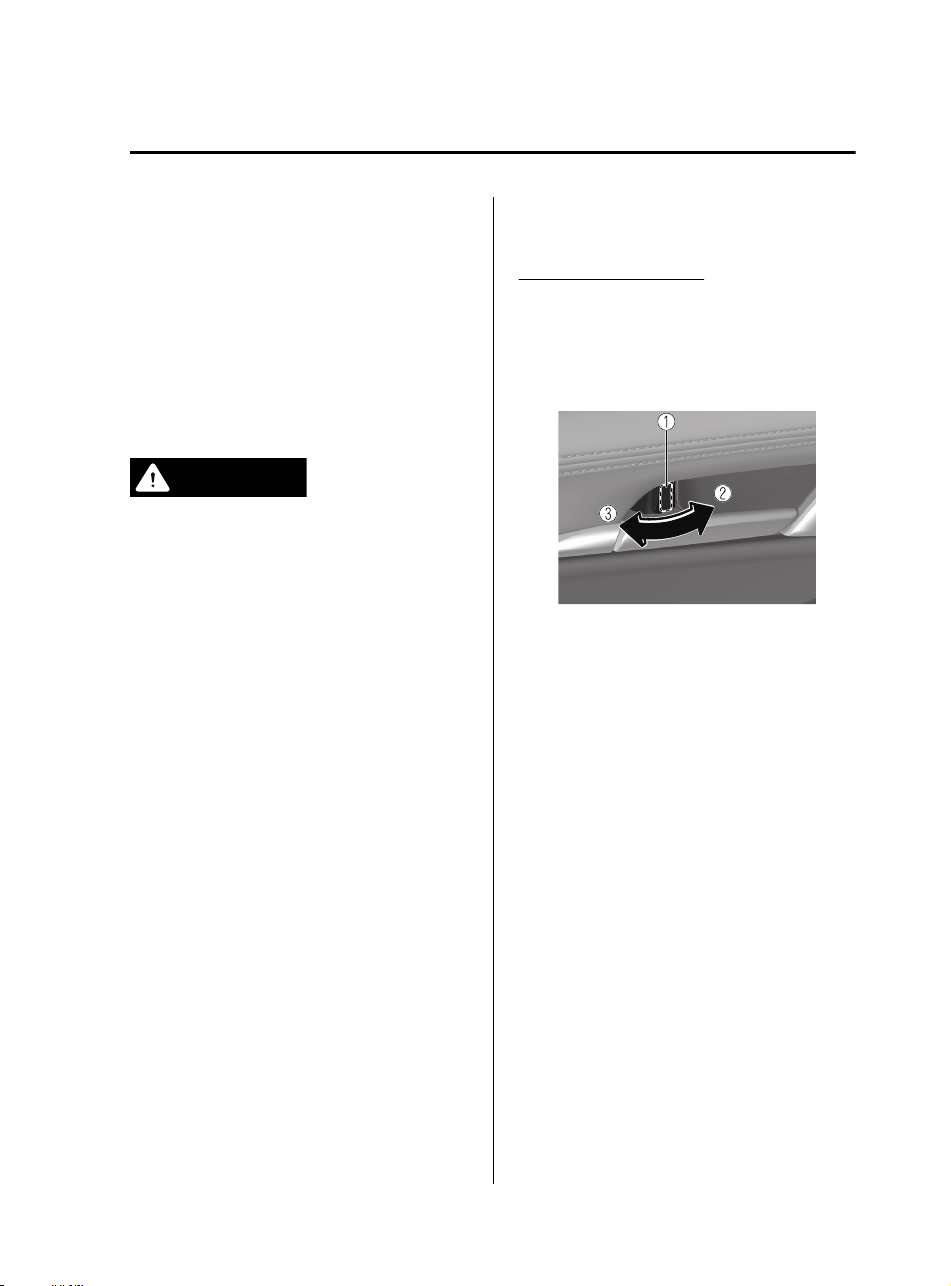
NOTE
To prevent the transmitter from being
left in the vehicle, make sure that you
carry the transmitter before locking.
After locking by pressing the door-lock
switch and when the liftgate is closed
with the transmitter left in the vehicle,
the liftgate is unlocked.
▼
Auto Lock/Unlock Function
WARNING
Do not pull the inner handle on a front
door:
Pulling the inner handle on a front door
while the vehicle is moving is dangerous.
Passengers can fall out of the vehicle if the
door opens accidentally , which could
result in death or serious injury.
When the vehicle speed exceeds 20
km/h (12 mph), all the doors, fuel-filler
lid, and liftgate lock automatically.
When the ignition is switched off, all the
doors, fuel-filler lid, and liftgate unlock
automatically.
The auto lock/unlock function settings can
be changed.
Refer to the Settings section in the Mazda
Connect Owner's Manual.
▼
Locking, Unlocking with Door-Lock
Knob
Operation from inside
To lock any door from the inside, press the
door-lock knob.
To unlock, pull it outward.
This does not operate the other door locks.
1. Unlocked: Red indicator
2. Lock
3. Unlock
Before Driving
Doors and Locks
3-17
Mazda3_8HZ1-EA-19G_Edition1_old 2019-5-17 13:49:03
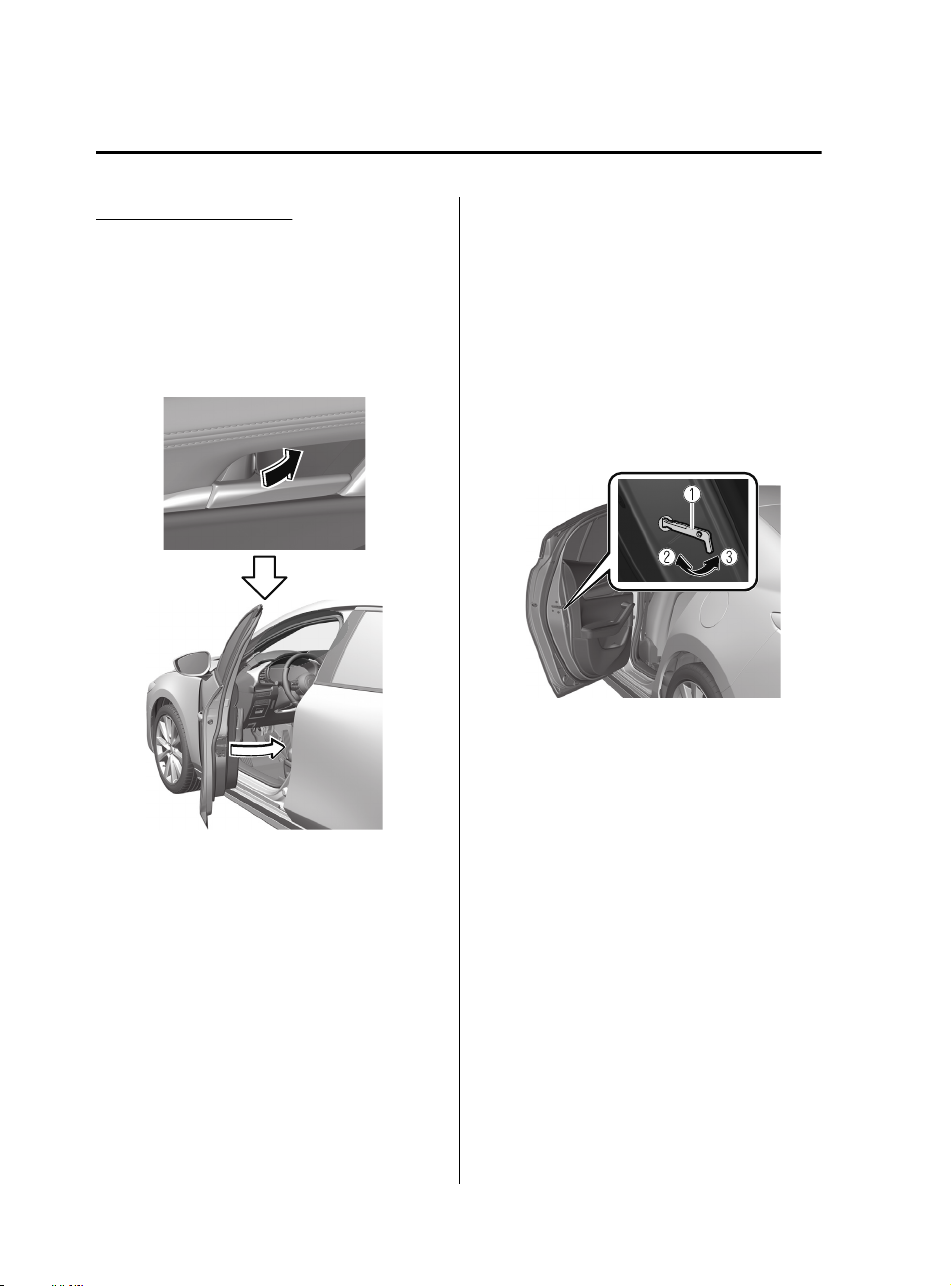
Operation from outside
To lock any door using its door-lock knob
from the outside, press the door-lock knob
to the lock position and close the door
(holding the door handle in the open
position is not required).
This does not operate the other door locks.
NOTE
When locking the door this way:
Be careful not to leave the key inside the
vehicle.
The doors cannot be locked using the
driver's door lock knob if any door is
open when the ignition is switched to
ACC or ON.
▼
Rear Door Child Safety Locks
Rear doors that have been locked using the
child safety lock switched to the lock side
cannot be opened from inside the vehicle.
For child safety, switch the child safety
lock on both rear doors to the lock side.
When opening a rear door with the child
safety lock switched to the lock side, pull
the outer door handle with the lock knob
inside the vehicle switched to the unlock
side.
1. Auxiliary key (page 3-2)
2. Lock
3. Unlock
Before Driving
Doors and Locks
3-18
Mazda3_8HZ1-EA-19G_Edition1_old 2019-5-17 13:49:03
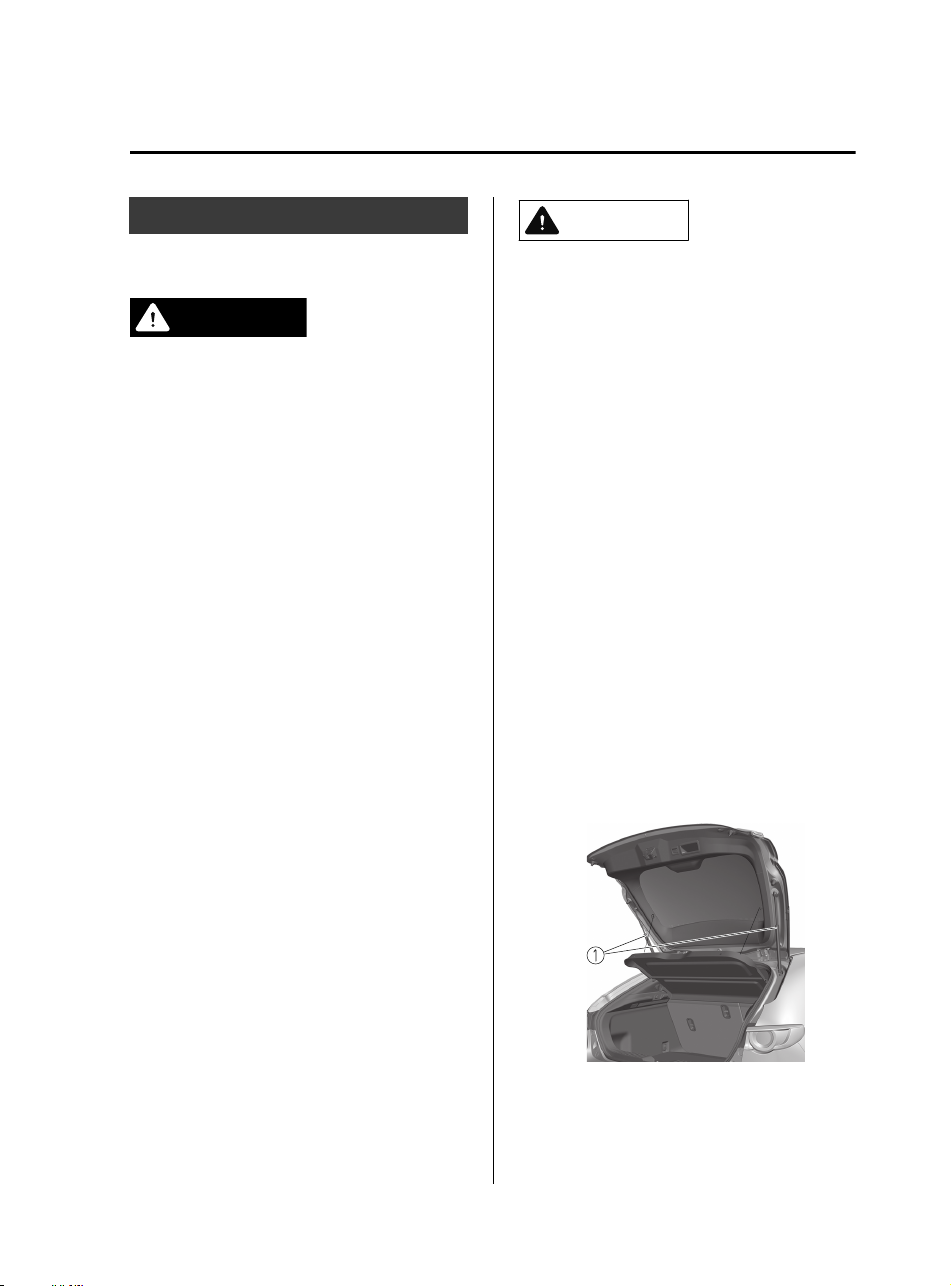
Liftgate/Trunk Lid
▼
Liftgate/Trunk Lid
WARNING
Never allow a person to ride in the luggage
compartment/trunk:
Allowing a person to ride in the luggage
compartment/trunk is dangerous. The
person in the luggage compartment/trunk
could be seriously injured or killed during
sudden braking or a collision.
Do not drive with the liftgate/trunk lid
open:
Exhaust gas in the cabin of a vehicle is
dangerous. An open liftgate/trunk lid in a
moving vehicle will cause exhaust gas to be
drawn into the cabin. This gas contains CO
(carbon monoxide), which is colorless,
odorless, and highly poisonous, and it can
cause loss of consciousness and death.
Moreover, an open liftgate/trunk lid could
cause occupants to fall out in an accident.
Do not stack or leave loaded luggage
unsecured in the luggage compartment:
Otherwise, the luggage may move or
collapse, resulting in injury or an accident.
In addition, do not load luggage higher
than the seatbacks. It may aect the side or
rear eld of view.
CAUTION
Before opening the liftgate/trunk lid,
remove any snow and ice accumulation
on it. Otherwise, the liftgate/trunk lid
could close under the weight of the snow
and ice resulting in injury.
Be careful when opening/closing the
liftgate/trunk lid during strong winds. If a
strong gust blows against the liftgate/
trunk lid, it could close suddenly resulting
in injury.
Fully open the liftgate/trunk lid and
make sure that it stays open. If the
liftgate/trunk lid is only opened partially,
it could slam shut by vibration or wind
gusts resulting in injury.
When loading or unloading luggage in
the luggage compartment/trunk, turn o
the engine. Otherwise, you could get
burned by the heat of the exhaust gas.
Be careful not to apply excessive force to
the damper stay on the liftgate such as
by putting your hand on the stay.
Otherwise, the damper stay may bend
and
aect
the liftgate operation.
1. Damper stay
Before Driving
Doors and Locks
3-19
Mazda3_8HZ1-EA-19G_Edition1_old 2019-5-17 13:49:03
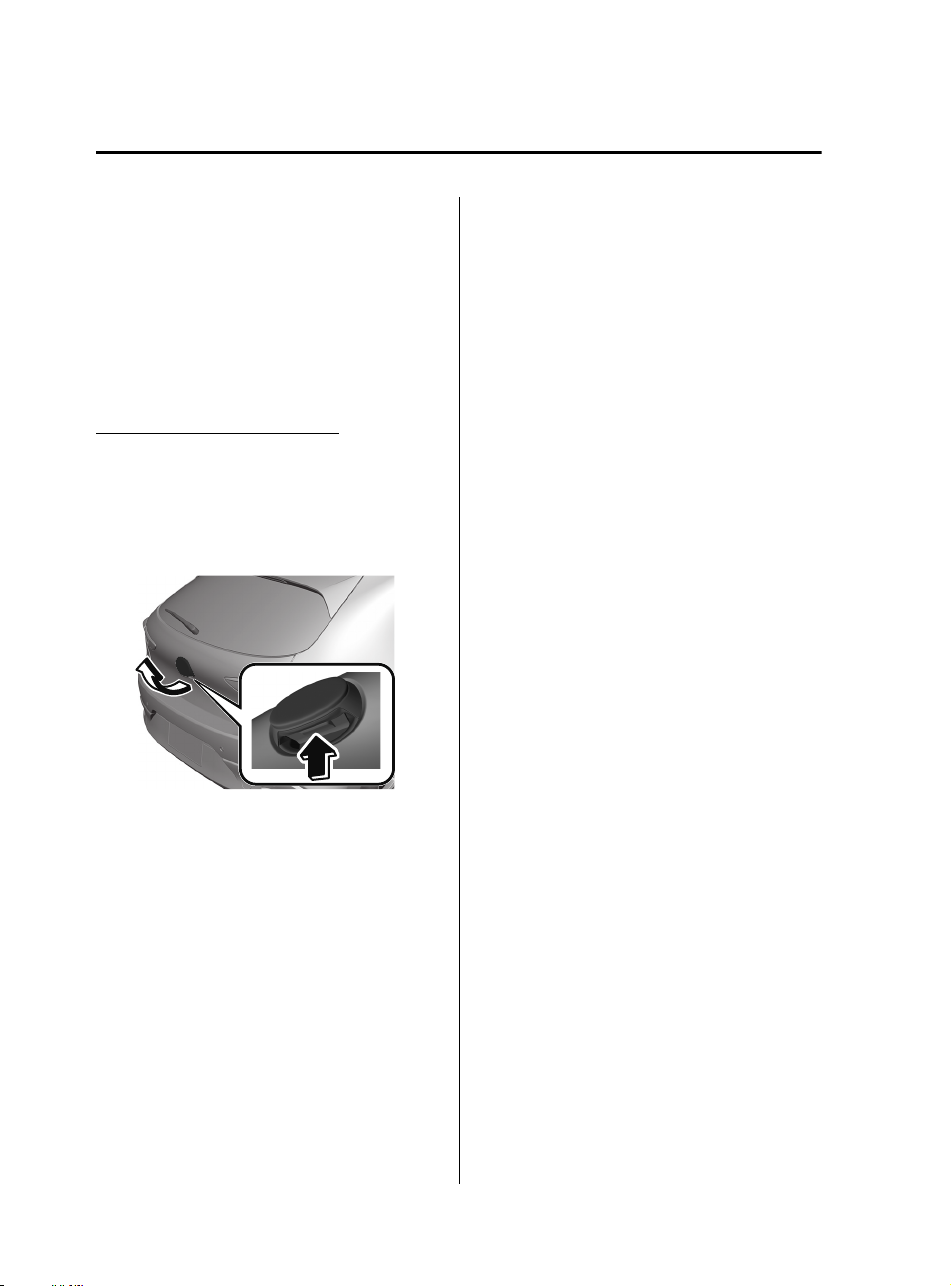
Do not modify or replace the liftgate
damper stay. Consult an Authorized
Mazda Dealer if a liftgate damper stay is
deformed or damaged for reasons such
as a collision or if there is some other
problem.
▼
Opening and Closing the Liftgate/
Trunk Lid
Opening the liftgate (5–door)
Using the electric liftgate opener
Unlock the doors and liftgate, then press
the electric liftgate opener on the liftgate
and raise the liftgate when the latch
releases.
NOTE
(With the advanced keyless function)
A locked liftgate can also be opened
while the key is being carried.
When opening the liftgate with the doors
and the liftgate locked, it may require a
few seconds for the liftgate latch to
release after the electric liftgate opener
is pressed.
The liftgate can be closed when the
doors are locked with the key left in the
vehicle. However, to prevent locking the
key in the vehicle, the liftgate can be
opened by pressing the electric liftgate
opener. If the liftgate cannot be opened
despite doing this procedure, first push
the liftgate completely closed, then press
the electric liftgate opener to fully open
the liftgate.
When the liftgate latch is released by
pressing the electric liftgate opener, the
liftgate raises slightly. If the liftgate is
not operated for a certain period of
time, the liftgate cannot be raised.
To open
Press the electric liftgate opener again.
To close
To close the liftgate from its slightly
raised position, open it first by pressing
the electric liftgate opener, then close it
after waiting at least 1 second.
If the liftgate is not fully closed, the
driver is notified by a warning indicated
in the instrument cluster.
If the vehicle battery is dead or there is
a malfunction in the electrical system
and the liftgate cannot be unlocked, the
liftgate can be opened by performing the
emergency procedure.
Refer to When Liftgate/Trunk Lid
Cannot be Opened on page 7-46.
Before Driving
Doors and Locks
3-20
Mazda3_8HZ1-EA-19G_Edition1_old 2019-5-17 13:49:03
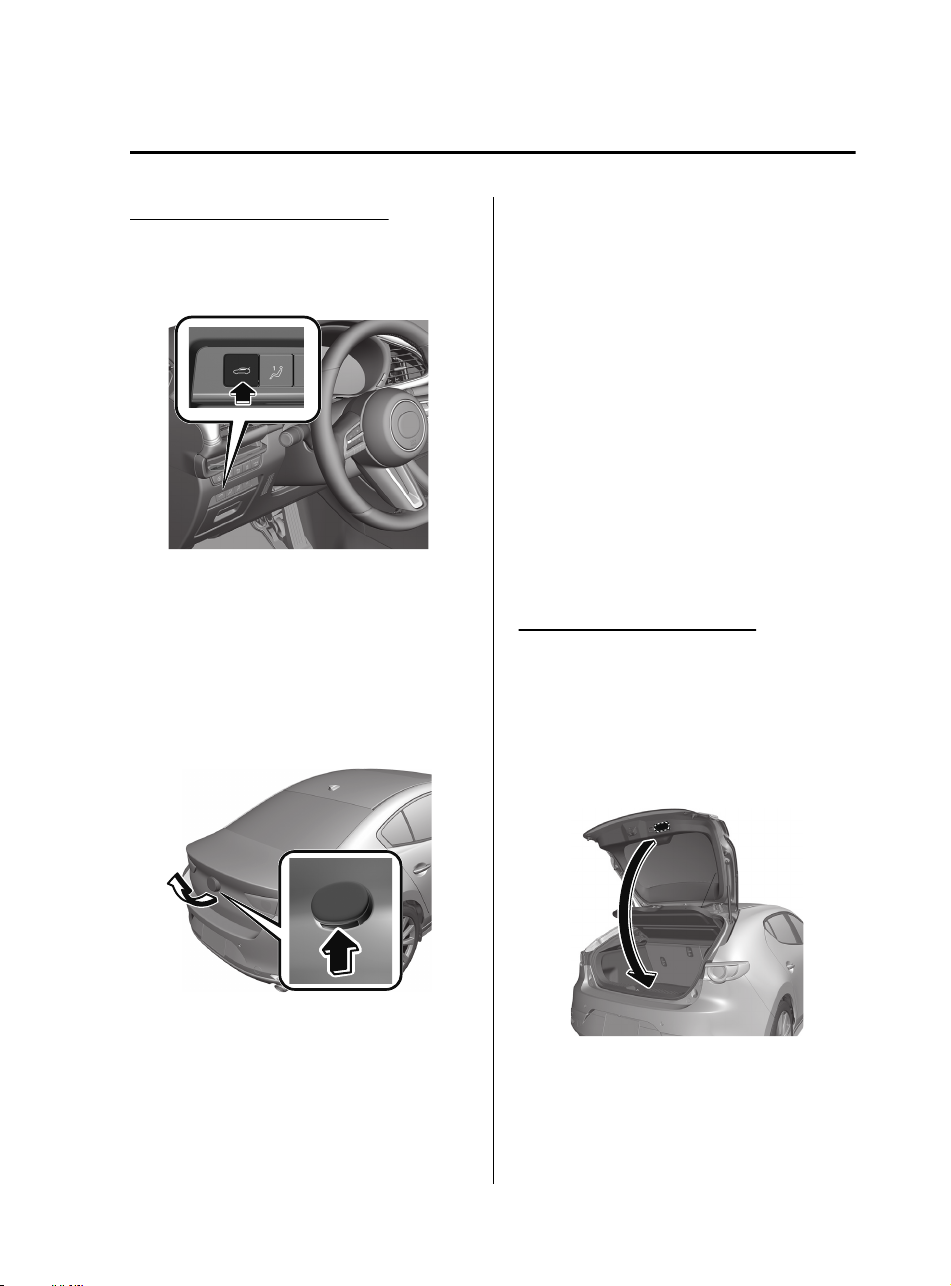
Opening the trunk lid (4–door)
Using the trunk lid release button
Push the trunk lid release button.
Using the electric trunk lid opener
(With the advanced keyless function)
A trunk lid can also be opened while the
key is being carried.
Press the electric trunk lid opener on the
trunk lid, then raise the trunk lid when the
latch releases.
NOTE
When opening the trunk lid with the
doors locked, it may require a few
seconds for the trunk lid latch to release
after the electric trunk lid opener is
pressed.
The trunk lid can be closed when the
doors are locked with the key left in the
vehicle. However, to prevent locking the
key in the vehicle, the trunk lid can be
opened by pressing the electric trunk lid
opener. If the trunk lid cannot be opened
despite doing this procedure, press the
electric trunk lid opener to fully open
the trunk lid after pushing the trunk lid
completely closed.
If the vehicle battery is dead or there is
a malfunction in the electrical system
and the trunk lid cannot be unlocked,
the trunk lid can be opened by
performing the emergency procedure.
Refer to When Liftgate/Trunk Lid
Cannot be Opened on page 7-46.
Closing the liftgate/trunk lid
Lower the liftgate/trunk lid slowly using
the liftgate/trunk lid grip recess, then push
the liftgate/trunk lid closed using both
hands.
Do not slam it. Pull up on the liftgate/
trunk lid to make sure it is secure.
(5–door)
Before Driving
Doors and Locks
3-21
Mazda3_8HZ1-EA-19G_Edition1_old 2019-5-17 13:49:03
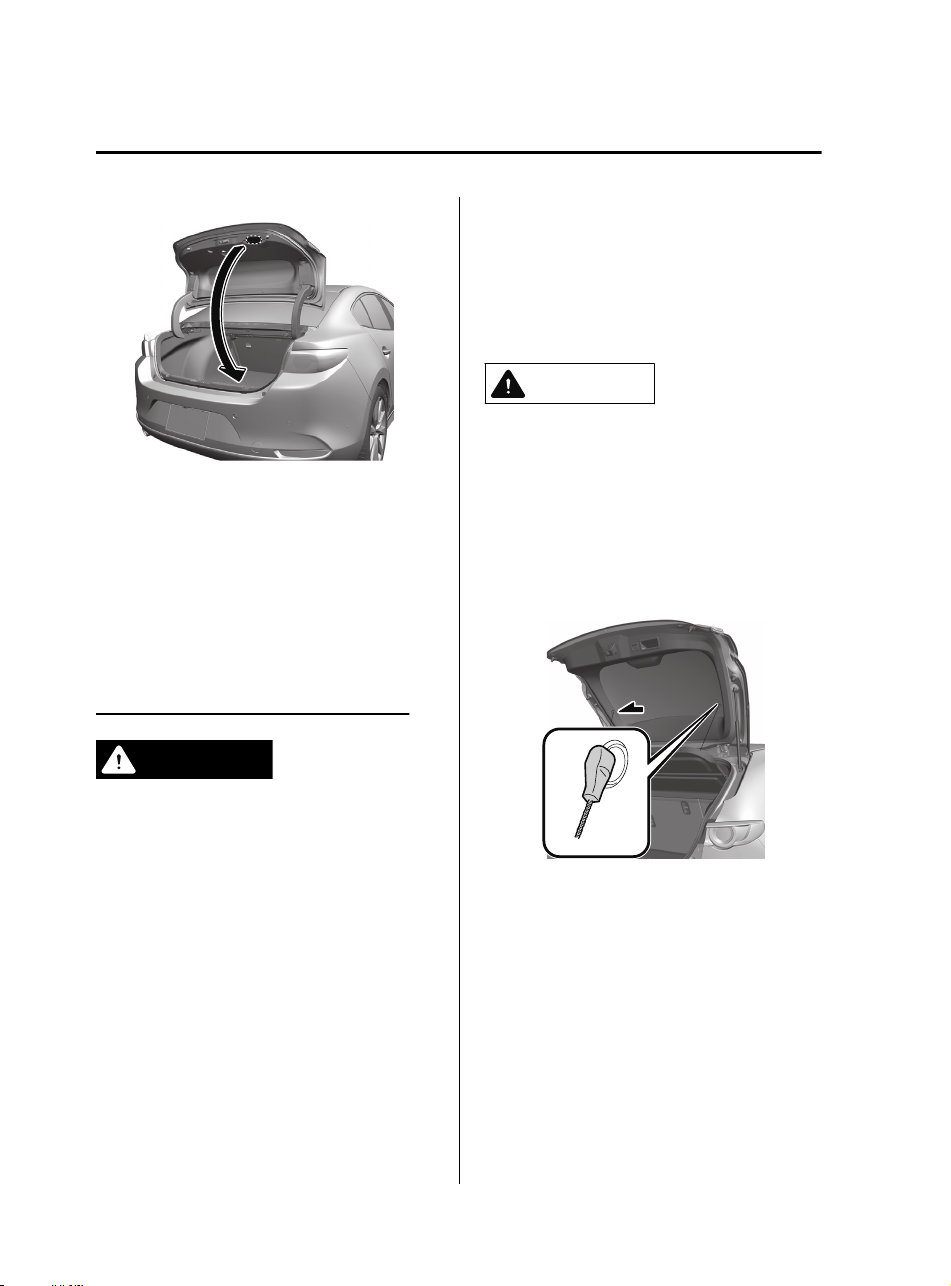
(4–door)
NOTE
Confirm that the liftgate/trunk lid is
securely closed.
The liftgate/trunk lid, move it without
pressing the electric liftgate/trunk lid
opener to verify that the liftgate/trunk lid
has not been left ajar.
▼
Luggage Compartment
Luggage compartment cover (5-door)
WARNING
Do not place anything on top of the cover:
Placing luggage or other cargo on top of
the luggage compartment cover is
dangerous. During sudden braking or a
collision, the cargo could become a
projectile that could hit and injure
someone. The vehicle has a light weight
luggage compartment cover to keep the
contents of your luggage area out of sight;
it will not retain heavy objects that are not
tied down in an accident such as a rollover.
Tie down all heavy objects, whether
luggage or cargo, using the tie down
hooks.
Make sure luggage and cargo are secured
before driving:
Not securing cargo while driving is
dangerous as it could move or be crushed
during sudden braking or a collision and
cause injury.
CAUTION
Make sure the luggage compartment
cover is
rmly
secured. If it is not
rmly
secured, it could unexpectedly disengage
resulting in injury.
The luggage compartment can be accessed
by opening the liftgate when the straps are
attached to the sides of the liftgate.
Before Driving
Doors and Locks
3-22
Mazda3_8HZ1-EA-19G_Edition1_old 2019-5-17 13:49:03
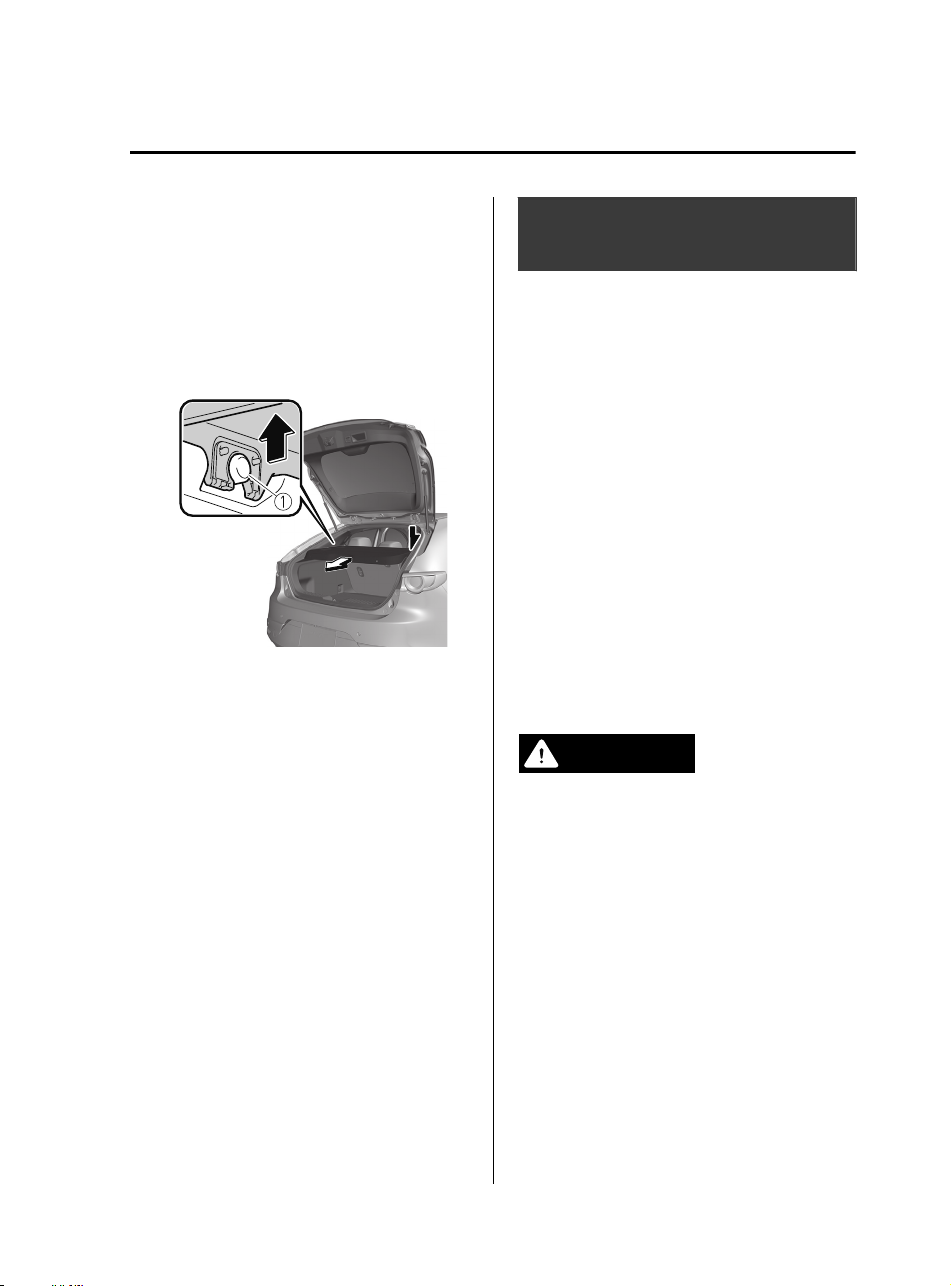
Removing the luggage compartment
cover
This cover can be removed for more room.
1. Remove the straps from the hooks.
2. Press the luggage compartment cover
upward from near the pins and remove
the luggage compartment cover from
the pins.
1. Pin
3. Lift the front end of the luggage
compartment cover and remove it.
Inside Trunk Release
Lever (4-door)
*
▼
Inside Trunk Release Lever
Your vehicle is equipped with an inside
trunk release lever that provides a means
of escape for children and adults in the
event they become locked inside the trunk.
No matter how careful adults might be
with keys and locking their cars, parents
should be aware that children may be
tempted to play around vehicles and use
the trunk as a hiding place.
Adults are advised to familiarize
themselves with the operation and location
of the inside trunk release lever so that all
children can be told about it in an
appropriate way, keeping in mind that
most vehicles do not have such levers.
WARNING
Close the trunk lid, be sure the seat backs
are latched and do not allow children to
play inside the vehicle:
Leaving the trunk lid open or leaving
children in the vehicle with the keys is
dangerous. Children could open the trunk
lid and climb inside resulting in possible
injury or death from heat exposure.
Before Driving
Doors and Locks
*Some models.
3-23
Mazda3_8HZ1-EA-19G_Edition1_old 2019-5-17 13:49:03
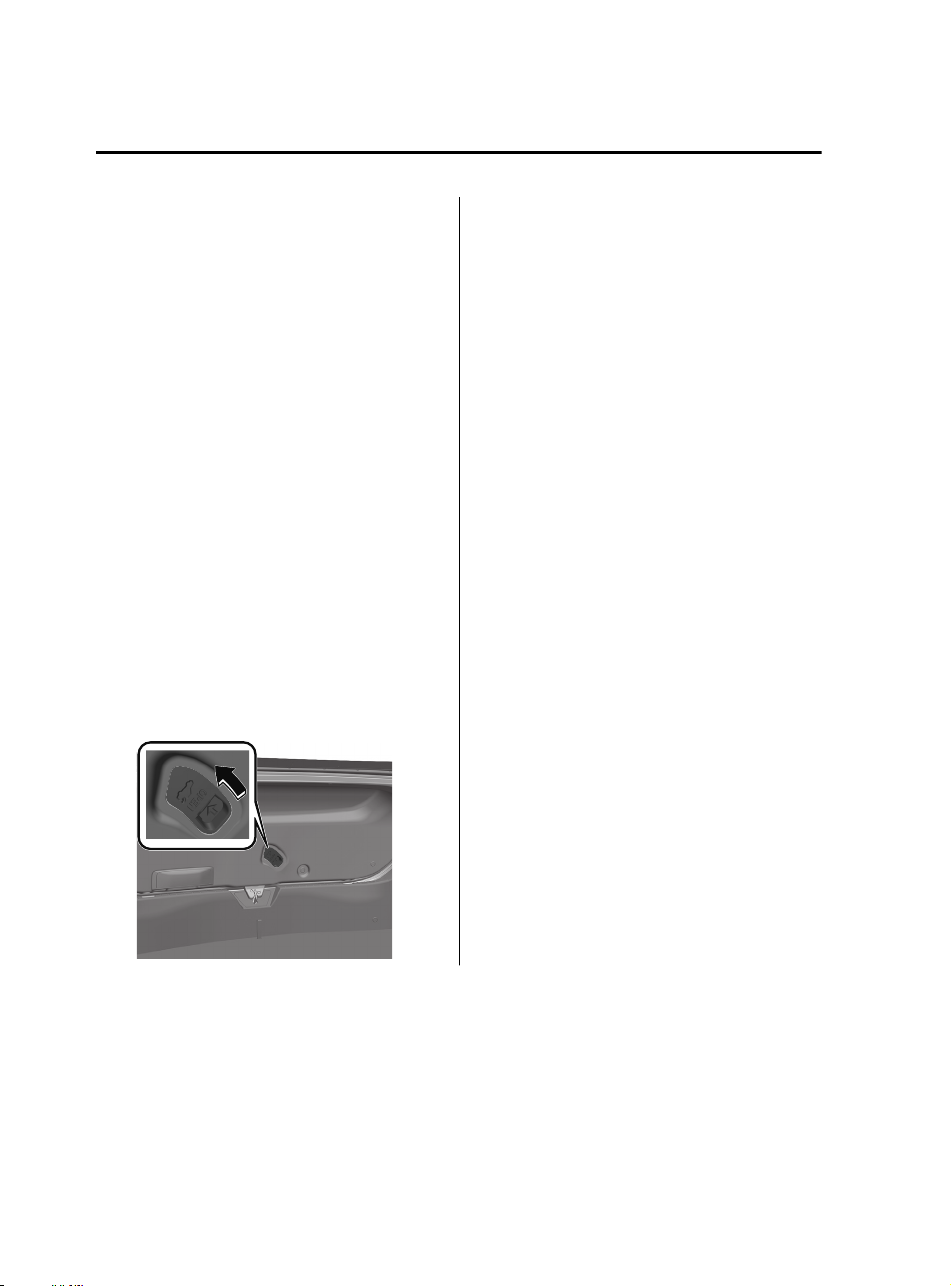
Always keep the car from being a tempting
place to play by latching the rear seats,
doors and the trunk, and keeping the keys
where children can not play with them:
Leaving children or animals unattended in
a parked vehicle is dangerous. Babies left
sleeping and children who lock themselves
in cars or trunks can die very quickly from
heat prostration. Do not leave your
children or pets alone in a car at any time.
Do not leave the car, the rear folding seats
or the trunk unlocked.
▼
Opening the Trunk Lid from the
Inside
Slide the inside trunk release lever in the
direction of the arrow. The lever is made
of material that will glow for hours in the
darkness of the trunk following a brief
exposure to ambient light.
The inside trunk release lever is located on
the inside of the trunk lid.
Before Driving
Doors and Locks
3-24
Mazda3_8HZ1-EA-19G_Edition1_old 2019-5-17 13:49:03
Fuel and Engine Exhaust Precautions
▼
Fuel Requirements
Vehicles with catalytic converters or oxygen sensors must use ONLY UNLEADED FUEL,
which will reduce exhaust emissions and keep spark plug fouling to a minimum.
To achieve maximum engine performance, use the specified fuel.
Fuel
Octane Rating
*1
(Anti-knock index)
Regular unleaded fuel 87 [(R+M)/2 method] or above (91 RON or above)
*
1 U.S. federal law requires that octane ratings be posted on gas station pumps.
Fuel with a rating lower than 87 octane (91 RON) will negatively affect the emission control
system performance and could also cause engine knocking and serious engine damage.
CAUTION
USE ONLY UNLEADED FUEL.
Leaded fuel is harmful to the catalytic converter and oxygen sensors and will lead to
deterioration of the emission control system and or failures.
This vehicle can only use oxygenated fuels containing no more than 10 % ethanol by
volume. Damage to the vehicle may occur when ethanol exceeds this recommendation, or
if the gasoline contains any methanol. Stop using gasohol of any kind if your vehicle engine
is performing poorly.
Never add fuel system additives other than a Mazda genuine product, otherwise the
emission control system could be damaged. Consult an Authorized Mazda Dealer for
details.
Gasoline blended with oxygenates such as alcohol or ether compounds are generally
referred to as oxygenated fuels. The common gasoline blend that can be used with your
vehicle is ethanol blended at no more than 10 %. Gasoline containing alcohol, such as
ethanol or methanol, may be marketed under the name "Gasohol".
Vehicle damage and drivability problems resulting from the use of the following may not be
covered by the warranty.
Gasohol containing more than 10 % ethanol.
Gasoline or gasohol containing methanol.
Leaded fuel or leaded gasohol.
Before Driving
Fuel and Emission
3-25
Mazda3_8HZ1-EA-19G_Edition1_old 2019-5-17 13:49:03
▼
Emission Control System
This vehicle is equipped with an emission
control system (the catalytic converter is
part of this system) that enables the
vehicle to comply with existing exhaust
emissions requirements.
WARNING
Never park over or near anything
ammable:
Parking over or near anything
ammable,
such as dry grass, is dangerous. Even with
the engine turned o, the exhaust system
remains very hot after normal use and
could ignite anything ammable. A
resulting
re
could cause serious injury or
death.
CAUTION
Ignoring the following precautions could
cause lead to accumulate on the catalyst
inside the converter or cause the converter
to get very hot. Either condition will
damage the converter and cause poor
performance.
USE ONLY UNLEADED FUEL.
Do not drive your Mazda with any sign of
engine malfunction.
Do not coast with the ignition switched
o.
Do not descend steep grades in gear with
the ignition switched o.
Do not operate the engine at high idle for
more than 2 minutes.
Do not tamper with the emission control
system. All inspections and adjustments
must be made by a qualied technician.
Do not push-start or pull-start this
vehicle.
NOTE
Under U.S. federal law, any
modification to the original-equipment
emission control system before the first
sale and registration of a vehicle is
subject to penalties. In some states, such
modification made on a used vehicle is
also subject to penalties.
While the engine is off, the sound of a
valve opening and closing can be heard
at the rear of the vehicle, however this
does not indicate an abnormality. The
vehicle has a self-checking device and it
operates while the engine is off.
▼
Engine Exhaust (Carbon monoxide)
WARNING
Do not drive your vehicle if you smell
exhaust gas inside the vehicle:
Engine exhaust gas is dangerous. This gas
contains carbon monoxide (CO), which is
colorless, odorless, and poisonous. When
inhaled, it can cause loss of consciousness
and death. If you smell exhaust gas inside
the vehicle, keep all windows fully open
and contact an Authorized Mazda Dealer
immediately.
Before Driving
Fuel and Emission
3-26
Mazda3_8HZ1-EA-19G_Edition1_old 2019-5-17 13:49:03
Do not run the engine when inside an
enclosed area:
Running the engine inside an enclosed
area, such as a garage, is dangerous.
Exhaust gas, which contains poisonous
carbon monoxide, could easily enter the
cabin. Loss of consciousness or even death
could occur.
Open the windows or adjust the heating or
cooling system to draw fresh air when
idling the engine:
Exhaust gas is dangerous. When the vehicle
is stopped with the windows closed and the
engine running for a long time even in an
open area, exhaust gas, which contains
poisonous carbon monoxide, could enter
the cabin. Loss of consciousness or even
death could occur.
Clear snow from underneath and around
your vehicle, particularly the tail pipe,
before starting the engine:
Running the engine when a vehicle is
stopped in deep snow is dangerous. The
exhaust pipe could be blocked by the snow,
allowing exhaust gas to enter the cabin.
Because exhaust gas contains poisonous
carbon monoxide, it could cause loss of
consciousness or even death to occupants
in the cabin.
Fuel-Filler Lid and Cap
▼
Fuel-Filler Lid and Cap
WARNING
When removing the fuel-ller cap, loosen
the cap slightly and wait for any hissing to
stop, then remove it:
Fuel spray is dangerous. Fuel can burn skin
and eyes and cause illness if ingested. Fuel
spray is released when there is pressure in
the fuel tank and the
fuel-ller
cap is
removed too quickly.
Before refueling, stop the engine, and
always keep sparks and ames away from
the ller neck:
Fuel vapor is dangerous. It could be ignited
by sparks or ames causing serious burns
and injuries.
Additionally, use of the incorrect fuel-ller
cap or not using a fuel-ller cap may result
in a fuel leak, which could result in serious
burns or death in an accident.
Do not continue refueling after the fuel
pump nozzle shuts o automatically:
Continuing to add fuel after the fuel pump
nozzle has shut o automatically is
dangerous because overlling the fuel tank
may cause fuel overow or leakage. Fuel
overow and leakage could damage the
vehicle and if the fuel ignites it could cause
a re and explosion resulting in serious
injury or death.
Before Driving
Fuel and Emission
3-27
Mazda3_8HZ1-EA-19G_Edition1_old 2019-5-17 13:49:03
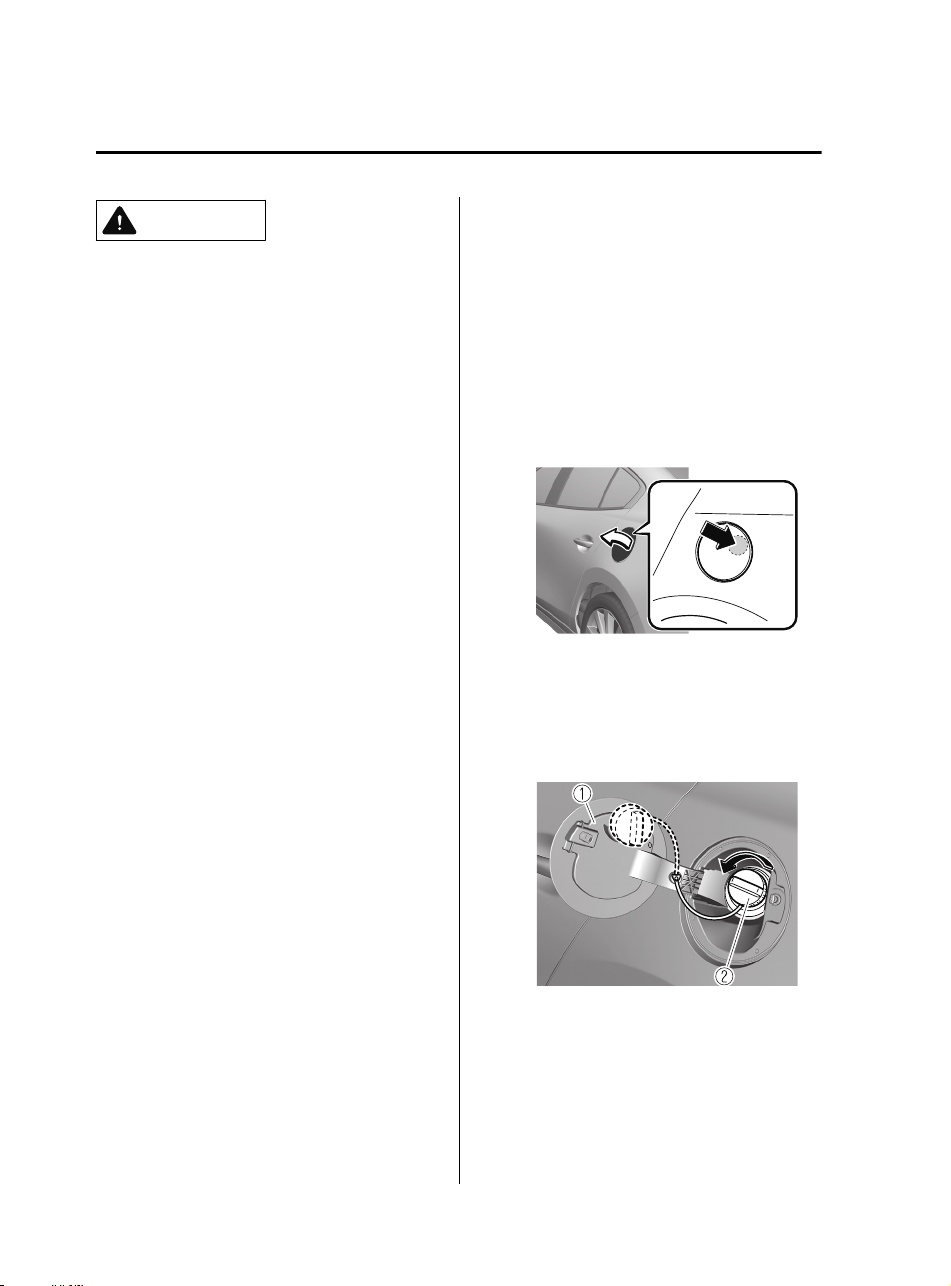
CAUTION
Always use only a genuine Mazda
fuel-ller cap or an approved equivalent,
available at an Authorized Mazda
Dealer. The wrong cap can result in a
serious malfunction of the fuel and
emission control systems.
(U.S.A. and Canada)
It may also cause the check engine light
in the instrument cluster to illuminate.
When using an automatic car wash or a
high water pressure car wash, lock the
driver's door. Otherwise, the fuel-ller lid
may open unexpectedly and could be
damaged.
▼
Refueling
Before refueling, close all the doors,
windows, and liftgate/trunk lid, and switch
the ignition OFF.
1. Using the following, unlock the
driver’s door.
Transmitter (page 3-15)
Touch sensor (page 3-13)
Door-lock switch (page 3-15)
Auto lock/unlock function (page
3-17)
NOTE
When unlocking the driver's door,
the fuel lid is also unlocked at the
same time.
When locking the driver's door, the
fuel lid is locked after 90 seconds.
The time until the fuel lid is locked
after locking the driver's door can be
changed.
Refer to the Settings section in the
Mazda Connect Owner's Manual.
However, when the driver's door is
locked using the following functions,
the fuel lid is also locked at the same
time.
Auto lock/unlock function (page
3-17)
Auto re-lock function (page 3-5,
3-13)
2. Press the location shown in the
illustration and open the fuel lid.
3. To remove the fuel-filler cap, turn it
counterclockwise.
4. Attach the removed cap to the inner
side of the fuel-filler lid.
4–door
1. Fuel-filler lid
2. Fuel-filler cap
Before Driving
Fuel and Emission
3-28
Mazda3_8HZ1-EA-19G_Edition1_old 2019-5-17 13:49:03
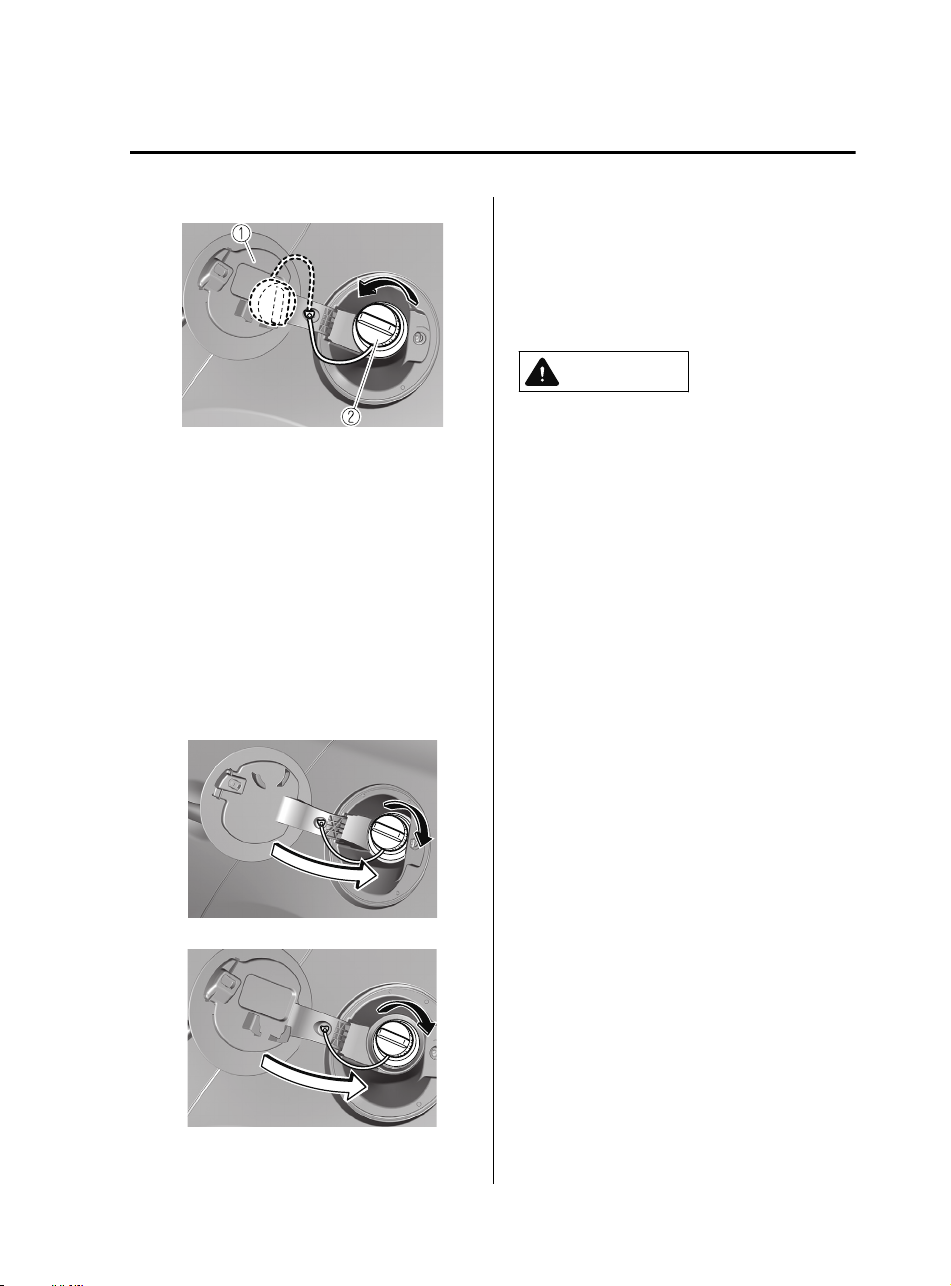
5–door
1. Fuel-filler lid
2. Fuel-filler cap
5. Insert the refueling nozzle all the way
and begin refueling. Pull out the
refueling nozzle after the refueling
stops automatically.
6. To close the fuel-filler cap, turn it
clockwise until a click is heard.
7. To close, press the fuel-filler lid until a
click sound is heard.
4–door
5–door
8. Make sure to lock all the doors when
leaving the vehicle.
NOTE
Lock the doors after closing the
fuel-filler lid.
If the fuel-filler lid is closed after
locking the doors, the fuel-filler lid
cannot be locked.
CAUTION
(U.S.A. and Canada)
If the check fuel cap warning light
illuminates, the fuel-ller cap may not be
properly installed. If the warning light
illuminates, park your vehicle safely o the
right-of-way, remove the
fuel-ller
cap and
reinstall it correctly. After the cap has been
correctly installed, the fuel cap warning
light may continue to illuminate until a
number of driving cycles have been
completed. A drive cycle consists of starting
the engine (after four or more hours with
the engine o) and driving the vehicle on
city and highway roads.
Continuing to drive with the check fuel cap
warning light illuminated could cause the
check engine light to illuminate as well.
Before Driving
Fuel and Emission
3-29
Mazda3_8HZ1-EA-19G_Edition1_old 2019-5-17 13:49:03
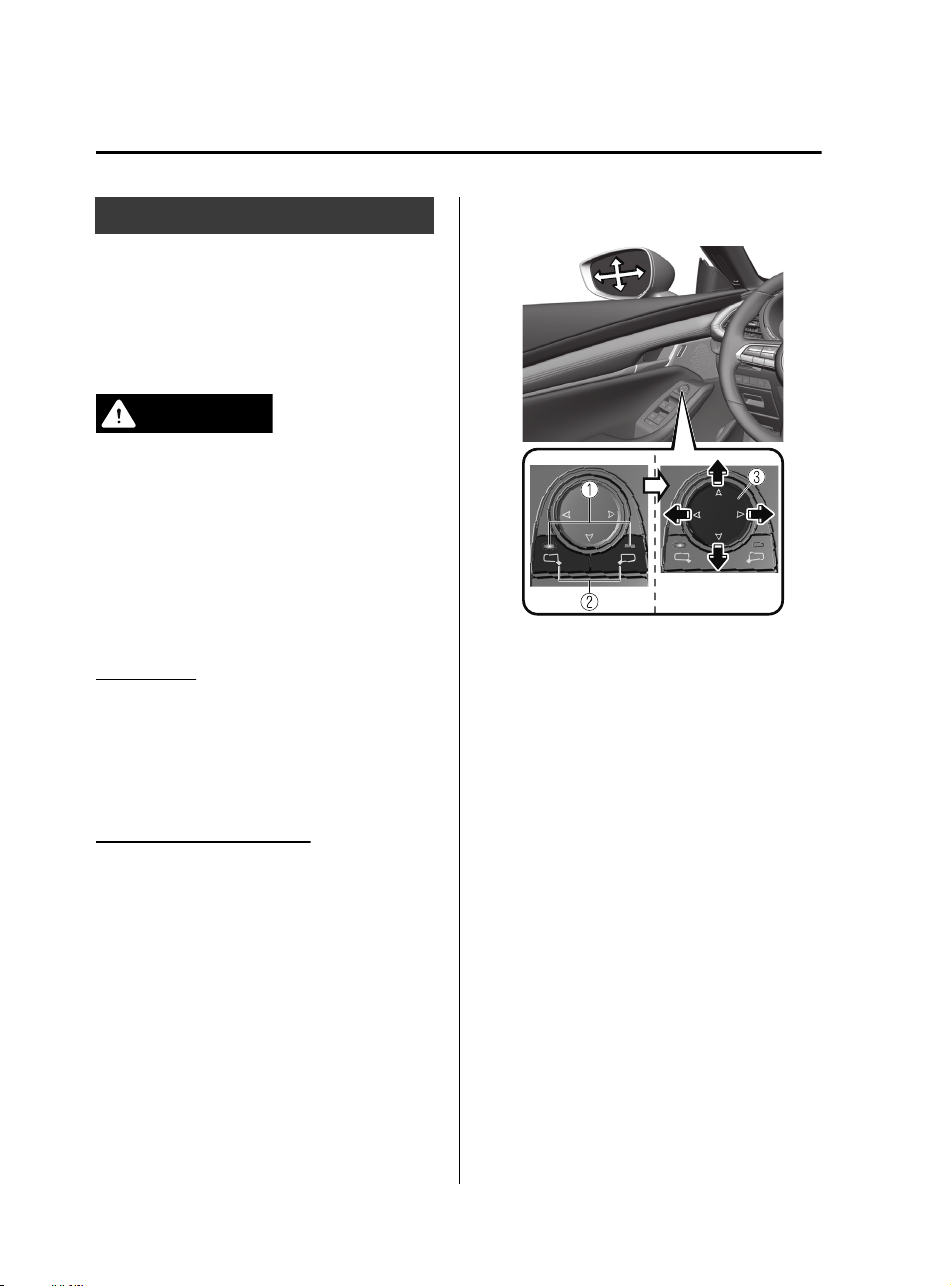
Mirrors
▼
Mirrors
Before driving, adjust the inside and
outside mirrors.
▼
Outside Mirrors
WARNING
Be sure to look over your shoulder before
changing lanes:
Changing lanes without taking into
account the actual distance of the vehicle
in the convex mirror is dangerous. You
could have a serious accident. What you
see in the convex mirror is closer than it
appears.
Mirror type
Flat type (driver's side)
Flat surface mirror.
Convex type (front passenger side)
The mirror has single curvature on its
surface.
Power mirror adjustment
The ignition must be switched to ACC or
ON position.
To adjust:
1. Press the select switch for the outside
mirror to be adjusted to turn on the
indicator light.
2. Press the adjustment switch to adjust
the angle of the outside mirror.
1. Indicator light
2. Select switch
3. Adjustment switch
After adjusting the angle of the outside
mirror, press the select switch for the
outside mirror to be adjusted to turn off
the indicator light.
NOTE
(With driving position memory function)
The on-road outside mirror position can
be programmed in conjunction with the
driving position memory function.
Refer to Driving Position Memory on page
2-10.
Before Driving
Mirrors
3-30
Mazda3_8HZ1-EA-19G_Edition1_old 2019-5-17 13:49:03
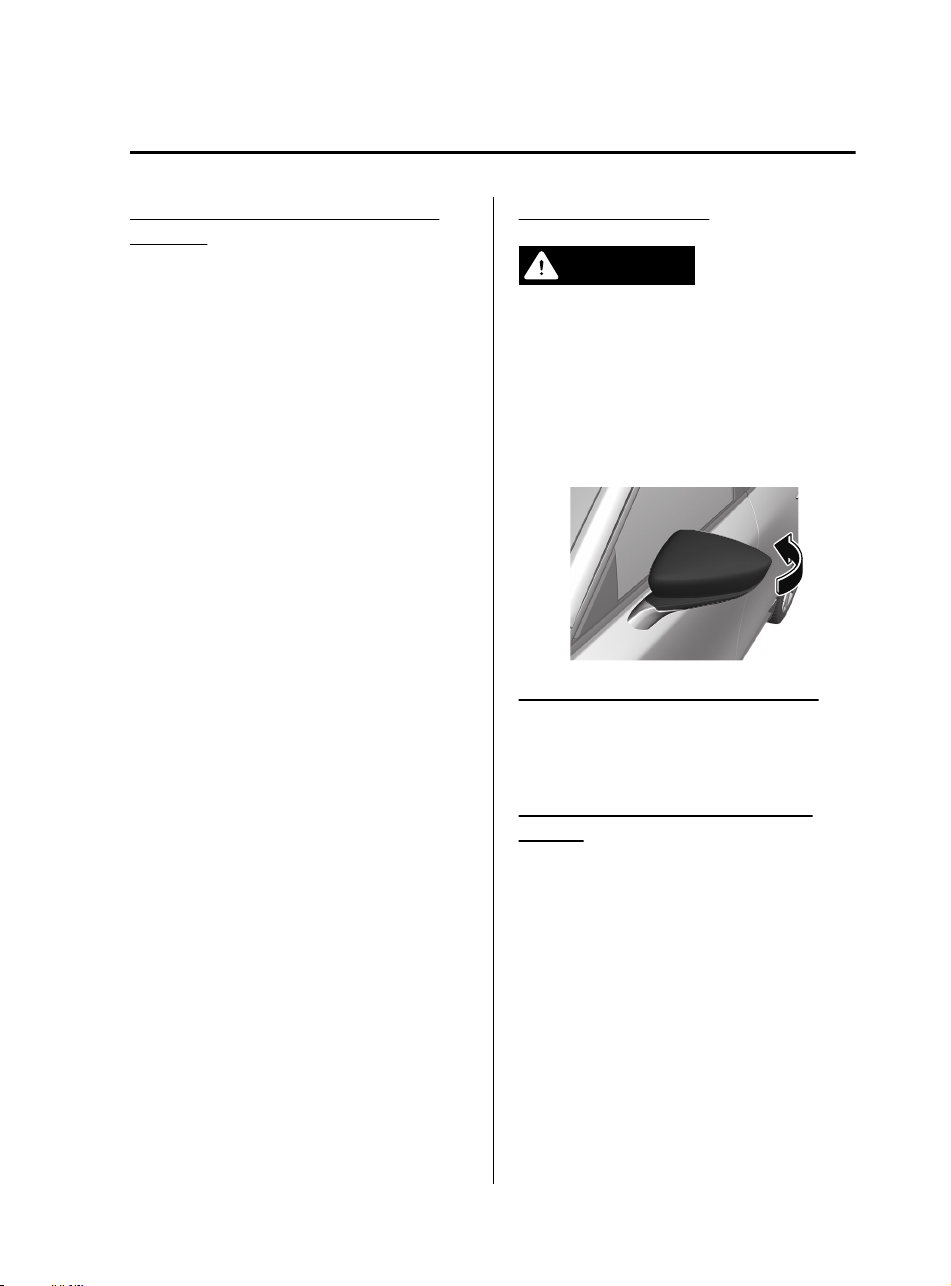
Power mirrors with reverse tilt down
function
*
The outside mirrors tilt downward to
facilitate the view of the lower area on
each side of the vehicle.
1. Switch the ignition ON.
2. Press the select switch for the outside
mirror to be tilted downward to turn on
the indicator light of the select switch.
3. Shift the shift lever/selector lever to
the R position to tilt the outer mirror
on the side where the select button was
pressed downward.
NOTE
When any of the following condition is
met, the outer mirrors return to their
normal positions.
The ignition is switched to a position
other than ON.
The shift lever/selector lever is shifted to
a position other than R.
The select switch is pressed again.
Folding outside mirror
WARNING
Always return the outside mirrors to the
driving position before you start driving:
Driving with the outside mirrors folded in is
dangerous. Your rear view will be
restricted, and you could have an accident.
Manually fold the outside mirror rearward
until it is flush with the vehicle.
Engine-off outside mirror operation
The outside mirrors can be operated for
about 40 seconds after the ignition is
switched from ON to off.
Driver's side auto-dimming outside
mirror
*
The movement of the auto-dimming
outside mirror is interlocked with the
auto-dimming rearview mirror in the
interior to automatically reduce glare from
rear on-coming vehicles.
Refer to Rearview Mirror on page 3-32.
NOTE
The front passenger-side outside mirror
does not have the auto-dimming feature.
Before Driving
Mirrors
*Some models.
3-31
Mazda3_8HZ1-EA-19G_Edition1_old 2019-5-17 13:49:03
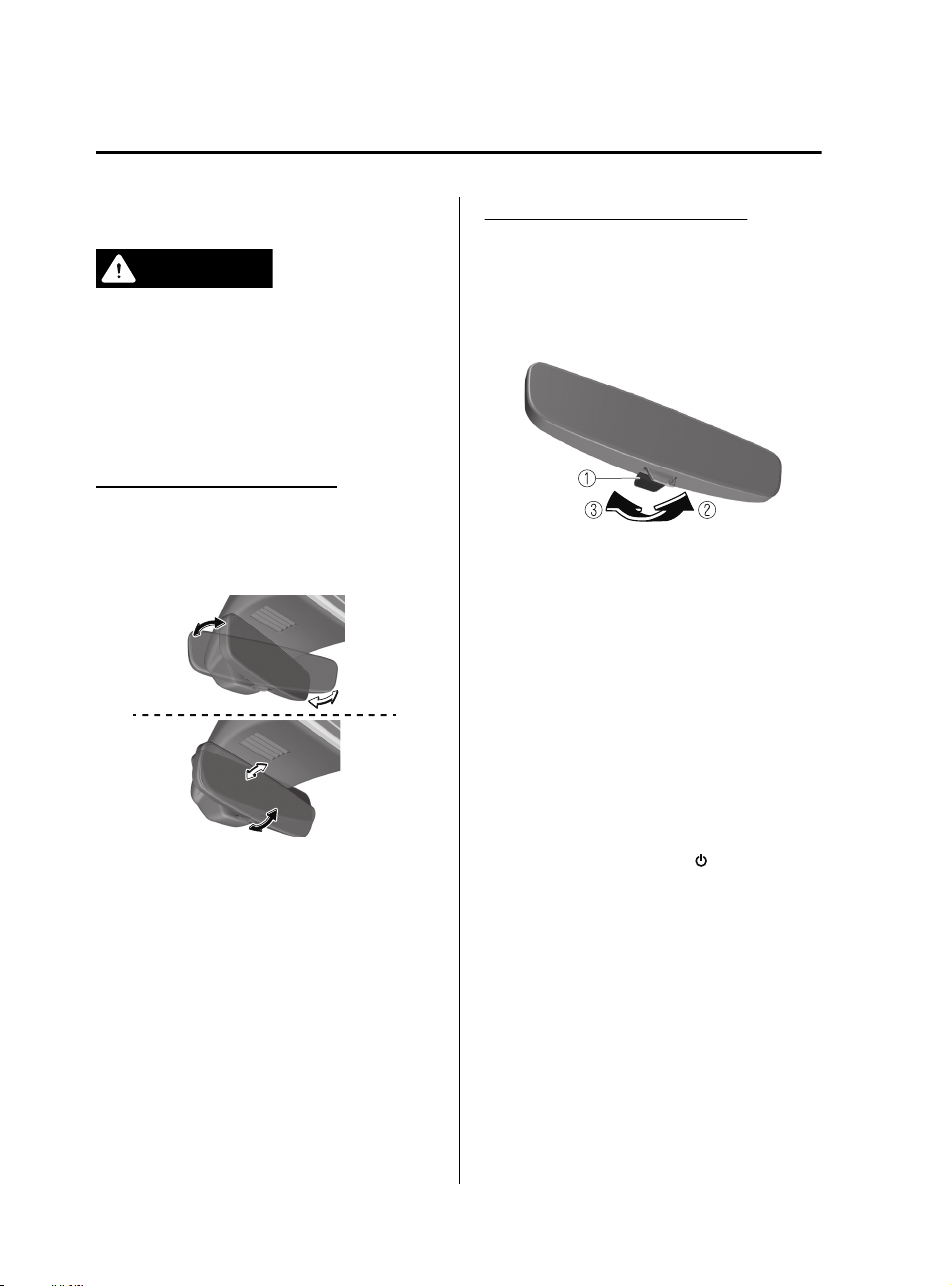
▼
Rearview Mirror
WARNING
Do not stack cargo or objects higher than
the seatbacks:
Cargo stacked higher than the seatbacks is
dangerous. It can block your view in the
rearview mirror, which might cause you to
hit another car when changing lanes.
Rearview mirror adjustment
Before driving, adjust the rearview mirror
to center on the scene through the rear
window.
NOTE
For the manual day/night mirror, perform
the adjustment with the day/night lever in
the day position.
Reducing glare from headlights
Manual day/night mirror
Push the day/night lever forward for day
driving. Pull it back to reduce glare of
headlights from vehicles at the rear.
1. Day/Night lever
2. Night
3. Day
Auto-dimming mirror
The auto-dimming mirror automatically
reduces the glare of headlights from
vehicles at the rear when the ignition is
switched ON.
(With Homelink wireless control
system)
Press the ON/OFF button (
) to cancel the
auto-dimming function. The indicator light
will turn off.
Before Driving
Mirrors
3-32
Mazda3_8HZ1-EA-19G_Edition1_old 2019-5-17 13:49:03
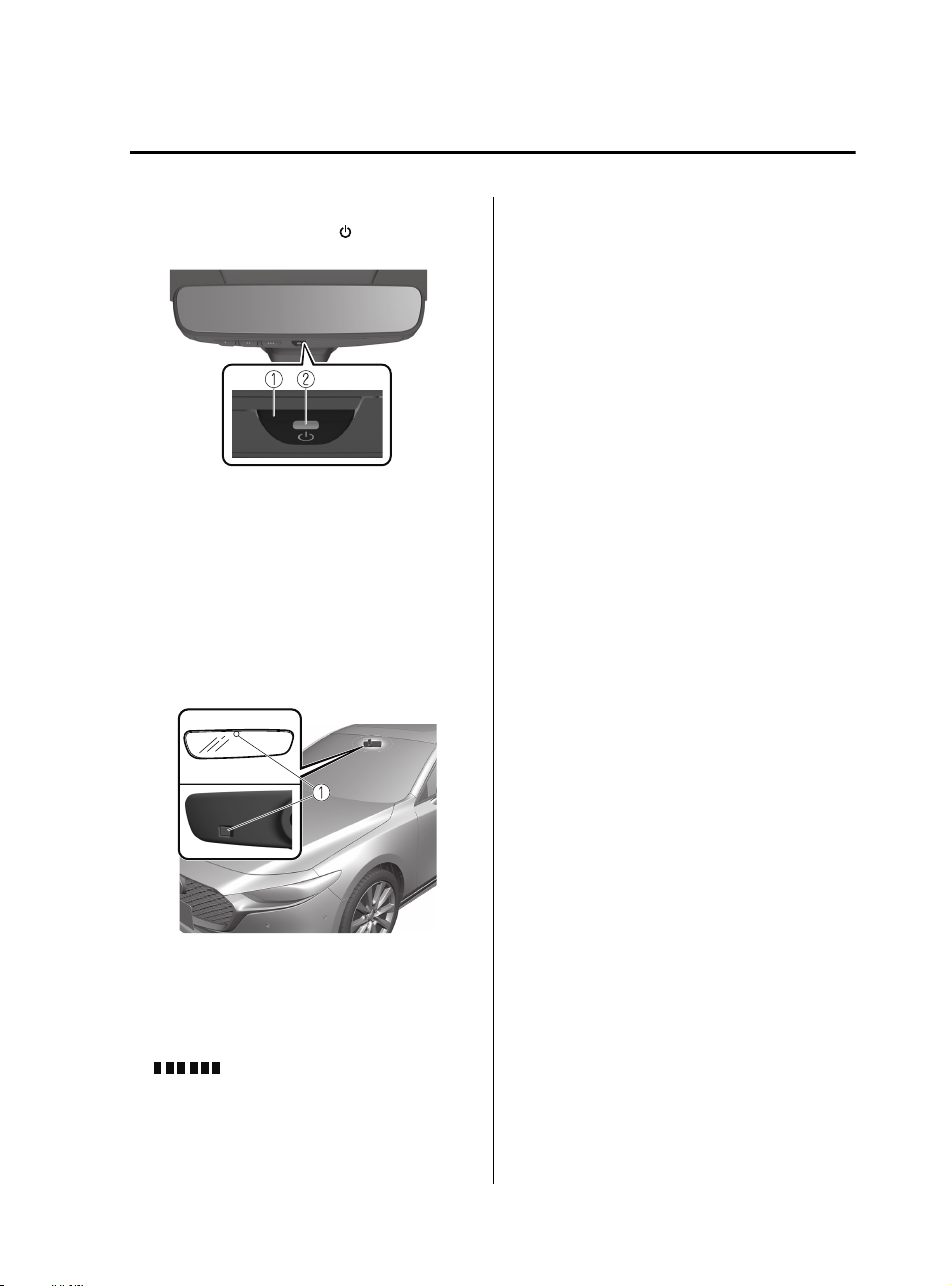
To reactivate the auto-dimming function,
press the ON/OFF button (
). The
indicator light will illuminate.
1. ON/OFF button
2. Indicator light
NOTE
Do not use glass cleaner or suspend
objects on or around the light sensor.
Otherwise, light sensor sensitivity will
be affected and may not operate
normally.
1. Light sensor
(With Homelink wireless control
system)
For information regarding the 3 buttons
(
, , ) on the auto-dimming mirror.
Refer to HomeLink Wireless Control
System on page 4-58.
The auto-dimming function is canceled
when the ignition is switched ON and
the shift lever/selector lever is in the R
position.
Before Driving
Mirrors
3-33
Mazda3_8HZ1-EA-19G_Edition1_old 2019-5-17 13:49:03
Power Windows
▼
Power Windows
The windows can be opened/closed by
operating the power window switches.
WARNING
Make sure the opening is clear before
closing a window:
Closing a power window is dangerous. A
person's hands, head, or even neck could
be caught by the window and result in
serious injury or even death. This warning
applies especially to children.
Never allow children to play with power
window switches:
Power window switches that are not locked
with the power window lock switch would
allow children to operate power windows
unintentionally, which could result in
serious injury if a child's hands, head or
neck becomes caught by the window.
Make sure nothing blocks the window just
before it reaches the fully closed position or
while fully holding up the power window
switch:
Blocking the power window just before it
reaches the fully closed position or while
fully holding up the power window switch
is dangerous.
In this case, the jam-safe function may not
prevent the window from closing all the
way. If ngers are caught, serious injuries
could occur.
Do not let a child put a hand or head out of
the window while driving the vehicle:
If the person's hand or head hits something
outside the vehicle, or sudden braking is
applied, it could result in serious injury or
death.
NOTE
When driving with only 1 of the rear
windows open, your ears might experience
a resonating sound. However, this does not
indicate a problem. The sound can be
reduced by slightly opening a front
window or by changing the size of the rear
window opening.
Before Driving
Windows
3-34
Mazda3_8HZ1-EA-19G_Edition1_old 2019-5-17 13:49:03
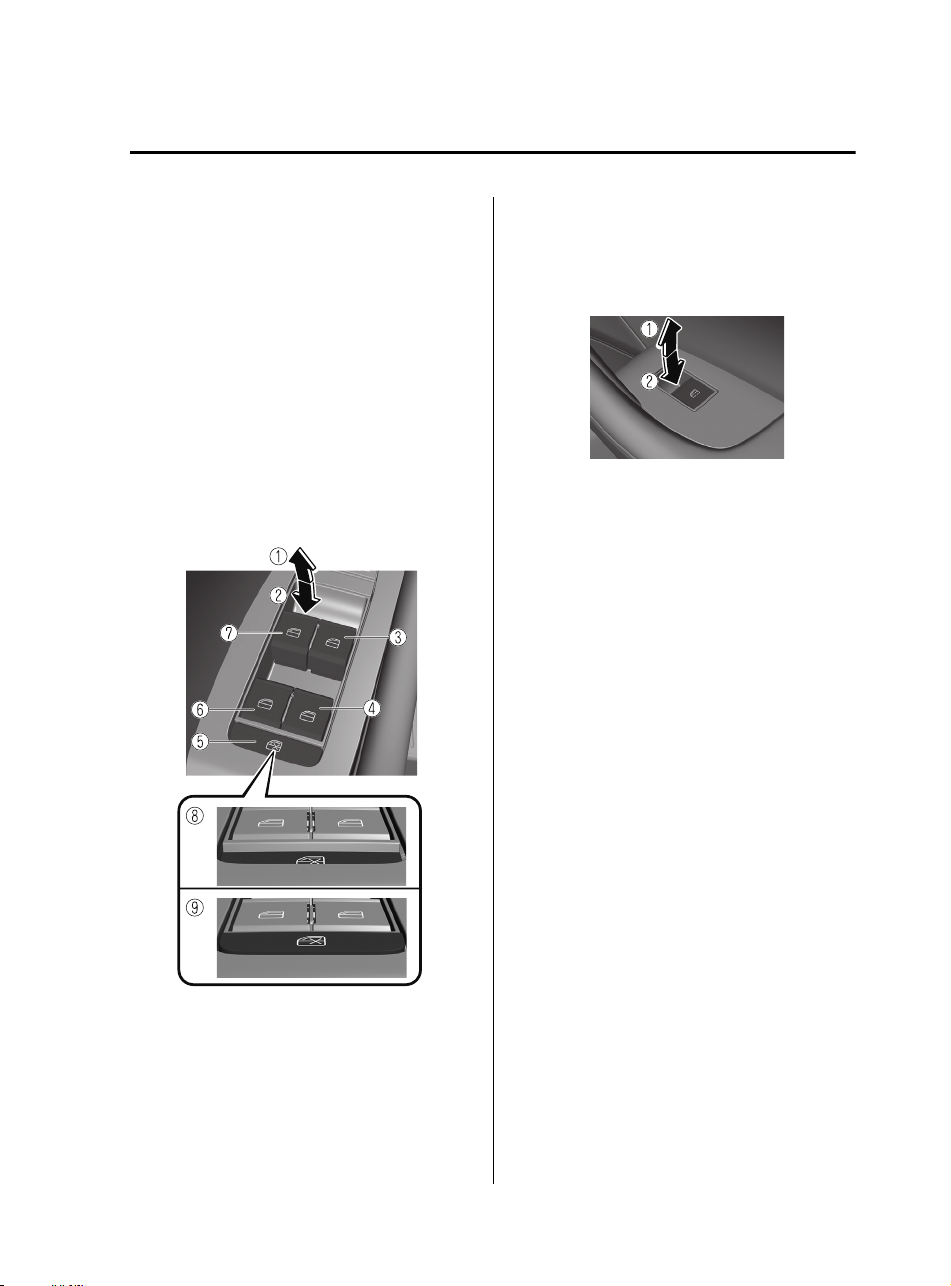
▼
Opening/Closing Windows
The window opens while the switch is
pressed and it closes while the switch is
pulled up with the ignition switched ON.
Do not open or close 3 or more windows
at the same time.
The front passenger's window and rear
windows can be opened/closed when the
power window lock switch on the driver's
door is in the unlocked position. Keep this
switch in the locked position while
children are in the vehicle.
Master control switches
1. Close
2. Open
3. Front passenger's window
4. Right rear window
5. Power window lock switch
6. Left rear window
7. Driver's window
8. Locked position
9. Unlocked position
Front passenger's window switch/Rear
window switches
1. Close
2. Open
NOTE
A power window may no longer open/
close if you continue to press the switch
for a long time. If the power window
does not open/close, wait for a while
and then operate the switch again.
The passenger windows may be opened
or closed using the master control
switches on the driver's door.
The power window can be operated for
about 40 seconds after the ignition is
switched from ON to ACC or off with all
doors closed. If any door is opened, the
power window will stop operating.
Before Driving
Windows
3-35
Mazda3_8HZ1-EA-19G_Edition1_old 2019-5-17 13:49:03

▼
Auto-opening/Closing
To fully open the window automatically,
press the switch completely down, then
release. The window will fully open
automatically.
To fully close the window automatically,
pull the switch completely up, then
release. The window will fully close
automatically.
To stop the window partway, pull or press
the switch in the opposite direction and
then release it.
NOTE
Power window system initialization
procedure
If you operate the switch any number of
times with the power window not fully
closed, the window may no longer fully
open/close automatically.
The power window auto function will only
resume on a power window that has been
reset.
1. Switch the ignition ON.
2. Make sure that the power window lock
switch located on the driver's door is
not depressed.
3. Press the switch and fully open the
window.
4. Pull up the switch to fully close the
window and continue holding the
switch for about 2 seconds after the
window fully closed.
5. Make sure that the power windows
operate correctly using the door
switches.
▼
Jam-safe Window
When the window is closing and a foreign
object is detected between the window and
the window frame, the window stops
closing and automatically opens partway.
NOTE
The jam-safe function may operate
under the following conditions:
A strong impact is detected while the
window is closing.
The window is closing in very low
temperatures.
(A window cannot be closed)
If the jam-safe function has operated
and the window cannot be closed, check
around the window frame for a foreign
object.
If there is no foreign object around the
window frame, forcibly close a window
using the following procedure.
1. After switching the ignition OFF,
wait for 45 seconds or longer.
2. Switch the ignition ON.
3. Operate the switch in the direction to
close the window until the jam-safe
function operates 5 times.
4. Continue pulling up the switch to
fully close the window.
Before Driving
Windows
3-36
Mazda3_8HZ1-EA-19G_Edition1_old 2019-5-17 13:49:03
Moonroof
*
▼
Moonroof
The moonroof can be opened or closed
when operating the overhead tilt/slide
switch at the front seats.
WARNING
Do not let passengers stand up or extend
part of the body through the open
moonroof while the vehicle is moving:
Extending the head, arms, or other parts of
the body through the moonroof is
dangerous. The head or arms could hit
something while the vehicle is moving. This
could cause serious injury or death.
Never allow children to play with the tilt/
slide switch:
The tilt/slide switch would allow children to
operate the moonroof unintentionally,
which could result in serious injury if a
child's hands, head or neck becomes
caught by the moonroof.
Make sure the opening is clear before
closing the moonroof:
A closing moonroof is dangerous. The
hands, head, or even neck of a person,
especially a child, could be caught in it as it
closes, causing serious injury or even death.
Make sure nothing blocks the moonroof
just before it reaches the fully closed
position:
Blocking the moonroof just before it
reaches the closed position is dangerous.
In this case, the jam-safe function cannot
prevent the moonroof from closing. If
ngers are caught, serious injuries could
occur.
CAUTION
Do not sit on or put heavy items on the
area where the moonroof opens and
closes. Otherwise, the moonroof could be
damaged.
Do not open or close the moonroof
forcefully during freezing temperatures
or snowfall. Otherwise, the moonroof
could be damaged.
The sunshade does not tilt. To avoid
damaging the sunshade, do not push it
up.
Do not close the sunshade while the
moonroof is opening. Trying to force the
sunshade closed could damage it.
Before Driving
Windows
*Some models.
3-37
Mazda3_8HZ1-EA-19G_Edition1_old 2019-5-17 13:49:03
▼
Tilt/Slide Operation
The moonroof can be opened or closed
electrically only when the ignition is
switched ON.
Before leaving the vehicle or washing
your Mazda, make sure the moonroof is
completely closed so that water does not
get inside the cabin area.
After washing your Mazda or after it
rains, wipe the water off the moonroof
before operating it to avoid water
penetration which could cause rust and
water damage to your headliner.
1. Tilt/Slide switch
Tilt Operation
The rear of the moonroof can be tilted
open to provide more ventilation.
To fully tilt automatically, momentarily
press the tilt/slide switch.
To fully close automatically, momentarily
press the tilt/slide switch in the forward
direction.
To stop tilting partway, press the tilt/slide
switch.
When the moonroof is already slid open
and you want to tilt it open, first close the
moonroof and then do a tilt operation.
1. Tilt up
2. Close (Tilt down)
Slide Operation
To fully open automatically, momentarily
press the tilt/slide switch in the backward
direction.
To fully close automatically, momentarily
press the tilt/slide switch in the forward
direction.
To stop sliding partway, press the tilt/slide
switch.
When the moonroof is already tilted open
and you want to slide it open, first close
the moonroof and then do a slide
operation.
1. Open
2. Close
Before Driving
Windows
3-38
Mazda3_8HZ1-EA-19G_Edition1_old 2019-5-17 13:49:03
NOTE
If the moonroof does not operate normally,
do the following procedure:
1. Switch the ignition ON.
2. Press the tilt switch, to partially tilt
open the rear of the moonroof.
3. Repeat Step 2. The rear of the
moonroof tilts open to the fully open
position, then closes a little.
If the reset procedure is performed while
the moonroof is in the slide position
(partially open) it will close before the
rear tilt opens.
▼
Jam-safe Moonroof
If a person's hands, head or an object
blocks the moonroof while it is closing,
the moonroof will stop and move in the
open direction.
NOTE
The jam-safe function may operate
under the following conditions:
A strong impact is detected while the
moonroof is closing automatically.
The moonroof is closing automatically
during very low temperatures.
In the event the jam-safe function
activates and the moonroof cannot be
closed automatically, press the tilt/slide
switch and the moonroof will close.
The jam-safe moonroof function does
not operate until the system has been
reset.
▼
Sunshade
The sunshade can be opened and closed by
hand.
The sunshade opens at the same time as
the moonroof slides open, but it must be
closed by hand.
1. Sunshade
Before Driving
Windows
3-39
Mazda3_8HZ1-EA-19G_Edition1_old 2019-5-17 13:49:03
Modification and Add-On
Equipment
▼
Modification and Add-On
Equipment
Mazda cannot guarantee the immobilizer
and the theft-deterrent systems' operation
if the system has been modified or if any
add-on equipment has been installed.
CAUTION
To avoid damage to the vehicle, do not
modify the system or install any add-on
equipment to the immobilizer and the
theft-deterrent systems or the vehicle.
Immobilizer System
▼
Immobilizer System
The immobilizer system allows the engine
to start only with a key the system
recognizes.
If someone attempts to start the engine
with an unrecognized key, the engine will
not start, thereby helping to prevent
vehicle theft.
If you have a problem with the
immobilizer system or the key, consult an
Authorized Mazda Dealer.
CAUTION
Radio equipment like this is governed by
laws in the United States.
Changes or modications not expressly
approved by the party responsible for
compliance could void the user's
authority to operate the equipment.
To avoid damage to the key, do not:
Drop the key.
Get the key wet.
Expose the key to any kind of magnetic
eld.
Expose the key to high temperatures
on places such as the dashboard or
hood, under direct sunlight.
If the engine does not start with the
correct key, and the security indicator
light keeps illuminating or ashing, the
system may have a malfunction. Consult
an Authorized Mazda Dealer.
Before Driving
Security System
3-40
Mazda3_8HZ1-EA-19G_Edition1_old 2019-5-17 13:49:03
NOTE
The keys carry a unique electronic code.
For this reason, and to assure your
safety, obtaining a replacement key
requires some waiting time. They are
only available through an Authorized
Mazda Dealer.
Always keep a spare key in case one is
lost. If a key is lost, consult an
Authorized Mazda Dealer as soon as
possible.
If you lose a key, an Authorized Mazda
Dealer will reset the electronic codes of
your remaining keys and immobilizer
system. Bring all the remaining keys to
an Authorized Mazda Dealer to reset.
Starting the vehicle with a key that has
not been reset is not possible.
▼
Operation
NOTE
The engine may not start and security
indicator light may illuminate or flash if
the key is placed in an area where it is
difficult for the system to detect the
signal, such as on the dashboard or in
the glove compartment. Move the key to
a location within the signal range,
switch the ignition off, and then restart
the engine.
Signals from a TV or radio station, or
from a transceiver or mobile telephone
could interfere with your immobilizer
system. If you are using the proper key
and the engine fails to start, check the
security indicator light.
Arming
The system is armed when the ignition is
switched from ON to off.
The security indicator light in the
instrument cluster flashes every 2 seconds
until the system is disarmed.
Disarming
The system is disarmed when the ignition
is switched ON with the correct
programmed key. The security indicator
light illuminates for about 3 seconds and
then turns off.
If the engine does not start with the correct
key, and the security indicator light
remains illuminated or flashing, try the
following:
Make sure the key is within the
operational range for signal transmission.
Switch the ignition off, and then restart the
engine. If the engine does not start after 3
or more tries, contact an Authorized
Mazda Dealer.
Before Driving
Security System
3-41
Mazda3_8HZ1-EA-19G_Edition1_old 2019-5-17 13:49:03
Theft-Deterrent System
*
▼
Theft-Deterrent System
If the theft-deterrent system detects an
inappropriate entry into the vehicle, which
could result in the vehicle or its contents
being stolen, the alarm alerts the
surrounding area of an abnormality by
sounding the horn and flashing the hazard
warning lights.
The system will not function unless it's
properly armed. So when you leave the
vehicle, follow the arming procedure
correctly.
▼
Operation
System triggering conditions
The horn sounds intermittently and the
hazard warning lights flash for about 30
seconds when the system is triggered by
any one of the following:
Unlocking a door with the auxiliary key,
door lock switch, or an inside door-lock
knob.
Forcing open a door, the hood or the
liftgate/trunk lid.
Opening the hood by operating the hood
release handle.
Switching the ignition ON without using
the push button start.
If the system is triggered again, the lights
and horn will activate until the driver's
door or the liftgate/trunk lid is unlocked
with the transmitter.
(With the advanced keyless function)
The lights and horn can also be
deactivated by touching the sensing area
of the door release touch sensor.
NOTE
If the battery goes dead while the
theft-deterrent system is armed, the horn
will activate and the hazard warning
lights will flash when the battery is
charged or replaced.
▼
How to Arm the System
1. Close the windows and the moonroof
*
securely.
2. Switch the ignition OFF.
3. Make sure the hood, the doors, and the
liftgate/trunk lid are closed.
4. Press the lock button on the
transmitter.
The hazard warning lights will flash
once.
The following method will also arm
the theft-deterrent system:
Press the door-lock switch “
” while
any door is open and then close all of
the doors.
(With the advanced keyless function)
Touch the sensing area of the door lock
touch sensor.
The security indicator light in the
instrument cluster flashes twice per
second for 20 seconds.
5. After 20 seconds, the system is fully
armed.
Before Driving
Security System
3-42
*Some models.
Mazda3_8HZ1-EA-19G_Edition1_old 2019-5-17 13:49:03

NOTE
The theft-deterrent system can also be
armed by activating the auto relock
function with all the doors, the liftgate/
trunk lid and the hood closed.
Refer to Transmitter on page 3-5.
The system will disarm if one of the
following operations takes place within
20 seconds after pressing the lock
button:
Unlocking any door.
Opening any door.
Opening the hood.
Switching the ignition ON.
To rearm the system, do the arming
procedure again.
When the doors are locked by pressing
the lock button on the transmitter while
the theft-deterrent system is armed, the
hazard warning lights will flash once to
indicate that the system is armed.
▼
To Turn Off an Armed System
An armed system can be turned off using
any one of the following methods:
Pressing the unlock button on the
transmitter.
Starting the engine with the push button
start.
(With the advanced keyless function)
Touching the sensing area of the door
release touch sensor.
The hazard warning lights will flash twice.
NOTE
When the doors are unlocked by pressing
the unlock button on the transmitter while
the theft-deterrent system is turned off, the
hazard warning lights will flash twice to
indicate that the system is turned off.
▼
To Sto p the Alarm
A triggered alarm can be turned off using
any one of the following methods:
Pressing the unlock button or the trunk
button (4–door) on the transmitter.
Starting the engine with the push button
start.
(With the advanced keyless function)
Touching the sensing area of the door
release touch sensor.
Pressing the electric liftgate/trunk lid
opener while the key is being carried.
The hazard warning lights will flash twice.
Before Driving
Security System
3-43
Mazda3_8HZ1-EA-19G_Edition1_old 2019-5-17 13:49:03
Break-In Period
▼
Break-In Period
No special break-in is necessary, but a few
precautions in the first 1,000 km (600
miles) may add to the performance,
economy, and life of the vehicle.
Do not race the engine.
Do not maintain one constant speed,
either slow or fast, for a long period of
time.
Do not drive constantly at full-throttle or
high engine rpm for extended periods of
time.
Avoid unnecessary hard stops.
Avoid full-throttle starts.
Saving Fuel and Protection
of the Environment
▼
Saving Fuel and Protection of the
Environment
How you operate your Mazda determines
how far it will travel on a tank of fuel. Use
these suggestions to help save fuel and
reduce CO
2.
Avoid long warm-ups. Once the engine
runs smoothly, begin driving.
Avoid fast starts.
Drive at lower speeds.
Anticipate when to apply the brakes
(avoid sudden braking).
Follow the maintenance schedule and
have an Authorized Mazda Dealer
perform inspections and servicing.
Refer to Scheduled Maintenance
(U.S.A. and Puerto Rico) on page 6-4.
Refer to Scheduled Maintenance
(Canada) on page 6-6.
Refer to Scheduled Maintenance
(Mexico) on page 6-8.
Use the air conditioner only when
necessary.
Slow down on rough roads.
Keep the tires properly inflated.
Do not carry unnecessary weight.
Do not rest your foot on the brake pedal
while driving.
Keep the wheels in correct alignment.
Keep windows closed at high speeds.
Slow down when driving in crosswinds
and headwinds.
Before Driving
Driving Tips
3-44
Mazda3_8HZ1-EA-19G_Edition1_old 2019-5-17 13:49:03
WARNING
Never stop the engine when going down a
hill:
Stopping the engine when going down a
hill is dangerous. This causes the loss of
power steering and power brake control,
and may cause damage to the drivetrain.
Any loss of steering or braking control
could cause an accident.
Hazardous Driving
▼
Hazardous Driving
WARNING
Be extremely careful if it is necessary to
downshift on slippery surfaces:
Downshifting into lower gear while driving
on slippery surfaces is dangerous. The
sudden change in tire speed could cause
the tires to skid. This could lead to loss of
vehicle control and an accident.
When driving on ice or in water, snow,
mud, sand, or similar hazards:
Be cautious and allow extra distance for
braking.
Avoid sudden braking and sudden
maneuvering.
Do not pump the brakes. Continue to
press down on the brake pedal.
Refer to Antilock Brake System (ABS)
on page 4-75.
If you get stuck, select a lower gear and
accelerate slowly. Do not spin the front
wheels.
For more traction in starting on slippery
surfaces such as ice or packed snow, use
sand, rock salt, chains, carpeting, or
other nonslip material under the front
wheels.
NOTE
Use snow chains only on the front wheels.
Before Driving
Driving Tips
3-45
Mazda3_8HZ1-EA-19G_Edition1_old 2019-5-17 13:49:03

Floor Mat
▼
Floor Mat
We recommend the use of Genuine
Mazda floor mats.
WARNING
Make sure the
oor
mats are hooked on the
retention pins to prevent them from
bunching up under the foot pedals:
Using a oor mat that is not secured is
dangerous as it will interfere with the
accelerator and brake pedal operation,
which could result in an accident.
Do not install two oor mats, one on top of
the other, on the driver's side:
Installing two oor mats, one on top of the
other, on the driver's side is dangerous as
the retention pins can only keep one oor
mat from sliding forward.
Loose oor mat(s) will interfere with the
foot pedals and could result in an accident.
If using an all-weather mat for winter use
always remove the original oor mat.
When setting a floor mat, position the
floor mat so that its grommets are inserted
over the pointed end of the retention posts.
Rocking the Vehicle
▼
Rocking the Vehicle
WARNING
Do not spin the wheels at more than 56
km/h (35 mph), and do not allow anyone
to stand behind a wheel when pushing the
vehicle:
When the vehicle is stuck, spinning the
wheels at high speed is dangerous. The
spinning tire could overheat and explode.
This could cause serious injuries.
CAUTION
Too much rocking may cause engine
overheating, transmission failure, and tire
damage.
If you must rock the vehicle to free it from
snow, sand or mud, depress the accelerator
slightly and slowly move the shift lever/
selector lever from 1 (D) to R position.
Before Driving
Driving Tips
3-46
Mazda3_8HZ1-EA-19G_Edition1_old 2019-5-17 13:49:03
Winter Driving
▼
Winter Driving
Carry emergency gear, including tire
chains, window scraper, flares, a small
shovel, jumper cables, and a small bag of
sand or salt.
Ask an Authorized Mazda Dealer to check
the following:
Have the proper ratio of antifreeze in the
radiator.
Refer to Engine Coolant on page 6-17.
Inspect the battery and its cables. Cold
reduces battery capacity.
Use an engine oil appropriate for the
lowest ambient temperatures that the
vehicle will be driven in (page 6-15).
Inspect the ignition system for damage
and loose connections.
Use washer fluid made with
antifreeze―but do not use engine
coolant antifreeze for washer fluid (page
6-19).
NOTE
Remove snow before driving. Snow left
on the windshield is dangerous as it
could obstruct vision.
Do not apply excessive force to a
window scraper when removing ice or
frozen snow on the mirror glass and
windshield.
Never use warm or hot water for
removing snow or ice from windows and
mirrors as it could result in the glass
cracking.
Drive slowly. Braking performance can
be adversely affected if snow or ice
adheres to the brake components. If this
situation occurs, drive the vehicle
slowly, releasing the accelerator pedal
and lightly applying the brakes several
times until the brake performance
returns to normal.
▼
Snow Tires
Use snow tires on all 4 wheels
Do not go faster than 120 km/h (75 mph)
while driving with snow tires. Inflate snow
tires 30 kPa (0.3 kgf/cm
2
, 4.3 psi) more
than recommended on the tire pressure
label (driver's door frame), but never more
than the maximum cold-tire pressure
shown on the tires.
Mexico
The vehicle is originally equipped with
summer tires designed for optimum
traction on wet and dry roads. If your
vehicle is to be used on snow and ice
covered roads, Mazda recommends that
you replace the tires originally equipped
on your vehicle with snow tires during the
winter months.
Except Mexico
The vehicle is originally equipped with all
season radials designed to be used all year
around. In some extreme climates you
may find it necessary to replace them with
snow tires during the winter months to
further improve traction on snow and ice
covered roads.
Before Driving
Driving Tips
3-47
Mazda3_8HZ1-EA-19G_Edition1_old 2019-5-17 13:49:03
WARNING
Use only the same size and type tires (snow,
radial, or non-radial) on all 4 wheels:
Using tires
dierent
in size or type is
dangerous. Your vehicle's handling could
be greatly
aected
and result in an
accident.
CAUTION
Check local regulations before using
studded tires.
NOTE
The tire pressure monitoring system may
not function correctly when using tires
with steel wire reinforcement in the
sidewalls (page 4-217).
▼
Tire Chains
Check local regulations before using tire
chains.
CAUTION
Chains may
aect
handling.
Do not go faster than 50 km/h (30 mph)
or the chain manufacturer's
recommended limit, whichever is lower.
Drive carefully and avoid bumps, holes,
and sharp turns.
Avoid locked-wheel braking.
Do not use chains on a temporary spare
tire; it may result in damage to the
vehicle and to the tire.
Do not use chains on roads that are free
of snow or ice. The tires and chains could
be damaged.
Chains may scratch or chip aluminum
wheels.
NOTE
The tire pressure monitoring system may
not function correctly when using tire
chains.
Install the chains on the front tires only.
Do not use chains on the rear tires.
Please consult an Authorized Mazda
Dealer.
Installing the chains
1. If your vehicle is equipped with wheel
covers remove them, otherwise the
chain bands will scratch them.
2. Secure the chains on the front tires as
tightly as possible.
Always follow the chain
manufacturer's instructions.
3. Retighten the chains after driving
1/2―1 km (1/4―1/2 mile).
Before Driving
Driving Tips
3-48
Mazda3_8HZ1-EA-19G_Edition1_old 2019-5-17 13:49:03
Driving In Flooded Area
▼
Driving In Flooded Area
WARNING
Dry o brakes that have become wet by
driving slowly, releasing the accelerator
pedal and lightly applying the brakes
several times until the brake performance
returns to normal:
Driving with wet brakes is dangerous.
Increased stopping distance or the vehicle
pulling to one side when braking could
result in a serious accident. Light braking
will indicate whether the brakes have been
aected.
CAUTION
Do not drive the vehicle on ooded roads
as it could cause short circuiting of
electrical/electronic parts, or engine
damage or stalling from water absorption.
If the vehicle has been immersed in water,
consult an Authorized Mazda Dealer.
Overloading
▼
Overloading
WARNING
Be careful not to overload your vehicle:
The gross axle weight rating (GAWR) and
the gross vehicle weight rating (GVWR) of
the vehicle are on the Motor Vehicle Safety
Standard Label on the driver's door frame.
Exceeding these ratings can cause an
accident or vehicle damage. You can
estimate the weight of the load by
weighing the items (or people) before
putting them in the vehicle.
Before Driving
Driving Tips
3-49
Mazda3_8HZ1-EA-19G_Edition1_old 2019-5-17 13:49:03
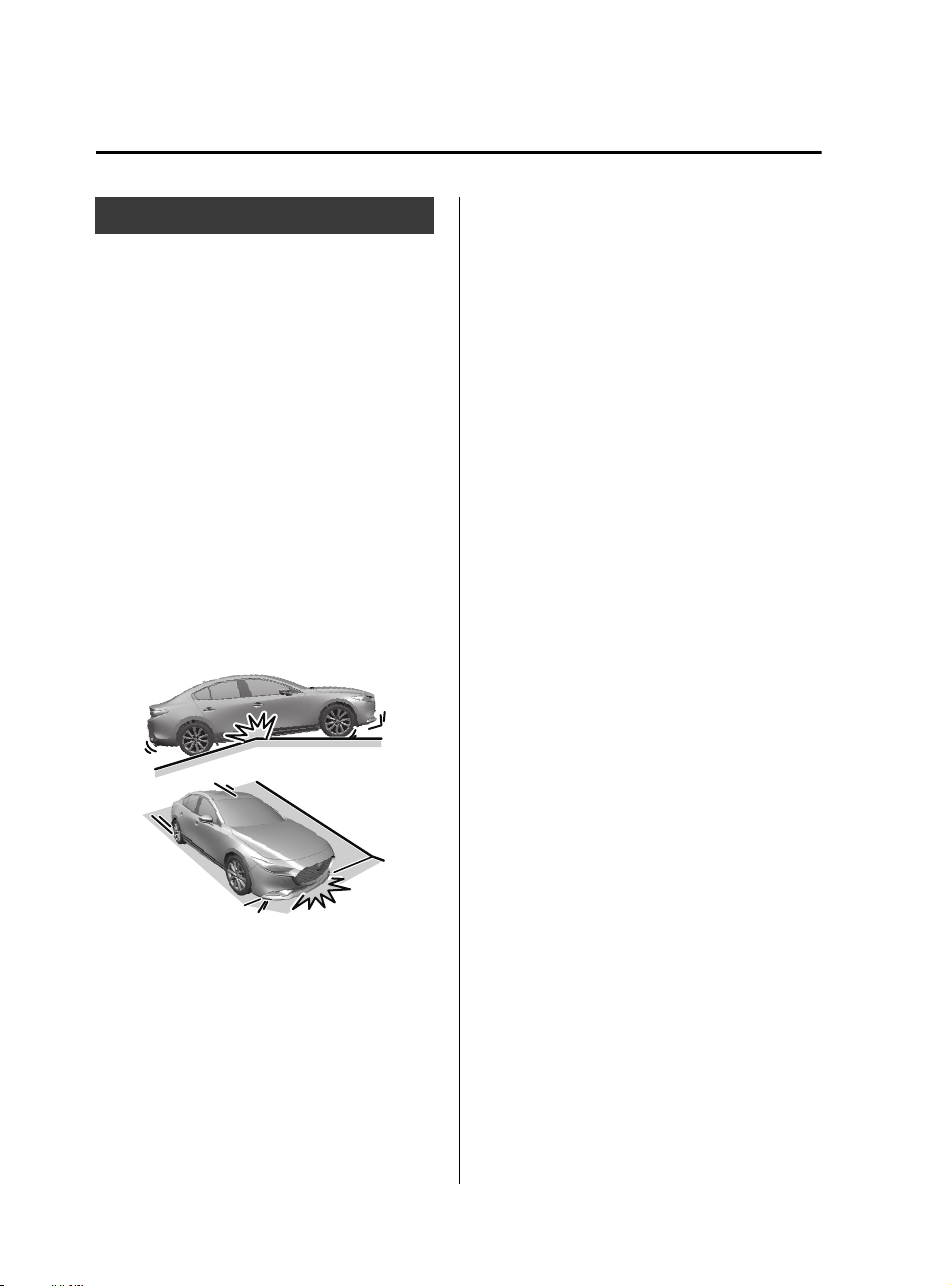
Driving on Uneven Road
▼
Driving on Uneven Road
Your vehicle's suspension and underbody
can be damaged if driven on rough/uneven
roads or over speed bumps at excessive
speeds. Use care and reduce speed when
traveling on rough/uneven roads or over
speed bumps.
Use care not to damage the vehicle's
underbody, bumpers or muffler(s) when
driving under the following conditions:
Ascending or descending a slope with a
sharp transition angle
Ascending or descending a driveway or
trailer ramp with a sharp transition angle
This vehicle is equipped with low profile
tires allowing class-leading performance
and handling. As a result, the sidewall of
the tires are very thin and the tires and
wheels can be damaged if driven through
potholes or on rough/uneven roads at
excessive speeds. Use care and reduce
speed when traveling on rough/uneven
roads or through potholes.
Before Driving
Driving Tips
3-50
Mazda3_8HZ1-EA-19G_Edition1_old 2019-5-17 13:49:03
Trailer Towing
▼
Trailer Towing
Your Mazda is not designed for towing.
Never tow a trailer with your Mazda.
Recreational Towing
▼
Recreational Towing
An example of "recreational towing" is
towing your vehicle behind a motorhome.
The transmission is not designed for
towing this vehicle on all 4 wheels.
When doing recreational towing refer to
"Towing Description" (page 7-23) and
"Tiedown Hooks" (page 7-24) and
carefully follow the instructions.
Before Driving
Towing
3-51
Mazda3_8HZ1-EA-19G_Edition1_old 2019-5-17 13:49:03

MEMO
3-52
Mazda3_8HZ1-EA-19G_Edition1_old 2019-5-17 13:49:03
4
When Driving
Information concerning safe driving and stopping.
Start/Stop Engine.............................. 4-4
Ignition Switch............................. 4-4
Starting the Engine....................... 4-5
Turning the Engine Off...............4-10
Cylinder Deactivation
*
............... 4-11
Instrument Cluster and Display............
...........................................................4-12
Instrument Cluster and
Display........................................4-12
Instrument Cluster...................... 4-12
Active Driving Display
*
.............4-29
Manual Transmission
Operation......................................... 4-31
Manual Transmission Shift
Pattern.........................................4-31
Automatic Transmission................. 4-33
Automatic Transmission
Controls...................................... 4-33
Shift-Lock System...................... 4-34
Transmission Ranges..................4-35
Manual Shift Mode.....................4-36
Direct Mode
*
.............................. 4-42
Driving Tips................................4-43
Switches and Controls.....................4-44
Lighting Control......................... 4-44
Turn and Lane-Change
Signals........................................ 4-50
Windshield Wipers and
Washer........................................ 4-51
Rear Window Wiper and Washer
*
.....
.................................................... 4-55
Rear Window Defogger..............4-56
Horn............................................4-57
Hazard Warning Flasher............. 4-58
HomeLink Wireless Control
System
*
.......................................4-58
Brake................................................ 4-63
Brake System..............................4-63
AUTOHOLD..............................4-69
Hill Launch Assist (HLA).......... 4-73
ABS/TCS/DSC................................. 4-75
Antilock Brake System
(ABS)..........................................4-75
Traction Control System
(TCS).......................................... 4-76
Dynamic Stability Control
(DSC)..........................................4-77
Drive Selection................................. 4-79
Drive Selection
*
..........................4-79
i-ACTIV AWD................................. 4-81
i-ACTIV AWD Operation
*
.........4-81
*Some models.
4-1
Mazda3_8HZ1-EA-19G_Edition1_old 2019-5-17 13:49:03

Power Steering.................................4-82
Power Steering............................4-82
i-ACTIVSENSE...............................4-83
i-ACTIVSENSE
*
........................4-83
Adaptive Front Lighting System
(AFS)
*
........................................ 4-88
High Beam Control System
(HBC)
*
........................................4-88
Lane Departure Warning System
(LDWS)
*
.................................... 4-90
Blind Spot Monitoring (BSM)
*
.........
.................................................... 4-94
Traffic Sign Recognition System
(TSR)
*
........................................ 4-99
Distance & Speed Alert (DSA)
*
........
.................................................. 4-106
Driver Attention Alert (DAA)
*
..........
.................................................. 4-107
Driver Monitoring (DM)
*
.........4-109
Front Cross Traffic Alert
(FCTA)
*
.................................... 4-111
Rear Cross Traffic Alert (RCTA)
*
.....
.................................................. 4-114
Mazda Radar Cruise Control
(MRCC) (Manual Transmission)
*
.....
.................................................. 4-118
Mazda Radar Cruise Control with
Stop & Go function (MRCC with
Stop & Go function) (Automatic
Transmission)
*
..........................4-126
Traffic Jam Assist (TJA)
*
.........4-137
Lane-keep Assist System (LAS)
*
......
.................................................. 4-151
Smart Brake Support (SBS)
*
....4-155
Smart Brake Support [Rear] (SBS-
R)
*
............................................ 4-157
Smart Brake Support [Rear
Crossing] (SBS-RC)
*
............... 4-161
360° View Monitor
*
.................4-166
Forward Sensing Camera (FSC)
*
......
.................................................. 4-200
Front Radar Sensor
*
.................4-204
Front Side Radar Sensor
*
.........4-206
Rear Side Radar Sensor
*
..........4-208
Rear/Rear corner/Rear Side
Ultrasonic Sensor
*
....................4-209
Front Camera/Side Cameras/Rear
Camera
*
.................................... 4-210
Driver Monitoring Camera
*
......4-211
Cruise Control............................... 4-212
Cruise Control
*
.........................4-212
Tire Pressure Monitoring System
(TPMS)........................................... 4-216
Tire Pressure Monitoring System
(TPMS).....................................4-216
Rear View Monitor....................... 4-220
Rear View Monitor
*
.................4-220
Parking Sensor System.................4-235
Parking Sensor System
*
........... 4-235
4-2
*Some models.
Mazda3_8HZ1-EA-19G_Edition1_old 2019-5-17 13:49:03

MEMO
4-3
Mazda3_8HZ1-EA-19G_Edition1_old 2019-5-17 13:49:03
Ignition Switch
▼
Push Button Start Positions
The system operates only when the key is
within operational range.
Each time the push button start is pressed,
the ignition switches in the order of off,
ACC, and ON. Pressing the push button
start again from ON switches the ignition
off.
1. Indicator light
2. Push button start
NOTE
The engine starts by pressing the push
button start while depressing the clutch
pedal (manual transmission) or the
brake pedal (automatic transmission).
To switch the ignition position, press the
push button start without depressing the
pedal.
Do not leave the ignition switched ON
while the engine is not running. Doing
so could result in the battery going
dead. If the ignition is left in ACC (For
automatic transmission, the selector
lever is in the P position, and the
ignition is in ACC), the ignition switches
off automatically after about 25 minutes.
Off
The power supply to electrical devices
turns off and the indicator light (amber)
also turns off.
WARNING
Before leaving the driver's seat, always
switch the ignition
o,
set the parking
brake, and make sure the selector lever is in
P (automatic transmission) position or in
1st gear or R (manual transmission):
Leaving the driver's seat without switching
the ignition
o,
setting the parking brake,
and shifting the selector lever to P
(automatic transmission) position or to 1st
gear or R (manual transmission) is
dangerous. Unexpected vehicle movement
could occur which could result in an
accident.
In addition, if your intention is to leave the
vehicle for even a short period, it is
important to switch the ignition o, as
leaving it in another position will disable
some of the vehicle's security systems and
run the battery down.
ACC (Accessory)
Some electrical accessories will operate
and the indicator light (amber) illuminates.
NOTE
The keyless entry system does not function
while the push button start has been
pressed to ACC, and the doors will not
lock/unlock even if they have been locked
manually.
When Driving
Start/Stop Engine
4-4
Mazda3_8HZ1-EA-19G_Edition1_old 2019-5-17 13:49:03
ON
This is the normal running position after
the engine is started. The indicator light
(amber) turns off. (The indicator light
(amber) illuminates when the ignition is
switched ON and the engine is not
running.)
Some indicator lights/warning lights
should be inspected before the engine is
started.
Refer to Warning/Indicator Lights on page
4-23.
Refer to Indication/Indicator Lights on
page 4-25.
NOTE
When the push button start is pressed to
ON, the sound of the fuel pump motor
operating near the fuel tank can be heard.
This does not indicate an abnormality.
Starting the Engine
▼
Starting the Engine
WARNING
Radio waves from the key may aect
medical devices such as pacemakers:
Before using the key near people who use
medical devices, ask the medical device
manufacturer or your physician if radio
waves from the key will aect the device.
NOTE
The key must be carried because the key
carries an immobilizer chip that must
communicate with the engine controls at
short range.
The engine can be started when the push
button start is pressed from off, ACC, or
ON.
The push button start system functions
(function which can start the engine by
only carrying the key) can be
deactivated to prevent any possible
adverse effect on a user wearing a
pacemaker or other medical device. If
the system is deactivated, you will be
unable to start the engine by carrying
the key. Consult an Authorized Mazda
Dealer for details. If the push button
start system functions have been
deactivated, you can start the engine by
following the procedure indicated when
the key battery goes dead.
Refer to Engine Start Function When
Key Battery is Dead on page 4-8.
When Driving
Start/Stop Engine
4-5
Mazda3_8HZ1-EA-19G_Edition1_old 2019-5-17 13:49:03
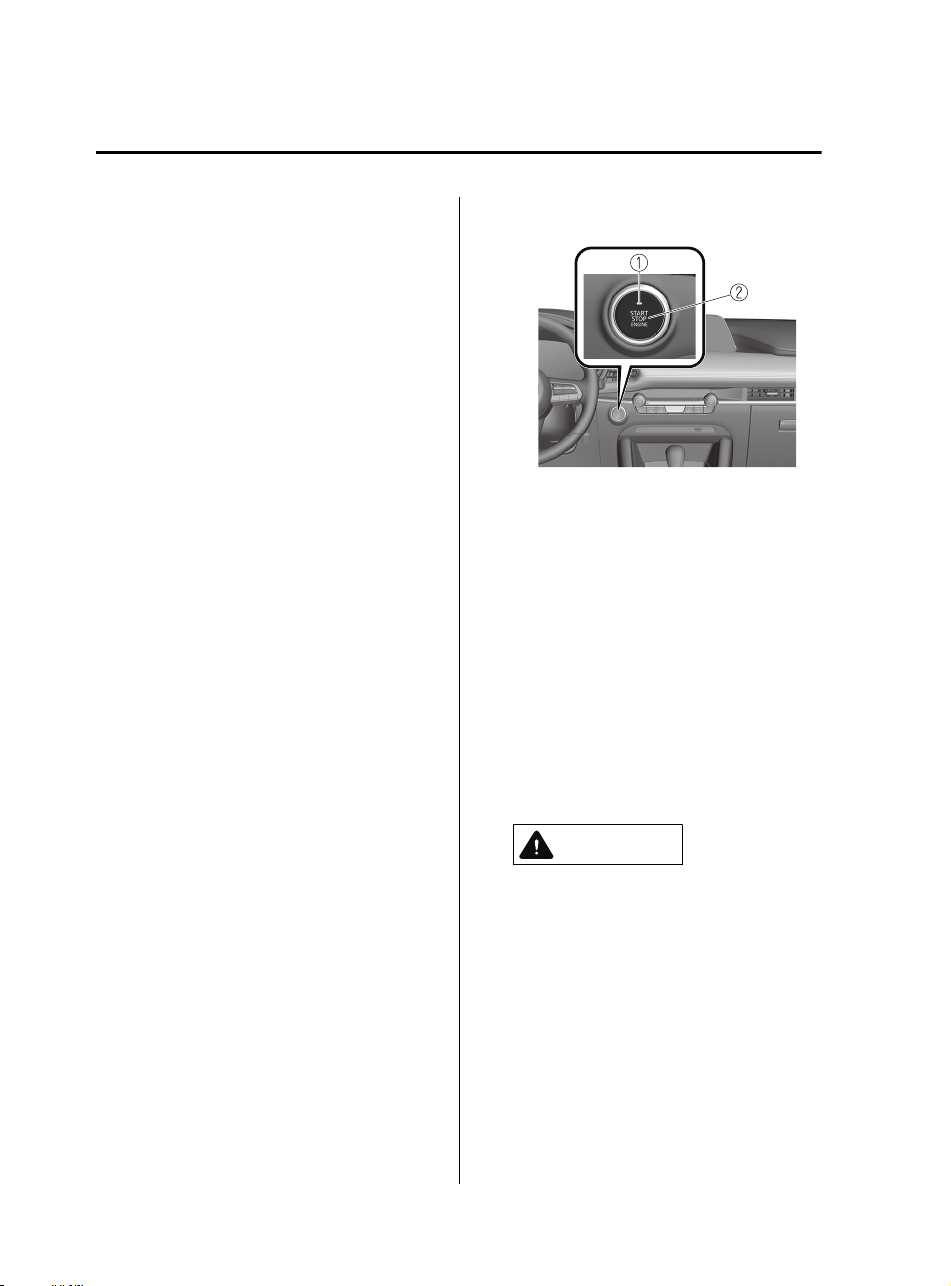
After starting a cold engine, the engine
speed increases and a whining sound
from the engine compartment can be
heard.
This is for improved exhaust gas
purification and does not indicate any
parts defect.
Engine-starting is controlled by the
spark ignition system.
This system meets all Canadian
Interference-Causing Equipment
Standard requirements regulating the
impulse electrical field strength of radio
noise.
1. Make sure you are carrying the key.
2. Occupants should fasten their seat
belts.
3. Make sure the parking brake is on.
4. Continue to depress the brake pedal
firmly until the engine has completely
started.
5. (Manual transmission)
Continue to depress the clutch pedal
firmly until the engine has completely
started.
(Automatic transmission)
Put the vehicle in park (P). If you must
restart the engine while the vehicle is
moving, shift into neutral (N).
NOTE
(Manual transmission)
The starter will not operate if the
clutch pedal is not depressed
sufficiently.
(Automatic transmission)
The starter will not operate if the
selector lever is not in P or N
position and the brake pedal is not
depressed sufficiently.
6. Make sure that the push button start
indicator light (green) turns on.
1. Indicator light
2. Push button start
NOTE
If the push button start indicator
light (green) flashes, make sure that
the key is being carried.
If the push button start indicator
light (green) flashes with the key
being carried, touch the key to the
push button start and start the
engine.
Refer to Engine Start Function When
Key Battery is Dead on page 4-8.
CAUTION
If the KEY warning indication (red) is
displayed, or the push button start
indicator light (amber) ashes, this
could indicate a problem with the
engine starting system. This may
prevent the engine from starting or
from switching the ignition to ACC or
ON.
Refer to KEY Warning Indication/
Warning Light (Red) on page 7-33.
When Driving
Start/Stop Engine
4-6
Mazda3_8HZ1-EA-19G_Edition1_old 2019-5-17 13:49:03

Have your vehicle inspected at an
Authorized Mazda Dealer as soon as
possible.
NOTE
Under the following conditions, the
KEY warning indication (red) is
displayed after the push button start
is pressed. This informs the driver
that the push button start will not
switch to ACC, even if it is pressed
from off (page 7-33).
The key battery is dead.
The key is out of operational
range.
The key is placed in areas where it
is difficult for the system to detect
the signal (page 3-7).
A key from another manufacturer
similar to the key is in the
operational range.
(Forced engine starting method)
If the KEY warning indication (red)
is displayed, or the push button start
indicator light (amber) flashes, this
could indicate that the engine may
not start using the usual starting
method (page 7-33). Have your
vehicle inspected at an Authorized
Mazda Dealer as soon as possible. If
this occurs, the engine can be
force-started. Press and hold the
push button start until the engine
starts. Other procedures necessary
for starting the engine, such as
having the key in the cabin, and
depressing the clutch pedal (manual
transmission) or the brake pedal
(automatic transmission) are
required.
When the engine is force-started, the
KEY warning indication (red)
remains displayed and the push
button start indicator light (amber)
remains flashing.
(Automatic transmission)
When the selector lever is in the
neutral (N) position, the push button
start indicator light (green) does not
turn on.
7. Press the push button start after the
push button start indicator light (green)
turns on.
NOTE
After starting the engine, the push
button start indicator light (amber)
turns off and the ignition switches to
the ON position.
After pressing the push button start
and before the engine starts, the
operation sound of the fuel pump
motor from near the fuel tank can be
heard, however, this does not
indicate a malfunction.
8. After starting the engine, let it idle for
about 10 seconds.
NOTE
Whether the engine is cold or warm,
it should be started without the use
of the accelerator.
If the engine does not start the first
time, refer to Starting a Flooded
Engine under Emergency Starting. If
the engine still does not start, have
your vehicle inspected by an
Authorized Mazda Dealer (page
7-20).
When Driving
Start/Stop Engine
4-7
Mazda3_8HZ1-EA-19G_Edition1_old 2019-5-17 13:49:03
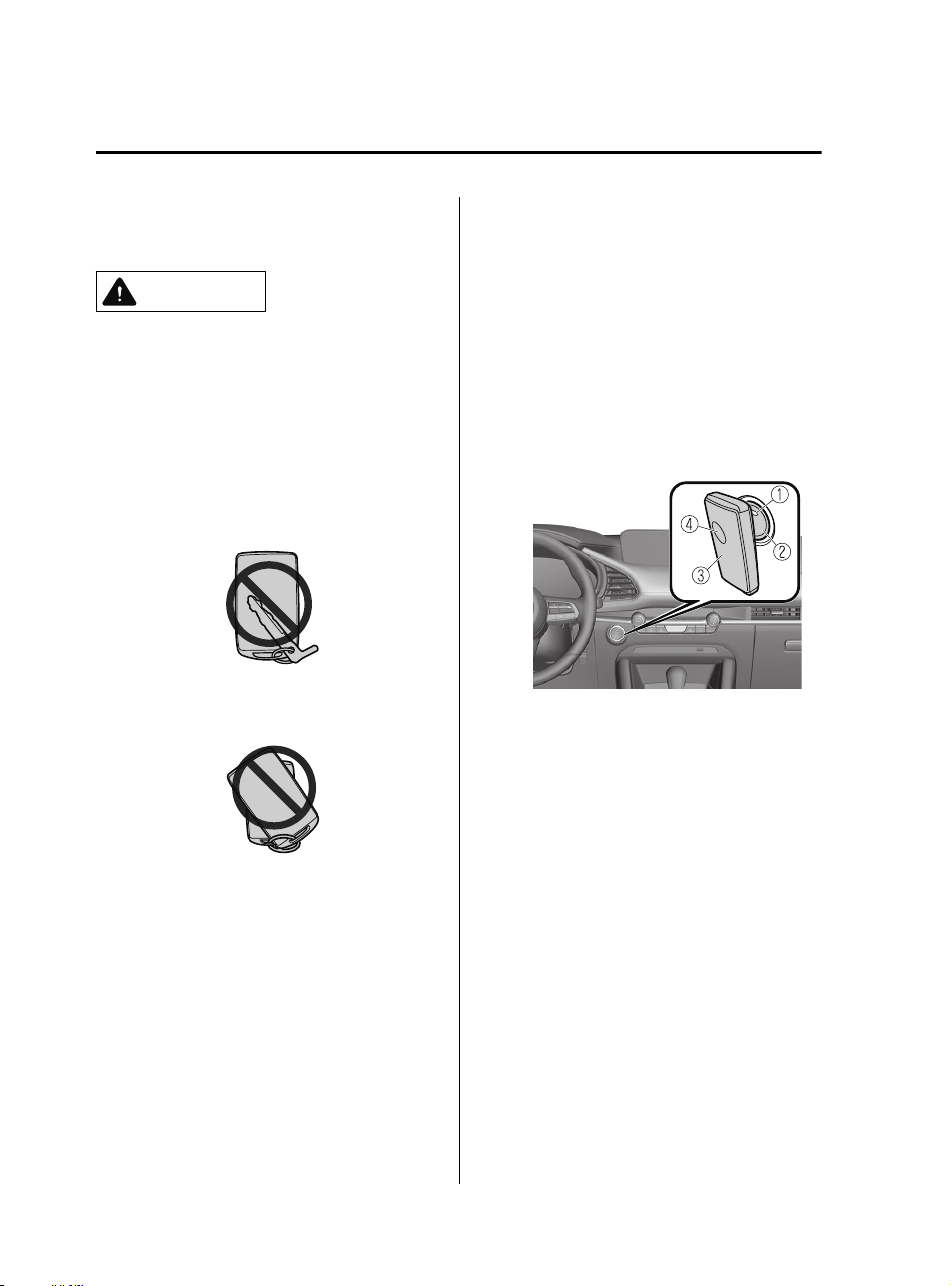
▼
Engine Start Function When Key
Battery is Dead
CAUTION
When starting the engine by holding the
transmitter over the push button start due
to a dead key battery or a malfunctioning
key, be careful not to allow the following,
otherwise the signal from the key will not
be received correctly and the engine may
not start.
Metal parts of other keys or metal objects
touch the key.
Spare keys or keys for other vehicles
equipped with an immobilizer system
touch or come near the key.
Devices for electronic purchases, or
security passage touch or come near the
key.
If the engine cannot be started due to a
dead key battery, the engine can be started
using the following procedure:
1. Continue to depress the brake pedal
firmly until the engine has completely
started.
2. (Manual transmission)
Continue to depress the clutch pedal
firmly until the engine has completely
started.
(Automatic transmission)
Put the vehicle in park (P). If you must
restart the engine while the vehicle is
moving, shift into neutral (N).
3. Make sure that the push button start
indication light (green) flashes.
4. Align the center area of the emblem on
the transmitter with the center area of
the push button start while the push
button start indicator light (green)
flashes.
1. Indicator light
2. Push button start
3. Transmitter
4. Emblem
5. Make sure that the push button start
indicator light (green) turns on.
6. Press the push button start to start the
engine.
NOTE
The engine cannot be started unless
the clutch pedal is fully depressed
(manual transmission) or the brake
pedal is fully depressed (automatic
transmission).
When Driving
Start/Stop Engine
4-8
Mazda3_8HZ1-EA-19G_Edition1_old 2019-5-17 13:49:03

If there is a malfunction with the
push button start function, the push
button start indicator light (amber)
flashes. In this case, the engine may
start, however, have the vehicle
checked at an Authorized Mazda
Dealer as soon as possible.
If the push button start indicator
light (green) does not illuminate,
perform the operation from the
beginning again. If it does not
illuminate, have the vehicle checked
at an Authorized Mazda Dealer.
To switch the ignition position
without starting the engine, perform
the following operations after the
push button start indicator light
(green) turns on.
1. Release the clutch pedal (manual
transmission) or brake pedal
(automatic transmission).
2. Press the push button start to
switch the ignition position. The
ignition switches in the order of
ACC, ON, and off each time the
push button start is pressed. To
switch the ignition position
again, perform the operation
from the beginning.
▼
Emergency Operation for Starting
the Engine
If the KEY warning indication (red) is
displayed, or the push button start
indicator light (amber) flashes, this could
indicate that the engine may not start using
the usual starting method. Have your
vehicle inspected at an Authorized Mazda
Dealer as soon as possible. If this occurs,
the engine can be force-started. Press and
hold the push button start until the engine
starts. Other procedures necessary for
starting the engine such as having the key
in the cabin, and depressing the clutch
pedal (manual transmission) or the brake
pedal (automatic transmission) are
required.
When Driving
Start/Stop Engine
4-9
Mazda3_8HZ1-EA-19G_Edition1_old 2019-5-17 13:49:03
Turning the Engine Off
▼
Turning the Engine Off
WARNING
Do not stop the engine while the vehicle is
moving:
Stopping the engine while the vehicle is
moving for any reason other than in an
emergency is dangerous. Stopping the
engine while the vehicle is moving will
result in reduced braking ability due to the
loss of power braking, which could cause
an accident and serious injury.
1. Stop the vehicle completely.
2. (Manual transmission)
Shift into neutral and set the parking
brake.
(Automatic transmission)
Shift the selector lever to the P
position and set the parking brake.
3. Press the push button start to turn off
the engine. The ignition position is off.
CAUTION
When leaving the vehicle, make sure the
push button start is o.
NOTE
The cooling fan in the engine
compartment could turn on for a few
minutes after the ignition is switched
from ON to OFF, whether or not the A/C
is on or off, to cool the engine
compartment quickly.
If the system detects that the remaining
battery power of the key is low when the
ignition is switched from ON to ACC or
OFF, the following is indicated.
Replace with a new battery before the
key becomes unusable.
Refer to Key Battery Replacement on
page 6-28.
A message is indicated in the display of
the instrument cluster.
Refer to KEY Warning Indication/
Warning Light (Red) on page 7-33.
(Automatic transmission)
If the engine is turned off while the
selector lever is in a position other than
P, the ignition switches to ACC.
▼
Emergency Engine Stop
Continuously pressing the push button
start or quickly pressing it any number of
times while the engine is running or the
vehicle is being driven will turn the engine
off immediately. The ignition switches to
ACC.
When Driving
Start/Stop Engine
4-10
Mazda3_8HZ1-EA-19G_Edition1_old 2019-5-17 13:49:03
Cylinder Deactivation
*
▼
Cylinder Deactivation
The cylinder deactivation is a function
designed to reduce fuel consumption and
improve fuel economy by deactivating 2
out of the 4 cylinders while driving. The
function constantly determines which is
better for driving; 4 cylinders or 2
cylinders, regardless of the driver's
operations, and it performs the switching
automatically.
When the cylinder deactivation function
does not operate
The cylinder deactivation function does
not operate under the following
conditions.
The selector lever is in the P, N, or R
position (automatic transmission), or 1st
gear (manual transmission).
The engine oil temperature or engine
coolant temperature is low.
After disconnecting the battery
terminals for some reason, such as for
battery replacement.
When Driving
Start/Stop Engine
*Some models.
4-11
Mazda3_8HZ1-EA-19G_Edition1_old 2019-5-17 13:49:03
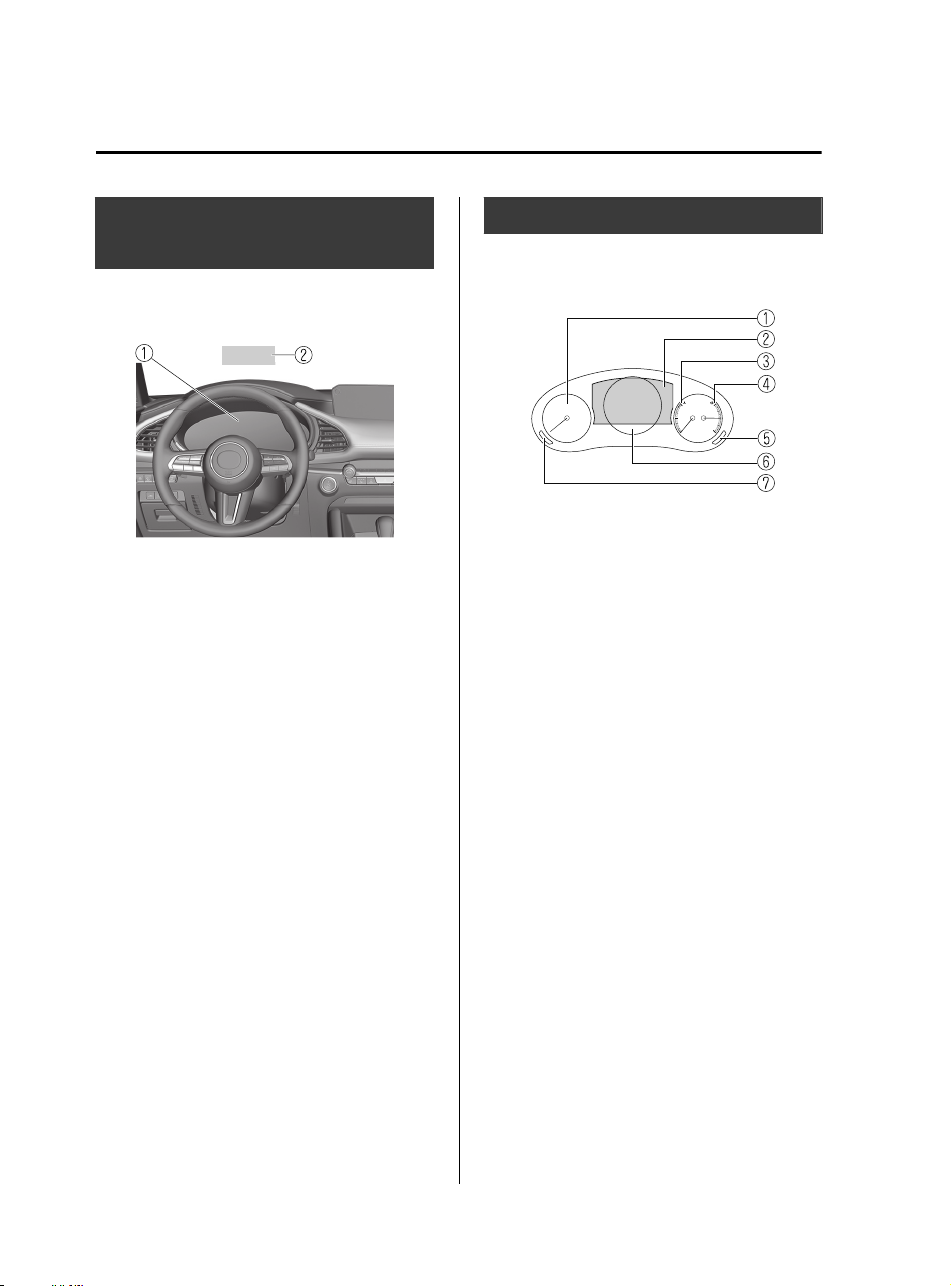
Instrument Cluster and
Display
▼
Instrument Cluster and Display
① Instrument Cluster................. page 4-12
② Active Driving Display..........page 4-29
Instrument Cluster
▼
Instrument Cluster
① Tachometer.............................page 4-13
② Multi-information Display.....page 4-14
③ Engine Coolant Temperature
Gauge.....................................page 4-17
④ Fuel Gauge.............................page 4-17
⑤ Dashboard Illumination Switch.............
............................................... page 4-18
⑥ Speedometer.......................... page 4-12
⑦ TRIP Switch...........................page 4-16
▼
Speedometer
The speedometer indicates the speed of the
vehicle.
When Driving
Instrument Cluster and Display
4-12
Mazda3_8HZ1-EA-19G_Edition1_old 2019-5-17 13:49:03
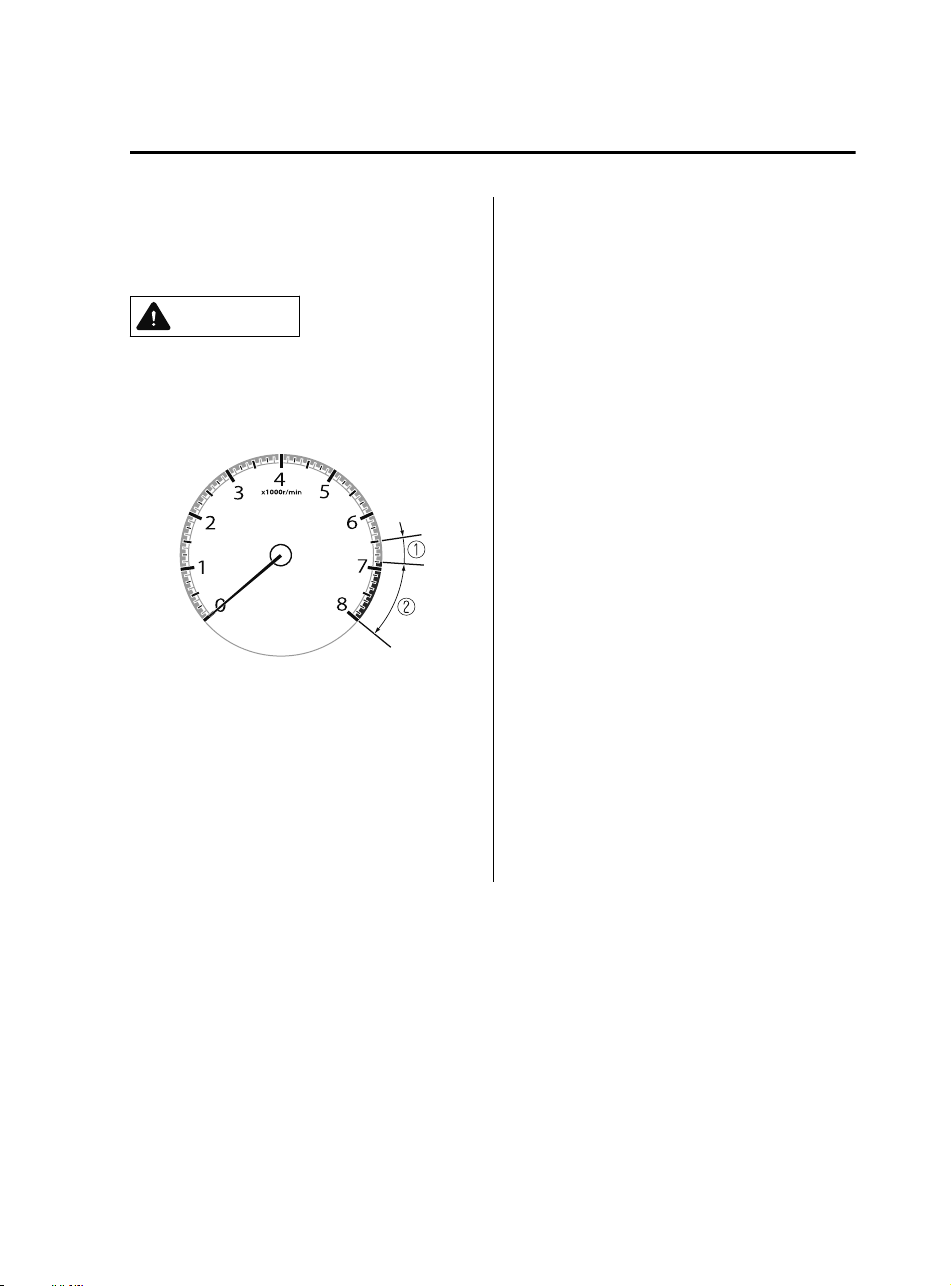
▼
Tachometer
The tachometer shows engine speed in
thousands of revolutions per minute (rpm).
CAUTION
Do not run the engine with the tachometer
needle in the RED ZONE.
This may cause severe engine damage.
1. STRIPED ZONE
*1
2. RED ZONE
*1
*
1 The range varies depending on the type of gauge.
NOTE
When the tachometer needle enters the
STRIPED ZONE, this indicates to the
driver that the gears should be shifted
before entering the RED ZONE.
When Driving
Instrument Cluster and Display
4-13
Mazda3_8HZ1-EA-19G_Edition1_old 2019-5-17 13:49:03
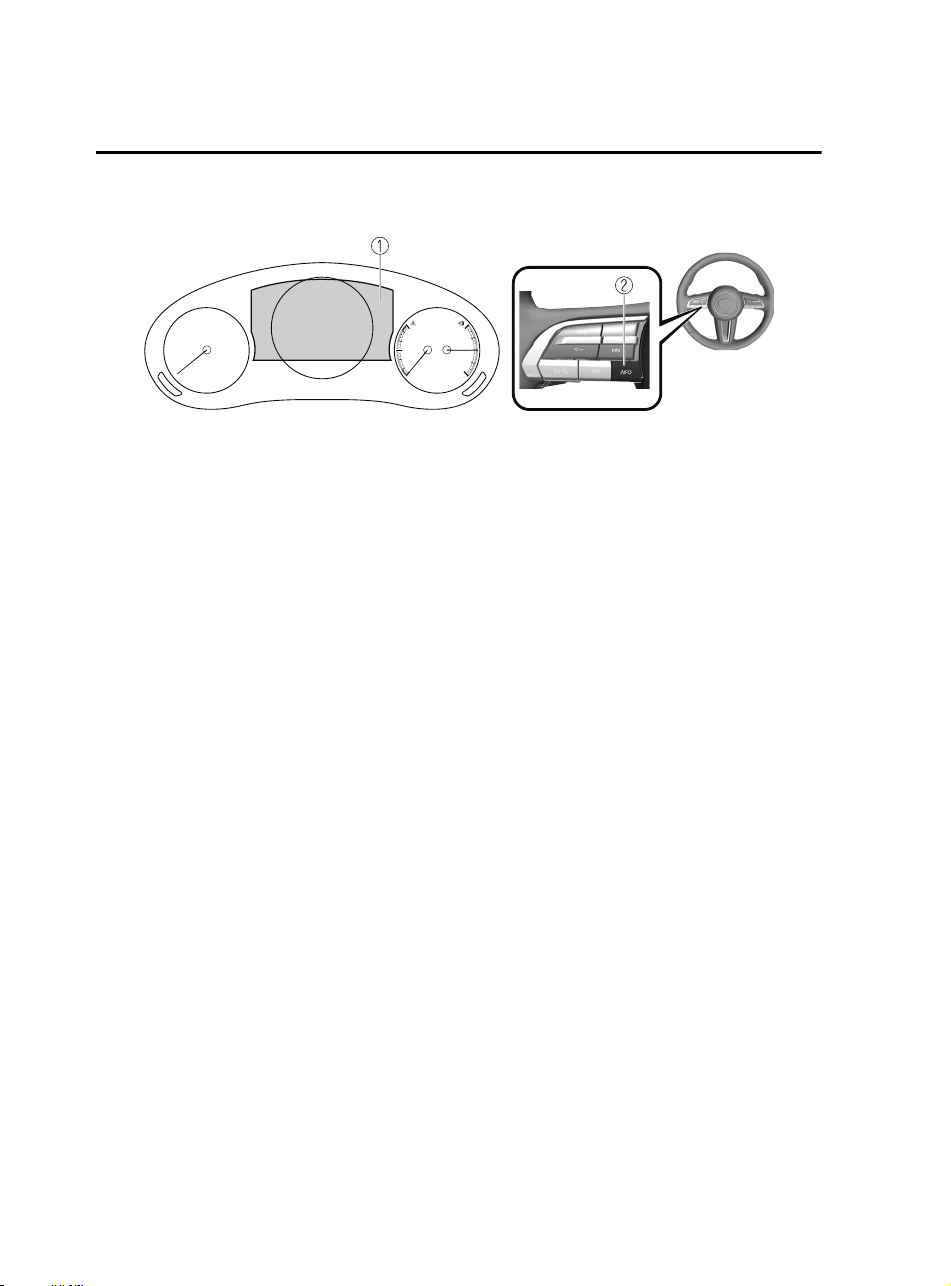
▼
Multi-information Display
1. Multi-information Display
2. INFO switch
The multi-information display indicates the following information.
Speedometer
Odometer
Trip meter
Outside temperature
Distance-to-empty
Average fuel economy
Current fuel economy
i-ACTIVSENSE Display
Compass Display
Door-Ajar/Trunk lid-Ajar/Liftgate-Ajar Warning Indication
*1
Message Display
*
1 Displayed when opening door/trunk lid/liftgate.
When Driving
Instrument Cluster and Display
4-14
Mazda3_8HZ1-EA-19G_Edition1_old 2019-5-17 13:49:03
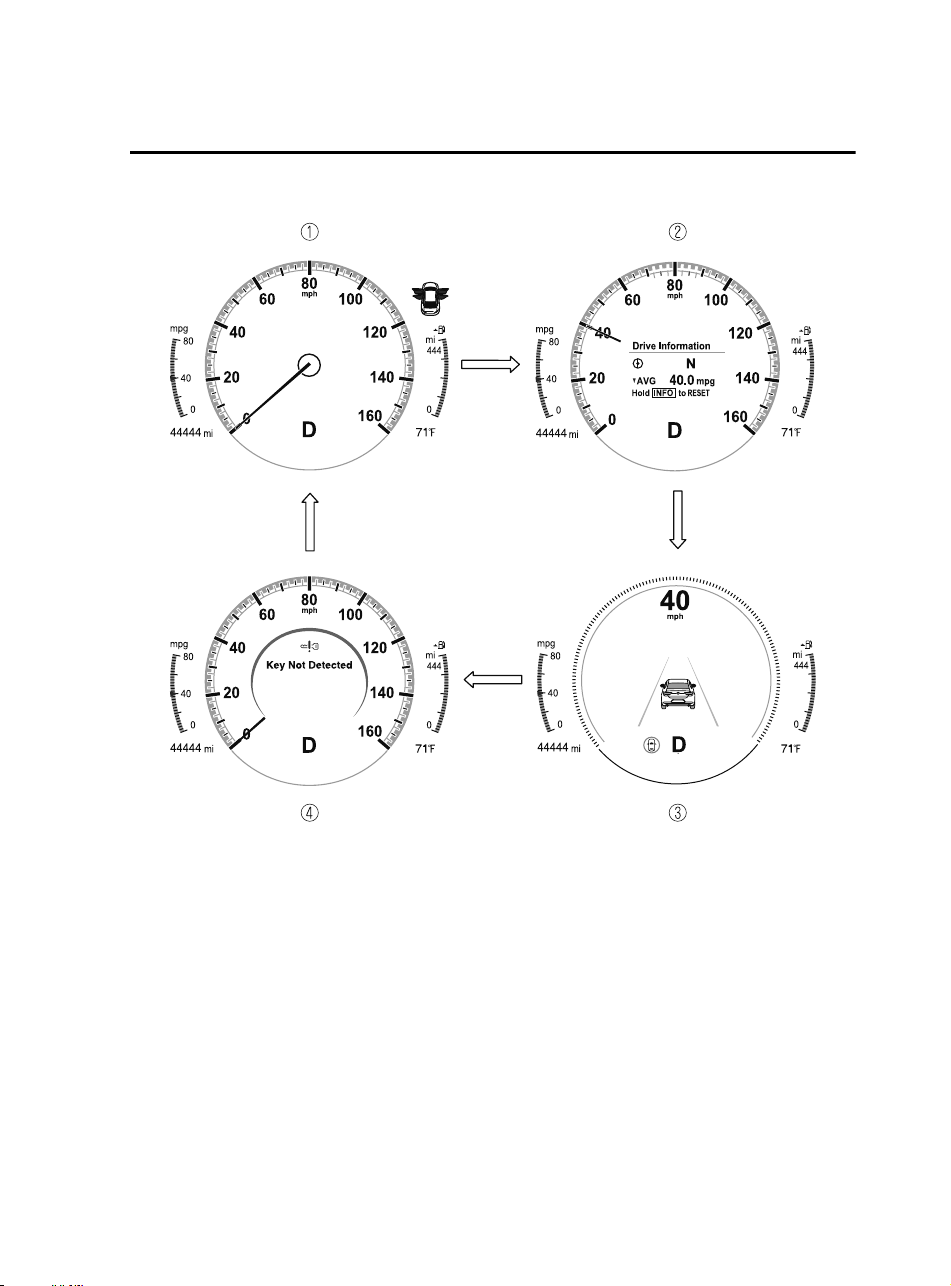
The screen content changes each time the INFO switch is pressed.
1. Basic display
2. Drive information display
3. i-ACTIVSENSE display
4. Message display
*1
*
1 Displayed only when a warning occurs.
The type of display for the fuel economy and the maximum driving distance can be
changed.
Refer to the Settings section in the Mazda Connect Owner's Manual.
When Driving
Instrument Cluster and Display
4-15
Mazda3_8HZ1-EA-19G_Edition1_old 2019-5-17 13:49:03
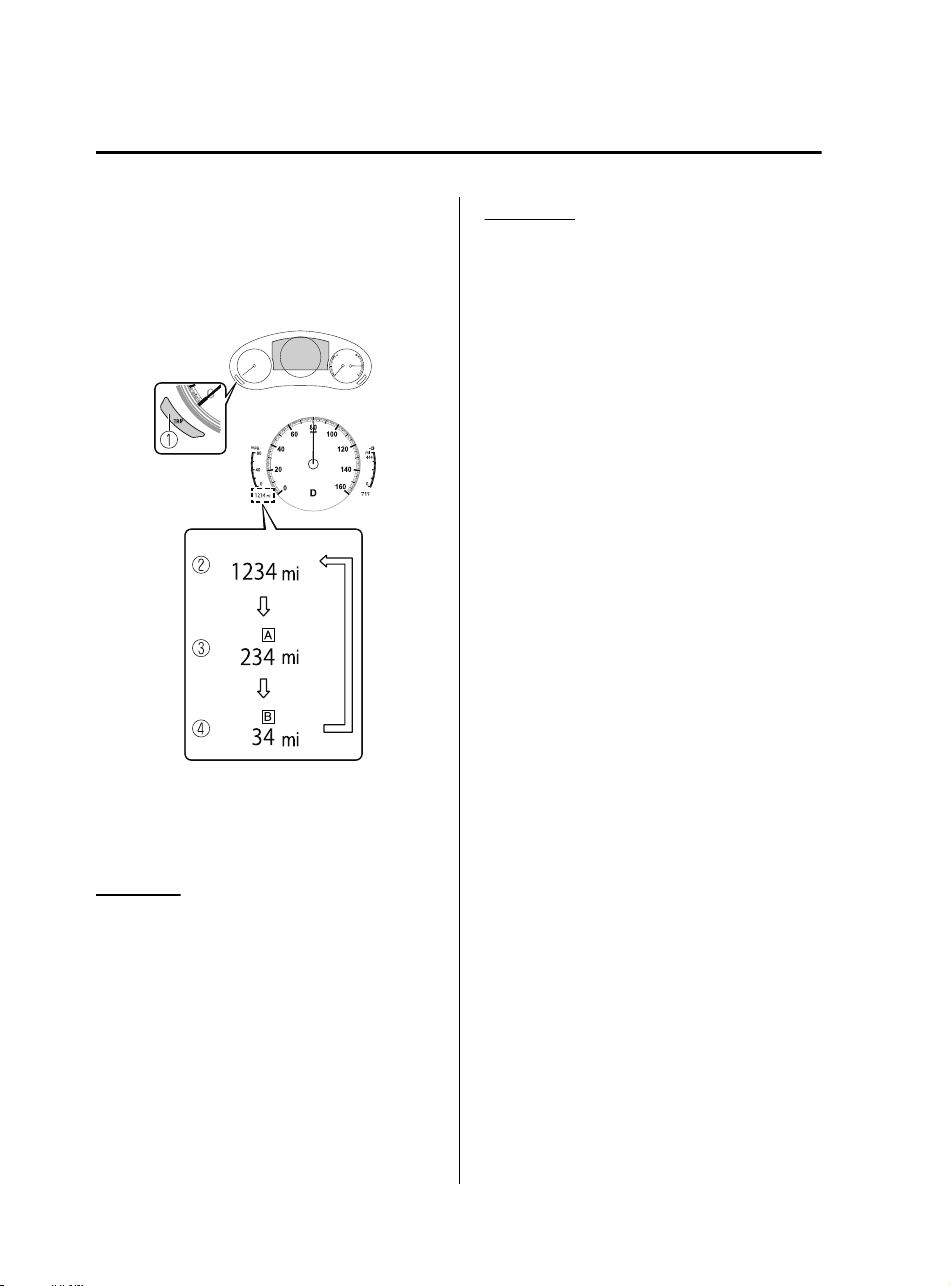
▼
Odometer, Trip Meter and Trip
Meter Selector
You can switch between the odometer and
trip meter display using the TRIP switch.
1. TRIP switch
2. Odometer display
3. Trip meter A display
4. Trip meter B display
Odometer
The odometer records the total distance
the vehicle has been driven.
Trip meter
The driving distance for a specified
interval is indicated. Two types (TRIP A,
TRIP B) of interval distance and the
average fuel economy for each can be
measured.
For instance, trip meter A can record the
distance from the point of origin, and trip
meter B can record the distance from
where the fuel tank is filled.
When trip meter A is selected, TRIP A
will be displayed. When trip meter B is
selected, TRIP B will be displayed.
The trip meter and average fuel economy
can be reset by pressing the TRIP switch
for 1.5 seconds or more while in each
mode.
NOTE
Only the trip meters record tenths of
kilometers (miles).
The trip record will be erased when:
The power supply is interrupted
(blown fuse or the battery is
disconnected).
The vehicle is driven over 9999.9 km
(mile).
When Driving
Instrument Cluster and Display
4-16
Mazda3_8HZ1-EA-19G_Edition1_old 2019-5-17 13:49:03
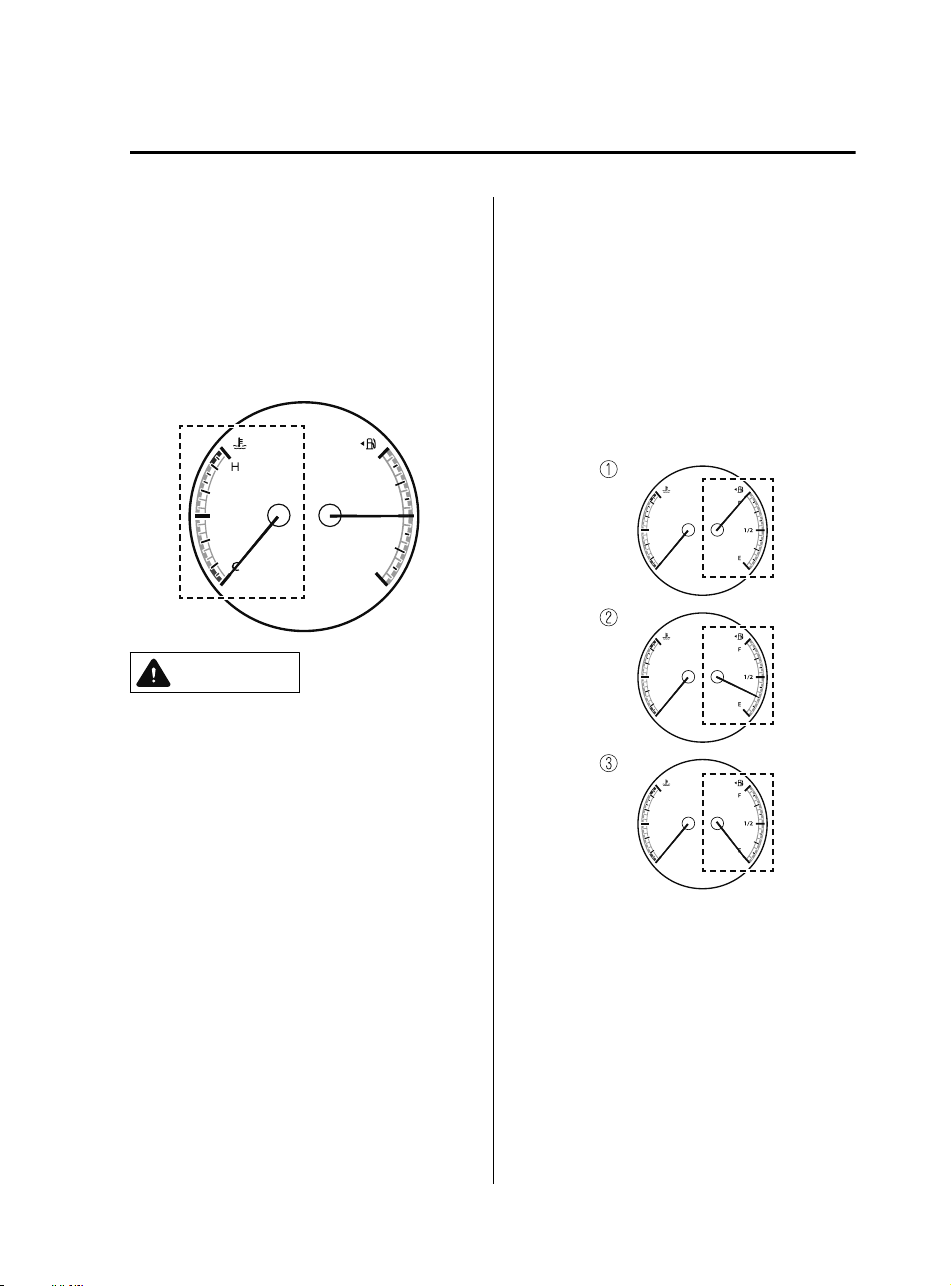
▼
Engine Coolant Temperature Gauge
Displays the engine coolant temperature.
The blue range of the gauge indicates that
the engine coolant temperature is low, and
the red range of the gauge indicates that
the engine coolant temperature is high and
overheating.
CAUTION
When the engine coolant temperature
gauge needle is in the red range, the engine
coolant temperature is extremely high.
Drive slowly to reduce engine load. If the
engine coolant temperature gauge needle
is in the red range, there is the possibility of
overheating. Park the vehicle in a safe
place immediately and take appropriate
measures.
Refer to Overheating on page 7-21.
NOTE
If the engine or engine coolant
temperature is high or low, the engine
output may be restricted to protect the
engine.
During normal driving, the engine
coolant temperature stabilizes at 100 °C
(210 °F) or less, and the gauge indicates
a range lower than 100 °C (210 °F).
▼
Fuel Gauge
The fuel gauge shows approximately how
much fuel is remaining in the tank when
the ignition is switched ON. We
recommend keeping the tank over 1/4 full.
1. Full
2. 1/4 Full
3. Empty
When Driving
Instrument Cluster and Display
4-17
Mazda3_8HZ1-EA-19G_Edition1_old 2019-5-17 13:49:03
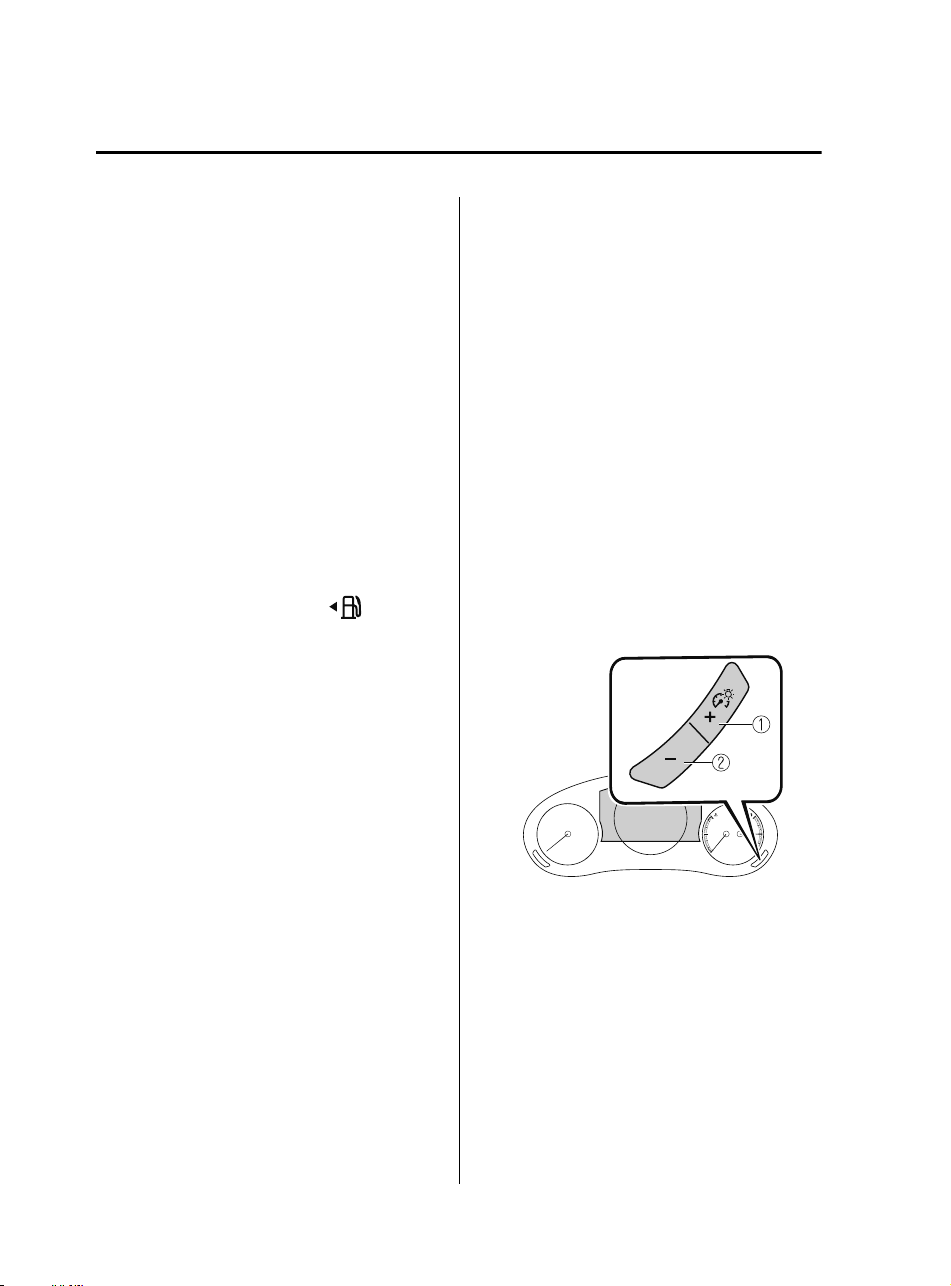
If the low fuel warning light illuminates or
the fuel level is very low, refuel as soon as
possible.
If inconsistency in engine performance or
stalling occurs due to low fuel level
conditions, refuel the vehicle as soon as
possible and add at least 10 L (2.7 US gal,
2.2 Imp gal) of fuel.
Refer to Low Fuel Warning Indication/
Warning Light on page 7-34.
NOTE
After refueling, it may require some time
for the indicator to stabilize. In addition,
the indicator may deviate while driving
on a slope or curve since the fuel moves
in the tank.
The direction of the arrow ( )
indicates that the fuel-filler lid is on the
left side of the vehicle.
▼
Dashboard Illumination
When the lights are turned on with the
ignition switched ON, the brightness of
the dashboard illumination is dimmed.
However, when the light sensor detects
that the surrounding area is bright such as
when the lights are turned on in the
daytime, the dashboard illumination does
not dim.
NOTE
When the ignition is switched ON in the
early evening or at dusk, the dashboard
illumination is dimmed for several
seconds until the light sensor detects the
brightness of the surrounding area,
however, the dimming may cancel after
the brightness is detected.
When the lights are turned on, the
lights-on indicator light in the
instrument cluster turns on.
Refer to Headlights on page 4-44.
The brightness of the instrument panel and
dashboard illuminations can be adjusted
by pressing the dashboard illumination
switch while the dashboard illumination is
dimmed.
The brightness increases by pressing the
+ switch.
The brightness decreases by pressing
the - switch. If you press the - switch
while the instrument cluster is at
maximum dimness, a sound is activated
to notify you that the current dimmer
setting is at maximum dimness.
1. Bright
2. Dim
When Driving
Instrument Cluster and Display
4-18
Mazda3_8HZ1-EA-19G_Edition1_old 2019-5-17 13:49:03
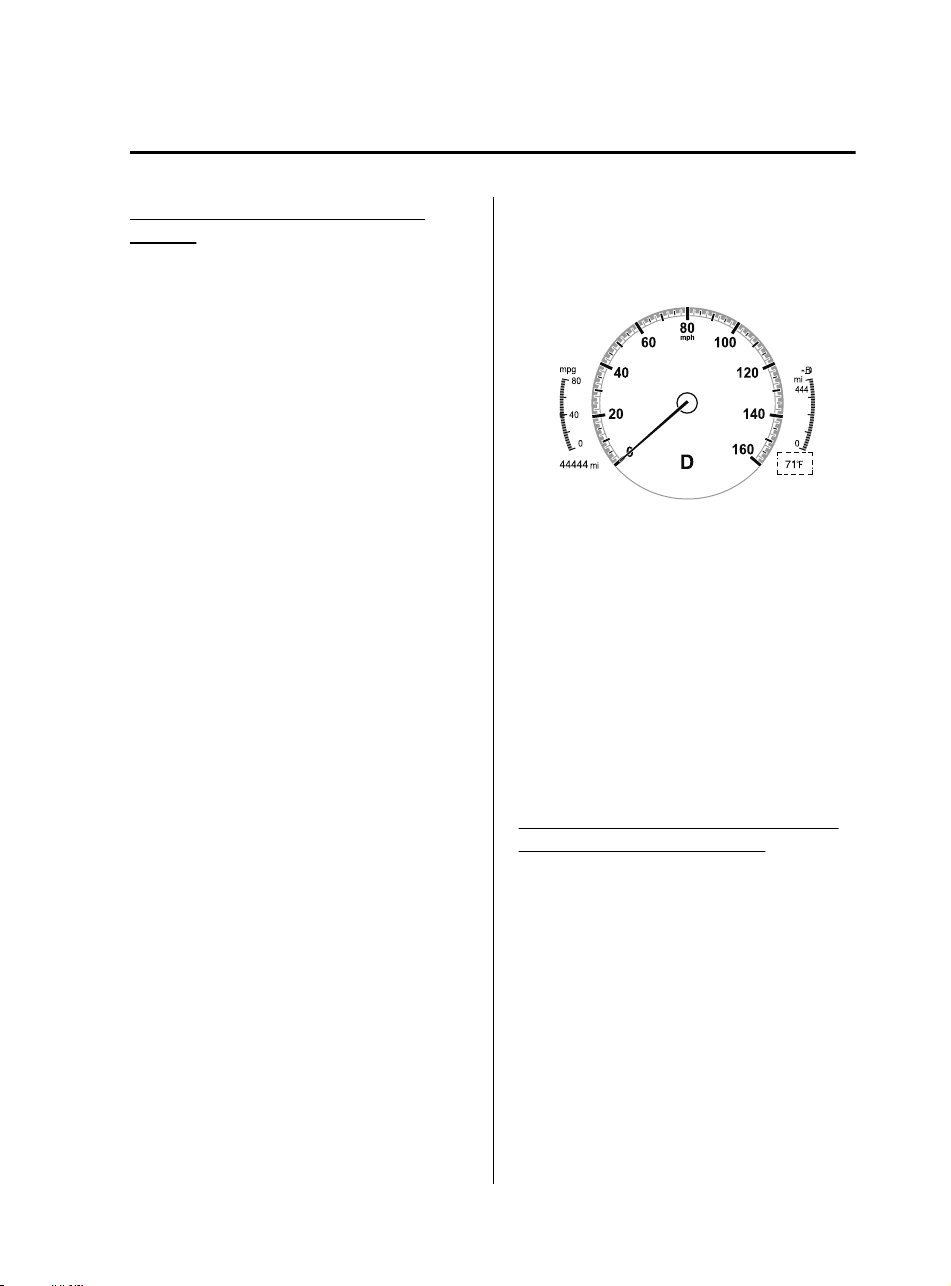
Function for canceling illumination
dimmer
The illumination dimmer can be canceled
by pressing the + switch while the
instrument cluster is at maximum dimness
and while the ignition is switched ON. If
you press the + switch again while the
illumination dimmer is canceled, a sound
is activated to notify you that it is
canceled. If the instrument cluster's
visibility is reduced due to glare from
surrounding brightness, cancel the
illumination dimmer.
NOTE
When the illumination dimmer is
canceled, the instrument cluster cannot
be dimmed even if the lights are turned
on.
When the illumination dimmer is
canceled, the screen in the center
display switches to constant display of
the daytime screen.
▼
Outside Temperature Display
When the ignition is switched ON, the
outside temperature is displayed.
NOTE
Under the following conditions, the
outside temperature display may differ
from the actual outside temperature
depending on the surroundings and
vehicle conditions:
Significantly cold or hot temperatures.
Sudden changes in outside
temperature.
The vehicle is parked.
The vehicle is driven at low speeds.
Changing the Temperature Unit of the
Outside Temperature Display
The outside temperature unit can be
switched between Celsius and Fahrenheit.
Settings can be changed by operating the
center display screen.
Refer to the Settings section in the Mazda
Connect Owner's Manual.
NOTE
When the temperature unit indicated in the
outside temperature display is changed,
the temperature unit indicated in the
engine coolant gauge display changes in
conjunction with it.
When Driving
Instrument Cluster and Display
4-19
Mazda3_8HZ1-EA-19G_Edition1_old 2019-5-17 13:49:03
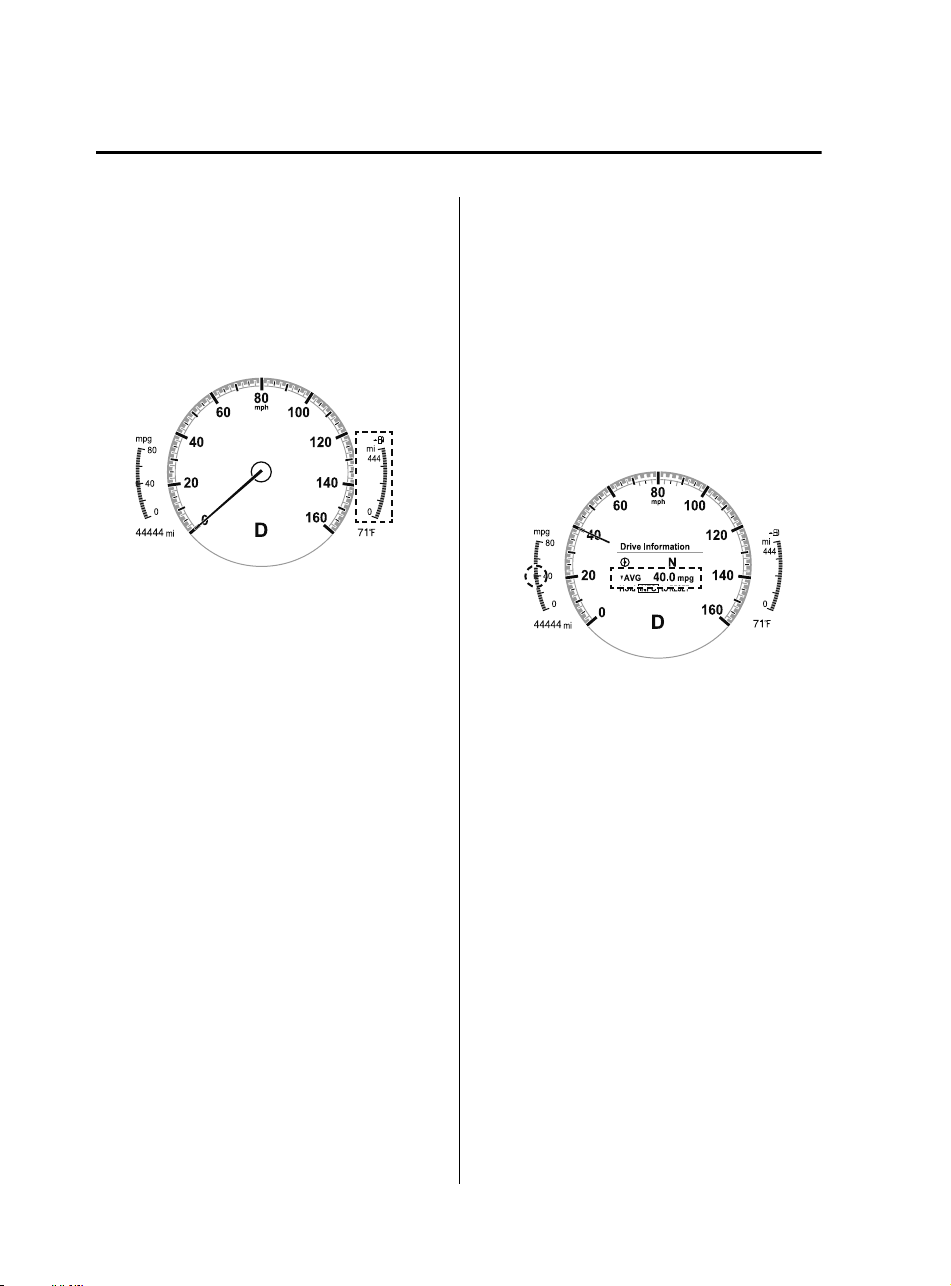
▼
Distance-to-empty
This displays the approximate distance
you can travel on the remaining fuel based
on the fuel economy.
The distance-to-empty will be calculated
and displayed every second.
NOTE
Even though the distance-to-empty
display may indicate a sufficient amount
of remaining driving distance before
refueling is required, refuel as soon as
possible if the fuel level is very low or
the low fuel warning light illuminates.
The display will not change unless you
add more than approximately 9 L (2.3
US gal, 1.9 Imp gal) of fuel.
The distance-to-empty is the
approximate remaining distance the
vehicle can be driven until all the
graduation marks in the fuel gauge
indicating the remaining fuel supply
disappear.
If there is no past fuel economy
information such as after first
purchasing your vehicle or the
information is deleted when the battery
cables are disconnected, the actual
distance-to empty/range may differ from
the amount indicated.
▼
Average Fuel Economy
The average fuel economy is calculated
every minute from the total traveled
distance on the trip meter and the total fuel
consumption, and the average fuel
economy for either drive information
display is displayed.
The average fuel economy for TRIP A is
indicated by a red arrow in the
instantaneous fuel economy display.
The average fuel economy and trip meters
can be reset by pressing the INFO switch
for 1.5 seconds or more while in each
mode. After the data is cleared, the fuel
consumption is recalculated and the - - -
km/L (- - - mpg) for the 1 minute prior to
it being displayed is indicated.
▼
Current Fuel Economy
This displays the current fuel economy by
calculating the amount of fuel
consumption and the distance traveled.
When Driving
Instrument Cluster and Display
4-20
Mazda3_8HZ1-EA-19G_Edition1_old 2019-5-17 13:49:03
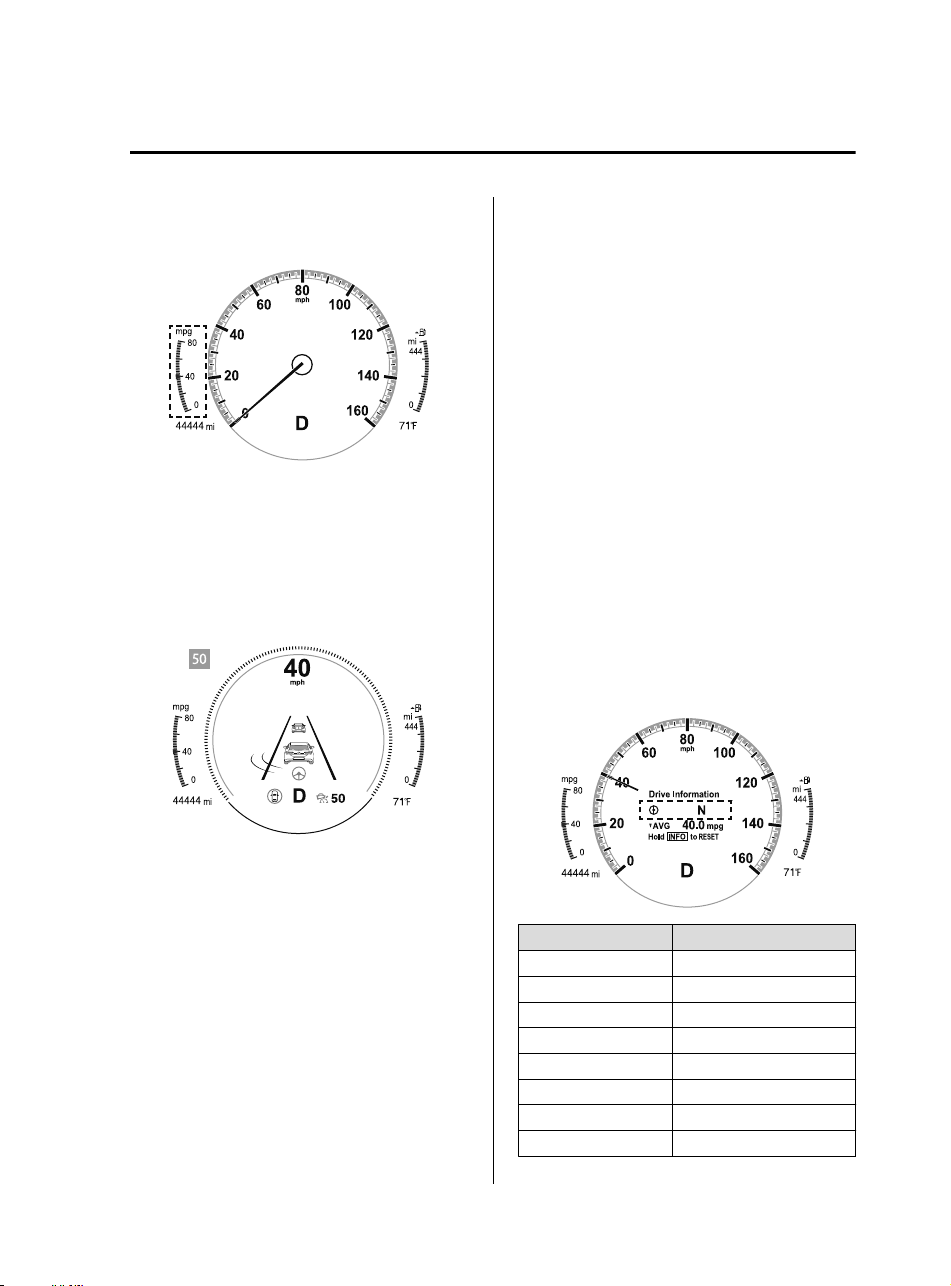
The average fuel economy for TRIP A is
indicated by a red arrow.
NOTE
Indicates the 0 position when the vehicle
speed is about 5 km/h (3 mph) or slower.
▼
i-ACTIVSENSE Display
*
Displays the system status.
Refer to Lane Departure Warning
System (LDWS) on page 4-93.
Refer to Blind Spot Monitoring (BSM)
on page 4-97.
Refer to Traffic Sign Recognition
System (TSR) on page 4-102.
Refer to Distance & Speed Alert (DSA)
on page 4-107.
Refer to Driver Attention Alert (DAA)
on page 4-109.
Refer to Driver Monitoring (DM) on
page 4-110.
Refer to Front Cross Traffic Alert
(FCTA) on page 4-111.
Refer to Mazda Radar Cruise Control
(MRCC) on page 4-120.
Refer to Mazda Radar Cruise Control
with Stop & Go function (MRCC with
Stop & Go function) on page 4-129.
Refer to Traffic Jam Assist (TJA) on
page 4-141.
Refer to Lane-keep Assist System
(LAS) on page 4-154.
Refer to Smart Brake Support (SBS) on
page 4-156.
Refer to Smart Brake Support [Rear]
(SBS-R) on page 4-160.
Refer to Smart Brake Support [Rear
Crossing] (SBS-RC) on page 4-165.
Refer to Cruise Control on page 4-213.
▼
Compass Display
The direction the vehicle is moving is
displayed in one of eight directions while
the vehicle is being driven.
Display Direction
NNorth
SSouth
EEast
WWest
NE Northeast
NW Northwest
SE Southeast
SW Southwest
When Driving
Instrument Cluster and Display
*Some models.
4-21
Mazda3_8HZ1-EA-19G_Edition1_old 2019-5-17 13:49:03
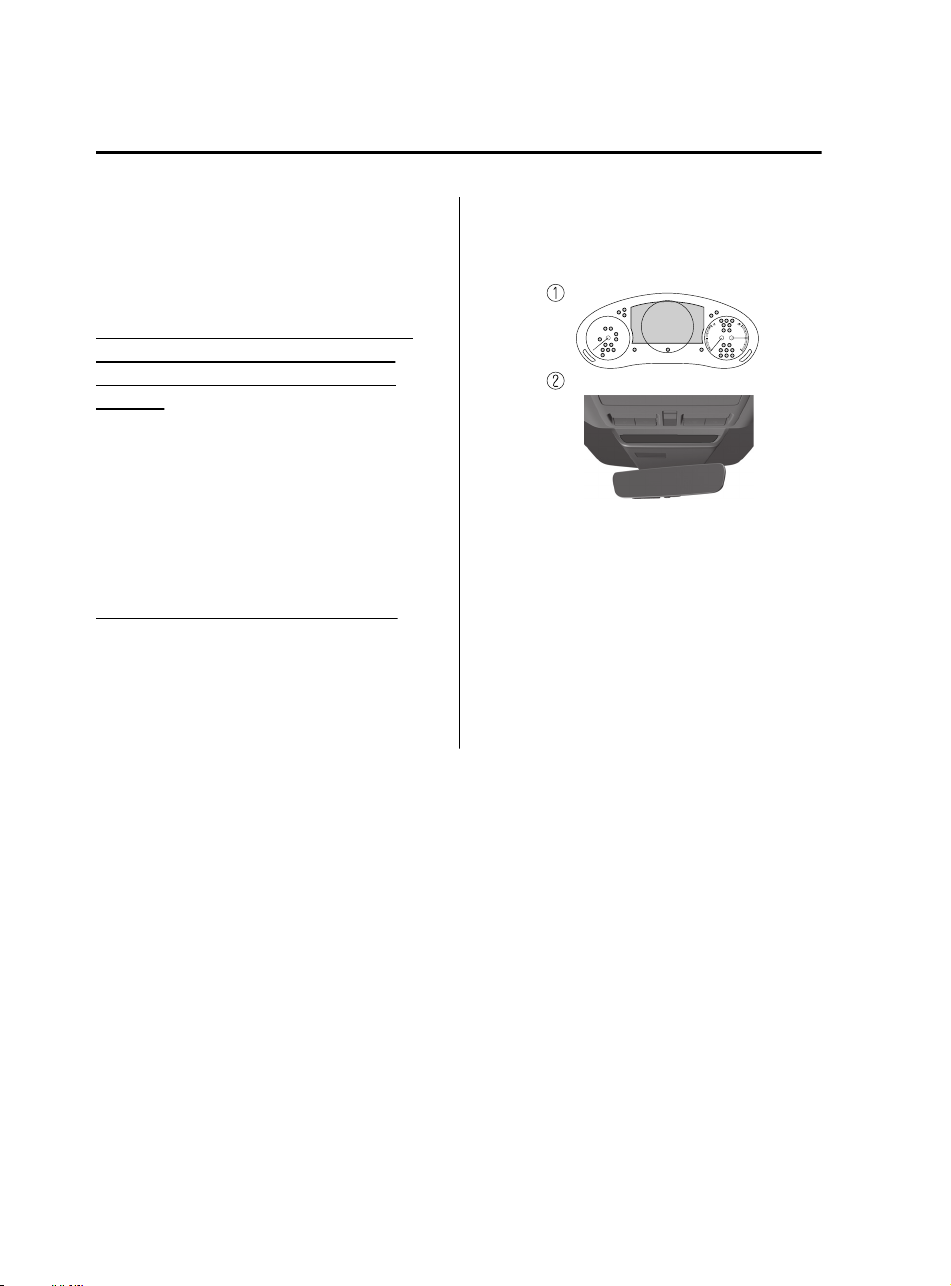
▼
Message Display
A message such as the system operation
status, a malfunction, or an abnormality is
indicated.
Warning/indicator light in instrument
cluster turns on/flashes or symbol is
indicated on display at same time as
message
Check the information regarding the
warning/indicator light or indicated
symbol.
Refer to If a Warning Indication/Warning
Lights on page 4-23.
Refer to If a Indication/Indicator Lights on
page 4-25.
Message only is indicated on display
Follow the instructions indicated on the
display. For the display content, refer to
the next page.
Refer to If a Message Indicated on
Multi-information Display on page 7-38.
▼
Warning/Indicator Lights
Instrument Cluster varies depending on
model and specifications.
1. Instrument Cluster
2. Front Center of Headliner
Warning lights will appear in any of the
highlighted areas
When Driving
Instrument Cluster and Display
4-22
Mazda3_8HZ1-EA-19G_Edition1_old 2019-5-17 13:49:03
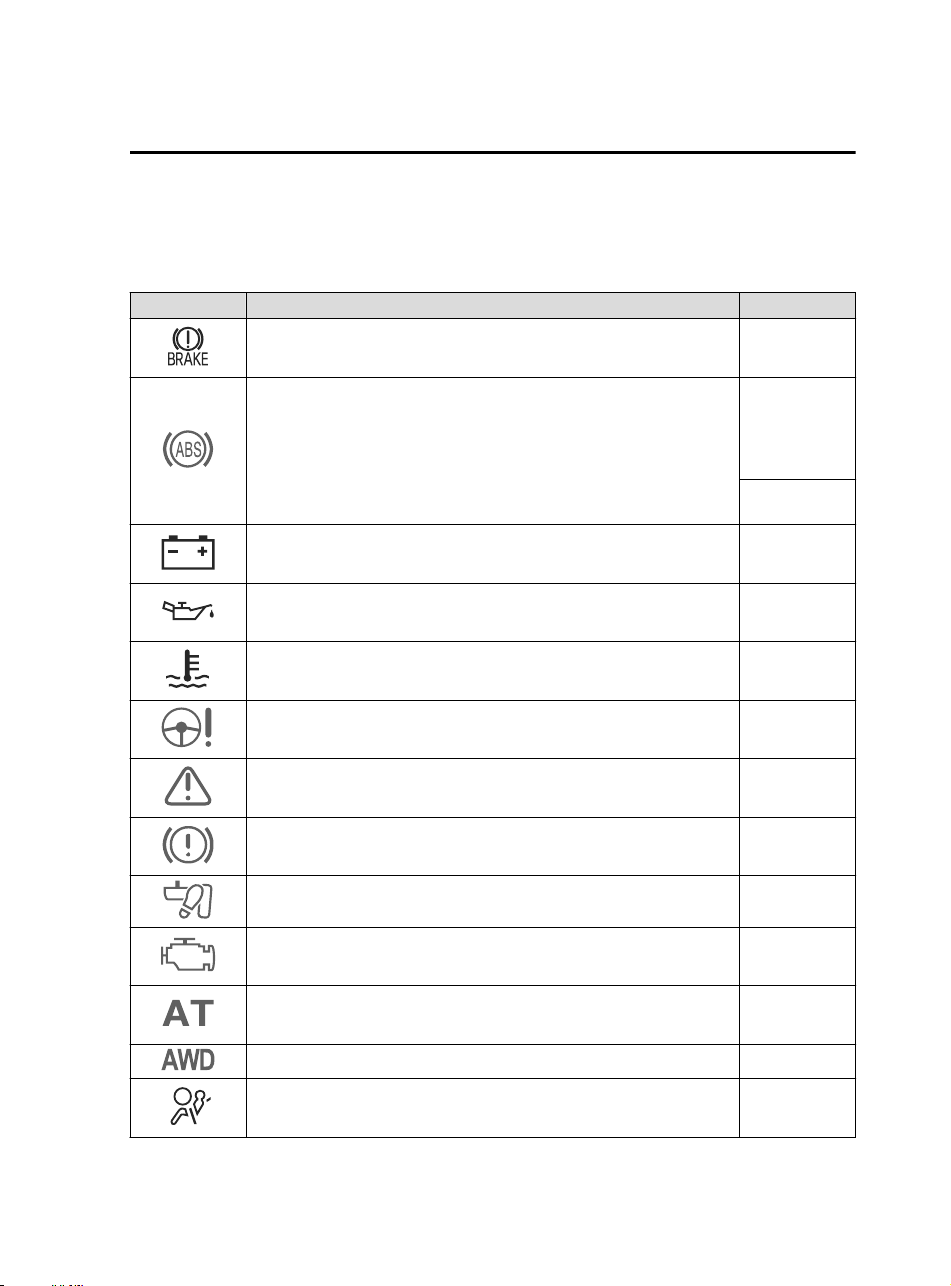
▼
Warning Indication/Warning Lights
These lights turn on or flash to notify the user of the system operation status or a system
malfunction.
Signal Warning Refer to
Brake System Warning Indication/Warning Light
*1
7-27
ABS Warning Indication/Warning Light
*1
Electronic Brake
Force Distribu‐
tion System
Warning
7-28
ABS warning
7-30
Charging System Warning Indication/Warning Light
*1
7-28
Engine Oil Warning Indication/Warning Light
*1
7-28
High Engine Coolant Temperature Warning Indication 7-29
Power Steering Malfunction Indication/Indicator Light
*1
7-29
Master Warning Indication 7-30
Brake Control System Warning Indication/Warning Light
*1
7-30
Brake Override Warning Indication 7-31
Check Engine Indication/Light
*1
7-31
*
Automatic Transmission Warning Indication/Warning Light
*1
7-31
*
AWD Warning Indication/Warning Light
*1
7-31
Air Bag/Front Seat Belt Pretensioner System Warning Indication/Warning
Light
*1
7-32
When Driving
Instrument Cluster and Display
*Some models.
4-23
Mazda3_8HZ1-EA-19G_Edition1_old 2019-5-17 13:49:03
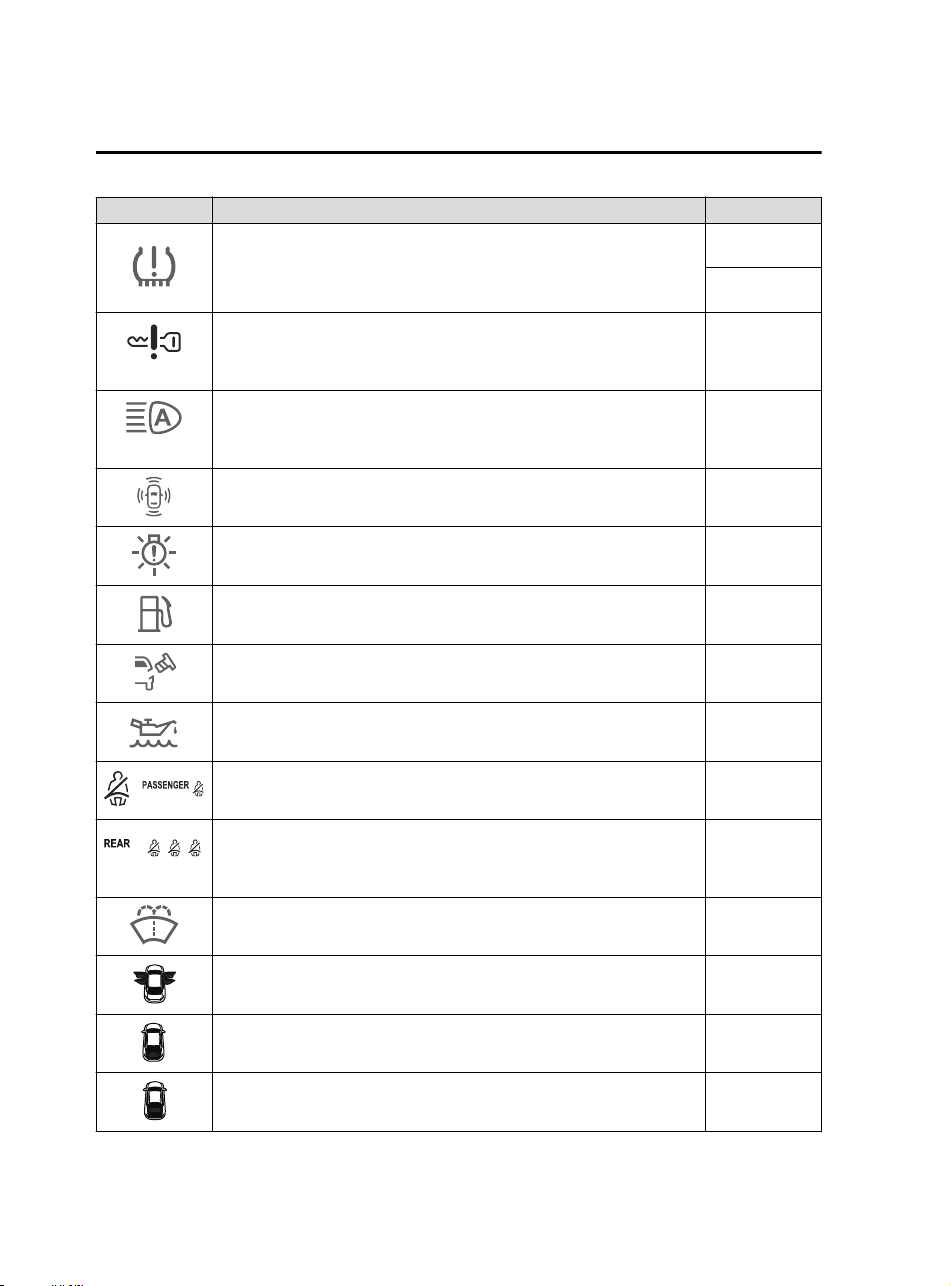
Signal Warning Refer to
Tire Pressure Monitoring System (TPMS) Warning Indication/Warning
Light
*1
Flashing
7-33
Turns on
7-36
(Red)
KEY Warning Indication/Warning Light
*1
7-33
(Amber)
*
High Beam Control System (HBC) Warning Indication/Warning Light
*1
7-34
i-ACTIVSENSE Warning Indication/Warning Light
*1
7-34
Exterior Light Warning Indication/Warning Light
*1
7-34
Low Fuel Warning Indication/Warning Light 7-34
Check Fuel Cap Warning Indication/Warning Light
*1
7-35
Engine Oil Level Warning Indication/Warning Light
*1
7-35
Seat Belt Warning Indication/Warning Light (Front seat) 7-35
(Red)
Seat Belt Warning Light (Rear seat) 7-36
*
Low Washer Fluid Level Warning Indication/Warning Light
7-36
Door-Ajar Warning Indication 7-36
*
Trunk lid-Ajar Warning Indication
7-36
*
Liftgate-Ajar Warning Indication
7-36
When Driving
Instrument Cluster and Display
4-24
*Some models.
Mazda3_8HZ1-EA-19G_Edition1_old 2019-5-17 13:49:03
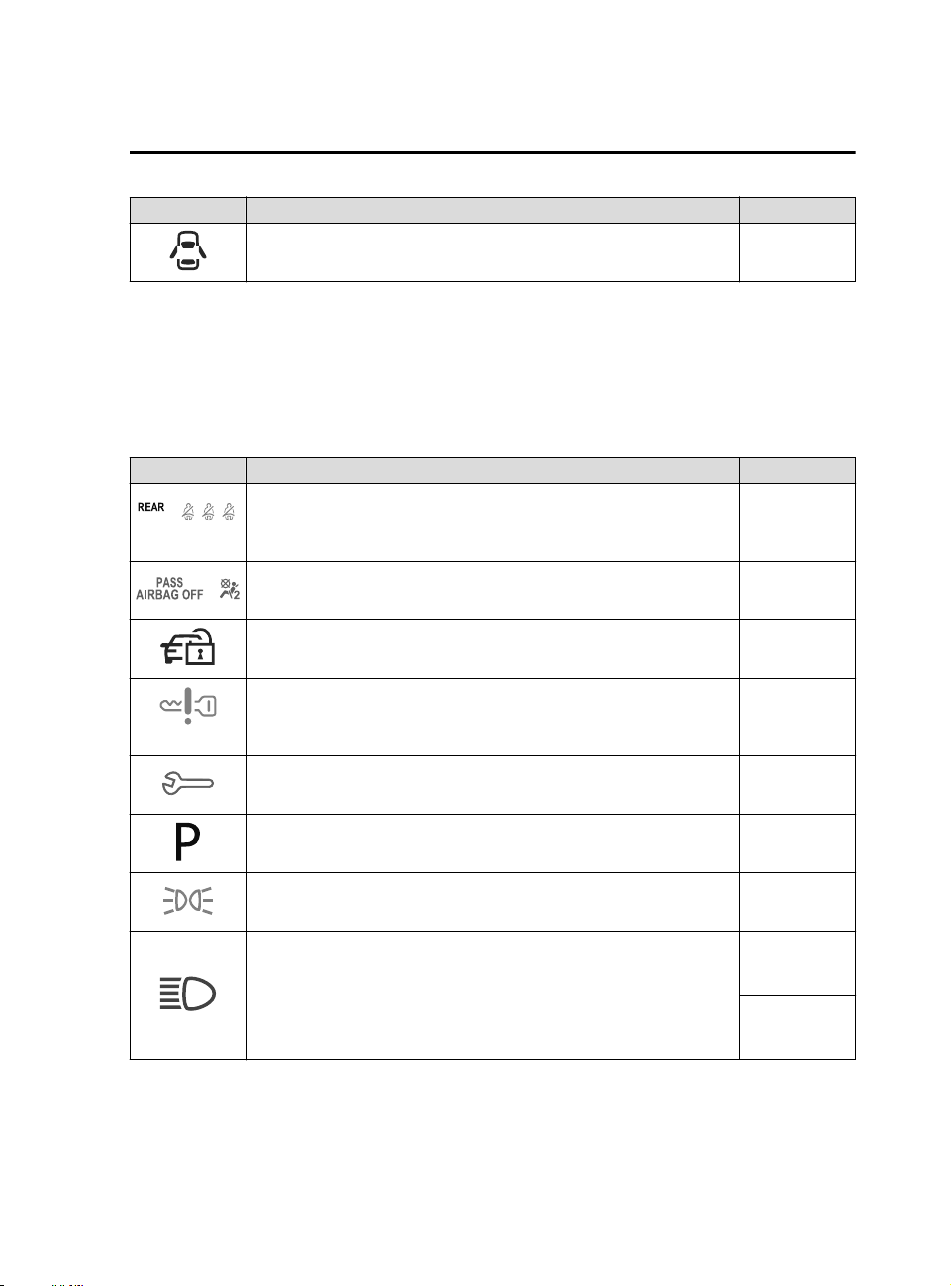
Signal Warning Refer to
Door-Ajar Warning Light 7-36
*
1 The light turns on when the ignition is switched on for an operation check, and turns off a few seconds later or
when the engine is started. If the light does not turn on or remains turned on, have the vehicle inspected at an
Authorized Mazda Dealer.
▼
Indication/Indicator Lights
These lights turn on or flash to notify the user of the system operation status or a system
malfunction.
Signal Indicator Refer to
(Green)
Seat Belt Indicator Light (Rear seat) 2-27
*
Front Passenger Air Bag Deactivation Indicator Light
2-72
Security Indicator Light 3-41
(Green)
KEY Indicator Light 4-5
Wrench Indication/Indicator Light
*1
4-28
*
Shift Position Indication
4-36
Lights-On Indicator Light 4-44
Headlight High-Beam Indicator Light
Headlight
High-Low Beam
4-47
Flashing the
Headlights
4-47
When Driving
Instrument Cluster and Display
*Some models.
4-25
Mazda3_8HZ1-EA-19G_Edition1_old 2019-5-17 13:49:03
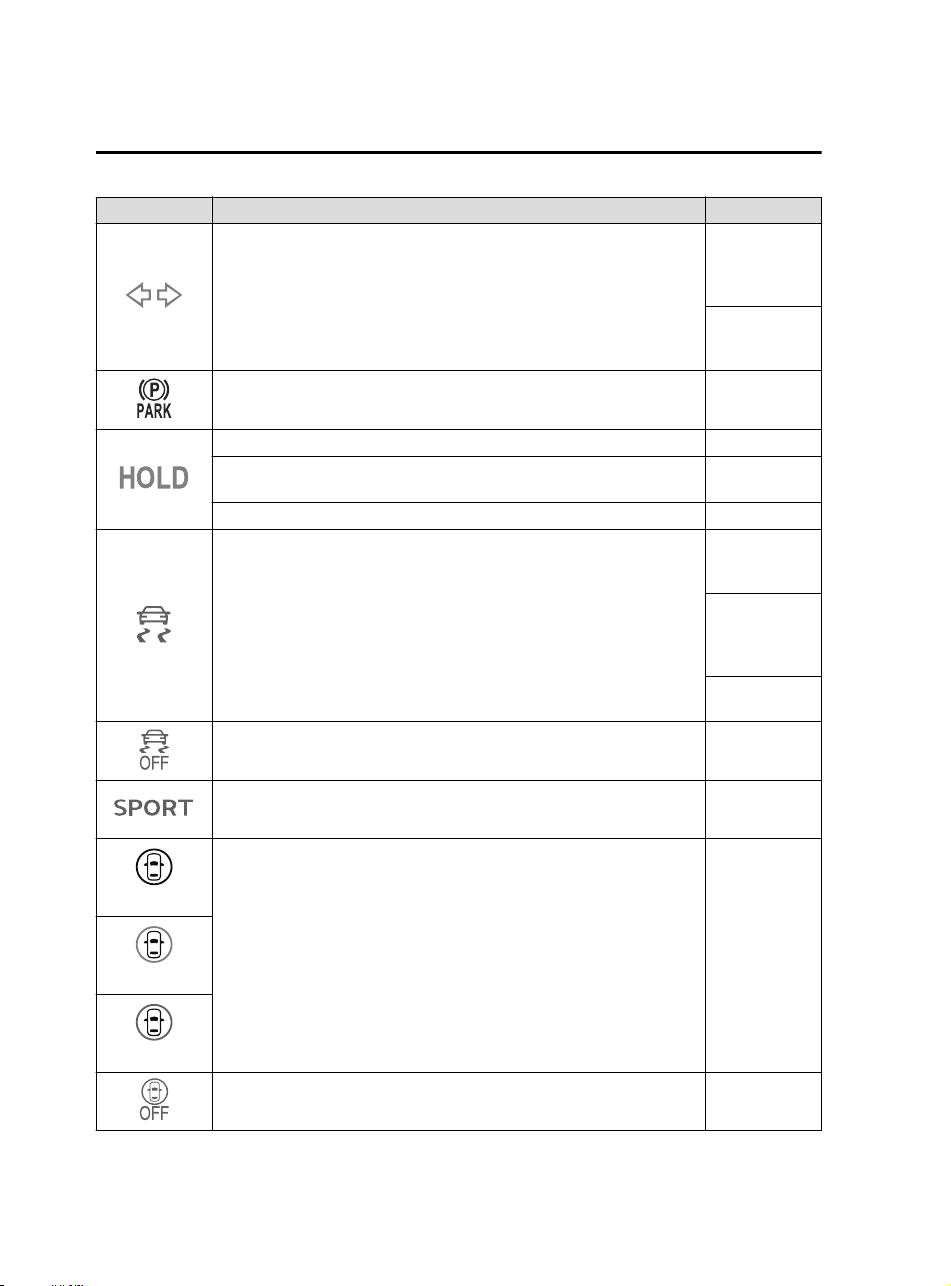
Signal Indicator Refer to
Turn Signal/Hazard Warning Indicator Lights
Turn and
Lane-Change
Signals
4-50
Hazard Warning
Flasher
4-58
Electric Parking Brake (EPB) Indication/Indicator Light
*1*2
7-30
AUTOHOLD Active Indicator Light
*1
4-71
*
Mazda Radar Cruise Control with Stop & Go function (MRCC with Stop
& Go function) indicator Light
4-136
*
Traffic Jam Assist (TJA) indicator Light
4-150
TCS/DSC Indication/Indicator Light
*1
Traction Control
System (TCS)
4-76
Dynamic Stabil‐
ity Control
(DSC)
4-77
Turns on
7-32
DSC OFF Indicator Light
*1
4-78
*
Select Mode Indicator Light
4-80
(White)
i-ACTIVSENSE Status Symbol (Warning/Risk Avoidance Support System) 4-85
(Green)
(Amber)
i-ACTIVSENSE OFF Symbol (Warning/Risk Avoidance Support System) 4-85
When Driving
Instrument Cluster and Display
4-26
*Some models.
Mazda3_8HZ1-EA-19G_Edition1_old 2019-5-17 13:49:03
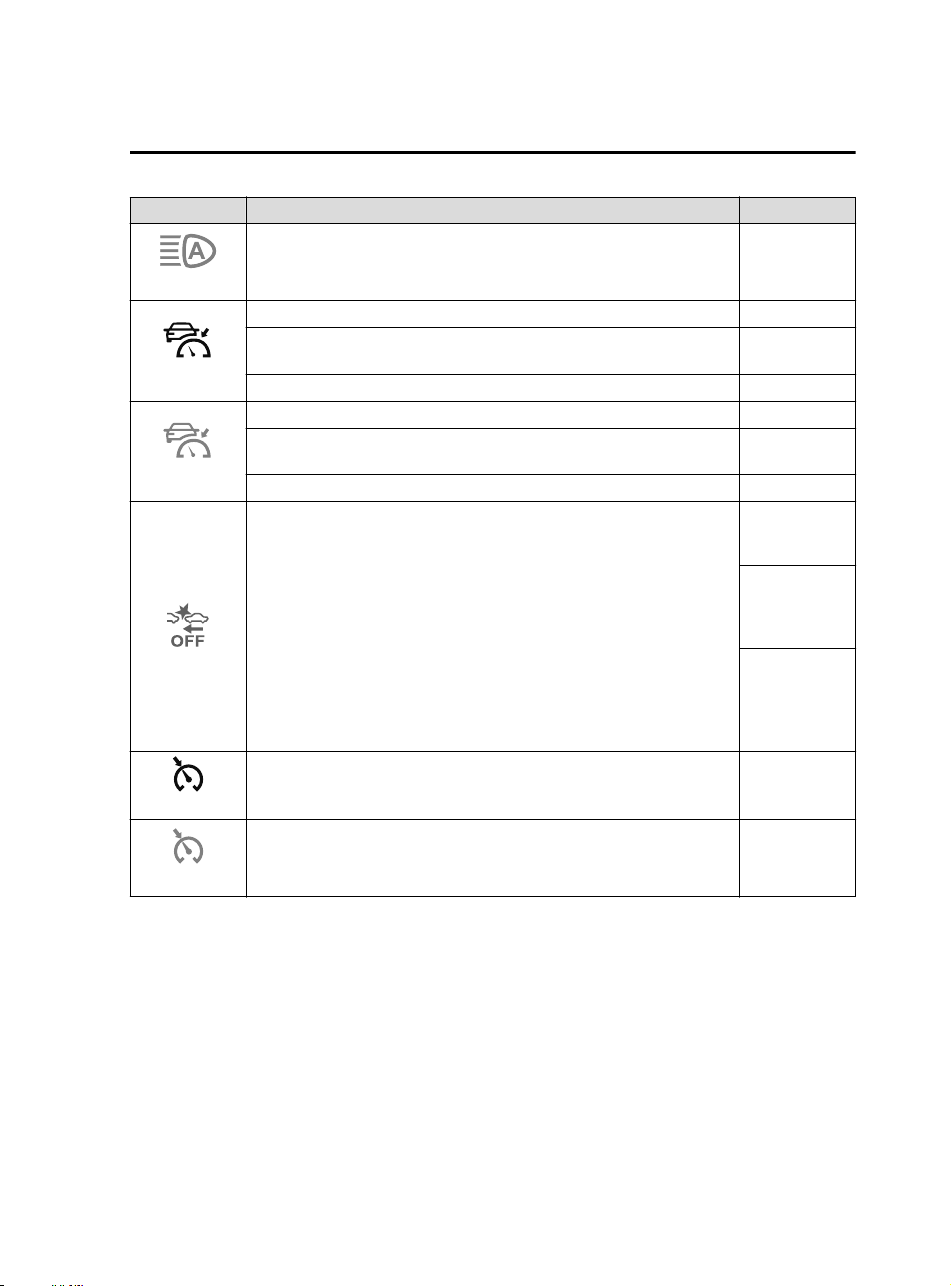
Signal Indicator Refer to
(Green)
*
High Beam Control System (HBC) Indicator Light
4-89
(White)
*
Mazda Radar Cruise Control (MRCC) Standby Indication
4-122
*
Mazda Radar Cruise Control with Stop & Go function (MRCC with Stop
& Go function) Standby Indication
4-131
*
Traffic Jam Assist (TJA) Standby Indication
4-143
(Green)
*
Mazda Radar Cruise Control (MRCC) Set Indication
4-122
*
Mazda Radar Cruise Control with Stop & Go function (MRCC with Stop
& Go function) Set Indication
4-131
*
Traffic Jam Assist (TJA) Set Indication
4-143
*
Smart Brake Support (SBS) OFF Indicator Light
*1
Smart Brake
Support (SBS)
4-157
Smart Brake
Support [Rear]
(SBS-R)
4-160
Smart Brake
Support [Rear
Crossing]
(SBS-RC)
4-165
(White)
*
Cruise Standby Indication
4-212
(Green)
*
Cruise Set Indication
4-212
*
1 The light turns on when the ignition is switched on for an operation check, and turns off
a few seconds later or when the engine is started. If the light does not turn on or remains
turned on, have the vehicle inspected at an Authorized Mazda Dealer.
*
2 The light turns on continuously when the parking brake is applied.
When Driving
Instrument Cluster and Display
*Some models.
4-27
Mazda3_8HZ1-EA-19G_Edition1_old 2019-5-17 13:49:03
▼
Wrench Indication/Indicator Light
The wrench indication/indicator light is
displayed/turns on under the following
conditions.
When the preset maintenance period has
arrived.
Refer to the Information section in the
Mazda Connect Owner's Manual.
CAUTION
When the maintenance period arrives,
have your vehicle inspected by an
Authorized Mazda Dealer as soon as
possible. If maintenance is neglected, a
decrease in vehicle performance may
occur which could cause damage.
Have your vehicle inspected before the
maintenance period arrives.
If the vehicle continues to be driven
after the engine oil replacement period
has passed, it could cause damage to
the engine. Replace the engine oil
before the maintenance period arrives.
NOTE
The wrench indication/indicator light
may display/turn on earlier than the
preset period depending on vehicle
usage conditions.
Whenever the engine oil is replaced, a
reset of the vehicle engine control unit is
necessary.
Refer to the Information section in the
Mazda Connect Owner's Manual.
When Driving
Instrument Cluster and Display
4-28
Mazda3_8HZ1-EA-19G_Edition1_old 2019-5-17 13:49:03
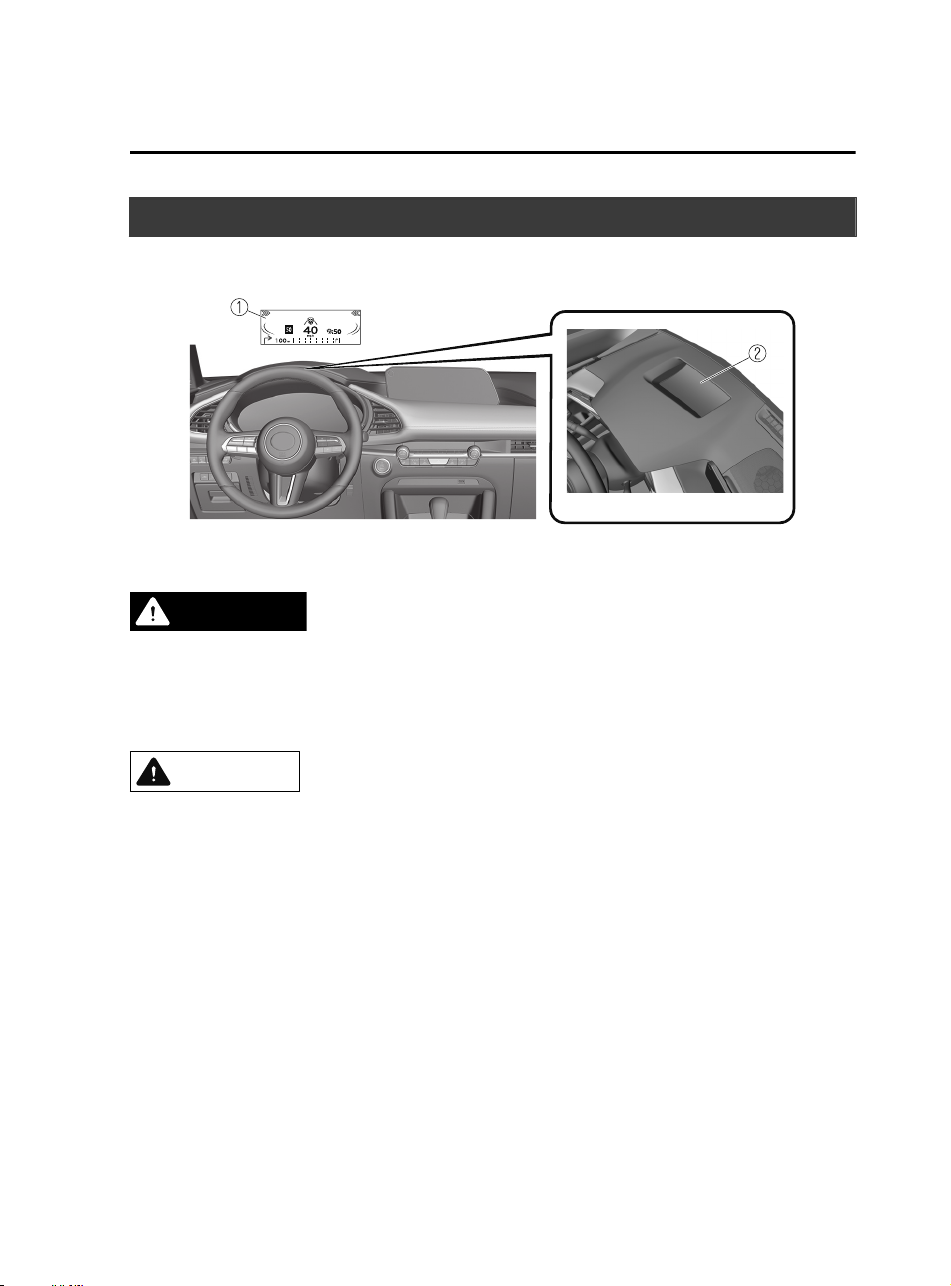
Active Driving Display
*
▼
Active Driving Display
1. Display
2. Dust-proof sheet
WARNING
Always adjust the display brightness and position with the vehicle stopped:
Adjusting the display brightness and position while driving the vehicle is dangerous as doing
so could distract your attention from the road ahead and lead to an accident.
CAUTION
Do not place beverages near the dust-proof sheet of the active driving display. If water or
other liquids are splashed on the dust-proof sheet, it could cause damage.
Do not place objects or apply stickers above the active driving display or to the dust-proof
sheet as they will cause interference.
NOTE
Wearing polarized sunglasses will reduce the visibility of the active driving display due to
the characteristics of the display.
If the battery has been removed and re-installed or the battery voltage is low, the adjusted
position may deviate.
The display may be difficult to view or temporarily affected by weather conditions such as
rain, snow, light, and temperature.
If the audio system is removed, the active driving display cannot be operated.
When Driving
Instrument Cluster and Display
*Some models.
4-29
Mazda3_8HZ1-EA-19G_Edition1_old 2019-5-17 13:49:03

The active driving display indicates the following information:
Blind Spot Monitoring (BSM) Operation Conditions and Warnings
Refer to Blind Spot Monitoring (BSM) on page 4-94.
Lane-keep Assist System (LAS) Warnings
Refer to Traffic Sign Recognition System (TSR) on page 4-99.
Front Cross Traffic Alert (FCTA) Operation Conditions and Warning
Refer to Front Cross Traffic Alert (FCTA) on page 4-111.
Mazda Radar Cruise Control (MRCC) Operation Conditions and Warnings
Refer to Mazda Radar Cruise Control (MRCC) on page 4-118.
Mazda Radar Cruise Control with Stop & Go function (MRCC with Stop & Go function)
Operation Conditions and Warnings
Refer to Mazda Radar Cruise Control with Stop & Go function (MRCC with Stop & Go
function) on page 4-126.
Traffic Jam Assist (TJA) Operation Conditions and Warnings
Refer to Traffic Jam Assist (TJA) on page 4-137.
Lane-keep Assist System (LAS) Warnings
*
Lane-keep Assist System (LAS) on page 4-151.
Smart Brake Support (SBS) Operation Conditions and Warnings
Refer to Smart Brake Support (SBS) on page 4-155.
Smart Brake Support [Rear] (SBS-R) Operation Conditions and Warnings
Refer to Smart Brake Support [Rear] (SBS-R) on page 4-157.
Smart Brake Support [Rear Crossing] (SBS-RC) Operation Conditions and Warnings
Refer to Smart Brake Support [Rear Crossing] (SBS-RC) on page 4-161.
Cruise Control Operation Conditions
Refer to Cruise Control on page 4-212.
Navigation Guidance (vehicles with navigation system)
Intersection Name (vehicles with navigation system)
Street name (vehicles with navigation system)
Lane Guidance (vehicles with navigation system)
Speed limit indicator (vehicles with navigation system)
Vehicle Speed
The active driving display settings can be changed or adjusted.
Refer to the Settings section in the Mazda Connect Owner's Manual.
NOTE
The desired driving position (display position, brightness level, display information) can
be called up after programming the position.
Refer to Driving Position Memory on page 2-10.
The street name may not be displayed depending on the market and region.
When Driving
Instrument Cluster and Display
4-30
*Some models.
Mazda3_8HZ1-EA-19G_Edition1_old 2019-5-17 13:49:03
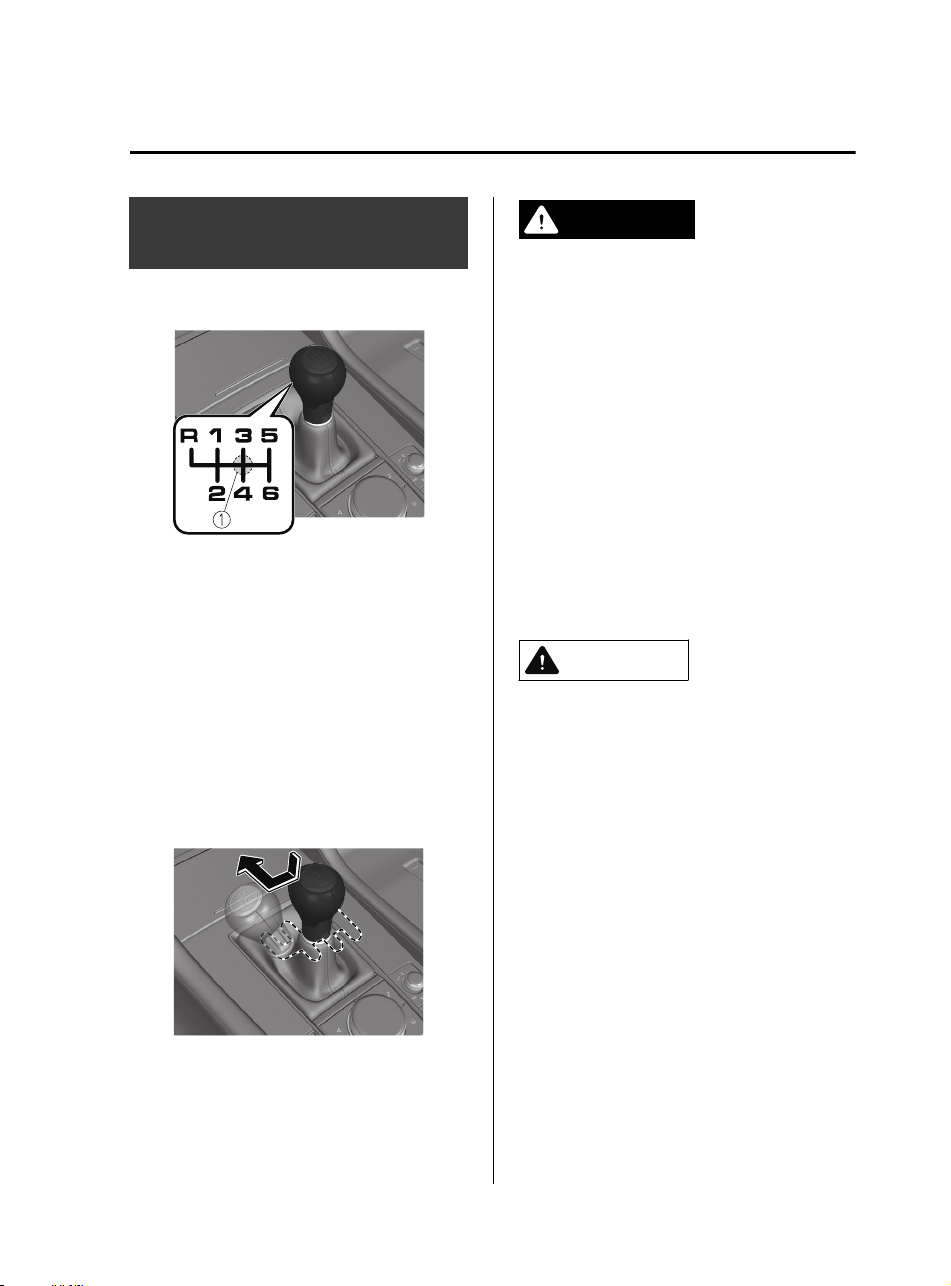
Manual Transmission Shift
Pattern
▼
Manual Transmission Shift Pattern
1. Neutral position
The shift pattern of the transmission is
conventional, as shown.
Depress the clutch pedal all the way down
while shifting; then release it slowly.
Your vehicle is equipped with a device to
prevent shifting to R (reverse) by mistake.
Push the shift lever downward and shift to
R.
WARNING
Do not use sudden engine braking on
slippery road surfaces or at high speeds:
Shifting down while driving on wet, snowy,
or frozen roads, or while driving at high
speeds causes sudden engine braking,
which is dangerous. The sudden change in
tire speed could cause the tires to skid. This
could lead to loss of vehicle control and an
accident.
Always leave the shift lever in 1 or R
position and set the parking brake when
leaving the vehicle unattended:
Otherwise the vehicle could move and
cause an accident.
CAUTION
Keep your foot o the clutch pedal except
when shifting gears. Also, do not use the
clutch to hold the vehicle on an upgrade.
Riding the clutch will cause needless
clutch wear and damage.
Do not apply any excessive lateral force
to the shift lever when changing from
5th to 4th gear. This could lead to the
accidental selection of 2nd gear, which
could result in damage to the
transmission.
Make sure the vehicle comes to a
complete stop before shifting to R.
Shifting to R while the vehicle is still
moving may damage the transmission.
NOTE
If shifting to R is difficult, shift back into
neutral, release the clutch pedal, and try
again.
When Driving
Manual Transmission Operation
4-31
Mazda3_8HZ1-EA-19G_Edition1_old 2019-5-17 13:49:03
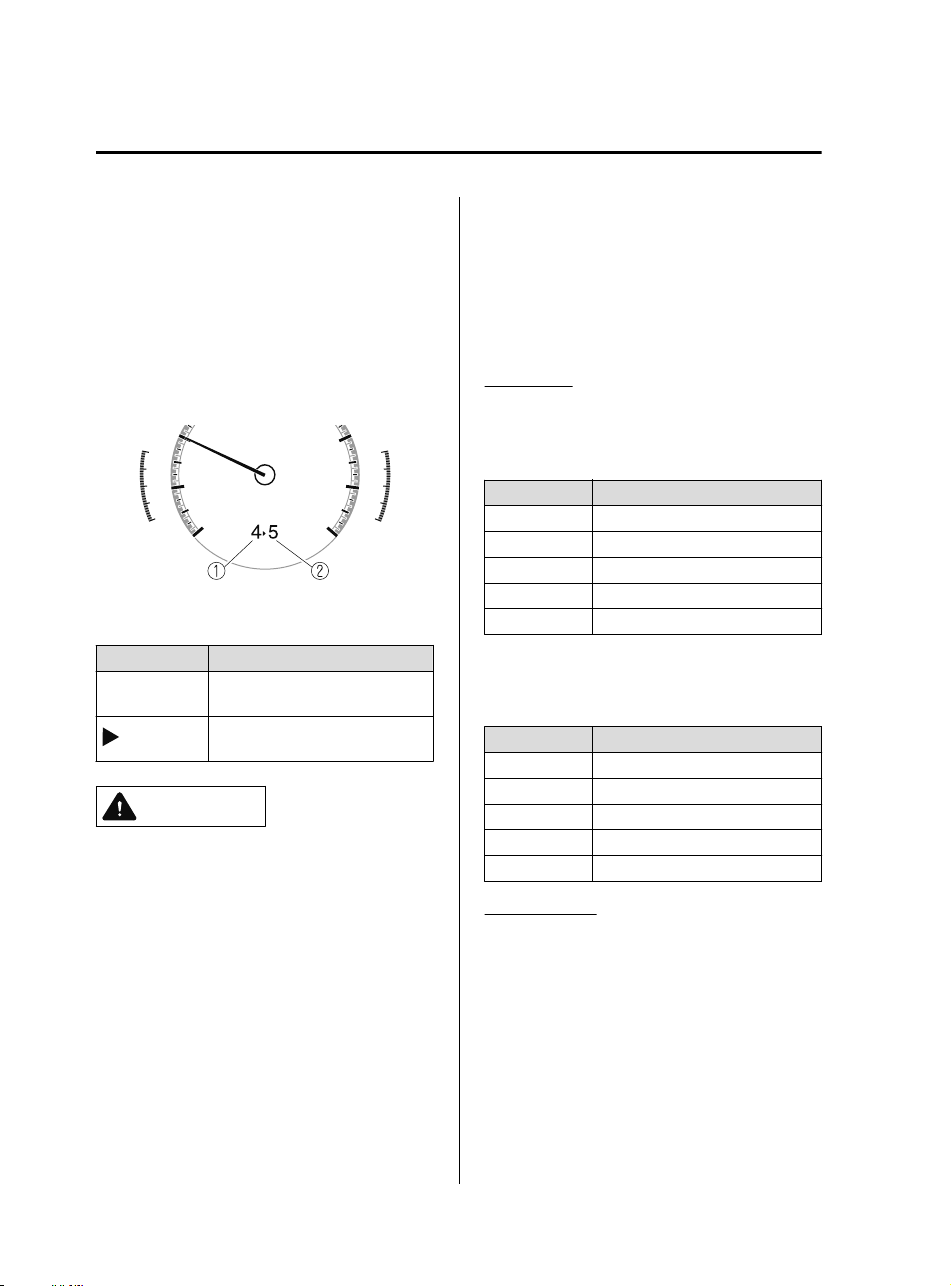
▼
Gear Shift Indicator (GSI)
The GSI supports you to obtain optimum
fuel economy and smooth driving. It
displays the selected gear position in the
instrument cluster as well as notifies the
driver to change to the most suitable gear
position corresponding to the actual
driving condition.
1. Selected gear position
2. Suitable gear position
Indication Condition
Numeral
The selected gear position is dis‐
played.
and numeral
Shift up or down to the indicated
gear position is recommended.
CAUTION
Do not rely solely on the shift-up/
shift-down recommendations by
indications. The actual driving situation
might require shift operations dierent
from indication. To avoid the risk of
accidents, the road and trac conditions
have to be judged correctly by the driver
before shifting.
NOTE
The GSI turns off when the following
operations are performed.
The vehicle is stopped.
The vehicle is put in neutral.
The vehicle is driven in reverse.
The clutch is not fully engaged when
accelerating from a stop.
The clutch pedal remains depressed for
2 seconds or longer while driving.
▼
Recommendations for Shifting
Upshifting
For normal acceleration, Mazda
recommends these shift points:
(U.S.A. and Canada)
Gear Vehicle speed
1 to 2 24 km/h (15 mph)
2 to 3 42 km/h (26 mph)
3 to 4 60 km/h (37 mph)
4 to 5 75 km/h (46 mph)
5 to 6 79 km/h (49 mph)
For cruising, Mazda recommends these
shift points:
(U.S.A. and Canada)
Gear Vehicle speed
1 to 2 13 km/h (8 mph)
2 to 3 29 km/h (18 mph)
3 to 4 49 km/h (30 mph)
4 to 5 63 km/h (39 mph)
5 to 6 70 km/h (43 mph)
Downshifting
When you must slow down in heavy
traffic or on a steep upgrade, downshift
before the engine starts to overwork. This
reduces the chance of stalling and gives
better acceleration when you need more
speed.
On a steep downgrade, downshifting
helps maintain safe speed and prolongs
brake life.
When Driving
Manual Transmission Operation
4-32
Mazda3_8HZ1-EA-19G_Edition1_old 2019-5-17 13:49:03
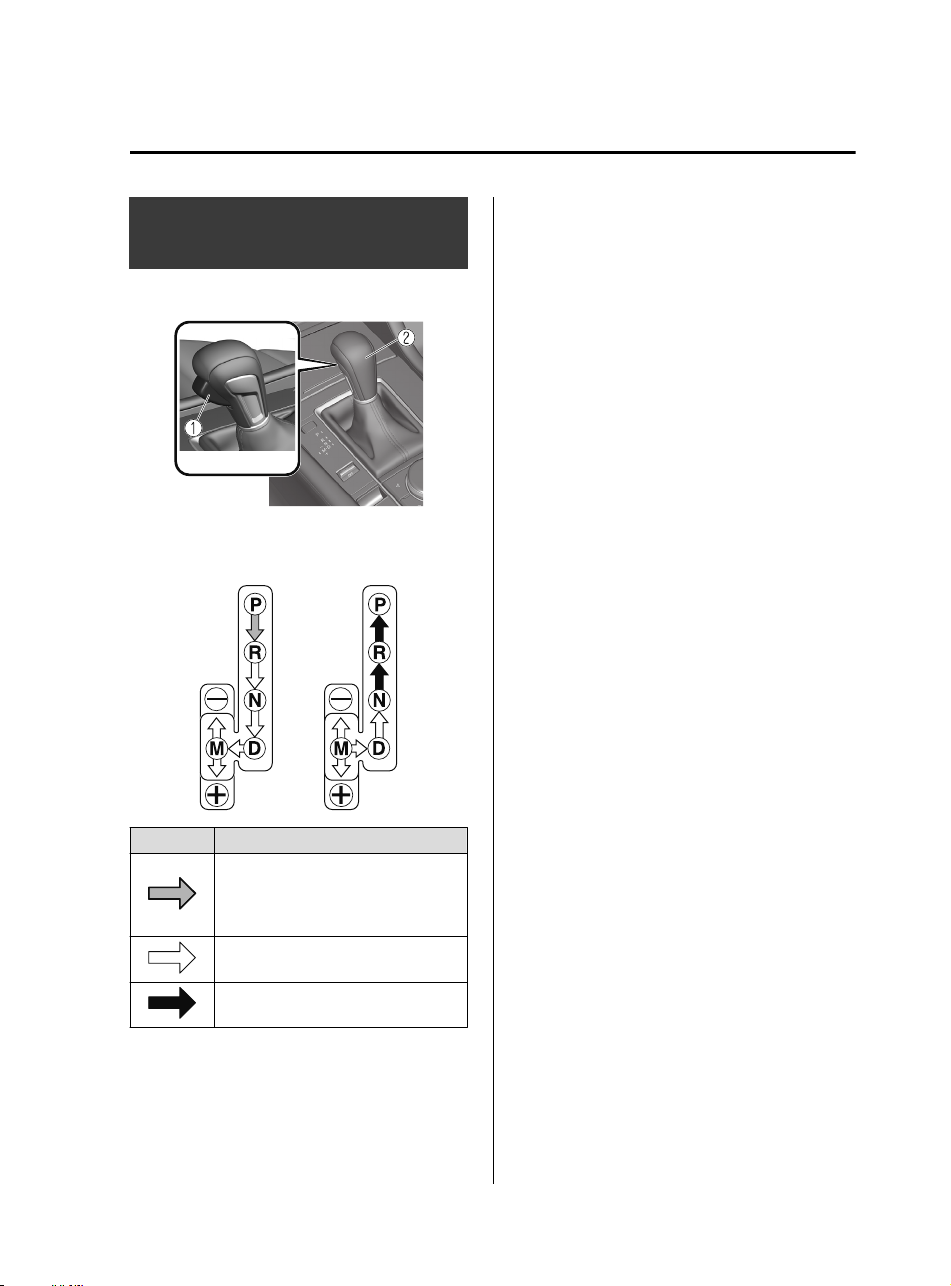
Automatic Transmission
Controls
▼
Automatic Transmission Controls
1. Lock-release button
2. Selector lever
Indication Various Lockouts
Indicates that you must depress the
brake pedal and hold in the lock-re‐
lease button to shift (The ignition
must be switched ON).
Indicates the selector lever can be
shifted freely into any position.
Indicates that you must hold in the
lock-release button to shift.
NOTE
The Sport AT has an option that is not
included in the traditional automatic
transmission that gives the driver the
option of selecting each gear instead of
leaving it to the transmission to shift
gears. Even if you intend to use the
automatic transmission functions as a
traditional automatic, you should also be
aware that you can inadvertently shift into
manual shift mode and an inappropriate
gear may be retained as the vehicle speed
increases. If you notice the engine speed
going higher or hear the engine racing,
confirm you have not accidentally slipped
into manual shift mode (page 4-36).
When Driving
Automatic Transmission
4-33
Mazda3_8HZ1-EA-19G_Edition1_old 2019-5-17 13:49:03
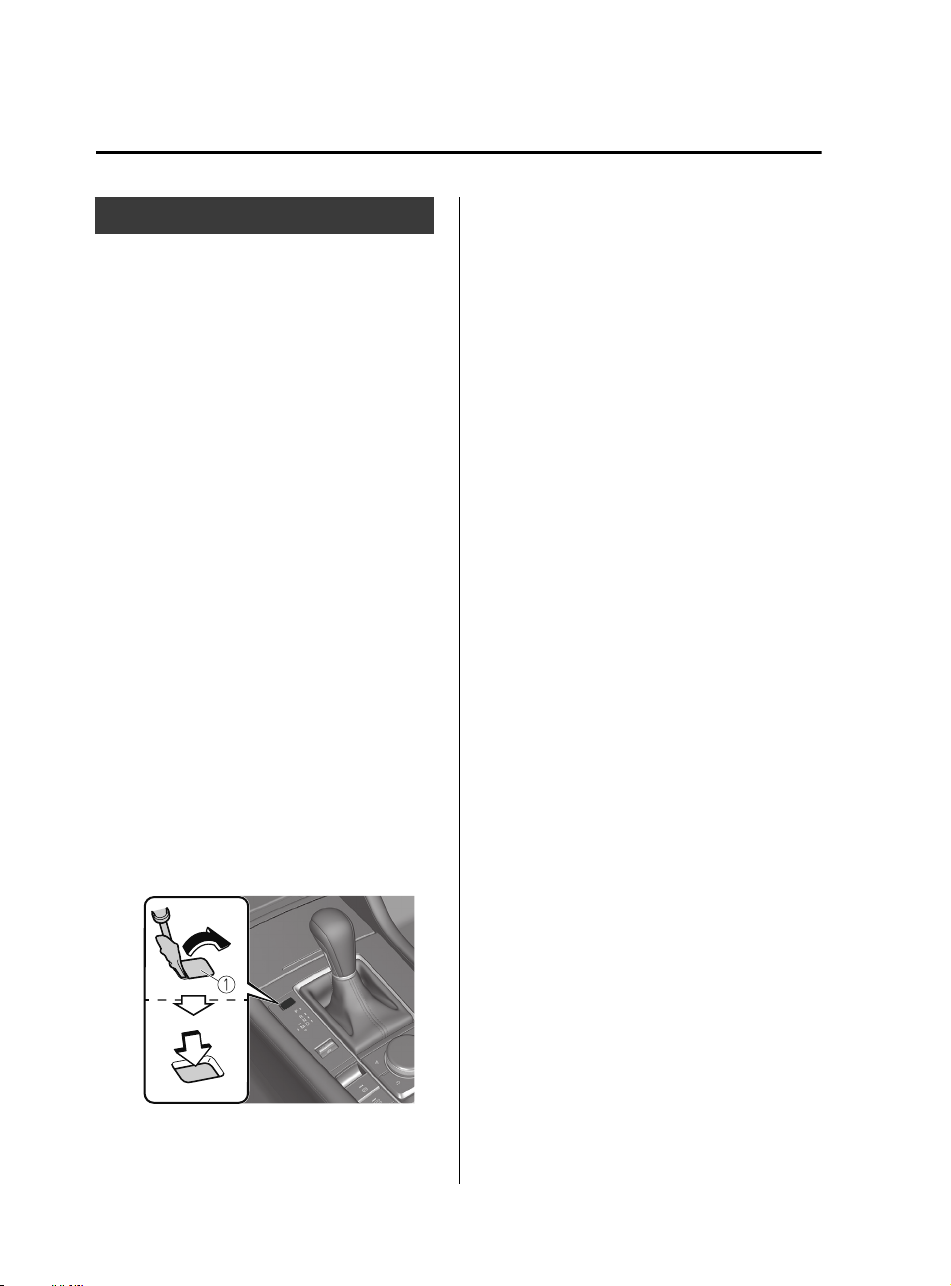
Shift-Lock System
▼
Shift-Lock System
The shift-lock system prevents shifting out
of P unless the brake pedal is depressed.
To shift from P:
1. Depress and hold the brake pedal.
2. Start the engine.
3. Press and hold the lock-release button.
4. Move the selector lever.
NOTE
When the ignition is switched to ACC or
the ignition is switched off, the selector
lever cannot be shifted from P position.
The ignition cannot be switched to OFF
if the selector lever is not in P position.
▼
Shift-Lock Override
If the selector lever will not move from P
position using the proper shift procedure,
continue to hold down the brake pedal.
1. Remove the shift-lock override cover
using a cloth-wrapped flat head
screwdriver.
2. Insert a flat screwdriver and push it
down.
1. Cover
3. Press and hold the lock-release button.
4. Move the selector lever.
Take the vehicle to an Authorized Mazda
Dealer to have the system checked.
When Driving
Automatic Transmission
4-34
Mazda3_8HZ1-EA-19G_Edition1_old 2019-5-17 13:49:03
Transmission Ranges
▼
Transmission Ranges
The shift position indication in the
instrument cluster illuminates.
Refer to Shift Position Indication on
page 4-36.
Shift the selector lever to the P or N
position to start the engine.
P (Park)
P locks the transmission and prevents the
front wheels from rotating.
WARNING
Always set the selector lever to P position
and set the parking brake:
Only setting the selector lever to the P
position without using the parking brake to
hold the vehicle is dangerous. If P fails to
hold, the vehicle could move and cause an
accident.
CAUTION
Shifting into P, N or R while the vehicle is
moving can damage your transmission.
Shifting into a driving gear or reverse
when the engine is running faster than
idle can damage the transmission.
R (Reverse)
In position R, the vehicle moves only
backward. You must be at a complete stop
before shifting to or from R, except under
rare circumstances as explained in
Rocking the Vehicle (page 3-46).
N (Neutral)
In N, the wheels and transmission are not
locked. The vehicle will roll freely even
on the slightest incline unless the parking
brake or brakes are on.
WARNING
If the engine is running faster than idle, do
not shift from N or P into a driving gear:
It's dangerous to shift from N or P into a
driving gear when the engine is running
faster than idle. If this is done, the vehicle
could move suddenly, causing an accident
or serious injury.
Do not shift into N when driving the
vehicle:
Shifting into N while driving is dangerous.
Engine braking cannot be applied when
decelerating which could lead to an
accident or serious injury.
CAUTION
Do not shift into N when driving the
vehicle. Doing so can cause transmission
damage.
NOTE
Apply the parking brake or depress the
brake pedal before moving the selector
lever from N position to prevent the
vehicle from moving unexpectedly.
D (Drive)
D is the normal driving position. From a
stop, the transmission will automatically
shift through a 6-gear sequence.
When Driving
Automatic Transmission
4-35
Mazda3_8HZ1-EA-19G_Edition1_old 2019-5-17 13:49:03
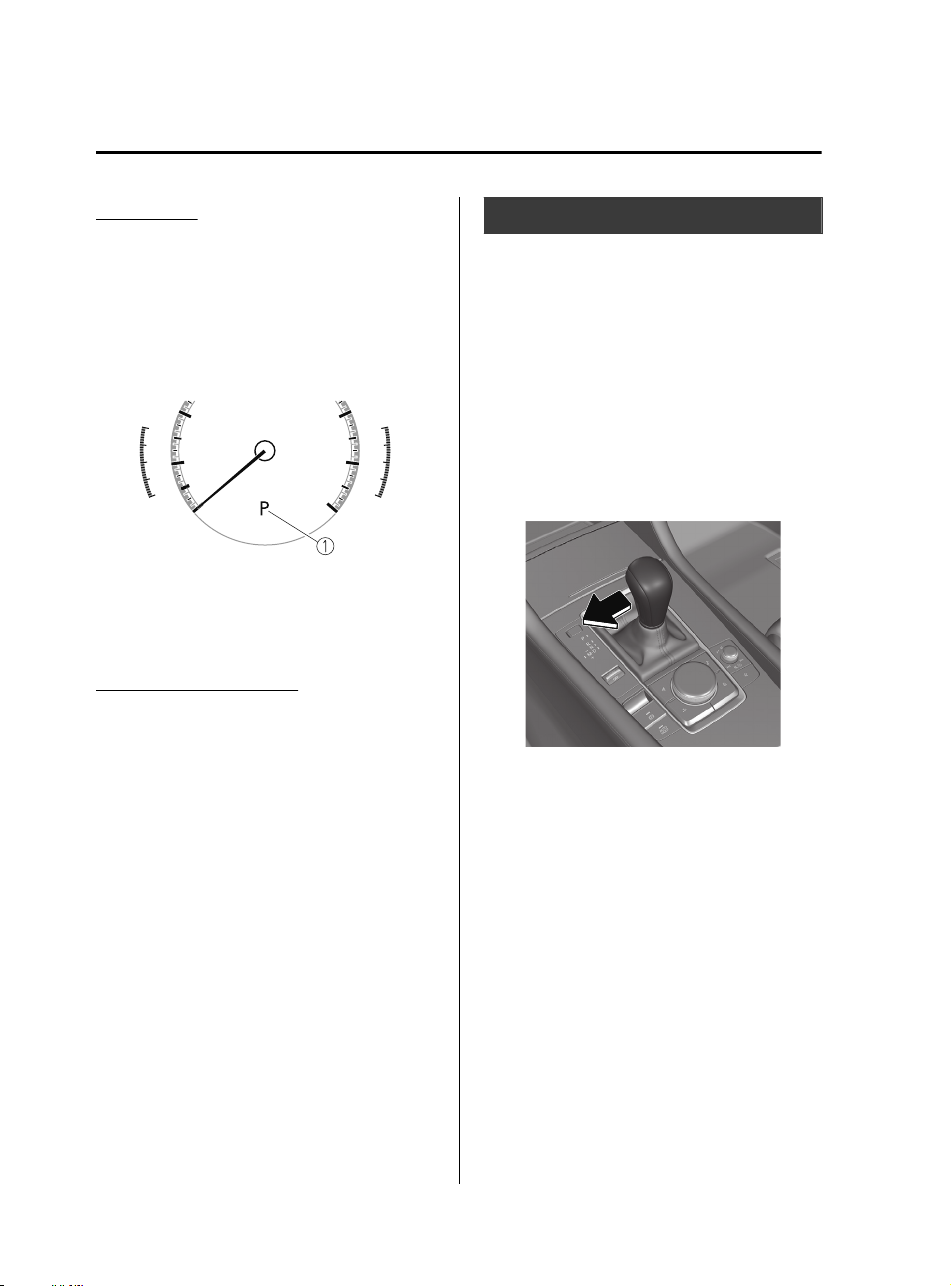
M (Manual)
M is the manual shift mode position.
Gears can be shifted up or down by
operating the selector lever.
Refer to Manual Shift Mode on page
4-36.
▼
Shift Position Indication
1. Shift position indication
The selector position is indicated when the
ignition is switched ON.
Gear position indication
In manual shift mode, the “M” of the shift
position indication illuminates and the
numeral for the selected gear is displayed.
▼
Active Adaptive Shift (AAS)
Active Adaptive Shift (AAS)
automatically controls the transmission
shift points to best suit the road conditions
and driver input. This improves driving
feel. The transmission may switch to AAS
mode when driving up and down slopes,
cornering, driving at high elevations, or
depressing the accelerator pedal quickly
while the selector lever is in the D
position. Depending on the road and
driving conditions/vehicle operations, gear
shifting could be delayed or not occur,
however, this does not indicate a problem
because the AAS mode will maintain the
optimum gear position.
Manual Shift Mode
▼
Manual Shift Mode
The manual shift mode gives you the feel
of driving a manual transmission vehicle
by allowing you to operate the selector
lever manually. This allows you to control
engine rpm and torque to the drive wheels
much like a manual transmission when
more control is desired.
To change to manual shift mode, shift the
lever from D to M.
NOTE
Changing to manual shift mode while
driving will not damage the
transmission.
If you change to manual shift mode
when the vehicle is stopped, the gear
will shift to M1.
If you change to manual shift mode
without depressing the accelerator pedal
when driving in D range, 5th gear/6th
gear, the gear will shift to M4/M5.
To return to automatic shift mode, shift the
lever from M to D.
When Driving
Automatic Transmission
4-36
Mazda3_8HZ1-EA-19G_Edition1_old 2019-5-17 13:49:03
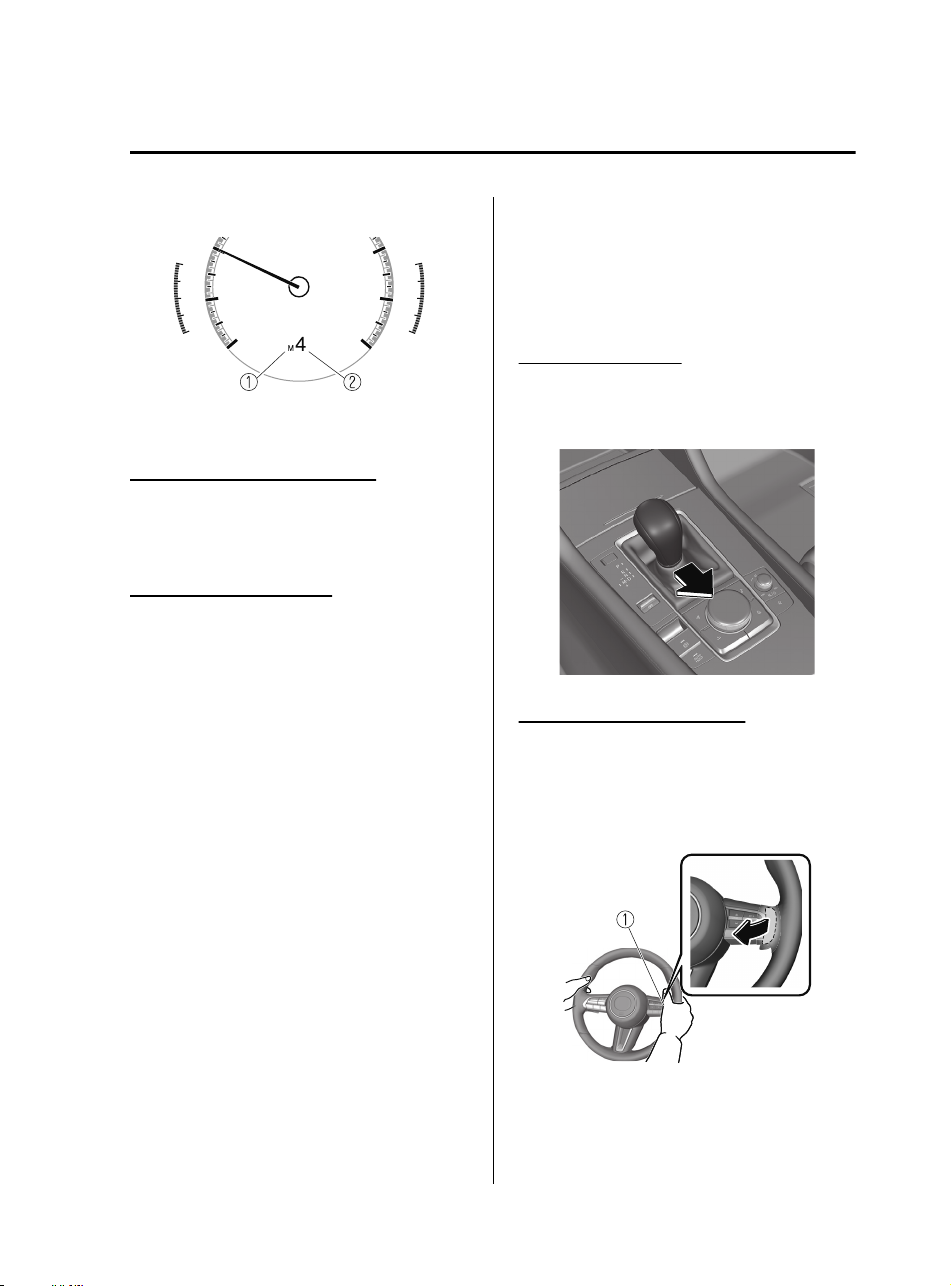
▼
Indications
1. Manual shift mode indication
2. Gear position indication
Manual shift mode indication
In manual shift mode, the “M” of the shift
position indication in the instrument panel
illuminates.
Gear position indication
The numeral for the selected gear
illuminates.
NOTE
If the gears cannot be shifted down
when driving at higher speeds, the gear
position indication will flash twice to
signal that the gears cannot be shifted
down (to protect the transmission).
If the automatic transmission fluid
(ATF) temperature becomes too high,
there is the possibility that the
transmission will switch to automatic
shift mode, canceling manual shift mode
and turning off the gear position
indication illumination. This is a normal
function to protect the AT. After the ATF
temperature has decreased, the gear
position indication illumination turns
back on and driving in manual shift
mode is restored.
▼
Manually Shifting Up
You can shift gears up by operating the
selector lever or the steering shift
switches
*
.
M1 → M2 → M3 → M4 → M5 → M6
Using selector lever
To shift up to a higher gear, tap the
selector lever back + once.
Using steering shift switch
*
To shift up to a higher gear with the
steering shift switches, pull the UP switch
(+/OFF) toward you once with your
fingers.
1. UP switch (+/OFF)
When Driving
Automatic Transmission
*Some models.
4-37
Mazda3_8HZ1-EA-19G_Edition1_old 2019-5-17 13:49:03
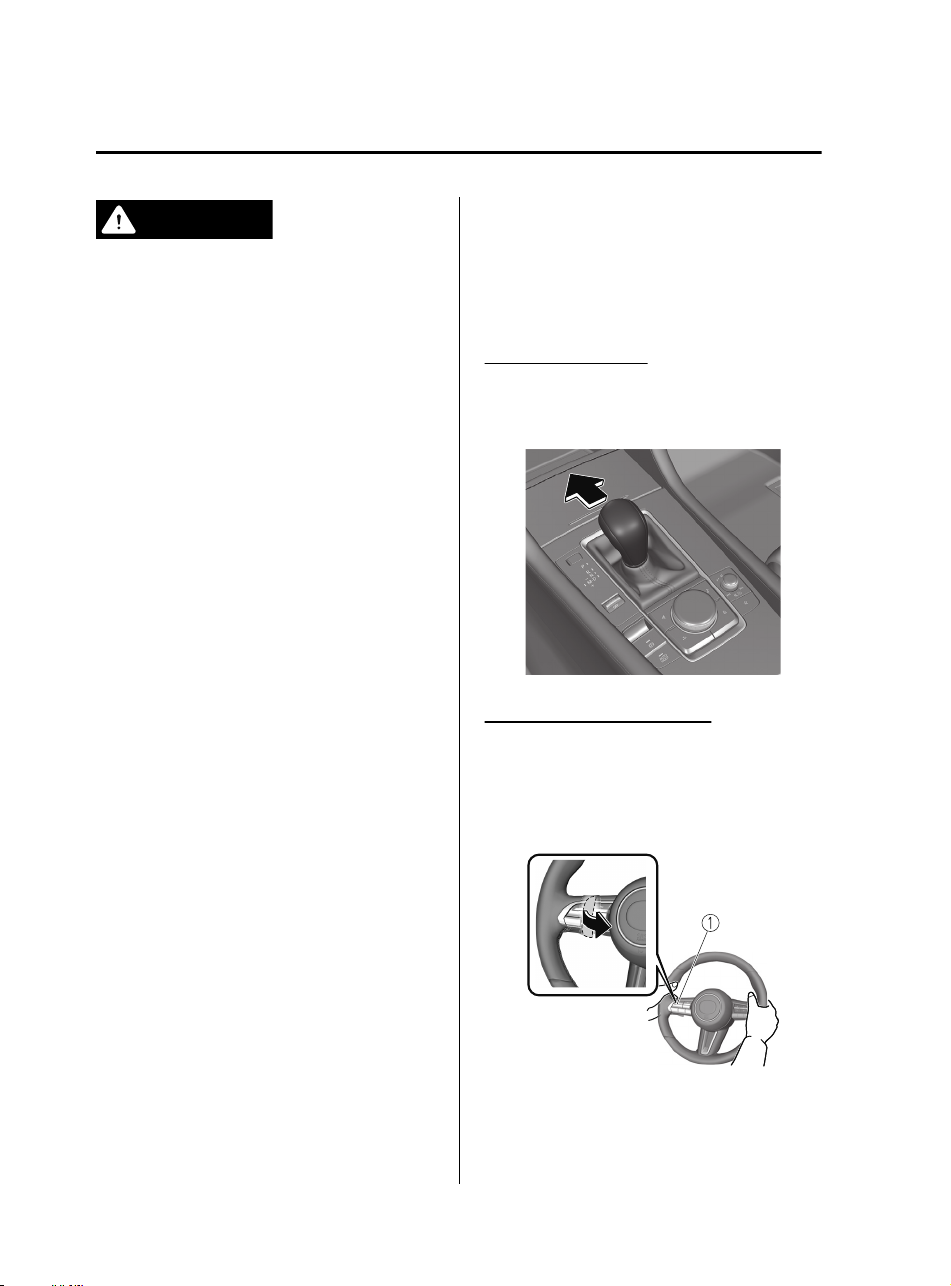
WARNING
Keep your hands on the steering wheel rim
when using ngers on the steering shift
switches:
Putting your hands inside the rim of the
steering wheel when using the steering
shift switches is dangerous. If the driver's
air bag were to deploy in a collision, your
hands could be impacted causing injury.
NOTE
When driving slowly, the gears may not
shift up.
Do not drive the vehicle with the
tachometer needle in the RED ZONE
while in manual shift mode. In addition,
manual shift mode switches to automatic
shift mode while the accelerator pedal is
completely depressed.
This function is canceled while the DSC
is turned off. However, if the vehicle is
continuously driven at a high rpm, the
gears may automatically shift up to
protect the engine.
The steering shift switch can be used
temporarily even if the selector lever is
in the D position while driving. In
addition, it returns to automatic shift
mode when the UP switch (+/OFF) is
pulled rearward for a sufficient amount
of time.
▼
Manually Shifting Down
You can shift gears down by operating the
selector lever or the steering shift
switches
*
.
M6 → M5 → M4 → M3 → M2→ M1
Using selector lever
To shift down to a lower gear, tap the
selector lever forward – once.
Using steering shift switch
*
To shift down to a lower gear with the
steering shift switches, pull the DOWN
switch (–) toward you once with your
fingers.
1. DOWN switch (–)
When Driving
Automatic Transmission
4-38
*Some models.
Mazda3_8HZ1-EA-19G_Edition1_old 2019-5-17 13:49:03
WARNING
Do not use engine braking on slippery road
surfaces or at high speeds:
Shifting down while driving on wet, snowy,
or frozen roads, or while driving at high
speeds causes sudden engine braking,
which is dangerous. The sudden change in
tire speed could cause the tires to skid. This
could lead to loss of vehicle control and an
accident.
Keep your hands on the steering wheel rim
when using ngers on the steering shift
switches:
Putting your hands inside the rim of the
steering wheel when using the steering
shift switches is dangerous. If the driver's
air bag were to deploy in a collision, your
hands could be impacted causing injury.
NOTE
When driving at high speeds, the gear
may not shift down.
During deceleration, the gear may
automatically shift down depending on
vehicle speed.
When depressing the accelerator fully,
the transmission will shift to a lower
gear, depending on vehicle speed.
However, the gears do not kickdown
while the DSC is turned off.
▼
Second Gear Fixed Mode
When the selector lever is moved back +
while the vehicle speed is about 10 km/h
(6.2 mph) or less, the transmission is set in
the second gear fixed mode. The gear is
fixed in second while in this mode for
easier acceleration from a stop and driving
on slippery roads such as snow-covered
roads.
If the selector lever is moved back + or
forward – while in the second gear fixed
mode, the mode will be canceled.
When Driving
Automatic Transmission
4-39
Mazda3_8HZ1-EA-19G_Edition1_old 2019-5-17 13:49:03
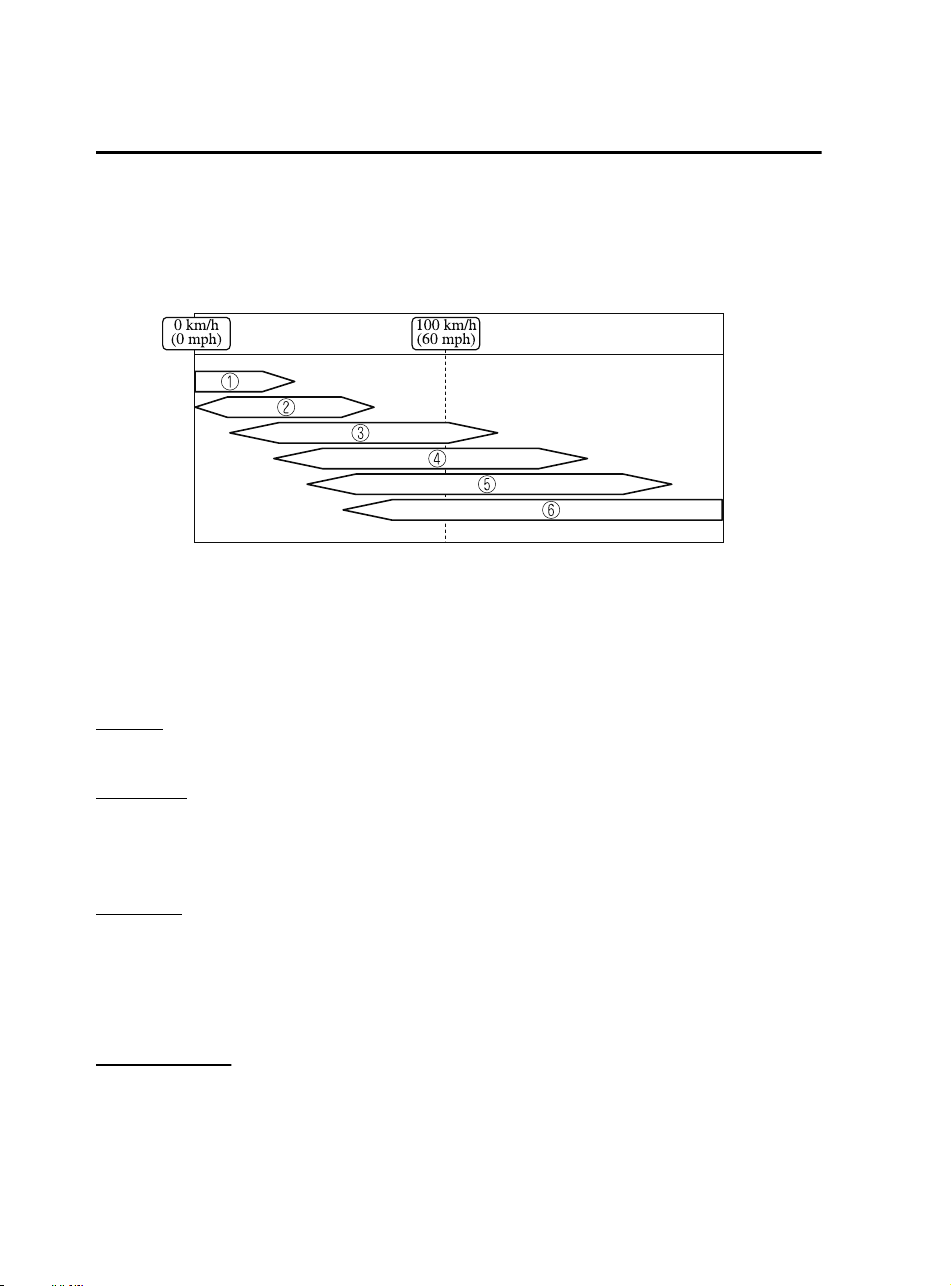
▼
Shift Gear (Shifting) Speed Limit
For each gear position while in the manual mode, the speed limit is set as follows: When the
selector lever is operated within the range of the speed limit, the gear is shifted.
1. 1st
2. 2nd
3. 3rd
4. 4th
5. 5th
6. 6th
Shift up
The gear does not shift up while the vehicle speed is lower than the speed limit.
Shift down
The gear does not shift down while the vehicle speed exceeds the speed limit.
If the vehicle speed exceeds the speed limit and the gear does not shift down, the gear
position indication flashes 2 times to notify the driver that the gear cannot be shifted.
Kickdown
When the accelerator pedal is depressed fully while driving, the gear shifts down.
However, the gears do not kickdown while the DSC is turned off.
NOTE
The gear also shifts down using kickdown while in the second gear fixed mode.
Auto-shift down
The gear shifts down automatically depending on the vehicle speed during deceleration.
NOTE
If the vehicle comes to a stop while in the second gear fixed mode, the gear remains in
second.
When Driving
Automatic Transmission
4-40
Mazda3_8HZ1-EA-19G_Edition1_old 2019-5-17 13:49:03
▼
Recommendations for Shifting
Upshifting
For normal acceleration and cruising, Mazda recommends these shift points:
(U.S.A. and Canada)
Gear
Vehicle speed
*1
M1 to M2 24 km/h (15 mph)
M2 to M3 40 km/h (25 mph)
M3 to M4 65 km/h (40 mph)
M4 to M5 73 km/h (45 mph)
M5 to M6 81 km/h (50 mph)
*
1 Always observe local speed limit regulations.
Downshifting
When you must slow down in heavy traffic or on a steep upgrade, downshift before the
engine starts to overwork. This gives better acceleration when you need more speed.
On a steep downgrade, downshifting helps maintain safe speed and prolongs brake life.
When Driving
Automatic Transmission
4-41
Mazda3_8HZ1-EA-19G_Edition1_old 2019-5-17 13:49:03
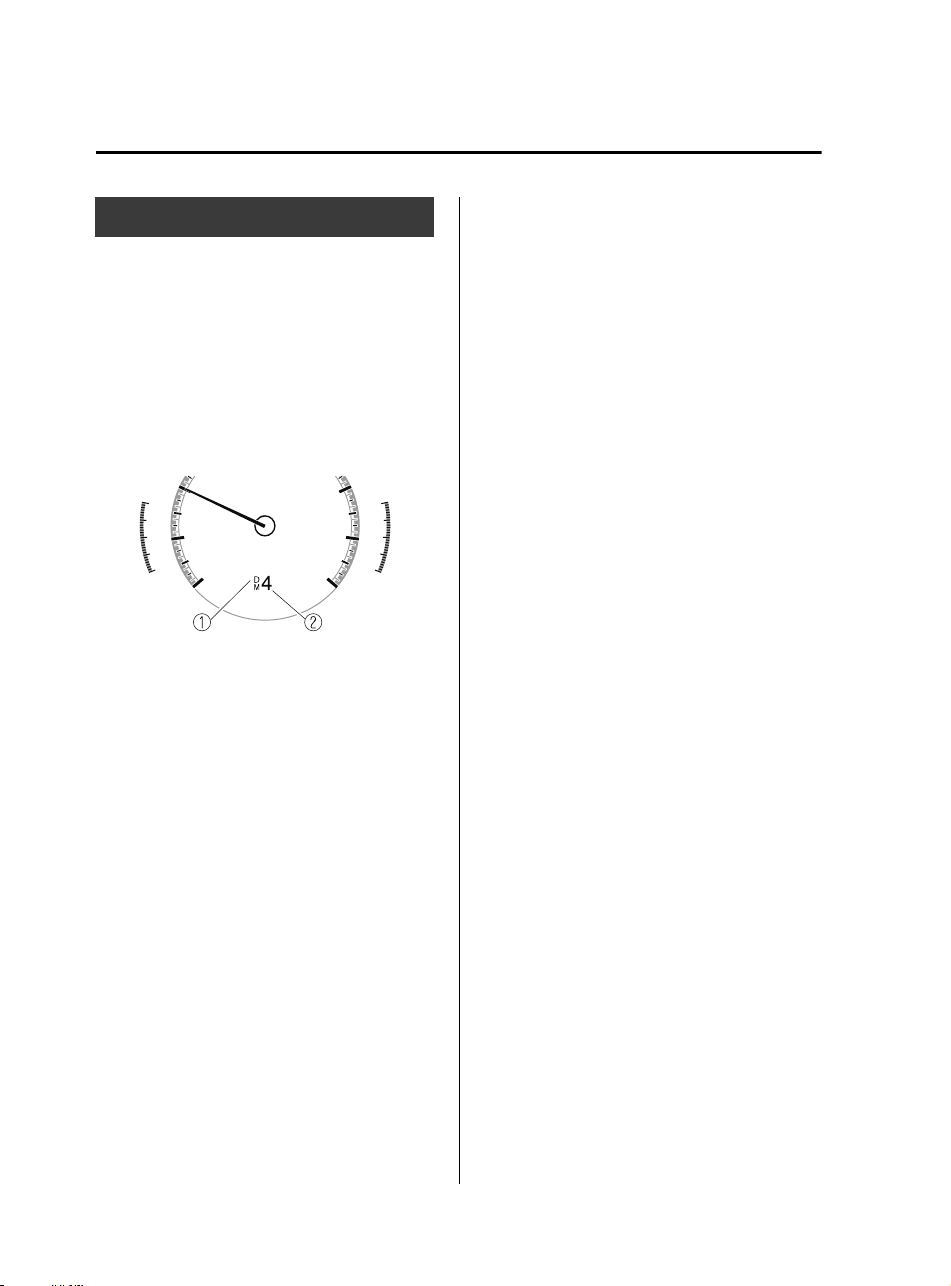
Direct Mode
*
▼
Direct Mode
Direct mode can be used for temporarily
switching gears by operating the steering
shift switch while the vehicle is being
driven with the selector lever in the D
position.
While in direct mode, the D and M
indication illuminate and the gear position
in use is illuminated.
1. Direct mode indication
2. Gear position indication
Direct mode is canceled (released) under
the following conditions.
The UP switch (+/OFF) is pulled
rearward for a certain amount of time or
longer.
The vehicle is driven for a certain
amount of time or longer (time differs
depending on the driving conditions
while operating).
The vehicle is stopped or moving at a
slow speed.
NOTE
Shifting up and down while in direct mode
may not be possible depending on the
vehicle speed. In addition, because direct
mode is canceled (released) depending on
the rate of acceleration or if the
accelerator is fully depressed, use of the
manual shift mode is recommended if you
need to drive the vehicle in a particular
gear for long periods.
When Driving
Automatic Transmission
4-42
*Some models.
Mazda3_8HZ1-EA-19G_Edition1_old 2019-5-17 13:49:03
Driving Tips
▼
Driving Tips
WARNING
Do not let the vehicle move in a direction
opposite to the direction selected by the
selector lever:
Do not let the vehicle move backward with
the selector lever in a forward position, or
do not let the vehicle move forward with
the selector lever in the reverse position.
Otherwise, the engine may stop, causing
the loss of the power brake and power
steering functions, and make it
dicult
to
control the vehicle which could result in an
accident.
Passing
For extra power when passing another
vehicle or climbing steep grades, depress
the accelerator fully. The transmission will
shift to a lower gear, depending on vehicle
speed.
NOTE
The accelerator pedal may initially feel
heavy as it is being depressed, then feel
lighter as it is depressed further. This
change in pedal force aids the engine
control system in determining how much
the accelerator pedal has been
depressed for performing kickdown, and
functions to control whether or not
kickdown should be performed.
While the selector lever is in the M
position and the DSC is turned off,
manual shift mode does not switch to
automatic shift mode even if the
accelerator pedal is completely
depressed. Operate the selector lever.
Climbing steep grades from a stop
To climb a steep grade from a stopped
position:
1. Depress the brake pedal.
2. Shift to D or M1, depending on the
load weight and grade steepness.
3. Release the brake pedal while
gradually accelerating.
Descending steep grades
When descending a steep grade, shift to
lower gears, depending on load weight and
grade steepness. Descend slowly, using the
brakes only occasionally to prevent them
from overheating.
When Driving
Automatic Transmission
4-43
Mazda3_8HZ1-EA-19G_Edition1_old 2019-5-17 13:49:03
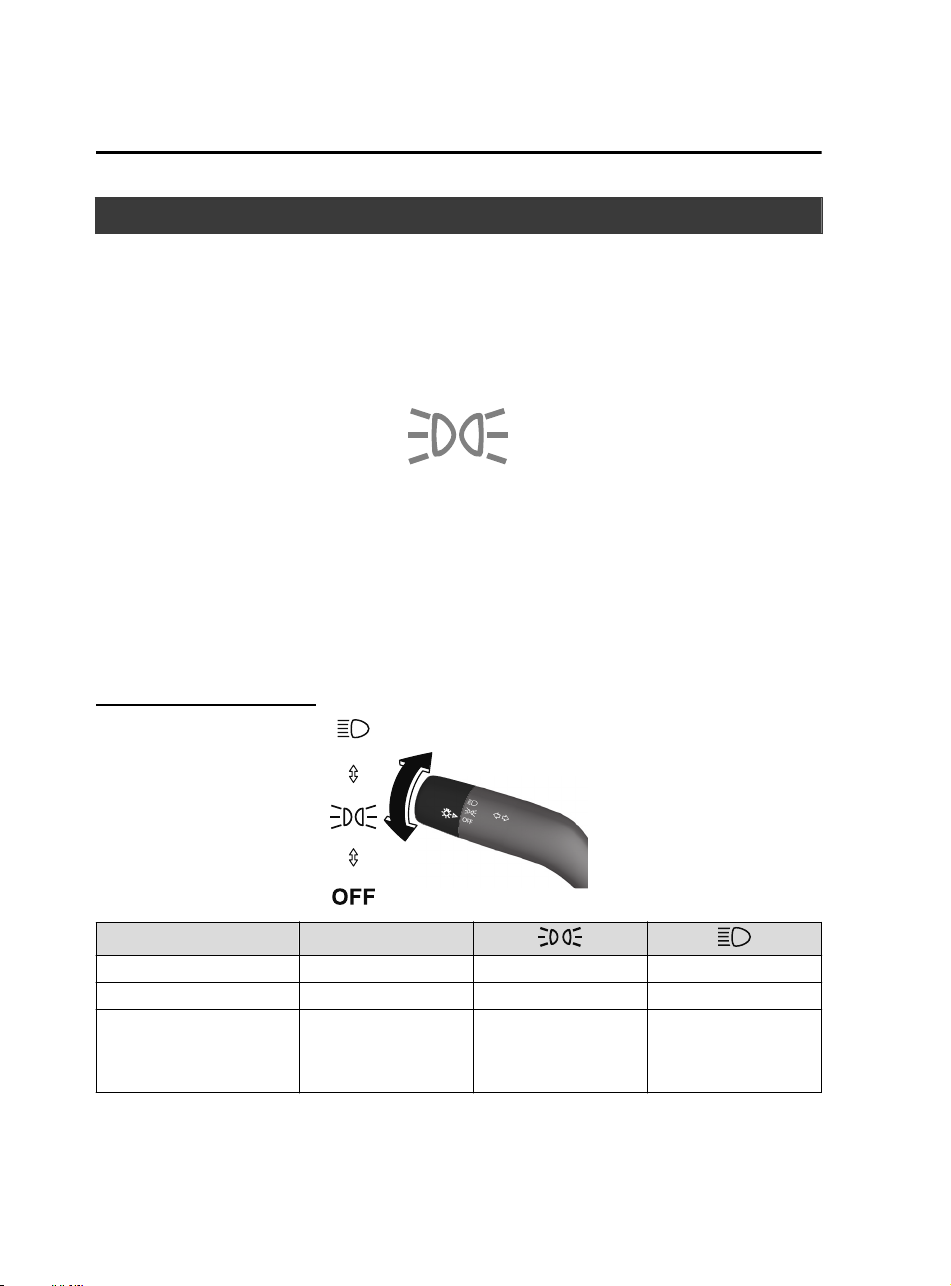
Lighting Control
▼
Headlights
Turn the headlight switch to turn the headlights and other exterior lights on or off.
When the taillights, parking lights, license plate lights, and the side-marker lights are turned
on, the lights-on indicator light in the instrument cluster turns on.
NOTE
If the light switch is left on, the lights will automatically switch off approximately 30
seconds after switching the ignition off.
The time setting can be changed.
Refer to the Settings section in the Mazda Connect Owner's Manual.
To prevent discharging the battery, do not leave the lights on while the engine is off unless
safety requires them.
Without auto-light control
Switch Position OFF
Headlights Off Off
On
*1
Daytime running lights
On
*2
On
*2
Off
Taillights
Parking lights
License plate lights
Side-marker lights
Off
On
*3
On
*1
*
1 When the ignition is switched from ON to ACC or OFF, the headlights turn off if the auto headlight off
function has been canceled. If the auto headlight off function is enabled, the lights turn on for the set period
using the auto headlight off function, and then they turn off.
When Driving
Switches and Controls
4-44
Mazda3_8HZ1-EA-19G_Edition1_old 2019-5-17 13:49:03
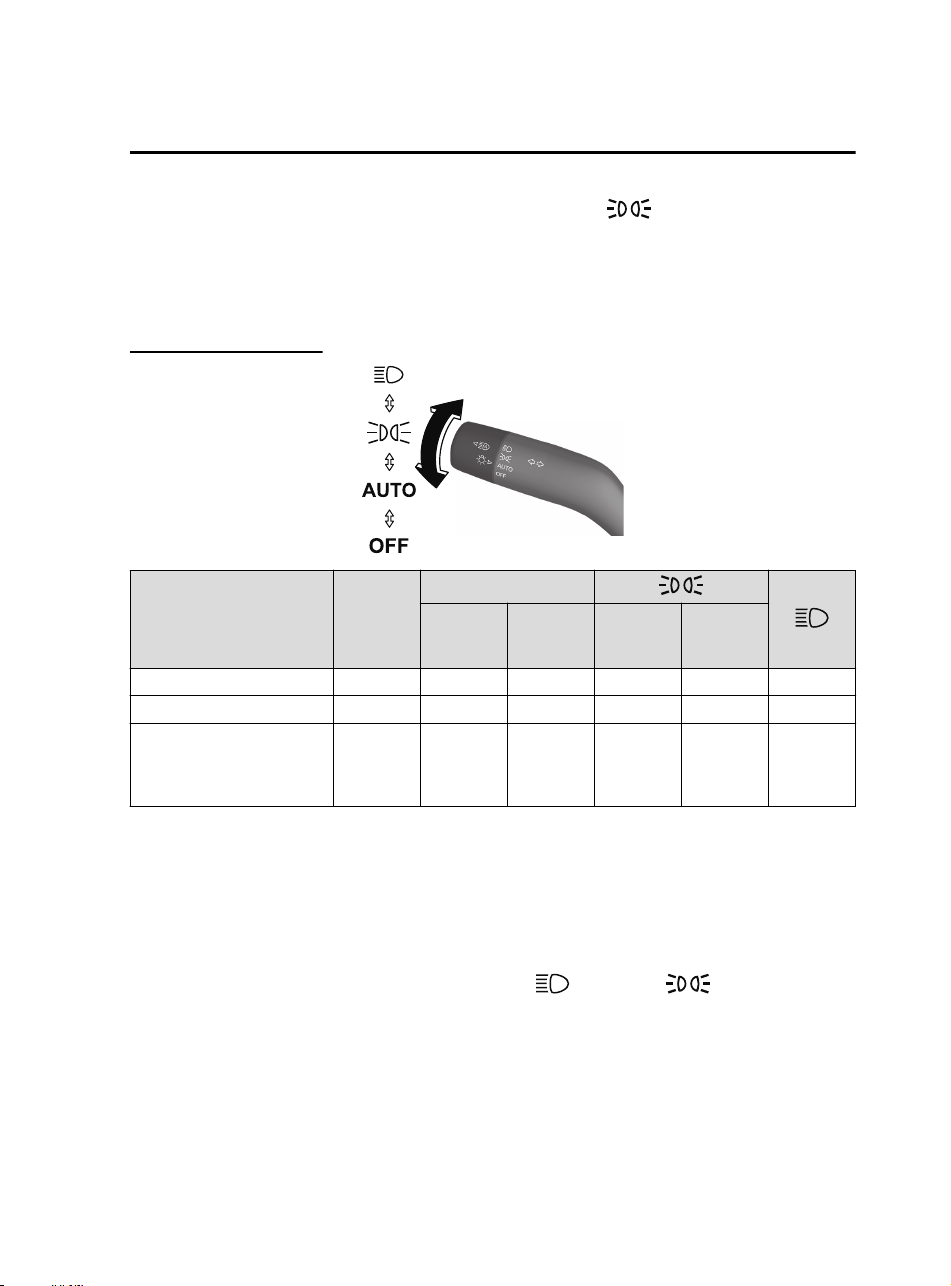
*
2 When the light switch is switched to a different position from the OFF, position while the vehicle is
stopped, the daytime running lights turn off. When starting to drive the vehicle, the daytime running lights turn
on again.
*
3 When the ignition is switched from ON to ACC or OFF, the headlights remain on if the auto headlight off
function has been canceled. If the auto headlight off function is enabled, the lights turn on for the set period
using the auto headlight off function, and then they turn off.
With auto-light control
Switch Position
OFF
*1
AUTO
Surround‐
ings are
bright
*2
Surround‐
ings are
dark
*3
Surround‐
ings are
bright
*2
Surround‐
ings are
dark
*3
Headlights Off Off On Off
On
*4*5
On
*6
Daytime running lights Off
On
*7
Off
On
*8
Off Off
Taillights
Parking lights
License plate lights
Side-marker lights
Off Off On
On
*9
On
*9
On
*6
*
1 When the light switch is switched to OFF while the vehicle is stopped, the lights turn off. The light switch
returns automatically to the AUTO position and the headlights change to AUTO operation when you start
driving the vehicle.
*
2 The level of brightness around the vehicle is of a sufficient level.
*
3 The level of brightness around the vehicle is of an insufficient level.
*
4 The daytime running lights can be disabled using the personalization features (page 4-49). If the daytime
running lights are disabled, the headlights turn off directly after starting the engine. The headlights turn on
when you begin driving the vehicle.
*
5 When the light switch is switched from the OFF, AUTO, or position to the position while the
vehicle is stopped, the headlights turn off. When starting to drive the vehicle, the headlights turn on again.
*
6 When the ignition is switched from ON to ACC or OFF, the headlights turn off if the auto headlight off
function has been canceled. If the auto headlight off function is enabled, the lights turn on for the set period
using the auto headlight off function, and then they turn off.
*
7 When the light switch is switched to a different position from the AUTO position while the vehicle is stopped,
the daytime running lights turn off. When starting to drive the vehicle, the daytime running lights turn on
again.
When Driving
Switches and Controls
4-45
Mazda3_8HZ1-EA-19G_Edition1_old 2019-5-17 13:49:03
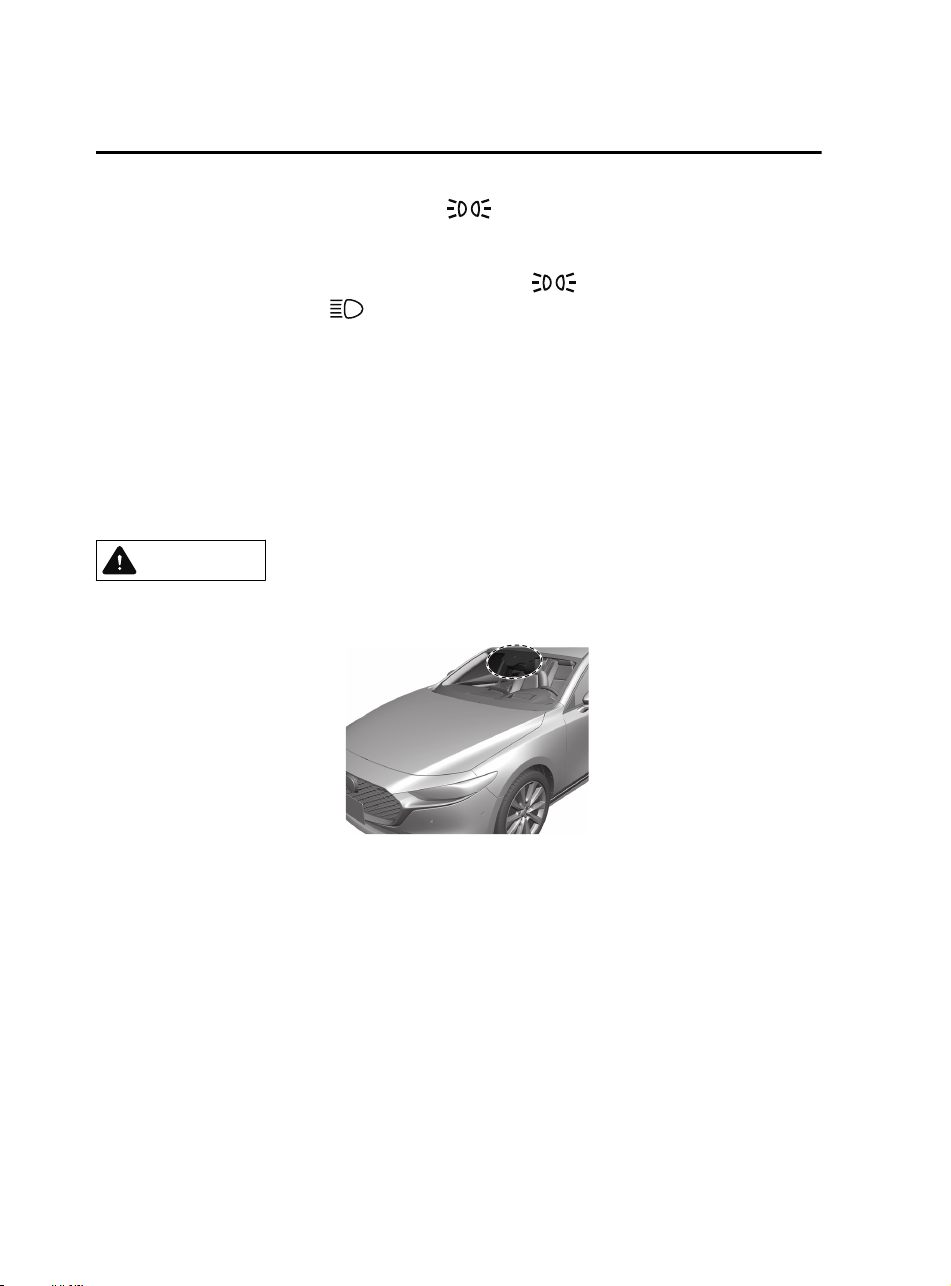
*
8 If one of the following operations is done from the position while the vehicle is stopped, the daytime
running lights turn off.
Switch the light switch to the OFF position.
Switch the light switch to the AUTO position, and then to the position again.
Switch the light switch to the position.
When starting to drive the vehicle, the daytime running lights turn on again.
*
9 When the ignition is switched from ON to ACC or OFF, the headlights remain on if the auto headlight off
function has been canceled. If the auto headlight off function is enabled, the lights turn on for the set period
using the auto headlight off function, and then they turn off.
Auto-light control
When the headlight switch is in the AUTO position and the ignition is switched ON, the
light sensor senses the surrounding lightness or darkness and automatically turns the
headlights and other exterior lights on or off.
CAUTION
Do not shade the light sensor by adhering a sticker or a label on the windshield. Otherwise
the light sensor will not operate correctly.
The light sensor also works as a rain sensor for the auto-wiper control. Keep hands and
scrapers clear of the windshield when the wiper lever is in the AUTO position and the
ignition is switched ON as ngers could be pinched or the wipers and wiper blades could be
damaged when the wipers activate automatically. If you are going to clean the windshield,
be sure the wipers are turned
o
completely when it is particularly tempting to leave the
engine running. This is particularly important when clearing ice and snow.
NOTE
The headlights and other exterior lights may not turn off immediately even if the
surrounding area becomes well-lit because the light sensor determines that it is night time
if the surrounding area is continuously dark for several minutes such as inside long
tunnels, traffic jams inside tunnels, or in indoor parking lots.
When Driving
Switches and Controls
4-46
Mazda3_8HZ1-EA-19G_Edition1_old 2019-5-17 13:49:03
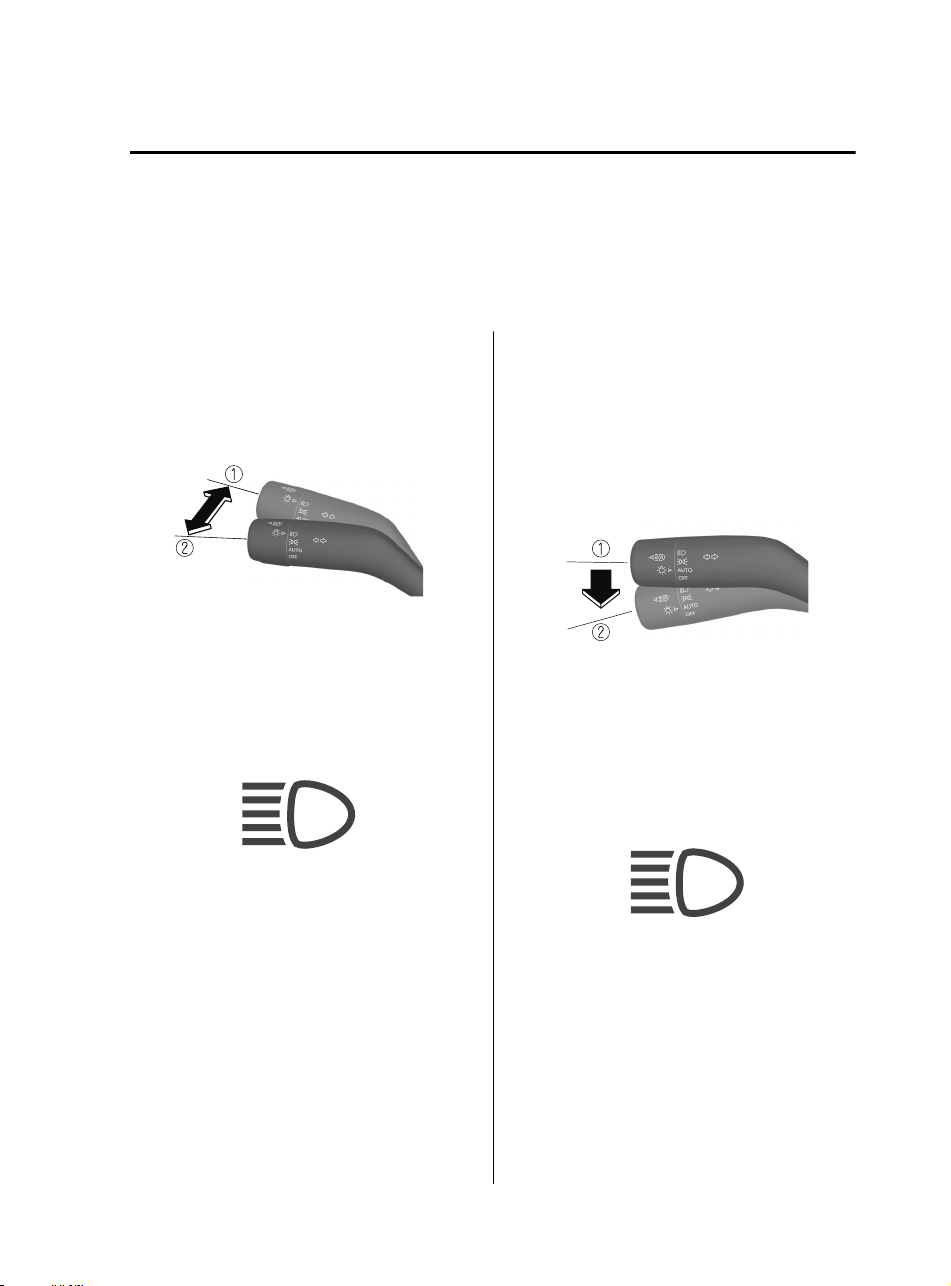
If the headlight switch and the windshield wiper switch are in AUTO, and the wipers are
operated at low or high speed by the auto wiper control for several seconds, bad weather
conditions are determined and the headlights may be turned on.
The sensitivity of the auto-light control may be changed.
Refer to the Settings section in the Mazda Connect Owner's Manual.
▼
Headlight High-Low Beam
The headlights switch between high and
low beams by moving the lever forward or
backward.
1. High beam
2. Low beam
When the headlight high-beams are on, the
headlight high-beam indicator light is
turned on.
▼
Flashing the Headlights
The headlights can be flashed with the
ignition switched to ON.
To flash the headlights, pull the lever fully
towards you (the headlight switch does not
need to be on).
1. OFF
2. Headlight flashing
The headlight high-beam indicator light in
the instrument cluster illuminates
simultaneously. The lever will return to
the normal position when released.
When Driving
Switches and Controls
4-47
Mazda3_8HZ1-EA-19G_Edition1_old 2019-5-17 13:49:03
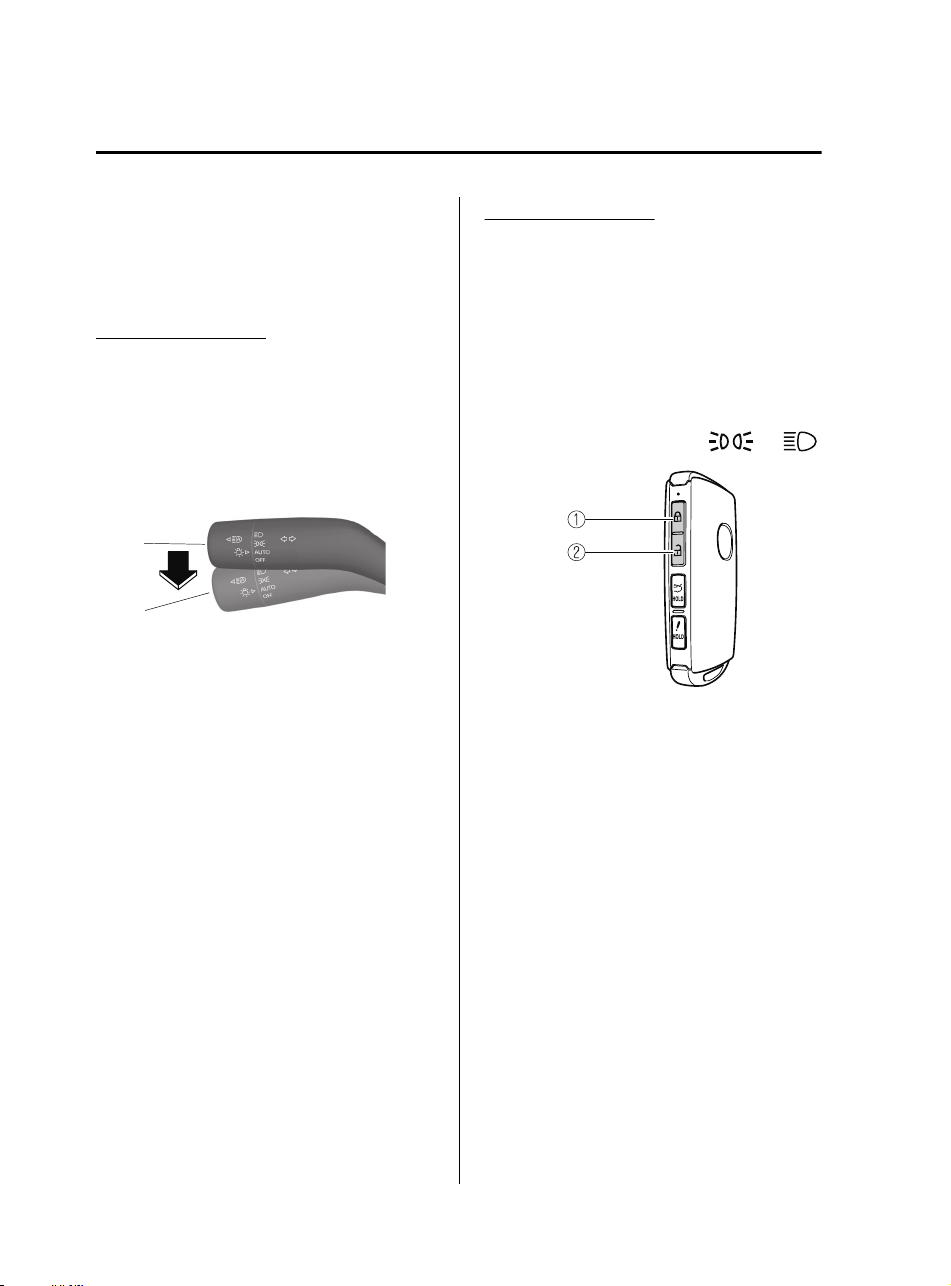
▼
Coming Home Light
The coming home light turns on the
headlights (low beams) when the lever is
operated.
To turn on the lights
When the lever is pulled with the ignition
switched to ACC or OFF, the low beam
headlights turn on.
The headlights turn off after a certain
period of time has elapsed after all of the
doors are closed.
NOTE
The time until the headlights turn off
after all of the doors are closed can be
changed.
Refer to the Settings section in the
Mazda Connect Owner's Manual.
If no operations are done for 3 minutes
after the lever is pulled, the headlights
turn off.
The headlights turn off if the lever is
pulled again while the headlights are
illuminated.
▼
Leaving Home Light
The leaving home light turns on the lights
when the transmitter unlock button is
pressed while away from the vehicle.
The following lights turn on when the
leaving home light is operated.
Low beams, Parking lights, Taillights,
License plate lights.
To turn on the lights
When the ignition switch and the headlight
switch are in the following conditions, the
headlights will illuminate when the
transmitter unlock button is pressed and
the vehicle receives the transmitter signal.
The headlights turn off after a certain
period of time has elapsed (30 seconds).
Ignition switch: off
Headlight switch: AUTO, , or
1. Lock button
2. Unlock button
NOTE
Operation of the leaving home light can
be turned on or off.
Refer to the Settings section in the
Mazda Connect Owner's Manual.
When the transmitter lock button is
pressed and the vehicle receives the
transmitter signal, the headlights turn
off.
When the headlight switch is turned to
the OFF position, the headlights turn
off.
When Driving
Switches and Controls
4-48
Mazda3_8HZ1-EA-19G_Edition1_old 2019-5-17 13:49:03
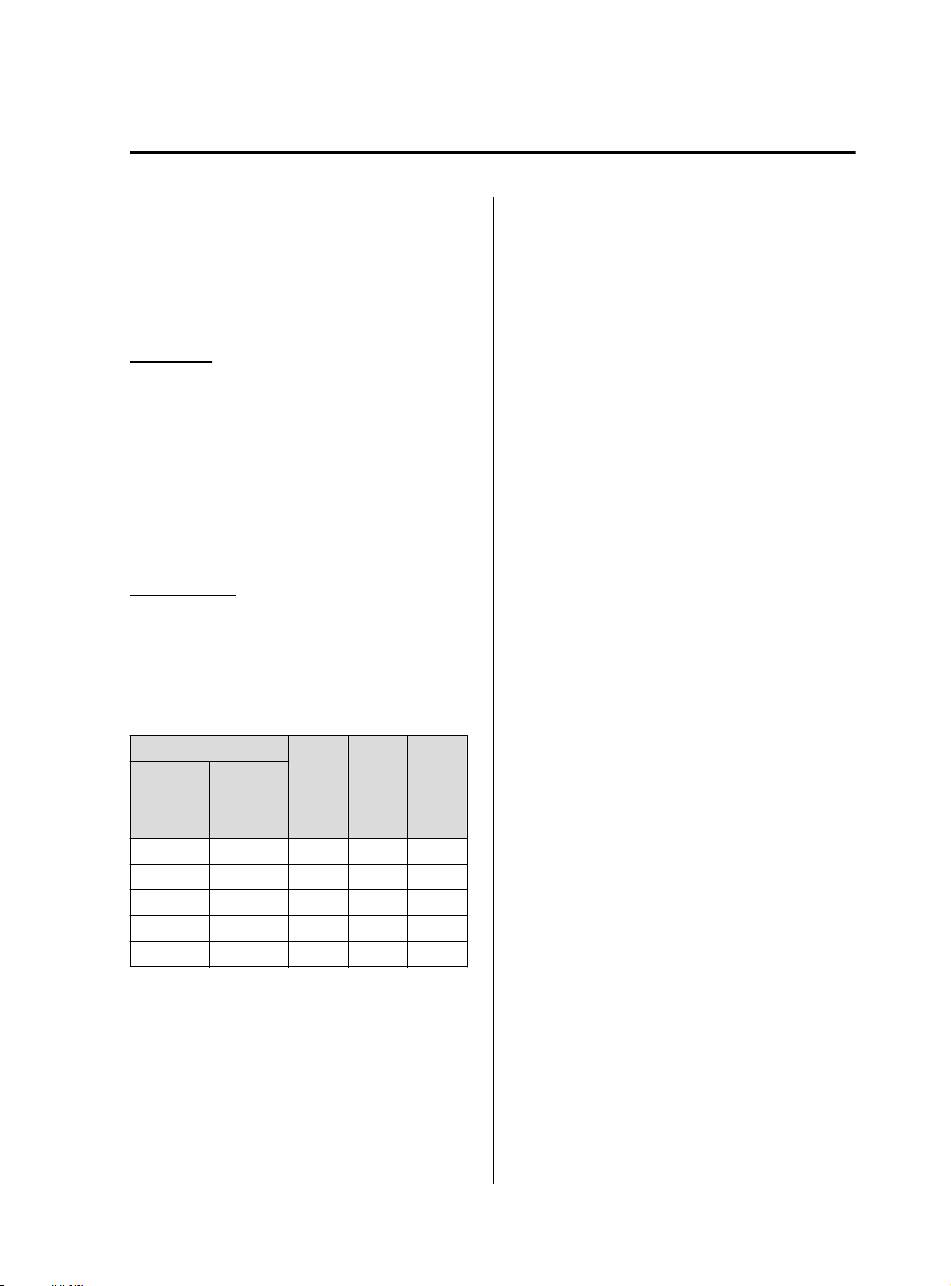
▼
Headlight Leveling
The number of passengers and weight of
cargo in the luggage compartment change
the angle of the headlights.
Auto type
The angle of the headlights will be
automatically adjusted when turning on
the headlights.
A system malfunction or operation
conditions are indicated by a warning.
Refer to Exterior Light Warning
Indication/Warning Light on page 7-34.
Manual type
When adjusting the illumination angle of
the headlights, refer to the Settings section
in the Mazda Connect Owner's Manual.
Select the proper headlight angle from the
following chart.
Front seat
Rear
seat
Load
Illumi‐
nation
angle
(num‐
ber)
Driver Passenger
×―――0
××――0
×××―1
××××2
×――×3.5
×: Yes
―: No
▼
Daytime Running Lights
Some countries require moving vehicles to
have their lights on (daytime running
lights) during the daytime.
The daytime running lights turn on
automatically.
NOTE
(Except Canada)
The daytime running lights can be
deactivated.
Refer to the Settings section in the Mazda
Connect Owner's Manual.
When Driving
Switches and Controls
4-49
Mazda3_8HZ1-EA-19G_Edition1_old 2019-5-17 13:49:03
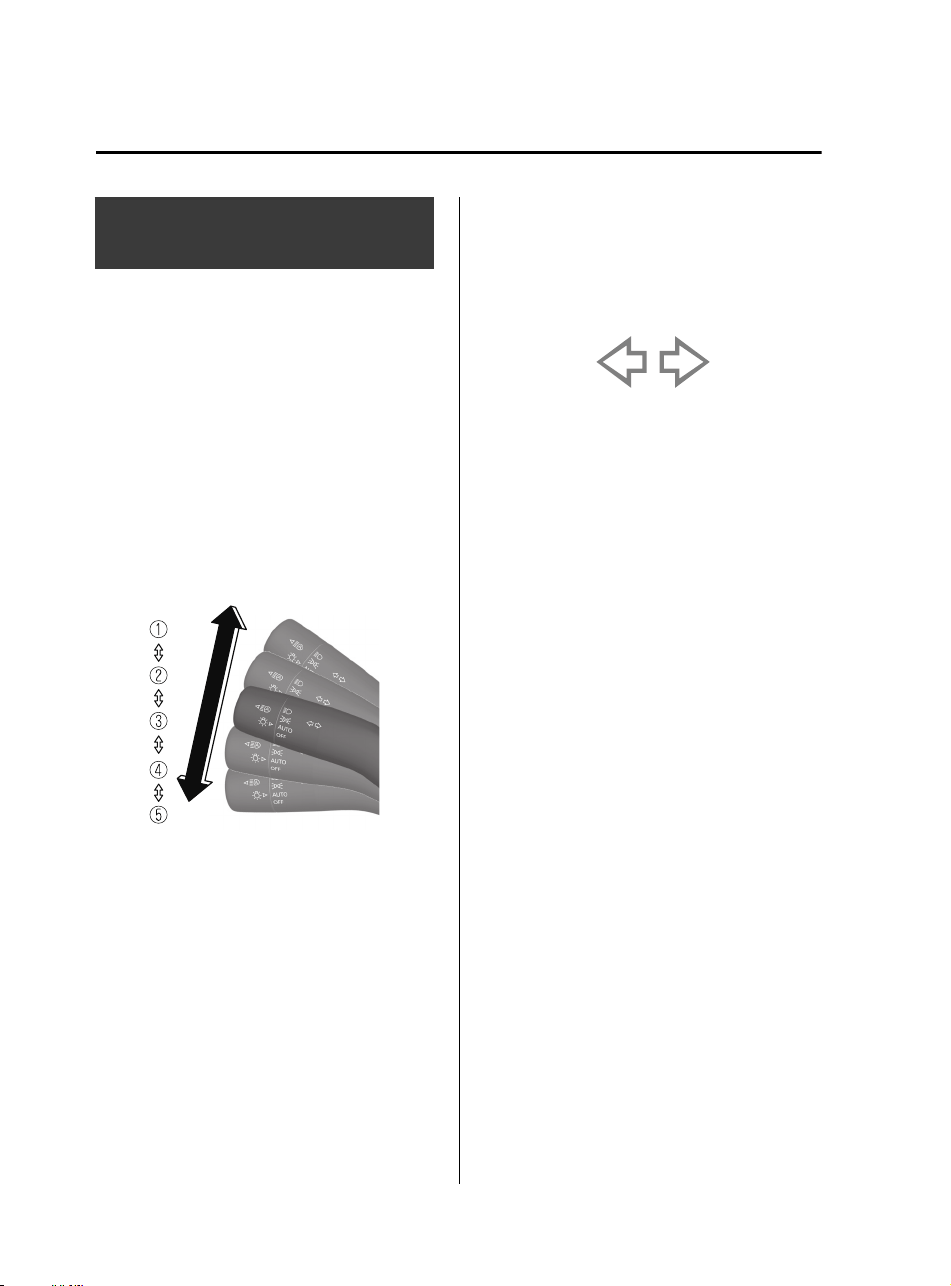
Turn and Lane-Change
Signals
▼
Turn and Lane-Change Signals
The ignition must be switched ON to use
the turn and lane-change signals.
▼
Turn Signals
Move the signal lever down (for a left
turn) or up (for a right turn) to the stop
position. The signal will self-cancel after
the turn is completed.
If the indicator light continues to flash
after a turn, manually return the lever to its
original position.
1. Right turn
2. Right lane change
3. OFF
4. Left lane change
5. Left turn
The turn signal indicators in the
instrument cluster flash according to the
operation of the turn signal lever to show
which signal is working.
NOTE
There may be a problem with the turn
signal lights if they do not flash but
remain turned on, or they flash
abnormally. Have your vehicle inspected
by an Authorized Mazda Dealer.
A personalized function is available to
change the turn indicator sound volume.
Refer to the Settings section in the
Mazda Connect Owner's Manual.
▼
Lane-Change Signals
Move the lever halfway toward the
direction of the lane change―until the
indicator flashes― and hold it there. It
will return to the off position when
released.
▼
Three-Flash Turn Signal
After releasing the turn signal lever from
the halfway point, the turn signal indicator
flashes 3 times. The operation can be
cancelled by moving the lever in the
direction opposite to which it was
operated.
NOTE
The three-flash turn signal function can be
switched to on/off using the
personalization function.
Refer to the Settings section in the Mazda
Connect Owner's Manual.
When Driving
Switches and Controls
4-50
Mazda3_8HZ1-EA-19G_Edition1_old 2019-5-17 13:49:03
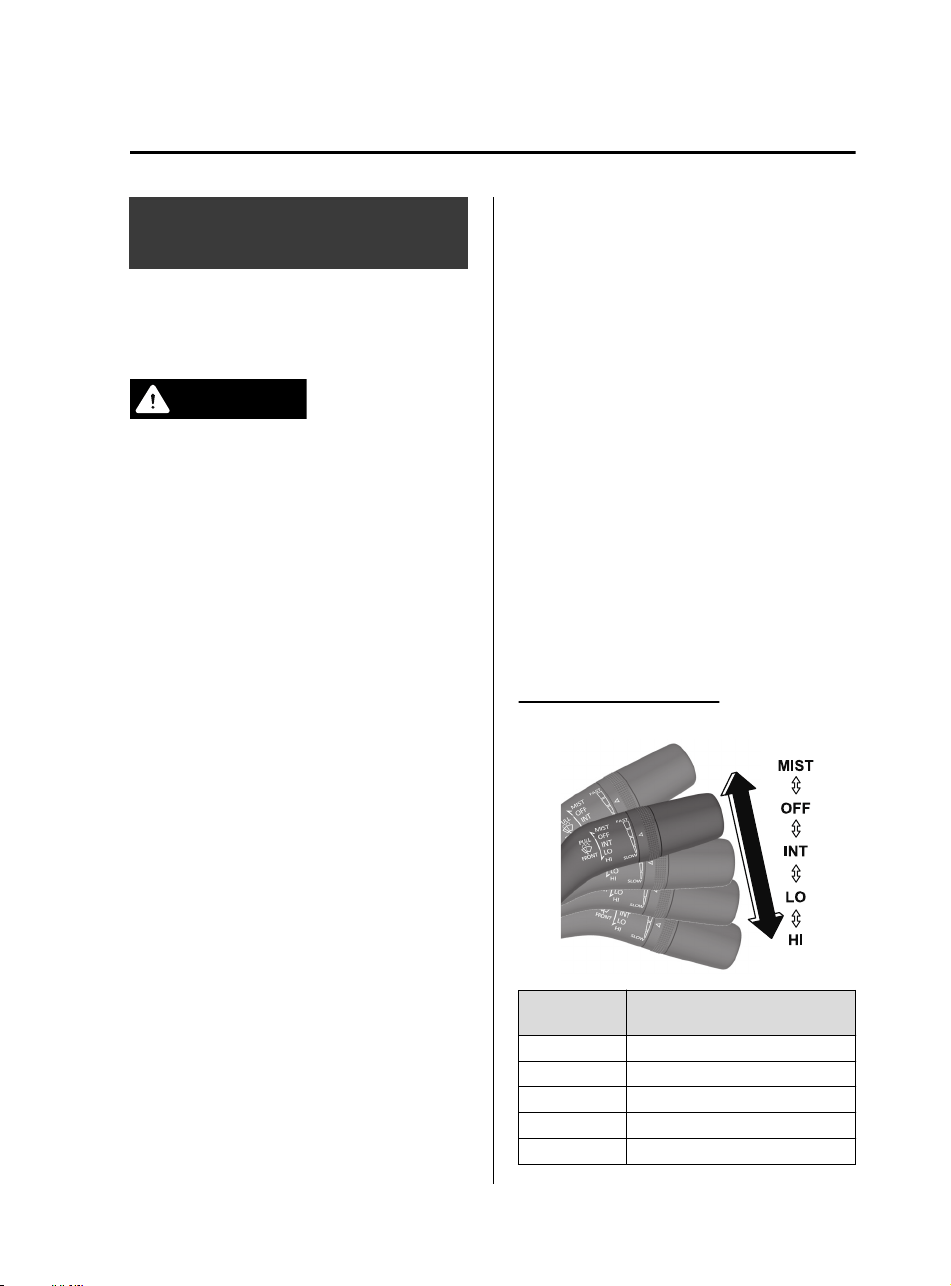
Windshield Wipers and
Washer
▼
Windshield Wipers and Washer
The ignition must be switched ON to use
the wipers.
WARNING
Use only windshield washer
uid
or plain
water in the reservoir:
Using radiator antifreeze as washer
uid
is
dangerous. If sprayed on the windshield, it
will dirty the windshield,
aect
your
visibility, and could result in an accident.
Only use windshield washer uid mixed
with anti-freeze protection in freezing
weather conditions:
Using windshield washer uid without
anti-freeze protection in freezing weather
conditions is dangerous as it could freeze
on the windshield and block your vision
which could cause an accident. In addition,
make sure the windshield is suciently
warmed using the defroster before
spraying the washer uid.
NOTE
If the windshield wipers are operated
under cold weather conditions or during
snowfall, they could stop due to
accumulated snow on the windshield. If
the windshield wipers stop due to
accumulated snow on the windshield, park
the vehicle in a safe place, turn the wiper
switch off, and then remove the
accumulated snow. If the wiper switch is
turned to another position other than OFF,
the wipers will operate. If the wipers do
not operate even though the wiper switch
is turned to a position other than OFF,
consult an Authorized Mazda Dealer as
soon as possible.
▼
Windshield Wipers
Turn the wipers on by pressing the lever
up or down.
With intermittent wiper
Switch Posi‐
tion
Wiper operation
MIST Operation while pulling up lever
OFF Stop
INT Intermittent
LO Low speed
HI High speed
When Driving
Switches and Controls
4-51
Mazda3_8HZ1-EA-19G_Edition1_old 2019-5-17 13:49:03
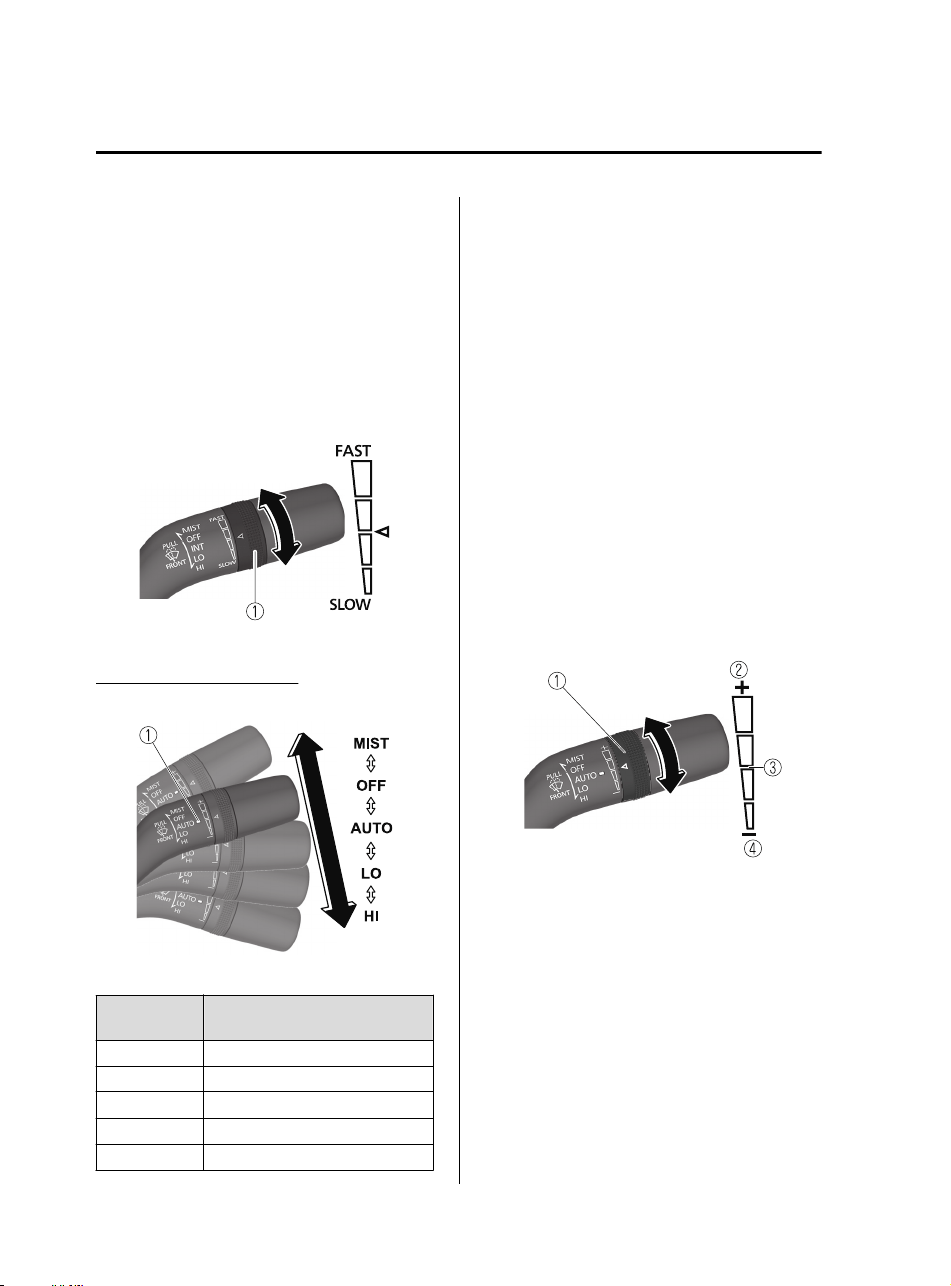
Variable-speed intermittent wipers
Set the lever to the intermittent position
and choose the interval timing by rotating
the switch.
Rotate the switch upward (FAST
direction) to shorten the interval time of
the wiper operation, and rotate the switch
downward (SLOW direction) to lengthen
it.
1. Switch
With auto-wiper control
1. Indicator light
Switch Posi‐
tion
Wiper operation
MIST Operation while pulling up lever
OFF Stop
AUTO
*1
Auto control
LO Low speed
HI High speed
*
1 When the wiper lever is switched to the AUTO
position, the indicator light turns on.
Auto-wiper control
*
When the wiper lever is in the AUTO
position, the rain sensor senses the amount
of rainfall on the windshield and turns the
wipers on or off automatically
(off―intermittent―low speed―high
speed).
The sensitivity of the rain sensor can be
adjusted by turning the switch on the
wiper lever.
From the center position (normal), rotate
the switch upward (+ direction) for higher
sensitivity (faster response) or rotate it
downward (- direction) for less sensitivity
(slower response).
1. Switch
2. Higher sensitivity
3. Center position
4. Less sensitivity
When Driving
Switches and Controls
4-52
*Some models.
Mazda3_8HZ1-EA-19G_Edition1_old 2019-5-17 13:49:03
CAUTION
Do not shade the rain sensor by adhering
a sticker or a label on the windshield.
Otherwise the rain sensor will not
operate correctly.
When the wiper lever is in the AUTO
position and the ignition is switched ON,
the wipers may move automatically in
the following cases:
If the windshield above the rain sensor
is touched or wiped with a cloth.
If the windshield is struck with a hand
or other object from either outside or
inside the vehicle.
Keep hands and scrapers clear of the
windshield when the wiper lever is in the
AUTO position and the ignition is
switched ON as ngers could be pinched
or the wipers and wiper blades damaged
when the wipers activate automatically.
If you are going to clean the windshield,
be sure the wipers are turned o
completely (when it is most likely that the
engine is left running) this is particularly
important when clearing ice and snow.
NOTE
Switching the auto-wiper lever from the
OFF to the AUTO position while driving
activates the windshield wipers once,
after which they operate according to
the rainfall amount.
The auto-wiper control may not operate
when the rain sensor temperature is
about
-
10 °C (14 °F) or lower, or
about 85 °C (185 °F) or higher.
If the windshield is coated with water
repellent, the rain sensor may not be
able to sense the amount of rainfall
correctly and the auto-wiper control
may not operate properly.
If dirt or foreign matter (such as ice or
matter containing salt water) adheres to
the windshield above the rain sensor, or
if the windshield is iced, it could cause
the wipers to move automatically.
However, if the wipers cannot remove
this ice, dirt or foreign matter, the
auto-wiper control will stop operation.
In this case, set the wiper lever to the
low speed position or high speed
position for manual operation, or
remove the ice, dirt or foreign matter by
hand to restore the auto-wiper
operation.
If the auto-wiper lever is left in the
AUTO position, the wipers could
operate automatically from the effect of
strong light sources, electromagnetic
waves, or infrared light because the rain
sensor uses an optical sensor. It is
recommended that the auto-wiper lever
be switched to the OFF position other
than when driving the vehicle under
rainy conditions.
When Driving
Switches and Controls
4-53
Mazda3_8HZ1-EA-19G_Edition1_old 2019-5-17 13:49:03
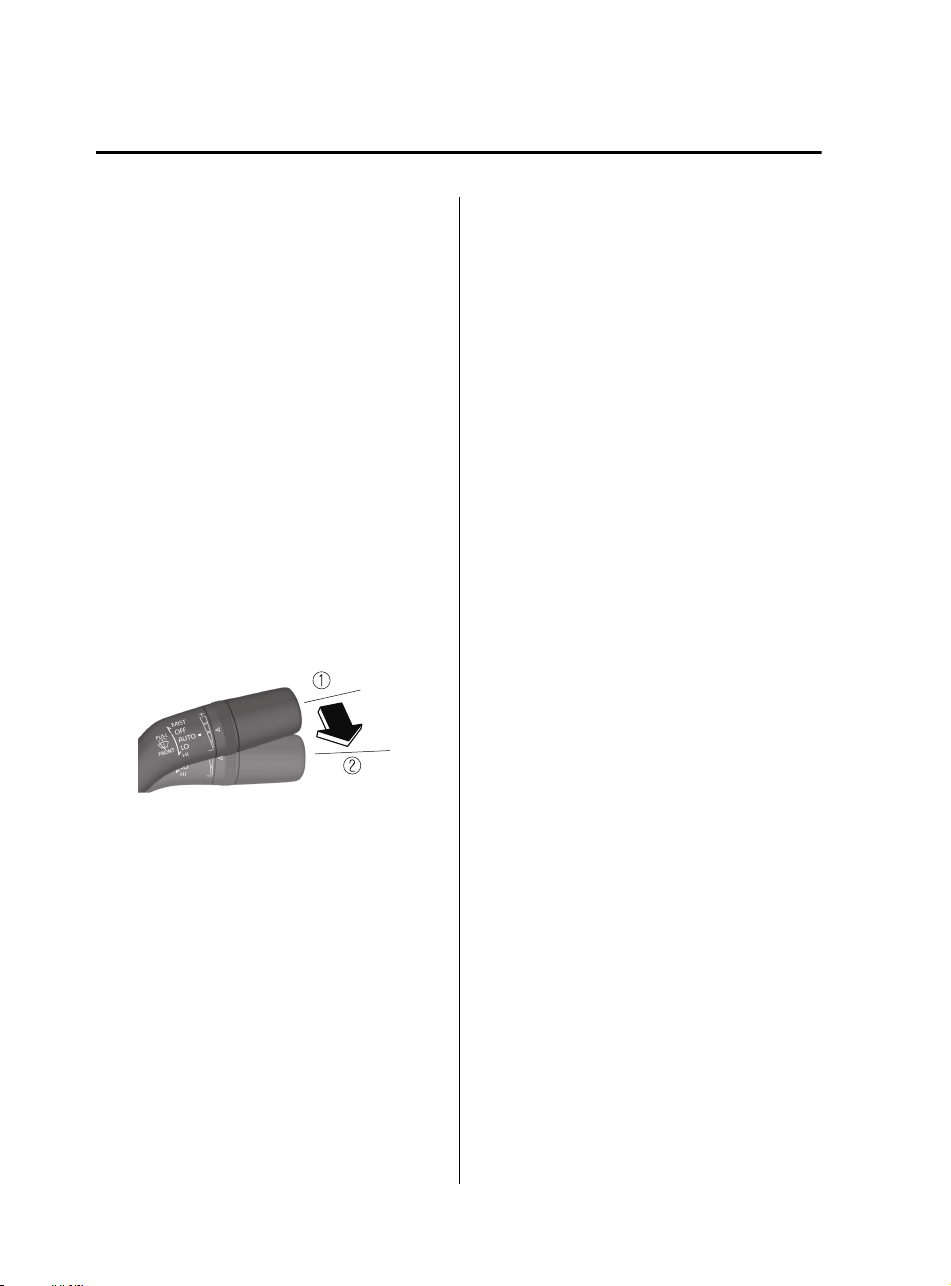
If the headlight switch and the
windshield wiper switch are in AUTO,
and the wipers are operated at low or
high speed by the auto wiper control for
several seconds, bad weather conditions
are determined and the headlights may
be turned on.
The auto-wiper control functions can be
turned off.
Refer to the Settings section in the
Mazda Connect Owner's Manual.
▼
Windshield Washer
Pull the wiper lever toward you to spray
washer fluid and operate the windshield
wipers several times. The washer fluid is
sprayed only while the windshield wipers
move out of their stowed positions to the
point where they start reversing back.
1. OFF
2. Washer
NOTE
If the windshield washer is turned on
when the windshield wipers are not
operating, the windshield wipers
operate a few times.
If you pull the wiper lever while the
windshield wipers are reversing back to
their stowed positions, the next time the
washer fluid is sprayed is during the
next cycle.
If the washer does not work, inspect the
fluid level (page 6-19). If the fluid level
is normal, consult an Authorized Mazda
Dealer.
When Driving
Switches and Controls
4-54
Mazda3_8HZ1-EA-19G_Edition1_old 2019-5-17 13:49:03
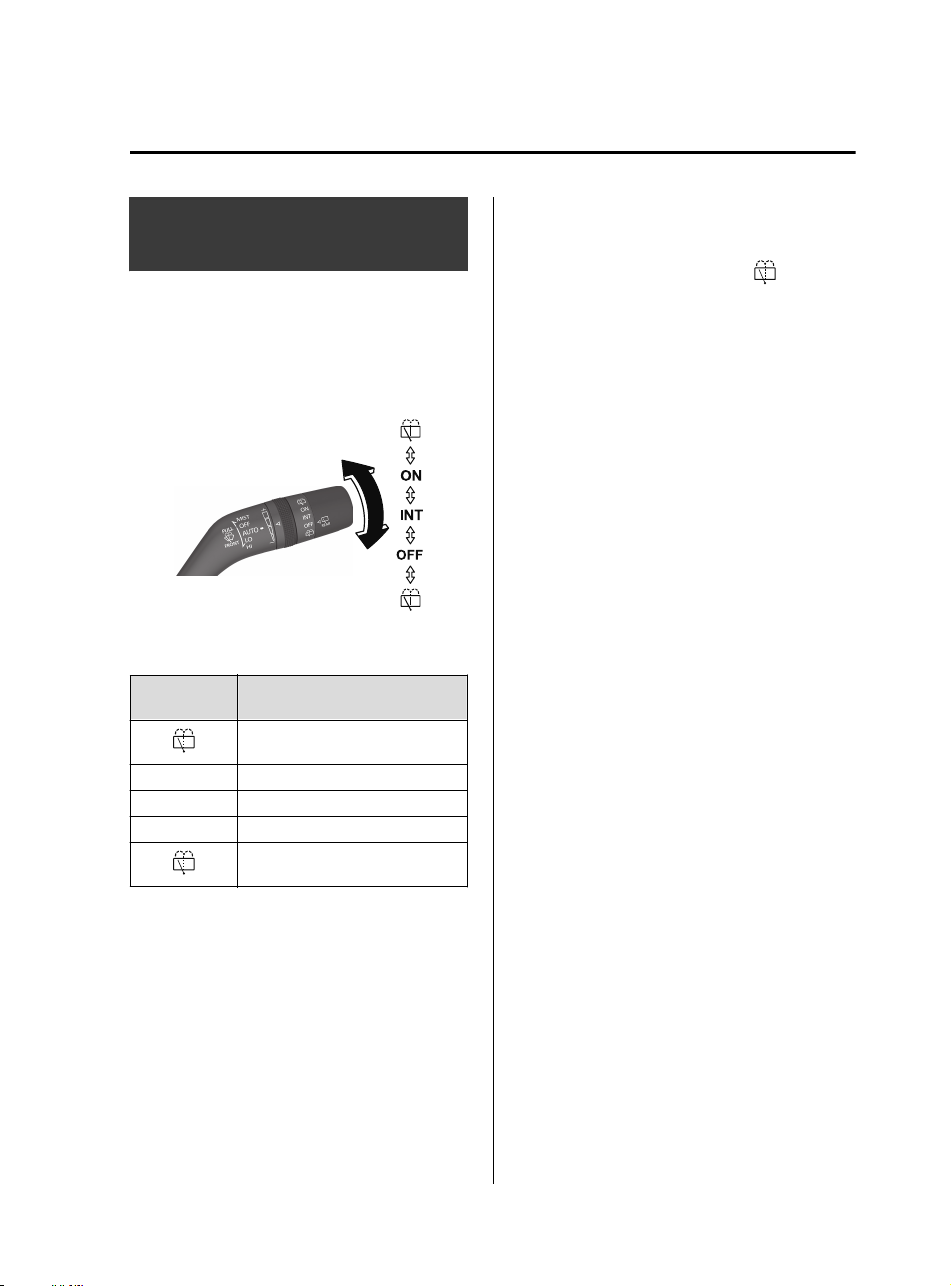
Rear Window Wiper and
Washer
*
▼
Rear Window Wiper and Washer
The ignition must be switched ON to use
the wiper.
▼
Rear Window Wiper
Turn the wiper on by turning the rear
wiper/washer switch.
Switch Posi‐
tion
Wiper operation
Spray washer fluid and operate the
rear wiper
ON Normal
INT Intermittent
OFF Stop
Spray washer fluid and operate the
rear wiper
▼
Rear Window Washer
To spray washer fluid, turn the rear wiper/
washer switch to either of the
position.
After the switch is released, the washer
will stop.
NOTE
While the windshield washers are
operating (from the time the wiper lever is
pulled until the washer fluid stops
spraying), the rear window washer does
not spray washer fluid even if you operate
the switch.
If the washer does not work, inspect the
fluid level (page 6-19). If the fluid level
is normal and the washer still does not
work, consult an Authorized Mazda
Dealer.
When Driving
Switches and Controls
*Some models.
4-55
Mazda3_8HZ1-EA-19G_Edition1_old 2019-5-17 13:49:03
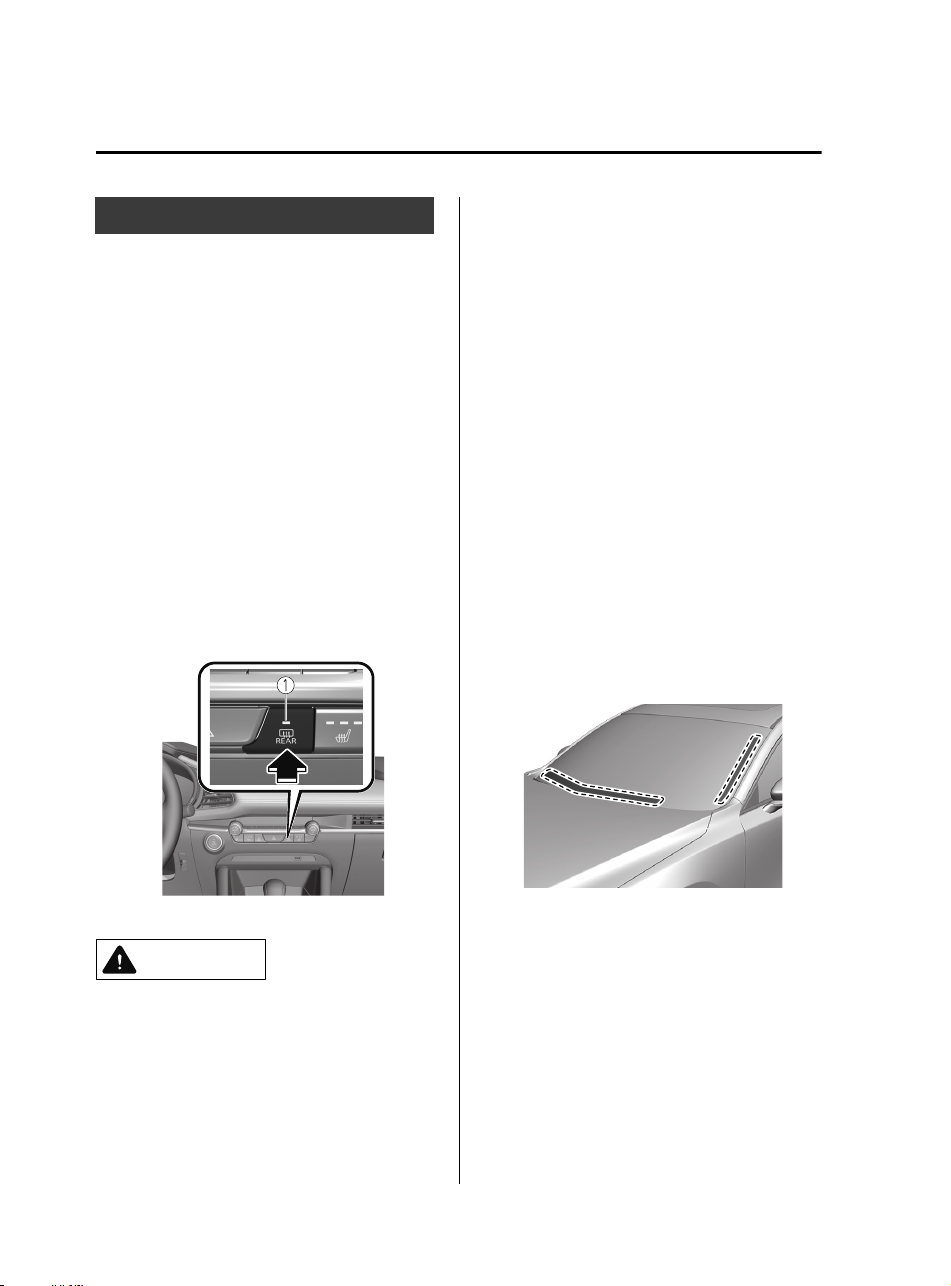
Rear Window Defogger
▼
Rear Window Defogger
The rear window defogger clears fog from
the rear window.
The ignition must be switched ON to use
the defogger.
Press the switch to turn on the rear
window defogger. The rear window
defogger operates for about 15 minutes
and then turns off automatically.
The indicator light illuminates when the
defogger is operating.
To turn off the rear window defogger
before the 15 minutes has elapsed, press
the switch again.
1. Indicator light
CAUTION
Do not use sharp instruments or window
cleaners with abrasives to clean the
inside of the rear window surface. They
may damage the defogger grid inside the
window.
NOTE
This defogger is not designed for
melting snow. If there is an
accumulation of snow on the rear
window, remove it before using the
defogger.
The rear window defogger operation
time can be changed from 15 minutes to
continuous operation. When the
operation time has been switched to
continuous operation, by pressing the
switch, the rear window defogger will
continue to operate until the ignition is
switched OFF.
Refer to the Settings section in the
Mazda Connect Owner's Manual.
▼
Windshield Wiper De-icer
*
The thermal filaments at the following
positions heat up and facilitate the removal
of snow accumulated on the windshield.
The windshield wiper de-icer operates in
conjunction with the rear window
defogger.
When Driving
Switches and Controls
4-56
*Some models.
Mazda3_8HZ1-EA-19G_Edition1_old 2019-5-17 13:49:03
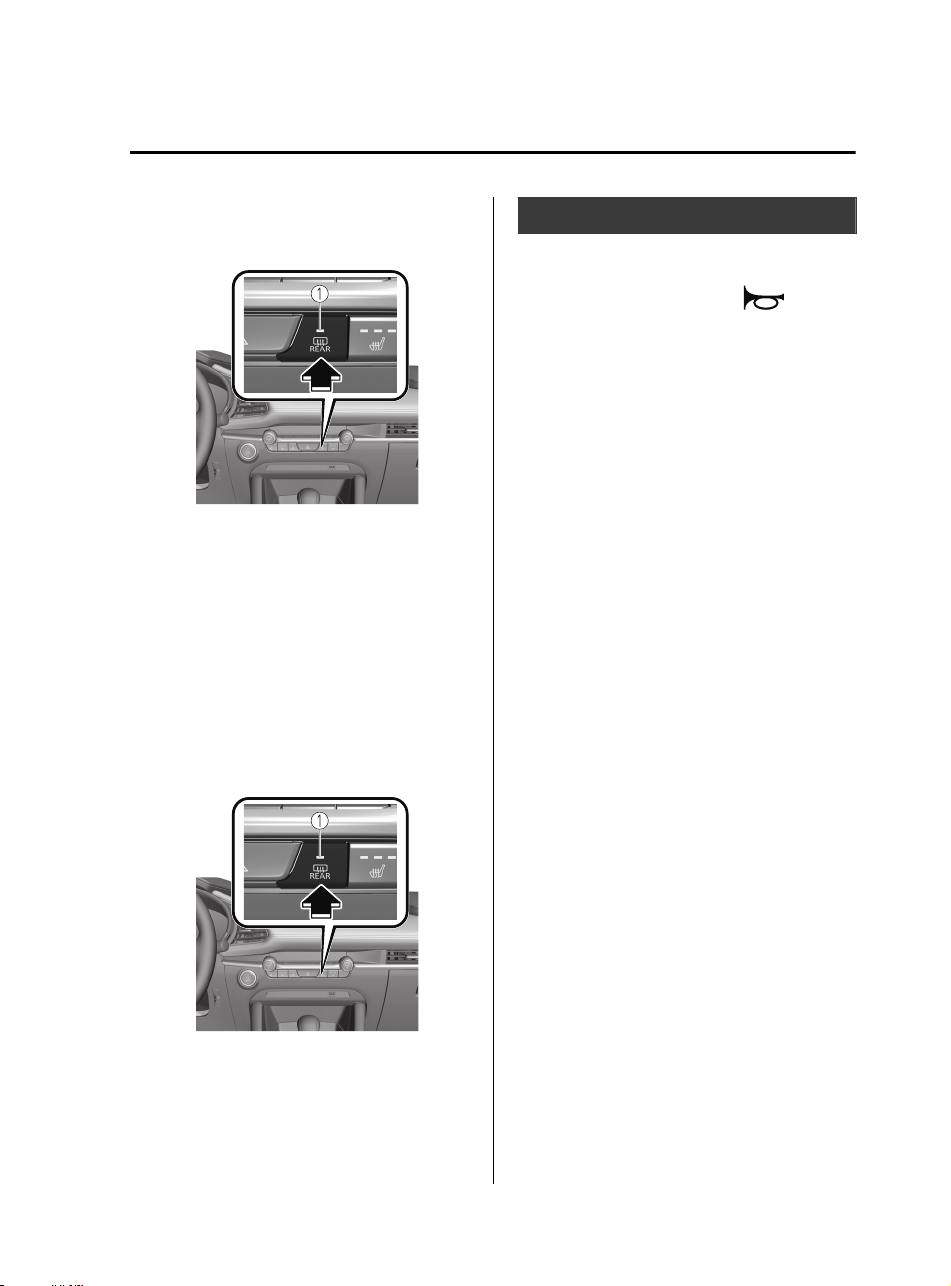
To turn on the windshield wiper de-icer,
switch the ignition ON and press the rear
window defogger switch (page 4-56).
1. Indicator light
▼
Mirror Defogger
*
The mirror defoggers defrost the outside
mirrors.
The mirror defoggers operate in
conjunction with the rear window
defogger.
To turn on the mirror defoggers, switch the
ignition ON and press the rear window
defogger switch (page 4-56).
1. Indicator light
Horn
▼
Horn
To sound the horn, press the mark on
the steering wheel.
When Driving
Switches and Controls
*Some models.
4-57
Mazda3_8HZ1-EA-19G_Edition1_old 2019-5-17 13:49:03
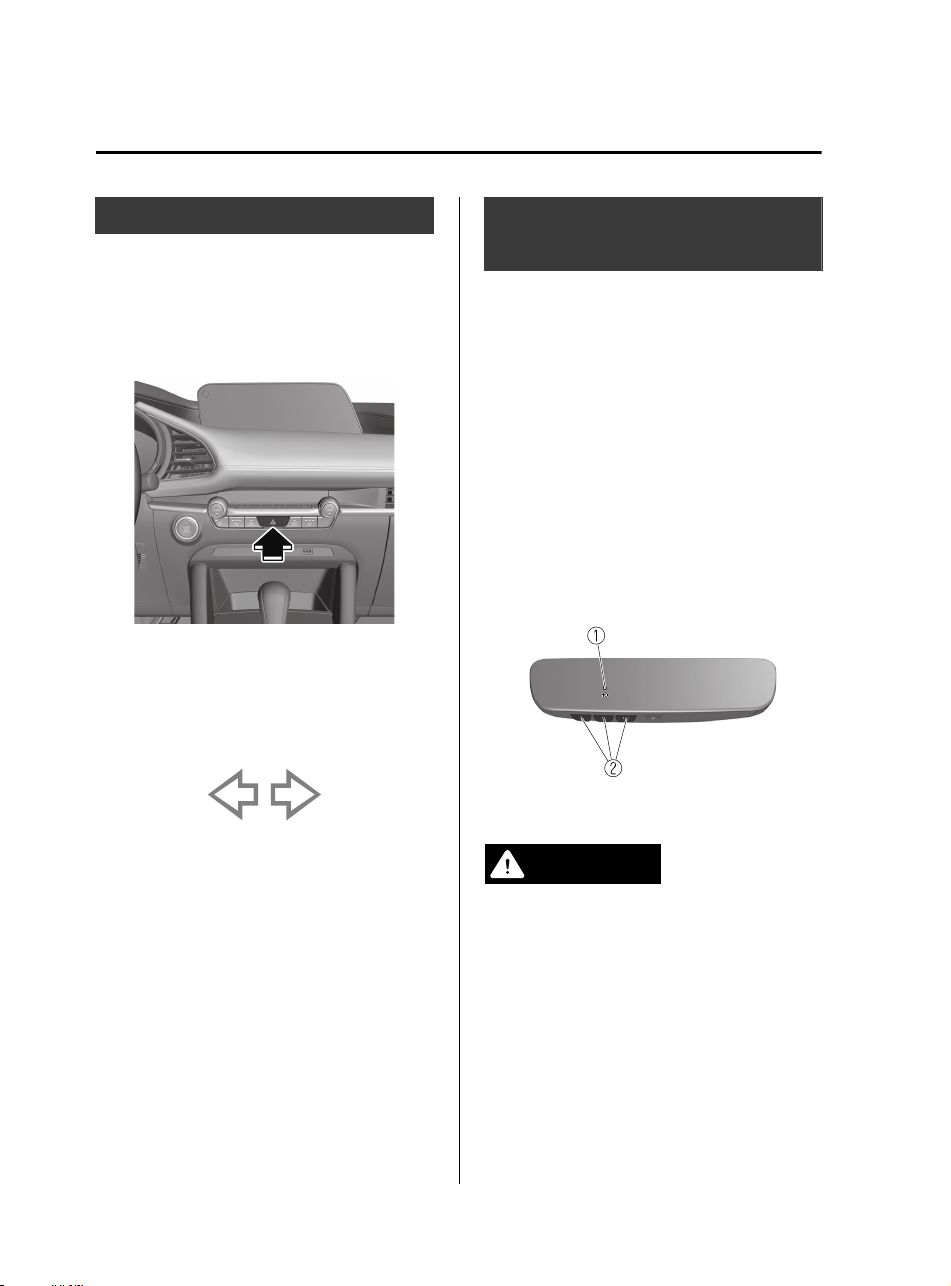
Hazard Warning Flasher
▼
Hazard Warning Flasher
The hazard warning lights should always
be used when you stop on or near a
roadway in an emergency.
The hazard warning lights warn other
drivers that your vehicle is a traffic hazard
and that they must take extreme caution
when near it.
Depress the hazard warning flasher and all
the turn signals will flash. The hazard
warning indicator lights in the instrument
cluster flash simultaneously.
NOTE
The turn signals do not work when the
hazard warning lights are on.
Check local regulations about the use of
hazard warning lights while the vehicle
is being towed to verify that it is not in
violation of the law.
HomeLink Wireless
Control System
*
▼
HomeLink Wireless Control System
NOTE
HomeLink and HomeLink house are
registered trademarks of Gentex
Corporation.
The HomeLink system replaces up to 3
hand-held transmitters with a single
built-in component in the auto-dimming
mirror. Pressing the HomeLink button on
the auto-dimming mirror activates garage
doors, gates and other devices surrounding
your home.
1. Indicator light
2. HomeLink button
WARNING
Do not use the HomeLink system with any
garage door opener that lacks the safety
stop and reverse feature:
Using the HomeLink system with any
garage door opener that lacks the safety
stop and reverse feature as required by
federal safety standards is dangerous. (This
includes garage doors manufactured
before April 1, 1982.)
When Driving
Switches and Controls
4-58
*Some models.
Mazda3_8HZ1-EA-19G_Edition1_old 2019-5-17 13:49:03
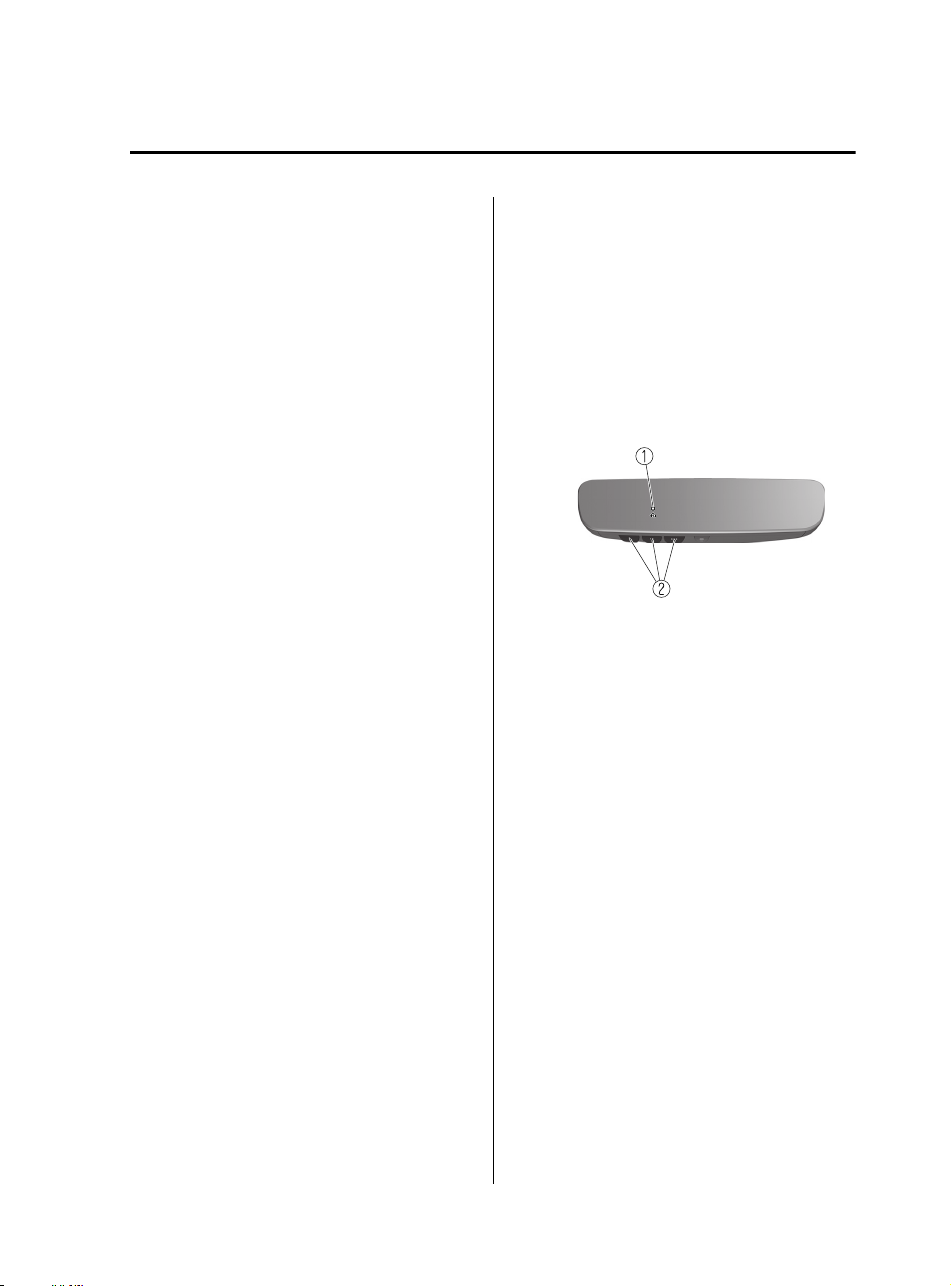
Using these garage door openers can
increase the risk of serious injury or death.
For further information, contact HomeLink
at www.homelink.com or
www.youtube.com/HomeLinkGentex or an
Authorized Mazda Dealer.
Always check the areas surrounding
garage doors and gates for people or
obstructions before programming or
during operation of the HomeLink system:
Programming or operating the HomeLink
system without verifying the safety of areas
surrounding garage doors and gates is
dangerous and could result in an
unexpected accident and serious injury if
someone were to be hit.
NOTE
The programming will not be erased even
if the battery is disconnected.
▼
Pre-programming the HomeLink
System
NOTE
It is recommended that a new battery be
placed in the hand-held transmitter of the
device being programmed to HomeLink
for quicker training and accurate
transmission of the radio-frequency signal.
Verify that there is a remote control
transmitter available for the device you
would like to program.
▼
Programming the HomeLink
System
The HomeLink system provides 3 buttons
which can be individually selected and
programmed using the transmitters for
current, on-market devices as follows:
1. Press and release the HomeLink button
you would like to program. The
indicator light flashes slowly in amber
when the button is pressed.
1. Indicator light
2. HomeLink button
2. Hold the hand-held transmitter 2.5 to
7.5 cm (1 to 3 in) away from the
HomeLink button you would like to
program while keeping the indicator
light in view.
NOTE
Depending on the hand-held
transmitter, it may be easier to do the
programming by holding it 15 to 20 cm
(6 to 7.8 in) away from the HomeLink
button.
3. Press the hand-held transmitter button
continuously until the indicator light
changes from amber (flashing) to
green (on/flashing).
When Driving
Switches and Controls
4-59
Mazda3_8HZ1-EA-19G_Edition1_old 2019-5-17 13:49:03
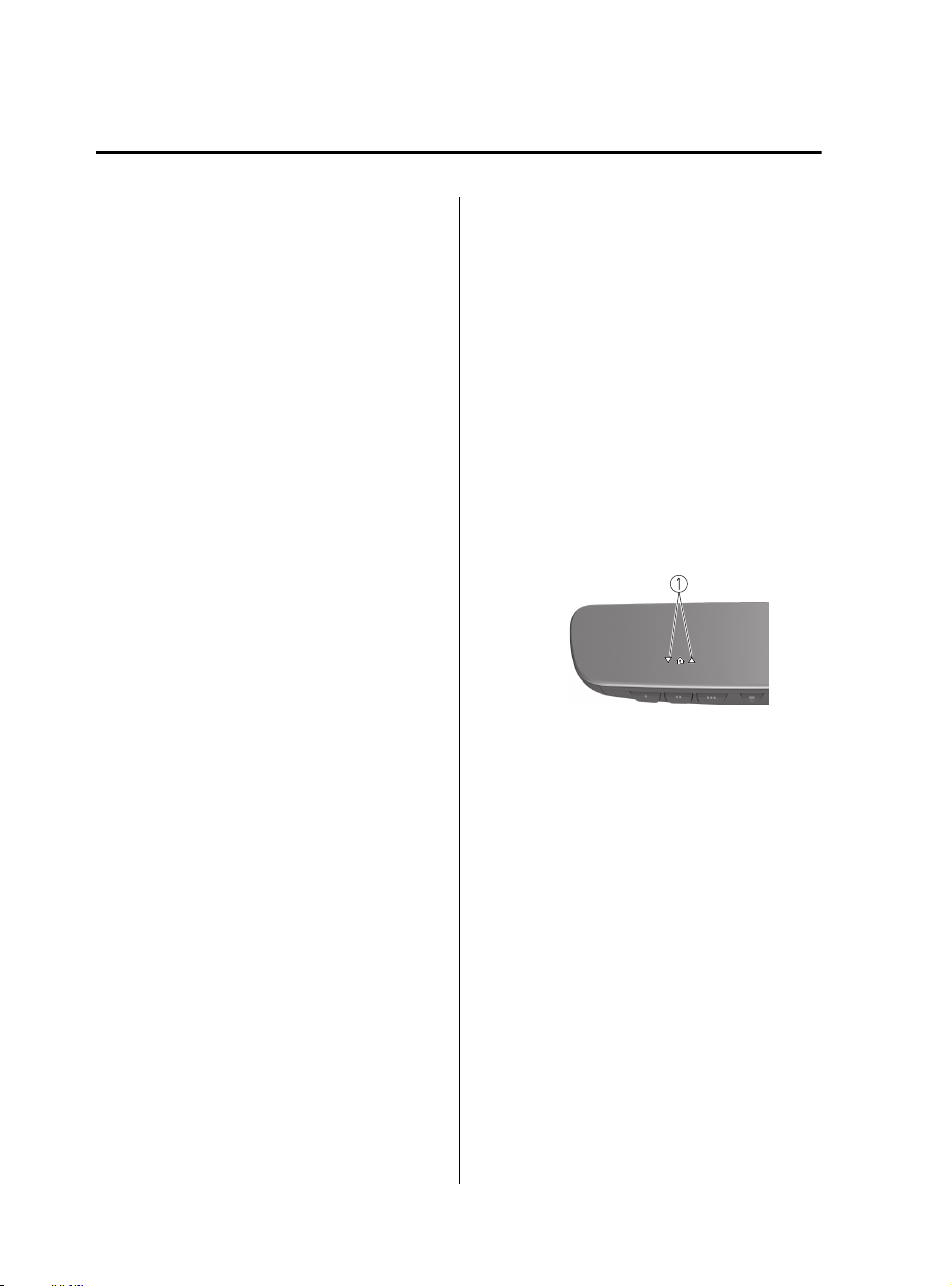
NOTE
Some gate operators and garage door
openers may require you to replace
this Programming Step 3 with
procedures noted in the “Gate
Operator/Canadian Programming”
section.
4. Press the HomeLink button again to
check if the programming has been
completed.
If the indicator light remains on in
green, the programming is complete
and the device becomes operational.
If the indicator light flashes rapidly
in green, firmly press and hold the
Homelink button and release it after
two seconds have passed. Repeat
this process up to three times to
complete the programming. The
device becomes operational and
programming is complete. If the
device does not operate, go to the
next step.
5. At the garage door opener receiver
(motor-head unit) in the garage, locate
the “learn” or “smart” button. This can
usually be found where the hanging
antenna wire is attached to the
motor-head unit.
6. Firmly press and release the “learn” or
“smart” button. (The name and color
of the button may vary by
manufacturer.)
NOTE
Complete the programming within 30
seconds.
7. Return to the vehicle and firmly press
and hold the Homelink button, and
then release it after two seconds have
passed. Repeat the “press/hold/
release” sequence a second time, and,
depending on the brand of the garage
door opener (or other rolling code
equipped device), repeat this sequence
a third time to complete the
programming process.
Press the programmed HomeLink
button and make sure that the
HomeLink System operates.
8. If the status indicator arrows are
flashing, refer to Garage Door
Two-Way Communication.
1. Indicator light
NOTE
To program the remaining two HomeLink
buttons, go back to Step 1 of
Programming the HomeLink System and
repeat the procedure.
For questions or comments, please contact
HomeLink at www.homelink.com or
www.youtube.com/HomeLinkGentex, or
the HomeLink toll-free hotline at
1-800-355-3515 (for calls placed outside
of the USA, Canada, and Puerto Rico,
international rates will apply and may
differ based on landline or mobile phone).
When Driving
Switches and Controls
4-60
Mazda3_8HZ1-EA-19G_Edition1_old 2019-5-17 13:49:03

▼
Gate operator/Canadian
Programming
Canadian radio-frequency laws require
transmitter signals to “time-out” (or quit)
after several seconds of transmission ―
which may not be long enough for
HomeLink to pick up the signal during
programming. Similar to this Canadian
law, some U.S. gate operators are designed
to “time-out” in the same manner.
If you live in Canada or are having
difficulties programming a gate operator
by using the programming procedures
(regardless of where you live), replace
Step 3 of Programming the HomeLink
System with the following:
NOTE
If programming a garage door opener or
gate operator, it is advised to unplug the
device during the “cycling” process to
prevent possible overheating.
While the indicator light is flashing in
amber, press the button on the hand-held
transmitter for 2 seconds and release it
repeatedly until the indicator light changes
from amber to green.
Go back to Step 4 of Programming the
HomeLink System to complete the
procedure.
▼
Operating the HomeLink System
Press the programmed HomeLink button
to operate a programmed device.
▼
Reprogramming the HomeLink
system
To program a device to HomeLink using a
HomeLink button previously trained,
follow these steps:
1. Press and hold the desired HomeLink
button. DO NOT release the button.
2. After 20 seconds, the indicator light
flashes in amber. After the indicator
light flashes, release the HomeLink
button.
3. Go back to Step 2 of Programming the
HomeLink System to complete the
procedure.
NOTE
If the programming has not been
completed, the system returns to the
previous programming.
▼
Erasing Programmed HomeLink
Buttons
NOTE
All of the programmed HomeLink
buttons are reset. Individual buttons
cannot be reset, however, individual
buttons can be reprogrammed. For
individual button reprogramming, refer
to Reprogramming the HomeLink
System (page 4-61).
Verify that the programming has been
erased if you resell the vehicle.
When Driving
Switches and Controls
4-61
Mazda3_8HZ1-EA-19G_Edition1_old 2019-5-17 13:49:03
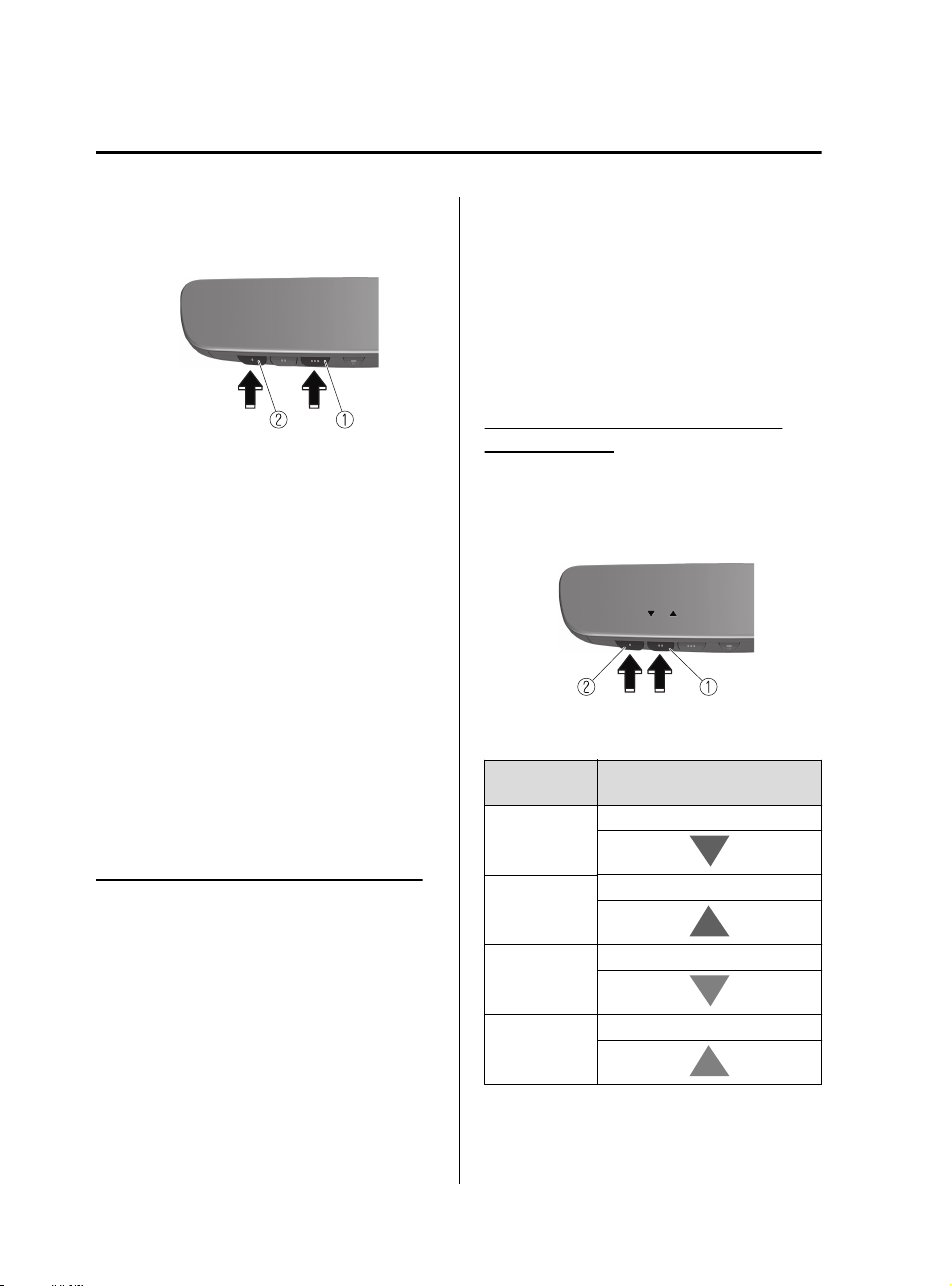
1. Press the two outer HomeLink buttons
continuously at the same time until the
indicator light flashes.
1. HomeLink button 3
2. HomeLink button 1
2. Stop pressing the HomeLink buttons.
▼
Garage Door Two-Way
Communication
The garage door two-way communication
is a function that communicates with the
garage door opener and indicates whether
the garages door is open or closed using
the indicator lights in the rear view mirror.
It can indicate the status of the garage door
within a range up-to 250 m (820 ft).
NOTE
The communication range may shorten
depending on obstructions.
Programming two-way communication
Within five seconds after programming a
new HomeLink button, both of the garage
door status indicator lights will flash
rapidly in green indicating that the garage
door two-way communication has been
established. If the garage door status
indicator lights flash, the two-way
communication programming is complete.
If the garage door status indicator lights do
not flash, the two-way communication
programming is not completed. For
additional HomeLink information and
programming videos, refer to the
following Websites:
www.HomeLink.com
www.youtube.com/HomeLinkGentex
Operating the garage door two-way
communication
By pressing HomeLink buttons 1 and 2 at
the same time for two seconds, the status
of the garage door is indicated for about 3
seconds as follows:
1. HomeLink button 2
2. HomeLink button 1
Garage door
status
Indicator light
Closing
Amber flashes
Opening
Amber flashes
Closed
Green turns on
Opened
Green turns on
NOTE
The programming will not be erased even
if the battery is disconnected.
When Driving
Switches and Controls
4-62
Mazda3_8HZ1-EA-19G_Edition1_old 2019-5-17 13:49:03
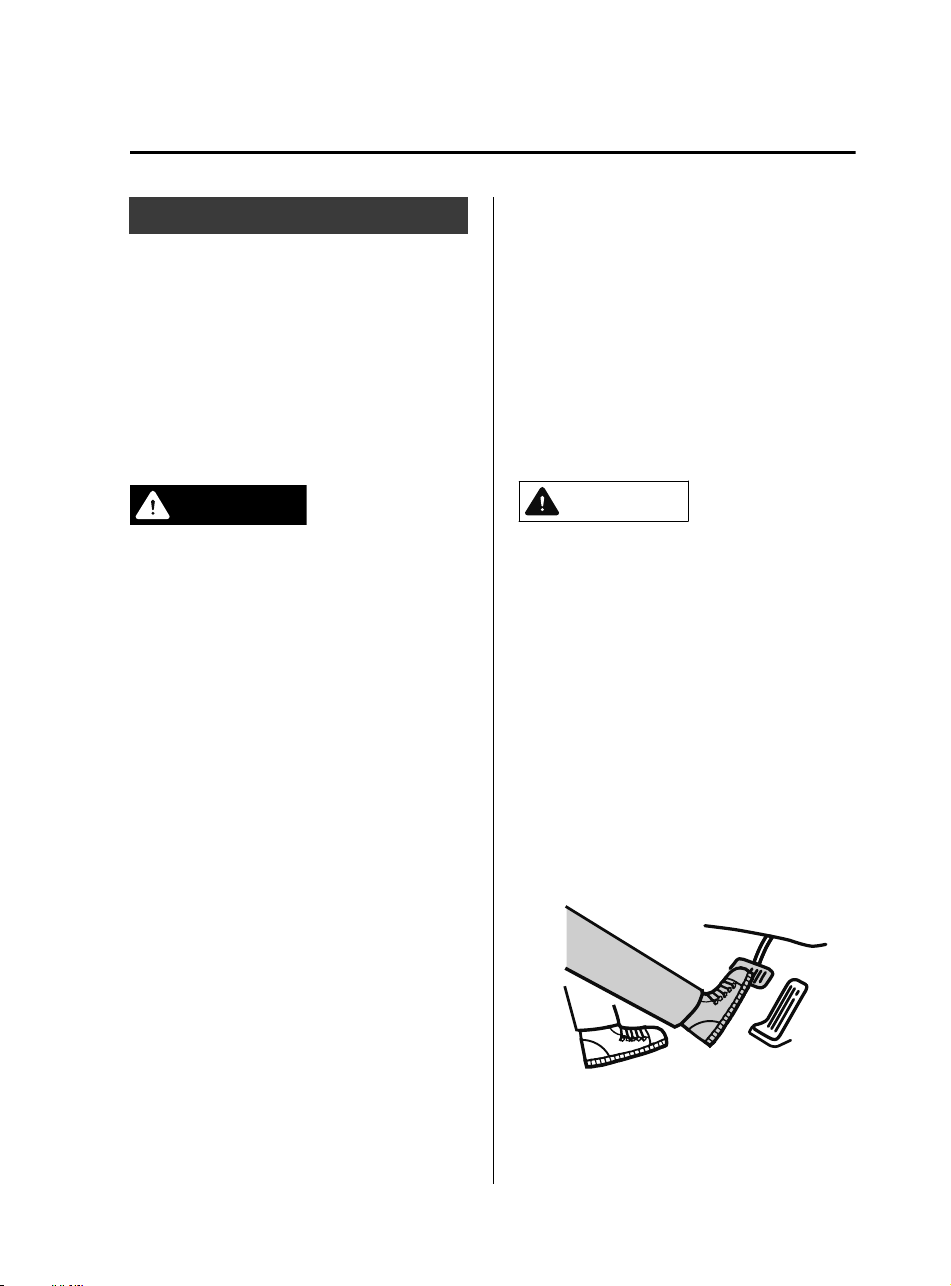
Brake System
▼
Foot Brake
This vehicle has power-assisted brakes
that adjust automatically through normal
use.
Should power-assist fail, you can stop by
applying greater force than normal to the
brake pedal. But the distance required to
stop will be greater than usual.
WARNING
Do not coast with the engine stalled or
turned
o,
nd
a safe place to stop:
Coasting with the engine stalled or turned
o
is dangerous. Braking will require more
eort, and the brake's power-assist could
be depleted if you pump the brake. This will
cause longer stopping distances or even an
accident.
Shift to a lower gear when going down
steep hills:
Driving with your foot continuously on the
brake pedal or steadily applying the brakes
for long distances is dangerous. This causes
overheated brakes, resulting in longer
stopping distances or even total brake
failure. This could cause loss of vehicle
control and a serious accident. Avoid
continuous application of the brakes.
Dry o brakes that have become wet by
driving slowly, releasing the accelerator
pedal and lightly applying the brakes
several times until the brake performance
returns to normal:
Driving with wet brakes is dangerous.
Increased stopping distance or the vehicle
pulling to one side when braking could
result in a serious accident. Light braking
will indicate whether the brakes have been
aected.
CAUTION
Do not drive with your foot held on the
clutch pedal or brake pedal, or hold the
clutch pedal depressed halfway
unnecessarily. Doing so could result in
the following:
The clutch and brake parts will wear
out more quickly.
The brakes can overheat and adversely
aect brake performance.
Always depress the brake pedal with the
right foot. Applying the brakes with the
unaccustomed left foot could slow your
reaction time to an emergency situation
resulting in insucient braking
operation.
Wear shoes appropriate for driving in
order to avoid your shoe contacting the
brake pedal when depressing the
accelerator pedal.
When Driving
Brake
4-63
Mazda3_8HZ1-EA-19G_Edition1_old 2019-5-17 13:49:03
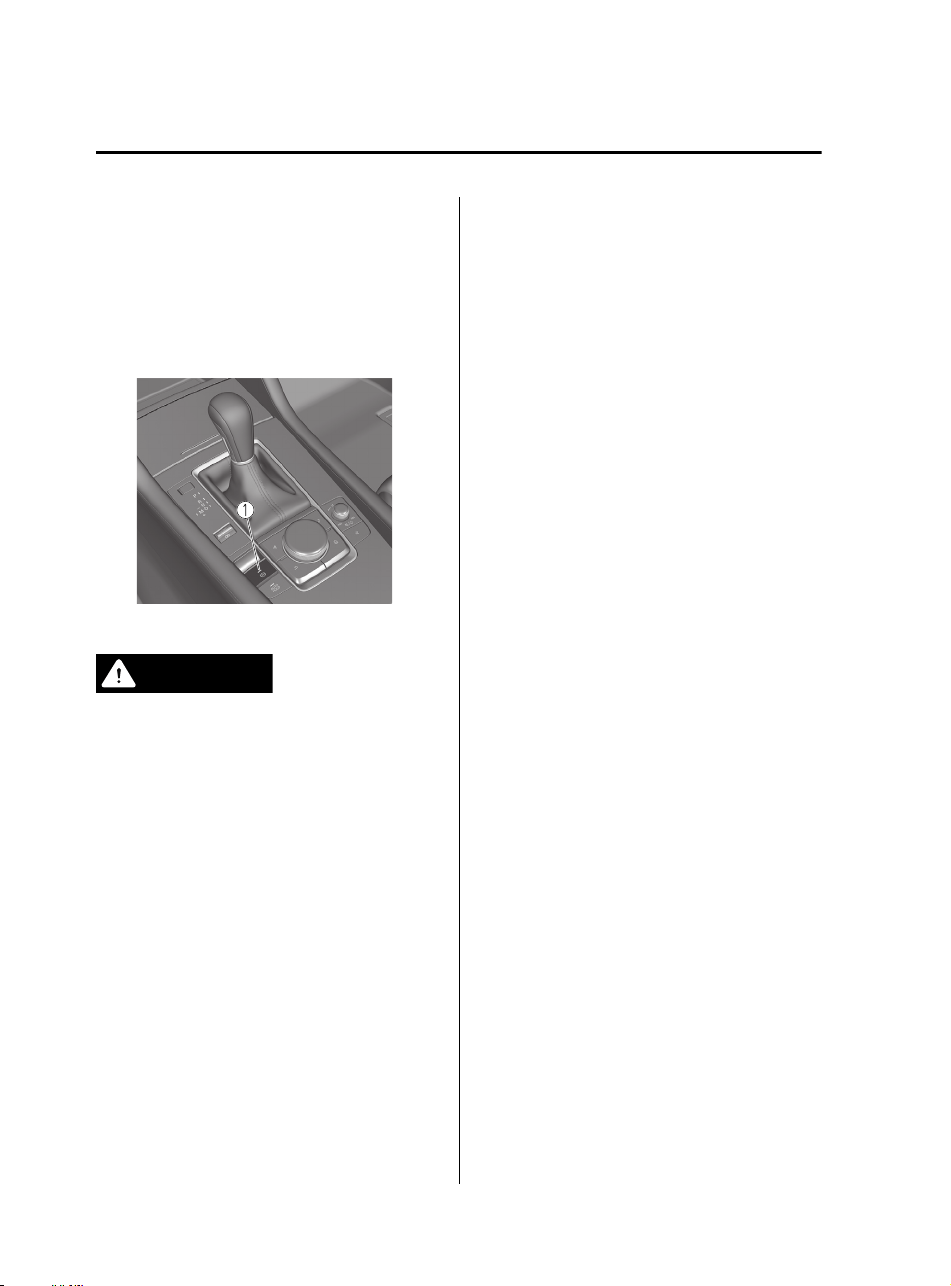
▼
Electric Parking Brake (EPB)
The EPB system applies the parking brake
using an electric motor. The system can
operate automatically and manually.
The EPB switch indicator light turns on
when applying the parking brake and it
turns off when releasing the parking brake.
1. Indicator light
WARNING
Do not drive the vehicle with the parking
brake applied:
If the vehicle is driven with the parking
brake applied, the brake parts may
generate heat and the brake system may
not operate, leading to an accident.
Before driving the vehicle, release the
parking brake and make sure that the EPB
indicator light in the instrument cluster
turns o.
Apply the parking brake when leaving the
vehicle:
Not applying the parking brake when
parking the vehicle is dangerous as the
vehicle may move unexpectedly and result
in an accident. Before leaving the vehicle,
apply the parking brake and make sure
that the EPB indicator light in the
instrument cluster turns on.
NOTE
The parking brake cannot be applied or
released while the vehicle battery is
dead.
Refer to If a Jump-Starting on page
7-17.
When the charging system warning light
in the instrument cluster turns on, the
parking brake cannot be applied after
switching the ignition OFF. Before
switching the ignition OFF, apply the
parking brake manually.
The sound of the parking brake being
applied or released can be heard,
however, this does not indicate a
problem.
If the EPB is not used for long periods,
an automatic inspection of the system is
performed while the vehicle is parked.
An operation sound can be heard,
however, this does not indicate a
problem.
When applying the parking brake and
switching OFF the ignition, an
operation sound can be heard, however,
this does not indicate a problem.
The brake pedal may move while
applying or releasing the parking brake,
however, this does not indicate a
problem.
When Driving
Brake
4-64
Mazda3_8HZ1-EA-19G_Edition1_old 2019-5-17 13:49:03
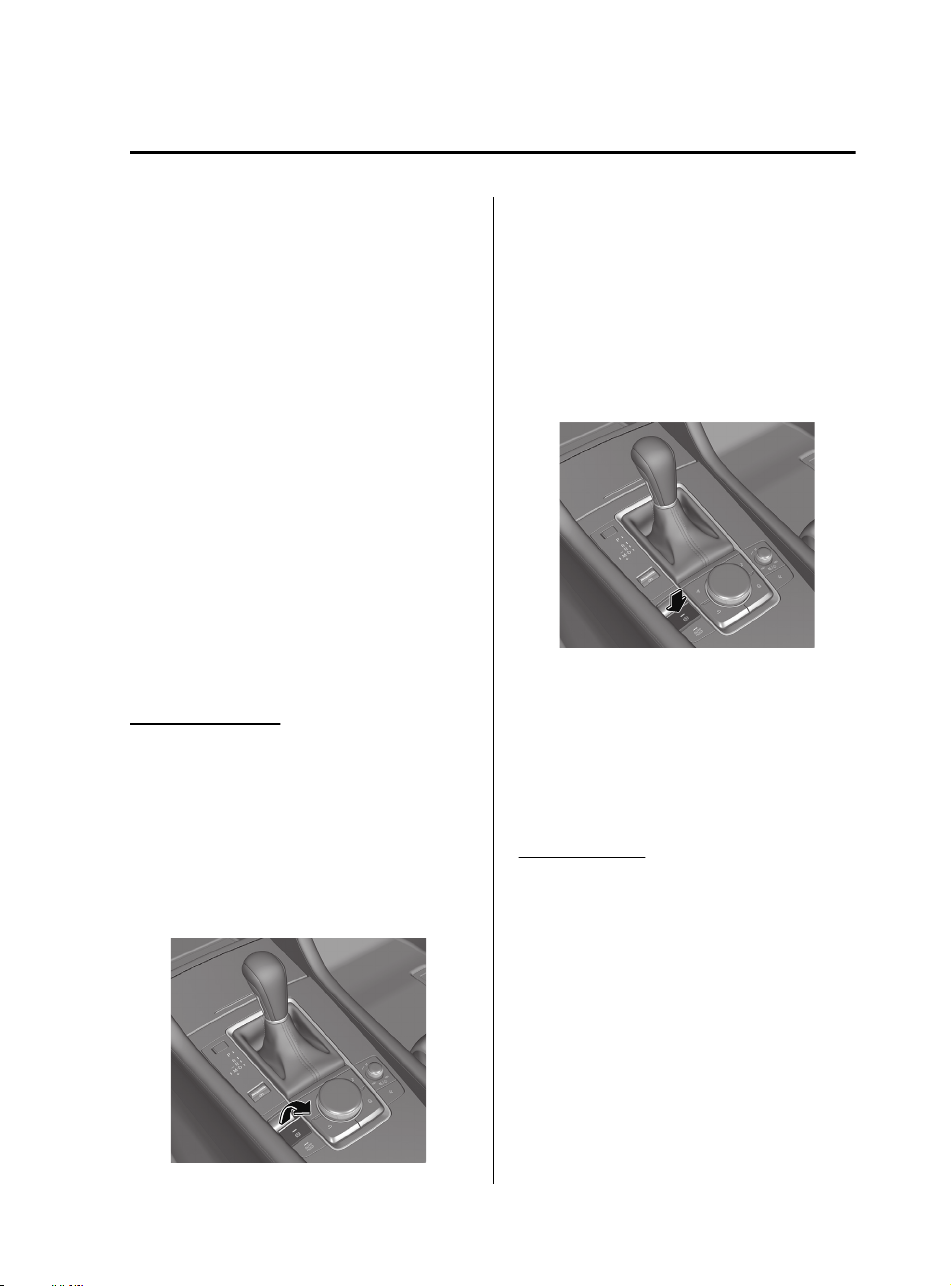
If there is a problem with the brake
system (foot brake) while driving the
vehicle, continually pulling up the EPB
switch will apply the brakes and
decelerate or stop the vehicle. The
parking brake on-reminder sound is
activated while the brake is applied. In
addition, when releasing the switch, the
brake is released and the sound stops.
If the parking brake is applied with the
ignition switched OFF or in ACC, the
EPB indicator light in the instrument
cluster and the indicator light in the
switch may turn on for 15 seconds.
When using an automatic car wash
which moves the vehicle with the front
tires mounted, it is necessary to cancel
the parking brake auto operation before
the vehicle enters the automatic car
wash. For details, refer to Canceling the
parking brake automatic operation.
Manual operation
Applying the parking brake manually
When the brake pedal is firmly depressed
and the EPB switch is pulled up, the
parking brake is applied regardless of the
ignition position. When the parking brake
is applied, the EPB indicator light in the
instrument cluster and the EPB switch
indicator light turn on.
Releasing the parking brake manually
When the brake pedal is firmly depressed
and the EPB switch is pressed while the
ignition is switched ON or the engine is
running, the parking brake is released.
When the parking brake is released, the
EPB indicator light in the instrument
cluster and the EPB switch indicator light
turn off.
If the EPB switch is pressed without
depressing the brake pedal, a message is
displayed on the multi-information display
to notify the driver to depress the brake
pedal.
Refer to Message Indicated on
Multi-information Display on page 7-38.
Auto operation
Applying the parking brake
automatically
When the ignition is switched from ON to
ACC or OFF, the parking brake will be
applied automatically. When the parking
brake is applied, the EPB indicator light in
the instrument cluster and the EPB switch
indicator light turn on.
When Driving
Brake
4-65
Mazda3_8HZ1-EA-19G_Edition1_old 2019-5-17 13:49:03

NOTE
To release the parking brake when the
ignition is switched OFF, it is necessary to
cancel the parking brake auto operation.
For details, refer to Canceling the parking
brake automatic operation.
Releasing the parking brake
automatically
If the accelerator pedal is depressed with
the parking brake applied and all of the
following conditions met, the parking
brake is released automatically. When the
parking brake is released, the EPB
indicator light in the instrument cluster
and the EPB switch indicator light turn
off.
The engine is running.
The driver's door is closed.
The driver's seat belt is fastened.
(Manual transmission vehicle)
The shift lever is in a position other
than neutral.
The clutch pedal is depressed halfway.
(Automatic transmission vehicle)
The selector lever is in the D, M, or R
position.
NOTE
If something such as the driver's foot
contacts the accelerator pedal with the
engine running and the parking brake
applied, the parking brake might be
released automatically. If you do not
intend to start driving the vehicle
immediately, shift the shift lever to the
neutral position for a manual
transmission, or shift the selector lever to
the P or N position for an automatic
transmission.
Canceling the parking brake automatic
operation
The parking brake automatic operation can
be canceled by doing any of the following
after switching the ignition from ON to
OFF.
Auto operation cancel method 1
1. Switch the ignition ON.
2. Turn off the AUTOHOLD.
3. Press the EPB switch continuously for
2 seconds or longer (until a sound is
activated).
4. Release the EPB switch and switch the
ignition OFF within 5 seconds after the
sound was activated.
After the auto operation is canceled, a
sound is activated one time, and the
EPB switch indicator light switches
from illumination to flashing, and then
turns off after 3 seconds.
Auto operation cancel method 2
1. Switch the ignition ON.
2. Turn off the AUTOHOLD.
3. Switch the ignition OFF with the EPB
switch pressed.
When the auto operation is canceled, a
sound is activated one time, and the
EPB switch indicator light from
normal flashing to faster flashing, and
then turns off after 3 seconds.
NOTE
When canceling the parking brake auto
operation and parking the vehicle, shift
the shift lever to the 1st gear or the R
position for a manual transmission, or
shift the selector lever to the P position
for an automatic transmission, and then
use wheel blocks.
When Driving
Brake
4-66
Mazda3_8HZ1-EA-19G_Edition1_old 2019-5-17 13:49:03
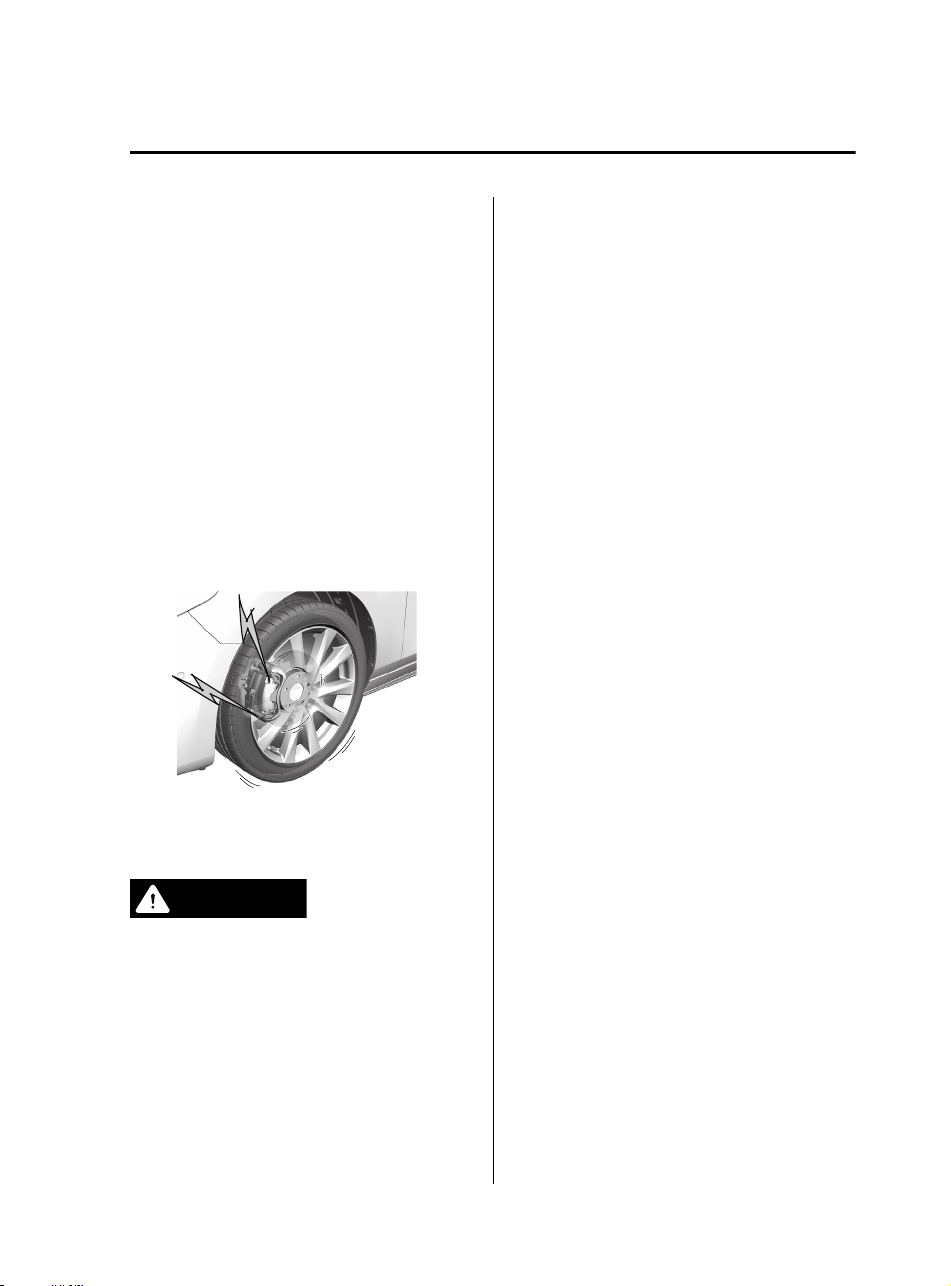
The auto operation may not cancel if the
vehicle is parked on a steep slope.
When the ignition is switched ON, the
parking brake auto operation is restored.
▼
Warning Light
The warning light turns on when the
system has a malfunction.
Refer to Brake System Warning
Indication/Warning Light on page 7-27.
▼
Brake Pad Wear Indicator
When the disc brake pads become worn,
the built-in wear indicators contact the
disc plates. This causes a screeching noise
to warn that the pads should be replaced.
When you hear this noise, consult an
Authorized Mazda Dealer as soon as
possible.
WARNING
Do not drive with worn disc pads:
Driving with worn disc pads is dangerous.
The brakes could fail and cause a serious
accident. As soon as you hear a screeching
noise consult an Authorized Mazda Dealer.
NOTE
In high humidity weather conditions,
brake noises, such as brake squeak or
brake squeal can be heard. It does not
indicate a malfunction.
▼
Brake Assist
During emergency braking situations
when it is necessary to depress the brake
pedal with greater force, the brake assist
system provides braking assistance, thus
enhancing braking performance.
When the brake pedal is depressed hard or
depressed more quickly, the brakes apply
more firmly.
NOTE
When the brake pedal is depressed hard
or depressed more quickly, the pedal
will feel softer but the brakes will apply
more firmly. This is a normal effect of
the brake assist operation and does not
indicate a malfunction.
When the brake pedal is depressed hard
or depressed more quickly, a motor/
pump operation noise may be heard.
This is a normal effect of the brake
assist and does not indicate a
malfunction.
The brake assist equipment does not
supersede the functionality of the
vehicle's main braking system.
▼
Brake Override System
The brake override system applies the
brake first for safety if the brake pedal and
accelerator pedal are depressed at the same
time.
When Driving
Brake
4-67
Mazda3_8HZ1-EA-19G_Edition1_old 2019-5-17 13:49:03

NOTE
Operation of the brake override system
can be turned on or off.
Refer to the Settings section in the Mazda
Connect Owner's Manual.
When Driving
Brake
4-68
Mazda3_8HZ1-EA-19G_Edition1_old 2019-5-17 13:49:03
AUTOHOLD
▼
AUTOHOLD
The AUTOHOLD function automatically holds the vehicle stopped, even if you take your
foot off the brake pedal. This function can be best used while stopped in traffic or at a traffic
light. The brakes are released when you start driving the vehicle.
WARNING
Do not rely completely on the AUTOHOLD function:
The AUTOHOLD function is only designed to assist the brake operation while the vehicle is
stopped. Neglecting to operate the brakes and relying only on the AUTOHOLD system is
dangerous and could result in an unexpected accident if the vehicle were to suddenly move.
Operate the brakes appropriately in accordance with the road and surrounding conditions.
Do not release your foot from the brake pedal while the vehicle is stopped on a steep grade:
Because there is a possibility of the vehicle not being held in the stopped position by the
AUTOHOLD function, the vehicle may move unexpectedly and result in an accident.
Do not use the AUTOHOLD function on slippery roads such as icy or snow-covered roads, or
unpaved roads:
Even if the vehicle is held in the stopped position by the AUTOHOLD function, the vehicle may
move unexpectedly and result in an accident. Operate the accelerator pedal, brakes, or
steering wheel appropriately as necessary.
Immediately depress the brake pedal in the following cases:
Because the AUTOHOLD function is canceled forcibly, the vehicle may move unexpectedly
and result in an accident.
“Depress Brake Pedal. Brake Hold Disabled” is displayed in the multi-information display
and the warning sound is activated at the same time.
Always apply the parking brake when parking the vehicle:
Not applying the parking brake when parking the vehicle is dangerous as the vehicle may
move unexpectedly and result in an accident. When parking the vehicle, shift the selector
lever to the P position (automatic transmission vehicle) and apply the parking brake.
When Driving
Brake
4-69
Mazda3_8HZ1-EA-19G_Edition1_old 2019-5-17 13:49:03
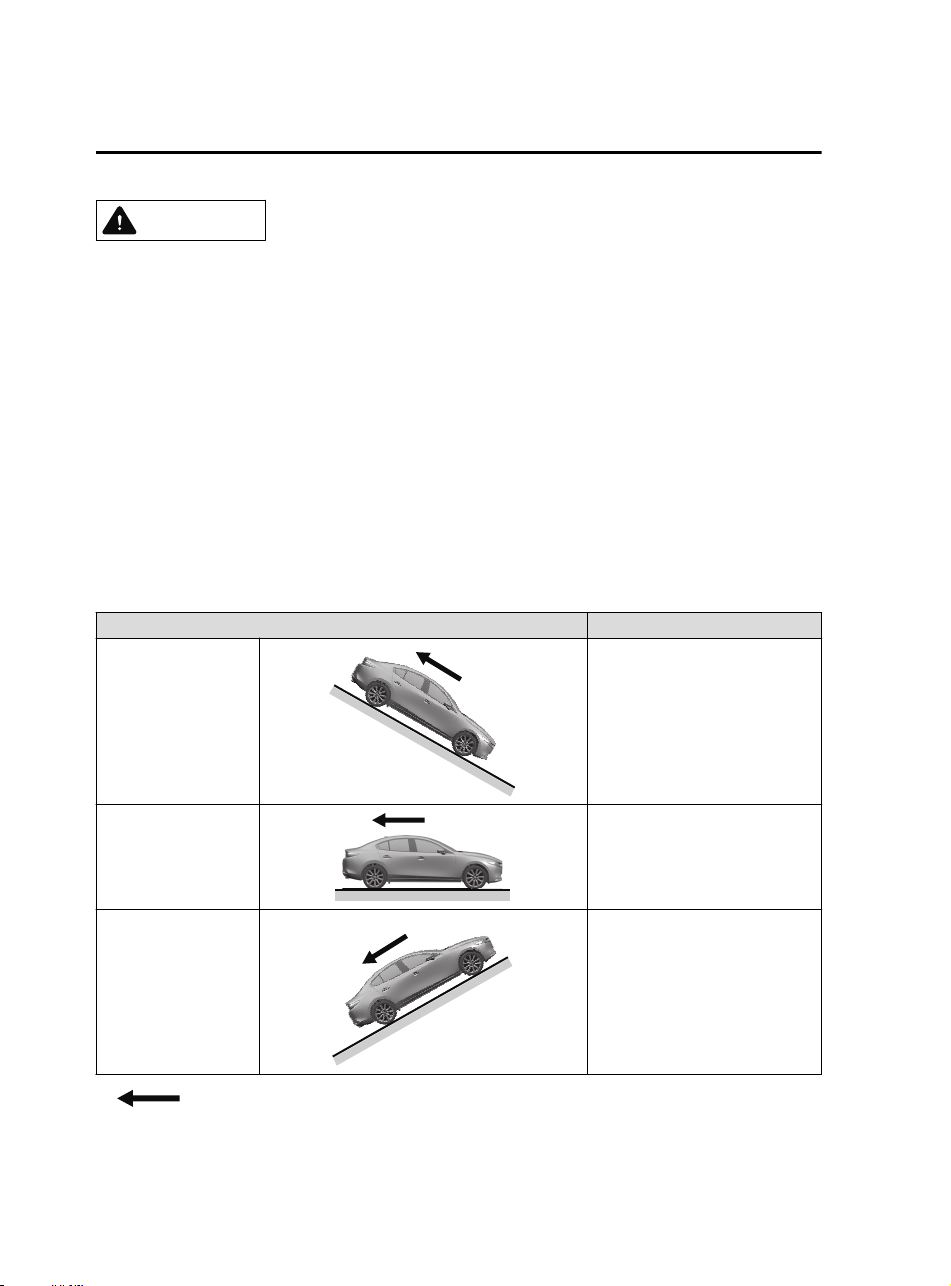
CAUTION
If you stop operating the accelerator pedal before the vehicle starts moving, the force holding
the vehicle in the stopped position may weaken. Firmly depress the brake pedal or depress the
accelerator pedal to accelerate the vehicle.
NOTE
Under the following conditions, a problem with the AUTOHOLD is occurring. Have your
vehicle inspected at an Authorized Mazda Dealer as soon as possible.
A message is indicated on the multi-information display and a warning sound is
activated for about 5 seconds while the AUTOHOLD is operating or when you press the
AUTOHOLD switch.
If you switch the ignition OFF while the AUTOHOLD is operating, the parking brake is
applied automatically to assist you with parking the vehicle.
The AUTOHOLD is canceled when the selector lever/shift lever is shifted to R position
while the vehicle is on level ground, or facing up a hill or grade (as shown below).
Vehicle posture and road surface gradient AUTOHOLD operation status
Vehicle tilts forward
Operates
Level ground
Does not operate, canceled
Vehicle tilts rearward
Does not operate, canceled
: Reverse driving (selector lever/shift lever in the reverse (R) position)
When Driving
Brake
4-70
Mazda3_8HZ1-EA-19G_Edition1_old 2019-5-17 13:49:03
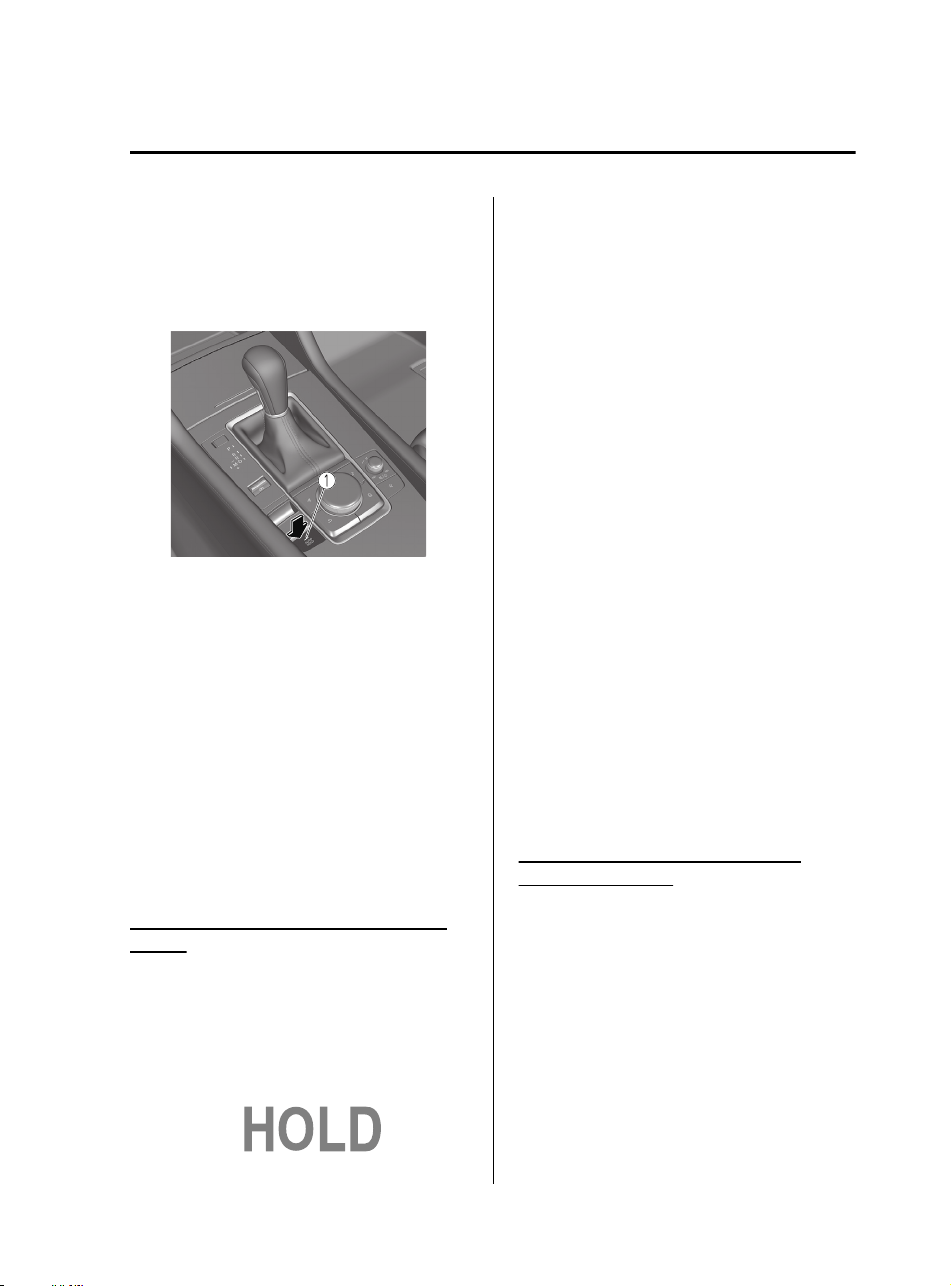
▼
AUTOHOLD System is Turned On
Press the AUTOHOLD switch and when
the AUTOHOLD standby indicator light
turns on, the AUTOHOLD function turns
on.
1. AUTOHOLD standby indicator light
NOTE
When all of the following conditions are
met, the AUTOHOLD standby indicator
light turns on when the AUTOHOLD
switch is pressed and the AUTOHOLD
function turns on.
The ignition is switched ON (engine is
running).
The driver's seat belt is fastened.
The driver's door is closed.
There is no problem with the
AUTOHOLD function.
To operate AUTOHOLD and hold the
brakes
1. Depress the brake pedal and bring the
vehicle to a complete stop.
2. The AUTOHOLD active indicator
light in the instrument cluster turns on
and the brakes are held.
3. The vehicle is held in its stopped
position even with the brake pedal
released.
NOTE
When all of the following conditions are
met, the AUTOHOLD operates and the
brakes are held.
The ignition is switched ON (engine is
running).
The vehicle is stopped.
The brake pedal is being depressed.
The AUTOHOLD active indicator light
turns on.
The accelerator pedal is not depressed.
The driver's seat belt is fastened.
The driver's door is closed.
There is no problem with the
AUTOHOLD function.
The parking brake is released.
There is no problem with the Electric
Parking Brake (EPB) function.
(Automatic transmission vehicle)
The selector lever is in a position other
than R position or the vehicle tilts
forward with the selector lever in the R
position.
To release AUTOHOLD and start
driving the vehicle
If you do any of the following actions to
resume driving the vehicle, the brakes will
be released automatically and the
AUTOHOLD active indicator light turns
off.
(Manual transmission vehicle)
You start to release the clutch pedal with
the shift lever shifted to a position other
than the neutral position
(Automatic transmission vehicle)
The accelerator pedal is depressed.
When Driving
Brake
4-71
Mazda3_8HZ1-EA-19G_Edition1_old 2019-5-17 13:49:03
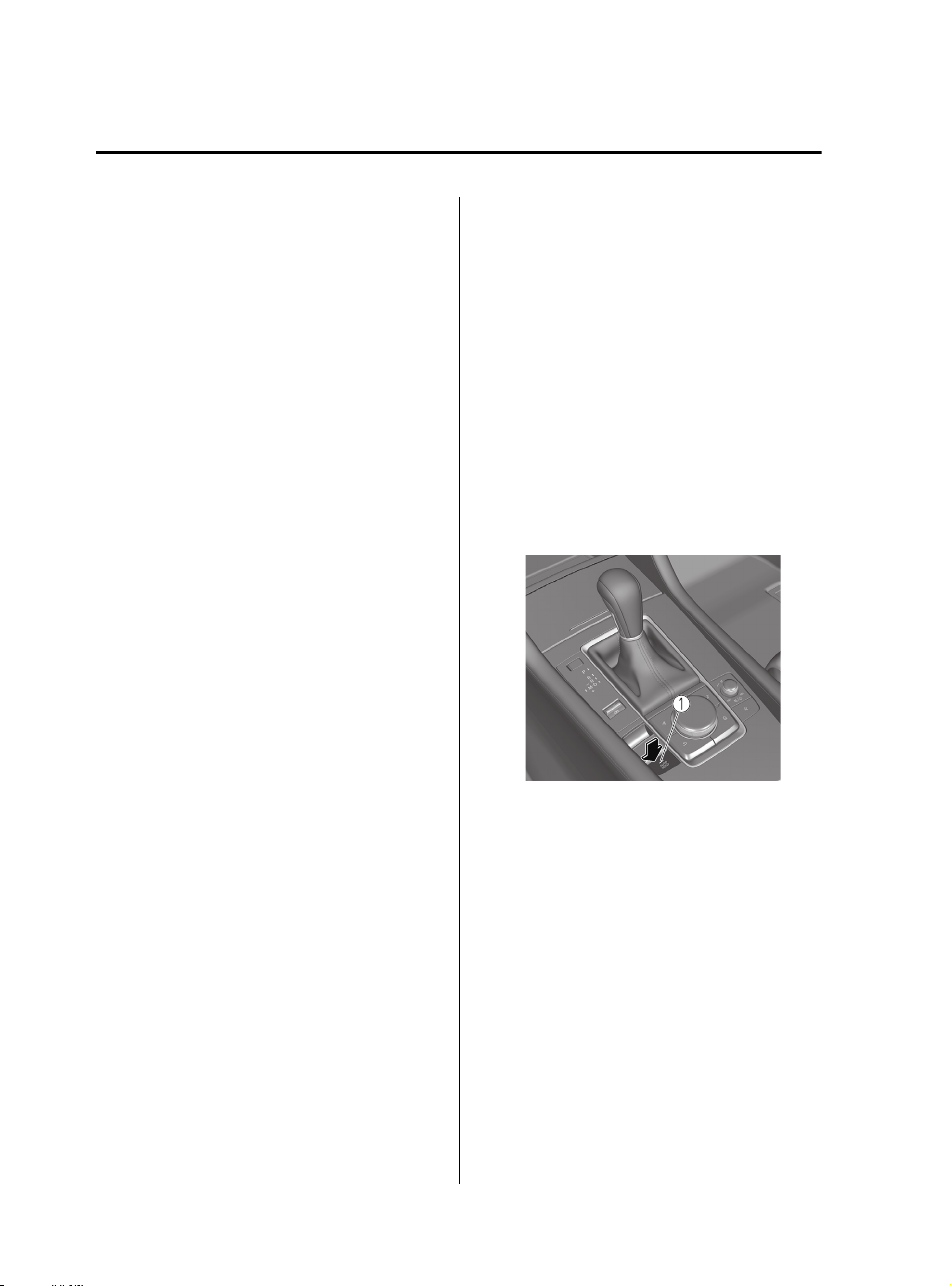
The vehicle tilts rearward or the
selector lever is shifted to the R
position on level ground.
NOTE
If the Electric Parking Brake (EPB)
switch is pulled while the AUTOHOLD
is operating, the parking brake is
applied and the AUTOHOLD is
released. In addition, if the parking
brake is released under this condition,
the AUTOHOLD operates to hold the
brakes.
Under the following conditions, the
parking brake is automatically applied
and the AUTOHOLD is released. The
AUTOHOLD is re-enabled when the
conditions before the AUTOHOLD is
released are restored.
The driver’s seat belt is unfastened.
The driver’s door is opened.
When about 10 minutes or longer have
passed since the AUTOHOLD operation
started, the parking brake is
automatically applied. Because the
AUTOHOLD is restored when releasing
the parking brake, the hold on the
brakes by AUTOHOLD function
resumes.
(Manual transmission vehicle)
When starting to drive the vehicle
forward or in reverse on a down slope,
depress the clutch pedal and shift the
shift lever to the appropriate position for
driving in the desired direction, and then
depress the accelerator pedal to release
the AUTOHOLD.
The AUTOHOLD can be canceled
forcibly by fully depressing the
accelerator pedal for 1 second or longer
while the AUTOHOLD is operating.
Forcibly cancel the AUTOHOLD only
when the AUTOHOLD cannot be
canceled due to a system malfunction or
it is necessary to cancel the
AUTOHOLD in an emergency.
▼
AUTOHOLD System is Turned Off
Depress the brake pedal and press the
AUTOHOLD switch. The AUTOHOLD is
turned off and the AUTOHOLD standby
indicator light turns off.
1. AUTOHOLD standby indicator light
NOTE
When the brakes are not held such as
while driving the vehicle, the
AUTOHOLD can be turned off only by
pressing the AUTOHOLD switch.
When Driving
Brake
4-72
Mazda3_8HZ1-EA-19G_Edition1_old 2019-5-17 13:49:03
If the AUTOHOLD switch is pressed
without depressing the brake pedal
while AUTOHOLD is operating
(AUTOHOLD active indicator light in
instrument cluster is turned on), the
message “Depress Brake Pedal and
Operate Switch to Release” is indicated
on the multi-information display to
notify the driver to depress the brake
pedal.
If any of the following conditions occurs
while the AUTOHOLD function is
operating (AUTOHOLD active indicator
light is turned on), the parking brake is
applied automatically and the
AUTOHOLD function turns off. For the
Electric Parking Brake (EPB)
operation, refer to the Electric Parking
Brake (EPB) on page 4-64.
The ignition is switched OFF.
There is a problem with the
AUTOHOLD function.
Hill Launch Assist (HLA)
▼
Hill Launch Assist (HLA)
The HLA functions to assist in
accelerating the vehicle from a stop on
slopes. When releasing the brake pedal
and depressing the accelerator pedal to
accelerate the vehicle from a stop while on
a slope, the function prevents the vehicle
from rolling. The HLA also operates when
reversing on a slope.
The braking force is maintained
automatically after releasing the brake
pedal on a steep slope.
For manual transmission vehicles, the
HLA operates when the vehicle is tilted
rearward with the shift lever in a forward
gear, and operates when the vehicle is
tilted forward with the shift lever in the R
position.
For automatic transmission vehicles, the
HLA operates when the vehicle is tilted
rearward with the selector lever in a
forward gear, and operates when the
vehicle is tilted forward with the selector
lever in the R position.
WARNING
Do not rely completely on HLA:
HLA is an auxiliary device for accelerating
from a stop on a slope. The system only
operates for about 2 seconds and
therefore, relying only on the system, when
accelerating from a stop is dangerous
because the vehicle may move (roll)
unexpectedly and cause an accident.
When Driving
Brake
4-73
Mazda3_8HZ1-EA-19G_Edition1_old 2019-5-17 13:49:03

The vehicle could roll depending on the
vehicle's load or if it is towing something. In
addition, for vehicles with a manual
transmission, the vehicle could still roll
depending on how the clutch pedal or the
accelerator pedal is operated.
Always conrm the safety around the
vehicle before starting to drive the vehicle.
NOTE
HLA does not operate on a gentle slope.
In addition, the gradient of the slope on
which the system will operate changes
depending on the vehicle's load.
HLA does not operate if the parking
brake is applied, the vehicle has not
stopped completely, or the clutch pedal
is released.
While HLA is operating, the brake pedal
may feel stiff and vibrate, however, this
does not indicate a malfunction.
HLA does not operate while the
TCS/DSC indicator light is illuminated.
Refer to TCS/DSC Indication/Indicator
Light (Turns on) on page 7-32.
HLA does not turn off even if the DSC
OFF switch is pressed to turn off the
TCS/DSC.
When Driving
Brake
4-74
Mazda3_8HZ1-EA-19G_Edition1_old 2019-5-17 13:49:03
Antilock Brake System
(ABS)
▼
Antilock Brake System (ABS)
The ABS control unit continuously
monitors the speed of each wheel. If one
wheel is about to lock up, the ABS
responds by automatically releasing and
reapplying that wheel's brake.
The driver will feel a slight vibration in
the brake pedal and may hear a chattering
noise from the brake system. This is
normal ABS system operation. Continue
to depress the brake pedal without
pumping the brakes.
The warning light turns on when the
system has a malfunction.
Refer to ABS Warning Indication/Warning
Light on page 7-30.
WARNING
Do not rely on ABS as a substitute for safe
driving:
The ABS cannot compensate for unsafe
and reckless driving, excessive speed,
tailgating (following another vehicle too
closely), driving on ice and snow, and
hydroplaning (reduced tire friction and
road contact because of water on the road
surface). You can still have an accident.
NOTE
Braking distances may be longer on
loose surfaces (snow or gravel, for
example) which usually have a hard
foundation. A vehicle with a normal
braking system may require less
distance to stop under these conditions
because the tires will build up a wedge
of surface layer when the wheels skid.
The sound of the ABS operating may be
heard when starting the engine or
immediately after starting the vehicle,
however, it does not indicate a
malfunction.
When Driving
ABS/TCS/DSC
4-75
Mazda3_8HZ1-EA-19G_Edition1_old 2019-5-17 13:49:03
Traction Control System
(TCS)
▼
Traction Control System (TCS)
The Traction Control System (TCS)
enhances traction and safety by controlling
engine torque and braking. When the TCS
detects driving wheel slippage, it lowers
engine torque and operates the brakes to
prevent loss of traction.
This means that on a slick surface, the
engine adjusts automatically to provide
optimum power to the drive wheels,
limiting wheel spin and loss of traction.
The warning light turns on when the
system has a malfunction.
Refer to TCS/DSC Indication/Indicator
Light (Turns on) on page 7-32.
WARNING
Do not rely on the Traction Control System
(TCS) as a substitute for safe driving:
The Traction Control System (TCS) cannot
compensate for unsafe and reckless
driving, excessive speed, tailgating
(following another vehicle too closely), and
hydroplaning (reduced tire friction and
road contact because of water on the road
surface). You can still have an accident.
Use snow tires or tire chains and drive at
reduced speeds when roads are covered
with ice and/or snow:
Driving without proper traction devices on
snow and/or ice-covered roads is
dangerous. The Traction Control System
(TCS) alone cannot provide adequate
traction and you could still have an
accident.
NOTE
To turn off the TCS, press the DSC OFF
switch (page 4-78).
▼
TCS/DSC Indicator Light
This indicator light stays on for a few
seconds when the ignition is switched ON.
If the TCS or DSC is operating, the
indicator light flashes.
If the light stays on, the TCS, DSC or the
brake assist system may have a
malfunction and they may not operate
correctly. Take your vehicle to an
Authorized Mazda Dealer.
NOTE
In addition to the indicator light
flashing, a slight lugging sound will
come from the engine. This indicates
that the TCS/DSC is operating properly.
On slippery surfaces, such as fresh
snow, it will be impossible to achieve
high rpm when the TCS is on.
When Driving
ABS/TCS/DSC
4-76
Mazda3_8HZ1-EA-19G_Edition1_old 2019-5-17 13:49:03
Dynamic Stability Control
(DSC)
▼
Dynamic Stability Control (DSC)
The Dynamic Stability Control (DSC)
automatically controls braking and engine
torque in conjunction with systems such as
ABS and TCS to help control side slip
when driving on slippery surfaces, or
during sudden or evasive maneuvering,
enhancing vehicle safety.
Refer to ABS (page 4-75) and TCS (page
4-76).
DSC operation is possible at speeds
greater than 20 km/h (12 mph).
The warning light turns on when the
system has a malfunction.
Refer to TCS/DSC Indication/Indicator
Light (Turns on) on page 7-32.
WARNING
Do not rely on the Dynamic Stability
Control as a substitute for safe driving:
The Dynamic Stability Control (DSC)
cannot compensate for unsafe and reckless
driving, excessive speed, tailgating
(following another vehicle too closely), and
hydroplaning (reduced tire friction and
road contact because of water on the road
surface). You can still have an accident.
CAUTION
The DSC may not operate correctly
unless the following are observed:
Use tires of the correct size
specied
for
your Mazda on all 4 wheels.
Use tires of the same manufacturer,
brand and tread pattern on all 4
wheels.
Do not mix worn tires.
The DSC may not operate correctly when
tire chains are used or a temporary spare
tire is installed because the tire diameter
changes.
NOTE
If there is a problem with the DSC, the Hill
Launch Assist (HLA) may not operate.
Refer to Hill Launch Assist (HLA) on page
4-73.
▼
TCS/DSC Indicator Light
This indicator light stays on for a few
seconds when the ignition is switched ON.
If the TCS or DSC is operating, the
indicator light flashes.
If the light stays on, the TCS, DSC or the
brake assist system may have a
malfunction and they may not operate
correctly. Take your vehicle to an
Authorized Mazda Dealer.
When Driving
ABS/TCS/DSC
4-77
Mazda3_8HZ1-EA-19G_Edition1_old 2019-5-17 13:49:03
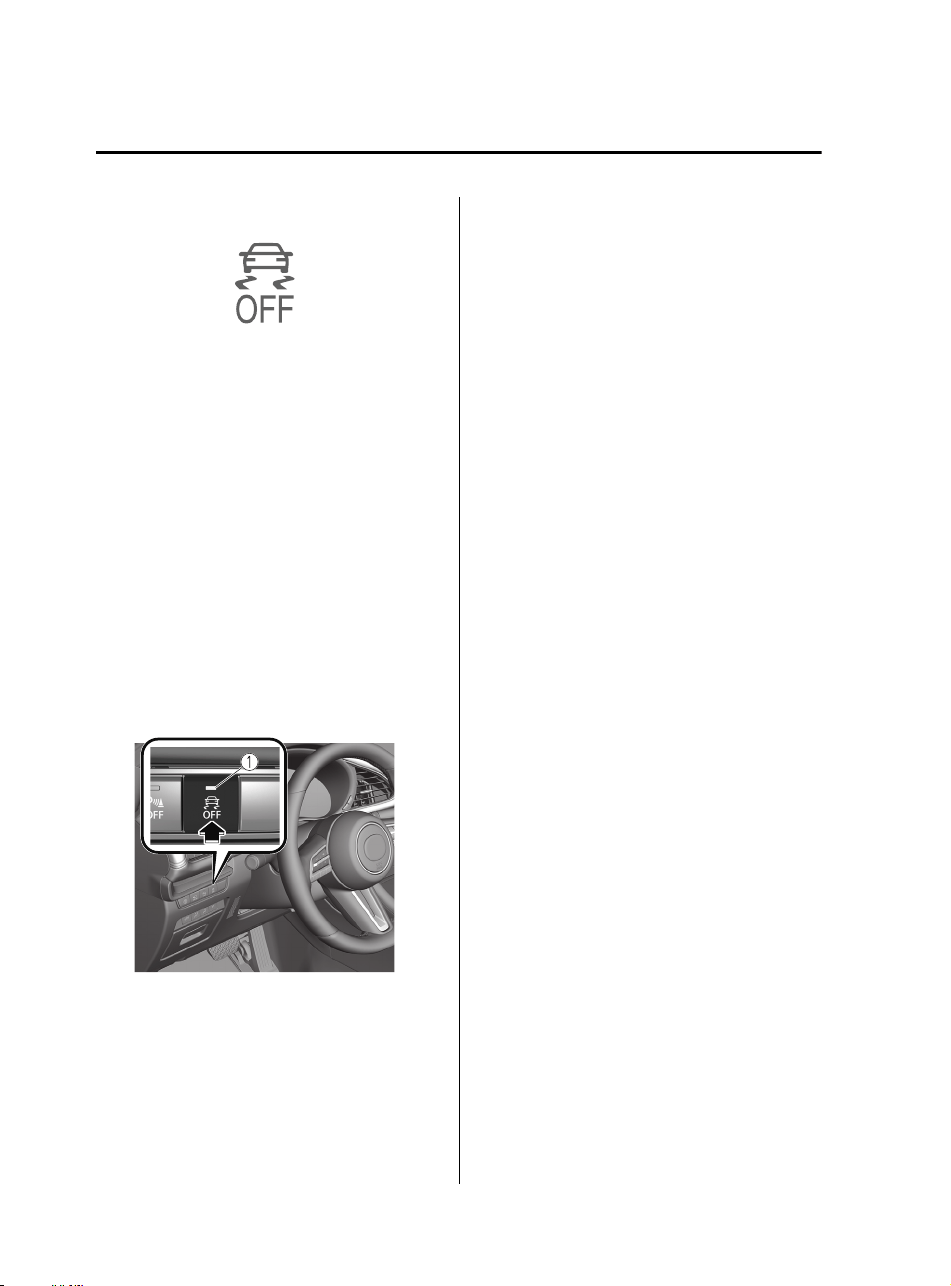
▼
DSC OFF Indicator Light
This indicator light stays on for a few
seconds when the ignition is switched ON.
It also illuminates when the DSC OFF
switch is pressed and TCS/DSC is
switched off.
Refer to DSC OFF Switch on page 4-78.
If the light remains illuminated and the
TCS/DSC is not switched off, take your
vehicle to an Authorized Mazda Dealer.
The DSC may have a malfunction.
▼
DSC OFF Switch
Press the DSC OFF switch to turn off the
TCS/DSC. The DSC OFF indicator light
in the instrument cluster and the DSC OFF
switch indicator light will illuminate.
1. DSC OFF switch indicator light
Press the switch again to turn the
TCS/DSC back on. The DSC OFF
indicator light and the DSC OFF switch
indicator light will turn off.
NOTE
When DSC is on and you attempt to free
the vehicle when it is stuck, or drive it
out of freshly fallen snow, the TCS (part
of the DSC system) will activate.
Depressing the accelerator will not
increase engine power and freeing the
vehicle may be difficult. When this
happens, turn off the TCS/DSC.
If the TCS/DSC is off when the engine is
turned off, it automatically activates
when the ignition is switched ON.
Leaving the TCS/DSC on will provide
the best traction.
If the DSC OFF switch is pressed and
held for 10 seconds or more, the DSC
OFF switch malfunction detection
function operates and the DSC system
activates automatically. The DSC OFF
indicator light turns off while the DSC
system is operative.
(Vehicles with Smart Brake Support
(SBS))
If the Smart Brake Support (SBS)
operates with the TCS/DSC turned off,
the TCS/DSC becomes operational
automatically.
When Driving
ABS/TCS/DSC
4-78
Mazda3_8HZ1-EA-19G_Edition1_old 2019-5-17 13:49:03
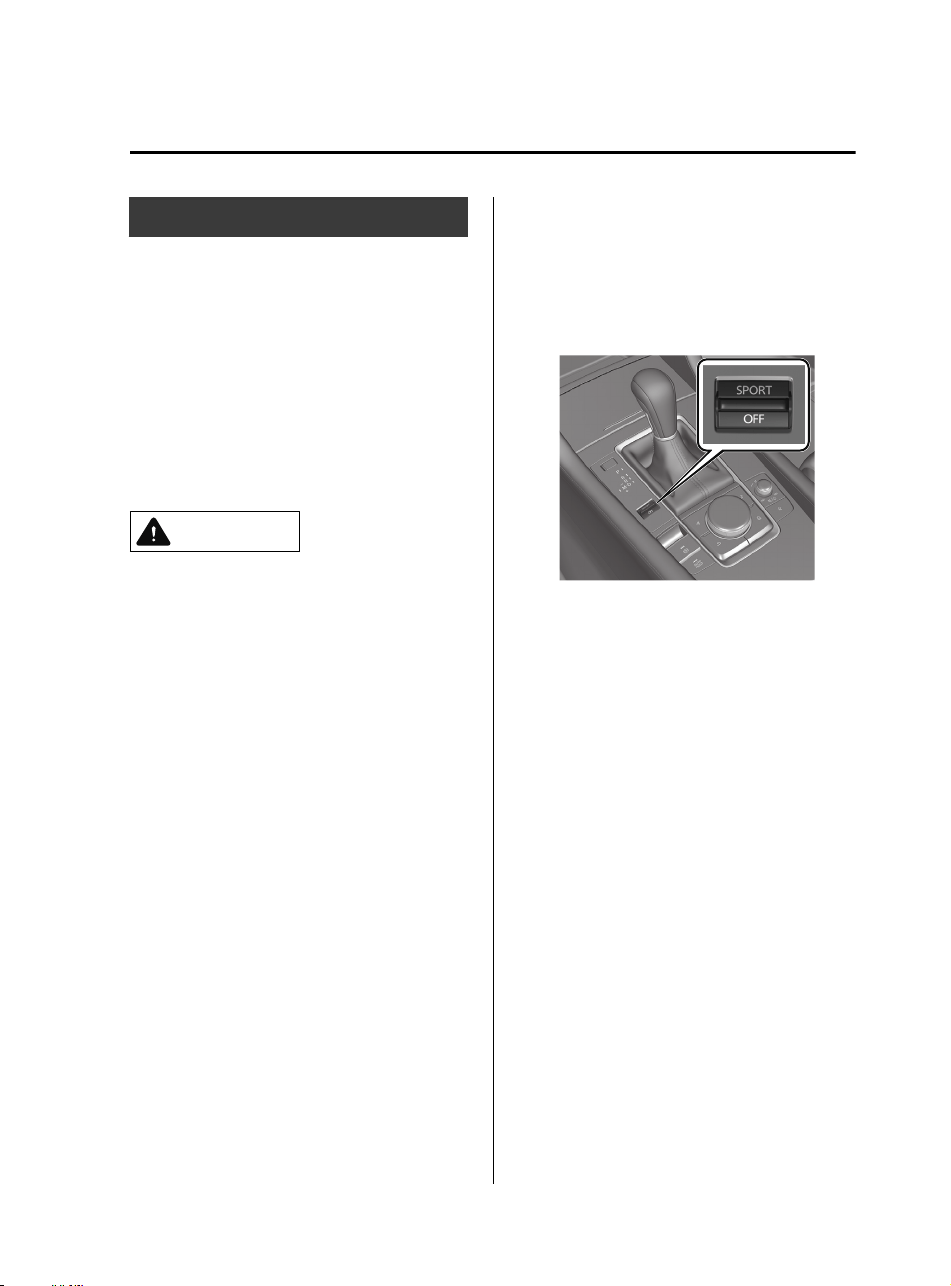
Drive Selection
*
▼
Drive Selection
Drive selection is a system to switch the
vehicle's drive mode. When the sport
mode is selected, vehicle's response
against accelerator operation is enhanced.
This provides additional quick
acceleration which may be needed to
safely make maneuvers such as lane
changes, merging onto freeways, or
passing other vehicles.
CAUTION
Do not use the sport mode when driving on
slippery roads such as wet or snow-covered
roads. It may cause tire slipping.
NOTE
When the sport mode is selected, driving
at higher engine speeds increases and it
may increase fuel consumption. Mazda
recommends that you cancel the sport
mode on normal driving.
Drive mode cannot be switched in the
following conditions:
ABS/TCS/DSC is operating
Cruise control
*
is operating.
The Mazda Radar Cruise Control with
Stop & Go function (MRCC with Stop
& Go function) System
*
is operating.
Traffic Jam Assist (TJA)
*
is operating.
Steering wheel is being operated
abruptly
▼
Drive Selection Switch
Press the drive selection switch forward
(SPORT) to select the sport mode.
Pull the drive selection switch back (OFF)
to cancel the sport mode.
NOTE
In the following cases, the drive
selection is canceled.
The ignition is switched OFF.
Cruise Control is set.
Mazda Radar Cruise Control with
Stop & Go function (MRCC with Stop
& Go function) is set.
Traffic Jam Assist (TJA) is set.
Depending on the driving conditions
when sport mode is selected, the vehicle
may perform shift-down or slightly
accelerate.
When Driving
Drive Selection
*Some models.
4-79
Mazda3_8HZ1-EA-19G_Edition1_old 2019-5-17 13:49:03
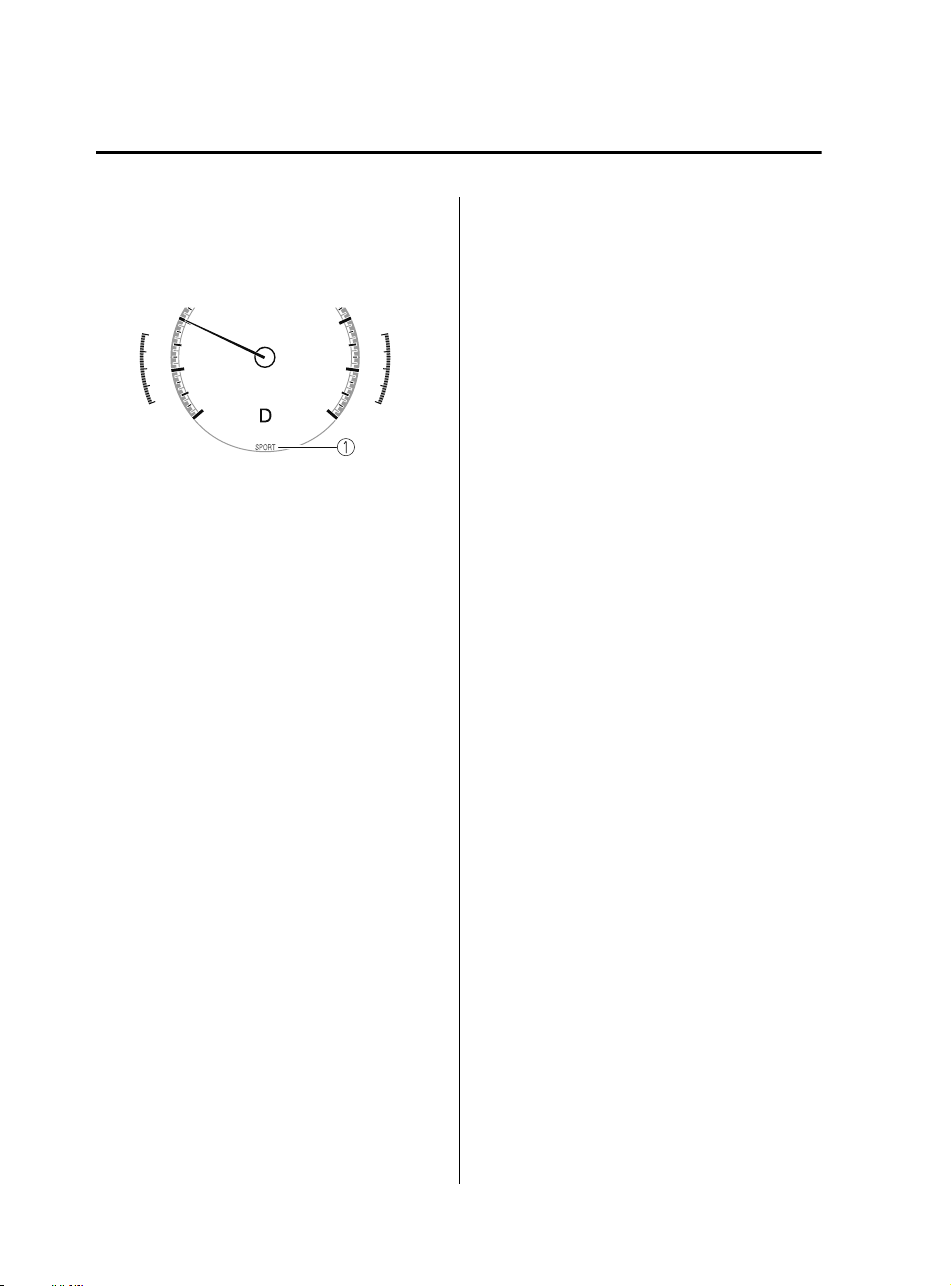
▼
Select Mode Indicator Light
When the sport mode is selected, the select
mode indicator light turns on in the
instrument cluster.
1. Select mode indicator light
NOTE
If the drive selection cannot be switched to
sport mode, the select mode indicator light
flashes to notify the driver.
When Driving
Drive Selection
4-80
Mazda3_8HZ1-EA-19G_Edition1_old 2019-5-17 13:49:03
i-ACTIV AWD Operation
*
▼
i-ACTIV AWD Operation
AWD provides excellent drivability on
snow-covered and ice-packed roads, sand
and mud, as well as on steep slopes and
other slippery surfaces.
A system malfunction or operation
conditions are indicated by a warning.
Refer to Contact an Authorized Mazda
Dealer and AWD Warning Indication/
Warning Light on page 7-31.
WARNING
Never spin a wheel that is
o
the ground:
Spinning a wheel that is o the ground as a
result of the vehicle being stuck or in a
ditch is dangerous. The drive assembly
could be seriously damaged which could
lead to an accident or could even lead to
overheating, oil leakage, and a re.
▼
AWD Driving
This vehicle has not been designed for the
purpose of off-road driving or rallies. Do
not attempt to drive over uneven or rocky
surfaces, or across rivers.
Although this vehicle is equipped with
AWD, acceleration, steering and braking
operations should be conducted in the
same manner as with a non-AWD vehicle,
with the emphasis placed on safe driving.
▼
Tires and Tire Chains
The condition of the tires plays a large role
in the performance of the vehicle.
Moreover, to prevent adverse effects to the
drive assembly, please note the following:
Tires
When replacing tires, always replace all
front and rear tires at the same time.
All tires must be of the same size,
manufacture, brand and tread pattern.
Pay particular attention when equipping
snow or other types of winter tires.
Do not mix tread-worn tires with normal
tires.
Inspect tire inflation pressures at the
specified periods adjust to the specified
pressures.
NOTE
Check the tire inflation pressure label
attached to driver's door frame for the
correct tire inflation pressure.
Make sure to equip the vehicle with
genuine wheels of the specified size, on
all wheels. With AWD, the system is
calibrated for all 4 wheels being of the
same dimensions.
Tire chains
Install tire chains to the front tires.
Do not use tire chains on the rear
wheels.
Do not drive the vehicle faster than 30
km/h (19 mph) with the tire chains
installed.
Do not drive the vehicle with tire chains
on road conditions other than snow or
ice.
▼
Towin g
If the vehicle requires towing, have it
towed with all 4 wheels completely off the
ground.
Refer to Towing Description on page
7-23.
When Driving
i-ACTIV AWD
*Some models.
4-81
Mazda3_8HZ1-EA-19G_Edition1_old 2019-5-17 13:49:03
Power Steering
▼
Power Steering
Power steering is only operable when
the engine is running. If the engine is off
or if the power steering system is
inoperable, you can still steer, but it
requires more physical effort.
If the steering feels stiffer than usual
during normal driving or the steering
vibrates, consult an Authorized Mazda
Dealer.
The warning indication notifies the
driver of system abnormalities and
operation conditions.
Refer to Power Steering Malfunction
Indication/Indicator Light on page
7-29.
When Driving
Power Steering
4-82
Mazda3_8HZ1-EA-19G_Edition1_old 2019-5-17 13:49:03
i-ACTIVSENSE
*
▼
i-ACTIVSENSE
i-ACTIVSENSE is a collective term
covering a series of advanced safety and
driver support systems which make use of
cameras and sensors. The systems consist
of active safety and pre-crash safety
systems.
These systems are designed to assist the
driver in safer driving by reducing the load
on the driver and helping to avert
collisions or reduce their severity.
However, because each system has its
limitations, always drive carefully and do
not rely solely on the systems.
▼
Active Safety Technology
Active Safety Technology supports safer
driving by helping the driver to recognize
potential hazards and avert accidents.
Driver awareness support systems
Nighttime visibility
Adaptive Front Lighting System
(AFS)...........................................page 4-88
High Beam Control System (HBC) ............
.....................................................page 4-88
Left/right side and rear side detection
Lane Departure Warning System
(LDWS).......................................page 4-90
Blind Spot Monitoring (BSM)....................
.....................................................page 4-94
Road sign recognition
Traffic Sign Recognition System
(TSR)...........................................page 4-99
Inter-vehicle distance recognition
Distance & Speed Alert (DSA)...................
...................................................page 4-106
Front obstruction detection when
passing cross
Front Cross Traffic Alert (FCTA) ...............
...................................................page 4-111
Rear obstruction detection when leaving
a parking space
Rear Cross Traffic Alert (RCTA)................
...................................................page 4-114
Full-surround recognition
360°View Monitor....................page 4-166
Driver fatigue detection
Driver Attention Alert (DAA) ....................
...................................................page 4-107
Driver Monitoring (DM).......... page 4-109
Driver support systems
Inter-vehicle distance
Mazda Radar Cruise Control
(MRCC).................................... page 4-118
Mazda Radar Cruise Control with Stop &
Go function (MRCC with Stop & Go
function)....................................page 4-126
Lane departure
Lane-keep Assist System (LAS).................
...................................................page 4-151
Inter-vehicle distance and lane keeping
Traffic Jam Assist (TJA).......... page 4-137
When Driving
i-ACTIVSENSE
*Some models.
4-83
Mazda3_8HZ1-EA-19G_Edition1_old 2019-5-17 13:49:03
▼
Pre-Crash Safety Technology
Pre-crash safety technology is designed to
assist the driver in averting collisions or
reducing their severity in situations where
they cannot be avoided.
Collision damage reduction
Forward driving
Smart Brake Support (SBS)......page 4-155
Reverse driving
Smart Brake Support [Rear]
(SBS-R).................................... page 4-157
Smart Brake Support [Rear Crossing]
(SBS-RC)..................................page 4-161
▼
Camera and Sensors
Forward Sensing Camera (FSC)
The Forward Sensing Camera (FSC)
detects lane indications and recognizes
headlights, taillights and city lights during
nighttime driving. In addition, it also
detects the vehicle ahead, pedestrians, or
obstructions. The following systems use
the Forward Sensing Camera (FSC).
High Beam Control system (HBC)
Lane Departure Warning System
(LDWS)
Traffic Sign Recognition System (TSR)
Distance & Speed Alert (DSA)
Driver Attention Alert (DAA)
Driver Monitoring (DM)
Mazda Radar Cruise Control (MRCC)
Mazda Radar Cruise Control with Stop
& Go function (MRCC with Stop & Go
function)
Lane-keep Assist System (LAS)
Traffic Jam Assist (TJA)
Smart Brake Support (SBS)
The Forward Sensing Camera (FSC) is
installed at the top of the windshield near
the rearview mirror.
Refer to Forward Sensing Camera (FSC)
on page 4-200.
Front radar sensor
The front radar sensor detects radio waves
reflected off a vehicle ahead sent from the
radar sensor. The following systems use
the front radar sensor.
Distance & Speed Alert (DSA)
Mazda Radar Cruise Control (MRCC)
Mazda Radar Cruise Control with Stop
& Go function (MRCC with Stop & Go
function)
Traffic Jam Assist (TJA)
Smart Brake Support (SBS)
The front radar sensor is mounted behind
the radiator grille.
Refer to Front Radar Sensor on page
4-204.
Front side radar sensor
The front side radar sensors detects radio
waves reflected off a vehicle ahead sent
from the radar sensor. The following
systems use the front side radar sensor.
Front Cross Traffic Alert (FCTA)
The front side radar sensors are installed
inside the front bumper, one on the left
side and one on the right side.
Refer to Front Side Radar Sensor on page
4-206.
When Driving
i-ACTIVSENSE
4-84
Mazda3_8HZ1-EA-19G_Edition1_old 2019-5-17 13:49:03
Rear side radar sensor
The rear side radar sensors detects radio
waves reflected off a vehicle approaching
from the rear or an obstruction sent from
the radar sensors. The following systems
use the rear side radar sensor.
Blind Spot Monitoring (BSM)
Rear Cross Traffic Alert (RCTA)
Smart Brake Support [Rear Crossing]
(SBS-RC)
The rear side radar sensors are installed
inside the rear bumper, one on the left side
and one on the right side.
Refer to Rear Side Radar Sensor on page
4-208.
Rear/rear corner/rear side ultrasonic
sensor
The ultrasonic sensor detects ultrasonic
waves reflected off obstructions at the rear
sent from the ultrasonic sensors. The
following systems use the ultrasonic
sensor.
Smart Brake Support [Rear] (SBS-R)
Smart Brake Support [Rear Crossing]
(SBS-RC)
The ultrasonic sensors are mounted in the
rear bumper.
Refer to Rear/Rear corner/Rear Side
Ultrasonic Sensor on page 4-209.
Front camera/side cameras/rear camera
The front camera, side cameras, and rear
camera shoot images of the area
surrounding the vehicle. The 360°View
Monitor uses each camera.
Cameras are installed to the front bumper,
door mirrors, and rear bumper.
Refer to Front Camera/Side Cameras/Rear
Camera on page 4-210.
Driver monitoring camera
The driver monitoring camera detects
changes in the driver's facial features and
estimates the amount of accumulated
fatigue and sleepiness of the driver. The
following systems use the driver
monitoring camera.
Driver Monitoring (DM)
The driver monitoring camera is mounted
in the center display.
Refer to Driver Monitoring Camera on
page 4-211.
▼
i-ACTIVSENSE Status Symbol
(Warning/Risk Avoidance Support
System)
*
The system notifies the driver of any of
the following system status using the color
or OFF indication of the i-ACTIVSENSE
status symbol (Warning/risk avoidance
support system).
Lane Departure Warning System
(LDWS)
Blind Spot Monitoring (BSM)
Distance & Speed Alert (DSA)
Front Cross Traffic Alert (FCTA)
Rear Cross Traffic Alert (RCTA)
Lane-keep Assist System (LAS)
NOTE
The status of the system turned on using
the personalization feature is displayed.
When Driving
i-ACTIVSENSE
*Some models.
4-85
Mazda3_8HZ1-EA-19G_Edition1_old 2019-5-17 13:49:03
i-ACTIVSENSE status symbol
(warning/risk avoidance support
system) (white)
System stand-by status
If none of the systems are activated or if
there is a problem with the system, the
i-ACTIVSENSE status symbol (warning/
risk avoidance support system) (white) is
displayed.
NOTE
For example, even when the Blind Spot
Monitoring (BSM) is operating normally,
if the Lane Departure Warning System
(LDWS) has a problem, the
i-ACTIVSENSE status symbol (warning/
risk avoidance support system) (white) is
displayed.
i-ACTIVSENSE status symbol
(warning/risk avoidance support
system) (green)
System activated status
If any one of the systems is activated, the
i-ACTIVSENSE status symbol (warning/
risk avoidance support system) (green) is
displayed.
NOTE
Even if the i-ACTIVSENSE status symbol
(warning/risk avoidance support system)
(green) is displayed, systems which do not
meet the operation conditions will not
operate.
i-ACTIVSENSE status symbol
(warning/risk avoidance support
system) (amber)
System warning status
If any system warning is activated, the
i-ACTIVSENSE status symbol (warning/
risk avoidance support system) (amber) is
displayed.
i-ACTIVSENSE OFF symbol (warning/
risk avoidance support system)
System OFF status
If all the systems are canceled using the
personalization features or the
i-ACTIVSENSE switch, the
i-ACTIVSENSE OFF symbol (Warning/
risk avoidance support system) is
displayed.
When Driving
i-ACTIVSENSE
4-86
Mazda3_8HZ1-EA-19G_Edition1_old 2019-5-17 13:49:03
▼
i-ACTIVSENSE Switch
*
When the i-ACTIVSENSE switch is
pressed, the following systems are
canceled and the i-ACTIVSENSE OFF
symbol (Warning/risk avoidance support
system) in the instrument cluster is
displayed.
Lane Departure Warning System
(LDWS)
Blind Spot Monitoring (BSM)
Distance & Speed Alert (DSA)
Front Cross Traffic Alert (FCTA)
Rear Cross Traffic Alert (RCTA)
Lane-keep Assist System (LAS)
i-ACTIVSENSE OFF symbol (Warning/
risk avoidance support system)
If the i-ACTIVSENSE switch is pressed
again, the systems return to their original
operation status and the i-ACTIVSENSE
OFF symbol (Warning/risk avoidance
support system) turns off.
If the ignition is switched OFF while you
have canceled the systems using the
i-ACTIVSENSE switch, the systems are
automatically enabled the next time the
ignition is switched ON. However, if the
systems are canceled using the
personalization features, the systems are
not automatically enabled.
NOTE
For the systems which can be canceled
using the i-ACTIVESENSE switch, they
cannot be canceled when the following
systems are operating, even if you press
the i-ACTIVSENSE switch.
Mazda Radar Cruise Control (MRCC)
Mazda Radar Cruise Control with
Stop & Go function (MRCC with Stop
& Go function)
Traffic Jam Assist (TJA)
You can select systems you want to
cancel using the personalization
features.
Refer to the Settings section in the
Mazda Connect Owner's Manual.
When Driving
i-ACTIVSENSE
*Some models.
4-87
Mazda3_8HZ1-EA-19G_Edition1_old 2019-5-17 13:49:03
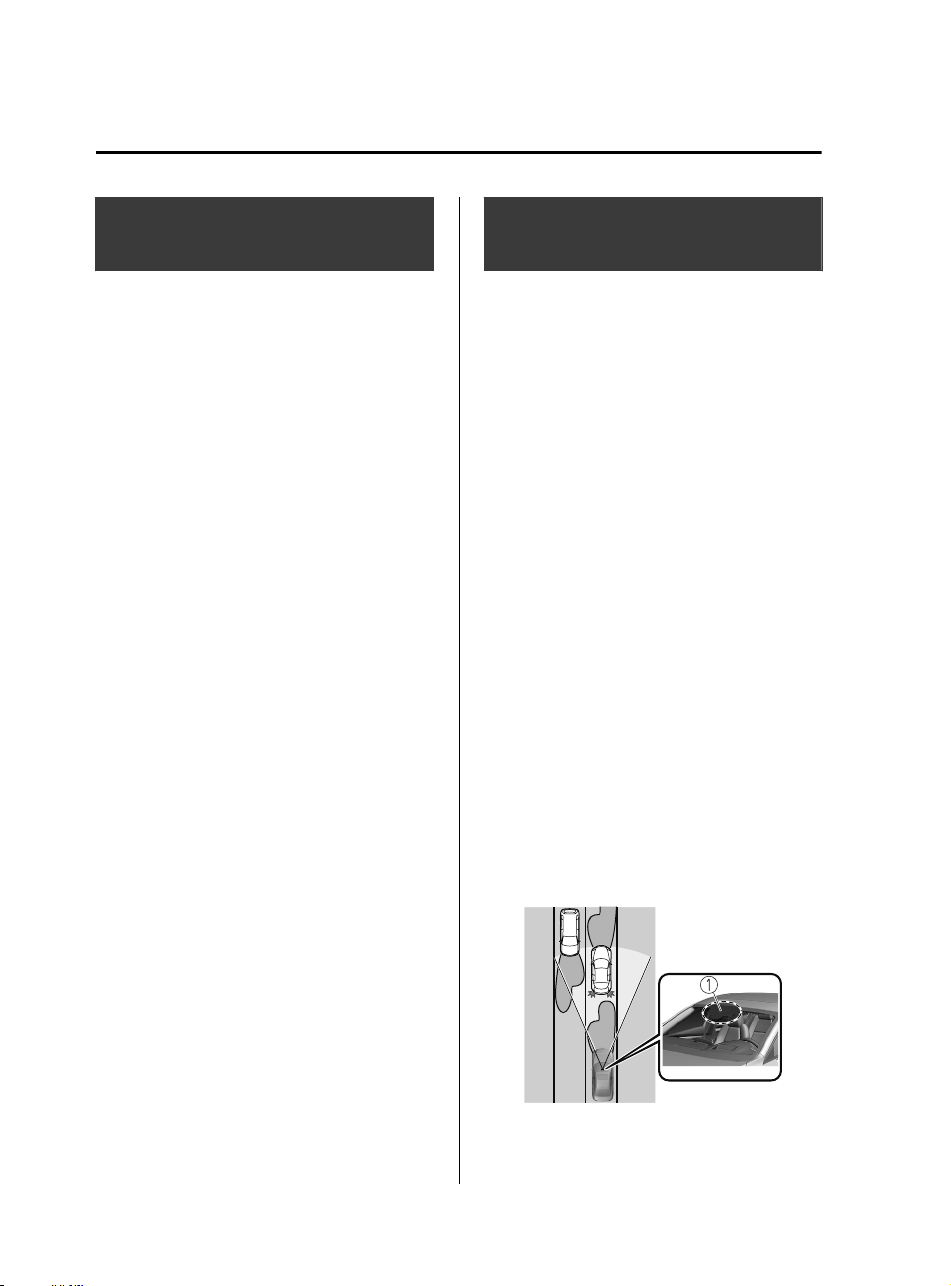
Adaptive Front Lighting
System (AFS)
*
▼
Adaptive Front Lighting System
(AFS)
The adaptive front lighting system (AFS)
automatically adjusts the headlight beams
to the left or right in conjunction with the
operation of the steering wheel after the
headlights have been turned on and the
vehicle speed is about 2 km/h (2 mph) or
higher.
A system malfunction or operation
conditions are indicated by a warning.
Refer to Exterior Light Warning
Indication/Warning Light on page 7-34.
NOTE
The Adaptive Front Lighting System (AFS)
can be switched to on/off using the
personalization function.
Refer to the Settings section in the Mazda
Connect Owner's Manual.
High Beam Control
System (HBC)
*
▼
High Beam Control System (HBC)
The HBC determines the conditions in
front of the vehicle using the Forward
Sensing Camera (FSC) while driving in
darkness to automatically switch the
headlights between high and low beams.
Refer to Forward Sensing Camera (FSC)
on page 4-200.
While driving the vehicle at a speed of
about 30 km/h (19 mph) or more, the
headlights are switched to high beams
when there are no vehicles ahead or
approaching in the opposite direction.
The system switches the headlights to low
beams when one of the following occurs:
The system detects a vehicle or the
headlights/lights of a vehicle
approaching in the opposite direction.
The vehicle is driven on roads lined with
streetlamps or on roads in well-lit cities
and towns.
The vehicle is driven at less than about
20 km/h (12 mph).
The headlight high-beam indicator light
turns on while the high beams are on.
1. Forward Sensing Camera (FSC)
*1
When Driving
i-ACTIVSENSE
4-88
*Some models.
Mazda3_8HZ1-EA-19G_Edition1_old 2019-5-17 13:49:03
*
1 The recognition distance of the Forward Sensing
Camera (FSC) varies according to the
surrounding conditions.
The warning light turns on when the
system has a malfunction.
Refer to High Beam Control System
(HBC) Warning Indication/Warning Light
(Amber) on page 7-34.
CAUTION
Do not adjust the vehicle height, modify
the headlight units, or remove the
camera, otherwise the system will not
operate normally.
Do not rely excessively on the HBC and
drive the vehicle while paying sucient
attention to safety. Switch the headlights
between the high beams and low beams
manually if necessary.
NOTE
The timing in which the system switches
the headlights changes under the
following conditions. If the system does
not switch the headlights appropriately,
manually switch between high and low
beams according to the visibility as well as
road and traffic conditions.
When there are sources of light in the
area such as street lamps, illuminated
signboards, and traffic signals.
When there are reflective objects in the
surrounding area such as reflective
plates and signs.
When visibility is reduced under rain,
snow and foggy conditions.
When driving on roads with sharp turn
or hilly terrain.
When the headlights/rear lamps of
vehicles in front of you or in the
opposite lane are dim or not
illuminated.
When there is insufficient darkness such
as at dawn or dusk.
When the trunk/luggage compartment is
loaded with heavy objects or the rear
passenger seats are occupied.
When visibility is reduced due to a
vehicle in front of you spraying water
from its tires onto your windshield.
▼
To Operate the System
The HBC operates to switch the headlights
automatically between high and low
beams after the ignition is switched ON
and the headlight switch is in the AUTO
and low beam position.
The HBC determines that it is dark based
on the brightness of the surrounding area.
At the same time, the HBC indicator light
(green) in the instrument cluster
illuminates.
NOTE
Operation of the HBC function can be
disabled.
Refer to the Settings section in the Mazda
Connect Owner's Manual.
When Driving
i-ACTIVSENSE
4-89
Mazda3_8HZ1-EA-19G_Edition1_old 2019-5-17 13:49:03
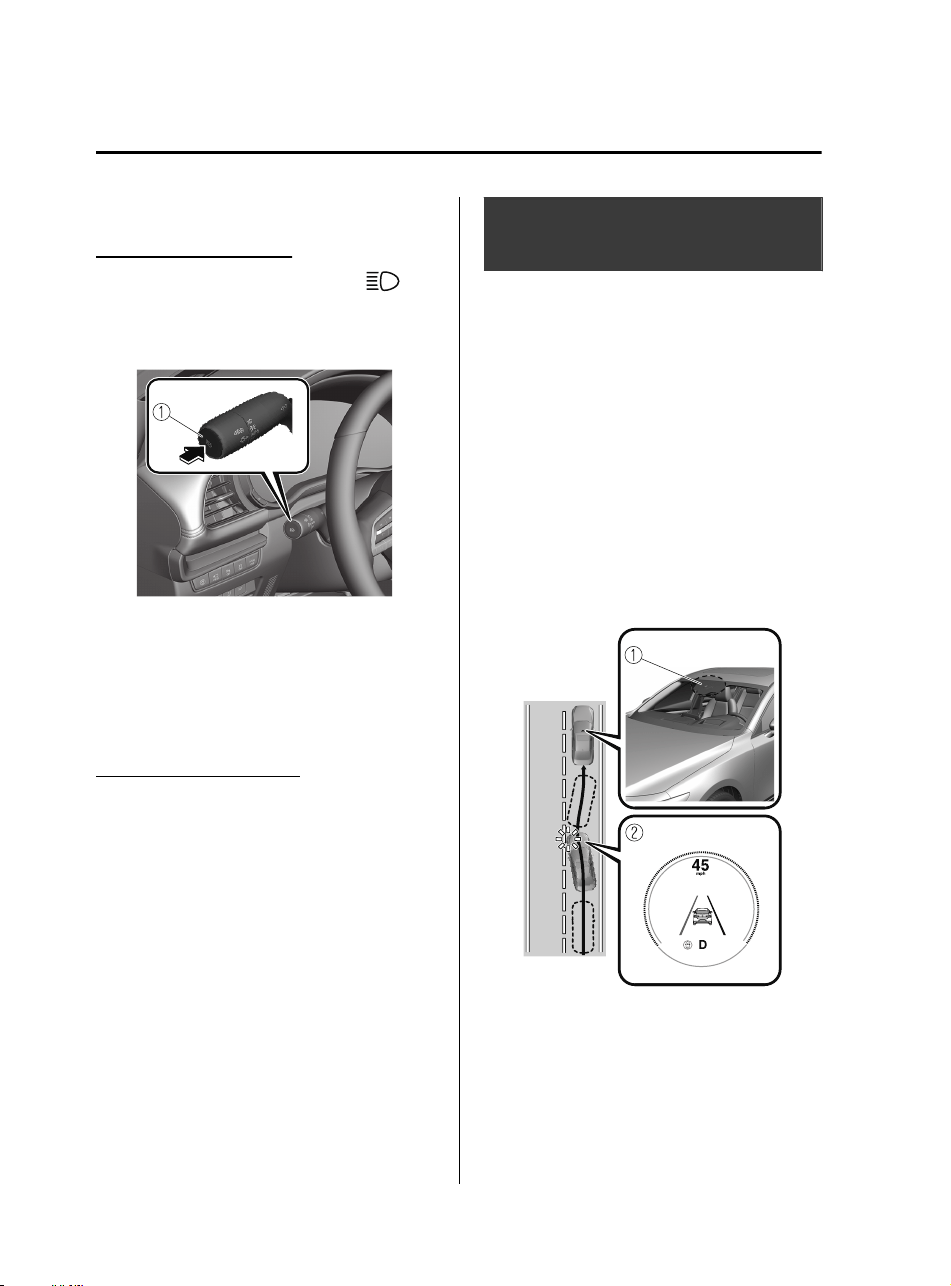
▼
Manual Switching
Switching to low beams
Switch the headlight switch to the
position, or press the high beam control
switch.
The HBC indicator light (green) turns off.
1. High beam control switch
If the HBC is turned off using the high
beam control switch, press the high beam
control switch again to turn the HBC back
on.
Switching to high beams
Shift the lever to the high beam position.
The HBC indicator light (green) turns off
and the headlight high-beam indicator
light is illuminated.
Lane Departure Warning
System (LDWS)
*
▼
Lane Departure Warning System
(LDWS)
The LDWS alerts the driver that the
vehicle may be deviating from its lane.
The system detects the white (yellow)
lines on the traffic lane using the forward
sensing camera (FSC) and if it determines
that the vehicle might be deviating from
its lane, it notifies the driver by the
LDWS.
Refer to Forward Sensing Camera (FSC)
on page 4-200.
Use the LDWS when you drive the vehicle
on roads with white (yellow) lines.
1. Forward sensing camera (FSC)
2. Multi-information display
When Driving
i-ACTIVSENSE
4-90
*Some models.
Mazda3_8HZ1-EA-19G_Edition1_old 2019-5-17 13:49:03
WARNING
Do not rely completely on the LDWS:
The LDWS system is not designed to
compensate for a driver’s lack of caution
and relying too much on the system
could lead to an accident.
The functions of the LDWS have
limitations. Always stay on course using
the steering wheel and drive with care.
CAUTION
Heed the following cautions so that the
LDWS can operate normally.
Do not modify the vehicle's suspensions.
Always use wheels of the
specied
type
and size for the front and rear wheels.
Consult an Authorized Mazda Dealer for
tire replacement.
NOTE
The system may not operate normally
under the following conditions.
The white (yellow) lane lines are less
visible because of dirt or paint flaking.
White (yellow) lane lines are less visible
because of bad weather (rain, fog, or
snow).
The vehicle is driven on a temporary
lane or section with a closed lane
resulting from construction where there
might be multiple white (yellow) lane
lines, or they are interrupted.
The camera picks up an obscure line,
such as a temporary line being used for
construction, or because of shade,
unmelted snow, or grooves filled with
water.
The surrounding brightness suddenly
changes such as when entering or
exiting a tunnel.
Back-light is reflected off the road
surface.
The road surface is wet and shiny after
rain, or there are puddles on the road.
The width of a lane is excessively
narrow.
The vehicle is driven on roads with tight
curves.
Heavy luggage is loaded in the trunk/
luggage compartment or on the rear
seat causing the vehicle to tilt.
The vehicle is driven through a fork in
the road or a junction.
The shade of a guardrail parallel to a
white (yellow) lane line is cast on the
road.
The illumination of the headlights is
weakened because of dirt or the optical
axis is deviated at night.
The road is excessively uneven.
The vehicle is shaken after hitting a
road bump.
A vehicle in front of your vehicle is
running near a white (yellow) lane line
making it less visible.
The windshield is dirty or foggy.
Strong light is directed from the front of
the vehicle (such as sunlight, or
headlights (high-beam) of on-coming
vehicles).
The vehicle is driven through an
intersection or a roundabout.
When Driving
i-ACTIVSENSE
4-91
Mazda3_8HZ1-EA-19G_Edition1_old 2019-5-17 13:49:03
▼
When the System Operates
When the ignition is switched ON, the
i-ACTIVSENSE status symbol (warning/
risk avoidance support system) (white)
turns on and the system goes on standby.
NOTE
If the i-ACTIVSENSE status symbol
(warning/risk avoidance support system)
(white) does not turn on, the system is
canceled using the i-ACTIVSENSE switch
or the personalization feature.
Operation conditions
When all of the following conditions are
met, the i-ACTIVSENSE status symbol
(warning/risk avoidance support system)
on the multi-information display changes
from white to green and the system
becomes operational.
The ignition is switched ON.
The vehicle speed is about 64 km/h (40
mph) or faster.
The system detects white (yellow) lane
lines.
NOTE
When the system does not detect a white
(yellow) lane line on one side only, the
system does not operate on the side that is
not being detected.
When temporarily canceling the system
The LDWS goes on standby in the
following cases: The LDWS operation is
automatically restored when the system's
operation conditions are met.
The system cannot detect white (yellow)
lane lines.
The vehicle speed is less than about 56
km/h (35 mph).
The turn signal lever is operated.
The accelerator pedal is depressed.
The steering wheel is operated.
The brake pedal is operated.
The function is temporarily stopped.
The LDWS stops functioning in the
following cases:
The temperature in the forward sensing
camera (FSC) is high or low.
The windshield around the forward
sensing camera (FSC) is foggy.
The windshield around the forward
sensing camera (FSC) is blocked by an
obstruction, causing poor forward
visibility.
When Driving
i-ACTIVSENSE
4-92
Mazda3_8HZ1-EA-19G_Edition1_old 2019-5-17 13:49:03
Strong light (such as sunlight, or
headlights (high-beam) of on-coming
vehicles) is directed at the forward
sensing camera (FSC).
System malfunction
If there is a problem with the system, the
i-ACTIVSENSE status symbol (warning/
risk avoidance support system) (white)
and the i-ACTIVSENSE warning
indication/warning light on the
multi-information display turns on and a
message is indicated.
Refer to i-ACTIVSENSE Status Symbol
(Warning/Risk Avoidance Support
System) on page 4-85.
▼
LDWS Warning
If the system determines that the vehicle
may deviate from its lane, a warning (beep
sound, steering wheel vibration) is
activated and the direction in which the
system determines that the vehicle may
deviate is indicated on the
multi-information display.
NOTE
The LDWS settings can be changed.
Refer to the Settings section in the
Mazda Connect Owner's Manual.
You may not be able to hear the LDWS
warning sound depending on the
surrounding conditions such as outside
noise.
If you set the LDWS to vibrate the
steering wheel, you may not feel the
vibrations depending on the road
surface conditions.
▼
Canceling the System
The LDWS can be set to inoperable.
(If only the LDWS is turned off)
Refer to the Settings section in the
Mazda Connect Owner's Manual.
(If the LDWS is turned off by
operating the i-ACTIVSENSE switch)
Refer to i-ACTIVSENSE Switch on
page 4-87.
NOTE
If the ignition is switched OFF while you
have canceled the system using the
i-ACTIVSENSE switch, the system is
automatically enabled the next time the
ignition is switched ON. However, if the
system is canceled using the
personalization features, the system is not
automatically enabled.
When Driving
i-ACTIVSENSE
4-93
Mazda3_8HZ1-EA-19G_Edition1_old 2019-5-17 13:49:03
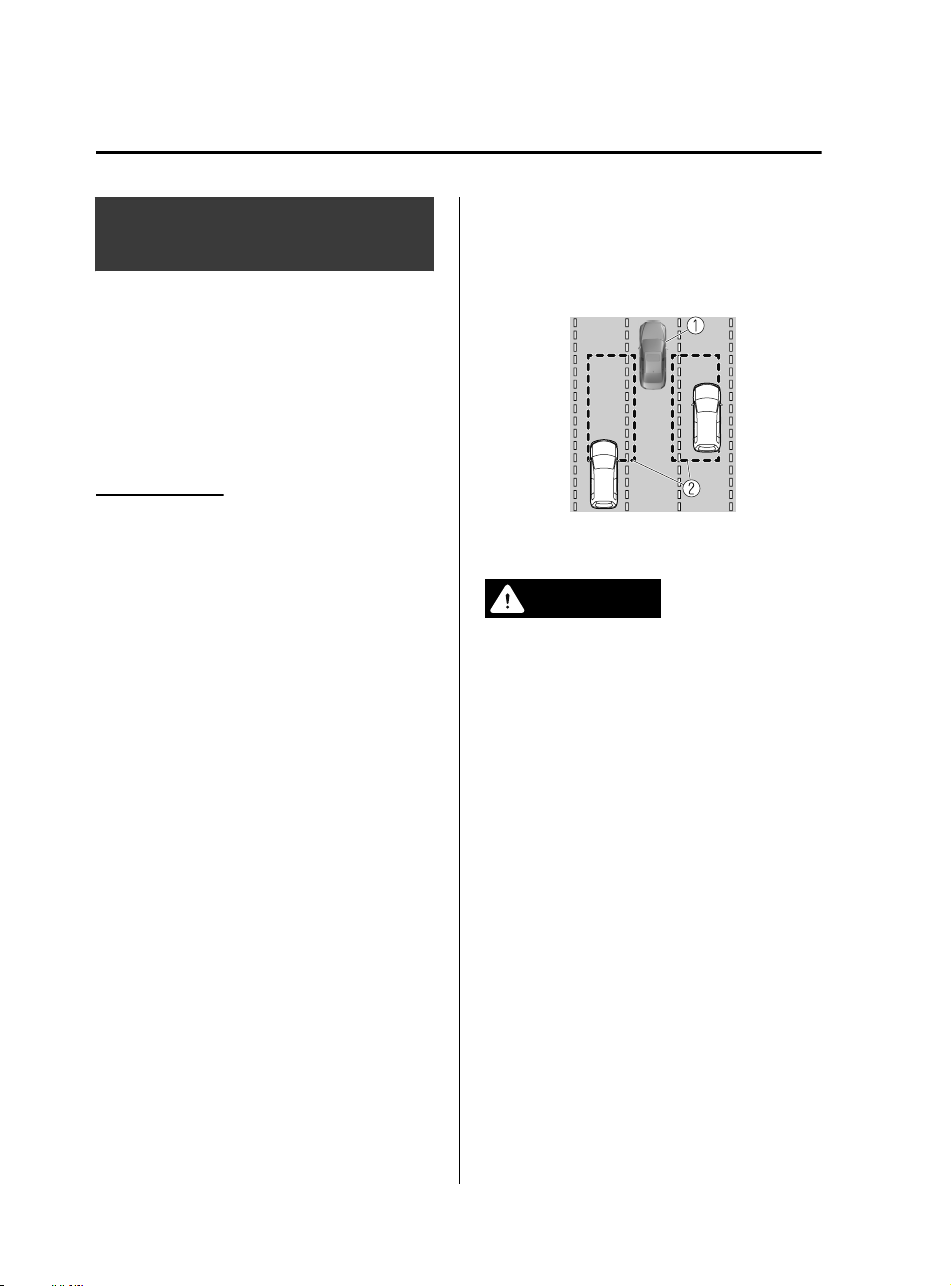
Blind Spot Monitoring
(BSM)
*
▼
Blind Spot Monitoring (BSM)
The BSM is designed to assist the driver in
checking the area to the rear of the vehicle
on both sides during lane changes by
notifying the driver of the presence of
vehicles approaching from the rear in an
adjacent lane.
BSM operation
The BSM detects vehicles approaching
from the rear while traveling in the
forward direction at a speed of 10 km/h
(6.3 mph) or faster and notifies the driver
by turning on the BSM warning indicator
light and displaying the vehicle detection
screen.
If the turn signal lever is operated to signal
a turn in the direction in which the BSM
warning indicator light is illuminated
while the approaching vehicle is detected,
the BSM notifies the driver of possible
danger flashing on the BSM warning
indicator light, and by activating the
warning sound and the warning screen
indicator display.
The detection area on this system covers
the driving lanes on both sides of the
vehicle and from the rear part of the front
doors to about 50 m (164 ft) behind the
vehicle.
1. Your vehicle
2. Detection areas
WARNING
Always check the surrounding area visually
before making an actual lane change:
The system is only designed to assist you in
checking for vehicles at your rear when
making a lane change. Due to certain
limitations with the operation of this
system, the BSM warning indicator light,
the warning sound and the warning screen
indicator display may not activate or they
might be delayed even though a vehicle is
in an adjacent driving lane. Always make it
your responsibility as a driver to check the
rear.
NOTE
The BSM will operate when all of the
following conditions are met:
The ignition is switched ON.
The i-ACTIVSENSE warning
indication/warning light in the
instrument cluster is turned off.
When Driving
i-ACTIVSENSE
4-94
*Some models.
Mazda3_8HZ1-EA-19G_Edition1_old 2019-5-17 13:49:03

The vehicle speed is about 10 km/h
(6.3 mph) or faster.
The BSM will not operate under the
following circumstances.
The vehicle speed falls below about
10 km/h (6.3 mph) even though the
i-ACTIVSENSE warning indication/
warning light is turned off.
The shift lever (manual transmission)/
selector lever (automatic
transmission) is shifted to reverse (R)
and the vehicle is reversing.
The turning radius is small (making a
sharp turn, turning at intersections).
In the following cases, the
i-ACTIVSENSE warning indication/
warning light turns on and operation of
the system is stopped. If the
i-ACTIVSENSE warning indication/
warning light remains illuminated, have
the vehicle inspected at an Authorized
Mazda Dealer as soon as possible.
Some problem with the system
including the BSM warning indicator
lights is detected.
A large deviation in the installation
position of a rear side radar sensor on
the vehicle has occurred.
There is a large accumulation of snow
or ice on the rear bumper near a rear
side radar sensor. Remove any snow,
ice or mud on the rear bumper.
Driving on snow-covered roads for
long periods.
The temperature near the rear side
radar sensor becomes extremely hot
due to driving for long periods on
slopes during the summer.
The battery voltage has decreased.
Under the following conditions, the rear
side radar sensor cannot detect target
objects or it may be difficult to detect
them.
The rear bumper around the rear side
radar sensor is deformed.
Radio wave interference from a radar
sensor equipped on a nearby vehicle.
The approaching vehicle is any of the
following shapes.
a) The size of the vehicle body is
extremely small.
b) The vehicle height is extremely low
or high.
c) A special type of vehicle with a
complex shape.
A vehicle is in the detection area at
the rear in an adjacent driving lane
but it does not approach. The BSM
determines the condition based on
radar detection data.
A vehicle is traveling alongside your
vehicle at nearly the same speed for
an extended period of time.
Vehicles approaching in the opposite
direction.
A vehicle in an adjacent driving lane
is attempting to pass your vehicle.
A vehicle is in an adjacent lane on a
road with extremely wide driving
lanes. The detection area of the rear
side radar sensor is set at the road
width of expressways.
In the following case, the flashing of the
BSM warning indicator light, and the
activation of the warning sound and the
warning screen indicator display may
not occur or they may be delayed.
A vehicle makes a lane change from a
driving lane two lanes over to an
adjacent lane.
When Driving
i-ACTIVSENSE
4-95
Mazda3_8HZ1-EA-19G_Edition1_old 2019-5-17 13:49:03
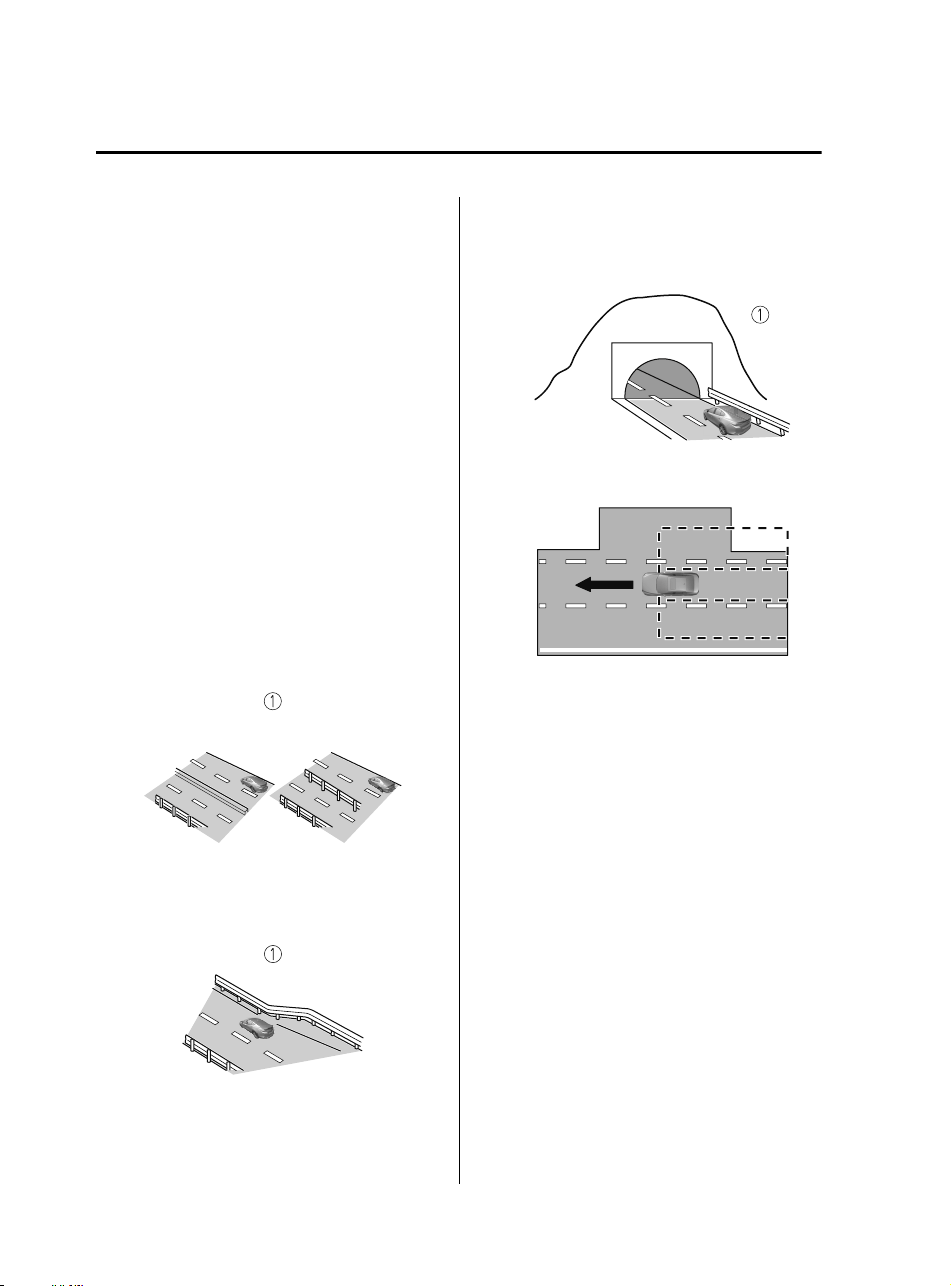
Driving on steep slopes.
Crossing the summit of a hill or
mountain pass.
When there is a difference in the
height between your driving lane and
the adjacent lane.
Directly after the BSM system
becomes operable by changing the
setting.
If the road width is extremely narrow,
vehicles two lanes over may be detected.
The detection area of the rear side radar
sensor is set according to the road width
of expressways.
The BSM warning indicator light may
turn on and the vehicle detection screen
may be displayed in the display in
reaction to stationary objects
(guardrails, tunnels, sidewalls, and
parked vehicles) on the road or the
roadside.
1. Objects such as guardrails and
concrete walls running alongside the
vehicle.
1. Places where the width between
guardrails or walls on each side of
the vehicle narrows.
1. The walls at the entrance and exits
of tunnels, turnouts.
A BSM warning indicator light may
flash or the warning beep may be
activated several times when making a
turn at a city intersection.
Turn off the BSM while pulling a trailer
or while an accessory such as a bicycle
carrier is installed to the rear of the
vehicle. Otherwise, the radar’s radio
waves will be blocked causing the
system to not operate normally.
In the following cases, it may be difficult
to view the illumination/flashing of the
BSM warning indicator lights equipped
on the door mirrors.
Snow or ice is adhering to the door
mirrors.
The front door glass is fogged or
covered in snow, frost or dirt.
When Driving
i-ACTIVSENSE
4-96
Mazda3_8HZ1-EA-19G_Edition1_old 2019-5-17 13:49:03
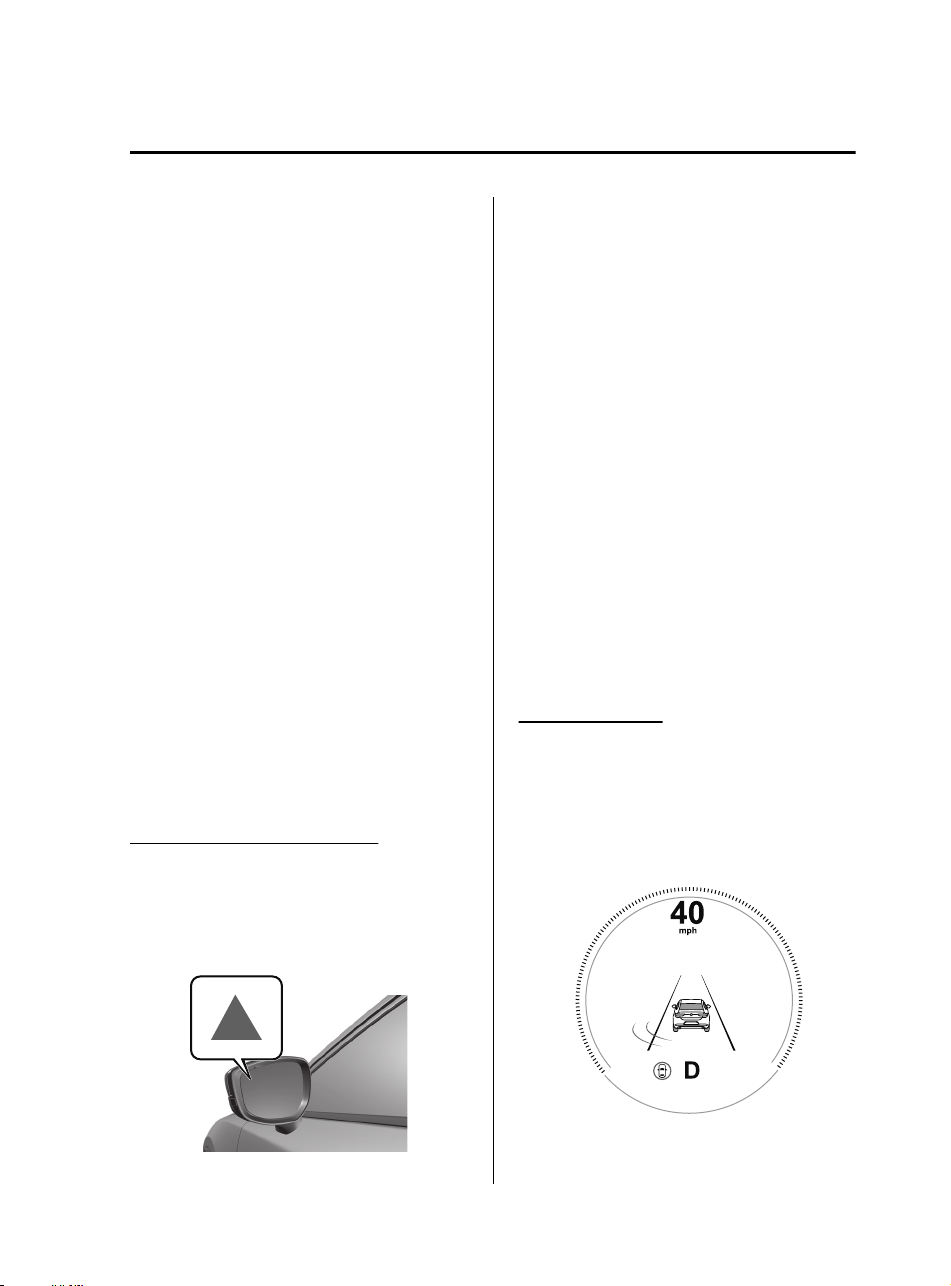
The rear side radar sensor of the BSM
may be regulated under the radio wave
related laws of the country where the
vehicle is driven. If this system is used
abroad, it may be necessary to turn off
the system.
Refer to Rear Side Radar Sensor on
page 4-208.
The system switches to the Rear Cross
Traffic Alert (RCTA) function when the
shift lever (manual transmission) or the
selector lever (automatic transmission)
is shifted to the reverse (R) position.
Refer to Rear Cross Traffic Alert
(RCTA) on page 4-114.
▼
Blind Spot Monitoring (BSM)
Warning Indicator Lights/Display
Indicator/Blind Spot Monitoring
(BSM) Warning Beep
The BSM system notifies the driver of the
presence of vehicles in adjacent lanes or at
the rear of the vehicle using the BSM
warning indicator light, the warning sound
and the display indicator while the systems
are operational.
BSM warning indicator lights
The BSM warning indicator lights are
equipped on the left and right door
mirrors. The warning indicator lights turn
on when a vehicle approaching from the
rear in an adjacent lane is detected.
When the ignition is switched ON, the
warning indicator light turns on
momentarily and then turns off after a few
seconds.
Function for cancelling illumination
dimmer
If the BSM warning indicator lights turn
on when the parking lights are turned on,
the brightness of the BSM warning
indicator lights is dimmed.
If the BSM warning indicator lights are
difficult to see due to glare from
surrounding brightness when traveling on
snow-covered roads or under foggy
conditions, press the dimmer cancellation
button to cancel the dimmer and increase
the brightness of BSM warning indicator
lights when they turn on.
Refer to Dashboard Illumination on page
4-18.
Display indicator
The detected approaching vehicle and
warning are displayed in the
multi-information display and active
driving display (vehicles with active
driving display).
Multi-information Display
When Driving
i-ACTIVSENSE
4-97
Mazda3_8HZ1-EA-19G_Edition1_old 2019-5-17 13:49:03
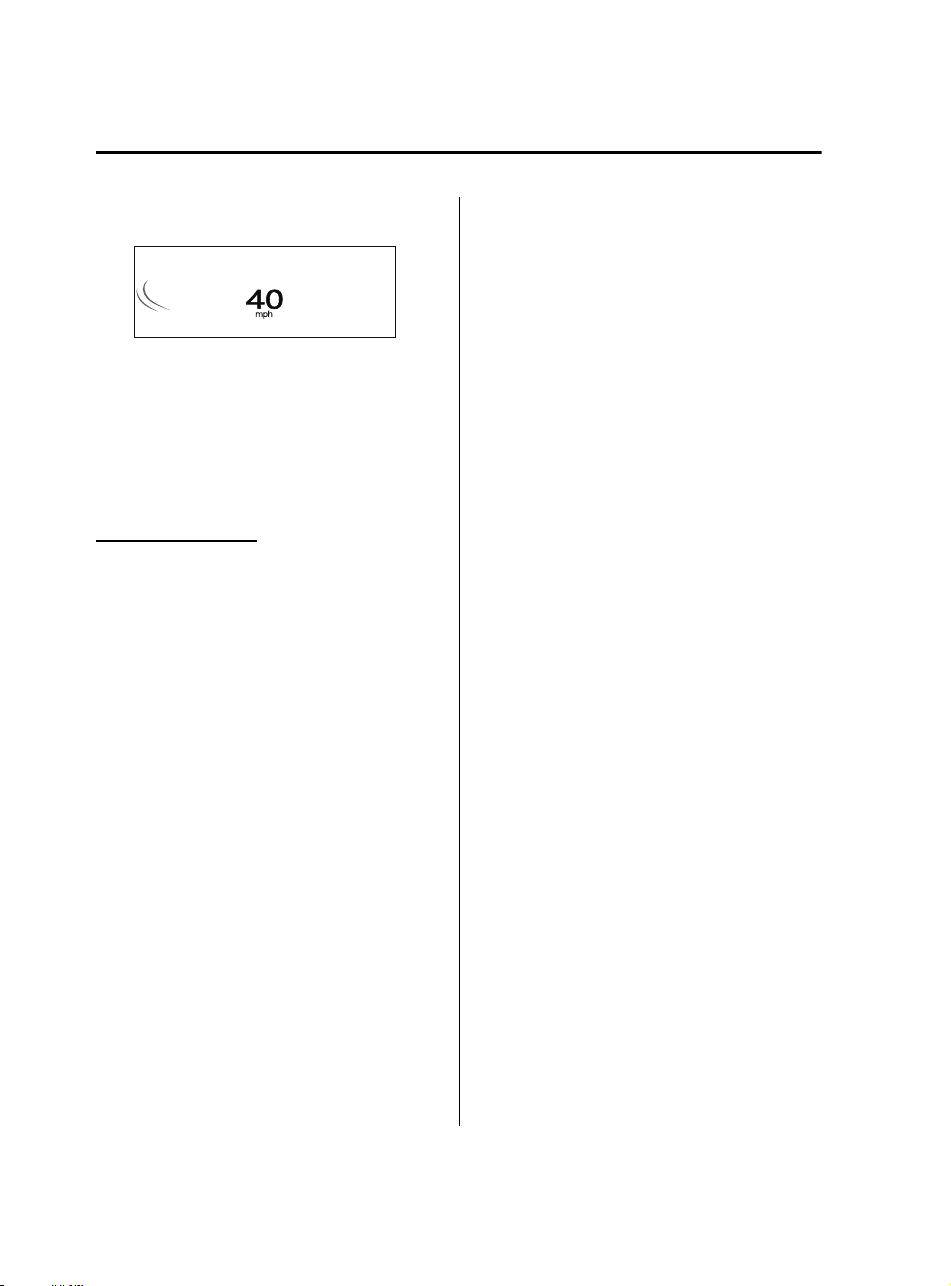
Active Driving Display (vehicles with
active driving display)
The detected direction is displayed with a
detection indicator (white) when an
approaching vehicle is detected. In
addition, if the turn signal lever is operated
to signal a lane change while the vehicle is
detected, the display changes the color
(amber) of the warning indicator.
BSM warning beep
The BSM warning beep is activated
simultaneously with the flashing of a BSM
warning indicator light.
▼
Canceling Operation of Blind Spot
Monitoring (BSM)
The BSM system can be set to inoperable.
(If only the BSM is turned off)
Refer to the Settings section in the
Mazda Connect Owner's Manual.
(If the BSM is turned off by operating
the i-ACTIVSENSE switch)
Refer to i-ACTIVSENSE Switch on
page 4-87.
NOTE
If the ignition is switched OFF while you
have canceled the system using the
i-ACTIVSENSE switch, the system is
automatically enabled the next time the
ignition is switched ON. However, if the
system is canceled using the
personalization features, the system is not
automatically enabled.
When Driving
i-ACTIVSENSE
4-98
Mazda3_8HZ1-EA-19G_Edition1_old 2019-5-17 13:49:03
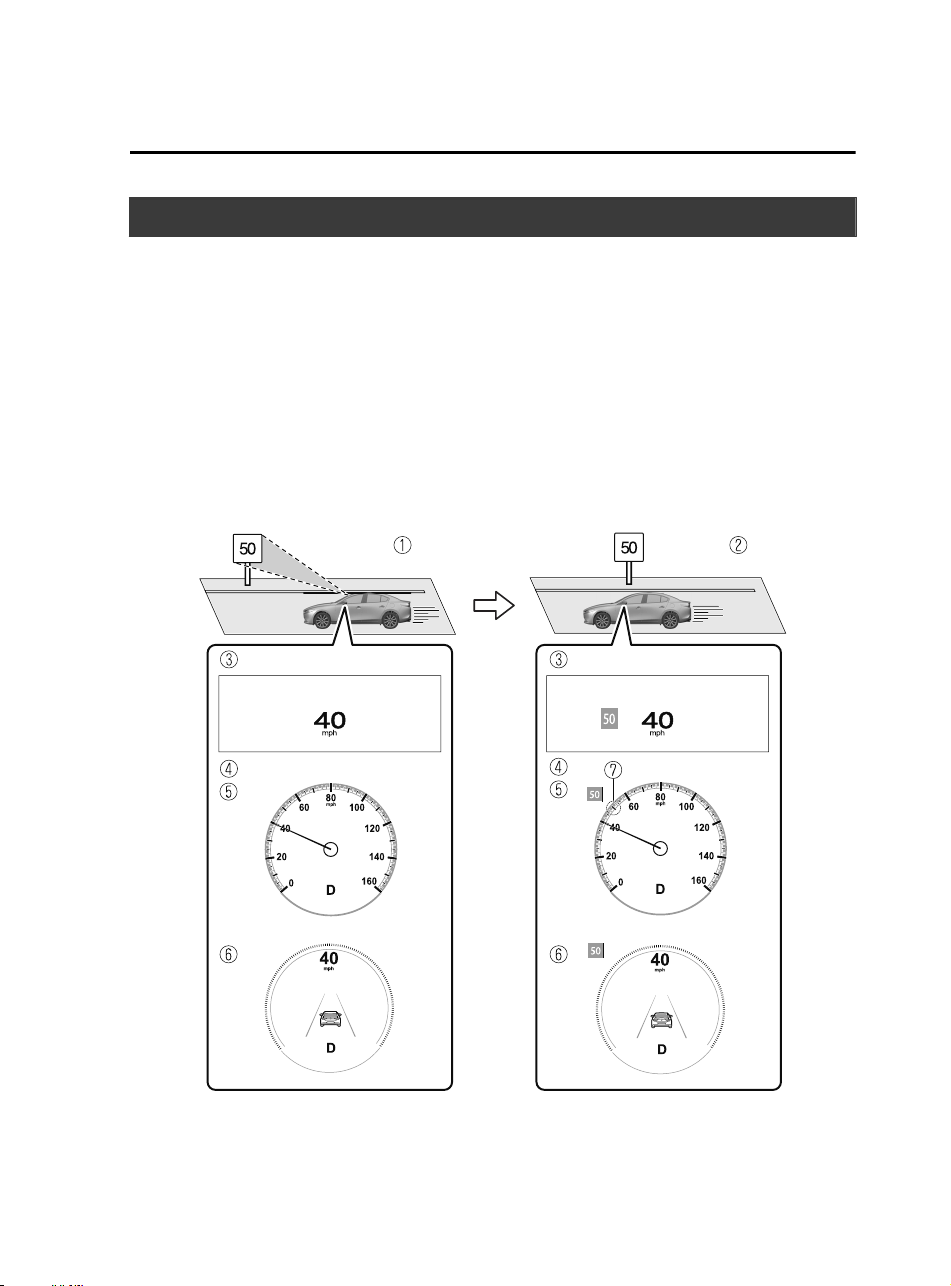
Traffic Sign Recognition System (TSR)
*
▼
Traffic Sign Recognition System (TSR)
The TSR helps prevent the driver from overlooking traffic signs, and provides support for
safer driving by displaying traffic signs on the active driving display/instrument cluster
which are recognized by the Forward Sensing Camera (FSC) or recorded in the navigation
system while the vehicle is driven.
The TSR displays the speed limit (including auxiliary signs), do not enter, and traffic stop
signs.
If the vehicle speed exceeds the speed limit sign indicated in the active driving display/
instrument cluster while the vehicle is driven, the system notifies the driver using the
indication in the active driving display/instrument cluster and a warning sound.
Speed limit and do not enter signs
1. Sign recognized
2. Sign displayed
When Driving
i-ACTIVSENSE
*Some models.
4-99
Mazda3_8HZ1-EA-19G_Edition1_old 2019-5-17 13:49:03
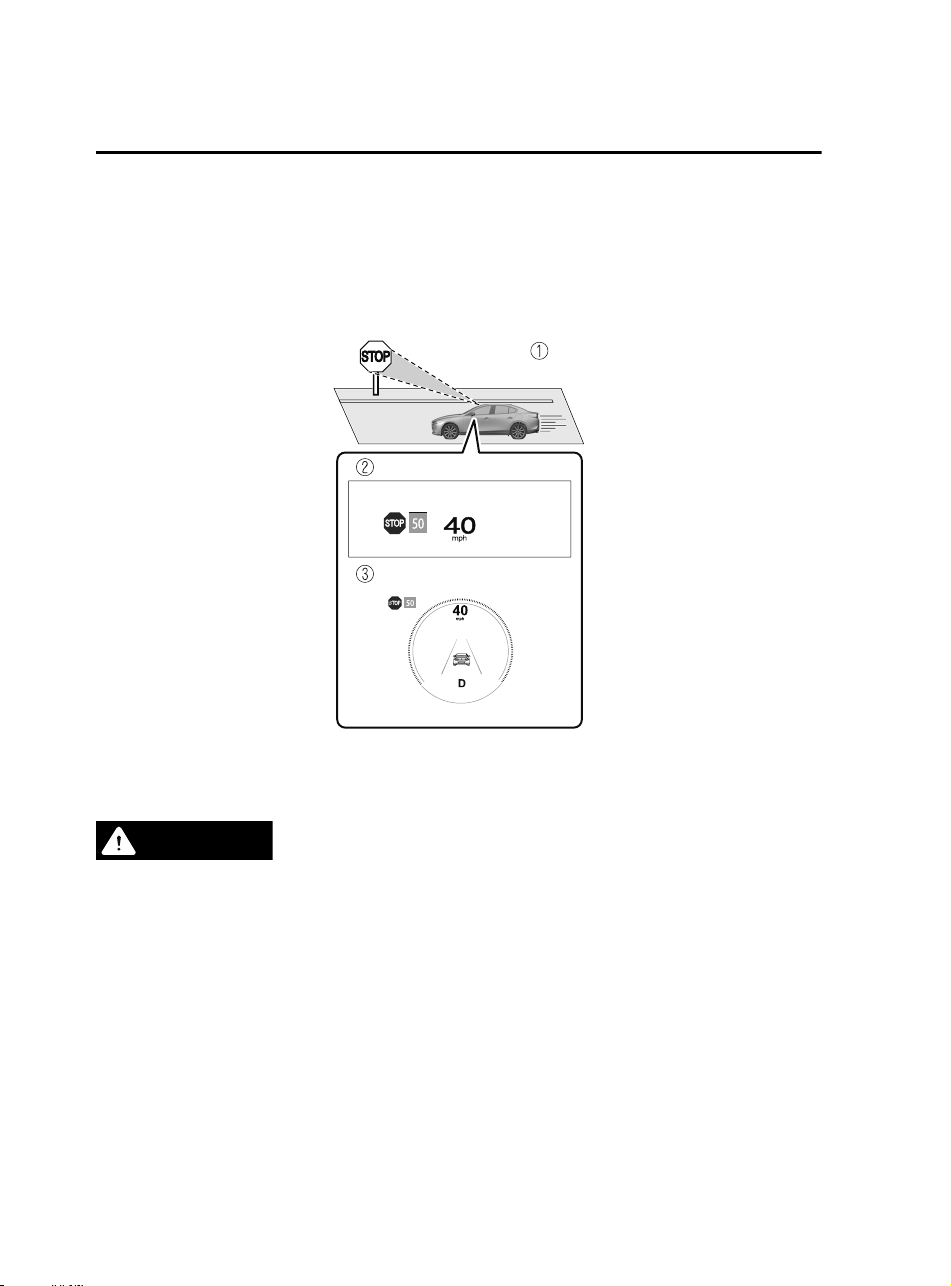
3. Active driving display indication
4. Instrument cluster
5. Basic display
6. i-ACTIVSENSE display
7. Recognized speed limit indication color changes.
Stop sign
1. Sign recognized and displayed at same time
2. Active driving display indication
3. Instrument cluster
WARNING
Always check the trac signs visually while driving.
The TSR helps prevent the driver from overlooking trac signs and provides support for safer
driving. Depending on the weather conditions or problems with trac signs, a trac sign
may not be recognized or a trac sign dierent from the actual trac sign may be displayed.
Always make it your responsibility as a driver to check the actual trac signs. Otherwise, it
could result in an accident.
NOTE
The TSR is not supported in some countries or regions. For information concerning the
supported countries or regions, consult an Authorized Mazda Dealer.
When Driving
i-ACTIVSENSE
4-100
Mazda3_8HZ1-EA-19G_Edition1_old 2019-5-17 13:49:03

The TSR operates only if the navigation system SD card (Mazda genuine) is inserted in
the SD card slot. Consult an Authorized Mazda Dealer for details.
The TSR does not operate if there is a malfunction in the Forward Sensing Camera (FSC).
Under the following conditions, the TSR may not operate normally.
An object placed on the dashboard is reflected in the windshield and picked up by the
camera.
Heavy luggage is loaded in the luggage compartment or on the rear seat and the
vehicle is tilted.
The tire pressures are not adjusted to the specified pressure.
Tires other than standard tires are equipped.
The vehicle is driven on the ramp and surrounding area to or from a rest area or a
tollgate on a highway.
When surrounding brightness suddenly changes such as when entering or exiting a
tunnel.
The illumination of the headlights is weakened because of dirt or the optical axis is
deviated.
The windshield is dirty or foggy.
The windshield and camera are fogged (water droplets).
Strong light is directed at the front of the vehicle (such as backlight or high-beam
headlights of on-coming vehicles).
The vehicle is making a sharp turn.
Strong light reflects off the road.
A traffic sign is in a position which makes it difficult to reflect the light from the
vehicle's headlights, such as when the vehicle is driven at night or in a tunnel.
The vehicle is driven under weather conditions such as rain, fog, or snow.
The stored map data for the navigation system is not current.
A traffic sign is obscured by mud or snow.
A traffic sign is concealed by trees or a vehicle.
A traffic sign is partially shaded.
A traffic sign is bent or warped.
A traffic sign is too low or too high.
A traffic sign is too bright or too dark (including electronic traffic signs).
A traffic sign is too big or too small.
There is an object similar to the traffic sign being read (such as another traffic sign or
other signs resembling it).
The TSR can be set to invisible on the active driving display.
Refer to the Settings section in the Mazda Connect Owner's Manual.
When Driving
i-ACTIVSENSE
4-101
Mazda3_8HZ1-EA-19G_Edition1_old 2019-5-17 13:49:03
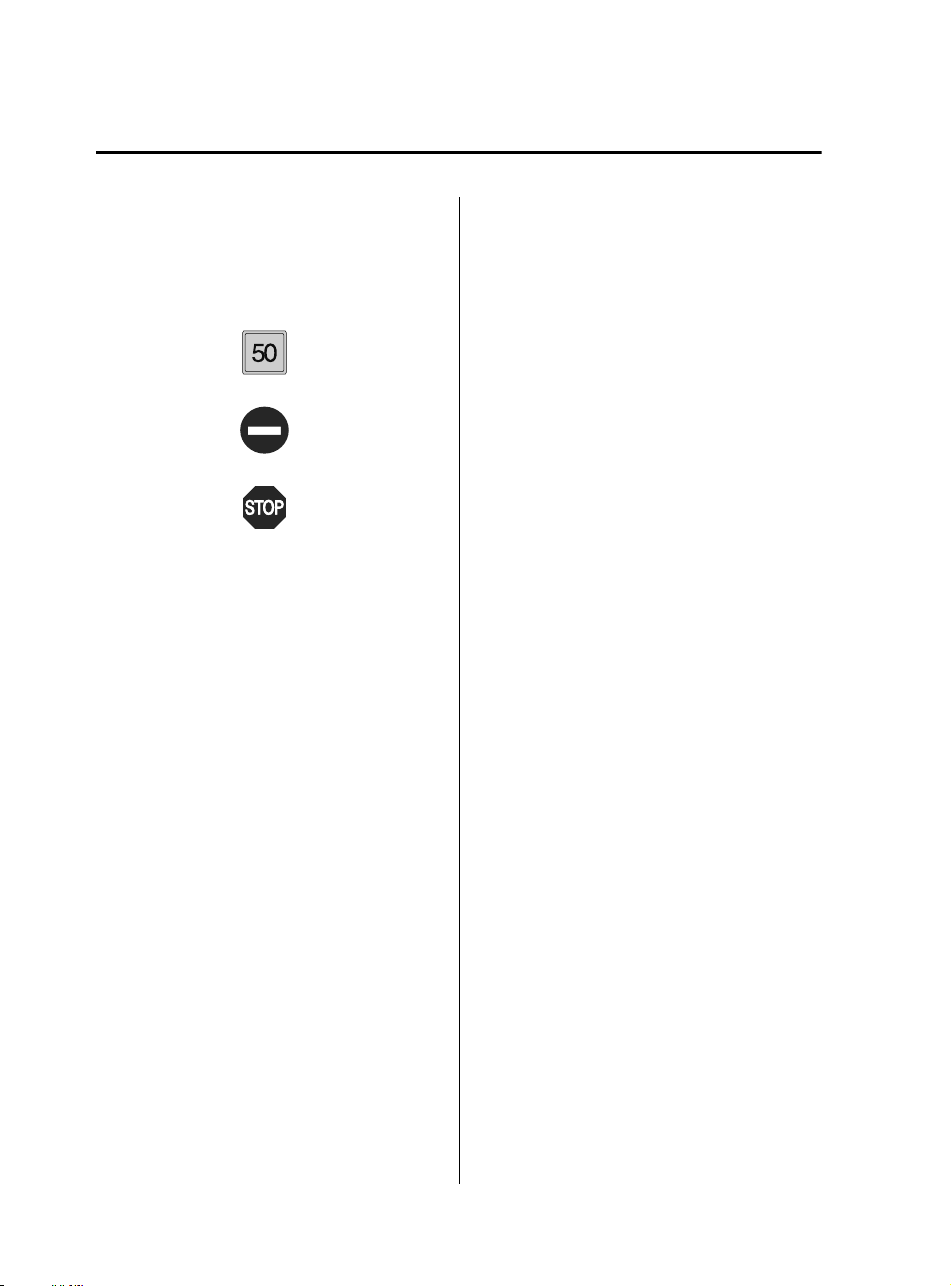
▼
Traffic Sign Display Indication
The following traffic signs are displayed
on the active driving display/instrument
cluster.
Speed limit signs
Do not enter signs
Stop signs
NOTE
Speed limit signs
When the vehicle speed is about 1 km/h
(0.6 mph) or faster, the speed limit sign
is displayed when any one of the
following conditions are met.
The Forward Sensing Camera (FSC)
recognizes a speed limit sign as a sign
targeted for your vehicle and the
vehicle passes it.
The speed limit sign stored in the
navigation system is read.
In the following cases, display of the
speed limit sign stops.
Each sensor determines that the
vehicle has changed direction of
travel.
The Forward Sensing Camera (FSC)
recognizes a new speed limit sign
which differs from the previous one
(displays the new speed limit sign).
The speed limit sign stored in the
navigation system is not read within a
certain period of time (if the Forward
Sensing Camera (FSC) does not
recognize a speed limit sign, the speed
limit sign stored in the navigation
system is displayed).
The vehicle speed exceeds the
displayed speed limit sign by 30 km/h
(19 mph) or more after a certain
period of time has elapsed since the
speed limit sign was displayed.
(Except when there is information for
the speed limit sign in the navigation
system)
Do not enter signs
A do not enter sign is displayed when all
of the following conditions are met.
The vehicle speed is about 60 km/h
(37 mph) or slower.
The Forward Sensing Camera (FSC)
recognizes a do not enter sign as a
sign targeted for your vehicle and the
vehicle passes it.
When the Forward Sensing Camera
(FSC) recognizes the do not enter sign
and a certain period of time has elapsed
since the vehicle passed the sign, display
of the do not enter sign stops.
Stop sign
A stop sign is displayed when all of the
following conditions are met:
The vehicle speed is about 65 km/h
(40 mph) or slower.
The Forward Sensing Camera (FSC)
recognizes a stop sign as a sign
targeted for your vehicle.
When Driving
i-ACTIVSENSE
4-102
Mazda3_8HZ1-EA-19G_Edition1_old 2019-5-17 13:49:03

When a certain period of time has
elapsed since the stop sign was
displayed, display of the stop sign stops.
When Driving
i-ACTIVSENSE
4-103
Mazda3_8HZ1-EA-19G_Edition1_old 2019-5-17 13:49:03
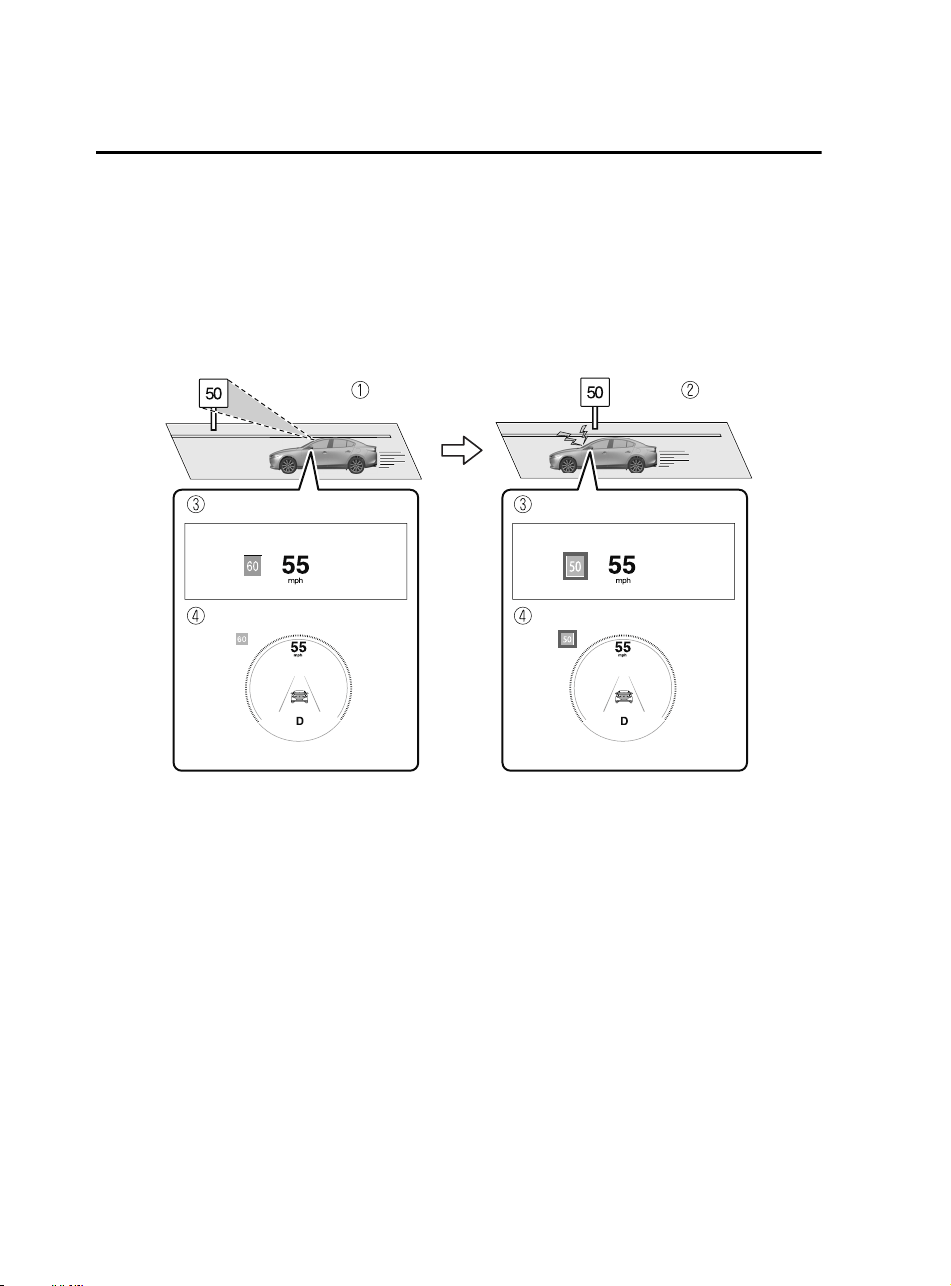
▼
Excessive Speed Warning
If the vehicle speed exceeds the speed limit sign displayed in the active driving display/
instrument cluster, the area around the speed limit sign flashes in amber and the warning
sound is activated at the same time. If the vehicle speed continues to exceed the displayed
speed limit sign, the indication stops flashing and remains on. Check the surrounding
conditions and adjust the vehicle speed to the legal speed using the appropriate operation
such as depressing the brake pedal.
1. Vehicle is doing 55 mph when 50 mph speed limit sign is recognized.
2. Vehicle continues to do 55 mph after 50 mph speed limit sign is recognized.
3. Active driving display indication
4. Instrument cluster
The excessive speed warning is initially set to inoperable. If you want to activate the
excessive speed warning, change the setting in the personalization features. In addition, the
warning pattern and the warning activation timing differ depending on the setting contents.
Refer to the Settings section in the Mazda Connect Owner's Manual.
Speed Limit Sign Alert setting
Off: The excessive speed warning is not activated.
Visual: The area around the speed limit sign displayed in the display flashes in amber, and
if the vehicle speed continues to exceed the displayed speed limit sign, the indication
stops flashing and remains on.
When Driving
i-ACTIVSENSE
4-104
Mazda3_8HZ1-EA-19G_Edition1_old 2019-5-17 13:49:03

Visual + Audible: The area around the speed limit sign displayed in the display flashes in
amber and the warning sound is activated at the same time. If the vehicle speed continues
to exceed the displayed speed limit sign, the indication stops flashing and remains on. The
warning sound is activated continuously until the vehicle speed decreases below the speed
limit sign.
Speed Limit Sign Threshold setting
+ 0: If the vehicle speed exceeds the speed limit sign displayed in the display, the
excessive speed warning is activated.
+ 5: If the vehicle speed exceeds the speed limit sign displayed in the display by 5 km/h (3
mph), the excessive speed warning is activated.
+ 10: If the vehicle speed exceeds the speed limit sign displayed in the display by 10 km/h
(5 mph), the excessive speed warning is activated.
NOTE
In the following cases, the excessive speed warning stops operating.
The vehicle speed is less than the speed of the displayed speed limit sign. (If the
activation timing for the excessive speed warning is changed in the personalization
features, the excessive speed warning stops operating when the vehicle speed is less
than the changed vehicle speed.
A speed limit sign indication has been updated and the vehicle speed is lower than the
updated indication.
Display of the speed limit sign stops.
The warning indication is displayed at the same time the excessive speed warning sound
is activated if the vehicle speed exceeds the speed indicated on the speed limit sign.
Refer to Excessive Speed Warning on page 7-45.
If the Forward Sensing Camera (FSC) or data recorded in the navigation system
incorrectly recognizes the actual speed limit sign at a lower speed, the excessive speed
alarm is activated even if the vehicle is driven at the legal speed.
When Driving
i-ACTIVSENSE
4-105
Mazda3_8HZ1-EA-19G_Edition1_old 2019-5-17 13:49:03
Distance & Speed Alert
(DSA)
*
▼
Distance & Speed Alert (DSA)
The DSA is a system which provides
advice for maintaining the appropriate
distance between vehicles and notifies the
driver of the recommended, safe distance
to maintain with a vehicle ahead. The
system measures the distance between
your vehicle and a vehicle ahead while the
vehicle speed is about 30 km/h (19 mph)
or faster. If the distance between your
vehicle and a vehicle ahead is close, the
system alerts the driver of a possible
collision using an indication on the
display.
WARNING
Do not rely completely on the DSA:
The ability of the system to detect a vehicle
ahead is limited depending on the type of
vehicle ahead, weather conditions, or
trac conditions. In addition, the system is
not for maintaining the distance between
your vehicle and a vehicle ahead. If you
neglect to operate the accelerator and
brake pedals correctly, it could lead to an
accident. Always check the safety of the
surrounding area and depress the brake
pedal or accelerator pedal while keeping a
safe distance from vehicles ahead or
on-coming vehicles.
Operation conditions
The DSA operates when the following
conditions are all met.
The ignition is switched ON.
The DSA is turned on.
The shift lever (manual transmission
vehicle) or the selector lever (automatic
transmission vehicle) is in a position
other than R.
The vehicle speed is about 30 km/h (19
mph) or faster.
i-ACTIVSENSE status symbol
(warning/risk avoidance support system)
(green) is displayed.
NOTE
The objects which activate the system
are four-wheeled vehicles.
The DSA may also operate in the
presence of motorcycles and bicycles.
The DSA may not operate normally
when the speed of a vehicle ahead is too
slow.
The system does not operate with the
following objects.
Vehicles approaching in the opposite
direction.
Stationary objects (stopped vehicles,
obstructions)
The DSA can be set to inoperable.
(If only the DSA is turned off)
Refer to the Settings section in the
Mazda Connect Owner's Manual.
(If the DSA is turned off by operating
the i-ACTIVSENSE switch)
Refer to i-ACTIVSENSE Switch on
page 4-87.
When Driving
i-ACTIVSENSE
4-106
*Some models.
Mazda3_8HZ1-EA-19G_Edition1_old 2019-5-17 13:49:03
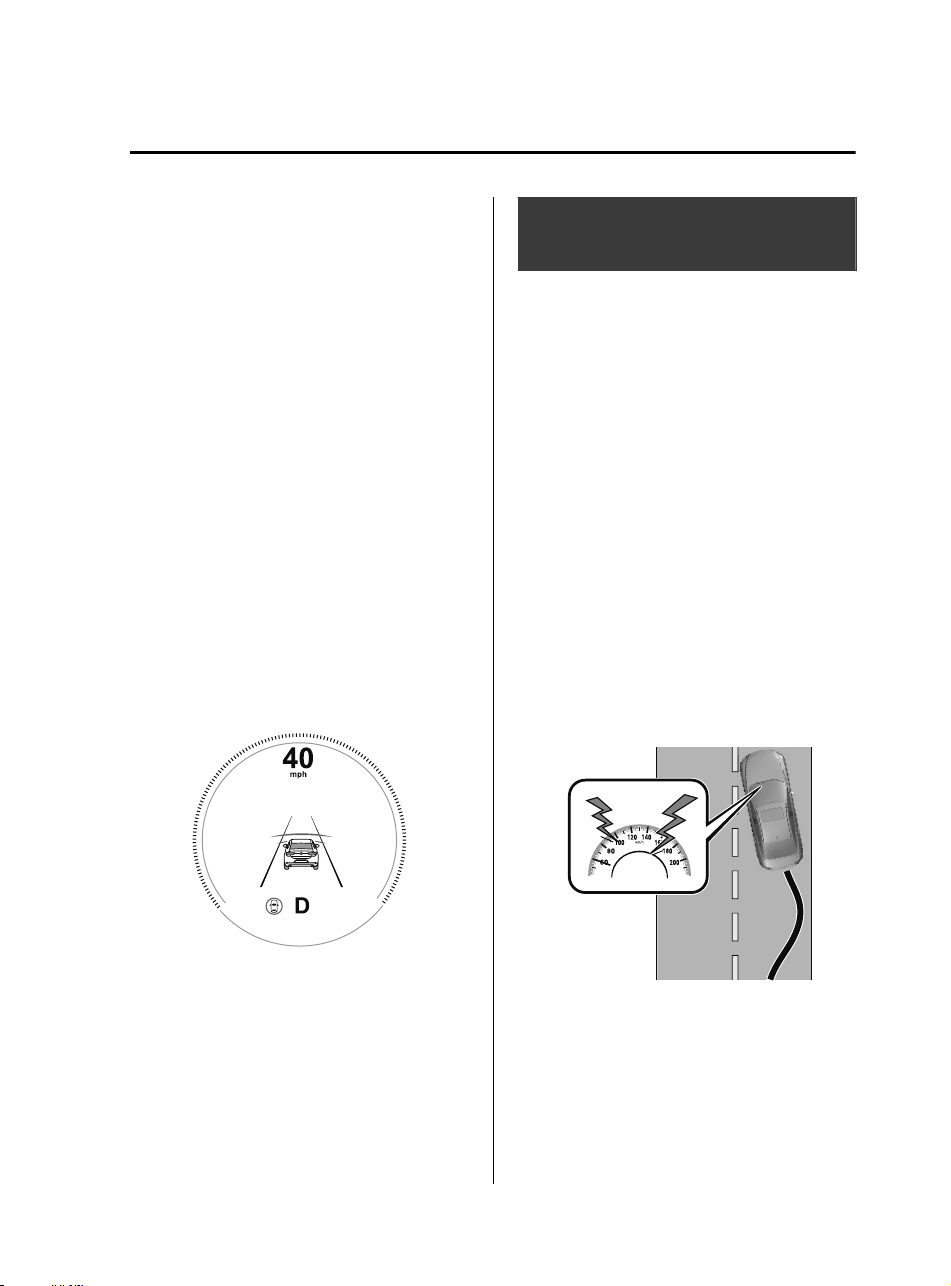
If the ignition is switched OFF while
you have canceled the system using the
i-ACTIVSENSE switch, the system is
automatically enabled the next time the
ignition is switched ON. However, if the
system is canceled using the
personalization features, the system is
not automatically enabled.
▼
Vehicle Ahead Close Proximity
Warning
When the system determines that the
distance between your vehicle and a
vehicle ahead is close, the
i-ACTIVSENSE status symbol (warning/
risk avoidance support system) changes
from green to amber and the warning
indication is displayed on the
multi-information display. While checking
the safety of the surrounding area, depress
the brake pedal while keeping a safe
distance from the vehicle ahead.
Driver Attention Alert
(DAA)
*
▼
Driver Attention Alert (DAA)
The DAA is a system which detects driver
fatigue and decreased attentiveness, and
encourages the driver to take a rest.
When the vehicle is driven inside traffic
lane lines at about 65 to 140 km/h (41 to
86 mph), the DAA estimates the amount
of accumulated fatigue and decreased
attentiveness of the driver based on the
information from the Forward Sensing
Camera (FSC) and other vehicle
information, and encourages the driver to
take a rest using an indication on the
multi-information display and a warning
sound.
Use the DAA on expressways or
highways.
Refer to Forward Sensing Camera (FSC)
on page 4-200.
When Driving
i-ACTIVSENSE
*Some models.
4-107
Mazda3_8HZ1-EA-19G_Edition1_old 2019-5-17 13:49:03
WARNING
Do not rely completely on DAA and always
drive carefully:
The DAA detects driver fatigue and
decreased attentiveness and encourages
the driver to take a rest, however, it is not
designed to prevent the vehicle from
straying. If you rely too much on the DAA it
could lead to an accident. Drive carefully
and operate the steering wheel
appropriately.
In addition, the system may not be able to
detect driver fatigue and decreased
attentiveness correctly depending on the
trac and driving conditions. The driver
must take sucient rest in order to drive
safely.
NOTE
The DAA operates when all of the
following conditions are met.
The vehicle speed is about 65 to 140
km/h (41 to 86 mph).
The system detects white (yellow) lane
lines.
The system has completed learning of
the driver’s driving data after 60
minutes have passed since the driver
began driving vehicle.
The DAA does not operate under the
following conditions.
The vehicle speed is less than about
65 km/h (41 mph).
The vehicle speed exceeds about 140
km/h (86 mph)
The vehicle is making a sharp turn.
The vehicle is changing lanes.
The system cannot detect white
(yellow) lane lines.
The DAA may not operate normally
under the following conditions.
White (yellow) lane lines are less
visible because of dirt or fading/
patchiness.
The vehicle is jolted or swayed
continuously by strong winds or rough
roads.
The vehicle is driven aggressively.
When making frequent lane changes.
The vehicle is making a curve.
The DAA detects driver fatigue and
decreased attentiveness based on the
driving data when the vehicle is driven
at about 65 to 140 km/h (41 to 86 mph)
for about 20 minutes. The driving data
will be reset under the following
conditions.
The vehicle is stopped for 15 minutes
or longer.
The vehicle is driven at less than
about 65 km/h (41 mph) for about 30
minutes.
The ignition is switched off.
After the DAA has displayed the first
message encouraging rest, it does not
display the next one until 60 minutes
have passed.
When Driving
i-ACTIVSENSE
4-108
Mazda3_8HZ1-EA-19G_Edition1_old 2019-5-17 13:49:03
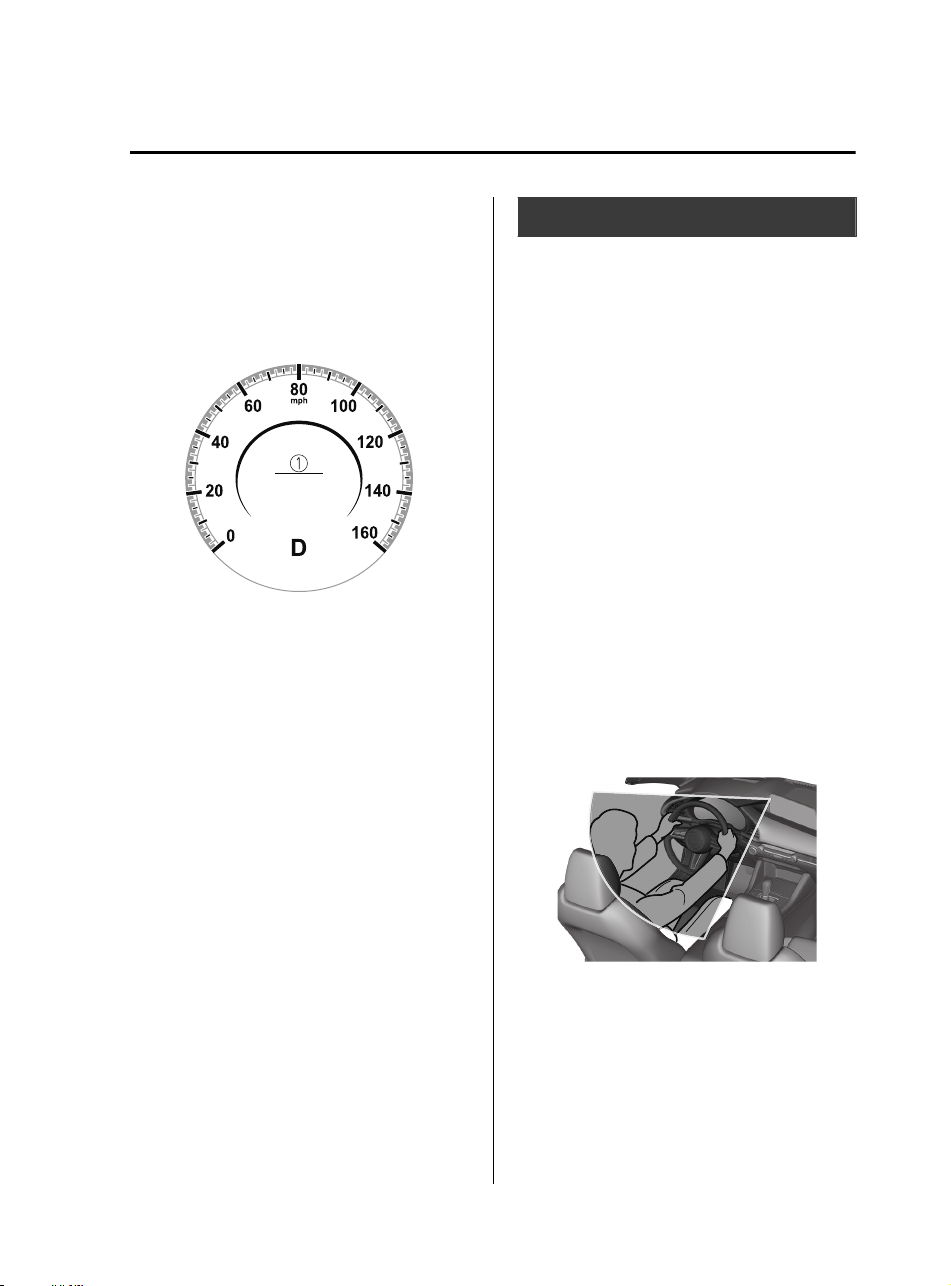
▼
Driver Attention Alert (DAA)
Display
When the system detects driver fatigue or
decreased attentiveness, it activates the
warning sound and displays an alert in the
multi-information display.
1. “Time for a Break” message is
displayed
▼
Canceling Driver Attention Alert
(DAA)
The DAA can be set to not activate.
Refer to the Settings section in the Mazda
Connect Owner's Manual.
Driver Monitoring (DM)
*
▼
Driver Monitoring (DM)
The DM is a system which detects driver
fatigue and sleepiness, and encourages the
driver to take a rest.
While driving the vehicle at about 5 km/h
(3 mph) or faster, the DM detects changes
in the driver's facial features using the
driver monitoring camera. The system
then estimates the amount of accumulated
fatigue and sleepiness of the driver and
encourages the driver to take a rest using a
warning indication in the instrument
cluster and a warning sound.
Two types of warning indication patterns
are set for notifying the driver based on
the estimated amount of accumulated
fatigue and sleepiness of the driver.
Fatigue and sleepiness are detected:
Warning pattern (caution)
Much more fatigue and sleepiness are
detected: Warning pattern (warning)
When Driving
i-ACTIVSENSE
*Some models.
4-109
Mazda3_8HZ1-EA-19G_Edition1_old 2019-5-17 13:49:03
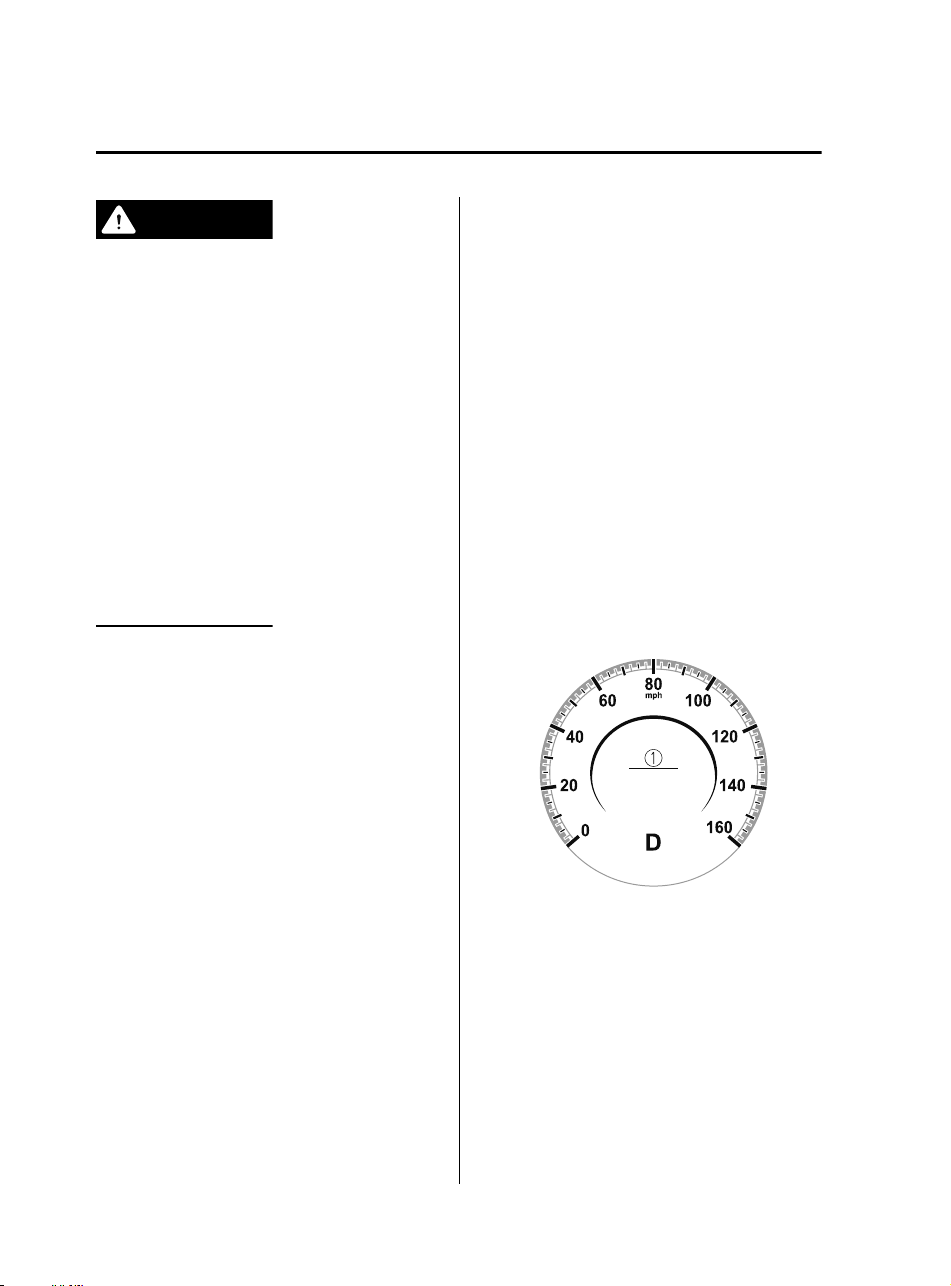
WARNING
Do not rely completely on the DM and
always drive carefully:
The DM is a system which detects driver
fatigue and sleepiness, and encourages the
driver to take a rest. This is not designed to
prevent driver fatigue and sleepiness, and
over-reliance on the system could lead to
an accident. Drive carefully and turn the
steering wheel appropriately.
In addition, the system may not be able to
detect driver fatigue and sleepiness
correctly depending on the trac and
driving conditions. The driver must take
sucient rest in order to drive safely.
Operation conditions
The DM begins monitoring after 20
minutes have passed since the driver
began driving the vehicle and when the
vehicle speed is about 5 km/h (3 mph) or
faster.
NOTE
If the vehicle speed decreases to less
than about 5 km/h (3 mph) while the DM
is monitoring, the DM stops monitoring
for 6 minutes even if the vehicle speed
returns to about 5 km/h (3 mph) or
faster.
If the driver monitoring camera does not
recognize the driver correctly, the DM
may not monitor correctly.
Refer to Driver Monitoring Camera on
page 4-211.
After the DM has displayed the first
message encouraging the driver to take
a rest, it does not display it again during
the following periods.
After displaying the warning pattern
(caution), the next warning pattern
(caution) is not displayed until 45
minutes have passed.
After displaying the warning pattern
(warning), the next warning pattern
(warning) is not displayed until 15
minutes have passed.
After displaying the warning pattern
(warning), the next warning pattern
(caution) is not displayed until 45
minutes have passed.
▼
Driver Monitoring (DM) Display
When the Driver Monitoring (DM) detects
driver fatigue or sleepiness, it activates the
warning sound and displays an alert in the
instrument cluster.
Warning pattern (caution) (white)
1. “Time for a Break” message is
displayed
When Driving
i-ACTIVSENSE
4-110
Mazda3_8HZ1-EA-19G_Edition1_old 2019-5-17 13:49:03
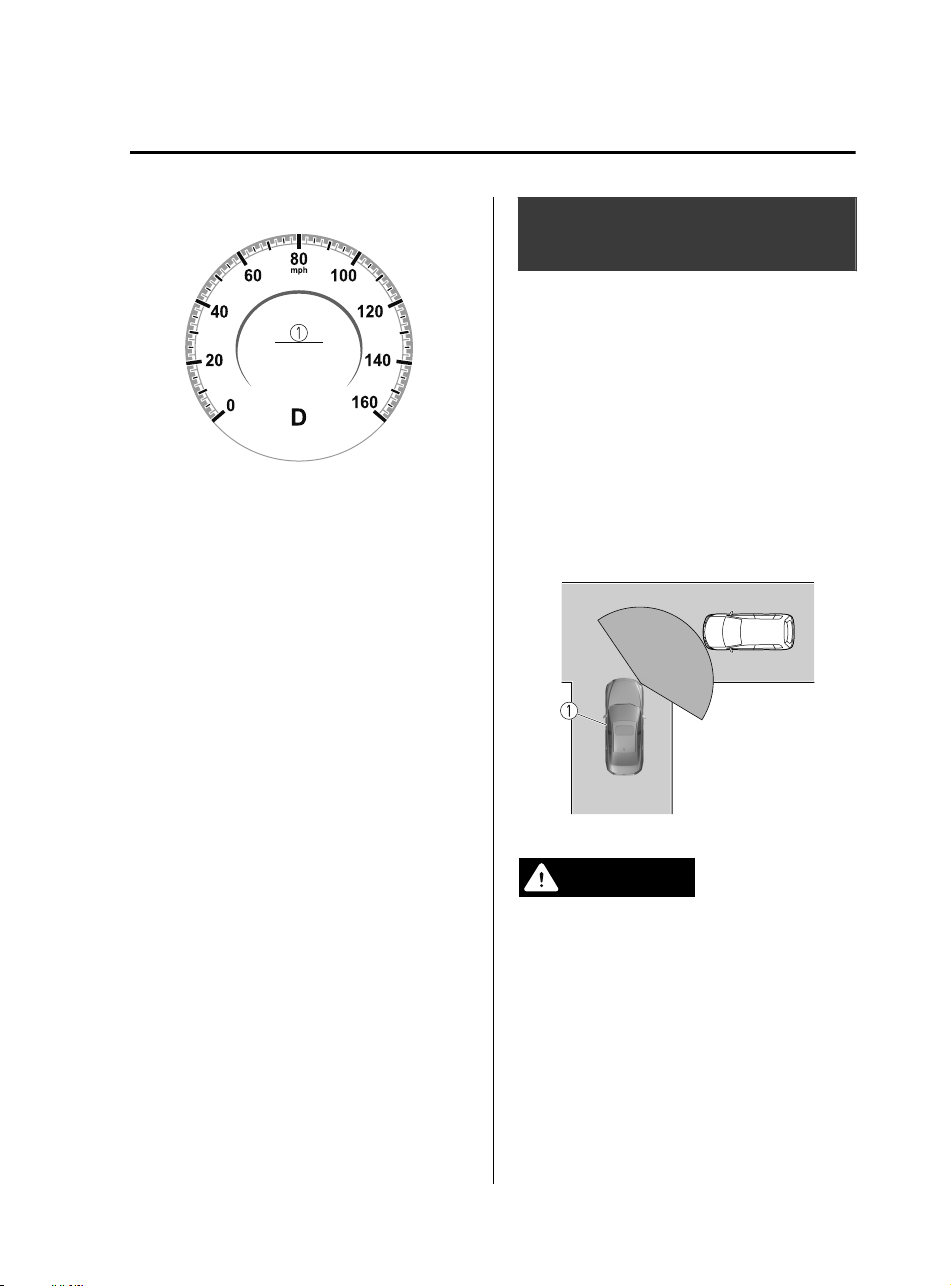
Warning pattern (warning) (amber)
1. “Time for a Break” message is
displayed
▼
Canceling Driver Monitoring (DM)
The Driver Monitoring (DM) can be set to
inoperable.
Refer to the Settings section in the Mazda
Connect Owner's Manual.
Front Cross Traffic Alert
(FCTA)
*
▼
Front Cross Traffic Alert (FCTA)
The FCTA is designed to assist the driver
in checking both sides of the vehicle when
the vehicle starts to drive at an
intersection.
The FCTA detects vehicles approaching
from the blind spots on the front left and
right sides of the vehicle when the vehicle
starts to drive at an intersection, and
notifies the driver of possible danger using
the warning indication on the display and
the warning sound.
1. Your vehicle
WARNING
Always check the surrounding area visually
when the vehicle starts to drive at an
intersection:
Due to certain limitations with the
operation of this system, the warning
indication on the display or the warning
sound might be delayed even though there
is a vehicle approaching from a blind spot.
Always make it your responsibility as a
driver to check the left and right sides.
When Driving
i-ACTIVSENSE
*Some models.
4-111
Mazda3_8HZ1-EA-19G_Edition1_old 2019-5-17 13:49:03
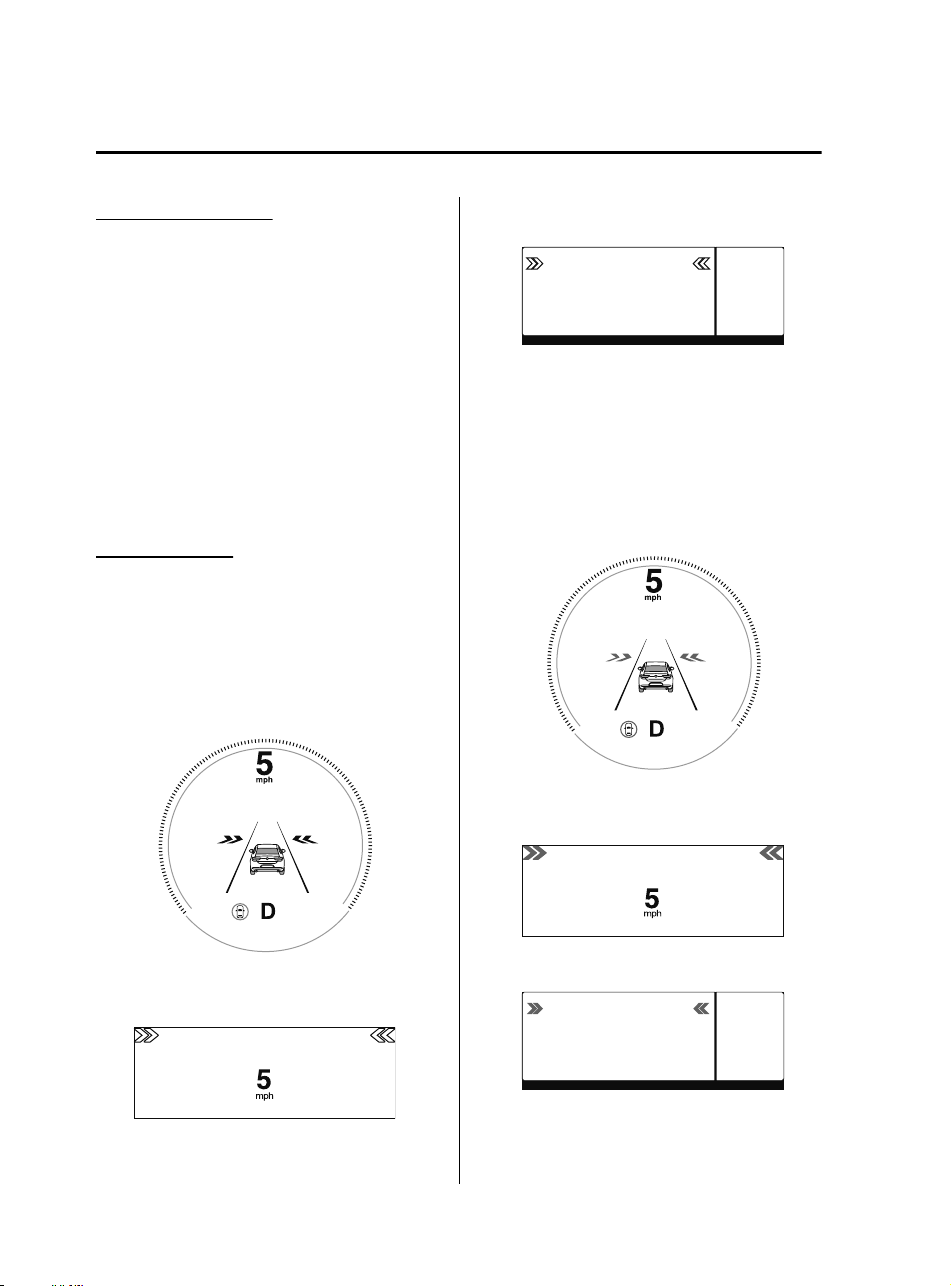
Operation conditions
The system operates when all of the
following conditions are met:
When your vehicle is driven at less than
about 10 km/h (6 mph).
(Automatic transmission)
The selector lever is in the D position.
(Manual transmission)
The shift lever is in a position other than
N or R.
When a vehicle approaches from the
front side of your vehicle at a vehicle
speed of about 5 km/h (3 mph) or faster.
FCTA operation
When your vehicle is stopped
When a vehicle is approaching, the system
notifies the driver that a vehicle is
approaching on the following display
(white arrow).
Multi-information display
Active driving display (vehicles with
active driving display)
360°view monitor (vehicles with
360°view monitor)
When your vehicle is being driven
If there is a possibility of a collision with
an approaching vehicle, a warning
indication is displayed on the following
display (amber arrow) and the warning
sound is activated at the same time.
Multi-information display
Active driving display (vehicles with
active driving display)
360°view monitor (vehicles with
360°view monitor)
When Driving
i-ACTIVSENSE
4-112
Mazda3_8HZ1-EA-19G_Edition1_old 2019-5-17 13:49:03

NOTE
The system may operate under the
following conditions even if a vehicle is
not approaching.
An object that reflects the radio waves
of the radar such as a parked vehicle,
guardrail, or wall is directly next to
your vehicle.
Vehicles are stopped in the area
around your vehicle such as during
heavy traffic.
A vehicle approaching from the front
or side of your vehicle slows down.
A vehicle approaching from the front
or left side of your vehicle makes a
right or left turn directly in front of
your vehicle.
A vehicle or pedestrian moves in the
parking lot or on the sidewalk in the
area surrounding your vehicle.
After making a left or right turn, an
on-coming vehicle is present.
When passing an on-coming vehicle.
A vehicle overtakes your vehicle while
it is stopped.
Your vehicle is in an area where
strong radio waves or electrical noise
may occur such as near a television
tower or power plant.
Under the following conditions, the front
side radar sensor cannot detect
approaching vehicles or it might be
difficult to detect them, and the system
may not operate normally.
The front side radar sensor detection
area is obstructed by a nearby wall or
vehicle.
Directly after the system becomes
operable.
Radio wave interference from a radar
sensor equipped on a nearby vehicle.
The approaching vehicle has any of
the following shapes.
a) The size of the vehicle body is
extremely small.
b) The vehicle height is extremely low
or high.
c) A special type of vehicle with a
complex shape
A vehicle suddenly enters the
detection area from the front or side of
your vehicle.
A vehicle that has stopped suddenly
starts to move.
Multiple objects move at the same
time.
The vehicle is driven in bad weather
conditions such as heavy rain, fog,
snow, or sand storms.
The vehicle is driven on a sharp curve
or on bumpy roads.
An object that reflects the radio waves
of the radar such as a parked vehicle,
guardrail, or wall is directly next to
your vehicle.
A vehicle approaches while turning
(Such as roundabout)
The vehicle is driven at an extremely
slow speed.
In the following cases, the system turns
on the i-ACTIVSENSE warning
indication/warning light and operation
of the system is stopped. If the
i-ACTIVSENSE warning indication/
warning light remains on, have the
vehicle inspected by an Authorized
Mazda Dealer as soon as possible.
Some problem with the system has
occurred.
When Driving
i-ACTIVSENSE
4-113
Mazda3_8HZ1-EA-19G_Edition1_old 2019-5-17 13:49:03
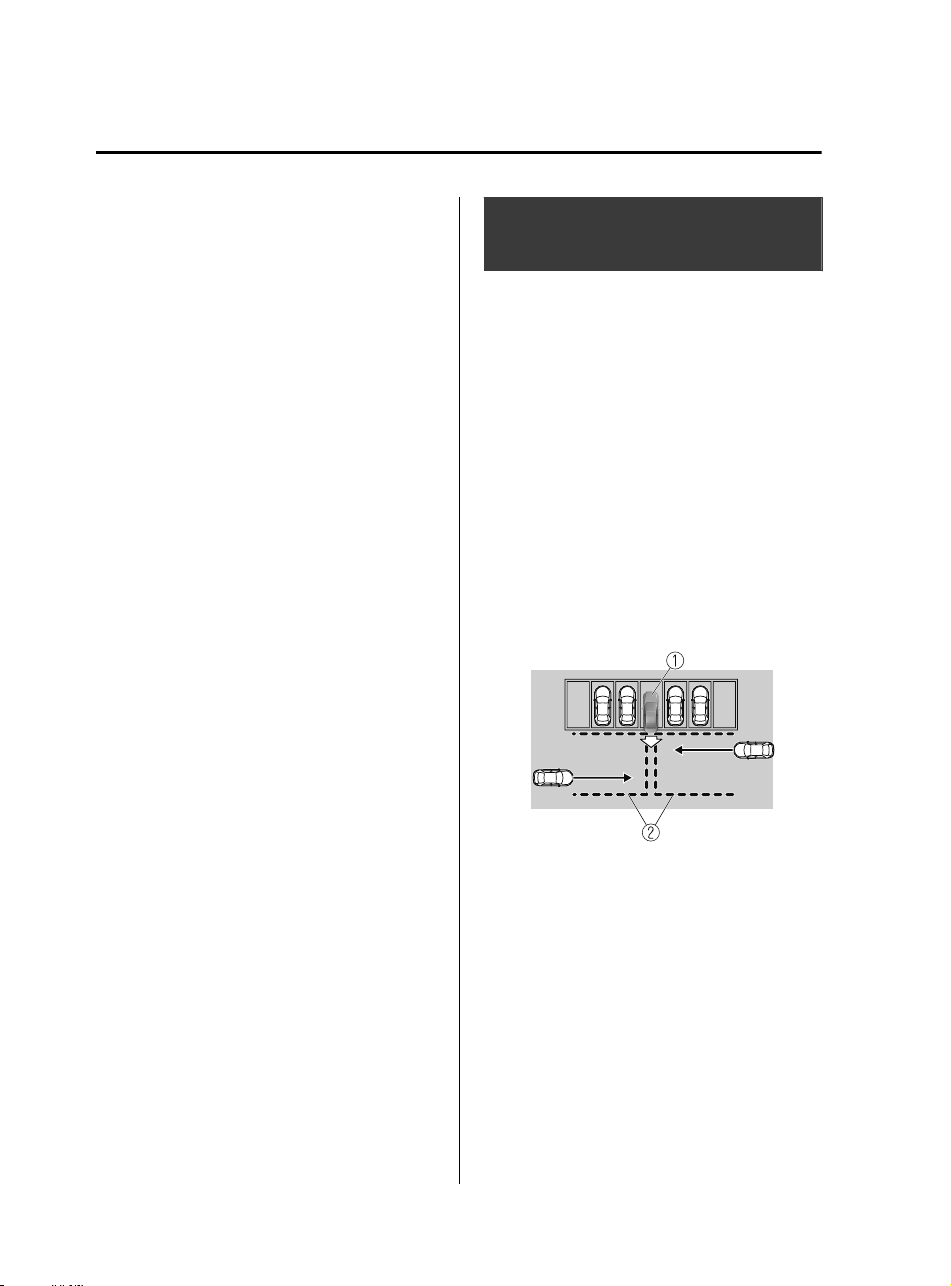
The front side radar sensor
installation position is greatly
deviated.
There is a large accumulation of snow
or ice on the front bumper near a front
side radar sensor.
The temperature near the radar
sensors becomes extremely hot due to
driving for a long time on slopes
during the summer.
The battery voltage has decreased.
The front side radar sensor of the
FCTA may be regulated under the
radio wave related laws of the country
where the vehicle is driven. If this
system is used abroad, it may be
necessary to turn off the system.
Refer to Front Side Radar Sensor on
page 4-206.
▼
Canceling Operation of Front Cross
Traffic Alert (FCTA)
The FCTA can be set to inoperable.
(If only the FCTA is turned off)
Refer to the Settings section in the
Mazda Connect Owner's Manual.
(If the FCTA is turned off by
operating the i-ACTIVSENSE switch)
Refer to i-ACTIVSENSE Switch on
page 4-87.
NOTE
If the ignition is switched OFF while you
have canceled the system using the
i-ACTIVSENSE switch, the system is
automatically enabled the next time the
ignition is switched ON. However, if the
system is canceled using the
personalization features, the system is not
automatically enabled.
Rear Cross Traffic Alert
(RCTA)
*
▼
Rear Cross Traffic Alert (RCTA)
The RCTA system is designed to assist the
driver in checking the area to the rear left
and right sides of your vehicle while your
vehicle is reversing by alerting the driver
to the presence of vehicles approaching
the rear of your vehicle.
The RCTA system detects vehicles
approaching from the rear left and right
sides of your vehicle and the rear of your
vehicle while your vehicle is being
reversed out of a parking space, and
notifies the driver of possible danger using
the Blind Spot Monitoring (BSM) warning
indicator lights and the warning buzzer.
1. Your vehicle
2. Detection areas
When Driving
i-ACTIVSENSE
4-114
*Some models.
Mazda3_8HZ1-EA-19G_Edition1_old 2019-5-17 13:49:03
WARNING
Always check the surrounding area visually
before actually putting the vehicle in
reverse:
The system is only designed to assist you in
checking for vehicles at the rear when
putting the vehicle in reverse. Due to
certain limitations with the operation of
this system, the Blind Spot Monitoring
(BSM) warning indicator lights may not
ash
or it might be delayed even though a
vehicle is behind your vehicle. Always make
it your responsibility as a driver to check
the rear.
RCTA operation
1. The RCTA system operates when the
shift lever (manual transmission) or the
selector lever (automatic transmission)
is shifted to the reverse (R) position.
2. If there is the possibility of a collision
with an approaching vehicle, the Blind
Spot Monitoring (BSM) warning
indicator lights flashes and the warning
beep is activated simultaneously.
Rear view monitor (vehicles with
Rear view monitor)
The RCTA warning indication in the
rearview monitor also synchronizes
with the Blind Spot Monitoring (BSM)
warning indicator light on the door
mirrors.
360°view monitor (vehicles with
360°view monitor)
The RCTA warning indication in the
360°view monitor also synchronizes
with the Blind Spot Monitoring (BSM)
warning indicator light on the door
mirrors.
Function for cancelling illumination
dimmer
If the BSM warning indicator lights turn
on when the parking lights are turned on,
the brightness of the BSM warning
indicator lights is dimmed.
If the BSM warning indicator lights are
difficult to see due to glare from
surrounding brightness when traveling on
snow-covered roads or under foggy
conditions, press the dimmer cancellation
button to cancel the dimmer and increase
the brightness of BSM warning indicator
lights when they turn on.
Refer to Dashboard Illumination on page
4-18.
NOTE
The system may operate under the
following conditions even if a vehicle is
not approaching.
An object that reflects the radio waves
of the radar such as a parked vehicle,
guardrail, or wall is directly next to
your vehicle.
When Driving
i-ACTIVSENSE
4-115
Mazda3_8HZ1-EA-19G_Edition1_old 2019-5-17 13:49:03
A vehicle approaching from the rear
left and right side of your vehicle
slows down.
A vehicle approaching from the rear
left and right side of your vehicle
makes a right or left turn directly in
front of your vehicle.
A vehicle overtakes your vehicle while
it is stopped.
Your vehicle is in an area where
strong radio waves or electrical noise
may occur such as near a television
tower or power plant.
In the following cases, the
i-ACTIVSENSE warning indication/
warning light turns on and operation of
the system is stopped. If the
i-ACTIVSENSE warning indication/
warning light remains illuminated, have
the vehicle inspected at an Authorized
Mazda Dealer as soon as possible.
Some problem with the system
including the Blind Spot Monitoring
(BSM) warning indicator lights has
occurred.
A large deviation in the installation
position of a rear side radar sensor on
the vehicle has occurred.
There is a large accumulation of snow
or ice on the rear bumper near a rear
side radar sensor.
Driving on snow-covered roads for
long periods.
The temperature near the radar
sensors becomes extremely hot due to
driving for long periods on slopes
during the summer.
The battery voltage has decreased.
Under the following conditions, the rear
side radar sensor cannot detect
approaching vehicles or it might be
difficult to detect them, and the system
may not operate normally.
The vehicle speed when reversing is
about 15 km/h (9 mph) or faster.
The rear side radar sensor detection
area is obstructed by a nearby wall or
parked vehicle. (Reverse the vehicle to
a position where the radar sensor
detection area is no longer
obstructed.)
1. Your vehicle
A vehicle is approaching directly from
the rear of your vehicle.
1. Your vehicle
The vehicle is parked at an angle.
1. Your vehicle
When Driving
i-ACTIVSENSE
4-116
Mazda3_8HZ1-EA-19G_Edition1_old 2019-5-17 13:49:03

Directly after the RCTA system
becomes operable using the
personalization feature.
Radio wave interference from a radar
sensor equipped on a nearby parked
vehicle.
In the following cases, it may be difficult
to view the illumination/flashing of the
Blind Spot Monitoring (BSM) warning
indicator lights equipped on the door
mirrors.
Snow or ice adheres to the door
mirrors.
The front door glass is fogged or
covered in snow, frost or dirt.
Turn off the RCTA system while pulling
a trailer or while an accessory such as a
bicycle carrier is installed to the rear of
the vehicle. Otherwise, the radio waves
emitted by the radar will be blocked
causing the system to not operate
normally.
The rear side radar sensor of the RCTA
may be regulated under the radio wave
related laws of the country where the
vehicle is driven. If this system is used
abroad, it may be necessary to turn off
the system.
Refer to Rear Side Radar Sensor on
page 4-208.
▼
Canceling Operation of Rear Cross
Traffic Alert (RCTA)
The RCTA can be set to inoperable.
(If only the RCTA is turned off)
Refer to the Settings section in the
Mazda Connect Owner's Manual.
(If the RCTA is turned off by
operating the i-ACTIVSENSE switch)
Refer to i-ACTIVSENSE Switch on
page 4-87.
NOTE
If the ignition is switched OFF while you
have canceled the system using the
i-ACTIVSENSE switch, the system is
automatically enabled the next time the
ignition is switched ON. However, if the
system is canceled using the
personalization features, the system is not
automatically enabled.
When Driving
i-ACTIVSENSE
4-117
Mazda3_8HZ1-EA-19G_Edition1_old 2019-5-17 13:49:03
Mazda Radar Cruise
Control (MRCC) (Manual
Transmission)
*
▼
Mazda Radar Cruise Control
(MRCC)
The MRCC system is designed to maintain
headway control
*1
with a vehicle ahead
according to your vehicle's speed using a
front radar sensor to detect the distance to
the vehicle ahead and a preset vehicle
speed without you having to use the
accelerator or brake pedals.
*
1 Headway Control: Control of the
distance between your vehicle and the
vehicle ahead detected by the MRCC
system.
Additionally, if your vehicle starts closing
in on the vehicle ahead such as if the
vehicle ahead brakes suddenly, a warning
sound and a warning indication in the
display are activated simultaneously to
alert you to maintain a sufficient distance
between the vehicles.
Also refer to the following before using
the MRCC.
Front radar sensor (page 4-204)
WARNING
Do not rely completely on the MRCC:
The MRCC system has detection limitations
depending on the type of vehicle ahead
and its conditions, the weather conditions,
and the road conditions. Additionally, the
system may be unable to decelerate
suciently to avoid hitting the vehicle
ahead if the vehicle ahead applies the
brakes suddenly or another vehicle cuts
into the driving lane, which could result in
an accident.
Always drive carefully and verify the
surrounding conditions and depress the
brake pedal or accelerator pedal while
keeping a safe distance from vehicles
ahead or on-coming vehicles.
Do not use the MRCC system in the
following locations. Using the MRCC
system at the following locations may
result in an unexpected accident:
General roads other than highways
(Driving under these conditions using the
MRCC system is not possible.)
Roads with sharp curves and where
vehicle trac is heavy with insucient
space between vehicles, or roads where
frequent and repetitive acceleration and
deceleration occur (Driving under these
conditions using the MRCC is not
possible).
When entering and exiting interchanges,
service areas, and parking areas of
highways (If you exit a highway while
headway control is in use, the vehicle
ahead will no longer be tracked and your
vehicle may accelerate to the set speed).
When Driving
i-ACTIVSENSE
4-118
*Some models.
Mazda3_8HZ1-EA-19G_Edition1_old 2019-5-17 13:49:03
Slippery roads such as ice or snow-bound
roads (Tires could spin causing you to
lose vehicle control, or the stop hold
control may not operate.)
Long, descending slopes (to maintain
distance between vehicles, the system
automatically and continuously applies
the brakes which could result in the loss
of brake power.)
Slopes with a steep gradient (The vehicle
ahead may not be detected correctly.)
Two-wheeled vehicles such as
motorcycles or bicycles are ahead.
For safety purposes, switch the MRCC
system o when it is not being used.
Leaving the MRCC system turned on when
it is not in use is dangerous as it could
operate unexpectedly, resulting in an
accident.
CAUTION
Turn the system
o
when the vehicle is
running on a chassis roller.
If your vehicle is towed or you are towing
something, switch the MRCC system o
to prevent an unexpected operation.
NOTE
The MRCC system does not detect the
following as physical objects.
Vehicles approaching in the opposite
direction
Pedestrians
Stationary objects (stopped vehicles,
obstructions)
If a vehicle ahead is traveling at an
extremely low speed, the system may
not detect it correctly.
If there is a structure on the road or an
object (such as a monorail) at a low
height off the ground in front of the
vehicle, the system may operate.
Therefore, do not use the MRCC.
Do not use the MRCC system under
conditions in which close proximity
warnings are frequently activated.
During headway control travel, the
system accelerates and decelerates your
vehicle in conjunction with the speed of
the vehicle ahead. However, if it is
necessary to accelerate for a lane
change or if the vehicle ahead brakes
suddenly causing you to close in on the
vehicle rapidly, accelerate using the
accelerator pedal or decelerate using
the brake pedal depending on the
conditions.
While the MRCC system is in use, it
does not cancel even if the shift lever is
operated and any intended engine
braking will not occur. If deceleration is
required, lower the vehicle speed setting
or depress the brake pedal.
While braking by the MRCC control is
operating, you might hear an operation
sound, however, this does not indicate a
problem.
The brake lights turn on while braking
by the MRCC control is operating,
however, they may not turn on while the
vehicle is on a down slope at the set
vehicle speed or traveling at a constant
speed and following a vehicle ahead.
Stop the headway control function to
switch the system to the cruise control
function.
Refer to the Settings section in the
Mazda Connect Owner's Manual.
When Driving
i-ACTIVSENSE
4-119
Mazda3_8HZ1-EA-19G_Edition1_old 2019-5-17 13:49:03
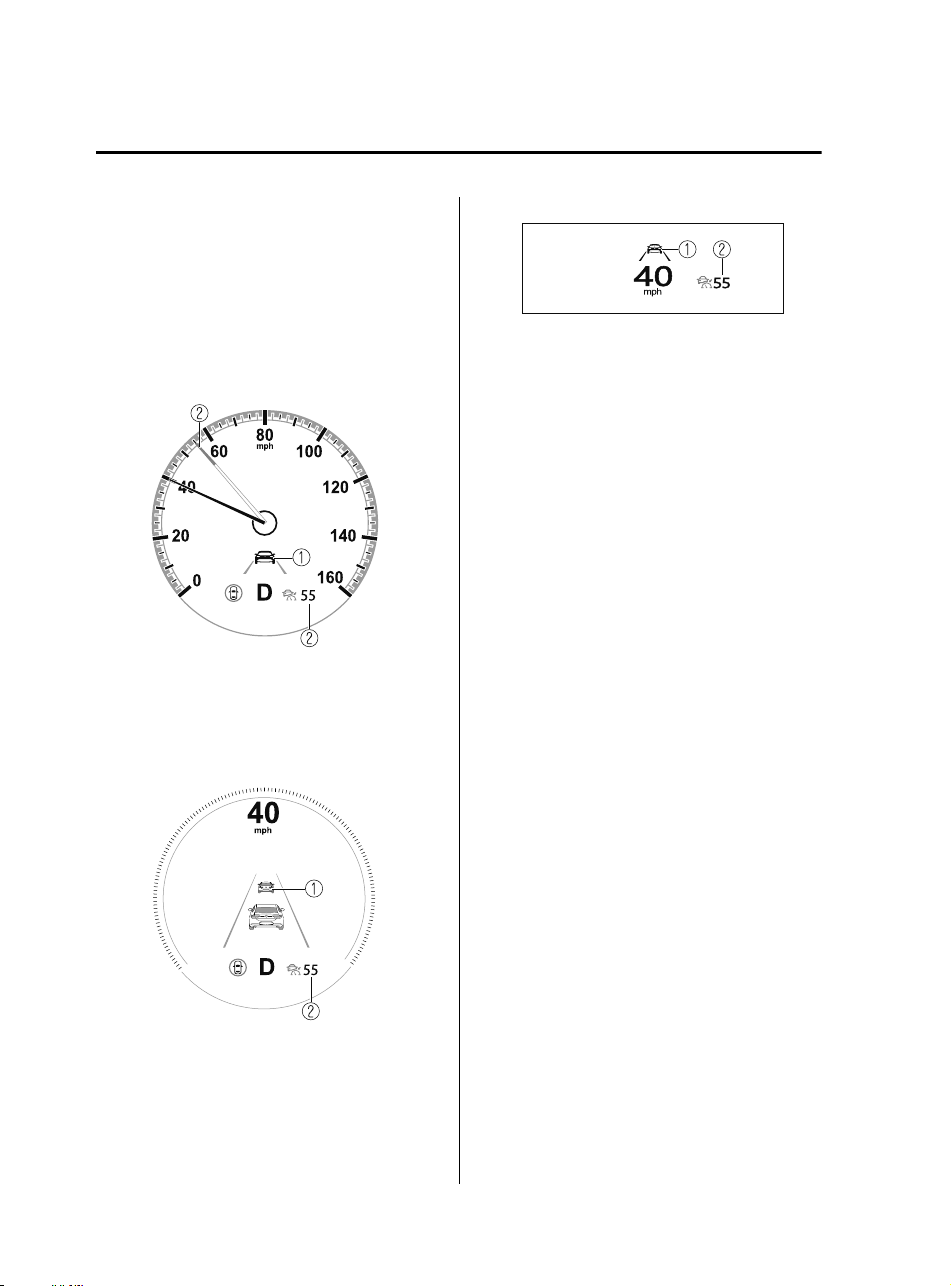
▼
Mazda Radar Cruise Control
(MRCC) Display Indication
The MRCC setting status and operation
conditions are indicated on the
multi-information display and the active
driving display.
Multi-information display (Basic
display)
1. Vehicle ahead display
2. MRCC set vehicle speed
Multi-information display
(i-ACTIVSENSE display)
1. Vehicle ahead display
2. MRCC set vehicle speed
Active driving display
1. Vehicle ahead display
2. MRCC set vehicle speed
If there is a problem with the MRCC
system, a message is displayed on the
multi-information display. Check the
center display to verify the problem and
then have your vehicle inspected by an
Authorized Mazda Dealer.
Refer to If a Warning Light Turns On or
Flashes on page 7-27.
When Driving
i-ACTIVSENSE
4-120
Mazda3_8HZ1-EA-19G_Edition1_old 2019-5-17 13:49:03
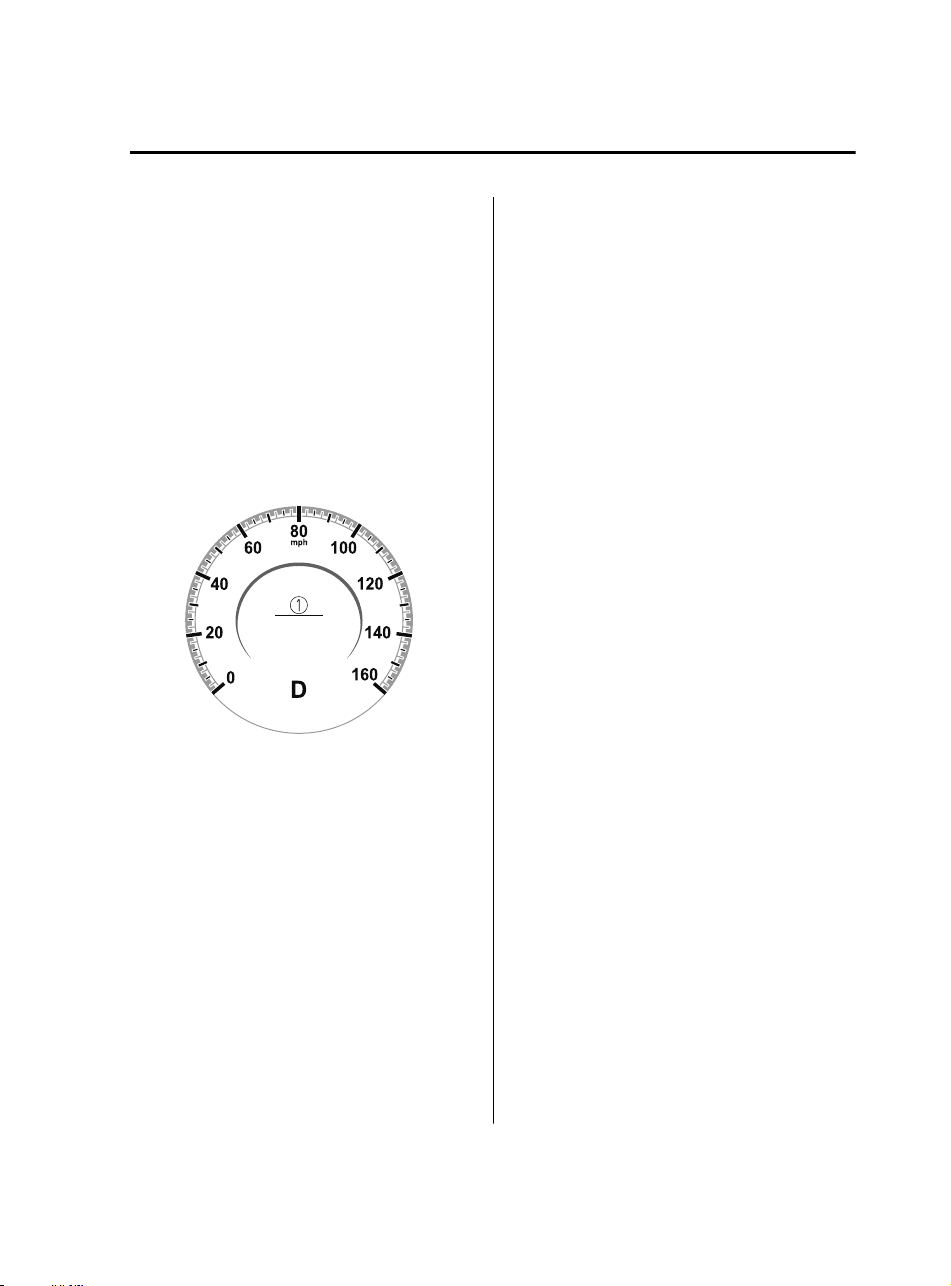
▼
Close Proximity Warning
If your vehicle rapidly closes in on the
vehicle ahead because the vehicle ahead
applies the brakes suddenly while you are
traveling in headway control, the warning
sound activates and the brake warning is
indicated in the display. Always verify the
safety of the surrounding area and depress
the brake pedal while keeping a safe
distance from the vehicle ahead.
Additionally, keep a safe distance from the
vehicles behind you.
1. “Depress Brake Pedal” message is
displayed
NOTE
In the following cases, the warnings and
brakes may not operate even if your
vehicle starts closing in on the vehicle
ahead.
You are driving your vehicle at the same
speed as the vehicle ahead.
Directly after the MRCC system has
been set.
Directly after the accelerator pedal is
released.
Another vehicle cuts into the driving
lane.
When Driving
i-ACTIVSENSE
4-121
Mazda3_8HZ1-EA-19G_Edition1_old 2019-5-17 13:49:03
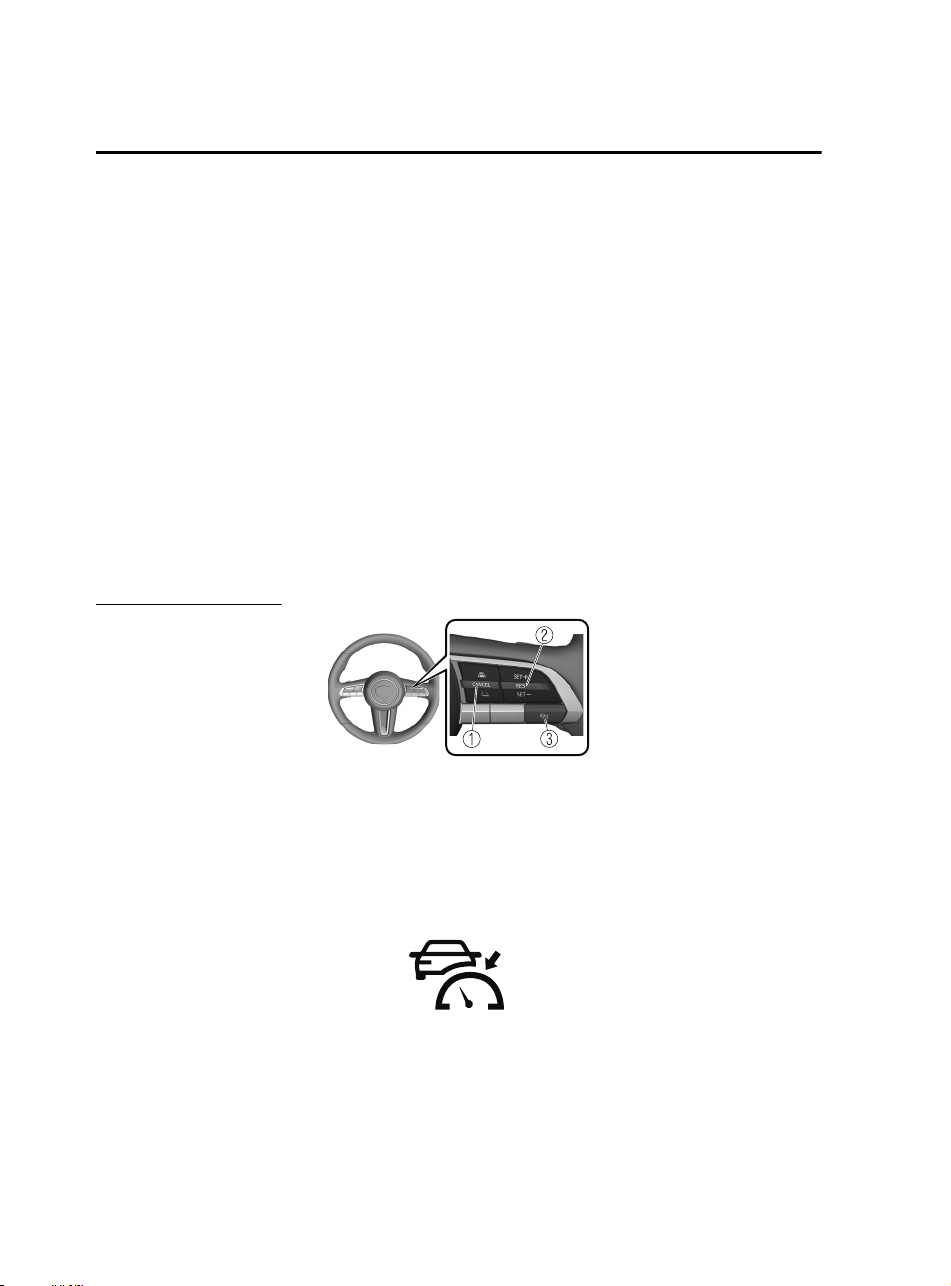
▼
Setting the System
The MRCC system operates when all of the following conditions are met.
Vehicle speed is 30 km/h (19 mph) to 145 km/h (90 mph)
The MRCC is turned on.
The brake pedal is not depressed.
The parking brake is released (Electric Parking Brake (EPB) indicator light is turned off).
There is no problem with the DSC.
All the doors are closed.
The driver's seat belt is fastened.
The shift lever is in a position other than reverse (R) or neutral (N).
The clutch pedal is not depressed.
NOTE
When the MRCC is operating, Distance & Speed Alert (DSA), and Smart Brake Support
(SBS) also turns on automatically.
Turning on the system
1. CANCEL switch
2. RES switch
3. MRCC switch
When the MRCC switch is pressed once, the MRCC system turns on, and the MRCC
standby indication (white) turns on and the vehicle speed and the distance between the
vehicles while in headway control can be set.
In addition, the MRCC system display indication is displayed on the multi-information
display and the active driving display at the same time.
NOTE
If the ignition is switched off while the MRCC system is operating, the system will be
operable when the ignition is switched ON the next time.
When Driving
i-ACTIVSENSE
4-122
Mazda3_8HZ1-EA-19G_Edition1_old 2019-5-17 13:49:03
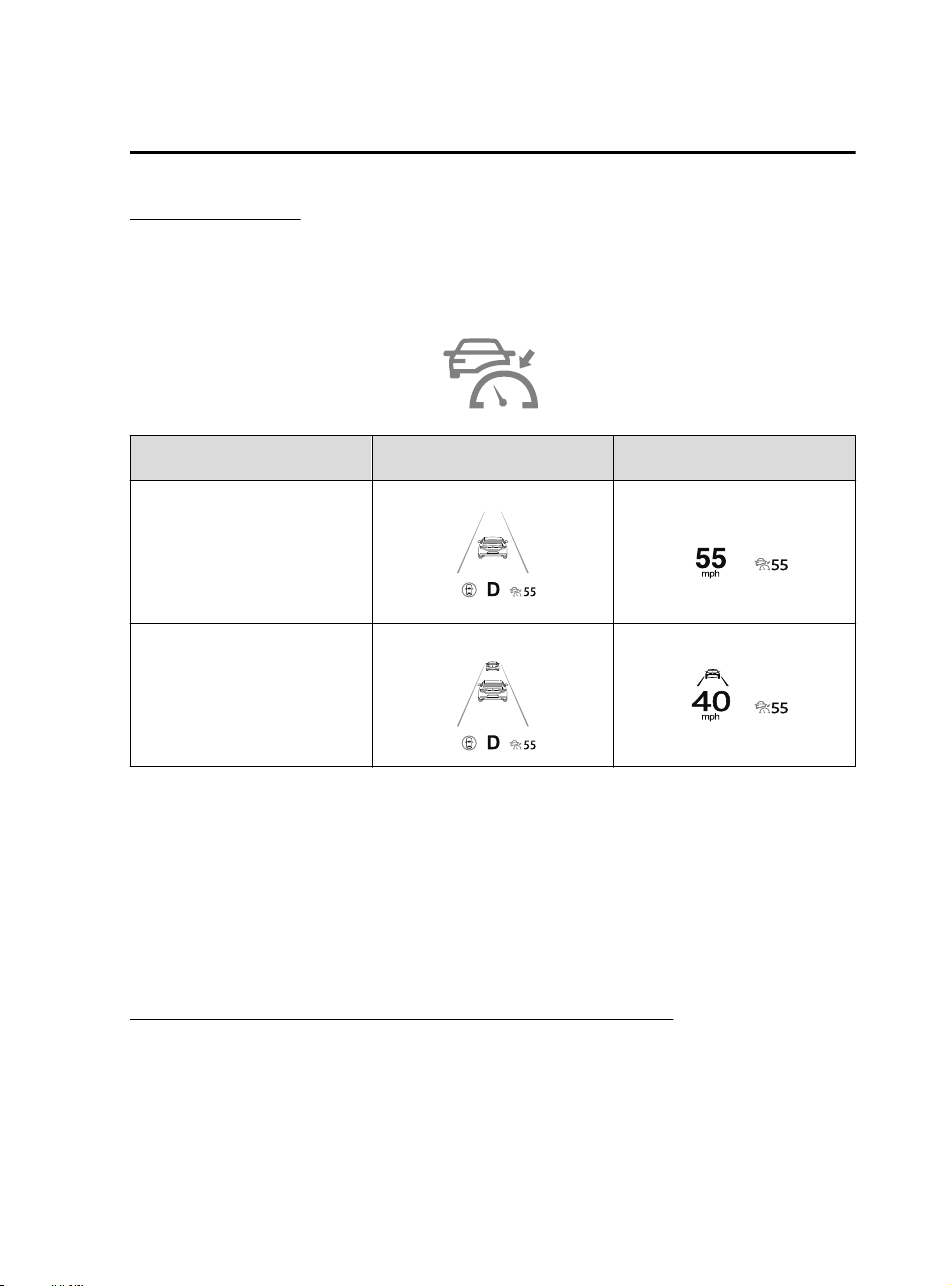
How to set the speed
Adjust the vehicle speed to the desired setting using the accelerator pedal and press the RES
switch up (SET+) or down (SET-) to start headway control.
The set speed is indicated on the display. At the same time, the MRCC standby indication
(white) changes to the MRCC set indication (green).
Travel status
Indication on multi-information
display
Indication on active driving dis‐
play
During travel at constant speed
During travel under headway con‐
trol
NOTE
If a vehicle ahead is detected while traveling at a constant speed, the vehicle-ahead
indication is displayed and headway control is performed. Additionally, when a vehicle
ahead is no longer detected, the vehicle-ahead indication turns off and the system
switches back to travel at constant speed.
The lowest possible speed which can be set on the MRCC system is 30 km/h (19 mph).
Headway control is not possible if the vehicle ahead is driving faster than your vehicle's
set speed. Adjust the system to the desired vehicle speed using the accelerator pedal.
How to set the distance-between-vehicles during headway control
The distance-between-vehicles can be set to 4 levels; Long, medium, short, and extremely
short distance.
The distance-between-vehicles is set to a shorter distance by pressing the CANCEL switch
down. The distance-between-vehicles is set to a longer distance by pressing the CANCEL
switch up.
When Driving
i-ACTIVSENSE
4-123
Mazda3_8HZ1-EA-19G_Edition1_old 2019-5-17 13:49:03
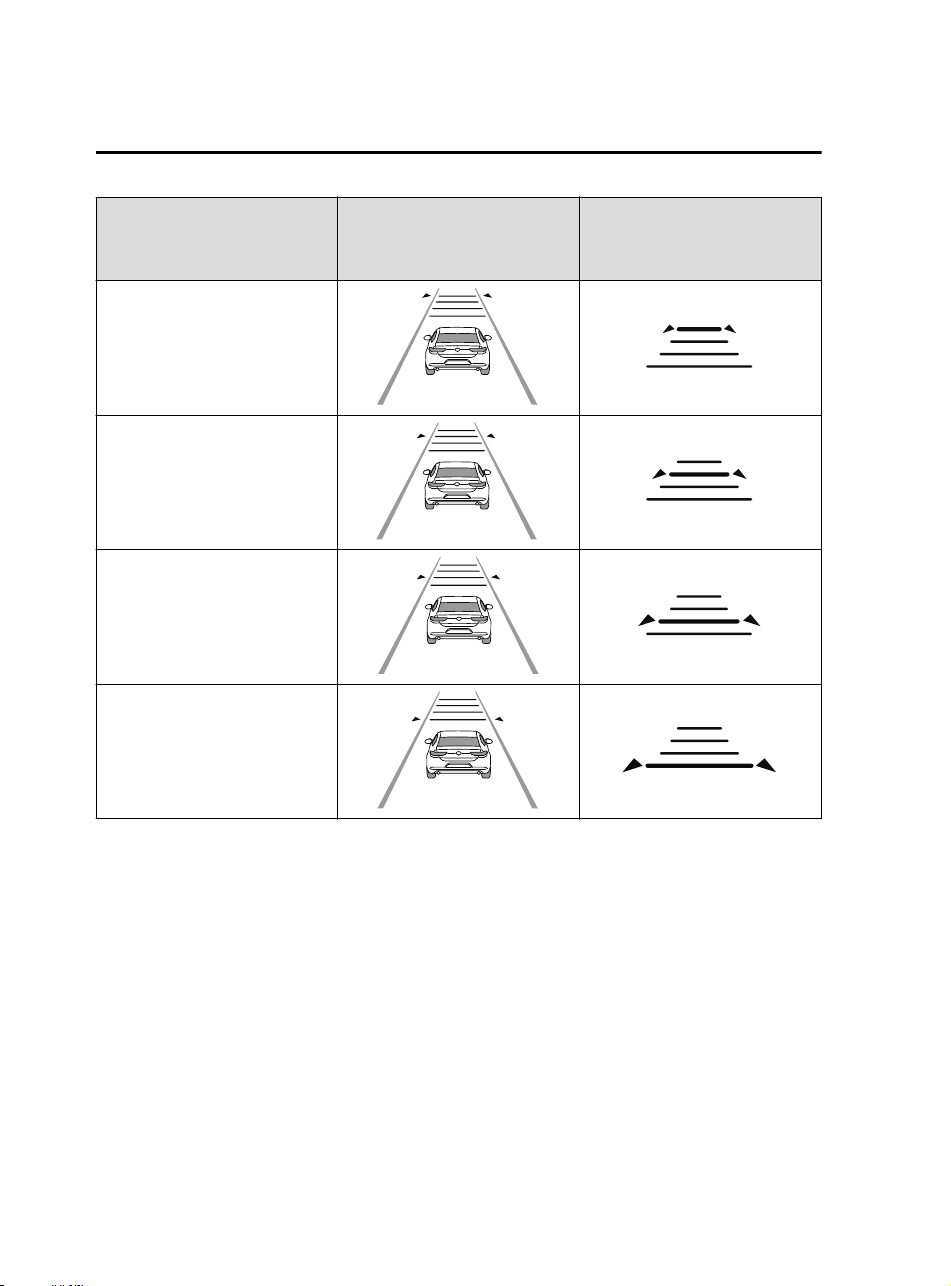
Distance-between-vehicles guide‐
line
(at 80 km/h (50 mph) vehicle
speed)
Indication on multi-information
display
Indication on active driving dis‐
play
*1
Long (about 50 m (164 ft))
Medium (about 40 m (131 ft))
Short (about 30 m (98 ft))
Extremely short (about 25 m (82 ft))
*
1 Displays a pop-up image in the active driving display only when the driver operates the switch.
NOTE
The distance-between-vehicles differs depending on the vehicle speed, and the slower the
vehicle speed, the shorter the distance.
When the ignition is switched to ACC or OFF and then the engine is started again, the
system automatically sets the distance-between-vehicles to the previous setting.
When Driving
i-ACTIVSENSE
4-124
Mazda3_8HZ1-EA-19G_Edition1_old 2019-5-17 13:49:03
Changing the Set Vehicle Speed
(To accelerate/decelerate using the RES
switch)
When the RES switch is pressed up (SET
+), the vehicle accelerates and when the
RES switch is pressed down (SET-), it
decelerates.
Press and release immediately: 1 km/h
(1 mph)
Press and hold: 10 km/h (5 mph)
(To increase speed using accelerator
pedal)
Depress the accelerator pedal and press the
RES switch up (SET+) or down (SET-) at
the desired speed. If the switch is not
operated, the system returns to the set
speed after you release your foot from the
accelerator pedal.
NOTE
The warnings and brake control do not
operate while the accelerator pedal is
depressed.
Canceling the system
When the following operations are
performed, the MRCC system is canceled,
and the MRCC set indication (green)
switches to the MRCC standby indication
(white) at the same time.
The CANCEL switch is pressed.
The brake pedal is depressed.
The shift lever is in the reverse (R)
position.
Under the following conditions, the
MRCC cancel indication is displayed in
the multi-information display and a single
beep sound is heard.
The DSC has operated.
The Smart Brake Support (SBS) has
operated.
When traveling on a downslope for a
long period of time.
There is a problem with the system.
The vehicle speed decreases to less than
25 km (16 mph).
The shift lever is shifted to neutral (N)
for a certain period of time.
The clutch is depressed for a certain
period of time.
The engine stalls.
The front radar sensor cannot detect
target objects (during rain, fog, snow or
other inclement weather conditions, or
when the radiator grille is dirty).
The parking brake is applied.
Any of the doors is opened.
The driver's seat belt is unfastened.
The operation frequency of the braking
by the MRCC control is high.
Resuming control
If the MRCC system is canceled, you can
resume control at the previously set speed
by pressing the RES switch and after all of
the operation conditions have been met.
NOTE
If the set speed is not indicated in the
display, the control does not resume even
if the RES switch is pressed.
Turning off the system
When the MRCC switch is pressed while
the MRCC is operating, the MRCC turns
off.
When Driving
i-ACTIVSENSE
4-125
Mazda3_8HZ1-EA-19G_Edition1_old 2019-5-17 13:49:03
▼
Shift-up/Shift-down Request Display
The shift-up or shift-down request display
might be displayed while the MRCC is
operating. When this occurs, shift gears
because the gear position is not
appropriate.
Request Indication on display
Shift up Shift Up to a Higher Gear
Shift down Shift Down to a Lower Gear
NOTE
If the gears are not shifted up even
though the shift-up request indication is
displayed, load will be applied to the
engine and the MRCC might be
automatically canceled or engine
damage could occur.
If the gears are not shifted down even
though the shift-down request indication
is displayed, the MRCC might be
automatically canceled or engine
stalling could occur.
Mazda Radar Cruise
Control with Stop & Go
function (MRCC with Stop
& Go function) (Automatic
Transmission)
*
▼
Mazda Radar Cruise Control with
Stop & Go function (MRCC with
Stop & Go function)
The MRCC with Stop & Go function
system is designed to maintain headway
control
*1
with a vehicle ahead according
to your vehicle's speed using a front radar
sensor to detect the distance to the vehicle
ahead and a preset vehicle speed without
you having to use the accelerator or brake
pedals.
*
1 Headway Control: Control of the
distance between your vehicle and the
vehicle ahead detected by the Mazda
Radar Cruise Control (MRCC)
system.
Additionally, if your vehicle starts closing
in on the vehicle ahead such as if the
vehicle ahead brakes suddenly, a warning
sound and a warning indication in the
display are activated simultaneously to
alert you to maintain a sufficient distance
between the vehicles.
If the vehicle ahead stops while you are
following behind it, your vehicle will stop
and be held stopped automatically (stop
hold control), and headway control will
resume when you resume driving the
vehicle such as by pressing the RES
switch.
Also refer to the following before using
the MRCC with Stop & Go function.
When Driving
i-ACTIVSENSE
4-126
*Some models.
Mazda3_8HZ1-EA-19G_Edition1_old 2019-5-17 13:49:03
AUTOHOLD (page 4-69)
Forward Sensing Camera (FSC) (page
4-200)
Front radar sensor (page 4-204)
WARNING
Do not rely completely on the MRCC with
Stop & Go function:
The MRCC with Stop & Go function system
has detection limitations depending on the
type of vehicle ahead and its conditions,
the weather conditions, and the road
conditions. Additionally, the system may be
unable to decelerate suciently to avoid
hitting the vehicle ahead if the vehicle
ahead applies the brakes suddenly or
another vehicle cuts into the driving lane,
which could result in an accident.
Always drive carefully and verify the
surrounding conditions and depress the
brake pedal or accelerator pedal while
keeping a safe distance from vehicles
ahead or on-coming vehicles.
Do not use the MRCC with Stop & Go
function system in the following locations.
Using the MRCC with Stop & Go function
system at the following locations may
result in an unexpected accident:
General roads other than highways
(Driving under these conditions using the
MRCC with Stop & Go function system is
not possible.)
Roads with sharp curves and where
vehicle trac is heavy with insucient
space between vehicles, or roads where
frequent and repetitive acceleration and
deceleration occur (Driving under these
conditions using the MRCC with Stop &
Go function is not possible).
When entering and exiting interchanges,
service areas, and parking areas of
highways (If you exit a highway while
headway control is in use, the vehicle
ahead will no longer be tracked and your
vehicle may accelerate to the set speed).
Slippery roads such as ice or snow-bound
roads (Tires could spin causing you to
lose vehicle control, or the stop hold
control may not operate.)
Long, descending slopes (to maintain
distance between vehicles, the system
automatically and continuously applies
the brakes which could result in the loss
of brake power.)
Slopes with a steep gradient (The vehicle
ahead may not be detected correctly,
your vehicle may slide while stopped by
the stop hold control, and it may
accelerate suddenly after it starts
moving.)
Two-wheeled vehicles such as
motorcycles or bicycles are ahead.
For safety purposes, switch the MRCC with
Stop & Go function system o when it is not
being used.
Leaving the MRCC with Stop & Go function
system turned on when it is not in use is
dangerous as it could operate
unexpectedly, resulting in an accident.
When Driving
i-ACTIVSENSE
4-127
Mazda3_8HZ1-EA-19G_Edition1_old 2019-5-17 13:49:03
Do not get out of the vehicle while the stop
hold control is operating:
Getting out of the vehicle while the stop
hold control is operating is dangerous as
the vehicle may move unexpectedly and
result in an accident. Before getting out of
the vehicle, switch the MRCC with Stop &
Go function system o, shift the selector
lever to the P position, and apply the
parking brake.
CAUTION
If your vehicle is towed or you are towing
something, switch the MRCC with Stop &
Go function system
o
to prevent an
unexpected operation.
Turn the system o when the vehicle is
running on a chassis roller.
NOTE
The MRCC with Stop & Go function
system does not detect the following as
physical objects.
Vehicles approaching in the opposite
direction
Pedestrians
Stationary objects (stopped vehicles,
obstructions)
If a vehicle ahead is traveling at an
extremely low speed, the system may not
detect it correctly.
If there is a structure on the road or an
object (such as a monorail) at a low
height off the ground in front of the
vehicle, the system may operate.
Therefore, do not use the MRCC with
Stop & Go function.
Do not use the MRCC with Stop & Go
function system under conditions in
which close proximity warnings are
frequently activated.
During headway control travel, the
system accelerates and decelerates your
vehicle in conjunction with the speed of
the vehicle ahead. However, if it is
necessary to accelerate for a lane
change or if the vehicle ahead brakes
suddenly causing you to close in on the
vehicle rapidly, accelerate using the
accelerator pedal or decelerate using
the brake pedal depending on the
conditions.
While the MRCC with Stop & Go
function system is in use, it does not
cancel even if the selector lever is
operated and any intended engine
braking does not occur. If deceleration
is required, lower the set speed or
depress the brake pedal.
While braking by the MRCC with Stop
& Go function control is operating, you
might hear an operation sound,
however, this does not indicate a
problem.
The brake lights turn on while braking
by the MRCC with Stop & Go function
control is operating, however, they may
not turn on while the vehicle is on a
down slope at the set vehicle speed or
traveling at a constant speed and
following a vehicle ahead.
Stop the headway control function to
switch the system to the cruise control
function.
Refer to the Settings section in the
Mazda Connect Owner's Manual.
When Driving
i-ACTIVSENSE
4-128
Mazda3_8HZ1-EA-19G_Edition1_old 2019-5-17 13:49:03
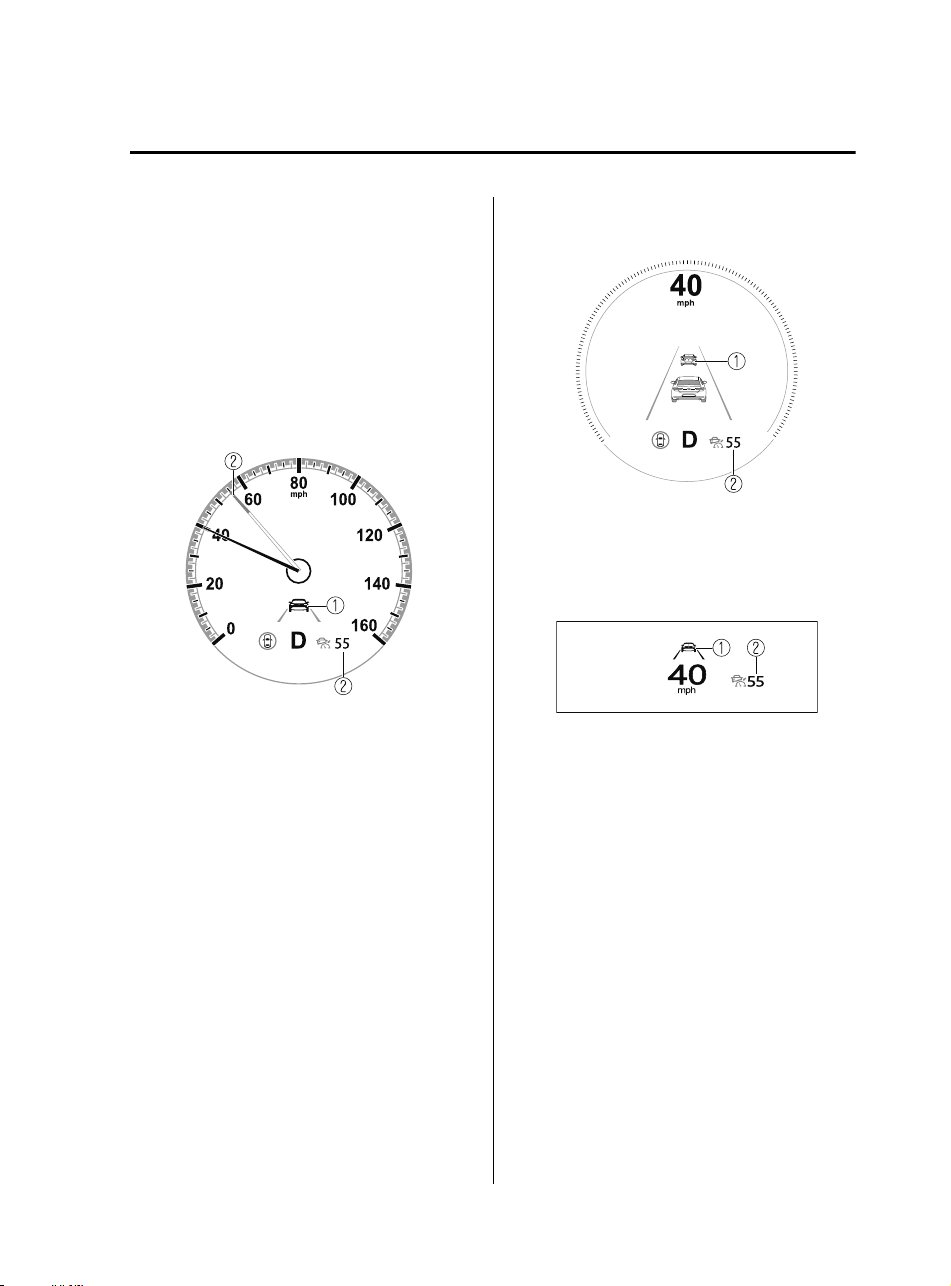
▼
Mazda Radar Cruise Control with
Stop & Go function (MRCC with
Stop & Go function) Display
Indication
The MRCC with Stop & Go function
setting status and operation conditions are
indicated on the multi-information display
and the active driving display.
Multi-information Display (Basic
display)
1. Vehicle ahead display
2. MRCC with Stop & Go function set
vehicle speed
Multi-information Display
(i-ACTIVSENSE display)
1. Vehicle ahead display
2. MRCC with Stop & Go function set
vehicle speed
Active driving display
1. Vehicle ahead display
2. MRCC with Stop & Go function set
vehicle speed
If there is a problem with the MRCC with
Stop & Go function system, a message is
displayed on the multi-information
display. Check the center display to verify
the problem and then have your vehicle
inspected by an Authorized Mazda Dealer.
Refer to If a Warning Light Turns On or
Flashes on page 7-27.
When Driving
i-ACTIVSENSE
4-129
Mazda3_8HZ1-EA-19G_Edition1_old 2019-5-17 13:49:03
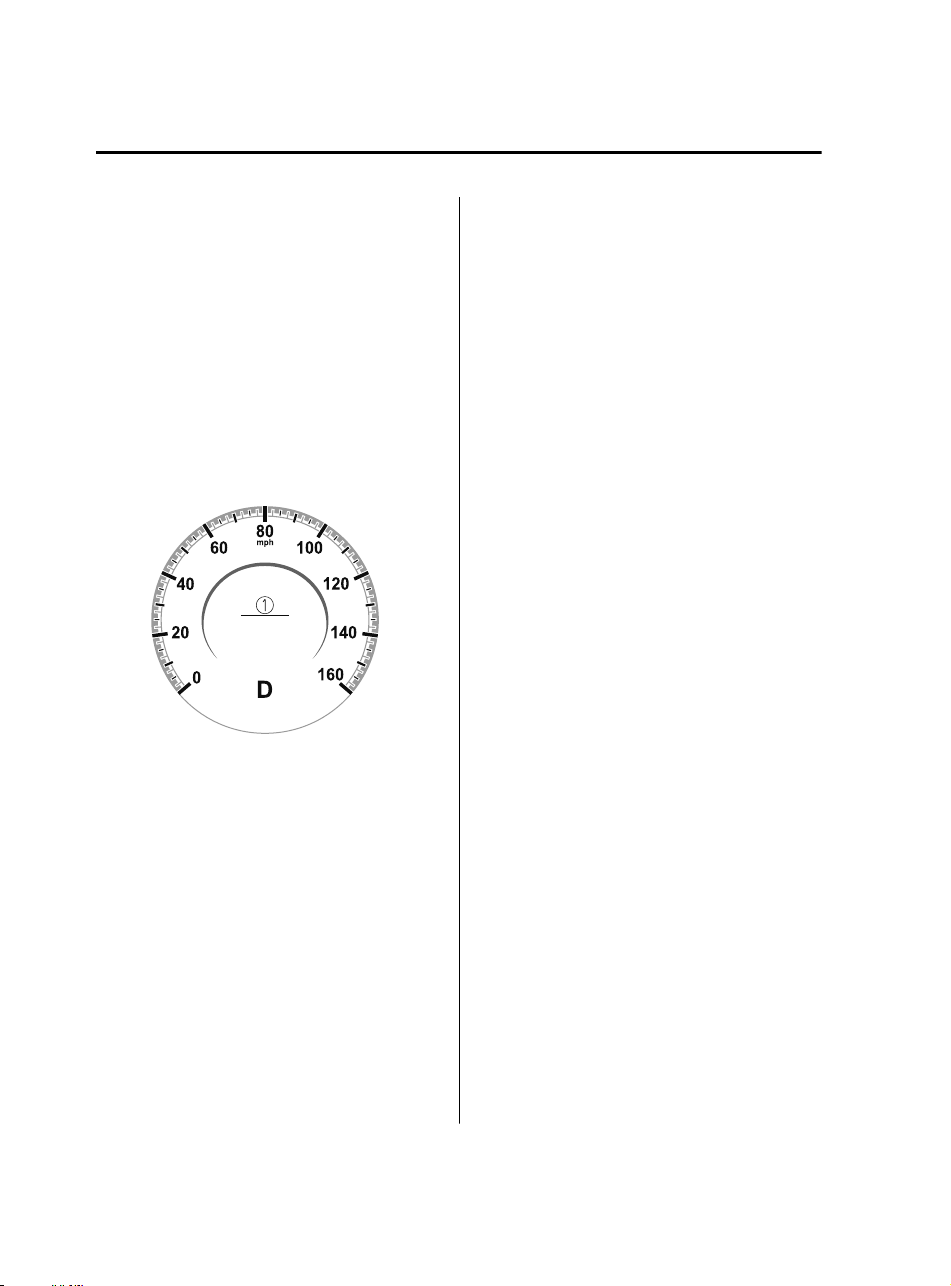
▼
Close Proximity Warning
If your vehicle rapidly closes in on the
vehicle ahead because the vehicle ahead
applies the brakes suddenly while you are
traveling in headway control, the warning
sound activates and the brake warning is
indicated in the display. Always verify the
safety of the surrounding area and depress
the brake pedal while keeping a safe
distance from the vehicle ahead.
Additionally, keep a safe distance from the
vehicles behind you.
1. “Depress Brake Pedal” message is
displayed
NOTE
In the following cases, the warnings and
brakes may not operate even if your
vehicle starts closing in on the vehicle
ahead.
You are driving your vehicle at the same
speed as the vehicle ahead.
Directly after the MRCC with Stop &
Go function system has been set.
Directly after the accelerator pedal is
released.
Another vehicle cuts into the driving
lane.
When Driving
i-ACTIVSENSE
4-130
Mazda3_8HZ1-EA-19G_Edition1_old 2019-5-17 13:49:03
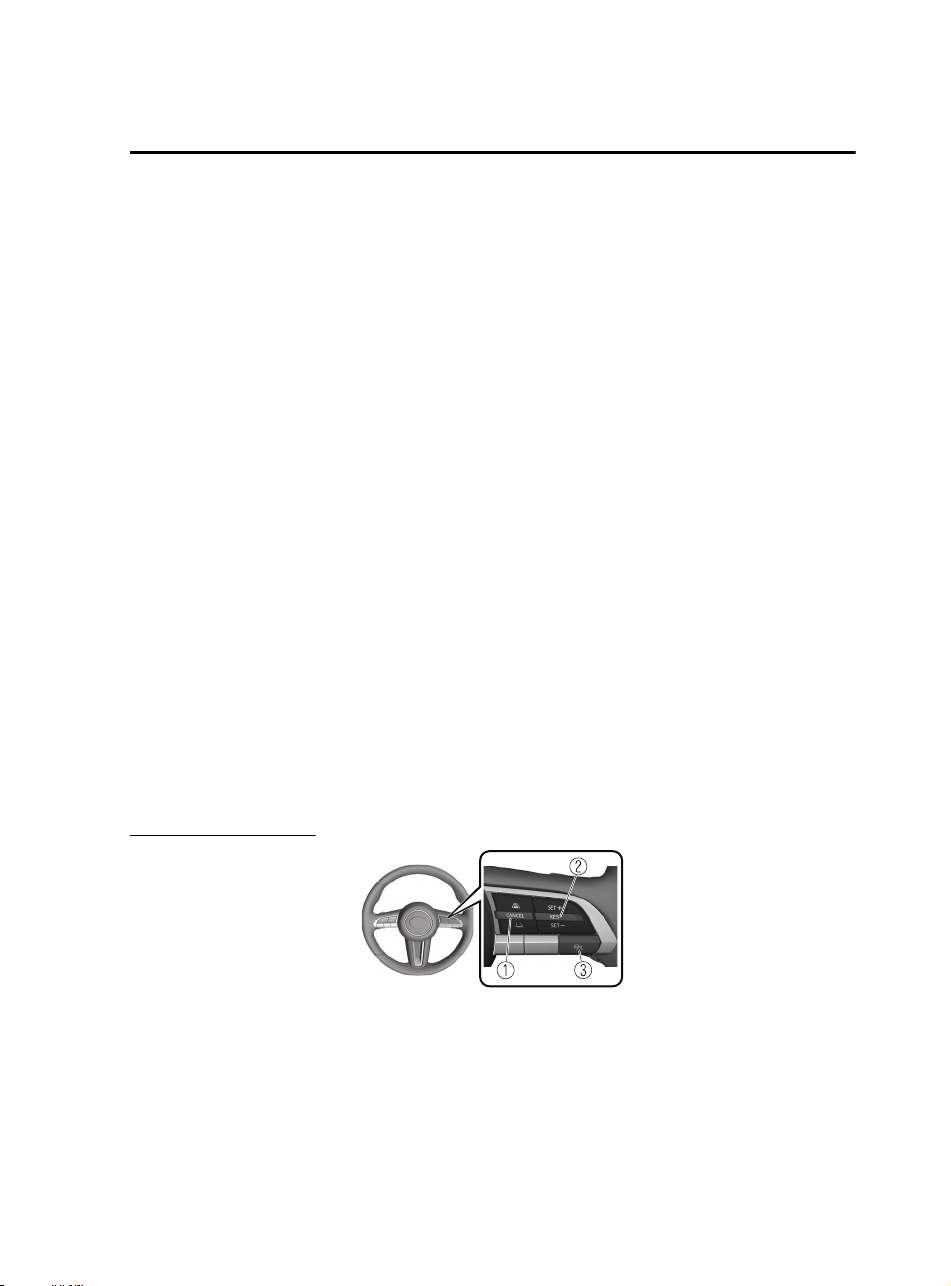
▼
Setting the System
The MRCC with Stop & Go function system operates when all of the following conditions
are met.
Vehicle speed is 0 km/h (0 mph) to 145 km/h (90 mph)
The MRCC with Stop & Go function is turned on.
The brake pedal is not depressed.
The parking brake is released (Electric Parking Brake (EPB) indicator light is turned off).
There is no problem with the DSC.
All the doors are closed.
The driver's seat belt is fastened.
The selector lever is in the drive (D) position or manual (M) position (manual mode).
NOTE
In the following cases, the MRCC with Stop & Go function system is canceled when the
vehicle is traveling at 30 km/h (20 mph) or less and “Mazda Radar Cruise Control
Disabled Under 30 km/h (20mph)” is displayed in the multi-information display.
The Forward Sensing Camera (FSC) cannot detect target objects (There is problem
with the Forward Sensing Camera (FSC) or windshield is dirty).
There is a problem with the stop hold control function.
There is a problem with the Electric Parking Brake (EPB).
When the MRCC with Stop & Go function system is operating, Distance & Speed Alert
(DSA), and Smart Brake Support (SBS) also turns on automatically.
It may not be possible to set the MRCC with Stop & Go function system directly after
starting the engine, while the DSC operation is being checked.
Turning on the system
1. CANCEL switch
2. RES switch
3. MRCC switch
When Driving
i-ACTIVSENSE
4-131
Mazda3_8HZ1-EA-19G_Edition1_old 2019-5-17 13:49:03
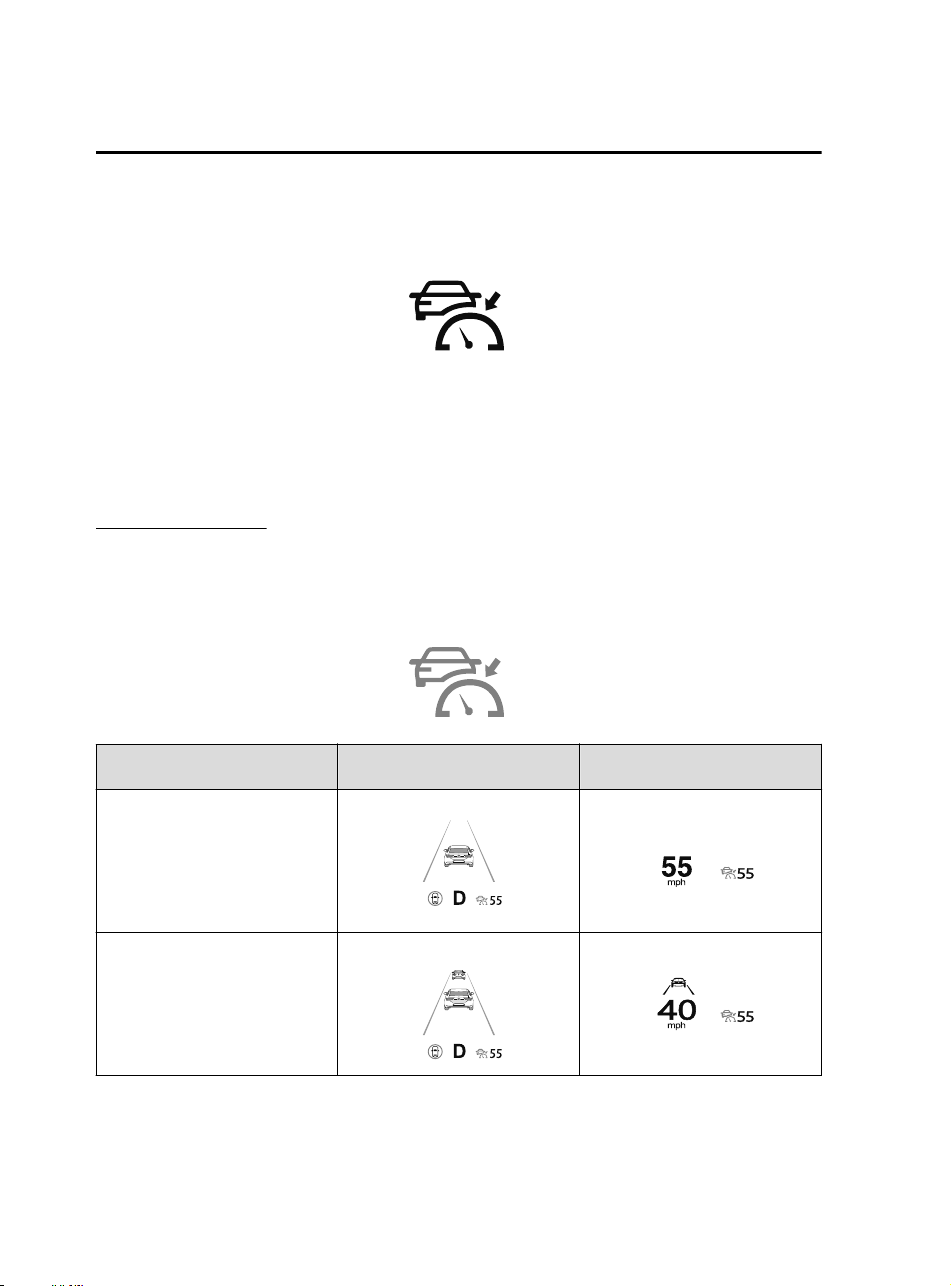
When the MRCC switch is pressed once, the MRCC with Stop & Go function system turns
on, and the MRCC with Stop & Go function standby indication (white) turns on and the
vehicle speed and the distance between the vehicles while in headway control can be set.
In addition, the MRCC with Stop & Go function system display indication is displayed on
the multi-information display and the active driving display at the same time.
NOTE
If the ignition is switched off while the MRCC with Stop & Go function system is operating,
the system will be operable when the ignition is switched ON the next time.
How to set the speed
Adjust the vehicle speed to the desired setting using the accelerator pedal and press the RES
switch up (SET+) or down (SET-) to start headway control.
The set speed is indicated on the display. At the same time, the MRCC standby indication
(white) changes to the MRCC set indication (green).
Travel status
Indication on multi-information
display
Indication on active driving dis‐
play
During travel at constant speed
During travel under headway con‐
trol
When Driving
i-ACTIVSENSE
4-132
Mazda3_8HZ1-EA-19G_Edition1_old 2019-5-17 13:49:03
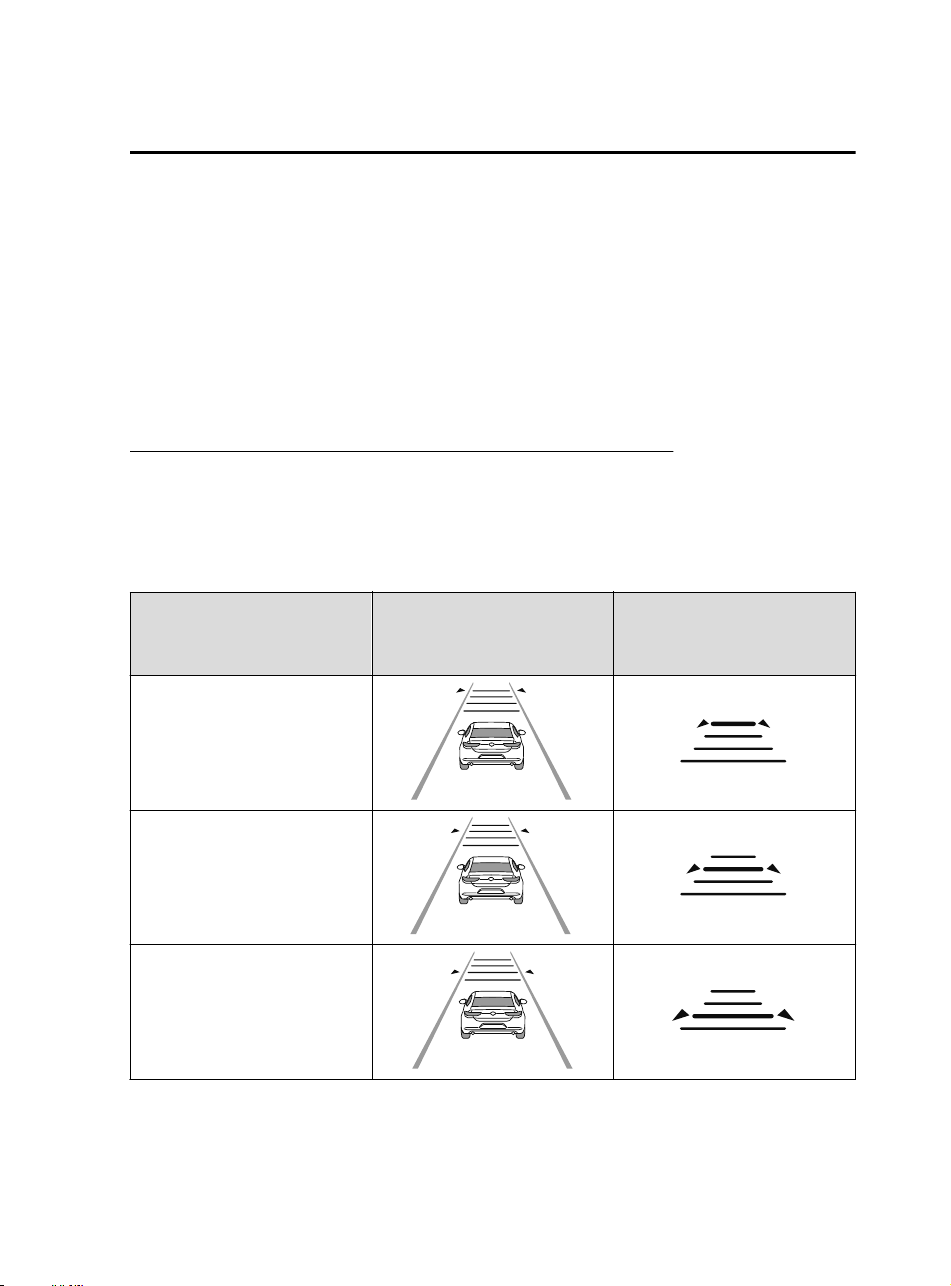
NOTE
If a vehicle ahead is detected while traveling at a constant speed, the vehicle-ahead
indication is displayed and headway control is performed. Additionally, when a vehicle
ahead is no longer detected, the vehicle-ahead indication turns off and the system
switches back to travel at constant speed.
The lowest possible speed which can be set on the MRCC with Stop & Go function system
is 30 km/h (19 mph).
Headway control is not possible if the vehicle ahead is driving faster than your vehicle's
set speed. Adjust the system to the desired vehicle speed using the accelerator pedal.
How to set the distance-between-vehicles during headway control
The distance-between-vehicles can be set to 4 levels; Long, medium, short, and extremely
short distance.
The distance-between-vehicles is set to a shorter distance by pressing the CANCEL switch
down. The distance-between-vehicles is set to a longer distance by pressing the CANCEL
switch up.
Distance-between-vehicles guide‐
line
(at 80 km/h (50 mph) vehicle
speed)
Indication on multi-information
display
Indication on active driving dis‐
play
*1
Long (about 50 m (164 ft))
Medium (about 40 m (131 ft))
Short (about 30 m (98 ft))
When Driving
i-ACTIVSENSE
4-133
Mazda3_8HZ1-EA-19G_Edition1_old 2019-5-17 13:49:03
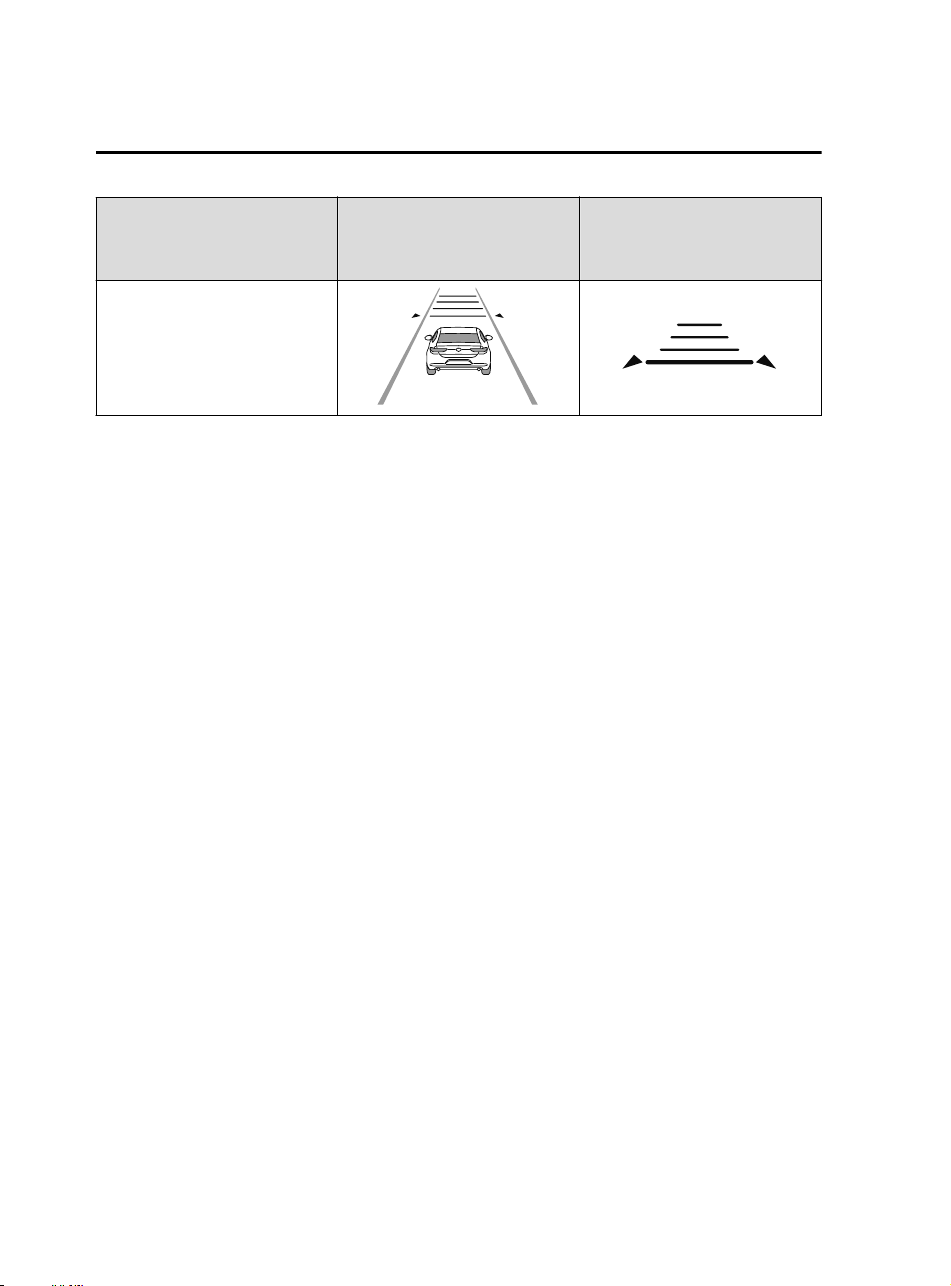
Distance-between-vehicles guide‐
line
(at 80 km/h (50 mph) vehicle
speed)
Indication on multi-information
display
Indication on active driving dis‐
play
*1
Extremely short (about 25 m (82 ft))
*
1 Displays a pop-up image in the active driving display only when the driver operates the switch.
NOTE
The distance-between-vehicles differs depending on the vehicle speed, and the slower the
vehicle speed, the shorter the distance.
When the ignition is switched to ACC or OFF and then the engine is started again, the
system automatically sets the distance-between-vehicles to the previous setting.
When Driving
i-ACTIVSENSE
4-134
Mazda3_8HZ1-EA-19G_Edition1_old 2019-5-17 13:49:03
Changing the Set Vehicle Speed
(To accelerate/decelerate using the RES
switch)
When the RES switch is pressed up (SET
+), the vehicle accelerates and when the
RES switch is pressed down (SET-), it
decelerates.
Press and release immediately: 1 km/h
(1 mph)
Press and hold: 10 km/h (5 mph)
(To increase speed using accelerator
pedal)
Depress the accelerator pedal and press the
RES switch up (SET+) or down (SET-) at
the desired speed. If the switch is not
operated, the system returns to the set
speed after you release your foot from the
accelerator pedal.
NOTE
The warnings and brake control do not
operate while the accelerator pedal is
depressed.
Canceling the system
When the following operations are
performed, the MRCC with Stop & Go
function system is canceled, and the
MRCC with Stop & Go function set
indication (green) switches to the MRCC
with Stop & Go function standby
indication (white) at the same time.
The CANCEL switch is pressed.
The brake pedal is depressed.
The selector lever is in the P (Park), N
(Neutral), or R (Reverse) position.
Under the following conditions, the
MRCC with Stop & Go function cancel
indication is displayed in the
multi-information display and a single
beep sound is heard.
The DSC has operated.
The Smart Brake Support (SBS) has
operated.
When traveling on a downslope for a
long period of time.
There is a problem with the system.
The parking brake is automatically
applied during stop hold control.
The front radar sensor cannot detect
target objects (during rain, fog, snow or
other inclement weather conditions, or
when the radiator grille is dirty).
The parking brake is applied.
Any of the doors is opened.
The driver's seat belt is unfastened.
The operation frequency of the braking
by the MRCC with Stop & Go function
control is high.
Resuming control
If the MRCC with Stop & Go function
system is canceled, you can resume
control at the previously set speed by
pressing the RES switch and after all of
the operation conditions have been met.
NOTE
If the set speed is not indicated in the
display, the control does not resume even
if the RES switch is pressed.
Turning off the system
When the MRCC switch is pressed while
the MRCC is operating, the MRCC turns
off.
When Driving
i-ACTIVSENSE
4-135
Mazda3_8HZ1-EA-19G_Edition1_old 2019-5-17 13:49:03
▼
Stop Hold Control
While in headway control using the
MRCC with Stop & Go function system,
your vehicle will stop when a vehicle
ahead stops. When the vehicle is stopped
and the stop hold control operates, the
MRCC with Stop & Go function indicator
light turns on.
NOTE
If the MRCC with Stop & Go function
system is canceled during stop hold
control, the vehicle is held in its stopped
position.
The parking brake is automatically
applied and the vehicle is held in its
stopped position when 10 minutes have
elapsed since the stop hold control
operated. At this time, the MRCC with
Stop & Go function system is canceled.
The brake lights turn on during stop
hold control.
To resume driving
After the vehicle ahead starts moving
while your vehicle is stopped under stop
hold control, press the RES switch or
depress the accelerator pedal to cancel the
stop hold control and resume driving.
NOTE
When you resume driving by pressing
the RES switch, your vehicle does not
start moving until the distance between
your vehicle and the vehicle ahead
lengthens to the specified distance or
farther.
If the MRCC with Stop & Go function is
temporarily canceled during stop hold
control, you cannot resume driving by
pressing the RES switch when there are
no vehicles in front of your vehicle.
Depress the accelerator pedal and
resume driving the vehicle.
If the vehicle ahead starts moving within
3 seconds after your vehicle is stopped
by the stop hold control, headway
control will resume even if you do not
resume driving your vehicle, such as by
depressing the accelerator pedal.
Resume driving information
If you do not resume driving within a few
seconds after the vehicle ahead starts
moving, the multi-information display
vehicle-ahead indication flashes to urge
the driver to resume driving. If you do not
resume driving after the indicator light
flashes, a sound is activated to urge you to
resume driving.
When Driving
i-ACTIVSENSE
4-136
Mazda3_8HZ1-EA-19G_Edition1_old 2019-5-17 13:49:03
Traffic Jam Assist (TJA)
*
▼
Traffic Jam Assist (TJA)
The TJA is a system which consists of a
headway control function and a steering
assist function for reducing driver fatigue
during traffic jams when driving on
expressways or highways.
This system performs headway control to
maintain a constant distance between your
vehicle and a vehicle ahead at a preset
vehicle speed without you having to use
the accelerator or brake pedal. Even
further, with the steering assist function,
when vehicle lane lines are detected, the
function assists the driver in keeping the
vehicle within the lane lines. If lane lines
are not detected, the function provides the
driver driving assistance in keeping the
vehicle along the motion path with the
vehicle ahead.
WARNING
Do not rely completely on TJA:
The TJA is not an automated driving
system. In addition, the functions have
limitations. Do not rely completely on the
system and always stay on course using
the steering wheel.
Set a vehicle speed within the speed limit
according to the road conditions and the
weather conditions.
The TJA may not be able to detect a
vehicle ahead depending on the type of
vehicle ahead and its conditions, the
weather conditions, and the road
conditions. Additionally, the system
might be unable to decelerate suciently
if a vehicle ahead applies the brakes
suddenly, another vehicle cuts into the
driving lane, or the dierence in vehicle
speed between your vehicle and the
vehicle ahead is larger, which could
result in an accident. Check the
surrounding conditions and always drive
carefully while keeping a safe distance
from vehicles ahead and on-coming
vehicles.
For the purposes of safety, switch the TJA
o when it is not being used.
Leaving the TJA turned on when it is not in
use is dangerous as it could operate
unexpectedly, resulting in an accident.
Do not use the TJA under the following
conditions. Otherwise, it may result in an
accident.
General roads other than expressways or
highways (Driving under these
conditions using the TJA is not possible.)
Roads with sharp curves and where
vehicle trac is heavy with insucient
space between vehicles, or roads where
frequent and repetitive acceleration and
deceleration occur (Driving under these
conditions using the TJA is not possible).
When Driving
i-ACTIVSENSE
*Some models.
4-137
Mazda3_8HZ1-EA-19G_Edition1_old 2019-5-17 13:49:03
When entering and exiting interchanges,
service areas, and parking areas of
expressways (If you exit an expressway
while headway control is in use, the
vehicle ahead will no longer be tracked
and your vehicle may accelerate to the
set speed).
Slippery roads such as icy or
snow-covered roads (Tires could spin
causing you to lose vehicle control, or the
stop hold control may not operate.)
Long, descending slopes (to maintain
distance between vehicles, the system
automatically and continuously applies
the brakes which could result in the loss
of brake power.)
Two-wheeled vehicles such as
motorcycles or bicycles are ahead.
(Automatic transmission vehicle)
Slopes with a steep gradient (The vehicle
ahead may not be detected correctly,
your vehicle may slip while stopped by
the stop hold control, or it may
accelerate suddenly after it starts
moving.)
Driving under bad weather conditions
(rain, fog, and snow).
The vehicle is driven on slippery roads
such as icy or snow -covered roads and
unpaved roads (Tires could spin causing
you to lose vehicle control, or the stop
hold control may not operate.)
Tires of a dierent specied size are used,
such as a temporary spare tire.
Tires with insucient tread are used.
The tire pressures are not adjusted to the
specied pressure.
The vehicle is being used to tow a
camper or boat trailer.
Tire chains are used.
The vehicle is driven on roads with lane
lines other than white (yellow) lines, such
as an expressway.
Do not get out of the vehicle while the stop
hold control is operating.
(Automatic transmission vehicle)
Getting out of the vehicle while the stop
hold control is operating is dangerous as
the vehicle may move unexpectedly and
result in an accident. Before getting out of
the vehicle, switch the TJA o, apply the
parking brake, and then shift the selector
lever to the P position.
CAUTION
Turn the system o when the vehicle is
running on a chassis roller.
Heed the following cautions so that the TJA
can operate normally.
Turn the system o when the vehicle is
running on a chassis roller.
Do not modify the vehicle's suspensions.
Always use wheels of the specied size
for the front and rear wheels. Consult an
Authorized Mazda Dealer for tire
replacement.
NOTE
The headway control does not detect the
following as physical objects.
Vehicles approaching in the opposite
direction
Pedestrians
When Driving
i-ACTIVSENSE
4-138
Mazda3_8HZ1-EA-19G_Edition1_old 2019-5-17 13:49:03

Stationary objects (stopped vehicles,
obstructions)
If a vehicle ahead is traveling at an
extremely low speed, the system may not
detect it correctly.
If there is a structure on the road or an
object (such as a monorail) at a low
height off the ground in front of the
vehicle, the system may operate.
Therefore, do not use the TJA.
Do not use the TJA under conditions in
which close proximity warnings are
frequently activated.
If it is necessary to accelerate for a lane
change or the vehicle ahead brakes
suddenly causing you to close in on the
vehicle rapidly, accelerate using the
accelerator pedal or decelerate using
the brake pedal depending on the
conditions.
While the TJA is in use, any intended
engine braking does not occur even if
you shift the shift lever (manual
transmission) or the selector lever
(automatic transmission). If
deceleration is required, lower the
vehicle speed setting or depress the
brake pedal.
While braking by the TJA control is
operating, you might hear an operation
sound, however, this does not indicate a
problem.
The brake lights turn on while braking
by the TJA control is operating,
however, they may not turn on while the
vehicle is on a down slope at the set
vehicle speed or traveling at a constant
speed and following a vehicle ahead.
Under the following conditions, the TJA
may not be able to detect white (yellow)
lines or vehicles ahead correctly and the
TJA may not operate normally.
The forward sensing camera (FSC)
cannot recognize the area in front of
the vehicle due to soiling or fog.
The white (yellow) lane lines are less
visible because of dirt or paint
flaking.
White (yellow) lane lines or vehicles
ahead are less visible because of bad
weather (rain, fog, or snow).
The vehicle is driven on a temporary
lane or section with a closed lane
resulting from construction where
there might be multiple white (yellow)
lane lines, or they are interrupted.
The camera picks up an obscure line,
such as a temporary line being used
for construction, or because of shade,
unmelted snow, or grooves filled with
water.
The road surface is wet and shiny
after rain, or there are puddles on the
road.
Heavy luggage is loaded in the trunk/
luggage compartment or on the rear
seat causing the vehicle to tilt.
A vehicle in front of your vehicle is
running near a white (yellow) lane
line making it less visible.
The windshield is dirty or foggy.
The vehicle is driven through an
intersection, a junction, or a fork in
the road.
While white (yellow) lane lines cannot
be detected due to road or weather
conditions.
The surrounding brightness suddenly
changes such as when entering or
exiting a tunnel.
The illumination of the headlights is
weakened because of dirt or the
optical axis is deviated at night.
When Driving
i-ACTIVSENSE
4-139
Mazda3_8HZ1-EA-19G_Edition1_old 2019-5-17 13:49:03
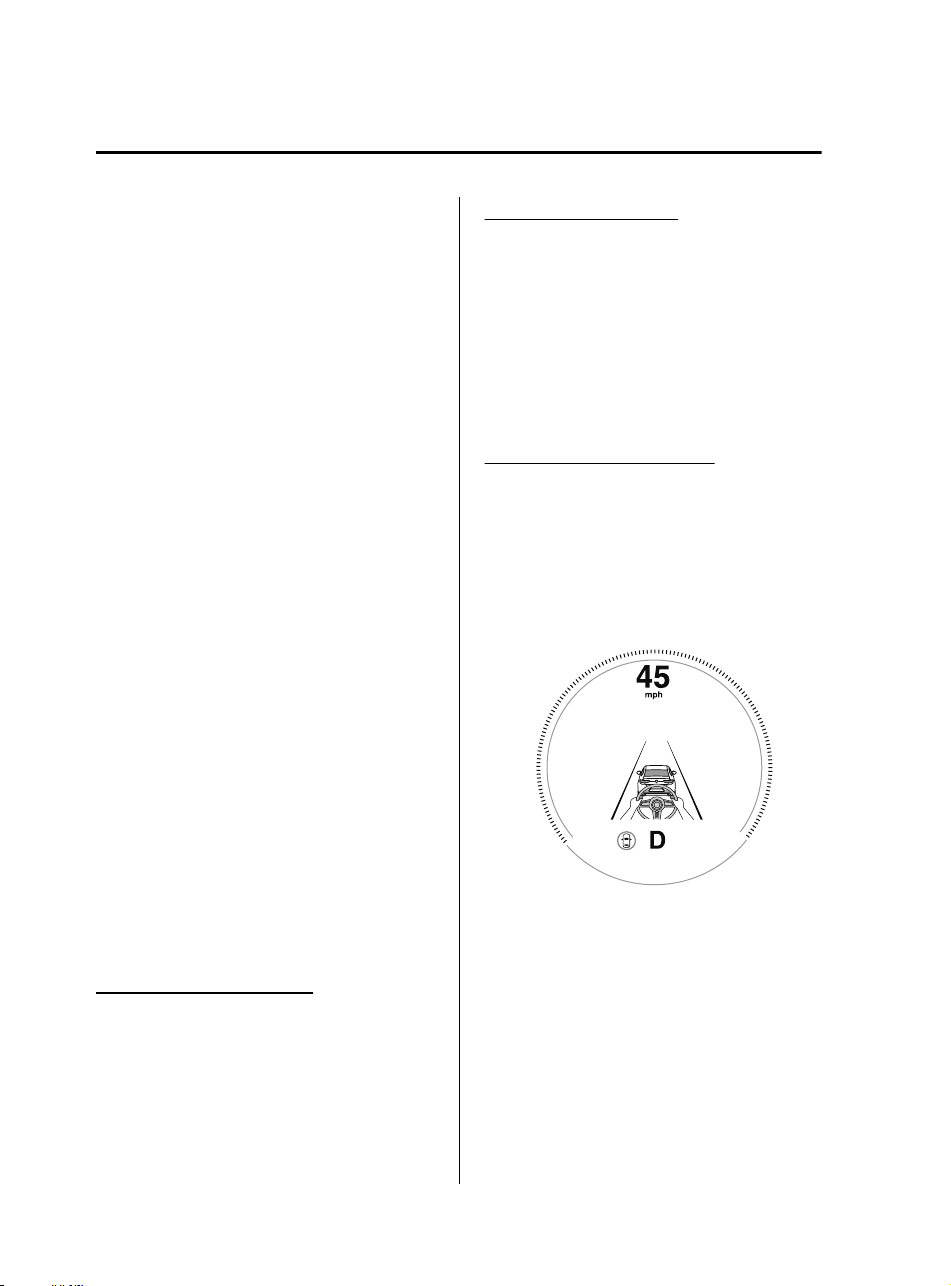
Back-light is reflected off the road
surface or the road surface is wet and
shiny after rain.
The shade of a guardrail parallel to a
white (yellow) lane line is cast on the
road.
The width of a lane is excessively
narrow or wide.
The road is excessively uneven.
The vehicle is shaken after hitting a
road bump.
There are various road markings or
division lines (lane markings) of
various shapes near an intersection.
The area in front of the camera is
soiled or an object that obstructs the
field of view is installed.
Exhaust gas from the vehicle in front,
sand, snow, and water vapor rising
from manholes and grating, and water
splashed into the air.
The surroundings are dark such as
during the early evening or early
morning.
A vehicle ahead with a certain
taillight shape.
A vehicle ahead veers off course from
your vehicle's line of travel.
A vehicle ahead is driving erratically.
The vehicle is driven on roads with
tight curves.
Headway control function
If a vehicle ahead is detected while
traveling at a constant speed, the
vehicle-ahead indication is displayed and
headway control is performed.
Steering assist function
When lane lines are detected, the function
assists the driver in keeping the vehicle
within the lane lines. If lane lines are not
detected, the function provides the driver
driving assistance in keeping the vehicle
along the motion path with the vehicle
ahead.
NOTE
Steering assist limit warning
If the steering assist function cannot keep
the vehicle within the lane lines while the
steering assist function is operating, a
warning sound is activated and a warning
is displayed on the multi-information
display to urge the driver to operate the
steering wheel.
When Driving
i-ACTIVSENSE
4-140
Mazda3_8HZ1-EA-19G_Edition1_old 2019-5-17 13:49:03
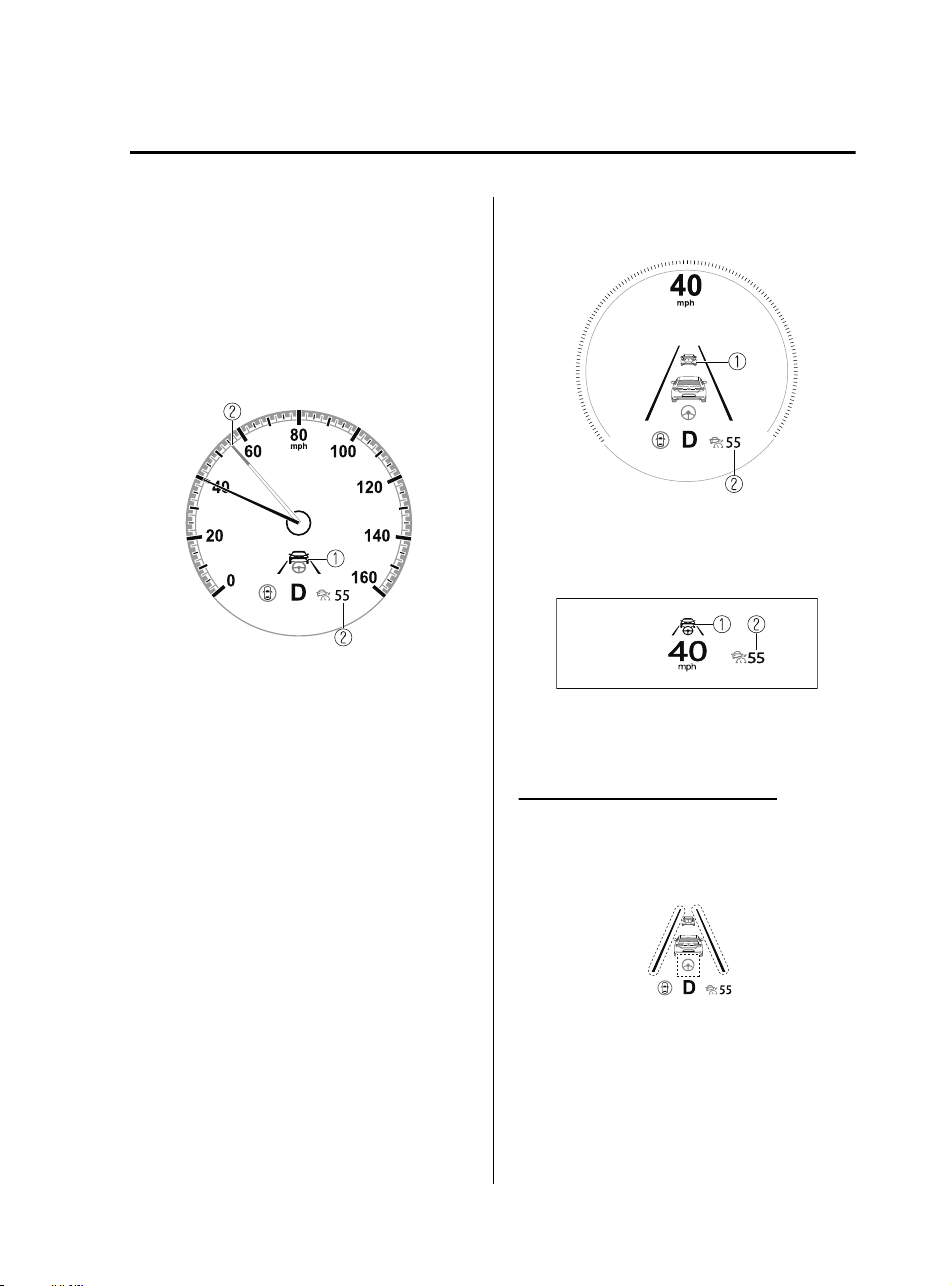
▼
Traffic Jam Assist (TJA) Display
Indication
The TJA setting status and operation
conditions are indicated on the
multi-information display or the active
driving display.
Multi-information display (Basic
display)
1. Vehicle ahead display
2. TJA set vehicle speed
Multi-information display
(i-ACTIVSENSE display)
1. Vehicle ahead display
2. TJA set vehicle speed
Active driving display
1. Vehicle ahead display
2. TJA set vehicle speed
Steering assist function display
When the steering assist function operates,
the steering assist operation display on the
display changes from white to green.
NOTE
You can view the multi-information display
to check whether the steering assist is
performing controls in conjunction with
the traffic lane lines or a vehicle ahead.
When Driving
i-ACTIVSENSE
4-141
Mazda3_8HZ1-EA-19G_Edition1_old 2019-5-17 13:49:03
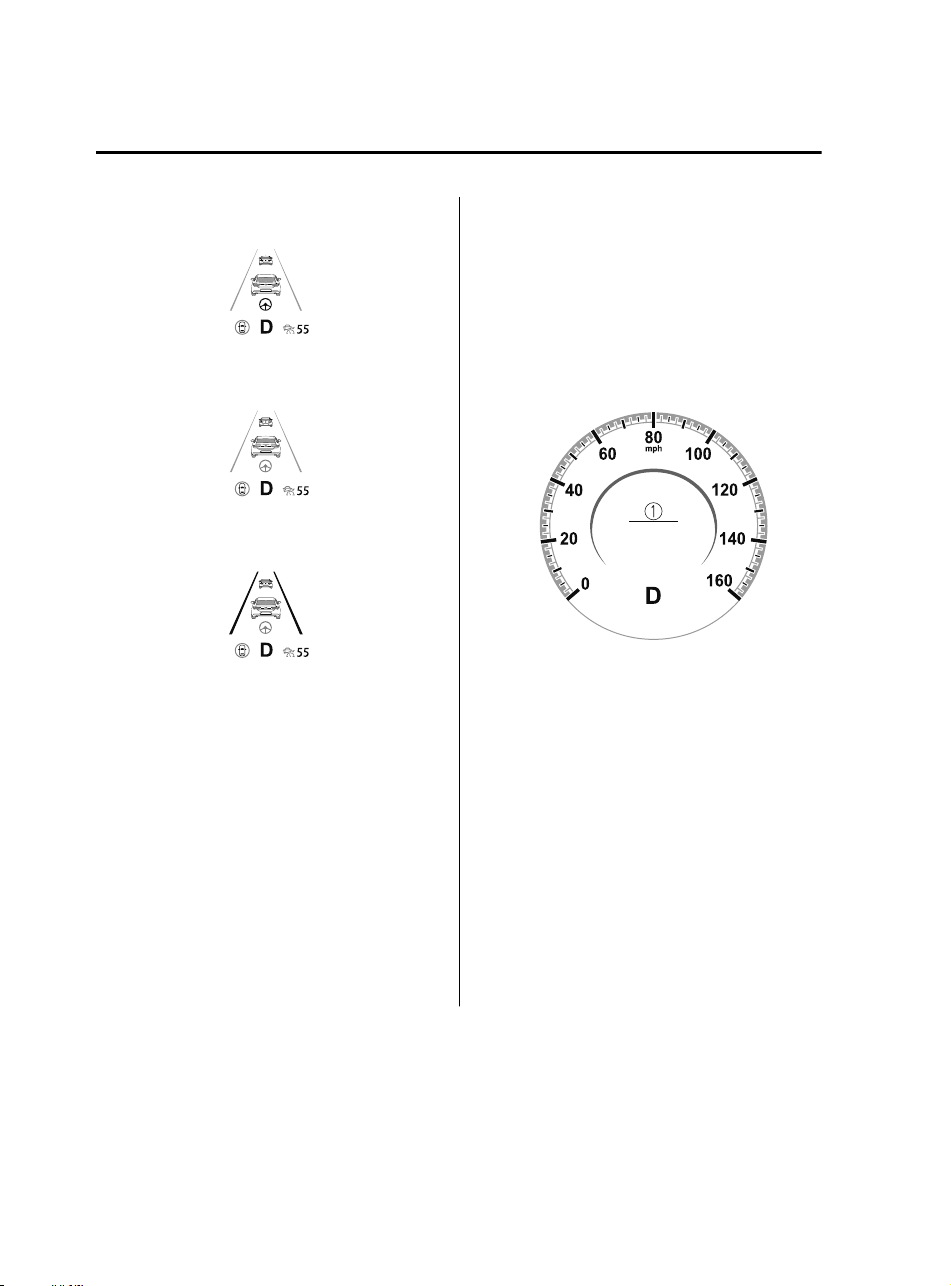
Inactive
Active (vehicle ahead)
Active (lane line)
If there is a problem with the TJA, a
message is displayed on the
multi-information display. Check the
details of the problem on the center
display and then have your vehicle
inspected by an Authorized Mazda Dealer.
Refer to If a Warning Light Turns On or
Flashes on page 7-27.
▼
Close Proximity Warning
If your vehicle rapidly closes in on the
vehicle ahead while you are traveling
under headway control, the warning sound
is activated and the brake warning is
indicated on the display. Keep a safe
distance between your vehicle and a
vehicle ahead.
1. “Depress Brake Pedal” message is
displayed
NOTE
In the following cases, the warnings and
brakes may not operate even if your
vehicle starts closing in on the vehicle
ahead.
You are driving your vehicle at the same
speed as the vehicle ahead.
Directly after the TJA operates.
Directly after the accelerator pedal is
released.
Another vehicle cuts into the driving
lane.
When Driving
i-ACTIVSENSE
4-142
Mazda3_8HZ1-EA-19G_Edition1_old 2019-5-17 13:49:03

▼
Setting the System
Operation conditions
Headway control function
The TJA operates when all of the following conditions are met.
(Automatic transmission vehicle)
The vehicle speed is about 0 km/h (0 mph) to 145 km/h (90 mph).
The selector lever is in the D or M position (manual mode).
(Manual transmission vehicle)
The vehicle speed is about 30 km/h (19 mph) to 145 km/h (90 mph).
The shift lever is in a position other than the R or N position.
The clutch pedal is not depressed.
The TJA is operating.
The headway control function of the Mazda Radar Cruise Control (MRCC) or Mazda
Radar Cruise Control with Stop & Go function (MRCC with Stop & Go function) is set to
operable (if it was set to inoperable, set it to operable using the personalization function).
The brake pedal is not depressed.
The parking brake is released (Electric Parking Brake (EPB) indicator light is turned off).
There is no problem with the DSC.
All the doors are closed.
The driver's seat belt is fastened.
NOTE
(Automatic transmission vehicle)
Under the following conditions, the TJA cannot be used when the vehicle speed is 30 km/h
(19 mph) or slower.
There is a problem with the stop hold control function.
There is a problem with the Electric Parking Brake (EPB).
The TJA may not launch directly after the engine starts.
When Driving
i-ACTIVSENSE
4-143
Mazda3_8HZ1-EA-19G_Edition1_old 2019-5-17 13:49:03
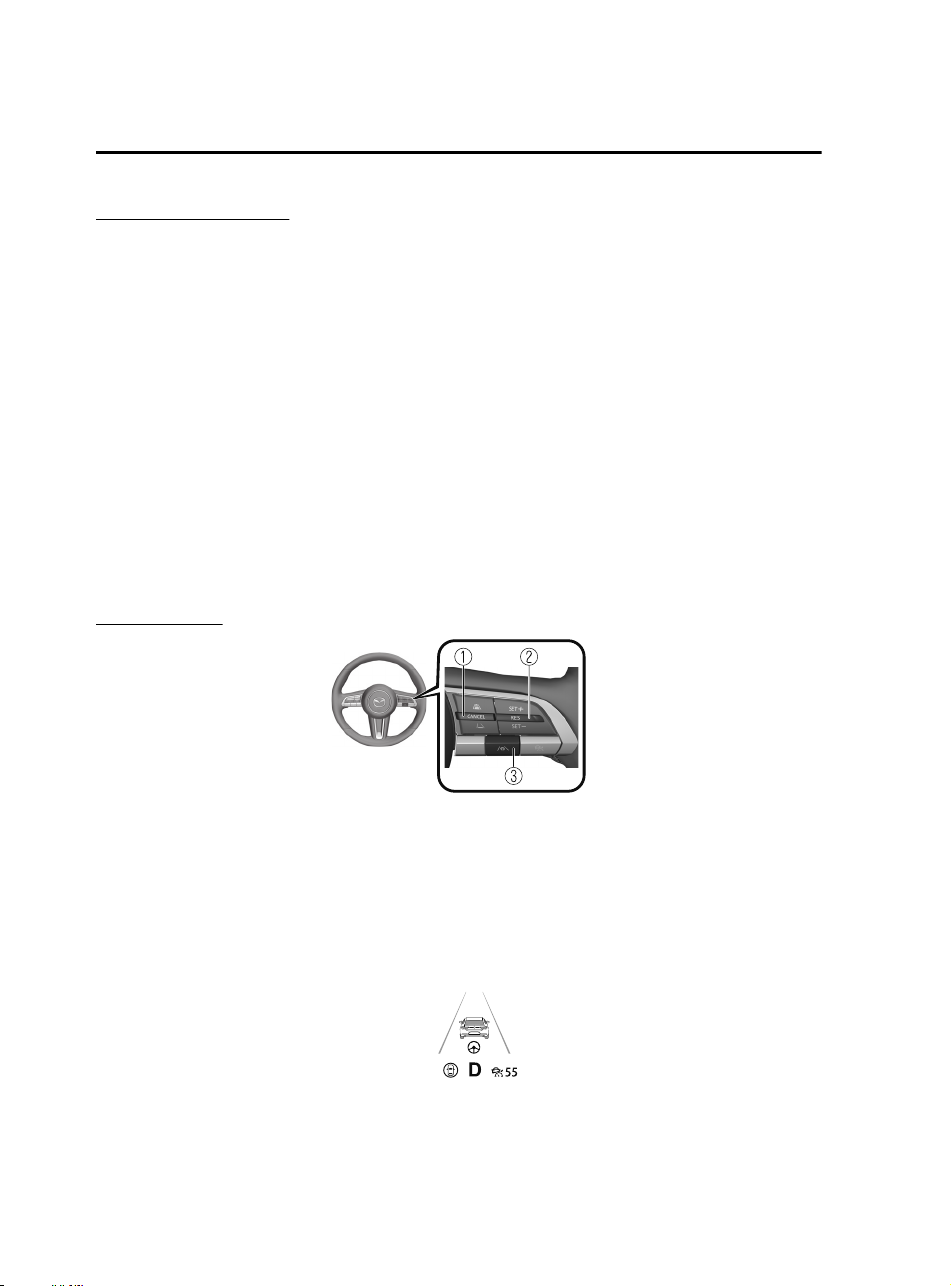
Steering assist function
The steering assist function operates when all of the following conditions are met.
Your vehicle is moving and less than about 56 km/h (35 mph).
White (yellow) lane lines on both sides are detected and you are driving near the center of
the lane, or your vehicle detects a vehicle ahead.
The steering wheel is not turned sharply.
The turn signal lever is not operated.
The headway control function is operating.
(Manual transmission vehicle)
The vehicle speed is about 30 km/h (19 mph) or faster.
NOTE
The steering assist function operates so that the vehicle remains near the center of the
driving lane, however, depending on conditions such as the road curvature, road slope and
undulations, and vehicle speed, the function might not be able to keep the vehicle near the
center of the driving lane.
Setting method
1. CANCEL switch
2. RES switch
3. TJA switch
1. Press the TJA switch.
The TJA standby indication (white) turns on. In addition, the TJA display indication is
displayed on the multi-information display at the same time.
When Driving
i-ACTIVSENSE
4-144
Mazda3_8HZ1-EA-19G_Edition1_old 2019-5-17 13:49:03
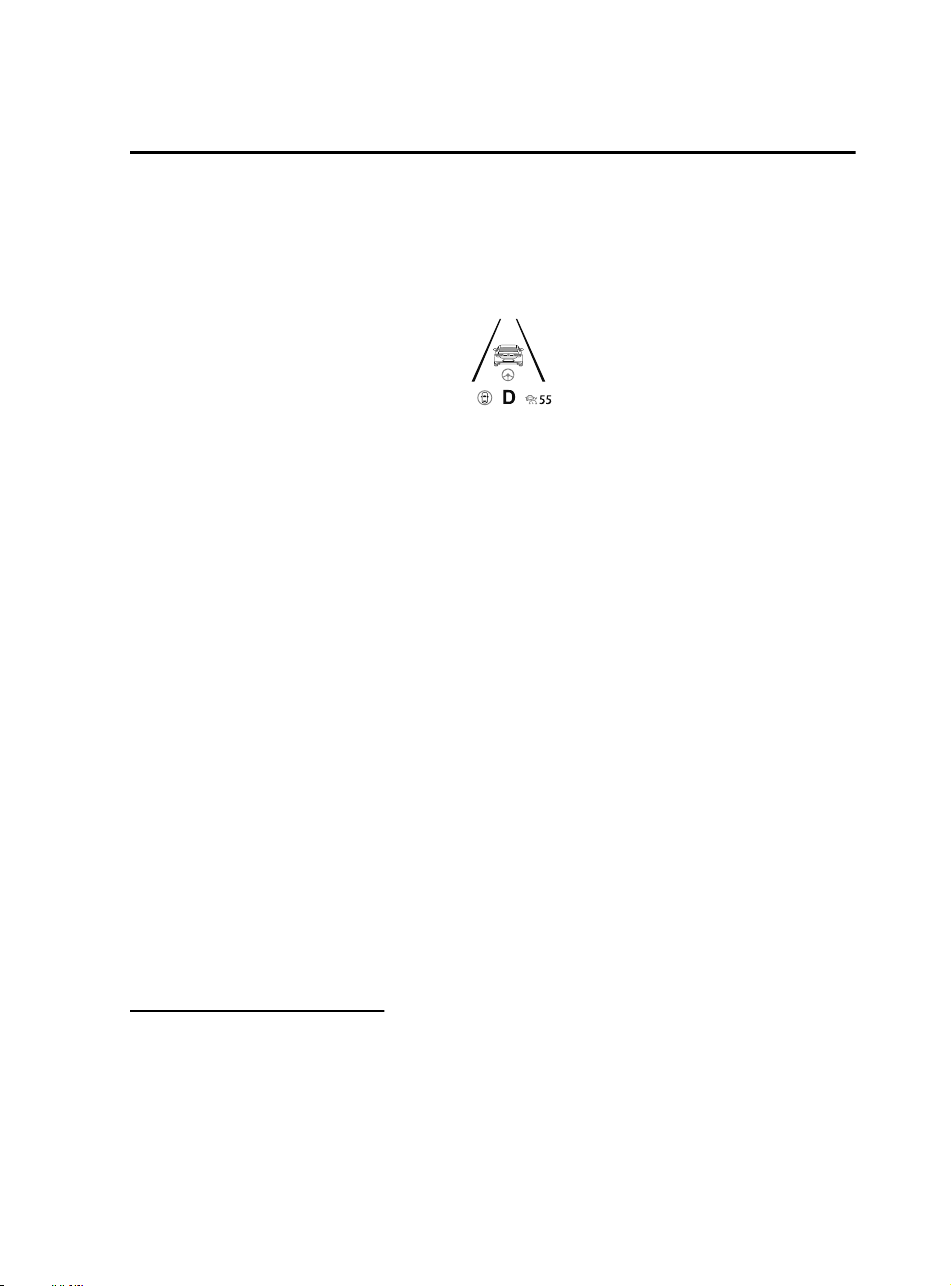
2. Adjust the vehicle speed to the desired setting using the accelerator pedal and press the
RES switch up (SET+) or down (SET-) to start headway control.
The set speed is indicated on the display. At the same time, the TJA standby indication
(white) changes to the TJA set indication (green).
3. The headway control is operable when all of the conditions for it to operate are met, or
the steering assist function is operable when all of the conditions for it to operate are
met.
NOTE
If a vehicle ahead is detected while traveling at a constant speed, the vehicle-ahead
indication is displayed and headway control is performed. Additionally, when a vehicle
ahead is no longer detected, the vehicle-ahead indication turns off and the system
switches back to travel at constant speed.
Headway control is not possible if the vehicle ahead is driving faster than your vehicle's
set speed. Adjust the system to the desired vehicle speed using the accelerator pedal.
When the ignition is switched OFF, the system status before it was turned off is
maintained. For example, if the ignition is switched OFF with the TJA operable, the TJA
remains operational the next time the ignition is switched ON.
When the TJA is operating, the Lane-keep Assist System (LAS), Distance & Speed Alert
(DSA), and Smart Brake Support (SBS) also turns on automatically.
When the TJA switch is pressed while the Mazda Radar Cruise Control (MRCC) or the
Mazda Radar Cruise Control with Stop & Go function (MRCC with Stop & Go function)
system is operating, the TJA operates. In addition, when the MRCC switch is pressed
while the TJA is operating, the Mazda Radar Cruise Control (MRCC) or the Mazda
Radar Cruise Control with Stop & Go function (MRCC with Stop & Go function) system
operates.
Changing the set vehicle speed
(To accelerate/decelerate using the RES switch)
When the RES switch is pressed up (SET+), the vehicle accelerates and when the RES
switch is pressed down (SET-), it decelerates.
Press and release immediately: 1 km/h (1 mph)
Press and hold: 10 km/h (5 mph)
When Driving
i-ACTIVSENSE
4-145
Mazda3_8HZ1-EA-19G_Edition1_old 2019-5-17 13:49:03
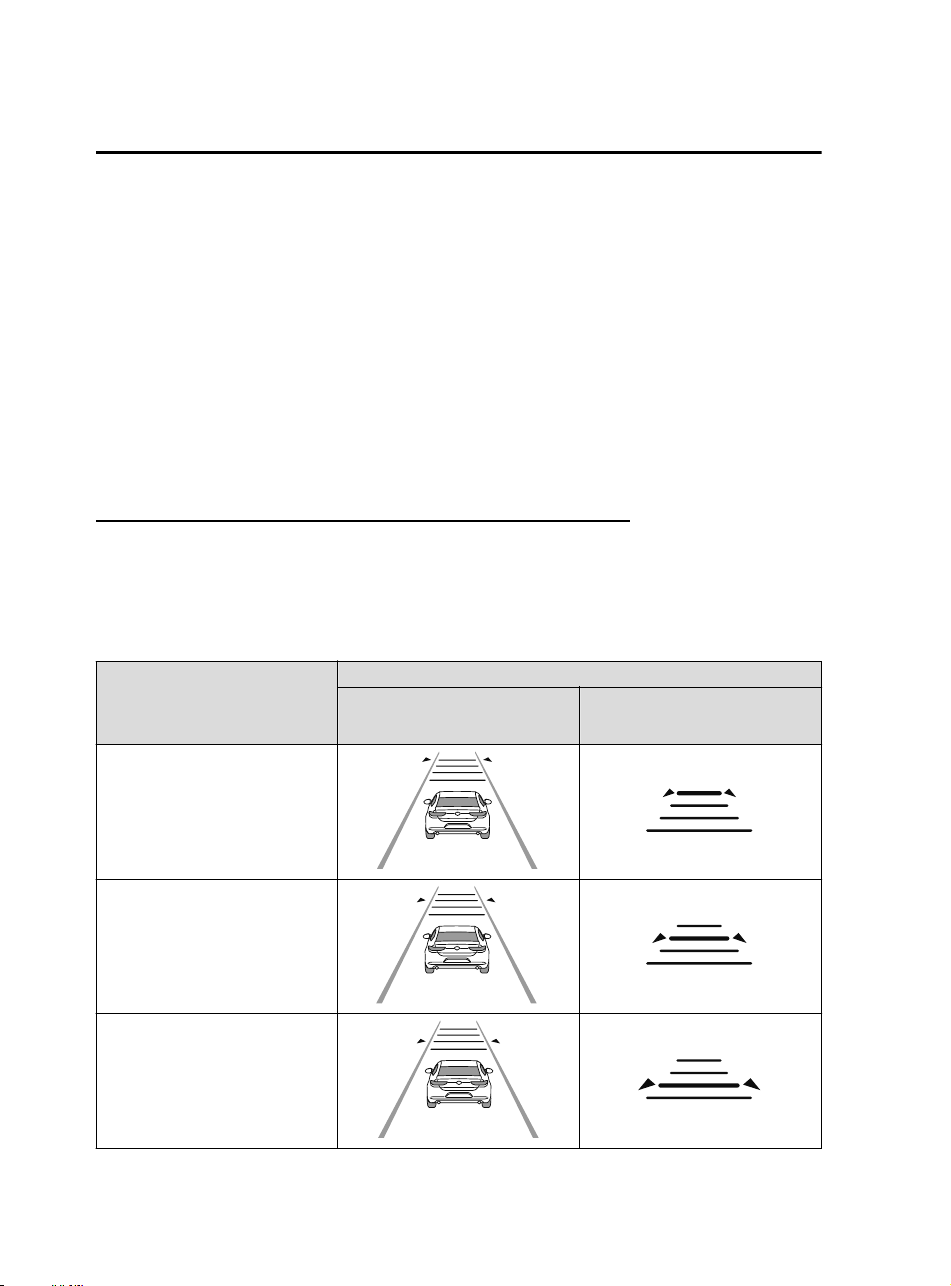
(To increase speed using accelerator pedal)
Depress the accelerator pedal and press the RES switch up (SET+) or down (SET-) at the
desired speed. If the switch is not operated, the system returns to the set speed after you
release your foot from the accelerator pedal.
NOTE
The warnings and brake control do not operate while depressing the accelerator pedal.
The lowest possible speed which can be set on the TJA is 30 km/h (19 mph).
(Automatic transmission vehicle)
The vehicle speed setting can be changed by operating the RES switch during stop hold
control.
Changing the distance between vehicles during headway control
The distance-between-vehicles can be set to 4 levels; Long, medium, short, and extremely
short distance.
The distance-between-vehicles is set to a shorter distance by pressing the CANCEL switch
down. The distance-between-vehicles is set to a longer distance by pressing the CANCEL
switch up.
Distance-between-vehicles guide‐
line
(at 80 km/h (50 mph) vehicle
speed)
Indication on display
Indication on multi-information
display
Indication on active driving dis‐
play
*1
Long (about 50 m (164 ft))
Medium (about 40 m (131 ft))
Short (about 30 m (98 ft))
When Driving
i-ACTIVSENSE
4-146
Mazda3_8HZ1-EA-19G_Edition1_old 2019-5-17 13:49:03
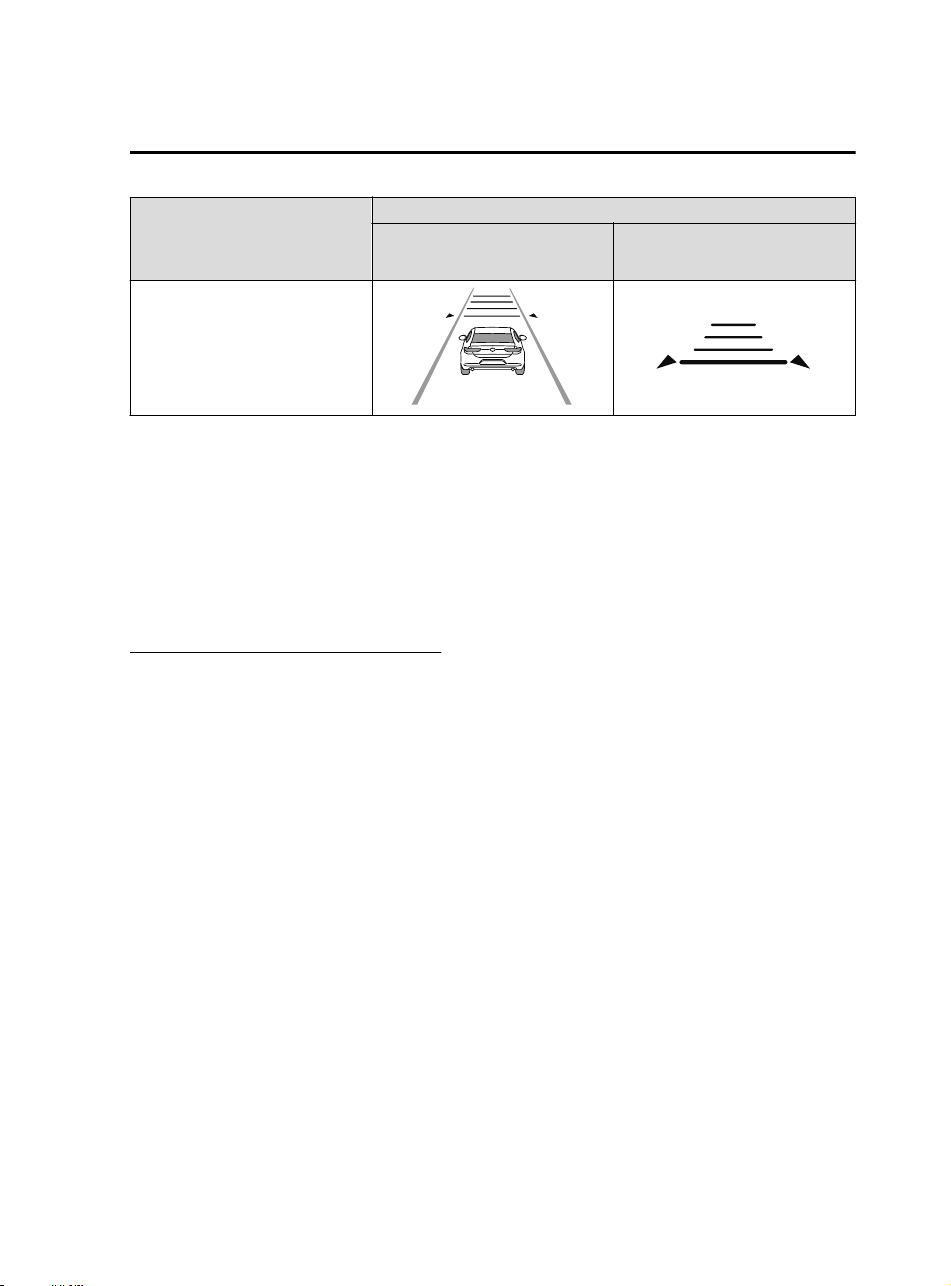
Distance-between-vehicles guide‐
line
(at 80 km/h (50 mph) vehicle
speed)
Indication on display
Indication on multi-information
display
Indication on active driving dis‐
play
*1
Extremely short (about 25 m (82 ft))
*
1 Displays a pop-up image when the CANCEL switch is operated.
NOTE
The distance-between-vehicles differs depending on the vehicle speed, and the slower the
vehicle speed, the shorter the distance.
When the ignition is switched to ACC or OFF, the set distance-between-vehicles is taken
over automatically even when the engine is started again.
The function is temporarily canceled.
Headway control function
When the following operations are performed, the headway control function is temporarily
canceled and the TJA set indication (green) changes to the TJA standby indication (white) at
the same time.
The CANCEL switch is pressed one time.
The brake pedal is depressed.
(Automatic transmission vehicle)
The selector lever is in the P, N, or R position.
(Manual transmission vehicle)
The shift lever is in the R position.
When Driving
i-ACTIVSENSE
4-147
Mazda3_8HZ1-EA-19G_Edition1_old 2019-5-17 13:49:03
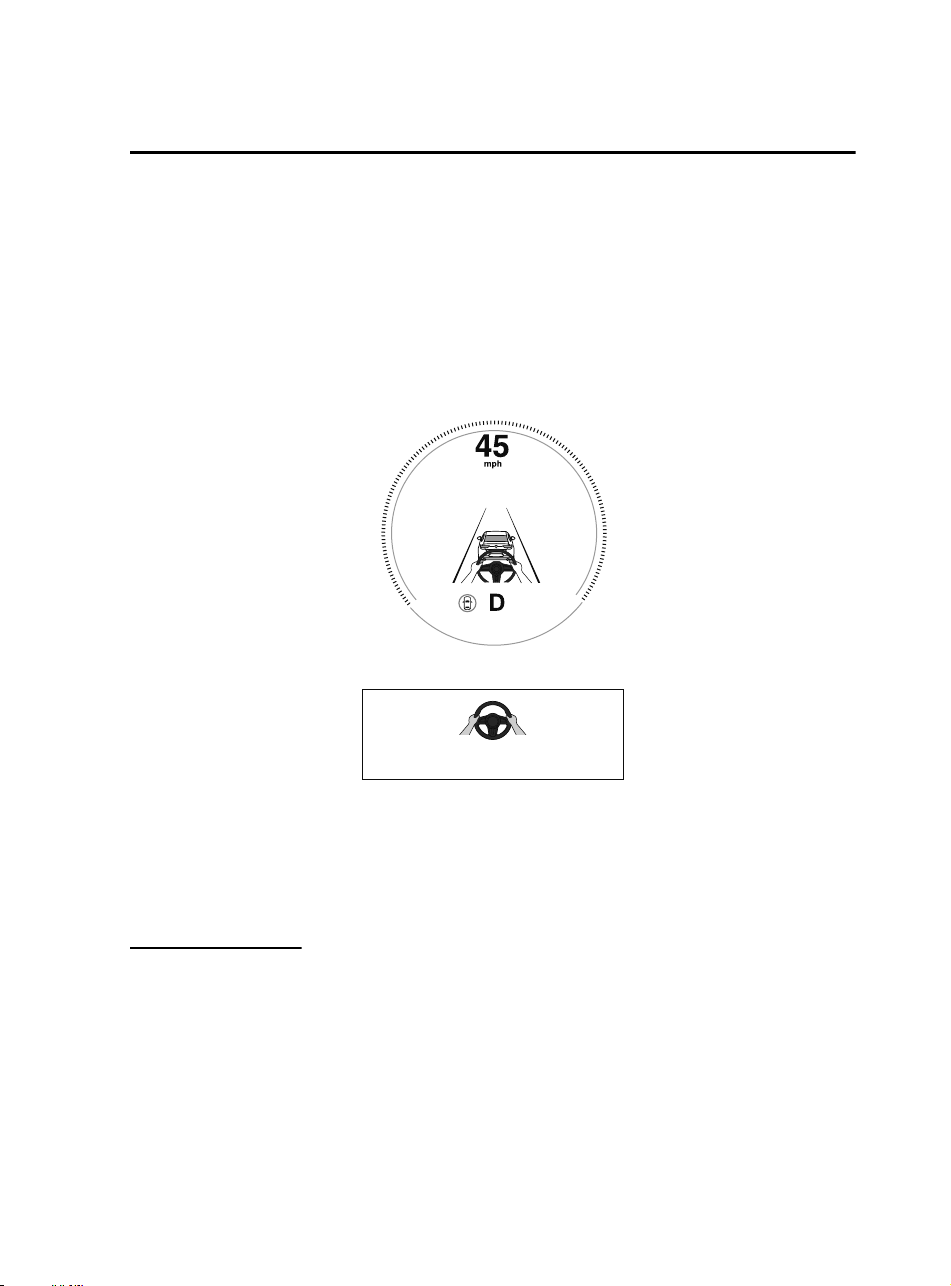
The windshield around the Forward Sensing Camera (FSC) is blocked by an obstruction,
causing poor forward visibility.
NOTE
If you take your hands off the steering wheel (not holding the steering wheel), the warning
sound is activated and an alert is indicated on the multi-information display and the active
driving display.
Multi-information display
Active driving display
If the steering wheel is held lightly, or depending on the road conditions, the system
determines that you have released the steering wheel (not holding the steering wheel) even if
you are holding it, and an alert is indicated on the multi-information display and the active
driving display.
To resume operation
If the TJA is temporarily canceled, it will resume operation at the previously set speed by
pressing the RES switch after all of the operation conditions have been met.
NOTE
If the set speed is not indicated on the display, the system does not operate even if the RES
switch is pressed.
When Driving
i-ACTIVSENSE
4-149
Mazda3_8HZ1-EA-19G_Edition1_old 2019-5-17 13:49:03
After the operation, the steering assist operation may not operate for a period of 5
seconds at the most until the lane lines are detected or a vehicle ahead is recognized.
Turning off
When the TJA switch is pressed while the TJA is operating, the TJA turns off.
▼
Shift-up/Shift-down Request Display
(Manual Transmission)
The shift-up or shift-down request display
might be displayed while the TJA is
operating. When this occurs, shift gears
because the gear position is not
appropriate.
Request Indication on display
Shift up Shift Up to a Higher Gear
Shift down Shift Down to a Lower Gear
NOTE
If the gears are not shifted up even
though the shift-up request indication is
displayed, load will be applied to the
engine and the TJA might be
automatically canceled or engine
damage could occur.
If the gears are not shifted down even
though the shift-down request indication
is displayed, the TJA might be
automatically canceled or engine
stalling could occur.
▼
Stop Hold Control (Automatic
Transmission)
While in headway control using the TJA,
your vehicle will stop when a vehicle
ahead stops. When the vehicle is stopped
and the stop hold control operates, the TJA
indicator light turns on.
NOTE
Even if the TJA is temporarily canceled
during stop hold control, the vehicle is
held in its stopped position.
The parking brake is automatically
applied and the vehicle is held in its
stopped position when 10 minutes or
longer have passed since the stop hold
control operated. When this occurs, the
TJA is temporarily canceled.
The brake lights turn on during stop
hold control.
When Driving
i-ACTIVSENSE
4-150
Mazda3_8HZ1-EA-19G_Edition1_old 2019-5-17 13:49:03
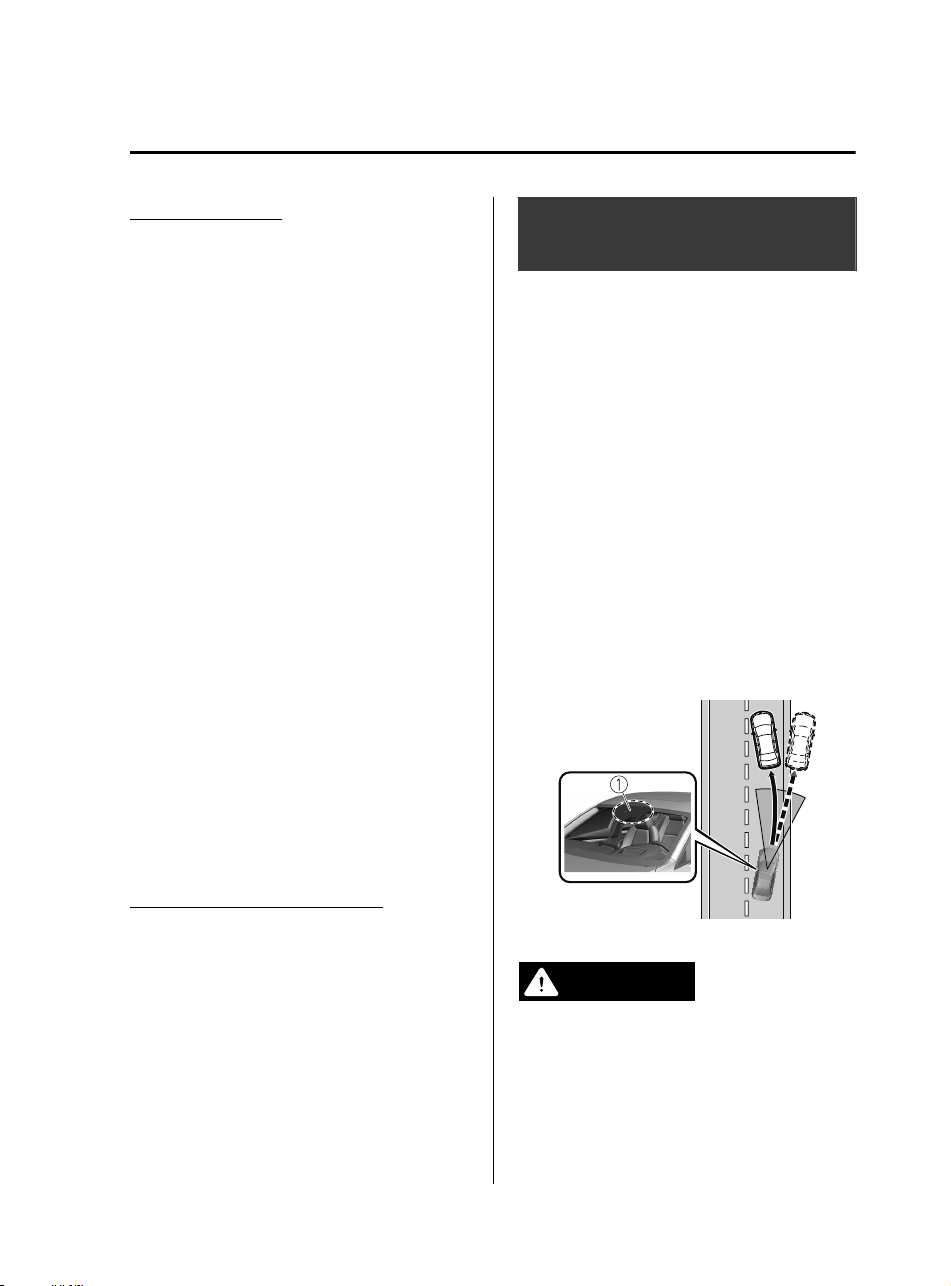
To resume driving
After the vehicle ahead starts moving
while your vehicle is stopped under stop
hold control, press the RES switch or
depress the accelerator pedal to cancel the
stop hold control and start driving.
NOTE
When you resume driving by pressing
the RES switch, your vehicle does not
start moving until the distance between
your vehicle and the vehicle ahead
lengthens to the specified distance or
farther.
If the TJA is temporarily canceled,
depress the accelerator pedal and start
driving the vehicle. If the TJA is
temporarily canceled, you cannot
resume driving by pressing the RES
switch when there are no vehicles in
front of your vehicle.
If the vehicle ahead starts moving within
3 seconds after your vehicle is stopped
by the stop hold control, headway
control will continue even if you do not
resume driving your vehicle, such as by
depressing the accelerator pedal.
Vehicle departure information
If you do not resume driving within a few
seconds after the vehicle ahead starts
moving during stop hold control, the
multi-information display vehicle-ahead
indication flashes to urge the driver to
resume driving. If you do not resume
driving after the indicator light flashes, a
sound is activated to urge you to resume
driving.
Lane-keep Assist System
(LAS)
*
▼
Lane-keep Assist System (LAS)
The LAS provides steering assistance to
help the driver stay within the vehicle lane
if the vehicle might be deviating.
The forward sensing camera (FSC) detects
the white lines (yellow lines) of the
vehicle lane in which the vehicle is
traveling and if the system determines that
the vehicle may deviate from its lane, it
operates the electric power steering to
assist the driver’s steering operation. The
system also alerts the driver by displaying
an alert on the multi-information display
and the active driving display
*
. Use the
system when you drive the vehicle on
roads with white (yellow) lines such as
expressways and highways.
1. Forward sensing camera (FSC)
WARNING
Do not rely completely on the LAS:
The LAS is not an automated driving
system. In addition, the system is not
designed to compensate for a driver’s
lack of caution, and over-reliance on the
system could lead to an accident.
When Driving
i-ACTIVSENSE
*Some models.
4-151
Mazda3_8HZ1-EA-19G_Edition1_old 2019-5-17 13:49:03
The functions of the LAS have limitations.
Always stay on course using the steering
wheel and drive with care.
Do not use the LAS under the following
circumstances, otherwise it may result in
an accident.
The vehicle is driven on slippery roads
such as icy or snow-covered roads, and
unpaved roads.
Tires of a dierent specied size are
used, such as a temporary spare tire.
Tires with insucient tread are used.
The tire pressures are not adjusted to
the specied pressure.
The vehicle is being used to tow a
camper or boat trailer.
Tire chains are used.
The vehicle is driven on roads with lane
lines other than white (yellow) lines,
such as an expressway.
CAUTION
Heed the following cautions so that the LAS
can operate normally.
Do not modify the vehicle's suspensions.
Always use wheels of the
specied
type
and size for the front and rear wheels.
Consult an Authorized Mazda Dealer for
tire replacement.
NOTE
The system may not operate normally
under the following conditions.
The white (yellow) lane lines are less
visible because of dirt or paint flaking.
White (yellow) lane lines are less visible
because of bad weather (rain, fog, or
snow).
The vehicle is driven on a temporary
lane or section with a closed lane
resulting from construction where there
might be multiple white (yellow) lane
lines, or they are interrupted.
The camera picks up an obscure line,
such as a temporary line being used for
construction, or because of shade,
unmelted snow, or grooves filled with
water.
The surrounding brightness suddenly
changes such as when entering or
exiting a tunnel.
Back-light is reflected off the road
surface.
The road surface is wet and shiny after
rain, or there are puddles on the road.
The width of a lane is excessively
narrow.
The vehicle is driven on roads with tight
curves.
Heavy luggage is loaded in the trunk/
luggage compartment or on the rear
seat causing the vehicle to tilt.
The vehicle is driven through a fork in
the road or a junction.
The shade of a guardrail parallel to a
white (yellow) lane line is cast on the
road.
The illumination of the headlights is
weakened because of dirt or the optical
axis is deviated at night.
The road is excessively uneven.
The vehicle is shaken after hitting a
road bump.
A vehicle in front of your vehicle is
running near a white (yellow) lane line
making it less visible.
The windshield is dirty or foggy.
When Driving
i-ACTIVSENSE
4-152
Mazda3_8HZ1-EA-19G_Edition1_old 2019-5-17 13:49:03
Strong light is directed from the front of
the vehicle (such as sunlight, or
headlights (high-beam) of on-coming
vehicles).
▼
System Operation
When the ignition is switched ON, the
i-ACTIVSENSE status symbol (warning/
risk avoidance support system) (white)
turns on and the system goes on standby.
NOTE
If the i-ACTIVSENSE status symbol
(warning/risk avoidance support system)
(white) does not turn on, the system is
canceled using the i-ACTIVSENSE switch
or the personalization feature.
Operation conditions
When all of the following conditions are
met, the i-ACTIVSENSE status symbol
(warning/risk avoidance support system)
on the multi-information display changes
from white to green and the system
becomes operational.
The vehicle speed is about 64 km/h (40
mph) or faster.
The system detects white (yellow) lane
lines.
NOTE
When the system does not detect a white
(yellow) lane line on one side only, the
system does not operate on the side that is
not being detected.
When temporarily canceling the system
The LAS goes on standby in the following
cases: The LAS operation is automatically
restored when the system's operation
conditions are met.
The system cannot detect white (yellow)
lane lines.
The vehicle speed is less than about 56
km/h (35 mph).
The turn signal lever is operated.
The accelerator pedal is depressed
abruptly.
The TCS/DSC is operating.
The DSC is turned off.
The steering wheel is operated.
The brake pedal is operated.
The function is temporarily stopped.
The LAS stops functioning in the
following cases:
The temperature in the forward sensing
camera (FSC) is high or low.
The windshield around the forward
sensing camera (FSC) is foggy.
The windshield around the forward
sensing camera (FSC) is blocked by an
obstruction, causing poor forward
visibility.
Strong light (such as sunlight, or
headlights (high-beam) of on-coming
vehicles) is directed at the forward
sensing camera (FSC).
When Driving
i-ACTIVSENSE
4-153
Mazda3_8HZ1-EA-19G_Edition1_old 2019-5-17 13:49:03
System malfunction
If there is a problem with the system, the
i-ACTIVSENSE status symbol (warning/
risk avoidance support system) (white)
and the i-ACTIVSENSE warning
indication/warning light on the
multi-information display turns on and a
message is indicated.
Refer to i-ACTIVSENSE Status Symbol
(Warning/Risk Avoidance Support
System) on page 4-85.
▼
Steering Wheel Operation Assist
When the system determines that the
vehicle might be deviating from its lane,
the steering wheel operation assist
operates.
The system notifies the driver of the
direction in which the system provided
steering wheel operation assistance on the
multi-information display and the active
driving display
*
.
Multi-information display
Active driving display
*
NOTE
When the driver operates the steering
wheel while the steering wheel operation
assist is operating, the steering wheel
operation assistance is canceled.
▼
System Canceling
The LAS can be set to inoperable.
(If only the LAS is turned off)
Refer to the Settings section in the
Mazda Connect Owner's Manual.
(If the LAS is turned off by operating
the i-ACTIVSENSE switch)
Refer to i-ACTIVSENSE Switch on
page 4-87.
NOTE
If the ignition is switched OFF while you
have canceled the system using the
i-ACTIVSENSE switch, the system is
automatically enabled the next time the
ignition is switched ON. However, if the
system is canceled using the
personalization features, the system is not
automatically enabled.
When Driving
i-ACTIVSENSE
4-154
*Some models.
Mazda3_8HZ1-EA-19G_Edition1_old 2019-5-17 13:49:03
Smart Brake Support
(SBS)
*
▼
Smart Brake Support (SBS)
The SBS alerts the driver of a possible
collision using the warning indications in
the display and a warning sound if the
front radar sensor and Forward Sensing
Camera (FSC) determine that there is the
possibility of a collision with a vehicle
ahead, pedestrian, or a bicycle.
Furthermore, if a collision is unavoidable,
the automatic brake control is performed
to reduce damage in the event of a
collision. In addition, when the driver
depresses the brake pedal, the brakes are
applied firmly and quickly to assist.
(Vehicles with Driver Monitoring (DM))
When the SBS determines that the driver
is not paying attention to the road using
the driver monitoring camera and it
determines that there is the possibility of a
collision with an obstruction, the SBS
activates the collision warning earlier than
normal.
WARNING
Do not rely completely on the SBS:
The SBS is only designed to reduce damage
in the event of a collision.
The ability to detect obstructions is limited
depending on the obstructions, weather
conditions, or trac conditions. Over
reliance on the system leading to the
accelerator pedal or brake pedal being
mistakenly operated could result in an
accident.
CAUTION
In the following cases, turn the system o
to prevent an unexpected operation.
The vehicle is being towed or when
towing another vehicle.
The vehicle is on a chassis roller.
When driving on rough roads such as in
areas of dense grass or o-road.
See the next page on how to turn o the
system.
Refer to Stopping the Smart Brake
Support (SBS) System Operation on page
4-157.
Operation conditions
The SBS operates when all of the
following conditions are met.
The ignition is switched ON.
The SBS is on.
The i-ACTIVSENSE warning
indication/warning light is not turned
on.
(Object is vehicle ahead)
The vehicle speed is about 4 km/h (2
mph) or higher.
(Object is a pedestrian or bicycle)
The vehicle speed is between about 10
to 80 km/h (6.2 to 50 mph).
The DSC does not operate.
NOTE
Under the following conditions, the SBS
may not operate.
If there is the possibility of hitting only
a part of a vehicle or obstruction
ahead.
You are driving your vehicle at the
same speed as the vehicle ahead.
When Driving
i-ACTIVSENSE
*Some models.
4-155
Mazda3_8HZ1-EA-19G_Edition1_old 2019-5-17 13:49:03
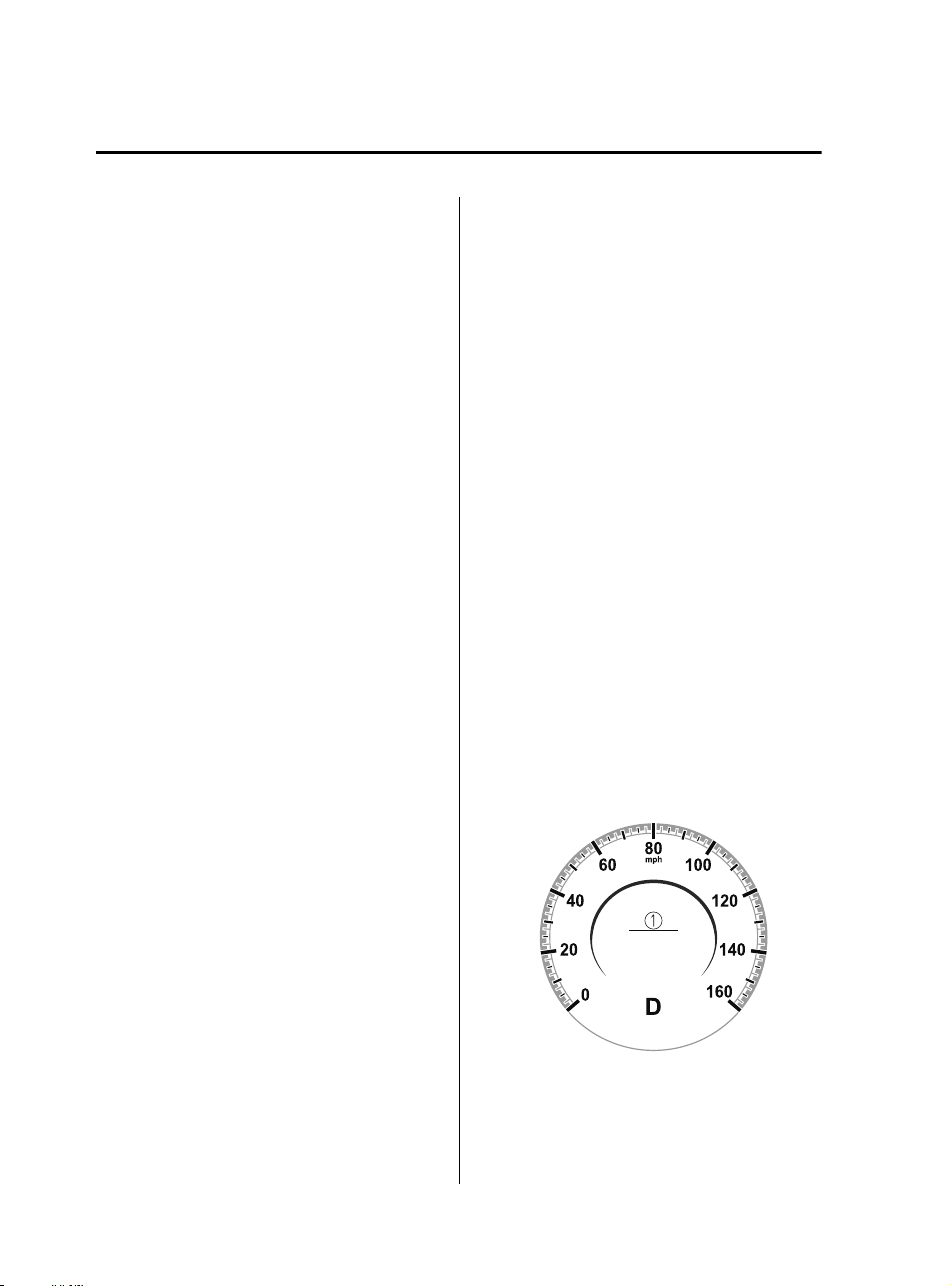
When the driver deliberately performs
driving operations (accelerator
operation, steering wheel operation).
The accelerator pedal is depressed
abruptly.
The brake pedal is being depressed.
The steering wheel is being operated.
The selector lever is being shifted.
The turn signal lever is being
operated.
When warnings and messages, such
as a dirty windshield, related to the
Forward Sensing Camera (FSC) or
front radar sensor are being displayed
on the multi-information display.
The SBS may operate under the
following conditions.
There is an object in the road at the
entrance to a curve (including
guardrails and snow banks).
Passing an approaching vehicle while
rounding a curve.
When crossing a narrow bridge, and
passing through low gates, narrow
gates, car washing machines, or
tunnels.
When passing through a toll gate.
When entering an underground
parking area.
There is a metal object, bump, or a
protruding object on the road.
If you suddenly come close to a
vehicle ahead.
There is an animal, wall, or tree.
Notifies the driver with a warning
indication on the multi-information
display and the active driving display
(vehicles with active driving display)
while the system is operating.
If a malfunction is detected or the
system temporarily stops the function
due to dirty sensors (such as radar
sensor or Forward Sensing Camera
(FSC)), the i-ACTIVSENSE warning
indication/warning light turns on and a
message is displayed on the
multi-information display.
On a manual transmission vehicle, the
engine stops if the clutch pedal is not
depressed when the vehicle is stopped by
the SBS brake operation.
If the vehicle is stopped by the SBS
brake operation and the brake pedal is
not depressed, the SBS brake is
automatically released after about 2
seconds.
▼
Collision Warning
When there is a possibility of a collision
with a vehicle ahead, the collision warning
sound is activated continuously and a
warning is displayed on the
multi-information display and the active
driving display.
Multi-information display
1. “BRAKE!” message is displayed
When Driving
i-ACTIVSENSE
4-156
Mazda3_8HZ1-EA-19G_Edition1_old 2019-5-17 13:49:03
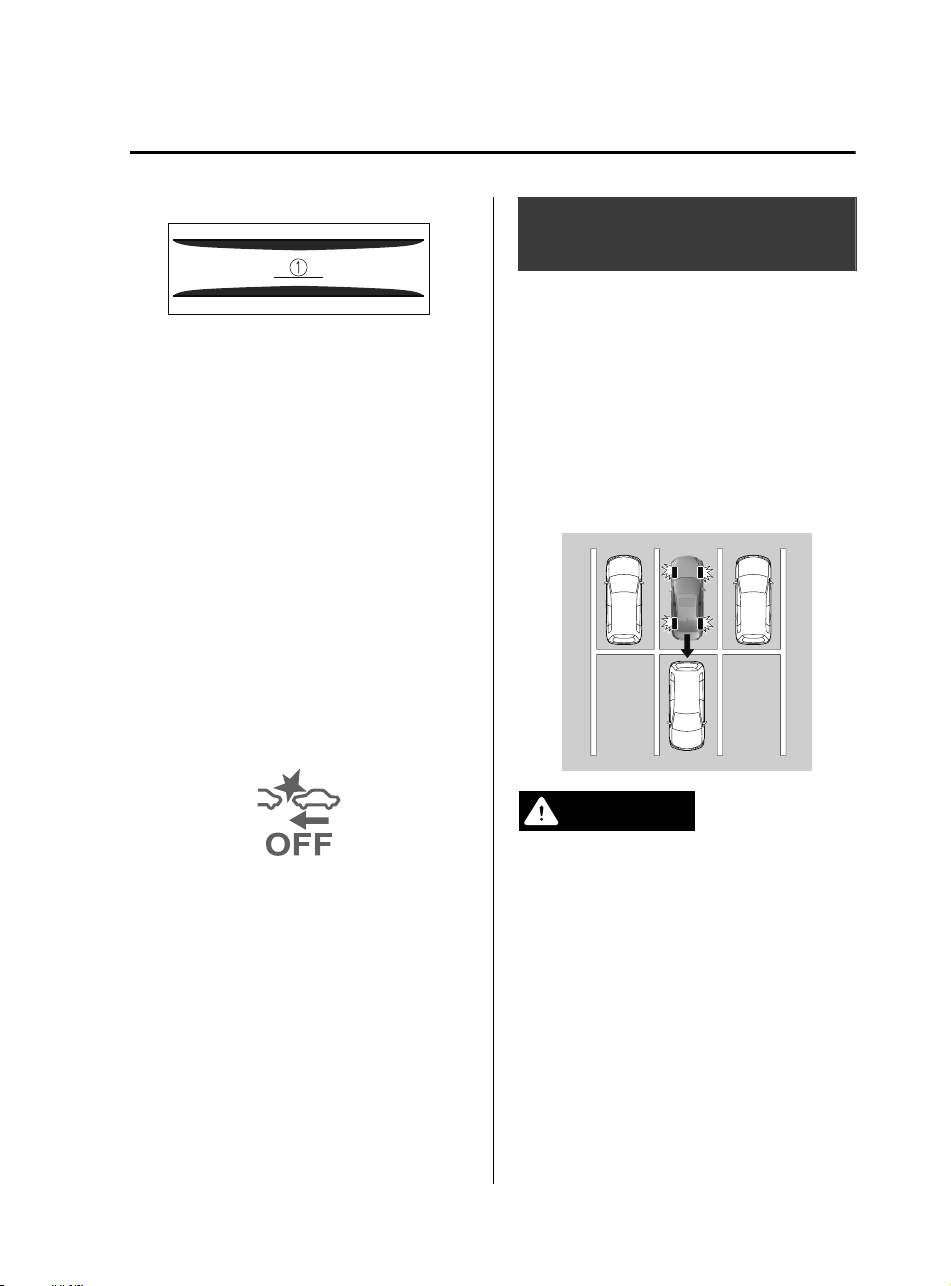
Active driving display
1. “BRAKE!” message is displayed
NOTE
The collision warning sound is activated
intermittently while the SBS brake or
brake assist (SBS brake assist) is
operating.
The operation distance and volume of
the collision warning can be changed.
Refer to the Settings section in the
Mazda Connect Owner's Manual.
▼
Stopping the Smart Brake Support
(SBS) System Operation
The SBS can be changed to inoperable.
Refer to the Settings section in the Mazda
Connect Owner's Manual.
When the SBS is canceled, the SBS OFF
indicator light turns on.
NOTE
When the ignition is switched OFF while
the SBS is canceled, the SBS is
automatically enabled the next time the
ignition is switched ON.
Smart Brake Support
[Rear] (SBS-R)
*
▼
Smart Brake Support [Rear]
(SBS-R)
The SBS-R is a system which is designed
to reduce damage in the event of a
collision by operating the brake control
(SBS brake) when the system’s sensors
detect an obstruction at the rear of the
vehicle while driving at a speed of about 2
to 8 km/h (2 to 4 mph) and the system
determines that a collision is unavoidable.
WARNING
Do not rely completely on the SBS-R
system:
The SBS-R system is only designed to
reduce damage in the event of a
collision. Over reliance on the system
leading to the accelerator pedal or brake
pedal being mistakenly operated could
result in an accident.
To assure the correct operation of the
SBS-R, heed the following cautions.
When Driving
i-ACTIVSENSE
*Some models.
4-157
Mazda3_8HZ1-EA-19G_Edition1_old 2019-5-17 13:49:03
Do not apply a sticker to a rear
ultrasonic sensor and rear camera.
Otherwise, the rear ultrasonic sensor
and rear camera may not be able to
detect vehicles or obstructions which
could result in an accident.
Do not disassemble a rear ultrasonic
sensor and rear camera.
If cracks or damage caused by ying
gravel or debris is visible around a rear
ultrasonic sensor and rear camera,
stop using the SBS-R system
immediately and have your vehicle
inspected by an Authorized Mazda
Dealer. If the vehicle continues to be
driven with cracks or scratch marks left
around an ultrasonic sensor, the
system may operate unnecessarily and
cause an unexpected accident.
Refer to Stopping the Smart Brake
Support [Rear] (SBS-R) System
Operation on page 4-160.
Consult an Authorized Mazda Dealer
for rear bumper replacement.
Do not modify the suspension:
If the vehicle height or inclination is
changed, the SBS-R system may not
operate correctly because it cannot detect
obstructions correctly.
Do not apply a strong force to a rear
ultrasonic sensor and rear camera:
When washing the vehicle, do not spray
highly pressurized water against a rear
ultrasonic sensor and rear camera, or rub it
strongly. In addition, do not hit the rear
bumper forcefully when loading and
unloading cargo Otherwise, the sensors
may not detect obstructions correctly
which could cause the SBS-R system to not
operate normally, or it could operate
unnecessarily.
CAUTION
When driving
o-road
in areas where
there is grass or foliage, it is
recommended that the SBS-R system be
turned
o.
Always use tires of the specied size and
the same manufacturer, brand, and
tread pattern on all 4 wheels. In addition,
do not use tires with signicantly
dierent wear patterns on the same
vehicle. Otherwise, the SBS-R system may
not operate normally.
If ice or snow is stuck on the rear
ultrasonic sensor and rear camera they
may not be able to detect obstructions
correctly depending on the conditions. In
such cases, the system may not be able
to perform controls correctly. Always
drive carefully and pay attention to the
rear of the vehicle.
When Driving
i-ACTIVSENSE
4-158
Mazda3_8HZ1-EA-19G_Edition1_old 2019-5-17 13:49:03

NOTE
The vehicle posture changes depending
on the accelerator pedal, brake pedal
and steering wheel operations, which
could make it difficult for the system to
recognize an obstruction, or it could
facilitate unnecessary detection. In such
cases, the SBS-R may or may not
operate.
The SBS-R system will operate under the
following conditions.
The engine is running.
The shift lever (manual transmission
vehicle) or the selector lever
(automatic transmission vehicle) is in
the R (reverse) position.
i-ACTIVSENSE warning indication/
warning light is not displayed in the
multi-information display.
The vehicle speed is between about 2
to 8 km/h (2 to 4 mph).
The SBS-R is not turned off.
The DSC is not malfunctioning.
In the following cases, the rear
ultrasonic sensor and rear camera
cannot detect obstructions and the
SBS-R may not operate.
The height of the obstruction is low
such as low walls or trucks with low
loading platforms.
The height of the obstruction is high
such as trucks with high loading
platforms.
The obstruction is small.
The obstruction is thin such as a
signpost.
The surface of the obstruction is not
pointed vertically relative to the
vehicle.
The obstruction is soft such as a
hanging curtain or snow stuck to a
vehicle.
The obstruction is shaped irregularly.
The obstruction is extremely close.
In the following cases, the rear
ultrasonic sensor and rear camera
cannot detect obstructions correctly and
the SBS-R may not operate.
Something is stuck on the bumper
near a rear ultrasonic sensor.
The brake or accelerator pedal is
operated.
There is another obstruction near one
obstruction.
During inclement weather such as
rain, fog and snow.
High or low humidity.
High or low temperatures
Strong winds.
The path of travel is not flat.
Heavy luggage is loaded in the
luggage compartment or on the rear
seat.
Objects such as a wireless antenna,
fog light, or illuminated license plate
is installed near a rear ultrasonic
sensor.
The orientation of a rear ultrasonic
sensor has deviated for reasons such
as a collision.
The vehicle is affected by other sound
waves such as the horn, engine noise,
ultrasonic sensor of another vehicle.
In the following cases, a rear ultrasonic
sensor and rear camera may detect
something as a target obstruction which
could cause the SBS-R system to
operate.
Driving on a steep slope.
Wheel blocks.
When Driving
i-ACTIVSENSE
4-159
Mazda3_8HZ1-EA-19G_Edition1_old 2019-5-17 13:49:03
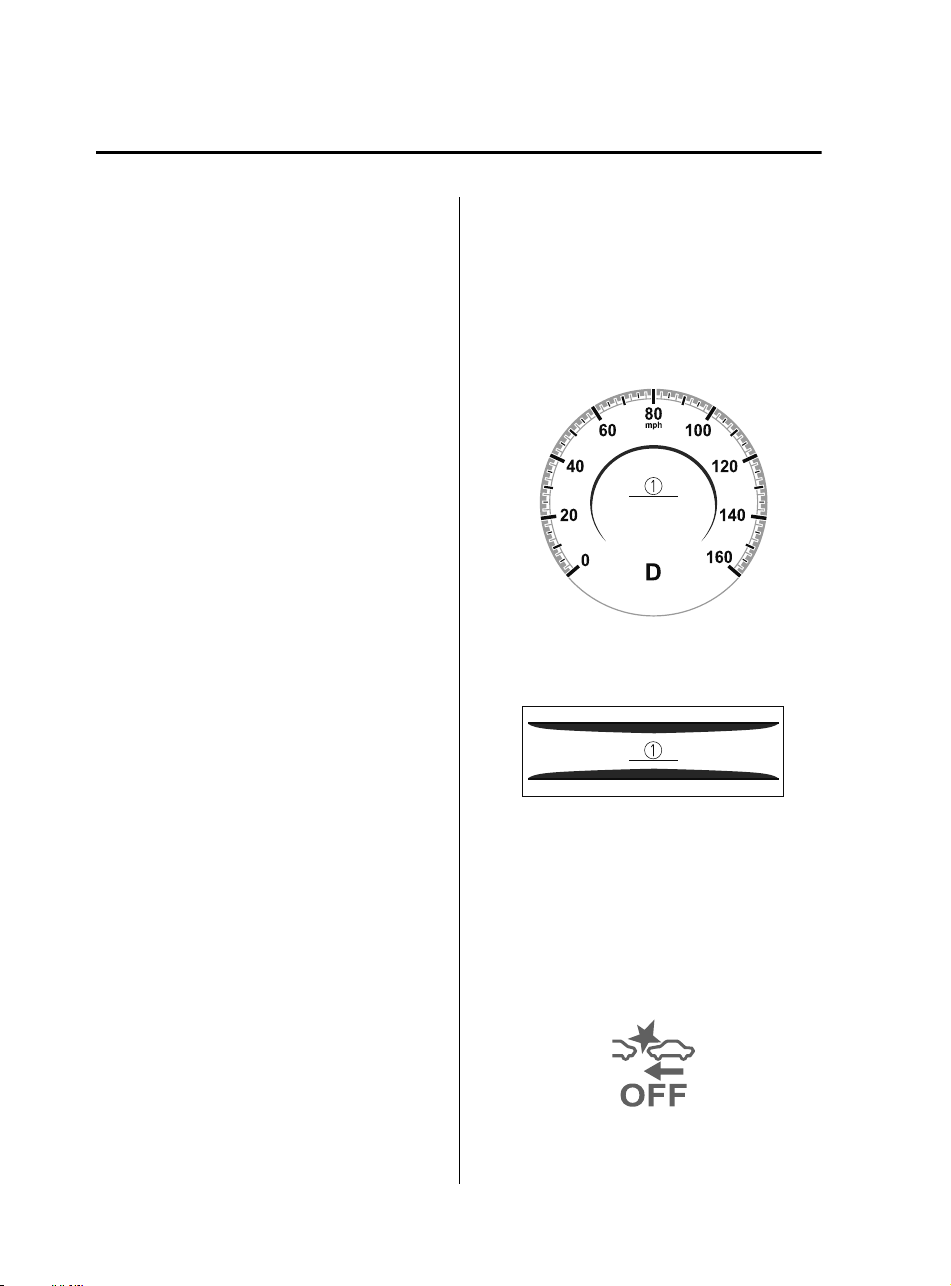
Hanging curtains, gate poles such as
at toll gates and railroad crossing.
When traveling near objects such as
foliage, barriers, vehicles, walls, and
fences along a road.
When driving off-road in areas where
there is grass and forage.
When passing through low gates,
narrow gates, car washing machines,
and tunnels.
A trailer is connected.
A bright light source such as sunlight
hits the rear camera.
The surroundings are dark.
An exterior accessory such as a
bicycle carrier is installed around the
rear sonar.
(Manual transmission)
If the vehicle is stopped by the SBS-R
operation and the clutch pedal is not
depressed, the engine stops.
When the system operates, the user is
notified by the multi-information
display.
The collision warning beep sounds
intermittently while the SBS-R brake is
operating.
If the vehicle is stopped by the SBS-R
operation and the brake pedal is not
depressed, displaying in meter
“Emergency Braking Activated. Depress
Brake Pedal to Hold Stop”, after about
2 seconds and the SBS-R brake is
automatically released.
Turn off the SBS-R system while pulling
a trailer or while an accessory such as a
bicycle carrier is installed to the rear of
the vehicle.
▼
Collision Warning
If there is a possibility of a collision, the
collision warning sound is activated
continuously and a warning is displayed
on the active driving display and the
multi-information display.
Multi-information display
1. “BRAKE!” message is displayed
Active driving display
1. “BRAKE!” message is displayed
▼
Stopping the Smart Brake Support
[Rear] (SBS-R) System Operation
The SBS-R can be changed to inoperable.
Refer to the Settings section in the Mazda
Connect Owner's Manual.
When the SBS-R is canceled, the SBS
OFF indicator light turns on.
When Driving
i-ACTIVSENSE
4-160
Mazda3_8HZ1-EA-19G_Edition1_old 2019-5-17 13:49:03
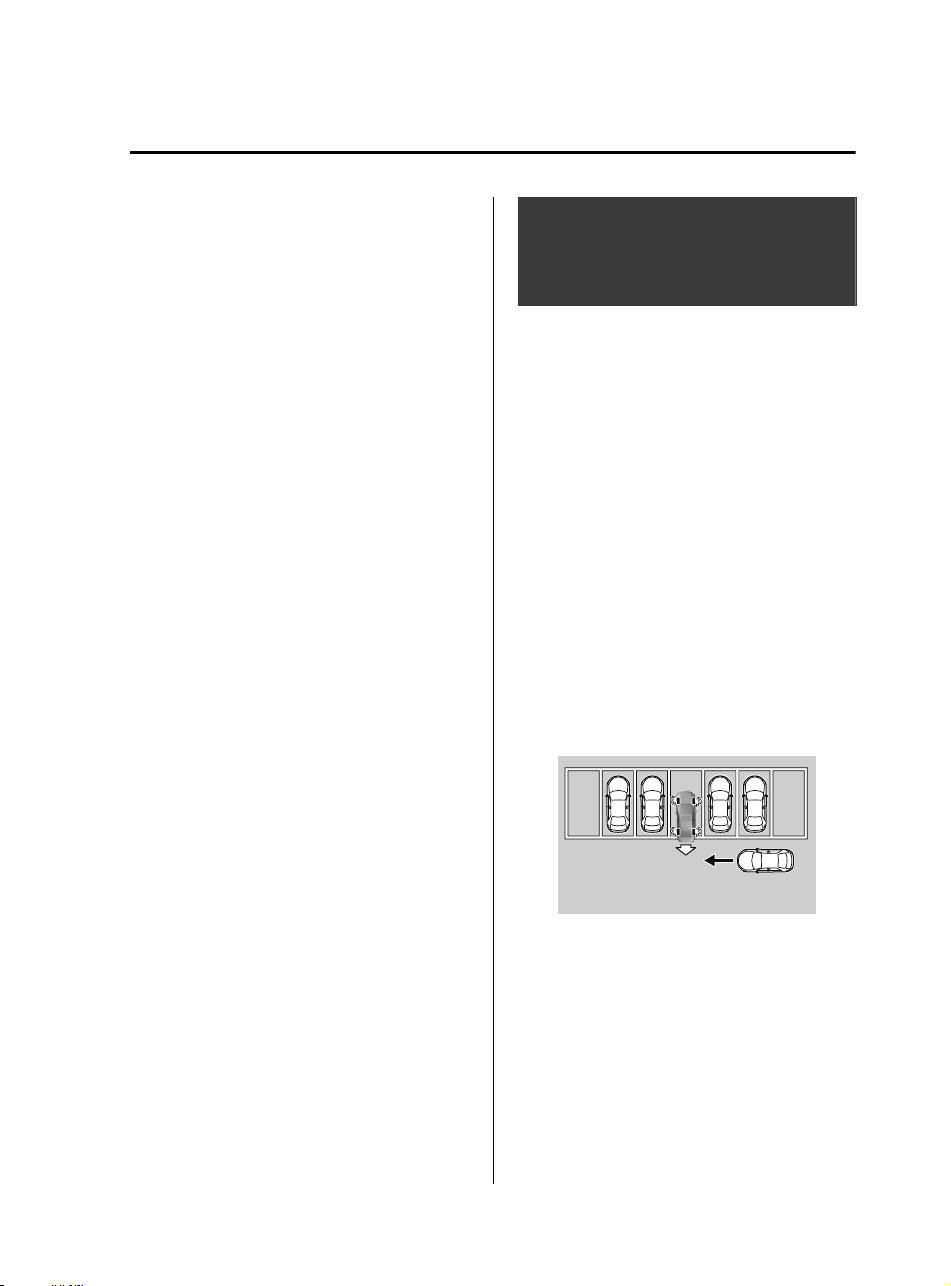
NOTE
When the ignition is switched OFF
while the SBS-R is canceled, the SBS-R
is automatically enabled the next time
the ignition is switched ON.
When the SBS-R is canceled, the Smart
Brake Support [Rear Crossing]
(SBS-RC) is also canceled.
Smart Brake Support
[Rear Crossing]
(SBS-RC)
*
▼
Smart Brake Support [Rear
Crossing] (SBS-RC)
The SBS-RC is a system designed to assist
the driver in avoiding collisions and to
reduce damage in the event of a collision
by applying the brakes if there is the
possibility of collision with a vehicle
approaching from the rear while you are
reversing out of parking space.
The SBS-RC system detects vehicles
approaching from the rear left and right
sides of the vehicle, and the rear of the
vehicle while the vehicle is being reversed
out of a parking space, the system reduces
damage in the event of a collision by
operating the brake control when the
system determines that a collision is
unavoidable.
When Driving
i-ACTIVSENSE
*Some models.
4-161
Mazda3_8HZ1-EA-19G_Edition1_old 2019-5-17 13:49:03
SBS-RC operation
1. The SBS-RC system operates when the
shift lever (manual transmission) or the
selector lever (automatic transmission)
is shifted to the reverse (R) position.
2. If there is the possibility of a collision
with an approaching vehicle, the
SBS-RC system applies brake and
displays “BRAKE!” on the active
driving display and the
multi-information display.
WARNING
Always check the surrounding area visually
before actually putting the vehicle in
reverse:
The system is only designed to assist you in
backing out of the lot when putting the
vehicle in reverse. Due to certain limitations
with the operation of this system, the
SBS-RC system may not operate brake or it
might be delayed even though a vehicle is
behind your vehicle. Always make it your
responsibility as a driver to check the rear.
Do not rely completely on the SBS-RC
system:
The SBS-RC system is only designed to
reduce damage in the event of a
collision. Over reliance on the system
leading to the accelerator pedal or brake
pedal being mistakenly operated could
result in an accident.
The SBS-RC system operates in response
to a vehicle. The system does not operate
in response to obstructions such as a
wall, pedestrians, 2-wheeled vehicles, or
animals.
To assure the correct operation of the
SBS-RC, heed the following cautions.
Do not apply a sticker to a rear radar and
rear camera. Otherwise, the rear radar
and rear camera may not be able to
detect vehicles or obstructions which
could result in an accident.
Do not disassemble a rear radar and rear
camera.
If cracks or damage caused by ying
gravel or debris is visible around a rear
radar and rear camera, stop using the
SBS-RC system immediately and have
your vehicle inspected by an Authorized
Mazda Dealer. If the vehicle continues to
be driven with cracks or scratch marks
left around an ultrasonic sensor, the
system may operate unnecessarily and
cause an unexpected accident.
Refer to Stopping the Smart Brake
Support [Rear Crossing] (SBS-RC) System
Operation on page 4-165.
Consult an Authorized Mazda Dealer for
rear bumper replacement.
Do not modify the suspension:
If the vehicle height or inclination is
changed, the SBS-RC system may not
operate correctly because it cannot detect
obstructions correctly.
When Driving
i-ACTIVSENSE
4-162
Mazda3_8HZ1-EA-19G_Edition1_old 2019-5-17 13:49:03
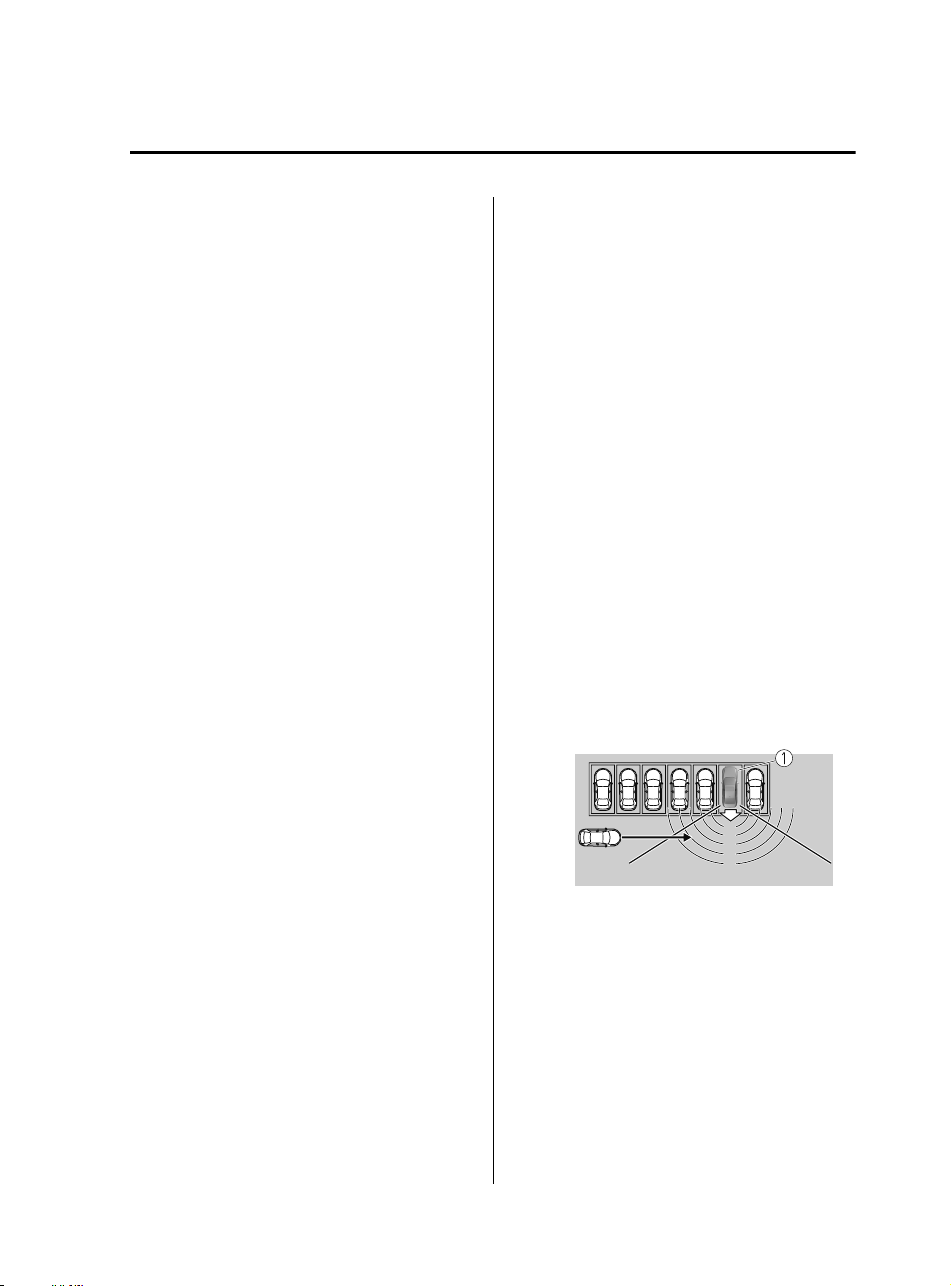
Do not apply a strong force to a rear radar
and rear camera:
When washing the vehicle, do not spray
highly pressurized water against a rear
radar and rear camera, or rub it strongly. In
addition, do not hit the rear bumper
forcefully when loading and unloading
cargo Otherwise, the sensors may not
detect obstructions correctly which could
cause the SBS-RC system to not operate
normally, or it could operate unnecessarily.
NOTE
The SBS-RC system will operate under
the following conditions.
The engine is running.
The shift lever (manual transmission
vehicle) or the selector lever
(automatic transmission vehicle) is in
the R (reverse) position.
i-ACTIVSENSE warning indication/
warning light is not displayed in the
multi-information display.
The vehicle speed is under about 10
km/h (6 mph).
The vehicle speed of an approaching
vehicle is about 3 km/h (2 mph) or
faster.
The SBS-R is not turned off.
The DSC is not malfunctioning.
In the following cases, the
i-ACTIVSENSE warning indication/
warning light turns on and operation of
the system is stopped. If the
i-ACTIVSENSE warning indication/
warning light remains illuminated, have
the vehicle inspected at an Authorized
Mazda Dealer as soon as possible.
Some problem with the system
including the SBS-RC system.
A large deviation in the installation
position of a rear side radar sensor on
the vehicle has occurred.
There is a large accumulation of snow
or ice on the rear bumper near a rear
side radar sensor.
Driving on snow-covered roads for
long periods.
The temperature near the radar
sensors becomes extremely hot due to
driving for long periods on slopes
during the summer.
The battery voltage has decreased.
Under the following conditions, the rear
side radar sensor cannot detect target
objects or it may be difficult to detect
them.
The rear side radar sensor detection
area is obstructed by a nearby wall or
parked vehicle. (Reverse the vehicle to
a position where the radar sensor
detection area is no longer
obstructed.)
1. Your vehicle
When Driving
i-ACTIVSENSE
4-163
Mazda3_8HZ1-EA-19G_Edition1_old 2019-5-17 13:49:03
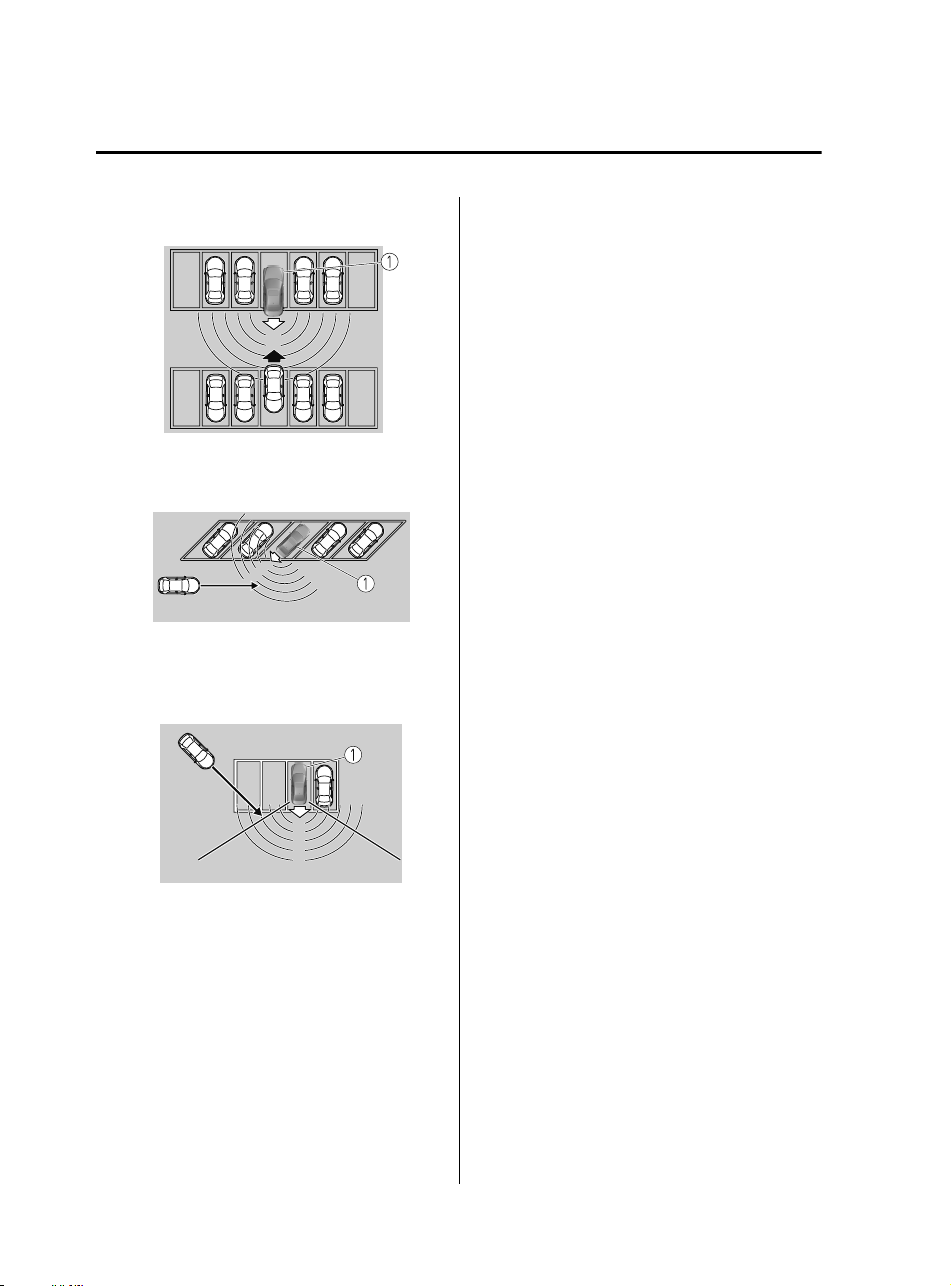
A vehicle is approaching directly from
the rear of your vehicle.
1. Your vehicle
The vehicle is parked on a slant.
1. Your vehicle
A vehicle is approaching from the
opposite direction on a steep gradient.
1. Your vehicle
Directly after the SBS-RC system
becomes operable using the
personalization feature.
Radio wave interference from a radar
sensor equipped on a nearby parked
vehicle.
Turn off the SBS-RC system while
pulling a trailer or while an accessory
such as a bicycle carrier is installed to
the rear of the vehicle. Otherwise, the
radio waves emitted by the radar will be
blocked causing the system to not
operate normally.
In the following cases, a rear radar and
rear camera may detect something as a
target obstruction which could cause the
SBS-RC system to operate.
Hanging curtains, gate poles such as
at toll gates and railroad crossing.
When traveling near objects such as
foliage, barriers, vehicles, walls, and
fences along a road.
When driving off-road in areas where
there is grass and forage.
When passing through low gates,
narrow gates, car washing machines,
and tunnels.
A trailer is connected.
A bright light source such as sunlight
hits the rear camera.
The surroundings are dark.
(Manual transmission)
If the vehicle is stopped by the SBS-RC
operation and the clutch pedal is not
depressed, the engine stops.
When the system operates, the user is
notified by the multi-information
display.
The collision warning beep sounds
intermittently while the SBS-RC brake is
operating.
When Driving
i-ACTIVSENSE
4-164
Mazda3_8HZ1-EA-19G_Edition1_old 2019-5-17 13:49:03
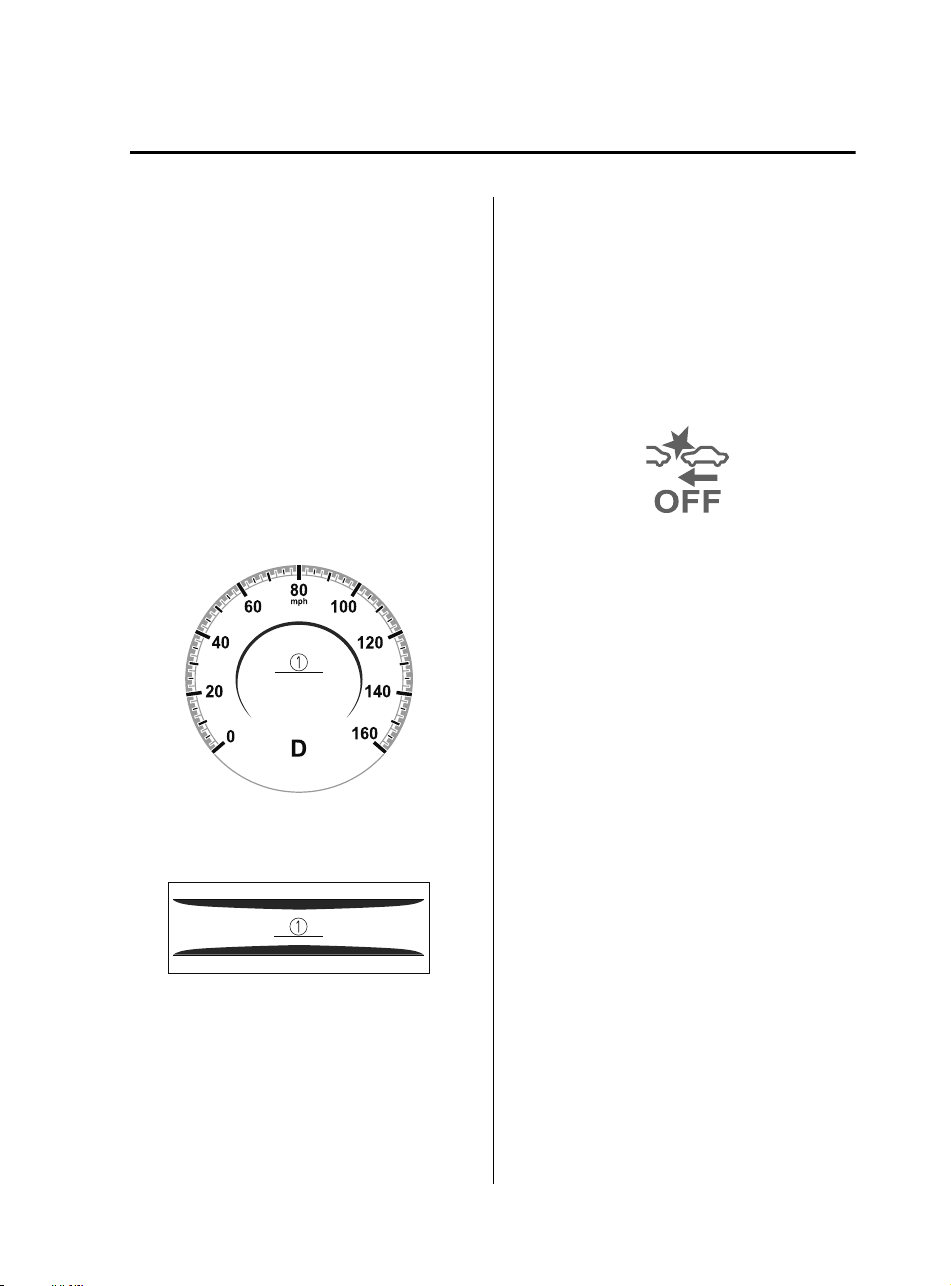
If the vehicle is stopped by the SBS-RC
operation and the brake pedal is not
depressed, displaying in meter
“Emergency Braking Activated. Depress
Brake Pedal to Hold Stop”, after about
2 seconds and the SBS-RC brake is
automatically released.
▼
Collision Warning
If there is a possibility of a collision, the
collision warning sound is activated
continuously and a warning is displayed
on the active driving display and the
multi-information display.
Multi-information display
1. “BRAKE!” message is displayed
Active driving display
1. “BRAKE!” message is displayed
▼
Stopping the Smart Brake Support
[Rear Crossing] (SBS-RC) System
Operation
The SBS-RC can be changed to
inoperable.
Refer to the Settings section in the Mazda
Connect Owner's Manual.
When the SBS-RC is canceled, the SBS
OFF indicator light turns on.
NOTE
When the ignition is switched OFF
while the SBS-RC is canceled, the
SBS-RC is automatically enabled the
next time the ignition is switched ON.
When the SBS-RC is canceled, the Smart
Brake Support [Rear] (SBS-R) is also
canceled.
When Driving
i-ACTIVSENSE
4-165
Mazda3_8HZ1-EA-19G_Edition1_old 2019-5-17 13:49:03
360° View Monitor
*
▼
360° View Monitor
The 360°View Monitor consists of the
following functions which assist the driver
in checking the area surrounding the
vehicle using various indications in the
center display and a warning sound while
the vehicle is being driven at low speeds
or while parking.
Top vi ew
The top view displays an image of the
vehicle from directly above on the
center display by combining the images
taken from the 4 cameras set on all sides
of the vehicle. The top view displays on
the right side of the screen when the
front view or rear view screen is being
displayed. The top view assists the
driver in checking the area surrounding
the vehicle when the vehicle is moving
forward or in reverse.
Front view/front wide view
The image from the front of the vehicle
is displayed on the center display.
The view from the front assists the
driver in checking the front of the
vehicle by displaying guide lines on the
displayed image taken from the front of
the vehicle.
Side view
The images taken from the front left and
right sides of the vehicle are displayed
on the center display.
The side view assists the driver in
checking the front sides of the vehicle
by displaying guide lines on the
displayed image taken from the front
left and right sides of the vehicle.
Rear view/rear wide view
The image from the rear of the vehicle is
displayed on the center display.
The image from the rear assists the
driver in checking the rear of the vehicle
by displaying guide lines on the
displayed image taken from the rear of
the vehicle.
Parking sensor
If there are any obstructions near the
vehicle while the top view/side view is
displayed, an obstruction detection
indication turns on around the bumper in
the center display.
The parking sensors use ultrasonic
sensors to detect obstructions around the
vehicle when the vehicle is driven at low
speeds, such as during garage or parallel
parking, and notifies the driver of the
approximate distance from the vehicle to
the surrounding obstruction using sound
and an obstruction detection indication.
Refer to Parking Sensor System on page
4-235.
Front Cross Traffic Alert (FCTA)
If there is the possibility of a collision
with an approaching vehicle while the
front view/front wide view/side view is
displayed, a warning is displayed on the
center display.
The Front Cross Traffic Alert (FCTA) is
designed to assist the driver in checking
both sides of the vehicle when the
vehicle starts to drive at an intersection.
Refer to Front Cross Traffic Alert
(FCTA) on page 4-111.
When Driving
i-ACTIVSENSE
4-166
*Some models.
Mazda3_8HZ1-EA-19G_Edition1_old 2019-5-17 13:49:03
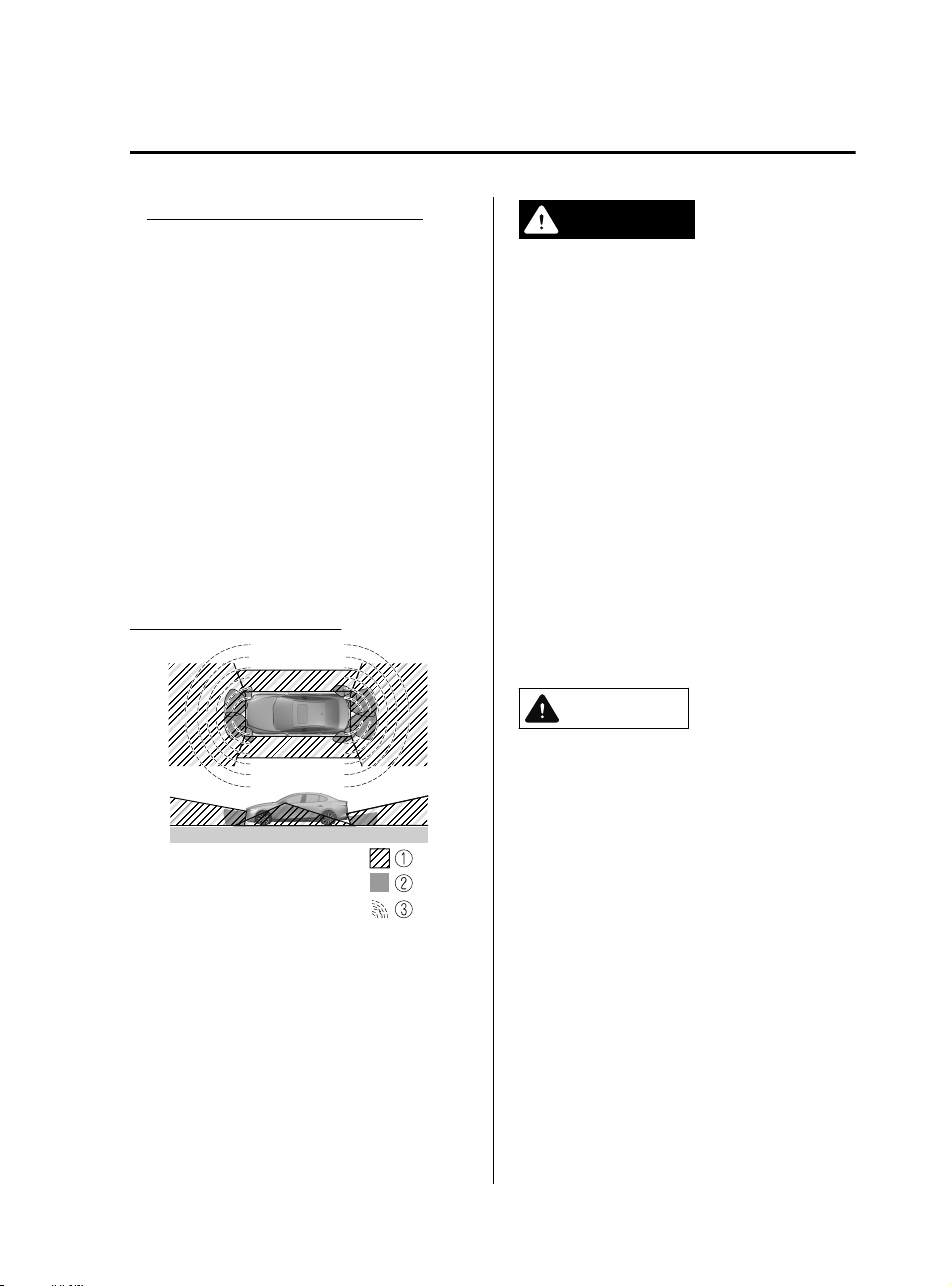
Rear Cross Traffic Alert (RCTA)
If there is the possibility of a collision
with an approaching vehicle while the
rear view/rear wide view is displayed, a
warning is displayed on the center
display.
The Rear Cross Traffic Alert (RCTA)
uses rear side radar sensor to detect
vehicles approaching from the rear left
and right sides of the vehicle, and it
assists the driver in checking the rear of
the vehicle while reversing by flashing
the Blind Spot Monitoring (BSM)
warning lights and activating the
warning sound.
Refer to Rear Cross Traffic Alert
(RCTA) on page 4-114.
360°View Monitor Range
1. Cameras
2. Ultrasonic sensors
3. Front/Rear side radar sensors
WARNING
Always
conrm
the safety of the area
around the vehicle with the mirrors and
directly with your eyes when driving:
The 360°View Monitor is an auxiliary device
which assists the driver in checking the
safety of the area around the vehicle.
The shooting range of the cameras and
detection range of the sensors are limited.
For example, the areas in black at the front
and rear of the vehicle image and the
seams where each of the camera images
merge are blind spots where an obstruction
may not be visible. In addition, the
extended vehicle width lines and projected
vehicle path lines are only to be used as
references, and the images on the screen
may dier from the actual conditions.
CAUTION
Do not use the 360°View Monitor under
any of the following conditions.
Icy or snow-covered roads.
Tire chains or a temporary spare tire is
installed.
The front doors or the rear doors is not
fully closed.
The vehicle is on a road incline.
The door mirrors are retracted.
Do not hit the front/rear camera, front/
rear bumper, and door mirrors forcefully.
The camera position or installation angle
may shift.
The cameras are of a waterproof
structure. Do not disassemble, modify, or
remove a camera.
When Driving
i-ACTIVSENSE
4-167
Mazda3_8HZ1-EA-19G_Edition1_old 2019-5-17 13:49:03

The camera cover is made of hard
plastic, therefore do not apply oil lm
remover, organic solvents, wax, or
coating agents. If any such agent gets on
the camera cover, wipe it
o
using a soft
cloth immediately.
Do not rub the camera lens forcefully, or
clean it with an abrasive or hard brush.
Otherwise, it could scratch the camera
lens and negatively aect the images.
Consult an Authorized Mazda Dealer for
repair, painting, or replacement of the
front/rear camera, front/rear bumper
and door mirrors.
Heed the following cautions to assure
that the 360°View Monitor operates
normally.
Do not modify the vehicle suspensions
or lower/raise the vehicle body, or
both.
Always use wheels of the
specied
type
and size for the front and rear wheels.
Consult an Authorized Mazda Dealer
for tire replacement.
When the display is cold, images may
leave trails or the screen might be darker
than usual, making it
dicult
to check
the vehicle surroundings. Always conrm
the safety at the front and around the
vehicle visually when driving.
The method for parking/stopping the
vehicle using the 360°View Monitor
diers depending on the road
circumstances/conditions and the
vehicle conditions. When and how much
you turn the steering wheel will dier
depending on the situation, , therefore
always check the vehicle surroundings
directly with your eyes while using the
system.
Also, before using the system, always
make sure that the vehicle can be
parked/stopped in the parking/stopping
space.
NOTE
If there are water droplets, snow, or mud
on the camera lens, wipe it off using a
soft cloth. If the camera lens is
especially dirty, wash it off with mild
detergent.
If the camera lens is touched or there is
any dirt on it, it could affect the screen
image. Wipe the lens using a soft cloth.
If the area where the camera is
installed, such as the front/rear bumper
or door mirrors, has been damaged in a
vehicle accident, the camera (position,
installation angle) may have shifted.
Always consult an Authorized Mazda
Dealer to have the vehicle inspected.
If the camera is subjected to excessive
changes in temperature such as by
pouring hot water on the camera during
cold weather, the 360°View Monitor may
not operate normally.
If the battery voltage is low, the screen
might be temporarily difficult to view,
however, this does not indicate a
problem.
The 360°View Monitor has limitations.
Objects under the bumper or near both
ends of the bumper cannot be displayed.
Obstructions above the upper image
range of the camera are not displayed.
Under the following conditions, the
screen might be difficult to view,
however this does not indicate a
problem.
When Driving
i-ACTIVSENSE
4-168
Mazda3_8HZ1-EA-19G_Edition1_old 2019-5-17 13:49:03

The temperature near the lens is high/
low.
Rainy conditions, water droplets on
the camera, or high humidity.
Mud or foreign matter near the
camera.
Extremely bright light such as sunlight
or headlights hitting the camera lens
directly.
The surroundings are illuminated by
vehicle lights, fluorescent lights, or
LED lights (Display may flicker).
Extremely small dark or white dots
appear on the screen (dots may
flicker).
Because the 360°View Monitor camera
uses a special lens, the distance
displayed on the screen differs from the
actual distance.
Obstructions displayed on the screen
may appear differently than in actuality.
(Obstructions may appear fallen, larger,
or longer than they actually are.)
Do not apply stickers to a camera or the
area around it. In addition, do not
install accessories or an illuminated
number/character license plate to the
area around a camera. Otherwise, the
camera may not correctly display the
surrounding conditions.
Free/open source software information
This product includes free/open sources.
Information about the licensing and
source code is available at the following
URL.
https://www.denso.com/global/en/
opensource/svss/mazda/
When Driving
i-ACTIVSENSE
4-169
Mazda3_8HZ1-EA-19G_Edition1_old 2019-5-17 13:49:03
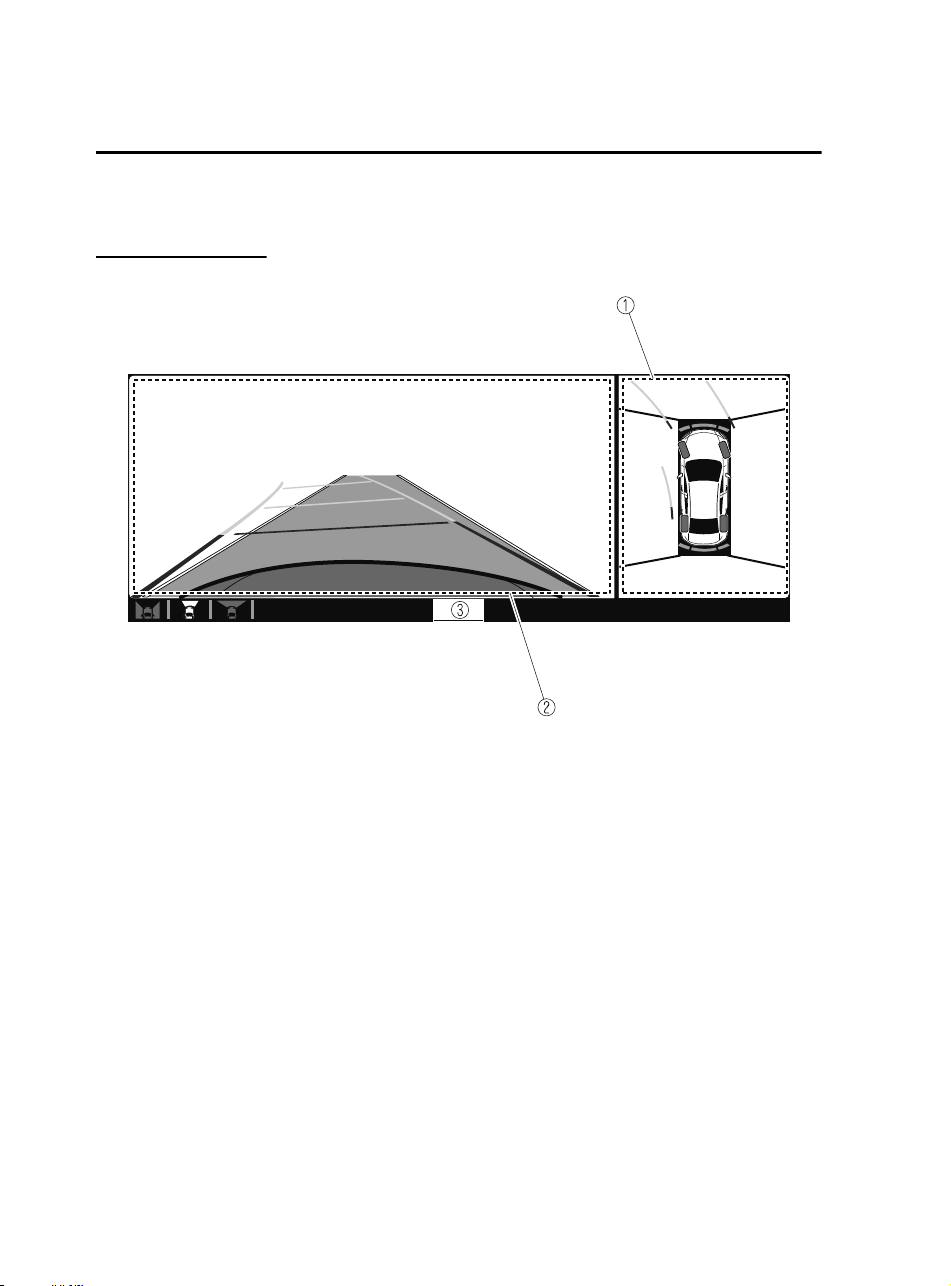
▼
Types of Images Displayed on the Screen
Top view/Front view
Displays the image of the area around the vehicle and the vehicle front.
1. Top view screen
2. Front view screen
3. “Check surroundings for safety.” message is displayed
When Driving
i-ACTIVSENSE
4-170
Mazda3_8HZ1-EA-19G_Edition1_old 2019-5-17 13:49:03
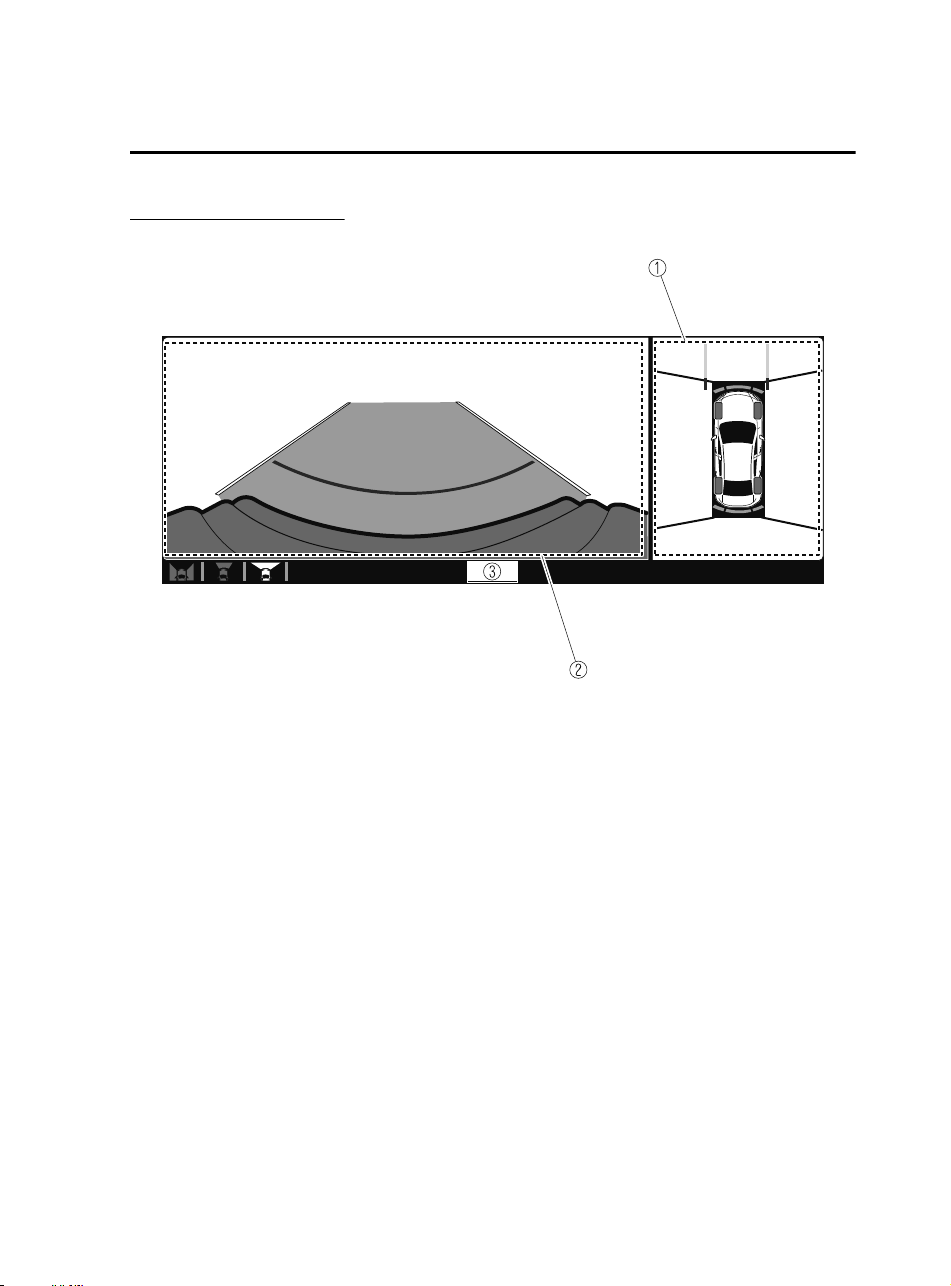
Top view/Front wide view
Displays the image of the area around the vehicle and the front of the vehicle (wide-area).
1. Top view screen
2. Front wide view screen
3. “Check surroundings for safety.” message is displayed
When Driving
i-ACTIVSENSE
4-171
Mazda3_8HZ1-EA-19G_Edition1_old 2019-5-17 13:49:03
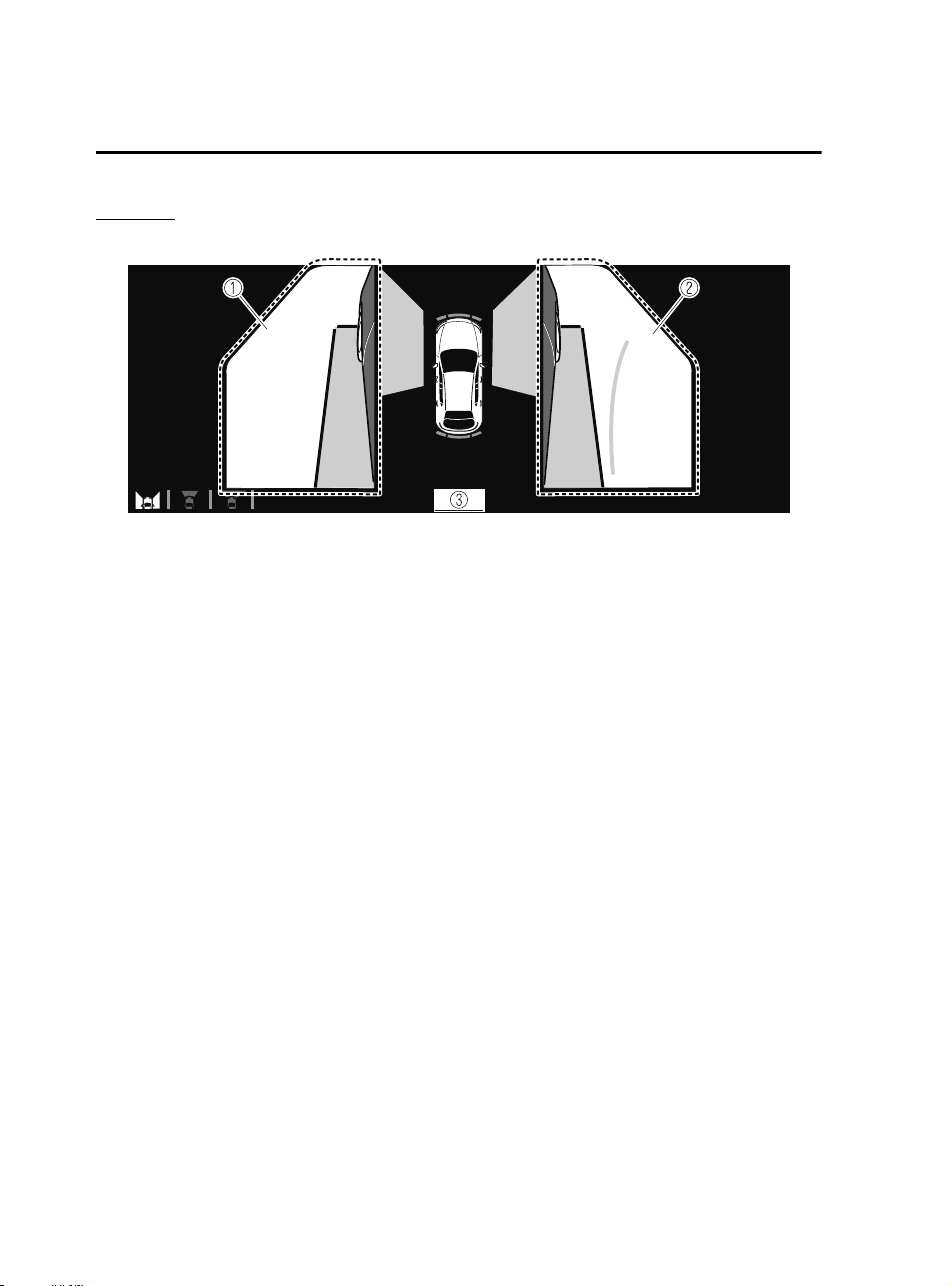
Side view
Displays the image of the left and right sides of the vehicle.
1. Left side view screen
2. Right side view screen
3. “Check surroundings for safety.” message is displayed
When Driving
i-ACTIVSENSE
4-172
Mazda3_8HZ1-EA-19G_Edition1_old 2019-5-17 13:49:03
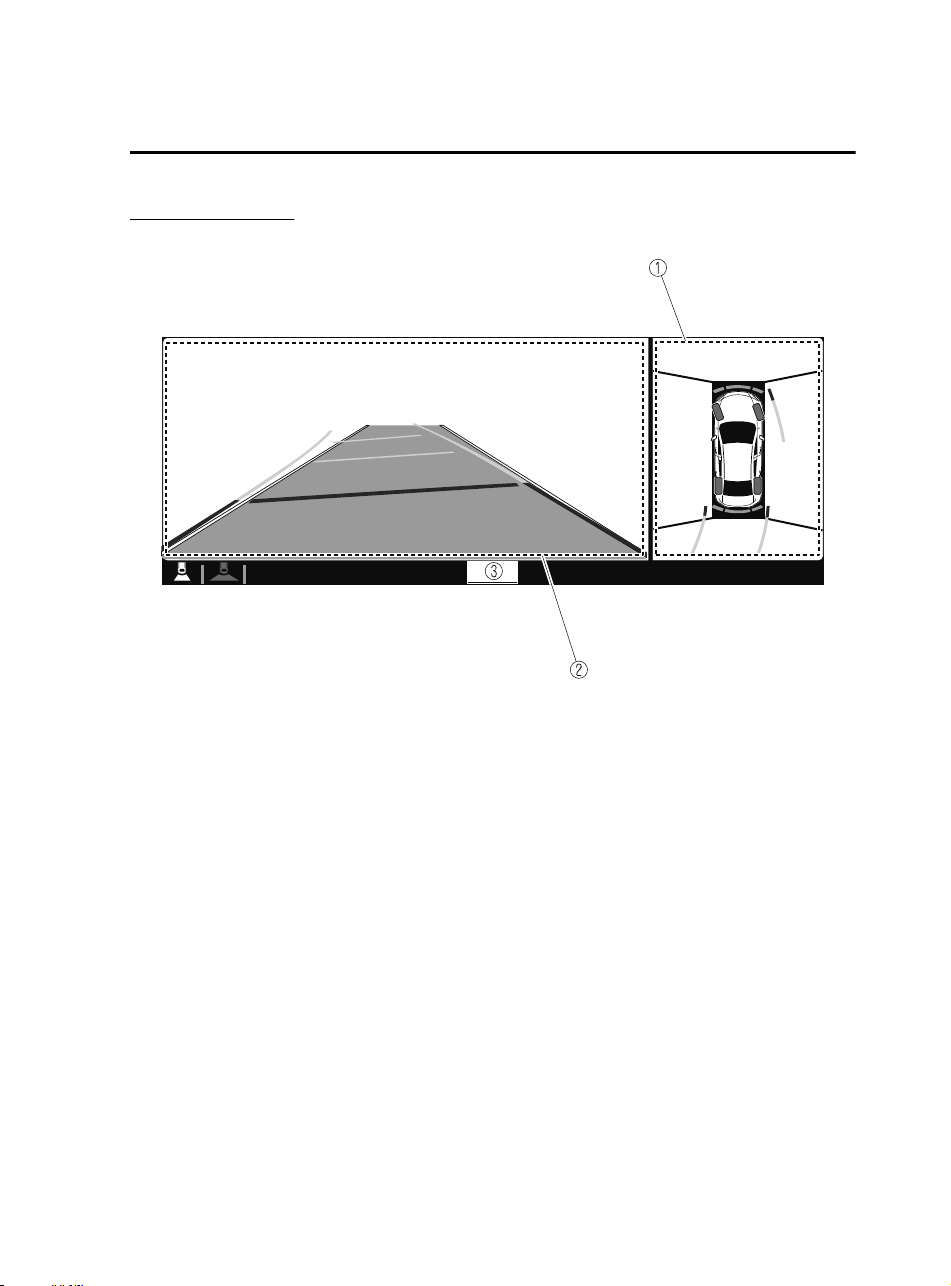
Top view/Rear view
Displays the image of the area around the vehicle and the rear of the vehicle.
1. Top view screen
2. Rear view screen
3. “Check surroundings for safety.” message is displayed
When Driving
i-ACTIVSENSE
4-173
Mazda3_8HZ1-EA-19G_Edition1_old 2019-5-17 13:49:03
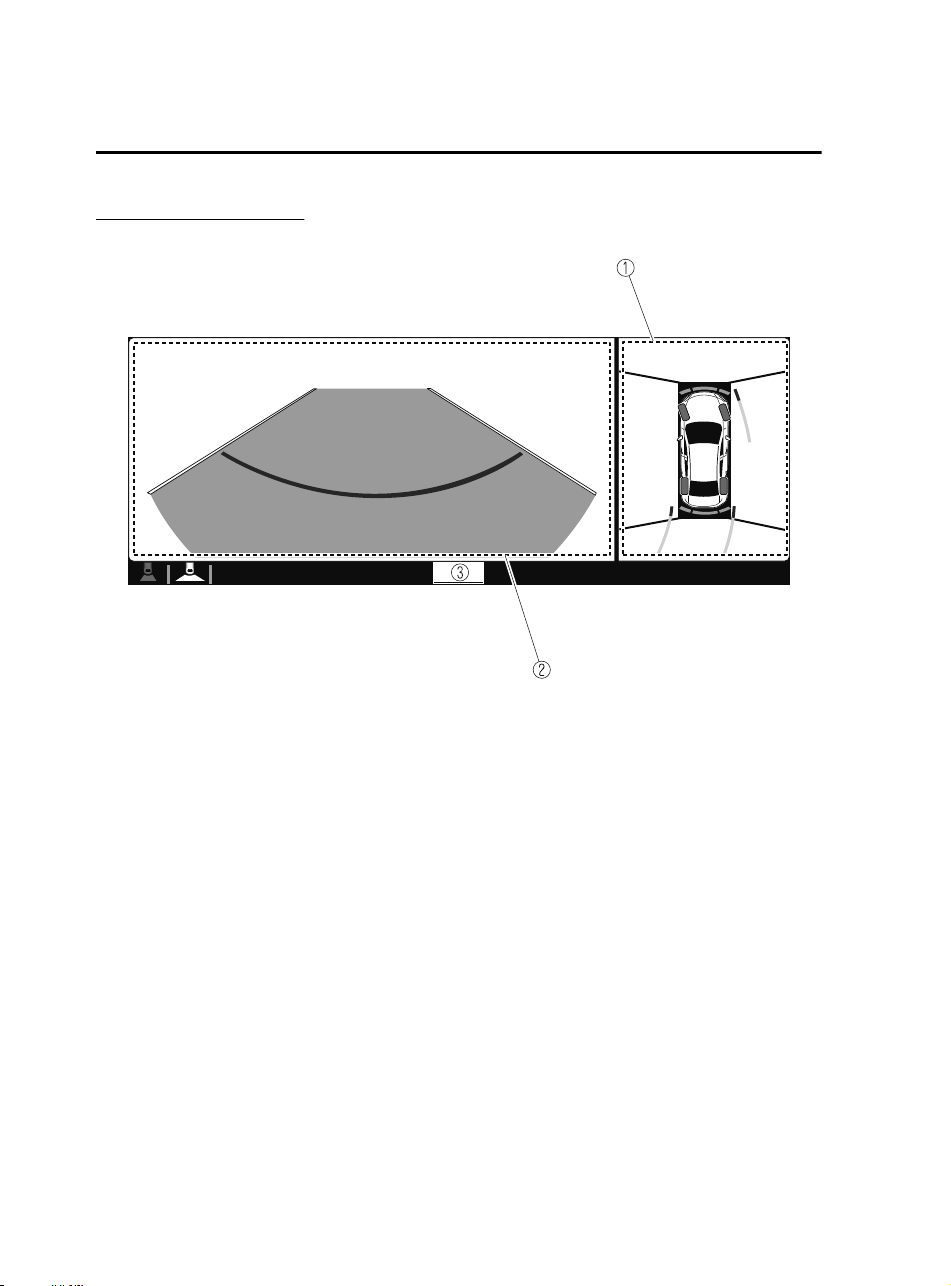
Top view/Rear wide view
Displays the image of the area around the vehicle and the rear of the vehicle (wide-area).
1. Top view screen
2. Rear wide view screen
3. “Check surroundings for safety.” message is displayed
When Driving
i-ACTIVSENSE
4-174
Mazda3_8HZ1-EA-19G_Edition1_old 2019-5-17 13:49:03
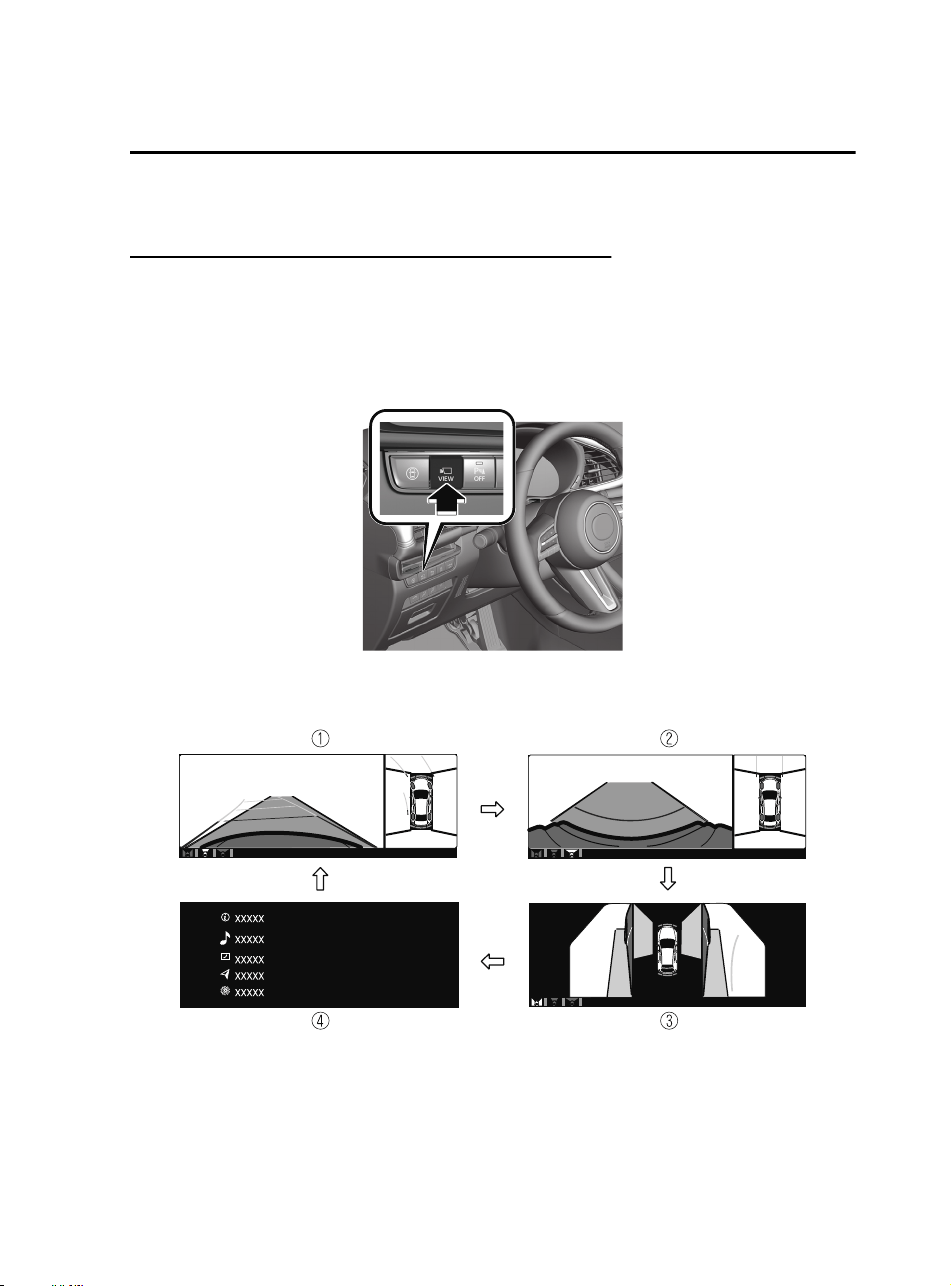
▼
How to Use the System
Top view/Front view, Top view/Front wide view, Side view
Indication
Images are displayed on the screen when the 360°View Monitor switch is pressed with all of
the following conditions met.
The ignition is switched ON.
The shift lever/selector lever is in a position other than R.
Display switching
The displayed screen can be changed each time the 360°view monitor switch is pressed.
1. Top view/Front view
2. Top view/Front wide view
3. Side view
4. Home screen
When Driving
i-ACTIVSENSE
4-175
Mazda3_8HZ1-EA-19G_Edition1_old 2019-5-17 13:49:03

NOTE
When the shift lever/selector lever is in R position, the displayed screen does not switch to
the top view/front view, top view/front wide view, or the side view.
Display of the top view/front view, top view/front wide view, or the side view stops even
with the display conditions met if any of the following conditions occurs.
When a switch around the commander knob is pressed.
(Manual transmission)
The parking brake is applied.
(Automatic transmission)
The selector lever is shifted to P position (displayed when the selector lever is in a
position other than P).
(Displayed when vehicle speed is less than 15 km/h (9.3 mph))
4 minutes and 30 seconds have passed.
The vehicle speed is about 15 km/h (9.3 mph) or faster.
(Displayed when the vehicle speed is about 15 km/h (9.3 mph) or faster)
The vehicle speed is about 15 km/h (9.3 mph) or faster after 8 seconds have passed
since pressing the 360°View Monitor switch.
Four minutes and 22 seconds have passed from the point when the vehicle speed was
less than 15 km/h (9.3 mph) after 8 seconds have passed since pressing the 360°View
Monitor switch.
The 360°View Monitor settings can be changed as follows.
Refer to the Settings section in the Mazda Connect Owner's Manual.
Automatic display of the 360°View Monitor when the ultrasonic senor detects an
obstruction.
Automatic display of the 360°View Monitor when the ignition is switched ON.
Screen priority level when the system launches
Top view/Rear view, Top view/Rear wide view
The top view/rear view, top view/rear wide view displays when all of the following
conditions are met.
The ignition is switched ON.
Shift lever/selector lever is in R position.
When Driving
i-ACTIVSENSE
4-176
Mazda3_8HZ1-EA-19G_Edition1_old 2019-5-17 13:49:03
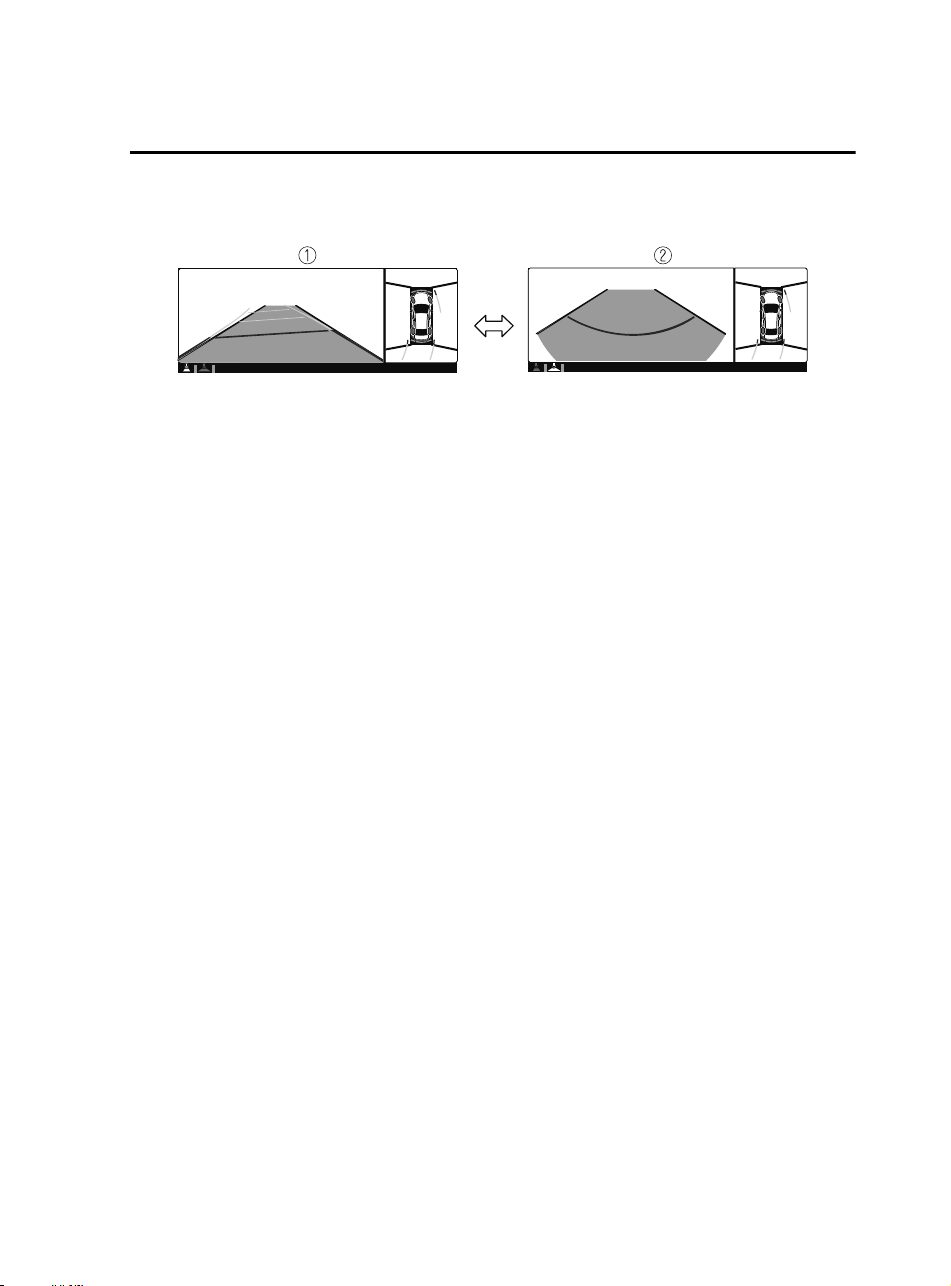
Display switching
The displayed screen can be changed each time the 360°view monitor switch is pressed.
1. Top view/Rear view
2. Top view/Rear wide view
NOTE
The top view/rear view and top view/rear wide view automatically display whether or not
the 360°View Monitor switch is turned on or off when shifting the shift lever/selector lever
to R position.
The top view/rear view and top view/rear wide view displays the previously displayed
screen.
The setting can be changed to display the top view/front view when shifting from reverse
to a forward gear without operating the 360°View Monitor switch to check the front of the
vehicle while parallel parking.
Refer to the Settings section in the Mazda Connect Owner's Manual.
When Driving
i-ACTIVSENSE
4-177
Mazda3_8HZ1-EA-19G_Edition1_old 2019-5-17 13:49:03
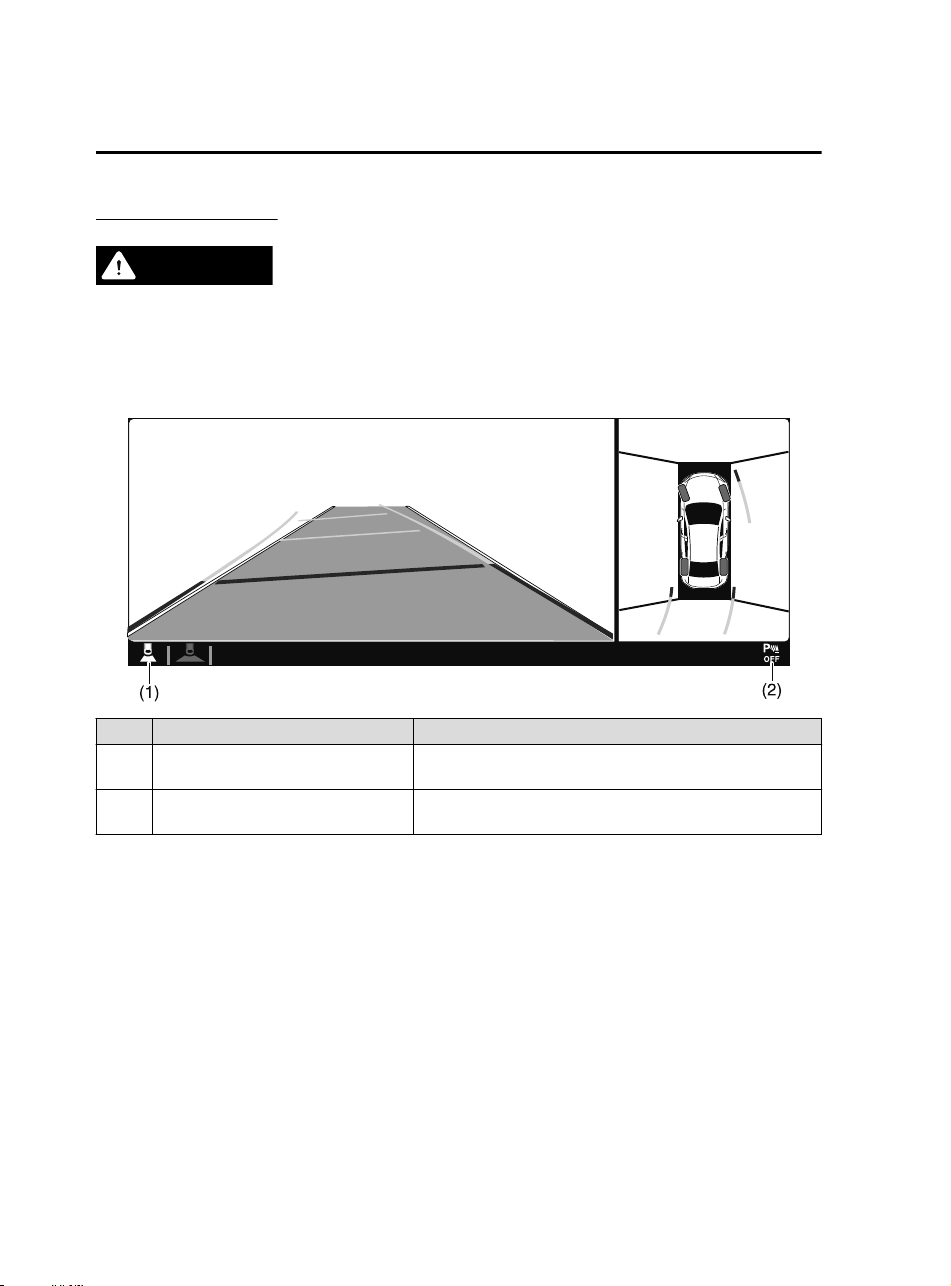
Screen operation/icon
WARNING
Always stop the vehicle when adjusting the 360°View Monitor image quality.
Do not adjust the 360°View Monitor image quality while driving. If you adjust the 360°View
Monitor image quality (such as brightness, contrast, tone, and color density) while driving, it
could lead to an unexpected accident.
Display/Icon Content
(1) View status icon Indicates which image is displayed among the front view/front
wide view/side view/rear view/rear wide view.
(2) Parking sensor status icon Indicates that the parking sensor has a problem or it is switch‐
ed off.
When Driving
i-ACTIVSENSE
4-178
Mazda3_8HZ1-EA-19G_Edition1_old 2019-5-17 13:49:03
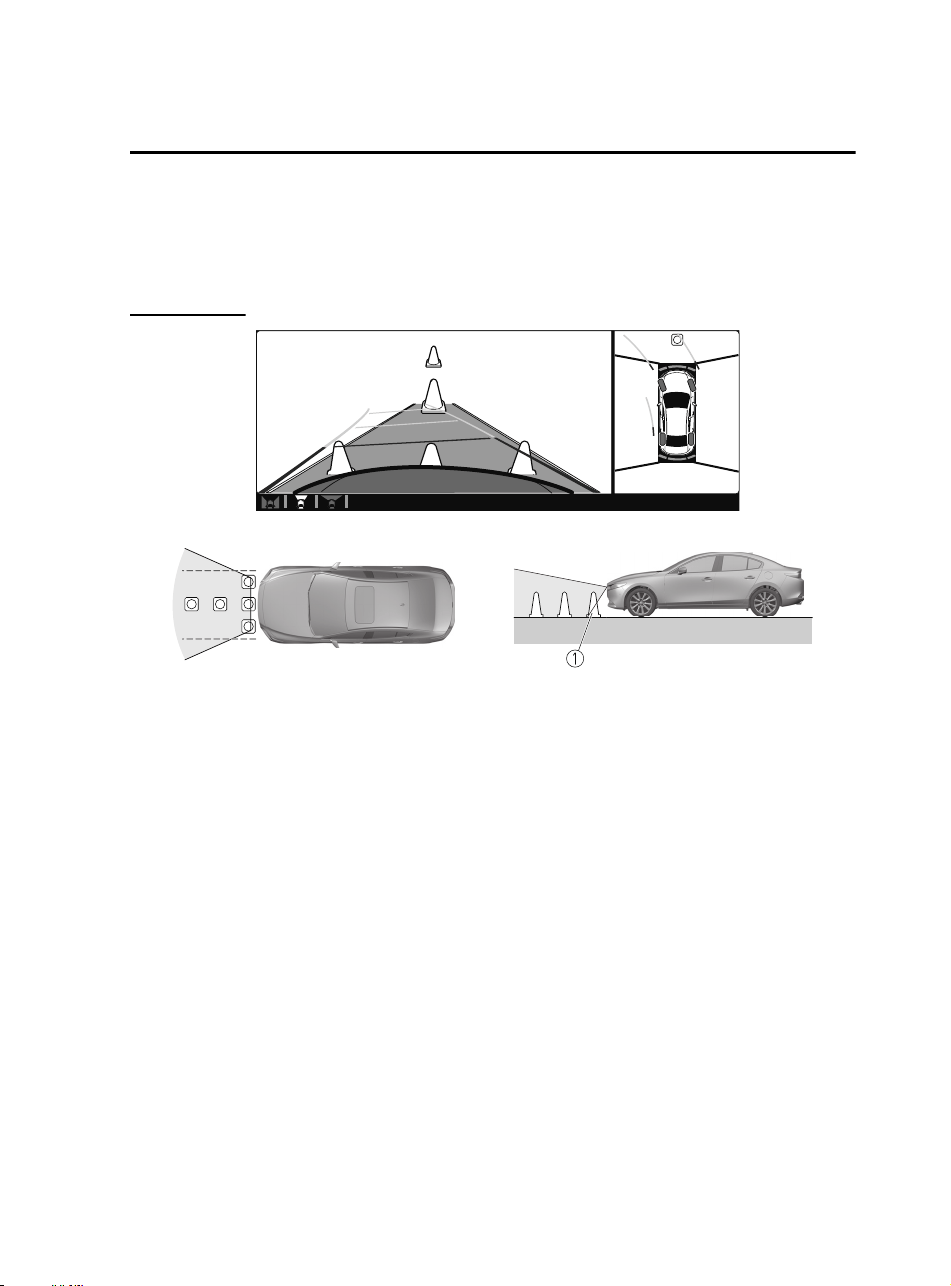
▼
Top Vie w/Front View
Use the top view/front view to assist in checking the safety of the surrounding area when
accelerating from a stop, parking, or stopping the vehicle.
Display range
1. Target object
NOTE
In the top view screen, the areas in black at the front and rear of the vehicle image and the
seams where each of the camera images merge are blind spots.
Because images displayed in the top view screen are processed from each camera, the top
view screen may display in the following ways.
If an image containing an object with a conspicuous color is picked up by any of the
cameras, the screen area for each camera may be affected and it may display in that
color.
Obstructions displayed in the front view may not display on the top view screen.
If the position or angle of each camera changes due to tilting of the vehicle, the image
may appear distorted.
Lines on the road may appear distorted at the seams where each of the camera images
merge.
The screen area for each camera may appear bright/dark depending on the illumination
level around any of the cameras.
When Driving
i-ACTIVSENSE
4-179
Mazda3_8HZ1-EA-19G_Edition1_old 2019-5-17 13:49:03
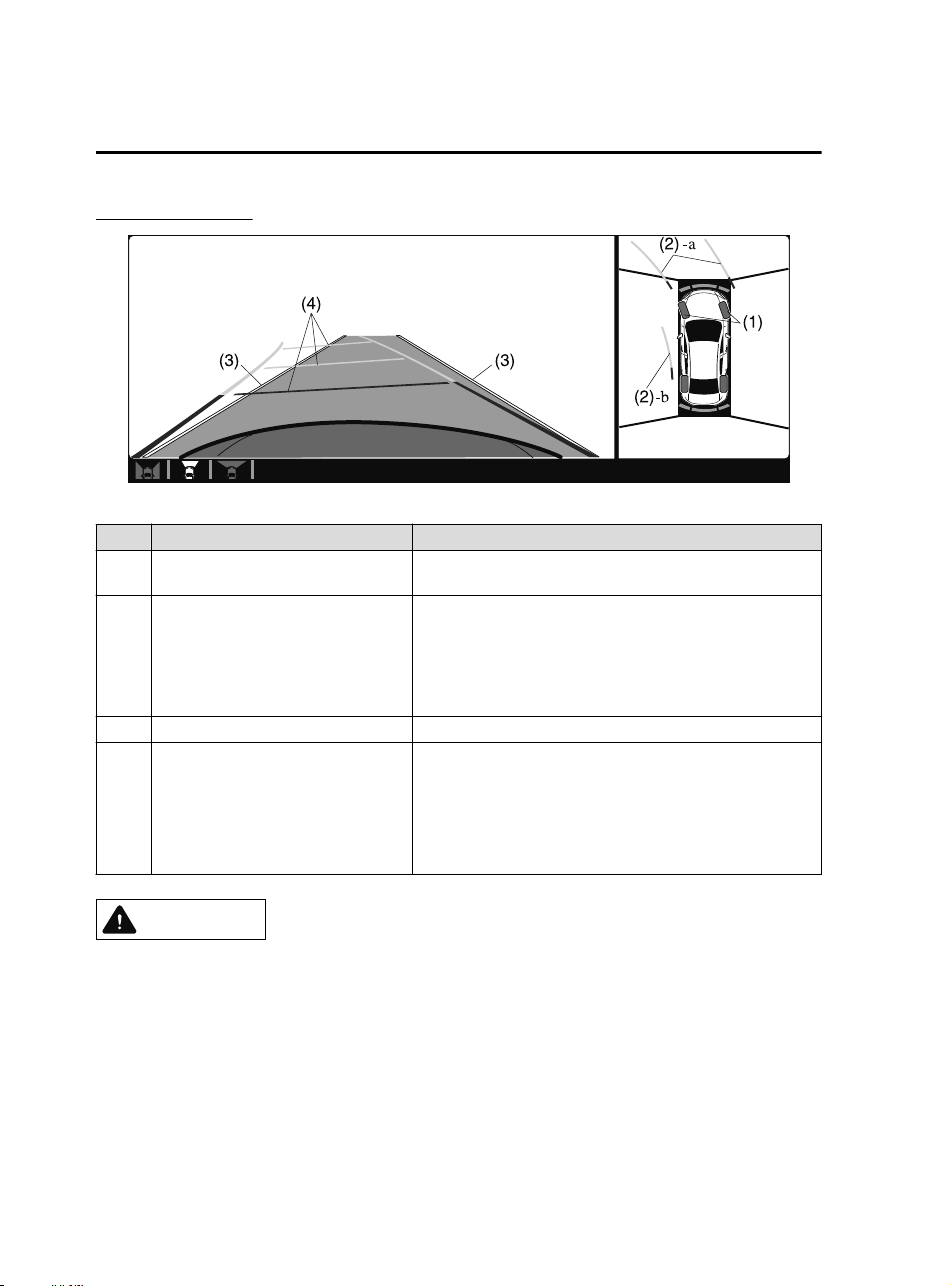
Viewing the screen
Display/Icon Content
(1) Tire icon Indicates the tire direction. Moves in conjunction with the
steering wheel operation.
(2) Projected vehicle path lines (yellow &
red)
Indicates the approximate projected path of the vehicle.
Moves in conjunction with the steering wheel operation.
a) Indicates the path where the edge of the front bumper is ex‐
pected to travel.
b) Indicates the path where the inner side of the vehicle is ex‐
pected to travel.
(3) Extended vehicle width lines (blue) Indicates the approximate width of the vehicle.
(4) Projected vehicle path distance guide
lines (yellow & red)
Indicates the distance (from front end of bumper) in front of
the vehicle.
The red line indicates the point about 0.5 m (19 in) from the
front end of the bumper.
The yellow lines indicate the points about 1.0 m (39 in) and
2.0 m (78 in) from the front end of the bumper.
CAUTION
The parking sensor detection range has limitations. For example, obstructions closing in from
the side and objects short in height may not be detected. Always conrm the safety around
the vehicle visually when driving.
For details, refer to the parking sensor obstruction detection indication and warning sound.
Refer to Parking Sensor System on page 4-235.
NOTE
The setting can be changed so that the projected vehicle path lines are not displayed.
Refer to the Settings section in the Mazda Connect Owner's Manual.
When Driving
i-ACTIVSENSE
4-180
Mazda3_8HZ1-EA-19G_Edition1_old 2019-5-17 13:49:03
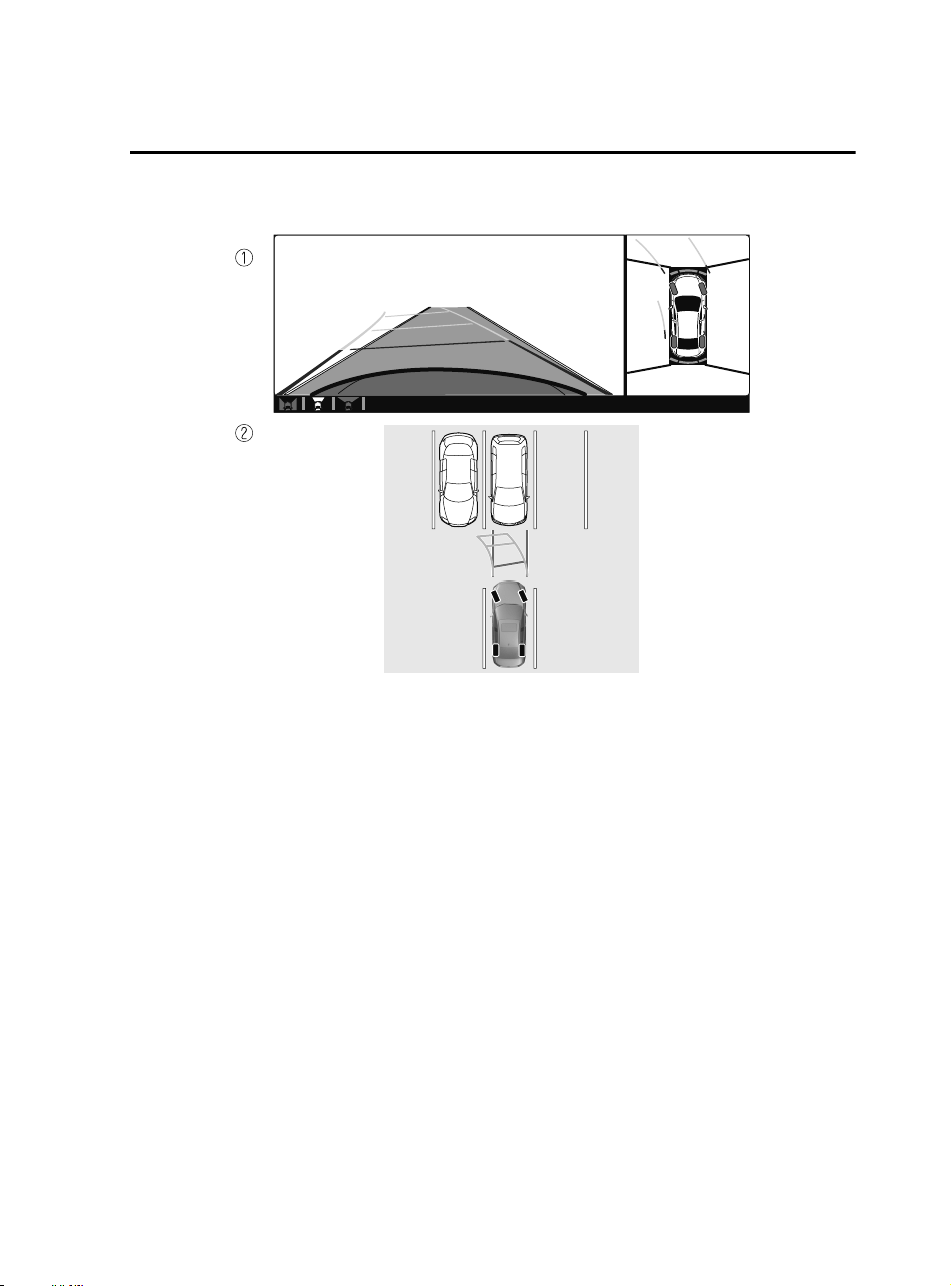
How to use the projected vehicle path line function
1. (Screen display)
2. (Actual condition)
Make sure that there are no obstructions within the projected vehicle path lines.
Drive the vehicle forward while turning the steering wheel so that no obstructions come
within the projected vehicle path lines.
When Driving
i-ACTIVSENSE
4-181
Mazda3_8HZ1-EA-19G_Edition1_old 2019-5-17 13:49:03
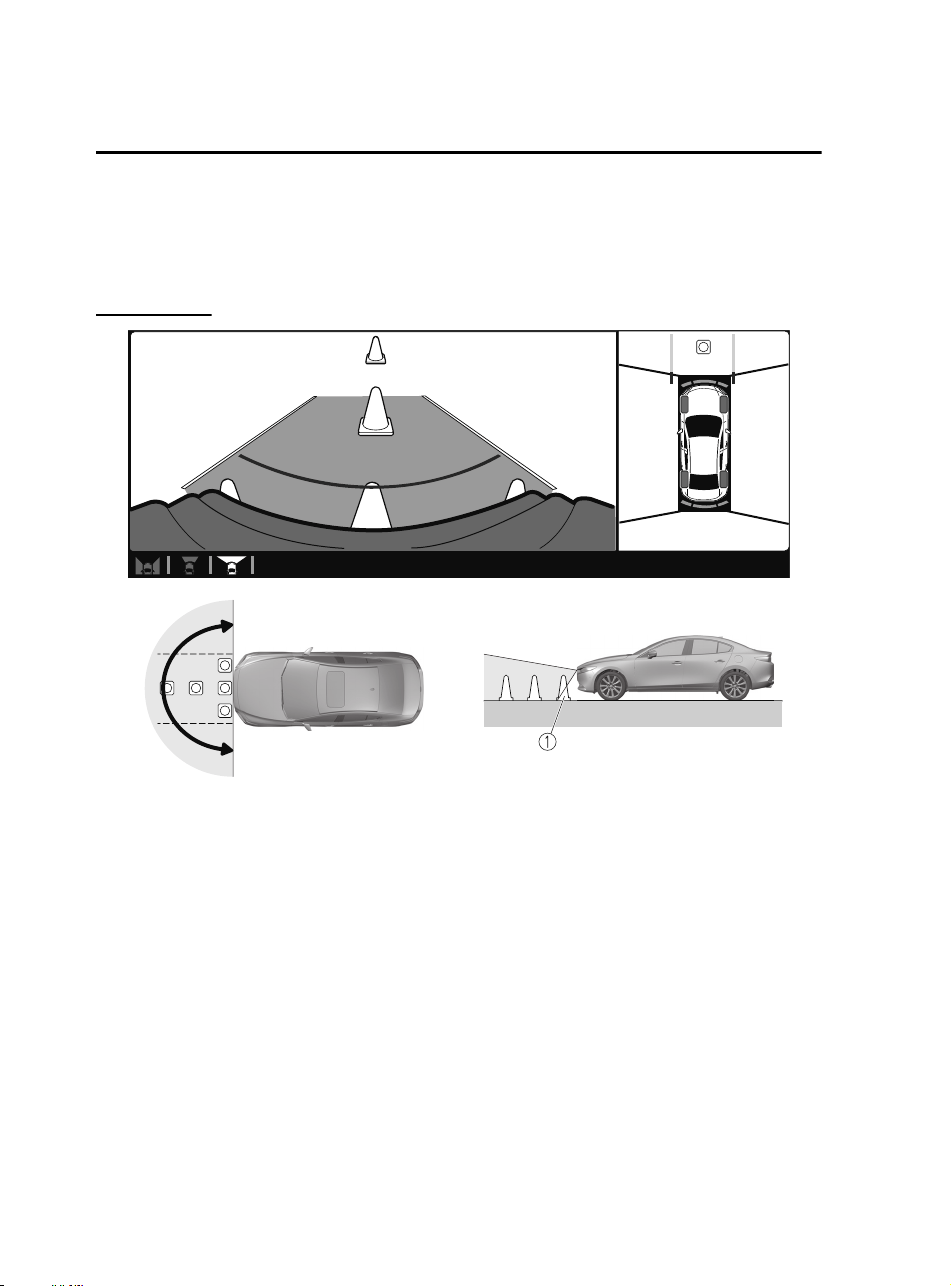
▼
Top View/Front Wide View
Use the top view/front wide view to assist in checking the safety of the surrounding area
when accelerating from a stop or entering a T-shaped intersection and intersection.
Display range
1. Target object
NOTE
In the top view screen, the areas in black at the front and rear of the vehicle image and the
seams where each of the camera images merge are blind spots.
Because images displayed in the top view screen are processed from each camera, the top
view screen may display in the following ways.
If an image containing an object with a conspicuous color is picked up by any of the
cameras, the screen area for each camera may be affected and it may display in that
color.
Obstructions displayed in the front view may not display on the top view screen.
If the position or angle of each camera changes due to tilting of the vehicle, the image
may appear distorted.
Lines on the road may appear distorted at the seams where each of the camera images
merge.
When Driving
i-ACTIVSENSE
4-182
Mazda3_8HZ1-EA-19G_Edition1_old 2019-5-17 13:49:03
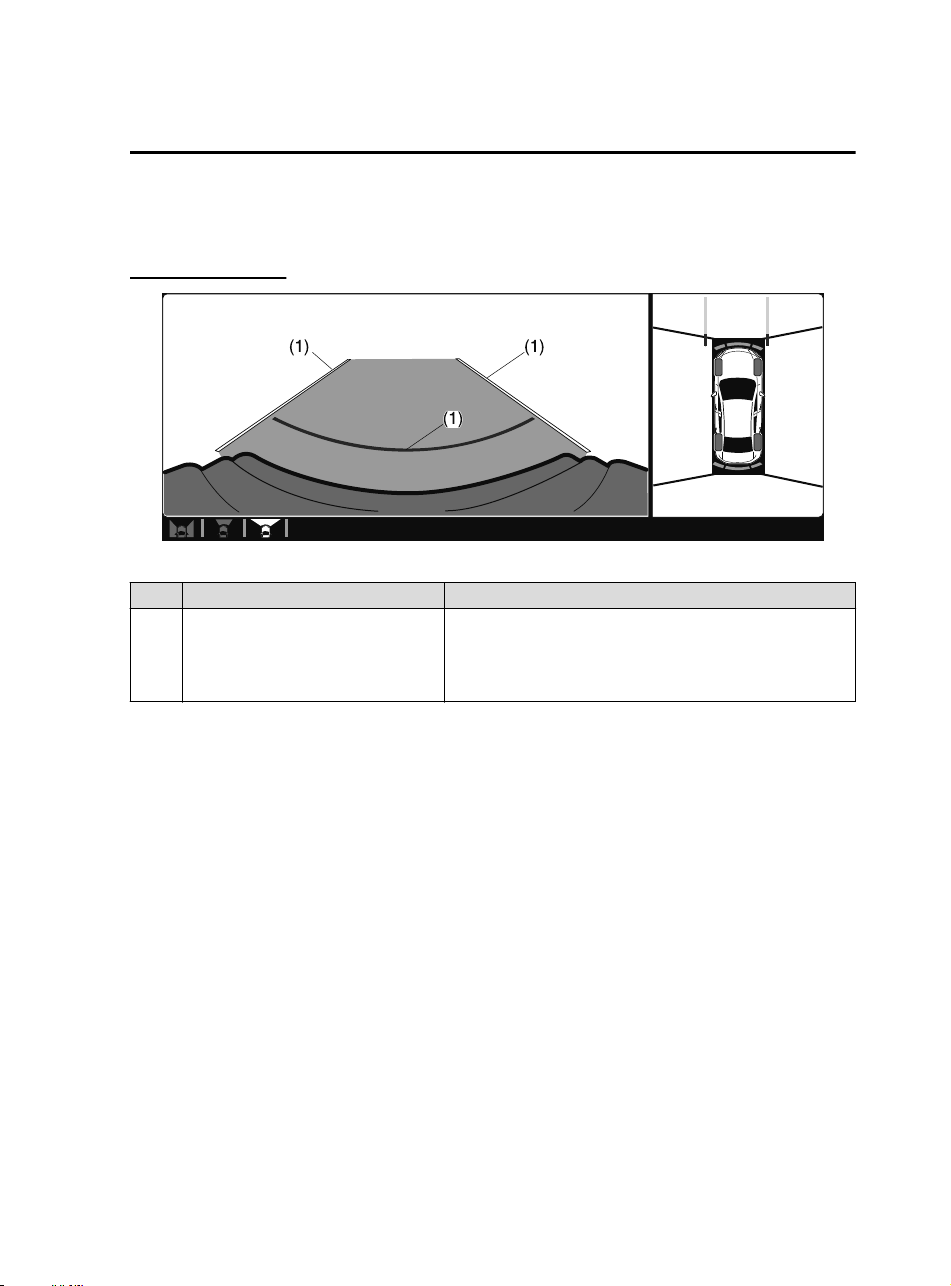
The screen area for each camera may appear bright/dark depending on the illumination
level around any of the cameras.
Viewing the screen
Display/Icon Content
(1) Extended vehicle width lines and dis‐
tance guide lines (blue & red)
Indicates the approximate width of the vehicle and the distance
(from front end of bumper) in front of the vehicle.
The red lines indicate the points up to about 0.5 m (19 in)
from the front end of the bumper.
NOTE
The front wide view screen displays the image in front of the vehicle at a wide angle and
corrects the image to help detect approaching obstructions from the side. Therefore, it
differs from the actual view.
When Driving
i-ACTIVSENSE
4-183
Mazda3_8HZ1-EA-19G_Edition1_old 2019-5-17 13:49:03
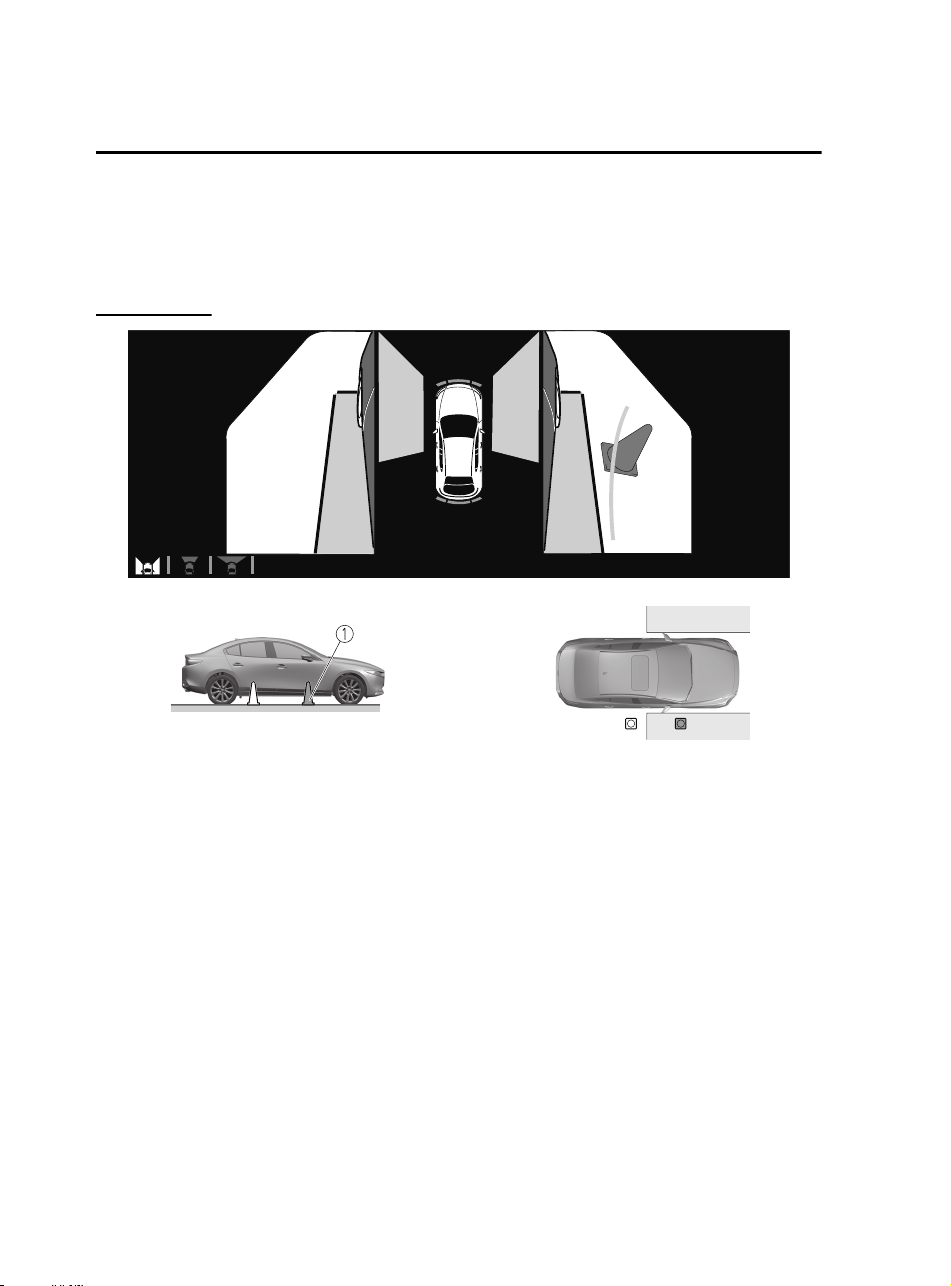
▼
Side View
Use the side view to assist in checking the safety of the surrounding area when accelerating
from a stop, parking, or stopping the vehicle.
Display range
1. Target object
When Driving
i-ACTIVSENSE
4-184
Mazda3_8HZ1-EA-19G_Edition1_old 2019-5-17 13:49:03
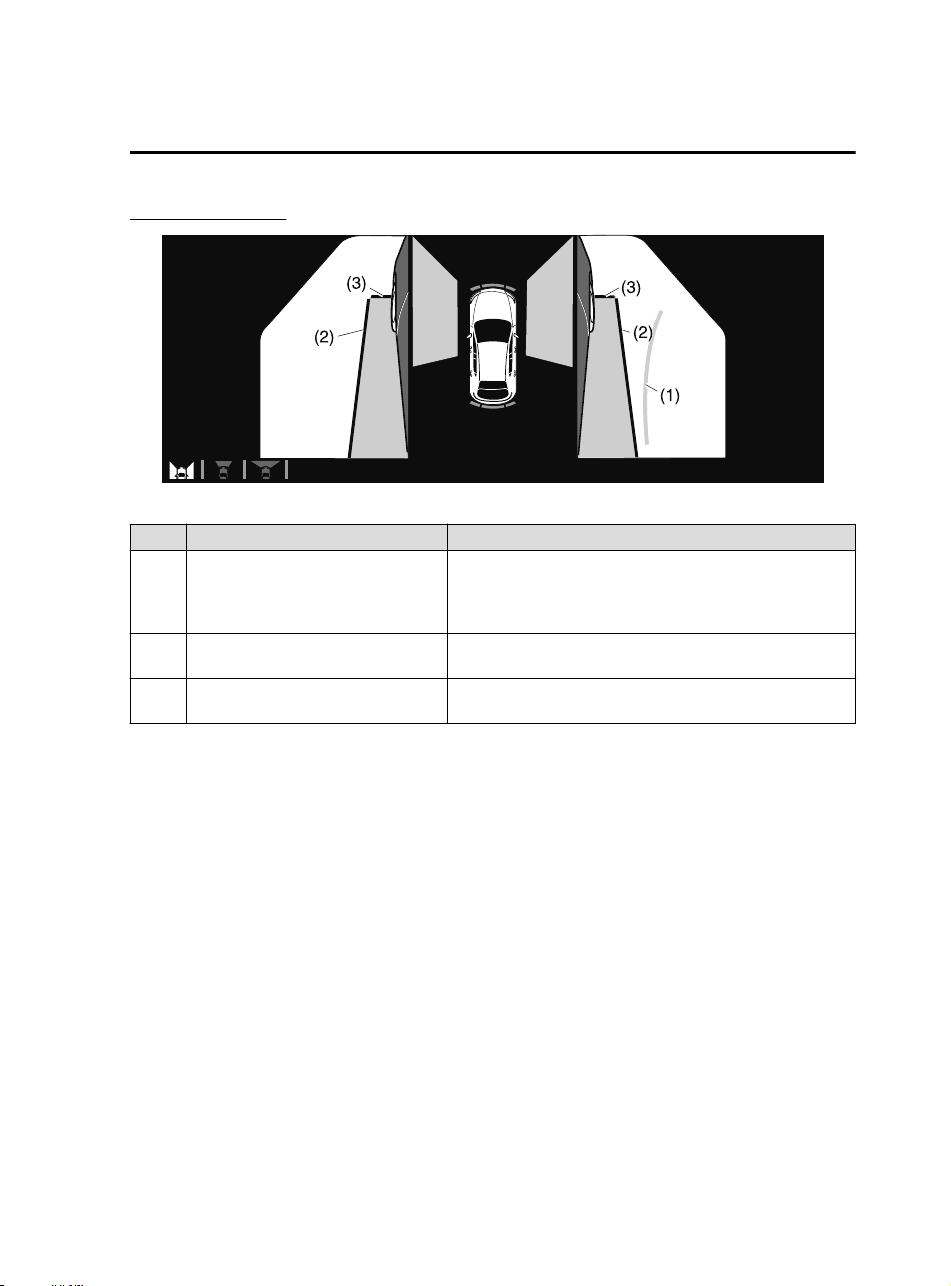
Viewing the screen
Display/Icon Content
(1) Projected vehicle path lines (yellow) Indicates the approximate projected path of the vehicle.
Moves in conjunction with the steering wheel operation.
The projected vehicle path lines (yellow) indicate the path the
inner side of the vehicle is expected to travel.
(2) Vehicle parallel guide lines (blue) Indicates the approximate vehicle width including the door
mirrors.
(3) Vehicle front end guide lines (blue) Indicates the point about 0.25 m (9.84 in) from the front edge
of the vehicle (front edge of the bumper).
NOTE
The setting can be changed so that the projected vehicle path lines are not displayed.
Refer to the Settings section in the Mazda Connect Owner's Manual.
When Driving
i-ACTIVSENSE
4-185
Mazda3_8HZ1-EA-19G_Edition1_old 2019-5-17 13:49:03
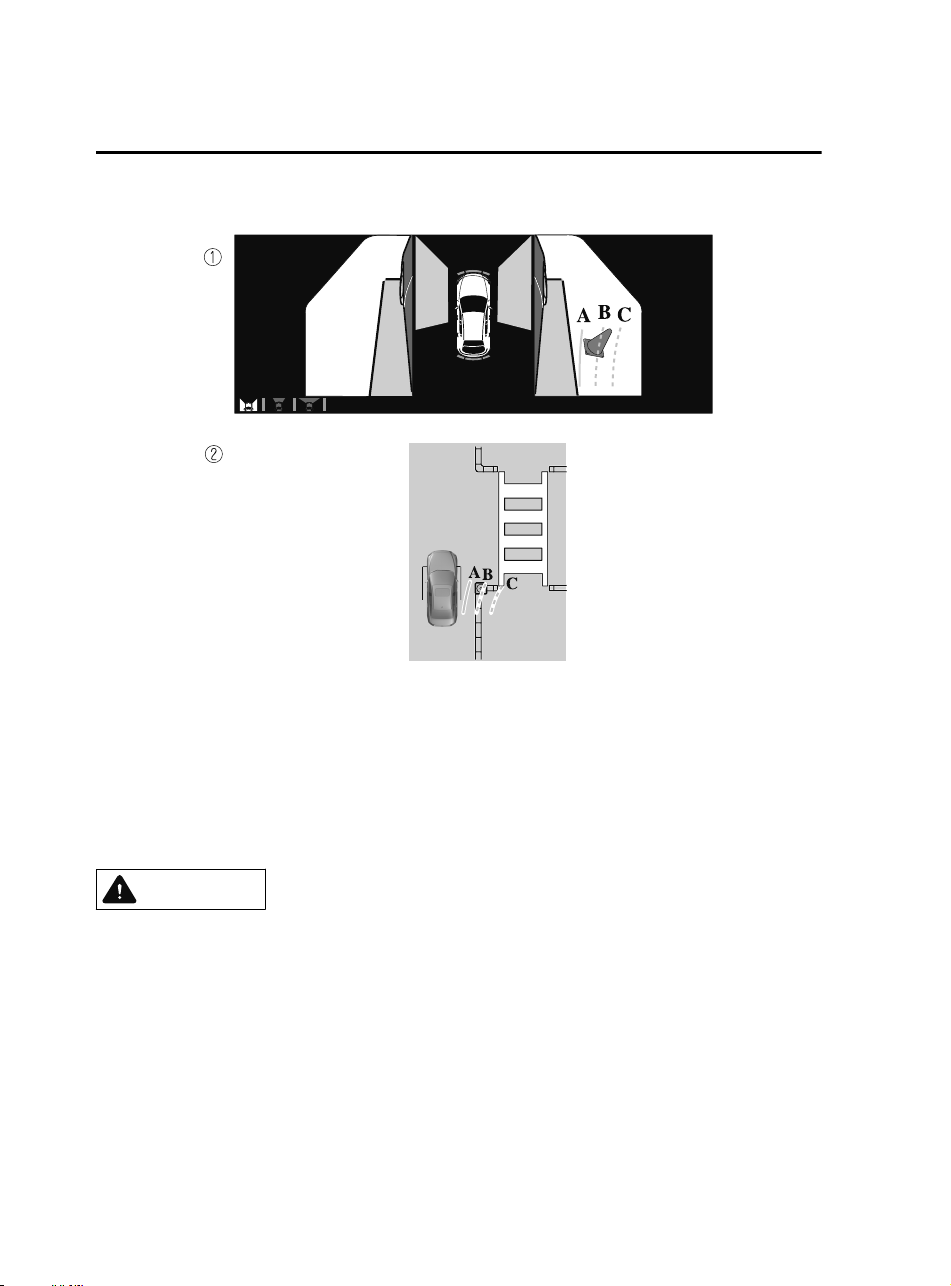
How to use the projected vehicle path line function
1. (Screen display)
2. (Actual condition)
Make sure that there are no obstructions within the projected vehicle path lines.
Turn the steering wheel so that the projected vehicle path lines travel inside of the
obstruction (A), and drive the vehicle forward until it passes the obstruction.
If the projected vehicle path lines are on an obstruction (B) or outside of the obstruction (C),
the vehicle may contact the obstruction when turning the vehicle sharply.
CAUTION
The parking sensor detection range has limitations. For example, obstructions closing in
from the side and objects short in height may not be detected. Always conrm the safety
around the vehicle visually when driving.
For details, refer to the parking sensor obstruction detection indication and warning sound.
Refer to Parking Sensor System on page 4-235.
Do not turn the steering wheel any more until the vehicle has passed the obstruction, even
if the obstruction is not visible on the side view image. If the steering wheel is turned even
more, the vehicle may contact the obstruction if it is turned sharply.
When Driving
i-ACTIVSENSE
4-186
Mazda3_8HZ1-EA-19G_Edition1_old 2019-5-17 13:49:03
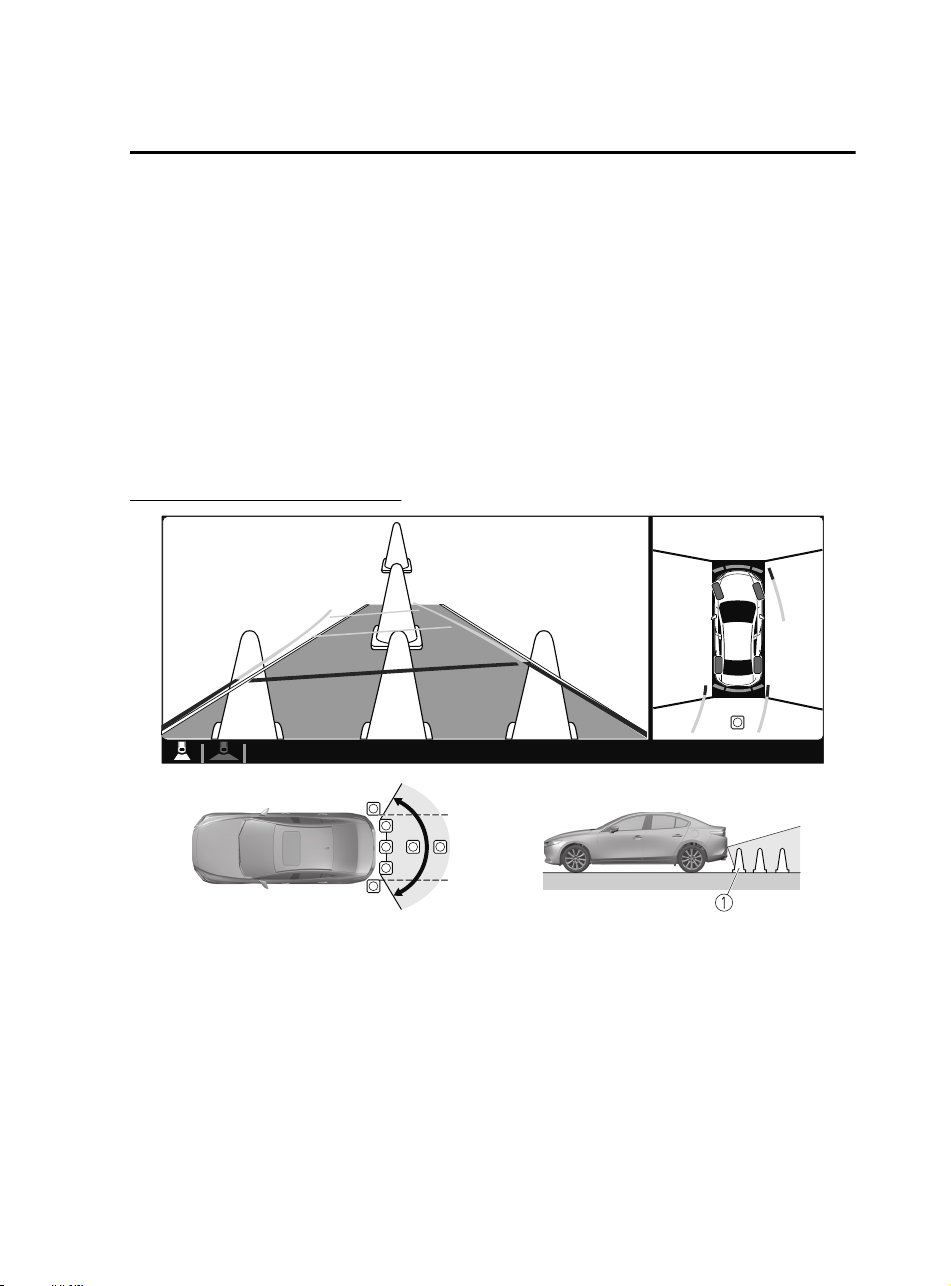
NOTE
Because there might be a difference between the image displayed on the screen and the
actual conditions, always check the safety of the surrounding area using the mirrors and
directly with your eyes when driving.
Even though the object displayed on the screen, such as a road curb or a division line of a
parking space, and the vehicle parallel guide lines appear parallel, they may not actually
be parallel.
▼
Top View/Rear View
Use the top view/rear view to assist in checking the safety of the surrounding area when
accelerating from a stop, parking, or stopping the vehicle.
Range of displayed screen image
1. Target object
NOTE
In the top view screen, the areas in black at the front and rear of the vehicle image and the
seams where each of the camera images merge are blind spots.
Because images displayed in the top view screen are processed from each camera, the top
view screen may display in the following ways.
If an image containing an object with a conspicuous color is picked up by any of the
cameras, the screen area for each camera may be affected and it may display in that
color.
When Driving
i-ACTIVSENSE
4-187
Mazda3_8HZ1-EA-19G_Edition1_old 2019-5-17 13:49:03
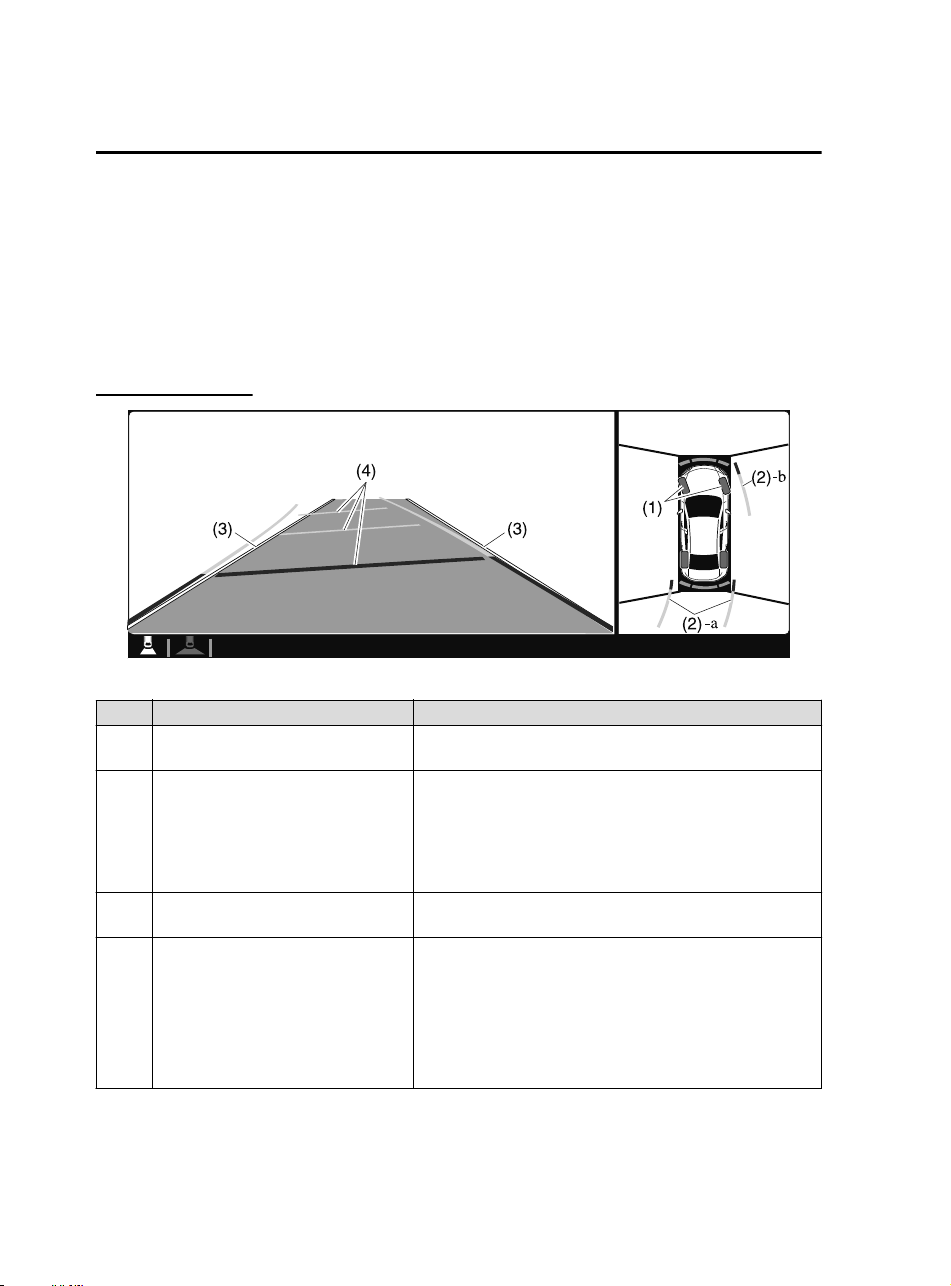
Obstructions displayed in the rear view may not display on the top view screen.
If the position or angle of each camera changes due to tilting of the vehicle, the image
may appear distorted.
Lines on the road may appear distorted at the seams where each of the camera images
merge.
The screen area for each camera may appear bright/dark depending on the illumination
level around any of the cameras.
Viewing the screen
Display/Icon Content
(1) Tire icon Indicates the tire direction. Moves in conjunction with the
steering wheel operation.
(2) Projected vehicle path lines (yellow &
red)
Indicates the approximate projected path of the vehicle.
Moves in conjunction with the steering wheel operation.
a) Indicates the path where the edge of the rear bumper is ex‐
pected to travel.
b) Indicates the path where the outer side of the vehicle is ex‐
pected to travel.
(3) Extended vehicle width lines (blue) These guide lines indicate the approximate width of the vehi‐
cle.
(4) Projected vehicle path distance guide
lines (yellow & red)
These guide lines indicate the approximate distance to a point
measured from the rear of the vehicle (from the end of the
bumper).
The red line indicates the point about 0.5 m (19 in) from the
rear end of the bumper.
The yellow lines indicate the points about 1.0 m (39 in) and
2.0 m (78 in) from the rear end of the bumper.
NOTE
The setting can be changed so that the projected vehicle path lines are not displayed.
Refer to the Settings section in the Mazda Connect Owner's Manual.
When Driving
i-ACTIVSENSE
4-188
Mazda3_8HZ1-EA-19G_Edition1_old 2019-5-17 13:49:03
How to use the projected vehicle path line function
CAUTION
The front of the vehicle swings out wide when turning the steering wheel while reversing.
Maintain sucient distance between the vehicle and an obstruction.
The parking sensor detection range has limitations. For example, obstructions closing in
from the side and objects short in height may not be detected. Always conrm the safety
around the vehicle visually when driving.
For details, refer to the parking sensor obstruction detection indication and warning sound.
Refer to Parking Sensor System on page 4-235.
NOTE
Because there might be a difference between the image displayed on the screen, such as
indicated in the following, and the actual conditions when parking, always check the
safety at the rear of the vehicle and the surrounding area directly with your eyes.
Even though the back end of the parking space (or garage) displayed on the screen and
distance guide lines appear parallel, they may not actually be parallel.
When parking in a space with a division line on only one side of the parking space, even
though the division line and the vehicle width guide line appear parallel, they may not
actually be parallel.
The following shows an example of vehicle parking with the steering wheel turned to the
left while backing up the vehicle. When backing into a parking space from the opposite
direction, the steering operation is reversed.
When Driving
i-ACTIVSENSE
4-189
Mazda3_8HZ1-EA-19G_Edition1_old 2019-5-17 13:49:03
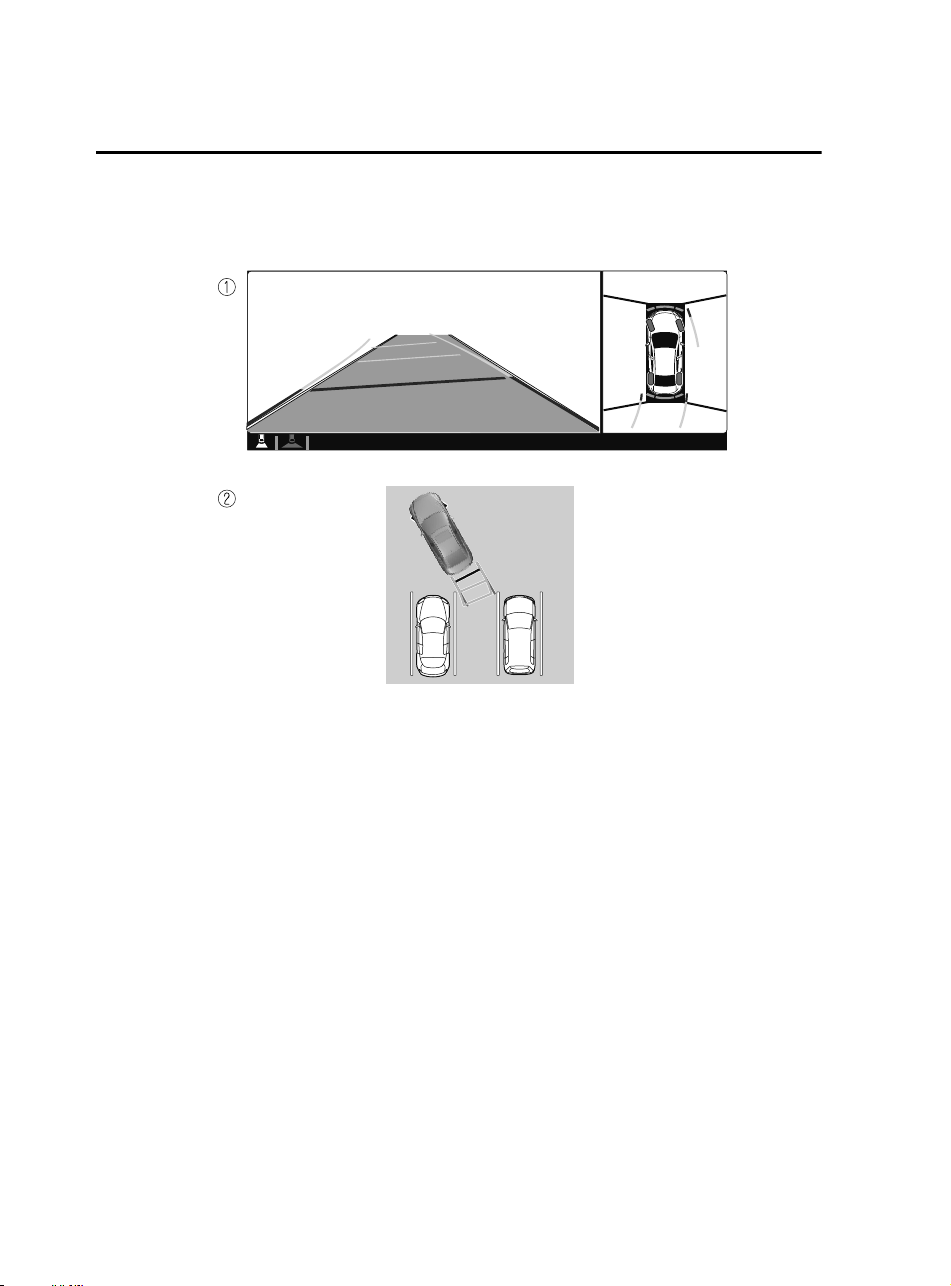
1. Back the vehicle into the parking space by turning the steering wheel so that the vehicle
enters the center of the parking space.
1. (Screen display)
2. (Actual condition)
2. After the vehicle starts entering the parking space, stop and adjust the steering wheel so
that the distance between the vehicle width lines and the sides of the parking space on
the left and right are roughly equal, and then continue backing up slowly.
When Driving
i-ACTIVSENSE
4-190
Mazda3_8HZ1-EA-19G_Edition1_old 2019-5-17 13:49:03
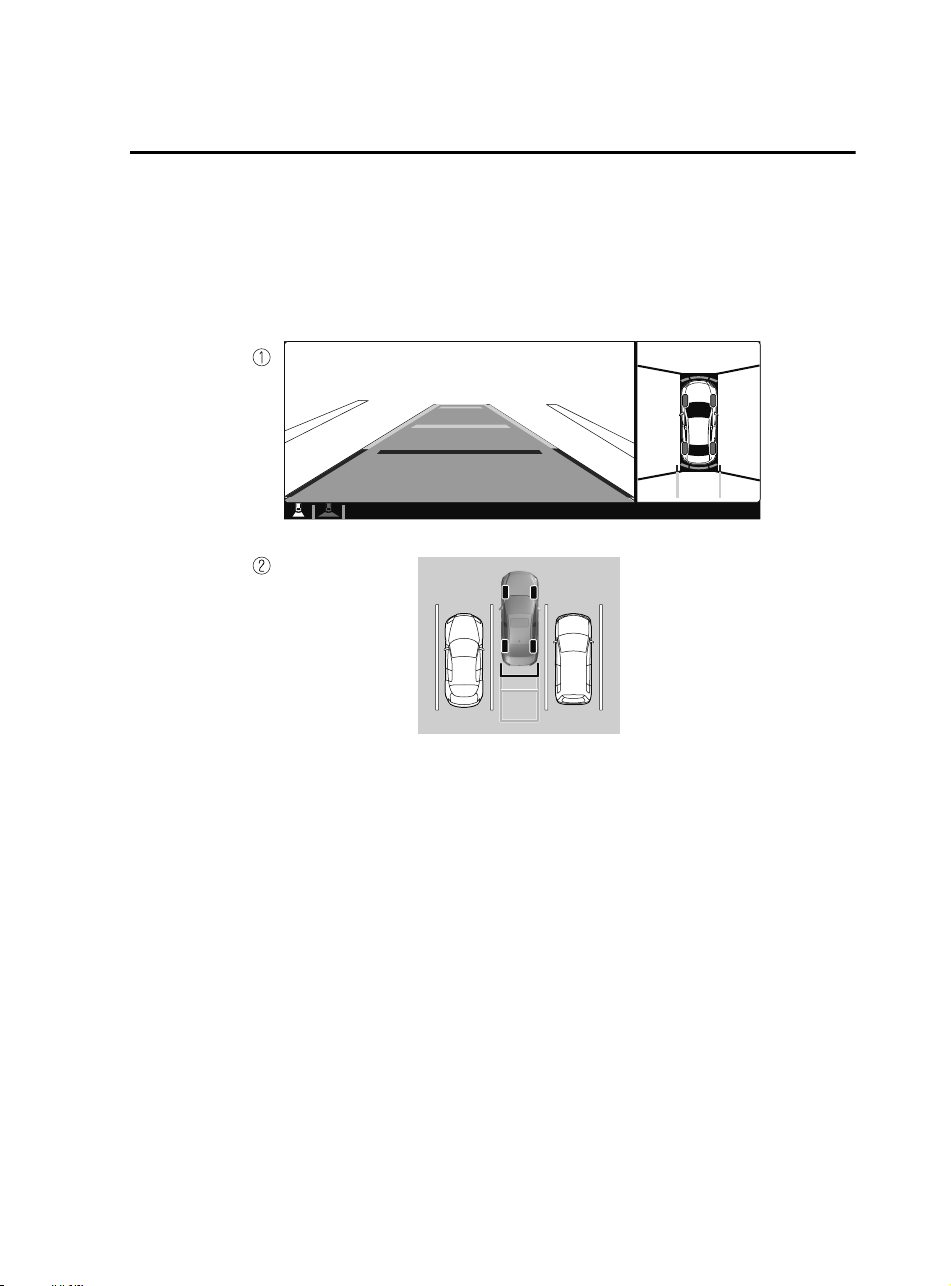
3. Once the vehicle width lines and the sides of the parking space on the left and right are
parallel, straighten the wheels and back the vehicle slowly into the parking space.
Continue checking the vehicle's surroundings and then stop the vehicle in the best
possible position. (If the parking space has division lines, check whether the vehicle
width guide lines are parallel to them.)
1. (Screen display)
2. (Actual condition)
When Driving
i-ACTIVSENSE
4-191
Mazda3_8HZ1-EA-19G_Edition1_old 2019-5-17 13:49:03
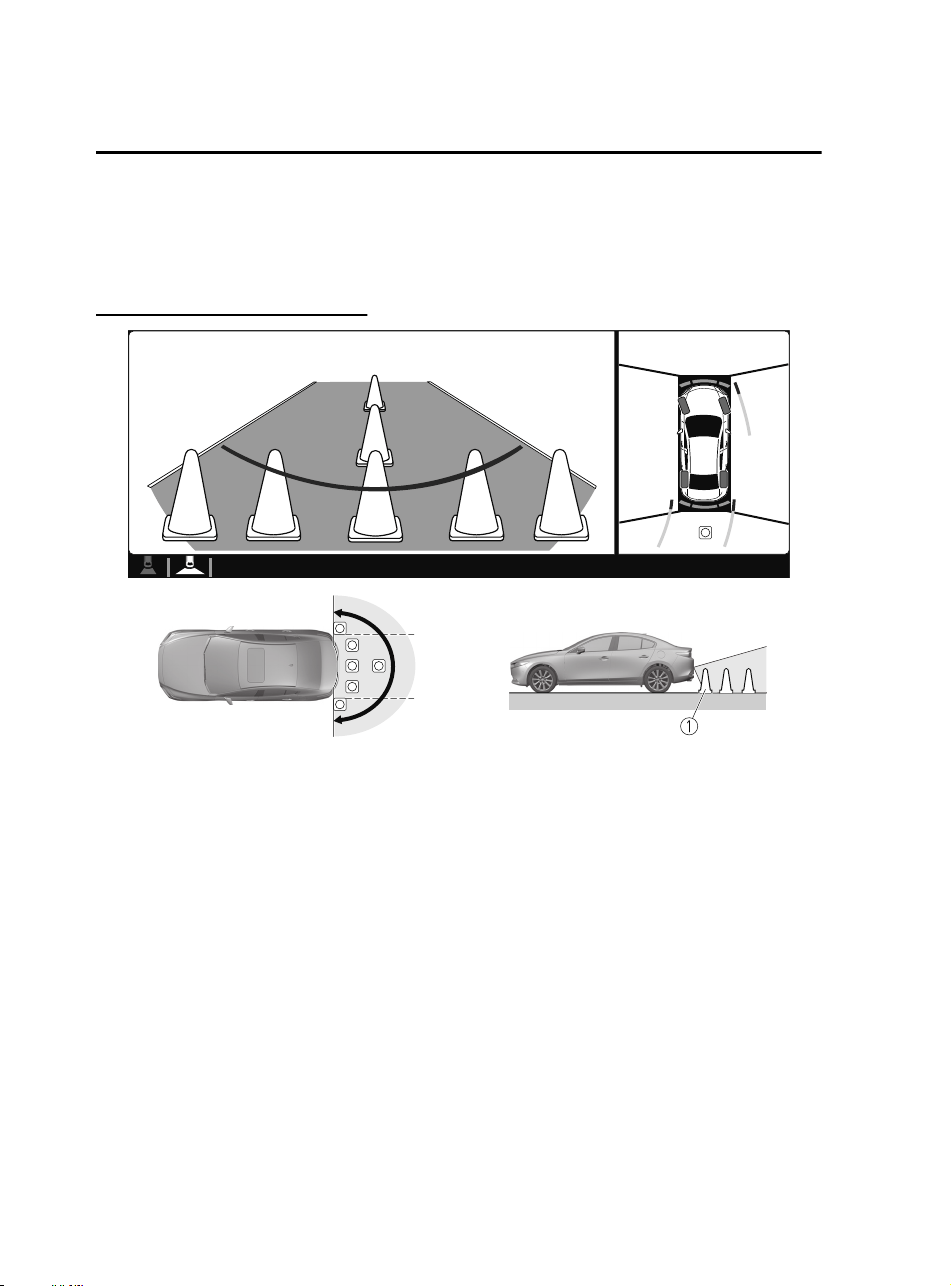
▼
Top View/Rear Wide View
Use the top view/rear wide view to assist in checking the safety of the surrounding area
when accelerating from a stop, parking, or stopping the vehicle.
Range of displayed screen image
1. Target object
NOTE
In the top view screen, the areas in black at the front and rear of the vehicle image and the
seams where each of the camera images merge are blind spots.
Because images displayed in the top view screen are processed from each camera, the top
view screen may display in the following ways.
If an image containing an object with a conspicuous color is picked up by any of the
cameras, the screen area for each camera may be affected and it may display in that
color.
Obstructions displayed in the front view may not display on the top view screen.
If the position or angle of each camera changes due to tilting of the vehicle, the image
may appear distorted.
Lines on the road may appear distorted at the seams where each of the camera images
merge.
The screen area for each camera may appear bright/dark depending on the illumination
level around any of the cameras.
When Driving
i-ACTIVSENSE
4-192
Mazda3_8HZ1-EA-19G_Edition1_old 2019-5-17 13:49:03
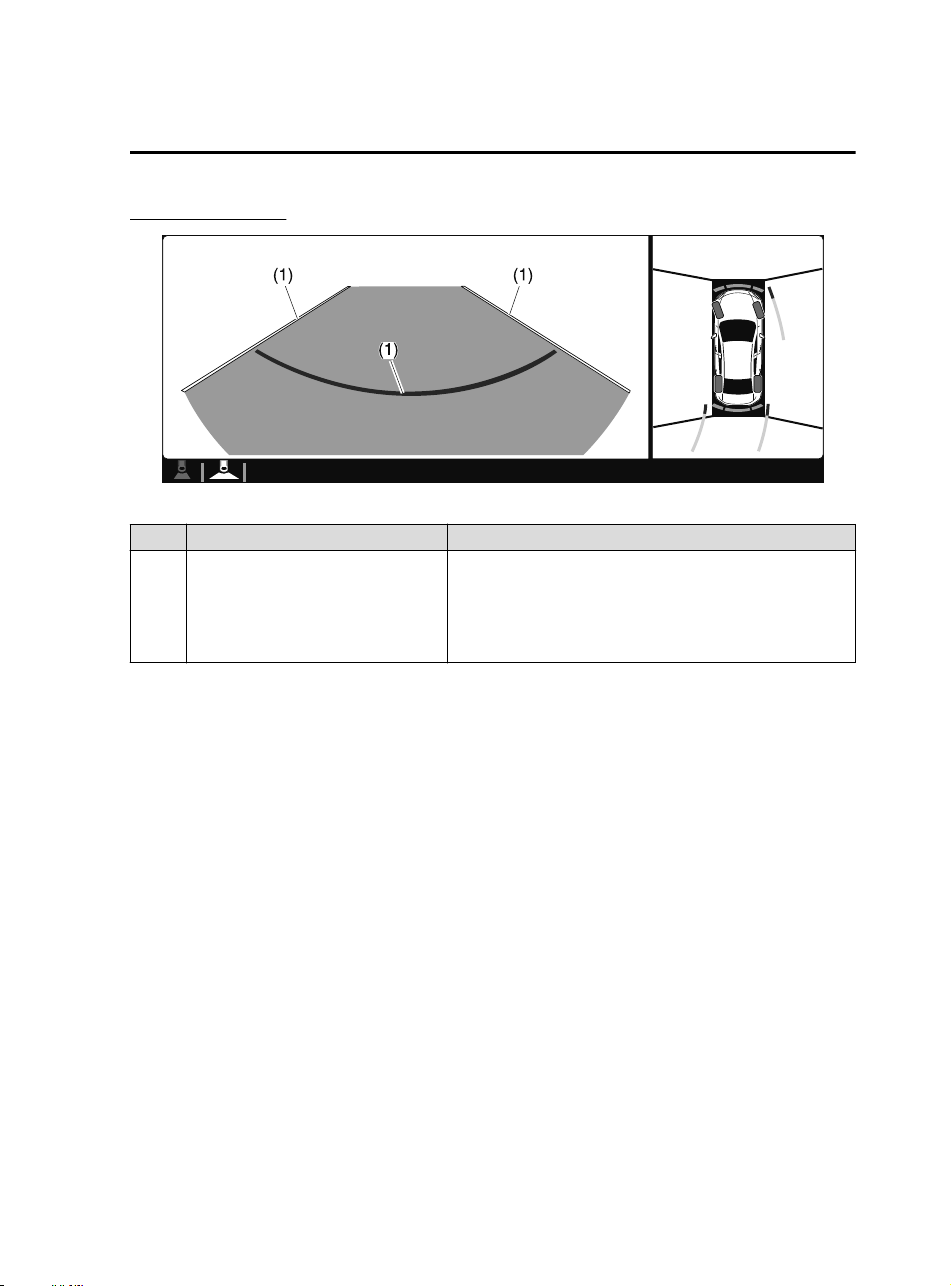
Viewing the screen
Display/Icon Content
(1) Extended vehicle width lines and dis‐
tance guide lines (blue & red)
These guide lines indicate the approximate width of the vehi‐
cle and distance to a point measured from the rear of the vehi‐
cle (from the end of the bumper).
The red lines indicate the points up to about 0.5 m (19 in)
from the rear end of the bumper.
NOTE
The top view/rear wide view screen displays the image at the rear of the vehicle at a wide
angle and corrects the image to help detect approaching obstructions from the side.
Therefore, it differs from the actual view.
When Driving
i-ACTIVSENSE
4-193
Mazda3_8HZ1-EA-19G_Edition1_old 2019-5-17 13:49:03
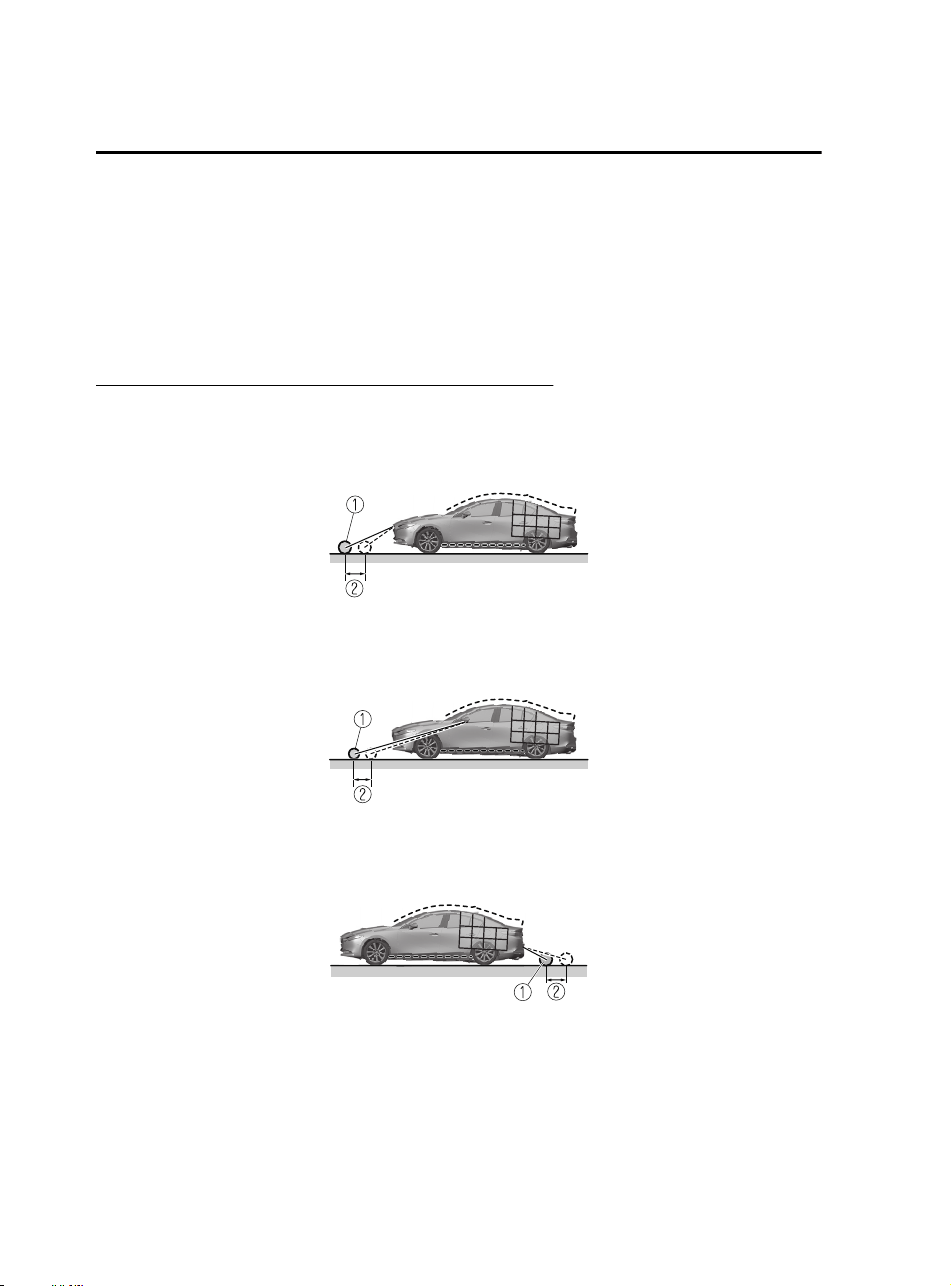
▼
Margin of Error Between Road Surface on Screen and Actual Road Surface
There might be some margin of error between the road surface appearing on the screen and
the actual road surface. A margin of error in the perceived distance could lead to an
accident, therefore be aware of the following conditions which can more easily produce
errors in the perceived distance.
The vehicle tilts due to weight of passengers and cargo.
If the vehicle is tilted, obstructions picked up by a camera can appear farther or closer than
the actual distance from the vehicle.
Front camera
1. Obstruction
2. Margin of error
Side camera
1. Obstruction
2. Margin of error
Rear camera
1. Obstruction
2. Margin of error
When Driving
i-ACTIVSENSE
4-194
Mazda3_8HZ1-EA-19G_Edition1_old 2019-5-17 13:49:03
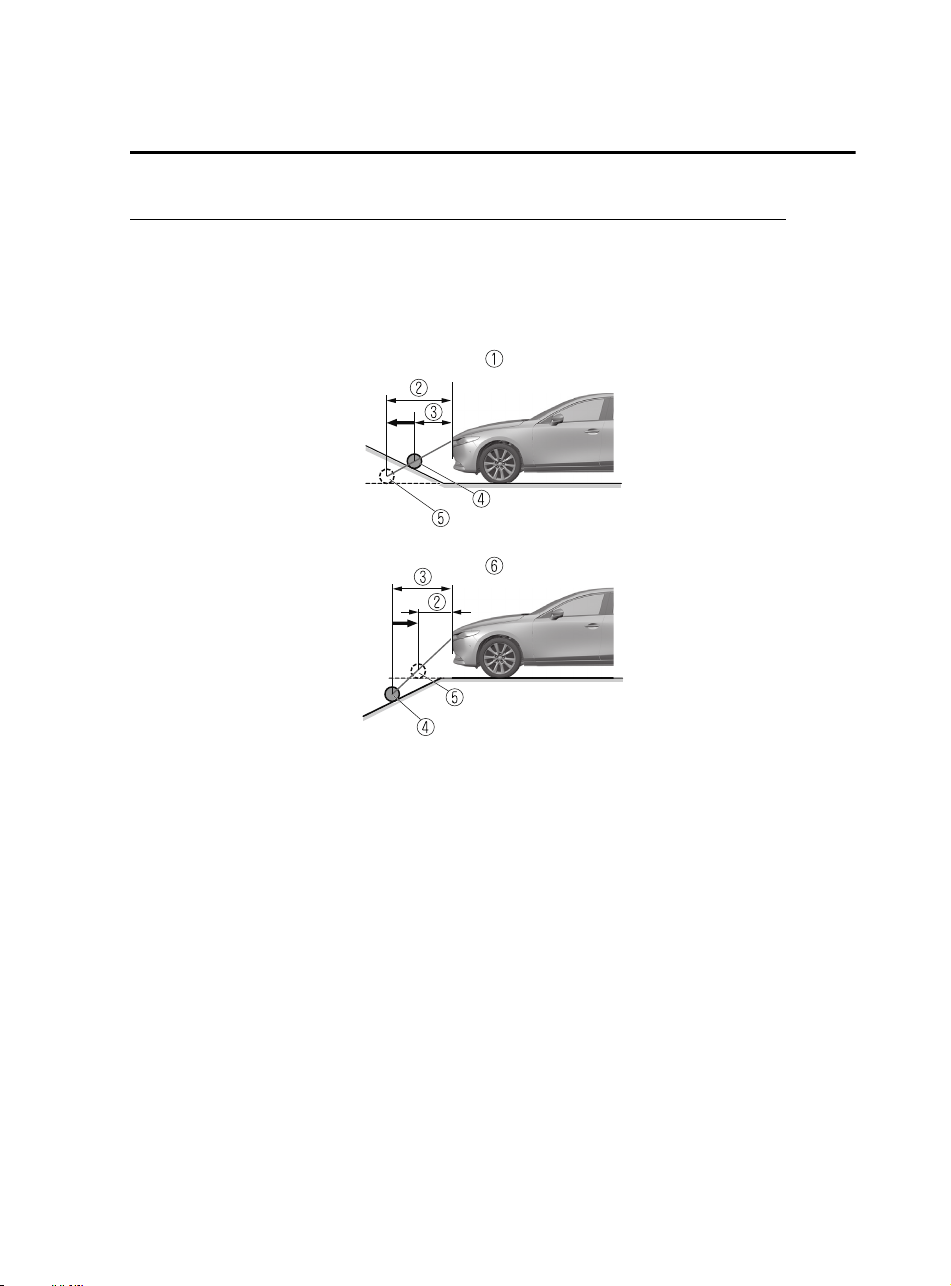
There is a steep up or down grade in the road at the front or rear of the vehicle
If there is a steep up or down grade in the road at the front or rear of the vehicle,
obstructions picked up by the camera can appear farther or closer than the actual distance
from the vehicle.
Front camera
1. Appears further than actual distance
2. Distance of obstruction being viewed on screen
3. Actual distance of obstruction from vehicle
4. Actual obstruction
5. Obstruction appearing on screen
6. Appears closer than actual distance
When Driving
i-ACTIVSENSE
4-195
Mazda3_8HZ1-EA-19G_Edition1_old 2019-5-17 13:49:03
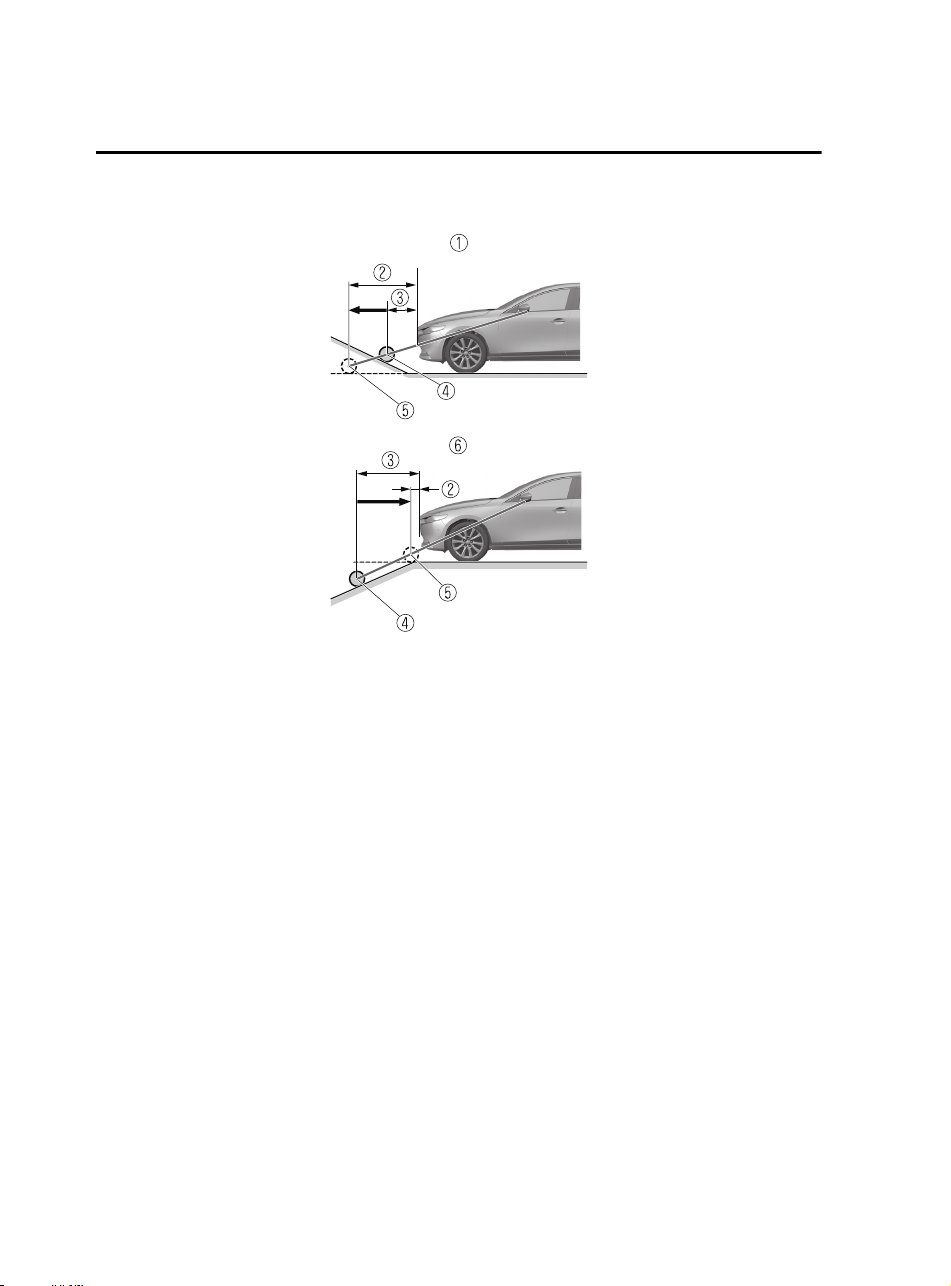
Side camera
1. Appears further than actual distance
2. Distance of obstruction being viewed on screen
3. Actual distance of obstruction from vehicle
4. Actual obstruction
5. Obstruction appearing on screen
6. Appears closer than actual distance
When Driving
i-ACTIVSENSE
4-196
Mazda3_8HZ1-EA-19G_Edition1_old 2019-5-17 13:49:03
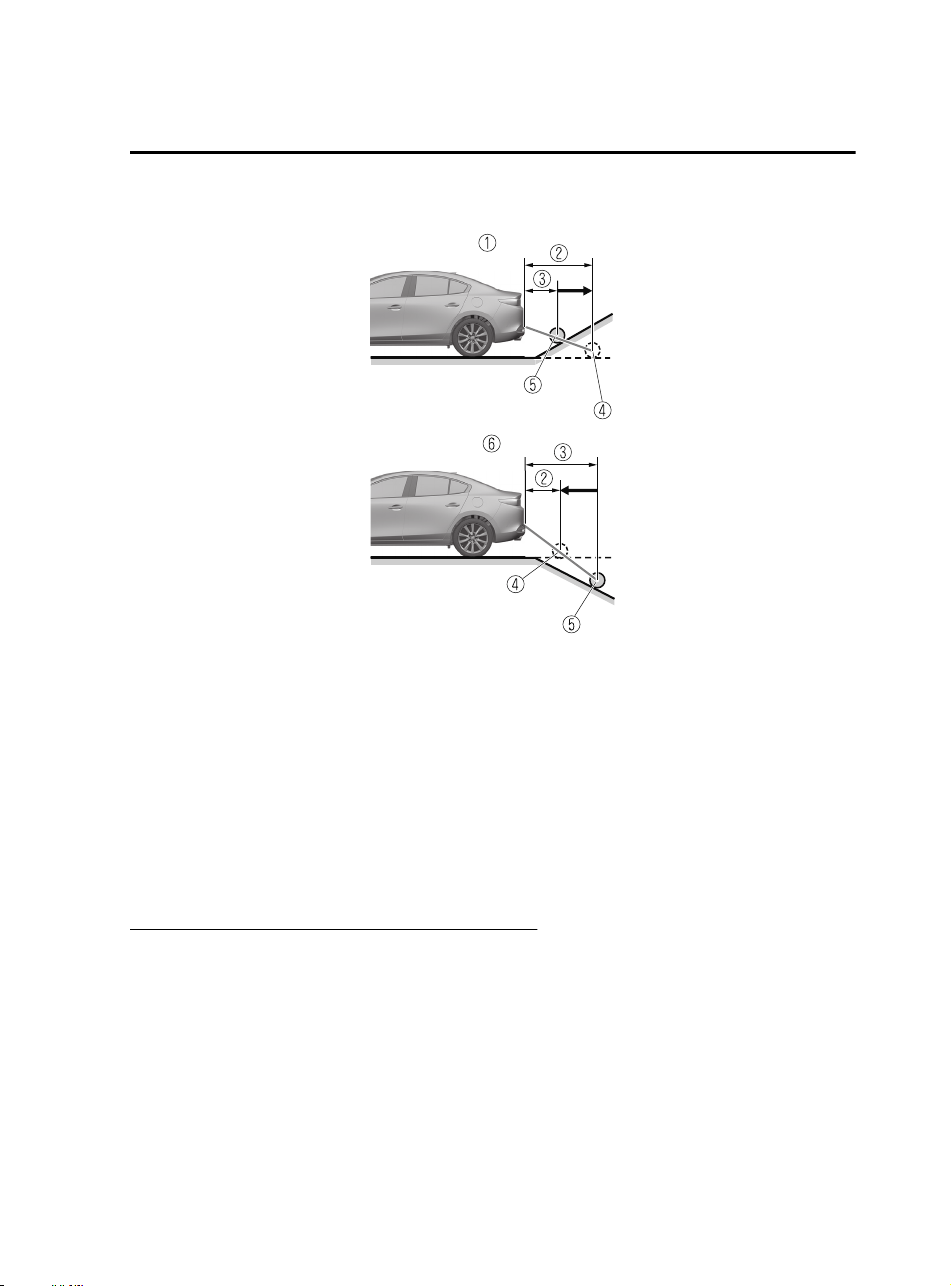
Rear camera
1. Appears further than actual distance
2. Distance of obstruction being viewed on screen
3. Actual distance of obstruction from vehicle
4. Obstruction appearing on screen
5. Actual obstruction
6. Appears closer than actual distance
NOTE
If the vehicle is on a slope, obstructions taken by the camera can appear farther or closer
than the actual distance from the vehicle.
Three-dimensional object at vehicle front or rear
Because the vehicle front end guide lines (side camera) or the distance guide lines (rear
camera) are displayed based on a flat surface, the distance to the three-dimensional object
displayed on the screen is different from the actual distance.
When Driving
i-ACTIVSENSE
4-197
Mazda3_8HZ1-EA-19G_Edition1_old 2019-5-17 13:49:03
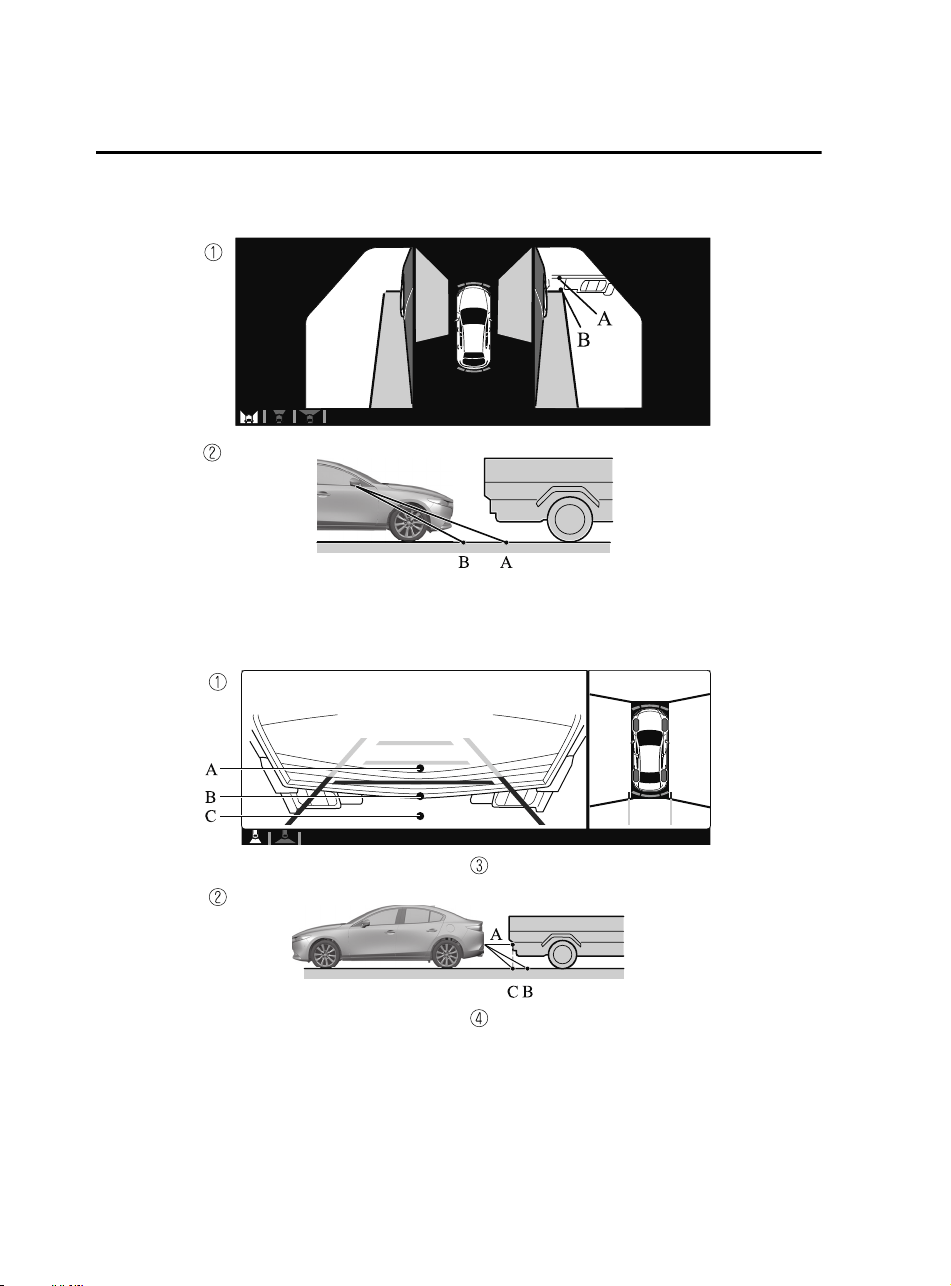
Side camera
1. (Screen display)
2. (Actual condition)
Rear camera
1. (Screen display)
2. (Actual condition)
3. Sensed distance on screen A>B>C
4. Actual distance B>C=A
When Driving
i-ACTIVSENSE
4-198
Mazda3_8HZ1-EA-19G_Edition1_old 2019-5-17 13:49:03
▼
System Problem Indication
Center display indication Cause Action to be taken
“No camera signal.” is displayed The control unit might be damaged. Have your vehicle inspected
by an Authorized Mazda
Dealer.
Screen is pitch-black and blank The camera might be damaged.
When Driving
i-ACTIVSENSE
4-199
Mazda3_8HZ1-EA-19G_Edition1_old 2019-5-17 13:49:03
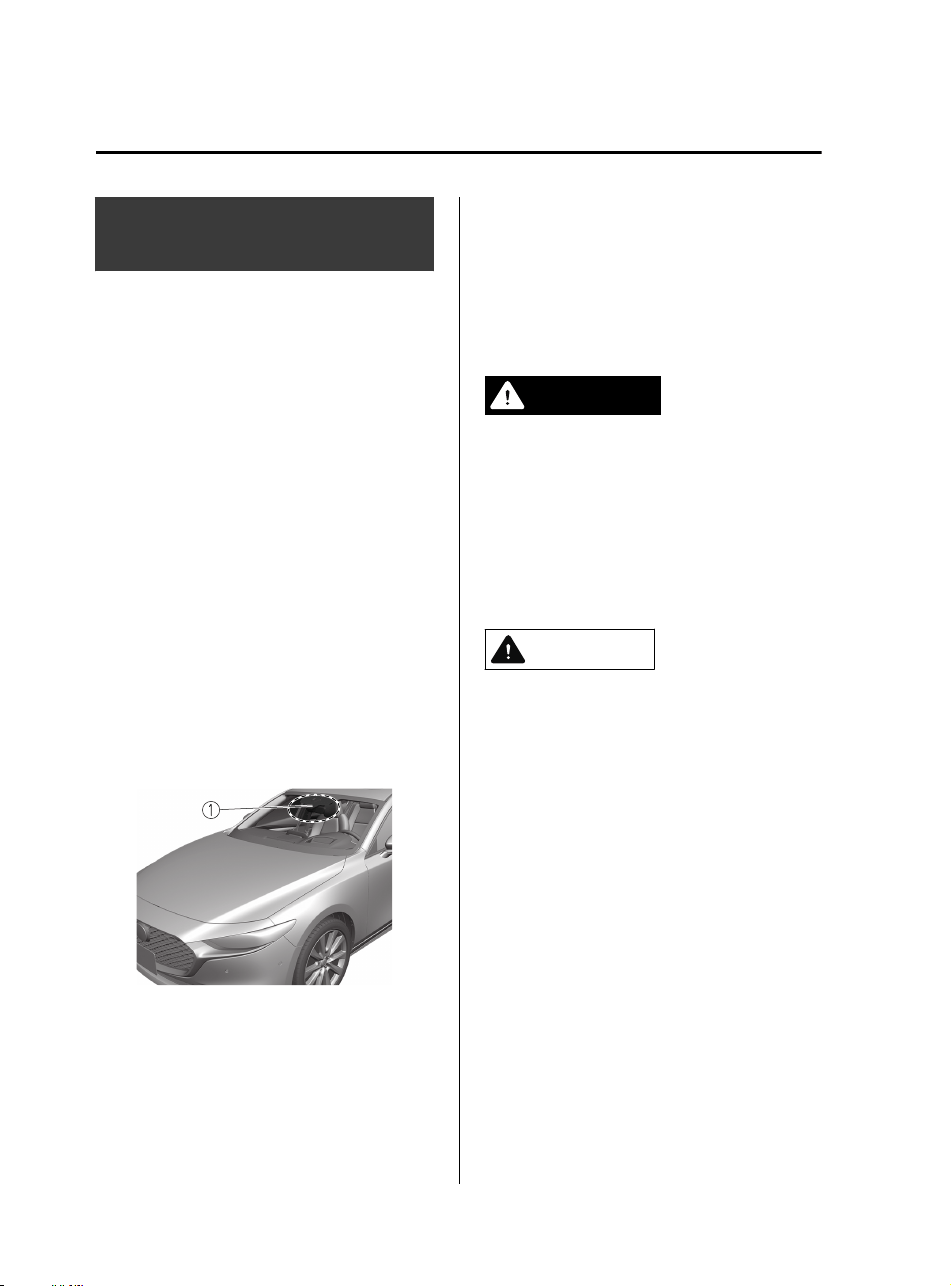
Forward Sensing Camera
(FSC)
*
▼
Forward Sensing Camera (FSC)
Your vehicle is equipped with a Forward
Sensing Camera (FSC). The Forward
Sensing Camera (FSC) is positioned near
the rearview mirror and used by the
following systems.
High Beam Control System (HBC)
Lane Departure Warning System
(LDWS)
Traffic Sign Recognition System (TSR)
Distance & Speed Alert (DSA)
Driver Attention Alert (DAA)
Driver Monitoring (DM)
Mazda Radar Cruise Control (MRCC)
Mazda Radar Cruise Control with Stop
& Go function (MRCC with Stop & Go
function)
Lane-keep Assist System (LAS)
Traffic Jam Assist (TJA)
Smart Brake Support (SBS)
1. Forward Sensing Camera (FSC)
The Forward Sensing Camera (FSC)
determines the conditions ahead of the
vehicle while traveling at night and detects
traffic lanes. The distance in which the
Forward Sensing Camera (FSC) can detect
objects varies depending on the
surrounding conditions.
WARNING
Do not modify the suspension:
If the vehicle height or inclination is
changed, the system will not be able to
correctly detect vehicles ahead. This will
result in the system not operating normally
or mistakenly operating, which could cause
a serious accident.
CAUTION
Do not apply accessories, stickers or lm
to the windshield near the Forward
Sensing Camera (FSC).
If the area in front of the Forward
Sensing Camera (FSC) lens is obstructed,
it will cause the system to not operate
correctly. Consequently, each system
may not operate normally which could
lead to an unexpected accident.
Do not disassemble or modify the
Forward Sensing Camera (FSC).
Disassembly or modication of the
Forward Sensing Camera (FSC) will cause
a malfunction or mistaken operation.
Consequently, each system may not
operate normally which could lead to an
unexpected accident.
Heed the following cautions to assure
the correct operation of the Forward
Sensing Camera (FSC).
When Driving
i-ACTIVSENSE
4-200
*Some models.
Mazda3_8HZ1-EA-19G_Edition1_old 2019-5-17 13:49:03

Be careful not to scratch the Forward
Sensing Camera (FSC) lens or allow it
to get dirty.
Do not remove the Forward Sensing
Camera (FSC) cover.
Do not place objects on the dashboard
which
reect
light.
Always keep the windshield glass
around the camera clean by removing
dirt or fogging. Use the windshield
defroster to remove fogging on the
windshield.
Consult an Authorized Mazda Dealer
regarding cleaning the interior side of
the windshield around the Forward
Sensing Camera (FSC).
Consult an Authorized Mazda Dealer
before performing repairs around the
Forward Sensing Camera (FSC).
The Forward Sensing Camera (FSC) is
installed to the windshield. Consult an
Authorized Mazda Dealer for
windshield repair and replacement.
When cleaning the windshield, do not
allow glass cleaners or similar cleaning
uids to get on the Forward Sensing
Camera (FSC) lens. In addition, do not
touch the Forward Sensing Camera
(FSC) lens.
When performing repairs around the
rearview mirror, consult an Authorized
Mazda Dealer.
Consult an Authorized Mazda Dealer
regarding cleaning of the camera lens.
Do not hit or apply strong force to the
Forward Sensing Camera (FSC) or the
area around it. If the Forward Sensing
Camera (FSC) is severely hit or if there
are cracks or damage caused by
ying
gravel or debris in the area around it,
stop using the following systems and
consult an Authorized Mazda Dealer.
High Beam Control System (HBC)
Lane Departure Warning System
(LDWS)
Trac
Sign Recognition System
(TSR)
Distance & Speed Alert (DSA)
Driver Attention Alert (DAA)
Driver Monitoring (DM)
Mazda Radar Cruise Control (MRCC)
Mazda Radar Cruise Control with
Stop & Go function (MRCC with Stop
& Go function)
Lane-keep Assist System (LAS)
Trac Jam Assist (TJA)
Smart Brake Support (SBS)
The direction in which the Forward
Sensing Camera (FSC) is pointed has
been nely adjusted. Do not change
the installation position of the Forward
Sensing Camera (FSC) or remove it.
Otherwise, it could result in damage or
malfunction.
Always use tires for all wheels that are of
the specied size, and the same
manufacturer, brand, and tread pattern.
In addition, do not use tires with
signicantly dierent wear patterns on
the same vehicle as the system may not
operate normally.
When Driving
i-ACTIVSENSE
4-201
Mazda3_8HZ1-EA-19G_Edition1_old 2019-5-17 13:49:03

The Forward Sensing Camera (FSC)
includes a function for detecting a soiled
windshield and informing the driver,
however, depending on the conditions, it
may not detect plastic shopping bags, ice
or snow on the windshield. In such cases,
the system cannot accurately determine
a vehicle ahead and may not be able to
operate normally. Always drive carefully
and pay attention to the road ahead.
NOTE
In the following cases, the Forward
Sensing Camera (FSC) cannot detect
target objects correctly, and each system
may be unable to operate normally.
The height of the vehicle ahead is low.
You drive your vehicle at the same
speed as the vehicle ahead.
Headlights are not turned on during
the night or when going through a
tunnel.
In the following cases, the Forward
Sensing Camera (FSC) may not be able
to detect target objects correctly.
Under bad weather condition, such as
rain, fog and snow.
The window washer is being used or
the windshield wipers are not used
when it's raining.
Ice, fog, snow, frost, rainfall, dirt, or
foreign matter such as a plastic bag is
stuck on the windshield.
Trucks with low loading platforms and
vehicles with an extremely low or high
profile.
When driving next to walls with no
patterning (including fences and
longitudinally striped walls).
The taillights of the vehicle ahead are
turned off.
A vehicle is outside the illumination
range of the headlights.
The vehicle is making a sharp turn, or
ascending or descending a steep
slope.
Entering or exiting a tunnel.
Heavy luggage is loaded causing the
vehicle to tilt.
Strong light is shone at the front of the
vehicle (back light or high-beam light
from on-coming vehicles).
There are many light emitters on the
vehicle ahead.
When the vehicle ahead is not
equipped with taillights or the
taillights are turned off at nighttime.
Elongated luggage or cargo is loaded
onto installed roof rails and covers
the Forward Sensing Camera (FSC).
Exhaust gas from the vehicle in front,
sand, snow, and water vapor rising
from manholes and grating, and water
splashed into the air.
When towing a malfunctioning
vehicle.
The vehicle is driven with tires having
significantly different wear.
The vehicle is driven on down slopes
or bumpy roads.
There are water puddles on the road.
The surroundings are dark such as
during the night, early evening, or
early morning, or in a tunnel or
indoor parking lot.
The illumination brightness of the
headlights is reduced or the headlight
illumination is weakened due to dirt
or a deviated optical axis.
When Driving
i-ACTIVSENSE
4-202
Mazda3_8HZ1-EA-19G_Edition1_old 2019-5-17 13:49:03

The target object enters the blind spot
of the Forward Sensing Camera
(FSC).
A person or object bursts onto the
road from the shoulder or cuts right in
front of you.
You change lanes and approach a
vehicle ahead.
When driving extremely close to the
target object.
Tire chains or a temporary spare tire
is installed.
The vehicle ahead has a special
shape. For example, a vehicle towing
a trailer house or a boat, or a vehicle
carrier carrying a vehicle with its
front pointed rearward.
If the Forward Sensing Camera (FSC)
cannot operate normally due to rain,
backlight, or fog, the system functions
related to the Forward Sensing Camera
(FSC) are temporarily stopped and the
following warning lights turn on.
However, this does not indicate a
malfunction.
High Beam Control System (HBC)
warning indication/warning light
(amber)
i-ACTIVSENSE warning indication/
warning light
If the Forward Sensing Camera (FSC)
cannot operate normally due to high
temperatures, the system functions
related to the Forward Sensing Camera
(FSC) are temporarily stopped and the
following warning lights turn on.
However, this does not indicate a
malfunction. Cool down the area around
the Forward Sensing Camera (FSC)
such as by turning on the air
conditioner.
High Beam Control System (HBC)
warning indication/warning light
(amber)
i-ACTIVSENSE warning indication/
warning light
If the Forward Sensing Camera (FSC)
detects that the windshield is dirty or
foggy, the system functions related to the
Forward Sensing Camera (FSC) are
temporarily stopped and the following
warning lights turn on. However, this
does not indicate a problem. Remove the
dirt from the windshield or press the
defroster switch and defog the
windshield.
High Beam Control System (HBC)
warning indication/warning light
(amber)
i-ACTIVSENSE warning indication/
warning light
If there are recognizable cracks or
damage caused by flying gravel or
debris on the windshield, always have
the windshield replaced. Consult an
Authorized Mazda Dealer for
replacement.
The Forward Sensing Camera (FSC)
recognizes pedestrians when all of the
following conditions are met:
The height of a pedestrian is about 1
to 2 meters.
An outline such as the head, both
shoulders, or the legs can be
determined.
In the following cases, the Forward
Sensing Camera (FSC) may not be able
to detect target objects correctly:
Multiple pedestrians are walking, or
there are groups of people.
When Driving
i-ACTIVSENSE
4-203
Mazda3_8HZ1-EA-19G_Edition1_old 2019-5-17 13:49:03
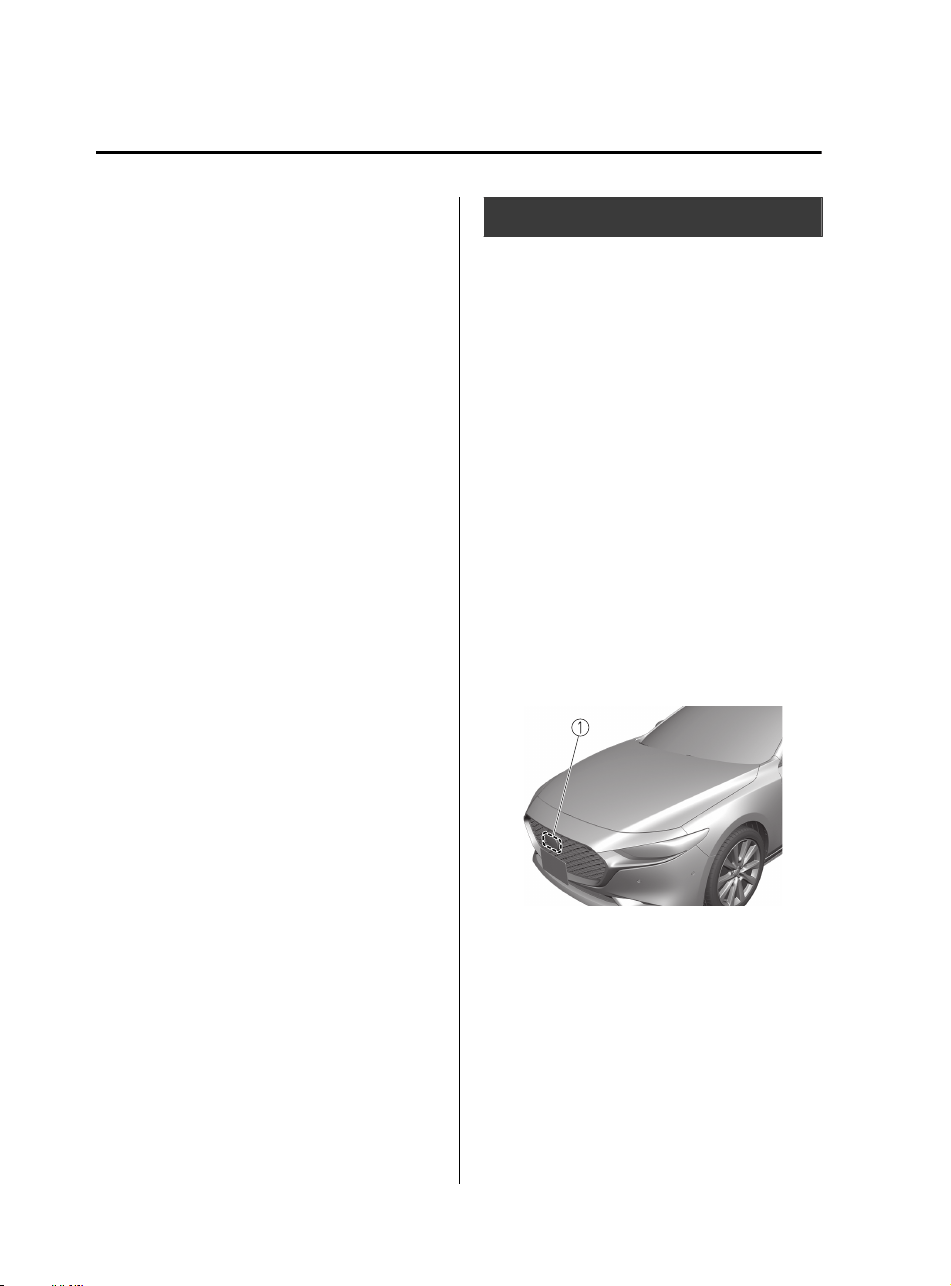
A pedestrian is close to a separate
object.
A pedestrian is crouching, lying, or
slouching.
A pedestrian suddenly jumps into the
road right in front of the vehicle.
A pedestrian opens an umbrella, or is
carrying large baggage or articles.
A pedestrian is in a dark location such
as during the night, or blends into the
background by wearing clothes
matching the background color.
Front Radar Sensor
*
▼
Front Radar Sensor
Your vehicle is equipped with a front radar
sensor.
The following systems also use the front
radar sensor.
Distance & Speed Alert (DSA)
Mazda Radar Cruise Control (MRCC)
Mazda Radar Cruise Control with Stop
& Go function (MRCC with Stop & Go
function)
Traffic Jam Assist (TJA)
Smart Brake Support (SBS)
The front radar sensor functions by
detecting the radio waves reflected off a
vehicle ahead or an obstruction sent from
the radar sensor.
The front radar sensor is mounted behind
the front emblem.
1. Front radar sensor
If “Safety and Driver Support Systems
Temporarily Disabled. Front Radar
Obscured. Drive Safely” is displayed on
the multi-information display of the
instrument cluster, clean the area around
the front radar sensor.
When Driving
i-ACTIVSENSE
4-204
*Some models.
Mazda3_8HZ1-EA-19G_Edition1_old 2019-5-17 13:49:03
CAUTION
Heed the following precautions to assure
correct operation of each system.
Do not adhere stickers (including
transparent stickers) to the surface of the
radiator grille and front emblem in and
around the front radar sensor, and do
not replace the radiator grille and front
emblem with any product that is not a
genuine product designed for use with
the front radar sensor.
The front radar sensor includes a
function for detecting soiling of the radar
sensor's front surface and informing the
driver, however, depending on the
conditions, it may require time to detect
or it may not detect plastic shopping
bags, ice or snow. If this occurs, the
system may not operate correctly,
therefore always keep the front radar
sensor clean.
Do not install a grille guard.
If the front part of the vehicle has been
damaged in a vehicle accident, the
position of the front radar sensor may
have moved. Stop the system
immediately and always have the vehicle
inspected at an Authorized Mazda
Dealer.
Do not use the front bumper to push
other vehicles or obstructions such as
when pulling out of a parking space.
Otherwise, the front radar sensor could
be hit and its position deviated.
Do not remove, disassemble, or modify
the front radar sensor.
For repairs, replacement or paint work
around the front radar sensor, consult an
Authorized Mazda Dealer.
Do not modify the suspension. If the
suspension are modied, the vehicle's
posture could change and the front
radar sensor may not be able to correctly
detect a vehicle ahead or an obstruction.
NOTE
Under the following conditions, the front
radar sensor may not be able to detect
vehicles ahead or obstructions correctly
and each system may not operate
normally.
The rear surface of a vehicle ahead
does not reflect radio waves
effectively, such as an unloaded
trailer or an automobile with a
loading platform covered by a soft
top, vehicles with a hard plastic
tailgate, and round-shaped vehicles.
Vehicles ahead with low vehicle height
and thus less area for reflecting radio
waves.
Visibility is reduced due to a vehicle
ahead casting off water, snow, or sand
from its tires and onto your
windshield.
The trunk/luggage compartment is
loaded with heavy objects or the rear
passenger seats are occupied.
Ice, snow, or soiling is on the front
surface of the front emblem.
During inclement weather such as
rain, snow, or sand storms.
When driving near facilities or objects
emitting strong radio waves.
Under the following conditions, the front
radar sensor may not be able to detect
vehicles ahead or obstructions.
The beginning and end of a curve.
Roads with continuous curves.
When Driving
i-ACTIVSENSE
4-205
Mazda3_8HZ1-EA-19G_Edition1_old 2019-5-17 13:49:03
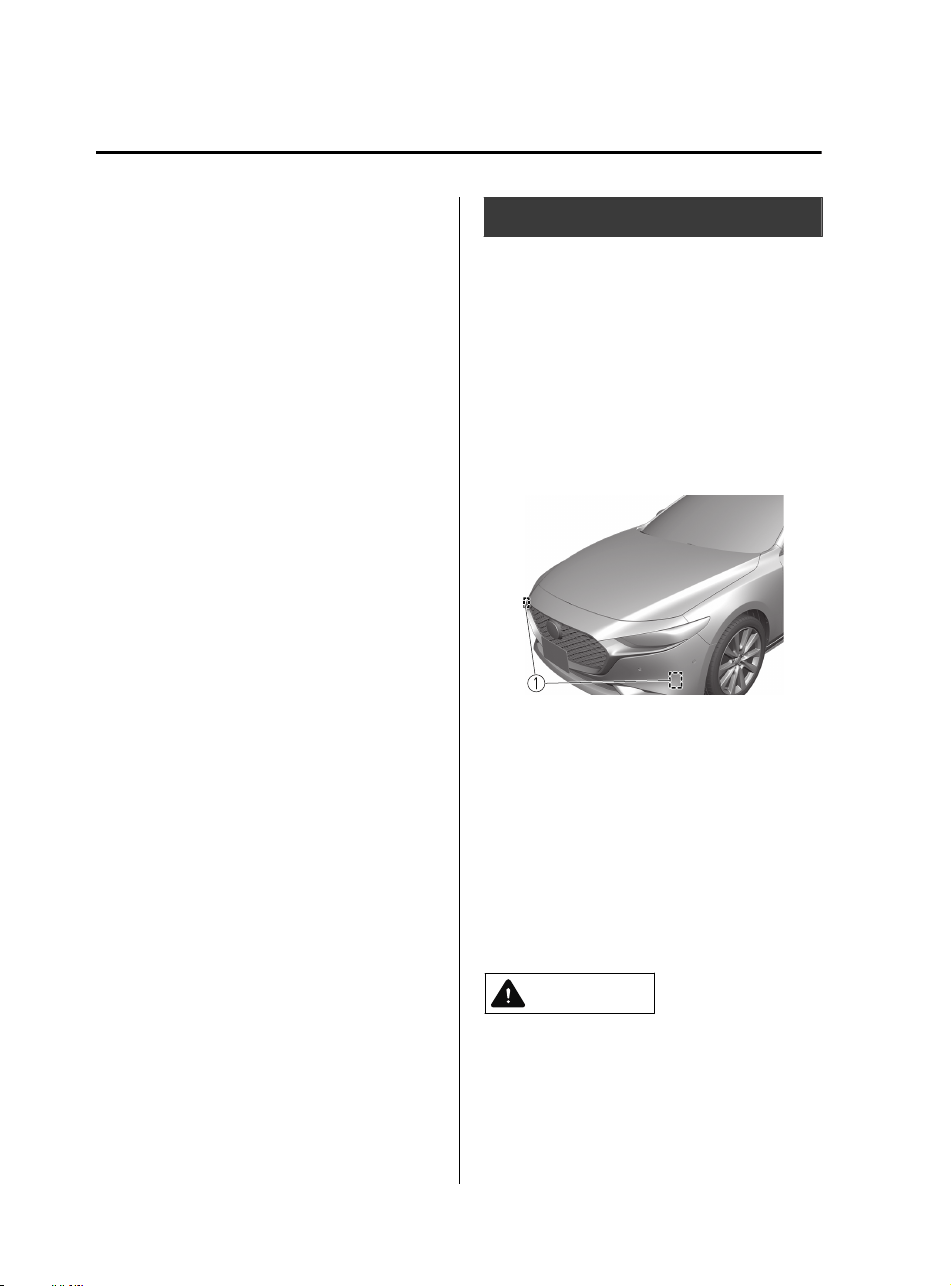
Narrow lane roads due to road
construction or lane closures.
The vehicle ahead enters the radar
sensor's blind spot.
The vehicle ahead is running
abnormally due to accident or vehicle
damage.
Roads with repeated up and down
slopes
Driving on poor roads or unpaved
roads.
The distance between your vehicle
and the vehicle ahead is extremely
short.
A vehicle suddenly comes close such
as by cutting into the lane.
To prevent incorrect operation of the
system, use tires of the same specified
size, manufacturer, brand, and tread
pattern on all four wheels. In addition,
do not use tires with significantly
different wear patterns or tire pressures
on the same vehicle (Including the
temporary spare tire).
If the battery power is weak, the system
may not operate correctly.
When driving on roads with little traffic
and few vehicles ahead or obstructions
for the front radar sensor to detect,
“Safety and Driver Support Systems
Temporarily Disabled. Front Radar
Obscured. Drive Safely” may be
temporarily displayed, however, this
does not indicate a problem.
The radar sensors are regulated by the
relevant radio wave laws of the country
in which the vehicle is driven. If the
vehicle is driven abroad, authorization
from the country in which the vehicle is
driven may be required.
Front Side Radar Sensor
*
▼
Front Side Radar Sensor
Your vehicle is equipped with front side
radar sensor. The following systems also
use the front side radar sensor.
Front Cross Traffic Alert (FCTA)
The front side radar sensor function by
detecting the radio waves reflected off a
vehicle approaching from the front or an
obstruction sent from the radar sensor.
1. Front side radar sensor
The front side radar sensor are installed
inside the front bumper, one each on the
left and right sides.
Always keep the surface of the front
bumper near the front side radar sensor
clean so that the front side radar sensor
operate normally. Also, do not apply items
such as stickers.
Refer to Exterior Care on page 6-44.
CAUTION
If the front bumper receives a severe
impact, the system may no longer operate
normally. Stop the system immediately and
have the vehicle inspected at an
Authorized Mazda Dealer.
When Driving
i-ACTIVSENSE
4-206
*Some models.
Mazda3_8HZ1-EA-19G_Edition1_old 2019-5-17 13:49:03

NOTE
The detection ability of the front side
radar sensor has limitations. In the
following cases, the detection ability
may lower and the system may not
operate normally.
The front bumper near the front side
radar sensor has become deformed.
Snow, ice or mud adheres to the front
side radar sensor on the front bumper.
Under bad weather conditions such as
rain, snow and fog.
Under the following conditions, the front
side radar sensor cannot detect target
objects or it may be difficult to detect
them.
Small motorcycles, bicycles,
pedestrians, animals, shopping carts,
and stationary objects on a road or a
road side.
Vehicle shapes which do not reflect
radar waves well such as empty
trailers with a low vehicle height and
sports cars.
Vehicles are shipped with the direction
of the front side radar sensor adjusted
for each vehicle to a loaded vehicle
condition so that the front side radar
sensor detect approaching vehicles
correctly. If the direction of the front
side radar sensor has deviated for some
reason, have the vehicle inspected at an
Authorized Mazda Dealer.
For repairs or replacement of the front
side radar sensor, or bumper repairs,
paintwork, and replacement near the
radar sensors, consult an Authorized
Mazda Dealer.
The radar sensors are regulated by the
relevant radio wave laws of the country
in which the vehicle is driven. If the
vehicle is driven abroad, authorization
from the country in which the vehicle is
driven may be required.
When Driving
i-ACTIVSENSE
4-207
Mazda3_8HZ1-EA-19G_Edition1_old 2019-5-17 13:49:03
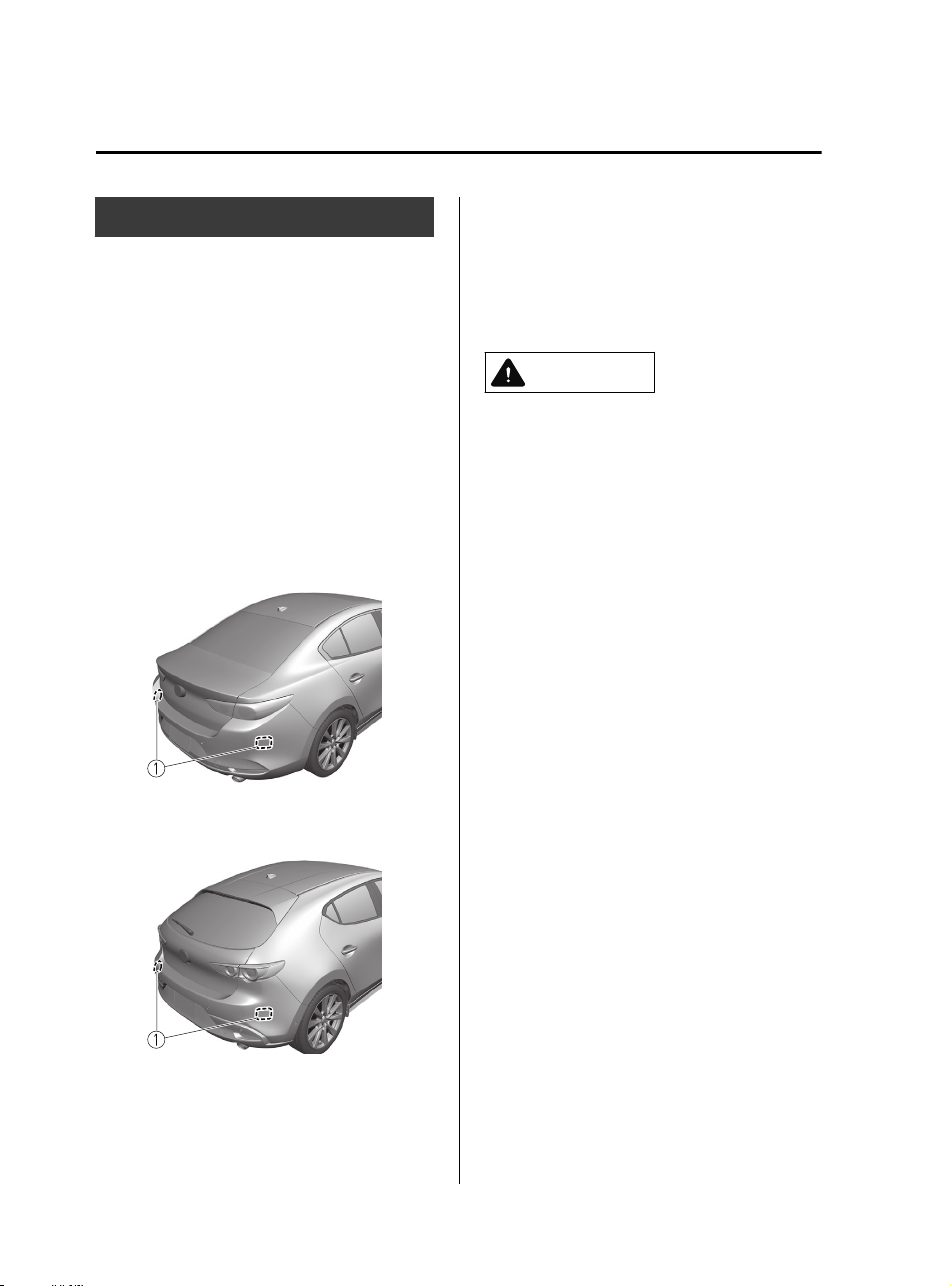
Rear Side Radar Sensor
*
▼
Rear Side Radar Sensor
Your vehicle is equipped with rear side
radar sensor. The following systems also
use the rear side radar sensor.
Blind Spot Monitoring (BSM)
Rear Cross Traffic Alert (RCTA)
Smart Brake Support [Rear Crossing]
(SBS-RC)
The rear side radar sensor function by
detecting the radio waves reflected off a
vehicle approaching from the rear or an
obstruction sent from the radar sensor.
4–Door
1. Rear side radar sensor
5–Door
1. Rear side radar sensor
The rear side radar sensor are installed
inside the rear bumper, one each on the
left and right sides.
Always keep the surface of the rear
bumper near the rear side radar sensor
clean so that the rear side radar sensor
operate normally. Also, do not apply items
such as stickers.
Refer to Exterior Care on page 6-44.
CAUTION
If the rear bumper receives a severe impact,
the system may no longer operate
normally. Stop the system immediately and
have the vehicle inspected at an
Authorized Mazda Dealer.
NOTE
The detection ability of the rear side
radar sensor has limitations. In the
following cases, the detection ability
may lower and the system may not
operate normally.
The rear bumper near the rear side
radar sensor has become deformed.
Snow, ice or mud adheres to the rear
side radar sensor on the rear bumper.
Under bad weather conditions such as
rain, snow and fog.
Under the following conditions, the rear
side radar sensor cannot detect target
objects or it may be difficult to detect
them.
Small motorcycles, bicycles,
pedestrians, animals, shopping carts,
and stationary objects on a road or a
road side.
Vehicle shapes which do not reflect
radar waves well such as empty
trailers with a low vehicle height and
sports cars.
When Driving
i-ACTIVSENSE
4-208
*Some models.
Mazda3_8HZ1-EA-19G_Edition1_old 2019-5-17 13:49:03
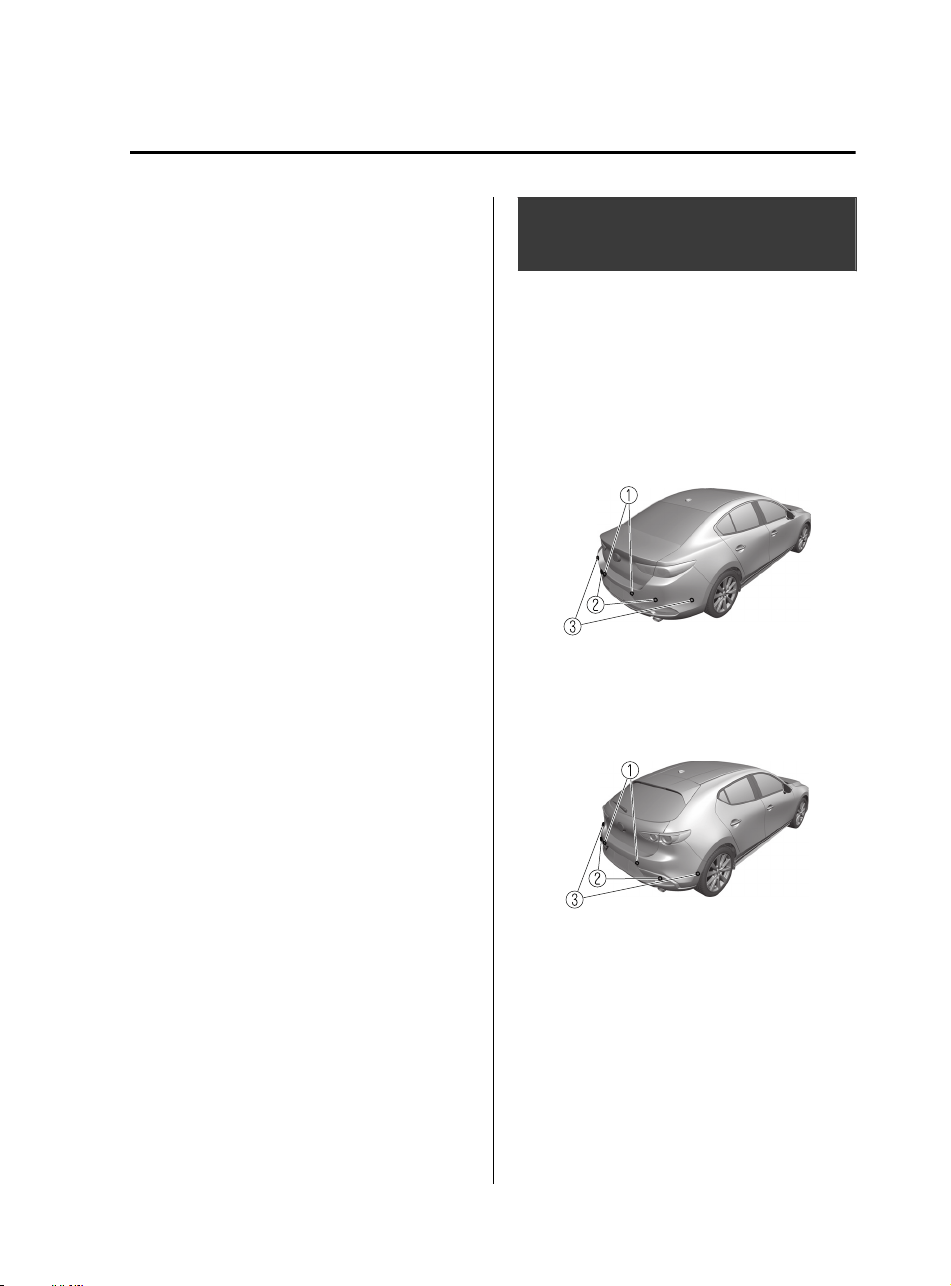
Vehicles are shipped with the direction
of the rear side radar sensor adjusted
for each vehicle to a loaded vehicle
condition so that the rear side radar
sensor detect approaching vehicles
correctly. If the direction of the rear side
radar sensor has deviated for some
reason, have the vehicle inspected at an
Authorized Mazda Dealer.
For repairs or replacement of the rear
side radar sensor, or bumper repairs,
paintwork, and replacement near the
radar sensors, consult an Authorized
Mazda Dealer.
The radar sensors are regulated by the
relevant radio wave laws of the country
in which the vehicle is driven. If the
vehicle is driven abroad, authorization
from the country in which the vehicle is
driven may be required.
Rear/Rear corner/Rear
Side Ultrasonic Sensor
*
▼
Rear/Rear corner/Rear Side
Ultrasonic Sensor
The ultrasonic sensors function by
emitting ultrasonic waves which are
reflected off obstructions at the rear and
the returning ultrasonic waves are picked
up by the ultrasonic sensors.
4–Door
1. Rear ultrasonic sensor
2. Rear corner ultrasonic sensor
3. Rear side ultrasonic sensor
5–Door
1. Rear ultrasonic sensor
2. Rear corner ultrasonic sensor
3. Rear side ultrasonic sensor
The ultrasonic sensors are mounted in the
rear bumper.
When Driving
i-ACTIVSENSE
*Some models.
4-209
Mazda3_8HZ1-EA-19G_Edition1_old 2019-5-17 13:49:03
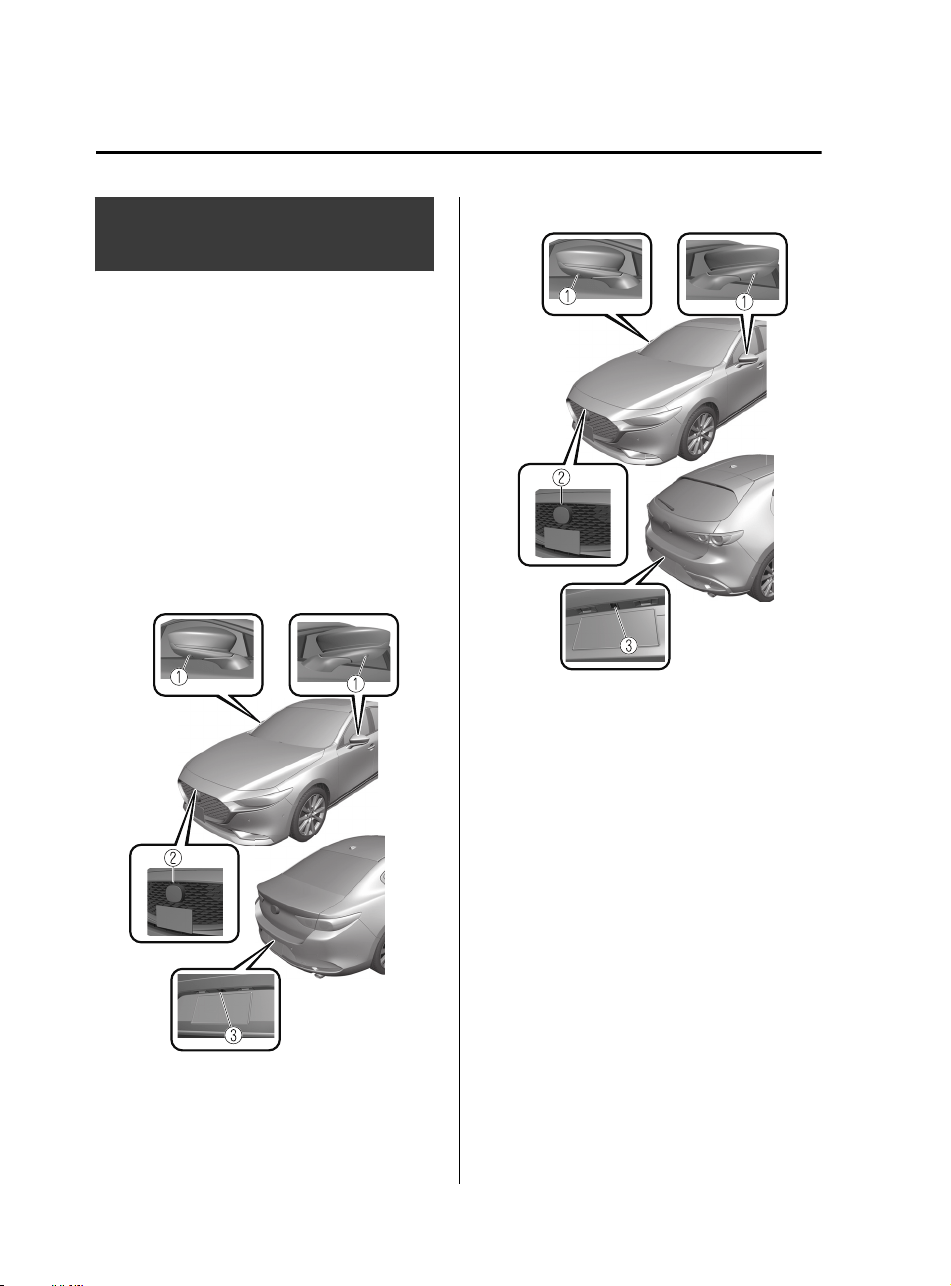
Front Camera/Side
Cameras/Rear Camera
*
▼
Front Camera/Side Cameras/Rear
Camera
Your vehicle is equipped with a front
camera, side cameras, and a rear camera.
The 360°View Monitor uses each camera.
Refer to 360°View Monitor on page
4-166.
The front camera, side cameras, and rear
camera shoot images of the area
surrounding the vehicle.
Each camera is installed to the following
positions.
4–Door
1. Side cameras
2. Front camera
3. Rear camera
5–Door
1. Side cameras
2. Front camera
3. Rear camera
When Driving
i-ACTIVSENSE
4-210
*Some models.
Mazda3_8HZ1-EA-19G_Edition1_old 2019-5-17 13:49:03
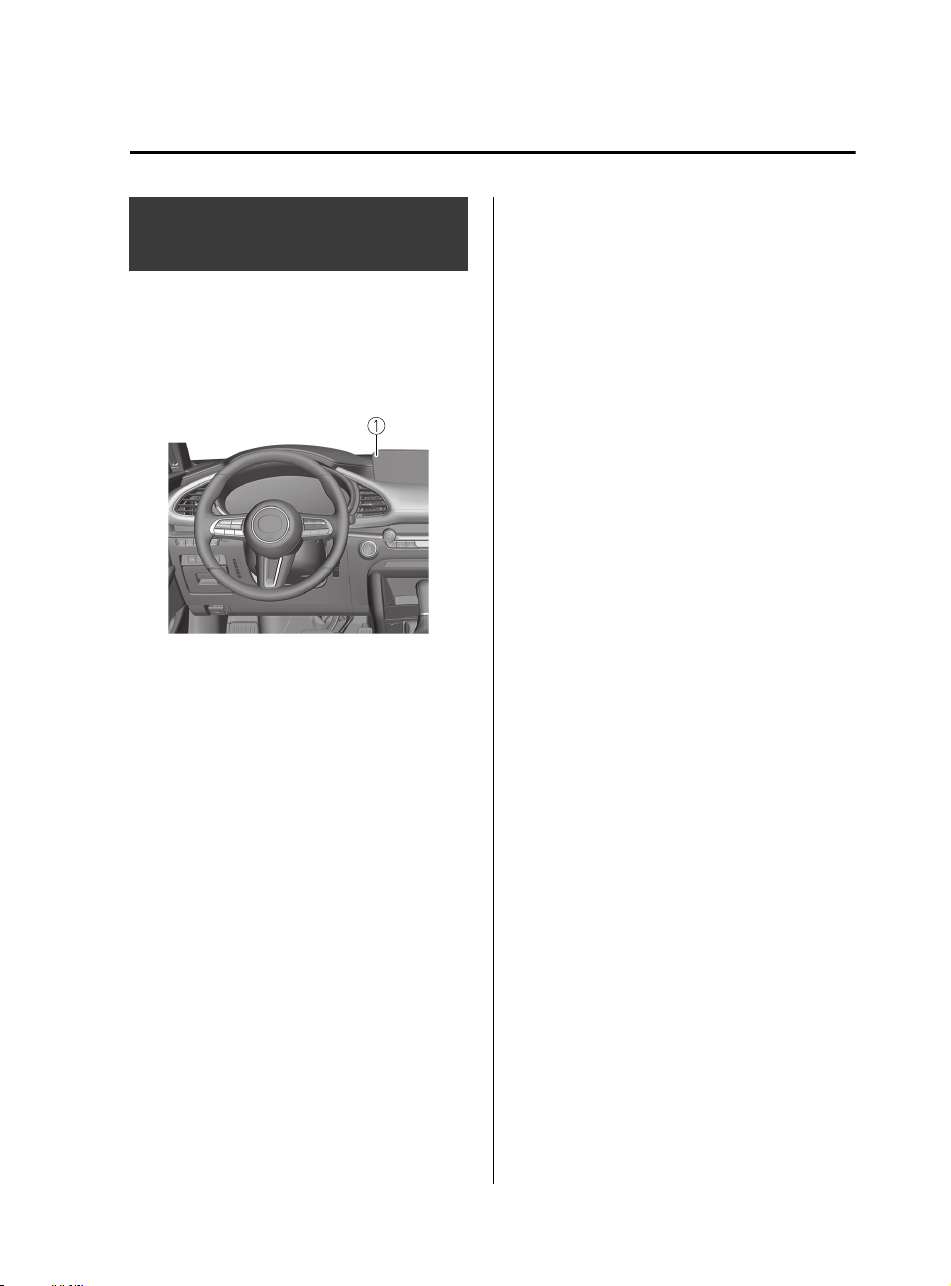
Driver Monitoring
Camera
*
▼
Driver Monitoring Camera
The driver monitoring camera detects
changes in the driver's facial features and
estimates the amount of accumulated
fatigue and sleepiness of the driver.
1. Driver monitoring camera
NOTE
Driver Monitoring (DM) and the earlier
collision warning may not operate
normally under the following conditions.
The driver monitoring camera is
covered with something.
You are driving the vehicle while
leaning on the steering wheel.
You are wearing glasses or
sunglasses.
A cap or hat you are wearing partially
blocks the driver monitoring camera's
view of your eyes, you have long
bangs partially covering your eyes, or
a part of your face is invisible due to a
face mask.
The lighting conditions change
significantly (such as backlight, light
from the side, or direct light from the
setting sun, and the headlights of
on-coming vehicles).
You are driving the vehicle with your
face largely pointed to the side.
You are moving around extensively.
Your face or your eyes frequently turn
in direction other than straight ahead
(direction of travel).
Your line of sight moves or directly
after it has moved.
There is a large difference between
your line of sight and the direction
your face is pointed.
You are driving the vehicle with your
head largely tilted to one side.
When Driving
i-ACTIVSENSE
*Some models.
4-211
Mazda3_8HZ1-EA-19G_Edition1_old 2019-5-17 13:49:03
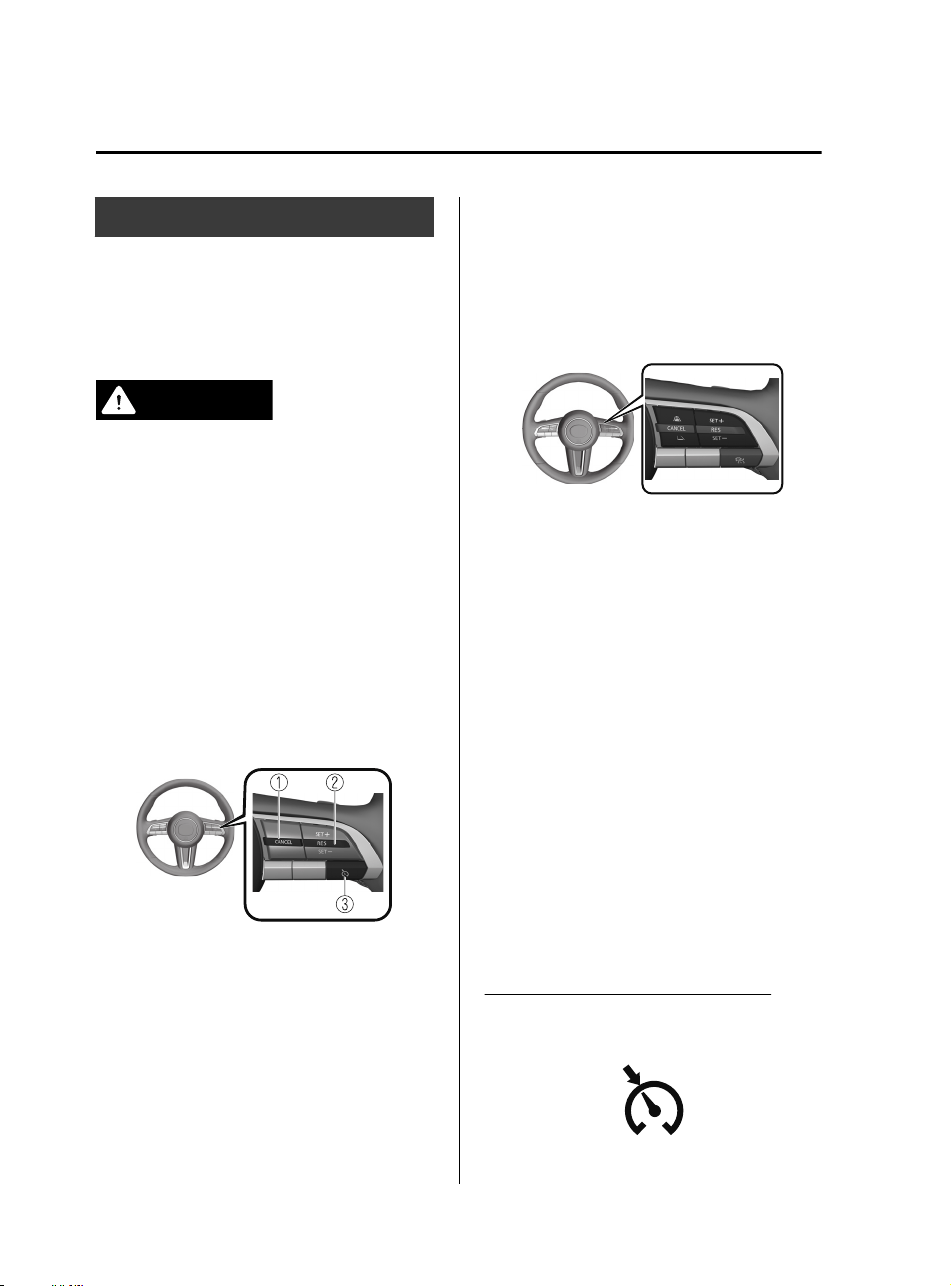
Cruise Control
*
▼
Cruise Control
With cruise control, you can set and
automatically maintain any speed of more
than about 30 km/h (19 mph).
WARNING
Do not use the cruise control under the
following conditions:
Using the cruise control under the
following conditions is dangerous and
could result in loss of vehicle control.
Hilly terrain
Steep inclines
Heavy or unsteady trac
Slippery or winding roads
Similar restrictions that require
inconsistent speed
▼
Cruise Control Switch
1. CANCEL switch
2. RES switch
3. Cruise switch
NOTE
If your Mazda has the following steering
switch, your Mazda is equipped with the
Mazda Radar Cruise Control (MRCC)
system, the Mazda Radar Cruise Control
with Stop & Go function (MRCC with Stop
& Go function) system.
Refer to Mazda Radar Cruise Control
(MRCC) on page 4-118.
Refer to Mazda Radar Cruise Control with
Stop & Go function (MRCC with Stop &
Go function) on page 4-126.
If the Mazda Radar Cruise Control
(MRCC) or Mazda Radar Cruise Control
with Stop & Go function (MRCC with Stop
& Go function) is set to inoperable using
the personalization feature, the system
switches to the cruise control function. In
this case, the MRCC functions as the
cruise switch. In addition, this
personalization feature setting is
initialized by switching the ignition OFF,
and it turns back on when the ignition is
switched ON the next time.
▼
Cruise Standby Indication (White)/
Cruise Set Indication (Green)
Cruise standby Indication (White)
The indication turns on (white) when the
cruise control system is activated.
When Driving
Cruise Control
4-212
*Some models.
Mazda3_8HZ1-EA-19G_Edition1_old 2019-5-17 13:49:03
Cruise Set Indication (Green)
The indication turns on (green) when a
cruising speed has been set.
▼
Activation/Deactivation
WARNING
Always turn
o
the cruise control system
when it is not in use:
Leaving the cruise control system in an
activation-ready state while the cruise
control is not in use is dangerous as the
cruise control could unexpectedly activate
if the activation button is accidentally
pressed, and result in loss of vehicle control
and an accident.
NOTE
When the ignition is switched OFF, the
system status before it was turned off is
maintained. For example, if the ignition is
switched OFF with the cruise control
system operable, the system will be
operable when the ignition is switched ON
the next time.
Activation
To activate the system, press the cruise
switch. The cruise standby indication
(white) turns on.
Deactivation
To deactivate the system, press the cruise
switch again.
The cruise standby indication (white) turns
off.
▼
To Set Speed
1. Activate the cruise control system by
pressing the cruise switch. The cruise
standby indication (white) turns on.
2. Accelerate to the desired speed, which
must be more than 25 km/h (16 mph).
3. Adjust the system to the desired
vehicle speed using the accelerator
pedal. Press the RES switch up (SET+)
or down (SET-) to start cruise control.
The cruise control indication (green) in
the instrument cluster turns on at the
same time. Quickly release the switch
when the cruise control indication
(green) turns on.
NOTE
If the RES switch is operated up (SET+)
or down (SET-) while the vehicle speed
is between 25 km/h (16 mph) and 30
km/h (19 mph), the set speed is set to 30
km/h (19 mph).
The cruise control speed setting cannot
be performed under the following
conditions:
Any of the doors is opened.
The driver's seat belt is unfastened.
The brake pedal is depressed.
The parking brake is applied.
(Automatic transmission)
The selector lever is in the P or N
position.
(Manual transmission)
The shift lever is in the neutral
position.
On a steep grade, the vehicle may
momentarily slow down while ascending
or speed up while descending.
When Driving
Cruise Control
4-213
Mazda3_8HZ1-EA-19G_Edition1_old 2019-5-17 13:49:03
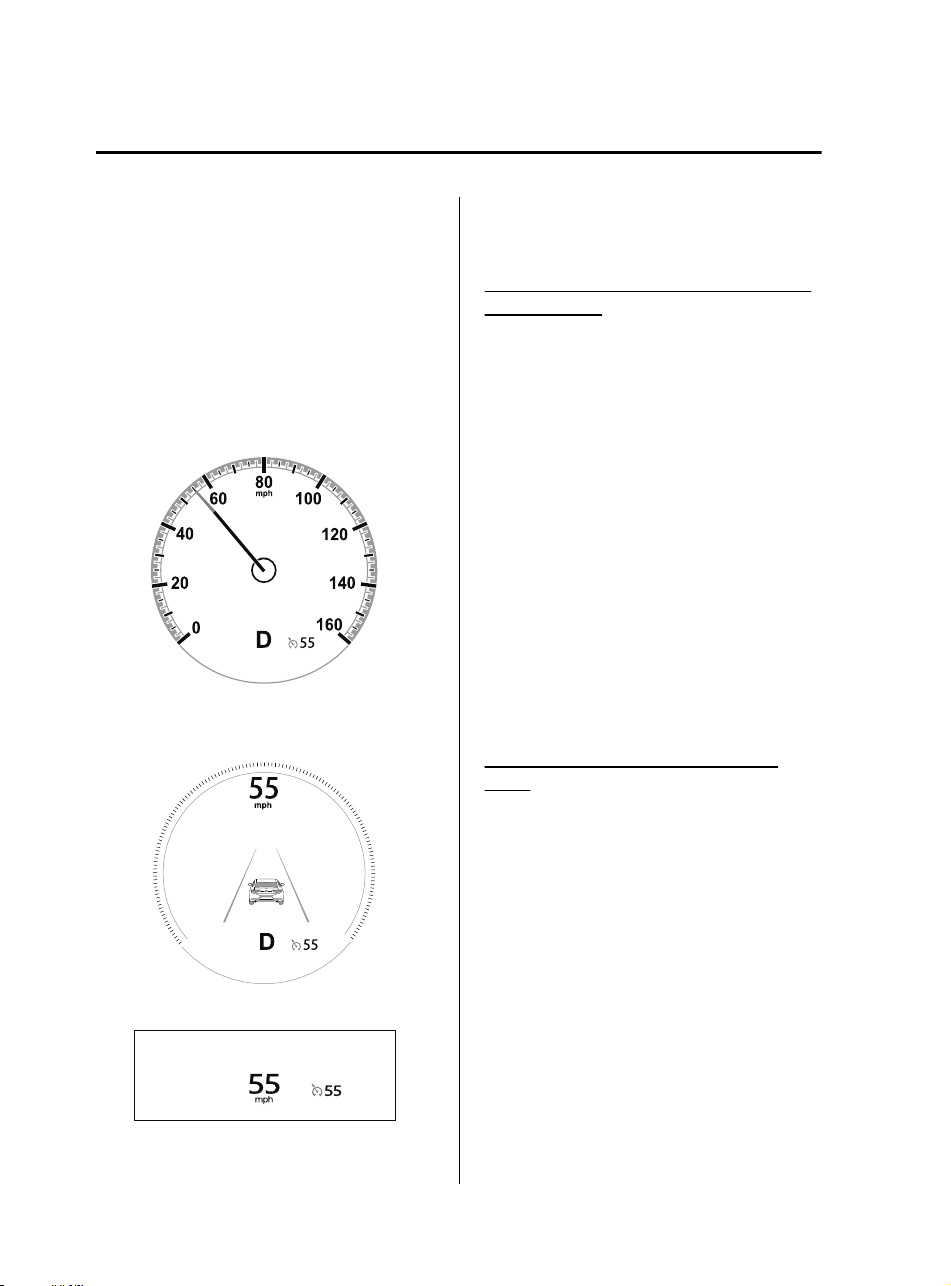
The cruise control will cancel if the
vehicle speed decreases below 20 km/h
(12 mph) when the cruise control is
activated, such as when climbing a steep
grade.
The vehicle speed preset using the cruise
control is displayed in the instrument
cluster and the active driving display
(vehicles with active driving display).
Instrument cluster (Basic display)
Instrument cluster (i-ACTIVSENSE
display)
Active driving display
▼
Changing the Set Vehicle Speed
Follow either of these procedures.
To increase/decrease speed using cruise
control switch
When the RES switch is pressed up (SET
+), the vehicle accelerates and when the
RES switch is pressed down (SET-), it
decelerates.
Press and release immediately: 1 km/h
(1 mph)
Press and hold: 10 km/h (5 mph)
NOTE
Even after releasing the RES switch, the
cruise control accelerates/decelerates
continuously until the set speed displayed
in the instrument cluster and on the active
driving display is reached. If you want to
stop accelerating/decelerating, change the
set speed or cancel the system (such as by
depressing the brake pedal).
To increase speed using accelerator
pedal
Depress the accelerator pedal and press the
RES switch up (SET+) or down (SET-) at
the desired speed. If the switch is not
operated, the system returns to the set
speed after you release your foot from the
accelerator pedal.
NOTE
Accelerate if you want to speed up
temporarily when the cruise control is on.
Greater speed will not interfere with or
change the set speed. Take your foot off
the accelerator to return to the set speed.
When Driving
Cruise Control
4-214
Mazda3_8HZ1-EA-19G_Edition1_old 2019-5-17 13:49:03

▼
To Resume Cruising Speed at More
Than 30 km/h (19 mph)
If the cruise control system is temporarily
canceled (such as by applying the brake
pedal) and the system is still activated, the
most recent set speed will automatically
resume when the RES switch is pressed.
If vehicle speed is below 30 km/h (19
mph), increase the vehicle speed up to 30
km/h (19 mph) or more and press the RES
switch.
▼
To Temporarily Cancel
To temporarily cancel the system, use one
of these methods:
Slightly depress the brake pedal.
Press the CANCEL switch.
(Manual transmission)
Depress the clutch pedal.
If the RES switch is pressed when the
vehicle speed is 30 km/h (19 mph) or
higher, the system reverts to the previously
set speed.
NOTE
If any of the following conditions occur,
the cruise control system is temporarily
canceled.
Even when the brake pedal is slightly
depressed.
The DSC is operating.
There is a problem in the system.
Any of the doors is opened.
The driver's seat belt is unfastened.
The parking brake is applied.
(Automatic transmission)
The selector lever is in the P or N
position.
(Manual transmission)
The shift lever is in the neutral
position.
When the cruise control system is
temporarily canceled by even one of the
applicable cancel conditions, the speed
cannot be re-set.
(Automatic transmission)
The cruise control cannot be canceled
while driving in manual mode (selector
lever shifted from D to M position).
Therefore, engine braking will not be
applied even if the transmission is
shifted down to a lower gear. If
deceleration is required, lower the set
speed or depress the brake pedal.
▼
To Deactivate
Press the cruise switch again.
When Driving
Cruise Control
4-215
Mazda3_8HZ1-EA-19G_Edition1_old 2019-5-17 13:49:03
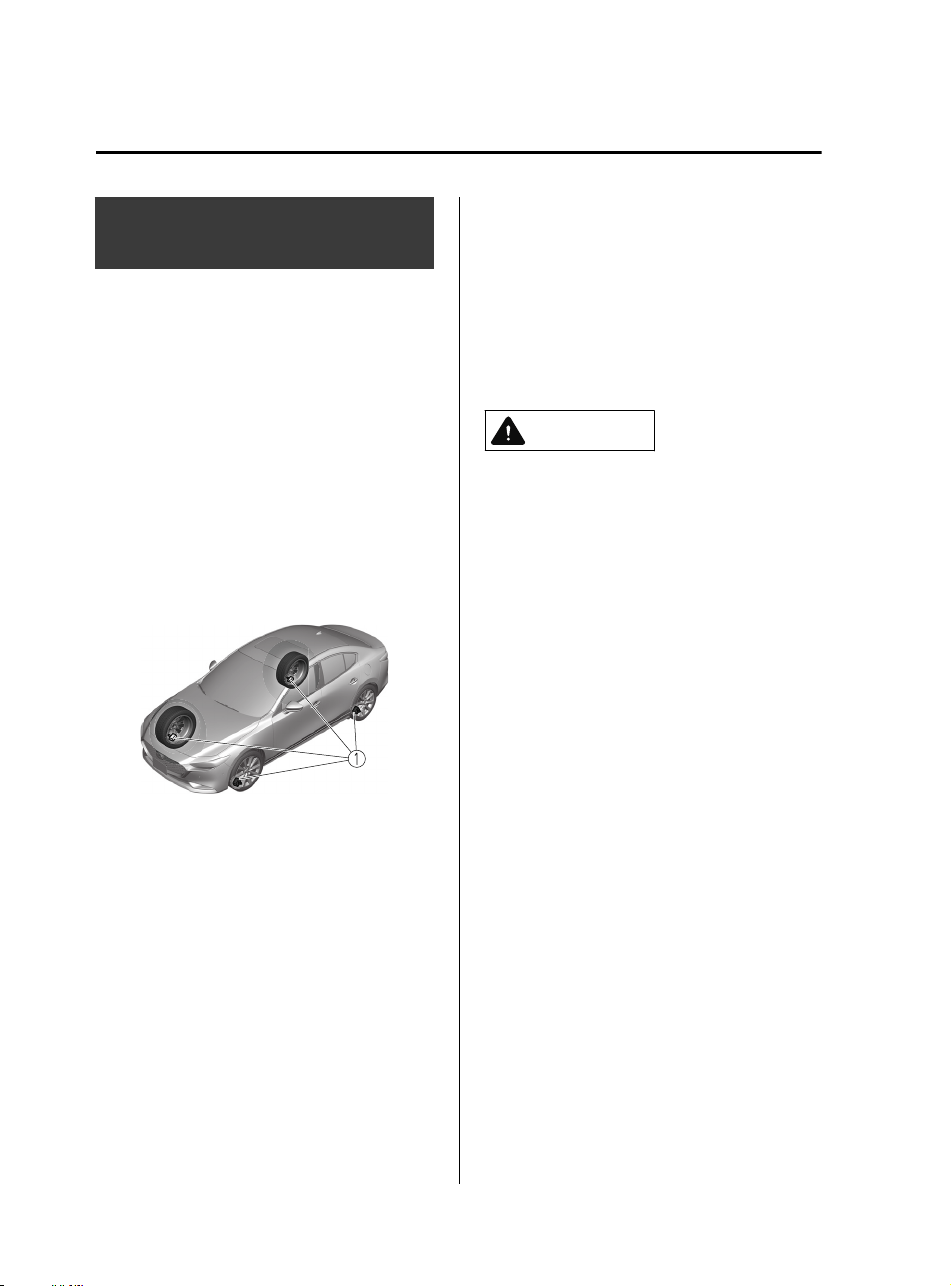
Tire Pressure Monitoring
System (TPMS)
▼
Tire Pressure Monitoring System
(TPMS)
The TPMS monitors the air pressure of
each tire and if it decreases below the
specified value, the system notifies the
driver by turning on the TPMS warning
light in the instrument cluster and
indicating a message on the
multi-information display.
For the TPMS, the air pressure data sent
from the tire pressure sensors installed on
each wheel via radio signal is received by
the receiver unit in the vehicle to monitor
the tire pressures.
1. Tire pressure sensors
In addition, the current tire pressures can
be checked using the center display.
Refer to the Vehicle Status Monitor
section in the Mazda Connect Owner's
Manual.
NOTE
When the ambient temperature is low,
the tire temperatures also decrease. If
the tire temperatures decrease, the air
pressure in the tires will also decrease
which could turn on the TPMS warning
light.
Before driving, visually inspect the tires
for abnormalities. Additionally, inspect
the tire pressures monthly. A digital type
air pressure gauge is recommended for
inspecting the tire pressures.
The TPMS is not a substitute for your own
periodic inspection of the tires. Always
inspect the tires yourself periodically.
CAUTION
Each tire, including the spare (if
provided), should be checked monthly
when cold and
inated
to the
ination
pressure recommended by the vehicle
manufacturer on the vehicle placard or
tire ination pressure label. (If your
vehicle has tires of a
dierent
size than
the size indicated on the vehicle placard
or tire ination pressure label, you should
determine the proper tire
ination
pressure for those tires.)
As an added safety feature, your vehicle
has been equipped with a tire pressure
monitoring system (TPMS) that
illuminates a low tire pressure telltale
when one or more of your tires is
signicantly under-inated. Accordingly,
when the low tire pressure telltale
illuminates, you should stop and check
your tires as soon as possible, and inate
them to the proper pressure. Driving on a
signicantly under-inated tire causes
the tire to overheat and can lead to tire
failure. Under-ination also reduces fuel
eciency and tire tread life, and may
aect the vehicle's handling and
stopping ability.
When Driving
Tire Pressure Monitoring System (TPMS)
4-216
Mazda3_8HZ1-EA-19G_Edition1_old 2019-5-17 13:49:03

Please note that the TPMS is not a
substitute for proper tire maintenance,
and it is the driver's responsibility to
maintain correct tire pressure, even if
under-ination has not reached the level
to trigger illumination of the TPMS low
tire pressure telltale.
Your vehicle has also been equipped with
a TPMS malfunction indicator to indicate
when the system is not operating
properly.
The TPMS malfunction indicator is
combined with the low tire pressure
telltale. When the system detects a
malfunction, the telltale will
ash
for
approximately one minute and then
remain continuously illuminated. This
sequence will continue upon subsequent
vehicle start-ups as long as the
malfunction exists. When the
malfunction indicator is illuminated, the
system may not be able to detect or
signal low tire pressure as intended.
TPMS malfunctions may occur for a
variety of reasons, including the
installation of replacement or alternate
tires or wheels on the vehicle that
prevent the TPMS from functioning
properly. Always check the TPMS
malfunction telltale after replacing one
or more tires or wheels on your vehicle to
ensure that the replacement or alternate
tires and wheels allow the TPMS to
continue to function properly.
To avoid false readings, the system
samples for a little while before
indicating a problem. As a result it will
not instantaneously register a rapid tire
deation or blow out.
▼
If there is a problem with the Tire
Pressure Monitoring System
(TPMS)
If the TPMS warning light flashes, there
may be a problem with the system.
Consult an Authorized Mazda Dealer to
have the system inspected.
Refer to Tire Pressure Monitoring System
(TPMS) Warning Indication/Warning
Light (Flashing) on page 7-33.
In the following cases, the system cannot
recognize the tire pressures correctly and
the TPMS warning light may flash.
There is equipment or a device nearby
emitting radio signals the same as a tire
pressure sensor.
A metallic object such as a non-genuine
electronic device is installed near the
center of the dashboard (obstructs the
radio signals from the tire pressure
sensors to the receiver).
A device such as one of the following is
used in the cabin.
Electronic devices such as a computer.
Converter devices such as a DC-AC
converter.
There is a large accumulation of snow or
ice around the vehicle tires.
The battery in a tire pressure sensor is
dead.
A wheel not equipped with a tire
pressure sensor is used.
Tires employing steel in the sidewall of
the tire are installed.
Tire chains are used.
When Driving
Tire Pressure Monitoring System (TPMS)
4-217
Mazda3_8HZ1-EA-19G_Edition1_old 2019-5-17 13:49:03
▼
When a tire pressure decreases
If the TPMS warning light turns on, a tire
pressure may be low. Inspect the tire
pressures and adjust them to the correct
inflation pressure.
Refer to Tire Pressure Monitoring System
(TPMS) Warning Indication/Warning
Light (Turns on) on page 7-36.
▼
Tires and Wheels
CAUTION
When inspecting/adjusting the tire
pressures, do not apply excessive force to
the air valve of the tire pressure sensor.
Otherwise, the tire pressure sensor could be
damaged.
When changing tires and wheels
When changing the tires or wheels (such
as installing winter tires), it will be
necessary to register the ID signal code of
the tire pressure sensor to the TPMS.
Have an Authorized Mazda Dealer do the
registration or register the ID signal codes
of the tire pressure sensors using the
following procedure.
NOTE
The tire pressure sensors on each wheel
have a unique ID signal code. For the
TPMS to operate correctly, the ID signal
codes of the tire pressure sensors need to
be registered to the system.
1. Wait more than 19 minutes after
changing a tire or wheel.
2. After more than 19 minutes have
passed, drive the vehicle at a speed of
about 25 km/h (16 mph) or faster for 3
minutes or longer. While driving, the
ID signal codes of the tire pressure
sensors are automatically registered.
NOTE
If you drive the vehicle within 19 minutes
of changing a tire or wheel, the TPMS
warning light will flash because the ID
signal codes for the tire pressure sensors
were not registered. In this case, stop the
vehicle and register the ID signal codes of
the tire pressure sensors following the
procedure.
When replacing tires and wheels
CAUTION
When replacing the tires and wheels,
consult an Authorized Mazda Dealer
Otherwise, the tire pressure sensors could
be damaged when replacing them.
Do not install non-genuine wheels. If
wheels other than genuine ones are
installed, it may not be possible to install
the tire pressure sensors.
When replacing a tire or wheel, always
install the tire pressure sensor. The
following combinations of tires, wheels, or
tires and wheels are possible.
The tire pressure sensor from the old
wheel is removed and it is installed to
the new wheel.
Only a tire is replaced without replacing
the tire pressure sensor and wheel.
A new tire pressure sensor is installed to
a new wheel.
When Driving
Tire Pressure Monitoring System (TPMS)
4-218
Mazda3_8HZ1-EA-19G_Edition1_old 2019-5-17 13:49:03

NOTE
When installing a new tire pressure sensor,
the ID signal code for the tire pressure
sensor needs to be registered. For details
on purchasing a tire pressure sensor and
registering the ID signal of the tire
pressure sensor, consult an Authorized
Mazda Dealer
When Driving
Tire Pressure Monitoring System (TPMS)
4-219
Mazda3_8HZ1-EA-19G_Edition1_old 2019-5-17 13:49:03
Rear View Monitor
*
▼
Rear View Monitor
The rear view monitor provides visual
images of the rear of the vehicle when
reversing.
WARNING
Always drive carefully conrming the safety
of the rear and the surrounding conditions
by looking directly with your eyes:
Reversing the vehicle by only looking at the
screen is dangerous as it may cause an
accident or a collision with an object. The
rear view monitor is only a visual assist
device when reversing the vehicle. The
images on the screen may be dierent from
the actual conditions.
CAUTION
Do not use the rear view monitor under
the following conditions: Using the rear
view monitor under the following
conditions is dangerous and could result
in injury or vehicle damage or both.
Icy or snow-covered roads.
Tire chains or a temporary spare tire is
installed.
The vehicle is on a road incline.
When the display is cold, images may
course across the monitor or the screen
and may be dimmer than usual, which
could cause diculty in conrming the
surrounding conditions of the vehicle.
Always drive carefully conrming the
safety of the rear and the surrounding
conditions by looking directly with your
eyes.
Do not apply excessive force to the
camera. The camera position and angle
may deviate.
Do not disassemble, modify, or remove it
as it may no longer be waterproof.
The camera cover is made of plastic. Do
not apply degreasing agents, organic
solvents, wax, or glass coating agents to
the camera cover. If any are spilled on
the cover, wipe
o
with a soft cloth
immediately.
Do not rub the camera cover forcefully
with an abrasive or hard brush. The
camera cover or lens may be scratched
which might aect the images.
NOTE
If water, snow, or mud is stuck on the
camera lens, wipe it off using a soft
cloth. If it cannot be wiped off, use a
mild detergent.
If the camera temperature changes
rapidly (Hot to cold, cold to hot), the
rear view monitor may not operate
correctly.
When replacing the tires, consult an
Authorized Mazda Dealer. Replacing the
tires could result in deviation of the
guide lines which appear on the display.
When Driving
Rear View Monitor
4-220
*Some models.
Mazda3_8HZ1-EA-19G_Edition1_old 2019-5-17 13:49:03
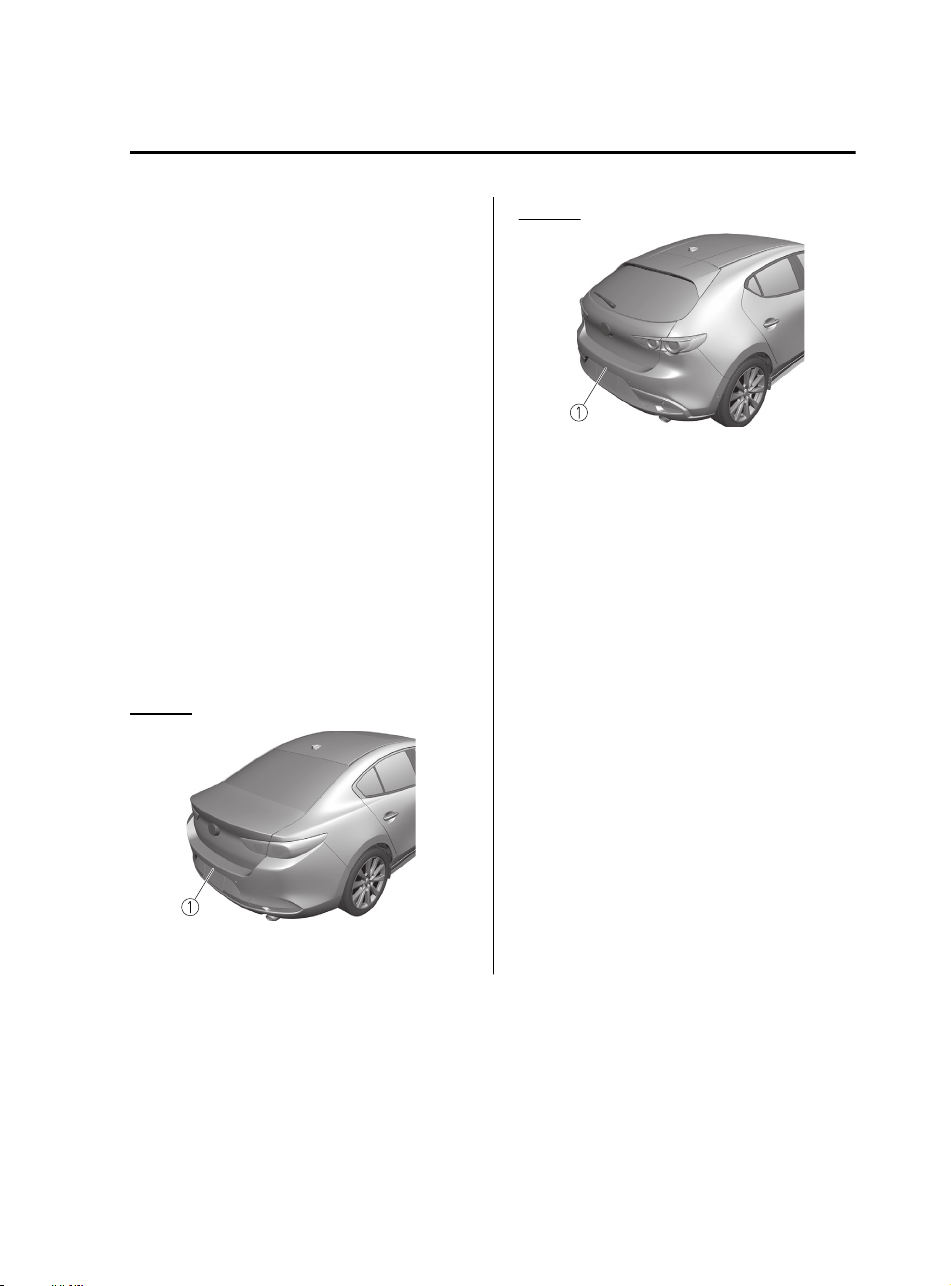
If the vehicle's front, side, or rear has
been involved in a collision, the
alignment of the rear view parking
camera (location, installation angle)
may have deviated. Always consult an
Authorized Mazda Dealer to have the
vehicle inspected.
If “No camera signal.” is indicated in
the display, there could be a problem
with the camera. Have your vehicle
inspected at an Authorized Mazda
Dealer.
(Predicted vehicle path assist lines
display type)
If force is applied to the steering wheel,
the guide lines may not display. Loosen
your grip on the steering wheel to allow
the guide lines to display.
▼
Rear View Parking Camera
Location
4–Door
1. Rear view parking camera
5–Door
1. Rear view parking camera
▼
Switching to the Rear View Monitor
Display
Shift the shift lever (manual transmission)
or the selector lever (automatic
transmission) to reverse (R) position with
the ignition switched ON to switch the
display to the rear view monitor display.
NOTE
When the shift lever (manual
transmission) or the selector lever
(automatic transmission) is shifted from
reverse (R) position to another shift lever
(manual transmission) or the selector
lever (automatic transmission) position,
the screen returns to the previous display.
When Driving
Rear View Monitor
4-221
Mazda3_8HZ1-EA-19G_Edition1_old 2019-5-17 13:49:03
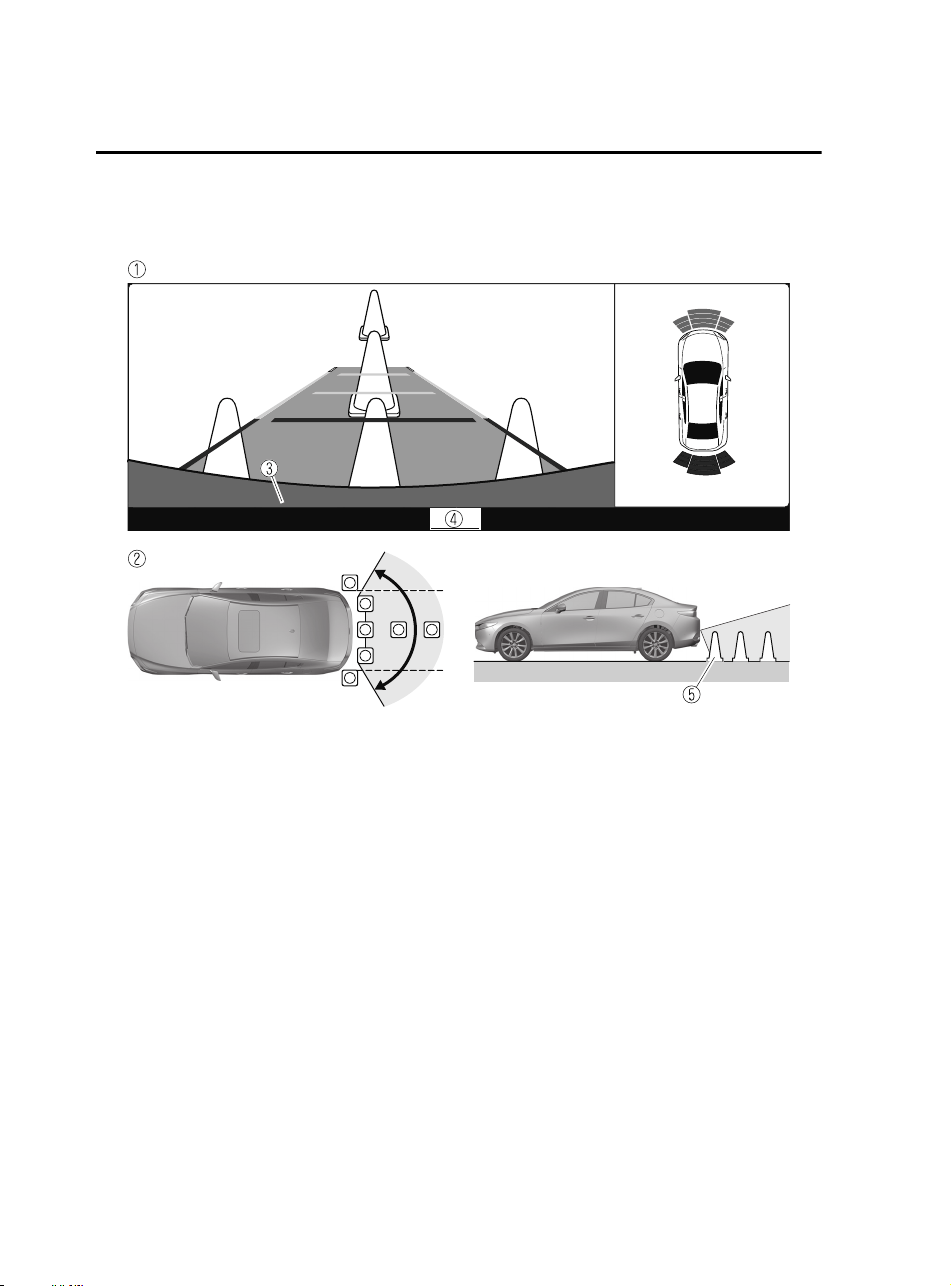
▼
Displayable Range on the Screen
The images on the screen may be different from the actual conditions.
1. (Screen display)
2. (Actual view)
3. Bumper
4. “Check surroundings for safety.” message is displayed
5. Object
NOTE
The displayable range varies depending on the vehicle and road conditions.
If the camera lens is touched or there is any dirt on it, it could affect the screen image.
Wipe the lens using a soft cloth.
The displayable range is limited. Objects under the bumper or around the bumper ends
cannot be displayed.
The distance appearing in the displayed image is different from the actual distance
because the rear view parking camera is equipped with a specific lens.
Images displayed on the monitor from the rear view parking camera are reversed images
(mirror images).
Some optionally installed vehicle accessories may be picked up by the camera. Do not
install any optional parts that can interfere with the camera view, such as illuminating
parts or parts made of reflective material.
When Driving
Rear View Monitor
4-222
Mazda3_8HZ1-EA-19G_Edition1_old 2019-5-17 13:49:03
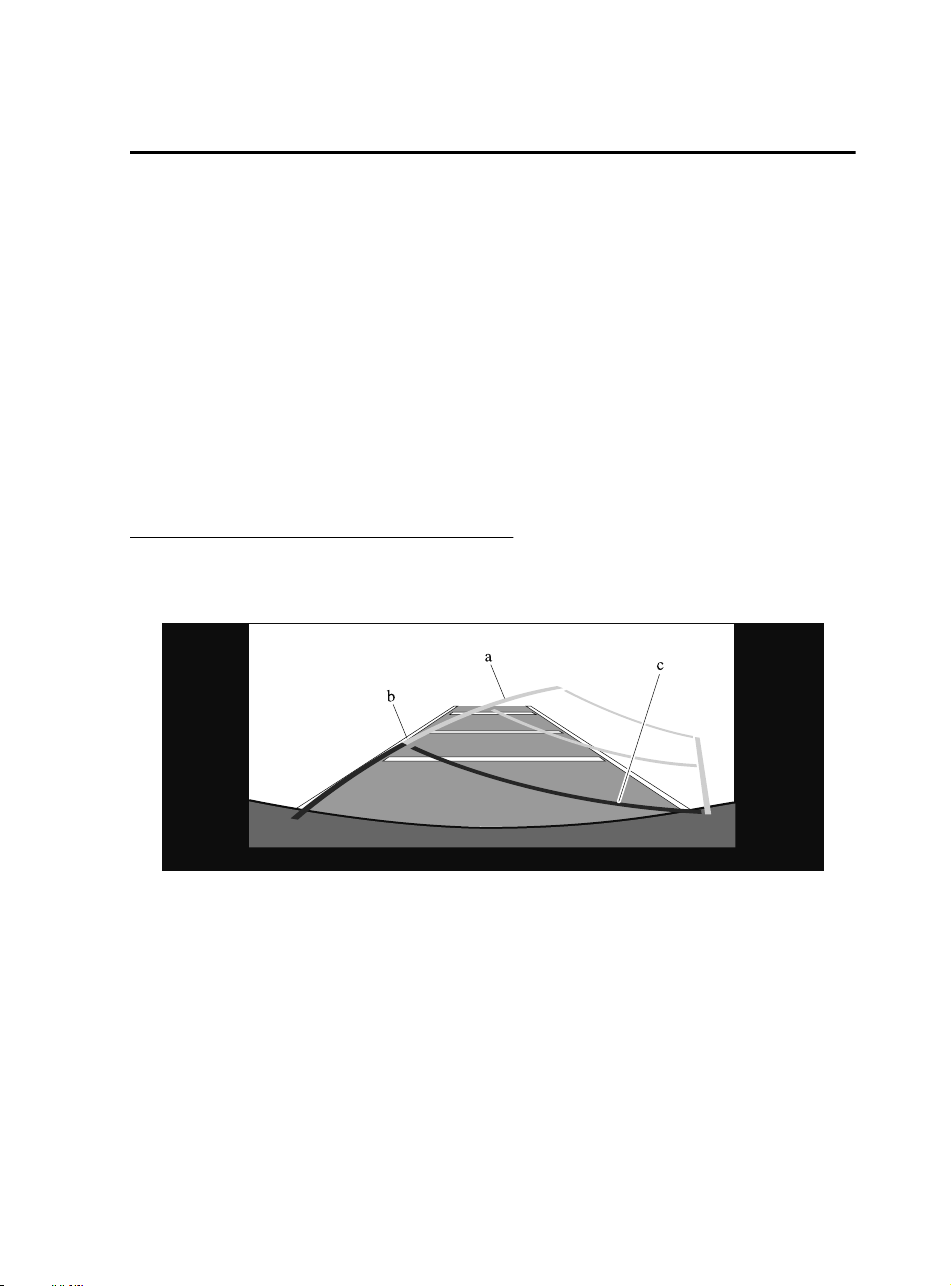
It may be difficult to see the display under the following conditions, however, it does not
indicate a malfunction.
In darkened areas.
When the temperature around the lens is high/low.
When the camera is wet such as on a rainy day or during periods of high humidity.
When foreign material such as mud is stuck around the camera.
When the camera lens reflects sunlight or headlight beams.
The surroundings are illuminated by vehicle lights, fluorescent lights, or LED lights
(Display may flicker).
Extremely small dark or white dots appear on the screen (dots may flicker).
Image display may be delayed if the temperature around the camera is low.
▼
Viewing the Display
Predicted vehicle path assist lines display type
The projected path guidance mode displays the predicted path of the vehicle after you turn
the steering wheel.
Use this mode for parking your vehicle in a parking space or garage.
a) Projected vehicle path (yellow)
These lines are displayed as a reference for the projected path of the vehicle.
The lines displaying the projected vehicle path change after you turn the steering wheel.
b) Extended vehicle width lines (blue)
These lines indicate the vehicle's extended width.
These lines are not displayed when the vehicle's wheels are in the straight-ahead position.
When Driving
Rear View Monitor
4-223
Mazda3_8HZ1-EA-19G_Edition1_old 2019-5-17 13:49:03
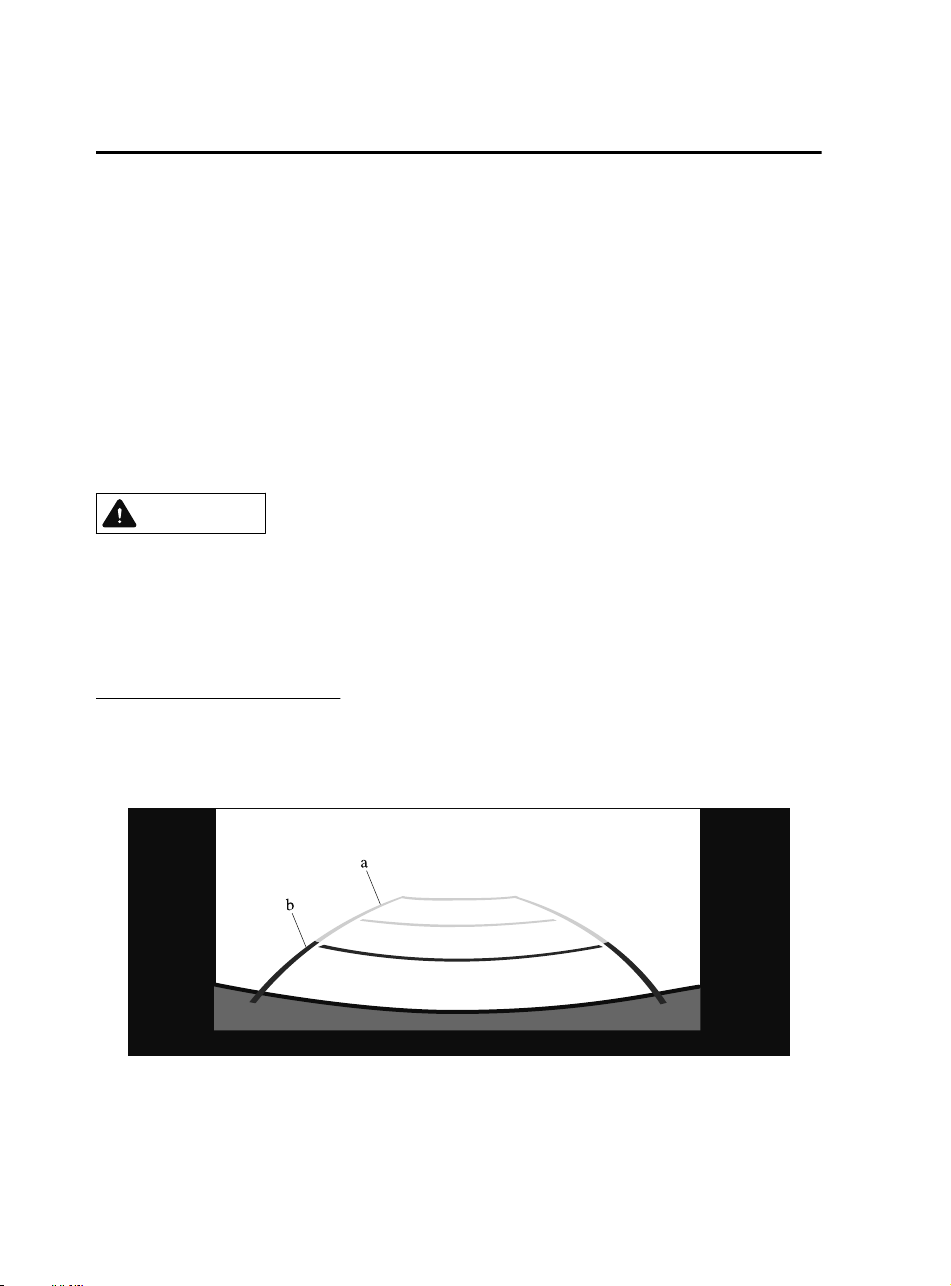
c) Distance guide lines
These lines indicate the approximate distance to a point measured from the vehicle's rear
(from the end of the bumper).
The blue line indicates the point about 50 cm (19 in) from the rear bumper.
The red and yellow lines, which change position after you turn the steering wheel,
indicate the points about 50 cm (19 in) for the red line and 100 cm (39.3 in) for the
yellow lines from the rear bumper (at the center point of each of the lines).
A degree of error occurs when the wheels are not in the straight-ahead position.
In the above illustration, the right side of the vehicle is in a position closer to the actual
distance displayed by the distance guide lines (red: about 50 cm (19 in) point, yellow:
about 100 cm (39.3 in) point behind the rear bumper), whereas the left side is in a
position farther away.
CAUTION
The indicated position of the guide lines on the display changes depending on the vehicle
conditions (such as the number of occupants/cargo load) and the road conditions (such as a
steep gradient to the rear of the vehicle).
Always check the area to the vehicle's rear and the surrounding area directly with your eyes
while backing up.
Fixed assist lines display type
Guide lines which indicate the width of the vehicle (yellow) are displayed on the screen as a
reference to the approximate width of the vehicle in comparison to the width of the parking
space you are about to back into.
Use this display view for parking your vehicle in a parking space or garage.
a) Vehicle width guide lines (yellow)
Guide lines serve as a reference to the approximate width of the vehicle.
When Driving
Rear View Monitor
4-224
Mazda3_8HZ1-EA-19G_Edition1_old 2019-5-17 13:49:03
b) Distance guide lines
These guide lines indicate the approximate distance to a point measured from the
vehicle's rear (from the end of the bumper).
The red and yellow lines indicate the points about 50 cm (19 in) for the red line and 100
cm (39.3 in) for the yellow lines from the rear bumper (at the center point of each of the
lines).
CAUTION
The guide lines on the screen are xed lines. They are not synced to the driver's turning of the
steering wheel. Always be careful and check the area to the vehicle's rear and the surrounding
area directly with your eyes while backing up.
▼
Rear View Monitor Operation
The operation of the rear view monitor when reversing the vehicle varies depending on the
traffic, road, and vehicle conditions. The amount of steering and the timing also varies
depending on conditions, so confirm the surrounding conditions directly with your eyes and
steer the vehicle in accordance with the conditions.
Be well aware of the above cautions prior to using the rear view monitor.
Predicted vehicle path assist lines display type
NOTE
The following shows an example of vehicle parking in which the steering wheel is turned to
the right when backing up the vehicle. The operation is reversed when backing up the
vehicle from the opposite direction.
1. Shift the shift lever (manual transmission) or the selector lever (automatic transmission)
to reverse (R) position to switch the display to the rear view monitor display.
When Driving
Rear View Monitor
4-225
Mazda3_8HZ1-EA-19G_Edition1_old 2019-5-17 13:49:03
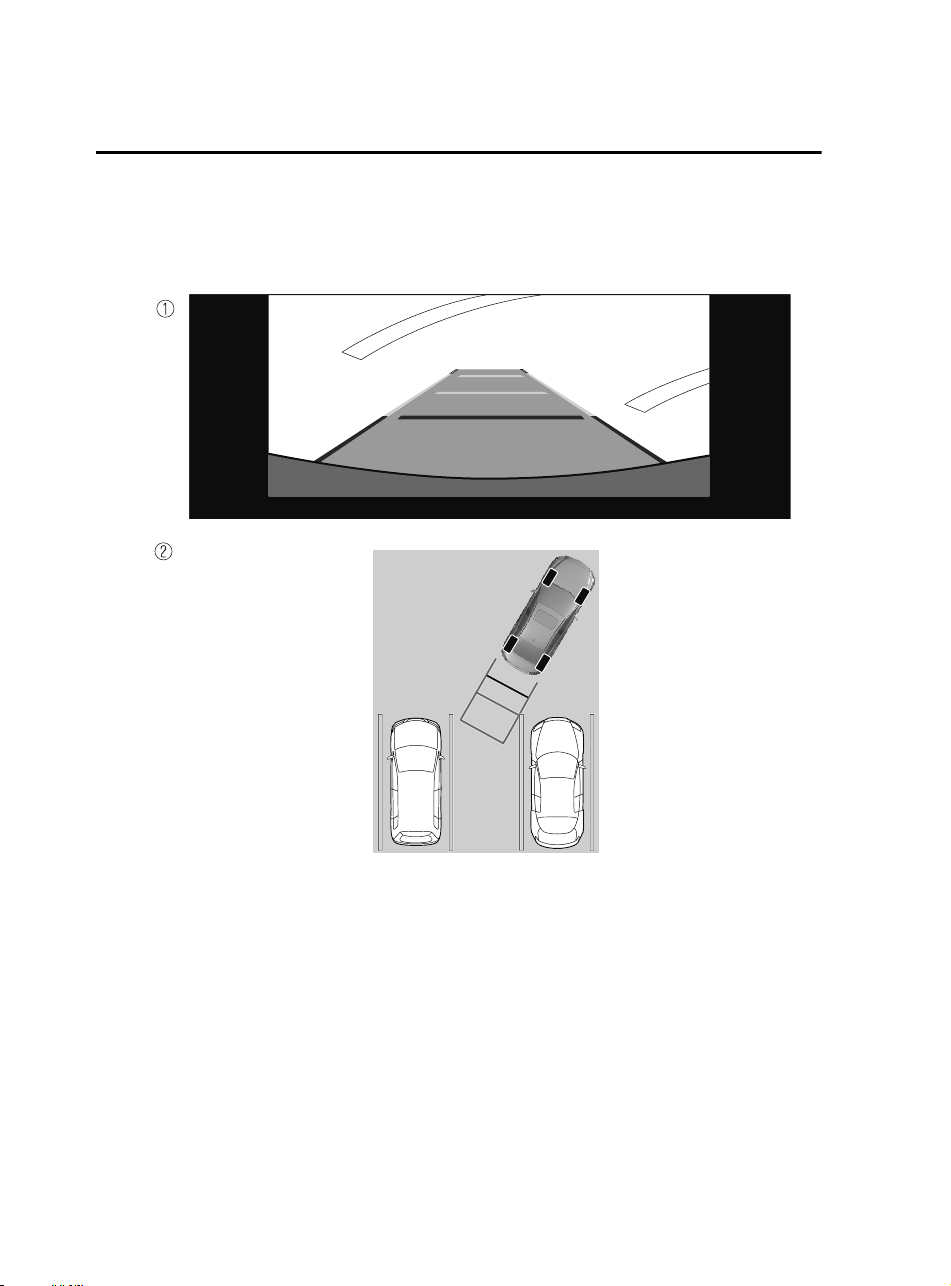
2. Before backing the vehicle into the parking space, turn the steering wheel while
referring to the projected vehicle path display so that the vehicle enters the center of the
parking space.
1. (Display condition)
2. (Vehicle condition)
When Driving
Rear View Monitor
4-226
Mazda3_8HZ1-EA-19G_Edition1_old 2019-5-17 13:49:03
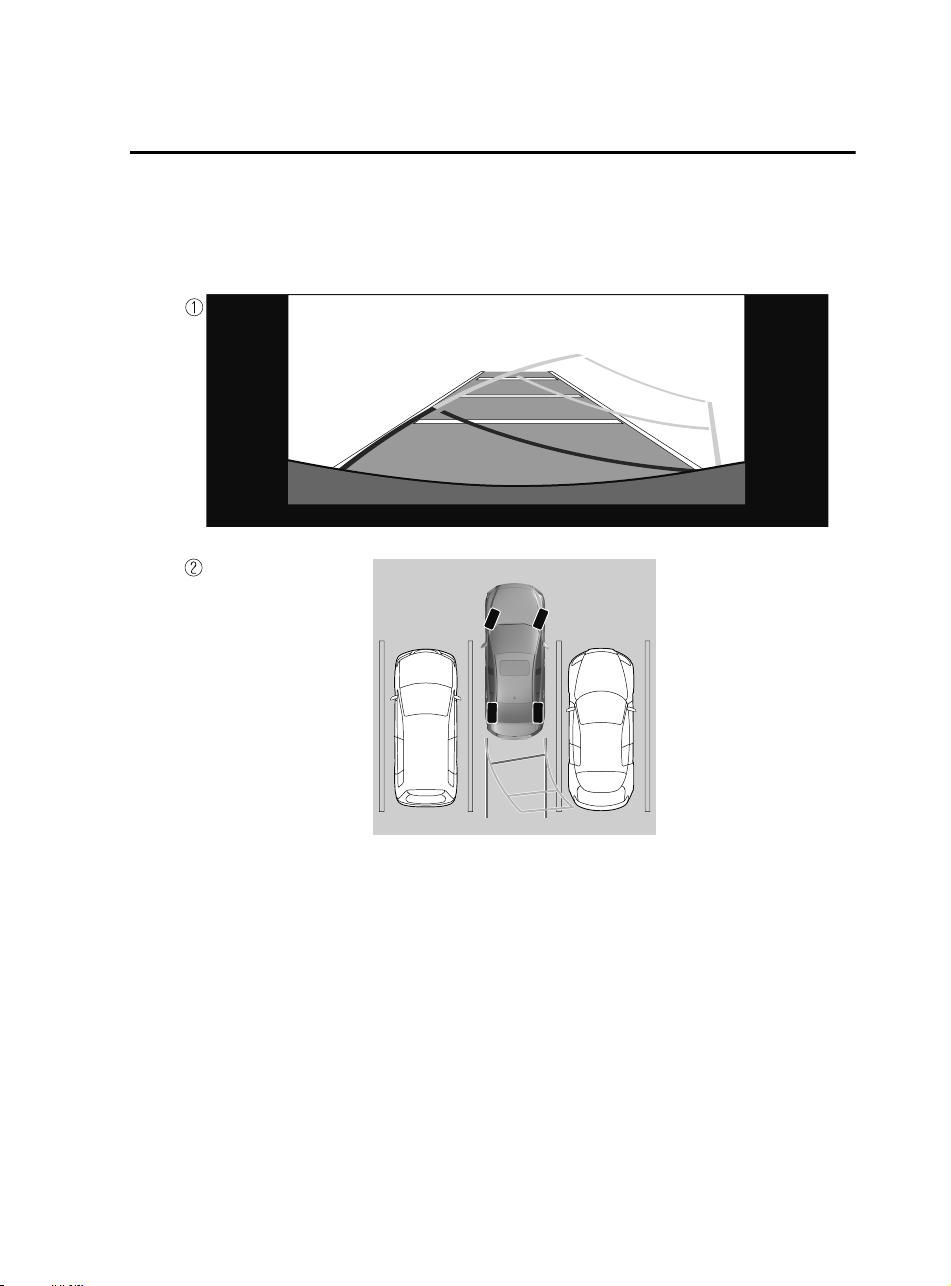
3. After your vehicle begins entering the parking space, continue backing up slowly so that
the distance between the vehicle width lines and the sides of the parking space on the
left and right are roughly equal.
1. (Display condition)
2. (Vehicle condition)
4. Continue to adjust the steering wheel until the vehicle width guide lines are parallel to
the left and right sides of the parking space.
When Driving
Rear View Monitor
4-227
Mazda3_8HZ1-EA-19G_Edition1_old 2019-5-17 13:49:03
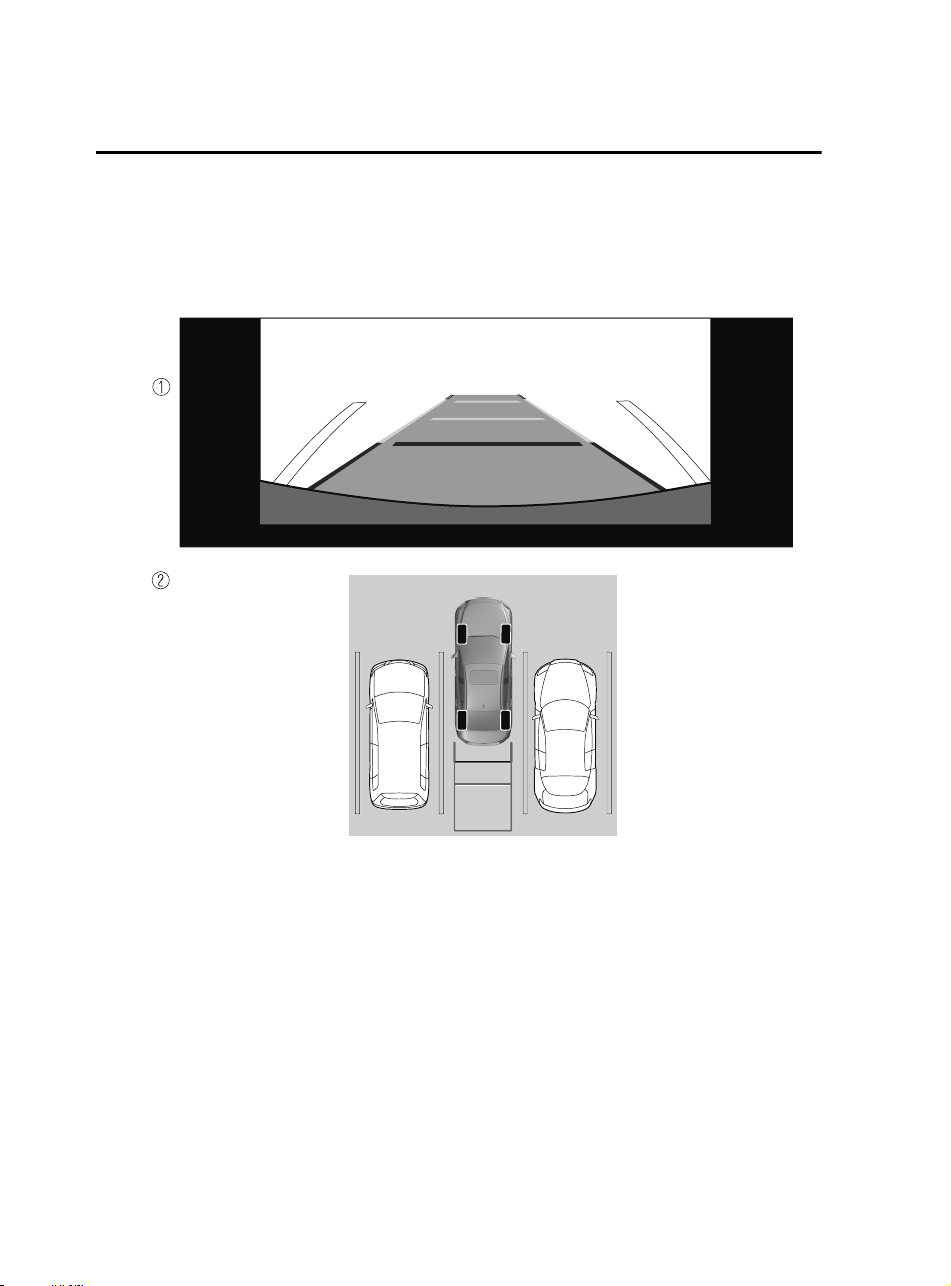
5. Once they are parallel, straighten the wheels and back your vehicle slowly into the
parking space. Continue checking the vehicle's surroundings and then stop the vehicle in
the best possible position. (If the parking space has division lines, check whether the
vehicle width guide lines are parallel to them.)
1. (Display condition)
2. (Vehicle condition)
6. When the shift lever (manual transmission) or the selector lever (automatic transmission)
is shifted from reverse (R) position to another shift lever (manual transmission) or the
selector lever (automatic transmission) position, the screen returns to the previous
display.
NOTE
Because there may be a difference between the displayed image, such as indicated below,
and the actual conditions when parking, always verify the safety at the rear of the vehicle
and the surrounding area directly with your eyes.
In the image of the parking space (or garage) displayed on the screen, the back end and
distance guide lines may appear aligned in the monitor, but they may not actually be
aligned on the ground.
When Driving
Rear View Monitor
4-228
Mazda3_8HZ1-EA-19G_Edition1_old 2019-5-17 13:49:03
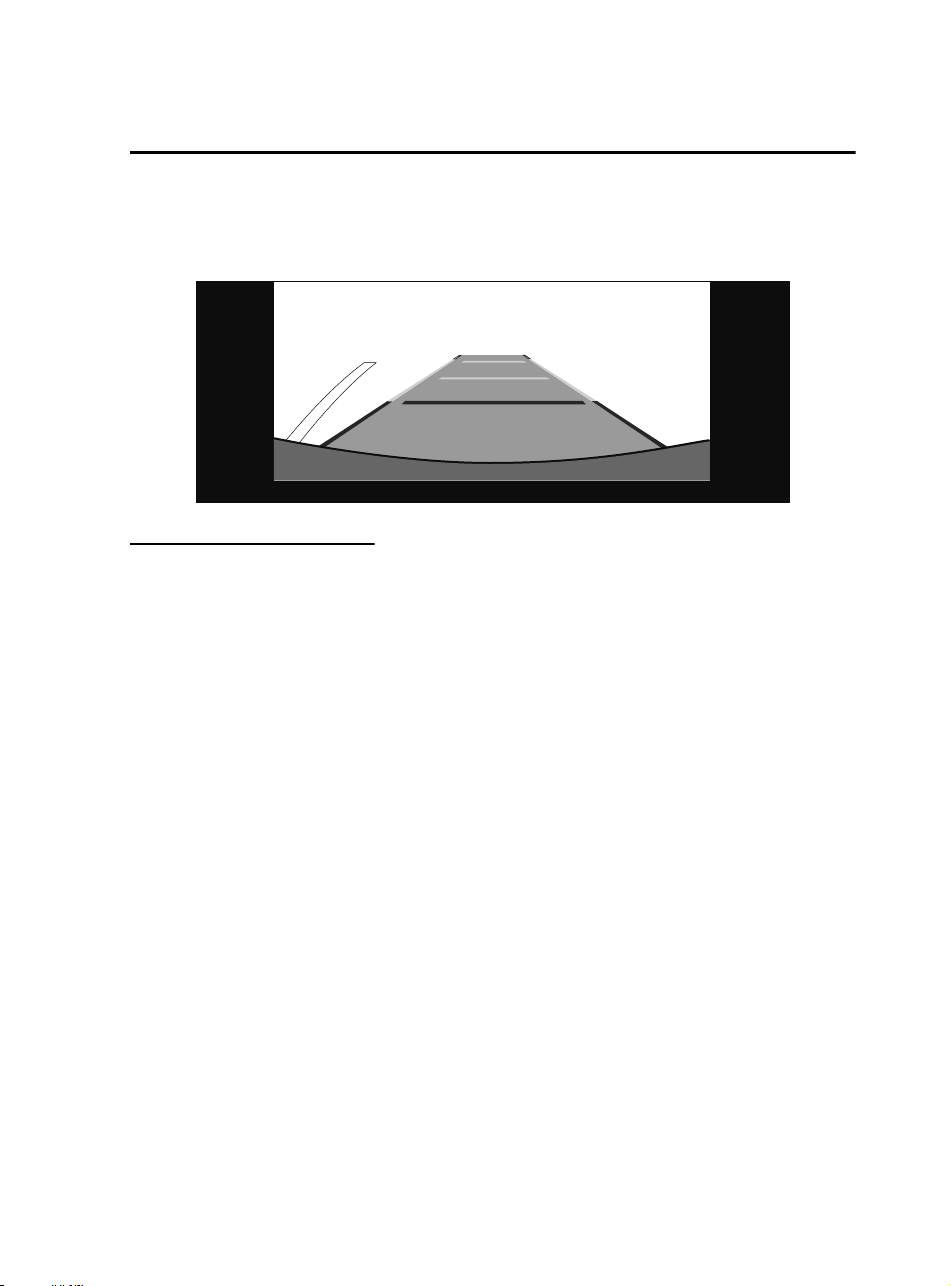
When parking in a space with a division line on only one side of the parking space, the
division line and the vehicle width guide line appear aligned in the monitor, but they may
not actually be aligned on the ground.
Fixed assist lines display type
NOTE
Images displayed on the monitor from the rear view parking camera are reversed images
(mirror images).
1. Shift the shift lever (manual transmission) or the selector lever (automatic transmission)
to reverse (R) position to switch the display to the rear view monitor display.
When Driving
Rear View Monitor
4-229
Mazda3_8HZ1-EA-19G_Edition1_old 2019-5-17 13:49:03
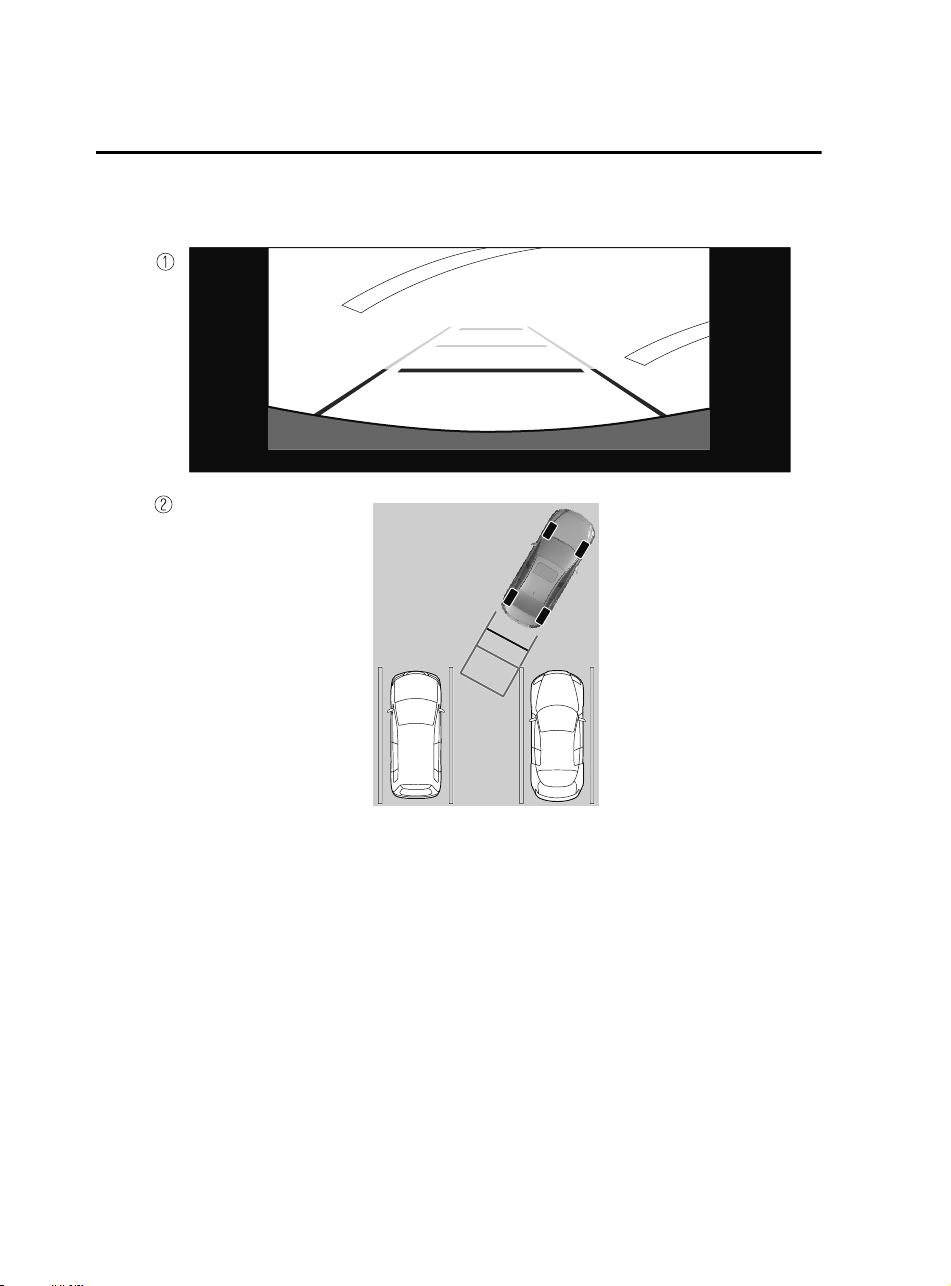
2. Confirming the surrounding conditions, reverse the vehicle.
1. (Display condition)
2. (Vehicle condition)
3. After your vehicle begins entering the parking space, continue backing up slowly so that
the distance between the vehicle width lines and the sides of the parking space on the
left and right are roughly equal.
4. Continue to adjust the steering wheel until the vehicle width guide lines are parallel to
the left and right sides of the parking space.
When Driving
Rear View Monitor
4-230
Mazda3_8HZ1-EA-19G_Edition1_old 2019-5-17 13:49:03
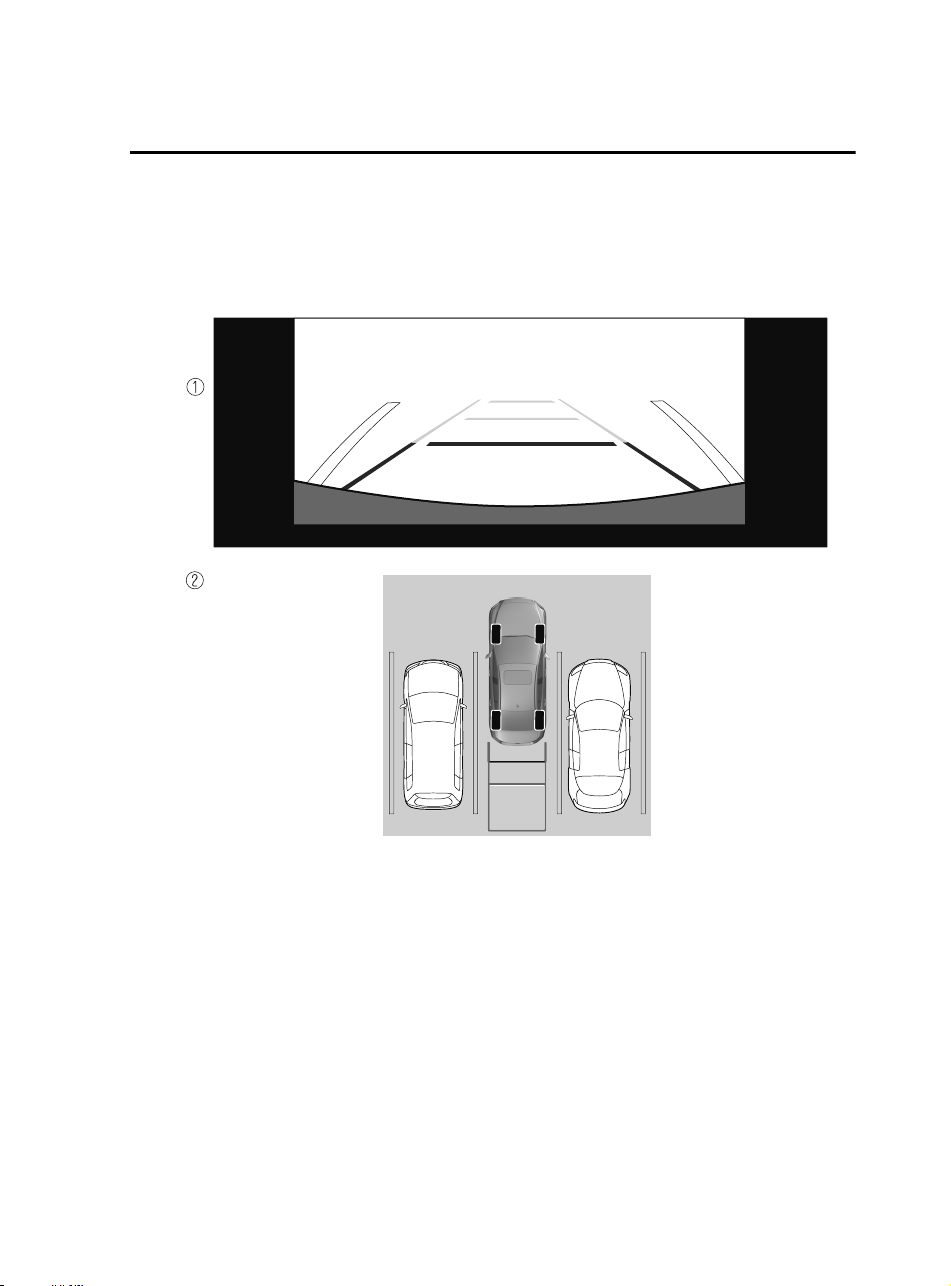
5. Once they are parallel, straighten the wheels and back your vehicle slowly into the
parking space. Continue checking the vehicle's surroundings and then stop the vehicle in
the best possible position. (If the parking space has division lines, check whether the
vehicle width guide lines are parallel to them.)
1. (Display condition)
2. (Vehicle condition)
6. When the shift lever (manual transmission) or the selector lever (automatic transmission)
is shifted from reverse (R) position to another shift lever (manual transmission) or the
selector lever (automatic transmission) position, the screen returns to the previous
display.
NOTE
Because there may be a difference between the displayed image, such as indicated below,
and the actual conditions when parking, always verify the safety at the rear of the vehicle
and the surrounding area directly with your eyes.
In the image of the parking space (or garage) displayed on the screen, the back end and
distance guide lines may appear aligned in the monitor, but they may not actually be
aligned on the ground.
When Driving
Rear View Monitor
4-231
Mazda3_8HZ1-EA-19G_Edition1_old 2019-5-17 13:49:03
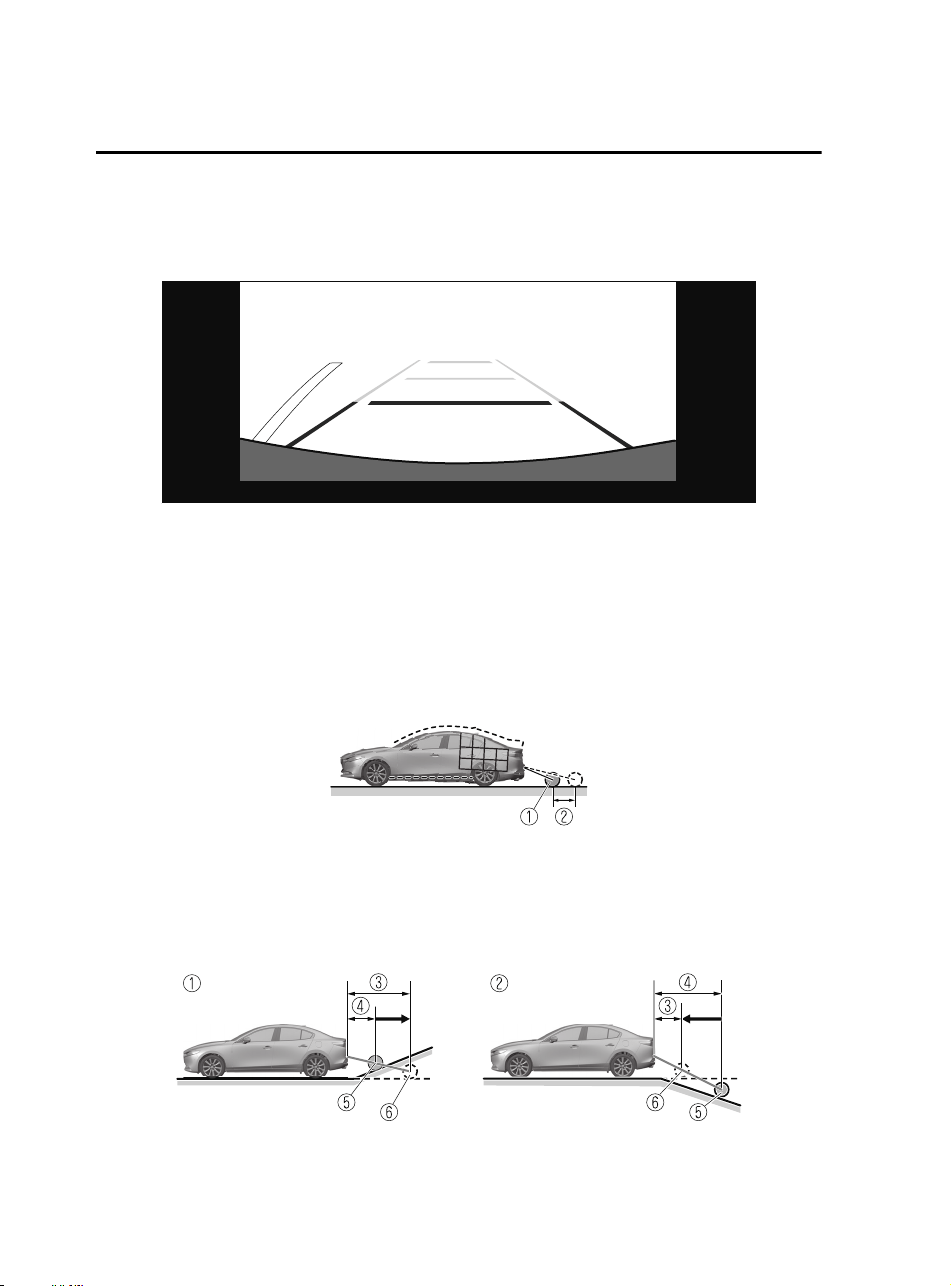
When parking in a space with a division line on only one side of the parking space, the
division line and the vehicle width guide line appear aligned in the monitor, but they may
not actually be aligned on the ground.
▼
Variance Between Actual Road Conditions and Displayed Image
Some variance occurs between the actual road and the displayed road. Such variance in
distance perspective could lead to an accident. Note the following conditions that may cause
a variance in distance perspective.
When the vehicle is tilted due to the weight of passengers and load
When the vehicle rear is lowered, the object displayed on the screen appears farther than the
actual distance.
1. Object
2. Variance
When there is a steep grade behind the vehicle
When there is a steep upgrade (downgrade) behind the vehicle, the object displayed on the
screen appears farther (downgrade: closer) than the actual distance.
1. Appears farther than actual distance
2. Appears closer than actual distance
When Driving
Rear View Monitor
4-232
Mazda3_8HZ1-EA-19G_Edition1_old 2019-5-17 13:49:03

3. Distance between the vehicle and object displayed on the screen.
4. Actual distance between the vehicle and object.
5. Object at actual position
6. Object on screen
Three-dimensional object on vehicle rear
Because the distance guide lines are displayed based on a flat surface, the distance to the
three-dimensional object displayed on the screen is different from the actual distance.
1. (Screen display)
2. (Actual condition)
3. Sensed distance on screen A>B>C
4. Actual distance B>C=A
(Predicted vehicle path assist lines display type)
When Driving
Rear View Monitor
4-233
Mazda3_8HZ1-EA-19G_Edition1_old 2019-5-17 13:49:03
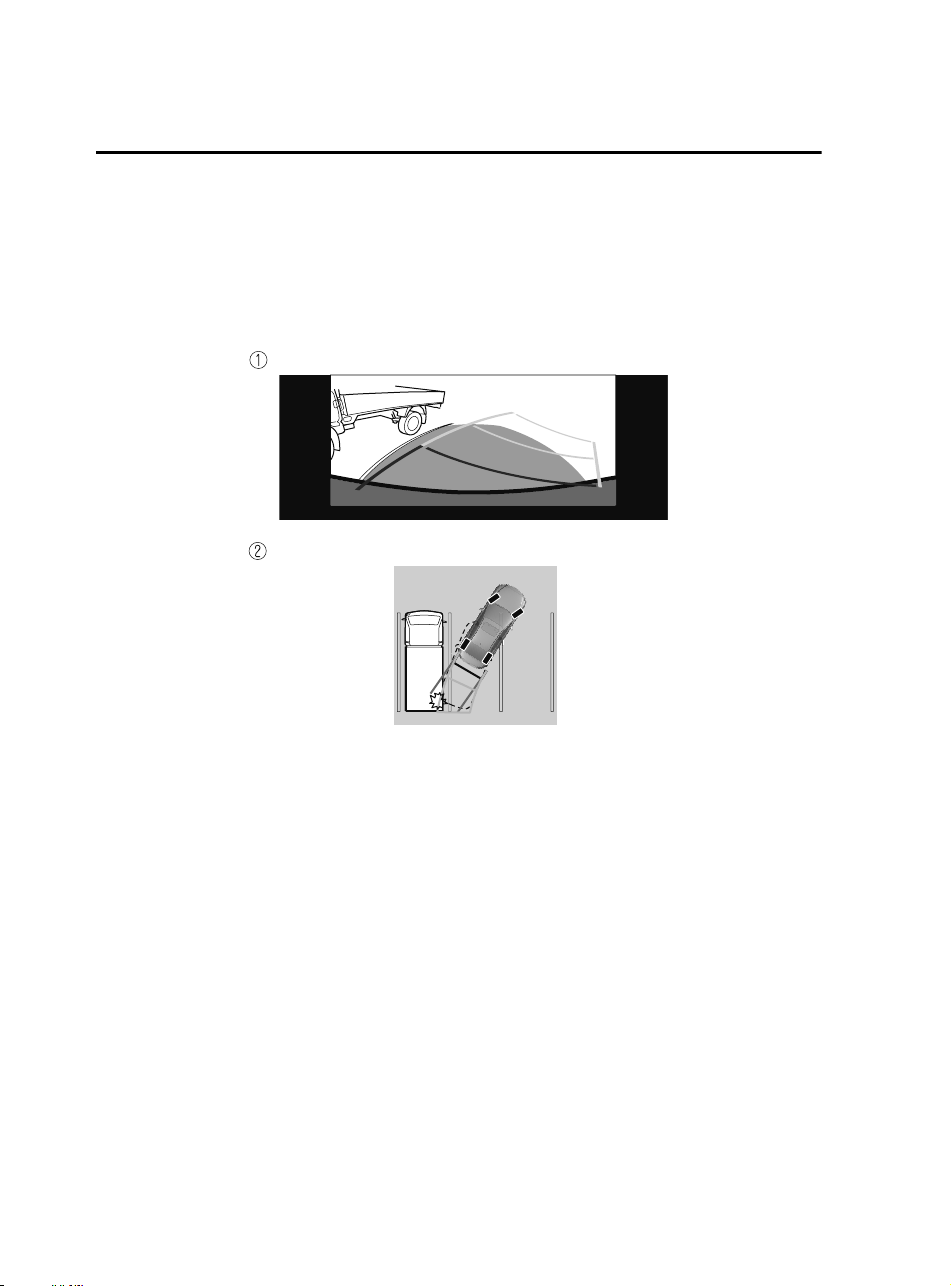
When reversing near a three-dimensional object
When reversing near an overhanging object, the vehicle may hit the object even if the
anticipated course line does not contact the object on the screen. The position of the object
displayed on the screen is different from the actual position because the anticipated course
lines on the screen are displayed based on a horizontal road surface. When backing up near
an overhanging object, confirm the rear and surrounding conditions directly with your eyes.
1. (Screen display)
2. (Actual view)
When Driving
Rear View Monitor
4-234
Mazda3_8HZ1-EA-19G_Edition1_old 2019-5-17 13:49:03
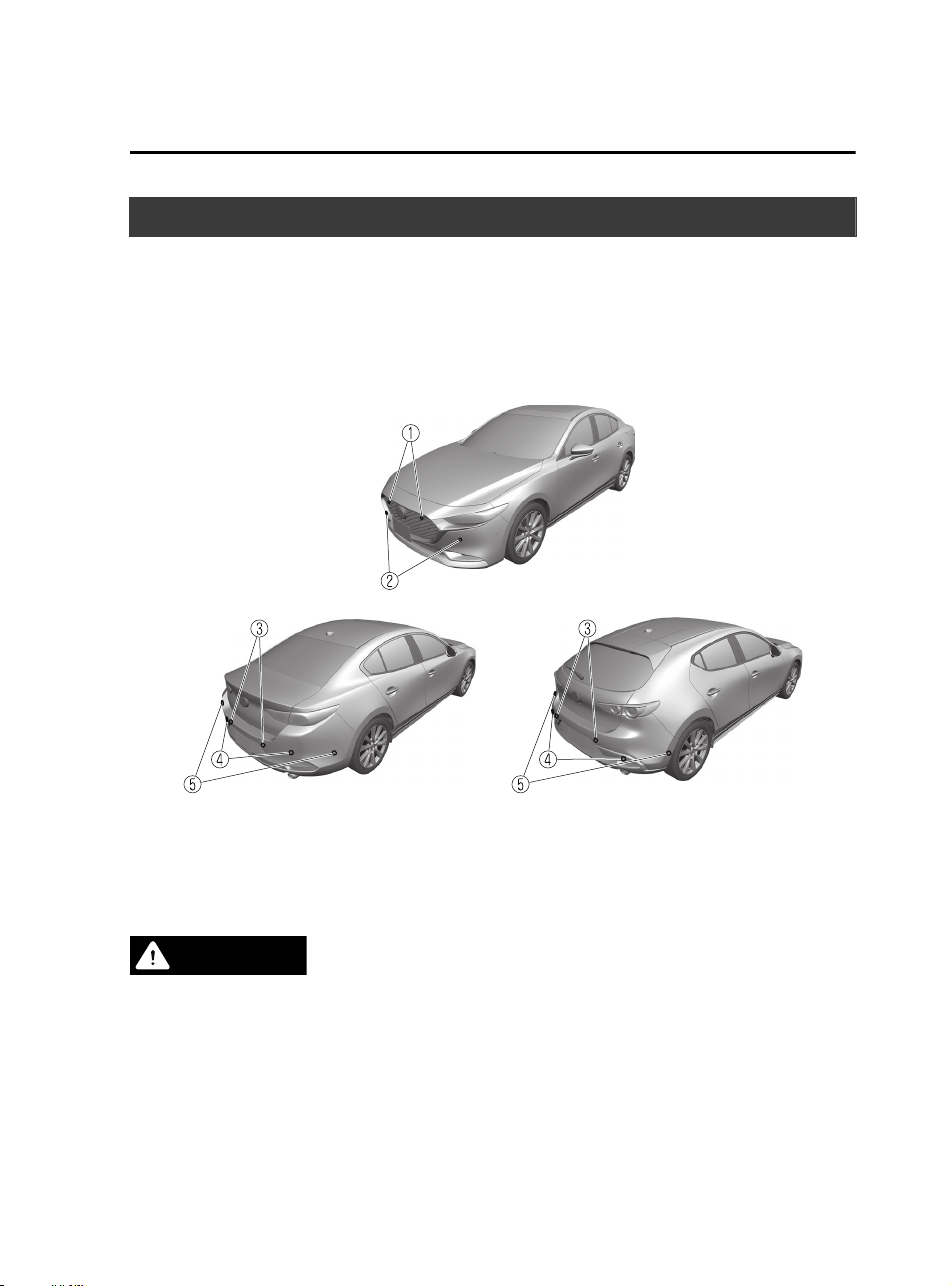
Parking Sensor System
*
▼
Parking Sensor System
The parking sensors use ultrasonic sensors which detect obstructions around the vehicle
when the vehicle is driven at low speeds, such as during garage or parallel parking, and a
buzzer sound and detection indicator notify the driver of the approximate distance from the
vehicle to the surrounding obstruction.
1. Front ultrasonic sensor
*
2. Front corner ultrasonic sensor
*
3. Rear ultrasonic sensor
4. Rear corner ultrasonic sensor
5. Rear side ultrasonic sensor
*
WARNING
Do not rely completely on the parking sensor system and be sure to conrm the safety around
your vehicle visually when driving:
This system can assist the driver in operating the vehicle in the forward and backward
directions while parking. The detection ranges of the sensors are limited, therefore, driving the
vehicle while relying only on the system may cause an accident. Always conrm the safety
around your vehicle visually when driving.
When Driving
Parking Sensor System
*Some models.
4-235
Mazda3_8HZ1-EA-19G_Edition1_old 2019-5-17 13:49:03
CAUTION
Do not install any accessories within the detection ranges of the sensors. It may
aect
the
system operation.
Depending on the type of obstruction and the surrounding conditions, the detection range
of a sensor may narrow, or the sensors may not be able to detect obstructions.
NOTE
The system may not operate normally under the following conditions:
Mud, ice, or snow is adhering to the sensor area (Returns to normal operation when
removed).
The sensor area is frozen (Returns to normal operation when the ice is thawed).
The sensor is covered by a hand.
The sensor is excessively shocked.
The vehicle is excessively tilted.
Under extremely hot or cold weather conditions.
The vehicle is driven on bumps, inclines, gravel, grating, or grass covered roads.
Anything which generates ultrasonic waves such as another vehicle's horn, the engine
sound of a motorcycle, the air brake sound of a large-sized vehicle, or another vehicle's
sensors approaches the vehicle.
The vehicle is driven in heavy rain or in road conditions causing water-splash.
A commercially-available fender pole or an antenna for a radio transmitter is installed
to the vehicle.
The vehicle is moving towards a tall or square curbstone, or a steep grade.
An obstruction is too close to the sensor.
The vehicle is moving towards an uneven wall or stairs.
There are multiple obstructions.
The vehicle is driven in a place with low ceilings.
Obstructions under the bumper cannot be detected. Obstructions which are lower than the
sensor or thin may not be detected even though they were detected once.
The following types of obstructions may not be detected:
Thin objects such as wire, rope or poles
Things which absorb sonic waves easily such as cotton or snow
Angular shaped objects
Very tall objects, and those which are wide at the top
Small, short objects
Always have the system inspected at an Authorized Mazda Dealer if any shock is applied
to the bumpers, even in a minor accident. If the sensors are deviated, they cannot detect
obstructions.
When Driving
Parking Sensor System
4-236
Mazda3_8HZ1-EA-19G_Edition1_old 2019-5-17 13:49:03
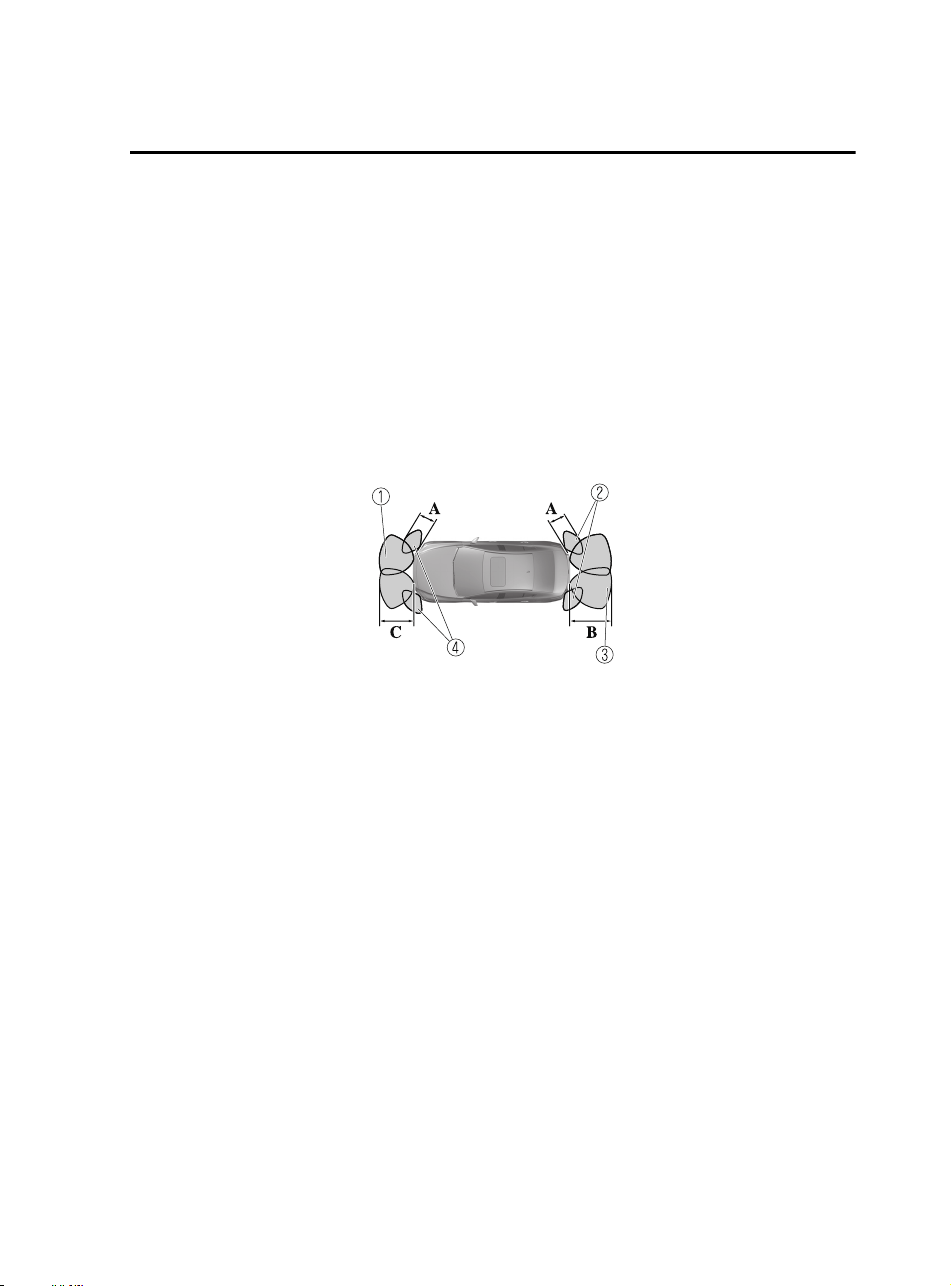
The system may have a malfunction if the indicator light does not turn on even when the
parking sensor switch is turned on. Have your vehicle inspected by an Authorized Mazda
Dealer.
The system may have a malfunction if a message indicating a system malfunction is
displayed. Have your vehicle inspected by an Authorized Mazda Dealer.
A message may be displayed even when the ambient temperature is extremely cold, or
mud, ice, or snow adheres to the sensor area. Remove any foreign matter from the sensor
area.
▼
Sensor Detection Range
The sensors detect obstructions within the following range.
1. Front ultrasonic sensor detection range
2. Rear corner/Rear side ultrasonic sensor detection range
3. Rear ultrasonic sensor detection range
4. Front corner ultrasonic sensor detection range
A: About 55.0 cm (About 21.6 in)
B: About 150 cm (About 59.0 in)
C: About 100 cm (About 39.3 in)
When Driving
Parking Sensor System
4-237
Mazda3_8HZ1-EA-19G_Edition1_old 2019-5-17 13:49:03
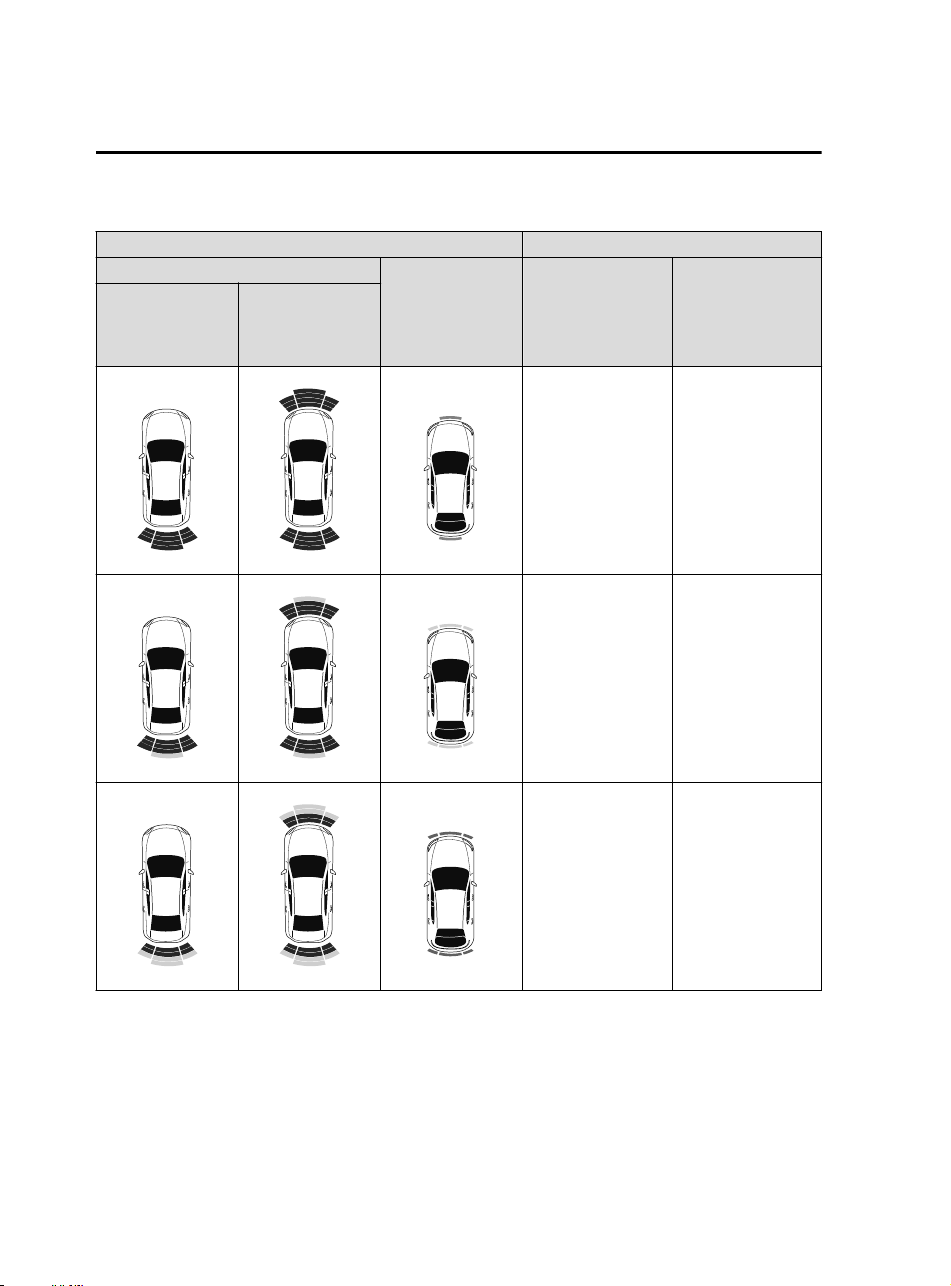
Viewing distance display
Display Distance between vehicle and obstruction
Without 360° view monitor
With 360° view
monitor
Front ultrasonic sen‐
sor
*
/Front corner
ultrasonic sensor
*
Rear ultrasonic sen‐
sor/Rear corner ul‐
trasonic sensor/Rear
side ultrasonic sen‐
sor
*
Without front ul‐
trasonic sensor and
front corner ultra‐
sonic sensor
With front ultra‐
sonic sensor and
front corner ultra‐
sonic sensor
Green
Front ultrasonic sen‐
sor:
Approx. 100―60.0
cm (39.3―23.6 in)
Rear ultrasonic sen‐
sor:
Approx. 150―60.0
cm (59.0―23.6 in)
Yellow
Front ultrasonic sen‐
sor:
Approx. 60.0―45.0
cm (23.6―17.7 in)
Front corner ultrason‐
ic sensor:
Approx. 55.0―38.0
cm (21.6―14.9 in)
Rear ultrasonic sen‐
sor:
Approx. 60.0―45.0
cm (23.6―17.7 in)
Rear corner ultrasonic
sensor/Rear side ul‐
trasonic sensor:
Approx. 55.0―38.0
cm (21.6―14.9 in)
Amber
Front ultrasonic sen‐
sor:
Approx. 45.0―35.0
cm (17.7―13.7 in)
Front corner ultrason‐
ic sensor:
Approx. 38.0―25 cm
(14.9―9.8 in)
Rear ultrasonic sen‐
sor:
Approx. 45.0―35.0
cm (17.7―13.7 in)
Rear corner ultrasonic
sensor/Rear side ul‐
trasonic sensor:
Approx. 38.0―25 cm
(14.9―9.8 in)
When Driving
Parking Sensor System
4-238
*Some models.
Mazda3_8HZ1-EA-19G_Edition1_old 2019-5-17 13:49:03
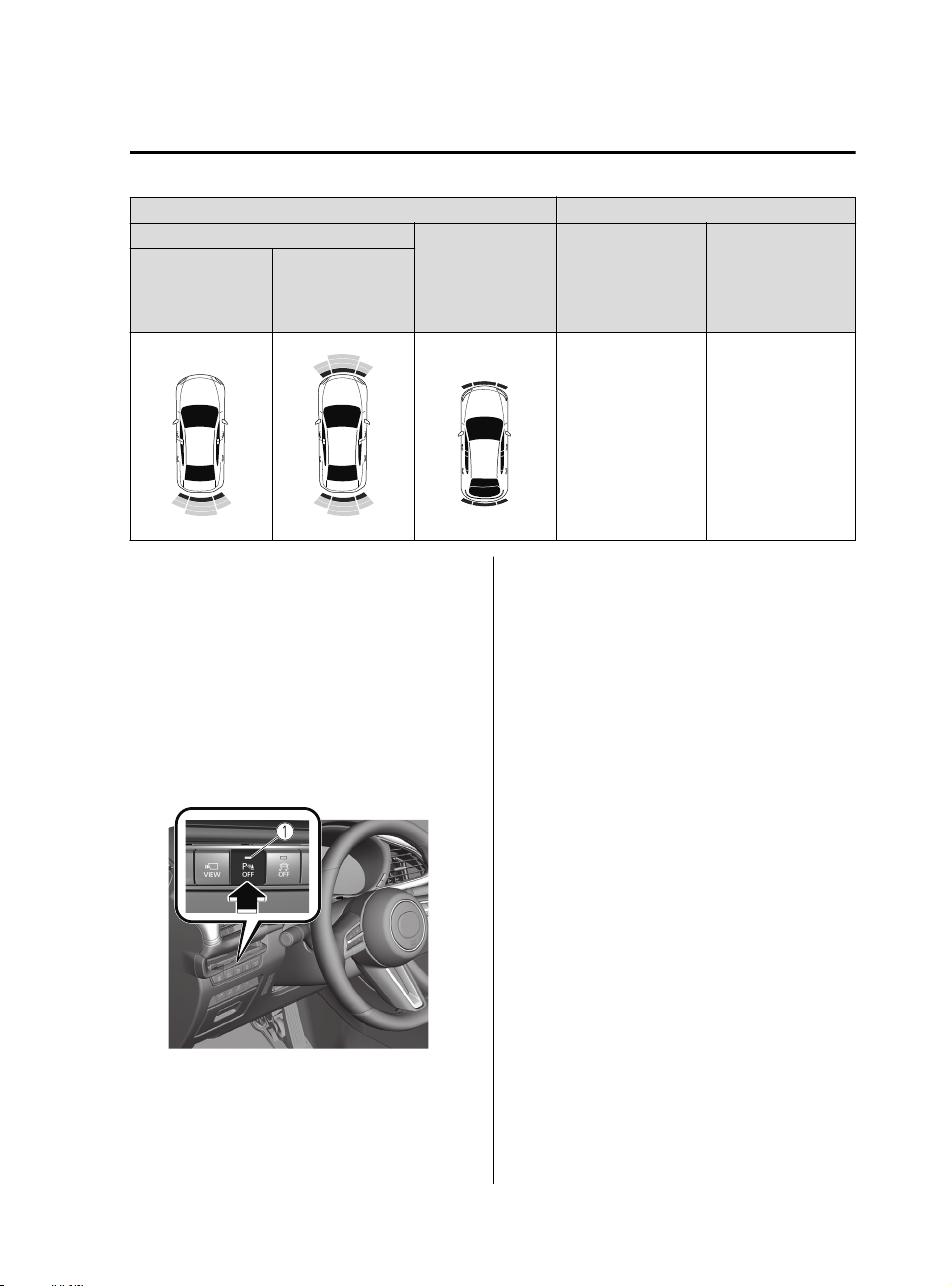
Display Distance between vehicle and obstruction
Without 360° view monitor
With 360° view
monitor
Front ultrasonic sen‐
sor
*
/Front corner
ultrasonic sensor
*
Rear ultrasonic sen‐
sor/Rear corner ul‐
trasonic sensor/Rear
side ultrasonic sen‐
sor
*
Without front ul‐
trasonic sensor and
front corner ultra‐
sonic sensor
With front ultra‐
sonic sensor and
front corner ultra‐
sonic sensor
Red
Front ultrasonic sen‐
sor:
Within approx. 35.0
cm (13.7 in)
Front corner ultrason‐
ic sensor:
Within approx. 25 cm
(9.8 in)
Rear ultrasonic sen‐
sor:
Within approx. 35.0
cm (13.7 in)
Rear corner ultrasonic
sensor/Rear side ul‐
trasonic sensor:
Within approx. 25 cm
(9.8 in)
▼
Park Assist Sensor System
Operation
When the parking sensor switch is pressed
with the ignition switched ON, the
indicator light turns on.
When the ignition is switched ON with the
parking sensor activated, the indicator
light turns on.
Press the switch again to stop the
operation.
1. Indicator light
NOTE
When the ignition is switched OFF, the
system status before it was turned off is
maintained. For example, if the ignition is
switched OFF while the parking sensor is
activated, the system will be activated
when the ignition is switched ON the next
time.
Operation conditions
The parking sensor system can be used
when all of the following conditions are
met:
The ignition is switched ON.
The parking sensor switch is turned on.
NOTE
(Automatic vehicle)
The detection indicator and buzzer of
the front sensors/front corner sensors do
not operate when the selector lever is in
the P position.
The detection indicator and buzzer
sound do not activate when the parking
brake is applied.
When Driving
Parking Sensor System
*Some models.
4-239
Mazda3_8HZ1-EA-19G_Edition1_old 2019-5-17 13:49:03
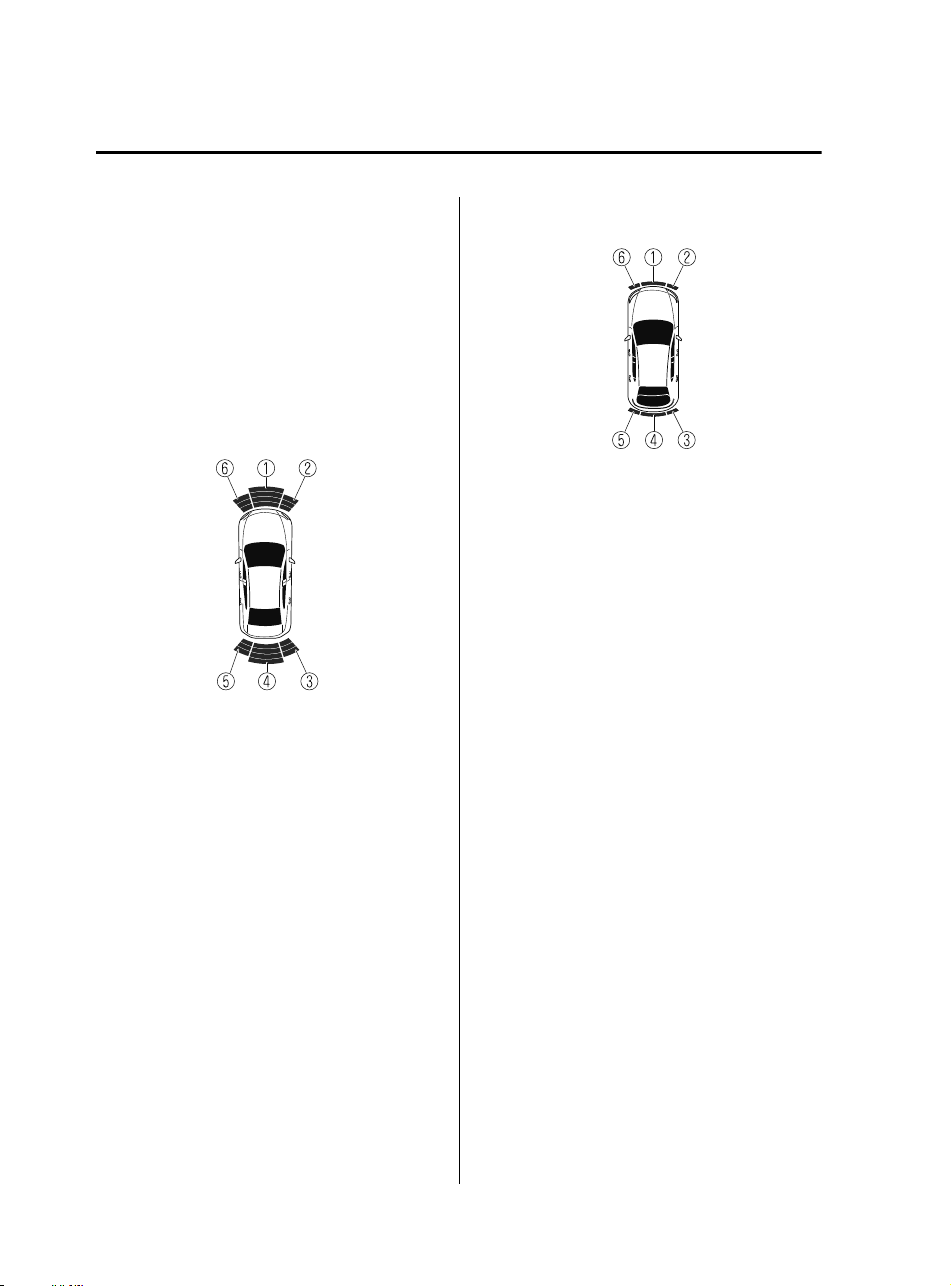
▼
Obstruction Detection Indication
The position of a sensor which has
detected an obstruction is indicated. The
gauge illuminates in different areas
depending on the distance to an
obstruction detected by the sensor.
As the vehicle approaches closer to an
obstruction, the zone in the gauge closer to
the vehicle illuminates.
Without 360°view monitor
1. Front ultrasonic sensor gauge
*
2. Right front corner ultrasonic sensor
gauge
*
3. Right rear corner ultrasonic sensor
gauge/Right rear side ultrasonic sensor
gauge
*
4. Rear ultrasonic sensor gauge
5. Left rear corner ultrasonic sensor
gauge/Left rear side ultrasonic sensor
gauge
*
6. Left front corner ultrasonic sensor
gauge
*
With 360°view monitor
1. Front ultrasonic sensor gauge
2. Right front corner ultrasonic sensor
gauge
3. Right rear corner ultrasonic sensor
gauge/Right rear side ultrasonic sensor
gauge
*
4. Rear ultrasonic sensor gauge
5. Left rear corner ultrasonic sensor
gauge/Left rear side ultrasonic sensor
gauge
*
6. Left front corner ultrasonic sensor
gauge
NOTE
The detection indicator can switch
between display and non-display.
Refer to the Settings section in the Mazda
Connect Owner's Manual.
When Driving
Parking Sensor System
4-240
*Some models.
Mazda3_8HZ1-EA-19G_Edition1_old 2019-5-17 13:49:03
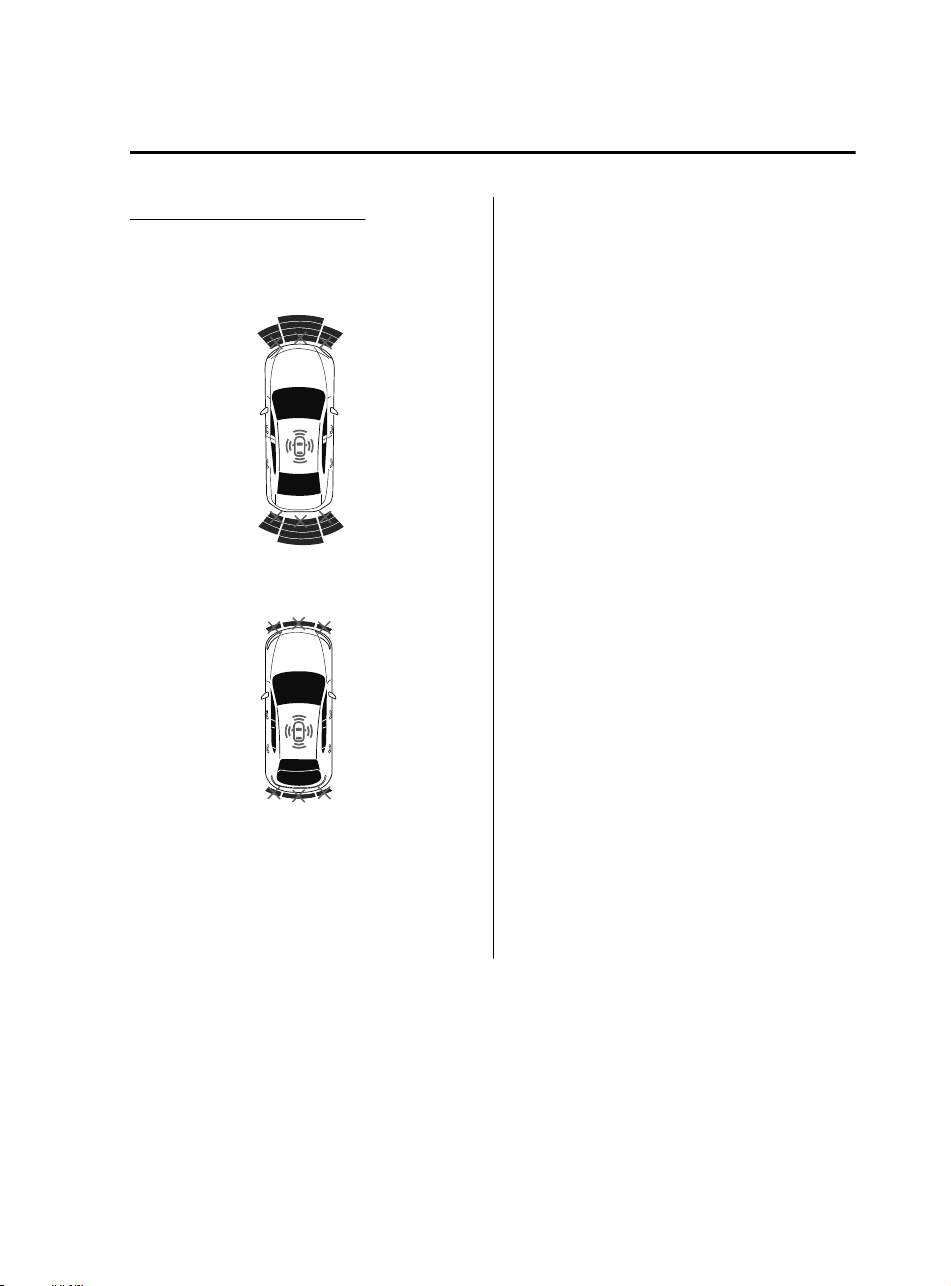
System problem notification
The indication displays if the system has a
malfunction.
Without 360°view monitor
With 360°view monitor
Check the reason for the indication
displaying on the center display or
multi-information display.
Refer to If a Warning Light Turns On or
Flashes on page 7-27.
When Driving
Parking Sensor System
4-241
Mazda3_8HZ1-EA-19G_Edition1_old 2019-5-17 13:49:03
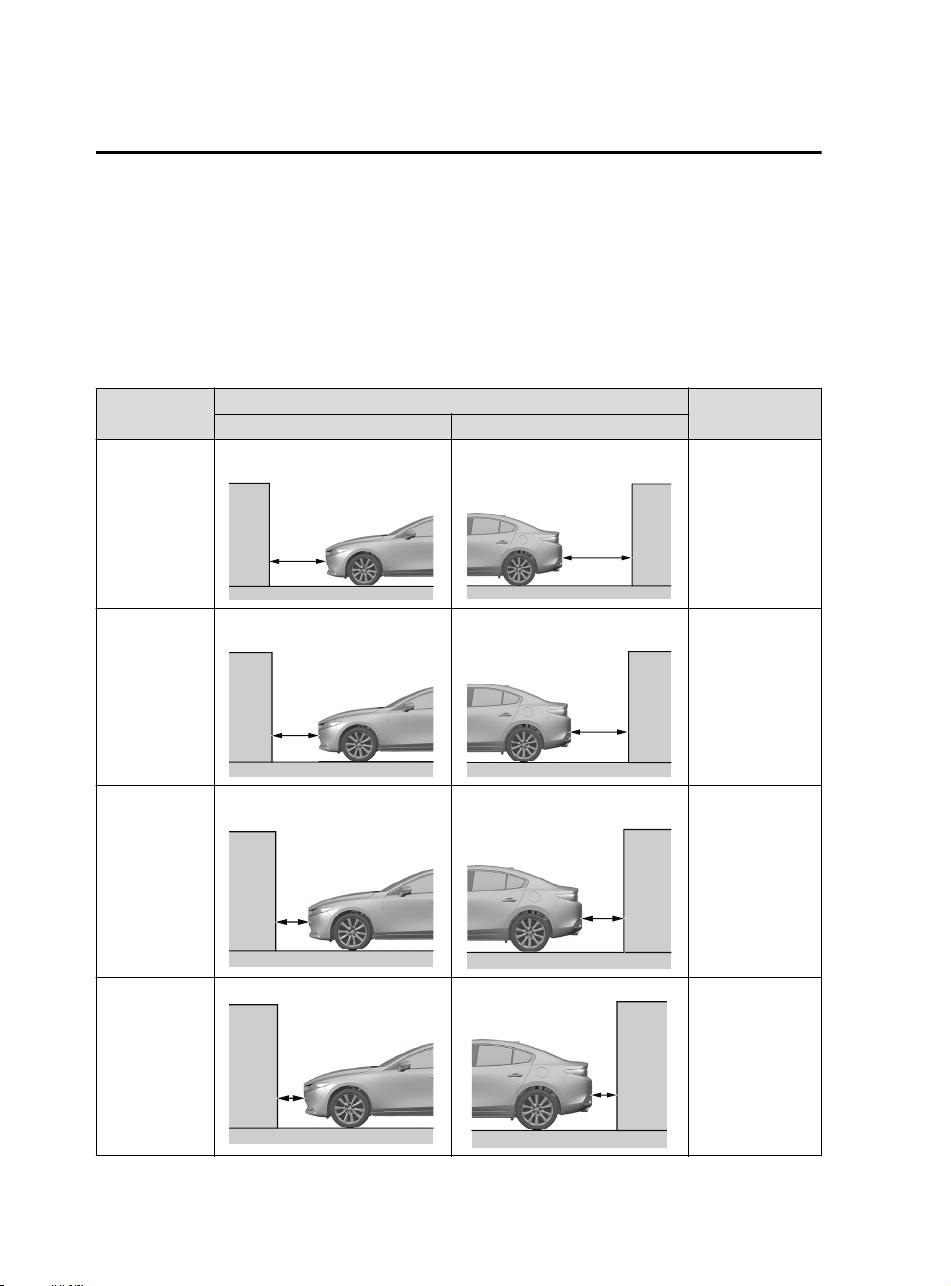
▼
Parking Sensor Warning Beep
Informs the driver of the approximate distance from the vehicle to the obstruction using
warning beeps depending on the distance. If multiple obstructions are detected at the same
time, warning beeps are activated according to the distance to the nearest obstruction. The
warning beeps are activated as follows while the system is operating. However, the warning
beeps are not activated while the seat belt reminder is operating.
Front ultrasonic sensor
*
, Rear ultrasonic sensor
Distance Detec‐
tion area
Distance between vehicle and obstruction
Beeper sound
*1
Front ultrasonic sensor Rear ultrasonic sensor
Farthest distance
Approx. 100―60.0 cm (39.3―23.6
in)
Approx. 150―60.0 cm (59.0―23.6
in)
Slow intermittent
sound
Far distance
Approx. 60.0―45.0 cm
(23.6―17.7 in)
Approx. 60.0―45.0 cm
(23.6―17.7 in)
Medium intermit‐
tent sound
Middle distance
Approx. 45.0―35.0 cm
(17.7―13.7 in)
Approx. 45.0―35.0 cm
(17.7―13.7 in)
Fast intermittent
sound
Close distance
Within approx. 35.0 cm (13.7 in)
Within approx. 35.0 cm (13.7 in)
Continuous sound
When Driving
Parking Sensor System
4-242
*Some models.
Mazda3_8HZ1-EA-19G_Edition1_old 2019-5-17 13:49:03
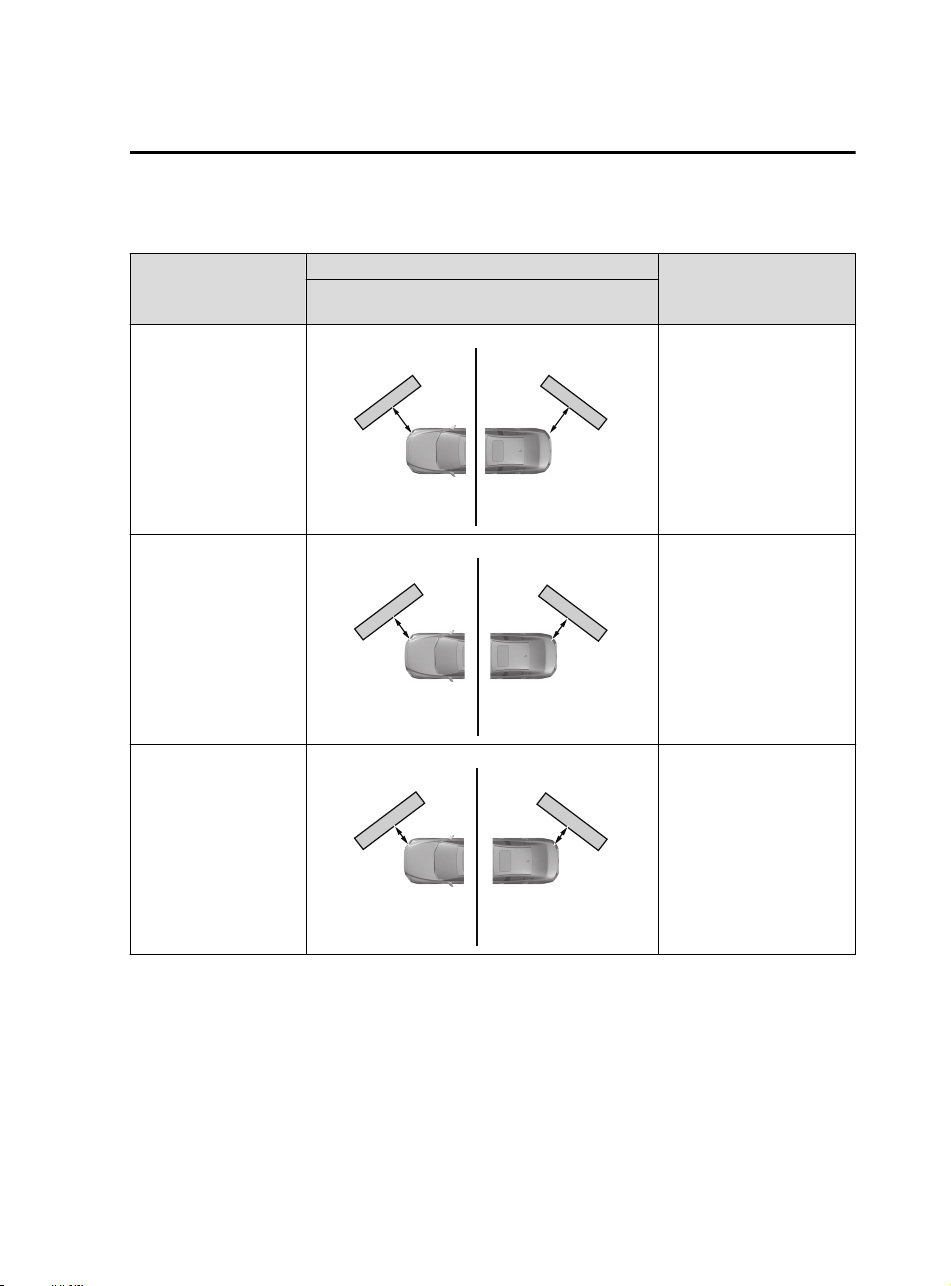
*
1 The rate at which the intermittent sound beeps increases as the vehicle approaches the obstruction.
Front corner ultrasonic sensor
*
, Rear corner/Rear side
*
ultrasonic sensor
Distance Detection area
Distance between vehicle and obstruction
Beeper sound
*1
Front corner ultrasonic sensor/Rear corner, Rear
side ultrasonic sensor
Far distance
Approx. 55.0―38.0 cm (21.6―14.9 in)
Medium intermittent sound
Middle distance
Approx. 38.0―25 cm (14.9―9.8 in)
Fast intermittent sound
Close distance
Within approx. 25 cm (9.8 in)
Continuous sound
*
1 The rate at which the intermittent sound beeps increases as the vehicle approaches the obstruction.
NOTE
If an obstruction in the same area excluding the close area is detected continuously for 6
seconds or longer, only the warning beeps stop activating. (Detection is indicated) If the
detection area changes to the close side, the warning beeps resumes. (If the detection area
changes to the far side, the warning beeps remain off)
The sound volume (each of front and rear) can be changed.
Refer to the Settings section in the Mazda Connect Owner's Manual.
When Driving
Parking Sensor System
*Some models.
4-243
Mazda3_8HZ1-EA-19G_Edition1_old 2019-5-17 13:49:03
▼
When Warning Indicator/Beep is Activated
The system notifies the driver of an abnormality by activating the beep sound and the
indicator light.
Indicator/Beep How to check
A message indicating a system
malfunction or sensor malfunc‐
tion is displayed.
There may be a problem with the system. Have your vehicle inspected by an
Authorized Mazda Dealer as soon as possible.
A message indicating that the
sensor is dirty is displayed.
Remove any foreign matter from the sensor area. If the system does not recov‐
er, have the vehicle inspected by an Authorized Mazda Dealer.
A certain obstruction detection
indication is continuously dis‐
played.
Foreign matter may have gotten on the sensor area corresponding to the detec‐
tion indicator. If the system does not recover, have the vehicle inspected by an
Authorized Mazda Dealer.
When Driving
Parking Sensor System
4-244
Mazda3_8HZ1-EA-19G_Edition1_old 2019-5-17 13:49:03

5
Interior Features
Use of various features for ride comfort, including air-conditioning
system and audio system.
Climate Control System....................5-2
Operating Tips.............................. 5-2
Vent Operation..............................5-3
Manual Type.................................5-5
Fully Automatic Type...................5-9
Mazda Connect................................5-14
What is Mazda Connect ?...........5-14
Mazda Connect Basic
Operations...................................5-17
Connected Service (U.S.A
only)............................................5-33
Interior Equipment......................... 5-34
Sunvisors.................................... 5-34
Interior Lights.............................5-35
Accessory Socket........................5-37
Cup Holder................................. 5-38
Bottle Holder.............................. 5-40
Assist Grips................................ 5-40
Rear Coat Hooks.........................5-41
Storage Compartments............... 5-41
5-1
Mazda3_8HZ1-EA-19G_Edition1_old 2019-5-17 13:49:03
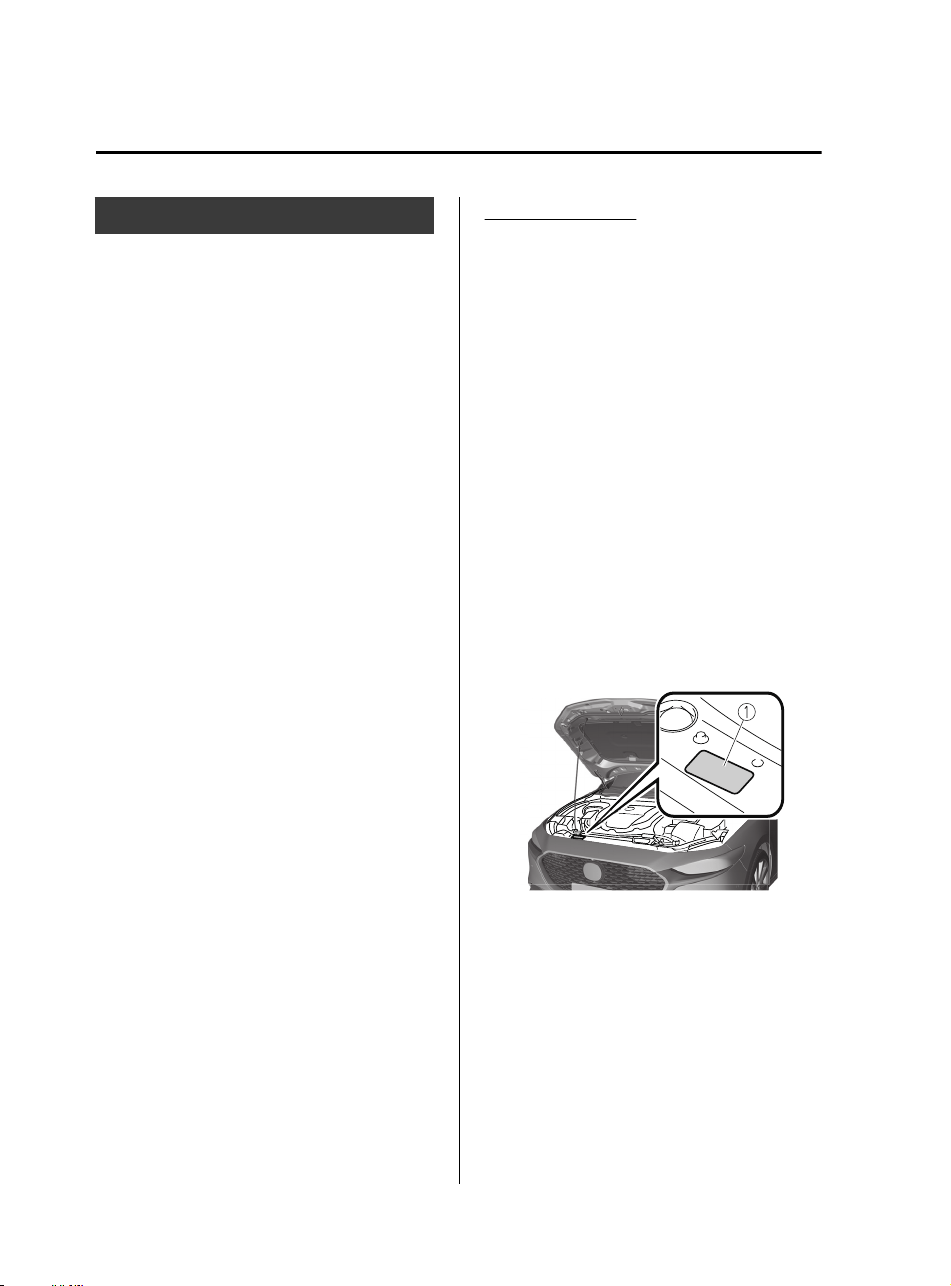
Operating Tips
▼
Operating Tips
Operate the climate control system with
the engine running.
To prevent the battery from being
discharged, do not leave the fan control
switch on for a long period of time with
the ignition switched ON when the
engine is not running.
Clear all obstructions such as leaves,
snow and ice from the hood and the air
inlet in the cowl grille to improve the
system efficiency.
Use the climate control system to defog
the windows and dehumidify the air.
The recirculate mode should be used
when driving through tunnels or while
in a traffic jam, or when you would like
to shut off outside air for quick cooling
of the interior.
Use the outside air position for
ventilation or windshield defrosting.
If the vehicle has been parked in direct
sunlight during hot weather, open the
windows to let warm air escape, then
run the climate control system.
(With A/C switch)
Run the air conditioner about 10
minutes at least once a month to keep
internal parts lubricated.
Have the air conditioner checked before
the weather gets hot. Lack of refrigerant
may make the air conditioner less
efficient.
The refrigerant specifications are
indicated on a label attached to the
inside of the engine compartment. If the
wrong type of refrigerant is used, it
could result in a serious malfunction of
the air conditioner. Consult a
professional, government certified
repairer for the inspection or repair
because a special device is required for
the air conditioner maintenance.
For details, consult an Authorized
Mazda Dealer.
1. Label
Interior Features
Climate Control System
5-2
Mazda3_8HZ1-EA-19G_Edition1_old 2019-5-17 13:49:03
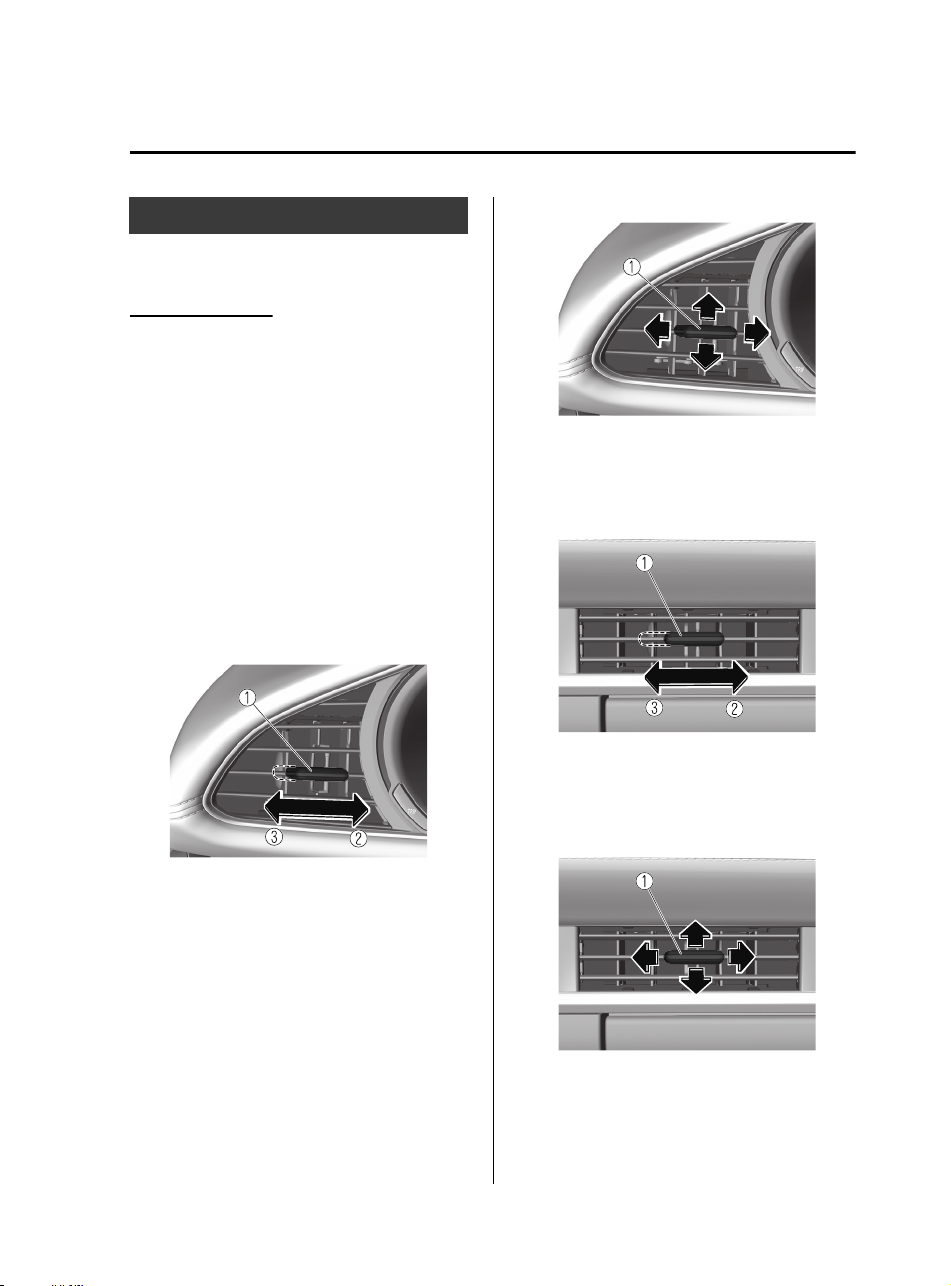
Vent Operation
▼
Adjusting the Vents
Directing airflow
To adjust the direction of airflow, move
the adjustment knob.
NOTE
When using the air conditioner under
humid ambient temperature conditions,
the system may blow fog from the vents.
This is not a sign of trouble but a result
of humid air being suddenly cooled.
The air vents can be fully opened and
closed by operating the knob.
Driver's Side Vents
Air vent open/close
Right side is symmetry.
1. Knob
2. Open
3. Close
Airflow direction adjustment
1. Knob
Passenger's Side Vents
Air vent open/close
1. Knob
2. Open
3. Close
Airflow direction adjustment
1. Knob
Interior Features
Climate Control System
5-3
Mazda3_8HZ1-EA-19G_Edition1_old 2019-5-17 13:49:03
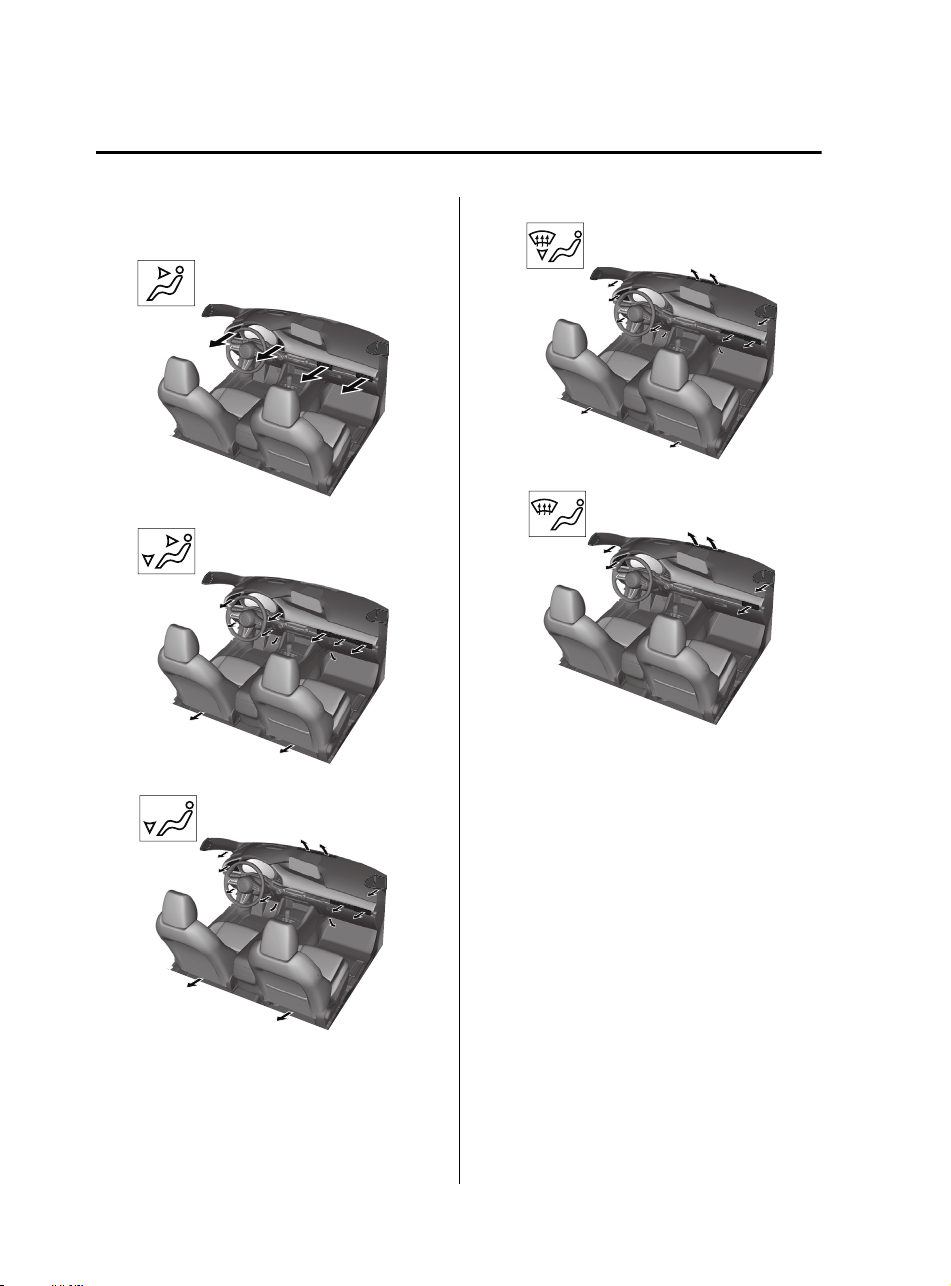
▼
Selecting the Airflow Mode
Dashboard Vents
Dashboard and Floor Vents
Floor Vents
Defroster and Floor Vents
Defroster Vents
NOTE
The location airflow exits the air vents and
the airflow amount may change depending
on the open or close status of the air vents.
Interior Features
Climate Control System
5-4
Mazda3_8HZ1-EA-19G_Edition1_old 2019-5-17 13:49:03
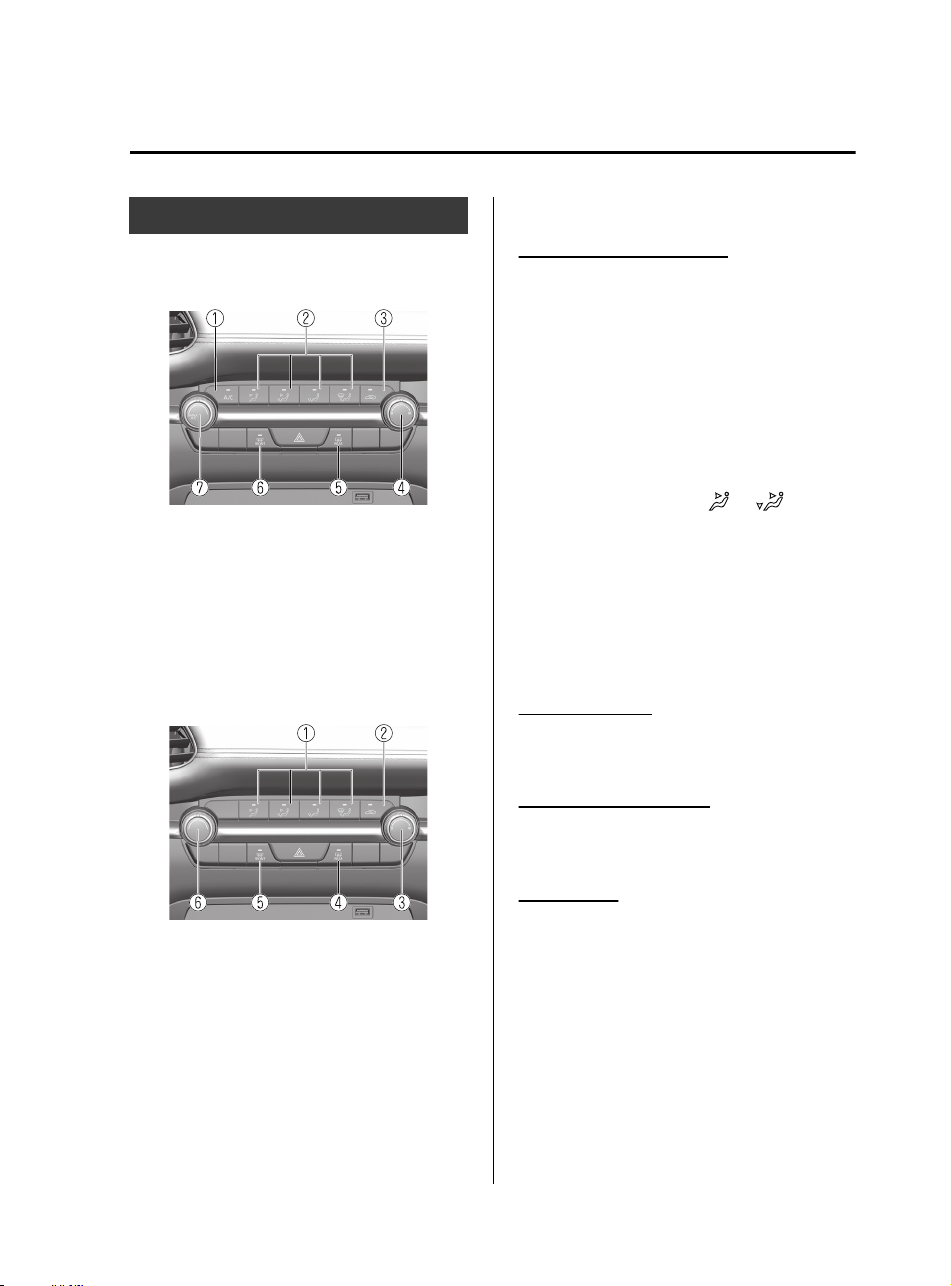
Manual Type
▼
Manual Type
With A/C switch
1. A/C switch
2. Mode selector switch
3. Air intake selector switch
4. Fan control dial
5. Rear window defogger switch
6. Windshield defroster switch
7. Temperature control dial
Without A/C switch
1. Mode selector switch
2. Air intake selector switch
3. Fan control dial
4. Rear window defogger switch
5. Windshield defroster switch
6. Temperature control dial
▼
Control Switches
Temperature control dial
This dial controls temperature. Turn it
clockwise for hot and counterclockwise
for cold.
MAX A/C (With A/C switch)
Fully turn the temperature control dial
counterclockwise for MAX A/C
(maximum cooling).
NOTE
When the mode is set to or with the
fan control dial in a position other than 0
and the temperature control dial in the
MAX A/C position, the air intake selector
switches to the recirculated air position
and the A/C turns on automatically.
If A/C is not desired, press the A/C switch
to turn it off.
Fan control dial
This dial allows variable fan speeds.
The fan has seven speeds.
Mode selector switches
The desired airflow mode can be selected
(page 5-4).
A/C switch
*
Press the A/C switch to turn the air
conditioner on. The indicator light on the
switch will illuminate when the fan control
dial is in any position except OFF.
Press the switch once again to turn the air
conditioner off.
NOTE
The air conditioner may not function when
the outside temperature approaches 0 °C
(32 °F).
Interior Features
Climate Control System
*Some models.
5-5
Mazda3_8HZ1-EA-19G_Edition1_old 2019-5-17 13:49:03
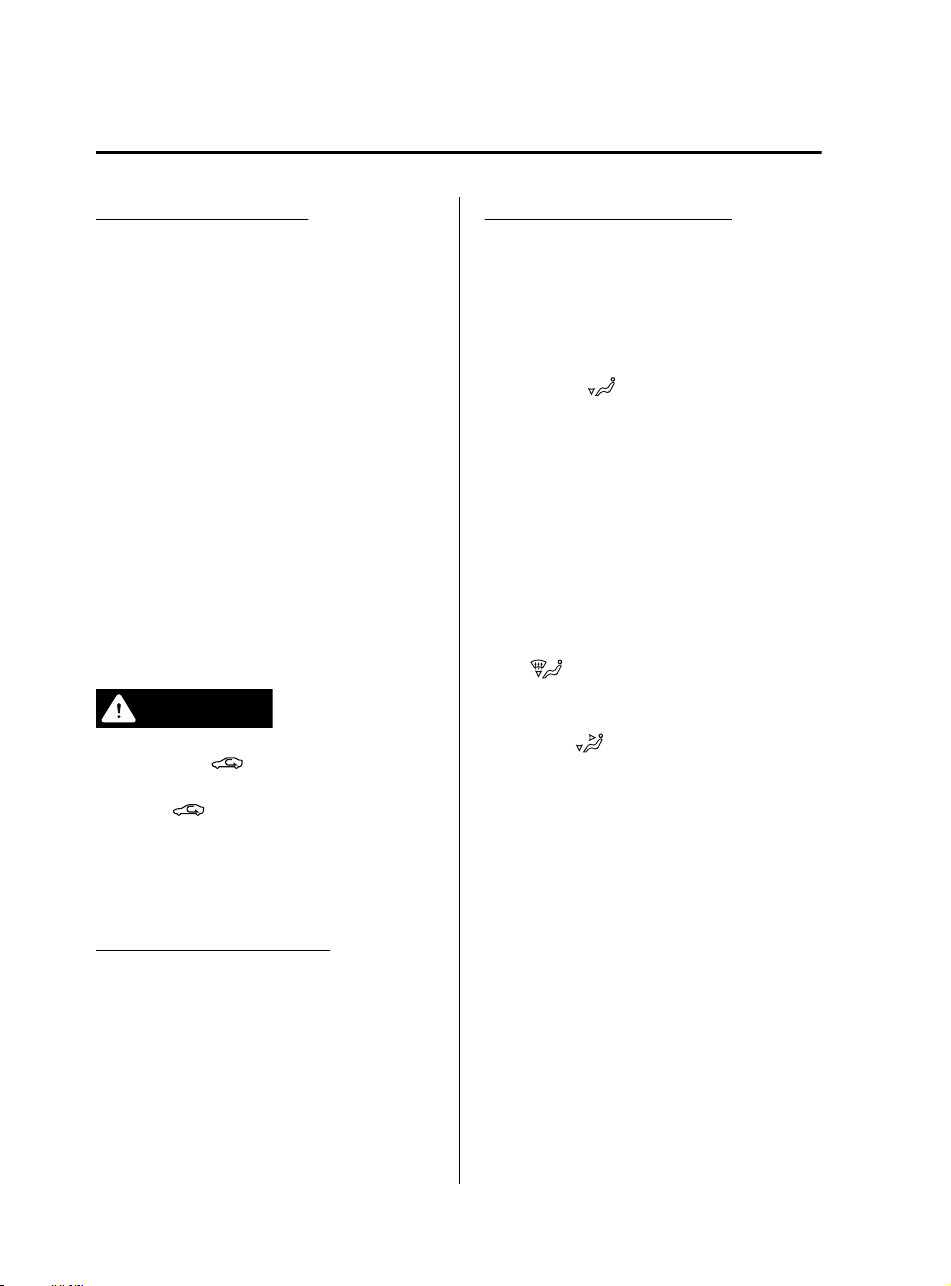
Air intake selector switch
This switch controls the source of air
entering the vehicle.
Outside or recirculated air positions can be
selected. Press the switch to select outside/
recirculated air positions.
Recirculated air position (indicator light
illuminated)
Outside air is shut off. Use this position
when going through tunnels, driving in
congested traffic (high engine exhaust
areas) or when quick cooling is desired.
Outside air position (indicator light
turned off)
Outside air is allowed to enter the cabin.
Use this mode for ventilation or
windshield defrosting.
WARNING
Do not use the position (indicator light
turns on) in cold or rainy weather:
Using the
position (indicator light
turns on) in cold or rainy weather is
dangerous as it will cause the windows to
fog up. Your vision will be hampered,
which could lead to a serious accident.
Windshield defroster switch
Press the switch to defrost the windshield
and front door windows.
Refer to Windshield Defrosting and
Defogging on page 5-7.
Rear window defogger switch
Press the rear window defogger switch to
defrost the rear window.
Refer to Rear Window Defogger on page
4-56.
▼
Heating
1. Press the switch.
2. Set the air intake selector to the outside
air position (indicator light turns off).
3. Set the temperature control dial to the
hot position.
4. Set the fan control dial to the desired
speed.
5. If dehumidified heating is desired, turn
on the air conditioner.
NOTE
If the windshield fogs up easily, press
the
switch.
(With A/C switch)
If cooler air is desired at face level,
press the
switch and adjust the
temperature control dial to maintain
maximum comfort.
The air to the floor is warmer than air
to the face (except when the temperature
control dial is set at the extreme hot or
cold position).
Interior Features
Climate Control System
5-6
Mazda3_8HZ1-EA-19G_Edition1_old 2019-5-17 13:49:03
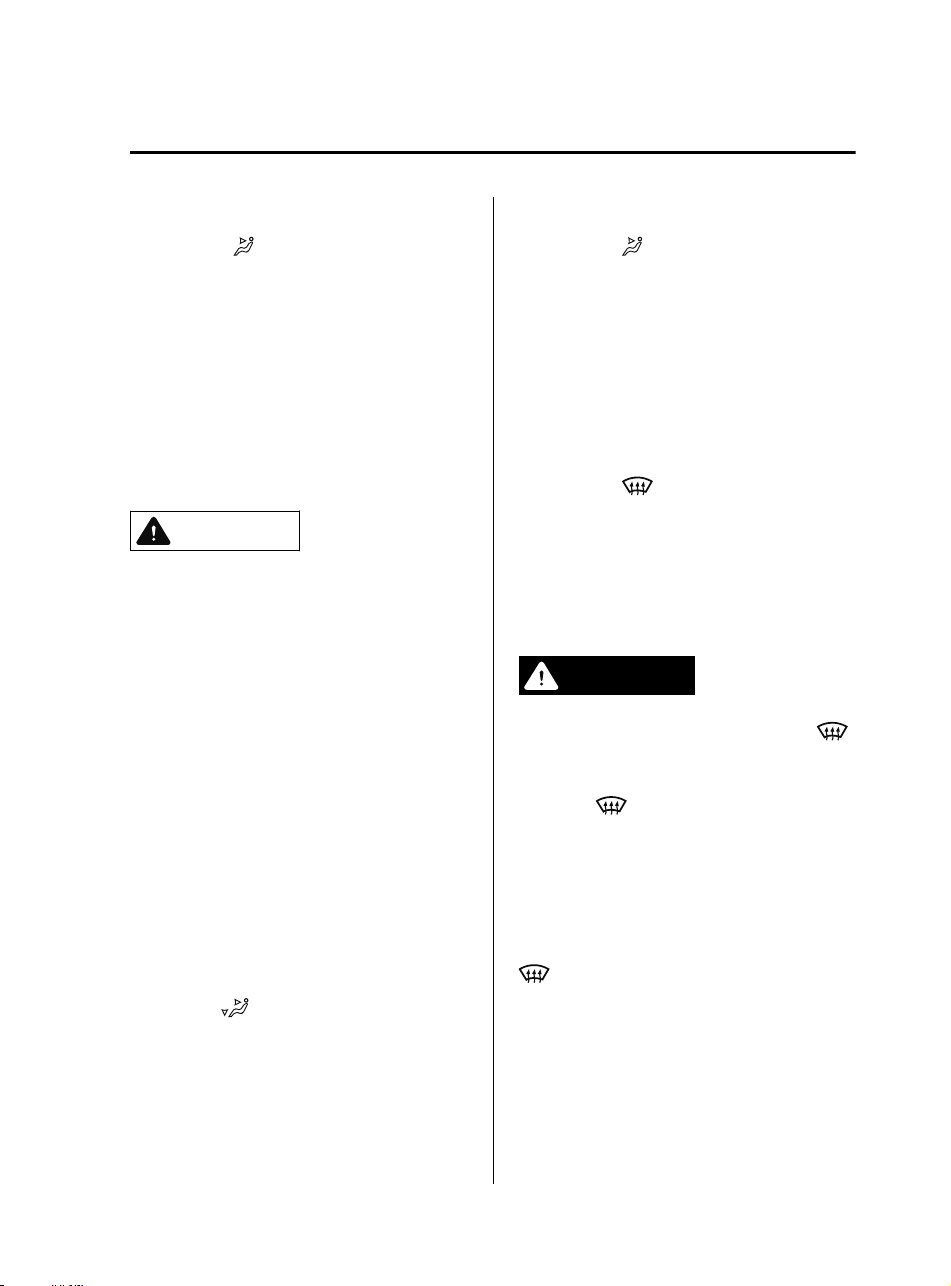
▼
Cooling (With A/C switch)
1. Press the switch.
2. Set the temperature control dial to the
cold position.
3. Set the fan control dial to the desired
speed.
4. Turn on the air conditioner by pressing
the A/C switch.
5. After cooling begins, adjust the fan
control dial and temperature control
dial as needed to maintain maximum
comfort.
CAUTION
If the air conditioner is used while driving
up long hills or in heavy trac, monitor the
high engine coolant temperature warning
indication to see if it is displayed (page
7-29).
The air conditioner may cause engine
overheating. If the warning indication is
displayed, turn the air conditioner o (page
7-21).
NOTE
When maximum cooling is desired, set
the temperature control dial to the
extreme cold position and set the air
intake selector to the recirculated air
position, then turn the fan control dial
fully clockwise.
If warmer air is desired at floor level,
press the
switch and adjust the
temperature control dial to maintain
maximum comfort.
The air to the floor is warmer than air
to the face (except when the temperature
control dial is set at the extreme hot or
cold position).
▼
Ventilation
1. Press the switch.
2. Set the air intake selector to the outside
air position (indicator light turns off).
3. Set the temperature control dial to the
desired position.
4. Set the fan control dial to the desired
speed.
▼
Windshield Defrosting and
Defogging
1. Press the switch.
2. Set the temperature control dial to the
desired position.
3. Set the fan control dial to the desired
speed.
4. If dehumidified heating is desired, turn
on the air conditioner.
WARNING
Do not defog the windshield using the
switch with the temperature control set to
the cold position:
Using the
switch with the temperature
control set to the cold position is
dangerous as it will cause the outside of the
windshield to fog up. Your vision will be
hampered, which could lead to a serious
accident. Set the temperature control to
the hot or warm position when using the
switch.
NOTE
(With A/C switch)
Fogging on the windows clears up more
easily while the air conditioner is on,
but they will fog up more easily if the air
conditioner is turned off.
Interior Features
Climate Control System
5-7
Mazda3_8HZ1-EA-19G_Edition1_old 2019-5-17 13:49:03
(With A/C switch)
Be careful that the windows do not fog
up when doing any of the following:
Switching to recirculate mode
Turning off the air conditioner
(With A/C switch)
For maximum defrosting, turn on the air
conditioner, set the temperature control
dial to the extreme hot position, and turn
the fan control dial fully clockwise.
If warm air is desired at the floor, press
the
switch.
With the or
*1
switch, the air
conditioner is automatically turned on
and the outside air position is
automatically selected to defrost the
windshield. In the
switch, the
outside air position cannot be changed
to the recirculated air position.
*
1 Depending on the market.
▼
Dehumidifying (With A/C switch)
Operate the air conditioner in cool or cold
weather to help defog the windshield and
side windows.
1. Press the desired mode switch you
want to set.
2. Set the air intake selector to the outside
air position (indicator light turns off).
3. Set the temperature control dial to the
desired position.
4. Set the fan control dial to the desired
speed.
5. Turn on the air conditioner by pressing
the A/C switch.
NOTE
One of the functions of the air conditioner
is dehumidifying the air and, to use this
function, the temperature does not have to
be set to cold. Therefore, set the
temperature control dial to the desired
position (hot or cold) and turn on the air
conditioner when you want to dehumidify
the cabin air.
Interior Features
Climate Control System
5-8
Mazda3_8HZ1-EA-19G_Edition1_old 2019-5-17 13:49:03
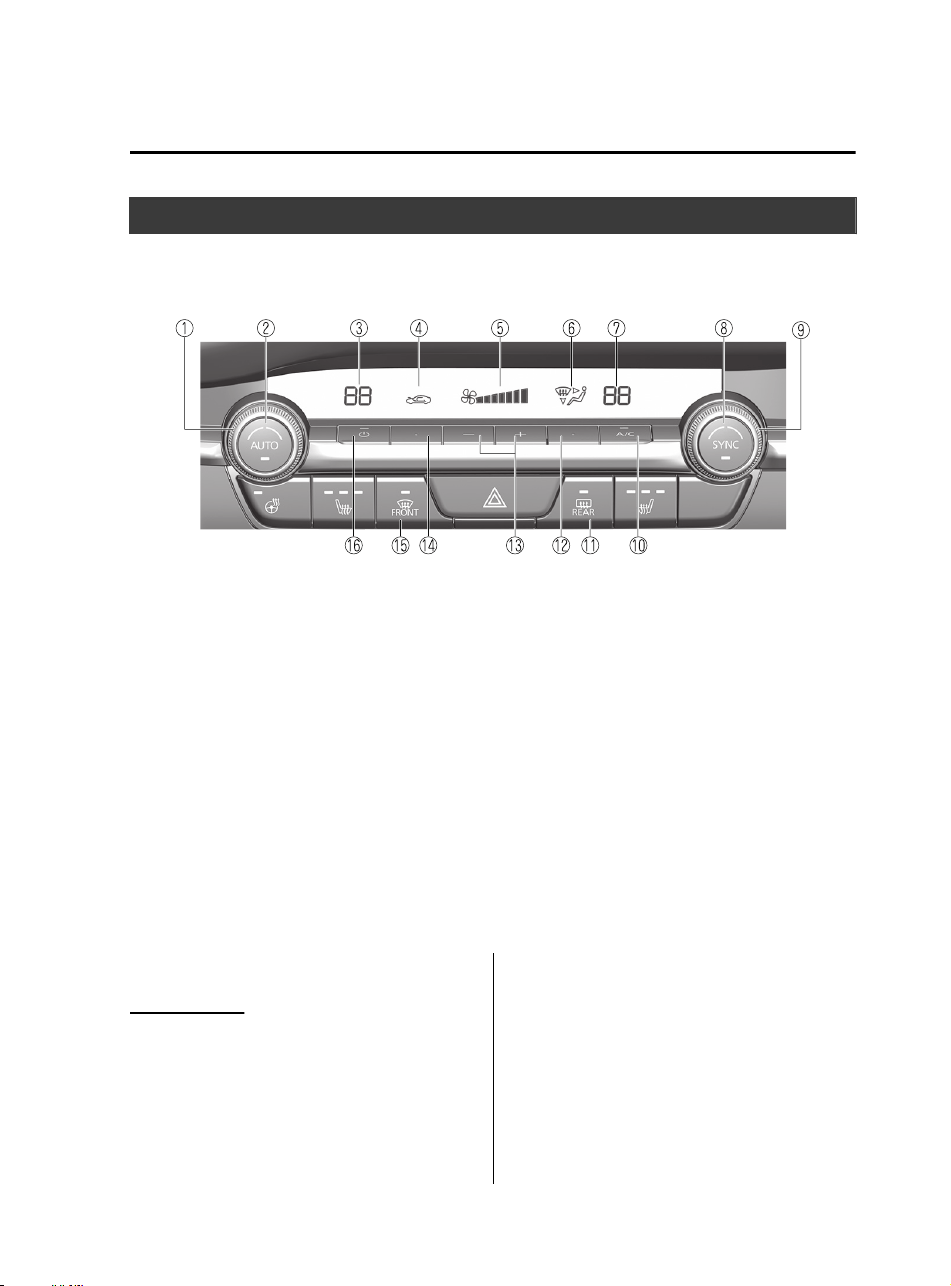
Fully Automatic Type
▼
Fully Automatic Type
Climate control system information is displayed on the display.
1. Driver temperature control dial
2. AUTO switch
3. Temperature setting display (driver’s side)
4. Air intake display
5. Airflow display
6. Mode selector display
7. Temperature setting display (passenger’s side)
8. SYNC (synchronized temperature) switch
9. Passenger temperature control dial
10. A/C switch
11. Rear window defogger switch
12. Mode selector switch
13. Fan control switch
14. Air intake selector switch
15. Windshield defroster switch
16. Power switch
▼
Control Switches
AUTO switch
By pressing the AUTO switch the
following functions will be automatically
controlled in accordance with the selected
set temperature:
Airflow temperature
Amount of airflow
Selection of airflow mode
Outside/Recirculated air selection
Air conditioner operation
Seat warmer level selection
*
Heated steering wheel operation
*
NOTE
AUTO switch indicator light
Interior Features
Climate Control System
*Some models.
5-9
Mazda3_8HZ1-EA-19G_Edition1_old 2019-5-17 13:49:03
When the AUTO switch indicator light is
on, it indicates auto operation, and the
system will function automatically.
If any of the following switches are
operated while in auto control, the
AUTO switch indicator turns off.
Mode selector switch
Fan control switch
Windshield defroster switch
The functions for switches other than
those operated continue to operate in
auto control.
Power switch (System On/Off)
The climate control system turns on or off
by pressing the power switch.
Temperature control dial
This dial controls temperature. Turn it
clockwise for hot and counterclockwise
for cold.
Turn the temperature control dial to adjust
the temperature between 15 °C (60 °F) and
29 °C (84 °F).
When the SYNC switch is on:
Turn the driver temperature control dial
to control the temperature throughout
the entire cabin.
When the SYNC switch is off:
Turn the driver or front passenger
temperature control dial to
independently control the temperature
on each side of the cabin.
NOTE
The climate control system changes to
the individual operation mode (SYNC
switch indicator light turns off) by
turning the front passenger temperature
control dial even when the SYNC switch
is on, which allows individual control of
the set temperature for the driver and
front passenger.
When you set the temperature to the
lower or upper limit, “Lo” or “Hi” is
displayed.
The temperature units for the
temperature setting display can be
changed in conjunction with the
temperature units for the outside
temperature display.
Refer to Outside Temperature Display
on page 4-19.
Fan control switch
The fan has 7 speeds. The selected speed
will be displayed.
Mode selector switch
The desired airflow mode can be selected
(page 5-4).
NOTE
With the airflow mode set to the
position and the temperature control
dial set at a medium temperature,
heated air is directed to the feet and air
at a comparably lower temperature will
flow through the central, left and right
vents.
To set the air vent to , press the
windshield defroster switch.
In the position, the outside air
position is automatically selected.
Interior Features
Climate Control System
5-10
Mazda3_8HZ1-EA-19G_Edition1_old 2019-5-17 13:49:03
A/C switch
Pressing the A/C switch while the AUTO
switch is turned on will turn off the air
conditioner (cooling/dehumidifying
functions).
The on/off of the air conditioner switches
each time the A/C switch is pressed.
NOTE
The air conditioner operates when the
A/C switch is pressed while the air
conditioner is turned off.
The air conditioner may not function
when the outside temperature
approaches 0 °C (32 °F).
Air intake selector switch
Outside or recirculated air positions can be
selected. Press the switch to select outside/
recirculated air positions.
Recirculated air position (
)
Outside air is shut off. Use this position
when going through tunnels, driving in
congested traffic (high engine exhaust
areas) or when quick cooling is desired.
Outside air position (
)
Outside air is allowed to enter the cabin.
Use this mode for ventilation or
windshield defrosting.
WARNING
Do not recirculate the air in the cabin
during cold or rainy weather:
Recirculating the air in the cabin during
cold and rainy weather is dangerous as it
will cause the windows to fog up. Your
vision will be hampered, which could lead
to a serious accident.
SYNC (Synchronized Temperature)
switch
Use the SYNC switch to change the mode
between the individual operation (driver
and passenger) and interconnection
(simultaneous) modes.
Interconnection mode (indicator light
turns on)
The set temperature for the driver and
front passenger is controlled
simultaneously.
Individual operation mode (indicator
light turns off)
The set temperature can be controlled
individually for the driver and front
passenger.
Windshield defroster switch
Press the switch to defrost the windshield
and front door windows.
Refer to Windshield Defrosting and
Defogging on page 5-12.
Rear window defogger switch
Press the rear window defogger switch to
defrost the rear window.
Refer to Rear Window Defogger on page
4-56.
Interior Features
Climate Control System
5-11
Mazda3_8HZ1-EA-19G_Edition1_old 2019-5-17 13:49:03
▼
Operation of Automatic Air
Conditioner
1. Press the AUTO switch. Selection of
the airflow mode, air intake selector
and amount of airflow will be
automatically controlled.
2. Use the temperature control dial to
select a desired temperature.
If you want to set the temperature on
the front passenger's side separately
from the driver's side, turn the front
passenger temperature control dial to
switch the mode automatically to the
individual operation mode and set the
temperature for the front passenger's
side.
To turn off the system, press the power
switch.
NOTE
Set the control dial to the recommended
temperature of 22 °C (72 °F), and then
adjust it as desired.
Setting the temperature to maximum hot
or cold will not provide the desired
temperature at a faster rate.
When selecting heat, the system will
restrict airflow until the engine has
warmed to prevent cold air from
blowing out of the vents.
▼
Windshield Defrosting and
Defogging
Press the windshield defroster switch.
In this position, the outside air position is
automatically selected, and the air
conditioner automatically turns on. The air
conditioner will directly dehumidify the
air to the front windshield and side
windows on page 5-4.
Airflow amount will be increased.
WARNING
Set the temperature control to the hot or
warm position when defogging (
position):
Using the
position with the
temperature control set to the cold position
is dangerous as it will cause the outside of
the windshield to fog up. Your vision will be
hampered, which could lead to a serious
accident.
NOTE
Fogging on the windows clears up more
easily while the air conditioner is on,
but they will fog up more easily if the air
conditioner is turned off.
Be careful that the windows do not fog
up when doing any of the following:
Switching to recirculate mode
Turning off the air conditioner
Use the temperature control dial to
increase the air flow temperature and
defog the windshield more quickly.
Interior Features
Climate Control System
5-12
Mazda3_8HZ1-EA-19G_Edition1_old 2019-5-17 13:49:03
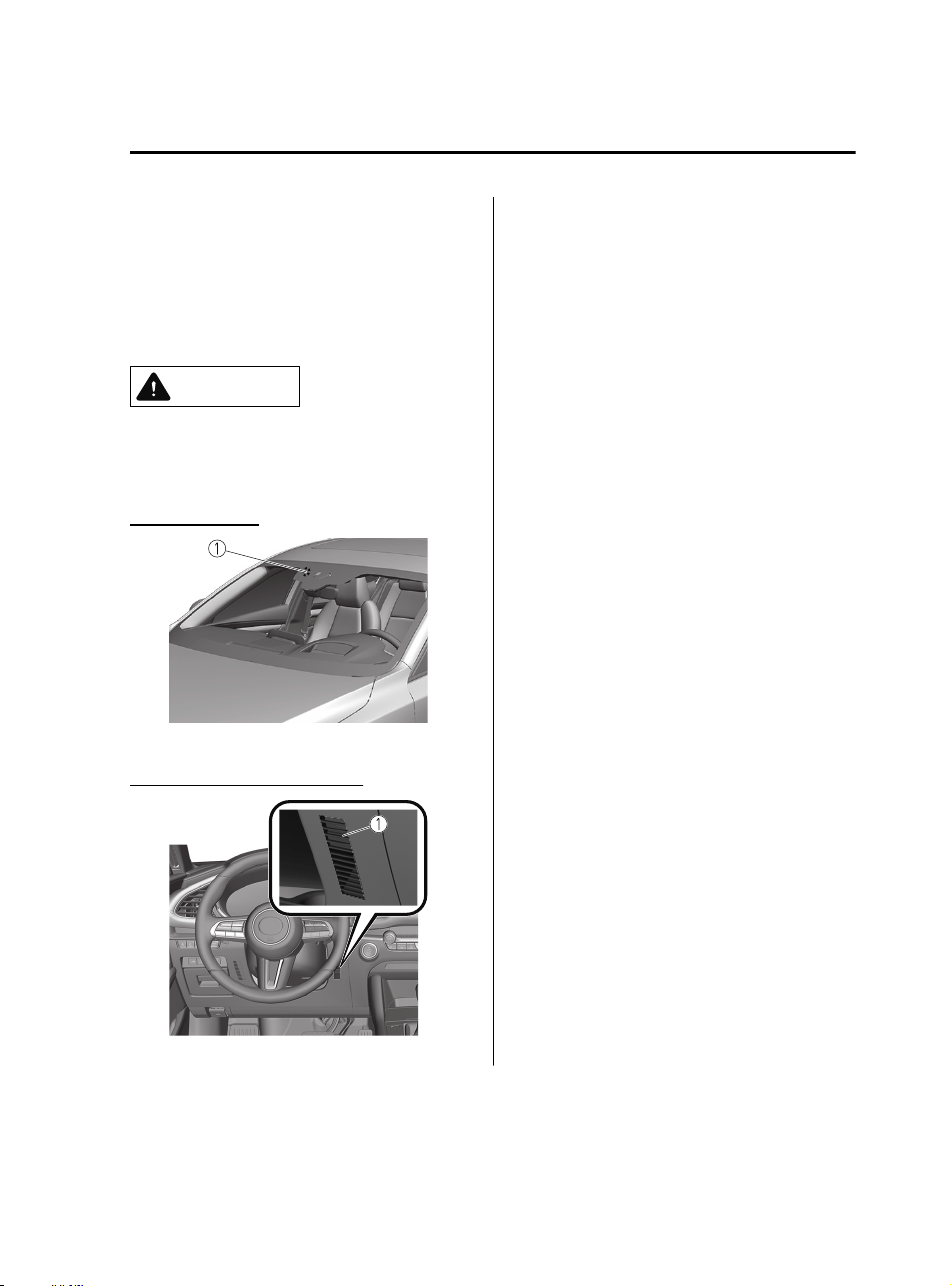
▼
Sunlight/Temperature Sensor
The climate control system measures
inside and outside temperatures, humidity
and sunlight using the sunlight/
temperature sensor. It sets temperatures
inside the cabin accordingly.
CAUTION
Do not obstruct both sensors, otherwise the
climate control system will not operate
properly.
Sunlight sensor
1. Sunlight sensor
Interior temperature sensor
1. Interior temperature sensor
Interior Features
Climate Control System
5-13
Mazda3_8HZ1-EA-19G_Edition1_old 2019-5-17 13:49:03
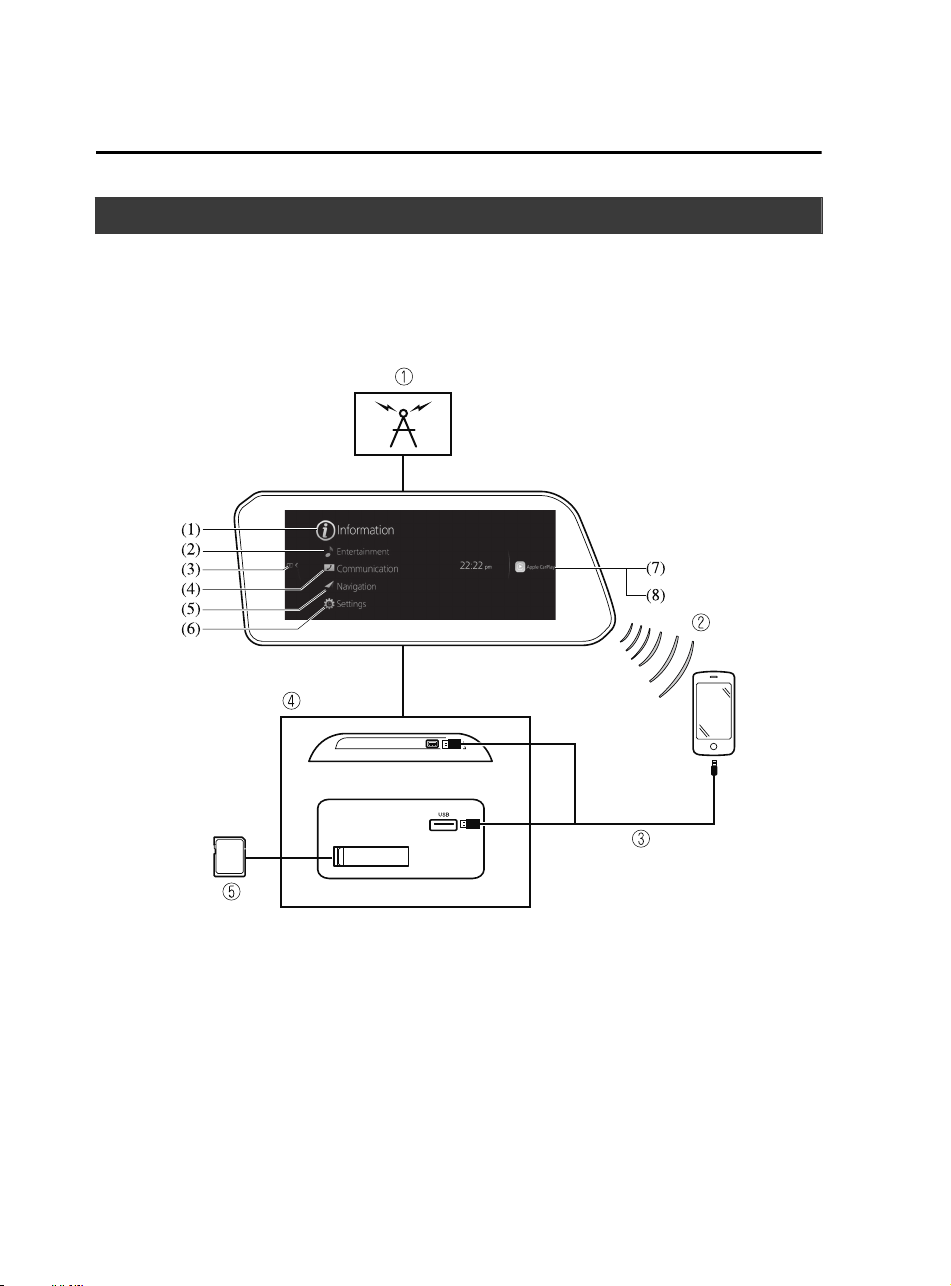
What is Mazda Connect ?
▼
What is Mazda Connect ?
This manual only indicates a part of the information for Mazda Connect. For details, check
the Web owner's manual at the Mazda site for each country and region.
1. Radio
2. Bluetooth
®
Audio/Hands-Free Call/SMS (Short Message Service)
3. USB Audio/USB Video
4. USB port
*1
/SD card slot
*2
5. SD card (Navigation system)
*
*
1 The location of the USB slot differs depending on the vehicle model.
*
2 The SD card slot is for the navigation system only. For vehicles with the navigation
system, the SD card (Mazda genuine) with stored map data is inserted into the SD card
slot and used.
Interior Features
Mazda Connect
5-14
*Some models.
Mazda3_8HZ1-EA-19G_Edition1_old 2019-5-17 13:49:03
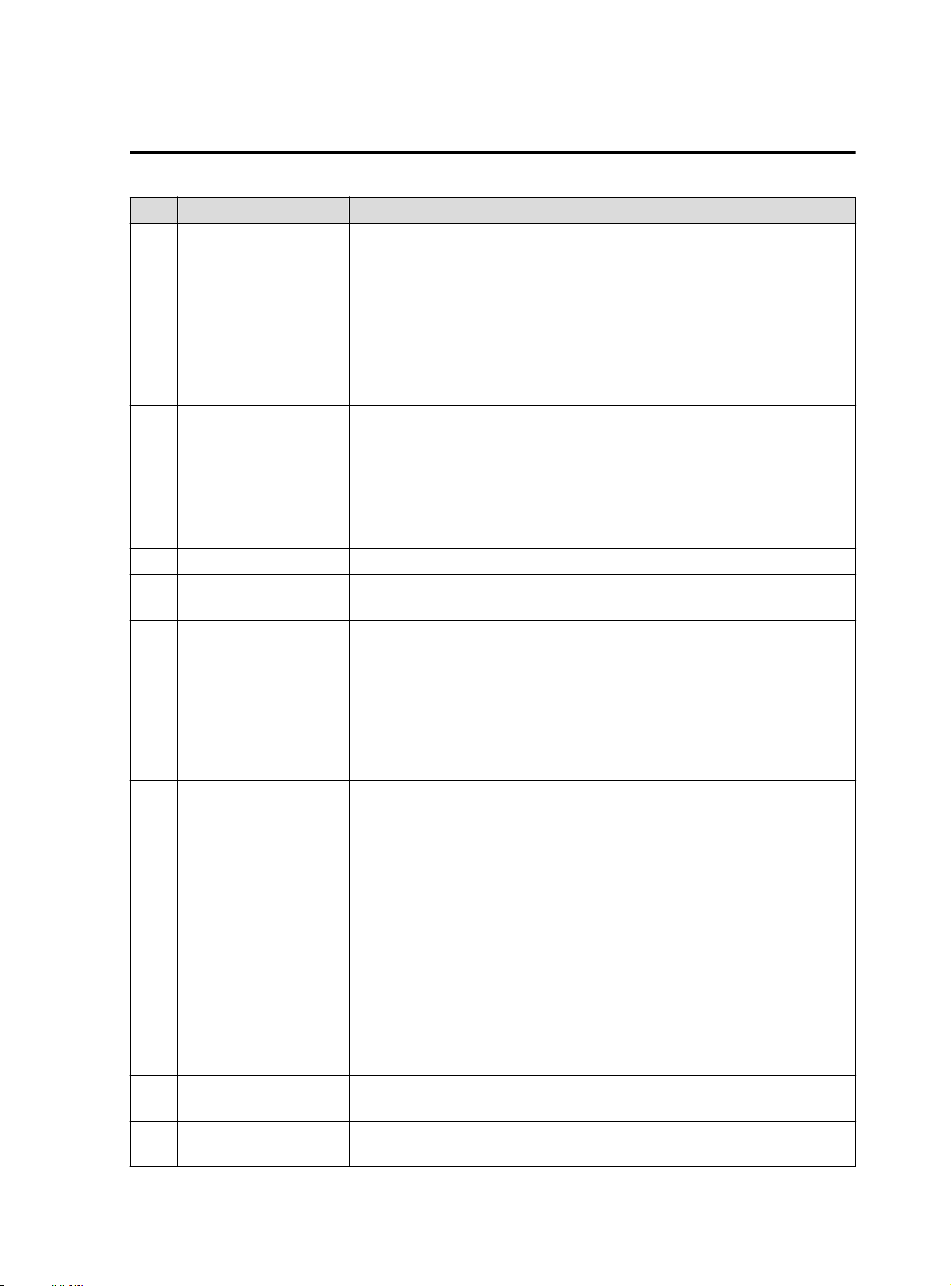
No. Menu Explanation
(1) Information
Fuel Efficiency Monitor:
Monitor fuel efficiency in real time and view fuel efficiency history.
SiriusXM Travel Link
*
:
Access traffic information, weather, fuel prices, parking information and
sports scores.
Vehicle Status Monitor:
View important vehicle maintenance messages, information, and intervals.
Owner's Manual
*
:
Learn about Mazda features, safety information, maintenance, and more.
(2) Entertainment
FM
AM
SiriusXM
*
Pandora
*
Bluetooth
USB1 Audio/USB2 Audio
USB1 Video/USB2 Video
(3) Notifications Displays notifications from the vehicle.
(4) Communication
By connecting your mobile device, such as a Smartphone, to Mazda Connect
via Bluetooth
®
, you can use the hands-free call and short message functions.
(5) Navigation
The navigation system (vehicles with navigation system) can be used when
the SD card for the navigation system is inserted.
If the SD card for the navigation system is not inserted, the compass indicat‐
ing the direction in which the vehicle is moving is displayed. The compass
may not indicate the correct bearing when the vehicle is stopped or traveling
at a slow speed.
For the navigation system operation, refer to the navigation system manual.
(6) Settings
You can change the settings for the Mazda Connect screen, sound settings,
and the vehicle functions.
In-Vehicle Displays:
Configures settings and content for all in-vehicle displays.
Sound Settings:
Configures the in-vehicle listening experience.
Safety Settings:
Configures safety and driver assistance features.
Vehicle Settings:
Configures vehicle convenience features.
Connectivity Settings:
Configures Bluetooth and other device connectivity settings.
System Settings:
Configures language, time, and other general settings.
(7) Apple CarPlay
You can use Apple CarPlay™ by connecting an iPhone
®
compatible with
Apple CarPlay™ to the USB slot.
(8) Android Auto
You can use Android Auto™ by connecting an Android™ Smartphone com‐
patible with Android Auto™ to the USB slot.
Interior Features
Mazda Connect
*Some models.
5-15
Mazda3_8HZ1-EA-19G_Edition1_old 2019-5-17 13:49:03
WARNING
Always adjust the audio while the vehicle is stopped:
Do not adjust the audio remote control switch while driving the vehicle. Adjusting the audio
while driving the vehicle is dangerous as it could distract your attention from the vehicle
operation which could lead to a serious accident.
Even if the audio control switches are equipped on the steering wheel, learn to use the
switches without looking down at them so that you can keep your maximum attention on the
road while driving the vehicle.
Do not allow the connection plug cord to get tangled with the shift lever (manual
transmission)/selector lever (automatic transmission):
Allowing the plug cord to become tangled with the shift lever (manual transmission)/selector
lever (automatic transmission) is dangerous as it could interfere with driving, resulting in an
accident.
Do not adjust the portable audio unit or a similar product while driving the vehicle:
Adjusting the portable audio unit or a similar product while driving the vehicle is dangerous
as it could distract your attention from the vehicle operation which could lead to a serious
accident. Always adjust the portable audio unit or a similar product while the vehicle is
stopped.
CAUTION
For the purposes of safe driving, adjust the audio volume to a level that allows you to hear
sounds outside of the vehicle including car horns and particularly emergency vehicle sirens.
NOTE
Do not use Mazda Connect for a long time with the engine stopped. Otherwise, the battery
power could be depleted.
If a mobile phone or CB radio is used in or near the vehicle, it could cause noise to occur
from the audio system. However, this does not indicate a problem.
Interior Features
Mazda Connect
5-16
Mazda3_8HZ1-EA-19G_Edition1_old 2019-5-17 13:49:03
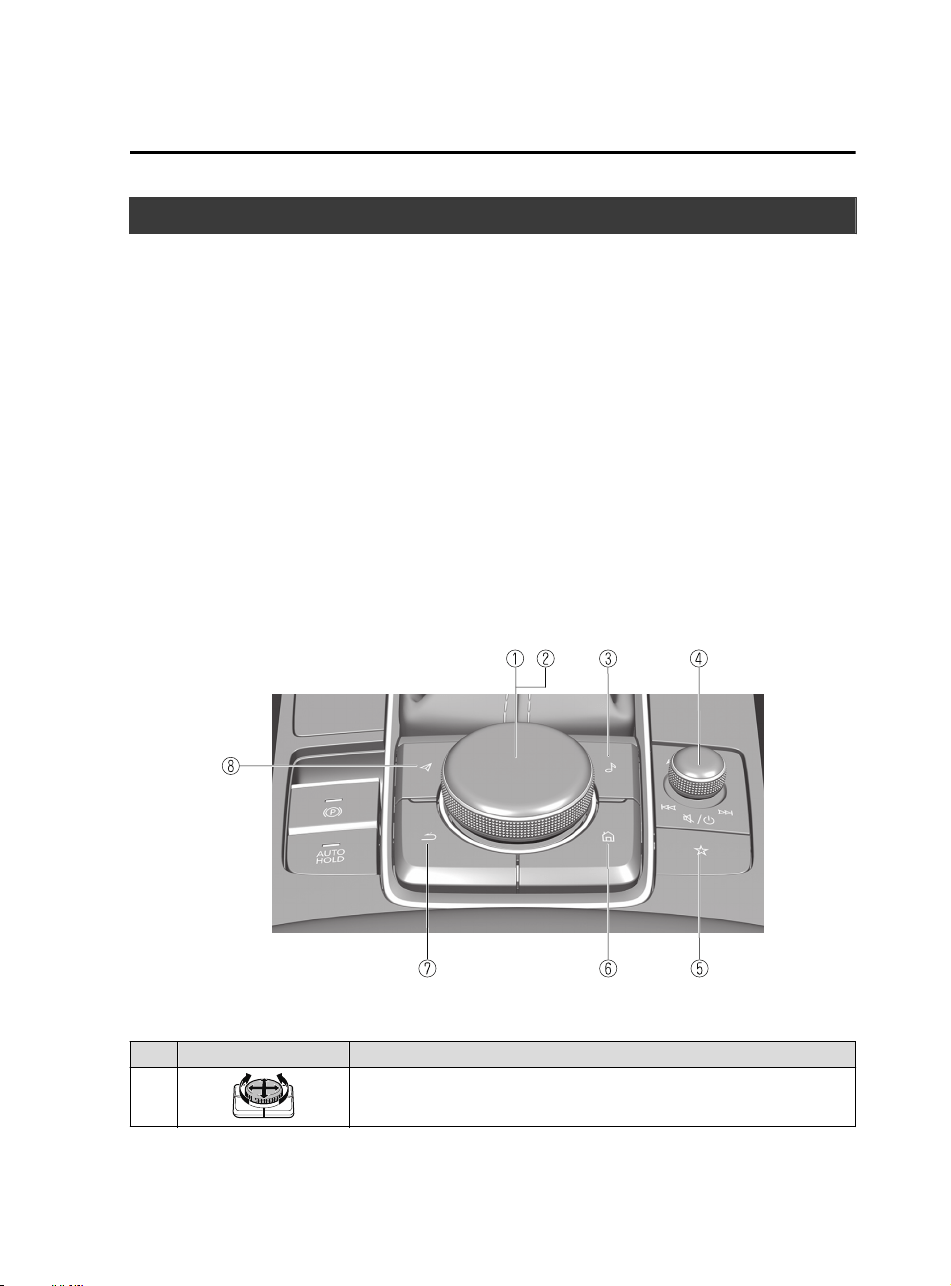
Mazda Connect Basic Operations
▼
Mazda Connect Basic Operations
NOTE
The explanation of functions described in this manual may differ from the actual operation,
and the shapes of screens and buttons and the letters and characters displayed may also
differ from the actual appearance.
Additionally, depending on future software updates, the content may successively change
without notice.
▼
Commander Switch Operation
The commander switch can be used to switch to each function and to operate each function.
Set the palm of your hand on the commander knob so that your fingers can touch each of the
switches.
You can switch the screens without having to look down at your hand.
NOTE
For safety reasons, some operations are disabled while driving the vehicle.
The shape of the switches varies depending on the vehicle model.
No. Item Explanation
1
Commander knob (selection):
Rotate or slide the commander knob to select the functions you want to use.
Interior Features
Mazda Connect
5-17
Mazda3_8HZ1-EA-19G_Edition1_old 2019-5-17 13:49:03
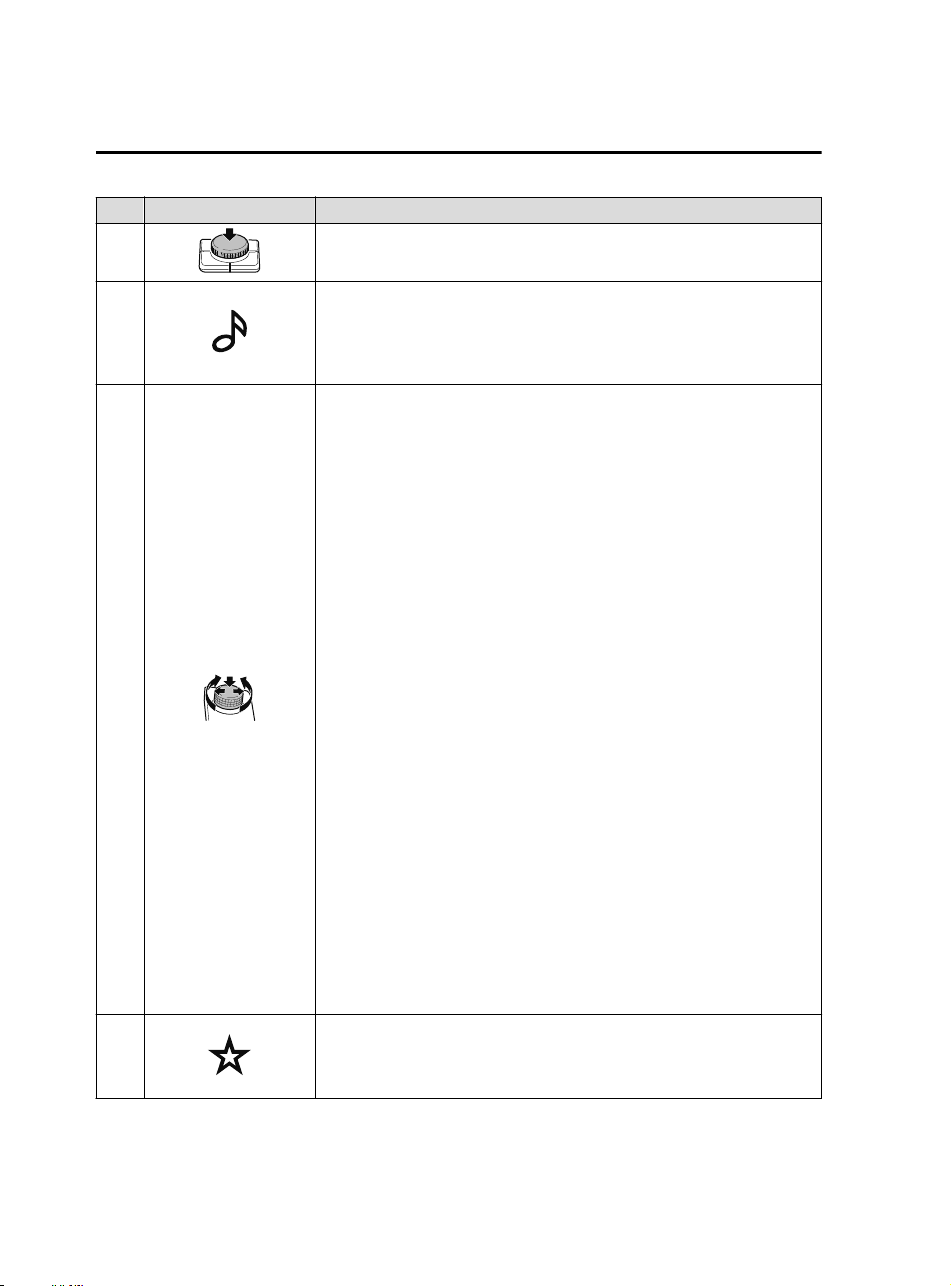
No. Item Explanation
2
Commander knob (select):
Press the commander knob to select the function you want to use.
3
Entertainment button:
The audio source screen last used is displayed.
(During Apple CarPlay™ or Android Auto™ music playback)
Displays the Apple CarPlay™ or Android Auto™ playback screen.
4
Volume k nob:
Volume a dju stmen t
Adjust the volume by turning the volume knob.
If you adjust the volume during a voice guidance, the volume of the voice
guidance changes.
If you adjust the volume while making a hands-free call, the conversation
volume changes.
Press the volume knob to mute the audio. Press the knob again to cancel.
Power off
Press and hold the volume knob to turn the Mazda Connect power off.
NOTE
If you press the volume knob to mute an audio source which can be paused,
such as Apple CarPlay™, USB audio, or Bluetooth
®
audio, while it is
playing, the song playback pauses. Press the volume knob again to cancel the
mute and the pause at the same time.
Selecting a radio station
You can call up radio stations registered to your favorites by sliding the vol‐
ume knob left/right while listening to FM/AM radio. The radio stations
change each time you slide the volume knob.
In addition, press and hold the volume knob until you hear a beep to start au‐
tomatic station selection. It stops when a radio broadcast is tuned in.
Cuing
Music and video files can be cued by operating the button while SiriusXM
®
,
audio, or video is playing.
Slide the volume knob to the right to cue to the beginning of the next song
and slide it to the left to cue to the beginning of the previous song. (The order
of the songs is in the order of the selected file list.)
5
Favorites button:
Displays the favorites screen.
Press and hold to register contacts, radio stations, or navigation points which
are displayed on the screen at that time.
Interior Features
Mazda Connect
5-18
Mazda3_8HZ1-EA-19G_Edition1_old 2019-5-17 13:49:03
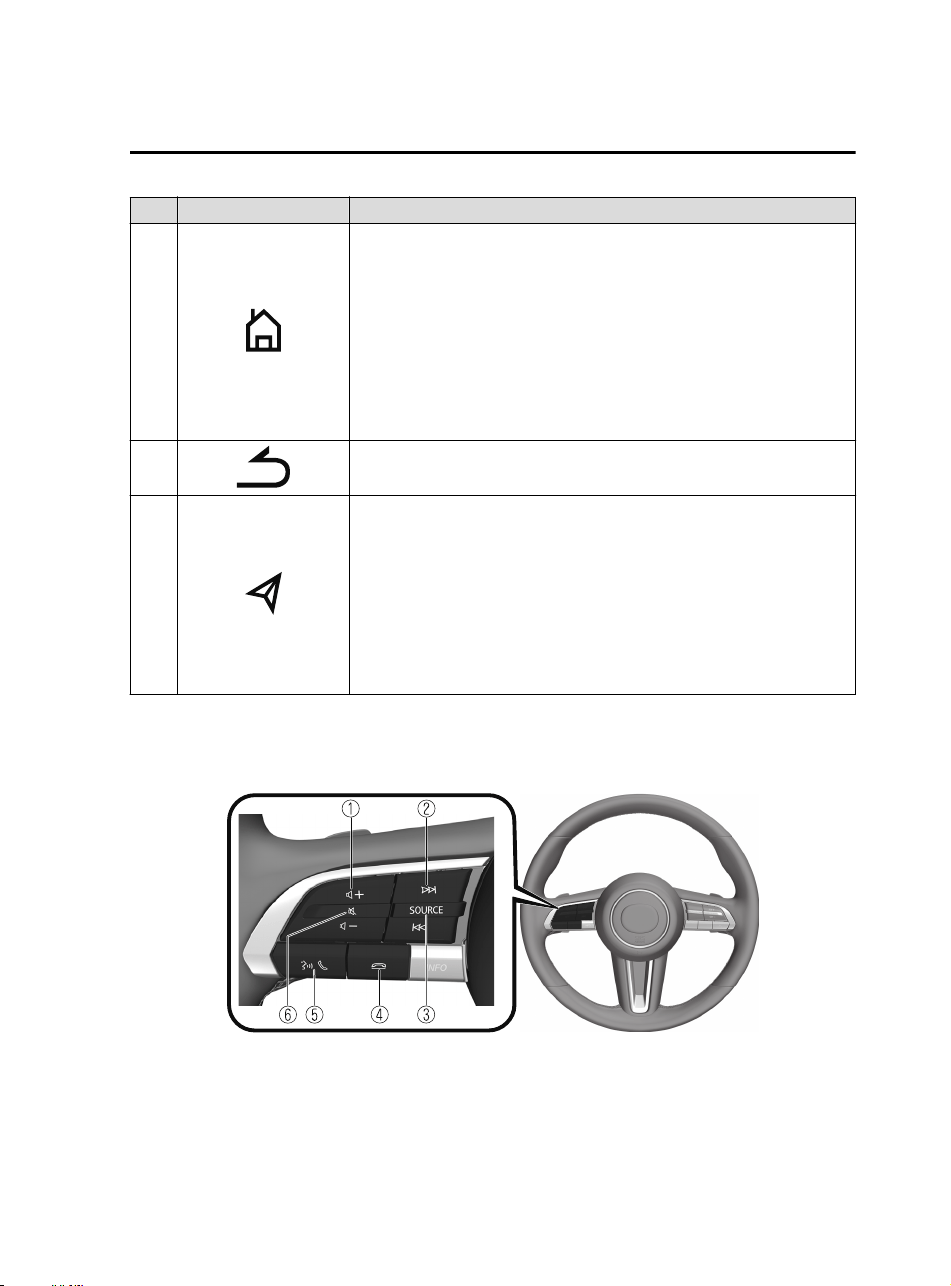
No. Item Explanation
6
Home button:
Displays the home screen.
(While Apple CarPlay™ or Android Auto™ is displayed)
Displays the Apple CarPlay™ or Android Auto™ home screen.
(While Apple CarPlay™ or Android Auto™ is connected)
Press and hold while the Mazda Connect screen is displayed to switch the
screen from Mazda Connect to Apple CarPlay™ or Mazda Connect to
Android Auto™. In addition, press and hold while the Apple CarPlay™ or
Android Auto™ screen is displayed to switch to the Mazda Connect screen.
7
Back button:
Returns to previous screen.
8
Map button:
Displays the navigation screen (vehicles with navigation system).
In order for the navigation system to function, the SD card for the navigation
system is required.
If the SD card for the navigation system is not inserted, the compass indicat‐
ing the direction in which the vehicle is moving is displayed.
For the navigation system operation, refer to the navigation system manual.
(During Apple CarPlay™ or Android Auto™ route guidance)
Displays the Apple CarPlay™ or Android Auto™ map screen.
▼
Audio Remote Control Switch Operation
The audio remote control switch is on the left side of the steering wheel. You can operate
the audio unit from the steering wheel.
Interior Features
Mazda Connect
5-19
Mazda3_8HZ1-EA-19G_Edition1_old 2019-5-17 13:49:03
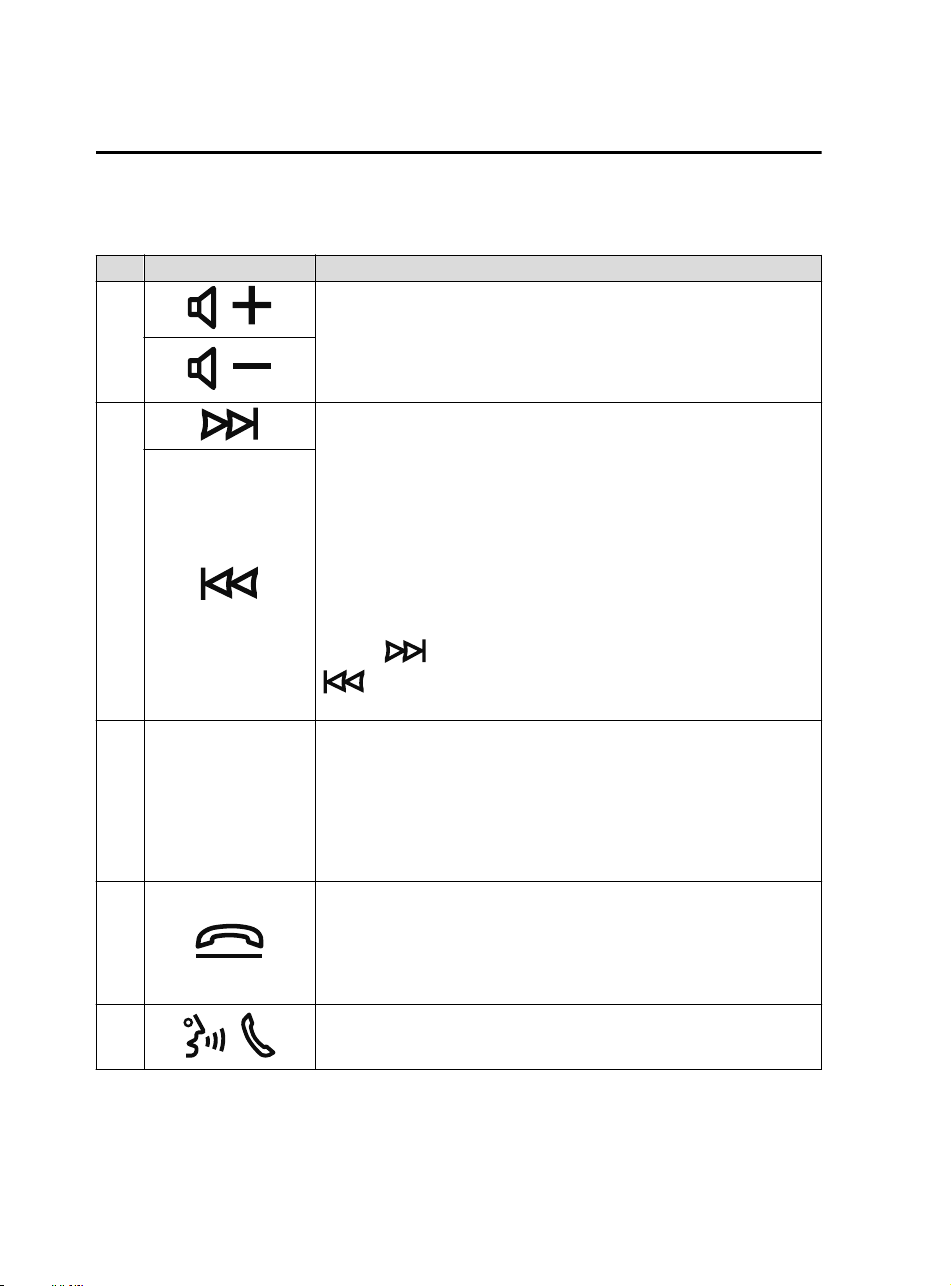
The shape of the switches differs depending on the vehicle model.
No. Item Explanation
1
Volume adjustment button:
Press the (+) or (-) button to adjust the volume.
If you adjust the volume during a voice guidance, the volume of the voice
guidance changes.
If you adjust the volume while making a hands-free call, the conversation
volume changes.
2
Seek Switch:
Selecting a radio station
You can call up radio stations registered to your favorites by pressing the seek
switch while listening to FM/AM radio. The radio stations change each time
you press the switch.
In addition, press and hold the seek switch until you hear a beep to start auto‐
matic station selection. It stops when a radio broadcast is tuned in.
Cuing
Music and video files can be cued by operating the button while SiriusXM
®
,
audio, or video is playing.
Press the (
) to cue to the beginning of the next song and press the
(
) to cue to the beginning of the previous song. (The order of the songs
is in the order of the selected file list.)
3 SOURCE
SOURCE button:
The audio source can be switched each time the button is pressed.
In addition, when the button is pressed and held, the audio currently being
played is turned off and the audio source selection screen is displayed.
(During Apple CarPlay™ or Android Auto™ playback)
Press and hold the SOURCE button to turn off the audio currently being
played.
4
Hang-up button
*1
:
(During a call)
Press the button to end the call.
(While receiving a call)
Press the button to refuse a call.
5
Talk/Pick-up button
*1
:
(While receiving a call)
Press the button to answer the call.
Interior Features
Mazda Connect
5-20
Mazda3_8HZ1-EA-19G_Edition1_old 2019-5-17 13:49:03
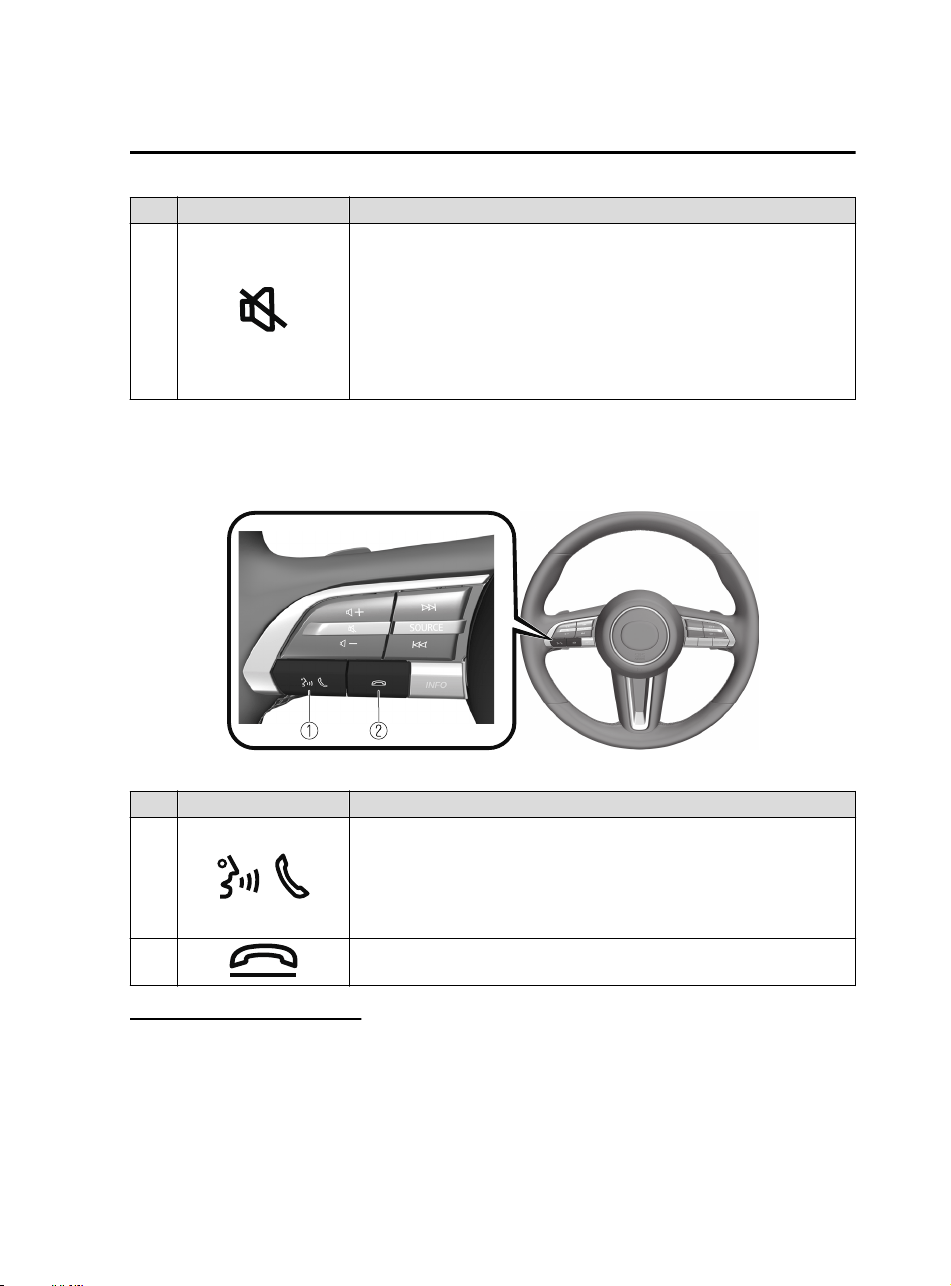
No. Item Explanation
6
Mute button:
Press the button to mute.
Press it again to cancel the mute.
NOTE
If you press the mute button to mute an audio source which can be paused,
such as Apple CarPlay™, USB audio, or Bluetooth
®
audio, while it is
playing, the song playback pauses. Press the mute button again to cancel the
mute and the pause at the same time.
*
1 You can also use the voice recognition for the talk/pick-up button, and hang-up button.
For details, refer to Operation Using Voice Recognition Function (page 5-21).
▼
Operation Using Voice Recognition Function
The shape of the switches differs depending on the vehicle model.
No. Item Explanation
1
Talk/Pick-up button:
When the button is pressed, the voice recognition top screen is displayed and
the voice recognition is activated.
(While voice guidance is being announced)
Press the button to skip the voice guidance.
2
Hang-up button:
Press the button to end the voice recognition.
Voice recognition activation
When the talk/pick-up button on the audio remote control switch is pressed, the voice
recognition top screen is displayed.
Interior Features
Mazda Connect
5-21
Mazda3_8HZ1-EA-19G_Edition1_old 2019-5-17 13:49:03
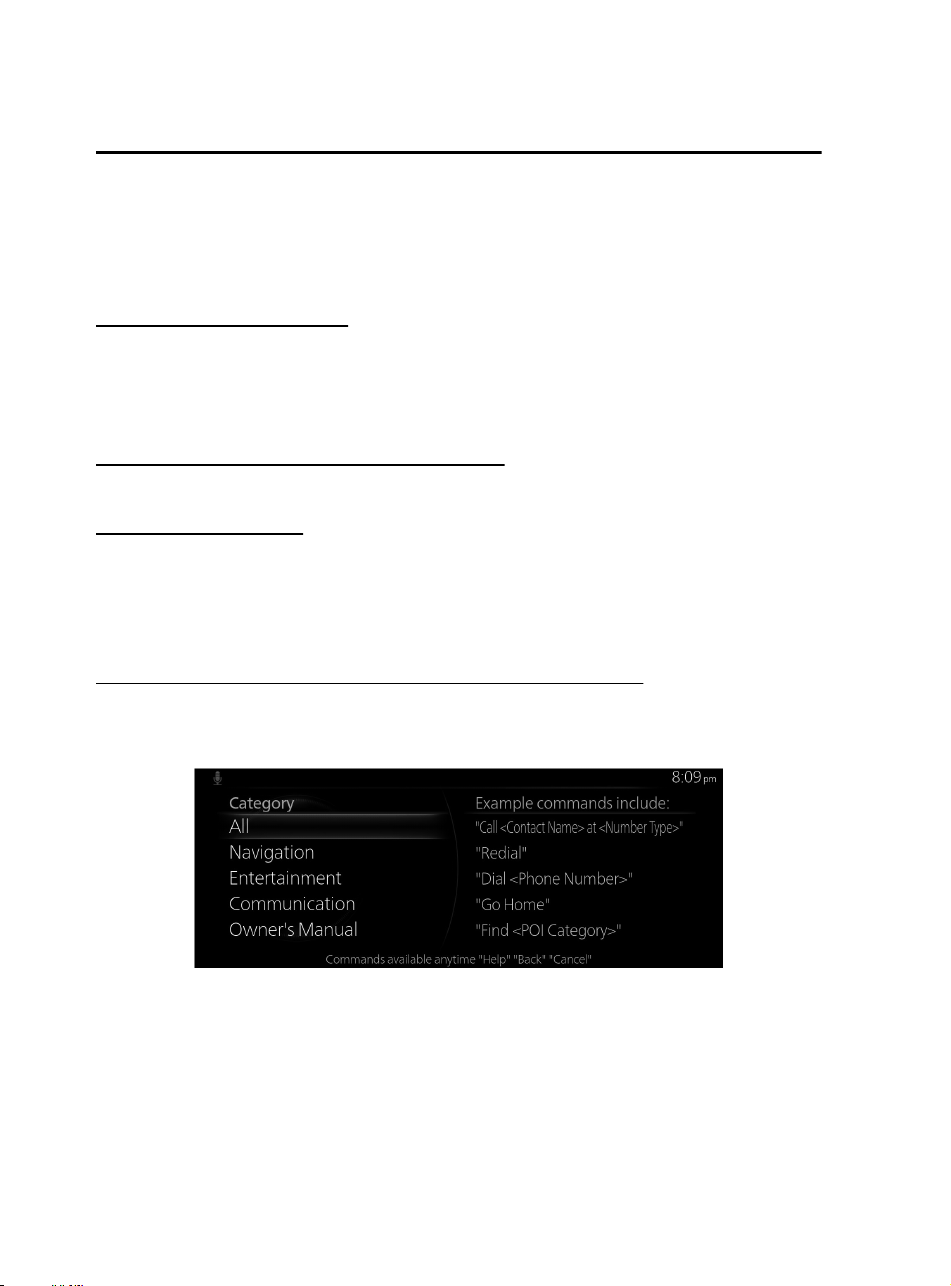
NOTE
While Apple CarPlay™ or Android Auto™ is connected, Siri
®
or Android Auto™ voice
recognition is activated.
At this time Mazda Connect voice recognition is not activated.
Commands usable at any time
“Help” - Can be used to check for usable voice commands.
“Back” - Returns to the previous screen. When a voice command is spoken while on the
telephone number input screen, the content that was previously input is deleted.
“Cancel”- The voice recognition is ended.
To learn more on how to operate Mazda Connect
“Owner's Manual” - The operation guide screen is displayed.
Ending voice recognition
Do any one of the following operations:
Press the hang-up button.
Press and hold the talk/Pick-up button.
Say the word, “Cancel”.
Convenient operating tips for using the voice recognition function
Examples of effective voice commands in various categories are displayed on top screen of
the voice recognition.
It would be convenient to know these usable voice commands in advance.
NOTE
The voice commands indicated in this manual are some examples of usable voice
commands. Some voice commands may be unusable depending on the vehicle model.
When the Barge-In setting is on, voice commands can be made even while the voice
guidance is being announced. For details on Barge-In, refer to the Settings section in the
Mazda Connect Owner's Manual.
For details on voice commands which can be used on the navigation screen, refer to the
navigation system manual.
Interior Features
Mazda Connect
5-22
Mazda3_8HZ1-EA-19G_Edition1_old 2019-5-17 13:49:03

To prevent mistaken voice recognition, be aware of the following points:
When you are using a mobile phone connected via Bluetooth
®
, the commands relevant to
the mobile phone can be used. Connect your mobile phone to Bluetooth
®
before operating
the mobile phone using voice recognition.
Speaking in a slightly louder voice will improve voice recognition, but an excessively
loud voice is unnecessary. Try to speak in a slightly louder voice than when talking to
other passengers in the vehicle.
You do not need to speak slowly. Speak at a normal speed.
When calling a person in the device's phone book, the recognition rate increases the
longer the name is. Errors may occur with names that are short such as “Mama”, “Home”,
or “wife”.
Speak clearly, without pausing between words or numbers.
Voice commands other than those specified, cannot be recognized. Speak in the wording
specified by the voice commands.
It is not necessary to face the microphone or approach it. Speak the voice commands
while maintaining a safe driving position.
Close the windows and the moonroof to reduce loud noises from outside the vehicle and
to prevent the airflow of the air-conditioning system from being a disturbance when using
Bluetooth
®
Hands-Free.
Make sure that the air flow from the air conditioner is not blowing on the microphone.
When making voice commands during a voice guidance, speak in a slightly louder voice.
But, an excessively loud voice is unnecessary.
If the voice recognition is poor with the guidance volume set to high, set the Barge-In to
OFF.
Some voice command examples corresponding to the voice recognition function
The specified name and number are put into the {}.
Common
Back
Help (You can listen to help guidance at each screen.)
{Line Number} (You can select the line number on the screen.)
Next Page
Previous Page
Cancel
Menu
All
Navigation
Entertainment
Interior Features
Mazda Connect
5-23
Mazda3_8HZ1-EA-19G_Edition1_old 2019-5-17 13:49:03

Communication
Owner's Manual (the In-vehicle Digital Owner's Manual voice recognition can be
displayed.)
Setting
Voice Recognition Settings
Owner's Manual (the In-vehicle Digital Owner's Manual voice recognition can be
displayed.)
Display Off
Music
Play Artist (You can also use “Play Artist {Artist name}”.)
Play Album (You can also use “Play Album {Album Name}”.)
Play Playlist (You can also use “Play Playlist {Playlist Name}”.)
Play Song (You can also use “Play Song {Song Name}”.)
Play Audiobook (You can also use “Play Audiobook {Audiobook Name}”.)
Play Podcast (You can also use “Play Podcast {Podcast Name}”.)
Radio
Tune to {Frequency} AM
Tune to {Frequency} FM
Tune to {Frequency} HD {Sub Channel}
SiriusXM Channel {Channel Number}
SiriusXM {Station Name}
SiriusXM Genre (You can also use “SiriusXM {Genre Name}”.)
Source
Change Source (You can also use “Change Source to USB”
*1
and “USB”
*1
.)
Audio OFF (You can also use “Change Source to Audio OFF”.)
Phone
Dial Phone Number (You can also use “Dial {Phone Number}”.)
Call History
Call a Contact (You can also use “Call {Contact Name}” and “Call {Contact Name} at
{Number Type}”.)
Redial
*
1 : Audio source names other than “USB” can also be used as follows:
Bluetooth/AM/FM/SiriusXM/Pandora/USB1 Audio/USB2 Audio/USB1 Video/USB2
Video
Interior Features
Mazda Connect
5-24
Mazda3_8HZ1-EA-19G_Edition1_old 2019-5-17 13:49:03
NOTE
Some commands may not be usable depending on the region and equipment.
Some commands cannot be used depending on the device connection conditions and the
use conditions.
▼
Appendix
Gracenote
®
Database
When audio CDs are played, the unit searches the database stored in the vehicle for the
album name, artist name, genre, title, and album art, and if there is a match in the vehicle's
database compilation to the music being played, each type of music information is
automatically added (Album art only for MP3/WMA/AAC CDs and when playing USB
audio and Bluetooth
®
audio). The database information stored in this device uses database
information in the Gracenote
®
music recognitions service.
SiriusXM Travel Link
®*
CAUTION
ADVISORY ONLY
The weather information is subject to service interruptions and may contain errors or
inaccuracies and consequently should not be relied upon exclusively. You are urged to check
alternate weather information sources prior to making safety related decisions. You
acknowledge and agree that you shall be solely responsible for use of the information and all
decisions taken with respect thereto. By using this weather service, you release and waive any
claims against Sirius XM Radio Inc. and Mazda Motor Corporation and all of their respective
aliates with regard to this service.
SiriusXM
®
Satellite Radio
*
Products/applications shall display “Call [Appropriate Phone Number] to Enable Services”
for any unsubscribed SiriusXM Data Service(s).
This shall be shown on the same screen as the Radio ID and the service subscription status:
Contact your SiriusXM Representative for the appropriate call center phone number.
U.S.A.: 1-877-447-0011
Canada: 1-877-438-9677
Interior Features
Mazda Connect
*Some models.
5-25
Mazda3_8HZ1-EA-19G_Edition1_old 2019-5-17 13:49:03
SiriusXM
®
All Access Subscription
Hopefully, you're already loving SiriusXM in your new Mazda. But don't stop there — you
can also listen on the app and online. All Access is the very best subscription package –
with the most channels and the most flexibility. With All Access, you get every channel
available on your vehicle, plus you can listen on the app, online, and in your home on a
variety of connected devices. — so you can enjoy SiriusXM wherever you are. Here's what's
included:
Over 150 satellite channels to enjoy in your car, coast-to-coast, 24/7.
All kinds of commercial-free music, plus every major sport, world-class news and the
biggest names in talk & entertainment.
All of our premium programming, including Howard Stern, every NFL, MLB
®
, and NBA
game, NHL
®
games, every NASCAR
®
race, 24/7 talk channels dedicated to the biggest
leagues, and much more.
All SiriusXM services require a subscription, sold separately or as a package by SiriusXM
Radio Inc. (or, in Canada, SiriusXM Canada Inc.), after any trial subscription which may be
included with your vehicle purchase or lease. To subscribe after your trial subscription, call
1-877-447-0011 (U.S.A.) or 1-877-438-9677 (Canada).
CAUTION
It is prohibited to copy, decompile, disassemble, reverse engineer, hack, manipulate, or
otherwise make available any technology or software incorporated in receivers compatible
with the SiriusXM satellite radio service or that support the SiriusXM website, the online
service or any of its content. Furthermore, the AMBE
®
voice compression software included in
this product is protected by intellectual property rights including patent rights, copyrights,
and trade secrets of Digital Voice Systems, Inc. The SiriusXM Service may include
trac,
weather and other content and emergency alert information and data. Such information and
data is not for “safety for life”, but is merely supplemental and advisory in nature and,
therefore, cannot be relied upon as safety critical. Neither SiriusXM nor Mazda is responsible
for any errors in accuracies in the SiriusXM data services or its use in applications. The
SiriusXM content is subject to change without notice.
NOTE
SiriusXM Satellite Radio Service is available in the 48 contiguous United States and the
District of Columbia. The service is not available in Alaska, Hawaii or Puerto Rico.
Interior Features
Mazda Connect
5-26
Mazda3_8HZ1-EA-19G_Edition1_old 2019-5-17 13:49:03
HD Radio™
What is HD Radio™ Technology and how does it work?
HD Radio™ Technology is the digital evolution of analog AM/FM radio.
Your radio product has a special receiver which allows it to receive digital broadcasts
(where available) in addition to the analog broadcasts it already receives.
Digital broadcasts have better sound quality than analog broadcasts as digital broadcasts
provide free, crystal clear audio.
For more information, and a guide to available radio stations and programming, please visit
www.hdradio.com.
Benefits of HD Radio™ Technology
(Information)
The song title, artist name, album name will appear on the screen when available by the
radio station.
(Multicast)
On the FM radio frequency most digital stations have “multiple” or supplemental programs
on each FM station.
HD Radio Technology manufactured under license from iBiquity Digital Corporation. U.S.
and Foreign Patents.
For patents see http://dts.com/patents.
Apple CarPlay™
CAUTION
YOU EXPRESSLY ACKNOWLEDGE AND AGREE THAT USE OF APPLE CARPLAY™ (“THE
APPLICATION”) IS AT YOUR SOLE RISK AND THAT THE ENTIRE RISK AS TO SATISFACTORY
QUALITY, PERFORMANCE, ACCURACY AND EFFORT IS WITH YOU TO THE MAXIMUM EXTENT
PERMITTED BY APPLICABLE LAW, AND THAT THE APPLICATION AND INFORMATION ON THE
APPLICATION IS PROVIDED “AS IS” AND “AS AVAILABLE”, WITH ALL FAULTS AND WITHOUT
WARRANTY OF ANY KIND, AND MAZDA HEREBY DISCLAIMS ALL WARRANTIES AND
CONDITIONS WITH RESPECT TO THE APPLICATION AND INFORMATION ON THE
APPLICATION, EITHER EXPRESS, IMPLIED OR STATUTORY, INCLUDING, BUT NOT LIMITED TO,
THE IMPLIED WARRANTIES AND/OR CONDITIONS OF MERCHANTABILITY, SATISFACTORY
QUALITY, FITNESS FOR A PARTICULAR PURPOSE, ACCURACY, QUIET ENJOYMENT, AND
NONINFRINGEMENT OF THIRD PARTY RIGHTS.
Interior Features
Mazda Connect
5-27
Mazda3_8HZ1-EA-19G_Edition1_old 2019-5-17 13:49:03

AS EXAMPLES, AND WITHOUT LIMITATION, MAZDA DISCLAIMS ANY WARRANTY
REGARDING THE ACCURACY OF DATA PROVIDED BY THE APPLICATION, SUCH AS THE
ACCURACY OF DIRECTIONS, ESTIMATED TRAVEL TIME, SPEED LIMITS, ROAD CONDITIONS,
NEWS, WEATHER, TRAFFIC, OR OTHER CONTENT PROVIDED BY APPLE, ITS AFFILIATES, OR
THIRD PARTY PROVIDERS; MAZDA DOES NOT GUARANTEE AGAINST LOSS OF APPLICATION
DATA, WHICH MAY BE LOST AT ANY TIME; MAZDA DOES NOT GUARANTEE THAT THE
APPLICATION OR ANY SERVICES PROVIDED THROUGH THEM WILL BE PROVIDED AT ALL
TIMES OR THAT ANY OR ALL SERVICES WILL BE AVAILABLE AT ANY PARTICULAR TIME OR
LOCATION. FOR EXAMPLE, SERVICES MAY BE SUSPENDED OR INTERRUPTED WITHOUT
NOTICE FOR REPAIR, MAINTENANCE, SECURITY FIXES, UPDATES, ETC., SERVICES MAY BE
UNAVAILABLE IN YOUR AREA OR LOCATION, ETC.
IN ADDITION, YOU UNDERSTAND THAT CHANGES IN THIRD PARTY TECHNOLOGY OR
GOVERNMENT REGULATION MAY RENDER THE SERVICES AND/OR APPLICATIONS
OBSOLETE AND/OR UNUSABLE. TO THE EXTENT NOT PROHIBITED BY LAW, IN NO EVENT
SHALL MAZDA OR ITS AFFILIATES BE LIABLE FOR PERSONAL INJURY, OR ANY INCIDENTAL,
SPECIAL, INDIRECT OR CONSEQUENTIAL DAMAGES WHATSOEVER, INCLUDING, WITHOUT
LIMITATION, DAMAGES FOR LOSS OF PROFITS, CORRUPTION OR LOSS OF DATA, FAILURE
TO TRANSMIT OR RECEIVE ANY DATA, BUSINESS INTERRUPTION OR ANY OTHER
COMMERCIAL DAMAGES OR LOSSES, ARISING OUT OF OR RELATED TO THE APPLICATION
OR YOUR USE OF OR INABILITY TO USE THE APPLICATION OR INFORMATION ON THE
APPLICATION.
When using Apple CarPlay™, please avoid distraction and use Apple CarPlay™ responsibly.
Stay fully aware of driving conditions and always obey applicable laws.
NOTE
Apple CarPlay™ is provided by Apple
®
and its use is subject to your agreement to the
Apple CarPlay™ terms of use, which are included as part of the Apple iOS terms of use.
When using Apple CarPlay™, location, speed, and other vehicle data is transferred to
your iPhone
®
. For further details, refer to Apple
®
’s Privacy Policy.
Interior Features
Mazda Connect
5-28
Mazda3_8HZ1-EA-19G_Edition1_old 2019-5-17 13:49:03
Android Auto™
CAUTION
YOU EXPRESSLY ACKNOWLEDGE AND AGREE THAT USE OF ANDROID AUTO™ (“THE
APPLICATION”) IS AT YOUR SOLE RISK AND THAT THE ENTIRE RISK AS TO SATISFACTORY
QUALITY, PERFORMANCE, ACCURACY AND EFFORT IS WITH YOU TO THE MAXIMUM EXTENT
PERMITTED BY APPLICABLE LAW, AND THAT THE APPLICATION AND INFORMATION ON THE
APPLICATION IS PROVIDED “AS IS” AND “AS AVAILABLE,” WITH ALL FAULTS AND WITHOUT
WARRANTY OF ANY KIND, AND MAZDA HEREBY DISCLAIMS ALL WARRANTIES AND
CONDITIONS WITH RESPECT TO THE APPLICATION AND INFORMATION ON THE
APPLICATION, EITHER EXPRESS, IMPLIED OR STATUTORY, INCLUDING, BUT NOT LIMITED TO,
THE IMPLIED WARRANTIES AND/OR CONDITIONS OF MERCHANTABILITY, SATISFACTORY
QUALITY, FITNESS FOR A PARTICULAR PURPOSE, ACCURACY, QUIET ENJOYMENT, AND
NONINFRINGEMENT OF THIRD PARTY RIGHTS.
AS EXAMPLES, AND WITHOUT LIMITATION, MAZDA DISCLAIMS ANY WARRANTY
REGARDING THE ACCURACY OF DATA PROVIDED BY THE APPLICATION, SUCH AS THE
ACCURACY OF DIRECTIONS, ESTIMATED TRAVEL TIME, SPEED LIMITS, ROAD CONDITIONS,
NEWS, WEATHER, TRAFFIC, OR OTHER CONTENT PROVIDED BY GOOGLE, ITS AFFILIATES, OR
THIRD PARTY PROVIDERS; MAZDA DOES NOT GUARANTEE AGAINST LOSS OF APPLICATION
DATA, WHICH MAY BE LOST AT ANY TIME; MAZDA DOES NOT GUARANTEE THAT THE
APPLICATION OR ANY SERVICES PROVIDED THROUGH THEM WILL BE PROVIDED AT ALL
TIMES OR THAT ANY OR ALL SERVICES WILL BE AVAILABLE AT ANY PARTICULAR TIME OR
LOCATION. FOR EXAMPLE, SERVICES MAY BE SUSPENDED OR INTERRUPTED WITHOUT
NOTICE FOR REPAIR, MAINTENANCE, SECURITY FIXES, UPDATES, ETC., SERVICES MAY BE
UNAVAILABLE IN YOUR AREA OR LOCATION, ETC.
IN ADDITION, YOU UNDERSTAND THAT CHANGES IN THIRD PARTY TECHNOLOGY OR
GOVERNMENT REGULATION MAY RENDER THE SERVICES AND/OR APPLICATIONS
OBSOLETE AND/OR UNUSABLE. TO THE EXTENT NOT PROHIBITED BY LAW, IN NO EVENT
SHALL MAZDA OR ITS AFFILIATES BE LIABLE FOR PERSONAL INJURY, OR ANY INCIDENTAL,
SPECIAL, INDIRECT OR CONSEQUENTIAL DAMAGES WHATSOEVER, INCLUDING, WITHOUT
LIMITATION, DAMAGES FOR LOSS OF PROFITS, CORRUPTION OR LOSS OF DATA, FAILURE
TO TRANSMIT OR RECEIVE ANY DATA, BUSINESS INTERRUPTION OR ANY OTHER
COMMERCIAL DAMAGES OR LOSSES, ARISING OUT OF OR RELATED TO THE APPLICATION
OR YOUR USE OF OR INABILITY TO USE THE APPLICATION OR INFORMATION ON THE
APPLICATION.
When using Android Auto™, please avoid distraction and use Android Auto™ responsibly.
Stay fully aware of driving conditions and always obey applicable laws.
Interior Features
Mazda Connect
5-29
Mazda3_8HZ1-EA-19G_Edition1_old 2019-5-17 13:49:03
NOTE
Android Auto™ is provided by Google and its use is subject to your agreement to the
Android Auto™ terms of use.
When using Android Auto™, location, speed, and other vehicle data is transferred to your
smart phone. For further details, refer to Google Privacy Policy.
Trademark
Pandora
®
, the Pandora
®
logo, and the Pandora
®
trade dress are trademarks or registered
trademarks of Pandora Media, Inc., used with permission.
HD Radio™ and the HD, HD Radio, and “Arc” logos are proprietary trademarks of
iBiquity Digital Corp.
iPhone, iPod touch, iPod nano, Siri and Apple Music are registered trademarks of Apple
Inc.
Apple CarPlay is trademarks of Apple Inc.
iOS is a trademark or registered trademark of Cisco in the U.S. and other countries and is
used under license.
“Made for iPhone” and “Made for iPod” mean that an accessory has been designed to
connect specifically to iPhone or iPod, and has been certified by the developer to meet
Apple performance standards. Apple is not responsible for the operation of this device or
its compliance with safety and regulatory standards.
Please note that the use of this accessory with iPhone or iPod may affect wireless
performance.
Made for
iPhone 7 Plus
iPhone 7
iPhone SE
iPhone 6s Plus
iPhone 6s
iPhone 6 Plus
iPhone 6
iPhone 5s
iPhone 5c
iPhone 5
iPhone 4s
iPod touch (6th generation)
iPod touch (5th generation)
Interior Features
Mazda Connect
5-30
Mazda3_8HZ1-EA-19G_Edition1_old 2019-5-17 13:49:03
iPod nano (7th generation)
Google, Android, Android Auto and other related marks are trademarks of Google LLC.
AudioPilot is a registered trademark of Bose Corporation.
Centerpoint is a registered trademark of Bose Corporation.
Windows Media and Microsoft are registered trademarks of Microsoft Corporation U.S.
in the United States and other countries.
This product is protected by certain intellectual property rights of Microsoft Corporation
and third parties.
Use or distribution of such technology outside of this product is prohibited without a
license from Microsoft or an authorized Microsoft subsidiary and third parties.
The Bluetooth
®
word mark and logos are registered trademarks owned by Bluetooth SIG,
Inc. and any use of such marks by Panasonic Corporation is under license. Other
trademarks and trade names are those of their respective owners.
SDHC Logo is a trademark of SD-3C, LLC.
Gracenote, the Gracenote logo and logotype are either a registered trademark or a
trademark of Gracenote, Inc. in the United States and/or other countries.
Interior Features
Mazda Connect
5-31
Mazda3_8HZ1-EA-19G_Edition1_old 2019-5-17 13:49:03

Regarding the license for the audio amplifier (except vehicles with Bose audio)
License for CMSIS-RTOS RTX Implementation
Copyright (c) 1999-2009 KEIL, 2009-2015 ARM Germany GmbH, 2013-2016 ARM Ltd
All rights reserved.
Redistribution and use in source and binary forms, with or without modification, are
permitted provided that the following conditions are met:
Redistributions of source code must retain the above copyright notice, this list of
conditions and the following disclaimer
Redistributions in binary form must reproduce the above copyright notice, this list of
conditions and the following disclaimer in the documentation and/or other materials
provided with the distribution.
Neither the name of ARM nor the names of its contributors may be used to endorse or
promote products derived from this software without specific prior written permission.
THIS SOFTWARE IS PROVIDED BY THE COPYRIGHT HOLDERS AND
CONTRIBUTORS “AS IS” AND ANY EXPRESS OR IMPLIED WARRANTIES,
INCLUDING, BUT NOT LIMITED TO, THE IMPLIED WARRANTIES OF
MERCHANTABILITY AND FITNESS FOR A PARTICULAR PURPOSE ARE
DISCLAIMED.
IN NO EVENT SHALL COPYRIGHT HOLDERS AND CONTRIBUTORS BE LIABLE
FOR ANY DIRECT, INDIRECT, INCIDENTAL, SPECIAL, EXEMPLARY, OR
CONSEQUENTIAL DAMAGES (INCLUDING, BUT NOT LIMITED TO,
PROCUREMENT OF SUBSTITUTE GOODS OR SERVICES; LOSS OF USE, DATA, OR
PROFITS; OR BUSINESS INTERRUPTION) HOWEVER CAUSED AND ON ANY
THEORY OF LIABILITY, WHETHER IN CONTRACT, STRICT LIABILITY, OR TORT
(INCLUDING NEGLIGENCE OR OTHERWISE) ARISING IN ANY WAY OUT OF THE
USE OF THIS SOFTWARE, EVEN IF ADVISED OF THE POSSIBILITY OF SUCH
DAMAGE.
Interior Features
Mazda Connect
5-32
Mazda3_8HZ1-EA-19G_Edition1_old 2019-5-17 13:49:03
Connected Service (U.S.A only)
▼
Connected Service Overview
There are several types of connected services available via Mazda Connect. Some services
may require you to download the MyMazda app to your smartphone and subscribe to the
services, while others may require you to pair your smartphone to the vehicle via
Bluetooth
®
. In addition, on a regular basis and unless you opt-out, your vehicle will
automatically transmit certain geo-location, driving behavior data, and vehicle health
information to Mazda for product quality, data analysis, research, and product development.
Using the QR codes or URLs below, refer to the Connected Service Owner's Manual and
Privacy Policy for more details and opt-out options.
Connected Service Owner's Manual
https://www.mazdausa.com/static/manuals/mazda-connected-service/index.html
Privacy
Mazda maintains a Privacy Statement which describes how we collect, use, share, store and
secure data from your vehicle equipped with connected services.
We provide you with connected services by collecting and using your personal information
and vehicle location, health and driving data.
To learn more about our Privacy Statement, please visit: https://www.mazdausa.com/site/
privacy-connectedservices
Interior Features
Mazda Connect
5-33
Mazda3_8HZ1-EA-19G_Edition1_old 2019-5-17 13:49:03
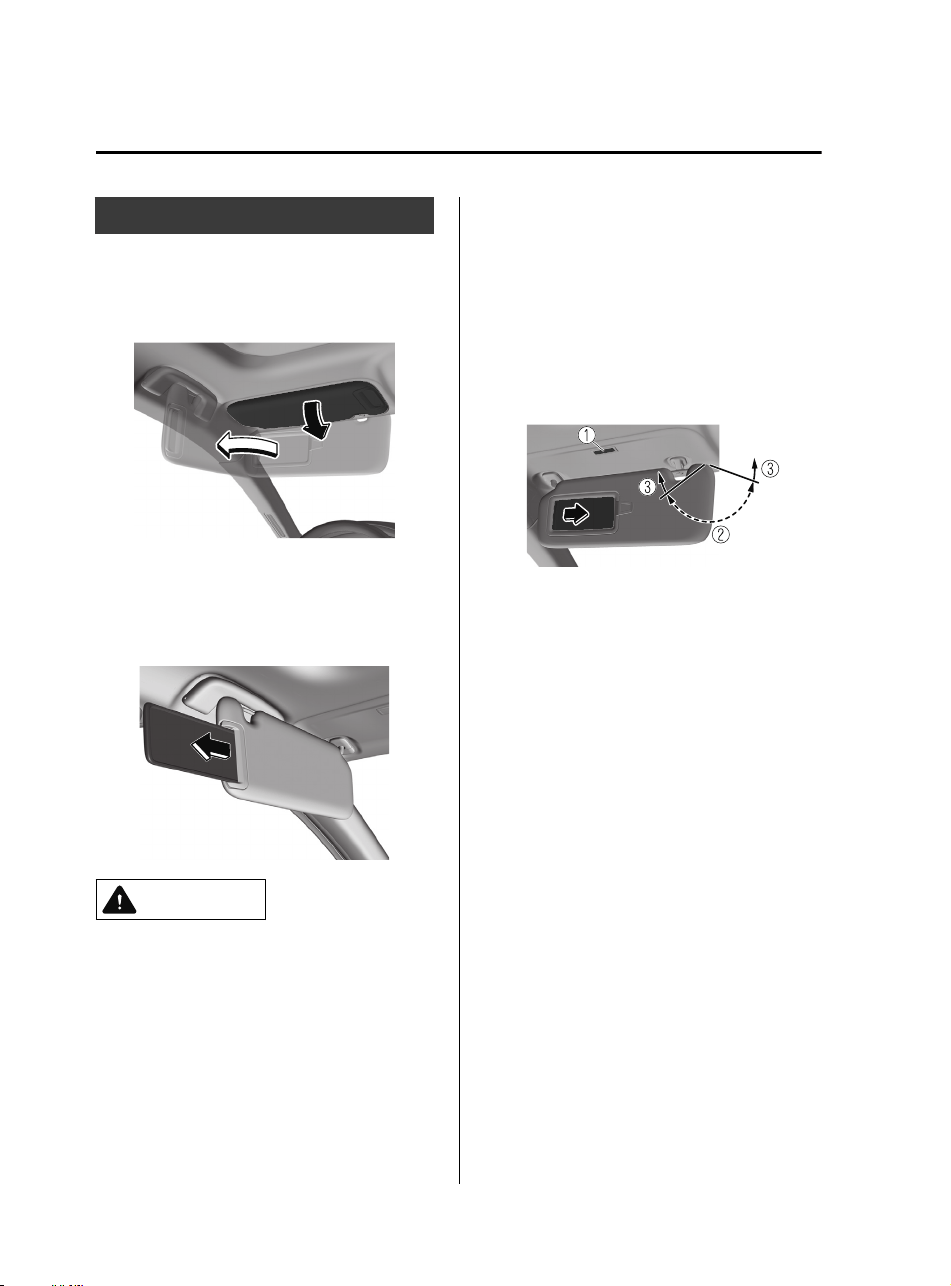
Sunvisors
▼
Sunvisors
When you need a sunvisor, lower it for use
in front or swing it to the side.
▼
Side Extension Sunvisors
*
The visor extender extends the sunvisor's
range of sun shading.
To use, pull it out.
CAUTION
When moving the sunvisor, retract the visor
extender to its original position. Otherwise,
the visor extender could hit the rearview
mirror.
▼
Vanity Mirrors
To use the vanity mirror, lower the
sunvisor.
If your vehicle is equipped with a vanity
mirror light, it will illuminate when you
open the cover.
The vanity mirror will only illuminate in
the tilt range shown in the figure.
1. Vanity mirror light
2. On
3. Off
NOTE
If a vanity mirror light is left on with the
ignition switched OFF, the light is turned
off automatically to prevent the battery
from being discharged.
The vanity mirror light can be turned on
again by doing any of the following
operations:
Opening/closing any door.
Unlocking any door.
Switching the ignition to ACC or ON.
Switching an overhead light/front map
light on.
Interior Features
Interior Equipment
5-34
*Some models.
Mazda3_8HZ1-EA-19G_Edition1_old 2019-5-17 13:49:03
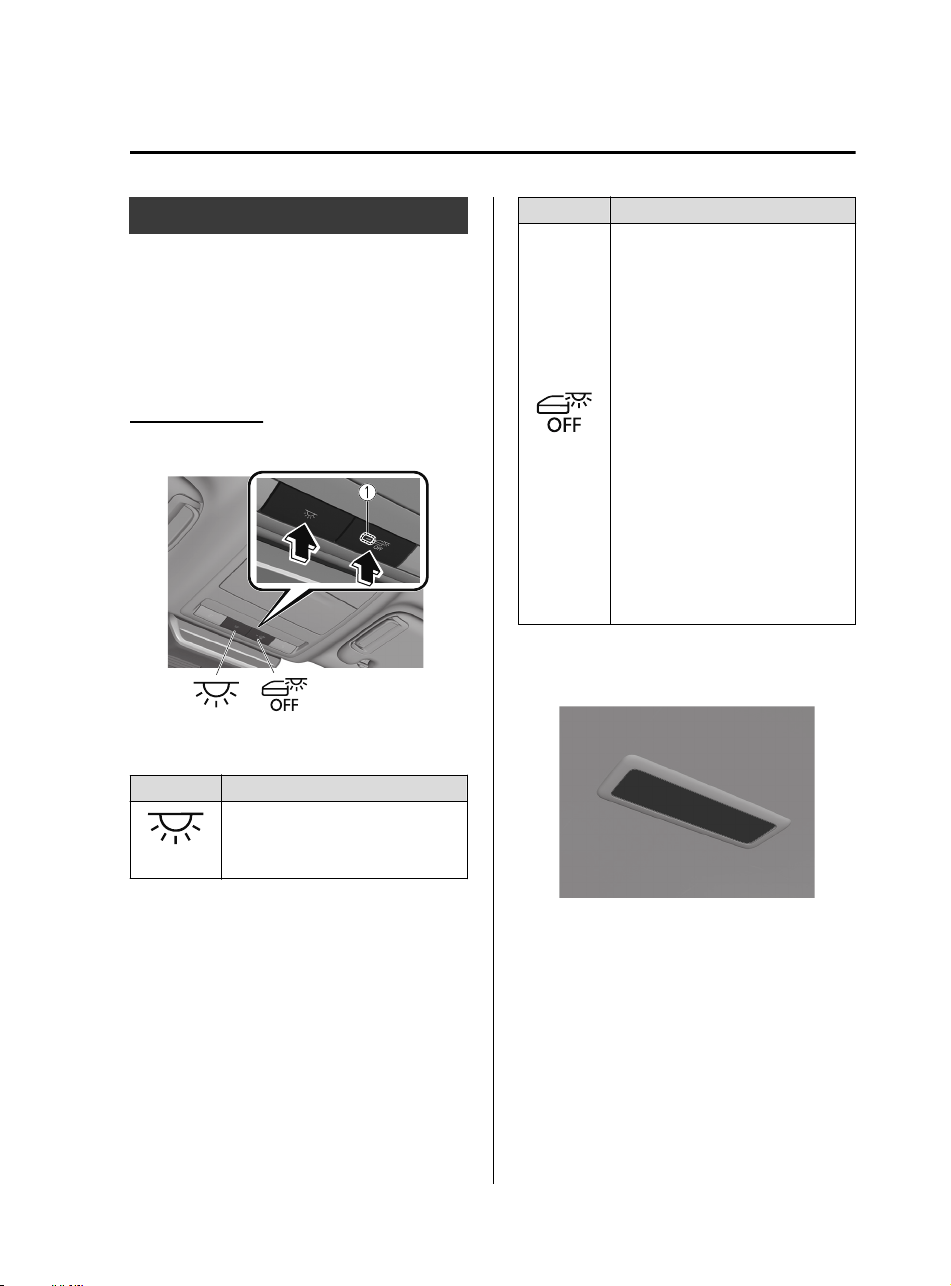
Interior Lights
▼
Interior Lights
NOTE
Do not leave the lights on for long periods
while the engine is turned off. Otherwise
the battery power could be depleted.
Overhead lights
Front
1. Indicator light
Switch Overhead Lights
ON/OFF
Press the switch to turn it on. Press
the switch again to turn off the
lights.
Switch Overhead Lights
DOOR OFF
The door interlock can be switched
ON/OFF.
When the door interlock is OFF, the
indicator light in the switch turns on.
Door interlock ON (indicator light
in switch is off)
The lights turn on when any of the
doors is opened.
The lights turn on/off in conjunc‐
tion with the illuminated entry
system.
Door interlock OFF (indicator
light in switch is on)
The lights do not turn on even if
any of the doors is opened.
The lights do not turn on/off in
conjunction with the illuminated
entry system.
Rear
NOTE
The rear overhead light also turn on and
off when the front overhead light switch is
operated.
Interior Features
Interior Equipment
5-35
Mazda3_8HZ1-EA-19G_Edition1_old 2019-5-17 13:49:03
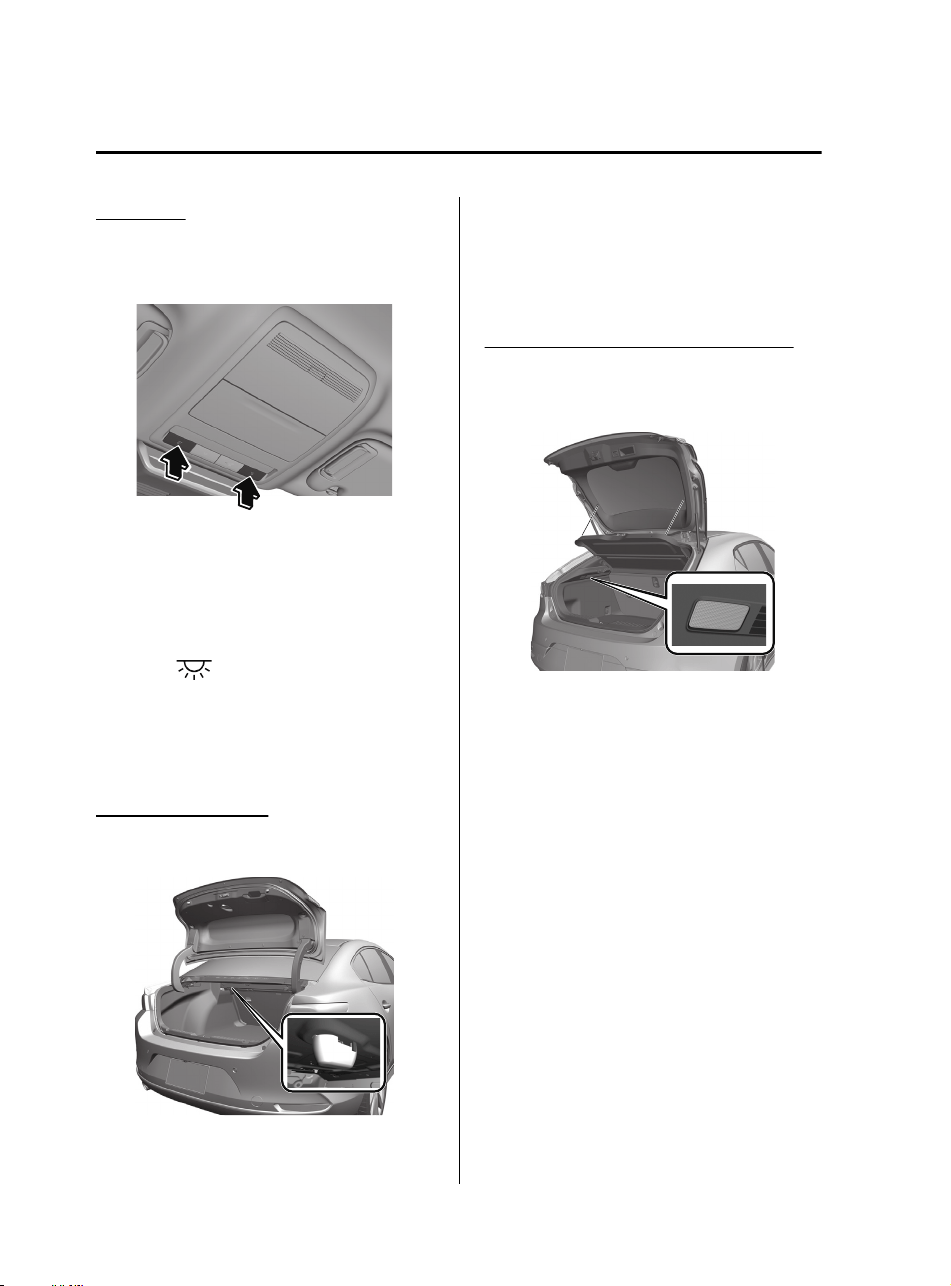
Map lights
Press the switch to illuminate the map
lights, and then press the switch again to
turn them off.
NOTE
The map lights will not turn off even if the
switch is pressed in the following cases:
The overhead lights turn on by
operating the overhead light ON/OFF
switch (
).
The overhead lights turn on in
conjunction with a door opening/
closing.
The illuminated entry system is on.
Trunk light (4–door)
The trunk light is on when the trunk is
open and off when it is closed.
NOTE
Do not leave the trunk open for long
periods while the engine is turned off.
Otherwise the battery power could be
depleted.
Luggage compartment light (5–door)
The luggage compartment light is on when
the liftgate is open and off when it is
closed.
NOTE
Do not leave the liftgate open for long
periods while the engine is turned off.
Otherwise the battery power could be
depleted.
▼
Illuminated Entry System
The overhead lights turn on when any of
the following operations is done with the
overhead light switch in the DOOR
position.
The driver's door is unlocked with the
ignition is switched OFF.
The ignition is switched OFF with all
doors closed.
Interior Features
Interior Equipment
5-36
Mazda3_8HZ1-EA-19G_Edition1_old 2019-5-17 13:49:03
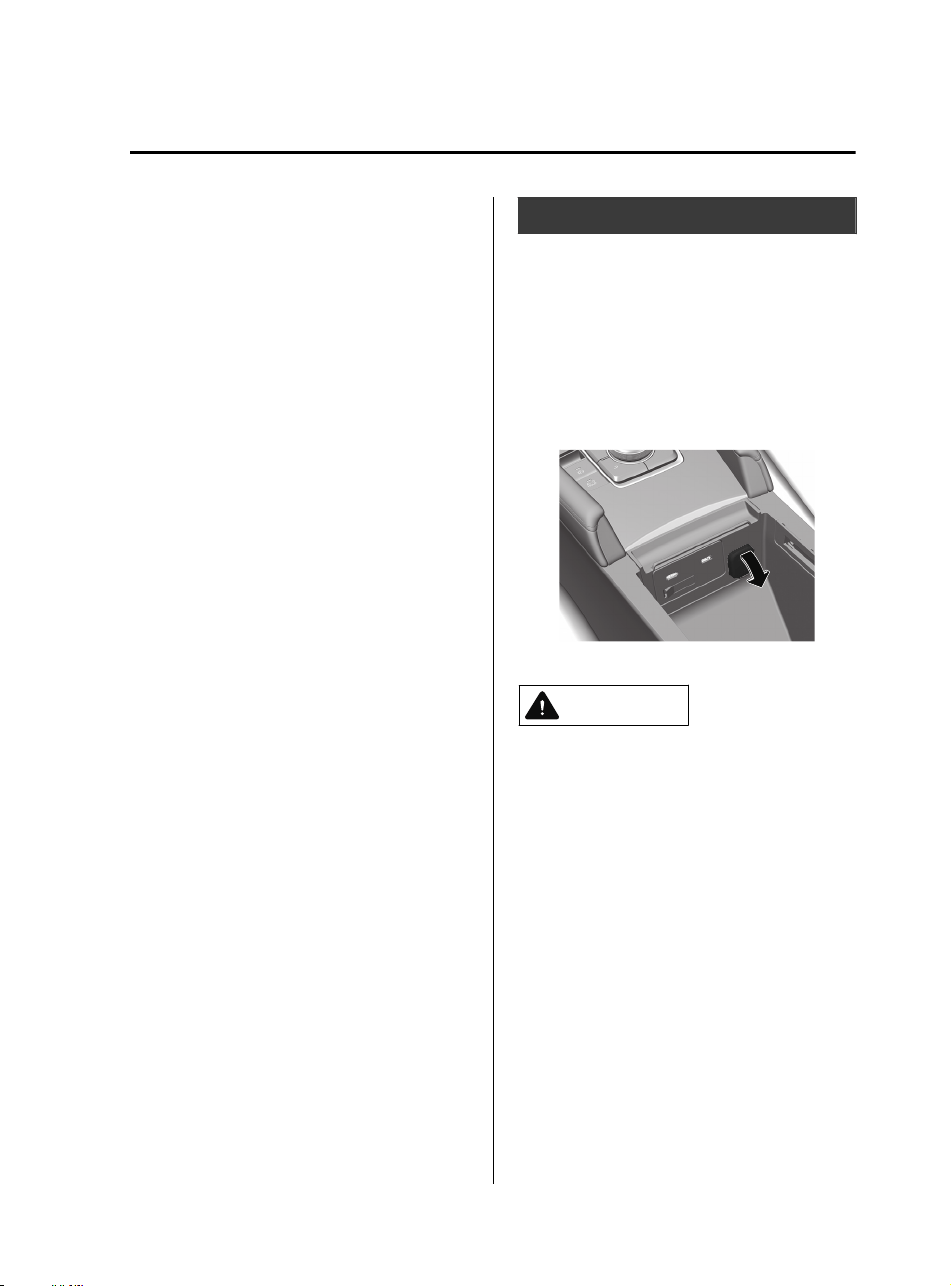
NOTE
The illumination time differs depending
on the operation.
The vehicle is equipped with a battery
saver. If an interior light is left on with
the ignition switched OFF, the light is
turned off automatically after about 15
minutes to prevent battery depletion.
The operation of the illuminated entry
system can be changed.
Refer to the Settings section in the
Mazda Connect Owner's Manual.
The illuminated entry system does not
operate in conjunction with the
overhead lights when the overhead
lights are turned on using the overhead
light ON/OFF switch.
Accessory Socket
▼
Accessory Socket
Only use genuine Mazda accessories or
the equivalent requiring no greater than
120 W (DC 12 V, 10 A).
The accessory socket can be used
regardless of whether the ignition is on or
off.
CAUTION
To prevent accessory socket damage or
electrical failure, pay attention to the
following:
Do not use accessories that require
more than 120 W (DC 12 V, 10 A).
Do not use accessories that are not
genuine Mazda accessories or the
equivalent.
Close the cover when the accessory
socket is not in use to prevent foreign
objects and liquids from getting into
the accessory socket.
Correctly insert the plug into the
accessory socket.
Do not insert the cigarette lighter into
the accessory socket.
Interior Features
Interior Equipment
5-37
Mazda3_8HZ1-EA-19G_Edition1_old 2019-5-17 13:49:03
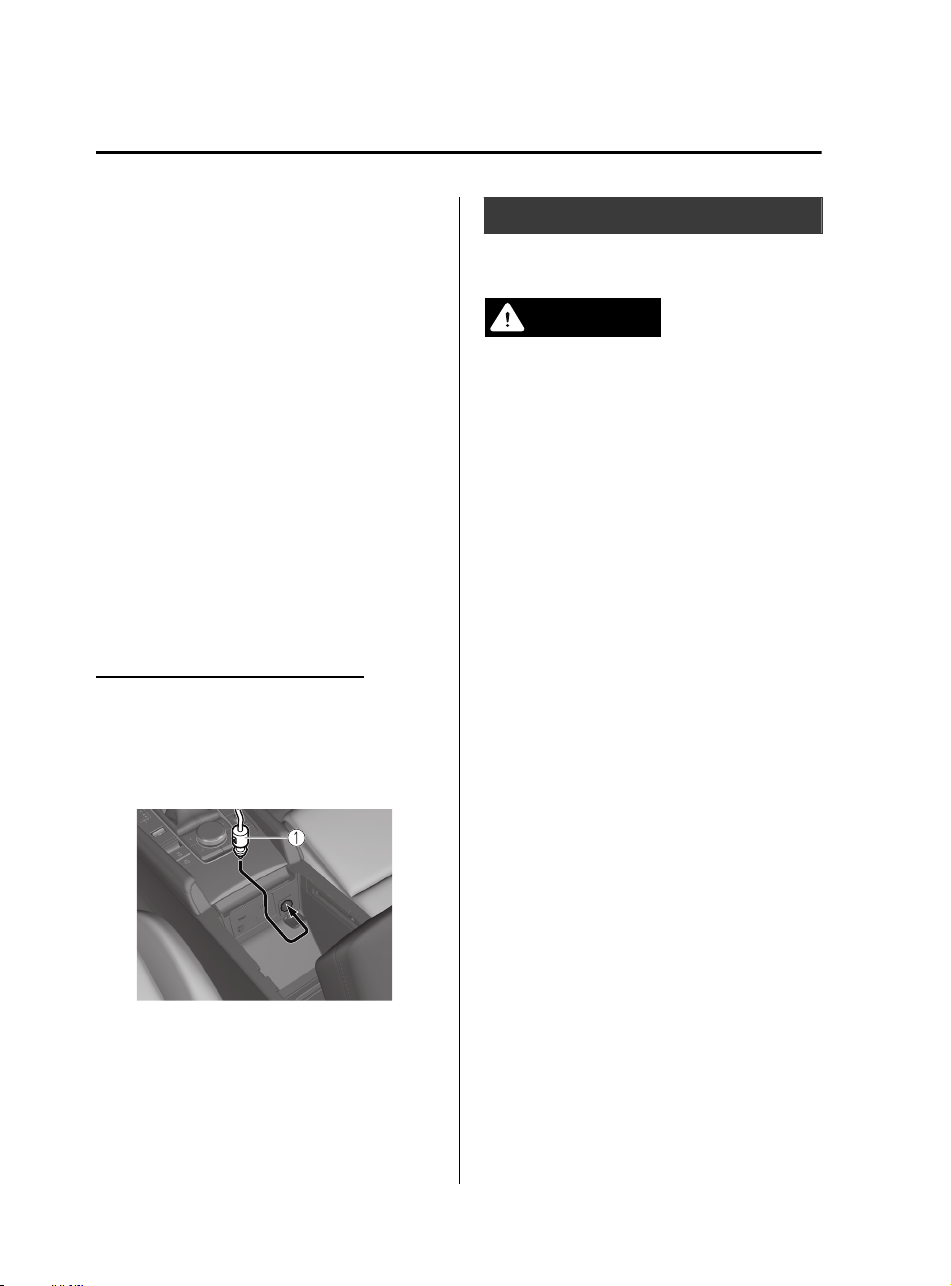
Noise may occur on the audio playback
depending on the device connected to
the accessory socket.
Depending on the device connected to
the accessory socket, the vehicle's
electrical system may be aected, which
could cause the warning light to
illuminate. Disconnect the connected
device and make sure that the problem is
resolved. If the problem is resolved,
disconnect the device from the socket
and switch the ignition o. If the problem
is not resolved, consult an Authorized
Mazda Dealer.
NOTE
To prevent discharging of the battery, do
not use the socket for long periods with the
engine off or idling.
Connecting the accessory socket
1. Open the lid.
2. Pass the connection plug cord through
the cutout of the console and insert the
plug into the accessory socket.
1. Plug
Cup Holder
▼
Cup Holder
WARNING
Never use a cup holder to hold hot liquids
while the vehicle is moving:
Using a cup holder to hold hot liquids while
the vehicle is moving is dangerous. If the
contents spill, you could be scalded.
Do not put anything other than cups or
drink cans in cup holders:
Putting objects other than cups or drink
cans in a cup holder is dangerous.
During sudden braking or maneuvering,
occupants could be hit and injured, or
objects could be thrown around the
vehicle, causing interference with the driver
and the possibility of an accident. Only use
a cup holder for cups or drink cans.
Interior Features
Interior Equipment
5-38
Mazda3_8HZ1-EA-19G_Edition1_old 2019-5-17 13:49:03
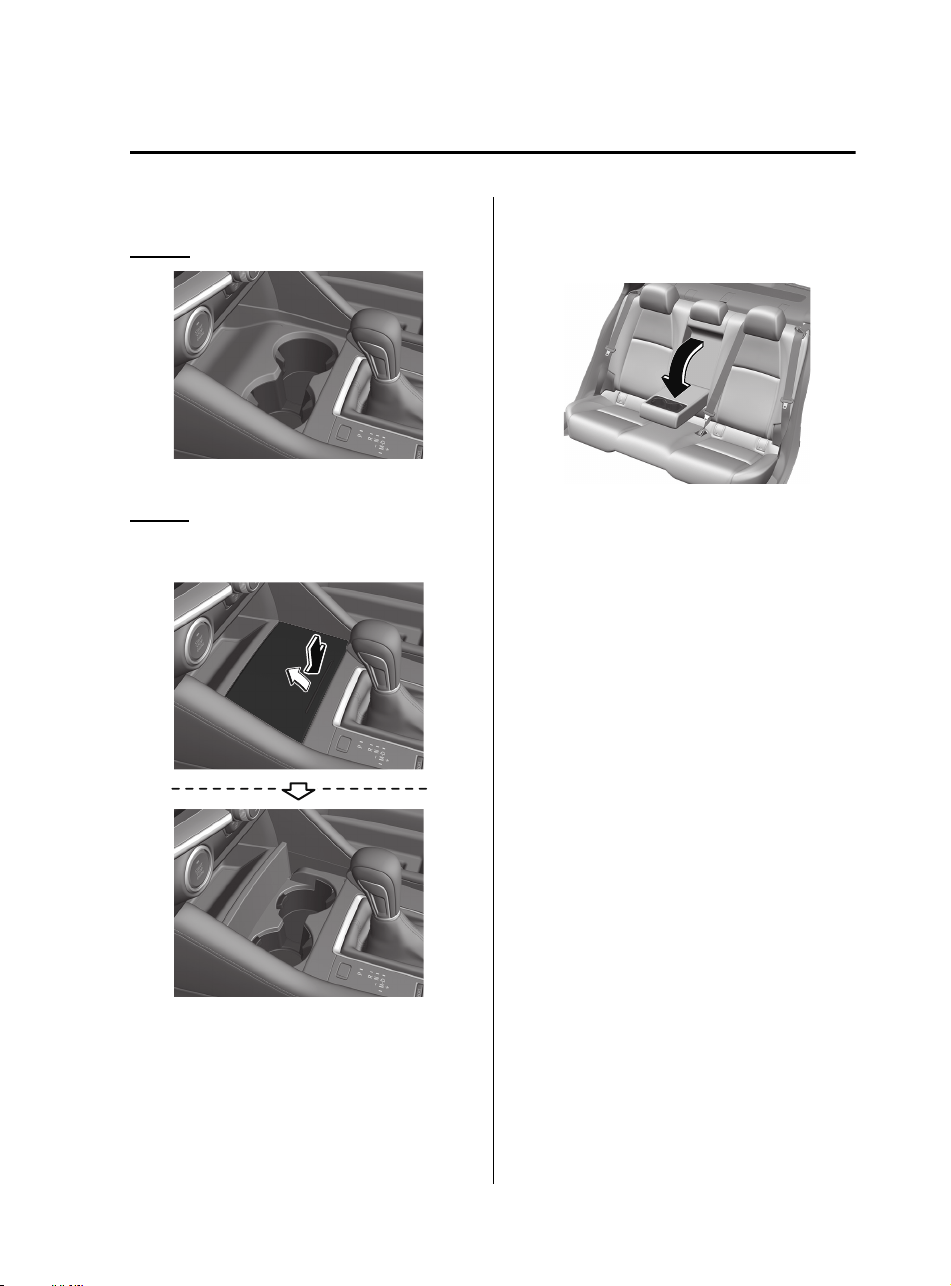
▼
Front
Type A
Type B
To use the cup holder, push the release
button.
▼
Rear
*
The rear cup holder is on the rear center
armrest.
Interior Features
Interior Equipment
*Some models.
5-39
Mazda3_8HZ1-EA-19G_Edition1_old 2019-5-17 13:49:03
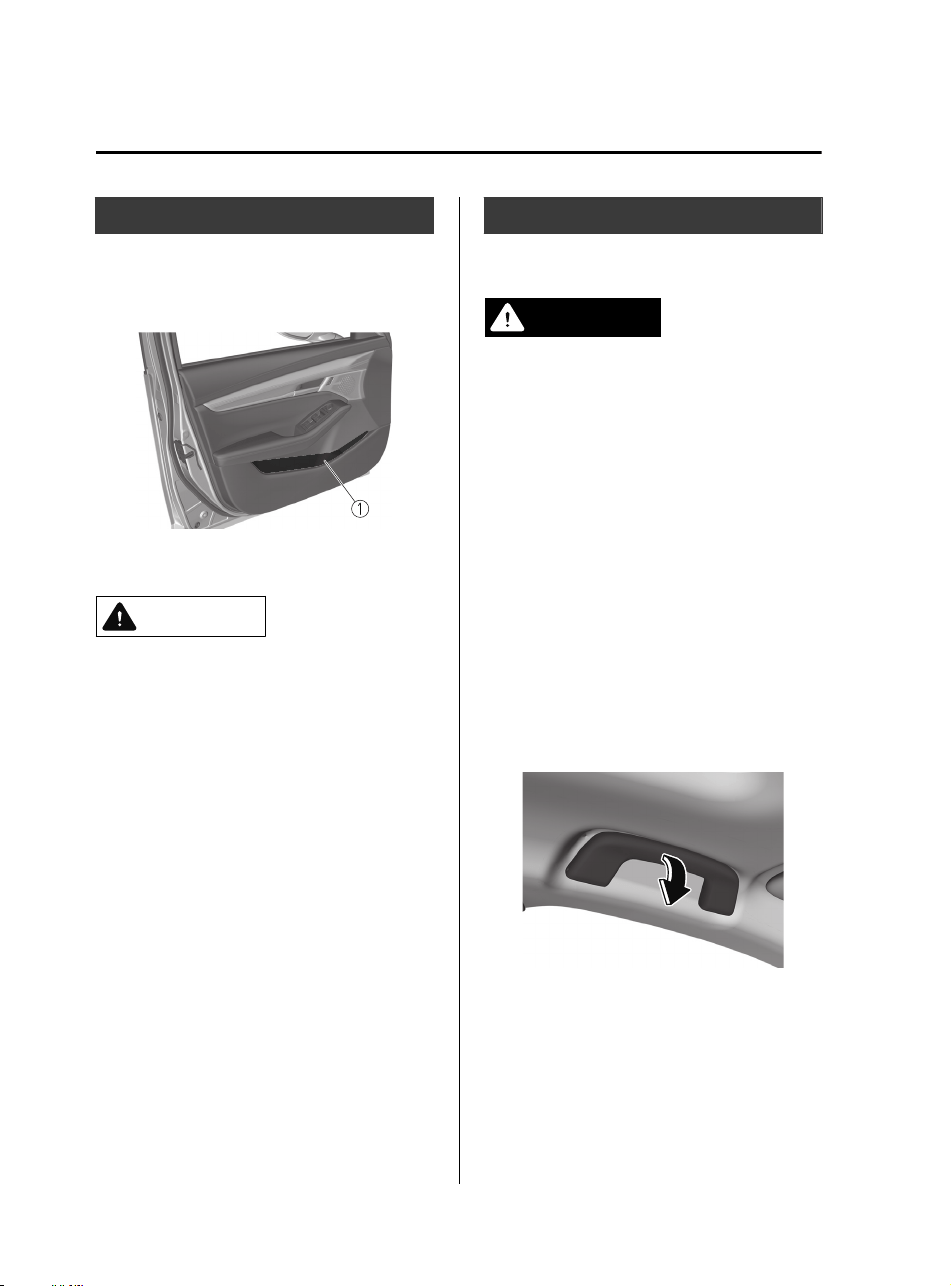
Bottle Holder
▼
Bottle Holder
Bottle holders are on the inside of the
doors.
1. Bottle holder
CAUTION
Do not use the bottle holders for containers
without caps. The contents may spill when
opening/closing the door or while driving
the vehicle.
Assist Grips
▼
Assist Grips
WARNING
Never hang heavy or sharp objects on the
assist grips and coat hooks:
Hanging heavy or sharp-ended objects
such as a coat hanger from the assist grips
or coat hooks is dangerous as they can
y
o and hit an occupant in the cabin if a
curtain air bag was to deploy, which could
result in serious injury or death.
Do not use the assist grips when getting in
and out of the vehicle or getting out of a
seat:
An assist grip could break under a heavy
load resulting in injury.
Use the assist grips to support your body
while seated in the vehicle and while the
vehicle is moving.
Interior Features
Interior Equipment
5-40
Mazda3_8HZ1-EA-19G_Edition1_old 2019-5-17 13:49:03
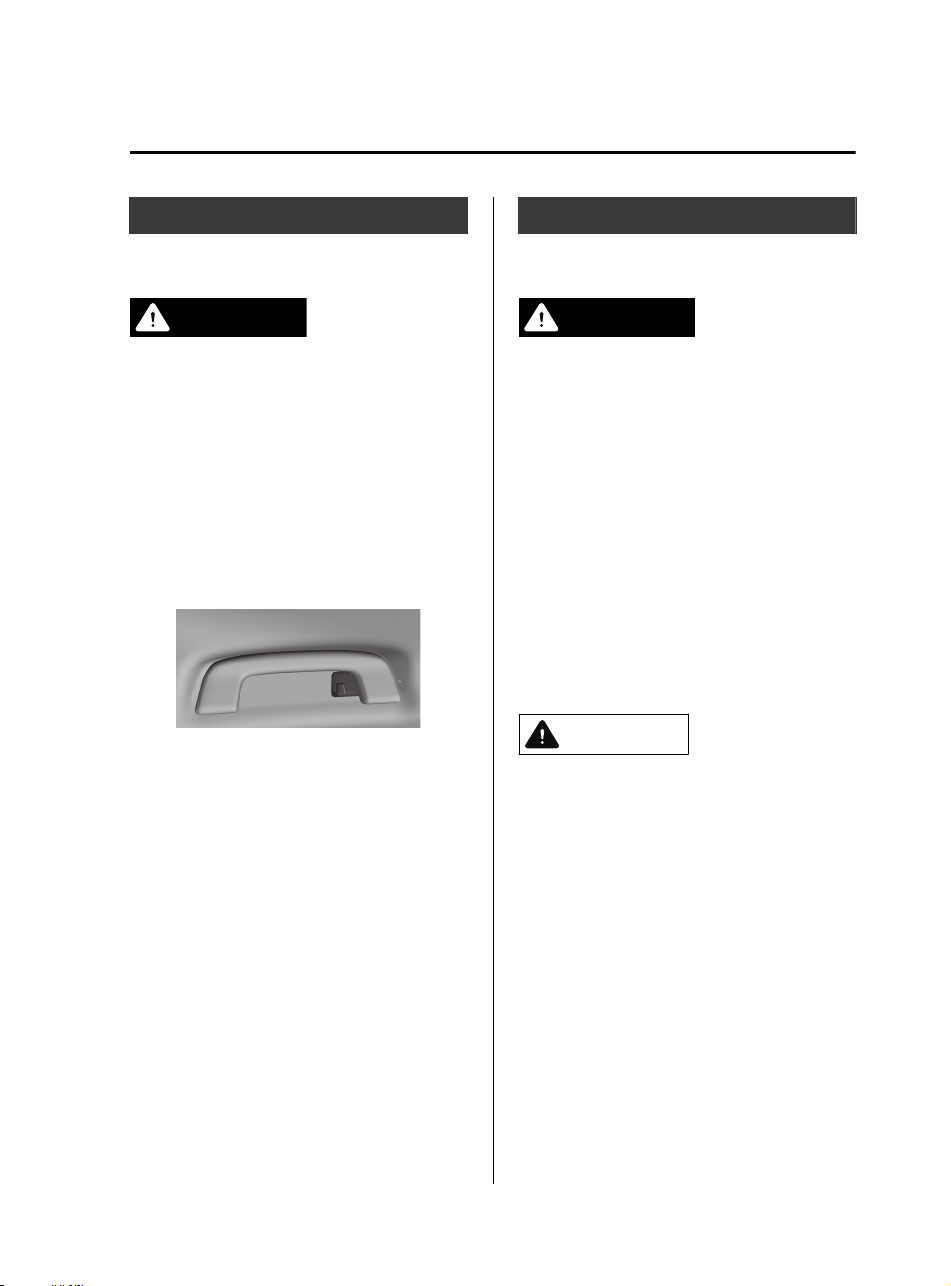
Rear Coat Hooks
▼
Rear Coat Hooks
WARNING
Never hang heavy or sharp objects on the
assist grips and coat hooks:
Hanging heavy or sharp-ended objects
such as a coat hanger from the assist grips
or coat hooks is dangerous as they can
y
o and hit an occupant in the cabin if a
curtain air bag was to deploy, which could
result in serious injury or death.
Always hang clothes on the coat hooks
and the assist grips without hangers.
Storage Compartments
▼
Storage Compartments
WARNING
Keep storage boxes closed when driving:
Driving with the storage boxes open is
dangerous. To reduce the possibility of
injury in an accident or a sudden stop, keep
the storage boxes closed when driving.
Do not put articles in storage spaces with
no lid:
Putting articles in storage spaces with no
lid is dangerous as they could be thrown
around the cabin during sudden braking,
maneuvering, or acceleration and cause an
accident depending on how the article is
stored.
CAUTION
Do not leave lighters or eyeglasses in the
storage boxes while parked under the sun.
A lighter could explode or the plastic
material in eyeglasses could deform and
crack from high temperature.
Interior Features
Interior Equipment
5-41
Mazda3_8HZ1-EA-19G_Edition1_old 2019-5-17 13:49:03
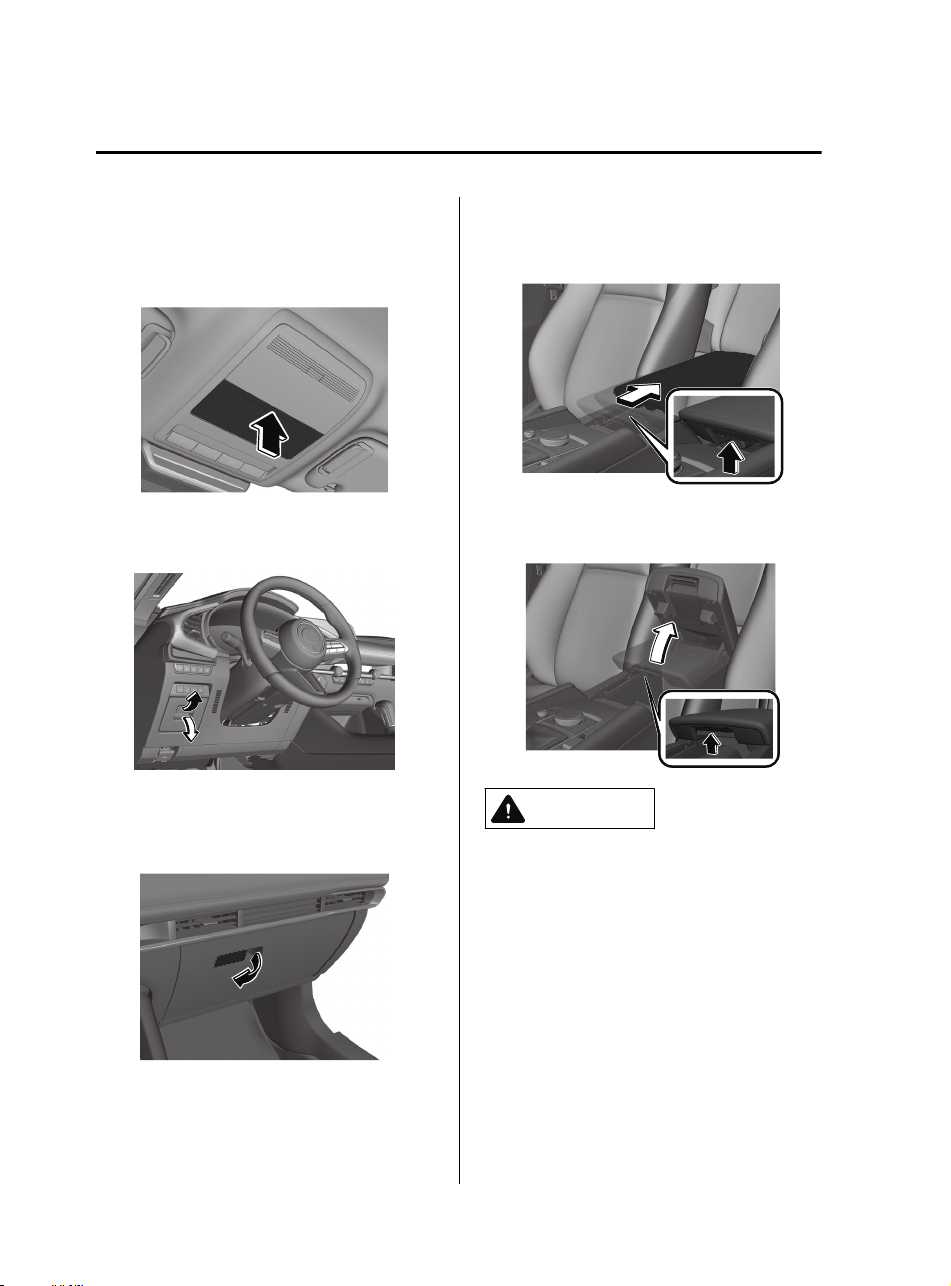
▼
Overhead Console
*
This console box is designed to store
eyeglasses or other accessories.
Push and release to open.
▼
Storage Pocket
To use, open the lid.
▼
Glove Compartment
To open the glove compartment, pull the
knob toward you.
To close the glove compartment, firmly
press in the center of the glove
compartment lid.
▼
Center Console
To slide the console lid, pull the knob and
slide it rearward.
To open the lid, pull the knob, slide the lid
rearward, and then lift up the lid.
CAUTION
Do not put your hands or ngers around
the moving parts of the lid when using the
lid. Otherwise, your hand or
nger
could
get caught, resulting in an injury.
Interior Features
Interior Equipment
5-42
*Some models.
Mazda3_8HZ1-EA-19G_Edition1_old 2019-5-17 13:49:03
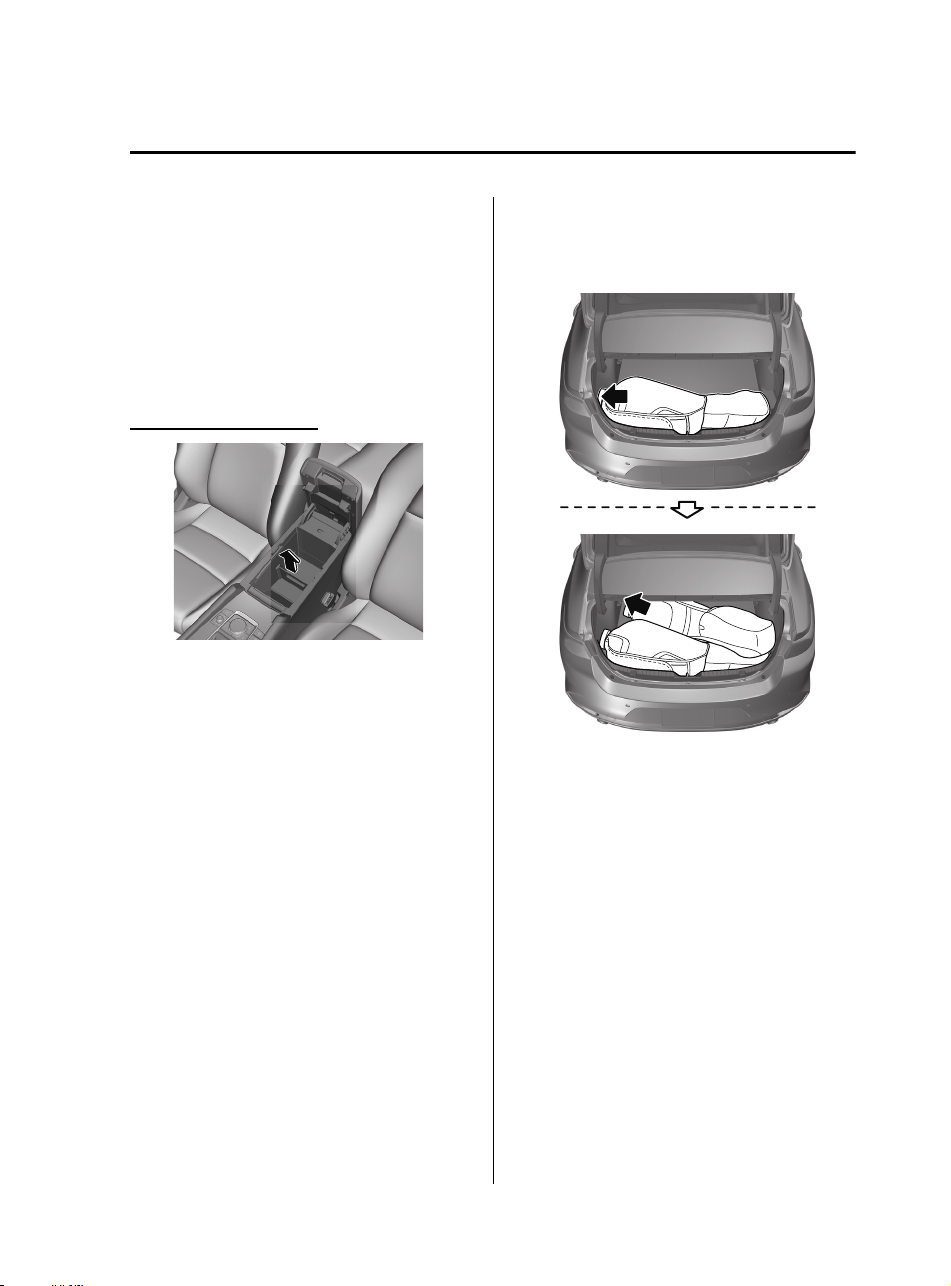
NOTE
The lid can be opened/closed while it is
slid to the 1st and 2nd stages, but if the
rear seatback is folded, the lid cannot be
opened/closed while it is slid to the 2nd
stage because the rear seat (head
restraint) will contact it.
Center console divider
Small items can be placed using the center
console divider.
▼
Luggage Compartment
NOTE
Loading golf bags (4–door)
(Some golf bags may not fit using the
following methods depending on their
sizes.)
Up to two golf bags can be carried in the
trunk.
First golf bag: Place the golf bag in the
luggage compartment with its bottom
pointed to the left and fit it into the front of
the compartment.
Second golf bag: Place the golf bag in the
luggage compartment with its bottom
pointed to the left and fit it into the back of
the compartment.
The arrows indicate the bottoms of the
golf bags.
Interior Features
Interior Equipment
5-43
Mazda3_8HZ1-EA-19G_Edition1_old 2019-5-17 13:49:03

MEMO
5-44
Mazda3_8HZ1-EA-19G_Edition1_old 2019-5-17 13:49:03
6
Maintenance and Care
How to keep your Mazda in top condition.
Essential Information........................6-2
Introduction.................................. 6-2
Scheduled Maintenance.................... 6-4
Scheduled Maintenance................6-4
Owner Maintenance........................ 6-11
Owner Maintenance
Precautions..................................6-11
Hood........................................... 6-12
Engine Compartment
Overview.................................... 6-14
Engine Oil...................................6-15
Engine Coolant........................... 6-17
Brake/Clutch Fluid..................... 6-19
Washer Fluid...............................6-19
Body Lubrication........................6-20
Wiper Blades.............................. 6-21
Battery........................................ 6-26
Key Battery Replacement...........6-28
Tires............................................ 6-31
Light Bulbs................................. 6-35
Fuses........................................... 6-38
Appearance Care.............................6-44
Exterior Care.............................. 6-44
Interior Care................................6-50
6-1
Mazda3_8HZ1-EA-19G_Edition1_old 2019-5-17 13:49:03
Introduction
▼
Introduction
Be careful not to hurt yourself when
inspecting your vehicle, replacing a tire, or
doing some kind of maintenance such as
car washing. In particular, wear thick work
gloves such as cotton gloves when
touching areas that are difficult to see
while inspecting or working on your
vehicle. Doing inspections or procedures
with your bare hands could cause injury.
If you are unsure about any procedure this
manual describes, we strongly urge you to
have a reliable and qualified service shop
perform the work, preferably an
Authorized Mazda Dealer.
Factory-trained Mazda technicians and
genuine Mazda parts are best for your
vehicle. Without this expertise and the
parts that have been designed and made
especially for your Mazda, inadequate,
incomplete, and insufficient servicing may
result in problems. This could lead to
vehicle damage or an accident and
injuries.
For expert advice and quality service,
consult an Authorized Mazda Dealer.
To continue warranty eligibility and to
protect your investment, it is your
responsibility to properly maintain your
vehicle according to factory recommended
schedules outlined in this manual. As part
of this you must keep your maintenance
records, receipts, repair orders and any
other documents as evidence this
maintenance was performed. You must
present these documents, should any
warranty coverage disagreement occur.
Failure to do so can result in your
warranty being voided either in whole or
in part.
This evidence may consist of the
following:
The Mazda Scheduled Maintenance
Record, refer to the Warranty Booklet,
must be completely filled out showing
mileage, repair order number, date for
each service, and signed by a qualified
automotive service technician who
service vehicles.
Original copies of repair orders or other
receipts that include the mileage and
date the vehicle was serviced. Each
receipt should be signed by a qualified
automotive service technician.
For self maintenance, a statement that
you completed the maintenance
yourself, displaying mileage and the
date the work was performed. Also,
receipts for the replacement parts (fluid,
filters, etc.) indicating the date and
mileage must accompany this statement.
Maintenance and Care
Essential Information
6-2
Mazda3_8HZ1-EA-19G_Edition1_old 2019-5-17 13:49:03
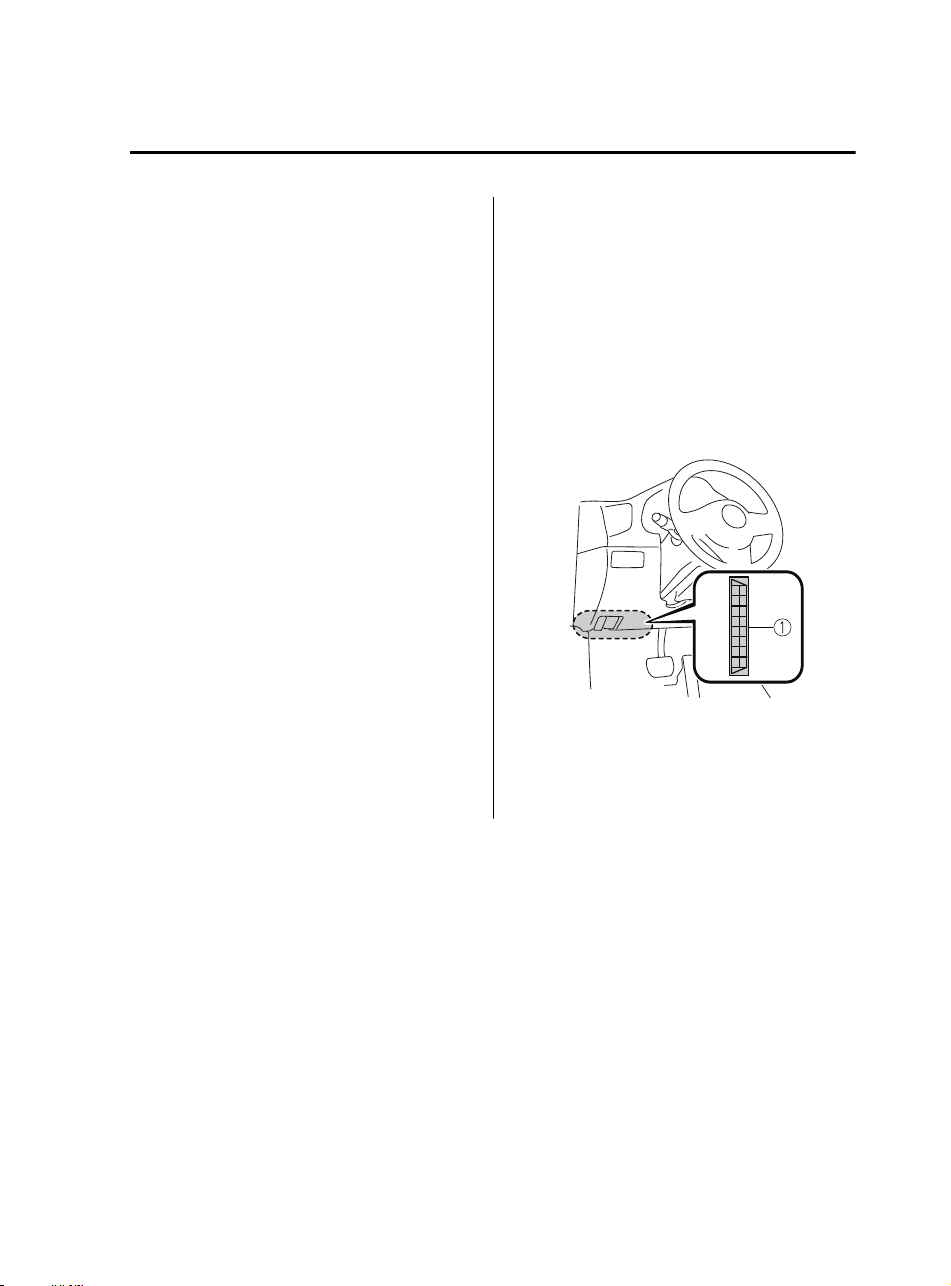
NOTE
If you elect to perform maintenance
yourself or have your vehicle serviced at a
location other than an Authorized Mazda
Dealer, Mazda requires that all fluids,
parts and materials must meet Mazda
standards for durability and performance
as described in this manual.
Claims against the warranty resulting from
lack of maintenance, as opposed to
defective materials or authorized Mazda
workmanship, will not be honored.
Any auto repair shop using parts
equivalent to your Mazda's original
equipment may perform maintenance. But
we recommend that it always be done
by an Authorized Mazda Dealer using
genuine Mazda parts.
Selecting “Vehicle Status Monitor”
enables the system to notify you of your
vehicle's approaching inspection/servicing
period. Refer to the Information section in
the Mazda Connect Owner's Manual.
The malfunction diagnosis connector is
designed exclusively for connecting the
specially designed device to perform
on-board diagnosis.
Do not connect any devices other than the
specially designed malfunction diagnosis
devices for servicing. If any device other
than the malfunction diagnosis device is
connected, it may affect the vehicle's
electrical devices or lead to damage such
as battery depletion.
1. Malfunction diagnosis connector
Maintenance and Care
Essential Information
6-3
Mazda3_8HZ1-EA-19G_Edition1_old 2019-5-17 13:49:03
Scheduled Maintenance
▼
Scheduled Maintenance (U.S.A. and Puerto Rico)
Vehicles utilizing the vehicle status monitor feature:
The vehicle status monitor feature alerts you of maintenance needs by turning on the wrench
indicator light or displaying a message in the instrument panel, or both.
Every maintenance must be done when the display/wrench indication comes on. The dis‐
play/wrench indication will come on before reaching the maximum interval of 16,000 km
(10,000 miles), or 12 months (after the previous maintenance).
If you drive your vehicle under any of the following conditions, follow the Severe Driving
Scheduled Maintenance and replace the engine oil and filter every 8,000 km (5,000 miles)
or 6 months, whichever comes first.
Otherwise, follow the Normal Driving Scheduled Maintenance intervals.
1. The vehicle is idled for long periods or driven at low speeds, such as with police cars,
taxis, or driver's education school car.
2. Driving under dusty conditions.
3. Driving for long periods in cold temperatures or driving regularly for short distances on‐
ly.
4. Driving under extremely high temperature conditions.
5. Driving continuously in mountainous regions.
If you are following the Severe Driving Scheduled Maintenance (8,000 km (5,000 miles) or
6 months oil replacement interval), set the vehicle status monitor manually.
Refer to the Information section in the Mazda Connect Owner's Manual. Please contact an
Authorized Mazda Dealer if necessary.
USA and Puerto Rico Residents (Normal Driving Scheduled Maintenance):
Maintenance Item
Normal Driving Scheduled Maintenance Intervals
1st 2nd 3rd 4th 5th 6th 7th 8th
Engine oil & filter
*1
RRRRRRRR
Spark plug Replace every 120,000 km (75,000 miles).
Air filter R R
Drive belts IIIIIIII
Engine coolant level IIIIIIII
Engine coolant
*2
Replace at first 192,000 km (120,000 miles) or 120 months;
after that, every 96,000 km (60,000 miles) or 60 months.
Fuel lines & hoses
*3
IIII
Hoses and tubes for emission
*3
II
Brake lines, hoses and connections I I I I
Vacuum brake booster and hose
With vacuum
booster
IIII
Maintenance and Care
Scheduled Maintenance
6-4
Mazda3_8HZ1-EA-19G_Edition1_old 2019-5-17 13:49:03
Maintenance Item
Normal Driving Scheduled Maintenance Intervals
1st 2nd 3rd 4th 5th 6th 7th 8th
Brake and clutch fluid level IIIIIIII
Brake fluid
With electrical
booster
RRRR
Disc brakes IIIIIIII
Tire rotation Rotate every 16,000 km (10,000 miles).
Tire inflation pressure and tire wear
*4
IIIIIIII
Steering operation and linkages I I I I
Front and rear suspension, ball joints and wheel
bearing axial play
IIII
Rear differential oil
*5
Transfer oil
*5
Driveshaft dust boot I I I I
Bolts and nuts on chassis and body T T T T
Exhaust system and heat shields I I
Emergency flat tire repair kit (if installed)
*6
Inspect annually.
Cabin air filter Replace every 48,000 km (30,000 miles) or 24 months.
Function of all lights IIIIIIII
Chart symbols:
I: Inspect: Inspect and clean, repair, adjust, fill up, or replace if necessary.
R: Replace
T: Tighten
Remarks:
*
1 Reset the engine oil data whenever replacing the engine oil regardless of the message/wrench indicator light
display.
*
2 Use of FL-22 is recommended when replacing engine coolant. Using engine coolant other than FL-22 may
cause serious damage to the engine and cooling system.
*
3 According to state/provincial and federal regulations, failure to perform maintenance on these items will not
void your emissions warranties. However, Mazda recommends that all maintenance services be performed at
the recommended time or mileage/kilometer period to ensure long-term reliability.
*
4 Inspect a spare tire if installed.
*
5 If this component has been submerged in water, the oil should be replaced.
*
6 Check the tire repair fluid expiration date every year when performing the periodic maintenance. Replace the
tire repair fluid bottle with new one before the expiration date.
Maintenance and Care
Scheduled Maintenance
6-5
Mazda3_8HZ1-EA-19G_Edition1_old 2019-5-17 13:49:03
USA and Puerto Rico Residents (Severe Driving Scheduled Maintenance):
Number of months or kilometers (miles), whichever comes first.
Months 6 12182430364248
× 1000 km 8 16243240485664
× 1000 miles 5 10 15 20 25 30 35 40
Engine oil & filter
*1
RRRRRRRR
Maintenance Interval (other than engine oil &
filter replacement)
*2
1st 2nd 3rd 4th
Chart symbols:
R: Replace
Remarks:
*
1 Reset the engine oil data whenever replacing the engine oil regardless of the message/wrench indicator light
display.
*
2 Follow Maintenance Interval listed in Normal Driving Scheduled Maintenance.
▼
Scheduled Maintenance (Canada)
Vehicles utilizing the vehicle status monitor feature:
The vehicle status monitor feature alerts you of engine oil replacement by turning on the
wrench indicator light or displaying a message in the instrument panel, or both.
Every engine oil replacement must be done when the display/wrench indication comes on.
The display/wrench indication will come on before reaching the maximum interval of
16,000 km (10,000 miles), or 12 months (after the previous maintenance).
If you are following 8,000 km (5,000 miles) or 6 months maintenance interval, set the vehi‐
cle status monitor manually.
Refer to the owner's manual section of mazda.ca for the Mazda Connect owner's manual or
contact an Authorized Mazda Dealer if necessary.
Canada residents
Maintenance Interval
Number of months or kilometers (miles), whichever comes first.
Months 6 1218243036424854606672
×1000 km8 1624324048566472808896
×1000
miles
5 1015202530354045505560
Engine oil & filter
*1*2
Replace when the wrench indicator light is ON.
(Upper limit interval is 16,000 km (10,000 miles) or 12 months.)
Spark plug Replace every 120,000 km (75,000 miles).
Air filter Replace every 56,000 km (35,000 miles) or 36 months.
Drive belts
*3
II
Engine coolant level IIIIIIIIIIII
Maintenance and Care
Scheduled Maintenance
6-6
Mazda3_8HZ1-EA-19G_Edition1_old 2019-5-17 13:49:03
Maintenance Interval
Number of months or kilometers (miles), whichever comes first.
Months 6 1218243036424854606672
×1000 km8 1624324048566472808896
×1000
miles
5 1015202530354045505560
Engine coolant
*4
Replace at first 192,000 km (120,000 miles) or 120 months; after that,
every 96,000 km (60,000 miles) or 60 months.
Fuel lines & hoses
*5
III
Hoses and tubes for emission
*5
I
Brake lines, hoses and connections I I I
Vacuum brake booster
and hose
With vac‐
uum boos‐
ter
IIIIII
Brake fluid
With elec‐
trical boos‐
ter
RRR
Disc brakes I C/L I
I/C/
L
IC/LI
I/C/
L
Tire rotation Rotate every 8,000 km (5,000 miles).
Tire inflation pressure and tire wear
*6
IIIIIIIIIIII
Steering operation and linkages I I I
Front and rear suspension, ball joints
and wheel bearing axial play
III
Rear differential oil
*7
Transfer oil
*7
Body condition inspection for rust,
corrosion and perforation
IIIIII
Driveshaft dust boot I I I
Bolts and nuts on chassis and body T T T
Exhaust system and heat shields I
Emergency flat tire repair kit (if in‐
stalled)
*8
Inspect annually.
Cabin air filter Replace every 40,000 km (25,000 miles) or 24 months.
Chart symbols:
I: Inspect: Inspect and clean, repair, adjust, fill up, or replace if necessary.
R: Replace
C: Clean
L: Lubricate
T: Tighten
Maintenance and Care
Scheduled Maintenance
6-7
Mazda3_8HZ1-EA-19G_Edition1_old 2019-5-17 13:49:03

Remarks:
*
1 Reset the engine oil data whenever replacing the engine oil regardless of the message/wrench indicator light
display.
*
2 If you drive your vehicle under any of the following conditions, replace the engine oil & filter every 8,000 km
(5,000 miles) or 6 months, whichever comes first.
1. The vehicle is idled for long periods or driven at low speeds, such as with police cars, taxis, or driver's
education school vehicles.
2. Driving under dusty conditions.
3. Driving for long periods in cold temperatures or driving regularly for short distances only.
4. Driving under extremely high temperature conditions.
5. Driving continuously in mountainous regions.
*
3 Also inspect the air conditioner drive belts, if installed.
If the vehicle is operated primarily under any of the following conditions, inspect the drive belts more often
than the recommended intervals.
a) Driving under dusty conditions.
b) The vehicle is idled for long periods or driven at low speeds.
c) Driving for long periods in cold temperatures or driving regularly for short distances only.
d) Driving under extremely high temperature conditions.
e) Driving continuously in mountainous regions.
f) Driving for long period in extremely wet or heavy rain condition.
*
4 Use of FL-22 is recommended when replacing engine coolant. Using engine coolant other than FL-22 may
cause serious damage to the engine and cooling system.
*
5 According to state/provincial and federal regulations, failure to perform maintenance on these items will not
void your emissions warranties. However, Mazda recommends that all maintenance services be performed at
the recommended time or mileage/kilometer period to ensure long-term reliability.
*
6 Inspect a spare tire if installed.
*
7 If this component has been submerged in water, the oil should be replaced.
*
8 Check the tire repair fluid expiration date every year when performing the periodic maintenance. Replace the
tire repair fluid bottle with a new one before the expiration date.
▼
Scheduled Maintenance (Mexico)
Vehicles utilizing the vehicle status monitor feature:
The vehicle status monitor feature alerts you of maintenance needs by turning on the wrench
indicator light or displaying a message in the instrument panel, or both.
Every maintenance must be done when the display/wrench indication comes on. The dis‐
play/wrench indication will come on before reaching the maximum interval of 10,000 km,
or 6 months (after the previous maintenance).
If you drive your vehicle under any of the following conditions, follow the Severe Driving
Scheduled Maintenance and replace the engine oil and filter every 5,000 km or 3 months,
whichever comes first.
Otherwise, follow the Normal Driving Scheduled Maintenance intervals.
1. The vehicle is idled for long periods or driven at low speeds, such as with police cars,
taxis, or driver's education school car.
2. Driving under dusty conditions.
3. Driving for long periods in cold temperatures or driving regularly for short distances on‐
ly.
Maintenance and Care
Scheduled Maintenance
6-8
Mazda3_8HZ1-EA-19G_Edition1_old 2019-5-17 13:49:03
4. Driving under extremely high temperature conditions.
5. Driving continuously in mountainous regions.
If you are following the Severe Driving Scheduled Maintenance (5,000 km or 3 months oil
replacement interval), set the vehicle status monitor manually.
Refer to the Information section in the Mazda Connect Owner's Manual. Please contact an
Authorized Mazda Dealer if necessary.
Mexico Residents (Normal Driving Scheduled Maintenance):
Maintenance Item
Normal Driving Scheduled Maintenance Intervals
1st 2nd 3rd 4th 5th 6th 7th 8th
Engine oil & filter
*1
RRRRRRRR
Spark plug
IIIIIIII
Replace every 120,000 km.
Air filter RRRR
Drive belts IIIIIIII
Engine coolant level IIIIIIII
Engine coolant
*2
Replace at first 192,000 km or 120 months; after that, every
96,000 km or 60 months.
Fuel lines & hoses
*3
II
Hoses and tubes for emission
*3
II
Fuel filter Replace every 60,000 km.
Brake lines, hoses and connections I I I I
Vacuum brake booster and hose
With vacuum
booster
IIII
Brake and clutch fluid level I I I I I I
Brake fluid R R
Disc brakes IIIIIIII
Tire rotation Rotate every 10,000 km.
Tire inflation pressure and tire wear
*4
IIIIIIII
Steering operation and linkages IIIIIIII
Front and rear suspension, ball joints and wheel
bearing axial play
IIII
Driveshaft dust boot I I I I
Bolts and nuts on chassis and body T T T T
Exhaust system and heat shields I I I I
Emergency flat tire repair kit (if installed)
*5
Inspect annually.
Cabin air filter Replace every 40,000 km or 24 months.
Function of all lights IIIIIIII
Maintenance and Care
Scheduled Maintenance
6-9
Mazda3_8HZ1-EA-19G_Edition1_old 2019-5-17 13:49:03
Chart symbols:
I: Inspect: Inspect and clean, repair, adjust, fill up, or replace if necessary.
R: Replace
T: Tighten
Remarks:
*
1 Reset the engine oil data whenever replacing the engine oil regardless of the message/wrench indicator light
display.
*
2 Use of FL-22 is recommended when replacing engine coolant. Using engine coolant other than FL-22 may
cause serious damage to the engine and cooling system.
*
3 According to state/provincial and federal regulations, failure to perform maintenance on these items will not
void your emissions warranties. However, Mazda recommends that all maintenance services be performed at
the recommended time or mileage/kilometer period to ensure long-term reliability.
*
4 Inspect a spare tire if installed.
*
5 Check the tire repair fluid expiration date every year when performing the periodic maintenance. Replace the
tire repair fluid bottle with new one before the expiration date.
Mexico Residents (Severe Driving Scheduled Maintenance):
Number of months or kilometers , whichever comes first.
Months 3 6 9 1215182124
× 1000 km 5 10 15 20 25 30 35 40
Engine oil & filter
*1
RRRRRRRR
Maintenance Interval (other than engine
oil & filter replacement)
*2
1st 2nd 3rd 4th
Chart symbols:
R: Replace
Remarks:
*
1 Reset the engine oil data whenever replacing the engine oil regardless of the message/wrench indicator light
display.
*
2 Follow Maintenance Interval listed in Normal Driving Scheduled Maintenance.
Maintenance and Care
Scheduled Maintenance
6-10
Mazda3_8HZ1-EA-19G_Edition1_old 2019-5-17 13:49:03
Owner Maintenance
Precautions
▼
Owner Maintenance Precautions
The owner or a qualified service
technician should make these vehicle
inspections at the indicated intervals to
ensure safe and dependable operation.
Bring any problem to the attention of an
Authorized Mazda Dealer or qualified
service technician as soon as possible.
When Refueling
Brake and clutch fluid level (page
6-19)
Engine coolant level (page 6-17)
Engine oil level (page 6-16)
Washer fluid level (page 6-19)
At Least Monthly
Tire inflation pressures (page 6-31)
At Least Twice a Year (For Example,
Every Spring and Fall)
You can do the following scheduled
maintenance items if you have some
mechanical ability and a few basic tools
and if you closely follow the directions in
this manual.
Engine coolant (page 6-17)
Engine oil (page 6-16)
Improper or incomplete service may result
in problems. This section gives
instructions only for items that are easy to
perform.
As explained in the Introduction (page
6-2), several procedures can be done only
by a qualified service technician with
special tools.
Improper owner maintenance during the
warranty period may affect warranty
coverage. Refer to Introduction (page 6-2)
for owner's responsibility in protecting
your investment. For details, read the
separate Mazda Warranty statement
provided with the vehicle. If you are
unsure about any servicing or maintenance
procedure, have it done by an Authorized
Mazda Dealer.
There are strict environmental laws
regarding the disposal of waste oil and
fluids. Please dispose of your waste
properly and with due regard to the
environment.
We recommend that you entrust the oil and
fluid changes of your vehicle to an
Authorized Mazda Dealer.
WARNING
Do not perform maintenance work if you
lack sucient knowledge and experience
or the proper tools and equipment to do
the work. Have maintenance work done by
a qualied technician:
Performing maintenance work on a vehicle
is dangerous if not done properly. You can
be seriously injured while performing some
maintenance procedures.
Maintenance and Care
Owner Maintenance
6-11
Mazda3_8HZ1-EA-19G_Edition1_old 2019-5-17 13:49:03
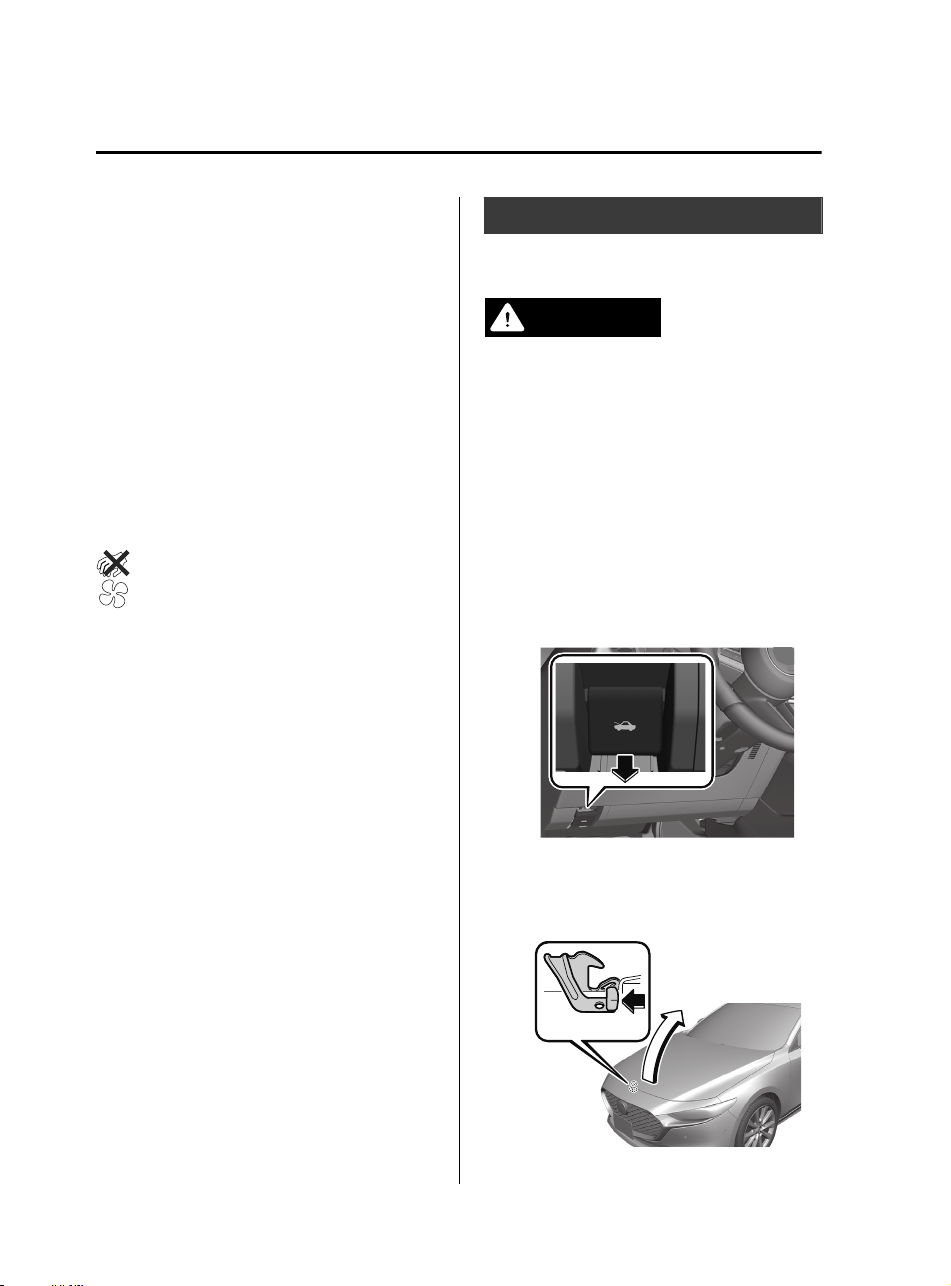
If you must run the engine while working
under the hood, make certain that you
remove all jewelry (especially rings,
bracelets, watches, and necklaces) and all
neckties, scarves, and similar loose clothing
before getting near the engine or cooling
fan which may turn on unexpectedly:
Working under the hood with the engine
running is dangerous. It becomes even
more dangerous when you wear jewelry,
loose clothing or have long hair or a long
beard.
Either can become entangled in moving
parts and result in injury.
Pull over to a safe location, then switch
the ignition
o
and make sure the fan is
not running before attempting to work
near the cooling fan:
Working near the cooling fan when it is
running is dangerous. The fan could
continue running indenitely even if the
engine has stopped and the engine
compartment temperature is high. You
could be hit by the fan and seriously
injured.
Do not leave items in the engine
compartment:
After you have nished checking or doing
servicing in the engine compartment, do
not forget and leave items such as tools or
rags in the engine compartment.
Tools or other items left in the engine
compartment could cause engine damage
or a re leading to an unexpected accident.
Hood
▼
Hood
WARNING
Always check that the hood is closed and
securely locked:
A hood that is not closed and securely
locked is dangerous as it could y open
while the vehicle is moving and block the
driver's vision which could result in a
serious accident.
▼
Opening the Hood
1. With the vehicle parked, pull the
release handle to unlock the hood.
2. Insert your hand into the hood
opening, slide the latch lever to the
left, and lift up the hood.
Maintenance and Care
Owner Maintenance
6-12
Mazda3_8HZ1-EA-19G_Edition1_old 2019-5-17 13:49:03
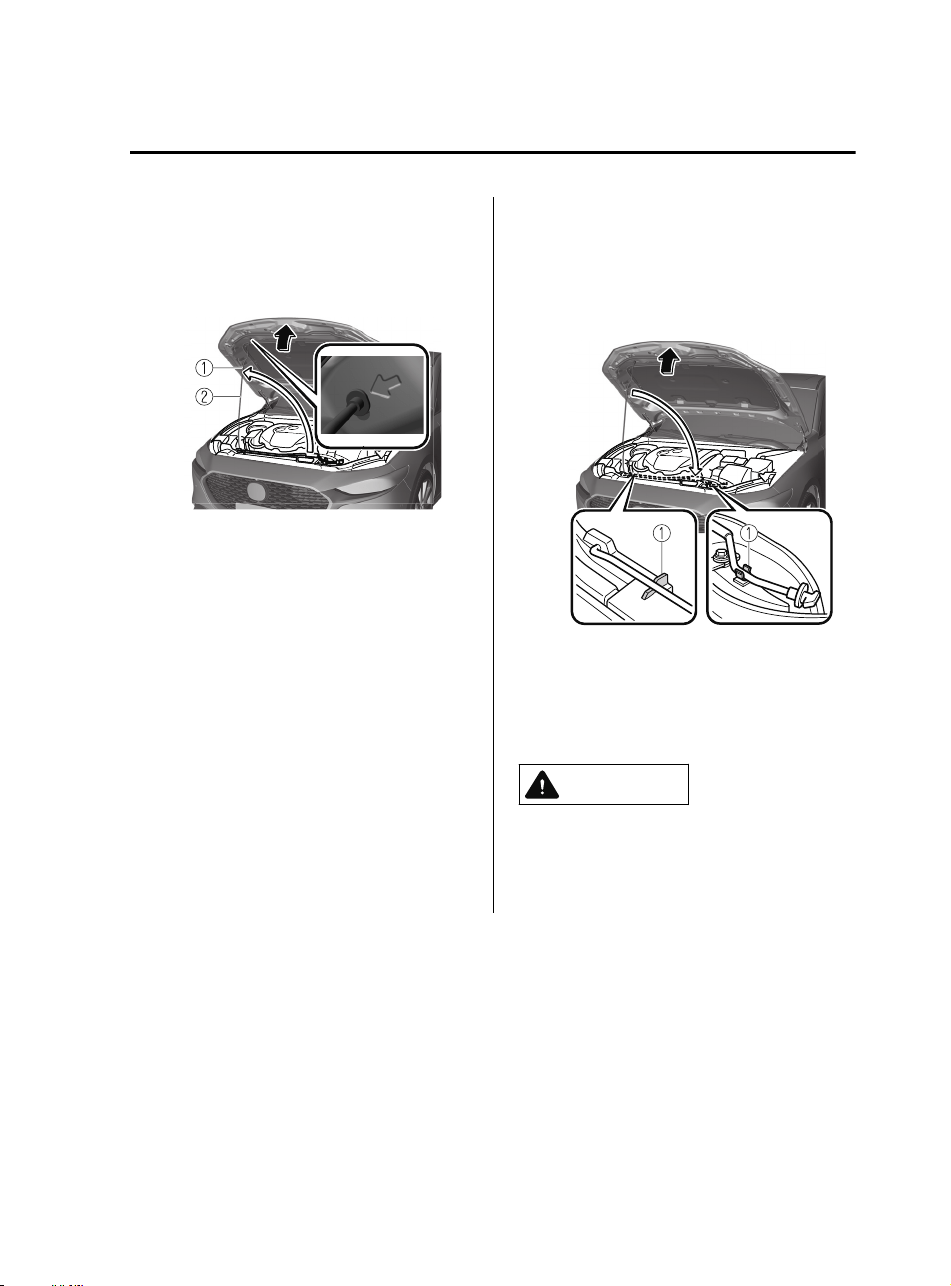
3. Grasp the support rod in the padded
area and secure it in the support rod
hole indicated by the arrow to hold the
hood open.
1. Pad
2. Support rod
▼
Closing the Hood
1. Check under the hood area to make
certain all filler caps are in place and
all loose items (e.g. tools, oil
containers, etc.) have been removed.
2. Lift the hood, grasp the padded area on
the support rod, and secure the support
rod in the clip. Verify that the support
rod is secured in the clip before closing
the hood.
1. Clip
3. Lower the hood slowly to a height of
about 20 cm (7.9 in) above its closed
position and then let it drop.
CAUTION
When closing the hood, do not push it
excessively such as by applying your
weight. Otherwise, the hood could be
deformed.
Maintenance and Care
Owner Maintenance
6-13
Mazda3_8HZ1-EA-19G_Edition1_old 2019-5-17 13:49:03
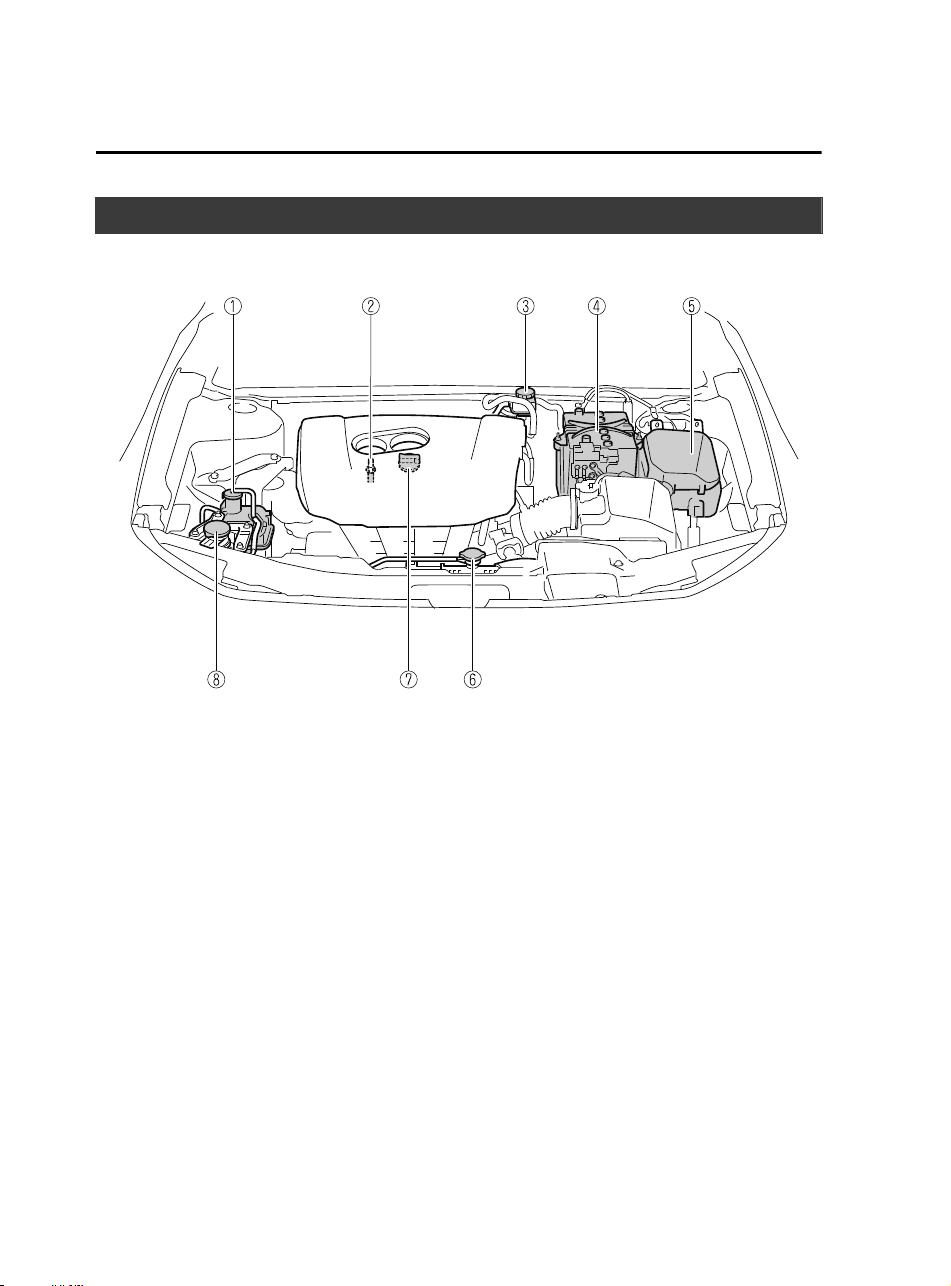
Engine Compartment Overview
▼
Engine Compartment Overview
1. Engine coolant reservoir
2. Engine oil dipstick
3. Brake/Clutch fluid reservoir
4. Battery
5. Fuse block
6. Cooling system cap
7. Engine oil-filler cap
8. Windshield washer fluid reservoir
Maintenance and Care
Owner Maintenance
6-14
Mazda3_8HZ1-EA-19G_Edition1_old 2019-5-17 13:49:03
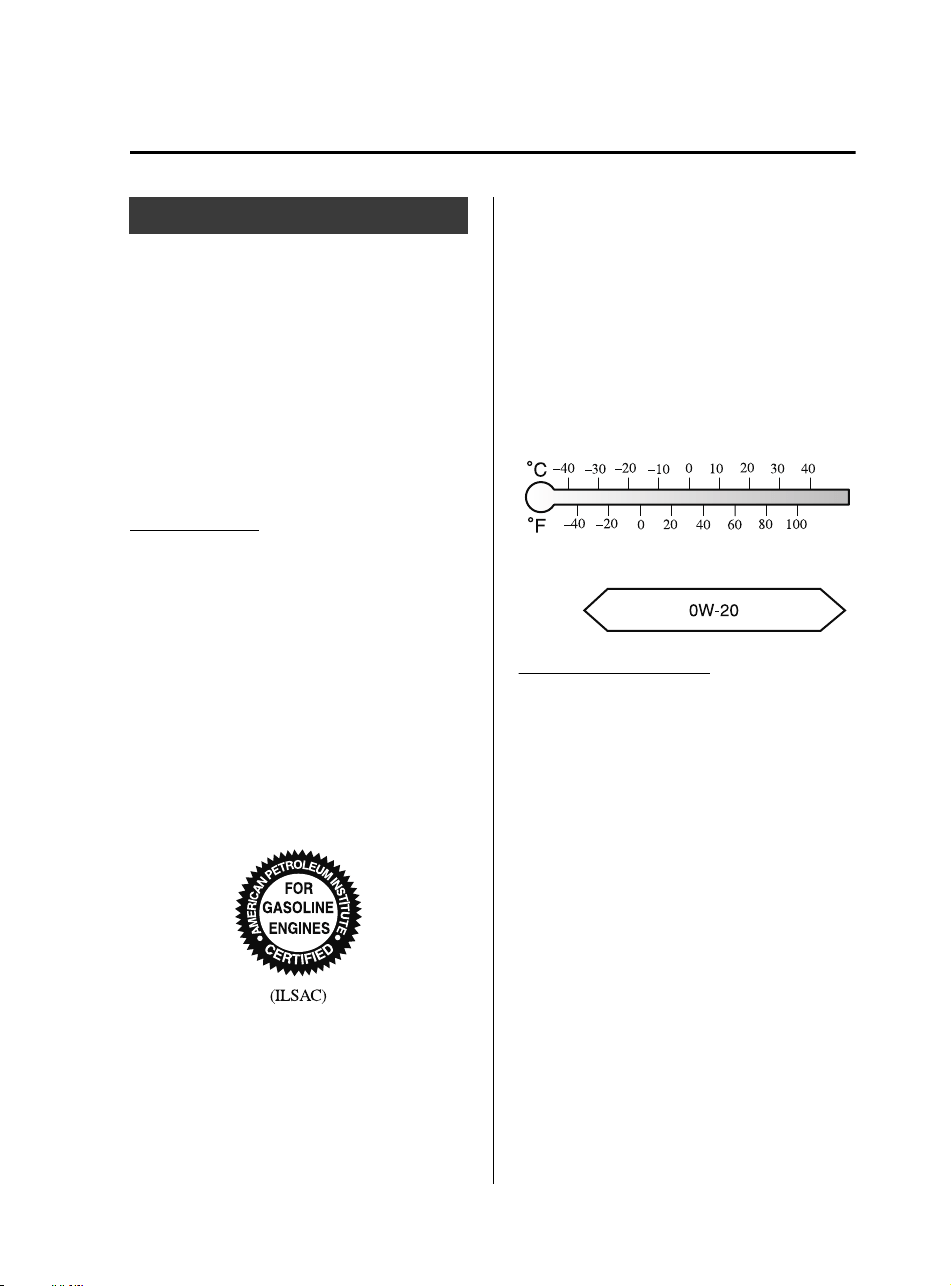
Engine Oil
▼
Engine Oil
NOTE
Changing the engine oil should be
performed by an Authorized Mazda
Dealer.
Refer to Introduction (page 6-2) for
owner's responsibility in protecting your
investment.
▼
Recommended Oil
U.S.A., Canada
Use ILSAC GF-V or higher/ SAE
0W-20 engine oil.
Mazda Genuine Oil is used in your Mazda
vehicle. Mazda Genuine 0W-20 Oil is
required to achieve optimum fuel
economy.
For maintenance service, Mazda
recommends Mazda Genuine Parts and
Oil.
Only use SAE 0W-20 oil “Certified For
Gasoline Engines” by the American
Petroleum Institute (API).
Oil with this trademark symbol conforms
to the current engine and emission system
protection standards and fuel economy
requirements of the International
Lubricant Standardization and Approval
Committee (ILSAC), comprised of U.S.
and Japanese automobile manufacturers.
Except U.S.A., Canada
Use SAE 5W-30 engine oil.
Oil container labels provide important
information.
A chief contribution this type of oil makes
to fuel economy is reducing the amount of
fuel necessary to overcome engine
friction.
Maintenance and Care
Owner Maintenance
6-15
Mazda3_8HZ1-EA-19G_Edition1_old 2019-5-17 13:49:03
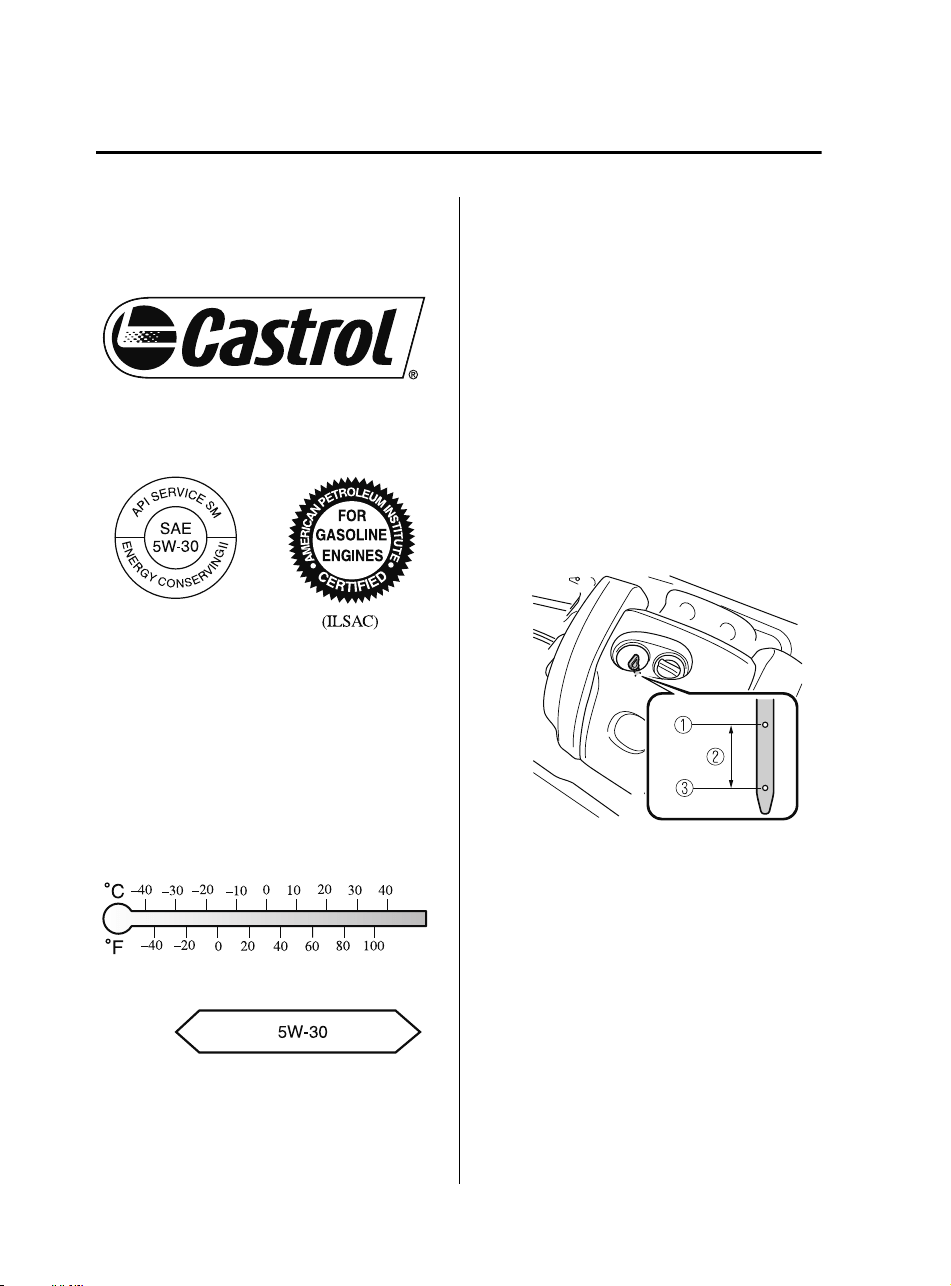
For maintenance service, Mazda
recommends Mazda Genuine Parts and
Castrol
®
(Mexico only).
(Mexico)
Use API SM or higher, or ILSAC GF-IV
or higher/SAE 5W-30 engine oil. If SAE
5W-30 engine oil is not available, use SAE
5W-20 engine oil.
The quality designation SM, or ILSAC
must be on the label.
▼
Inspecting Engine Oil Level
NOTE
If the engine oil level warning
indication/warning light turns on, add 1
L (0.3 US gal, 0.2 Imp gal) of engine oil.
1. Be sure the vehicle is on a level
surface.
2. Warm up the engine to normal
operating temperature.
3. Turn it off and wait at least 5 minutes
for the oil to return to the oil pan.
4. Pull out the dipstick, wipe it clean, and
reinsert it fully.
1. MAX
2. OK
3. MIN
Maintenance and Care
Owner Maintenance
6-16
Mazda3_8HZ1-EA-19G_Edition1_old 2019-5-17 13:49:03
5. Pull it out again and examine the level.
The level is normal if it is between the
MIN and MAX marks.
If it is near or below MIN, add enough
oil to bring the level to MAX.
CAUTION
Do not overll the engine oil. This may
cause engine damage.
6. Make sure the O-ring on the dipstick is
positioned properly before reinserting
the dipstick.
7. Reinsert the dipstick fully.
Engine Coolant
▼
Inspecting Coolant Level
WARNING
Do not use a match or live ame in the
engine compartment. DO NOT ADD
COOLANT WHEN THE ENGINE IS HOT:
A hot engine is dangerous. If the engine has
been running, parts of the engine
compartment can become very hot. You
could be burned. Carefully inspect the
engine coolant in the coolant reservoir, but
do not open it.
Pull over to a safe location, then switch
the ignition o and make sure the fan is
not running before attempting to work
near the cooling fan:
Working near the cooling fan when it is
running is dangerous. The fan could
continue running indenitely even if the
engine has stopped and the engine
compartment temperature is high. You
could be hit by the fan and seriously
injured.
Do not remove either cooling
system cap when the engine and radiator
are hot:
When the engine and radiator are hot,
scalding coolant and steam may shoot out
under pressure and cause serious injury.
Maintenance and Care
Owner Maintenance
6-17
Mazda3_8HZ1-EA-19G_Edition1_old 2019-5-17 13:49:03
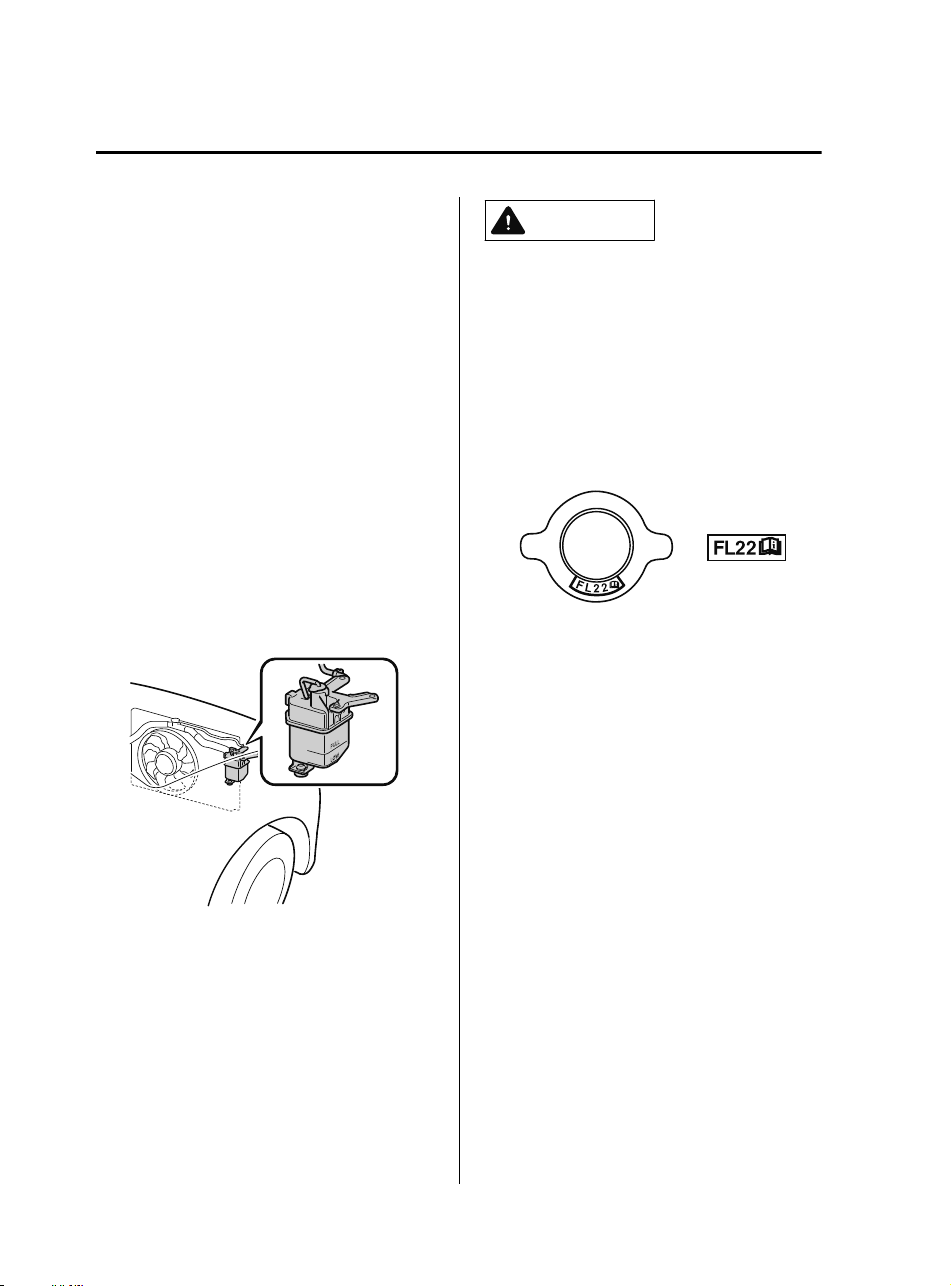
NOTE
Changing the coolant should be done by
an Authorized Mazda Dealer.
Inspect the antifreeze protection and
coolant level in the coolant reservoir at
least once a year―at the beginning of the
winter season―and before traveling where
temperatures may drop below freezing.
Inspect the condition and connections of
all cooling system and heater hoses.
Replace any that are swollen or
deteriorated.
The coolant should be at full in the
radiator and between the FULL and LOW
marks on the coolant reservoir when the
engine is cool.
If it is at or near LOW, add enough coolant
to the coolant reservoir to provide freezing
and corrosion protection and to bring the
level to FULL.
Securely tighten the coolant reservoir tank
cap after adding coolant.
CAUTION
Radiator coolant will damage paint.
Rinse it o quickly if spilled.
If the “FL22” mark is shown on or near
the cooling system cap, use of FL-22 is
recommended when replacing engine
coolant. Using engine coolant other than
FL-22 may cause serious damage to the
engine and cooling system.
If the coolant reservoir is empty or new
coolant is required frequently, consult an
Authorized Mazda Dealer.
Maintenance and Care
Owner Maintenance
6-18
Mazda3_8HZ1-EA-19G_Edition1_old 2019-5-17 13:49:03
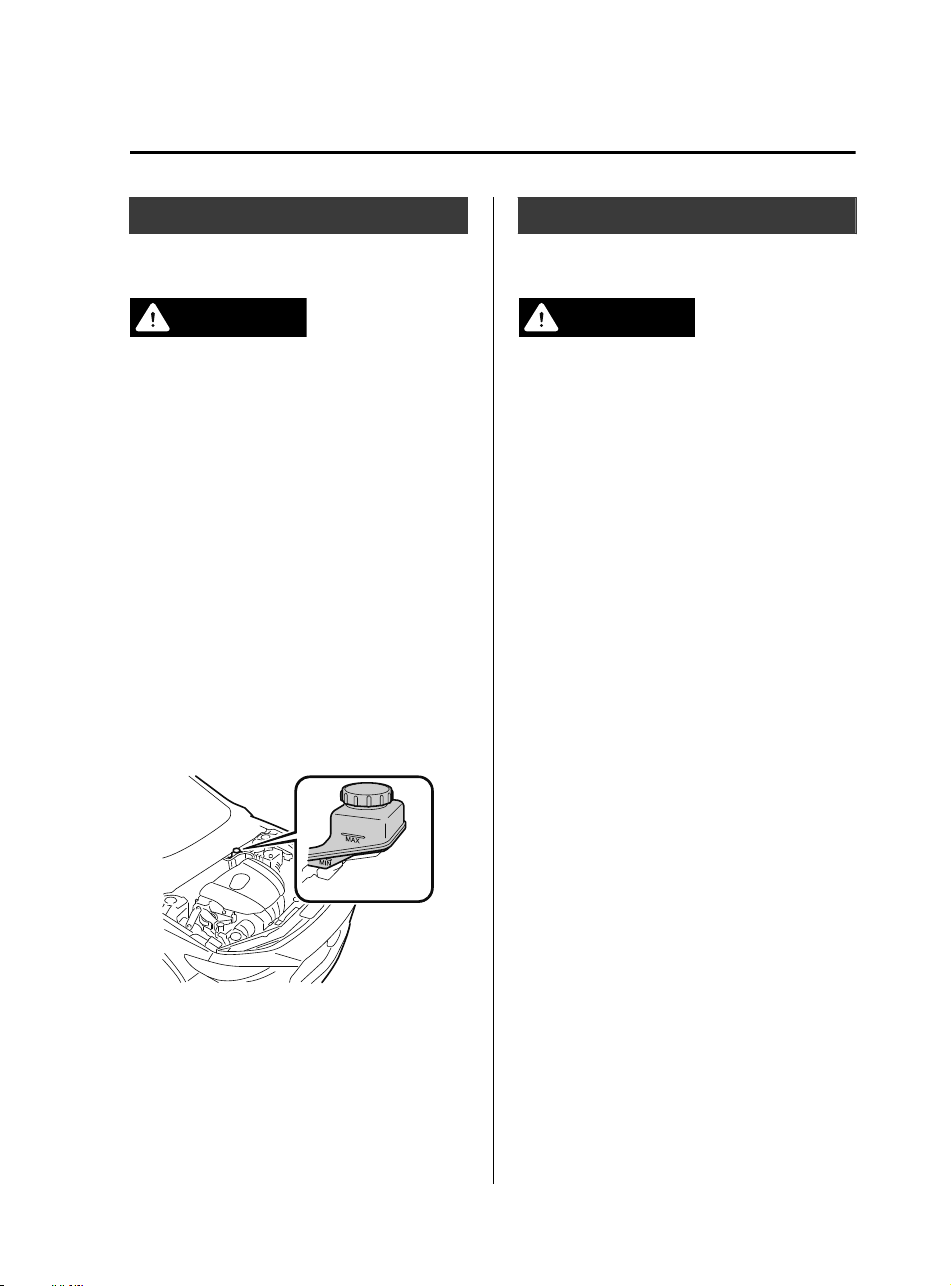
Brake/Clutch Fluid
▼
Inspecting Brake/Clutch Fluid Level
WARNING
If the brake/clutch uid level is low, have
the brakes inspected:
A low brake/clutch
uid
level is dangerous.
A low level could indicate brake lining wear
or a brake system leak which could cause
the brakes to fail and lead to an accident.
The brakes and clutch draw fluid from the
same reservoir.
Inspect the fluid level in the reservoir
regularly. It should be kept between the
MAX and MIN lines.
The level normally drops with
accumulated distance, a condition
associated with wear of brake and clutch
linings. If it is excessively low, have the
brake/clutch system inspected by an
Authorized Mazda Dealer.
Washer Fluid
▼
Inspecting Washer Fluid Level
WARNING
Use only windshield washer uid or plain
water in the reservoir:
Using radiator antifreeze as washer
uid
is
dangerous. If sprayed on the windshield, it
will dirty the windshield,
aect
your
visibility, and could result in an accident.
Using Washer Fluid Without Anti-freeze
Protection in Cold Weather:
Operating your vehicle in temperatures
below 4 °C (40 °F) using washer uid
without anti-freeze protection is dangerous
as it could cause impaired windshield
vision and result in an accident. In cold
weather, always use washer uid with
anti-freeze protection.
NOTE
State or local regulations may restrict the
use of volatile organic compounds
(VOCs), which are commonly used as
anti-freeze agents in washer fluid. A
washer fluid with limited VOC content
should be used only if it provides adequate
freeze resistance for all regions and
climates in which the vehicle will be
operated.
Maintenance and Care
Owner Maintenance
6-19
Mazda3_8HZ1-EA-19G_Edition1_old 2019-5-17 13:49:03
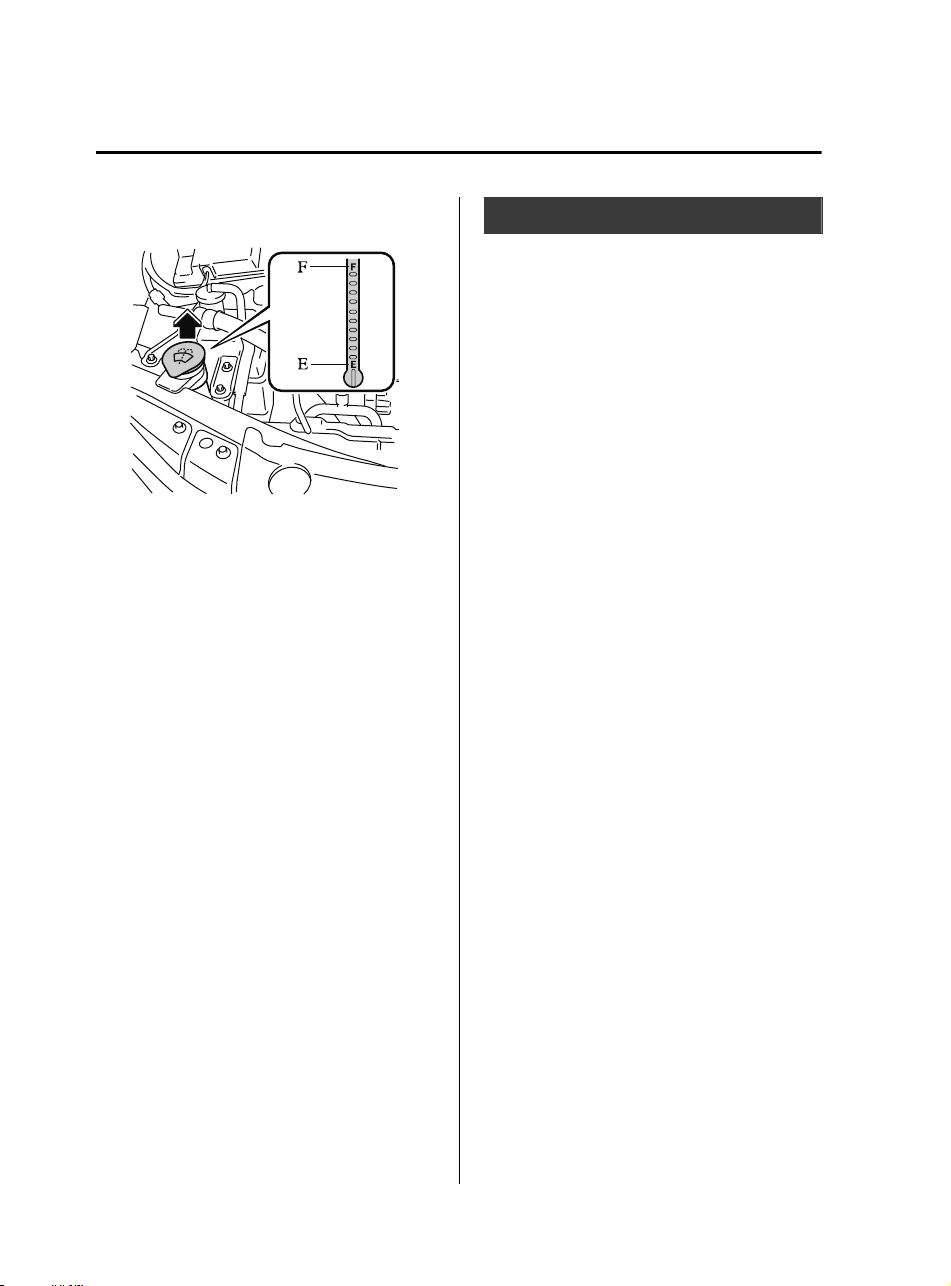
Inspect fluid level in the washer fluid
reservoir; add fluid if necessary.
The top of the float should be between F
and E.
Use plain water if washer fluid is
unavailable.
But use only washer fluid in cold weather
to prevent it from freezing.
NOTE
Front and rear washer fluid is supplied
from the same reservoir.
Body Lubrication
▼
Body Lubrication
All moving points of the body, such as
door and hood hinges and locks, should be
lubricated each time the engine oil is
changed. Use a nonfreezing lubricant on
locks during cold weather.
Make sure the hood's secondary latch
keeps the hood from opening when the
primary latch is released.
Maintenance and Care
Owner Maintenance
6-20
Mazda3_8HZ1-EA-19G_Edition1_old 2019-5-17 13:49:03
Wiper Blades
▼
Wiper Blades
CAUTION
Hot waxes applied by automatic car
washers have been known to aect the
wiper's ability to clean windows.
To prevent damage to the wiper blades,
do not use gasoline, kerosene, paint
thinner, or other solvents on or near
them.
When the wiper lever is in the AUTO
position and the ignition is switched ON,
the wipers may move automatically in
the following cases:
If the windshield above the rain sensor
is touched.
If the windshield above the rain sensor
is wiped with a cloth.
If the windshield is struck with a hand
or other object.
If the rain sensor is struck with a hand
or other object from inside the vehicle.
Be careful not to pinch hands or
ngers
as it may cause injury, or damage the
wipers. When washing or servicing the
vehicle, make sure the wiper lever is in
the OFF position.
Before lifting the windshield wiper blades
o the windshield, always follow the
procedure for moving the windshield
wiper blades. Otherwise, a wiper blade,
wiper arm, or the hood could be
damaged.
Refer to the Replacing Windshield Wiper
Blades (page on 6-22) section for the
procedure on how to move the
windshield wiper blades to the service
position.
Contamination of either the windshield or
the blades with foreign matter can reduce
wiper effectiveness. Common sources are
insects, tree sap, and hot wax treatments
used by some commercial car washes.
If the blades are not wiping properly, clean
the window and blades with a good
cleaner or mild detergent; then rinse
thoroughly with clean water. Repeat if
necessary.
Maintenance and Care
Owner Maintenance
6-21
Mazda3_8HZ1-EA-19G_Edition1_old 2019-5-17 13:49:03
▼
Replacing Windshield Wiper Blades
When the wipers no longer clean well, the
blades are probably worn or cracked.
Replace them.
CAUTION
To prevent damaging a windshield wiper
blade, wiper arm, or the hood, perform
the following procedure.
Before lifting the windshield wiper
blades
o
the windshield, always
move them to the service position.
When putting the windshield wiper
blades back on the windshield, make
sure that they are in the service
position before switching the ignition
ON and operating the windshield
wipers.
Replace with Mazda genuine wiper
blades. If they are replaced with wiper
blades other than a Mazda genuine
product, they may not wipe with the
same
eciency
as the genuine product.
To prevent damage to the wiper arms
and other components, do not try to
sweep the wiper arm by hand.
Do not bend the blade rubber
unnecessarily when replacing it.
Otherwise, the metal
stiener
in the
blade may deform and the windshield
wiper operation may be adversely
aected.
Do not hold a wiper blade by its end
when raising the wiper arm. Otherwise,
the part may deform and the wiping
performance may lower.
NOTE
You can replace the wiper blades
yourself, however you cannot replace
the wiper arms.
If you want to replace the wiper arms,
consult an Authorized Mazda Dealer.
Forcefully lowering the wiper arms
could damage the wiper arm and blade,
and may scratch or crack the
windshield.
Replace the wiper blades using the
following procedure.
1. Move the wipers to the service
positions using the following
procedure.
a) Switch the ignition ON.
b) Switch the ignition OFF.
c) Press up the wiper switch to the
MIST position 2 times within 30
seconds after switching the ignition
OFF.
When the procedure is completed,
the wipers operate and they stop at
the service positions.
2. Raise the wiper arms.
CAUTION
To prevent damage to the windshield
let the wiper arm down easily, do not
let it slap down on the windshield.
Maintenance and Care
Owner Maintenance
6-22
Mazda3_8HZ1-EA-19G_Edition1_old 2019-5-17 13:49:03
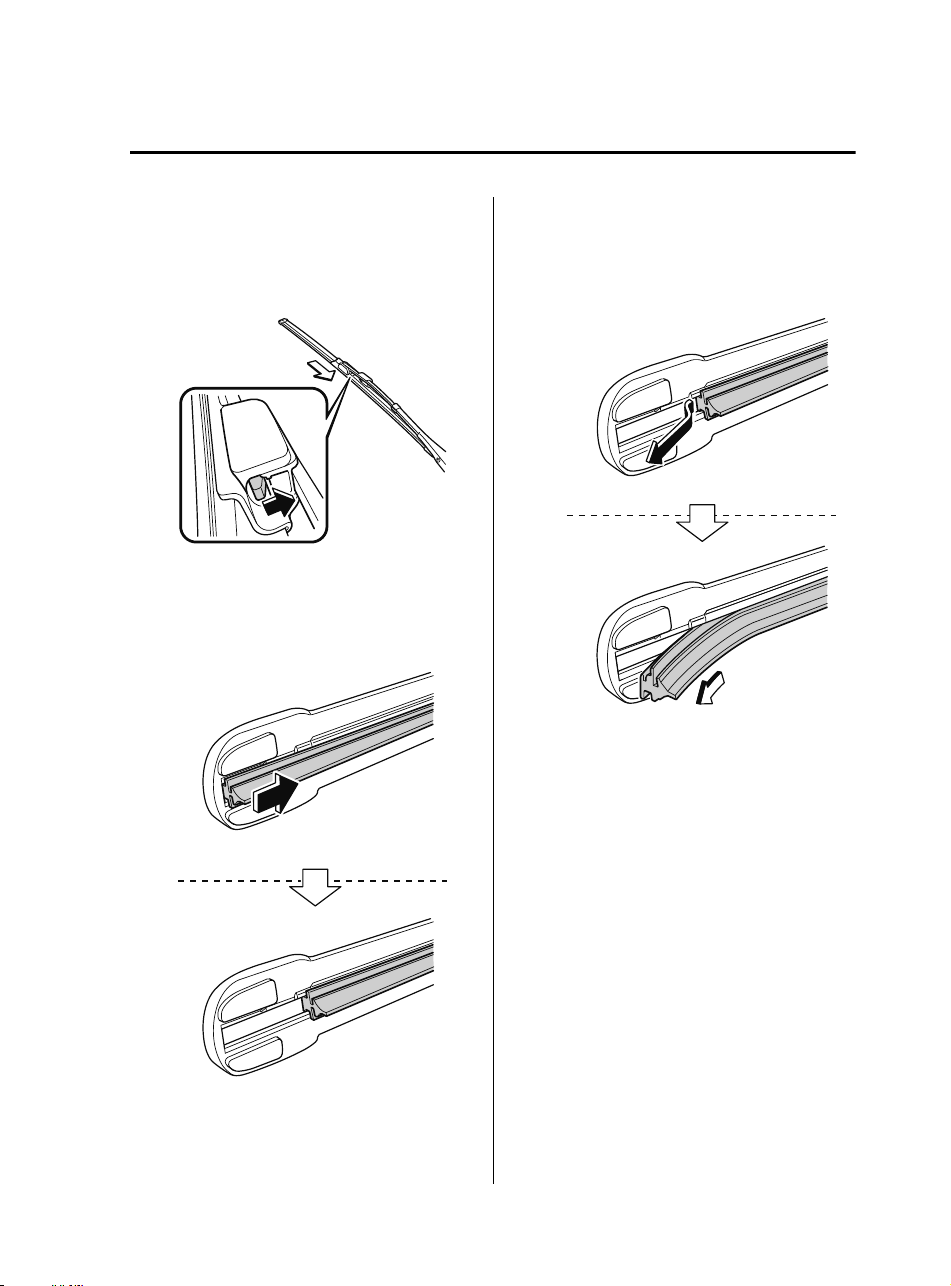
3. Slide the blade component in the
direction of the arrow while pressing
the wiper arm tab to remove the blade
component from the wiper arm.
4. Pull the blade rubber in the direction of
the arrow and slide it to a position
where the blade holder groove can be
checked.
5. Pull the end of the blade rubber from
the blade holder groove in the direction
of the arrow and remove the blade
rubber from the blade holder.
Maintenance and Care
Owner Maintenance
6-23
Mazda3_8HZ1-EA-19G_Edition1_old 2019-5-17 13:49:03
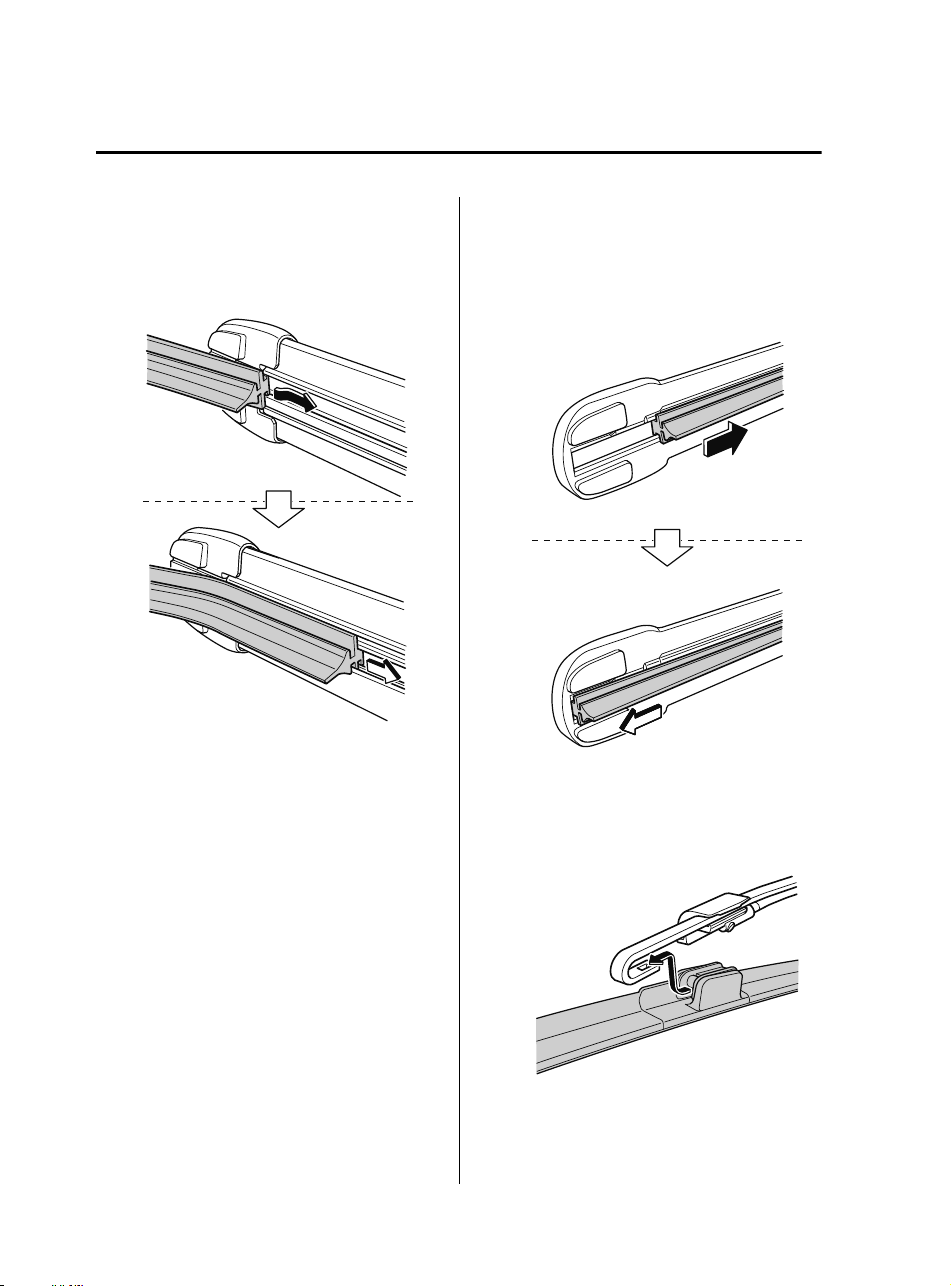
6. Insert the end of the new blade rubber
into the groove of the blade holder
until it contacts the end of the blade
holder.
7. After pulling the blade rubber in the
direction of the arrow and sliding the
blade rubber to a position to check the
blade holder groove, slide the blade
rubber end in the opposite direction.
8. Make sure that the blade rubber is
correctly installed to the blade holder.
9. Slide the blade component and install
it to the wiper arm.
10. Slowly lower the wiper arms onto the
windshield.
Maintenance and Care
Owner Maintenance
6-24
Mazda3_8HZ1-EA-19G_Edition1_old 2019-5-17 13:49:03
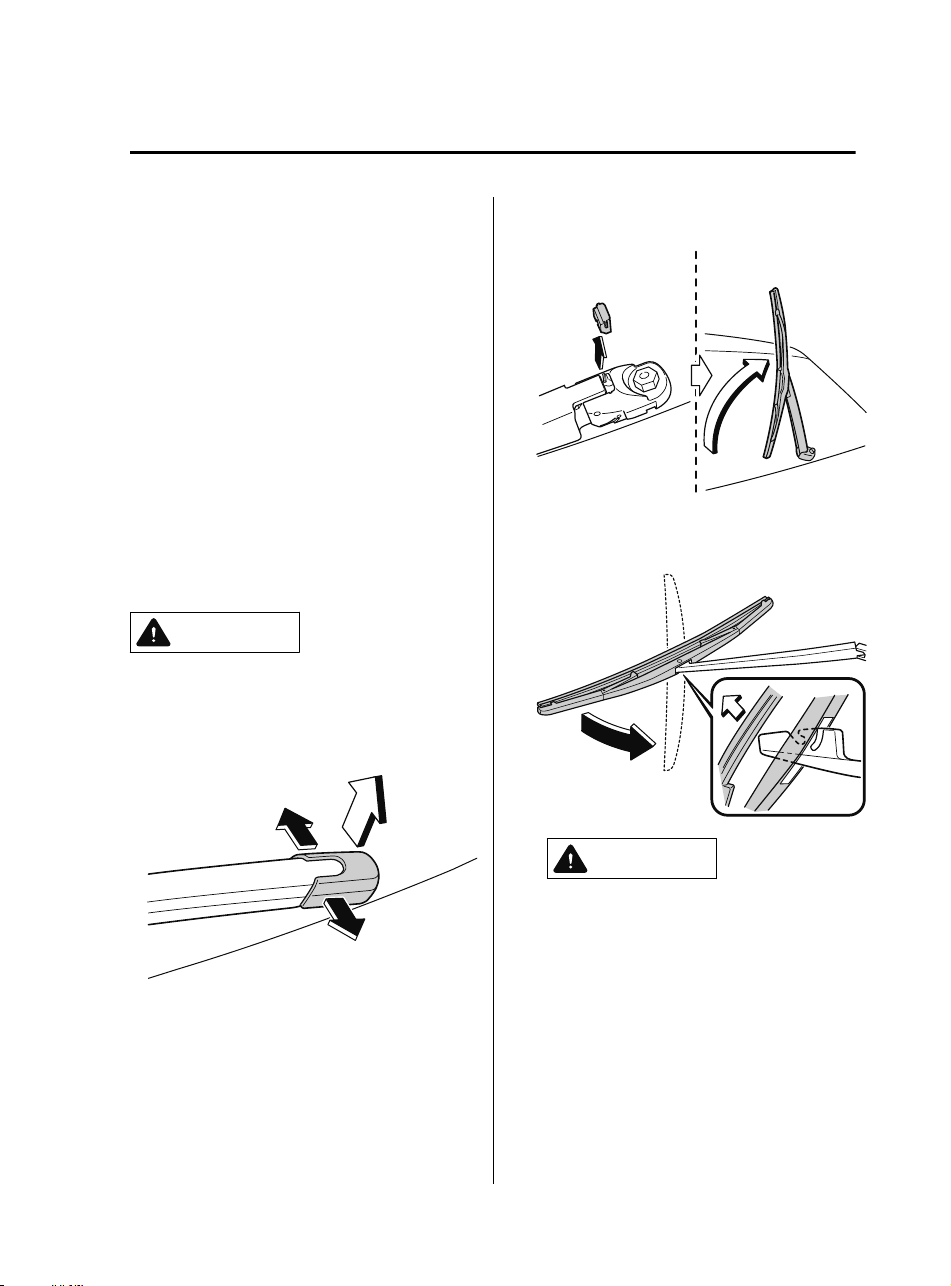
11. Move the wipers to their initial
positions using the following
procedure.
a) Make sure that the wipers are set on
the windshield.
b) Switch the ignition ON.
c) Press up the wiper switch to the
MIST position 1 time.
When the procedure is completed,
the wipers operate and they stop at
the initial positions.
▼
Replacing Rear Window Wiper
Blade (5-Door)
When the wiper no longer cleans well, the
blade is probably worn or cracked.
Replace it.
CAUTION
To prevent damage to the wiper arm and
other components, do not move the wiper
by hand.
1. Remove the cover.
2. Remove the stopper and raise the
wiper arm.
3. Firmly rotate the wiper blade to the
right until it unlocks, then remove the
blade.
CAUTION
To prevent damage to the rear window,
do not let the wiper arm fall on it.
Maintenance and Care
Owner Maintenance
6-25
Mazda3_8HZ1-EA-19G_Edition1_old 2019-5-17 13:49:03
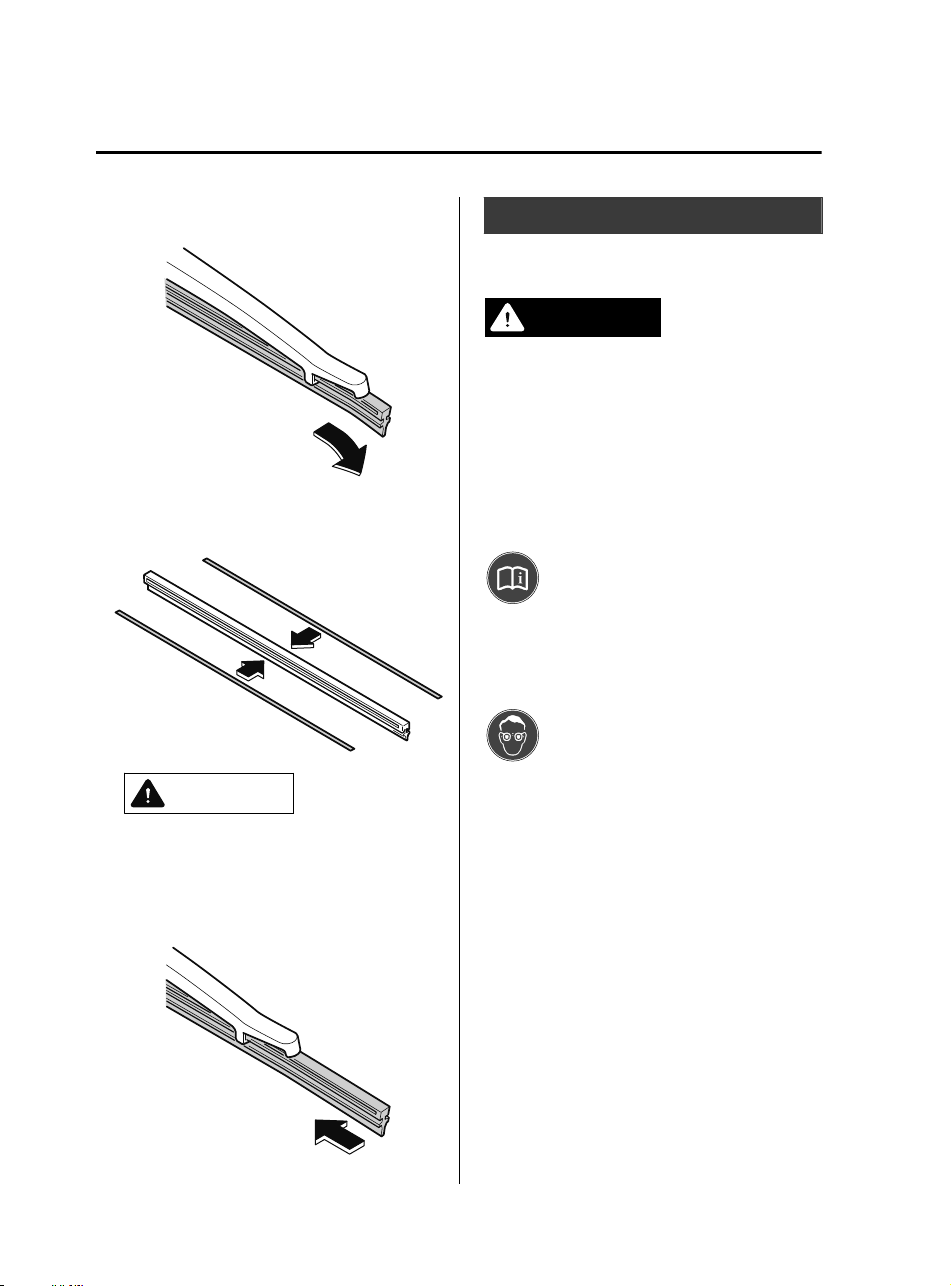
4. Pull down the blade rubber and slide it
out of the blade holder.
5. Remove the metal stiffeners from the
blade rubber and install them in the
new blade.
CAUTION
Do not bend or discard the stieners.
You need to use them again.
6. Carefully insert the new blade rubber.
Then install the blade assembly in the
reverse order of removal.
Battery
▼
Battery
WARNING
Wash hands after handling the battery and
related accessories:
Battery posts, terminals and related
accessories contain lead and lead
compounds, chemicals known to the State
of California to cause cancer and
reproductive harm.
Read the following precautions
carefully before using the battery or
inspecting to ensure safe and correct
handling:
Always wear eye protection when
working near the battery:
Working without eye protection is
dangerous. Battery uid contains
SULFURIC ACID which could cause
blindness if splashed into your eyes. Also,
hydrogen gas produced during normal
battery operation, could ignite and cause
the battery to explode.
Maintenance and Care
Owner Maintenance
6-26
Mazda3_8HZ1-EA-19G_Edition1_old 2019-5-17 13:49:03
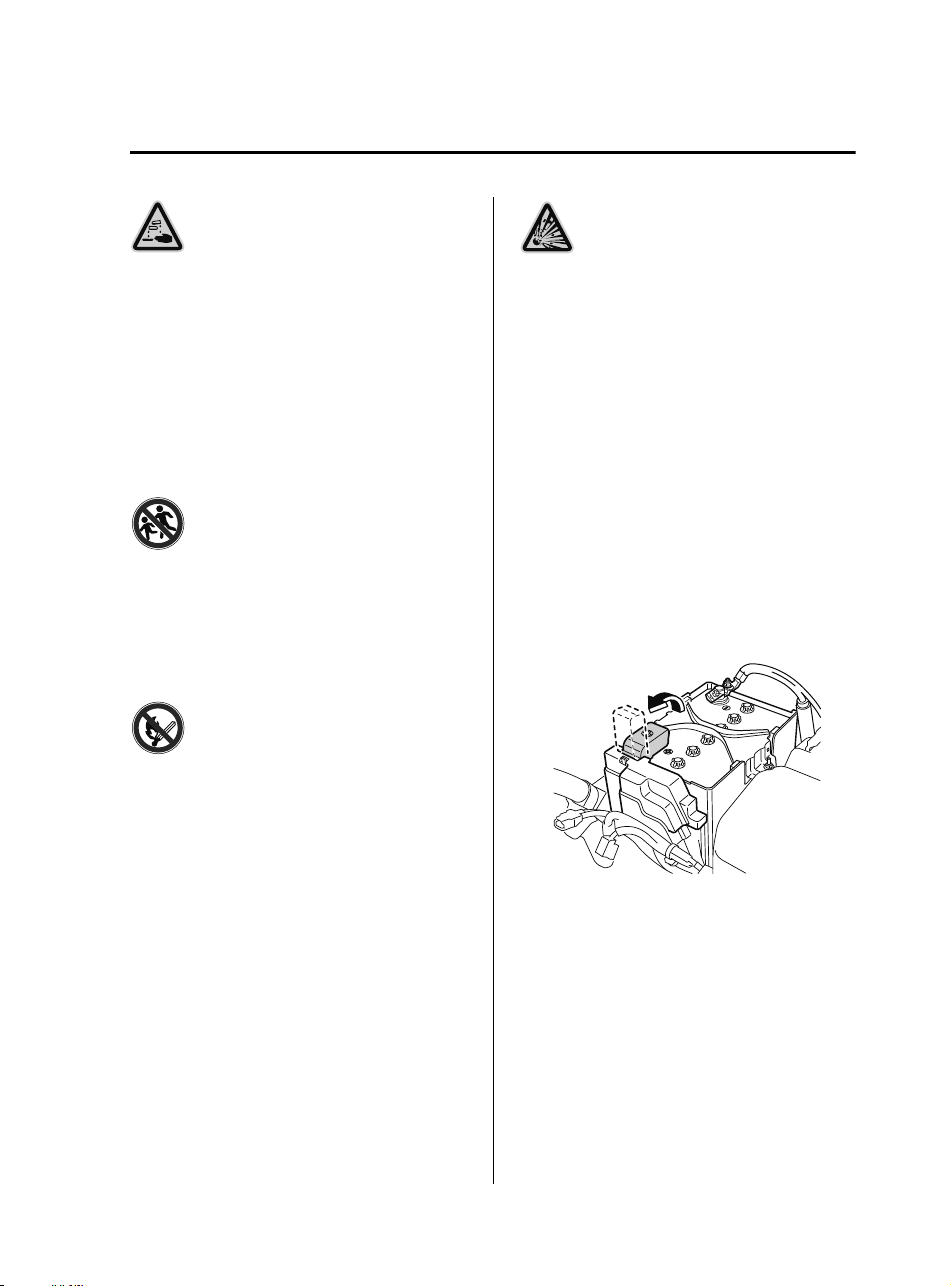
Wear eye protection and protective
gloves to prevent contact with battery
uid:
Spilled battery uid is dangerous.
Battery uid contains SULFURIC ACID
which could cause serious injuries if it gets
in eyes, or on the skin or clothing. If this
happens, immediately ush your eyes with
water for 15 minutes or wash your skin
thoroughly and get medical attention.
Always keep batteries out of the
reach of children:
Allowing children to play near batteries is
dangerous. Battery uid could cause
serious injuries if it gets in the eyes or on the
skin.
Keep ames and sparks away from
open battery cells and do not allow metal
tools to contact the positive (+) or negative
(-) terminal of the battery when working
near a battery. Do not allow the positive (+)
terminal to contact the vehicle body:
Flames and sparks near open battery cells
are dangerous. Hydrogen gas, produced
during normal battery operation, could
ignite and cause the battery to explode. An
exploding battery can cause serious burns
and injuries. Keep all ames including
cigarettes and sparks away from open
battery cells.
Keep all ames and sparks away
from open battery cells because hydrogen
gas is produced from open battery cells
while charging the battery or adding
battery uid:
Flames and sparks near open battery cells
are dangerous. Hydrogen gas, produced
during normal battery operation, could
ignite and cause the battery to explode. An
exploding battery can cause serious burns
and injuries. Keep all ames including
cigarettes and sparks away from open
battery cells.
NOTE
Before performing battery maintenance,
remove the battery cover.
Maintenance and Care
Owner Maintenance
6-27
Mazda3_8HZ1-EA-19G_Edition1_old 2019-5-17 13:49:03
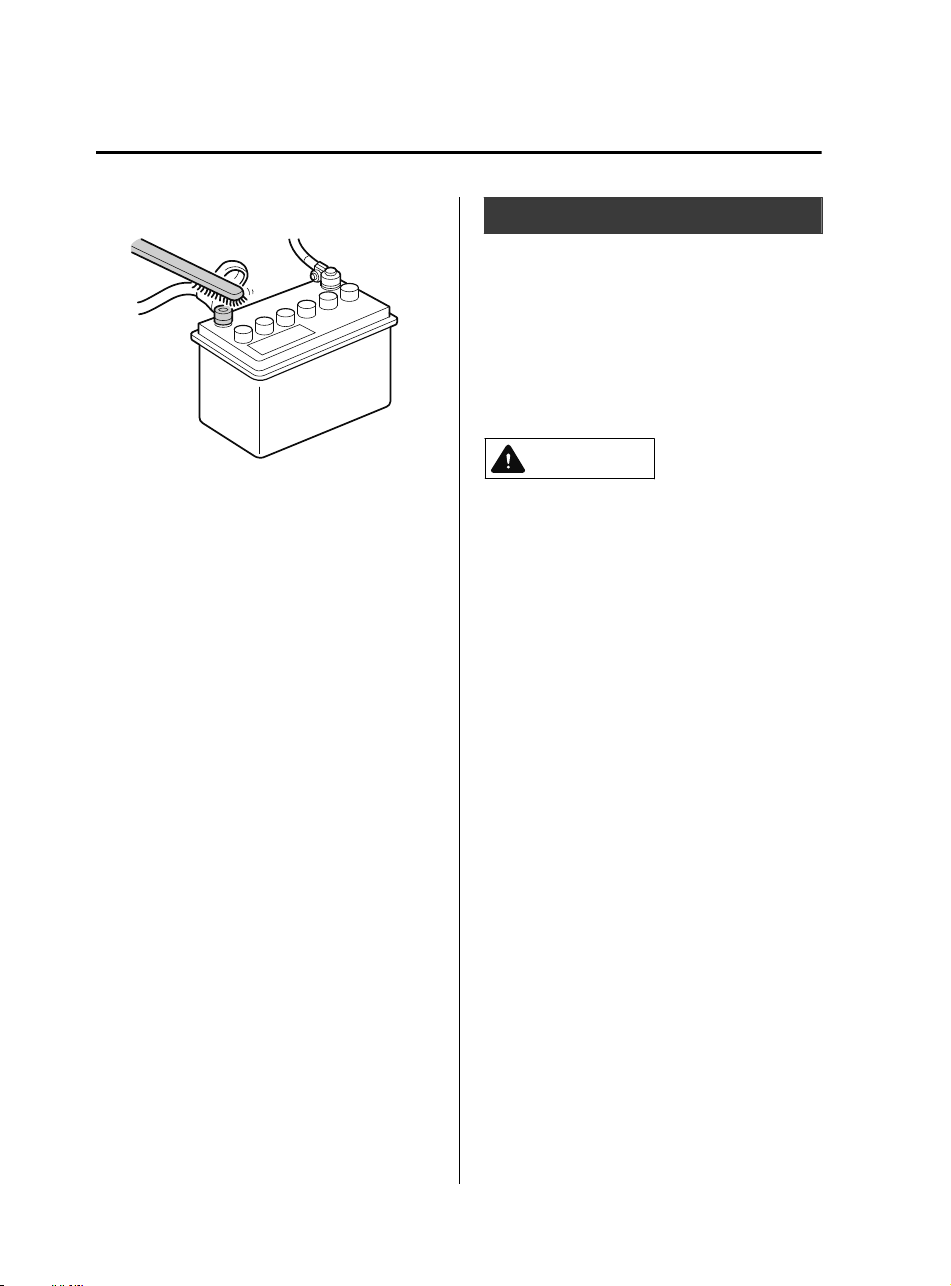
▼
Battery Maintenance
To get the best service from a battery:
Keep it securely mounted.
Keep the top clean and dry.
Keep terminals and connections clean,
tight, and coated with petroleum jelly or
terminal grease.
Rinse off spilled electrolyte immediately
with a solution of water and baking
soda.
If the vehicle will not be used for an
extended time, disconnect the battery
cables and charge the battery every 6
weeks.
▼
Battery Replacement
Contact an Authorized Mazda Dealer for a
battery replacement purchase.
Key Battery Replacement
▼
Key Battery Replacement
If the buttons on the transmitter are
inoperable and the operation indicator
light does not flash, the battery may be
dead.
Replace with a new battery before the
transmitter becomes unusable.
CAUTION
Make sure the battery is installed
correctly. Battery leakage could occur if it
is not installed correctly.
When replacing the battery, be careful
not to touch any of the internal circuitry
and electrical terminals, bend the
electrical terminals, or get dirt in the
transmitter as the transmitter could be
damaged.
There is the danger of explosion if the
battery is not correctly replaced.
Dispose of used batteries according to
the following instructions.
Insulate the plus and minus terminals
of the battery using cellophane or
equivalent tape.
Never disassemble.
Never throw the battery into re or
water.
Never deform or crush.
Replace only with the same type battery
(CR2032 or equivalent).
Maintenance and Care
Owner Maintenance
6-28
Mazda3_8HZ1-EA-19G_Edition1_old 2019-5-17 13:49:03
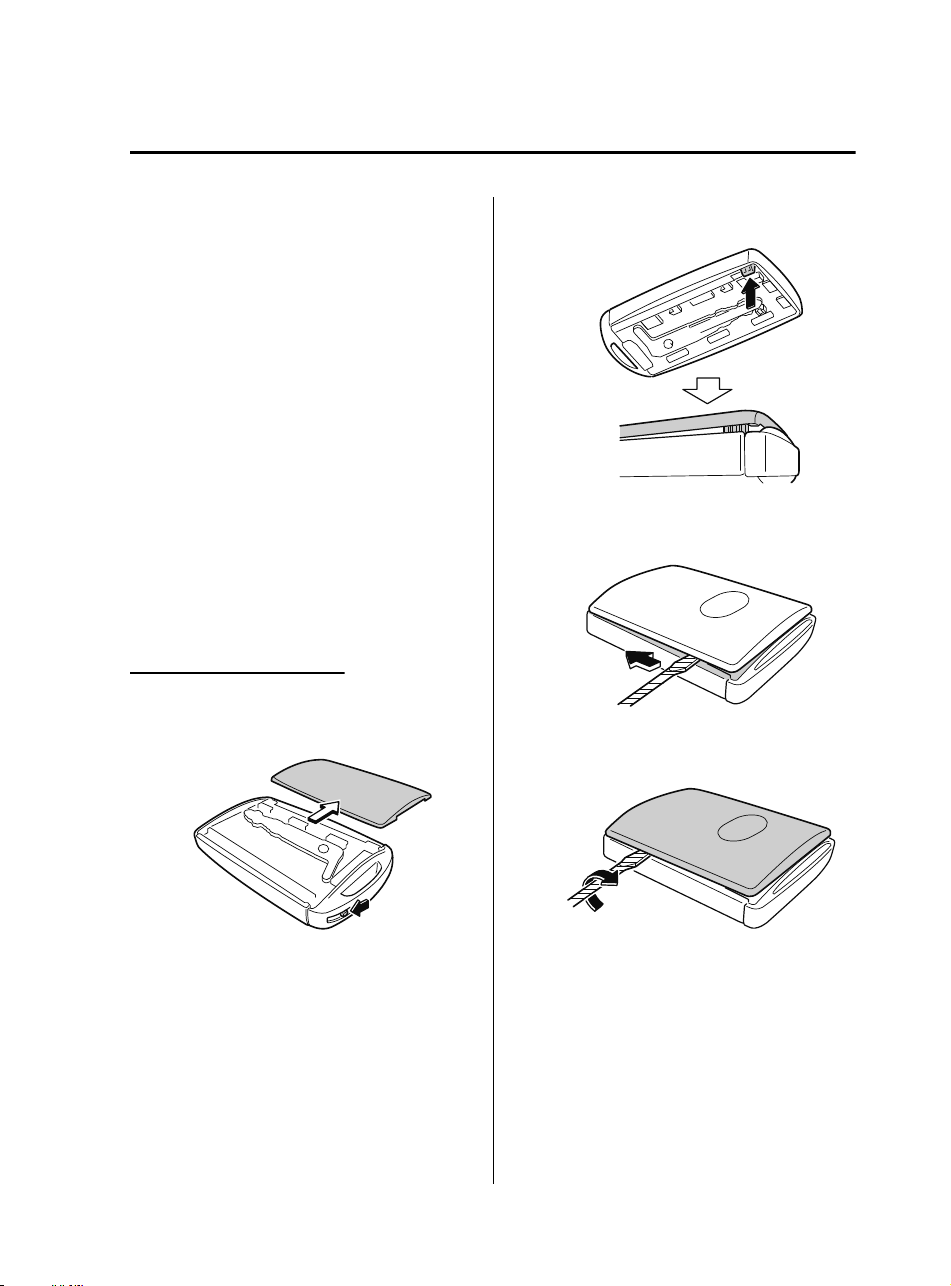
The following conditions indicate that the
battery power is low:
The KEY warning indication/warning
light (red) in the instrument cluster turns
on and a message, “Low Key Fob
Battery. Replace Battery”, is displayed
on the multi-information display when
the ignition is switched OFF.
The system does not operate and the
operation indicator light on the
transmitter does not flash when the
buttons are pressed.
The system's operational range is
reduced.
Replacing the battery at an Authorized
Mazda Dealer is recommended to prevent
damage to the key. If replacing the battery
by yourself, follow the instruction.
Replacing the key battery
1. Remove the lower cover while
pressing the knob in the direction of
the arrow.
2. Press in the tab to unlock the upper
cover.
3. Insert a tape-wrapped flathead
screwdriver into the gap and slide it in
the direction of the arrow.
4. Twist the flathead screwdriver in the
direction of the arrow and remove the
upper cover.
Maintenance and Care
Owner Maintenance
6-29
Mazda3_8HZ1-EA-19G_Edition1_old 2019-5-17 13:49:03

5. Remove the cap using the
tape-wrapped flathead screwdriver.
6. Remove the battery using
tape-wrapped flathead screwdriver.
7. Insert a new battery into the transmitter
so that the positive pole is facing up.
8. Install the cap.
9. Install the upper cover.
10. Insert the tabs of the lower cover into
the slots of the transmitter and install
the lower cover.
Maintenance and Care
Owner Maintenance
6-30
Mazda3_8HZ1-EA-19G_Edition1_old 2019-5-17 13:49:03
Tires
▼
Tires
For reasons of proper performance, safety,
and better fuel economy, always maintain
recommended tire inflation pressures and
stay within the recommended load limits
and weight distribution.
WARNING
Using Dierent Tire Types:
Driving your vehicle with
dierent
types of
tires is dangerous. It could cause poor
handling and poor braking; leading to loss
of control.
Except for the limited use of the temporary
spare tire, use only the same type tires
(radial, bias-belted, bias-type) on all four
wheels.
Using Wrong-Sized Tires:
Using any other tire size than what is
specied for the vehicle (page 9-9) is
dangerous. It could seriously aect ride,
handling, ground clearance, tire clearance,
and speedometer calibration. This could
cause you to have an accident. Use only
tires that are the correct size specied for
the vehicle.
▼
Tire Inflation Pressure
WARNING
Always
inate
the tires to the correct
pressure:
Overination
or
underination
of tires is
dangerous. Adverse handling or
unexpected tire failure could result in a
serious accident.
Refer to Tires on page 9-9.
Use only a Mazda-genuine tire valve cap:
Use of a non-genuine part is dangerous as
the correct tire air pressure cannot be
maintained if the tire valve becomes
damaged. If the vehicle is driven under this
condition, the tire air pressure will decrease
which could result in a serious accident. Do
not use any part for the tire valve cap that
is not a Mazda-genuine part.
Inspect all tire pressures monthly
(including the spare) when the tires are
cold. Maintain recommended pressures for
the best ride, handling, and minimum tire
wear.
Refer to the specification charts (page
9-9).
NOTE
Always check tire pressure when tires
are cold.
Warm tires normally exceed
recommended pressures. Do not release
air from warm tires to adjust the
pressure.
Maintenance and Care
Owner Maintenance
6-31
Mazda3_8HZ1-EA-19G_Edition1_old 2019-5-17 13:49:03
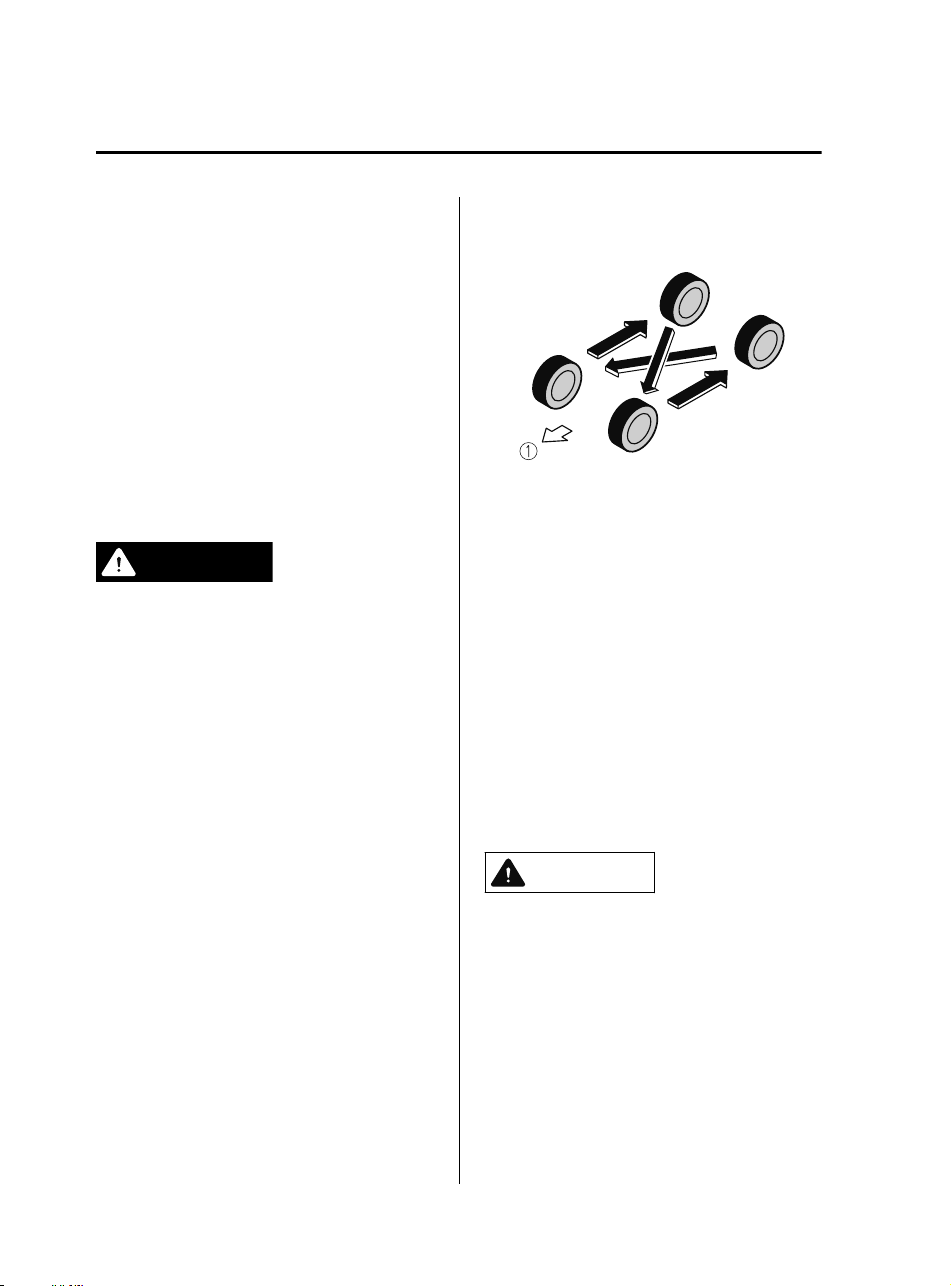
Underinflation can cause reduced fuel
economy, uneven and accelerated tire
wear, and poor sealing of the tire bead,
which will deform the wheel and cause
separation of tire from rim.
Overinflation can produce a harsh ride,
uneven and accelerated tire wear, and a
greater possibility of damage from road
hazards.
Keep your tire pressure at the correct
levels. If one frequently needs inflating,
have it inspected.
▼
Tire Rotation
WARNING
Rotate tires periodically:
Irregular tire wear is dangerous. To
equalize tread wear for maintaining good
performance in handling and braking,
rotate the tires periodically or sooner if
irregular wear develops.
Please refer to Scheduled maintenance for
your tire rotation interval.
During rotation, inspect them for correct
balance.
1. Forward
Do not include (TEMPORARY USE
ONLY) spare tire in rotation.
Also, inspect them for uneven wear and
damage. Abnormal wear is usually caused
by one or a combination of the following:
Incorrect tire pressure
Improper wheel alignment
Out-of-balance wheel
Severe braking
After rotation, inflate all tire pressures to
specification (page 9-9) and inspect the
lug nuts for tightness.
CAUTION
Rotate unidirectional tires and radial tires
that have an asymmetrical tread pattern or
studs only from front to rear, not from side
to side. Tire performance will be reduced if
rotated from side to side.
Maintenance and Care
Owner Maintenance
6-32
Mazda3_8HZ1-EA-19G_Edition1_old 2019-5-17 13:49:03
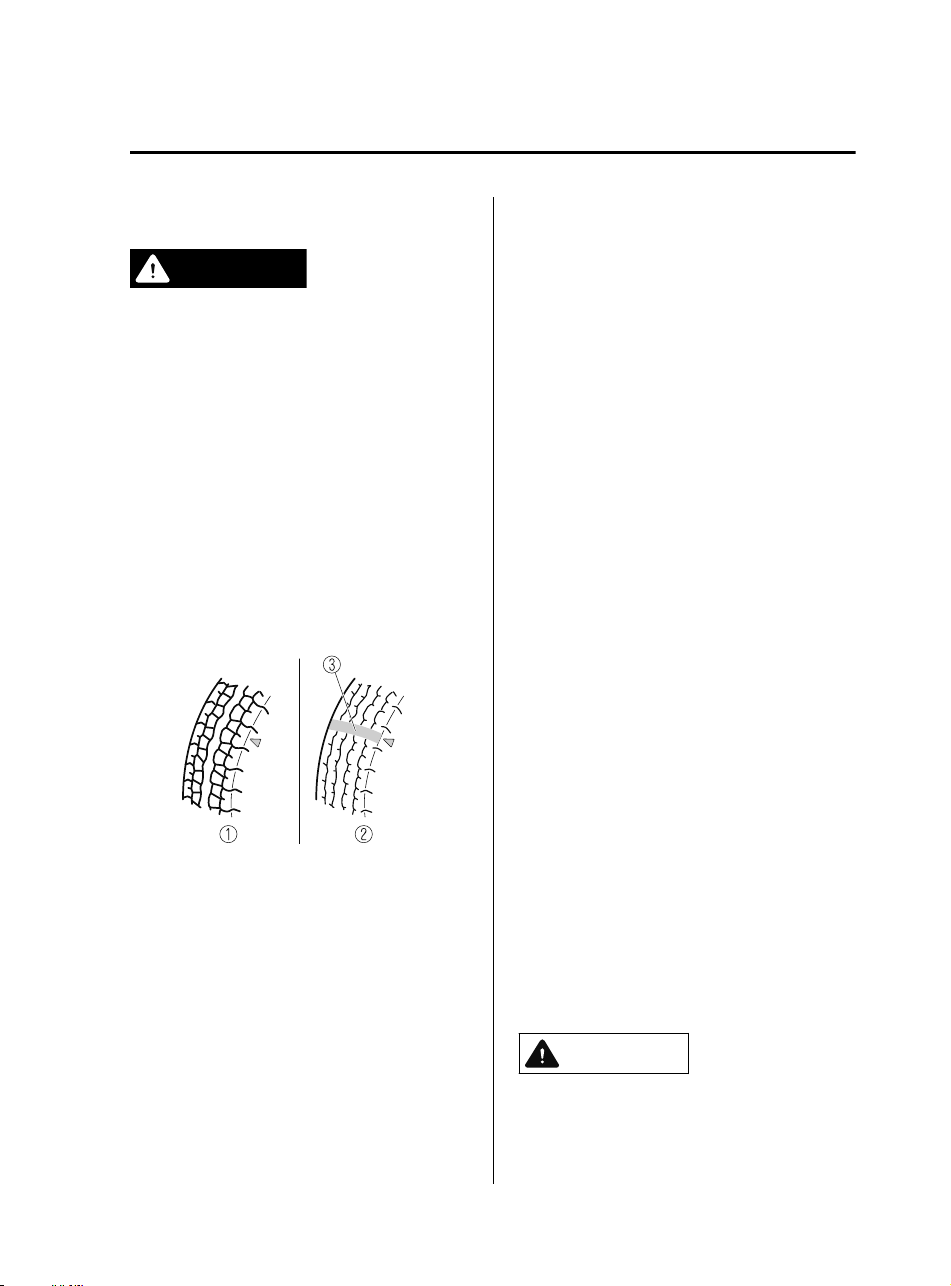
▼
Replacing a Tire
WARNING
Always use tires that are in good condition:
Driving with worn tires is dangerous.
Reduced braking, steering, and traction
could result in an accident.
Replace all four tires at the same time:
Replacing just one tire is dangerous. It
could cause poor handling and poor
braking resulting in loss of vehicle control.
Mazda strongly recommends that you
replace all four tires at the same time.
If a tire wears evenly, a wear indicator will
appear as a solid band across the tread.
Replace the tire when this happens.
1. New tread
2. Worn tread
3. Tread wear indicator
You should replace the tire before the band
crosses the entire tread.
NOTE
Tires degrade over time, even when they
are not being used on the road. It is
recommended that tires generally be
replaced when they are 6 years or older.
Heat caused by hot climates or frequent
high loading conditions can accelerate the
aging process. You should replace the
spare tire when you replace the other road
tires due to the aging of the spare tire. The
period in which the tire was manufactured
(both week and year) is indicated by a
4-digit number.
Refer to Tire Labeling on page 8-23.
▼
Temporary Spare Tire
Inspect the temporary spare tire at least
monthly to make sure it is properly
inflated and stored.
NOTE
The temporary spare tire condition
gradually deteriorates even if it has not
been used.
The temporary spare tire is easier to
handle because of its construction which is
lighter and smaller than a conventional
tire. This tire should be used only for an
emergency and only for a short distance.
Use the temporary spare tire only until the
conventional tire is repaired, which should
be as soon as possible.
Refer to Tires on page 9-9.
CAUTION
Do not use your temporary spare tire rim
with a snow tire or a conventional tire.
Neither will properly t and could
damage both tire and rim.
Maintenance and Care
Owner Maintenance
6-33
Mazda3_8HZ1-EA-19G_Edition1_old 2019-5-17 13:49:03
The temporary spare tire has a tread life
of less than 5,000 km (3,000 miles). The
tread life may be shorter depending on
driving conditions.
The temporary spare tire is for limited
use, however, if the tread wear
solid-band indicator appears, replace the
tire with the same type of temporary
spare (page 6-33).
NOTE
Tires degrade over time, even when they
are not being used on the road. It is
recommended that tires generally be
replaced when they are 6 years or older.
Heat caused by hot climates or frequent
high loading conditions can accelerate the
aging process. You should replace the
spare tire when you replace the other road
tires due to the aging of the spare tire. The
period in which the tire was manufactured
(both week and year) is indicated by a
4-digit number.
Refer to Tire Labeling on page 8-23.
▼
Replacing a Wheel
WARNING
Always use wheels of the correct size on
your vehicle:
Using a wrong-sized wheel is dangerous.
Braking and handling could be aected,
leading to loss of control and an accident.
CAUTION
A wrong-sized wheel may adversely
aect:
Tire t
Wheel and bearing life
Ground clearance
Snow-chain clearance
Speedometer calibration
Headlight aim
Bumper height
Tire Pressure Monitoring System
NOTE
When replacing a wheel, make sure the
new one is the same as the original
factory wheel in diameter, rim width,
and offset (inset/outset).
For details, contact an Authorized
Mazda Dealer.
Proper tire balancing provides the best
riding comfort and helps reduce tread
wear. Out-of-balance tires can cause
vibration and uneven wear, such as
cupping and flat spots.
Maintenance and Care
Owner Maintenance
6-34
Mazda3_8HZ1-EA-19G_Edition1_old 2019-5-17 13:49:03
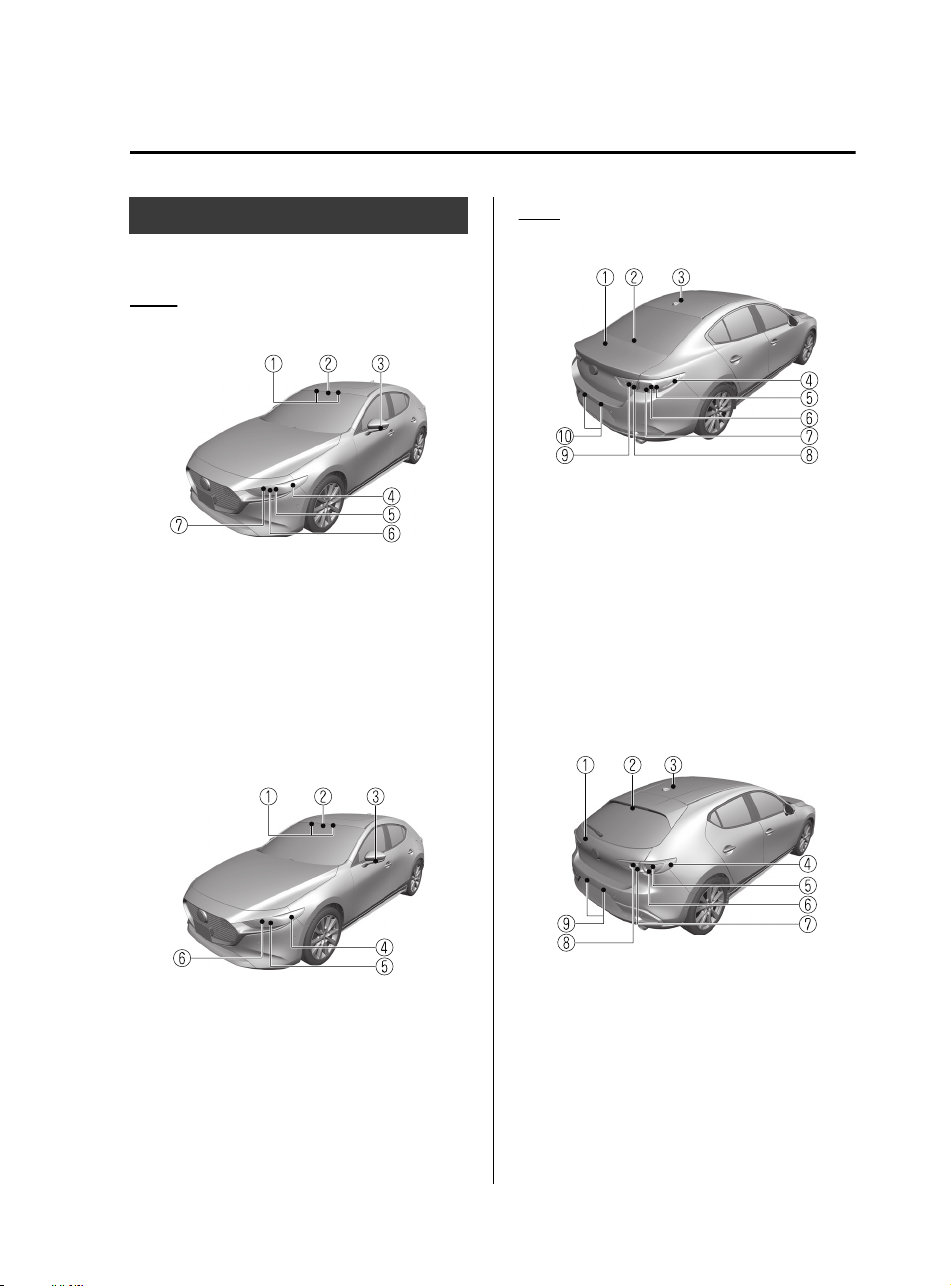
Light Bulbs
▼
Light Bulbs
Front
Type A
1. Vanity mirror lights
*
2. Overhead lights/ Front map lights
3. Side turn signal lights
*
4. Front side-marker lights
5. Parking lights
6. Headlights (High/Low beam)/ Daytime
running lights
7. Front turn signal lights
Type B
1. Vanity mirror lights
*
2. Overhead lights/ Front map lights
3. Side turn signal lights
*
4. Parking lights/Front side-marker lights
5. Headlights (High/Low beam)/ Daytime
running lights
6. Front turn signal lights
Rear
4–Door
1. Trunk light
2. High-mount brake light
3. Overhead light (Rear)
4. Rear side-marker lights
5. Brake lights/Taillights
*
6. Rear turn signal lights
7. Brake lights/Taillights
8. Taillights
*
9. Reverse lights
10. License plate lights
5–Door
1. Luggage compartment light
2. High-mount brake light
3. Overhead light (Rear)
4. Rear side-marker lights
5. Rear turn signal lights
6. Brake lights/Taillights
7. Taillights
*
8. Reverse lights
9. License plate lights
Maintenance and Care
Owner Maintenance
*Some models.
6-35
Mazda3_8HZ1-EA-19G_Edition1_old 2019-5-17 13:49:03
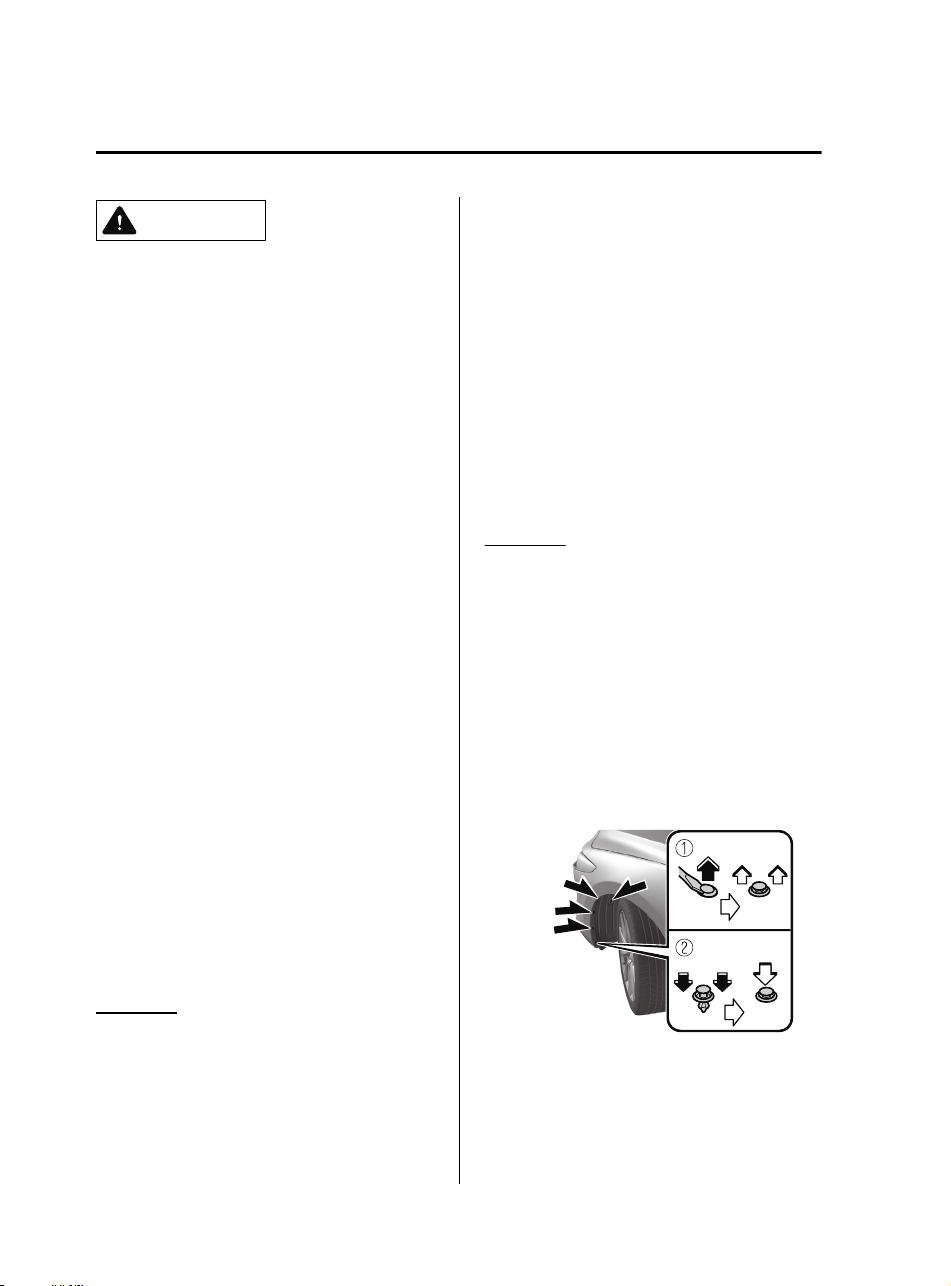
CAUTION
When removing the lens or lamp unit using
a athead screwdriver, make sure that the
athead screwdriver does not contact the
interior terminal. If the athead screwdriver
contacts the terminal, a short circuit may
occur.
NOTE
When replacing a bulb, contact an
Authorized Mazda Dealer if necessary.
Use the protective cover and carton for
the replacement bulb to dispose of the
old bulb promptly and out of the reach
of children.
For details regarding the installation
positions of the interior lights, refer to
the following:
Vanity mirror lights
Refer to Vanity Mirrors on page 5-34.
Overhead Lights/front map lights,
overhead light (rear), trunk light, and
luggage compartment light
Refer to Interior Lights on page 5-35.
▼
Replacing Exterior Light Bulbs
The exterior lights have either LEDs or
normal bulbs.
Only the bulb for a parking lights/front
side-marker lights (type B) can be
replaced.
LED type
Headlights
Daytime running lights
Parking lights (Type A)
Front turn signal lights
Front side-marker lights (Type A)
Side turn signal lights
*
High-mount brake light
Rear turn signal lights
Rear side-marker lights
Brake lights
Taillights
Reverse lights
License plate lights
The LED bulb cannot be replaced as a
single unit because it is an integrated unit.
The LED bulb has to be replaced with the
unit. We recommend an Authorized
Mazda Dealer when the replacement is
necessary.
Bulb type
Parking lights/Front side-marker lights
(Type B)
1. Make sure the ignition is switched off,
and the headlight switch is off.
2. If you are changing the left bulb, start
the engine, turn the steering wheel all
the way to the right, and turn off
engine. If you are changing the right
bulb, turn the steering wheel to the left.
3. Pull the center of each plastic retainer
and remove the retainers.
1. Removal
2. Installation
Maintenance and Care
Owner Maintenance
6-36
*Some models.
Mazda3_8HZ1-EA-19G_Edition1_old 2019-5-17 13:49:03
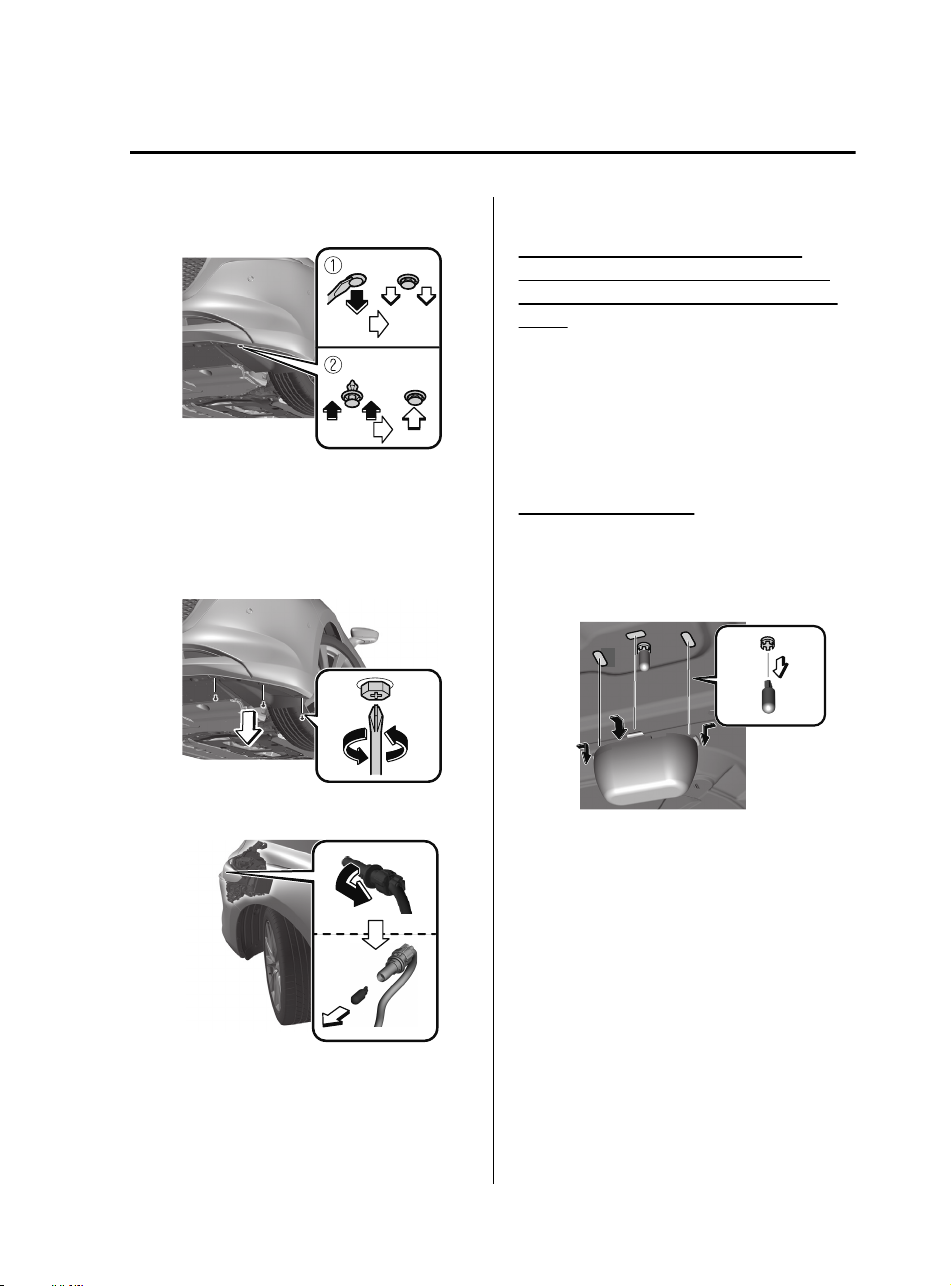
4. Pull the center of each plastic retainer
and remove the retainers.
1. Removal
2. Installation
5. Turn the screw counterclockwise and
remove it, and then partially peel back
the mudguard.
6. Turn the socket and bulb assembly
counterclockwise and remove it.
7. Disconnect the bulb from the socket.
8. Install the new bulb in the reverse
order of the removal procedure.
▼
Replacing Interior Light Bulbs
Overhead lights/Front map lights,
Overhead light (Rear), Vanity mirror
lights, Luggage compartment light (5–
Door)
The LED bulb cannot be replaced as a
single unit because it is an integrated unit.
The LED bulb has to be replaced with the
unit. We recommend an Authorized
Mazda Dealer when the replacement is
necessary.
Trunk light (4–Door)
1. Press both sides of the lens cap to
remove it.
2. Disconnect the bulb by pulling it out.
3. Install the new bulb in the reverse
order of the removal procedure.
Maintenance and Care
Owner Maintenance
6-37
Mazda3_8HZ1-EA-19G_Edition1_old 2019-5-17 13:49:03
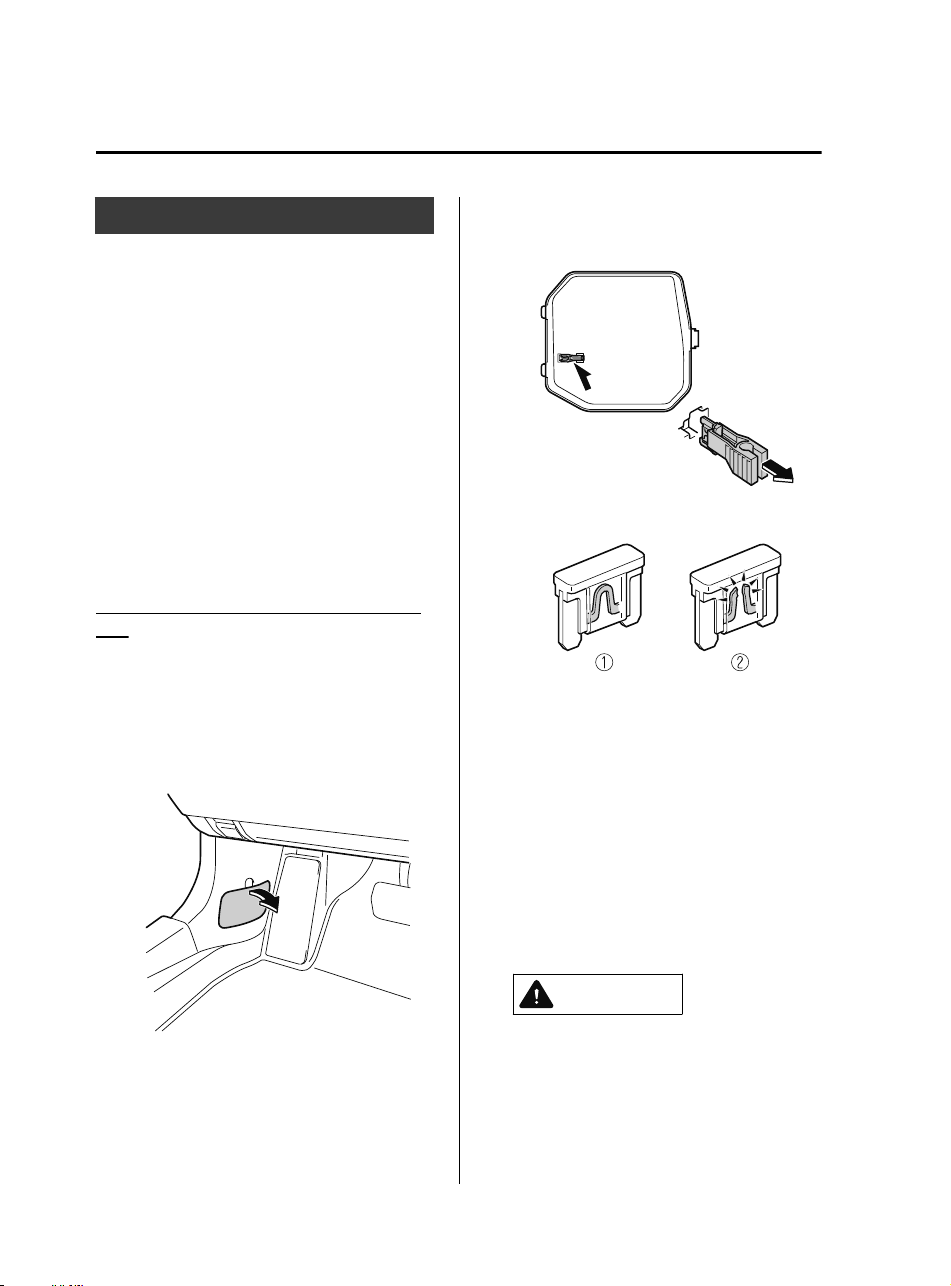
Fuses
▼
Fuses
Your vehicle's electrical system is
protected by fuses.
If any lights, accessories, or controls do
not work, inspect the appropriate circuit
protector. If a fuse has blown, the inside
element will be melted.
If the same fuse blows again, avoid using
that system and consult an Authorized
Mazda Dealer as soon as possible.
▼
Fuse Replacement
Replacing the fuses on the vehicle's left
side
If the electrical system does not work, first
inspect the fuses on the vehicle's left side.
1. Make sure the ignition is switched off,
and other switches are off.
2. Open the fuse panel cover.
3. Pull the fuse straight out with the fuse
puller provided on the fuse block
located in the engine compartment.
4. Inspect the fuse and replace it if it is
blown.
1. Normal
2. Blown
5. Insert a new fuse of the same
amperage rating, and make sure it fits
tightly. If it does not fit tightly, have an
expert install it. Consult an Authorized
Mazda Dealer.
If you have no spare fuses, borrow one
of the same rating from a circuit not
essential to vehicle operation, such as
the audio or accessory socket circuit.
CAUTION
Always replace a fuse with a genuine
Mazda fuse or equivalent of the same
rating. Otherwise you may damage the
electric system.
6. Reinstall the cover and make sure that
it is securely installed.
Maintenance and Care
Owner Maintenance
6-38
Mazda3_8HZ1-EA-19G_Edition1_old 2019-5-17 13:49:03
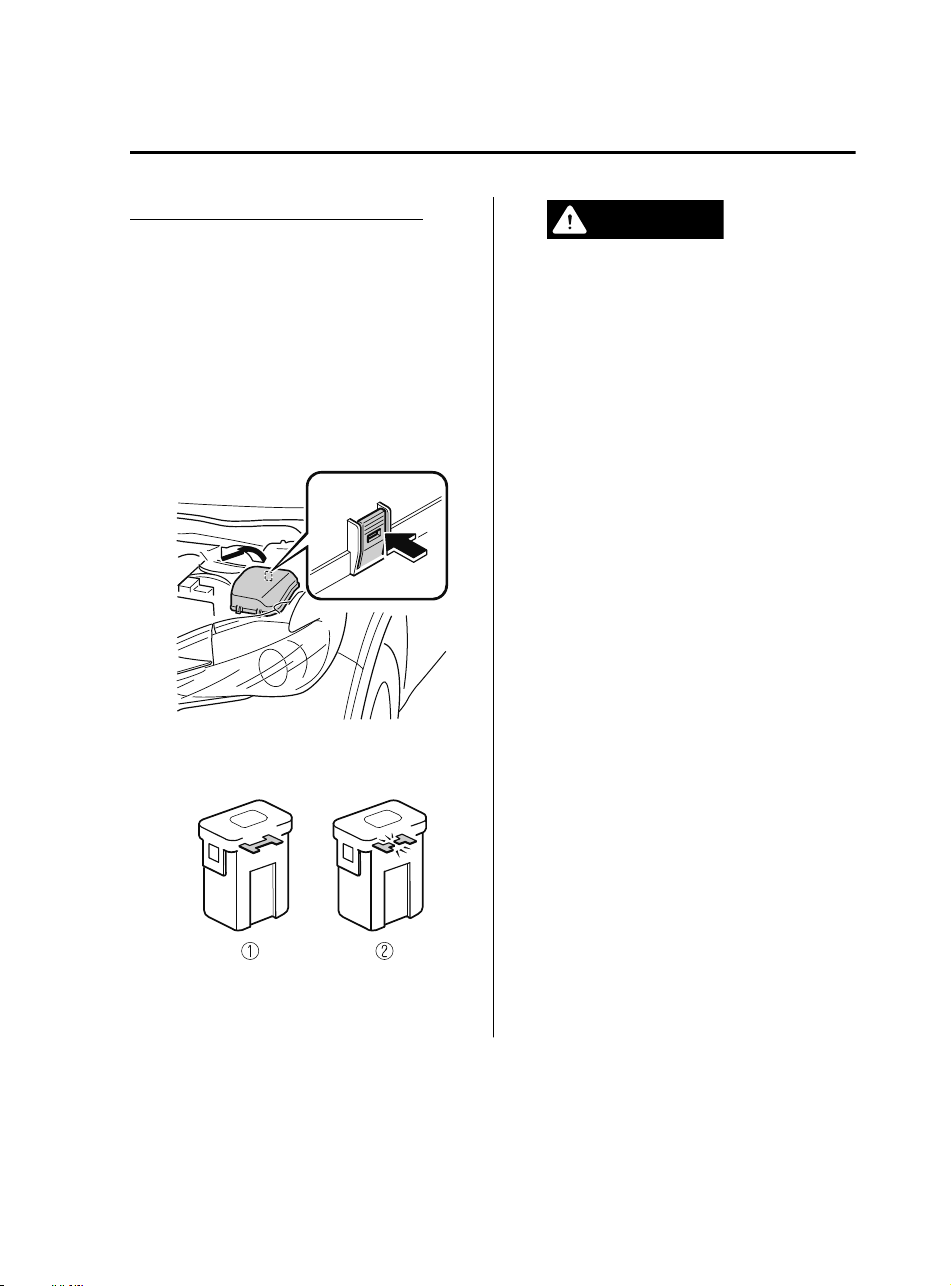
Replacing the fuses under the hood
If the headlights or other electrical
components do not work and the fuses in
the cabin are normal, inspect the fuse
block under the hood.
If a fuse is blown, it must be replaced.
Follow these steps:
1. Make sure the ignition is switched off,
and other switches are off.
2. Remove the fuse block cover.
3. If any fuse but the MAIN fuse is
blown, replace it with a new one of the
same amperage rating.
1. Normal
2. Blown
WARNING
Do not replace the main fuse by
yourself. Have an Authorized Mazda
Dealer perform the replacement:
Replacing the fuse by yourself is
dangerous because the MAIN fuse is a
high current fuse. Incorrect
replacement could cause an electrical
shock or a short circuit resulting in a
re.
4. Reinstall the cover and make sure that
it is securely installed.
Maintenance and Care
Owner Maintenance
6-39
Mazda3_8HZ1-EA-19G_Edition1_old 2019-5-17 13:49:03
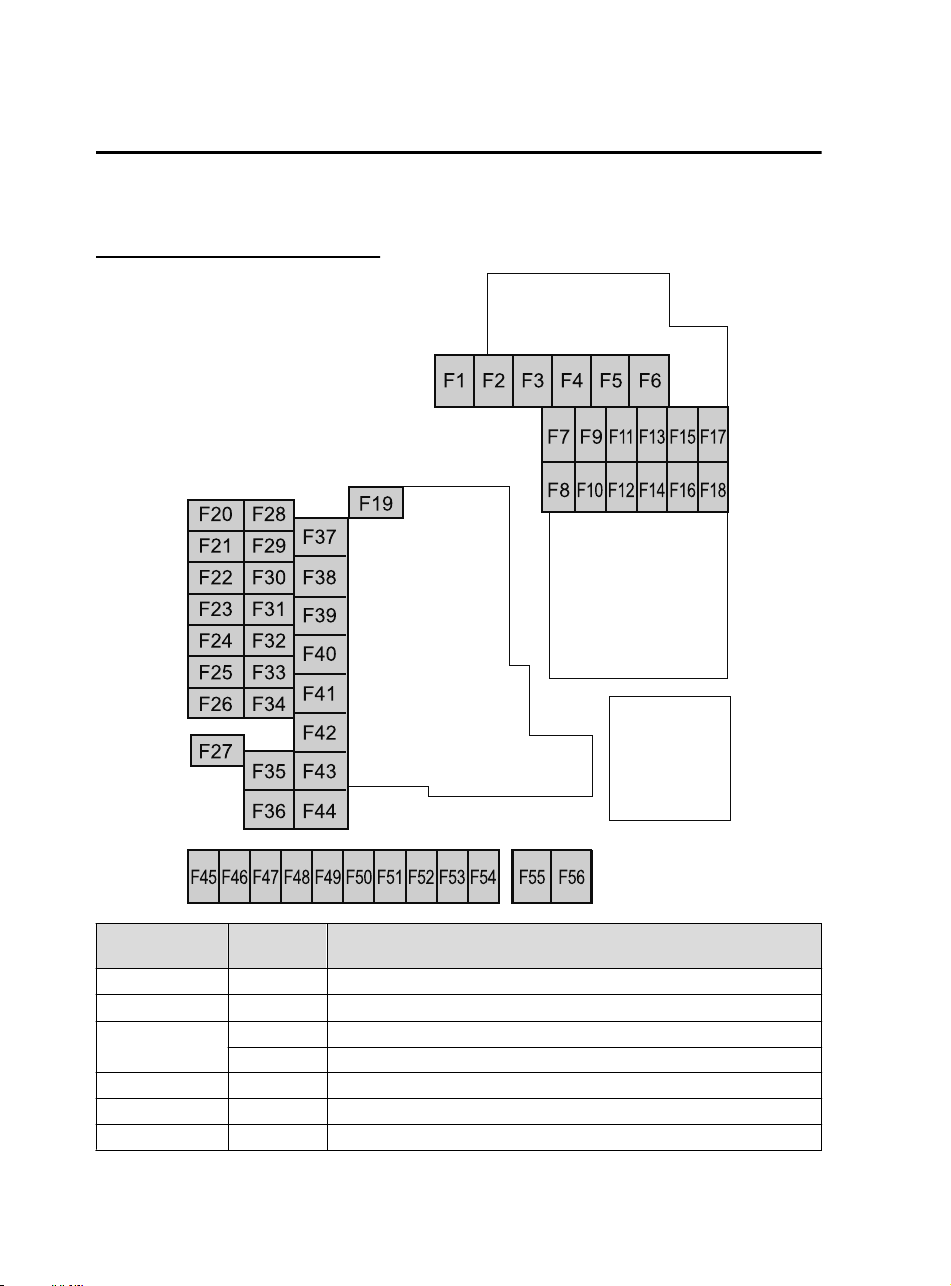
▼
Fuse Panel Description
Fuse block (Engine compartment)
No.
FUSE RAT‐
ING
PROTECTED COMPONENT
F1 ― ―
F2 20 A
Windshield wiper de-icer
*
F3
30 A Engine control system
20 A ―
F4 20 A S-VT
F5 40 A Engine control system
F6 20 A ―
Maintenance and Care
Owner Maintenance
6-40
*Some models.
Mazda3_8HZ1-EA-19G_Edition1_old 2019-5-17 13:49:03
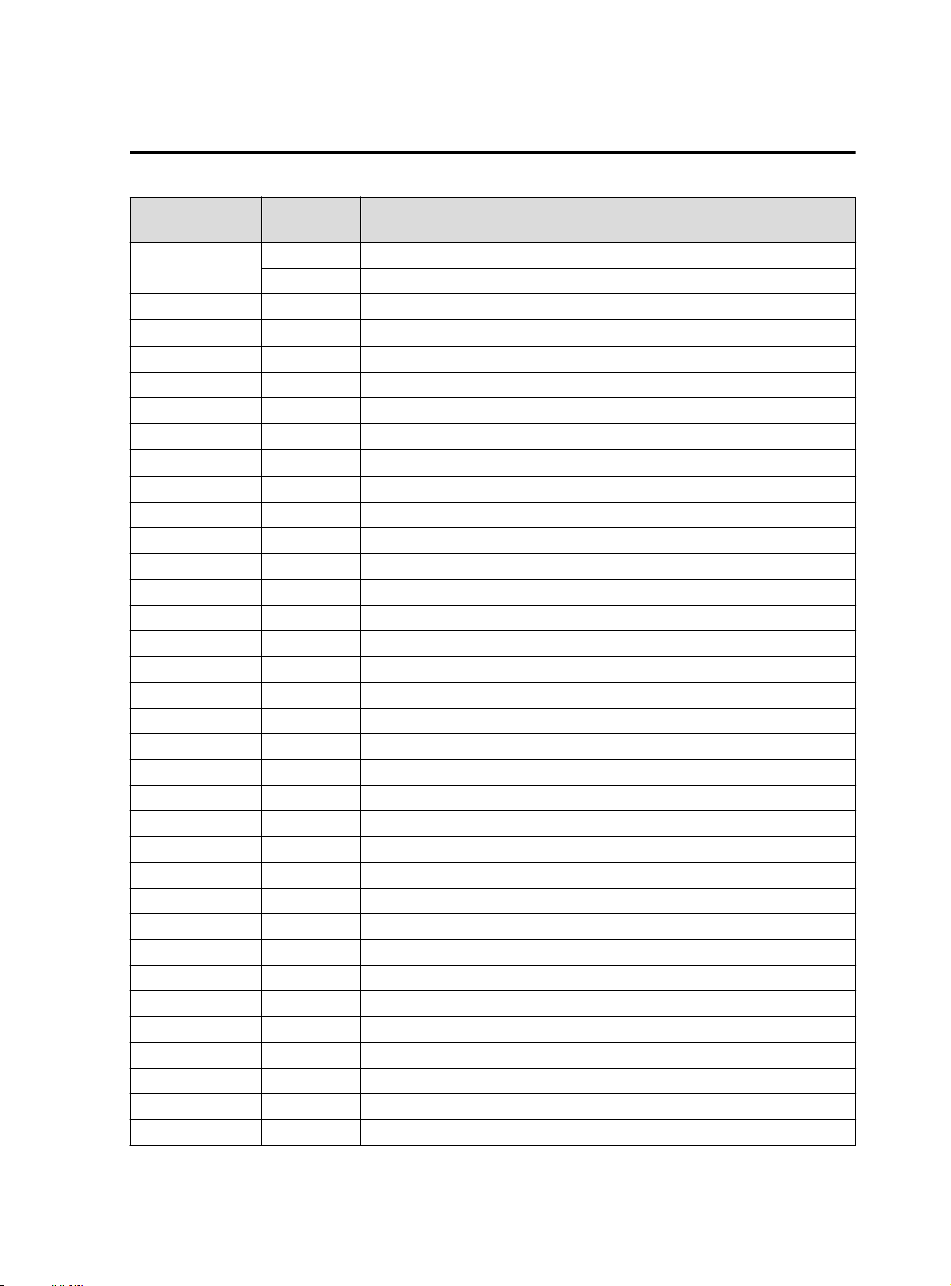
No.
FUSE RAT‐
ING
PROTECTED COMPONENT
F7
15 A ―
20 A Fuel pump
F8 15 A Engine control system
F9 15 A
Transmission control system
*
F10 15 A Engine control system
F11 7.5 A Air conditioner
F12 15 A Engine control system
F13 15 A ―
F14 20 A
Front seat warmer
*
F15 20 A ―
F16 15 A For protection of various circuits
F17 ― ―
F18 15 A Accessory sockets
F19 60 A Power steering system
F20 15 A Headlight (LH) 1
F21 15 A Headlight (RH) 1
F22 15 A For protection of various circuits
F23 30 A ABS, Dynamic stability control system
F24 15 A Headlight (LH) 2
F25 15 A Headlight (RH) 2
F26 7.5 A On board diagnostics
F27 25 A For protection of various circuits
F28 25 A For protection of various circuits
F29 15 A Windscreen washer
F30 15 A Accessory sockets
F31 15 A Horn
F32 ― ―
F33 ― ―
F34 ― ―
F35 50A ABS, Dynamic stability control system
F36 ― ―
F37 40 A Rear window defogger
F38 50 A For protection of various circuits
F39 ― ―
F40 40 A Air conditioner
Maintenance and Care
Owner Maintenance
*Some models.
6-41
Mazda3_8HZ1-EA-19G_Edition1_old 2019-5-17 13:49:03
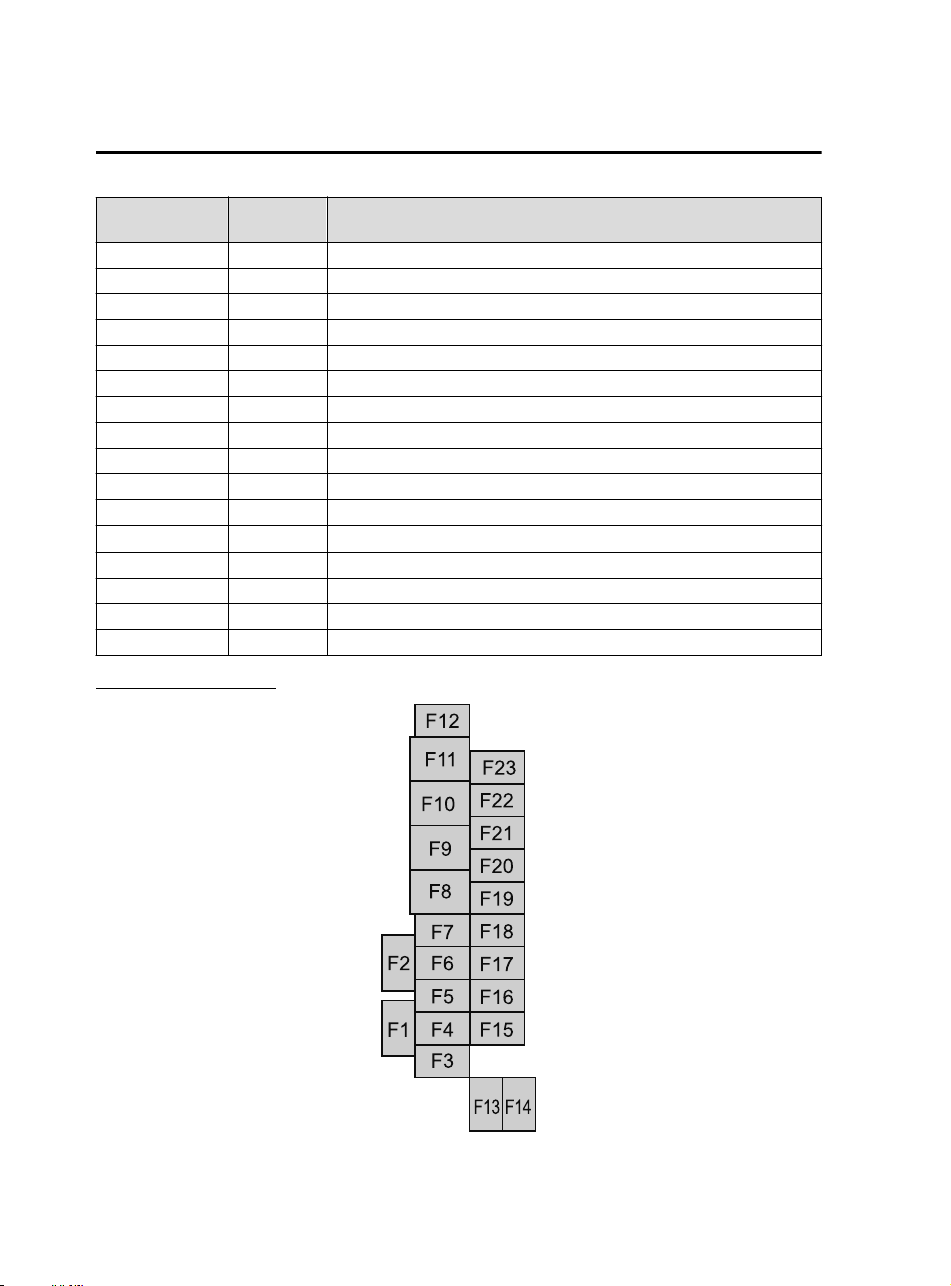
No.
FUSE RAT‐
ING
PROTECTED COMPONENT
F41 ― ―
F42 20 A Windshield wipers
F43 30 A Cooling fan
F44 30 A For protection of various circuits
F45 10 A Engine control system
F46 15 A Audio
F47 15 A For protection of various circuits
F48 7.5 A Air bag
F49 15 A Instrument cluster
F50 15 A Room lamp
F51 25 A Audio system
F52 10 A
Moonroof
*
F53 15 A Engine control system
F54 15 A i-ACTIVSENSE
F55 50 A ―
F56 50 A ―
Fuse block (Left side)
Maintenance and Care
Owner Maintenance
6-42
*Some models.
Mazda3_8HZ1-EA-19G_Edition1_old 2019-5-17 13:49:03
No.
FUSE RAT‐
ING
PROTECTED COMPONENT
F1 ― ―
F2 ― ―
F3 ― ―
F4 15 A Power door locks (Driver)
F5 15 A Power door locks (Passenger)
F6 ― ―
F7 ― ―
F8 ― ―
F9 30 A Power windows (Driver)
F10 30 A Power windows (Passenger)
F11 30 A
Power seat (Driver)
*
F12 ― ―
F13 15 A Audio
F14 ― ―
F15 15 A Back door lock
F16 15 A Illumination
F17 10 A Brake lights
F18 10 A Back lights
F19 10 A Rear turn signal lights
F20 10 A Taillights
F21 10 A Taillights
F22 7.5 A
Electric steering lock
*
F23 ― ―
Maintenance and Care
Owner Maintenance
*Some models.
6-43
Mazda3_8HZ1-EA-19G_Edition1_old 2019-5-17 13:49:03
Exterior Care
▼
Exterior Care
The paintwork on your Mazda represents
the latest technical developments in
composition and methods of application.
Environmental hazards, however, can
harm the paint's protective properties, if
proper care is not taken.
Here are some examples of possible
damage, with tips on how to prevent them.
Etching Caused by Acid Rain or
Industrial Fallout
Occurrence
Industrial pollutants and vehicle emissions
drift into the air and mix with rain or dew
to form acids. These acids can settle on a
vehicle's finish. As the water evaporates,
the acid becomes concentrated and can
damage the finish.
And the longer the acid remains on the
surface, the greater the chance is for
damage.
Prevention
It is necessary to wash and wax your
vehicle to preserve its finish according to
the instructions in this section. These steps
should be taken immediately after you
suspect that acid rain has settled on your
vehicle's finish.
Damage Caused by Bird Dropping,
Insects, or Tree Sap
Occurrence
Bird droppings contain acids. If these are
not removed they can eat away the clear
and color base coat of the vehicle's
paintwork.
When insects stick to the paint surface and
decompose, corrosive compounds form.
These can erode the clear and color base
coat of the vehicle's paintwork if they are
not removed.
Tree sap will harden and adhere
permanently to the paint finish. If you
scratch the sap off while it is hard, some
vehicle paint could come off with it.
Prevention
It is necessary to have your Mazda washed
and waxed to preserve its finish according
to the instructions in this section. This
should be done as soon as possible.
Bird droppings can be removed with a soft
sponge and water. If you are traveling and
these are not available, a moistened tissue
may also take care of the problem. The
cleaned area should be waxed according to
the instructions in this section.
Insects and tree sap are best removed with
a soft sponge and water or a commercially
available chemical cleaner.
Another method is to cover the affected
area with dampened newspaper for 1 to 2
hours. After removing the newspaper,
rinse off the loosened debris with water.
Maintenance and Care
Appearance Care
6-44
Mazda3_8HZ1-EA-19G_Edition1_old 2019-5-17 13:49:03
Water Marks
Occurrence
Rain, fog, dew, and even tap water can
contain harmful minerals such as salt and
lime. If moisture containing these minerals
settles on the vehicle and evaporates, the
minerals will concentrate and harden to
form white rings. The rings can damage
your vehicle's finish.
Prevention
It is necessary to wash and wax your
vehicle to preserve its finish according to
the instructions in this section. These steps
should be taken immediately after you find
water marks on your vehicle's finish.
Paint Chipping
Occurrence
Paint chipping occurs when gravel thrown
in the air by another vehicle's tires hits
your vehicle.
How to avoid paint chipping
Keeping a safe distance between you and
the vehicle ahead reduces the chances of
having your paint chipped by flying
gravel.
NOTE
The paint chipping zone varies with the
speed of the vehicle. For example, when
traveling at 90 km/h (56 mph), the paint
chipping zone is 50 m (164 ft).
In low temperatures a vehicle's finish
hardens. This increases the chance of
paint chipping.
Chipped paint can lead to rust forming
on your Mazda. Before this happens,
repair the damage by using Mazda
touch-up paint according to the
instructions in this section. Failure to
repair the affected area could lead to
serious rusting and expensive repairs.
Follow all label and container directions
when using a chemical cleaner or polish.
Read all warnings and cautions.
▼
Maintaining the Finish
Washing
CAUTION
Before lifting the windshield wiper blades
o
the windshield, always follow the
procedure for moving the windshield
wiper blades. Otherwise, a wiper blade,
wiper arm, or the hood could be
damaged.
Refer to the Replacing Windshield Wiper
Blades (page on 6-22) section for the
procedure on how to move the
windshield wiper blades to the service
position.
When the wiper lever is in the AUTO
position and the ignition is switched ON,
the wipers may move automatically in
the following cases:
If the windshield above the rain sensor
is touched or wiped with a cloth.
If the windshield is struck with a hand
or other object from either outside or
inside the vehicle.
Maintenance and Care
Appearance Care
6-45
Mazda3_8HZ1-EA-19G_Edition1_old 2019-5-17 13:49:03
Keep hands and scrapers clear of the
windshield when the wiper lever is in the
AUTO position and the ignition is
switched ON as ngers could be pinched
or the wipers and wiper blades damaged
when the wipers activate automatically.
If you are going to clean the windshield,
be sure the wipers are turned o
completely (when it is most likely that the
engine is left running) this is particularly
important when clearing ice and snow.
Do not spray water in the engine
compartment. Otherwise, it could result
in engine-starting problems or damage
to electrical parts.
When washing and waxing the vehicle,
be careful not to apply excessive force to
any single area of the vehicle roof or the
antenna. Otherwise, you could dent the
vehicle or damage the antenna.
Make sure that the fuel-ller lid is closed
and lock the doors. Otherwise, the
fuel-ller
lid may be forcefully opened by
water pressure causing damage to the
vehicle or fuel-ller lid.
To help protect the finish from rust and
deterioration, wash your Mazda
thoroughly and frequently, at least once a
month, with lukewarm or cold water.
If the vehicle is washed improperly, the
paint surface could be scratched. Here are
some examples of how scratching could
occur.
Scratches occur on the paint surface when:
The vehicle is washed without first
rinsing off dirt and other foreign matter.
The vehicle is washed with a rough, dry,
or dirty cloth.
The vehicle is washed at a car wash that
uses brushes that are dirty or too stiff.
Cleansers or wax containing abrasives
are used.
NOTE
Mazda is not responsible for scratches
caused by automatic car washes or
improper washing.
Scratches are more noticeable on
vehicles with darker paint finishes.
To minimize scratches on the vehicle's
paint finish:
Rinse off any dirt or other foreign matter
using lukewarm or cold water before
washing.
Use plenty of lukewarm or cold water
and a soft cloth when washing the
vehicle. Do not use a nylon cloth.
Rub gently when washing or drying the
vehicle.
Take your vehicle only to a car wash
that keeps its brushes well maintained.
Do not use abrasive cleansers or wax
that contain abrasives.
CAUTION
Do not use steel wool, abrasive cleaners,
or strong detergents containing highly
alkaline or caustic agents on
chrome-plated or anodized aluminum
parts. This may damage the protective
coating; also, cleaners and detergents
may discolor or deteriorate the paint.
Maintenance and Care
Appearance Care
6-46
Mazda3_8HZ1-EA-19G_Edition1_old 2019-5-17 13:49:03
Pay special attention to removing salt, dirt,
mud, and other foreign material from the
underside of the fenders, and make sure
the drain holes in the lower edges of the
doors and rocker panels are clean.
Insects, tar, tree sap, bird droppings,
industrial fallout, and similar deposits can
damage the finish if not removed
immediately. When prompt washing with
plain water is ineffective, use a mild soap
made for use on vehicles.
Thoroughly rinse off all soap with
lukewarm or cold water. Do not allow
soap to dry on the finish.
After washing the vehicle, dry it with a
clean chamois to prevent water spots from
forming.
WARNING
Dry o brakes that have become wet by
driving slowly, releasing the accelerator
pedal and lightly applying the brakes
several times until the brake performance
returns to normal:
Driving with wet brakes is dangerous.
Increased stopping distance or the vehicle
pulling to one side when braking could
result in a serious accident. Light braking
will indicate whether the brakes have been
aected.
When using an automatic car wash
Retract the door mirrors.
The automatic car wash brushes could
reduce the paint lustre or hasten paint
deterioration.
When using a high water pressure car
wash
High water temperature and high water
pressure car washers are available
depending on the type of car wash
machine. If the car washer nozzle is put
too close to the vehicle, the force of the
spray could damage or deform the
molding, affect the sealability of parts, and
allow water to penetrate the interior. Keep
a sufficient space (30 cm (12 in) or more)
between the nozzle and the vehicle. In
addition, do not spend too much time
spraying the same area of the vehicle, and
be very careful when spraying between
gaps in doors and around windows.
Waxing
Your vehicle needs to be waxed when
water no longer beads on the finish.
Always wash and dry the vehicle before
waxing it. In addition to the vehicle body,
wax the metal trim to maintain its luster.
1. Use wax which contains no abrasives.
Waxes containing abrasive will remove
paint and could damage bright metal
parts.
2. Use a good grade of natural wax for
metallic, mica, and solid colors.
3. When waxing, coat evenly with the
sponge supplied or a soft cloth.
4. Wipe off the wax with a soft cloth.
NOTE
A spot remover to remove oil, tar, and
similar materials will usually also take off
the wax. Rewax these areas even if the rest
of the vehicle does not need it.
Maintenance and Care
Appearance Care
6-47
Mazda3_8HZ1-EA-19G_Edition1_old 2019-5-17 13:49:03
▼
Repairing Damage to the Finish
Deep scratches or chips on the finish
should be repaired promptly. Exposed
metal quickly rusts and can lead to major
repairs.
CAUTION
If your Mazda is damaged and needs metal
parts repaired or replaced, make sure the
body shop applies anti-corrosion materials
to all parts, both repaired and new. This
will prevent them from rusting.
▼
Bright-Metal Maintenance
Use tar remover to remove road tar and
insects. Never do this with a knife or
similar tool.
To prevent corrosion on bright-metal
surfaces, apply wax or chrome
preservative and rub it to a high luster.
During cold weather or in coastal areas,
cover bright-metal parts with a coating
of wax or preservative heavier than
usual. It would also help to coat them
with noncorrosive petroleum jelly or
some other protective compound.
CAUTION
Do not use steel wool, abrasive cleaners, or
strong detergents containing highly
alkaline or caustic agents on
chrome-plated or anodized aluminum
parts. This may result in damage to the
protective coating and cause discoloration
or paint deterioration.
▼
Underbody Maintenance
Road chemicals and salt used for ice and
snow removal and solvents used for dust
control may collect on the underbody. If
not removed, they will speed up rusting
and deterioration of such underbody parts
as fuel lines, frame, floor pan, and exhaust
system, even though these parts may be
coated with anti-corrosive material.
Thoroughly flush the underbody and
wheel housings with lukewarm or cold
water at the end of each winter. Try also to
do this every month.
Pay special attention to these areas
because they easily hide mud and dirt. It
will do more harm than good to wet
down the road grime without removing
it.
The lower edges of doors, rocker panels,
and frame members have drain holes that
should not be clogged. Water trapped there
will cause rusting.
WARNING
Dry o brakes that have become wet by
driving slowly, releasing the accelerator
pedal and lightly applying the brakes
several times until the brake performance
returns to normal:
Driving with wet brakes is dangerous.
Increased stopping distance or the vehicle
pulling to one side when braking could
result in a serious accident. Light braking
will indicate whether the brakes have been
aected.
Maintenance and Care
Appearance Care
6-48
Mazda3_8HZ1-EA-19G_Edition1_old 2019-5-17 13:49:03
▼
Aluminum Wheel Maintenance
*
A protective coating is provided over the
aluminum wheels. Special care is needed
to protect this coating.
CAUTION
Do not use any detergent other than mild
detergent. Before using any detergent,
verify the ingredients. Otherwise, the
product could discolor or stain the
aluminum wheels.
NOTE
Do not use a wire brush or any abrasive
cleaner, polishing compound, or solvent
on aluminum wheels. They may damage
the coating.
Always use a sponge or soft cloth to
clean the wheels.
Rinse the wheels thoroughly with
lukewarm or cold water. Also, be sure to
clean the wheels after driving on dusty
or salted roads to help prevent
corrosion.
Avoid washing your vehicle in an
automatic car wash that uses high-speed
or hard brushes.
▼
Plastic Part Maintenance
When cleaning the plastic lenses of the
lights, do not use gasoline, kerosene,
rectified spirit, paint, thinner, highly
acidic detergents, or strongly alkaline
detergents. Otherwise, these chemical
agents can discolor or damage the
surfaces resulting in a significant loss in
functionality. If plastic parts become
inadvertently exposed to any of these
chemical agents, flush with water
immediately.
If plastic parts such as the bumpers
become inadvertently exposed to
chemical agents or fluids such as
gasoline, oil, engine coolant, or battery
fluid, it could cause discoloration,
staining, or paint peeling. Wipe off any
such chemical agents or fluids using a
soft cloth immediately.
High water temperature and high water
pressure car washers are available
depending on the type of high pressure
car washer device. If the car washer
nozzle is put too close to the vehicle or
aimed at one area for an extended period
of time, it could deform plastic parts or
damage the paint.
Do not use wax containing compounds
(polish). Otherwise, it could result in
paint damage.
In addition, do not use an electrical or
air tool to apply wax. Otherwise, the
frictional heat generated could result in
deformation of plastic parts or paint
damage.
Maintenance and Care
Appearance Care
*Some models.
6-49
Mazda3_8HZ1-EA-19G_Edition1_old 2019-5-17 13:49:03
Interior Care
▼
Interior Care
WARNING
Do not spray water into the vehicle cabin:
Spraying water into the vehicle cabin is
dangerous as electrical devices such as the
audio and switches could get wet resulting
in a malfunction or vehicle
re.
NOTE
Do not wipe the interior using alcohol,
chlorine bleach, or organic solvents
such as thinner, benzene, and gasoline.
Otherwise, it may cause discoloration or
stains.
Rubbing hard with a stiff brush or cloth
may cause damage.
If the vehicle interior becomes soiled by
any of the following, wipe it off
immediately using a soft cloth.
Leaving it uncleaned could cause
discoloration, stains, cracks, or peeling of
the coating, and it will make it hard to
wipe off later.
Beverage or fragrance
Grease or oil
Soiling
▼
Seat Belt Maintenance
1. Clean the soiled area by lightly
dabbing it with a soft cloth soaked in a
mild detergent (approx. 5%) diluted
with water.
2. Wipe off the remaining detergent using
a cloth soaked in clean water and
wrung out well.
3. Before retracting seat belts which have
been pulled out for cleaning, dry them
off thoroughly and make sure there is
no remaining moisture on them.
WARNING
If a seat belt appears frayed or has
abrasions, have it replaced by an
Authorized Mazda Dealer:
If a seat belts is used under such a
condition, it cannot function at its full
capacity which could result in serious injury
or death.
Use a mild detergent to remove soiling
from a seat belt:
If organic solvents are used for cleaning the
seat belts or they become stained or
bleached, there is the possibility of them
becoming weakened and as a result, they
may not function at their full capacity
which could cause serious injury or death.
NOTE
Clean seat belts diligently if they get dirty.
Leaving them uncleaned will make it
difficult to clean them later, and it may
affect the smooth retracting of the seat
belt.
▼
Vinyl Upholstery Maintenance
Remove dust and dirt from the vinyl
upholstery using a brush or vacuum.
Remove soiling from vinyl upholstery
using a leather and vinyl upholstery
cleaner.
Maintenance and Care
Appearance Care
6-50
Mazda3_8HZ1-EA-19G_Edition1_old 2019-5-17 13:49:03
▼
Upholstery Maintenance
1. Clean the soiled area by lightly
dabbing it with a soft cloth soaked in a
mild detergent (approx. 5%) diluted
with water.
2. Wipe off the remaining detergent using
a cloth soaked in clean water and
wrung out well.
▼
Leather Upholstery Maintenance
*
1. Remove dust and sand using a vacuum
cleaner.
2. Wipe off the soiled area with a soft
cloth and a suitable, special cleaner or
a soft cloth soaked in a mild detergent
(about 5%) diluted with water.
3. Wipe off the remaining detergent using
a cloth soaked in clean water and
wrung out well.
4. Remove moisture with a dry, soft cloth
and allow the leather to further dry in a
well-ventilated, shaded area. If the
leather gets wet such as from rain,
remove the moisture and dry it as soon
as possible.
NOTE
Because genuine leather is a natural
material, its surface is not uniform and
it may have natural scars, scratches,
and wrinkles.
To maintain the quality for as long as
possible, periodical maintenance, about
twice a year, is recommended.
If the leather upholstery comes into
contact with any of the following, clean
it immediately.
Leaving it uncleaned could cause
premature wear, mold, or stains.
Sand or dirt
Grease or oil, such as hand cream
Alcohol, such as in cosmetic or hair
dressing items
If the leather upholstery gets wet,
promptly remove moisture with a dry
cloth. Remaining moisture on the
surface may cause deterioration such as
hardening and shrinkage.
Exposure to direct sunlight for long
periods may cause deterioration and
shrinkage. When parking the car under
direct sunlight for long periods, shade
the interior using sunshades.
Do not leave vinyl products on the
leather upholstery for long periods.
They may affect the leather quality and
coloring. If the cabin temperature
becomes hot, the vinyl may deteriorate
and adhere to the genuine leather.
▼
Plastic Part Maintenance
CAUTION
Do not use polishing agents.
Depending on the product ingredients,
they could cause discoloration, stains,
cracks or peeling of the coating.
▼
Instrument Panel Top (Soft pad)
Maintenance
Extremely soft material is used for the soft
pad surface. If the soft pad surface is
rubbed harshly with a dry cloth, it could
result in the surface being damaged and
leaving white scratch marks.
1. Wipe the soiled area with a soft cloth
soaked in a mild detergent (approx.
5%) diluted with water.
2. Wipe off the remaining detergent using
a cloth soaked in clean water and
wrung out well.
Maintenance and Care
Appearance Care
*Some models.
6-51
Mazda3_8HZ1-EA-19G_Edition1_old 2019-5-17 13:49:03
▼
Active Driving Display
Maintenance
*
The dust-proof sheet has a coating. When
cleaning, do not use a hard or
rough-surface cloth, or cleaning detergent.
In addition, if a chemical solvent gets on
the active driving display, wipe it off
immediately. The dust-proof sheet could
be damaged and the surface coating could
be scratched. Use a fine, soft cloth such as
those used for cleaning eyeglasses.
NOTE
Use of compressed air when cleaning the
dust-proof sheet is recommended.
▼
Panel Maintenance
If a panel becomes soiled, wipe it off with
a soft cloth soaked in clean water and
thoroughly wrung out.
If some areas require further cleaning, use
the following procedure:
1. Wipe the soiled area with a soft cloth
soaked in a mild detergent (approx.
5 %) diluted with water.
2. Wipe off the remaining detergent using
a cloth soaked in clean water and
wrung out well.
NOTE
Be particularly careful when cleaning
shiny surface panels and metallic parts
such as plating as they can be scratched
easily.
▼
Cleaning the Window Interiors
If the windows become covered with an
oily, greasy, or waxy film, clean them with
glass cleaner. Follow the directions on the
container.
CAUTION
Do not scrape or scratch the inside of the
window glass. It could damage the
thermal laments and the antenna lines.
When washing the inside of the window
glass, use a soft cloth dampened in
lukewarm water, gently wiping the
thermal laments and the antenna lines.
Use of glass cleaning products could
damage the thermal laments and the
antenna lines.
▼
Cleaning the Floor Mats
Rubber floor mats should be cleaned with
mild soap and water only.
WARNING
Do not use rubber cleaners, such as tire
cleaner or tire shine, when cleaning rubber
oor mats:
Cleaning the rubber oor mats with rubber
cleaning products makes the
oor
mats
slippery.
This may cause an accident when
depressing the accelerator, brake, or clutch
(Manual transmission) pedal or when
getting in or out of the vehicle.
After removing the floor mats for
cleaning, always reinstall them securely
(page 3-46).
Maintenance and Care
Appearance Care
6-52
*Some models.
Mazda3_8HZ1-EA-19G_Edition1_old 2019-5-17 13:49:03
7
If Trouble Arises
Helpful information on what to do if a problem arises with the vehicle.
Parking in an Emergency................. 7-2
Parking in an Emergency..............7-2
Flat Tire..............................................7-3
Spare Tire and Tool Storage......... 7-3
Changing a Flat Tire..................... 7-7
Battery Runs Out............................ 7-17
Jump-Starting............................. 7-17
Emergency Starting.........................7-20
Starting a Flooded Engine.......... 7-20
Push-Starting.............................. 7-20
Overheating......................................7-21
Overheating................................ 7-21
Emergency Towing.......................... 7-23
Towing Description.................... 7-23
Tiedown Hooks
*
.........................7-24
Warning/Indicator Lights and
Warning Sounds.............................. 7-27
If a Warning Light Turns On or
Flashes........................................ 7-27
Message Indicated on Multi-
information Display....................7-38
Warning Sound is Activated....... 7-41
When Liftgate/Trunk Lid Cannot be
Opened..............................................7-46
When Liftgate/Trunk Lid Cannot be
Opened........................................7-46
Active Driving Display Does Not
Operate.............................................7-48
If the Active Driving Display Does
Not Operate
*
...............................7-48
Windshield Wipers Operate at High
Speed.................................................7-49
Windshield Wipers Operate at High
Speed.......................................... 7-49
*Some models.
7-1
Mazda3_8HZ1-EA-19G_Edition1_old 2019-5-17 13:49:03
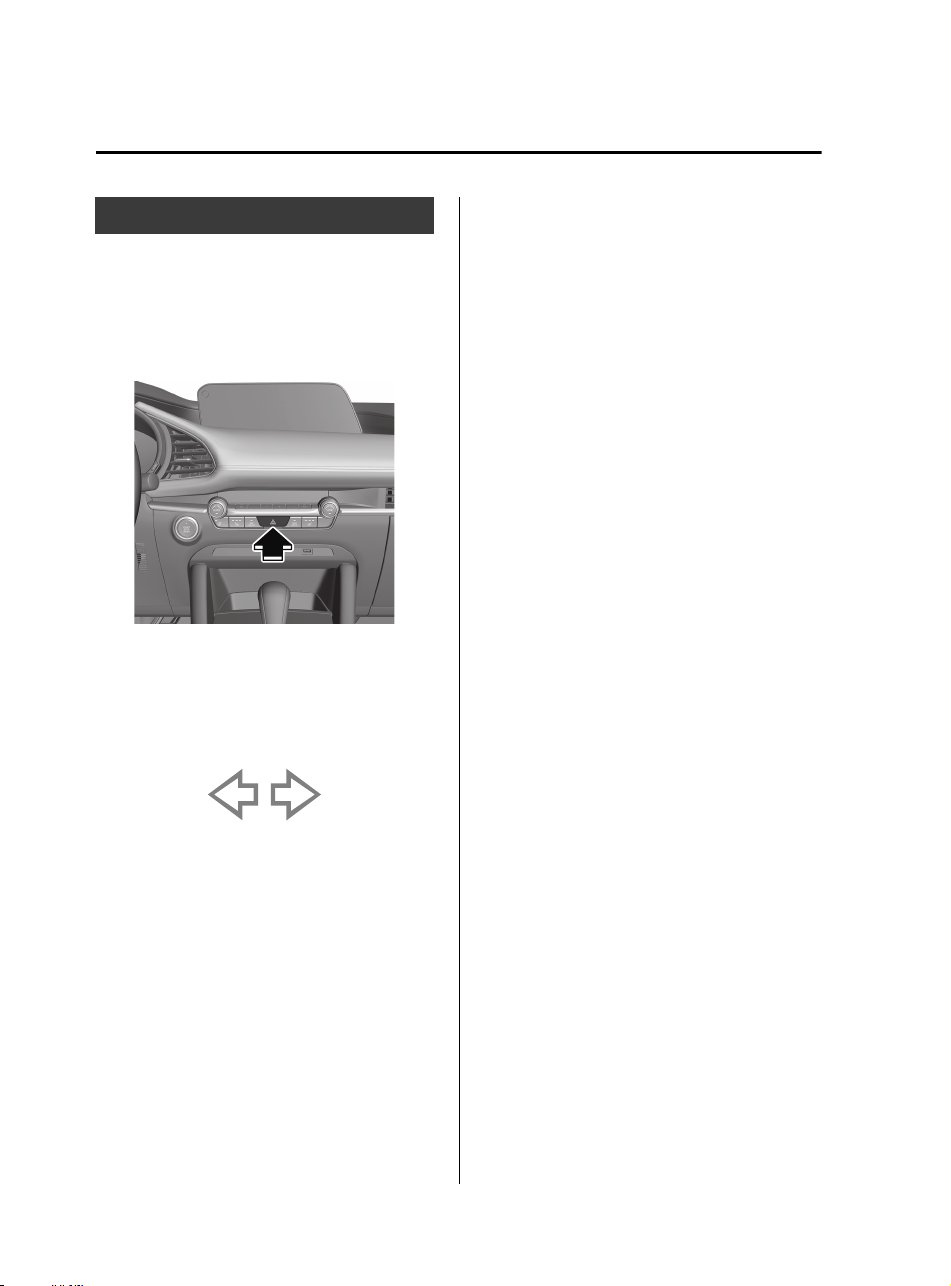
Parking in an Emergency
▼
Parking in an Emergency
The hazard warning lights should always
be used when you stop on or near a
roadway in an emergency.
The hazard warning lights warn other
drivers that your vehicle is a traffic hazard
and that they must take extreme caution
when near it.
Depress the hazard warning flasher and all
the turn signals will flash. The hazard
warning indicator lights in the instrument
cluster flash simultaneously.
NOTE
The turn signals do not work when the
hazard warning lights are on.
Check local regulations about the use of
hazard warning lights while the vehicle
is being towed to verify that it is not in
violation of the law.
If Trouble Arises
Parking in an Emergency
7-2
Mazda3_8HZ1-EA-19G_Edition1_old 2019-5-17 13:49:03
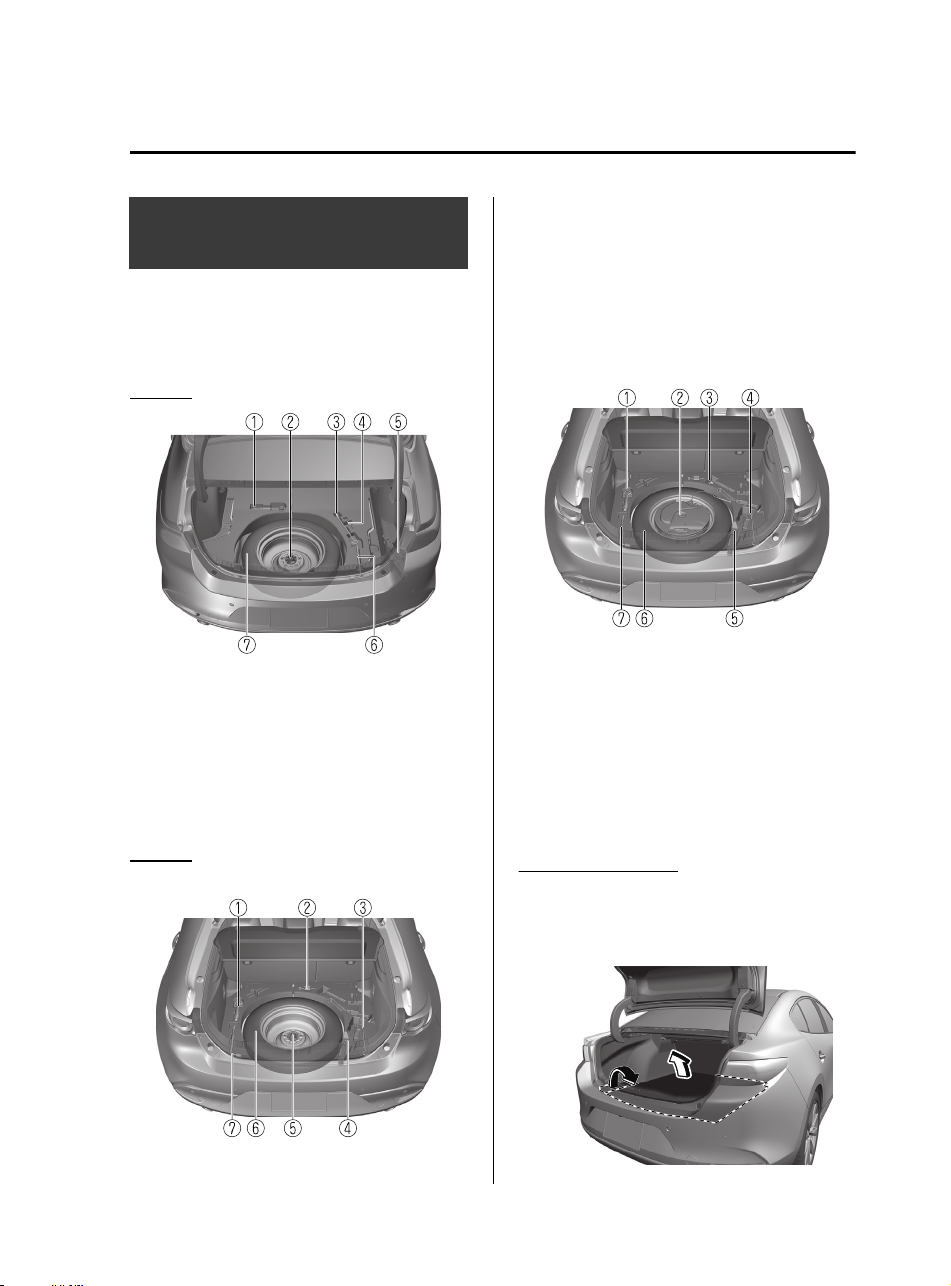
Spare Tire and Tool
Storage
▼
Spare Tire and Tool Storage
Spare tire and tools are stored in the
locations illustrated in the diagram.
4–Door
1. Tiedown eyelet
*
2. Spare tire hold-down bolt
3. Jack lever
4. Flat tire hold-down bolt
*
5. Jack
6. Lug wrench
7. Spare tire
5–Door
Type A
1. Tiedown eyelet
*
2. Flat tire hold-down bolt
*
3. Jack lever
4. Jack
5. Spare tire hold-down bolt
6. Spare tire
7. Lug wrench
Type B
1. Tiedown eyelet
*
2. Spare tire hold-down bolt
3. Flat tire hold-down bolt
4. Jack lever
5. Jack
6. Spare tire
7. Lug wrench
▼
Jack
To remove the jack
4–Door
1. Remove the trunk mat.
If Trouble Arises
Flat Tire
*Some models.
7-3
Mazda3_8HZ1-EA-19G_Edition1_old 2019-5-17 13:49:03
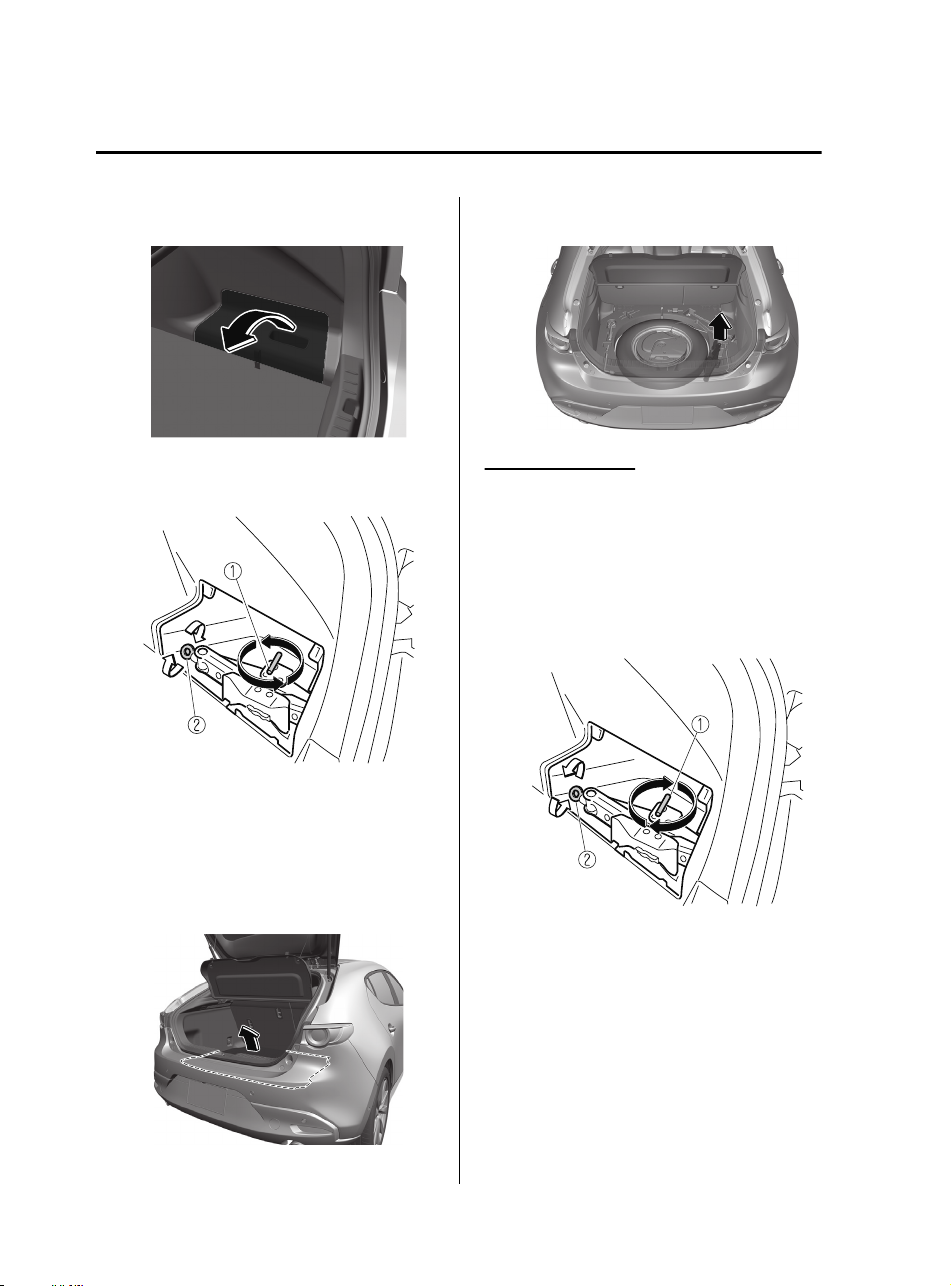
2. Remove the cover.
3. Turn the wing bolt and jack screw
counterclockwise.
1. Wing bolt
2. jack screw
5–Door
1. Remove the luggage mat.
2. Remove the jack.
To secure the jack
4–Door
1. Insert the wing bolt into the jack with
the jack screw pointing to the front and
turn the wing bolt clockwise to
temporarily tighten it.
2. Turn the jack screw clockwise.
1. Wing bolt
2. jack screw
3. Turn the wing bolt completely to
secure the jack.
NOTE
If the jack is not completely secured, it
could rattle while driving. Make sure the
jack screw is sufficiently tightened.
If Trouble Arises
Flat Tire
7-4
Mazda3_8HZ1-EA-19G_Edition1_old 2019-5-17 13:49:03
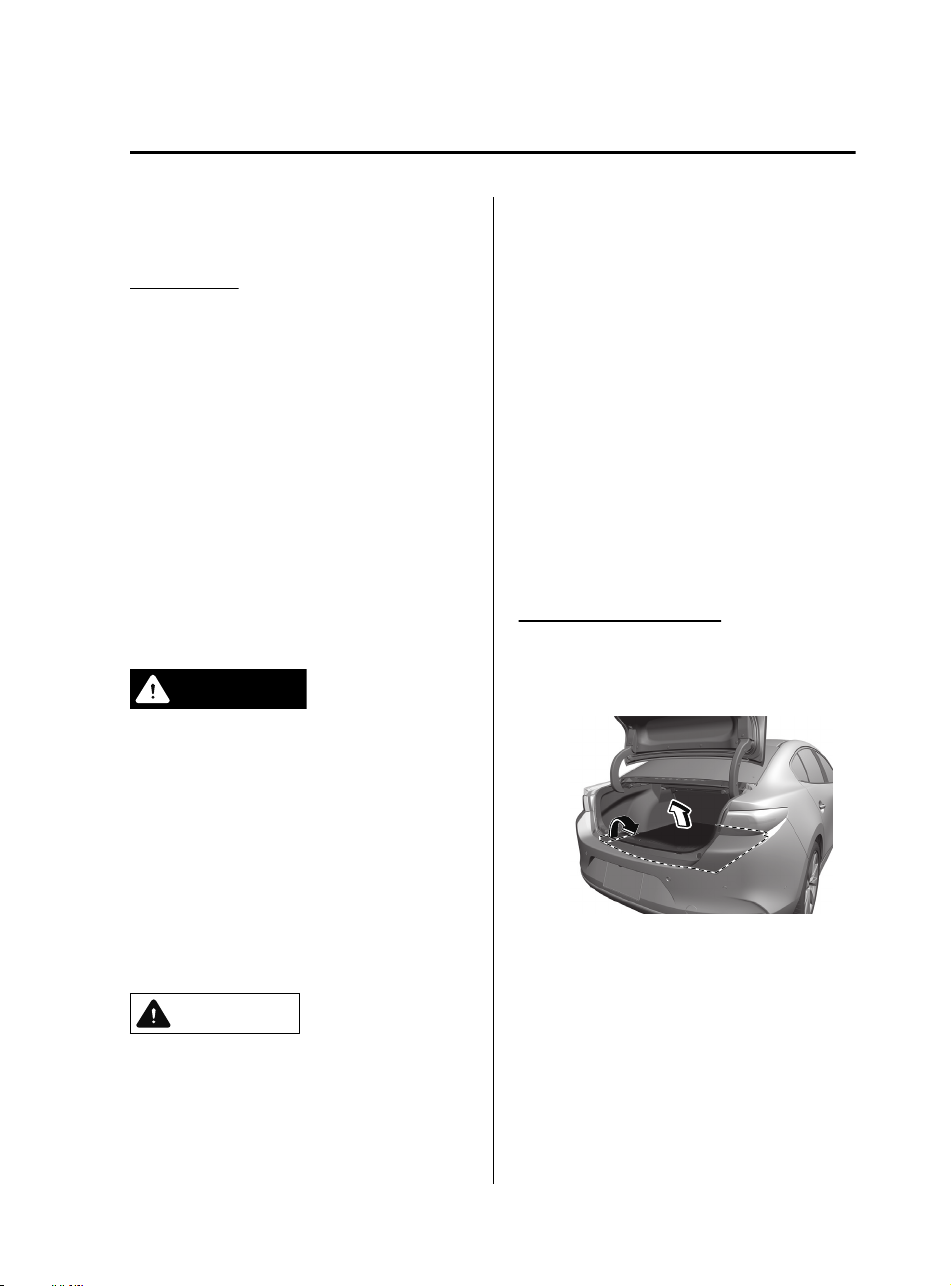
5–Door
Perform the removal procedure in reverse.
Maintenance
Always keep the jack clean.
Make sure the moving parts are kept
free from dirt or rust.
Make sure the screw thread is
adequately lubricated.
▼
Spare Tire
Your Mazda has a temporary spare tire.
The temporary spare tire is lighter and
smaller than a conventional tire, and is
designed only for emergency use and
should be used only for VERY short
periods. Temporary spare tires should
NEVER be used for long drives or
extended periods.
WARNING
Do not install the temporary spare tire on
the front wheels (driving wheels):
Driving with the temporary spare tire on
one of the front driving wheels is
dangerous. Handling will be
aected.
You
could lose control of the vehicle, especially
on ice or snow bound roads, and have an
accident. Move a regular tire to the front
wheel and install the temporary spare tire
to the rear.
CAUTION
When using the temporary spare tire,
driving stability may decrease compared
to when using only the conventional tire.
Drive carefully.
To avoid damage to the temporary spare
tire or to the vehicle, observe the
following precautions:
Do not exceed 80 km/h (50 mph).
Avoid driving over obstacles. Also, do
not drive through an automatic car
wash. This tire's diameter is smaller
than a conventional tire, so the ground
clearance is reduced.
Do not use a tire chain on this tire
because it will not
t
properly.
Do not use your temporary spare tire
on any other vehicle, it has been
designed only for your Mazda.
Use only one temporary spare tire on
your vehicle at the same time.
To remove the spare tire
4–Door
1. Remove the trunk mat.
If Trouble Arises
Flat Tire
7-5
Mazda3_8HZ1-EA-19G_Edition1_old 2019-5-17 13:49:03
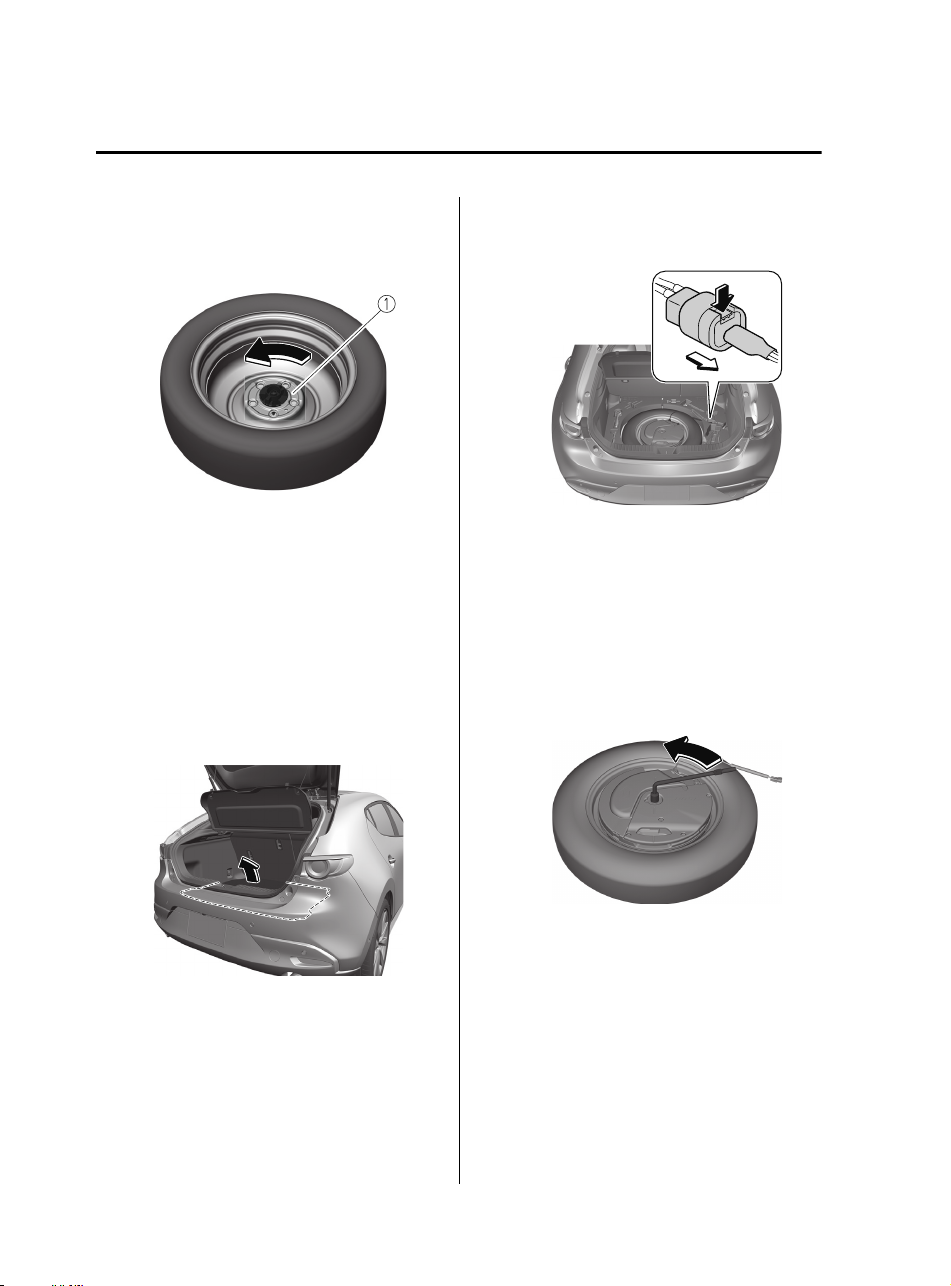
2. Turn the spare tire hold-down bolt
counterclockwise and remove the spare
tire.
1. Spare tire hold-down bolt
NOTE
If the spare tire hold-down bolt cannot
be loosened, hold the edge of the tire
and turn the spare tire hold-down bolt
until it rotates.
5–Door
1. Remove the luggage mat.
2. (Vehicles with sub-woofer)
Uncouple the sub-woofer connector.
NOTE
Extra strength may be required to
uncouple the connector. Be sure to
squeeze the tab firmly.
3. (Vehicles with sub-woofer)
Turn the spare tire hold-down bolt
counterclockwise and remove the
sub-woofer and the spare tire.
If Trouble Arises
Flat Tire
7-6
Mazda3_8HZ1-EA-19G_Edition1_old 2019-5-17 13:49:03
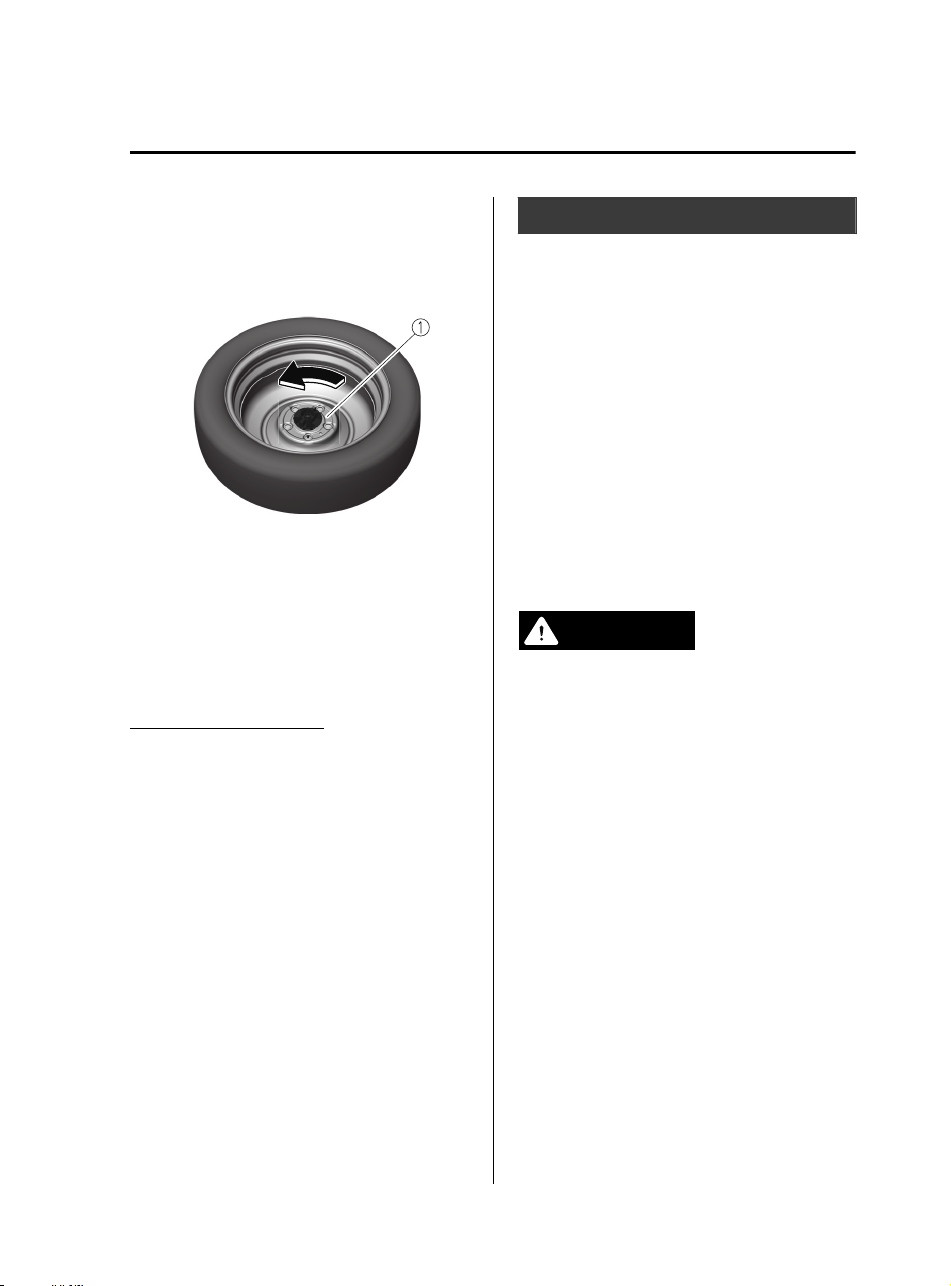
(Vehicles without sub-woofer)
Turn the spare tire hold-down bolt
counterclockwise and remove the spare
tire.
1. Spare tire hold-down bolt
NOTE
If the spare tire hold-down bolt cannot
be loosened, hold the edge of the tire
and turn the spare tire hold-down bolt
until it rotates.
To secure the spare tire
Store the spare tire in the reverse order of
removal. After storing, verify that the
spare tire is stored securely.
Changing a Flat Tire
▼
Changing a Flat Tire
NOTE
If the following occurs while driving, it
could indicate a flat tire.
Steering becomes difficult.
The vehicle begins to vibrate
excessively.
The vehicle pulls in one direction.
If you have a flat tire, drive slowly to a
level spot that is well off the road and out
of the way of traffic to change the tire.
Stopping in traffic or on the shoulder of a
busy road is dangerous.
WARNING
Be sure to follow the directions for
changing a tire:
Changing a tire is dangerous if not done
properly. The vehicle can slip o the jack
and seriously injure someone.
No person should place any portion of their
body under a vehicle that is supported by a
jack.
Never allow anyone inside a vehicle
supported by a jack:
Allowing someone to remain in a vehicle
supported by a jack is dangerous. The
occupant could cause the vehicle to fall
resulting in serious injury.
NOTE
Make sure the jack is well lubricated
before using it.
If Trouble Arises
Flat Tire
7-7
Mazda3_8HZ1-EA-19G_Edition1_old 2019-5-17 13:49:03
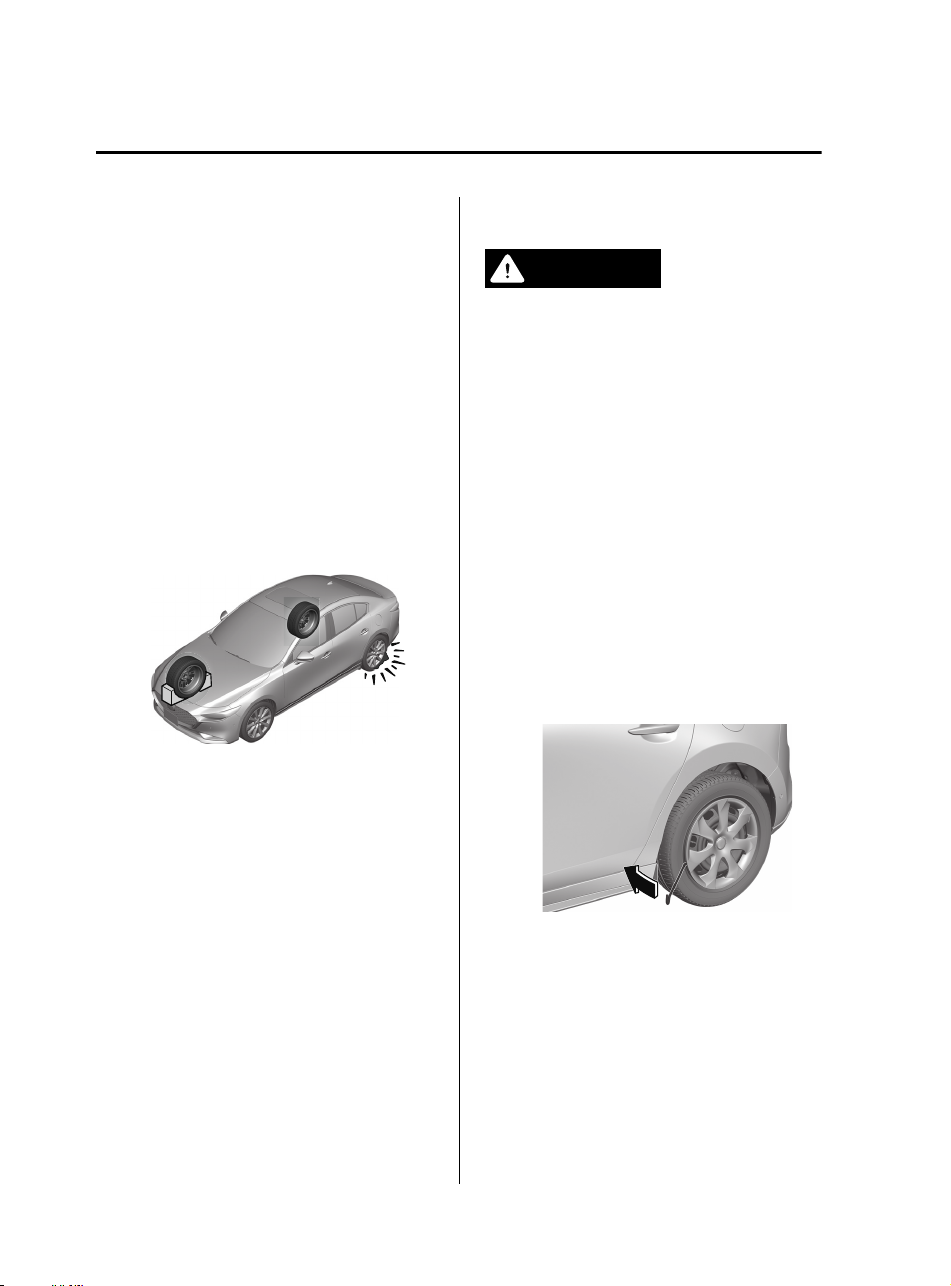
1. Park on a hard, level surface off the
right-of-way and firmly set the parking
brake.
2. Put a vehicle with an automatic
transmission in Park (P), a manual
transmission in Reverse (R) or 1, and
turn off the engine.
3. Turn on the hazard warning flasher.
4. Have everyone get out of the vehicle
and away from the vehicle and traffic.
5. Remove the jack, tool, and spare tire
(page 7-3).
6. Block the wheel diagonally opposite
the flat tire. When blocking a wheel,
place a tire block both in front and
behind the tire.
NOTE
When blocking a tire, use rocks or
wood blocks of sufficient size if
possible to hold the tire in place.
▼
Removing a Flat Tire
WARNING
When jacking-up a vehicle, always shift the
shift lever to 1st or R position (manual
transmission vehicle) or shift the selector
lever to P position (automatic transmission
vehicle), apply the parking brake, and place
wheel blocks in the position diagonally
opposed to the jack:
Changing a
at
tire without using wheel
blocks is dangerous because the vehicle
may move and fall o the jack even with
the shift lever in 1st or R position, or the
selector lever is in P position, which could
result in an accident.
1. If your vehicle is equipped with a
wheel cover, pry off the wheel cover
with the beveled end of the jack lever.
NOTE
Force the end of the jack lever firmly
between wheel and cover, or removal
will be difficult.
If Trouble Arises
Flat Tire
7-8
Mazda3_8HZ1-EA-19G_Edition1_old 2019-5-17 13:49:03
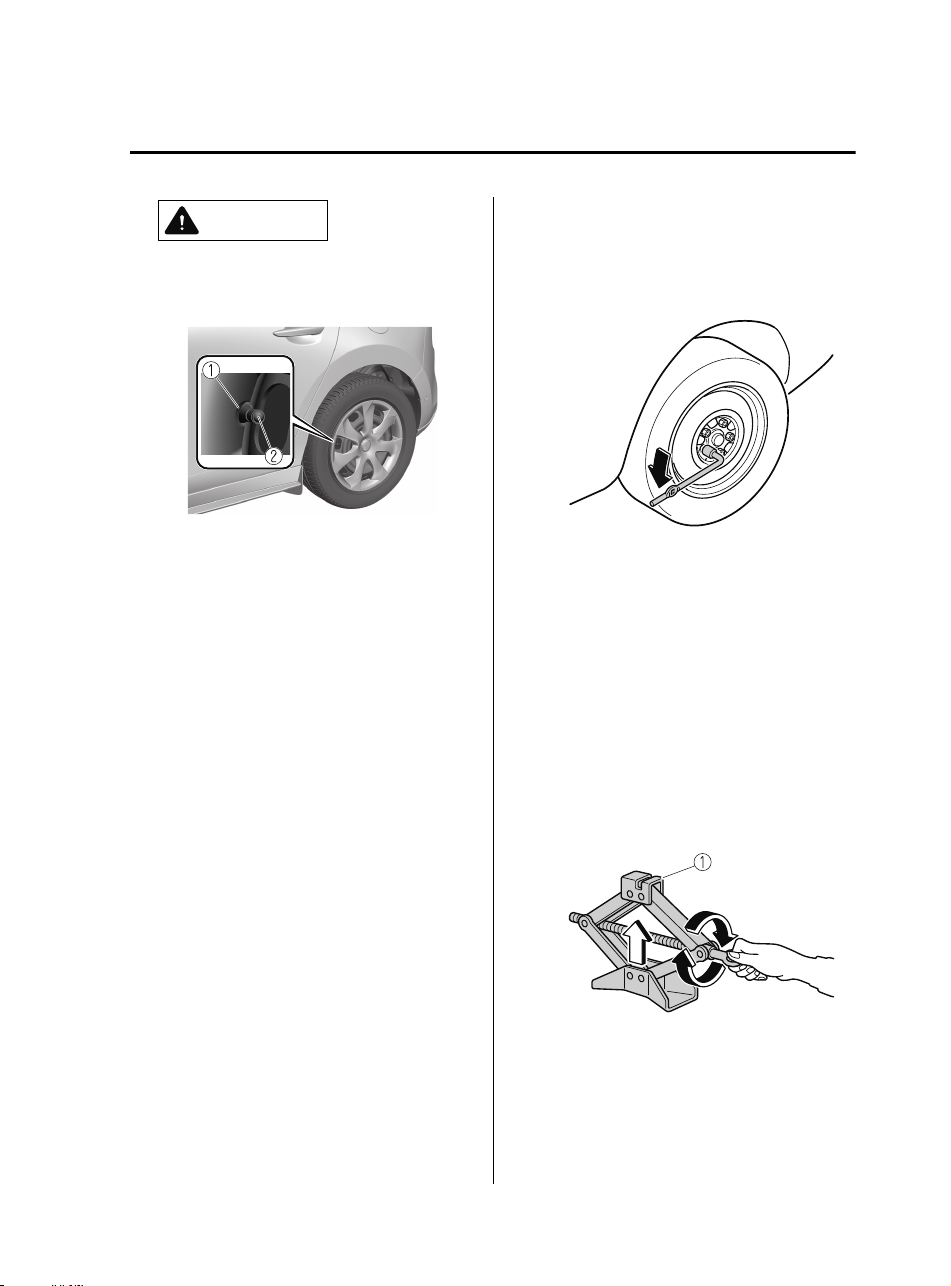
CAUTION
Align the notch on the wheel cover with
the valve stem when installing it.
1. Notch
2. Tire valve
Damage could occur during
installation if the wheel cover is not
properly aligned.
2. Loosen the lug nuts by turning them
counterclockwise one turn each, but do
not remove any lug nuts until the tire
has been raised off the ground.
NOTE
If your Mazda is equipped with the
optional antitheft wheel lug nuts, a
special key must be used to unlock the
locking lug nut for each wheel. For
details, refer to the Locking Lug Nuts
on page 7-11.
3. Place the jack on the ground.
4. Turn the jack screw in the direction
shown in the figure and adjust the jack
head so that it is close to the jack-up
position.
1. Jack head
If Trouble Arises
Flat Tire
7-9
Mazda3_8HZ1-EA-19G_Edition1_old 2019-5-17 13:49:03
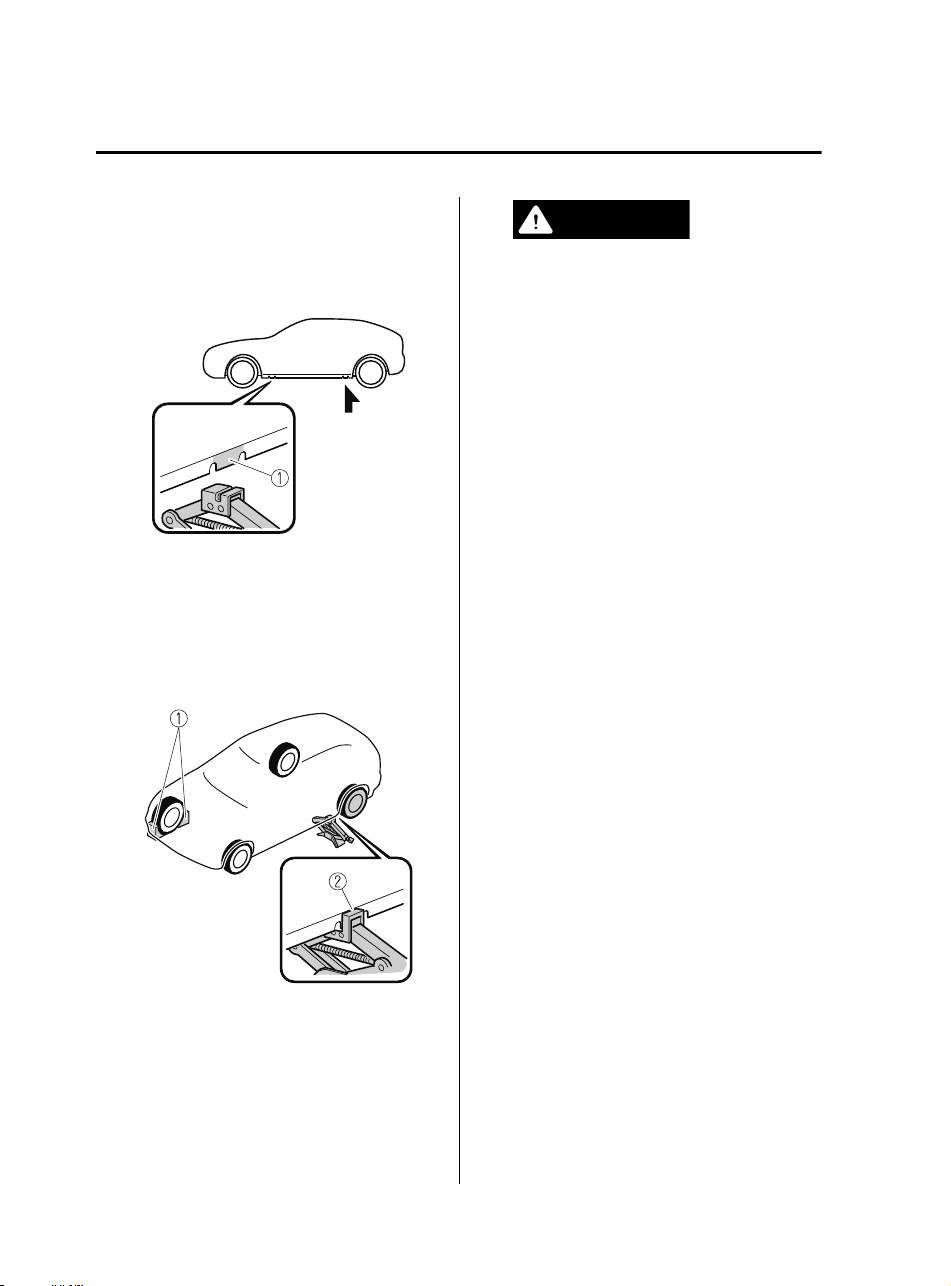
5. Place the jack under the jack-up
position closest to the tire being
changed with the jack head squarely
under the jack-up point.
1. Jacking position
6. Continue raising the jack head
gradually by rotating the screw with
your hand until the jack head is
inserted into the jack-up position.
1. Tire blocks
2. Jacking position
WARNING
Use only the front and rear jacking
positions recommended in this manual:
Attempting to jack the vehicle in
positions other than those
recommended in this manual is
dangerous. The vehicle could slip
o
the jack and seriously injure or even kill
someone. Use only the front and rear
jacking positions recommended in this
manual.
Do not jack up the vehicle in a position
other than the designated jack-up
position or place any objects on or
under the jack:
Jacking up the vehicle in a position
other than the designated jack-up
position or placing objects on or under
the jack is dangerous as it could deform
the vehicle body or the vehicle could fall
o the jack resulting in an accident.
Use only the jack provided with your
Mazda:
Using a jack that is not designed for
your Mazda is dangerous. The vehicle
could slip o the jack and seriously
injure someone.
Never place objects under the jack:
Jacking the vehicle with an object
under the jack is dangerous. The jack
could slip and someone could be
seriously injured by the jack or the
falling vehicle.
If Trouble Arises
Flat Tire
7-10
Mazda3_8HZ1-EA-19G_Edition1_old 2019-5-17 13:49:03
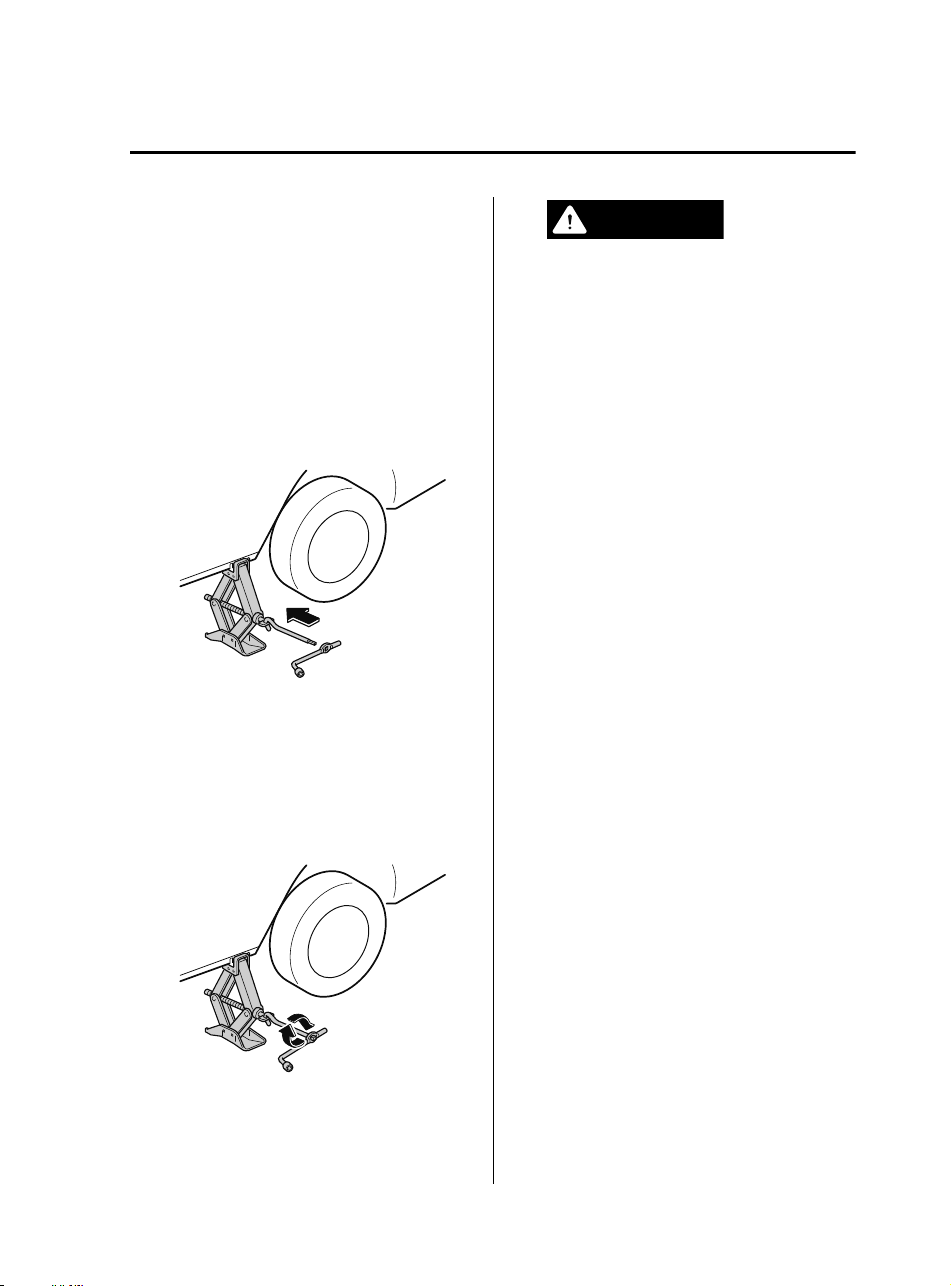
NOTE
When raising the jack head into the
jacking position and aligning the
groove in the jack head with the rail
under the vehicle body, the top of the
jack head contacts the vehicle's
underbody without the rail contacting
the bottom of the groove.
7. Insert the jack lever and attach the lug
wrench to tire jack.
8. Turn the jack handle clockwise and
raise the vehicle high enough so that
the spare tire can be installed. Before
removing the lug nuts, make sure your
Mazda is firmly in position and that it
cannot slip or move.
WARNING
Do not jack up the vehicle higher than
is necessary:
Jacking up the vehicle higher than is
necessary is dangerous as it could
destabilize the vehicle resulting in an
accident.
Do not start the engine or shake the
vehicle while it is jacked up:
Starting the engine or shaking the
vehicle while it is jacked up is
dangerous as it could cause the vehicle
to fall o the jack resulting in an
accident.
Never go under the vehicle while it is
jacked up:
Going under the vehicle while it is
jacked up is dangerous as it could result
in death or serious injury if the vehicle
were to fall o the jack.
9. Remove the lug nuts by turning them
counterclockwise; then remove the
wheel and center cap.
▼
Locking Lug Nuts
If your Mazda is equipped with the
optional antitheft wheel lug nuts, a special
key must be used to unlock the locking lug
nut for each wheel. The key is stored in
the glove compartment, center console
storage, storage box, or trunk. Register the
key and lug nuts with the lock
manufacturer by filling out the registration
card and mailing it in using the
accompanying envelope. If the key is lost,
consult an Authorized Mazda Dealer or
use the lock manufacturer’s order form to
order a new key.
If Trouble Arises
Flat Tire
7-11
Mazda3_8HZ1-EA-19G_Edition1_old 2019-5-17 13:49:03
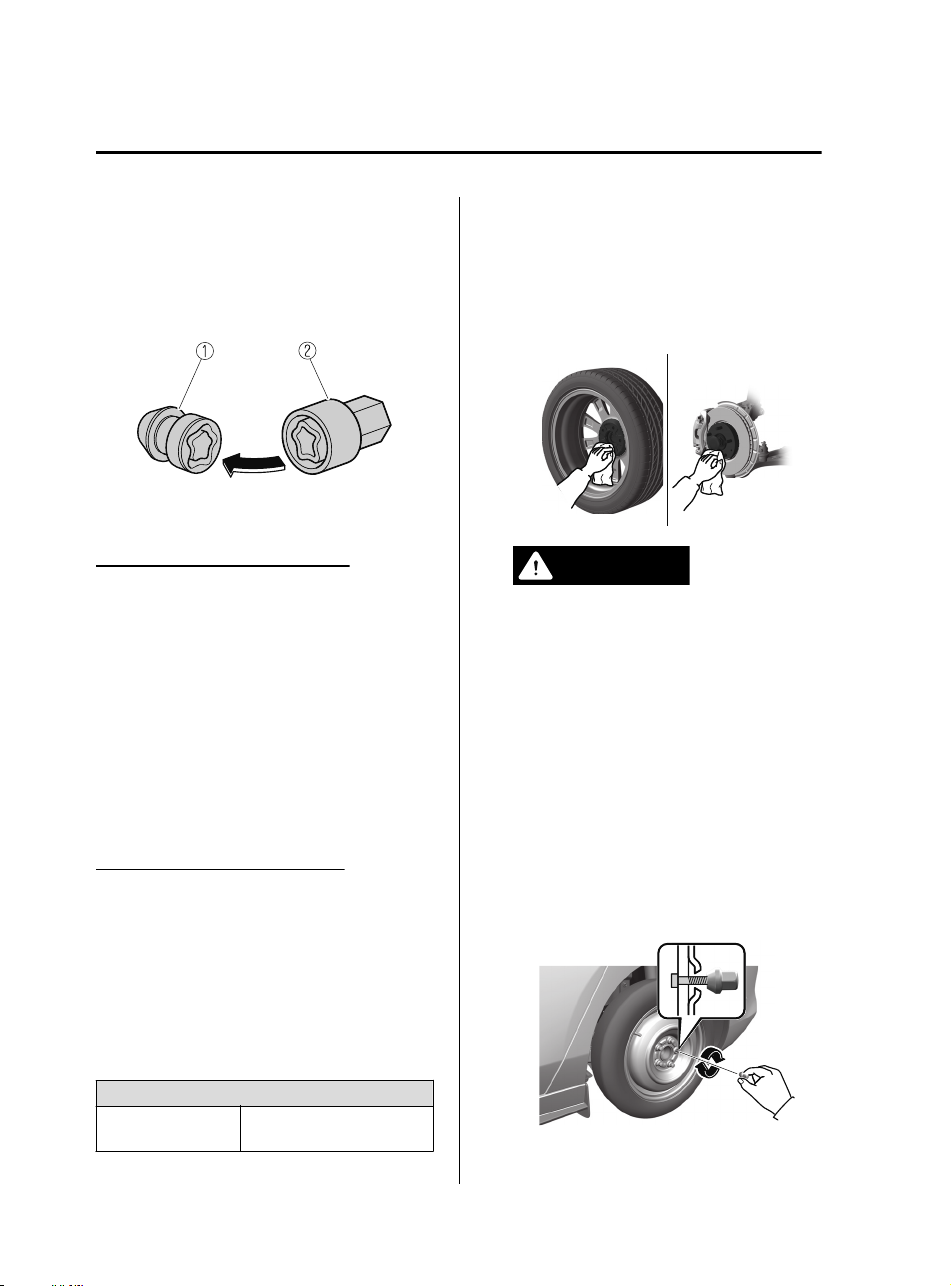
Antitheft wheel lug nuts cannot be
installed on a steel wheel spare tire. When
installing a temporary spare tire, use one
of the original lug nuts in place of the
locking lug nut. The original lug nuts are
stored inside your Mazda.
1. Antitheft lug nut
2. Special key
To remove an antitheft lug nut
1. Obtain the special key for the antitheft
lug nut.
2. Place the special key on top of the
antitheft lug nut, and be sure to hold
the key square to it. If you hold the key
at an angle, you may damage both key
and nut. Do not use a power impact
wrench.
3. Place the lug wrench on top of the key
and apply pressure. Turn the wrench
counterclockwise.
To install the antitheft lug nut
1. Place the special key on top of the nut,
and be sure to hold the key square to it.
If you hold the key at an angle, you
may damage both key and nut. Do not
use a power impact wrench.
2. Place the lug wrench on top of the
special key, apply pressure, and turn it
clockwise.
Nut tightening torque
N·m (kgf·m, ft·lbf)
108―147 (12―14,
80―108)
▼
Mounting the Spare Tire
1. Remove dirt and grime from the
mounting surfaces of the wheel and
hub, including the hub bolts, with a
cloth.
WARNING
Make sure the mounting surfaces of the
wheel, hub and lug nuts are clean
before changing or replacing tires:
When changing or replacing a tire, not
removing dirt and grime from the
mounting surfaces of the wheel, hub
and hub bolts is dangerous. The lug
nuts could loosen while driving and
cause the tire to come o, resulting in
an accident.
2. Mount the spare tire.
3. Install the lug nuts with the beveled
edge inward; tighten them by hand.
If Trouble Arises
Flat Tire
7-12
Mazda3_8HZ1-EA-19G_Edition1_old 2019-5-17 13:49:03
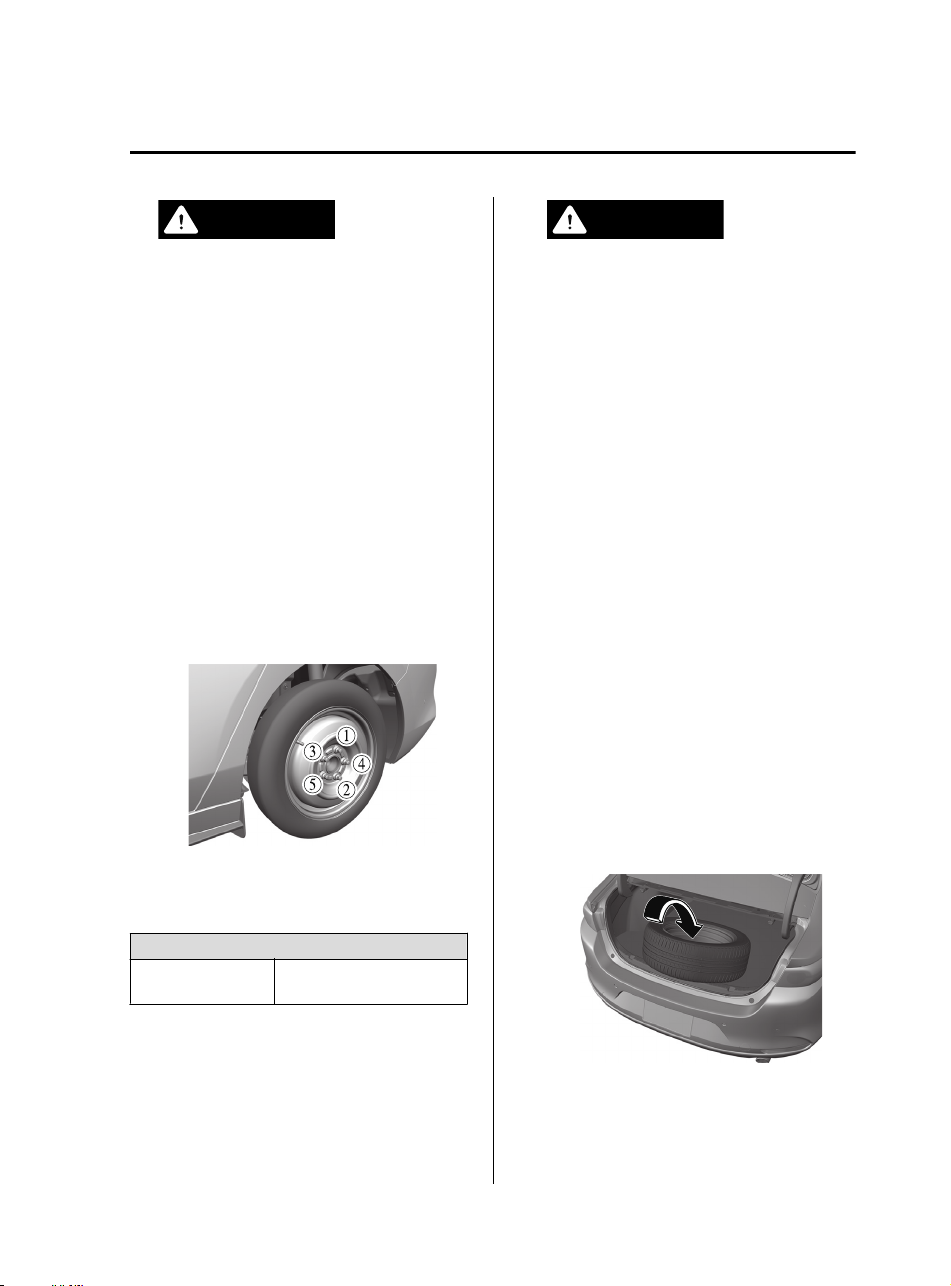
WARNING
Do not apply oil or grease to lug nuts
and bolts and do not tighten the lug
nuts beyond the recommended
tightening torque:
Applying oil or grease to lug nuts and
bolts is dangerous. The lug nuts could
loosen while driving and cause the tire
to come
o,
resulting in an accident. In
addition, lug nuts and bolts could be
damaged if tightened more than
necessary.
4. Turn the jack handle counterclockwise
using the lug wrench and lower the
vehicle.
5. Use the lug wrench to tighten the nuts
in the order shown.
If you are unsure of how tight the nuts
should be, have them inspected at an
Authorized Mazda Dealer.
Nut tightening torque
N·m (kgf·m, ft·lbf)
108―147 (12―14,
80―108)
WARNING
Always securely and correctly tighten
the lug nuts:
Improperly or loosely tightened lug
nuts are dangerous. The wheel could
wobble or come
o.
This could result in
loss of vehicle control and cause a
serious accident.
Be sure to reinstall the same nuts you
removed or replace them with metric
nuts of the same conguration:
Because the wheel studs and lug nuts
on your Mazda have metric threads,
using a non-metric nut is dangerous.
On a metric stud, it would not secure
the wheel and would damage the stud,
which could cause the wheel to slip o
and cause an accident.
6. (Aluminum wheel equipped vehicle)
Remove the center cap by tapping it
from the backside of the wheel using
the lug wrench.
7. Store the damaged tire in the trunk
(4-door) or luggage compartment
(5-door).
8. Secure the damaged tire to the vehicle
using the following method.
If Trouble Arises
Flat Tire
7-13
Mazda3_8HZ1-EA-19G_Edition1_old 2019-5-17 13:49:03
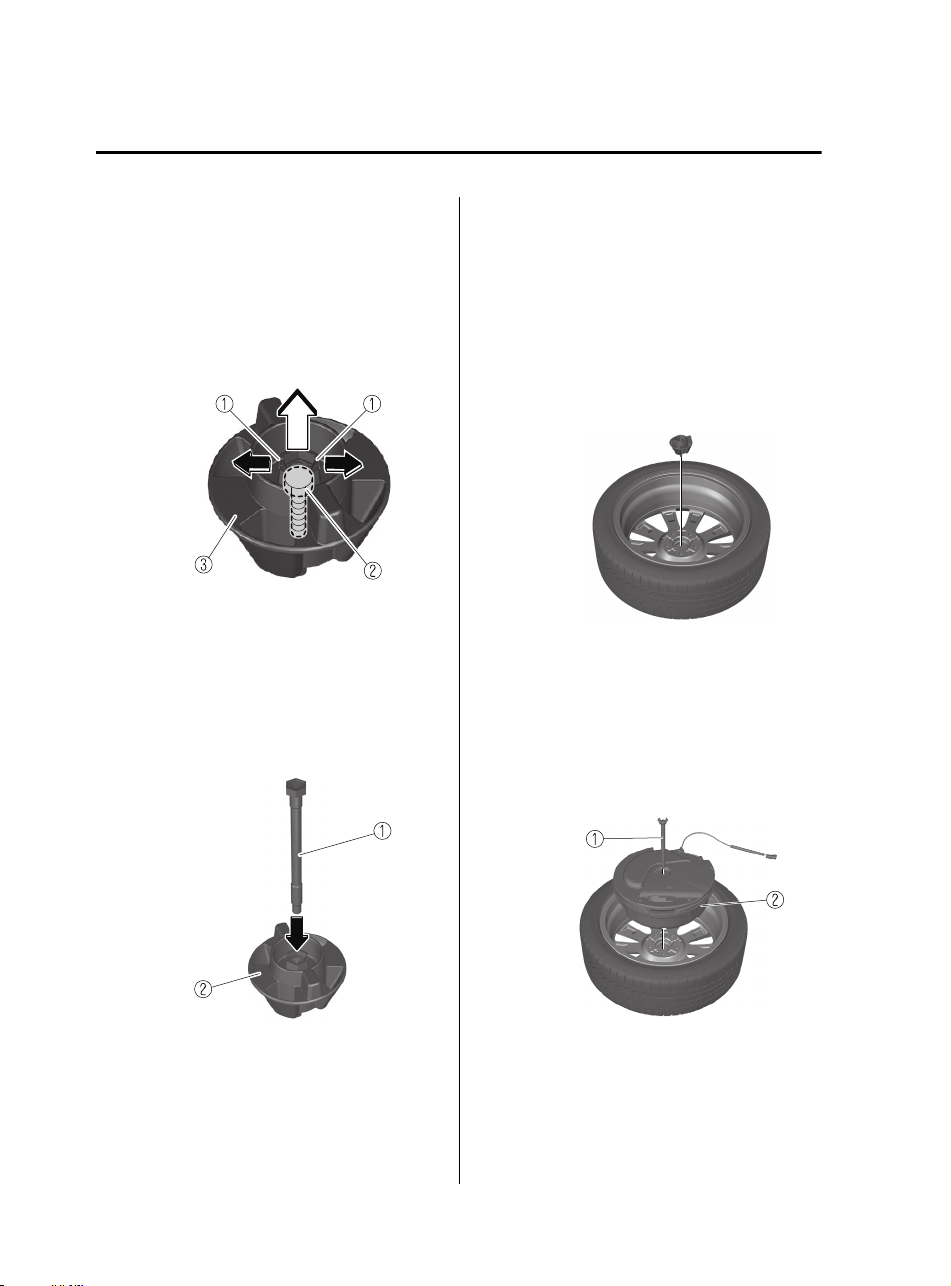
(Vehicles with flat tire hold-down
bolt (excluding vehicles with
sub-woofer for 5-door))
1. Spread apart the tabs on the spare
tire hold-down bolt that was
removed when removing the spare
tire and remove the bolt for
securing the spare tire.
1. Tabs
2. Bolt for securing spare tire
3. Spare tire hold-down bolt
2. Remove the bolt for securing the
flat tire from its stored position and
install it in place of the removed
spare tire hold-down bolt.
1. Bolt for securing the flat tire
2. Spare tire hold-down bolt
NOTE
The longer bolt is used as the bolt
for securing the flat tire, and the
shorter one is used as the bolt for
securing the spare tire. When
installing a bolt, check the bolt's
length.
3. Secure the damaged tire to the
vehicle using the flat tire
hold-down bolt.
(Vehicles with flat tire hold-down
bolt and with sub-woofer for
5-door))
1. Remove the bolt for securing the
flat tire from its stored position.
2. Secure the damaged tire to the
vehicle using the flat tire
hold-down bolt.
1. Flat tire hold-down bolt
2. Sub-woofer
If Trouble Arises
Flat Tire
7-14
Mazda3_8HZ1-EA-19G_Edition1_old 2019-5-17 13:49:03
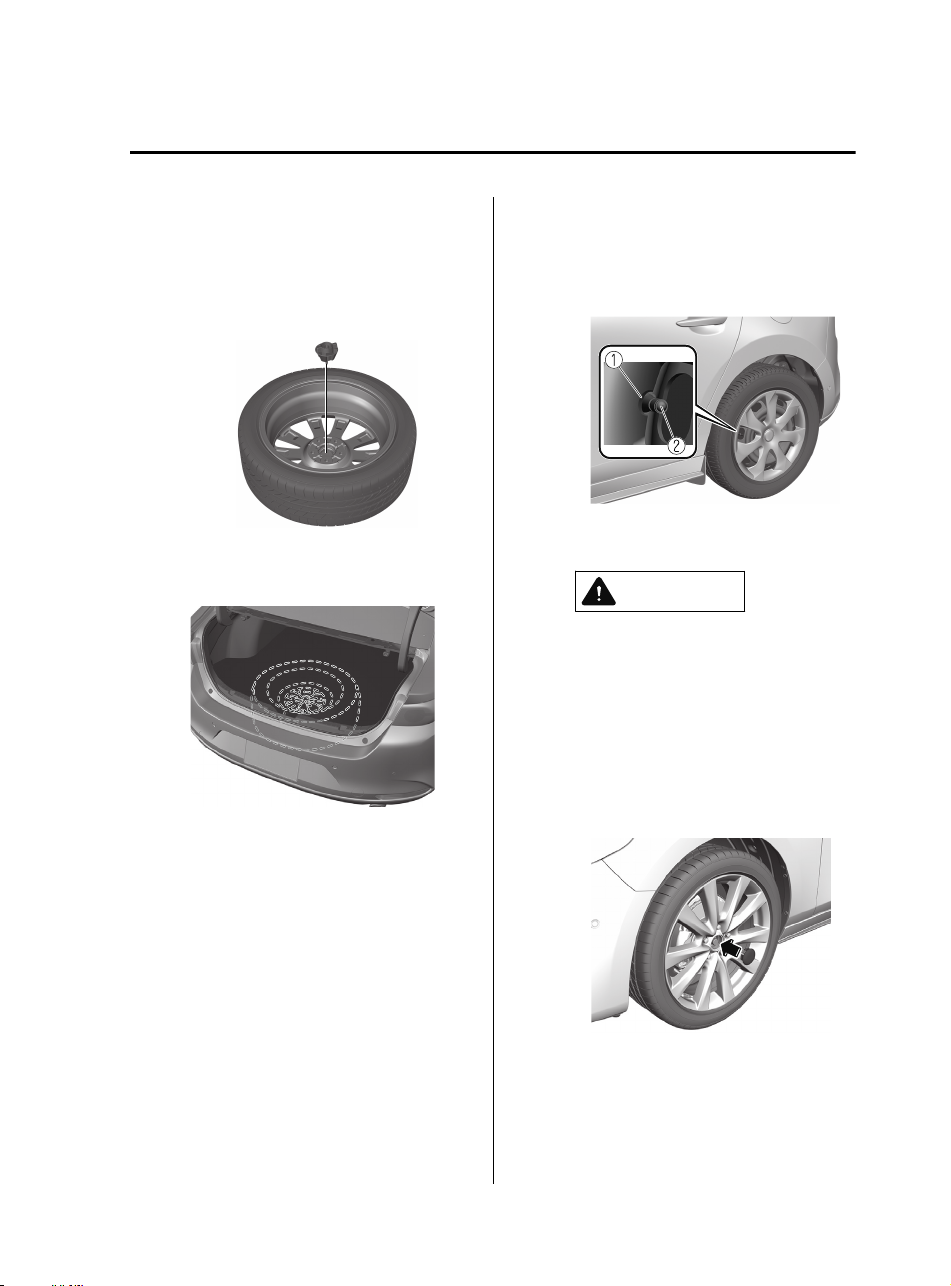
(Vehicles without flat tire hold-down
bolt)
1. Secure the damaged tire to the
vehicle using the spare tire
hold-down bolt removed when
removing the spare tire.
9. Place the trunk mat (4-door) or
luggage mat (5-door) on the damaged
tire.
10. Remove the tire blocks and store the
tools and jack.
11. Check the inflation pressure. Refer to
Tires on page 9-9.
12. Have the flat tire repaired or replaced
as soon as possible.
13. After repairing or replacing the flat
tire, install the wheel cover (vehicles
with steel wheels) or center cap
(vehicles with aluminum wheels) using
the following procedure.
(Wheel cover)
1. Align the notch on the wheel cover
with the tire valve of the wheel and
install the wheel cover to the
wheel.
1. Notch
2. Tire valve
CAUTION
Always align the notch on the wheel
cover with the tire valve of the
wheel. Otherwise, it could cause
damage to the wheel cover and the
tire valve.
(Center cap)
1. Align the center cap with the center
hole of the wheel and install the
center cap to the wheel.
If Trouble Arises
Flat Tire
7-15
Mazda3_8HZ1-EA-19G_Edition1_old 2019-5-17 13:49:03
WARNING
Do not drive with any tires that have
incorrect air pressure:
Driving on tires with incorrect air pressure
is dangerous. Tires with incorrect pressure
could
aect
handling and result in an
accident. When you check the regular tires'
air pressure, check the spare tire, too.
NOTE
To prevent the jack and tool from rattling,
store them properly.
If Trouble Arises
Flat Tire
7-16
Mazda3_8HZ1-EA-19G_Edition1_old 2019-5-17 13:49:03
Jump-Starting
▼
Jump-Starting
Jump-starting is dangerous if done incorrectly. So follow the procedure carefully. If you feel
unsure about jump-starting, we strongly recommend that you have a competent service
technician do the work.
WARNING
Follow These Precautions Carefully:
To ensure safe and correct handling of the battery, read the following precautions carefully
before using the battery or inspecting it.
Keep
ames
and sparks away from open battery cells and do not allow metal tools to
contact the positive (+) or negative (–) terminal of the battery when working near a battery.
Do not allow the positive (+) terminal to contact the vehicle body:
Flames and sparks near open battery cells are dangerous. Hydrogen gas, produced during
normal battery operation, could ignite and cause the battery to explode. An exploding battery
can cause serious burns and injuries. Keep all
ames
including cigarettes and sparks away
from open battery cells.
Keep all
ames
and sparks away from open battery cells because hydrogen gas is
produced from open battery cells while charging the battery or adding battery
uid:
Flames and sparks near open battery cells are dangerous. Hydrogen gas, produced during
normal battery operation, could ignite and cause the battery to explode. An exploding battery
can cause serious burns and injuries. Keep all ames including cigarettes and sparks away
from open battery cells.
Do not jump-start a frozen battery or one with a low uid level:
Jump-starting a frozen battery or one with a low uid level is dangerous. It may rupture or
explode, causing serious injury.
If Trouble Arises
Battery Runs Out
7-17
Mazda3_8HZ1-EA-19G_Edition1_old 2019-5-17 13:49:03
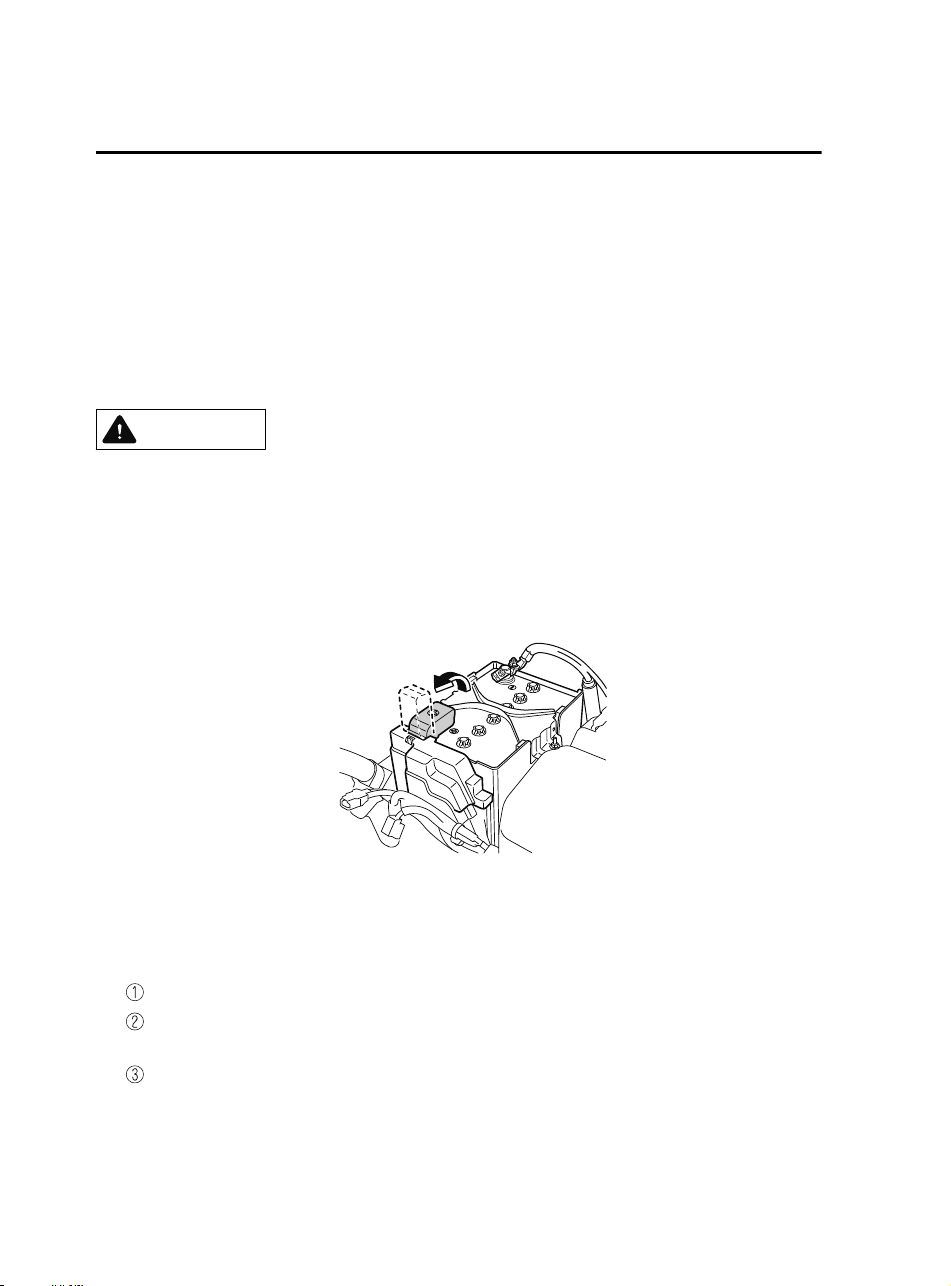
Connect the negative cable to a good ground point away from the battery:
Connecting the end of the second jumper cable to the negative (–) terminal of the discharged
battery is dangerous.
A spark could cause the gas around the battery to explode and injure someone.
Route the jumper cables away from parts that will be moving:
Connecting a jumper cable near or to moving parts (cooling fans, belts) is dangerous. The
cable could get caught when the engine starts and cause serious injury.
CAUTION
Use only a 12 V booster system. You can damage a 12 V starter, ignition system, and other
electrical parts beyond repair with a 24 V power supply (two 12 V batteries in series or a 24 V
motor generator set).
1. Move the booster vehicle so that its battery is as close as possible to your vehicle's
battery.
2. Make sure that the power such as for the headlights and air conditioner is turned off.
3. Remove the battery cover.
4. Turn off the booster vehicle's engine and connect the jumper cables in the following
order.
Make sure that the jumper cables are securely connected so that they do not disconnect
due to engine vibrations.
1st lead
Positive (+) terminal on the discharged battery
Positive (+) terminal on booster vehicle's battery
2nd lead
Negative (-) terminal on booster vehicle's battery
If Trouble Arises
Battery Runs Out
7-18
Mazda3_8HZ1-EA-19G_Edition1_old 2019-5-17 13:49:03

Location shown in the figure (do not connect to the negative (-) terminal of the
battery)
5. Start the booster vehicle's engine and rev the engine.
6. Start the engine of your vehicle. Run the engines for about 3 minutes to temporarily
charge the battery of your vehicle.
7. Disconnect the jumper cables in the reverse order of their connection.
8. Install the battery cover.
9. Have your vehicle inspected by an Authorized Mazda Dealer as soon as possible.
If Trouble Arises
Battery Runs Out
7-19
Mazda3_8HZ1-EA-19G_Edition1_old 2019-5-17 13:49:03
Starting a Flooded Engine
▼
Starting a Flooded Engine
If the engine fails to start, it may be
flooded (excessive fuel in the engine).
Follow this procedure:
1. If the engine does not start within 5
seconds on the first try, wait 10
seconds and try again.
2. Make sure the parking brake is on.
3. Depress the accelerator all the way and
hold it there.
4. Depress the clutch pedal (manual
transmission) or the brake pedal
(automatic transmission), then press
the push button start. If the engine
starts, release the accelerator
immediately because the engine will
suddenly rev up.
5. If the engine fails to start, crank it
without depressing the accelerator.
If the engine still does not start using the
previous procedure, have your vehicle
inspected by an Authorized Mazda Dealer.
Push-Starting
▼
Push-Starting
Do not push-start your Mazda.
WARNING
Never tow a vehicle to start it:
Towing a vehicle to start it is dangerous.
The vehicle being towed could surge
forward when its engine starts, causing the
2 vehicles to collide. The occupants could
be injured.
CAUTION
Do not push-start a vehicle that has a
manual transmission. It can damage the
emission control system.
NOTE
You cannot start a vehicle with an
automatic transmission by pushing it.
If Trouble Arises
Emergency Starting
7-20
Mazda3_8HZ1-EA-19G_Edition1_old 2019-5-17 13:49:03
Overheating
▼
Overheating
If the engine coolant temperature gauge
indicates overheating and the high engine
coolant temperature warning indication is
displayed, the vehicle loses power or you
hear a loud knocking or pinging noise, the
engine is probably too hot.
WARNING
Pull over to a safe location, then switch
the ignition o and make sure the fan is
not running before attempting to work
near the cooling fan:
Working near the cooling fan when it is
running is dangerous. The fan could
continue running indenitely even if the
engine has stopped and the engine
compartment temperature is high. You
could be hit by the fan and seriously
injured.
Do not remove either cooling
system cap when the engine and radiator
are hot:
When the engine and radiator are hot,
scalding coolant and steam may shoot out
under pressure and cause serious injury.
Open the hood ONLY after steam is no
longer escaping from the engine:
Steam from an overheated engine is
dangerous. The escaping steam could
seriously burn you.
If the engine coolant temperature gauge
indicates overheating and the high engine
coolant temperature warning indication is
displayed:
1. Drive safely to the side of the road and
park off the right-of-way.
2. Put a vehicle with an automatic
transmission in park (P), a manual
transmission in neutral.
3. Apply the parking brake.
4. Turn off the air conditioner.
5. Check whether coolant or steam is
escaping from the engine
compartment.
If steam is coming from the engine
compartment:
Do not go near the front of the vehicle.
Stop the engine.
Wait until the steam dissipates, then
open the hood and start the engine.
If neither coolant nor steam is
escaping:
Open the hood and idle the engine
until it cools.
CAUTION
If the cooling fan does not operate
while the engine is running, the engine
temperature will increase. Stop the
engine and call an Authorized Mazda
Dealer.
If Trouble Arises
Overheating
7-21
Mazda3_8HZ1-EA-19G_Edition1_old 2019-5-17 13:49:03
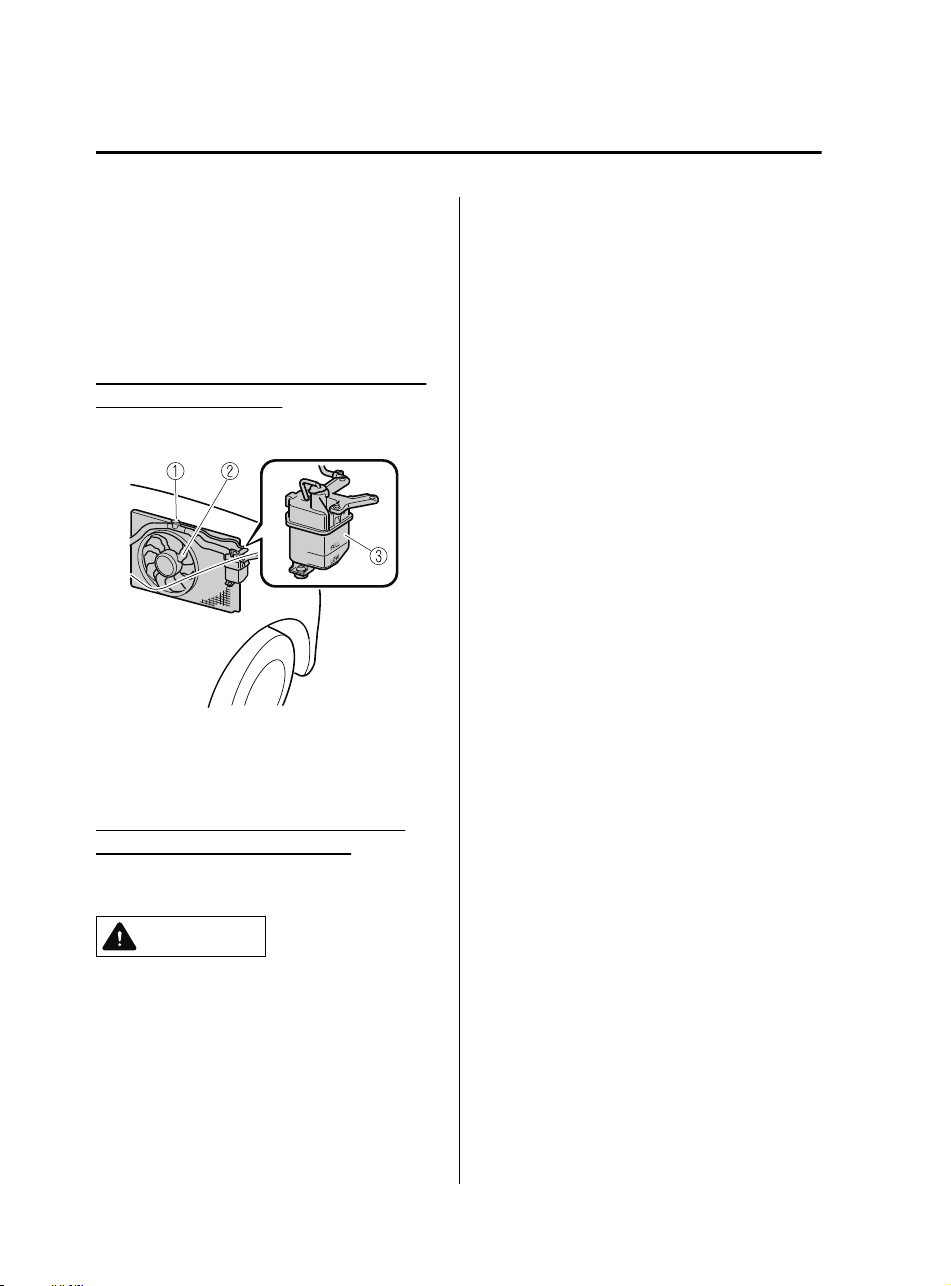
6. Make sure the cooling fan is operating,
then turn off the engine after the
temperature has decreased.
7. When cool, check the coolant level.
If it is low, look for coolant leaks from
the radiator and hoses.
If you find a leak or other damage, or if
coolant is still leaking:
Stop the engine and call an Authorized
Mazda Dealer.
1. Cooling system cap
2. Cooling fan
3. Coolant reservoir
If you find no problems, the engine is
cool, and no leaks are obvious:
Carefully add coolant as required (page
6-17).
CAUTION
If the engine continues to overheat or
frequently overheats, have the cooling
system inspected. The engine could be
seriously damaged unless repairs are
made. Consult an Authorized Mazda
Dealer.
If Trouble Arises
Overheating
7-22
Mazda3_8HZ1-EA-19G_Edition1_old 2019-5-17 13:49:03
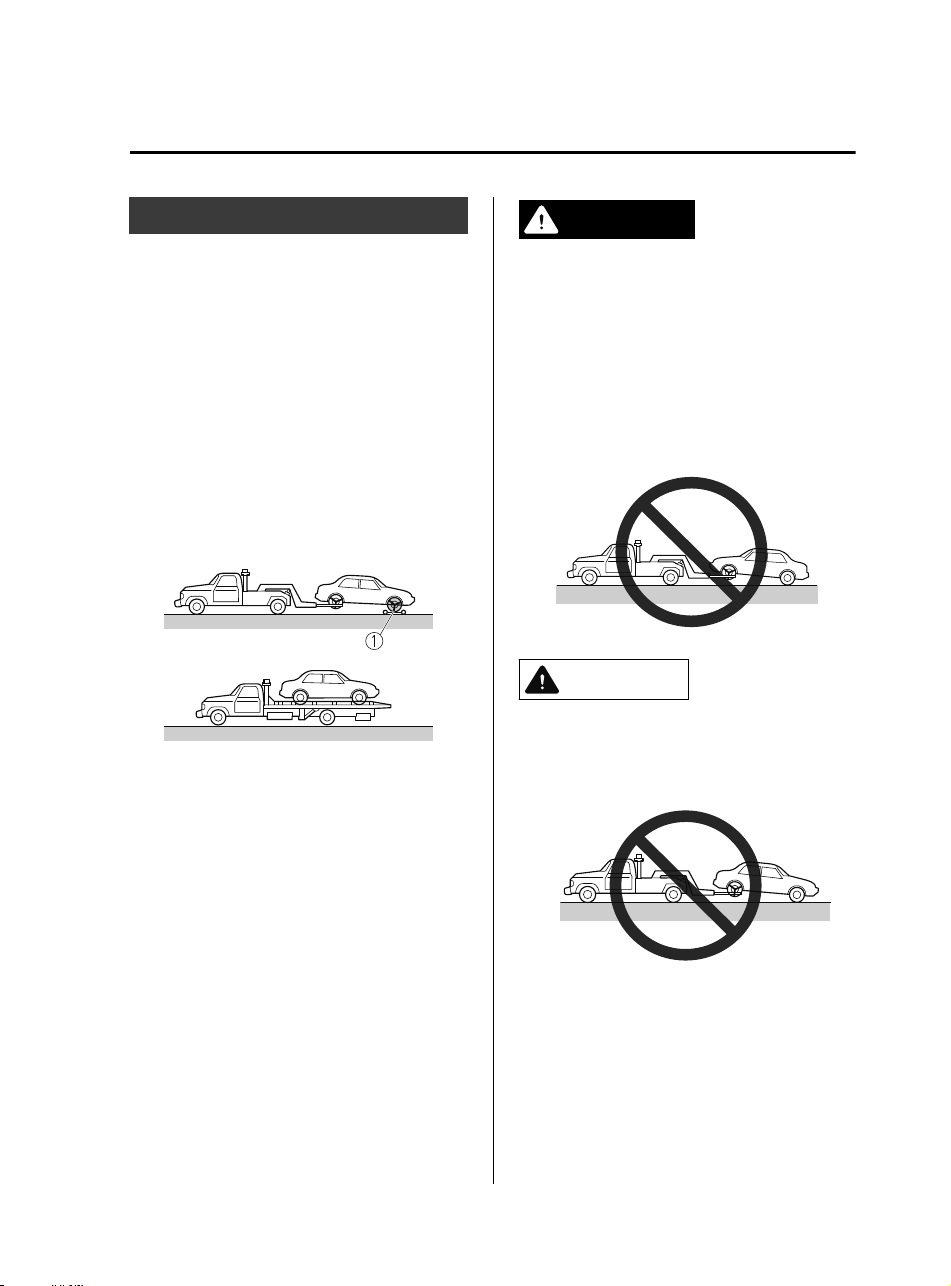
Towing Description
▼
Towing Description
We recommend that towing be done only
by an Authorized Mazda Dealer or a
commercial tow-truck service.
Proper lifting and towing are necessary to
prevent damage to the vehicle. Particularly
when towing an AWD vehicle, where all
the wheels are connected to the drive train,
proper transporting of the vehicle is
absolutely essential to avoid damaging the
drive system. Government and local laws
must be followed.
1. Wheel dollies
A towed FWD vehicle should have its
drive wheels (front wheels) off the ground.
If excessive damage or other conditions
prevent this, use wheel dollies.
When towing a FWD vehicle with the rear
wheels on the ground, release the parking
brake.
Refer to Electric Parking Brake (EPB) on
page 4-64.
A towed AWD vehicle must have all its
wheels off the ground.
WARNING
Always tow an AWD vehicle with all four
wheels o the ground:
Towing an AWD vehicle with either the
front or rear wheels on the ground is
dangerous as the drive train could be
damaged, or the vehicle could trail away
from the tow truck and cause an accident.
If the drive train has been damaged,
transport the vehicle on a atbed truck.
CAUTION
Do not tow the vehicle pointed backward
with driving wheels on the ground. This
may cause internal damage to the
transmission.
If Trouble Arises
Emergency Towing
7-23
Mazda3_8HZ1-EA-19G_Edition1_old 2019-5-17 13:49:03
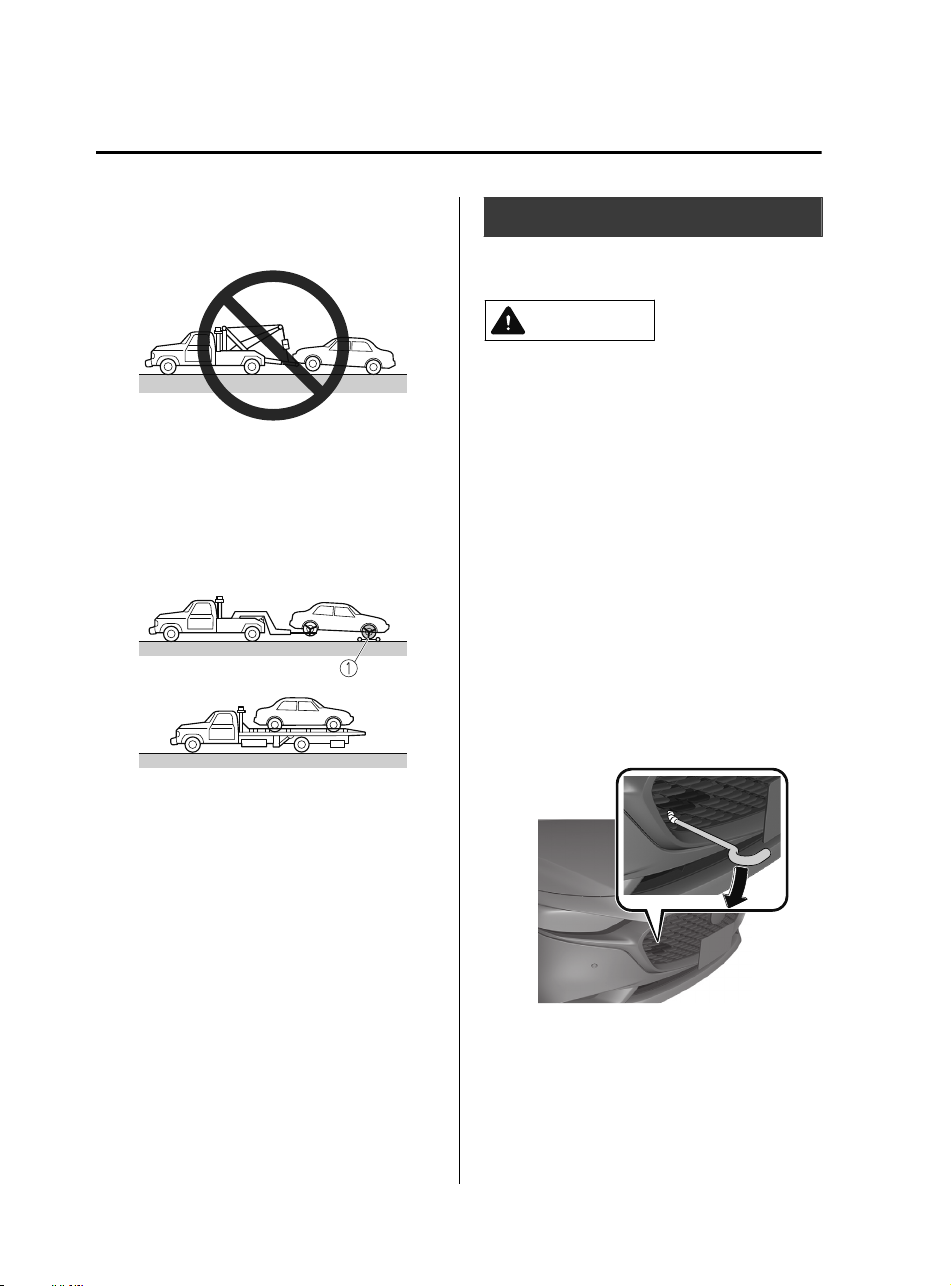
Do not tow with sling-type equipment.
This could damage your vehicle. Use
wheel-lift or
atbed
equipment.
If the parking brake cannot be released
when towing the vehicle, transport the
vehicle with all front and rear wheels
raised o the ground as shown in the
gure. If the vehicle is towed without
raising the wheels o the ground, the
brake system could be damaged.
1. Wheel dollies
Tiedown Hooks
*
▼
Tiedown Hooks
CAUTION
Do not use the front and rear tiedown
eyelets for towing the vehicle.
They have been designed only for securing
the vehicle to a transport vessel during
shipping.
Using the eyelets for any other purpose
could result in the vehicle being damaged.
1. Remove the tiedown eyelet and the lug
wrench from the luggage compartment
(page 7-3).
2. Wrap a flathead screwdriver or similar
tool with a soft cloth to prevent
damage to a painted bumper, and open
the cap located on the front or rear
bumper.
Front
(4–Door)
If Trouble Arises
Emergency Towing
7-24
*Some models.
Mazda3_8HZ1-EA-19G_Edition1_old 2019-5-17 13:49:03
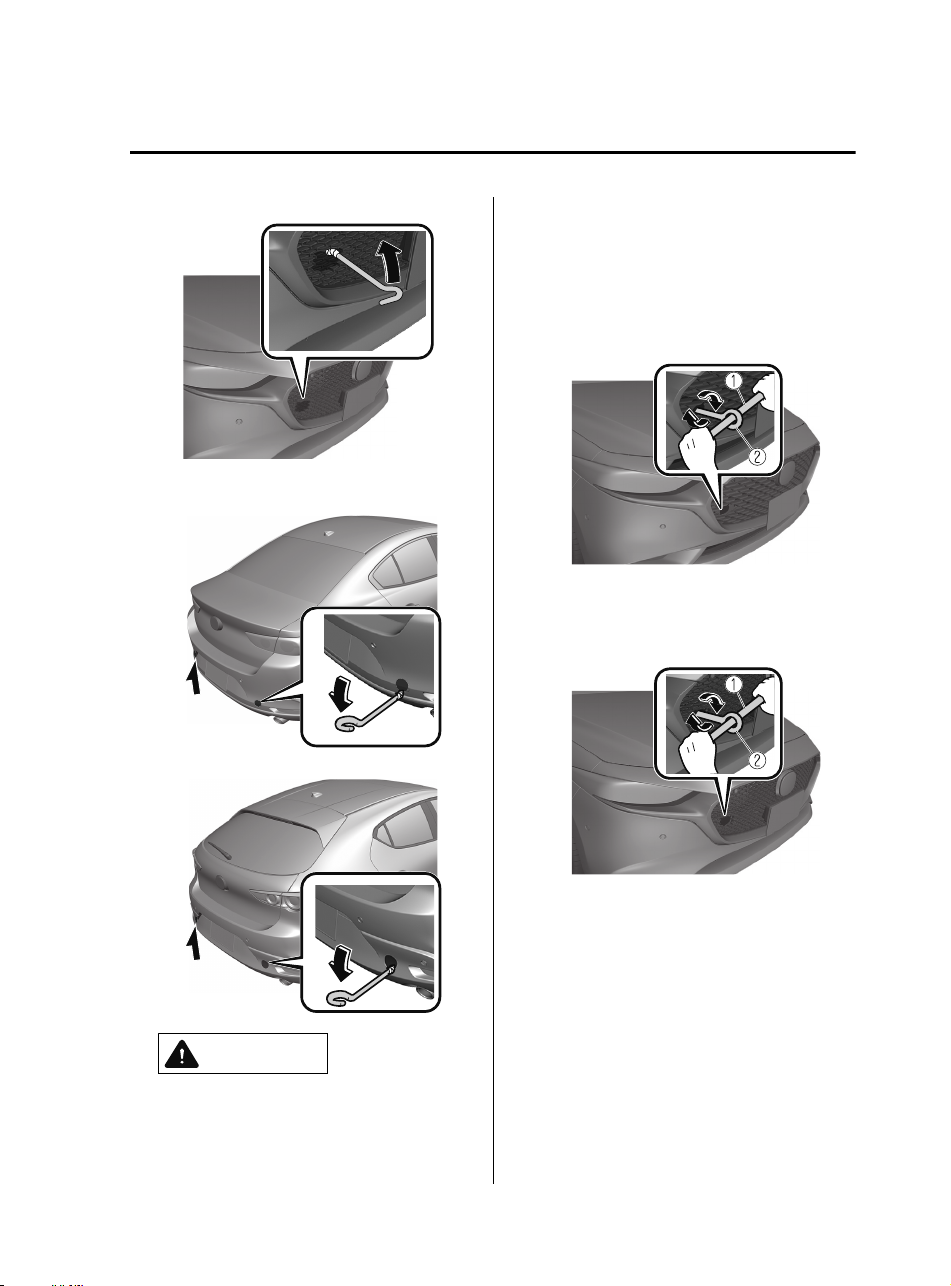
(5–Door)
Rear
(4–Door)
(5–Door)
CAUTION
Do not use excessive force as it may
damage the cap or scratch the painted
bumper surface.
NOTE
Remove the cap completely and store it
so as not to lose it.
3. Securely install the tiedown eyelet
using the lug wrench.
Front
(4–Door)
1. Lug wrench
2. Tiedown eyelet
(5–Door)
1. Lug wrench
2. Tiedown eyelet
If Trouble Arises
Emergency Towing
7-25
Mazda3_8HZ1-EA-19G_Edition1_old 2019-5-17 13:49:03
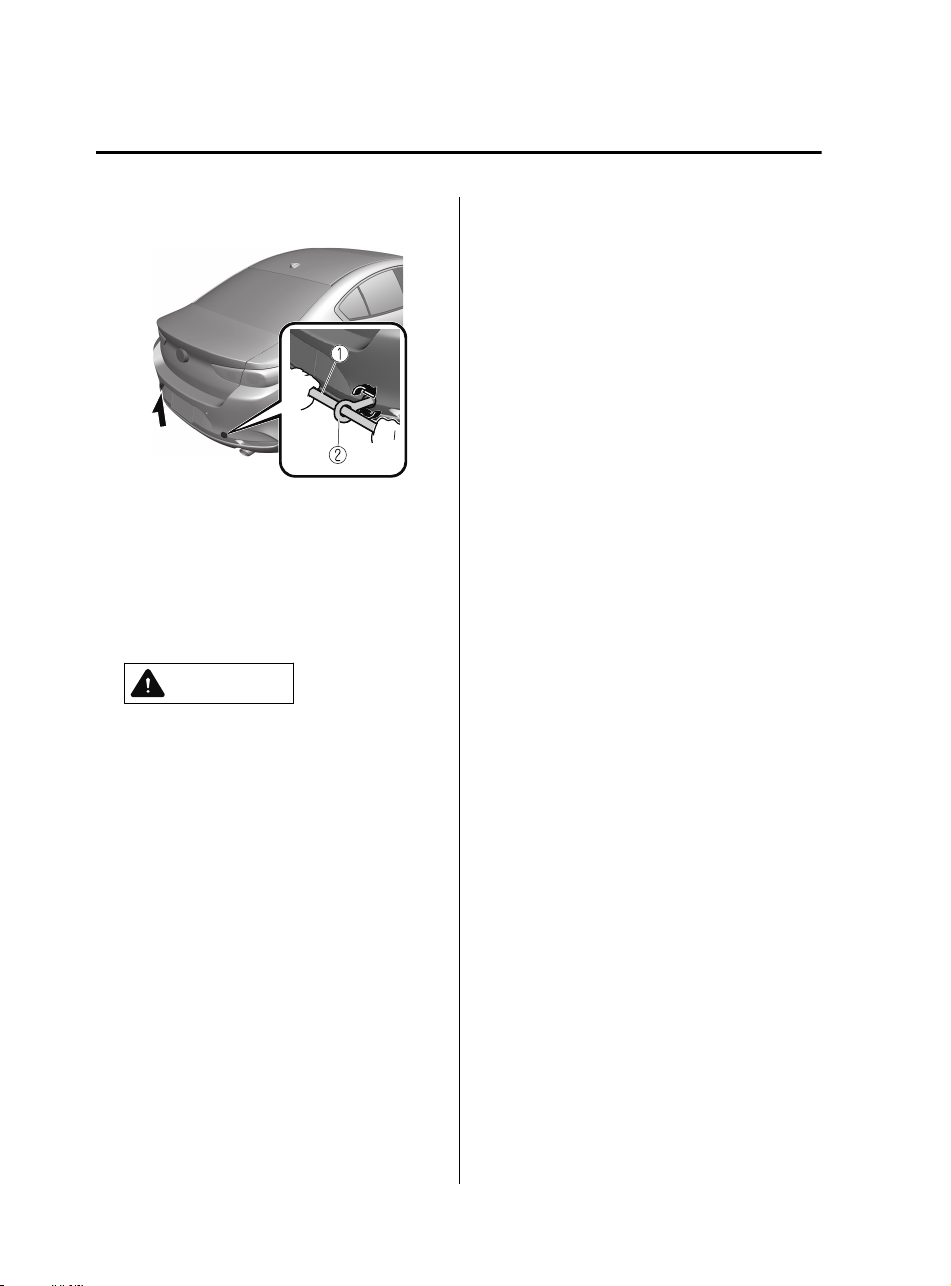
Rear
(4–Door)
1. Lug wrench
2. Tiedown eyelet
(5–Door)
4. Hook the tying rope to the tiedown
eyelet.
CAUTION
If the tiedown eyelet is not securely
tightened, it may loosen or disengage
from the bumper when tying the
vehicle. Make sure that the tiedown
eyelet is securely tightened to the
bumper.
If Trouble Arises
Emergency Towing
7-26
Mazda3_8HZ1-EA-19G_Edition1_old 2019-5-17 13:49:03
If a Warning Light Turns
On or Flashes
▼
If a Warning Light Turns On or
Flashes
If any warning light turns on/flashes, take
appropriate action for each light. There is
no problem if the light turns off, however
if the light does not turn off or turns on/
flashes again, consult an Authorized
Mazda Dealer.
The details for some warnings can be
viewed on the center display or
multi-information display in the
instrument cluster.
Center display
1. Select “Information” on the home
screen.
2. Select “Vehicle Status Monitor”.
3. Select the applicable warning to view
the warning details.
NOTE
You can also display the currently
occurring warning by sliding the
commander knob to the left while on the
home screen of the center display.
Multi-information display
1. Press the INFO switch on the steering
switch to display the warning
indication screen.
Refer to Multi-information Display on
page 4-14.
▼
Brake System Warning Indication/
Warning Light
This warning has the following functions:
Warning light inspection
For an operation check, make sure that the
light turns on when the ignition is
switched on, and turns off a few seconds
later or when the engine is started.
When the light turns on
If the brake system warning light remains
illuminated the brake fluid may be low or
there could be a problem with the brake
system. Park the vehicle in a safe place
immediately and contact an Authorized
Mazda Dealer.
Refer to Inspecting Brake/Clutch Fluid
Level on page 6-19.
WARNING
Do not drive with the brake system
warning light illuminated. Contact an
Authorized Mazda Dealer to have the
brakes inspected as soon as possible:
Driving with the brake system warning
light illuminated is dangerous. It indicates
that your brakes may not work at all or
that they could completely fail at any time.
If this light remains illuminated, after
checking that the parking brake is fully
released, have the brakes inspected
immediately.
If Trouble Arises
Warning/Indicator Lights and Warning Sounds
7-27
Mazda3_8HZ1-EA-19G_Edition1_old 2019-5-17 13:49:03
CAUTION
In addition, the
eectiveness
of the
braking may diminish so you may need
to depress the brake pedal more strongly
than normal to stop the vehicle.
▼
Electronic Brake Force Distribution
System Warning
If the electronic brake force distribution
control unit determines that some
components are operating incorrectly, the
control unit may illuminate the brake
system warning light and the ABS
warning light simultaneously. The
problem is likely to be the electronic brake
force distribution system.
WARNING
Do not drive with both the brake system
warning light and ABS warning light
illuminated. Have the vehicle towed to an
Authorized Mazda Dealer to have the
brakes inspected as soon as possible:
Driving when the brake system warning
light and ABS warning light are illuminated
simultaneously is dangerous.
When both lights are illuminated, the rear
wheels could lock more quickly in an
emergency stop than under normal
circumstances.
▼
Charging System Warning
Indication/Warning Light
If the warning light illuminates while
driving, it indicates a malfunction of the
alternator or of the charging system.
Drive to the side of the road and park off
the right-of-way. Consult an Authorized
Mazda Dealer.
CAUTION
Do not continue driving when the charging
system warning light is illuminated
because the engine could stop
unexpectedly.
▼
Engine Oil Warning Indication/
Warning Light
This warning light indicates low engine oil
pressure.
CAUTION
Do not run the engine if the oil pressure is
low. Otherwise, it could result in extensive
engine damage.
If the light illuminates or the warning
indication is displayed while driving:
1. Drive to the side of the road and park
off the right-of-way on level ground.
If Trouble Arises
Warning/Indicator Lights and Warning Sounds
7-28
Mazda3_8HZ1-EA-19G_Edition1_old 2019-5-17 13:49:03
2. Turn off the engine and wait 5 minutes
for the oil to drain back into the oil
pan.
3. Inspect the engine oil level (page
6-16). If it's low, add the appropriate
amount of engine oil while being
careful not to overfill.
CAUTION
Do not run the engine if the oil level is
low. Otherwise, it could result in
extensive engine damage.
4. Start the engine and check the warning
light.
If the light remains illuminated even
though the oil level is normal or after
adding oil, stop the engine immediately
and have your vehicle towed to an
Authorized Mazda Dealer.
▼
High Engine Coolant Temperature
Warning Indication
Displays if the engine coolant temperature
has increased excessively.
“Elevated Engine Coolant Temp. Drive
Slowly” displayed
Drive slowly to reduce engine load until
you can find a safe place to stop the
vehicle and wait for the engine to cool
down.
“Excessive Engine Coolant Temp. Stop
the Vehicle in a Safe Location”
displayed
This indicates the possibility of
overheating. Park the vehicle in a safe
place immediately and stop the engine.
Refer to Overheating on page 7-21.
CAUTION
Do not drive the vehicle with the high
engine coolant temperature warning light
illuminated. Otherwise, it could result in
damage to the engine.
▼
Power Steering Malfunction
Indication/Indicator Light
The message is displayed if the electric
power steering has a malfunction.
If the message is displayed, stop the
vehicle in a safe place and do not operate
the steering wheel. Contact an Authorized
Mazda Dealer if the message is displayed
continuously.
NOTE
If the message is displayed, the power
steering will not operate normally. In
this case, the steering wheel can still be
operated, however, the operation may
feel heavy compared to normal, or the
steering wheel could vibrate when
turning.
If Trouble Arises
Warning/Indicator Lights and Warning Sounds
7-29
Mazda3_8HZ1-EA-19G_Edition1_old 2019-5-17 13:49:03

Repeatedly jerking the steering wheel
left and right while the vehicle is
stopped or moving extremely slowly will
cause the power steering system to go
into protective mode which will make
the steering feel heavy, but this does not
indicate a problem. If this occurs, park
the vehicle safely and wait several
minutes for the system to return to
normal.
▼
ABS Warning Indication/Warning
Light
If the ABS warning light stays on while
you're driving, the ABS control unit has
detected a system malfunction. If this
occurs, your brakes will function normally
as if the vehicle had no ABS.
Should this happen, consult an Authorized
Mazda Dealer as soon as possible.
NOTE
When the engine is jump-started to
charge the battery, uneven rpm occurs
and the ABS warning light may
illuminate. If this occurs, it is the result
of the weak battery and does not
indicate an ABS malfunction.
Recharge the battery.
The brake assist system does not operate
while the ABS warning light is
illuminated.
▼
Master Warning Indication
The indication displays if the system has a
malfunction.
Check the reason for the indication
displaying on the center display or
multi-information display.
Refer to If a Warning Light Turns On or
Flashes on page 7-27.
▼
Brake Control System Warning
Indication/Warning Light
The warning light illuminates when the
system has a malfunction. Have your
vehicle inspected at an Authorized Mazda
Dealer.
▼
Electric Parking Brake (EPB)
Indication/Indicator Light
This warning has the following functions:
Parking brake warning/Indicator light
inspection
The light illuminates when the parking
brake is applied with the ignition switched
to START or ON. It turns off when the
parking brake is released.
If Trouble Arises
Warning/Indicator Lights and Warning Sounds
7-30
Mazda3_8HZ1-EA-19G_Edition1_old 2019-5-17 13:49:03
When the light is flashing
The light flashes if the Electric Parking
Brake (EPB) has a malfunction. If the light
remains flashing even if the Electric
Parking Brake (EPB) switch is operated,
consult an Authorized Mazda Dealer as
soon as possible.
▼
Brake Override Warning Indication
This message is displayed when the
accelerator pedal and brake pedal are
depressed at the same time while driving.
Release the accelerator pedal and depress
the brake pedal.
▼
Check Engine Indication/Light
If this light illuminates while driving, the
vehicle may have a problem. It is
important to note the driving conditions
when the light illuminated and consult an
Authorized Mazda Dealer.
The check engine light may illuminate in
the following cases:
The engine's electrical system has a
problem.
The emission control system has a
problem.
The fuel tank level being very low or
approaching empty.
The fuel-filler cap is missing or not
tightened securely.
If the check engine light remains on, or it
flashes continuously , do not drive at high
speeds and consult an Authorized Mazda
Dealer as soon as possible.
WARNING
If the check engine light turns on, do not
disconnect the battery cables.
If the battery cables are disconnected and
then reconnected, the engine could be
damaged and catch on
re.
▼
Automatic Transmission Warning
Indication/Warning Light
*
The indication/light illuminates when the
transmission has a problem.
CAUTION
If the automatic transmission warning
indication/light illuminates, the
transmission has an electrical problem.
Continuing to drive your Mazda in this
condition could cause damage to your
transmission. Consult an Authorized
Mazda Dealer as soon as possible.
▼
AWD Warning Indication/Warning
Light
*
If Trouble Arises
Warning/Indicator Lights and Warning Sounds
*Some models.
7-31
Mazda3_8HZ1-EA-19G_Edition1_old 2019-5-17 13:49:03
“AWD Malfunction. Front Wheel Drive
Only. Have the Vehicle Inspected” is
displayed/When the light is turned on
The indication is displayed/the light turns
on under the following conditions. The
system may have a malfunction. Have the
vehicle checked at an Authorized Mazda
Dealer.
When there is a malfunction in the
AWD system.
“Excessive AWD System Load. Drive
Slowly Until Warning Light Turns Off.
Vehicle Now in Front Wheel Drive” is
displayed/When the light is flashing
The indication is displayed/the light
flashes under the following conditions.
Park the vehicle in a safe place and check
that the warning indication light turns off/
the warning light stops flashing, and then
drive the vehicle. Contact an Authorized
Mazda Dealer if the indication is
continuously displayed.
When the differential oil temperature is
excessively high.
When there is a large difference between
the front and rear wheel rotation, such as
when trying to remove the vehicle from
mud.
“Mismatched Tire Diameters. Vehicle
Now in Front Wheel Drive” is
displayed/When the light is turned on
The indication is displayed/the light turns
on under the following conditions. Inspect
the tire sizes or tire pressures on all 4
wheels. Contact an Authorized Mazda
Dealer if the indication remains on or the
warning light remains illuminated.
When any of the tire diameter is
different.
When any of the tire pressure is
incorrect.
▼
TCS/DSC Indication/Indicator
Light (Turns on)
If the light stays on, the TCS, DSC or the
brake assist system may have a
malfunction and they may not operate
correctly. Take your vehicle to an
Authorized Mazda Dealer.
▼
Air Bag/Front Seat Belt
Pretensioner System Warning
Indication/Warning Light
A system malfunction is indicated if the
warning light constantly flashes,
constantly illuminates or does not
illuminate at all when the ignition is
switched ON. If any of these occur,
consult an Authorized Mazda Dealer as
soon as possible. The system may not
operate in an accident.
If Trouble Arises
Warning/Indicator Lights and Warning Sounds
7-32
Mazda3_8HZ1-EA-19G_Edition1_old 2019-5-17 13:49:03
WARNING
Never tamper with the air bag/
pretensioner systems and always have an
Authorized Mazda Dealer perform all
servicing and repairs:
Self-servicing or tampering with the
systems is dangerous. An air bag/
pretensioner could accidentally activate or
become disabled causing serious injury or
death.
▼
Tire Pressure Monitoring System
(TPMS) Warning Indication/
Warning Light (Flashing)
If there is a problem with the TPMS or the
voltage of a tire pressure sensor decreases,
the TPMS warning light flashes and a
message is displayed on the
multi-information display. Have your
vehicle inspected by an Authorized Mazda
Dealer.
WARNING
Do not drive the vehicle at high speeds if
the TPMS warning light turns on or
ashes:
Driving the vehicle at high speeds while the
TPMS warning light is turned on or
ashing
is dangerous because the brake
performance and the steering wheel
operability will be reduced. If the vehicle is
driven at high speeds or the brakes are
suddenly applied, it could lead to an
accident. Gradually apply the brakes to
lower the vehicle's speed.
Do not ignore the TPMS warning light
when it is turned on or ashing:
Continuing to drive the vehicle while
ignoring the illumination/ashing of the
TPMS warning light is dangerous because a
tire may burst which could lead to an
accident. Take appropriate measures as
soon as possible.
▼
KEY Warning Indication/Warning
Light (Red)
“Keyless Entry System Malfunction.
Have the Vehicle Inspected” is displayed
This message is displayed if the advanced
keyless entry & push button start system
has a problem.
Contact an Authorized Mazda Dealer.
CAUTION
If the message is indicated, or the push
button start indicator light (amber)
ashes,
the engine may not start. If the engine
cannot be started, try starting it using the
emergency operation for starting the
engine, and have the vehicle inspected at
an Authorized Mazda Dealer as soon as
possible.
Refer to Emergency Operation for Starting
the Engine on page 4-9.
“Low Key Fob Battery. Replace
Battery” is displayed
When the key battery is low, the indication
is displayed when the ignition is switched
OFF.
If Trouble Arises
Warning/Indicator Lights and Warning Sounds
7-33
Mazda3_8HZ1-EA-19G_Edition1_old 2019-5-17 13:49:03
“Key Not Detected” is displayed
If the presence of the key cannot be
detected (dead battery, battery
malfunction, no key), it is displayed
when the driver attempts to start the
engine (push button start operation,
brake pedal depression).
Displayed when it is determined that a
key that was in the vehicle has been
removed from the vehicle. (Key taken
out warning. Other than IG-OFF)
▼
High Beam Control System (HBC)
Warning Indication/Warning Light
(Amber)
*
The light remains turned on if there is a
problem with the system. Have your
vehicle inspected at an Authorized Mazda
Dealer.
▼
i-ACTIVSENSE Warning
Indication/Warning Light
*
The indication displays if the system has a
malfunction.
Check the reason for the indication
displaying on the center display or
multi-information display.
Refer to If a Warning Light Turns On or
Flashes on page 7-27.
▼
Exterior Light Warning Indication/
Warning Light
This light illuminates if there is a
malfunction in the exterior lights (except
license plate lights). Have your vehicle
inspected by an Authorized Mazda Dealer.
CAUTION
Do not drive the vehicle while an exterior
light has a malfunction. Poor visibility, and
not being able to signal braking and turns
may cause an accident. In addition, if the
vehicle is driven with the lights not turned
on, it may
conict
with laws and
regulations due to poor maintenance.
▼
Low Fuel Warning Indication/
Warning Light
The light turns on when the remaining fuel
is about 9.0 L (2.3 US gal, 1.9 Imp gal). If
you continue to drive after the light turns
on without refueling and the fuel gauge
reaches nearly empty, the light flashes.
NOTE
The light illumination timing may vary
because fuel inside the fuel tank moves
around according to the driving conditions
and the vehicle posture.
If Trouble Arises
Warning/Indicator Lights and Warning Sounds
7-34
*Some models.
Mazda3_8HZ1-EA-19G_Edition1_old 2019-5-17 13:49:03
Action to be taken
Add fuel. If the light is flashing, refuel as
soon as possible.
▼
Check Fuel Cap Warning
Indication/Warning Light
If the check fuel cap warning light
illuminates while driving, the fuel-filler
cap may not be installed properly.
Action to be taken
Stop the engine and reinstall the fuel-filler
cap.
Refer to Refueling on page 3-28.
▼
Engine Oil Level Warning
Indication/Warning Light
This warning light indicates that the
engine oil level is around the MIN mark
(page 6-16).
CAUTION
Do not continue to drive the vehicle with
the engine oil level warning indication/
warning light displayed/turned on. If the
vehicle continues to be driven with an
insucient amount of engine oil, it could
cause damage to the engine.
Action to be taken
Add 1 L (0.3 US gal, 0.2 Imp gal) of
engine oil (page 6-15).
▼
Seat Belt Warning Indication/
Warning Light (Front seat)
The seat belt warning light turns on if the
driver or front passenger's seat is occupied
and the seat belt is not fastened with the
ignition switched ON.
If the driver or front passenger's seat belt
is unfastened (only when the front
passenger's seat is occupied) and the
vehicle is driven at a speed faster than
about 20 km/h (12 mph), the warning light
flashes. After a short time, the warning
light stops flashing, but remains
illuminated.
NOTE
The warning light flashes for about 6
seconds if the driver's seat belt is not
fastened when the ignition is switched
ON. (Except Mexico, Puerto Rico)
Placing heavy items on the front
passenger's seat may cause the front
passenger's seat belt warning function
to operate depending on the weight of
the item.
To allow the front passenger occupant
classification sensor to function
properly, do not place and sit on an
additional seat cushion on the front
passenger's seat. The sensor may not
function properly because the additional
seat cushion could cause sensor
interference.
If a small child is seated on the front
passenger's seat, the warning light may
not operate.
If Trouble Arises
Warning/Indicator Lights and Warning Sounds
7-35
Mazda3_8HZ1-EA-19G_Edition1_old 2019-5-17 13:49:03
Action to be taken
Fasten the seat belts.
▼
Seat Belt Warning Light (Rear seat)
(Red)
If the rear seat belts are not fastened while
the ignition is switched ON , the driver
and the passenger are alerted by the
warning light.
The warning light operates even if there is
no passenger on the rear seat.
NOTE
If a rear seat belt is not fastened by a
certain period of time after the engine has
been started, the warning light turns off.
Action to be taken
Fasten the seat belts.
▼
Low Washer Fluid Level Warning
Indication/Warning Light
*
This warning light indicates that little
washer fluid remains.
Action to be taken
Add washer fluid (page 6-19).
▼
Door-Ajar/Trunk lid-Ajar/
Liftgate-Ajar Warning Indication/
Warning Light
The light turns on if any door/trunk lid/
liftgate is not closed securely.
Action to be taken
Close the door/trunk lid/liftgate securely.
▼
Tire Pressure Monitoring System
(TPMS) Warning Indication/
Warning Light (Turns on)
If a tire pressure decreases below the
specified air pressure, the TPMS warning
light turns on.
At the same time, a message and the tire
pressure of each tire are displayed on the
multi-information display alternately. In
addition, the tire (s) with low air pressure
is displayed in yellow.
If Trouble Arises
Warning/Indicator Lights and Warning Sounds
7-36
*Some models.
Mazda3_8HZ1-EA-19G_Edition1_old 2019-5-17 13:49:03
WARNING
Do not drive the vehicle at high speeds if
the TPMS warning light turns on or ashes:
Driving the vehicle at high speeds while the
TPMS warning light is turned on or ashing
is dangerous because the brake
performance and the steering wheel
operability will be reduced. If the vehicle is
driven at high speeds or the brakes are
suddenly applied, it could lead to an
accident. Gradually apply the brakes to
lower the vehicle's speed.
Do not ignore the TPMS warning light
when it is turned on or ashing:
Continuing to drive the vehicle while
ignoring the illumination/ashing of the
TPMS warning light is dangerous because a
tire may burst which could lead to an
accident. Take appropriate measures as
soon as possible.
NOTE
While the TPMS is learning the tire
positions, such as immediately after a tire
position has been changed, the tire
pressure at the tire position prior to it
being changed is displayed until the
system completes the learning. For this
reason, the tire pressures displayed for the
tire positions may be different from the
actual tire pressures at the tire positions.
Action to be taken
Adjust the tire pressures to the appropriate
pressures.
Refer to Tire Inflation Pressure on page
6-31.
CAUTION
Adjust the tire pressures while the tires
are cool. Because the air pressure in the
tires
uctuates
depending on the
temperature, before adjusting the tire
pressures, let the vehicle sit for an hour or
drive it only within a 1.6 km (1 mile)
distance. If the tire pressures are adjusted
while the tires are warm, the tire
pressures may decrease below the
specied air pressure after cooling down
which could turn on the warning light. In
addition, because the air pressure in the
tires decreases when the ambient
temperature is low, if the ambient
temperature increases, an illuminated
TPMS warning light may turn
o.
Under
any circumstances, always adjust the tire
pressures while the tires are cool.
After adjusting the tire pressures, the
TPMS warning light turns o. If the TPMS
warning light does not turn o, drive the
vehicle at a speed of about 25 km (16
mph) or faster for 3 minutes or longer
and make sure the warning light turns
o.
If the TPMS warning light remains on
even after adjusting the tire pressures, one
of the tires may have a puncture.
If Trouble Arises
Warning/Indicator Lights and Warning Sounds
7-37
Mazda3_8HZ1-EA-19G_Edition1_old 2019-5-17 13:49:03
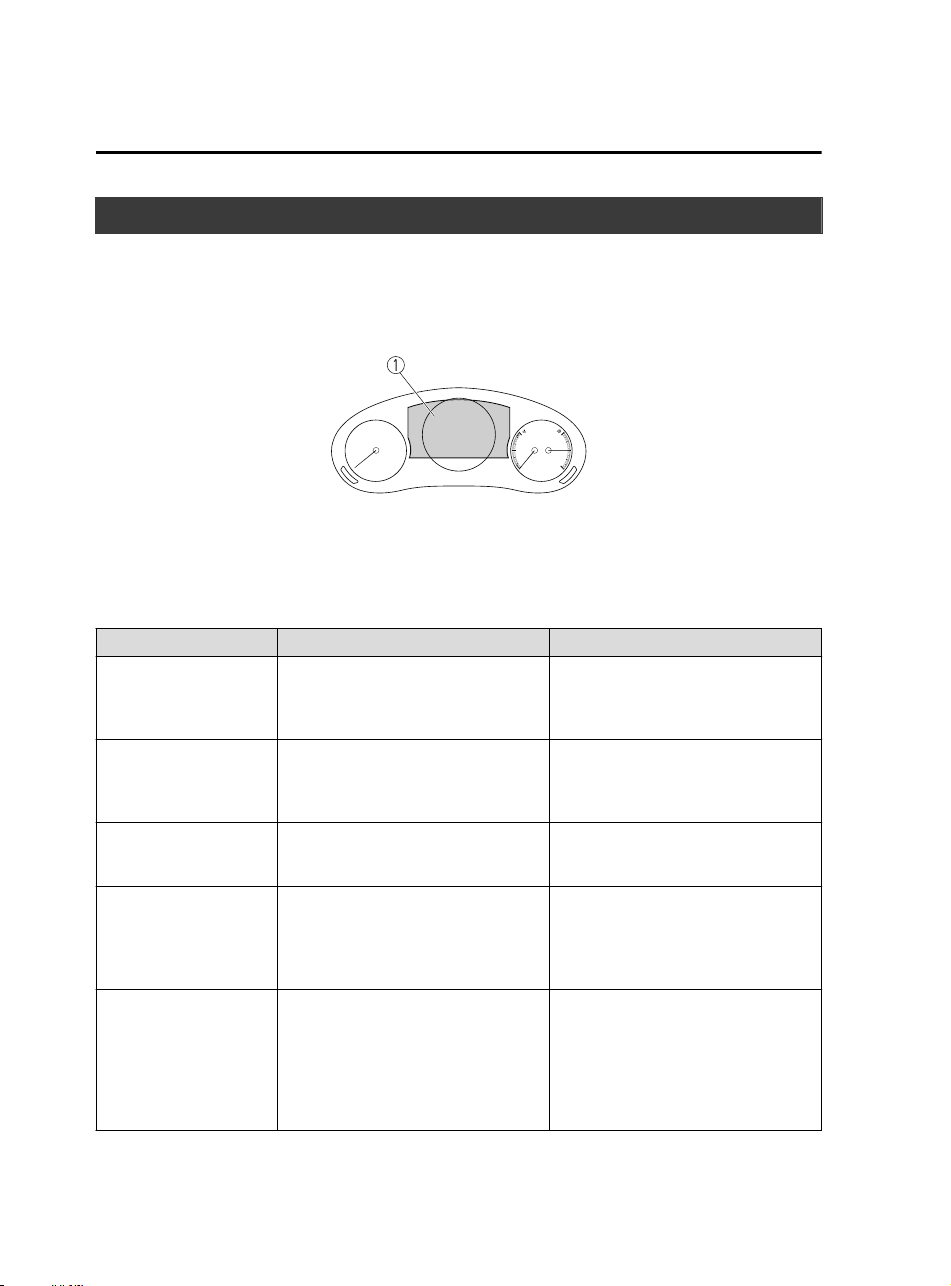
Message Indicated on Multi-information Display
▼
Message Indicated on Multi-information Display
If there is a notification from the vehicle, a message is displayed on the multi-information
display. Check the information and take the necessary action.
1. Multi-information display
If the warning light turns on/flashes simultaneously or a symbol is indicated on the display,
check the information regarding the warning light or symbol.
Refer to If a Warning Light Turns On or Flashes on page 7-27.
Display
*1*2
Content Action to be taken
Depress Brake Pedal.
Brake Hold Disabled
This message is indicated when there is a
problem with the brake related system
while the vehicle is being held in a stop
position by the AUTOHOLD function.
Depress the brake pedal. Cancel the AU‐
TOHOLD function and have your vehi‐
cle inspected at an Authorized Mazda
Dealer.
Steep Slope. Continue
Pressing Brake Pedal to
Hold Stopped Position
This message indicates the possibility of
the vehicle not being held in the stopped
position by the AUTOHOLD function,
such as on steep slopes.
Depress and hold your foot on the brake
pedal.
Depress Brake Pedal and
Operate Switch to Release
Elec. Parking Brake
This message is indicated when the Elec‐
tric Parking Brake (EPB) switch is oper‐
ated without depressing the brake pedal.
Operate the Electric Parking Brake
(EPB) switch while depressing the brake
pedal.
Depress Brake Pedal and
Operate Switch to Release
This message is indicated when the can‐
cel operation is done without depressing
the brake pedal while the vehicle is being
held in the stopped position by the AU‐
TOHOLD function.
Cancel the AUTOHOLD function stop
hold control while depressing the brake
pedal.
Mazda Radar Cruise Con‐
trol Canceled. Drive Safe‐
ly
This message is indicated when the Maz‐
da Radar Cruise Control (MRCC), Maz‐
da Radar Cruise Control with Stop & Go
function (MRCC with Stop & Go func‐
tion), and the Traffic Jam Assist (TJA)
have been canceled other than by the
driver.
Have your vehicle inspected by an Au‐
thorized Mazda Dealer.
If Trouble Arises
Warning/Indicator Lights and Warning Sounds
7-38
Mazda3_8HZ1-EA-19G_Edition1_old 2019-5-17 13:49:03
Display
*1*2
Content Action to be taken
Distance & Speed Alert
Operation Canceled Drive
Safely
This message is indicated when the Dis‐
tance & Speed Alert (DSA) have been
canceled other than by the driver.
Have your vehicle inspected by an Au‐
thorized Mazda Dealer.
Cruise Control Operation
Canceled. Drive Safely
This message is indicated when the
Cruise Control have been canceled other
than by the driver.
Have your vehicle inspected by an Au‐
thorized Mazda Dealer.
Emergency Braking Acti‐
vated. Depress Brake Ped‐
al to Hold Stop
This message is indicated after the Smart
Brake Support (SBS) brakes operate and
when the Smart Brake Support (SBS) is
canceled.
Depress the brake pedal.
Touch Key Fob to Push
Button Start Switch
This message is indicated when the key
battery is weak (battery dead or damaged
key).
Touch the key against push button start
to start the engine.
Refer to Engine Start Function When
Key Battery is Dead on page 4-8.
Depress Brake Pedal to
Start Engine
This message is indicated when the push
button start is pressed without depressing
the brake pedal.
Depress the brake pedal and press the
push button start.
Depress Clutch Pedal to
Start Engine
This message is indicated when the push
button start is pressed without depressing
the clutch pedal.
Depress the clutch pedal and press the
push button start.
Check Gear Selector Lever
Position
This message is indicated when the se‐
lector lever is shifted to the P or R posi‐
tion while driving.
Check the selector lever position.
Close Door and Fasten
Seat Belt
This message is indicated when AUTO‐
HOLD is about to operate and a door is
opened or a seat belt is unfastened.
When the AUTOHOLD is turned on,
close the doors and fasten seat belts.
Wiper Blades Must Be on
Windshield Before Operat‐
ing
This message is indicated when the
windshield wipers are operated with the
wipers raised off the windshield.
Lower the windshield wipers.
Windshield Wiper Range
of Motion Reduced. Re‐
move Obstruction(s)
This message is indicated when there is
snow or dirt accumulation on the wind‐
shield and the wiper operation range is
narrowed.
Remove foreign matter from the wind‐
shield.
Ignition Not Switched Off
This message is indicated when the driv‐
er’s door is opened without switching the
ignition OFF.
Switch the ignition OFF before leaving
the vehicle.
Gear Selector Lever Not in
Park
This message is indicated when a door is
opened with the selector lever in a posi‐
tion other than the P position.
Shift the selector lever to the P position
before leaving the vehicle.
Excessive Transmission
Temperature. Drive Slowly
This message is indicated when the inter‐
nal temperature of the automatic trans‐
mission is high.
Drive slowly to reduce load on the auto‐
matic transmission.
If Trouble Arises
Warning/Indicator Lights and Warning Sounds
7-39
Mazda3_8HZ1-EA-19G_Edition1_old 2019-5-17 13:49:03
Display
*1*2
Content Action to be taken
Excessive Transmission
Temp. Stop Vehicle in a
Safe Location
This message is indicated when the auto‐
matic transmission fluid temperature is
abnormally high.
Park the vehicle in a safe place immedi‐
ately and contact an Authorized Mazda
Dealer.
*
1 A pop-up is displayed when a warning occurs.
*
2 One screen displays four rows. If the entire message cannot be displayed on the screen, it switches to another
screen.
If Trouble Arises
Warning/Indicator Lights and Warning Sounds
7-40
Mazda3_8HZ1-EA-19G_Edition1_old 2019-5-17 13:49:03
Warning Sound is
Activated
▼
Lights-On Reminder
The lights-on reminder is operable when
the time setting
*1
of the auto headlight off
function is off.
If lights are on and the ignition is switched
to ACC or off, a continuous beep sound
will be heard when the driver's door is
opened.
*
1 If the light switch is left on, the auto
headlight off function automatically
turns off the lights about 30 seconds
after switching the ignition off. The
time setting can be changed.
Refer to the Settings section in the
Mazda Connect Owner's Manual.
NOTE
When the ignition is switched to ACC,
the “Ignition Not Switched Off (STOP)
Warning Beep” (page 7-42) overrides
the lights-on reminder.
A personalized function is available to
change the sound volume for the
lights-on reminder.
Refer to the Settings section in the
Mazda Connect Owner's Manual.
▼
Air Bag/Front Seat Belt
Pretensioner System Warning Beep
If there is a problem with the air bag/front
seat belt pretensioner systems and the
warning light illumination, a warning beep
sound will be heard for about 5 seconds
every minute.
The air bag and front seat belt pretensioner
system warning beep sound will continue
to be heard for approximately 35 minutes.
Have your vehicle inspected at an
Authorized Mazda Dealer as soon as
possible.
WARNING
Do not drive the vehicle with the air bag/
front seat belt pretensioner system warning
beep sounding:
Driving the vehicle with the air bag/front
seat belt pretensioner system warning beep
sounding is dangerous. In a collision, the
air bags and the front seat belt
pretensioner system will not deploy and
this could result in death or serious injury.
Contact an Authorized Mazda Dealer to
have the vehicle inspected as soon as
possible.
▼
Seat Belt Warning Beep
Front seat
Except Mexico
If the driver's seat belt is not fastened
when the ignition is switched ON, a beep
sound will be heard for about 6 seconds. If
the driver or the front passenger's seat belt
is not fastened and the vehicle is driven at
a speed faster than about 20 km/h (12
mph), a beep sound will be heard again for
a specified period of time.
Until a seat belt is fastened or a given
period of time has elapsed, the beep sound
will not stop even if the vehicle speed falls
below 20 km/h (12 mph).
If Trouble Arises
Warning/Indicator Lights and Warning Sounds
7-41
Mazda3_8HZ1-EA-19G_Edition1_old 2019-5-17 13:49:03
NOTE
To allow the front passenger occupant
classification sensor to function
properly, do not place and sit on an
additional seat cushion on the front
passenger's seat. The sensor may not
function properly because the additional
seat cushion could cause sensor
interference.
If a small child is seated on the front
passenger's seat, the warning beep may
not operate.
Mexico
If the vehicle speed exceeds about 20
km/h (12 mph) with the driver or front
passenger's seat belt unfastened, a warning
beep sounds continuously. If the seat belt
remains unfastened, the beep sound stops
once and then continues for about 90
seconds. The beep stops after the driver or
front passenger's seat belt is fastened.
Until a seat belt is fastened or a given
period of time has elapsed, the beep sound
will not stop even if the vehicle speed falls
below 20 km/h (12 mph).
NOTE
Placing heavy items on the front
passenger's seat may cause the front
passenger's seat belt warning function
to operate depending on the weight of
the item.
To allow the front passenger seat weight
sensor to function properly, do not place
and sit on an additional seat cushion on
the front passenger's seat. The sensor
may not function properly because the
additional seat cushion could cause
sensor interference.
If a small child is seated on the front
passenger's seat, the warning beep may
not operate.
Rear seat
The warning beep only sounds if a seat
belt is unfastened after being fastened.
▼
Ignition Not Switched Off (STOP)
Warning Beep
If the driver's door is opened with the
ignition switched to ACC, a beep will be
heard continuously in the cabin to notify
the driver that the ignition has not been
switched OFF (STOP). Under this
condition, the keyless entry system will
not operate, the vehicle cannot be locked,
and the battery voltage will be depleted.
▼
Key Removed from Vehicle Warning
Beep
Vehicles with advanced keyless function
If the key is taken out of the vehicle while
the ignition is not switched OFF and all
the doors are closed, the beep which
sounds outside of the vehicle will be heard
6 times, and after that, the beep which
sounds inside the vehicle will be heard 1
times.
Vehicles without advanced keyless
function
If the key is taken out of the vehicle while
the ignition is not switched OFF and all
the doors are closed, a beep will be heard
in the cabin 1 times.
If Trouble Arises
Warning/Indicator Lights and Warning Sounds
7-42
Mazda3_8HZ1-EA-19G_Edition1_old 2019-5-17 13:49:03

NOTE
Because the key utilizes low-intensity
radio waves, the Key Removed From
Vehicle Warning may activate if the key is
carried together with a metal object or it
is placed in a poor signal reception area.
▼
Touch Sensor Inoperable Warning
Beep (With the advanced keyless
function)
A warning beep is activated to notify the
driver that the doors are not locked when
all of the following conditions are met:
The ignition is switched OFF.
All the doors and liftgate/trunk lid are
not fully closed.
The lock is operated 3 times within 5
seconds.
Check the ignition and whether the doors
and liftgate/trunk lid are open or closed,
and then operate the lock again.
▼
Key Left-in-luggage Compartment/
Trunk Warning Beep (With the
advanced keyless function)
If the key is left in the luggage
compartment/trunk with all the doors
locked and the liftgate/trunk lid closed, a
beep will be heard outside for about 10
seconds to notify the driver that the key is
in the luggage compartment/trunk. In this
case, take out the key by pressing the
electric liftgate/trunk lid opener and
opening the liftgate/trunk lid. The key
taken out of the luggage compartment/
trunk may not operate because its
functions have been temporarily stopped.
To restore the key's functions, perform the
applicable procedure (page 3-8).
▼
Key Left-in-vehicle Warning Beep
(With the advanced keyless
function)
If all the doors and luggage compartment/
trunk are locked using another key while
the key is left in the cabin, the beep which
sounds outside of the vehicle will be heard
for about 10 seconds to notify the driver
that the key is in the cabin. In this case,
take out the key by opening the door. A
key taken out of the vehicle using this
method may not operate because its
functions have been temporarily stopped.
To restore the key's functions, perform the
applicable procedure (page 3-8).
▼
Low Fuel Warning Beep
When the low fuel warning light flashes, a
warning beep is activated once at the same
time.
▼
Brake Override Warning Beep
A warning beep is activated when the
accelerator pedal and brake pedal are
depressed at the same time while driving.
Only depress the brake pedal.
▼
Shift Position Warning Beep
A warning beep is activated continuously
if the driver's door is opened with the
selector lever in a position other than the P
position. Shift the selector lever to the P
position, or close the driver's door.
▼
Electric Parking Brake (EPB)
Warning Beep
The warning buzzer is activated under the
following conditions:
The vehicle is driven with the parking
brake applied.
If Trouble Arises
Warning/Indicator Lights and Warning Sounds
7-43
Mazda3_8HZ1-EA-19G_Edition1_old 2019-5-17 13:49:03

The Electric Parking Brake (EPB)
switch is pulled while the vehicle is
driven.
You attempt to start driving the vehicle
while the conditions for releasing the
Electric Parking Brake (EPB)
automatically have not been met.
▼
AUTOHOLD Warning Beep
Warning light flashes/message is displayed
and beep sound is activated
simultaneously for about 5 seconds when
using AUTOHOLD function or when
AUTOHOLD switch is operated.
Because a problem with AUTOHOLD
function has occurred, AUTOHOLD
function does not operate even if
AUTOHOLD switch is operated.
If the warning light flashes/message is
displayed and the beep sound is activated
simultaneously, have your vehicle
inspected at an Authorized Mazda Dealer.
▼
Vehicle Problem Warning Beep
If any of the following problems occur, a
warning beep is activated. Check the
information regarding the warning
indication in the instrument cluster or on
the center display.
Automatic transmission problem
Increase in automatic transmission
internal temperature
Brake fluid amount decrease
Engine oil level sensor problem
Electric Parking Brake (EPB) problem
Engine hydraulic pressure decrease
Engine coolant temperature increase
Engine system problem
▼
Blind Spot Monitoring (BSM)
System Warning Beep
*
The Blind Spot Monitoring (BSM)
warning beep operates when the turn
signal lever is operated to the side where
the Blind Spot Monitoring (BSM) warning
light is illuminated.
▼
Front Cross Traffic Alert (FCTA)
Warning Beep
*
The Front Cross Traffic Alert (FCTA)
warning beep is activated if there is a
possibility of collision with a vehicle
approaching from the front on the left and
right sides of the vehicle.
▼
Rear Cross Traffic Alert (RCTA)
Warning Beep
*
The Rear Cross Traffic Alert (RCTA)
warning beep is activated if there is a
possibility of collision with a vehicle
approaching from behind and from the
rear on the left and right sides of the
vehicle.
▼
Lane Departure Warning Sound
*
While the system is operating, if the
system determines that the vehicle may
depart from the lane, it sounds a warning
sound.
NOTE
The volume of the Lane Departure
Warning System (LDWS) warning sound
can be changed.
Refer to the Settings section in the Mazda
Connect Owner's Manual.
If Trouble Arises
Warning/Indicator Lights and Warning Sounds
7-44
*Some models.
Mazda3_8HZ1-EA-19G_Edition1_old 2019-5-17 13:49:03
▼
Mazda Radar Cruise Control
(MRCC) System Warnings
*
The Mazda Radar Cruise Control (MRCC)
system warnings notify the driver of
system malfunctions and cautions on use
when required.
Check based on the beep sound.
Warning beep type Notification content
The beep sounds 1 time
while the Mazda Radar
Cruise Control (MRCC)
is operating
The vehicle speed is
slower than 25 km/h (16
mph) and the Mazda Ra‐
dar Cruise Control
(MRCC) system has
been canceled.
The beep continues to
sound while the vehicle
is being driven.
The distance between
your vehicle and the ve‐
hicle ahead is too close.
Check the safety of the
surrounding area and re‐
duce vehicle speed.
▼
Mazda Radar Cruise Control with
Stop & Go function (MRCC with
Stop & Go function) System
Warnings
*
The Mazda Radar Cruise Control with
Stop & Go function (MRCC with Stop &
Go function) system warnings notify the
driver of system problems and precautions
on use when required. Check after hearing
a warning beep sound.
Warning beep type Notification content
The beep sounds 1 time
while the Mazda Radar
Cruise Control with Stop
& Go function (MRCC
with Stop & Go func‐
tion) is operating
If a malfunction occurs
in the system, make sure
that the Mazda Radar
Cruise Control with Stop
& Go function (MRCC
with Stop & Go func‐
tion) has been canceled.
Warning beep type Notification content
The beep sounds inter‐
mittently while the vehi‐
cle is being driven.
The distance between
your vehicle and the ve‐
hicle ahead is too close.
Check the safety of the
surrounding area and re‐
duce vehicle speed.
▼
Excessive Speed Warning
*
If the vehicle speed exceeds the speed
limit sign displayed in the active driving
display/instrument cluster, the area around
the speed limit sign flashes in amber and
the warning sound is activated at the same
time. If the vehicle speed continues to
exceed the displayed speed limit sign, the
indication stops flashing and remains on.
▼
Collision warning
*
If there is a possibility of a collision with a
vehicle ahead, a warning sound is
activated at the same time as the warning
indications are displayed in the instrument
cluster or active driving display.
▼
Door-ajar Warning Beep
A warning beep is actived if the vehicle is
driven with any door or liftgate ajar. Drive
the vehicle after closing the doors and
liftgate.
If Trouble Arises
Warning/Indicator Lights and Warning Sounds
*Some models.
7-45
Mazda3_8HZ1-EA-19G_Edition1_old 2019-5-17 13:49:03
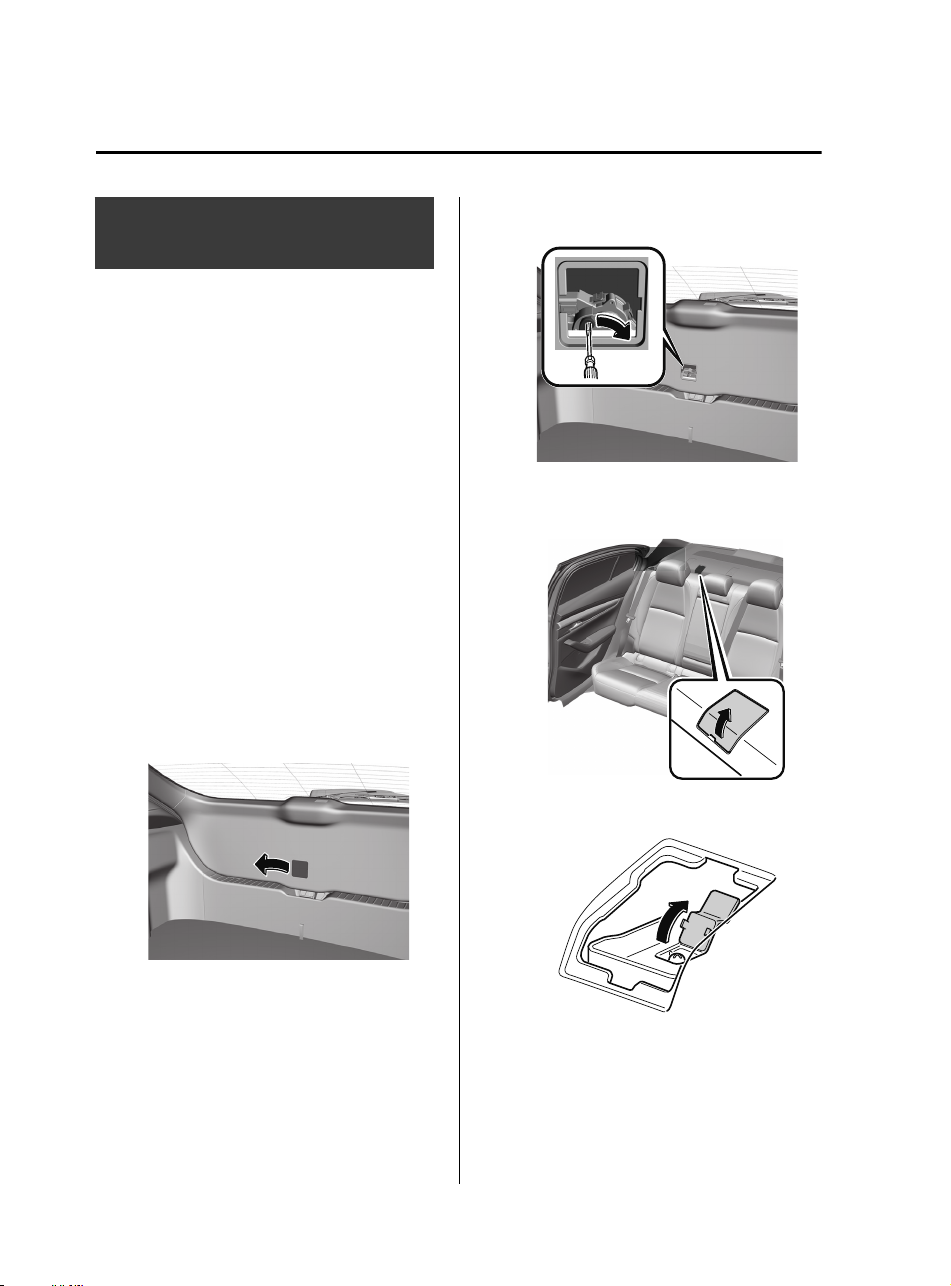
When Liftgate/Trunk Lid
Cannot be Opened
▼
When Liftgate/Trunk Lid Cannot be
Opened
If the battery is dead, the liftgate/trunk lid
cannot be unlocked and opened.
In this case, the liftgate/trunk lid can be
unlocked by taking care of the dead
battery situation.
Refer to Jump-Starting on page 7-17.
If the liftgate/trunk lid cannot be unlocked
even if the dead battery situation has been
resolved, the electrical system may have a
malfunction.
In this case, the liftgate/trunk lid can be
opened using the following procedure as
an emergency measure.
(5–door)
1. Wrap the end of a flathead screwdriver
in a cloth and remove the cover on the
interior surface of the liftgate using it.
2. Turn the lever to the right to unlock the
liftgate.
(4–door)
1. Open the cover.
2. (With theft-prevention cover)
Open the cap.
If Trouble Arises
When Liftgate/Trunk Lid Cannot be Opened
7-46
Mazda3_8HZ1-EA-19G_Edition1_old 2019-5-17 13:49:03
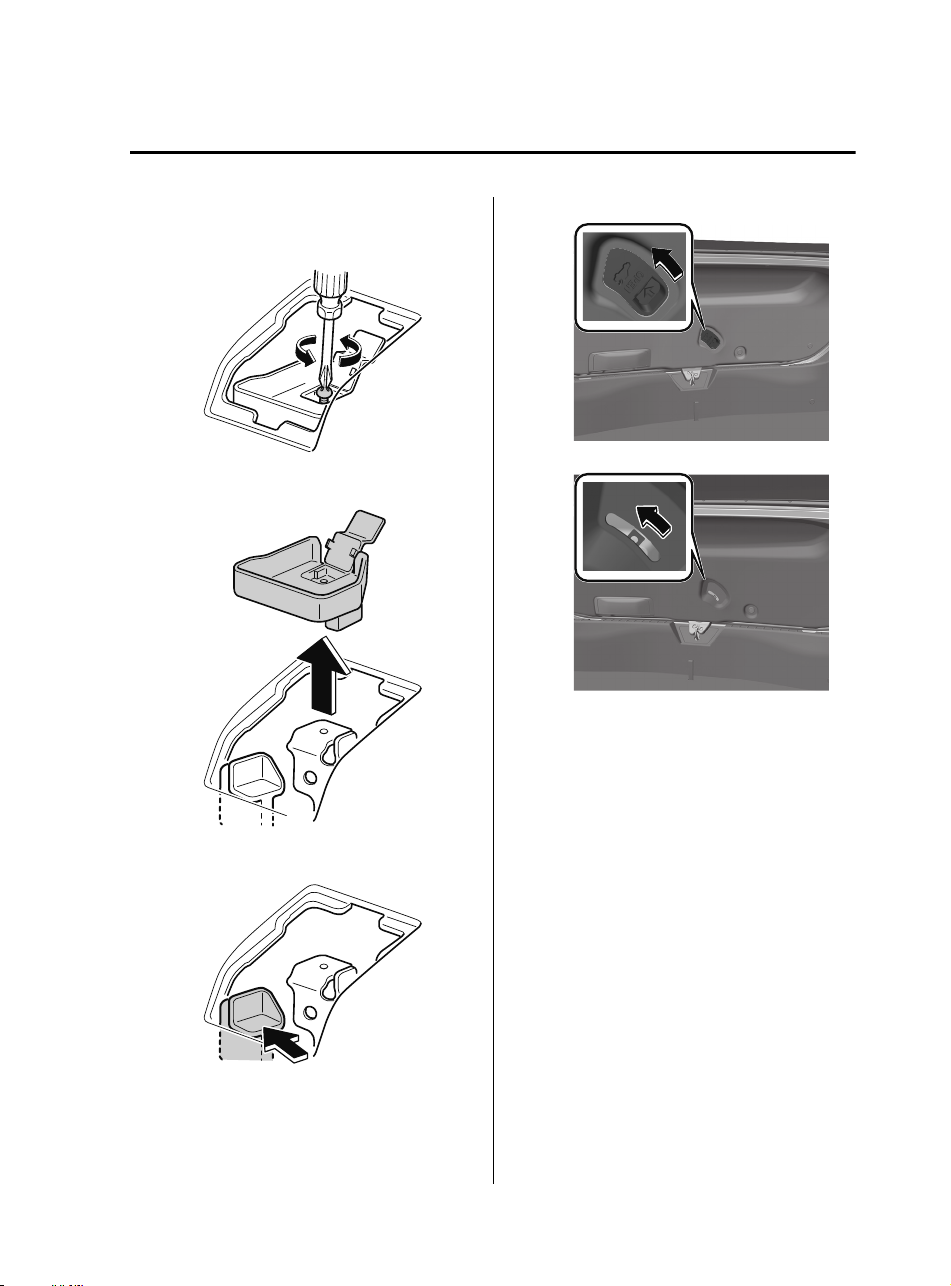
3. (With theft-prevention cover)
Turn the screw counterclockwise and
remove it.
4. (With theft-prevention cover)
Remove the theft-prevention cover.
5. Move the lever to the left to fold the
seatback.
6. Move the lever to the left to open the
trunk lid.
(Type A)
(Type B)
After performing this emergency measure,
have the vehicle inspected at an
Authorized Mazda Dealer as soon as
possible.
If Trouble Arises
When Liftgate/Trunk Lid Cannot be Opened
7-47
Mazda3_8HZ1-EA-19G_Edition1_old 2019-5-17 13:49:03
If the Active Driving
Display Does Not Operate
*
▼
If the Active Driving Display Does
Not Operate
If the active driving display does not
operate, switch the ignition off and then
restart the engine. If the active driving
display does not operate even with the
engine restarted, have the vehicle
inspected at an Authorized Mazda Dealer.
If Trouble Arises
Active Driving Display Does Not Operate
7-48
*Some models.
Mazda3_8HZ1-EA-19G_Edition1_old 2019-5-17 13:49:03
Windshield Wipers
Operate at High Speed
▼
Windshield Wipers Operate at High
Speed
The windshield wipers may operate at
high speed if there is a problem with the
wiper control. If the windshield wipers
operate at high speed regardless of the
wiper switch operation, have your vehicle
inspected by an Authorized Mazda Dealer.
If Trouble Arises
Windshield Wipers Operate at High Speed
7-49
Mazda3_8HZ1-EA-19G_Edition1_old 2019-5-17 13:49:03

MEMO
7-50
Mazda3_8HZ1-EA-19G_Edition1_old 2019-5-17 13:49:03
8
Customer Information and Reporting
Safety Defects
Important consumer information including warranties and add-on
equipment.
Customer Assistance......................... 8-2
Customer Assistance
(U.S.A.)........................................ 8-2
Customer Assistance
(Canada)....................................... 8-6
Customer Assistance (Puerto
Rico)............................................. 8-9
Customer Assistance
(Mexico)..................................... 8-10
Mazda Importer/Distributors.........8-11
Importer/Distributor....................8-11
Reporting Safety Defects................ 8-12
Reporting Safety Defects
(U.S.A.)...................................... 8-12
Reporting Safety Defects
(Canada)..................................... 8-14
Warranty.......................................... 8-15
Warranties for Your Mazda.........8-15
Outside the United States/
Canada........................................ 8-15
Registering Your Vehicle in A
Foreign Country (Except United
States and Canada)..................... 8-16
Add-On Non-Genuine Parts and
Accessories.................................8-17
Cell Phones.......................................8-18
Cell Phones Warning.................. 8-18
Event Data Recorder.......................8-19
Event Data Recorder (U.S.A. and
Canada).......................................8-19
Recording of Vehicle Data.............. 8-20
Recording of Vehicle Data..........8-20
Uniform Tire Quality Grading System
(UTQGS).......................................... 8-21
Uniform Tire Quality Grading
System (UTQGS)....................... 8-21
Tire Information (U.S.A.)............... 8-23
Tire Labeling.............................. 8-23
Location of the Tire Label
(Placard)..................................... 8-27
Tire Maintenance........................8-29
Vehicle Loading..........................8-31
Steps for Determining the Correct
Load Limit..................................8-34
Declaration of Conformity..............8-35
Declaration of Conformity......... 8-35
8-1
Mazda3_8HZ1-EA-19G_Edition1_old 2019-5-17 13:49:03
Customer Assistance
(U.S.A.)
▼
Customer Assistance
Your complete and permanent satisfaction
is our business. We are here to serve you.
All Authorized Mazda Dealers have the
knowledge and the tools to keep your
Mazda vehicle in top condition.
If you have any questions or
recommendations for improvement
regarding the service of your Mazda
vehicle or servicing by Mazda Dealer
personnel, we recommend that you take
the following steps:
NOTE
If it becomes necessary to have the
components or wiring system for the
supplementary restraint system modified
to accommodate a person with certain
medical conditions in accordance with a
certified physician, contact an Authorized
Mazda Dealer. For more information, go
to NHTSA website www.safercar.gov
(VEHICLE SHOPPERS > Air Bags > Air
Bag FAQs > Air Bag Deactivation).
▼
STEP 1: Contact Your Mazda
Dealer
Discuss the matter with an Authorized
Mazda Dealer. This is the quickest and
best way to address the issue.
If your concern has not been resolved by
the CUSTOMER RELATIONS,
SALES, SERVICE, or PARTS
MANAGER, then please contact the
GENERAL MANAGER of the
dealership or the OWNER.
If it becomes necessary to have the
components or wiring system for the
supplementary restraint system modified
to accommodate a person with certain
medical conditions in accordance with a
certified physician, go to STEP 2.
▼
STEP 2: Contact Mazda North
American Operations
If for any reason you feel the need for
further assistance after contacting your
dealership management or it becomes
necessary to have the components or
wiring system for the supplementary
restraint system modified to accommodate
a person with certain medical conditions in
accordance with a certified physician, you
can reach Mazda North American
Operations by one of the following ways.
Log on: at www.MazdaUSA.com
Answers to many questions, including
how to locate or contact a local Mazda
dealership in the U.S., can be found here.
E-mail: click on “Contact Us” located on
the bottom of the page at
www.mazdausa.com under “Help”
By phone at: 1 (800) 222-5500
By letter at:
ATTN: Customer Experience Center
Mazda North American Operations
200 Spectrum Center Drive Suite 100
Irvine, California 92618
P.O. Box 19734
Irvine, CA 92623-9734
Customer Information and Reporting Safety Defects
Customer Assistance
8-2
Mazda3_8HZ1-EA-19G_Edition1_old 2019-5-17 13:49:03

In order to serve you efficiently and
effectively, please help us by providing the
following information:
1. Your name, address, and telephone
number
2. Year and model of vehicle
3. Vehicle Identification Number (17
digits, noted on your registration or
title or located on the upper driver's
side corner of the dash)
4. Purchase date and current mileage
5. Your dealer's name and location
6. Your question(s)
If you live outside the U.S.A., please
contact your nearest Mazda Distributor.
▼
STEP 3: Contact Better Business
Bureau (BBB)
Mazda North American Operations
realizes that mutual agreement on some
issues may not be possible. As a final step
to ensure that your concerns are being
fairly considered, Mazda North American
Operations has agreed to participate in a
dispute settlement program administered
by the Better Business Bureau (BBB)
system, at no cost to you the consumer.
BBB AUTO LINE works with consumers
and the manufacturer in an attempt to
reach a mutually acceptable resolution of
any warranty related concerns. If the BBB
is not able to facilitate a settlement they
will provide an informal hearing before an
arbitrator.
You are required to resort to BBB AUTO
LINE before exercising rights or seeking
remedies under the Federal
Magnuson-Moss Warranty Act, 15 U.S.C.
§ 2301 et seq. To the extent permitted by
the applicable state “Lemon Law”, you are
also required to resort to BBB AUTO
LINE before exercising any rights or
seeking remedies under the “Lemon Law”.
If you choose to seek remedies that are not
created by the Magnuson-Moss Warranty
Act or the applicable state “Lemon Law”,
you are not required to first use BBB
AUTO LINE.
The whole process normally takes 40 days
or less. The arbitration decision is not
binding on you or Mazda unless you
accept the decision. For more information
about BBB AUTO LINE, including
current eligibility standards, please call
1-800-955-5100 or visit the BBB website
at www.bbb.org/autoline.
Being truly committed to customer
satisfaction is more than a phrase with
Mazda. We hope to satisfy every customer
directly, but if there is ever a question
about our decision, Mazda believes in
providing a fast, fair and free method such
as the BBB AUTO LINE to ensure Mazda
delivers on our commitment to do the right
thing for our customers!
Customer Information and Reporting Safety Defects
Customer Assistance
8-3
Mazda3_8HZ1-EA-19G_Edition1_old 2019-5-17 13:49:03

▼
California Customers
1. Mazda North American Operations
participates in BBB AUTO LINE, a
mediation/arbitration program
administered by the Council of Better
Business Bureaus [4200 Wilson
Boulevard, Arlington, Virginia 22203]
through local Better Business Bureaus.
BBB AUTO LINE and Mazda have
been certified by the Arbitration
Certification Program of the California
Department of Consumer Affairs.
2. If you have a problem arising under a
Mazda written warranty, we encourage
you to bring it to our attention. If we
are unable to resolve it, you may file a
claim with BBB AUTO LINE. Claims
must be filed with BBB AUTO LINE
within six (6) months after the
expiration of the warranty.
3. To file a claim with BBB AUTO
LINE, call 1-800-955-5100. There is
no charge for the call.
4. In order to file a claim with BBB
AUTO LINE, you will have to provide
your name and address, the brand
name and vehicle identification
number (VIN) of your vehicle, and a
statement of the nature of your
problem or complaint. You will also be
asked to provide: the approximate date
of your acquisition of the vehicle, the
vehicle's current mileage, the
approximate date and mileage at the
time any problem(s) were first brought
to the attention of Mazda or one of our
dealers, and a statement of the relief
you are seeking.
5. BBB AUTO LINE staff may try to
help resolve your dispute through
mediation. If mediation is not
successful, or if you do not wish to
participate in mediation, claims within
the program's jurisdiction may be
presented to an arbitrator at an
informal hearing. The arbitrator's
decision should ordinarily be issued
within 40 days from the time your
complaint is filed; there may be a
delay of 7 days if you did not first
contact Mazda about your problem, or
a delay of up to 30 days if the
arbitrator requests an inspection/report
by an impartial technical expert or
further investigation and report by
BBB AUTO LINE.
6. You are required to use BBB AUTO
LINE before asserting in court any
rights or remedies conferred by
California Civil Code Section 1793.22.
You are also required to use BBB
AUTO LINE before exercising rights
or seeking remedies created by Title I
of the Magnuson-Moss Warranty Act,
15 U.S.C. sec. 2301 et seq. If you
choose to seek redress by pursuing
rights and remedies not created by
California Civil Code Section 1793.22
or Title I of the Magnuson-Moss
Warranty Act, resort to BBB AUTO
LINE is not required by those statutes.
Customer Information and Reporting Safety Defects
Customer Assistance
8-4
Mazda3_8HZ1-EA-19G_Edition1_old 2019-5-17 13:49:03

7. California Civil Code Section 1793.2
(d) requires that, if Mazda or its
representative is unable to repair a new
motor vehicle to conform to the
vehicle's applicable express warranty
after a reasonable number of attempts,
Mazda may be required to replace or
repurchase the vehicle. California Civil
Code Section 1793.22 (b) creates a
presumption that Mazda has had a
reasonable number of attempts to
conform the vehicle to its applicable
express warranties if, within 18 months
from delivery to the buyer or 18,000
miles on the vehicle's odometer,
whichever occurs first, one or more of
the following occurs:
The same nonconformity [a failure
to conform to the written warranty
that substantially impairs the use,
value or safety of the vehicle] results
in a condition that is likely to cause
death or serious bodily injury if the
vehicle is driven AND the
nonconformity has been subject to
repair two or more times by Mazda
or its agents AND the buyer or
lessee has directly notified Mazda of
the need for the repair of the
nonconformity; OR
The same nonconformity has been
subject to repair 4 or more times by
Mazda or its agents AND the buyer
has notified Mazda of the need for
the repair of the nonconformity; OR
The vehicle is out of service by
reason of repair of nonconformities
by Mazda or its agents for a
cumulative total of more than 30
calendar days after delivery of the
vehicle to the buyer.
NOTICE TO Mazda AS
REQUIRED ABOVE SHALL BE
SENT TO THE FOLLOWING
ADDRESS:
Mazda North American Operations
200 Spectrum Center Drive Suite 100
Irvine, California 92618
ATTN: Customer Mediation
8. The following remedies may be sought
in BBB AUTO LINE: repairs,
reimbursement for money paid to
repair a vehicle or other expenses
incurred as result of a vehicle
nonconformity, repurchase or
replacement of your vehicle, and
compensation for damages and
remedies available under Mazda's
written warranty or applicable law.
9. The following remedies may not be
sought in BBB AUTO LINE: punitive
or multiple damages, attorneys' fees, or
consequential damages other than as
provided in California Civil Code
Section 1794 (a) and (b).
10. You may reject the decision issued by
a BBB AUTO LINE arbitrator. If you
reject the decision, you will be free to
pursue further legal action. The
arbitrator's decision and any findings
will be admissible in a court action.
Customer Information and Reporting Safety Defects
Customer Assistance
8-5
Mazda3_8HZ1-EA-19G_Edition1_old 2019-5-17 13:49:03
11. If you accept the arbitrator's decision,
Mazda will be bound by the decision,
and will comply with the decision
within a reasonable time not to exceed
30 days after we receive notice of your
acceptance of the decision.
12. Please call BBB AUTO LINE at
1-800-955-5100 for further details
about the program.
Customer Assistance
(Canada)
▼
Satisfaction Review Process
Your complete and permanent satisfaction
is of primary concern to Mazda. All
Authorized Mazda Dealers have both the
knowledge and tools to keep your Mazda
in top condition. In our experience, any
questions, problems, or complaints
regarding the operation of your Mazda or
any other general service transactions are
most effectively resolved by your dealer. If
the cause of your dissatisfaction cannot
adequately be addressed by normal
dealership procedures, we recommend that
you take the following steps:
▼
STEP 1: Contact the Mazda Dealer
Discuss the matter with a member of
dealership management. If the Service
Manager has already reviewed your
concerns, contact the owner of the
dealership or its General Manager.
▼
STEP 2: Contact the Mazda
Regional Office
If you feel that you still require assistance,
ask the dealer Service Manager to arrange
for you to meet the local Mazda Service
Representative. If more expedient, contact
Mazda Canada Inc. Regional Office
nearest you for such arrangements.
Regional Office address and phone
numbers are shown (page 8-8).
Customer Information and Reporting Safety Defects
Customer Assistance
8-6
Mazda3_8HZ1-EA-19G_Edition1_old 2019-5-17 13:49:03

▼
STEP 3: Contact the Mazda
Customer Relations Department
If still not substantially satisfied, contact
the Customer Relations Department,
Mazda Canada Inc., 55 Vogell Road,
Richmond Hill, Ontario, L4B 3K5 Canada
TEL: 1 (800) 263-4680.
Provide the Department with the following
information:
1. Your name, address and telephone
number
2. Year and model of vehicle
3. Vehicle Identification Number (VIN).
Refer to the Vehicle Identification
Number on page 9-2 for the location
of the VIN.
4. Purchase date
5. Present odometer reading
6. Your dealer's name and location
7. The nature of your problem and/or
cause of dissatisfaction
The Department, in cooperation with the
local Mazda Service Representative, will
review the case to determine if everything
possible has been done to ensure your
satisfaction.
Please recognize that the resolution of
service problems in most cases requires
the use of your Mazda dealer's service
facilities, personnel and equipment. We
urge you to follow the above three steps in
sequence for most effective results.
▼
Mediation/Arbitration Program
Occasionally a customer concern cannot
be resolved through Mazda's Customer
Satisfaction Program. If after exhausting
the procedures in this manual your
concern is still not resolved, you have
another option.
Mazda Canada Inc. participates in an
arbitration program administered by the
Canadian Motor Vehicle Arbitration Plan
(CAMVAP). CAMVAP will advise you
about how your concern may be reviewed
and resolved by an independent third party
through binding arbitration.
Your complete satisfaction is the goal of
Mazda Canada Inc. and our dealers.
Mazda's participation in CAMVAP makes
a valuable contribution to our achieving
that goal. There is no charge for using
CAMVAP. CAMVAP results are fast, fair
and final as the award is binding on both
you and Mazda Canada Inc.
▼
Canadian Motor Vehicle Arbitration
Plan (CAMVAP)
If a specific item of concern arises, where
a solution cannot be reached between an
owner, Mazda, and/or one of its dealers
(that all parties cannot agree upon), the
owner may wish to use the services
offered by the Canadian Motor Vehicle
Arbitration Plan (CAMVAP).
Customer Information and Reporting Safety Defects
Customer Assistance
8-7
Mazda3_8HZ1-EA-19G_Edition1_old 2019-5-17 13:49:03
CAMVAP uses the services of Provincial
Administrators to assist consumers in
scheduling and preparing for their
arbitration hearings. However, before you
can proceed with CAMVAP you must
follow your Mazda dispute resolution
process as outlined previously.
CAMVAP is fully implemented in all
provinces and territories.
Consumers wishing to obtain further
information about the Program should
contact the Provincial Administrator at 1
(800) 207-0685, or by contacting the
Canadian Motor Vehicle Arbitration Plan
Office at:
Canadian Motor Vehicle Arbitration Plan
235 Yorkland Boulevard, suite 300
North York, Ontario
M2J 4Y8
http://camvap.ca
Provincial Administrators may be reached
locally:
Province/Territory CAMVAP Number
British Columbia & Yu‐
kon Territories
1 (800) 207-0685
Alberta & Northwest
Territories
1 (800) 207-0685
Saskatchewan 1 (800) 207-0685
Manitoba 1 (800) 207-0685
Ontario 1 (800) 207-0685
Atlantic Canada 1 (800) 207-0685
Quebec 1 (800) 207-0685
▼
Regional Offices
REGIONAL OFFICES COVERING AREAS
MAZDA CANADA
INC.
WESTERN REGION
5011 275 STREET
LANGLEY, BRITISH
COLUMBIA
V4W 0A8
(778) 369-2100
1 (800) 663-0908
ALBERTA,
BRITISH COLUMBIA,
MANITOBA,
SASKATCHEWAN,
YUKON
MAZDA CANADA
INC.
CENTRAL REGION
55 VOGELL ROAD,
RICHMOND HILL,
ONTARIO, L4B 3K5
1 (800) 263-4680
ONTARIO,
NEW BRUNSWICK,
NOVA SCOTIA,
PRINCE EDWARD IS‐
LAND,
NEWFOUNDLAND
MAZDA CANADA
INC.
QUEBEC REGION
6111 ROUTE TRANS‐
CANADIENNE
POINTE CLAIRE,
QUEBEC
H9R 5A5
(514) 694-6390
QUEBEC
Customer Information and Reporting Safety Defects
Customer Assistance
8-8
Mazda3_8HZ1-EA-19G_Edition1_old 2019-5-17 13:49:03
Customer Assistance
(Puerto Rico)
▼
Customer Assistance
Your complete and permanent satisfaction
is our business. That is why all Authorized
Mazda Dealers have the knowledge and
the tools to keep your Mazda vehicle in
top condition.
If you have any questions or
recommendations for improvement
regarding the service of your Mazda
vehicle or servicing by Mazda Dealer
personnel, we recommend that you take
the following steps:
▼
STEP 1
Discuss the matter with an Authorized
Mazda Dealer. This is the quickest and
best way to address the issue. If your
concern has not been resolved by the
CUSTOMER RELATIONS, SALES,
SERVICE, or PARTS MANAGER, then
please contact the GENERAL
MANAGER of the dealership or the
OWNER.
▼
STEP 2
If, after following STEP 1, you feel the
need for further assistance, please contact
your area's Mazda representative.
Refer to PUERTO RICO/U.S. Virgin
Island on page 8-11.
Please help us by providing the following
information:
1. Your name, address, and telephone
number
2. Year and model of vehicle
3. Vehicle Identification Number (17
digits, noted on your registration or
title or located on the upper driver's
side corner of the dash)
4. Purchase date and current mileage
5. Your dealer's name and location
6. Your question(s)
Customer Information and Reporting Safety Defects
Customer Assistance
8-9
Mazda3_8HZ1-EA-19G_Edition1_old 2019-5-17 13:49:03
Customer Assistance
(Mexico)
▼
Customer Assistance
Your complete and permanent satisfaction
is our business. We are here to serve you.
All Authorized Mazda Dealers have the
knowledge and the tools to keep your
Mazda vehicle in top condition.
If you have any questions or
recommendations for improvement
regarding the service of your Mazda
vehicle or servicing by Mazda Dealer
personnel, we recommend that you take
the following steps:
▼
Contact Your Mazda Dealer
Discuss the matter with an Authorized
Mazda Dealer. This is the quickest and
best way to address the issue.
If your concern has not been resolved by
the CUSTOMER RELATIONS,
SALES, SERVICE, or PARTS
MANAGER, then please contact the
GENERAL MANAGER of the
dealership or the OWNER.
If it becomes necessary to have the
components or wiring system for the
supplementary restraint system modified
to accommodate a person with certain
medical condition in accordance with a
certified physician you must contact
your dealership in order to avoid the
potential loss of the warranty of your
vehicle which may occur if some third
party is hired by the customer to make
any modifications to this system.
Log on: at www.mazdamexico.com.mx
Answers to many questions, including
how to locate or contact a local Mazda
dealership in Mexico, can be found here.
E-mail: click on “Contactanos” at the top
of the page at www.mazdamexico.com.mx
By phone at: 01 800 01 MAZDA (62932)
By letter at:
Attn: Customer Assistance
Mazda Motor de Mexico
Mario Pani 400 PB, Col. Santa Fe
Cuajimalpa, Delegación Cuajimalpa de
Morelos, Ciudad de México, CP 05348
Tel: Customer Assistance
01 800 01 MAZDA(62932).
In order to serve you efficiently and
effectively, please help us by providing the
following information:
1. Your name, address, and telephone
number
2. Year and model of vehicle
3. Vehicle Identification Number (17
digits, noted on your registration or
title or located on the upper driver's
side corner of the dash)
4. Purchase date and current mileage
5. Your dealer's name and location
6. Your question(s)
Customer Information and Reporting Safety Defects
Customer Assistance
8-10
Mazda3_8HZ1-EA-19G_Edition1_old 2019-5-17 13:49:03
Importer/Distributor
▼
U.S.A.
Mazda North American Operations
200 Spectrum Center Drive Suite 100
Irvine, California 92618
P.O. Box 19734
Irvine, CA 92623-9734 U.S.A.
TEL: 1 (800) 222-5500 (in U.S.A.)
(949) 727-1990 (outside U.S.A.)
▼
CANADA
Mazda Canada Inc.
55 Vogell Road, Richmond Hill,
Ontario, L4B 3K5 Canada
TEL: 1 (800) 263-4680 (in Canada)
(905) 787-7000 (outside Canada)
▼
PUERTO RICO/U.S. Virgin Island
International Automotive Distributor
Group, LLC. (Mazda de Puerto Rico)
P.O. Box 191850, San Juan, Puerto Rico
00919-1850
TEL: (787) 641-1777
▼
MEXICO
Mazda Motor de Mexico
Mario Pani 400 PB, Col. Santa Fe
Cuajimalpa, Delegación Cuajimalpa de
Morelos, Ciudad de México, CP 05348
TEL: Center of Attention to Clients:
01 (800) 016 2932. in Mexico
▼
GUAM
Triple J Motors
157 South Marine Drive, Tamuning,
GUAM 96911 USA
P.O. Box 6066 Tamuning, Guam 96931
TEL: (671) 649-6555
▼
SAIPAN
Pacific International Marianas, Inc.
(d.b.a. Midway Motors)
P.O. Box 887 Saipan, MP 96950
TEL: (670) 234-7524
Triple J Saipan, Inc.
(d.b.a. Triple J Motors)
P.O. Box 500487 Saipan, MP 96950-0487
TEL: (670) 234-7133/3051
▼
AMERICAN SAMOA
Polynesia Motors, Inc.
P.O. Box 1120, Pago Pago, American
Samoa 96799
TEL: (684) 699-9347
Customer Information and Reporting Safety Defects
Mazda Importer/Distributors
8-11
Mazda3_8HZ1-EA-19G_Edition1_old 2019-5-17 13:49:03

Reporting Safety Defects (U.S.A.)
▼
Reporting Safety Defects
If you believe that your vehicle has a defect which could cause a crash or could cause injury
or death, you should immediately inform the National Highway Traffic Safety
Administration (NHTSA) in addition to notifying Mazda Motor Corporation (Your Mazda
Importer/Distributor).
If NHTSA receives similar complaints, it may open an investigation, and if it finds that a
safety defect exists in a group of vehicles, it may order a recall and remedy campaign.
However, NHTSA cannot become involved in individual problems between you, your
dealer, or Mazda Motor Corporation (Your Mazda Importer/Distributor).
To contact NHTSA, you may call the Vehicle Safety Hotline toll-free at 1-888-327-4236
(TTY:1-800-424-9153); go to http://www.safercar.gov; or write to: Administrator, NHTSA,
1200 New Jersey Avenue, SE., Washington, DC, 20590. You can also obtain other
information about motor vehicle safety from http://www.safercar.gov.
Customer Information and Reporting Safety Defects
Reporting Safety Defects
8-12
Mazda3_8HZ1-EA-19G_Edition1_old 2019-5-17 13:49:03

NOTE
If you live in the U.S.A., all correspondence to Mazda Motor Corporation should be
forwarded to:
Mazda North American Operations
200 Spectrum Center Drive Suite 100
Irvine, California 92618
or
P.O. Box 19734
Irvine, CA 92623-9734
Customer Experience Center or toll free at 1 (800) 222-5500
If you live outside of the U.S.A., please contact the nearest Mazda Distributor shown in this
manual.
Refer to CANADA on page 8-11.
Refer to PUERTO RICO/U.S. Virgin Island on page 8-11.
Refer to MEXICO on page 8-11.
Refer to GUAM on page 8-11.
Refer to SAIPAN on page 8-11.
Refer to AMERICAN SAMOA on page 8-11.
Customer Information and Reporting Safety Defects
Reporting Safety Defects
8-13
Mazda3_8HZ1-EA-19G_Edition1_old 2019-5-17 13:49:03

Reporting Safety Defects (Canada)
▼
Reporting Safety Defects
Canadian customers who wish to report a safety-related defect to Transport Canada, Defect
Investigations and Recalls, may telephone the toll free hotline 1-800-333-0510, or contact
Transport Canada by mail at: Transport Canada, ASFAD, Place de Ville Tower C, 330
Sparks Street, Ottawa ON K1A 0N5.
For additional road safety information, please visit the Road Safety website at:
http://www.tc.gc.ca/roadsafety/menu.htm
Customer Information and Reporting Safety Defects
Reporting Safety Defects
8-14
Mazda3_8HZ1-EA-19G_Edition1_old 2019-5-17 13:49:03
Warranties for Your
Mazda
▼
Warranties for Your Mazda
New Vehicle Limited Warranty
Powertrain Limited Warranty
Safety Restraint System Limited
Warranty
Anti-perforation Limited Warranty
Federal Emission Control Warranty/
California Emission Control Warranty
Emission Defect Warranty
Emission Performance Warranty
Emission Control Warranty
Replacement Parts and Accessories
Limited Warranty
Tire Warranty
NOTE
Warranty information varies depending on
the country. Refer to the Warranty Booklet
for detailed warranty information.
Outside the United States/
Canada
▼
Outside the United States/Canada
Government regulations in the United
States/Canada require that automobiles
meet specific emission regulations and
safety standards. Therefore, vehicles built
for use in the United States/Canada may
differ from those sold in other countries.
The differences may make it difficult or
even impossible for your vehicle to
receive satisfactory servicing in other
countries. We strongly recommend that
you NOT take your Mazda outside the
United States/Canada.
United States
However, in the event that you are moving
to Canada permanently, Mazda vehicles
built for use in the United States could be
eligible for exportation to Canada with
specific vehicle modifications to comply
with the Canadian Motor Vehicle Safety
Standards (CMVSS).
Canada
However, in the event that you are moving
to the United States permanently, Mazda
vehicles built for use in Canada could be
eligible for exportation to the United
States with specific vehicle modifications
to comply with the United States Federal
Motor Vehicle Safety Standards (FMVSS).
NOTE
The above is applicable for a permanent
import/export situation and not related to
travelers on vacation.
Customer Information and Reporting Safety Defects
Warranty
8-15
Mazda3_8HZ1-EA-19G_Edition1_old 2019-5-17 13:49:03
You may have the following problems if
you do take your vehicle outside of the
United States/Canada:
Recommended fuel may be unavailable.
Any kind of leaded fuel or low-octane
fuel will affect vehicle performance and
damage the emission controls and
engine.
Proper repair facilities, tools, testing
equipment, and replacement parts may
not be available.
Please refer to your Manufacturer's
Warranty Booklet for more information.
Registering Your Vehicle
in A Foreign Country
(Except United States and
Canada)
▼
Registering Your Vehicle in A
Foreign Country
Registering your vehicle in a foreign
country may be problematic depending on
whether it meets the specific emission and
safety standards of the country in which
the vehicle will be driven. Consequently,
your vehicle may require modifications at
personal expense in order to meet the
regulations.
In addition, you should be aware of the
following issues:
Satisfactory vehicle servicing may be
difficult or impossible in another country.
The fuel specified for your vehicle may be
unavailable.
Parts, servicing techniques, and tools
necessary to maintain and repair your
vehicle may be unavailable.
There might not be an Authorized Mazda
Dealer in the country you plan to take your
vehicle.
The Mazda warranty is valid only in
certain countries.
Customer Information and Reporting Safety Defects
Warranty
8-16
Mazda3_8HZ1-EA-19G_Edition1_old 2019-5-17 13:49:03
Add-On Non-Genuine
Parts and Accessories
▼
Add-On Non-Genuine Parts and
Accessories
Non-genuine parts and accessories for
Mazda vehicles can be found in stores.
These may fit your vehicle, but they are
not approved by Mazda for use with
Mazda vehicles. When you install
non-genuine parts or accessories, they
could affect your vehicle's performance or
safety systems; the Mazda warranty
doesn't cover this. Before you install any
non-genuine parts or accessories, consult
an Authorized Mazda Dealer.
WARNING
Always consult an Authorized Mazda
Dealer before you install non-genuine parts
or accessories:
Improperly designed parts or accessories
could seriously aect your vehicle's
performance or safety systems. This could
cause you to have an accident or increase
your chances of injuries in an accident.
Be very careful in choosing and installing
add-on electrical equipment, such as
mobile telephones, two-way radios, stereo
systems, and car alarm systems:
Incorrectly choosing or installing improper
add-on equipment or choosing an
improper installer is dangerous. Essential
systems could be damaged, causing engine
stalling, air-bag (SRS) activation,
ABS/TCS/DSC inactivation, or a re in the
vehicle.
Mazda assumes no responsibility for
death, injury, or expenses that may result
from the installation of add-on
non-genuine parts or accessories.
Customer Information and Reporting Safety Defects
Warranty
8-17
Mazda3_8HZ1-EA-19G_Edition1_old 2019-5-17 13:49:03
Cell Phones Warning
▼
Cell Phones Warning
WARNING
Please comply with the legal regulations
concerning the use of communication
equipment in vehicles in your country:
Use of any electrical devices such as cell
phones, computers, portable radios,
vehicle navigation or other devices by the
driver while the vehicle is moving is
dangerous. Dialing a number on a cell
phone while driving also ties-up the driver's
hands. Use of these devices will cause the
driver to be distracted and could lead to a
serious accident. If a passenger is unable to
use the device, pull o the right-of-way to a
safe area before use. If use of a cell phone is
necessary despite this warning, use a
hands-free system to at least leave the
hands free to drive the vehicle. Never use a
cell phone or other electrical devices while
the vehicle is moving and, instead,
concentrate on the full-time job of driving.
Customer Information and Reporting Safety Defects
Cell Phones
8-18
Mazda3_8HZ1-EA-19G_Edition1_old 2019-5-17 13:49:03
Event Data Recorder
(U.S.A. and Canada)
▼
Event Data Recorder
This vehicle is equipped with an event
data recorder (EDR). The main purpose of
an EDR is to record, in certain crash or
near crash-like situations, such as an air
bag deployment or hitting a road obstacle,
data that will assist in understanding how
a vehicle’s systems performed. The EDR
is designed to record data related to
vehicle dynamics and safety systems for a
short period of time, typically 30 seconds
or less. The EDR in this vehicle is
designed to record such data as:
How various systems in your vehicle
were operating;
Whether or not the driver and passenger
safety belts were buckled/fastened;
How far (if at all) the driver was
depressing the accelerator and/or brake
pedal; and,
How fast the vehicle was traveling.
These data can help provide a better
understanding of the circumstances in
which crashes and injuries occur.
NOTE:
EDR data are recorded by your vehicle
only if a non-trivial crash or near
crash-like situation occurs; no data are
recorded by the EDR under normal driving
conditions and no personal data (e.g.,
name, gender, age, and crash location) are
recorded. However, other parties, such as
law enforcement, could combine the EDR
data with the type of personally
identifying data routinely acquired during
a crash investigation.
To read data recorded by an EDR, special
equipment is required, and access to the
vehicle or the EDR is needed. In addition
to the vehicle manufacturer, other parties,
such as law enforcement, that have the
special equipment, can read the
information if they have access to the
vehicle or the EDR.
Mazda will not disclose any of the data
recorded in an EDR to a third party unless:
A written agreement from the vehicle
owner or the lessee is obtained
Officially requested by the police or
other law enforcement authorities
Used as a defense for Mazda in a
lawsuit, claim, or arbitration
Ordered by a judge or court
However, if necessary Mazda will:
Use the data for research on Mazda
vehicle performance, including safety.
Disclose the data or the summarized
data to a third party for research
purposes without disclosing vehicle or
owner identification information.
Customer Information and Reporting Safety Defects
Event Data Recorder
8-19
Mazda3_8HZ1-EA-19G_Edition1_old 2019-5-17 13:49:03
Recording of Vehicle Data
▼
Recording of Vehicle Data
This vehicle is equipped with a computer
which records the following main vehicle
data related to vehicle controls, operation,
and other driving conditions.
Recorded data
Vehicle conditions such as engine speed
and vehicle speed
Driving operation conditions such as
accelerator and brake pedals, and
information related to the environmental
circumstances while the vehicle is
driven
Malfunction diagnosis information from
each on-vehicle computer
Information related to controls of other
on-vehicle computers
NOTE
The recorded data may vary depending on
the vehicle grade and optional equipment.
Voice and images are not recorded.
Data handling
Mazda and its subcontracting parties may
obtain and use the recorded data for
vehicle malfunction diagnosis, research
and development, and quality
improvement.
Mazda will not disclose or provide any of
the obtained data to a third party unless:
An agreement from the vehicle owner
(agreements from lessor and lessee for
leased vehicle) is obtained
Officially requested by the police or
other law enforcement authorities
For statistical processing by a research
institution after processing the data so
that identification of the owner or the
vehicle is impossible
Customer Information and Reporting Safety Defects
Recording of Vehicle Data
8-20
Mazda3_8HZ1-EA-19G_Edition1_old 2019-5-17 13:49:03
Uniform Tire Quality
Grading System (UTQGS)
▼
Uniform Tire Quality Grading
System (UTQGS)
This information relates to the tire grading
system developed by the U.S. National
Highway Traffic Safety Administration for
grading tires by tread wear, traction, and
temperature performance.
▼
Tread Wear
The tread wear grade is a comparative
rating based on the wear rate of the tire
when tested under controlled conditions
on a specified government test course.
For example, a tire graded 150 would wear
one-and-a-half times as well on the
government course as a tire graded 100.
The relative performance of tires depends
upon the actual conditions of their use,
however, and may depart significantly
from the norm because of variations in
driving habits, service practices and
differences in road characteristics and
climate.
▼
Traction-AA, A, B, C
The traction grades, from highest to
lowest, are AA, A, B, and C. These grades
represent the tire's ability to stop on wet
pavement as measured under controlled
conditions on specified government test
surfaces of asphalt and concrete. A tire
marked C may have poor traction
performance.
WARNING
The traction grade assigned to this tire is
based on braking (straight ahead) traction
tests and does not include acceleration
cornering (turning), hydroplaning, or peak
traction characteristics.
▼
Temperature-A, B, C
The temperature grades A (the highest), B,
and C, represent the tire's resistance to the
generation of heat and its ability to
dissipate heat when tested under
controlled conditions on a specified indoor
laboratory test wheel.
Sustained high temperature can cause the
material of the tire to degenerate and
reduce tire life, and excessive
temperatures can lead to sudden tire
failure.
Grade C corresponds to a level of
performance which all passenger vehicle
tires must meet under the Federal Motor
Vehicle Safety Standard No. 109. Grades
B and A represent higher levels of
performance on the laboratory test wheel
than the minimum required by law.
Customer Information and Reporting Safety Defects
Uniform Tire Quality Grading System (UTQGS)
8-21
Mazda3_8HZ1-EA-19G_Edition1_old 2019-5-17 13:49:03
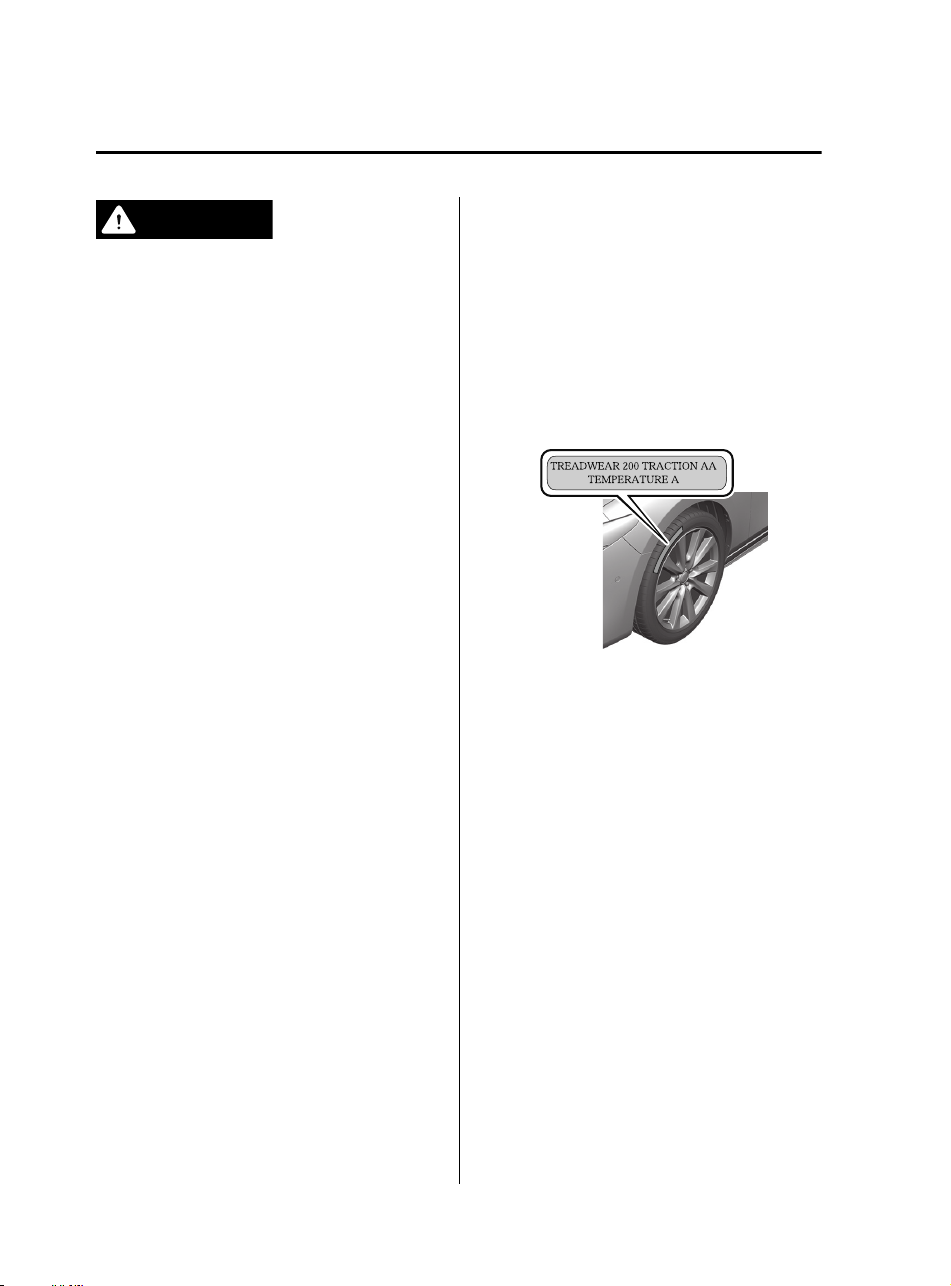
WARNING
Keep your vehicle's tires properly
inated
and not overloaded:
Driving with improperly
inated
or
overloaded tires is dangerous. Excessive
speed,
underination,
or excessive loading,
either separately or in combination, can
cause heat buildup and possible tire failure.
The temperature grade for this tire is
established for a tire that is properly
inated
and not overloaded.
These grades will be added to the
sidewalls of passenger vehicle tires over
the next several years according to a
schedule established by the NHTSA and
the tire manufacturers.
The grade of tires available as standard or
optional equipment on Mazda vehicles
may vary with respect to grade.
ALL PASSENGER VEHICLE TIRES
MUST CONFORM TO THESE GRADES
AND TO ALL OTHER FEDERAL
TIRE-SAFETY REQUIREMENTS.
▼
UNIFORM TIRE QUALITY
GRADING
Quality grades can be found where
applicable on the tire sidewall between
tread shoulder and maximum section
width.
For example:
TREADWEAR 200 TRACTION AA
TEMPERATURE A
UTQGS MARK (example)
Customer Information and Reporting Safety Defects
Uniform Tire Quality Grading System (UTQGS)
8-22
Mazda3_8HZ1-EA-19G_Edition1_old 2019-5-17 13:49:03
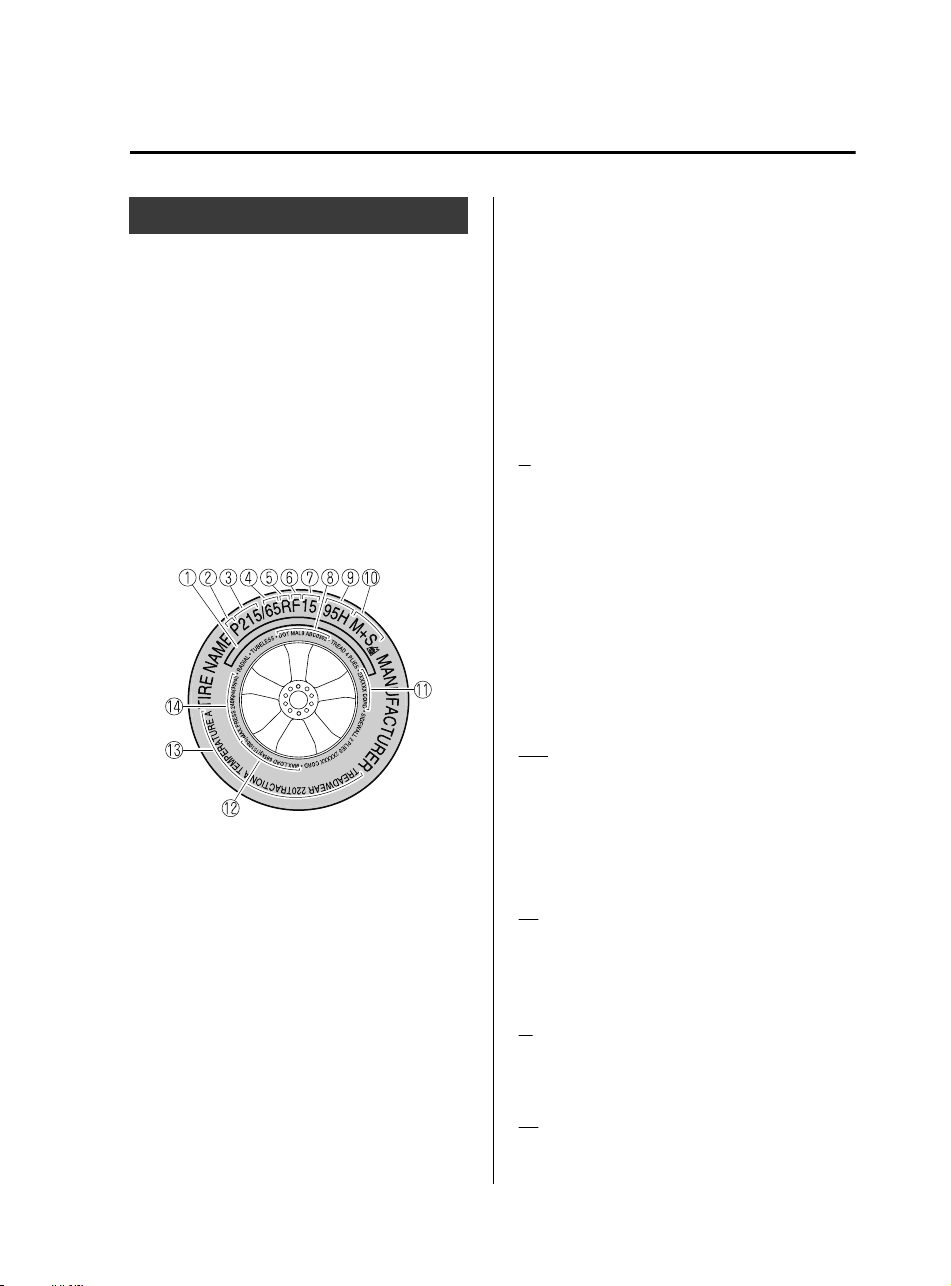
Tire Labeling
▼
Tire Labeling
Federal law requires tire manufacturers to
place standardized information on the
sidewall of all tires. This information
identifies and describes the fundamental
characteristics of the tire and also provides
a tire identification number for safety
standard certification and in case of a
recall.
▼
Information on Passenger Vehicle
Tires
Please refer to the sample below.
1. SAFETY WARNING
2. Passenger car tire
3. Nominal width of tire in millimeters
4. Ratio of height to width (aspect ratio)
5. Radial
6. Run-flat tire
7. Rim diameter code
8. TIN: U.S. DOT tire identification
number
9. Load index & speed symbol
10. Severe snow conditions
11. Tire ply composition and materials
used
12. Max. load rating
13. Tread wear, traction and temperature
grades
14. Max. permissible inflation pressure
P215/65R15 95H is an example of a tire
size and load index rating. Here is an
explanation of the various components of
that tire size and load index rating. Note
that the tire size and load index rating may
be different from the example.
P
Indicates a tire that may be installed on
cars, SUVs, minivans and light trucks as
designated by the Tire and Rim
Association (T&RA).
NOTE
If your tire size does not begin with a letter
this may mean it is designated by either
ETRTO (European Tire and Rim Technical
Organization) or JATMA (Japan Tire
Manufacturing Association).
215
“215” is the nominal width of the tire in
millimeters. This three-digit number gives
the width in millimeters of the tire from
sidewall edge to sidewall edge. In general,
the larger the number, the wider the tire.
65
“65” is the aspect ratio. This two-digit
number indicates the tire's ratio of height
to width.
R
“R” is the tire construction symbol. R
indicates “Radial ply construction”.
15
“15” is the wheel rim diameter in inches.
Customer Information and Reporting Safety Defects
Tire Information (U.S.A.)
8-23
Mazda3_8HZ1-EA-19G_Edition1_old 2019-5-17 13:49:03
95
“95” is the Load Index. This two-or
three-digit number indicates how much
weight each tire can support.
H
“H” is the speed rating. The speed rating
denotes the maximum speed for which the
use of the tire is rated.
Letter Rating Speed Rating
Q99 mph
R106 mph
S112 mph
T118 mph
U124 mph
H130 mph
V149 mph
W
168
*
mph
Y
186
*
mph
*
For tires with a maximum speed capability over 149
mph, tire manufacturers sometimes use the letters
ZR. For tires with a maximum speed capability over
186 mph, tire manufacturers always use the letters
ZR.
M+S or M/S: Mud and Snow
AT: All Terrain.
AS: All Season. The “M+S” or “M/S”
indicates that the tire has some functional
use in mud and snow.
U.S. DOT Tire Identification Number
(TIN)
This begins with the letters “DOT” which
indicates the tire meets all federal
standards. The next two numbers or letters
are the plant code where it was
manufactured, and the last four numbers
represent the week and year the tire was
manufactured. For example, the numbers
457 means the 45st week of 1997. After
2000 the numbers go to four digits. For
example, the number 2102 means the 21th
week of 2002. The other numbers are
marketing codes used at the
manufacturer's discretion. This
information is used to contact consumers
if a tire defect requires a recall.
Tire Ply Composition and Materials
Used
The number of plies indicates the number
of layers of rubber-coated fabric in the
tire. In general, the greater the number of
plies, the more weight a tire can support.
Tire manufacturers also must indicate the
tire materials, which include steel, nylon,
polyester, and other.
Maximum Load Rating
This number indicates the maximum load
in kilograms and pounds that can be
carried by the tire.
Maximum Permissible Inflation
Pressure
This number is the greatest amount of air
pressure that should ever be put in the tire
under normal driving conditions.
Customer Information and Reporting Safety Defects
Tire Information (U.S.A.)
8-24
Mazda3_8HZ1-EA-19G_Edition1_old 2019-5-17 13:49:03
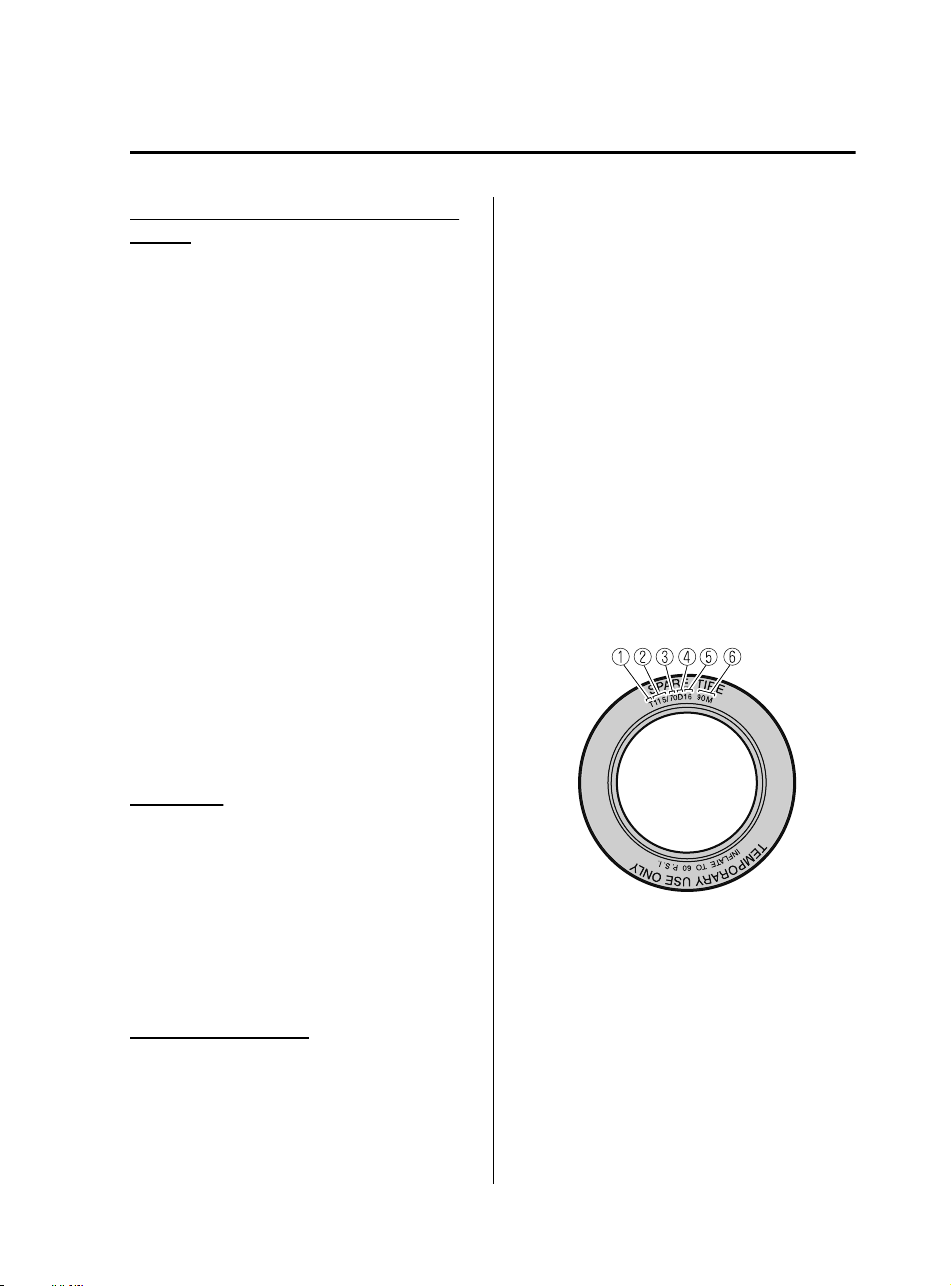
Tread Wear, Traction and Temperature
Grades
Tread wear: The tread wear grade is a
comparative rating based on the wear rate
of the tire when tested under controlled
conditions on a specified government test
course. For example, a tire graded 150
would wear one and one-half (1 1/2) times
as well on the government course as a tire
graded 100.
Traction: The traction grades, from
highest to lowest are AA, A, B, and C.
The grades represent the tire's ability to
stop on wet pavement as measured under
controlled conditions on specified
government test surfaces of asphalt and
concrete. A tire marked C may have poor
traction performance.
Temperature: The temperature grades are
A (the highest), B and C, representing the
tire's resistance to the generation of heat
and its ability to dissipate heat when tested
under controlled conditions on a specified
indoor laboratory test wheel.
Snow Tires
In some heavy snow areas, local
governments may require true snow tires,
those with very deeply cut tread. These
tires should only be used in pairs or placed
on all four wheels. Make sure you
purchase snow tires that are the same size
and construction type as the other tires on
your vehicle.
SAFETY WARNING
The following safety warning appears on
the tire's sidewall.
SERIOUS INJURY MAY RESULT
FROM:
EXPLOSION OF TIRE/RIM
ASSEMBLY DUE TO IMPROPER
MOUNTING-MATCH TIRE
DIAMETER TO RIM DIAMETER;
NEVER EXCEED 40 psi (275 kPa) TO
SEAT BEADS-ONLY SPECIALLY
TRAINED PERSONS SHOULD
MOUNT TIRES.
TIRE FAILURE DUE TO
UNDER-INFLATION/
OVERLOADING/
DAMAGE-FOLLOW OWNER'S
MANUAL AND PLACARD IN
VEHICLE-FREQUENTLY CHECK
INFLATION PRESSURE AND
INSPECT FOR DAMAGE.
▼
Information on Temporary Tires
Please refer to the sample below.
1. Temporary tires
2. Nominal width of tire in millimeters
3. Ratio of height to width (aspect ratio)
4. Diagonal
5. Rim diameter code
6. Load index & speed symbol
Customer Information and Reporting Safety Defects
Tire Information (U.S.A.)
8-25
Mazda3_8HZ1-EA-19G_Edition1_old 2019-5-17 13:49:03
T115/70D16 90M is an example of a tire
size and load index rating. Here is an
explanation of the various components of
that tire size and load index rating. Note
that the tire size and load index rating may
be different from the example.
T
Indicates a tire that may be installed on
cars, SUVs, minivans and light trucks as
designated by the Tire and Rim
Association (T&RA).
115
“115” is the nominal width of the tire in
millimeters. This three-digit number gives
the width in millimeters of the tire from
sidewall edge to sidewall edge. In general,
the larger the number, the wider the tire.
70
“70” is the aspect ratio. This two-digit
number indicates the tire's ratio of height
to width.
D
“D” is the tire construction symbol. D
indicates “diagonal ply construction”.
16
“16” is the wheel rim diameter in inches.
90
“90” is the Load Index. This two-or
three-digit number indicates how much
weight each tire can support.
M
“M” is the speed rating. The speed rating
denotes the maximum speed for which the
use of the tire is rated.
Letter Rating Speed Rating
M81 mph
Customer Information and Reporting Safety Defects
Tire Information (U.S.A.)
8-26
Mazda3_8HZ1-EA-19G_Edition1_old 2019-5-17 13:49:03
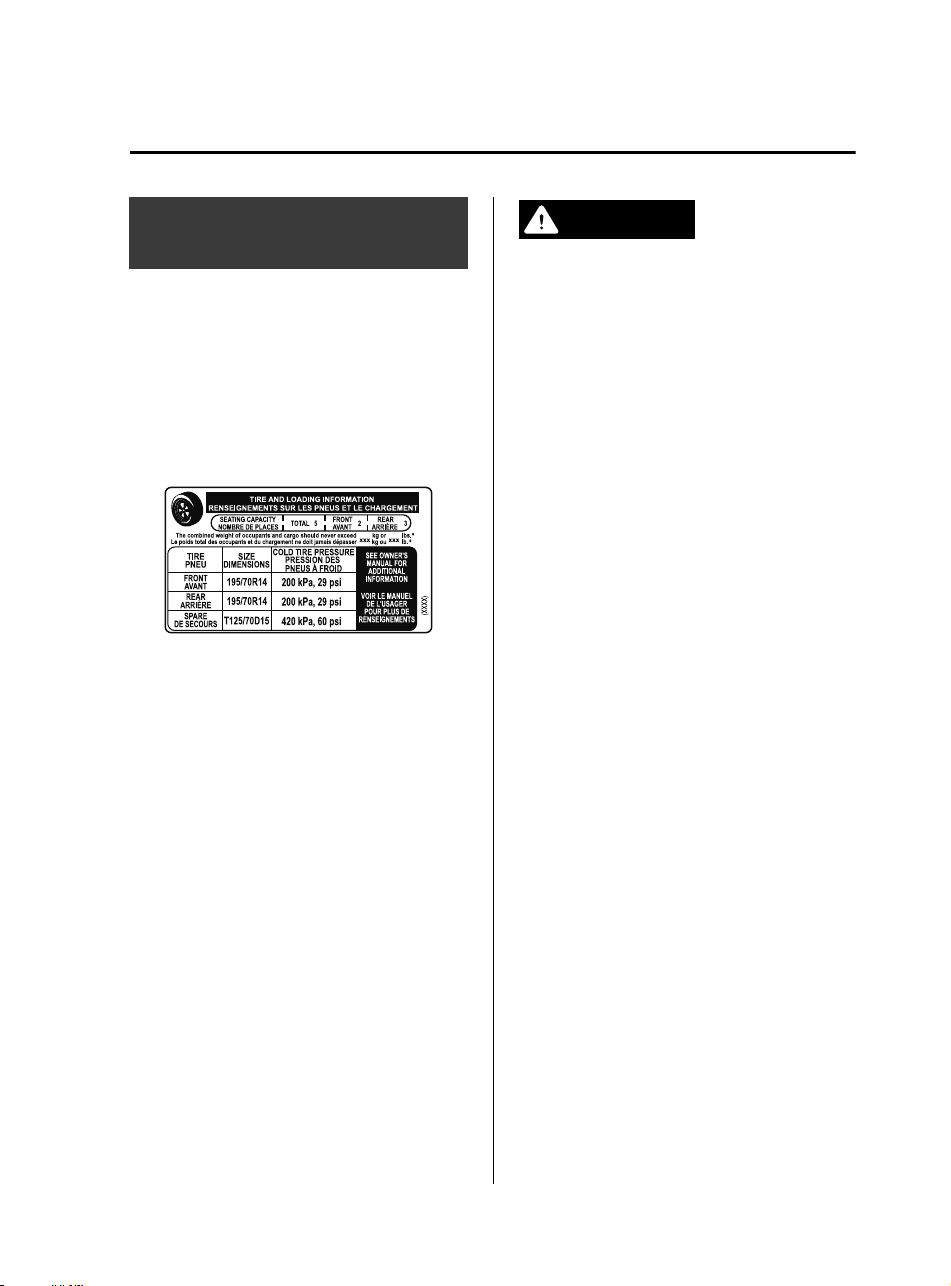
Location of the Tire Label
(Placard)
▼
Location of the Tire Label (Placard)
You will find the tire label containing tire
inflation pressure by tire size and other
important information on the driver's side
B-pillar or on the edge of the driver's door
frame.
SAMPLE
▼
Recommended Tire Inflation
Pressure
On the tire label you will find the
recommended tire inflation pressure in
both kPa and psi for the tires installed as
original equipment on the vehicle. It is
very important that the inflation pressure
of the tires on your vehicle is maintained
at the recommended pressure. You should
check the tire pressure regularly to insure
that the proper inflation pressure is
maintained.
Refer to Tires on page 9-9.
NOTE
Tire pressures listed on the vehicle placard
or tire information label indicate the
recommended cold tire inflation pressure,
measured when the tires are cold, after the
vehicle has been parked for at least 3
hours. As you drive, the temperature in the
tire warms up, increasing the tire pressure.
WARNING
Always check the tire
ination
pressures on
a regular basis according to the
recommended tire
ination
pressure on the
tire label and in conjunction with the
information in this owner's manual:
Driving your vehicle with
under-inated
tires is dangerous.
Under-ination
is the most common cause
of failures in any kind of tire and may result
in severe cracking, tread separation or
“blowout”, with unexpected loss of vehicle
control and increased risk of injury.
Under-ination
increases sidewall
exing
and rolling resistance, resulting in heat
buildup and internal damage to the tire. It
results in unnecessary tire stress, irregular
wear, loss of control and accidents. A tire
can lose up to half of its air pressure and
not appear to be at!
It is impossible to determine whether or not
tires are properly inated just by looking at
them.
▼
Checking Tire Pressure
1. When you check the air pressure, make
sure the tires are cold ―meaning they
are not hot from driving even a mile.
2. Remove the cap from the valve on one
tire.
3. Firmly press a tire gauge onto the
valve.
4. Add air to achieve recommended air
pressure.
5. If you overfill the tire, release air by
pushing on the metal stem in the center
of the valve. Then recheck the pressure
with your tire gauge.
6. Replace the valve cap.
Customer Information and Reporting Safety Defects
Tire Information (U.S.A.)
8-27
Mazda3_8HZ1-EA-19G_Edition1_old 2019-5-17 13:49:03

7. Repeat with each tire, including the
spare.
NOTE
Some spare tires require higher
inflation pressure.
8. Visually inspect the tires to make sure
there are no nails or other objects
embedded that could poke a hole in the
tire and cause an air leak.
9. Check the sidewalls to make sure there
are no gouges, cuts, bulges, cracks or
other irregularities.
▼
Glossary of Terms
Tire Placard: A label indicating the OE
tire sizes, recommended inflation pressure,
and the maximum weight the vehicle can
carry.
Tire Identification Number (TIN): A
number on the sidewall of each tire
providing information about the tire brand
and manufacturing plant, tire size, and
date of manufacture.
Inflation Pressure: A measure of the
amount of air in a tire.
kPa: Kilopascal, the metric unit for air
pressure.
psi: Pounds per square inch, the English
unit for air pressure.
B-pillar: The structural member at the
side of the vehicle behind the front door.
Original Equipment (OE): Describes
components originally equipped on the
vehicle.
Vehicle Load Limit: The maximum value
of the combination weight of occupants
and cargo.
Bead Area of the Tire: Area of the tire
next to the rim.
Sidewall Area of the Tire: Area between
the bead area and the tread.
Tread Area of the Tire: Area on the
perimeter of the tire that contacts the road
when it's mounted on the vehicle.
Seating capacity means the total
allowable number of vehicle occupants.
Seating capacity is described on the tire
label.
Production options weight is the
combination weight of installed regular
production options weighing over 2.3
kilograms in excess of the standard items
which they replace, and not previously
considered in the curb weight or accessory
weight, including heavy duty brakes, ride
levelers, roof rack, heavy duty battery, and
special trim.
Rim is the metal support (wheel) for a tire
or a tire and tube assembly upon which the
tire beads are seated.
Customer Information and Reporting Safety Defects
Tire Information (U.S.A.)
8-28
Mazda3_8HZ1-EA-19G_Edition1_old 2019-5-17 13:49:03
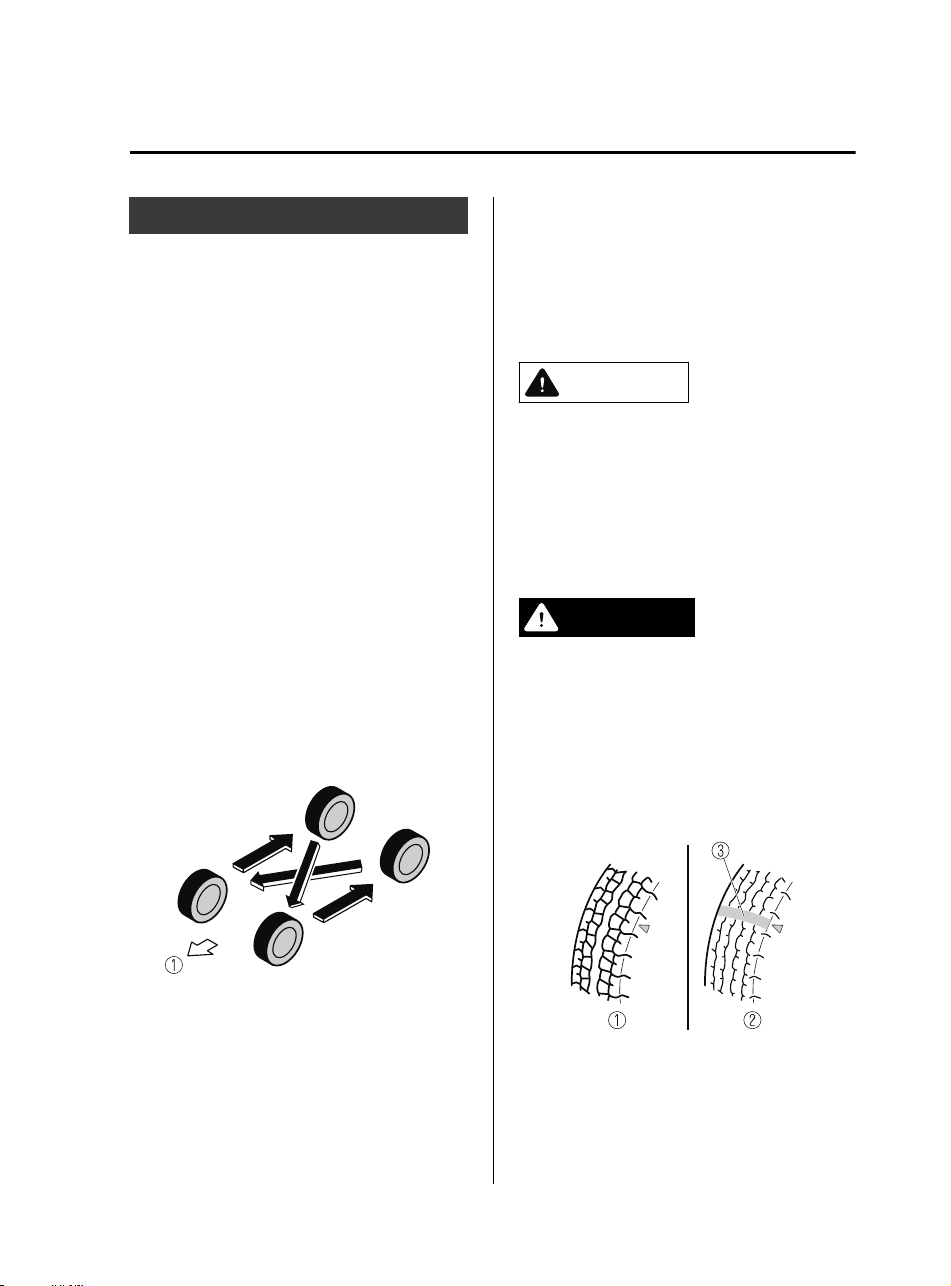
Tire Maintenance
▼
Tire Maintenance
Improper or inadequate vehicle
maintenance can cause tires to wear
abnormally. Here are some important
maintenance points:
▼
Tire Inflation Pressure
Inspect all tire pressure monthly
(including the spare) when the tires are
cold. Maintain recommended pressures for
the best ride, top handling, and minimum
tire wear. Use the pressures specified on
the vehicle tire information placard or tire
label for optimum service.
▼
Tire Rotation
To equalize tread wear, rotate the tires
every 16,000 km (10,000 miles) at the
latest or sooner if irregular wear develops.
Mazda recommends to rotate every 8,000
km (5,000 miles) to help increase tire life
and distribute wear more evenly.
1. Forward
Do not include (TEMPORARY USE
ONLY) spare tire in rotation.
Inspect the tires for uneven wear and
damage. Abnormal wear is usually caused
by one or a combination of the following:
Incorrect tire pressure
Improper wheel alignment
Out-of-balance wheel
Severe braking
After rotation, inflate all tire pressures to
specification (page 9-9) and inspect the
lug nuts for tightness.
CAUTION
Rotate unidirectional tires and radial tires
that have an asymmetrical tread pattern or
studs only from front to rear, not from side
to side. Tire performance will be weakened
if rotated from side to side.
▼
Replacing a Tire
WARNING
Always use tires that are in good condition:
Driving with worn tires is dangerous.
Reduced braking, steering, and traction
could result in an accident.
If a tire wears evenly, a wear indicator will
appear as a solid band across the tread.
Replace the tire when this happens.
1. New tread
2. Worn tread
3. Tread wear indicator
You should replace the tire before the band
crosses the entire tread.
Customer Information and Reporting Safety Defects
Tire Information (U.S.A.)
8-29
Mazda3_8HZ1-EA-19G_Edition1_old 2019-5-17 13:49:03
NOTE
Tires degrade over time, even when they
are not being used on the road. It is
recommended that tires generally be
replaced when they are 6 years or older.
Heat caused by hot climates or frequent
high loading conditions can accelerate the
aging process. You should replace the
spare tire when you replace the other road
tires due to the aging of the spare tire. The
period in which the tire was manufactured
(both week and year) is indicated by a
4-digit number.
Refer to Tire Labeling on page 8-23.
▼
Safety Practices
The way you drive has a great deal to do
with your tire mileage and safety. So
cultivate good driving habits for your own
benefit.
Observe posted speed limits and drive at
speeds that are safe for the existing
weather conditions
Avoid fast starts, stops and turns
Avoid potholes and objects on the road
Do not run over curbs or hit the tire
against the curb when parking
CAUTION
If you feel a sudden vibration or ride
disturbance while driving or you suspect
your tire or vehicle has been damaged,
immediately reduce your speed. Drive with
caution until you can safely pull o the
road. Stop and inspect the tire for damage.
If the tire is under-inated or damaged,
deate it, remove the tire and rim and
replace it with your spare tire. If you cannot
detect a cause, have the vehicle towed to
the nearest vehicle or tire dealer to have
the vehicle inspected.
Customer Information and Reporting Safety Defects
Tire Information (U.S.A.)
8-30
Mazda3_8HZ1-EA-19G_Edition1_old 2019-5-17 13:49:03
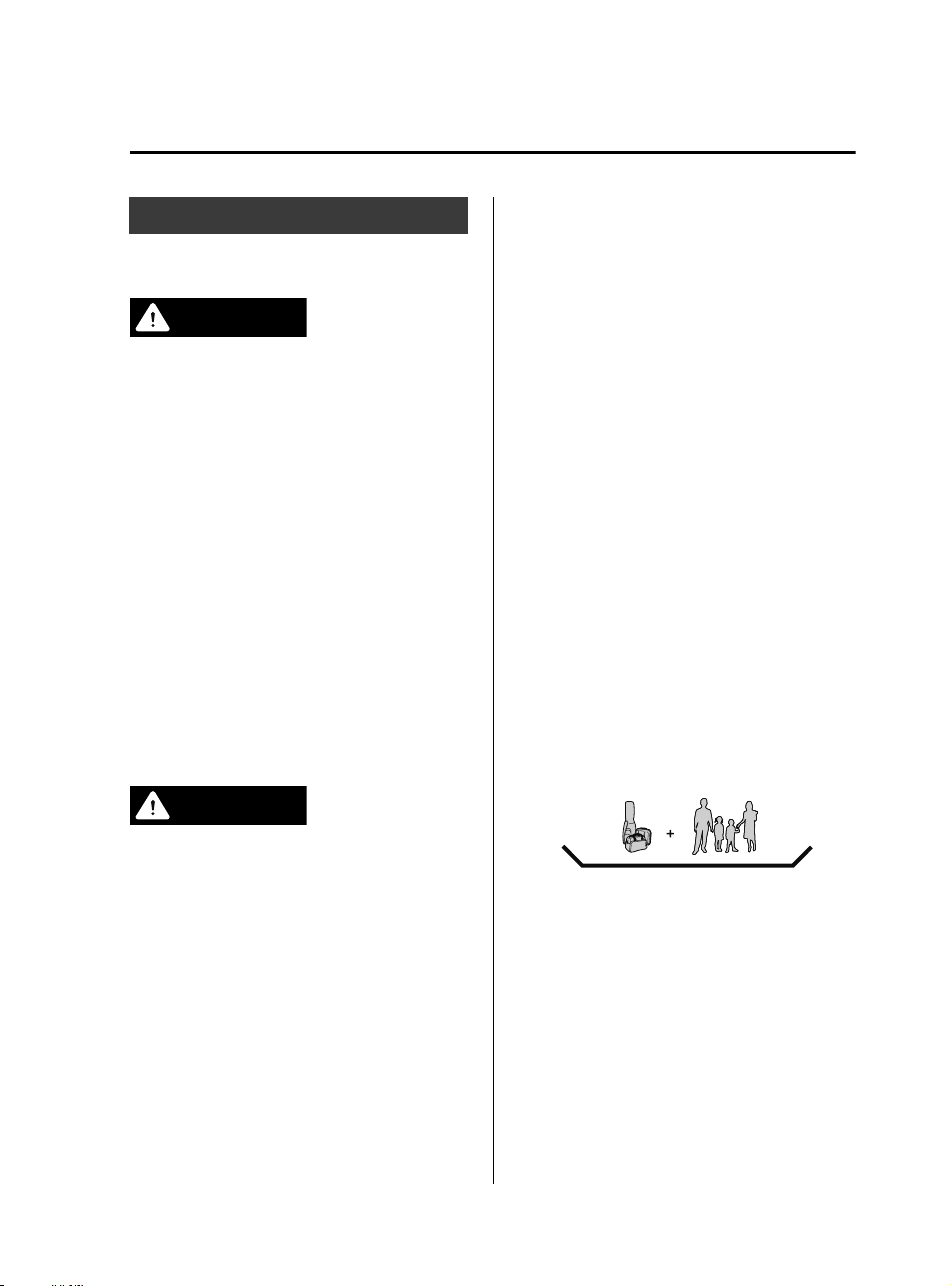
Vehicle Loading
▼
Vehicle Loading
WARNING
Do not tow a trailer with this vehicle:
Towing a trailer with this vehicle is
dangerous because it has not been
designed to tow a trailer and doing so will
aect
the drive system which could result in
vehicle damage.
This section will guide you in the proper
loading of your vehicle, to keep your
loaded vehicle weight within its design
rating capability. Properly loading your
vehicle will provide maximum return of
vehicle design performance. Before
loading your vehicle, familiarize yourself
with the following terms for determining
your vehicle's weight ratings, from the
vehicle's Safety Certification Label and
Tire and Load Information Label:
WARNING
Overloaded Vehicle:
Overloading a vehicle is dangerous. The
results of overloading can have serious
consequences in terms of passenger safety.
Too much weight on a vehicle's suspension
system can cause spring or shock absorber
failure, brake failure, handling or steering
problems, irregular tire wear, tire failure or
other damage.
Overloading makes a vehicle harder to
drive and control. It also increases the
distance required for stopping. In cases of
serious overloading, brakes can fail
completely, particularly on steep grades.
The load a tire will carry safely is a
combination of the size of the tire, its load
range, and corresponding ination
pressure.
Never overload the vehicle and always
observe the vehicle's weight ratings from
the vehicle's Safety Certication and Tire
and Load Information labels.
Base Curb Weight is the weight of the
vehicle including a full tank of fuel and
all standard equipment. It does not
include passengers, cargo, or optional
equipment.
Vehicle Curb Weight is the weight of
your new vehicle when you picked it up
from your dealer plus any aftermarket
equipment.
PAYLOAD
Customer Information and Reporting Safety Defects
Tire Information (U.S.A.)
8-31
Mazda3_8HZ1-EA-19G_Edition1_old 2019-5-17 13:49:03
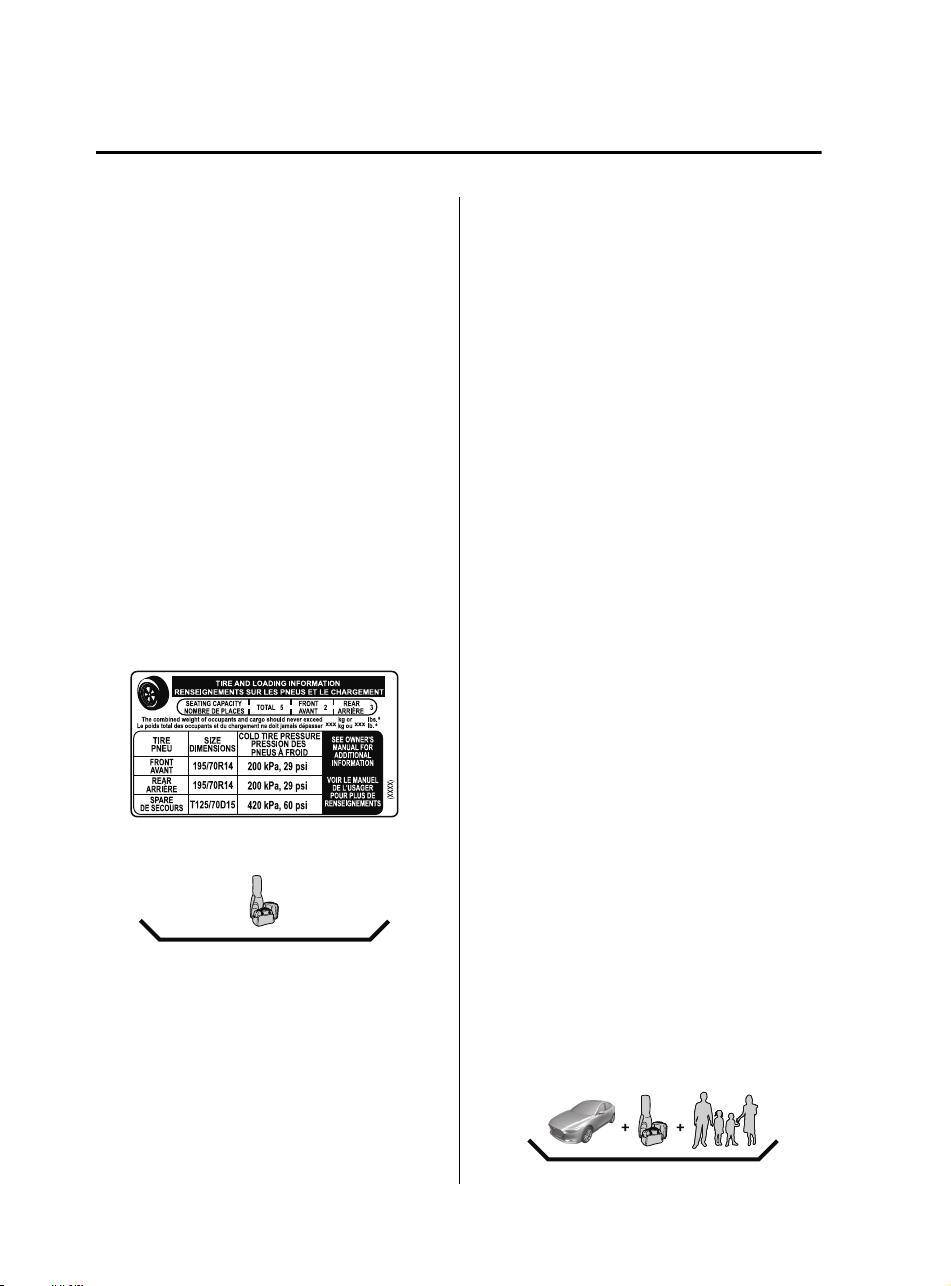
Payload is the combination weight of
cargo and passengers that the vehicle is
designed to carry. The maximum payload
for your vehicle can be found on the Tire
and Load Information label on the driver's
door frame or door pillar. Look for “THE
COMBINATION WEIGHT OF
OCCUPANTS AND CARGO SHOULD
NEVER EXCEED XXX kg or XXX lbs”
for your maximum payload. The payload
listed on the tire label is the maximum
payload for the vehicle as built by the
assembly plant. If any aftermarket or
dealer installed equipment has been
installed on the vehicle, the weight of the
equipment must be subtracted from the
payload listed on the tire label in order to
be accurate.
SAMPLE
CARGO
Cargo Weight includes all weight added
to the Base Curb Weight, including cargo
and optional equipment.
The cargo weight limit decreases
depending on the number of vehicle
occupants. The cargo weight limit can be
calculated by subtracting the total weight
of the vehicle occupants from the
“combination weight of occupants and
cargo should never exceed” value on the
tire label.
Examples: Based on a single occupant
weight of 68 kg (150 lbs), and a value of
385 kg (849 lbs) for the “combination
weight of occupants and cargo should
never exceed”:
The cargo weight limit with one occupant
is 385 kg (849 lbs) - 68 kg (150 lbs) =
317 kg (699 lbs)
The cargo weight limit with two occupants
is 385 kg (849 lbs) - (68 × 2) kg ( (150 ×
2) lbs) = 249 kg (549 lbs)
If the weight of the occupant increases, the
cargo weight limit decreases by that much.
GAW (Gross Axle Weight) is the total
weight placed on each axle (front and
rear) - including vehicle curb weight and
all payload.
GAWR (Gross Axle Weight Rating) is
the maximum allowable weight that can be
carried by a single axle (front or rear).
These numbers are shown on the Safety
Compliance Certification Label located
on the driver's door frame or door
pillar. The total load on each axle must
never exceed its GAWR.
GVW
Customer Information and Reporting Safety Defects
Tire Information (U.S.A.)
8-32
Mazda3_8HZ1-EA-19G_Edition1_old 2019-5-17 13:49:03
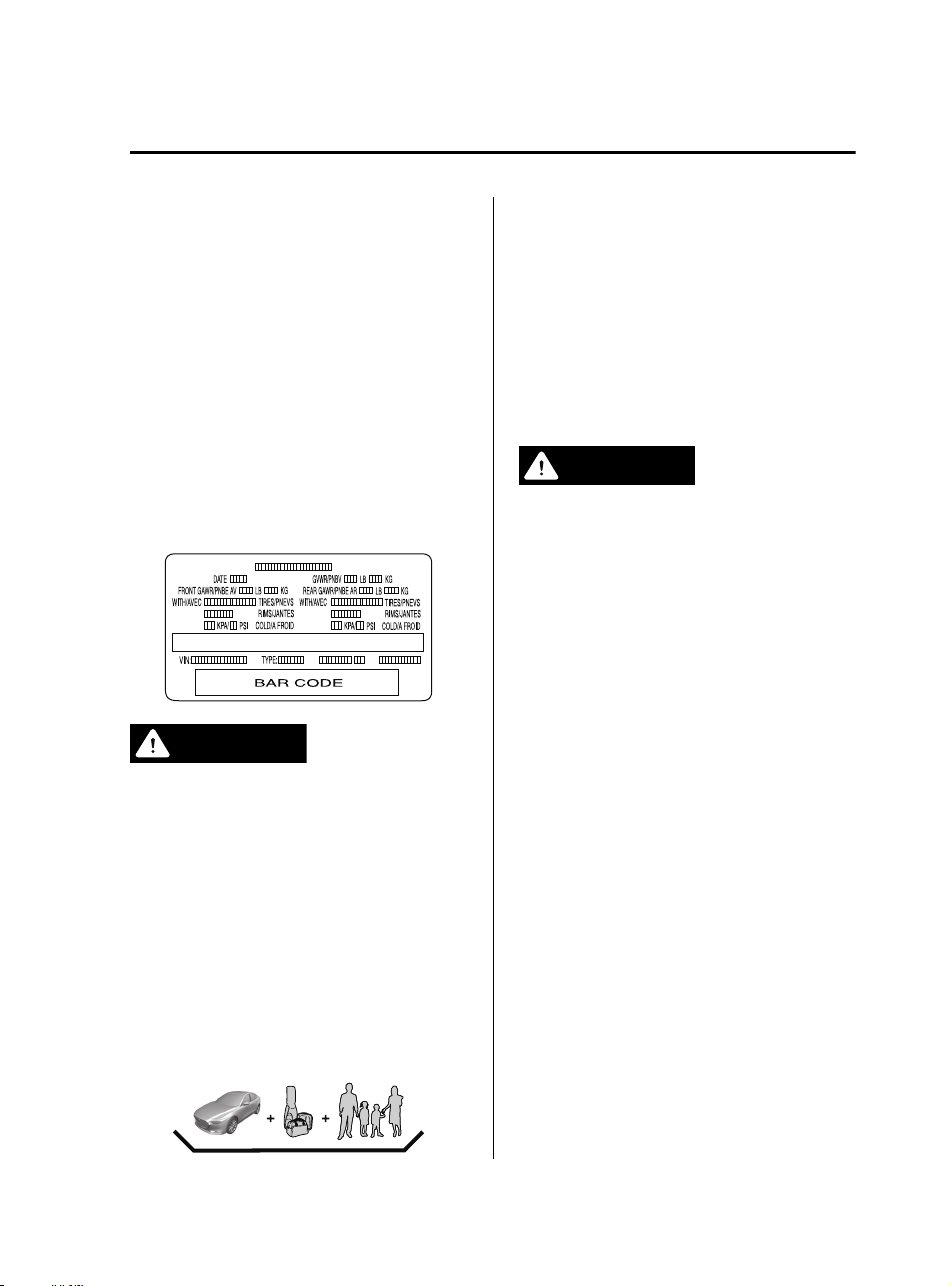
GVW (Gross Vehicle Weight) is the
Vehicle Curb Weight + cargo +
passengers.
GVWR (Gross Vehicle Weight Rating)
is the maximum allowable weight of the
fully loaded vehicle (including all options,
equipment, passengers and cargo). The
GVWR is shown on the Safety
Compliance Certification Label located
on the driver's door frame or door
pillar. The GVW must never exceed the
GVWR.
SAMPLE
WARNING
Never Exceed Axle Weight Rating Limits:
Exceeding the Safety Certication Label
axle weight rating limits is dangerous and
could result in death or serious injury as a
result of substandard vehicle handling,
performance, engine, transmission and/or
structural damage, serious damage to the
vehicle, or loss of control.
Always keep the vehicle within the axle
weight rating limits.
GCW
GCW (Gross Combination Weight) is
the weight of the loaded vehicle (GVW).
GCWR (Gross Combination Weight
Rating) is the maximum allowable weight
of the vehicle - including all cargo and
passengers - that the vehicle can handle
without risking damage. The GCW must
never exceed the GCWR.
WARNING
Never Exceed GVWR or GAWR
Specications:
Exceeding the GVWR or the GAWR specied
on the certication label is dangerous.
Exceeding any vehicle rating limitation
could result in a serious accident, injury, or
damage to the vehicle.
Do not use replacement tires with lower
load carrying capacities than the originals
because they may lower the vehicle's
GVWR and GAWR limitations. Replacement
tires with a higher limit than the originals
do not increase the GVWR and GAWR
limitations.
Never exceed the GVWR or the GAWR
specied on the certication label.
Customer Information and Reporting Safety Defects
Tire Information (U.S.A.)
8-33
Mazda3_8HZ1-EA-19G_Edition1_old 2019-5-17 13:49:03

Steps for Determining the Correct Load Limit
▼
Steps for Determining the Correct Load Limit
Steps for Determining Correct Load Limit-
(1) Locate the statement “The combined weight of occupants and cargo should never
exceed XXX kg or XXX lbs.” on your vehicle's placard.
(2) Determine the combined weight of the driver and passengers that will be riding in your
vehicle.
(3) Subtract the combined weight of the driver and passengers from XXX kg or XXX lbs.
(4) The resulting figure equals the available amount of cargo and luggage load capacity. For
example, if the “XXX” amount equals 1400 lbs. and there will be five 150 lb passengers
in your vehicle, the amount of available cargo and luggage load capacity is 650 lbs.
(1400 - 750 (5 × 150) = 650 lbs.)
(5) Determine the combined weight of luggage and cargo being loaded on the vehicle. That
weight may not safely exceed the available cargo and luggage load capacity calculated
in Step 4.
(6) If your vehicle will be towing a trailer, load from your trailer will be transferred to your
vehicle. Consult this manual to determine how this reduces the available cargo and
luggage load capacity of your vehicle.
Customer Information and Reporting Safety Defects
Tire Information (U.S.A.)
8-34
Mazda3_8HZ1-EA-19G_Edition1_old 2019-5-17 13:49:03
Declaration of Conformity
▼
Keyless Entry System/Immobilizer System
Customer Information and Reporting Safety Defects
Declaration of Conformity
8-35
Mazda3_8HZ1-EA-19G_Edition1_old 2019-5-17 13:49:03
▼
Tire Pressure Monitoring System
Customer Information and Reporting Safety Defects
Declaration of Conformity
8-36
Mazda3_8HZ1-EA-19G_Edition1_old 2019-5-17 13:49:03
▼
HomeLink Wireless Control System
Customer Information and Reporting Safety Defects
Declaration of Conformity
8-37
Mazda3_8HZ1-EA-19G_Edition1_old 2019-5-17 13:49:03
▼
Radio System
Customer Information and Reporting Safety Defects
Declaration of Conformity
8-38
Mazda3_8HZ1-EA-19G_Edition1_old 2019-5-17 13:49:03
▼
Audio System
Customer Information and Reporting Safety Defects
Declaration of Conformity
8-39
Mazda3_8HZ1-EA-19G_Edition1_old 2019-5-17 13:49:03
▼
Data Communication System
Customer Information and Reporting Safety Defects
Declaration of Conformity
8-40
Mazda3_8HZ1-EA-19G_Edition1_old 2019-5-17 13:49:03
▼
ADC Automotive Distance Control Systems GmbH ARS4-B
Customer Information and Reporting Safety Defects
Declaration of Conformity
8-41
Mazda3_8HZ1-EA-19G_Edition1_old 2019-5-17 13:49:03
Customer Information and Reporting Safety Defects
Declaration of Conformity
8-42
Mazda3_8HZ1-EA-19G_Edition1_old 2019-5-17 13:49:03
▼
ADC Automotive Distance Control Systems GmbH SRR3-A
Customer Information and Reporting Safety Defects
Declaration of Conformity
8-43
Mazda3_8HZ1-EA-19G_Edition1_old 2019-5-17 13:49:03
Customer Information and Reporting Safety Defects
Declaration of Conformity
8-44
Mazda3_8HZ1-EA-19G_Edition1_old 2019-5-17 13:49:03

Vehicle Information
Labels
▼
Vehicle Identification Number
The vehicle identification number legally
identifies your vehicle. The number is on a
plate attached to the cowl panel located on
the left corner of the dashboard. This plate
can easily be seen through the windshield.
▼
Motor Vehicle Safety Standard
Label (U.S.A. and Canada)
▼
Chassis Number
Open the cover shown in the figure to
check the chassis number.
▼
Vehicle Emission Control
Information Label (U.S.A. and
Canada)
▼
Tire Pressure Label
Specifications
Identification Numbers
9-2
Mazda3_8HZ1-EA-19G_Edition1_old 2019-5-17 13:49:03
▼
Engine Number
1. Forward
Specifications
Identification Numbers
9-3
Mazda3_8HZ1-EA-19G_Edition1_old 2019-5-17 13:49:03
Specifications
▼
Engine
Item
Specification
SKYACTIV-G 2.0 SKYACTIV-G 2.5
Type DOHC-16V in-line, 4-cylinder
Bore × Stroke 83.5 × 91.2 mm (3.29 × 3.59 in) 89.0 × 100 mm (3.50 × 3.94 in)
Displacement 1,997.6 ml (1,997.6 cc) 2,488.5 ml (2,488.5 cc)
Compression ratio 13.0
▼
Electrical System
Item Classification
Battery 12V-60Ah/20HR or 12V-65Ah/20HR
Spark-plug number
Mazda Genuine spark plug
*1
PE5R-18-110 or PE5S-18-110
*
1 This spark plug provides the SKYACTIV-G engine with optimum performance. Contact an Authorized Mazda
Dealer for details.
CAUTION
When cleaning the iridium plugs, do not use a wire brush. The ne particulate coating on the
iridium alloy and platinum tips could be damaged.
▼
Lubricant Quality
Lubricant Classification
Engine oil Refer to Recommended Oil on page 6-15.
Coolant FL-22 type
Manual transmission oil Mazda Long Life Gear Oil G7
Automatic transmission fluid Mazda Genuine ATF FZ
Transfer case oil Mazda Long Life Hypoid Gear Oil SG1
Rear differential oil Mazda Long Life Hypoid Gear Oil SG1
Brake/Clutch fluid SAE J1703 or FMVSS116 DOT-3
NOTE
Refer to Introduction on (page 6-2) for owner's responsibility in protecting your investment.
Specifications
Specifications
9-4
Mazda3_8HZ1-EA-19G_Edition1_old 2019-5-17 13:49:03
▼
Capacities
(Approximate Quantities)
Item Capacity
Engine oil
SKYAC‐
TIV-G 2.0
With oil filter replacement 4.2 L (4.4 US qt, 3.7 Imp qt)
Without oil filter replacement 4.0 L (4.2 US qt, 3.5 Imp qt)
SKYAC‐
TIV-G 2.5
With oil filter replacement 4.5 L (4.8 US qt, 4.0 Imp qt)
Without oil filter replacement 4.3 L (4.5 US qt, 3.8 Imp qt)
Coolant
Manual transmission 6.3 L (6.7 US qt, 5.5 Imp qt)
Automatic
transmission
SKYACTIV-G 2.0 6.5 L (6.9 US qt, 5.7 Imp qt)
SKYACTIV-G 2.5 6.6 L (7.0 US qt, 5.8 Imp qt)
Manual transmis‐
sion oil
SKYACTIV-G 2.0 1.70 L (1.80 US qt, 1.50 Imp qt)
SKYACTIV-G 2.5 1.65 L (1.74 US qt, 1.45 Imp qt)
Automatic trans‐
mission fluid
SKYACTIV-G 2.0 7.6 L (8.0 US qt, 6.7 Imp qt)
SKYAC‐
TIV-G 2.5
U.S.A. and
Canada
With Cylinder Deactiva‐
tion
7.9 L (8.3 US qt, 7.0 Imp qt)
Without Cylinder Deacti‐
vation
7.6 L (8.0 US qt, 6.7 Imp qt)
Mexico 7.6 L (8.0 US qt, 6.7 Imp qt)
Transfer case oil 0.35 L (0.37 US qt, 0.31 Imp qt)
Rear differential oil 0.35 L (0.37 US qt, 0.31 Imp qt)
Fuel tank
U.S.A. and
Canada
FWD 50.0 L (13.2 US gal, 11.0 Imp gal)
AWD 48.0 L (12.7 US gal, 10.6 Imp gal)
Mexico 51.0 L (13.5 US gal, 11.2 Imp gal)
Check oil and fluid levels with dipsticks or reservoir gauges.
Specifications
Specifications
9-5
Mazda3_8HZ1-EA-19G_Edition1_old 2019-5-17 13:49:03
▼
Dimensions
4-Door
Item Vehicle specification
Overall length 4,662 mm (183.5 in)
Overall width 1,797 mm (70.7 in)
Overall height 1,445 mm (56.9 in)
Front tread 1,568 mm (61.7 in)
Rear tread
FWD 1,581 mm (62.2 in)
AWD 1,580 mm (62.2 in)
Wheelbase 2,726 mm (107.3 in)
5-Door
Item Vehicle specification
Overall length 4,459 mm (175.6 in)
Overall width 1,797 mm (70.7 in)
Overall height 1,440 mm (56.7 in)
Front tread 1,568 mm (61.7 in)
Rear tread
FWD 1,581 mm (62.2 in)
AWD 1,580 mm (62.2 in)
Wheelbase 2,726 mm (107.3 in)
▼
Weights
U.S.A. and Canada
SKYACTIV-G 2.0
(4-Door)
Item
Weight
Manual transmission Automatic transmission
GVWR (Gross Vehicle Weight
Rating)
1,804 kg (3,977 lbs) 1,825 kg (4,023 lbs)
GAWR (Gross Axle
Weight Rating)
Front 966 kg (2,130 lbs) 989 kg (2,180 lbs)
Rear 843 kg (1,858 lbs) 841 kg (1,854 lbs)
(5-Door)
Item
Weight
Manual transmission Automatic transmission
GVWR (Gross Vehicle Weight
Rating)
1,810 kg (3,990 lbs) 1,833 kg (4,041 lbs)
Specifications
Specifications
9-6
Mazda3_8HZ1-EA-19G_Edition1_old 2019-5-17 13:49:03
Item
Weight
Manual transmission Automatic transmission
GAWR (Gross Axle
Weight Rating)
Front 965 kg (2,127 lbs) 989 kg (2,180 lbs)
Rear 848 kg (1,870 lbs) 847 kg (1,867 lbs)
SKYACTIV-G 2.5
(4-Door)
Item
Weight
FWD AWD
GVWR (Gross Vehicle Weight
Rating)
1,850 kg (4,079 lbs) 1,910 kg (4,211 lbs)
GAWR (Gross Axle
Weight Rating)
Front 1,016 kg (2,240 lbs) 1,030 kg (2,271 lbs)
Rear 839 kg (1,850 lbs) 885 kg (1,951 lbs)
(5-Door)
Item
Weight
FWD
AW D
Manual transmission Automatic transmission
GVWR (Gross Vehicle Weight
Rating)
1,822 kg (4,017 lbs) 1,849 kg (4,076 lbs) 1,915 kg (4,222 lbs)
GAWR (Gross Axle
Weight Rating)
Front 987 kg (2,176 lbs) 1,016 kg (2,240 lbs) 1,046 kg (2,306 lbs)
Rear 838 kg (1,847 lbs) 836 kg (1,843 lbs) 872 kg (1,922 lbs)
Mexico
(4-Door)
Item
Weight
Manual transmission Automatic transmission
GVW (Gross Vehicle Weight) 1,861 kg (4,103 lbs) 1,870 kg (4,123 lbs)
(5-Door)
Item
Weight
Manual transmission Automatic transmission
GVW (Gross Vehicle Weight) 1,848 kg (4,074 lbs) 1,870 kg (4,123 lbs)
Specifications
Specifications
9-7
Mazda3_8HZ1-EA-19G_Edition1_old 2019-5-17 13:49:03
▼
Air Conditioner
*
The type of refrigerant used is indicated on a label attached to the inside of the engine com‐
partment. Check the label before recharging the refrigerant.
Refer to Operating Tips on page 5-2.
Item Specification
Refrigerant Type HFC134a (R-134a)
▼
Light Bulbs
Exterior light
Light bulb
Category
Wattage
UN-R
*1
(SAE)
Headlights
LED
*2
― (―)
Daytime running lights
LED
*2
― (―)
Parking lights
LED type
LED
*2
― (―)
Bulb type 5 WY5W (―)
Front turn signal lights
LED
*2
― (―)
Front side-marker lights
LED type
LED
*2
― (―)
Bulb type 5 WY5W (―)
Side turn signal lights
*
LED
*2
― (―)
High-mount brake light
LED
*2
― (―)
Rear turn signal lights
LED
*2
― (―)
Rear side-marker lights
LED
*2
― (―)
Brake lights
LED
*2
― (―)
Taillights
LED
*2
― (―)
Reverse lights
LED
*2
― (―)
License plate lights
LED
*2
― (―)
*
1 UN-R stands for United Nations Regulation.
*
2 LED is the abbreviation for Light Emitting Diode.
Specifications
Specifications
9-8
*Some models.
Mazda3_8HZ1-EA-19G_Edition1_old 2019-5-17 13:49:03
Interior light
Light bulb
Category
Wattage
UN-R
*1
Overhead light (Front)/Map lights
LED
*2
―
Overhead light (Rear)
LED
*2
―
Vanity mirror lights
*
LED
*2
―
Trunk light (4-Door) 5 ―
Luggage compartment light (5-Door)
LED
*2
―
*
1 UN-R stands for United Nations Regulation.
*
2 LED is the abbreviation for Light Emitting Diode.
▼
Tires
NOTE
The tires have been optimally matched with the chassis of your vehicle.
When replacing tires, Mazda recommends that you replace tires of the same type originally
fitted to your vehicle. For details, contact an Authorized Mazda Dealer.
Check the tire pressure label for tire size and inflation pressure.
Refer to Tire Pressure Label on page 9-2.
Refer to Tire Inflation Pressure on page 6-31.
Standard tire
(U.S.A. and Canada)
Tire size
Inflation pressure
Front Rear
205/60R16 92H M+S 250 kPa (36 psi) 250 kPa (36 psi)
215/45R18 89V M+S 250 kPa (36 psi) 250 kPa (36 psi)
Specifications
Specifications
*Some models.
9-9
Mazda3_8HZ1-EA-19G_Edition1_old 2019-5-17 13:49:03
(Mexico)
Tire size
Inflation pressure
Up to 3 persons ―Full load
205/60R16 92V
Front 250 kPa (2.5 bar, 36 psi) 260 kPa (2.6 bar, 38 psi)
Rear 250 kPa (2.5 bar, 36 psi) 290 kPa (2.9 bar, 42 psi)
215/45R18 89W
Front 250 kPa (2.5 bar, 36 psi) 270 kPa (2.7 bar, 39 psi)
Rear 250 kPa (2.5 bar, 36 psi) 290 kPa (2.9 bar, 42 psi)
1 person's weight: About 75 kg
Temporary spare tire
Tire size Inflation pressure
T125/70D16 96M
*1
420 kPa (60 psi)
T125/80D16 97M
*2
420 kPa (60 psi)
*
1FWD
*
2AWD
Lug nut tightening torque
When installing a tire, tighten the lug nut to the following torque.
108―147 N·m (12―14 kgf·m, 80―108 ft·lbf)
▼
Fuses
Refer to Fuses on page 6-38.
Specifications
Specifications
9-10
Mazda3_8HZ1-EA-19G_Edition1_old 2019-5-17 13:49:03

10
Index
10-1
Mazda3_8HZ1-EA-19G_Edition1_old 2019-5-17 13:49:03

Index
A
Accessory Socket.............................. 5-37
Active Driving Display.....................4-29
Adaptive Front Lighting System
(AFS).................................................4-88
Add-On Non-Genuine Parts and
Accessories........................................8-17
Advanced Key
Advanced keyless entry system.....3-9
Operational range........................ 3-10
Advanced Keyless Entry System........ 3-9
Air Bag/Front Seat Belt Pretensioner
System Warning Beep.......................7-41
Antilock Brake System (ABS)..........4-75
Assist Grips.......................................5-40
AUTOHOLD.....................................4-69
AUTOHOLD Warning Beep.............7-44
Automatic Transmission
Active Adaptive Shift (AAS)...... 4-36
Automatic transmission
controls........................................ 4-33
Direct mode................................. 4-42
Driving tips..................................4-43
Manual shift mode.......................4-36
Shift-lock system.........................4-34
Transmission ranges.................... 4-35
B
Battery............................................... 6-26
Maintenance.................................6-28
Replacement................................ 6-28
Specifications.................................9-4
Battery Runs Out.............................. 7-17
Jump-starting............................... 7-17
Blind Spot Monitoring (BSM).......... 4-94
Canceling operation of Blind Spot
Monitoring (BSM).......................4-98
Blind Spot Monitoring (BSM) Warning
Beep...................................................7-44
Body Lubrication.............................. 6-20
Bottle Holder.....................................5-40
Brakes
Brake assist..................................4-67
Brake override system.................4-67
Electric Parking Brake (EPB)......4-64
Foot brake....................................4-63
Pad wear indicator.......................4-67
Parking brake...............................4-64
Warning light...............................4-67
Brake Override System.....................4-67
Brake Override Warning Beep..........7-43
Break-In Period.................................3-44
C
Capacities............................................ 9-5
Cell Phones....................................... 8-18
Center Console..................................5-42
Child Restraint
Categories of child-restraint
systems.........................................2-37
Child-restraint precautions.......... 2-32
Child-restraint system
installation................................... 2-37
Child-restraint system suitability for
various seat positions table..........2-39
Installing child-restraint
systems.........................................2-42
ISOFIX child-restraint systems
(Mexico)...................................... 2-50
LATCH child-restraint systems
(Except Mexico).......................... 2-50
Climate Control System
Fully automatic type......................5-9
Gas specifications..........................9-8
Manual type...................................5-5
Operating tips................................ 5-2
Vent operation................................5-3
Collision warning..............................7-45
Coming Home Light......................... 4-48
10-2
Mazda3_8HZ1-EA-19G_Edition1_old 2019-5-17 13:49:03

Index
Cruise Control.................................4-212
Cruise control switch.................4-212
Cruise standby indication (white)/
cruise set indication (green)...... 4-212
Cup Holder........................................5-38
Customer Assistance (Canada)........... 8-6
Customer Assistance (Mexico)......... 8-10
Customer Assistance (Puerto Rico).... 8-9
Customer Assistance (U.S.A.)............ 8-2
Cylinder Deactivation....................... 4-11
D
Daytime Running Lights...................4-49
Defogger............................................4-56
Mirror...........................................4-57
Rear window............................... 4-56
Dimensions..........................................9-6
Display.............................................. 4-12
Distance & Speed Alert (DSA).......4-106
Indication on display................. 4-107
Door Locks........................................3-11
Door-ajar Warning Beep................... 7-45
Driver Attention Alert (DAA).........4-107
Driver Monitoring Camera..............4-211
Driver Monitoring (DM).................4-109
Drive Selection..................................4-79
Driving In Flooded Area...................3-49
Driving on Uneven Road..................3-50
Driving Position Memory................. 2-10
Driving Tips...................................... 3-44
Automatic transmission...............4-43
Break-in period............................3-44
Driving in flooded area............... 3-49
Driving on uneven road...............3-50
Floor mat..................................... 3-46
Hazardous driving....................... 3-45
Overloading................................. 3-49
Rocking the vehicle.....................3-46
Saving fuel and protection of the
environment.................................3-44
Winter driving............................. 3-47
Dynamic Stability Control (DSC).....4-77
DSC OFF indicator light............. 4-78
DSC OFF switch......................... 4-78
TCS/DSC indicator light............. 4-77
E
Electric Parking Brake (EPB)........... 4-64
Electric Parking Brake (EPB) Warning
Beep...................................................7-43
Emergency Starting
Push-starting................................ 7-20
Starting a flooded engine............ 7-20
Emergency Towing
Tiedown hooks............................ 7-24
Towing description...................... 7-23
Emission Control System..................3-26
Engine
Coolant.........................................6-17
Engine compartment overview....6-14
Exhaust gas..................................3-26
Hood release................................6-12
Oil................................................ 6-15
Starting...........................................4-5
Essential Information.......................... 6-2
Event Data Recorder.........................8-19
Excessive Speed Warning................. 7-45
Exterior Care.....................................6-44
Aluminum wheel maintenance.... 6-49
Bright-metal maintenance........... 6-48
Maintaining the finish................. 6-45
Plastic part maintenance..............6-49
F
Flasher
Hazard warning........................... 4-58
Headlights....................................4-44
Flat Tire
Changing a flat tire........................7-7
Mounting the spare tire............... 7-12
10-3
Mazda3_8HZ1-EA-19G_Edition1_old 2019-5-17 13:49:03

Index
Removing a flat tire...................... 7-8
Floor Mat.......................................... 3-46
Fluids
Brake/Clutch................................6-19
Classification................................. 9-4
Washer......................................... 6-19
Foot Brake.........................................4-63
Forward Sensing Camera (FSC)..... 4-200
Front Camera/Side Cameras/Rear
Camera............................................ 4-210
Front Cross Traffic Alert (FCTA)....4-111
Front Cross Traffic Alert (FCTA)
Warning Beep....................................7-44
Front Radar Sensor......................... 4-204
Front Side Radar Sensor................. 4-206
Fuel
Filler lid and cap......................... 3-27
Requirements............................... 3-25
Tank capacity.................................9-5
Fuses..................................................6-38
Panel description......................... 6-40
Replacement................................ 6-38
G
Gauges...............................................4-12
Glove Compartment..........................5-42
H
Hazardous Driving............................ 3-45
Hazard Warning Flasher....................4-58
Headlights
Coming home light......................4-48
Flashing....................................... 4-47
High-low beam............................4-47
Leaving home light..................... 4-48
Leveling....................................... 4-49
Head Restraint...................................2-17
High Beam Control System
(HBC)................................................ 4-88
High Beam Control System (HBC)
indicator light (green)..................4-89
Hill Launch Assist (HLA)................ 4-73
HomeLink Wireless Control
System............................................... 4-58
Hood Release.................................... 6-12
Horn...................................................4-57
I
If a Warning Light Turns On or
Flashes...............................................7-27
If the Active Driving Display Does Not
Operate.............................................. 7-48
Ignition Not Switched Off (STOP)
Warning Beep....................................7-42
Ignition Switch....................................4-4
Illuminated Entry System................. 5-36
Immobilizer System.......................... 3-40
Inside Trunk Release Lever.............. 3-23
Inspecting Brake/Clutch Fluid
Level..................................................6-19
Inspecting Coolant Level.................. 6-17
Inspecting Engine Oil Level............. 6-16
Inspecting Washer Fluid Level......... 6-19
Instrument Cluster.............................4-12
Average fuel economy.................4-20
Compass display..........................4-21
Current fuel economy..................4-20
Dashboard illumination............... 4-18
Distance-to-empty....................... 4-20
Engine coolant temperature
gauge............................................4-17
Fuel gauge................................... 4-17
Indication/indicator lights............4-25
i-ACTIVSENSE display..............4-21
Message Display..........................4-22
Message indicated on multi-
information display......................7-38
Multi-information display........... 4-14
Odometer..................................... 4-16
10-4
Mazda3_8HZ1-EA-19G_Edition1_old 2019-5-17 13:49:03

Index
Outside temperature display........4-19
Speedometer................................ 4-12
Tachometer.................................. 4-13
Trip meter.................................... 4-16
Warning indication/warning
lights............................................ 4-23
Interior Care...................................... 6-50
Active driving display
maintenance.................................6-52
Cleaning the floor mats...............6-52
Cleaning the window interiors.....6-52
Instrument panel top (Soft pad)
maintenance.................................6-51
Leather upholstery
maintenance.................................6-51
Panel maintenance.......................6-52
Plastic part maintenance..............6-51
Seat belt maintenance..................6-50
Upholstery maintenance.............. 6-51
Vinyl upholstery maintenance..... 6-50
Interior Lights................................... 5-35
Luggage compartment light.........5-35
Map lights....................................5-35
Overhead lights............................5-35
Trunk light................................... 5-35
i-ACTIVSENSE................................4-83
Active safety technology.............4-83
Adaptive Front Lighting System
(AFS)........................................... 4-88
Blind Spot Monitoring (BSM).....4-94
Camera and sensors.....................4-84
Distance & Speed Alert
(DSA).........................................4-106
Driver Attention Alert (DAA)... 4-107
Driver monitoring camera......... 4-211
Driver Monitoring (DM)........... 4-109
Forward Sensing Camera
(FSC)......................................... 4-200
Front camera/side cameras/rear
camera........................................4-210
Front Cross Traffic Alert
(FCTA).......................................4-111
Front radar sensor......................4-204
Front side radar sensor.............. 4-206
High Beam Control System
(HBC).......................................... 4-88
i-ACTIVSENSE status symbol
(warning/risk avoidance support
system).........................................4-85
i-ACTIVSENSE switch...............4-87
Lane Departure Warning System
(LDWS)....................................... 4-90
Lane-keep Assist System
(LAS)......................................... 4-151
Mazda Radar Cruise Control with
Stop & Go function (MRCC with
Stop & Go function)..................4-126
Mazda Radar Cruise Control
(MRCC)..................................... 4-118
Pre-crash safety technology.........4-84
Rear Cross Traffic Alert
(RCTA)...................................... 4-114
Rear side radar sensor............... 4-208
Smart Brake Support (SBS)...... 4-155
Smart Brake Support [Rear Crossing]
(SBS-RC)...................................4-161
Smart Brake Support [Rear] (SBS-
R)............................................... 4-157
Traffic Jam Assist (TJA)........... 4-137
Traffic Sign Recognition System
(TSR)........................................... 4-99
Ultrasonic sensor....................... 4-209
360°view monitor...................... 4-166
i-ACTIV AWD Operation.................4-81
J
Jack......................................................7-3
Jump-Starting.................................... 7-17
10-5
Mazda3_8HZ1-EA-19G_Edition1_old 2019-5-17 13:49:03

Index
K
Keyless Entry System......................... 3-4
Keys.....................................................3-2
Key suspend function....................3-8
Transmitter.....................................3-5
Key Left-in-luggage Compartment/Trunk
Warning Beep (With the advanced
keyless function)............................... 7-43
Key Left-in-vehicle Warning Beep (With
the advanced keyless function)......... 7-43
Key Removed from Vehicle Warning
Beep...................................................7-42
Key Suspend Function........................ 3-8
L
Label Information
Chassis number..............................9-2
Engine number.............................. 9-3
Motor vehicle safety standard
label............................................... 9-2
Tire pressure label......................... 9-2
Vehicle emission control information
label............................................... 9-2
Vehicle identification number........9-2
Lane Departure Warning sound........ 7-44
Lane Departure Warning System
(LDWS).............................................4-90
Lane-change Signals......................... 4-50
Lane-keep Assist System (LAS)..... 4-151
Leaving Home Light.........................4-48
Liftgate.............................................. 3-19
Luggage compartment.................3-22
When liftgate/trunk lid cannot be
opened..........................................7-46
Lights-on Reminder.......................... 7-41
Light Bulbs
Replacement................................ 6-35
Specifications.................................9-8
Low Fuel Warning Beep...................7-43
Lubricant Quality................................ 9-4
Luggage Compartment......................5-43
Luggage Compartment Light............ 5-35
M
Maintenance
Information.................................... 6-2
Scheduled (Canada).......................6-6
Scheduled (Mexico)...................... 6-8
Scheduled (U.S.A. and Puerto
Rico).............................................. 6-4
Manual Transmission Shift Pattern... 4-31
Map Lights........................................ 5-35
Mazda Connect................................. 5-14
Appendix..................................... 5-25
Connected Service.......................5-33
Mazda Connect Basic
Operations....................................5-17
Mazda Radar Cruise Control with Stop &
Go function (MRCC with Stop & Go
function).......................................... 4-126
Close proximity warning........... 4-130
Display indication......................4-129
Setting the system..................... 4-131
Stop hold control....................... 4-136
Mazda Radar Cruise Control with Stop &
Go function (MRCC with Stop & Go
function) System Warnings...............7-45
Mazda Radar Cruise Control
(MRCC)...........................................4-118
Close proximity warning........... 4-121
Display indication......................4-120
Setting the system..................... 4-122
Shift-up/shift-down request
display........................................4-126
Mazda Radar Cruise Control (MRCC)
System Warnings...............................7-45
Message Indicated on Multi-information
Display.............................................. 7-38
Meters................................................4-12
10-6
Mazda3_8HZ1-EA-19G_Edition1_old 2019-5-17 13:49:03

Index
Mirrors
Outside mirrors............................3-30
Rearview mirror.......................... 3-32
Mirror Defogger................................4-57
Moonroof...........................................3-37
Multi-information Display................ 4-14
O
Outside Mirrors.................................3-30
Overhead Console.............................5-42
Overhead Lights................................5-35
Overheating....................................... 7-21
Overloading.......................................3-49
Owner Maintenance
Closing the hood......................... 6-13
Engine compartment overview....6-14
Key battery replacement..............6-28
Opening the hood........................ 6-12
Owner maintenance
precautions...................................6-11
P
Parking Brake....................................4-64
Parking Sensor System................... 4-235
Park assist sensor system
operation.................................... 4-239
Sensor detection range.............. 4-237
Power Steering.................................. 4-82
Power Windows................................ 3-34
R
Rearview Mirror................................3-32
Rear Coat Hooks...............................5-41
Rear Cross Traffic Alert (RCTA).... 4-114
Rear Cross Traffic Alert (RCTA)
Warning Beep....................................7-44
Rear Door Child Safety Locks..........3-18
Rear Side Radar Sensor.................. 4-208
Rear View Monitor......................... 4-220
Displayable range on the
screen......................................... 4-222
Rear view monitor operation..... 4-225
Rear view parking camera
location...................................... 4-221
Switching to the rear view monitor
display........................................4-221
Variance between actual road
conditions and displayed
image......................................... 4-232
Viewing the display...................4-223
Rear Window Defogger.................... 4-56
Rear Window Washer....................... 4-55
Rear Window Wiper......................... 4-55
Recommended Oil.............................6-15
Recording of Vehicle Data................8-20
Recreational Towing......................... 3-51
Registering Your Vehicle in A Foreign
Country..............................................8-16
Replacement
Fuse..............................................6-38
Key battery.................................. 6-28
Light bulbs...................................6-35
Tires............................................. 6-33
Wheel...........................................6-34
Wiper........................................... 6-21
Rocking the Vehicle..........................3-46
S
Safety Defects, Reporting
(Canada)............................................ 8-14
Safety Defects, Reporting (U.S.A.)...8-12
Saving Fuel and Protection of the
Environment......................................3-44
Scheduled Maintenance
Canada........................................... 6-6
Mexico........................................... 6-8
U.S.A. and Puerto Rico.................6-4
Seats
Driver's seat...................................2-5
10-7
Mazda3_8HZ1-EA-19G_Edition1_old 2019-5-17 13:49:03

Index
Front passenger's seat..................2-13
Front seat.......................................2-5
Head restraint.............................. 2-17
Rear seat...................................... 2-14
Seat warmer.................................2-20
Seat Belt System
Automatic locking....................... 2-25
Emergency locking......................2-25
Extender.......................................2-30
Pregnant women.......................... 2-25
Seat belt precautions................... 2-23
Seat Belt Warning Beep....................7-41
Security System
Immobilizer system..................... 3-40
Theft-deterrent system.................3-42
Shift Position Warning Beep.............7-43
Smart Brake Support (SBS)............4-155
Collision warning...................... 4-156
Stopping the Smart Brake Support
(SBS) system operation.............4-157
Smart Brake Support [Rear Crossing]
(SBS-RC)........................................ 4-161
Collision warning...................... 4-165
Stopping the Smart Brake Support
[Rear Crossing] (SBS-RC) system
operation.................................... 4-165
Smart Brake Support [Rear] (SBS-
R).....................................................4-157
Collision warning...................... 4-160
Stopping the Smart Brake Support
[Rear] (SBS-R) system
operation.................................... 4-160
Spare Tire............................................7-5
Spare Tire and Tool Storage............... 7-3
Specifications
Air conditioner.............................. 9-8
Capacities.......................................9-5
Dimensions.................................... 9-6
Electrical system............................9-4
Engine............................................9-4
Light bulbs.....................................9-8
Lubricant quality........................... 9-4
Tires............................................... 9-9
Weights.......................................... 9-6
SRS Air Bags
Driver and front passenger occupant
classification system....................2-71
How the SRS air bags work........ 2-64
Limitations to SRS air bag.......... 2-70
Monitoring................................... 2-76
SRS air bag deployment
criteria..........................................2-68
Supplemental restraint system
components..................................2-62
Supplemental restraint system (SRS)
precautions...................................2-55
Starting the Engine..............................4-5
Steering Wheel
Heated steering wheel................. 2-21
Horn............................................. 4-57
Storage Compartments......................5-41
Center console............................. 5-42
Glove compartment..................... 5-42
Overhead console........................ 5-42
Storage pocket............................. 5-42
Storage Pocket...................................5-42
Sunshade............................................3-39
Sunvisors........................................... 5-34
T
Theft-Deterrent System.....................3-42
Three-flash Turn Signal.................... 4-50
Tiedown Hook...................................7-24
Tires...................................................6-31
Replacing a tire........................... 6-33
Replacing a wheel....................... 6-34
Snow tires....................................3-47
Specifications.................................9-9
Temporary spare tire....................6-33
Tire chains................................... 3-48
Tire inflation pressure................. 6-31
10-8
Mazda3_8HZ1-EA-19G_Edition1_old 2019-5-17 13:49:03

Index
Tire rotation.................................6-32
Uniform tire quality grading system
(UTQGS)..................................... 8-21
Tire Information
Location of the tire label
(placard).......................................8-27
Steps for determining the correct load
limit..............................................8-34
Tire labeling.................................8-23
Tire maintenance......................... 8-29
Vehicle loading............................8-31
Tire Pressure Monitoring System....4-216
Touch Sensor Inoperable Warning Beep
(With the advanced keyless
function)............................................ 7-43
Towing
Recreational towing.....................3-51
Trailer towing.............................. 3-51
Towing Description...........................7-23
Traction Control System (TCS)........ 4-76
TCS/DSC indicator light............. 4-76
Traffic Jam Assist (TJA).................4-137
Close proximity warning...........4-142
Display indication......................4-141
Setting the system..................... 4-143
Shift-up/shift-down request
display........................................4-150
Stop hold control.......................4-150
Traffic Sign Recognition System
(TSR).................................................4-99
Trouble
Battery runs out...........................7-17
Emergency starting......................7-20
Flat tire.......................................... 7-7
Overheating................................. 7-21
Parking in an emergency...............7-2
When liftgate/trunk lid cannot be
opened..........................................7-46
Trunk Lid.......................................... 3-19
Inside trunk release lever............ 3-23
When liftgate/trunk lid cannot be
opened..........................................7-46
Trunk Light....................................... 5-35
Turn and Lane-Change Signals.........4-50
Turn Signals...................................... 4-50
U
Ultrasonic Sensor............................ 4-209
V
Vehicle Information Labels
Chassis number..............................9-2
Engine number.............................. 9-3
Motor vehicle safety standard
label............................................... 9-2
Tire pressure label......................... 9-2
Vehicle emission control information
label............................................... 9-2
Vehicle identification number........9-2
Vehicle Problem Warning Beep........ 7-44
W
Warning Sound is Activated
Air bag/front seat belt pretensioner
system warning beep................... 7-41
AUTOHOLD warning beep........ 7-44
Blind Spot Monitoring (BSM)
warning beep............................... 7-44
Brake override warning beep...... 7-43
Collision warning........................ 7-45
Door-ajar warning beep...............7-45
Electric Parking Brake (EPB)
warning beep............................... 7-43
Excessive speed warning.............7-45
Front Cross Traffic Alert (FCTA)
Warning Beep.............................. 7-44
Ignition not switched off (STOP)
warning beep............................... 7-42
10-9
Mazda3_8HZ1-EA-19G_Edition1_old 2019-5-17 13:49:03

Index
Key left-in-luggage compartment/
trunk warning beep (With the
advanced keyless function)......... 7-43
Key left-in-vehicle warning beep
(With the advanced keyless
function).......................................7-43
Key removed from vehicle warning
beep..............................................7-42
Lane departure warning sound.... 7-44
Lights-on reminder...................... 7-41
Low fuel warning beep............... 7-43
Mazda Radar Cruise Control with
Stop & Go function (MRCC with
Stop & Go function) system
warnings.......................................7-45
Mazda Radar Cruise Control
(MRCC) system warnings...........7-45
Rear Cross Traffic Alert (RCTA)
Warning Beep.............................. 7-44
Seat belt warning beep................ 7-41
Shift position warning beep.........7-43
Touch sensor inoperable warning
beep (With the advanced keyless
function).......................................7-43
Vehicle problem warning beep.... 7-44
Warranty............................................ 8-15
Weights................................................9-6
Windows
Power windows........................... 3-34
Windshield Washer........................... 4-54
Windshield Wipers............................ 4-51
Windshield Wipers Operate at High
Speed................................................. 7-49
Windshield Wiper De-icer................ 4-56
Winter Driving.................................. 3-47
Wiper
Replacing Rear Window Wiper Blade
(5-Door).......................................6-25
Replacing windshield wiper
blades........................................... 6-22
0-9
360°View Monitor...........................4-166
How to use the system.............. 4-175
Margin of error between road surface
on screen and actual road
surface........................................4-194
Side view................................... 4-184
Top view/front view.................. 4-179
Top view/front wide view......... 4-182
Top view/rear view....................4-187
Top view/rear wide view........... 4-192
Types of images displayed on the
screen......................................... 4-170
10-10
Mazda3_8HZ1-EA-19G_Edition1_old 2019-5-17 13:49:03