
VIZIO P50HDTV User Manual
Version 5/23/2006 1
www.VIZIOCE.com
Dear VIZIO Customer,
Congratulations on your new VIZIO P50 High
Definition Plasma Television purchase. Thank
you for your support. For maximum benefit of
your set, please read these instructions before
making any adjustments, and retain them for
future reference. We hope you will experience
many years of enjoyment from your new VIZIO
P50 High Definition Television.
For assistance, please call 714-668-0588 or e-
mail us at
To purchase or inquire about accessories and
installation services for your VIZIO Plasma TV,
please visit our website at www.vizioce.com or
call toll free at 888-VIZIOCE (888-849-4623).
We recommend you register your VIZIO
P50HDTV either at our website
www.vizioce.com or fill in your registration card
and mail it in. For peace of mind and to protect
your investment beyond the standard warranty,
VIZIO offers on-site extended warranty service
plans. These plans give additional coverage
during the standard warranty period. Visit our
website or call us to purchase a plan.
Write down the serial number located on the back
of your P50.
A
H P __ __ __ __ __ __ __ __ __ __ __
Purchase Date _____________________
VIZIO is a registered trademark of V, Inc.
TruSurround XT, SRS and symbol are trademarks of SRS Labs, Inc.
TruSurround XT technology is incorporated under license from SRS Labs, Inc.
HDMI logo and “High Definition Multimedia Interface” are registered trademarks of HDMI Licensing LLC.
"DCDi by Faroudja" is a registered trademark of Genesis Microchip Inc.

VIZIO P50HDTV User Manual
Version 5/23/2006 2
www.VIZIOCE.com
THIS PRODUCT HAS BEEN DESIGNED AND TESTED FOR COMPLIANCE WITH REGULATORY SAFETY CERTIFICATIONS
This product is designed and manufactured to operate within defined design limits, and misuse may result in electric
shock or fire. To prevent the product from being damaged, the following rules should be observed for the installation,
use and maintenance of the product. Read the following safety instructions before operating the display. Keep these
instructions in a safe place for future reference.
• To avoid the risk of electric shock or component damage, switch off the power before connecting other components to the P50 Plasma
HDTV.
• Unplug the power cord before cleaning the P50 Plasma HDTV. A damp cloth is sufficient for cleaning the P50 Plasma HDTV. Do not
use a liquid or a spray cleaner for cleaning the product. Do not use abrasive cleaners.
• Always use the accessories recommended by the manufacturer to insure compatibility.
• When moving the P50 Plasma HDTV from an area of low temperature to an area of high temperature, condensation may form on the
housing. Do not turn on the P50 Plasma HDTV immediately after this to avoid causing fire, electric shock or component damage.
• Do not place the P50 Plasma HDTV on an unstable cart, stand, or table. If the P50 Plasma HDTV falls, it can injure a person and
cause serious damage to the appliance. Use only a cart or stand recommended by the manufacturer or sold with the P50 Plasma
HDTV.
• A distance of at least 3 feet should be maintained between the P50 Plasma HDTV and any heat source, i.e. radiator, heater, oven,
amplifier etc. Do not install the product close to smoke. Operating the product close to smoke or moisture may cause fire or electric
shock.
• Slots and openings in the back and bottom of the cabinet are provided for ventilation. To ensure reliable operation of the P50 Plasma
HDTV and to protect it from overheating, be sure these openings are not blocked or covered. Do not place the P50 Plasma HDTV in a
bookcase or cabinet unless proper ventilation is provided.
• Never push any object into the slot on the P50 Plasma HDTV cabinet. Do not place any objects on the top of the product. It could short
circuit parts causing a fire or electric shock. Never spill liquids on the P50 Plasma HDTV.
• The P50 Plasma HDTV should be operated only from the type of power source indicated on the label. If you are not sure of the type of
power supplied to your home, consult your dealer or local power company.
• The power cable must be replaced when using different voltage from that specified in the User Manual. For more information, contact
your dealer.
• The P50 Plasma HDTV is equipped with a three-pronged grounded plug, a plug with a third (grounding) pin. This plug will fit only into a
grounded power outlet as a safety feature. If your outlet does not accommodate the three-wire plug, have an electrician install the
correct outlet, or use an adapter to ground the appliance safely. Do not defeat the safety purpose of the grounded plug.
• Do not overload power strips and extension cords. Overloading can result in fire or electric shock.
• The wall socket shall be installed near the equipment and shall be easily accessible.
• Only the marked power source can be used for the product. Any power source other than the specified one may cause fire or electric
shock.
• Do not touch the power cord during lightning. To avoid electric shock, avoid handling the power cord during electrical storms.
• Unplug the unit during a lightening storm or when it will not be used for long period of time. This will protect the P50 Plasma HDTV
from damage due to power surges.
• Do not attempt to repair or service the product yourself. Opening or removing the back cover may expose you to high voltages, the risk
of electric shock, and other hazards. If repair is required, please contact your dealer and refer all servicing to qualified service
personnel.
• Keep the product away from moisture. Do not expose this appliance to rain or moisture. If water penetrates into the product, unplug
the power cord and contact your dealer. Continuous use in this case may result in fire or electric shock.
• Do not use the product if any abnormality occurs. If any smoke or odor becomes apparent, unplug the power cord and contact your
dealer immediately. Do not try to repair the product yourself.
• Avoid using dropped or damaged appliances. If the product is dropped and the housing is damaged, the internal components may
function abnormally. Unplug the power cord immediately and contact your dealer for repair. Continued use of the product may cause
fire or electric shock.
• Do not install the product in an area with heavy dust or high humidity. Operating the product in environments with heavy dust or high
humidity may cause fire or electric shock.
• Follow instructions for moving the product. Ensure that the power connector and any other cables are unplugged before moving the
product.
• Hold the power connector when removing the power cable. Pulling the power cable itself may damage the wires inside the cable and
cause fire or electric shock. When the product will not be used for an extended period of time, unplug the power connector.
• To avoid risk of electric shock, do not touch the connector with wet hands.
• Insert batteries in accordance with instructions. Incorrect polarities may cause damage and leakage of the batteries, operator injury
and contamination the remote controller.
• If any of the following occurs please contact the dealer:
o The power connector fails or frays.
o Liquid sprays or any object drops into the P50 Plasma HDTV.
o The Display is exposed to rain or other moisture.
o The Display is dropped or damaged in any way.
o The performance of the Display changes substantially.
• Operating environment. Temperature: 40˚F ~ 95˚F, Humidity: 10% ~ 90% non-condensing, Altitude: 0 ~ 6500ft (0 ~ 2000m)
VIZIO P50HDTV User Manual
Version 5/23/2006 3
www.VIZIOCE.com
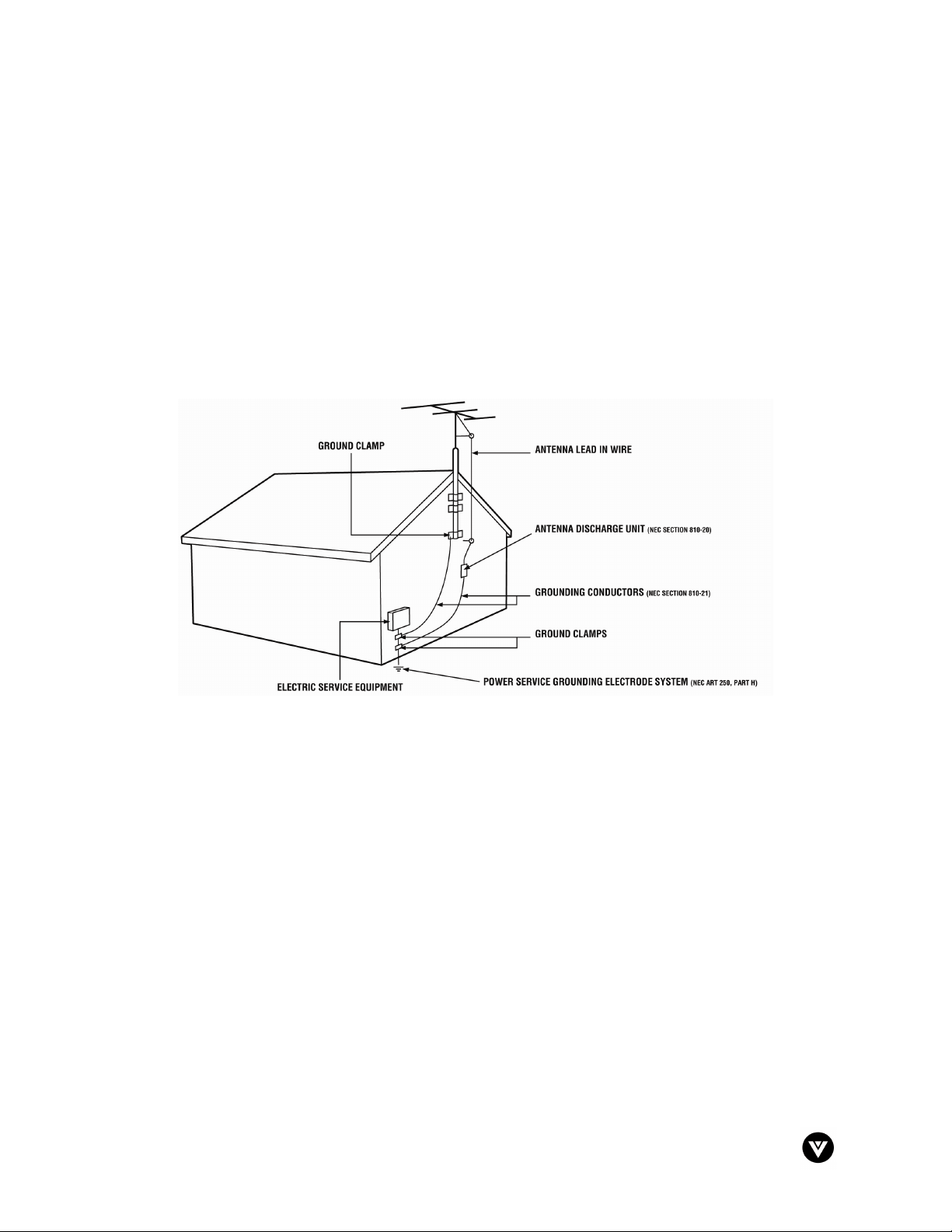
Television Antenna Connection Protection
External Television Antenna Grounding
If an outside antenna/satellite dish or cable system is to be connected to the TV, make sure that the
antenna or cable system is electrically grounded to provide some protection against voltage surges and
static charges.
Article 810 of the National Electrical Code, ANSI/NFPSA 70, provides information with regard to proper
grounding of the mast and supporting structure, grounding of the lead-in wire to an antenna discharge
unit, size of the grounding conductors, location of antenna discharge unit, connection to grounding
electrodes, and requirements of the grounding electrode.
Lightning Protection
For added protection of the TV during a lightning storm or when it is left unattended or unused for long
periods of time, unplug the TV from the wall outlet and disconnect the antenna or cable system.
Power Lines
Do not locate the antenna near overhead light or power circuits, or where it could fall into such power
lines or circuits.

VIZIO P50HDTV User Manual
Version 5/23/2006 4
www.VIZIOCE.com
Opening the Package
Your VIZIO P50HDTV and it accompanying accessories are carefully packed in a cardboard carton that
have been designed to protect it from transportation damage. Now you have opened the carton check
that the P50HDTV is in good condition and that all of the accessories are included.
The P50HDTV weighs approximately 123lb (55.7kg) and about 48.8” wide x 34.2” tall we strongly advise
that you have at least 2 people to unpack and install the HDTV.
The glass surface can easily be scratched or broken so please handle the product gently and never place
the HDTV with the glass facing downwards on a surface without protective padding.
IMPORTANT: Save the carton and packing material for future shipping.
Package Contents
VIZIO P50HDTV
VIZIO Remote Control by Universal Electronics
AV Cable (Yellow, Red and White Connectors)
Power Cord
VIZIO Bezel and Screen Cleaning Cloth
This User Manual
Quick Setup Guide
Registration Card
VIP Services Brochure

VIZIO P50HDTV User Manual
Version 5/23/2006 5
www.VIZIOCE.com
Additional Certified Accessories for the VIZIO
P50HDTV are sold separately
Wall Mounts
High Definition Cables
Extra or replacement Remote
VIZIO also offers Installation Services and Extended Warranty Services for your VIZIO P50HDTV
To purchase or inquire about additional accessories and services for your VIZIO product, visit our web
site at www.vizioce.com
or call us toll free at 888-VIZIOCE (888-849-4623)
Installation Preparation
Please read this user manual carefully before installing your VIZIO HDTV.
The power consumption of the TV is about 500W, please use the power cord designated for TV. When
an extension cord is required, use one with the correct power rating. The cord must be grounded and the
grounding feature must not be defeated.
The TV should be installed on a flat surface to avoid tipping. For proper ventilation, you must allow space
between the back of the TV and the wall. If you would like to mount your TV on the wall, please see
below ‘Preparing Your Plasma TV for Wall Mounting’ for additional information. Avoid installing the TV in
places with high humidity, dust or smoke so as not to shorten the service life of the electronic components.
Install the TV in landscape orientation; any 90˚ clockwise or counter-clockwise installation may induce
poor ventilation and excessive component damage.
VIZIO offers professional installation services. Please contact VIZIO for more information on these
services at 888-VIZIOCE (888-849-4623) or www.vizioce.com
.
VIZIO P50HDTV User Manual
Version 5/23/2006 6
www.VIZIOCE.com
Fi
g
ure B
Fi
g
ure A
Preparing Your Plasma TV for Wall Mounting
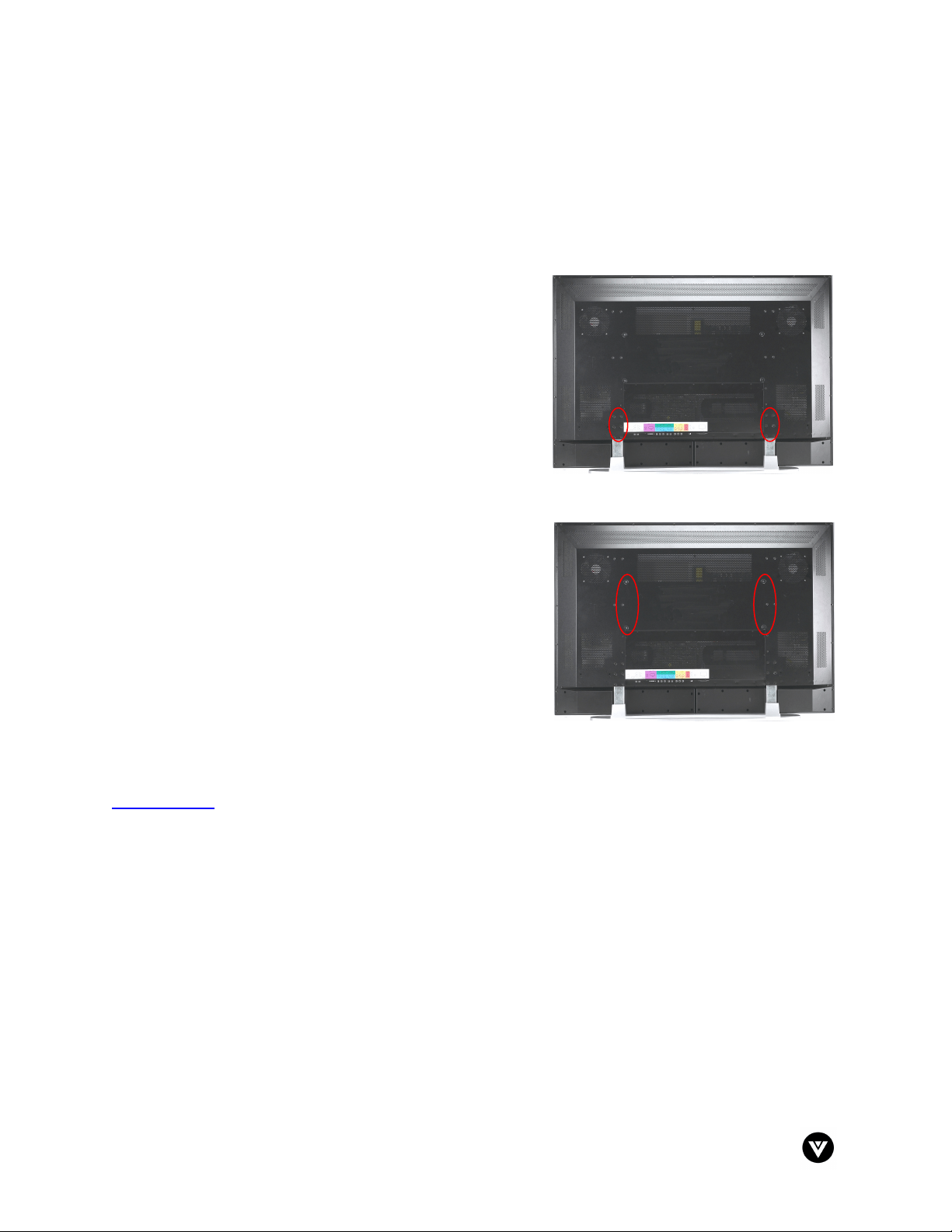
The VIZIO P50HDTV can either be kept on the stand base or mounted on the wall for viewing. If you
choose to mount the P50HDTV on the wall, please follow the instructions below for removing the stand
base.
To remove the stand base
1. Unplug all of the cables and cords from your
P50HDTV.
2. Place the P50HDTV face down on a soft and flat
surface (blanket, foam, cloth, etc) to prevent any
damage to the TV.
3. Remove the six (6) screws on each side of the back
panel of the P50HDTV located near the bottom so
that the stand base can be removed (see Figure A).
4. Gently pull the stand away from the P50HDTV by
grasping firmly on the base.
5. Now, the P50HDTV can fir securely to a mount (sold
separately) by utilizing the mounting holes in the
center of the back panel of the TV (see Figure B).
Please make sure to read the instructions of your
specific mount to properly hang the P50HDTV.
To find the perfect mount for the VIZIO P50HDTV, browse VIZIO’s certified mount selection at
www.vizio.com
or call directly 888-VIZIOCE (888-849-4623).

VIZIO P50HDTV User Manual
Version 5/23/2006 7
www.VIZIOCE.com
Table of Contents
Chapter 1 Basic Controls and Connections.................................................................. 9
1.1 Front Panel..........................................................................................................................................................9
1.2 Side Panel Controls.............................................................................................................................................9
1.3 Rear Panel Connections ...................................................................................................................................10
1.4 VIZIO Universal Remote Control.......................................................................................................................12
1.4.1 Insertion of Batteries in the Remote Control ..............................................................................................15
1.4.2 Remote Control Range ..............................................................................................................................15
1.4.3 VIZIO Universal Remote Control Precautions ...........................................................................................15
Chapter 2 Connecting Equipment ..................................................................................16
2.1 Which Video Connection Should I Use?............................................................................................................16
2.2 Connecting Your DVD Player............................................................................................................................17
2.2.1 Using HDMI ...............................................................................................................................................17
2.2.2 Using Component Video............................................................................................................................19
2.2.3 Using S-Video (AV)....................................................................................................................................20
2.2.4 Using Composite (AV) Video .....................................................................................................................21
2.3 Connecting Your HDTV Set-Top Box ................................................................................................................22
2.3.1 Using HDMI ...............................................................................................................................................22
2.3.2 Using Component Video............................................................................................................................24
2.4 Connecting Your VCR or Video Camera ...........................................................................................................25
2.5 Connecting Coaxial (RF) ...................................................................................................................................26
2.5.1 Using Your Antenna or Digital Cable for DTV............................................................................................26
2.5.2 Using Your Antenna or Cable for TV .........................................................................................................27
2.5.3 Using the Antenna or Cable through your VCR .........................................................................................27
2.6 Connecting an external Receiver/Amp ..............................................................................................................28
2.7 Connecting a PC Computer ..............................................................................................................................29
Chapter 3 Setting Up to Watch Television...................................................................30
3.1 Basic Plasma TV Start Up.................................................................................................................................30
3.2 Watching a TV Program ....................................................................................................................................33
3.3 Adjusting Basic Plasma TV Settings .................................................................................................................33
3.4 DTV Tuner Setup ..............................................................................................................................................34
3.4.1 Parental Controls for DTV..........................................................................................................................42
3.4.2 DTV Channel Information ..........................................................................................................................44
3.4.3 Program Information ..................................................................................................................................45
3.4.4 Setting a Password....................................................................................................................................46
3.5 Using the On Screen Display (OSD) .................................................................................................................47
3.5.1 OSD Menu Operations ..............................................................................................................................47
3.5.2 Image Settings for Video Inputs.................................................................................................................48
3.5.3 Advanced Image Settings for Video inputs ................................................................................................49
3.5.4 Image Settings (for PC) .............................................................................................................................49
3.5.5 Advanced Image Settings for PC...............................................................................................................50
3.5.6 Display Settings.........................................................................................................................................50
3.5.7 Audio Settings ...........................................................................................................................................51
3.5.8 Parental Controls.......................................................................................................................................51
3.5.9 Setup .........................................................................................................................................................52
3.5.10 Understanding Viewing Features.............................................................................................................53
3.5.11 Viewing Modes ........................................................................................................................................53
3.5.12 Picture-In-Picture(PIP)/Picture-by-Picture(POP)Mode.............................................................................54
3.5.13 Adjusting Basic PIP/POP Settings...........................................................................................................54
3.5.14 Using the Parental Controls.....................................................................................................................55
3.6 Programming the VIZIO Universal Remote Control...........................................................................................57
3.6.1 Programming for VCR ...............................................................................................................................57
3.6.2 Programming for Cable Set-Top Box.........................................................................................................57
3.6.3 Programming for DVD Player ....................................................................................................................58
3.6.4 Searching for Component Codes ..............................................................................................................58
3.7 Using a Cable or Satellite Remote ....................................................................................................................58
Chapter 4 Maintenance and Troubleshooting.............................................................59
4.1 Maintenance......................................................................................................................................................59
4.2 Troubleshooting Guide ......................................................................................................................................59
4.3 Telephone & Technical Support ........................................................................................................................61

VIZIO P50HDTV User Manual
Version 5/23/2006 8
www.VIZIOCE.com
4.4 Compliance .......................................................................................................................................................62
4.5 FCC Class B Radio Interference Statement......................................................................................................62
Chapter 5 Miscellaneous Information ...........................................................................63
5.1 Specifications ....................................................................................................................................................63
5.2 Glossary – Standard Definitions ........................................................................................................................64
5.3 Index .................................................................................................................................................................65
5.4 Limited Product Warranty..................................................................................................................................68
5.4.1 VIZIO EXTENDED SERVICE WARRANTY...............................................................................................68
5.5 Component Program Codes..............................................................................................................................69
VIZIO P50HDTV User Manual
Version 5/23/2006 9
www.VIZIOCE.com
Chapter 1 Basic Controls and Connections
1.1 Front Panel
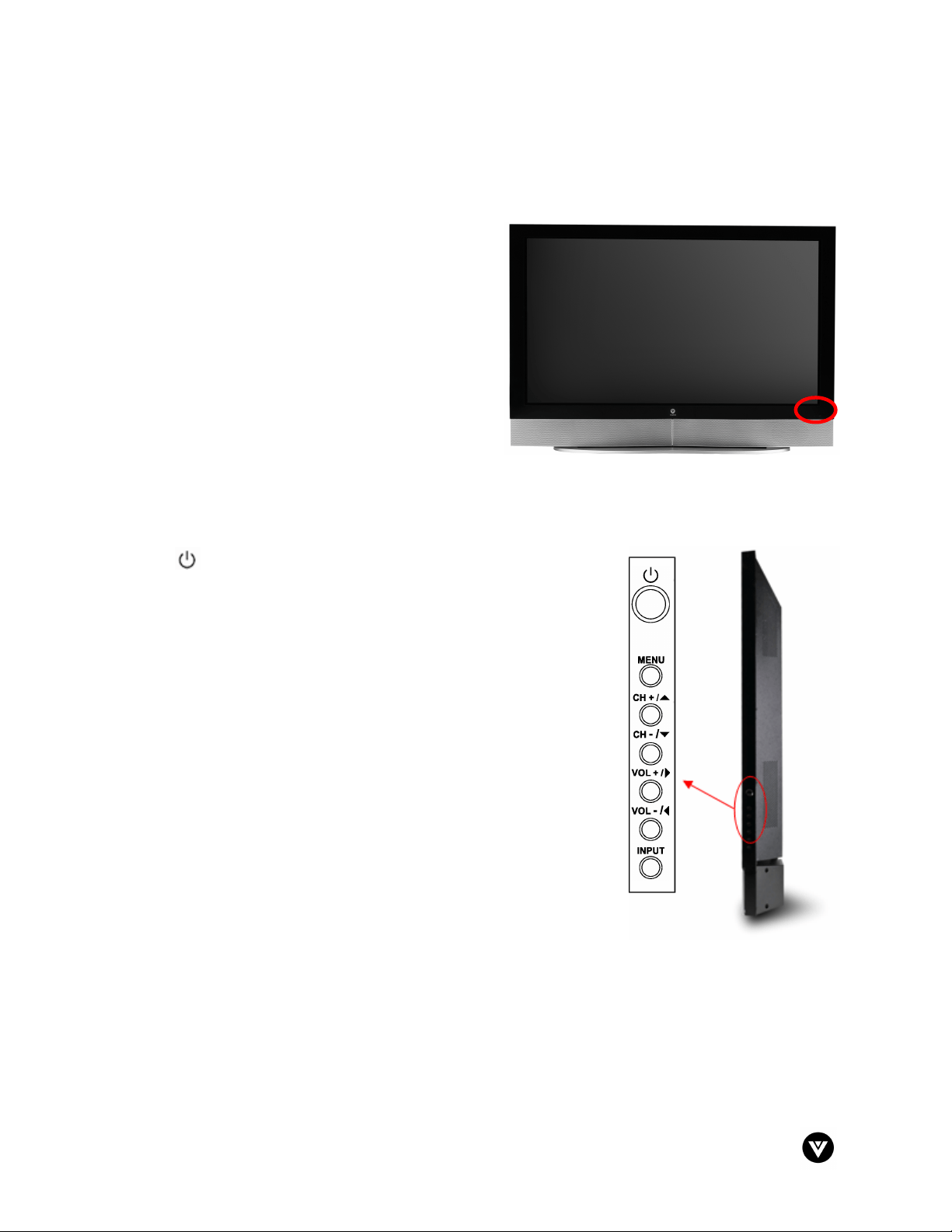
Power LED – Lights green when powered on, yellow
when powered off.
Remote Control Sensor – This is the window through
which all of the remote control signals pass to the
sensor. Point the remote control directly at this
window for the best response to the remote signal.
1.2 Side Panel Controls
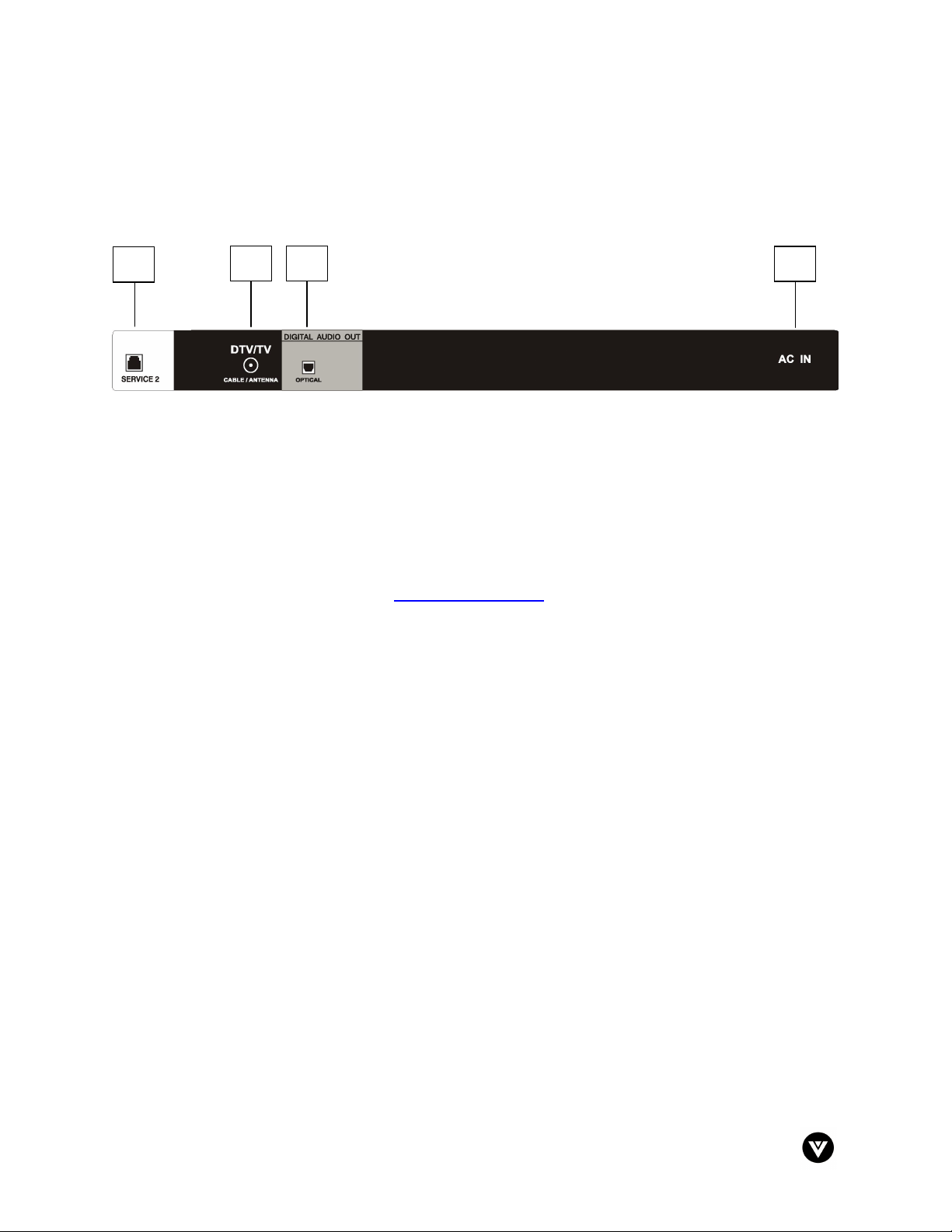
Power (
) – Switch the P50HDTV on by pressing the button once.
Press the button again to the P50HDTV off.
Menu – This button activates the On Screen Display (OSD). If a sub-
menu is active, pressing this button will return to the previous menu level.
Channel ▲/▼ – Use these buttons to step up or down the TV channels.
While the OSD is active, these buttons function as up and down controls
in the OSD menus.
Volume ◄/► – Use these buttons to increase or decrease to the
speaker volume. While the OSD is active, these buttons function as left
and right controls in the OSD menus.
Input (Enter) – Repeated pressing of this buttons steps through the
input sources in the following sequence: DTV, TV, RGB, AV1 (S-Video or
video*), AV2 (S-Video or video*), Component 1, Component 2, HDMI 1,
and HDMI 2. Once you have stepped through the entire sequence, you
will return to the beginning.
Additionally, when the OSD is active, this button confirms the menu function to be adjusted. When the
OSD is not active, pressing this button will display the current input mode.
*S-Video has priority. If a signal is connected to AV1 S-Video by itself or signals are connected to AV1 S-Video and AV1 Video
simultaneously, then S-Video will be the only choice for AV1. If a signal is connected to AV1 Video only, then Video will be the only
choice for AV1. The same input priority scheme applies to AV2.
VIZIO P50HDTV User Manual
Version 5/23/2006 10
www.VIZIOCE.com
1.3 Rear Panel Connections
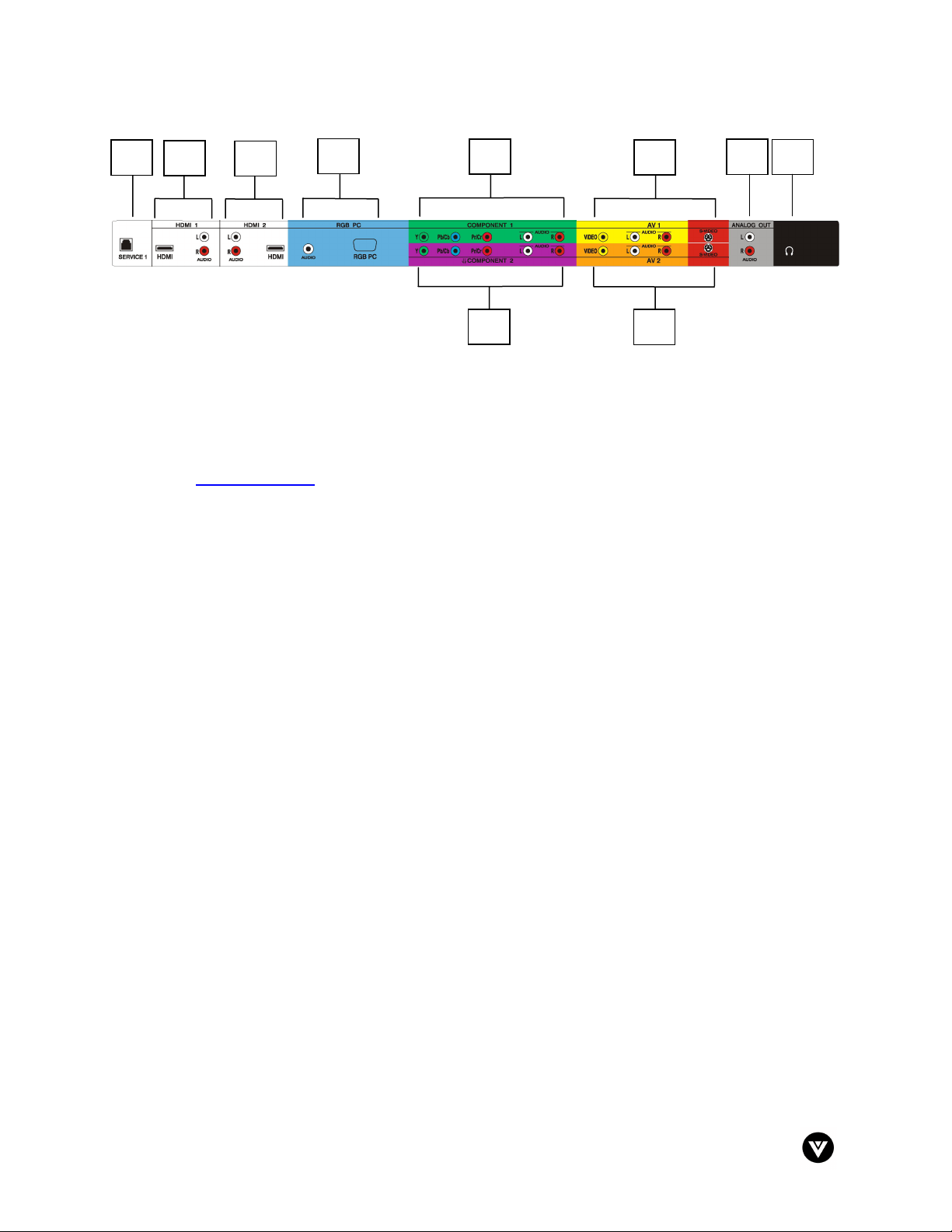
Right Portion
1. SERVICE 2 – This custom communication port is for factory service only.
2. DTV – Connect to an antenna or digital cable for Digital TV.*
3. OPTICAL DIGITAL AUDIO OUT – When the DTV input is selected for viewing, the digital
audio associated with digital programming will be available on this SPDIF Optical connector
for connection to your home theatre system. The gray color band on the rear of the TV
indicates this connection.
4. AC IN – Plug-in the supplied AC Power Cord here.
* For digital TV stations in your area visit www.antennaweb.org
.
1
2
4
3
VIZIO P50HDTV User Manual
Version 5/23/2006 11
www.VIZIOCE.com
Left Portion
5. SERVICE 1 – This custom communication port is for factory service only.
6. HDMI 1 – Connect the primary source for digital video devices such as a DVD multimedia
player or set top box through this all digital connector. The white color band on the rear of
the TV indicates this connection. For users who want to connect to a DVI enabled device,
use a DVI-HDMI cable and connect the Analog Audio output of the device to the L+R AUDIO
here. Your VIZIO Certified HDMI and HDMI-DVI cables are available for purchase from
www.vizioce.com
or by calling 888-VIZIOCE (888-849-4623).
7. HDMI 2 – Connect the secondary source for digital video devices such as a DVD multimedia
player or set top box through this all digital connector. The white color band on the rear of
the TV indicates this connection. For users who want to connect to a DVI enabled device,
use a DVI-HDMI cable and connect the Analog Audio output of the device to the L+R AUDIO
here.
8. RGB PC – Connect the video and audio from a computer here. The blue color band on the
rear of the TV indicates this connection.
9. COMPONENT 1 (YPb/CbPr/Cr with Audio L/R) – Connect the primary source for
component video devices such as a DVD Player or set top box here. From left to right, use
green for Y, blue for Pb (or Cb), red for Pr (or Cr), white for left audio and red for right audio
inputs. The green color band on the rear of the TV indicates this connection.
10. COMPONENT 2 (YPb/CbPr/Cr with Audio L/R) – Connect the secondary source for
component video devices such as a DVD Player or set top box here. From left to right, use
green for Y, blue for Pb (or Cb), red for Pr (or Cr), white for left audio and red for right audio
inputs. The purple color band on the rear of the TV indicates this connection.
11. AV1 In – Connect the primary source for composite video devices, such as a VCR or video
game. Use the white and red connectors to connect the external audio from the same source.
The yellow color band on the rear of the TV indicates this connection.
12. AV2 In – Connect the secondary source for composite video devices, such as a VCR or
video game. Use the white and red connectors to connect the external audio from the same
source. The orange color band on the rear of the TV indicates this connection.
13. Analog Audio Out – Connect the audio from the Plasma TV to an external device, such as a
home theatre system, external amplifier or stereo. Speakers cannot be connected directly to
here. The gray color band on the rear of the TV indicates this connection.
14. Headphone Out – Connect a headphone directly or use a wireless headphone system.
5
6
8
9
11
13
14
7
10
12

VIZIO P50HDTV User Manual
Version 5/23/2006 12
www.VIZIOCE.com
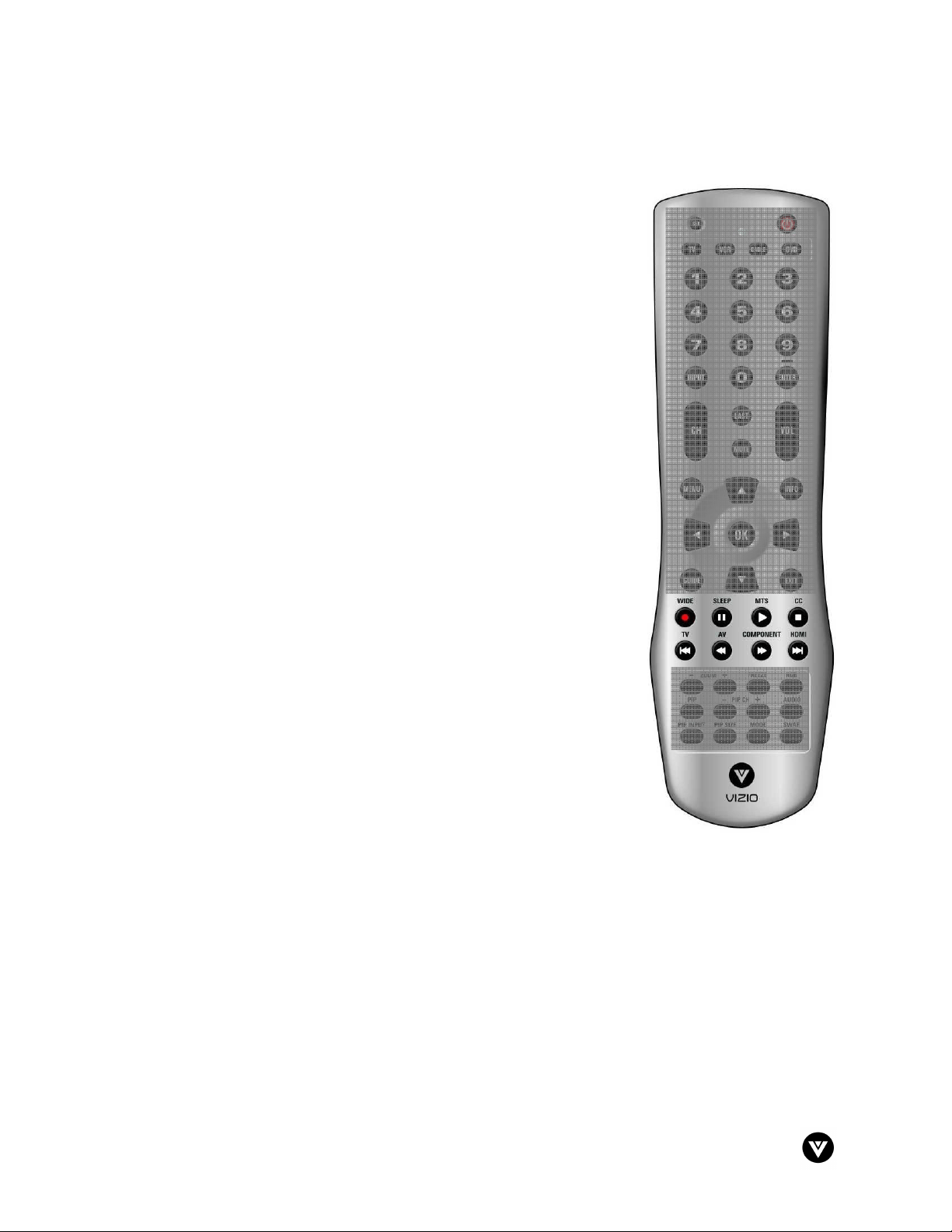
1.4 VIZIO Universal Remote Control
The VIZIO Universal Remote Control is a comprehensive remote that can be used to control up to four
different components. The remote control button functions are explained on the following pages.
VIZIO Remote Control Button Description
SET – This button starts all programming sequences.
Remote LED – Blinks when the remote operates.
POWER – Press this button to turn the TV on from the Standby mode.
Press it again to return to the Standby mode.
TV – This button has been pre-programmed to select the codes to operate
the P50HDTV.
VCR – This button selects a programmed VCR.
CABLE – This button selects a programmed cable TV set-top box or a
satellite TV set-top box.
DVD – This button selects a programmed DVD player.
Number Button Pad – Use these buttons to select a channel or enter a
password.
INPUT – This button allows the user to cycle through the inputs.
-/ENTER – This button works as a DASH button in the DTV mode. When
selecting a digital channel directly use this button for the separation of
main and sub-channels. For example, channel 28-2 would be selected by
the button sequence 2 8 ENTER 2.
CH (+ or -) – These buttons change the channels up or down.
LAST – This button recalls the previously viewed channel.
MUTE – This button turns the sound on and off. VOL (+ or -) – These
buttons turn the volume up or down.
MENU – This button is used to turn the On-Screen Display (OSD) menus
on.
INFO – This button displays the image and system information display.
GUIDE – This button displays program information. Note: this button is
only functional for DTV.
EXIT – This button exits the On-Screen Display (OSD) menus.
- These buttons navigate the On-Screen Display (OSD) menus.
OK – This button works to select your chosen option in On-Screen Display
(OSD) menus.
NOTE: This is a programmable remote supporting
up to 4 devices (see TV, VCR, CABLE, DVD buttons
at the top of the remote). If the remote is not
working with your VIZIO TV, press the TV button
on the remote to set the functions back to TV.
VIZIO P50HDTV User Manual
Version 5/23/2006 13
www.VIZIOCE.com
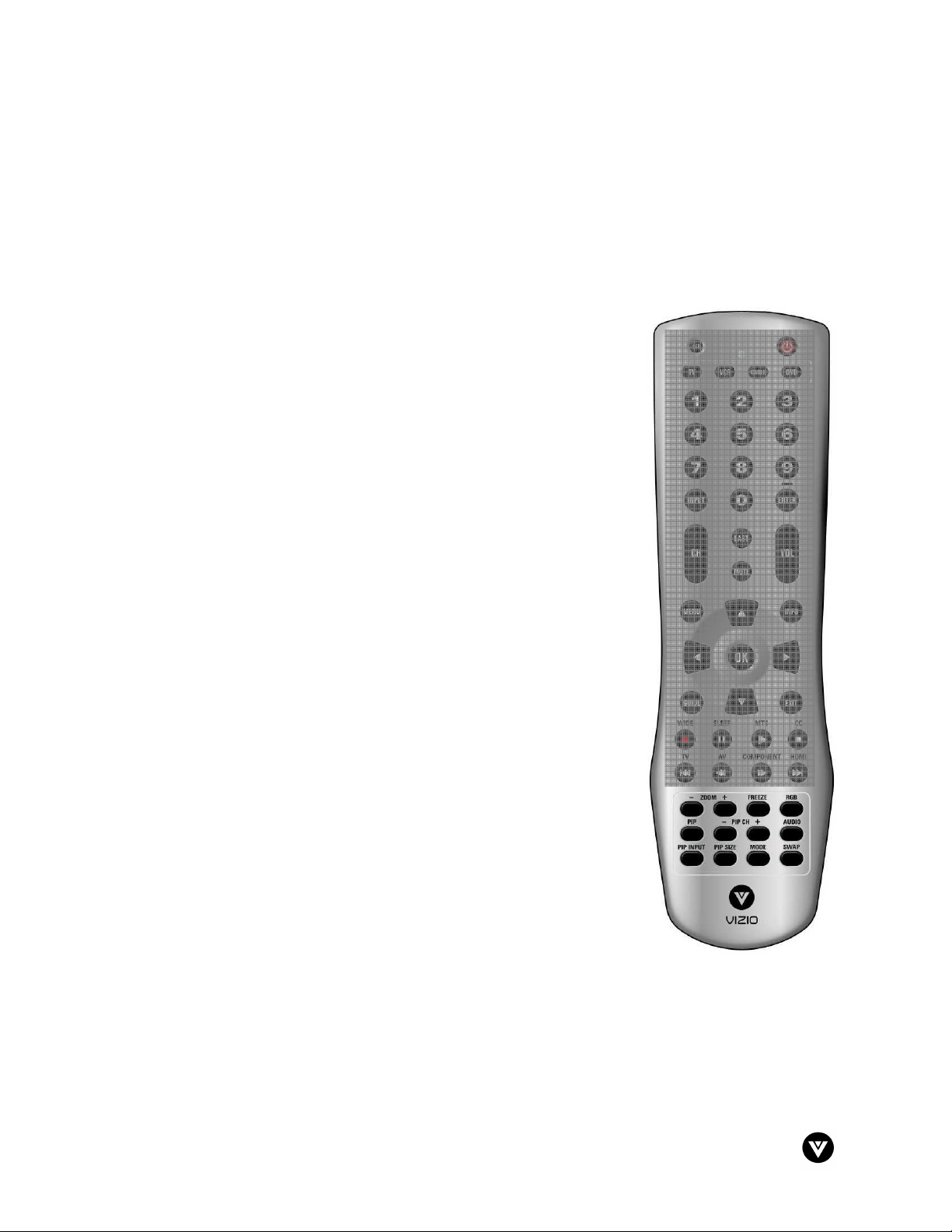
WIDE/Record – This button cycles through the available screen formats.
The options are Wide, Normal, Zoom, Panoramic. Note: in RGB/PC mode
the options are 4:3 and 16:9. This button also functions as VCR Record
when the component is activated with the remote control.
SLEEP/Pause – This button allows the user to select the sleep options by
adjusting the timer in 30 minute increments up to 120 minutes. Additionally,
this button pauses the CD, DVD or VCR when the component is activated
with the remote control.
MTS/Play – This button will select the MTS options of Stereo, SAP or
Mono in TV mode and alternate audio channels, where available, in DTV
mode. Additionally, this button plays the CD, DVD or VCR when the
component is activated with the remote control.
CC/Stop – Use this button will set the Closed Caption mode when viewing
a DTV or TV channel. Note: To set the default Closed Caption setting
for all channels see Section 3.4, DTV Tuner Setup. For DTV the
options are CC1, CC2, CC3, CC4, Service1 or Service2. For TV and AV,
the options are On or Off. Additionally, this button stops the CD, DVD or
VCR when the component is activated with the remote control.
TV/Previous Chapter – Repeated pressing of this button switches between
DTV and TV programming. Note: This button has been pre-programmed
for the VIZIO P50HDTV. This button also functions as a DVD Previous
Chapter when the DVD player is activated with the remote control.
AV/Reverse – Repeated pressing of this button with switch between AV1
and AV2 inputs. Additionally, this button rewinds the CD, DVD or VCR
when the component is activated with the remote control.
COMPONENT/Forward – Repeated pressing of this button with switch
between Component 1 and Component 2 inputs. Additionally, this button
forwards the CD, DVD or VCR when the component is activated with the
remote control.
HDMI/ Next Chapter – This button will select the HDMI input. Additionally,
this button functions as a DVD Next Chapter when the component is
activated with the remote control.
VIZIO P50HDTV User Manual
Version 5/23/2006 14
www.VIZIOCE.com
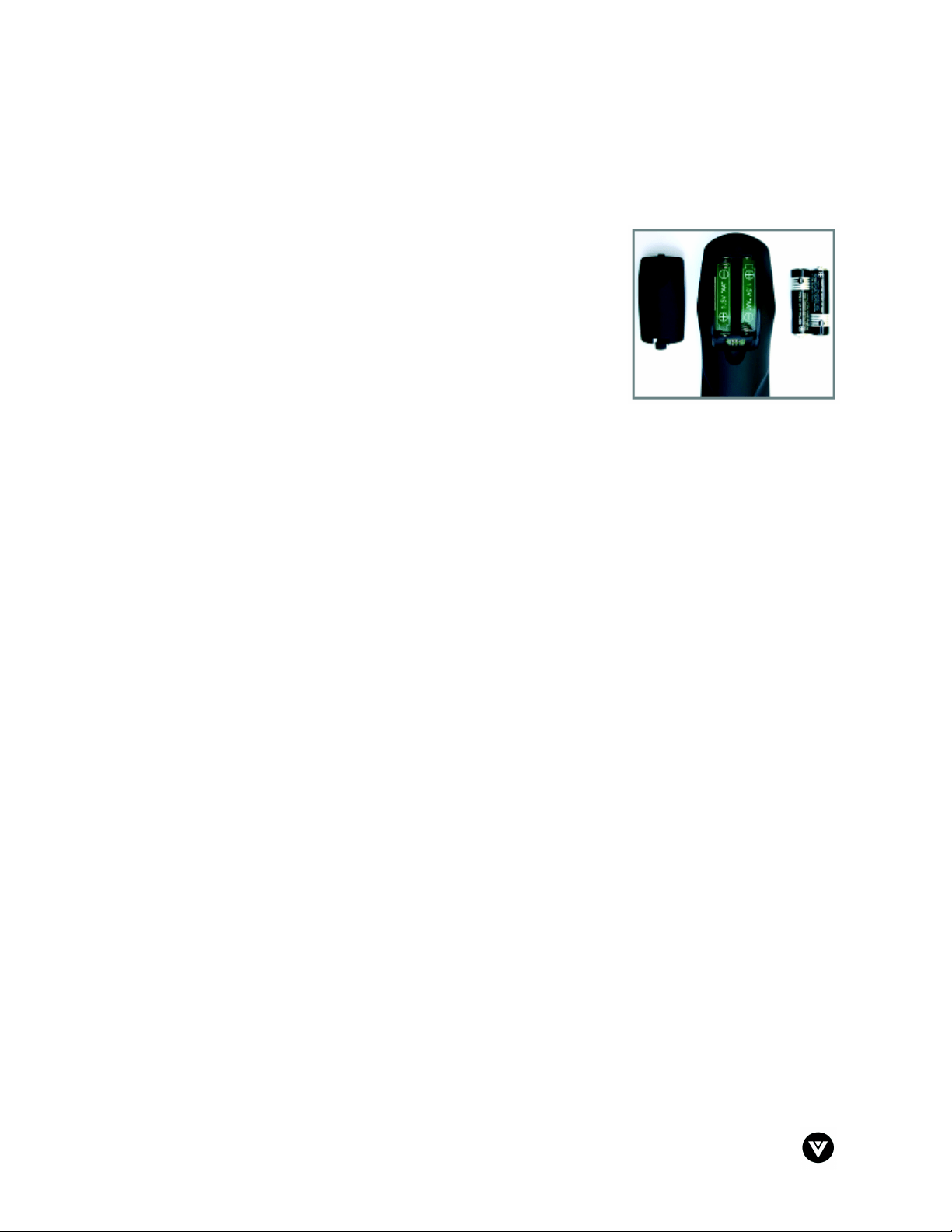
ZOOM (- and +) – Use these buttons to increase or decrease the size of
the picture. Note that in the zoom mode parts of the picture will not be
visible because they extend beyond the edges of the screen.
FREEZE – Press this button to “Freeze-Frame” the current screen. Press
this button again the continue playing.
RGB – This button selects a connected RGB Analog component such as a
PC.
PIP – Use this button to activate the Picture-In-Picture mode.
PIP CH (- and +) – These buttons are used to select the channels within
the PIP screen when DTV/TV is the PIP input selected.
AUDIO – Press this button to switch the audio from the main screen to the
sub-screen while in PIP or POP mode.
PIP Input – Press the button to choose the PIP input. Note: The TV must
be in PIP/POP mode for this button to be functional. For additional
information regarding the PIP/POP options, see 3.5.12 – Picture-In-Picture
(PIP) Mode, page 54.
PIP Size – Press this button to select the size of the PIP screen from one
of the following: small, medium or large.
MODE – This button is not functional for the VIZIO P50.
SWAP – Used to swap the inputs from the main screen and the sub-screen
while in PIP/POP mode.
VIZIO P50HDTV User Manual
Version 5/23/2006 15
www.VIZIOCE.com
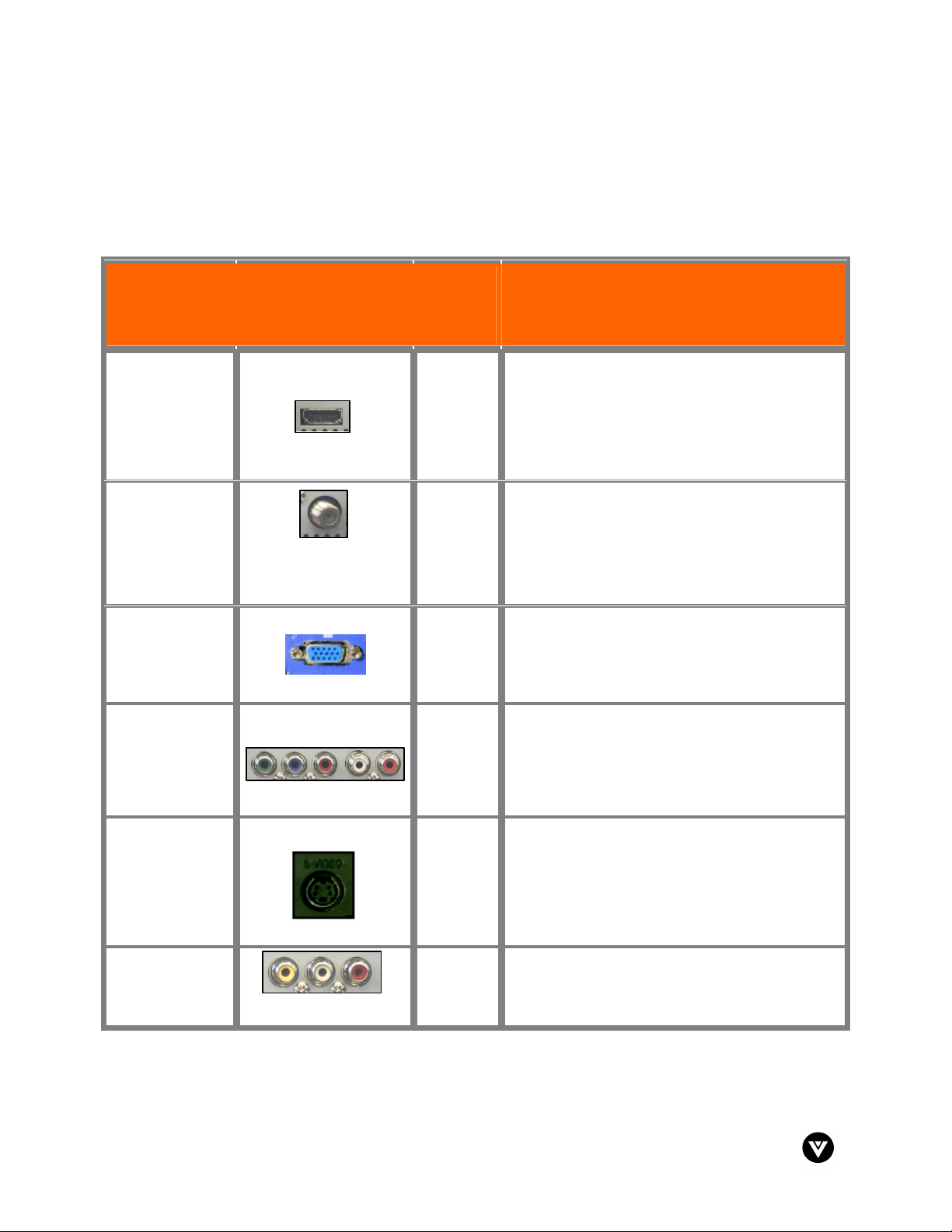
1.4.1 Insertion of Batteries in the Remote Control
Insert two AA batteries into the remote control. Make sure that you match the (+) and (-) symbols on the
batteries with the (+) and (-) symbols inside the battery compartment. Re-attach the battery cover.
Precautionary Tips for Inserting the Batteries:
Only use the specified AA batteries.
Do not mix new and old batteries. This may result in cracking or leakage
that may pose a fire risk or lead to personal injury.
Inserting the batteries incorrectly may also result in cracking or leakage
that may pose a fire risk or lead to personal injury.
Dispose of the batteries in accordance with local laws and regulations.
Keep the batteries away form children and pets.
1.4.2 Remote Control Range
Point the remote control at the remote control sensor to transmit the commands.
Do not place any obstacles between the remote control and the receiver window.
The effective range of the remote control is approximately 30 feet (10 meters) from the front of the
receiver window, 30° to the left and right, 20° up and down.
1.4.3 VIZIO Universal Remote Control Precautions
The remote control should be kept dry and away from heat sources. Avoid humidity.
If the TV responds erratically to the remote control or does respond at all, check the batteries. If the
batteries are low or exhausted, replace them with fresh batteries.
When not using the remote control for a long period of time, remove the batteries.
Do not take the batteries apart, heat them, or throw them into a fire.
Do not subject the remote control to undue physical stress, such as striking or dropping it.
Do not attempt to clean the remote control with a volatile solvent. Wipe it with a clean, damp cloth.
VIZIO P50HDTV User Manual
Version 5/23/2006 16
www.VIZIOCE.com
Chapter 2 Connecting Equipment
2.1 Which Video Connection Should I Use?
The VIZIO P50HDTV has six different ways to connect your video equipment from a basic connection to
the most advanced for digital displays.
Connection
Quality (type)
Connector
Rear
Panel
Color
Codes
Description
Best
(digital)
White
HDMI (High-Definition Multimedia Interface) - It is the
first and only industry-supported, uncompressed, all-
digital audio/video interface. HDMI provides an
interface between any audio/video source, such as a
set-top box, DVD player, or A/V receiver and an
audio and/or video monitor, such as a digital
television (DTV), over a single cable.
Best
(digital)
- - - - - - - - - - - -
Good
(analog)
Black
DTV Coaxial RF. When used for MPEG2 encoded
bit streams from ATSC broadcast programming, this
input takes advantage of the High Definition content.
- - - - - - - - - - - - - - - - - - - - - - - - - - - - - - - - - - - - - -
TV Coaxial RF. This is the connection for standard
NTSC TV using antenna or cable.
Best
(analog)
Blue
RGB PC (VGA) – This video input has separate red,
green and blue color components. The signal
carries horizontal and vertical sync information on
the green signal. This is most commonly used for
PC input.
Better
(analog)
Green
and
Purple
Component 1/2 - The video signal is separated into
three signals, one containing the black-and-white
information and the other two containing the color
information. This enhancement over S-Video takes
advantage of the superior picture provided by
progressive scan DVD players and HDTV formats.
Good
(analog)
Red
S-Video (AV1/AV2) - The video signal is separated
into two signals, one containing the black-and-white
information and the other containing the color
information. Separating the color in this way avoids
‘cross color’ effects where closely spaced black and
white lines are erroneously displayed in color. It also
enables text to be displayed more sharply.
Good
(analog)
Yellow
and
Orange
AV1/AV2 (Composite) - The complete video signal is
carried through this single pin connector. This is the
most commonly used video connection.
Note: For more info refer to the Quick Start Guide
VIZIO P50HDTV User Manual
Version 5/23/2006 17
www.VIZIOCE.com
2.2 Connecting Your DVD Player
You have several options for connecting your DVD player to your P50HDTV – HDMI, Component, S-
Video and Composite (AV) inputs. Based on your home theater configuration, you can decide which
option is the right one for you.
2.2.1 Using HDMI
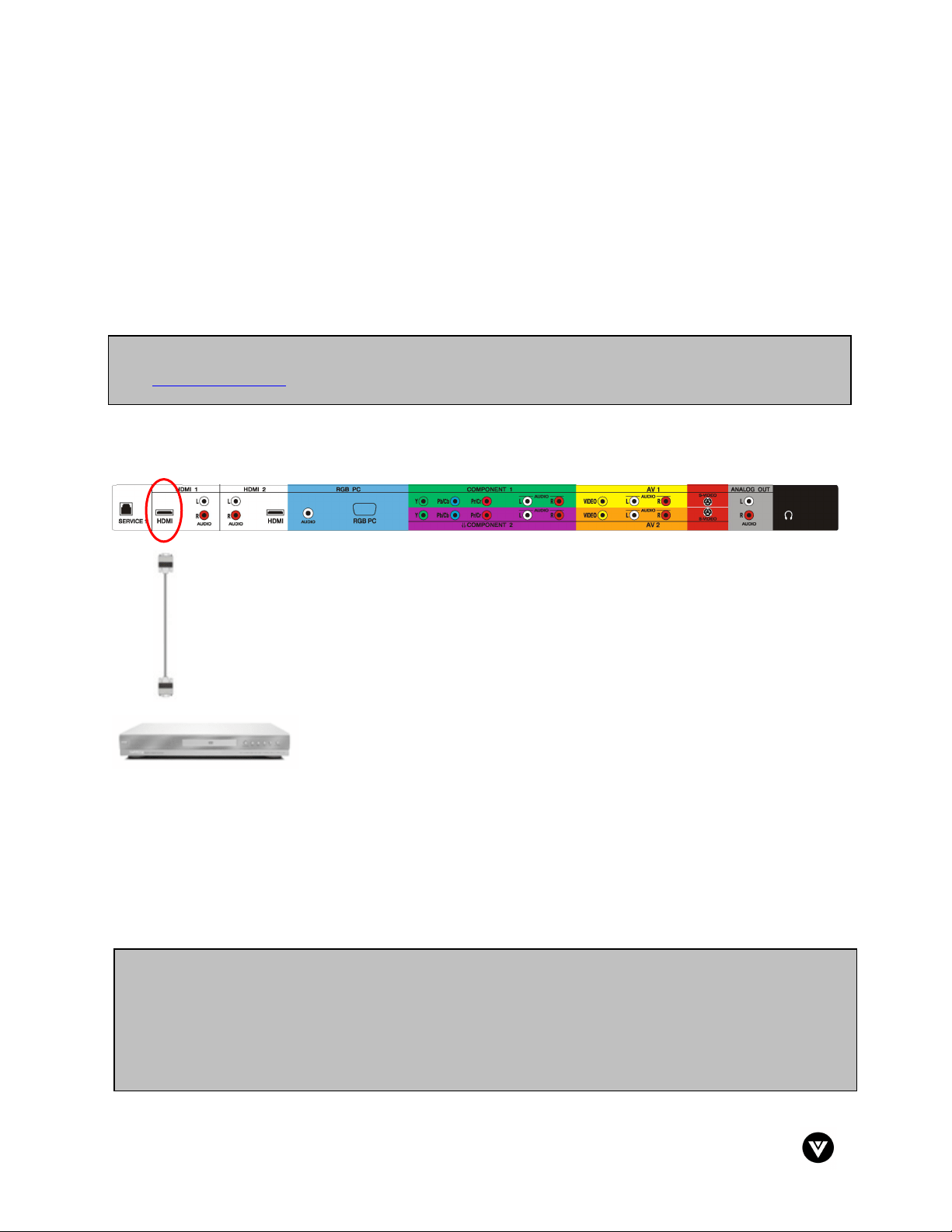
DVD players that have a digital interface such as HDMI (High Definition Multimedia Interface) should be
connected to the HDMI input of the VIZIO P50HDTV for optimal results.
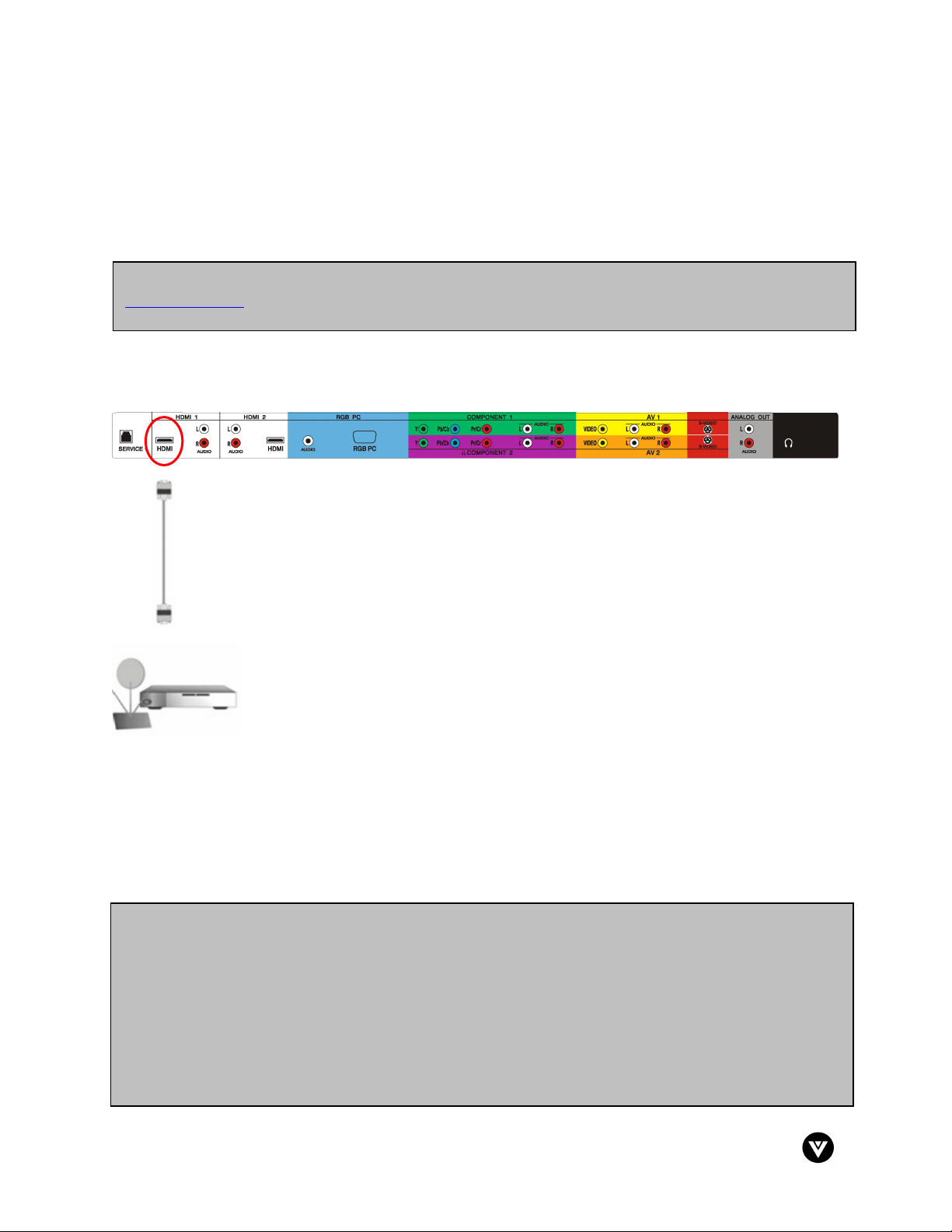
Connecting your DVD Player (Best):
1. Turn off the power to the Plasma TV and DVD player.
2. Connect one end of a HDMI cable to the HDMI output of your DVD player and the other end
to the HDMI 1 Input (white color area) at the rear of the Plasma TV.
3. Turn on the power to the Plasma TV and your DVD player.
4. Select HDMI 1 using the INPUT button on the remote or side of the Plasma TV, or directly by
pressing the HDMI button on the Remote Control.
Note: To maintain the display quality, use a VIZIO certified HDMI cable available up to 10 meters or less.
See www.VIZIOCE.com
or call 1-888-VIZIOCE (1-888-849-4623) for details.
Note:
a) If you are already using the HDMI 1 input for another component, or you do not want to use
the HDMI 1 input for the DVD player, you can connect the DVD player to the HDMI 2
connection.
b) Refer to your DVD player user manual for more information about the video output
requirements of the product.
VIZIO P50HDTV User Manual
Version 5/23/2006 18
www.VIZIOCE.com
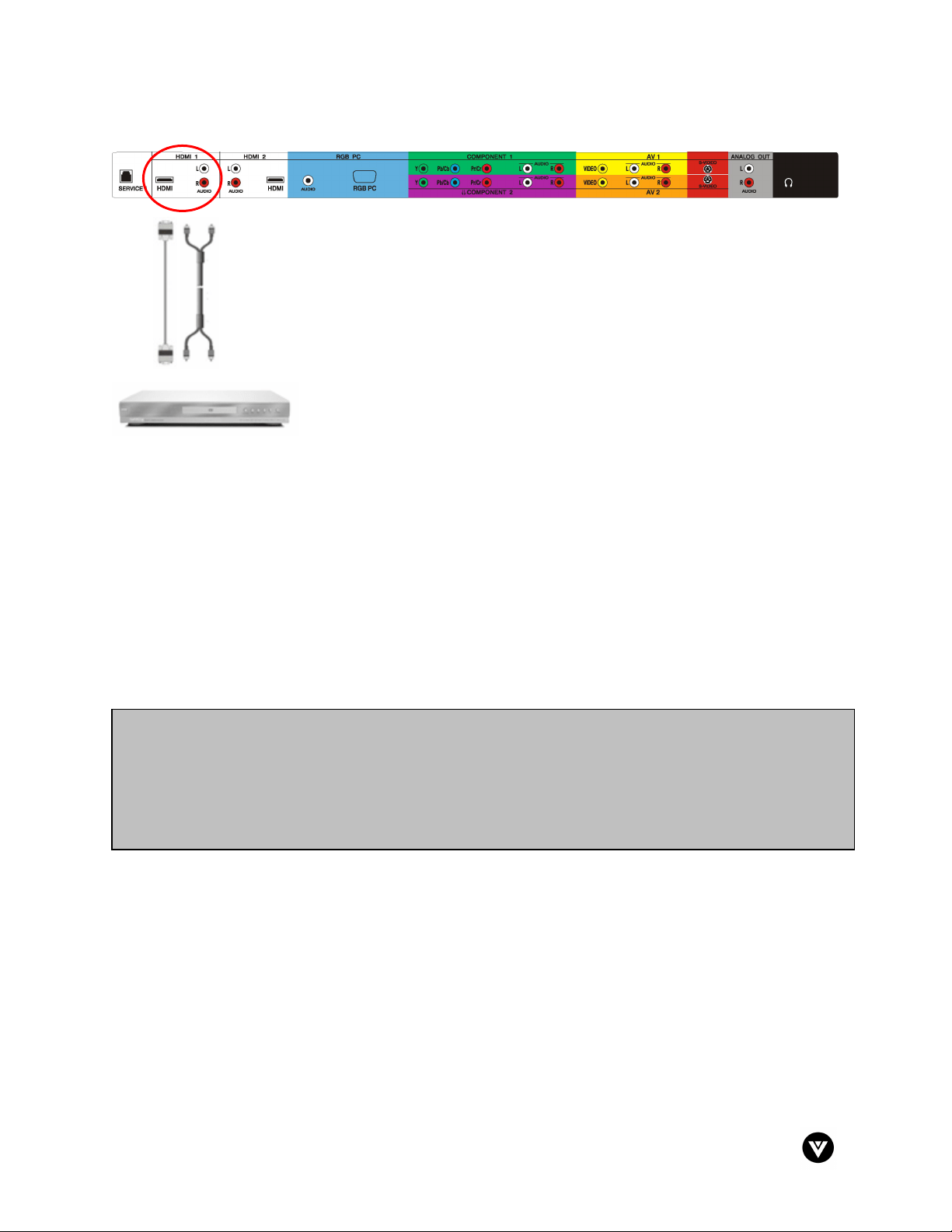
For DVD Players with DVI:
1. Turn off the power to the Plasma TV and DVD player.
2. Using a HDMI-DVI cable, connect the DVI end to your DVD player and the HDMI end to the
HDMI 1 Input (white color area) at the rear of the Plasma TV.
3. Using an audio cable (white and red connectors), connect the cable to the audio output
connectors associated with the DVI output on your DVD player and connect the other end to
the audio connectors associated with the HDMI 1 input (white area) at the rear of the Plasma
TV.
4. Turn on the power to the Plasma TV and your DVD player.
5. Select HDMI 1 using the INPUT button on the remote or side of the Plasma TV, or directly by
pressing the HDMI button on the Remote Control.
Note:
b) If you are already using the HDMI 1 input for another component, or you do not want to use
the HDMI 1 input for the DVD player, you can connect the DVD player to the HDMI 2
connection.
c) Refer to your DVD player user manual for more information about the video output
requirements of the product.
VIZIO P50HDTV User Manual
Version 5/23/2006 19
www.VIZIOCE.com
2.2.2 Using Component Video
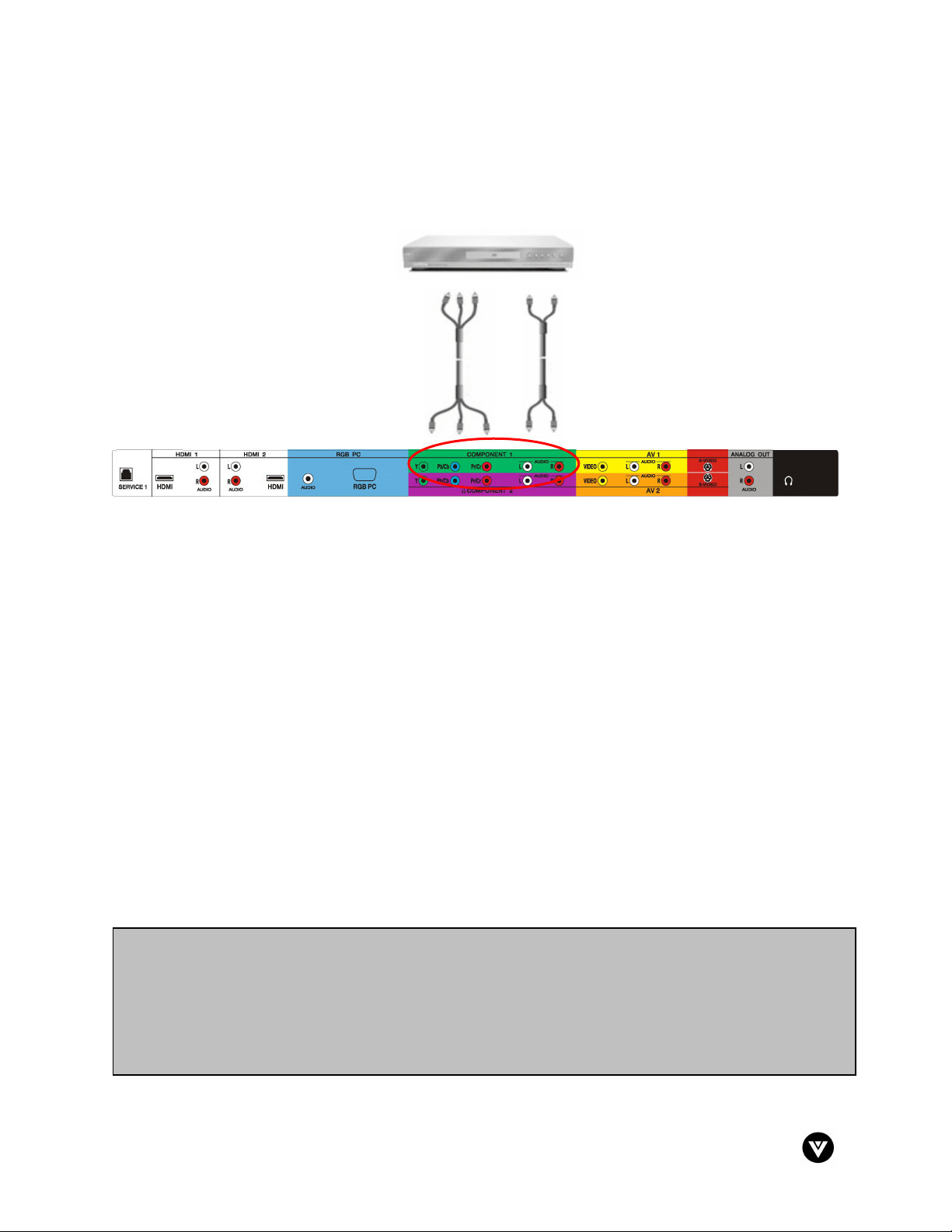
Connecting your DVD Player (Better):
1. Turn off the power to the Plasma TV and DVD player.
2. Connect the Y (green color) connector on your DVD player to the corresponding Y (green
color) connector in the Component 1 group (green color area - row of connectors nearest to
you when viewing from the rear of the TV) at the rear of the Plasma TV.
3. Connect the Pb (blue color) connector on your DVD player to the corresponding Pb (blue
color) connector in the Component 1 group (green color area - row of connectors nearest to
you when viewing from the rear of the TV) at the rear of the Plasma TV.
4. Connect the Pr (red color) connector on your DVD player to the corresponding Pr (red color)
connector in the Component 1 group (green color area - row of connectors nearest to you
when viewing from the rear of the TV) at the rear of the Plasma TV.
5. Using an audio cable (white and red connectors), connect the cable to the audio output
connectors associated with the Component output on your DVD player and connect the other
end to the audio connectors associated with the Component 1 input (green color area) at the
rear of the Plasma TV.
6. Turn on the power to the Plasma TV and DVD player.
7. Select Component 1 using the INPUT button on the remote or side of the Plasma TV, or
directly by pressing the Component button on the Remote Control.
Note:
a) If you are already using the Component 1 input for another component, or you do not want
to use the Component 1 input for the DVD player, you can connect the DVD player to the
Component 2 connections coded by the purple area.
b) Refer to your DVD player user manual for more information about the video output
requirements of the product.
VIZIO P50HDTV User Manual
Version 5/23/2006 20
www.VIZIOCE.com
2.2.3 Using S-Video (AV)
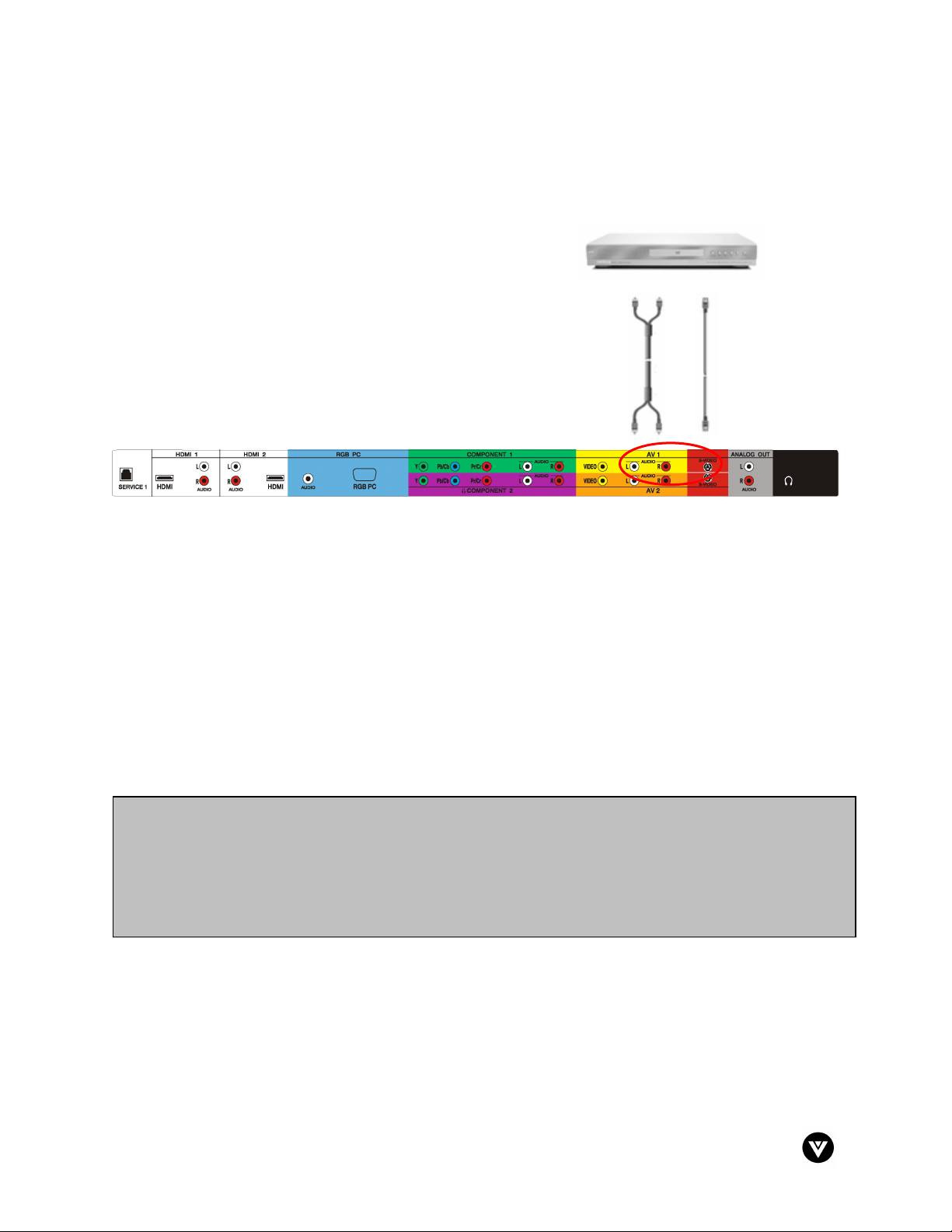
Connecting your DVD Player (Good):
1. Turn off the power to the Plasma TV and DVD player.
2. Connect the S-Video jack on the rear of your DVD player to the S-Video jack in the AV1
group (red area) at the rear of the Plasma TV.
3. Using an audio cable (white and red connectors), connect the cable to the audio output
connectors associated with the S-Video output on your DVD player and connect the other
end to the audio connectors associated with the AV1 input (yellow area) at the rear of the
Plasma TV.
4. Turn on the power to the Plasma TV and DVD player.
5. Select AV1 using the INPUT button on the remote or side of the Plasma TV, or directly by
pressing the AV button on the Remote Control.
Note:
a) If you are already using the AV1 input for another component, or you do not want to use the
AV1 input for the DVD player, you can connect the DVD player to the AV2 connections
coded by the red & orange areas.
b) Refer to your DVD player user manual for more information about the video output
requirements of the product.
VIZIO P50HDTV User Manual
Version 5/23/2006 21
www.VIZIOCE.com
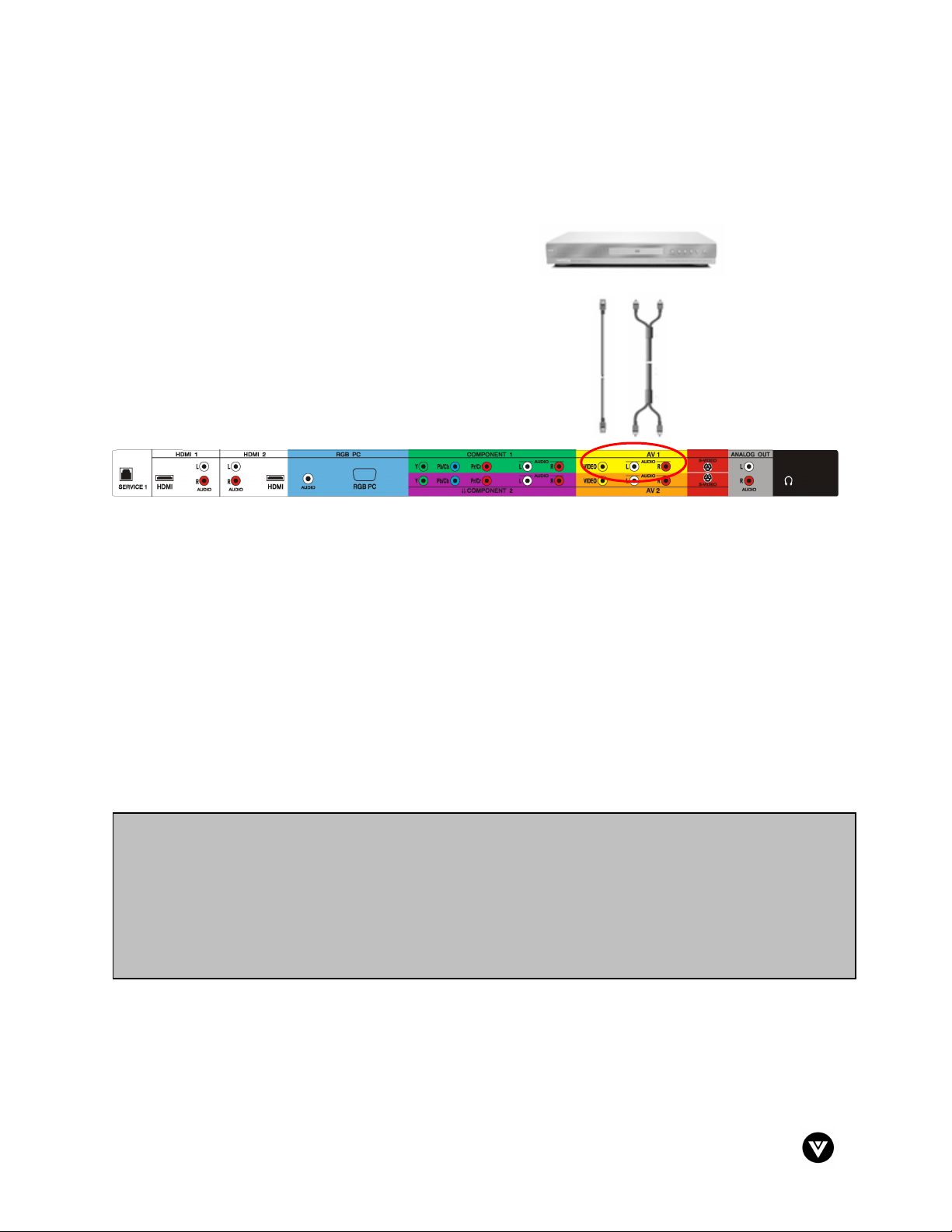
2.2.4 Using Composite (AV) Video
Connecting your DVD Player (Good) :
1. Turn off the power to the Plasma TV and DVD player.
2. Connect the Video (yellow color) connector on your DVD player to the Video (yellow color)
connector in the AV1 group (yellow color area - row of connectors nearest to you when
viewing from the rear of the TV) at the rear of the Plasma TV.
3. Connect the R (red color) and L (white color) audio connectors on your DVD player to the
corresponding R (red color) and L (white color) audio input connectors in the AV1 group
(yellow color area - row of connectors nearest to you when viewing from the rear of the TV) at
the rear of the Plasma TV.
4. Turn on the power to the Plasma TV and DVD Player.
5. Select AV1 using the INPUT button on the remote or side of the Plasma TV, or directly by
pressing the AV button on the Remote Control.
Note:
a) If you are already using the AV1 input for another component, or you do not want to use the AV1
input for the DVD player, you can connect the DVD player to the AV2 connections coded by the
orange area.
b) Refer to your DVD player user manual for more information about the video output requirements
of the product.
VIZIO P50HDTV User Manual
Version 5/23/2006 22
www.VIZIOCE.com
2.3 Connecting Your HDTV Set-Top Box
2.3.1 Using HDMI
HDTV Set-Top Boxes that have a HDMI digital interface should be connected to the HDMI input of the
Plasma TV for optimal results.
Connecting your Set-Top Box (Best):
1. Turn off the power to the Plasma TV and HDTV Set-Top Box.
2. Connect a HDMI cable to the HDMI output of your HDTV Set-Top Box and the other end to
the HDMI 1 Input (white color area) at the rear of the Plasma TV.
3. Turn on the power to the Plasma TV and HDTV Set-Top Box.
4. Select HDMI 1 using the INPUT button on the remote or side of the Plasma TV, or directly by
pressing the HDMI button on the Remote Control.
Note: To maintain the display quality, use a VIZIO certified HDMI cable that is 10 meters or less. See
www.vizioce.com or call 1-888-VIZIOCE (1-888-849-4623) for details.
Note:
a) The HDMI input on the Plasma TV supports High-bandwidth Digital Content Protection
(HDCP). HDCP encrypts the transmission between the video source and the digital display
for added security and protection.
b) If you are already using the HDMI 1 input for another component, or you do not want to use
the HDMI 1 input for the Set-Top Box, you can connect the Set-Top Box to the HDMI 2
connection.
c) Refer to your HDTV Set-Top Box user manual for more information about the video output
requirements of the product or consult your cable or satellite operator.
VIZIO P50HDTV User Manual
Version 5/23/2006 23
www.VIZIOCE.com
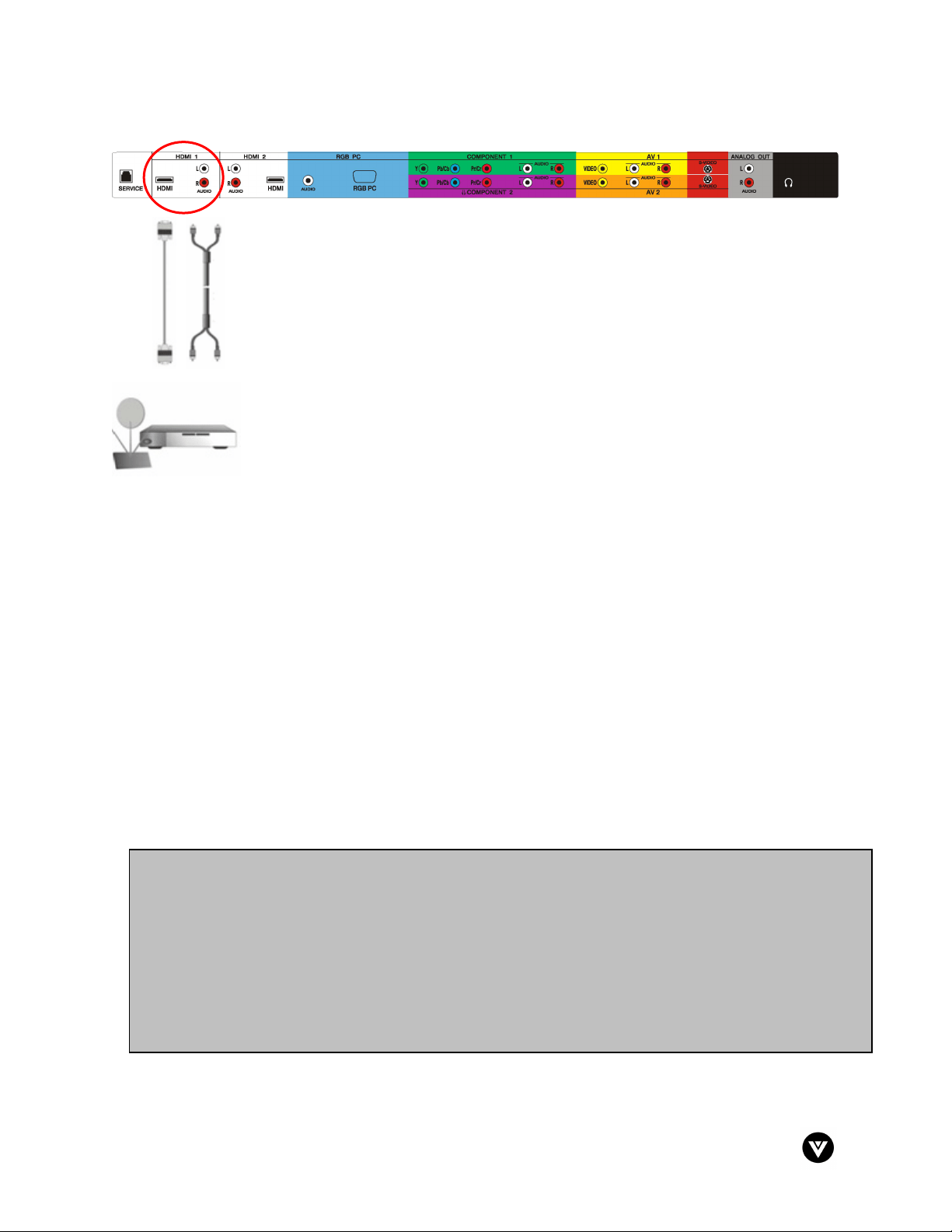
For Set-Top Boxes with DVI:
1. Turn off the power to the Plasma TV and HDTV Set-Top Box.
2. Using a HDMI-DVI cable, connect the DVI end to your HDTV Set-Top Box and the HDMI end
to the HDMI 1 Input (white color area) at the rear of the Plasma TV.
3. Using an audio cable (white and red connectors), connect the cable to the audio output
connectors associated with the DVI output on your HDTV Set-Top Box and connect the other
end to the audio connectors associated with the HDMI 1 input (white area) at the rear of the
Plasma TV.
4. Turn on the power to the Plasma TV and HDTV Set-Top Box.
5. Select HDMI 1 using the INPUT button on the remote or side of the Plasma TV, or directly by
pressing the HDMI button on the Remote Control.
Note: The HDMI Input is for HD Video and will only support 640x480 at 60Hz from a PC. Use the RGB
PC input for a greater selection of PC formats.
Note:
d) The HDMI input on the Plasma TV supports High-bandwidth Digital Content Protection
(HDCP). HDCP encrypts the transmission between the video source and the digital display
for added security and protection.
e) If you are already using the HDMI 1 input for another component, or you do not want to use
the HDMI 1 input for the Set-Top Box, you can connect the Set-Top Box to the HDMI 2
connections.
f) Refer to your HDTV Set-Top Box user manual for more information about the video output
requirements of the product or consult your cable or satellite operator.
VIZIO P50HDTV User Manual
Version 5/23/2006 24
www.VIZIOCE.com
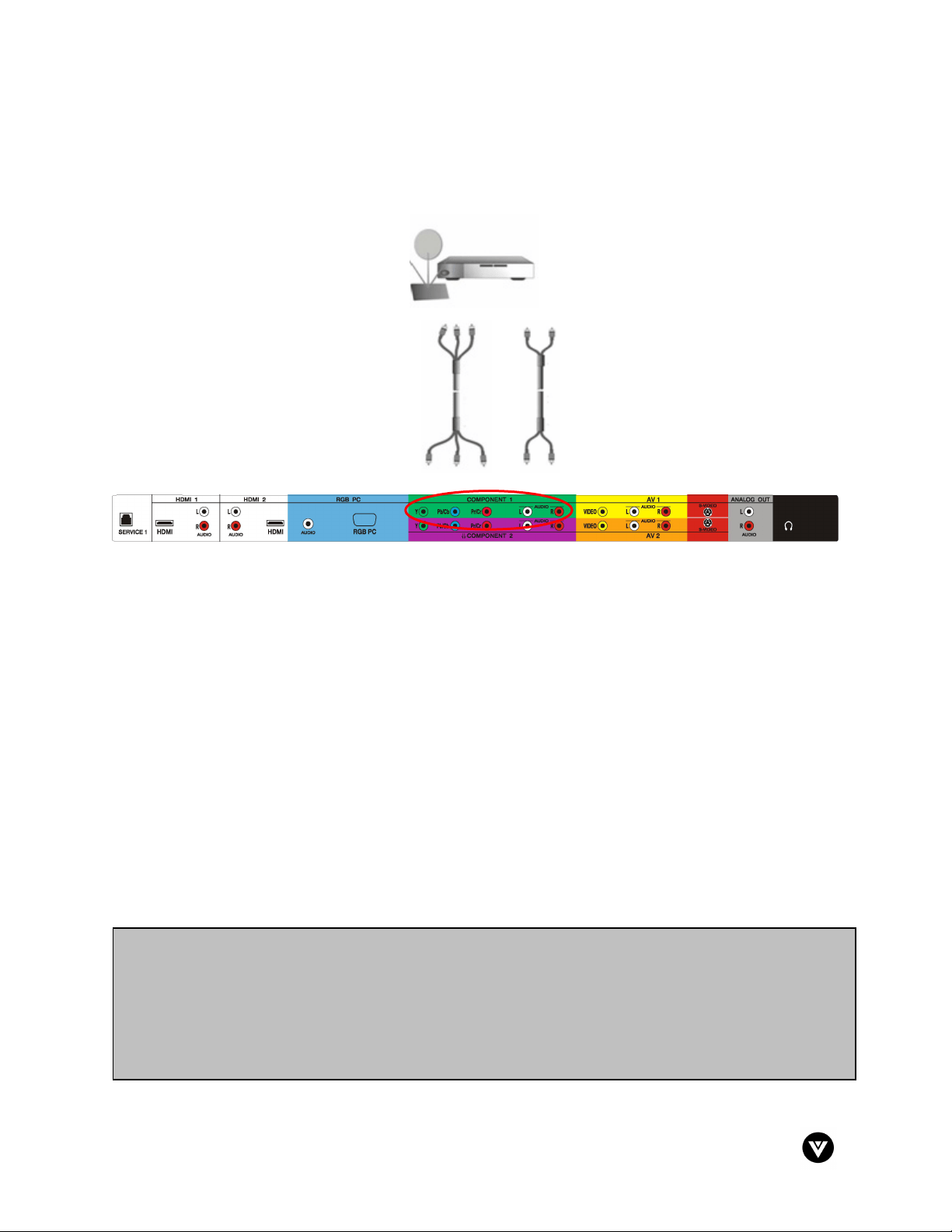
2.3.2 Using Component Video
Connecting your Set-Top Box (Better):
1. Turn off the power to the Plasma TV and HDTV Set-Top Box.
2. Connect the Y (green color) connector on your HDTV Set-Top Box to the corresponding Y
(green color) connector in the Component 1 group (green color area - row of connectors
nearest to you when viewing from the rear of the TV) at the rear of the Plasma TV.
3. Connect the Pb (blue color) connector on your HDTV Set-Top Box to the corresponding Pb
(blue color) connector in the Component 1 group (green color area - row of connectors
nearest to you when viewing from the rear of the TV) at the rear of the Plasma TV.
4. Connect the Pr (red color) connector on your HDTV Set-Top Box to the corresponding Pr (red
color) connector in the Component 1 group (green color area - row of connectors nearest to
you when viewing from the rear of the TV) at the rear of the Plasma TV.
5. Using an audio cable (white and red connectors), connect the cable to the audio output
connectors associated with the Component output on your HDTV Set-Top Box and connect
the other end to the audio connectors associated with the Component 1 input (green color
area) at the rear of the Plasma TV.
6. Turn on the power to the Plasma TV and HDTV Set-Top Box.
7. Select Component 1 using the INPUT button on the remote or side of the Plasma TV, or
directly by pressing the Component button on the Remote Control.
Note:
a) If you are already using the Component 1 input for another component, or you do not want
to use the Component 1 input for the Set-Top Box, you can connect the Set-Top Box to the
Component 2 connections coded by the orange area.
b) Refer to your HDTV Set-Top Box user manual for more information about the video output
requirements of the product or consult your cable or satellite operator.
VIZIO P50HDTV User Manual
Version 5/23/2006 25
www.VIZIOCE.com
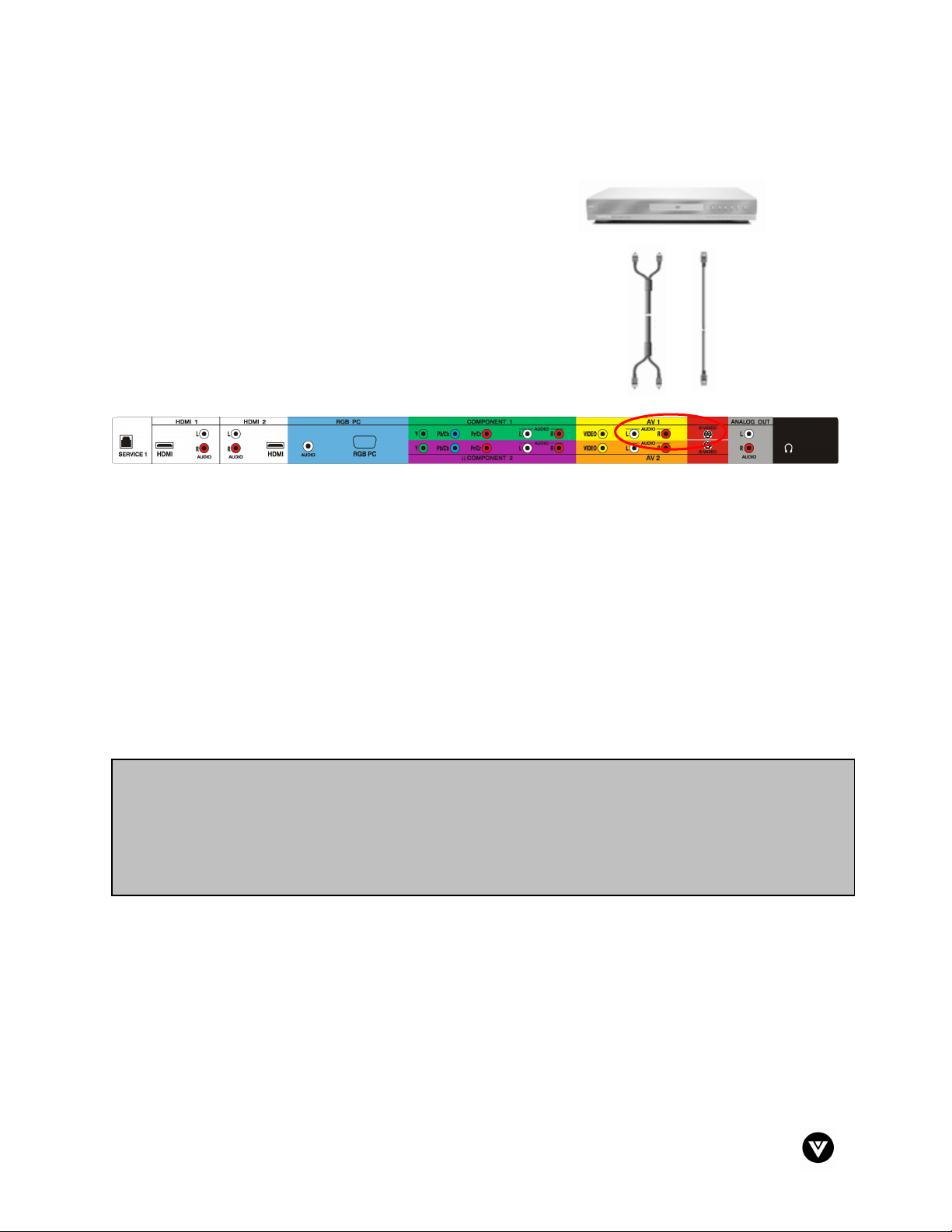
2.4 Connecting Your VCR or Video Camera
1. Turn off the power to the Plasma TV and VCR or Video Camera.
2. Connect the S-Video jack on the rear of your VCR or Video Camera to the S-Video jack in the
AV1 group (red area) at the rear of the Plasma TV.
3. Using an audio cable (white and red connectors), connect the cable to the audio output
connectors associated with the S-Video output on your VCR or Video Camera and connect
the other end to the audio connectors associated with the AV1 input (yellow area) at the rear
of the Plasma TV.
4. Turn on the power to the Plasma TV and VCR or Video Camera.
5. Select AV1 using the INPUT button on the remote or side of the Plasma TV, or directly by
pressing the AV button on the Remote Control.
Note:
a) If you are already using the AV1 input for another component, or you do not want to use the
AV1 input for the VCR or Video Camera, you can connect the VCR or Video Camera to the
AV2 connections coded by the orange/red area.
b) Refer to your VCR or Video Camera user manual for more information about the video
output requirements of the product.
VIZIO P50HDTV User Manual
Version 5/23/2006 26
www.VIZIOCE.com
2.5 Connecting Coaxial (RF)
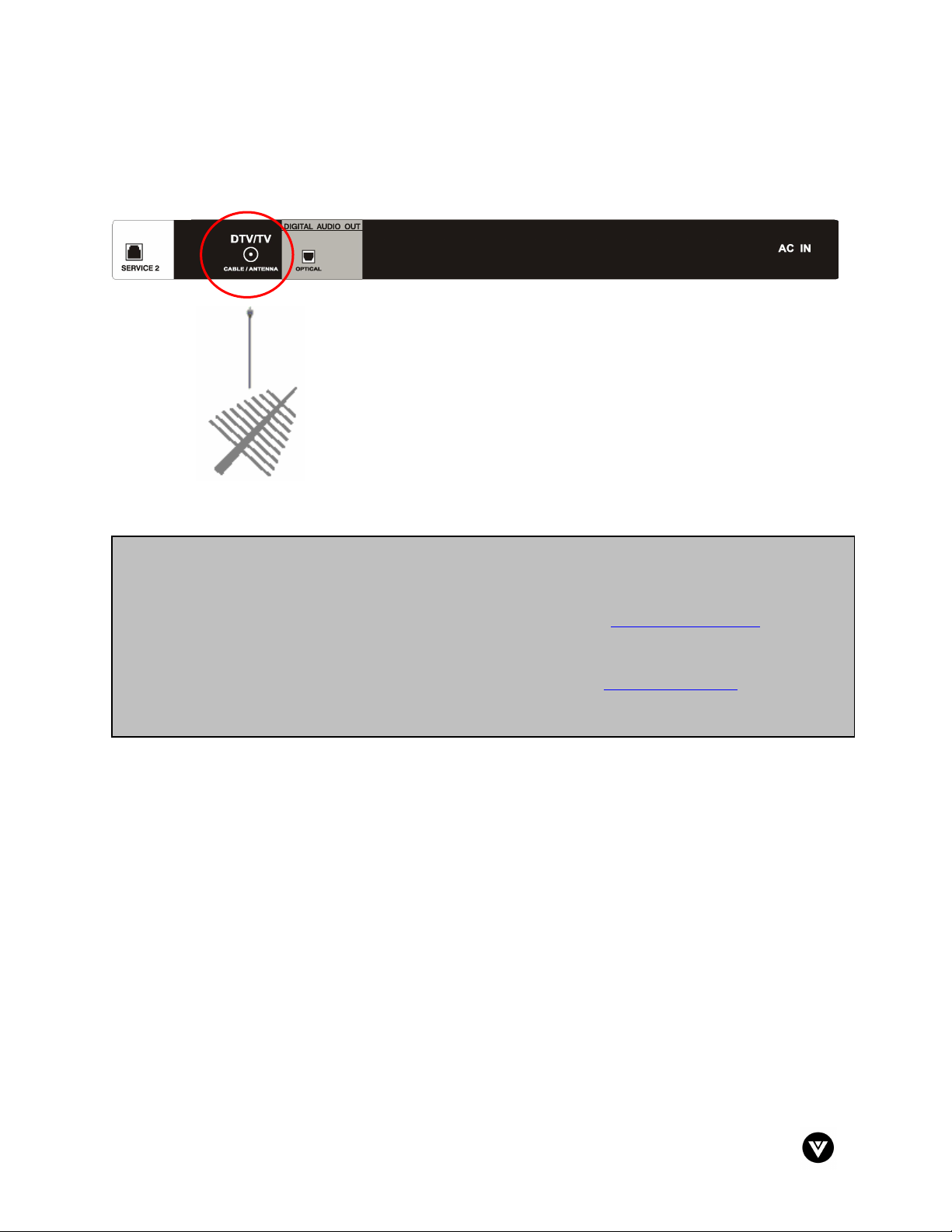
2.5.1 Using Your Antenna or Digital Cable for DTV
1. Turn off the power to the Plasma TV.
2. Connect the coaxial (RF) connector from your antenna or
digital cable to the DTV/TV CABLE/ANTENNA connector at the
rear of the Plasma TV.
3. Turn on the power to the Plasma TV.
4. Select DTV using the INPUT button on the remote or side of
the Plasma TV, or directly by pressing the TV button on the
Remote Control.
Note:
a) Not all digital TV broadcasts are High Definition (HD). Refer to the program guides, or
consult your cable, satellite or TV station operator.
b) Digital broadcasts are not available in all areas. Refer to www.antennaweb.org
for detailed
information.
c) Make sure the antenna is correctly grounded.
d) For Professional antenna installation contact VIZIO at www.VIZIOCE.com
or call 1-888-
VIZIOCE (1-888-849-4623).
VIZIO P50HDTV User Manual
Version 5/23/2006 27
www.VIZIOCE.com
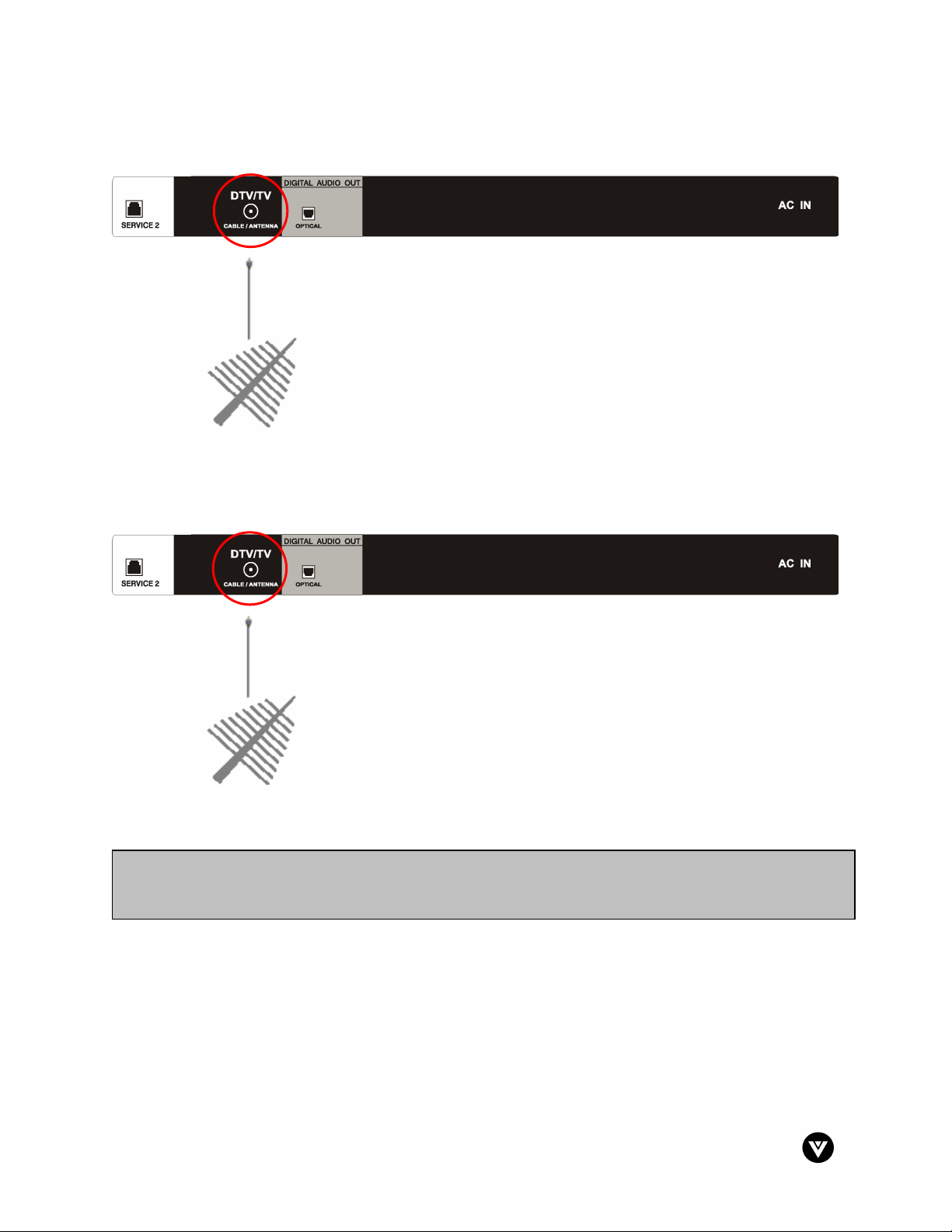
2.5.2 Using Your Antenna or Cable for TV
1. Turn off the power to the Plasma TV.
2. Connect the coaxial (RF) connector from your antenna or cable
to the DTV/TV CABLE/ANTENNA connector at the rear of the
Plasma TV
3. Turn on the power to the Plasma TV.
4. Select TV using the INPUT button on the remote or side of the
Plasma TV, or directly by pressing the TV button on the
Remote Control.
2.5.3 Using the Antenna or Cable through your VCR
1. Turn off the power to the Plasma TV and VCR.
2. Connect the “Output to TV”, “RF Out” or “Antenna Out”
connector on the rear of your VCR to the DTV/TV
CABLE/ANTENNA connector at the rear of the Plasma TV.
3. Turn on the power to the Plasma TV and VCR.
4. Select TV using the INPUT button on the remote or side of the
Plasma TV, or directly by pressing the TV button on the
Remote Control.
Note: If you have an off-air antenna or cable TV, connect it to the “Antenna In” connector on the rear of
your VCR.
VIZIO P50HDTV User Manual
Version 5/23/2006 28
www.VIZIOCE.com
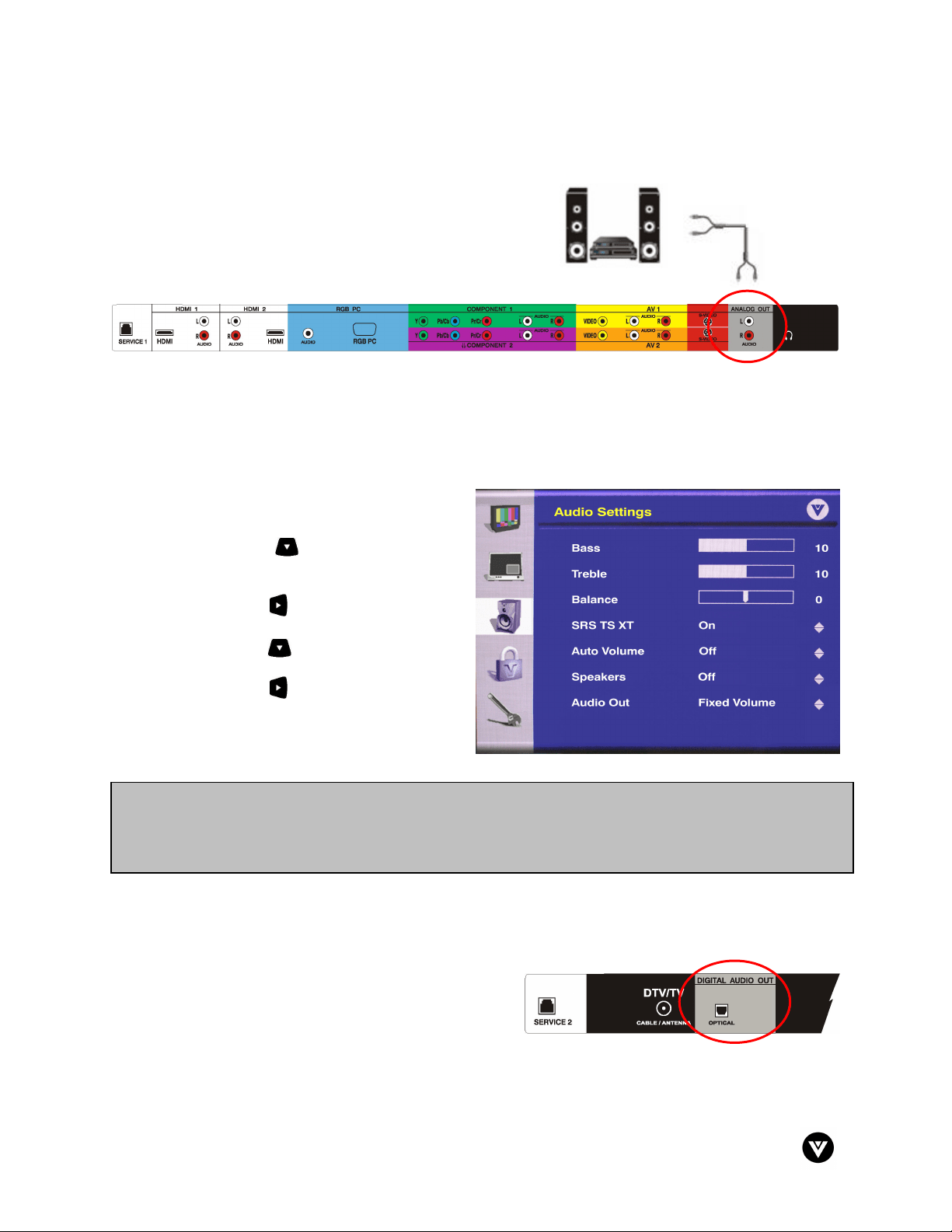
2.6 Connecting an external Receiver/Amp
1. Turn off the power to the Plasma TV and Receiver/Amp.
2. Using an audio cable (white and red connectors), connect the cable to the audio input
connectors on the Receiver/Amp and connect the other end to the ANALOG OUT (gray area)
audio connectors at the rear of the Plasma TV.
3. Turn on the power to the Plasma TV and Receiver/Amp.
4. Then press the menu button on the
remote control to open the On-Screen
Display (OSD) menu.
5. Press the button on the remote
control to select the Audio Adjust
menu.
6. Press the button on the remote to
select the Audio Settings menu.
7. Press the button on the remote to
select Speakers.
8. Press the button on the remote to
select Off so that the sound from the
Plasma TV will now be routed through
your Receiver/Amp system.
Optical Output of Audio received with HD Programs
If your sound system has a SPDIF (optical) digital audio
input you can connect it to the optical DIGITAL AUDIO
OUT (gray area) at the rear of the Plasma TV. This is
active when receiving digital audio with the programs
from the DTV/TV CABLE/ANTENNA input.
Note:
a) Refer to your Receiver/Amp user manual to select the corresponding audio input.
b) The audio output is not amplified and cannot be connected directly to external speakers.

VIZIO P50HDTV User Manual
Version 5/23/2006 29
www.VIZIOCE.com
2.7 Connecting a PC Computer
1. Turn off the power to the Plasma TV and PC Computer.
2. Connect a 15-pin D-Sub RGB (VGA) cable to the RGB output of your pc computer and the
other end to the RGB PC input (blue area) at the rear of the Plasma TV.
3. Connect the Audio Out on your pc computer to the RGB PC Audio input (blue area) at the
rear of the Plasma TV.
4. Turn on the power to the Plasma TV and PC Computer.
5. Select RGB using the INPUT button on the remote or side of the Plasma TV, or directly by
pressing the RGB button on the Remote Control.
Note:
a) For the best picture quality when connecting a pc computer through RGB PC, set your pc
computer timing mode to VESA 1024x768 at 60Hz. Please refer to the pc or graphic card’s
user guide for additional information on how to set the timing mode.
b) Refer to your pc computer user manual for more information about the video output
requirements of the product.
c) A RGB (VGA) cable and stereo mini jack cable are not included and can be purchased at an
electronics store.
VIZIO P50HDTV User Manual
Version 5/23/2006 30
www.VIZIOCE.com
Chapter 3 Setting Up to Watch Television
For ‘Preparing Your Plasma TV for Wall Mounting’, see page 6.
3.1 Basic Plasma TV Start Up
1. Connecting the Power Cable
Connect the power cord to the power cord connector on the back of the Plasma TV, and then
plug the power cord into an AC wall socket.
2. Connect Audio and Video Cables to the Plasma TV
(see pages 16 ~ 29 for detailed steps)
3. Turning Power On
Once all the components are connected, press the Power ON button on the side of the Plasma
TV, or press the Power ON (Red) button on the remote control.
4. Select Input Source
Select the Input Source for the Plasma TV by pressing the INPUT button on the side of the TV or
using the Input button on the remote control. Pressing this button will cycle through the following
options: DTV, TV, RGB, AV1 (S-Video or Video*), AV2 (S-Video or Video*), Component 1,
Component 2, HDMI 1 and HDMI 2.
5. Using TV with an Antenna or Cable
When an antenna or cable source is connected to
the DTV/TV input, you will need to select TV using
the INPUT button on the remote or side of the
Plasma TV, or directly by pressing the TV button on
the Remote Control, and Auto Scan for the available
TV channels.
Please follow the instructions below:
a. Select TV input (see Step 4 above) by pressing the INPUT button on the side of the
Plasma TV or using the INPUT button on the remote control, or directly by pressing the
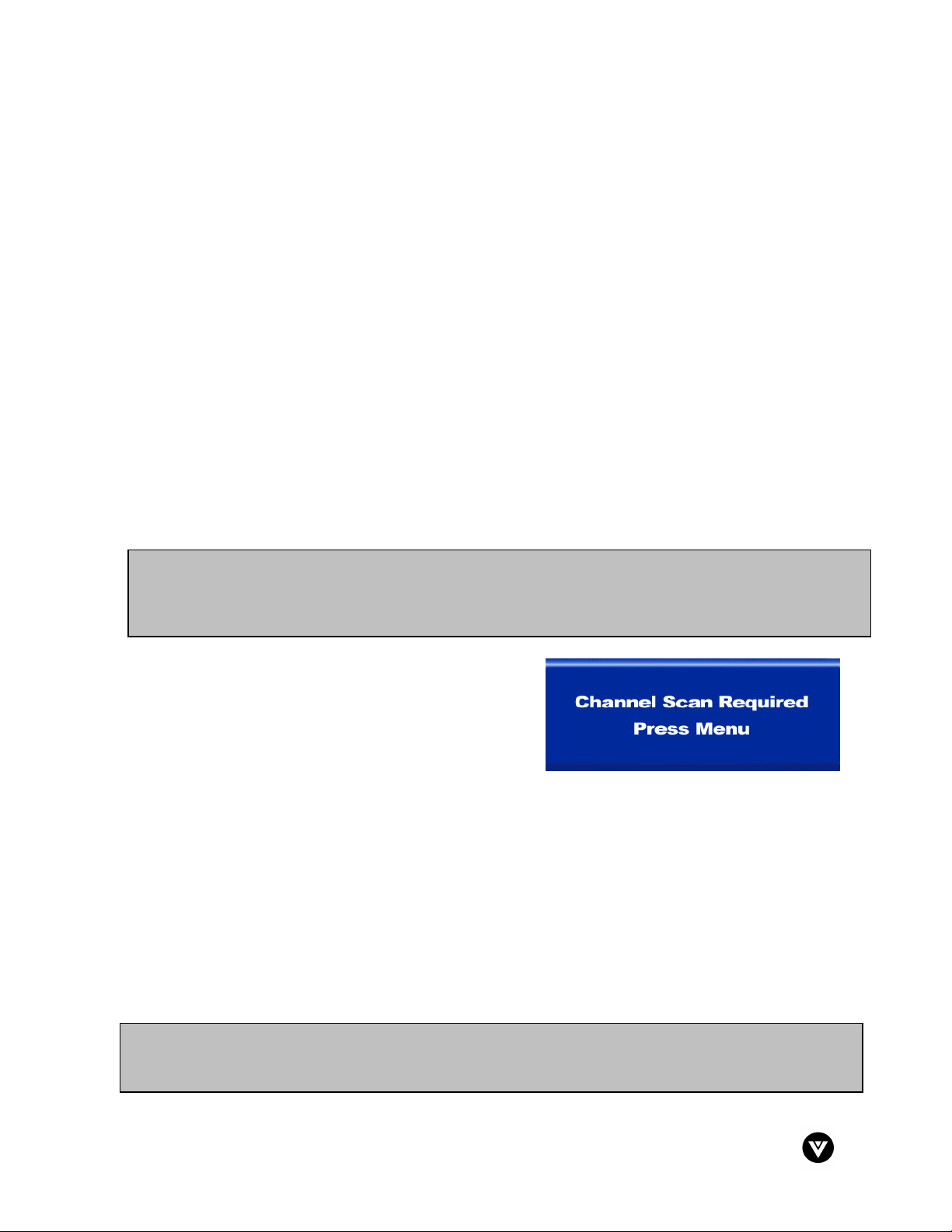
TV button on the remote control. The screen will show ‘snow’ and an information panel
that says, “Channel Scan Required Press Menu.”
Note: If you do not see this option within the OSD, you might have selected the wrong input in the
previous steps and you will need to repeat step 4 (above) to select the correct input source.
*S-Video has priority. If a signal is connected to AV1 S-Video by itself or signals are connected to AV1
S-Video and AV1 Video simultaneously, then S-Video will be the only choice for AV1. If a signal is
connected to AV1 Video only, then Video will be the only choice for AV1. The same input priority
scheme a
pp
lies to AV2.
VIZIO P50HDTV User Manual
Version 5/23/2006 31
www.VIZIOCE.com
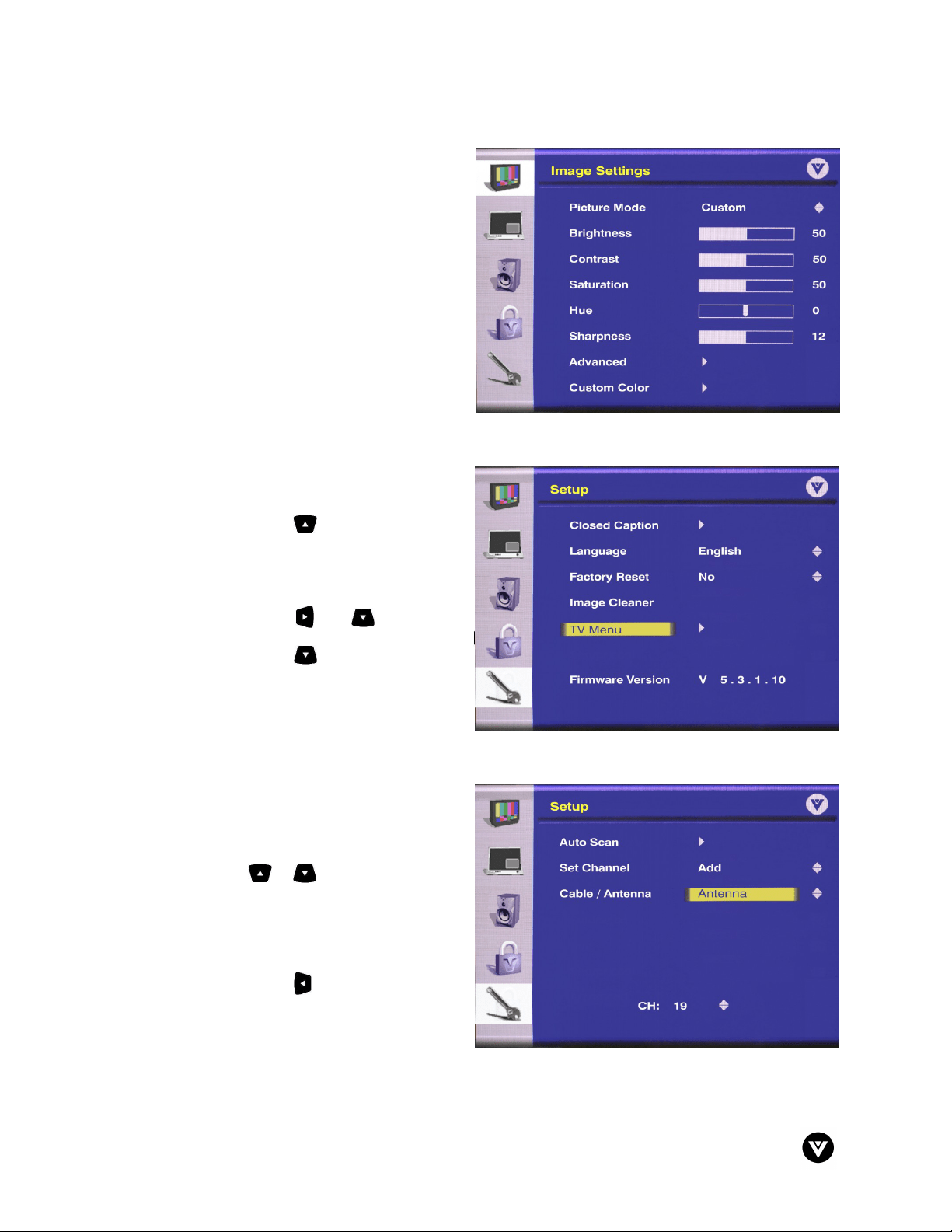
b. Press the MENU button on the
remote control to open the OSD
menu. The Image Settings Menu
will be displayed.
c. Press the button on the
remote control once to highlight
the Setup menu.
d. Press the and buttons to
highlight the TV Menu sub-menu.
Press the button to select this
sub-menu.
e. Once selected, press the
button to highlight Cable /
Antenna. Press the button to
adjust this option and then press
the or button to select the
Cable or Antenna to match the
source you have connected to the
DTV/TV input at the rear of the
Plasma TV.
f. Press the button when you
have finished your selection.
VIZIO P50HDTV User Manual
Version 5/23/2006 32
www.VIZIOCE.com
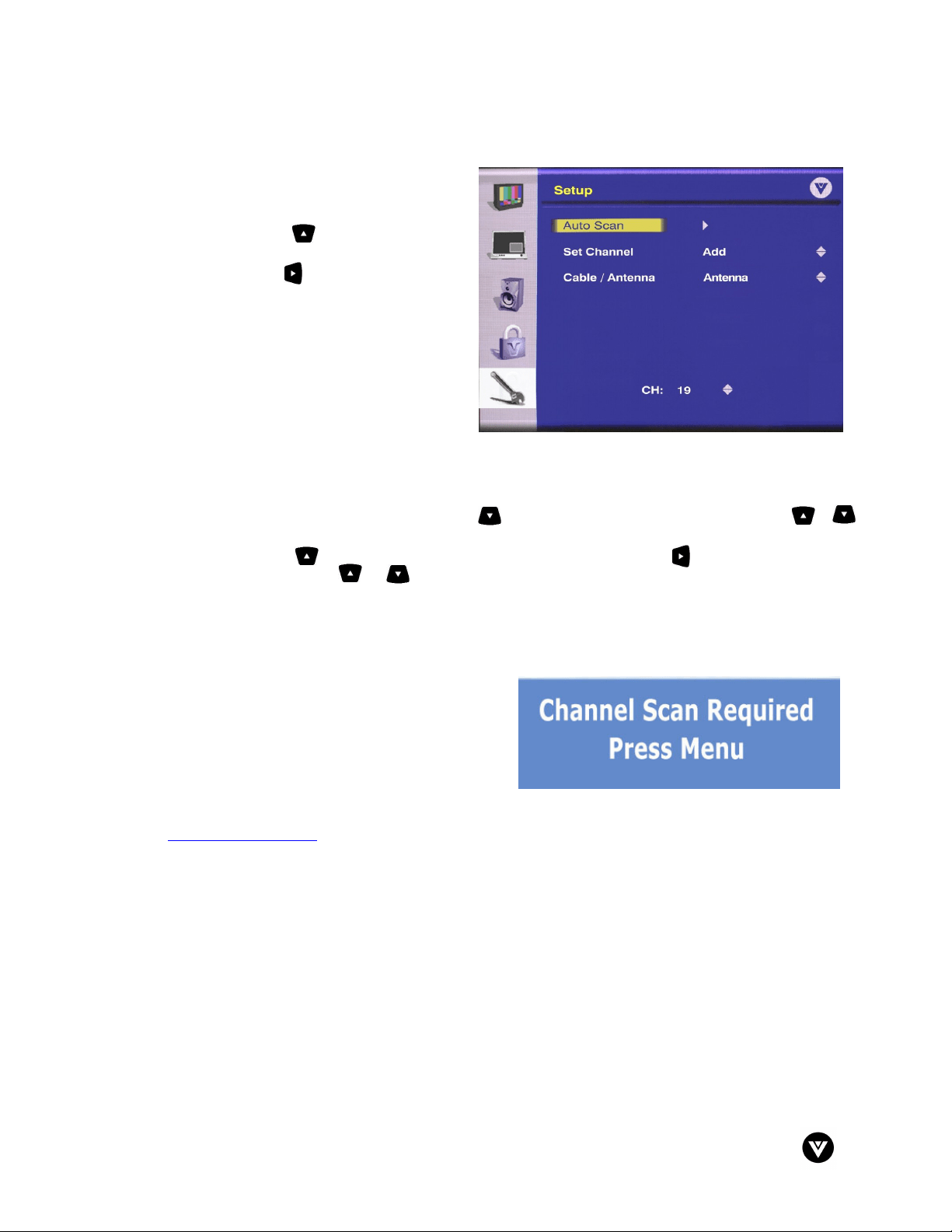
g. Press the button until Auto
Scan is highlighted.
h. Use the button to start the
search. When finished, “Auto
Scan Completed” will be displayed
at the top of the screen. Note:
This will take a few minutes to
complete.
i. To add or delete a channel press the button to highlight CH and then press the or
buttons until the desired channel number is shown.
j. Press the button to highlight Set Channel and then press the button the select this
option. Use the or buttons to Add or Skipped.
k. Press the MENU button repeatedly to exit the On Screen Display (OSD).
6. Using DTV with an Antenna or Cable
To use the Digital TV option, you will need to
select DTV using the INPUT button on the
remote or side of the Plasma TV, or directly by
pressing the TV button on the Remote Control.
The first time you use your DTV input you will
see the information panel, “Channel Scan
Required Press Menu” Press the MENU button
and follow the procedure in Section 3.4 DTV
Tuner Setup. Note: DTV digital broadcast is not available in all areas. Refer to
www.antennaweb.org
to get information about availability in your area, type of antenna and in
which direction to point your antenna. The channel availability through cable depends upon
which channels your cable operator supplies in Clear QAM; consult your cable operator for more
information.
7. Using a PC
If connecting to a PC through the RGB PC input, set the TV timing mode to VESA 1024x768 at
60Hz for best picture quality (refer to the graphic card’s user guide for questions on how to set
this timing mode).

VIZIO P50HDTV User Manual
Version 5/23/2006 33
www.VIZIOCE.com
3.2 Watching a TV Program
Before you start watching TV, please make sure that any cable, satellite or off-air antenna connections
are secure. Also, verify that the power cord is plugged into a correctly grounded electrical outlet or surge
protector.
1. Press the power button on the remote or on the side of the Plasma TV. The status LED on
the front will change to solid green.
2. There are 4 options for selecting your programming:
a. If you are using an antenna or cable connected through the DTV CABLE/ANTENNA input,
you can select DTV using the INPUT button on the side of the Plasma TV.
b. If you are using an antenna or cable connected through the TV CABLE/ANTENNA input,
you can select TV using the INPUT button on the side of the Plasma TV.
c. If you are watching broadcasts through a cable or satellite set-top box connected by an
HDMI cable, select HDMI using the INPUT button on the side of the Plasma TV.
d. If you are watching broadcasts through a cable or satellite set-top box connected by a
Component (YPbPr) cable, select Component 1 or Component 2 using the INPUT button
on the side of the Plasma TV.
3. Press the Channel buttons on the remote or the +/- buttons on the side of the Plasma TV to
change the channel. Note: The Channel buttons, on the side of the Plasma and on the
remote, control will not work if you are watching a program using HDMI 1 HDMI 2,
Component 1, Component 2, AV1 or AV2 inputs.
3.3 Adjusting Basic Plasma TV Settings
Volume
To increase the volume, press and hold the VOL+ or VOL- button on the side of the Plasma TV or remote
control until the desired level is reached.
TV Channels
To step up or down through the available TV channels, press the CH+ or CH- button on the side of the
Plasma TV or remote control once for the next or previous channel, or hold it depressed until the desired
channel is reached. Note: Channel up and down will only operate in DTV and TV modes.
Wide
Using this feature, you can watch video content in different size modes on the TV. Press the WIDE
button on the remote control to switch among the modes.
Fore more information see Section 3.5.11.
Note: You should be able to see a picture. If you do not, make sure that all of the Plasma TV
connections are secure and you have selected the correct video input source.
VIZIO P50HDTV User Manual
Version 5/23/2006 34
www.VIZIOCE.com
3.4 DTV Tuner Setup
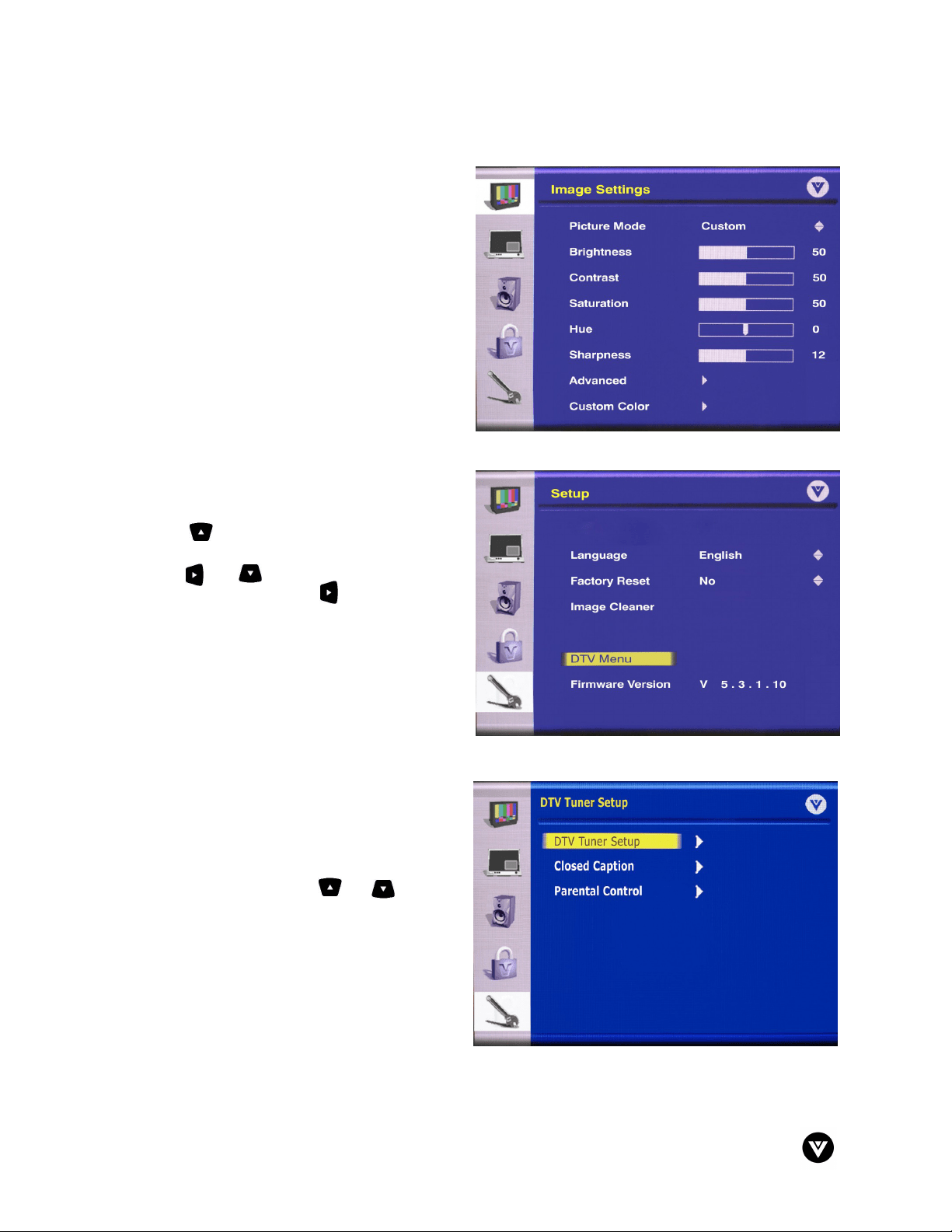
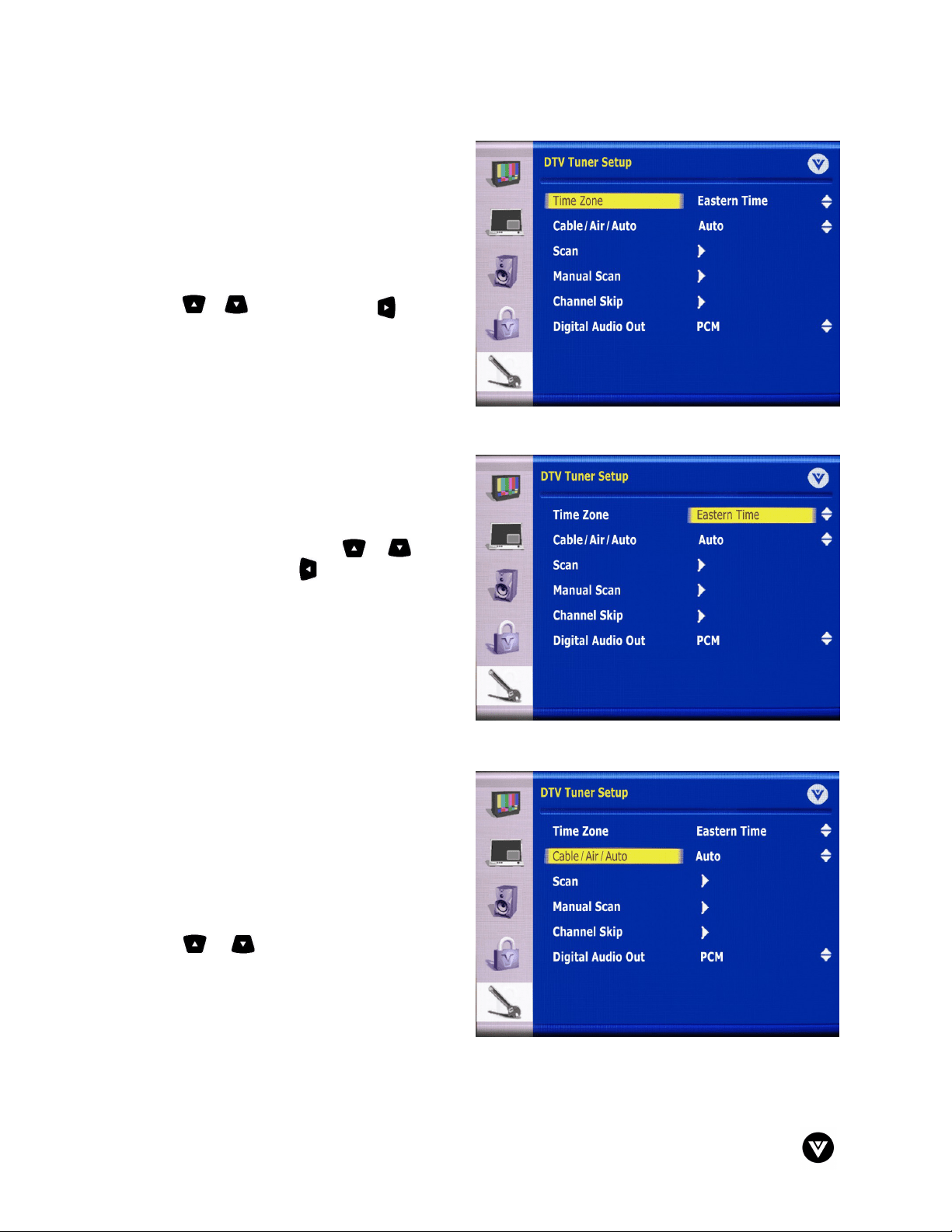
Select the DTV input (see Step 4 on page 30) by
pressing the INPUT button on the side of the
Plasma TV or using the INPUT button on the
remote control, or directly by pressing the TV
button on the remote control.
Press the MENU button on the remote control to
open the OSD menu. The Image Settings Menu
will be displayed.
Press the button on the remote control to
highlight the Setup menu.
Press the and buttons to highlight the DTV
Menu sub-menu. Press the button to select
this sub-menu. This will display the DTV TUNER
SETUP menu.
The DTV Tuner Setup sub-menu is now shown on
the screen. The DTV Tuner Setup option should
be highlighted, if not, use the or button to
highlight it.
Press the OK button on the remote control and the
next DTV Tuner Setup sub-menu will be shown.
VIZIO P50HDTV User Manual
Version 5/23/2006 35
www.VIZIOCE.com
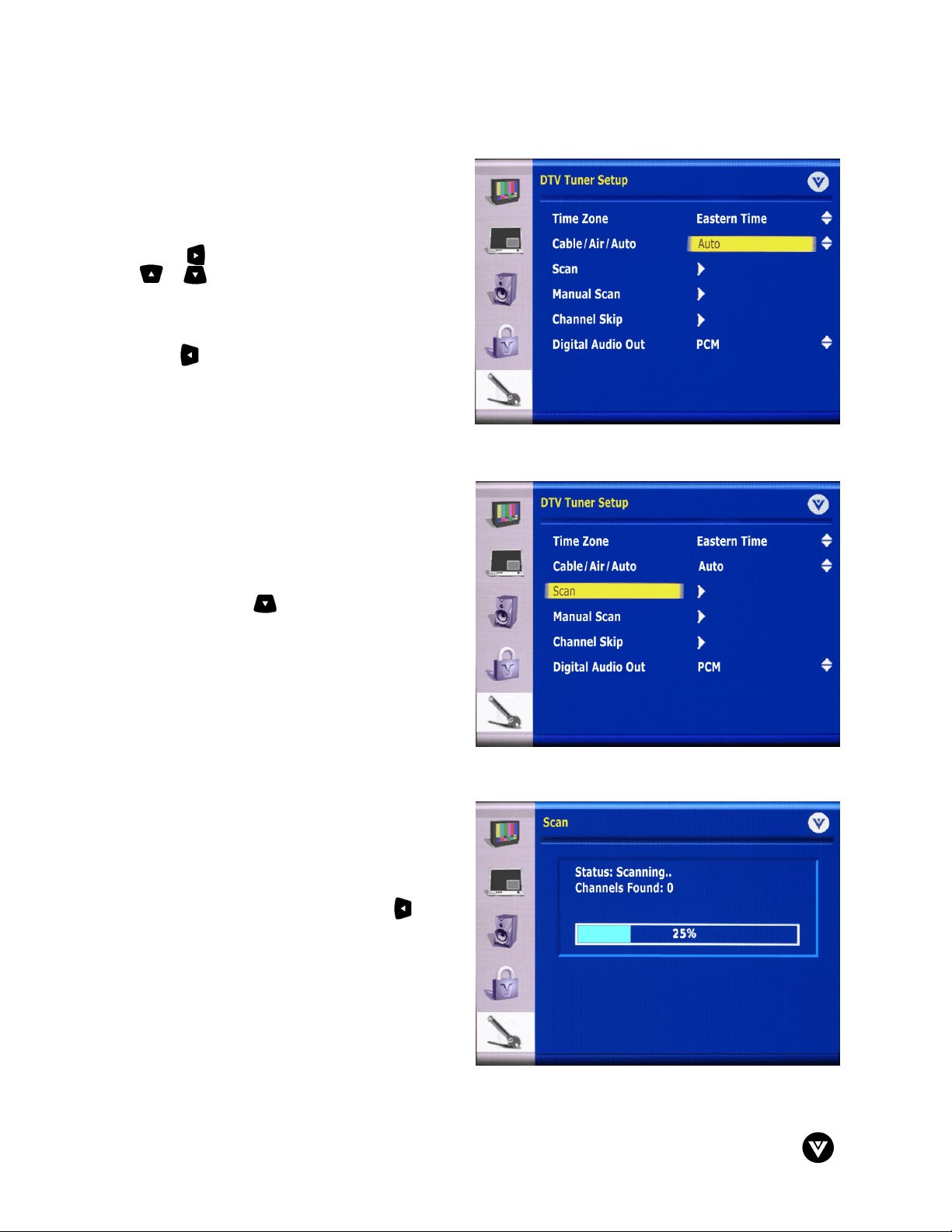
Time Zone – Setting the correct Time Zone for
your area will ensure that the correct program
times are shown after pressing the GUIDE button
on the remote control.
If necessary, highlight the Time Zone feature by
using the or button. Press the button to
select this option.
Select your time zone using the or button.
When finished, press the button to save and
exit this option.
Cable/Air/Auto – The default selection is Auto.
This means that the TV will scan for antenna and
cable channels and takes the most time. If you
have an antenna connected choose Air, or if you
have cable connected choose Cable, and the TV
will take less time in searching for channels.
Press the or button on the remote control
to select Cable/Air/Auto.
VIZIO P50HDTV User Manual
Version 5/23/2006 36
www.VIZIOCE.com
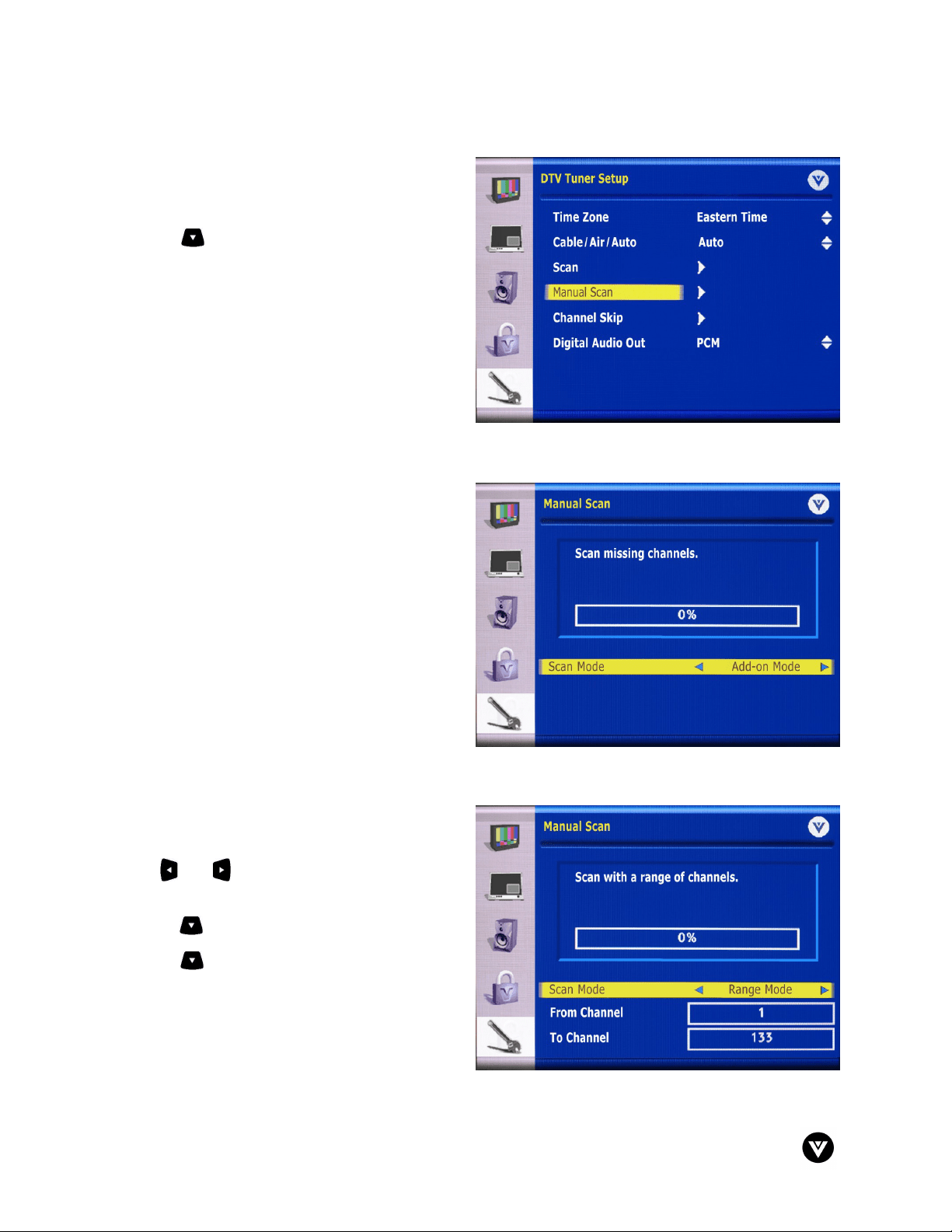
Press the button to select this option. Using
the or button, select Cable if you are using
cable out of the wall, Air if you are using an
antenna.
Press the button to save and exit this option.
Scan – Press the button to highlight Scan.
Press the OK button to activate. Note: This will
take a few minutes to complete.
Once Auto Scan has finished, press the button
to return to the previous menu. Note: If you press
OK, the Auto Scan process will start again.
VIZIO P50HDTV User Manual
Version 5/23/2006 37
www.VIZIOCE.com
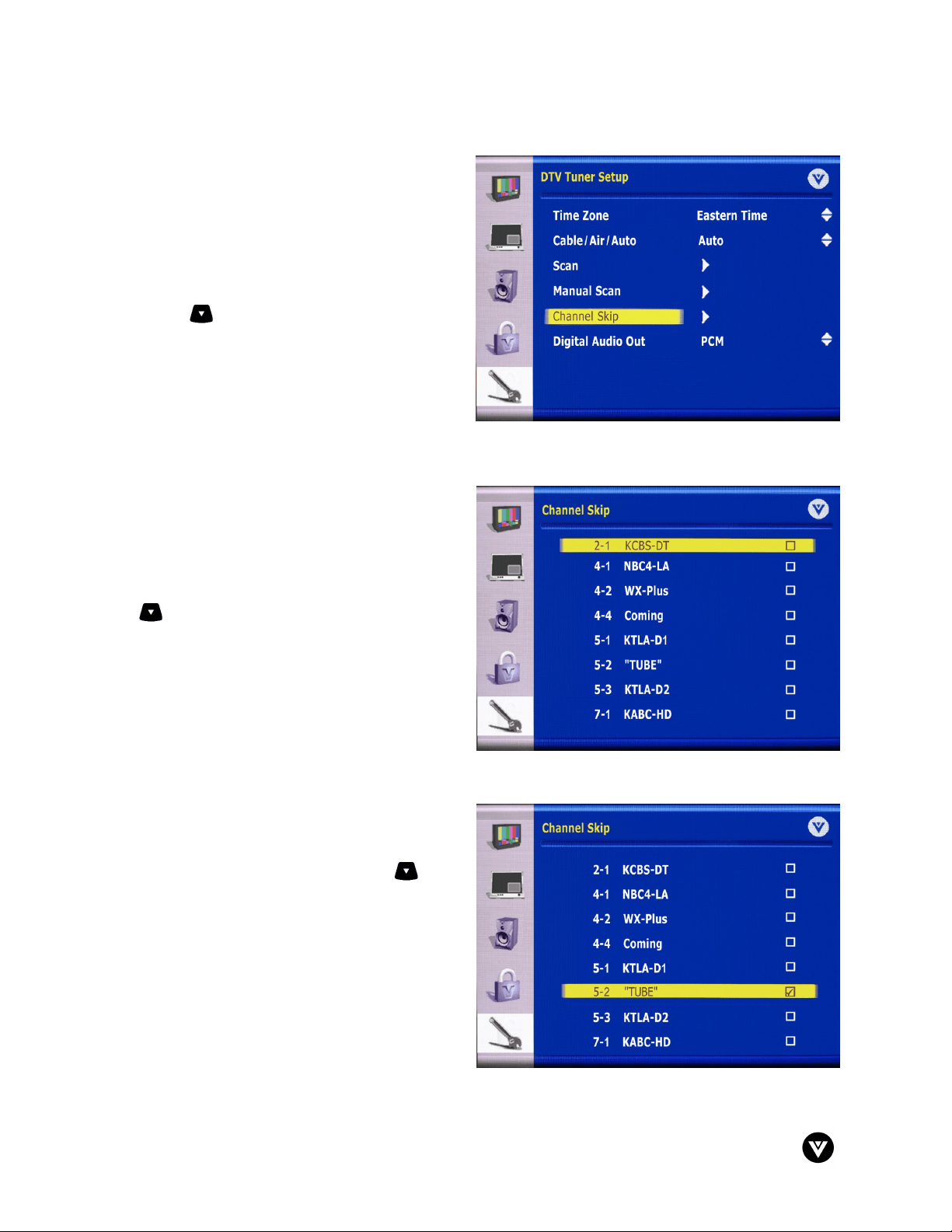
Manual Scan – If you feel that not all of the
available digital TV channels were found with Auto
Scan, then selecting this option enables the TV to
scan again to try to find any missing channels.
Press the button to highlight Manual Scan and
then press the OK button.
Note: A channel will be missed if it is not
transmitting at the time of the scan and so you
should try again at a time when you know the
station is transmitting programs.
A channel will also be missed if it is too weak to be
received. Re-orientation of the antenna or
changing to a higher gain antenna may help, but
note that any changes to the antenna may affect
other channels.
The Manual Scan screen now appears and this
can be used in two ways. The screen defaults to
Add-On Mode and pressing the OK button at this
stage makes the TV scan the whole channel range
again. Press EXIT to navigate away from this
screen.
Note: If the OK button is pressed, then the
automatic scanning will start again.
If the or button is pressed first, then the
Range Mode is activated so that you can specify a
smaller range of channels to be scanned again.
Press the button to highlight From Channel and
enter the channel using the number buttons, then
press the button again to highlight To Channel
and enter the channel using the number buttons.
Press EXIT to navigate away from this screen.
VIZIO P50HDTV User Manual
Version 5/23/2006 38
www.VIZIOCE.com
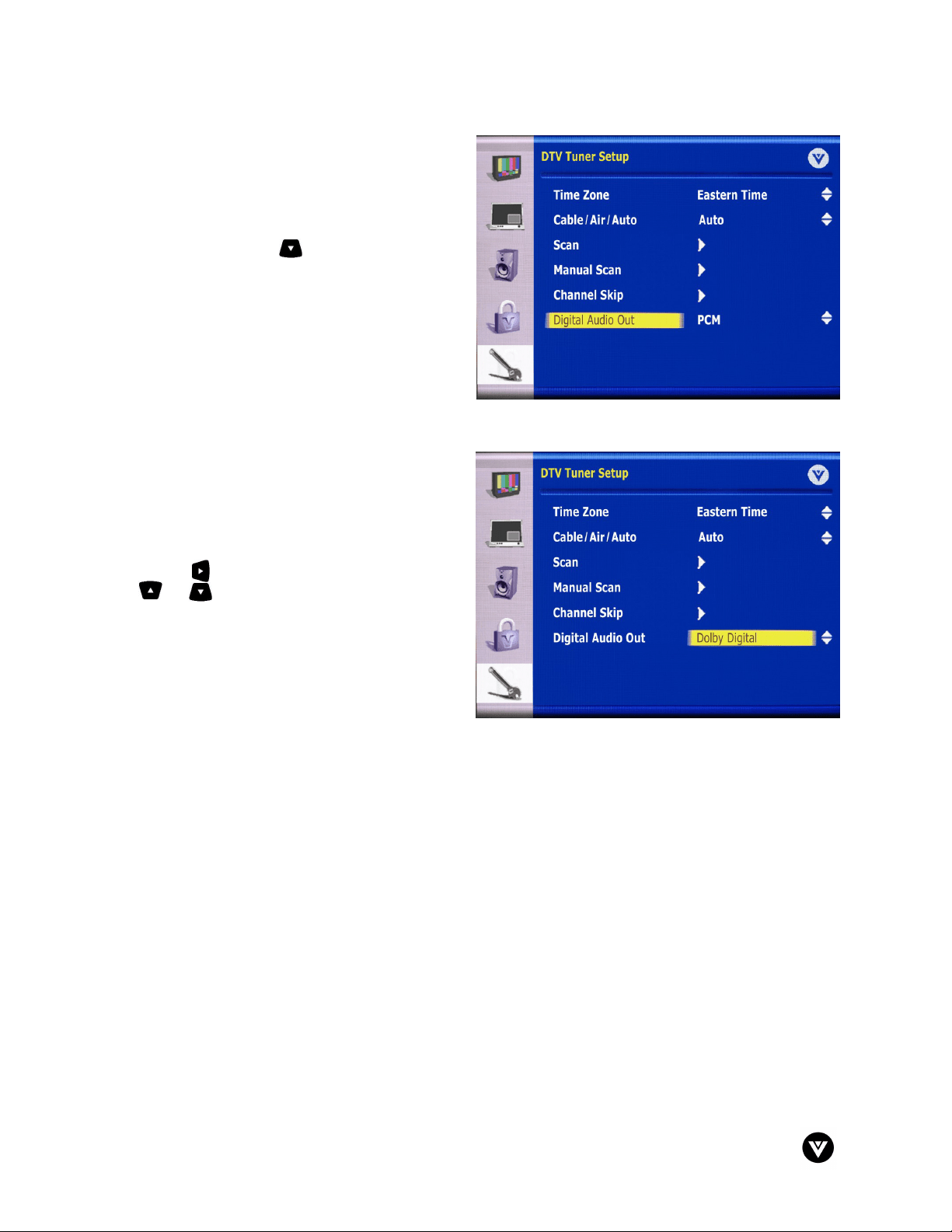
Channel Skip – Gives you the option to skip
channels when using the Channel+ or Channel-
buttons.
Press the button to highlight Channel Skip.
Press the OK button.
The list of channels available and stored in
memory is shown on the screen. If the list is
longer than 8 channels, as you repeatedly press
the button you will be able to scroll through to
see them all. The boxes to the right of the channel
names are empty by default.
As you scroll down the channels with the button,
each one is highlighted in turn. When a channel
you want to skip is highlighted, press the OK
button and a check mark (
9
) will appear in the box
opposite that channel. This means that when
surfing with the CH+ or CH- buttons, this channel
will be skipped and not displayed. Press EXIT to
navigate away from this screen when finished.
VIZIO P50HDTV User Manual
Version 5/23/2006 39
www.VIZIOCE.com
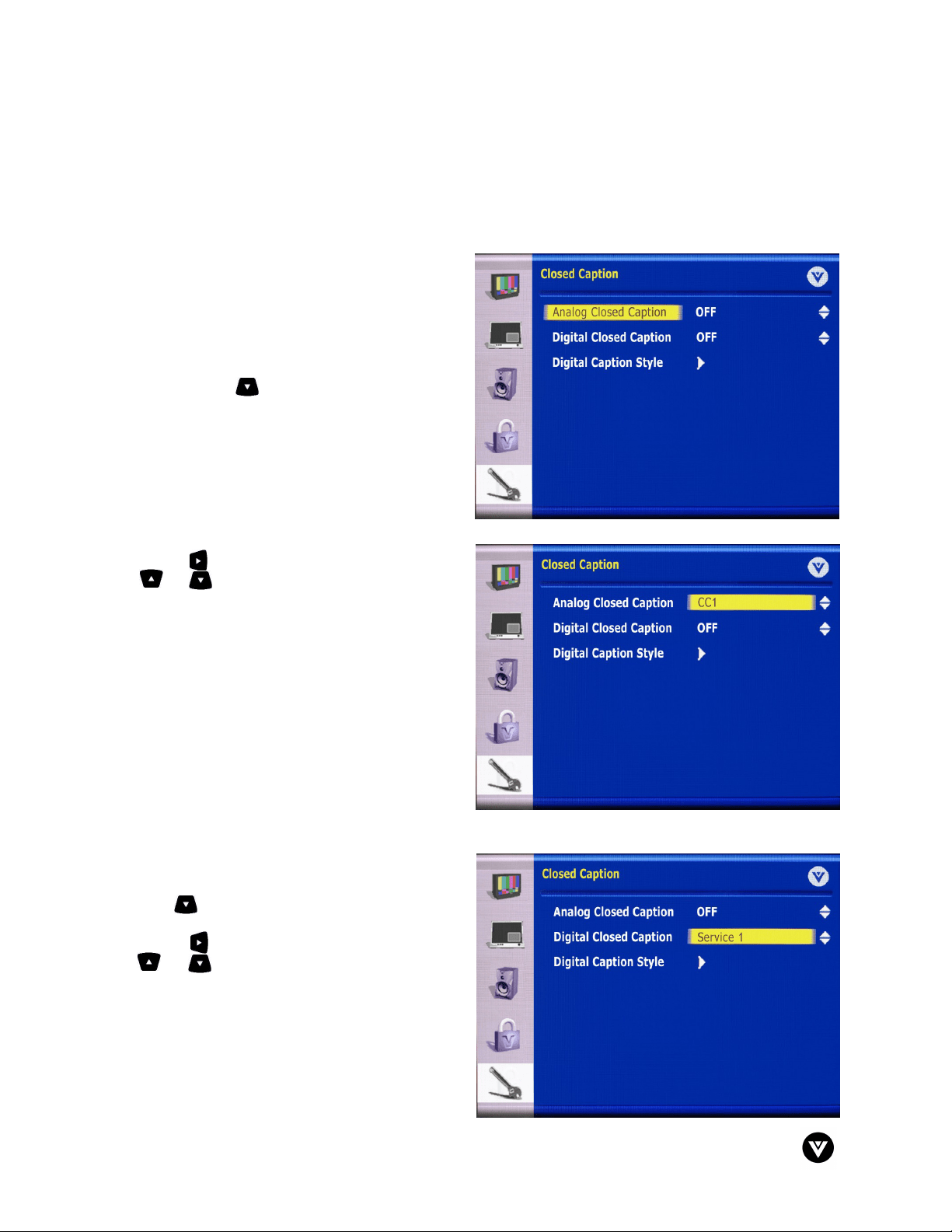
Digital Audio Out – You must set the
configuration of the digital audio (SPDIF) on this
sub-screen. Press the button to highlight the
Digital Audio Out option.
Note: Consult the user manual of your
Receiver/Amp to determine the capabilities and
requirements of that equipment.
Press the button to select this option. Using
the or button to select PCM, Dolby Digital
or Off.
VIZIO P50HDTV User Manual
Version 5/23/2006 40
www.VIZIOCE.com
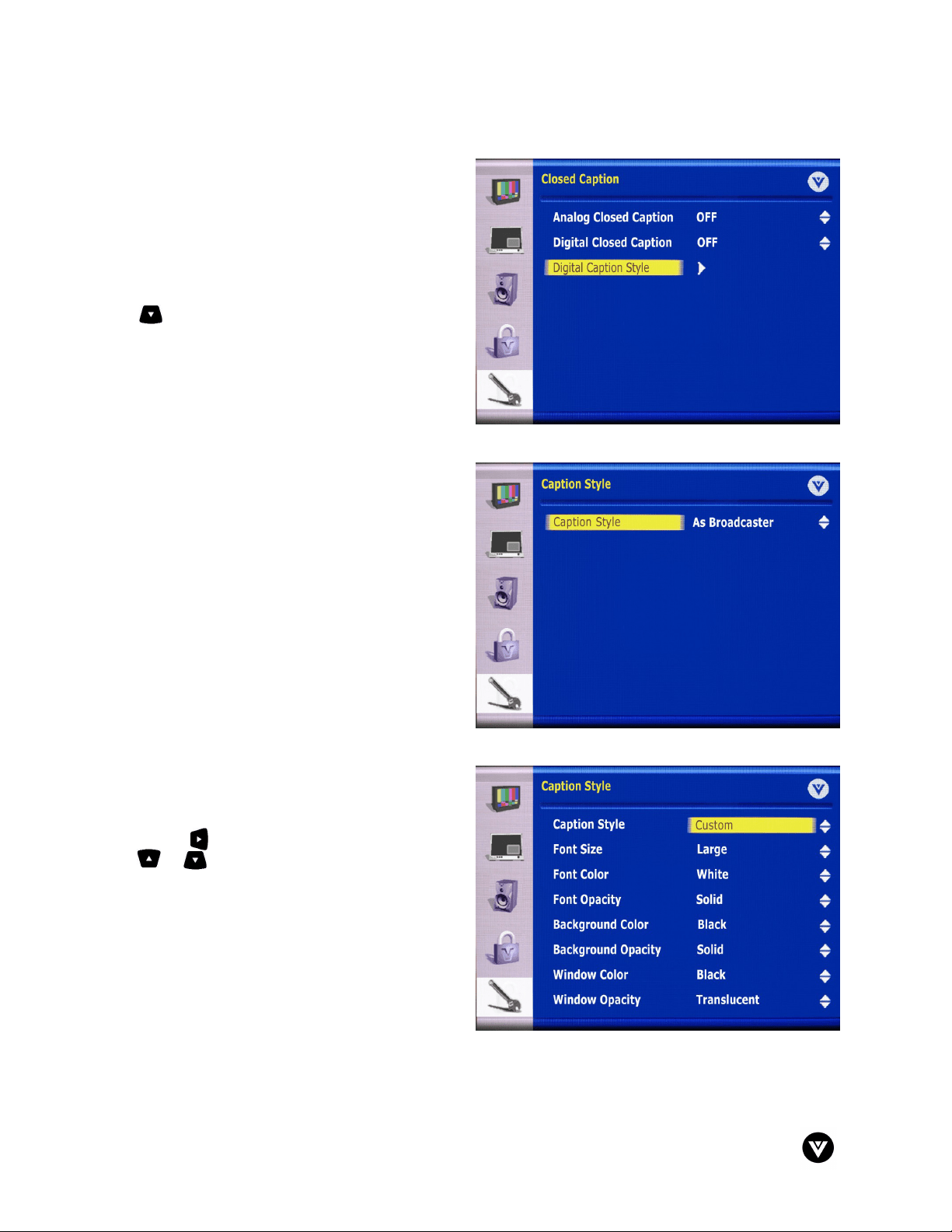
Closed Caption – Allows you to read the voice content of television programs. Open the OSD and find
the Setup menu, (see Page 34 for instructions if necessary.)
Although this is digital TV, some broadcasts will have analog Closed Caption instead of digital Closed
Caption and so the VIZIO TV can display either.
The settings on this menu page will set the default for all DTV channels. When viewing a channel, you
can change the Closed Caption setting using the CC button on the remote but it will only affect that
channel and if you change channels and come back to the original one, the Closed Caption setting will
revert back to the one set here in the OSD.
To set Analog Closed Caption for all DTV
channels, use the button to highlight the Analog
Closed Caption option.
Press the button to select this option. Using
the or button to select the Closed Caption
service required, usually CC1.
NOTE: Analog Closed
Caption has priority over
Digital Closed Caption and
so, when selected, will be
the default setting for all
DTV channels.
Use the CC button on the
remote to change the
setting when viewing a
channel.
To set Digital Closed Caption for all DTV channels,
use the button to highlight the Digital Closed
Caption option.
Press the button to select this option. Using
the or button to select the Closed Caption
service required, usually Service 1.
NOTE: The default setting
for all DTV channels will
now be Closed Caption On,
Service 1 option.
VIZIO P50HDTV User Manual
Version 5/23/2006 41
www.VIZIOCE.com
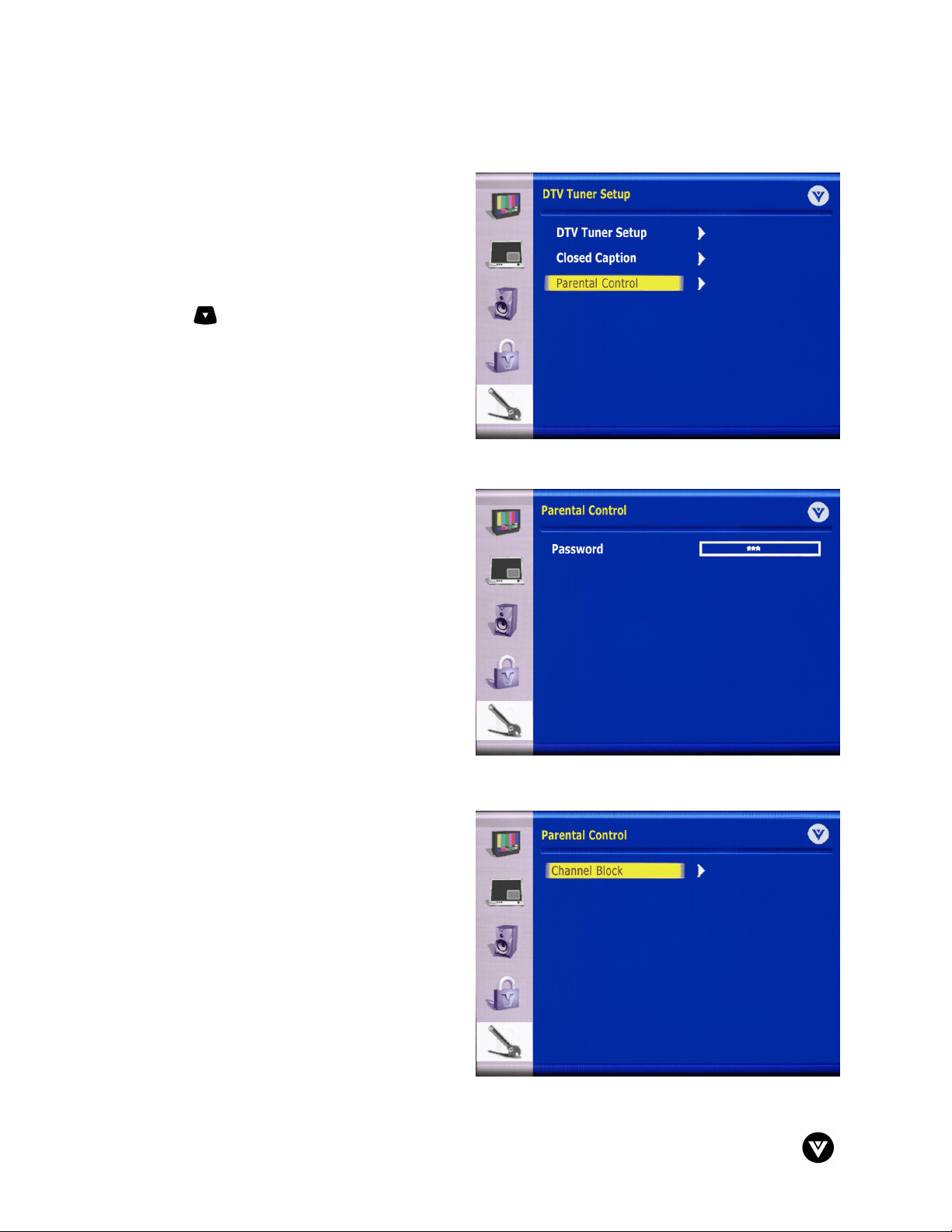
To set the look of the Digital Closed Caption
information, highlight Digital Caption Style using
the button. Press the OK button.
The default style, As Broadcaster, is shown as
selected. This means that the style of the closed
caption is as received from the TV channel. This
is usually acceptable.
Press the button to select this option. Using
the or button to select Custom.
The Caption Style screen is now filled with many
options to change the look of the Closed Caption
information. Please note, this is only effective with
digital channels and this has no effect on regular
analog channels.
VIZIO P50HDTV User Manual
Version 5/23/2006 42
www.VIZIOCE.com
3.4.1 Parental Controls for DTV
Open the OSD and find the Setup menu, (see
Page 34 for instructions if necessary.)
Press the button to highlight the Parental
Control option.
Press the OK button.
The Parental Control Password screen will be
shown. Using the number buttons on the remote
control, enter the four digit password. The factory
default password is 0 0 0 0. If you change the
password, please make a note of it in a safe place.
Once the correct password has been entered, the
option for blocking channels becomes available.
Press OK.
VIZIO P50HDTV User Manual
Version 5/23/2006 43
www.VIZIOCE.com
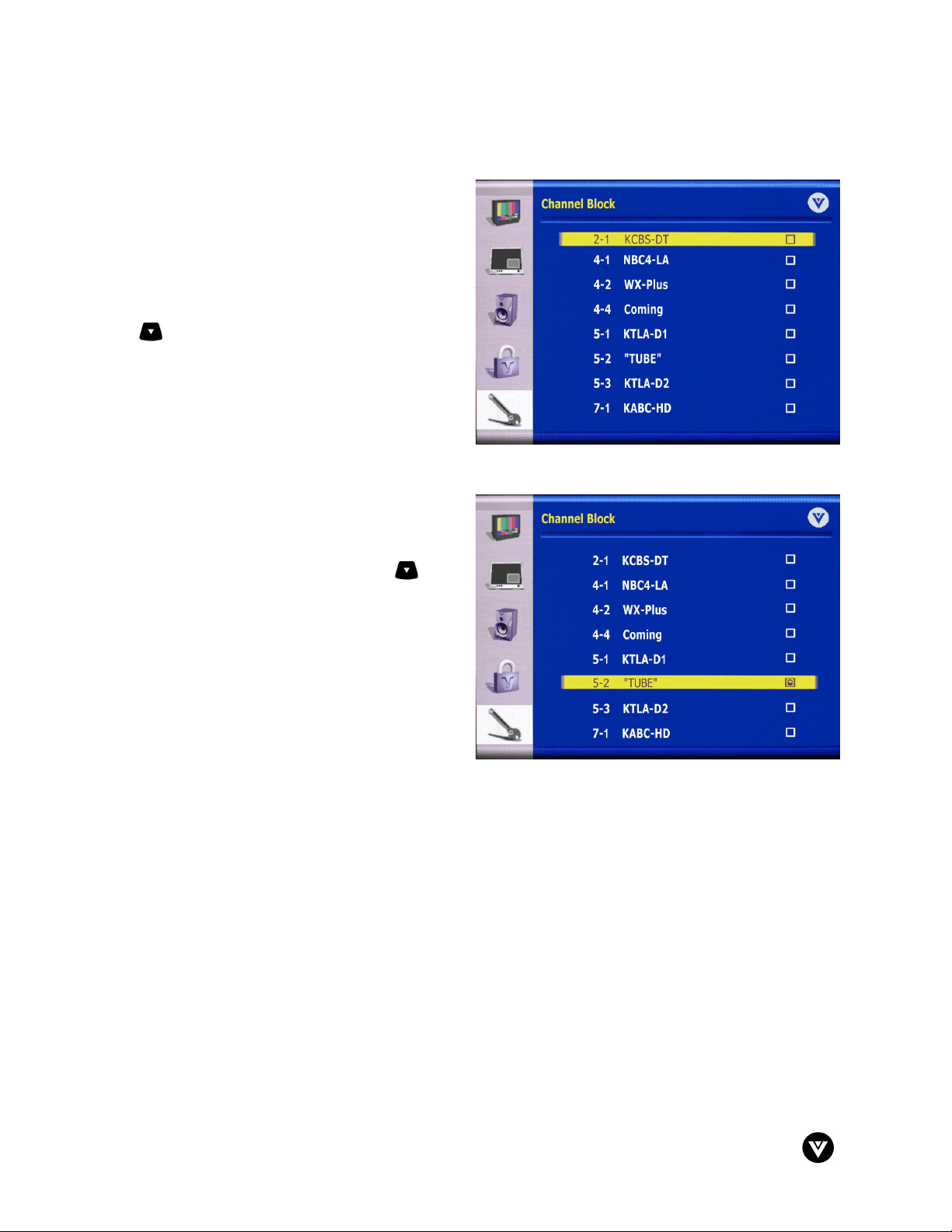
The list of channels available and stored in
memory is shown on the screen. If the list is
longer than 8 channels, as you repeatedly press
the button you will be able to scroll through to
see them all. The boxes to the right of the channel
names are empty by default.
As you scroll down the channels with the button,
each one is highlighted in turn. When a channel
you want to block is highlighted, press the OK
button and a check mark (
9
) will appear in the box
opposite that channel. This means that when this
channel is selected a password request bar will
appear on the screen and you will not be able to
view this channel without first entering the
password. Press EXIT to navigate away from this
screen when finished.
NOTE: If you use the Clear All function on the main
Parental Controls menu, it will NOT clear any channels
that are selected as Blocked on this page. Channels
blocked on this page can only be Unblocked individually
on this page.
VIZIO P50HDTV User Manual
Version 5/23/2006 44
www.VIZIOCE.com
3.4.2 DTV Channel Information
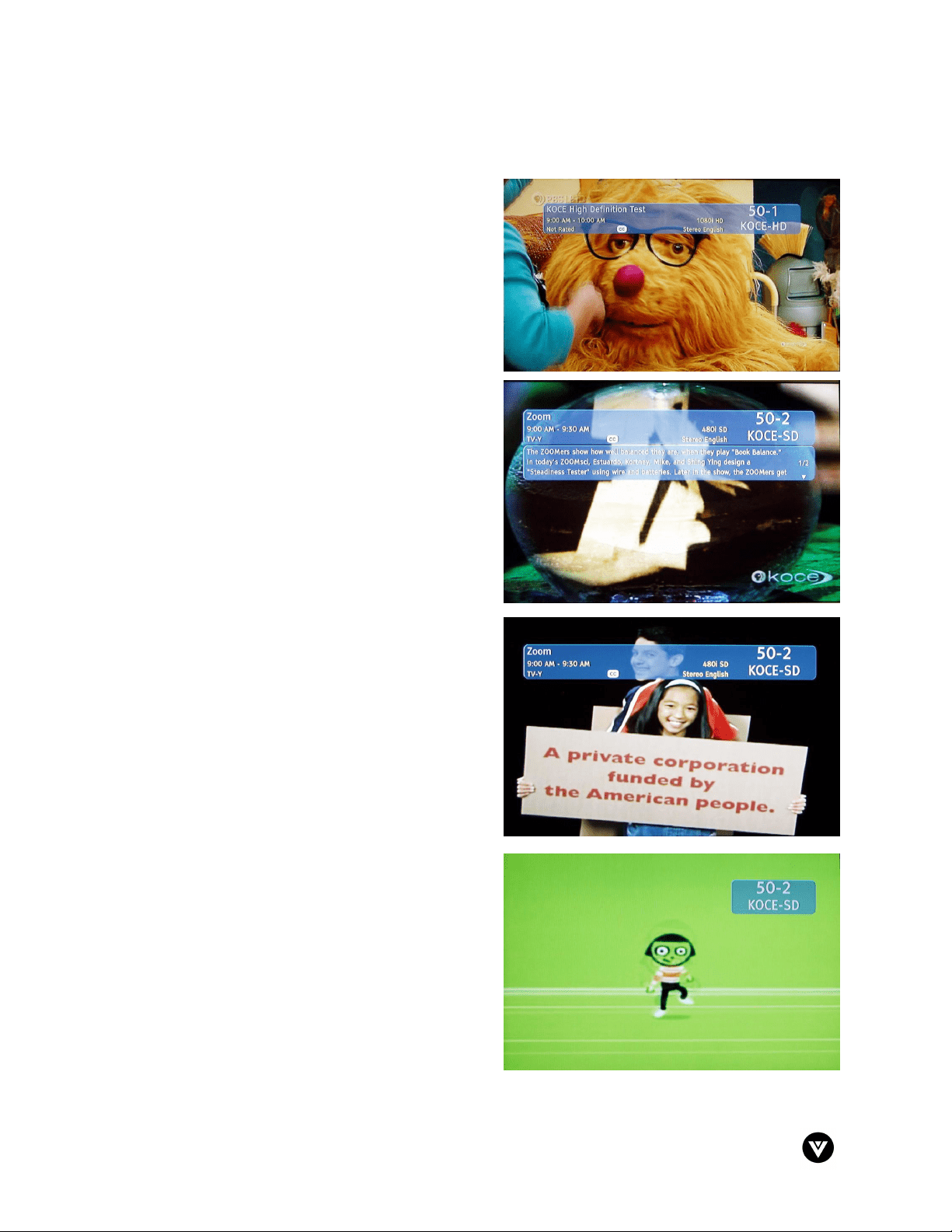
When a channel is selected, an information header is
shown over the picture for a few seconds. This
information consists of the channel number and name,
the format in which the program is broadcast (480i SD,
480P SD, 720P HD, 1080i HD), audio channel 1/2 or
2/2 (omitted if alternate channel is not broadcast),
language, program title, program start and end time,
program rating and if CC is available.
When you press the INFO button on the remote, you
not only get the information header displayed, but also
a short summary of the program content when
available from the broadcaster. If you do nothing else
with the INFO button, these panels will remain on the
screen, even when changing channels.
Press the INFO button and the program summary will
disappear, but the information header will remain.
Press the INFO button again and only the channel
number and name will remain. Press the INFO button
one more time and this will disappear.
VIZIO P50HDTV User Manual
Version 5/23/2006 45
www.VIZIOCE.com
3.4.3 Program Information
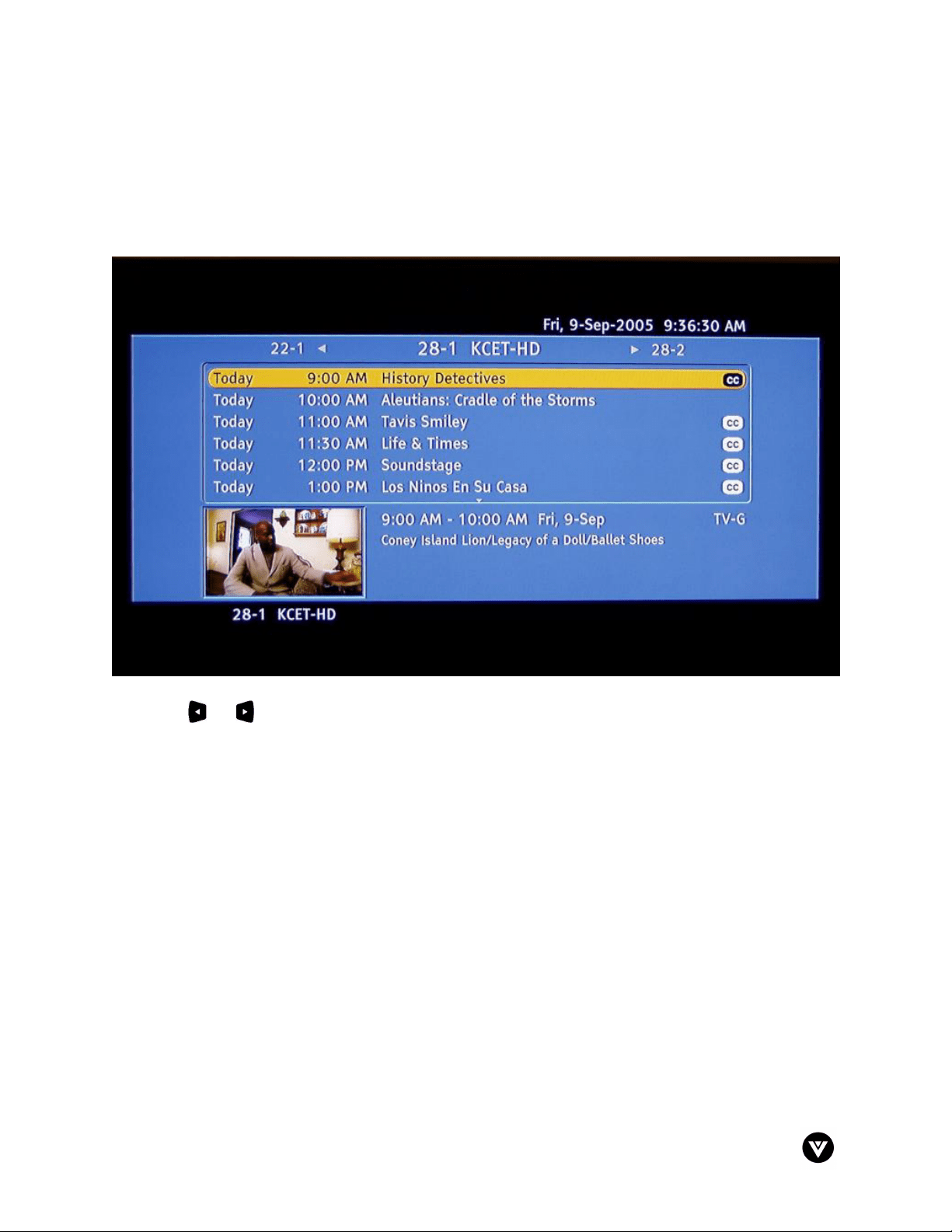
Press the GUIDE button on the remote and program information for the channel you are watching will be
displayed on the screen with the live program content in a small window in the lower left corner of the
panel.
Press the or button to scroll up or down the channels. Each time you pause at a channel, the
program list will update with the program schedule for the channel and the window will show the live
program for that channel. Press the GUIDE button to exit this feature.
VIZIO P50HDTV User Manual
Version 5/23/2006 46
www.VIZIOCE.com
3.4.4 Setting a Password
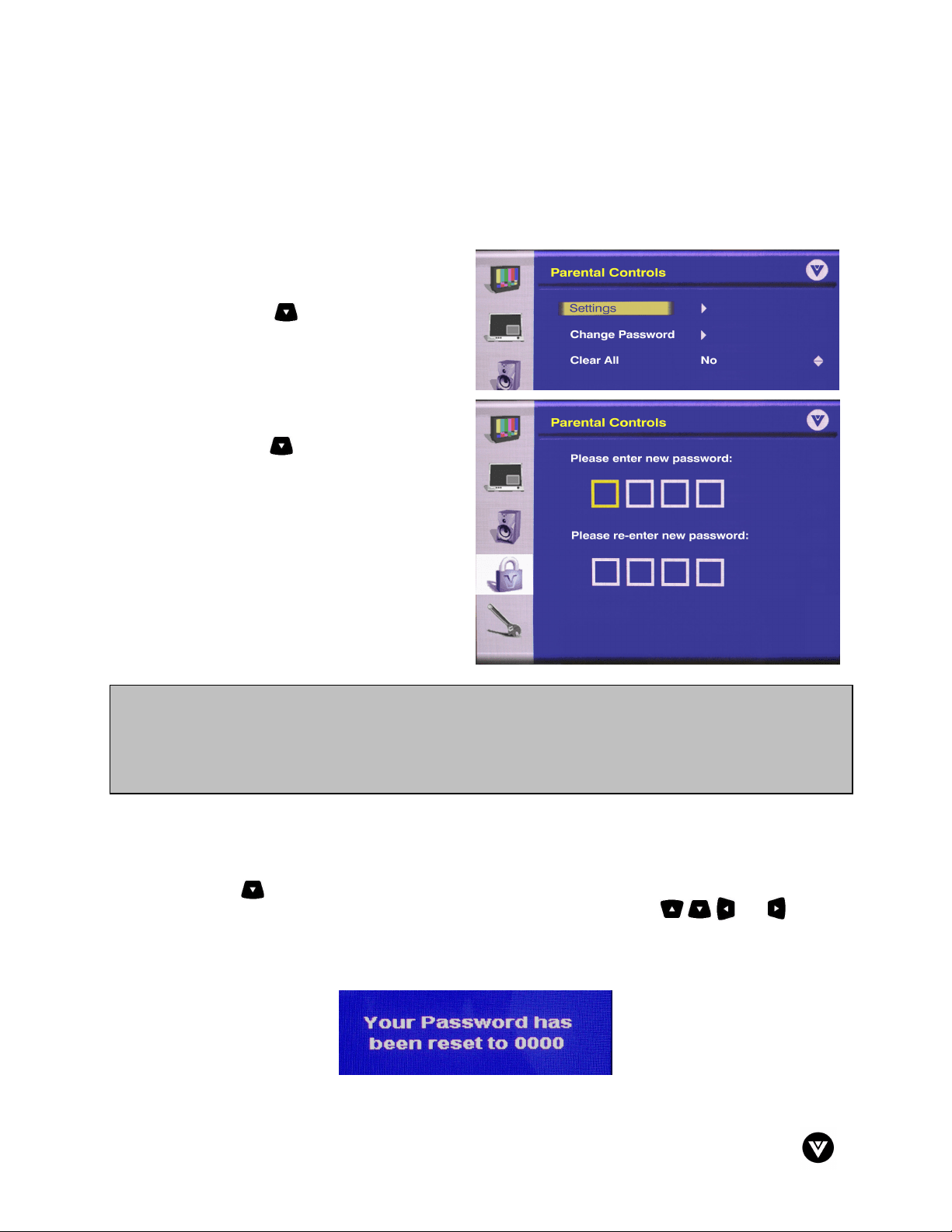
You control access to the Parental Control features with a password. The default password is “0000”.
You can change the password to any four-digit number.
To change the password:
1. Press the MENU button to open the
main On Screen Display (OSD) menu.
2. Press the button on the remote
control three times until the Parental
Control menu opens. Press OK.
3. Enter your password. If you have not
set a password, use the Number
Buttons to enter the default password
“0000”.
4. Press the button on the remote
control to highlight Change Password.
Press OK.
5. Enter your new password.
6. Enter the new password again in the
Confirm area.
7. Press OK.
8. Press MENU repeatedly to exit the
menu.
To reset the password:
1. Press the MENU button on the remote control and the Main Menu will be displayed on the
screen, as shown opposite.
2. Press until the Parental Controls menu is highlighted. Then press OK.
3. When the first box is highlighted in the Password option, press the and buttons
in the exact sequence.
4. Then press the OK button.
5. The password has now been reset to “0000" and the following message will appear.
Note:
a) Make sure you write down and store the new password in a secure place. The reset option
in the Special Features menu (Section 3.5.9) does not reset the password.
b) The DTV Parental Control password will always be the same as this one.
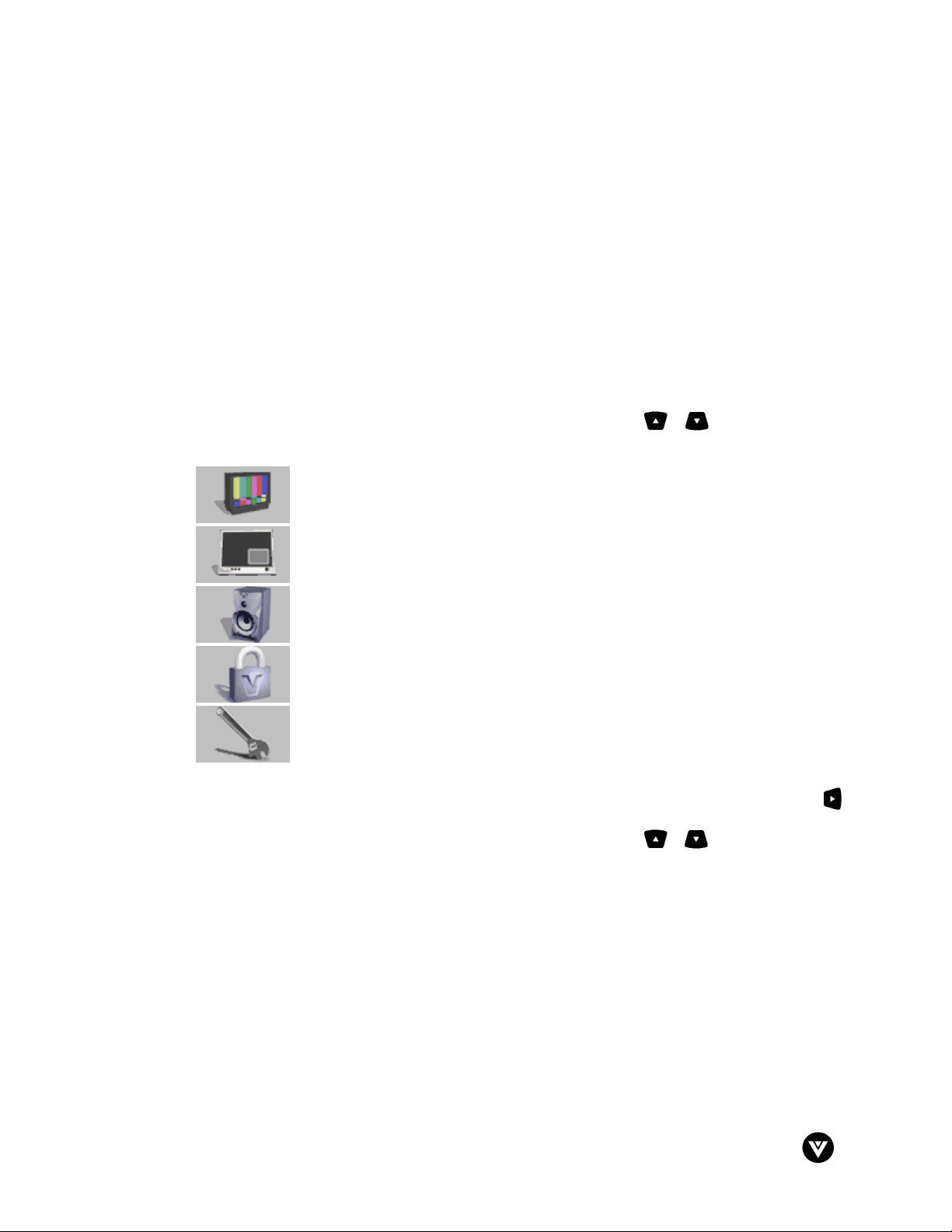
VIZIO P50HDTV User Manual
Version 5/23/2006 47
www.VIZIOCE.com
3.5 Using the On Screen Display (OSD)
The remote control or the control buttons on the right hand side of the TV can control all the function
settings. The On Screen Display (OSD) allows you to adjust the save contrast, brightness and other
settings. The TV will save changes made to the settings, even if the TV is turned off.
3.5.1 OSD Menu Operations
The OSD consists of several menu options: Image Settings, Display Settings, Audio Adjust, Parental
Controls, and Setup. The main menu options may very depending on your selected input source.
Note: Some of the main menu options may have additional submenus, i.e. the TV Rating submenu for
Parental Controls.
1. Press the MENU button on the front of the TV or the MENU button on the remote control.
The Main Menu will be displayed on the TV screen.
2. Use the CH+ or CH- buttons on the side of the Plasma TV, or the or button on the
remote control to select one of the submenus:
Image Settings
Display Settings
Audio Settings
Parental Controls
Setup
3. Once the submenu is highlighted, use the Vol+ button on the side of the Plasma TV, or the
buttons on the remote control to select a menu option.
4. Use the CH+ or CH- buttons on the side of the Plasma TV, or the or button on the
remote control to select the options settings.
5. Press the OK button on the remote control to confirm the feature.
6. Repeat steps 2 through 5 to adjust additional options within this menu.
7. Once the adjustments are completed, press the EXIT button on the remote control to exit the
OSD completely.

VIZIO P50HDTV User Manual
Version 5/23/2006 48
www.VIZIOCE.com
3.5.2 Image Settings for Video Inputs
Note: there are different image setting options when the RGB input is selected. Please see section 3.5.4
– Image Settings (for PC) on page 49 for additional information.
Picture Mode – Options include Custom, Vivid,
Movie, Game, and Sport.
Custom – allows the user to manually
customize individual image settings.
Vivid – automatically increases the saturation
level for an optimized picture.
Movie – automatically decreases the
brightness and contrast level for an
optimized picture.
Game – automatically increases the contrast
level and slightly decreases brightness
level for an optimized picture.
Sport – automatically increases contrast and
saturation levels for an optimized picture.
Brightness – Adjusts the black levels of the picture. You may need to readjust the brightness after the
TV warms up.
Contrast – Adjusts the level of white between the lightest and darkest portions of an image. If the
contrast is too low, picture appears dark and lacks detail. If the contrast is too high, the picture appears
faded and lacks shadow and depth.
Saturation – Adjusts the levels of white and color in the picture. Highly saturated colors tend to be deep
and strong while unsaturated colors are weaker and lighter.
Hue – Adjusts to make the flesh tones more natural.
Sharpness – Adjusts the clarity of the picture. If the sharpness is set too high, hard edges in the picture
appear to have a ghost image.
Advanced – Please see below for additional information regarding these options.
Custom Color – Allows you to adjust the separate red, green and blue color levels to your individual
preference.
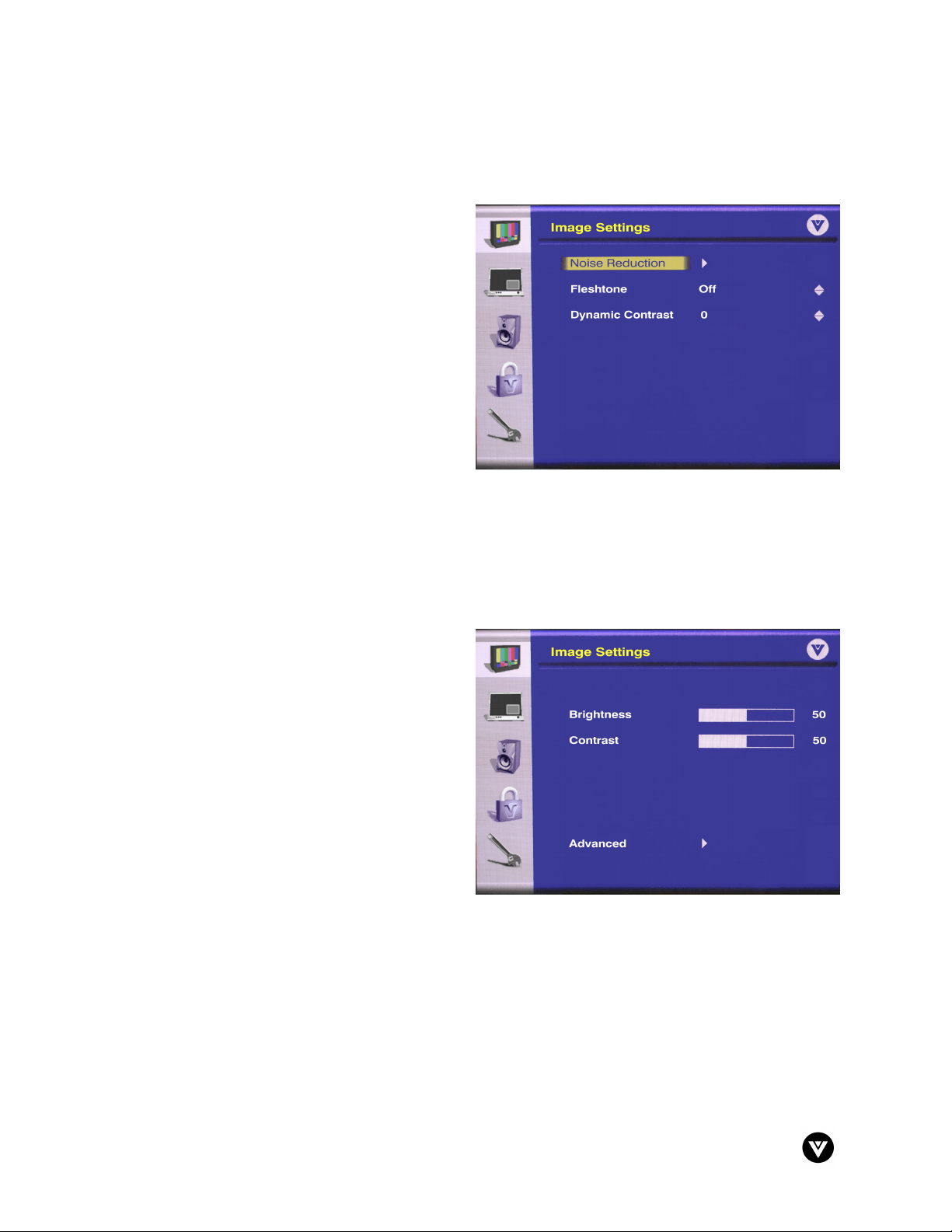
VIZIO P50HDTV User Manual
Version 5/23/2006 49
www.VIZIOCE.com
3.5.3 Advanced Image Settings for Video inputs
When you select “Advanced” within the image settings submenu. The following options will appear.
Noise Reduction – when you select Noise
Reduction, the following submenu options will
appear:
Motion (Motion Noise Reduction - MNR) –
This feature helps to remove picture noise
caused by fast moving video that may be
present in the picture.
Digital (Digital Noise Reduction - DNR) – This
feature helps to remove picture noise
caused by MPEG compression that may
be present in the picture.
Fleshtone – Options include the following: Off,
Low, Moderate, and High.
Dynamic Contrast – Changes the level of
contrast for each screen. Select from 1 (minor) to
3 (strong).
3.5.4 Image Settings (for PC)
The following menu options are available when RGB is the selected input.
Brightness - Adjusts the black levels of the
picture. Users may need to readjust the
brightness after the
plasma monitor warms up.
Contrast – Adjusts the level of white between the
lightest and darkest portions of an image. If
the contrast is too low, the picture appears
dark and lacks detail. If the contrast is too high,
the picture appears faded and lacks shadow
and depth.
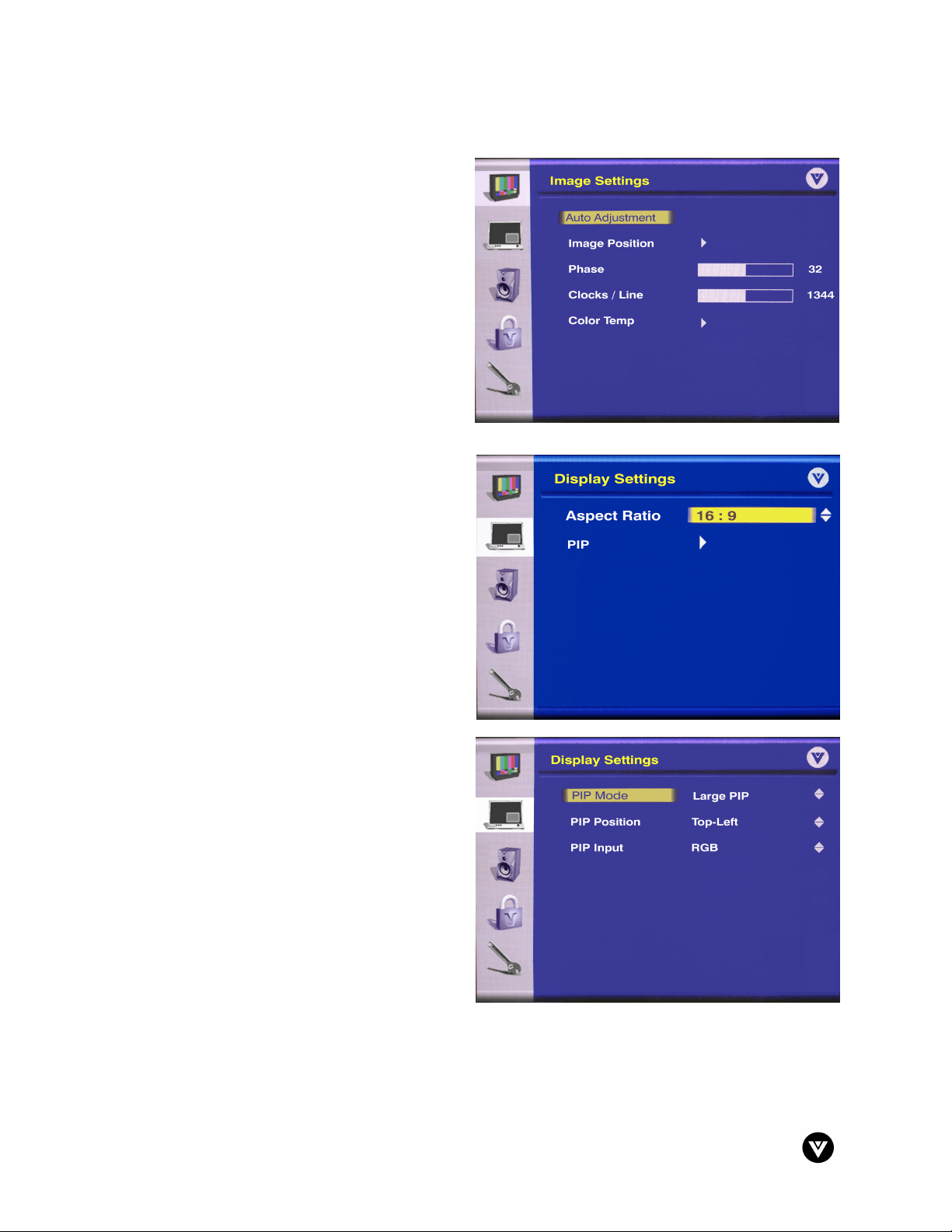
VIZIO P50HDTV User Manual
Version 5/23/2006 50
www.VIZIOCE.com
3.5.5 Advanced Image Settings for PC
Auto Adjustment - Automatically sets the position
and size of the picture.
Image Position - Allows the user to manually set
the position of the picture on the display.
Phase – Removes any horizontal distortion and
clears or sharpens the displayed characters.
Clock – Removes any vertical distortion and
clears or sharpens the displayed characters.
Color Temp - Options include standard, cool,
warm or customized by the user.
3.5.6 Display Settings
Aspect Ratio – Options include one of the
following: Panoramic (available only in video
mode), Normal, Wide and Zoom (not available
for RGB input). For additional information, see
Section 3.5.10 - Understanding Viewing
Features on page 53.
PIP – when you select PIP, the following submenu
options will appear:
PIP Mode – Choose from the following: Off,
Large PIP, Small PIP and POP.
PIP Position – Choose from the following:
Top-Left, Top-Right, Bottom-Left, and
Bottom-Right.
PIP input – Choose the input for the PIP
source from one of the following: AV1 (S-
Video or video*), AV2 (S-Video or video*),
Component 1, Component 2, HDMI 1,
HDMI 2, and RGB.
*S-Video has priority. If a signal is connected to AV1
S-Video by itself or signals are connected to AV1 S-Video and AV1 Video simultaneously, then S-Video will be the only
choice for AV1. If a signal is connected to AV1 Video only, then Video will be the only choice for AV1. The same input
priority scheme applies to AV2.
For additional information regarding the PIP source options, see section 3.5.12 - Picture-in-Picture (PIP)
Mode on page 54.
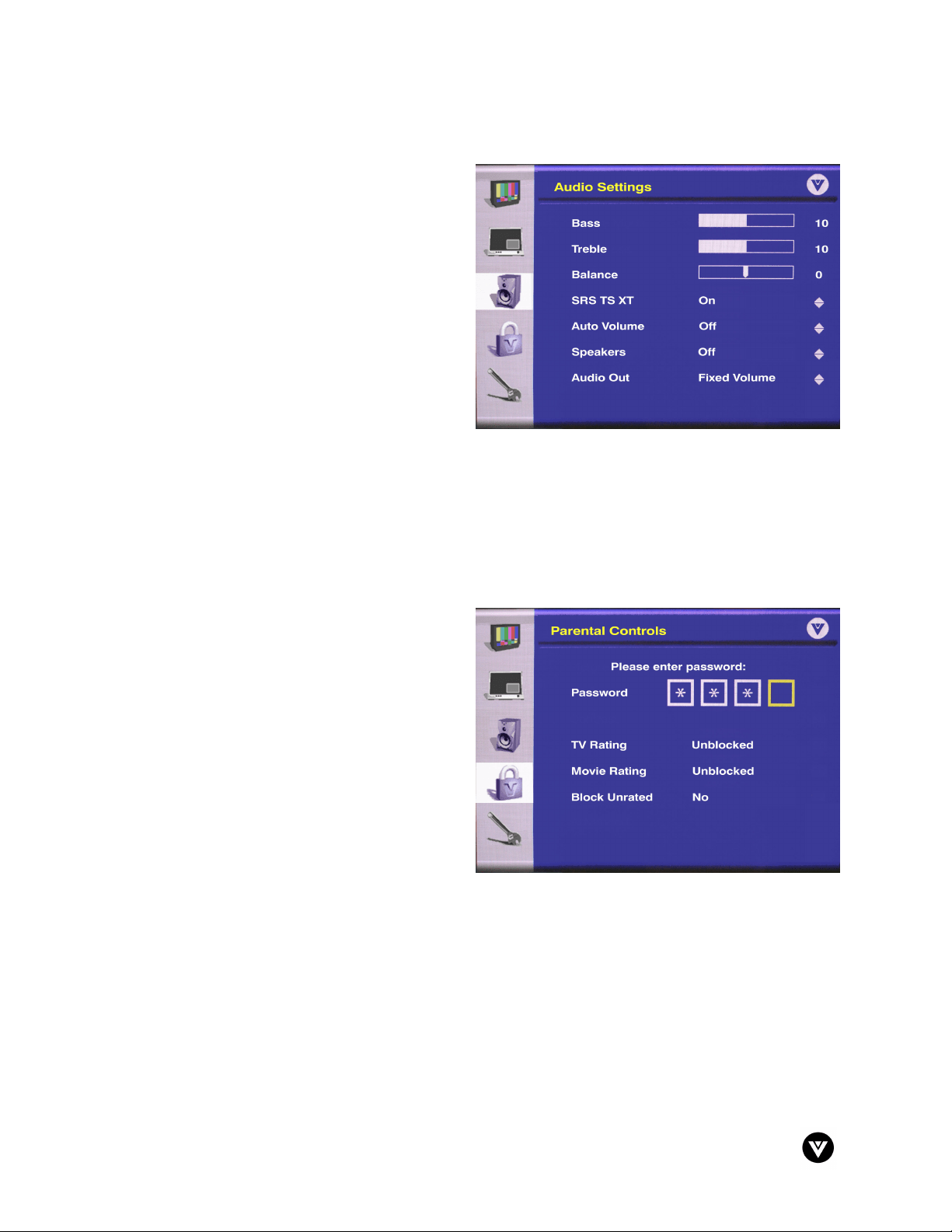
VIZIO P50HDTV User Manual
Version 5/23/2006 51
www.VIZIOCE.com
3.5.7 Audio Settings
Bass - Adjusts the bass.
Treble – Adjusts the treble.
Balance – Adjusts the balance level between the
channels.
SRS TS XT – Selects either on or off for surround
sound.
Auto Volume – Adjusts the volume so that each
input is at the same level.
Speakers - Turns the internal speakers on or off.
Audio out – Options include Fixed Volume or
Variable Volume. Note: this option is only
available when the internal speakers are
turned off.
3.5.8 Parental Controls
Note: you will need to enter in a password to access the submenus. The default password is “0000”. It is
advised that you change this password during the initial set up.
TV Rating - Sets the level of television programs
that will be blocked without entering in the
password. For more information, see Section
3.5.14 - Using the Parental Controls, page 55.
Movie Rating - Sets the level of movies that will
be blocked without entering in the password.
For more information, see Section 3.5.14 -
Using the Parental Controls, page 55.
Block Unrated – Allows for the user to block
programs that do not have any TV or Movie
rating and are classified as “Unrated”.
For more information on Parental Controls see Section 3.5.14 – Using the Parental Controls, page 55.

VIZIO P50HDTV User Manual
Version 5/23/2006 52
www.VIZIOCE.com
3.5.9 Setup
Close caption – Choose from one of the
following: CC1, CC2, CC3, CC4, TEXT1,
TEXT2, TEXT3, TEXT4
Language: Changes the language of the OSD
menu. Options include English, Spanish and
French.
Factory Reset - Resets the display back to the
factory default settings.
Image Cleaner (VIC): – Removes ghosts of
previous images.
Note: Prolonged display of stationary images will cause them to remain on the screen.
Higher brightness levels will make the panel more susceptible to retaining images. This
feature will not remove images that have been displayed for too long. Image sticking is not
covered under standard warranty.
Firmware Version – Displays the version of the firmware.
When Close Caption is selected, the following
options will appear:
Display – Choose from the following options: CC1,
CC2, CC3, CC4, TEXT1, TEXT2, TEXT3, and
TEXT4.
Captions on Mute – Enables Closed Caption to
be displayed when the audio is muted.

VIZIO P50HDTV User Manual
Version 5/23/2006 53
www.VIZIOCE.com
3.5.10 Understanding Viewing Features
Your Plasma TV features four viewing modes and Picture-In-Picture (PIP)/Picture-by-Picture (POP) mode.
You can switch viewing modes using the On Screen Display (OSD) or the remote control. For more
information on using the OSD, see Section 3.5.6 – Display Settings, page 50.
3.5.11 Viewing Modes
Normal Mode
The original 4:3 aspect ratio (1.33:1 source) is preserved, so black bars are
added to the left and right of the display image. Standard TV broadcasts are
displayed with a 4:3 Aspect Ratio. Movies in 4:3 Aspect Ratio may be referred
to as pan-and-scan or full frame. These movies were originally filmed in 16:9
(widescreen), and then modified to fit a traditional TV screen (4:3).
Wide Mode
When watching a standard broadcast or full-frame movie in this mode,
the display image is stretched proportionately to fill the TV screen.
When watching a widescreen (1.78:1 source) program or movie, the
display image fills the TV screen. If you are watching a widescreen
(1.85:1 or 2.35:1 source) program or movie, there will still be black
bars at the top and bottom.
Zoom Mode
When watching a widescreen (1.78:1, 1.85:1, or 2.35:1 source)
program or movie, the display image is zoomed proportionally to fill the
width of the screen. The top and bottom are cut off to remove most of
the source material’s black bars. This mode is good for programs or
movies with sub-titles.
Panoramic Mode
When watching a standard broadcast or full frame movie in this mode,
the 4:3 Aspect Ratio (1.33:1 source) display image is stretched
horizontally on the left and right sides to fill the TV screen. The center
of the image is not stretched.
Note: Viewing modes and volume settings are saved based on input. For example, you lasted watched
a DVD in widescreen mode and then watched TV in standard mode. When you switch back to DVD
input, the viewing mode will return to widescreen.
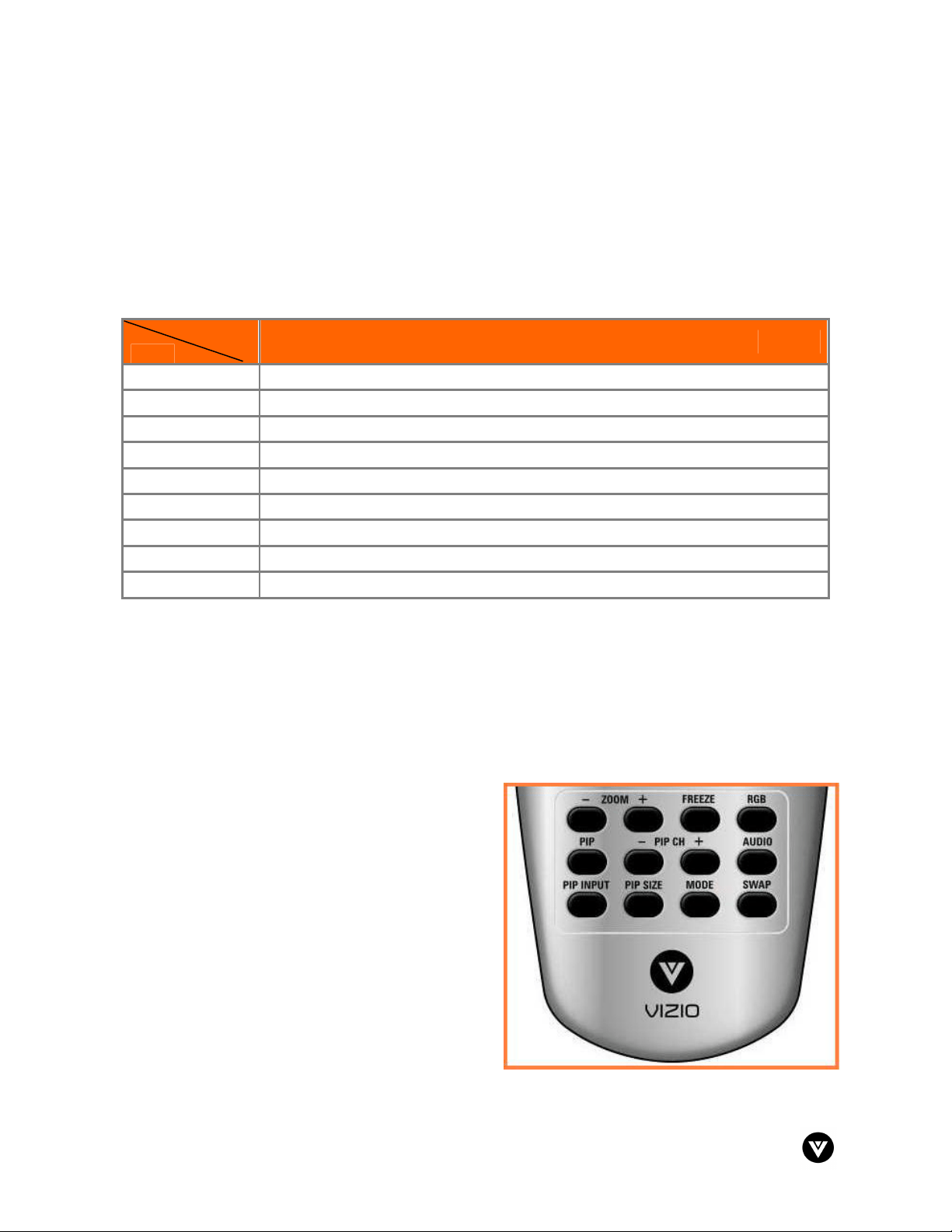
VIZIO P50HDTV User Manual
Version 5/23/2006 54
www.VIZIOCE.com
3.5.12 Picture-In-Picture(PIP)/Picture-by-Picture(POP)Mode
Your TV features PIP mode so you can watch two pictures at the same time. When PIP is turned on, you
can display two pictures at one time. One picture is displayed as the full screen (main screen) and the
other picture is displayed in a small window (sub screen). The sub-screen can be set to small, medium or
large.
See below for detailed information regarding the PIP sources.
SUB
MAIN
DTV TV AV1 AV2
Component
1
Component
2
RGB HDMI 1 HDMI 2
DTV
9 9 9 9
9
9 9
TV
9 9 9 9
9
9 9
AV1 9 9
9 9 9
9
9 9
AV2 9 9
9
9 9
9
9 9
Component 1
9
9
9 9
9
9
9 9
Component 2 9 9
9 9 9
9
9 9
RGB
9 9 9 9 9 9
9 9
HDMI 1 9 9
9 9 9 9
9
9
HDMI 2 9 9
9 9 9 9
9
9
“
9” – Indicates which inputs are available for PIP and POP modes.
*When HDMI is used for the Sub-Screen it cannot support 1080i.
3.5.13 Adjusting Basic PIP/POP Settings
PIP Channel
The PIP channel is independent of the Main screen
DTV/TV channel. To change the PIP screen channel,
press the PIP CH + or - button on the remote control.
To change the Main screen channel, press the CH +
or – button on the remote control.
Swapping PIP/POP Video
You can swap the program that is in the main picture
with the program in the PIP sub-picture. To swap the
main picture program with the PIP sub-picture program,
press SWAP on the remote control. If you press
SWAP again, it will return the program to the main
picture. This works the same if you are in the Picture-
by-Picture (POP) mode.
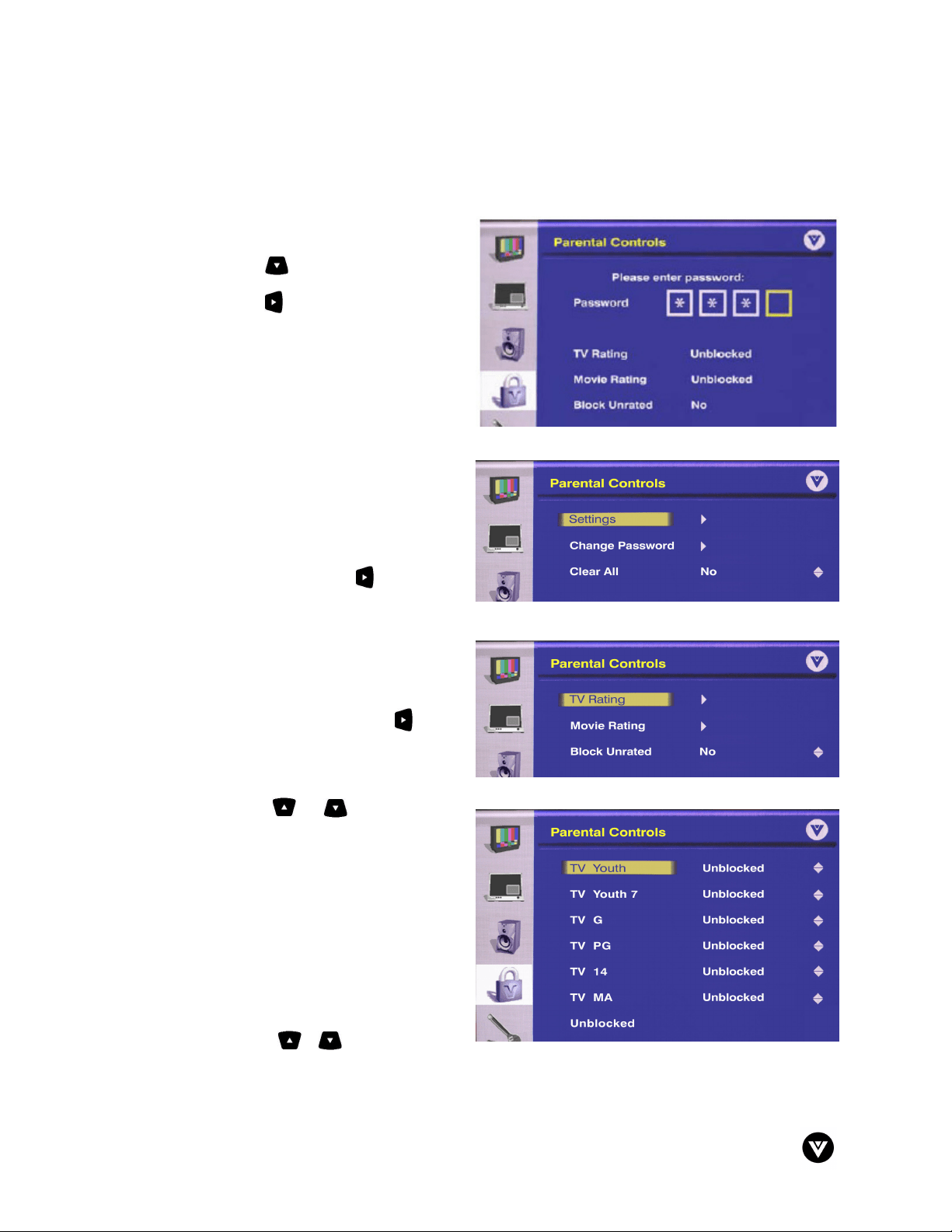
VIZIO P50HDTV User Manual
Version 5/23/2006 55
www.VIZIOCE.com
3.5.14 Using the Parental Controls
The Parental Controls feature prevents viewers from watching programs that are not age-appropriate,
such as programs containing violence or adult language.
Press the MENU button to open the main On
Screen Display (OSD) Menu.
1. Press the button until the Parental
Controls menu is highlighted. Then
press the button.
2. Enter your password. If you have not
set a password, use the Number
Buttons to enter the default password
“0000”. For more information about
setting a password, please see
Section 3.4.4 - Setting a Password,
page 46.
3. The Parental Controls page is now
shown and the Settings option is
highlighted. Press the button.
4. The page content changes to the
settings options, the TV Rating option
being highlighted. Press the button.
5. Press the or button to select
which rating you want to block or
unblock. You can select from the
following ratings:
• TV Youth (all children)
• TV Youth 7 (older children)
• TV G (general audience)
• TV PG (guidance suggested)
• TV 14 (strongly cautioned)
• TV MA (mature audience)
• Unblocked
Then Press OK.
6. Press the or button to select
Blocked or Unblocked. Press OK.
7. Press Menu to back out of the menu.
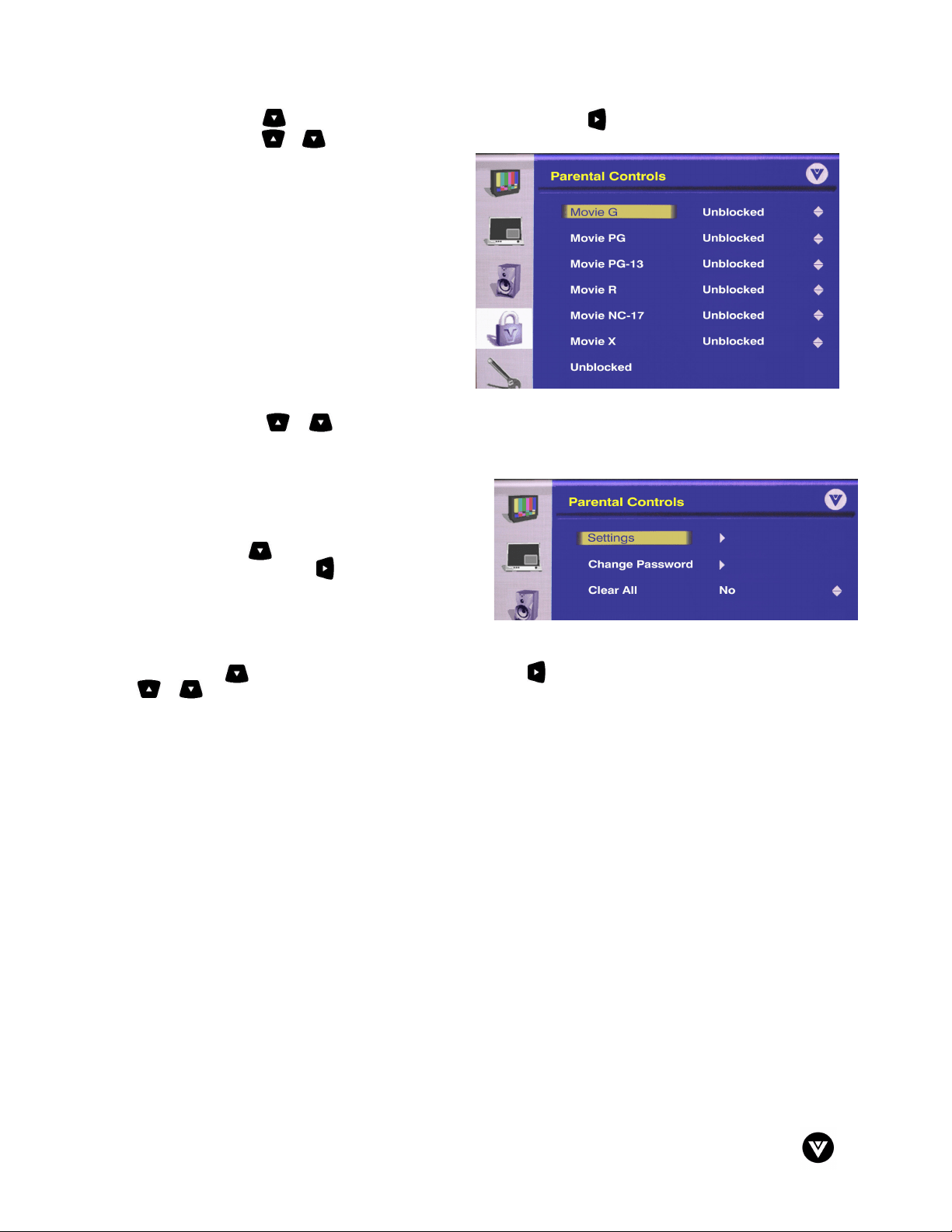
VIZIO P50HDTV User Manual
Version 5/23/2006 56
www.VIZIOCE.com
8. Press the button to highlight Movie Rating. Press the button.
9. Press the or button to select which rating you want to block or unblock. You can select
from the following ratings:
• Movie G (General audience)
• Movie PG (Parental guidance
suggested)
• Movie PG-13 (Recommended for
children 13 years of age and
older)
• Movie R (mature audience)
• Movie NC-17 (no one under 17
years of age)
• Movie X (no one under 17 years
of age)
• Unblocked
Then Press OK.
11. Press the or button to select Blocked or Unblocked. Press OK.
12. Press Menu repeatedly to exit the menu.
To change the Password for Parental Controls
access, press the button to highlight Change
Password and then press the button. See Section
3.4.4 – Setting a Password, page 46.
To clear all blocked settings, (except DTV blocked channels, see Section 3.4.1 – Parental Controls for
DTV), press the button to highlight Clear All. Press the button to select the option and then press
the or button to choose Yes.

VIZIO P50HDTV User Manual
Version 5/23/2006 57
www.VIZIOCE.com
3.6 Programming the VIZIO Universal Remote Control
You can program the remote control to work with up to four different components. Listed below are the
steps for programming your VCR, Cable Box and DVD Player.
3.6.1 Programming for VCR
1. Manually turn on the VCR.
2. Press the VCR button on the remote control.
3. Press and hold the SETUP button until the LED LIGHT flashes twice.
4. Find the programming code for your VCR in the code list in the back of this book and enter it using
the Number Buttons. If the code is accepted, the LED flashes twice after the last digit is entered.
If the LED does not flash twice, repeat Steps 2 through 4 with the next code listed for the component
and manufacturer.
5. Point the remote control at the VCR and press the POWER button. The VCR will turn off.
3.6.2 Programming for Cable Set-Top Box
1. Manually turn on the Cable Box.
2. Press the CBL button on the remote control.
3. Press and hold the SETUP button until the LED LIGHT flashes twice.
4. Find the programming code for your Cable Box in the code list in the back of this book and enter it
using the Number Buttons. If the code is accepted, the LED flashes twice after the last digit is
entered.
If the LED does not flash twice, repeat Steps 2 through 4 with the next code listed for the component and
manufacturer.
5. Point the remote control at the Cable Box and press the POWER button. The Cable Box will turn off.
Note:
a) If your VCR does not respond, try all the codes for your VCR brand. If the codes do not
work, or your brand is not listed, see “Searching for Component Codes.”
b) Sometimes a code listed will only include limited functions. Try other codes that may
include more functionality.
Note:
a) If your Cable Set-Top Box does not respond, try all the codes for your brand. If the codes
do not work, or your brand is not listed, see “Searching for Component Codes.”
b) Sometimes a code listed will only include limited functions. Try other codes that may
include more functionality.

VIZIO P50HDTV User Manual
Version 5/23/2006 58
www.VIZIOCE.com
3.6.3 Programming for DVD Player
1. Manually turn on the DVD Player.
2. Press the DVD button on the remote control.
3. Press and hold the SETUP button until the LED LIGHT flashes twice.
4. Find the programming code for your DVD player in the code list in the back of this book and enter it
using the Number Buttons. If the code is accepted, the LED flashes twice after the last digit is
entered.
If the LED does not flash twice, repeat Steps 2 through 4 with the next code listed for the component and
manufacturer.
5. Point the remote control at the DVD Player and press the POWER button. The DVD Player will turn
off.
3.6.4 Searching for Component Codes
If you cannot find the manufacturer in the component list or the program code does not work, you can use
the remote control to search for the correct component code.
To search for a component code:
1. Turn on the component.
2. Press the matching component button on the remote control.
3. Press and hold the SETUP button until the LED flashes twice.
4. Press 9 9 1. The LED flashes twice.
5. Point the remote control at the component and then alternate between pressing the POWER
button and the component button on the remote control until the component turns off.
If the component still does not respond, clear the component button, then repeat the search
procedure.
3.7 Using a Cable or Satellite Remote
Your VIZIO remote uses codes 11758 and 10178 to work your Plasma TV. To use a cable or satellite
remote to work the Plasma TV, refer to your cable or satellite remote user guide for more information on
how to program the remote. If your cable or satellite remote uses a 5-digit code (like most Direct TV
units), first try 11758 and then, if that does not work, 10178. If your cable or satellite remote uses a 4-
digit code, try 1758 and then 0178 as an alternative. If your cable or satellite remote uses a 3-digit code
(Echostar or Dish Network for example), use code 627.
Note: Some buttons may not function as expected on your cable or satellite remote. Typically power,
volume and mute will work.
Note:
a) If your DVD player does not respond, try all the codes for your brand. If the codes do not
work, or your brand is not listed, see “Searching for Component Codes.”
b) Sometimes a code listed will only include limited functions. Try other codes that may
include more functionality.
VIZIO P50HDTV User Manual
Version 5/23/2006 59
www.VIZIOCE.com
Chapter 4 Maintenance and Troubleshooting
4.1 Maintenance
Important
1. Make sure that the power cable is removed from the socket before cleaning the TV.
2. Do not use volatile solvent (such as toluene, rosin and alcohol) to clean the TV. Such
chemicals may damage the housing, screen glass and remote control, and cause paint to
peel.
Cleaning the Housing and Remote Control
1. Use the VIZIO soft cloth (included) for cleaning.
2. If the housing or remote control is seriously contaminated, use a soft cloth moistened with
diluted neutral cleaner to clean the display. Wring water out of the cloth before cleaning to
prevent water from penetrating into the housing. Wipe the display with a dry cloth after
cleaning.
Cleaning the Screen
1. Use the VIZIO soft cotton cloth (included) to gently clean the screen.
2. The screen glass is very fragile. Do not scrape it with any sharp object. Do not press or tap
the screen to avoid cracking. When the screen is seriously contaminated, use a soft cloth
moistened with diluted neutral cleaner to clean the display. Wring water out of the cloth
before cleaning to prevent water from penetrating into the housing. Wipe the display with a
dry cloth after cleaning.
4.2 Troubleshooting Guide
If the TV fails or the performance changes dramatically, check the display in accordance with the
following instructions. Remember to check the peripherals to pinpoint the source of the failure. If the
display still fails to perform as expected, contact the VIZIO for assistance by calling 1-714-668-0588 or e-
mail us at
Problem Solution
No power. Make sure the power button is ON (Green LED).
Make sure AC power cord is securely connected to the AC socket.
Plug another electrical device (like a radio) to the power outlet to verify that the
outlet is supplying the proper voltage.
No sound. Check your audio connection
Press MUTE on the remote control again, so that MUTE disappears from the screen
Check your audio settings, your TV audio may be set to SAP or minimum
Press the Volume + (Up) key on your remote control
Make sure that headphones are not connected
If the screen is black. Check your input connections.

VIZIO P50HDTV User Manual
Version 5/23/2006 60
www.VIZIOCE.com
Problem Solution
Power is ON but no screen
image.
Make sure the video cable supplied with the TV is secured to the correct video
output port on the back of the VCR and the TV. Make any cable you have attached
to the TV is secured to the correct output your Set-Top Box, DVD, etc.
Adjust brightness and contrast.
Check Source settings.
Wrong or abnormal colors
appear.
If any colors (red, green, or blue) are missing, check the video cable to make sure it
is securely connected.
Control buttons do not work. Press only one button at a time.
Remote Control does not
work.
Make sure batteries are inserted correctly
Batteries could be weak.
Make sure you have selected TV on the remote.
There appears to be image
quality issues.
For best image quality, view HD wide screen programs where possible. If HD
content is not available view “Standard Definition” from a digital source. Standard,
analog TV will always be noticeably inferior to HD because your digital flat panel TV
has video that is many times better than old TV’s and so you can see interference
and deficiencies you did not know you had.
You cannot see a picture. Make sure that the power cord is plugged into a grounded electrical outlet.
Make sure that the power button is turned on.
Make sure that the selected input source is connected to a working input source.
If your TV is connected to your computer in RGB or HDMI mode, press any key on
your keyboard to “wake” your computer.
You see a distorted picture or
hear unusual sound.
You may be getting interference from electrical appliances, cars, motorcycles, or
fluorescent lights. If you have not mounted it on the wall, try moving your TV to
another location to see if this is the cause of the problem.
The picture has abnormal
patterns.
Make sure that the input source cable is attached securely and correctly to the back
of your TV.
Make sure that the video input source is within the range of your TV. Compare the
video input source’s specifications with your TV specifications.
The display image does not
cover the entire screen.
If you are using RGB mode, make sure that H Size and V Position in the On Screen
Display (OSD) are set correctly.
If you are using TV, AV1, AV2, AV3 or Component with 480i input, use the WIDE
button on the remote control to scroll through various screen modes.
You can see a picture but you
cannot hear sound.
Make sure that the volume is not turned down.
Make sure that the sound is not muted.
Make sure that your audio input source cables are connected securely and correctly.
The TV has pixels that are
always dark or colored.
Your Plasma TV is manufactured using an extremely high level of precision
technology, however, sometimes some pixels of your Plasma TV may not display.
Pixel defects within industry specifications are inherent to this type of product and do
not constitute a defective product.
You see “noise” or “trash” on
the screen.
When your Plasma TV’s digital capabilities exceed a digital broadcast signal, the
signal is up-converted (increased) to match your TV’s display capabilities. Up-
converting can cause noise or trash.
You switch to a different input
and the volume changes.
The TV remembers the volume level from the last time you adjusted it. If the sound
level is higher or lower from another source, then the loudness will change.
You switch to a different input
and the screen size changes.
The TV remembers the viewing mode from the last time you used a particular input
(AV1, AV2, AV3, Component 1, Component 2, HDMI, and TV).
VIZIO P50HDTV User Manual
Version 5/23/2006 61
www.VIZIOCE.com
Tips for High-Definition Users. The Plasma TV is an ideal platform for viewing High Definition Content.
Best Image Quality will be achieved by the HDMI, Component (YPbPr), DVI or
RGB. However, due to variances in broadcast practices, it is possible some
image distortions can occur.
Tips for Letterbox Content Users. Letterboxed (or “Widescreen”) versions of DVD movies are most commonly
formatted for standard 4:3 Televisions. The Plasma TV has the capability of
expanding this content so the entire screen is filled at the expense of image
accuracy. To use this function, press the “ZOOM” key on the remote control
and cycle among the available options.
4.3 Telephone & Technical Support
Products are often returned due to a technical problem rather than a defective product that may result in
unnecessary shipping charges billed to you. Our trained support personnel can often resolve the problem
over the phone. For more information on warranty service or repair, after the warranty period, please
contact our Support Department at the number below.
Customer support and quality service are integral parts of VIZIO’s commitment to service excellence.
For technical assistance contact our VIZIO Technical Support Department via email or phone.
E-mail: techsupport@vinc.com
Tel: (714)668-0588
Hours of operations:
¾ 6:00am – 6:00pm PST Monday – Friday
¾ 10:00am – 2:00pm PST Saturday – Sunday
Please have your VIZIO model number, serial number and date of purchase available before you call.
VIZIO
320A Kalmus Drive
Costa Mesa, CA 92626
Tel: (714) 668.0588 Fax: (714) 668-9099
Web:
www.VIZIOCE.com

VIZIO P50HDTV User Manual
Version 5/23/2006 62
www.VIZIOCE.com
4.4 Compliance
Caution: Always use a power cable that is properly grounded. Please use the AC cords listed below for
each area.
USA UL
Canada CSA
Germany VDE
UK BASE/BS
Japan Electric Appliance Control Act
4.5 FCC Class B Radio Interference Statement
NOTE: This equipment has been tested and found to comply with the limits for a Class B digital device,
pursuant to Part 15 of the FCC Rules. These limits are designed to provide reasonable protection against
harmful interference in a residential installation. This equipment generates, uses and can radiate radio
frequency energy, and if not installed and used in accordance with the instructions, may cause harmful
interference to radio communications. However, there is no guarantee that interference will not occur in a
particular installation. If this equipment does cause harmful interference to radio or television reception,
which can be determined by turning the equipment off and on, the user is encouraged to try to correct the
interference by one or more of the following measures:
1. Reorient or relocate the receiving antenna.
2. Increase the separation between the equipment and receiver.
3. Connect the equipment into an outlet on a circuit different from that to which the receiver is
connected.
4. Consult the dealer or an experienced radio/TV technician for help.
Notice:
1. The changes or modifications not expressly approved by the party responsible for compliance
could void the user’s authority to operate the equipment.
2. Shielded interface cables and AC power cord, if any, must be used in order to comply with
the emission limits.
3. The manufacturer is not responsible for any radio or TV interference caused by unauthorized
modification to this equipment. It is the responsibilities of the user to correct such
interference.
VIZIO P50HDTV User Manual
Version 5/23/2006 63
www.VIZIOCE.com
Chapter 5 Miscellaneous Information
5.1 Specifications
Specifications
Panel 50” Diagonal, 16:9 Aspect Ratio
Resolution 1366 x 768 pixels
Pixel (Dot) Pitch 0.81mm (H) x 0..81mm (V)
Display Compatibility HDTV (720P)
Signal Compatibility 480i (SDTV), 480P (EDTV), 720P (HDTV), 1080i (HDTV)
Colors 231 Billion
Brightness 1,000 cd/m
2
(typical)
Contrast 10,000:1 (max)
Viewing Angle >170° (horizontal and vertical)
Inputs 1x RF, 2x Composite Video plus Stereo Audio, 2x S-Video plus Stereo Audio, 2x Component
YPbPr plus Stereo Audio, 1x Analog RGB plus Stereo Audio (shared with Digital Video), 2x
Digital Video (HDMI™**) with HDCP plus Stereo Audio (RCA)
Outputs 1x 5.1 Audio from DTV input only (SPDIF Optical), 1x Stereo Audio (RCA), 1x Headphone
(Stereo Mini-Jack)
Features Single Scan Technology for Higher Contrast, Reduced Solarisation and Reduced False
Contouring, PIP, POP, CC, V-Chip, 3D Comb Filter, Zoom, Freeze, DCDi® by Faroudja***
Motion Adaptive De-Interlace, 3-D Noise Reduction, Sharpness Improvement, Non-linear
Chroma Enhancement, Closed Color Suppression, Non-Linear Scaling, Adaptive Contrast
Speakers Built-in, 10W x 2
Panel Life 60,000 hours to half the original brightness
Power
Input IEC Connector for direct power line connection
Voltage Range 100 ~ 240Vac at 50/60Hz
Power Consumption 550W Max (490W average)
Environmental Conditions
Operating Temperature: 5°C~35°C, Relative Humidity: 20~80%, Altitude: 0~6,560 ft
Non-Operating Temperature: -20°C~50°C, Relative Humidity: 10~90%, Altitude: 0~9,840 ft
Dimensions 48.8” x 34.3” x 12.2” (1241 x 871 x 310 mm) w/stand, 48.8” x 33.5” x 3.89” (1241 x 850 x 99
mm) w/o stand
Net Weight 85 lbs with stand; 76 lbs without stand
Gross Weight 144 lbs (65.2 kg)
Certifications CSA, FCC Class B
*Product specifications may change without notice or obligation.
** HDMI, the HDMI logo and High-Definition Multimedia Interface are trademarks or registered trademarks
of HDMI™ Licensing LLC.

VIZIO P50HDTV User Manual
Version 5/23/2006 64
www.VIZIOCE.com
5.2 Glossary – Standard Definitions
Analog TV: Today’s TV system using radio frequency waves to transmit and display pictures and sound.
Aspect Ratio (4x3): Traditional TV “aspect ratio”, that is, the screen’s width as compared to its height.
For example, a “32 inch TV screen” would be 25 inches wide and 19 inches tall.
Aspect Ratio (16x9): “Wide screen TV” aspect ratio which is more like a movie screen than a traditional
TV. For example, a “32 inch TV screen” would be 28 inches wide and 16 inches tall.
Digital TV (DTV): Television delivered and displayed using radio frequency waves that contain
information that is digitally encoded for improved quality and efficiency.
Enhanced Definition TV (EDTV): A better digital television transmission than SDTV with at least 480P,
in a 16x9 or 4x3 display and Dolby digital surround sound. 480P is the quality used by most DVD players.
EDTV provides 300-400,000 pixels.
HDTV Monitor (sometimes called HDTV Ready): A set that can display HDTV programming if you have
a separate HDTV tuner, HD Cable Set-Top Box or HD Satellite Set-Top-Box Receiver.
HDTV Tuner (also decoder, receiver, set-top box): A device capable of receiving and outputting HDTV
signals for display. It may be stand-alone or integrated in the set.
High-Definition Television (HDTV): The best quality picture, wide screen (16x9) display with at least
720 progressively scanned lines (720P) or 1080 interlaced lines (1080i) and Dolby digital surround sound.
HDTV provides 900,000-2.1 million pixels.
Integrated HDTV: An HDTV that has the digital tuner built into the set. It does not need a separate set-
top box to receive over-the-air DTV signals.
Interlace Scan: A way to scan vertical lines onto a TV picture by scanning all the odd lines first, then
filling the in the even lines (this happens instantaneously).
Plug-and-Play or Digital Cable Ready: A DTV or other device for digital cable consumers that plugs
directly into the cable jack and does not require a separate set-top box. Plug-and-Play TV owners must
obtain a CableCARD from their cable company in order to view scrambled programming services.
Progressive Scan: A way to scan vertical lines onto a TV picture by scanning all the lines consecutively
(progressively).
Standard Definition TV (SDTV): Basic digital television transmission that may be displayed with fewer
than 480 progressively scanned lines (480P) in 16 x 9 or 4 x 3 format. 480 interlaced (480i) is the quality
of today’s analog TV system.
Source: Buying a Digital Television, CEA, HDTV Guide, 2005
Note: The Federal Communications Commission (FCC), the Consumer Electronics Association (CEA)
and the Consumer Electronics Retailers Coalition (CERC) have made a new tip sheet available for digital
television (DTV) retailers to reproduce and distribute to consumers on the sales floor. The file may be
downloaded online at www.dtv.gov
. While you’re there, check out the other useful information in the FCC
is making available to consumers interested in learning more about the analog to digital transition.

VIZIO P50HDTV User Manual
Version 5/23/2006 65
www.VIZIOCE.com
5.3 Index
A
Accessories, 5
Adjustments
Choosing Channels to Skip when Channel Surfing, 38
Closed Caption, 13, 40
DTV Tuner Setup, 35
Parental Controls, 42
Password for Parental Controls, 46
Selecting the Screen Size, 13, 33, 53, 64
Setting the Digital Audio Output On or Off, 39
Stepping through TV Channels, 9, 33
Time Zone, 35
Volume, 9, 33, 59
C
Cleaning your VIZIO TV, 59
Co-axial RF
Connecting for DTV, 26
Connecting for TV, 27
Component
Connecting your DVD Player, 19
Connecting your Set-Top Box, 24
Composite (AV)
Connecting your DVD Player, 21
Connecting your VCR, 25
Connecting your Video Camera, 25
Controls
Front Panel, 9
Side Panel, 9
D
DVI
Connecting your DVD Player, 18
Connecting your Set-Top Box, 23
E
Extended Warranty, 68
G
Glossary, 64
H
HDMI
Connecting your DVD Player, 17
Connecting your Set-Top Box, 22
I
Information
DTV Channels, 44

VIZIO P50HDTV User Manual
Version 5/23/2006 66
www.VIZIOCE.com
Programs, 45
Inputs
Antenna, 3
Connectors, 16
Rear Label, 10
Installation
Base removal, 6
Preparation, 5
Safety Instructions, 2
Wall Mounting, 5, 6, 30
O
OSD
Adjust Audio Out, 51
Advanced Image Settings for PC, 50
Advanced Image Settings for Video Inputs, 49
Advanced Picture Adjustments, 48
Aspect Ratio, 50
Auto Adjustment for PC Input, 50
Auto Volume, 51
Balance Adjustment, 51
Bass Adjustment, 51
Block unrated movies, 51
Brightness Adjustment, 48, 49, 63
Clock for PC Input, 50
Closed Caption, 52
Closed Caption Selection, 13, 40
Color Adjustment, 16, 48
Color Temp for PC Input, 50
Contrast Adjustment, 48, 49, 63
Custom Color Adjustment, 48
Display Settings, 50
Dynamic Contrast, 49
Firmware Version, 52
Fleshtone, 49
Image Cleaner, 52
Image Position for PC Input, 50
Image Settings for PC, 49
Image Settings for Video Inputs, 48
Noise Reduction, 49
Operations, 47
Phase for PC Input, 50
Picture Mode Selection, 48
PIP, 50
Return Adjustments to Factory Settings, 52
Selecting the OSD Language, 52
Set Parental Control Level for Movies, 51
Set Parental Control Level for TV Programs, 51
Sharpness Adjustment, 48
Surround Sound On or Off, 51
Tint (Hue) Adjustment, 48
Treble Adjustment, 51
Turn the Speakers ON or Off, 51
Using the Parental Controls, 51, 55
Outputs
Using 5.1 Surround with a Home Theatre System, 28
Using an external Receiver/Amp, 28
P
Parental Controls

VIZIO P50HDTV User Manual
Version 5/23/2006 67
www.VIZIOCE.com
Movie Rating, 56
TV Rating, 55
PIP and POP Inputs, 54
R
Remote
Batteries, 15
Layout, 12, 15, 57
Range, 15
Remote Control
Codes for other devices., 69
Programming to work your DVD Player, 58
Programming to work your Set-Top Box, 57
Programming to work your VCR, 57
Using your Cable or Satellite Remote to Operate your VIZIO TV, 58
RGB
Connecting your PC, 29
S
Screen Size explanation, 53
Sticking Image Removal, 52
S-Video
Connecting your DVD Player, 20
T
Technical Specifications, 63
Troubleshooting Guide, 59
W
Warranty, 68
Watching TV
Basic connections, 30
Getting your Programs, 33

VIZIO P50HDTV User Manual
Version 5/23/2006 68
www.VIZIOCE.com
5.4 Limited Product Warranty
Pleas read this warranty card carefully, it is a “ONE-YEAR LIMITED WARRANTY” on parts and labor and is only valid when
purchased from an Authorized Reseller, only on new and non-refurbished product, and available to customers in the Continental US,
Alaska, Hawaii and Puerto Rico. See below for the VIZIO Extended Service warranty.
VIZIO’s Responsibility
VIZIO Displays purchased in the United States are warranted to be free from defects in materials or workmanship for a period of one
(1) year from the date of their original retail purchase. If the unit fails to conform to this warranty, we will service the monitor using
new or refurbished parts.
Service Labor
During a period of one (1) year from the effective warranty date, VIZIO will provide, when needed, service labor to repair a
manufacturing defect at its designated Service Center. To obtain warranty service in the Untied States, you must first call our
Customer Support at (714) 668-0588, 7:30 am – 5:30 pm PST. The determination of service will be made by VIZIO Customer
Support. PLEASE DO NOT RETURN YOUR UNIT TO VIZIO WITHOUT PRIOR AUTHORIZATION.
Parts
New or remanufactured replacements for defective parts will be used for repairs by VIZIO at its designated Service Center for one
(1) year from the effective warranty date. Such replacement parts are warranted for the remaining portion of the original warranty
period.
Service
During the one (1) year warranty period, VIZIO will, at its option and sole discretion, repair or replace defective parts, including
replacement of the entire Panel. The Customer will be required to ship the unit to the Service Center indicated at the time
Customer Support is contacted to make the necessary repairs, you are responsible for all transportation charges to and from the
service facility. VIZIO is not responsible for the de-installation or re-installation of the unit.
Packaging and Shipping Instruction
When you send the product to an authorized VIZIO service facility you must use the original carton box and packing material or an
equivalent as designated by VIZIO
Not Covered
This warranty does not cover defects, malfunctions or failures resulting from shipping or transit accidents, abuse, misuse, operation
contrary to furnished instructions, operation on incorrect power supplies, operation with faulty associated equipment, modification,
alteration, improper servicing, tampering or normal wear and tear or TVs on which the serial number has been removed or defaced.
Image Sticking caused by operating at excessive brightness levels for extended periods or mishandling are not covered by this
warranty.
ANY IMPLIED WARRANTIES, INCLUDING ANY IMPLIED WARRANTY OF MERCHANTABILITY AND FITNESS FOR A
PARTICULAR PURPOSE SHALL BE LIMITED IN DURATION TO THE PERIOD OF TIME SET FORTH ABOVE. OUR LIABILITY
FOR ANY AND ALL LOSSES AND DAMAGES RESULTING FROM ANY CAUSE WHATSOEVER, INCLUDING OUR
NEGLIGENCE, ALLEGED DAMAGE OR DEFECTIVE GOODS, WHETHER SUCH DEFECTS ARE DISCOVERABLE OR LATENT,
SHALL IN NO EVENT EXCEED THE PURCHASE PRICE OF THE DISPLAY. WE SHALL NOT BE RESPONSIBLE FOR LOSS OF
USE, COMMERCIAL LOSS OR OTHER INCIDENTAL OR CONSEQUENTIAL DAMAGES. SOME STATES DO NOT ALLOW
LIMITATIONS ON HOW LONG AN IMPLIED WARRANTY LASTS OR THE EXCLUSION OR LIMITATION OF INCIDENTAL OR
CONSEQUENTIAL DAMAGES, SO THE ABOVE LIMITATIONS OR EXCLUSIONS MAY NOT APPLY TO YOU. This warranty
gives you specific legal rights, and you may also have other rights which vary from state to state. This is the only warranty
applicable; no one is authorized to extend or modify it or to grant any other warranty.
VIZIO retains the right to assess all warranty claims and to determine if damages are covered by the warranty. In case of a claim
that is not covered by the warranty, you will be contacted to determine whether VIZIO should repair the damage for a fee or whether
the product should be returned to you as received by the repair center.
Owner’s Responsibility
Effective Warranty Date
Warranty begins on the date of sale to the end user. To ensure warranty service, keep the dated bill or sale receipt as evidence of
the purchase date.
Warranty Service
For warranty service information, contact VIZIO Customer Support at (714) 668-0588 or visit www.vizioce.com. Parts and service
labor that are VIZIO’s responsibility (see above) will be provided without charge. Other service is at the owner’s expense. You must
provide the model, serial number and date of purchase. Before you ask for warranty service, read your User Manual. You might
avoid a service call.
Warranty conditions are subject to change, for latest Warranty Terms and Conditions and additional information regarding your
warranty, please see complete details online at www.VIZIOCE.com
.
5.4.1 VIZIO EXTENDED SERVICE WARRANTY
Protect your investment beyond the standard warranty and experience piece of mind with VIZIO’s Extended Service Warranty.
Depending on your model, plans are offered for 2-5 years. Visit www.vizioce.com or call 1-800-988-4196 to purchase a plan today.
VIZIO P50HDTV User Manual
Version 5/23/2006 69
www.VIZIOCE.com
5.5 Component Program Codes
Setup Code for VCR’s
ABS 21972
Admiral 20048, 20209
Aiko 20278
Aiwa 20037, 20479
Alienware 21972
America Action 20278
American High 20035
Amoisonic 20479
Anam 20162, 20037,
20240, 20278
Anam National 20162
Asha 20240
Audiovox 20037, 20278
Beaumark 20240
Bell & Howell 20104
Broksonic 20184, 20121,
20209, 20002,
20479
Calix 20037
Canon 20035
Carver 20081
CCE 20072, 20278
Changhong 20048, 20081
Citizen 20037, 20278
Colt 20072
Craig 20037, 20047,
20240, 20072
Curtis Mathes 20060, 20035,
20162
Cybernex 20240
CyberPower 21972
Daewoo 20045, 20104,
20278
Dell 21972
Denon 20042
DirecTV 20739
Durabrand 20039, 20038
Electrohome 20037
Electrophonic 20037
Emerex 20032
Setup Code for VCR’s
Emerson 20035, 20037,
20184, 20240,
20045, 20121,
20043, 20209,
20002, 20278,
20479
Fisher 20047, 20104
Fuji 20035, 20033
Fujitsu 20045
Gateway 21972
GE 20060, 20035,
20240
General 20045
Go Video 20432
GoldStar 20037, 20209,
20038, 20225
Haojie 20240
Harman/Kardon 20081, 20038
Harwood 20072
Hewlett Packard 21972
HI-Q 20047
Hitachi 20037, 20042,
20055
Howard Computers 21972
HP 21972
Hughes Network
Systems
20042, 20739
iBUYPOWER 21972
JVC 20045, 20067
KEC 20037, 20278
Kenwood 20067, 20038
KLH 20072
Kodak 20035, 20037
Kolin 20043
LG 20037, 20045,
20042, 20209,
20038
Logik 20072
LXI 20037
Magnavox 20035, 20039,
20081
Magnin 20240
Setup Code for VCR’s
Marantz 20035, 20081
Marta 20037
Matsushita 20035, 20162
Media Center PC 21972
MEI 20035
Memorex 20035, 20162,
20037, 20048,
20039, 20047,
20240, 20104,
20209, 20479
MGA 20240, 20043
MGN Technology 20240
Microsoft 21972
Mind 21972
Minolta 20042
Mitsubishi 20067, 20043
Motorola 20035, 20048
MTC 20240
Multitech 20072
NEC 20035, 20037,
20048, 20104,
20067, 20038
Newave 20037
Nikko 20037
Noblex 20240
Northgate 21972
Olympus 20035
Optimus 21062, 20162,
20037, 20048,
20104, 20432
Orion 20184, 20209,
20002, 20479
Panasonic 21062, 20035,
20162, 20616,
20225
Penney 20035, 20037,
20240, 20042,
20038
Pentax 20042
Philco 20035, 20479
Philips 20035, 20081,
20739, 20618
Pilot 20037
VIZIO P50HDTV User Manual
Version 5/23/2006 70
www.VIZIOCE.com
Setup Code for VCR’s
Pioneer 20042, 20067
Polk Audio 20081
Profitronic 20240
Proscan 20060
Protec 20072
Pulsar 20039
Qisheng 20060
Quasar 20035, 20162
Radix 20037
Randex 20037
RCA 20060, 20035,
20240, 20042,
20880
Realistic 20035, 20037,
20048, 20047,
20104
ReplayTV 20616
Runco 20039
Sampo 20037, 20048
Samsung 20240, 20045,
20432
Sanky 20048, 20039
Sansui 20067, 20209,
20479
Sanyo 20047, 20240,
20104
Scott 20184, 20045,
20121, 20043
Sears 20035, 20037,
20047, 20042,
20104
Sharp 20048, 20209
Shintom 20072
Shogun 20240
Singer 20072
Sonic Blue 20616
Sony 20035, 20032,
20033, 20636,
21972
STS 20042
Sylvania 20035, 20081,
20043
Systemax 21972
Tagar Systems 21972
Tashiko 20037
Setup Code for VCR’s
Tatung 20045, 20067
Technics 20035, 20162
Teco 20035, 20037,
20048, 20038
Teknika 20035, 20037
Tivo 20636, 20618,
21503, 20739
TMK 20240
Toshiba 20045, 20042,
20067, 20043,
21503, 21008,
21972
Totevision 20037, 20240
Touch 21972
Unitech 20240
Vector 20045
Vector Research 20038
Victor 20067
Video Concepts 20045
Videomagic 20037
Videosonic 20240
Viewsonic 21972
Wards 20060, 20035,
20048, 20047,
20081, 20240,
20042, 20072
White Westinghouse 20209, 20072
XR-1000 20035, 20072
Yamaha 20038
Zenith 20039, 20033,
20209, 20479
ZT Group 21972
Setup Code for Cable
Converters
ABC 00003, 00008,
00014
Americast 00899
Bell & Howell 00014
Bell South 00899
Clearmaster 00883
ClearMax 00883
Coolmax 00883
Daeryung 01877, 00877,
Setup Code for Cable
Converters
00477, 00008
Digi 00637
Director 00476
Dumont 00637
Gehua 00476
General
Instrument
00476, 00810,
00276, 00003,
00014
GoldStar 00144
Hamlin 00009, 00273
Hitachi 00014
Jerrold 00476, 00810,
00276, 00003,
00012, 00014
KNC 00008
LG 00144
Memorex 00000
Motorola 00476, 00810,
00276, 01254,
01376
MultiVision 00012
Pace 01877, 00237
Panasonic 00000, 00008,
00107
Panther 00637
Paragon 00000
Philips 00317, 01305
Pioneer 01877, 00877,
00144, 00533
Pulsar 00000
Quasar 00000
RadioShack 00883
Regal 00279, 00273
Runco 00000
Samsung 00000, 00144
Scientific Atlanta 01877, 00877,
00477, 00008
Sony 01006
Starcom 00003, 00014
Supercable 00276
Supermax 00883
Tocom 00012
Torx 00003
VIZIO P50HDTV User Manual
Version 5/23/2006 71
www.VIZIOCE.com
Setup Code for Cable
Converters
Toshiba 00000
Trans PX 00276
Tristar 00883
TS 00003
V2 00883
Viewmaster 00883
Vision 00883
Vortex View 00883
Zenith 00000, 00525,
00899
Setup Code for Satellite
Receivers
AlphaStar 00772
Chaparral 00216
Crossdigital 01109
DirecTV 00392, 00566,
00639, 01142,
00247, 00749,
01749, 00724,
00819, 01856,
01076, 01109,
00099, 01392,
01640, 01442,
01414, 01108
Dish Network
System
01005, 00775,
01505
Dishpro 01005, 00775,
01505
Echostar 01005, 00775,
01505
Expressvu 00775
GE 00566
General
Instrument
00869
GOI 00775
Goodmans 01246
Hisense 01535
Hitachi 00819, 00222,
01250
HTS 00775
Hughes Network
Systems
01142, 00749,
01749, 01442
I-Lo 01535
JVC 00775
Setup Code for Satellite
Receivers
LG 01414, 01226
Magnavox 00724, 00722
Memorex 00724
Mitsubishi 00749
Motorola 00869
NEC 01270
Next Level 00869
Panasonic 00247, 00701
Paysat 00724
Philips 01142, 00749,
01749, 00724,
01076, 00722,
00099, 01442
Proscan 00392, 00566
Proton 01535
RadioShack 00869
RCA 00392, 00566,
00855, 00143,
01392
Samsung 01276, 01109,
01108
Sanyo 01219
SKY 00856
Sony 00639, 01640
Star Choice 00869
Tivo 01142, 01442
Toshiba 00749, 01749,
00790, 01285
UltimateTV 01640, 01392
Uniden 00724, 00722
US Digital 01535
USDTV 01535
Voom 00869
Zenith 00856, 01856
Setup Code for Digital Video
Disks
Aiwa 20641, 21912
Akai 20770
Allegro 20869
Apex Digital 20672, 20717,
20797, 21061,
20796, 21056,
Setup Code for Digital Video
Disks
21937, 20794,
21020, 21915
Blaupunkt 20717
Blue Parade 20571
Broksonic 20695
Changhong 20627, 21061
CineVision 20869
Coby 21086
Curtis Mathes 21087
CyberHome 21024, 21023,
21129, 20816,
21117
Daewoo 20833, 21172,
20869
Denon 20490
DVD2000 20521
Emerson 20591, 20675
Enterprise 20591
Fisher 21919
Funai 20675
Gateway 21158, 21073
GE 20522, 20717
Go Video 20744, 20833,
21099, 20783,
21075, 20869,
21730
Greenhill 20717
Harman/Kardon 20582, 20702
Hitachi 20573, 20664,
21919
Hiteker 20672
Initial 20717
Integra 20627, 21924
JBL 20702
JVC 20558, 20623,
20867
Kenwood 20490, 20534
KLH 20717, 21020,
21149
Koss 20651, 21980
Lasonic 20798
LG 20591, 20869,
20801
Liquid Video 21980
VIZIO P50HDTV User Manual
Version 5/23/2006 72
www.VIZIOCE.com
Setup Code for Digital Video
Disks
Lite-On 21158, 21058
Loewe 20511
Magnavox 20503, 20539,
21976, 21914,
20675
Marantz 20539
Memorex 20695
Microsoft 20522
Mintek 20717
Mitsubishi 21521, 20521
Nesa 20717
Norcent 21003
Onkyo 20503, 20627,
21924, 20792
Oritron 20651, 21980
Panasonic 20490, 21762,
21990
Philips 20503, 20539,
20646, 21914
Pioneer 20525, 20571
Polaroid 21086, 21061
Polk Audio 20539
Portland 20770
Proscan 20522
Qwestar 20651
RCA 20522, 20571,
20717, 20822
Rio 20869
Rotel 20623
Sampo 20752, 20698
Samsung 20490, 20573,
21932, 21075,
20820
Sansui 20695
Sanyo 20695
Sharp 20630, 20752
Sharper Image 21117
Sherwood 20770
Shinco 20717
Shinsonic 20533
Sonic Blue 20869, 21099
Sony 20533, 20864,
21033, 21904,
Setup Code for Digital Video
Disks
21903
SVA 20717
Sylvania 20675
Symphonic 20675
Teac 20717, 21984,
20809
Technics 20490
Theta Digital 20571
Toshiba 20503, 20695
Urban Concepts 20503
V, Inc. 20123, 20124
Xbox 20522
Yamaha 20490, 20539,
20545
Zenith 20503, 20591,
20869
Setup Code for CD Players
Aiwa 30157
Burmester 30420
California Audio
Labs
30029
Carver 30157, 30179
Denon 30873
DKK 30000
DMX Electronics 30157
Dynamic Bass 30179
Fisher 30179
Garrard 30420
Genexxa 30032
Harman/Kardon 30157, 30173
Hitachi 30032
Integra 30101
JVC 30072
Kenwood 30826, 30626,
30028, 30037,
30036, 30190
Krell 30157
Linn 30157
Magnavox 30157
Marantz 30626, 30029,
30157
Setup Code for CD Players
MCS 30029
Miro 30000
Mission 30157
MTC 30420
NSM 30157
Onkyo 30868, 30101
Optimus 31063, 30000,
30032, 30037,
30420, 30179,
31075, 30145
Panasonic 30029
Parasound 30420
Philips 30626, 30157
Pioneer 31063, 31062,
30032
Polk Audio 30157
Proton 30157
QED 30157
Quad 30157
Quasar 30029
RadioShack 31075
RCA 31062, 30032,
30420, 30179,
30053
Realistic 30420, 30179
Rotel 30157, 30420
SAE 30157
Sansui 30157
Sanyo 30179
SAST 30157
Sharp 30861, 30037
Silsonic 30888, 30036
Sonic Frontiers 30157
Sony 30490, 30000,
30100
Soundesign 30145
TAG McLaren 30157
Tascam 30420
Teac 30420
Technics 30029
Victor 30072
Wards 30157, 30053
VIZIO P50HDTV User Manual
Version 5/23/2006 73
www.VIZIOCE.com
Setup Code for CD Players
Yamaha 30888, 30036
Zonda 30157
Setup Code for Audio
Amplifiers
Bose 30674
GE 30078
JVC 30331
Marantz 30321
Nakamichi 30321
NEC 30264
Optimus 30395
Realistic 30395
Sansui 30321
Shure 30264
Sony 30689
Soundesign 30078
Victor 30331
Wards 30078
Yamaha 30354, 30133
Setup Code for Audio
Amp/Tuners
ADC 30531
Aiwa 31405, 31243,
30121
Anam 31609, 31074
Audiotronic 31189
Bose 31229
Capetronic 30531
Carver 31189
Coby 31263
Denon 31360, 31142,
30904
Fonmix 31360
Glory Horse 31263
Harman/Kardon 30110
Hitachi 31273
Inkel 30027
Integra 30135
Setup Code for Audio
Amp/Tuners
JBL 30110
JVC 30074, 31263
Kenwood 31313, 31570,
30027
KLH 31428
Magnavox 31189, 31269,
30531
Marantz 31189, 31269,
30039
MCS 30039
Onkyo 30842, 30135
Optimus 31023, 30670,
30531, 31074
Panasonic 31518, 30039
Philips 31189, 31269
Pioneer 31023, 30150,
30014, 30630,
30531
Proscan 31254
Qisheng 31609
Quasar 30039
RadioShack 31263
RCA 31023, 31609,
31254, 30531,
31074
Sharper Image 31263
Silsonic 30176
Sony 31058, 31441,
31258, 31759
Soundesign 30670
Stereophonics 31023
Sunfire 31313
Teac 31074, 31267
Technics 31308, 31518,
30039
Thorens 31189
Victor 30074
Wards 30014
Yamaha 30176, 31276,
31176
Setup Code for TV’s
Addison 10092
Setup Code for TV’s
Admiral 10093, 10463
Advent 10761, 10842
Aiko 10092
Aiwa 11914
Akai 10812, 10702,
10030, 10672,
11903
Albatron 10700, 10843
America Action 10180
Anam 10250, 10180,
10700
Anam National 10250, 10650
Anhua 10051
AOC 10451, 10093,
10180, 10060,
10030, 10178,
10092
Apex Digital 10748, 10765,
10879, 10767,
11943
Audiovox 10451, 10180,
10875, 10092,
10623
Baile 10661
Beijing 10812, 10661
Bell & Howell 10154
BenQ 11032
Bradford 10180
Broksonic 10236, 10463,
11911, 11938,
11905, 11935,
11929
Cailing 10748
Candle 10030
Carnivale 10030
Carver 10054
Celebrity 10000
Celera 10765
Changcheng 10051, 10661
Changhong 10156, 10765,
11156, 10767
Ching Tai 10092
Chun Yun 10000, 10180,
10700, 10092,
10843
Chung Hsin 10180, 10053
VIZIO P50HDTV User Manual
Version 5/23/2006 74
www.VIZIOCE.com
Setup Code for TV’s
Cinema 10672
Citizen 10060, 10030,
11928, 10092
Clarion 10180
Commercial
Solutions
11447, 10047
Conrowa 10156, 10145,
11156
Contec 10180
Craig 10180
Crosley 10054
Crown 10180
Curtis Mathes 10047, 10054,
10154, 10451,
10093, 10060,
10702, 10030,
10145, 10166
CXC 10180
Daewoo 10154, 10451,
10180, 10030,
10178, 10672,
11928, 10092,
10661, 11909,
10623, 10700
Dayu 10661
Dell 11080
Denon 10145
Dumont 10017
Durabrand 10463, 10180,
10178, 10171,
11034
Electroband 10000
Emerson 10154, 10236,
10463, 10180,
10178, 10171,
11944, 11909,
11929, 11905,
11928, 10623,
11911
Envision 10030
Ether 10030
Firstar 10236
Fisher 10154
Fortress 10093
Fujitsu 10809, 10853
Funai 10180, 10171,
11904
Furi 10145
Setup Code for TV’s
Futuretech 10180
Gateway 11756, 11755
GE 11447, 10047,
11454, 10051,
10451, 10180,
10030, 10178,
11917, 10092,
11907, 11922
Gibralter 10017, 10030
GoldStar 10154, 10030,
10178, 11926
Grunpy 10180
Haier 11034
Hallmark 10178
Hankook 10180, 10030,
10178
Harley Davidson 11904
Harman/Kardon 10054
Harvard 10180
Havermy 10093
Helios 10865
Hello Kitty 10451
Hisense 10156, 10748,
10145, 11156
Hitachi 10156, 10030,
10178, 11145,
10145, 10092,
11904, 11156
Hongmei 10093
Huafa 10145
Huari 10145
Huodateji 10051
Imperial Crown 10661
Infinity 10054
Inteq 10017
JBL 10054
JCB 10000
Jean 10156, 10051,
10236, 10092
Jensen 10761
Jiahua 10051
Jinfeng 10051
Jinxing 10054, 10156,
10145
JVC 10053, 11923,
Setup Code for TV’s
11253
Kangli 10661
KEC 10180
Kenwood 10030
KLH 10765, 10767
Kolin 10180, 10150,
10053
KTV 10180, 10030
Kunlun 10051, 10661
LG 10060, 10030,
10178, 10856,
10700, 10025
Lloyd's 11904
LXI 10047, 10054,
10154, 10156,
10178
Magnasonic 11928, 11913
Magnavox 11454, 10054,
10030, 10706,
11931, 11254,
11913, 11904,
11944
Magnin 11907
Marantz 10054, 10030,
10704
Matsushita 10250, 10650
Maxent 11755
Megapower 10700
Megatron 10178, 10145
Memorex 10154, 10463,
10150, 10178,
11911, 11926,
11924, 11920,
11927
MGA 10150, 10030,
10178, 11907
Midland 10047, 10017,
10051
Mitsubishi 10154, 10250,
10093, 10236,
10180, 11250,
10150, 10030,
10178, 11917,
10836
Monivision 10843, 10700
Motorola 10093
MTC 10060, 10030
Mudan 10051
VIZIO P50HDTV User Manual
Version 5/23/2006 75
www.VIZIOCE.com
Setup Code for TV’s
Multitech 10180
NAD 10156, 10178,
10866
National 10051
NEC 10154, 10156,
10051, 10053,
10030, 10178,
11704
Newave 10093, 10178,
10092
Nikko 10030, 10178,
10092
Norcent 10748, 10824
NTC 10092
Onwa 10180
Optimus 10154, 10250,
10166, 10650,
11927, 11924,
11913
Optonica 10093
Orion 10236, 10463,
11929, 11911,
11905
Panasonic 10054, 10250,
10051, 10650,
11941, 11927,
11924
Panda 10051, 10706
Penney 10047, 10156,
10051, 10060,
10030, 10178,
11926, 11907
Philco 10054, 10180,
10030, 10178
Philips 11454, 10054,
10000, 10051,
10030, 10178,
10092, 10690
Pilot 10030
Pioneer 10166, 10866,
10679
Portland 10092
Prima 10761
Princeton 10700
Prism 10051
Proscan 11447, 10047,
11922
Proton 10030, 10178
Pulsar 10017
Setup Code for TV’s
Qingdao
Quasar 10250, 10051,
11924, 10650
RadioShack 10047, 10154,
10180, 10030,
10178, 11920,
11904
RCA 11447, 10047,
11454, 10000,
10030, 10178,
11547, 11922,
11917, 10092,
11907, 11948,
10090, 10679
Realistic 10154, 10180,
10030, 10178
Rowa 10748
Runco 10017, 10030
Sampo 10154, 10093,
10030, 10178,
10171, 10700,
10650, 11755,
10092
Samsung 10154, 10156,
10060, 10812,
10702, 10030,
10178, 11060,
10814, 10092,
11903, 10090,
10766
Sansui 10463, 11904,
11935, 11929,
11911
Sanyo 10154, 10156,
10180, 10145,
11907
Sanyuan 10093
Scotch 10178
Scott 10236, 10180,
10178
Sears 10047, 10054,
10154, 10156,
10178, 10171,
11926, 11904
Shaofeng 10145
Sharp 10093, 10030,
10650, 11917
Shen Ying 10092
Shencai 10145
Sheng Chia 10093, 10236
Skygiant 10180
Skyworth 10748
Setup Code for TV’s
Sony 11100, 10000,
10650, 11925,
11904
Soundesign 10180, 10178
Sowa 10156, 10051,
10060, 10178,
10092
Squareview 10171
SSS 10180
Starlite 10180
Studio Experience 10843
Supreme 10000
SVA 10748, 10865
Sylvania 10054, 10030,
10171, 11944,
11931
Symphonic 10180, 10171,
11913, 11904
Synco 10000, 10451,
10093, 10060,
10178, 10092
Tacico 10178, 10092
Tandy 10093
Tashiko 10092, 10650
Tatung 10054, 10154,
10156, 10051,
10060, 11156,
11756, 11254
Technics 10250, 10051
Techwood 10051
Teco 10051, 10093,
10178, 10092
Teknika 10054, 10180,
10150, 10060,
10092
Telefunken 10702
Tera 10030
Thomas 11904
Tiane 10093
TMK 10178
TNCi 10017
Tobo 10748
Toshiba 10154, 10156,
10060, 10145,
11945, 11704,
11936, 11156,
11935, 10650,
11918
VIZIO P50HDTV User Manual
Version 5/23/2006 76
www.VIZIOCE.com
Setup Code for TV’s
Tuntex 10030, 10092
TVS 10463
VIZIO 11758, 11756,
10885, 10864
Vector Research 10030
Victor 10250, 10053,
10650
Vidikron 10054
Setup Code for TV’s
Vidtech 10178
Viewsonic 11755, 10885,
10864
Wards 10054, 10030,
10178, 10866,
11156
Warumaia 10661
Waycon 10156
Setup Code for TV’s
White
Westinghouse
10463, 11909,
10623
Yamaha 10030
Yapshe 10250
Zenith 10017, 10463,
10178, 11904,
11929, 11911,
11909, 10092