
Frigidaire.com USA 1-800-374-4432 Frigidaire.ca Canada 1-800-265-8352
use
&
care
REFRIGERATOR
A19894507 (January 2022)
Introduction
.......................................................2
Important Safety Information ....................3
Features ............................................................6
Installation .........................................................7
Door Removal ................................................10
Door Handle Installation ............................. 12
Water Supply Connection .......................... 13
Controls and Settings ................................. 15
Automatic Ice and Water Dispenser ...... 19
Storage Features ........................................... 21
Normal Operating Sounds ........................ 22
Filter Replacement ...................................... 23
Care and Cleaning ....................................... 25
Troubleshooting .......................................... 29
Limited Warranty ......................................... 33
2
INTRODUCTION
Doors
Handles are secure and tight
Door seals completely to cabinet
on all sides
Doors are level with each other
Leveling
Appliance is level side-to-side and
tilted ¼" (6 mm) front-to-back
Toe grille is properly attached
Cabinet is level on the floor
Electrical Power
House power turned on
Appliance is plugged in
Ice Maker
House water supply connected
to appliance (Warning: Potable
water supply only.)
No water leaks present at all
connections - recheck in 24 hours
Ice maker is turned ON
Ice & water dispenser
operates correctly
Final Checks
Shipping material removed
Refrigerator and freezer tempera-
tures set to recommended setting
Crisper humidity controls set
(some models)
Registration card sent in
Installation Checklist
Welcome to our
family
Thank you for bringing Frigidaire into
your home! We see your purchase as the
beginning of a long relationship together.
This manual is your resource for the use
and care of your product. Please read
it before using your appliance. Keep it
handy for quick reference. If something
doesn’t seem right, the troubleshooting
section will help you with common issues.
FAQs, helpful tips and videos, cleaning
products, and kitchen and home accessories
are available at Frigidaire.com.
We are here for you! Visit our website,
chat with an agent, or call us if you need
help. We may be able to help you avoid
a service visit. If you do need service, we
can get that started for you.
Let’s make it ocial! Be sure to register
your product.
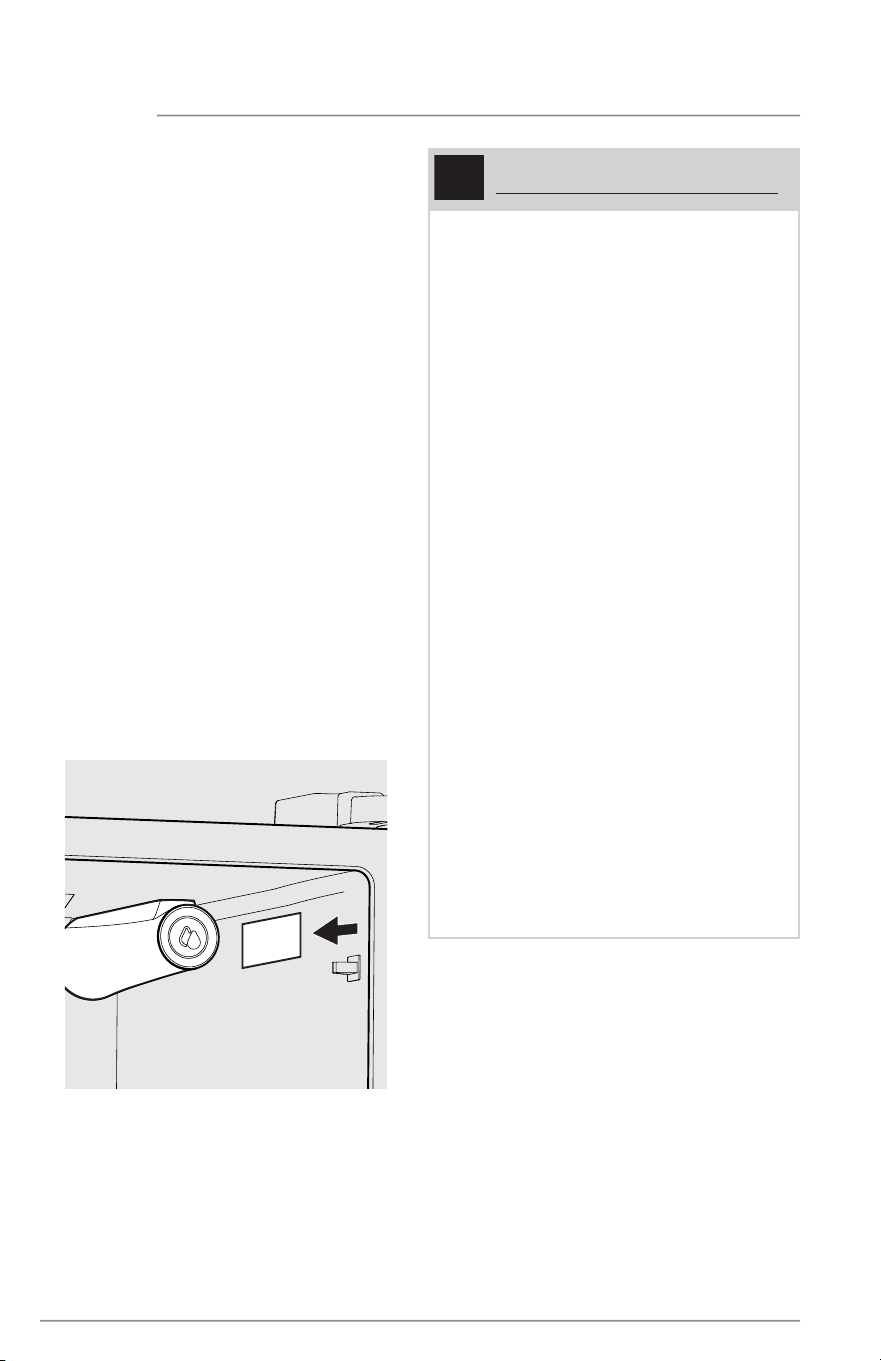
Keep your product info here so it’s easy
to find.
Model Number ____________________
Serial Number ____________________
Purchase Date ____________________
FPO
Serial location
Serial Number Location
Lorem ipsum Lorem ipsumLorem i
psumLorem ipsumLorem ipsumLore
m ipsumLorem ipsum
Lorem ipsum Lorem ipsumLorem i
psumLorem ipsumLorem ipsumLore
m ipsumLorem ipsum
Lorem ipsum Lorem ipsumLorem
3
WARNING
WARNING indicates a potentially haz-
ardous situation which, if not avoided,
could result in death or serious injury.
IMPORTANT
IMPORTANT indicates installation, oper-
ation or maintenance information which
is important but not hazard-related.
DANGER
DANGER indicates an imminently haz-
ardous situation which, if not avoided,
will result in death or serious injury.
CAUTION
CAUTION indicates a potentially haz-
ardous situation which, if not avoided,
may result in minor or moderate injury.
Safety Definitions
This is the safety alert symbol. It is
used to alert of potential personal injury
hazards. Obey all safety messages that
follow this symbol to avoid possible injury
or death.
WARNING
Please read all instructions before using
this appliance.
IMPORTANT SAFETY INFORMATION
DANGER
DANGER Risk of fire or explosion.
Flammable refrigerant used. Do not use
mechanical devices to defrost refrigera-
tor. Do not puncture refrigerant tubing.
DANGER Risk of fire or explosion.
Flammable refrigerant used. To be re-
paired only by trained service person-
nel. Use only manufacturer-authorized
service parts. Any repair equipment
used must be designed for flammable
refrigerants. Follow all manufacturer
repair instructions. Do not puncture
refrigerant tubing.
CAUTION
CAUTION Risk of fire or explosion.
Dispose of refrigerator properly
in accordance with the applicable
federal or local regulations. Flammable
refrigerant used.
CAUTION Risk of fire or explosion
due to puncture of refrigerant tubing.
Follow handling instructions carefully.
Flammable refrigerant used.
WARNING
CALIFORNIA RESIDENTS ONLY
Cancer and Reproductive Harm
www.P65Warnings.ca.gov
4
IMPORTANT SAFETY INFORMATION
Proper Disposal of your Appliance
Risk of child entrapment
Child entrapment and suocation are not
problems of the past. Junked or aban-
doned appliances are still dangerous –
even if they will sit for “just a few days”. If
you are getting rid of your old unit, please
follow the instructions below to help pre-
vent accidents.
We strongly encourage responsible appli-
ance recycling/disposal methods. Check
with your utility company or visit ener-
gystar.gov/recycle for more information
on recycling your old appliance.
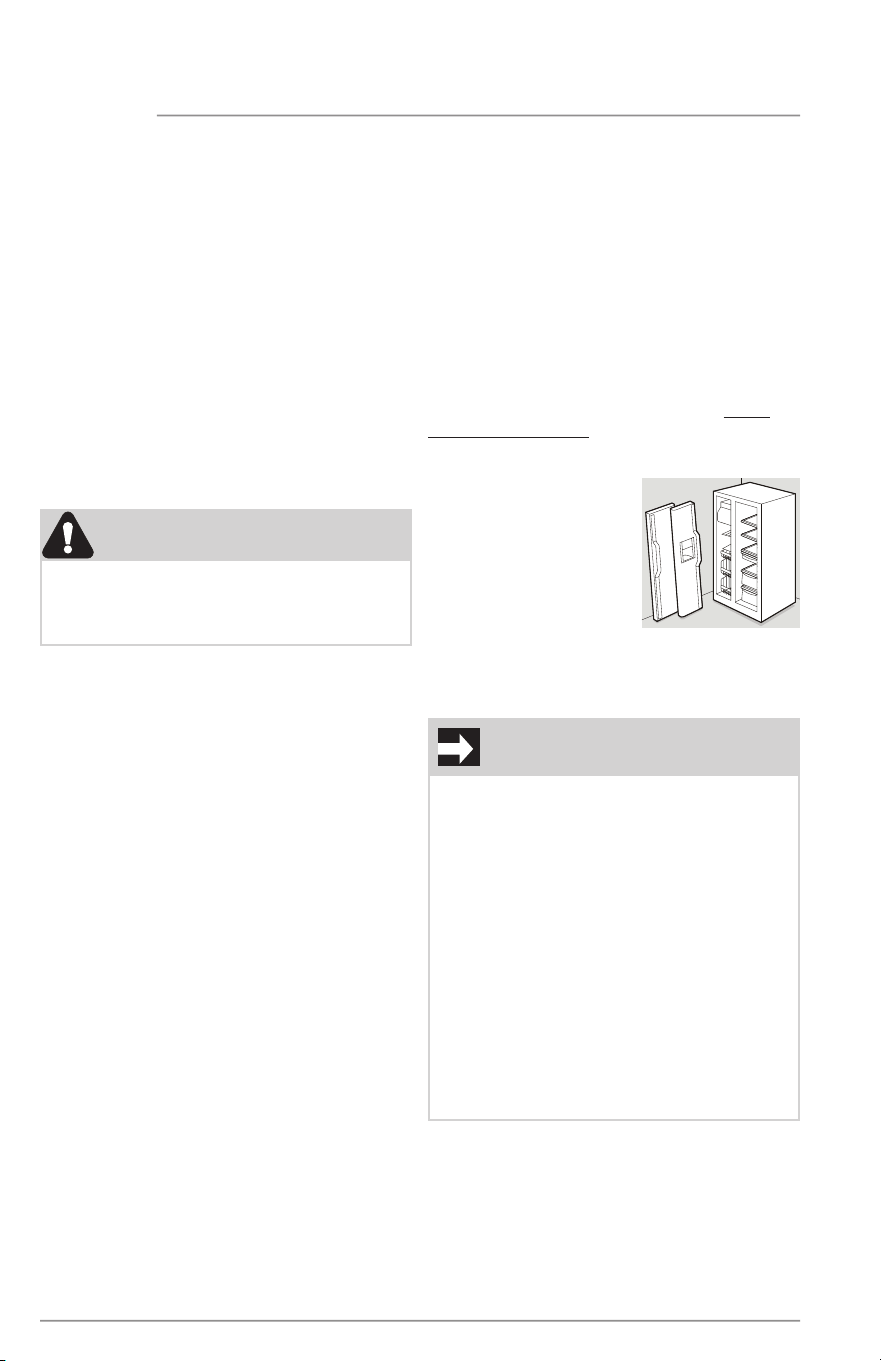
Before you throw
away your appliance:
• Remove doors.
• Leave shelves in
place so children
may not easily
climb inside.
• Have refrigerant
removed by a qualified
service technician.
Safety Instructions
• DO NOT store or use gasoline, or
other flammable liquids, or aerosols
within or in the vicinity of this or any
other appliance. Read product labels
for warnings regarding flammability
and other hazards.
• DO NOT operate the unit in the
presence of explosive fumes.
• Avoid contact with any moving parts
of automatic ice maker.
• Remove all staples from the carton.
Staples can cause severe cuts, and also
destroy finishes if they come in contact
with other appliances or furniture.
Child Safety
This appliance is not intended for use by
persons (including children) with reduced
physical, sensory or mental capabilities,
or lack of experience and knowledge,
unless they have been given supervision
or instruction concerning use of the
appliance by a person responsible for
their safety.
Destroy or recycle the carton, plastic
bags, and any exterior wrapping material
immediately after the appliance is
unpacked. Children should NEVER use
these items to play. Cartons covered with
rugs, bedspreads, plastic sheets or stretch
wrap may become airtight chambers, and
can quickly cause suocation.
IMPORTANT
CFC/HCFC Disposal
Your old unit may have a cooling system
that used CFCs or HCFCs (chlorofluoro-
carbons or hydrochlorofluorocarbons).
CFCs and HCFCs are believed to harm
stratospheric ozone if released to the
atmosphere. Other refrigerants may
also cause harm to the environment if
released to the atmosphere.
If you are throwing away your old ap-
pliance, make sure the refrigerant is re-
moved for proper disposal by a qualified
technician. If you intentionally release
refrigerant, you may be subject to fines
and imprisonment under provisions of
environmental legislation.
WARNING
Do not use electrical appliances inside
the food storage compartments of the
appliance unless they are of the type
recommended by the manufacturer.
5
WARNING
These guidelines must be followed to
ensure that safety mechanisms in this
unit will operate properly.
Electrical information
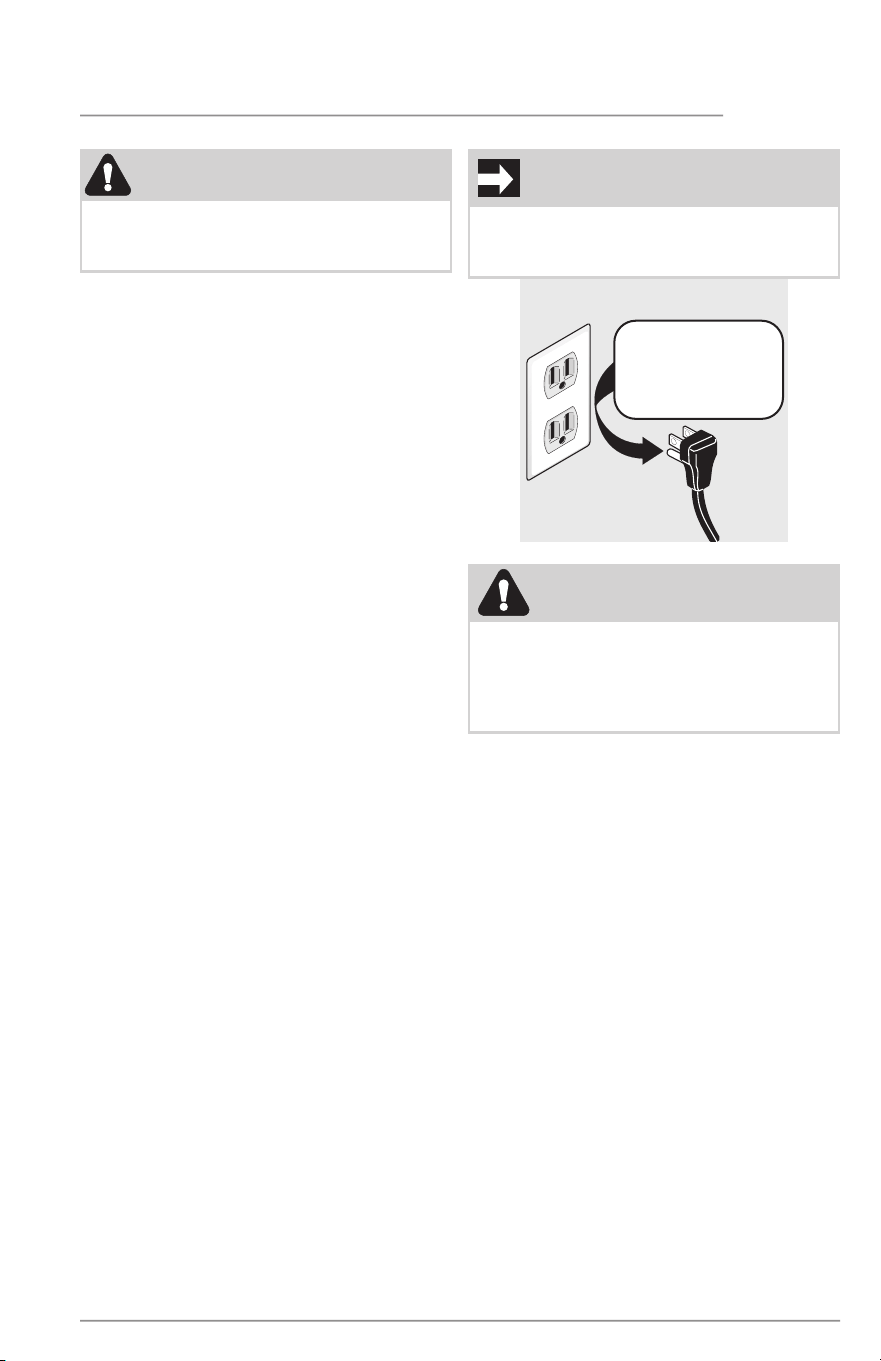
• The appliance must be plugged into
its own dedicated 115 Volt, 60 Hz.,
15 Amp, AC only electrical outlet.
The power cord of the appliance
is equipped with a three-prong
grounding plug for your protection
against electrical shock hazards.
It must be plugged directly into a
properly grounded 3-prong recepta-
cle. The receptacle must be installed
in accordance with local codes and
ordinances. Consult a qualified elec-
trician. Avoid connecting the unit to a
Ground Fault Interrupter (GFI) circuit.
Do not use an extension cord or
adapter plug.
• If the power cord is damaged, it
should be replaced by an authorized
service technician to prevent any risk.
• Never unplug the appliance by pull-
ing on the power cord. Always grip
the plug firmly, and pull straight out
from the receptacle to prevent dam-
aging the power cord.
• Unplug the unit before cleaning and
before replacing the AC LED light
bulb to avoid electrical shock. Use a
5-watt or less AC LED light bulb only.
• Performance may be aected if the
voltage varies by 10% or more. Oper-
ating the appliance with insucient
power can damage the compressor.
Such damage is not covered under
your warranty.
• Do not plug the unit into an electrical
outlet controlled by a wall switch or
pull cord to prevent the unit from
being turned o accidentally.
Grounding type wall receptacle
Power cord with
3-prong grounded plug
Do not, under
any circumstances,
cut, remove,
or bypass the
grounding prong.
CAUTION
To avoid personal injury or property
damage, handle tempered glass shelves
carefully. Shelves may break suddenly
if nicked, scratched, or exposed to sud-
den temperature change.
IMPORTANT
Turn o power to your appliance you
must unplug the power cord from the
electrical outlet.
IMPORTANT SAFETY INFORMATION
6
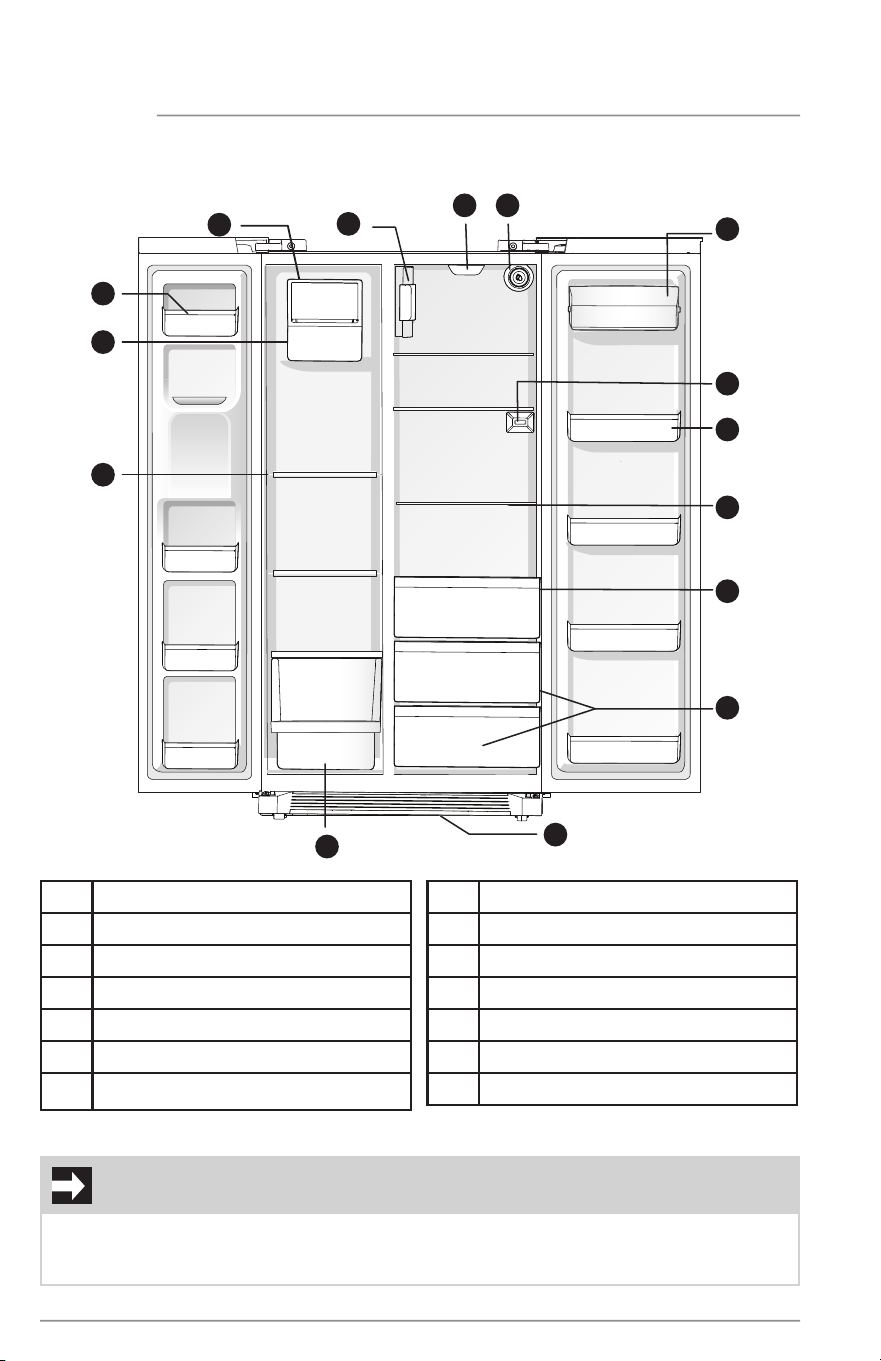
FEATURES
A Adjustable Door Bins
B Shelves
C Ice Container
D Fixed Door Bins
E Ice Maker
F Damper/Air filter housing
G Refrigerator LED Light Cover
H Water Filter
I Dairy Compartment
J Temperature Sensor/Thermistor
K Deli Drawer (some models)
L Crisper Pan
M Toe Grille
N Slide Out Basket
IMPORTANT
Accessories are available for your appliance and may be purchased at
Frigidaire.com or by calling 1-800-374-4432 (Frigidaire.ca or 1-800-265-8352 in
Canada) or from an authorized seller.
*Features may vary according to model
L
M
N
B
C
D
E
F
G H
I
J
K
A
B
7
INSTALLATION
NOTE
If your unit is placed with the door hinge
side against a wall, you may have to
allow additional space for the handle so
the door can be opened wider.
This Use & Care Manual provides general
operating instructions for your model. Use
the unit only as instructed in this Use &
Care Manual. Before starting the appli-
ance, follow these important first steps.
Location
• Choose a place that is near a ground-
ed electrical outlet. Do Not use an
extension cord or an adapter plug.
• If possible, place the unit out of direct
sunlight and away from the range,
dishwasher or other heat sources.
• Install the appliance on a floor that is
level and strong enough to support a
fully loaded unit.
• Consider water supply availability for
models equipped with an automat-
ic ice maker. If you do not hook up
water to the appliance, remember to
turn the ice maker o.
CAUTION
Do Not install the unit where the tem-
perature will drop below 55°F (13°C) or
rise above 110°F (43°C). The compres-
sor will not be able to maintain proper
temperatures inside the appliance.
Do Not block the toe grille on the lower
front of your unit. Sucient air circula-
tion is essential for the proper opera-
tion of your appliance.
WARNING
This appliance is intended for use
in residential household and similar
interior applications such as:
• a kitchen/kitchenette
• a pantry room
• a basement
• other interior
residential-type environments
WARNING
Installation clearances
Allow the following clearances
for ease of installation, proper air
circulations, and plumbing and
electrical connections:
Sides & Top ⅜"
Back 1".
Installation
8
INSTALLATION
Door Opening
Position your unit to allow easy access to
a counter or table when removing food.
For the best use of drawers and freezer
baskets, position the appliance where
both doors can fully open.
Guidelines for final positioning
of your unit:
• Rest all 4 corners of the cabinet
firmly on the floor.
• Level the cabinet at the front and rear.
• Tilt the sides ¼" (6 mm) from front
to back (to ensure the doors close
and seal properly).
• Align the doors with each other
and level.
Meet all of these conditions by
raising or lowering the adjust-
able front rollers.
To level the cabinet using the front rollers:
1. Open both doors and remove
the toe grille (see Toe Grille
Installation and Removal in the
INSTALLATION section).
2. Close the doors and use a wrench
to raise (clockwise) or lower
(counterclockwise) the front rollers.
3. Ensure both doors are bind-free
with their seals touching the cabinet
on all 4 sides.
NOTE
The doors are designed to shut by
themselves within a 20 degree opening.
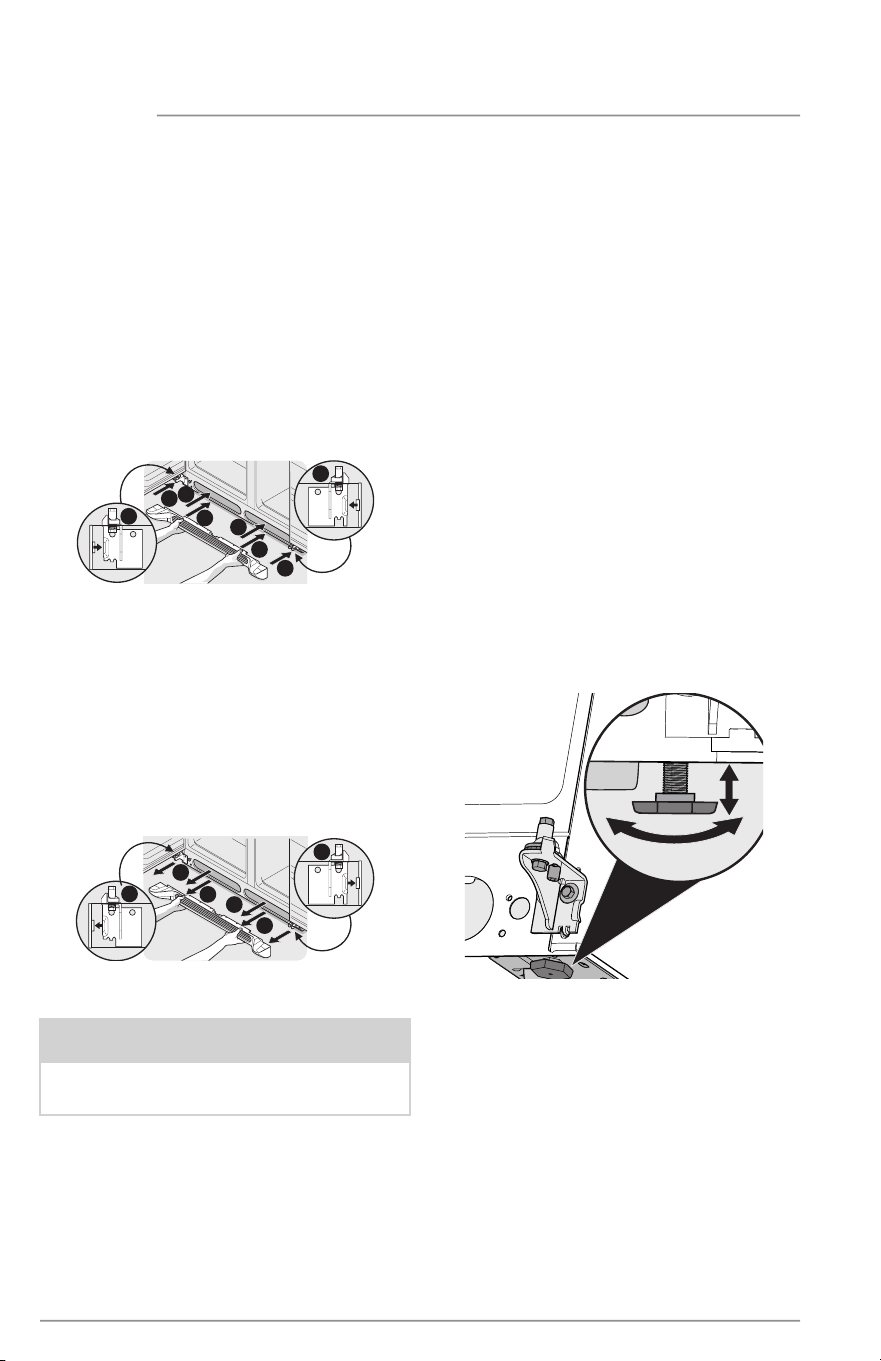
Toe Grille Installation and Removal
To install toe grille
1. Open both doors. Slide the left and
right sides of the toe grille over the
lower hinges of the appliance.
2. While pushing the toe grille firmly
against cabinet, fasten the bottom
clips of toe grille to the cabinet.
3. Fasten the top clips to the cabinet.
4. Close the doors. Fasten the right
and left side clips into the groove of
the bottom hinge.
To remove the toe grille
1. With both doors closed, unfasten
the right and left side clips of toe
grille from the bottom hinge groove.
2. Open both doors. Press firmly on the
top of the toe grille until the top of
the toe grille pops o.
3. Pull the toe grille outward toward
your body and o of the lower hinges.
1
2
3
2
3
1
4
4
Installing Toe Grille
1
2
3
2
3
1
Removing Toe Grille
9
Set Screw
(some models)
Hinge
Hinge
Flange
Open Door
7/16" Wrench and
3/32" Hex Key (some models)
Door Stop
Flange
5. Reinstall the set screw, locking the
door height.
6. Replace the toe grille by fitting it
into place (see Toe Grille
Installation and Removal in the
INSTALLATION section).
4. After leveling, verify the door stop
contacts the lower hinge and the
top of the door does not contact the
upper hinge through full movement
of the door (from fully closed to
fully open).
INSTALLATION
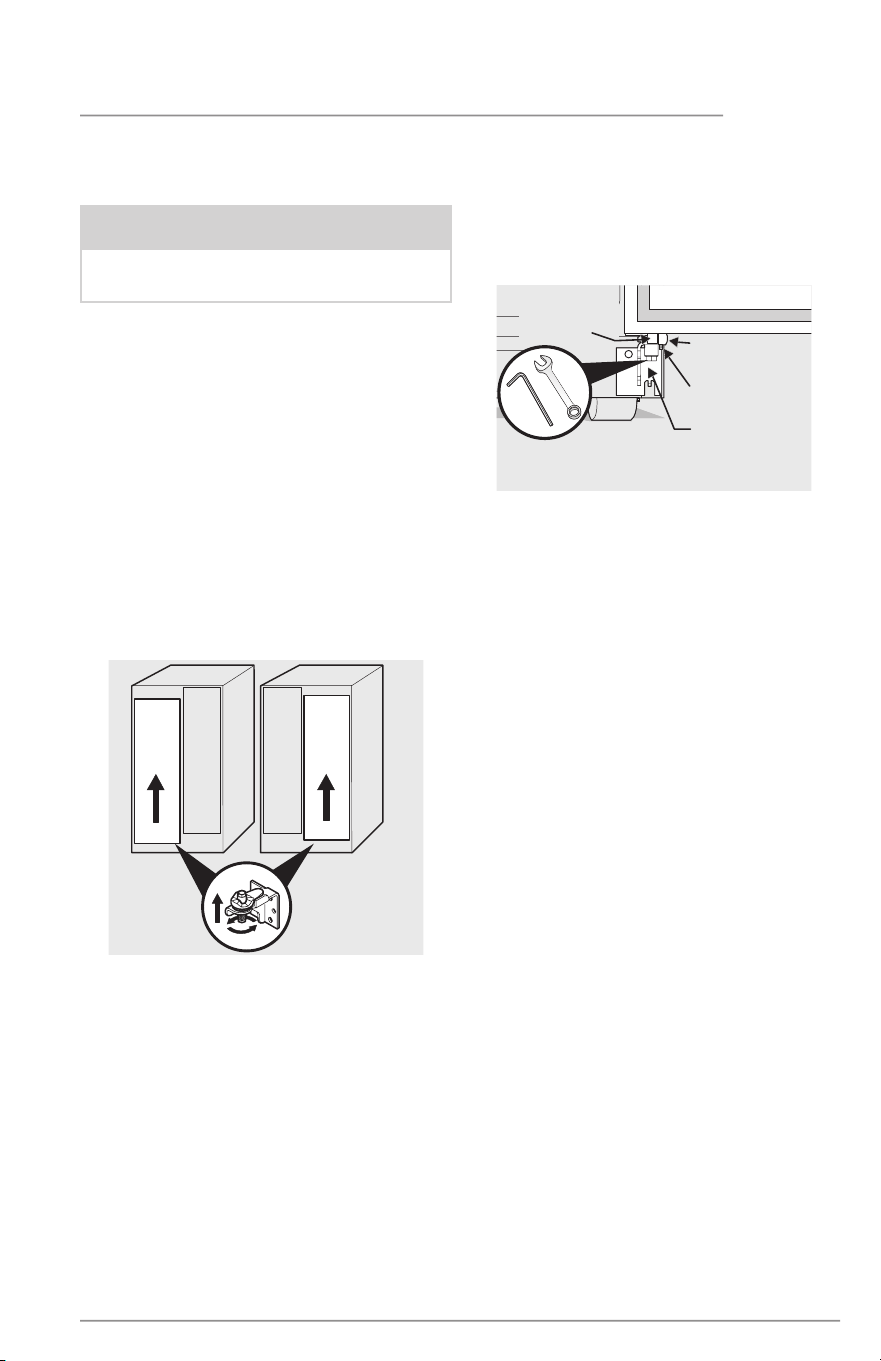
To level the doors using the adjustable
lower hinge:
1. Before leveling either door, remove
the set screw that locks the door
height into position. (The door
cannot be adjusted without the set
screw removed).
2. If the refrigerator door is lower than
the freezer door, raise the refrigera-
tor door by turning the adjustment
screw counterclockwise using a
7
/
16
"
wrench. (See illustration.)
3. If the freezer door is lower than the
refrigerator door, raise the freezer
door by turning the adjustment
screw counterclockwise using a
7
/
16
"
wrench. (See illustration.)
NOTE
Some models will not have a set screw. For
those models follow steps 2 through 4.
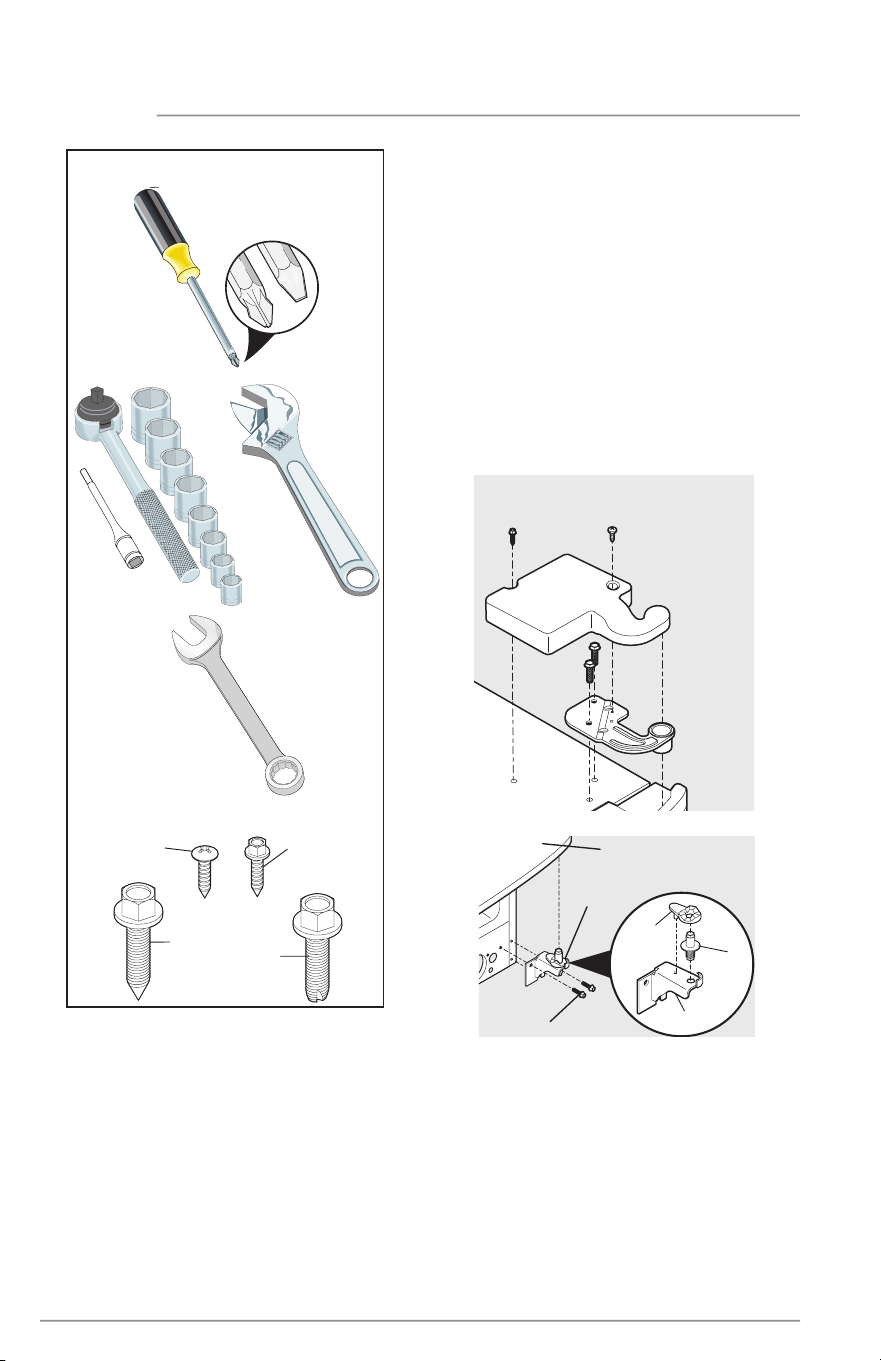
10
DOOR REMOVAL
To prepare for removing the doors:
1. Make sure the electrical power cord
is unplugged from the wall outlet.
2. Open both doors and remove the
toe grille (as explained in the Instal-
lation Instructions that came with
your appliance).
3. Remove any food from the door shelves.
4. Close the doors.
To remove the refrigerator top hinge/cover:
1. Remove the 2 screws from the cover
over the top door hinge.
2. Lift hinge cover straight up and o.
3. Trace lightly around the door’s top
hinge with a pencil. This makes
reinstallation easier.
4. Remove the 2 screws from the top
hinge and lift the hinge straight up.
Lift the door o of the bottom hinge
and set it aside.
5. Remove the 2 bottom hinge screws
and hinge if necessary.
Socket
Wrench Set
Adjustable
Wrench
Top Hinge
Cover Front
Screw
Top
Hinge
Screw
Bottom
Hinge
Screw
Top Hinge
Cover Rear
Screw
Phillips™
Head
Tools Necessary:
or
or
⅜" Fixed
Wrench
Phillips™
Head
&
Flathead
Screwdriver
To reinstall the refrigerator door, reverse
the above steps.
Door
Hinge
Assembly
Closer
Pin
Hinge
Screws
Adjustable Hinge
11
DOOR REMOVAL
Door
Hinge
Assembly
Screws
Water
Line
Tubing
Non-Adjusting Hinge (some models)
Closer
Pin
Hinge
Door
Water
Line
Tubing
Screws
Hinge
Assembly
Adjustable Hinge (some models)
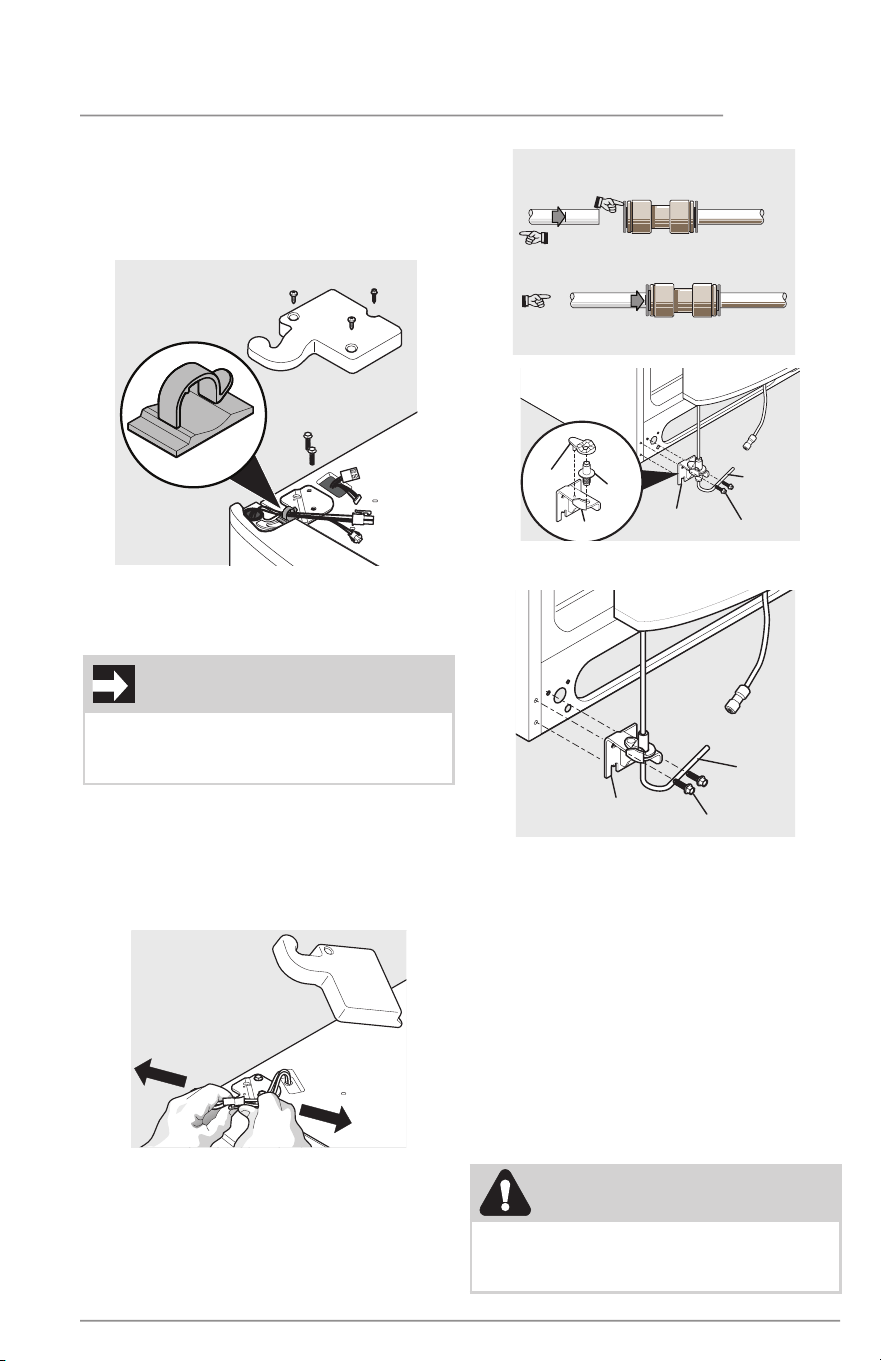
To remove the freezer top hinge cover:
1. Remove the 2 screws from the cover
over the top door hinge.
2. Lift hinge cover straight up and o.
To Disconnect
1. Press outer ring against face of
fitting
2. Pull to
remove tube
Insert tube and push until mark
touches face of fitting
To Connect
CAUTION
Be sure doors are set aside in a secure
position where they cannot fall and
cause personal injury.
To remove the freezer door:
1. Release the wires from the
routing clip.
3. Trace lightly around the hinge with a
pencil. This makes reinstallation easier.
4. Detach the water tube from the
connector located below the freezer
door. The connector releases when
you press its outer sleeve inward.
5. Remove the 2 screws from the top
hinge and lift the hinge straight
up, pulling the 2 multi-wire cables
through it. Lift the door o of the
bottom hinge.
6. Remove the 2 bottom hinge screws
and hinge if necessary.
7. Lay the door on its side to avoid
damage to the water tube extending
from the bottom hinge.
To reinstall the freezer door, reverse the
above steps.
IMPORTANT
To prevent wire damage, ensure the
wires are rerouted through the routing
clip when reassembling the hinge cover.
2. Disconnect the 2 multi-wire cable
connectors located above the
top hinge. Grasp both sides of
the connector firmly, press the
connector lock and pull apart.
Remove the ground screw.
12
DOOR HANDLE INSTALLATION
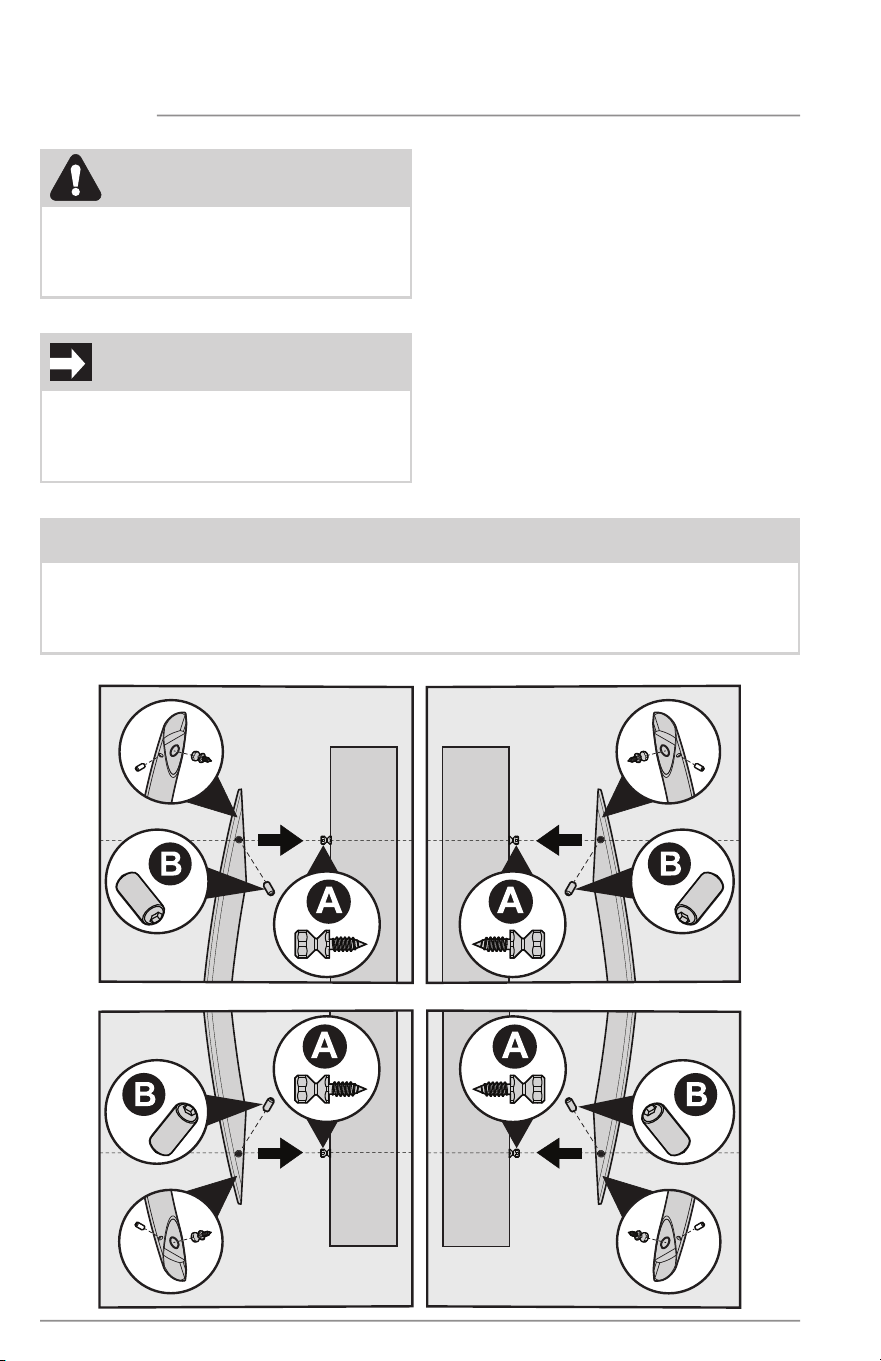
1. Remove handles from carton and
any other protective packaging.
2. Position the freezer handle end caps
over the upper and lower pre-in-
stalled shoulder bolts (A) that are
fastened into door, ensuring the
holes for the set screws are facing
toward the refrigerator door.
3. While holding the handle firmly
against door, fasten the upper and
lower Allen set screws (B) with the
supplied Allen wrench.
4. Repeat steps 2 and 3 to install
refrigerator handle. Ensure the holes
for the set screws are facing towards
the freezer door.
Freezer
Upper
End Cap
Door
Refrigerator
Upper
End Cap
Door
Refrigerator
Lower
End Cap
Door
Freezer
Lower
End Cap
Door
Ensure Handle Set Screws are Facing Each Other with Doors Closed
CAUTION
Wear gloves and safety goggles and
use extreme CAUTION when installing
these handles. The rounded end of the
handles may be sharp (some models).
IMPORTANT
To ensure proper installation of handles,
please review these instructions and il-
lustrations thoroughly prior to installing
the handles.
NOTE
Tighten and sub-flush all set screws (place the Allen set screw just below the sur-
face of the end cap) of the handle end cap. Draw the end caps tight to the freezer
and refrigerator doors with no gaps. To avoid scratching the metal door, keep the
door open while torquing down the set screws.
13
WATER SUPPLY CONNECTION
Before Installing The Water Supply Line,
You Will Need:
• Basic Tools: adjustable wrench,
flat-blade screwdriver, and Phillips
TM
screwdriver
• Access to a household cold water
line with water pressure between 30
and 100 psi.
• A water supply line made of ¼" (6.4
mm) OD, copper or stainless steel
tubing. To determine the length of
tubing needed, measure the distance
from the ice maker inlet valve at the
back of the refrigerator to your cold
water pipe. Then add approximately
7� (2.1 m), so the refrigerator can be
moved out for cleaning.
To Connect Water Supply Line To Ice
Maker Inlet Valve
1. Disconnect the refrigerator from
electrical power source.
2. Place the end of the water supply
line into a sink or bucket. Turn ON
the water supply and flush the supply
line until the water is clear. Turn OFF
the water supply at the shuto valve.
3. Remove the plastic cap from the wa-
ter valve inlet and discard the cap.
4. If you use copper tubing - Slide the
brass compression nut, and then
the ferrule (sleeve) onto the water
supply line. Push the water supply
line into the water valve inlet as far
as it will go (¼"/6.4 mm). Slide the
ferrule (sleeve) into the valve inlet
and finger tighten the compression
nut onto the valve. Tighten another
half turn with a wrench; DO NOT
overtighten. See Figure 1.
• A shuto valve to connect the water
supply line to your household water
system. DO NOT use a self-piercing
type shuto valve.
• Do not reuse compression fitting or
use thread seal tape.
• A compression nut and ferrule
(sleeve) for connecting a copper
water supply line to the ice maker
inlet valve.
WARNING
To avoid electric shock, which can
cause death or severe personal injury,
disconnect the unit from electrical pow-
er source before connecting a water
supply line to the appliance.
CAUTION
To Avoid Property Damage:
• Use Copper or Stainless Steel braid-
ed tubing for the water supply line.
Frigidaire does not recommend wa-
ter supply tubing made of ¼" plastic.
Plastic tubing greatly increases the
potential for water leaks, and the
manufacturer will not be responsible
for any damage if plastic tubing is
used for the supply line.
• DO NOT install water supply tubing
in areas where temperatures fall
below freezing.
• Chemicals from a malfunctioning
softener can damage the ice maker.
If the ice maker is connected to soft
water, ensure that the softener is
maintained and working properly.
IMPORTANT
Ensure that your water supply line connec-
tions comply with all local plumbing codes.
NOTE
Check with your local building authori-
ty for recommendations on water lines
and associated materials prior to in-
stalling your new refrigerator. Depend-
ing on your local/state building codes,
Frigidaire recommends for homes with
existing valves its Smart Choice
®
water
line kit 5304490728 (with a 6�Stain-
less Steel Water Line) and for homes
without an existing valve, Frigidaire
recommends its Smart Choice
®
water
line kit 5304490717 (with a 20�copper
water line with self-tapping saddle
valve). Please refer to Frigidaire.com for
more information.
14
WATER SUPPLY CONNECTION
If you use braided flexible stainless
steel tubing - The nut is already
assembled on the tubing. Slide the
nut onto the valve inlet and finger
tighten the nut onto valve. Tighten
another half turn with a wrench; DO
NOT overtighten. See Figure 2.
5. With the steel clamp and screw,
secure the water supply line (copper
tubing only) to the rear panel of
refrigerator as shown.
6. Coil the excess water supply line
(copper tubing only), about 2½ turns,
behind refrigerator as shown and
arrange coils so they do not vibrate or
wear against any other surface.
7. Turn ON the water supply at shuto
valve and tighten any connections
that leak.
8. Reconnect the refrigerator to elec-
trical power source.
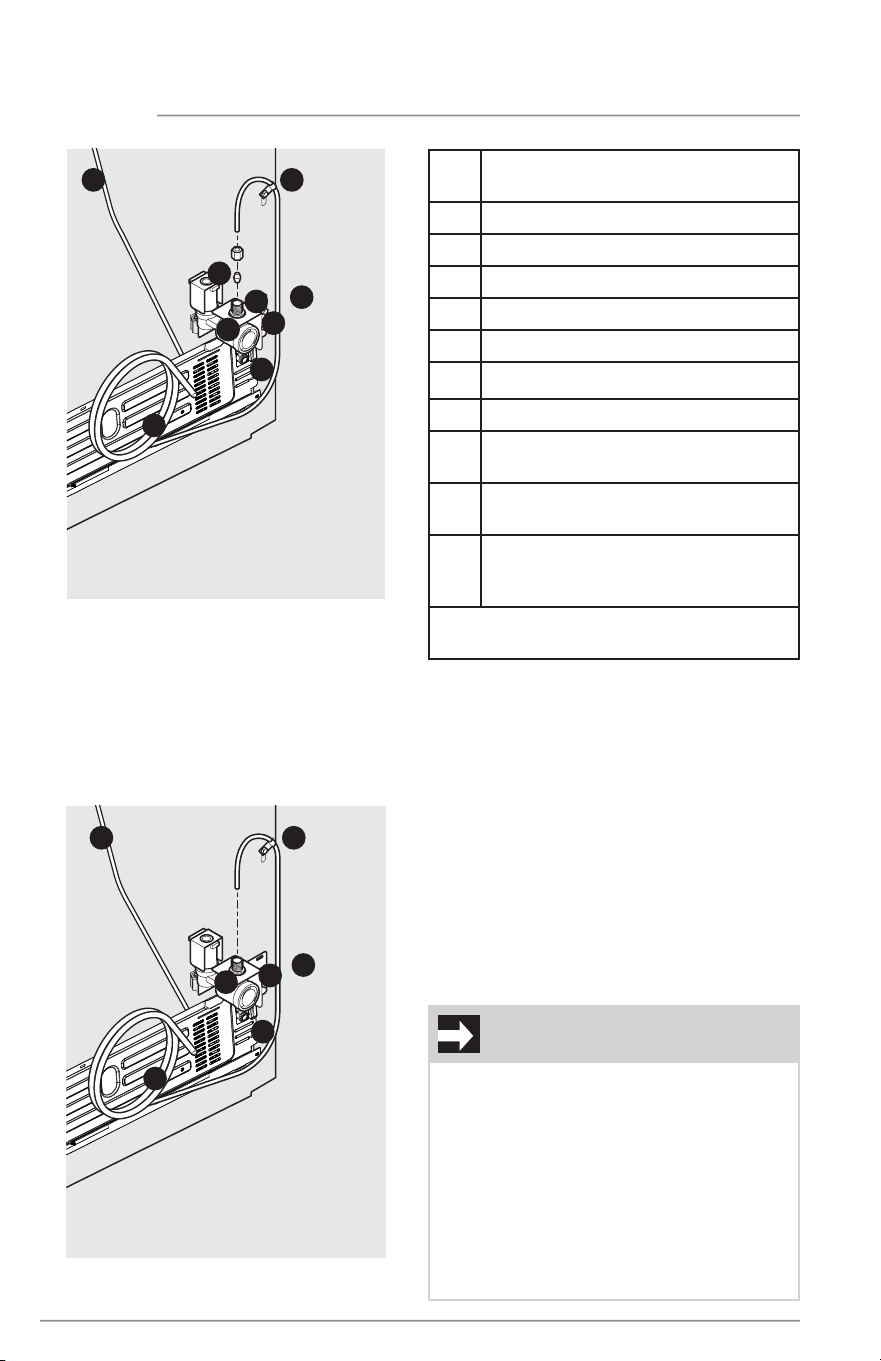
A B
C
D
E
F
G
H
I
Figure 1
A Plastic Water Tubing to
Ice Maker Fill Tube
B Steel Clamp
C Brass Compression Nut
D Ferrule (Sleeve)
E Copper Water Line
F Water Valve Bracket
G Valve Inlet
H Water Valve
I Copper Water Line from
Household Water Supply*
J Braided Flexible Stainless Steel
Water Line
K 6 ft. (1.8 m) Braided Flexible
Stainless Steel Water Line from
Household Water Supply*
*Include enough tubing in the loop to allow
moving the refrigerator out for cleaning
A B
J
F
G
H
K
Figure 2
IMPORTANT
After connecting the water supply, refer
to Priming the Water Supply System for
important information about priming an
empty water supply system.
Your refrigerator’s water supply system
includes several tubing lines, a water
filter, and a water valve. To ensure that
your water dispenser works properly,
completely fill this system with water
when you first connect your refrigerator
to the household water supply line.
15
CONTROLS AND SETTINGS
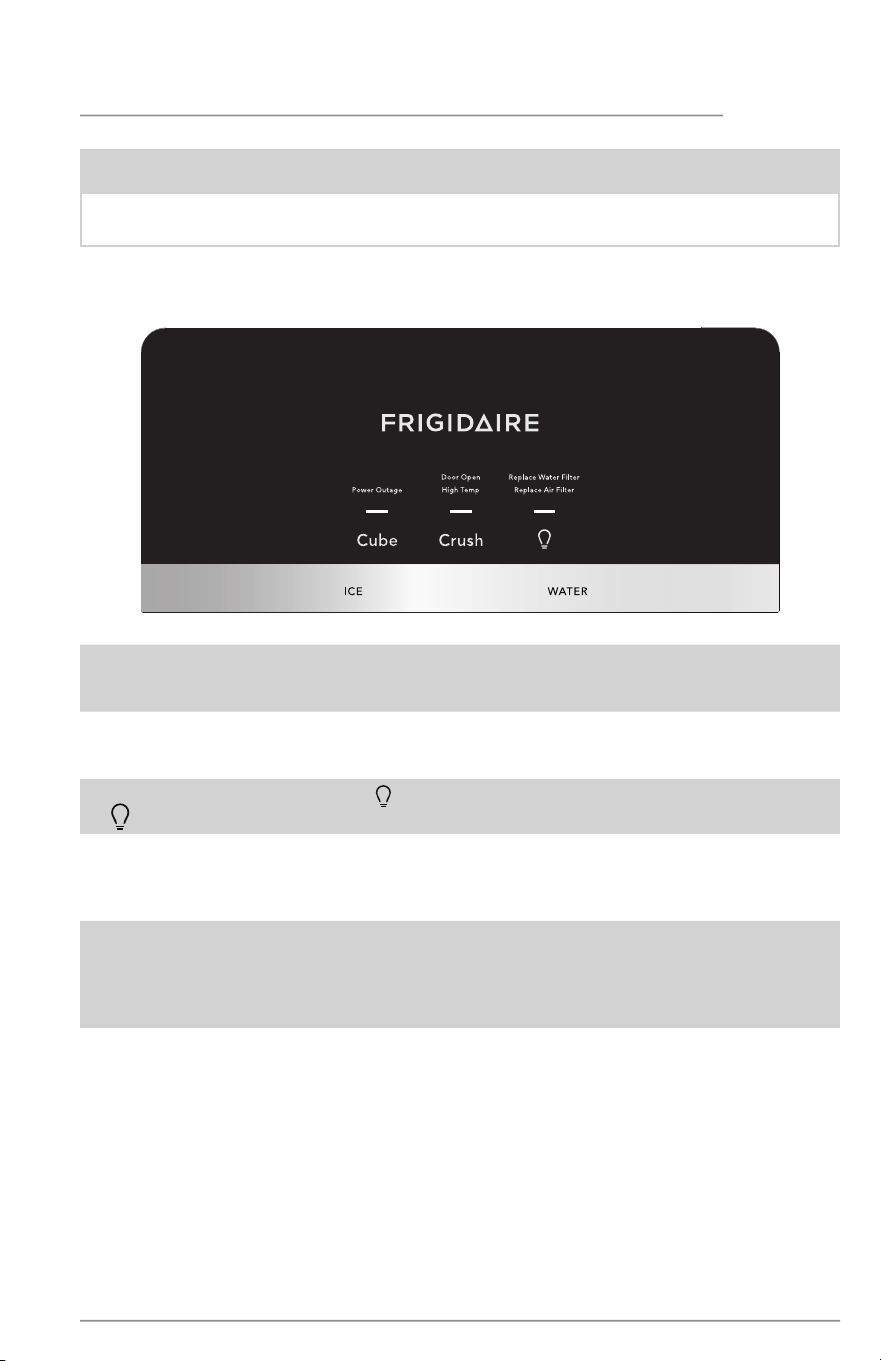
Cube
Press the Cube button to get cubed ice. A white LED light will indicate
the mode is selected. Press glass against the ice dispensing paddle as far
up as possible to catch all the ice.
Crush
Press the Crush button to get crushed ice. A white LED light will indicate
the mode is selected. Press glass against the ice dispensing paddle as far
up as possible to catch all the ice.
Light
Press the light button to turn on the dispenser light. A white LED light
will indicate the dispenser light is on. Press again to turn the light o.
Water
To operate the water dispenser, press a glass against the Water
dispensing paddle. To stop dispensing water, pull the glass away from
the dispensing paddle. Dispensed water is not cold. For colder water, add
crushed ice or cubes before dispensing water.
Water
Filter
Status
When you need to order a new water filter, the side door UI will change
to the Order status. When you need to replace the water filter, the Side
Door UI will change to the red replace status and the front UI will display
Replace Water Filter. After you change the filter, hold the Water Filter
button for 3 seconds to reset.
Air
Filter
Status*
When you need to order a new air filter, the Side Door UI will change to
the Order status. When you need to replace the air filter, the Side Door
UI will change to the red Replace status and the Front UI will display
Replace Air Filter. After you change the filter, hold the Air Filter button
for 3 seconds to reset.
*Only on some models
Front of Door User Interface
NOTE
Your appliance may have some or all of the features listed below. Become familiar
with these features and their use and care.

16
Power
Outage
In the event of a power outage the Power Outage indicator appear and
an alarm will sound. Press any button to clear the alarm.
Door
Open
When a door is open the Door Open indicator will appear and will
disappear when the door is closed. If a door is left open for more than
5 minutes an alarm will sound. The alarm will continue to go o every
10 seconds until acknowledged. Close the door to turn o the alarm or
press any button on the control to temporarily disable the alarm.
High
Temp
In the event of the internal temperature of the refrigerator rising and
staying at a temperature above the safe temp zone for a period of time,
the High Temp warning will appear to remind you to check your food.
In addition to the indicator, an alarm will sound every 10 seconds until
acknowledged. Press any button to clear the warning.
The refrigerator will automatically try to cool down to improve the con-
dition. However, if the temperature has not cooled after some time, the
warning and alarm will appear again. If the problem continues please call
1 (800) 372-4432.
Alarms
CONTROLS AND SETTINGS
17
CONTROLS AND SETTINGS
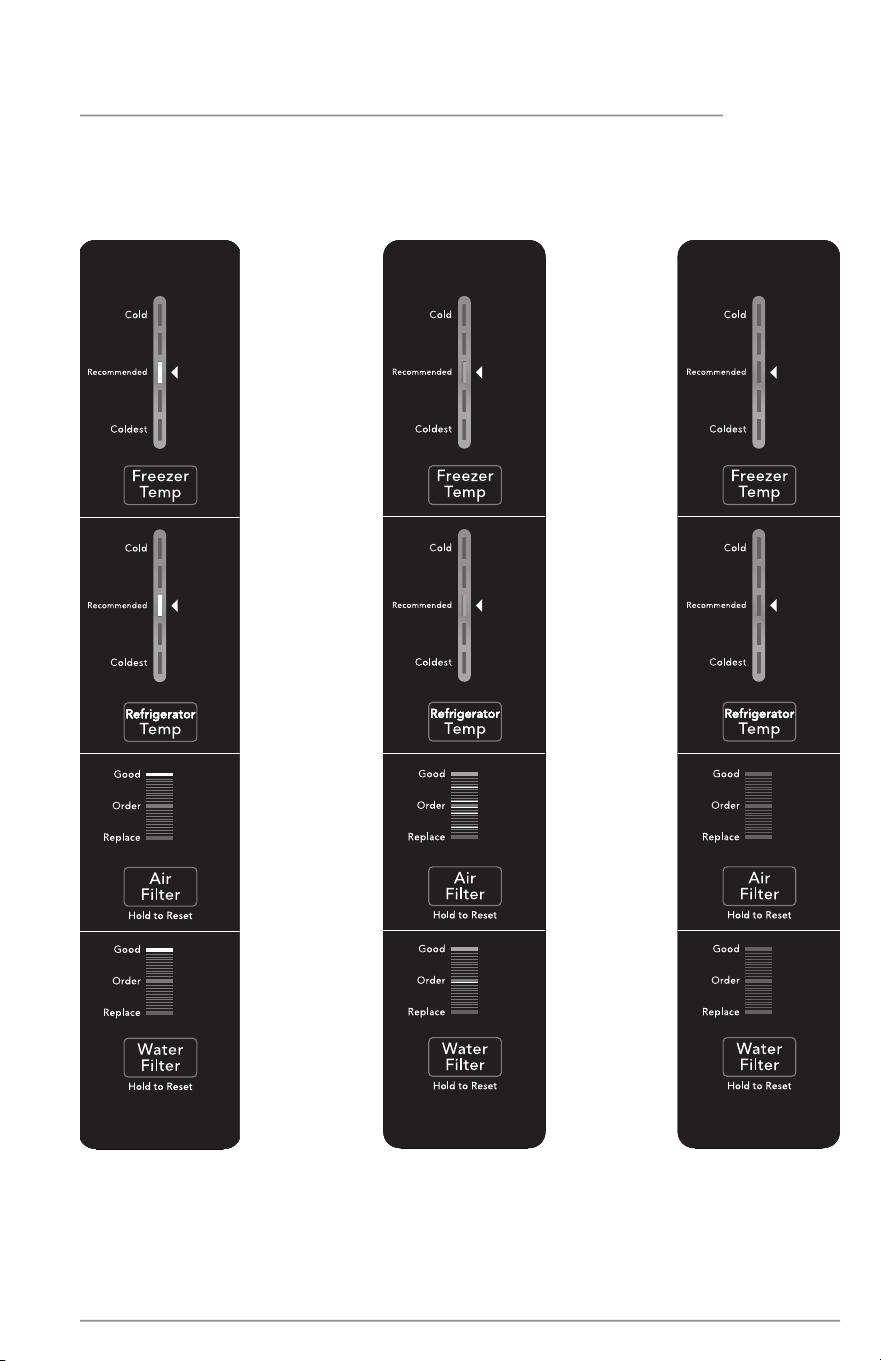
Active Mode View
Inactive Mode View
Sleep Mode View
In-Door User Interface
FPO

18
Temperature
Adjustment
Adjust the temperature gradually: adjust in small increments, allow-
ing the temperature to stabilize.
• For colder temperatures, press the Temp button to change the
temperature setting toward Coldest.
• For warmer temperatures, press the Temp button to change the
temperature setting toward Cold.
Adjusting the refrigerator control will change temperature in both
compartments. The freezer control can be left at the factory preset
(*Recommended) or adjusted as desired.
To maintain temperatures, a fan circulates air in the refrigerator and
freezer compartments. For good circulation, do not block cold air
vents with food items.
Air Filter
Status*
The display shows the current status of the air filter (Good, Order, or
Replace). To reset the filter status to Good, press and hold Air Filter
for 3 seconds.
Water Filter
Status
The displays shows the current status of the water filter (Good,
Order, or Replace). To reset the filter status to Good, press and hold
Water Filter for 3 seconds.
*Only on some models
In-Door Control Display Mode Views
Your display is equipped with a sleep and inactive mode to prevent accidental changes
to the unit settings during opening and closing of the doors. When both doors are
closed, the display will be in sleep mode. When either door is first opened, the display
will be in inactive mode where all the current settings are visible but dimmed.
Pressing any button on the display will activate the display and a tone will be played.
All settings will then be fully lit. Touch the display again to change any setting.
If there is no button pressed for 10 seconds while any door is open, the display will
default back to inactive mode.
CONTROLS AND SETTINGS
19
AUTOMATIC ICE AND WATER DISPENSER
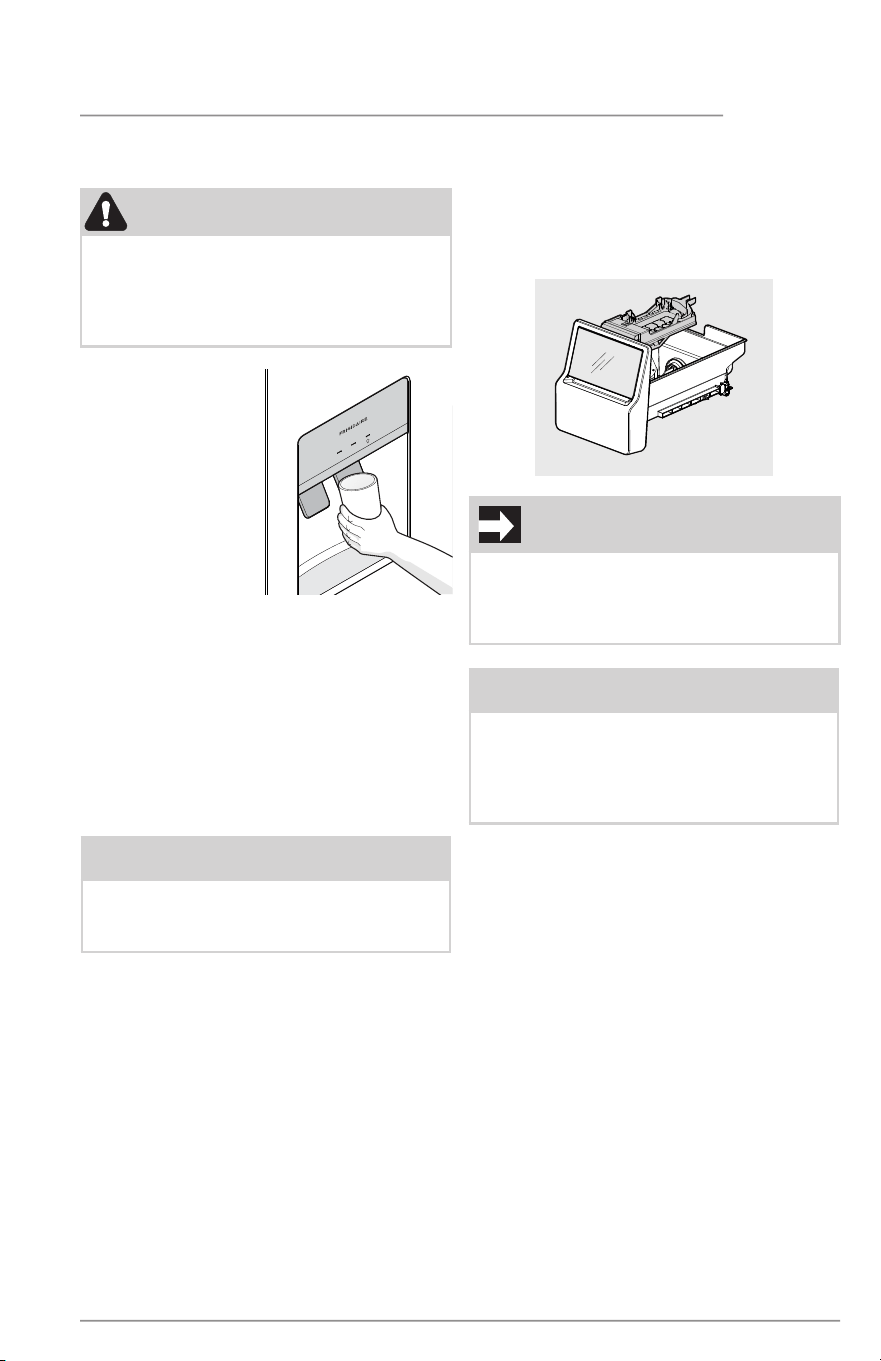
Priming the water supply system
Ice maker operation & care
After you properly install the refrigerator
and it has cooled for several hours, the ice
maker can produce ice within 24hours.
The ice maker will fill the ice bin from the
rear. You must dispense some ice to force
the ice forward in the bin. This will allow
the bin to fill completely.
1. Begin filling
the system
by pressing
and holding
a drinking
glass against
the water
dispenser
paddle.
2. Keep the
glass in this
position until
water comes
out of the
dispenser. It may take about
1½ minutes. Water will sputter until
you purge all air from the water lines.
3. Continue dispensing water for about
4 minutes to flush the system
and plumbing connections of any
impurities (stopping to empty the
glass as necessary).
Power Outage
Cube
ICE
WATER
Crush
Door Open
High Temp
Replace Water Filter
Replace Air Filter
Dispenser
(varies by model)
CAUTION
For proper dispenser operation, the
recommended water supply pressure
should fall between 30psi and 100psi.
Excessive pressure may cause the sys-
tem to malfunction.
Turning the ice maker on
To turn the ice maker on, press the ice
maker's On/O power switch, located on
the front of the ice maker, so the LED is
steadily illuminated.
NOTE
Dispensed water is not chilled. For
colder water, add ice to cup or contain-
er before dispensing water.
NOTE
The ice maker also has a built-in plastic
signal arm that automatically stops
ice production when the ice bin is full.
Do not use this signal arm to manually
stop the ice maker.
IMPORTANT
Turning o the ice maker simply dis-
ables ice making. You will still be able to
dispense existing ice, and you will still be
able to dispense water.
20
Ice Maker/Dispenser Tips
• Ice cubes stored too long may
develop an odd flavor. Empty the ice
container as explained in Cleaning the
Ice Storage Bin.
• Occasionally shake the ice container
to keep ice separated.
• If your refrigerator is not connected to
a water supply or the water supply is
turned o, turn O the ice maker.
• If you need a large quantity of ice
at one time, it is best to get cubes
directly from the ice container.
• The following sounds are normal
when the ice maker is operating:
- Motor running
- Ice dropping into ice container
- Water valve opening or closing
- Ice loosening from tray
- Running water
• When dispensing ice, you will hear a
snapping or clicking sound when the
ice chute opens and closes.
• Turn O the ice maker when cleaning
the freezer and during vacations. If
you turn O the ice maker for a long
period of time, you should also turn
o the water supply valve.
Cleaning the Ice Storage Bin
Clean the ice storage bin at regular
intervals, particularly before you take a
vacation or move.
To clean the ice storage bin:
1. Turn O the ice maker.
2. Remove the ice storage bin by lifting
up and out.
3. Empty and carefully clean the ice
storage bin with mild detergent.
Rinse with clear water. Do not use
harsh or abrasive cleaners.
CAUTION
Chemicals from a malfunctioning water
softener can damage the ice maker. If
the water supply to your refrigerator is
softened, be sure the softener is main-
tained to work properly.
CAUTION
NEVER use an ice pick or similar sharp
instrument to break up the ice. This
could damage the ice storage bin and
dispenser mechanism.
4. Allow the ice storage bin to dry com-
pletely before replacing it in the freezer.
5. Remove ice chips and clean the ice
storage bin, shelf and the freezer
door chute.
6. Replace the ice storage bin. Turn On
the ice maker to resume ice production.
Remove and empty the ice storage bin if:
• An extended power failure (1 hour or
longer) causes ice cubes in the ice
storage bin to melt and freeze togeth-
er, jamming the dispenser mechanism.
• You do not use the ice dispenser
frequently. Ice cubes will freeze
together in the bin, jamming the
dispenser mechanism.
Remove the ice storage bin and shake
to loosen the cubes or clean as
explained above.
AUTOMATIC ICE AND WATER DISPENSER
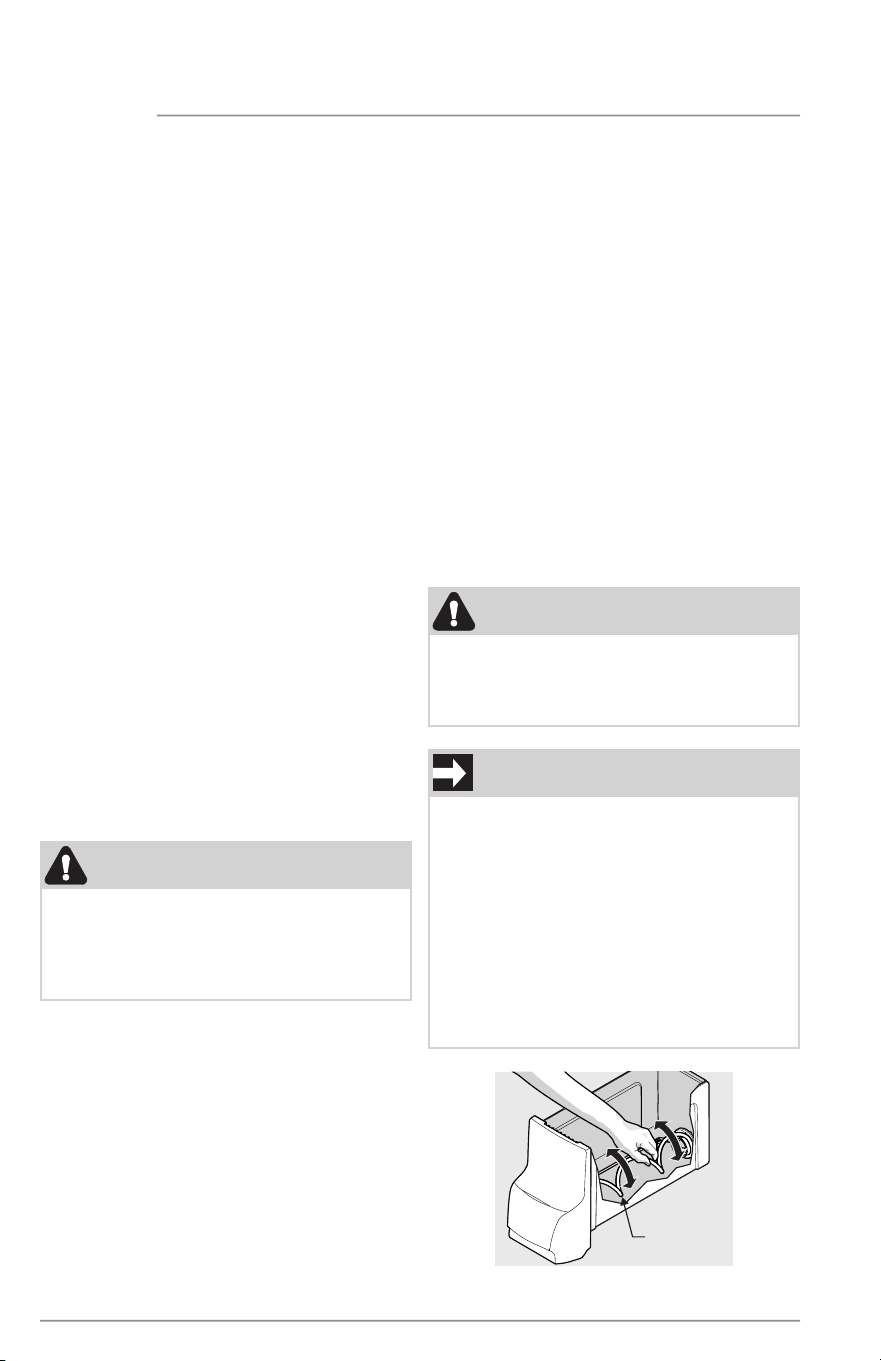
Auger
IMPORTANT
When removing or replacing the ice stor-
age bin, avoid rotating the auger in the
ice storage bin. If the auger is accidental-
ly rotated, you must realign the auger by
turning it in 45 degree turns (see below)
until the ice storage bin fits into place
with the drive mechanism If the auger is
not properly aligned when replacing the
ice storage bin, the refrigerator will not
dispense ice. The freezer door also may
not close properly causing warm air to
leak into the freezer compartment.
21
STORAGE FEATURES
Glass shelves
Shelves are easily adjusted to suit individ-
ual needs. Before adjusting the shelves,
remove all food. Shelves are supported
by side rails. See Glass Shelves in CARE
AND CLEANING for proper shelf removal.
Door storage
Door bins and shelves are provided for
convenient storage of jars, bottles, and
cans. You can quickly select frequently
used items.
Some models have door bins that can
accommodate gallon-sized plastic drink
containers and economy-sized jars and
containers. Some bins are adjustable for
maximum storage capacity.
The dairy compartment, which is warmer
than the general food storage section,
is intended for short term storage of
cheese, spreads, or butter.
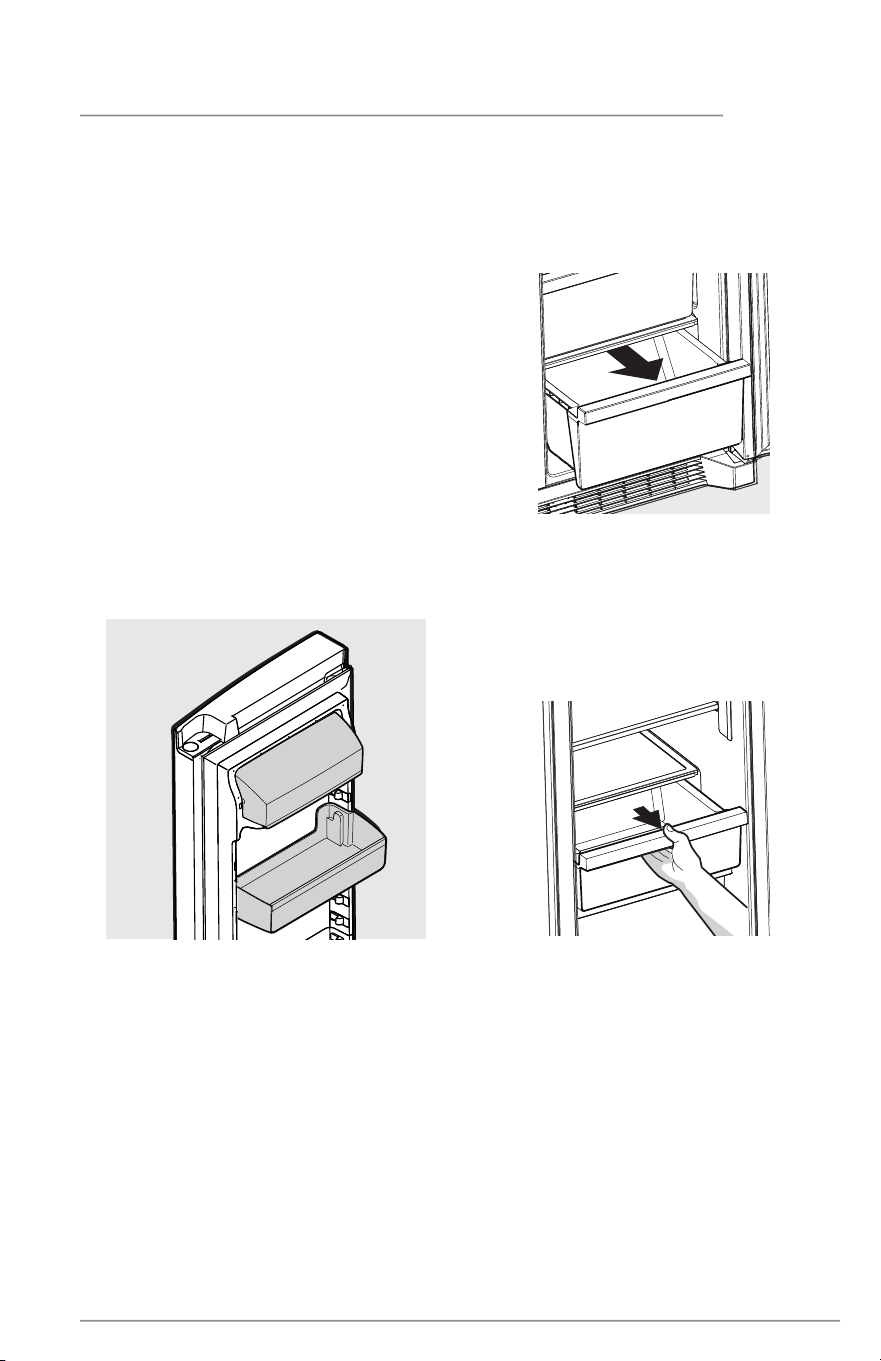
Crisper Drawer
Crispers
Crispers allow you the flexibility to store
any manner of items including fruits, veg-
etables, nuts, etc. Crispers do not feature
humidity controls.
Deli Drawer (some models)
Some models are equipped with a Deli
Drawer for storing luncheon meats,
spreads, cheeses and other deli items.
This drawer does not have a separate
temperature control.
Deli Drawer
Dairy Bin and Door Bin
22
NORMAL OPERATING SOUNDS
Understanding the Sounds you
may Hear
Your new, high-eciency unit may intro-
duce unfamiliar sounds. These sounds
normally indicate your appliance is oper-
ating correctly. Some surfaces on floors,
walls, and kitchen cabinets may make
these sounds more noticeable.
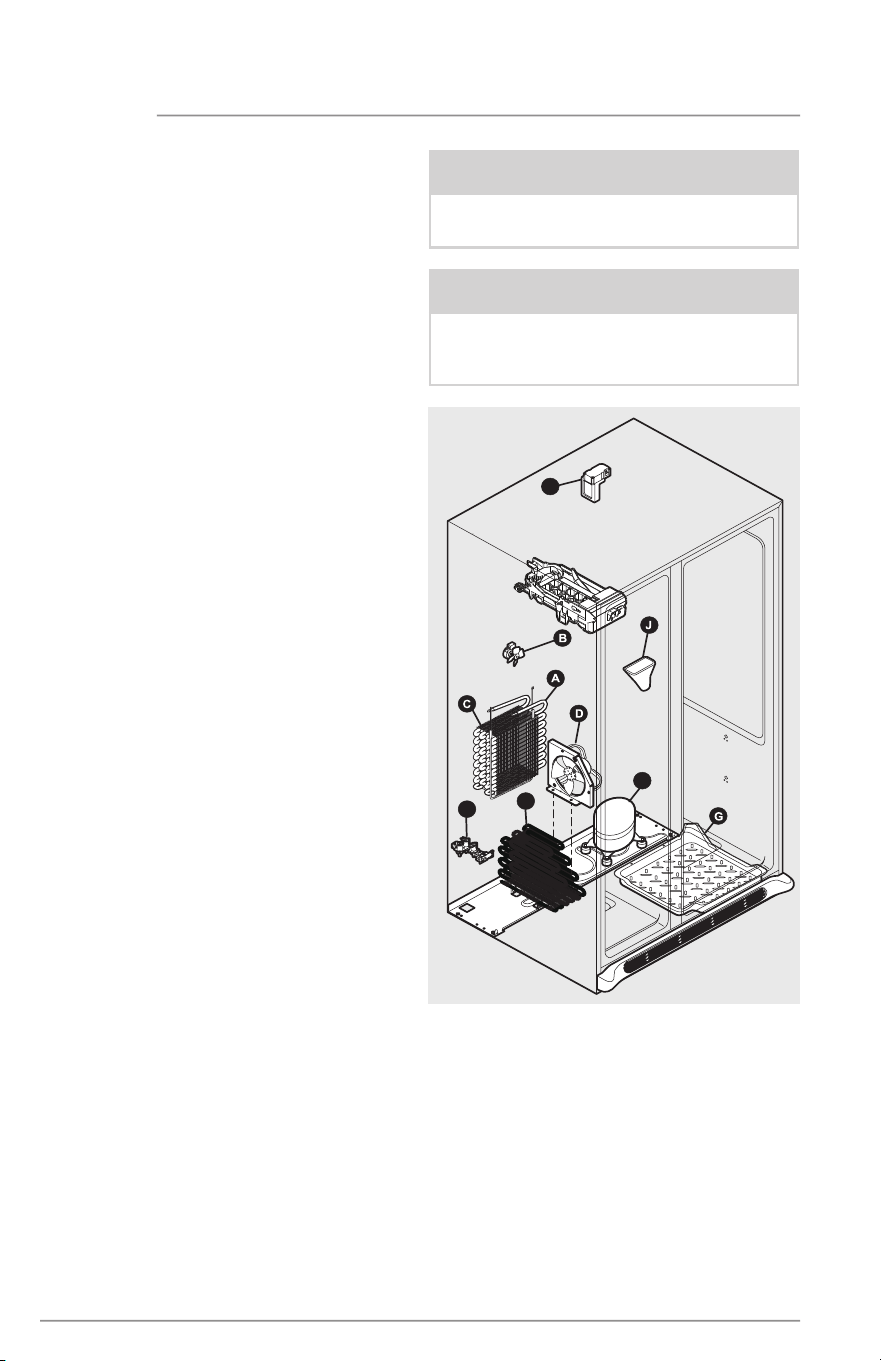
Following is a list of major components
in your unit and the sounds they can cause:
A Evaporator Refrigerant through the
evaporator may create a boiling or
gurgling sound.
B Evaporator fan You may hear air be-
ing forced through the refrigerator
by the evaporator fan.
C Defrost heater During defrost cycles,
water dripping onto the defrost
heater may cause a hissing or sizzling
sound. After defrosting, a popping
sound may occur.
D Condenser fan You may hear air be-
ing forced through the condenser.
E Compressor Modern, high-eciency
compressors run much faster than in
the past. The compressor may have a
high-pitched hum or pulsating sound.
F Water valve Makes a buzzing sound
each time it opens to fill the ice maker.
G Drain pan (not removable) You may
hear water dripping into the drain
pan during the defrost cycle.
H Condenser May create minimal
sounds from forced air.
I Motorized damper May produce in-
termittent humming during operation.
J Ice chute When dispensing ice, you
will hear a snapping or clicking sound
when the solenoid opens and closes
the ice chute.
K Ice Maker When ice has been pro-
duced, you will hear ice cubes falling
into the ice bin.
E
F
H
I
NOTE
Energy ecient foam in your refrigera-
tor is not a sound insulator.
NOTE
During automatic defrost cycle, a red
glow in the back wall vents of your
freezer compartment is normal.
23
FILTER REPLACEMENT
Do not use with water that is microbiologi-
cally unsafe or of unknown quality without
adequate disinfection before or after the
system. Use systems certified for cyst
reduction on disinfected waters that may
contain filterable cysts.
Test & certification results:
• Rated Capacity - 125 gal/453 L for
PurePour and ice and water filter
• Rated service flow - .50 gal/min.
• Operating Temp.: Min. 33°F, Max. 100°F
• Maximum Rated Pressure - 100 lbs/in.²
• Recommended Minimum Operating
Pressure: 30 lbs/in²
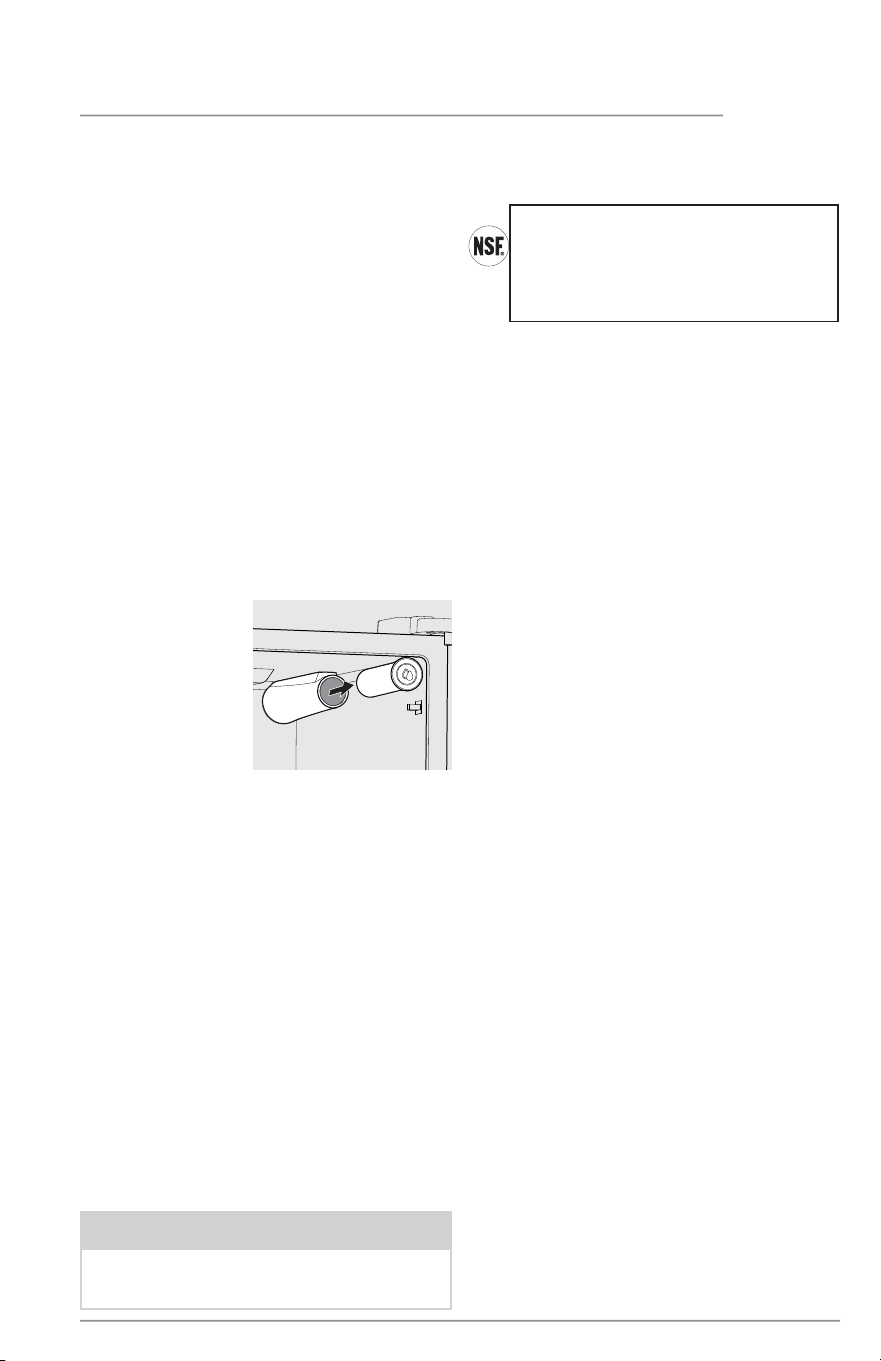
To replace your PurePour
water filter:
It is not necessary to turn the water
supply o to change the filter. Be ready
to wipe up any small amounts of water re-
leased during the filter replacement.
1. Turn O the ice maker.
2. Remove the filter by pushing on the
end/face of the filter.
3. Slide the old water filter cartridge
straight out of the housing and
discard it.
4. Unpackage the new filter cartridge.
Using the alignment guide, slide it
gently into the filter housing until it
stops against the snap-in connector
at the back of the housing.
5. Push firmly until the cartridge
snaps into place (you should hear a
click as the cartridge engages the
snap-in connector).
6. Press a drinking glass against the
water dispenser while checking for
any leaks at the filter housing. Any
spurts and sputters that occur as
the system purges air out of the
dispenser system are normal.
7. After filling one glass of water, con-
tinue flushing the system for about
4 minutes.
8. Turn On the ice maker.
9. Press and hold the Water Filter reset
button on the Ice & Water Dispenser
control panel for 3 seconds. When
the display changes from red to
green, the status has been reset.
More about your Advanced
Water Filter
The PurePour
ice and water filter sys-
tem is tested and certified to NSF/ANSI
Standards 42, 53, 401 and CSA B483.1
for the reduction of claims specified
on the performance data sheet. Visit
Frigidaire.com for more information.
PurePour™
Water Filter
Keep safe, great-tasting water flowing
with a PurePour water filter. Using a Pure-
Pour water filter:
• Makes Safe Water Second Nature
PurePour water filters are certified
to reduce contaminates* and keep
great-tasting water flowing for you
and your family.
• Produces Purity You Can Trust
Know for certain your PurePour water
filter is a protector. Counterfeits and
knockos put your refrigerator and
health at risk. Frigidaire Genuine Fil-
ters are the smarter, safer choice.
• Every Drop Gives Back
Partnered on sustainability eorts,
the use of a PurePour water filter
helps cut back on the cost and use of
plastic used to produce and package
bottled water
*For the complete list, please see Performance
Data Sheet on Frigidaire.com
Ordering Replacement Filters
To order your replacement filters, please
visit our online store at Frigidaire.com, by
calling toll-free at 1 (800) 372-4432, or by
visiting the dealer where you purchased
your refrigerator. Frigidaire recommends
that you order extra filters when you first in-
stall your refrigerator, and that you replace
your filters at least once every 6 months.
Here are the product numbers to request
when ordering:
PurePour Water Filter
Part# FPPWFUO1
Replacing the
Water Filter
The water filter is
located at the top
right side of the re-
frigerator compart-
ment. In general,
you should change
the water filter
every 6 months to
ensure the highest possible water quality.
Water Filter Status on the user interface
prompts you to replace the filter after a
standard amount of water (125 gal/453 L for
PurePour)
has flowed through the system.
If you have not used your refrigerator for a
period of time (during moving for example),
change the filter before reinstalling
the refrigerator.
NOTE
When you order your replacement filter,
please reorder the same filter type
currently in your refrigerator.
24
FILTER REPLACEMENT
PureAir Ultra II™ Air Filter
Your appliance control display is
equipped with a REPLACE AIR FILTER
indicator to remind you to change your
filter every 6 months to ensure optimal
filtering of appliance odors. Your PureAir
Ultra II Air Filter is included in your Liter-
ature Pack in the crisper drawer. To order
replacement filters, please visit our online
store at Frigidaire.com, by calling toll-free
at 1 (800) 372-4432, or by visiting the
dealer where you purchased your unit.
Here are the product numbers to request
when ordering:
PureAir Ultra II Air Filter
Part# PAULTRA2
Replacing the Air Filter
You should change your air filter every
6 months (the filter status light on the
control panel prompts you to replace
the filter after 6 months) to optimize the
reduction of refrigerator odors. Dierent
foods will emit various levels of odor. To
install your new PureAir Ultra II air filter:
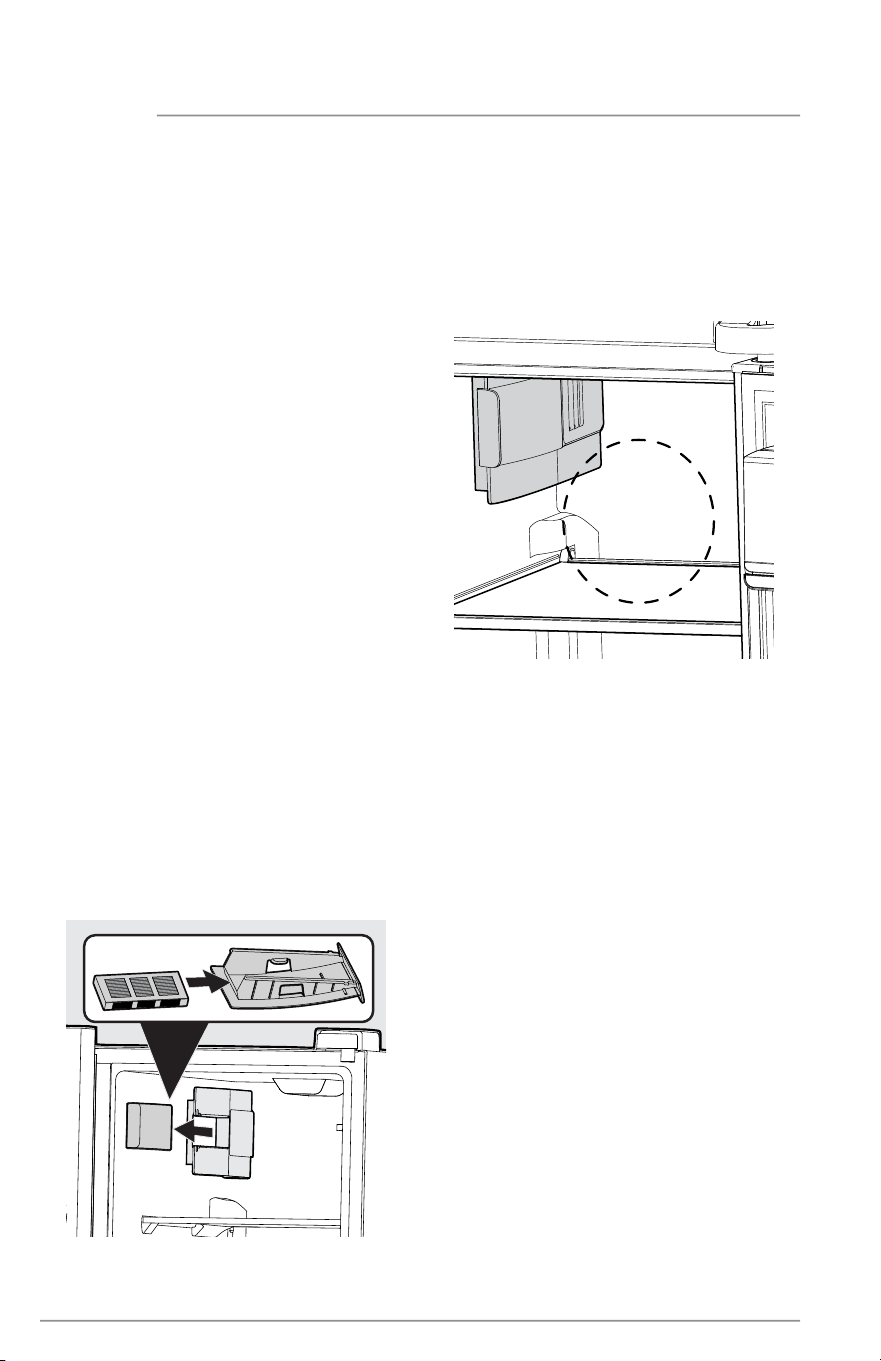
1. Pull the air filter housing straight
out.
2. Remove the old filter and discard it
(if applicable).
3. Unpack the new filter and place it
inside the housing.
4. Slide the housing back into position.
5. Activate or reset the Air Filter status
light on the control panel.
Damper/Air Filter Housing
In humid regions certain products stored
too close to the damper/air filter housing
may freeze. If this scenario occurs, adjust
the fresh food temperature settings and
reconfigure the top shelf storage to allow for
proper air diusion.
25
CARE AND CLEANING
Protecting your investment
Keeping your appliance clean maintains
appearance and prevents odor build-up.
Wipe up any spills immediately and clean
the freezer and refrigerator compart-
ments at least twice a year. When clean-
ing, take the following precautions:
• Never use CHLORIDE or cleaners
with bleach to clean stainless steel.
• Do not wash any removable parts in
a dishwasher.
• Always unplug the electrical power cord
from the wall outlet before cleaning.
• Remove adhesive labels by hand. Do
not use razor blades or other sharp
instruments which can scratch the
appliance surface.
• Do not remove the serial plate.
Do not use abrasive cleaners such as win-
dow sprays, scouring cleansers, brushes,
flammable fluids, cleaning waxes, concen-
trated detergents, bleaches or cleansers
containing petroleum products on plastic
parts, interior doors, gaskets or cabinet
liners. Do not use paper towels, metallic
scouring pads, or other abrasive cleaning
materials or strong alkaline solutions.
CAUTION
• Pull the unit straight out to move
it. Shifting it from side to side may
damage flooring. Be careful not
to move the appliance beyond the
plumbing connections.
• Damp objects stick to cold metal
surfaces. Do not touch refrigerated
surfaces with wet or damp hands.
• Sudden temperature changes can
cause glass breakage.
NOTE
If you set your temperature controls
to turn o cooling, power to lights and
other electrical components will contin-
ue until you unplug the power cord from
the wall outlet.
IMPORTANT
If you store or move your unit in freez-
ing temperatures, be sure to completely
drain the water supply system. Failure to
do so could result in water leaks when
you put the unit back into service. Con-
tact a service representative to perform
this operation.
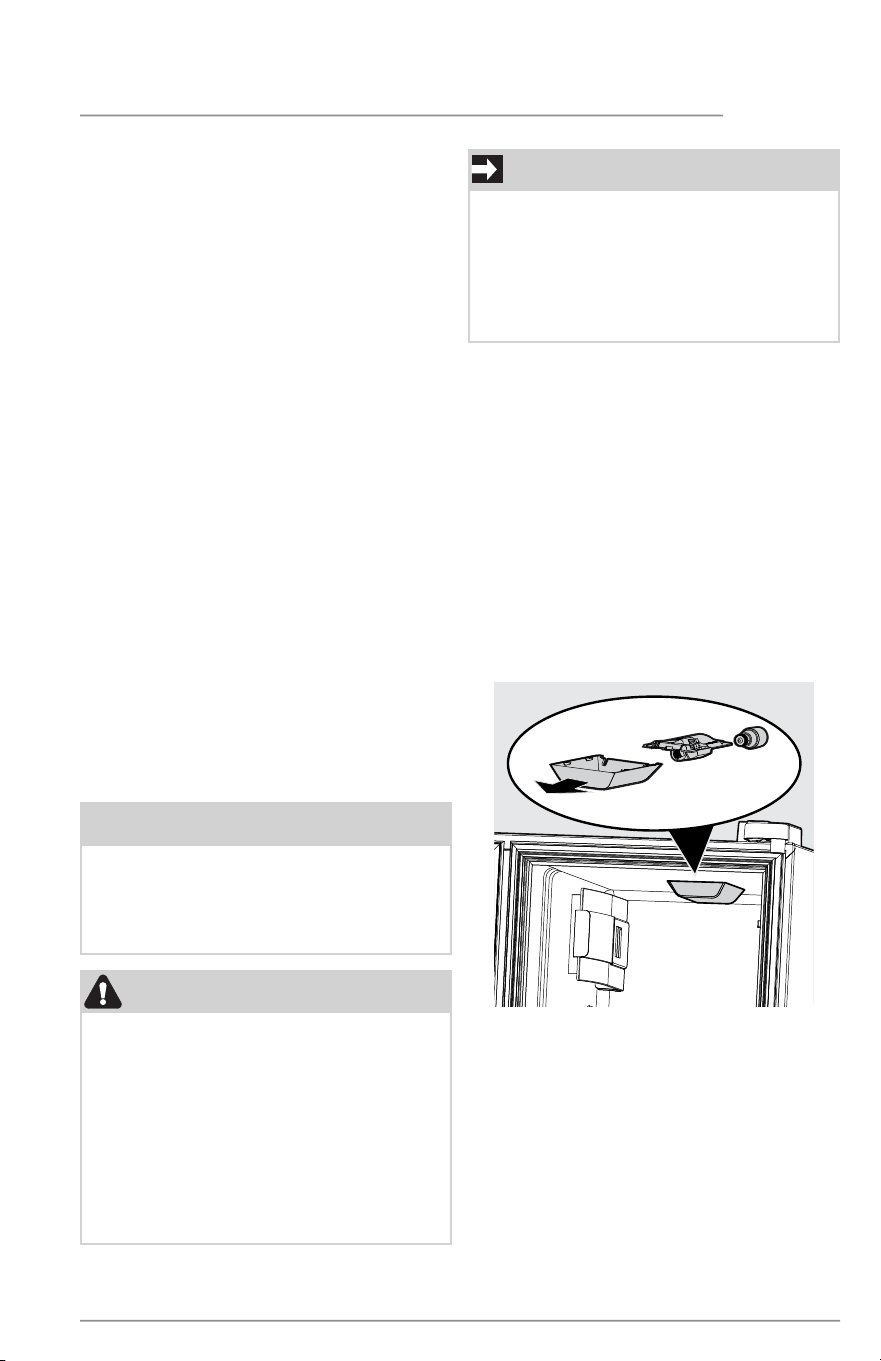
Replacing the LED Light Bulb
1. Unplug the refrigerator.
2. Wearing gloves, slide the clear light
cover along the top of the unit to-
ward the front of the unit.
3. Replace the old LED bulb with a
bulb no greater than 5 watts.
Caution: Wear gloves when replac-
ing the LED bulb to avoid getting
cut. Use the same wattage when
replacing the LED bulb.
4. Replace the light cover
5. Plug in the refrigerator.
26
Refrigerator Glass Shelf
Refrigerator: Shelves are easily adjusted
to suit individual needs. Before adjusting
the shelves, remove all food. Shelves are
supported by side rails.
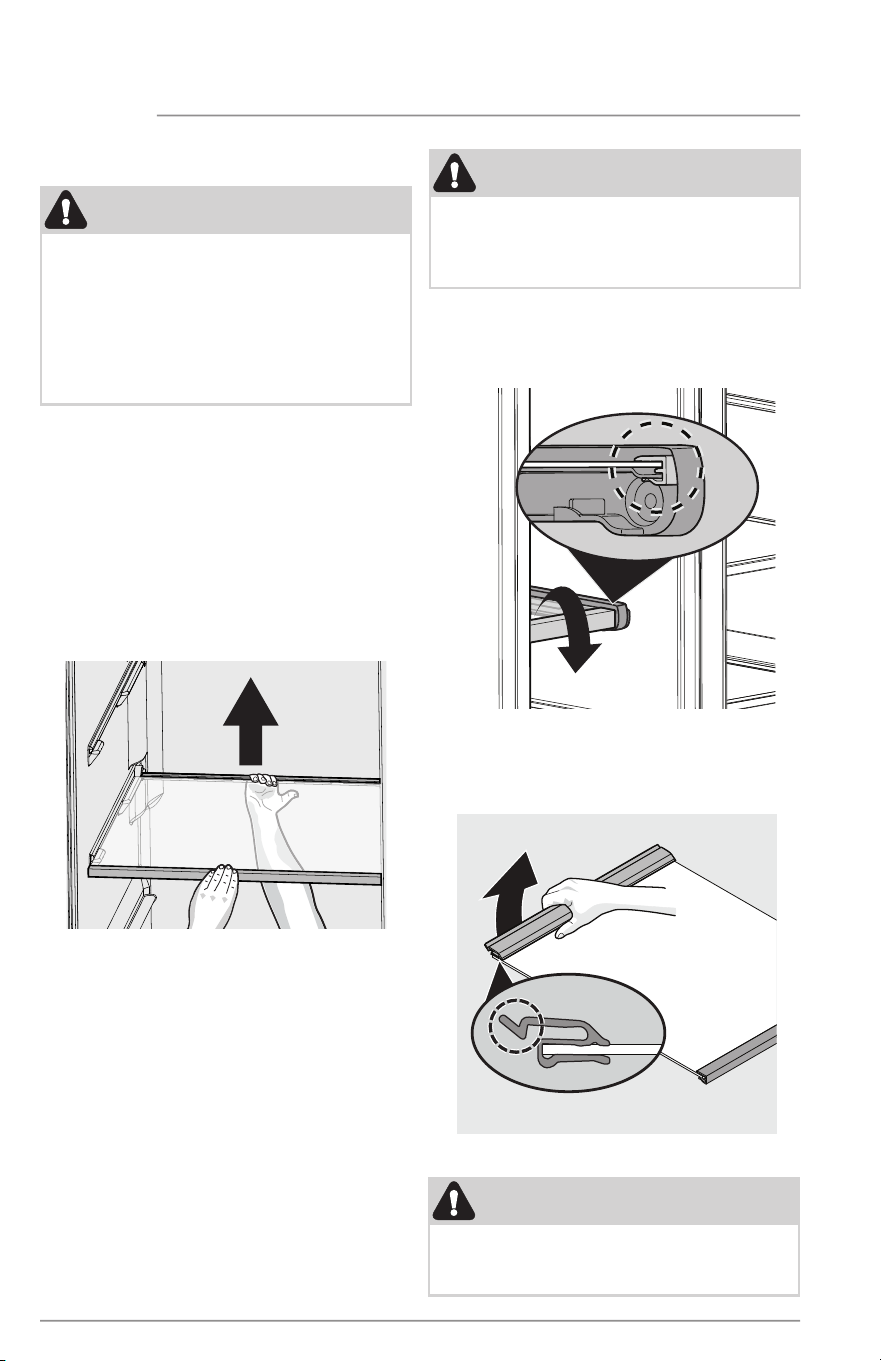
To adjust, lift up on the back of the shelf
and pull forward.
Replace the shelf by sliding it on top of
the formed rails on the side walls of the
cabinet until the rear plastic hooks of the
shelf lock into the rear of the cabinet liner.
Glass Shelves
Freezer: You can remove the glass freezer
shelf for cleaning. Remove all food from
the glass shelf. Rotate the front trim down
to remove front trim (Figure 1).
CAUTION
To avoid personal injury or property
damage, handle the freezer glass shelves
carefully. These shelves are fixed and are
not to be used as sliding shelves.
Remove both the rear trim and glass by
pulling up on the rear tab and sliding the
shelf forward (Figure 2)
Figure 1
CAUTION
To avoid personal injury or property
damage, handle tempered glass shelves
carefully. Shelves may break sudden-
ly if nicked, scratched, or exposed to
sudden temperature change. Allow the
glass shelves to stabilize to room tem-
perature before cleaning. Do not wash
in the dishwasher.
CARE AND CLEANING
Figure 2
CAUTION
Allow the glass shelves to stabilize to
room temperature before cleaning. Do
not wash in the dishwasher.
27
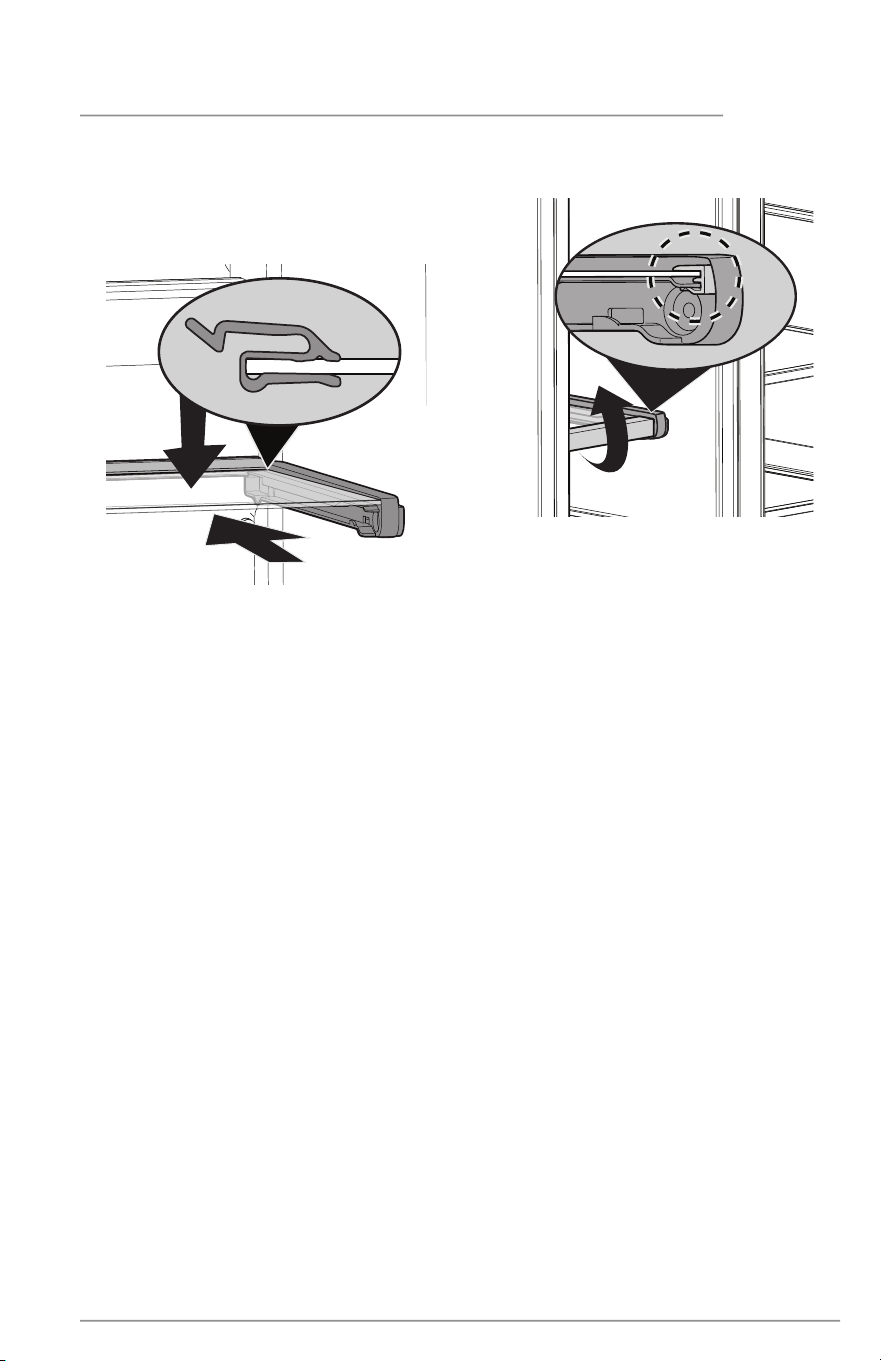
To reassemble the freezer shelf, slide the
glass and rear trim along the shelf rails
while pressing the shelf downward until
it is fully locked into place in the rear
(Figure 3).
Figure 3
Finally, rotate the front trim upward on the
front edge of the glass shelf (Figure 4).
Figure 4
CARE AND CLEANING
28
CARE AND CLEANING
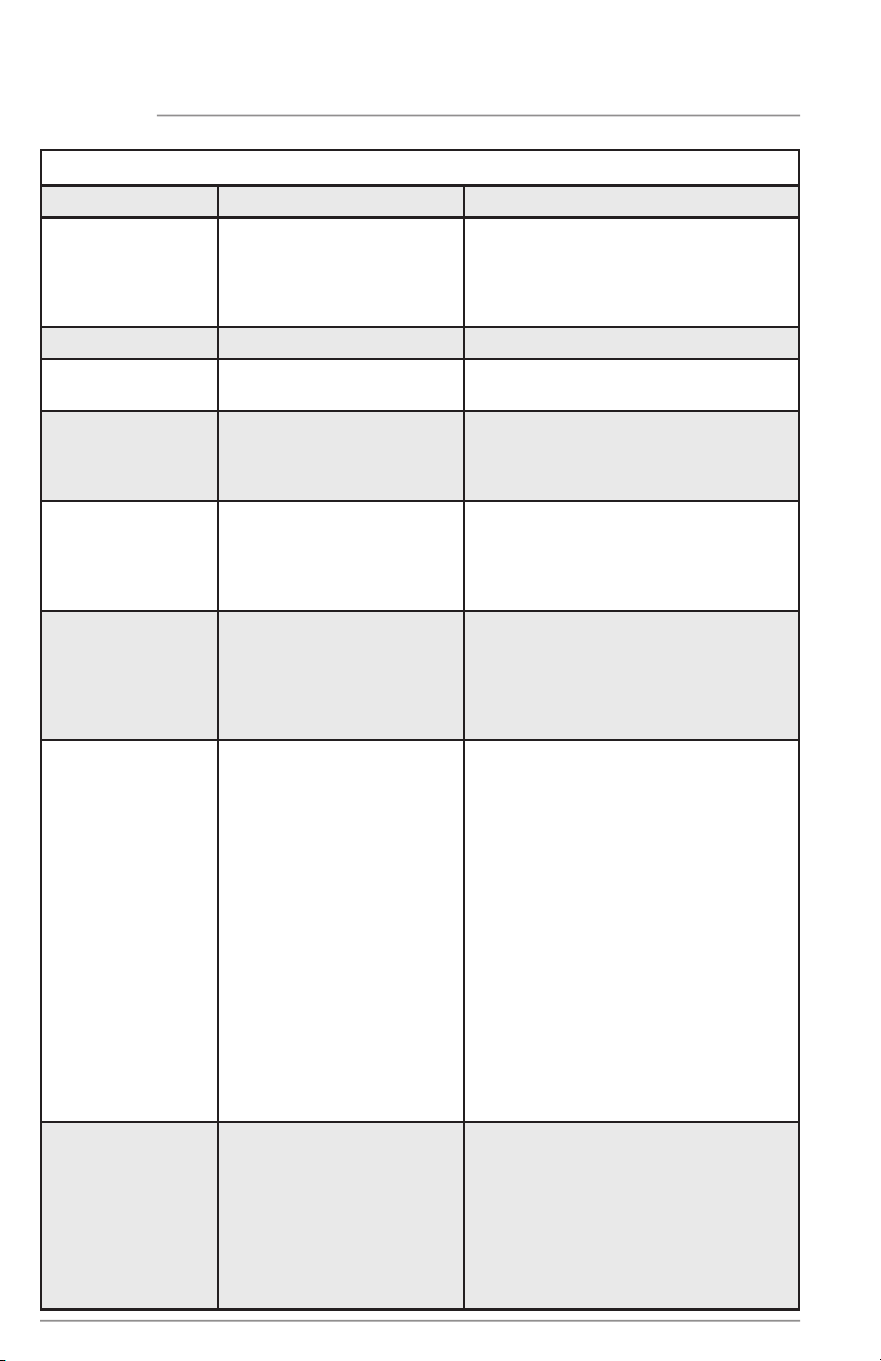
Care & Cleaning Tips
Part What To Use Tips and Precautions
Interior &
Door Liners
• Soap and water
• Baking soda and water
Use 2 Tbsp of baking soda in 1 qt
of warm water. Be sure to wring
excess water out of sponge or cloth
before cleaning around controls,
light bulb or any electrical part.
Door Gaskets • Soap and water Wipe gaskets with a clean soft cloth.
Drawers & Bins • Soap and water Use a soft cloth to clean drawer
runners and tracks.
Glass Shelves • Soap and water
• Glass cleaner
• Mild liquid sprays
See Glass shelves in CARE AND
CLEANING before cleaning. Allow
glass to warm to room temperature
before immersing in warm water.
Toe Grille • Soap and water
• Mild liquid sprays
• Vacuum attachment
Vacuum dust from front of toe grille.
Remove toe grille (see Installation
Instructions). Vacuum backside,
wipe with sudsy cloth or sponge.
Rinse and dry.
Exterior & Handles • Soap and water
• Non Abrasive Glass
Cleaner
Do not use commercial household
cleaners containing ammonia,
bleach or alcohol to clean handles.
Use a soft cloth to clean smooth
handles. DO NOT use a dry cloth to
clean smooth doors.
Exterior & Handles
(Stainless Steel
Models Only)
• Soap and water
• Stainless Steel Cleaners
Never use CHLORIDE or cleaners
with bleach to clean stainless steel.
Clean stainless steel front and
handles with non-abrasive soapy
water and a dishcloth. Rinse with
clean water and a soft cloth. Use a
non-abrasive stainless steel cleaner.
These cleaners can be purchased at
most home improvement or major
department stores. Always follow
manufacturer’s instructions. Do not
use household cleaners containing
ammonia or bleach.
NOTE: Always clean, wipe and dry
with the grain to prevent scratch-
ing. Wash the rest of the cabinet
with warm water and mild liquid
detergent. Rinse well, and wipe dry
with a clean soft cloth.
Replacing
LED Bulbs
• Unplug refrigerator
• Wear gloves
• Replace the Refrigera-
tor light cover by slid-
ing the cover forward
along the top
• Replace old LED bulb
• Replace light cover
• Plug in the refrigerator
CAUTION: Wear gloves when replac-
ing LED bulbs to avoid getting cut.
Use only a 5-watt or less AC LED
light bulb.
29
1-800-265-8352 (Canada)
Frigidaire.ca
1-800-374-4432 (United States)
Frigidaire.com
TROUBLESHOOTING
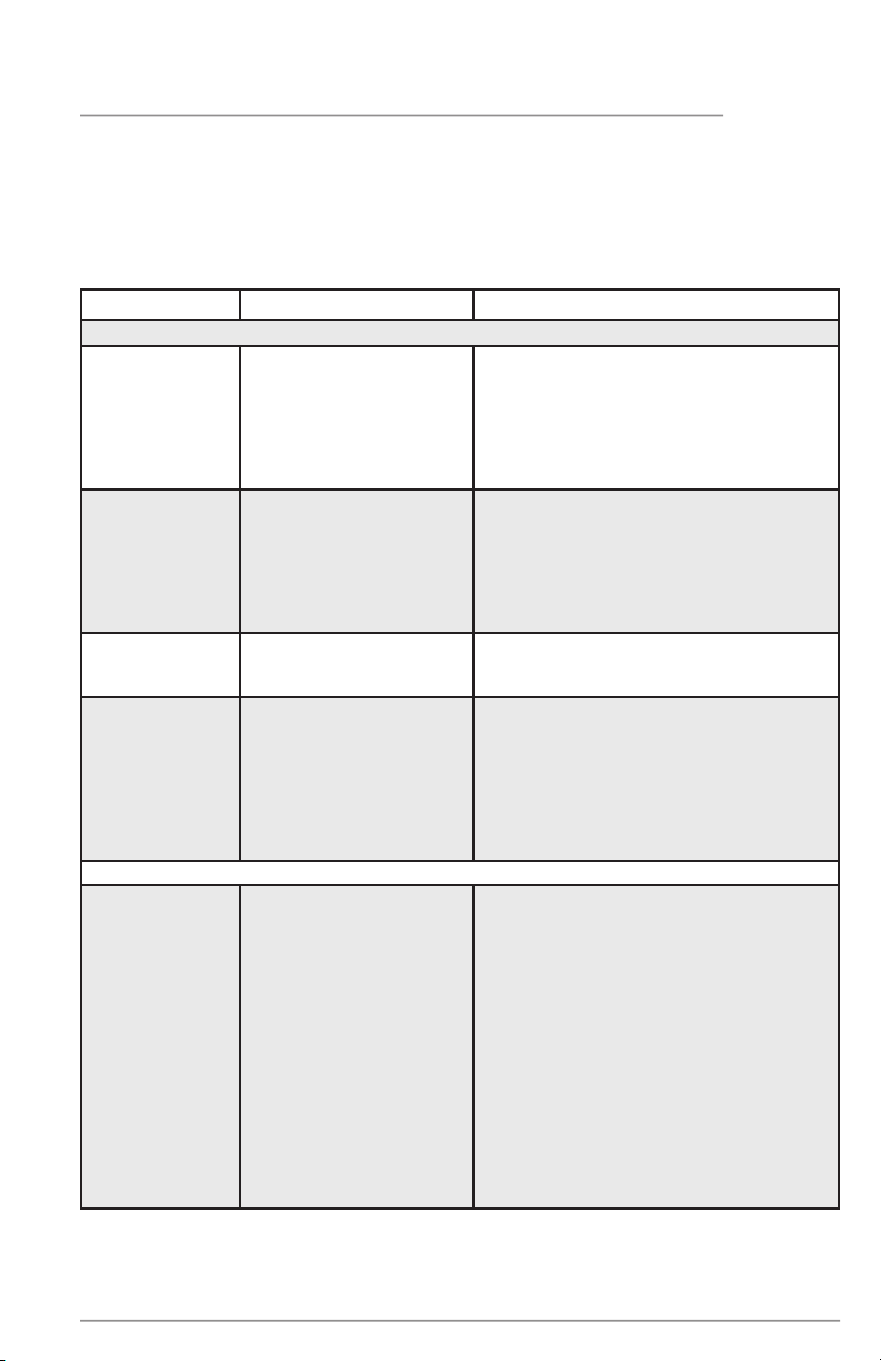
Let us help you troubleshoot your concern! This section will help you with common
issues. If you need us, visit our website, chat with an agent, or call us. We may be able
to help you avoid a service visit. If you do need service, we can get that started for you!
CONCERN CAUSE SOLUTION
AUTOMATIC ICE MAKER
Ice maker is not
making any ice.
• Ice maker is not on.
• Saddle valve on cold
water pipe is clogged
or restricted by for-
eign material.
• Ensure the ice maker is on (green light).
• The ice and water filter cartridge may
be clogged. Replace filter cartridge.
• Turn o household water line valve.
Remove valve. Ensure that valve is
not a self-piercing saddle valve. Clean
valve. Replace valve if necessary.
Ice maker is
not making
enough ice.
• Check to see if water
dispenser is dispensing
slower than normal.
• Freezer control is set
too warm.
• If it is, replace the ice and water
filter cartridge.
• Set freezer control to colder setting
to improve performance of the ice
maker. Allow 24 hours for tempera-
ture to stabilize.
Ice maker will
not stop mak-
ing ice.
• Ice maker arm is being
held down by some
item in the freezer.
• Move item and release arm. Remove
any ice cubes that are frozen together
over the arm.
Ice cubes are
freezing to-
gether.
• Ice cubes are not being
used frequently enough.
• Ice cubes are hollow
(partially frozen cubes
with water inside).
• Freezer control is set
too warm.
• Remove ice container and discard ice
from container. Ice maker will produce
fresh supply.
• The ice and water filter cartridge may
be clogged. Replace filter cartridge.
• Set freezer control to colder setting. Al-
low 24 hours for temperature to stabilize.
DISPENSER (Ice & Water)
Dispenser will
not dispense ice.
• There is no ice in the
bin to be dispensed.
• The refrigerator
doors are not com-
pletely closed.
• Dispenser paddle has
been pressed too long
and the dispenser mo-
tor has overheated.
• Not dispensing ice
regularly may melt and
refreeze ice causing
ice clumping. Dispens-
ing clumps could dam-
age the ice bucket.
• See the "Ice maker is not making any
ice" section above.
• Be sure to close the
refrigerator completely.
• The motor overload protector will
reset in about 3 minutes and then ice
can be dispensed.
• Empty the ice bucket monthly or
regularly dispense ice. For longer
periods of time (vacation or vacant
homes) see Ice Maker/Dispenser
Tips in the AUTOMATIC ICE AND
WATER DISPENSER section to turn
o the ice maker.
30
TROUBLESHOOTING
CONCERN CAUSE SOLUTION
DISPENSER (Ice & Water) (Continued)
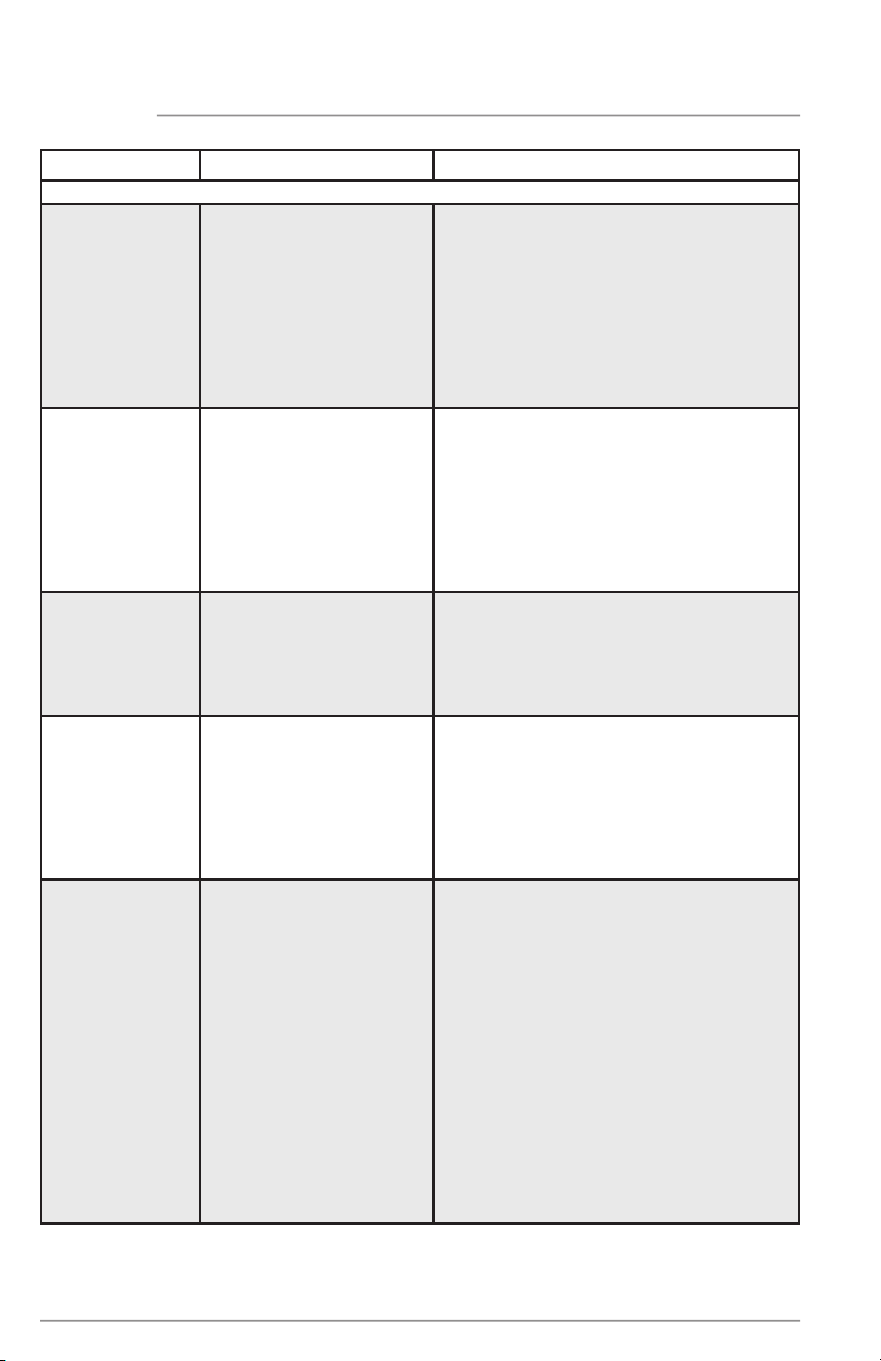
Ice dispenser is
jammed.
• Ice has melted and
frozen around auger
due to infrequent
use, temperature
fluctuations, and/or
power outages.
• Ice cubes are jammed
between ice maker and
back of ice container.
• Remove ice container, thaw, and emp-
ty the contents. Clean container, wipe
dry, and replace in proper position.
When new ice is made, dispenser
should operate. See Cleaning the Ice
Storage Bin in the AUTOMATIC ICE
AND WATER DISPENSER section.
• Remove ice cubes that are jamming
the dispenser.
Dispenser will not
dispense water.
• Water filter not
seated properly.
• Water filter is clogged.
• Household water line
valve is not open.
• Remove and reinstall the water filter.
Be sure to push the filter firmly so that
you hear it lock solidly into position.
• Replace filter cartridge. Be sure to
remove protective caps and push the
filter firmly so that you hear it lock
solidly into position.
• Open the household water line valve.
Water has an
odd taste and/
or odor.
• Water has not been
dispensed for an ex-
tended period of time.
• Unit not properly
connected to cold
water line.
• Draw and discard 10-12 glasses of
water to freshen the supply.
• Connect unit to cold water line that
supplies water to the kitchen faucet.
Water pressure
is extremely
low.
• Cut-o and cut-on
pressures are too low
(well systems only).
• Reverse osmosis system
is in regenerative phase.
• Have someone turn up the cut-o
and cut-on pressure on the water
pump system (well systems only).
• It is normal for a reverse osmosis
system to be below 20 psi during
the regenerative phase.
• See the WATER SUPPLY CONNEC-
TION section.
Water not cold
enough.
• As warmer tap water
goes through the filter
and enters the water
tank the chilled water
is pushed through to
the dispenser. Once the
chilled water is used up
it will take several hours
to bring the freshly
replaced water to a
cooler temperature.
• Some models are de-
signed without a wa-
ter tank, these water
dispensing systems
are not designed to
chill water.
• Add ice to cup or container before
dispensing water.
• Add ice to cup or container before
dispensing water
31
TROUBLESHOOTING
CONCERN CAUSE SOLUTION
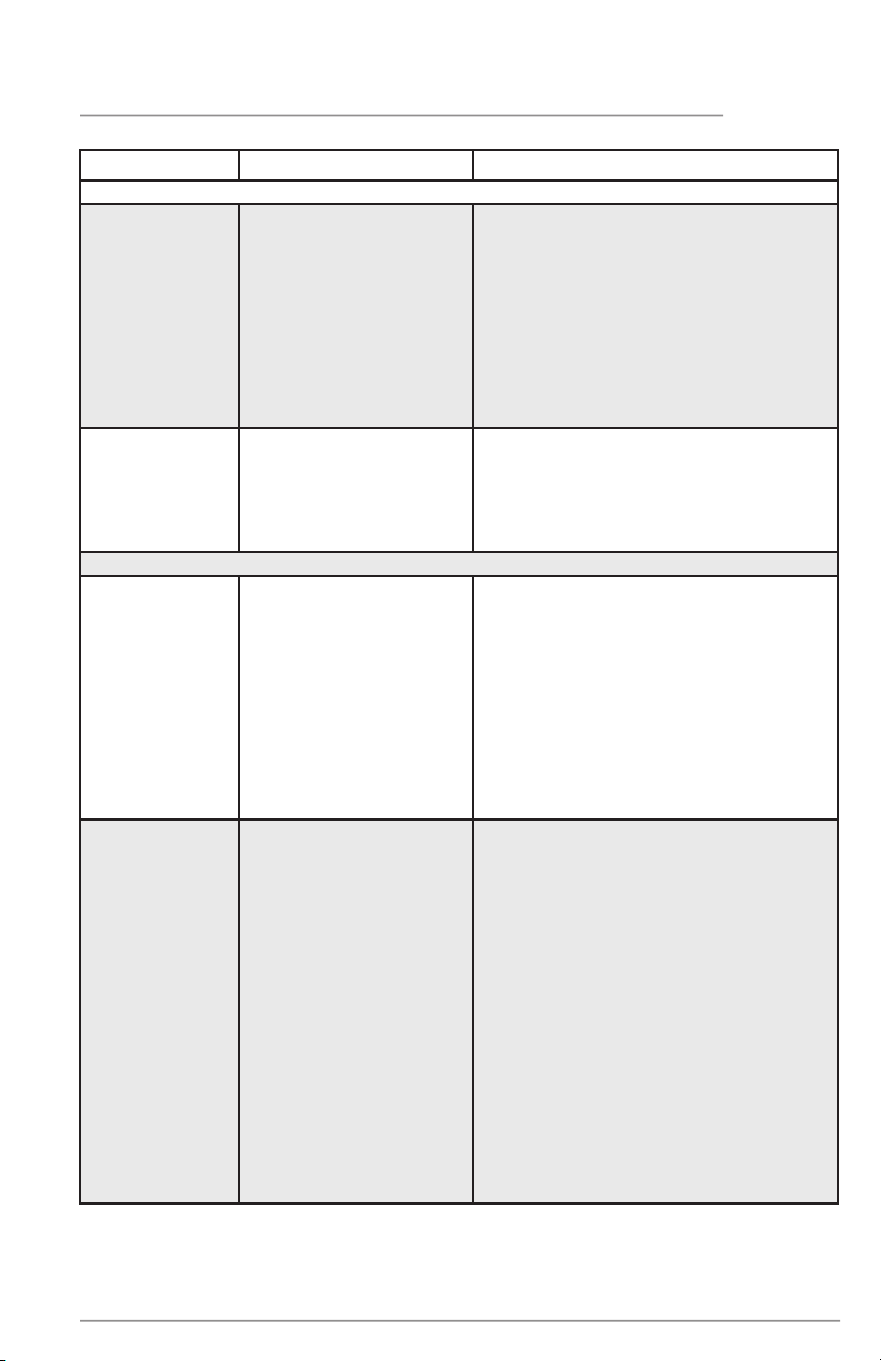
OPENING/CLOSING OF DOORS/DRAWERS
Door(s) will not
close.
• Door was closed too
hard, causing other
door to open slightly.
• Refrigerator is not lev-
el. It rocks on the floor
when moved slightly.
• Refrigerator is touch-
ing a wall or cabinet.
• Close both doors gently.
• Ensure floor is level and solid, and
can adequately support the refriger-
ator. Contact a carpenter to correct
a sagging or sloping floor.
• Ensure floor is level and solid, and
can adequately support the refriger-
ator. Contact a carpenter to correct
a sagging or sloping floor.
Drawers are dif-
ficult to move.
• Food is touching shelf
on top of drawer.
• Track that drawers
slide on is dirty.
• Remove top layer of items in drawer.
• Ensure drawer is properly installed
on track.
• Clean drawer, rollers, and track. See
CARE AND CLEANING.
RUNNING OF REFRIGERATOR
Compressor
does not run.
• Freezer control is set
to OF or 0.
• Refrigerator is in
defrost cycle.
• Plug at electrical out-
let is disconnected.
• House fuse blown or
tripped circuit breaker.
• Power outage.
• Set freezer control.
• This is normal for a fully automatic
defrost refrigerator. The defrost cy-
cle occurs periodically, lasting about
30 minutes.
• Ensure plug is tightly pushed into outlet.
• Check/replace fuse with a 15 amp
time-delay fuse. Reset circuit breaker.
• Check house lights. Call local
electric company.
Refrigerator
runs too much
or too long.
• Room or outside
weather is hot.
• Doors are opened too
frequently or too long.
• Refrigerator/freezer
door may be
slightly open.
• Freezer control is set
too cold.
• Refrigerator/freezer
gasket is dirty,
worn, cracked, or
poorly fitted.
• Condenser is dirty.
• It’s normal for the refrigerator to
work longer under these conditions.
• Warm air entering the refrigerator
causes it to run more. Open doors
less often.
• Ensure refrigerator is level. Keep food
and contains from blocking door. See
CONCERN column OPENING/CLOS-
ING OF DOORS/DRAWERS.
• Set Refrigerator control to warmer
setting until refrigerator temperature
is satisfactory. Allow 24 hours for
temperature to stabilize.
• Clean or change gasket. Leaks in
door seal will cause refrigerator
to run longer in order to maintain
desired temperatures.
• Clean condenser. See CARE
AND CLEANING.
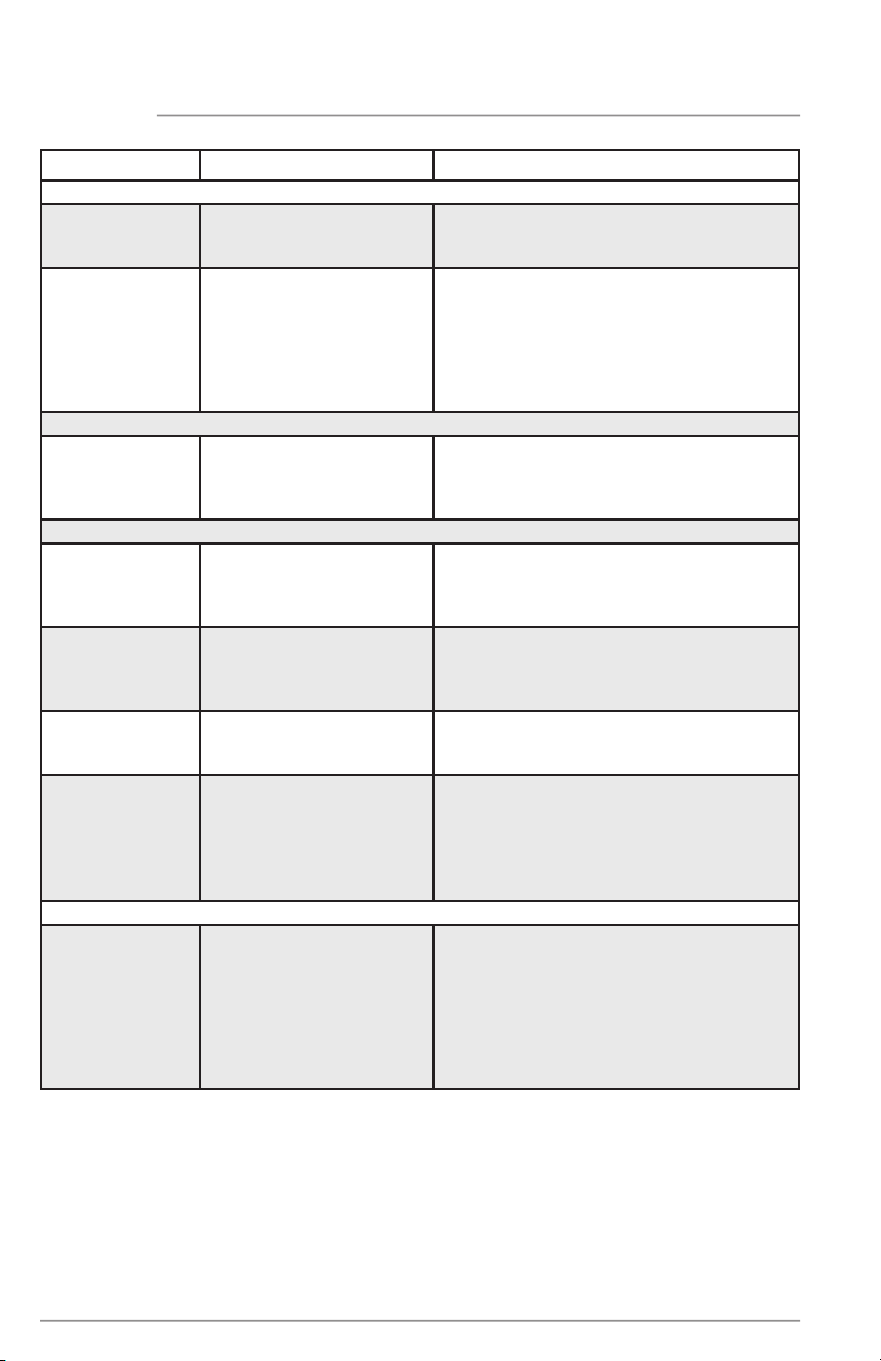
32
CONCERN CAUSE SOLUTION
RUNNING OF REFRIGERATOR (Continued)
Compressor
goes o and
on frequently.
• Thermostat keeps the
refrigerator at a con-
stant temperature.
• This is normal. Refrigerator goes on
and o to keep temperature constant.
Appliance
seems to run
continuously.
• The appliance is
equipped with an
energy-ecient
variable speed
compressor. It actual-
ly saves energy run-
ning more frequently.
• This is normal.
DIGITAL TEMPERATURE DISPLAY
Digital tempera-
ture displays
are flashing.
• Electronic control
system has detected a
performance problem.
• Call your Frigidaire service represen-
tative, who can interpret any messag-
es or number codes flashing on the
digital displays.
WATER/MOISTURE/FROST INSIDE REFRIGERATOR
Moisture collects
on inside of re-
frigerator walls.
• Weather is hot
and humid.
• Door is slightly open.
• The rate of frost buildup and internal
sweating increases.
• See CONCERN column OPENING/
CLOSING OF DOORS/DRAWERS.
Water collects
on bottom side
of drawer cover.
• Vegetables contain
and give o moisture.
• It is not unusual to have moisture on
the bottom side of the cover.
• Move humidity control (some mod-
els) to lower setting.
Water collects in
bottom of drawer.
• Washed vegetables
and fruit drain while
in the drawer.
• Dry items before putting them in the
drawer. Water collecting in bottom
of drawer is normal.
Stored prod-
ucts on top
shelf freeze
• Fresh food tempera-
ture setting too cold.
• Certain products
stored too close
to damper / air
filter housing.
• Adjust fresh food temperature settings.
• Reconfigure top shelf storage to
allow proper diusion of air. See
Damper/Air Filter Housing in the
FILTER REPLACEMENT section.
WATER/MOISTURE/FROST OUTSIDE REFRIGERATOR
Moisture
collects on
outside of
refrigerator or
between doors.
• Weather is humid.
• Door is slightly open,
causing cold air from
inside refrigerator
to meet warm air
from outside.
• This is normal in humid weather.
When humidity is lower, the moisture
should disappear.
• See CONCERN column OPENING/
CLOSING OF DOORS/DRAWERS.
TROUBLESHOOTING
33
LIMITED WARRANTY
Your appliance is covered by a one year limited warranty. For one year from your original date of
purchase, Electrolux will pay all costs for repairing or replacing any parts of this appliance that
prove to be defective in materials or workmanship when such appliance is installed, used and
maintained in accordance with the provided instructions.
Exclusions
This warranty does not cover the following:
1. Products with original serial numbers that have been removed, altered or cannot be
readily determined.
2. Product that has been transferred from its original owner to another party or removed
outside the USA or Canada.
3. Rust on the interior or exterior of the unit.
4. Products purchased “as-is” are not covered by this warranty.
5. Food loss due to any refrigerator or freezer failures.
6. Products used in a commercial setting.
7. Service calls which do not involve malfunction or defects in materials or workmanship, or
for appliances not in ordinary household use or used other than in accordance with the
provided instructions.
8. Service calls to correct the installation of your appliance or to instruct you how to use
your appliance.
9. Expenses for making the appliance accessible for servicing, such as removal of trim, cupboards,
shelves, etc., which are not a part of the appliance when it is shipped from the factory.
10. Service calls to repair or replace appliance light bulbs, air filters, water filters, other
consumables, or knobs, handles, or other cosmetic parts.
11. Surcharges including, but not limited to, any after hour, weekend, or holiday service calls,
tolls, ferry trip charges, or mileage expense for service calls to remote areas, including the
state of Alaska.
12. Damages to the finish of appliance or home incurred during installation, including but not
limited to floors, cabinets, walls, etc.
13. Damages caused by: services performed by unauthorized service companies; use of parts
other than genuine Electrolux parts or parts obtained from persons other than authorized
service companies; or external causes such as abuse, misuse, inadequate power supply,
accidents, fires, or acts of God.
DISCLAIMER OF IMPLIED WARRANTIES; LIMITATION OF REMEDIES
CUSTOMER’S SOLE AND EXCLUSIVE REMEDY UNDER THIS LIMITED WARRANTY SHALL BE
PRODUCT REPAIR OR REPLACEMENT AS PROVIDED HEREIN. CLAIMS BASED ON IMPLIED
WARRANTIES, INCLUDING WARRANTIES OF MERCHANTABILITY OR FITNESS FOR A PARTICULAR
PURPOSE, ARE LIMITED TO ONE YEAR OR THE SHORTEST PERIOD ALLOWED BY LAW, BUT NOT
LESS THAN ONE YEAR. ELECTROLUX SHALL NOT BE LIABLE FOR CONSEQUENTIAL OR INCIDENTAL
DAMAGES SUCH AS PROPERTY DAMAGE AND INCIDENTAL EXPENSES RESULTING FROM ANY
BREACH OF THIS WRITTEN LIMITED WARRANTY OR ANY IMPLIED WARRANTY. SOME STATES AND
PROVINCES DO NOT ALLOW THE EXCLUSION OR LIMITATION OF INCIDENTAL OR CONSEQUENTIAL
DAMAGES, OR LIMITATIONS ON THE DURATION OF IMPLIED WARRANTIES, SO THESE LIMITATIONS
OR EXCLUSIONS MAY NOT APPLY TO YOU. THIS WRITTEN WARRANTY GIVES YOU SPECIFIC LEGAL
RIGHTS. YOU MAY ALSO HAVE OTHER RIGHTS THAT VARY FROM STATE TO STATE.
If You Need Service
Keep your receipt, delivery slip, or some other appropriate payment record to establish the
warranty period should service be required. If service is performed, it is in your best interest
to obtain and keep all receipts. Service under this warranty must be obtained by contacting
Electrolux at the addresses or phone numbers below.
This warranty only applies in the USA and Canada. In the USA, your appliance is warranted by
Electrolux Major Appliances North America, a division of Electrolux Home Products, Inc. In Canada,
your appliance is warranted by Electrolux Canada Corp. Electrolux authorizes no person to change or
add to any obligations under this warranty. Obligations for service and parts under this warranty must
be performed by Electrolux or an authorized service company. Product features or specifications as
described or illustrated are subject to change without notice.
USA
1-800-374-4432
Frigidaire
10200 David Taylor Drive
Charlotte, NC 28262
Canada
1.800.265.8352
Electrolux Canada Corp.
5855 Terry Fox Way
Mississauga, Ontario, Canada
L5V 3E4