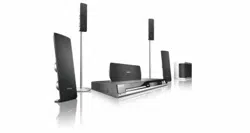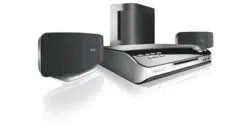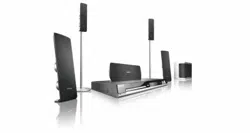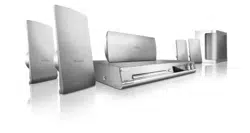
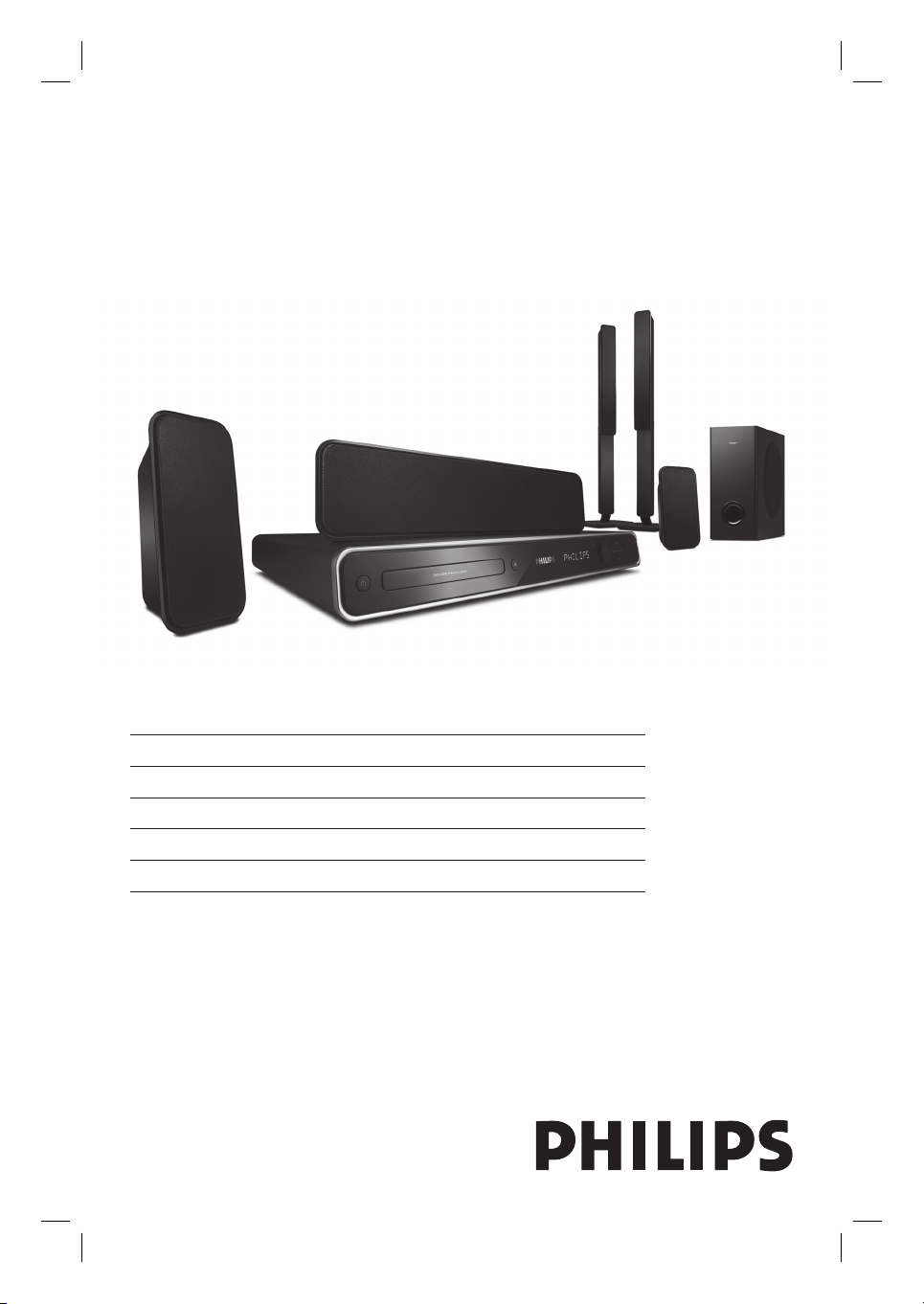
HTS3367
Register your product and get support at
www.philips.com/welcome
EN DVD Home Theater System 6
FR Système Home Cinéma DVD 58
ES Sistema de cine en casa con DVD 110
DE DVD Home Entertainment-System 162
NL
DVD home theatre-systeem
DVD home theatre-systeem 214
2
Important notes for users in the
U.K.
Mains plug
This apparatus is tted with an approved 13
Amp plug. To change a fuse in this type of
plug proceed as follows:
1 Remove fuse cover and fuse.
2 Fix new fuse which should be a BS1362
5 Amp, A.S.T.A. or BSI approved type.
3 Re t the fuse cover.
If the tted plug is not suitable for your socket
outlets, it should be cut off and an appropriate
plug tted in its place.
If the mains plug contains a fuse, this should
have a value of 5 Amp. If a plug without a fuse
is used, the fuse at the distribution board
should not be greater than 5 Amp.
Note: The severed plug must be disposed of to
avoid a possible shock hazard should it be
inserted into a 13 Amp socket elsewhere.
How to connect a plug
The wires in the mains lead are coloured with
the following code: blue = neutral (N),
brown = live (L).
As these colours may not correspond with the
colour markings identifying the terminals in
your plug, proceed as follows:
– Connect the blue wire to the terminal
marked N or coloured black.
– Connect the brown wire to the terminal
marked L or coloured red.
– Do not connect either wire to the earth
terminal in the plug, marked E (or e) or
coloured green (or green and yellow).
Before replacing the plug cover, make certain
that the cord grip is clamped over the sheath
of the lead - not simply over the two wires.
Copyright in the U.K.
Recording and playback of material may
require consent. See Copyright Act 1956 and
The Performer’s Protection Acts 1958 to
1972.
ATTENTION!
For Customer Use:
Read carefully the information located at the
bottom or rear of your DVD Home Theatre
System and enter below the Serial No. Retain
this information for future reference.
Model No. HTS3367
Serial No. _______________
Norge
Typeskilt nnes på apparatens underside.
Observer: Nettbryteren er
sekundert innkoplet. Den innebygde
netdelen er derfor ikke frakoplet
nettet så lenge apparatet er
tilsluttet nettkontakten.
For
å redusere faren for brann eller elektrisk
støt, skal apparatet ikke utsettes for regn eller
fuktighet.
Italia
DICHIARAZIONE DI CONFORMITA’
Si dichiara che l’apparecchio HTS3367, Philips
risponde alle prescrizioni dell’art. 2 comma 1
del D.M. 28 Agosto 1995 n. 548.
Fatto a Eindhoven
Philips Consumer Electronics
Philips, Glaslaan 2
5616 JB Eindhoven, The Netherlands
Ensure that the power outlet is always within
reach. If abnormal situations occur, fully
disconnect power: unplug the power cord
from the power outlet.
3
LASER
Type Semiconductor laser
GaAIAs
Wave length 645 - 660 nm (DVD)
770 - 800 nm (CD)
Output Power 6 mW (DVD)
7 mW (VCD/CD)
Beam divergence 60 degrees
This product complies with the radio
interference requirements of the
European Community.
This product complies with
the requirements of the
following directives and
guidelines: 2006/95/EC +
2004/108/EC
DK
Advarsel: Usynlig laserstråling ved
åbning når sikkerhedsafbrydere er ude
af funktion. Undgå utsættelse for
stråling.
Bemærk: Netafbryderen er sekundært
indkoblet og ofbryder ikke strømmen
fra nettet. Den indbyggede netdel er
derfor tilsluttet til lysnettet så længe
netstikket sidder i stikkontakten.
S
Klass 1 laseraparat
Varning! Om apparaten används på
annat sätt än i denna bruksanvisning
speci cerats, kan användaren utsättas
för osynlig laserstrålning, som
överskrider gränsen för laserklass 1.
Observera! Stömbrytaren är sekundärt
kopplad och bryter inte strömmen från
nätet. Den inbyggda nätdelen är därför
ansluten till elnätet så länge
stickproppen sitter i vägguttaget.
SF
Luokan 1 laserlaite
Varoitus! Laitteen käyttäminen muulla
kuin tässä käyttöohjeessa mainitulla
tavalla saattaa altistaa käyttäjän
turvallisuusluokan 1 ylittävälle
näkymättömälle lasersäteilylle.
Oikeus muutoksiin varataan. Laite ei
saa olla alttiina tippu-ja roiskevedelle.
Huom. Toiminnanvalitsin on kytketty
toisiopuolelle, eikä se kytke laitetta irti
sähköverkosta. Sisäänrakennettu
verkko-osa on kytkettynä
sähköverkkoon aina silloin, kun pistoke
on pistorasiassa.
CAUTION
VISIBLE AND INVISIBLE LASER
RADIATION WHEN OPEN. AVOID
EXPOSURE TO BEAM
ADVARSEL
SYNLIG OG USYNLIG LASERSTRÅLING
VED ÅBNING UNDGÅ UDSÆTTELSE
FOR STRÅLING
VARNING
SYNLIG OCH OSYNLIG
LASERSTRÅLNING NÄR DENNA DEL
ÄR ÖPPNAD BETRAKTA EJ STRÅLEN
VARO!
AVATTAESSA OLET ALTTIINA
NÄKYVÄLLE JA NÄKYMÄTTÖMÄLLE
LASER SÄTEILYLLE. ÄLÄ KATSO
SÄTEESEEN
VORSICHT
SICHTBARE UND UNSICHTBARE
LASERSTRAHLUNG WENN
ABDECKUNG GEÖFFNET NICHT DEM
STRAHL AUSSETZEN
ATTENTION
RAYONNEMENT LASER VISIBLE ET
INVISIBLE EN CAS D’OUVERTURE
EXPOSITION DANGEREUSE AU
FAISCEAU
4
Disposal of your old product
Your product is designed and manufactured with high quality materials
and components, which can be recycled and reused.
When this crossed-out wheeled bin symbol is attached to a product it
means the product is covered by the European Directive 2002/96/EC.
Please inform yourself about the local separate collection system for
electrical and electronic products.
Please act according to your local rules and do not dispose of your old products with
your normal household waste. The correct disposal of your old product will help
prevent potential negative consequences for the environment and human health.
Se débarrasser de votre produit usagé (Français)
Votre produit est conçu et fabriqué avec des matériaux et des
composants de haute qualité, qui peuvent être recyclés et utilisés de
nouveau
.
Lorsque ce symbole d'une poubelle à roue barrée est attaché à un
produit, cela signifie que le produit est couvert par la Directive
Européenne 2002/96/EC.
Veuillez vous informer du système local de séparation des déchets
électriques et électroniques.
Veuillez agir selon les règles locales et ne pas jeter vos produits usagés avec les déchets
domestiques usuels. Jeter correctement votre produit usagé aidera à prévenir les
conséquences négatives potentielles contre l'environnement et la santé humaine.
Cómo deshacerse del producto usado (Español)
Su producto ha sido diseñado y fabricado con materiales y componentes de
alta calidad, que pueden ser reciclados y reutilizados.
Cuando vea este símbolo de una papelera con ruedas tachada junto a un
producto, esto significa que el producto está bajo la Directiva Europea
2002/96/EC
Deberá informarse sobre el sistema de reciclaje local separado para
productos eléctricos y electrónicos.
Siga las normas locales y no se deshaga de los productos usados tirándolos en la basura
normal de su hogar. El reciclaje correcto de su producto usado ayudará a evitar
consecuencias negativas para el medio ambiente y la saludde las persona.
Entsorgung Ihres Altgerätes (Deutsch)
Ihr Produkt ist aus hochqualitativen Materialien und Bestandteilen hergestellt,
die dem Recycling zugeführt und wiederverwertet werden können.
Falls dieses Symbol eines durchgestrichenen Müllcontainers auf Rollen auf
diesem Produkt angebracht ist, bedeutet dies, dass es von der Europäischen
Richtlinie 2002/96/EG erfasst wird.
Bitte informieren Sie sich über die örtlichen Sammelstellen für Elektroprodukte
und elektronische Geräte.
Bitte beachten Sie die lokalen Vorschriften und entsorgen Sie Ihre Altgeräte nicht mit dem
normalen Haushaltsmüll. Die korrekte Entsorgung Ihres Altgerätes ist ein Beitrag zur
Vermeidung möglicher negativer Folgen für die Umwelt und die menschliche Gesundhei.
Wegwerpen van uw afgedankt apparaat (Nederlands)
Uw apparaat werd ontworpen met en vervaardigd uit onderdelen en
materialen van superieure kwaliteit, die gerecycleerd en opnieuw gebruikt
kunnen worden.
Wanneer het symbool van een doorstreepte vuilnisemmer op wielen op
een product is bevestigd, betekent dit dat het product conform is de
Europese Richtlijn 2002/96/EC
Gelieve u te informeren in verband met het plaatselijke inzamelingsysteem
voor elektrische en elektronische apparaten.
Gelieve u te houden aan de plaatselijke reglementering en apparaten niet met het gewone
huisvuil mee te geven. Door afgedankte apparaten op een correcte manier weg te werpen
helpt u mogelijke negatieve gevolgen voor het milieu en de gezondheid te voorkomen.
‘CONSUMERS SHOULD NOTE THAT NOT ALL HIGH
DEFINITION TELEVISION SETS ARE FULLY
COMPATIBLE WITH THIS PRODUCT AND MAY CAUSE
ARTIFACTS TO BE DISPLAYED IN THE PICTURE. IN
CASE OF 525 OR 625 PROGRESSIVE SCAN PICTURE
PROBLEMS, IT IS RECOMMENDED THAT THE USER
SWITCH THE CONNECTION TO THE ‘STANDARD
DEFINITION’ OUTPUT. IF THERE ARE QUESTIONS
REGARDING OUR TV SET COMPATIBILITY WITH THIS
MODEL 525p AND 625p DVD PLAYER, PLEASE
CONTACT OUR CUSTOMER SERVICE CENTER.’
Enregistrez votre produit et obtenez
de l’assistance sur le site
www.philips.com/welcome
Registre su producto y obtenga asistencia en
www.philips.com/welcome
Registrieren Sie Ihr Produkt und holen
Sie sich Unterstützung unter
www.philips.com/welcome
Voor registratie van uw product en
ondersteuning kunt u terecht op
www.philips.com/welcome
EnglishFrançaisEspañolDeutschNederlands
5
Manufactured under license from Dolby
Laboratories. Dolby, Pro Logic and the
double-D symbol are trademarks of Dolby
Laboratories.
Manufactured under license under U.S.
Patent #’s: 5,451,942; 5,956,674; 5,974,380;
5,978,762; 6,487,535 & other U.S. and
worldwide patents issued & pending. DTS
and DTS Digital Surround are registered
trademarks and the DTS logos and Symbol
are trademarks of DTS, Inc. © 1996-2007
DTS, Inc. All Rights Reserved.
DivX, DivX Ultra Certi ed, and associated
logos are trademarks of DivX, Inc. and are
used under license.
Of cial DivX® Ultra Certi ed product.
Plays all versions of DivX® video (including
DivX® 6) with enhanced playback of DivX®
media les and the DivX® Media Format.
Windows Media and the Windows logo are
trademarks, or registered trademarks of
Microsoft Corporation in the United States
and/or other countries.
HDMI, and HDMI logo and High-De nition
Multimedia Interface are trademarks or
registered trademarks of HDMI licensing LLC.
The USB-IF Logos are trademarks of
Universal Serial Bus Implementers Forum,
Inc.
Index
English ------------------------------------ 6
Français ---------------------------------- 58
Español -------------------------------- 110
Deutsch -------------------------------- 162
Nederlands ---------------------------- 214
This product incorporates copyright protection
technology that is protected by method claims of
certain U.S. patents and other intellectual property
rights owned by Macrovision Corporation and
other rights owners. Use of this copyright
protection technology must be authorised by
Macrovision Corporation, and is intended for
home and other limited viewing uses only unless
otherwise authorised by Macrovision Corporation.
Reserve engineering or disassembly is prohibited.
ENERGY STAR and the ENERGY STAR mark are
registered U.S. marks
6
English
Table of contents
General
General Information ........................................................................................................8
Setup precautions .................................................................................................................................................8
Accessories supplied ...........................................................................................................................................8
Cleaning discs ........................................................................................................................................................8
About recycling .....................................................................................................................................................8
Product Overview
Main Unit ........................................................................................................................... 9
Remote Control .........................................................................................................10-12
Using the remote control ................................................................................................................................12
Connections
Basic Connections .....................................................................................................13-17
Step 1: Placing the speakers .............................................................................................................................13
Step 2: Connecting to TV ..........................................................................................................................14-15
Option 1: Connecting with the Scart socket ......................................................................................14
Option 2: Connecting to the Video socket .........................................................................................15
Option 3: Connecting to the S-Video socket .....................................................................................15
Option 4: Connecting to a Progressive Scan TV or component video input ............................16
Option 5: Connecting to a HDMI-compatible TV ............................................................................16
Step 3: Connecting speakers and subwoofer .............................................................................................17
Step 4: Connecting the FM antenna ..............................................................................................................18
Step 5: Connecting the power cord ..............................................................................................................18
Optional Connections .................................................................................................... 19
Connecting to cable box/satellite receiver and recorder/VCR ............................................................19
Basic Setup
Getting Started ......................................................................................................... 20-25
Finding the correct viewing channel ............................................................................................................ 20
Switching to different play source ................................................................................................................ 20
Setting language preferences .....................................................................................................................21-22
On-screen display (OSD) language ........................................................................................................21
Audio, Subtitle and Menu language for DVD playback ...............................................................21-22
Setting up Progressive Scan feature ..............................................................................................................23
Setting the speakers’ channels ........................................................................................................................24
Setting the EasyLink control .......................................................................................................................... 25
One touch control ..................................................................................................................................... 25
Disc Playback
Disc Operations ........................................................................................................ 26-34
Playable discs .......................................................................................................................................................26
Playing a disc ........................................................................................................................................................26
Basic playback controls .....................................................................................................................................27
Selecting various repeat/shuf e functions ...................................................................................................27
Repeating a speci c section (A-B) ................................................................................................................ 28
Other playback features for video discs (DVD/VCD/SVCD) ................................................................29
Using the Disc menu ..................................................................................................................................29
Viewing playback information ..................................................................................................................29
Zooming........................................................................................................................................................ 30
Changing subtitle language ...................................................................................................................... 30
Switching camera angles ........................................................................................................................... 30
Changing sound track language .............................................................................................................. 30
7
English
Table of contents
Setting the delay times for audio playback .......................................................................................... 30
Playback Control (VCD only) ..................................................................................................................31
Preview function (VCD/SVCD only) .....................................................................................................31
Playing a MP3/ WMA disc ................................................................................................................................32
Playing a JPEG image le (slide show) ...........................................................................................................33
Preview function ..........................................................................................................................................33
Zooming .......................................................................................................................................................33
Skip/Rotate picture .....................................................................................................................................33
Playing music and photo les simultaneously ............................................................................................ 34
Playing a DivX
®
disc .......................................................................................................................................... 34
Playback other supported devices
Playback - USB Device ................................................................................................... 35
Playing from a USB device ................................................................................................................................35
Playback - Other Audio Player ..................................................................................... 36
Playing from other portable audio player ....................................................................................................36
Setup Options
Setup Menu Options ..................................................................................................37-47
Accessing the setup menu ................................................................................................................................37
General Setup ...........................................................................................................................38
Audio Setup ........................................................................................................................ 39-40
Video Setup ........................................................................................................................ 41-44
Pre fe ren ces ......................................................................................................................... 45-47
Radio Tuning
Radio Operations ...................................................................................................... 48-49
Tuning to radio stations ................................................................................................................................... 48
Presetting radio stations ...........................................................................................................................48-49
Using automatic preset ..............................................................................................................................49
Using manual preset ...................................................................................................................................49
Using auto install ........................................................................................................................................ 48
Selecting a preset radio station ......................................................................................................................49
Deleting a preset radio station .......................................................................................................................49
Others
Sound and Volume Controls .........................................................................................50
Volume control ...................................................................................................................................................50
Selecting surround sound .................................................................................................................................50
Selecting digital sound effects .........................................................................................................................50
Other Features................................................................................................................ 51
Turning on the sleep timer ..............................................................................................................................51
Installing the latest software ...........................................................................................................................51
Troubleshooting ........................................................................................................ 52-54
Speci cations .................................................................................................................. 55
Glossary...................................................................................................................... 56-57

8
English
General Information
WARNING!
This unit does not contain any user-
serviceable parts. Please leave all
maintenance work to quali ed
personnel.
Setup precautions
Finding a suitable location
– Place this unit on a at, hard and
stable surface. Never place the unit on a
carpet.
– Never place this unit on top of other
equipment that might heat it up (e.g.,
receiver or ampli er).
– Never put anything under this unit
(e.g., CDs, magazines).
– Install this unit near the AC outlet
where the AC power plug can be easily
reached.
Space for ventilation
– Place this unit in a location with
adequate ventilation to prevent internal
heat build up. Allow at least 10 cm (4”)
clearance from the rear and the top of
this unit and 5cm (2”) from the left and
right to prevent overheating.
Avoid high temperature, moisture,
water and dust
– This unit must not be exposed to
dripping or splashing.
– Never place any object or items that
can damage this unit (e.g., liquid lled
objects, lighted candles).
Accessories supplied
– 1 subwoofer
– 2 front speakers
– 2 rear speakers with speaker stands
– 1 centre speaker
– 1 remote control with batteries
– 1 scart cable
– 1 FM wire antenna
– Speaker cables (for tallboy speakers)
– 2 screws
(for connecting the tallboy speakers)
– Quick Start Guide
Cleaning discs
To clean a disc, use a micro bre cleaning
cloth and wipe the disc from the centre
to the edge in a straight line.
CAUTION!
Never use solvents e.g. benzene, thinner,
commercially available cleaners, or anti-
static sprays intended for discs.
About recycling
These operating instructions have been
printed on non-polluting paper. The
electronic equipment contains a large
number of materials that can be recycled.
If you are disposing of an old machine,
please take it to a recycling centre.
Please observe the local regulations
regarding disposal of packaging materials,
exhausted batteries and old equipment.
9
English
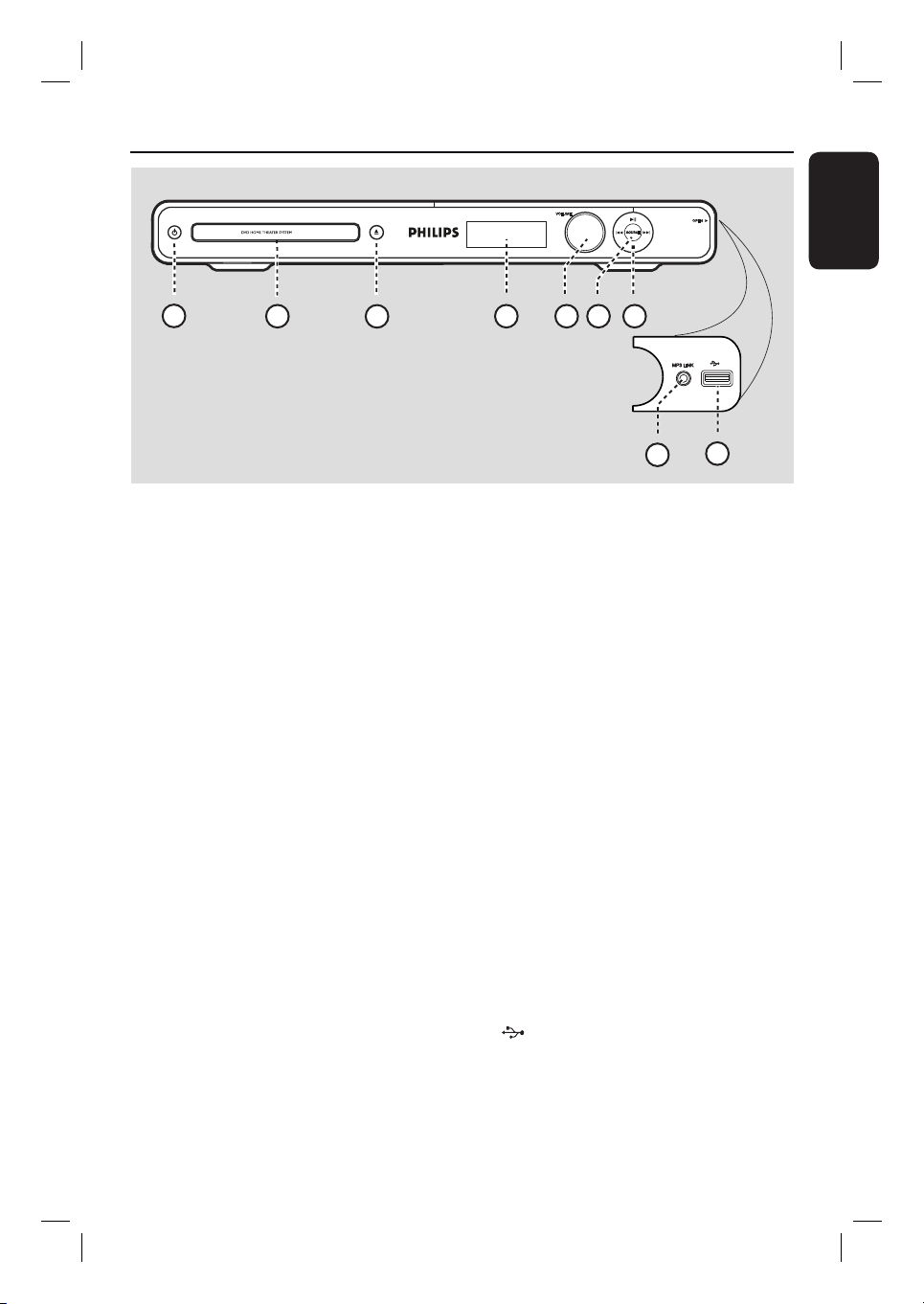
Main Unit
a 2 (Standby-On)
– Turns on this unit or turns off to normal
standby mode.
b Disc Tray
c ç (Open/Close)
– Opens/closes the disc tray.
d Display panel
– Shows information about the current
status of the unit.
e VOLUME
– Adjusts the volume level.
f SOURCE
– Selects the relevant active source mode:
DISC, FM, SCART IN, AUX,
DI (DIGITAL IN) or MP3 LINK.
g u (Play/ Pause)
– DISC: starts/pauses playback.
– RADIO: starts auto radio installation for
rst time setup.
. / > (Previous / Next)
– DISC: skips to the previous or next title/
chapter/track.
– DISC: press and hold this button for fast
forward and backward search.
– RADIO: selects a preset radio station.
(Stop)
– Exits an operation.
– DISC: stops playback.
– RADIO: press and hold this button to
erase the current preset radio station.
Note:
The following sockets are under the ap at the
right corner of the front panel, OPEN .
h MP3 LINK socket
– Phono input for connecting to the
headphone out socket on your portable
audio player.
i (USB) socket
– Input for USB ash drive or USB memory
card reader.
1
2
7
3
8
4 65
9
Front Panel View
Inside VIew
10
English
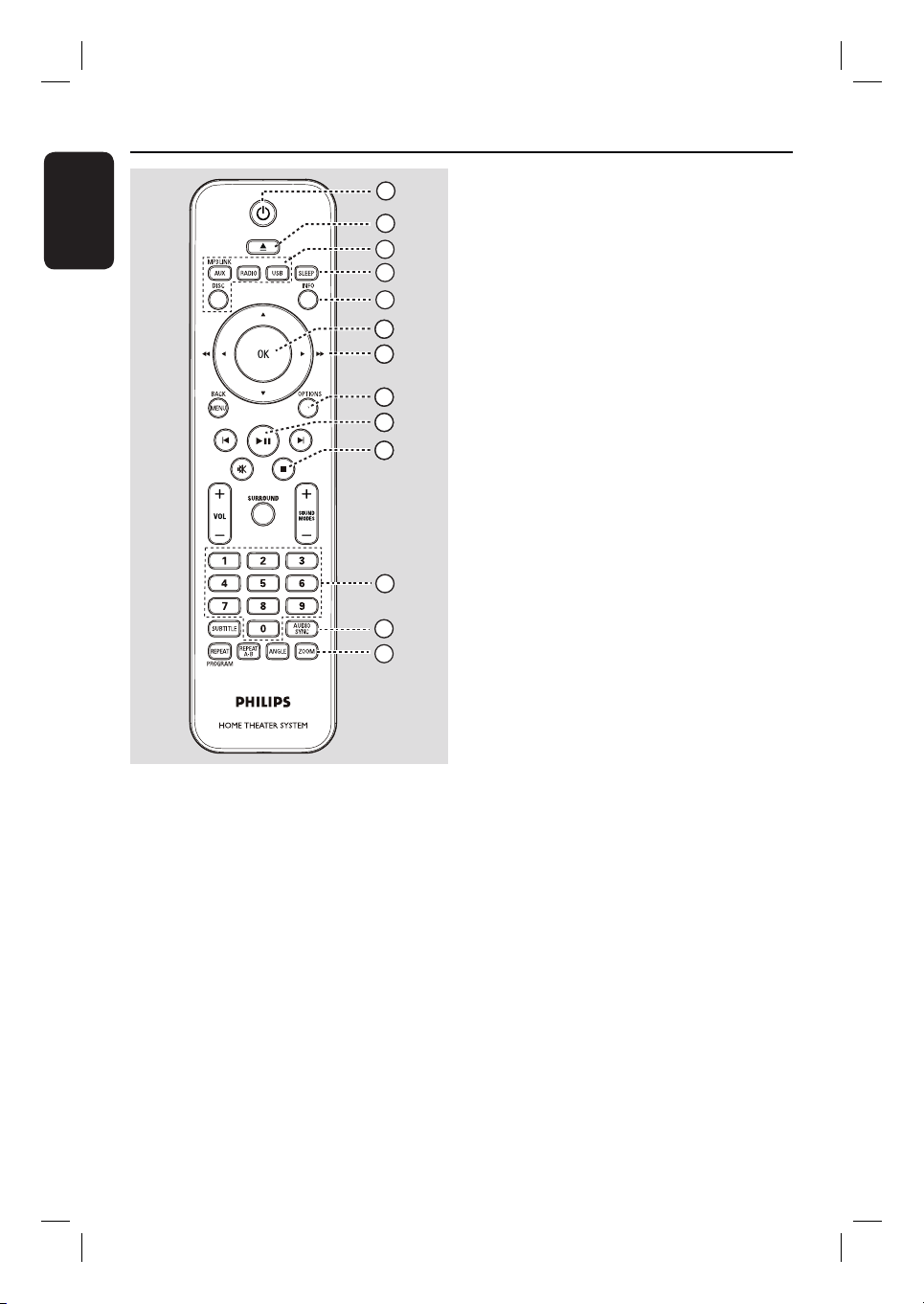
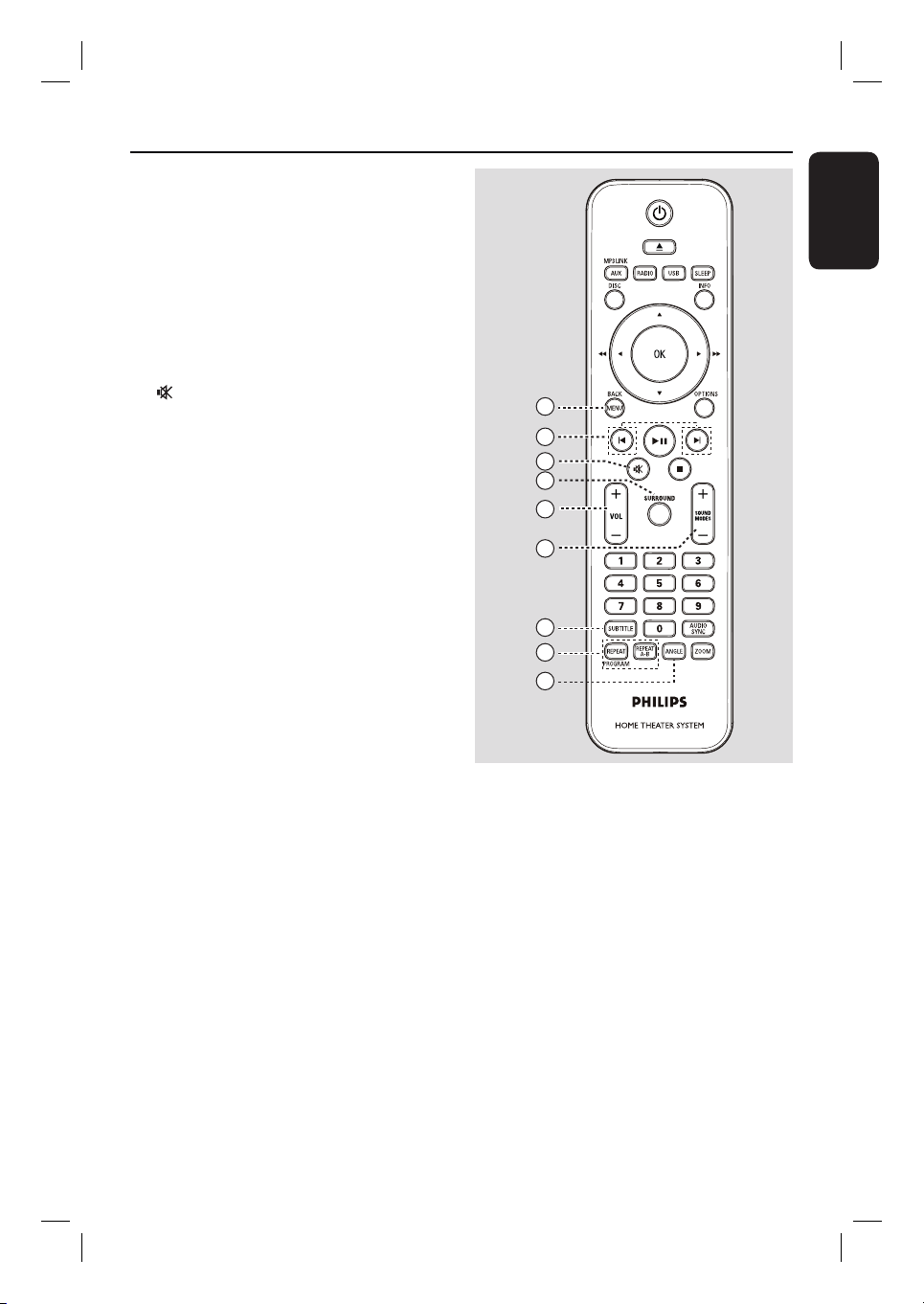
Remote Control
a 2 (Standby-On)
– Turns on this unit or turns off to standby
mode.
b ç (Open/Close)
– Opens/closes the disc tray.
c Source buttons
– AUX (MP3 LINK): switches to
SCART IN, AUX, DI (DIGITAL IN) or
MP3 LINK external source mode.
– RADIO: switches to FM band.
– USB: switches to USB mode.
– DISC: switches to DISC mode.
d SLEEP
– Sets the sleep timer.
e INFO
– Displays the current status or disc
information.
f OK
– Con rms an entry or selection.
g v V b B
– DISC: selects movement direction in the
menu.
– DISC: press left or right for fast forward
and backward search.
– RADIO: press up or down to tune the
radio frequency.
– RADIO: Press left or right to start auto
search.
h OPTIONS
– Enters or exits the system setup menu.
i u (Play/Pause)
– DISC: starts/pauses playback.
– RADIO: starts auto radio installation for
rst time setup.
j x (Stop)
– Exits an operation.
– DISC: stops playback.
– RADIO: press and hold this button to
erase the current preset radio station.
k Numeric keypad 0-9
– Enters a track/title/chapter of the disc.
– Enters a number of a preset radio station.
l AUDIO SYNC
– Select an audio language/channel.
– Sets the audio output delay times if the
video playback is slower than the audio
output.
m ZOOM
– Zoom in or out the picture on the TV.
2
4
11
12
13
5
3
1
66
69
610
67
68
11
English
Remote Control (continued)
n MENU (BACK)
– DVD: go back to title menu.
– VCD/SVCD:
During playback (PBC ON mode only)
return to the PBC menu.
o í/ë (Previous / Next)
– DISC: skips to the previous or next title/
chapter/track.
– RADIO: selects a preset radio station.
p (Mute)
– Mutes or restores the volume.
q SURROUND
– Selects multi-channel surround or
stereo or party mode.
r VOL +/-
– Adjusts the volume level.
s SOUND MODES +/-
– Selects a prede ned sound effect.
t SUBTITLE
– Selects a DVD subtitle language.
u REPEAT (PROGRAM)
– DISC: Selects various repeat or shuf e
modes; turns off repeat or shuf e mode.
– RADIO: Press this button to start manual
preset programming.
– RADIO: Press and hold this button to
start automatic preset programming.
REPEAT A-B
– Repeat a speci c section of a disc.
v ANGLE
– Select a different viewing angle of a DVD
movie (if available).
14
15
18
20
21
22
19
17
16
12
English
Remote Control (continued)
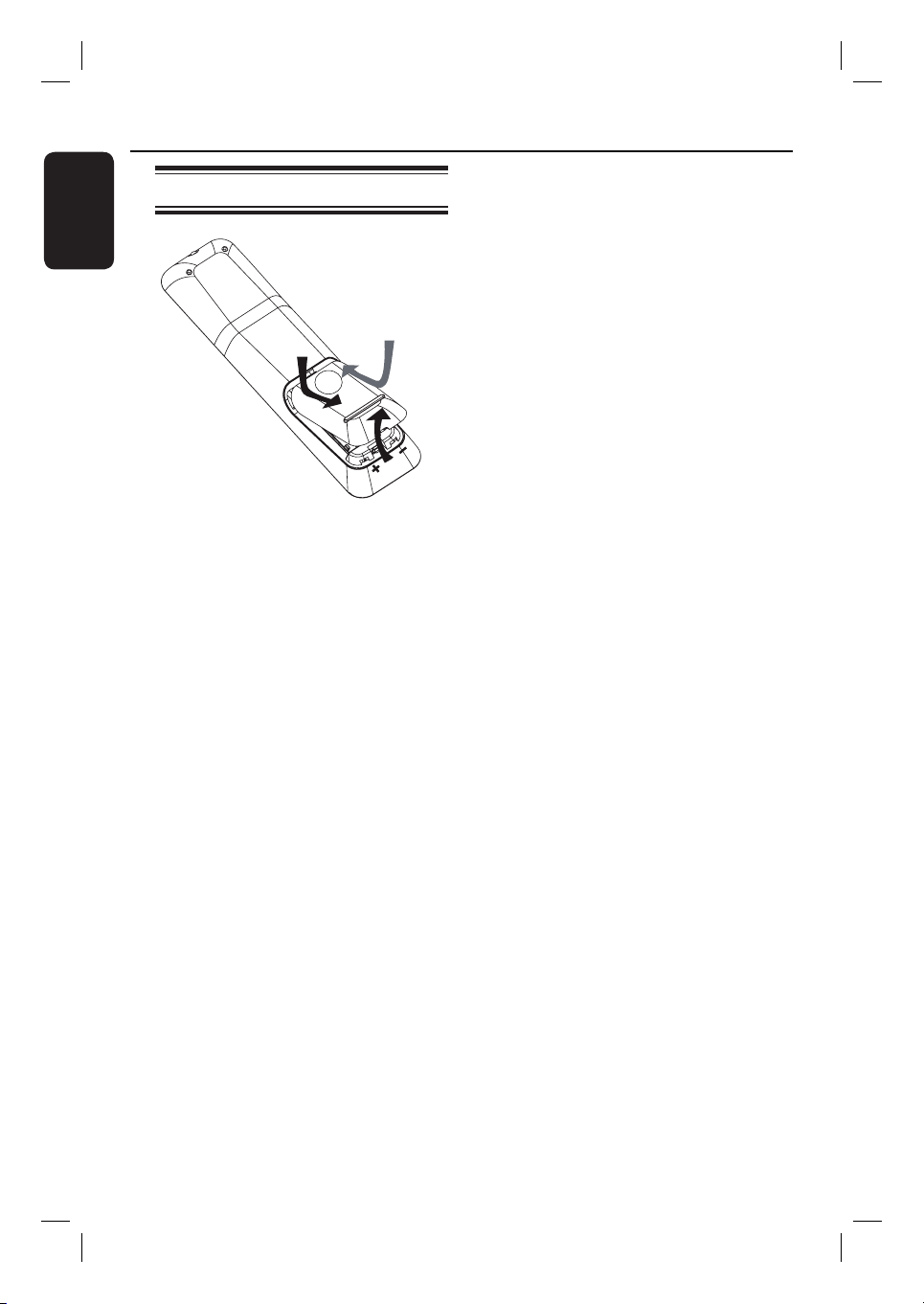
Using the remote control
A Push to open the battery compartment.
B Insert two batteries type R03 or AAA,
following the indications (+-) inside
the compartment.
C Close the cover.
D Point the remote control directly at the
remote sensor (iR) on the front panel.
E Select the source you wish to control by
pressing the AUX (MP3 LINK), RADIO,
USB or DISC button on the remote
control.
F Then select the desired function (for
example í, ë).
CAUTION!
– Remove batteries if they are
exhausted or if the remote control
is not to be used for a long time.
– Never mix batteries (old and new
or carbon and alkaline, etc).
– Batteries contain chemical
substances, they should be disposed
of properly.
13
English
Basic Connections
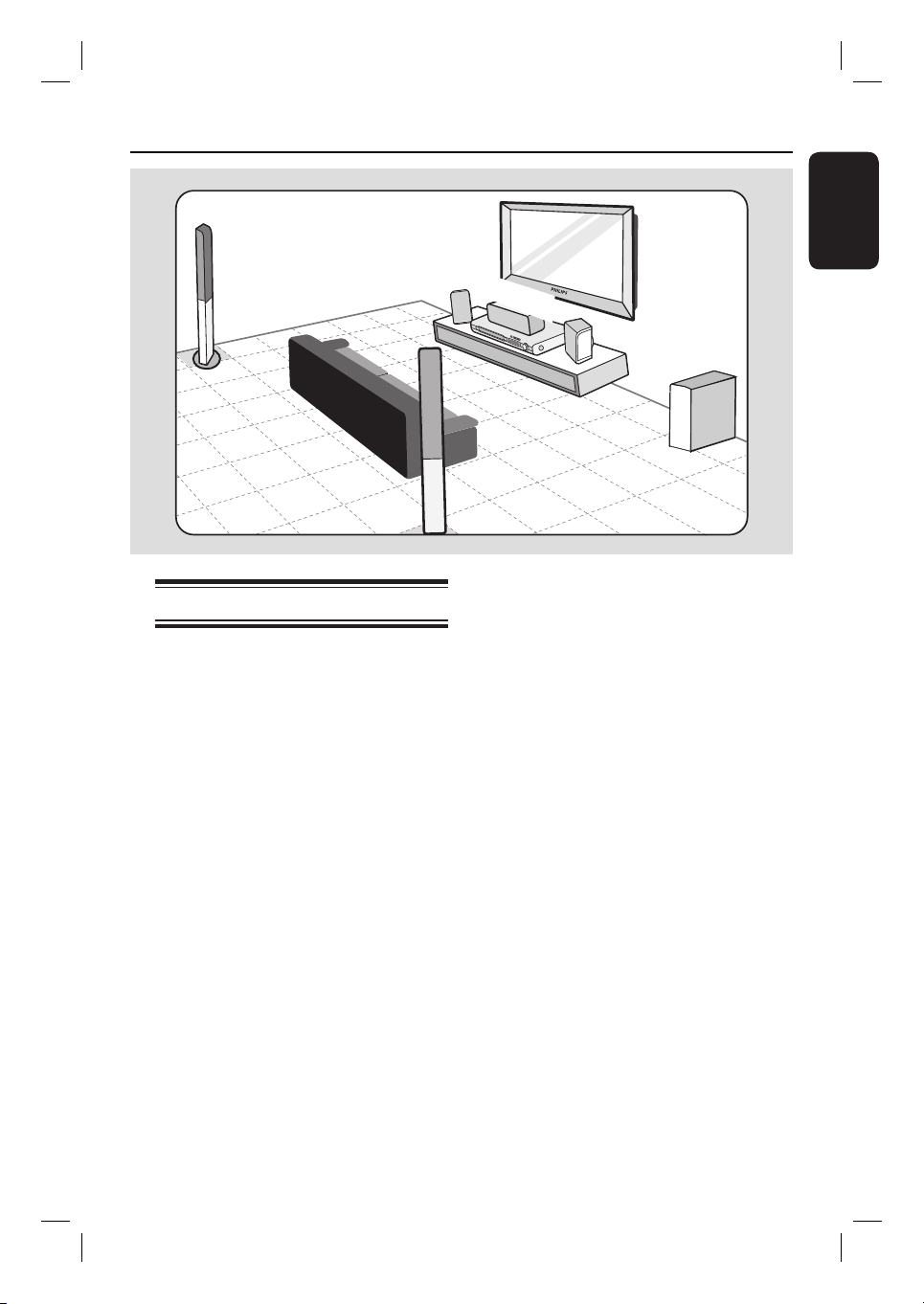
Step 1: Placing the speakers
The Philips Home Theatre System is
simple to install. However, proper system
placement is critical to ensure an
optimum sound experience.
A Place the front left and right speakers at
equal distances from the TV and at an
angle of approximately 45 degrees from
the listening position.
B Place the centre speaker above the TV or
the main unit such that the centre
channel’s sound is localised.
C Place the rear speakers at normal
listening ear level facing each other.
D Place the subwoofer at the corner of the
room. Otherwise, keep it at least one
metre away from the TV.
Helpful Hints:
– The placement diagram shown here is
only a guideline that provides great system
performance. You may nd other placement
choices that are more suitable for your room
layout that provide the sound experience you
enjoy.
– To avoid magnetic interference, never
position the front speakers too close to your
TV.
– The rear speakers are labelled as REAR
LEFT or REAR RIGHT.
– The front speakers are labelled as
FRONT LEFT or FRONT RIGHT.
– For speaker setting, see ‘Getting Started -
Setting the speakers’ channels’.
FRONT
RIGHT
FRONT
LEFT
CENTER
REAR
RIGHT
REAR
LEFT
SUBWOOFER
14
English
Step 2: Connecting to TV
This connection enables you to view the
video playback from this unit. You only
need to choose one of the options
below to make the video connection.
– For a standard TV, follow option 1, 2
or 3.
– For a progressive scan TV, follow
option 4.
– For a HDMI TV, follow option 5.
Helpful Hint:
– It is important to connect this unit directly
to the TV in order to enjoy optimum video
quality.
– To hear the TV audio through this unit,
connect AUDIO IN-AUX sockets on the unit
to the audio output on your TV (cables not
supplied). Then press AUX (MP3 LINK)
until ‘AUX’ is displayed on the front panel.
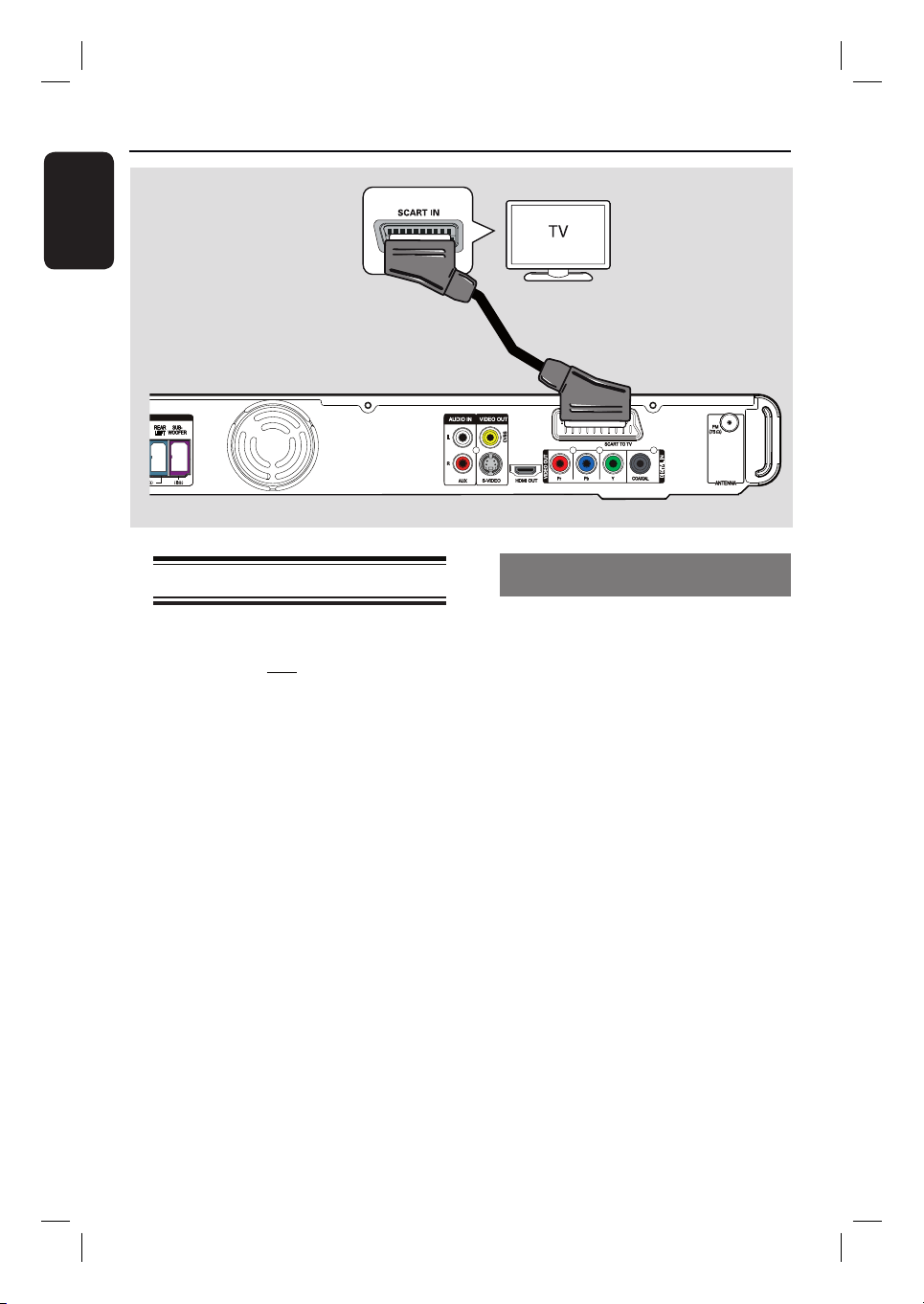
Option 1: Connecting to the Scart
socket
Connect the scart cable (supplied) from
the SCART TO TV socket on the main
unit to the corresponding SCART input
socket on the TV.
Helpful Hint:
– With this connection, audio connection is
not required, you can press AUX (MP3
LINK) repeatedly on the remote control to
select SCART IN to route the TV’s audio to
the speakers.
Basic Connections (continued)
Option 1
Main Unit (rear)
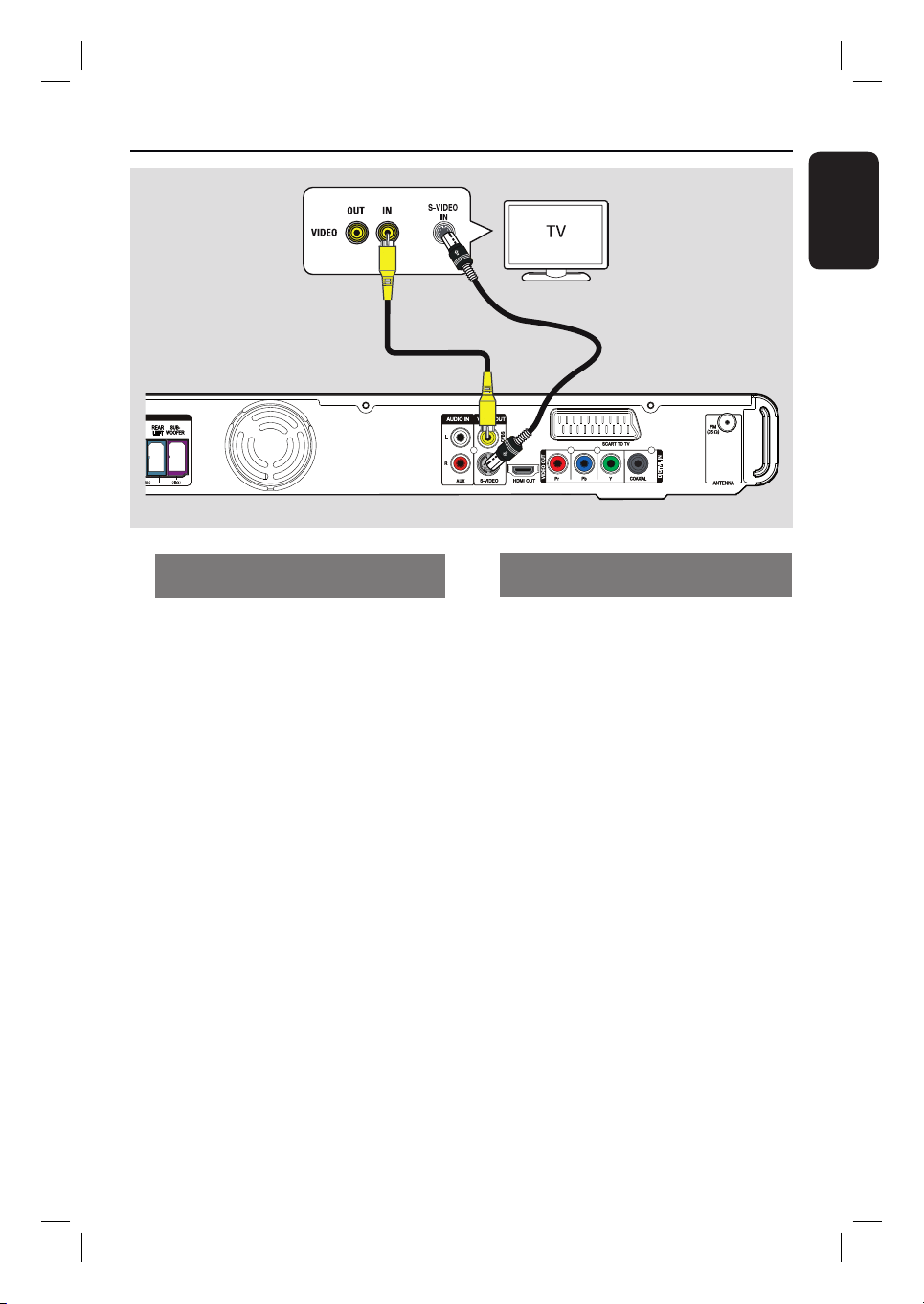
15
English
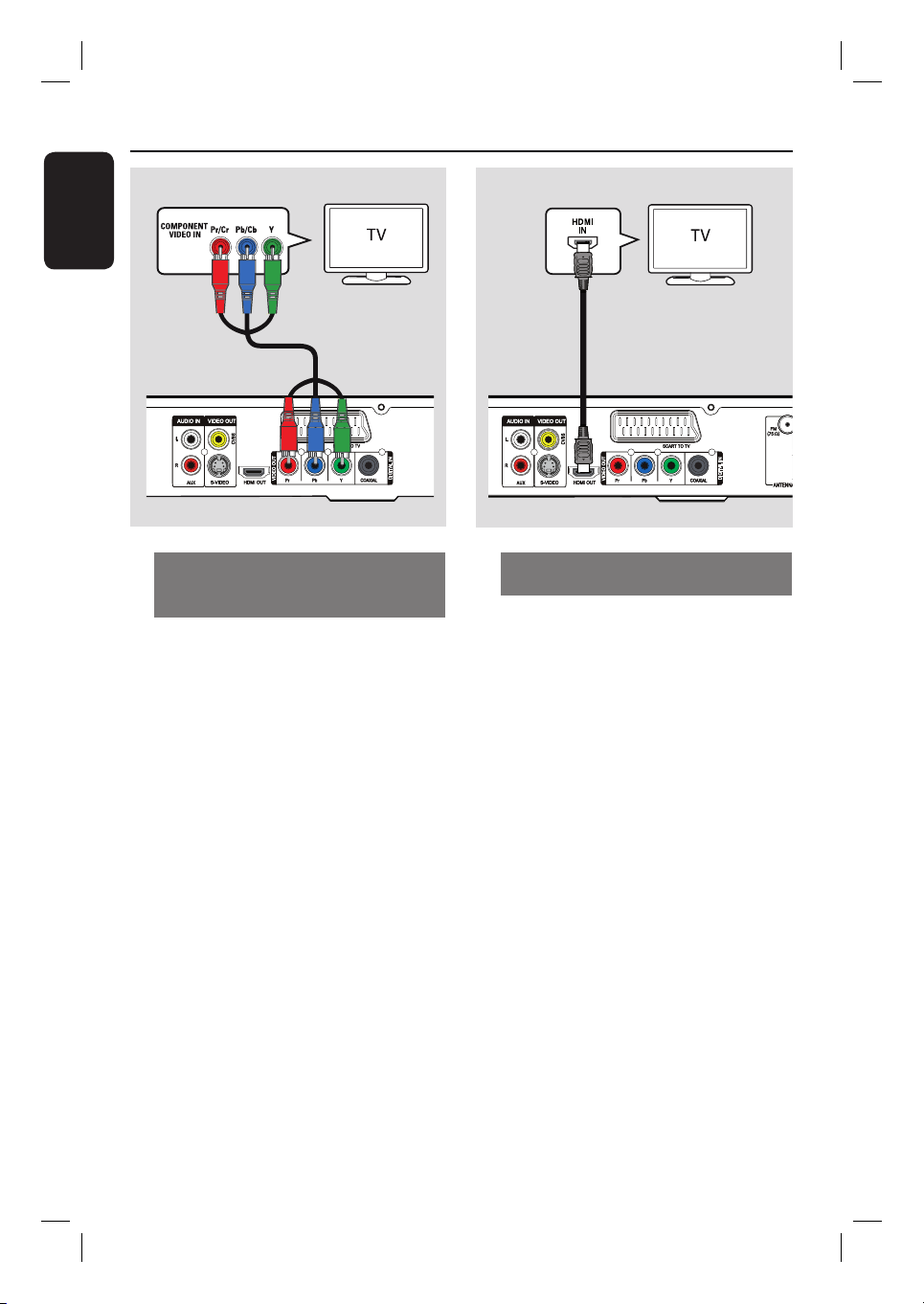
Option 2: Connecting to the Video
socket
Use a composite video cable (yellow -
not supplied) to connect the CVBS
socket on the main unit to the video
input socket (or labeled as A/V In, Video
In, Composite or Baseband) on the TV.
It provides good picture quality.
Option 3: Connecting to the
S-Video socket
Use an S-video cable (not supplied) to
connect the S-VIDEO socket on the
main unit to the S-Video input socket (or
labeled as Y/C or S-VHS) on the TV.
It provides good picture quality.
Option 3
Main Unit (rear)
Option 2
Basic Connections (continued)
16
English
Basic Connections (continued)
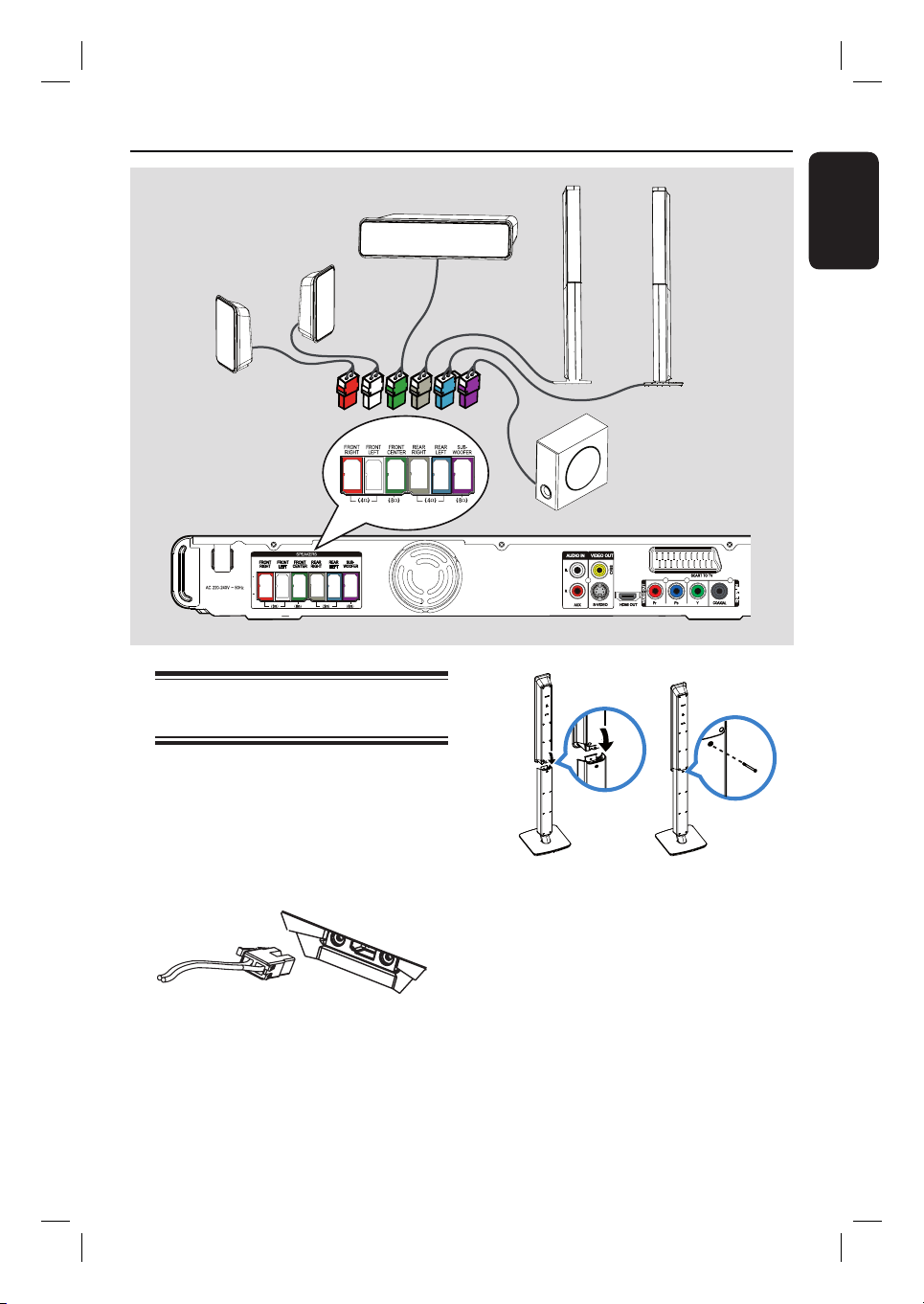
Option 4: Connecting to a
Progressive Scan TV or component
video input
The progressive scan video quality is
only available when using Y Pb Pr
connection and a progressive scan TV is
required. It provides superior picture
quality when watching DVD movies.
A Use the component video cables (red/
blue/green - not supplied) to connect the
Y Pb Pr sockets on the main unit to the
corresponding component video input
sockets (or labeled as Y Pb/Cb Pr/Cr or
YUV) on the TV.
It provides better picture quality.
B If your TV accepts progressive signals,
proceed to chapter ‘Getting Started -
Setting up Progressive Scan feature’ for
detailed progressive feature setup.
Option 5: Connecting to a HDMI-
compatible TV
HDMI (High De nition Multimedia
Interface) is a digital interface that allows
pure digital video transmission without
the loss of image quality.
It provides best picture quality.
Use the HDMI cable (not supplied) to
connect the HDMI OUT on the main
unit to the HDMI IN on a HDMI-
compatible device (e.g., HDMI TV, HDCP
compliant DVI TV.)
It provides best picture quality.
Note:
This unit is HDMI CEC compatible. It
enables connected devices to control
each other over HDMI, see ‘Setup Menu
Options - { Video Setup > HDMI Setup >
EasyLink }’ for details.
Helpful Hints:
– The HDMI is backward compatible with
some DVI devices using an appropriate
adaptor plug.
– If a DVI device is connected, an additional
audio cable is required for audio transmission.
Option 4
Option 5
Main Unit (rear)
17
English
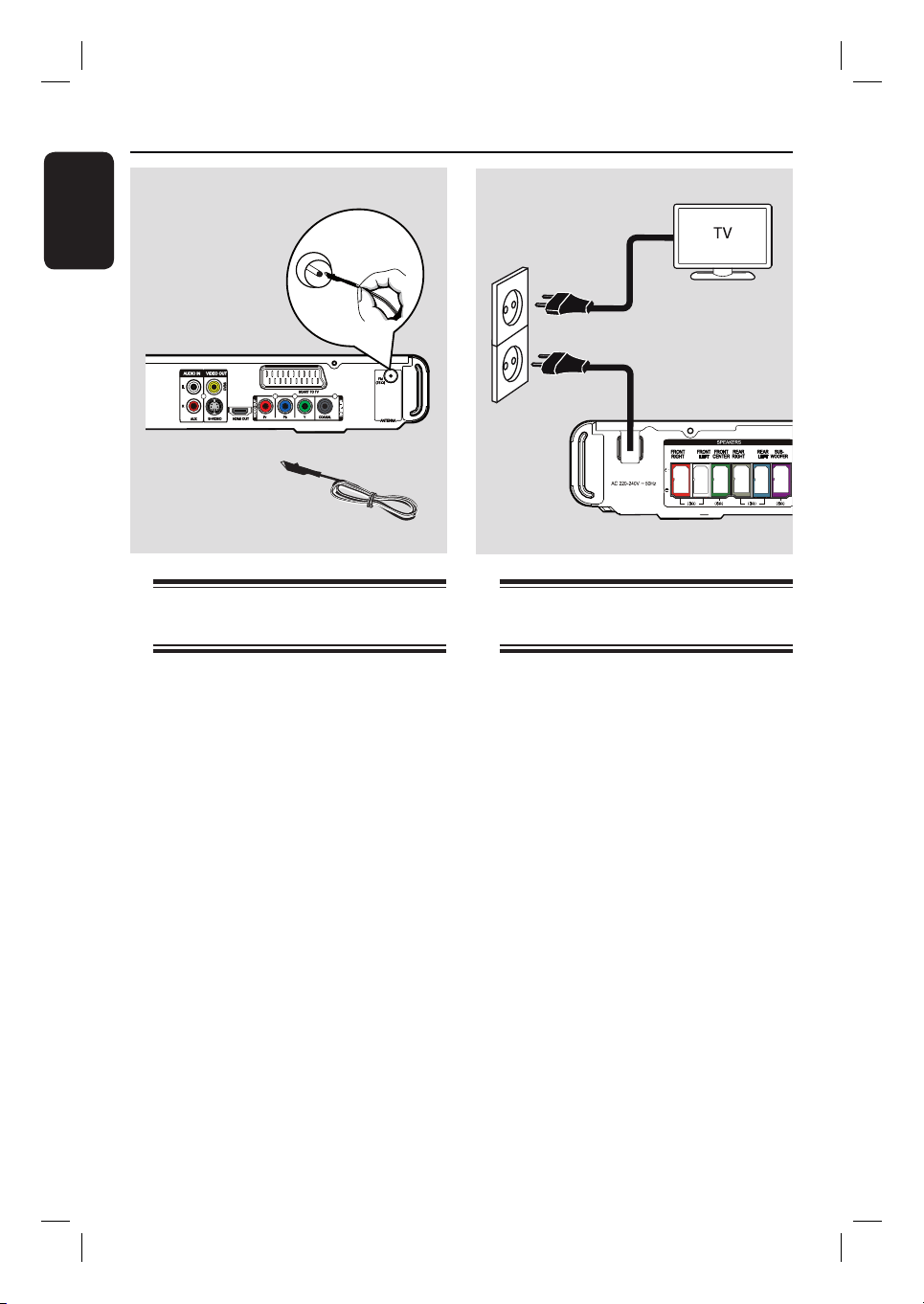
B Attach the speakers to the speaker
stands and secure the position with the
supplied screws.
C
Connect all the speakers and subwoofer
to the matching sockets at the rear of the
main unit, Make sure that the colours of
the cables and sockets are matched.
Helpful Hint:
– To prevent unwanted noise, never place
the speakers too close to the main unit,
subwoofer, AC power adapter, TV or any
other radiation sources.
Basic Connections (continued)
Step 3: Connecting speakers
and subwoofer
Before you start...
For Tallboy speakers:
– Connect the speaker cables to the
speakers.
– Assemble the rear speakers to the
proper position.
A Connect the speaker cables to the
matching colour sockets on the speakers
or speaker stands.
REAR
LEFT
REAR
RIGHT
SUBWOOFER
FRONT CENTRE
FRONT
LEFT
FRONT
RIGHT
Main Unit (rear)
18
English
Basic Connections (continued)
Step 4: Connecting the
FM antenna
A Connect the FM antenna (supplied) to
the FM 75 Ω socket. (For some models,
it has been connected in the factory.)
B Extend the FM antenna and x its ends to
the wall.
For better FM stereo reception, connect
an external FM antenna (not supplied).
Helpful Hints:
– Adjust the position of the antenna for
optimal reception.
– Position the antenna as far away as
possible from your TV, VCR or other
radiation source to prevent any unwanted
interference.
FM antenna
Main Unit (rear)
Step 5: Connecting the
power cord
After everything is connected
properly, connect the AC power
cord into the power outlet.
The standby LED on the main unit lights
up.
Helpful Hints:
– Refer to the type plate at the rear or
bottom of the product for identi cation and
supply ratings.
– Before making or changing any
connections, make sure that all the devices
are disconnected from the power outlet.
Main Unit (rear)
19
English
RF
S-VIDEO
OUT
IN
AUDIO
R L
VIDEO
TO TV
ANTENNA-IN
TV-OUT
~
MAINS
TO TV - I/O
EXT
1
AUX - I/O
EXT
2
Optional Connections
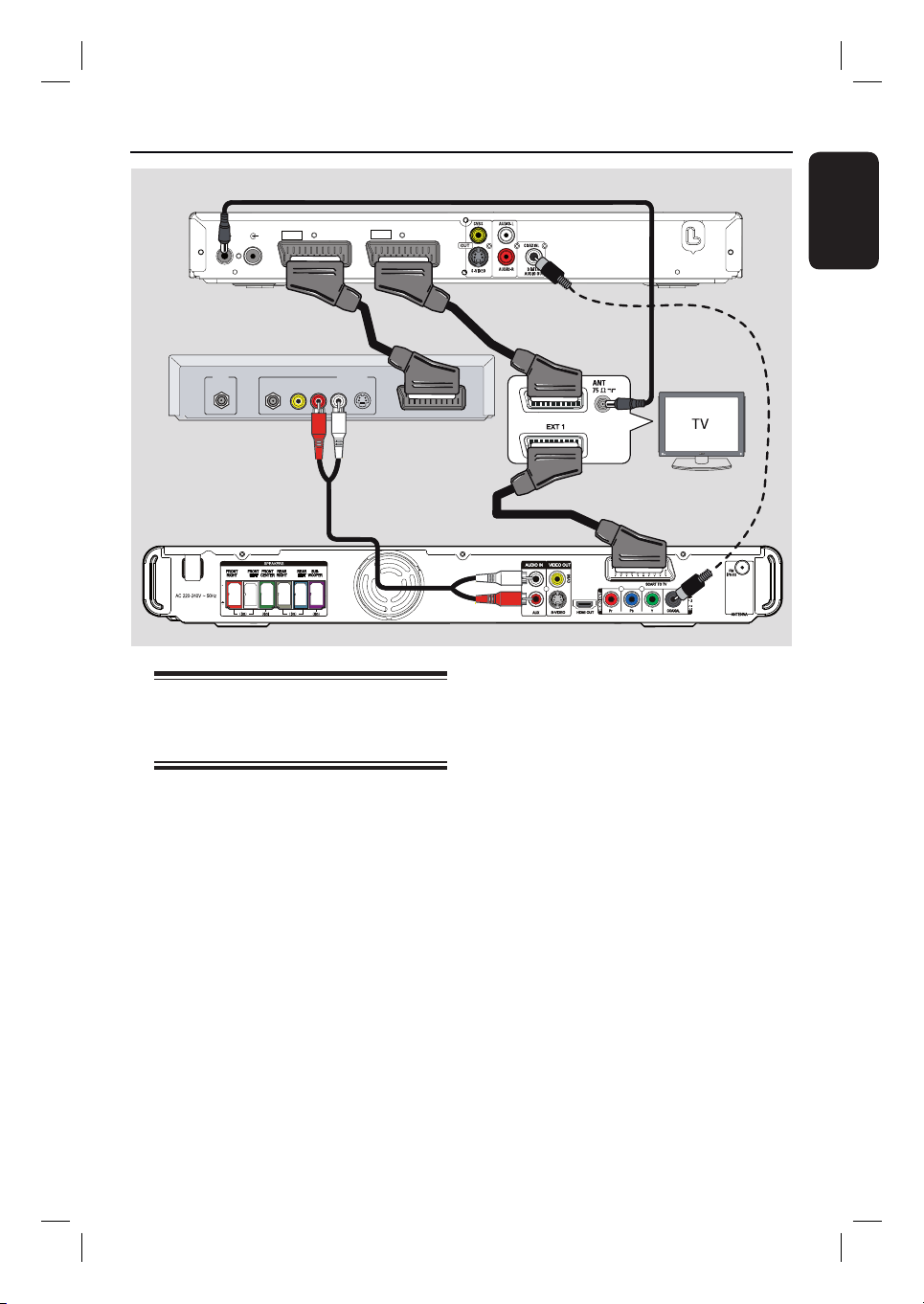
Connecting to cable box/
satellite receiver and
recorder/VCR
You can connect the audio output from
an analogue audio/video device (e.g. VCR,
Cable/Satellite Box, game console or TV)
to this unit to enjoy the multi-channel
surround sound capabilities
Note:
The above illustration is only an example
of the possible connections. It may be
varied depending on the connected
devices.
A Keep the existing connections between
your TV and other devices.
B Use the scart cable to connect this unit
to your TV.
Cable/Satellite Box (rear)
If your TV does not have double-scart
connectors, see ‘Step 2: Connecting to
TV’ for other video connection options.
C Connect an audio cable (red/white - not
supplied) from the AUDIO IN-AUX
sockets on the main unit to the AUDIO
output sockets on the Cable/Satellite Box.
To listen to the sound, press
AUX (MP3 LINK) until ‘AUX’ is
displayed on the front panel.
For better quality audio, connect a coaxial
cable (not supplied) from the DIGITAL
IN-COAXIAL socket on the main unit
to the COAXIAL output socket on the
device.
To listen to the sound, press
AUX (MP3 LINK) repeatedly until ‘DI’
is displayed on the front panel.
Helpful Hint:
– Refer to the connected devices’ user
manual for other possible connections.
DVD Recorder/VCR (rear)
Main Unit (rear)
TV (rear)
20
English
Finding the correct viewing
channel
A Press 2 to turn on the unit.
B Press DISC on the remote control.
C Turn on the TV and switch it to the
correct video-in channel.
You may go to the lowest channel on
your TV, then press the Channel Down
button on your TVs remote control until
you see the Video In channel.
You may press ° button repeatedly
on your TV’s remote control.
Usually this channel is between the
lowest and highest channels and may be
called FRONT, A/V IN, VIDEO, etc..
Refer to your TVs user manual on
how to select the correct input on your
TV.
Getting Started
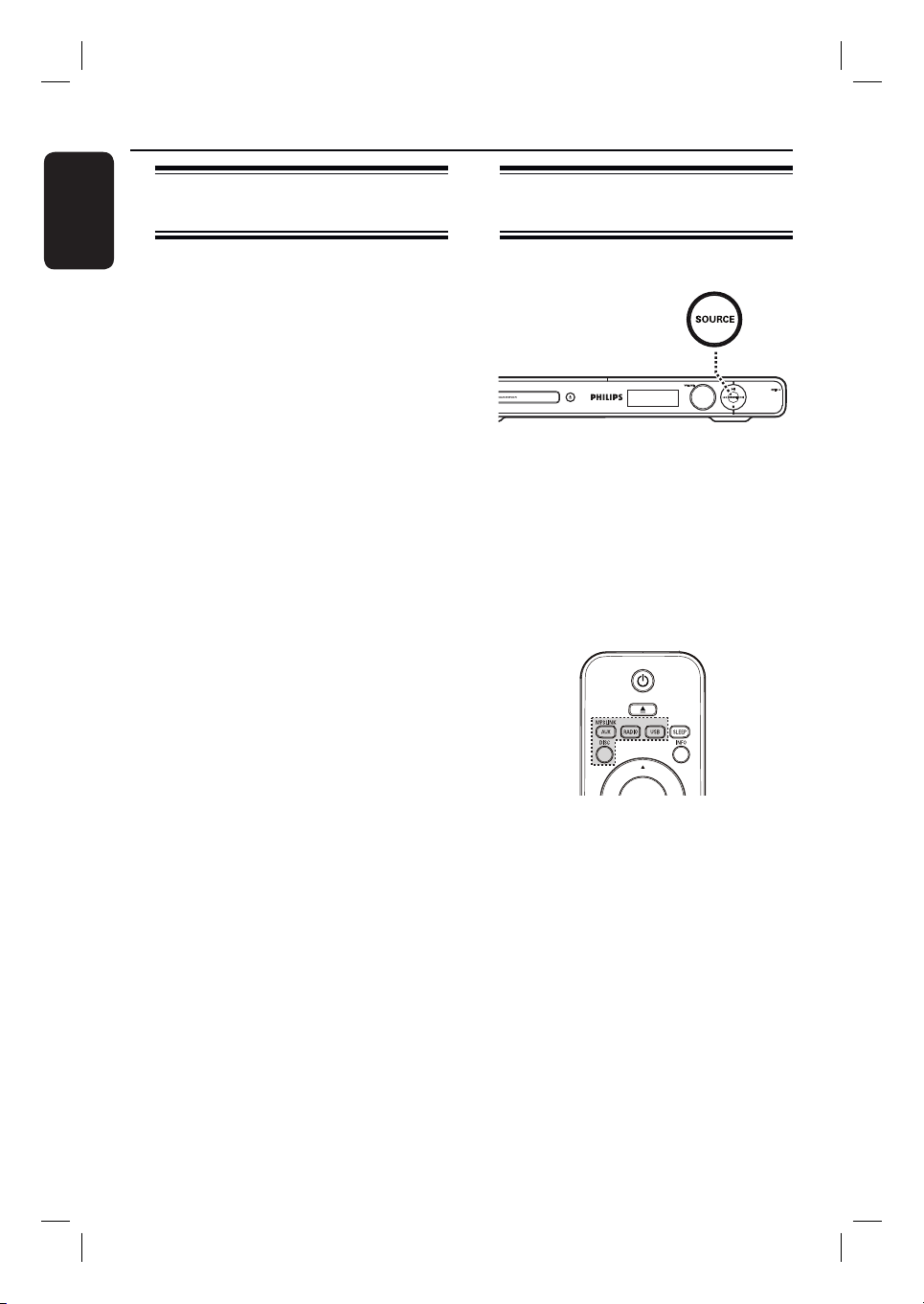
Switching to different play
source
On the main unit
Press the SOURCE button on the main
unit repeatedly to select:
DISC ¤ FM ¤ SCART IN ¤ AUX ¤
DI (DIGITAL IN) ¤ MP3 LINK ¤ DISC
....
Or
On the remote control
Press AUX (MP3 LINK) repeatedly to
hear the audio output from the external
device.
‘SCART IN’ for device connected to
SCART TO TV sockets.
‘AUX’ for device connected to
AUDIO IN-AUX sockets.
‘DI’ for device connected to DIGITAL
IN-COAXIAL socket.
‘MP3 LINK’ for device connected to
MP3 LINK socket.
Press RADIO to switch to FM
bandwave.
Press USB to switch to USB mode.
Press DISC to switch to DISC mode.
21
English
Setting language preferences
The language options are different
depending on your country or region. It
may not correspond to the illustrations
shown on the user manual.
On-screen display (OSD) language
The OSD (On-Screen Display) language
for this unit remains as you have set it,
regardless of the changes made to the
DVD disc language.
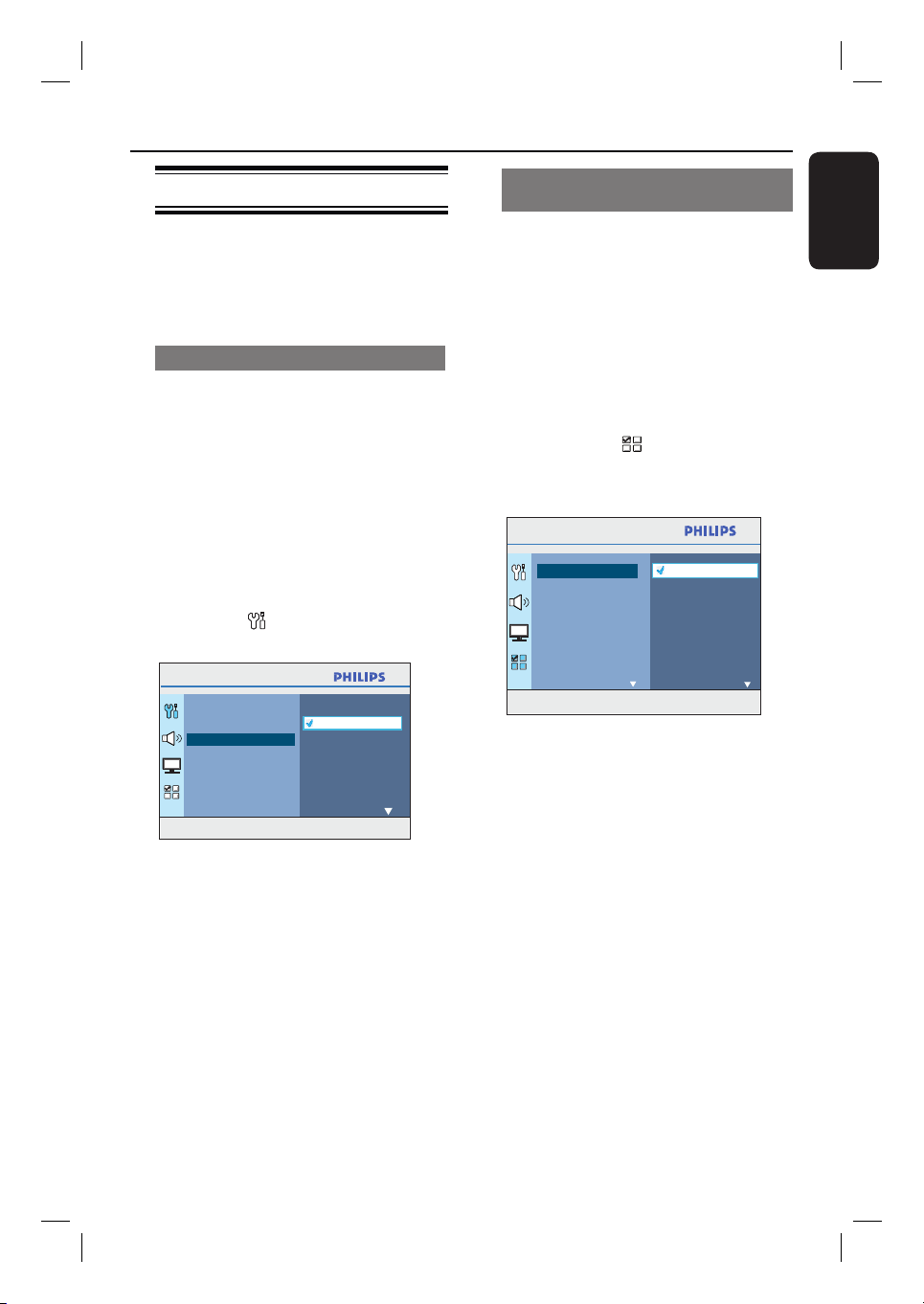
A In disc mode, press OPTIONS on the
remote control.
{ General Setup } appears.
B Press .
C Press keys to select { OSD
Language } icon in the menu and
press .
Press OPTIONS to exit menu
General Setup
Disc Lock
Display Dim
OSD Language
Screen Saver
DivX(R) VOD Code
Sleep
Dansk
Suomi
Français
Deutsch
Italiano
English
Auto
Nederlands
D Use keys to select a language and
press OK to con rm.
Audio, Subtitle and Menu language
for DVD playback
You can select your preferred language
settings for DVD playback. If the selected
language is recorded on the DVD disc,
this unit automatically plays the disc in
that language. Otherwise, the disc’s
default language will be used instead.
A Press Ç twice to stop playback (if any),
then press OPTIONS.
B Press repeatedly to select
{ Preferences } icon, and press .
C Use keys to select one of the
options below and press .
Press OPTIONS to exit menu
English
Chinese (Simp)
French
Spanish
Portuguese
Polish
Italian
Turkish
Audio
Subtitle
Disc Menu
Parental
PBC
MP3/JPEG Nav
Password
DivX Subtitle
Preferences
{ Audio }
Select the preferred audio language for
DVD playback.
{ Subtitle }
Select the preferred subtitle language for
DVD playback.
{ Disc Menu }
Select the preferred disc menu language
for DVD playback.
D Use keys to select a language and
press OK to con rm.
Getting Started (continued)

22
English
If the language you want is not
available in the list, select { Others }.
Use the numeric keypad (0-9) on the
remote control to enter the 4-digit
language code ‘XXXX’ (see last page) and
press OK to con rm.
E Repeat steps C ~ D for other settings.
Helpful Hints:
– During DVD playback, you can press the
AUDIO SYNC and SUBTITLE on the remote
control to change the audio and subtitle
languages respectively. However, this does
not change the default settings you have
made here.
– For some DVDs, the subtitle/audio/disc
menu language can only be changed via the
DVD disc menu.
Getting Started (continued)
23
English
Setting up Progressive Scan
feature
(for Progressive Scan TV only)
The progressive scan displays twice the
number of frames per second than
interlaced scanning (ordinary normal TV
system). With nearly double the number
of lines, progressive scan offers higher
picture resolution and quality.
Before you start...
Ensure that you have connected this unit
to a progressive scan TV (see ‘Option 4:
Connecting to a Progressive Scan TV or
component video input’.)
A Turn on the TV to the correct viewing
channel for this unit.
Make sure that the TVs progressive
scan mode is turned off (or set to
interlaced mode). Refer to your TVs user
manual.
B Turn on this unit and press DISC on the
remote control.
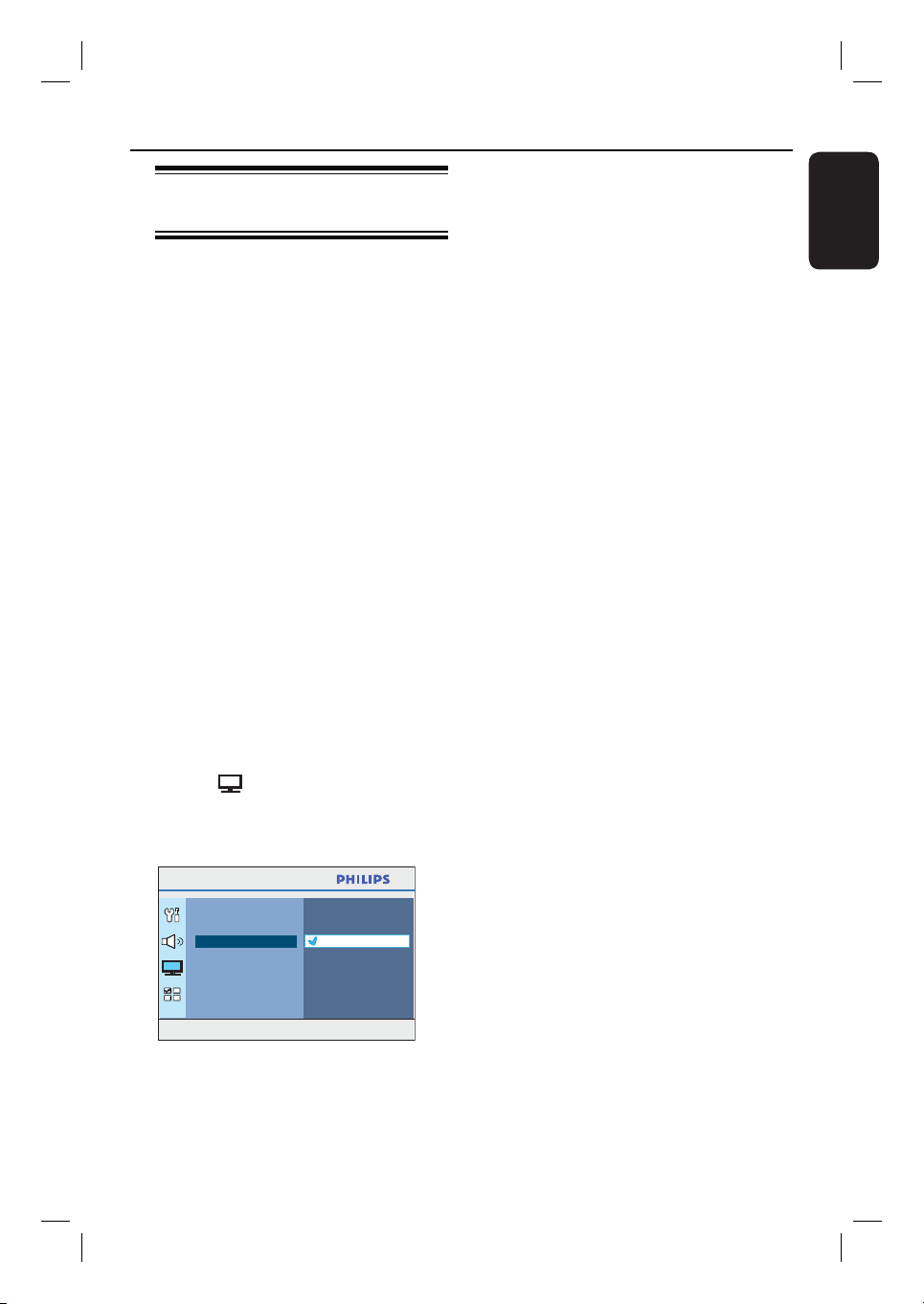
C Press OPTIONS on the remote control.
D Press T repeatedly to select { Video
Setup } icon, and press X.
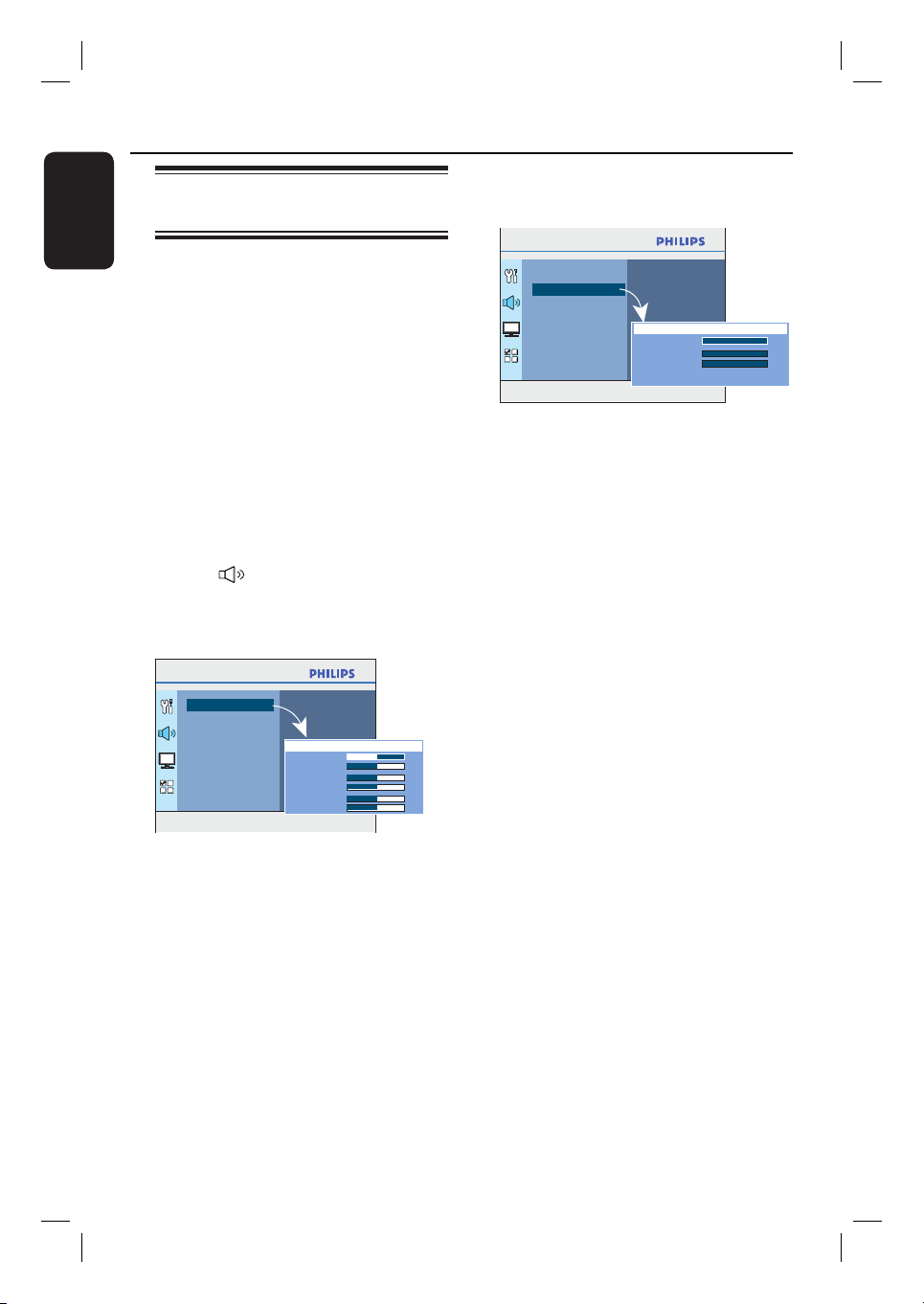
E Move to { Component } > { YUV } in
the menu and press OK to con rm.
Press OPTIONS to exit menu
Video Setup
TV Type
TV Display
Progressive
Picture Setting
HDMI Setup
Component
Closed Caption
Off
On
F Move to { Progressive } > { On } in the
menu and press OK to con rm.
G Read the noti cation message on the TV
and con rm your action by selecting the
{ OK } in the menu and press OK.
There will be no picture on your TV
at this state until you have turned
on the progressive scan mode on
your TV.
H Turn on your TV progressive scan mode,
refer to your TVs user manual.
A message appears on the TV.
I Con rm your action by selecting the
{ OK } in the menu and press OK.
The setup is now completed and you
can start to enjoy the high quality picture.
If no picture is displayed
A Press ç on the main unit.
B Press W on the remote control.
C Press AUDIO SYNC on the remote
control.
Helpful Hints:
– If a blank/distorted screen appears, wait
for 15 seconds for the auto recovery.
– There are some progressive scan TVs that
are not fully compatible with this unit,
resulting in an unnatural picture when
playing back a DVD VIDEO disc in the
progressive scan mode. In such a case, turn
off the progressive scan feature on this unit
and your TV.
Getting Started (continued)
24
English
Getting Started (continued)
Setting the speakers’
channels
You can adjust the delay times (centre
and surround only) and volume level for
individual speakers. These adjustments let
you optimise the sound according to
your surroundings and setup.
Before you start...
Stop the disc playback by pressing x
button twice or remove the disc from
the disc tray. Otherwise, the settings are
not accessible.
A In disc mode, press OPTIONS on the
remote control.
B Press repeatedly to select { Audio
Setup }
icon, and press .
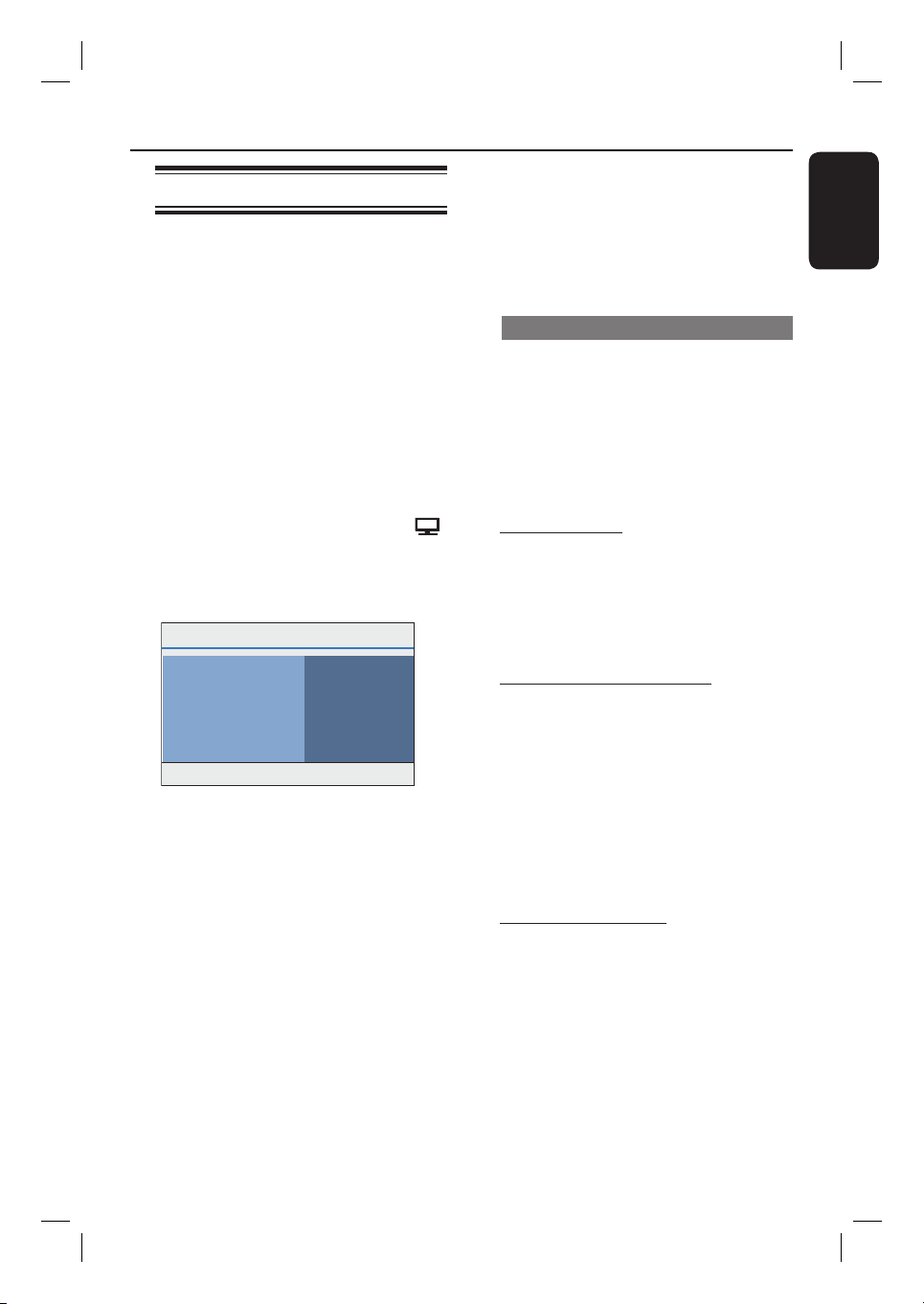
C Select { Speakers Volume } and press
.
Press OPTIONS to exit menu
Audio Setup
Front Left
Front Right
Center
Subwoofer
Rear Left
Rear Right
0dB
0dB
0dB
0dB
0dB
0dB
Speakers Level Setup
Speakers Volume
Speakers Delay
HDMI Audio
CD Upsampling
Audio Sync
D Use keys to set the volume level for
each speaker (-6dB ~ +6dB) and press
OK to con rm.
E Use keys to highlight { Speakers
Delay } and press
.
Press OPTIONS to exit menu
Audio Setup
Center
Rear Left
Rear Right
Speakers Distance Setup
0ms
0ms
0ms
Speakers Volume
Speakers Delay
HDMI Audio
CD Upsampling
Audio Sync
F Use keys to set the delay times
(0 ms ~ 15 ms) for centre and rear
speakers that best suit your surround
sound needs.
G Press OK to con rm.
Helpful Hints:
– A 1ms increase/decrease of delay time is
equivalent to 30 cm change in distance.
– Use the longer delay time settings when
the rear speakers are closer to the listener
than the front speakers.
– The test tone will be generated to help you
judge the sound level of each speaker.
25
English
Setting the EasyLink control
This feature enables HDMI CEC
compliant devices to control each other
with a single remote control. It is only
available if you have connected this
Home Theatre unit to HDMI CEC
compliant TV or device with HDMI cable.
A Turn on the HDMI CEC operations on
your TV and other connected devices.
(Refer to your TV or connected devices
manual for details.)
B Press DISC on the remote control.
C Press OPTIONS.
D Press to select { Video Setup }
icon in the menu, then press .
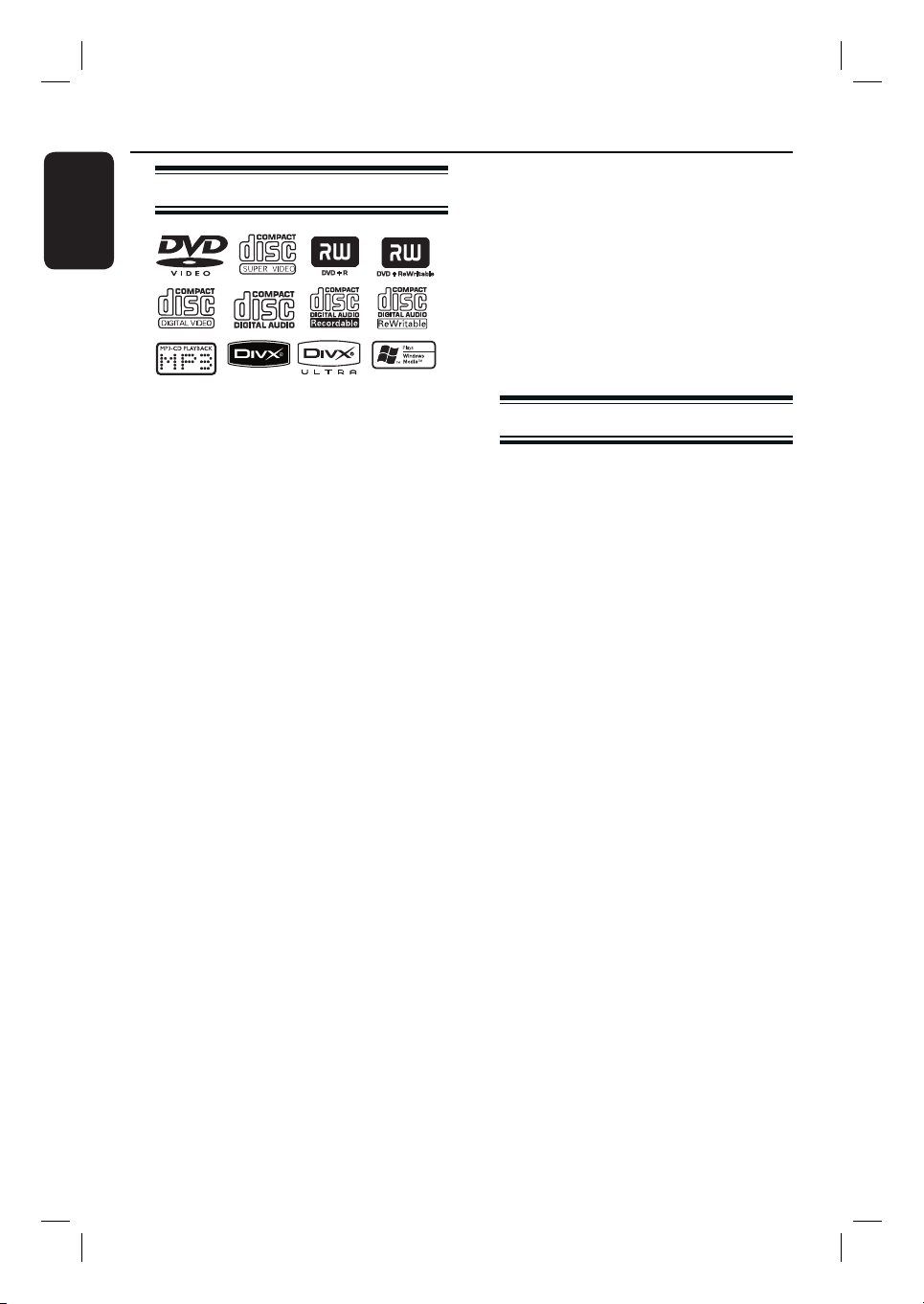
E Select { HDMI Setup } > { EasyLink }
,
then press OK.
Press OPTIONS to exit menu
System Standby
Auto Wakeup TV
System Audio Control
HDMI Input Mapping
EasyLink
{ Auto Wakeup TV } and
{ System Standby } functions are
turned on by default in the factory.
F To enable one touch input switching
function, select { System Audio
Control } > { On }, then press OK.
Ensure that your TV/devices audio
outputs are connected to the audio
inputs of this Home Theatre unit.
G Select { HDMI Input Mapping }, then
press OK.
H Select { OK } to con rm scanning of
devices, then press OK.
The mapping menu of your audio
input device is displayed.
I Select the input { AUX /COAXIAL IN/
MP3 LINK } in the menu and press .
Then select the TV/device that matches
the audio input and press OK.
J To exit the menu, press OPTIONS.
One touch control
Notes:
– To enable one touch play function, a
video disc must be placed in the disc
compartment before operation.
– Philips does not guarantee 100%
interoperability with all HDMI CEC
compliant devices.
One touch play
Press u.
It turns on this Home Theatre unit
and start disc play.
Your TV automatically turns on and
switches to the correct video channel.
One touch input switching
While this Home Theatre unit and TV
are turned on;
Select a TV channel to watch TV
programme or start play on other
connected device.
This Home Theatre unit automatically
switches to the corresponding audio
input and output the sound from its
speakers system.
One touch power off
Press STANDBY/POWER button to turn
off this unit and all the HDMI CEC
compliant devices.
When using this unit’s remote control,
you have to press and hold 2.
Getting Started (continued)
26
English
Disc Operations
Playable discs
Your DVD home theatre system
plays:
– Digital Versatile Discs (DVDs)
– Video CDs (VCDs)
– Super Video CDs (SVCDs)
– Finalised DVD Recordable (DVD±R),
DVD Rewritable (DVD±RW)
– Audio Compact Discs (CDs)
– MP3/ Windows Media™ Audio discs,
picture (Kodak, JPEG) les on
CD-R(W)
– ISO 9660/UDF format
– JPEG resolution support up to
3072 x 2048
– Supported sampling frequencies:
32 kHz, 44.1 kHz, 48 kHz
– Supported Bit-rates: 32~256 (kbps),
variable bit rates (average 128 kbps)
– DivX
®
les on CD-R(W)/DVD+R(W):
– DivX
®
3/4/5/6, DivX
®
Ultra
Region Codes for DVD discs
DVD discs and players are designed with
regional restrictions. Before playing a disc,
make sure the disc is for the same region
as the unit. The regional code for this unit
is indicated at the rear or bottom panel.
Notes:
– If the inhibit icon (ø or X) appears
on the TV when a button is pressed,
it means the function is not
available on the current disc or at
the current time.
– Never put any objects other than
discs on the disc tray. Doing so may
cause the unit to malfunction.
Playing a disc
A Press SOURCE repeatedly until ‘DISC’
appears on the display panel (or press
DISC on the remote control).
B Turn on the TV to the correct viewing
channel for this unit.
The blue DVD background screen
appears on the TV.
C Press ç to open the disc tray.
D Load a disc and press çto close the disc
tray.
Make sure the disc label is facing up.
For double-sided discs, load the side
which you want to play facing up.
E Playback starts automatically.
See the following pages for more
playback options and features.
Helpful Hints:
– If you are having trouble playing a certain
disc, remove the disc and try a different one.
Improperly formatted discs cannot be played
on this unit.
– Some discs cannot be played on this unit
due to the con guration and characteristics
of the disc, or due to the condition of
recording and authoring software that was
used.

27
English
Disc Operations (continued)
Basic playback controls
Pausing playback
During playback, press u.
While in pause mode, you can press
to step forward one frame at each
press.
To resume playback, press u again.
Selecting another track/chapter
Press í / ë or use the numeric
keypad 0-9 to key in a track/chapter
number.
If the repeat track mode is active, press
again to replay the same track/chapter.
Searching backward/forward
Press m / M on the remote control.
While searching, press m / M
repeatedly to increase the search speed.
To resume normal playback, press
u.
Stopping playback
Press x.
Helpful Hints:
– If the message ‘Playback from the
beginning, pressí’ appears on the TV while
you load in a disc, you can press í to start
playback from the beginning.
– This is a power-saving feature, this unit
automatically switches to standby mode if
you do not press any buttons within 15
minutes after a disc has stopped playing.
– Screen saver starts automatically if the
disc playback is stopped for about 5 minutes.
Selecting various repeat/
shuf e functions
The available of the repeat play options
and shuf e play mode are vary depending
on the disc type.
While playing a disc, press
REPEAT (PROGRAM) on the remote
control repeatedly to choose a repeat or
shuf e play mode.
DVD
RPT ONE (repeat chapter)
RPT TT (repeat title)
SHUFFLE (random play)
RPT SHF (repeat random play)
RPT OFF (exit repeat mode)
VCD/SVCD/CD
RPT ONE (repeat track)
RPT ALL (repeat disc)
SHUFFLE (random play)
RPT SHF (repeat random play)
RPT OFF (exit repeat mode)
MP3/ Windows Media™ Audio/ DivX
®
RPT ONE (repeat track)
RPT ALL/FLD (repeat folder)
SHUFFLE (random play)
RPT OFF (exit repeat mode)
Helpful Hint:
– Repeat playback is not possible on VCDs /
SVCDs when the PBC mode is turned on.

28
English
Disc Operations (continued)
Repeating a speci c section
(A-B)
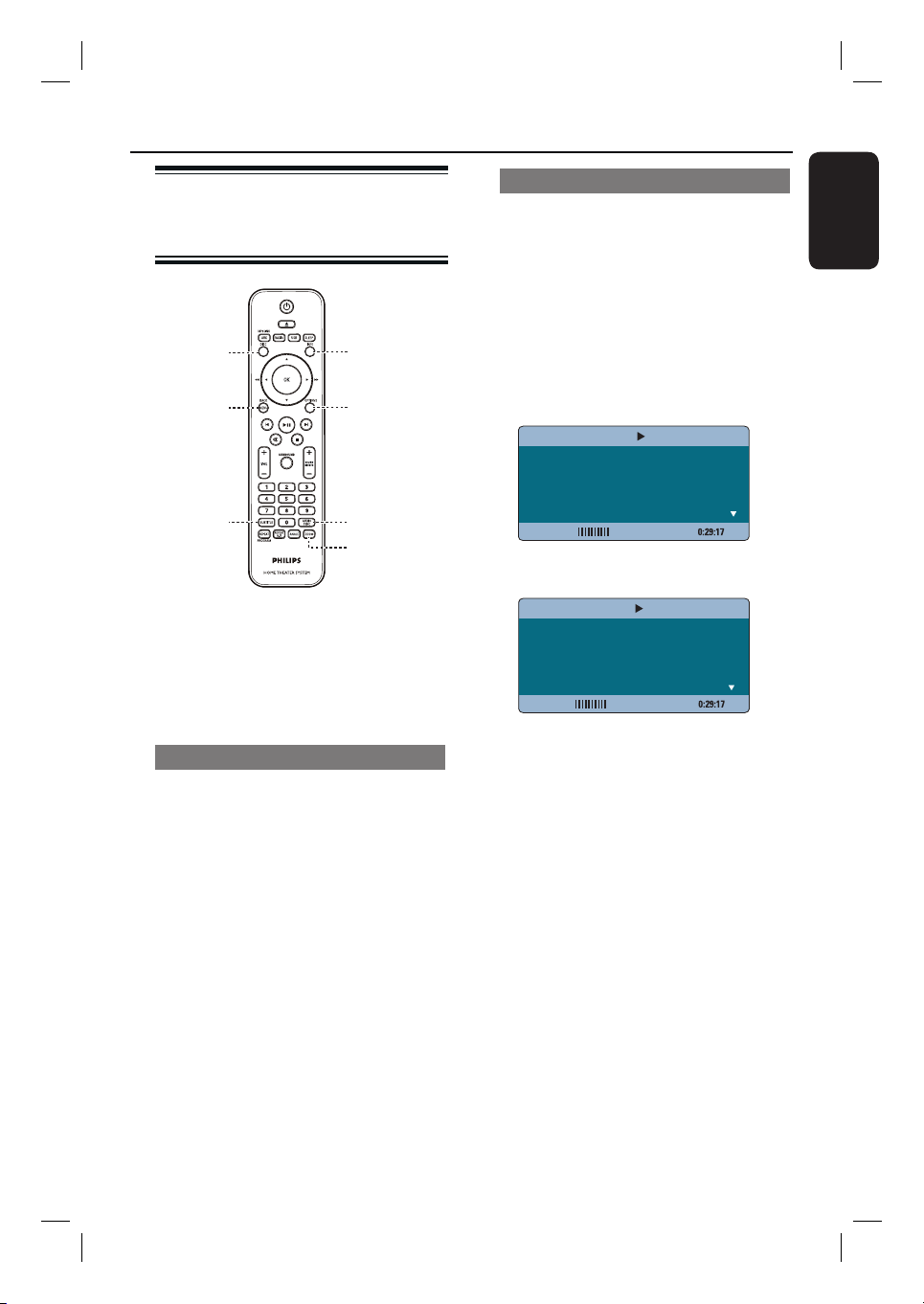
A While playing a disc, press
REPEAT A-B at the start point.
B Press REPEAT A-B again to end the
section.
The section will now repeat
continuously.
C Press REPEAT A-B again to resume
normal playback.
Helpful Hints:
– The marked section for repeat playback is
only possible within the same track/chapter.
29
English
Other playback features
for video discs (DVD/VCD/
SVCD)
OPTIONS
INFO
AUDIO SYNC
ZOOM
BACK
MENU
DISC
SUBTITLE
Note:
The operating features described here
might not be possible for certain discs.
Always refer to the instructions supplied
with the discs.
Using the Disc menu
Depending on the disc format, a menu
may appear on the TV screen once you
load the disc.
To select a playback feature or item
Use keys or numeric keypad
0-9 on the remote control, then press
OK to start playback.
To access or remove the menu
Press DISC on the remote control.
Viewing playback information
This unit can display the disc playback
information (for example, title or chapter
number, audio/subtitle language) and a
number of operations can be done
without interrupting disc playback.
A During playback, press INFO.
A list of available disc information
appears on the TV.
DVD
Menu
Title
Chapter
Audio
Subtitle
01/01
02/99
2ch Chi
Off
Bitrate 7
Title Elapsed
VCD/SVCD
Bitrate 8
Total Elapsed
Track
Disc Time
Track Time
Repeat
09/16
1:16:05
0:04:32
Off
Menu
B Use keys to view the information
and press OK to access.
C Use the numeric keypad 0-9 to input
the number/time or use keys to
make the selection.
D Press OK to con rm.
Playback changes according to the
chosen time or to the selected title/
chapter/track.
E To exit, press INFO.
Disc Operations (continued)

30
English
Zooming
This option allows you to zoom and pan
through the picture on the TV.
A During playback, press ZOOM
repeatedly to select a different zoom
factor.
Playback continues.
B Use keys to pan through the
enlarged image.
C Press ZOOM repeatedly to return to
the original size.
Changing subtitle language
This operation works only on DVDs with
multiple subtitle languages. You can
change the language you want while
playing a DVD.
Press SUBTITLE repeatedly to select
different subtitle languages.
Switching camera angles
This option is only available on DVDs
that contain sequences recorded from
different camera angles. This allows you
to view the picture from different angles.
A If a camera icon appears on the TV, press
ANGLE repeatedly to select the
available angles.
Changing sound track language
This operation works only on DVDs with
multiple sound track languages, or VCDs/
SVCDs with multiple audio channels.
For DVD
Press AUDIO SYNC repeatedly to
select the available audio languages.
For VCD and SVCD
Press AUDIO SYNC repeatedly to
select the available audio channels
provided by the disc (STEREO, MONO
LEFT, MONO RIGHT or MIX MONO).
Setting the delay times for audio
playback
This feature allows you to adjust the
audio delay times if the video playback is
slower than the audio output streams,
hence resulting in ‘Lip-sync’. The only
way to correct ‘Lip-sync’ error caused by
delayed video is to delay audio by an
equal amount.
A Press and hold AUDIO SYNC until
‘Audio Sync’ appears on the TV.
B Within ve seconds, use the VOL +-
to set the audio output delay times
(0 ~ 200 ms).
If the volume control is not used
within ve seconds, it resumes its normal
volume control function.
Helpful Hint:
– Set your preferred default AUDIO SYNC
setting in the setup menu, see ‘Setup Menu
Options - { Audio Setup > Audio Sync } for
details.’
Disc Operations (continued)
31
English
Playback Control (VCD only)
Playback Control (PBC) playback allows
you to play VCDs/SVCDs interactively,
following the menu on the display. The
PBC feature on this unit is turned on by
default.
For VCDs with PBC feature
(version 2.0 only) and SVCDs
During playback (PBC ON mode only),
press MENU (BACK) to return to
PBC menu.
Helpful Hint:
– Set your preferred default PBC setting in
the setup menu, see ‘Setup Menu Options -
{ Preferences > PBC } for details.’
Preview function (VCD/SVCD only)
This function allows you to preview the
contents of a VCD/SVCD.
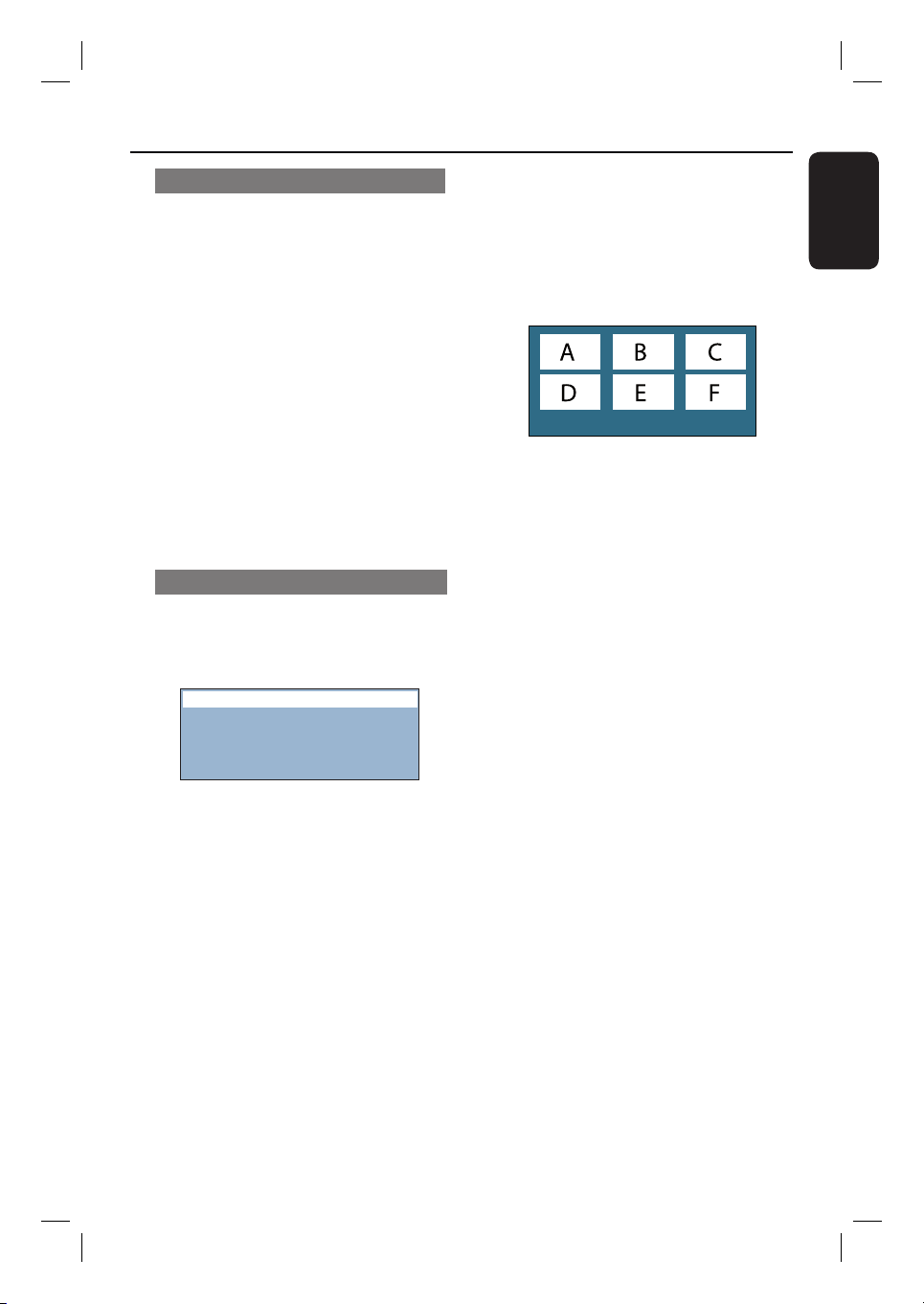
A
Press DISC.
Select Digest Type:
Track Digest
Disc Interval
Track Interval
B Use keys to select one of the
following options and press OK.
{ Track Digest }
View six different tracks on one screen
each time. It allows you to have a quick
glance at all the tracks on the disc.
{ Disc Interval }
View the whole disc in six thumbnail
pictures. It divides a disc into six portions
at regular intervals and displays them on
one screen.
{ Track Interval }
View the content of a single track in six
thumbnail pictures. It divides a single
track into six portions at regular intervals
and displays them on one screen.
This option is only available during
playback mode.
Exit Menu
01 02 03
04 05 06
To go to the previous or next page, press
í / ë.
To return to the main menu, select
{ Menu } on the screen and press OK.
Press OK on the selected thumbnail
picture to start playback from there.
C To exit the preview menu, select
{ Exit } on the screen and press OK.
Disc Operations (continued)
32
English
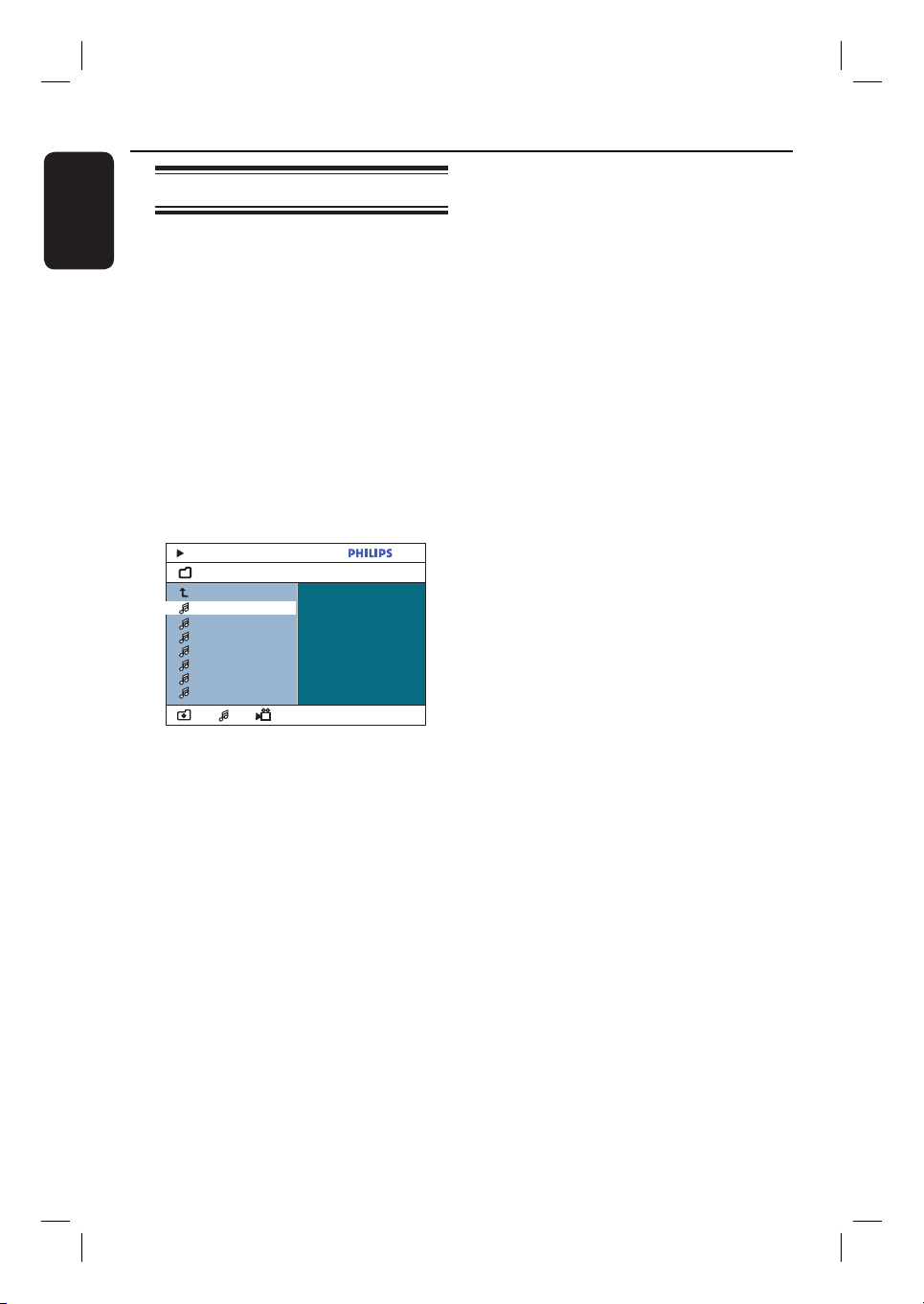
Playing a MP3/ WMA disc
This unit can playback most of the MP3
and Windows Media™ Audio les
recorded on a recordable disc or
commercial CD.
Before you start ...
Turn on your TV to the correct Video In
channel. See ‘Finding the correct viewing
channel’ for details.
A Load a MP3/WMA disc.
The disc reading time may exceed 30
seconds due to the complexity of the
directory/ le con guration.
The disc menu appears on the TV.
00:06 04:04 001/036
\UDF_MP3\
000 018 000
Previous
08-AudioTrack
09-AudioTrack
10-AudioTrack
11-AudioTrack
12-AudioTrack
13-AudioTrack
14-AudioTrack
Disc
B If the disc main menu contains various
folders, use keys to select a desired
folder and press OK to open the folder.
C Use keys to select a le and press
OK to start playback.
Playback starts from the selected le
and continue till the end of the folder.
Disc Operations (continued)
During playback;
Press í / ë to playback another l e in
the current folder.
Press m / M to fast reverse/forward
search for a track.
To select another folder from the
current disc, press repeatedly to
highlight ‘Previous’ folder and press OK
to return to the root menu.
D To stop playback, press x.
Helpful Hints:
– You can set to display or skip the folders
when you load a MP3/JPEG disc. Press
OPTIONS, then go to { Preferences > MP3/
JPEG NAV }.
– Only the rst session of a multi-session CD
will be played back.
– It is normal to experience an occasional
‘skip’ while listening to your MP3/WMA disc
due to poor clarity of digital contents during
internet downloading.
– If any special characters are present in the
MP3/WMA track name (ID3) or album
name, it might not be displayed correctly on
the screen because this unit does not support
the characters.
33
English
Playing a JPEG image le
(slide show)
Before you start ...
Turn on your TV to the correct Video In
channel. See ‘Finding the correct viewing
channel’ for details.
A Load a JPEG photo CD (or Kodak Picture
CD).
For a Kodak disc, the slide show
begins automatically.
For a JPEG disc, the picture menu
appears on the TV. Press u to start the
slide-show playback.
Helpful Hint:
– It may require longer time to display the
disc content due to the large number of
songs/pictures compiled into the disc.
Supported le format:
– The le extension has to be ‘*.JPG’ and
not ‘*.JPEG’.
– This unit can only display digital camera
pictures according to the JPEG-EXIF
format, typically used by almost all digital
cameras. It cannot display progressive
JPEG, Motion JPEG, or pictures in
formats other than JPEG, or sound clips
associated with pictures.
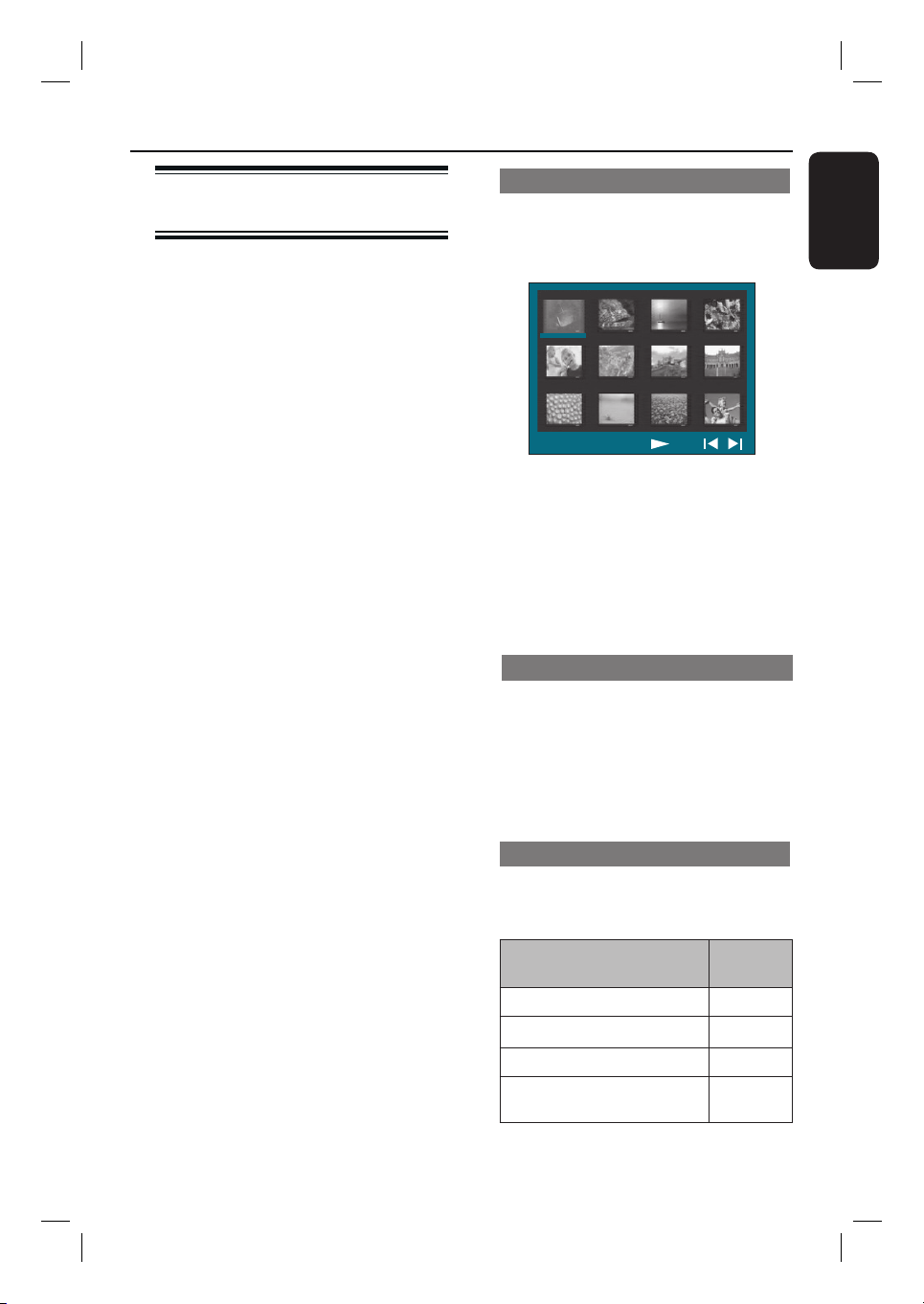
Preview function
A During playback, press INFO.
12 thumbnail pictures will be displayed
on the TV.
B Press í / ë to display the other
pictures on the previous/next page.
C Use keys to select one of the
pictures and press OK to start playback.
D Press MENU (BACK) to return to
Picture CD menu.
Zooming
A During playback, press ZOOM
repeatedly to select a different zoom
factor.
B Use keys to pan through the
enlarged image.
Skip/Rotate picture
During playback, use keys to
skip/rotate the picture on the TV.
Action Remote
Control
Skip to previous picture.
Skip to next picture.
Rotate the picture clockwise.
Rotate the picture anti-
clockwise.
Disc Operations (continued)

34
English
Playing music and photo les
simultaneously
You can create a musical slide show
playback if the disc contains both the
MP3/WMA music and JPEG picture les.
A Load a disc that contains both MP3/WMA
and JPEG les.
B Use keys to select a MP3/WMA le
from the disc menu and press OK to
start playback.
C During MP3/WMA playback, use
keys to select a JPEG le from
the disc menu and press OK.
Slideshow begins and continues till the
end of the photo folder or album.
To return to the menu, press MENU
(BACK),
D To stop simultaneous playback, press x
twice.
Playing a DivX
®
disc
You can only play those DivX
®
videos
that were rented or purchased using the
DivX
®
registration code of this unit (see
‘Setup Menu Options - { General Setup >
DivX(R) VOD Code }’ for details.)
A Load a DivX
®
disc.
B Use keys to navigate to the le
you want to play.
C Press OK to start playback.
During playback;
If the DivX
®
disc has multilingual subtitles,
you can press SUBTITLE on the
remote control to change the subtitle
language.
If the DivX
®
title has different audio
tracks, you can press AUDIO SYNC on
the remote control to change the audio
stream.
Use m / M keys on the remote
control to perform fast reverse/forward
search.
Press INFO repeatedly until the Time
Search menu appears, key in the time
where playback should start.
Playback skips to the time entered.
Helpful Hints:
– Subtitle les with the following le name
extensions (.srt, .smi, .sub, .ssa, .ass) are
supported but do not appear on the le
navigation menu.
– The subtitle le name has to be the same
as the le name of the movie.
– The subtitle can only be displayed up to an
average of 45 characters.
Disc Operations (continued)
35
English
Playback - USB Device
Playing from a USB device
You can play or view the data les (JPEG,
MP3, Windows Media™ Audio or DivX
®
)
in the USB ash drive or USB memory
card reader. However, editing or copying
the data le is not possible.
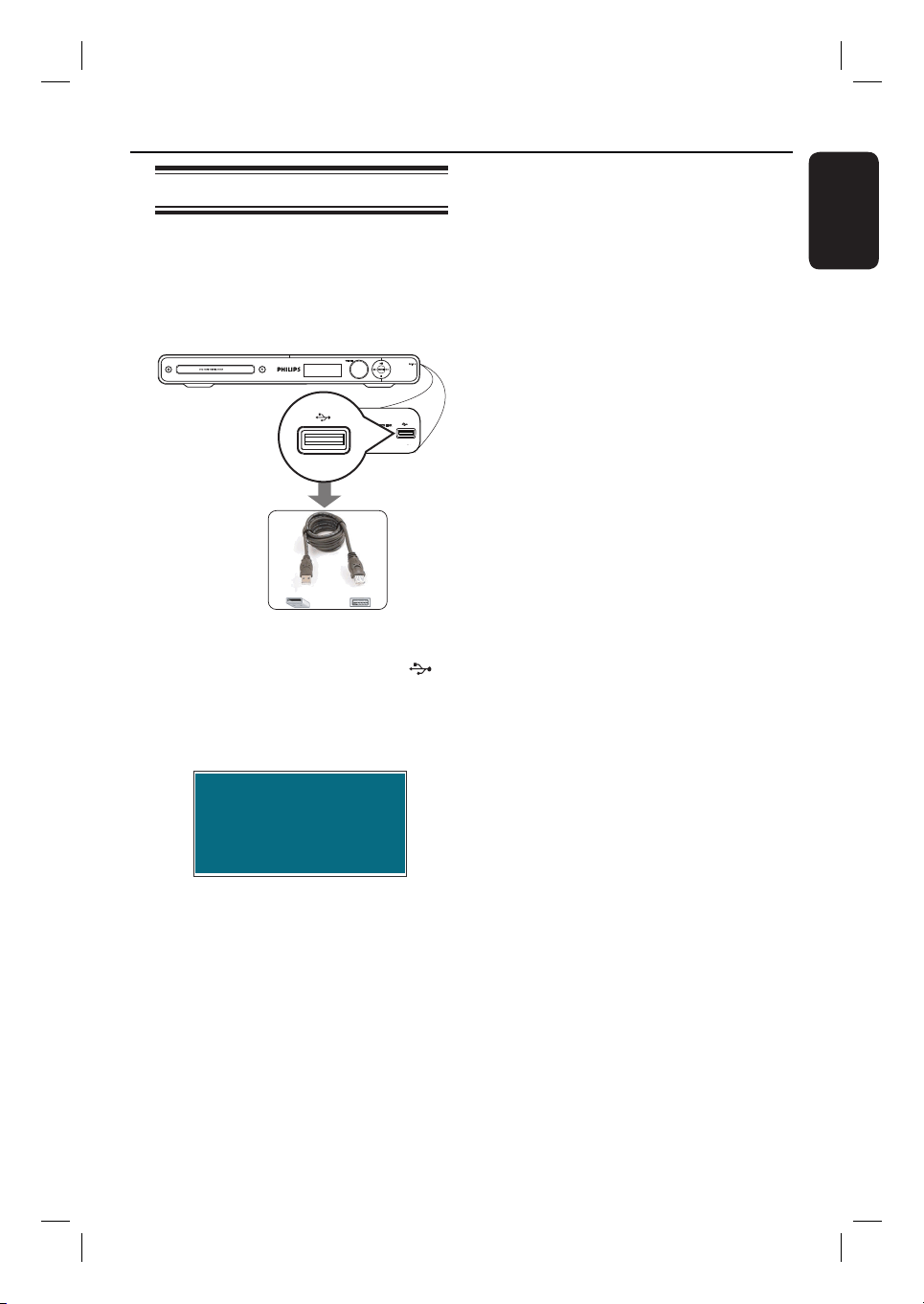
A Connect the USB ash drive/USB
memory card reader directly to the
(USB) socket on this unit.
B A message appears on the TV for 5 ( ve)
seconds when the device is detected.
Press USB to select device
C Press USB
on the remote control to
access the data in the drive.
When using multiple drives on a single
card reader, only one of the connected
cards can be accessed.
The device numbers may vary from
different card readers.
D Select the le to play and press u.
For more playback information, see
‘Playing a DivX disc’, ‘Playing a JPEG
photo le (slide show)’ or ‘Playing a MP3/
WMA disc’ for details.
E Before you remove the USB device, press
Ç
to stop playback or press DISC to
switch to disc mode.
Helpful Hints:
– The USB socket does not support the
connection of other USB devices except to a
USB ash drive/USB memory card reader.
– When the USB device does not t into the
USB socket, a USB extension cable (not
supplied) is required.
– This unit can only support up to a
maximum of 300 folders and 648 les.
– You can only read and playback the
content from the USB device.
– Copy-protected contents are not playable.
36
English
Playback - Other Audio Player
Playing from other portable
audio player
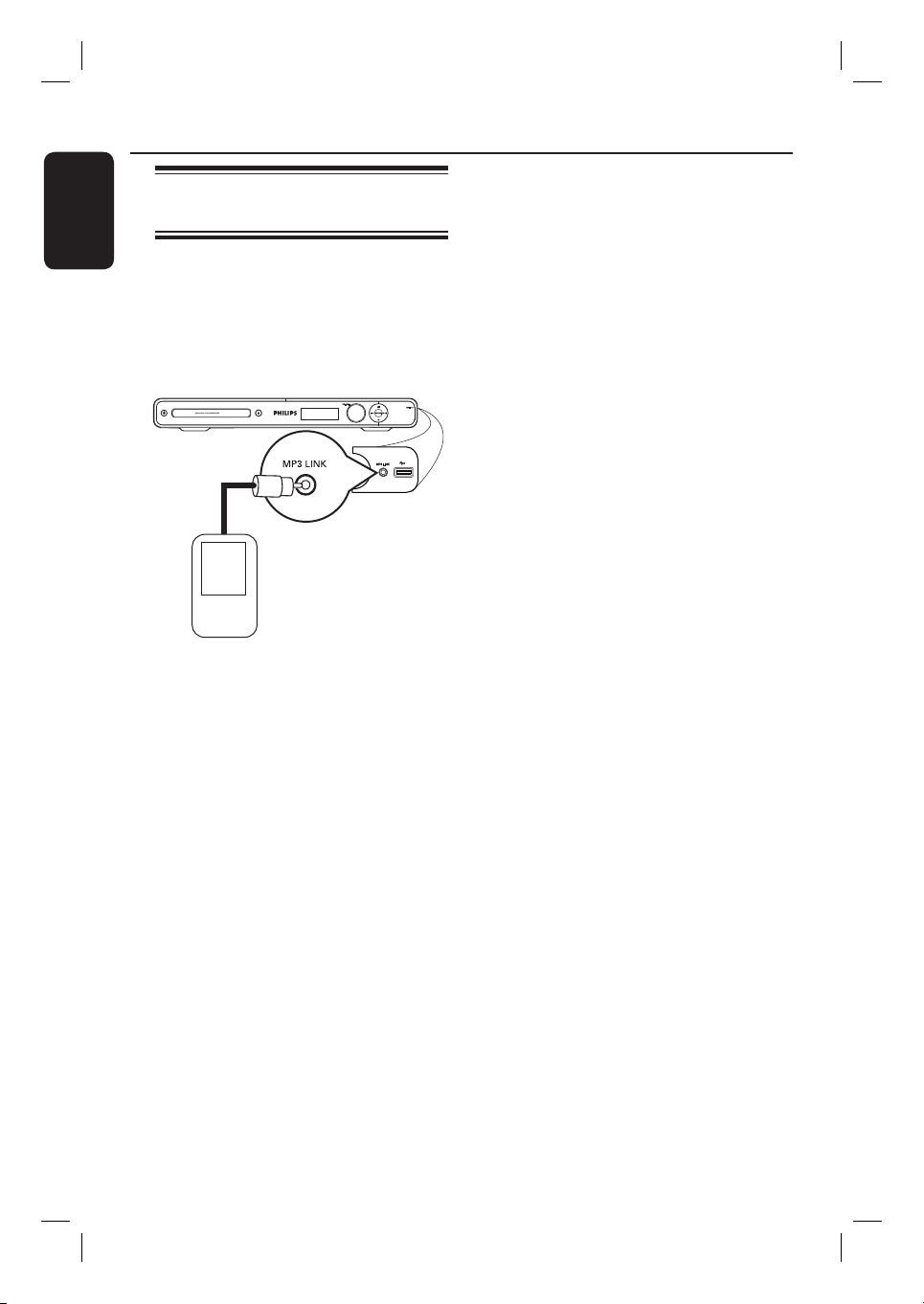
You can connect your portable audio
player to this unit to get the best
immersion sound experience through the
speaker system. However, controlling of
playback is only possible on the portable
audio player.
A Use a 3.5mm stereo audio cable (not
supplied) to connect the MP3 LINK
socket on this unit to the ‘headphone’
output socket on your portable audio
player.
B Press AUX (MP3 LINK) repeatedly on
the remote control until ‘MP3 LINK’ is
displayed.
C Start playback on your portable audio
player.
The music will be heard through the
speakers.
D To stop playback, press the STOP button
on the portable audio player.
Helpful Hint:
– Stop playback on your portable audio
player before you switch this unit to another
input source (eg. DISC, USB).
37
English
Press OPTIONS to exit menu
General Setup
Disc Lock
Display Dim
OSD Language
Screen Saver
DivX(R) VOD Code
Sleep
See ‘General Setup’ on this Chapter.
Press OPTIONS to exit menu
Audio Setup
Speakers Volume
Speakers Delay
HDMI Audio
CD Upsampling
Audio Sync
See ‘Audio Setup’ on this Chapter.
Press OPTIONS to exit menu
Video Setup
TV Type
TV Display
Progressive
Picture Setting
HDMI Setup
Component
Closed Caption
See ‘Video Setup’ on this Chapter.
Press OPTIONS to exit menu
Audio
Subtitle
Disc Menu
Parental
PBC
MP3/JPEG Nav
Password
DivX Subtitle
Preferences
See ‘Preferences’ on this Chapter.
Setup Menu Options
Accessing the setup menu
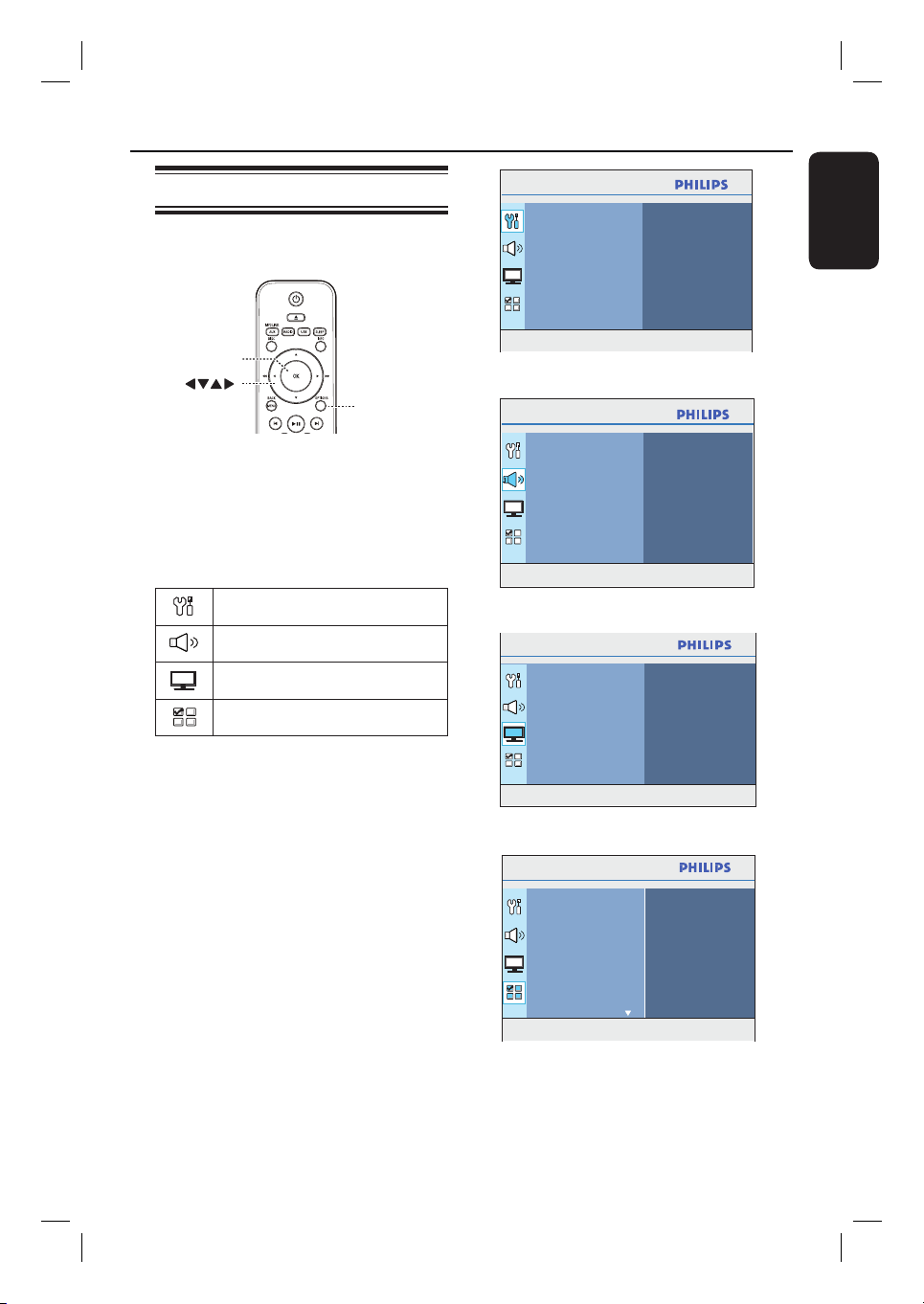
You can change the settings in this unit to
suit your particular requirements.
OPTIONS
OK
A In disc mode, press OPTIONS on the
remote control.
The setup menu appears.
B Use keys to select one of the setup
menu options, then press .
General Setup
Audio Setup
Video Setup
Preferences
If you are not able to access the
{ Preferences }, press OPTIONS to exit
the menu. Then, press x twice before
you press the OPTIONS again.
C Use keys to select an option and
press .
D Select the setting you wish to change and
press OK to con rm and go back to the
previously selected item.
Instructions and explanations of the
options are provided in the following
pages.
If the option in the menu is grayed
out, that means the setting is not
available or cannot be changed in the
current state.
E To exit, press OPTIONS.
38
English
Setup Menu Options (continued)
General Setup (underlined options are the factory default settings)
Disc Lock
Not all discs are rated or coded by the disc maker. You can
prevent play of speci c discs with the disc lock function. Up to 40
discs can be locked.
{ Lock } – To block the playback of the current disc.
Subsequent access to a locked disc requires a
six-digit password. The default password is
‘136900’ (see { Preferences > Password } for
details).
{ Unlock } – All discs can be played.
Display Dim
Select the brightness of this unit’s display panel.
{ 100% } – Full brightness.
{ 70% } – Medium brightness.
{ 40% } – Dimmest display. This switches off all LEDs and
icons on the front display panel of this unit.
OSD Language
Select the menu language for this unit’s on-screen display.
Screen Saver
The screen saver prevents damage to the TV screen by avoiding
exposure to a static image for too long.
{ On } – Switch to TV screen saver mode when playback
has been stopped or paused for about 5
minutes.
{ Off } – Disable the screen saver function.
Sleep
The sleep timer enables the unit to switch to standby mode
automatically after a preset time.
{ 15/30/45/60 mins } – Select the preset minutes for
switching the unit to standby mode
automatically.
{ Off } – Turn off the sleep mode function.
DivX(R) VOD Code
Philips provides you with the DivX
®
VOD (Video On Demand)
registration code that allows you to rent or purchase videos from
DivX
®
VOD service at www.divx.com/vod. All the downloaded
videos from DivX
®
VOD can only be played back on this unit.
Press
to see the registration code and press OK to exit.

39
English
Audio Setup (underlined options are the factory default settings)
Speakers Volume
Access the speaker’s level setup menu. Use keys to adjust
the volume level for each connected speaker between -6dB to
+6dB.
See ‘Getting Started - Setting the speakers’ channels’.
Speakers Delay
Access the speaker’s distance setup menu. Use keys to set
the delay times for the centre and rear speakers based on the
listening position and distance.
See ‘Getting Started - Setting
the speakers’ channels’.
Note: 1 ms increase/decrease of delay time is equivalent to one (1) foot
change in distance. Use the longer delay time settings when the rear
speakers are closer to the listener than the front speakers.
HDMI Audio
This setting is only required if you are using the HDMI
OUT socket to connect your TV or other display device
(see ‘Option 4: Connecting to a HDMI-compatible TV’).
{ Off } – Turn off the HDMI audio output. You can still
enjoy the sound output through the speaker
system.
{ All } – The HDMI audio output will be same as the
audio stream being played back. In the case
when the playback audio format is not
supported, the audio output will be changed to
PCM (Pulse Code Modulation) automatically.
Notes:
–
It may take a while for this unit and the input device to communicate
and initialise.
–
It is not possible to listen to SACDs or copy-controlled DVD-Audio
CPPM (Content Protection for Playable Media) sources using the HDMI
connection.
Setup Menu Options (continued)

40
English
CD Upsampling
This feature enables you to convert the music CD to a
higher sampling rate using sophisticated digital signal
processing for better sound quality.
{ Off } – Turn off CD-upsampling.
{ 88.2 kHz (X2) } – To convert the sampling rate of the
CDs twice as high as the original rate.
Notes:
–
This function is not available if you switches to Multi-channel mode.
–
If you press SURROUND on the remote control, it turns off the
CD upsampling feature.
Audio Sync
This feature allows you to adjust the audio delay times if the
video playback is slower than the audio output streams.
Use keys to set the delay times for the audio output
between 0~200ms.
Audio Setup (underlined options are the factory default settings)
Setup Menu Options (continued)
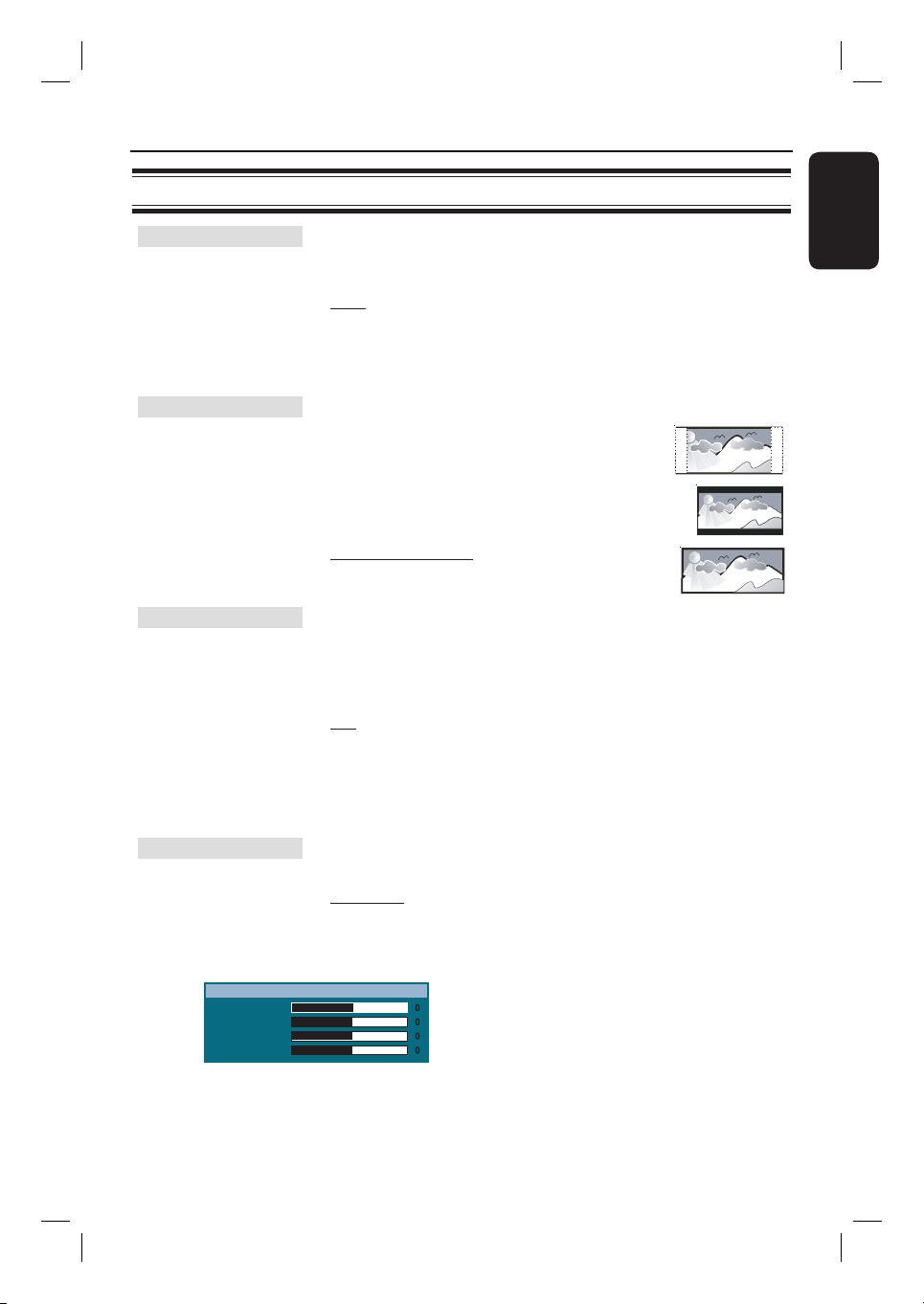
41
English
Video Setup (underlined options are the factory default settings)
TV Type
Select the colour system that matches the connected TV. It
enables playback of a different type of disc (PAL or NTSC disc)
on this unit.
{ PAL } – For PAL-system TV.
{ NTSC } – For NTSC-system TV.
{ Multi } – For TV that is compatible with both PAL and
NTSC.
TV Display
The picture shape can be adjusted to t your TV.
{ 4:3 Pan Scan } – For a full-height
picture with the
sides trimmed.
{ 4:3 Letter Box } – For a ‘wide-screen’
display with black bars
on the top and bottom.
{ 16:9 Wide Screen } – For wide-screen TV
(frame ratio 16:9).
Progressive
Before enabling the progressive scan feature, you
must ensure that your TV can accept progressive signals (a
progressive scan TV is required) and that you have connected this
unit to your TV using the Y Pb Pr. See ‘Getting Started > Setting up
Progressive Scan feature’ for details.
{ Off } – Turn off the progressive scan mode.
{ On } – Turn on progressive scan mode.
Read the instructions on the TV and con rm
your action by pressing OK on the remote
control.
Picture Setting
This unit provides three prede ned sets of picture colour settings
and one personal setting which you can de ne yourself.
{ Standard } – Original colour setting.
{ Bright } – Vibrant colour setting.
{ Soft } – Warm colour setting.
{ Personal } – Select this to personalise the picture colour
setting. Use keys to adjust to the setting
that best suits your personal preference and
press OK to con rm. For an average setting,
select { 0 }.
Setup Menu Options (continued)
Brightness
Contrast
Tint
Color
Personal Picture Setup

42
English
Video Setup (underlined options are the factory default settings)
Setup Menu Options (continued)
HDMI Setup
It provides the picture settings to enhance the appearance and
picture quality for disc playback. This feature is only applicable if
you have connected this unit to a HDMI-compatible TV/device.
{ Wide Screen Format } – Select a suitable screen display (this
option is only available when { TV Display } is set to { 16:9
Wide Screen }).
{ Superwide }
Display the 4:3 picture disc on the wide-
screen TV with non-linear stretching (centre
position of the screen is stretched less than
the side.) The supported video resolution
for this setting is 720p or 1080i.
{ 4:3 Pillar Box }
Display the 4:3 picture disc on the wide-
screen TV without stretching. Black bars will
be shown on the both sides of the TV screen.
{ Off }
No aspect ratio adjustment is made when this
option is selected.
Note: The { Superwide } is only applicable
for resolution: 720p or 1080i.
{ HDMI Video } – Select a suitable video resolution that is
compatible with your TV display capability.
{ Auto }
It detects and selects the best supported
video resolution automatically.
{ 480p, 576p, 720p, 1080i, 1080p }
Manually select a video resolution. ‘p’ for
progressive and ‘i’ for interlaced.
Note: If no display appears on the TV due to unsupported
resolution, use the composite video cable to connect this unit
and your TV. Turn on your TV to the correct input channel for
the composite video and adjust the resolution setting to
480p/576p

43
English
Video Setup (underlined options are the factory default settings)
Setup Menu Options (continued)
HDMI Setup
continues...
{ EasyLink } – Enable HDMI CEC compliant TV/devices to
control each other with a single remote
control.
Notes:
–
Your TV and other connected devices must be compliant with HDMI
CEC.
–
You must turn on the HDMI CEC operations on your TV/devices
before you can enjoy the EasyLink controls. See your TVs/devices manual
for details.
–
Philips does not guarantee 100% interoperability with all HDMI CEC
compliant devices.
{ Auto Wakeup TV }
Press u button to turn on (both your TV
and this unit) and start video disc play (if a
video disc is found in the disc tray). Your TV
automatically switches to the correct video
channel.
To disable this feature, select { Off }.
{ System Standby }
Press STANDBY/POWER button to turn off
this unit and all the HDMI CEC compliant
devices.
To disable this feature, select { Decline }.
Note: However, press and hold 2 button
on this unit remote control can still turn off
all the HDMI CEC compliant devices.
{ System Audio Control }
This unit automatically switches to the audio
input of the active device and output the
sound from its speakers system.
To enable this feature, select { On }. Then
proceed to { HDMI Input Mapping } to
scan and map all available devices.
{ HDMI Input Mapping }
Map the correct audio connections from
your TV/devices to this unit to enable
seamless switching of audio input
automatically.
To start, press OK and con rm scanning.
Then select the audio input (e.g. AUX,
COAXIAL IN) and map to your TV or other
devices accordingly.

44
English
Video Setup (underlined options are the factory default settings)
Setup Menu Options (continued)
Component
Select the video output that matches the video connection
between this unit and your TV.
{ YUV } – For component video (Y Pb Pr) connection.
{ RGB } – For scart (TV OUT) connection.
Closed Caption
This feature is only available if the disc contains of special video
signal data. It shows sound effects on the screen if your TV
supports this feature, such as ‘phone ringing’ and ‘footsteps.’
{ On } – Turn on closed caption feature.
{ Off } – Turn off closed caption feature.

45
English
Preferences (underlined options are the factory default settings)
Audio
Select the preferred audio language for DVDs with multiple
sound tracks.
Subtitle
Select the preferred subtitle language for DVD playback.
Disc Menu
Select the preferred disc menu language for DVD playback.
Note: If the selected audio/subtitle/disc menu language is not available on
the DVD, the disc’s default language will be used instead.
Parental
This is to prohibit viewing of discs that had exceeded the limits
you set. It works only on the DVDs with parental level assigned
to the complete disc or to certain scenes on the disc.
1) Use keys to select a rating level from 1 to 8 and press
OK.
2) Use the numeric keypad 0-9 on the remote control to
enter your six-digit password.
Notes:
– The ratings are country-dependent (‘1’ is considered material that is
least offensive and ‘8’ is most offensive). To disable parental controls and
allow all discs to play, select ‘8’.
– Some DVDs are not encoded with a rating though the movie rating
may be printed on the disc cover. The rating level feature does not
prohibit playback of such discs. VCD, SVCD and CD have no level
indication, so parental control has no effect on these type of discs.
– DVDs that are rated higher than the level you selected will not be
played unless you enter the same six-digit password.
PBC
Play Back Control feature is applicable for VCD/SVCD only. It
allows you to play Video CDs (2.0) interactively, following the
menu on the display.
{
On } – The index menu (if available) appears on the TV
when you load a VCD/SVCD.
{ Off } – The VCD/SVCD skips the index menu and
playback directly from the beginning.
Setup Menu Options (continued)
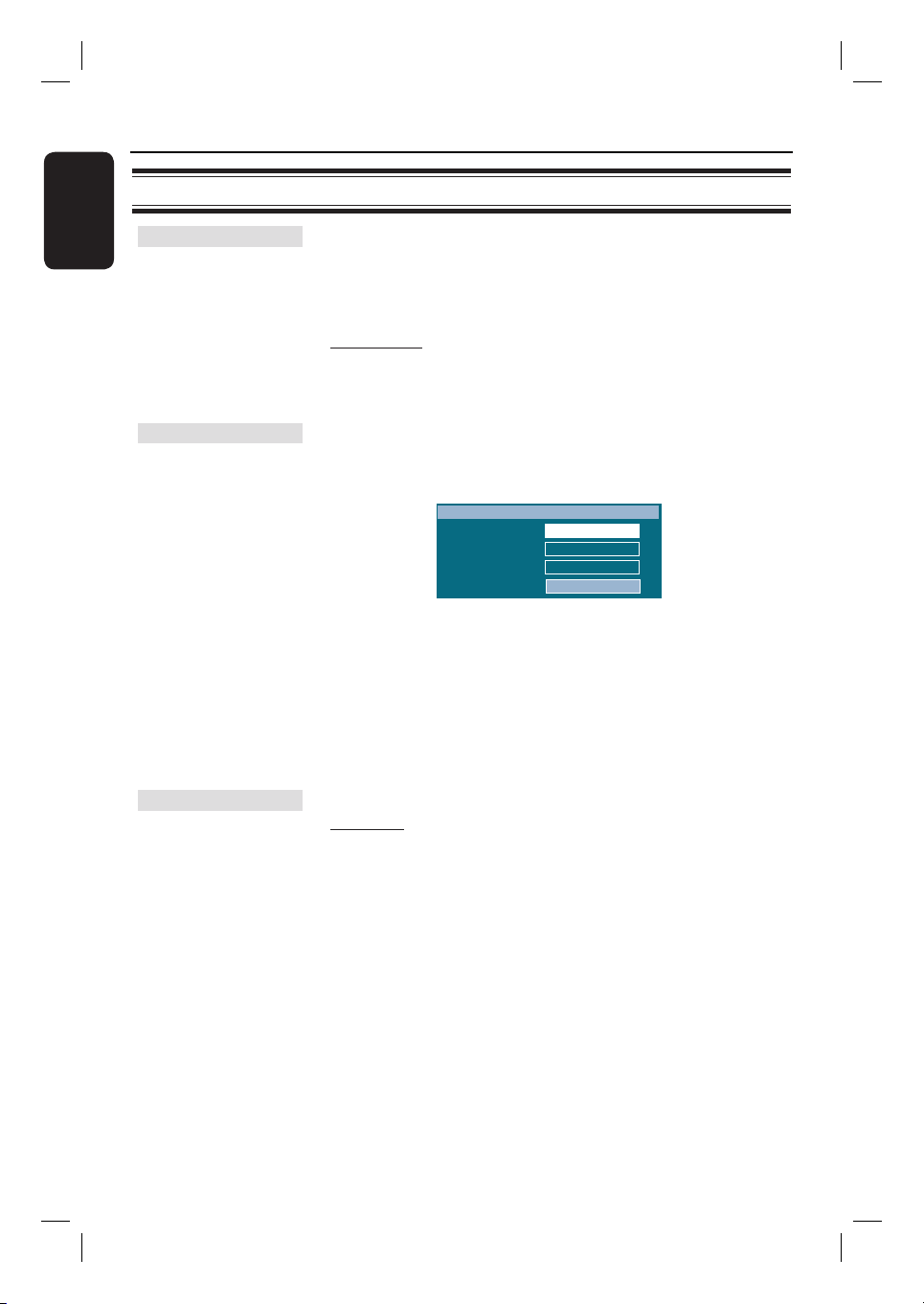
46
English
Preferences (underlined options are the factory default settings)
MP3/JPEG Nav
MP3/JPEG Navigator can only be set if the disc is recorded with a
menu. It allows you to select different display menus for easy
navigation.
{ Without Menu
} – Display all the les contained in the
MP3/Picture disc.
{ With Menu } – Display the folder menu of the MP3/
Picture disc.
Note: This unit can only display 648 les in the directory.
Password
The password is used for the Disc Lock and Parental. The default
password is ‘136900’. To change the password:
1) Press OK to access the change password menu.
Old Password
New Password
Confirm PWD
Change Password
OK
2) Use the numeric keypad 0-9 on the remote control to
enter your existing six-digit password at { Old Password }.
Note: When doing this for the rst time or if you forget your existing
password, key in ‘136900’.
3) Enter the new six-digit password at { New Password }.
4) Enter the new six-digit password again at { Con rm PWD }.
5) Press OK to con rm and exit the menu.
DivX Subtitle
Select the font type that supports the recorded DivX
®
subtitle.
{ Standard } – Display a standard list of Roman
subtitle fonts provided by this unit.
{ Central Europe } – Display Central Europe fonts.
{ Cyrillic } – Display Cyrillic fonts.
{ Greek } – Display Greek subtitle fonts.
{ Hebrew } – Display Hebrew subtitle fonts.
{ Chinese (Simp) } – Display Simpli ed Chinese fonts.
{ Korean } – Display Korean fonts.
Setup Menu Options (continued)

47
English
Preferences (underlined options are the factory default settings)
Default
This feature enables you to reset all the setup menu options and
your personal settings to the factory defaults, except your
password for the Disc Lock and Parental.
Press OK to con rm the default reset.
Version Info
This shows you informations about the current version of the
software installed in this unit. You may require this information
for future online rmware upgrade.
Press OK to display the software version of this unit.
Setup Menu Options (continued)
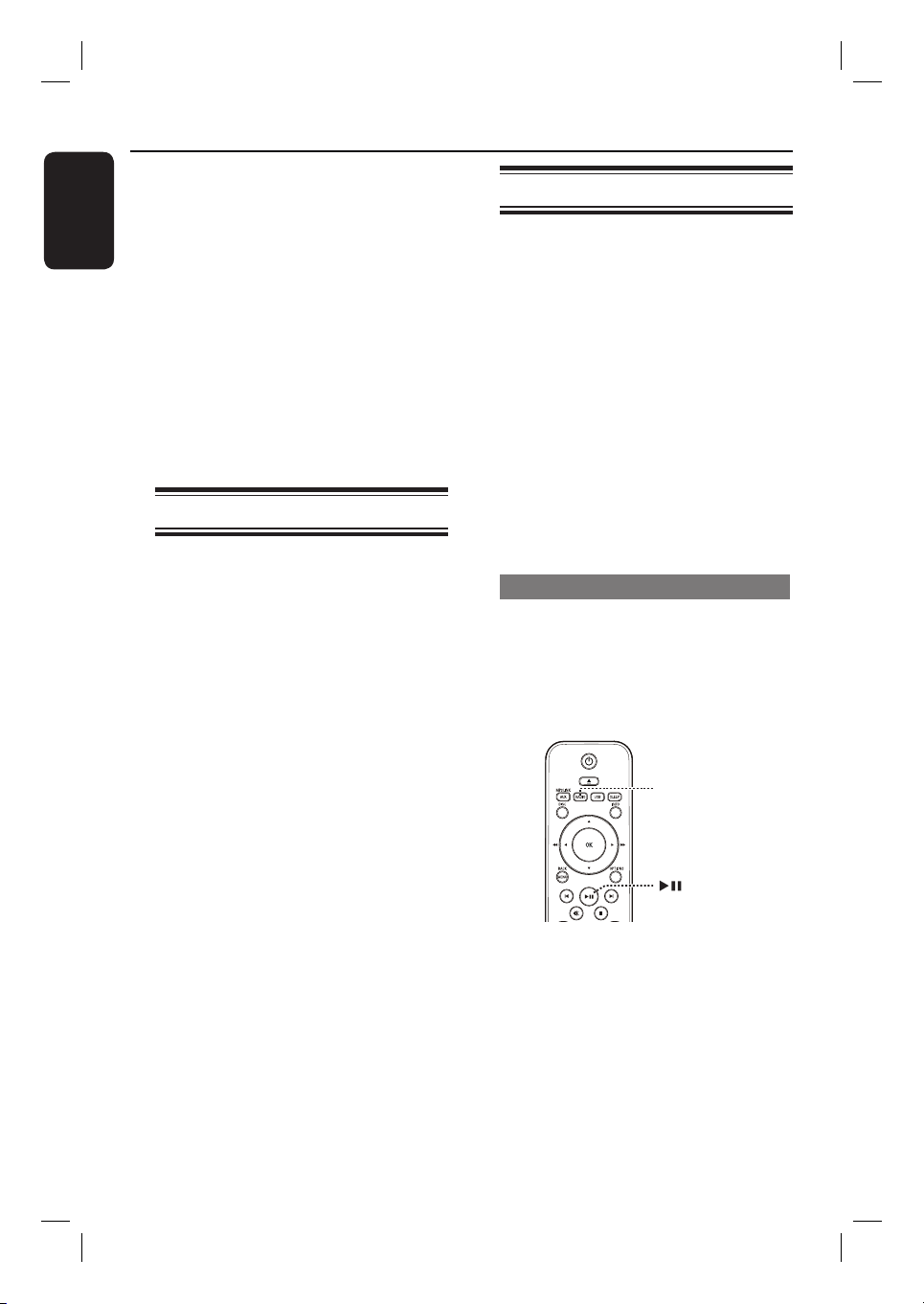
48
English
Radio Operations
Before you start .....
Ensure that FM antenna is connected to
the main unit. (For some models, it has
been connected in the factory.) Extend
the FM antenna and x its ends to the
wall.
Helpful Hints:
– For better FM stereo reception, connect an
external FM antenna (not supplied.)
– Position the antenna as far away as
possible from your TV, VCR or other
radiation source to prevent any unwanted
interference.
Tuning to radio stations
A Press SOURCE repeatedly until ‘FM’
appears on the display panel (or press
RADIO on the remote control).
B Press / on the remote control to
start tuning.
The frequency indication starts to
change until a radio station with suf cient
signal strength is found.
C Repeat step B if necessary until you nd
the desired radio station
D To ne-tune the reception of a weak
station, press / brie y and
repeatedly until an optimal reception is
found.
Helpful Hint:
– If the FM radio station is transmitting RDS
(Radio Data System) data, the RDS name
will be displayed and stored.
Presetting radio stations
You can store up to 40 FM preset radio
stations in the memory. There are three
different ways to program the radio
stations:
– Using auto install (for rst time setup
only)
– Using automatic preset
– Using manual preset
Helpful Hints:
– This unit exits presetting mode if no
button is pressed within 20 seconds.
– If no stereo signal is detected or less than
5 ( ve) stations are detected during radio
installation, ‘CHECK ANTENNA’ appears.
Using auto install
When you access the ‘RADIO’ mode for
the very rst time, you will be prompted
to install the radio stations. With this
feature, you can install all the available
radio station automatically with one
touch of button.
RADIO
A Press RADIO.
‘AUTO INSTALL ... PRESS PLAY’
appears.
B Press u.
All the available radio stations with
strong signal will be stored automatically.
Once complete, the rst tuned radio
station will be played back.
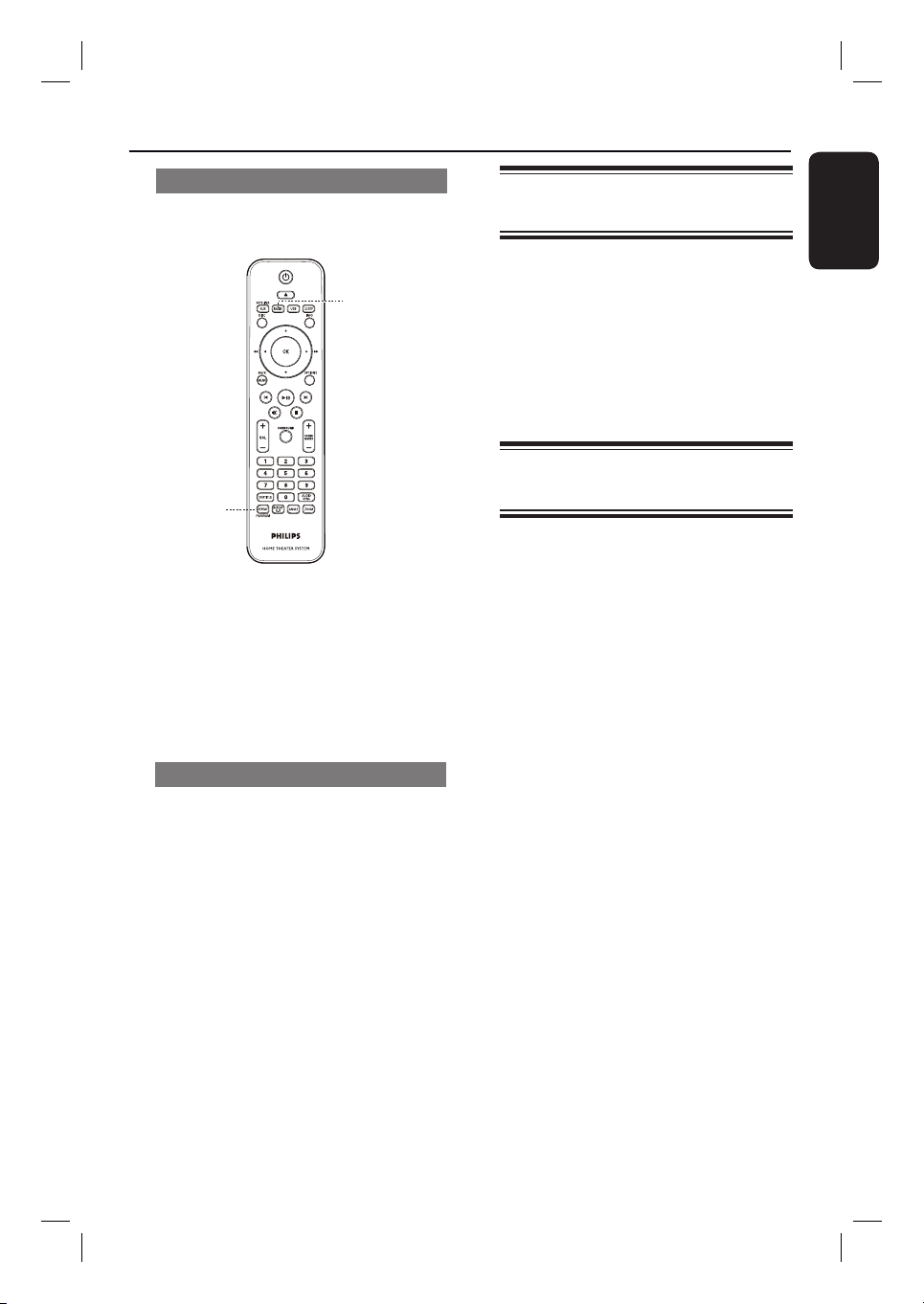
49
English
Radio Operations (continued)
Using automatic preset
Use automatic presetting to store or
reinstall all the preset radio stations.
RADIO
REPEAT
PROGRAM
A Press RADIO
B Press and hold REPEAT (PROGRAM)
until ‘START ...’ appears on the display
panel.
All previously stored radio stations
will be replaced.
Using manual preset
Use manual presetting to store your
favourite radio stations.
A Tune to your desired radio station (see
‘Tuning to radio stations’).
B Press REPEAT (PROGRAM).
C Press í / ë or use the numeric
keypad 0-9 to select a preset number
that you want to store the current radio
station.
D Press REPEAT (PROGRAM) to store.
Selecting a preset radio
station
A Press RADIO.
B Press í / ë or use the numeric
keypad 0-9 to select a preset radio
stations.
The preset number and radio
frequency appear on the display panel.
Deleting a preset radio
station
A In radio mode, press í / ë to select a
preset radio station.
B Press and hold x until ‘FM X DELETED’
appears.
‘X’ is the preset number.
The radio station continues to play
but has been deleted from the preset list.
The rest of the preset radio stations
remain unchanged.
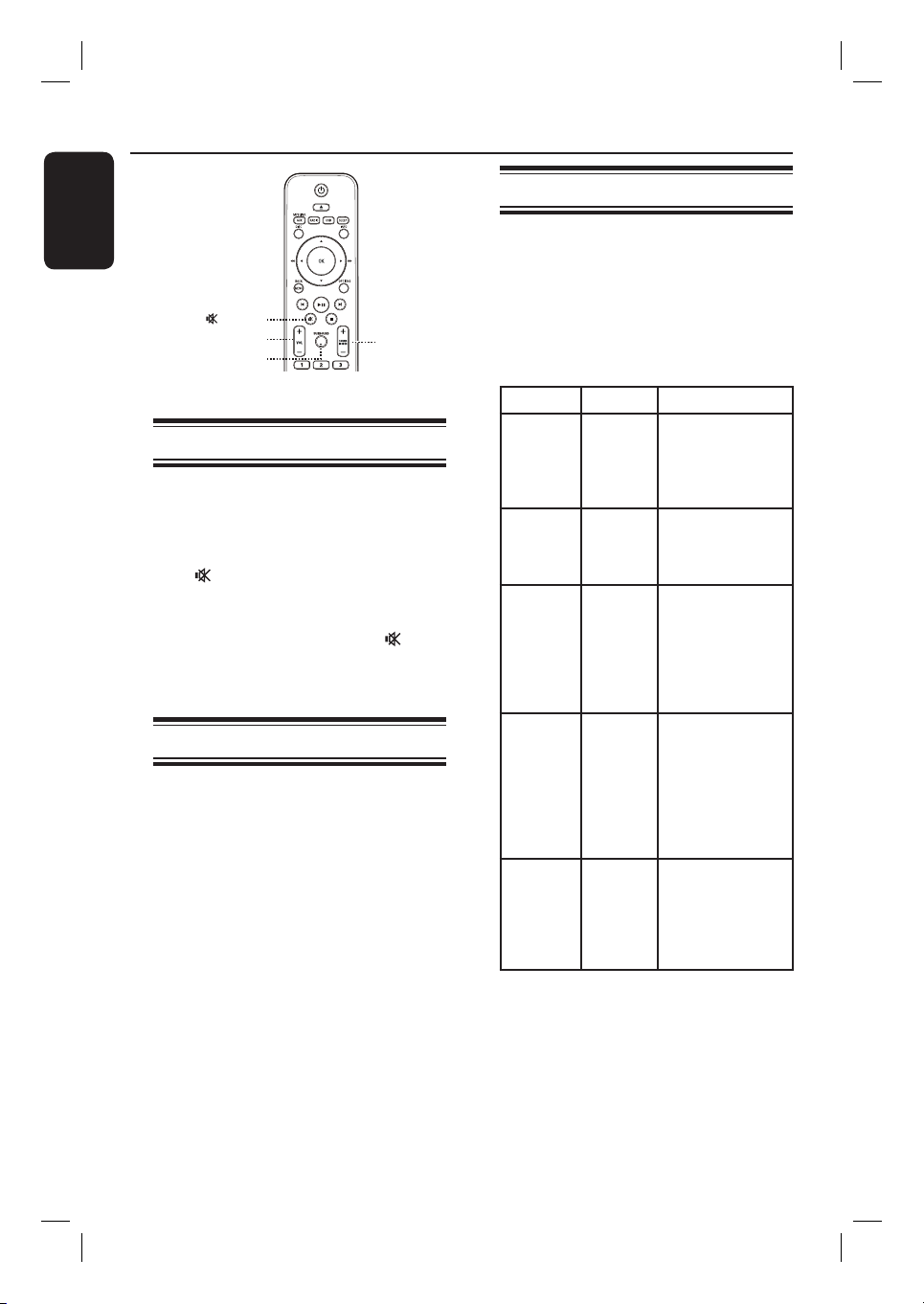
50
English
Sound and Volume Controls
SURROUND
(mute)
VOL+-
SOUND
MODES
+-
Volume control
Press VOL +
/- to increase or
decrease the volume level.
To turn off the volume temporarily
Press
.
Playback continues without sound and
‘MUTE’ appears.
To restore the volume, press again,
or increase the volume level.
Selecting surround sound
Press SURROUND to select Multi-
Channel, Stereo sound or Party sound.
The availability of the various
surround sound modes depends on the
sound available on the disc.
The available output modes for
Multi-channel include: Dolby Digital, DTS
(Digital Theatre Systems) Surround and
Dolby Pro Logic II.
Stereo broadcasts or recordings will
produce some surround channel effects
when played in a surround mode.
Party mode is ideal for party music. It
enhanced the stereo channels output by
duplicating the sound output to the
centre, rear left and rear right speakers.
Selecting digital sound effects
Select a preset digital sound effect that
matches your disc’s content or that
optimises the sound of the musical style
you are playing.
Press SOUND MODES +/- to
select the available sound effect.
Movies Music Description
CONCERT CLASSIC Flat and pure sound
mode. Ideal for
listening to classical
music and watching
live concert DVDs.
DRAMA LOUNGE Moderate sound
mode suitable for
lounge music and
watching dramas.
ACTION ROCK Enhanced low and
high range for great
sounding movie
effects and
atmosphere. Great
for action movies
and rock/pop music.
GAMING SPORTS Moderate mid range
and surround
effects for clear
vocals and the
atmosphere of a live
sports venue. Also
suitable for video
gaming.
NIGHT NIGHT Dynamically con-
trolled sound mode
suitable for watch-
ing movies at night
or for non-intrusive
background music.
51
English
Other Features
Turning on the sleep timer
The sleep timer enables the unit to switch
to standby mode automatically after the
selected preset time.
Press SLEEP repeatedly until it reaches
the desired preset turn-off time (in
minutes):
OFF > 60 > 45 > 30 > 15 > OFF ....
To check or change the setting
Press SLEEP once to show the
remaining time before switching off.
To change the setting, press SLEEP
repeatedly until the time is displayed.
To cancel the sleep timer
Press SLEEP repeatedly until ‘OFF’ is
displayed or turn off this unit to standby.
Installing the latest software
Philips provides software upgrades to
make sure that this unit is compatible
with the newest formats. To check the
updates, compare the current software
version of this unit with the latest
software version available at the Philips
website.
A Press OPTIONS to select
{ Preferences } menu.
B Select { Version Info }, and press OK to
check the software version of this unit.
Press OPTIONS to exit menu
DivX Subtitle
Default
Parental
Disc Menu
PBC
MP3/JPEG Nav
Password
Preferences
Version Info
C Write down the version number, then
press OPTIONS to exit the menu.
D Go to www.philips.com/support to check
the latest software version available for
this unit.
E If the latest software version is higher
than the software version of this unit,
download it and store onto a CD-R or
USB ash drive
F Insert the CD-R or USB ash drive to
this unit and con rm upgrade operation.
Note:
Never unplug or turn off this unit
during the upgrade.
G Once complete, this unit turns off to
standby mode automatically.

52
English
Troubleshooting
WARNING
Under no circumstances should you try to repair the system yourself, as this will
invalidate the warranty. Never open the system as there is a risk of electric shock.
If a fault occurs, rst check the points listed below before taking the system for repair.
If you are unable to solve a problem by following these instructions, consult your dealer or
Philips for help.
No picture.
Completely distorted picture
or black/white picture.
No sound or distorted sound.
No surround sound effect
from the speakers.
– Refer to your TVs manual for correct Video In
channel selection. Change the TV channel until you
see the DVD screen.
– Press DISC to select disc mode.
– If this happens when you turn on the progressive scan
feature, wait for 15 seconds for the auto recover or
switch to the default mode as below:
1) Press ç to open the disc tray.
2) Press on the remote control.
3) Press AUDIO SYNC on the remote control.
– If this happens when you change the HDMI video
setting, wait for 15 seconds for the auto recover or
switch to the default mode as below:
1) Press ç to open the disc tray.
2) Press on the remote control.
3) Press ZOOM on the remote control.
– Check the video connection.
– Sometimes a small amount of picture distortion may
appear. This is not a malfunction.
– The disc is dirty. Clean the disc.
– Adjust the volume.
– Check the speaker connections and settings.
– Make sure that the audio cables are connected and
press the correct source button (for example, AUX
(MP3 LINK)) to choose the device that you want to
hear through this unit.
– Press SURROUND to select a correct surround
sound setting.
– Make sure that the source you are playing is recorded
or broadcast in surround sound (DTS, Dolby Digital,
etc).
Problem (General) Solution

53
English
The remote control does not
function properly.
The unit does not start
playback.
The aspect ratio of the screen
cannot be changed even
though you have set the TV
display.
Cannot activate some features
e.g. Angles, Subtitles, or
multi-language Audio.
Not able to select some items
in the setup/system menu.
Unable to play DivX
®
movies.
Radio reception is poor.
– Select the source you want to play (for example,
DISC, USB or RADIO) before pressing the function
button (u, í / ë).
– Reduce the distance between the remote control and
this unit.
– Batteries are weak, replace the batteries.
– Point the remote control directly toward the IR sensor.
– Load a readable disc with the playback side facing
down. The DVD+R/CD-R must be nalised.
– Make sure the disc is not scratched or warped.
– Press OPTIONS to turn off the system setup menu
screen.
– You may need to enter the password in order to
unlock the disc for playback.
– Moisture may have condensed inside this unit.
Remove the disc and leave this unit turned on for
about an hour.
– The aspect ratio is xed on the DVD disc.
– Depending on the TV, it may not be possible to
change the aspect ratio.
– The features may not be available on the DVD.
– Changing the language for the sound or subtitle is
prohibited on this DVD.
– Press x twice before selecting the system setup
menu.
– Depending on the disc availability, some menu items
cannot be selected.
– Ensure that the DivX
®
le is encoded according to the
‘Home Theatre Pro le’ with the DivX
®
encoder.
– Check that the DivX
®
movie download is a complete
le.
– If the signal is too weak, adjust the antenna or
connect an external antenna for better reception.
– Increase the distance between this unit and your TV
or VCR.
– Tune in to the correct frequency.
– Place the antenna further away from any equipment
that may be causing the interference.
Problem (Playback) Solution
Troubleshooting (continued)

54
English
Problem (USB/HDMI) Solution
Troubleshooting (continued)
The contents of the USB ash
drive cannot be read.
Slow operation of the USB
ash drive.
No audio output from HDMI
connection.
No video output from HDMI
connection.
– The USB ash drive format is not compatible with this
unit.
– Drive is formatted with a different le system which is
not supported by this unit (e.g. NTFS).
– Large le size or high memory USB ash drive takes
longer time to read and display on the TV.
– You will not hear any sound from the HDMI output if
the source device is only DVI/HDCP (High-bandwidth
Digital Content Protection)-compatible.
– It is not possible to output SACD or copy-controlled
DVD-Audio sources from the HDMI connection.
– Make sure that the audio output setting is not turned
off. See ‘Setup Menu Options - { Audio Setup - HDMI
Audio }’ for details.
– HDMI connection can only be made to HDMI-
equipped devices with HDCP (High Bandwidth Digital
Content Protection). If you wish to connect to a DVI
connector (equipped with HDCP), you will need a
separate adaptor (DVI to HDMI).
– Make sure the resolution of this unit matches the
device you have connected using the HDMI. See
‘Setup Menu Options - { Video Setup - HDMI Setup -
HDMI Video }’ for details.

55
English
AMPLIFIER
Total output power:
- Home Theatre mode: 600 W
Frequency Response: 180 Hz – 18 kHz / ±3 dB
Signal-to-Noise Ratio: > 60 dB (A-weighted)
Input Sensitivity
- AUX: 400 mV
- SCART TO TV: 200 mV
- MP3 LINK: 400 mV
RADIO
Tuning Range: FM 87.5–108 MHz (50 kHz)
26 dB Quieting
Sensitivity: FM 22 dBf
IF Rejection Ratio: FM 60 dB
Signal-to-Noise Ratio: FM 50 dB
Harmonic Distortion: FM Mono 3%
FM Stereo 3%
Frequency Response FM 180 Hz–10 kHz / ±6 dB
Stereo Separation FM 26 dB (1 kHz)
Stereo Threshold FM 29 dB
DISC
Laser Type Semiconductor
Disc Diametre 12cm / 8cm
Video Decoding MPEG-1 / MPEG-2 /
/ DivX 3/4/5/6, Ultra
Video DAC 12 Bits
Signal System PAL / NTSC
Video Format 4:3 / 16:9
Video S/N 56 dB
Composite Video
Output 1.0 Vp-p, 75Ω
Frequency Response 4 Hz–20 kHz (44.1 kHz)
4 Hz–22 kHz (48 kHz)
4 Hz–44 kHz (96 kHz)
PCM IEC 60958
Dolby Digital IEC 60958, IEC 61937
DTS IEC 60958, IEC 61937
USB
Compatibility Hi-Speed USB (2.0)
Class Support UMS (USB Mass
Storage Class),
MTP (Media Transfer
Protocol)
MAIN UNIT
Power Supply Rating: 220 - 240V; 50Hz
Power Consumption: 100 W
Dimensions: 435 x 58 x 360 (mm)
(w x h x d)
Weight: 3.7 kg
FRONT SPEAKERS
System: Full range satellite
Impedance: 3 Ω
Speaker drivers: 3” full range speaker
Frequency response: 150 Hz – 20 kHz
Dimensions: 103 x 202 x 71(mm)
(w x h x d)
Weight: 0.45 kg
REAR SPEAKERS
System: Full range satellite
Impedance: 3 Ω
Speaker drivers: 3” full range speaker
Frequency response: 150 Hz – 20 kHz
Dimensions: 262 x 1199 x 264 (mm)
(w x h x d)
Weight: 3.29 kg
CENTRE SPEAKER
System: Full range satellite
Impedance: 6 Ω
Speaker drivers: 2 x 2.5” full range speaker+
1 x 2” tweeter
Frequency response: 150 Hz – 20 kHz
Dimensions: 440 x 105 x 75 (mm)
(w x h x d)
Weight: 1.29 kg
SUBWOOFER
Impedance: 6 Ω
Speaker drivers: 165mm (6.5”) woofer
Frequency response: 40 Hz – 150 Hz
Dimensions: 163 x 363 x 369 (mm)
(w x h x d)
Weight: 4.98 kg
Speci cations subject to change without prior
notice.
Speci cations

56
English
Glossary
Analogue audio: Sound that has not been
turned into numbers. Analogue sound is
available if you use the AUDIO LEFT/RIGHT.
These red and white sockets send audio
through two channels, the left and right.
Aspect ratio: Aspect ratio refers to the
length to height ratio of TV screens. The
ratio of a standard TV is 4:3, while the ratio
of a high-de nition or wide TV is 16:9. The
letter box allows you to enjoy a picture with
a wider perspective on a standard 4:3 screen.
AUDIO IN sockets: Red and white
sockets on the back of the unit that receive
audio from another system (TV, Stereo,
etc.).
Bit Rate: The amount of data used to hold
a given length of music; measured in kilobits
per second, or kbps. Or, the speed at which
you record. Generally, the higher the bit
rate, or the higher the recording speed, the
better the sound quality. However, higher bit
rates use more space on a disc.
Chapter: Sections of a picture or a music
piece on a DVD that are smaller than titles.
A title is composed of several chapters. Each
chapter is assigned a chapter number
enabling you to locate the chapter you want.
Composite video (CVBS): A single video
signal commonly used in most consumer
video products.
Disc menu: A screen display prepared for
allowing a selection of images, sounds,
subtitles, multi-angles, etc., recorded on a
DVD.
DivX
®
: The DivX
®
code is a patent-pending,
MPEG-4 based video compression
technology, developed by DivX
®
Networks,
Inc., that can shrink digital video to sizes
small enough to be transported over the
internet, while maintaining high visual quality.
Dolby Digital: A surround sound system
developed by Dolby Laboratories containing
up to six channels of digital audio (front left
and right, surround left and right, centre and
subwoofer).
Dolby Surround Pro Logic II: It is an
improved matrix decoding technology that
provides better spatiality and directionality
on Dolby Surround programme material,
provides a convincing three dimensional
sound eld on conventional stereo music
recordings and is ideally suited to bring the
surround experience to automotive sound.
While conventional surround programming
is fully compatible with Dolby Surround Pro
Logic II decoders, soundtracks will be able to
be encoded speci cally to take full advantage
of Pro Logic II playback, including separate
left and right surround channels. (Such
material is also compatible with conventional
Pro Logic decoders).
DTS: Digital Theatre Systems. This is a
surround sound system, but it is different
from the Dolby Digital. The formats were
developed by different companies.
HDMI: High-De nition Multimedia Interface
(HDMI) is a high-speed digital interface that
can transmit uncompressed high de nition
video and digital multichannel audio. It
delivers perfect picture and sound quality,
completely free from noise. HDMI is fully
backward-compatible with DVI.
As required by the HDMI standard,
connecting to HDMI or DVI products
without HDCP (High-bandwidth Digital
Content Protection) will result in no Video
or Audio output.

57
English
Glossary (continued)
EasyLink: Philips EasyLink uses the HDMI
CEC industry standard protocol to share
functionalities between the unit and its
connected devices. This feature is only
available if you connect this unit to a HDMI
CEC compliant TV with a HDMI cable.
HDCP (High-bandwidth Digital Content
Protection) is a speci cation that provides a
secure transmission of digital contents
between different devices (to prevent
unauthorised copyright).
JPEG: A very common digital still picture
format. A still-picture data compression
system proposed by the Joint Photographic
Expert Group, which features small decrease
in image quality in spite of its high
compression ratio. Files are recognised by
their le extension ‘JPG or JPEG’.
MP3: A le format with a sound data
compression system. ‘MP3’ is the
abbreviation of Motion Picture Experts
Group 1 (or MPEG-1) Audio Layer3. By
using the MP3 format, one CD-R or CD-RW
can contain about 10 times more data than a
regular CD.
MPEG: Motion Picture Experts Group. A
collection of compression systems for digital
audio and video.
Multi-channel: DVDs are formatted to
have each sound track constitute one sound
eld. Multi-channel refers to a structure of
sound tracks having three or more channels.
PBC: Playback Control. A system of
navigating a Video CD/Super VCD through
on-screen menus recorded onto the disc.
You can enjoy interactive playback and
searching.
Progressive Scan: The progressive scan
displays twice the number of frames per
second than in an ordinary TV system. It
offers higher picture resolution and quality.
Region code: A system allowing discs to be
played only in the region designated. This
unit will only play discs that have compatible
region codes. You can nd the region code
of your unit by looking at the product label.
Some discs are compatible with more than
one region (or ALL regions).
S-Video: Produces a clear picture by
sending separate signals for the luminance
and the colour. You can use S-Video only if
your TV has an S-Video In socket.
Surround: A system for creating realistic
three dimensional sound elds full of realism
by arranging multiple speakers around the
listener.
Title: The longest section of a movie or
music feature on DVD. Each title is assigned
a title number, enabling you to locate the
title you want.
WMA: Windows Media™ Audio. Refers to
an audio compression technology developed
by Microsoft Corporation. WMA data can be
encoded by using Windows Media Player
version 9 or Windows Media Player for
Windows XP. Files are recognised by their
le extension ‘WMA’.