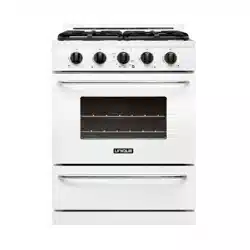
UNIQUE UGP30G
9
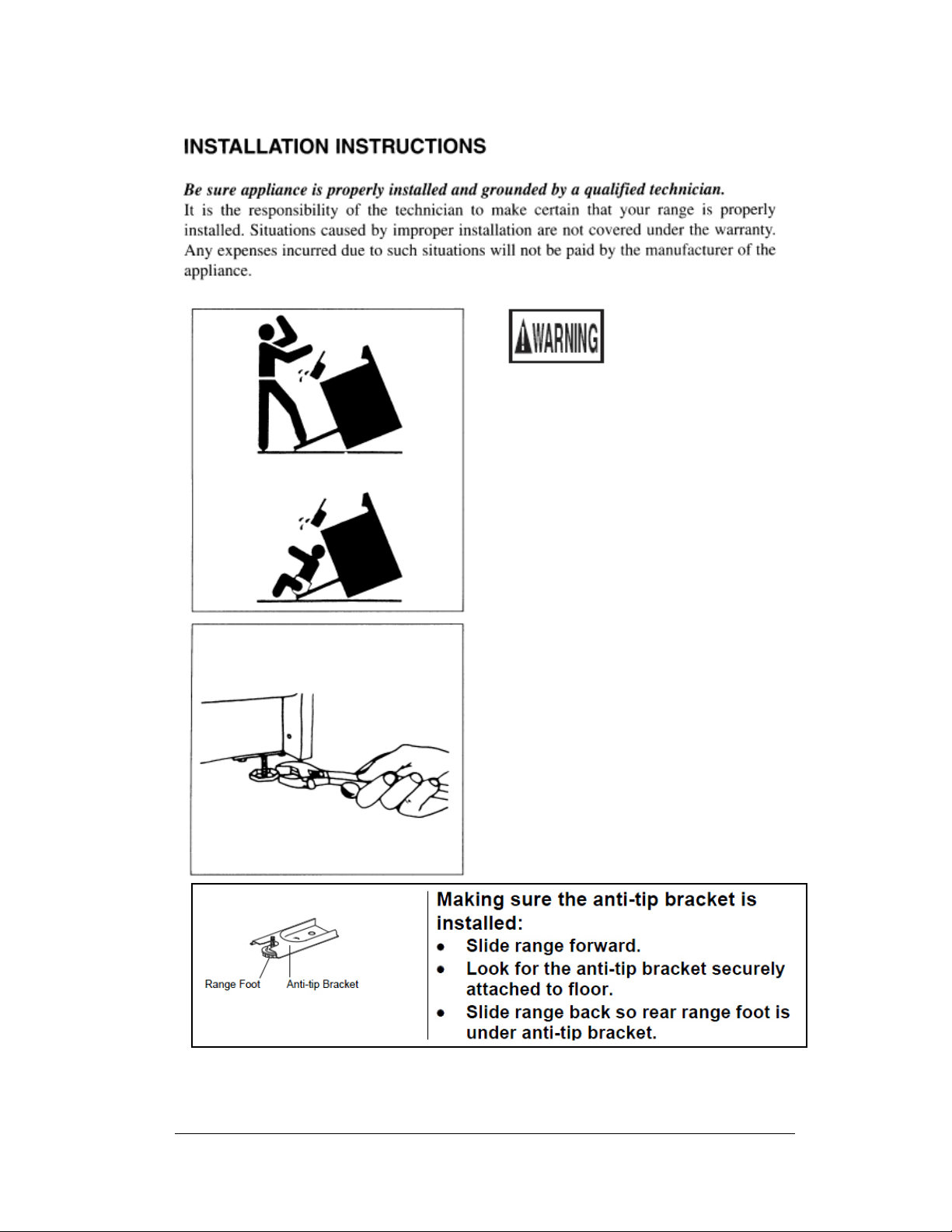
To reduce the risk of
tipping the appliance by
abnormal usage or
improper door loading,
the appliance must be secured by properly
installing the anti-tip device packed with the
appliance. To check if the device is installed
and engaged properly, carefully tip the range
forward. The anti-tip device should engage
and prevent the range from tipping over.
If this range is removed for any reason, (eg.
service or cleaning), it must be replaced as
outlined before placing the range back in
operation.
Levelling a Free-Standing Range
All free-standing ranges must be level to
obtain proper cooking results. The leveling
legs should be screwed into the corner
brackets. Place pan or measuring cup
partially filled with water or a level on the
oven rack. Adjust the leveling legs until the
range is level. The top of the aside panels
should be level with the counter top.

UNIQUE UGP30G
10
GAS CONNECTIONS (All Units)
NOTICE TO MASSACHUSETTS APPLIANCE DEALERS:
Be sure this document is included in all gas range appliances sold to consumers in
the State of Massachusetts.
NOTICE: Massachusetts law requires the following:
Appliances must be installed by a licensed plumber or gas fitter.
Appliances must be connected with a three (3) foot (36” maximum length)
flexible gas connector and
A “T” handle type manual gas valve in the gas supply line to the appliance
.
Have the dealer where you purchase your new range install it or have him
recommend a qualified installer. Installation must conform with local codes. In the
absence of local codes, the installation must conform with the National Fuel Gas
Code, ANSI Z223.1-Latest Edition in the U.S.A. or the CAN/CGA B149.1 or .2
Installation Codes in Canada.
The range should be connected to the supply line with 1/2-inch black iron pipe or a
certified flexible type range connector. To prevent gas leaks, put an approved sealing
compound, which is resistant to liquefied petroleum gases, on all threaded
connections.
Important: Do not apply pressure directly to the range manifold pipe when tightening
supply connections. The manifold pipe should be held securely at the pressure
regulator to prevent twisting. Hold the pressure regulator with a wrench during the
tightening of the connection, or the manifold pipe may be twisted and split, and
cause a dangerous leak.
The installation of ranges designed for manufactured (mobile) home installation
must conform with the Manufactured Construction and Safety, Title 24 CFR, Part
3280, [formerly the Federal standard for Mobile Home Construction and Safety,
Title 24, HUD (Part 280)] in the U.S.A. or C.S.A. Standard CAN/CGA Z240.4.2 in
Canada or, when such standards are not applicable with local codes.
The installation of ranges designed for recreational vehicle installation must conform
to state or other codes and in the absence of such codes with the standard for
recreational vehicles ANSI A119.2.2–1982 in the U.S.A. or CAN/CGA Z240.4.2 in
Canada. The installation of appliances designed for recreational park trailers must
conform to recreational park trailers, ANSI A119.5.
Note: Check all piping connections in the unit for leaks. Never use an open flame to
check for gas leaks using a soap solution with at recommend ratio of 75% water,
25% dish washing soap. It’s possible for connections made at the factory to leak, due
to vibration encountered in transportation. Make certain you have checked them all,
and repair any connections that leak.
UNIQUE UGP30G
11
The appliance and its individual shut-off valve must be disconnected from the gas
supply piping system during any pressure testing of that system at test pressures in
excess of ½ psig.
The appliance must be isolated from the gas supply piping system by closing its
individual manual shut-off valve during any pressure testing of the gas supply piping
system at test pressures equal to or less than 1/2 psig.
Installation
It is the responsibility of the installer to make certain that the range is properly
adjusted at the time of installation. Situations caused by improper adjustments or
improper installation are not covered under the warranty. Any expenses incurred due
to such situations will not be paid by the manufacturer of the appliance.
Connecting gas to range
This range is designed to operate at a pressure of 4” of water column on natural gas
(NG) or 10” of water column on propane gas (LPG).
Make sure you are supplying your range with the type of gas for which it is designed.
This range comes equipped from the factory equipped for use with LPG
(propane). This range is convertible for use on natural gas (NG) also. (natural gas
Gas line shut-off valve
To reduce the possibility of gas
leaks, apply Teflon tape or a thread
compound approved for use with
LP or Natural gases to all threaded
connections.
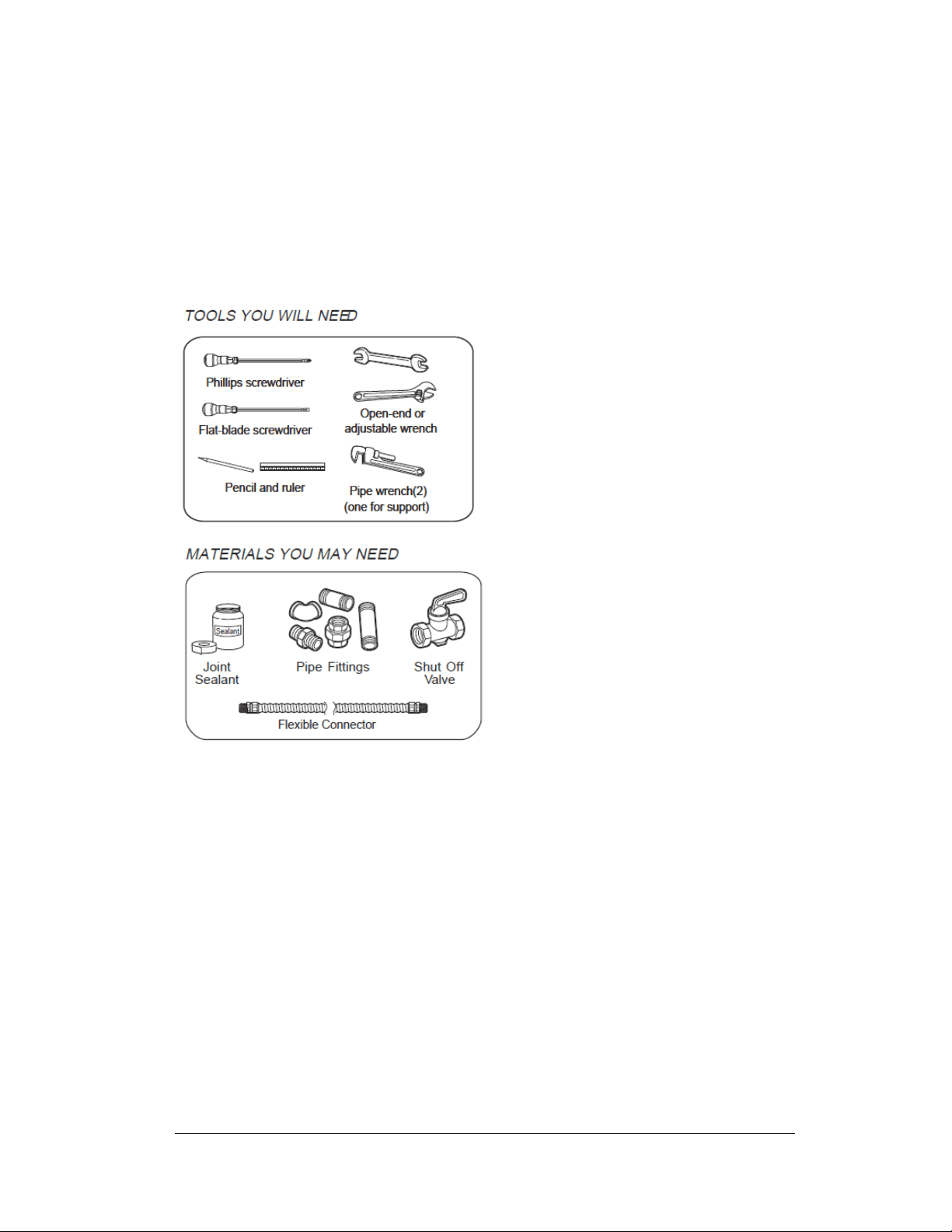
Connect the supplied ½” threaded
pipe to the units regulator located on
the back left of the unit. We suggest
using a ½” female to 3/8” male flare
adaptor on the end of the ½”
threaded pipe supplied.
Use a flexible appliance connector to
connect your gas supply to the
appliance. A 3 foot length is
recommended for ease of
installation but other lengths are
acceptable. Never use an old
connector when installing a new
range.
Check for leaks using a leak detector
or soapy water with a recommended
ratio of 75% water, 25% dish
washing soap.

UNIQUE UGP30G
12
orifices included in the packaging). When using this on NG gas, conversion must be
made by a qualified NG installer before attempting to operate the range on that gas.
For correct operation, the pressure of natural gas supplied to the regulator should be
between 4” and 5” of water column. For LP gas, the pressure supplied must be
between 10” and 12” of water column.
When checking for correct operation of the regulator, the inlet pressure must be at
least 1” more than the operating -manifold- pressure as given above. The pressure
regulator located at the back of the range manifold must remain in the supply line
regardless of whether natural or LP gas is being used.
Regulator is only good for ½ psi (14” w.c.) so test pressure must not exceed ½” psi.
Shut off the main gas supply valve before removing the old range and leave it off
until the new hook-up has been completed. Don’t forget to relight the pilot on other
gas appliances when you turn the gas back on.
Because hard piping restricts movement of the range, the use of a CSA certified
flexible metal appliance connector is recommended unless local codes require a hard-
piped connection. Never reuse an old connector when installing a new range. If the
hard piping method is used, you must carefully align the pipe; the range cannot be
moved after the connection is made.
To prevent gas leaks, use pipe joint compound resistant to LP or NG gases
(depending on set up) on all male -external- pipe threads.
1. In an easily accessible location, install a service manual gas shut off valve. Be
sure everyone operating the range knows where and how to shut off the gas
supply to the range.
2. When all connections have been made, be sure all range controls are in the
off position and turn on the main gas supply valve. Check for gas leaks by
using a soap and water solution. If a gas leak is present, shut off gas
immediately, tighten all connections, and retest for leaks.
!
3. Any opening in the wall behind the appliance and in the floor under the
appliance shall be sealed.
After installation:
1. Check ignition of cooktop burners.
2. Check ignition of oven burner.
3. Check for gas leaks at all gas connections (using a gas detector, never a flame)