Operating instructions
Combair SL | SLP
Oven

Thank you for choosing to buy one of our products. Your appliance is made to high
standards and is easy to use. Nevertheless, please take the time to read these operating
instructions in order to familiarise yourself with the appliance and get the best use out of
it.
Please follow the safety precautions.
Modifications
Text, diagrams and data correspond to the technical standard of the appliance at the
time these operating instructions went to press. The right to make technical modifications
for the purpose of the further development of the appliance is reserved.
Validity
The product family (model number) corresponds to the first alphanumerics on the identi-
fication plate. These operating instructions apply to:
Type Product family Size system
BCSLZ60 21022 60-600
BCSLZ60c 21022 60-600
BCSLPZ60 21025 60-600
BCSLPZ60c 21025 60-600
BCSLZ60Y 21029 60-600
BCSLZ60Y 21061 60-600
BCSLPZ60 21062 60-600
Variations depending on the model are noted in the text.
Colour operating instructions can be downloaded from the internet from www.vzug.com.
© V-ZUG Ltd, CH-6301 Zug, 2017
2

3
Table of contents
1 Safety precautions 5
1.1 Symbols used......................................................... 5
1.2 General safety precautions.................................. 5
1.3 Appliance-specific safety precautions .............. 6
1.4 Instructions for use................................................ 7
2 Using for the first time 9
3 Appliance description 10
3.1 Construction .........................................................10
3.2 Operating and display elements.......................10
3.3 Cooking space.....................................................11
3.4 Accessories ..........................................................12
3.5 Plate warmer.........................................................13
4 Operating modes 13
4.1 Overview of operating modes ...........................13
4.2 Top/Bottom heat..................................................13
4.3 Hot air ....................................................................14
4.4 PizzaPlus ...............................................................14
4.5 Grill .........................................................................14
4.6 Grill-forced convection........................................15
4.7 Top/Bottom heat humid .....................................15
4.8 Hot air humid........................................................15
4.9 Bottom heat ..........................................................16
4.10 Fast heating ..........................................................16
5 Using the appliance 16
5.1 Selecting and starting the operating mode ....17
5.2 Checking and changing the settings...............18
5.3 Setting a duration ................................................18
5.4 Setting a delayed start / end time....................18
5.5 Food probe temperature ....................................19
5.6 Rotisserie spit and roasting basket .................20
5.7 Cancelling/ending the operating mode before
time.........................................................................22
5.8 Changing the operating mode ..........................22
5.9 Timer ......................................................................22
5.10 End of operation ..................................................23
5.11 Switching the appliance off................................24
6 GourmetGuide 25
6.1 Recipe book ..........................................................25
6.2 Own recipes...........................................................26
6.3 BakeOmatic ...........................................................28
6.4 Soft roasting...........................................................29
6.5 Keep warm *..........................................................32
7 EasyCook 32
7.1 Overview of food groups.....................................32
7.2 Selecting and starting foods...............................33
8 Favourites 33
8.1 Creating favourites ...............................................33
8.2 Selecting and starting favourites .......................34
8.3 Changing favourites .............................................34
8.4 Deleting favourites................................................34
9 Tips and tricks 34
9.1 Unsatisfactory cooking result... ..........................34
9.2 Saving energy........................................................35
10 User settings 35
10.1 Overview of user settings....................................35
10.2 Adjusting user settings ........................................36
10.3 Language ...............................................................36
10.4 Display ....................................................................36
10.5 Date.........................................................................37
10.6 Clock .......................................................................37
10.7 Notifications ...........................................................37
10.8 Pyrolytic cleaning of appliance ..........................37
10.9 Loudness................................................................37
10.10 Assistance functions ............................................38
10.11 Temperature ..........................................................38
10.12 Childproof lock......................................................38
10.13 Appliance information ..........................................39
10.14 Demo mode...........................................................39
10.15 Factory settings.....................................................39
11 Care and maintenance 39
11.1 Cleaning the exterior............................................39
11.2 Cleaning the cooking space...............................39

4
11.3 Cleaning the appliance door .............................40
11.4 Cleaning the door seal .......................................40
11.5 Replacing the door seal .....................................41
11.6 Replacing the door seal on pyrolysis appliances
41
11.7 Replacing the halogen light bulb .....................42
11.8 Cleaning the accessories and shelf guides ...42
11.9 Pyrolytic self-cleaning .........................................43
12 Trouble-shooting 44
12.1 What to do if ….....................................................44
12.2 After a power failure............................................47
13 Accessories and spare parts 48
13.1 Accessories ..........................................................48
13.2 Special accessories ............................................48
13.3 Spare parts ...........................................................49
14 Technical data 49
14.1 Note for testing institutes ...................................49
14.2 Temperature measurement ...............................50
14.3 Product fiche ........................................................50
14.4 EcoStandby...........................................................50
14.5 Reference to «Open Source» licence..............50
15 Disposal 51
16 Index 52
17 Notes 54
18 Service & Support 55

5
1 Safety precautions
1.1 Symbols used
Denotes important safety precau-
tions.
Failure to observe said precautions
can result in injury or in damage to
the appliance or fittings!
Information and precautions that
should be observed.
Information on disposal
Information about the operating in-
structions
▸ Indicates step-by-step instructions.
– Describes how the appliance reacts
to the steps taken.
▪ Indicates a list.
1.2 General safety precautions
▪ Read the operating instruc-
tions before using the appli-
ance for the first time!
▪ This appliance can be used
by children aged 8 and above
and by persons with reduced
physical, sensory or mental
capabilities, or lack of experi-
ence and/or knowledge,
provided they are supervised
or have been instructed on
the safe use of the appliance
and have understood the haz-
ards involved. Children shall
not play with the appliance.
Cleaning and user mainten-
ance shall not be undertaken
by children without supervi-
sion.
▪ If an appliance is not
equipped with a mains cable
and a plug or other means for
disconnecting from the mains
with a contact opening on
each pole complying with the
conditions of overvoltage cat-
egory III for full isolation, an
isolating device must be in-
corporated into the perman-

1 Safety precautions
6
ently installed electrical install-
ation in accordance with the
installation regulations.
▪ If the mains cable of this ap-
pliance is damaged, it must
be replaced by the manufac-
turer or its Customer Services
or a similarly qualified person
in order to avoid hazard.
1.3 Appliance-specific safety
precautions
▪ READ THE IMPORTANT
SAFETY PRECAUTIONS
CAREFULLY AND RETAIN
FOR FUTURE USE.
▪ WARNING: The appliance
and its accessible parts get
hot during use. Be careful not
to touch the heating ele-
ments. Children under 8
years of age must be kept
away from the appliance un-
less they are constantly su-
pervised.
▪ WARNING: Accessible parts
can get hot during use. Keep
young children away from the
appliance.
▪ This appliance is intended for
use in the home and similar
settings such as: in staff kit-
chens in shops, offices and
other commercial establish-
ments; in agricultural estab-
lishments; by guests in hotels,
motels and other accommod-
ation establishments; in bed
and breakfast establishments.
▪ A heatable appliance drawer
and its contents get hot.
▪ Do not use aggressive or ab-
rasive cleaning agents or
sharp metal scrapers for
cleaning the glass in the oven
door as they could scratch
the surface. This can destroy
the glass.
▪ For appliances with pyrolytic
self-cleaning: Excessive soil-
ing and any and all accessor-
ies (tableware, baking trays,
runners, shelf guides) must
be removed before carrying
out pyrolytic self-cleaning.
▪ Only use the food probe re-
commended for this oven.
▪ Under no circumstances use
a steam cleaner to clean the
appliance.
▪ WARNING: Before replacing
the light bulb, ensure the ap-
pliance is switched off and
disconnected from the mains
power supply to avoid pos-
sible electric shock.
▪ To avoid overheating, the ap-
pliance must not be installed
behind a decor door.
▪ This appliance is not intended
for use in vehicles or on
board ships or aircraft or in

1 Safety precautions
7
rooms where there are spe-
cial conditions such as, for in-
stance, a corrosive or explos-
ive atmosphere (dust, steam
or gas) or condensing mois-
ture.
▪ WARNING: Never heat food
or liquids in sealed containers
such as cans or bottles as
they are liable to explode due
to overpressure.
▪ See the «Accessories» sec-
tion for the proper use of in-
sertable parts.
1.4 Instructions for use
Before using for the first time
▪ The appliance must be installed and
connected to the electricity supply in
accordance with the separate installa-
tion instructions. Have a qualified fitter/
electrician carry out the necessary
work.
Correct use
▪ The appliance is designed for use in
the home for preparing food. Under no
circumstances flambé or cook food us-
ing a lot of fat in the cooking space! No
liability is assumed for any damage
caused by improper use or incorrect
handling.
▪ Never use the appliance to dry animals,
textiles or paper, etc.
▪ Do not use the appliance as a room
heater.
▪ The appliance should only be installed
and operated at an ambient temperat-
ure of 5 °C to 35 °C.
▪ Any repairs, modifications or manipula-
tions to the appliance, especially any
electrically live parts, may only be car-
ried out by the manufacturer, its Cus-
tomer Services or a similarly qualified
person. Repairs if carried out incorrectly
may cause serious injury, damage to
the appliance and fittings, as well as af-
fect the functioning of the appliance. If
the appliance is not working properly or
in case of a repair order, follow the in-
structions given in the «Service & Sup-
port» section. Please contact our Cus-
tomer Services if necessary.
▪ Use original spare parts only.
▪ Retain these operating instructions for
future reference.
▪ The appliance corresponds to recog-
nized technology standards and the rel-
evant safety regulations. Proper use of
the appliance is essential to avoid dam-
age and accidents. Please therefore fol-
low the precautions given in these oper-
ating instructions.
Note on use
▪ Use the childproof locking facility.
▪ If the appliance is visibly damaged, do
not use it. Contact our Customer Ser-
vices.
▪ If the appliance is not operating prop-
erly, disconnect it from the power sup-
ply immediately.
▪ Ensure there are no foreign bodies or
pets in the cooking space before clos-
ing the appliance door.
▪ Objects that could pose a danger if the
appliance were accidentally switched
on should not be stored in the cooking
space or the heatable appliance
drawer. Do not store food or any tem-
perature-sensitive or inflammable mater-
ials, e.g. cleaning agents, oven sprays,
etc., in the cooking space or the heat-
able appliance drawer.
▪ For appliances with grill: Leave the ap-
pliance door closed when grilling. The
heat could otherwise damage the oper-
ating and display elements or the fitted
units above.

1 Safety precautions
8
Caution: Risk of burns!
▪ The appliance gets very hot when in
use. The appliance door also gets hot.
▪ Steam and/or hot air may escape from
the cooking space when the appliance
door is opened.
▪ The appliance will remain hot for some
time after it is switched off and will only
cool down slowly to room temperature.
Allow sufficient time for the appliance to
cool down before, for instance, cleaning
it.
▪ Overheated fat and oil can easily catch
fire. Heating oil in the cooking space to
sear meat is dangerous and should not
be done. Never attempt to extinguish
burning oil or fat with water. Danger of
explosion! Smother the flames with a
fire blanket. Keep doors and windows
closed.
▪ Do not pour spirits (brandy, whisky,
schnapps, etc.) over hot food. Danger
of explosion!
▪ Do not leave the appliance unattended
when drying herbs, bread, mushrooms,
etc. If the foodstuff dries out too much,
it can pose a fire hazard.
▪ If you notice smoke possibly coming
from the appliance itself or from inside
the cooking space, keep the appliance
door closed. Disconnect the appliance
from the power supply.
▪ Accessories get hot in the cooking
space. Use protective gloves or oven
cloths.
Caution: Risk of injury!
▪ Be careful not to put fingers in the door
hinges, there is otherwise a risk of in-
jury if the appliance door is moved. Par-
ticular care should be taken when chil-
dren are around.
▪ Only leave the appliance door open in
the at-rest position. An open appliance
door poses a danger of tripping or in-
jury! Do not sit or rest on the appliance
door or use it as a storage surface.
▪ For hobs: A hob guard can be fitted to
protect small children. Hob guards are
available from specialist retailers.
Caution: Risk to life!
▪ Danger of suffocation! Keep packaging
material, e.g. plastic film and poly-
styrene, away from children. Packaging
material can be dangerous for children.
How to avoid damaging the appliance
▪ Close the appliance door carefully.
▪ For appliances with visible bottom heat-
ing element: Do not place any objects
directly on the bottom heating element.
▪ Do not use protective aluminium inserts
with appliances with no visible bottom
heating element.
▪ Do not use objects that can rust in the
cooking space.
▪ Using knives or cutting wheels on the
baking tray will visibly damage the sur-
face.
▪ To prevent corrosion, leave the appli-
ance door open in the at-rest position
until the cooking space has cooled
down.
▪ When cleaning the appliance, make
sure no water gets inside it. Use a mod-
erately damp cloth. Do not spray the
outside or the inside of the appliance
with water. If water gets inside the appli-
ance, it will cause damage.

2 Using for the first time
Before operating the newly installed appliance for the first time, the following steps
should be taken:
▸ Remove packaging and transport materials as well as any protective blue film from
out of the cooking space.
▸ Clean the cooking space and the accessories.
▸ Press the power button.
– The appliance switches on.
Version 1 *
* Depending on the software version
– Various user settings necessary for operation, such as language, time and temper-
ature unit, appear in the display one after the other.
▸ Make the settings and confirm.
Language and time must be set so that the appliance can be operated.
Version 2 *
* Depending on the software version
▸ Set the time (see page 37).
Completing the initial set-up
▸ Heat the empty cooking space (without wire shelves, baking trays, etc.) using the
operating mode at 230°C for about 30minutes.
As there is likely to be some smoke and odour given off, we recommend ventilat-
ing the room well during this phase.
All temperatures in these operating instructions are in degrees Celsius. Apply the
corresponding conversions via the user setting «Degrees Fahrenheit» (see page
38).
9
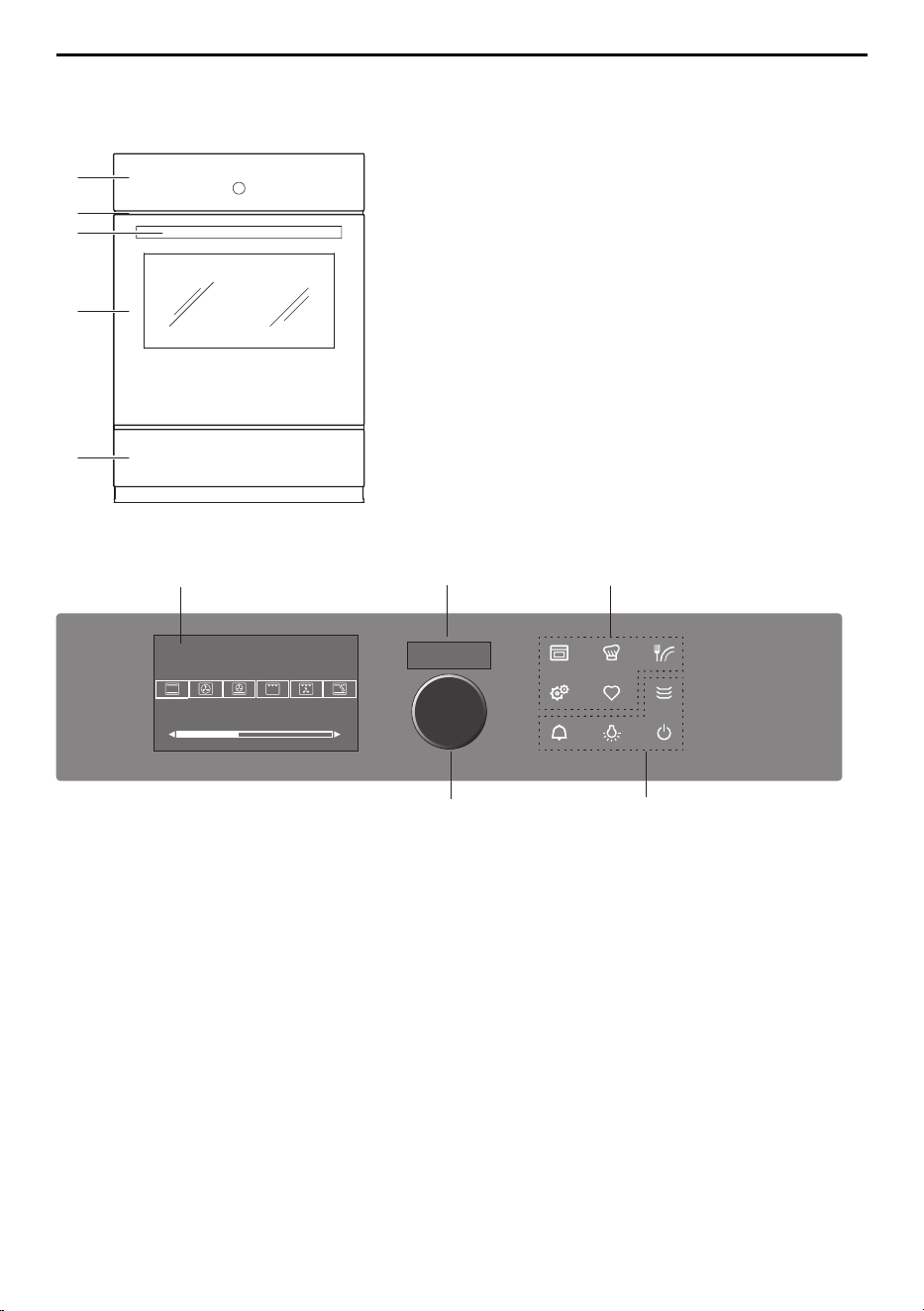
3 Appliance description
3 Appliance description
3.1 Construction
1
2
3
4
5
1
Operating and display elements
2
Ventilation opening
3
Door handle
4
Appliance door
5
Heatable appliance drawer *
* Depending on model
3.2 Operating and display elements
12:00
곋2SHUDWLQJPRGHV
7RSERWWRPKHDW
2 3
4
1
5
1
Display
4
Action buttons
2
Digital display
(duration/timer/time)
5
Adjusting knob / switching on
appliance
3
Menu buttons
10
3 Appliance description
Overview of touch buttons
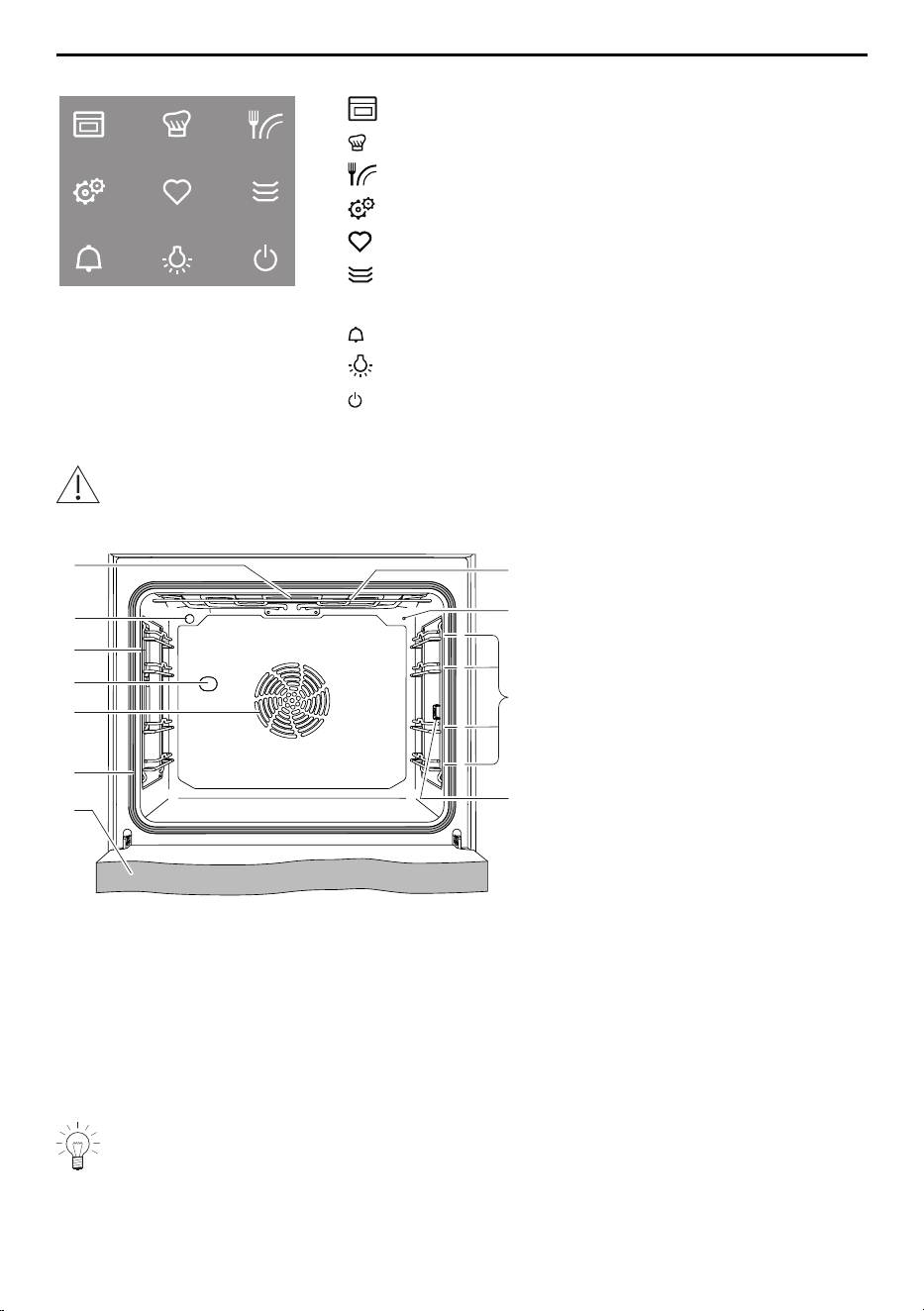
Operating modes
GourmetGuide
EasyCook
User settings
Favourites
Heatable appliance drawer / plate warmer *
* Depending on model
Timer
Cooking space illumination
Switch off
3.3 Cooking space
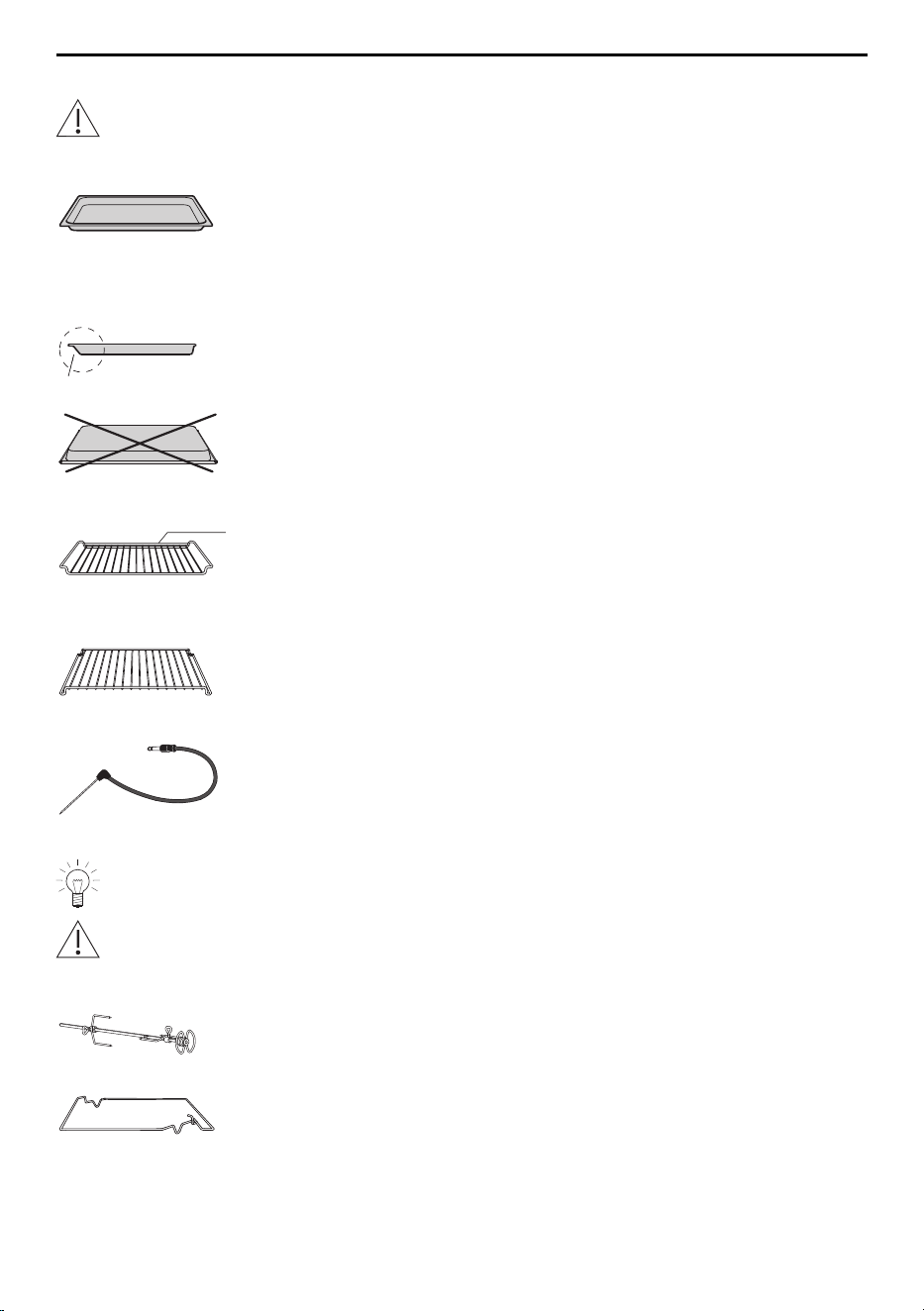
Using protective inserts or aluminium foil can damage the appliance.
Do not place any protective insert or aluminium foil on the floor of the cooking
space.
9
8
10
1
4
1
2
3
5
7
3
2
4
6
11
1
Appliance door
7
Grill/top heat
2
Door seal
8
Cooking space ventilation
3
Hot air blower
9
Temperature sensor
4
Drive for rotisserie spit/roasting
basket
10
Levels (labelled)
5
Cooking space illumination
11
Socket for food probe
6
Climate sensor
The bottom heating element is beneath the cooking space floor.
11
3 Appliance description
3.4 Accessories
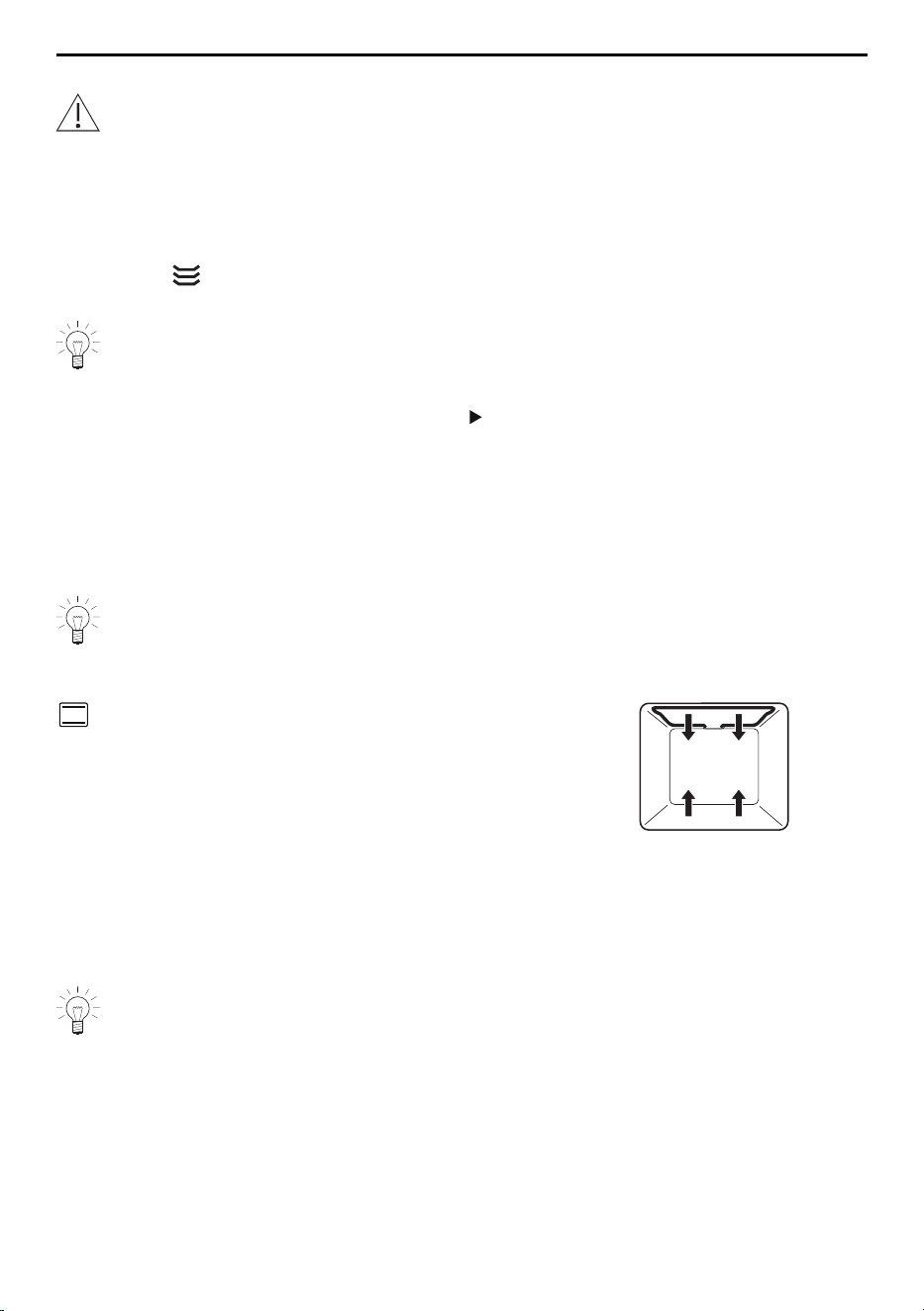
Incorrect handling can cause damage!
Do not use knives or cutting wheels on the accessories.
TopClean baking tray
▪ Baking tin for flans and biscuits
▪ Use together with the wire shelf as a drip tray
▪ If not fully covered, its shape can become distorted dur-
ing baking. This is normal. It will go back to its original
form as it cools down.
1
▸ Ensure that the «sloped» side 1 of the baking tray is to
the back of the cooking space.
▸ Only use the normal way round – not upside down.
Wire shelf
1
▪ For standing roasting and baking tins on
▪ For standing meat, frozen pizza, etc. on
▸ Ensure that the cross strut 1 is to the back of the cook-
ing space. It enables the food to be removed safely
from the cooking space.
▪ Serves as a cooling rack
Food probe
▪ For measuring the core temperature of food
For recommended food probe temperatures, see «EasyCook».
Not suitable for temperatures of over 230°C. There must be a distance between
the food probe and the roof of the cooking space of at least 5cm.
Rotisserie spit and frame
▪ For preparing roasts and chicken
▪ Rack for rotisserie spit and roasting basket
12
4 Operating modes
Special accessories
Place any accessories not included in the scope of delivery on the wire shelf.
▸ Special accessories can be found at: www.vzug.com
3.5 Plate warmer
▸ If the appliance is switched off, first press the adjusting knob.
▸ Put the wire shelf at level 1 and place the tableware on it.
▸ Press the touch button.
▸ Set the required duration.
Select a duration of at least 1 hour.
▸ Set the end time if necessary.
▸ Switch on the «Plate warmer» by selecting .
– The «Plate warmer» switches off automatically when the set duration is over.
4 Operating modes
4.1 Overview of operating modes
All the operating modes and fast heating are described below.
Follow the advice given in «Tips and tricks» (see page 34) and in «EasyCook».
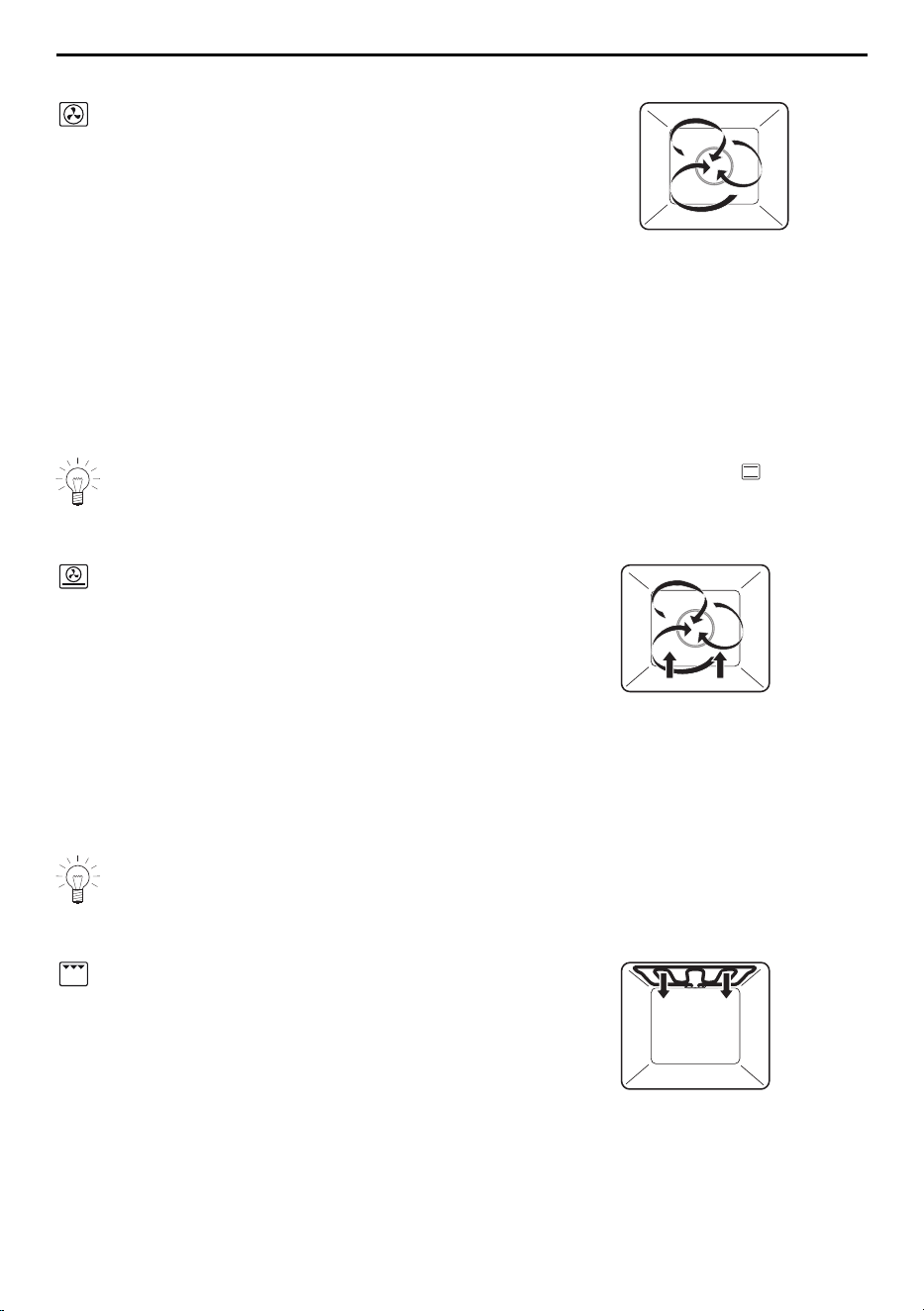
4.2 Top/Bottom heat
Temperature range 30–280 °C
Temperature range for pyrolysis appliance 30–300 °C
Recommended value 200 °C
Level 2 (or 1)
The cooking space is heated by the top and bottom heating elements.
Uses
▪ Classic operating mode for cooking and baking on one level
▪ Cakes, biscuits, bread and roasts
Use a dark enamelled tray or a black tray or tin for crispy results.
13
4 Operating modes
4.3 Hot air
Temperature range 30–250 °C
Temperature range for pyrolysis appliance 30–280 °C
Recommended value 180 °C
Level 1 + 3 or 2
(or 1 + 3 + 2)
A heating element behind the back wall of the cooking space heats up the air inside the
cooking space, which is circulated evenly.
Uses
▪ Particularly suitable for baking savouries and biscuits on several levels at the same
time
▪ Cakes, bread and roasts
Select a lower temperature (reduce by approximately 20°C) than for as the
heat transfer is more efficient.
4.4 PizzaPlus
Temperature range 30–250 °C
Recommended value 200 °C
Level 2 (or 1)
The cooking space is heated by hot air and bottom heat. The base of the food is baked
particularly intensively.
Uses
▪ Pizza
▪ Flans and quiches
Use a dark enamelled tray or a black tray or tin without baking paper for very
crispy results.
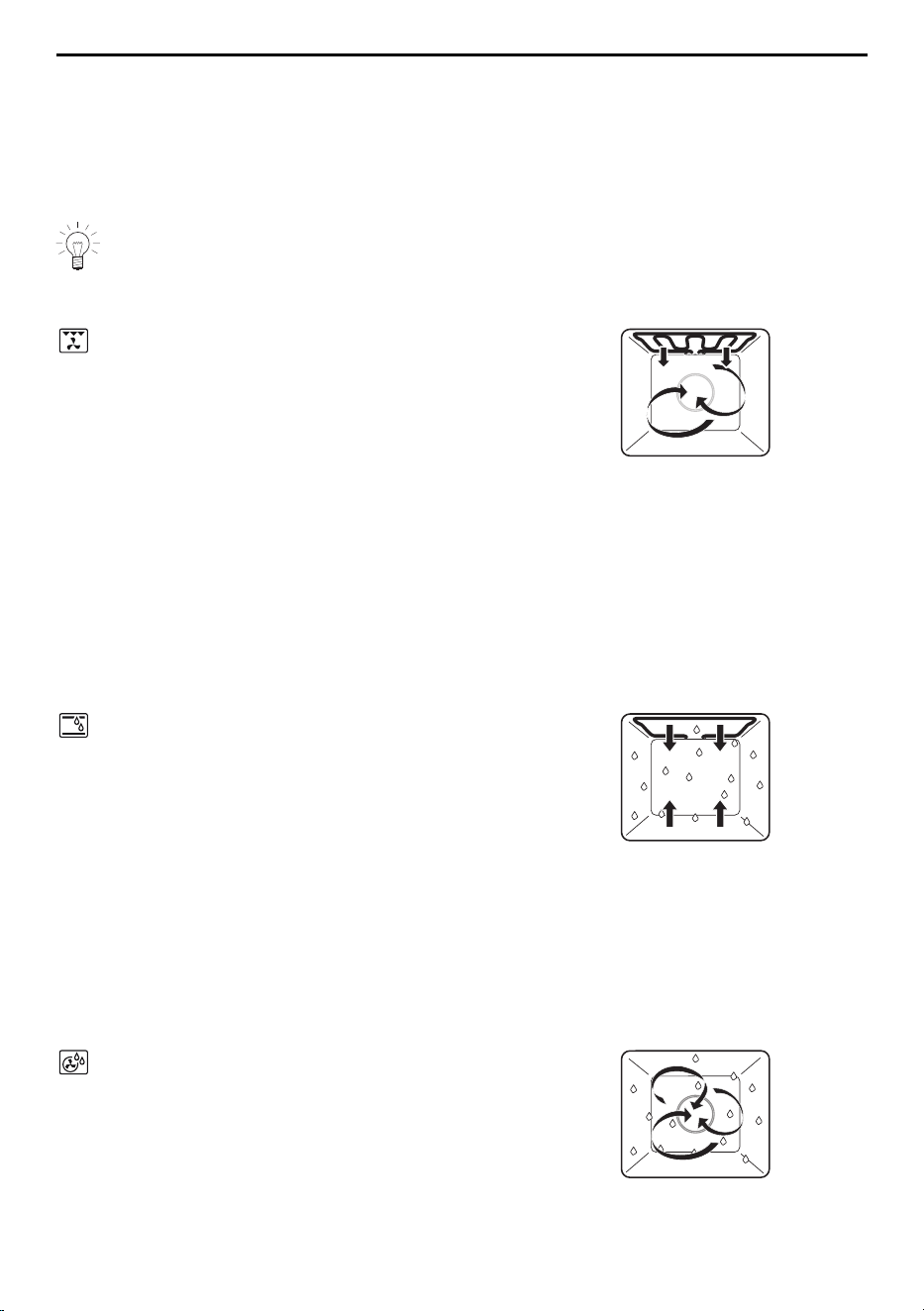
4.5 Grill
Temperature range 5 levels
Recommended value Level 3
Level 3 or 4
The cooking space is heated by the grill element.
14
4 Operating modes
Uses
▪ Flat food for grilling, e.g. steaks, chops, chicken parts, fish and sausages
▪ Gratinating
▪ Toast
▸ Place the food to be grilled directly on the wire shelf.
▸ Line the baking tray with aluminium foil and then place it underneath the wire shelf.
For best results, preheat the cooking space for 3 minutes before introducing the
food.
4.6 Grill-forced convection
Temperature range 30–250 °C
Recommended value 200 °C
Level 2 or 3
The cooking space is heated by the grill element. The hot air fan distributes the air
evenly in the cooking space.
Uses
▪ Suitable for a whole chicken
▪ Large, bulky food for grilling
▸ Put food for grilling in a porcelain or glass dish or directly on the wire shelf.
▸ Line the baking tray with aluminium foil and then place it underneath the wire shelf.
4.7 Top/Bottom heat humid
Temperature range 30–250 °C
Recommended value 200 °C
Level 2 (or 1)
The cooking space is heated by the top and bottom heating elements. The steam pro-
duced is largely retained in the cooking space. The food retains its moisture.
Uses
▪ Bread, plaited bread, roasts and gratins on one level
▪ Low temperature cooking
4.8 Hot air humid
Temperature range 30–250 °C
Recommended value 180 °C
Level 1 + 3 or 2
(or 1 + 3 + 2)
15
5 Using the appliance
A heating element behind the back wall of the cooking space heats up the air inside the
cooking space, which is circulated evenly. The steam produced is largely retained in the
cooking space. The food retains its moisture.
Uses
▪ For savouries and biscuits on two levels at the same time
▪ For yeast pastries and bread on two levels at the same time
▪ Gratins and baked dishes
Select a lower temperature (reduce by approximately 20°C) than for as the
heat transfer is more efficient.
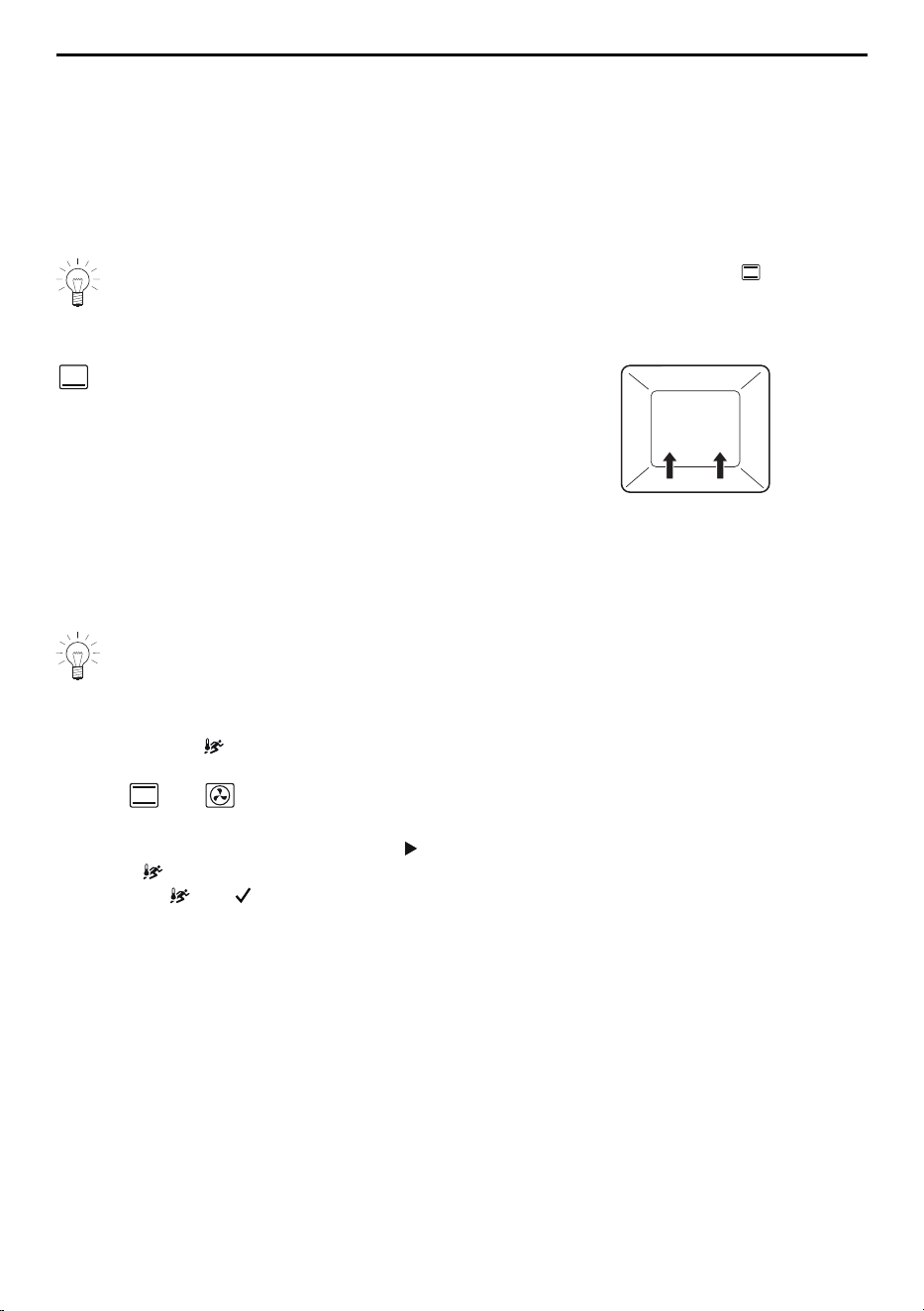
4.9 Bottom heat
Temperature range 6 levels
Recommended value Level 3
Level 2 (or 1)
The cooking space is heated by the bottom heating element.
Uses
▪ Baking flan bases
▪ Making preserves
Use a dark enamelled tray or a black tray or tin for crispy results.
4.10 Fast heating
For fast heating , the cooking space is heated using hot air and bottom heat, which
shortens the preheating time. Fast heating can be used with the following operating
modes: and .
▸ Select the desired operating mode and adjust the settings.
▸ To start the operating mode, select .
▸ Select «Switch fast heating on» in the settings for the operating mode.
– Above , the symbol illuminates.
As soon as an acoustic signal is emitted:
– put the food into the cooking space.
5 Using the appliance
The different main menus and functions are selected by pressing the corresponding
touch button. Selected touch buttons and functions are illuminated in white; other select-
able functions are illuminated in orange.
Settings and functions that cannot be selected or changed are greyed out in the various
menus.
The following touch buttons with the following main menus and functions are available:
16

5 Using the appliance
Operating modes
GourmetGuide
EasyCook
User settings
Favourites
Heatable appliance drawer / plate warmer *
* Depending on model
Timer
Cooking space illumination
Switch off
Adjusting knob functions
Press ▪ Switching on the appliance
▪ Selecting/opening a submenu, setting, etc.
▪ Confirming/closing a message
▪ Activating/deactivating a user setting
Turn ▪ Navigating within the submenus
▪ Changing/setting a value, user setting
5.1 Selecting and starting the operating mode
▸ If the appliance is switched off: first press the adjusting knob.
▸ If the appliance is in another menu: press the touch button.
– The selection of operating modes appears in the display.
▸ Select the operating mode.
– The operating mode settings appear in the display; a recommended value appears
above the temperature.
▸ Set the values for duration, end time, temperature or temperature level and target tem-
perature as required and confirm.
Press and go
Once all the necessary settings for the operating mode have been made, a bar appears
in the display and counts down 20seconds. If no further settings are made during this
time, operation starts automatically. If a setting is changed, Press and go starts again.
The duration of Press and go can be adjusted (see page 38) or it can be deactiv-
ated in the user settings.
▸ To start operation immediately, i.e. without Press and go, select .
– If set, the countdown to the time remaining appears in the display and in the digital
display.
The operating mode selected cannot be changed once it has started.
For appliances without a retractable handle: The handle remains extended both
during operation and until after operation has ended. It retracts when the appliance
has cooled down sufficiently.
17

5 Using the appliance
Display overview
곍+RWDLU
6HWWHPSHUDWXUH
굴굵굶
굯
K
4
6
5
3
2
1
1
Operating mode settings
2
Current position of the adjusting knob /
selected setting
3
Press and go
4
Operating mode with symbol
5
Set values / recommended values
6
Symbols for settings
5.2 Checking and changing the settings
▸ Select the symbol for the desired setting.
▸ To change the value, turn the adjusting knob to the right or left.
▸ Press the adjusting knob to confirm the setting.
– The operating mode settings are displayed.
– The changed value can be seen above the corresponding symbol.
The end time can only be changed during the first 60seconds of
operation.
5.3 Setting a duration
The operating mode selected ends automatically when the operating time is up.
▸ Select the desired operating mode.
▸ Select in the operating mode settings.
▸ Set the desired duration – max. 9 hours and 59 minutes – and confirm.
– The duration is displayed in the operating mode settings as well as the end time
which is calculated based on this value.
– End of operation / duration finished (see page 23)
5.4 Setting a delayed start / end time
The delayed start is activated when for the operating mode selected both the duration
and the end time are set.
The appliance switches automatically on and off again at the desired times.
If you use the food probe, you will need to estimate and set the duration. You will find a
guide on times in «EasyCook». The appliance switches on with a delay and switches off
again when the set target temperature is reached. Depending on the estimated duration,
this can occur earlier or later than the set end time.
Perishables should not be kept unrefrigerated.
Before setting the delayed start
▸ Place the food in the cooking space.
▸ Select the desired operating mode.
▸ Set the temperature.
▸ Set the duration.
Setting a delayed start
▸ Select in the operating mode settings.
– The current end time calculated using the duration is displayed.
18

5 Using the appliance
▸ Set the desired end and confirm.
– The time remaining to the start of operation is displayed.
– After 3 minutes, the display goes out and the touch button is illuminated in
white. The display can be called up again at any time by pressing the adjusting
knob.
– The appliance remains switched off until 3 minutes before the automatic start of op-
eration.
▸ Check and change the settings (see page 18).
Example
▸ Select the operating mode and 180°C.
▸ At 8:00, set a duration of 1hour and 15minutes.
▸ Set the end time to 11:30.
– The appliance will automatically switch on at 10:15 and off again at 11:30.
5.5 Food probe temperature
Only use the supplied food probe.
Do not clean the food probe in the dishwasher. Always keep the plug clean.
The food probe is used to measure the temperature inside the food (referred to as the
food probe temperature). As soon as the food reaches the target temperature (the food
probe temperature that should be attained at the end of the cooking process), operation
stops automatically. It is also possible to simply measure the food probe temperature
without stopping operation.
The food probe must be inserted as far into the middle of the meat as possible to
get a correct reading of the food probe temperature.
The optimal target temperature is dependent on the cut of meat and on the degree
of doneness.
Refer to the information on target temperatures in «EasyCook».
Setting
▸ Select the desired operating mode and set the temperature.
▸ Select in the operating mode settings.
▸ Set the desired target temperature and confirm.
▸ To start operation, select .
Operation can only be started when the food probe is plugged in.
▸ Check and change the settings (see page 18).
– The current food probe temperature is shown in the top part of the display when
cooking.
– The set target temperature is displayed above .
– Operation ends automatically once the target temperature has been reached – see
also End of operation (see page 23).
If the meat is left in the cooking space after having switched off the appliance, the
food probe temperature will continue to rise due to the residual heat.
19
5 Using the appliance
Measuring the food probe temperature
If you only wish to measure the food probe temperature without operation stopping auto-
matically when the target temperature is reached, proceed as follows:
▸ Select the desired operating mode and set the temperature and, if you wish, the dura-
tion.
▸ Plug in the food probe.
▸ Start the operating mode.
– The current food probe temperature is shown in the top part of the display when
cooking.
5.6 Rotisserie spit and roasting basket
The appliance is equipped with a drive for the rotisserie spit and the roasting basket
which comes on automatically with the operating mode and «Soft roasting with
grill». The rotisserie spit and the roasting basket can be used together with the food
probe.
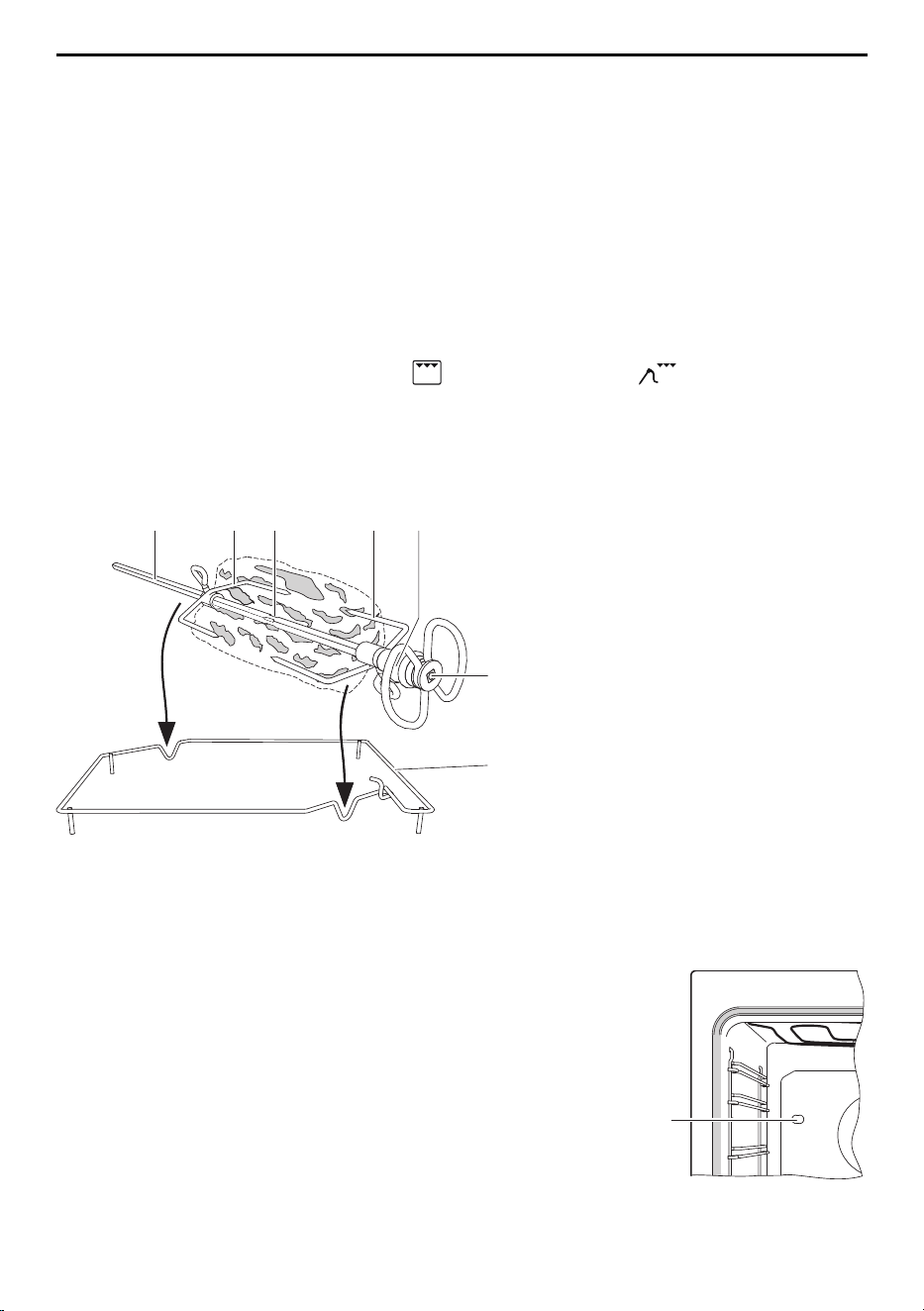
Rotisserie spit
▸ Season and then tie up the meat.
5
13 4211
6
▸ For joints, position fork 1 so that the thickest part of the meat is aligned with groove 3.
▸ Compress the meat with second fork 2 and fix with the ring screws.
▸ Put the baking tray, which has been lined with aluminium foil, at level 1.
▸ Put the frame with the rotisserie spit at level 3 and push it right to the back of the
cooking space.
▸ Insert the end 11 of the rotisserie spit into rotisserie drive
opening 7.
▸ Place the rotisserie spit diagonally across the frame, posi-
tioning it between the guides so that positioning groove 4
sits on the frame 5.
If preparing a chicken on the rotisserie spit,
▸ tie the legs and wings.
▸ Push the spit through the breast meat and not through
the body cavity of the chicken.
7
20
5 Using the appliance
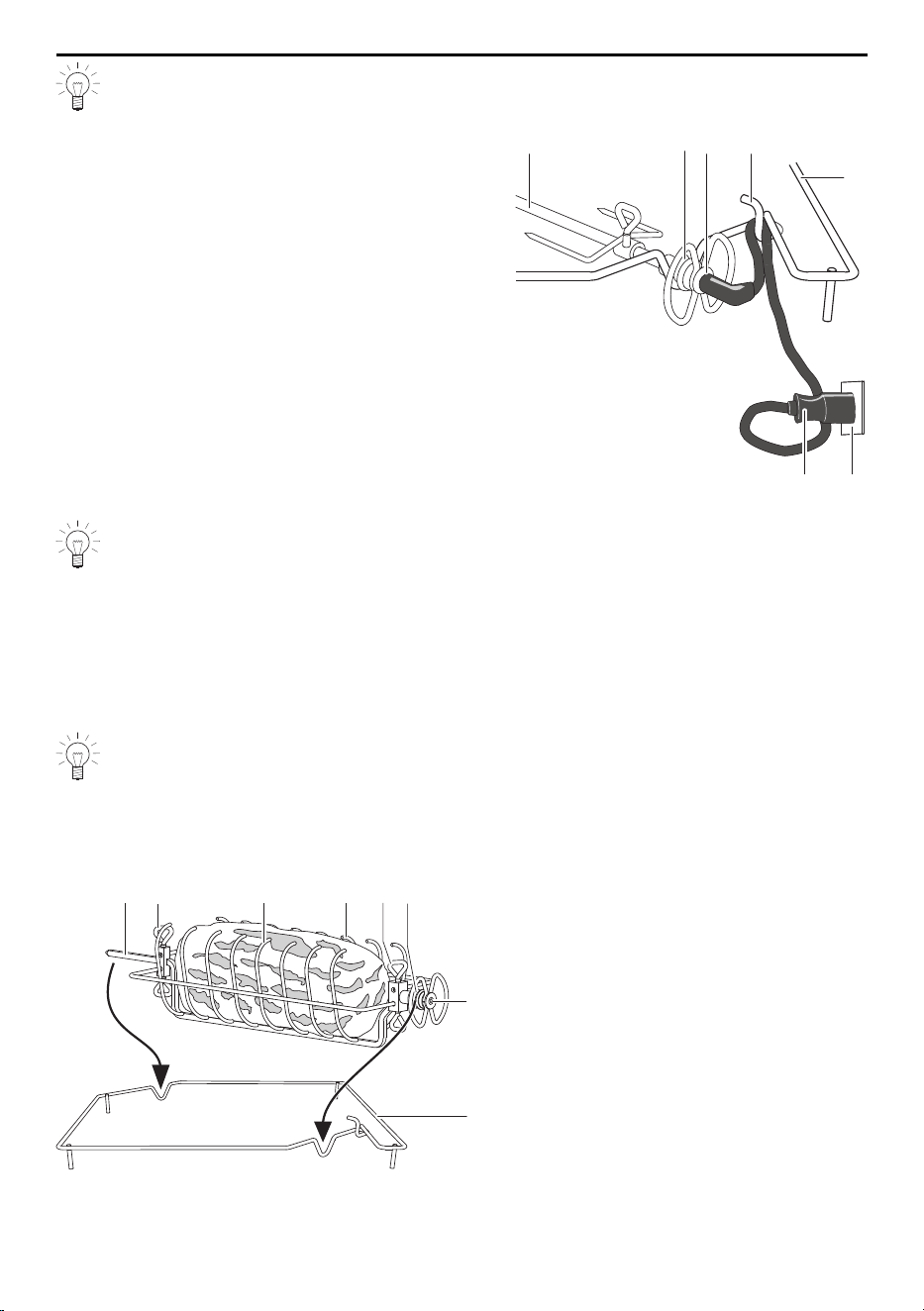
Use the roasting basket for larger or asymmetrical cuts of meat such as a roast
joint.
If using the food probe,
▸ insert it into opening 6 .
▸ Wrap the cable once around hook 8. Ensure
the cable between the food probe and the
hook is as taught as possible.
▸ Insert plug 9 of the food probe into socket
10.
10
9
86
4
11
5
To obtain an accurate food probe temperature reading, the thickest part of the
meat must be aligned with the groove in the front third of the rotisserie spit.
Roasting basket
Use the roasting basket along with the rotisserie spit for larger or asymmetrical cuts of
meat such as a roast joint.
▸ Lightly grease the roasting basket with oil.
▸ Season the meat, fix on the rotisserie spit and place between the two halves of the
roasting basket 1.
If using the food probe, the thickest part of the meat – for a correct food probe
temperature reading – must be aligned with the groove in the front third of the ro-
tisserie spit.
▸ Press the two halves of the roasting basket 1 evenly together – at the front first and
then at the back – and fix with ring screws 12 and 13.
1
112 41311
5
6
▸ Put the baking tray, which has been lined with aluminium foil, at level1.
▸ Put the frame with the roasting basket at level 3 and push it right to the back of the
cooking space.
21

5 Using the appliance
▸ Insert the end 11 of the roasting basket into rotisserie drive opening 7.
▸ Place the roasting basket diagonally across the frame, positioning it between the
guides so that positioning groove 4 sits on the frame5.
5.7 Cancelling/ending the operating mode before time
▸ In the operating mode settings, select or press the touch button.
– An acoustic signal is emitted.
– The selected operating mode is cancelled.
– The following appears in the display: « Residual heat» and, for example: « Hot
air cancelled».
– If the food probe is plugged in, the food probe temperature is displayed. *
* Depending on the software version
▸ If you wish to start a new operating mode, press the touch button.
▸ If you wish to switch off the appliance, press the touch button.
5.8 Changing the operating mode
If no operating mode is running:
▸ Select in the settings of the current operating mode.
– The operating modes menu is displayed.
If an operating mode is already running:
▸ Select or press the touch button.
– The set operating mode is cancelled.
▸ Press the touch button and select a new operating mode.
5.9 Timer
The timer functions like an egg timer. It can be used at any time and independently of all
other functions.
Setting and starting the timer
▸ Press the touch button.
– A suggested value of «10min» appears in the display.
▸ Turn the adjusting knob and set the desired duration.
– The duration and the end time for the timer appear in the display.
The timer can be set for:
▪ up to 10minutes in 10-second intervals, e.g. = 9minutes and 50seconds;
▪ over 10 minutes in 1-minute intervals, e.g. = 1hour and 12minutes;
▪ over 10 hours in 1-hour intervals, e.g. = 18hours.
The maximum timer duration is 99 hours.
▸ Press the adjusting knob to confirm.
– The timer starts.
– If there is no operating mode running with a set duration, the remaining time on the
timer will be displayed in the digital display.
– The touch button is illuminated in white.
– If the appliance was in another menu before the timer was set, e.g. operating
modes: the menu or the submenu selected within it, e.g. a running operating mode,
appears.
– If the appliance was not in another menu: the display goes black.
22

5 Using the appliance
Checking and changing
▸ Press the touch button.
– The countdown to the time remaining appears in the display.
▸ Shorten or extend the time by turning the adjusting knob.
▸ Confirm this shortening or extending of the time.
When the timer finishes
When the set duration is up:
– An acoustic signal is emitted.
– «Timer finished» appears in the display.
▸ To close the message, select .
Switching the timer off before time
▸ Press the touch button.
– The countdown to the time remaining appears in the display.
▸ Set the timer to 0 by turning the adjusting knob and confirm.
Or, if the timer is the only active function:
▸ Press the touch button.
Or, to switch off the appliance:
▸ Press the touch button 2×.
5.10 End of operation
When the set duration is up or, if the food probe is being used, when the set target tem-
perature is reached:
– The selected operating mode ends automatically.
– An acoustic signal is emitted.
– Three options are displayed:
▪ Select to choose a new operating mode
▪ Select to extend the operation
▪ Select to switch the appliance off.
– The appliance switches off automatically after 3 minutes without interaction.
You can adjust the appliance end time individually (see page 36).
– As long as the temperature is above 80°C, « Residual heat» appears in the dis-
play.
– If the food probe is plugged in, the food probe temperature is displayed. *
The food can be kept warm with residual heat for some time. As soon as the tem-
perature falls below 80 °C, all the displays go out. If at this point the food probe is
still plugged in, the displays only go out when the food probe is unplugged. *
The cooling fan can continue to run.
* Depending on the software version
23

5 Using the appliance
For appliances with a retractable handle, the displays and touch buttons do not go
out until the handle can be retracted. « Residual heat» is still displayed, even
when it falls below 80°C.
Removing food from cooking space
Risk of burns!
Hot air may escape from the cooking space when the appliance door is opened.
The accessories get hot. Use protective gloves or oven cloths.
▸ Take the food out of the cooking space when done.
▸ Wipe away traces of water or soiling with a soft cloth to prevent corrosion and un-
pleasant odours.
▸ Leave the appliance door open in the at-rest position until the cooking space has
cooled down and dried out.
5.11 Switching the appliance off
▸ Press the touch button.
– An acoustic signal is emitted.
– Any running operating mode or application is ended; if switched on, the timer,
cooking space illumination or plate warmer will remain active.
– « Residual heat» appears in the display.
– If the food probe is plugged in, the food probe temperature is displayed. *
* Depending on the software version
▸ Press the touch button again.
– All touch buttons go out.
– All functions are ended and switched off.
Or at the end of operation:
▸ Select the option in the display.
– An acoustic signal is emitted.
– Any running operating mode or application is ended; if switched on, the timer,
cooking space illumination or plate warmer will remain active.
– The following appears in the display: « Residual heat».
– If the food probe is plugged in, the food probe temperature is displayed. *
* Depending on the software version
▸ Press the touch button.
– All touch buttons go out.
– All functions are ended and switched off.
The appliance is switched off if none of the touch buttons are illuminated any more
and the display is dark.
The cooling fan can continue to run.
24

6 GourmetGuide
6 GourmetGuide
The GourmetGuide encompasses several programmes which make preparing meals
as easy as possible for you. The following programmes can be called up:
Recipes Soft roasting
BakeOmatic Keep warm *
* Depending on the software version
6.1 Recipe book
A recipe book contains recipes which are tailored to suit the particular appliance. These
are already programmed into the appliance and run automatically once started.
The following recipe books are available for your appliance:
▪ Baking treats
Starting a recipe
For recipes that do not require preheating, place the food in the cold cooking
space.
▸ If the appliance is switched off, first press the adjusting knob.
▸ Press the touch button.
▸ Select .
▸ Select the desired recipe book or «Own recipes».
▸ To select a recipe, choose .
▸ Select a recipe.
– The recipe settings are displayed.
▸ If you wish, set the end time or delayed start.
When cooking recipes from recipe books, a delayed start is only possible if the
cooking space does not need to be preheated and the food does not need to be
stirred or turned partway through, for example.
▸ To start the recipe, select .
– The recipe starts.
– The display shows the current recipe step, the time remaining in this step and the
entire duration of the recipe.
– The digital display shows the remaining time for the current recipe step.
In the course of the recipe
In the course of the recipe, it may be necessary to open the appliance door, e.g. to turn
over the food or to spread a topping over it. In such an instance, operation is paused
and the display shows instructions on what to do next.
To continue the recipe, proceed as follows:
▸ Open the appliance door.
▸ Carry out the action, e.g. turn over food.
▸ Close appliance door and select in the display.
– The recipe will continue to run.
25
6 GourmetGuide
Cancelling the recipe
▸ In the recipe settings, select .
– The following appears in the display: «Should the current recipe be cancelled?»
▸ To abort the recipe, select «Yes».
– The recipe is cancelled.
6.2 Own recipes
Up to 24 of your own favourite recipes can be created and saved. A recipe can consist
of several steps with any operating modes, pauses and hold times, which run automatic-
ally once started. You can also change and save existing recipes.
Creating your own recipe
▸ If the appliance is switched off: first press the adjusting knob.
▸ Press the touch button.
▸ Select .
▸ Select .
▸ To create a new recipe, select .
– The selection of operating modes appears in the display.
▸ Select the desired operating mode.
▸ Set the target temperature, duration, temperature or temperature level for step1.
If you are only making temperature settings, this step takes as long as is neces-
sary for the cooking space to reach the required temperature.
▸ To confirm the settings, select .
▸ To add a new step, select .
▸ Set an operating mode, pause or hold time for step 2.
For the intermediate step «Hold», the heating continues to run and the cooking
space temperature remains constant. For the intermediate step «Pause», the
cooking space is not heated any more and the temperature drops.
After a hold or pause step, a preheating stage can be set.
▸ To save the settings, select .
– The overview of the set steps is displayed.
▸ Set additional steps in the same way. A recipe can consist of up to 9 steps.
▸ To save the recipe, select .
– The overview of the available storage spaces is displayed.
▸ Select the desired (empty) storage space and confirm.
▸ Enter the recipe name using the on-screen keypad and confirm by pressing .
– The recipe is now saved.
– The following appears in the display: «Do you want to run the recipe?» If you do not
wish to run the recipe, you will return to the recipes main menu.
Step duration
The duration of a step depends on whether values have been set for the target temperat-
ure, duration, temperature or temperature level. If multiple values have been set, e.g. the
duration and the temperature, only one of these takes priority for the step duration.
26

6 GourmetGuide
The table below shows the priorities in descending order:
Setting
1 Target temperature
2 Duration
3 Temperature / temperature level
Cancelling recipe entry/change
▸ Select in the overview of the set steps.
– The following appears in the display: «Do you really want to cancel the recipe
entry?»
▸ To cancel the recipe entry, select «Yes».
– The menu for your own recipes or, if a recipe from a recipe book was changed, the
menu for the recipe book is displayed.
Ending a step before time
This is only possible for «Own recipes». If, for example when a recipe is running, you
realize that the food or the cooking space is ready for the next step in the recipe even
though the current step is still in progress, you can end the step before time.
▸ Select the symbol for target temperature, duration, temperature or temperature level in
the operating mode settings. Pay attention to the priorities for the step duration as de-
scribed under «Step duration».
▸ Set the displayed value to 0 or reduce it until it is less than the currently measured
value.
▸ Press the adjusting knob to confirm.
– The step is ended.
– If it was the final step, the recipe ends too.
– If it was not the final step, the next step starts.
Changing recipes
Any recipe – from a recipe book as well as your own recipes – can be copied and
changed.
▸ Select the desired recipe book or .
▸ Select .
▸ Choose a recipe.
– An overview of the steps in the recipe is displayed.
Changing a step
▸ Select the step to be changed.
▸ Make the settings and confirm with .
Adding a step
▸ Select .
▸ Make the settings and confirm with .
Deleting a step
▸ Select .
– An overview of the steps in the recipe is displayed.
▸ Select the step.
– The following appears in the display: «Do you want to delete this step?»
27
6 GourmetGuide
▸ To delete the step, select «Yes».
– The step is deleted.
Saving a changed recipe
▸ Select .
▸ Select storage space, enter the recipe name and confirm by pressing .
– The changed recipe is now saved.
A storage space that is already being used can be overwritten.
Recipes that have been amended from recipe books are not saved in the recipe
book, but under «Own recipes». The original recipe remains in the correspond-
ing recipe book.
Deleting your own recipe
Any recipe in «Own recipes» can be deleted.
▸ Select «Own recipes».
▸ Select .
▸ Select the recipe to be deleted.
– The following appears in the display: «Do you want to delete this recipe?»
▸ To delete the recipe, select «Yes».
– The recipe is deleted.
6.3 BakeOmatic
BakeOmatic comprises applications for different food groups. The size and shape of
the food are recognized and the duration and cooking space climate are adjusted auto-
matically. BakeOmatic is suitable for the following foods and dishes:
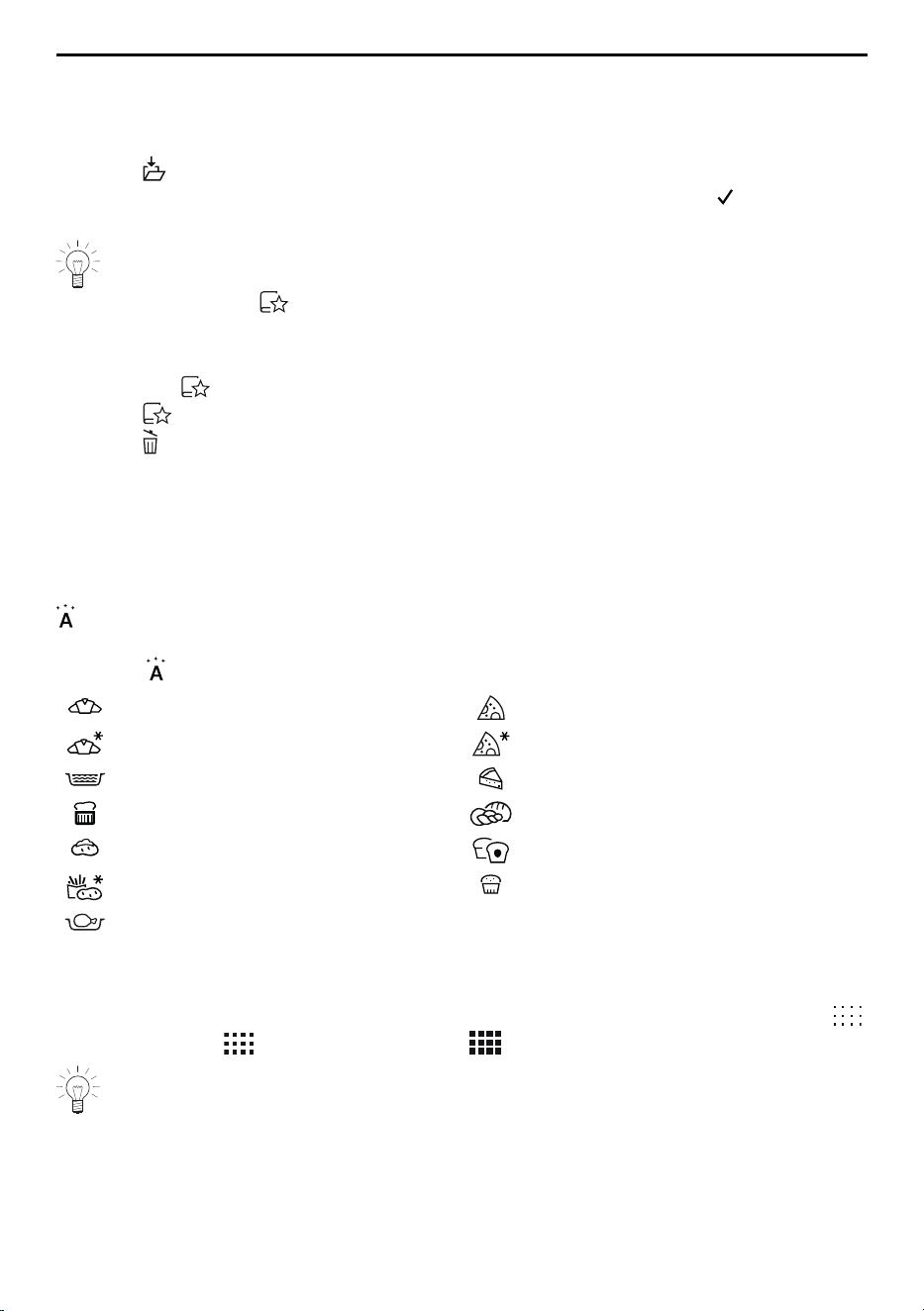
Fresh aperitif nibbles Fresh pizza
Frozen aperitif nibbles (F) * Frozen pizza (F) *
Gratin Flan
Soufflé / sweet baked dish Bread / plaited bread
Baked potatoes Yeast pastries with filling
Pre-fried frozen products (F) * Muffins / tray-baked cake
Braising meat
* Depending on the software version
Degree of browning
For certain food categories, the degree of browning can be adjusted by selecting the
«lightly browned», «medium browned» or «well browned» setting.
When used for frozen products, the approximate duration indicated on the pack-
aging must be selected instead of the degree of browning. Frozen products are
prepared in a variety of ways.
Duration
When BakeOmatic starts, sensors determine the optimum duration. The effective duration
is displayed after about 10–15 minutes.
28

6 GourmetGuide
Before starting, the cooking space must have cooled down and be dry in order to
determine the optimum duration.
The appliance door must not be opened whilst the duration is being determined.
Preheating
In the case of the «Flan» food group, after starting, separate preheating takes place
first. Put the food in after preheating has ended.
Selecting and starting BakeOmatic
A delayed start is only possible for applications where preheating is not required
and is only suitable for food that does not need to be refrigerated or to rise.
▸ If the appliance is switched off: first press the adjusting knob.
▸ Press the touch button.
▸ Select .
▸ Select the desired application.
▸ Select the degree of browning or, for frozen products, the appropriate time indicated
on the packaging.
– The BakeOmatic settings are displayed.
▸ Set an end time or delayed start, if required.
▸ To start BakeOmatic, select .
– Depending on the application, the cooking space may be preheated first.
– An acoustic signal is emitted and in the display appears: «Introduce food. Select
to continue.».
▸ Put the food at the appropriate level.
▸ To confirm the message, select .
– The following appears in the display: « is being determined.».
– The countdown to the time remaining appears in the display and in the digital dis-
play.
The appliance door must not be opened whilst the duration is being determined.
Otherwise, the optimal duration and temperature will not be calculated correctly.
6.4 Soft roasting
How it functions
The soft roasting function allows high-quality cuts of meat to be prepared gently. You
can select exactly when the cooking process is complete, irrespective of the weight and
thickness of the meat. The temperature is automatically regulated.
The cooking time can be set between 2½ and 4½ hours for «Soft roasting seared»
and between 3½ to 4½ hours for «Soft roasting with grill».
Tips for an optimal result
▪ Take the meat out of the refrigerator some 30–60 minutes before soft roasting.
▪ Weight of meat: 500–2000g
▪ Meat thickness: at least 4cm
▪ Quality: lean, high-quality meat
For «Soft roasting with grill», marbled cuts of meat weighing between 1000
and 2000g can also be used.
29

6 GourmetGuide
Soft roasting table for «Soft roasting seared» and «Soft roasting with grill»
Cut of meat Preparation
method
Degree of
doneness
Recommended
target
temperature°C
Fillet of veal seared
seared
rare
medium
58
62
Rump or loin of veal seared medium 63
Shoulder of veal seared
with grill
medium
medium
72
72
Neck of veal seared
with grill
medium
medium
78
78
Rolled breast of veal with grill medium 75
Fillet of beef seared
seared
rare
medium
53
57
Rib-eye or sirloin seared
seared
rare
medium
53
57
Rump of beef seared medium 63
Chuck of beef seared medium 68
with grill medium 68
Shoulder of beef seared
with grill
medium
medium
72
72
Rump or loin of pork seared medium 65
Neck of pork seared
with grill
medium
medium
80
80
Shoulder of pork with grill medium 78
Leg of lamb seared
seared
with grill
rare
medium
medium
63
67
65
Freely select meat type – – 70
«Soft roasting seared»
▸ Season or marinate the meat.
Remove any marinade made with herbs, mustard, etc. from the meat before sear-
ing. These ingredients burn easily.
▸ Salt the meat immediately before searing.
▸ Briefly sear the meat all over for no longer than 5minutes.
▸ Then place the meat in a glass or porcelain roasting dish.
If you do not intend to sear the meat until after the soft roasting, lower the recom-
mended target temperature by around 3–4°C.
▸ Insert the food probe into the meat so that the tip is in the centre of the thickest part.
30

6 GourmetGuide
The food probe must be inserted as far into the middle of the meat as possible to
get a correct reading of the food probe temperature. The temperature inside the
meat is crucial for optimal results at the end of cooking.
▸ Put the wire shelf at level 2 and place the dish on it.
▸ Insert the food probe plug into the socket.
▸ Start «Soft roasting seared» (see page 31).
«Soft roasting with grill»
▸ Season or marinate the meat.
Roll and tie up less compact cuts of meat such as a boneless leg of lamb so that
the roast browns evenly under the grill.
Remove any marinade made with herbs, mustard, etc. from the meat before
«Soft roasting with grill». These ingredients burn easily.
▸ Put the meat on a rotisserie spit and insert (see page 20) the food probe or put (see
page 21) the meat and food probe in a roasting basket.
▸ Put the baking tray, which has been lined with aluminium foil, at level 1.
▸ Place the rotisserie spit or roasting basket in the frame and push it right to the back of
the cooking space at level 3.
▸ Secure the food probe to the frame and plug into the socket.
▸ Start «Soft roasting with grill» (see page 31).
Selecting and starting soft roasting
The longer the meat is cooked, the more tender and succulent it becomes. This
applies particularly for thicker pieces of meat.
The target temperature cannot be changed once soft roasting has started.
▸ If the appliance is switched off, first press the adjusting knob.
▸ Press the touch button.
▸ Select .
▸ Select the desired soft roasting method.
▸ Select the desired type of meat.
▸ Select the desired cut.
▸ If the desired type of meat or cut cannot be selected, select the «Freely se-
lect meat type» option.
▸ For soft roasting seared: Select the degree of doneness (not possible for «Freely
select meat type»).
▸ For soft roasting with grill: Select the desired degree of browning.
– The operating mode settings are displayed.
– A recommended value appears above the target temperature.
▸ Adjust the recommended value if necessary and set a delayed start if you wish.
▸ To start soft roasting, select .
The food probe must be plugged in.
– Soft roasting starts.
– The set target temperature, the current food probe temperature and the remaining
time are displayed.
– The remaining time appears in the digital display.
31

7 EasyCook
The appliance door must be closed during operation. If the appliance door is
opened while soft roasting is running, the operation is interrupted and then, after a
short time, cancelled.
Inadvertently interrupting the programme
▸ If the touch button is pressed, the soft roasting programme is interrupted.
– The following appears in the display: «Should be cancelled?»
▸ To continue soft roasting, select «No».
– Operation is continued.
Cancelling / ending soft roasting before time
▸ Select in the soft roasting settings or press the touch button.
– The following appears in the display: «Should be cancelled?».
▸ Select «Yes».
– Operation is cancelled.
▸ To switch off the appliance, press the touch button.
If you accidentally pressed «Yes» or you wish to finish cooking the meat, you must
press the touch button and select an operating mode. «Soft roasting» is not
suitable for already cooked meat.
6.5 Keep warm *
* Depending on the software version
Cooked foods can be kept warm using the «Keep warm» setting.
If the cooking space is already hot, open the appliance door and allow the cooking
space to cool down for 3 to 4 minutes before starting the «Keep warm» function.
This ensures that the food does not overcook.
The longer the food is kept warm, the greater the changes may be to the consist-
ency of the food.
7 EasyCook
EasyCook helps you to prepare any food simply and conveniently. After choosing the
food group and food, the appliance suggests the suitable operating modes or Gourmet-
Guide applications, including the settings and accessories.
The brochure of the same name, which you received with the operating instruc-
tions, contains the same settings information in paper form.
The values given for temperature or temperature levels and duration serve only as
guide. They may vary depending on the type and size of the food as well as on in-
dividual preference.
7.1 Overview of food groups
Foods are categorized into different groups; an item of food can appear in more than
one group.
32

8 Favourites
The following food groups can be selected:
Fruit Fish and seafood
Mushrooms Flans and pizza
Potatoes Bakery products
Meat Baked dishes and gratins
Poultry
7.2 Selecting and starting foods
A delayed start is only possible for applications where preheating is not required
and is only suitable for food that does not need to be refrigerated or to rise.
▸ If the appliance is switched off: first press the adjusting knob.
▸ Press the touch button.
– The overview of food groups is displayed.
▸ Select the food group.
▸ Chose the desired type of food.
▸ If necessary: select the shape (whole, pieces, etc).
▸ If necessary: select the preparation method (cooking, baking, etc.).
▪ The display contains information about:
– Temperature
– Duration
– Preheating necessary / not necessary
– Accessories needed
– Level
– Possible tips
▸ Select .
▸ The operating mode summary is displayed.
▸ To start operation, select .
You can change the set values to a limited extent.
8 Favourites
Up to 24 operating modes, GourmetGuide and EasyCook applications together with the
settings made can be saved as favourites.
8.1 Creating favourites
▸ Select an operating mode, GourmetGuide or EasyCook application.
▸ Make the settings.
▸ Press the touch button.
– The favourites menu opens.
▸ Select a storage space and confirm.
▸ Enter the name of the favourite using the on-screen keypad and confirm.
– The favourite is saved.
33

9 Tips and tricks
8.2 Selecting and starting favourites
▸ Press the touch button.
▸ Choose the desired favourite and select «Yes».
▸ To start the favourite, select .
– The favourite starts.
8.3 Changing favourites
▸ Select the desired favourites.
▸ Adjust the settings as required.
▸ Press the touch button.
▸ Select the storage space or favourite that is to be overwritten.
▸ Enter the favourite name or overwrite as appropriate.
– The changed favourite is saved.
8.4 Deleting favourites
▸ If the appliance has another menu open, press the touch button.
▸ Select .
▸ Select the favourite to be deleted.
– The following appears in the display: «Do you want to delete this favourite?».
▸ To delete the favourite, select «Yes».
– The favourite is deleted.
9 Tips and tricks
9.1 Unsatisfactory cooking result...
… when baking and roasting
Result Solution
▪ The baking or roast looks
good on the outside but is still
doughy or raw on the inside.
▸ Next time, set a lower temperature and lengthen
the operating time.
▪ The cake collapses. ▸ Check that the settings used correspond to those
recommended in «EasyCook».
▸ Next time, set a lower temperature and lengthen
the operating time.
▸ Stir the cake mixture well. When finished, bake im-
mediately.
▸ For whisked sponges, beat the egg yolks / egg
whites to a foam a little longer and then carefully
fold into the mixture. When finished, bake immedi-
ately.
▸ Follow the instructions on how much baking
powder to add.
34
10 User settings
Result Solution
▪ The baking has browned un-
evenly.
▸ Next time, set a lower temperature and adjust
the operating time.
▸ If using , and , check that the levels
used correspond to «EasyCook».
▸ Do not push baking tins or bulky foodstuffs
right to the back of the cooking space.
▪ The baked goods have come out
lighter on one baking tray than on
the other.
▸ Check that the settings used correspond to
those recommended in «EasyCook».
Some uneven browning is normal. More even browning is generally achieved at
lower temperatures.
9.2 Saving energy
The and operating modes consume less energy than the and operating
modes.
▸ Avoid opening the appliance door frequently.
▸ Only switch the illumination on when needed.
▸ For gratins, use the residual heat: for cooking times over 30 minutes, switch the appli-
ance off 5–10 minutes before the end of the operating time.
▸ Minimize preheating.
▸ Only preheat the cooking space if the cooking or baking results depend on it.
Power consumption can be reduced to a minimum by selecting «Hide time» in the
user settings. Despite EcoStandby, all safety functions remain active.
10 User settings
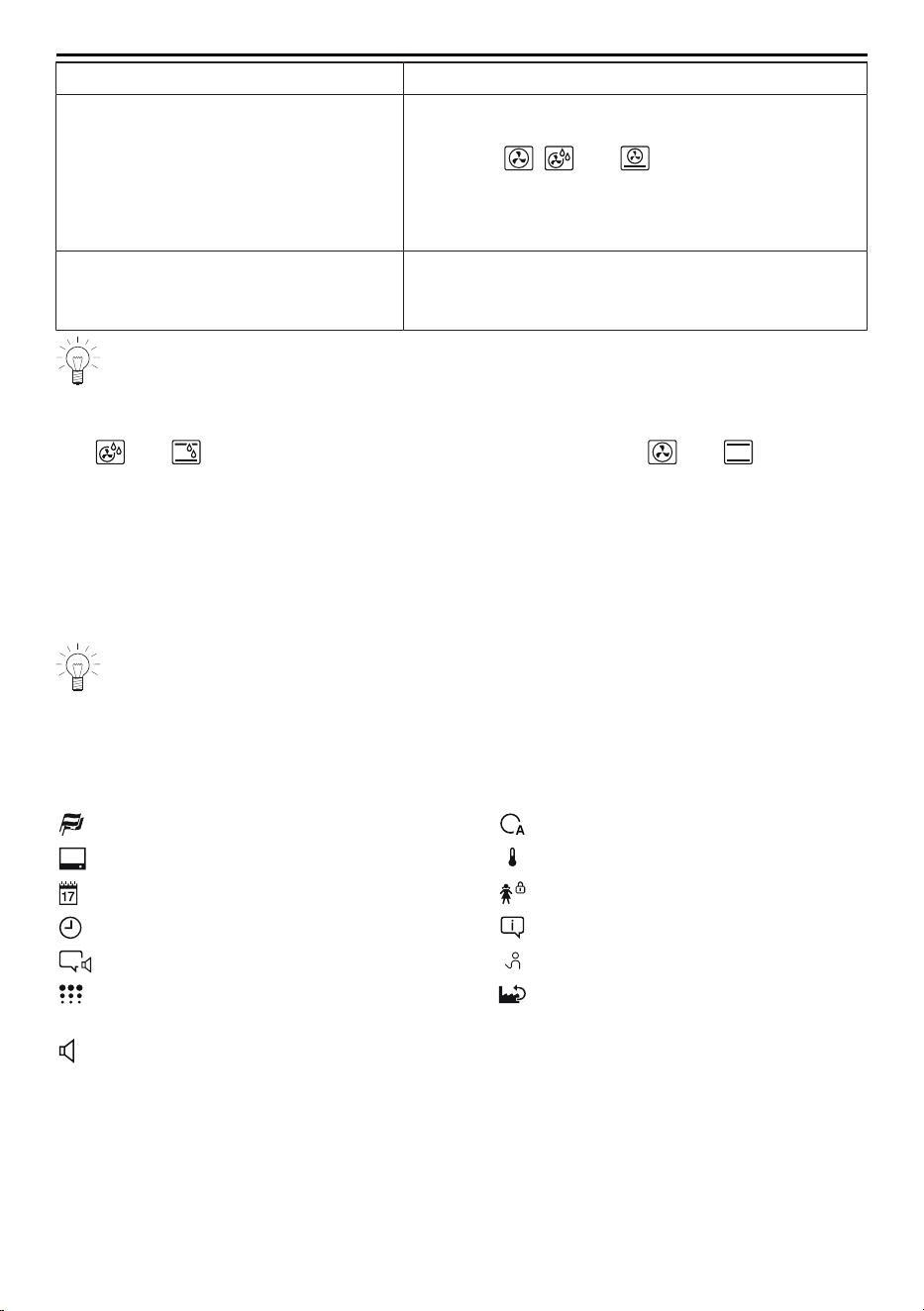
10.1 Overview of user settings
Language Assistance functions
Display Temperature
Date Childproof lock
Clock Appliance information
Notifications Demo mode
Pyrolytic self-cleaning (depending
on model)
Factory settings
Loudness
35

10 User settings
10.2 Adjusting user settings
▸ If the appliance is switched off, first press the adjusting knob.
▸ Press the touch button.
▪ The user settings main menu appears in
the display:
괫8VHUVHWWLQJV
6HWODQJXDJH
▸ Select the desired user setting or submenu.
▸ Adjust the desired user setting and press the adjusting knob to confirm.
– Either the user settings main menu or the relevant submenu appears in the display.
▸ To exit a submenu and return to the user settings main menu, select .
▸ To exit the user settings, press a different touch button or the touch button.
All user settings are retained in the event of a power failure.
10.3 Language
The language in the display can be changed. Different languages are available for selec-
tion.
10.4 Display
Brightness
The brightness of the display can be changed.
Background images
You can turn the background image display on and off. If background images are activ-
ated, different images are displayed depending on the menu.
Start screen *
* Depending on the software version
With this user setting, you can determine the menu that is displayed when you start the
appliance. The following menus can be selected:
▪ Operating modes (factory setting)
▪ GourmetGuide
▪ EasyCook
▪ Favourites
Appliance switch-off time
If no operating mode is running but the appliance is switched on, it is automatically
switched off after a certain period of time without any user interaction. Example: After the
end of an operating mode.
The appliance switch-off time can be set between 3 and 30 minutes; the factory setting is
15minutes.
36

10 User settings
10.5 Date
The date can be called up and changed.
10.6 Clock
The following time functions are available:
▪ Time
▪ Time format
▪ Time display
▪ Mains synchronization
Time format
The time can be displayed in the European 24-hour time format or the US 12‑hour format
(a.m./p.m.).
Time display
With the «Show time» setting (factory setting), the time is dimmed between 00:00 and
06:00 (24-hour format) or 12:00 a.m. and 06:00 a.m. (12-hour format).
If «Hide time» is selected, the displays are not illuminated when the appliance is off.
To reduce power consumption to a minimum, select «Hide time» in the user set-
tings. Despite EcoStandby, all safety functions remain active.
Mains synchronization
Mains synchronization synchronizes the appliance clock with the mains frequency. Irregu-
lar mains frequency can cause the clock to not run correctly. A pulse generator inside
the appliance is used when mains synchronization is switched off.
10.7 Notifications
Acoustic signals and instruction messages can be switched off or disabled. Essential
acoustic signals (such as the timer, end of operation and switch appliance off) cannot be
switched off or disabled.
10.8 Pyrolytic cleaning of appliance
This function enables pyrolytic cleaning of the cooking space.
See Pyrolytic self-cleaning (see page 43).
10.9 Loudness
The acoustic signal can be set at one of two levels of loudness or can be completely
switched off.
An acoustic signal is emitted in the event of a malfunction even if the setting is set
to «off».
A short acoustic signal is emitted when the appliance is switched off even if the
setting is set to «off» (safety function).
37

10 User settings
10.10 Assistance functions
Illumination
The «Automatic» setting switches on the cooking space illumination:
▪ 3 minutes before a cooking process ends, e.g. in the case of an automatic pro-
gramme or an operating mode with a set duration, or
▪ if the operation is ended before time, i.e. cancelled (using or the touch button).
Depending on the model, the illumination also switches on when the appliance door is
opened.
Press the touch button to switch the illumination on or off at any time.
If the illumination is not switched off, it will go off automatically within 5 minutes to
save energy.
Automatic door handle function
Only relevant to appliances with a retractable handle.
When the automatic door handle function is switched on (factory setting), the door
handle is extended automatically, e.g. when an operating mode is set or comes to an
end. It is then retracted again.
When the automatic door handle function is switched off, the door handle remains exten-
ded at all times.
Fast heating
With the «Automatic» setting, fast heating is switched on automatically wherever possible.
Press and go
«Press and go» refers to the period of time after which an operating mode/pro-
gramme starts automatically as long as all necessary settings are available or have been
made. Adjusting the settings restarts the countdown.
«Press and go» can be switched on or off.
When «Press and go» is activated, values between 10 seconds and
1 minute are possible; the factory setting is 20 seconds.
10.11 Temperature
Temperature unit
The temperature can be displayed in «°C» or «°F».
▪ °C: Degrees Celsius
▪ °F: Degrees Fahrenheit
Default value for soft roasting
The default value is the target temperature that is automatically set when soft roasting.
With this user setting, it can be increased or decreased by up to 4°C; the setting then
applies for all cuts of meat.
Example: When using «Soft roasting seared» with a 2°C increase in the default value, a
«medium» fillet of beef is cooked to a target temperature of 59°C instead of 57°C.
10.12 Childproof lock
The childproof lock is to prevent children accidentally switching on the appliance.
When the childproof lock is activated, the appliance can only be operated after first en-
tering a code. The code is displayed in reverse order when unlocking.
38

11 Care and maintenance
The childproof lock activates 3 minutes after the appliance is switched off.
10.13 Appliance information
Under «Appliance information», you will find:
▪ The article number and serial number (FN) of your appliance
▪ The software versions of your appliance as well as the acoustic signals and back-
ground images currently being used (depending on model)
10.14 Demo mode
In demo mode, almost all the appliance functions are available but it is not possible to
cook with the appliance. This ensures operating safety during product demonstrations
and consultations.
It is only possible to switch demo mode on and off with a safety code.
10.15 Factory settings
If one or more user settings have been changed, these can be reset to the factory set-
tings.
11 Care and maintenance
Risk of burns from hot surfaces!
Allow the appliance and the accessories to cool down before cleaning them.
Damage to the appliance from incorrect treatment!
Do not use any abrasive or caustic cleaning agents, metal scrapers that are sharp
or scratch, steel wool, abrasive scouring pads, etc. These products will damage
the surfaces. Glass surfaces that are scratched can crack.
Never use a steam cleaner to clean the appliance.
11.1 Cleaning the exterior
▸ Remove any soiling or excess cleaning solution immediately.
▸ Clean the surfaces with a soft cloth dampened with water and a little washing-up liquid
– for metallic surfaces rub in the direction of the original polish lines.
▸ Wipe dry with a soft cloth.
11.2 Cleaning the cooking space
Damage to the appliance from incorrect treatment!
Do not bend the temperature sensor or heating elements.
Do not scour the surface. Scouring will damage the surface.
▸ Remove any soiling from the cooking space while still hand warm using a soft cloth
dampened with water and a little washing-up liquid. Wipe dry with a soft cloth.
In the case of appliances without pyrolysis:
▸ Use a commercially available oven cleaner and follow the manufacturer’s instructions.
39
11 Care and maintenance
Never clean appliances with pyrolysis using oven cleaner
as the surface could otherwise be damaged.
► Carry out pyrolysis in the case of stubborn dirt
deposits (see page 43).
11.3 Cleaning the appliance door
▸ Clean the appliance door with a soft cloth dampened with water and a little washing-
up liquid.
▸ For appliances without handles, ensure that water does not run into the handle open-
ings.
▸ Dry with a soft cloth.
Removing the appliance door
Risk of injury from moving parts!
Be careful not to put fingers in the door hinges. The appliance door is heavy.
When removing and reassembling the appliance door, hold it firmly at the sides
with both hands.
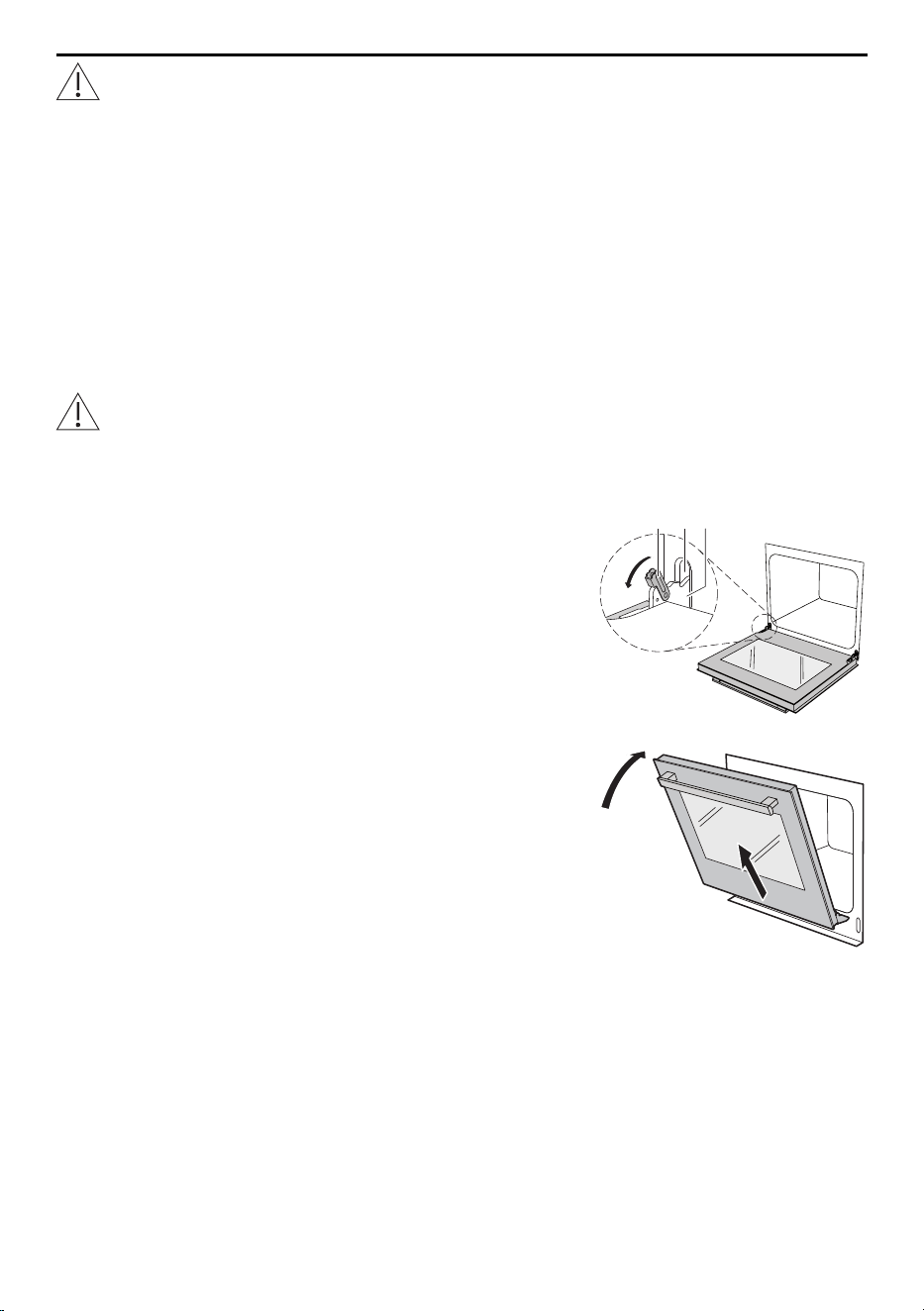
▸ Open the appliance door as far as it will go.
▸ Fold the clips 2 on both door hinges 1 forward.
2
3
1
▸ Close the appliance door as far as its at-rest position
(about 30°).
▸ Lift the appliance door out at an angle.
Reassembling the appliance door
▸ From the front, push both hinges 1 into the opening 3.
▸ Open the appliance door as far as it will go and close
back the clips 2.
30°
11.4 Cleaning the door seal
▸ Clean the door seal with a soft cloth dampened with water, but do not use any clean-
ing agent.
▸ Wipe dry with a soft cloth.
40
11 Care and maintenance
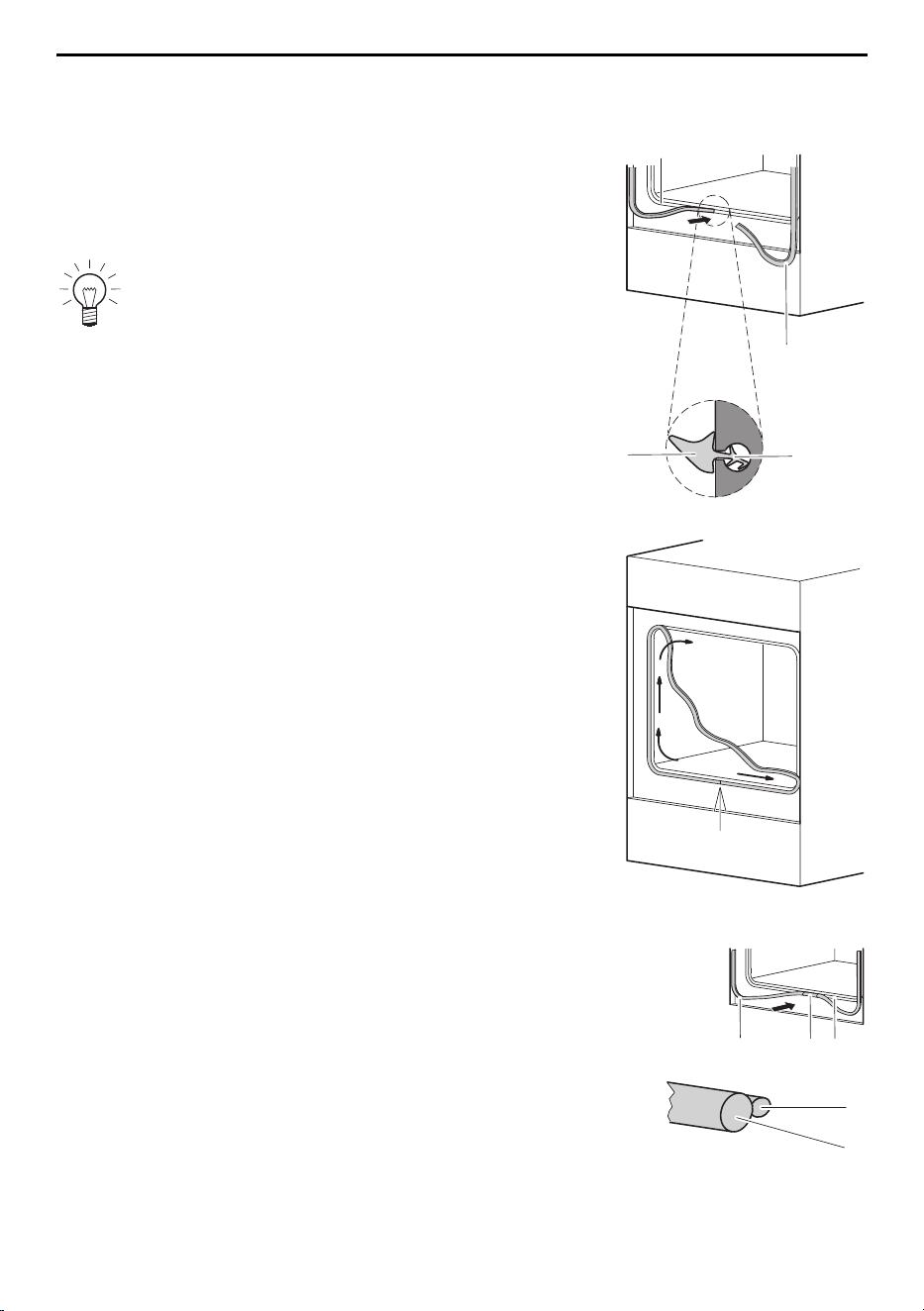
11.5 Replacing the door seal
▸ Remove the damaged door seal.
▸ Clean the groove 1 with a slightly damp
cloth.
▸ Press the ends of the new door seal 2
into the groove in the centre of the frame
at the bottom.
3
4
2
1
The ends must touch each other
but not overlap.
▸ Ensure that only the thinner part 3 of the
seal is pressed into the groove; the
thicker part 4 must not be in the groove.
▸ Starting from the bottom, press the seal
evenly into the groove.
11.6 Replacing the door seal on pyrolysis appliances
▸ Remove the damaged door seal.
▸ Clean the groove 3 with a slightly damp cloth.
▸ Press the new door seal 1 into the groove, with the
seam joint 2 not at centre bottom of the frame
2
31
▸ Ensure that only the thinner part 4 of the seal is
pressed into the groove; the thicker part 5 must
not be in the groove.
4
5
41
11 Care and maintenance
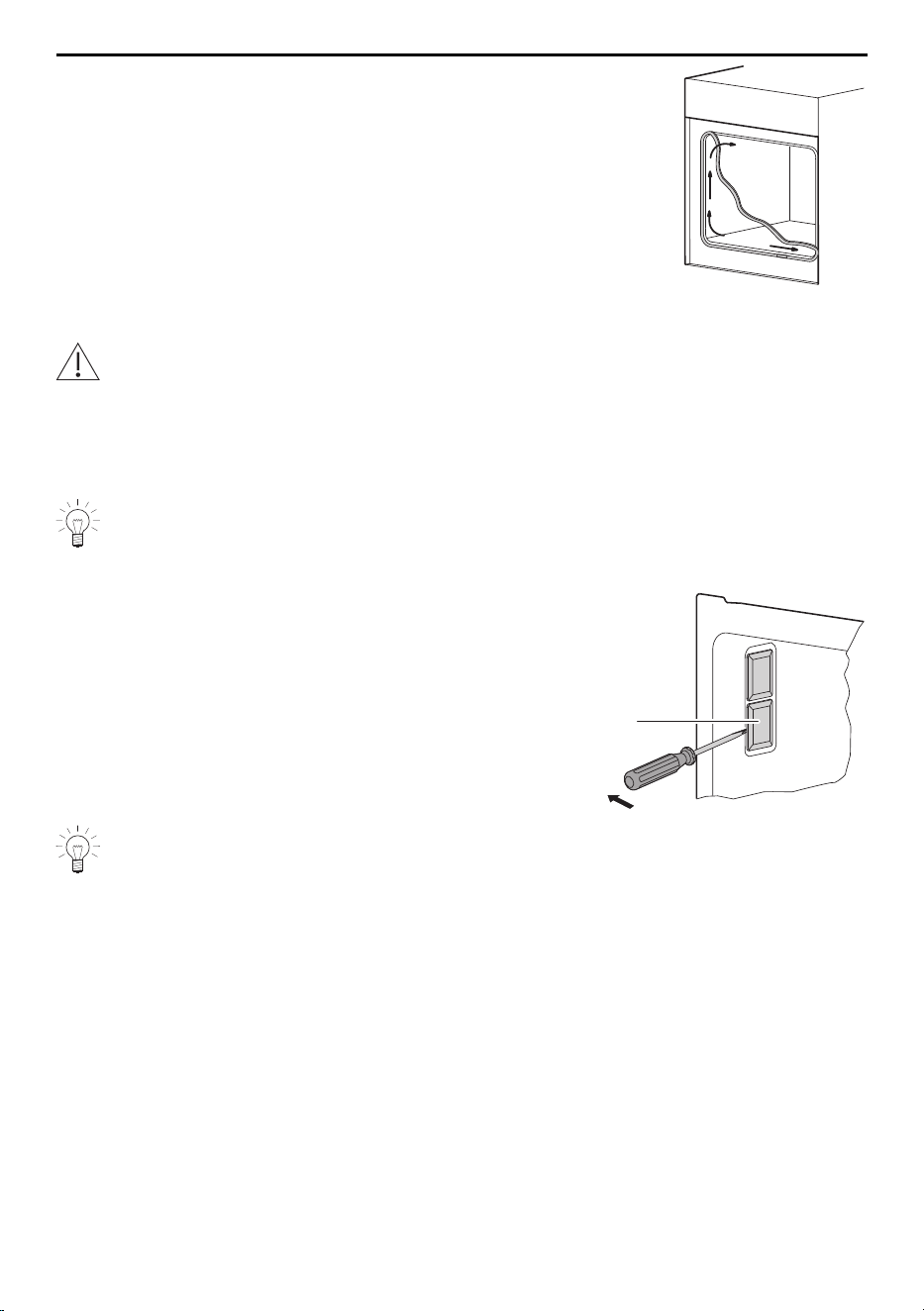
▸ Starting from the bottom, press the seal evenly into
the groove.
11.7 Replacing the halogen light bulb
WARNING: Risk of electric shock!
Disconnect the appliance from the mains power supply before replacing the halo-
gen light bulb.
Risk of burns from hot surfaces!
Allow the halogen light bulb and the appliance to cool down before replacing the
halogen light bulb.
It is recommended to replace both halogen lights at the same time, even if one is
still functioning.
▸ Remove the left shelf guide.
▸ Place the screw driver along the middle of the
edge of the glass and carefully remove the glass
light cover 1 from its fixture.
▸ Take out the defective halogen light bulb.
▸ Carefully fit the new halogen light bulb.
1
Do not touch the halogen light bulb with bare hands. Instead, use a fine, dry,
grease-free cloth.
▸ Press the glass light cover 1 back into its fixture.
▸ Repeat the same process to replace the second halogen light.
▸ Replace the shelf guides.
▸ Switch the power supply back on.
11.8 Cleaning the accessories and shelf guides
▪ The wire shelf and shelf guides can be cleaned in the dishwasher.
▪ The baking tray can be cleaned in the dishwasher; however, this will affect its non-
stick properties.
42
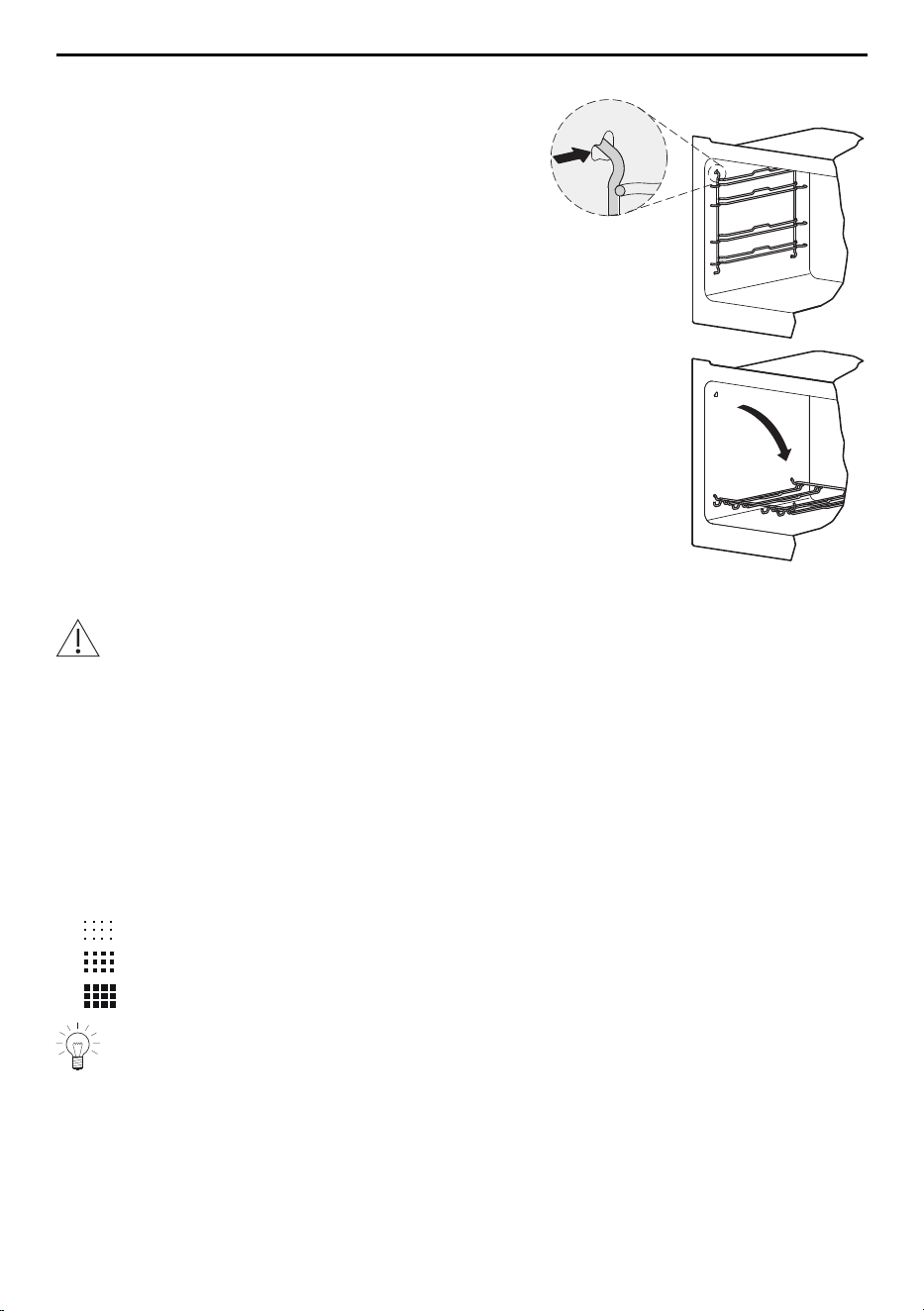
11 Care and maintenance
Removing and reassembling the shelf guides
▸ Push the shelf guides at the top back-
wards and take out of the opening.
▸ Swing the shelf guide into the middle of
the cooking space and remove from the
opening at the bottom.
▸ Put back in reverse order.
11.9 Pyrolytic self-cleaning
Danger of explosion through deposits and cleaning agents!
Remove grease or oil deposits. Do not use any chemical cleaning agents. Depos-
its could give rise to chemical reactions and destroy the enamel. Poisonous fumes
could escape.
Do not leave the appliance unattended.
Risk of burns from hot surfaces! The appliance front gets hotter than during normal
operation.
There is likely to be some smoke given off for a short period of time so ventilate
the room during pyrolysis.
In pyrolytic self-cleaning, any soiling is burned off at a high temperature.
Possible settings
▪
Lightly soiled Cleaning duration: 1½ hrs.
▪
Medium soiled Cleaning duration: 2 hrs.
▪
Heavily soiled Cleaning duration: 2½ hrs.
The pyrolytic self-cleaning process – including cooling down – takes about4–
5hours.
As long as the temperature is over 300°C, the illumination switches off and can-
not be switched back on.
Over time with use the cooking space can turn matt. Fruit acid and fatty acid deposits
can leave stains. This will not affect the cooking or baking characteristics of the appli-
ance nor affect its functioning.
43

12 Trouble-shooting
Selecting and starting pyrolytic self-cleaning
Damage to accessories from self-cleaning!
Remove accessories, shelf guides, full extension roller runners, cookware and any
other objects from out of the cooking space. Otherwise they can become discol-
oured and their surface rough. The rolling properties of full extension roller runners
deteriorate.
▸ Close the appliance door.
▸ If the appliance is switched off: first press the adjusting knob.
▸ Press the touch button.
▸ Select .
▸ Select the degree of soiling.
– The calculated end time for the pyrolytic self-cleaning process is shown in the dis-
play above .
▸ To start the pyrolytic self-cleaning process, select .
– The appliance door locks.
Delayed start
The start of pyrolytic self-cleaning can be delayed, for example, to take advantage of
lower electricity tariffs.
▸ Select before starting.
▸ Set the desired end time.
▸ Select .
– The appliance remains switched off until the calculated automatic start.
Cancelling
▸ Select in the display.
– Pyrolytic self-cleaning is cancelled.
▸ The residual heat appears in the display.
▸ The appliance door remains locked until the temperature drops below 300°C.
End
The appliance door cannot be opened until the temperature has dropped below 300°C.
▸ Wait until the appliance has cooled to hand warm to remove any residue left behind
using a soft cloth dampened with water. Do not use cleaning agents.
12 Trouble-shooting
12.1 What to do if …
This section lists faults that can be solved simply by following the instructions given. If
another fault is displayed or the fault cannot be remedied, please call Customer Ser-
vices.
Before calling Customer Services, please note down the error message in full.
Fxx/Exxx see operating instructions
FNxxxxx xxxxxx.
44
12 Trouble-shooting
… the appliance is not working
Possible cause Solution
▪ A household fuse or circuit
breaker has tripped.
▸ Change the fuse.
▸ Reset the circuit breaker.
▪ The fuse or circuit breaker
keeps blowing.
▸ Call Customer Services.
▪ An interruption in the mains
power supply.
▸ Check the power supply.
▪ Demo mode is switched on. It is only possible to switch off demo mode with a
safety code.
▸ Call Customer Services.
▪ The appliance is faulty. ▸ Call Customer Services.
… the appliance door cannot be opened
Possible cause Solution
▪ The temperature of the cook-
ing space is over 300°C.
▸ Wait for it to cool down.
The appliance door cannot be opened until the tem-
perature of the cooking space has dropped below
300°C.
▪ Pyrolytic self-cleaning is run-
ning.
▸ Wait until pyrolytic self-cleaning has finished.
… just the illumination is not working
Possible cause Solution
▪ The halogen light is defective. ▸ Switch off the oven.
▸ Disconnect the appliance from the electricity sup-
ply.
▸ Replace the halogen light bulb.
... the cooking time seems unusually long
Possible cause Solution
▪ The appliance only has a
single-phase connection.
▸ Establish a two-phase connection.
… when grilling, thick smoke is given off
Possible cause Solution
▪ The food is too near to the
heating elements.
▸ Check that the level selected corresponds to the
«EasyCook».
▪ Grill setting is too high. ▸ Reduce the grill setting.
45
12 Trouble-shooting
... the food probe temperature is not displayed
Possible cause Solution
▪ The food probe is not plugged
in correctly.
▸ Check whether the food probe is correctly plugged
into the socket.
▸ Check whether the food probe is correctly inserted
in the food: The tip must be in the centre of the
thickest part.
▪ In the selected automatic pro-
gramme, the food probe can-
not be used; the symbol
is illuminated in grey.
▸ If you wish to use the food probe in spite of this,
change to the operating mode menu and set a
suitable operating mode.
▪ The food probe or the socket
is defective.
▸ Call Customer Services.
… the appliance makes noises during operation
Possible cause Solution
▪ The appliance may emit noise
when operating (e.g. switching
and pumping noises).
Such noise is normal.
… the clock is not running correctly
Possible cause Solution
▪ Irregular mains frequency ▸ Switch off the mains synchronization.
▪ Internal pulse generator is im-
precise when mains synchron-
ization is switched off.
▸ Call Customer Services.
… the following appears in the display
FX/EXX see operating instructions
FN XXX XXXXXX
Possible cause Solution
▪ Various situations can lead to
an error message.
▸ Cancel the error message by pressing the touch
button.
▸ Disconnect from the power supply for
about1minute.
▸ Reconnect the power supply.
▸ If the error appears again, note down the error
message in full along with the serial number (FN;
see identification plate).
▸ Disconnect from the power supply.
▸ Call Customer Services.
46

12 Trouble-shooting
… the following appears in the display
UX/EXX see operating instructions
FN XXX XXXXXX
Possible cause Solution
▪ An interruption in the power
supply.
▸ Cancel the error message by pressing the but-
ton.
▸ Disconnect from the power supply for
about1minute.
▸ Reconnect the power supply.
▸ If the error appears again, note down the error
message in full along with the serial number (FN;
see identification plate).
▸ Disconnect from the power supply.
▸ Call Customer Services.
12.2 After a power failure
The user settings remain unchanged.
Brief power failure during operation
– The current operation of the appliance is cancelled.
– The following appears in the display when the appliance is switched on: «Power
failure. Operation cancelled».
▸ To cancel the message, select .
– The operating modes menu appears in the display.
Prolonged power failure
Variant 1 *
* Depending on the software version
The appliance goes through its initial set-up process after a prolonged power failure.
However, only the language and time need to be reset to enable the appliance to be op-
erated again. It is not necessary to make any other settings.
Variant 2 *
* Depending on the software version
The appliance goes through its initial set-up process after a prolonged power failure.
However, only the time needs to be reset to enable the appliance to be operated again.
It is not necessary to make any other settings.
– The following appears in the display when the appliance is switched on: «Power
failure. Set time.»
▸ To confirm the message, select .
– The «Clock» menu in the user settings appears in the display.
▸ Select , set the time and confirm.
– The «Clock» menu appears again in the display.
47
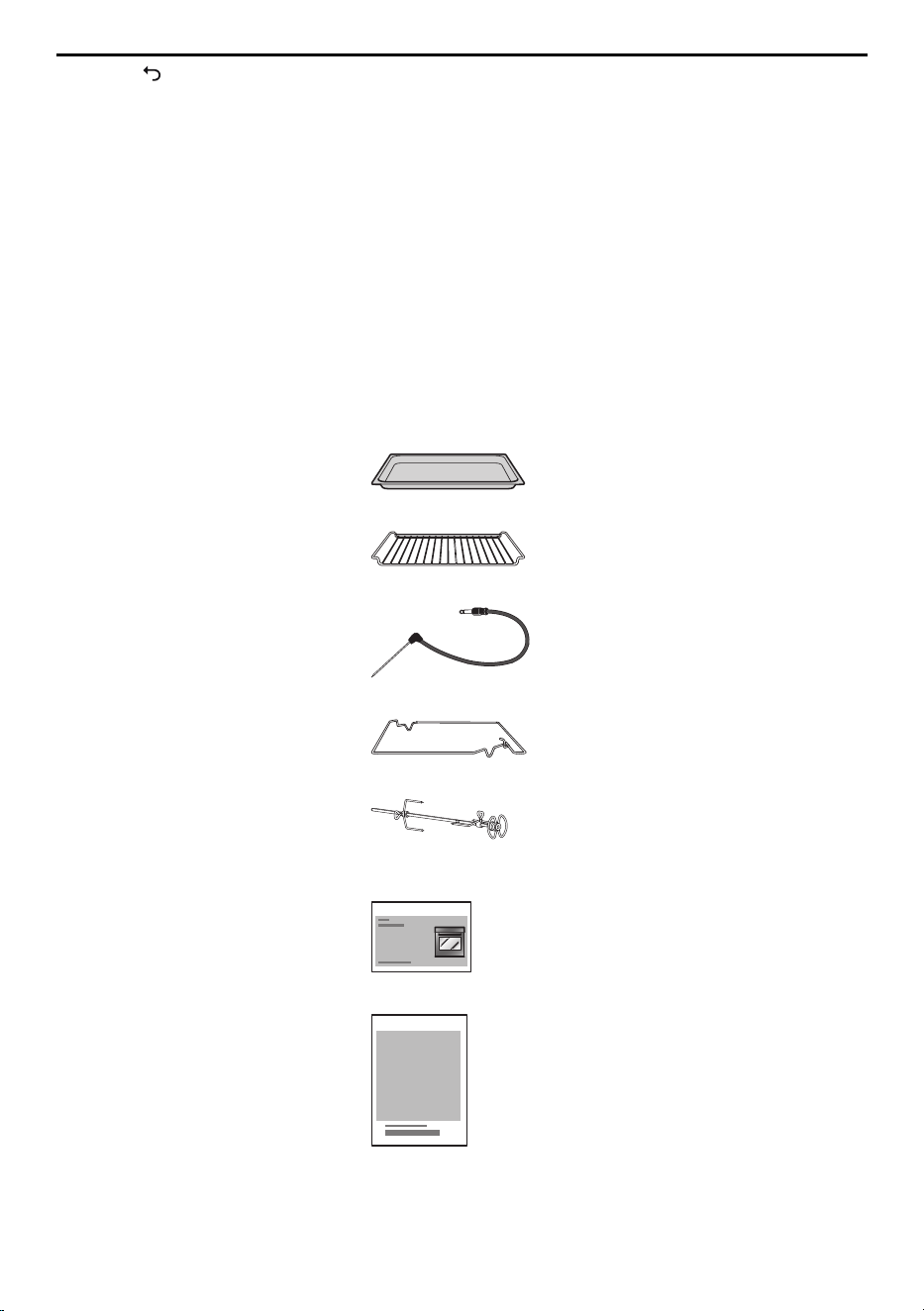
13 Accessories and spare parts
▸ Select .
– The following appears in the display: «Do you want to continue with the initial start-
up?»
▸ To change other user settings, select «Yes».
– The relevant user settings menu appears in the display.
▸ If no other user settings are to be changed, select «No».
– The appliance is ready for operation again.
13 Accessories and spare parts
The accessories listed below, as well as spare parts, can be ordered in addition to the
scope of delivery of the appliance. Ordering is subject to charge, except in the event of
warranty claims. Please give product family of the appliance and exact designation of the
accessory or spare part when ordering parts.
13.1 Accessories
TopClean baking tray
Wire shelf
Food probe
with angled handle
Rotisserie frame
Complete rotisserie spit
Ceramic roller
Rotisserie spit
Fork
EasyCook brochure
Bedienungsanleitung … Einstelltipps
Recipe book
13.2 Special accessories
For information see: www.vzug.com
48
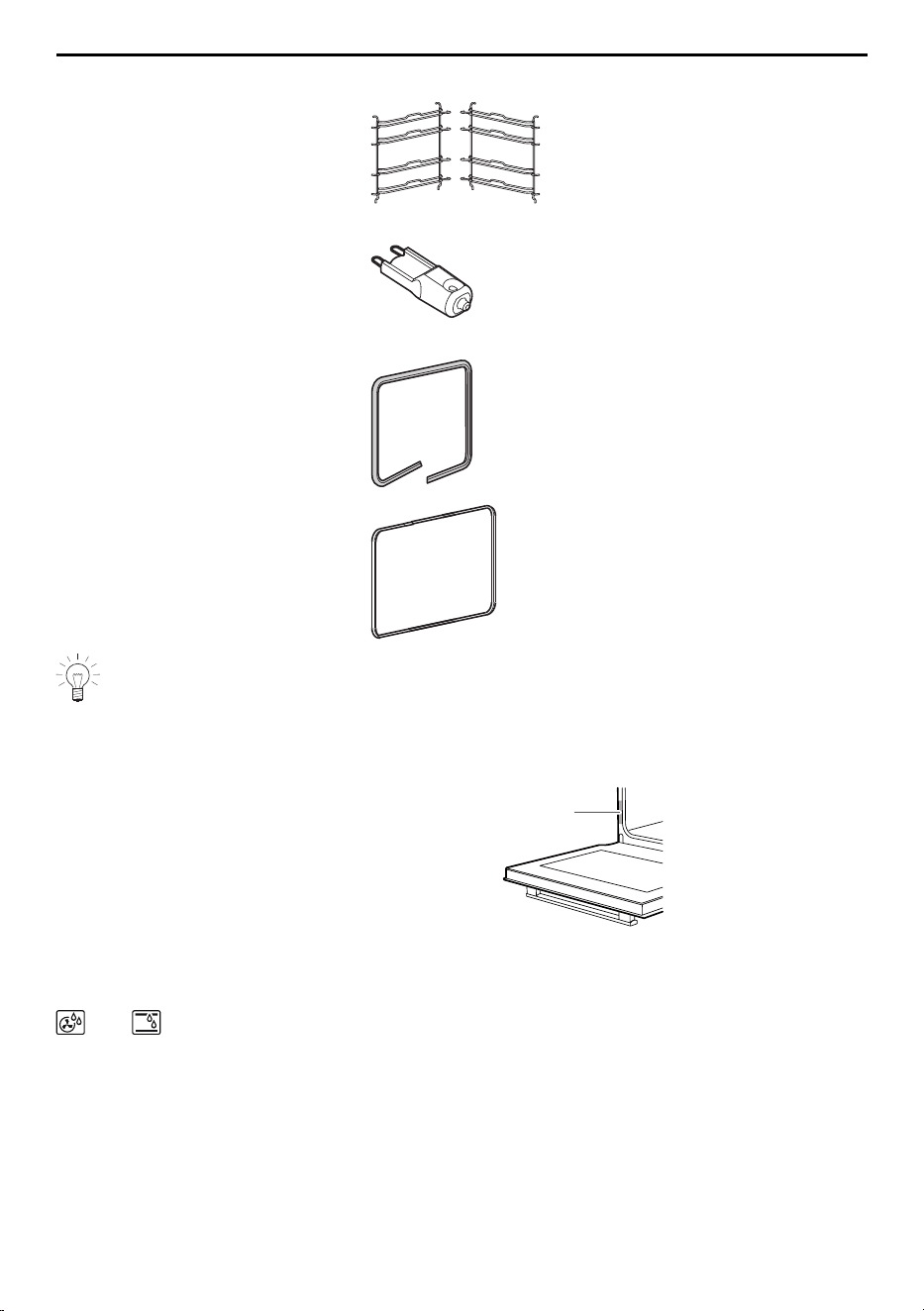
14 Technical data
13.3 Spare parts
Shelf guides
left/right
Halogen light bulb
Door seal
Door seal for
pyrolytic appliances
The halogen light bulb is also available from specialist retailers.
14 Technical data
External dimensions
▸ See installation instructions
1
Electrical connection
▸ See identification plate 1
14.1 Note for testing institutes
The energy efficiency class according to EN 50304 / EN 60350 is determined using the
and operating modes.
Placing thermocouples between the appliance door and the seal can cause lack of leak-
tightness and thus measuring errors.
The usable volume within the meaning of EN 50304 / EN 60350 is obtained with the
shelf guides disassembled.
49

14 Technical data
14.2 Temperature measurement
The temperature inside the cooking space is measured when the cooking space is
empty according to an internationally accepted standard. Own measurements can be im-
precise and are not suitable for checking the accuracy of the temperature.
14.3 Product fiche
In accordance with EU Regulation No.: 66/2014
Brand – V-ZUG Ltd
Type of appliance – Oven
Model designation – BCSL | BCSLP
Mass of appliance kg 49 | 54
Number of cavities – 1
Heat source per cavity – Electric
Volume per cavity l 68
Energy consumption in conventional mode
1
) kWh/cycle 0.86 | 0.85
Energy consumption in hot air / forced convection mode
2
) kWh/cycle 0.7
Energy-efficiency index per cavity
3
) – 84.3 | 86.8
Measurement and calculation methods used – IEC 60350
1
)
Required to heat a standardized load in cavity
2
)
Required to heat a standardized load in cavity
3
)
Measurement methods: See EU Regulation No. 66/2014, Annex II, Chapter 1
Saving energy while cooking
The and operating modes consume less energy than the and operating
modes.
▸ Avoid opening the appliance door frequently.
▸ For gratins, use the residual heat: for cooking times over 30 minutes, switch the appli-
ance off 5–10 minutes before the end of the operating time.
▸ Minimize preheating.
▸ Only preheat the cooking space if the cooking or baking results depend on it.
14.4 EcoStandby
To prevent unnecessary energy consumption, the appliance is equipped with the auto-
matic energy-saving «EcoStandby» function.
To reduce power consumption to a minimum, select «Hide time» in the user set-
tings. Despite EcoStandby, all safety functions remain active.
14.5 Reference to «Open Source» licence
Your appliance contains Newlib open-source software. This is subject to the licensing
conditions specified in Section 4.1 (4.1.1-4.1.8; 4.1.9; 4.1.10; 4.1.14-4.1.16) of the en-
closed open-source software licence text document.
50

15 Disposal
15 Disposal
15.1 Packaging
Never allow children to play with packaging material due to the danger of injury or
suffocation. Store the packaging material in a safe location or dispose of it in an
environmentally-friendly way.
15.2 Safety
Render the appliance unusable to prevent accidents caused by improper use (e.g.
through children playing):
▸ Disconnect the appliance from the mains. With a fixed appliance, this is to be carried
out by a qualified electrician. Then cut the mains cable off flush with the appliance.
15.3 Disposal
▪ The «crossed‐out wheeled bin» symbol requires the separate collection of waste
electrical and electronic equipment (WEEE). Such equipment can contain hazardous,
environmentally harmful materials.
▪ These appliances are to be handed over to a designated collection point for the recyc-
ling of electrical and electronic equipment and must not be disposed of with unsorted
household waste. And in this way, you will be helping to protect resources and the en-
vironment.
▪ For more information, please contact the local authorities.
51

16 Index
A
Accessories ............................................... 12, 48
Cleaning ........................................................ 42
Acoustic signals ............................................... 37
Appliance disposal .......................................... 51
Appliance door
Cleaning ........................................................ 40
Removing ...................................................... 40
Appliance information ..................................... 39
Appliance switch-off time ............................... 36
B
Background images ........................................ 36
BakeOmatic ...................................................... 28
Baking tray ........................................................ 12
Before using for the first time........................... 7
Bottom heat ............................................... 11, 16
Brightness ......................................................... 36
C
Cancelling
Changing recipe .......................................... 27
Creating own recipe.................................... 27
Operating mode........................................... 22
Recipes.......................................................... 26
Cleaning............................................................. 39
Accessories .................................................. 42
Cooking space............................................. 39
Door seal....................................................... 40
Shelf guides.................................................. 42
Cleaning the exterior ....................................... 39
Clock .................................................................. 37
Construction...................................................... 10
Cooking space
Cleaning ........................................................ 39
Temperature measurement ....................... 50
D
Delayed start..................................................... 18
Pyrolytic self-cleaning ................................. 44
Deleting
Favourites...................................................... 34
Own recipe.................................................... 28
Demo mode ...................................................... 39
Disposal............................................................. 51
Door handle ...................................................... 38
Door seal
Cleaning ........................................................ 40
Replacing ...................................................... 41
Replacing on pyrolysis appliance ............ 41
Duration ............................................................. 18
Recipe step................................................... 26
E
EasyCook ................................................... 32, 48
Food groups ................................................. 32
EcoStandby....................................................... 50
Electrical connection ....................................... 49
End ..................................................................... 18
Extending operation ........................................ 23
External dimensions ........................................ 49
F
F and E messages .......................................... 46
Factory settings................................................ 39
Fast heating ............................................... 16, 38
Automatic switch-on .................................... 38
Favourites.......................................................... 33
Changing....................................................... 34
Creating ......................................................... 33
Deleting ......................................................... 34
Starting........................................................... 34
FN ....................................................................... 39
Food probe ................................................ 12, 19
Food probe temperature ................................ 19
Measure only ................................................ 20
G
Grill ..................................................................... 14
Grill-forced convection .................................... 15
H
Halogen light bulb ........................................... 42
Hold .................................................................... 26
Hot air ................................................................ 14
Hot air humid .................................................... 15
Hot air with bottom heat ................................. 14
I
Identification plate............................................ 49
Illumination ................................................. 38, 45
Initial set-up ..................................................... 7, 9
Instruction message ........................................ 37
Instructions for use ............................................. 7
K
Keep warm........................................................ 32
L
Language........................................................... 36
Levels ................................................................. 11
Long cooking time........................................... 45
Loudness ........................................................... 37
52

16 Index
M
Mains synchronization .................................... 37
Maintenance ..................................................... 39
Model number .............................................. 2, 39
N
Notes.................................................................. 54
O
Operating and display elements................... 10
Operating mode
Cancelling ..................................................... 22
Changing....................................................... 22
Selecting........................................................ 17
Operating mode settings................................ 18
Changing....................................................... 18
Checking ....................................................... 18
Operation........................................................... 16
Own recipes...................................................... 26
Creating ......................................................... 26
Deleting ......................................................... 28
P
Pause ................................................................. 26
Plate warmer..................................................... 13
Power failure ..................................................... 47
Preheating .................................................. 35, 50
Press and go ............................................. 18, 38
Product family...................................................... 2
Pyrolytic self-cleaning...................................... 43
Cancelling ..................................................... 44
Starting........................................................... 44
Q
Quick instructions ............................................ 56
R
Recipe book .............................................. 25, 48
Recipes.............................................................. 25
Action required............................................. 25
Changing....................................................... 27
Copying ......................................................... 27
Creating own ................................................ 26
Ending a step before time ......................... 27
Step duration ................................................ 26
Roasting basket ........................................ 20, 21
Rotisserie frame ............................................... 12
Rotisserie spit ............................................ 12, 20
S
Safety precautions
Appliance-specific ..........................................6
Before using for the first time.......................7
Correct use ......................................................7
General .............................................................5
Saving energy............................................ 35, 50
Self-cleaning ..................................................... 43
Cancelling ..................................................... 44
Starting........................................................... 44
Service & Support............................................ 55
Setting the time ................................................ 36
Shelf guides
Cleaning ........................................................ 42
Removing ...................................................... 43
Socket ................................................................ 11
Soft roasting...................................................... 29
Default value................................................. 38
Positioning the food probe ................. 30, 31
Seared ........................................................... 30
Starting........................................................... 31
Switching off before time ........................... 32
With grill......................................................... 31
Software versions............................................. 39
Spare parts ................................................ 48, 49
Special accessories ................................. 13, 48
Start screen....................................................... 36
Switching off before time................................ 22
Symbols ................................................................ 5
T
Target temperature .......................................... 19
Technical data .................................................. 49
Technical questions......................................... 55
Temperature sensor ........................................ 11
Temperature unit.............................................. 38
Testing institutes .............................................. 49
Time display...................................................... 37
Time format ....................................................... 37
Timer .................................................................. 22
Tips and tricks .................................................. 34
Top/bottom heat .............................................. 13
Top/bottom heat humid.................................. 15
Touch buttons................................................... 11
Type....................................................................... 2
U
U and E messages.......................................... 47
Uneven browning............................................. 35
User settings..................................................... 35
Adjusting........................................................ 36
Overview........................................................ 35
Using for the first time........................................ 9
V
Validity................................................................... 2
W
Warranty extensions ........................................ 55
Wire shelf........................................................... 12
53

54
17 Notes

18 Service & Support
The «Troubleshooting» chapter provides valuable information for dealing with
minor operating faults. This saves you the time, effort and potential cost of having
to call out a service technician.
Information on the V-ZUG warranty can be found at www.vzug.com →Service →Warranty
information. Please read this information carefully.
Please register your V-ZUG appliance online immediately at www.vzug.com →Service
→Warranty registration. This will allow you to take advantage of the best possible support
in the event of an fault in the appliance during the warranty period. You will require the
serial number (FN) and appliance designation to complete the registration process. This
information can be found on the identification plate for your appliance.
My appliance information:
FN: ___________________ Appliance: _____________________
Always have this appliance information to hand when you contact V-ZUG. Thank you.
▸ Open the appliance door.
– The identification plate is located on the left-side panel.
Your repair order
At www.vzug.com →Service→Service number you will find the telephone number of your
nearest V‑ZUG service centre.
Technical questions, accessories, warranty extensions
V-ZUG is happy to help you with any general administrative or technical queries, to take
your orders for accessories and spare parts and to inform you about our progressive
service agreements.
55
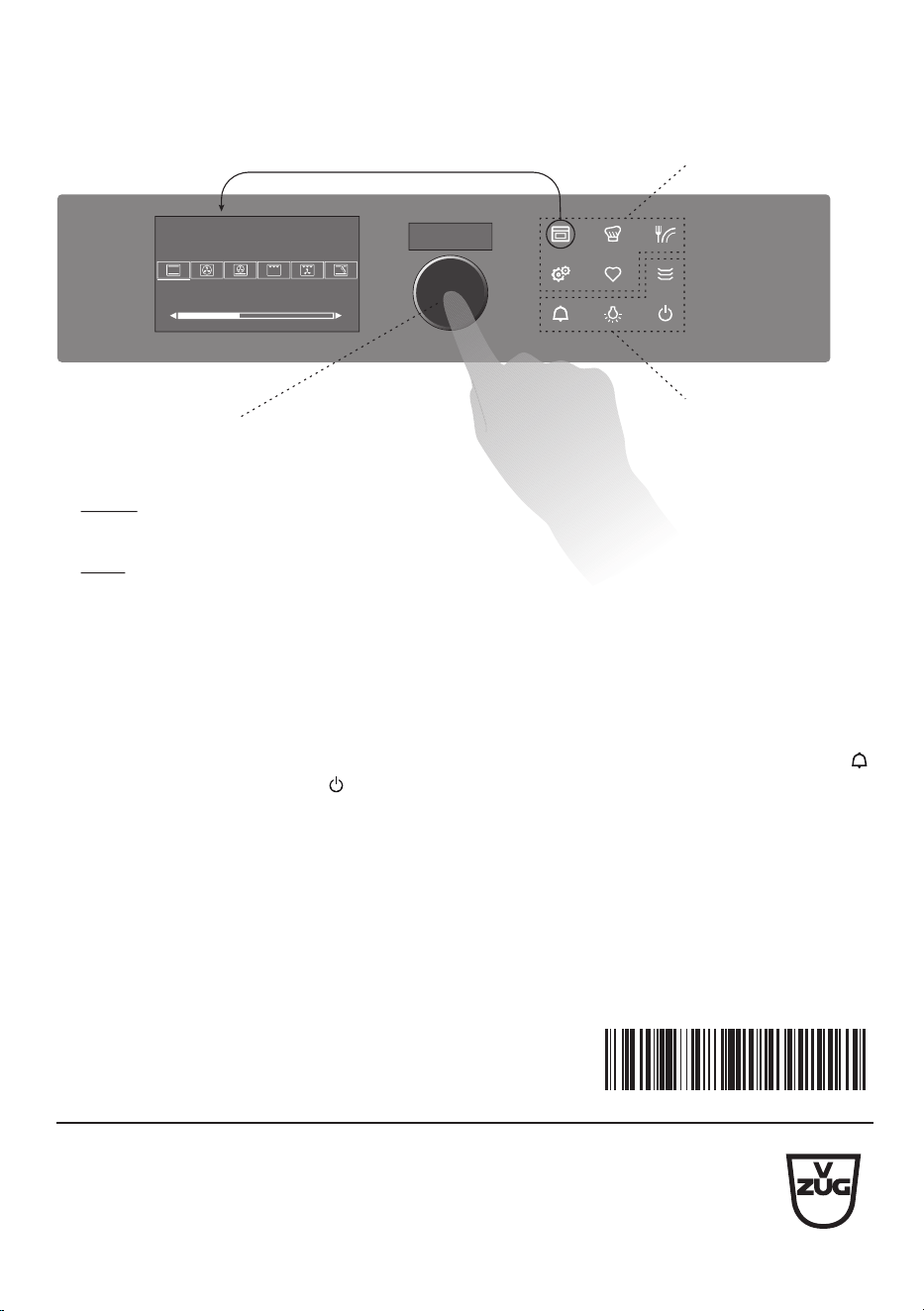
Quick instructions
Here you will find an overview of key operating information.
Active menu
Action buttons
Menu buttons
12:00
곋2SHUDWLQJPRGHV
7RSERWWRPKHDW
Press to switch on the appliance or
to select/confirm
Turn to set the temperature and time
or to navigate within the menu
Adjusting knob as a central
operating element
►
►
Menu and action buttons
The menu buttons contain a selection of preparation options and user settings. These
can be selected by pressing the relevant button. The active menu is shown in the dis-
play. You can use the adjusting knob to operate and navigate within the menu; additional
submenus can also be called up.
The function buttons give you direct access to independent functions such as the timer
or switching off the appliance .
V-ZUG Ltd, Industriestrasse 66, CH-6301 Zug
[email protected], www.vzug.com
J21021352-R06