
AKL08
AKN08
AKQ08
AKV08
AKW08
Safety Instructions . . . . . . . .2, 3
Operating Instructions
Control Knob Models . . . . . .6, 7
Touch Pad Models . . . . . . . . .4, 5
Care and Cleaning
Air Filter . . . . . . . . . . . . . . . . . .8
Grille and Case . . . . . . . . . . . . .8
Outdoor Coils . . . . . . . . . . . . . .8
Installation Instructions
Through-the-Wall
Installation—Optional . . . . . . .18
Window Installation . . . . . . .9–17
Troubleshooting Tips . . . .19, 20
Normal Operating Sounds . . .20
Consumer Support
Consumer Support . . . . . . . . .24
Product Registration . . . . .21, 22
Warranty . . . . . . . . . . . . . . . . .23
49-7453-1 12-02 JR
Owner’s Manual and
Installation Instructions
Write the model and serial numbers here:
Model # __________________________
Serial # __________________________
Find these numbers on a label on the
side of the air conditioner.
Air Conditioners
Room
www.GEAppliances.com
IMPORTANT SAFETY INFORMATION.
READ ALL INSTRUCTIONS BEFORE USING.
WARNING!
For your safety, the information in this manual must be followed to minimize the risk of fire, electric shock
or personal injury.
■ Use this appliance only for its intended
purpose as described in this Owner’s
Manual.
■ This air conditioner must be properly
installed in accordance with the Installation
Instructions before it is used.
■ Never unplug your air conditioner by
pulling on the power cord. Always grip
plug firmly and pull straight out from the
receptacle.
■ Repair or replace immediately all electric
service cords that have become frayed or
otherwise damaged. Do not use a cord
that shows cracks or abrasion damage
along its length or at either the plug or
connector end.
■ Turn the mode control to OFF and unplug
your air conditioner before making any
repairs or cleaning.
■ NOTE: We strongly recommend that any
servicing be performed by a qualified individual.
■ For your safety…do not store or use
combustible materials, gasoline or other
flammable vapors or liquids in the vicinity
of this or any other appliance.
■ All air conditioners contain refrigerants,
which under federal law must be removed
prior to product disposal. If you are getting
rid of an old product with refrigerants, check
with the company handling disposal about
what to do.
SAFETY PRECAUTIONS
Do not, under any circumstances, cut or remove
the third (ground) prong from the power cord. For
personal safety, this appliance must be properly
grounded.
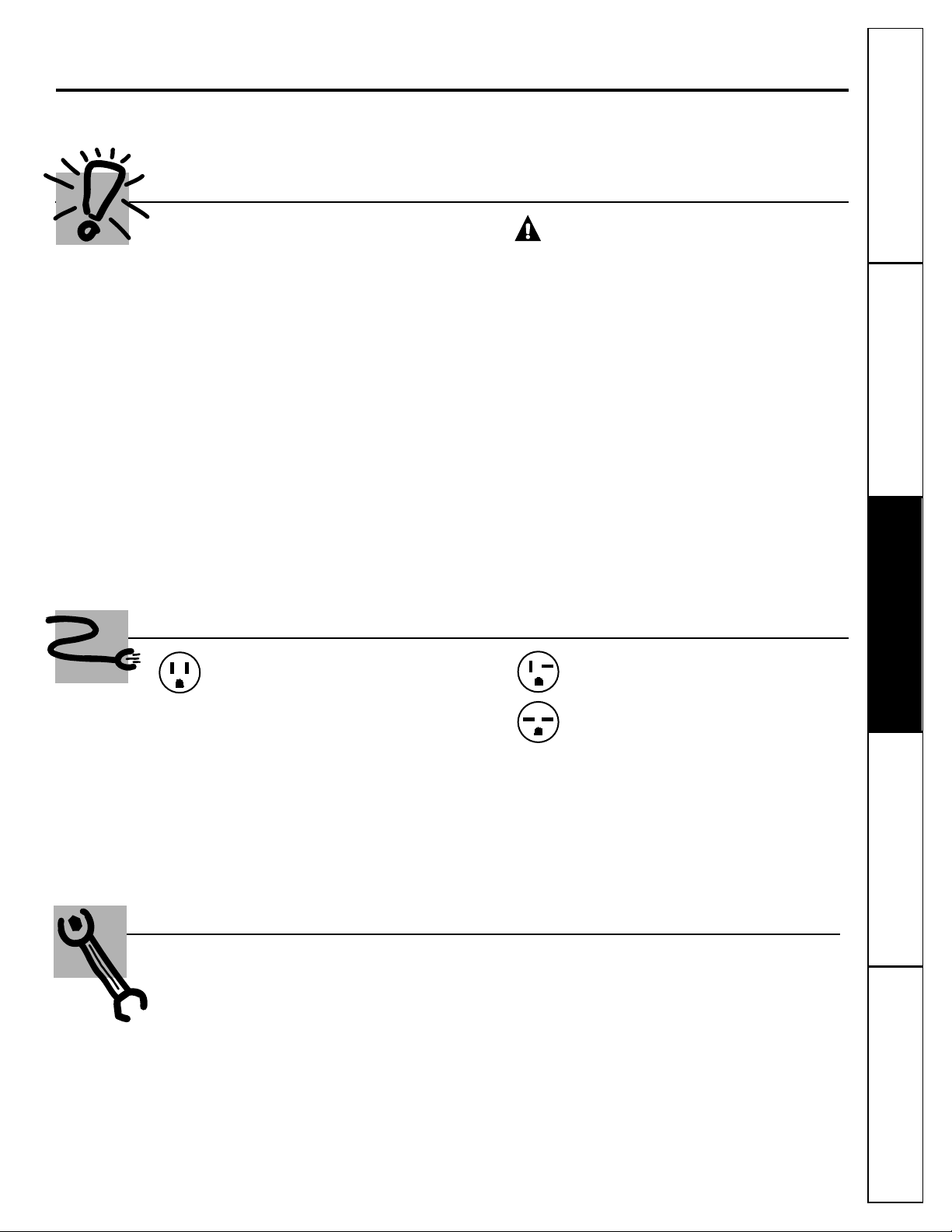
The power cord of this appliance is equipped
with a 3-prong (grounding) plug which mates
with a standard 3-prong (grounding) wall
outlet to minimize the possibility of electric
shock hazard from this appliance.
Have the wall outlet and circuit checked by a
qualified electrician to make sure the outlet is
properly grounded.
Where a 2-prong wall outlet is encountered,
it is your personal responsibility and obligation
to have it replaced with a properly grounded
3-prong wall outlet.
The air conditioner should always be
plugged into its own individual electrical
outlet which has a voltage rating that matches
the rating plate.
This provides the best performance and also
prevents overloading house wiring circuits
which could cause a fire hazard from
overheated wires.
See the Installation Instructions, Electrical
Requirements section for specific electrical
connection requirements.
HOW TO CONNECT ELECTRICITY
Consumer Support
Troubleshooting Tips Operating Instructions Safety InstructionsInstallation Instructions
2
3
Consumer SupportTroubleshooting TipsOperating InstructionsSafety Instructions Installation Instructions
WARNING!
Because of potential safety hazards under certain
conditions, we strongly recommend against the
use of an extension cord.
However, if you must use an extension cord,
it is absolutely necessary that it be a UL-listed,
14 gauge, 3-wire grounding type appliance
extension cord having a grounding type plug
and outlet and that the electrical rating of the
cord be 15 amperes (minimum) and 125 volts.
CAUTION:
DO NOT use an extension cord with any of the
230/208 volt models.
USE OF EXTENSION CORDS—115-Volt models only
Because of potential safety hazards under certain
conditions, we strongly recommend against the
use of an adapter plug.
However, if you must use an adapter, where
local codes permit, a temporary connection may
be made to a properly grounded 2-prong wall
outlet by use of a UL-listed adapter available
at most local hardware stores.
The larger slot in the adapter must be aligned
with the larger slot in the wall outlet to provide
proper polarity in the connection of the
power cord.
When disconnecting the power cord from the
adapter, always hold the adapter in place with
one hand while pulling the power cord plug
with the other hand. If this is not done, the
adapter ground terminal is very likely to break
with repeated use.
If the adapter ground terminal breaks, DO NOT
USE the air conditioner until a proper ground
has been established.
Attaching the adapter ground terminal to a wall outlet
cover screw does not ground the appliance unless the
cover screw is metal, and not insulated, and the wall
outlet is grounded through the house wiring. You should
have the circuit checked by a qualified electrician to
make sure the outlet is properly grounded.
USE OF ADAPTER PLUGS—115-Volt models only
www.GEAppliances.com
SAVE THESE INSTRUCTIONS
READ AND FOLLOW THIS SAFETY INFORMATION CAREFULLY.
4
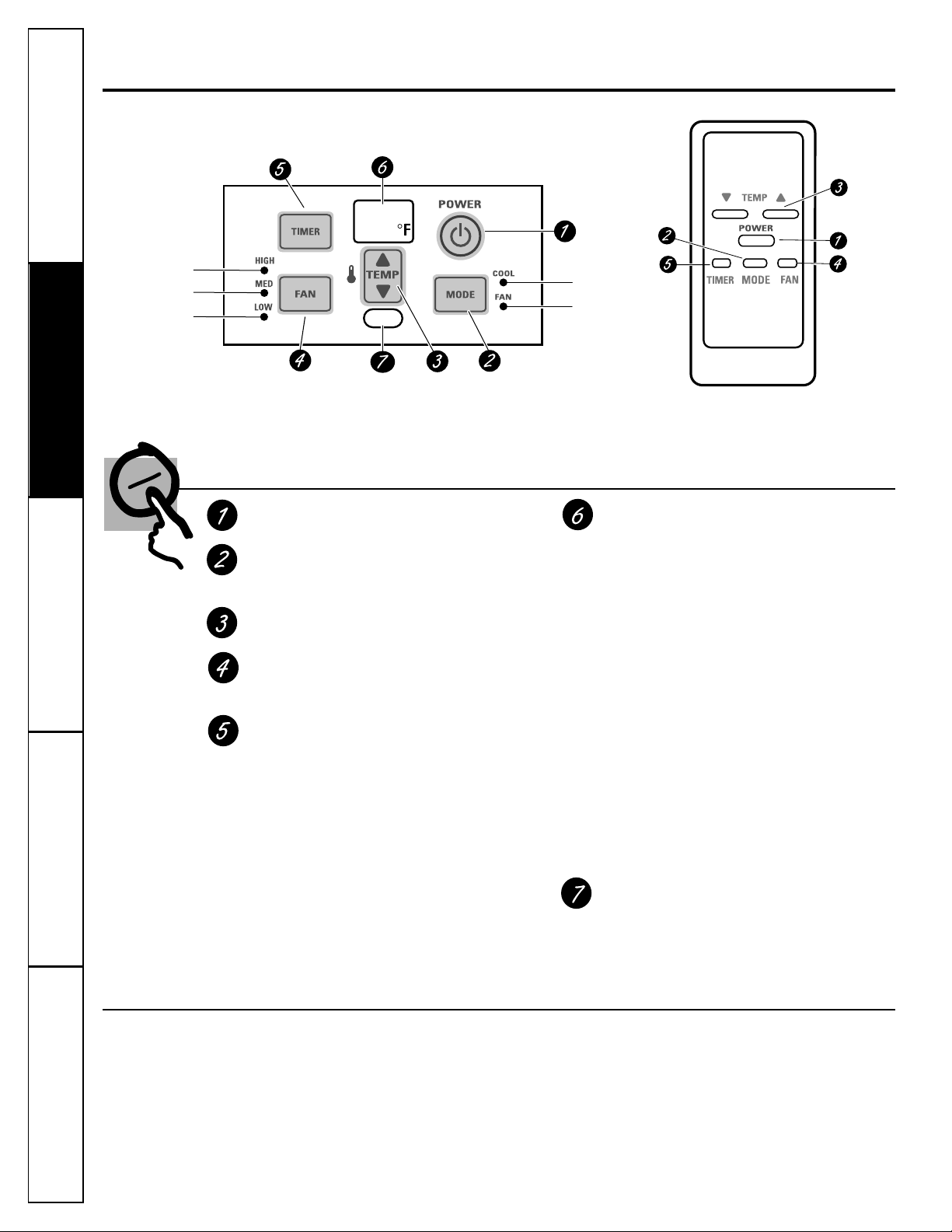
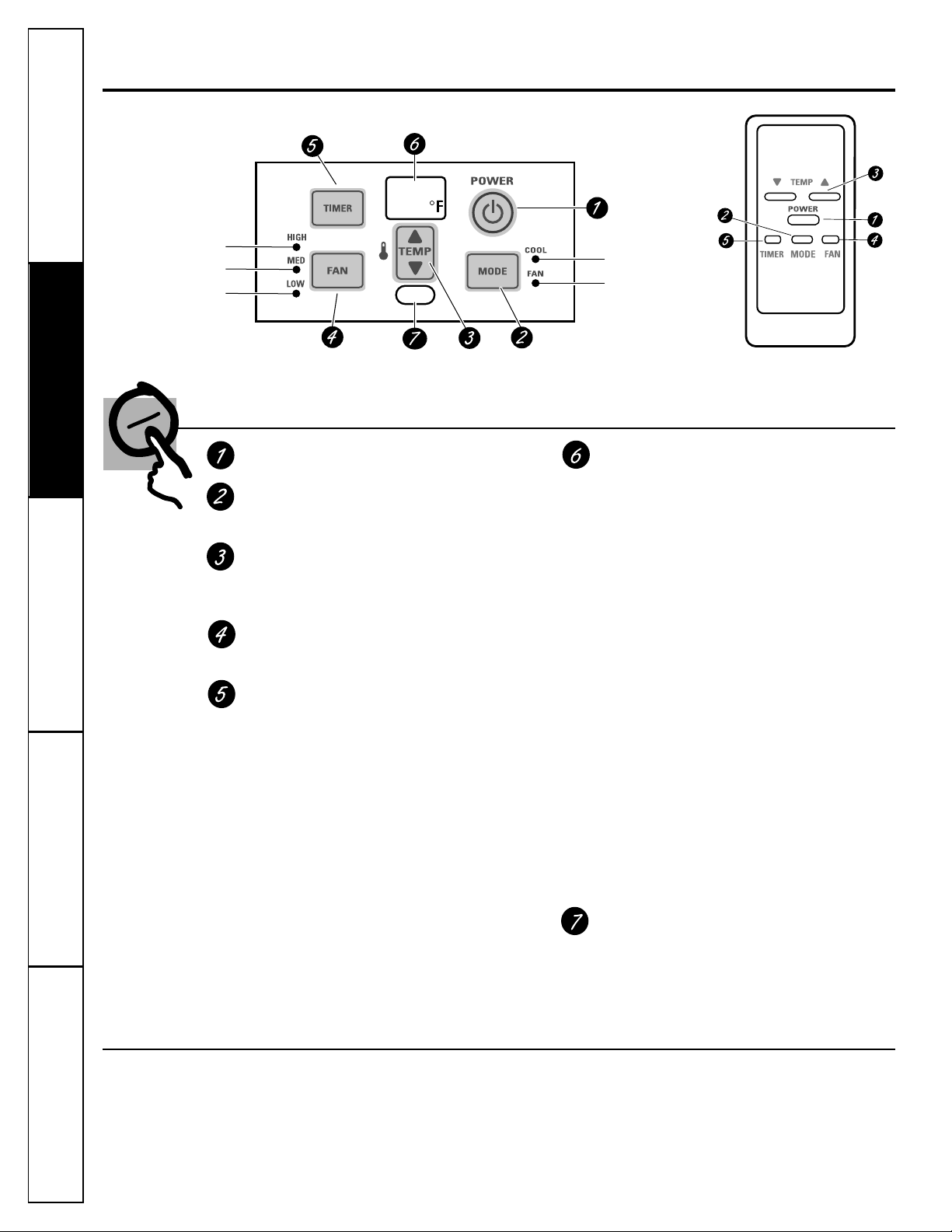
About the controls on the air conditioner—models with touch pads.
Features and appearance will vary.
Consumer Support
Troubleshooting Tips Operating Instructions Safety InstructionsInstallation Instructions
■ To ensure proper operation, aim the remote
control at the signal receiver on the air
conditioner.
■ The remote control signal has a range of
up to 21 feet.
■ Make sure nothing is between the air conditioner
and the remote control that could block the
signal.
■ Make sure batteries are fresh and installed
correctly as indicated on the remote control.
Controls
ON/OFF Pad
Turns air conditioner on and off.
MODE
Use to set the air conditioner to COOL or
FAN mode.
Increase ▲ /Decrease ▼ Pads
Use to set temperature when in COOL mode.
FAN Pad
Use to set the fan speed to LOW, MED
or HIGH.
TIMER Pad
ON—When the air conditioner is off,
it can be set to automatically turn on in
1 to 12 hours at its previous setting. Each
touch will set the timer in hours.
OFF—When the air conditioner is on,
it can be set to automatically turn off in
1 to 12 hours. Each touch will set the timer
in hours.
To cancel the timer, press the TIMER pad
until the display time disappears.
NOTE: All timer settings are automatically
cancelled if the unit is turned on or off after
setting the timer.
Display
Shows the room temperature, set
temperature or the time remaining on the
timer. After setting the controls, the display
will change to show the room temperature.
To recall the set temperature to the display,
press the Increase ▲ / Decrease ▼ pad once.
To recall the time remaining on the timer,
if it was set, press the TIMER pad once.
Display Codes
E1—Automatic filter clean reminder.
Turn the air conditioner OFF and unplug it.
NOTE: The air conditioner must be unplugged
for the automatic filter clean timer to reset.
Clean the filter. See the Care and Cleaning
section. After cleaning, replace the filter
and plug the air conditioner back in.
Er—Room temperature sensor failure.
Call for service.
Remote Control Signal Receiver
Remote Control
Air Conditioner Controls Remote Control
Cool on
Fan on
High fan on
Medium fan on
Low fan on
5
Consumer SupportTroubleshooting TipsOperating InstructionsSafety Instructions Installation Instructions
www.GEAppliances.com
When the air conditioner is turned on, it will
automatically start in the setting last used,
except the timer will be cancelled if it was set.
Lights in the display or beside the touch pads
on the air conditioner control panel indicate the
selected settings.
Use the COOL mode with HIGH, MED or LOW fan
for cooling. Use the Increase ▲ / Decrease ▼ pads
to set the desired temperature between 60°F and
90°F in 2°F increments (or between 16°C and
31°C in 1°C increments if the control has been
set to use Celsius).
A thermostat is used to maintain the room
temperature. The compressor will cycle on and off
to keep the room at the set level of comfort. Set the
thermostat at a lower number and the indoor air
will become cooler. Set the thermostat at a higher
number and the indoor air will become warmer.
NOTE: If the air conditioner is off and is then turned on while
set to COOL, it will take approximately 3 minutes for the
compressor to start and cooling to begin.
Cooling Descriptions
For Normal Cooling—Select the COOL mode and
HIGH or MED fan with a middle set temperature.
For Maximum Cooling—Select the COOL mode
and HIGH fan with a lower set temperature.
For Quieter & Nighttime Cooling—Select the
COOL mode and LOW fan with a middle set
temperature.
NOTE: If you switch from a COOL setting to OFF or to
a fan setting, wait at least 3 minutes before switching back
to a COOL setting.
COOL Mode
Use the FAN at HIGH, MED or LOW to provide
air circulation and filtering without cooling.
Since fan only settings do not provide cooling,
a temperature setting will not be displayed.
Your control is set to use and display Fahrenheit temperature
selections, but you may change it to use and display Celsius
selections.
Press and hold the Increase ▲ / Decrease ▼ pads
at the same time to switch to ˚C or ˚F as desired.
FAN Mode Fahrenheit or Celsius
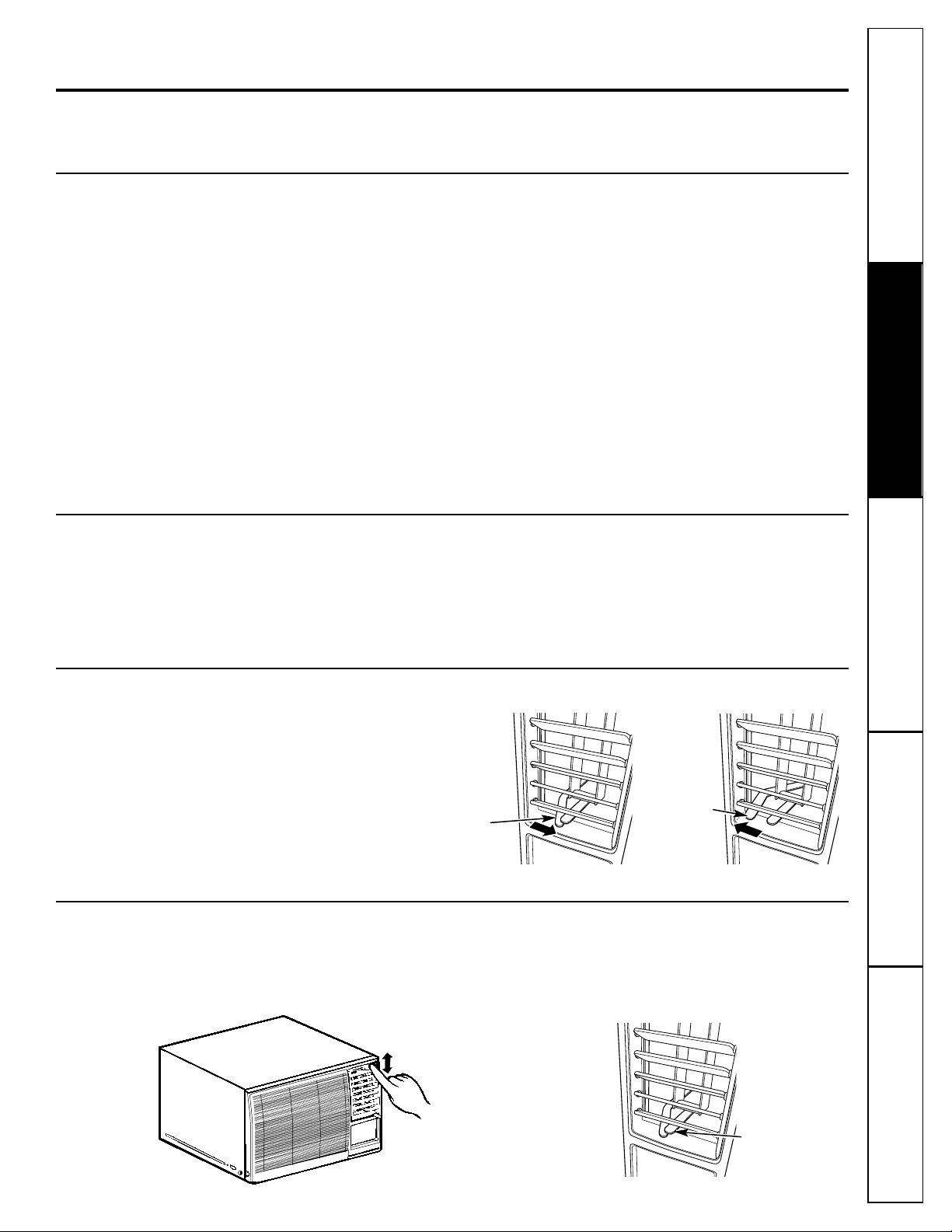
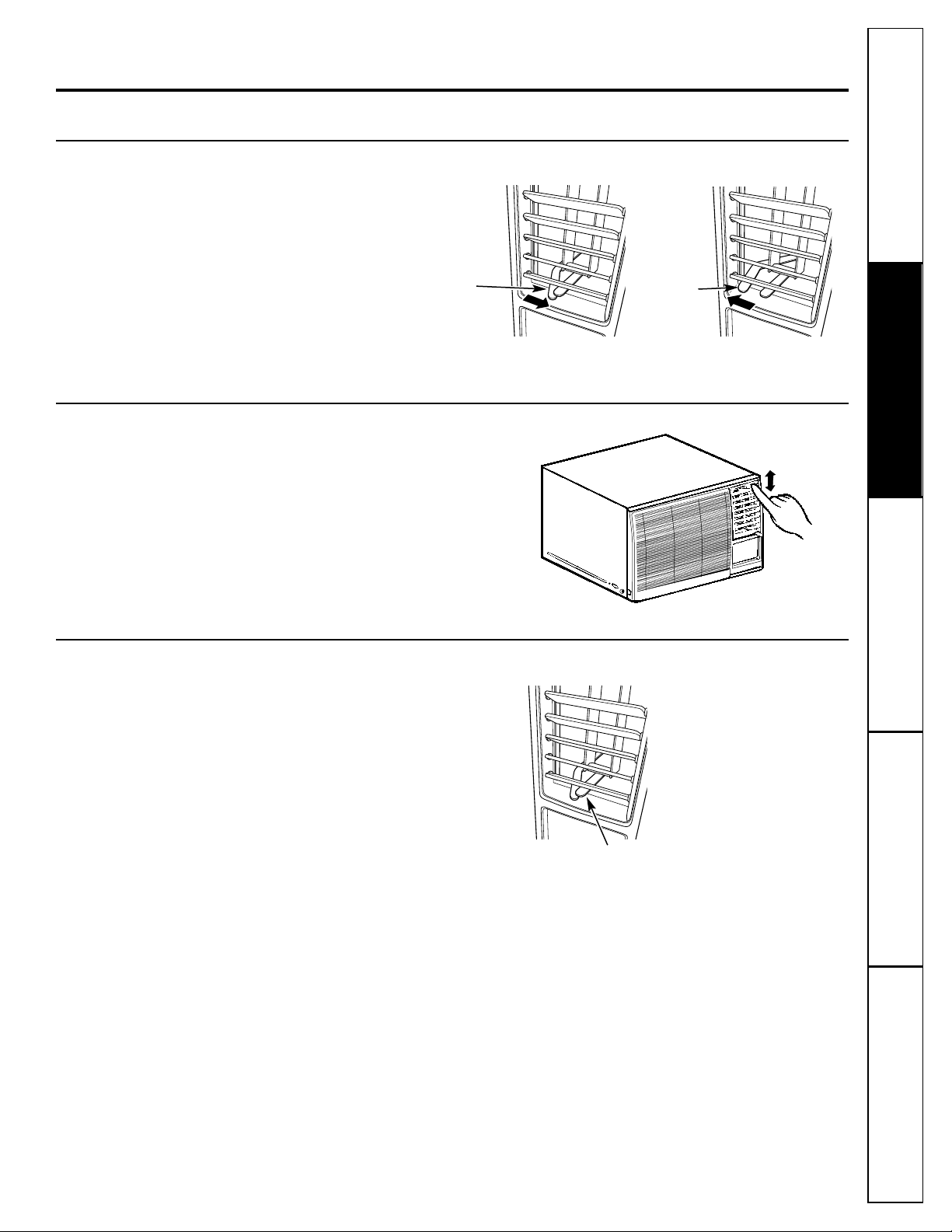
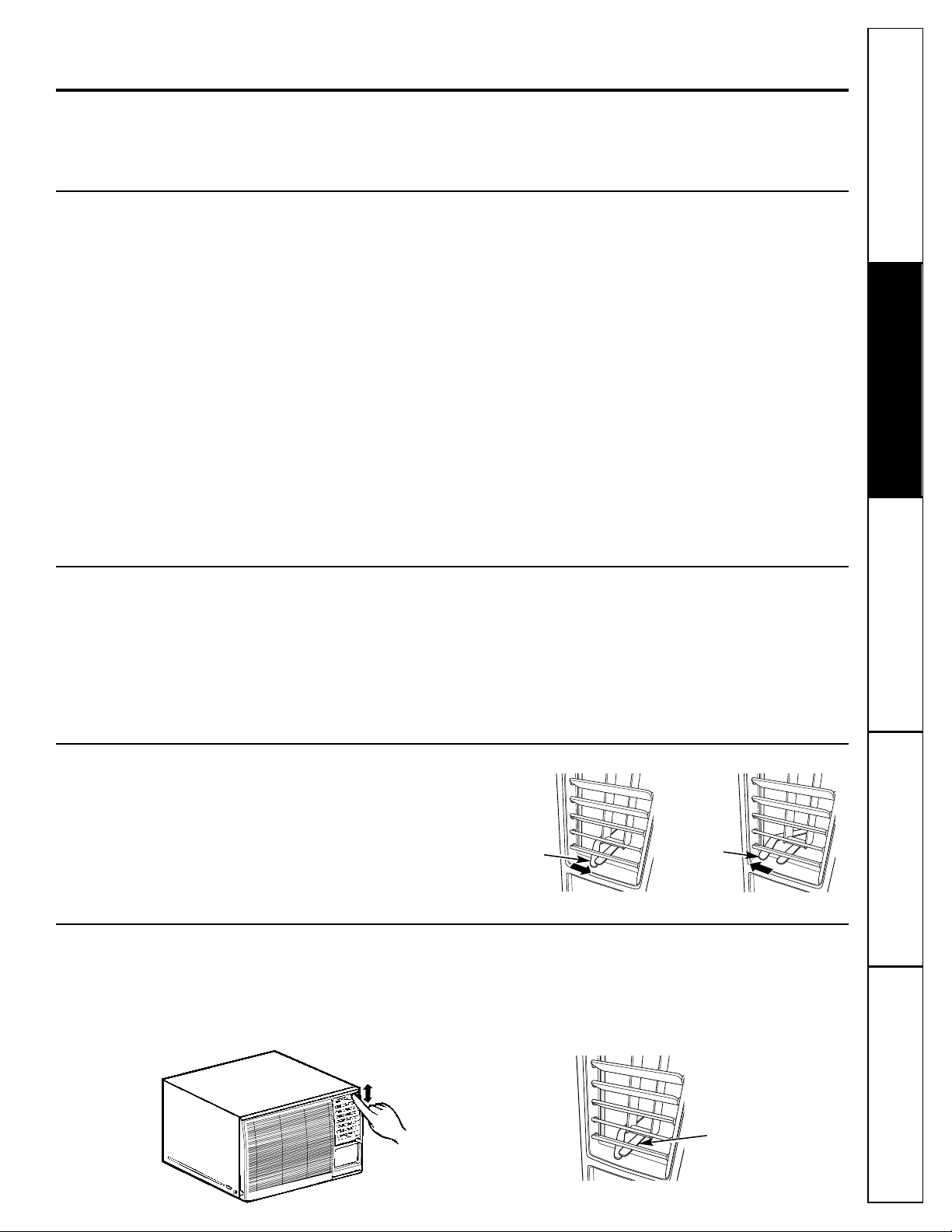
The vent control is located on the inside of the
air louvers at the bottom of the vent.
When set at CLOSE, only the air inside the room
will be circulated and conditioned. When set at
OPEN, some inside air is exhausted outside.
Vent Control
Up and Down
Fingertip pressure on the horizontal louvers
adjusts the air direction up or down.
Side-to-Side
The side-to-side air direction is adjusted by moving
the air direction lever to the left or right.
Air Direction
To open the vent.
To close the vent.
Vent control
lever
Vent control
lever
Air direction
lever
6
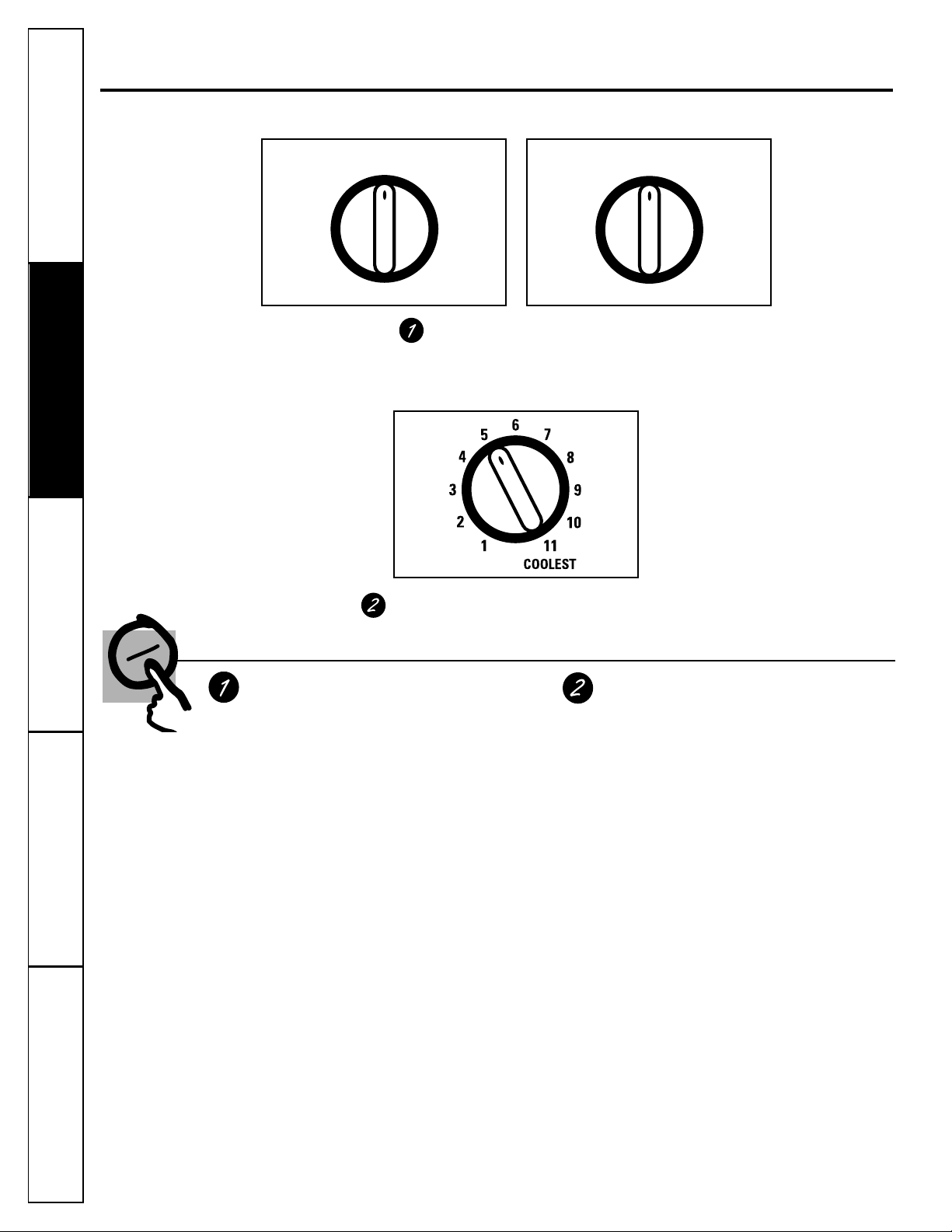
About the controls on the air conditioner—models with control knobs.
Features and appearance will vary.
Consumer Support
Troubleshooting Tips Operating Instructions Safety InstructionsInstallation Instructions
Controls
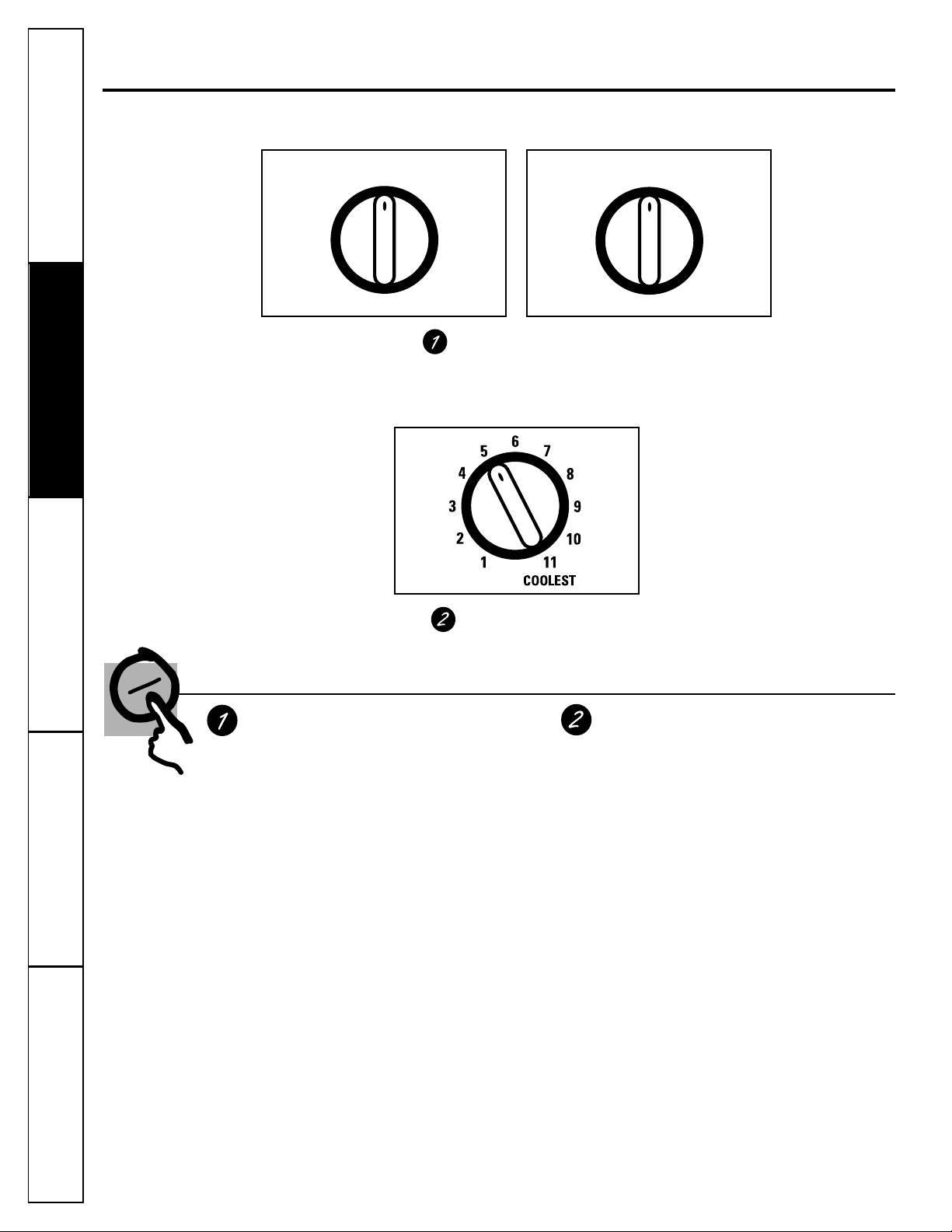
Mode Controls
HIGH COOL, MED COOL and LOW COOL provide
cooling with different fan speeds.
COOL provides cooling with a fixed fan speed.
LOW FAN, HIGH FAN or FAN provides air
circulation and filtering without cooling.
NOTE: If you move the switch from a cool setting to
OFF or to a fan setting, wait at least 3 minutes before
switching back to a cool setting.
Cooling Descriptions
For Normal Cooling—Select HIGH COOL or
MED COOL with the temp control at midpoint.
For Maximum Cooling—Select HIGH COOL with
the temp control at the highest number
available on your knob.
For Quieter and Nighttime Cooling—Select
LOW COOL with the temp control at midpoint.
Temp Controls
The temp control is used to maintain the
room temperature. The compressor will cycle
on and off to keep the room at the same
level of comfort. When you turn the knob to
a higher number, the indoor air will become
cooler. Turn the knob to a lower number and
the indoor air will become warmer.
TEMP CONTROL
MODE CONTROLS
Your model will have one of the above type controls.
OFF
LOW
FAN
LOW
COOL
HIGH
FAN
HIGH
COOL
MED
COOL
OFF
FANCOOL
7
Consumer SupportTroubleshooting TipsOperating InstructionsSafety Instructions Installation Instructions
www.GEAppliances.com
Additional controls and important information.
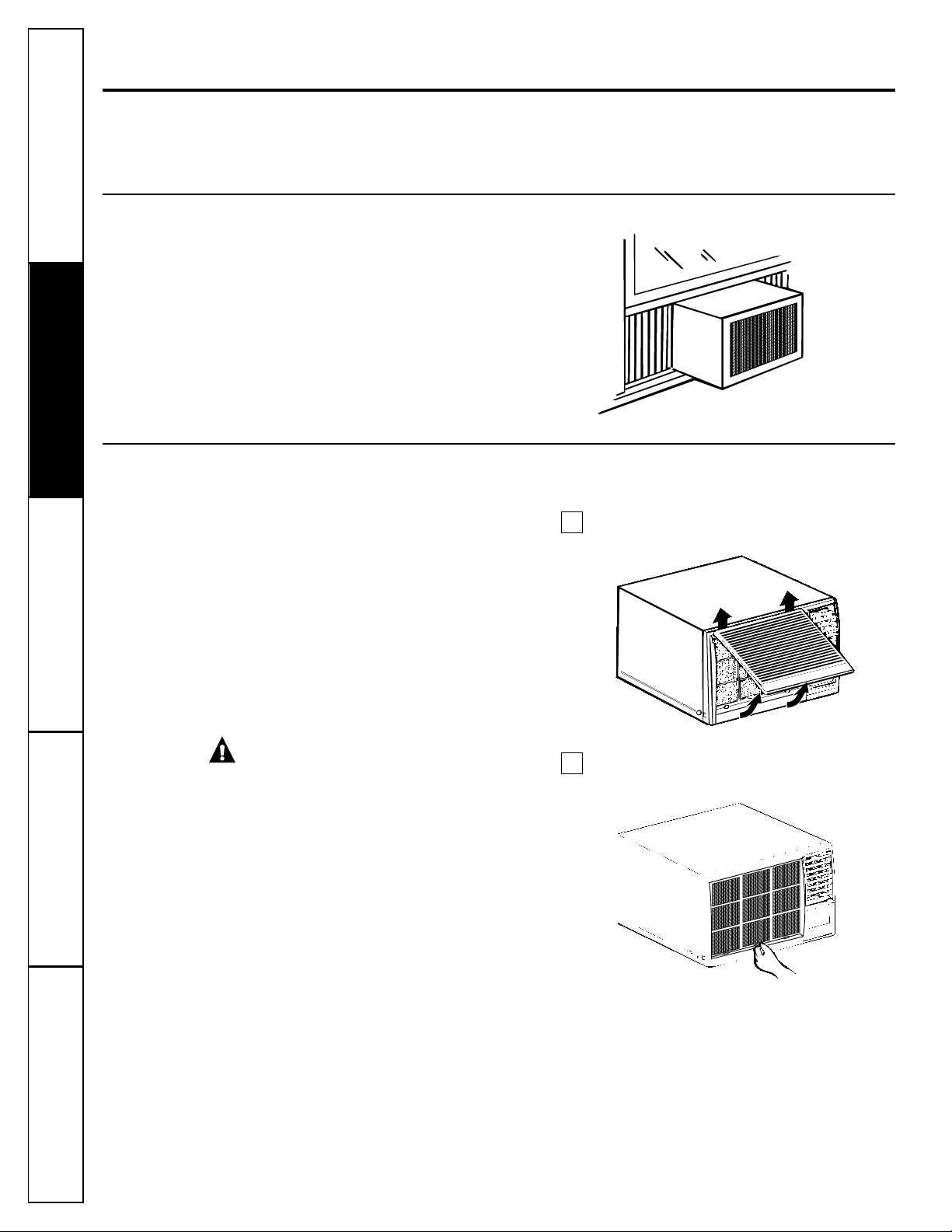
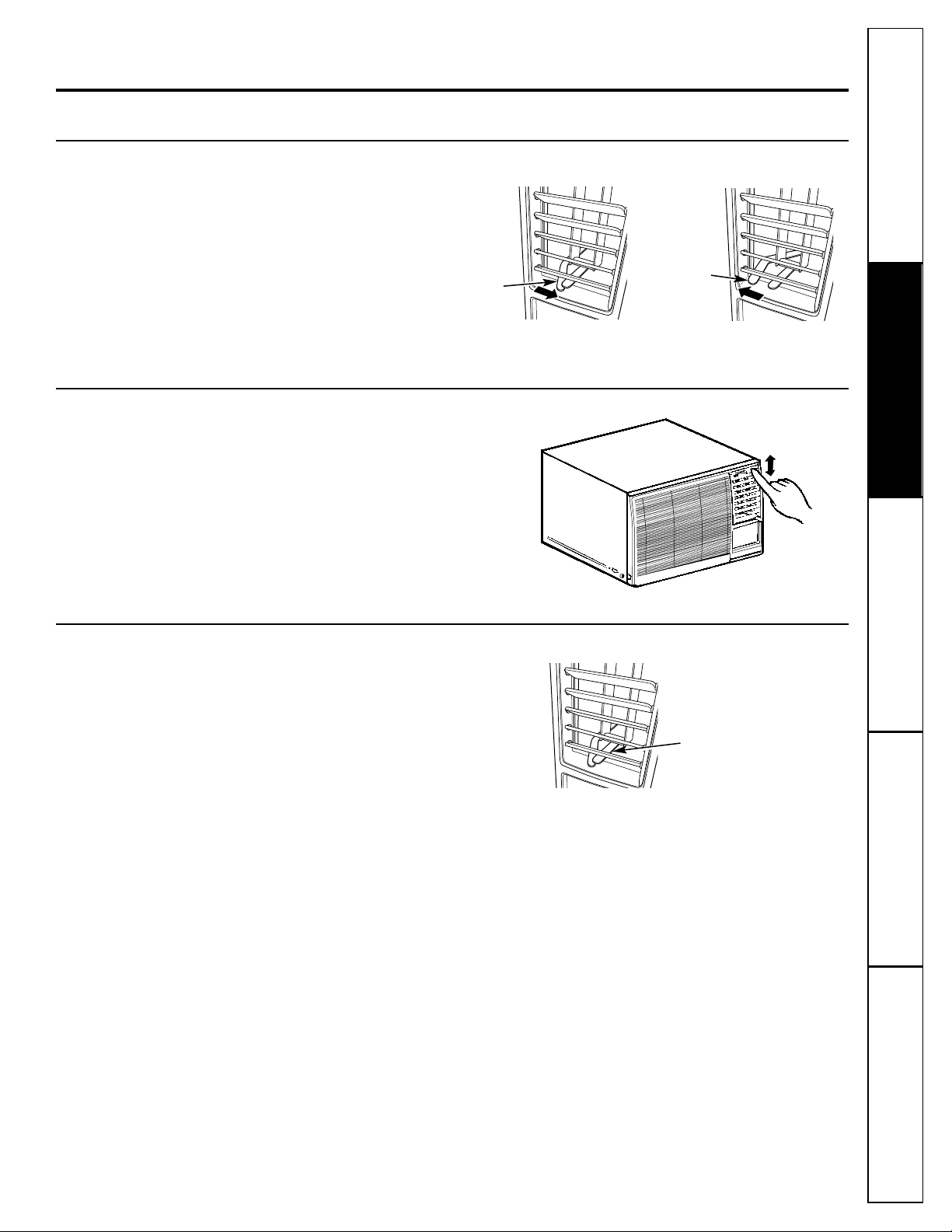
The vent control is located on the inside of the
air louvers at the bottom of the vent.
When set at CLOSE, only the air inside the room
will be circulated and conditioned. When set
at OPEN, some inside air is exhausted
outside.
Vent Control
Fingertip pressure on the horizontal louvers adjusts
the air direction up or down.
Air Direction—Up and Down
The side-to-side air direction is adjusted by moving
the air direction lever to the left or right.
Air Direction—Side-to-Side
To open the vent. To close the vent.
Vent control
lever
Vent control
lever
Air direction
lever
8
Consumer Support
Troubleshooting Tips Operating Instructions Safety InstructionsInstallation Instructions
Care and cleaning of the air conditioner.
Turn the air conditioner off and remove the plug
from the wall outlet before cleaning.
To clean, use water and a mild detergent. Do not
use bleach or abrasives.
Grille and Case
The coils on the outdoor side of the air conditioner
should be checked regularly. If they are clogged
with dirt or soot, they may be professionally steam
cleaned, a service available through your GE
service outlet.
Outdoor Coils
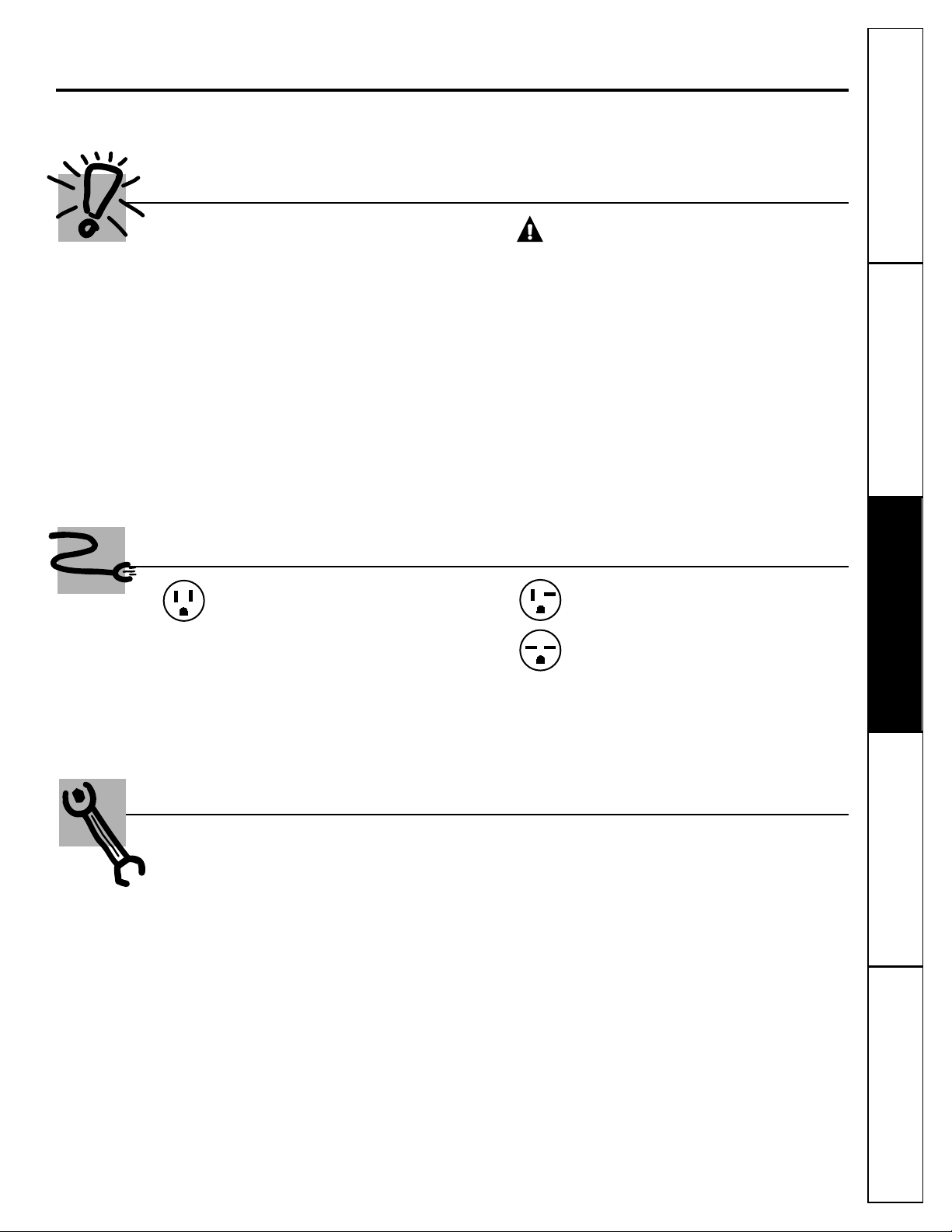
The air filter behind the front grille should be
checked and cleaned at least every 30 days or
more often if necessary.
E1 in the display (on models with touch pads)
is an automatic filter clean reminder. Turn the
air conditioner OFF and unplug it.
NOTE: The air conditioner must be unplugged for the
automatic filter clean timer to reset.
Clean the filter with warm, soapy water. Rinse and
let the filter dry before replacing it.
NOTE: DO NOT rinse, or put the filter in an automatic
dishwasher.
CAUTION: DO NOT operate the air
conditioner without a filter because dirt and lint will clog it
and reduce performance.
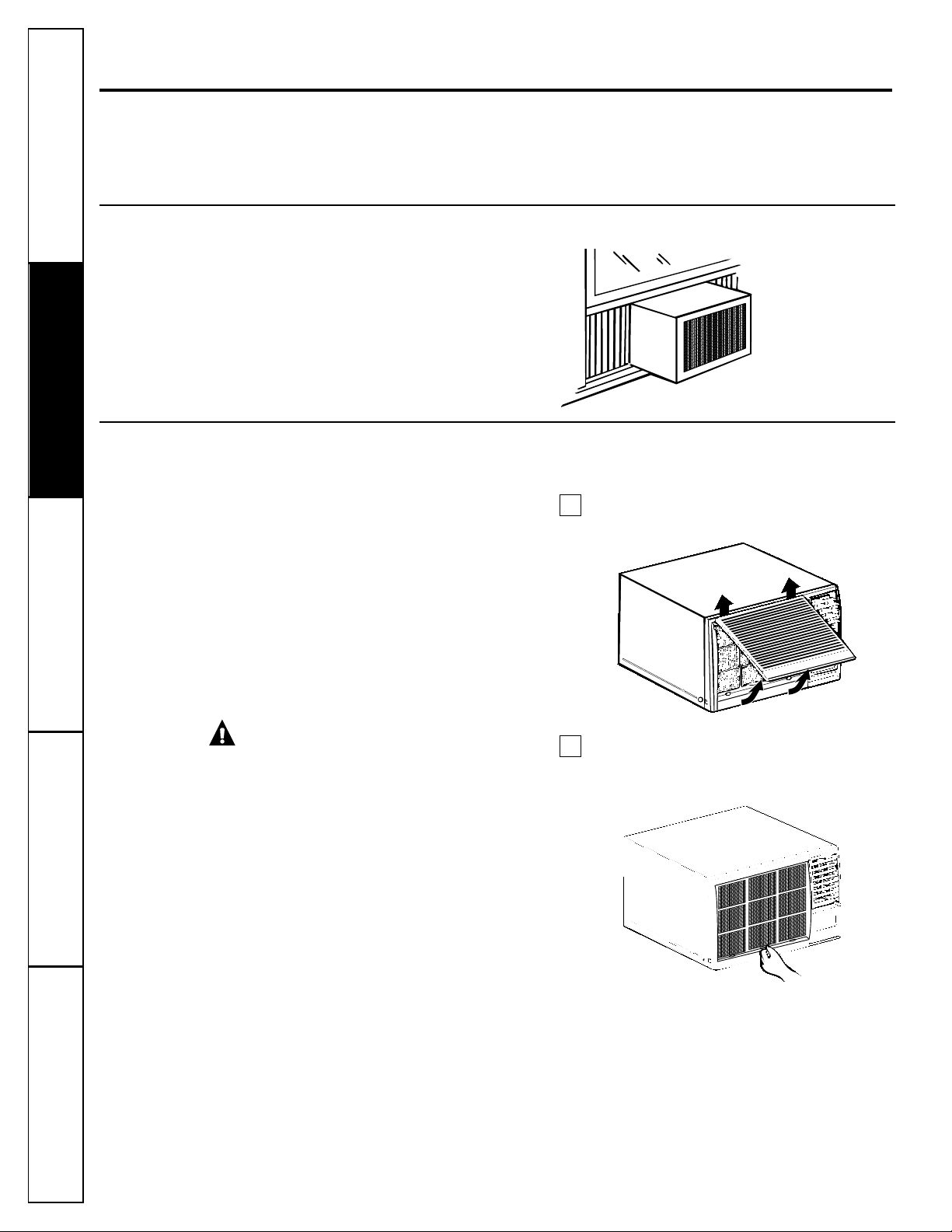
To remove:
Pull to unlatch the lower corners of the inlet
grille and lift it up and off.
Using the tab, pull up slightly on the filter to
release it and pull it down to remove.
2
1
Air Filter
Consumer SupportTroubleshooting TipsOperating InstructionsSafety Instructions Installation Instructions
9
Preparing to install the air conditioner.
Read these instructions completely and carefully.
NOTE TO INSTALLER: Leave these instructions with
the air conditioner after installation is completed.
NOTE TO CONSUMER: Keep this Owner’s Manual
and Installation Instructions for future use.
IMPORTANT NOTES:
For personal safety, this air conditioner must be
properly grounded.
It is important to have the wall outlet and circuit
checked by a qualified electrician if there is any
doubt as to whether a proper ground exists.
Follow National Electrical Codes (NEC) and/or local
codes and ordinances.
CAUTION:
Do not, under any circumstances, cut or remove
the third (ground) prong from the power cord.
Do not change the plug on the power cord of this
air conditioner.
Aluminum house wiring may present special
problems
—
consult a qualified electrician.
Before You Begin
Some models require 115/120-volt a.c.,
60 Hz grounded outlet protected with a
15-amp time delay fuse or circuit breaker.
The 3-prong grounding plug minimizes the
possibility of electric shock hazard. If the wall outlet
you plan to use is only a 2-prong outlet, it is your
responsibility to have it replaced with a properly
grounded 3-prong wall outlet.
Some models require 230/208-volt a.c.,
protected with a time delay fuse or circuit
breaker. These models should be installed
on their own single branch circuit for best
performance and to prevent overloading
house or apartment wiring circuits, which
could cause a possible fire hazard from
overheating wires.
Electrical Requirements
■ Phillips-head screwdriver
■ Adjustable wrench
■ Ruler or tape measure
■ Drill
■ Scissors or knife
■ Pencil
■ Level
Tools You Will Need
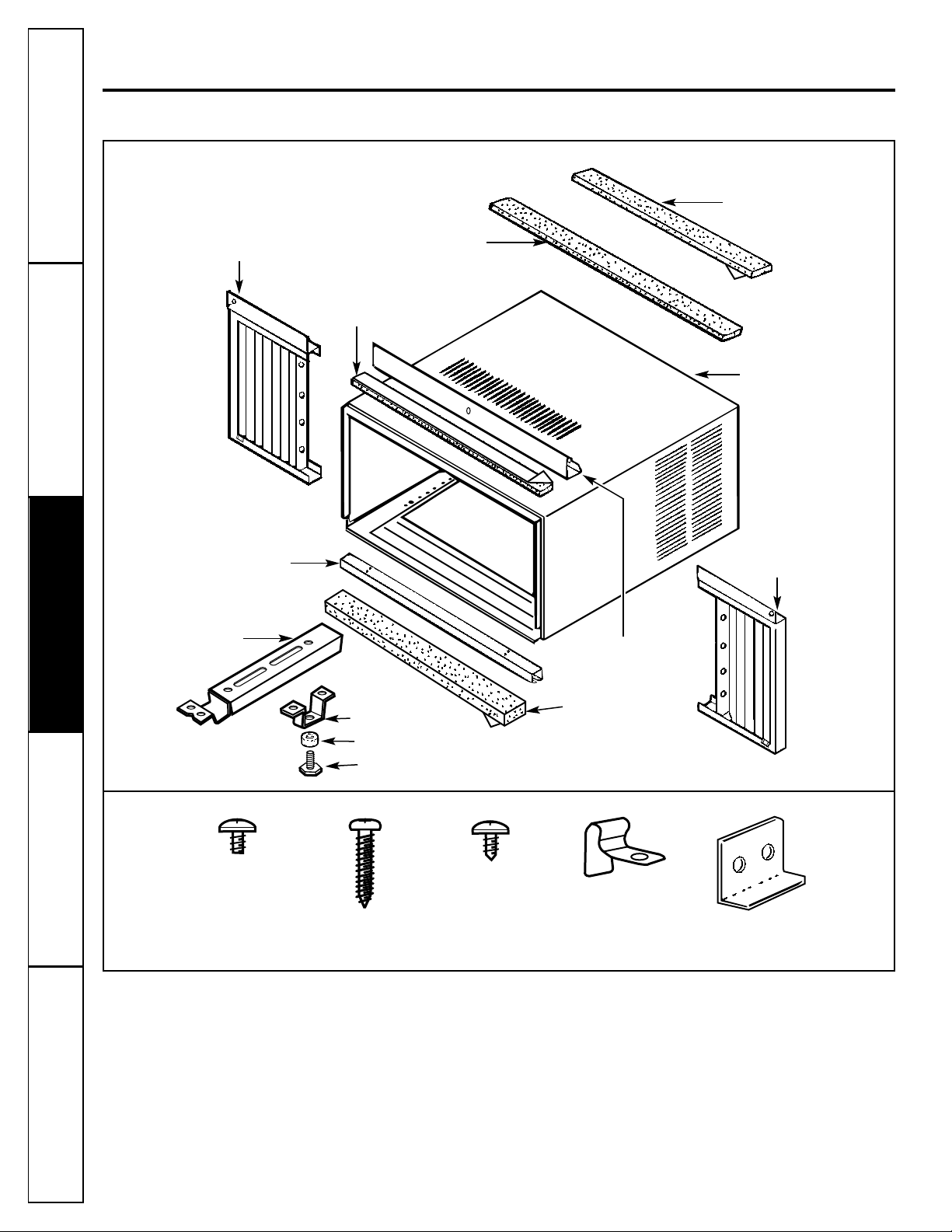
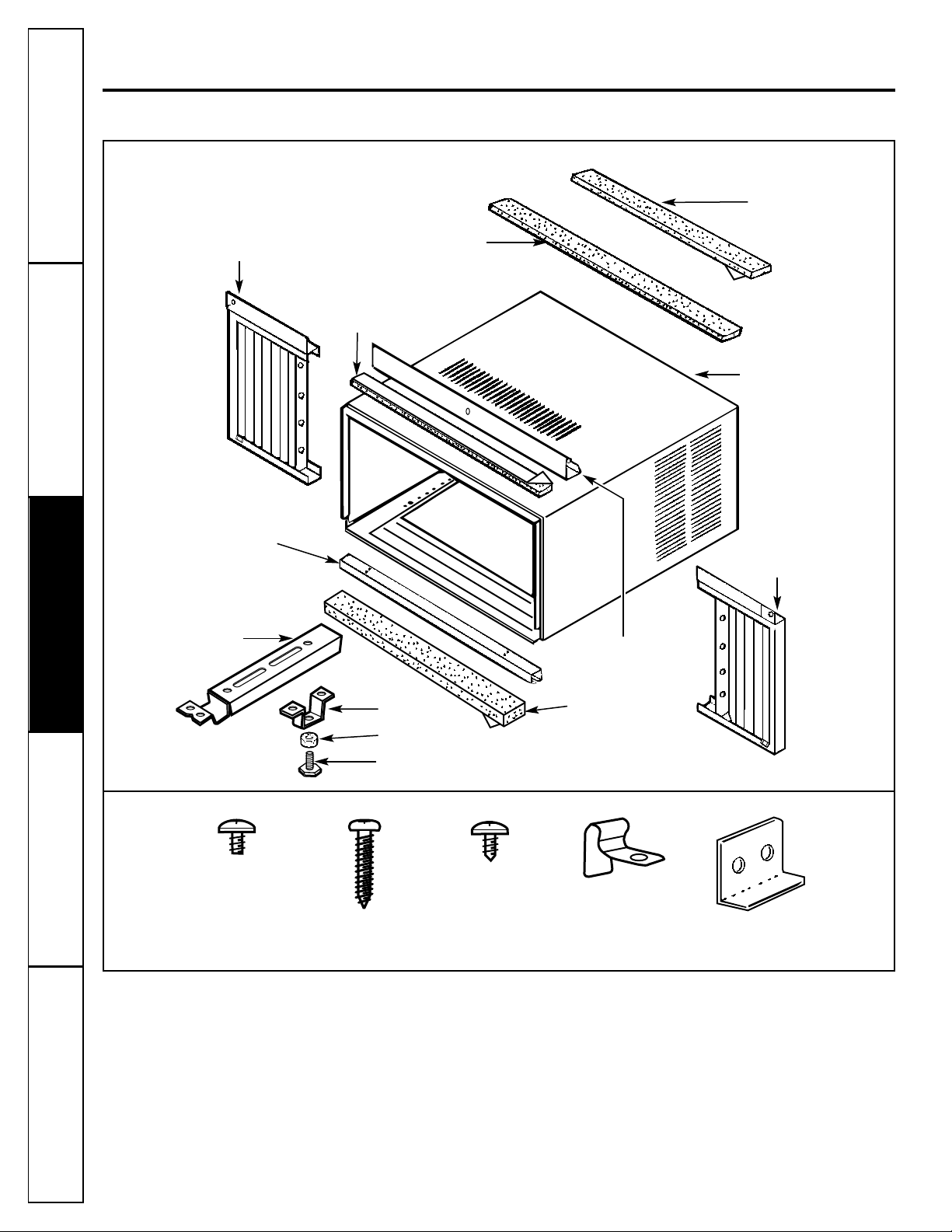
Type A (17)
Support bracket (2)
Right
accordion
panel
Foam top
window gasket
Window sash seal
(thin, adhesive-backed)
Left
accordion
panel
Type B (11) Type C (6) Accordion panel
clamp (2)
10
Consumer Support
Troubleshooting Tips Operating Instructions Safety InstructionsInstallation Instructions
Window installation instructions.
Parts Included
Leveling bolt (2)
Nut (2)
Support rail (2)
Top mounting rail
seal strip
Bottom
mounting rail
Air conditioner case
Top mounting rail
Window locking
bracket
Window stool
seal (thick,
adhesive-backed)
Consumer SupportTroubleshooting TipsOperating InstructionsSafety Instructions Installation Instructions
11
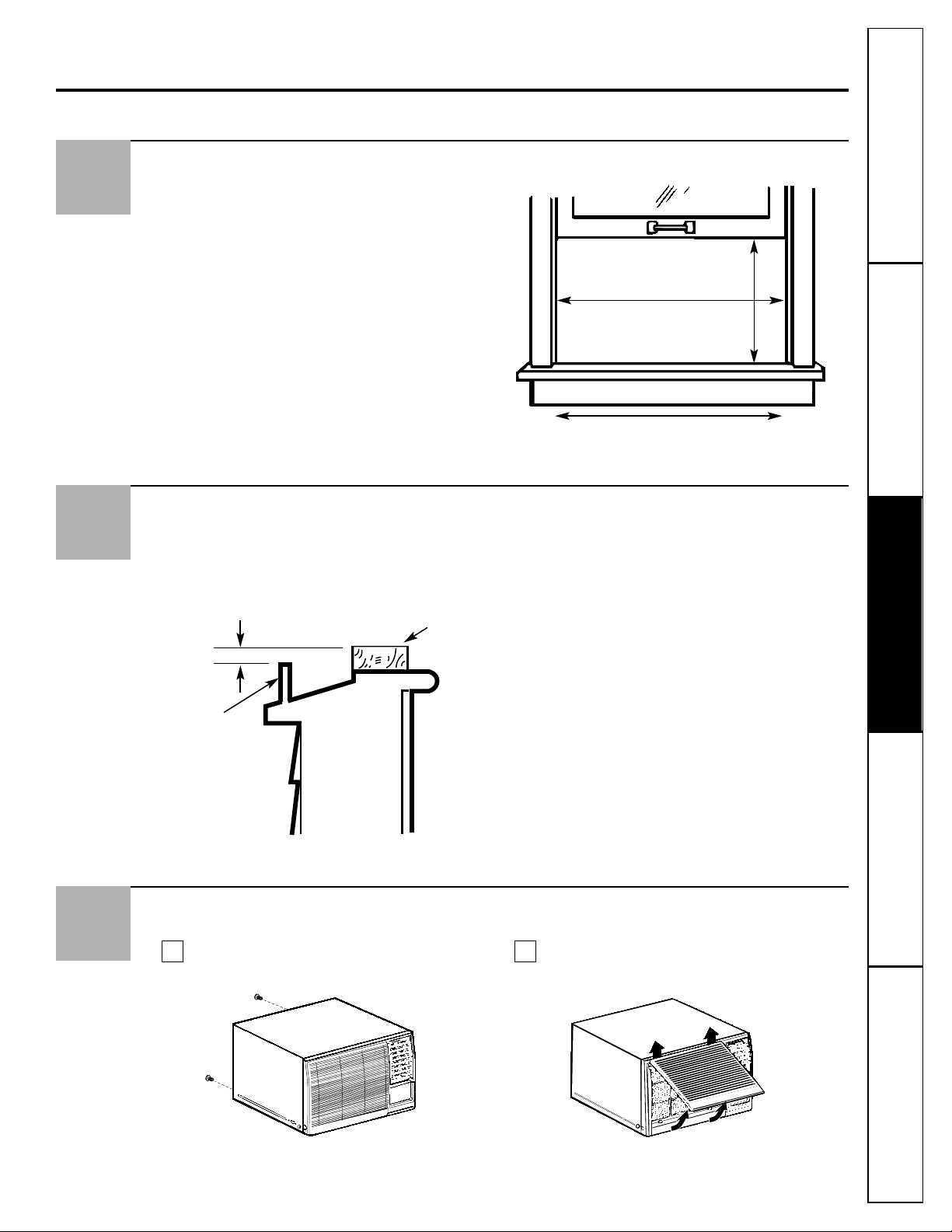
Read completely, then follow step-by-step.
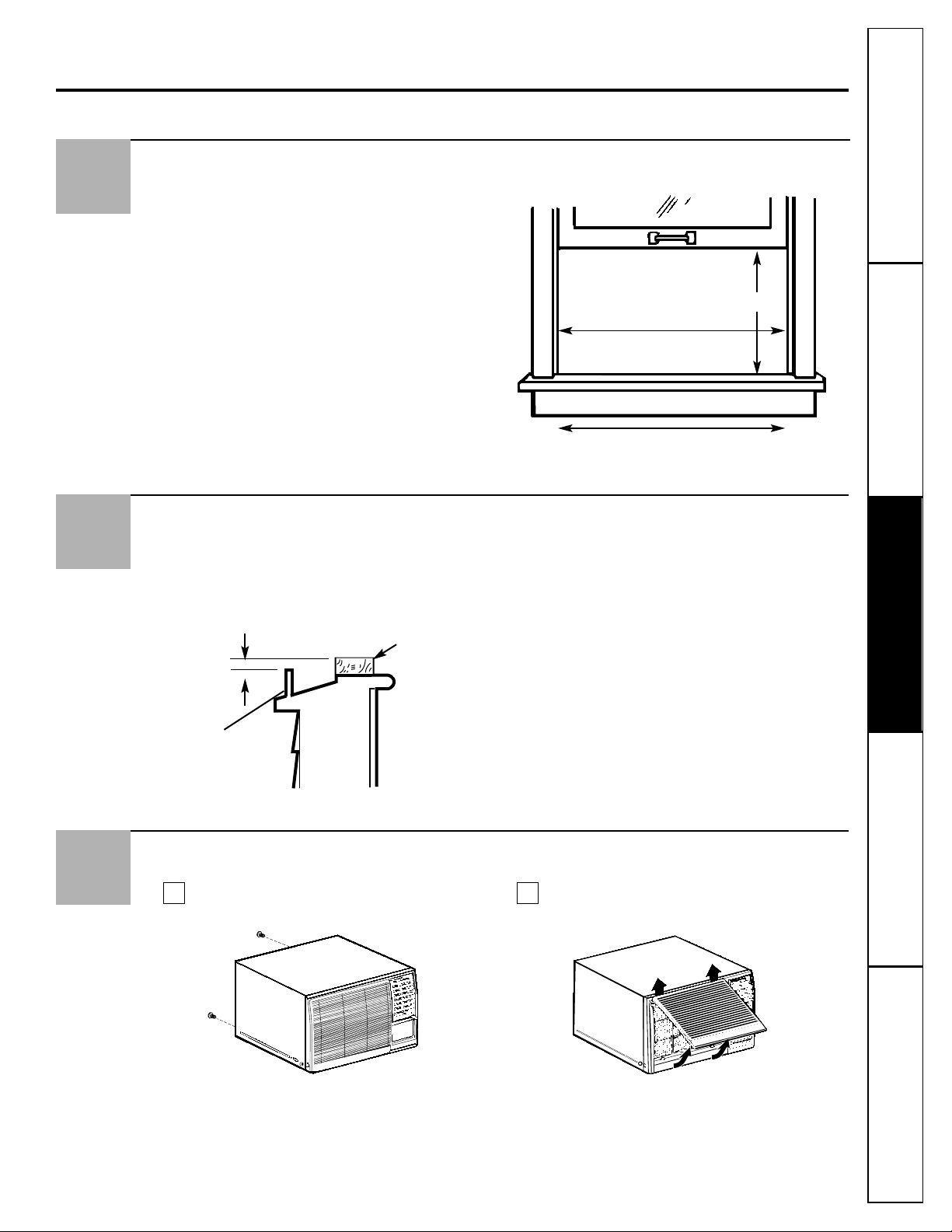
Window Requirements
■ These instructions are for a standard double-
hung window. You will need to modify them for
other types of windows.
■ The air conditioner can be installed without
the accordion panels if needed to fit in a narrow
window. See the window opening dimensions.
■ All supporting parts must be secured to firm
wood, masonry or metal.
■ The electrical outlet must be within reach of the
power cord.
1
15″ min.
21-3/4″ to 35-1/4″
(With accordion panels)
18″ min.
(Without accordion panels)
Storm Window Requirements
A storm window frame will not allow the air
conditioner to tilt towards the outside and
will keep it from draining properly. To adjust
for this, attach a piece of wood to the stool.
WOOD PIECES
—
WIDTH: 2″
LENGTH: Long enough to fit inside the window
frame.
THICKNESS: To determine the thickness, place a
piece of wood on the stool to make it 1/2″ higher
than the top of the storm window frame.
Attach securely with nails or screws provided by
the installer.
2
1/2″ higher
than frame
Storm window
frame
Wood
Stool
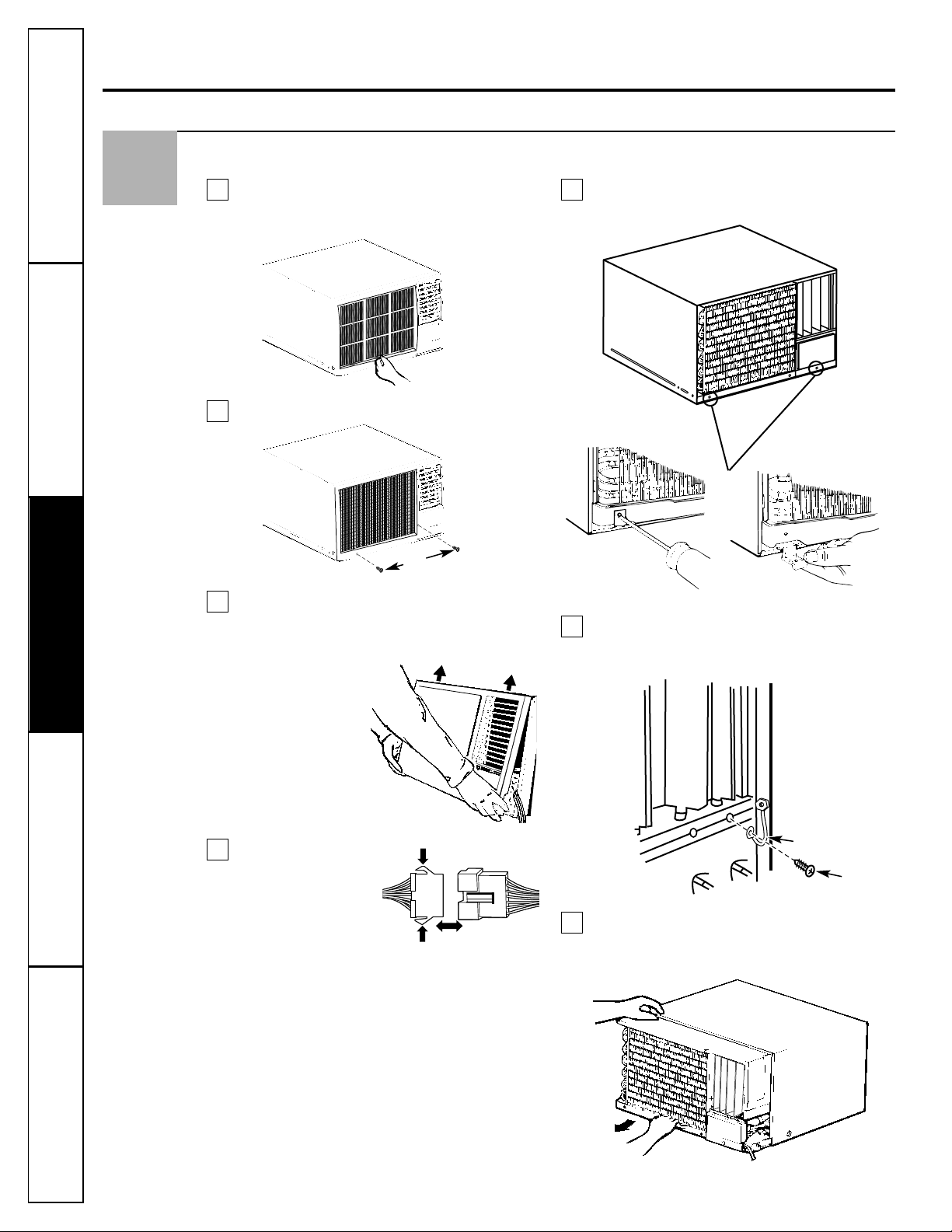
Remove the Air Conditioner From the Case
3
Remove and discard the 2 shipping screws
from the bottom rear of the case.
Pull to unlatch the lower corners of the inlet
grille and lift it up and off.
BA
12
Consumer Support
Troubleshooting Tips Operating Instructions Safety InstructionsInstallation Instructions
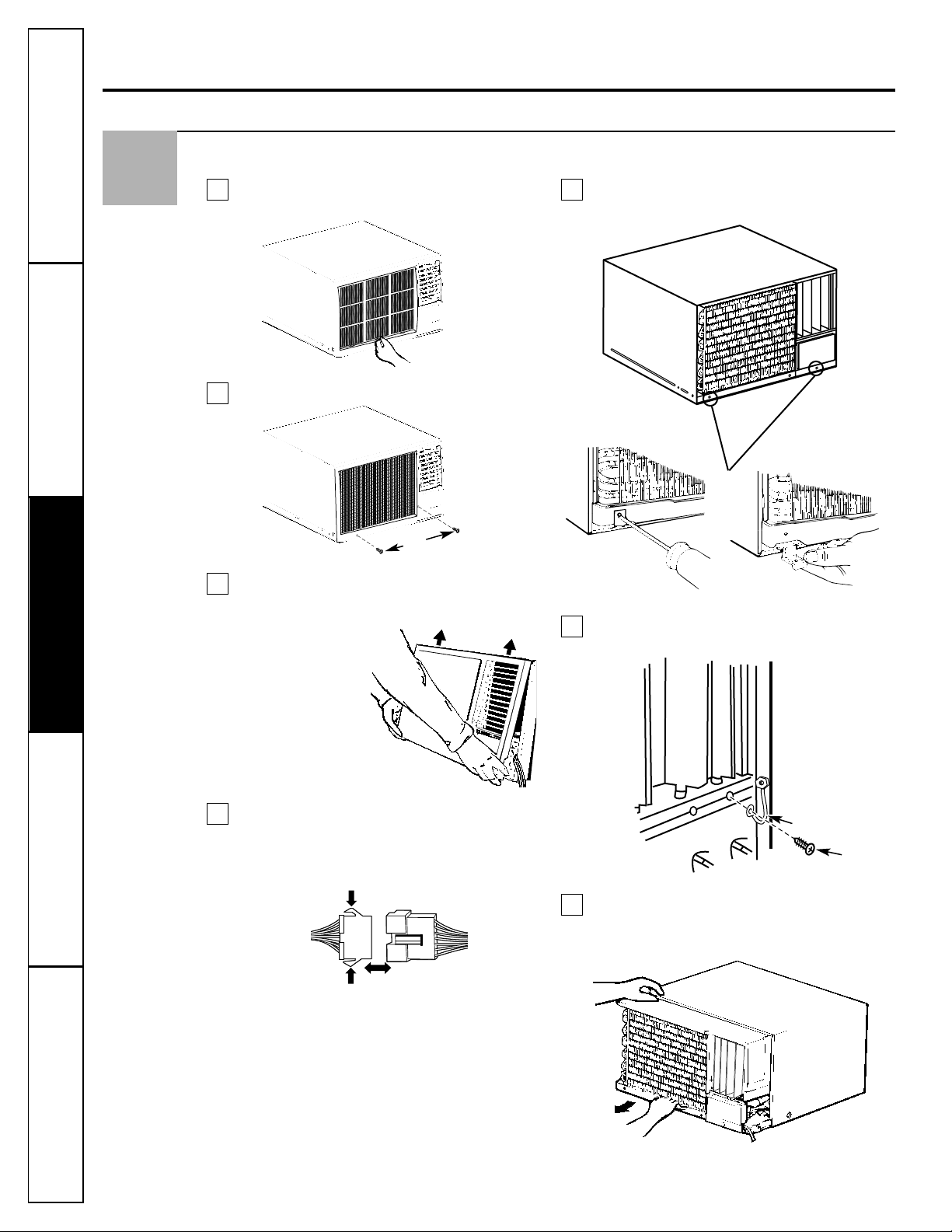
Remove the Air Conditioner From the Case (cont.)
Using the tab, pull up slightly on the filter
to release it and pull it down to remove.
Remove the two grille frame screws.
Grasp the lower corners of the grille frame
while pressing in on the case sides with your
finger tips. Pull out to release and lift it up.
NOTE: Do not pull the
bottom edge toward
you more than 3 ″ or
you may damage the
tabs of the grille.
On some models, you must also disconnect
the control connectors before the grille frame
can be removed. Press the locking tabs in
while pulling on the other side to release.
Remove the two locking screws and locking
brackets from the lower front of the unit.
Remove the screw securing the ground wire
to the right side face of the unit.
Slide the air conditioner from the case by
gripping the base pan handle and pulling
forward while bracing the case.
I
H
G
F
E
D
C
3
Window installation instructions.
Screw
Ground wire
Press in
Pull
Press in
Grille frame screws
Consumer SupportTroubleshooting TipsOperating InstructionsSafety Instructions Installation Instructions
13
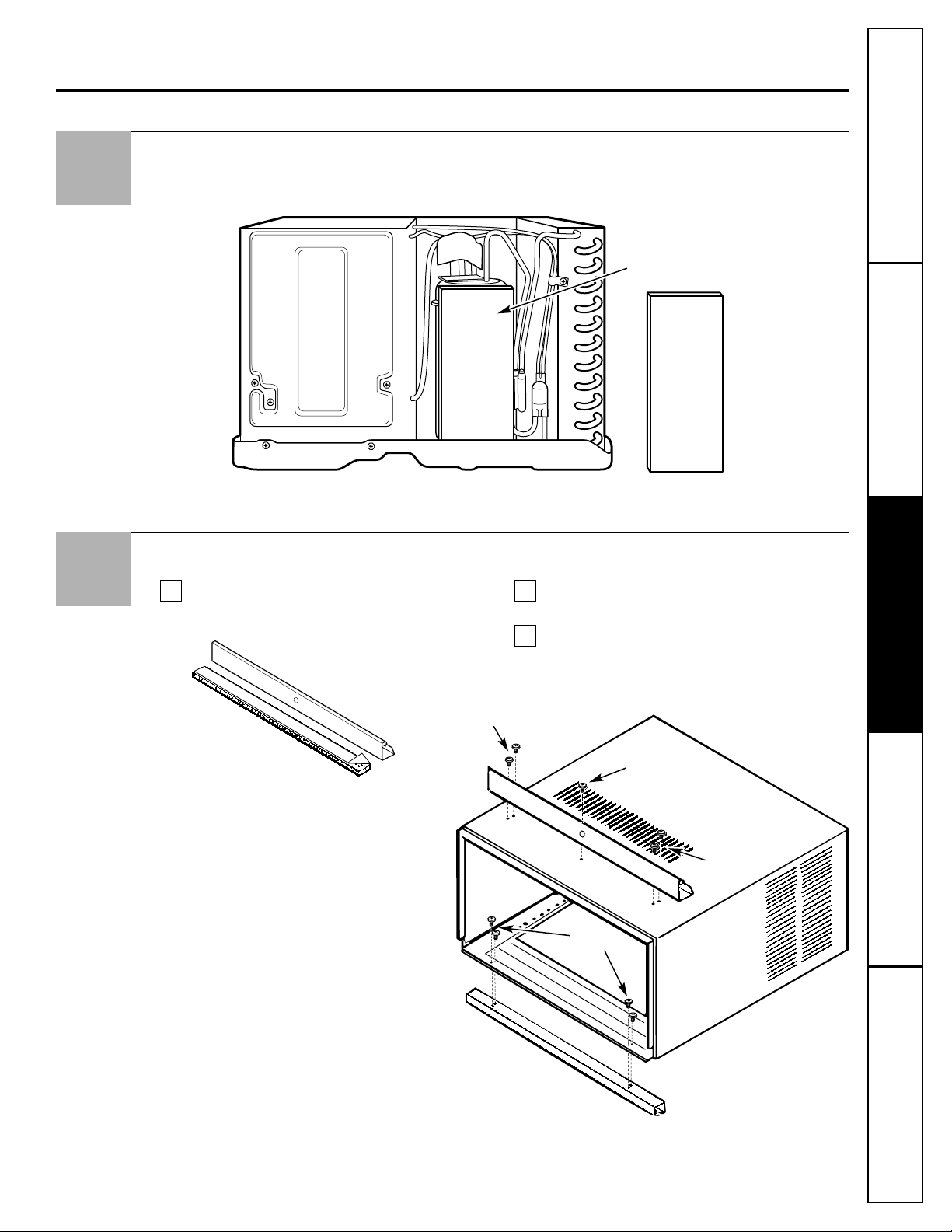
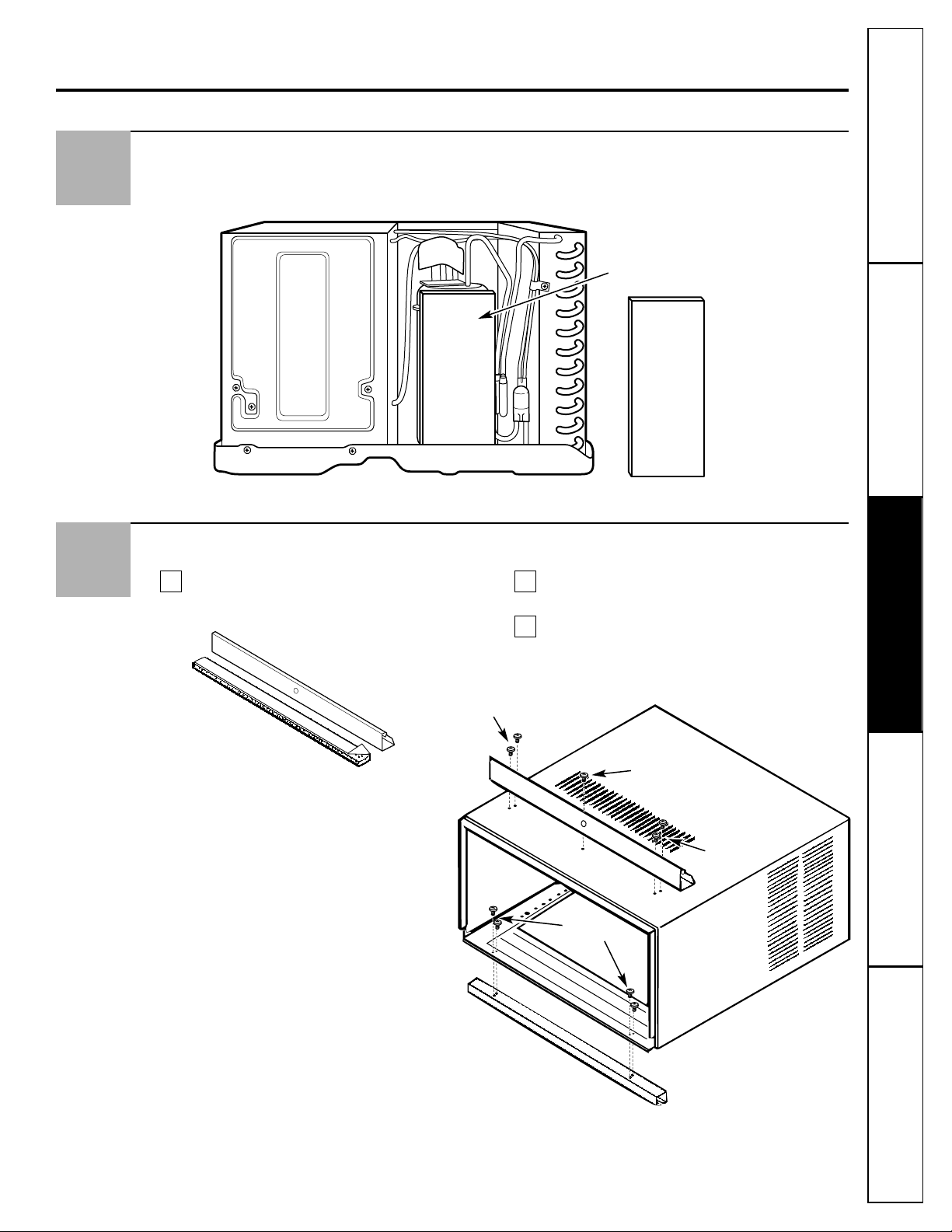
Remove the Shipping Pad
Remove and discard the shipping pad next to the compressor.
4
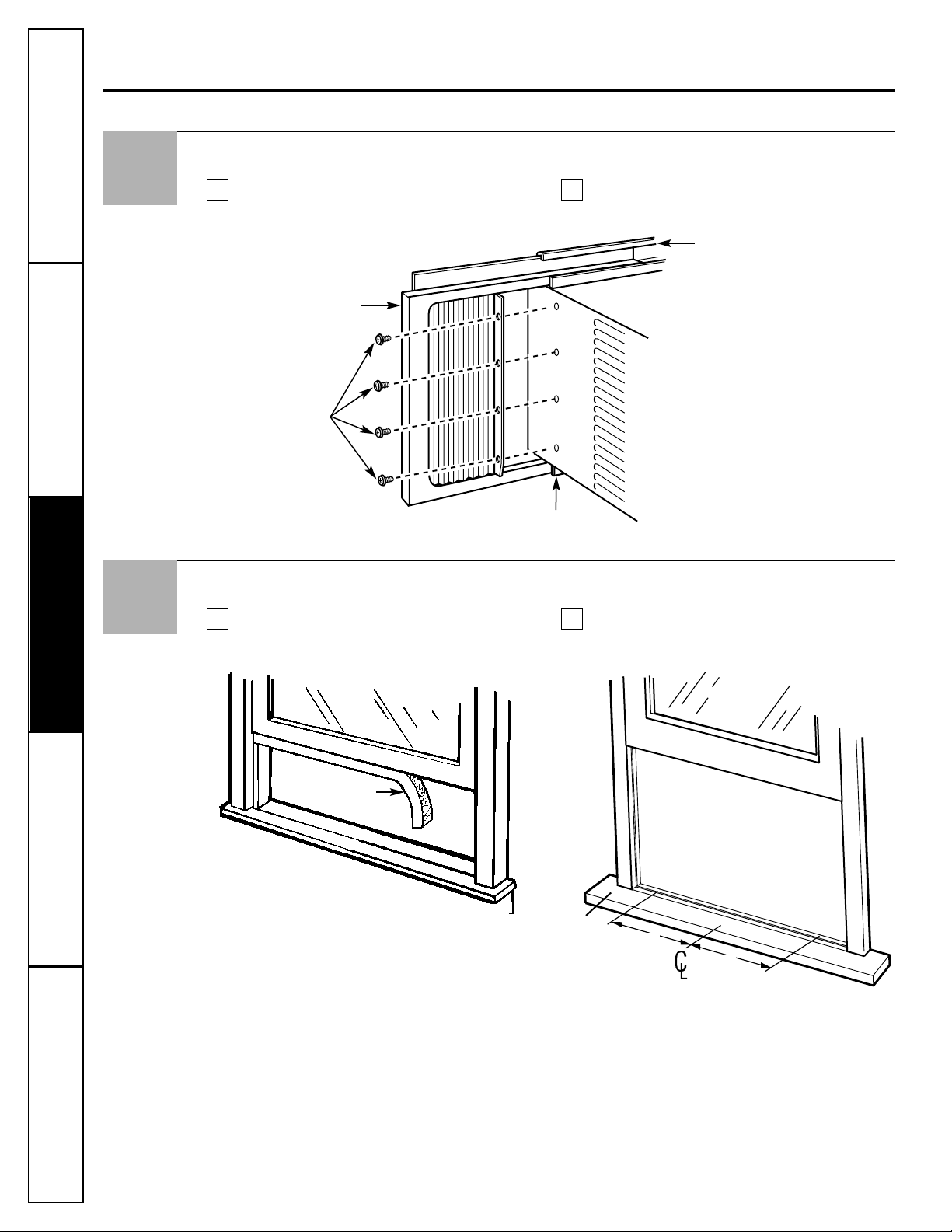
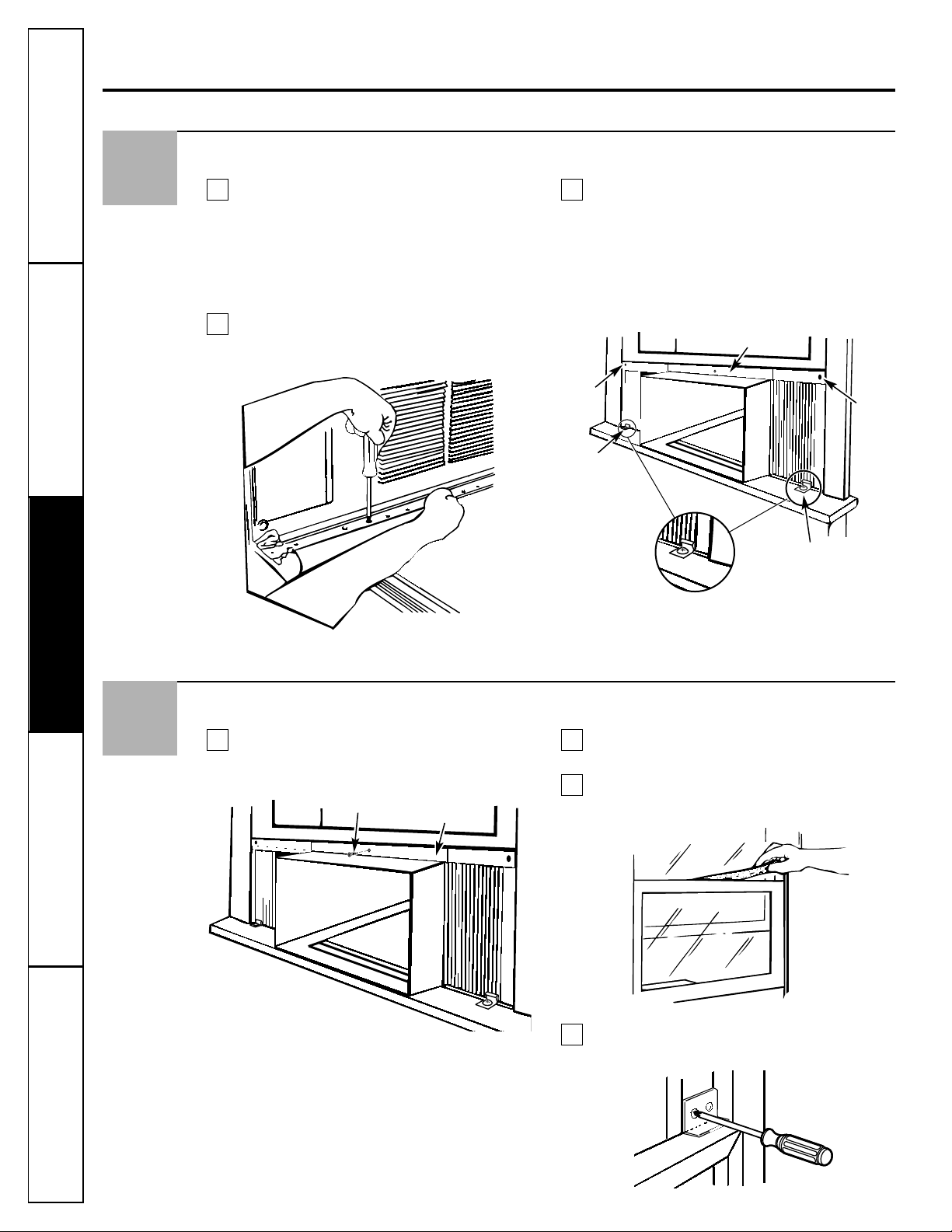
Install the Mounting Rails onto the Case
Remove the backing from the top mounting
rail seal strip and attach it to the bottom of
the top mounting rail.
Attach the top mounting rail onto the top
of the case with 5 Type A screws.
Attach the bottom mounting rail to the
bottom of the case from the inside, using
4 Type A screws.
C
BA
5
Type A screws
Type A screws
Type A
screws
Type A screw
Remove and discard
shipping pad
14
Consumer Support
Troubleshooting Tips Operating Instructions Safety InstructionsInstallation Instructions
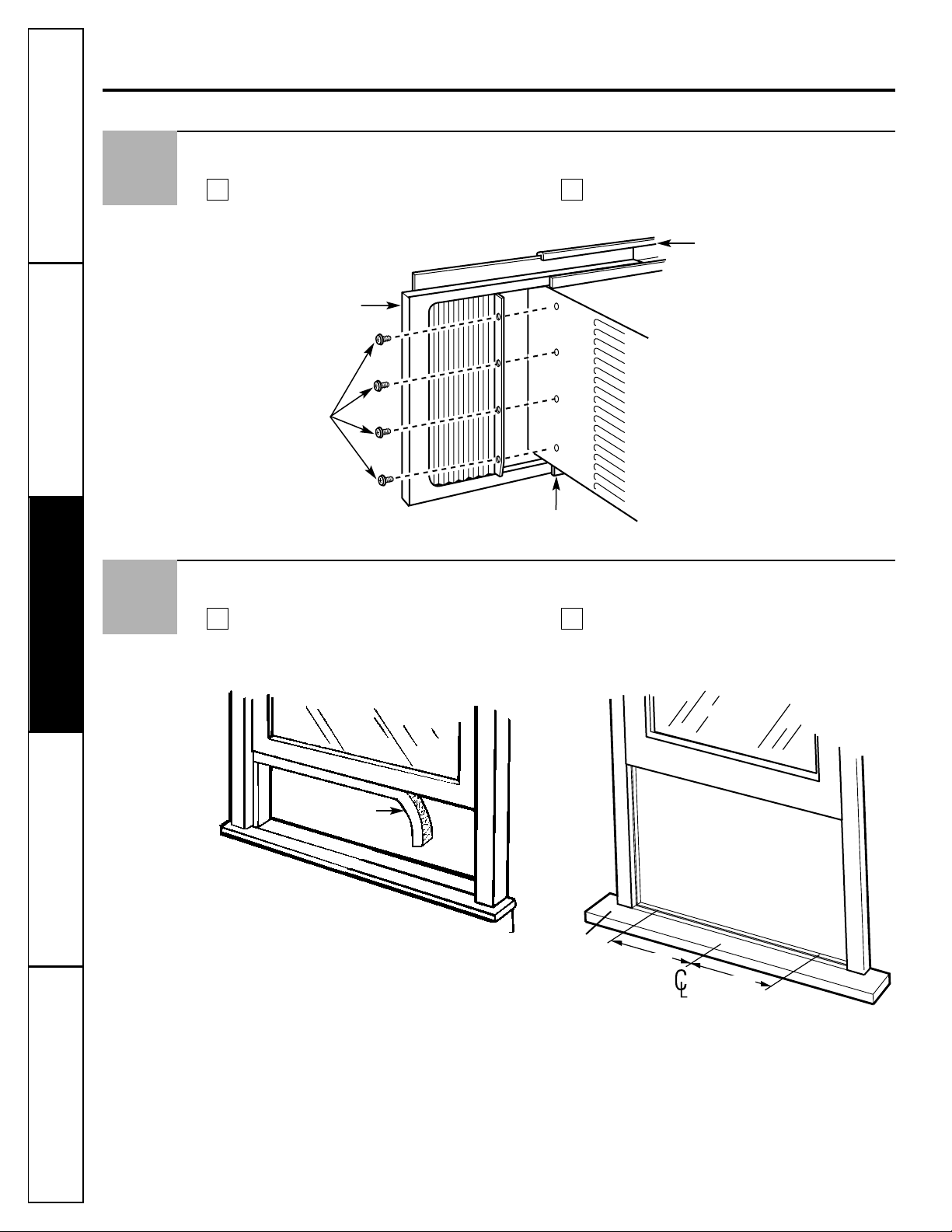
Install the Side Accordion Panels
Slide the left and right accordion panels into
the top and bottom mounting rails.
Attach the accordion panels to the case using
4 Type A screws on each side.
BA
6
Window installation instructions.
Prepare the Window
Cut the window sash seal (thin, adhesive-
backed) to the window width and stick the
adhesive side to the bottom of the sash.
Mark the centerline of the stool. Measure and
mark the locations for the support assemblies
8
1
⁄8″ from both sides of the centerline.
B
A
7
Type A screws
Top mounting rail
Bottom mounting rail
Accordion panel
Window sash seal
8
1
⁄8″
Stool
8
1
⁄8″
Consumer SupportTroubleshooting TipsOperating InstructionsSafety Instructions Installation Instructions
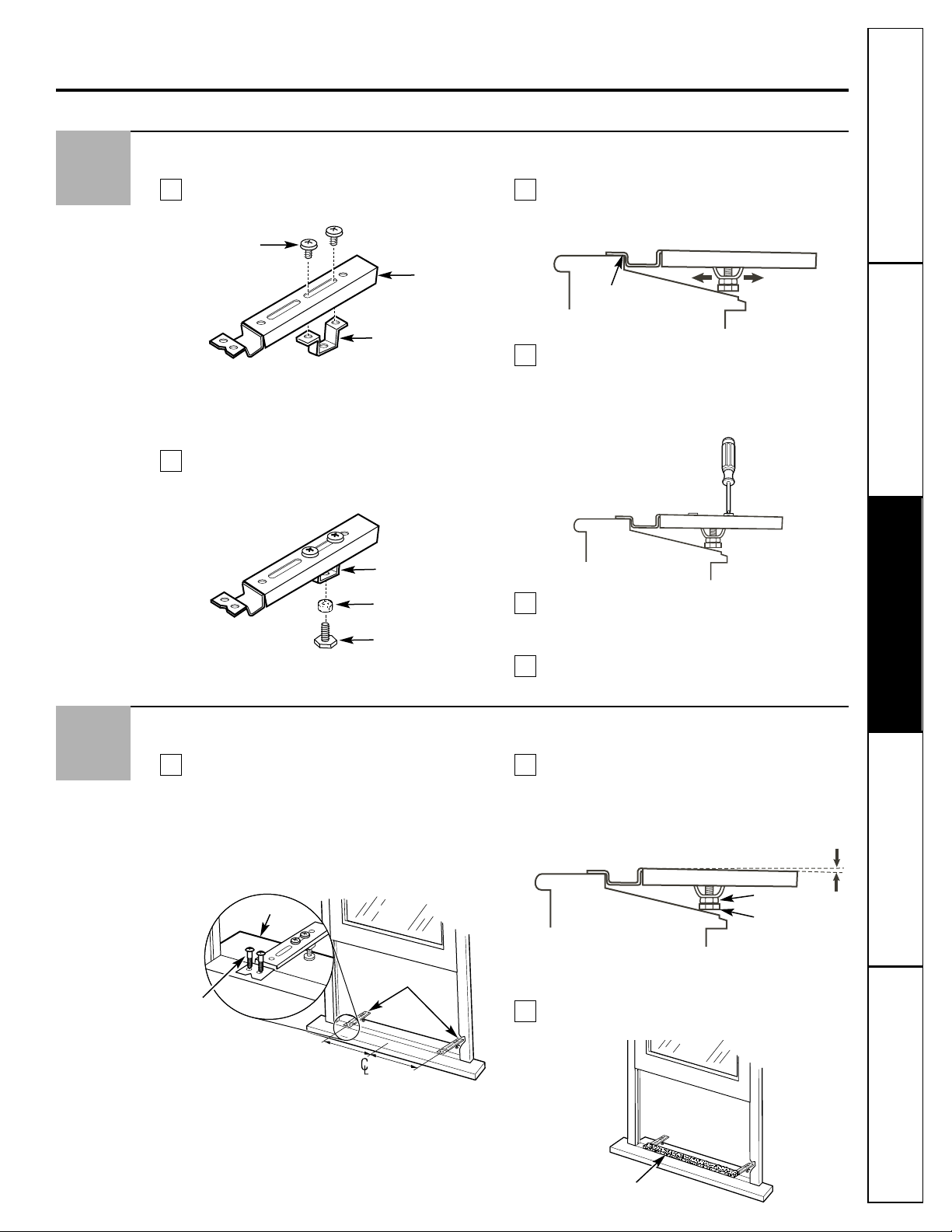
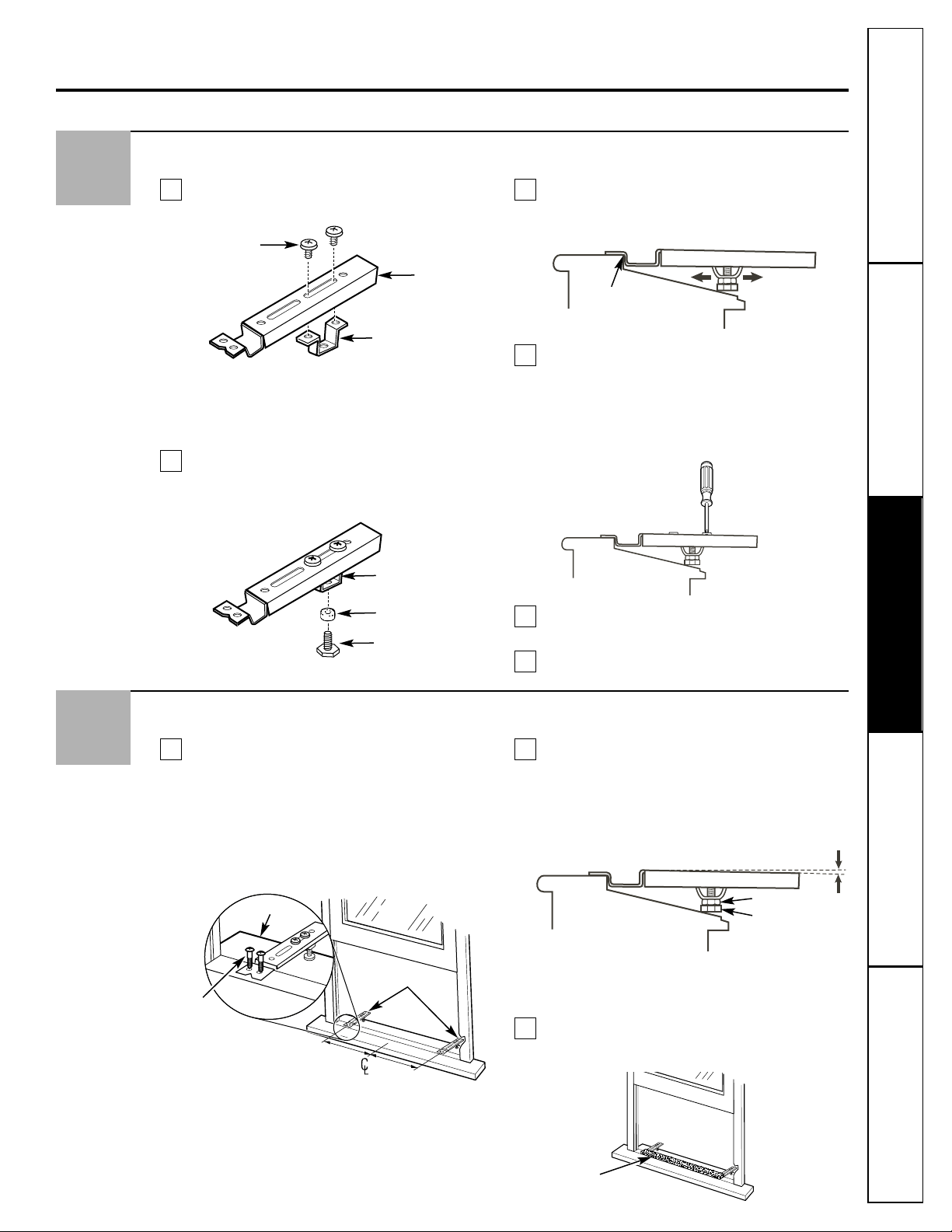
Assemble the Supports
Loosely attach a support bracket to a support
rail using 2 Type C screws.
NOTE: The support bracket may be attached into
either slot in the support rail, depending on the depth
of your window sill.
Thread a nut onto a leveling bolt, then
thread the leveling bolt into the support
bracket. An adjustable wrench may be needed.
Before attaching the support, hold the neck of
the support rail against the back edge of the
window stool.
Adjust the position of the support bracket
inward or outward on the support rail until the
leveling bolt is near the outside edge of the sill.
NOTE: Make sure that the leveling bolt will be firmly
supported by the sill.
Tighten the Type C screws to secure the
support bracket to the support rail in the
correct position.
Repeat steps A–E to assemble the second
support.
F
E
D
C
B
A
8
Install the Supports
Line up the V-notches in the support rails with
the left and right marks on the stool. Make
sure that the support rail is against the back
of the stool and drill two 1/8″ pilot holes into
the stool through the holes in the head of the
support rail. Attach the supports to the stool
using two Type B screws in each support.
Adjust the leveling bolts against the sill so that
the supports have a slight tilt to the outside.
Use a level; about 1/2 bubble will be the
correct slant to the outside. After leveling is
done, tighten the leveling bolt nut.
NOTE: Use a steel washer between the leveling
bolts and the sill if the sill is weak.
Attach the adhesive side of the window stool seal
(thick, adhesive-backed) to the window stool.
C
BA
9
Type C screws
Support bracket
Support rail
Support bracket
Leveling bolt
Nut
Adjust as
needed
Neck of
support rail
Stool
Supports
Sill
Type B
screws
Stool
1/2 bubble
Leveling bolt
Nut
15
Window stool seal
16
Consumer Support
Troubleshooting Tips Operating Instructions Safety InstructionsInstallation Instructions
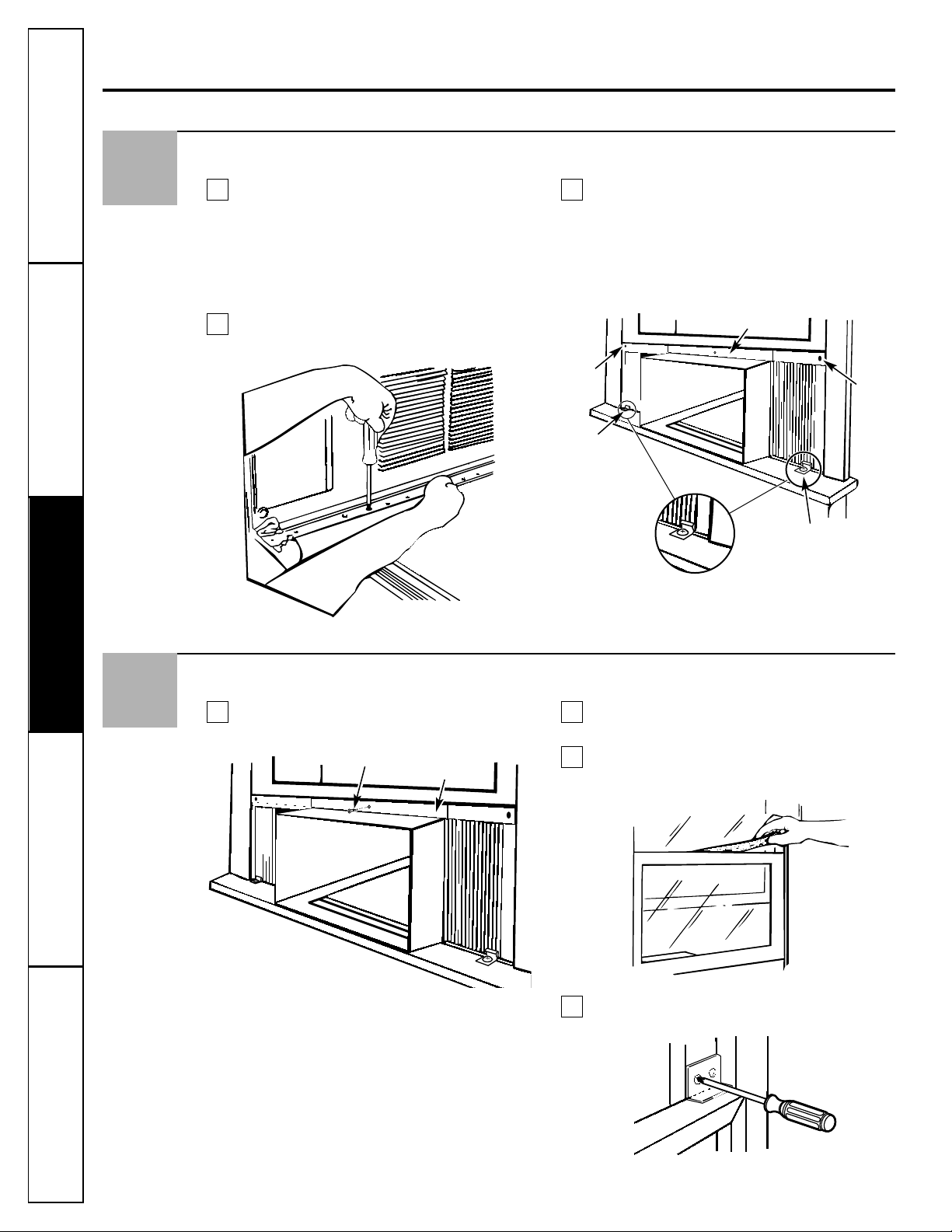
Install the Case in the Window
Carefully position the case in the window
until the bottom mounting rail drops into the
channels in the supports. Center the case and
lower the window behind the top mounting
rail. The case should be slightly tilted to the
outside. Use a level; about a 1/2 bubble will
be the correct case slant to the outside.
Attach the bottom of the case to the support
rail with a Type C screw, one on each side.
Extend the left and right accordion panels
to the vertical window sashes, drill 1/8″ pilot
holes, and attach the top corners with 2 Type B
screws. Use an accordion panel clamp on each
lower corner to trap the panels. Drill 1/8″
pilot holes and attach the panel clamps with
Type B screws.
NOTE: Seal any openings around the case or accordion
panels with sealer or foam gaskets.
C
B
A
Window installation instructions.
Secure the Case in the Window and Install the Foam Top Window Gasket
Drill a 1/8″ pilot hole and attach the top
mounting rail to the sash with a Type B screw.
Cut the foam top window gasket to the
window width.
Stuff the foam between the glass and the
window to prevent air and insects from
getting into the room.
Attach the window locking bracket with
2 Type B screws.
D
C
B
A
10
11
Type B
screw
Type B
screw
Panel clamp and
Type B screw
Top mounting rail
Panel clamp and
Type B screw
Type B screw
Top mounting rail
17
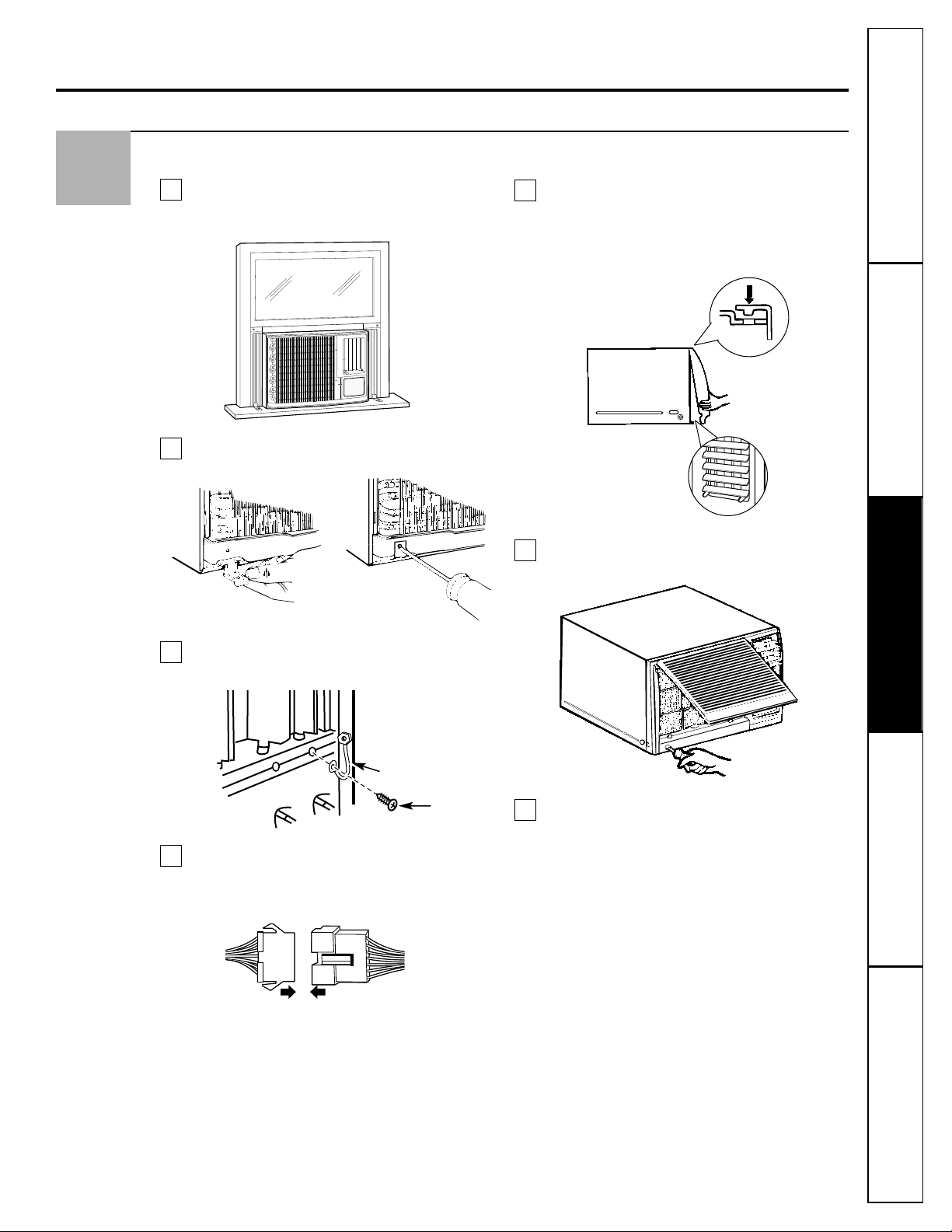
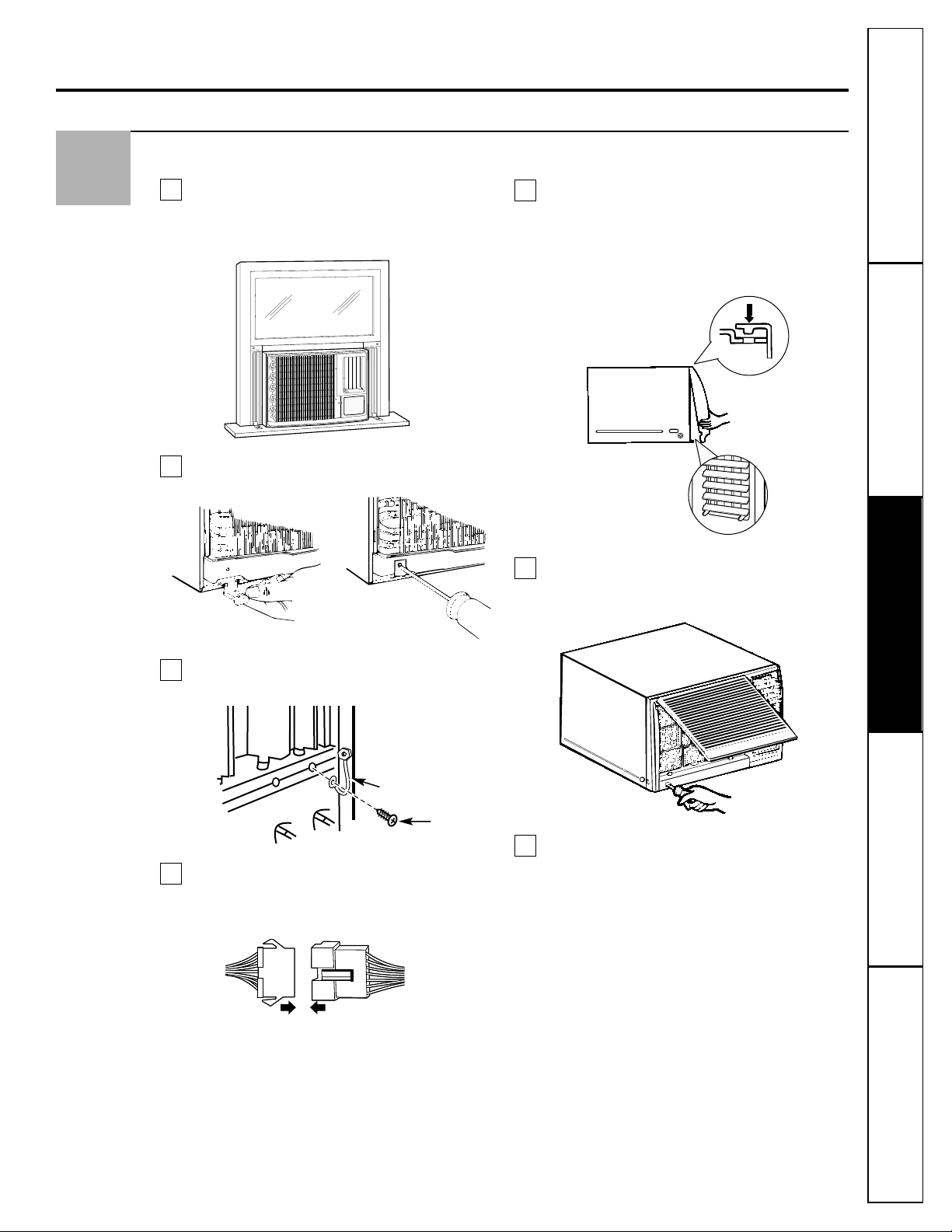
Install the Air Conditioner in the Case
Slide the air conditioner into the case. Do not
push on the controls or the finned coils.
Make sure the air conditioner is firmly seated.
Reinstall the locking brackets and screws
removed earlier.
IMPORTANT! Reconnect the ground wire to
the air conditioner.
If your model has the control connectors,
reconnect them to the front grille by pressing
them together until the locking tabs snap
into place.
Attach the front grille frame to the case by
inserting the tabs on the grille frame into
the slots on the front top of the case. Push
the grille frame in until it snaps into place
around the power cord on the right side.
Secure the front grille frame to the case by
replacing the screws removed earlier.
Install the filter. Hook the inlet grille in the
frame and close it. Connect power.
G
F
E
D
C
B
A
12
Guide the levers carefully
through the grille frame
as you push it in.
Screw
Ground wire
Consumer SupportTroubleshooting TipsOperating InstructionsSafety Instructions Installation Instructions
18
Consumer Support
Troubleshooting Tips Operating Instructions Safety InstructionsInstallation Instructions
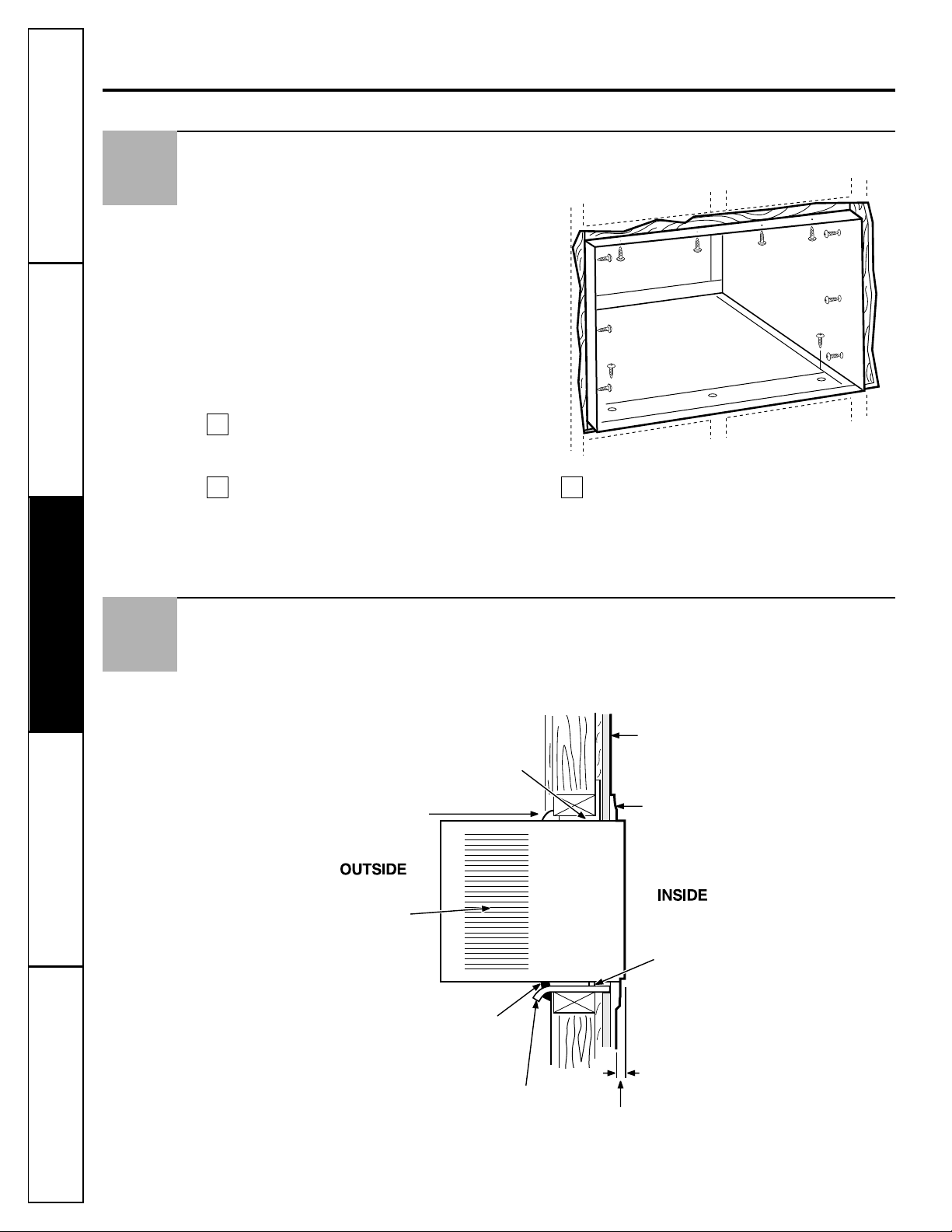
IMPORTANT
Through-the-wall installation is not appropriate if any
of the side louvers in the case will be obstructed by
the wall.
All side louvers in the case must project on the outdoor
side of the wall.
The room side of the case must project into the room
at least 1
3
⁄4″ from the finished wall.
The case must be installed level from side-to-side
and with a slight tilt from front to rear. Use a level;
about a 1/2 bubble will be the correct case slant to
the outside.
Remove the air conditioner from the case.
For specific instruction, refer to the Window
Installation Instructions.
Make certain a wall receptacle is available close
to the hole location or make arrangements to
install a receptacle.
Place the case in the wall opening and
secure with 12 1″ long #10 wood screws.
NOTE: Drill pilot holes, if necessary, for proper
installation. If the frame is oversized, use shims
to prevent case distortion.
C
B
A
1
Through-the-wall installation instructions—optional.
Finish the Wall Opening
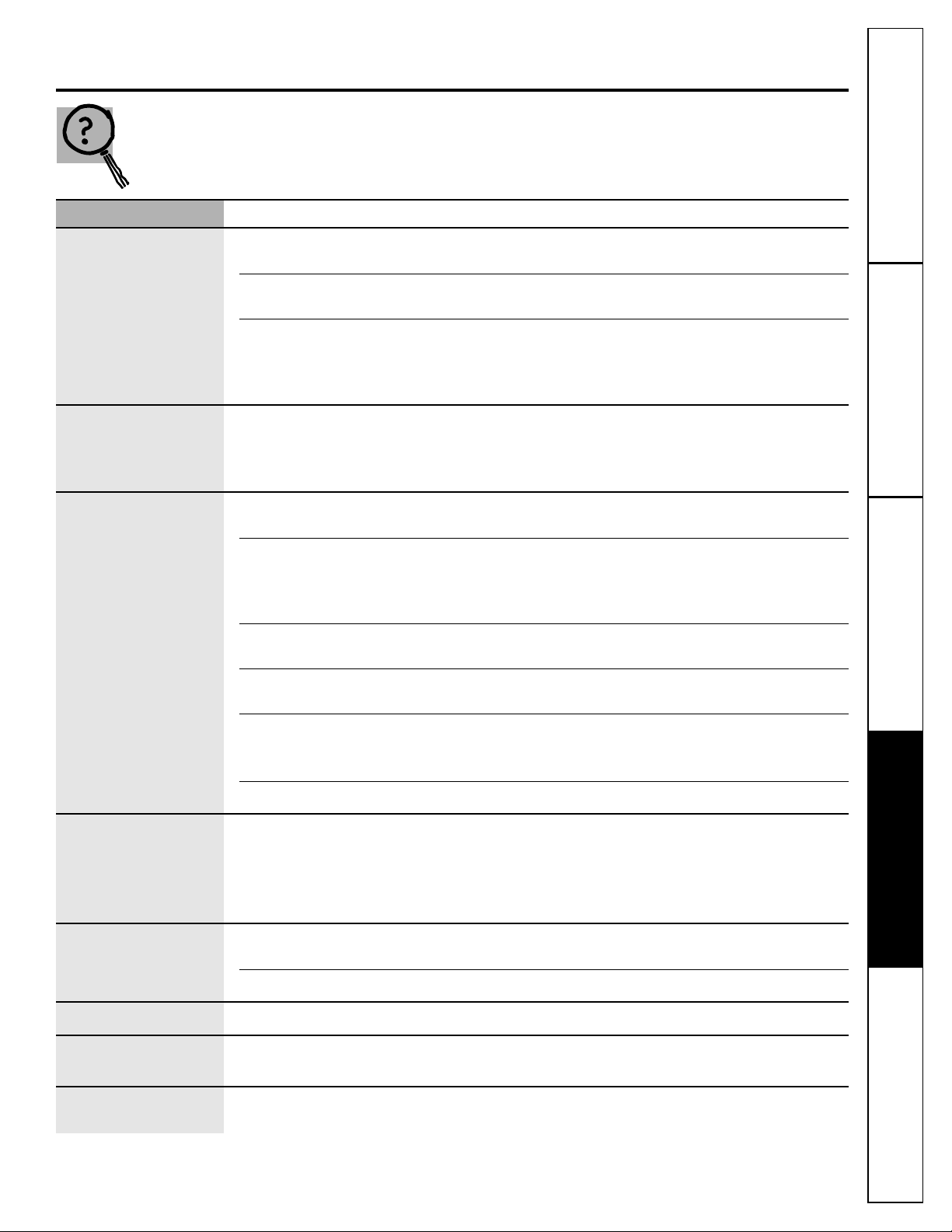
Caulk all four sides on the outdoor side of the case to prevent moisture from getting through to the
interior wall. Use of flashing (drip rail) will further prevent water from dripping inside the wall and
down the outside of the building.
2
Caulking
Air louvers
(must project on
the outdoor side
of the wall)
Wood filler and caulking
(above and below the
flashing)
Flashing (drip rail)
1
3
⁄4″ min.
Bottom rail
Plaster line
Trim molding
(if desired)
Lintel angle
(if required)
19
Problem Possible Causes What To Do
Air conditioner The air conditioner • Make sure the air conditioner plug is pushed completely
does not start is unplugged. into the outlet.
The fuse is blown/circuit • Check the house fuse/circuit breaker box and replace
breaker is tripped. the fuse or reset the breaker.
Power failure. • On models with control knobs, if a power failure occurs,
turn the air conditioner OFF. When power is restored,
wait 3 minutes to restart the air conditioner to prevent
tripping of the compressor overload.
Air conditioner has Power interruption or • On models with touch pads, when the power is restored,
stopped running power failure occurred. wait 3 minutes to restart the air conditioner to prevent
tripping of the compressor overload. Press the POWER
pad and reset the controls to the desired settings.
Air conditioner does not Airflow is restricted. • Make sure there are no curtains, blinds or furniture
cool as it should blocking the front of the air conditioner.
The temp control may not • On models with touch pads: in COOL mode, press the
be set correctly. Decrease ▼pad.
• On models with control knobs, turn the temperature
knob to a higher number.
The air filter is dirty. • Clean the filter at least every 30 days.
See the Operating Instructions section.
The room may have been hot. • When the air conditioner is first turned on, you need to
allow time for the room to cool down.
Cold air is escaping. • Check for open furnace floor registers and cold air
returns.
• Set the air conditioner’s vent to the closed position.
Cooling coils have iced up. • See “Air conditioner freezing up” below.
Air conditioner Ice blocks the air flow and • On models with control knobs, set the mode control at
freezing up stops the air conditioner HIGH FAN or HIGH COOL with the temp at 1 or 2.
from cooling the room.
• On models with touch pads, set the controls at HIGH FAN
or HIGH COOL and set the thermostat to a higher
temperature.
The remote control The batteries are inserted • Check the position of the batteries. They should be
is not working incorrectly. inserted in the opposite (+) and (–) direction.
The batteries may be dead. • Replace the batteries.
Water drips outside Hot and humid weather. • This is normal.
Water drips indoors The air conditioner is not • For proper water disposal, make sure the air conditioner
tilted to the outside. slants slightly from the case front to the rear.
Water collects in Moisture removed from air • This is normal for a short period in areas with little
base pan and drains into base pan. humidity; normal for a longer period in very humid areas.
Before you call for service… www.GEAppliances.com
Troubleshooting Tips.
Save time and money! Review the chart below first and
you may not need to call for service.
Consumer SupportTroubleshooting TipsOperating InstructionsSafety Instructions Installation Instructions
20
Consumer Support
Troubleshooting Tips Operating Instructions Safety InstructionsInstallation Instructions
Problem Possible Causes What To Do
Temperature settings The control has been • Press and hold the Increase ▲ / Decrease ▼ pads at the
in the display can only set to use Celsius. same time to switch to Fahrenheit settings.
be set between 16 and 31
“E1” appears Filter needs to be cleaned. • Turn the air conditioner OFF and unplug it.
in the display NOTE: The air conditioner must be unplugged for the
automatic filter clean timer to reset. Clean the filter.
See the Care and Cleaning section. After cleaning,
replace the filter and plug the air conditioner back in.
“Ed” appears Frost protect automatically • Turn the air conditioner off. Wait at least 3 minutes and
in the display activated. turn the air conditioner back on. If the code reappears,
call for service.
“En” appears Pipe temperature sensor • Call for service.
in the display failure.
“Er” appears Room temperature sensor • Call for service.
in the display failure.
Before you call for service…
Troubleshooting Tips.
■ You may hear a pinging noise caused by water
being picked up and thrown against the
condenser on rainy days or when the humidity
is high. This design feature helps remove
moisture and improve efficiency.
■ You may hear the thermostat click when the
compressor cycles on and off.
■ Water will collect in the base pan during high
humidity or on rainy days. The water may
overflow and drip from the outdoor side of
the unit.
■ The fan may run even when the compressor
does not.
Normal Operating Sounds

21
General Electric Company
Warranty Registration Department
P.O. Box 32150
Louisville, KY 40232-2150
GE Service Protection Plus
™
GE, a name recognized worldwide for quality and dependability, offers you
Service Protection Plus
™
---comprehensive protection on all your appliances---
No Matter What Brand!
Benefits Include:
• Backed by GE
• All brands covered
• Unlimited service calls
• All parts and labor costs included
• No out-of-pocket expenses
• No hidden deductibles
• One 800 number to call
You will be completely satisfied with our service protection or you may request your money back
on the remaining value of your contract. No questions asked. It’s that simple.
Protect your refrigerator, dishwasher, washer and dryer, range, TV, VCR and much more---any brand!
Plus there’s no extra charge for emergency service and low monthly financing is available. Even icemaker
coverage and food spoilage protection is offered. You can rest easy, knowing that all your valuable
household products are protected against expensive repairs.
Place your confidence in GE and call us in the U.S. toll-free at 800.626.2224
for more information.
*All brands covered, up to 20 years old, in the continental U.S.
We’ll Cover Any Appliance.
Anywhere. Anytime.*
Please place in envelope and mail to:
✁
Cut here
22
Consumer Product Ownership Registration
I
m
p
o
r
t
a
n
t
M
a
i
l
T
o
d
a
y
!
GE Appliances
GE Consumer Products
General Electric Company
Louisville, Kentucky
www.GEAppliances.com
First
Name
Mr. ■■ Ms. ■■ Mrs. ■■ Miss ■■
Street
Address
City
State
Date Placed
In Use
Month
Day
Year
Zip
Code
Apt. #
Last
Name
Phone
Number
_
_
Consumer Product Ownership Registration
Dear Customer:
Thank you for purchasing our product and thank you for placing your confidence in us.
We are proud to have you as a customer!
Follow these three steps to protect your new appliance investment:
Important: If you did not get a registration card with your
product, detach and return the form below to
ensure that your product is registered, or register
online at www.GEAppliances.com.
1
23
Model Number Serial Number
✁
Cut here
Complete and mail
your Consumer
Product Ownership
Registration today.
Have the peace of
mind of knowing we
can contact you in
the unlikely event of
a safety modification.
After mailing the
registration below,
store this document
in a safe place. It
contains information
you will need should
you require service.
Our service number
is 800.GE.CARES
(800.432.2737).
Read your Owner’s
Manual carefully.
It will help you
operate your new
appliance properly.
Model Number Serial Number
E-mail Address*
* Please provide your e-mail address to receive, via e-mail, discounts, special offers and other important
communications from GE Appliances (GEA).
■■ Check here if you do not want to receive communications from GEA’s carefully selected partners.
23
Consumer SupportTroubleshooting TipsOperating InstructionsSafety Instructions Installation Instructions
For The Period Of: We Will Replace:
One Year Any part of the air conditioner which fails due to a defect in materials or workmanship.
From the date of the During this full one-year warranty, we will also provide, free of charge, all labor and in-home
original purchase service to replace the defective part.
Five Years Any part of the sealed refrigerating system (the compressor, condenser, evaporator and
From the date of the all connecting tubing) which fails due to a defect in materials or workmanship. During this
original purchase four-year additional warranty, we will also provide, free of charge, all labor and in-home service
to replace the defective part.
■ Service trips to your home to teach you how to
use the product.
■ Improper installation, delivery or maintenance. If you
have an installation problem, or if the air conditioner
is of improper cooling capacity for the intended use,
contact your dealer or installer. You are responsible for
providing adequate electrical connecting facilities.
■ Failure of the product resulting from modifications to
the product or due to unreasonable use including failure
to provide reasonable and necessary maintenance.
■ In commercial locations labor necessary to move the
unit to a location where it is accessible for service
by an individual technician.
■ Replacement of house fuses or resetting of circuit
breakers.
■ Failure due to corrosion on models not corrosion-
protected.
■ Damage to the product caused by improper power supply
voltage, accident, fire, floods or acts of God.
■ Incidental or consequential damage caused by possible
defects with this air conditioner.
■ Damage after delivery.
What Is Not Covered:
This warranty is extended to the original purchaser and any succeeding owner for products purchased for home
use within the USA. In Alaska, the warranty excludes the cost of shipping or service calls to your home.
Some states do not allow the exclusion or limitation of incidental or consequential damages. This warranty gives
you specific legal rights, and you may also have other rights which vary from state to state. To know what your
legal rights are, consult your local or state consumer affairs office or your state’s Attorney General.
Warrantor: General Electric Company. Louisville, KY 40225
All warranty service provided by our Factory Service Centers,
or an authorized Customer Care
®
technician. To schedule service,
on-line, 24 hours a day, visit us at www.GEAppliances.com, or
call 800.GE.CARES (800.432.2737).
Staple your receipt here.
Proof of the original purchase
date is needed to obtain service
under the warranty.
Air Conditioner Warranty.
GE Appliances Website www.GEAppliances.com
Have a question or need assistance with your appliance? Try the GE Appliances Website 24 hours a day,
any day of the year! For greater convenience and faster service, you can now download Owner’s Manuals,
order parts, catalogs, or even schedule service on-line. You can also “Ask Our Team of Experts
™
”
your questions, and so much more...
Schedule Service www.GEAppliances.com
Expert GE repair service is only one step away from your door. Get on-line and schedule your service at
your convenience 24 hours any day of the year! Or call 800.GE.CARES (800.432.2737) during normal
business hours.
Real Life Design Studio www.GEAppliances.com
GE supports the Universal Design concept---products, services and environments that can be used by
people of all ages, sizes and capabilities. We recognize the need to design for a wide range of physical and
mental abilities and impairments. For details of GE’s Universal Design applications, including kitchen
design ideas for people with disabilities, check out our Website today. For the hearing impaired, please call
800.TDD.GEAC (800.833.4322).
Extended Warranties www.GEAppliances.com
Purchase a GE extended warranty and learn about special discounts that are available while your warranty
is still in effect. You can purchase it on-line anytime, or call 800.626.2224 during normal business hours.
GE Consumer Home Services will still be there after your warranty expires.
Parts and Accessories www.GEAppliances.com
Individuals qualified to service their own appliances can have parts or accessories sent directly to their
homes (VISA, MasterCard and Discover cards are accepted). Order on-line today, 24 hours every day
or by phone at 800.626.2002 during normal business hours.
Instructions contained in this manual cover procedures to be performed by any user. Other servicing generally
should be referred to qualified service personnel. Caution must be exercised, since improper servicing may cause
unsafe operation.
Contact Us www.GEAppliances.com
If you are not satisfied with the service you receive from GE, contact us on our Website with all the details
including your phone number, or write to: General Manager, Customer Relations
GE Appliances, Appliance Park
Louisville, KY 40225
Register Your Appliance www.GEAppliances.com
Register your new appliance on-line----at your convenience! Timely product registration will allow for
enhanced communication and prompt service under the terms of your warranty, should the need arise.
You may also mail in the pre-printed registration card included in the packing material.
24
Printed in China
Consumer Support.

Instrucciones de seguridad
. . . . .2, 3
Instrucciones de operación
Controles–botones de control . . .6, 7
Controles–teclas de toque . . . . . .4, 5
Cuidado y limpieza
Bobinas para exteriores . . . . . . . . . .8
Filtro de aire . . . . . . . . . . . . . . . . . .8
Parrilla y caja . . . . . . . . . . . . . . . . . .8
Instrucciones de instalación
A través de la pared
Instalación–opcional . . . . . . . . . . .18
Instalación en una ventana . . . .9–17
Solucionar problemas . . . . . .19, 20
Sonidos normales de operación . . .20
Apoyo al consumidor
Apoyo al consumidor . . . . . . . . . .24
Garantía . . . . . . . . . . . . . . . . . . . . .23
49-7453-1 12-02 JR
AKL08
AKN08
AKQ08
AKV08
AKW08
Acondicionadores
de Aire
Manual del Propietario e
Instrucciones de Instalación
www.GEAppliances.com
Escriba el modelo y número
de serie aquí:
Número de modelo ______________
Número de serie ________________
Usted puede encontrar estos números
al costado del acondicionador de aire.
2
INFORMACIÓN IMPORTANTE DE SEGURIDAD.
LEA TODAS LAS INSTRUCCIONES ANTES DE USAR.
¡ADVERTENCIA!
Por su seguridad, se debe seguir la información en este manual para minimizar el riesgo de incendios,
descargas eléctricas o lesiones personales.
■ Use este electrodoméstico solamente para
el propósito determinado según se describe
en el Manual del propietario.
■ Este acondicionador de aire debe instalarse
correctamente de acuerdo con las
Instrucciones de instalación antes de su uso.
■ Nunca desenchufe su acondicionador de
aire tirando del cable eléctrico. Siempre
agarre firmemente el enchufe y tire de
él directamente hacia afuera.
■ Repare o reemplace inmediatamente todos
los cables eléctricos que se hayan pelado o
que se hayan dañado de alguna otra manera.
No use un cable eléctrico que muestre
evidencias de deterioro, o daños de abrasión
en su superficie en alguno de sus extremos.
■ Apague el control de modo y desenchufe
su acondicionador de aire antes de hacer
cualquier reparación o limpiar.
NOTA: Recomendamos enérgicamente que
cualquier servicio llevado a cabo en este equipo
lo realice un individuo calificado.
■ Por su seguridad…no almacene ni use
materiales combustibles, gasolina u otros
vapores o líquidos inflamables en la
proximidad de éste o algún otro
electrodoméstico.
■ Todos los acondicionadores de aire contienen
refrigerantes, los cuales se deben retirar antes
de la eliminación del producto de acuerdo
con la ley federal. Si va a desechar algún
aparato antiguo de refrigeración, consulte
con la compañía a cargo de desechar el
aparato para saber qué hacer.
PRECAUCIONES DE SEGURIDAD
Bajo ninguna circunstancia, corte o remueva la
tercera púa (tierra) del cable eléctrico. En pos
de la seguridad personal, este electrodoméstico
debe siempre conectarse a tierra.
El cable eléctrico de este electrodoméstico está
equipado con un enchufe de tres púas (tierra)
que combina con un tomacorriente estándar
de tres tomas de pared para minimizar la
posibilidad de una descarga eléctrica.
Pida a un técnico que inspeccione el
tomacorriente y el circuito para cerciorarse
de que el tomacorriente está conectado a
tierra de la manera apropiada.
Donde exista un tomacorriente de dos tomas,
es su responsabilidad y obligación personal
hacer que dicho tomacorriente sea
reemplazado por uno de tres tomas con
conexión a tierra.
El acondicionador de aire debería siempre
estar conectado a un tomacorriente individual
con su circuito de voltaje correspondiente.
Esto proporciona el mayor rendimiento y
además evita que los circuitos del resto de
la casa se sobrecarguen, lo cual podría causar
incendios por el sobrecalentamiento
del cableado.
Ver las Instrucciones de instalación, en la
sección Requisitos eléctricos para los requisitos
específicos de conexión.
CÓMO CONECTAR LA ELECTRICIDAD
Apoyo al consumidor
Solucionar problemas Operación SeguridadInstalación
3
Apoyo al consumidorSolucionar problemasOperaciónSeguridad Instalación
www.GEAppliances.com
¡ADVERTENCIA!
Debido al potencial de riesgos de seguridad bajo
ciertas condiciones, enérgicamente recomendamos
contra el uso de cables de extensión.
Sin embargo, si usted se ve en la necesidad
de usar un cable eléctrico de extensión, es
absolutamente necesario que el mismo esté
listado bajo UL, sea calibre 14, del tipo de
3 tomas con conexión a tierra para
electrodomésticos y el índice eléctrico debe
ser de 15 amperios (mínimo) y 125 voltios.
PRECAUCIÓN:
NO USE un cable de extensión con ninguno
de los modelos de 230/208 voltios.
USO DE CABLES DE EXTENSIÓN—Modelos de 115 voltios solamente
Debido al potencial de riesgos de seguridad bajo
ciertas condiciones, enérgicamente recomendamos
contra el uso de enchufes adaptadores.
Sin embargo, si usted se ve en la necesidad de
usar un adaptador, donde los códigos legales
locales lo permitan, puede hacer una conexión
temporal a un interruptor de 2 tomas siempre
que se use un tomacorriente listado UL
disponible en la mayoría de las ferreterías.
La ranura mayor en el adaptador debe estar
alineada con la púa mayor en la pared para
proporcionar una polaridad apropiada en la
conexión del cable eléctrico.
Cuando se disponga a desconectar el cable
eléctrico del adaptador, siempre sostenga el
adaptador en su lugar con una mano mientras
tira del cable eléctrico con la otra mano. Si no
hace esto, la terminal de tierra del adaptador
podría romperse después de que este proceso
se repita varias veces.
Si se rompe el terminal de conexión a tierra
del adaptador, NO USE el acondicionador de
aire hasta que la conexión a tierra se haya
restablecido.
Unir el terminal de conexión a tierra del adaptador a un
tornillo de la cubierta en la pared no conecta a tierra
el electrodoméstico apropiadamente a no ser que el
tornillo de la cubierta sea metálico y no esté aislado,
y el tomacorriente de la casa esté apropiadamente
conectado a tierra a través del cableado de la casa.
Haga que un técnico calificado inspeccione el circuito
de la casa para cerciorarse que está conectado a tierra
apropiadamente.
USO DE ENCHUFES ADAPTADORES
—
Modelos de 115 voltios solamente
LEA Y SIGA ESTAS INSTRUCCIONES DE SEGURIDAD CUIDADOSAMENTE.
GUARDE ESTAS INSTRUCCIONES
4
Apoyo al consumidor
Solucionar problemas Operación SeguridadInstalación
■ Para garantizar una operación apropiada, oriente
el control remoto hacia el receptor de señal del
acondicionador de aire.
■ El receptor de señal tiene un rango máximo
de 21 pies.
■ Cerciórese de que no haya nada entre el
acondicionador de aire y el control remoto que
pueda bloquear la señal.
■ Cerciórese de que las baterías sean frescas y se
instalen correctamente como se indica en el
control remoto.
Acerca de los controles en el acondicionador de aire—
modelos con teclas de toque.
Las funciones y el aspecto pueden variar.
ON/OFF (ENCENDIDO/APAGADO)
Apaga y prende el acondicionador de aire.
MODO
Usado para ajustar el acondicionador de aire
al modo COOL (FRÍO) o FAN (VENTILADOR).
Teclas de Increase ▲ (Aumentar)/
Decrease
▼ (Reducir)
Usado para ajustar la temperatura cuando
se encuentre en el modo COOL (FRÍO).
FAN (VENTILADOR)
Usado para ajustar la velocidad del ventilador
a LOW (BAJO), MED o HIGH (ALTO).
TIMER (SINCRONIZADOR)
ON (ENCENDIDO)—Cuando el acondicionador
de aire está apagado, puede ajustarse para
que se encienda automáticamente dentro de
1 a 12 horas en el nivel previo. Cada toque
ajustará el tiempo en horas.
OFF (APAGADO)—Cuando el acondicionador
de aire está encendido, puede ajustarse para
que se apague automáticamente dentro de
1 a 12 horas. Cada toque ajustará el tiempo
en horas.
Para cancelar el sincronizador, presione la
tecla TIMER (SINCRONIZADOR) hasta que el
tiempo en la pantalla desaparezca.
NOTA: Todas las funciones del sincronizador
son canceladas automáticamente si la unidad
es apagada o encendida después de ajustar
el sincronizador.
Pantalla
Muestra la temperatura del cuarto, la
temperatura establecida o el tiempo restante
en el reloj. Después de configurar los
controles, la pantalla cambiará para mostrar
la temperatura del cuarto.
Para volver a llamar la temperatura
establecida a la pantalla, presione el botón
Increase ▲ / Decrease ▼ una vez.
Para llamar el tiempo restante en el reloj,
si fue configurado, presione la tecla TIMER
una vez.
Códigos de la pantalla
E1—Recordatorio automático para la limpieza
del filtro. Apague el acondicionador de aire y
desconéctelo. NOTA: El acondicionador de
aire se debe desconectar para configurar el
reloj automático de limpieza del filtro. Limpie
el filtro. Consulte la sección Cuidado y limpieza.
Después de la limpieza, vuelva a instalar el
filtro y vuelva a conectar el acondicionador
de aire.
Er—Falla del sensor de temperatura del
cuarto. Llame para solicitar servicio.
Receptor de la señal del control remoto
Control remoto
Controles
Controles del acondicionador de aire Control remoto
Enfriador encendido
Ventilador encendido
Ventilador alto encendido
Ventilador medio encendido
Ventilador bajo encendido
Apoyo al consumidorSolucionar problemasOperaciónSeguridad Instalación
5
www.GEAppliances.com
Cuando el acondicionador de aire se encienda,
se encenderá automáticamente en el nivel que se
encontraba la última vez, excepto que el reloj se
cancelará si fue configurado.
Las luces en la pantalla o al lado de las teclas
de toque en el panel de control del acondicionador
de aire indicarán los ajustes seleccionados.
Modo COOL (FRIO)
Use el modo COOL con ventilador HIGH (ALTO), MED
(MEDIO) o LOW (BAJO) para enfriar. Use las teclas de
Increase ▲ (Aumentar)/Decrease ▼ (Reducir) para
ajustar a la temperatura deseada entre 60 ºF y 90 ºF
en incrementos de 2 ºF (o entre 16 °C y 31°C en
incrementos de 1°C si el control ha sido ajustado
a Celsius).
Se usa un termostato para mantener la temperatura
de la habitación. El compresor hará ciclo entre
apagado y encendido para mantener la habitación
a la temperatura deseada. Ajuste el termostato a
un número menor y el aire interno se enfriará más.
Si lo ajusta a un número mayor, la temperatura
del aire interno se calentará más.
NOTA: Si el acondicionador de aire está apagado y luego se
enciende mientras está ajustado en COOL (FRÍO), tomará
aproximadamente 3 minutos para que el compresor comience
a enfriar otra vez.
Descripciones de enfriamiento
Para enfriamiento normal—Seleccione el modo de
ventilador COOL (FRÍO) y HIGH (ALTO) o MED (MEDIO)
con una temperatura de ajuste media.
Para enfriamiento máximo—Seleccione el modo
de ventilador COOL (FRÍO) y HIGH (ALTO) con una
temperatura de ajuste menor.
Para enfriamiento silencioso y enfriamiento nocturno—
Seleccione el modo de ventilador COOL (FRÍO) y
LOW (BAJO) con una temperatura de ajuste media.
NOTA: Si cambia de un ajuste COOL (FRÍO) a
OFF (APAGADO) o a un ajuste de ventilador,
espere aproximadamente 3 minutos antes de
cambiar otra vez al ajuste de COOL (FRÍO).
Dirección del aire
Hacia arriba y hacia abajo
Una presión sencilla con los dedos en las parrillas
horizontales ajustará la dirección del aire hacia
arriba o hacia abajo.
De lado a lado
La dirección del aire de lado a lado se ajusta
moviendo la palanca de dirección del aire hacia
la izquierda o derecha.
Modo de FAN (Ventilador) Grados Fahrenheit o Centígrados
Use el FAN (Ventilador) en High (ALTO), MED (MEDIO)
o LOW (BAJO) para proporcionar circulación de aire
y filtración sin enfriamiento. Debido a que los
niveles de ventilador únicamente no proporcionan
enfriamiento, el nivel de temperatura no se muestra
en la pantalla.
Su control está configurado para usar y mostrar selecciones
de temperatura en grados Fahrenheit, pero lo puede cambiar
para usar y mostrar selecciones de temperatura en
grados Centígrados.
Presione y sostenga las teclas Increase ▲ (Aumentar)/
Decrease ▼ (Reducir) al mismo tiempo para cambiar
entre ˚C o ˚F, según desee.
El control de ventilación está localizado al interior
de las parrillas de aire en el fondo de la ventanilla.
Cuando está ajustado en CLOSE (CERRADO),
solamente el aire en el interior de la habitación
circulará y se acondicionará. Cuando está
ajustado en OPEN (ABIERTO), un poco del aire
interno es expelido hacia afuera.
Control de la ventilación
Para abrir la ventanilla. Para cerrar la ventanilla.
Palanca de
control de
ventilación
Palanca de
control de
ventilación
Palanca
de dirección
del aire
6
CONTROLES DE TEMPERATURA
CONTROLES DE MODO
Su modelo tendrá uno de los tipos de control
mostrados arriba.
Acerca de los controles en el acondicionador de aire—
modelos con botones de control.
Las funciones y el aspecto pueden variar.
Controles
Controles de modo
HIGH COOL (FRÍO ALTO), MED COOL (FRÍO
MEDIO) y LOW COOL (FRÍO BAJO)
proporcionan enfriamiento con diferentes
velocidades del ventilador.
COOL (FRÍO) ofrece enfriamiento con una
velocidad fija del ventilador.
LOW FAN (VENTILADOR BAJO), HIGH FAN
(VENTILADOR ALTO) o FAN (VENTILADOR)
proporcionan la circulación de aire sin
enfriamiento.
NOTA: Si usted mueve el interruptor de un nivel frío a
OFF (APAGADO) o a un nivel de ventilador, espere
por lo menos 3 minutos antes de cambiar otra vez a un
nivel de enfriamiento.
Descripciones de enfriamiento
Para enfriamiento normal—Seleccione HIGH
COOL (ENFRIAMIENTO ALTO) o MED COOL
(ENFRIAMIENTO MEDIO) con el control de
temperatura en el medio.
Para enfriamiento máximo—Seleccione HIGH
COOL (ENFRIAMIENTO ALTO) con el control
de temperatura en el número mayor
disponible en su teclado.
Para enfriamiento silencioso durante
la noche—Seleccione LOW COOL
(ENFRIAMIENTO BAJO) con el control
de temperatura en el nivel medio.
Controles de temperatura
El control de temperatura es usado para
mantener la temperatura de la habitación.
El compresor hará ciclo entre encendido y
apagado para mantener el mismo nivel de
temperatura en la habitación. Cuando usted
gira el botón hacia un número mayor, el aire
interno se enfriará más. Si lo ajusta a un
número menor, la temperatura del aire
interno se calentará más.
Apoyo al consumidor
Solucionar problemas Operación SeguridadInstalación
OFF
LOW
FAN
LOW
COOL
HIGH
FAN
HIGH
COOL
MED
COOL
OFF
FANCOOL
7
www.GEAppliances.com
Controles adicionales e información importante.
El control de ventilación está localizado en el
interior de las parrillas de aire en el fondo de
la ventanilla.
Cuando está ajustado a CLOSE (CERRADO),
solamente el aire en el interior de la
habitación circulará y se acondicionará.
Cuando está ajustado a OPEN (ABIERTO),
un poco del aire interno es expelido
hacia afuera.
Control de ventilación
Apoyo al consumidorSolucionar problemasOperaciónSeguridad Instalación
Una presión sencilla con los dedos en las parrillas
horizontales ajustará la dirección del aire hacia
arriba o hacia abajo.
Dirección del aire—hacia arriba y hacia abajo
La dirección del aire de lado a lado se ajusta
moviendo la palanca de dirección del aire
hacia la izquierda o derecha.
Dirección del aire—de lado a lado
Para abrir la ventanilla. Para cerrar la ventanilla.
Palanca de
control de
ventilación
Palanca de
control de
ventilación
Palanca
de dirección
del aire
Filtro de aire
El filtro de aire detrás de la parrilla frontal debe
ser inspeccionado y limpiado por lo menos cada
30 días o más a menudo si fuese necesario.
E1 en la pantalla (en modelos con teclas de toque)
es un recordatorio automático para limpiar el filtro.
Apague y desconecte el acondicionador de aire.
NOTA: El acondicionador de aire se debe desconectar para
volver a configurar el reloj automático de limpieza del filtro.
Limpie el filtro con agua tibia y jabón. Enjuáguelo
y permita que se seque antes de colocarlo otra vez
en su lugar.
NOTA: NO lave, o ponga el filtro en un lavaplatos automático.
PRECAUCIÓN: NO OPERE el
acondicionador de aire sin el filtro debido a que la suciedad y
las pelusas lo obstruirán y reducirán su rendimiento.
Para retirar:
Hale hasta liberar las esquinas inferiores de la
rejilla de entrada y luego levántela y retírela.
Utilizando la lengüeta, hale el filtro
ligeramente hacia arriba para liberarlo y luego
hale hacia abajo para retirarlo.
2
1
Bobinas para exteriores
Las bobinas en el lado exterior del acondicionador
de aire debe ser inspeccionada regularmente. Si la
misma está obstruida con suciedad u hollín, podría
ser limpiada profesionalmente con vapor, y
nosotros en GE podemos proporcionarle tales
servicios.
Parrilla y caja
Apague el acondicionador de aire y retire
el enchufe del tomacorriente de la pared
antes de limpiar.
Para limpiar, use agua y un detergente suave.
No use cloro o materiales abrasivos.
Cuidado y limpieza del acondicionador de aire.
8
Apoyo al consumidor
Solucionar problemas Operación SeguridadInstalación
9
Preparándose para instalar el acondicionador de aire.
Lea estas instrucciones completa y cuidadosamente.
NOTA AL INSTALADOR: Deje estas instrucciones
con el acondicionador de aire después de
completar la instalación.
NOTA AL CONSUMIDOR: Mantenga este Manual
de Instrucciones e Instrucciones de Instalación
para uso futuro.
NOTAS IMPORTANTES:
Para su seguridad personal, este acondicionador
de aire debe estar conectado a tierra
apropiadamente.
Es importante que usted solicite a un técnico
calificado que inspeccione el tomacorriente de
la pared y el circuito para cerciorarse de que
el sistema de cables está conectado a tierra.
Siga los códigos Eléctricos Nacionales
(NEC—National Electrical Codes) y / o las
ordenanzas locales.
PRECAUCIÓN:
Bajo ninguna circunstancia corte o remueva la
tercera púa (conexión a tierra) del cable eléctrico.
No cambie el enchufe en el cable eléctrico de este
acondicionador de aire.
Los cables caseros de aluminio podrían presentar
problemas especiales. Consulte a un técnico
calificado.
Antes de comenzar
Algunos modelos requieren tomacorrientes
de 115/120 voltios de corriente alterna
y 60 Hz conectados a tierra, protegidos
con un fusible de dilatación de tiempo
de 15 amperios o un cortacircuitos.
El enchufe de tres púas con conexión a tierra
minimiza la posibilidad de descargas eléctricas. Si
el tomacorriente de la pared que usted planea usar
solamente tiene 2 tomas, es su responsabilidad
hacer que un técnico lo reemplace por uno de
tres tomas con conexión a tierra.
Algunos modelos requieren 230/208
voltios, de corriente alterna, protegidos
por un fusible de dilatación de tiempo o
un cortacircuitos. Estos modelos deberían
instalarse en un ramal exclusivo del
circuito para un rendimiento más notable
y para prevenir sobrecargas en los circuitos
de cableados de su casa o apartamento,
lo cual podría representar un riesgo de
incendio por el sobrecalentamiento de
los alambres.
Requisitos eléctricos
■ Un destornillador de estrella
■ Una llave ajustable
■ Una regla o cinta métrica
■ Taladro
■ Tijeras o cuchilla
■ Lápiz
■ Nivel
Herramientas que necesitará
Apoyo al consumidorSolucionar problemasOperaciónSeguridad Instalación
10
Tipo A (17)
Soporte (2)
Panel de
acordeón
derecho
Empaque superior
de espuma
de la ventana
Sello de la banda
de la ventana
(fino, con adhesivo en
la parte posterior)
Panel de
acordeón
izquierdo
Tipo B (11) Tipo C (6) Abrazadera de panel
de acordeón (2)
Instrucciones para la instalación en una ventana.
Partes incluidas
Tuerca (2)
Perno de nivelación (2)
Riel de soporte (2)
Cinta de sellado
del riel de montaje
superior
Riel de montaje
inferior
Caja del
acondicionador
de aire
Riel de montaje
superior
Soporte para
bloqueo de ventana
Apoyo al consumidor
Solucionar problemas Operación SeguridadInstalación
Sello de la repisa
de la ventana
(grueso, con adhesivo
en la parte posterior)
11
Requisitos de una ventana de tormentas
Un marco de ventana de tormentas no permitirá
que el acondicionador de aire se incline hacia el
exterior y evitará que drene apropiadamente. Para
solucionar este problema, adhiera un pedazo de
madera a la repisa.
PIEZAS DE MADERA—
ANCHO: 2″
LONGITUD: Suficiente longitud para ajustarse
al interior del marco de la ventana.
ESPESOR: Para determinar el espesor, coloque
un pedazo de madera en la repisa para hacerlo
1/2″ más alto que la parte superior del marco
de la ventana de tormentas.
Una firmemente con puntillas o tornillos provistos
por el instalador.
2
Lea completamente, luego siga paso por paso.
Requisitos para la ventana
■ Estas instrucciones son para una ventana
estándar de dos pliegues. Usted necesitará
modificar el proceso para otros tipos de
ventanas.
■ El acondicionador de aire puede instalarse sin
los paneles de acordeón para ajustarse a una
ventana más estrecha. Ver las dimensiones de
la abertura de la ventana.
■ Todas las partes de apoyo deben quedar
totalmente aseguradas a algún metal,
mampostería o a la madera.
■ El tomacorriente eléctrico debe estar al alcance
del cable eléctrico del acondicionador de aire.
1/2″ más
alto que el
marco
Marco de
ventana de
tormentas
Madera
Repisa
1
15″ mín.
21-3/4″ a 35-1/4″
(con paneles de acordeón)
18″ mín.
(sin paneles de acordeón)
Apoyo al consumidorSolucionar problemasOperaciónSeguridad Instalación
Retire el acondicionador de aire de la caja
3
Remueva y descarte los dos tornillos de
embalaje del fondo posterior de la caja.
Hale hasta abrir las esquinas inferiores de la
rejilla de entrada y luego levántelo y retírelo.
BA
12
Retire el acondicionador de aire de la caja (cont.)
Utilizando la lengüeta, hale el filtro
ligeramente hacia arriba para liberarlo y luego
hale hacia abajo para retirarlo.
Retire los dos tornillos del marco de la rejilla.
Agarre las esquinas inferiores del marco de la
rejilla mientras presiona en los costados de la
caja con las puntas de los dedos. Hale hacia
afuera para liberarlo y después levántelo.
NOTA: No hale el borde
inferior hacia usted más
de 3 pulgadas (76 mm)
o podría dañar las
lengüetas de la rejilla.
En algunos modelos,
también tiene que
desconectar los
conectores del
control antes de poder
retirar el marco de la
rejilla. Presione las
lengüetas de seguridad mientras hala del otro
lado para liberarlo.
Retire los dos tornillos y soportes de seguridad
del frente inferior de la unidad.
Retire el tornillo que sujeta el cable de
conexión a tierra con la pared lateral derecha
de la unidad.
Deslice el acondicionador de aire de la caja
agarrando la manija del recipiente de la base y
halando hacia el frente mientras apoya la caja.
I
H
G
F
E
D
C
3
Tornillo
Cable de conexión
a tierra
Presione
Hale
Presione
Tornillos del marco de la rejilla
Instrucciones para la instalación en una ventana.
Apoyo al consumidor
Solucionar problemas Operación SeguridadInstalación
13
Apoyo al consumidorSolucionar problemasOperaciónSeguridad Instalación
Retire la almohadilla de empaque
Retire y deseche la almohadilla de empaque que está al lado del compresor.
4
Instale los rieles de montaje en la caja
Retire el refuerzo de la cinta de sellado
del riel de montaje superior y únala a la
parte inferior del riel de montaje superior.
Una el riel de montaje superior a la parte
superior de la caja con 5 tornillos tipos A.
Una el riel de montaje inferior a la parte
inferior de la caja, desde el interior usando
4 tornillos tipos A.
C
BA
5
Tornillos tipos A
Tornillos tipos A
Tornillos
tipos A
Tornillo tipo A
Retire y deseche la
almohadilla de empaque
Apoyo al consumidor
Solucionar problemas Operación SeguridadInstalación
14
Instale los paneles laterales de acordeón
Deslice los paneles de acordeón izquierdo
y derecho en los rieles de montaje superior
y inferior.
Una los paneles de acordeón a la caja usando
4 tornillos tipos A en cada lado.
BA
6
Instrucciones para la instalación en una ventana.
Prepare la ventana
Corte el sello de la banda de la ventana
(fino, con adhesivo en la parte posterior)
a lo ancho de ésta y pegue la cinta adhesiva
en la parte inferior de la banda.
Marque el centro de la repisa de la ventana.
Mida y marque los puntos para el montaje de
los soportes a 8
1
⁄8″ (21 mm) a ambos lados
del centro de la repisa.
B
A
7
Tornillos tipos A
Riel de montaje superior
Riel de montaje inferior
Panel de acordeón
Sello de la banda
de la ventana
8
1
⁄8″
(21 mm)
Repisa
8
1
⁄8″
(21 mm)
Ensamble los soportes
Sin apretar, una un soporte al riel de soporte
usando dos tornillos tipos C.
NOTA: El soporte se puede unir en cualquier ranura
del riel de soporte, dependiendo de la profundidad
del antepecho de la ventana.
Enrosque una tuerca sobre el perno de
nivelación, luego enrosque el perno de
nivelación en el soporte. Puede ser necesaria
una llave ajustable.
Antes de unir el soporte, mantenga el cuello
del riel de soporte contra el borde trasero de
la repisa de la ventana.
Ajuste la posición del soporte hacia dentro o
hacia fuera del riel de soporte hasta que el
perno de nivelación esté cerca del borde
exterior del antepecho.
NOTA: Asegúrese de que el perno de nivelación esté
firmemente apoyado en el antepecho.
Apriete los tornillos tipos C para asegurar el
soporte al riel de soporte en la posición correcta.
Repita los pasos A–E para ensamblar el
segundo soporte.
F
E
D
C
B
A
8
Instale los soportes
Alinee las muescas en V en los rieles de
soporte con las marcas izquierda y derecha en
la repisa. Asegúrese de que el riel de soporte
esté contra la parte posterior de la repisa y
perfore dos orificios piloto de 1/8″ (3 mm) en
la repisa a través de los orificios de la cabeza
del riel de soporte. Una los soportes a la repisa
usando dos tornillos tipos B para cada soporte.
Ajuste los pernos de nivelación contra el
antepecho de forma que los soportes tengan
una leve inclinación hacia fuera. Use un nivel;
media burbuja debe ser la inclinación correcta
hacia fuera. Después de nivelación, apriete la
tuerca del perno de nivelación.
NOTA: Use una arandela de acero entre los
pernos de nivelación y el antepecho si el
antepecho es débil.
Pegue la cinta adhesiva del sello de la repisa
de la ventana (grueso, con adhesivo en la parte
posterior) a la repisa de la ventana.
C
BA
9
Tornillos tipos C
Soporte
Riel de soporte
Soporte
Tuerca
Perno de nivelación
Ajuste
según sea
necesario
Cuello del riel
de soporte
Repisa
Soportes
Antepecho
Tornillos
tipos B
Repisa
Media burbuja
Perno de nivelación
Tuer ca
Apoyo al consumidorSolucionar problemasOperaciónSeguridad Instalación
15
Sello de
la repisa
de la ventana
16
Instale la caja en la ventana
Coloque cuidadosamente la caja en la ventana
hasta que el riel de montaje inferior descanse
en los canales de los soportes. Centre la caja y
baje la ventana detrás del riel de montaje
superior. La caja se debe inclinar levemente
hacia fuera. Use un nivel; media burbuja debe
ser la inclinación correcta hacia fuera.
Una la parte inferior de la caja al riel
de soporte con un tornillo tipo C, uno
en cada lado.
Extienda los paneles de acordeón izquierdo
y derecho al marco vertical de la ventana,
perfore orificios piloto de 1/8″ (3 mm) y una
las esquinas superiores con dos tornillos tipos
B. Use una abrazadera de panel de acordeón
en cada esquina inferior para atrapar los
paneles. Perfore orificios piloto de 1/8″ y una
las abrazaderas del panel con tornillos tipos B.
NOTA: Selle cualquier abertura alrededor de la caja
o de los paneles de acordeón con sellante o con
empaques de espuma.
C
B
A
Instrucciones para la instalación en una ventana.
Asegure la caja en la ventana e instale el empaque superior de espuma de la ventana
Perfore un orificio piloto de 1/8″ (3 mm) y
una el riel de montaje superior al marco con
un tornillo tipo B.
Corte el empaque superior de espuma de la
ventana al ancho de la ventana.
Rellene la espuma entre el cristal y la ventana
para evitar que el aire y los insectos entren
al cuarto.
Una el soporte de seguridad de la ventana
con dos tornillos tipos B.
D
C
B
A
10
11
Tornillo
tipo B
Tornillo
tipo B
Abrazadera de
panel y tornillo
tipo B
Riel de montaje superior
Abrazadera de
panel y tornillo
tipo B
Tornillo tipo B
Riel de
montaje superior
Apoyo al consumidor
Solucionar problemas Operación SeguridadInstalación
17
Instale el acondicionador de aire en la caja
Deslice el acondicionador de aire en la caja.
No empuje los controles o las bobinas de aleta.
Asegúrese de que el acondicionador de aire
esté firmemente asentado.
Vuelva a instalar los soportes de seguridad y
los tornillos retirados anteriormente.
¡IMPORTANTE! Vuelva a conectar el cable de
conexión a tierra al acondicionador de aire.
Si su modelo tiene los conectores de control,
vuelva a conectarlos a la rejilla frontal
presionándolos unidos hasta que las lengüetas
de seguridad queden en su lugar.
Una la rejilla frontal a la caja insertando las
lengüetas en el marco de la rejilla dentro de
las ranuras de la pared superior frontal de la
caja. Empuje el marco de la rejilla hasta que
quede en su lugar alrededor del cable eléctrico
en el lado derecho.
Asegure el marco de la rejilla frontal en
la caja reemplazando los tornillos removidos
anteriormente.
Instale el filtro. Enganche la rejilla de entrada
en el marco y ciérrelo. Conecte la energía.
G
F
E
D
C
B
A
12
Guíe las palancas
cuidadosamente a través
del marco de la rejilla a
medida que las empuja.
Tornillo
Cable de conexión a tierra
Apoyo al consumidorSolucionar problemasOperaciónSeguridad Instalación
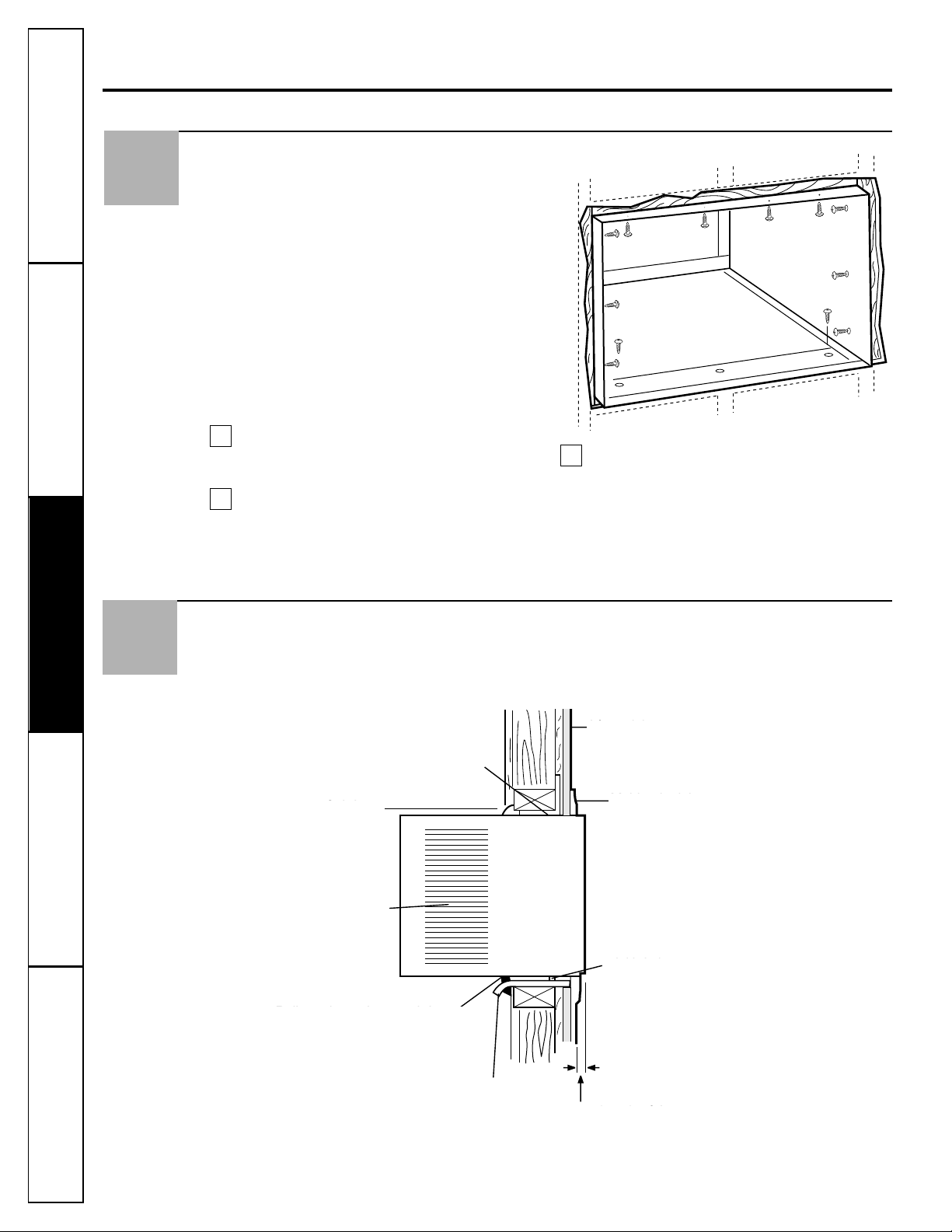
Instrucciones de instalación a través de la pared—opcional.
IMPORTANTE
La instalación a través de la pared no es apropiada
si alguno de los lados de las persianas fuera
obstruido por la pared.
Todas las persianas laterales en la caja deben
proyectarse hacia el lado exterior de la pared.
El lado de la habitación en la caja debe proyectarse
hacia el interior de la habitación por lo menos 1
3
⁄4″
a partir de la pared terminada.
La caja debe instalarse a nivel de lado a lado y con
una ligera inclinación desde el frente hacia la parte
posterior. Use un nivel; la inclinación de 1/2 de
burbuja será la correcta hacia el exterior.
Retire el acondicionador de aire de la caja.
Para instrucciones específicas, refiérase a las
Instrucciones de Instalación en una ventana.
Cerciórese de que existe un tomacorriente
disponible cerca del orificio o haga arreglos
para que se instale uno.
Coloque la caja en la abertura de la pared
y asegúrela con 12 tornillos de madera
de 1″ #10.
NOTA: Taladre los agujeros piloto, si es necesario,
para una instalación apropiada. Si el marco es
demasiado grande, use cuñas para evitar la
distorsión de la caja.
C
B
A
1
Calafatee los cuatro lados del lado exterior de la caja para evitar que la humedad penetre a través de
la abertura en la pared. El uso de tapajuntas (riel de goteo) evitará aún más que el agua gotee hacia
el interior de la pared y hacia el exterior de la construcción.
2
Ángulo del lintel
(si es necesario)
Calafateo
Persianas de aire
(debe proyectar hacia el
lado exterior de la pared)
Relleno de madera y calafateo
(por encima y por debajo del tapajuntas)
Tapajuntas
(riel de goteo)
4.5 cm (1
3
/4″) mínimo
Riel inferior
ADENTRO
AFUERA
Moldeado del marco
(si se desea)
Línea del yeso
Termine la abertura en la pared
Apoyo al consumidor
Solucionar problemas Operación SeguridadInstalación
18
Línea del yeso
Moldeado del marco
(si se desea)
Ángulo del lintel
(si es necesario)
Calafateo
Riel inferior
Relleno de madera y calafateo
(por encima y por debajo del tapajuntas)
Persianas de aire
(debe proyectar hacia
el lado exterior de la pared)
Tapajuntas
(riel de goteo)
1
3
⁄4″ mín.
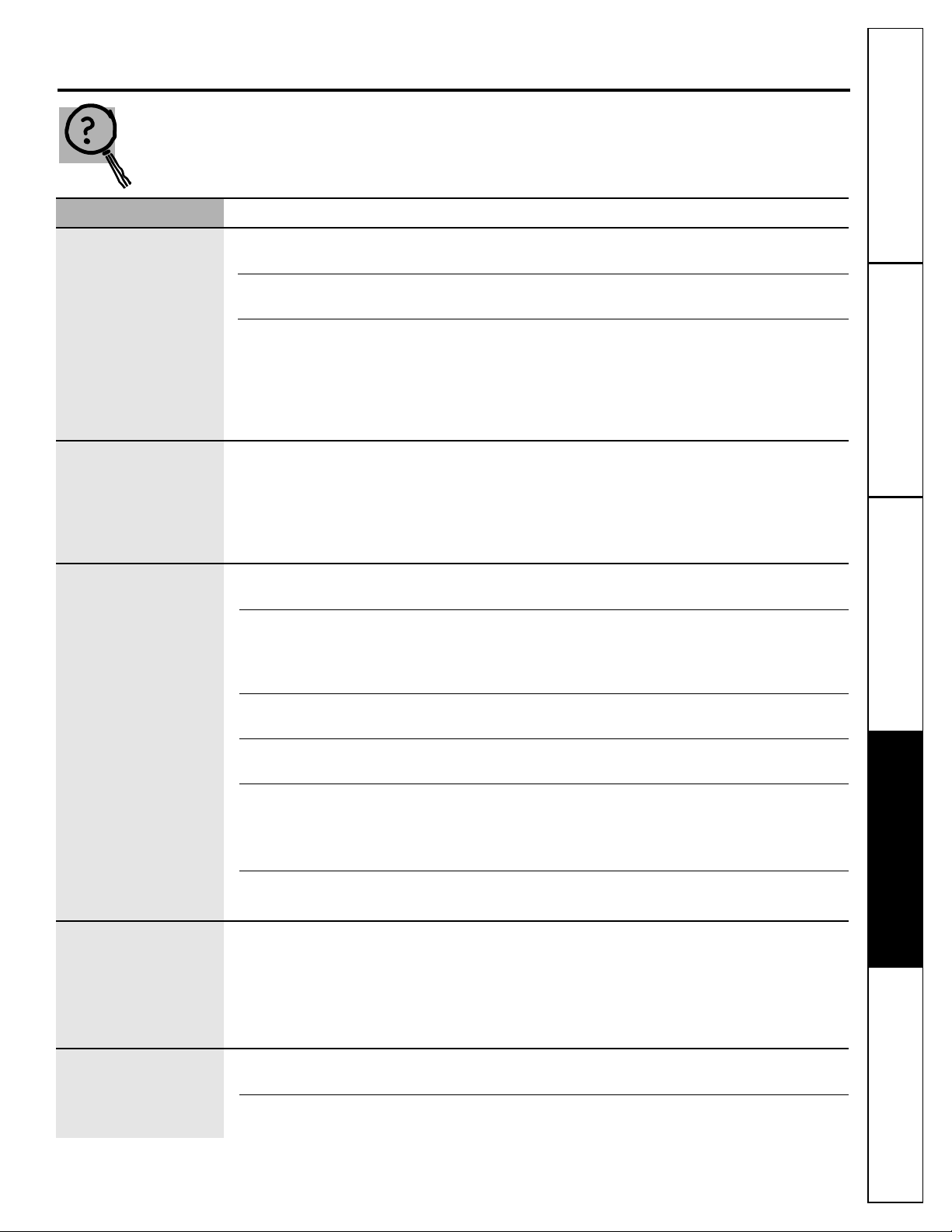
Antes de llamar para solicitar servicio… www.GEAppliances.com
Problema Causas posibles Qué hacer
El acondicionador de aire El acondicionador de aire • Cerciórese de que el acondicionador de aire está
no enciende está desconectado. enchufado totalmente en el tomacorriente.
El fusible se disparó / • Inspeccione los fusibles / caja de interruptores de la casa
el cortacircuitos se disparó. y reemplace cualquier fusible o reajuste el interruptor.
Interrupción en el • En modelos con perillas de control, si ocurriera una falla
suministro eléctrico. del suministro eléctrico, apague (OFF) el acondicionador
de aire. Cuando el suministro eléctrico haya sido
restablecido, espere 3 minutos para reiniciar el
acondicionador de aire para evitar que ocurra un
cortocircuito de la sobrecarga del compresor.
El acondicionador de aire A ocurrido una interrupción • En modelos con botones de control, cuando el
ha dejado de funcionar en el suministro eléctrico. suministro eléctrico haya sido restablecido, espere
3 minutos para reiniciar el acondicionador de aire para
evitar que ocurra un cortocircuito de la sobrecarga del
compresor. Presione el botón de POWER y reajuste los
controles a la función deseada.
El acondicionador de aire El flujo de aire está restringido. • Cerciórese de que no existe ninguna cortina, persiana o
no enfría como debería mueble bloqueando el frente del acondicionador de aire.
El control de temperatura no • En los modelos con teclado: En el modo COOL (FRÍO),
está ajustado apropiadamente. presione la tecla DECREASE ▼.
• En los modelos con botones, gire la temperatura a un
número mayor.
El filtro de aire está sucio. • Limpie el filtro cada 30 días por lo menos. Ver la sección
de Instrucciones de operación.
La habitación podría haber • Cuando el acondicionador de aire se enciende, usted
estado caliente. necesita darle tiempo para que enfrié la habitación.
El aire frío se está escapando. • Cerciórese de que los registros de la calefacción no están
abiertos y se encuentran retornando el aire frío.
• Coloque la ventanilla del acondicionador de aire en
la posición cerrada.
Las bobinas de enfriamiento • Ver “Acondicionador de aire congelándose” más adelante.
se congelaron.
El acondicionador de aire El hielo bloquea el flujo • En modelos con los botones de control, coloque el modo
se está congelando de aire hacia el acondicionador de control en HIGH FAN (VENTILADOR ALTO) ó HIGH COOL
de aire evitando que se enfríe (FRÍO ALTO) con la temperatura en 1 ó 2.
la habitación.
• En los modelos con teclas, coloque los controles en
HIGH FAN (VENTILADOR ALTO) ó HIGH COOL (FRÍO ALTO)
y ajuste el termostato a una temperatura más alta.
El control remoto Las baterías están insertadas • Inspeccione la posición de las baterías. Deben estar
no funciona incorrectamente. insertadas en la posición indicada, (+) y (–).
Las baterías pueden • Reemplace las baterías.
estar agotadas.
Apoyo al consumidorSolucionar problemasOperaciónSeguridad Instalación
19
Ideas para la identificación y solución de problemas:
¡Ahorre dinero y tiempo! Revise la siguiente tabla primero
y quizás no tenga que llamar para solicitar servicio.
20
Apoyo al consumidor
Solucionar problemas Operación SeguridadInstalación
Problema Causas posibles Qué hacer
Hay agua goteando afuera Tiempo húmedo y caliente. • Esto es normal.
Hay agua goteando en el El acondicionador de aire • Para drenar el agua apropiadamente, cercíorese de que
interior de la habitación no está inclinado hacia afuera. el acondicionador de aire está inclinado ligeramente
desde el frente hacia atrás.
Se acumula agua en La humedad removida del aire • Esto es normal por un corto período en áreas con poca
la bandeja y se drena hasta la bandeja. humedad; normal por un período de tiempo más
postergado en áreas más húmedas.
Los ajustes de la El control ha sido ajustado • Presione y sostenga las teclas Increase ▲ (Aumentar)/
temperatura en la para usar Celsius. Decrease ▼ (Reducir) al mismo tiempo para cambiar
pantalla solamente a la función de grados Fahrenheit.
pueden ser colocados
entre 16 y 31
“E1” aparece Se necesita limpiar el filtro. • Apague el acondicionador de aire y desconéctelo.
en la pantalla NOTA: El acondicionador de aire se debe desconectar
para volver a configurar el reloj de limpieza del filtro.
Limpie el filtro. Consulte la sección Cuidado y limpieza.
Después de la limpieza, vuelva a instalar el filtro y conecte
nuevamente el acondicionador de aire.
“Ed” aparece Protección contra • Apague el acondicionador de aire. Espere por lo menos
en la pantalla el congelamiento 3 minutos y vuelva a encender el acondicionador de aire.
activada automáticamente. Si el código vuelve a aparecer, llame para solicitar servicio.
“En” aparece Falla en el sensor de temperatura • Llame para solicitar servicio.
en la pantalla de la tubería.
“Er” aparece Falla en el sensor de temperatura • Llame para solicitar servicio.
en la pantalla del cuarto.
Antes de llamar para solicitar servicio…
Sonidos de operación normales
■ Quizás escuche un sonido metálico causado por
el agua tomada y tirada contra el condensador en
los días lluviosos o cuando la humedad es alta.
Esta característica de diseño ayuda a remover la
humedad y mejora la eficiencia.
■ Quizás escuche que el termostato hace clic cuando
el compresor hace ciclo entre encendido y apagado.
■ El agua se acumula en la bandeja durante días
lluviosos o con mucha humedad. El agua podría
derramarse y gotear desde el lado externo de
la unidad.
■ El ventilador podría funcionar aun si el
compresor no lo hace.
Ideas para la identificación y solución de problemas:
21
Notas.
Apoyo al consumidorSolucionar problemasOperaciónSeguridad Instalación
22
Notas.
Apoyo al consumidor
Solucionar problemas Operación SeguridadInstalación
23
Apoyo al consumidorSolucionar problemasOperaciónSeguridad Instalación
Garantía de su acondicionador de aire.
Por el período de: Nosotros reemplazaremos:
Un año Cualquier parte del acondicionador de aire que falle debido a defectos en los materiales o en
A partir de la fecha la fabricación. Durante este año completo de garantía, nosotros también proporcionaremos,
de la compra original sin costo alguno, toda la mano de obra y los servicios internos—para reemplazar partes defectuosas.
Cinco años Cualquier parte del sistema de refrigeración sellada (compresor, condensador, evaporador y tuberías
A partir de la fecha de conexión) que fallen debido a defectos en los materiales o fabricación. Durante estos cuatro
de la compra original años de garantía adicionales, también proporcionaremos, sin costo alguno, toda la mano de obra
y los servicios internos para reemplazar partes defectuosas.
■ Viajes de servicio a su casa para mostrarle cómo
funciona el equipo.
■ Instalación o entrega inapropiada, o mantenimiento
impropio. Si usted tiene un problema durante la
instalación, o si su acondicionador de aire no tiene la
capacidad de enfriamiento que usted necesita, póngase
en contacto con nuestro distribuidor o instalador.
Usted es responsable de proporcionar las facilidades
de conexión eléctrica necesarias.
■ Fallo del producto resultante de modificaciones al
producto o debido a uso irrazonable incluyendo no
proporcionar mantenimiento razonable y necesario.
■ En locales comerciales, la mano de obra necesaria para
retirar la unidad hacia un lugar para revisión por parte
de un técnico individual.
■ Reemplazo de fusibles de la casa o reajuste del sistema
de circuitos.
■ Fallos debido a la corrosión en modelos que no están
protegidos contra la corrosión.
■ Daño al producto causado por voltaje inapropiado hacia
el equipo, accidentes, incendios, inundaciones o actos
de la naturaleza de fuerza mayor.
■ Daños incidentales o consecuenciales causados por
defectos posibles con este acondicionador de aire.
■ Daños después de la entrega.
Lo que no está cubierto:
Esta garantía se extiende al comprador original y cualquier comprador posterior de productos comprados para uso
residencial dentro de Estados Unidos. En Alaska, la garantía excluye el costo de envío o las visitas de servicio a su casa.
Algunos estados no permiten la exclusión o las limitaciones de daños incidentales o consecuenciales. Esta garantía
da derechos legales específicos, y usted podría tener otros derechos que variarán de estado a estado. Para saber cuáles
son sus derechos legales, consulte a la oficina de asuntos del consumidor local o la oficina del Attorney General en
su localidad.
Garante: General Electric Company. Louisville, KY 40225
Todos los servicios de garantía los proporcionan nuestros Centros
de Reparación de Fábrica o nuestros técnicos Customer Care
®
autorizados. Para concertar una cita de reparación, en línea,
24 horas al día, visítenos al www.GEAppliances.com, o llame
al 800.GE.CARES (800.432.2737).
Grape aquí su recibo.
Se requiere facilitar prueba
de la fecha de compra original
para obtener un servicio
bajo la garantía.
Impreso en China
Apoyo al Consumidor.
Página Web de GE Appliances
www.GEAppliances.com
¿Tiene alguna pregunta sobre su electrodoméstico? ¡Pruebe la página Web de GE Appliances 24 horas al
día, cualquier día del año! Para mayor conveniencia y servicio más rápido, ya puede descargar los Manuales
de los Propietarios, pedir piezas o incluso hacer una cita en línea para que vengan a realizar una
reparación. También puede “Ask Our Team of Experts
™
” (Preguntar a nuestro equipo de expertos)
sobre cualquier cuestión y mucho más...
Solicite una reparación www.GEAppliances.com
El servicio de expertos GE está a tan sólo un paso de su puerta. ¡Entre en línea y solicite su reparación
cuando le venga bien 24 horas al día cualquier día del año! O llame al 800.GE.CARES (800.432.2737)
durante horas normales de oficina.
Real Life Design Studio (Estudio de diseño para la vida real)
www.GEAppliances.com
GE apoya el concepto de Diseño Universal—productos, servicios y ambientes que pueden usar gente de
todas las edades, tamaños y capacidades. Reconocemos la necesidad de diseñar para una gran gama de
habilidades y dificultades físicas y mentales. Para más detalles cobre las aplicaciones de GE Diseño Universal,
incluyendo ideas de diseño para la cocina para personas con discapacidades, mire nuestra página Web hoy
mismo. Para personas con dificultades auditivas, favor de llamar al 800.TDD.GEAC (800.833.4322).
Garantías ampliadas www.GEAppliances.com
Compre una garantía ampliada y obtenga detalles sobre descuentos especiales disponibles mientras su
garantía está aún activa. Puede comprarla en línea en cualquier momento, o llamar al 800.626.2224
durante horas normales de oficina. GE Consumer Home Services estará aún ahí cuando su garantía termine.
Piezas y accesorios www.GEAppliances.com
Aquellos individuos con la calificación necesaria para reparar sus propios electrodomésticos pueden
pedir que se les manden las piezas o accesorios directamente a sus hogares (aceptamos las tarjetas
VISA, MasterCard y Discover). Haga su pedido en línea hoy, 24 horas cada día o llamar por teléfono
al 800.626.2002 durante horas normales de oficina.
Las instrucciones descritas en este manual cubren los procedimientos a seguir por cualquier usuario. Cualquier
otra reparación debería, por regla general, referirse a personal calificado autorizado. Debe ejercerse precaución
ya que las reparaciones incorrectas pueden causar condiciones de funcionamiento inseguras.
Póngase en contacto con nosotros www.GEAppliances.com
Si no está satisfecho con el servicio que recibe de GE, póngase en contacto con nosotros en nuestra página
Web indicando todos los detalles así como su número de teléfono o escríbanos a:
General Manager, Customer Relations
GE Appliances, Appliance Park
Louisville, KY 40225
Registre su electrodoméstico www.GEAppliances.com
¡Registre su nuevo electrodoméstico en línea—cuando usted prefiera! El registrar su producto a tiempo le
proporcionará, si surgiera la necesidad, una mejor comunicación y un servicio más rápido bajo los términos
de su garantía. También puede enviar su tarjeta de registro pre-impresa que se incluye en el material
de embalaje.
24

